AB 1021: Housing: local educational agencies.
- Session Year: 2025-2026
- House: Assembly
- Latest Version Date: 2025-10-10
Current Status:
Passed
(2025-10-10: Chaptered by Secretary of State - Chapter 503, Statutes of 2025.)
Introduced
In Committee
Awaiting First Chamber Vote
Passed First Chamber
In Committee
Awaiting Second Chamber Vote
Passed Second Chamber
Enacted
(1)The Planning and Zoning Law requires each county and city to adopt a comprehensive, long-term general plan for its physical development, and the development of certain lands outside its boundaries, that includes, among other mandatory elements, a housing element. That law, until January 1, 2033, deems a housing development project an allowable use on any real property owned by a local educational agency if the housing development satisfies specified conditions, including, among others, consisting of at least 10 housing units, 100% of the units being rented by local educational agency employees, local public employees, and general members of the public pursuant to a specified priority, and a majority of the units being deed restricted for lower income or moderate-income households, as specified.
Existing law, the Housing Accountability Act, among other things, prohibits a local agency from disapproving a housing development project for very low, low-, or moderate-income households unless the local agency makes written findings as to one of certain sets of conditions, as specified, and describes various requirements applicable to housing development projects.
This bill would revise and recast the provisions deeming a housing development project an allowable use on any real property owned by a local educational agency. The bill would require the housing development to satisfy specified conditions, and would apply the requirements of the Housing Accountability Act to review of housing development projects subject to these provisions. The bill would provide that a proposed housing development project is eligible for a density bonus, as specified, and would define various terms for these purposes. The bill would extend the operation of these provisions until January 1, 2036.
(2)Existing law, prior to the sale, lease, or rental of any excess real property, requires the governing board of each school district to appoint a school district advisory committee to advise the governing board of the school district in the development of districtwide policies and procedures governing the use or disposition of school buildings or space in school buildings that is not needed for school purposes. Notwithstanding that law, existing law authorizes the governing board of a school district to elect not to appoint a school district advisory committee in the sale, lease, or rental of excess real property to be used for teacher or school district employee housing.
This bill would specify that the governing board of a school district is authorized to elect not to appoint a school district advisory committee in the sale, lease, or rental of excess real property to be used for teacher or school district employee housing and that is subject to the provisions governing real property owned by a local educational agency described above.
(3)The California Environmental Quality Act (CEQA) requires a lead agency, as defined, to prepare, or cause to be prepared, and certify the completion of an environmental impact report on a project that it proposes to carry out or approve that may have a significant effect on the environment or to adopt a negative declaration if it finds that the project will not have that effect. Existing law, until January 1, 2033, exempts from CEQA certain actions taken by a public agency related to affordable housing projects, as defined, if certain requirements are met.
This bill would provide that an affordable housing project for purposes of the CEQA exemption includes real property owned by a local educational agency, as described above, and would exempt these projects from certain of the requirements for other affordable housing projects.
(4)The bill would include findings that changes proposed by this bill address a matter of statewide concern rather than a municipal affair and, therefore, apply to all cities, including charter cities.
(5)By adding to the duties of local planning officials with respect to approving certain development projects, this bill would impose a state-mandated local program.
The California Constitution requires the state to reimburse local agencies and school districts for certain costs mandated by the state. Statutory provisions establish procedures for making that reimbursement.
This bill would provide that no reimbursement is required by this act for a specified reason.
(1)The Planning and Zoning Law requires each county and city to adopt a comprehensive, long-term general plan for its physical development, and the development of certain lands outside its boundaries, that includes, among other mandatory elements, a housing element. That law, until January 1, 2033, deems a housing development project an allowable use on any real property owned by a local educational agency if the housing development satisfies specified conditions, including, among others, consisting of at least 10 housing units, 100% of the units being rented by local educational agency employees, local public employees, and general members of the public pursuant to a specified priority, and a majority of the units being deed restricted for lower income or moderate-income households, as specified.
Existing law, the Housing Accountability Act, among other things, prohibits a local agency from disapproving a housing development project for very low, low-, or moderate-income households unless the local agency makes written findings as to one of certain sets of conditions, as specified, and describes various procedural requirements applicable to housing development projects.
This bill would revise and recast the provisions deeming a housing development project an allowable use on any real property owned by a local educational agency. The bill would require the housing development to satisfy specified conditions, and would apply the specified procedural requirements of the Housing Accountability Act to review of housing development projects subject to these provisions. The bill would provide that a proposed housing development project is eligible for a density bonus, as specified, and would define various terms for these purposes. The bill would extend the operation of these provisions until January 1, 2036.
(2)Existing law, prior to the sale, lease, or rental of any excess real property, requires the governing board of each school district to appoint a school district advisory committee to advise the governing board of the school district in the development of districtwide policies and procedures governing the use or disposition of school buildings or space in school buildings that is not needed for school purposes. Notwithstanding that law, existing law authorizes the governing board of a school district to elect not to appoint a school district advisory committee in the sale, lease, or rental of excess real property to be used for teacher or school district employee housing.
This bill would specify that the governing board of a school district is authorized to elect not to appoint a school district advisory committee in the sale, lease, or rental of excess real property to be used for teacher or school district employee housing and that is subject to the provisions governing real property owned by a local educational agency described above.
(3)The California Environmental Quality Act (CEQA) requires a lead agency, as defined, to prepare, or cause to be prepared, and certify the completion of an environmental impact report on a project that it proposes to carry out or approve that may have a significant effect on the environment or to adopt a negative declaration if it finds that the project will not have that effect. Existing law, until January 1, 2033, exempts from CEQA certain actions taken by a public agency related to affordable housing projects, as defined, if certain requirements are met.
This bill would provide that an affordable housing project for purposes of the CEQA exemption includes real property owned by a local educational agency, as described above, and would exempt these projects from certain of the requirements for other affordable housing projects.
(4)The California Constitution provides that all property is taxable, and requires that it be assessed at the same percentage of fair market value, unless otherwise provided by the California Constitution or federal law. The California Constitution exempts from taxation, among other types of property, growing crops, property used for free public libraries and free museums, property used exclusively for public schools, community colleges, state colleges, and state universities, and property belonging to the state or a local government. Existing law provides that the exemption for property used exclusively for public schools, community colleges, state colleges, and state universities includes an interest in property used to provide rental housing for employees of one or more public school districts or community college districts. This bill would provide that the interest in property, for purposes of exemption from property taxation, used to provide rental housing for employees of one or more public school districts or community college districts includes real property owned by a local educational agency, as described above.(5)(4)The bill would include findings that changes proposed by this bill address a matter of statewide concern rather than a municipal affair and, therefore, apply to all cities, including charter cities.
(6)(5)By adding to the duties of local planning officials with respect to approving certain development projects, this bill would impose a state-mandated local program.
The California Constitution requires the state to reimburse local agencies and school districts for certain costs mandated by the state. Statutory provisions establish procedures for making that reimbursement.
This bill would provide that no reimbursement is required by this act for a specified reason.
(1)The Planning and Zoning Law requires each county and city to adopt a comprehensive, long-term general plan for its physical development, and the development of certain lands outside its boundaries, that includes, among other mandatory elements, a housing element. That law, until January 1, 2033, deems a housing development project an allowable use on any real property owned by a local educational agency if the housing development satisfies specified conditions, including, among others, consisting of at least 10 housing units, 100% of the units being rented by local educational agency employees, local public employees, and general members of the public pursuant to a specified priority, and a majority of the units being deed restricted for lower income or moderate-income households, as specified.
Existing law, the Housing Accountability Act, among other things, prohibits a local agency from disapproving a housing development project for very low, low-, or moderate-income households unless the local agency makes written findings as to one of certain sets of conditions, as specified, and describes various procedural requirements applicable to housing development projects.
This bill would revise and recast the provisions deeming a housing development project an allowable use on any real property owned by a local educational agency. The bill would require the housing development to satisfy specified conditions, and would apply the specified procedural requirements of the Housing Accountability Act to review of housing development projects subject to these provisions. The bill would provide that a proposed housing development project is eligible for a density bonus, as specified, and would define various terms for these purposes. The bill would extend the operation of these provisions until January 1, 2036.
(2)Existing law, prior to the sale, lease, or rental of any excess real property, requires the governing board of each school district to appoint a school district advisory committee to advise the governing board of the school district in the development of districtwide policies and procedures governing the use or disposition of school buildings or space in school buildings that is not needed for school purposes. Notwithstanding that law, existing law authorizes the governing board of a school district to elect not to appoint a school district advisory committee in the sale, lease, or rental of excess real property to be used for teacher or school district employee housing.
This bill would specify that the governing board of a school district is authorized to elect not to appoint a school district advisory committee in the sale, lease, or rental of excess real property to be used for teacher or school district employee housing and that is subject to the provisions governing real property owned by a local educational agency described above.
(3)The California Environmental Quality Act (CEQA) requires a lead agency, as defined, to prepare, or cause to be prepared, and certify the completion of an environmental impact report on a project that it proposes to carry out or approve that may have a significant effect on the environment or to adopt a negative declaration if it finds that the project will not have that effect. Existing law, until January 1, 2033, exempts from CEQA certain actions taken by a public agency related to affordable housing projects, as defined, if certain requirements are met.
This bill would provide that an affordable housing project for purposes of the CEQA exemption includes real property owned by a local educational agency, as described above, and would exempt these projects from certain of the requirements for other affordable housing projects.
(4)The California Constitution provides that all property is taxable, and requires that it be assessed at the same percentage of fair market value, unless otherwise provided by the California Constitution or federal law. The California Constitution exempts from taxation, among other types of property, growing crops, property used for free public libraries and free museums, property used exclusively for public schools, community colleges, state colleges, and state universities, and property belonging to the state or a local government. Existing law provides that the exemption for property used exclusively for public schools, community colleges, state colleges, and state universities includes an interest in property used to provide rental housing for employees of one or more public school districts or community college districts.
This bill would provide that the interest in property, for purposes of exemption from property taxation, used to provide rental housing for employees of one or more public school districts or community college districts includes real property owned by a local educational agency, as described above.
(5)The bill would include findings that changes proposed by this bill address a matter of statewide concern rather than a municipal affair and, therefore, apply to all cities, including charter cities.
(6)By adding to the duties of local planning officials with respect to approving certain development projects, this bill would impose a state-mandated local program.
The California Constitution requires the state to reimburse local agencies and school districts for certain costs mandated by the state. Statutory provisions establish procedures for making that reimbursement.
This bill would provide that no reimbursement is required by this act for a specified reason.
Notwithstanding Section 17388, the governing board of a school district may elect not to appoint a school district advisory committee pursuant to Section 17388 in any of the following circumstances:
(a)A lease or rental of excess real property to a private educational institution for the purpose of offering summer school in a facility of the school district.
(b)The sale, lease, or rental of excess real property to be used for teacher or school district employee housing, including housing projects that comply with Section 65914.7 of the Government Code.
(c)Until July 1, 2024, the sale or lease of surplus real property that has not previously operated, or was not constructed to be operated, as an early childhood education facility or a school for elementary and secondary instruction, pursuant to paragraph (1) of subdivision (e) of Section 17463.7.
SEC. 2.Section 65914.7 of the Government Code is amended to read:65914.7.(a)Notwithstanding any law, a housing development project shall be deemed an allowable use on any real property owned by a local educational agency if the housing development satisfies all of the following:
(1)The housing development consists of at least 10 housing units.
(2)The housing development shall have a recorded deed restriction that ensures, for a period of at least 55 years, that either of the following occurs:
(A)At least 30 percent of the total units of the housing development shall be set at a rent affordable to lower income households, and at least 20 percent of the housing development shall be set at a rent affordable to moderate-income households.
(B)At least 12 percent of the total units of the housing development shall be set at a rent affordable to very low income households, at least 15 percent of the housing development shall be set at a rent affordable to lower income households, and at least 20 percent of the housing development shall be set at a rent affordable to moderate-income households.
(3)One hundred percent of the units of the housing development shall be rented by local educational agency employees, local public employees, and general members of the public pursuant to the following procedures:
(A)A local educational agency shall first offer the units to the agencys local educational agency employees.
(B)If the local educational agency receives an insufficient number of applications pursuant to subparagraph (A) to occupy the units, the unoccupied units may be offered to employees of other local educational agencies.
(C)If the local educational agency receives an insufficient number of applications pursuant to subparagraphs (A) and (B) to occupy the units, the unoccupied units may be offered to public employees who work for a local agency within the jurisdiction of the local educational agency.
(D)If the local agency receives an insufficient number of applications pursuant to subparagraphs (A), (B), and (C) to occupy the units, the unoccupied units may be offered to general members of the public.
(E)When units in the housing development become unoccupied and available for rent, a local educational agency shall offer the units pursuant to the sequence described in subparagraphs (A) to (D), inclusive.
(4)The allowable residential density for the housing development, as measured on the development footprint, shall be the greater of the following:
(A)The residential density allowed on the parcel by the city or county, as applicable.
(B)Twice the applicable density deemed appropriate to accommodate housing for lower income households in that jurisdiction, as specified in paragraph (3) of subdivision (c) of Section 65583.2.
(5)The height limit for the housing development shall be the following:
(A)For a site that is either surrounded by single-family zoning or is not within one-half mile of a major transit stop, the greater of the following:
(i)The height limit allowed on the parcel by the city or county, as applicable.
(ii)Thirty-five feet.
(B)For a site that is not within a metropolitan jurisdiction, as determined pursuant to subdivisions (d) and (e) of Section 65583.2, is not surrounded by single-family zoning, and is within one-half mile of a major transit stop, the greater of the following:
(i)The height limit allowed on the parcel by the city or county, as applicable.
(ii)Forty-five feet.
(C)For a site that is within a metropolitan jurisdiction, as determined pursuant to subdivisions (d) and (e) of Section 65583.2, is not surrounded by single-family zoning, and is within one-half mile of a major transit stop, the greater of the following:
(i)The height limit allowed on the parcel by the city or county, as applicable.
(ii)Sixty-five feet.
(6)(A)(i)The housing development shall satisfy other local objective zoning standards, objective subdivision standards, and objective design review standards that apply for the zone in the city, county, or city and county closest in proximity to the project that allows multifamily residential use at the residential density proposed by the project.
(ii)If no zone exists that allows the residential density proposed by the project, the applicable objective zoning standards, objective subdivision standards, and objective design review standards shall be those for the zone that allow the greatest density within the city, county, or city and county.
(B)Notwithstanding subparagraph (A), a local agency shall not apply any individual or combination of objective zoning standards, objective subdivision standards, and objective design review standards to the project that preclude the development from being built at the density proposed by the project.
(C)For purposes of this section, the terms objective zoning standards, objective subdivision standards, and objective design review standards mean standards that involve no personal or subjective judgment by a public official and are uniformly verifiable by reference to an external and uniform benchmark or criterion available and knowable by both the development applicant or proponent and the public official prior to submittal. These standards may be embodied in alternative objective land use specifications adopted by the city or county, as applicable, and may include, but are not limited to, housing overlay zones, specific plans, inclusionary zoning ordinances, and density bonus ordinances.
(D)Nothing in this paragraph shall be construed as exempting a proposed project that falls under this section from the requirements of paragraph (4).
(7)The property is located entirely within any applicable urban limit line or urban growth boundary established by local ordinance.
(8)The housing development complies with all infrastructure-related requirements, including impact fees that are existing or pending at the time the application is submitted, imposed by a city or county or a special district that provides service to the parcel.
(b)(1)Notwithstanding any local law, a housing development that meets the requirements of this section shall be deemed consistent, compliant, and in conformity with local development standards, zoning codes or maps, and the general plan.
(2)A housing development proposed pursuant to this section shall be eligible for a density bonus, incentives or concessions, waivers or reductions of development standards, and parking ratios pursuant to Section 65915.
(c)The local educational agency shall maintain ownership of a housing development that meets the requirements of this section for the length of the 55-year affordability requirement described in paragraph (2) of subdivision (a).
(d)Subject to the requirements of Article 8 (commencing with Section 17515) and Article 9 (commencing with Section 17527) of Chapter 4 of Part 10.5 of Division 1 of Title 1 of the Education Code, any land used for the development of a housing development that meets the requirements of this section may be jointly used or jointly occupied by the local educational agency and any other party.
(e)Any land used for the development of a housing development that meets the requirements of this section shall be exempt from the requirements of all of the following:
(1)Article 8 (commencing with Section 54220) of Chapter 5 of Part 1 of Division 2 of Title 5.
(2)Article 2 (commencing with Section 17230) of Chapter 1 of Part 10.5 of Division 1 of Title 1 of the Education Code.
(3)Article 4 (commencing with Section 17455) of Chapter 4 of Part 10.5 of Division 1 of Title 1 of the Education Code.
(f)For purposes of this section, the following definitions shall apply:
(1)Affordable rent means an amount consistent with the rent limits established by the California Tax Credit Allocation Committee.
(2)Development footprint means the portion of the property that is developed for the housing development, inclusive of parking and roadways developed internal to the site to serve the housing development, and other aboveground improvements developed to serve the housing development.
(3)Housing development project has the same meaning as in paragraph (2) of subdivision (h) of Section 65589.5.
(4)Local agency means a city, county, city and county, charter city, charter county, charter city and county, special district, or any combination thereof.
(5)Local educational agency means a school district or county office of education.
(6)Local educational agency employee has the same meaning as teacher or school district employee, as defined in subdivision (c) of Section 53572 of the Health and Safety Code.
(7)Local public employee has the same meaning as defined in subdivision (b) of Section 53572 of the Health and Safety Code.
(8)Lower income households has the same meaning as in Section 50079.5 of the Health and Safety Code.
(9)Major transit stop means the same as the definition in subdivision (b) of Section 21155 of the Public Resources Code.
(10)Moderate-income households has the same meaning as in Section 50093 of the Health and Safety Code.
(11)Real property owned by a local educational agency means real property owned by a local education agency as of January 1, 2026.
(12)Total units has the same meaning as in paragraph (9) of subdivision (o) of Section 65915.
(13)Very low income households has the same meaning as defined in Section 50105 of the Health and Safety Code.
(g)The local governments review of a housing development pursuant to this section to determine whether the development complies with objective development standards, including objective design review standards, shall be conducted consistent with the requirements of Section 65589.5.
(h)This section shall remain in effect only until January 1, 2036, and as of that date is repealed.
SEC. 3.Section 21080.40 of the Public Resources Code is amended to read:21080.40.(a)For purposes of this section, the following definitions apply:
(1)Affordable housing project means a project consisting of multifamily residential uses only or a mix of multifamily residential and nonresidential uses, with at least two-thirds of the square footage of the project designated for residential use, and that satisfies all of the following requirements:
(A)The project meets either of the following:
(i)All of the residential units within the project, excluding managers units, are dedicated to lower income households, as defined by Section 50079.5 of the Health and Safety Code.
(ii)The project complies with all of the requirements of Section 65914.7 of the Government Code.
(B)(i)The project meets the labor standards set forth in Section 65912.130 of the Government Code.
(ii)In addition to clause (i), for a project with 50 or more residential units, the project meets the labor standards set forth in Section 65912.131 of the Government Code.
(C)The project is located on a legal parcel or parcels in any of the following locations:
(i)In a city where the city boundaries include some portion of either an urbanized area or urban cluster, as designated by the United States Census Bureau, or in an unincorporated area, and the legal parcel or parcels are wholly within the boundaries of an urbanized area or urban cluster, as designated by the United States Census Bureau.
(ii)Within one-half mile walking distance to either a high-quality transit corridor or a major transit stop.
(iii)In a very low vehicle travel area.
(iv)Proximal to six or more amenities pursuant to paragraph (3) as of the date of submission of the application for the project.
(D)Parcels that are developed with urban uses adjoin at least 75 percent of the perimeter of the project site or at least three sides of a four-sided project site. For purposes of this paragraph, parcels that are only separated by a street or highway shall be considered to be adjoined.
(2)High-quality transit corridor has the same meaning as set forth in subdivision (b) of Section 21155.
(3)Proximal to an amenity means either of the following:
(A)Within one-half mile of any of the following amenities:
(i)A bus station.
(ii)A ferry terminal.
(B)Within one mile, or for a parcel in a rural area, as defined in Section 50199.21 of the Health and Safety Code, within two miles, of any of the following amenities:
(i)A supermarket or grocery store.
(ii)A public park.
(iii)A community center.
(iv)A pharmacy or drugstore.
(v)A medical clinic or hospital.
(vi)A public library.
(vii)A school that maintains a kindergarten or any of grades 1 to 12, inclusive.
(4)Vacant site means a site without any houses, offices, buildings, or other significant improvements on it.
(5)(A)Very low vehicle travel area means an urbanized area, as designated by the United States Census Bureau, where the existing residential development generates vehicle miles traveled per capita that is below 85 percent of either regional vehicle miles traveled per capita or city vehicle miles traveled per capita.
(B)For purposes of subparagraph (A), area may include a travel analysis zone, hexagon, or grid.
(C)For the purposes of determining regional vehicle miles traveled per capita pursuant to subparagraph (A), a region is the entirety of incorporated and unincorporated areas governed by a multicounty or single-county metropolitan planning organization, or the entirety of the incorporated and unincorporated areas of an individual county that is not part of a metropolitan planning organization.
(b)Subject to subdivision (c), this division does not apply to any of the following:
(1)The issuance of an entitlement by a public agency for an affordable housing project.
(2)An action to lease, convey, or encumber land owned by a public agency for an affordable housing project.
(3)An action to facilitate the lease, conveyance, or encumbrance of land owned or to be purchased by a public agency for an affordable housing project.
(4)Rezoning, specific plan amendments, or general plan amendments required specifically and exclusively to allow the construction of an affordable housing project.
(5)An action to provide financial assistance in furtherance of implementing an affordable housing project.
(c)Subdivision (b) applies if the action described in subdivision (b) requires the affordable housing project to meet all of the following requirements:
(1)The affordable housing project will be subject to a recorded California Tax Credit Allocation Committee regulatory agreement. This requirement does not apply to affordable housing projects that comply with all of the requirements of Section 65914.7 of the Government Code.
(2)The affordable housing project site can be adequately served by existing utilities or extensions.
(3)A public agency confirms all of the following:
(A)The project site satisfies the requirements specified in subparagraphs (B) to (K), inclusive, of paragraph (6) of subdivision (a) of Section 65913.4 of the Government Code.
(B)For a vacant site, the project site does not contain tribal cultural resources that could be affected by the development that were found pursuant to a consultation described in Section 21080.3.1 and the effects of which cannot be mitigated pursuant to the process described in Section 21080.3.2.
(C)(i)The development proponent has completed a phase I environmental assessment, as defined in Section 25319.1 of the Health and Safety Code. If a recognized environmental condition is found, the development proponent shall undertake a preliminary endangerment assessment, as defined in Section 25319.5 of the Health and Safety Code, prepared by an environmental assessor to determine the existence of any release of a hazardous substance on the site and to determine the potential for exposure of future occupants to significant health hazards from any nearby property or activity.
(ii)If a release of a hazardous substance is found to exist on the site, the release shall be removed, or any significant effects of the release shall be mitigated to a level of insignificance in compliance with current state and federal requirements.
(iii)If a potential for exposure to significant hazards from surrounding properties or activities is found to exist, the effects of the potential exposure shall be mitigated to a level of insignificance in compliance with current state and federal requirements.
(D)For a project site where multifamily housing is not a permitted use, all of the following are met:
(i)None of the housing is located within 500 feet of a freeway, as defined in Section 332 of the Vehicle Code.
(ii)None of the housing is located within 3,200 feet of a facility that actively extracts or refines oil or natural gas.
(iii)The project site is not within a very high fire hazard severity zone, as indicated on maps adopted by the Department of Forestry and Fire Protection pursuant to Section 4202 or as designated pursuant to subdivisions (a) and (b) of Section 51179 of the Government Code.
(d)If a lead agency determines that an activity is not subject to this division pursuant to this section and determines to approve or carry out the activity, the lead agency shall file a notice of exemption with the Office of Planning and Research and the county clerk of the county in which the activity will occur in the manner specified in subdivisions (b) and (c) of Section 21108 or subdivisions (b) and (c) of Section 21152.
(e)This section shall remain in effect only until January 1, 2033, and as of that date is repealed.
SEC. 4.The Legislature finds and declares that ensuring residential development on land owned by local educational agencies is a matter of statewide concern and is not a municipal affair as that term is used in Section 5 of Article XI of the California Constitution. Therefore, this act applies to all cities, including charter cities.
SEC. 5.No reimbursement is required by this act pursuant to Section 6 of Article XIIIB of the California Constitution because a local agency or school district has the authority to levy service charges, fees, or assessments sufficient to pay for the program or level of service mandated by this act, within the meaning of Section 17556 of the Government Code.
Notwithstanding Section 17388, the governing board of a school district may elect not to appoint a school district advisory committee pursuant to Section 17388 in any of the following circumstances:
(a)A lease or rental of excess real property to a private educational institution for the purpose of offering summer school in a facility of the school district.
(b)The sale, lease, or rental of excess real property to be used for teacher or school district employee housing, including housing projects that comply with Section 65914.7 of the Government Code.
(c)Until July 1, 2024, the sale or lease of surplus real property that has not previously operated, or was not constructed to be operated, as an early childhood education facility or a school for elementary and secondary instruction, pursuant to paragraph (1) of subdivision (e) of Section 17463.7.
SEC. 2.Section 65914.7 of the Government Code is amended to read:65914.7.(a)Notwithstanding any law, a housing development project shall be deemed an allowable use on any real property owned by a local educational agency if the housing development satisfies all of the following:
(1)The housing development consists of at least 10 housing units.
(2)The housing development shall have a recorded deed restriction that ensures, for a period of at least 55 years, that either of the following occurs:
(A)At least 30 percent of the total units of the housing development shall be set at a rent affordable to lower income households, and at least 20 percent of the housing development shall be set at a rent affordable to moderate-income households.
(B)At least 12 percent of the total units of the housing development shall be set at a rent affordable to very low income households, at least 15 percent of the housing development shall be set at a rent affordable to lower income households, and at least 20 percent of the housing development shall be set at a rent affordable to moderate-income households.
(3)One hundred percent of the units of the housing development shall be rented by local educational agency employees, local public employees, and general members of the public pursuant to the following procedures:
(A)A local educational agency shall first offer the units to the agencys local educational agency employees.
(B)If the local educational agency receives an insufficient number of applications pursuant to subparagraph (A) to occupy the units, the unoccupied units may be offered to employees of other local educational agencies.
(C)If the local educational agency receives an insufficient number of applications pursuant to subparagraphs (A) and (B) to occupy the units, the unoccupied units may be offered to public employees who work for a local agency within the jurisdiction of the local educational agency.
(D)If the local agency receives an insufficient number of applications pursuant to subparagraphs (A), (B), and (C) to occupy the units, the unoccupied units may be offered to general members of the public.
(E)When units in the housing development become unoccupied and available for rent, a local educational agency shall offer the units pursuant to the sequence described in subparagraphs (A) to (D), inclusive.
(4)The allowable residential density for the housing development, as measured on the development footprint, shall be the greater of the following:
(A)The residential density allowed on the parcel by the city or county, as applicable.
(B)Twice the applicable density deemed appropriate to accommodate housing for lower income households in that jurisdiction, as specified in paragraph (3) of subdivision (c) of Section 65583.2.
(5)The height limit for the housing development shall be the following:
(A)For a site that is either surrounded by single-family zoning or is not within one-half mile of a major transit stop, the greater of the following:
(i)The height limit allowed on the parcel by the city or county, as applicable.
(ii)Thirty-five feet.
(B)For a site that is not within a metropolitan jurisdiction, as determined pursuant to subdivisions (d) and (e) of Section 65583.2, is not surrounded by single-family zoning, and is within one-half mile of a major transit stop, the greater of the following:
(i)The height limit allowed on the parcel by the city or county, as applicable.
(ii)Forty-five feet.
(C)For a site that is within a metropolitan jurisdiction, as determined pursuant to subdivisions (d) and (e) of Section 65583.2, is not surrounded by single-family zoning, and is within one-half mile of a major transit stop, the greater of the following:
(i)The height limit allowed on the parcel by the city or county, as applicable.
(ii)Sixty-five feet.
(6)(A)(i)The housing development shall satisfy other local objective zoning standards, objective subdivision standards, and objective design review standards that apply for the zone in the city, county, or city and county closest in proximity to the project that allows multifamily residential use at the residential density proposed by the project.
(ii)If no zone exists that allows the residential density proposed by the project, the applicable objective zoning standards, objective subdivision standards, and objective design review standards shall be those for the zone that allow the greatest density within the city, county, or city and county.
(B)Notwithstanding subparagraph (A), a local agency shall not apply any individual or combination of objective zoning standards, objective subdivision standards, and objective design review standards to the project that preclude the development from being built at the density proposed by the project.
(C)For purposes of this section, the terms objective zoning standards, objective subdivision standards, and objective design review standards mean standards that involve no personal or subjective judgment by a public official and are uniformly verifiable by reference to an external and uniform benchmark or criterion available and knowable by both the development applicant or proponent and the public official prior to submittal. These standards may be embodied in alternative objective land use specifications adopted by the city or county, as applicable, and may include, but are not limited to, housing overlay zones, specific plans, inclusionary zoning ordinances, and density bonus ordinances.
(D)Nothing in this paragraph shall be construed as exempting a proposed project that falls under this section from the requirements of paragraph (4).
(7)The property is located entirely within any applicable urban limit line or urban growth boundary established by local ordinance.
(8)The housing development complies with all infrastructure-related requirements, including impact fees that are existing or pending at the time the application is submitted, imposed by a city or county or a special district that provides service to the parcel.
(b)(1)Notwithstanding any local law, a housing development that meets the requirements of this section shall be deemed consistent, compliant, and in conformity with local development standards, zoning codes or maps, and the general plan.
(2)A housing development proposed pursuant to this section shall be eligible for a density bonus, incentives or concessions, waivers or reductions of development standards, and parking ratios pursuant to Section 65915.
(c)The local educational agency shall maintain ownership of a housing development that meets the requirements of this section for the length of the 55-year affordability requirement described in paragraph (2) of subdivision (a).
(d)Subject to the requirements of Article 8 (commencing with Section 17515) and Article 9 (commencing with Section 17527) of Chapter 4 of Part 10.5 of Division 1 of Title 1 of the Education Code, any land used for the development of a housing development that meets the requirements of this section may be jointly used or jointly occupied by the local educational agency and any other party.
(e)Any land used for the development of a housing development that meets the requirements of this section shall be exempt from the requirements of all of the following:
(1)Article 8 (commencing with Section 54220) of Chapter 5 of Part 1 of Division 2 of Title 5.
(2)Article 2 (commencing with Section 17230) of Chapter 1 of Part 10.5 of Division 1 of Title 1 of the Education Code.
(3)Article 4 (commencing with Section 17455) of Chapter 4 of Part 10.5 of Division 1 of Title 1 of the Education Code.
(f)For purposes of this section, the following definitions shall apply:
(1)Affordable rent means an amount consistent with the rent limits established by the California Tax Credit Allocation Committee.
(2)Development footprint means the portion of the property that is developed for the housing development, inclusive of parking and roadways developed internal to the site to serve the housing development, and other aboveground improvements developed to serve the housing development.
(3)Housing development project has the same meaning as in paragraph (2) of subdivision (h) of Section 65589.5.
(4)Local agency means a city, county, city and county, charter city, charter county, charter city and county, special district, or any combination thereof.
(5)Local educational agency means a school district or county office of education.
(6)Local educational agency employee has the same meaning as teacher or school district employee, as defined in subdivision (c) of Section 53572 of the Health and Safety Code.
(7)Local public employee has the same meaning as defined in subdivision (b) of Section 53572 of the Health and Safety Code.
(8)Lower income households has the same meaning as in Section 50079.5 of the Health and Safety Code.
(9)Major transit stop means the same as the definition in subdivision (b) of Section 21155 of the Public Resources Code.
(10)Moderate-income households has the same meaning as in Section 50093 of the Health and Safety Code.
(11)Real property owned by a local educational agency means real property owned by a local education agency as of January 1, 2026.
(12)Total units has the same meaning as in paragraph (9) of subdivision (o) of Section 65915.
(13)Very low income households has the same meaning as defined in Section 50105 of the Health and Safety Code.
(g)The local governments review of a housing development pursuant to this section to determine whether the development complies with objective development standards, including objective design review standards, shall be conducted consistent with the procedural requirements of Section 65589.5.
(h)This section shall remain in effect only until January 1, 2036, and as of that date is repealed.
SEC. 3.Section 21080.40 of the Public Resources Code is amended to read:21080.40.(a)For purposes of this section, the following definitions apply:
(1)Affordable housing project means a project consisting of multifamily residential uses only or a mix of multifamily residential and nonresidential uses, with at least two-thirds of the square footage of the project designated for residential use, and that satisfies all of the following requirements:
(A)The project meets either of the following:
(i)All of the residential units within the project, excluding managers units, are dedicated to lower income households, as defined by Section 50079.5 of the Health and Safety Code.
(ii)The project complies with all of the requirements of Section 65914.7 of the Government Code.
(B)(i)The project meets the labor standards set forth in Section 65912.130 of the Government Code.
(ii)In addition to clause (i), for a project with 50 or more residential units, the project meets the labor standards set forth in Section 65912.131 of the Government Code.
(C)The project is located on a legal parcel or parcels in any of the following locations:
(i)In a city where the city boundaries include some portion of either an urbanized area or urban cluster, as designated by the United States Census Bureau, or in an unincorporated area, and the legal parcel or parcels are wholly within the boundaries of an urbanized area or urban cluster, as designated by the United States Census Bureau.
(ii)Within one-half mile walking distance to either a high-quality transit corridor or a major transit stop.
(iii)In a very low vehicle travel area.
(iv)Proximal to six or more amenities pursuant to paragraph (3) as of the date of submission of the application for the project.
(D)Parcels that are developed with urban uses adjoin at least 75 percent of the perimeter of the project site or at least three sides of a four-sided project site. For purposes of this paragraph, parcels that are only separated by a street or highway shall be considered to be adjoined.
(2)High-quality transit corridor has the same meaning as set forth in subdivision (b) of Section 21155.
(3)Proximal to an amenity means either of the following:
(A)Within one-half mile of any of the following amenities:
(i)A bus station.
(ii)A ferry terminal.
(B)Within one mile, or for a parcel in a rural area, as defined in Section 50199.21 of the Health and Safety Code, within two miles, of any of the following amenities:
(i)A supermarket or grocery store.
(ii)A public park.
(iii)A community center.
(iv)A pharmacy or drugstore.
(v)A medical clinic or hospital.
(vi)A public library.
(vii)A school that maintains a kindergarten or any of grades 1 to 12, inclusive.
(4)Vacant site means a site without any houses, offices, buildings, or other significant improvements on it.
(5)(A)Very low vehicle travel area means an urbanized area, as designated by the United States Census Bureau, where the existing residential development generates vehicle miles traveled per capita that is below 85 percent of either regional vehicle miles traveled per capita or city vehicle miles traveled per capita.
(B)For purposes of subparagraph (A), area may include a travel analysis zone, hexagon, or grid.
(C)For the purposes of determining regional vehicle miles traveled per capita pursuant to subparagraph (A), a region is the entirety of incorporated and unincorporated areas governed by a multicounty or single-county metropolitan planning organization, or the entirety of the incorporated and unincorporated areas of an individual county that is not part of a metropolitan planning organization.
(b)Subject to subdivision (c), this division does not apply to any of the following:
(1)The issuance of an entitlement by a public agency for an affordable housing project.
(2)An action to lease, convey, or encumber land owned by a public agency for an affordable housing project.
(3)An action to facilitate the lease, conveyance, or encumbrance of land owned or to be purchased by a public agency for an affordable housing project.
(4)Rezoning, specific plan amendments, or general plan amendments required specifically and exclusively to allow the construction of an affordable housing project.
(5)An action to provide financial assistance in furtherance of implementing an affordable housing project.
(c)Subdivision (b) applies if the action described in subdivision (b) requires the affordable housing project to meet all of the following requirements:
(1)The affordable housing project will be subject to a recorded California Tax Credit Allocation Committee regulatory agreement. This requirement does not apply to affordable housing projects that comply with all of the requirements of Section 65914.7 of the Government Code.
(2)The affordable housing project site can be adequately served by existing utilities or extensions.
(3)A public agency confirms all of the following:
(A)The project site satisfies the requirements specified in subparagraphs (B) to (K), inclusive, of paragraph (6) of subdivision (a) of Section 65913.4 of the Government Code.
(B)For a vacant site, the project site does not contain tribal cultural resources that could be affected by the development that were found pursuant to a consultation described in Section 21080.3.1 and the effects of which cannot be mitigated pursuant to the process described in Section 21080.3.2.
(C)(i)The development proponent has completed a phase I environmental assessment, as defined in Section 25319.1 of the Health and Safety Code. If a recognized environmental condition is found, the development proponent shall undertake a preliminary endangerment assessment, as defined in Section 25319.5 of the Health and Safety Code, prepared by an environmental assessor to determine the existence of any release of a hazardous substance on the site and to determine the potential for exposure of future occupants to significant health hazards from any nearby property or activity.
(ii)If a release of a hazardous substance is found to exist on the site, the release shall be removed, or any significant effects of the release shall be mitigated to a level of insignificance in compliance with current state and federal requirements.
(iii)If a potential for exposure to significant hazards from surrounding properties or activities is found to exist, the effects of the potential exposure shall be mitigated to a level of insignificance in compliance with current state and federal requirements.
(D)For a project site where multifamily housing is not a permitted use, all of the following are met:
(i)None of the housing is located within 500 feet of a freeway, as defined in Section 332 of the Vehicle Code.
(ii)None of the housing is located within 3,200 feet of a facility that actively extracts or refines oil or natural gas.
(iii)The project site is not within a very high fire hazard severity zone, as indicated on maps adopted by the Department of Forestry and Fire Protection pursuant to Section 4202 or as designated pursuant to subdivisions (a) and (b) of Section 51179 of the Government Code.
(d)If a lead agency determines that an activity is not subject to this division pursuant to this section and determines to approve or carry out the activity, the lead agency shall file a notice of exemption with the Office of Planning and Research and the county clerk of the county in which the activity will occur in the manner specified in subdivisions (b) and (c) of Section 21108 or subdivisions (b) and (c) of Section 21152.
(e)This section shall remain in effect only until January 1, 2033, and as of that date is repealed.
SEC. 4.The Legislature finds and declares that ensuring residential development on land owned by local educational agencies is a matter of statewide concern and is not a municipal affair as that term is used in Section 5 of Article XI of the California Constitution. Therefore, this act applies to all cities, including charter cities.
SEC. 5.No reimbursement is required by this act pursuant to Section 6 of Article XIIIB of the California Constitution because a local agency or school district has the authority to levy service charges, fees, or assessments sufficient to pay for the program or level of service mandated by this act, within the meaning of Section 17556 of the Government Code.
Notwithstanding Section 17388, the governing board of a school district may elect not to appoint a school district advisory committee pursuant to Section 17388 in any of the following circumstances:
(a)A lease or rental of excess real property to a private educational institution for the purpose of offering summer school in a facility of the school district.
(b)The sale, lease, or rental of excess real property to be used for teacher or school district employee housing, including housing projects that comply with Section 65914.7 of the Government Code.
(c)Until July 1, 2024, the sale or lease of surplus real property that has not previously operated, or was not constructed to be operated, as an early childhood education facility or a school for elementary and secondary instruction, pursuant to paragraph (1) of subdivision (e) of Section 17463.7.
SEC. 2.Section 65914.7 of the Government Code is amended to read:65914.7.(a)Notwithstanding any law, a housing development project shall be deemed an allowable use on any real property owned by a local educational agency if the housing development satisfies all of the following:
(1)The housing development consists of at least 10 housing units.
(2)The housing development shall have a recorded deed restriction that ensures, for a period of at least 55 years, that the majority of the total units of the housing development shall be set at an affordable rent to lower income or moderate-income households. However, at least 30 percent of the total units shall be affordable to lower income households. either of the following occurs:
(A)At least 30 percent of the total units of the housing development shall be set at a rent affordable to lower income households, and at least 20 percent of the housing development shall be set at a rent affordable to moderate-income households.
(B)At least 12 percent of the total units of the housing development shall be set at a rent affordable to very low income households, at least 15 percent of the housing development shall be set at a rent affordable to lower income households, and at least 20 percent of the housing development shall be set at a rent affordable to moderate-income households.
(3)One hundred percent of the units of the housing development shall be rented by local educational agency employees, local public employees, and general members of the public pursuant to the following procedures:
(A)A local educational agency shall first offer the units to the agencys local educational agency employees.
(B)If the local educational agency receives an insufficient number of applications pursuant to subparagraph (A) to occupy the units, the unoccupied units may be offered to employees of other local educational agencies.
(C)If the local educational agency receives an insufficient number of applications pursuant to subparagraphs (A) and (B) to occupy the units, the unoccupied units may be offered to public employees who work for a local agency within the jurisdiction of the local educational agency.
(D)If the local agency receives an insufficient number of applications pursuant to subparagraphs (A), (B), and (C) to occupy the units, the unoccupied units may be offered to general members of the public.
(E)When units in the housing development become unoccupied and available for rent, a local educational agency shall offer the units pursuant to the sequence described in subparagraphs (A) to (D), inclusive.
(4)The allowable residential density for the housing development, as measured on the development footprint, shall be the greater of the following:
(A)The residential density allowed on the parcel by the city or county, as applicable.
(B)Twice the applicable density deemed appropriate to accommodate housing for lower income households in that jurisdiction, as specified in paragraph (3) of subdivision (c) of Section 65583.2.
(5)The height limit for the housing development shall be the following:
(A)For a site that is either surrounded by single-family zoning or is not within one-half mile of a major transit stop, the greater of the following:
(i)The height limit allowed on the parcel by the city or county, as applicable.
(ii)Thirty-five feet.
(B)For a site that is not within a metropolitan jurisdiction, as determined pursuant to subdivisions (d) and (e) of Section 65583.2, is not surrounded by single-family zoning, and is within one-half mile of a major transit stop, the greater of the following:
(i)The height limit allowed on the parcel by the city or county, as applicable.
(ii)Forty-five feet.
(C)For a site that is within a metropolitan jurisdiction, as determined pursuant to subdivisions (d) and (e) of Section 65583.2, is not surrounded by single-family zoning, and is within one-half mile of a major transit stop, the greater of the following:
(i)The height limit allowed on the parcel by the city or county, as applicable.
(ii)Sixty-five feet.
(6)(A)(i)The housing development shall satisfy other local objective zoning standards, objective subdivision standards, and objective design review standards that apply for the closest zone in the city, county, or city and county closest in proximity to the project that allows multifamily residential use at the residential density proposed by the project.
(ii)If no zone exists that allows the residential density proposed by the project, the applicable objective zoning standards, objective subdivision standards, and objective design review standards shall be those for the zone that allow the greatest density within the city, county, or city and county.
(B)Notwithstanding subparagraph (A), a local agency shall not apply any individual or combination of objective zoning standards, objective subdivision standards, and objective design review standards to the project that preclude the development from being built at the density proposed by the project.
(C)For purposes of this section, the terms objective zoning standards, objective subdivision standards, and objective design review standards mean standards that involve no personal or subjective judgment by a public official and are uniformly verifiable by reference to an external and uniform benchmark or criterion available and knowable by both the development applicant or proponent and the public official prior to submittal. These standards may be embodied in alternative objective land use specifications adopted by the city or county, as applicable, and may include, but are not limited to, housing overlay zones, specific plans, inclusionary zoning ordinances, and density bonus ordinances.
(D)Nothing in this paragraph shall be construed as exempting a proposed project that falls under this section from the requirements of paragraph (4).
(7)The property is located entirely within any applicable urban limit line or urban growth boundary established by local ordinance.
(8)The housing development complies with all infrastructure-related requirements, including impact fees that are existing or pending at the time the application is submitted, imposed by a city or county or a special district that provides service to the parcel.
(b)(1)Notwithstanding any local law, a housing development that meets the requirements of this section shall be deemed consistent, compliant, and in conformity with local development standards, zoning codes or maps, and the general plan.
(2)A housing development proposed pursuant to this section shall be eligible for a density bonus, incentives or concessions, waivers or reductions of development standards, and parking ratios pursuant to Section 65915.
(c)The local educational agency shall maintain ownership of a housing development that meets the requirements of this section for the length of the 55-year affordability requirement described in paragraph (2) of subdivision (a).
(d)Subject to the requirements of Article 8 (commencing with Section 17515) and Article 9 (commencing with Section 17527) of Chapter 4 of Part 10.5 of Division 1 of Title 1 of the Education Code, any land used for the development of a housing development that meets the requirements of this section may be jointly used or jointly occupied by the local educational agency and any other party.
(e)Any land used for the development of a housing development that meets the requirements of this section shall be exempt from the requirements of all of the following:
(1)Article 8 (commencing with Section 54220) of Chapter 5 of Part 1 of Division 2 of Title 5.
(2)Article 2 (commencing with Section 17230) of Chapter 1 of Part 10.5 of Division 1 of Title 1 of the Education Code.
(3)Article 4 (commencing with Section 17455) of Chapter 4 of Part 10.5 of Division 1 of Title 1 of the Education Code.
(f)For purposes of this section, the following definitions shall apply:
(1)Affordable rent means an amount consistent with the rent limits established by the California Tax Credit Allocation Committee.
(2)Development footprint means the portion of the property that is developed for the housing development, inclusive of parking and roadways developed internal to the site to serve the housing development, and other aboveground improvements developed to serve the housing development.
(3)Housing development project has the same meaning as in paragraph (2) of subdivision (h) of Section 65589.5.
(4)Local agency means a city, county, city and county, charter city, charter county, charter city and county, special district, or any combination thereof.
(5)Local educational agency means a school district or county office of education.
(6)Local educational agency employee has the same meaning as teacher or school district employee, as defined in subdivision (c) of Section 53572 of the Health and Safety Code.
(7)Local public employee has the same meaning as defined in subdivision (b) of Section 53572 of the Health and Safety Code.
(8)Lower income households has the same meaning as in Section 50079.5 of the Health and Safety Code.
(9)Major transit stop means the same as the definition in subdivision (b) of Section 21155 of the Public Resources Code.
(10)Moderate-income households has the same meaning as in Section 50093 of the Health and Safety Code.
(11)Real property owned by a local educational agency means real property owned by a local education agency as of January 1, 2026.
(12)Total units has the same meaning as in paragraph (9) of subdivision (o) of Section 65915.
(13)Very low income households has the same meaning as defined in Section 50105 of the Health and Safety Code.
(g)The local governments review of a housing development pursuant to this section to determine whether the development complies with objective development standards, including objective design review standards, shall be conducted consistent with the procedural requirements of Section 65589.5.
(h)This section shall remain in effect only until January 1, 2036, and as of that date is repealed.
SEC. 3.Section 21080.40 of the Public Resources Code is amended to read:21080.40.(a)For purposes of this section, the following definitions apply:
(1)Affordable housing project means a project consisting of multifamily residential uses only or a mix of multifamily residential and nonresidential uses, with at least two-thirds of the square footage of the project designated for residential use, and that satisfies all of the following requirements:
(A)The project meets either of the following:
(i)All of the residential units within the project, excluding managers units, are dedicated to lower income households, as defined by Section 50079.5 of the Health and Safety Code.
(ii)The project complies with all of the requirements of Section 65914.7 of the Government Code.
(B)(i)The project meets the labor standards set forth in Section 65912.130 of the Government Code.
(ii)In addition to clause (i), for a project with 50 or more residential units, the project meets the labor standards set forth in Section 65912.131 of the Government Code.
(C)The project is located on a legal parcel or parcels in any of the following locations:
(i)In a city where the city boundaries include some portion of either an urbanized area or urban cluster, as designated by the United States Census Bureau, or in an unincorporated area, and the legal parcel or parcels are wholly within the boundaries of an urbanized area or urban cluster, as designated by the United States Census Bureau.
(ii)Within one-half mile walking distance to either a high-quality transit corridor or a major transit stop.
(iii)In a very low vehicle travel area.
(iv)Proximal to six or more amenities pursuant to paragraph (3) as of the date of submission of the application for the project.
(D)Parcels that are developed with urban uses adjoin at least 75 percent of the perimeter of the project site or at least three sides of a four-sided project site. For purposes of this paragraph, parcels that are only separated by a street or highway shall be considered to be adjoined.
(2)High-quality transit corridor has the same meaning as set forth in subdivision (b) of Section 21155.
(3)Proximal to an amenity means either of the following:
(A)Within one-half mile of any of the following amenities:
(i)A bus station.
(ii)A ferry terminal.
(B)Within one mile, or for a parcel in a rural area, as defined in Section 50199.21 of the Health and Safety Code, within two miles, of any of the following amenities:
(i)A supermarket or grocery store.
(ii)A public park.
(iii)A community center.
(iv)A pharmacy or drugstore.
(v)A medical clinic or hospital.
(vi)A public library.
(vii)A school that maintains a kindergarten or any of grades 1 to 12, inclusive.
(4)Vacant site means a site without any houses, offices, buildings, or other significant improvements on it.
(5)(A)Very low vehicle travel area means an urbanized area, as designated by the United States Census Bureau, where the existing residential development generates vehicle miles traveled per capita that is below 85 percent of either regional vehicle miles traveled per capita or city vehicle miles traveled per capita.
(B)For purposes of subparagraph (A), area may include a travel analysis zone, hexagon, or grid.
(C)For the purposes of determining regional vehicle miles traveled per capita pursuant to subparagraph (A), a region is the entirety of incorporated and unincorporated areas governed by a multicounty or single-county metropolitan planning organization, or the entirety of the incorporated and unincorporated areas of an individual county that is not part of a metropolitan planning organization.
(b)Subject to subdivision (c), this division does not apply to any of the following:
(1)The issuance of an entitlement by a public agency for an affordable housing project.
(2)An action to lease, convey, or encumber land owned by a public agency for an affordable housing project.
(3)An action to facilitate the lease, conveyance, or encumbrance of land owned or to be purchased by a public agency for an affordable housing project.
(4)Rezoning, specific plan amendments, or general plan amendments required specifically and exclusively to allow the construction of an affordable housing project.
(5)An action to provide financial assistance in furtherance of implementing an affordable housing project.
(c)Subdivision (b) applies if the action described in subdivision (b) requires the affordable housing project to meet all of the following requirements:
(1)The affordable housing project will be subject to a recorded California Tax Credit Allocation Committee regulatory agreement. This requirement does not apply to affordable housing projects that comply with all of the requirements of Section 65914.7 of the Government Code.
(2)The affordable housing project site can be adequately served by existing utilities or extensions.
(3)A public agency confirms all of the following:
(A)The project site satisfies the requirements specified in subparagraphs (B) to (K), inclusive, of paragraph (6) of subdivision (a) of Section 65913.4 of the Government Code.
(B)For a vacant site, the project site does not contain tribal cultural resources that could be affected by the development that were found pursuant to a consultation described in Section 21080.3.1 and the effects of which cannot be mitigated pursuant to the process described in Section 21080.3.2.
(C)(i)The development proponent has completed a phase I environmental assessment, as defined in Section 25319.1 of the Health and Safety Code. If a recognized environmental condition is found, the development proponent shall undertake a preliminary endangerment assessment, as defined in Section 25319.5 of the Health and Safety Code, prepared by an environmental assessor to determine the existence of any release of a hazardous substance on the site and to determine the potential for exposure of future occupants to significant health hazards from any nearby property or activity.
(ii)If a release of a hazardous substance is found to exist on the site, the release shall be removed, or any significant effects of the release shall be mitigated to a level of insignificance in compliance with current state and federal requirements.
(iii)If a potential for exposure to significant hazards from surrounding properties or activities is found to exist, the effects of the potential exposure shall be mitigated to a level of insignificance in compliance with current state and federal requirements.
(D)For a project site where multifamily housing is not a permitted use, all of the following are met:
(i)None of the housing is located within 500 feet of a freeway, as defined in Section 332 of the Vehicle Code.
(ii)None of the housing is located within 3,200 feet of a facility that actively extracts or refines oil or natural gas.
(iii)The project site is not within a very high fire hazard severity zone, as indicated on maps adopted by the Department of Forestry and Fire Protection pursuant to Section 4202 or as designated pursuant to subdivisions (a) and (b) of Section 51179 of the Government Code.
(d)If a lead agency determines that an activity is not subject to this division pursuant to this section and determines to approve or carry out the activity, the lead agency shall file a notice of exemption with the Office of Planning and Research and the county clerk of the county in which the activity will occur in the manner specified in subdivisions (b) and (c) of Section 21108 or subdivisions (b) and (c) of Section 21152.
(e)This section shall remain in effect only until January 1, 2033, and as of that date is repealed.
SEC. 4.The Legislature finds and declares that ensuring residential development on land owned by local educational agencies is a matter of statewide concern and is not a municipal affair as that term is used in Section 5 of Article XI of the California Constitution. Therefore, this act applies to all cities, including charter cities.
SEC. 5.No reimbursement is required by this act pursuant to Section 6 of Article XIIIB of the California Constitution because a local agency or school district has the authority to levy service charges, fees, or assessments sufficient to pay for the program or level of service mandated by this act, within the meaning of Section 17556 of the Government Code.
Notwithstanding Section 17388, the governing board of a school district may elect not to appoint a school district advisory committee pursuant to Section 17388 in any of the following circumstances:
(a)A lease or rental of excess real property to a private educational institution for the purpose of offering summer school in a facility of the school district.
(b)The sale, lease, or rental of excess real property to be used for teacher or school district employee housing, including housing projects that comply with Section 65914.7 of the Government Code.
(c)Until July 1, 2024, the sale or lease of surplus real property that has not previously operated, or was not constructed to be operated, as an early childhood education facility or a school for elementary and secondary instruction, pursuant to paragraph (1) of subdivision (e) of Section 17463.7.
SEC. 2.Section 65914.7 of the Government Code is amended to read:65914.7.(a)Notwithstanding any law, a housing development project shall be deemed an allowable use on any real property owned by a local educational agency if the housing development satisfies all of the following:
(1)The housing development consists of at least 10 housing units.
(2)The housing development shall have a recorded deed restriction that ensures, for a period of at least 55 years, that the majority of the total units of the housing development shall be set at an affordable rent to lower income or moderate-income households. However, at least 30 percent of the total units shall be affordable to lower income households.
(3)One hundred percent of the units of the housing development shall be rented by local educational agency employees, local public employees, and general members of the public pursuant to the following procedures:
(A)A local educational agency shall first offer the units to the agencys local educational agency employees.
(B)If the local educational agency receives an insufficient number of applications pursuant to subparagraph (A) to occupy the units, the unoccupied units may be offered to employees of other local educational agencies.
(C)If the local educational agency receives an insufficient number of applications pursuant to subparagraphs (A) and (B) to occupy the units, the unoccupied units may be offered to public employees who work for a local agency within the jurisdiction of the local educational agency.
(D)If the local agency receives an insufficient number of applications pursuant to subparagraphs (A), (B), and (C) to occupy the units, the unoccupied units may be offered to general members of the public.
(E)When units in the housing development become unoccupied and available for rent, a local educational agency shall offer the units pursuant to the sequence described in subparagraphs (A) to (D), inclusive.
(4)The allowable residential density for the housing development, as measured on the development footprint, shall be the greater of the following:
(A)The residential density allowed on the parcel by the city or county, as applicable.
(B)Twice the applicable density deemed appropriate to accommodate housing for lower income households in that jurisdiction, as specified in paragraph (3) of subdivision (c) of Section 65583.2.
(5)The height limit for the housing development shall be the following:
(A)For a site that is either surrounded by single-family zoning or is not within one-half mile of a major transit stop, the greater of the following:
(i)The height limit allowed on the parcel by the city or county, as applicable.
(ii)Thirty-five feet.
(B)For a site that is not within a metropolitan jurisdiction, as determined pursuant to subdivisions (d) and (e) of Section 65583.2, is not surrounded by single-family zoning, and is within one-half mile of a major transit stop, the greater of the following:
(i)The height limit allowed on the parcel by the city or county, as applicable.
(ii)Forty-five feet.
(C)For a site that is within a metropolitan jurisdiction, as determined pursuant to subdivisions (d) and (e) of Section 65583.2, is not surrounded by single-family zoning, and is within one-half mile of a major transit stop, the greater of the following:
(i)The height limit allowed on the parcel by the city or county, as applicable.
(ii)Sixty-five feet.
(6)(A)(i)The housing development shall satisfy other local objective zoning standards, objective subdivision standards, and objective design review standards that apply for the closest zone in the city, county, or city and county that allows multifamily residential use at the residential density proposed by the project.
(ii)If no zone exists that allows the residential density proposed by the project, the applicable objective zoning standards, objective subdivision standards, and objective design review standards shall be those for the zone that allow the greatest density within the city, county, or city and county.
(B)Notwithstanding subparagraph (A), a local agency shall not apply any individual or combination of objective zoning standards, objective subdivision standards, and objective design review standards to the project that preclude the development from being built at the density proposed by the project.
(C)For purposes of this section, the terms objective zoning standards, objective subdivision standards, and objective design review standards mean standards that involve no personal or subjective judgment by a public official and are uniformly verifiable by reference to an external and uniform benchmark or criterion available and knowable by both the development applicant or proponent and the public official prior to submittal. These standards may be embodied in alternative objective land use specifications adopted by the city or county, as applicable, and may include, but are not limited to, housing overlay zones, specific plans, inclusionary zoning ordinances, and density bonus ordinances.
(D)Nothing in this paragraph shall be construed as exempting a proposed project that falls under this section from the requirements of paragraph (4).
(7)The property is located entirely within any applicable urban limit line or urban growth boundary established by local ordinance.
(8)The housing development complies with all infrastructure-related requirements, including impact fees that are existing or pending at the time the application is submitted, imposed by a city or county or a special district that provides service to the parcel.
(b)(1)Notwithstanding any local law, a housing development that meets the requirements of this section shall be deemed consistent, compliant, and in conformity with local development standards, zoning codes or maps, and the general plan.
(2)A housing development proposed pursuant to this section shall be eligible for a density bonus, incentives or concessions, waivers or reductions of development standards, and parking ratios pursuant to Section 65915.
(c)The local educational agency shall maintain ownership of a housing development that meets the requirements of this section for the length of the 55-year affordability requirement described in paragraph (2) of subdivision (a).
(d)Subject to the requirements of Article 8 (commencing with Section 17515) and Article 9 (commencing with Section 17527) of Chapter 4 of Part 10.5 of Division 1 of Title 1 of the Education Code, any land used for the development of a housing development that meets the requirements of this section may be jointly used or jointly occupied by the local educational agency and any other party.
(e)Any land used for the development of a housing development that meets the requirements of this section shall be exempt from the requirements of all of the following:
(1)Article 8 (commencing with Section 54220) of Chapter 5 of Part 1 of Division 2 of Title 5.
(2)Article 2 (commencing with Section 17230) of Chapter 1 of Part 10.5 of Division 1 of Title 1 of the Education Code.
(3)Article 4 (commencing with Section 17455) of Chapter 4 of Part 10.5 of Division 1 of Title 1 of the Education Code.
(f)For purposes of this section, the following definitions shall apply:
(1)Affordable rent means an amount consistent with the rent limits established by the California Tax Credit Allocation Committee.
(2)Development footprint means the portion of the property that is developed for the housing development, inclusive of parking and roadways developed internal to the site to serve the housing development, and other aboveground improvements developed to serve the housing development.
(3)Housing development project has the same meaning as in paragraph (2) of subdivision (h) of Section 65589.5.
(4)Local agency means a city, county, city and county, charter city, charter county, charter city and county, special district, or any combination thereof.
(5)Local educational agency means a school district or county office of education.
(6)Local educational agency employee has the same meaning as teacher or school district employee, as defined in subdivision (c) of Section 53572 of the Health and Safety Code.
(7)Local public employee has the same meaning as defined in subdivision (b) of Section 53572 of the Health and Safety Code.
(8)Lower income households has the same meaning as in Section 50079.5 of the Health and Safety Code.
(9)Major transit stop means the same as the definition in subdivision (b) of Section 21155 of the Public Resources Code.
(10)Moderate-income households has the same meaning as in Section 50093 of the Health and Safety Code.
(11)Real property owned by a local educational agency means real property owned by a local education agency as of January 1, 2026.
(12)Total units has the same meaning as in paragraph (9) of subdivision (o) of Section 65915.
(g)The local governments review of a housing development pursuant to this section to determine whether the development complies with objective development standards, including objective design review standards, shall be conducted consistent with the procedural requirements of Section 65589.5.
(h)This section shall remain in effect only until January 1, 2036, and as of that date is repealed.
SEC. 3.Section 21080.40 of the Public Resources Code is amended to read:21080.40.(a)For purposes of this section, the following definitions apply:
(1)Affordable housing project means a project consisting of multifamily residential uses only or a mix of multifamily residential and nonresidential uses, with at least two-thirds of the square footage of the project designated for residential use, and that satisfies all of the following requirements:
(A)The project meets either of the following:
(i)All of the residential units within the project, excluding managers units, are dedicated to lower income households, as defined by Section 50079.5 of the Health and Safety Code.
(ii)The project complies with all of the requirements of Section 65914.7 of the Government Code.
(B)(i)The project meets the labor standards set forth in Section 65912.130 of the Government Code.
(ii)In addition to clause (i), for a project with 50 or more residential units, the project meets the labor standards set forth in Section 65912.131 of the Government Code.
(C)The project is located on a legal parcel or parcels in any of the following locations:
(i)In a city where the city boundaries include some portion of either an urbanized area or urban cluster, as designated by the United States Census Bureau, or in an unincorporated area, and the legal parcel or parcels are wholly within the boundaries of an urbanized area or urban cluster, as designated by the United States Census Bureau.
(ii)Within one-half mile walking distance to either a high-quality transit corridor or a major transit stop.
(iii)In a very low vehicle travel area.
(iv)Proximal to six or more amenities pursuant to paragraph (3) as of the date of submission of the application for the project.
(D)Parcels that are developed with urban uses adjoin at least 75 percent of the perimeter of the project site or at least three sides of a four-sided project site. For purposes of this paragraph, parcels that are only separated by a street or highway shall be considered to be adjoined.
(2)High-quality transit corridor has the same meaning as set forth in subdivision (b) of Section 21155.
(3)Proximal to an amenity means either of the following:
(A)Within one-half mile of any of the following amenities:
(i)A bus station.
(ii)A ferry terminal.
(B)Within one mile, or for a parcel in a rural area, as defined in Section 50199.21 of the Health and Safety Code, within two miles, of any of the following amenities:
(i)A supermarket or grocery store.
(ii)A public park.
(iii)A community center.
(iv)A pharmacy or drugstore.
(v)A medical clinic or hospital.
(vi)A public library.
(vii)A school that maintains a kindergarten or any of grades 1 to 12, inclusive.
(4)Vacant site means a site without any houses, offices, buildings, or other significant improvements on it.
(5)(A)Very low vehicle travel area means an urbanized area, as designated by the United States Census Bureau, where the existing residential development generates vehicle miles traveled per capita that is below 85 percent of either regional vehicle miles traveled per capita or city vehicle miles traveled per capita.
(B)For purposes of subparagraph (A), area may include a travel analysis zone, hexagon, or grid.
(C)For the purposes of determining regional vehicle miles traveled per capita pursuant to subparagraph (A), a region is the entirety of incorporated and unincorporated areas governed by a multicounty or single-county metropolitan planning organization, or the entirety of the incorporated and unincorporated areas of an individual county that is not part of a metropolitan planning organization.
(b)Subject to subdivision (c), this division does not apply to any of the following:
(1)The issuance of an entitlement by a public agency for an affordable housing project.
(2)An action to lease, convey, or encumber land owned by a public agency for an affordable housing project.
(3)An action to facilitate the lease, conveyance, or encumbrance of land owned or to be purchased by a public agency for an affordable housing project.
(4)Rezoning, specific plan amendments, or general plan amendments required specifically and exclusively to allow the construction of an affordable housing project.
(5)An action to provide financial assistance in furtherance of implementing an affordable housing project.
(c)Subdivision (b) applies if the action described in subdivision (b) requires the affordable housing project to meet all of the following requirements:
(1)The affordable housing project will be subject to a recorded California Tax Credit Allocation Committee regulatory agreement. This requirement does not apply to affordable housing projects that comply with all of the requirements of Section 65914.7 of the Government Code.
(2)The affordable housing project site can be adequately served by existing utilities or extensions.
(3)A public agency confirms all of the following:
(A)The project site satisfies the requirements specified in subparagraphs (B) to (K), inclusive, of paragraph (6) of subdivision (a) of Section 65913.4 of the Government Code.
(B)For a vacant site, the project site does not contain tribal cultural resources that could be affected by the development that were found pursuant to a consultation described in Section 21080.3.1 and the effects of which cannot be mitigated pursuant to the process described in Section 21080.3.2.
(C)(i)The development proponent has completed a phase I environmental assessment, as defined in Section 25319.1 of the Health and Safety Code. If a recognized environmental condition is found, the development proponent shall undertake a preliminary endangerment assessment, as defined in Section 25319.5 of the Health and Safety Code, prepared by an environmental assessor to determine the existence of any release of a hazardous substance on the site and to determine the potential for exposure of future occupants to significant health hazards from any nearby property or activity.
(ii)If a release of a hazardous substance is found to exist on the site, the release shall be removed, or any significant effects of the release shall be mitigated to a level of insignificance in compliance with current state and federal requirements.
(iii)If a potential for exposure to significant hazards from surrounding properties or activities is found to exist, the effects of the potential exposure shall be mitigated to a level of insignificance in compliance with current state and federal requirements.
(D)For a project site where multifamily housing is not a permitted use, all of the following are met:
(i)None of the housing is located within 500 feet of a freeway, as defined in Section 332 of the Vehicle Code.
(ii)None of the housing is located within 3,200 feet of a facility that actively extracts or refines oil or natural gas.
(iii)The project site is not within a very high fire hazard severity zone, as indicated on maps adopted by the Department of Forestry and Fire Protection pursuant to Section 4202 or as designated pursuant to subdivisions (a) and (b) of Section 51179 of the Government Code.
(d)If a lead agency determines that an activity is not subject to this division pursuant to this section and determines to approve or carry out the activity, the lead agency shall file a notice of exemption with the Office of Planning and Research and the county clerk of the county in which the activity will occur in the manner specified in subdivisions (b) and (c) of Section 21108 or subdivisions (b) and (c) of Section 21152.
(e)This section shall remain in effect only until January 1, 2033, and as of that date is repealed.
SEC. 4.The Legislature finds and declares that ensuring residential development on land owned by local educational agencies is a matter of statewide concern and is not a municipal affair as that term is used in Section 5 of Article XI of the California Constitution. Therefore, this act applies to all cities, including charter cities.
SEC. 5.No reimbursement is required by this act pursuant to Section 6 of Article XIIIB of the California Constitution because a local agency or school district has the authority to levy service charges, fees, or assessments sufficient to pay for the program or level of service mandated by this act, within the meaning of Section 17556 of the Government Code.
Notwithstanding Section 17388, the governing board of a school district may elect not to appoint a school district advisory committee pursuant to Section 17388 in any of the following circumstances:
(a)A lease or rental of excess real property to a private educational institution for the purpose of offering summer school in a facility of the school district.
(b)The sale, lease, or rental of excess real property to be used for teacher or school district employee housing, including housing projects that comply with Section 65914.7 of the Government Code.
(c)Until July 1, 2024, the sale or lease of surplus real property that has not previously operated, or was not constructed to be operated, as an early childhood education facility or a school for elementary and secondary instruction, pursuant to paragraph (1) of subdivision (e) of Section 17463.7.
SEC. 2.Section 65914.7 of the Government Code is amended to read:65914.7.(a)Notwithstanding any law, a housing development project shall be deemed an allowable use on any real property owned by a local educational agency if the housing development satisfies all of the following:
(1)The housing development consists of at least 10 housing units.
(2)The housing development shall have a recorded deed restriction that ensures, for a period of at least 55 years, that the majority of the total units of the housing development shall be set at an affordable rent to lower income or moderate-income households. However, at least 30 percent of the total units shall be affordable to lower income households.
(3)One hundred percent of the units of the housing development shall be rented by local educational agency employees, local public employees, and general members of the public pursuant to the following procedures:
(A)A local educational agency shall first offer the units to the agencys local educational agency employees.
(B)If the local educational agency receives an insufficient number of applications pursuant to subparagraph (A) to occupy the units, the unoccupied units may be offered to employees of other local educational agencies.
(C)If the local educational agency receives an insufficient number of applications pursuant to subparagraphs (A) and (B) to occupy the units, the unoccupied units may be offered to public employees who work for a local agency within the jurisdiction of the local educational agency.
(D)If the local agency receives an insufficient number of applications pursuant to subparagraphs (A), (B), and (C) to occupy the units, the unoccupied units may be offered to general members of the public.
(E)When units in the housing development become unoccupied and available for rent, a local educational agency shall offer the units pursuant to the sequence described in subparagraphs (A) to (D), inclusive.
(4)The allowable residential density for the housing development, as measured on the development footprint, shall be the greater of the following:
(A)The residential density allowed on the parcel by the city or county, as applicable.
(B)Twice the applicable density deemed appropriate to accommodate housing for lower income households in that jurisdiction, as specified in paragraph (3) of subdivision (c) of Section 65583.2.
(5)The height limit for the housing development shall be the following:
(A)For a site that is either surrounded by single-family zoning or is not within one-half mile of a major transit stop, the greater of the following:
(i)The height limit allowed on the parcel by the city or county, as applicable.
(ii)Thirty-five feet.
(B)For a site that is not within a metropolitan jurisdiction, as determined pursuant to subdivisions (d) and (e) of Section 65583.2, is not surrounded by single-family zoning, and is within one-half mile of a major transit stop, the greater of the following:
(i)The height limit allowed on the parcel by the city or county, as applicable.
(ii)Forty-five feet.
(C)For a site that is within a metropolitan jurisdiction, as determined pursuant to subdivisions (d) and (e) of Section 65583.2, is not surrounded by single-family zoning, and is within one-half mile of a major transit stop, the greater of the following:
(i)The height limit allowed on the parcel by the city or county, as applicable.
(ii)Sixty-five feet.
(6)(A)(i)The housing development shall satisfy other local objective zoning standards, objective subdivision standards, and objective design review standards that apply for the closest zone in the city, county, or city and county that allows multifamily residential use at the residential density proposed by the project.
(ii)If no zone exists that allows the residential density proposed by the project, the applicable objective zoning standards, objective subdivision standards, and objective design review standards shall be those for the zone that allow the greatest density within the city, county, or city and county.
(B)Notwithstanding subparagraph (A), a local agency shall not apply any individual or combination of objective zoning standards, objective subdivision standards, and objective design review standards to the project that preclude the development from being built at the density proposed by the project.
(C)For purposes of this section, the terms objective zoning standards, objective subdivision standards, and objective design review standards mean standards that involve no personal or subjective judgment by a public official and are uniformly verifiable by reference to an external and uniform benchmark or criterion available and knowable by both the development applicant or proponent and the public official prior to submittal. These standards may be embodied in alternative objective land use specifications adopted by the city or county, as applicable, and may include, but are not limited to, housing overlay zones, specific plans, inclusionary zoning ordinances, and density bonus ordinances.
(7)The property is located entirely within any applicable urban limit line or urban growth boundary established by local ordinance.
(8)The housing development complies with all infrastructure-related requirements, including impact fees that are existing or pending at the time the application is submitted, imposed by a city or county or a special district that provides service to the parcel.
(b)(1)Notwithstanding any local law, a housing development that meets the requirements of this section shall be deemed consistent, compliant, and in conformity with local development standards, zoning codes or maps, and the general plan.
(2)A housing development proposed pursuant to this section shall be eligible for a density bonus, incentives or concessions, waivers or reductions of development standards, and parking ratios pursuant to Section 65915.
(c)The local educational agency shall maintain ownership of a housing development that meets the requirements of this section for the length of the 55-year affordability requirement described in paragraph (2) of subdivision (a).
(d)Subject to the requirements of Article 8 (commencing with Section 17515) and Article 9 (commencing with Section 17527) of Chapter 4 of Part 10.5 of Division 1 of Title 1 of the Education Code, any land used for the development of a housing development that meets the requirements of this section may be jointly used or jointly occupied by the local educational agency and any other party.
(e)Any land used for the development of a housing development that meets the requirements of this section shall be exempt from the requirements of all of the following:
(1)Article 8 (commencing with Section 54220) of Chapter 5 of Part 1 of Division 2 of Title 5.
(2)Article 2 (commencing with Section 17230) of Chapter 1 of Part 10.5 of Division 1 of Title 1 of the Education Code.
(3)Article 4 (commencing with Section 17455) of Chapter 4 of Part 10.5 of Division 1 of Title 1 of the Education Code.
(f)For purposes of this section, the following definitions shall apply:
(1)Affordable rent means an amount consistent with the rent limits established by the California Tax Credit Allocation Committee.
(2)Development footprint means the portion of the property that is developed for the housing development, inclusive of parking and roadways developed internal to the site to serve the housing development, and other aboveground improvements developed to serve the housing development.
(3)Housing development project has the same meaning as in paragraph (2) of subdivision (h) of Section 65589.5.
(4)Local agency means a city, county, city and county, charter city, charter county, charter city and county, special district, or any combination thereof.
(5)Local educational agency means a school district or county office of education.
(6)Local educational agency employee has the same meaning as teacher or school district employee, as defined in subdivision (c) of Section 53572 of the Health and Safety Code.
(7)Local public employee has the same meaning as defined in subdivision (b) of Section 53572 of the Health and Safety Code.
(8)Lower income households has the same meaning as in Section 50079.5 of the Health and Safety Code.
(9)Major transit stop means the same as the definition in subdivision (b) of Section 21155 of the Public Resources Code.
(10)Moderate-income households has the same meaning as in Section 50093 of the Health and Safety Code.
(11)Real property owned by a local educational agency means real property owned by a local education agency as of January 1, 2026.
(12)Total units has the same meaning as in paragraph (9) of subdivision (o) of Section 65915.
(g)The local governments review of a housing development pursuant to this section to determine whether the development complies with objective development standards, including objective design review standards, shall be conducted consistent with the procedural requirements of Section 65589.5.
(h)This section shall remain in effect only until January 1, 2036, and as of that date is repealed.
SEC. 3.Section 21080.40 of the Public Resources Code is amended to read:21080.40.(a)For purposes of this section, the following definitions apply:
(1)Affordable housing project means a project consisting of multifamily residential uses only or a mix of multifamily residential and nonresidential uses, with at least two-thirds of the square footage of the project designated for residential use, and that satisfies all of the following requirements:
(A)The project meets either of the following:
(i)All of the residential units within the project, excluding managers units, are dedicated to lower income households, as defined by Section 50079.5 of the Health and Safety Code.
(ii)The project complies with all of the requirements of Section 65914.7 of the Government Code.
(B)(i)The project meets the labor standards set forth in Section 65912.130 of the Government Code.
(ii)In addition to clause (i), for a project with 50 or more residential units, the project meets the labor standards set forth in Section 65912.131 of the Government Code.
(C)The project is located on a legal parcel or parcels in any of the following locations:
(i)In a city where the city boundaries include some portion of either an urbanized area or urban cluster, as designated by the United States Census Bureau, or in an unincorporated area, and the legal parcel or parcels are wholly within the boundaries of an urbanized area or urban cluster, as designated by the United States Census Bureau.
(ii)Within one-half mile walking distance to either a high-quality transit corridor or a major transit stop.
(iii)In a very low vehicle travel area.
(iv)Proximal to six or more amenities pursuant to paragraph (3) as of the date of submission of the application for the project.
(D)Parcels that are developed with urban uses adjoin at least 75 percent of the perimeter of the project site or at least three sides of a four-sided project site. For purposes of this paragraph, parcels that are only separated by a street or highway shall be considered to be adjoined.
(2)High-quality transit corridor has the same meaning as set forth in subdivision (b) of Section 21155.
(3)Proximal to an amenity means either of the following:
(A)Within one-half mile of any of the following amenities:
(i)A bus station.
(ii)A ferry terminal.
(B)Within one mile, or for a parcel in a rural area, as defined in Section 50199.21 of the Health and Safety Code, within two miles, of any of the following amenities:
(i)A supermarket or grocery store.
(ii)A public park.
(iii)A community center.
(iv)A pharmacy or drugstore.
(v)A medical clinic or hospital.
(vi)A public library.
(vii)A school that maintains a kindergarten or any of grades 1 to 12, inclusive.
(4)Vacant site means a site without any houses, offices, buildings, or other significant improvements on it.
(5)(A)Very low vehicle travel area means an urbanized area, as designated by the United States Census Bureau, where the existing residential development generates vehicle miles traveled per capita that is below 85 percent of either regional vehicle miles traveled per capita or city vehicle miles traveled per capita.
(B)For purposes of subparagraph (A), area may include a travel analysis zone, hexagon, or grid.
(C)For the purposes of determining regional vehicle miles traveled per capita pursuant to subparagraph (A), a region is the entirety of incorporated and unincorporated areas governed by a multicounty or single-county metropolitan planning organization, or the entirety of the incorporated and unincorporated areas of an individual county that is not part of a metropolitan planning organization.
(b)Subject to subdivision (c), this division does not apply to any of the following:
(1)The issuance of an entitlement by a public agency for an affordable housing project.
(2)An action to lease, convey, or encumber land owned by a public agency for an affordable housing project.
(3)An action to facilitate the lease, conveyance, or encumbrance of land owned or to be purchased by a public agency for an affordable housing project.
(4)Rezoning, specific plan amendments, or general plan amendments required specifically and exclusively to allow the construction of an affordable housing project.
(5)An action to provide financial assistance in furtherance of implementing an affordable housing project.
(c)Subdivision (b) applies if the action described in subdivision (b) requires the affordable housing project to meet all of the following requirements:
(1)The affordable housing project will be subject to a recorded California Tax Credit Allocation Committee regulatory agreement. This requirement does not apply to affordable housing projects that comply with all of the requirements of Section 65914.7 of the Government Code.
(2)The affordable housing project site can be adequately served by existing utilities or extensions.
(3)A public agency confirms all of the following:
(A)The project site satisfies the requirements specified in subparagraphs (B) to (K), inclusive, of paragraph (6) of subdivision (a) of Section 65913.4 of the Government Code.
(B)For a vacant site, the project site does not contain tribal cultural resources that could be affected by the development that were found pursuant to a consultation described in Section 21080.3.1 and the effects of which cannot be mitigated pursuant to the process described in Section 21080.3.2.
(C)(i)The development proponent has completed a phase I environmental assessment, as defined in Section 25319.1 of the Health and Safety Code. If a recognized environmental condition is found, the development proponent shall undertake a preliminary endangerment assessment, as defined in Section 25319.5 of the Health and Safety Code, prepared by an environmental assessor to determine the existence of any release of a hazardous substance on the site and to determine the potential for exposure of future occupants to significant health hazards from any nearby property or activity.
(ii)If a release of a hazardous substance is found to exist on the site, the release shall be removed, or any significant effects of the release shall be mitigated to a level of insignificance in compliance with current state and federal requirements.
(iii)If a potential for exposure to significant hazards from surrounding properties or activities is found to exist, the effects of the potential exposure shall be mitigated to a level of insignificance in compliance with current state and federal requirements.
(D)For a project site where multifamily housing is not a permitted use, all of the following are met:
(i)None of the housing is located within 500 feet of a freeway, as defined in Section 332 of the Vehicle Code.
(ii)None of the housing is located within 3,200 feet of a facility that actively extracts or refines oil or natural gas.
(iii)The project site is not within a very high fire hazard severity zone, as indicated on maps adopted by the Department of Forestry and Fire Protection pursuant to Section 4202 or as designated pursuant to subdivisions (a) and (b) of Section 51179 of the Government Code.
(d)If a lead agency determines that an activity is not subject to this division pursuant to this section and determines to approve or carry out the activity, the lead agency shall file a notice of exemption with the Office of Planning and Research and the county clerk of the county in which the activity will occur in the manner specified in subdivisions (b) and (c) of Section 21108 or subdivisions (b) and (c) of Section 21152.
(e)This section shall remain in effect only until January 1, 2033, and as of that date is repealed.
SEC. 4.Section 202 of the Revenue and Taxation Code is amended to read:202.(a)The exemption of the following property is as specified in subdivisions (a), (b), (d), and (h) of Section 3 of Article XIII of the California Constitution, except as otherwise provided in subdivision (a) of Section 11 thereof:(1)Growing crops.(2)Property used for free public libraries and free museums.(3)Property used exclusively for public schools, community colleges, state colleges, and state universities, including the University of California.(4)Property belonging to this state, a county, or a city. Property belonging to the State Compensation Insurance Fund is not property belonging to this state.(b)(1)The exemption described in paragraph (3) of subdivision (a) shall apply to off-campus facilities owned or leased by an apprenticeship program sponsor, if the facilities are used exclusively by the public schools for classes of related and supplemental instruction for apprentices or trainees that are conducted by the public schools under Chapter 4 (commencing with Section 3070) of Division 3 of the Labor Code.(2)The exemption described in paragraph (3) of subdivision (a) shall apply to an interest in property, including a possessory interest as defined in Section 107, belonging to the state, a county, a city, a school district, a community college district, or any combination thereof, that is used to provide rental housing for employees of one or more public school districts or community college districts, including projects that comply with Section 65914.7 of the Government Code.(c)Without prejudice to the right to assert an exemption otherwise available under subdivision (a), (d), or (e) of Section 3 of Article XIII of the California Constitution, a property tax under this division shall be imposed upon that portion of the bookstore property determined to be generating the unrelated business taxable income, as defined in Section 512 of the Internal Revenue Code, to the extent property is:(1)Owned by an educational institution of collegiate grade or used by a nonprofit corporation operating a student bookstore affiliated with such an educational institution, and(2)Is primarily devoted to bookstore use that produces income that is taxable as unrelated business taxable income.This tax shall be determined by establishing a ratio of the unrelated business taxable income to the bookstores gross income as defined by the Internal Revenue Code. That percent shall be the maximum percentage of the bookstore property on which a property tax can be levied.At the end of a fiscal year when unrelated business income has been generated, the nonprofit organization shall file with the assessor copies of the organizations most recent tax return filed with the Internal Revenue Service.SEC. 5.SEC. 4.The Legislature finds and declares that ensuring residential development on land owned by local educational agencies is a matter of statewide concern and is not a municipal affair as that term is used in Section 5 of Article XI of the California Constitution. Therefore, this act applies to all cities, including charter cities.
SEC. 6.SEC. 5.No reimbursement is required by this act pursuant to Section 6 of Article XIIIB of the California Constitution because a local agency or school district has the authority to levy service charges, fees, or assessments sufficient to pay for the program or level of service mandated by this act, within the meaning of Section 17556 of the Government Code.
Notwithstanding Section 17388, the governing board of a school district may elect not to appoint a school district advisory committee pursuant to Section 17388 in any of the following circumstances:
(a)A lease or rental of excess real property to a private educational institution for the purpose of offering summer school in a facility of the school district.
(b)The sale, lease, or rental of excess real property to be used for teacher or school district employee housing, including housing projects that comply with Section 65914.7 of the Government Code.
(c)Until July 1, 2024, the sale or lease of surplus real property that has not previously operated, or was not constructed to be operated, as an early childhood education facility or a school for elementary and secondary instruction, pursuant to paragraph (1) of subdivision (e) of Section 17463.7.
SEC. 2.Section 65914.7 of the Government Code is amended to read:65914.7.(a)Notwithstanding any law, a housing development project shall be deemed an allowable use on any real property owned by a local educational agency if the housing development satisfies all of the following:
(1)The housing development consists of at least 10 housing units.
(2)The housing development shall have a recorded deed restriction that ensures, for a period of at least 55 years, that the majority of the total units of the housing development shall be set at an affordable rent to lower income or moderate-income households. However, at least 30 percent of the total units shall be affordable to lower income households.
(3)One hundred percent of the units of the housing development shall be rented by local educational agency employees, local public employees, and general members of the public pursuant to the following procedures:
(A)A local educational agency shall first offer the units to the agencys local educational agency employees.
(B)If the local educational agency receives an insufficient number of applications pursuant to subparagraph (A) to occupy the units, the unoccupied units may be offered to employees of other local educational agencies.
(C)If the local educational agency receives an insufficient number of applications pursuant to subparagraphs (A) and (B) to occupy the units, the unoccupied units may be offered to public employees who work for a local agency within the jurisdiction of the local educational agency.
(D)If the local agency receives an insufficient number of applications pursuant to subparagraphs (A), (B), and (C) to occupy the units, the unoccupied units may be offered to general members of the public.
(E)When units in the housing development become unoccupied and available for rent, a local educational agency shall offer the units pursuant to the sequence described in subparagraphs (A) to (D), inclusive.
(4)The allowable residential density for the housing development, as measured on the development footprint, shall be the greater of the following:
(A)The residential density allowed on the parcel by the city or county, as applicable.
(B)Twice the applicable density deemed appropriate to accommodate housing for lower income households in that jurisdiction, as specified in paragraph (3) of subdivision (c) of Section 65583.2.
(5)The height limit for the housing development shall be the greater of the following:
(A)For a site that is either surrounded by single-family zoning or is not within one-half mile of a major transit stop, the greater of the following:
(A)(i)The height limit allowed on the parcel by the city or county, as applicable.
(B)(ii)Thirty-five feet, or for sites that are feet.
(B)For a site that is not within a metropolitan jurisdiction, as determined pursuant to subdivisions (d) and (e) of Section 65583.2, is not surrounded by single-family zoning and that are zoning, and is within one-half mile of a major transit stop, as defined in subdivision (b) of Section 21155 of the Public Resources Code, 65 feet. the greater of the following:
(i)The height limit allowed on the parcel by the city or county, as applicable.
(ii)Forty-five feet.
(C)For a site that is within a metropolitan jurisdiction, as determined pursuant to subdivisions (d) and (e) of Section 65583.2, is not surrounded by single-family zoning, and is within one-half mile of a major transit stop, the greater of the following:
(i)The height limit allowed on the parcel by the city or county, as applicable.
(ii)Sixty-five feet.
(6)(A)(i)The housing development shall satisfy other local objective zoning standards, objective subdivision standards, and objective design review standards that apply for the closest zone in the city, county, or city and county that allows multifamily residential use at the residential density proposed by the project.
(ii)If no zone exists that allows the residential density proposed by the project, the applicable objective zoning standards, objective subdivision standards, and objective design review standards shall be those for the zone that allow the greatest density within the city, county, or city and county.
(B)Notwithstanding subparagraph (A), a local agency shall not apply any individual or combination of objective zoning standards, objective subdivision standards, and objective design review standards to the project that preclude the development from being built at the density proposed by the project.
(C)For purposes of this section, the terms objective zoning standards, objective subdivision standards, and objective design review standards mean standards that involve no personal or subjective judgment by a public official and are uniformly verifiable by reference to an external and uniform benchmark or criterion available and knowable by both the development applicant or proponent and the public official prior to submittal. These standards may be embodied in alternative objective land use specifications adopted by the city or county, as applicable, and may include, but are not limited to, housing overlay zones, specific plans, inclusionary zoning ordinances, and density bonus ordinances.
(7)The property is located entirely within any applicable urban limit line or urban growth boundary established by local ordinance.
(8)The housing development complies with all infrastructure-related requirements, including impact fees that are existing or pending at the time the application is submitted, imposed by a city or county or a special district that provides service to the parcel.
(b)(1)Notwithstanding any local law, a housing development that meets the requirements of this section shall be deemed consistent, compliant, and in conformity with local development standards, zoning codes or maps, and the general plan.
(2)A housing development proposed pursuant to this section shall be eligible for a density bonus, incentives or concessions, waivers or reductions of development standards, and parking ratios pursuant to Section 65915.
(c)The local educational agency shall maintain ownership of a housing development that meets the requirements of this section for the length of the 55-year affordability requirement described in paragraph (2) of subdivision (a).
(d)Subject to the requirements of Article 8 (commencing with Section 17515) and Article 9 (commencing with Section 17527) of Chapter 4 of Part 10.5 of Division 1 of Title 1 of the Education Code, any land used for the development of a housing development that meets the requirements of this section may be jointly used or jointly occupied by the local educational agency and any other party.
(e)Any land used for the development of a housing development that meets the requirements of this section shall be exempt from the requirements of all of the following:
(1)Article 8 (commencing with Section 54220) of Chapter 5 of Part 1 of Division 2 of Title 5.
(2)Article 2 (commencing with Section 17230) of Chapter 1 of Part 10.5 of Division 1 of Title 1 of the Education Code.
(3)Article 4 (commencing with Section 17455) of Chapter 4 of Part 10.5 of Division 1 of Title 1 of the Education Code.
(f)For purposes of this section, the following definitions shall apply:
(1)Affordable rent means an amount consistent with the rent limits established by the California Tax Credit Allocation Committee.
(2)Development footprint means the portion of the property that is developed for the housing development, inclusive of parking and roadways developed internal to the site to serve the housing development, and other aboveground improvements developed to serve the housing development.
(3)Housing development project has the same meaning as in paragraph (2) of subdivision (h) of Section 65589.5.
(4)Local agency means a city, county, city and county, charter city, charter county, charter city and county, special district, or any combination thereof.
(5)Local educational agency means a school district or county office of education.
(6)Local educational agency employee has the same meaning as teacher or school district employee, as defined in subdivision (c) of Section 53572 of the Health and Safety Code.
(7)Local public employee has the same meaning as defined in subdivision (b) of Section 53572 of the Health and Safety Code.
(8)Lower income households has the same meaning as in Section 50079.5 of the Health and Safety Code.
(9)Major transit stop means the same as the definition in subdivision (b) of Section 21155 of the Public Resources Code.
(9)(10)Moderate-income households has the same meaning as in Section 50093 of the Health and Safety Code.
(10)(11)Real property owned by a local educational agency means real property owned by a local education agency as of January 1, 2026.
(11)(12)Total units has the same meaning as in paragraph (9) of subdivision (o) of Section 65915.
(g)The local governments review of a housing development pursuant to this section to determine whether the development complies with objective development standards, including objective design review standards, shall be conducted consistent with the procedural requirements of Section 65589.5.
(h)This section shall remain in effect only until January 1, 2036, and as of that date is repealed.
SEC. 3.Section 21080.40 of the Public Resources Code is amended to read:21080.40.(a)For purposes of this section, the following definitions apply:
(1)Affordable housing project means a project consisting of multifamily residential uses only or a mix of multifamily residential and nonresidential uses, with at least two-thirds of the square footage of the project designated for residential use, and that satisfies all of the following requirements:
(A)The project meets either of the following:
(i)All of the residential units within the project, excluding managers units, are dedicated to lower income households, as defined by Section 50079.5 of the Health and Safety Code.
(ii)The project complies with all of the requirements of Section 65914.7 of the Government Code.
(B)(i)The project meets the labor standards set forth in Section 65912.130 of the Government Code.
(ii)In addition to clause (i), for a project with 50 or more residential units, the project meets the labor standards set forth in Section 65912.131 of the Government Code.
(C)The project is located on a legal parcel or parcels in any of the following locations:
(i)In a city where the city boundaries include some portion of either an urbanized area or urban cluster, as designated by the United States Census Bureau, or in an unincorporated area, and the legal parcel or parcels are wholly within the boundaries of an urbanized area or urban cluster, as designated by the United States Census Bureau.
(ii)Within one-half mile walking distance to either a high-quality transit corridor or a major transit stop.
(iii)In a very low vehicle travel area.
(iv)Proximal to six or more amenities pursuant to paragraph (3) as of the date of submission of the application for the project.
(D)Parcels that are developed with urban uses adjoin at least 75 percent of the perimeter of the project site or at least three sides of a foursided four-sided project site. For purposes of this paragraph, parcels that are only separated by a street or highway shall be considered to be adjoined.
(2)High-quality transit corridor has the same meaning as set forth in subdivision (b) of Section 21155.
(3)Proximal to an amenity means either of the following:
(A)Within one-half mile of any of the following amenities:
(i)A bus station.
(ii)A ferry terminal.
(B)Within one mile, or for a parcel in a rural area, as defined in Section 50199.21 of the Health and Safety Code, within two miles, of any of the following amenities:
(i)A supermarket or grocery store.
(ii)A public park.
(iii)A community center.
(iv)A pharmacy or drugstore.
(v)A medical clinic or hospital.
(vi)A public library.
(vii)A school that maintains a kindergarten or any of grades 1 to 12, inclusive.
(4)Vacant site means a site without any houses, offices, buildings, or other significant improvements on it.
(5)(A)Very low vehicle travel area means an urbanized area, as designated by the United States Census Bureau, where the existing residential development generates vehicle miles traveled per capita that is below 85 percent of either regional vehicle miles traveled per capita or city vehicle miles traveled per capita.
(B)For purposes of subparagraph (A), area may include a travel analysis zone, hexagon, or grid.
(C)For the purposes of determining regional vehicle miles traveled per capita pursuant to subparagraph (A), a region is the entirety of incorporated and unincorporated areas governed by a multicounty or single-county metropolitan planning organization, or the entirety of the incorporated and unincorporated areas of an individual county that is not part of a metropolitan planning organization.
(b)Subject to subdivision (c), this division does not apply to any of the following:
(1)The issuance of an entitlement by a public agency for an affordable housing project.
(2)An action to lease, convey, or encumber land owned by a public agency for an affordable housing project.
(3)An action to facilitate the lease, conveyance, or encumbrance of land owned or to be purchased by a public agency for an affordable housing project.
(4)Rezoning, specific plan amendments, or general plan amendments required specifically and exclusively to allow the construction of an affordable housing project.
(5)An action to provide financial assistance in furtherance of implementing an affordable housing project.
(c)Subdivision (b) applies if the action described in subdivision (b) requires the affordable housing project to meet all of the following requirements:
(1)The affordable housing project will be subject to a recorded California Tax Credit Allocation Committee regulatory agreement. This requirement does not apply to affordable housing projects that comply with all of the requirements of Section 65914.7 of the Government Code.
(2)The affordable housing project site can be adequately served by existing utilities or extensions.
(3)A public agency confirms all of the following:
(A)The project site satisfies the requirements specified in subparagraphs (B) to (K), inclusive, of paragraph (6) of subdivision (a) of Section 65913.4 of the Government Code.
(B)For a vacant site, the project site does not contain tribal cultural resources that could be affected by the development that were found pursuant to a consultation described in Section 21080.3.1 and the effects of which cannot be mitigated pursuant to the process described in Section 21080.3.2.
(C)(i)The development proponent has completed a phase I environmental assessment, as defined in Section 25319.1 of the Health and Safety Code. If a recognized environmental condition is found, the development proponent shall undertake a preliminary endangerment assessment, as defined in Section 25319.5 of the Health and Safety Code, prepared by an environmental assessor to determine the existence of any release of a hazardous substance on the site and to determine the potential for exposure of future occupants to significant health hazards from any nearby property or activity.
(ii)If a release of a hazardous substance is found to exist on the site, the release shall be removed, or any significant effects of the release shall be mitigated to a level of insignificance in compliance with current state and federal requirements.
(iii)If a potential for exposure to significant hazards from surrounding properties or activities is found to exist, the effects of the potential exposure shall be mitigated to a level of insignificance in compliance with current state and federal requirements.
(D)For a project site where multifamily housing is not a permitted use, all of the following are met:
(i)None of the housing is located within 500 feet of a freeway, as defined in Section 332 of the Vehicle Code.
(ii)None of the housing is located within 3,200 feet of a facility that actively extracts or refines oil or natural gas.
(iii)The project site is not within a very high fire hazard severity zone, as indicated on maps adopted by the Department of Forestry and Fire Protection pursuant to Section 4202 or as designated pursuant to subdivisions (a) and (b) of Section 51179 of the Government Code.
(d)If a lead agency determines that an activity is not subject to this division pursuant to this section and determines to approve or carry out the activity, the lead agency shall file a notice of exemption with the Office of Planning and Research and the county clerk of the county in which the activity will occur in the manner specified in subdivisions (b) and (c) of Section 21108 or subdivisions (b) and (c) of Section 21152.
(e)This section shall remain in effect only until January 1, 2033, and as of that date is repealed.
SEC. 4.Section 202 of the Revenue and Taxation Code is amended to read:202.(a)The exemption of the following property is as specified in subdivisions (a), (b), (d), and (h) of Section 3 of Article XIII of the California Constitution, except as otherwise provided in subdivision (a) of Section 11 thereof:
(1)Growing crops.
(2)Property used for free public libraries and free museums.
(3)Property used exclusively for public schools, community colleges, state colleges, and state universities, including the University of California.
(4)Property belonging to this state, a county, or a city. Property belonging to the State Compensation Insurance Fund is not property belonging to this state.
(b)(1)The exemption described in paragraph (3) of subdivision (a) shall apply to off-campus facilities owned or leased by an apprenticeship program sponsor, if the facilities are used exclusively by the public schools for classes of related and supplemental instruction for apprentices or trainees that are conducted by the public schools under Chapter 4 (commencing with Section 3070) of Division 3 of the Labor Code.
(2)The exemption described in paragraph (3) of subdivision (a) shall apply to an interest in property, including a possessory interest as defined in Section 107, belonging to the state, a county, a city, a school district, a community college district, or any combination thereof, that is used to provide rental housing for employees of one or more public school districts or community college districts, including projects that comply with Section 65914.7 of the Government Code.
(c)Without prejudice to the right to assert an exemption otherwise available under subdivision (a), (d), or (e) of Section 3 of Article XIII of the California Constitution, a property tax under this division shall be imposed upon that portion of the bookstore property determined to be generating the unrelated business taxable income, as defined in Section 512 of the Internal Revenue Code, to the extent property is:
(1)Owned by an educational institution of collegiate grade or used by a nonprofit corporation operating a student bookstore affiliated with such an educational institution, and
(2)Is primarily devoted to bookstore use that produces income that is taxable as unrelated business taxable income.
This tax shall be determined by establishing a ratio of the unrelated business taxable income to the bookstores gross income as defined by the Internal Revenue Code. That percent shall be the maximum percentage of the bookstore property on which a property tax can be levied.
At the end of a fiscal year when unrelated business income has been generated, the nonprofit organization shall file with the assessor copies of the organizations most recent tax return filed with the Internal Revenue Service.
SEC. 5.The Legislature finds and declares that ensuring residential development at on land owned by local educational agencies is a matter of statewide concern and is not a municipal affair as that term is used in Section 5 of Article XI of the California Constitution. Therefore, this act applies to all cities, including charter cities.
SEC. 6.No reimbursement is required by this act pursuant to Section 6 of Article XIIIB of the California Constitution because a local agency or school district has the authority to levy service charges, fees, or assessments sufficient to pay for the program or level of service mandated by this act, within the meaning of Section 17556 of the Government Code.
Notwithstanding Section 17388, the governing board of a school district may elect not to appoint a school district advisory committee pursuant to Section 17388 in any of the following circumstances:
(a)A lease or rental of excess real property to a private educational institution for the purpose of offering summer school in a facility of the school district.
(b)The sale, lease, or rental of excess real property to be used for teacher or school district employee housing. housing, including housing projects that comply with Section 65914.7 of the Government Code.
(c)Until July 1, 2024, the sale or lease of surplus real property that has not previously operated, or was not constructed to be operated, as an early childhood education facility or a school for elementary and secondary instruction, pursuant to paragraph (1) of subdivision (e) of Section 17463.7.
SEC. 2.Section 65914.7 of the Government Code is amended to read:65914.7.(a)Notwithstanding any law, a housing development project shall be deemed an allowable use on any real property owned by a local educational agency if the housing development satisfies all of the following:
(1)The housing development consists of at least 10 housing units.
(2)The housing development shall have a recorded deed restriction that ensures, for a period of at least 55 years, that the majority of the total units of the housing development shall be set at an affordable rent to lower income or moderate-income households. However, at least 30 percent of the total units shall be affordable to lower income households.
(3)One hundred percent of the units of the housing development shall be rented by local educational agency employees, local public employees, and general members of the public pursuant to the following procedures:
(A)A local educational agency shall first offer the units to the agencys local educational agency employees.
(B)If the local educational agency receives an insufficient number of local educational agency employees to apply for and applications pursuant to subparagraph (A) to occupy the units, the unoccupied units may be offered to employees of directly adjacent other local educational agencies.
(C)If the local educational agency receives an insufficient number of employees of directly adjacent local educational agencies to apply for and applications pursuant to subparagraphs (A) and (B) to occupy the units, the unoccupied units may be offered to public employees who work for a local agency within the jurisdiction of the local educational agency.
(D)If the local agency receives an insufficient number of local public employees to apply for and applications pursuant to subparagraphs (A), (B), and (C) to occupy the units, the unoccupied units may be offered to general members of the public.
(E)When units in the housing development become unoccupied and available for rent, a local educational agency shall first offer the units to the agencys local educational agency employees. pursuant to the sequence described in subparagraphs (A) to (D), inclusive.
(4)The allowable residential density for the housing development, as measured on the development footprint, shall be the greater of the following:
(A)The residential density allowed on the parcel by the city or county, as applicable.
(B)The Twice the applicable density deemed appropriate to accommodate housing for lower income households in that jurisdiction, as specified in paragraph (3) of subdivision (c) of Section 65583.2.
(5)The height limit for the housing development shall be the greater of the following:
(A)The height limit allowed on the parcel by the city or county, as applicable.
(B)Thirty-five feet. feet, or for sites that are not surrounded by single-family zoning and that are within one-half mile of a major transit stop, as defined in subdivision (b) of Section 21155 of the Public Resources Code, 65 feet.
(6)The property is adjacent to a property that permits residential uses as a principally permitted use.(7)The property is located on an infill site. For purposes of this section, infill site means a site in an urban area, as determined by the 2020 United States Census, that meets either of the following criteria:(A)The site has not been previously developed for urban uses and both of the following apply:(i)The site is immediately adjacent to parcels that are developed with qualified urban uses, or at least 75 percent of the perimeter of the site adjoins parcels that are developed with qualified urban uses, and the remaining 25 percent of the site adjoins parcels that have previously been developed for qualified urban uses.(ii)No parcel within the site has been created within the past 10 years unless the parcel was created as a result of the plan of a redevelopment agency.(B)The site has been previously developed for qualified urban uses.(C)For purposes of this paragraph, qualified urban use has the same meaning as defined in Section 21072 of the Public Resources Code.(8)(6)(A)(i)The housing development shall satisfy other local objective zoning standards, objective subdivision standards, and objective design review standards that do not preclude the housing development from achieving the residential density permitted pursuant to paragraph (4) or the height permitted pursuant to paragraph (5). apply for the closest zone in the city, county, or city and county that allows multifamily residential use at the residential density proposed by the project.
(ii)If a local agency has not adopted objective standards as provided in clause (i) applicable to residential development on the parcel, the housing development shall be subject to local zoning, parking, design, and other ordinances, local code requirements, and procedures applicable to the processing and permitting of a housing development on the nearest parcel in a multifamily zone that meets or exceeds the density and height provided in paragraphs (4) and (5).(ii)If no zone exists that allows the residential density proposed by the project, the applicable objective zoning standards, objective subdivision standards, and objective design review standards shall be those for the zone that allow the greatest density within the city, county, or city and county.
(B)Notwithstanding subparagraph (A), a local agency shall not apply any individual or combination of objective zoning standards, objective subdivision standards, and objective design review standards to the project that preclude the development from being built at the density proposed by the project.
(B)(C)For purposes of this section, the terms objective zoning standards, objective subdivision standards, and objective design review standards mean standards that involve no personal or subjective judgment by a public official and are uniformly verifiable by reference to an external and uniform benchmark or criterion available and knowable by both the development applicant or proponent and the public official prior to submittal. These standards may be embodied in alternative objective land use specifications adopted by the city or county, as applicable, and may include, but are not limited to, housing overlay zones, specific plans, inclusionary zoning ordinances, and density bonus ordinances.
(9)(7)The property is located entirely within any applicable urban limit line or urban growth boundary established by local ordinance.
(10)(8)The housing development complies with all infrastructure-related requirements, including impact fees that are existing or pending at the time the application is submitted, imposed by a city or county or a special district that provides service to the parcel.
(b)(1)Notwithstanding any local law, a housing development that meets the requirements of this section shall be deemed consistent, compliant, and in conformity with local development standards, zoning codes or maps, and the general plan.
(2)A housing development proposed pursuant to this section shall be eligible for a density bonus, incentives or concessions, waivers or reductions of development standards, and parking ratios pursuant to Section 65915.
(c)The local educational agency shall maintain ownership of a housing development that meets the requirements of this section for the length of the 55-year affordability requirement described in paragraph (2) of subdivision (a).
(d)Subject to the requirements of Article 8 (commencing with Section 17515) and Article 9 (commencing with Section 17527) of Chapter 4 of Part 10.5 of Division 1 of Title 1 of the Education Code, any land used for the development of a housing development that meets the requirements of this section may be jointly used or jointly occupied by the local educational agency and any other party.
(e)Any land used for the development of a housing development that meets the requirements of this section shall be exempt from the requirements of all of the following:
(1)Article 8 (commencing with Section 54220) of Chapter 5 of Part 1 of Division 2 of Title 5.
(2)Article 2 (commencing with Section 17230) of Chapter 1 of Part 10.5 of Division 1 of Title 1 of the Education Code.
(3)Article 4 (commencing with Section 17455) of Chapter 4 of Part 10.5 of Division 1 of Title 1 of the Education Code.
(f)For purposes of this section, the following definitions shall apply:
(1)Affordable rent has the same meaning as in Section 50053 of the Health and Safety Code. means an amount consistent with the rent limits established by the California Tax Credit Allocation Committee.
(2)Development footprint means the portion of the property that is developed for the housing development, inclusive of parking and roadways developed internal to the site to serve the housing development, and other aboveground improvements developed to serve the housing development.
(3)Housing development project has the same meaning as in paragraph (2) of subdivision (h) of Section 65589.5.
(3)(4)Local agency means a city, county, city and county, charter city, charter county, charter city and county, special district, or any combination thereof.
(4)(5)Local educational agency means a school district or county office of education.
(5)(6)Local educational agency employee has the same meaning as teacher or school district employee, as defined in subdivision (c) of Section 53572 of the Health and Safety Code.
(6)(7)Local public employee has the same meaning as defined in subdivision (b) of Section 53572 of the Health and Safety Code.
(7)(8)Lower income households has the same meaning as in Section 50079.5 of the Health and Safety Code.
(8)(9)Moderate-income households has the same meaning as in Section 50093 of the Health and Safety Code.
(9)(10)Real property owned by a local educational agency means real property owned by a local education agency as of January 1, 2023. 2026.
(11)Total units has the same meaning as in paragraph (9) of subdivision (o) of Section 65915.
(g)(1)Except for the requirements imposed on the Department of Housing and Community Development pursuant to paragraph (2), this section shall become effective on January 1, 2024.(2)On or before January 31, 2023, the Department of Housing and Community Development shall provide written notice to the planning agency of each county and city that this section becomes effective on January 1, 2024.(g)The local governments review of a housing development pursuant to this section to determine whether the development complies with objective development standards, including objective design review standards, shall be conducted consistent with the procedural requirements of Section 65589.5.
(h)This section shall remain in effect only until January 1, 2033, 2036, and as of that date is repealed.
SEC. 3.Section 21080.40 of the Public Resources Code is amended to read:21080.40.(a)For purposes of this section, the following definitions apply:
(1)Affordable housing project means a project consisting of multifamily residential uses only or a mix of multifamily residential and nonresidential uses, with at least two-thirds of the square footage of the project designated for residential use, and that satisfies all of the following requirements:
(A)The project meets either of the following:
(A)(i)All of the residential units within the project, excluding managers units, are dedicated to lower income households, as defined by Section 50079.5 of the Health and Safety Code.
(ii)The project complies with all of the requirements of Section 65914.7 of the Government Code.
(B)(i)The project meets the labor standards set forth in Section 65912.130 of the Government Code.
(ii)In addition to clause (i), for a project with 50 or more residential units, the project meets the labor standards set forth in Section 65912.131 of the Government Code.
(C)The project is located on a legal parcel or parcels in any of the following locations:
(i)In a city where the city boundaries include some portion of either an urbanized area or urban cluster, as designated by the United States Census Bureau, or in an unincorporated area, and the legal parcel or parcels are wholly within the boundaries of an urbanized area or urban cluster, as designated by the United States Census Bureau.
(ii)Within one-half mile walking distance to either a high-quality transit corridor or a major transit stop.
(iii)In a very low vehicle travel area.
(iv)Proximal to six or more amenities pursuant to paragraph (3) as of the date of submission of the application for the project.
(D)Parcels that are developed with urban uses adjoin at least 75 percent of the perimeter of the project site or at least three sides of a foursided project site. For purposes of this paragraph, parcels that are only separated by a street or highway shall be considered to be adjoined.
(2)High-quality transit corridor has the same meaning as set forth in subdivision (b) of Section 21155.
(3)Proximal to an amenity means either of the following:
(A)Within one-half mile of any of the following amenities:
(i)A bus station.
(ii)A ferry terminal.
(B)Within one mile, or for a parcel in a rural area, as defined in Section 50199.21 of the Health and Safety Code, within two miles, of any of the following amenities:
(i)A supermarket or grocery store.
(ii)A public park.
(iii)A community center.
(iv)A pharmacy or drugstore.
(v)A medical clinic or hospital.
(vi)A public library.
(vii)A school that maintains a kindergarten or any of grades 1 to 12, inclusive.
(4)Vacant site means a site without any houses, offices, buildings, or other significant improvements on it.
(5)(A)Very low vehicle travel area means an urbanized area, as designated by the United States Census Bureau, where the existing residential development generates vehicle miles traveled per capita that is below 85 percent of either regional vehicle miles traveled per capita or city vehicle miles traveled per capita.
(B)For purposes of subparagraph (A), area may include a travel analysis zone, hexagon, or grid.
(C)For the purposes of determining regional vehicle miles traveled per capita pursuant to subparagraph (A), a region is the entirety of incorporated and unincorporated areas governed by a multicounty or single-county metropolitan planning organization, or the entirety of the incorporated and unincorporated areas of an individual county that is not part of a metropolitan planning organization.
(b)Subject to subdivision (c), this division does not apply to any of the following:
(1)The issuance of an entitlement by a public agency for an affordable housing project.
(2)An action to lease, convey, or encumber land owned by a public agency for an affordable housing project.
(3)An action to facilitate the lease, conveyance, or encumbrance of land owned or to be purchased by a public agency for an affordable housing project.
(4)Rezoning, specific plan amendments, or general plan amendments required specifically and exclusively to allow the construction of an affordable housing project.
(5)An action to provide financial assistance in furtherance of implementing an affordable housing project.
(c)Subdivision (b) applies if the action described in subdivision (b) requires the affordable housing project to meet all of the following requirements:
(1)The affordable housing project will be subject to a recorded California Tax Credit Allocation Committee regulatory agreement. This requirement does not apply to affordable housing projects that comply with all of the requirements of Section 65914.7 of the Government Code.
(2)The affordable housing project site can be adequately served by existing utilities or extensions.
(3)A public agency confirms all of the following:
(A)The project site satisfies the requirements specified in subparagraphs (B) to (K), inclusive, of paragraph (6) of subdivision (a) of Section 65913.4 of the Government Code.
(B)For a vacant site, the project site does not contain tribal cultural resources that could be affected by the development that were found pursuant to a consultation described in Section 21080.3.1 and the effects of which cannot be mitigated pursuant to the process described in Section 21080.3.2.
(C)(i)The development proponent has completed a phase I environmental assessment, as defined in Section 25319.1 of the Health and Safety Code. If a recognized environmental condition is found, the development proponent shall undertake a preliminary endangerment assessment, as defined in Section 25319.5 of the Health and Safety Code, prepared by an environmental assessor to determine the existence of any release of a hazardous substance on the site and to determine the potential for exposure of future occupants to significant health hazards from any nearby property or activity.
(ii)If a release of a hazardous substance is found to exist on the site, the release shall be removed, or any significant effects of the release shall be mitigated to a level of insignificance in compliance with current state and federal requirements.
(iii)If a potential for exposure to significant hazards from surrounding properties or activities is found to exist, the effects of the potential exposure shall be mitigated to a level of insignificance in compliance with current state and federal requirements.
(D)For a project site where multifamily housing is not a permitted use, all of the following are met:
(i)None of the housing is located within 500 feet of a freeway, as defined in Section 332 of the Vehicle Code.
(ii)None of the housing is located within 3,200 feet of a facility that actively extracts or refines oil or natural gas.
(iii)The project site is not within a very high fire hazard severity zone, as indicated on maps adopted by the Department of Forestry and Fire Protection pursuant to Section 4202 or as designated pursuant to subdivisions (a) and (b) of Section 51179 of the Government Code.
(d)If a lead agency determines that an activity is not subject to this division pursuant to this section and determines to approve or carry out the activity, the lead agency shall file a notice of exemption with the Office of Planning and Research and the county clerk of the county in which the activity will occur in the manner specified in subdivisions (b) and (c) of Section 21108 or subdivisions (b) and (c) of Section 21152.
(e)This section shall remain in effect only until January 1, 2033, and as of that date is repealed.
SEC. 4.Section 202 of the Revenue and Taxation Code is amended to read:202.(a)The exemption of the following property is as specified in subdivisions (a), (b), (d), and (h) of Section 3 of Article XIII of the Constitution, except as otherwise provided in subdivision (a) of Section 11 thereof:
(1)Growing crops.
(2)Property used for free public libraries and free museums.
(3)Property used exclusively for public schools, community colleges, state colleges, and state universities, including the University of California.
(4)Property belonging to this state, a county, or a city. Property belonging to the State Compensation Insurance Fund is not property belonging to this state.
(b)(1)The exemption described in paragraph (3) of subdivision (a) shall apply to off-campus facilities owned or leased by an apprenticeship program sponsor, if such the facilities are used exclusively by the public schools for classes of related and supplemental instruction for apprentices or trainees which that are conducted by the public schools under Chapter 4 (commencing with Section 3070) of Division 3 of the Labor Code.
(2)The exemption described in paragraph (3) of subdivision (a) shall apply to an interest in property, including a possessory interest as defined in Section 107, belonging to the state, a county, a city, a school district, a community college district, or any combination thereof, that is used to provide rental housing for employees of one or more public school districts or community college districts. districts, including projects that comply with Section 65914.7 of the Government Code.
(c)Without prejudice to the right to assert an exemption otherwise available under subdivision (a), (d), or (e) of Section 3 of Article XIII of the Constitution, a property tax under this division shall be imposed upon that portion of the bookstore property determined to be generating the unrelated business taxable income, as defined in Section 512 of the Internal Revenue Code, to the extent property is:
(1)Owned by an educational institution of collegiate grade or used by a nonprofit corporation operating a student bookstore affiliated with such an educational institution, and
(2)Is primarily devoted to bookstore use that produces income that is taxable as unrelated business taxable income.
This tax shall be determined by establishing a ratio of the unrelated business taxable income to the bookstores gross income as defined by the Internal Revenue Code. That percent shall be the maximum percentage of such the bookstore property on which a property tax can be levied.
At the end of a fiscal year when unrelated business income has been generated, the nonprofit organization shall file with the assessor copies of the organizations most recent tax return filed with the Internal Revenue Service.
SEC. 5.The Legislature finds and declares that ensuring residential development at on land owned by local educational agencies is a matter of statewide concern and is not a municipal affair as that term is used in Section 5 of Article XI of the California Constitution. Therefore, this act applies to all cities, including charter cities.
SEC. 6.No reimbursement is required by this act pursuant to Section 6 of Article XIIIB of the California Constitution because a local agency or school district has the authority to levy service charges, fees, or assessments sufficient to pay for the program or level of service mandated by this act, within the meaning of Section 17556 of the Government Code.
|
Date
|
Status
|
|---|---|
| Oct 10, 2025 | Chaptered by Secretary of State - Chapter 503, Statutes of 2025. |
| Oct 10, 2025 | Approved by the Governor. |
| Sep 15, 2025 | Enrolled and presented to the Governor at 4:30 p.m. |
| Sep 8, 2025 | Senate amendments concurred in. To Engrossing and Enrolling. (Ayes 63. Noes 7. Page 3020.). |
| Sep 3, 2025 | In Assembly. Concurrence in Senate amendments pending. |
| Sep 3, 2025 | Read third time. Passed. Ordered to the Assembly. (Ayes 32. Noes 6. Page 2463.). |
| Aug 20, 2025 | Read second time. Ordered to third reading. |
| Aug 19, 2025 | From committee: Be ordered to second reading pursuant to Senate Rule 28.8. |
| Jul 17, 2025 | Read second time and amended. Re-referred to Com. on APPR. |
| Jul 16, 2025 | From committee: Amend, and do pass as amended and re-refer to Com. on APPR. (Ayes 9. Noes 1.) (July 15). |
| Jul 3, 2025 | Read second time and amended. Re-referred to Com. on HOUSING. |
| Jul 2, 2025 | From committee: Amend, and do pass as amended and re-refer to Com. on HOUSING. (Ayes 6. Noes 1.) (July 2). |
| Jun 4, 2025 | Referred to Coms. on L. GOV. and HOUSING. |
| May 28, 2025 | In Senate. Read first time. To Com. on RLS. for assignment. |
| May 27, 2025 | Read third time. Passed. Ordered to the Senate. (Ayes 62. Noes 3. Page 1731.) |
| May 15, 2025 | Read second time. Ordered to third reading. |
| May 14, 2025 | From committee: Do pass. (Ayes 11. Noes 2.) (May 14). |
| May 6, 2025 | Re-referred to Com. on APPR. |
| May 5, 2025 | Read second time and amended. |
| May 1, 2025 | From committee: Amend, and do pass as amended and re-refer to Com. on APPR. (Ayes 9. Noes 0.) (April 30). |
| Apr 22, 2025 | In committee: Set, first hearing. Hearing canceled at the request of author. |
| Apr 22, 2025 | Re-referred to Com. on L. GOV. |
| Apr 21, 2025 | From committee chair, with author's amendments: Amend, and re-refer to Com. on L. GOV. Read second time and amended. |
| Apr 21, 2025 | Re-referred to Com. on L. GOV. |
| Apr 17, 2025 | In committee: Set, first hearing. Hearing canceled at the request of author. |
| Apr 10, 2025 | From committee chair, with author's amendments: Amend, and re-refer to Com. on L. GOV. Read second time and amended. |
| Apr 9, 2025 | From committee: Do pass and re-refer to Com. on L. GOV. (Ayes 8. Noes 1.) (April 9). Re-referred to Com. on L. GOV. |
| Mar 24, 2025 | Referred to Coms. on H. & C.D. and L. GOV. |
| Feb 21, 2025 | From printer. May be heard in committee March 23. |
| Feb 20, 2025 | Read first time. To print. |
|
Date
|
Description
|
Location
|
Votes
|
|
|---|---|---|---|---|
| Sep 8, 2025 | AB 1021 Wicks Concurrence in Senate Amendments | Assembly Floor |
Passed |
|
| Sep 3, 2025 | Assembly 3rd Reading AB1021 Wicks et al. By Limón | Senate Floor |
Passed |
|
| Jul 15, 2025 | Do pass as amended, but first amend, and re-refer to the Committee on [Appropriations] | Senate Standing Committee on Housing |
Passed |
|
| Jul 2, 2025 | Do pass as amended, but first amend, and re-refer to the Committee on [Housing] | Senate Standing Committee on Local Government |
Passed |
|
| May 27, 2025 | AB 1021 Wicks Assembly Third Reading | Assembly Floor |
Passed |
|
| May 14, 2025 | Do pass. | Assembly Standing Committee on Appropriations |
Passed |
|
| Apr 30, 2025 | Do pass as amended and be re-referred to the Committee on [Appropriations] | Assembly Standing Committee on Local Government |
Passed |
|
| Apr 9, 2025 | Do pass and be re-referred to the Committee on [Local Government] | Assembly Standing Committee on Housing and Community Development |
Passed |
This list shows positions taken on this bill by organizations on the date displayed, which is linked to the original source.
Positions by individuals are not included.
|
Organization
|
Position
|
Date
|
|---|---|---|
| ALL HOME, A PROJECT OF TIDES CENTER | ** Support | |
| Black Educator Advocates Network | ** Support | |
| California Apartment Association | ** Support | |
| California School Boards Association | ** Support | |
| California School Employees Association | ** Support | |
| California State Association Of Counties | ** Support | |
| California State Treasurer | ** Support | |
| California YIMBY | ** Support | |
| Citylab-UCLA | ** Support | |
| Citylab-ucla (co-source) | ** Support | |
| City LAB-UCLA; TRIO Plus | ** Support | |
| Coalition For Adequate School Housing | ** Support | |
| County of Santa Barbara | ** Support | |
| End Poverty in California | ** Support | |
| Greenbelt Alliance | ** Support | |
| Kingmakers Of Oakland | ** Support | |
| LeadingAge California | ** Support | |
| Los Angeles Unified School District | ** Support | |
| Mendocino County Office Of Education | ** Support | |
| Oakland Fund for Public Innovation | ** Support | |
| Oakland Unified School District | ** Support | |
| Partnership for Los Angeles Schools | ** Support | |
| Power California Action | ** Support | |
| Trio Plus | ** Support | |
| TRiO Plus (co-source) | ** Support | |
| Watts of Power Foundation | ** Support |
CONCURRENCE IN SENATE AMENDMENTS
CSA1 Bill Id:AB 1021
Author:(Wicks and Muratsuchi)
As Amended Ver:July 17, 2025
Majority vote
SUMMARY
Makes changes to AB 2295 (Bloom), Chapter 652, Statutes of 2022, which authorized a housing development project as an allowable use on any real property owned by a local educational agency (LEA), as specified, and adds housing on LEA property to an existing exemption in the California Environmental Quality Act (CEQA).
Senate Amendments
- Replace the requirement that a majority of the units in development project are affordable to moderate and lower income rents, include 30% of the units of a development to lower income units with the following:
- At least 30% of the total units of the housing development must be set at a rent affordable to lower income households, and at least 20% of the housing development must be set at a rent affordable to moderate-income household; and
- At least 12% of the total units of the housing development must be set at a rent affordable to very low income households, at least 15% of the housing development must be set at a rent affordable to lower income households, and at least 20% of the housing development must be set at a rent affordable to moderate-income households.
- Adds a definition of "very low income households" to Density Bonus Law.
- Clarify that a city's or county's review of a housing development to determine whether it complies with objective development standards, must comply with HAA requirements, rather than with HAA "procedural" requirements.
COMMENTS
Teacher Housing Act of 2016: In 2016, SB 1413 (Leno), Chapter 732, established the Teacher Housing Act of 2016 (the Act) to facilitate the acquisition, construction, rehabilitation, and preservation of affordable housing for teachers and school district employees. That Act authorized school districts to establish and implement programs that address the housing needs of teachers and school district employees by leveraging funding sources, including state, federal, and local public, private and nonprofit resources available to housing developers, promoting public and private partnerships, and fostering innovative financing opportunities. The Act also created a state policy supporting the use of federal and state LIHTC to fund housing for teachers and school district employees on land owned by the school district and permitted school districts to restrict occupancy to teachers and school district employees.
Generally, under federal IRS rules, if a residential unit is provided for only a member of a social organization or provided by an employer for its employees, the unit is not for use by the general public and is not eligible for federal LIHTC. However, federal IRS law also states that a qualified LIHTC project does not fail to meet the general public use requirement solely because of occupancy restrictions or preferences that favor tenants (1) with special needs, (2) who are members of a specified group under a federal program or a state program or policy that supports housing for such a specified group, or (3) who are involved in artistic or literary activities.
The Act provided express state statutory authority to permit school districts to construct housing on their property and limit the occupancy to teachers and school districts employees. As mentioned above, federal law creates an exemption to the "general use" requirement that allows the use of federal and state tax credits if a state establishes a policy or program that supports housing for such a specified group. The Act established this policy by allowing school districts to restrict occupancy of affordable housing on school district land constructed with federal or state low income housing tax credits to the district's teachers and school employees.
Housing on School District Land: There are over 1,000 LEAs in California. Collectively, they own more than 150,000 acres of land. According to recent research, of land owned by LEAs, there are 7,068 properties with potentially developable land of one acre or more, totaling 75,000 acres statewide. At a modest density of 30 dwelling units per acre, such properties could contain 2.3 million units of housing – more than enough to house the state's 300,000 teachers and 350,000 other LEA employees.
LEAs who want to build housing for their employees face barriers, including that the land is not zoned for housing. To build housing, a LEA would need to get the site rezoned by a local government which would take time and could face community opposition. AB 2295 (Bloom), Chapter 652, Statutes of 2022 made housing a permissible use on LEA properties with an allowable height of 35 feet, if the housing project provided some affordable housing and prioritized housing units for school employees. To qualify, a development would need to make a majority of the units affordable to moderate-income households (those making less than 120% of the area median income), including that at least 30% would need to be affordable to lower income households (those making less than 80% of the area median income). Priority for housing would go to district employees. However, should there not be enough LEA employees to fill the units, projects would be subject to a sequence where they could fill the units with employees of adjacent LEAs, and if there is still space then other public employees in that jurisdiction, and if there is still space after that, to members of the general public.
While housing would become a permissible use, the project still needs to go through the local government's entitlement process. The local government can apply its own zoning and design review standards, as long as they do not preclude the project from being three stories or 35 feet in height and allow a density that accommodates at least 30 units per acre in urban areas, 20 units per acre in suburban areas, and 10 units per acre in rural areas.
This bill makes changes to AB 2295 (Bloom) to improve its workability. Housing developments would no longer be required to be on infill sites; the allowable density would be doubled from at least 30 units to 60 units per acre in urban areas, 20 units to 40 units per acre in suburban areas, and 10 units to 20 units per acre in rural areas; and the bill would add housing developments that meet the requirements of this bill to an existing CEQA exemption for affordable housing.
CEQA Exemption: Housing developments are generally required to go through CEQA review. The Legislature has created exemptions to CEQA for housing on infill sites with a percentage of affordable housing. Housing developments can also bypass CEQA using various streamlined, by right processes created by the Legislature if a development has a percentage of affordable housing, is not on an environmentally sensitive site, and meets specified labor standards. AB 1449 (Alvarez), Chapter 761, Statutes of 2023 created a new CEQA exemption for 100% affordable housing projects funded by LIHTC, if 75% of the perimeter of the project site adjoins parcels that are developed with urban uses, and the project meets the labor standards required by AB 2011 (Wicks), Chapter 647, Statutes of 2022 – pay prevailing wage, provide health care to workers, and follow enforcement requirements.
This bill would add housing developments on LEA sites using the re-zoning option in this bill to this CEQA exemption. To qualify, a development would need to meet all of the standards of the exemption, except that the affordability level would still be required but would be a lower percentage of units.
According to the Author
"Our state's affordable housing crisis has a negative effect on so many aspects of our society – including the ability for our local education agencies (LEAs) to attract and retain qualified employees. AB 1021 addresses this issue head-on, by making it easier for LEAs to facilitate housing for their workforce on their property. The fact that 30% of this housing must be affordable to lower income households means that this bill serves the needs of those LEA employees that need the housing the most."
Arguments in Support
According to the California School Boards Association, "AB 1021 makes targeted policy reforms to ensure that the LEAs struggling to provide infill housing for educators and students can succeed—and the completed projects to date prove they will indeed make a difference. Addressing the issue of housing affordability takes on particular importance when viewed through an equity lens. More than one-third of all public school employees who rent are housing-cost burdened, which disproportionately impacts students of color. Thus, these disparities have negative implications for addressing equity gaps among student outcomes, given evidence that students of color, and especially Black and Latino students, are impacted disproportionately by the lack of access to credentialed and highly qualified teachers."
Arguments in Opposition
None on file.
FISCAL COMMENTS
According to the Assembly Committee on Appropriations:
- The Department of Housing and Community Development anticipates minor and absorbable costs.
- Local costs resulting from this bill are not reimbursable by the state because local agencies, including school districts, have general authority to charge and adjust planning and permitting fees to cover their administrative expenses associated with new planning mandates.
VOTES:
ASM HOUSING AND COMMUNITY DEVELOPMENT: 8-1-3
YES: Haney, Ávila Farías, Garcia, Kalra, Lee, Quirk-Silva, Wicks, Wilson
NO: Gallagher
ABS, ABST OR NV: Patterson, Caloza, Ta
ASM LOCAL GOVERNMENT: 9-0-1
YES: Carrillo, Hoover, Pacheco, Ramos, Ransom, Blanca Rubio, Stefani, Ward, Wilson
ABS, ABST OR NV: Ta
ASM APPROPRIATIONS: 11-2-2
YES: Wicks, Arambula, Calderon, Caloza, Elhawary, Fong, Mark González, Hart, Pacheco, Pellerin, Solache
NO: Dixon, Tangipa
ABS, ABST OR NV: Sanchez, Ta
ASSEMBLY FLOOR: 62-3-14
YES: Addis, Aguiar-Curry, Ahrens, Alanis, Alvarez, Arambula, Ávila Farías, Bains, Bauer-Kahan, Bennett, Berman, Bonta, Bryan, Calderon, Caloza, Carrillo, Connolly, Davies, Elhawary, Flora, Fong, Gabriel, Garcia, Gipson, Mark González, Haney, Harabedian, Hoover, Jackson, Kalra, Krell, Lee, Lowenthal, McKinnor, Muratsuchi, Ortega, Pacheco, Papan, Patel, Patterson, Pellerin, Petrie-Norris, Quirk-Silva, Ramos, Ransom, Celeste Rodriguez, Michelle Rodriguez, Rogers, Blanca Rubio, Schiavo, Schultz, Sharp-Collins, Solache, Soria, Stefani, Valencia, Wallis, Ward, Wicks, Wilson, Zbur, Rivas
NO: DeMaio, Gallagher, Tangipa
ABS, ABST OR NV: Boerner, Castillo, Chen, Dixon, Ellis, Jeff Gonzalez, Hadwick, Hart, Irwin, Lackey, Macedo, Nguyen, Sanchez, Ta
SENATE FLOOR: 32-6-2
YES: Allen, Archuleta, Arreguín, Ashby, Becker, Blakespear, Cabaldon, Caballero, Cervantes, Cortese, Dahle, Durazo, Gonzalez, Grayson, Hurtado, Laird, Limón, McGuire, McNerney, Menjivar, Padilla, Pérez, Reyes, Richardson, Rubio, Seyarto, Smallwood-Cuevas, Stern, Umberg, Wahab, Weber Pierson, Wiener
NO: Choi, Grove, Niello, Ochoa Bogh, Strickland, Valladares
ABS, ABST OR NV: Alvarado-Gil, Jones
UPDATED
VERSION: July 17, 2025
CONSULTANT: Lisa Engel / H. & C.D. / (916) 319-2085 FN: 0001567
SENATE RULES COMMITTEE Office of Senate Floor Analyses (916) 651-1520 Fax: (916) 327-4478 | AB 1021 |
THIRD READING
Bill No: AB 1021
Author: Wicks (D) and Muratsuchi (D), et al.
Amended: 7/17/25 in Senate
Vote: 21
SENATE LOCAL GOVERNMENT COMMITTEE: 6-1, 7/2/25
AYES: Durazo, Arreguín, Cabaldon, Laird, Seyarto, Wiener
NOES: Choi
SENATE HOUSING COMMITTEE: 9-1, 7/15/25
AYES: Wahab, Seyarto, Arreguín, Caballero, Cortese, Durazo, Gonzalez, Grayson, Padilla
NOES: Ochoa Bogh
NO VOTE RECORDED: Cabaldon
SENATE APPROPRIATIONS COMMITTEE: Senate Rule 28.8
ASSEMBLY FLOOR: 62-3, 5/27/25 - See last page for vote
SUBJECT: Housing: local educational agencies
SOURCE: California School Boards Association
Citylab-ucla
TRiO Plus
DIGEST:
This bill makes numerous changes to the provisions that make housing developments an allowable use on land owned by a local educational agency (LEA) and exempts these housing developments from the California Environmental Quality Act (CEQA).
ANALYSIS:
Existing law:
- Authorizes, under AB 2295 (Bloom, Chapter 652, Statutes of 2022), a housing development project to be deemed an allowable use on any real property owned by an LEA if the development meets the following requirements:
- The development has at least 10 units.
- The housing development has a deed restriction that ensures, for a period of 55 years, that at least a majority of the units are set at a rent that is affordable to lower income households and that at least 30% of the units are affordable to lower-income households.
- All of the units shall be rented by local educational employees, local public employees, followed by general members of the public, as specified.
- The residential density for the housing development shall be the greater of the residential density allowed on the parcel by the city or county, or the applicable density deemed appropriate to accommodate housing for lower income households as provided under housing element law (known as the “Mullin densities” – see Comment #2 below).
- The height shall be the greater of 30 feet or the height limit allowed on the parcel by the city or county.
- The property is adjacent to a property that permits residential uses.
- The property is on an infill site, as specified.
- Any housing built must be located on property that is entirely contained within any applicable urban limit line or urban growth boundary.
- The housing development must satisfy other local objective zoning standards, objective subdivision standards, and objective design review standards that do not preclude the housing development from achieving the residential density or height permitted in this bill.
- The housing development must comply with all infrastructure-related requirements, including impact fees that are existing or pending at the time the application is submitted, imposed by a city or county or a special district that provides service to the parcel.
- Requires the LEA to maintain ownership of a housing development that meets the requirements of (2) for the length of the 55-year affordability covenant.
This bill:
- Makes the following changes to AB 2295:
- Revises the requirement for affordable units as follows to require a recorded deed restriction that ensures, for a period of at least 55 years:
- That at least 30% of the total units of the housing development are set at a rent affordable to lower-income households, and at least 20% at a rent affordable to moderate-income households; or
- That at least 12% of the total units of the housing development shall be set at a rent affordable to very low-income households, at least 15% at a rent affordable to lower-income households, and at least 20% at a rent affordable to moderate-income households.
- Authorizes an LEA, if it receives insufficient applications from LEA employees, to offer the unoccupied units to employees of other LEAs (rather than only the adjacent LEAs).
- Revises height and density limits as specified and recasts the other zoning requirements that apply to these projects.
- Deletes the requirements that the property must be adjacent to a property that permits residential uses as a principally permitted use and located on an infill site.
- Prohibits a city or county from applying any individual or combination of objective zoning standards, objective subdivision standards, and objective design review standards to the project that preclude the development from being built at the proposed density.
- Provides that a housing development proposed for an LEA site shall be eligible for a density bonus, incentives or concessions, waivers or reductions of development standards, and parking ratios under Density Bonus Law.
- Changes the definition of “affordable rent” to mean an amount consistent with rent limits established by the California Tax Credit Allocation Committee (instead of rent limits established in statute).
- Provides that “housing development project” has the same definition as under the Housing Accountability Act (HAA).
- Requires the city or county’s review of a housing development to determine whether it complies with objective development standards, to comply with HAA requirements.
- Extends the sunset from 2033 to 2036.
- Revises the requirement for affordable units as follows to require a recorded deed restriction that ensures, for a period of at least 55 years:
- Makes the following additional changes:
- Clarifies an existing law provision, which authorizes a school district to elect not to appoint a school district advisory committee if the sale, lease, or rental of excess real property is to be used for teacher or school district employee housing, to specify that this includes housing under AB 2295.
- Adds housing developments on LEA properties to an existing CEQA exemption for specified affordable housing projects on infill sites, as specified.
Background
Land use authority. The California Constitution allows cities and counties to “make and enforce within its limits, all local, police, sanitary and other ordinances and regulations not in conflict with general laws.” It is from this fundamental power (commonly called the police power) that cities and counties derive their authority to regulate behavior to preserve the health, safety, and welfare of the public—including land use authority. Cities and counties enforce this land use authority through zoning regulations. Local governments use their police power to enact zoning ordinances that establish the types of land uses that are allowed or authorized in an area.
Regulation of other local governments. When building public works projects, cities and counties must follow their own general plans. All other local governments—including school districts—must submit their proposed public works projects so that city or county planners can see if the projects are consistent with general plans. Planners have up to 40 days to review another local government’s proposed public works projects. If a project does not conform, the other local agency can overrule the general plan with a majority vote.
Cities and counties’ zoning ordinances must be consistent with their general plans. School districts do not have to comply with local zoning unless the zoning ordinance provides sites for public schools. A school district can override that zoning on a two-thirds vote of its governing board if the district has given specified notice to the city or county. However, school districts can’t use this override authority for “non-classroom” uses.
School workforce housing. According to a December 2021 report, Education Workforce Housing in California: Developing the 21st Century Campus, by cityLAB at the University of California Los Angeles (cityLAB-UCLA), there are more than 1,000 local educational agencies (LEAs) in California that collectively own more than 150,000 acres of land. Of that land, there are 7,068 properties with potentially developable land of one acre or more, totaling 75,000 acres statewide. At a density of 30 dwelling units per acre, such properties could contain 2.3 million units of housing—more than enough to house the state’s 300,000 teachers and 350,000 other LEA employees.
Recent research identified 170 LEAs pursuing housing projects. However, to date, California is home to just ten completed education workforce housing developments with four more under construction.
The California School Boards Association, city LAB UCLA, and other housing advocates want to make changes to AB 2295 to encourage more development on LEA land.
Comments
- Purpose of this bill. According to the author, “Our state’s affordable housing crisis has a negative effect on so many aspects of our society – including the ability for our local education agencies (LEAs) to attract and retain qualified employees. AB 1021 addresses this issue head-on, by making it easier for LEAs to facilitate housing for their workforce on their property. The fact that 30% of this housing must be affordable to lower income households means that this bill serves the needs of those LEA employees that need the housing the most.”
- Ship has sailed? AB 2295 made housing an “allowable use” on school district property, notwithstanding local zoning, and deemed the using this land for housing consistent with the general plan. While local governments can still impose objective standards knowable to the applicant prior to submitting an application, they still may not have sufficient ability to condition these projects to address their impacts. AB 2295 overrode the local general plan and zoning processes that are the venue ensuring that the needs of the community can be balanced with the needs of the school district. AB 1021 removes the infill limitation to allow rural LEAs to address challenges their employees face finding housing. By removing the infill limitation, AB 1021 may induce sprawl, create housing where local amenities do not exist, and could eliminate valuable open space without consideration by the local government, which state law tasks with weighing these issues. Since AB 1021 exempts these projects from CEQA, which is one principal way that local governments examine the impact on public facilities and services, and these projects already do not have to be consistent with local general plans or zoning under existing law, it is unclear how impacts to public facilities and services from these developments will be accounted for. Expanding this authority outside of infill areas could help more LEAs address housing issues for their employees, but may create issues for cities, counties, and other local governments in terms of how connecting new development into existing communities.
FISCAL EFFECT: Appropriation: No Fiscal Com.: Yes Local: Yes
SUPPORT: (Verified 8/19/25)
California School Boards Association (co-source)
Citylab-ucla (co-source)
TRiO Plus (co-source)
Black Educator Advocates Network
California Apartment Association
California School Employees Association
California State Treasurer
California Yimby
Coalition for Adequate School Housing
End Poverty in California
Greenbelt Alliance
Kingmakers of Oakland
Los Angeles Unified School District
Oakland Fund for Public Innovation
Oakland Unifed School District
Partnership for Los Angeles Schools
Power California Action
OPPOSITION: (Verified 8/19/25)
None received
ASSEMBLY FLOOR: 62-3, 5/27/25
AYES: Addis, Aguiar-Curry, Ahrens, Alanis, Alvarez, Arambula, Ávila Farías, Bains, Bauer-Kahan, Bennett, Berman, Bonta, Bryan, Calderon, Caloza, Carrillo, Connolly, Davies, Elhawary, Flora, Fong, Gabriel, Garcia, Gipson, Mark González, Haney, Harabedian, Hoover, Jackson, Kalra, Krell, Lee, Lowenthal, McKinnor, Muratsuchi, Ortega, Pacheco, Papan, Patel, Patterson, Pellerin, Petrie-Norris, Quirk-Silva, Ramos, Ransom, Celeste Rodriguez, Michelle Rodriguez, Rogers, Blanca Rubio, Schiavo, Schultz, Sharp-Collins, Solache, Soria, Stefani, Valencia, Wallis, Ward, Wicks, Wilson, Zbur, Rivas
NOES: DeMaio, Gallagher, Tangipa
NO VOTE RECORDED: Boerner, Castillo, Chen, Dixon, Ellis, Jeff Gonzalez, Hadwick, Hart, Irwin, Lackey, Macedo, Nguyen, Sanchez, Ta
Prepared by: Jonathan Peterson / L. GOV. / (916) 651-4119
8/20/25 23:28:44
**** END ****
SENATE COMMITTEE ON HOUSING
Senator Aisha Wahab, Chair
2025 - 2026 Regular
Bill No: AB 1021 Hearing Date: 7/15/25
Author: | Wicks | ||
Version: | 7/3/2025 Amended | ||
Urgency: | No | Fiscal: | Yes |
Consultant: | Erin Riches | ||
SUBJECT: Housing: local educational agencies
DIGEST: This bill makes changes to AB 2295 (Bloom, Chapter 652, Statutes of 2022), which authorizes a housing development as an allowable use on any real property owned by a local educational agency (LEA); and adds housing on an LEA property to an existing California Environmental Quality Act (CEQA) exemption for infill housing.
ANALYSIS:
Existing law:
- Establishes the Teacher Housing Act of 2016, which establishes that:
- It is state policy to support housing for teachers and school district employees.
- School districts and developers in receipt of local or state funds or tax credits designated for affordable rental housing may restrict occupancy to teachers and school district employees on land owned by school districts.
- School districts may allow local public employees or other members of the public to occupy housing created through the Teacher Housing Act.
- Authorizes, under AB 2295 of 2022, a housing development project to be deemed an allowable use on any real property owned by an LEA if the development meets the following requirements:
- The development has at least 10 units.
- The housing development has a deed restriction that ensures, for a period of 55 years, that at least a majority of the units are set at a rent that is affordable to lower income households and that at least 30% of the units are affordable to lower-income households.
- All of the units shall be rented by local educational employees, local public employees, followed by general members of the public, as specified.
- The residential density for the housing development shall be the greater of the residential density allowed on the parcel by the city or county, or the applicable density deemed appropriate to accommodate housing for lower income households as provided under housing element law (known as the “Mullin densities” – see Comment #2 below).
- The height shall be the greater of 30 feet or the height limit allowed on the parcel by the city or county.
- The property is adjacent to a property that permits residential uses.
- The property is on an infill site, as specified.
- Any housing built must be located on property that is entirely contained within any applicable urban limit line or urban growth boundary.
- The housing development must satisfy other local objective zoning standards, objective subdivision standards, and objective design review standards that do not preclude the housing development from achieving the residential density or height permitted in this bill.
- The housing development must comply with all infrastructure-related requirements, including impact fees that are existing or pending at the time the application is submitted, imposed by a city or county or a special district that provides service to the parcel.
- Requires the LEA to maintain ownership of a housing development that meets the requirements of (2) for the length of the 55-year affordability covenant.
This bill:
Makes the following changes to AB 2295 of 2022:
- Revises the requirement for affordable units as follows to require a recorded deed restriction that ensures, for a period of at least 55 years:
- That at least 30% of the total units of the housing development are set at a rent affordable to lower-income households, and at least 20% at a rent affordable to moderate-income households; or
- That at least 12% of the total units of the housing development shall be set at a rent affordable to very low-income households, at least 15% at a rent affordable to lower-income households, and at least 20% at a rent affordable to moderate-income households.
- Authorizes an LEA, if it receives insufficient applications from LEA employees, to offer the unoccupied units to employees of other LEAs (rather than only the adjacent LEAs).
- Increases the density allowed for a residential development on an LEA-owned property, from the density required by housing element law to accommodate housing for lower-income households, to twice that amount.
- Revises height limits as follows:
- For a site that is either surrounded by single-family zoning or is not within one-half mile of a major transit stop: the greater of the height limit allowed by the city or county, or 35 feet.
- For a site that is not within a metropolitan jurisdiction, is not surrounded by single-family zoning, and is within one-half mile of a major transit stop: the greater of the height limit allowed by the city or county, or 45 feet.
- For a site that is within a metropolitan jurisdiction, is not surrounded by single-family zoning, and is within one-half mile of a major transit stop: the greater of the height limit allowed by the city or county, or 65 feet.
- Deletes the requirement that the property must be adjacent to a property that permits residential uses as a principally permitted use.
- Deletes the requirement that a housing development must be located on an infill site.
- Requires the housing development to satisfy local objective zoning standards, objective subdivision standards, and objective design review standards that apply for the zone in the city or county that is closest in proximity to the project and allow for multifamily residential use at the density proposed by the project.
- Provides that if no zone exists that allows the residential density proposed by the project, the applicable objective zoning standards, objective subdivision standards, and objective design review standards shall be those for the zone that allow the greatest density within the city or county.
- Prohibits a city or county from applying any individual or combination of objective zoning standards, objective subdivision standards, and objective design review standards to the project that preclude the development from being built at the proposed density.
- Provides that a housing development proposed for an LEA site shall be eligible for a density bonus, incentives or concessions, waivers or reductions of development standards, and parking ratios under Density Bonus Law (DBL).
- Changes the definition of “affordable rent” to mean an amount consistent with rent limits established by the California Tax Credit Allocation Committee (instead of rent limits established in statute).
- Provides that “housing development project” has the same definition as under the Housing Accountability Act (HAA).
- Requires the city’s or county’s review of a housing development to determine whether it complies with objective development standards, to comply with HAA requirements.
- Extends the sunset from 2033 to 2036.
Makes the following additional changes:
- Clarifies an existing law provision, which authorizes a school district to elect not to appoint a school district advisory committee if the sale, lease, or rental of excess real property is to be used for teacher or school district employee housing, to specify that this includes housing under AB 2295.
- Adds housing developments on LEA properties to an existing CEQA exemption for specified affordable housing projects on infill sites, as specified.
Background
School district land for affordable housing. According to Education Workforce Housing in California: Developing the 21st Century Campus (issued by cityLAB-UCLA, et al, in December 2021), there are more than 1,000 LEAs in California. Collectively, LEAs own more than 150,000 acres of land. According to recent research, of the land owned by LEAs, there are 7,068 properties with potentially developable land of one acre or more, totaling 75,000 acres statewide. At a density of 30 dwellings per acre, such properties could contain 2.3 million units of housing – more than enough to house the state’s 300,000 teachers and 350,000 other LEA employees.
Despite the potential for development, there is very little housing on LEA property. This is understandable, given that the primary function of this land is for educational purposes. In addition, there are myriad impediments to completion of employee housing on LEA property, including:
- Lack of expertise. The core competency of LEAs is education. To the degree there is expertise in new construction or facilities management, it is focused on educational facilities, not on building and managing housing.
- Lack of funding. Given exceedingly high construction costs, the price of new housing exceeds what is affordable to most LEA staff. As such, to develop employee housing, LEAs need to identify public sources of funding.
- Lack of permission. Getting housing approved in California is often a laborious and risky process, reflecting the complexity of government review, public processes, and required analysis under the California Environmental Quality Act (CEQA). LEA properties typically face the additional hurdle of not having zoning that allows housing or specified development standards for housing projects. As such, if an LEA wanted to build housing for its employees, it would need to seek permission from a local government to establish the right to build housing and identify objective standards for the project to conform with.
COMMENTS:
- Author’s statement. “Our state’s affordable housing crisis has a negative effect on so many aspects of our society – including the ability for our local education agencies (LEAs) to attract and retain qualified employees. AB 1021 addresses this issue head-on, by making it easier for LEAs to facilitate housing for their workforce on their property. The fact that almost one-third of this housing must be affordable to lower income households means that this bill serves the needs of those LEA employees that need the housing the most.”
- Mullin densities. Existing law authorizes an LEA to develop housing on one of its properties provided several requirements are met, including that the residential density for the housing development shall be the greater of the residential density allowed on the parcel by the city or county, or the applicable density deemed appropriate to accommodate housing for lower-income households as provided under housing element law – known as the “Mullin densities.”
A local government must determine whether each site in its sites inventory for its housing element can accommodate some portion of the jurisdiction’s share of the regional housing needs assessment requirement by income category during the housing element planning period. A community must use the “default zoning densities,” also referred to as “Mullin densities,” to determine whether a site is adequately zoned for lower income housing or must provide an alternative analysis. Current default densities are as follows:
- 15 units per acre: cities within non-metropolitan counties; non-metropolitan counties with metropolitan areas.
- 10 units per acre: unincorporated areas in all nonmetropolitan counties not included in the 15 units per acre category.
- 20 units per acre: suburban jurisdictions.
- 30 units per acre: jurisdictions in metropolitan counties.
- Legislative actions to facilitate housing on LEA land. State and local officials are increasingly exploring ways to facilitate housing on LEA property, as a way to help LEAs recruit and retain employees. The Teacher Housing Act of 2016 (SB 1413, Leno, Chapter 732, Statutes of 2016), created a state policy to support housing for school district employees, and specified that projects can receive local or state funds or tax credits if developments are restricted to school district employees.
In 2022, the legislature passed AB 2295 (Bloom, Chapter 652), which sought to help facilitate the production of more housing by adding LEA properties to the sites available to be developed for residential uses. Specifically, AB 2295 deems a housing project, beginning January 1, 2024 and until January 1, 2033, to be an allowable use on an LEA-owned property if it contains at least 10 units, of which at least 30% are affordable to lower-income households. These projects must provide first priority to LEA employees, followed by local public employees, and finally members of the public. The committee does not know whether any LEAs have taken advantage of this authorization.
- Time for an update. This bill makes numerous changes to AB 2295 to help further facilitate the production of housing on LEA properties. Key changes include the following.
- Expanding beyond infill sites. Deletes the requirement that an LEA development must be located on an infill site (however, as discussed below in Comment #6, it would have to be located on an infill site to qualify for the CEQA exemption created by this bill).
- Authorizing more density. Increases the allowed density to twice the density required by housing element law to accommodate housing for lower income households. Also revises the calculation for the number of affordable units by specifying that the number of affordable units is the “total” number of units in the development; “total” is defined as excluding a unit added by a density bonus awarded pursuant to state law or any local law granting a greater density bonus and including a unit designated to satisfy an inclusionary zoning requirement of a city or county.
- Increasing affordability requirements. Existing law requires an LEA development to have a deed restriction that ensures, for a period of 55 years that at least a majority of units are set at a rent that is affordable to lower-income or moderate-income households, but at least 30% must be affordable to lower-income households. This bill instead requires that either 30% of units are set at lower-income rents and 20% at moderate-income rents; or that at least 12% of units are set at very-low-income rents, at least 15% at lower-income rents, and at least 20% at moderate-income rents.
- Protecting against height restrictions. Increases height limits to up to 35 feet for a site that is not within a half-mile of a transit stop; up to 45 feet for a site that is not within an urban area and is within a half-mile of a transit stop; and 65 feet for a site that is in an urban area and within a half-mile of a transit stop.
- Protecting against zoning restrictions. Prohibits a city or county from applying objective zoning standards, objective subdivision standards, and objective design review standards that preclude an LEA development from being built at the proposed density and requires local review to be consistent with existing law requirements.
- Establishing eligibility for housing assistance. Provides that an LEA development is eligible for a density bonus, incentives or concessions, waivers or reductions of development standards, and parking ratios under DBL.
- Adding LEA developments to the CEQA infill exemption. CEQA applies when a development project requires discretionary approval from a local government agency. When a local agency has the discretion to approve a project, its CEQA evaluation begins with deciding whether an activity qualifies as a project subject to CEQA review. If an activity is deemed a “project,” the agency decides whether it is exempt from compliance with CEQA under either a statutory or a categorical exemption. Statutory exemptions are activities the Legislature has excluded from CEQA despite potential environmental impacts. If a project is statutorily exempt, it can be implemented without a CEQA evaluation. In addition to statutory exemptions, the state has created multiple statutory and regulatory exemptions from CEQA for residential projects that it deems to not have a significant environmental impact, including ones specifically for affordable housing. However, housing developers report that many of these exemptions include subjective provisions that make them easy to challenge, and thus difficult to utilize.
To address this issue, the Legislature has created CEQA exemptions for affordable housing projects on infill sites. AB 1449 (Alvarez, Chapter 761, Statutes of 2024) created a new CEQA exemption for 100% affordable housing projects funded by low-income housing tax credits (LIHTC). To qualify, the projects must meet objective standards, cannot be located on environmentally sensitive sites, and must be located on an infill site; they must also be located near a major transit stop, a very low vehicle travel area, or at least six specified entities. Finally, construction of the project must meet the labor standards required by AB 2011 (Wicks, Chapter 647, Statutes of 2022).
This bill would add developments on LEA properties to the CEQA exemption established under AB 1449, except that the LEA development would not have to be funded with LIHTC and it would not have to be 100% affordable (though it would have to meet the affordability requirements of LEA statute as amended by this bill). In addition, as noted above, although this bill deletes the AB 2295 requirement that an LEA development be located on an infill site, it would need to be located on an infill site in order to qualify for the CEQA exemption.
- Committee amendments. The author has agreed to accept a technical committee amendment to clarify that a city’s or county’s review of a housing development to determine whether it complies with objective development standards, must comply with HAA requirements, rather than with HAA “procedural” requirements.
- Incoming! This bill was approved by a 6-1 vote in the Senate Local Government Committee on July 2, 2025.
Related Legislation:
AB 1296 (Wicks, 2025) – requires HCD to provide technical assistance to LEAs for housing predevelopment activities on LEA properties. This bill is pending on the Senate Appropriations Committee suspense file.
AB 1381 (Muratsuchi, 2025) – establishes the Educational Workforce Housing Revolving Loan Fund, administered by the California School Finance Authority, to provide zero-interest loans to LEAs for conducting educational workforce housing predevelopment activities, subject to appropriation. This bill is pending hearing in the Senate Appropriations Committee (7/7).
AB 1449 (Alvarez, Chapter 761, Statutes of 2024) – exempts certain housing affordable housing projects on infill sites from CEQA, as specified.
AB 2295 (Bloom, Chapter 652, Statutes of 2022) – Deems a housing project, beginning January 1, 2024 and until January 1, 2033, to be an allowable use on property owned by an LEA if it meets specified affordability criteria and planning standards.
AB 2011 (Wicks, Chapter 647, Statutes of 2022) — established the Affordable Housing and High Roads Jobs Act, which required specified housing development projects to be a use by right on specified sites zoned for retail, office, or parking, as specified.
FISCAL EFFECT: Appropriation: Fiscal Com.: Local:
POSITIONS: (Communicated to the committee before noon on Wednesday,
July 9, 2025.)
SUPPORT:
California School Boards Association (Co-Sponsor)
Citylab-ucla (Co-Sponsor)
Oakland Fund for Public Innovation (OFPI) (Co-Sponsor)
All Home, a Project of Tides Center
California Apartment Association
California School Employees Association
County of Santa Barbara
Los Angeles Unified School District
Oakland Unified School District
Partnership for Los Angeles Schools
Power California Action
OPPOSITION:
None received
-- END --
SENATE COMMITTEE ON LOCAL GOVERNMENT
Senator María Elena Durazo, Chair
2025 - 2026 Regular
Bill No: | AB 1021 | Hearing Date: | 7/2/25 |
Author: | Wicks | Fiscal: | Yes |
Version: | 5/5/25 | Consultant: | Peterson |
Housing: local educational agencies
Makes numerous changes to the provisions that make housing developments an allowable use on land owned by a local educational agency and exempts these housing developments from the California Environmental Quality Act.
Background
Land use authority. The California Constitution allows cities and counties to “make and enforce within its limits, all local, police, sanitary and other ordinances and regulations not in conflict with general laws.” It is from this fundamental power (commonly called the police power) that cities and counties derive their authority to regulate behavior to preserve the health, safety, and welfare of the public—including land use authority. Cities and counties enforce this land use authority through zoning regulations. Local governments use their police power to enact zoning ordinances that establish the types of land uses that are allowed or authorized in an area.
Additionally, cities and counties must adopt general plans that include seven (sometimes eight) elements. The land use element must designate the location of various land uses, including education. When drafting their general plans, cities and counties must consult with other public agencies, including school districts. Public agencies have 45 days to comment on proposed plans or plan amendments.
Regulation of other local governments. When building public works projects, cities and counties must follow their own general plans. All other local governments—including school districts—must submit their proposed public works projects so that city or county planners can see if the projects are consistent with general plans. Planners have up to 40 days to review another local government's proposed public works projects. If a project does not conform, the other local agency can overrule the general plan with a majority vote.
Cities and counties’ zoning ordinances must be consistent with their general plans. School districts do not have to comply with local zoning unless the zoning ordinance provides sites for public schools. However, a school district can override that zoning on a two-thirds vote of its governing board if the district has:
- Notified the local planning commission or agency 45 days before the district completes a long range plan to expand or acquire new school sites, such as a school facility needs analysis; and
- Notified the local planning commission 30 days before the district acquires property that will be the future site of school facilities. If the planning commission does not favor the site, the school district must wait 30 days before it can acquire the property.
However, school districts can’t use this override authority for “non-classroom” uses.
School workforce housing. In 2016, SB 1413 (Leno) established the Teacher Housing Act of 2016 to facilitate the acquisition, construction, rehabilitation, and preservation of affordable housing for teachers and school employees. School districts are authorized to establish and implement programs that address the housing needs of teachers and school district employees by leveraging funding sources including state, federal, local, public, private and resources available to housing developers, promoting public and private partnerships, and fostering innovative financing opportunities. SB 1413 also created a state policy supporting the use of federal and state Low Income Housing Tax Credits to fund housing for teachers and school district employees on land owned by the school district and permitting school districts to restrict occupancy to teachers and school district employees. In 2020, the Legislature expanded the Teacher Housing Act to allow all local public employees to occupy housing developed by school districts under the Teacher Housing Act (AB 3308, Gabriel).
According to a December 2021 report, Education Workforce Housing in California: Developing the 21st Century Campus, by cityLAB at the University of California Los Angeles (cityLAB-UCLA), there are more than 1,000 local educational agencies (LEAs) in California that collectively own more than 150,000 acres of land. Of that land, there are 7,068 properties with potentially developable land of one acre or more, totaling 75,000 acres statewide. At a density of 30 dwelling units per acre, such properties could contain 2.3 million units of housing—more than enough to house the state’s 300,000 teachers and 350,000 other LEA employees.
Recent research identified 170 LEAs pursuing housing projects. However, to date, California is home to just ten completed education workforce housing developments with four more under construction.
The cityLAB-UCLA report included numerous recommendations to improve the ability of LEAs to construct workforce housing on their property, including to:
- Increase land use flexibility and streamline approvals process;
- Expand financing tools available; and
- Build the capacity of LEAs to develop housing.
Assembly Bill 2295 (Bloom, 2022). To incorporate the cityLAB-UCLA report’s recommendations, AB 2295 deemed, beginning January 1, 2024, a housing development project an allowable use on any real property owned by an LEA as of January 1, 2023, and deems it consistent with local development standards, zoning codes or maps, and the general plan, if the project satisfies all of the following:
- The housing development consists of at least 10 housing units;
- The majority of the units of the housing development are offered at an affordable rent to lower income or moderate-income households, with at least 30% of the units affordable to lower income households, for 55 years. The measure defines “affordable rents” to mean:
- For lower-income households, affordable rent includes rents up to 30% of [60% of area median income (AMI) adjusted for family size];
- For moderate-income households, affordable rent includes rents up to 30% of (110% of AMI) adjusted for family size;
- Housing units are offered first to the LEA’s employees, then to employees of directly adjacent LEAs, next to local public employees within the jurisdiction of the LEA, and finally to members of the public, as specified.
- The residential density for the housing development meets the greater of the following:
- The residential density allowed on the parcel by the city or county, as applicable; or
- The applicable density deemed appropriate to accommodate housing for lower income households in that jurisdiction, as specified in existing law for calculating the jurisdiction’s regional housing need for lower income households.
- The height limit for the housing development is the height limit allowed on the parcel by the city or county, or 35 feet, whichever is greater;
- The property is adjacent to a property that permits residential uses;
- The property is an infill site, as defined;
- Any housing built must be located on property that is entirely contained within any applicable urban limit line or urban growth boundary;
- The housing development complies with all infrastructure-related requirements, including impact fees that are existing or pending at the time the application is submitted, imposed by a city or county or a special district that provides service to the parcel; and
- The project meets other local objective zoning standards, objective subdivision standards, and objective design review standards, as defined, that do not preclude the housing development from achieving the residential density or the height permitted by this bill. If a local agency has not adopted objective standards applicable to residential development on the parcel, the housing development is subject to local zoning, parking, design, and other ordinances, local code requirements, and procedures applicable to the processing and permitting of a housing development on the nearest parcel in a multifamily zone that meets or exceeds the density and height provided in the bill.
The measure also requires the LEA to maintain ownership of a housing development that meets the requirements of this section for the length of the 55-year affordability requirement, but allows any land used for the development of a project under the bill to be jointly used or jointly occupied by the local educational agency and any other party, consistent with existing law. Land used for housing under AB 2295 is exempt from the requirements of the Surplus Land Act and specified provisions of law that govern disposal of school properties. The measure sunsets on January 1, 2033.
The California School Boards Association, cityLAB UCLA, and other housing advocates want to make changes to AB 2295 to encourage more development on LEA land.
Proposed Law
Assembly Bill 1021 makes numerous changes to AB 2295’s provisions and exempts these housing developments on LEA land from the California Environmental Quality Act (CEQA).
AB 1021 modifies the priority for renting out LEA housing development units if it does not receive a sufficient number of applications from its employees. Instead of next offering units to directly adjacent LEAs, the LEA can offer them to any LEA.
The measure increases the allowable residential density to be the greater of the residential density allowed by the local government or twice the applicable density deemed appropriate to accommodate housing for lower income households in that jurisdiction.
The measure removes the specific limits on affordable rents, and instead defines “affordable rent” to mean rents the California Tax Credit Allocation Committee (CTCAC) establishes.
It also changes the maximum height limit for the housing development:
- For a site surrounded by single-family zoning or not within ½ mile of a major transit stop, the greater of the local height limit or 35 feet;
- For a site not within a metropolitan jurisdiction, not surrounded by single-family zoning, and within ½ mile of a major transit stop, the greater of the local height limit of 45 feet; and
- For a site in a metropolitan jurisdiction, not surrounded by single-family zoning, and within ½ mile of a major transit stop, the greater of local height limit or 65 feet.
The measure removes the following requirements for these developments:
- No longer needs to be adjacent to a property that permits residential uses as a principally permitted use; and
- No longer requires the property to be on an infill site.
AB 1021 requires the project to satisfy the objective zoning, subdivision, and design review standards that apply for the closest zone in the jurisdiction that allows multifamily residential use at the residential density proposed by the project. If no such zone exists, the objective zoning subdivision, and objective design review standards must be those for the zone that allows the greatest density within the jurisdiction. The local government’s review must be consistent with the Housing Accountability Act.
Finally, AB 1021 extends the AB 2292 sunset from January 1, 2033 to 2036.
Comments
1. Purpose of the bill. According to the author, “Our state’s affordable housing crisis has a negative effect on so many aspects of our society – including the ability for our local education agencies (LEAs) to attract and retain qualified employees. AB 1021 addresses this issue head-on, by making it easier for LEAs to facilitate housing for their workforce on their property. The fact that 30% of this housing must be affordable to lower income households means that this bill serves the needs of those LEA employees that need the housing the most.”
2. Let the ink dry. AB 2295, which made housing on LEA land an allowable use, has been in effect for less than just a couple years. AB 1021 makes a slew of changes to these provisions even though LEAs and local governments have had very little time to determine how to build housing to support school employees. Should the Legislature wait to make additional changes until it has the opportunity to evaluate AB 2295’s effectiveness?
3. Ship has sailed? AB 2295 made housing an “allowable use” on school district property, notwithstanding local zoning, and deemed the using this land for housing consistent with the general plan. While local governments can still impose objective standards knowable to the applicant prior to submitting an application, they still may not have sufficient ability to condition these projects to address their impacts. AB 2295 overrode the local general plan and zoning processes that are the venue ensuring that the needs of the community can be balanced with the needs of the school district. AB 1021 removes the infill limitation to allow rural LEAs to address challenges their employees face finding housing. By removing the infill limitation, AB 1021 may induce sprawl, create housing where local amenities do not exist, and could eliminate valuable open space without consideration by the local government, which state law tasks with weighing these issues. Since AB 1021 exempts these projects from CEQA, which is one principal way that local governments examine the impact on public facilities and services, and these projects already do not have to be consistent with local general plans or zoning under existing law, it is unclear how impacts to public facilities and services from these developments will be accounted for. Expanding this authority outside of infill areas could help more LEAs address housing issues for their employees, but may create issues for cities, counties, and other local governments in terms of how connecting new development into existing communities.
4. Affordability. Under existing law, LEA housing projects must dedicate a majority of the units for deed-restricted units affordable to lower-income or moderate-income households, at least 30% of the total units have to be affordable to lower-income households. AB 1021 does not change that requirement. What AB 1021 changes is the definition of “affordable rents” to allow developers of housing using this bill to charge higher rents in some parts of the state, including Los Angeles County. Some school district employees on the lower end of the income scale may not be able to afford these rents. The Committee may wish to consider amending the bill to ensure that affordable units go to the school district employees who need them the most.
5. What’s really going on here? While AB 1021 is intended to enable more school districts to construct housing for their employees, it does not require all its units to go to school district employees. While they do get priority, if the developer of the project does not receive fill the housing with applications from employees, it can open it up to the general public. While AB 1021 does not change AB 2295’s requirement that at least 30% of the units be affordable to moderate- or lower-income households, nothing in the bill prohibits a developer from approaching a school district that had no intention of constructing housing for its workers purely so that the developer can disregard local zoning. Furthermore, because the project can contain units for the general public, a developer can encourage a school district to develop a larger project than it needs to serve their employees. When it comes to housing, school districts’ primary concern is whether there is sufficient housing available to ensure they have the staff necessary to operate their schools. Cities and counties, on the other hand, have many other concerns, such as ensuring orderly development patterns, connecting new housing into infrastructure and community amenities, and making sufficient housing available at all income levels. AB 1021 reduces the ability to balance these priorities. Even though school districts may not have the expertise to weigh the same priorities as local governments, AB 1021 gives LEAs the responsibility for determining whether housing proposals benefit the janitors, aides, teachers, and other educational professions that make schools work over for-profit development interests.
6. Hitting the target. AB 1021 requires its housing developments to comply with local standards that apply for the closest zone in the city or county that allows multifamily residential use at the residential density proposed by the project. However, the measure does not specify whether “closest” refers to closest in proximity or closest in density. The Committee may wish to consider amending the bill to clarify that projects must comply with local standards that apply for the closest zone in terms of proximity.
7. Related legislation. AB 648 (Zbur) exempts from a city’s or county’s local zoning regulations the construction of faculty, staff, and student housing projects when constructed on property owned or leased by a community college district.
AB 893 (Fong) expands the Affordable Housing and High Road Jobs Act of 2022 (AB 2011, Wicks, 2022), which facilitates commercial to residential conversion projects to apply to campus development zones.
Both measures are currently pending in the Committee on Local Government.
8. Charter city. The California Constitution allows cities that adopt charters to control their own “municipal affairs.” In all other matters, charter cities must follow the general, statewide laws. Because the Constitution does not define municipal affairs, the courts determine whether a topic is a municipal affair or whether it is an issue of statewide concern. AB 1021 says that its statutory provisions apply to charter cities because ensuring residential development on land owned by LEAs is a matter of statewide concern.
9. Mandate. The California Constitution requires the state to reimburse local governments for the costs of new or expanded state mandated local programs. Because AB 1021 adds to the duties of local officials, Legislative Counsel says the bill imposes a new state mandate. AB 1021 disclaims the state’s responsibility for providing reimbursement by citing local governments’ authority to charge for the costs of implementing the bill’s provisions.
10. Coming and going. The Senate Rules Committee has ordered a double referral of AB 1021: first to the Committee on Local Government to hear issues relating to land use, and second to the Committee on Housing.
Assembly Actions
Assembly Housing and Community Development Committee: 8-1
Assembly Local Government Committee: 9-0
Assembly Appropriations Committee: 11-2
Assembly Floor: 62-3
Support and Opposition
(6/27/25)
Support: California School Boards Association (Co-Sponsor)
Citylab-UCLA (Co-Sponsor)
TRiO Plus (Co-Sponsor)
Black Educator Advocates Network (BEAN)
California Apartment Association
California School Employees Association
California State Treasurer
California Yimby
Coalition for Adequate School Housing (CASH)
End Poverty in California (EPIC)
Greenbelt Alliance
Kingmakers of Oakland
Los Angeles Unified School District
Oakland Fund for Public Innovation (OFPI)
Oakland Unifed School District
Partnership for Los Angeles Schools
Power California Action
Opposition: None Submitted
-- END --
ASSEMBLY THIRD READING
ATR Bill Id:AB 1021
Author:(Wicks and Muratsuchi)
As Amended Ver:May 5, 2025
Majority vote
SUMMARY
Makes changes to AB 2295 (Bloom), Chapter 652, Statutes of 2022, which authorized a housing development project as an allowable use on any real property owned by a local educational agency (LEA), as specified, and adds housing on LEA property to an existing exemption in the California Environmental Quality Act (CEQA).
Major Provisions
- Makes the following changes to AB 2295:
- Provides that the calculation for the number of affordable units is the "total" number of units of the development. "Total" unit is defined as excluding a unit added by a density bonus awarded pursuant to state law or any local law granting a greater density bonus and including a unit designated to satisfy an inclusionary zoning requirement of a city, county, or city and county.
- Allows units in a housing development on LEA-owned property to be offered to employees of other LEAs, instead of employees of directly adjacent LEAs.
- Increases the density allowed on a housing development on LEA-owned property from the density required by Housing Element Law to accommodate housing for lower income households in that jurisdiction, to twice that amount.
- Deletes a requirement that the housing development be on property that is adjacent to a property that permits residential uses as a principally permitted use.
- Deletes a requirement that the development be located on an infill site.
- Changes the height limits as follows:
- For a site that is either surrounded by single-family zoning or is not within one-half mile of a major transit stop, the height limit shall be the greater of the following:
- The height limit allowed on the parcel by the city or county, as applicable.
- Thirty-five feet.
- For a site that is not within a metropolitan jurisdiction, as determined pursuant to Housing Element Law, is not surrounded by single-family zoning, and is within one-half mile of a major transit stop, the greater of the following:
- The height limit allowed on the parcel by the city or county, as applicable.
- Forty-five feet.
- For a site that is within a metropolitan jurisdiction, as determined pursuant to pursuant to Housing Element Law, is not surrounded by single-family zoning, and is within one-half mile of a major transit stop, the greater of the following:
- The height limit allowed on the parcel by the city or county, as applicable.
- Sixty-five feet.
- For a site that is either surrounded by single-family zoning or is not within one-half mile of a major transit stop, the height limit shall be the greater of the following:
- Changes the local objective zoning standards, objective subdivisions standards, and objective design review standards to those that apply for the closest zone in the city, county, or city and county that allows multifamily residential use at the residential density proposed by the project.
- Provides that if no zone exists that allows the residential density proposed by the project, objective zoning standards, objective subdivisions standards, and objective design review standards shall be those for the zone that allows the greatest density within the city, county or city and county.
- Provides that a local agency shall not apply any individual or combination of objective zoning standards, objective subdivision standards, and objective design review standards to the project that preclude the development from being built at the density proposed by the project.
- Provides that housing developments on LEA sites are eligible for a density bonus, incentives or concessions, waivers or reductions of development standards and parking ratios under Density Bonus Law.
- Changes the definition of "affordable rent" to use rent limits set by the California Tax Credit Allocation Committee, instead of rents established in the Health and Safety Code.
- Adds a definition of "housing development" based on the definition in the Housing Accountability Act (HAA).
- Requires a local government's review of a housing development on a LEA site to determine if it complies with objective development standards to be consistent with the procedural requirements of the HAA.
- Extends the sunset date by three years, to January 1, 2036, and extends additional dates accordingly.
- Adds housing development projects on LEA property that meet the requirements of existing law and this bill to an existing CEQA exemption for specified affordable housing projects on infill sites, as long as they also meet the requirements of that exemption, except that developments would not need to be funded by low income housing tax credits (LIHTC) to qualify, nor would all of the units have to be dedicated to lower-income households.
- Clarifies that the governing board of a school district may elect not to appoint a school district advisory committee if the sale, lease, or rental of excess real property is to be used for teacher or school district employee housing utilizing AB 2295.
COMMENTS
Teacher Housing Act of 2016: In 2016, SB 1413 (Leno), Chapter 732, established the Teacher Housing Act of 2016 (the Act) to facilitate the acquisition, construction, rehabilitation, and preservation of affordable housing for teachers and school district employees. That Act authorized school districts to establish and implement programs that address the housing needs of teachers and school district employees by leveraging funding sources, including state, federal, and local public, private and nonprofit resources available to housing developers, promoting public and private partnerships, and fostering innovative financing opportunities. The Act also created a state policy supporting the use of federal and state LIHTC to fund housing for teachers and school district employees on land owned by the school district and permitted school districts to restrict occupancy to teachers and school district employees.
Generally, under federal IRS rules, if a residential unit is provided for only a member of a social organization or provided by an employer for its employees, the unit is not for use by the general public and is not eligible for federal LIHTC. However, federal IRS law also states that a qualified LIHTC project does not fail to meet the general public use requirement solely because of occupancy restrictions or preferences that favor tenants (1) with special needs, (2) who are members of a specified group under a federal program or a state program or policy that supports housing for such a specified group, or (3) who are involved in artistic or literary activities.
The Act provided express state statutory authority to permit school districts to construct housing on their property and limit the occupancy to teachers and school districts employees. As mentioned above, federal law creates an exemption to the "general use" requirement that allows the use of federal and state tax credits if a state establishes a policy or program that supports housing for such a specified group. The Act established this policy by allowing school districts to restrict occupancy of affordable housing on school district land constructed with federal or state low income housing tax credits to the district's teachers and school employees.
Housing on School District Land: There are over 1,000 LEAs in California. Collectively, they own more than 150,000 acres of land. According to recent research, of land owned by LEAs, there are 7,068 properties with potentially developable land of one acre or more, totaling 75,000 acres statewide. At a modest density of 30 dwelling units per acre, such properties could contain 2.3 million units of housing – more than enough to house the state's 300,000 teachers and 350,000 other LEA employees.
LEAs who want to build housing for their employees face barriers, including that the land is not zoned for housing. To build housing, a LEA would need to get the site rezoned by a local government which would take time and could face community opposition. AB 2295 (Bloom), Chapter 652, Statutes of 2022 made housing a permissible use on LEA properties with an allowable height of 35 feet, if the housing project provided some affordable housing and prioritized housing units for school employees. To qualify, a development would need to make a majority of the units affordable to moderate-income households (those making less than 120% of the area median income), including that at least 30% would need to be affordable to lower income households (those making less than 80% of the area median income). Priority for housing would go to district employees. However, should there not be enough LEA employees to fill the units, projects would be subject to a sequence where they could fill the units with employees of adjacent LEAs, and if there is still space then other public employees in that jurisdiction, and if there is still space after that, to members of the general public.
While housing would become a permissible use, the project still needs to go through the local government's entitlement process. The local government can apply its own zoning and design review standards, as long as they do not preclude the project from being three stories or 35 feet in height and allow a density that accommodates at least 30 units per acre in urban areas, 20 units per acre in suburban areas, and 10 units per acre in rural areas.
This bill makes changes to AB 2295 (Bloom) to improve its workability. Housing developments would no longer be required to be on infill sites; the allowable density would be doubled from at least 30 units to 60 units per acre in urban areas, 20 units to 40 units per acre in suburban areas, and 10 units to 20 units per acre in rural areas; and the bill would add housing developments that meet the requirements of this bill to an existing CEQA exemption for affordable housing.
CEQA Exemption: Housing developments are generally required to go through CEQA review. The Legislature has created exemptions to CEQA for housing on infill sites with a percentage of affordable housing. Housing developments can also bypass CEQA using various streamlined, by right processes created by the Legislature if a development has a percentage of affordable housing, is not on an environmentally sensitive site, and meets specified labor standards. AB 1449 (Alvarez), Chapter 761, Statutes of 2023 created a new CEQA exemption for 100% affordable housing projects funded by LIHTC, if 75% of the perimeter of the project site adjoins parcels that are developed with urban uses, and the project meets the labor standards required by AB 2011 (Wicks), Chapter 647, Statutes of 2022 – pay prevailing wage, provide health care to workers, and follow enforcement requirements.
This bill would add housing developments on LEA sites using the re-zoning option in this bill to this CEQA exemption. To qualify, a development would need to meet all of the standards of the exemption, except that the affordability level required would be 30% of the total units rather than 100% and the development would not need to be funded using LIHTC.
According to the Author
"Our state's affordable housing crisis has a negative effect on so many aspects of our society – including the ability for our local education agencies (LEAs) to attract and retain qualified employees. AB 1021 addresses this issue head-on, by making it easier for LEAs to facilitate housing for their workforce on their property. The fact that 30% of this housing must be affordable to lower income households means that this bill serves the needs of those LEA employees that need the housing the most."
Arguments in Support
According to the California School Boards Association, "AB 1021 makes targeted policy reforms to ensure that the LEAs struggling to provide infill housing for educators and students can succeed—and the completed projects to date prove they will indeed make a difference. Addressing the issue of housing affordability takes on particular importance when viewed through an equity lens. More than one-third of all public school employees who rent are housing-cost burdened, which disproportionately impacts students of color. Thus, these disparities have negative implications for addressing equity gaps among student outcomes, given evidence that students of color, and especially Black and Latino students, are impacted disproportionately by the lack of access to credentialed and highly qualified teachers."
Arguments in Opposition
None on file.
FISCAL COMMENTS
- The Department of Housing and Community Development anticipates minor and absorbable costs.
- Local costs resulting from this bill are not reimbursable by the state because local agencies, including school districts, have general authority to charge and adjust planning and permitting fees to cover their administrative expenses associated with new planning mandates.
VOTES
ASM HOUSING AND COMMUNITY DEVELOPMENT: 8-1-3
YES: Haney, Ávila Farías, Garcia, Kalra, Lee, Quirk-Silva, Wicks, Wilson
NO: Gallagher
ABS, ABST OR NV: Patterson, Caloza, Ta
ASM LOCAL GOVERNMENT: 9-0-1
YES: Carrillo, Hoover, Pacheco, Ramos, Ransom, Blanca Rubio, Stefani, Ward, Wilson
ABS, ABST OR NV: Ta
ASM APPROPRIATIONS: 11-2-2
YES: Wicks, Arambula, Calderon, Caloza, Elhawary, Fong, Mark González, Hart, Pacheco, Pellerin, Solache
NO: Dixon, Tangipa
ABS, ABST OR NV: Sanchez, Ta
UPDATED
VERSION: May 5, 2025
CONSULTANT: Lisa Engel / H. & C.D. / (916) 319-2085 FN: 0000449
Date of Hearing: May 14, 2025
ASSEMBLY COMMITTEE ON APPROPRIATIONS
Buffy Wicks, Chair
ABPCA Bill Id:AB 1021
Author:(Wicks) – As Amended Ver:May 5, 2025
Policy Committee: | Housing and Community Development | Vote: | 8 - 1 |
Local Government | 9 - 0 | ||
|
|
Urgency: No State Mandated Local Program: Yes Reimbursable: No
SUMMARY:
This bill makes changes to the development requirements, including local land use approval process, for housing projects on local educational agency (LEA)-owned land, established by AB 2295 (Bloom), Chapter 652, Statutes of 2022 (AB 2295).
Specifically, this bill:
- Modifies the provisions established by AB 2295 as follows:
- Clarifies the calculation for the number of affordable units is the total number of units of the development, as defined.
- Allows units in a housing development on LEA-owned property to be offered to employees of other LEAs, instead of employees of directly adjacent LEAs.
- Increases the density allowed on a housing development on LEA-owned property from the density required by Housing Element Law to accommodate housing for lower income households in that jurisdiction, to twice that amount.
- Deletes the requirement that a housing development be on property adjacent to a property that permits residential uses as a principally permitted use.
- Deletes the requirement that the development be located on an infill site.
- Increases allowable height limits from 35 feet to 65 feet on sites within one-half mile of a major transit stop and not in single-family zoning.
- Narrows the local objective zoning standards, objective subdivisions standards, and objective design review standards to those that apply for the closest zone in the city or county that allows multifamily residential use at the residential density proposed by the project, as specified.
- Provides that housing developments on LEA sites are eligible for a density bonus, incentives or concessions, waivers or reductions of development standards and parking ratios under Density Bonus Law.
- Requires a local government’s review of a housing development on an LEA site to determine if it complies with objective development standards to be consistent with the procedural requirements of the Housing Accountability Act.
- Extends the sunset date by three years, to January 1, 2036.
- Adds housing on LEA property that meets the requirements this bill to an existing California Environmental Quality Act (CEQA) exemption, except that developments would not need to be funded by low income housing tax credits (LIHTC) to qualify, nor have all units dedicated to lower-income households.
- Clarifies that the governing board of a school district may elect not to appoint a school district advisory committee if the sale, lease, or rental of excess real property is to be used for teacher or school district employee housing utilizing AB 2295.
FISCAL EFFECT:
- The Department of Housing and Community Development anticipates minor and absorbable costs.
- Local costs resulting from this bill are not reimbursable by the state because local agencies, including school districts, have general authority to charge and adjust planning and permitting fees to cover their administrative expenses associated with new planning mandates.
COMMENTS:
- Purpose. According to the author:
Our state’s affordable housing crisis has a negative effect on so many aspects of our society – including the ability for our LEAs to attract and retain qualified employees. [This bill] addresses this issue head-on, by making it easier for LEAs to facilitate housing for their workforce on their property. The fact that 30% of this housing must be affordable to lower income households means that this bill serves the needs of those LEA employees that need the housing the most.
- Background. Data shows there are over 1,000 LEAs in California and, collectively, they own more than 150,000 acres of land. According to recent research, there are 7,068 properties owned by LEAs with potentially developable land of one acre or more, totaling 75,000 acres statewide. At a density of 30 dwelling units per acre, such properties could contain 2.3 million units of housing – more than enough to house the state’s 300,000 teachers and 350,000 other LEA employees.
The State’s housing crisis substantially impacts many LEAs employees. Over one-third of these employees pay over 30% of their income towards housing, including 31% of teachers and nearly half of all other LEA employees that are not school administrators. State and local officials are increasingly exploring ways to facilitate teacher housing as a way to help LEAs recruit and retain employees. The Teacher Housing Act of 2016 (SB 1413, Leno, Chapter 732, Statutes of 2016), created a state policy to support housing for teachers and school district employees, and specified that projects may receive local or state funds or tax credits if developments are restricted to school district employees.
To further facilitate teacher housing, AB 2295 made housing a permissible use on LEA properties, if the housing project provided affordable housing and prioritized housing units for school employees. To qualify, a majority of the units in the development must be affordable to moderate-income households, including at least 30% affordable to lower income households. Priority for housing must be given to district employees. If LEA employees don’t fill the units, projects must offer units to employees of adjacent LEAs, then to other public employees in that jurisdiction, and finally to members of the general public.
This bill makes changes to AB 2295 to improve its effectiveness and facilitate implementation.
- Related Legislation. AB 1296 (Bonta), of this legislative session, requires HCD to provide a form on its website to allow an LEA to notify HCD of the LEA’s interest in using its property for housing development. The bill also requires HCD to offer technical assistance to LEAs for predevelopment activities on such a project.
Analysis Prepared by: Jennifer Swenson / APPR. / (916) 319-2081
Date of Hearing: April 30, 2025
ASSEMBLY COMMITTEE ON LOCAL GOVERNMENT
Juan Carrillo, Chair
ABPCA Bill Id:AB 1021 (
Author:Wicks) – As Amended Ver:April 21, 2025
SUBJECT: Housing: local educational agencies.
SUMMARY: Makes a number of changes to AB 2295 (Bloom), Chapter 652, Statutes of 2022, which authorized a housing development project as an allowable use on any real property owned by a local educational agency (LEA), and adds these housing development projects to an existing exemption from the California Environmental Quality Act (CEQA) for specified affordable housing projects. Specifically, this bill:
- Makes the following changes to AB 2295:
- Provides that the calculation for the number of affordable units is the “total” number of units of the development. “Total” unit is defined as excluding a unit added by a density bonus awarded pursuant to state law or any local law granting a greater density bonus and including a unit designated to satisfy an inclusionary zoning requirement of a city, county, or city and county.
- Allows units in a housing development on LEA-owned property to be offered to employees of other LEAs, instead of employees of directly adjacent LEAs.
- Increases the density allowed on a housing development on LEA-owned property from the density required by Housing Element Law to accommodate housing for lower income households in that jurisdiction, to twice that amount.
- Deletes a requirement that the housing development be on property that is adjacent to a property that permits residential uses as a principally permitted use.
- Deletes a requirement that the development be located on an infill site.
- Changes the height limits as follows:
- For a site that is either surrounded by single-family zoning or is not within one-half mile of a major transit stop, the height limit shall be the greater of the following:
- The height limit allowed on the parcel by the city or county, as applicable.
- Thirty-five feet.
- For a site that is not within a metropolitan jurisdiction, as determined pursuant to Housing Element Law, is not surrounded by single-family zoning, and is within one-half mile of a major transit stop, the greater of the following:
- The height limit allowed on the parcel by the city or county, as applicable.
- Forty-five feet.
- For a site that is within a metropolitan jurisdiction, as determined pursuant to pursuant to Housing Element Law, is not surrounded by single-family zoning, and is within one-half mile of a major transit stop, the greater of the following:
- The height limit allowed on the parcel by the city or county, as applicable.
- Sixty-five feet.
- For a site that is either surrounded by single-family zoning or is not within one-half mile of a major transit stop, the height limit shall be the greater of the following:
- Changes the local objective zoning standards, objective subdivisions standards, and objective design review standards to those that apply for the closest zone in the city, county, or city and county that allows multifamily residential use at the residential density proposed by the project.
- Provides that if no zone exists that allows the residential density proposed by the project, objective zoning standards, objective subdivisions standards, and objective design review standards shall be those for the zone that allows the greatest density within the city, county or city and county.
- Provides that a local agency shall not apply any individual or combination of objective zoning standards, objective subdivision standards, and objective design review standards to the project that preclude the development from being built at the density proposed by the project.
- Provides that housing developments on LEA sites are eligible for a density bonus, incentives or concessions, waivers or reductions of development standards and parking ratios under Density Bonus Law.
- Changes the definition of “affordable rent” to use rent limits set by the California Tax Credit Allocation Committee, instead of rents established in the Health and Safety Code.
- Adds a definition of “housing development” based on the definition in the Housing Accountability Act (HAA).
- Requires a local government’s review of a housing development on a LEA site to determine if it complies with objective development standards to be consistent with the procedural requirements of the HAA.
- Extends the sunset date by three years, to January 1, 2036, and extends additional dates accordingly.
- Adds housing development projects on LEA property that meet the requirements of existing law and this bill to an existing CEQA exemption for specified affordable housing projects on infill sites, as long as they also meet the requirements of that exemption, except that developments would not need to be funded by low income housing tax credits (LIHTC) to qualify, nor would all of the units have to be dedicated to lower-income households.
- Clarifies that the governing board of a school district may elect not to appoint a school district advisory committee if the sale, lease, or rental of excess real property is to be used for teacher or school district employee housing utilizing AB 2295.
EXISTING LAW:
- Provides that a housing development project shall be deemed an allowable use on any property owned by a LEA if the housing development satisfies all of the following:
- The housing development consists of at least 10 units.
- The housing development shall have a recorded deed restriction that ensures, for a period of at least 55 years, that the majority of the units of the housing development shall be set at an affordable rent to lower income or moderate-income households. However, at least 30 percent of the units shall be affordable to lower income households.
- One-hundred percent of the housing shall be rented to LEA employees, local public employees, and general members of the public pursuant the following procedures:
- A LEA shall first offer the units to the agency’s LEA employees.
- If the LEA receives an insufficient number of LEA employees to apply for and occupy the units, the unoccupied units may be offered to employees of directly adjacent local educational agencies.
- If the LEA receives an insufficient number of employees of directly adjacent local educational agencies to apply for and occupy the units, the unoccupied units may be offered to public employees who work for a local agency within the jurisdiction of the LEA.
- If the local agency receives an insufficient number of local public employees to apply for and occupy the units, the unoccupied units may be offered to general members of the public.
- When units in the housing development become unoccupied and available for rent, a LEA shall first offer the units to the agency’s LEA employees.
- The residential density for the housing development as measured on the development footprint shall be the greater of the following:
- The residential density allowed on the parcel by the city or county, as applicable.
- The applicable density deemed appropriate to accommodate housing for lower income households in that jurisdiction, as specified in Housing Element Law.
- The height limit for the housing development shall be the height limit allowed on the parcel by the city or county or 35 feet, whichever is greater.
- The property is adjacent to a property that permits residential uses as a principally permitted use.
- The property is located on an infill site, which means it is located in an urban area and meets either of the following criteria:
- The site has not been previously developed for urban uses and both of the following apply:
- The site is immediately adjacent to parcels that are developed with qualified urban uses, or at least 75% of the perimeter of the site adjoins parcels that are developed with qualified urban uses, and the remaining 25% of the site adjoins parcels that have been previously been developed for qualified urban uses.
- No parcel within the site has been created within the past 10 years unless the parcel was created as a result of the plan of a redevelopment agency.
- The site has been previously developed for qualified for urban uses, as specified.
- The site has not been previously developed for urban uses and both of the following apply:
- The housing development shall satisfy other local objective zoning standards, objective subdivision standards, and objective design review standards that do not preclude the housing development from achieving the allowable density and height. If a local agency has not adopted objective standards applicable to residential development on the parcel, the housing development shall be subject to local zoning, parking, design, and other ordinances, local code requirements, and procedures applicable to the processing and permitting of a housing development on the nearest parcel in a multifamily zone that meets or exceeds the allowable density and height.
- The property is located entirely within any applicable urban limit line or urban growth boundary established by local ordinance.
- The housing development complies with all infrastructure-related requirements, including impact fees that are existing or pending at the time the application is submitted, imposed by a city or county or a special district that provides service to the parcel. [Government Code (GOV) § 65914.7]
- Provides that a housing development that meets the requirements of 2), above, shall be deemed consistent, compliant, and in conformity with local development standards, zoning codes or maps, and the general plan. (GOV § 65914.7)
- Requires the LEA to maintain ownership of a housing development that meets the requirements of 2), above, for the length of the 55-year affordability requirement contained in those provisions. (GOV § 65914.7)
- Exempts from CEQA a public agency’s entitlement, lease, conveyance, purchase, financial assistance or encumbrance for an affordable housing project. It further exempts any action to facilitate those actions and exempts rezoning, specific plan amendments, or general plan amendments required for constructing of an affordable housing project. This exemption sunsets January 1, 2033. Defines “affordable housing project” as a project with 100% lower income households and that meets specified labor provisions. (Public Resources Code § 21080.40)
- Allows the governing board of a school district to not appoint a school district advisory committee in any of the following circumstances:
- A lease or rental of excess real property to a private educational institution for the purposes of offering summer school in a facility of the school district.
- A sale, lease, or rental of excess real property to be used for teacher or school district employee housing.
- Until July 1, 2024, the sale or lease of surplus real property that has not previously operated or was not constructed to be operated as an early childhood education facility or a school for elementary and secondary instruction, as specified. (Education Code § 17391)
FISCAL EFFECT: This bill is keyed fiscal and contains a state-mandated local program.
COMMENTS:
- Author’s Statement. According to the author, “Our state’s affordable housing crisis has a negative effect on so many aspects of our society – including the ability for our local education agencies (LEAs) to attract and retain qualified employees. AB 1021 addresses this issue head-on, by making it easier for LEAs to facilitate housing for their workforce on their property. The fact that 30% of this housing must be affordable to lower income households means that this bill serves the needs of those LEA employees that need the housing the most.”
- Background. SB 1413 (Leno), Chapter 732, Statutes of 2016, established the Teacher Housing Act of 2016 (the Act) to facilitate the acquisition, construction, rehabilitation, and preservation of affordable housing for teachers and school district employees. That Act authorized school districts to establish and implement programs that address the housing needs of teachers and school district employees by leveraging funding sources, including state, federal, and local public, private and nonprofit resources available to housing developers, promoting public and private partnerships, and fostering innovative financing opportunities. The Act also created a state policy supporting the use of federal and state LIHTC to fund housing for teachers and school district employees on land owned by the school district and permitted school districts to restrict occupancy to teachers and school district employees.
- Housing on School District Land. There are more than 1,000 LEAs in California. Collectively, they own more than 150,000 acres of land. According to recent research, of land owned by LEAs, there are 7,068 properties with potentially developable land of one acre or more, totaling 75,000 acres statewide. At a modest density of 30 dwelling units per acre, such properties could contain 2.3 million units of housing – more than enough to house the state's 300,000 teachers and 350,000 other LEA employees.
Prior to 2022, LEAs who wanted to build housing for their employees faced barriers, including that the land is not zoned for housing. To build housing, a LEA would have needed to get the site rezoned by a local government, which would take time and could face community opposition.
- AB 2295 (Bloom) of 2022. Responding to calls from school districts to help provide housing for their employees, AB 2295 deemed a housing development project an “allowable use” on any real property that an LEA owned as of January 1, 2023. The bill deemed such a project consistent with local development standards, zoning codes or maps, and the general plan, if the project satisfies all of the following:
- It consists of at least 10 housing units.
- The majority of the units are offered at an affordable rent to lower income or moderate-income households, with at least 30 percent of the units affordable to lower income households, for at least 55 years.
- Housing units are offered first to the LEA’s employees, then to employees of directly adjacent LEAs, next to local public employees within the jurisdiction of the LEA, and finally to members of the public, as specified.
- The residential density for the project meets the greater of the following:
- The residential density allowed on the parcel by the city or county, as applicable.
- The applicable density deemed appropriate to accommodate housing for lower income households in that jurisdiction, as specified in Housing Element Law.
- The height limit for the project is the height limit allowed on the parcel by the city or county, or 35 feet, whichever is greater.
- The project is adjacent to a property that permits residential uses.
- The project is located on an infill site, as defined.
- The project is located on property that is entirely contained within any applicable urban limit line or urban growth boundary.
- The project complies with all infrastructure-related requirements, including impact fees that are existing or pending at the time the application is submitted that are imposed by a city or county or a special district that provides service to the parcel.
- The project meets other local objective zoning standards, objective subdivision standards, and objective design review standards that do not preclude the housing development from achieving the residential density or the height limit permitted by the bill. If a local agency has not adopted objective standards applicable to residential development on the parcel, the project is subject to local zoning, parking, design, and other ordinances, local code requirements, and procedures applicable to the processing and permitting of a housing development on the nearest parcel in a multifamily zone that meets or exceeds the density and height provided in the bill.
AB 2295 required the LEA to maintain ownership of a housing development that meets the requirements of the bill for the length of the 55-year affordability requirement, and allowed any land used for the development of a project under the bill to be jointly used or jointly occupied by the LEA and any other party. Any land used for housing under the bill was exempt from the requirements of the Surplus Land Act and specified provisions of law that govern disposal of school properties.
The bill contained a delayed effective date of January 1, 2024, and required, on or before January 31, 2023, the Department of Housing and Community Development to provide written notice to the planning agency of each county and city that the bill was to become effective on January 1, 2024.
AB 2295 contained a sunset date of January 1, 2033.
- CEQA Exemption. Housing developments are generally required to go through CEQA review. The Legislature has created exemptions to CEQA for housing on infill sites with a percentage of affordable housing. Housing developments can also bypass CEQA using various streamlined, by right processes created by the Legislature if a development has a percentage of affordable housing, is not on an environmentally sensitive site, and meets specified labor standards.
AB 1449 (Alvarez), Chapter 761, Statutes of 2023 created a new CEQA exemption for 100% affordable housing projects funded by LIHTC, if 75% of the perimeter of the project site adjoins parcels that are developed with urban uses, and the project meets the labor standards required by AB 2011 (Wicks), Chapter 647, Statutes of 2022 – which means paying prevailing wage, providing health care to workers, and following enforcement requirements.
- Bill Summary. This bill makes a number of changes to the provisions of AB 2295, including the following:
- Allows units to be offered to employees of other LEAs, instead of employees of directly adjacent LEAs.
- Increases the allowable density to twice the original density allowed in AB 2295.
- Eliminates the following locational requirements:
- The housing development must be on property that is adjacent to a property that permits residential uses as a principally permitted use.
- The housing development must be located on an infill site.
- Changes the height limits as follows:
- For a site that is either surrounded by single-family zoning or is not within one-half mile of a major transit stop, the height limit shall be the height limit allowed on the parcel by the city or county or 35 feet, whichever is greater.
- For a site that is not within a metropolitan jurisdiction, is not surrounded by single-family zoning, and is within one-half mile of a major transit stop, the height limit allowed on the parcel by the city or county or 45 feet, whichever is greater.
- For a site that is within a metropolitan jurisdiction, is not surrounded by single-family zoning, and is within one-half mile of a major transit stop, the height limit allowed on the parcel by the city or county or 65 feet, whichever is greater.
- Changes the local objective zoning, subdivision and design review standards to those that apply for the closest zone that allows multifamily residential use at the residential density proposed by the project. If no zone exists that allows the residential density proposed by the project, these objective standards shall be those for the zone that allows the greatest density within the county or city.
- Provides that a local agency shall not apply any individual or combination of objective zoning, subdivision and design review standards that preclude the development from being built at the density proposed by the project.
- Allows projects to be eligible for a density bonus, incentives or concessions, waivers or reductions of development standards, and parking ratios under Density Bonus Law.
- Requires a local government’s review of a housing development on a LEA site to determine if it complies with objective development standards to be consistent with the procedural requirements of the HAA.
- Adds housing development projects on LEA property that meet the requirements of existing law and this bill to an existing CEQA exemption for specified affordable housing projects on infill sites, as long as they also meet the requirements of that exemption, except that developments would not need to be funded by LIHTC to qualify, nor would all of the units have to be dedicated to lower-income households.
This bill is sponsored by the California School Boards Association, UCLA cityLAB, and TRiO Plus.
- Policy Considerations. The Committee may wish to consider the following:
- Too Much, Too Soon? AB 2295 contained a delayed effective date of January 1, 2024 – meaning that this law has been in place for less than two years. The Committee may wish to consider if adequate time has passed to evaluate the effects of this new law before changing it, especially given the number and extent of the of alterations this bill proposes to provisions that were carefully negotiated just three years ago.
- Unintended Consequences? This bill requires a housing development to satisfy local objective zoning, subdivision, and design review standards that apply for the closest zone that allows multifamily residential use at the residential density proposed by the project. If no zone exists that allows the residential density proposed by the project, these standards shall be for those for the zone that allows the greatest density within the county or city. It similarly prohibits a local agency from applying any individual or combination of these standards that preclude the development from being built at the density proposed by the project.
While not likely, and not the intent of the author, this language could allow a developer to propose a project with a higher density than that specified in the bill and still enjoy the benefits of AB 2295.
- Committee Amendments. In order to address the latter policy consideration noted above, the Committee may wish to consider amending this bill as follows:
65914.7. (a) (6) (A) (i) The housing development shall satisfy other local objective zoning standards, objective subdivision standards, and objective design review standards that apply for the closest zone in the city, county, or city and county that allows multifamily residential use at the residential density proposed by the project and allowed pursuant to paragraph (4) of this section.
(ii) If no zone exists that allows the residential density proposed by the project and allowed pursuant to paragraph (4) of this section, the applicable objective zoning standards, objective subdivision standards, and objective design review standards shall be those for the zone that allow the greatest density within the city, county, or city and county.
(B) Notwithstanding subparagraph (A), a local agency shall not apply any individual or combination of objective zoning standards, objective subdivision standards, and objective design review standards to the project that preclude the development from being built at the density proposed by the project and allowed pursuant to paragraph (4) of this section.
- Related Legislation. AB 648 (Zbur) exempts from a city’s or county’s local zoning regulations the construction of faculty, staff, and student housing projects when constructed on property owned or leased by a community college district.
AB 893 (Fong) expands the Affordable Housing and High Road Jobs Act of 2022, established by AB 2011 (Wicks) of 2022, to apply to campus development zones, as defined.
- Previous Legislation. AB 2295 (Bloom), Chapter 652, Statutes of 2022, authorized a housing development project to be an allowable use on real property owned by a LEA.
AB 780 (Ting) would have allowed a school district to render a zoning ordinance inapplicable if the proposed use of property by the school district is to offer school district employee housing. AB 780 was held in this Committee.
AB 3308 (Gabriel), Chapter 199, Statutes of 2020, expanded allowed occupancy under the Teacher Housing Act of 2016 to local public employees and other members of the public, while maintaining the right for school districts to prioritize their own employees.
SB 1413 (Leno), Chapter 732, Statutes of 2016, established the Teacher Housing Act of 2016 to facilitate the acquisition, construction, rehabilitation, and preservation of affordable housing restricted to teachers or school district employees.
- Arguments in Support. The California School Boards Association, UCLA cityLAB, and TRiO Plus, co-sponsors of this bill, write, “(T)his this measure builds upon the progress made by AB 2295 (Chapter 652, Statute of 2022), which established a framework for local educational agencies (LEAs) to pursue workforce housing. AB 1021 enhances this foundation by expanding the number of LEA-owned sites eligible for residential development, particularly for small and rural LEAs that face unique challenges. Additionally, AB 1021 adds LEA employee housing to an existing California Environmental Quality Act exemption for infill affordable housing projects. California has already codified similar measures to help faith-based institutions and community colleges build on their land. By cutting the red tape that stands between K-12 districts and putting their surplus lands to use to meet these urgent needs, AB 1021 will help to fill this critical policy gap.
“Among the effects of California’s prolonged and intensifying housing shortage is its significant impact on the state’s educational workforce. A substantial portion of the state's 600,000 public school educators, both teachers and staff, find themselves unable to afford housing in the communities where they are employed. This predicament forces many to endure long commutes or compels them to exit the education sector entirely. Moreover, the escalating cost of housing statewide exacerbates the difficulty of attracting new teachers, especially when the salaries for entry-level positions fall below the Area Median Income.
“The possibilities for improvement are significant. Our research suggests that there are over 7,000 California properties with potentially developable land of one acre or more, totaling 75,000 acres statewide. More than half (61%) of these properties are located in LEAs where early career teachers face housing affordability challenges. When we began this work in 2019 there were 46 interested LEAs. Today, over 175 are pursuing education workforce housing projects, but due to the barriers addressed by AB 1021, only a handful of housing projects have been built. Moreover, these projects took between five and seven years to develop.
“AB 1021 makes targeted policy reforms to ensure that the LEAs struggling to provide infill housing for educators and students can succeed—and the completed projects to date prove they will indeed make a difference. Addressing the issue of housing affordability takes on particular importance when viewed through an equity lens. More than one-third of all public school employees who rent are housing-cost burdened, which disproportionately impacts students of color. Thus, these disparities have negative implications for addressing equity gaps among student outcomes, given evidence that students of color, and especially Black and Latino students, are impacted disproportionately by the lack of access to credentialed and highly qualified teachers.
“By easing administrative and bureaucratic hurdles and allowing rural LEAs to better participate in workforce housing production, AB 1021 will help school districts and county offices of education put their surplus land to work, creating workforce housing to meet the needs of their students. It will help the state take one step closer to a California where education staff are empowered to thrive in the communities they serve, ensuring a bright future for all students in California.”
- Arguments in Opposition. None on file.
- Double-Referral. This bill is double-referred to the Assembly Housing and Community Development Committee, where it passed on a 8-1 vote on April 9, 2025.
REGISTERED SUPPORT / OPPOSITION:
Support
California School Boards Association [CO-SPONSOR]
TRiO Plus [CO-SPONSOR]
UCLA cityLAB [CO-SPONSOR]
Black Educator Advocates Network
California Apartment Association
California School Employees Association
California State Association of Counties
California Yimby
End Poverty in California
Greenbelt Alliance
Kingmakers of Oakland
LeadingAge California
Los Angeles Unified School District
Mendocino County Office of Education
Oakland Fund for Public Innovation (OFPI)
Watts of Power Foundation
Opposition
None on file
Analysis Prepared by: Angela Mapp / L. GOV. / (916) 319-3958
Date of Hearing: April 9, 2025
ASSEMBLY COMMITTEE ON HOUSING AND COMMUNITY DEVELOPMENT
Matt Haney, Chair
ABPCA Bill Id:AB 1021 (
Author:Wicks) – As Introduced Ver:February 20, 2025
SUBJECT: Housing: local educational agencies
SUMMARY: Makes changes to AB 2295 (Bloom), Chapter 652, Statutes of 2022, which authorized a housing development project as an allowable use on any real property owned by a local educational agency (LEA), as specified, and adds housing on LEA property to an existing exemption in the California Environmental Quality Act (CEQA). Specifically, this bill:
- Clarifies that the governing board of a school district may elect not to appoint a school district advisory committee if the sale, lease, or rental of excess real property is to be used for teacher or school district employee utilizing AB 2295 (Bloom).
- Makes the following changes to AB 2295:
- Provides that the calculation for the number of affordable units is the “total” number of units of the development. “Total” unit is defined as excluding a unit added by a density bonus awarded pursuant to state law or any local law granting a greater density bonus and including a unit designated to satisfy an inclusionary zoning requirement of a city, county, or city and county;
- Clarifies that units in a housing development on a property owned by an LEA must be prioritized in the following order: for LEA employees, employees of other LEAs, employees of local agencies in the jurisdiction of the LEA, and the general public;
- Increases the density allowed on a housing development on a LEA-owned property from the density required by Housing Element Law to two times the density allowed by Housing Element Law;
- Deletes the requirement that developments are on infill sites;
- Increases the height allowed for sites to 65 feet on sites that are not in single-family zoning and are within one-half mile of a major transit stop;
- Narrows the local objective zoning standards, objective subdivisions standards, and objective design review standards to those that apply for the closest zone in the city, county, or city and county that allows multifamily residential use at the residential density proposed by the project;
- Provides that if no zone exists that allows the residential density proposed by the project, objective zoning standards, objective subdivisions standards, and objective design review standards shall be those for the zone that allow the greatest density within the city, county or city and county;
- Provide that housing developments on LEA sites are eligible for a density bonus, incentives or concessions, waivers or reductions of development standards and parking rations under Density Bonus Law;
- Changes the definition of “affordable rent” to use rent limits set by the California Tax Credit Allocation Committee instead of rents established in the Health and Safety Code;
- Adds a definition of “housing development” based on the definition in the Housing Accountability Act; and
- Requires a local government’s review of a housing development on a LEA site to determine if it complies with objective development standards to be consistent with the procedural requirements of the HAA.
- Add housing on LEA property that meets the requirements of this bill to an existing California Environmental Quality Act (CEQA) exemption, except that developments would not need to be funded by low income housing tax credits (LIHTC) to qualify.
EXISTING LAW:
- Allows the governing board of a school district to elect not to appoint a school district advisory committee in any of the following circumstances:
- A lease or rental of excess real property to a to a private educational institution for the purposes of offering summer school in a facility;
- A sale, lease, or rental of excess real property to be used for teacher or school district employee housing; and
- Until July 1, 2024 the sale or lease of surplus real property that has not previously operated or was not constructed to be operated as an early childhood education facility or a school for elementary and secondary instruction. (Education Code Section 17391)
- Provides that a housing development project shall be deemed an allowable use on any property owned by a LEA if the housing development satisfies all of the following:
- The housing development consists of at least 10 units;
- A majority of the units of the housing development shall be set at an affordable rent to lower income or moderate income households; however, 30% of the units must be affordable to lower income households. The housing development shall have a recorded deed restriction of at least 55 years.
- One-hundred percent of the housing shall be rented to LEA employees, local public employees, and general members of the public pursuant the following priorities:
- The LEA’s employees;
- Employees of other LEAs;
- Public employees who work for a local agency within the jurisdiction of the LEA;
- Members of the general public; and
- The LEA offers units that become unoccupied or available for rent to the LEA’s employees first.
- The residential density for the housing development as measured on the development footprint shall be the greater of the following:
- The residential density allowed on the parcel by the city or county, as applicable; or
- The applicable density required to accommodate housing for lower income households as specified in Housing Element Law.
- The height limit for the housing development shall be the greater of the height limit allowed on the parcel by the city or county or 35 feet.
- The property is next to a property that permits residential uses as a principally permitted use;
- The property is located on an infill site in an urban area and meets either of the following criteria:
- The site has not been previously developed for urban uses and both of the following apply:
- The site is immediately adjacent to parcels that are developed with qualified urban uses or at least 75% of the perimeter of the site adjoins parcels that are developed with qualified urban uses, and the remaining 25% of the site adjoins parcels that have been previously been developed for qualified urban uses; and
- No parcel within the site has been created within the past 10 years unless the parcel was created as a result of the plan of a redevelopment agency.
- The site has been previously qualified for urban uses.
- The housing development shall satisfy other local objective zoning standards, objective subdivision standards, and objective design review standards that do not preclude the housing development from achieving the allowable density and height.
- The property is located entirely within any applicable urban limit line or urban growth boundary established by local ordinance.
- The LEA maintains ownership of a housing development for the length of the 55-year affordability requirements.
- Includes the following definitions:
- “Affordable rent” has the same meaning as in Section 50053 of the Health and Safety Code.
- “Development footprint” means the portion of the property that is developed for the housing development, inclusive of parking and roadways developed internal to the site to serve the housing development, and other aboveground improvements developed to serve the housing development.
- “Local agency” means a city, county, city and county, charter city, charter county, charter city and county, special district, or any combination thereof.
- “Local educational agency” means a school district or county office of education.
- “Local educational agency employee” has the same meaning as “teacher or school district employee,” as defined in subdivision (c) of Section 53572 of the Health and Safety Code.
- “Local public employee” has the same meaning as defined in subdivision (b) of Section 53572 of the Health and Safety Code.
- “Lower income households” has the same meaning as in Section 50079.5 of the Health and Safety Code.
- “Moderate-income households” has the same meaning as in Section 50093 of the Health and Safety Code.
- “Real property owned by a local educational agency” means real property owned by a local education agency as of January 1, 2023. (Government Code (GOV) Section 65914.7)
- Defines “housing development project” to means a use consisting of any of the following:
- Residential units only.
- Mixed-use developments consisting of residential and nonresidential uses that meet any of the following conditions:
- At least two-thirds of the new or converted square footage is designated for residential use; or
- At least 50% of the new or converted square footage is designated for residential use and the project meets both of the following:
- The project includes at least 500 net new residential units; and
- No portion of the project is designated for use as a hotel, motel, bed and breakfast inn, or other transient lodging, except a portion of the project may be designated for use as a residential hotel, as defined in Section 50519 of the Health and Safety Code.
- At least 50% of the net new or converted square footage is designated for residential use and the project meets all of the following:
- The project includes at least 500 net new residential units;
- The project involves the demolition or conversion of at least 100,000 square feet of nonresidential use;
- The project demolishes at least 50% of the existing nonresidential uses on the site; and
- No portion of the project is designated for use as a hotel, motel, bed and breakfast inn, or other transient lodging, except a portion of the project may be designated for use as a residential hotel, as defined in Section 50519 of the Health and Safety Code.
- Transitional housing or supportive housing.
- Farmworker housing, as defined in subdivision (h) of Section 50199.7 of the Health and Safety Code. (GOV 65589.5)
- Exempts from CEQA a public agency’s entitlement, lease, conveyance, purchase, financial assistance or encumbrance for an affordable housing project. It further exempts any action to facilitate those actions and exempts rezoning, specific plan amendments, or general plan amendments required for constructing of an affordable housing project. This exemption sunsets January 1, 2033. Defines “affordable housing project” as a project with 100% lower income households and that meets specified labor provisions. (Public Resources Code Section 21080.40)
- Exempts a property belonging to the state, a county, a city, a school district, a community college district or any combination thereof, that is used to provide rental housing for employees of one or more public school district or community college from paying property taxes and any interest, including possessory interest. (Revenue and Taxation Code Section 202)
FISCAL EFFECT: Unknown.
COMMENTS:
Author’s Statement: According to the author, “Our state’s affordable housing crisis has a negative effect on so many aspects of our society – including the ability for our local education agencies (LEAs) to attract and retain qualified employees. AB 1021 addresses this issue head-on, by making it easier for LEAs to facilitate housing for their workforce on their property. The fact that 30% of this housing must be affordable to lower income households means that this bill serves the needs of those LEA employees that need the housing the most.”
Teacher Housing Act of 2016: In 2016, SB 1413 (Leno), Chapter 732, established the Teacher Housing Act of 2016 (the Act) to facilitate the acquisition, construction, rehabilitation, and preservation of affordable housing for teachers and school district employees. That Act authorized school districts to establish and implement programs that address the housing needs of teachers and school district employees by leveraging funding sources, including state, federal, and local public, private and nonprofit resources available to housing developers, promoting public and private partnerships, and fostering innovative financing opportunities. The Act also created a state policy supporting the use of federal and state LIHTC to fund housing for teachers and school district employees on land owned by the school district and permitted school districts to restrict occupancy to teachers and school district employees.
Generally, under federal IRS rules, if a residential unit is provided for only a member of a social organization or provided by an employer for its employees, the unit is not for use by the general public and is not eligible for federal LIHTC. However, federal IRS law also states that a qualified LIHTC project does not fail to meet the general public use requirement solely because of occupancy restrictions or preferences that favor tenants (1) with special needs, (2) who are members of a specified group under a federal program or a state program or policy that supports housing for such a specified group, or (3) who are involved in artistic or literary activities.
The Act provided express state statutory authority to permit school districts to construct housing on their property and limit the occupancy to teachers and school districts employees. As mentioned above, federal law creates an exemption to the “general use” requirement that allows the use of federal and state tax credits if a state establishes a policy or program that supports housing for such a specified group. The Act established this policy by allowing school districts to restrict occupancy of affordable housing on school district land constructed with federal or state low income housing tax credits to the district’s teachers and school employees.
Housing on School District Land: There are over 1,000 LEAs in California. Collectively, they own more than 150,000 acres of land. According to recent research, of land owned by LEAs, there are 7,068 properties with potentially developable land of one acre or more, totaling 75,000 acres statewide. At a modest density of 30 dwelling units per acre, such properties could contain 2.3 million units of housing – more than enough to house the state's 300,000 teachers and 350,000 other LEA employees.
LEAs who want to build housing for their employees face barriers, including that the land is not zoned for housing. To build housing, a LEA would need to get the site rezoned by a local government which would take time and could face community opposition. AB 2295 (Bloom), Chapter 652, Statutes of 2022 made housing a permissible use on LEA properties with an allowable height of 35 feet, if the housing project provided some affordable housing and prioritized housing units for school employees. To qualify, a development would need to make a majority of the units affordable to moderate-income households (those making less than 120% of the area median income), including that at least 30% would need to be affordable to lower income households (those making less than 80% of the area median income). Priority for housing would go to district employees. However, should there not be enough LEA employees to fill the units, projects would be subject to a sequence where they could fill the units with employees of adjacent LEAs, and if there is still space then other public employees in that jurisdiction, and if there is still space after that, to members of the general public.
While housing would become a permissible use, the project still needs to go through the local government's entitlement process. The local government can apply its own zoning and design review standards, as long as they do not preclude the project from being three stories or 35 feet in height and allow a density that accommodates at least 30 units per acre in urban areas, 20 units per acre in suburban areas, and 10 units per acre in rural areas.
This bill makes changes to AB 2295 (Bloom) to improve its workability. Housing developments would no longer be required to be on infill sites; the allowable density would be doubled from at least 30 units to 60 units per acre in urban areas, 20 units to 40 units per acre in suburban areas, and 10 units to 20 units per acre in rural areas; and the bill would add housing developments that meet the requirements of this bill to an existing CEQA exemption for affordable housing. The allowable height could go to 65 feet on sites that are not surrounded by single-family sites and are within one-half mile of a major transit stop. The objective standards a city could apply to a project would be the same as the closest zone.
CEQA Exemption: Housing developments are generally required to go through CEQA review. The Legislature has created exemptions to CEQA for housing on infill sites with a percentage of affordable housing. Housing developments can also bypass CEQA using various streamlined, by right processes created by the Legislature if a development has a percentage of affordable housing, is not on an environmentally sensitive site, and meets specified labor standards. AB 1449 (Alvarez), Chapter 761, Statutes of 2023 created a new CEQA exemption for 100% affordable housing projects funded by LIHTC, if 75% of the perimeter of the project site adjoins parcels that are developed with urban uses, and the project meets the labor standards required by AB 2011 (Wicks), Chapter 647, Statutes of 2022 – pay prevailing wage, provide health care to workers, and follow enforcement requirements.
This bill would add housing developments on LEA sites using the re-zoning option in this bill to this CEQA exemption. To qualify, a development would need to meet all of the standards of the exemption, except that the affordability level required would be 30% of the total units rather than 100% and the development would not need to be funded using LIHTC.
Property Tax Exemption: Section One of Article XIII of the California Constitution provides that all property is taxable unless explicitly exempted by the Constitution or federal law, which include properties either owned by LEAs or used by nonprofit organizations for educational purposes. The Legislature has provided a statutory exemption for both property taxes and possessory interest on school district properties. To be exempt, the property must be exclusively used for education purposes. Courts have generally interpreted this requirement to include any facilities which are reasonably necessary to fulfil the function of the educational institution. AB 1157 (Mullin), Chapter 717, Statutes of 2017 clarified this exemption to allow rental housing belonging to a school district or community college district to access the welfare exemption if employees of one district are living in housing owned by another. Housing that is deed-restricted and affordable to households making 80% of the area median income (AMI) also receives a welfare exemption from property taxes.
This bill would add properties developed on school district property using the zoning provisions of this bill to the existing exemption for rental housing belonging to school districts. This exemption would apply to employees of the school district developing the property and employees of another school district. It is unclear if this exemption also applies to employees for a local agency or members of the public if those units do not also qualify for the exemption for lower-income units. This could create a challenge for both school districts and renters – if the local assessor does not apply the exemption to this class of renters, they could be charged possessory interest on the unit.
Arguments in Support: According to the sponsors of this bill, “AB 1021 makes targeted policy reforms to ensure that the LEAs struggling to provide infill housing for educators and students can succeed—and the completed projects to date prove they will indeed make a difference. Addressing the issue of housing affordability takes on particular importance when viewed through an equity lens. More than one-third of all public school employees who rent are housing-cost burdened, which disproportionately impacts students of color. Thus, these disparities have negative implications for addressing equity gaps among student outcomes, given evidence that students of color, and especially Black and Latino students, are impacted disproportionately by the lack of access to credentialed and highly qualified teachers.”
Arguments in Opposition: None on file.
Committee Amendments: To align the height allowed for housing authorized by this bill more closely with the surrounding housing, the committee may wish to consider amending the bill as follows:
Delete the following:
Thirty-five feet, or for sites that are not surrounded by single-family zoning and that are within one-half mile of a major transit stop, as defined in Section 21072 subdivision (b) of Section 21155 of the Public Resources Code. Code, 65 feet.
Add the following:
For sites not in a metropolitan jurisdiction, as determined pursuant to subdivisions (d) and (e) of Section 65583.2, 45 feet.
For sites in a metropolitan jurisdiction as determined pursuant to subdivisions (d) and (e) of Section 65583.2, that are not surrounded by single family zoning, and are within one-half mile of a major transit stop as defined in subsection b) of Section 21155 of the Public Resources Code, 65 feet.
Related Legislation:
AB 2295 (Bloom), Chapter 652, Statutes of 2022: Authorized a housing development project as an allowable use on any real property owned by a local educational agency (LEA), as specified.
Double-referred: This bill was also referred to the Assembly Committee on Local Government, where it will be heard should it pass out of this committee.
REGISTERED SUPPORT / OPPOSITION:
Support
California School Boards Association (Co-Sponsor)
City LAB-UCLA; TRIO Plus (Co-Sponsor)
Black Educator Advocates Network (BEAN)
California School Employees Association
End Poverty in California (EPIC)
Greenbelt Alliance
Kingmakers of Oakland
LeadingAge California
Oakland Fund for Public Innovation (OFPI)
Watts of Power Foundation
Opposition
None on file.
Analysis Prepared by: Lisa Engel / H. & C.D. / (916) 319-2085
Discussed in Hearing
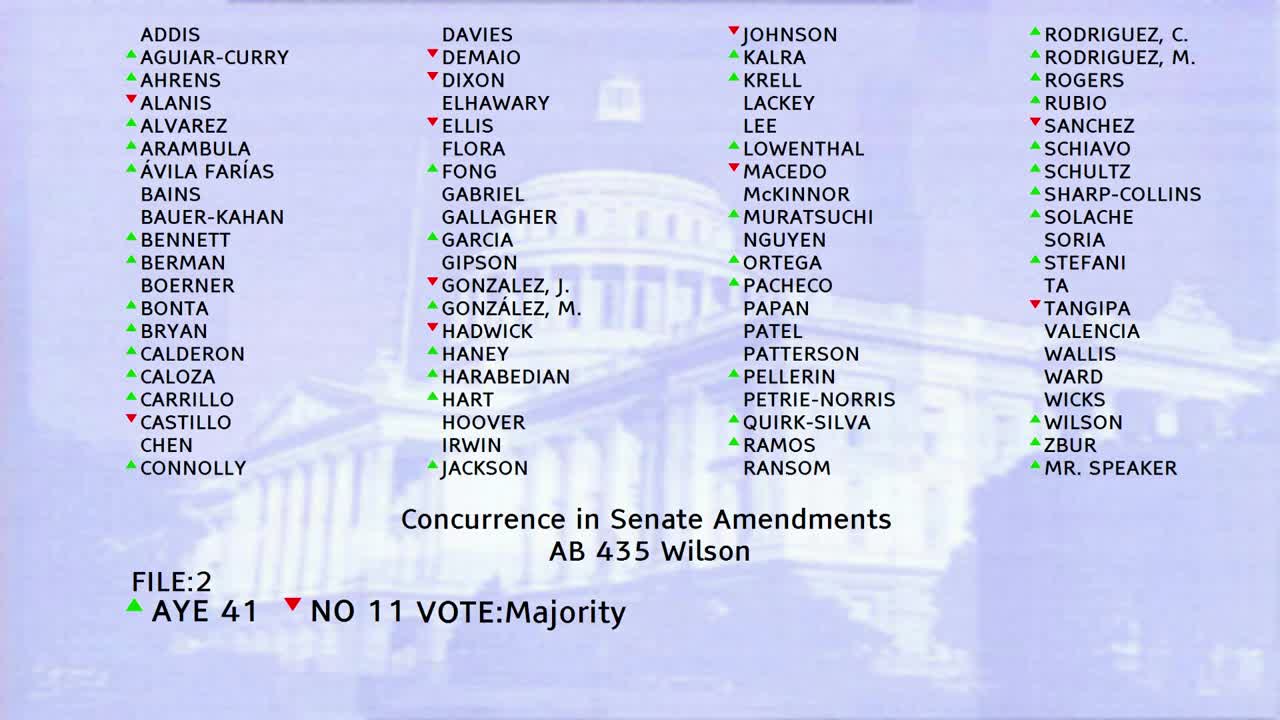 40SEC
Assembly Floor
 1MIN
Senate Floor
 9MIN
Senate Standing Committee on Housing
 33MIN
Senate Standing Committee on Local Government
 2MIN
Assembly Floor
 1MIN
Assembly Standing Committee on Appropriations
 12MIN
Assembly Standing Committee on Local Government
 13MIN