AB 1024: Department of Fish and Wildlife: San Gabriel Valley Bear Management and Community Safety Act.
- Session Year: 2025-2026
- House: Assembly
- Latest Version Date: 2025-02-20
Current Status:
Failed
(2026-02-02: From committee: Filed with the Chief Clerk pursuant to Joint Rule 56.)
Introduced
In Committee
Awaiting First Chamber Vote
Passed First Chamber
In Committee
Awaiting Second Chamber Vote
Passed Second Chamber
Enacted
Under existing law, the Department of Fish and Wildlife has jurisdiction over the conservation, protection, and management of fish, wildlife, native plants, and habitat necessary for biologically sustainable populations of those species.
This bill would establish the San Gabriel Valley Bear Management and Community Safety Act, which would require, on or before January 1, 2027, the department to develop a regional plan specific to the cities located within the San Gabriel Valley in the County of Los Angeles to address issues relating to bears in the community. The bill would require the plan to include various components, including, among other things, an overview of the behaviors of the bears in the San Gabriel Mountains. The bill would require the department to establish measurable performance goals for reducing bear encounters within the cities located in the San Gabriel Valley in the County of Los Angeles, and to report those goals to the Legislature on or before January 1, 2027. The bill would require the department to tag and track any bear that enters a residential neighborhood in a city located within the San Gabriel Valley in the County of Los Angeles using innovative technologies, as specified.
This bill would make legislative findings and declarations as to the necessity of a special statute for County of Los Angeles.
This chapter shall be known, and may be cited, as the San Gabriel Valley Bear Management and Community Safety Act.
1595.1.(a)On or before January 1, 2027, the department shall develop a regional plan specific to the cities located within the San Gabriel Valley in the County of Los Angeles to address issues relating to bears in the community.
(b)The plan shall include all of the following information:
(1)An overview of the behaviors of the bears in the San Gabriel Mountains.
(2)Potential causes leading to bears entering neighborhoods and homes.
(3)An analysis of the various city ordinances and procedures related to addressing the issue of urban bear encounters.
(4)Best practices that cities should adopt to reduce urban bear encounters.
(5)A reassessment of the departments bear classifications to inform local response procedures.
(c)The department shall post the plan described in this section on its internet website.
1595.2.(a)The department shall establish measurable performance goals for reducing bear encounters within the cities located in the San Gabriel Valley in the County of Los Angeles.
(b)The department shall submit a report containing the measurable performance goals to the Legislature on or before January 1, 2027.
(c)(1)The requirement for submitting a report to the Legislature imposed under subdivision (b) is inoperative on January 1, 2031, pursuant to Section 10231.5 of the Government Code.
(2)A report to be submitted to the Legislature pursuant to subdivision (b) shall be submitted in compliance with Section 9795 of the Government Code.
1595.3.The department shall tag and track any bear that enters a residential neighborhood in a city located within the San Gabriel Valley in the County of Los Angeles using innovative technologies, such as a global positioning system (GPS) tracking collar or an artificial intelligence (AI) based tracking system, in order to monitor the bear after relocation.
SEC. 2.The Legislature finds and declares that a special statute is necessary and that a general statute cannot be made applicable within the meaning of Section 16 of Article IV of the California Constitution because of the increase in bear encounters within communities within the San Gabriel Valley in the County of Los Angeles.
|
Date
|
Status
|
|---|---|
| Feb 2, 2026 | From committee: Filed with the Chief Clerk pursuant to Joint Rule 56. |
| Jan 31, 2026 | Died pursuant to Art. IV, Sec. 10(c) of the Constitution. |
| May 23, 2025 | In committee: Held under submission. |
| Apr 23, 2025 | In committee: Set, first hearing. Referred to suspense file. |
| Apr 9, 2025 | From committee: Do pass and re-refer to Com. on APPR. (Ayes 13. Noes 0.) (April 8). Re-referred to Com. on APPR. |
| Mar 10, 2025 | Referred to Com. on W. P., & W. |
| Feb 21, 2025 | From printer. May be heard in committee March 23. |
| Feb 20, 2025 | Read first time. To print. |
|
Date
|
Description
|
Location
|
Votes
|
|
|---|---|---|---|---|
| Apr 8, 2025 | Do pass and be re-referred to the Committee on [Appropriations] | Assembly Standing Committee on Water, Parks, and Wildlife |
Passed |
This list shows positions taken on this bill by organizations on the date displayed, which is linked to the original source.
Positions by individuals are not included.
Date of Hearing: April 23, 2025
ASSEMBLY COMMITTEE ON APPROPRIATIONS
Buffy Wicks, Chair
ABPCA Bill Id:AB 1024
Author:(Harabedian) – As Introduced Ver:February 20, 2025
Policy Committee: | Water, Parks and Wildlife | Vote: | 13 - 0 |
|
| ||
|
|
Urgency: No State Mandated Local Program: No Reimbursable: No
SUMMARY:
This bill requires the California Department of Fish and Wildlife (CDFW) to develop a plan to address issues related to bears in the San Gabriel Valley and to tag and track any bear that enters a residential neighborhood in a city located within the San Gabriel Valley.
Specifically, this bill, among other things:
- Requires CDFW, by January 1, 2027, to develop a regional plan specific to the cities located within the San Gabriel Valley to address issues relating to bears in the community and post the plan on CDFW’s website.
- Requires the plan to include all of the following information:
- An overview of the behaviors of the bears in the San Gabriel Mountains.
- Potential causes leading to bears entering neighborhoods and homes.
- An analysis of the various city ordinances and procedures related to addressing the issue of urban bear encounters.
- Best practices that cities should adopt to reduce urban bear encounters.
- A reassessment of CDFW’s bear classifications to inform local response procedures.
- Requires CDFW to establish measurable performance goals for reducing bear encounters within the cities located in the San Gabriel Valley and to submit a report containing those goals to the Legislature by January 1, 2027.
- Requires CDFW to tag and track any bear that enters a residential neighborhood in a city located in the San Gabriel Valley using innovative technologies, such as a global positioning system tracking collar or an artificial intelligence based tracking system, to monitor the bear after relocation.
FISCAL EFFECT:
CDFW will incur significant one-time and ongoing General Fund costs to implement this bill, likely in the low millions of dollars.
CDFW estimates costs of approximately $3.7 million in fiscal year (FY) 2026-27 and $2.9 million in FY 2027-28 and ongoing (General Fund) for nine permanent positions (one Senior Environmental Scientist, four Environmental Scientists, one Research Scientist II, one Wildlife Veterinarian General, and two Fish and Game Lieutenant Specialists); five limited-term positions (Fish and Wildlife Scientific Aids); seven vehicles; specialized equipment (one-time), such as dart guns, live traps, drones, and animal transport crates; and specialized equipment (ongoing), such as supplies for live animal care, wildlife health and disease surveillance supplies, bear mats, and immobilization supplies and telemetry (such as satellite collars, ear tags, and camera traps). For more information related to these costs, see the background below.
CDFW’s service-based budgeting (SBB) analysis for FY 2023-24 indicates that CDFW’s species and habitat conservation division is funded only for 34% of its mission; within that branch, the human-wildlife-conflict management program is particularly underfunded. CDFW’s law enforcement division is funded for only 33% of its mission.
COMMENTS:
1) Purpose. According to the author:
[This bill] is about protecting both our communities and the wildlife that call the San Gabriel Valley home. As bear encounters become more frequent, we must act with care and foresight to ensure the safety of our families while respecting the natural habitat of these animals. This bill establishes a thoughtful and proactive approach—one that prioritizes understanding bear behavior, reducing conflicts in residential areas, and using innovative technology to monitor and manage interactions. By planning ahead and implementing smart, humane solutions, we can create a safer, more harmonious coexistence between people and wildlife.
2) Background. Human-wildlife conflict (HWC) occurs when humans and wild animals interact in an unwanted or unsafe way. Population growth and a changing climate is increasing the frequency and severity of HWC as wildlife encounter humans more often in their search for food, shelter, and water. As the state’s trustee agency for fish and wildlife resources, CDFW serves as the lead agency charged with helping to resolve HWC.
The black bear is the only bear species living in California today. Black bears provide many ecosystem benefits by serving as seed dispersers, scavengers, and predators. Black bears may cause concern due to property damage, loss of small livestock or pets, or public safety as they search for food, as they can become habituated to and lose their fear of humans. According to CDFW’s 2024 Black Bear Conservation Plan for California, the Lake Tahoe Basin and the foothills of the San Gabriel Mountains are among the hotspots for HBC.
The Budget Act of 2021 allocated $7 million (General Fund) to CDFW to further its HWC response efforts. CDFW utilized this one-time funding to hire and train limited-term wildlife conflict specialists serving all 58 California counties to track, respond, and address HWC; improve wildlife incident responses; and foster increased understanding and awareness of native wildlife to support safe coexistence. According to CDFW, in FY 2022-23, the department logged over 40,000 staff hours responding to more than 20,000 wildlife incident reports and 3,300 depredation reports. In FY 2023-24, CDFW logged over 60,000 staff hours responding to more than 45,000 wildlife incident reports and 3,500 depredation reports.
In 2024, in response to an increase in human-bear encounters in the region, the Los Angeles County Board of Supervisors unanimously approved a motion requesting that CDFW add more experts specializing in HBC and decrease response times. The motion also notes that CDFW’s statewide approach to addressing HBC does not meet the specific needs of Sierra Madre, Monrovia, and other San Gabriel Valley communities, and calls for a targeted, regional response plan.
CDFW notes the staff and resources needed to implement this bill will help facilitate complex, time-sensitive, and high-profile incident response in the San Gabriel Valley, particularly because the likelihood of a successful capture after a long delay is low. Wildlife capture specialist teams comprised of permanent staff with chemical immobilization certification will be required to provide field incident response; conduct capture events; manage highly specialized equipment; manage the appropriate disposition of bears; and conduct post-release monitoring of bears. Staff will need to concurrently develop the required plan; provide ongoing consultation to cities for adherence to the plan; and undertake efforts to tag, relocate, and track bears that enter a residential neighborhood in cities and other affected areas – regardless of the risk posed by the bear. CDFW’s law enforcement division’s increased workload will likely include coordination of staff response, investigation and reporting of wildlife incidents, coordination with wildlife laboratories, community outreach, and coordination with local municipalities regarding analysis and potential implementation of relevant local ordinances and procedures.
Analysis Prepared by: Nikita Koraddi / APPR. / (916) 319-2081
Date of Hearing: April 8, 2025
ASSEMBLY COMMITTEE ON WATER, PARKS, AND WILDLIFE
Diane Papan, Chair
ABPCA Bill Id:AB 1024 (
Author:Harabedian) – As Introduced Ver:February 20, 2025
SUBJECT: Department of Fish and Wildlife: San Gabriel Valley Bear Management and Community Safety Act
SUMMARY: Establishes the San Gabriel Valley Bear Management and Community Safety Act. Specifically, this bill:
- Requires the Department of Fish and Wildlife (CDFW), on or before January 1, 2027, to develop a regional plan specific to the cities located within the San Gabriel Valley to address issues relating to bears in the community and post the plan on CDFW’s website.
- Requires the plan to include all of the following information:
- An overview of the behaviors of the bears in the San Gabriel Mountains;
- Potential causes leading to bears entering neighborhoods and homes;
- An analysis of the various city ordinances and procedures related to addressing the issue of urban bear encounters;
- Best practices that cities should adopt to reduce urban bear encounters; and
- A reassessment of CDFW’s bear classifications to inform local response procedures.
- Requires CDFW to establish measurable performance goals for reducing bear encounters within the cities located in the San Gabriel Valley and to submit a those goals to the Legislature on or before January 1, 2027.
- Requires CDFW to tag and track any bears that enter a residential neighborhood in a city located in the San Gabriel Valley using innovative technologies, such as a global positioning system tracking collar or an artificial intelligence based tracking system, in order to monitor the bear after relocation.
- Declares that a special statute is needed because of the increase of bear encounters within the San Gabriel Valley.
EXISTING LAW:
- Determines that CDFW has jurisdiction over the conservation, protection, and management of fish, wildlife, native plants, and habitat necessary for biologically sustainable populations of those species [Fish and Game Code (FGC) § 1802].
- Declares it is a policy of the state to encourage the preservation, conservation, and maintenance of wildlife resources under the jurisdiction and influence of the state (FGC § 1801). This policy should meet the following objectives:
- To maintain sufficient populations of all species of wildlife and the habitat necessary to achieve the objectives stated in subdivisions (b), (c), and (d);
- To provide for the beneficial use and enjoyment of wildlife by all citizens of the state;
- To perpetuate all species of wildlife for their intrinsic and ecological values, as well as for their direct benefits to all persons;
- To provide for aesthetic, educational, and nonappropriative uses of the various wildlife species;
- To maintain diversified recreational uses of wildlife, including the sport of hunting, as proper uses of certain designated species of wildlife, subject to regulations consistent with the maintenance of healthy, viable wildlife resources, the public safety, and a quality outdoor experience;
- To provide for economic contributions to the citizens of the state, through the recognition that wildlife is a renewable resource of the land by which economic return can accrue to the citizens of the state, individually and collectively, through regulated management. Such management shall be consistent with the maintenance of healthy and thriving wildlife resources and the public ownership status of the wildlife resources; and
- To alleviate economic losses or public health or safety problems caused by wildlife to the people of the state either individually or collectively. Such resolution shall be in a manner designed to bring the problem within tolerable limits consistent with economic and public health considerations and the objectives stated in subdivisions (a), (b) and (c).
- Allows the owner or tenant of land or property that is being damaged or destroyed or is in danger of being damaged or destroyed by certain species, including bear, to apply to CDFW for a permit to kill the animals. CDFW shall issue a revocable permit for the taking of the animal upon satisfactory evidence of the damage or destruction, actual or immediately threatened (FGC § 4181).
FISCAL EFFECT: Unknown. This bill is keyed fiscal.
COMMENTS:
- Purpose of this bill. According to the author, “[This bill] is about protecting both our communities and the wildlife that call the San Gabriel Valley home. As bear encounters become more frequent, we must act with care and foresight to ensure the safety of our families while respecting the natural habitat of these animals. This bill establishes a thoughtful and proactive approach—one that prioritizes understanding bear behavior, reducing conflicts in residential areas, and using innovative technology to monitor and manage interactions. By planning ahead and implementing smart, humane solutions, we can create a safer, more harmonious coexistence between people and wildlife.”
- Background. Currently, the only species of bear in California is the black bear (Urus americanus) after the extinction of the native California grizzly bear. Black bear are native to North America and are more numerous than every other species of bear combined. Black bears are widespread and common throughout most forested habitats of California; they are one of the most commonly occurring large mammal species in California forests. Black bear densities, however, are not evenly distributed throughout the species’ range in California.
Human-bear conflict (HBC). With a population of almost 40 million people, conflicts (any undesirable interaction) between people and black bears are common and management of these conflicts is a significant priority for CDFW. HBC appears to have been increasing for decades due to growing spatial overlap between people and black bears (i.e., increased human development and recreation in black bear habitat, and the expansion of black bear distribution). The vast majority of HBC involves the intersection of black bears and attractants, such as food, garbage, and livestock.
CDFW began keeping standardized, statewide records of HBC when a Wildlife Incident Reporting (WIR) system was created in 2017, to which both CDFW staff and the public can submit reports to. HBC reports were stable during 2017–2020, but increased sharply in 2021 and 2022, with hotspots in Lake Tahoe Basin and the foothills of the San Gabriel Mountains. In the 2024 Black Bear Conservation Plan for California (Black Bear Plan), CDFW indicates that it is unclear whether this increase reflects an actual increase in HBC, or an increase in reporting as a reflection of increased awareness of the WIR system. Although not argued in the Black Bear Plan, this timing also correlates with the COVID-19 pandemic and the movement of people to more rural areas where they may encounter bear for the first time.
Despite the increase in HBC in 2021 and 2022, the number of depredation permits issued by CDFW as well as the number of bears taken by a depredation permit has been declining throughout 2017–2022. Depredation permits are issued to landowners or tenants whose property is being damaged or destroyed, or is in danger of being damaged or destroyed, by specific animals, including black bear. CDFW prioritizes non-lethal conflict mitigation measures before issuing permits for lethal take when possible. Preventative methods such as electric mats and hazing are used before lethal measures.
Managing HBC. CDFW issued Departmental Bulletin 2022-01 in February 2022 to describe the policies on public safety, depredation, conflict and animal welfare regarding black bear. In Bulletin 2022-01 CDFW defines three types of incidents that require CDFW response: Public Safety (aggressive) Bear, Depredation (property destruction) Bear, and a Conflict (habituated, not harmful) Bear. Only the Law Enforcement Division of CDFW can designate a Public Safety Bear and then humanely euthanize the bear as quickly as possible. The determination to take or remove a Conflict Bear can only be made by the Response Guidance Team, which is a collection of individuals available to evaluate a situation and provide personnel to assist as needed in conflict situations. A permit for a Depredation Bear may be granted by CDFW upon satisfactory evidence of damage. If the permit applicant has not made attempts to solve the problem, CDFW will first propose non-lethal efforts before allowing lethal take.
Non-lethal efforts to avoid or reduce HBC include both bear prevention and adverse conditioning. Prevention efforts may include eliminating unnatural food or attractants by removing trash and bear-proofing food storage areas; enclosing animal pens; or securing and blocking access to crawl spaces or other potential denning sites, while adverse conditioning includes activities such as installing motion lights and sprinklers, installing noise machines, installing electric fencing, utilizing guard animals, and hazing (e.g., shouting, rubber slug or paintball guns, or deploying dogs). CDFW has a very limited supply of 20 electric mats for use statewide as well as numerous resources on its website to promote safety around bears such as how to secure a crawl space and building electric fencing.
San Gabriel Valley. According to the CDFW’s Black Bear Plan, the Lake Tahoe Basin and the foothills of the San Gabriel Mountains are among the hotspots for HBC. In April 2023, the City Council of Sierra Madre adopted Resolution 23-12 to declare the mismanagement of local bear populations a threat to public safety. This was in response to a letter from the City Council received from the Sierra Madre Police Department (SMPD). SMPD wrote that they had been in continuous communication with CDFW over the previous year to address HBC and described example bear incidences, public education efforts, SMPD command structure changes, and SMPD training received from a CDFW biologist.
The resolution “demands that CDFW act immediately to take any necessary actions to eliminate this threat to public safety” and “requests the Fish and Game Commission [the Commission] agendize this item at their next regularly scheduled meeting to provide City officials the opportunity to address the issue.” The staff recommendation to the Commission indicates that CDFW is actively working with the City of Sierra Madre on HBCs in the Sierra Madre and surrounding communities. The Commission recommended that Sierra Madre continue to work with CDFW and no further action was taken.
It is important to note, that it may require several years to establish community practices that result in a decrease of HBC. It takes time teach bears to “unlearn” the opportunity for an easy lunch. However, this is likely the most effective mechanism to reduce HBCs, as bear will continue to seek available food in developed areas.
- Policy considerations. The San Gabriel Valley is a hotspot for HBC and may require additional support. Although outside this committee’s jurisdiction, it is unlikely that CDFW has available staffing hours to accomplish the goals of this bill without an appropriation. This bill requires CDFW to analyze the policies and ordinances of the estimated 50 cities within SGV. CDFW’s Service-Based Budgeting (SBB) analysis for FY 2019–20 indicate that CDFW’s species and habitat conservation is only funded for 26% of its mandate—within that branch, the human-wildlife-conflict management program is particularly underfunded. Further, it requires CDFW to tag and track any bear that enters a neighborhood, regardless of the risk of the bear, which requires CDFW to immobilize the bear. Tagging generally only occurs if a bear needs to be relocated or if the bear is orphaned and being rehabilitated at a facility. SBB for FY 2019–20 also revealed that CDFW is only funded for 33% of its law enforcement mission.
- Related legislation. AB 1038 (Hadwick) of the current legislative session would require the Fish and Game Commission (Commission) to establish a pursue season during which a person could allow dogs to pursue a bear and authorizes the Commission to establish a bear hunting season during which a person may allow dogs to pursue a bear. AB 1038 is pending in this Committee.
REGISTERED SUPPORT / OPPOSITION:
Support
None on file
Opposition
None on file
Analysis Prepared by: Stephanie Mitchell / W., P., & W. / (916) 319-2096
Discussed in Hearing
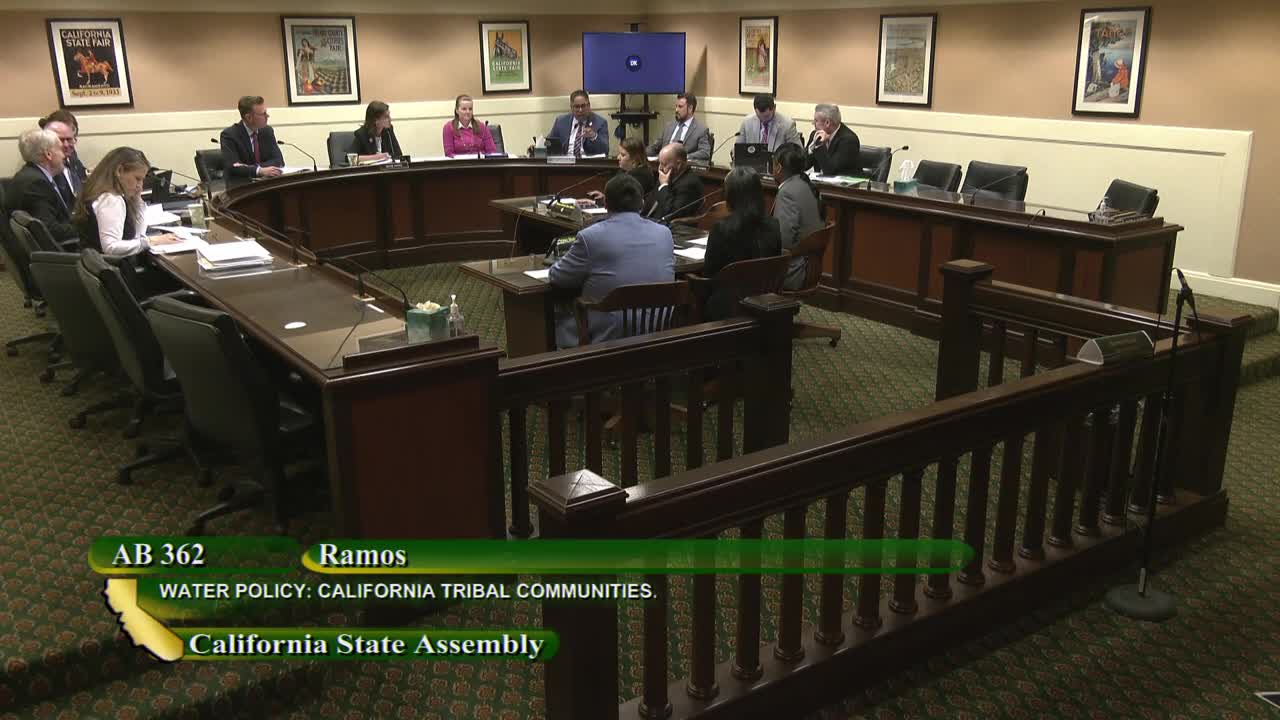 10MIN
Assembly Standing Committee on Water, Parks, and Wildlife
Bill Author

Bill Co-Author(s):