AB 1042: The Cannella Environmental Farming Act of 1995: Managed Honeybee Health Program.
- Session Year: 2025-2026
- House: Assembly
- Latest Version Date: 2025-09-08
Current Status:
Failed
(2026-01-22: Consideration of Governor's veto stricken from file.)
Introduced
In Committee
Awaiting First Chamber Vote
Passed First Chamber
In Committee
Awaiting Second Chamber Vote
Passed Second Chamber
Enacted
The Cannella Environmental Farming Act of 1995 requires the Department of Food and Agriculture to establish and oversee various programs, including an environmental farming program and the Healthy Soils Program, and requires the Secretary of Food and Agriculture to convene a 9-member Scientific Advisory Panel on Environmental Farming to advise the secretary on the implementation of the Healthy Soils Program and the State Water Efficiency and Enhancement Program and to assist federal, state, and local government agencies, as appropriate or necessary, on issues relating to the impact of agricultural practices on air, water, and wildlife habitat, as specified. Existing law creates the Climate Smart Agriculture Account in the Department of Food and Agriculture Fund, consisting of moneys made available from federal, state, industry, philanthropic, and private sources, and continuously appropriates the moneys in the account to the department for purposes of the act.
This bill would, as part of the act, authorize the department, in consultation with the panel, to establish and oversee the Managed Honeybee Health Program for the purpose of enhancing the health and well-being of managed honeybees in California, which are necessary to support the economic viability of California agriculture. The bill would authorize the department, to the extent that moneys are available, to provide grants to eligible recipients for health intervention projects that directly enhance the health and well-being of managed honeybees used in pollination services and for projects that indirectly support health interventions through research, extension, and technical assistance. The bill would authorize the department to determine priorities for the program and to consider, when awarding grants, whether a project applicant or project meets specified criteria, in addition to criteria developed to address the program priorities. The bill would authorize the department to collect nonstate, federal, and private funds for the purpose of the program, require those funds to be deposited into the Managed Honeybee Health Special Fund Subaccount, which this bill would create within the Climate Smart Agriculture Account, and continuously appropriate moneys in the subaccount to the department for the purpose of the program. The bill would make operation of these provisions contingent upon an appropriation by the Legislature for the program in the annual Budget Act or another statute.
The Cannella Environmental Farming Act of 1995 requires the Department of Food and Agriculture to establish and oversee various programs, including an environmental farming program and the Healthy Soils Program, and requires the Secretary of Food and Agriculture to convene a 9-member Scientific Advisory Panel on Environmental Farming to advise the secretary on the implementation of the Healthy Soils Program and the State Water Efficiency and Enhancement Program and to assist federal, state, and local government agencies, as appropriate or necessary, on issues relating to the impact of agricultural practices on air, water, and wildlife habitat, as specified. Existing law creates the Climate Smart Agriculture Account in the Department of Food and Agriculture Fund, consisting of moneys made available from federal, state, industry, philanthropic, and private sources, and continuously appropriates the moneys in the account to the department for purposes of the act.
This bill would, as part of the act, authorize the department, in consultation with the panel, to establish and oversee the Managed Honeybee Health Program for the purpose of enhancing the health and well-being of managed honeybees in California, which are necessary to support the ecological and economic viability of California agriculture. The bill would authorize the department, to the extent that moneys are available, to provide incentives and grants to eligible recipients for health intervention projects that directly enhance the health and well-being of managed honeybees used in pollination services. services and for projects that indirectly support health interventions through research, extension, and technical assistance. The bill would authorize the department to determine priorities for the program and to consider, in when awarding grants, whether a project applicant or project meets specified criteria. criteria, in addition to criteria developed to address the program priorities. The bill would authorize the department to collect nonstate, federal, and private funds for the purpose of the program, require those funds to be deposited into the Managed Honeybee Health Special Fund Subaccount, which this bill would create within the Climate Smart Agriculture Account, and continuously appropriate moneys in the subaccount to the department for the purpose of the program. The bill would make operation of these provisions contingent upon an appropriation by the Legislature for the program in the annual Budget Act or another statute.
The Cannella Environmental Farming Act of 1995 requires the Department of Food and Agriculture to establish and oversee various programs, including an environmental farming program and the Healthy Soils Program, and requires the Secretary of Food and Agriculture to convene a 9-member Scientific Advisory Panel on Environmental Farming to advise the secretary on the implementation of the Healthy Soils Program and the State Water Efficiency and Enhancement Program and to assist federal, state, and local government agencies, as appropriate or necessary, on issues relating to the impact of agricultural practices on air, water, and wildlife habitat, as specified. Existing law creates the Climate Smart Agriculture Account in the Department of Food and Agriculture Fund, consisting of moneys made available from federal, state, industry, philanthropic, and private sources, and continuously appropriates the moneys in the account to the department for purposes of the act.
This bill would establish would, as part of the act, authorize the department, in consultation with the panel, to establish and oversee the Managed Honeybee Health Program under the administration of the department, in consultation with an advisory committee, as described below, for the purpose of enhancing the health and well-being of managed honeybees in California that California, which are necessary to support the ecological and economic viability of California agriculture. The bill would authorize the department, to the extent that funds moneys are available, to provide incentives, grants, research, technical assistance, education, and outreach incentives and grants to eligible recipients for health intervention projects that enhance the health and well-being of managed honeybees used in pollination services and to fund demonstration projects that further the goals of the program. services. The bill would authorize the department to determine priorities for the program and to consider, in awarding grants, whether a project applicant or project meets specified criteria in awarding grants. The bill would require the department to establish an advisory committee, comprised as specified, and to consult the advisory committee on the development of program frameworks, guidelines, incentives, and technical assistance. The bill would create the Managed Honeybee Health Account in the Department of Food and Agriculture Fund and would authorize moneys in the account to be expended by the department, upon appropriation by the Legislature, for the purpose of the program. criteria. The bill would authorize the department to collect nonstate, federal, and private funds, funds for the purpose of the program, require those funds to be deposited into the Managed Honeybee Health Special Fund Subaccount within the Managed Honeybee Health Account, Subaccount, which this bill would create within the Climate Smart Agriculture Account, and continuously appropriate moneys in the subaccount to the department for the purpose of the program, thereby making an appropriation. program. The bill would make implementation operation of these provisions contingent upon an appropriation by the Legislature for the program. program in the annual Budget Act or another statute.
Existing law authorizes the Department of Food and Agriculture to expend all moneys made available for its use. Existing law, the Apiary Protection Act, provides for the regulation and management of apiaries, including regulations for bees used in the pollination of agricultural crops.
This bill would establish the Managed Honeybee Health Program under the administration of the department, in consultation with an advisory committee, as described below, for the purpose of enhancing the health and well-being of managed honeybees in California that are necessary to support the ecological and economic viability of California agriculture. The bill would authorize the department, to the extent that funds are available, to provide incentives, grants, research, technical assistance, education, and outreach to eligible recipients for health intervention projects that enhance the health and well-being of managed honeybees used in pollination services and to fund demonstration projects that further the goals of the program. The bill would authorize the department to determine priorities for the program and to consider, in awarding grants, whether a project applicant or project meets specified criteria in awarding grants. The bill would require the department to establish an advisory committee, comprised as specified, and to consult the advisory committee on the development of program frameworks, guidelines, incentives, and technical assistance. The bill would create the Managed Honeybee Health Account in the Department of Food and Agriculture Fund and would authorize moneys in the account to be expended by the department, upon appropriation by the Legislature, for the purpose of the program. The bill would authorize the department to collect nonstate, federal, and private funds, require those funds to be deposited into the Managed Honeybee Health Special Fund Subaccount within the Managed Honeybee Health Account, and continuously appropriate moneys in the subaccount to the department for the purpose of the program, thereby making an appropriation. The bill would make implementation of these provisions contingent upon an appropriation by the Legislature for the program.
Existing law defines regenerative agriculture for purposes of the Climate Innovation Program as agricultural practices that focus on the health of the ecological system as a whole and not solely on high-production yields.This bill would state the intent of the Legislature to enact subsequent legislation relating to regenerative agriculture.Existing law defines regenerative agriculture for purposes of the Climate Innovation Program as agricultural practices that focus on the health of the ecological system as a whole and not solely on high-production yields.
This bill would state the intent of the Legislature to enact subsequent legislation relating to regenerative agriculture.
(a)The Legislature finds and declares all of the following:
(1)Managed honeybees are essential to the health and productivity of Californias agriculture and ecosystems.
(2)Californias agricultural sector, the largest in the United States, depends on pollination for the successful cultivation of over 90 crops, including almonds, berries, melons, and many fruits and vegetables, which annually contribute billions of dollars to the states economy.
(3)Managed honeybees also play a critical role in sustaining plant populations, supporting biodiversity, and maintaining healthy ecosystems.
(4)Managed honeybee populations have experienced significant declines due to various factors, including habitat and forage loss, climate change, pests such as the Varroa mite, and diseases.
(5)The loss of managed honeybees poses a serious threat to food security, biodiversity, and the resilience of ecosystems in California.
(6)A decline in managed honeybee health negatively impacts Californias economy by reducing crop yields, increasing the costs of pollination services, and diminishing the states agricultural competitiveness.
(7)Healthy managed honeybee populations are necessary for the preservation of ecosystems that provide natural water filtration, carbon storage, and soil stabilization, and contribute to Californias environmental sustainability goals.
(8)California has a longstanding tradition of leadership in environmental stewardship and sustainable agricultural practices. Promoting managed honeybee health aligns with Californias goals to combat climate change, protect biodiversity, and advance sustainable agriculture. By prioritizing the health and management of managed honeybees, California can strengthen partnerships between agricultural producers, conservation groups, researchers, and policymakers.
(b)It is the intent of the Legislature to prioritize the health of managed honeybees through collaborative efforts, incentives, research and education, and the adoption of practices that support the sustainability of Californias agricultural ecosystems.
SEC. 2.Section 570.5 is added to the Food and Agricultural Code, to read:570.5.(a)For purposes of this section, all of the following definitions apply:
(1)Health intervention means an intervention that improves the health status of managed honeybees, including, but not limited to, management practices and other disease preventives, or a therapeutic or nutritional intervention.
(2)Managed honeybees means honeybees and colonies kept and managed by humans, primarily for purposes of pollination, honey production, and the production of other hive products such as beeswax, propolis, and royal jelly.
(3)Program means the Managed Honeybee Health Program.
(4)Socially disadvantaged group has the same meaning as defined in Section 512.
(b)(1)The department, in consultation with the panel, may establish and oversee the Managed Honeybee Health Program for the purpose of enhancing the health and well-being of managed honeybees in California, which are necessary to support the economic viability of California agriculture.
(2)The panel may consult with commercial beekeepers, the State Veterinarian, farmers, county agricultural commissioners, professionals, scientists, and representatives of nongovernmental entities to advise on the program.
(c)To the extent that moneys are available, the department may provide grants to eligible recipients for health intervention projects that directly enhance the health and well-being of managed honeybees used in pollination services and for projects that indirectly support health interventions through research, extension, and technical assistance. Eligible recipients shall include, but are not limited to, in-state commercial beekeepers, academic institutions, and nonprofit organizations.
(d)(1)The department may determine priorities for the program.
(2)In addition to criteria developed to address the program priorities, the department may consider, when awarding grants, whether any of the following criteria apply to a project applicant or project:
(A)The project is located in and benefits a disadvantaged community identified pursuant to Section 39711 of the Health and Safety Code.
(B)The project applicant is a commercial beekeeper who is a member of a socially disadvantaged group or the project applicant specializes in serving socially disadvantaged groups.
(C)The project demonstrates potential for replication in other parts of the state.
(D)The project provides environmental and agronomic cobenefits, such as reduced hive loss and increased honeybee habitat.
(e)The department may collect nonstate, federal, and private funds for the purpose of the program, and those funds shall be deposited into the Managed Honeybee Health Special Fund Subaccount, which is hereby created within the Climate Smart Agriculture Account in the Department of Food and Agriculture Fund. Notwithstanding Section 13340 of the Government Code, moneys in the subaccount are hereby continuously appropriated without regard to fiscal years to the department for the purpose of the program.
(f)Funds collected by the secretary pursuant to Article 3 (commencing with Section 29030.5) of Chapter 1 of Division 13 shall not be expended for the program.
(g)The operation of this section is contingent upon funding being appropriated by the Legislature for the program in the annual Budget Act or another statute.
(a)The Legislature finds and declares all of the following:
(1)Managed honeybees are essential to the health and productivity of Californias agriculture and ecosystems.
(2)Californias agricultural sector, the largest in the United States, depends on pollination for the successful cultivation of over 90 crops, including almonds, berries, melons, and many fruits and vegetables, which annually contribute billions of dollars to the states economy.
(3)Managed honeybees also play a critical role in sustaining plant populations, supporting biodiversity, and maintaining healthy ecosystems.
(4)Managed honeybee populations have experienced significant declines due to various factors, including habitat and forage loss, climate change, pests such as the Varroa mite, and diseases.
(5)The loss of managed honeybees poses a serious threat to food security, biodiversity, and the resilience of ecosystems in California.
(6)A decline in managed honeybee health negatively impacts Californias economy by reducing crop yields, increasing the costs of pollination services, and diminishing the states agricultural competitiveness.
(7)Healthy managed honeybee populations are necessary for the preservation of ecosystems that provide natural water filtration, carbon storage, and soil stabilization, and contribute to Californias environmental sustainability goals.
(8)California has a longstanding tradition of leadership in environmental stewardship and sustainable agricultural practices. Promoting managed honeybee health aligns with Californias goals to combat climate change, protect biodiversity, and advance sustainable agriculture. By prioritizing the health and management of managed honeybees, California can strengthen partnerships between agricultural producers, conservation groups, researchers, and policymakers.
(b)It is the intent of the Legislature to prioritize the health of managed honeybees through collaborative efforts, incentives, research and education, and the adoption of practices that support the sustainability of Californias agricultural ecosystems.
SEC. 2.Section 570.5 is added to the Food and Agricultural Code, to read:570.5.(a)For purposes of this section, all of the following definitions apply:
(1)Health intervention means an intervention that improves the health status of managed honeybees, including, but not limited to, management practices and other disease preventives, or a therapeutic or nutritional intervention.
(2)Managed honeybees means honeybees and colonies kept and managed by humans, primarily for purposes of pollination, honey production, and the production of other hive products such as beeswax, propolis, and royal jelly.
(3)Program means the Managed Honeybee Health Program.
(4)Socially disadvantaged group has the same meaning as defined in Section 512.
(b)(1)The department, in consultation with the panel, may establish and oversee the Managed Honeybee Health Program for the purpose of enhancing the health and well-being of managed honeybees in California, which are necessary to support the ecological and economic viability of California agriculture.
(2)The panel may consult with commercial beekeepers, the State Veterinarian, farmers, county agricultural commissioners, professionals, scientists, and representatives of nongovernmental entities to advise on the program.
(c)To the extent that moneys are available, the department may provide incentives and grants to eligible recipients for health intervention projects that directly enhance the health and well-being of managed honeybees used in pollination services. services and for projects that indirectly support health interventions through research, extension, and technical assistance. Eligible recipients shall include, but are not limited to, in-state commercial beekeepers. beekeepers, academic institutions, and nonprofit organizations.
(d)(1)The department may determine priorities for the program.
(2)In awarding grants, addition to criteria developed to address the program priorities, the department may consider consider, when awarding grants, whether any of the following criteria apply to a project applicant or project:
(A)The project is located in and benefits a disadvantaged community identified pursuant to Section 39711 of the Health and Safety Code.
(B)The project applicant is a commercial beekeeper who is a member of a socially disadvantaged group, as defined in Section 512. group or the project applicant specializes in serving socially disadvantaged groups.
(C)The project demonstrates potential for replication in other parts of the state.
(D)The project provides environmental and agronomic cobenefits, such as reduced hive loss. loss and increased honeybee habitat.
(e)The department may collect nonstate, federal, and private funds for the purpose of the program, and those funds shall be deposited into the Managed Honeybee Health Special Fund Subaccount, which is hereby created within the Climate Smart Agriculture Account in the Department of Food and Agriculture Fund. Notwithstanding Section 13340 of the Government Code, moneys in the subaccount are hereby continuously appropriated without regard to fiscal years to the department for the purpose of the program.
(f)Funds collected by the secretary pursuant to Article 3 (commencing with Section 29030.5) of Chapter 1 of Division 13 shall not be expended for the program.
(g)The operation of this section is contingent upon funding being appropriated by the Legislature for the program in the annual Budget Act or another statute.
(a)The Legislature finds and declares all of the following:
(1)Managed honeybees are essential to the health and productivity of Californias agriculture and ecosystems.
(2)Californias agricultural sector, the largest in the United States, depends on pollination for the successful cultivation of over 90 crops, including almonds, berries, melons, and many fruits and vegetables, which annually contribute billions of dollars to the states economy.
(3)Managed honeybees also play a critical role in sustaining plant populations, supporting biodiversity, and maintaining healthy ecosystems.
(4)Managed honeybee populations have experienced significant declines due to various factors, including habitat and forage loss, climate change, pests such as the Varroa mite, and diseases.
(5)The loss of managed honeybees poses a serious threat to food security, biodiversity, and the resilience of ecosystems in California.
(6)A decline in managed honeybee health negatively impacts Californias economy by reducing crop yields, increasing the costs of pollination services, and diminishing the states agricultural competitiveness.
(7)Healthy managed honeybee populations are necessary for the preservation of ecosystems that provide natural water filtration, carbon storage, and soil stabilization, and contribute to Californias environmental sustainability goals.
(8)California has a longstanding tradition of leadership in environmental stewardship and sustainable agricultural practices. Promoting managed honeybee health aligns with Californias goals to combat climate change, protect biodiversity, and advance sustainable agriculture. By prioritizing the health and management of managed honeybees, California can strengthen partnerships between agricultural producers, conservation groups, researchers, and policymakers.
(b)It is the intent of the Legislature to prioritize the health of managed honeybees through collaborative efforts, incentives, research and education, and the adoption of practices that support the sustainability of Californias agricultural ecosystems.
SEC. 2.Article 17 (commencing with Section 29330) is added to Chapter 1 of Division 13 of the Food and Agricultural Code, to read:17.Managed Honeybee Health Program29330.For purposes of this article, all of the following definitions apply:(a)Health intervention means an intervention that improves the health status of managed honeybees, including, but not limited to, conservation management practices and other disease preventives, or a therapeutic or nutritional intervention.(b)Managed honeybees means honeybees and colonies kept and managed by humans, primarily for purposes of pollination, honey production, and the production of other hive products such as beeswax, propolis, and royal jelly.(c)Program means the Managed Honeybee Health Program established pursuant to Section 29331.29331.(a)The Managed Honeybee Health Program is hereby established under the administration of the department, in consultation with the advisory committee established pursuant to Section 29333, for the purpose of enhancing the health and well-being of managed honeybees in California that are necessary to support the ecological and economic viability of California agriculture.(b)To the extent that moneys are available, the department may do both of the following under the program:(1)Provide incentives, grants, research, technical assistance, education, and outreach to eligible recipients for health intervention projects that enhance the health and well-being of managed honeybees used in pollination services. Eligible recipients may include, but are not limited to, commercial beekeepers, farmers, tribes, nongovernmental organizations, and academic institutions.(2)Fund demonstration projects that further the goals of the program.29332.(a)The department may determine priorities for the program.(b)In awarding grants pursuant to Section 29331, the department may consider whether any of the following criteria apply to a project applicant or project:(1)The project is located in and benefits a disadvantaged community identified pursuant to Section 39711 of the Health and Safety Code.(2)The project applicant is a commercial beekeeper who is a member of a socially disadvantaged group, as defined in Section 512.(3)The project demonstrates potential for replication in other parts of the state.(4)The project provides environmental and agronomic cobenefits, such as reduced hive loss.29333.(a)The department shall establish an advisory committee of up to six members appointed by the secretary. The advisory committee shall comprise representatives of the office of the State Veterinarian, commercial beekeepers, county agricultural commissioners, farmers, academia, and the public. The secretary shall determine the number of members that is necessary to assist the department with the administration of the program.(b)The department shall consult with the advisory committee on the development of program frameworks, guidelines, incentives, and technical assistance.29334.(a)The Managed Honeybee Health Account is hereby created in the Department of Food and Agriculture Fund. Moneys in the account may be expended by the department, upon appropriation by the Legislature, for the purpose of the program.(b)The department may collect nonstate, federal, and private funds for purposes of the program, and those funds shall be deposited into the Managed Honeybee Health Special Fund Subaccount, which is hereby created in the Managed Honeybee Health Account. Notwithstanding Section 13340 of the Government Code, moneys in the subaccount are hereby continuously appropriated without regard to fiscal years to the department for the purpose of the program.29335.Funds collected by the secretary pursuant to Article 3 (commencing with Section 29030.5) shall not be expended for the program.29336.The implementation of this article is contingent upon an appropriation by the Legislature for the program.SEC. 2.Section 570.5 is added to the Food and Agricultural Code, to read:570.5.(a)For purposes of this section, all of the following definitions apply:
(1)Health intervention means an intervention that improves the health status of managed honeybees, including, but not limited to, management practices and other disease preventives, or a therapeutic or nutritional intervention.
(2)Managed honeybees means honeybees and colonies kept and managed by humans, primarily for purposes of pollination, honey production, and the production of other hive products such as beeswax, propolis, and royal jelly.
(3)Program means the Managed Honeybee Health Program.
(b)(1)The department, in consultation with the panel, may establish and oversee the Managed Honeybee Health Program for the purpose of enhancing the health and well-being of managed honeybees in California, which are necessary to support the ecological and economic viability of California agriculture.
(2)The panel may consult with commercial beekeepers, the State Veterinarian, farmers, county agricultural commissioners, professionals, scientists, and representatives of nongovernmental entities to advise on the program.
(c)To the extent that moneys are available, the department may provide incentives and grants to eligible recipients for health intervention projects that enhance the health and well-being of managed honeybees used in pollination services. Eligible recipients shall include, but are not limited to, in-state commercial beekeepers.
(d)(1)The department may determine priorities for the program.
(2)In awarding grants, the department may consider whether any of the following criteria apply to a project applicant or project:
(A)The project is located in and benefits a disadvantaged community identified pursuant to Section 39711 of the Health and Safety Code.
(B)The project applicant is a commercial beekeeper who is a member of a socially disadvantaged group, as defined in Section 512.
(C)The project demonstrates potential for replication in other parts of the state.
(D)The project provides environmental and agronomic cobenefits, such as reduced hive loss.
(e)The department may collect nonstate, federal, and private funds for the purpose of the program, and those funds shall be deposited into the Managed Honeybee Health Special Fund Subaccount, which is hereby created within the Climate Smart Agriculture Account in the Department of Food and Agriculture Fund. Notwithstanding Section 13340 of the Government Code, moneys in the subaccount are hereby continuously appropriated without regard to fiscal years to the department for the purpose of the program.
(f)Funds collected by the secretary pursuant to Article 3 (commencing with Section 29030.5) of Chapter 1 of Division 13 shall not be expended for the program.
(g)The operation of this section is contingent upon funding being appropriated by the Legislature for the program in the annual Budget Act or another statute.
(a)The Legislature finds and declares all of the following:
(1)Managed honeybees are essential to the health and productivity of Californias agriculture and ecosystems.
(2)Californias agricultural sector, the largest in the United States, depends on pollination for the successful cultivation of over 90 crops, including almonds, berries, melons, and many fruits and vegetables, which annually contribute billions of dollars to the states economy.
(3)Managed honeybees also play a critical role in sustaining plant populations, supporting biodiversity, and maintaining healthy ecosystems.
(4)Managed honeybee populations have experienced significant declines due to various factors, including habitat and forage loss, climate change, pests such as the Varroa mite, and diseases.
(5)The loss of managed honeybees poses a serious threat to food security, biodiversity, and the resilience of ecosystems in California.
(6)A decline in managed honeybee health negatively impacts Californias economy by reducing crop yields, increasing the costs of pollination services, and diminishing the states agricultural competitiveness.
(7)Healthy managed honeybee populations are necessary for the preservation of ecosystems that provide natural water filtration, carbon storage, and soil stabilization, and contribute to Californias environmental sustainability goals.
(8)California has a longstanding tradition of leadership in environmental stewardship and sustainable agricultural practices. Promoting managed honeybee health aligns with Californias goals to combat climate change, protect biodiversity, and advance sustainable agriculture. By prioritizing the health and management of managed honeybees, California can strengthen partnerships between agricultural producers, conservation groups, researchers, and policymakers.
(b)It is the intent of the Legislature to prioritize the health of managed honeybees through collaborative efforts, incentives, research and education, and the adoption of practices that support the sustainability of Californias agricultural ecosystems.
SEC. 2.Article 17 (commencing with Section 29330) is added to Chapter 1 of Division 13 of the Food and Agricultural Code, to read:17.Managed Honeybee Health Program29330.For purposes of this article, all of the following definitions apply:
(a)Health intervention means an intervention that improves the health status of managed honeybees, including, but not limited to, conservation management practices and other disease preventives, or a therapeutic or nutritional intervention.
(b)Managed honeybees means honeybees and colonies kept and managed by humans, primarily for purposes of pollination, honey production, and the production of other hive products such as beeswax, propolis, and royal jelly.
(c)Program means the Managed Honeybee Health Program established pursuant to Section 29331.
29331.(a)The Managed Honeybee Health Program is hereby established under the administration of the department, in consultation with the advisory committee established pursuant to Section 29333, for the purpose of enhancing the health and well-being of managed honeybees in California that are necessary to support the ecological and economic viability of California agriculture.
(b)To the extent that moneys are available, the department may do both of the following under the program:
(1)Provide incentives, grants, research, technical assistance, education, and outreach to eligible recipients for health intervention projects that enhance the health and well-being of managed honeybees used in pollination services. Eligible recipients may include, but are not limited to, commercial beekeepers, farmers, tribes, nongovernmental organizations, and academic institutions.
(2)Fund demonstration projects that further the goals of the program.
29332.(a)The department may determine priorities for the program.
(b)In awarding grants pursuant to Section 29331, the department may consider whether any of the following criteria apply to a project applicant or project:
(1)The project is located in and benefits a disadvantaged community identified pursuant to Section 39711 of the Health and Safety Code.
(2)The project applicant is a commercial beekeeper who is a member of a socially disadvantaged group, as defined in Section 512.
(3)The project demonstrates potential for replication in other parts of the state.
(4)The project provides environmental and agronomic cobenefits, such as reduced hive loss.
29333.(a)The department shall establish an advisory committee of up to six members appointed by the secretary. The advisory committee shall comprise representatives of the office of the State Veterinarian, commercial beekeepers, county agricultural commissioners, farmers, academia, and the public. The secretary shall determine the number of members that is necessary to assist the department with the administration of the program.
(b)The department shall consult with the advisory committee on the development of program frameworks, guidelines, incentives, and technical assistance.
29334.(a)The Managed Honeybee Health Account is hereby created in the Department of Food and Agriculture Fund. Moneys in the account may be expended by the department, upon appropriation by the Legislature, for the purpose of the program.
(b)The department may collect nonstate, federal, and private funds for purposes of the program, and those funds shall be deposited into the Managed Honeybee Health Special Fund Subaccount, which is hereby created in the Managed Honeybee Health Account. Notwithstanding Section 13340 of the Government Code, moneys in the subaccount are hereby continuously appropriated without regard to fiscal years to the department for the purpose of the program.
29335.Funds collected by the secretary pursuant to Article 3 (commencing with Section 29030.5) shall not be expended for the program.
29336.The implementation of this article is contingent upon an appropriation by the Legislature for the program.
SECTION 1.It is the intent of the Legislature to enact subsequent legislation relating to regenerative agriculture. REVISIONS: HeadingLine 2.It is the intent of the Legislature to enact subsequent legislation relating to regenerative agriculture.
|
Date
|
Status
|
|---|---|
| Jan 22, 2026 | Consideration of Governor's veto stricken from file. |
| Oct 11, 2025 | Consideration of Governor's veto pending. |
| Oct 11, 2025 | Vetoed by Governor. |
| Sep 11, 2025 | Enrolled and presented to the Governor at 4 p.m. |
| Sep 4, 2025 | Senate amendments concurred in. To Engrossing and Enrolling. (Ayes 78. Noes 0. Page 2934.). |
| Sep 4, 2025 | In Assembly. Concurrence in Senate amendments pending. |
| Sep 3, 2025 | Read third time. Passed. Ordered to the Assembly. (Ayes 39. Noes 0. Page 2466.). |
| Sep 2, 2025 | Read second time. Ordered to third reading. |
| Aug 29, 2025 | Read second time and amended. Ordered returned to second reading. |
| Aug 29, 2025 | From committee: Amend, and do pass as amended. (Ayes 6. Noes 0.) (August 29). |
| Aug 18, 2025 | In committee: Referred to suspense file. |
| Jul 15, 2025 | From committee: Do pass and re-refer to Com. on APPR. (Ayes 5. Noes 0.) (July 15). Re-referred to Com. on APPR. |
| Jun 11, 2025 | Referred to Com. on AGRI. |
| Jun 3, 2025 | In Senate. Read first time. To Com. on RLS. for assignment. |
| Jun 2, 2025 | Read third time. Passed. Ordered to the Senate. (Ayes 79. Noes 0. Page 1914.) |
| May 27, 2025 | Read second time. Ordered to third reading. |
| May 23, 2025 | Read second time and amended. Ordered returned to second reading. |
| May 23, 2025 | From committee: Amend, and do pass as amended. (Ayes 11. Noes 0.) (May 23). |
| May 23, 2025 | Assembly Rule 63 suspended. (Ayes 51. Noes 16. Page 1644.) |
| Apr 23, 2025 | In committee: Set, first hearing. Referred to suspense file. |
| Apr 9, 2025 | From committee: Do pass and re-refer to Com. on APPR. (Ayes 8. Noes 0.) (April 9). Re-referred to Com. on APPR. |
| Apr 9, 2025 | Coauthors revised. |
| Mar 17, 2025 | Re-referred to Com. on AGRI. |
| Mar 13, 2025 | From committee chair, with author's amendments: Amend, and re-refer to Com. on AGRI. Read second time and amended. |
| Mar 13, 2025 | Referred to Com. on AGRI. |
| Feb 21, 2025 | From printer. May be heard in committee March 23. |
| Feb 20, 2025 | Read first time. To print. |
|
Date
|
Description
|
Location
|
Votes
|
|
|---|---|---|---|---|
| Sep 4, 2025 | AB 1042 Ransom Concurrence in Senate Amendments | Assembly Floor |
Passed |
|
| Sep 3, 2025 | Assembly 3rd Reading AB1042 Ransom et al. By Hurtado | Senate Floor |
Passed |
|
| Aug 29, 2025 | Do pass as amended | Senate Standing Committee on Appropriations |
Passed |
|
| Aug 18, 2025 | Placed on suspense file | Senate Standing Committee on Appropriations |
Passed |
|
| Jul 15, 2025 | Do pass, but first be re-referred to the Committee on [Appropriations] | Senate Standing Committee on Agriculture |
Passed |
|
| Jun 2, 2025 | AB 1042 Ransom Assembly Third Reading | Assembly Floor |
Passed |
|
| May 23, 2025 | Do pass as amended. | Assembly Standing Committee on Appropriations |
Passed |
|
| Apr 9, 2025 | Do pass and be re-referred to the Committee on [Appropriations] | Assembly Standing Committee on Agriculture |
Passed |
This list shows positions taken on this bill by organizations on the date displayed, which is linked to the original source.
Positions by individuals are not included.
|
Organization
|
Position
|
Date
|
|---|---|---|
| Agricultural Council Of California | ** Support | |
| Almond Alliance | ** Support | |
| American Pistachio Growers | ** Support | |
| A Voice for Choice Advocacy | ** Support | |
| California Chamber Of Commerce | ** Support | |
| California Citrus Mutual | ** Support | |
| California Farm Bureau | ** Support | |
| California Fresh Fruit Association | ** Support | |
| California State Beekeepers Association | ** Support | |
| Croplife America | ** Support | |
| Responsible Industry For A Sound Environment | ** Support | |
| Western Growers Association | ** Support | |
| Western Tree Nut Association | ** Support |
GOVERNOR'S VETO
GV Bill Id:AB 1042
Author:(Ransom)
As Enrolled Ver:September 8, 2025
2/3 vote
SUMMARY
This bill would allow the California Department of Food and Agricultural (CDFA), to establish and oversee the Managed Honeybee Health Program (MHHP) under the administration of for the purpose of enhancing the health and well-being of managed honeybees in California that are necessary to support the ecological and economic viability of California agriculture.
Senate Amendments:
1) Define "socially disadvantaged group," as specified.
2) Make specified changes to the priorities and criteria CDFA would use in awarding grants.
Governor's Veto Message
This bill would allow the California Department of Food and Agriculture (CDFA) to establish the Managed Honeybee Health Program to fund health interventions for managed honeybees according to priorities set by CDFA.
I appreciate the author's interest in protecting our honeybee population, but this bill would create an unfunded grant program and, therefore, should be considered as part of the annual budget process.
In partnership with the Legislature this year, my Administration has enacted a balanced budget that recognizes the challenging fiscal landscape our state faces while maintaining our commitment to working families and our most vulnerable communities. With significant fiscal pressures and the federal government's hostile economic policies, it is vital that we remain disciplined when considering bills with significant fiscal implications that are not included in the budget, such as this measure.
COMMENTS
Honeybees play a crucial role in the production of many fruit, tree nut and vegetable crops, yet their natural habitats often do not coincide with the locations of agricultural crops that require pollination services. This creates a significant need for movement of managed honeybee colonies, especially during critical pollination periods. Increasing almond production in California has led to the creation of the largest market for pollination services in the world. Honeybees play an essential role in almond production because most almond varieties require cross-pollination with pollen from a different variety.
Recent reports have noted that bee mortality rates are at all-time high. Honeybees may be dying at an unprecedented rate this winter, with more than 1.1 million colonies lost, according to a survey of U.S. beekeepers by the nonprofit organization Project Apis m. Commercial beekeepers in California have reported an average loss of 62%, with a host of reasons, weather, pests, diseases, pathogens, nutrition, pest management, and bee theft. Similar loss of bees in Florida in 2023 resulted in nearly a $4.28 billion reduction in the state's farm gate revenue. The impacts of these losses leave commercial beekeepers at significant financial losses, who already operate on razor thin margins, and farmers that depend upon pollination experience significant losses, as well.
According to the Author
California is one of the nation's top producers of crops like almonds, strawberries, and other fruits, all of which depend on pollinators to grow successfully. [This bill] is a crucial bill that helps protect these pollinators, like honeybees, from environmental threats, pests, and other challenges that have already led to the loss of 1.1 million managed beehives. This bill creates a program to support beekeepers in safeguarding their colonies, which is vital for ensuring that California's $11 billion worth of crops continue to thrive with healthy honeybee populations.
Arguments in Support
While there have been incentive programs developed and funded to help pollinators generally, to date, there is no state program specifically developed to help commercial beekeepers. This bill would establish the Managed Honeybee Health Program at the CDFA. Under the program, CDFA can administer grants, provide technical assistance, education, outreach and invest in research that assists the commercial beekeeping industry and by extension, the farm community that depends upon pollination services. Grants will be provided for health interventions that are intended to improve bee health—that could include planting bee friendly cover crop for forage, purchasing supplemental feed or water, rental assistance for beehive placement, purchasing hive health monitoring equipment or enrollment in trainings, purchasing probiotics, and assisting in pest and disease management. These practices can have both benefits for beekeepers and the broader ecosystem. An advisory committee consisting of beekeepers, the State Veterinarian, a County Agricultural Commissioner, and farmers will be assembled to assist in identifying practices and guiding the program.
Arguments in Opposition
None on file
FISCAL COMMENTS
- Should CDFA elect to utilize the authority granted by this bill, the bill would likely result in ongoing annual General Fund costs to CDFA of an unknown amount, likely in the low hundreds of thousands of dollars, to hire staff to establish and oversee the MHHP, manage contracts for incentives and grants, and complete other tasks.
- Ongoing annual cost pressure (non-state, federal, and private funds) of an unknown but significant amount, likely in the hundreds of thousands to low millions of dollars, for CDFA to provide incentives and grants to eligible recipients for health intervention projects that enhance the health and well-being of managed honeybees used in pollination services (Managed Honeybee Health Special Fund Subaccount).
- CDFA notes it has historically used a percentage of funding appropriated for grants to administer the funds, and that it would likely be able to implement this bill if legislation appropriating the funds explicitly authorizes the department to use up to 8% of the funds on administrative costs.
VOTES
ASM AGRICULTURE: 8-0-0
YES: Soria, Alanis, Aguiar-Curry, Connolly, Jeff Gonzalez, Hadwick, Irwin, Ransom
ASM APPROPRIATIONS: 11-0-4
YES: Wicks, Arambula, Calderon, Caloza, Elhawary, Fong, Mark González, Hart, Pacheco, Pellerin, Solache
ABS, ABST OR NV: Sanchez, Dixon, Ta, Tangipa
ASSEMBLY FLOOR: 79-0-0
YES: Addis, Aguiar-Curry, Ahrens, Alanis, Alvarez, Arambula, Ávila Farías, Bains, Bauer-Kahan, Bennett, Berman, Boerner, Bonta, Bryan, Calderon, Caloza, Carrillo, Castillo, Chen, Connolly, Davies, DeMaio, Dixon, Elhawary, Ellis, Flora, Fong, Gabriel, Gallagher, Garcia, Gipson, Jeff Gonzalez, Mark González, Hadwick, Haney, Harabedian, Hart, Hoover, Irwin, Jackson, Kalra, Krell, Lackey, Lee, Lowenthal, Macedo, McKinnor, Muratsuchi, Nguyen, Ortega, Pacheco, Papan, Patel, Patterson, Pellerin, Petrie-Norris, Quirk-Silva, Ramos, Ransom, Celeste Rodriguez, Michelle Rodriguez, Rogers, Blanca Rubio, Sanchez, Schiavo, Schultz, Sharp-Collins, Solache, Soria, Stefani, Ta, Tangipa, Valencia, Wallis, Ward, Wicks, Wilson, Zbur, Rivas
SENATE FLOOR: 39-0-1
YES: Allen, Alvarado-Gil, Archuleta, Arreguín, Ashby, Becker, Blakespear, Cabaldon, Caballero, Cervantes, Choi, Cortese, Dahle, Durazo, Gonzalez, Grayson, Grove, Hurtado, Jones, Laird, Limón, McGuire, McNerney, Menjivar, Ochoa Bogh, Padilla, Pérez, Reyes, Richardson, Rubio, Seyarto, Smallwood-Cuevas, Stern, Strickland, Umberg, Valladares, Wahab, Weber Pierson, Wiener
ABS, ABST OR NV: Niello
ASSEMBLY FLOOR: 78-0-1
YES: Addis, Aguiar-Curry, Alanis, Alvarez, Arambula, Ávila Farías, Bains, Bauer-Kahan, Bennett, Berman, Boerner, Bonta, Bryan, Calderon, Caloza, Carrillo, Castillo, Chen, Connolly, Davies, DeMaio, Dixon, Elhawary, Ellis, Flora, Fong, Gabriel, Gallagher, Garcia, Gipson, Jeff Gonzalez, Mark González, Hadwick, Haney, Harabedian, Hart, Hoover, Irwin, Jackson, Kalra, Krell, Lackey, Lee, Lowenthal, Macedo, McKinnor, Muratsuchi, Nguyen, Ortega, Pacheco, Papan, Patel, Patterson, Pellerin, Petrie-Norris, Quirk-Silva, Ramos, Ransom, Celeste Rodriguez, Michelle Rodriguez, Rogers, Blanca Rubio, Sanchez, Schiavo, Schultz, Sharp-Collins, Solache, Soria, Stefani, Ta, Tangipa, Valencia, Wallis, Ward, Wicks, Wilson, Zbur, Rivas
ABS, ABST OR NV: Ahrens
UPDATED
VERSION: September 8, 2025
CONSULTANT: Victor Francovich / AGRI. / (916) 319-2084 FN: 0002163
CONCURRENCE IN SENATE AMENDMENTS
CSA1 Bill Id:AB 1042
Author:(Ransom)
As Amended Ver:August 29, 2025
Majority vote
SUMMARY
This bill would allow the California Department of Food and Agricultural (CDFA), to establish and oversee the Managed Honeybee Health Program (MHHP) under the administration of for the purpose of enhancing the health and well-being of managed honeybees in California that are necessary to support the ecological and economic viability of California agriculture.
Senate Amendments
- Define "socially disadvantaged group," as specified.
- Make specified changes to the priorities and criteria CDFA would use in awarding grants.
COMMENTS
Honeybees play a crucial role in the production of many fruit, tree nut and vegetable crops, yet their natural habitats often do not coincide with the locations of agricultural crops that require pollination services. This creates a significant need for movement of managed honeybee colonies, especially during critical pollination periods. Increasing almond production in California has led to the creation of the largest market for pollination services in the world. Honeybees play an essential role in almond production because most almond varieties require cross-pollination with pollen from a different variety.
Recent reports have noted that bee mortality rates are at all-time high. Honeybees may be dying at an unprecedented rate this winter, with more than 1.1 million colonies lost, according to a survey of U.S. beekeepers by the nonprofit organization Project Apis m. Commercial beekeepers in California have reported an average loss of 62%, with a host of reasons, weather, pests, diseases, pathogens, nutrition, pest management, and bee theft. Similar loss of bees in Florida in 2023 resulted in nearly a $4.28 billion reduction in the state's farm gate revenue. The impacts of these losses leave commercial beekeepers at significant financial losses, who already operate on razor thin margins, and farmers that depend upon pollination experience significant losses, as well.
According to the Author
California is one of the nation's top producers of crops like almonds, strawberries, and other fruits, all of which depend on pollinators to grow successfully. [This bill] is a crucial bill that helps protect these pollinators, like honeybees, from environmental threats, pests, and other challenges that have already led to the loss of 1.1 million managed beehives. This bill creates a program to support beekeepers in safeguarding their colonies, which is vital for ensuring that California's $11 billion worth of crops continue to thrive with healthy honeybee populations.
Arguments in Support
While there have been incentive programs developed and funded to help pollinators generally, to date, there is no state program specifically developed to help commercial beekeepers. This bill would establish the Managed Honeybee Health Program at the CDFA. Under the program, CDFA can administer grants, provide technical assistance, education, outreach and invest in research that assists the commercial beekeeping industry and by extension, the farm community that depends upon pollination services. Grants will be provided for health interventions that are intended to improve bee health—that could include planting bee friendly cover crop for forage, purchasing supplemental feed or water, rental assistance for beehive placement, purchasing hive health monitoring equipment or enrollment in trainings, purchasing probiotics, and assisting in pest and disease management. These practices can have both benefits for beekeepers and the broader ecosystem. An advisory committee consisting of beekeepers, the State Veterinarian, a County Agricultural Commissioner, and farmers will be assembled to assist in identifying practices and guiding the program.
Arguments in Opposition
None on File
FISCAL COMMENTS
- Should CDFA elect to utilize the authority granted by this bill, the bill would likely result in ongoing annual General Fund costs to CDFA of an unknown amount, likely in the low hundreds of thousands of dollars, to hire staff to establish and oversee the MHHP, manage contracts for incentives and grants, and complete other tasks.
- Ongoing annual cost pressure (non-state, federal, and private funds) of an unknown but significant amount, likely in the hundreds of thousands to low millions of dollars, for CDFA to provide incentives and grants to eligible recipients for health intervention projects that enhance the health and well-being of managed honeybees used in pollination services (Managed Honeybee Health Special Fund Subaccount).
- CDFA notes it has historically used a percentage of funding appropriated for grants to administer the funds, and that it would likely be able to implement this bill if legislation appropriating the funds explicitly authorizes the department to use up to 8% of the funds on administrative costs.
VOTES:
ASM AGRICULTURE: 8-0-0
YES: Soria, Alanis, Aguiar-Curry, Connolly, Jeff Gonzalez, Hadwick, Irwin, Ransom
ASM APPROPRIATIONS: 11-0-4
YES: Wicks, Arambula, Calderon, Caloza, Elhawary, Fong, Mark González, Hart, Pacheco, Pellerin, Solache
ABS, ABST OR NV: Sanchez, Dixon, Ta, Tangipa
ASSEMBLY FLOOR: 79-0-0
YES: Addis, Aguiar-Curry, Ahrens, Alanis, Alvarez, Arambula, Ávila Farías, Bains, Bauer-Kahan, Bennett, Berman, Boerner, Bonta, Bryan, Calderon, Caloza, Carrillo, Castillo, Chen, Connolly, Davies, DeMaio, Dixon, Elhawary, Ellis, Flora, Fong, Gabriel, Gallagher, Garcia, Gipson, Jeff Gonzalez, Mark González, Hadwick, Haney, Harabedian, Hart, Hoover, Irwin, Jackson, Kalra, Krell, Lackey, Lee, Lowenthal, Macedo, McKinnor, Muratsuchi, Nguyen, Ortega, Pacheco, Papan, Patel, Patterson, Pellerin, Petrie-Norris, Quirk-Silva, Ramos, Ransom, Celeste Rodriguez, Michelle Rodriguez, Rogers, Blanca Rubio, Sanchez, Schiavo, Schultz, Sharp-Collins, Solache, Soria, Stefani, Ta, Tangipa, Valencia, Wallis, Ward, Wicks, Wilson, Zbur, Rivas
SENATE FLOOR: 39-0-1
YES: Allen, Alvarado-Gil, Archuleta, Arreguín, Ashby, Becker, Blakespear, Cabaldon, Caballero, Cervantes, Choi, Cortese, Dahle, Durazo, Gonzalez, Grayson, Grove, Hurtado, Jones, Laird, Limón, McGuire, McNerney, Menjivar, Ochoa Bogh, Padilla, Pérez, Reyes, Richardson, Rubio, Seyarto, Smallwood-Cuevas, Stern, Strickland, Umberg, Valladares, Wahab, Weber Pierson, Wiener
ABS, ABST OR NV: Niello
UPDATED
VERSION: August 29, 2025
CONSULTANT: Victor Francovich / AGRI. / (916) 319-2084 FN: 0001598
SENATE RULES COMMITTEE Office of Senate Floor Analyses (916) 651-1520 Fax: (916) 327-4478 | AB 1042 |
THIRD READING
Bill No: AB 1042
Author: Ransom (D), et al.
Amended: 8/29/25 in Senate
Vote: 21
SENATE AGRICULTURE COMMITTEE: 5-0, 7/15/25
AYES: Hurtado, Alvarado-Gil, Cortese, McNerney, Padilla
SENATE APPROPRIATIONS COMMITTEE: 6-0, 8/29/25
AYES: Caballero, Cabaldon, Dahle, Grayson, Richardson, Wahab
NO VOTE RECORDED: Seyarto
ASSEMBLY FLOOR: 79-0, 6/2/25 - See last page for vote
SUBJECT: The Cannella Environmental Farming Act of 1995: Managed Honeybee Health Program
SOURCE: California Fresh Fruit Association
DIGEST:
This bill authorizes the California Department of Food and Agriculture (CDFA) to establish and oversee the Managed Honeybee Health Program. This bill authorizes CDFA, to the extent moneys are available, provide grants to eligible recipients for health intervention projects that enhance the health and well-being of managed honeybees used in pollination services and for projects that indirectly support health interventions through research, extension, and technical assistance. The bill establishes the Managed Honeybee Health Special Fund Subaccount in which non-state, federal, and private funds may be collected and can be deposited.
ANALYSIS:
Existing federal law:
- U.S. Farm Services Agency: Serves all farmers, ranchers, and agricultural partners equitably through the delivery of effective, efficient agricultural programs for all Americans.
- Emergency Assistance for Livestock, Honeybees, and Farm-Raised Fish (ELAP): Offers financial aid to producers who suffer losses from specific adverse conditions not covered by other United States Department of Agriculture (USDA) disaster assistance programs. This includes losses due to disease, certain adverse weather events, and other qualifying conditions.
Existing state law:
- Mandates, via the Apiary Protection Program: California, all beekeepers register their hives through the Apiary Protection Program, using the BeeWhere registration system and charges a scaling fee based on the number of hives registered. Beekeepers use BeeWhere to register hives annually in their home county, notify other counties when they first move bees into those counties, and notify the county agricultural commissioner when they move bees to new locations within the county.
- Prioritizes, via Pollinator Habitat Program (PHP), planning and establishment of native habitats using locally appropriate native plant seed mixes where possible. Pollinators, such as bees, butterflies, and other species, play a critical role in the productivity of many agricultural crops and the health of natural ecosystems. However, pollinator populations are in decline due to various factors, including habitat destruction, pesticide use, disease, and climate change.
- Subjects, via Border Protection Stations (BPS), honeybee shipments entering California to two inspections, a cursory inspection at the border station and a more detailed inspection at the destination. These inspections are necessary because hitchhiking insect and weed pests are often found associated with bee colonies.
This bill:
- States CDFA, in consultation with the Scientific Advisory Panel on Environmental Farming (Panel), may establish and oversee the Managed Honeybee Health Program to enhance the health and well-being of managed honeybees in California and consult with commercial beekeepers, the state veterinarian, farmers, county agricultural commissioners, professionals, scientists, and representatives of nongovernmental entities to advise the department on the program.
- Defines “socially disadvantaged group” to have the same meaning as defined in Section 512 of the Food and Agricultural Code.
- Food and Agricultural Code Section 512 defines “socially disadvantaged group” to mean a group whose members have been subjected to racial, ethnic, or gender prejudice because of their identity as members of a group without regard to their individual qualities. These groups include all of the following:
- African Americans.
- Native Indians.
- Alaskan Natives.
- Hispanics.
- Asian Americans.
- Native Hawaiians and Pacific Islanders.
- Food and Agricultural Code Section 512 defines “socially disadvantaged group” to mean a group whose members have been subjected to racial, ethnic, or gender prejudice because of their identity as members of a group without regard to their individual qualities. These groups include all of the following:
- Declares:
- Managed honeybees are essential to the health and productivity of California’s agriculture and ecosystems.
- California’s agricultural sector, the largest in the United States, depends on pollination for the successful cultivation of over 90 crops, including almonds, berries, melons, and many fruits and vegetables, which annually contribute billions of dollars to the state’s economy.
- Managed honeybees also play a critical role in sustaining plant populations, supporting biodiversity, and maintaining healthy ecosystems.
- Managed honeybee populations have experienced significant declines due to various factors, including habitat and forage loss, climate change, pests such as the Varroa mite, and diseases.
- The loss of managed honeybees poses a serious threat to food security, biodiversity, and the resilience of ecosystems in California.
- A decline in managed honeybee health negatively impacts California’s economy by reducing crop yields, increasing the costs of pollination services, and diminishing the state’s agricultural competitiveness.
- Healthy managed honeybee populations are necessary for the preservation of ecosystems that provide natural water filtration, carbon storage, and soil stabilization, and contribute to California’s environmental sustainability goals.
- California has a longstanding tradition of leadership in environmental stewardship and sustainable agricultural practices. Promoting managed honeybee health aligns with California’s goals to combat climate change, protect biodiversity, and advance sustainable agriculture. By prioritizing the health and management of managed honeybees, California can strengthen partnerships between agricultural producers, conservation groups, researchers, and policymakers.
- States it is the intent of the Legislature to prioritize the health of managed honeybees through collaborative efforts, incentives, research and education, and the adoption of practices that support the sustainability of California’s agricultural ecosystems.
- Allows, to the extent that moneys are available, CDFA to provide grants to eligible recipients for health intervention projects that enhance the health and well-being of managed honeybees used in pollination services and for projects that indirectly support health interventions through research, extension, and technical assistance.
- Eligible recipients shall include, but are not limited to, in-state commercial beekeepers, academic institutions, and nonprofit organizations.
- States, in addition to criteria developed to address the program priorities, the department may consider, when awarding grants, whether any of the following criteria apply to a project applicant or project:
- The project is located in and benefits a disadvantaged community identified pursuant to Section 39711 of the Health and Safety Code.
- The project applicant is a commercial beekeeper who is a member of a socially disadvantaged group or the project applicant specializes in serving socially disadvantaged groups.
- The project demonstrates potential for replication in other parts of the state.
- The project provides environmental and agronomic cobenefits, such as reduced hive loss and increased honeybee habitat.
- Allows CDFA to collect non-state, federal, and private funds for the purpose of the program to be deposited into the Managed Honeybee Health Special Fund Subaccount, to be created within the Climate Smart Agriculture Account in the Department of Food and Agriculture Fund.
FISCAL EFFECT: Appropriation: No Fiscal Com.: Yes Local: No
SUPPORT: (Verified 8/26/25)
California Fresh Fruit Association (source)
A Voice for Choice Advocacy
Agricultural Council of California
Almond Alliance
American Pistachio Growers
California Chamber of Commerce
California Citrus Mutual
California Farm Bureau
California State Beekeepers Association
Croplife America
Responsible Industry for a Sound Environment
Western Growers Association
Western Tree Nut Association
OPPOSITION: (Verified 8/26/25)
None received
ARGUMENTS IN SUPPORT:
According to the author:
“California is one of the nation’s top producers of crops like almonds, strawberries, and other fruits, all of which depend on pollinators to grow successfully. AB 1042 is a crucial bill that helps protect these pollinators, like honeybees, from environmental threats, pests, and other challenges that have already led to the loss of 1.1 million managed beehives. This bill creates a program to support beekeepers in safeguarding their colonies, which is vital for ensuring that California's $11 billion worth of crops continue to thrive with healthy honeybee populations.”
The California Fresh Fruit Association, sponsor of the bill, along with other stakeholders write in a coalition letter:
“A thriving beekeeping industry is essential to sustaining California’s agricultural economy. However, recent reports of high bee mortality rates are deeply concerning. From June 2024 to February 2025, commercial beekeepers nationwide reported an average loss of 62% of their colonies, citing factors such as extreme weather, pests, diseases, pathogens, poor nutrition, ineffective pest management, and bee theft. Deadly diseases like American foulbrood and colony collapse disorder, combined with the invasive Varroa mite, pose significant threats to hive health. These losses not only have catastrophic financial impacts on beekeepers, who already operate on thin margins, but also disrupt the broader pollination network, affecting breeders, bee brokers, and farmers. While the state has invested in pollinator-friendly initiatives, it has yet to directly support beekeepers and managed honeybee health. AB 1042 seeks to fill this gap by establishing the Managed Honeybee Health Program, which would provide grants and resources to commercial beekeepers and promote honeybee health. Additional funding could also be used for industry-guided research, technical assistance, and education.”
ARGUMENTS IN OPPOSITION:
None received
ASSEMBLY FLOOR: 79-0, 6/2/25
AYES: Addis, Aguiar-Curry, Ahrens, Alanis, Alvarez, Arambula, Ávila Farías, Bains, Bauer-Kahan, Bennett, Berman, Boerner, Bonta, Bryan, Calderon, Caloza, Carrillo, Castillo, Chen, Connolly, Davies, DeMaio, Dixon, Elhawary, Ellis, Flora, Fong, Gabriel, Gallagher, Garcia, Gipson, Jeff Gonzalez, Mark González, Hadwick, Haney, Harabedian, Hart, Hoover, Irwin, Jackson, Kalra, Krell, Lackey, Lee, Lowenthal, Macedo, McKinnor, Muratsuchi, Nguyen, Ortega, Pacheco, Papan, Patel, Patterson, Pellerin, Petrie-Norris, Quirk-Silva, Ramos, Ransom, Celeste Rodriguez, Michelle Rodriguez, Rogers, Blanca Rubio, Sanchez, Schiavo, Schultz, Sharp-Collins, Solache, Soria, Stefani, Ta, Tangipa, Valencia, Wallis, Ward, Wicks, Wilson, Zbur, Rivas
Prepared by: Reichel Everhart / AGRI. / (916) 651-1508
9/2/25 18:13:20
**** END ****
SENATE COMMITTEE ON APPROPRIATIONS
Senator Anna Caballero, Chair
2025 - 2026 Regular Session
AB 1042 (Ransom) - The Cannella Environmental Farming Act of 1995: Managed Honeybee Health Program
Version: May 23, 2025 | Policy Vote: AGRI. 5 - 0 |
Urgency: No | Mandate: No |
Hearing Date: August 29, 2025 | Consultant: Robert Ingenito |
Bill Summary:
AB 1042 would, upon an appropriation, authorize the California Department of Food and Agriculture (CDFA) to establish and oversee the Managed Honeybee Health Program (MHHP), as specified.
*********** ANALYSIS ADDENDUM – SUSPENSE FILE ***********
The following information is revised to reflect amendments
adopted by the committee on August 29, 2025
Fiscal Impact:
This bill would result in a General Fund cost pressure to fund MHHP; the magnitude in unknown, but likely in the millions of dollars on a one-time or ongoing basis. Additionally, this bill would result in ongoing annual General Fund costs to CDFA of an unknown amount, likely in the hundreds of thousands of dollars, to hire staff to establish MHHP, develop guidelines and a program framework, establish the advisory committee, and manage grant contracts. CDFA notes it has historically used a percentage of funding appropriated for grants to administer the related funds, and could do so for this bill if legislation appropriating the funds explicitly authorizes it to use up to eight percent of the authorized amount on administrative costs.
Author Amendments:
- Define “socially disadvantaged group,” as specified.
- Make specified changes to the priorities and criteria CDFA would use in awarding grants.
-- END --
SENATE COMMITTEE ON APPROPRIATIONS
Senator Anna Caballero, Chair
2025 - 2026 Regular Session
AB 1042 (Ransom) - The Cannella Environmental Farming Act of 1995: Managed Honeybee Health Program
Version: May 23, 2025 | Policy Vote: AGRI. 5 - 0 |
Urgency: No | Mandate: No |
Hearing Date: August 18, 2025 | Consultant: Robert Ingenito |
Bill Summary:
AB 1042 would, upon an appropriation, authorize the California Department of Food and Agriculture (CDFA) to establish and oversee the Managed Honeybee Health Program (MHHP), as specified.
Fiscal Impact:
This bill would result in a General Fund cost pressure to fund MHHP; the magnitude in unknown, but likely in the millions of dollars on a one-time or ongoing basis. Additionally, this bill would result in ongoing annual General Fund costs to CDFA of an unknown amount, likely in the hundreds of thousands of dollars, to hire staff to establish MHHP, develop guidelines and a program framework, establish the advisory committee, and manage grant contracts. CDFA notes it has historically used a percentage of funding appropriated for grants to administer the related funds, and could do so for this bill if legislation appropriating the funds explicitly authorizes it to use up to eight percent of the authorized amount on administrative costs.
Background:
Bees play a critical role in California’s agriculture. Specifically, the honeybee is responsible for pollinating some of the state’s most lucrative crops, including cherries, melons, and almonds. The California Department of Fish and Wildlife states over 1,200 types of crops require the help of pollinators, with pollinators contributing $217 billion to the global economy. In California, pollinator-dependent crops are worth nearly $12 billion. Additionally, in 2024, California bees also produced 13.3 million pounds of honey – nearly 10 percent of the country’s supply – valued at $33 million. Honeybees in California face many challenges including mites, pesticides, climate change, and hive theft.
Proposed Law:
This bill would, contingent on an appropriation, do the following:
- Authorize CDFA, in consultation with the Scientific Advisory Panel, to establish and oversee MHHP, as specified.
- Authorize CDFA, to the extent that moneys are available, to provide incentives and grants to eligible recipients for health intervention projects that enhance the health and well-being of managed honeybees used in pollination services.
- Authorize CDFA to determine priorities for the program and to consider, in awarding grants, whether a project applicant or project meets specified criteria.
- Authorize CDFA to collect nonstate, federal, and private funds for the purpose of the program, require those funds to be deposited into the Managed Honeybee Health Special Fund Subaccount, which this bill would create within the Climate Smart Agriculture Account, and continuously appropriate moneys in the subaccount to CDFA for the purpose of the program.
Related Legislation:
- SB 867 (Allen, Chapter 83, Statutes of 2024) enacted the Safe Drinking Water, Wildfire Prevention, Drought Preparedness, and Clean Air Bond Act of 2024, creating Proposition 4, a $10 billion bond to be placed before the state’s voters for approval. The bond was approved on November 5, 2024.
- AB 391 (Villapudua, 2022) would have allocated $5 million to CDFA to increase the number of grants for technical assistance and research for enhancing pollinator habitat and forage. The bill died on the Assembly Inactive File.
- AB 2421 (Mark Stone, Chapter 760, Statutes of 2018) established the Wildlife Conservation Board Monarch Butterfly and Pollinator Rescue Program.
Staff Comments:
As noted above, if MHHP receives appropriated moneys, CDFA would require at least a percentage for administrative costs related to grant administration and implementation. CDFA notes that percentages of one-time funding, however, would create issues with staffing the program for the length of the grants, which are likely to be longer than two years from program development to closeout. CDFA notes that at minimum, the annual cost while running a small grant program would be $336,000 for permanent staff, with additional direct costs scaling to the ultimate grant program size.
-- END --
SENATE COMMITTEE ON AGRICULTURE
Senator Melissa Hurtado, Chair
2025 - 2026 Regular
Bill No: AB 1042 Hearing Date: 7/15/25
Author: | Ransom | ||
Version: | 5/23/25 | ||
Urgency: | No | Fiscal: | Yes |
Consultant: | Reichel Everhart | ||
Subject: The Cannella Environmental Farming Act of 1995: Managed Honeybee Health Program
SUMMARY
:
This bill authorizes the California Department of Food and Agriculture (CDFA) to establish and oversee the Managed Honeybee Health Program. The bill authorizes CDFA, to the extent moneys are available, to provide incentives and grants to eligible recipients for health intervention projects that enhance the health and well-being of managed honeybees used in pollination services. The bill establishes the Managed Honeybee Health Special Fund Subaccount in which non-state, federal, and private funds may be collected and can be deposited.
BACKGROUND AND EXISTING LAW
:
Existing federal law:
- U.S. Farm Services Agency: Established to serve all farmers, ranchers, and agricultural partners equitably through the delivery of effective, efficient agricultural programs for all Americans.[1]
- Emergency Assistance for Livestock, Honeybees, and Farm-Raised Fish (ELAP): Offers financial aid to producers who suffer losses from specific adverse conditions not covered by other United States Department of Agriculture (USDA) disaster assistance programs. This includes losses due to disease, certain adverse weather events, and other qualifying conditions.[2]
Existing state law:
- Apiary Protection Program[3]: California mandates all beekeepers register their hives through the Apiary Protection Program, using the BeeWhere registration system and charges a scaling fee based on the number of hives registered.[4] Beekeepers use BeeWhere to register hives annually in their home county, notify other counties when they first move bees into those counties, and notify the County Agricultural Commissioner when they move bees to new locations within the county.[5]
- Pollinator Habitat Program (PHP): The PHP prioritizes the planning and establishment of native habitats using locally appropriate native plant seed mixes where possible. Pollinators, such as bees, butterflies, and other species, play a critical role in the productivity of many agricultural crops and the health of natural ecosystems. However, pollinator populations are in decline due to various factors, including habitat destruction, pesticide use, disease, and climate change. [6]
- Border Protection Stations (BPS): Honeybee shipments entering California are subject to two inspections: A cursory inspection at the border station and a more detailed inspection at the destination. These inspections are necessary because hitchhiking insect and weed pests. [7]
PROPOSED LAW
:
This bill:
- States CDFA, in consultation with the Scientific Advisory Panel on Environmental Farming (Panel), may establish and oversee the Managed Honeybee Health Program to enhance the health and well-being of managed honeybees in California.
- States the Panel may consult with commercial beekeepers, the State Veterinarian, farmers, county agricultural commissioners, professionals, scientists, and representatives of nongovernmental entities to advise the department on the program.
- Establishes the following legislative declarations and intent:
- Managed honeybees are essential to the health and productivity of California’s agriculture and ecosystems.
- California’s agricultural sector, the largest in the United States, depends on pollination for the successful cultivation of over 90 crops, including almonds, berries, melons, and many fruits and vegetables, which annually contribute billions of dollars to the state’s economy.
- Managed honeybees also play a critical role in sustaining plant populations, supporting biodiversity, and maintaining healthy ecosystems.
- Managed honeybee populations have experienced significant declines due to various factors, including habitat and forage loss, climate change, pests such as the Varroa mite, and diseases.
- The loss of managed honeybees poses a serious threat to food security, biodiversity, and the resilience of ecosystems in California.
- A decline in managed honeybee health negatively impacts California’s economy by reducing crop yields, increasing the costs of pollination services, and diminishing the state’s agricultural competitiveness.
- Healthy managed honeybee populations are necessary for the preservation of ecosystems that provide natural water filtration, carbon storage, and soil stabilization, and contribute to California’s environmental sustainability goals.
- California has a longstanding tradition of leadership in environmental stewardship and sustainable agricultural practices. Promoting managed honeybee health aligns with California’s goals to combat climate change, protect biodiversity, and advance sustainable agriculture. By prioritizing the health and management of managed honeybees, California can strengthen partnerships between agricultural producers, conservation groups, researchers, and policymakers.
- It is the intent of the Legislature to prioritize the health of managed honeybees through collaborative efforts, incentives, research and education, and the adoption of practices that support the sustainability of California’s agricultural ecosystems.
- Defines the following:
- “Health intervention” to mean an intervention that improves the health status of managed honeybees, including, but not limited to, management practices and other disease preventives, or a therapeutic or nutritional intervention.
- “Managed honeybees” to mean honeybees and colonies kept and managed by humans, primarily for purposes of pollination, honey production, and the production of other hive products such as beeswax, propolis, and royal jelly.
- “Program” to mean the Managed Honeybee Health Program.
- Allows, to the extent that moneys are available, CDFA to provide incentives and grants to eligible recipients for health intervention projects that enhance the health and well-being of managed honeybees used in pollination services.
- Eligible recipients may include, but are not limited to:
- The project is located in and benefits a disadvantaged community identified pursuant to Section 39711 of the Health and Safety Code.
- The project applicant is a commercial beekeeper who is a member of a socially disadvantaged group, as defined in Section 512.
- The project demonstrates potential for replication in other parts of the state.
- The project provides environmental and agronomic co-benefits, such as reduced hive loss.
- Eligible recipients may include, but are not limited to:
- Allows CDFA to collect non-state, federal, and private funds for the purpose of the program to be deposited into the Managed Honeybee Health Special Fund Subaccount, to be created within the Climate Smart Agriculture Account in the Department of Food and Agriculture Fund.
ARGUMENTS IN SUPPORT: According to the author:
“California is one of the nation’s top producers of crops like almonds, strawberries, and other fruits, all of which depend on pollinators to grow successfully. AB 1042 is a crucial bill that helps protect these pollinators, like honeybees, from environmental threats, pests, and other challenges that have already led to the loss of 1.1 million managed beehives. This bill creates a program to support beekeepers in safeguarding their colonies, which is vital for ensuring that California's $11 billion worth of crops continue to thrive with healthy honeybee populations.”
California Fresh Fruit Association, sponsor of the bill, along with other stakeholders write in a coalition letter:
“A thriving beekeeping industry is essential to sustaining California’s agricultural economy. However, recent reports of high bee mortality rates are deeply concerning. From June 2024 to February 2025, commercial beekeepers nationwide reported an average loss of 62% of their colonies, citing factors such as extreme weather, pests, diseases, pathogens, poor nutrition, ineffective pest management, and bee theft. Deadly diseases like American foulbrood and colony collapse disorder, combined with the invasive Varroa mite, pose significant threats to hive health. These losses not only have catastrophic financial impacts on beekeepers, who already operate on thin margins, but also disrupt the broader pollination network, affecting breeders, bee brokers, and farmers. While the state has invested in pollinator-friendly initiatives, it has yet to directly support beekeepers and managed honeybee health. AB 1042 seeks to fill this gap by establishing the Managed Honeybee Health Program, which would provide grants and resources to commercial beekeepers and promote honeybee health. Additional funding could also be used for industry-guided research, technical assistance, and education.”
ARGUMENTS IN OPPOSITION:
None received.
COMMENTS
:
Honeybees play a critical role in California’s agriculture. Compared to other bees like carpenter bees or bumble bees, honeybees are better pollinators because they build stronger colonies. The honeybee is responsible for pollinating some of the state’s most lucrative crops, including cherries, melons, and almonds. The California Department of Fish and Wildlife states over 1,200 types of crops require the help of pollinators, with pollinators contributing $217 billion to the global economy. In California alone, pollinator-dependent crops are worth $11.7 billion. Additionally, in 2024, California bees also produced 13.3 million pounds of honey – nearly 10 percent of the country’s supply – valued at $32.8 million.[8]
Unfortunately, honeybees in California face many challenges including mites, pesticides, climate change, and hive theft. On June 4, 2025, the USDA Research Service released a report that “sheds light on the causes behind the catastrophic honeybee colony losses reported by commercial beekeepers earlier in the year.”[9]
The Varroa mite: The findings point to alarmingly high levels of viral infections as a result of the Varroa destructor mites with resistant genes to a common treatment. The study provided evidence of biological factors behind the wide-spread losses – that the mites collected from affected colonies tested positive for a genetic marker linked to resistance to Amitraz, the most commonly used miticide in commercial beekeeping. Looking for new tools and integrated pest management strategies is crucial to the future of honeybees in the state/country.
Climate change: In 2024, voters passed California Proposition 4, the Safe Drinking Water, Wildfire Prevention, Drought Preparedness, and Clean Air Bond Act of 2024 (SB 867, Chapter 83, Statutes of 2024). Proposition 4 provided $10 billion in general obligation bonds for water, wildfire prevention, and protection of communities and lands. These measures would support climate change mitigation efforts and promote healthy ecosystems which would benefit the honeybee population.
Hive theft: In 2024, hive thefts reached a record of about 3,600 hives stolen from orchards throughout the Central Valley. Hives are generally rented out with a rate anywhere from $185 to $225 per acre, with many growers using 2 hives per acre.[10] The California State Beekeeper Association has launched a prevention program aimed at investigating hive theft and offering tips on how to deter thieves such as using air tags and cameras.
One Health[11]: CDFA supports the One Health concept that recognizes human, animal, and environmental health are closely linked. This approach ensures collaboration between partners to acknowledge the interconnectivity between human health, animal health, and environmental health. It allows the department to take a cooperative approach to address issues such as zoonotic diseases, food insecurity, natural disasters, and changes in climate. This bill seems to adhere to CDFA’s One Health approach.
Is there a link between honeybee health and human health? The health of honeybees, which pollinate about 1/3 of the fruits, vegetable, nuts, and seeds we consume has been linked to human health and food security in California. A decline in bee populations can lead to reduced crop yields, threatening food diversity, quality and availability which directly impacts human health and nutrition.
There is also a link between honeybees and environmental health: A 2024 article in Environmental Science and Pollution Research showed that bees collect airborne particulate matter on their bodies. These particles were analyzed using microscopy and X-ray and showed contamination sources that also correlate with human health risks.[12]
Ensuring beekeepers can access information is critical: In California, there are multiple organizations, programs, and legislative efforts in place to address various challenges related to bee health, beekeeping, and pollination. The Managed Honeybee Health Program would provide commercial beekeepers with a “one stop” coordinated approach to the protection of the health of honeybees by providing information on:
- Incentives and grants for projects that enhance honeybee health
- Technical assistance to help beekeepers implement best practices
- Education and outreach to raise awareness about bee health.
RELATED LEGISLATION
:
SB 867 (Allen, Chapter 83, Statutes of 2024): Enacted the Safe Drinking Water, Wildfire Prevention, Drought Preparedness, and Clean Air Bond Act of 2024, creating Proposition 4, a $10 billion bond to be placed before the state’s voters for approval. The proposition was placed on the November 5, 2024 ballot and received 5.79 million “yes” votes versus 4.16 million “no” votes.
AB 391 (Villapudua, 2022) Placed on the Assembly Inactive File: Would have allocated $5 million to CDFA to increase the number of grants for technical assistance and research for enhancing pollinator habitat and forage.
AB 2421 (Mark Stone, Chapter 760, Statutes of 2018): Established the Wildlife Conservation Board Monarch Butterfly and Pollinator Rescue Program.
PRIOR ACTIONS
:
Assembly Floor: | 79 - 0 |
Assembly Appropriations Committee: | 11 - 0 |
Assembly Agriculture Committee: | 8 - 0 |
SUPPORT
:
California Fresh Fruit Association (Sponsor)
A Voice for Choice Advocacy
Agricultural Council of California
Almond Alliance
American Pistachio Growers
California Chamber of Commerce
California Citrus Mutual
California Farm Bureau
California State Beekeepers Association
Croplife America
Responsible Industry for a Sound Environment - RISE
Western Growers Association
Western Tree Nut Association
OPPOSITION
:
None received.
-- END --
https://www.fsa.usda.gov/ ↑
https://www.fsa.usda.gov/resources/programs/emergency-assistance-livestock-honeybees-farm-raised-fish-elap ↑
https://www.cdfa.ca.gov/plant/pollinators/ApiaryProtection.html ↑
https://cambp.ucdavis.edu/knowledge-base/legal ↑
https://beewhere.calagpermits.org/ ↑
https://www.cdfa.ca.gov/oars/php/ ↑
https://www.cdfa.ca.gov/plant/pollinators/inspections.html ↑
https://calmatters.org/economy/2025/06/california-honey-bee-varroa-mites/ ↑
https://adairvoice.com/stories/new-usda-research-links-early-2025-honey-bee-losses-to-high-viral-loads-and-mite-resistance,65029 ↑
https://www.fresnobee.com/news/local/article299801654.html ↑
https://www.cdfa.ca.gov/AHFSS/OneHealth.html ↑
https://pubmed.ncbi.nlm.nih.gov/38615149/ ↑
ASSEMBLY THIRD READING
ATR Bill Id:AB 1042
Author:(Ransom)
As Amended Ver:May 23, 2025
Majority vote
SUMMARY
This bill would allow the California Department of Food and Agricultural (CDFA), to establish and oversee the Managed Honeybee Health Program (MHHP) under the administration of for the purpose of enhancing the health and well-being of managed honeybees in California that are necessary to support the ecological and economic viability of California agriculture.
Major Provisions
- Allows CDFA to manage the MHHP, in consultation with the advisory committee, for the purpose of enhancing the health and well-being of managed honeybees in California.
- Authorizes CDFA, to the extent moneys are available, provide incentives, grants, research, recipients, as defined, for health intervention projects that enhance the health and well-being of managed honeybees used in pollination services.
- Authorizes CDFA to determine priorities for the MHHP. Allows CDFA, in awarding grants, to consider whether specified criteria apply to a project applicant or project.
- Provides that implementation of this bill is contingent upon appropriation.
COMMENTS
Honeybees play a crucial role in the production of many fruit, tree nut and vegetable crops, yet their natural habitats often do not coincide with the locations of agricultural crops that require pollination services. This creates a significant need for movement of managed honeybee colonies, especially during critical pollination periods. Increasing almond production in California has led to the creation of the largest market for pollination services in the world. Honeybees play an essential role in almond production because most almond varieties require cross-pollination with pollen from a different variety.
Recent reports have noted that bee mortality rates are at all-time high. Honeybees may be dying at an unprecedented rate this winter, with more than 1.1 million colonies lost, according to a survey of U.S. beekeepers by the nonprofit organization Project Apis m. Commercial beekeepers in California have reported an average loss of 62%, with a host of reasons, weather, pests, diseases, pathogens, nutrition, pest management, and bee theft. Similar loss of bees in Florida in 2023 resulted in nearly a $4.28 billion reduction in the state's farm gate revenue. The impacts of these losses leave commercial beekeepers at significant financial losses, who already operate on razor thin margins, and farmers that depend upon pollination experience significant losses, as well.
According to the Author
California is one of the nation's top producers of crops like almonds, strawberries, and other fruits, all of which depend on pollinators to grow successfully. [This bill] is a crucial bill that helps protect these pollinators, like honeybees, from environmental threats, pests, and other challenges that have already led to the loss of 1.1 million managed beehives. This bill creates a program to support beekeepers in safeguarding their colonies, which is vital for ensuring that California's $11 billion worth of crops continue to thrive with healthy honeybee populations.
Arguments in Support
While there have been incentive programs developed and funded to help pollinators generally, to date, there is no state program specifically developed to help commercial beekeepers. This bill would establish the Managed Honeybee Health Program at the CDFA. Under the program, CDFA can administer grants, provide technical assistance, education, outreach and invest in research that assists the commercial beekeeping industry and by extension, the farm community that depends upon pollination services. Grants will be provided for health interventions that are intended to improve bee health—that could include planting bee friendly cover crop for forage, purchasing supplemental feed or water, rental assistance for beehive placement, purchasing hive health monitoring equipment or enrollment in trainings, purchasing probiotics, and assisting in pest and disease management. These practices can have both benefits for beekeepers and the broader ecosystem. An advisory committee consisting of beekeepers, the State Veterinarian, a County Agricultural Commissioner, and farmers will be assembled to assist in identifying practices and guiding the program.
Arguments in Opposition
None on file
FISCAL COMMENTS
- Should CDFA elect to utilize the authority granted by this bill, the bill would likely result in ongoing annual General Fund costs to CDFA of an unknown amount, likely in the low hundreds of thousands of dollars, to hire staff to establish and oversee the MHHP, manage contracts for incentives and grants, and complete other tasks.
- Ongoing annual cost pressure (non-state, federal, and private funds) of an unknown but significant amount, likely in the hundreds of thousands to low millions of dollars, for CDFA to provide incentives and grants to eligible recipients for health intervention projects that enhance the health and well-being of managed honeybees used in pollination services (Managed Honeybee Health Special Fund Subaccount).
- CDFA notes it has historically used a percentage of funding appropriated for grants to administer the funds, and that it would likely be able to implement this bill if legislation appropriating the funds explicitly authorizes the department to use up to 8% of the funds on administrative costs.
VOTES
ASM AGRICULTURE: 8-0-0
YES: Soria, Alanis, Aguiar-Curry, Connolly, Jeff Gonzalez, Hadwick, Irwin, Ransom
ASM APPROPRIATIONS: 11-0-4
YES: Wicks, Arambula, Calderon, Caloza, Elhawary, Fong, Mark González, Hart, Pacheco, Pellerin, Solache
ABS, ABST OR NV: Sanchez, Dixon, Ta, Tangipa
UPDATED
VERSION: May 23, 2025
CONSULTANT: Victor Francovich / AGRI. / (916) 319-2084 FN: 0000640
Date of Hearing: April 23, 2025
ASSEMBLY COMMITTEE ON APPROPRIATIONS
Buffy Wicks, Chair
ABPCA Bill Id:AB 1042
Author:(Ransom) – As Amended Ver:March 13, 2025
Policy Committee: | Agriculture | Vote: | 8 - 0 |
|
| ||
|
|
Urgency: No State Mandated Local Program: No Reimbursable: No
SUMMARY:
This bill establishes the Managed Honeybee Health Program (MHHP) at the California Department of Food and Agricultural (CDFA).
Specifically, this bill, among other things:
1) Establishes the MHHP under the administration of CDFA, in consultation with the advisory committee (see below), for the purpose of enhancing the health and well-being of managed honeybees in California.
2) Authorizes CDFA, to the extent moneys are available, to do the following under the MHHP: (a) provide incentives, grants, research, technical assistance, education, and outreach to eligible recipients, as defined, for health intervention projects that enhance the health and well-being of managed honeybees used in pollination services, and (b) fund demonstration projects that further the goals of the MHHP.
3) Authorizes CDFA to determine priorities for the MHHP. Allows CDFA, in awarding grants, to consider whether specified criteria apply to a project applicant or project.
4) Requires CDFA to establish an advisory committee of up to six members appointed by the secretary of CDFA, as specified. Requires the secretary to determine the number of members necessary to assist the department with the administration of the MHHP. Requires CDFA to consult with the advisory committee on the development of program frameworks, guidelines, incentives, and technical assistance.
5) Creates the Managed Honeybee Health Account within the Department of Food and Agriculture Fund and allows CDFA to expend moneys in the account, upon appropriation by the Legislature, for the MHHP. Authorizes CDFA to collect non-state, federal, and private funds for purposes of the MHHP, and requires those funds to be deposited into the Managed Honeybee Health Special Fund Subaccount, which the bill creates in the Managed Honeybee Health Account. Continuously appropriates money in the subaccount, without regard to fiscal year, to CDFA for the MHHP.
6) Prohibits specified apiary assessment fees collected by the secretary of CDFA from being expended for the MHHP.
7) Provides that implementation of this bill is contingent upon appropriation.
FISCAL EFFECT:
Ongoing annual General Fund costs to CDFA of an unknown amount, likely in the hundreds of thousands of dollars, to hire staff to establish the MHHP, develop guidelines and a program framework, establish the advisory committee, manage grants contracts, and complete other tasks.
Ongoing annual General Fund cost pressures of an unknown but significant amount, likely in the hundreds of thousands to low millions of dollars, for CDFA to fund demonstration projects and to provide incentives, grants, research, technical assistance, education, and outreach to eligible recipients for health intervention projects that enhance the health and well-being of managed honeybees used in pollination services.
CDFA notes it has historically used a percentage of funding appropriated for grants to administer the funds, and that it would likely be able to implement this bill if legislation appropriating the funds explicitly authorizes the department to use up to 8% of the funds on administrative costs.
COMMENTS:
1) Purpose. According to the author:
California is one of the nation’s top producers of crops like almonds, strawberries, and other fruits, all of which depend on pollinators to grow successfully. AB 1042 is a crucial bill that helps protect these pollinators, like honeybees, from environmental threats, pests, and other challenges that have already led to the loss of 1.1 million managed beehives. This bill creates a program to support beekeepers in safeguarding their colonies, which is vital for ensuring that California's $11 billion worth of crops continue to thrive with healthy honeybee populations.
2) Background. Writing in support of this bill, a coalition of agricultural associations notes that bees pollinate over 100 different crops in the state. California’s almond industry alone requires approximately two million beehives annually, making annual pollination of the state’s almond orchards the largest managed pollination event in the world. Unfortunately, from June 2024 to February 2025, commercial beekeepers nationwide reported an average loss of 62% of their colonies, citing factors such as extreme weather, pests, diseases, pathogens, poor nutrition, ineffective pest management, and bee theft. The coalition writes:
These losses not only have catastrophic financial impacts on beekeepers, who already operate on thin margins, but also disrupt the broader pollination network, affecting breeders, bee brokers, and farmers. While the state has invested in pollinator-friendly initiatives, it has yet to directly support beekeepers and managed honeybee health. AB 1042 seeks to fill this gap by establishing the Managed Honeybee Health Program, which would provide grants and resources to commercial beekeepers and promote honeybee health. Additional funding could also be used for industry-guided research, technical assistance, and education.
Analysis Prepared by: Nikita Koraddi / APPR. / (916) 319-2081
Date of Hearing: April 9, 2025
ASSEMBLY COMMITTEE ON AGRICULTURE
Esmeralda Soria, Chair
ABPCA Bill Id:AB 1042
Author:(Ransom) – As Amended Ver:March 13, 2025
SUBJECT: Managed Honeybee Health Program
SUMMARY: This bill would establish the Managed Honeybee Health Program (MHHP) under the administration of the California Department of Food and Agricultural (CDFA), for the purpose of enhancing the health and well-being of managed honeybees in California that are necessary to support the ecological and economic viability of California agriculture. Specifically, this bill:
- Makes legislative findings and declarations related to managed honeybees, their importance to California’s agriculture and ecosystem; and, California needs to prioritize the health of managed honeybees through collaborative efforts, incentives, research and education, and the adoption of practices that support the sustainability of California’s agricultural ecosystems.
- Defines the following:
- “Health intervention” means an intervention that improves the health status of managed honeybees, including, but not limited to, conservation management practices and other disease preventives, or a therapeutic or nutritional intervention.
- “Managed honeybees” means honeybees and colonies kept and managed by humans, primarily for purposes of pollination, honey production, and the production of other hive products such as beeswax, propolis, and royal jelly.
- “Program” means the MHHP established, as specified.
- Allows CDFA to determine priorities for MHHP.
- Allows CDFA, when awarding MHHP grants, to consider whether any of the following criteria apply to a project applicant or project:
- The project is located in and benefits a disadvantaged community identified pursuant to Section 39711 of the Health and Safety Code.
- The project applicant is a commercial beekeeper who is a member of a socially disadvantaged group, as defined in Section 512.
- The project demonstrates potential for replication in other parts of the state.
- The project provides environmental and agronomic co-benefits, such as reduced hive loss.
- Requires CDFA to establish an advisory committee of up to six members appointed by the Secretary (secretary) of CDFA.
- Requires the advisory committee to comprise representatives of the office of the State Veterinarian, commercial beekeepers, county agricultural commissioners, farmers, academia, and the public.
- Requires the secretary to determine the number of members that is necessary to assist the department with the administration of MHHP.
- Requires CDFA to consult with the MHHP Advisory Committee on the development of program frameworks, guidelines, incentives, and technical assistance.
- Creates The Managed Honeybee Health Account (MHHA) with in CDFA.
- Allows CDFA to use MHHA funds, as specified.
- Allows CDFA to collect non-state, federal, and private funds to be added to the MHHA.
EXISTING LAW:
- Allows CDFA to expend all moneys made available for its use. Food and Ag Code (FAC) 201
- Provides, under the Apiary Protection Act, for the regulation and management of apiaries, including regulations for bees used in the pollination of agricultural crops. FAC 29001
FISCAL EFFECT: Unknown
COMMENTS: Honeybees play a crucial role in the production of many fruit, tree nut and vegetable crops, yet their natural habitats often do not coincide with the locations of agricultural crops that require pollination services. This creates a significant need for movement of managed honeybee colonies, especially during critical pollination periods. Increasing almond production in California has led to the creation of the largest market for pollination services in the world. Honeybees play an essential role in almond production because most almond varieties require cross-pollination with pollen from a different variety. Honeybees are also important to many other fruits and vegetables such as apples, cherries, prunes, blueberries, raspberries, peaches, plums, watermelons, cantaloupes, strawberries, citrus, cucumbers, pumpkins, squash, eggplant, and hot peppers.
California's almond industry alone requires approximately 90% of all commercial beehives in the U.S., with over 2.5 million beehives transported to the state each spring for pollination. Studies estimate that one-third of California's food supply depends on pollinators, generating nearly $11 billion annually in economic value, at a minimum. Without managed pollinators, crop yields and quality would decline significantly, threatening both farmer livelihoods and the global food supply.
Recent reports have noted that bee mortality rates are at all-time high. Honeybees may be dying at an unprecedented rate this winter, with more than 1.1 million colonies lost, according to a survey of U.S. beekeepers by the nonprofit organization Project Apis m. Commercial beekeepers in California have reported an average loss of 62%, with a host of reasons, weather, pests, diseases, pathogens, nutrition, pest management, and bee theft. Similar loss of bees in Florida in 2023 resulted in nearly a $4.28 billion reduction in the state’s farm gate revenue. The impacts of these losses leave commercial beekeepers at significant financial losses, who already operate on razor thin margins, and farmers that depend upon pollination experience significant losses, as well.
According to the author, California is one of the nation’s top producers of crops like almonds, strawberries, and other fruits, all of which depend on pollinators to grow successfully. [This bill] is a crucial bill that helps protect these pollinators, like honeybees, from environmental threats, pests, and other challenges that have already led to the loss of 1.1 million managed beehives. This bill creates a program to support beekeepers in safeguarding their colonies, which is vital for ensuring that California's $11 billion worth of crops continue to thrive with healthy honeybee populations.
Supporter state while there have been incentive programs developed and funded to help pollinators generally, to date, there is no state program specifically developed to help commercial beekeepers. This bill would establish the Managed Honeybee Health Program at the CDFA. Under the program, CDFA can administer grants, provide technical assistance, education, outreach and invest in research that assists the commercial beekeeping industry and by extension, the farm community that depends upon pollination services. Grants will be provided for health interventions that are intended to improve bee health—that could include planting bee friendly cover crop for forage, purchasing supplemental feed or water, rental assistance for beehive placement, purchasing hive health monitoring equipment or enrollment in trainings, purchasing probiotics, and assisting in pest and disease management. These practices can have both benefits for beekeepers and the broader ecosystem. An advisory committee consisting of beekeepers, the State Veterinarian, a County Agricultural Commissioner, and farmers will be assembled to assist in identifying practices and guiding the program.
REGISTERED SUPPORT / OPPOSITION:
Support
Agricultural Council of California
Almond Alliance
American Pistachio Growers
California Chamber of Commerce
California Citrus Mutual
California Farm Bureau Federation
California Fresh Fruit Association
California State Beekeepers Association
Croplife America
Responsible Industry for A Sound Environment - Rise
Western Growers Association
Western Tree Nut Association
Opposition
None on file
Analysis Prepared by: Victor Francovich / AGRI. / (916) 319-2084
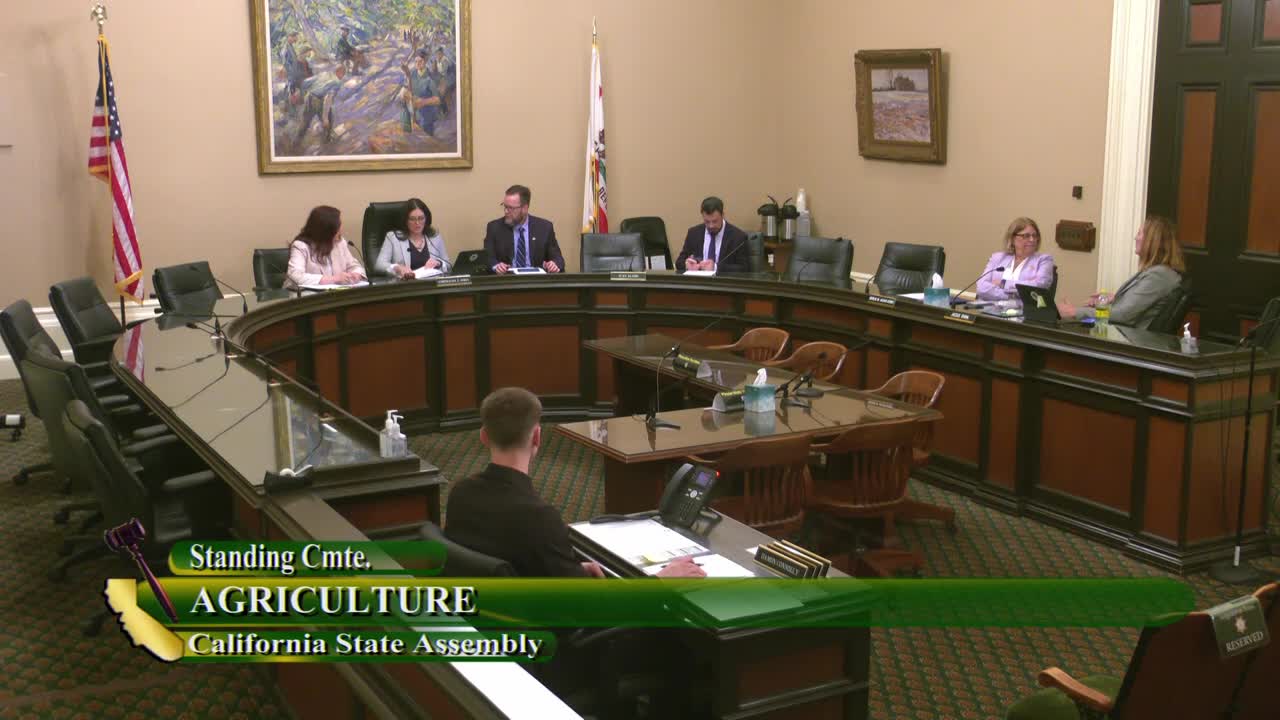
Bill Author

Bill Co-Author(s):