AB 1057: Personal Income Tax Law: exclusions: first responders: overtime pay.
- Session Year: 2025-2026
- House: Assembly
- Latest Version Date: 2025-04-28
Current Status:
Failed
(2025-06-05: From committee: Without further action pursuant to Joint Rule 62(a).)
Introduced
In Committee
Awaiting First Chamber Vote
Passed First Chamber
In Committee
Awaiting Second Chamber Vote
Passed Second Chamber
Enacted
The Personal Income Tax Law, in modified conformity with federal law, generally defines gross income as income from whatever source derived, except as specifically excluded, and provides various exclusions from gross income for purposes of computing tax liability.
This bill would, for taxable years beginning on or after January 1, 2025, and before January 1, 2030, exclude from the gross income of a qualified taxpayer, as defined, qualified overtime wages, defined to mean overtime wages paid to a qualified taxpayer in relation to work performed directly in response to, or in support of, emergency operations, as specified.
Existing law requires a bill authorizing a new tax expenditure to contain, among other things, specific goals the tax expenditure will achieve, detailed performance indicators, and data collection requirements.
This bill would include additional information required for any bill authorizing a new tax expenditure.
This bill would take effect immediately as a tax levy.
The Personal Income Tax Law, in modified conformity with federal law, generally defines gross income as income from whatever source derived, except as specifically excluded, and provides various exclusions from gross income for purposes of computing tax liability.
This bill would, for taxable years beginning on or after January 1, 2025, and before January 1, 2030, exclude from the gross income of a qualified taxpayer, as defined, qualified overtime wages, defined to mean overtime wages paid to a qualified taxpayer in relation to work performed directly in response to, or in support of, emergency operations, as specified.
Existing law requires a bill authorizing a new tax expenditure to contain, among other things, specific goals the tax expenditure will achieve, detailed performance indicators, and data collection requirements.
This bill would include additional information required for any bill authorizing a new tax expenditure.
This bill would take effect immediately as a tax levy.
The Personal Income Tax Law, in modified conformity with federal law, generally defines gross income as income from whatever source derived, except as specifically excluded, and provides various exclusions from gross income for purposes of computing tax liability.
This bill would, for taxable years beginning on or after January 1, 2025, and before January 1, 2030, exclude from the gross income of a qualified taxpayer, as defined, qualified overtime wages, defined to mean overtime wages paid to a qualified taxpayer in relation to work performed directly in response to, or in support of, emergency operations, as specified.
Existing law requires a bill authorizing a new tax expenditure to contain, among other things, specific goals the tax expenditure will achieve, detailed performance indicators, and data collection requirements.
This bill would include additional information required for any bill authorizing a new tax expenditure.
This bill would take effect immediately as a tax levy.
(a)For taxable years beginning on or after January 1, 2025, and before January 1, 2030, gross income does not include qualified overtime wages received by a qualified taxpayer.
(b)For purposes of this section, the following definitions shall apply:
(1)Qualified overtime wages means overtime wages paid to a qualified taxpayer in relation to work performed directly in response to, or in support of, emergency operations in an area impacted by a duly declared state of emergency or local emergency.
(2)Qualified taxpayer means a either of the following:
(A)A first responder, as that term is defined in subdivision (a) of Section 8562 of the Government Code, that is officially deployed in response to, or in support of, emergency operations relating to a duly declared state of emergency or local emergency.
(B)An emergency medical technician, paramedic, or ambulance driver employed by an entity that is contractually responsible for emergency ambulance services for a fire agency pursuant to Section 1797.230 of the Health and Safety Code, and is officially deployed in response to, or in support of, emergency operations relating to a duly declared state of emergency or local emergency.
(3)State of emergency and local emergency shall have the same meanings as those terms are defined in Section 8558 of the Government Code.
(c)(1)The Franchise Tax Board may prescribe rules, guidelines, procedures, or other guidance to carry out the purposes of this section. Chapter 3.5 (commencing with Section 11340) of Part 1 of Division 3 of Title 2 of the Government Code shall not apply to any rule, guideline, or procedure prescribed by the Franchise Tax Board pursuant to this section.
(2)The Franchise Tax Board may prescribe any regulations necessary or appropriate to carry out the purposes of this section, including any regulations regarding verification procedures, documentation requirements, and any other reporting requirements.
(d)This section shall only remain operative until December 1, 2030, and as of that date is repealed.
SEC. 2.For the purpose of complying with Section 41 of the Revenue and Taxation Code, as it relates to the exclusion provided by Section 17140.6 of that code, the Legislature finds and declares both of the following:
(a)The specific goal of the exclusions is to address the extraordinary circumstances faced by first responders during major disasters, providing financial recognition of their critical service during times of extreme public need.
(b)There is no available data to collect or report with respect to the exclusion added by Section 17140.6 of the Revenue and Taxation Code.
SEC. 3.This act provides for a tax levy within the meaning of Article IV of the California Constitution and shall go into immediate effect.
(a)For taxable years beginning on or after January 1, 2025, and before January 1, 2030, gross income does not include qualified overtime wages received by a qualified taxpayer.
(b)For purposes of this section, the following definitions shall apply:
(1)Qualified overtime wages means overtime wages paid to a qualified taxpayer in relation to work performed directly in response to, or in support of, emergency operations in an area impacted by a duly declared state of emergency or local emergency.
(2)Qualified taxpayer means a first responder, as that term is defined in subdivision (a) of Section 8562 of the Government Code, that satisfies at least one of the following: is officially deployed in response to, or in support of, emergency operations relating to a duly declared state of emergency or local emergency.
(A)Resides in a county covered by a duly declared state of emergency or local emergency.(B)Is employed in a county covered by a duly declared state of emergency or local emergency.(C)Is officially deployed in response to, or in support of, emergency operations relating to a duly declared state of emergency or local emergency.(3)State of emergency and local emergency shall have the same meaning meanings as those terms are defined in Section 8558 of the Government Code.
(c)(1)The Franchise Tax Board may prescribe rules, guidelines, procedures, or other guidance to carry out the purposes of this section. Chapter 3.5 (commencing with Section 11340) of Part 1 of Division 3 of Title 2 of the Government Code shall not apply to any rule, guideline, or procedure prescribed by the Franchise Tax Board pursuant to this section.
(2)The Franchise Tax Board may prescribe any regulations necessary or appropriate to carry out the purposes of this section, including any regulations regarding verification procedures, documentation requirements, and any other reporting requirements.
(d)This section shall only remain operative until December 1, 2030, and as of that date is repealed.
SEC. 2.For the purpose of complying with Section 41 of the Revenue and Taxation Code, as it relates to the exclusion provided by Section 17140.6 of that code, the Legislature finds and declares both of the following:
(a)The specific goal of the exclusions is to addresses address the extraordinary circumstances faced by first responders during major disasters, providing financial recognition of their critical service during times of extreme public need.
(b)There is no available data to collect or report with respect to the exclusion added by Section 17140.6 of the Revenue and Taxation Code.
SEC. 3.This act provides for a tax levy within the meaning of Article IV of the California Constitution and shall go into immediate effect.
(a)For taxable years beginning on or after January 1, 2025, and before January 1, 2030, gross income does not include qualified overtime wages received by a qualified taxpayer.
(b)For purposes of this section, the following definitions shall apply:
(1)Qualified overtime wages means overtime wages paid to a qualified taxpayer in relation to work performed directly in response to, or in support of, emergency operations in an area impacted by a duly declared state of emergency or local emergency.
(2)Qualified taxpayer means a first responder, as that term is defined in subdivision (a) of Section 8562 of the Government Code, that satisfies at least one of the following:
(A)Resides in a county covered by a duly declared state of emergency or local emergency.
(B)Is employed in a county covered by a duly declared state of emergency or local emergency.
(C)Is officially deployed in response to, or in support of, emergency operations relating to a duly declared state of emergency or local emergency.
(3)State of emergency and local emergency shall have the same meaning as those terms are defined in Section 8558 of the Government Code.
(c)(1)The Franchise Tax Board may prescribe rules, guidelines, procedures, or other guidance to carry out the purposes of this section. Chapter 3.5 (commencing with Section 11340) of Part 1 of Division 3 of Title 2 of the Government Code shall not apply to any rule, guideline, or procedure prescribed by the Franchise Tax Board pursuant to this section.
(2)The Franchise Tax Board may prescribe any regulations necessary or appropriate to carry out the purposes of this section, including any regulations regarding verification procedures, documentation requirements, and any other reporting requirements.
(d)This section shall only remain operative until December 1, 2030, and as of that date is repealed.
SEC. 2.For the purpose of complying with Section 41 of the Revenue and Taxation Code, as it relates to the exclusion provided by Section 17140.6 of that code, the Legislature finds and declares both of the following:
(a)The specific goal of the exclusions is to addresses the extraordinary circumstances faced by first responders during major disasters, providing financial recognition of their critical service during times of extreme public need.
(b)There is no available data to collect or report with respect to the exclusion added by Section 17140.6 of the Revenue and Taxation Code.
SEC. 3.This act provides for a tax levy within the meaning of Article IV of the California Constitution and shall go into immediate effect.
|
Date
|
Status
|
|---|---|
| Jun 5, 2025 | From committee: Without further action pursuant to Joint Rule 62(a). |
| May 5, 2025 | In committee: Set, final hearing. Held under submission. |
| Apr 29, 2025 | Re-referred to Com. on REV. & TAX. |
| Apr 28, 2025 | From committee chair, with author's amendments: Amend, and re-refer to Com. on REV. & TAX. Read second time and amended. |
| Apr 7, 2025 | In committee: Set, second hearing. Referred to REV. & TAX. suspense file. |
| Mar 27, 2025 | Re-referred to Com. on REV. & TAX. |
| Mar 26, 2025 | From committee chair, with author's amendments: Amend, and re-refer to Com. on REV. & TAX. Read second time and amended. |
| Mar 24, 2025 | In committee: Set, first hearing. Hearing canceled at the request of author. |
| Mar 10, 2025 | Referred to Com. on REV. & TAX. |
| Feb 21, 2025 | From printer. May be heard in committee March 23. |
| Feb 20, 2025 | Read first time. To print. |
This list shows positions taken on this bill by organizations on the date displayed, which is linked to the original source.
Positions by individuals are not included.
|
Organization
|
Position
|
Date
|
|---|---|---|
| Arcadia Police Officers' Association | ** Support | |
| Brea Police Association | ** Support | |
| Burbank Police Officers' Association | ** Support | |
| California Association of School Police Chiefs | ** Support | |
| California Chapter National Emergency Number Association | ** Support | |
| California Coalition of School Safety Professionals | ** Support | |
| California Narcotic Officers' Association | ** Support | |
| California Police Chiefs Association | ** Support | |
| California Reserve Peace Officers Association | ** Support | |
| California State Sheriffs' Association | ** Support | |
| CFT- a Union of Educators & Classified Professionals, Aft, Afl-cio | ** Against | |
| CLAREMONT POLICE OFFICERS ASSOCIATION | ** Support | |
| Corona Police Officers Association | ** Support | |
| Culver City Police Officers' Association | ** Support | |
| Fullerton Police Officers' Association | ** Support | |
| Los Angeles School Police Management Association | ** Support | |
| los angeles school police officers association | ** Support | |
| Murrieta Police Officers' Association | ** Support | |
| Newport Beach Police Association | ** Support | |
| Palos Verdes Police Officers Association | ** Support | |
| Peace Officers Research Association Of California | ** Support | |
| PLACER COUNTY DEPUTY SHERIFFS ASSOCIATION | ** Support | |
| Pomona Police Officers' Association | ** Support | |
| RIVERSIDE POLICE OFFICERS ASSOCIATION | ** Support | |
| Riverside Sheriffs' Association | ** Support | |
| Santa Ana Police Officers Association | ** Support |
Date of Hearing: May 5, 2025
ASSEMBLY COMMITTEE ON REVENUE AND TAXATION
Mike Gipson, Chair
ABPCA Bill Id:AB 1057 (
Author:Michelle Rodriguez) – As Amended Ver:April 28, 2025
SUSPENSE
Majority vote. Tax levy. Fiscal committee.
SUBJECT: Personal Income Tax Law: exclusions: first responders: overtime pay
SUMMARY: Excludes from gross income, under the Personal Income Tax (PIT) Law, "qualified overtime wages" paid to first responders in relation to work performed directly in response to, or in support of, emergency operations in an area impacted by a duly declared state of emergency or local emergency. Specifically, this bill:
- Excludes from gross income, for taxable years beginning on or after January 1, 2025, and before January 1, 2030, "qualified wages" received by a "qualified taxpayer."
- Defines the following terms:
- "Qualified overtime wages" are overtime wages paid to a qualified taxpayer in relation to work performed directly in response to, or in support of, emergency operations in an area impacted by a duly declared state of emergency or local emergency;
- "Qualified taxpayer" as either of the following:
- A first responder, as defined by Government Code Section 8562(a), who is officially deployed in response to, or in support of, emergency operations relating to a duly declared state of emergency or local emergency; or,
- An emergency medical technician, paramedic, or ambulance driver employed by an entity that is contractually responsible for emergency ambulance services for a fire agency pursuant to Health and Safety Code (H&SC) Section 1797.230, and is officially deployed in response to, or in support of, emergency operations relating to a duly declared state of emergency or local emergency.
- "State of emergency" and "local emergency" are defined by cross-reference to Government Code Section 8558.
- Authorizes the Franchise Tax Board (FTB) to prescribe rules, guidelines, procedures, or other guidance to carry out the purposes of this bill. The Administrative Procedure Act shall not apply to any rule, guideline, or procedure prescribed by the FTB pursuant to this bill.
- Finds and declares the following for purposes of complying with Revenue and Taxation Code (R&TC) Section 41:
- The specific goal of the exclusion is to address the extraordinary circumstances faced by first responders during major disasters, providing financial recognition of their critical service during times of extreme public need; and,
- There is no available data to collect or report with respect this exclusion.
- Takes immediate effect as a tax levy.
- Sunsets the exclusion's statutory provisions on December 1, 2030.
EXISTING LAW:
- Conforms generally to federal law, which provides that "gross income" includes all income from whatever source derived unless expressly excluded. (Internal Revenue Code (IRC) Section 61 and R&TC Section 17071.) Gross income includes compensation for services, business income, gains from selling property, interest, rents, royalties, dividends, and pensions.
- Provides various exclusions from gross income in determining tax liability under the PIT Law. (R&TC Section 17131 et seq.)
- Defines "first responder" as an employee of the state or a local public agency who provides emergency response services, including any of the following:
- A peace officer, as defined in Penal Code Section 830;
- A firefighter, as defined in Government Code Section 50925;
- A paramedic, as defined in H&SC Sections 1797.84 and 1797.82; and,
- A public safety dispatcher or public safety telecommunicator, which is an individual employed by a public safety agency, as the initial first responder, whose primary responsibility is to receive, process, transmit, or dispatch emergency and nonemergency calls for law enforcement, fire, emergency medical, and other public safety services by telephone, radio, or other communication device, and includes an individual who promotes from this position and supervises individuals who perform these functions. (Government Code Section 8562.)
- Allows a county to contract for emergency ambulance services with a fire agency that will provide those services, in whole or in part, through a written subcontract with a private ambulance service. (H&SC Section 1797.230.)
FISCAL EFFECT: Regarding the prior version of the bill, the FTB estimates General Fund revenue losses of $12 million for fiscal year (FY) 2025-26, $8 million for FY 2026-27, and $8.2 million for FY 2027-28. An updated revenue estimate of the bill as recently amended is pending; however, the amendments likely result in higher revenue losses than originally estimated.
COMMENTS:
- The author has provided the following statement in support of this bill:
First responders are the unwavering foundation of our communities—the brave individuals who answer the call when disaster strikes, when lives hang in the balance, and when chaos threatens to overtake order. Their courage, dedication, and relentless service embody the very essence of selflessness, often requiring them to work grueling hours under extreme conditions, with no regard for their own safety. In the wake of increasing natural disasters, public health crises, and unforeseen emergencies, these heroes consistently go beyond the call of duty, stepping forward when others must step back. They work tirelessly, sacrificing time with their families, enduring physical and emotional strain, and placing themselves in harm's way to ensure the safety and well-being of the public. The Hero's Overtime Relief Act is more than just a legislative measure—it is a moral commitment to those who protect us. By ensuring that overtime pay earned during emergency response efforts is exempt from state income tax, this act acknowledges their sacrifice and offers a well-deserved financial reprieve. These individuals do not hesitate to put their lives on the line for us, and it is only right that we stand with them in return. This legislation is a testament to our gratitude and a recognition of the burden they carry. By allowing first responders to retain more of their hard-earned wages, we affirm our unwavering support and appreciation for their service. Their dedication deserves more than words—it deserves action. The Hero's Overtime Relief Act is that action.
- Writing in support of this bill, the California State Sheriffs' Association notes, in part:
First responders are the backbone of public safety, risking their lives to protect communities in times of crisis. Their work often demands extensive overtime, particularly during emergencies such as natural disasters, public health crises, and other large-scale incidents that require immediate response. Under this proposal, overtime pay earned by qualified first responders will not be considered taxable income if it is earned while responding or supporting emergency operations in a designated disaster zone. As first responders continue to place themselves in harm's way to protect the public, it is only fitting that the state takes action to support and recognize their sacrifices.
- Writing in opposition to this bill, the California Federation of Teachers notes, in part:
For every dollar that is provided in tax expenditures, approximately 40 cents of each dollar comes out of California's classrooms. For this reason, CFT opposes tax expenditures. While the merit and goal of the bill are laudable, educators prefer that the state invest in progressive tax policies, such as a wealth tax, which would gather a minuscule amount of revenue from those who count their net worth in the billions. Revenue from such a source would more than cover the goal of this bill and more, without harming others in this zero-sum environment.
- Committee Staff Comments:
- What would this bill do? This bill would provide an income exclusion to first responders for the overtime wages earned through work performed directly in response to, or in support of, emergency operations in an area impacted by a duly declared state of emergency or local emergency. In other words, this bill exempts overtime wages earned by first responders from state income taxes when they are deployed in response to an emergency.
- Who stands to benefit? This bill defines "first responder" by cross-reference to the Government Code and includes peace officers, firefighters, paramedics, emergency medical technicians (EMTs), and public safety dispatchers and 911 operators who are employed by a state or local public agency. Firefighters employed by private individuals or businesses, such as those working on behalf of insurance companies, would not qualify for the exclusion.[1]
As currently drafted, paramedics and EMTs do not qualify for the exclusion if they are not employed by a public agency. Some paramedics and EMTs are employed by private companies, such as American Medical Response (AMR), which enter into contractual agreements with local governments to provide ambulance services. In order to make these employees eligible for the income exclusion, the author plans to amend the definition of "qualified taxpayer" to additionally include paramedics and EMTs by referencing H&SC Sections 1797.84 and 1797.82. - What is a "tax expenditure"? Existing law provides various credits, deductions, exclusions, and exemptions for particular taxpayer groups. In the late 1960s, U.S. Treasury officials began arguing that these features of the tax law should be referred to as "expenditures" since they are generally enacted to accomplish some governmental purpose and there is a determinable cost associated with each (in the form of foregone revenues).
As the Department of Finance notes in its annual Tax Expenditure Report, there are several key differences between tax expenditures and direct expenditures. First, tax expenditures are typically reviewed less frequently than direct expenditures. Second, there is generally no control over the amount of revenue losses associated with any given tax expenditure. Finally, it should also be noted that, once enacted, it takes a two-thirds vote to rescind an existing tax expenditure absent a sunset date. This effectively results in a "one-way ratchet" whereby tax expenditures can be conferred by majority vote, but cannot be rescinded, irrespective of their efficacy or cost, without a supermajority vote. - Overtime pay: In California, the general overtime provisions are that a nonexempt employee 18 years of age or older – or any minor employee 16 or 17 years of age who is not required by law to attend school and is not otherwise prohibited by law from engaging in the subject work – shall not be employed more than eight hours in any workday or more than 40 hours in any workweek, unless they are compensated for such overtime at not less than the following:
- One and one-half times the employee's regular rate of pay for all hours worked in excess of eight hours up to and including 12 hours in any workday, and for the first eight hours worked on the 7th consecutive day of work in a workweek; and,
- Double the employee's regular rate of pay for all hours worked in excess of 12 hours in any workday and for all hours worked in excess of eight hours on the seventh consecutive day of work in a workweek. [2]
- Exceptions to general overtime rules: There are a number of instances where the general overtime rules either do not apply or are modified due to the nature of the occupation. Employees covered by a collective bargaining agreement that meets certain criteria are one such example. Additionally, there are special rules for firefighters and ambulance drivers:
- Firefighter extended duty week compensation (EDWC): The federal Fair Labor Standards Act (FLSA) allows employers to set "work periods" for firefighters that exceed the traditional 40-hour workweek. The work period must be a least seven consecutive workdays and may extend up to a maximum of 28 consecutive workdays. Firefighters typically work 24-hour shifts during these work periods and many local fire departments regularly schedule overtime resulting in EDWC that is not included in a firefighter's base pay.[3]
- Ambulance drivers: Under Wage Orders 5 and 9, no daily overtime is required for ambulance drivers and attendants that are scheduled for 24-hour shifts who have agreed in writing to exclude from daily time worked no more than three meal periods of not more than one hour each and a regularly scheduled uninterrupted sleeping period of up to eight hours.[4]
- Firefighter extended duty week compensation (EDWC): The federal Fair Labor Standards Act (FLSA) allows employers to set "work periods" for firefighters that exceed the traditional 40-hour workweek. The work period must be a least seven consecutive workdays and may extend up to a maximum of 28 consecutive workdays. Firefighters typically work 24-hour shifts during these work periods and many local fire departments regularly schedule overtime resulting in EDWC that is not included in a firefighter's base pay.[3]
- Public safety-related overtime has increased in the past decade: California has faced no shortage of natural disasters and emergencies in recent years, ranging from the COVID-19; pandemic flooding due to atmospheric rivers; and, of course, numerous devastating fires. As a result, public safety personnel have been working longer hours to respond and assist communities in need. Even when public safety personnel are not responding to a large-scale emergency, however, overtime is often expected as part of a regular work schedule due to insufficient staffing and/or areas experiencing higher demand.
In fact, a City of Los Angeles audit for 2018 found that more than 90% of sworn police and fire employees received overtime that year, earning an average of $27,737 in annual overtime compensation. Just 40% of the city's general employees received overtime pay, averaging $7,528 in total. Kenneth Mejia, the City Controller of Los Angeles, has shared data showing that the top 10 Los Angeles city employees with the most overtime pay in 2021 were all employed by the Los Angeles Fire Department.[5]
According to an analysis of data from the State Controller's Office, Los Angeles is not alone and the use of overtime has increased significantly in the past decade across California's cities. In 2012, 213 city workers earned overtime of at least $100,000, compared to 3,680 workers in 2022. In 2012, overtime compensation cost cities $1.3 billion, compared to $2.96 billion in 2022.[6]
- An incentive or reward? Typically, tax expenditures are provided prospectively as a matter of legislative grace to encourage taxpayers to behave in ways they might not absent a financial incentive. As currently drafted, this bill excludes qualifying income beginning on January 1, 2025, meaning that taxpayers could benefit from this bill for actions they have already taken without any incentive. The author may wish to consider amending this bill to provide the income exclusion prospectively, beginning on January 1, 2026.
- Committee's tax expenditure policy: Both R&TC Section 41 and Committee policy require any tax expenditure bill to outline specific goals, purposes, and objectives that the tax expenditure will achieve, along with detailed performance indicators for the Legislature to use when measuring whether the tax expenditure meets those stated goals, purposes, and objectives. A tax expenditure bill will not be eligible for a Committee vote unless it has complied with these requirements.
- An incentive or reward? Typically, tax expenditures are provided prospectively as a matter of legislative grace to encourage taxpayers to behave in ways they might not absent a financial incentive. As currently drafted, this bill excludes qualifying income beginning on January 1, 2025, meaning that taxpayers could benefit from this bill for actions they have already taken without any incentive. The author may wish to consider amending this bill to provide the income exclusion prospectively, beginning on January 1, 2026.
In its current form, this bill states that the exclusion is designed to address the extraordinary circumstances faced by first responders during major disasters, providing financial recognition of their critical service during times of extreme public need. In addition, this bill provides that there is no data available to evaluate whether this tax expenditure achieves its intended goal.
In addition to the R&TC Section 41 requirements, this Committee's policy also requires that all tax expenditure proposals contain an appropriate sunset provision to be eligible for a vote. According to this policy, an "appropriate sunset provision" means five years, except in the case of a tax expenditure measure providing relief to California veterans, in which case "appropriate sunset provision" means ten years. This bill, as currently drafted, complies with the Committee's policy on sunset dates.
- Nonconformity to federal law: This bill establishes exclusions for which federal law has no counterpart. Generally, nonconformity to federal law adds complexity and additional administrative burdens for taxpayers. Employers would have to separately account for overtime pay that is connected to work performed directly in response to, or in support of, emergency operations in an area impacted by a duly declared state of emergency or local emergency so that an employee would know how much of their income should be excluded for California income tax purposes.
- Related legislation: AB 918 (Ransom) would exclude wages paid to first responders who are employees of a local agency for work performed in an area subject to a declared state or local emergency as part of the provision of mutual aid. AB 918 is currently pending on this Committee's Suspense File.
REGISTERED SUPPORT / OPPOSITION:
Support
Arcadia Police Officers' Association
Brea Police Association
Burbank Police Officers' Association
California Association of School Police Chiefs
California Chapter National Emergency Number Association (CALNENA)
California Coalition of School Safety Professionals
California Narcotic Officers' Association
California Police Chiefs Association
California Reserve Peace Officers Association
California State Sheriffs' Association
Claremont Police Officers Association
Corona Police Officers Association
Culver City Police Officers' Association
Fullerton Police Officers' Association
Los Angeles School Police Management Association
Los Angeles School Police Officers Association
Murrieta Police Officers' Association
Newport Beach Police Association
Palos Verdes Police Officers Association
Peace Officers Research Association of California (PORAC)
Placer County Deputy Sheriffs' Association
Pomona Police Officers' Association
Riverside Police Officers Association
Riverside Sheriffs' Association
Santa Ana Police Officers Association
Opposition
CFT- a Union of Educators & Classified Professionals, AFT, AFL-CIO
Analysis Prepared by: Wesley Whitaker / REV. & TAX. / (916) 319-2098
Mello, Private firefighters are increasingly popular with insurers. But do they pose a risk? CalMatters. (February 19, 2025). https://calmatters.org/housing/2025/01/private-firefighters-insurers/. ↑
Overtime, Labor Commissioner's Office – California Department of Industrial Relations. https://www.dir.ca.gov/dlse/FAQ_Overtime.htm. ↑
2023 California Firefighter Total Compensation Survey, CalHR (May 2024). https://www.calhr.ca.gov/state-hr-professionals/Documents/2023-California-Firefighter-Total-Compensation-Survey.pdf. ↑
Exceptions to the general overtime law, Labor Commissioner's Office – California Department of Industrial Relations. https://www.dir.ca.gov/dlse/FAQ_OvertimeExceptions.htm. ↑
Castleman, LAFD report suggests adding more firefighters as overtime pay enriches scores, Los Angeles Times (June 10, 2023). https://www.latimes.com/california/story/2023-06-10/lafd-relies-heavily-on-overtime-staffing-at-taxpayer-expense. ↑
Sforza, One LA firefighter made $510,301 … in overtime; who else brought in big extra pay?, The Mercury News (August 8, 2023). https://www.mercurynews.com/2023/08/08/one-city-firefighter-made-510301-in-overtime-who-else-brought-in-big-extra-pay/. ↑
Date of Hearing: April 7, 2025
ASSEMBLY COMMITTEE ON REVENUE AND TAXATION
Mike Gipson, Chair
ABPCA Bill Id:AB 1057 (
Author:Michelle Rodriguez) – As Amended Ver:March 26, 2025
Majority vote. Tax levy. Fiscal committee.
SUBJECT: Personal Income Tax Law: exclusions: first responders: overtime pay
SUMMARY: Excludes from gross income, under the Personal Income Tax (PIT) Law, "qualified overtime wages" paid to first responders in relation to work performed directly in response to, or in support of, emergency operations in an area impacted by a duly declared state of emergency or local emergency. Specifically, this bill:
- Excludes from gross income, for taxable years beginning on or after January 1, 2025, and before January 1, 2030, "qualified wages" received by a "qualified taxpayer."
- Defines the following terms:
- "Qualified overtime wages" are overtime wages paid to a qualified taxpayer in relation to work performed directly in response to, or in support of, emergency operations in an area impacted by a duly declared state of emergency or local emergency;
- "Qualified taxpayer" is a first responder, as defined by Government Code Section 8562(a), who is officially deployed in response to, or in support of, emergency operations relating to a duly declared state of emergency or local emergency; and,
- "State of emergency" and "local emergency" are defined by cross-reference to Government Code Section 8558.
- Authorizes the Franchise Tax Board (FTB) to prescribe rules, guidelines, procedures, or other guidance to carry out the purposes of this bill. The Administrative Procedure Act shall not apply to any rule, guideline, or procedure prescribed by the FTB pursuant to this bill.
- Finds and declares the following for purposes of complying with Revenue and Taxation Code (R&TC) Section 41:
- The specific goal of the exclusion is to address the extraordinary circumstances faced by first responders during major disasters, providing financial recognition of their critical service during times of extreme public need; and,
- There is no available data to collect or report with respect this exclusion.
- Takes immediate effect as a tax levy.
- Sunsets the exclusion's statutory provisions on December 1, 2030.
EXISTING LAW:
- Conforms generally to federal law, which provides that "gross income" includes all income from whatever source derived unless expressly excluded. (Internal Revenue Code (IRC) Section 61 and R&TC Section 17071.) Gross income includes compensation for services, business income, gains from selling property, interest, rents, royalties, dividends, and pensions.
- Provides various exclusions from gross income in determining tax liability under the PIT Law. (R&TC Section 17131 et seq.)
- Defines "first responder" as an employee of the state or a local public agency who provides emergency response services, including any of the following:
- A peace officer, as defined in Penal Code Section 830;
- A firefighter, as defined in Government Code Section 50925;
- A paramedic, as defined in Health and Safety Code (H&SC) Sections 1797.84 and 1797.82; and,
- A public safety dispatcher or public safety telecommunicator, which is an individual employed by a public safety agency, as the initial first responder, whose primary responsibility is to receive, process, transmit, or dispatch emergency and nonemergency calls for law enforcement, fire, emergency medical, and other public safety services by telephone, radio, or other communication device, and includes an individual who promotes from this position and supervises individuals who perform these functions. (Government Code Section 8562.)
FISCAL EFFECT: The FTB estimates General Fund revenue losses of $12 million for fiscal year (FY) 2025-26, $8 million for FY 2026-27, and $8.2 million for FY 2027-28.
COMMENTS:
- The author has provided the following statement in support of this bill:
First responders are the unwavering foundation of our communities—the brave individuals who answer the call when disaster strikes, when lives hang in the balance, and when chaos threatens to overtake order. Their courage, dedication, and relentless service embody the very essence of selflessness, often requiring them to work grueling hours under extreme conditions, with no regard for their own safety. In the wake of increasing natural disasters, public health crises, and unforeseen emergencies, these heroes consistently go beyond the call of duty, stepping forward when others must step back. They work tirelessly, sacrificing time with their families, enduring physical and emotional strain, and placing themselves in harm's way to ensure the safety and well-being of the public. The Hero's Overtime Relief Act is more than just a legislative measure—it is a moral commitment to those who protect us. By ensuring that overtime pay earned during emergency response efforts is exempt from state income tax, this act acknowledges their sacrifice and offers a well-deserved financial reprieve. These individuals do not hesitate to put their lives on the line for us, and it is only right that we stand with them in return. This legislation is a testament to our gratitude and a recognition of the burden they carry. By allowing first responders to retain more of their hard-earned wages, we affirm our unwavering support and appreciation for their service. Their dedication deserves more than words—it deserves action. The Hero's Overtime Relief Act is that action.
- Writing in support of this bill, the California State Sheriffs' Association notes, in part:
First responders are the backbone of public safety, risking their lives to protect communities in times of crisis. Their work often demands extensive overtime, particularly during emergencies such as natural disasters, public health crises, and other large-scale incidents that require immediate response. Under this proposal, overtime pay earned by qualified first responders will not be considered taxable income if it is earned while responding or supporting emergency operations in a designated disaster zone. As first responders continue to place themselves in harm's way to protect the public, it is only fitting that the state takes action to support and recognize their sacrifices.
- Writing in opposition to this bill, the California Federation of Teachers notes, in part:
For every dollar that is provided in tax expenditures, approximately 40 cents of each dollar comes out of California's classrooms. For this reason, CFT opposes tax expenditures. While the merit and goal of the bill are laudable, educators prefer that the state invest in progressive tax policies, such as a wealth tax, which would gather a minuscule amount of revenue from those who count their net worth in the billions. Revenue from such a source would more than cover the goal of this bill and more, without harming others in this zero-sum environment.
- Committee Staff Comments:
- What would this bill do? This bill would provide an income exclusion to first responders for the overtime wages earned through work performed directly in response to, or in support of, emergency operations in an area impacted by a duly declared state of emergency or local emergency. In other words, this bill exempts overtime wages earned by first responders from state income taxes when they are deployed in response to an emergency.
- Who stands to benefit? This bill defines "first responder" by cross-reference to the Government Code and includes peace officers, firefighters, paramedics, emergency medical technicians (EMTs), and public safety dispatchers and 911 operators who are employed by a state or local public agency. Firefighters employed by private individuals or businesses, such as those working on behalf of insurance companies, would not qualify for the exclusion.[1]
As currently drafted, paramedics and EMTs do not qualify for the exclusion if they are not employed by a public agency. Some paramedics and EMTs are employed by private companies, such as American Medical Response (AMR), which enter into contractual agreements with local governments to provide ambulance services. In order to make these employees eligible for the income exclusion, the author plans to amend the definition of "qualified taxpayer" to additionally include paramedics and EMTs by referencing H&SC Sections 1797.84 and 1797.82. - What is a "tax expenditure"? Existing law provides various credits, deductions, exclusions, and exemptions for particular taxpayer groups. In the late 1960s, U.S. Treasury officials began arguing that these features of the tax law should be referred to as "expenditures" since they are generally enacted to accomplish some governmental purpose and there is a determinable cost associated with each (in the form of foregone revenues).
As the Department of Finance notes in its annual Tax Expenditure Report, there are several key differences between tax expenditures and direct expenditures. First, tax expenditures are typically reviewed less frequently than direct expenditures. Second, there is generally no control over the amount of revenue losses associated with any given tax expenditure. Finally, it should also be noted that, once enacted, it takes a two-thirds vote to rescind an existing tax expenditure absent a sunset date. This effectively results in a "one-way ratchet" whereby tax expenditures can be conferred by majority vote, but cannot be rescinded, irrespective of their efficacy or cost, without a supermajority vote. - Overtime pay: In California, the general overtime provisions are that a nonexempt employee 18 years of age or older – or any minor employee 16 or 17 years of age who is not required by law to attend school and is not otherwise prohibited by law from engaging in the subject work – shall not be employed more than eight hours in any workday or more than 40 hours in any workweek, unless they are compensated for such overtime at not less than the following:
- One and one-half times the employee's regular rate of pay for all hours worked in excess of eight hours up to and including 12 hours in any workday, and for the first eight hours worked on the 7th consecutive day of work in a workweek; and,
- Double the employee's regular rate of pay for all hours worked in excess of 12 hours in any workday and for all hours worked in excess of eight hours on the seventh consecutive day of work in a workweek. [2]
- Exceptions to general overtime rules: There are a number of instances where the general overtime rules either do not apply or are modified due to the nature of the occupation. Employees covered by a collective bargaining agreement that meets certain criteria are one such example. Additionally, there are special rules for firefighters and ambulance drivers:
- Firefighter extended duty week compensation (EDWC): The federal Fair Labor Standards Act (FLSA) allows employers to set "work periods" for firefighters that exceed the traditional 40-hour workweek. The work period must be a least seven consecutive workdays and may extend up to a maximum of 28 consecutive workdays. Firefighters typically work 24-hour shifts during these work periods and many local fire departments regularly schedule overtime resulting in EDWC that is not included in a firefighter's base pay.[3]
- Ambulance drivers: Under Wage Orders 5 and 9, no daily overtime is required for ambulance drivers and attendants that are scheduled for 24-hour shifts who have agreed in writing to exclude from daily time worked no more than three meal periods of not more than one hour each and a regularly scheduled uninterrupted sleeping period of up to eight hours.[4]
- Firefighter extended duty week compensation (EDWC): The federal Fair Labor Standards Act (FLSA) allows employers to set "work periods" for firefighters that exceed the traditional 40-hour workweek. The work period must be a least seven consecutive workdays and may extend up to a maximum of 28 consecutive workdays. Firefighters typically work 24-hour shifts during these work periods and many local fire departments regularly schedule overtime resulting in EDWC that is not included in a firefighter's base pay.[3]
- Public safety-related overtime has increased in the past decade: California has faced no shortage of natural disasters and emergencies in recent years, ranging from the COVID-19; pandemic flooding due to atmospheric rivers; and, of course, numerous devastating fires. As a result, public safety personnel have been working longer hours to respond and assist communities in need. Even when public safety personnel are not responding to a large-scale emergency, however, overtime is often expected as part of a regular work schedule due to insufficient staffing and/or areas experiencing higher demand.
In fact, a City of Los Angeles audit for 2018 found that more than 90% of sworn police and fire employees received overtime that year, earning an average of $27,737 in annual overtime compensation. Just 40% of the city's general employees received overtime pay, averaging $7,528 in total. Kenneth Mejia, the City Controller of Los Angeles, has shared data showing that the top 10 Los Angeles city employees with the most overtime pay in 2021 were all employed by the Los Angeles Fire Department.[5]
According to an analysis of data from the State Controller's Office, Los Angeles is not alone and the use of overtime has increased significantly in the past decade across California's cities. In 2012, 213 city workers earned overtime of at least $100,000, compared to 3,680 workers in 2022. In 2012, overtime compensation cost cities $1.3 billion, compared to $2.96 billion in 2022.[6]
- An incentive or reward? Typically, tax expenditures are provided prospectively as a matter of legislative grace to encourage taxpayers to behave in ways they might not absent a financial incentive. As currently drafted, this bill excludes qualifying income beginning on January 1, 2025, meaning that taxpayers could benefit from this bill for actions they have already taken without any incentive. The author may wish to consider amending this bill to provide the income exclusion prospectively, beginning on January 1, 2026.
- Committee's tax expenditure policy: Both R&TC Section 41 and Committee policy require any tax expenditure bill to outline specific goals, purposes, and objectives that the tax expenditure will achieve, along with detailed performance indicators for the Legislature to use when measuring whether the tax expenditure meets those stated goals, purposes, and objectives. A tax expenditure bill will not be eligible for a Committee vote unless it has complied with these requirements.
- An incentive or reward? Typically, tax expenditures are provided prospectively as a matter of legislative grace to encourage taxpayers to behave in ways they might not absent a financial incentive. As currently drafted, this bill excludes qualifying income beginning on January 1, 2025, meaning that taxpayers could benefit from this bill for actions they have already taken without any incentive. The author may wish to consider amending this bill to provide the income exclusion prospectively, beginning on January 1, 2026.
In its current form, this bill states that the exclusion is designed to address the extraordinary circumstances faced by first responders during major disasters, providing financial recognition of their critical service during times of extreme public need. In addition, this bill provides that there is no data available to evaluate whether this tax expenditure achieves its intended goal.
In addition to the R&TC Section 41 requirements, this Committee's policy also requires that all tax expenditure proposals contain an appropriate sunset provision to be eligible for a vote. According to this policy, an "appropriate sunset provision" means five years, except in the case of a tax expenditure measure providing relief to California veterans, in which case "appropriate sunset provision" means ten years. This bill, as currently drafted, complies with the Committee's policy on sunset dates.
- Nonconformity to federal law: This bill establishes exclusions for which federal law has no counterpart. Generally, nonconformity to federal law adds complexity and additional administrative burdens for taxpayers. Employers would have to separately account for overtime pay that is connected to work performed directly in response to, or in support of, emergency operations in an area impacted by a duly declared state of emergency or local emergency so that an employee would know how much of their income should be excluded for California income tax purposes.
- Related legislation: AB 918 (Ransom) would exclude wages paid to first responders who are employees of a local agency for work performed in an area subject to a declared state or local emergency as part of the provision of mutual aid. AB 918 is currently pending on this Committee's Suspense File.
REGISTERED SUPPORT / OPPOSITION:
Support
California Police Chiefs Association
California State Sheriffs' Association
Opposition
California Federation of Teachers
Analysis Prepared by: Wesley Whitaker / REV. & TAX. / (916) 319-2098
Mello, Private firefighters are increasingly popular with insurers. But do they pose a risk? CalMatters. (February 19, 2025). https://calmatters.org/housing/2025/01/private-firefighters-insurers/. ↑
Overtime, Labor Commissioner's Office – California Department of Industrial Relations. https://www.dir.ca.gov/dlse/FAQ_Overtime.htm. ↑
2023 California Firefighter Total Compensation Survey, CalHR (May 2024). https://www.calhr.ca.gov/state-hr-professionals/Documents/2023-California-Firefighter-Total-Compensation-Survey.pdf. ↑
Exceptions to the general overtime law, Labor Commissioner's Office – California Department of Industrial Relations. https://www.dir.ca.gov/dlse/FAQ_OvertimeExceptions.htm. ↑
Castleman, LAFD report suggests adding more firefighters as overtime pay enriches scores, Los Angeles Times (June 10, 2023). https://www.latimes.com/california/story/2023-06-10/lafd-relies-heavily-on-overtime-staffing-at-taxpayer-expense. ↑
Sforza, One LA firefighter made $510,301 … in overtime; who else brought in big extra pay?, The Mercury News (August 8, 2023). https://www.mercurynews.com/2023/08/08/one-city-firefighter-made-510301-in-overtime-who-else-brought-in-big-extra-pay/. ↑
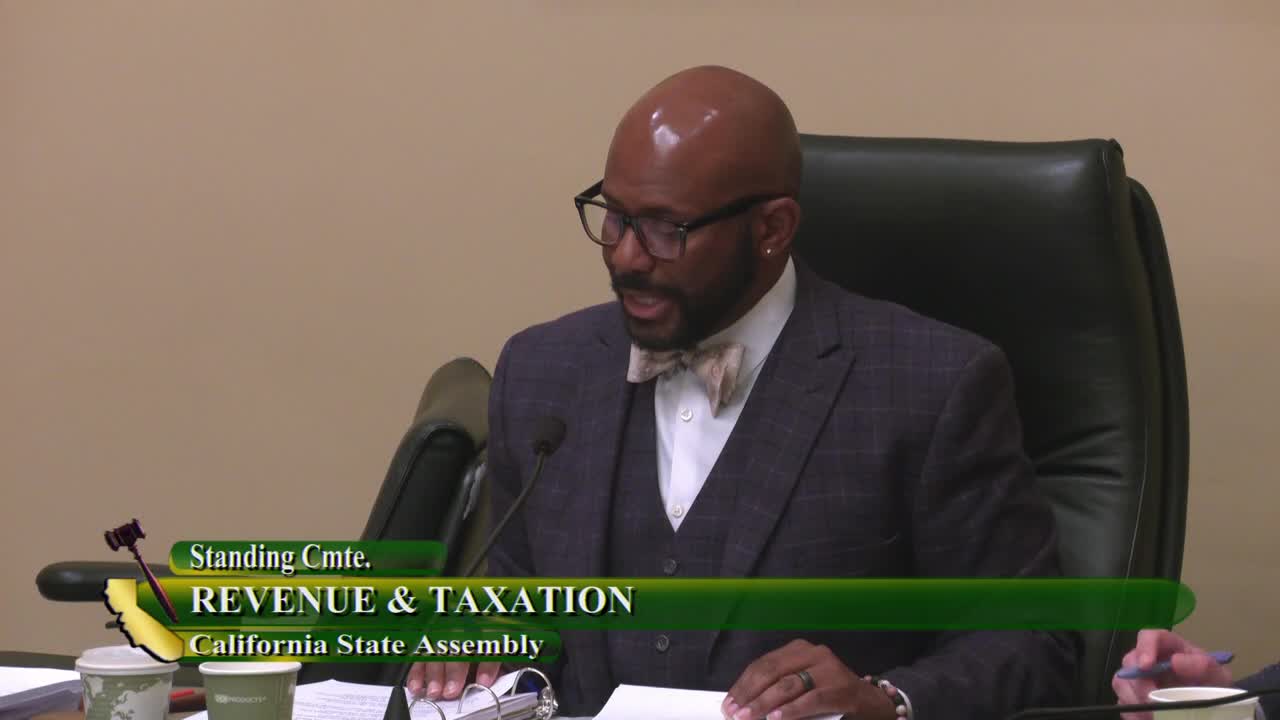
Discussed in Hearing
 2MIN
Assembly Standing Committee on Revenue and Taxation


Bill Co-Author(s):