AB 1071: Criminal procedure: discrimination.
- Session Year: 2025-2026
- House: Assembly
- Latest Version Date: 2025-10-13
Current Status:
Passed
(2025-10-13: Chaptered by Secretary of State - Chapter 721, Statutes of 2025.)
Introduced
In Committee
Awaiting First Chamber Vote
Passed First Chamber
In Committee
Awaiting Second Chamber Vote
Passed Second Chamber
Enacted
Existing law prohibits the state from seeking, obtaining, or imposing a criminal conviction or sentence on the basis of race, ethnicity, or national origin. Under existing law, a defendant may pursue relief for a violation of this prohibition by filing a motion pursuant to the provisions that prohibit this conduct, a petition for a writ of habeas corpus, or a motion to vacate a conviction or sentence.
This bill would authorize the defendant in these proceedings to file a motion for disclosure of all relevant evidence related to a potential violation of the prohibition on the state seeking, obtaining, or imposing a criminal conviction or sentence on the basis of race, ethnicity, or national origin, as specified. The bill would also authorize the court to remedy a violation of these provisions with any other remedy not prohibited by another law. The bill would make other technical changes.
This bill makes legislative findings and declarations in support of its provisions.
This bill would incorporate additional changes to Sections 745, 1473, and 1473.7 of the Penal Code proposed by SB 734 to be operative only if this bill and SB 734 are enacted and this bill is enacted last.
Existing law prohibits the state from seeking, obtaining, or imposing a criminal conviction or sentence on the basis of race, ethnicity, or national origin. Under existing law, a defendant may pursue relief for a violation of this prohibition by filing a motion pursuant to the provisions that prohibit this conduct, a petition for a writ of habeas corpus, or a motion to vacate a conviction or sentence.
This bill would recast and revise these procedures to pursue relief for a violation of the prohibition against the state seeking, obtaining, or imposing a criminal conviction or sentence on the basis of race, ethnicity, or national origin to provide an additional procedure for a defendant whose judgment is not final and who has an action pending before the trial or appellate court, is currently incarcerated, or post-incarceration, as specified. The bill would also recast the remedies for a violation of this prohibition in accordance with the procedure the defendant used to pursue relief.This bill would authorize the defendant in these proceedings to file a motion for disclosure of all relevant evidence related to a potential violation of the prohibition on the state seeking, obtaining, or imposing a criminal conviction or sentence on the basis of race, ethnicity, or national origin, as specified. The bill would also authorize the court to remedy a violation of these provisions with any other remedy not prohibited by another law. The bill would make other technical changes.
This bill makes legislative findings and declarations in support of its provisions.
Existing law prohibits the state from seeking, obtaining, or imposing a criminal conviction or sentence on the basis of race, ethnicity, or national origin. Under existing law, a defendant may pursue relief for a violation of this prohibition by filing a motion pursuant to the provisions that prohibit this conduct, a petition for a writ of habeas corpus, or a motion to vacate a conviction or sentence.
This bill would recast and revise these procedures to pursue relief for a violation of the prohibition against the state seeking, obtaining, or imposing a criminal conviction or sentence on the basis of race, ethnicity, or national origin to provide an additional procedure for a defendant whose judgment is not final and who has an action pending before the trial or appellate court, is currently incarcerated, or post-incarceration, as specified. The bill would also recast the remedies for a violation of this prohibition in accordance with the procedure the defendant used to pursue relief.
This bill makes legislative findings and declarations in support of its provisions.
Existing law prohibits the state from seeking, obtaining, or imposing a criminal conviction or sentence on the basis of race, ethnicity, or national origin. Under existing law, a defendant may pursue relief for a violation of this prohibition by filing a motion pursuant to the provisions that prohibit this conduct, a petition for a writ of habeas corpus, or a motion to vacate a conviction or sentence.
This bill would recast and revise these procedures to pursue relief for a violation of the prohibition against the state seeking, obtaining, or imposing a criminal conviction or sentence on the basis of race, ethnicity, or national origin to specifically provide multiple procedures applicable to provide an additional procedure for a defendant whose judgment is not final and who has an action pending before the trial or appellate court, is currently incarcerated, or post-incarceration, as specified. The bill would also recast the remedies for a violation of this prohibition in accordance with the procedure the defendant used to pursue relief.
This bill makes legislative findings and declarations in support of its provisions.
Existing law prohibits the state from seeking, obtaining, or imposing a criminal conviction or sentence on the basis of race, ethnicity, or national origin. Under existing law, a defendant may pursue relief for a violation of this prohibition by filing a motion pursuant to the provisions that prohibit this conduct, a petition for a writ of habeas corpus, or a motion to vacate a conviction or sentence.
This bill would recast and revise these procedures to pursue relief for a violation of the prohibition against the state seeking, obtaining, or imposing a criminal conviction or sentence on the basis of race, ethnicity, or national origin to specifically provide multiple procedures applicable to a defendant who has an action pending before the trial or appellate court, is currently incarcerated, or post-incarceration, as specified. The bill would also recast the remedies for a violation of this prohibition in accordance with the procedure the defendant used to pursue relief.
This bill makes legislative findings and declarations in support of its provisions.
The Legislature finds and declares all of the following:
(a)In 2020, the Legislature enacted the California Racial Justice Act (RJA) because discrimination based on race, ethnicity, or national origin (hereafter race or racial bias) has a deleterious effect not only on individual criminal defendants but on our entire legal system. This bill clarifies the RJAs procedures to assure its meaningful implementation. The dissenting statement in In re Mendoza (2024) 2024 WL 5171483 accurately articulates the Legislatures intent in passing the RJA and concern about its silent evisceration. These findings illustrate some of the ways in which courts misconstrue the statute to apply procedural barriers or otherwise impose impediments to relief, discordant with the legislative intent of the RJA, and improperly insulate convictions and sentences tainted by racial bias.
(b)This discordance is evident in cases where courts have imposed on RJA petitioners higher burdens than the Legislature intended to meet the thresholds to secure counsel and discovery. The RJAs threshold to secure counsel is extremely low, and yet courts have denied counsel to litigants raising RJA claims far more than they have appointed counsel. This bill clarifies that the court shall appoint counsel to all indigent postconviction litigants who allege a plausible claim of an RJA violation, and whenever the State Public Defender requests. The Legislature reaffirms that the threshold showing for appointment of counsel does not require a prima facie showing, as correctly held by McIntosh v. Superior Court (2025) 110 Cal.App.5th 33, and should be construed as a minimal pleading requirement. The Legislature also intends that individuals must be afforded access to a broad range of relevant discovery to develop and support their potential RJA claims. Otherwise, they are left in the impossible position of having their claims rejected for want of the very data they seek. This is antithetical to the RJA.
(c)The Legislature reasserts the low threshold required to establish a prima facie showing under paragraphs (1) through (4) of subdivision (a) of the RJA. Courts have failed to find a prima facie showing or a violation in cases where individuals involved in the prosecution or investigation have: invoked long-held biases about men of color preying on White women; used dehumanizing and othering language such as predator, monster, sociopath, terrorist, brute, thug, gangster, uncivilized, welfare queen, superpredator, or superhuman; made racial slurs; elicited or made gratuitous references to gangs, tattoos, nicknames, or neighborhoods; used racially incendiary or coded words such as ghetto, hood, baby mama, or pimp; denigrated people who have immigrated to the United States; made gratuitous references to nationality, race, or immigration status; evoked historical and unacknowledged racialized fears that people of color are deceptive, manipulative, crime prone, or a present or future danger; and exaggerated the physical appearance and size of people of color. These examples reflect some of the many incarnations of racism that have plagued our criminal and juvenile justice systems since their inception. (People v. Hardin (2024) 15 Cal.5th 834, 906 (dis. opn. of Evans, J.).) Courts also have at times failed to find a prima facie showing or a violation despite evidence of disparate charging and sentencing. The Legislature again emphasizes its rejection of McCleskey v. Kemp (1987) 481 U.S. 279, and its intent that statistical evidence be sufficient for finding a prima facie case and may suffice to show an RJA violation. (See, for example, Mosby v. Superior Court (2024) 99 Cal.App.5th 106, 133 (conc. opn. of Menetrez, J.).)
(d)Systemic racism and the White supremacy on which it is founded have remarkable powers of adaptation. When courts recognize only the most egregious, historic manifestations of racism, they allow present-day racism to go uncorrected. (Roberts, Racism, Abolition, and Historical Resemblance (2022) 136 Harv. L.Rev. F. 37.) The Legislature intends that in applying the RJA, courts consider evidence of racisms origins, insidious shifts, and current manifestations.
(e)The Legislature reaffirms the importance of courts imposing remedies that serve to eliminate bias and redress past harms. [N]othing can be changed until it is faced. (Baldwin, As Much Truth As One Can Bear N.Y. Times (Jan. 14, 1962) p. 120.) The RJA mandates that we face that racial bias exists in our criminal legal system, and that we remedy it. Racial bias in criminal prosecutions, in all its forms or degrees, is never minor or harmless. (People v. Simmons (2023) 96 Cal.App.5th 323.) Like a metastatic cancer, racial bias in one part of a criminal prosecution infects the whole and cannot be remedied by removing a single diseased cell. Remedies must match the gravity of the ills of racial bias and not be so narrow as to minimize the harm or fail to address it in its entirety. Further, this bill clarifies that the prohibition on death sentences for cases in which an RJA violation occurs is categorical, and not a remedy in itself. This is because the racially disproportionate application of the death penalty is in historical continuity with the long and sordid history of lynching in this country. (Ogletree, Black Mans Burden: Race and the Death Penalty in America (2002) 81 Or. L.Rev. 15.) Thus, in addition to the categorical prohibition, courts must impose a remedy commensurate with the violation(s) in the case.
(f)Because racial bias in the criminal legal system is the result of centuries of historical and embedded racial injustice, it requires bold, concerted, and ongoing efforts to undo. The only way out of this morassfor all of usis to stare at racial disparity unblinkingly, and then do what evidence and experts tell us is required to level the playing field and march forward together, collectively striving to achieve true equality for all Americans. (Students for Fair Admissions, Inc. v. President and Fellows of Harvard College (2023) 600 U.S. 181, 408 (dis. opn. of Jackson, J.).) Thus is the aim of Californias Racial Justice Act and the Legislatures intent in passing it. Its provisions should be interpreted in this light.
SEC. 2.Section 745 of the Penal Code is amended to read:745.(a)The state shall not seek or obtain a criminal conviction or seek, obtain, or impose a sentence on the basis of race, ethnicity, or national origin. A violation is established if the defendant proves, by a preponderance of the evidence, any of the following:
(1)The judge, an attorney in the case, a law enforcement officer involved in the case, an expert witness, or juror exhibited bias or animus towards the defendant because of the defendants race, ethnicity, or national origin.
(2)During the defendants trial, in court and during the proceedings, the judge, an attorney in the case, a law enforcement officer involved in the case, an expert witness, or juror, used racially discriminatory language about the defendants race, ethnicity, or national origin, or otherwise exhibited bias or animus towards the defendant because of the defendants race, ethnicity, or national origin, whether or not purposeful. This paragraph does not apply if the person speaking is relating language used by another that is relevant to the case or if the person speaking is giving a racially neutral and unbiased physical description of the suspect.
(3)The defendant was charged or convicted of a more serious offense than defendants of other races, ethnicities, or national origins who have engaged in similar conduct and are similarly situated, and the evidence establishes that the prosecution more frequently sought or obtained convictions for more serious offenses against people who share the defendants race, ethnicity, or national origin in the county where the convictions were sought or obtained.
(4)(A)A longer or more severe sentence was imposed on the defendant than was imposed on other similarly situated individuals convicted of the same offense, and longer or more severe sentences were more frequently imposed for that offense on people that share the defendants race, ethnicity, or national origin than on defendants of other races, ethnicities, or national origins in the county where the sentence was imposed.
(B)A longer or more severe sentence was imposed on the defendant than was imposed on other similarly situated individuals convicted of the same offense, and longer or more severe sentences were more frequently imposed for the same offense on defendants in cases with victims of one race, ethnicity, or national origin than in cases with victims of other races, ethnicities, or national origins, in the county where the sentence was imposed.
(b)A defendant may file a motion pursuant to this section, or a petition for writ of habeas corpus or a motion under Section 1473.7, in a court of competent jurisdiction, alleging a violation of subdivision (a). For claims based on the trial record, a defendant may raise a claim alleging a violation of subdivision (a) on direct appeal from the conviction or sentence. The defendant may also move to stay the appeal and request remand to the superior court to file a motion pursuant to this section. If the motion is based in whole or in part on conduct or statements by the judge, the judge shall disqualify themselves from any further proceedings under this section.
(c)If a motion is filed in the trial court and the defendant makes a prima facie showing of a violation of subdivision (a), the trial court shall hold a hearing. A motion made at trial shall be made as soon as practicable upon the defendant learning of the alleged violation. A motion that is not timely may be deemed waived, in the discretion of the court.
(1)At the hearing, evidence may be presented by either party, including, but not limited to, statistical evidence, aggregate data, expert testimony, and the sworn testimony of witnesses. The court may also appoint an independent expert. For the purpose of a motion and hearing under this section, out-of-court statements that the court finds trustworthy and reliable, statistical evidence, and aggregated data are admissible for the limited purpose of determining whether a violation of subdivision (a) has occurred.
(2)The defendant shall have the burden of proving a violation of subdivision (a) by a preponderance of the evidence. The defendant does not need to prove intentional discrimination.
(3)At the conclusion of the hearing, the court shall make findings on the record.
(d)In any proceeding alleging a violation of subdivision (a), a defendant or petitioner may file a motion requesting disclosure to the defense of all evidence relevant to a potential violation of subdivision (a) in the possession or control of the state. A motion filed under this section, a motion under paragraph (2) of subdivision (e) of Section 1473, or a motion under paragraph (3) of subdivision (a) of Section 1473.7, shall describe the type of records or information the defendant seeks. Upon a showing of good cause, the court shall order the records to be released. Upon a showing of good cause, and in order to protect a privacy right or privilege, the court may permit the prosecution to redact information prior to disclosure or may subject disclosure to a protective order. If a statutory privilege or constitutional privacy right cannot be adequately protected by redaction or a protective order, the court shall not order the release of the records.
(e)Notwithstanding any other law, except as provided in subdivision (k), or for an initiative approved by the voters, if the court finds, by a preponderance of evidence, a violation of subdivision (a), the court shall impose a remedy specific to the violation found from the following list:
(1)Before a judgment has been entered, the court shall impose any of the following remedies:
(A)Grant a defendants request for a mistrial.
(B)Discharge the jury panel and empanel a new jury.
(C)If the court determines that it would be in the interest of justice, dismiss enhancements, special circumstances, or special allegations, or reduce one or more charges.
(D)Any other remedy not prohibited by another law.
(2)(A)After a judgment has been entered, if the court finds that a conviction was sought or obtained in violation of subdivision (a), the court shall vacate the conviction and sentence, find that it is legally invalid, and order new proceedings consistent with subdivision (a). If the court finds that the only violation of subdivision (a) that occurred is based on paragraph (3) of subdivision (a), the court may modify the judgment to a lesser included or lesser related offense. On resentencing, the court shall not impose a new sentence greater than that previously imposed.
(B)After a judgment has been entered, if the court finds that only the sentence was sought, obtained, or imposed in violation of subdivision (a), the court shall vacate the sentence, find that it is legally invalid, and impose a new sentence. On resentencing, the court shall not impose a new sentence greater than that previously imposed.
(3)The remedies available under this section do not foreclose any other remedies available under the United States Constitution, the California Constitution, or any other law.
(f)This section also applies to adjudications and dispositions in the juvenile delinquency system and adjudications to transfer a juvenile case to adult court.
(g)This section shall not prevent the prosecution of hate crimes pursuant to Sections 422.6 to 422.865, inclusive.
(h)As used in this section and for the purposes of a petition pursuant to subdivision (e) of Section 1473 or a motion pursuant to paragraph (3) of subdivision (a) of Section 1473.7 the following definitions apply:
(1)More frequently sought or obtained or more frequently imposed means that the totality of the evidence demonstrates a significant difference in seeking or obtaining convictions or in imposing sentences comparing individuals who have engaged in similar conduct and are similarly situated, and the prosecution cannot establish race-neutral reasons for the disparity. The evidence may include statistical evidence, aggregate data, or nonstatistical evidence. Statistical significance is a factor the court may consider, but is not necessary to establish a significant difference. In evaluating the totality of the evidence, the court shall consider whether systemic and institutional racial bias, racial profiling, and historical patterns of racially biased policing and prosecution may have contributed to, or caused differences observed in, the data or impacted the availability of data overall. Race-neutral reasons shall be relevant factors to charges, convictions, and sentences that are not influenced by implicit, systemic, or institutional bias based on race, ethnicity, or national origin.
(2)Prima facie showing means that the defendant produces facts that, if true, establish that there is a substantial likelihood that a violation of subdivision (a) occurred. For purposes of this section, a substantial likelihood requires more than a mere possibility, but less than a standard of more likely than not.
(3)Relevant factors, as that phrase applies to sentencing, means the factors in the California Rules of Court that pertain to sentencing decisions and any additional factors required to or permitted to be considered in sentencing under state law and under the state and federal constitutions.
(4)Racially discriminatory language means language that, to an objective observer, explicitly or implicitly appeals to racial bias, including, but not limited to, racially charged or racially coded language, language that compares the defendant to an animal, or language that references the defendants physical appearance, culture, ethnicity, or national origin. Evidence that particular words or images are used exclusively or disproportionately in cases where the defendant is of a specific race, ethnicity, or national origin is relevant to determining whether language is discriminatory.
(5)State includes the Attorney General, a district attorney, or a city prosecutor.
(6)Similarly situated means that factors that are relevant in charging and sentencing are similar and do not require that all individuals in the comparison group are identical. A defendants conviction history may be a relevant factor to the severity of the charges, convictions, or sentences. If it is a relevant factor and the defense produces evidence that the conviction history may have been impacted by racial profiling or historical patterns of racially biased policing, the court shall consider the evidence.
(i)A defendant may share a race, ethnicity, or national origin with more than one group. A defendant may aggregate data among groups to demonstrate a violation of subdivision (a).
(j)This section applies as follows:
(1)To all cases in which judgment is not final.
(2)Commencing January 1, 2023, to all cases in which, at the time of the filing of a petition pursuant to subdivision (e) of Section 1473 raising a claim under this section, the petitioner is sentenced to death or to cases in which the motion is filed pursuant to Section 1473.7 because of actual or potential immigration consequences related to the conviction or sentence, regardless of when the judgment or disposition became final.
(3)Commencing January 1, 2024, to all cases in which, at the time of the filing of a petition pursuant to subdivision (e) of Section 1473 raising a claim under this section, the petitioner is currently serving a sentence in the state prison or in a county jail pursuant to subdivision (h) of Section 1170, or committed to the Division of Juvenile Justice for a juvenile disposition, regardless of when the judgment or disposition became final.
(4)Commencing January 1, 2025, to all cases filed pursuant to Section 1473.7 or subdivision (e) of Section 1473 in which judgment became final for a felony conviction or juvenile disposition that resulted in a commitment to the Division of Juvenile Justice on or after January 1, 2015.
(5)Commencing January 1, 2026, to all cases filed pursuant to Section 1473.7 or subdivision (e) of Section 1473 in which judgment was for a felony conviction or juvenile disposition that resulted in a commitment to the Division of Juvenile Justice, regardless of when the judgment or disposition became final.
(k)For petitions that are filed in cases for which judgment was entered before January 1, 2021, and only in those cases, if the petition is based on a violation of paragraph (1) or (2) of subdivision (a), the petitioner shall be entitled to relief as provided in subdivision (e), unless the state proves beyond a reasonable doubt that the violation did not contribute to the judgment.
(l)When the court finds there has been a violation of subdivision (a), the defendant shall not be eligible for the death penalty.
SEC. 2.5.Section 745 of the Penal Code is amended to read:745.(a)The state shall not seek or obtain a criminal conviction or seek, obtain, or impose a sentence on the basis of race, ethnicity, or national origin. A violation is established if the defendant proves, by a preponderance of the evidence, any of the following:
(1)The judge, an attorney in the case, a law enforcement officer involved in the case, an expert witness, or juror exhibited bias or animus towards the defendant because of the defendants race, ethnicity, or national origin.
(2)During the defendants trial, in court and during the proceedings, the judge, an attorney in the case, a law enforcement officer involved in the case, an expert witness, or juror, used racially discriminatory language about the defendants race, ethnicity, or national origin, or otherwise exhibited bias or animus towards the defendant because of the defendants race, ethnicity, or national origin, whether or not purposeful. This paragraph does not apply if the person speaking is relating language used by another that is relevant to the case or if the person speaking is giving a racially neutral and unbiased physical description of the suspect.
(3)The defendant was charged or convicted of a more serious offense than defendants of other races, ethnicities, or national origins who have engaged in similar conduct and are similarly situated, and the evidence establishes that the prosecution more frequently sought or obtained convictions for more serious offenses against people who share the defendants race, ethnicity, or national origin in the county where the convictions were sought or obtained.
(4)(A)A longer or more severe sentence was imposed on the defendant than was imposed on other similarly situated individuals convicted of the same offense, and longer or more severe sentences were more frequently imposed for that offense on people that share the defendants race, ethnicity, or national origin than on defendants of other races, ethnicities, or national origins in the county where the sentence was imposed.
(B)A longer or more severe sentence was imposed on the defendant than was imposed on other similarly situated individuals convicted of the same offense, and longer or more severe sentences were more frequently imposed for the same offense on defendants in cases with victims of one race, ethnicity, or national origin than in cases with victims of other races, ethnicities, or national origins, in the county where the sentence was imposed.
(b)A defendant may file a motion pursuant to this section, or a petition for writ of habeas corpus or a motion under Section 1473.7, in a court of competent jurisdiction, alleging a violation of subdivision (a). For claims based on the trial record, a defendant may raise a claim alleging a violation of subdivision (a) on direct appeal from the conviction or sentence. The defendant may also move to stay the appeal and request remand to the superior court to file a motion pursuant to this section. If the motion is based in whole or in part on conduct or statements by the judge, the judge shall disqualify themselves from any further proceedings under this section.
(c)If a motion is filed in the trial court and the defendant makes a prima facie showing of a violation of subdivision (a), the trial court shall hold a hearing. A motion made at trial shall be made as soon as practicable upon the defendant learning of the alleged violation. A motion that is not timely may be deemed waived, in the discretion of the court.
(1)At the hearing, evidence may be presented by either party, including, but not limited to, statistical evidence, aggregate data, expert testimony, and the sworn testimony of witnesses. The court may also appoint an independent expert. For the purpose of a motion and hearing under this section, out-of-court statements that the court finds trustworthy and reliable, statistical evidence, and aggregated data are admissible for the limited purpose of determining whether a violation of subdivision (a) has occurred.
(2)The defendant shall have the burden of proving a violation of subdivision (a) by a preponderance of the evidence. The defendant does not need to prove intentional discrimination.
(3)If the defendant is represented by an attorney and the motion alleges a violation of paragraph (1) or (2) of subdivision (a), based in whole or in part on the conduct of one or more law enforcement officers, the attorney shall serve a copy of the motion on the law enforcement agency or agencies that employed the officer or officers.
(4)At the conclusion of the hearing, the court shall make findings on the record.
(d)In any proceeding alleging a violation of subdivision (a), a defendant or petitioner may file a motion requesting disclosure to the defense of all evidence relevant to a potential violation of subdivision (a) in the possession or control of the state. A motion filed under this section, a motion under paragraph (2) of subdivision (e) of Section 1473, or a motion under paragraph (3) of subdivision (a) of Section 1473.7 shall describe the type of records or information the defendant seeks. Upon a showing of good cause, the court shall order the records to be released. Upon a showing of good cause, and in order to protect a privacy right or privilege, the court may permit the prosecution to redact information prior to disclosure or may subject disclosure to a protective order. If a statutory privilege or constitutional privacy right cannot be adequately protected by redaction or a protective order, the court shall not order the release of the records.
(e)Notwithstanding any other law, except as provided in subdivision (k), or for an initiative approved by the voters, if the court finds, by a preponderance of evidence, a violation of subdivision (a), the court shall impose a remedy specific to the violation found from the following list:
(1)Before a judgment has been entered, the court shall impose any of the following remedies:
(A)Grant a defendants request for a mistrial.
(B)Discharge the jury panel and empanel a new jury.
(C)If the court determines that it would be in the interest of justice, dismiss enhancements, special circumstances, or special allegations, or reduce one or more charges.
(D)Any other remedy not prohibited by another law.
(2)(A)After a judgment has been entered, if the court finds that a conviction was sought or obtained in violation of subdivision (a), the court shall vacate the conviction and sentence, find that it is legally invalid, and order new proceedings consistent with subdivision (a). If the court finds that the only violation of subdivision (a) that occurred is based on paragraph (3) of subdivision (a), the court may modify the judgment to a lesser included or lesser related offense. On resentencing, the court shall not impose a new sentence greater than that previously imposed.
(B)After a judgment has been entered, if the court finds that only the sentence was sought, obtained, or imposed in violation of subdivision (a), the court shall vacate the sentence, find that it is legally invalid, and impose a new sentence. On resentencing, the court shall not impose a new sentence greater than that previously imposed.
(3)The remedies available under this section do not foreclose any other remedies available under the United States Constitution, the California Constitution, or any other law.
(f)This section also applies to adjudications and dispositions in the juvenile delinquency system and adjudications to transfer a juvenile case to adult court.
(g)This section shall not prevent the prosecution of hate crimes pursuant to Sections 422.6 to 422.865, inclusive.
(h)As used in this section and for the purposes of a petition pursuant to subdivision (e) of Section 1473 or a motion pursuant to paragraph (3) of subdivision (a) of Section 1473.7, the following definitions apply:
(1)More frequently sought or obtained or more frequently imposed means that the totality of the evidence demonstrates a significant difference in seeking or obtaining convictions or in imposing sentences comparing individuals who have engaged in similar conduct and are similarly situated, and the prosecution cannot establish race-neutral reasons for the disparity. The evidence may include statistical evidence, aggregate data, or nonstatistical evidence. Statistical significance is a factor the court may consider, but is not necessary to establish a significant difference. In evaluating the totality of the evidence, the court shall consider whether systemic and institutional racial bias, racial profiling, and historical patterns of racially biased policing and prosecution may have contributed to, or caused differences observed in, the data or impacted the availability of data overall. Race-neutral reasons shall be relevant factors to charges, convictions, and sentences that are not influenced by implicit, systemic, or institutional bias based on race, ethnicity, or national origin.
(2)Prima facie showing means that the defendant produces facts that, if true, establish that there is a substantial likelihood that a violation of subdivision (a) occurred. For purposes of this section, a substantial likelihood requires more than a mere possibility, but less than a standard of more likely than not.
(3)Relevant factors, as that phrase applies to sentencing, means the factors in the California Rules of Court that pertain to sentencing decisions and any additional factors required to or permitted to be considered in sentencing under state law and under the state and federal constitutions.
(4)Racially discriminatory language means language that, to an objective observer, explicitly or implicitly appeals to racial bias, including, but not limited to, racially charged or racially coded language, language that compares the defendant to an animal, or language that references the defendants physical appearance, culture, ethnicity, or national origin. Evidence that particular words or images are used exclusively or disproportionately in cases where the defendant is of a specific race, ethnicity, or national origin is relevant to determining whether language is discriminatory.
(5)State includes the Attorney General, a district attorney, or a city prosecutor.
(6)Similarly situated means that factors that are relevant in charging and sentencing are similar and do not require that all individuals in the comparison group are identical. A defendants conviction history may be a relevant factor to the severity of the charges, convictions, or sentences. If it is a relevant factor and the defense produces evidence that the conviction history may have been impacted by racial profiling or historical patterns of racially biased policing, the court shall consider the evidence.
(i)A defendant may share a race, ethnicity, or national origin with more than one group. A defendant may aggregate data among groups to demonstrate a violation of subdivision (a).
(j)This section applies as follows:
(1)To all cases in which judgment is not final.
(2)Commencing January 1, 2023, to all cases in which, at the time of the filing of a petition pursuant to subdivision (e) of Section 1473 raising a claim under this section, the petitioner is sentenced to death or to cases in which the motion is filed pursuant to Section 1473.7 because of actual or potential immigration consequences related to the conviction or sentence, regardless of when the judgment or disposition became final.
(3)Commencing January 1, 2024, to all cases in which, at the time of the filing of a petition pursuant to subdivision (e) of Section 1473 raising a claim under this section, the petitioner is currently serving a sentence in the state prison or in a county jail pursuant to subdivision (h) of Section 1170, or committed to the Division of Juvenile Justice for a juvenile disposition, regardless of when the judgment or disposition became final.
(4)Commencing January 1, 2025, to all cases filed pursuant to Section 1473.7 or subdivision (e) of Section 1473 in which judgment became final for a felony conviction or juvenile disposition that resulted in a commitment to the Division of Juvenile Justice on or after January 1, 2015.
(5)Commencing January 1, 2026, to all cases filed pursuant to Section 1473.7 or subdivision (e) of Section 1473 in which judgment was for a felony conviction or juvenile disposition that resulted in a commitment to the Division of Juvenile Justice, regardless of when the judgment or disposition became final.
(k)For petitions that are filed in cases for which judgment was entered before January 1, 2021, and only in those cases, if the petition is based on a violation of paragraph (1) or (2) of subdivision (a), the petitioner shall be entitled to relief as provided in subdivision (e), unless the state proves beyond a reasonable doubt that the violation did not contribute to the judgment.
(l)When the court finds there has been a violation of subdivision (a), the defendant shall not be eligible for the death penalty.
SEC. 3.Section 1473 of the Penal Code is amended to read:1473.(a)A person unlawfully imprisoned or restrained of their liberty, under any pretense, may prosecute a writ of habeas corpus to inquire into the cause of the imprisonment or restraint.
(b)(1)A writ of habeas corpus may be prosecuted for, but not limited to, the following reasons:
(A)False evidence that is material on the issue of guilt or punishment was introduced against a person at a hearing or trial relating to the persons incarceration.
(B)False physical evidence, believed by a person to be factual, probative, or material on the issue of guilt, which was known by the person at the time of entering a plea of guilty, which was a material factor directly related to the plea of guilty by the person.
(C)(i)New evidence exists that is presented without substantial delay, is admissible, and is sufficiently material and credible that it more likely than not would have changed the outcome of the case.
(ii)For purposes of this section, new evidence means evidence that has not previously been presented and heard at trial and has been discovered after trial.
(D)A significant dispute has emerged or further developed in the petitioners favor regarding expert medical, scientific, or forensic testimony that was introduced at trial or a hearing and that expert testimony more likely than not affected the outcome of the case.
(i)For purposes of this section, the expert medical, scientific, or forensic testimony includes the experts conclusion or the scientific, forensic, or medical facts upon which their opinion is based.
(ii)For purposes of this section, the significant dispute may be as to the reliability or validity of the diagnosis, technique, methods, theories, research, or studies upon which a medical, scientific, or forensic expert based their testimony.
(iii)Under this section, a significant dispute can be established by credible expert testimony or declaration, or by peer reviewed literature showing that experts in the relevant medical, scientific, or forensic community, substantial in number or expertise, have concluded that developments have occurred that undermine the reliability or validity of the diagnosis, technique, methods, theories, research, or studies upon which a medical, scientific, or forensic expert based their testimony.
(iv)In assessing whether a dispute is significant, the court shall give great weight to evidence that a consensus has developed in the relevant medical, scientific, or forensic community undermining the reliability or validity of the diagnosis, technique, methods, theories, research, or studies upon which a medical, scientific, or forensic expert based their testimony or that there is a lack of consensus as to the reliability or validity of the diagnosis, technique, methods, theories, research, or studies upon which a medical, scientific, or forensic expert based their testimony.
(v)The significant dispute must have emerged or further developed within the relevant medical, scientific, or forensic community, which includes the scientific community and all fields of scientific knowledge on which those fields or disciplines rely and shall not be limited to practitioners or proponents of a particular scientific or technical field or discipline.
(vi)If the petitioner makes a prima facie showing that they are entitled to relief, the court shall issue an order to show cause why relief shall not be granted. To obtain relief, all the elements of this subparagraph must be established by a preponderance of the evidence.
(2)For purposes of this subdivision, false evidence includes opinions of experts that have either been repudiated by the expert who originally provided the opinion at a hearing or trial or that have been undermined by the state of scientific knowledge or later scientific research or technological advances.
(3)Any allegation that the prosecution knew or should have known of the false nature of the evidence is immaterial to the prosecution of a writ of habeas corpus brought under subparagraph (A) or (B) of paragraph (1).
(4)This subdivision does not create additional liabilities, beyond those already recognized, for an expert who repudiates the original opinion provided at a hearing or trial or whose opinion has been undermined by scientific research, technological advancements, or because of a reasonable dispute within the experts relevant scientific community as to the validity of the methods, theories, research, or studies upon which the expert based their opinion.
(c)This section does not change the existing procedures for habeas relief, except as provided in subdivision (e).
(d)This section does not limit the grounds for which a writ of habeas corpus may be prosecuted or preclude the use of any other remedies.
(e)Notwithstanding any other law, a writ of habeas corpus may also be prosecuted after judgment has been entered based on evidence that a criminal conviction or sentence was sought, obtained, or imposed in violation of subdivision (a) of Section 745, if that section applies based on the date of judgment as provided in subdivision (j) of Section 745.
(1)Any and all definitions and legal thresholds specified in Section 745 are controlling for purposes of claims alleging a violation of subdivision (a) of Section 745 contained within a habeas petition filed under this section.
(2)A petitioner, or their counsel, may file a motion for relevant evidence under subdivision (d) of Section 745 upon the prosecution of a petition under this subdivision, or in preparation to file a petition.
(3)A petition raising a claim of this nature for the first time, or on the basis of new discovery provided by the state or other new evidence that could not have been previously known by the petitioner with due diligence, shall not be deemed a successive or abusive petition.
(4)If the petitioner has a habeas corpus petition pending in state court, but it has not yet been decided, the petitioner may amend the existing petition with a claim that the petitioners conviction or sentence was sought, obtained, or imposed in violation of subdivision (a) of Section 745.
(5)The petition shall state if the petitioner requests appointment of counsel and the court shall appoint counsel if the petitioner cannot afford counsel and either the petition pleads a plausible allegation of a violation of subdivision (a) of Section 745 or the State Public Defender requests counsel be appointed. Newly appointed counsel may amend a petition filed before their appointment.
(6)The court shall review a petition raising a claim pursuant to Section 745 and shall determine if the petitioner has made a prima facie showing. A prima facie determination shall be based on the petitioners showing and the record. The court may request an informal response from the state.
(A)If the petitioner makes a prima facie showing, the court shall issue an order to show cause why relief shall not be granted and hold an evidentiary hearing, unless the state declines to show cause. The defendant may appear remotely, and the court may conduct the hearing through the use of remote technology, unless counsel indicates that the defendants presence in court is needed.
(B)If the court determines that the petitioner has not established a prima facie showing, the court shall state the factual and legal basis for its conclusion on the record or issue a written order detailing the factual and legal basis for its conclusion.
(7)If the court finds a violation of subdivision (a), the court shall impose one or more of the applicable remedies as outlined in subdivision (e) of Section 745.
(f)If the court holds an evidentiary hearing and the petitioner is incarcerated in state prison, the petitioner may choose not to appear for the hearing with a signed or oral waiver on record, or they may appear remotely through the use of remote technology, unless counsel indicates that the defendants presence in court is needed.
(g)For purposes of this section, if the district attorney in the county of conviction or the Attorney General concedes or stipulates to a factual or legal basis for habeas relief, there shall be a presumption in favor of granting relief. This presumption may be overcome only if the record before the court contradicts the concession or stipulation or it would lead to the court issuing an order contrary to law.
(h)(1)If after the court grants postconviction relief under this section and the prosecuting agency elects to retry the petitioner, the petitioners postconviction counsel may be appointed as counsel or cocounsel to represent the petitioner on the retrial if both of the following requirements are met:
(A)The petitioner and postconviction counsel both agree for postconviction counsel to be appointed.
(B)Postconviction counsel is qualified to handle trials.
(2)Counsel shall be paid under the applicable pay scale for appointed counsel. Otherwise, the court shall appoint other appropriate counsel.
SEC. 3.5.Section 1473 of the Penal Code is amended to read:1473.(a)A person unlawfully imprisoned or restrained of their liberty, under any pretense, may prosecute a writ of habeas corpus to inquire into the cause of the imprisonment or restraint.
(b)(1)A writ of habeas corpus may be prosecuted for, but not limited to, the following reasons:
(A)False evidence that is material on the issue of guilt or punishment was introduced against a person at a hearing or trial relating to the persons incarceration.
(B)False physical evidence, believed by a person to be factual, probative, or material on the issue of guilt, which was known by the person at the time of entering a plea of guilty, which was a material factor directly related to the plea of guilty by the person.
(C)(i)New evidence exists that is presented without substantial delay, is admissible, and is sufficiently material and credible that it more likely than not would have changed the outcome of the case.
(ii)For purposes of this section, new evidence means evidence that has not previously been presented and heard at trial and has been discovered after trial.
(D)A significant dispute has emerged or further developed in the petitioners favor regarding expert medical, scientific, or forensic testimony that was introduced at trial or a hearing and that expert testimony more likely than not affected the outcome of the case.
(i)For purposes of this section, the expert medical, scientific, or forensic testimony includes the experts conclusion or the scientific, forensic, or medical facts upon which their opinion is based.
(ii)For purposes of this section, the significant dispute may be as to the reliability or validity of the diagnosis, technique, methods, theories, research, or studies upon which a medical, scientific, or forensic expert based their testimony.
(iii)Under this section, a significant dispute can be established by credible expert testimony or declaration, or by peer reviewed literature showing that experts in the relevant medical, scientific, or forensic community, substantial in number or expertise, have concluded that developments have occurred that undermine the reliability or validity of the diagnosis, technique, methods, theories, research, or studies upon which a medical, scientific, or forensic expert based their testimony.
(iv)In assessing whether a dispute is significant, the court shall give great weight to evidence that a consensus has developed in the relevant medical, scientific, or forensic community undermining the reliability or validity of the diagnosis, technique, methods, theories, research, or studies upon which a medical, scientific, or forensic expert based their testimony or that there is a lack of consensus as to the reliability or validity of the diagnosis, technique, methods, theories, research, or studies upon which a medical, scientific, or forensic expert based their testimony.
(v)The significant dispute must have emerged or further developed within the relevant medical, scientific, or forensic community, which includes the scientific community and all fields of scientific knowledge on which those fields or disciplines rely and shall not be limited to practitioners or proponents of a particular scientific or technical field or discipline.
(vi)If the petitioner makes a prima facie showing that they are entitled to relief, the court shall issue an order to show cause why relief shall not be granted. To obtain relief, all the elements of this subparagraph must be established by a preponderance of the evidence.
(2)For purposes of this subdivision, false evidence includes opinions of experts that have either been repudiated by the expert who originally provided the opinion at a hearing or trial or that have been undermined by the state of scientific knowledge or later scientific research or technological advances.
(3)Any allegation that the prosecution knew or should have known of the false nature of the evidence is immaterial to the prosecution of a writ of habeas corpus brought under subparagraph (A) or (B) of paragraph (1).
(4)This subdivision does not create additional liabilities, beyond those already recognized, for an expert who repudiates the original opinion provided at a hearing or trial or whose opinion has been undermined by scientific research, technological advancements, or because of a reasonable dispute within the experts relevant scientific community as to the validity of the methods, theories, research, or studies upon which the expert based their opinion.
(c)This section does not change the existing procedures for habeas relief, except as provided in subdivision (e).
(d)This section does not limit the grounds for which a writ of habeas corpus may be prosecuted or preclude the use of any other remedies.
(e)Notwithstanding any other law, a writ of habeas corpus may also be prosecuted after judgment has been entered based on evidence that a criminal conviction or sentence was sought, obtained, or imposed in violation of subdivision (a) of Section 745, if that section applies based on the date of judgment as provided in subdivision (j) of Section 745.
(1)Any and all definitions and legal thresholds specified in Section 745 are controlling for purposes of claims alleging a violation of subdivision (a) of Section 745 contained within a habeas petition filed under this section.
(2)A petitioner, or their counsel, may file a motion for relevant evidence under subdivision (d) of Section 745 upon the prosecution of a petition under this subdivision, or in preparation to file a petition.
(3)A petition raising a claim of this nature for the first time, or on the basis of new discovery provided by the state or other new evidence that could not have been previously known by the petitioner with due diligence, shall not be deemed a successive or abusive petition.
(4)If the petitioner has a habeas corpus petition pending in state court, but it has not yet been decided, the petitioner may amend the existing petition with a claim that the petitioners conviction or sentence was sought, obtained, or imposed in violation of subdivision (a) of Section 745.
(5)The petition shall state if the petitioner requests appointment of counsel and the court shall appoint counsel if the petitioner cannot afford counsel and either the petition pleads a plausible allegation of a violation of subdivision (a) of Section 745 or the State Public Defender requests counsel be appointed. Newly appointed counsel may amend a petition filed before their appointment.
(6)If the defendant is represented by an attorney and the petition alleges a violation of paragraph (1) or (2) of subdivision (a) of Section 745, based in whole or in part on the conduct of one or more law enforcement officers, the attorney shall serve a copy of the motion on the law enforcement agency or agencies that employed the officer or officers.
(7)(A)The court shall review a petition raising a claim pursuant to Section 745 and shall determine if the petitioner has made a prima facie showing. A prima facie determination shall be based on the petitioners showing and the record. The court may request an informal response from the state.
(B)If the petitioner makes a prima facie showing, the court shall issue an order to show cause why relief shall not be granted and hold an evidentiary hearing, unless the state declines to show cause. The defendant may appear remotely, and the court may conduct the hearing through the use of remote technology, unless counsel indicates that the defendants presence in court is needed.
(C)If the court determines that the petitioner has not established a prima facie showing, the court shall state the factual and legal basis for its conclusion on the record or issue a written order detailing the factual and legal basis for its conclusion.
(8)If the court finds a violation of subdivision (a), the court shall impose one or more of the applicable remedies as outlined in subdivision (e) of Section 745.
(f)If the court holds an evidentiary hearing and the petitioner is incarcerated in state prison, the petitioner may choose not to appear for the hearing with a signed or oral waiver on record, or they may appear remotely through the use of remote technology, unless counsel indicates that the defendants presence in court is needed.
(g)For purposes of this section, if the district attorney in the county of conviction or the Attorney General concedes or stipulates to a factual or legal basis for habeas relief, there shall be a presumption in favor of granting relief. This presumption may be overcome only if the record before the court contradicts the concession or stipulation or it would lead to the court issuing an order contrary to law.
(h)(1)If after the court grants postconviction relief under this section and the prosecuting agency elects to retry the petitioner, the petitioners postconviction counsel may be appointed as counsel or cocounsel to represent the petitioner on the retrial if both of the following requirements are met:
(A)The petitioner and postconviction counsel both agree for postconviction counsel to be appointed.
(B)Postconviction counsel is qualified to handle trials.
(2)Counsel shall be paid under the applicable pay scale for appointed counsel. Otherwise, the court shall appoint other appropriate counsel.
SEC. 4.Section 1473.7 of the Penal Code is amended to read:1473.7.(a)A person who is no longer in criminal custody may file a motion to vacate a conviction or sentence for any of the following reasons:
(1)The conviction or sentence is legally invalid due to prejudicial error damaging the moving partys ability to meaningfully understand, defend against, or knowingly accept the actual or potential adverse immigration consequences of a conviction or sentence. A finding of legal invalidity may, but need not, include a finding of ineffective assistance of counsel.
(2)Newly discovered evidence of actual innocence exists that requires vacation of the conviction or sentence as a matter of law or in the interests of justice.
(3)A conviction or sentence was sought, obtained, or imposed on the basis of race, ethnicity, or national origin in violation of subdivision (a) of Section 745.
(b)(1)Except as provided in paragraph (2), a motion pursuant to paragraph (1) of subdivision (a) shall be deemed timely filed at any time in which the individual filing the motion is no longer in criminal custody.
(2)A motion pursuant to paragraph (1) of subdivision (a) may be deemed untimely filed if it was not filed with reasonable diligence after the later of the following:
(A)The moving party receives a notice to appear in immigration court or other notice from immigration authorities that asserts the conviction or sentence as a basis for removal or the denial of an application for an immigration benefit, lawful status, or naturalization.
(B)Notice that a final removal order has been issued against the moving party, based on the existence of the conviction or sentence that the moving party seeks to vacate.
(c)A motion pursuant to paragraph (2) or (3) of subdivision (a) shall be filed without undue delay from the date the moving party discovered, or could have discovered with the exercise of due diligence, the evidence that provides a basis for relief under this section or Section 745.
(d)All motions shall be entitled to a hearing. Upon the request of the moving party, the court may hold the hearing without the personal presence of the moving party provided that it finds good cause as to why the moving party cannot be present. If the prosecution has no objection to the motion, the court may grant the motion to vacate the conviction or sentence without a hearing.
(e)In preparation for the filing of a motion pursuant to paragraph (3) of subdivision (a), the defendant may file a motion to obtain discovery as outlined in subdivision (d) of Section 745.
(f)When ruling on the motion:
(1)The court shall grant the motion to vacate the conviction or sentence if the moving party establishes, by a preponderance of the evidence, the existence of any of the grounds for relief specified in subdivision (a). For a motion made pursuant to paragraph (1) of subdivision (a), the moving party shall also establish that the conviction or sentence being challenged is currently causing or has the potential to cause removal or the denial of an application for an immigration benefit, lawful status, or naturalization.
(2)There is a presumption of legal invalidity for the purposes of paragraph (1) of subdivision (a) if the moving party pleaded guilty or nolo contendere pursuant to a statute that provided that, upon completion of specific requirements, the arrest and conviction shall be deemed never to have occurred, where the moving party complied with these requirements, and where the disposition under the statute has been, or potentially could be, used as a basis for adverse immigration consequences.
(3)If the court grants the motion to vacate a conviction or sentence obtained through a plea of guilty or nolo contendere, the court shall allow the moving party to withdraw the plea.
(4)When ruling on a motion under paragraph (1) of subdivision (a), the only finding that the court is required to make is whether the conviction is legally invalid due to prejudicial error damaging the moving partys ability to meaningfully understand, defend against, or knowingly accept the actual or potential adverse immigration consequences of a conviction or sentence. When ruling on a motion under paragraph (2) of subdivision (a), the court shall specify the basis for its conclusion.
(5)If the court grants a motion made pursuant to paragraph (3) of subdivision (a), the court shall impose one or more of the applicable remedies as outlined in subdivision (e) of Section 745.
(g)An order granting or denying the motion is appealable under subdivision (b) of Section 1237 as an order after judgment affecting the substantial rights of a party.
(h)A court may only issue a specific finding of ineffective assistance of counsel as a result of a motion brought under paragraph (1) of subdivision (a) if the attorney found to be ineffective was given timely advance notice of the motion hearing by the moving party or the prosecutor, pursuant to Section 416.90 of the Code of Civil Procedure.
SEC. 4.5.Section 1473.7 of the Penal Code is amended to read:1473.7.(a)A person who is no longer in criminal custody may file a motion to vacate a conviction or sentence for any of the following reasons:
(1)The conviction or sentence is legally invalid due to prejudicial error damaging the moving partys ability to meaningfully understand, defend against, or knowingly accept the actual or potential adverse immigration consequences of a conviction or sentence. A finding of legal invalidity may, but need not, include a finding of ineffective assistance of counsel.
(2)Newly discovered evidence of actual innocence exists that requires vacation of the conviction or sentence as a matter of law or in the interests of justice.
(3)(A)A conviction or sentence was sought, obtained, or imposed on the basis of race, ethnicity, or national origin in violation of subdivision (a) of Section 745.
(B)If the motion alleges a violation of paragraph (1) or (2) of subdivision (a) of Section 745, based in whole or in part on the conduct of one or more law enforcement officers, the person shall serve a copy of the motion on the law enforcement agency or agencies that employed the officer or officers.
(b)(1)Except as provided in paragraph (2), a motion pursuant to paragraph (1) of subdivision (a) shall be deemed timely filed at any time in which the individual filing the motion is no longer in criminal custody.
(2)A motion pursuant to paragraph (1) of subdivision (a) may be deemed untimely filed if it was not filed with reasonable diligence after the later of the following:
(A)The moving party receives a notice to appear in immigration court or other notice from immigration authorities that asserts the conviction or sentence as a basis for removal or the denial of an application for an immigration benefit, lawful status, or naturalization.
(B)Notice that a final removal order has been issued against the moving party, based on the existence of the conviction or sentence that the moving party seeks to vacate.
(c)A motion pursuant to paragraph (2) or (3) of subdivision (a) shall be filed without undue delay from the date the moving party discovered, or could have discovered with the exercise of due diligence, the evidence that provides a basis for relief under this section or Section 745.
(d)All motions shall be entitled to a hearing. Upon the request of the moving party, the court may hold the hearing without the personal presence of the moving party provided that it finds good cause as to why the moving party cannot be present. If the prosecution has no objection to the motion, the court may grant the motion to vacate the conviction or sentence without a hearing.
(e)In preparation for the filing of a motion pursuant to paragraph (3) of subdivision (a), the defendant may file a motion to obtain discovery as outlined in subdivision (d) of Section 745.
(f)When ruling on the motion:
(1)The court shall grant the motion to vacate the conviction or sentence if the moving party establishes, by a preponderance of the evidence, the existence of any of the grounds for relief specified in subdivision (a). For a motion made pursuant to paragraph (1) of subdivision (a), the moving party shall also establish that the conviction or sentence being challenged is currently causing or has the potential to cause removal or the denial of an application for an immigration benefit, lawful status, or naturalization.
(2)There is a presumption of legal invalidity for the purposes of paragraph (1) of subdivision (a) if the moving party pleaded guilty or nolo contendere pursuant to a statute that provided that, upon completion of specific requirements, the arrest and conviction shall be deemed never to have occurred, where the moving party complied with these requirements, and where the disposition under the statute has been, or potentially could be, used as a basis for adverse immigration consequences.
(3)If the court grants the motion to vacate a conviction or sentence obtained through a plea of guilty or nolo contendere, the court shall allow the moving party to withdraw the plea.
(4)When ruling on a motion under paragraph (1) of subdivision (a), the only finding that the court is required to make is whether the conviction is legally invalid due to prejudicial error damaging the moving partys ability to meaningfully understand, defend against, or knowingly accept the actual or potential adverse immigration consequences of a conviction or sentence. When ruling on a motion under paragraph (2) of subdivision (a), the court shall specify the basis for its conclusion.
(5)If the court grants a motion made pursuant to paragraph (3) of subdivision (a), the court shall impose one or more of the applicable remedies as outlined in subdivision (e) of Section 745.
(g)An order granting or denying the motion is appealable under subdivision (b) of Section 1237 as an order after judgment affecting the substantial rights of a party.
(h)A court may only issue a specific finding of ineffective assistance of counsel as a result of a motion brought under paragraph (1) of subdivision (a) if the attorney found to be ineffective was given timely advance notice of the motion hearing by the moving party or the prosecutor, pursuant to Section 416.90 of the Code of Civil Procedure.
SEC. 5.(a)Section 2.5 of this bill incorporates amendments to Section 745 of the Penal Code proposed by both this bill and Senate Bill 734. That section of this bill shall only become operative if (1) both bills are enacted and become effective on or before January 1, 2026, (2) each bill amends Section 745 of the Penal Code, and (3) this bill is enacted after Senate Bill 734, in which case Section 2 of this bill shall not become operative.
(b)Section 3.5 of this bill incorporates amendments to Section 1473 of the Penal Code proposed by both this bill and Senate Bill 734. That section of this bill shall only become operative if (1) both bills are enacted and become effective on or before January 1, 2026, (2) each bill amends Section 1473 of the Penal Code, and (3) this bill is enacted after Senate Bill 734, in which case Section 3 of this bill shall not become operative.
(c)Section 4.5 of this bill incorporates amendments to Section 1473.7 of the Penal Code proposed by both this bill and Senate Bill 734. That section of this bill shall only become operative if (1) both bills are enacted and become effective on or before January 1, 2026, (2) each bill amends Section 1473.7 of the Penal Code, and (3) this bill is enacted after Senate Bill 734, in which case Section 4 of this bill shall not become operative.
The Legislature finds and declares all of the following:
(a)In 2020, the Legislature enacted the California Racial Justice Act (RJA) because discrimination based on race, ethnicity, or national origin (hereafter race or racial bias) has a deleterious effect not only on individual criminal defendants but on our entire legal system. This bill clarifies the RJAs procedures to assure its meaningful implementation. The dissenting statement in In re Mendoza (2024) 2024 WL 5171483 accurately articulates the Legislatures intent in passing the RJA and concern about its silent evisceration. These findings illustrate some of the ways in which courts misconstrue the statute to apply procedural barriers or otherwise impose impediments to relief, discordant with the legislative intent of the RJA, and improperly insulate convictions and sentences tainted by racial bias.
(b)This discordance is evident in cases where courts have imposed on RJA petitioners higher burdens than the Legislature intended to meet the thresholds to secure counsel and discovery. The RJAs threshold to secure counsel is extremely low, and yet courts have denied counsel to litigants raising RJA claims far more than they have appointed counsel. This bill clarifies that the court shall appoint counsel to all indigent postconviction litigants who allege a plausible claim of an RJA violation, and whenever the State Public Defender requests. The Legislature reaffirms that the threshold showing for appointment of counsel does not require a prima facie showing, as correctly held by McIntosh v. Superior Court (2025) 110 Cal.App.5th 33, and should be construed as a minimal pleading requirement. The Legislature also intends that individuals must be afforded access to a broad range of relevant discovery to develop and support their potential RJA claims. Otherwise, they are left in the impossible position of having their claims rejected for want of the very data they seek. This is antithetical to the RJA.
(c)The Legislature reasserts the low threshold required to establish a prima facie showing under paragraphs (1) through (4) of subdivision (a) of the RJA. Courts have failed to find a prima facie showing or a violation in cases where individuals involved in the prosecution or investigation have: invoked long-held biases about men of color preying on White women; used dehumanizing and othering language such as predator, monster, sociopath, terrorist, brute, thug, gangster, uncivilized, welfare queen, superpredator, or superhuman; made racial slurs; elicited or made gratuitous references to gangs, tattoos, nicknames, or neighborhoods; used racially incendiary or coded words such as ghetto, hood, baby mama, or pimp; denigrated people who have immigrated to the United States; made gratuitous references to nationality, race, or immigration status; evoked historical and unacknowledged racialized fears that people of color are deceptive, manipulative, crime prone, or a present or future danger; and exaggerated the physical appearance and size of people of color. These examples reflect some of the many incarnations of racism that have plagued our criminal and juvenile justice systems since their inception. (People v. Hardin (2024) 15 Cal.5th 834, 906 (dis. opn. of Evans, J.).) Courts also have at times failed to find a prima facie showing or a violation despite evidence of disparate charging and sentencing. The Legislature again emphasizes its rejection of McCleskey v. Kemp (1987) 481 U.S. 279, and its intent that statistical evidence be sufficient for finding a prima facie case and may suffice to show an RJA violation. (See, for example, Mosby v. Superior Court (2024) 99 Cal.App.5th 106, 133 (conc. opn. of Menetrez, J.).)
(d)Systemic racism and the White supremacy on which it is founded have remarkable powers of adaptation. When courts recognize only the most egregious, historic manifestations of racism, they allow present-day racism to go uncorrected. (Roberts, Racism, Abolition, and Historical Resemblance (2022) 136 Harv. L.Rev. F. 37.) The Legislature intends that in applying the RJA, courts consider evidence of racisms origins, insidious shifts, and current manifestations.
(e)The Legislature reaffirms the importance of courts imposing remedies that serve to eliminate bias and redress past harms. [N]othing can be changed until it is faced. (Baldwin, As Much Truth As One Can Bear N.Y. Times (Jan. 14, 1962) p. 120.) The RJA mandates that we face that racial bias exists in our criminal legal system, and that we remedy it. Racial bias in criminal prosecutions, in all its forms or degrees, is never minor or harmless. (People v. Simmons (2023) 96 Cal.App.5th 323.) Like a metastatic cancer, racial bias in one part of a criminal prosecution infects the whole and cannot be remedied by removing a single diseased cell. Remedies must match the gravity of the ills of racial bias and not be so narrow as to minimize the harm or fail to address it in its entirety. Further, this bill clarifies that the prohibition on death sentences for cases in which an RJA violation occurs is categorical, and not a remedy in itself. This is because the racially disproportionate application of the death penalty is in historical continuity with the long and sordid history of lynching in this country. (Ogletree, Black Mans Burden: Race and the Death Penalty in America (2002) 81 Or. L.Rev. 15.) Thus, in addition to the categorical prohibition, courts must impose a remedy commensurate with the violation(s) in the case.
(f)Because racial bias in the criminal legal system is the result of centuries of historical and embedded racial injustice, it requires bold, concerted, and ongoing efforts to undo. The only way out of this morassfor all of usis to stare at racial disparity unblinkingly, and then do what evidence and experts tell us is required to level the playing field and march forward together, collectively striving to achieve true equality for all Americans. (Students for Fair Admissions, Inc. v. President and Fellows of Harvard College (2023) 600 U.S. 181, 408 (dis. opn. of Jackson, J.).) Thus is the aim of Californias Racial Justice Act and the Legislatures intent in passing it. Its provisions should be interpreted in this light.
SEC. 2.Section 745 of the Penal Code is amended to read:745.(a)The state shall not seek or obtain a criminal conviction or seek, obtain, or impose a sentence on the basis of race, ethnicity, or national origin. A violation is established if the defendant proves, by a preponderance of the evidence, any of the following:
(1)The judge, an attorney in the case, a law enforcement officer involved in the case, an expert witness, or juror exhibited bias or animus towards the defendant because of the defendants race, ethnicity, or national origin.
(2)During the defendants trial, in court and during the proceedings, the judge, an attorney in the case, a law enforcement officer involved in the case, an expert witness, or juror, used racially discriminatory language about the defendants race, ethnicity, or national origin, or otherwise exhibited bias or animus towards the defendant because of the defendants race, ethnicity, or national origin, whether or not purposeful. This paragraph does not apply if the person speaking is relating language used by another that is relevant to the case or if the person speaking is giving a racially neutral and unbiased physical description of the suspect.
(3)The defendant was charged or convicted of a more serious offense than defendants of other races, ethnicities, or national origins who have engaged in similar conduct and are similarly situated, and the evidence establishes that the prosecution more frequently sought or obtained convictions for more serious offenses against people who share the defendants race, ethnicity, or national origin in the county where the convictions were sought or obtained.
(4)(A)A longer or more severe sentence was imposed on the defendant than was imposed on other similarly situated individuals convicted of the same offense, and longer or more severe sentences were more frequently imposed for that offense on people that share the defendants race, ethnicity, or national origin than on defendants of other races, ethnicities, or national origins in the county where the sentence was imposed.
(B)A longer or more severe sentence was imposed on the defendant than was imposed on other similarly situated individuals convicted of the same offense, and longer or more severe sentences were more frequently imposed for the same offense on defendants in cases with victims of one race, ethnicity, or national origin than in cases with victims of other races, ethnicities, or national origins, in the county where the sentence was imposed.
(b)A defendant may file a motion pursuant to this section, or a petition for writ of habeas corpus or a motion under Section 1473.7, in a court of competent jurisdiction, alleging a violation of subdivision (a). For claims based on the trial record, a defendant may raise a claim alleging a violation of subdivision (a) on direct appeal from the conviction or sentence. The defendant may also move to stay the appeal and request remand to the superior court to file a motion pursuant to this section. If the motion is based in whole or in part on conduct or statements by the judge, the judge shall disqualify themselves from any further proceedings under this section.
(c)If a motion is filed in the trial court and the defendant makes a prima facie showing of a violation of subdivision (a), the trial court shall hold a hearing. A motion made at trial shall be made as soon as practicable upon the defendant learning of the alleged violation. A motion that is not timely may be deemed waived, in the discretion of the court.
(1)At the hearing, evidence may be presented by either party, including, but not limited to, statistical evidence, aggregate data, expert testimony, and the sworn testimony of witnesses. The court may also appoint an independent expert. For the purpose of a motion and hearing under this section, out-of-court statements that the court finds trustworthy and reliable, statistical evidence, and aggregated data are admissible for the limited purpose of determining whether a violation of subdivision (a) has occurred.
(2)The defendant shall have the burden of proving a violation of subdivision (a) by a preponderance of the evidence. The defendant does not need to prove intentional discrimination.
(3)At the conclusion of the hearing, the court shall make findings on the record.
(d)In any proceeding alleging a violation of subdivision (a), a defendant or petitioner may file a motion requesting disclosure to the defense of all evidence relevant to a potential violation of subdivision (a) in the possession or control of the state. A motion filed under this section, a motion under paragraph (2) of subdivision (e) of Section 1473, or a motion under paragraph (3) of subdivision (a) of Section 1473.7, shall describe the type of records or information the defendant seeks. Upon a showing of good cause, the court shall order the records to be released. Upon a showing of good cause, and in order to protect a privacy right or privilege, the court may permit the prosecution to redact information prior to disclosure or may subject disclosure to a protective order. If a statutory privilege or constitutional privacy right cannot be adequately protected by redaction or a protective order, the court shall not order the release of the records.
(e)Notwithstanding any other law, except as provided in subdivision (k), or for an initiative approved by the voters, if the court finds, by a preponderance of evidence, a violation of subdivision (a), the court shall impose a remedy specific to the violation found from the following list:
(1)Before a judgment has been entered, the court shall impose any of the following remedies:
(A)Grant a defendants request for a mistrial.
(B)Discharge the jury panel and empanel a new jury.
(C)If the court determines that it would be in the interest of justice, dismiss enhancements, special circumstances, or special allegations, or reduce one or more charges.
(D)Any other remedy not prohibited by another law.
(2)(A)After a judgment has been entered, if the court finds that a conviction was sought or obtained in violation of subdivision (a), the court shall vacate the conviction and sentence, find that it is legally invalid, and order new proceedings consistent with subdivision (a). If the court finds that the only violation of subdivision (a) that occurred is based on paragraph (3) of subdivision (a), the court may modify the judgment to a lesser included or lesser related offense. On resentencing, the court shall not impose a new sentence greater than that previously imposed.
(B)After a judgment has been entered, if the court finds that only the sentence was sought, obtained, or imposed in violation of subdivision (a), the court shall vacate the sentence, find that it is legally invalid, and impose a new sentence. On resentencing, the court shall not impose a new sentence greater than that previously imposed.
(3)The remedies available under this section do not foreclose any other remedies available under the United States Constitution, the California Constitution, or any other law.
(f)This section also applies to adjudications and dispositions in the juvenile delinquency system and adjudications to transfer a juvenile case to adult court.
(g)This section shall not prevent the prosecution of hate crimes pursuant to Sections 422.6 to 422.865, inclusive.
(h)As used in this section and for the purposes of a petition pursuant to subdivision (e) of Section 1473 or a motion pursuant to paragraph (3) of subdivision (a) of Section 1473.7 the following definitions apply:
(1)More frequently sought or obtained or more frequently imposed means that the totality of the evidence demonstrates a significant difference in seeking or obtaining convictions or in imposing sentences comparing individuals who have engaged in similar conduct and are similarly situated, and the prosecution cannot establish race-neutral reasons for the disparity. The evidence may include statistical evidence, aggregate data, or nonstatistical evidence. Statistical significance is a factor the court may consider, but is not necessary to establish a significant difference. In evaluating the totality of the evidence, the court shall consider whether systemic and institutional racial bias, racial profiling, and historical patterns of racially biased policing and prosecution may have contributed to, or caused differences observed in, the data or impacted the availability of data overall. Race-neutral reasons shall be relevant factors to charges, convictions, and sentences that are not influenced by implicit, systemic, or institutional bias based on race, ethnicity, or national origin.
(2)Prima facie showing means that the defendant produces facts that, if true, establish that there is a substantial likelihood that a violation of subdivision (a) occurred. For purposes of this section, a substantial likelihood requires more than a mere possibility, but less than a standard of more likely than not.
(3)Relevant factors, as that phrase applies to sentencing, means the factors in the California Rules of Court that pertain to sentencing decisions and any additional factors required to or permitted to be considered in sentencing under state law and under the state and federal constitutions.
(4)Racially discriminatory language means language that, to an objective observer, explicitly or implicitly appeals to racial bias, including, but not limited to, racially charged or racially coded language, language that compares the defendant to an animal, or language that references the defendants physical appearance, culture, ethnicity, or national origin. Evidence that particular words or images are used exclusively or disproportionately in cases where the defendant is of a specific race, ethnicity, or national origin is relevant to determining whether language is discriminatory.
(5)State includes the Attorney General, a district attorney, or a city prosecutor.
(6)Similarly situated means that factors that are relevant in charging and sentencing are similar and do not require that all individuals in the comparison group are identical. A defendants conviction history may be a relevant factor to the severity of the charges, convictions, or sentences. If it is a relevant factor and the defense produces evidence that the conviction history may have been impacted by racial profiling or historical patterns of racially biased policing, the court shall consider the evidence.
(i)A defendant may share a race, ethnicity, or national origin with more than one group. A defendant may aggregate data among groups to demonstrate a violation of subdivision (a).
(j)This section applies as follows:
(1)To all cases in which judgment is not final.
(2)Commencing January 1, 2023, to all cases in which, at the time of the filing of a petition pursuant to subdivision (e) of Section 1473 raising a claim under this section, the petitioner is sentenced to death or to cases in which the motion is filed pursuant to Section 1473.7 because of actual or potential immigration consequences related to the conviction or sentence, regardless of when the judgment or disposition became final.
(3)Commencing January 1, 2024, to all cases in which, at the time of the filing of a petition pursuant to subdivision (e) of Section 1473 raising a claim under this section, the petitioner is currently serving a sentence in the state prison or in a county jail pursuant to subdivision (h) of Section 1170, or committed to the Division of Juvenile Justice for a juvenile disposition, regardless of when the judgment or disposition became final.
(4)Commencing January 1, 2025, to all cases filed pursuant to Section 1473.7 or subdivision (e) of Section 1473 in which judgment became final for a felony conviction or juvenile disposition that resulted in a commitment to the Division of Juvenile Justice on or after January 1, 2015.
(5)Commencing January 1, 2026, to all cases filed pursuant to Section 1473.7 or subdivision (e) of Section 1473 in which judgment was for a felony conviction or juvenile disposition that resulted in a commitment to the Division of Juvenile Justice, regardless of when the judgment or disposition became final.
(k)For petitions that are filed in cases for which judgment was entered before January 1, 2021, and only in those cases, if the petition is based on a violation of paragraph (1) or (2) of subdivision (a), the petitioner shall be entitled to relief as provided in subdivision (e), unless the state proves beyond a reasonable doubt that the violation did not contribute to the judgment.
(l)When the court finds there has been a violation of subdivision (a), the defendant shall not be eligible for the death penalty.
SEC. 2.5.Section 745 of the Penal Code is amended to read:745.(a)The state shall not seek or obtain a criminal conviction or seek, obtain, or impose a sentence on the basis of race, ethnicity, or national origin. A violation is established if the defendant proves, by a preponderance of the evidence, any of the following:
(1)The judge, an attorney in the case, a law enforcement officer involved in the case, an expert witness, or juror exhibited bias or animus towards the defendant because of the defendants race, ethnicity, or national origin.
(2)During the defendants trial, in court and during the proceedings, the judge, an attorney in the case, a law enforcement officer involved in the case, an expert witness, or juror, used racially discriminatory language about the defendants race, ethnicity, or national origin, or otherwise exhibited bias or animus towards the defendant because of the defendants race, ethnicity, or national origin, whether or not purposeful. This paragraph does not apply if the person speaking is relating language used by another that is relevant to the case or if the person speaking is giving a racially neutral and unbiased physical description of the suspect.
(3)The defendant was charged or convicted of a more serious offense than defendants of other races, ethnicities, or national origins who have engaged in similar conduct and are similarly situated, and the evidence establishes that the prosecution more frequently sought or obtained convictions for more serious offenses against people who share the defendants race, ethnicity, or national origin in the county where the convictions were sought or obtained.
(4)(A)A longer or more severe sentence was imposed on the defendant than was imposed on other similarly situated individuals convicted of the same offense, and longer or more severe sentences were more frequently imposed for that offense on people that share the defendants race, ethnicity, or national origin than on defendants of other races, ethnicities, or national origins in the county where the sentence was imposed.
(B)A longer or more severe sentence was imposed on the defendant than was imposed on other similarly situated individuals convicted of the same offense, and longer or more severe sentences were more frequently imposed for the same offense on defendants in cases with victims of one race, ethnicity, or national origin than in cases with victims of other races, ethnicities, or national origins, in the county where the sentence was imposed.
(b)A defendant may file a motion pursuant to this section, or a petition for writ of habeas corpus or a motion under Section 1473.7, in a court of competent jurisdiction, alleging a violation of subdivision (a). For claims based on the trial record, a defendant may raise a claim alleging a violation of subdivision (a) on direct appeal from the conviction or sentence. The defendant may also move to stay the appeal and request remand to the superior court to file a motion pursuant to this section. If the motion is based in whole or in part on conduct or statements by the judge, the judge shall disqualify themselves from any further proceedings under this section.
(c)If a motion is filed in the trial court and the defendant makes a prima facie showing of a violation of subdivision (a), the trial court shall hold a hearing. A motion made at trial shall be made as soon as practicable upon the defendant learning of the alleged violation. A motion that is not timely may be deemed waived, in the discretion of the court.
(1)At the hearing, evidence may be presented by either party, including, but not limited to, statistical evidence, aggregate data, expert testimony, and the sworn testimony of witnesses. The court may also appoint an independent expert. For the purpose of a motion and hearing under this section, out-of-court statements that the court finds trustworthy and reliable, statistical evidence, and aggregated data are admissible for the limited purpose of determining whether a violation of subdivision (a) has occurred.
(2)The defendant shall have the burden of proving a violation of subdivision (a) by a preponderance of the evidence. The defendant does not need to prove intentional discrimination.
(3)If the defendant is represented by an attorney and the motion alleges a violation of paragraph (1) or (2) of subdivision (a), based in whole or in part on the conduct of one or more law enforcement officers, the attorney shall serve a copy of the motion on the law enforcement agency or agencies that employed the officer or officers.
(3)(4)At the conclusion of the hearing, the court shall make findings on the record.
(d)A defendant In any proceeding alleging a violation of subdivision (a), a defendant or petitioner may file a motion requesting disclosure to the defense of all evidence relevant to a potential violation of subdivision (a) in the possession or control of the state. A motion filed under this section section, a motion under paragraph (2) of subdivision (e) of Section 1473, or a motion under paragraph (3) of subdivision (a) of Section 1473.7 shall describe the type of records or information the defendant seeks. Upon a showing of good cause, the court shall order the records to be released. Upon a showing of good cause, and in order to protect a privacy right or privilege, the court may permit the prosecution to redact information prior to disclosure or may subject disclosure to a protective order. If a statutory privilege or constitutional privacy right cannot be adequately protected by redaction or a protective order, the court shall not order the release of the records.
(e)Notwithstanding any other law, except as provided in subdivision (k), or for an initiative approved by the voters, if the court finds, by a preponderance of evidence, a violation of subdivision (a), the court shall impose a remedy specific to the violation found from the following list:
(1)Before a judgment has been entered, the court may shall impose any of the following remedies:
(A)Declare a mistrial, if requested by the defendant. Grant a defendants request for a mistrial.
(B)Discharge the jury panel and empanel a new jury.
(C)If the court determines that it would be in the interest of justice, dismiss enhancements, special circumstances, or special allegations, or reduce one or more charges.
(D)Any other remedy not prohibited by another law.
(2)(A)After a judgment has been entered, if the court finds that a conviction was sought or obtained in violation of subdivision (a), the court shall vacate the conviction and sentence, find that it is legally invalid, and order new proceedings consistent with subdivision (a). If the court finds that the only violation of subdivision (a) that occurred is based on paragraph (3) of subdivision (a), the court may modify the judgment to a lesser included or lesser related offense. On resentencing, the court shall not impose a new sentence greater than that previously imposed.
(B)After a judgment has been entered, if the court finds that only the sentence was sought, obtained, or imposed in violation of subdivision (a), the court shall vacate the sentence, find that it is legally invalid, and impose a new sentence. On resentencing, the court shall not impose a new sentence greater than that previously imposed.
(3)When the court finds there has been a violation of subdivision (a), the defendant shall not be eligible for the death penalty.(4)(3)The remedies available under this section do not foreclose any other remedies available under the United States Constitution, the California Constitution, or any other law.
(f)This section also applies to adjudications and dispositions in the juvenile delinquency system and adjudications to transfer a juvenile case to adult court.
(g)This section shall not prevent the prosecution of hate crimes pursuant to Sections 422.6 to 422.865, inclusive.
(h)As used in this section, the section and for the purposes of a petition pursuant to subdivision (e) of Section 1473 or a motion pursuant to paragraph (3) of subdivision (a) of Section 1473.7, the following definitions apply:
(1)More frequently sought or obtained or more frequently imposed means that the totality of the evidence demonstrates a significant difference in seeking or obtaining convictions or in imposing sentences comparing individuals who have engaged in similar conduct and are similarly situated, and the prosecution cannot establish race-neutral reasons for the disparity. The evidence may include statistical evidence, aggregate data, or nonstatistical evidence. Statistical significance is a factor the court may consider, but is not necessary to establish a significant difference. In evaluating the totality of the evidence, the court shall consider whether systemic and institutional racial bias, racial profiling, and historical patterns of racially biased policing and prosecution may have contributed to, or caused differences observed in, the data or impacted the availability of data overall. Race-neutral reasons shall be relevant factors to charges, convictions, and sentences that are not influenced by implicit, systemic, or institutional bias based on race, ethnicity, or national origin.
(2)Prima facie showing means that the defendant produces facts that, if true, establish that there is a substantial likelihood that a violation of subdivision (a) occurred. For purposes of this section, a substantial likelihood requires more than a mere possibility, but less than a standard of more likely than not.
(3)Relevant factors, as that phrase applies to sentencing, means the factors in the California Rules of Court that pertain to sentencing decisions and any additional factors required to or permitted to be considered in sentencing under state law and under the state and federal constitutions.
(4)Racially discriminatory language means language that, to an objective observer, explicitly or implicitly appeals to racial bias, including, but not limited to, racially charged or racially coded language, language that compares the defendant to an animal, or language that references the defendants physical appearance, culture, ethnicity, or national origin. Evidence that particular words or images are used exclusively or disproportionately in cases where the defendant is of a specific race, ethnicity, or national origin is relevant to determining whether language is discriminatory.
(5)State includes the Attorney General, a district attorney, or a city prosecutor.
(6)Similarly situated means that factors that are relevant in charging and sentencing are similar and do not require that all individuals in the comparison group are identical. A defendants conviction history may be a relevant factor to the severity of the charges, convictions, or sentences. If it is a relevant factor and the defense produces evidence that the conviction history may have been impacted by racial profiling or historical patterns of racially biased policing, the court shall consider the evidence.
(i)A defendant may share a race, ethnicity, or national origin with more than one group. A defendant may aggregate data among groups to demonstrate a violation of subdivision (a).
(j)This section applies as follows:
(1)To all cases in which judgment is not final.
(2)Commencing January 1, 2023, to all cases in which, at the time of the filing of a petition pursuant to subdivision (e) of Section 1473 raising a claim under this section, the petitioner is sentenced to death or to cases in which the motion is filed pursuant to Section 1473.7 because of actual or potential immigration consequences related to the conviction or sentence, regardless of when the judgment or disposition became final.
(3)Commencing January 1, 2024, to all cases in which, at the time of the filing of a petition pursuant to subdivision (e) of Section 1473 raising a claim under this section, the petitioner is currently serving a sentence in the state prison or in a county jail pursuant to subdivision (h) of Section 1170, or committed to the Division of Juvenile Justice for a juvenile disposition, regardless of when the judgment or disposition became final.
(4)Commencing January 1, 2025, to all cases filed pursuant to Section 1473.7 or subdivision (e) of Section 1473 in which judgment became final for a felony conviction or juvenile disposition that resulted in a commitment to the Division of Juvenile Justice on or after January 1, 2015.
(5)Commencing January 1, 2026, to all cases filed pursuant to Section 1473.7 or subdivision (e) of Section 1473 in which judgment was for a felony conviction or juvenile disposition that resulted in a commitment to the Division of Juvenile Justice, regardless of when the judgment or disposition became final.
(k)For petitions that are filed in cases for which judgment was entered before January 1, 2021, and only in those cases, if the petition is based on a violation of paragraph (1) or (2) of subdivision (a), the petitioner shall be entitled to relief as provided in subdivision (e), unless the state proves beyond a reasonable doubt that the violation did not contribute to the judgment.
(l)When the court finds there has been a violation of subdivision (a), the defendant shall not be eligible for the death penalty.
SEC. 3.Section 1473 of the Penal Code is amended to read:1473.(a)A person unlawfully imprisoned or restrained of their liberty, under any pretense, may prosecute a writ of habeas corpus to inquire into the cause of the imprisonment or restraint.
(b)(1)A writ of habeas corpus may be prosecuted for, but not limited to, the following reasons:
(A)False evidence that is material on the issue of guilt or punishment was introduced against a person at a hearing or trial relating to the persons incarceration.
(B)False physical evidence, believed by a person to be factual, probative, or material on the issue of guilt, which was known by the person at the time of entering a plea of guilty, which was a material factor directly related to the plea of guilty by the person.
(C)(i)New evidence exists that is presented without substantial delay, is admissible, and is sufficiently material and credible that it more likely than not would have changed the outcome of the case.
(ii)For purposes of this section, new evidence means evidence that has not previously been presented and heard at trial and has been discovered after trial.
(D)A significant dispute has emerged or further developed in the petitioners favor regarding expert medical, scientific, or forensic testimony that was introduced at trial or a hearing and that expert testimony more likely than not affected the outcome of the case.
(i)For purposes of this section, the expert medical, scientific, or forensic testimony includes the experts conclusion or the scientific, forensic, or medical facts upon which their opinion is based.
(ii)For purposes of this section, the significant dispute may be as to the reliability or validity of the diagnosis, technique, methods, theories, research, or studies upon which a medical, scientific, or forensic expert based their testimony.
(iii)Under this section, a significant dispute can be established by credible expert testimony or declaration, or by peer reviewed literature showing that experts in the relevant medical, scientific, or forensic community, substantial in number or expertise, have concluded that developments have occurred that undermine the reliability or validity of the diagnosis, technique, methods, theories, research, or studies upon which a medical, scientific, or forensic expert based their testimony.
(iv)In assessing whether a dispute is significant, the court shall give great weight to evidence that a consensus has developed in the relevant medical, scientific, or forensic community undermining the reliability or validity of the diagnosis, technique, methods, theories, research, or studies upon which a medical, scientific, or forensic expert based their testimony or that there is a lack of consensus as to the reliability or validity of the diagnosis, technique, methods, theories, research, or studies upon which a medical, scientific, or forensic expert based their testimony.
(v)The significant dispute must have emerged or further developed within the relevant medical, scientific, or forensic community, which includes the scientific community and all fields of scientific knowledge on which those fields or disciplines rely and shall not be limited to practitioners or proponents of a particular scientific or technical field or discipline.
(vi)If the petitioner makes a prima facie showing that they are entitled to relief, the court shall issue an order to show cause why relief shall not be granted. To obtain relief, all the elements of this subparagraph must be established by a preponderance of the evidence.
(2)For purposes of this subdivision, false evidence includes opinions of experts that have either been repudiated by the expert who originally provided the opinion at a hearing or trial or that have been undermined by the state of scientific knowledge or later scientific research or technological advances.
(3)Any allegation that the prosecution knew or should have known of the false nature of the evidence is immaterial to the prosecution of a writ of habeas corpus brought under subparagraph (A) or (B) of paragraph (1).
(4)This subdivision does not create additional liabilities, beyond those already recognized, for an expert who repudiates the original opinion provided at a hearing or trial or whose opinion has been undermined by scientific research, technological advancements, or because of a reasonable dispute within the experts relevant scientific community as to the validity of the methods, theories, research, or studies upon which the expert based their opinion.
(c)This section does not change the existing procedures for habeas relief, except as provided in subdivision (e).
(d)This section does not limit the grounds for which a writ of habeas corpus may be prosecuted or preclude the use of any other remedies.
(e)Notwithstanding any other law, a writ of habeas corpus may also be prosecuted after judgment has been entered based on evidence that a criminal conviction or sentence was sought, obtained, or imposed in violation of subdivision (a) of Section 745, if that section applies based on the date of judgment as provided in subdivision (j) of Section 745.
(1)Any and all definitions and legal thresholds specified in Section 745 are controlling for purposes of claims alleging a violation of subdivision (a) of Section 745 contained within a habeas petition filed under this section.
(2)A petitioner, or their counsel, may file a motion for relevant evidence under subdivision (d) of Section 745 upon the prosecution of a petition under this subdivision, or in preparation to file a petition.
(3)A petition raising a claim of this nature for the first time, or on the basis of new discovery provided by the state or other new evidence that could not have been previously known by the petitioner with due diligence, shall not be deemed a successive or abusive petition.
(4)If the petitioner has a habeas corpus petition pending in state court, but it has not yet been decided, the petitioner may amend the existing petition with a claim that the petitioners conviction or sentence was sought, obtained, or imposed in violation of subdivision (a) of Section 745.
(5)The petition shall state if the petitioner requests appointment of counsel and the court shall appoint counsel if the petitioner cannot afford counsel and either the petition pleads a plausible allegation of a violation of subdivision (a) of Section 745 or the State Public Defender requests counsel be appointed. Newly appointed counsel may amend a petition filed before their appointment.
(6)The court shall review a petition raising a claim pursuant to Section 745 and shall determine if the petitioner has made a prima facie showing. A prima facie determination shall be based on the petitioners showing and the record. The court may request an informal response from the state.
(A)If the petitioner makes a prima facie showing, the court shall issue an order to show cause why relief shall not be granted and hold an evidentiary hearing, unless the state declines to show cause. The defendant may appear remotely, and the court may conduct the hearing through the use of remote technology, unless counsel indicates that the defendants presence in court is needed.
(B)If the court determines that the petitioner has not established a prima facie showing, the court shall state the factual and legal basis for its conclusion on the record or issue a written order detailing the factual and legal basis for its conclusion.
(7)If the court finds a violation of subdivision (a), the court shall impose one or more of the applicable remedies as outlined in subdivision (e) of Section 745.
(f)If the court holds an evidentiary hearing and the petitioner is incarcerated in state prison, the petitioner may choose not to appear for the hearing with a signed or oral waiver on record, or they may appear remotely through the use of remote technology, unless counsel indicates that the defendants presence in court is needed.
(g)For purposes of this section, if the district attorney in the county of conviction or the Attorney General concedes or stipulates to a factual or legal basis for habeas relief, there shall be a presumption in favor of granting relief. This presumption may be overcome only if the record before the court contradicts the concession or stipulation or it would lead to the court issuing an order contrary to law.
(h)(1)If after the court grants postconviction relief under this section and the prosecuting agency elects to retry the petitioner, the petitioners postconviction counsel may be appointed as counsel or cocounsel to represent the petitioner on the retrial if both of the following requirements are met:
(A)The petitioner and postconviction counsel both agree for postconviction counsel to be appointed.
(B)Postconviction counsel is qualified to handle trials.
(2)Counsel shall be paid under the applicable pay scale for appointed counsel. Otherwise, the court shall appoint other appropriate counsel.
SEC. 3.5.Section 1473 of the Penal Code is amended to read:1473.(a)A person unlawfully imprisoned or restrained of their liberty, under any pretense, may prosecute a writ of habeas corpus to inquire into the cause of the imprisonment or restraint.
(b)(1)A writ of habeas corpus may be prosecuted for, but not limited to, the following reasons:
(A)False evidence that is material on the issue of guilt or punishment was introduced against a person at a hearing or trial relating to the persons incarceration.
(B)False physical evidence, believed by a person to be factual, probative, or material on the issue of guilt, which was known by the person at the time of entering a plea of guilty, which was a material factor directly related to the plea of guilty by the person.
(C)(i)New evidence exists that is presented without substantial delay, is admissible, and is sufficiently material and credible that it more likely than not would have changed the outcome of the case.
(ii)For purposes of this section, new evidence means evidence that has not previously been presented and heard at trial and has been discovered after trial.
(D)A significant dispute has emerged or further developed in the petitioners favor regarding expert medical, scientific, or forensic testimony that was introduced at trial or a hearing and that expert testimony more likely than not affected the outcome of the case.
(i)For purposes of this section, the expert medical, scientific, or forensic testimony includes the experts conclusion or the scientific, forensic, or medical facts upon which their opinion is based.
(ii)For purposes of this section, the significant dispute may be as to the reliability or validity of the diagnosis, technique, methods, theories, research, or studies upon which a medical, scientific, or forensic expert based their testimony.
(iii)Under this section, a significant dispute can be established by credible expert testimony or declaration, or by peer reviewed literature showing that experts in the relevant medical, scientific, or forensic community, substantial in number or expertise, have concluded that developments have occurred that undermine the reliability or validity of the diagnosis, technique, methods, theories, research, or studies upon which a medical, scientific, or forensic expert based their testimony.
(iv)In assessing whether a dispute is significant, the court shall give great weight to evidence that a consensus has developed in the relevant medical, scientific, or forensic community undermining the reliability or validity of the diagnosis, technique, methods, theories, research, or studies upon which a medical, scientific, or forensic expert based their testimony or that there is a lack of consensus as to the reliability or validity of the diagnosis, technique, methods, theories, research, or studies upon which a medical, scientific, or forensic expert based their testimony.
(v)The significant dispute must have emerged or further developed within the relevant medical, scientific, or forensic community, which includes the scientific community and all fields of scientific knowledge on which those fields or disciplines rely and shall not be limited to practitioners or proponents of a particular scientific or technical field or discipline.
(vi)If the petitioner makes a prima facie showing that they are entitled to relief, the court shall issue an order to show cause why relief shall not be granted. To obtain relief, all the elements of this subparagraph must be established by a preponderance of the evidence.
(2)For purposes of this subdivision, false evidence includes opinions of experts that have either been repudiated by the expert who originally provided the opinion at a hearing or trial or that have been undermined by the state of scientific knowledge or later scientific research or technological advances.
(3)Any allegation that the prosecution knew or should have known of the false nature of the evidence is immaterial to the prosecution of a writ of habeas corpus brought under subparagraph (A) or (B) of paragraph (1).
(4)This subdivision does not create additional liabilities, beyond those already recognized, for an expert who repudiates the original opinion provided at a hearing or trial or whose opinion has been undermined by scientific research, technological advancements, or because of a reasonable dispute within the experts relevant scientific community as to the validity of the methods, theories, research, or studies upon which the expert based their opinion.
(c)This section does not change the existing procedures for habeas relief. relief, except as provided in subdivision (e).
(d)This section does not limit the grounds for which a writ of habeas corpus may be prosecuted or preclude the use of any other remedies.
(e)Notwithstanding any other law, a writ of habeas corpus may also be prosecuted after judgment has been entered based on evidence that a criminal conviction or sentence was sought, obtained, or imposed in violation of subdivision (a) of Section 745, if that section applies based on the date of judgment as provided in subdivision (j) of Section 745.
(1)Any and all definitions and legal thresholds specified in Section 745 are controlling for purposes of claims alleging a violation of subdivision (a) of Section 745 contained within a habeas petition filed under this section.
(2)A petitioner, or their counsel, may file a motion for relevant evidence under subdivision (d) of Section 745 upon the prosecution of a petition under this subdivision, or in preparation to file a petition.
(3)A petition raising a claim of this nature for the first time, or on the basis of new discovery provided by the state or other new evidence that could not have been previously known by the petitioner with due diligence, shall not be deemed a successive or abusive petition.
(4)If the petitioner has a habeas corpus petition pending in state court, but it has not yet been decided, the petitioner may amend the existing petition with a claim that the petitioners conviction or sentence was sought, obtained, or imposed in violation of subdivision (a) of Section 745.
(5)The petition shall state if the petitioner requests appointment of counsel and the court shall appoint counsel if the petitioner cannot afford counsel and either the petition pleads a plausible allegation of a violation of subdivision (a) of Section 745 or the State Public Defender requests counsel be appointed. Newly appointed counsel may amend a petition filed before their appointment.
(6)If the defendant is represented by an attorney and the petition alleges a violation of paragraph (1) or (2) of subdivision (a) of Section 745, based in whole or in part on the conduct of one or more law enforcement officers, the attorney shall serve a copy of the motion on the law enforcement agency or agencies that employed the officer or officers.
(7)(A)The court shall review a petition raising a claim pursuant to Section 745 and shall determine if the petitioner has made a prima facie showing. A prima facie determination shall be based on the petitioners showing and the record. The court may request an informal response from the state.
(e)Notwithstanding any other law, a writ of habeas corpus may also be prosecuted after judgment has been entered based on evidence that a criminal conviction or sentence was sought, obtained, or imposed in violation of subdivision (a) of Section 745, if that section applies based on the date of judgment as provided in subdivision (j) of Section 745. A petition raising a claim of this nature for the first time, or on the basis of new discovery provided by the state or other new evidence that could not have been previously known by the petitioner with due diligence, shall not be deemed a successive or abusive petition. If the petitioner has a habeas corpus petition pending in state court, but it has not yet been decided, the petitioner may amend the existing petition with a claim that the petitioners conviction or sentence was sought, obtained, or imposed in violation of subdivision (a) of Section 745. The petition shall state if the petitioner requests appointment of counsel and the court shall appoint counsel if the petitioner cannot afford counsel and either the petition alleges facts that would establish a violation of subdivision (a) of Section 745 or the State Public Defender requests counsel be appointed. Newly appointed counsel may amend a petition filed before their appointment. The court shall review a petition raising a claim pursuant to Section 745 and shall determine if the petitioner has made a prima facie showing of entitlement to relief. If the petitioner makes a prima facie showing that the petitioner is entitled to relief, the(B)If the petitioner makes a prima facie showing, the court shall issue an order to show cause why relief shall not be granted and hold an evidentiary hearing, unless the state declines to show cause. The defendant may appear remotely, and the court may conduct the hearing through the use of remote technology, unless counsel indicates that the defendants presence in court is needed. If the court determines that the petitioner has not established a prima facie showing of entitlement to relief, the court shall state the factual and legal basis for its conclusion on the record or issue a written order detailing the factual and legal basis for its conclusion.
(C)If the court determines that the petitioner has not established a prima facie showing, the court shall state the factual and legal basis for its conclusion on the record or issue a written order detailing the factual and legal basis for its conclusion.
(8)If the court finds a violation of subdivision (a), the court shall impose one or more of the applicable remedies as outlined in subdivision (e) of Section 745.
(f)If the court holds an evidentiary hearing and the petitioner is incarcerated in state prison, the petitioner may choose not to appear for the hearing with a signed or oral waiver on record, or they may appear remotely through the use of remote technology, unless counsel indicates that the defendants presence in court is needed.
(g)For purposes of this section, if the district attorney in the county of conviction or the Attorney General concedes or stipulates to a factual or legal basis for habeas relief, there shall be a presumption in favor of granting relief. This presumption may be overcome only if the record before the court contradicts the concession or stipulation or it would lead to the court issuing an order contrary to law.
(h)(1)If after the court grants postconviction relief under this section and the prosecuting agency elects to retry the petitioner, the petitioners postconviction counsel may be appointed as counsel or cocounsel to represent the petitioner on the retrial if both of the following requirements are met:
(A)The petitioner and postconviction counsel both agree for postconviction counsel to be appointed.
(B)Postconviction counsel is qualified to handle trials.
(2)Counsel shall be paid under the applicable pay scale for appointed counsel. Otherwise, the court shall appoint other appropriate counsel.
SEC. 4.Section 1473.7 of the Penal Code is amended to read:1473.7.(a)A person who is no longer in criminal custody may file a motion to vacate a conviction or sentence for any of the following reasons:
(1)The conviction or sentence is legally invalid due to prejudicial error damaging the moving partys ability to meaningfully understand, defend against, or knowingly accept the actual or potential adverse immigration consequences of a conviction or sentence. A finding of legal invalidity may, but need not, include a finding of ineffective assistance of counsel.
(2)Newly discovered evidence of actual innocence exists that requires vacation of the conviction or sentence as a matter of law or in the interests of justice.
(3)A conviction or sentence was sought, obtained, or imposed on the basis of race, ethnicity, or national origin in violation of subdivision (a) of Section 745.
(b)(1)Except as provided in paragraph (2), a motion pursuant to paragraph (1) of subdivision (a) shall be deemed timely filed at any time in which the individual filing the motion is no longer in criminal custody.
(2)A motion pursuant to paragraph (1) of subdivision (a) may be deemed untimely filed if it was not filed with reasonable diligence after the later of the following:
(A)The moving party receives a notice to appear in immigration court or other notice from immigration authorities that asserts the conviction or sentence as a basis for removal or the denial of an application for an immigration benefit, lawful status, or naturalization.
(B)Notice that a final removal order has been issued against the moving party, based on the existence of the conviction or sentence that the moving party seeks to vacate.
(c)A motion pursuant to paragraph (2) or (3) of subdivision (a) shall be filed without undue delay from the date the moving party discovered, or could have discovered with the exercise of due diligence, the evidence that provides a basis for relief under this section or Section 745.
(d)All motions shall be entitled to a hearing. Upon the request of the moving party, the court may hold the hearing without the personal presence of the moving party provided that it finds good cause as to why the moving party cannot be present. If the prosecution has no objection to the motion, the court may grant the motion to vacate the conviction or sentence without a hearing.
(e)In preparation for the filing of a motion pursuant to paragraph (3) of subdivision (a), the defendant may file a motion to obtain discovery as outlined in subdivision (d) of Section 745.
(f)When ruling on the motion:
(1)The court shall grant the motion to vacate the conviction or sentence if the moving party establishes, by a preponderance of the evidence, the existence of any of the grounds for relief specified in subdivision (a). For a motion made pursuant to paragraph (1) of subdivision (a), the moving party shall also establish that the conviction or sentence being challenged is currently causing or has the potential to cause removal or the denial of an application for an immigration benefit, lawful status, or naturalization.
(2)There is a presumption of legal invalidity for the purposes of paragraph (1) of subdivision (a) if the moving party pleaded guilty or nolo contendere pursuant to a statute that provided that, upon completion of specific requirements, the arrest and conviction shall be deemed never to have occurred, where the moving party complied with these requirements, and where the disposition under the statute has been, or potentially could be, used as a basis for adverse immigration consequences.
(3)If the court grants the motion to vacate a conviction or sentence obtained through a plea of guilty or nolo contendere, the court shall allow the moving party to withdraw the plea.
(4)When ruling on a motion under paragraph (1) of subdivision (a), the only finding that the court is required to make is whether the conviction is legally invalid due to prejudicial error damaging the moving partys ability to meaningfully understand, defend against, or knowingly accept the actual or potential adverse immigration consequences of a conviction or sentence. When ruling on a motion under paragraph (2) of subdivision (a), the court shall specify the basis for its conclusion.
(5)If the court grants a motion made pursuant to paragraph (3) of subdivision (a), the court shall impose one or more of the applicable remedies as outlined in subdivision (e) of Section 745.
(g)An order granting or denying the motion is appealable under subdivision (b) of Section 1237 as an order after judgment affecting the substantial rights of a party.
(h)A court may only issue a specific finding of ineffective assistance of counsel as a result of a motion brought under paragraph (1) of subdivision (a) if the attorney found to be ineffective was given timely advance notice of the motion hearing by the moving party or the prosecutor, pursuant to Section 416.90 of the Code of Civil Procedure.
SEC. 4.5.Section 1473.7 of the Penal Code is amended to read:1473.7.(a)A person who is no longer in criminal custody may file a motion to vacate a conviction or sentence for any of the following reasons:
(1)The conviction or sentence is legally invalid due to prejudicial error damaging the moving partys ability to meaningfully understand, defend against, or knowingly accept the actual or potential adverse immigration consequences of a conviction or sentence. A finding of legal invalidity may, but need not, include a finding of ineffective assistance of counsel.
(2)Newly discovered evidence of actual innocence exists that requires vacation of the conviction or sentence as a matter of law or in the interests of justice.
(3)(A)A conviction or sentence was sought, obtained, or imposed on the basis of race, ethnicity, or national origin in violation of subdivision (a) of Section 745.
(B)If the motion alleges a violation of paragraph (1) or (2) of subdivision (a) of Section 745, based in whole or in part on the conduct of one or more law enforcement officers, the person shall serve a copy of the motion on the law enforcement agency or agencies that employed the officer or officers.
(b)(1)Except as provided in paragraph (2), a motion pursuant to paragraph (1) of subdivision (a) shall be deemed timely filed at any time in which the individual filing the motion is no longer in criminal custody.
(2)A motion pursuant to paragraph (1) of subdivision (a) may be deemed untimely filed if it was not filed with reasonable diligence after the later of the following:
(A)The moving party receives a notice to appear in immigration court or other notice from immigration authorities that asserts the conviction or sentence as a basis for removal or the denial of an application for an immigration benefit, lawful status, or naturalization.
(B)Notice that a final removal order has been issued against the moving party, based on the existence of the conviction or sentence that the moving party seeks to vacate.
(c)A motion pursuant to paragraph (2) or (3) of subdivision (a) shall be filed without undue delay from the date the moving party discovered, or could have discovered with the exercise of due diligence, the evidence that provides a basis for relief under this section or Section 745.
(d)All motions shall be entitled to a hearing. Upon the request of the moving party, the court may hold the hearing without the personal presence of the moving party provided that it finds good cause as to why the moving party cannot be present. If the prosecution has no objection to the motion, the court may grant the motion to vacate the conviction or sentence without a hearing.
(e)In preparation for the filing of a motion pursuant to paragraph (3) of subdivision (a), the defendant may file a motion to obtain discovery as outlined in subdivision (d) of Section 745.
(e)(f)When ruling on the motion:
(1)The court shall grant the motion to vacate the conviction or sentence if the moving party establishes, by a preponderance of the evidence, the existence of any of the grounds for relief specified in subdivision (a). For a motion made pursuant to paragraph (1) of subdivision (a), the moving party shall also establish that the conviction or sentence being challenged is currently causing or has the potential to cause removal or the denial of an application for an immigration benefit, lawful status, or naturalization.
(2)There is a presumption of legal invalidity for the purposes of paragraph (1) of subdivision (a) if the moving party pleaded guilty or nolo contendere pursuant to a statute that provided that, upon completion of specific requirements, the arrest and conviction shall be deemed never to have occurred, where the moving party complied with these requirements, and where the disposition under the statute has been, or potentially could be, used as a basis for adverse immigration consequences.
(3)If the court grants the motion to vacate a conviction or sentence obtained through a plea of guilty or nolo contendere, the court shall allow the moving party to withdraw the plea.
(4)When ruling on a motion under paragraph (1) of subdivision (a), the only finding that the court is required to make is whether the conviction is legally invalid due to prejudicial error damaging the moving partys ability to meaningfully understand, defend against, or knowingly accept the actual or potential adverse immigration consequences of a conviction or sentence. When ruling on a motion under paragraph (2) of subdivision (a), the court shall specify the basis for its conclusion.
(5)If the court grants a motion made pursuant to paragraph (3) of subdivision (a), the court shall impose one or more of the applicable remedies as outlined in subdivision (e) of Section 745.
(f)(g)An order granting or denying the motion is appealable under subdivision (b) of Section 1237 as an order after judgment affecting the substantial rights of a party.
(g)(h)A court may only issue a specific finding of ineffective assistance of counsel as a result of a motion brought under paragraph (1) of subdivision (a) if the attorney found to be ineffective was given timely advance notice of the motion hearing by the moving party or the prosecutor, pursuant to Section 416.90 of the Code of Civil Procedure.
SEC. 5.(a)Section 2.5 of this bill incorporates amendments to Section 745 of the Penal Code proposed by both this bill and Senate Bill 734. That section of this bill shall only become operative if (1) both bills are enacted and become effective on or before January 1, 2026, (2) each bill amends Section 745 of the Penal Code, and (3) this bill is enacted after Senate Bill 734, in which case Section 2 of this bill shall not become operative.
(b)Section 3.5 of this bill incorporates amendments to Section 1473 of the Penal Code proposed by both this bill and Senate Bill 734. That section of this bill shall only become operative if (1) both bills are enacted and become effective on or before January 1, 2026, (2) each bill amends Section 1473 of the Penal Code, and (3) this bill is enacted after Senate Bill 734, in which case Section 3 of this bill shall not become operative.
(c)Section 4.5 of this bill incorporates amendments to Section 1473.7 of the Penal Code proposed by both this bill and Senate Bill 734. That section of this bill shall only become operative if (1) both bills are enacted and become effective on or before January 1, 2026, (2) each bill amends Section 1473.7 of the Penal Code, and (3) this bill is enacted after Senate Bill 734, in which case Section 4 of this bill shall not become operative.
The Legislature finds and declares all of the following:
(a)In 2020, the Legislature enacted the California Racial Justice Act (RJA) because discrimination based on race, ethnicity, or national origin (hereafter race or racial bias) has a deleterious effect not only on individual criminal defendants but on our entire legal system. This bill clarifies the RJAs procedures to assure its meaningful implementation. The dissenting statement in In re Mendoza (2024) 2024 WL 5171483 accurately articulates the Legislatures intent in passing the RJA and concern about its silent evisceration. These findings illustrate some of the ways in which courts misconstrue the statute to apply procedural barriers or otherwise impose impediments to relief, discordant with the legislative intent of the RJA, and improperly insulate convictions and sentences tainted by racial bias.
(b)This discordance is evident in cases where courts have imposed on RJA petitioners higher burdens than the Legislature intended to meet the thresholds to secure counsel and discovery. The RJAs threshold to secure counsel is extremely low, and yet courts have denied counsel to litigants raising RJA claims far more than they have appointed counsel. This bill clarifies that the court shall appoint counsel to all indigent postconviction litigants who request counsel, and whenever the State Public Defender requests. This bill clarifies that the court shall appoint counsel to all indigent postconviction litigants who allege a plausible claim of an RJA violation, and whenever the State Public Defender requests. The Legislature reaffirms that the threshold showing for appointment of counsel does not require a prima facie showing, as correctly held by McIntosh v. Superior Court (2025) 110 Cal.App.5th 33, and should be construed as a minimal pleading requirement. The Legislature also intends that individuals must be afforded access to a broad range of relevant discovery to develop and support their potential RJA claims. Otherwise, they are left in the impossible position of having their claims rejected for want of the very data they seek. This is antithetical to the RJA.
(c)The Legislature reasserts the low threshold required to establish a prima facie showing under paragraphs (1) through (4) of subdivision (a) of the RJA. Courts have failed to find a prima facie showing or a violation in cases where individuals involved in the prosecution or investigation have: invoked long-held biases about men of color preying on White women; used dehumanizing and othering language such as predator, monster, sociopath, terrorist, brute, thug, gangster, uncivilized, welfare queen, superpredator, or superhuman; made racial slurs; elicited or made gratuitous references to gangs, tattoos, nicknames, or neighborhoods; used racially incendiary or coded words such as ghetto, hood, baby mama, or pimp; denigrated people who have immigrated to the United States; made gratuitous references to nationality, race, or immigration status; evoked historical and unacknowledged racialized fears that people of color are deceptive, manipulative, crime prone, or a present or future danger; and exaggerated the physical appearance and size of people of color. These examples reflect some of the many incarnations of racism that have plagued our criminal and juvenile justice systems since their inception. (People v. Hardin (2024) 15 Cal.5th 834, 906 (dis. opn. of Evans, J.).) Courts also have at times failed to find a prima facie showing or a violation despite evidence of disparate charging and sentencing. The Legislature again emphasizes its rejection of McCleskey v. Kemp (1987) 481 U.S. 279, and its intent that statistical evidence be sufficient for finding a prima facie case and may suffice to show an RJA violation. (See, for example, Mosby v. Superior Court (2024) 99 Cal.App.5th 106, 133 (conc. opn. of Menetrez, J.).)
(d)Systemic racism and the White supremacy on which it is founded have remarkable powers of adaptation. When courts recognize only the most egregious, historic manifestations of racism, they allow present-day racism to go uncorrected. (Roberts, Racism, Abolition, and Historical Resemblance (2022) 136 Harv. L.Rev. F. 37.) The Legislature intends that in applying the RJA, courts consider evidence of racisms origins, insidious shifts, and current manifestations.
(e)The Legislature reaffirms the importance of courts imposing remedies that serve to eliminate bias and redress past harms. [N]othing can be changed until it is faced. (Baldwin, As Much Truth As One Can Bear N.Y. Times (Jan. 14, 1962) p. 120.) The RJA mandates that we face that racial bias exists in our criminal legal system, and that we remedy it. Racial bias in criminal prosecutions, in all its forms or degrees, is never minor or harmless. (People v. Simmons (2023) 96 Cal.App.5th 323.) Like a metastatic cancer, racial bias in one part of a criminal prosecution infects the whole and cannot be remedied by removing a single diseased cell. Remedies must match the gravity of the ills of racial bias and not be so narrow as to minimize the harm or fail to address it in its entirety. Further, this bill clarifies that the prohibition on death sentences for cases in which an RJA violation occurs is categorical, and not a remedy in itself. This is because the racially disproportionate application of the death penalty is in historical continuity with the long and sordid history of lynching in this country. (Ogletree, Black Mans Burden: Race and the Death Penalty in America (2002) 81 Or. L.Rev. 15.) Thus, in addition to the categorical prohibition, courts must impose a remedy commensurate with the violation(s) in the case.
(f)Because racial bias in the criminal legal system is the result of centuries of historical and embedded racial injustice, it requires bold, concerted, and ongoing efforts to undo. The only way out of this morassfor all of usis to stare at racial disparity unblinkingly, and then do what evidence and experts tell us is required to level the playing field and march forward together, collectively striving to achieve true equality for all Americans. (Students for Fair Admissions, Inc. v. President and Fellows of Harvard College (2023) 600 U.S. 181, 408 (dis. opn. of Jackson, J.).) Thus is the aim of Californias Racial Justice Act and the Legislatures intent in passing it. Its provisions should be interpreted in this light.
SEC. 2.Section 745 of the Penal Code is amended to read:745.(a)The state shall not seek or obtain a criminal conviction or seek, obtain, or impose a sentence on the basis of race, ethnicity, or national origin. A violation is established if the defendant proves, by a preponderance of the evidence, any of the following:(1)The judge, an attorney in the case, a law enforcement officer involved in the case, an expert witness, or juror exhibited bias or animus towards the defendant because of the defendants race, ethnicity, or national origin.(2)During the defendants trial, in court and during the proceedings, the judge, an attorney in the case, a law enforcement officer involved in the case, an expert witness, or juror, used racially discriminatory language about the defendants race, ethnicity, or national origin, or otherwise exhibited bias or animus towards the defendant because of the defendants race, ethnicity, or national origin, whether or not purposeful. This paragraph does not apply if the person speaking is relating language used by another that is relevant to the case or if the person speaking is giving a racially neutral and unbiased physical description of the suspect.(3)The defendant was charged or convicted of a more serious offense than defendants of other races, ethnicities, or national origins who have engaged in similar conduct and are similarly situated, and the evidence establishes that the prosecution more frequently sought or obtained convictions for more serious offenses against people who share the defendants race, ethnicity, or national origin in the county where the convictions were sought or obtained.(4)(A)A longer or more severe sentence was imposed on the defendant than was imposed on other similarly situated individuals convicted of the same offense, and longer or more severe sentences were more frequently imposed for that offense on people that share the defendants race, ethnicity, or national origin than on defendants of other races, ethnicities, or national origins in the county where the sentence was imposed.(B)A longer or more severe sentence was imposed on the defendant than was imposed on other similarly situated individuals convicted of the same offense, and longer or more severe sentences were more frequently imposed for the same offense on defendants in cases with victims of one race, ethnicity, or national origin than in cases with victims of other races, ethnicities, or national origins, in the county where the sentence was imposed.(b)(1)A defendant whose judgment is not final may, prior to filing a notice of appeal, file a motion alleging a violation of subdivision (a) pursuant to this section in the trial court.(2)A defendant may raise a claim based on the trial record on direct appeal from the conviction or sentence. The defendant may also request a stay and remand to the superior court to file a motion alleging a violation of subdivision (a) pursuant to this section. An appellate court shall grant a stay and remand upon a defendants request and attestation that the alleged violation needs further development through no fault of the defendant, and the defendant alleges a plausible claim for relief.(3)A defendant may file a petition alleging a violation of subdivision (a) as specified in either Section 1473.2 or subdivision (d) of Section 1473 in a court of competent jurisdiction. The court may deem a claim filed pursuant to subdivision (d) of Section 1473 as a petition filed pursuant to Section 1473.2.(4)If the motion or petition alleging a violation of subdivision (a) is based in whole or in part on conduct or statements by the judge, the judge shall disqualify themselves from any and all further proceedings under this section.(c)If a motion alleging a violation of subdivision (a) is filed in the trial court and the defendant makes a prima facie showing, the trial court shall hold a hearing.(1)A motion made at trial shall be made as soon as practicable upon the defendant learning of the alleged violation. A motion that is not timely may be deemed waived, in the discretion of the court.(2)At the hearing, evidence may be presented by either party, including, but not limited to, statistical evidence, aggregate data, expert testimony, and the sworn testimony of witnesses. The court may also appoint an independent expert. For the purpose of a motion and hearing under this section, out-of-court statements that the court finds trustworthy and reliable, statistical evidence, and aggregated data are admissible for the limited purpose of determining whether a violation of subdivision (a) has occurred.(3)The defendant shall have the burden of proving a violation of subdivision (a) by a preponderance of the evidence. The defendant does not need to prove intentional discrimination.(4)At the conclusion of the hearing, the court shall make findings on the record.(d)A defendant may file a motion requesting disclosure to the defense of all evidence relevant to a potential violation of subdivision (a) in the possession or control of the state. A motion for disclosure shall describe the type of records or information the defendant seeks. Upon a showing of good cause, the court shall order the records to be released. Upon a showing of good cause, and in order to protect a privacy right or privilege, the court may permit the prosecution to redact information prior to disclosure or may subject disclosure to a protective order. If a statutory privilege or constitutional privacy right cannot be adequately protected by redaction or a protective order, the court shall not order the release of the records.(e)Notwithstanding any other law, except as provided in subdivision (k), or for an initiative approved by the voters, if the court finds, by a preponderance of evidence, a violation of subdivision (a), the court shall impose a remedy to address the violation, as follows:(1)Before judgment has been entered, the court shall impose any one of or a combination of the following applicable remedies:(A)Declare a mistrial or vacate the conviction and order a new trial, if requested by the defendant.(B)Discharge the jury panel and empanel a new jury.(C)Dismiss enhancements, special circumstances, or special allegations, or reduce one or more charges to a lesser included or lesser related offense, or grant judicial diversion to the defendant.(D)Order any other lawful remedy.(2)After judgment has been entered, the court shall proceed as follows:(A)If the court finds that a conviction was sought or obtained in violation of paragraph (1) or (2) of subdivision (a), the court shall vacate the conviction and sentence, find that it is legally invalid, and order new proceedings consistent with subdivision (a), unless the defense requests or the parties stipulate to an alternative remedy. Alternative remedies include, but are not limited to, any one of or a combination of the following that would result in a meaningful modification of judgment:(i)Dismissal of enhancements, special circumstances, or special allegations.(ii)Reduction of one or more charges to lesser included or lesser related offenses.(iii)Imposition of a lesser sentence than previously imposed.(iv)Any other lawful remedy.(B)If the court finds a violation of paragraph (3) of subdivision (a), the court shall impose any one of or a combination of the following remedies, unless the defense requests or the parties stipulate to an alternative remedy, that results in a meaningful modification of judgment:(i)Modify the judgment to a lesser included or lesser related offense, dismiss enhancements, special circumstances, or special allegations, and resentence.(ii)Impose a lesser sentence than previously imposed.(iii)Order any other lawful remedy. (C)If the court finds that only the sentence was sought, obtained, or imposed in violation of subdivision (a), the court shall vacate the sentence, find that it is legally invalid, and impose a new sentence that results in a meaningful modification of judgment, unless the defense requests or the parties stipulate to an alternative remedy. Alternative remedies include, but are not limited to, those provided in subparagraph (A) of paragraph (2) of subdivision (e). On resentencing, the court shall impose a lesser sentence than previously imposed.(3)The remedies available under this subdivision do not foreclose any other remedies available under the United States Constitution, the California Constitution, or any other law.(f)This section also applies to adjudications and dispositions in the juvenile delinquency system and adjudications to transfer a juvenile case to adult court.(g)This section shall not prevent the prosecution of hate crimes pursuant to Sections 422.6 to 422.865, inclusive.(h)As used in this section, and applicable to claims under this section raised in subdivision (d) of Section 1473 and in petitions filed pursuant to Section 1473.2, the following definitions apply:(1)More frequently sought or obtained or more frequently imposed means that the totality of the evidence demonstrates a significant difference in seeking or obtaining convictions or in imposing sentences comparing individuals who have engaged in similar conduct and are similarly situated, and the prosecution cannot establish race-neutral reasons for the disparity. The evidence may include statistical evidence, aggregate data, or nonstatistical evidence. Statistical significance is a factor the court may consider, but is not necessary to establish a significant difference. In evaluating the totality of the evidence, the court shall consider whether systemic and institutional racial bias, racial profiling, and historical patterns of racially biased policing and prosecution may have contributed to, or caused differences observed in, the data or impacted the availability of data overall. Race-neutral reasons shall be relevant factors to charges, convictions, and sentences that are not influenced by implicit, systemic, or institutional bias based on race, ethnicity, or national origin.(2)Prima facie showing means that the defendant produces facts that, if true, establish that there is a substantial likelihood that a violation of subdivision (a) occurred. For purposes of this section, a substantial likelihood requires more than a mere possibility, but less than a standard of more likely than not.(3)Relevant factors, as that phrase applies to sentencing, means the factors in the California Rules of Court that pertain to sentencing decisions and any additional factors required to or permitted to be considered in sentencing under state law and under the state and federal constitutions.(4)Racially discriminatory language means language that, to an objective observer, explicitly or implicitly appeals to racial bias, including, but not limited to, racially charged or racially coded language, language that compares the defendant to an animal, or language that references the defendants physical appearance, culture, ethnicity, or national origin. Evidence that particular words or images are used exclusively or disproportionately in cases where the defendant is of a specific race, ethnicity, or national origin is relevant to determining whether language is discriminatory.(5)State includes the Attorney General, a district attorney, or a city prosecutor.(6)Similarly situated means that factors that are relevant in charging and sentencing are similar and do not require that all individuals in the comparison group are identical. A defendants conviction history may be a relevant factor to the severity of the charges, convictions, or sentences. If it is a relevant factor and the defense produces evidence that the conviction history may have been impacted by racial profiling or historical patterns of racially biased policing, the court shall consider the evidence.(i)A defendant may share a race, ethnicity, or national origin with more than one group. A defendant may aggregate data among groups to demonstrate a violation of subdivision (a).(j)This section applies as follows:(1)To all cases in which judgment is not final.(2)Commencing January 1, 2023, to all cases in which, at the time of the filing of a petition pursuant to Section 1473.2 or subdivision (d) of Section 1473 raising a claim under this section, the petitioner is sentenced to death or to cases in which the motion is filed pursuant to Section 1473.2 because of actual or potential immigration consequences related to the conviction or sentence, regardless of when the judgment or disposition became final.(3)Commencing January 1, 2024, to all cases in which, at the time of the filing of a petition pursuant to Section 1473.2 or subdivision (d) of Section 1473 raising a claim under this section, the petitioner is currently serving a sentence in the state prison or in a county jail pursuant to subdivision (h) of Section 1170, or committed to the Division of Juvenile Justice for a juvenile disposition, regardless of when the judgment or disposition became final.(4)Commencing January 1, 2025, to all cases filed pursuant to Section 1473.2 or subdivision (d) of Section 1473 in which judgment became final for a felony conviction or juvenile disposition that resulted in a commitment to the Division of Juvenile Justice on or after January 1, 2015.(5)Commencing January 1, 2026, to all cases filed pursuant to Section 1473.2 or subdivision (d) of Section 1473 in which judgment was for a felony conviction or juvenile disposition that resulted in a commitment to the Division of Juvenile Justice, regardless of when the judgment or disposition became final.(k)For petitions that are filed pursuant to paragraph (3) of subdivision (b) of this section in cases for which judgment was final before January 1, 2021, and only in those cases, if the petition is based on a violation of paragraph (1) or (2) of subdivision (a), the petitioner shall be entitled to relief as provided in subdivision (e), unless the state proves beyond a reasonable doubt that the violation did not contribute to the judgment.(l)If the court finds there has been a violation of subdivision (a), the defendant shall not be eligible for the death penalty.SEC. 3.Section 1473 of the Penal Code is amended to read:1473.(a)A person unlawfully imprisoned or restrained of their liberty, under any pretense, may prosecute a writ of habeas corpus to inquire into the cause of the imprisonment or restraint.(b)(1)A writ of habeas corpus may be prosecuted for, but not limited to, the following reasons:(A)False evidence that is material on the issue of guilt or punishment was introduced against a person at a hearing or trial relating to the persons incarceration.(B)False physical evidence, believed by a person to be factual, probative, or material on the issue of guilt, which was known by the person at the time of entering a plea of guilty, which was a material factor directly related to the plea of guilty by the person.(C)(i)New evidence exists that is presented without substantial delay, is admissible, and is sufficiently material and credible that it more likely than not would have changed the outcome of the case.(ii)For purposes of this section, new evidence means evidence that has not previously been presented and heard at trial and has been discovered after trial.(D)A significant dispute has emerged or further developed in the petitioners favor regarding expert medical, scientific, or forensic testimony that was introduced at trial or a hearing and that expert testimony more likely than not affected the outcome of the case.(i)For purposes of this section, the expert medical, scientific, or forensic testimony includes the experts conclusion or the scientific, forensic, or medical facts upon which their opinion is based.(ii)For purposes of this section, the significant dispute may be as to the reliability or validity of the diagnosis, technique, methods, theories, research, or studies upon which a medical, scientific, or forensic expert based their testimony.(iii)Under this section, a significant dispute can be established by credible expert testimony or declaration, or by peer reviewed literature showing that experts in the relevant medical, scientific, or forensic community, substantial in number or expertise, have concluded that developments have occurred that undermine the reliability or validity of the diagnosis, technique, methods, theories, research, or studies upon which a medical, scientific, or forensic expert based their testimony.(iv)In assessing whether a dispute is significant, the court shall give great weight to evidence that a consensus has developed in the relevant medical, scientific, or forensic community undermining the reliability or validity of the diagnosis, technique, methods, theories, research, or studies upon which a medical, scientific, or forensic expert based their testimony or that there is a lack of consensus as to the reliability or validity of the diagnosis, technique, methods, theories, research, or studies upon which a medical, scientific, or forensic expert based their testimony.(v)The significant dispute must have emerged or further developed within the relevant medical, scientific, or forensic community, which includes the scientific community and all fields of scientific knowledge on which those fields or disciplines rely and shall not be limited to practitioners or proponents of a particular scientific or technical field or discipline.(vi)If the petitioner makes a prima facie showing that they are entitled to relief, the court shall issue an order to show cause why relief shall not be granted. To obtain relief, all the elements of this subparagraph must be established by a preponderance of the evidence.(2)For purposes of this subdivision, false evidence includes opinions of experts that have either been repudiated by the expert who originally provided the opinion at a hearing or trial or that have been undermined by the state of scientific knowledge or later scientific research or technological advances.(3)Any allegation that the prosecution knew or should have known of the false nature of the evidence is immaterial to the prosecution of a writ of habeas corpus brought under subparagraph (A) or (B) of paragraph (1).(4)This subdivision does not create additional liabilities, beyond those already recognized, for an expert who repudiates the original opinion provided at a hearing or trial or whose opinion has been undermined by scientific research, technological advancements, or because of a reasonable dispute within the experts relevant scientific community as to the validity of the methods, theories, research, or studies upon which the expert based their opinion.(c)This section does not limit the grounds for which a writ of habeas corpus may be prosecuted or preclude the use of any other remedies.(d)Notwithstanding any other law, a writ of habeas corpus may also be prosecuted after judgment has been entered based on evidence that a criminal conviction or sentence was sought, obtained, or imposed in violation of subdivision (a) of Section 745, if that section applies based on the date of judgment as provided in subdivision (j) of Section 745.(1)If the petitioner has a habeas corpus petition pending in state court, but it has not yet been decided, the petitioner may amend the existing petition with a claim that the petitioners conviction or sentence was sought, obtained, or imposed in violation of subdivision (a) of Section 745.(2)Any claim filed under this subdivision shall be governed by subdivisions (c) through (j), inclusive, of Section 1473.2.(3)Claims alleging a violation of subdivision (a) of Section 745, filed pursuant to subdivision (d) of Section 1473, shall be deemed a petition filed pursuant to Section 1473.2 at the petitioners request.(e)If the court holds an evidentiary hearing and the petitioner is incarcerated in state prison, the petitioner may choose not to appear for the hearing with a signed or oral waiver on record, or they may appear remotely through the use of remote technology, unless counsel indicates that the defendants presence in court is needed.(f)For purposes of this section, if the district attorney in the county of conviction or the Attorney General concedes or stipulates to a factual or legal basis for habeas relief, there shall be a presumption in favor of granting relief. This presumption may be overcome only if the record before the court contradicts the concession or stipulation or it would lead to the court issuing an order contrary to law.(g)(1)If after the court grants postconviction relief under this section and the prosecuting agency elects to retry the petitioner, the petitioners postconviction counsel may be appointed as counsel or cocounsel to represent the petitioner on the retrial if both of the following requirements are met:(A)The petitioner and postconviction counsel both agree for postconviction counsel to be appointed.(B)Postconviction counsel is qualified to handle trials.(2)Counsel shall be paid under the applicable pay scale for appointed counsel. Otherwise, the court shall appoint other appropriate counsel.SEC. 4.Section 1473.2 is added to the Penal Code, to read:1473.2.(a)A person convicted of a criminal offense whose conviction was sought or obtained or whose sentence was sought, obtained, or imposed in violation of Section 745, or their counsel, may file a petition with the court in which they were convicted alleging a violation of subdivision (a) of Section 745.(b)(1)The petition shall be filed with the court that sentenced the petitioner and served by the petitioner on the district attorney, or on the agency that prosecuted the petitioner, and on the attorney who represented the petitioner in the trial court or on the public defender of the county where the petitioner was convicted.(2)The petition shall include all of the following:(A)The superior court case number and year of the petitioners conviction.(B)Stated in plain language, specifically how Section 745 was violated.(C)Whether the petitioner requests the appointment of counsel.(D)The petitioners declaration or counsels verification that the contents of the petition are true and correct.(3)The petitioner may attach copies of any supporting documentation in their possession. However, the failure to attach documentation does not render the petition defective.(4)If any of the information required by this subdivision is missing from the petition and cannot be readily ascertained by the court, the court may deny the petition without prejudice to the filing of another petition and advise the petitioner that the matter cannot be considered without the missing information.(c)If the petition contains all required information, or any missing information can readily be ascertained by the court, and the petitioner has requested counsel, the court shall appoint counsel.(d)Any and all definitions and legal thresholds specified in Section 745 are controlling for purposes of a petition alleging a violation of subdivision (a) of Section 745.(e)A petitioner, or their counsel, may file a motion for relevant evidence under subdivision (d) of Section 745 upon the prosecution of a petition under this subdivision, or in preparation to file a petition.(f)If a petitioner originally filed pro per, the court shall permit newly appointed counsel to request additional disclosures under subdivision (d) of Section 745 and to amend the petition prior to the court taking further action.(g)A petition raising a violation of any paragraph of subdivision (a) of Section 745 for the first time, or on the basis of new discovery provided by the state or other new evidence that could not have been previously known by the defendant with due diligence, shall not be deemed a successive, untimely, or abusive petition. Parties may stipulate to incorporating the record created in a prior hearing for subsequent petitions without recalling previously examined witnesses.(h)(1)In reviewing a petition raising a claim pursuant to Section 745, the court shall determine whether the petitioner makes a prima facie showing as defined in paragraph (2) of subdivision (h) of Section 745. A prima facie determination shall be based on the petitioners showing and the record. The court may request an informal response from the state.(2)If the court determines that the petitioner has not established a prima facie showing, the court shall state the factual and legal basis for its conclusion on the record or issue a written order detailing the factual and legal basis for its conclusion. Failure to provide that statement shall be grounds for reversal.(3)If the petitioner makes a prima facie showing, the court shall issue an order to show cause why relief shall not be granted and hold an evidentiary hearing within 60 days of the issuance of the order, unless the state declines to show cause or stipulates to facts establishing a violation.(A)At an evidentiary hearing, evidence may be presented by either party, including, but not limited to, statistical evidence, aggregate data, expert testimony, and the sworn testimony of witnesses. The court may also appoint an independent expert. For the purpose of a motion and hearing under this subdivision, out-of-court statements that the court finds trustworthy and reliable, statistical evidence, and aggregated data are admissible for the limited purpose of determining whether a violation of subdivision (a) of Section 745 has occurred. Expert testimony is not required to prove a violation.(B)The petitioner shall have the burden of proving a violation of subdivision (a) by a preponderance of the evidence. The petitioner does not need to prove intentional discrimination.(C)The petitioner may appear remotely, and the court may conduct the hearing through the use of remote technology, unless petitioners counsel indicates that the petitioners presence in court is needed or the petitioner requests to be physically present.(D)If the court determines that the petitioner has established a violation, the court shall impose a remedy in accordance with subdivision (e) of Section 745. Additionally, if the court finds that there has been a violation of subdivision (a) of Section 745, the petitioner shall not be eligible for the death penalty.(E)If the court determines that the petitioner has not established a violation by a preponderance of the evidence, the court shall state the factual and legal basis for its conclusion on the record or issue a written order detailing the factual and legal basis for its conclusion. Failure to provide such a statement shall be grounds for reversal.(i)If the state declines to show cause or at any point concedes or stipulates to a violation of Section 745, there shall be a presumption in favor of granting relief. This presumption may be overcome only if the record before the court contradicts the concession or stipulation or it would lead to the court issuing an order contrary to law.(j)The denial of counsel, granting or denial of disclosures to prepare a petition and the granting or denial of a petition brought under this section shall be appealable pursuant to subdivision (b) of Section 1237. In cases in which the petitioner is not represented by counsel and the petition is denied, the court shall promptly notify the petitioner of their right to appeal, the time limits and procedures for doing so, and the right to counsel on appeal.(k)Claims alleging a violation of subdivision (a) of Section 745, filed pursuant to subdivision (d) of Section 1473, shall be deemed a petition filed pursuant to Section 1473.2 at the petitioners request.SEC. 5.Section 1473.7 of the Penal Code is amended to read:1473.7.(a)A person who is no longer in criminal custody may file a motion to vacate a conviction or sentence for any of the following reasons:(1)The conviction or sentence is legally invalid due to prejudicial error damaging the moving partys ability to meaningfully understand, defend against, or knowingly accept the actual or potential adverse immigration consequences of a plea, conviction, or sentence. A finding of legal invalidity may, but need not, include a finding of ineffective assistance of counsel.(2)Newly discovered evidence of actual innocence exists that requires vacation of the conviction or sentence as a matter of law or in the interests of justice.(b)(1)Except as provided in paragraph (2), a motion pursuant to paragraph (1) of subdivision (a) shall be deemed timely filed at any time in which the individual filing the motion is no longer in criminal custody.(2)A motion pursuant to paragraph (1) of subdivision (a) may be deemed untimely filed if it was not filed with reasonable diligence after the later of the following:(A)The moving party receives a notice to appear in immigration court or other notice from immigration authorities that asserts the conviction or sentence as a basis for removal or the denial of an application for an immigration benefit, lawful status, or naturalization.(B)Notice that a final removal order has been issued against the moving party, based on the existence of the conviction or sentence that the moving party seeks to vacate.(c)A motion pursuant to paragraph (2) or (3) of subdivision (a) shall be filed without undue delay from the date the moving party discovered, or could have discovered with the exercise of due diligence, the evidence that provides a basis for relief under this section or Section 745.(d)All motions shall be entitled to a hearing. Upon the request of the moving party, the court may hold the hearing without the personal presence of the moving party provided that it finds good cause as to why the moving party cannot be present. If the prosecution has no objection to the motion, the court may grant the motion to vacate the conviction or sentence without a hearing.(e)When ruling on the motion:(1)The court shall grant the motion to vacate the conviction or sentence if the moving party establishes, by a preponderance of the evidence, the existence of any of the grounds for relief specified in subdivision (a). For a motion made pursuant to paragraph (1) of subdivision (a), the moving party shall also establish that the conviction or sentence being challenged is currently causing or has the potential to cause removal or the denial of an application for an immigration benefit, lawful status, or naturalization.(2)There is a presumption of legal invalidity for the purposes of paragraph (1) of subdivision (a) if the moving party pleaded guilty or nolo contendere pursuant to a statute that provided that, upon completion of specific requirements, the arrest and conviction shall be deemed never to have occurred, where the moving party complied with these requirements, and where the disposition under the statute has been, or potentially could be, used as a basis for adverse immigration consequences.(3)If the court grants the motion to vacate a conviction or sentence obtained through a plea of guilty or nolo contendere, the court shall allow the moving party to withdraw the plea.(4)When ruling on a motion under paragraph (1) of subdivision (a), the only finding that the court is required to make is whether the conviction is legally invalid due to prejudicial error damaging the moving partys ability to meaningfully understand, defend against, or knowingly accept the actual or potential adverse immigration consequences of a conviction or sentence. When ruling on a motion under paragraph (2) of subdivision (a), the court shall specify the basis for its conclusion.(f)An order granting or denying the motion is appealable under subdivision (b) of Section 1237 as an order after judgment affecting the substantial rights of a party.(g)A court may only issue a specific finding of ineffective assistance of counsel as a result of a motion brought under paragraph (1) of subdivision (a) if the attorney found to be ineffective was given timely advance notice of the motion hearing by the moving party or the prosecutor, pursuant to Section 416.90 of the Code of Civil Procedure.SEC. 2.Section 745 of the Penal Code is amended to read:745.(a)The state shall not seek or obtain a criminal conviction or seek, obtain, or impose a sentence on the basis of race, ethnicity, or national origin. A violation is established if the defendant proves, by a preponderance of the evidence, any of the following:
(1)The judge, an attorney in the case, a law enforcement officer involved in the case, an expert witness, or juror exhibited bias or animus towards the defendant because of the defendants race, ethnicity, or national origin.
(2)During the defendants trial, in court and during the proceedings, the judge, an attorney in the case, a law enforcement officer involved in the case, an expert witness, or juror, used racially discriminatory language about the defendants race, ethnicity, or national origin, or otherwise exhibited bias or animus towards the defendant because of the defendants race, ethnicity, or national origin, whether or not purposeful. This paragraph does not apply if the person speaking is relating language used by another that is relevant to the case or if the person speaking is giving a racially neutral and unbiased physical description of the suspect.
(3)The defendant was charged or convicted of a more serious offense than defendants of other races, ethnicities, or national origins who have engaged in similar conduct and are similarly situated, and the evidence establishes that the prosecution more frequently sought or obtained convictions for more serious offenses against people who share the defendants race, ethnicity, or national origin in the county where the convictions were sought or obtained.
(4)(A)A longer or more severe sentence was imposed on the defendant than was imposed on other similarly situated individuals convicted of the same offense, and longer or more severe sentences were more frequently imposed for that offense on people that share the defendants race, ethnicity, or national origin than on defendants of other races, ethnicities, or national origins in the county where the sentence was imposed.
(B)A longer or more severe sentence was imposed on the defendant than was imposed on other similarly situated individuals convicted of the same offense, and longer or more severe sentences were more frequently imposed for the same offense on defendants in cases with victims of one race, ethnicity, or national origin than in cases with victims of other races, ethnicities, or national origins, in the county where the sentence was imposed.
(b)A defendant may file a motion pursuant to this section, or a petition for writ of habeas corpus or a motion under Section 1473.7, in a court of competent jurisdiction, alleging a violation of subdivision (a). For claims based on the trial record, a defendant may raise a claim alleging a violation of subdivision (a) on direct appeal from the conviction or sentence. The defendant may also move to stay the appeal and request remand to the superior court to file a motion pursuant to this section. If the motion is based in whole or in part on conduct or statements by the judge, the judge shall disqualify themselves from any further proceedings under this section.
(c)If a motion is filed in the trial court and the defendant makes a prima facie showing of a violation of subdivision (a), the trial court shall hold a hearing. A motion made at trial shall be made as soon as practicable upon the defendant learning of the alleged violation. A motion that is not timely may be deemed waived, in the discretion of the court.
(1)At the hearing, evidence may be presented by either party, including, but not limited to, statistical evidence, aggregate data, expert testimony, and the sworn testimony of witnesses. The court may also appoint an independent expert. For the purpose of a motion and hearing under this section, out-of-court statements that the court finds trustworthy and reliable, statistical evidence, and aggregated data are admissible for the limited purpose of determining whether a violation of subdivision (a) has occurred.
(2)The defendant shall have the burden of proving a violation of subdivision (a) by a preponderance of the evidence. The defendant does not need to prove intentional discrimination.
(3)At the conclusion of the hearing, the court shall make findings on the record.
(d)A In any proceeding alleging a violation of subdivision (a), a defendant or petitioner may file a motion requesting disclosure to the defense of all evidence relevant to a potential violation of subdivision (a) in the possession or control of the state. A motion filed under this section section, a motion under paragraph (2) of subdivision (e) of Section 1473, or a motion under paragraph (3) of subdivision (a) of Section 1473.7, shall describe the type of records or information the defendant seeks. Upon a showing of good cause, the court shall order the records to be released. Upon a showing of good cause, and in order to protect a privacy right or privilege, the court may permit the prosecution to redact information prior to disclosure or may subject disclosure to a protective order. If a statutory privilege or constitutional privacy right cannot be adequately protected by redaction or a protective order, the court shall not order the release of the records.
(e)Notwithstanding any other law, except as provided in subdivision (k), or for an initiative approved by the voters, if the court finds, by a preponderance of evidence, a violation of subdivision (a), the court shall impose a remedy specific to the violation found from the following list:
(1)Before a judgment has been entered, the court may shall impose any of the following remedies:
(A)Declare a mistrial, if requested by the defendant.(A)Grant a defendants request for a mistrial.
(B)Discharge the jury panel and empanel a new jury.
(C)If the court determines that it would be in the interest of justice, dismiss enhancements, special circumstances, or special allegations, or reduce one or more charges.
(D)Any other remedy not prohibited by another law.
(2)(A)After a judgment has been entered, if the court finds that a conviction was sought or obtained in violation of subdivision (a), the court shall vacate the conviction and sentence, find that it is legally invalid, and order new proceedings consistent with subdivision (a). If the court finds that the only violation of subdivision (a) that occurred is based on paragraph (3) of subdivision (a), the court may modify the judgment to a lesser included or lesser related offense. On resentencing, the court shall not impose a new sentence greater than that previously imposed.
(B)After a judgment has been entered, if the court finds that only the sentence was sought, obtained, or imposed in violation of subdivision (a), the court shall vacate the sentence, find that it is legally invalid, and impose a new sentence. On resentencing, the court shall not impose a new sentence greater than that previously imposed.
(3)When the court finds there has been a violation of subdivision (a), the defendant shall not be eligible for the death penalty.(4)(3)The remedies available under this section do not foreclose any other remedies available under the United States Constitution, the California Constitution, or any other law.
(f)This section also applies to adjudications and dispositions in the juvenile delinquency system and adjudications to transfer a juvenile case to adult court.
(g)This section shall not prevent the prosecution of hate crimes pursuant to Sections 422.6 to 422.865, inclusive.
(h)As used in this section, section and for the purposes of a petition pursuant to subdivision (e) of Section 1473 or a motion pursuant to paragraph (3) of subdivision (a) of Section 1473.7 the following definitions apply:
(1)More frequently sought or obtained or more frequently imposed means that the totality of the evidence demonstrates a significant difference in seeking or obtaining convictions or in imposing sentences comparing individuals who have engaged in similar conduct and are similarly situated, and the prosecution cannot establish race-neutral reasons for the disparity. The evidence may include statistical evidence, aggregate data, or nonstatistical evidence. Statistical significance is a factor the court may consider, but is not necessary to establish a significant difference. In evaluating the totality of the evidence, the court shall consider whether systemic and institutional racial bias, racial profiling, and historical patterns of racially biased policing and prosecution may have contributed to, or caused differences observed in, the data or impacted the availability of data overall. Race-neutral reasons shall be relevant factors to charges, convictions, and sentences that are not influenced by implicit, systemic, or institutional bias based on race, ethnicity, or national origin.
(2)Prima facie showing means that the defendant produces facts that, if true, establish that there is a substantial likelihood that a violation of subdivision (a) occurred. For purposes of this section, a substantial likelihood requires more than a mere possibility, but less than a standard of more likely than not.
(3)Relevant factors, as that phrase applies to sentencing, means the factors in the California Rules of Court that pertain to sentencing decisions and any additional factors required to or permitted to be considered in sentencing under state law and under the state and federal constitutions.
(4)Racially discriminatory language means language that, to an objective observer, explicitly or implicitly appeals to racial bias, including, but not limited to, racially charged or racially coded language, language that compares the defendant to an animal, or language that references the defendants physical appearance, culture, ethnicity, or national origin. Evidence that particular words or images are used exclusively or disproportionately in cases where the defendant is of a specific race, ethnicity, or national origin is relevant to determining whether language is discriminatory.
(5)State includes the Attorney General, a district attorney, or a city prosecutor.
(6)Similarly situated means that factors that are relevant in charging and sentencing are similar and do not require that all individuals in the comparison group are identical. A defendants conviction history may be a relevant factor to the severity of the charges, convictions, or sentences. If it is a relevant factor and the defense produces evidence that the conviction history may have been impacted by racial profiling or historical patterns of racially biased policing, the court shall consider the evidence.
(i)A defendant may share a race, ethnicity, or national origin with more than one group. A defendant may aggregate data among groups to demonstrate a violation of subdivision (a).
(j)This section applies as follows:
(1)To all cases in which judgment is not final.
(2)Commencing January 1, 2023, to all cases in which, at the time of the filing of a petition pursuant to subdivision (e) of Section 1473 raising a claim under this section, the petitioner is sentenced to death or to cases in which the motion is filed pursuant to Section 1473.7 because of actual or potential immigration consequences related to the conviction or sentence, regardless of when the judgment or disposition became final.
(3)Commencing January 1, 2024, to all cases in which, at the time of the filing of a petition pursuant to subdivision (e) of Section 1473 raising a claim under this section, the petitioner is currently serving a sentence in the state prison or in a county jail pursuant to subdivision (h) of Section 1170, or committed to the Division of Juvenile Justice for a juvenile disposition, regardless of when the judgment or disposition became final.
(4)Commencing January 1, 2025, to all cases filed pursuant to Section 1473.7 or subdivision (e) of Section 1473 in which judgment became final for a felony conviction or juvenile disposition that resulted in a commitment to the Division of Juvenile Justice on or after January 1, 2015.
(5)Commencing January 1, 2026, to all cases filed pursuant to Section 1473.7 or subdivision (e) of Section 1473 in which judgment was for a felony conviction or juvenile disposition that resulted in a commitment to the Division of Juvenile Justice, regardless of when the judgment or disposition became final.
(k)For petitions that are filed in cases for which judgment was entered before January 1, 2021, and only in those cases, if the petition is based on a violation of paragraph (1) or (2) of subdivision (a), the petitioner shall be entitled to relief as provided in subdivision (e), unless the state proves beyond a reasonable doubt that the violation did not contribute to the judgment.
(l)When the court finds there has been a violation of subdivision (a), the defendant shall not be eligible for the death penalty.
SEC. 3.Section 1473 of the Penal Code is amended to read:1473.(a)A person unlawfully imprisoned or restrained of their liberty, under any pretense, may prosecute a writ of habeas corpus to inquire into the cause of the imprisonment or restraint.
(b)(1)A writ of habeas corpus may be prosecuted for, but not limited to, the following reasons:
(A)False evidence that is material on the issue of guilt or punishment was introduced against a person at a hearing or trial relating to the persons incarceration.
(B)False physical evidence, believed by a person to be factual, probative, or material on the issue of guilt, which was known by the person at the time of entering a plea of guilty, which was a material factor directly related to the plea of guilty by the person.
(C)(i)New evidence exists that is presented without substantial delay, is admissible, and is sufficiently material and credible that it more likely than not would have changed the outcome of the case.
(ii)For purposes of this section, new evidence means evidence that has not previously been presented and heard at trial and has been discovered after trial.
(D)A significant dispute has emerged or further developed in the petitioners favor regarding expert medical, scientific, or forensic testimony that was introduced at trial or a hearing and that expert testimony more likely than not affected the outcome of the case.
(i)For purposes of this section, the expert medical, scientific, or forensic testimony includes the experts conclusion or the scientific, forensic, or medical facts upon which their opinion is based.
(ii)For purposes of this section, the significant dispute may be as to the reliability or validity of the diagnosis, technique, methods, theories, research, or studies upon which a medical, scientific, or forensic expert based their testimony.
(iii)Under this section, a significant dispute can be established by credible expert testimony or declaration, or by peer reviewed literature showing that experts in the relevant medical, scientific, or forensic community, substantial in number or expertise, have concluded that developments have occurred that undermine the reliability or validity of the diagnosis, technique, methods, theories, research, or studies upon which a medical, scientific, or forensic expert based their testimony.
(iv)In assessing whether a dispute is significant, the court shall give great weight to evidence that a consensus has developed in the relevant medical, scientific, or forensic community undermining the reliability or validity of the diagnosis, technique, methods, theories, research, or studies upon which a medical, scientific, or forensic expert based their testimony or that there is a lack of consensus as to the reliability or validity of the diagnosis, technique, methods, theories, research, or studies upon which a medical, scientific, or forensic expert based their testimony.
(v)The significant dispute must have emerged or further developed within the relevant medical, scientific, or forensic community, which includes the scientific community and all fields of scientific knowledge on which those fields or disciplines rely and shall not be limited to practitioners or proponents of a particular scientific or technical field or discipline.
(vi)If the petitioner makes a prima facie showing that they are entitled to relief, the court shall issue an order to show cause why relief shall not be granted. To obtain relief, all the elements of this subparagraph must be established by a preponderance of the evidence.
(2)For purposes of this subdivision, false evidence includes opinions of experts that have either been repudiated by the expert who originally provided the opinion at a hearing or trial or that have been undermined by the state of scientific knowledge or later scientific research or technological advances.
(3)Any allegation that the prosecution knew or should have known of the false nature of the evidence is immaterial to the prosecution of a writ of habeas corpus brought under subparagraph (A) or (B) of paragraph (1).
(4)This subdivision does not create additional liabilities, beyond those already recognized, for an expert who repudiates the original opinion provided at a hearing or trial or whose opinion has been undermined by scientific research, technological advancements, or because of a reasonable dispute within the experts relevant scientific community as to the validity of the methods, theories, research, or studies upon which the expert based their opinion.
(c)This section does not change the existing procedures for habeas relief. relief, except as provided in subdivision (e).
(d)This section does not limit the grounds for which a writ of habeas corpus may be prosecuted or preclude the use of any other remedies.
(e)Notwithstanding any other law, a writ of habeas corpus may also be prosecuted after judgment has been entered based on evidence that a criminal conviction or sentence was sought, obtained, or imposed in violation of subdivision (a) of Section 745, if that section applies based on the date of judgment as provided in subdivision (j) of Section 745. A
(1)Any and all definitions and legal thresholds specified in Section 745 are controlling for purposes of claims alleging a violation of subdivision (a) of Section 745 contained within a habeas petition filed under this section.
(2)A petitioner, or their counsel, may file a motion for relevant evidence under subdivision (d) of Section 745 upon the prosecution of a petition under this subdivision, or in preparation to file a petition.
(3)A petition raising a claim of this nature for the first time, or on the basis of new discovery provided by the state or other new evidence that could not have been previously known by the petitioner with due diligence, shall not be deemed a successive or abusive petition. If
(4)If the petitioner has a habeas corpus petition pending in state court, but it has not yet been decided, the petitioner may amend the existing petition with a claim that the petitioners conviction or sentence was sought, obtained, or imposed in violation of subdivision (a) of Section 745. The
(5)The petition shall state if the petitioner requests appointment of counsel and the court shall appoint counsel if the petitioner cannot afford counsel and either the petition alleges facts that would establish pleads a plausible allegation of a violation of subdivision (a) of Section 745 or the State Public Defender requests counsel be appointed. Newly appointed counsel may amend a petition filed before their appointment. The
(6)The court shall review a petition raising a claim pursuant to Section 745 and shall determine if the petitioner has made a prima facie showing of entitlement to relief. If showing. A prima facie determination shall be based on the petitioners showing and the record. The court may request an informal response from the state.
(A)If the petitioner makes a prima facie showing that the petitioner is entitled to relief, showing, the court shall issue an order to show cause why relief shall not be granted and hold an evidentiary hearing, unless the state declines to show cause. The defendant may appear remotely, and the court may conduct the hearing through the use of remote technology, unless counsel indicates that the defendants presence in court is needed. If
(B)If the court determines that the petitioner has not established a prima facie showing of entitlement to relief, showing, the court shall state the factual and legal basis for its conclusion on the record or issue a written order detailing the factual and legal basis for its conclusion.
(7)If the court finds a violation of subdivision (a), the court shall impose one or more of the applicable remedies as outlined in subdivision (e) of Section 745.
(f)If the court holds an evidentiary hearing and the petitioner is incarcerated in state prison, the petitioner may choose not to appear for the hearing with a signed or oral waiver on record, or they may appear remotely through the use of remote technology, unless counsel indicates that the defendants presence in court is needed.
(g)For purposes of this section, if the district attorney in the county of conviction or the Attorney General concedes or stipulates to a factual or legal basis for habeas relief, there shall be a presumption in favor of granting relief. This presumption may be overcome only if the record before the court contradicts the concession or stipulation or it would lead to the court issuing an order contrary to law.
(h)(1)If after the court grants postconviction relief under this section and the prosecuting agency elects to retry the petitioner, the petitioners postconviction counsel may be appointed as counsel or cocounsel to represent the petitioner on the retrial if both of the following requirements are met:
(A)The petitioner and postconviction counsel both agree for postconviction counsel to be appointed.
(B)Postconviction counsel is qualified to handle trials.
(2)Counsel shall be paid under the applicable pay scale for appointed counsel. Otherwise, the court shall appoint other appropriate counsel.
SEC. 4.Section 1473.7 of the Penal Code is amended to read:1473.7.(a)A person who is no longer in criminal custody may file a motion to vacate a conviction or sentence for any of the following reasons:
(1)The conviction or sentence is legally invalid due to prejudicial error damaging the moving partys ability to meaningfully understand, defend against, or knowingly accept the actual or potential adverse immigration consequences of a conviction or sentence. A finding of legal invalidity may, but need not, include a finding of ineffective assistance of counsel.
(2)Newly discovered evidence of actual innocence exists that requires vacation of the conviction or sentence as a matter of law or in the interests of justice.
(3)A conviction or sentence was sought, obtained, or imposed on the basis of race, ethnicity, or national origin in violation of subdivision (a) of Section 745.
(b)(1)Except as provided in paragraph (2), a motion pursuant to paragraph (1) of subdivision (a) shall be deemed timely filed at any time in which the individual filing the motion is no longer in criminal custody.
(2)A motion pursuant to paragraph (1) of subdivision (a) may be deemed untimely filed if it was not filed with reasonable diligence after the later of the following:
(A)The moving party receives a notice to appear in immigration court or other notice from immigration authorities that asserts the conviction or sentence as a basis for removal or the denial of an application for an immigration benefit, lawful status, or naturalization.
(B)Notice that a final removal order has been issued against the moving party, based on the existence of the conviction or sentence that the moving party seeks to vacate.
(c)A motion pursuant to paragraph (2) or (3) of subdivision (a) shall be filed without undue delay from the date the moving party discovered, or could have discovered with the exercise of due diligence, the evidence that provides a basis for relief under this section or Section 745.
(d)All motions shall be entitled to a hearing. Upon the request of the moving party, the court may hold the hearing without the personal presence of the moving party provided that it finds good cause as to why the moving party cannot be present. If the prosecution has no objection to the motion, the court may grant the motion to vacate the conviction or sentence without a hearing.
(e)In preparation for the filing of a motion pursuant to paragraph (3) of subdivision (a), the defendant may file a motion to obtain discovery as outlined in subdivision (d) of Section 745.
(e)(f)When ruling on the motion:
(1)The court shall grant the motion to vacate the conviction or sentence if the moving party establishes, by a preponderance of the evidence, the existence of any of the grounds for relief specified in subdivision (a). For a motion made pursuant to paragraph (1) of subdivision (a), the moving party shall also establish that the conviction or sentence being challenged is currently causing or has the potential to cause removal or the denial of an application for an immigration benefit, lawful status, or naturalization.
(2)There is a presumption of legal invalidity for the purposes of paragraph (1) of subdivision (a) if the moving party pleaded guilty or nolo contendere pursuant to a statute that provided that, upon completion of specific requirements, the arrest and conviction shall be deemed never to have occurred, where the moving party complied with these requirements, and where the disposition under the statute has been, or potentially could be, used as a basis for adverse immigration consequences.
(3)If the court grants the motion to vacate a conviction or sentence obtained through a plea of guilty or nolo contendere, the court shall allow the moving party to withdraw the plea.
(4)When ruling on a motion under paragraph (1) of subdivision (a), the only finding that the court is required to make is whether the conviction is legally invalid due to prejudicial error damaging the moving partys ability to meaningfully understand, defend against, or knowingly accept the actual or potential adverse immigration consequences of a conviction or sentence. When ruling on a motion under paragraph (2) of subdivision (a), the court shall specify the basis for its conclusion.
(5)If the court grants a motion made pursuant to paragraph (3) of subdivision (a), the court shall impose one or more of the applicable remedies as outlined in subdivision (e) of Section 745.
(f)(g)An order granting or denying the motion is appealable under subdivision (b) of Section 1237 as an order after judgment affecting the substantial rights of a party.
(g)(h)A court may only issue a specific finding of ineffective assistance of counsel as a result of a motion brought under paragraph (1) of subdivision (a) if the attorney found to be ineffective was given timely advance notice of the motion hearing by the moving party or the prosecutor, pursuant to Section 416.90 of the Code of Civil Procedure.
The Legislature finds and declares all of the following:
(a)In 2020, the Legislature enacted the California Racial Justice Act (RJA) because discrimination based on race, ethnicity, or national origin (hereafter race or racial bias) has a deleterious effect not only on individual criminal defendants but on our entire legal system. This bill clarifies the RJAs procedures to assure its meaningful implementation. The dissenting statement in In re Mendoza (2024) 2024 WL 5171483 accurately articulates the Legislatures intent in passing the RJA and concern about its silent evisceration. These findings illustrate some of the ways in which courts misconstrue the statute to apply procedural barriers or otherwise impose impediments to relief, discordant with the legislative intent of the RJA, and improperly insulate convictions and sentences tainted by racial bias.
(b)This discordance is evident in cases where courts have imposed on RJA petitioners higher burdens than the Legislature intended to meet the thresholds to secure counsel and discovery. The RJAs threshold to secure counsel is extremely low, and yet courts have denied counsel to litigants raising RJA claims far more than they have appointed counsel. This bill clarifies that the court shall appoint counsel to all indigent postconviction litigants who request counsel, and whenever the State Public Defender requests. The Legislature also intends that individuals must be afforded access to a broad range of relevant discovery to develop and support their potential RJA claims. Otherwise, they are left in the impossible position of having their claims rejected for want of the very data they seek. This is antithetical to the RJA.
(c)The Legislature reasserts the low threshold required to establish a prima facie showing under paragraphs (1) through (4) of subdivision (a) of the RJA. Courts have failed to find a prima facie showing or a violation in cases where individuals involved in the prosecution or investigation have: invoked long-held biases about men of color preying on White women; used dehumanizing and othering language such as predator, monster, sociopath, terrorist, brute, thug, gangster, uncivilized, welfare queen, superpredator, or superhuman; made racial slurs; elicited or made gratuitous references to gangs, tattoos, nicknames, or neighborhoods; used racially incendiary or coded words such as ghetto, hood, baby mama, or pimp; denigrated people who have immigrated to the United States; made gratuitous references to nationality, race, or immigration status; evoked historical and unacknowledged racialized fears that people of color are deceptive, manipulative, crime prone, or a present or future danger; and exaggerated the physical appearance and size of people of color. These examples reflect some of the many incarnations of racism that have plagued our criminal and juvenile justice systems since their inception. (People v. Hardin (2024) 15 Cal.5th 834, 906 (dis. opn. of Evans, J.).) Courts also have at times failed to find a prima facie showing or a violation despite evidence of disparate charging and sentencing. The Legislature again emphasizes its rejection of McCleskey v. Kemp (1987) 481 U.S. 279, and its intent that statistical evidence be sufficient for finding a prima facie case and may suffice to show an RJA violation. (See, for example, Mosby v. Superior Court (2024) 99 Cal.App.5th 106, 133 (conc. opn. of Menetrez, J.).)
(d)Systemic racism and the White supremacy on which it is founded have remarkable powers of adaptation. When courts recognize only the most egregious, historic manifestations of racism, they allow present-day racism to go uncorrected. (Roberts, Racism, Abolition, and Historical Resemblance (2022) 136 Harv. L.Rev. F. 37.) The Legislature intends that in applying the RJA, courts consider evidence of racisms origins, insidious shifts, and current manifestations.
(e)The Legislature reaffirms the importance of courts imposing remedies that serve to eliminate bias and redress past harms. [N]othing can be changed until it is faced. (Baldwin, As Much Truth As One Can Bear N.Y. Times (Jan. 14, 1962) p. 120.) The RJA mandates that we face that racial bias exists in our criminal legal system, and that we remedy it. Racial bias in criminal prosecutions, in all its forms or degrees, is never minor or harmless. (People v. Simmons (2023) 96 Cal.App.5th 323.) Like a metastatic cancer, racial bias in one part of a criminal prosecution infects the whole and cannot be remedied by removing a single diseased cell. Remedies must match the gravity of the ills of racial bias and not be so narrow as to minimize the harm or fail to address it in its entirety. Further, this bill clarifies that the prohibition on death sentences for cases in which an RJA violation occurs is categorical, and not a remedy in itself. This is because the racially disproportionate application of the death penalty is in historical continuity with the long and sordid history of lynching in this country. (Ogletree, Black Mans Burden: Race and the Death Penalty in America (2002) 81 Or. L.Rev. 15.) Thus, in addition to the categorical prohibition, courts must impose a remedy commensurate with the violation(s) in the case.
(f)Because racial bias in the criminal legal system is the result of centuries of historical and embedded racial injustice, it requires bold, concerted, and ongoing efforts to undo. The only way out of this morassfor all of usis to stare at racial disparity unblinkingly, and then do what evidence and experts tell us is required to level the playing field and march forward together, collectively striving to achieve true equality for all Americans. (Students for Fair Admissions, Inc. v. President and Fellows of Harvard College (2023) 600 U.S. 181, 408 (dis. opn. of Jackson, J.).) Thus is the aim of Californias Racial Justice Act and the Legislatures intent in passing it. Its provisions should be interpreted in this light.
SEC. 2.Section 745 of the Penal Code is amended to read:745.(a)The state shall not seek or obtain a criminal conviction or seek, obtain, or impose a sentence on the basis of race, ethnicity, or national origin. A violation is established if the defendant proves, by a preponderance of the evidence, any of the following:
(1)The judge, an attorney in the case, a law enforcement officer involved in the case, an expert witness, or juror exhibited bias or animus towards the defendant because of the defendants race, ethnicity, or national origin.
(2)During the defendants trial, in court and during the proceedings, the judge, an attorney in the case, a law enforcement officer involved in the case, an expert witness, or juror, used racially discriminatory language about the defendants race, ethnicity, or national origin, or otherwise exhibited bias or animus towards the defendant because of the defendants race, ethnicity, or national origin, whether or not purposeful. This paragraph does not apply if the person speaking is relating language used by another that is relevant to the case or if the person speaking is giving a racially neutral and unbiased physical description of the suspect.
(3)The defendant was charged or convicted of a more serious offense than defendants of other races, ethnicities, or national origins who have engaged in similar conduct and are similarly situated, and the evidence establishes that the prosecution more frequently sought or obtained convictions for more serious offenses against people who share the defendants race, ethnicity, or national origin in the county where the convictions were sought or obtained.
(4)(A)A longer or more severe sentence was imposed on the defendant than was imposed on other similarly situated individuals convicted of the same offense, and longer or more severe sentences were more frequently imposed for that offense on people that share the defendants race, ethnicity, or national origin than on defendants of other races, ethnicities, or national origins in the county where the sentence was imposed.
(B)A longer or more severe sentence was imposed on the defendant than was imposed on other similarly situated individuals convicted of the same offense, and longer or more severe sentences were more frequently imposed for the same offense on defendants in cases with victims of one race, ethnicity, or national origin than in cases with victims of other races, ethnicities, or national origins, in the county where the sentence was imposed.
(b)(1)A defendant whose judgment is not final may may, prior to filing a notice of appeal, file a motion alleging a violation of subdivision (a) pursuant to this section in the trial court.
(2)A defendant may raise a claim based on the trial record on direct appeal from the conviction or sentence and sentence. The defendant may also request a stay and remand to the superior court to file a motion alleging a violation of subdivision (a) pursuant to this section. Record-based claims raised on direct appeal shall not be subject to waiver. An appellate court shall grant a stay and remand upon a defendants request and attestation that the alleged violation needs further development through no fault of the defendant. defendant, and the defendant alleges a plausible claim for relief.
(3)A defendant may file a petition alleging a violation of subdivision (a) as specified in either Section 1473.2 or subdivision (d) of Section 1473 in a court of competent jurisdiction. The court may deem a claim filed pursuant to subdivision (d) of Section 1473 as a petition filed pursuant to Section 1473.2.
(4)If the motion or petition alleging a violation of subdivision (a) is based in whole or in part on conduct or statements by the judge, the judge shall disqualify themselves from any and all further proceedings under this section.
(c)If a motion alleging a violation of subdivision (a) is filed in the trial court and the defendant makes a prima facie showing, the trial court shall hold a hearing.
(1)A motion made at trial shall be made as soon as practicable upon the defendant learning of the alleged violation. A motion that is not timely may be deemed waived, in the discretion of the court.
(2)At the hearing, evidence may be presented by either party, including, but not limited to, statistical evidence, aggregate data, expert testimony, and the sworn testimony of witnesses. The court may also appoint an independent expert. For the purpose of a motion and hearing under this section, out-of-court statements that the court finds trustworthy and reliable, statistical evidence, and aggregated data are admissible for the limited purpose of determining whether a violation of subdivision (a) has occurred.
(3)The defendant shall have the burden of proving a violation of subdivision (a) by a preponderance of the evidence. The defendant does not need to prove intentional discrimination.
(4)At the conclusion of the hearing, the court shall make findings on the record.
(d)A defendant may file a motion requesting disclosure to the defense of all evidence relevant to a potential violation of subdivision (a) in the possession or control of the state. A motion for disclosure shall describe the type of records or information the defendant seeks. Upon a showing of good cause, the court shall order the records to be released. Upon a showing of good cause, and in order to protect a privacy right or privilege, the court may permit the prosecution to redact information prior to disclosure or may subject disclosure to a protective order. If a statutory privilege or constitutional privacy right cannot be adequately protected by redaction or a protective order, the court shall not order the release of the records.
(e)Notwithstanding any other law, except as provided in subdivision (k), or for an initiative approved by the voters, if the court finds, by a preponderance of evidence, a violation of subdivision (a), the court shall impose a remedy to address the violation, as follows:
(1)Before judgment has been entered, the court shall impose any one of or a combination of the following applicable remedies:
(A)Declare a mistrial or vacate the conviction and order a new trial, if requested by the defendant.
(B)Discharge the jury panel and empanel a new jury.
(C)Dismiss enhancements, special circumstances, or special allegations, or reduce one or more charges to a lesser included or lesser related offense, or grant judicial diversion to the defendant.
(D)Order any other lawful remedy.
(2)After judgment has been entered, the court shall proceed as follows:
(A)If the court finds that a conviction was sought or obtained in violation of paragraph (1) or (2) of subdivision (a), the court shall vacate the conviction and sentence, find that it is legally invalid, and order new proceedings consistent with subdivision (a), unless the defense requests or the parties stipulate to an alternative remedy. Alternative remedies include, but are not limited to, any one of or a combination of the following that would result in a meaningful modification of judgment:
(i)Dismissal of enhancements, special circumstances, or special allegations.
(ii)Reduction of one or more charges to lesser included or lesser related offenses.
(iii)Imposition of a lesser sentence than previously imposed.
(iv)Any other lawful remedy.
(B)If the court finds a violation of paragraph (3) of subdivision (a), the court shall impose any one of or a combination of the following remedies, unless the defense requests or the parties stipulate to an alternative remedy, that results in a meaningful modification of judgment:
(i)Modify the judgment to a lesser included or lesser related offense, dismiss enhancements, special circumstances, or special allegations, and resentence.
(ii)Impose a lesser sentence than previously imposed.
(iii)Order any other lawful remedy.
(C)If the court finds that only the sentence was sought, obtained, or imposed in violation of subdivision (a), the court shall vacate the sentence, find that it is legally invalid, and impose a new sentence that results in a meaningful modification of judgment, unless the defense requests or the parties stipulate to an alternative remedy. Alternative remedies include, but are not limited to, those provided in subparagraph (A) of paragraph (2) of subdivision (e). On resentencing, the court shall impose a lesser sentence than previously imposed.
(3)The remedies available under this subdivision do not foreclose any other remedies available under the United States Constitution, the California Constitution, or any other law.
(f)This section also applies to adjudications and dispositions in the juvenile delinquency system and adjudications to transfer a juvenile case to adult court.
(g)This section shall not prevent the prosecution of hate crimes pursuant to Sections 422.6 to 422.865, inclusive.
(h)As used in this section, and applicable to claims under this section raised in subdivision (d) of Section 1473 and in petitions filed pursuant to Section 1473.2, the following definitions apply:
(1)More frequently sought or obtained or more frequently imposed means that the totality of the evidence demonstrates a significant difference in seeking or obtaining convictions or in imposing sentences comparing individuals who have engaged in similar conduct and are similarly situated, and the prosecution cannot establish race-neutral reasons for the disparity. The evidence may include statistical evidence, aggregate data, or nonstatistical evidence. Statistical significance is a factor the court may consider, but is not necessary to establish a significant difference. In evaluating the totality of the evidence, the court shall consider whether systemic and institutional racial bias, racial profiling, and historical patterns of racially biased policing and prosecution may have contributed to, or caused differences observed in, the data or impacted the availability of data overall. Race-neutral reasons shall be relevant factors to charges, convictions, and sentences that are not influenced by implicit, systemic, or institutional bias based on race, ethnicity, or national origin.
(2)Prima facie showing means that the defendant produces facts that, if true, establish that there is a substantial likelihood that a violation of subdivision (a) occurred. For purposes of this section, a substantial likelihood requires more than a mere possibility, but less than a standard of more likely than not.
(3)Relevant factors, as that phrase applies to sentencing, means the factors in the California Rules of Court that pertain to sentencing decisions and any additional factors required to or permitted to be considered in sentencing under state law and under the state and federal constitutions.
(4)Racially discriminatory language means language that, to an objective observer, explicitly or implicitly appeals to racial bias, including, but not limited to, racially charged or racially coded language, language that compares the defendant to an animal, or language that references the defendants physical appearance, culture, ethnicity, or national origin. Evidence that particular words or images are used exclusively or disproportionately in cases where the defendant is of a specific race, ethnicity, or national origin is relevant to determining whether language is discriminatory.
(5)State includes the Attorney General, a district attorney, or a city prosecutor.
(6)Similarly situated means that factors that are relevant in charging and sentencing are similar and do not require that all individuals in the comparison group are identical. A defendants conviction history may be a relevant factor to the severity of the charges, convictions, or sentences. If it is a relevant factor and the defense produces evidence that the conviction history may have been impacted by racial profiling or historical patterns of racially biased policing, the court shall consider the evidence.
(i)A defendant may share a race, ethnicity, or national origin with more than one group. A defendant may aggregate data among groups to demonstrate a violation of subdivision (a).
(j)This section applies as follows:
(1)To all cases in which judgment is not final.
(2)Commencing January 1, 2023, to all cases in which, at the time of the filing of a petition pursuant to Section 1473.2 or subdivision (d) of Section 1473 raising a claim under this section, the petitioner is sentenced to death or to cases in which the motion is filed pursuant to Section 1473.2 because of actual or potential immigration consequences related to the conviction or sentence, regardless of when the judgment or disposition became final.
(3)Commencing January 1, 2024, to all cases in which, at the time of the filing of a petition pursuant to Section 1473.2 or subdivision (d) of Section 1473 raising a claim under this section, the petitioner is currently serving a sentence in the state prison or in a county jail pursuant to subdivision (h) of Section 1170, or committed to the Division of Juvenile Justice for a juvenile disposition, regardless of when the judgment or disposition became final.
(4)Commencing January 1, 2025, to all cases filed pursuant to Section 1473.2 or subdivision (d) of Section 1473 in which judgment became final for a felony conviction or juvenile disposition that resulted in a commitment to the Division of Juvenile Justice on or after January 1, 2015.
(5)Commencing January 1, 2026, to all cases filed pursuant to Section 1473.2 or subdivision (d) of Section 1473 in which judgment was for a felony conviction or juvenile disposition that resulted in a commitment to the Division of Juvenile Justice, regardless of when the judgment or disposition became final.
(k)For petitions that are filed pursuant to paragraph (3) of subdivision (b) of this section in cases for which judgment was final before January 1, 2021, and only in those cases, if the petition is based on a violation of paragraph (1) or (2) of subdivision (a), the petitioner shall be entitled to relief as provided in subdivision (e), unless the state proves beyond a reasonable doubt that the violation did not contribute to the judgment.
(l)If the court finds there has been a violation of subdivision (a), the defendant shall not be eligible for the death penalty.
SEC. 3.Section 1473 of the Penal Code is amended to read:1473.(a)A person unlawfully imprisoned or restrained of their liberty, under any pretense, may prosecute a writ of habeas corpus to inquire into the cause of the imprisonment or restraint.
(b)(1)A writ of habeas corpus may be prosecuted for, but not limited to, the following reasons:
(A)False evidence that is material on the issue of guilt or punishment was introduced against a person at a hearing or trial relating to the persons incarceration.
(B)False physical evidence, believed by a person to be factual, probative, or material on the issue of guilt, which was known by the person at the time of entering a plea of guilty, which was a material factor directly related to the plea of guilty by the person.
(C)(i)New evidence exists that is presented without substantial delay, is admissible, and is sufficiently material and credible that it more likely than not would have changed the outcome of the case.
(ii)For purposes of this section, new evidence means evidence that has not previously been presented and heard at trial and has been discovered after trial.
(D)A significant dispute has emerged or further developed in the petitioners favor regarding expert medical, scientific, or forensic testimony that was introduced at trial or a hearing and that expert testimony more likely than not affected the outcome of the case.
(i)For purposes of this section, the expert medical, scientific, or forensic testimony includes the experts conclusion or the scientific, forensic, or medical facts upon which their opinion is based.
(ii)For purposes of this section, the significant dispute may be as to the reliability or validity of the diagnosis, technique, methods, theories, research, or studies upon which a medical, scientific, or forensic expert based their testimony.
(iii)Under this section, a significant dispute can be established by credible expert testimony or declaration, or by peer reviewed literature showing that experts in the relevant medical, scientific, or forensic community, substantial in number or expertise, have concluded that developments have occurred that undermine the reliability or validity of the diagnosis, technique, methods, theories, research, or studies upon which a medical, scientific, or forensic expert based their testimony.
(iv)In assessing whether a dispute is significant, the court shall give great weight to evidence that a consensus has developed in the relevant medical, scientific, or forensic community undermining the reliability or validity of the diagnosis, technique, methods, theories, research, or studies upon which a medical, scientific, or forensic expert based their testimony or that there is a lack of consensus as to the reliability or validity of the diagnosis, technique, methods, theories, research, or studies upon which a medical, scientific, or forensic expert based their testimony.
(v)The significant dispute must have emerged or further developed within the relevant medical, scientific, or forensic community, which includes the scientific community and all fields of scientific knowledge on which those fields or disciplines rely and shall not be limited to practitioners or proponents of a particular scientific or technical field or discipline.
(vi)If the petitioner makes a prima facie showing that they are entitled to relief, the court shall issue an order to show cause why relief shall not be granted. To obtain relief, all the elements of this subparagraph must be established by a preponderance of the evidence.
(2)For purposes of this subdivision, false evidence includes opinions of experts that have either been repudiated by the expert who originally provided the opinion at a hearing or trial or that have been undermined by the state of scientific knowledge or later scientific research or technological advances.
(3)Any allegation that the prosecution knew or should have known of the false nature of the evidence is immaterial to the prosecution of a writ of habeas corpus brought under subparagraph (A) or (B) of paragraph (1).
(4)This subdivision does not create additional liabilities, beyond those already recognized, for an expert who repudiates the original opinion provided at a hearing or trial or whose opinion has been undermined by scientific research, technological advancements, or because of a reasonable dispute within the experts relevant scientific community as to the validity of the methods, theories, research, or studies upon which the expert based their opinion.
(c)This section does not limit the grounds for which a writ of habeas corpus may be prosecuted or preclude the use of any other remedies.
(d)Notwithstanding any other law, a writ of habeas corpus may also be prosecuted after judgment has been entered based on evidence that a criminal conviction or sentence was sought, obtained, or imposed in violation of subdivision (a) of Section 745, if that section applies based on the date of judgment as provided in subdivision (j) of Section 745.
(1)If the petitioner has a habeas corpus petition pending in state court, but it has not yet been decided, the petitioner may amend the existing petition with a claim that the petitioners conviction or sentence was sought, obtained, or imposed in violation of subdivision (a) of Section 745.
(2)Any claim filed under this subdivision shall be governed by subdivisions (c) through (j), inclusive, of Section 1473.2.
(3)Claims alleging a violation of subdivision (a) of Section 745, filed pursuant to subdivision (d) of Section 1473, shall be deemed a petition filed pursuant to Section 1473.2 at the petitioners request.
(e)If the court holds an evidentiary hearing and the petitioner is incarcerated in state prison, the petitioner may choose not to appear for the hearing with a signed or oral waiver on record, or they may appear remotely through the use of remote technology, unless counsel indicates that the defendants presence in court is needed.
(f)For purposes of this section, if the district attorney in the county of conviction or the Attorney General concedes or stipulates to a factual or legal basis for habeas relief, there shall be a presumption in favor of granting relief. This presumption may be overcome only if the record before the court contradicts the concession or stipulation or it would lead to the court issuing an order contrary to law.
(g)(1)If after the court grants postconviction relief under this section and the prosecuting agency elects to retry the petitioner, the petitioners postconviction counsel may be appointed as counsel or cocounsel to represent the petitioner on the retrial if both of the following requirements are met:
(A)The petitioner and postconviction counsel both agree for postconviction counsel to be appointed.
(B)Postconviction counsel is qualified to handle trials.
(2)Counsel shall be paid under the applicable pay scale for appointed counsel. Otherwise, the court shall appoint other appropriate counsel.
SEC. 4.Section 1473.2 is added to the Penal Code, to read:1473.2.(a)A person convicted of a criminal offense whose conviction was sought or obtained or whose sentence was sought, obtained, or imposed in violation of Section 745, or their counsel, may file a petition with the court in which they were convicted alleging a violation of subdivision (a) of Section 745.
(b)(1)The petition shall be filed with the court that sentenced the petitioner and served by the petitioner on the district attorney, or on the agency that prosecuted the petitioner, and on the attorney who represented the petitioner in the trial court or on the public defender of the county where the petitioner was convicted.
(2)The petition shall include all of the following:
(A)The superior court case number and year of the petitioners conviction.
(B)Stated in plain language, specifically how Section 745 was violated.
(C)Whether the petitioner requests the appointment of counsel.
(D)The petitioners declaration or counsels verification that the contents of the petition are true and correct.
(3)The petitioner may attach copies of any supporting documentation in their possession. However, the failure to attach documentation does not render the petition defective.
(4)If any of the information required by this subdivision is missing from the petition and cannot be readily ascertained by the court, the court may deny the petition without prejudice to the filing of another petition and advise the petitioner that the matter cannot be considered without the missing information.
(c)If the petition contains all required information, or any missing information can readily be ascertained by the court, and the petitioner has requested counsel, the court shall appoint counsel.
(d)Any and all definitions and legal thresholds specified in Section 745 are controlling for purposes of a petition alleging a violation of subdivision (a) of Section 745.
(e)A petitioner, or their counsel, may file a motion for relevant evidence under subdivision (d) of Section 745 upon the prosecution of a petition under this subdivision, or in preparation to file a petition.
(f)If a petitioner originally filed pro per, the court shall permit newly appointed counsel to request additional disclosures under subdivision (d) of Section 745 and to amend the petition prior to the court taking further action.
(g)A petition raising a violation of any paragraph of subdivision (a) of Section 745 for the first time, or on the basis of new discovery provided by the state or other new evidence that could not have been previously known by the defendant with due diligence, shall not be deemed a successive, untimely, or abusive petition. Parties may stipulate to incorporating the record created in a prior hearing for subsequent petitions without recalling previously examined witnesses.
(h)(1)In reviewing a petition raising a claim pursuant to Section 745, the court shall determine whether the petitioner makes a prima facie showing as defined in paragraph (2) of subdivision (h) of Section 745. A prima facie determination shall be based solely on the petitioners showing. showing and the record. The court may request an informal response from the state.
(2)If the court determines that the petitioner has not established a prima facie showing, the court shall state the factual and legal basis for its conclusion on the record or issue a written order detailing the factual and legal basis for its conclusion. Failure to provide that statement shall be grounds for reversal.
(3)If the petitioner makes a prima facie showing, the court shall issue an order to show cause why relief shall not be granted and hold an evidentiary hearing within 60 days of the issuance of the order, unless the state declines to show cause or stipulates to facts establishing a violation.
(A)At an evidentiary hearing, evidence may be presented by either party, including, but not limited to, statistical evidence, aggregate data, expert testimony, and the sworn testimony of witnesses. The court may also appoint an independent expert. For the purpose of a motion and hearing under this subdivision, out-of-court statements that the court finds trustworthy and reliable, statistical evidence, and aggregated data are admissible for the limited purpose of determining whether a violation of subdivision (a) of Section 745 has occurred. Expert testimony is not required to prove a violation.
(B)The petitioner shall have the burden of proving a violation of subdivision (a) by a preponderance of the evidence. The petitioner does not need to prove intentional discrimination.
(C)The petitioner may appear remotely, and the court may conduct the hearing through the use of remote technology, unless petitioners counsel indicates that the petitioners presence in court is needed or the petitioner requests to be physically present.
(D)If the court determines that the petitioner has established a violation, the court shall impose a remedy in accordance with subdivision (e) of Section 745. Additionally, if the court finds that there has been a violation of subdivision (a) of Section 745, the petitioner shall not be eligible for the death penalty.
(E)If the court determines that the petitioner has not established a violation by a preponderance of the evidence, the court shall state the factual and legal basis for its conclusion on the record or issue a written order detailing the factual and legal basis for its conclusion. Failure to provide such a statement shall be grounds for reversal.
(i)If the state declines to show cause or at any point concedes or stipulates to a violation of Section 745, there shall be a presumption in favor of granting relief. This presumption may be overcome only if the record before the court contradicts the concession or stipulation or it would lead to the court issuing an order contrary to law.
(j)The denial of counsel, granting or denial of disclosures to prepare a petition and the granting or denial of a petition brought under this section shall be appealable pursuant to subdivision (b) of Section 1237. In cases in which the petitioner is not represented by counsel and the petition is denied, the court shall promptly notify the petitioner of their right to appeal, the time limits and procedures for doing so, and the right to counsel on appeal.
(k)Claims alleging a violation of subdivision (a) of Section 745, filed pursuant to subdivision (d) of Section 1473, shall be deemed a petition filed pursuant to Section 1473.2 at the petitioners request.
SEC. 5.Section 1473.7 of the Penal Code is amended to read:1473.7.(a)A person who is no longer in criminal custody may file a motion to vacate a conviction or sentence for any of the following reasons:
(1)The conviction or sentence is legally invalid due to prejudicial error damaging the moving partys ability to meaningfully understand, defend against, or knowingly accept the actual or potential adverse immigration consequences of a plea, conviction, or sentence. A finding of legal invalidity may, but need not, include a finding of ineffective assistance of counsel.
(2)Newly discovered evidence of actual innocence exists that requires vacation of the conviction or sentence as a matter of law or in the interests of justice.
(b)(1)Except as provided in paragraph (2), a motion pursuant to paragraph (1) of subdivision (a) shall be deemed timely filed at any time in which the individual filing the motion is no longer in criminal custody.
(2)A motion pursuant to paragraph (1) of subdivision (a) may be deemed untimely filed if it was not filed with reasonable diligence after the later of the following:
(A)The moving party receives a notice to appear in immigration court or other notice from immigration authorities that asserts the conviction or sentence as a basis for removal or the denial of an application for an immigration benefit, lawful status, or naturalization.
(B)Notice that a final removal order has been issued against the moving party, based on the existence of the conviction or sentence that the moving party seeks to vacate.
(c)A motion pursuant to paragraph (2) or (3) of subdivision (a) shall be filed without undue delay from the date the moving party discovered, or could have discovered with the exercise of due diligence, the evidence that provides a basis for relief under this section or Section 745.
(d)All motions shall be entitled to a hearing. Upon the request of the moving party, the court may hold the hearing without the personal presence of the moving party provided that it finds good cause as to why the moving party cannot be present. If the prosecution has no objection to the motion, the court may grant the motion to vacate the conviction or sentence without a hearing.
(e)When ruling on the motion:
(1)The court shall grant the motion to vacate the conviction or sentence if the moving party establishes, by a preponderance of the evidence, the existence of any of the grounds for relief specified in subdivision (a). For a motion made pursuant to paragraph (1) of subdivision (a), the moving party shall also establish that the conviction or sentence being challenged is currently causing or has the potential to cause removal or the denial of an application for an immigration benefit, lawful status, or naturalization.
(2)There is a presumption of legal invalidity for the purposes of paragraph (1) of subdivision (a) if the moving party pleaded guilty or nolo contendere pursuant to a statute that provided that, upon completion of specific requirements, the arrest and conviction shall be deemed never to have occurred, where the moving party complied with these requirements, and where the disposition under the statute has been, or potentially could be, used as a basis for adverse immigration consequences.
(3)If the court grants the motion to vacate a conviction or sentence obtained through a plea of guilty or nolo contendere, the court shall allow the moving party to withdraw the plea.
(4)When ruling on a motion under paragraph (1) of subdivision (a), the only finding that the court is required to make is whether the conviction is legally invalid due to prejudicial error damaging the moving partys ability to meaningfully understand, defend against, or knowingly accept the actual or potential adverse immigration consequences of a conviction or sentence. When ruling on a motion under paragraph (2) of subdivision (a), the court shall specify the basis for its conclusion.
(f)An order granting or denying the motion is appealable under subdivision (b) of Section 1237 as an order after judgment affecting the substantial rights of a party.
(g)A court may only issue a specific finding of ineffective assistance of counsel as a result of a motion brought under paragraph (1) of subdivision (a) if the attorney found to be ineffective was given timely advance notice of the motion hearing by the moving party or the prosecutor, pursuant to Section 416.90 of the Code of Civil Procedure.
The Legislature finds and declares all of the following:
(a)In 2020, the Legislature enacted the California Racial Justice Act (RJA) because discrimination based on race, ethnicity, or national origin (hereafter race or racial bias) has a deleterious effect not only on individual criminal defendants but on our entire legal system. This bill clarifies the RJAs procedures to assure its meaningful implementation. The dissenting statement in In re Mendoza (2024) 2024 WL 5171483 accurately articulates the Legislatures intent in passing the RJA and concern about its silent evisceration. These findings illustrate some of the ways in which courts misconstrue the statute to apply procedural barriers or otherwise impose impediments to relief, discordant with the legislative intent of the RJA, and improperly insulate convictions and sentences tainted by racial bias.
(b)This discordance is evident in cases where courts have imposed on RJA petitioners higher burdens than the Legislature intended to meet the thresholds to secure counsel and discovery. The RJAs threshold to secure counsel is extremely low, and yet courts have denied counsel to litigants raising RJA claims far more than they have appointed counsel. This bill clarifies that the court shall appoint counsel to all indigent postconviction litigants who request counsel, and whenever the State Public Defender requests. The Legislature also intends that individuals must be afforded access to a broad range of relevant discovery to develop and support their potential RJA claims. Otherwise, they are left in the impossible position of having their claims rejected for want of the very data they seek. This is antithetical to the RJA.
(c)The Legislature reasserts the low threshold required to establish a prima facie showing under paragraphs (1) through (4) of subdivision (a) of the RJA. Courts have failed to find a prima facie showing or a violation in cases where individuals involved in the prosecution or investigation have: invoked long-held biases about men of color preying on White women; used dehumanizing and othering language such as predator, monster, sociopath, terrorist, brute, thug, gangster, uncivilized, welfare queen, superpredator, or superhuman; made racial slurs; elicited or made gratuitous references to gangs, tattoos, nicknames, or neighborhoods; used racially incendiary or coded words such as ghetto, hood, baby mama, or pimp; denigrated people who have immigrated to the United States; made gratuitous references to nationality, race, or immigration status; evoked historical and unacknowledged racialized fears that people of color are deceptive, manipulative, crime prone, or a present or future danger; and exaggerated the physical appearance and size of people of color. These examples reflect some of the many incarnations of racism that have plagued our criminal and juvenile justice systems since their inception. (People v. Hardin (2024) 15 Cal.5th 834, 906 (dis. opn. of Evans, J.).) Courts also have at times failed to find a prima facie showing or a violation despite evidence of disparate charging and sentencing. The Legislature again emphasizes its rejection of McCleskey v. Kemp (1987) 481 U.S. 279, and its intent that statistical evidence be sufficient for finding a prima facie case and may suffice to show an RJA violation. (See, e.g., for example, Mosby v. Superior Court (2024) 99 Cal.App.5th 106, 133 (conc. opn. of Menetrez, J.).)
(d)Systemic racism and the White supremacy on which it is founded have remarkable powers of adaptation. When courts recognize only the most egregious, historic manifestations of racism, they allow present-day racism to go uncorrected. (Roberts, Racism, Abolition, and Historical Resemblance (2022) 136 Harv. L.Rev. F. 37.) The Legislature intends that in applying the RJA, courts consider evidence of racisms origins, insidious shifts, and current manifestations.
(e)The Legislature reaffirms the importance of courts imposing remedies that serve to eliminate bias and redress past harms. [N]othing can be changed until it is faced. (Baldwin, As Much Truth As One Can Bear N.Y. Times (Jan. 14, 1962) p. 120.) The RJA mandates that we face that racial bias exists in our criminal legal system, and that we remedy it. Racial bias in criminal prosecutions, in all its forms or degrees, is never minor or harmless. (People v. Simmons (2023) 96 Cal.App.5th 323.) Like a metastatic cancer, racial bias in one part of a criminal prosecution infects the whole and cannot be remedied by removing a single diseased cell. Remedies must match the gravity of the ills of racial bias and not be so narrow as to minimize the harm or fail to address it in its entirety. Further, this bill clarifies that the prohibition on death sentences for cases in which an RJA violation occurs is categorical, and not a remedy in itself. This is because the racially disproportionate application of the death penalty is in historical continuity with the long and sordid history of lynching in this country. (Ogletree, Black Mans Burden: Race and the Death Penalty in America (2002) 81 Or. L.Rev. 15.) Thus, in addition to the categorical prohibition, courts must impose a remedy commensurate with the violation(s) in the case.
(f)Because racial bias in the criminal legal system is the result of centuries of historical and embedded racial injustice, it requires bold, concerted, and ongoing efforts to undo. The only way out of this morassfor all of usis to stare at racial disparity unblinkingly, and then do what evidence and experts tell us is required to level the playing field and march forward together, collectively striving to achieve true equality for all Americans. (Students for Fair Admissions, Inc. v. President and Fellows of Harvard College (2023) 600 U.S. 181, 408 (dis. opn. of Jackson, J.).) Thus is the aim of Californias Racial Justice Act and the Legislatures intent in passing it. Its provisions should be interpreted in this light.
SEC. 2.Section 745 of the Penal Code is amended to read:745.(a)The state shall not seek or obtain a criminal conviction or seek, obtain, or impose a sentence on the basis of race, ethnicity, or national origin. A violation is established if the defendant proves, by a preponderance of the evidence, any of the following:
(1)The judge, an attorney in the case, a law enforcement officer involved in the case, an expert witness, or juror exhibited bias or animus towards the defendant because of the defendants race, ethnicity, or national origin.
(2)During the defendants trial, in court and during the proceedings, the judge, an attorney in the case, a law enforcement officer involved in the case, an expert witness, or juror, used racially discriminatory language about the defendants race, ethnicity, or national origin, or otherwise exhibited bias or animus towards the defendant because of the defendants race, ethnicity, or national origin, whether or not purposeful. This paragraph does not apply if the person speaking is relating language used by another that is relevant to the case or if the person speaking is giving a racially neutral and unbiased physical description of the suspect.
(3)The defendant was charged or convicted of a more serious offense than defendants of other races, ethnicities, or national origins who have engaged in similar conduct and are similarly situated, and the evidence establishes that the prosecution more frequently sought or obtained convictions for more serious offenses against people who share the defendants race, ethnicity, or national origin in the county where the convictions were sought or obtained.
(4)(A)A longer or more severe sentence was imposed on the defendant than was imposed on other similarly situated individuals convicted of the same offense, and longer or more severe sentences were more frequently imposed for that offense on people that share the defendants race, ethnicity, or national origin than on defendants of other races, ethnicities, or national origins in the county where the sentence was imposed.
(B)A longer or more severe sentence was imposed on the defendant than was imposed on other similarly situated individuals convicted of the same offense, and longer or more severe sentences were more frequently imposed for the same offense on defendants in cases with victims of one race, ethnicity, or national origin than in cases with victims of other races, ethnicities, or national origins, in the county where the sentence was imposed.
(b)(1)A defendant whose sentence has not been imposed or who is before the trial court for any remand or resentencing proceeding judgment is not final may file a motion alleging a violation of subdivision (a) pursuant to this section in the trial court.
(2)A defendant whose sentence has been imposed but is not yet final may file a motion alleging a violation of subdivision (a) in a court of competent jurisdiction at any time before the sentence becomes final. For claims based on the trial record, a defendant may raise a claim alleging a violation of subdivision (a) may raise a claim based on the trial record on direct appeal from the conviction or sentence. An appellate court shall address any claims based on the trial record unless a defendant requests sentence and may also request a stay and remand to the superior court to file a motion alleging a violation of subdivision (a) pursuant to this section. Record-based claims raised on direct appeal shall not be subject to waiver. An appellate court shall grant a stay and remand upon a defendants request and attestation that the alleged violation needs further development through no fault of the defendant.
(3)An incarcerated defendant whose sentence is final A defendant may file a petition alleging a violation of subdivision (a) pursuant to as specified in Section 1473.2 or subdivision (e) (d) of Section 1473 in a court of competent jurisdiction.
(4)A nonincarcerated defendant whose sentence is final may file a motion alleging a violation of subdivision (a) pursuant to Section 1473.7 in a court of competent jurisdiction. (5)(4)If the motion or petition alleging a violation of subdivision (a) is based in whole or in part on conduct or statements by the judge, the judge shall disqualify themselves from any and all further proceedings under this section.
(c)If a motion alleging a violation of subdivision (a) is filed in the trial court and the defendant makes a prima facie showing, the trial court shall hold a hearing. A
(1)A motion made at trial shall be made as soon as practicable upon the defendant learning of the alleged violation. A motion that is not timely may be deemed waived, in the discretion of the court.
(1)(2)At the hearing, evidence may be presented by either party, including, but not limited to, statistical evidence, aggregate data, expert testimony, and the sworn testimony of witnesses. The court may also appoint an independent expert. For the purpose of a motion and hearing under this section, out-of-court statements that the court finds trustworthy and reliable, statistical evidence, and aggregated data are admissible for the limited purpose of determining whether a violation of subdivision (a) has occurred.
(2)(3)The defendant shall have the burden of proving a violation of subdivision (a) by a preponderance of the evidence. The defendant does not need to prove intentional discrimination.
(3)(4)At the conclusion of the hearing, the court shall make findings on the record.
(d)A defendant may file a motion requesting disclosure to the defense of all evidence relevant to a potential violation of subdivision (a) in the possession or control of the state. A motion for disclosure shall describe the type of records or information the defendant seeks. Upon a showing of good cause, the court shall order the records to be released. Upon a showing of good cause, and in order to protect a privacy right or privilege, the court may permit the prosecution to redact information prior to disclosure or may subject disclosure to a protective order. If a statutory privilege or constitutional privacy right cannot be adequately protected by redaction or a protective order, the court shall not order the release of the records.
(e)Notwithstanding any other law, except as provided in subdivision (k), or for an initiative approved by the voters, if the court finds, by a preponderance of evidence, a violation of subdivision (a), the court shall impose a remedy to address the violation, as follows:
(1)Before a judgment has been entered, the court shall impose any one of or a combination of the following applicable remedies:
(A)Declare a mistrial, mistrial or vacate the conviction and order a new trial, if requested by the defendant.
(B)Discharge the jury panel and empanel a new jury.
(C)Dismiss enhancements, special circumstances, or special allegations, or reduce one or more charges to a lesser included or lesser related offense, or grant judicial diversion to the defendant.
(D)Order any other lawful remedy available under the United States Constitution, the California Constitution, or any other law. remedy.
(2)After a judgment has been entered, the court shall proceed as follows:
(A)If the court finds that a conviction was sought or obtained in violation of paragraph (1) or (2) of subdivision (a), the court shall vacate the conviction and sentence, find that it is legally invalid, and order new proceedings consistent with subdivision (a), unless the defense requests or the parties stipulate to an alternative remedy. Alternative remedies include, but are not limited to, any one of or a combination of the following that would result in a substantive reduction in sentence: meaningful modification of judgment:
(i)Dismissal of enhancements, special circumstances, or special allegations.
(ii)Reduction of one or more charges to lesser included or lesser related offenses.
(iii)Imposition of a lower lesser sentence than previously imposed.
(iv)Any other lawful remedy available under the United States Constitution, the California Constitution, or any other law. remedy.
(B)If the court finds a violation of paragraph (3) of subdivision (a), the court shall impose either of the following remedies: any one of or a combination of the following remedies, unless the defense requests or the parties stipulate to an alternative remedy, that results in a meaningful modification of judgment:
(i)Modify the judgment to a lesser included or lesser related offense, dismiss enhancements, special circumstances, or special allegations, and resentence. On resentencing, the court shall impose a lower
(ii)Impose a lesser sentence than previously imposed.
(ii)(iii)Order any other remedy available under the United States Constitution, the California Constitution, or any other law. lawful remedy.
(C)If the court finds that only the sentence was sought, obtained, or imposed in violation of subdivision (a) (a), the court shall vacate the sentence, find that it is legally invalid, and impose a new sentence, sentence that results in a meaningful modification of judgment, unless the defense requests or the parties stipulate to an alternative remedy. Alternative remedies include, but are not limited to, those provided in subparagraph (A) of paragraph (2) of subdivision (e). On resentencing, the court shall impose a lower lesser sentence than previously imposed.
(3)The remedies available under this subdivision do not foreclose any other remedies available under the United States Constitution, the California Constitution, or any other law.
(f)This section also applies to adjudications and dispositions in the juvenile delinquency system and adjudications to transfer a juvenile case to adult court.
(g)This section shall not prevent the prosecution of hate crimes pursuant to Sections 422.6 to 422.865, inclusive.
(h)As used in this section, and applicable to claims under this section raised in subdivision (d) of Section 1473 and in petitions filed pursuant to Section 1473.2, the following definitions apply:
(1)More frequently sought or obtained or more frequently imposed means that the totality of the evidence demonstrates a significant difference in seeking or obtaining convictions or in imposing sentences comparing individuals who have engaged in similar conduct and are similarly situated, and the prosecution cannot establish race-neutral reasons for the disparity. The evidence may include statistical evidence, aggregate data, or nonstatistical evidence. Statistical significance is a factor the court may consider, but is not necessary to establish a significant difference. In evaluating the totality of the evidence, the court shall consider whether systemic and institutional racial bias, racial profiling, and historical patterns of racially biased policing and prosecution may have contributed to, or caused differences observed in, the data or impacted the availability of data overall. Race-neutral reasons shall be relevant factors to charges, convictions, and sentences that are not influenced by implicit, systemic, or institutional bias based on race, ethnicity, or national origin.
(2)Prima facie showing means that the defendant produces facts that, if true, establish that there is a substantial likelihood that a violation of subdivision (a) occurred. For purposes of this section, a substantial likelihood requires more than a mere possibility, but less than a standard of more likely than not.
(3)Relevant factors, as that phrase applies to sentencing, means the factors in the California Rules of Court that pertain to sentencing decisions and any additional factors required to or permitted to be considered in sentencing under state law and under the state and federal constitutions.
(4)Racially discriminatory language means language that, to an objective observer, explicitly or implicitly appeals to racial bias, including, but not limited to, racially charged or racially coded language, language that compares the defendant to an animal, or language that references the defendants physical appearance, culture, ethnicity, or national origin. Evidence that particular words or images are used exclusively or disproportionately in cases where the defendant is of a specific race, ethnicity, or national origin is relevant to determining whether language is discriminatory.
(5)State includes the Attorney General, a district attorney, or a city prosecutor.
(6)Similarly situated means that factors that are relevant in charging and sentencing are similar and do not require that all individuals in the comparison group are identical. A defendants conviction history may be a relevant factor to the severity of the charges, convictions, or sentences. If it is a relevant factor and the defense produces evidence that the conviction history may have been impacted by racial profiling or historical patterns of racially biased policing, the court shall consider the evidence.
(i)A defendant may share a race, ethnicity, or national origin with more than one group. A defendant may aggregate data among groups to demonstrate a violation of subdivision (a).
(j)This section applies as follows:
(1)To all cases in which judgment is not final.
(2)Commencing January 1, 2023, to all cases in which, at the time of the filing of a petition pursuant to Section 1473.2 or subdivision (e) (d) of Section 1473 raising a claim under this section, the petitioner is sentenced to death or to cases in which the motion is filed pursuant to Section 1473.7 1473.2 because of actual or potential immigration consequences related to the conviction or sentence, regardless of when the judgment or disposition became final.
(3)Commencing January 1, 2024, to all cases in which, at the time of the filing of a petition pursuant to Section 1473.2 or subdivision (e) (d) of Section 1473 raising a claim under this section, the petitioner is currently serving a sentence in the state prison or in a county jail pursuant to subdivision (h) of Section 1170, or committed to the Division of Juvenile Justice for a juvenile disposition, regardless of when the judgment or disposition became final.
(4)Commencing January 1, 2025, to all cases filed pursuant to Section 1473.2, Section 1473.7, 1473.2 or subdivision (e) (d) of Section 1473 in which judgment became final for a felony conviction or juvenile disposition that resulted in a commitment to the Division of Juvenile Justice on or after January 1, 2015.
(5)Commencing January 1, 2026, to all cases filed pursuant to Section 1473.2, Section 1473.7, 1473.2 or subdivision (e) (d) of Section 1473 in which judgment was for a felony conviction or juvenile disposition that resulted in a commitment to the Division of Juvenile Justice, regardless of when the judgment or disposition became final.
(k)For petitions that are filed pursuant to paragraph (3) of subdivision (b) of this section in cases for which judgment was entered final before January 1, 2021, and only in those cases, if the petition is based on a violation of paragraph (1) or (2) of subdivision (a), the petitioner shall be entitled to relief as provided in subdivision (e), unless the state proves beyond a reasonable doubt that the violation did not contribute to the judgment.
(l)If the court finds there has been a violation of subdivision (a), the defendant shall not be eligible for the death penalty.
SEC. 3.Section 1473 of the Penal Code is amended to read:1473.(a)A person unlawfully imprisoned or restrained of their liberty, under any pretense, may prosecute a writ of habeas corpus to inquire into the cause of the imprisonment or restraint.
(b)(1)A writ of habeas corpus may be prosecuted for, but not limited to, the following reasons:
(A)False evidence that is material on the issue of guilt or punishment was introduced against a person at a hearing or trial relating to the persons incarceration.
(B)False physical evidence, believed by a person to be factual, probative, or material on the issue of guilt, which was known by the person at the time of entering a plea of guilty, which was a material factor directly related to the plea of guilty by the person.
(C)(i)New evidence exists that is presented without substantial delay, is admissible, and is sufficiently material and credible that it more likely than not would have changed the outcome of the case.
(ii)For purposes of this section, new evidence means evidence that has not previously been presented and heard at trial and has been discovered after trial.
(D)A significant dispute has emerged or further developed in the petitioners favor regarding expert medical, scientific, or forensic testimony that was introduced at trial or a hearing and that expert testimony more likely than not affected the outcome of the case.
(i)For purposes of this section, the expert medical, scientific, or forensic testimony includes the experts conclusion or the scientific, forensic, or medical facts upon which their opinion is based.
(ii)For purposes of this section, the significant dispute may be as to the reliability or validity of the diagnosis, technique, methods, theories, research, or studies upon which a medical, scientific, or forensic expert based their testimony.
(iii)Under this section, a significant dispute can be established by credible expert testimony or declaration, or by peer reviewed literature showing that experts in the relevant medical, scientific, or forensic community, substantial in number or expertise, have concluded that developments have occurred that undermine the reliability or validity of the diagnosis, technique, methods, theories, research, or studies upon which a medical, scientific, or forensic expert based their testimony.
(iv)In assessing whether a dispute is significant, the court shall give great weight to evidence that a consensus has developed in the relevant medical, scientific, or forensic community undermining the reliability or validity of the diagnosis, technique, methods, theories, research, or studies upon which a medical, scientific, or forensic expert based their testimony or that there is a lack of consensus as to the reliability or validity of the diagnosis, technique, methods, theories, research, or studies upon which a medical, scientific, or forensic expert based their testimony.
(v)The significant dispute must have emerged or further developed within the relevant medical, scientific, or forensic community, which includes the scientific community and all fields of scientific knowledge on which those fields or disciplines rely and shall not be limited to practitioners or proponents of a particular scientific or technical field or discipline.
(vi)If the petitioner makes a prima facie showing that they are entitled to relief, the court shall issue an order to show cause why relief shall not be granted. To obtain relief, all the elements of this subparagraph must be established by a preponderance of the evidence.
(2)For purposes of this subdivision, false evidence includes opinions of experts that have either been repudiated by the expert who originally provided the opinion at a hearing or trial or that have been undermined by the state of scientific knowledge or later scientific research or technological advances.
(3)Any allegation that the prosecution knew or should have known of the false nature of the evidence is immaterial to the prosecution of a writ of habeas corpus brought under subparagraph (A) or (B) of paragraph (1).
(4)This subdivision does not create additional liabilities, beyond those already recognized, for an expert who repudiates the original opinion provided at a hearing or trial or whose opinion has been undermined by scientific research, technological advancements, or because of a reasonable dispute within the experts relevant scientific community as to the validity of the methods, theories, research, or studies upon which the expert based their opinion.
(c)This section does not limit the grounds for which a writ of habeas corpus may be prosecuted or preclude the use of any other remedies.
(d)Notwithstanding any other law, a writ of habeas corpus may also be prosecuted after judgment has been entered based on evidence that a criminal conviction or sentence was sought, obtained, or imposed in violation of subdivision (a) of Section 745, if that section applies based on the date of judgment as provided in subdivision (j) of Section 745.
(1)The petition shall state if the petitioner requests appointment of counsel and the court shall appoint counsel if the petitioner cannot afford counsel and either the petition alleges a violation of subdivision (a) of Section 745 or the State Public Defender requests that counsel be appointed. The lack of a request for appointment by the State Public Defender shall not be construed as a reflection of the merits of the petition or the petitioners entitlement to counsel.(2)Any and all definitions and legal thresholds specified in Section 745 are controlling for purposes of a petition or individual claim filed under this subdivision.(3)Upon the prosecution of a petition for writ of habeas corpus under this subdivision, or in preparation to file that petition, a petitioner may file a motion requesting disclosure under subdivision (d) of Section 745.(4)Upon appointment of counsel and prior to the court taking further action on the petition, newly appointed counsel shall be permitted to request additional disclosures under subdivision (d) of Section 745 and amend a petition filed before their appointment.(5)If a pro per petition filed under this subdivision is denied, that denial shall be without prejudice.(6)A petition raising a claim under any paragraph of subdivision (a) of Section 745 for the first time, or on the basis of evidence that has not previously been presented and heard in relation to the particular claim, shall not be deemed a successive, untimely, or abusive petition.(7)If a claim raised under Section 745 was previously deemed forfeited or waived by the trial court or on direct appeal, the petitioner need not allege nor establish ineffective assistance of counsel to prove a violation or to be entitled to relief on a petition filed pursuant to this section. (8)(1)If the petitioner has a habeas corpus petition pending in state court, but it has not yet been decided, the petitioner may amend the existing petition with a claim that the petitioners conviction or sentence was sought, obtained, or imposed in violation of subdivision (a) of Section 745.
(2)Any claim filed under this subdivision shall be governed by subdivisions (c) through (j), inclusive, of Section 1473.2.
(3)Claims alleging a violation of subdivision (a) of Section 745, filed pursuant to subdivision (d) of Section 1473, shall be deemed a petition filed pursuant to Section 1473.2 at the petitioners request.
(9)The court shall review any claim raised pursuant to Section 745 and determine if the petitioner has made a prima facie showing as defined in paragraph (2) of subdivision (h) of Section 745. A prima facie determination shall be based solely on the petitioners showing.(A)If the court determines that the petitioner has not established a prima facie showing of entitlement to relief, the court shall state the factual and legal basis for its conclusion on the record or issue a written order detailing the factual and legal basis for its conclusion. Failure to provide that statement shall be grounds for reversal.(B)If the petitioner makes a prima facie showing, the court shall issue an order to show cause why relief shall not be granted and hold an evidentiary hearing, unless the state declines to show cause or stipulates to facts establishing a violation.(i)At the hearing, evidence may be presented by either party, including, but not limited to, statistical evidence, aggregate data, expert testimony, and the sworn testimony of witnesses. The court may also appoint an independent expert. For the purpose of a motion and hearing under this section, out-of-court statements that the court finds trustworthy and reliable, statistical evidence, and aggregated data are admissible for the limited purpose of determining whether a violation of subdivision (a) has occurred.(ii)The defendant shall have the burden of proving a violation of subdivision (a) by a preponderance of the evidence. The defendant does not need to prove intentional discrimination.(iii)The defendant may appear remotely, and the court may conduct the hearing through the use of remote technology, unless the petitioners counsel indicates that the defendants presence in court is needed or the petitioner requests to be physically present.(iv)If the court determines that the petitioner has not established a violation by a preponderance of the evidence, the court shall state the factual and legal basis for its conclusion on the record or issue a written order detailing the factual and legal basis for its conclusion. Failure to provide such a statement shall be grounds for reversal.(v)If the petitioner has established a violation, the court shall impose a remedy pursuant to paragraph (2) of subdivision (e) of Section 745.(10)If the state declines to show cause or at any point concedes or stipulates to a violation of Section 745, the presumption set forth in subdivision (g) of this section applies.(e)If the court holds an evidentiary hearing and the petitioner is incarcerated in state prison, the petitioner may choose not to appear for the hearing with a signed or oral waiver on record, or they may appear remotely through the use of remote technology, unless counsel indicates that the defendants presence in court is needed.
(f)For purposes of this section, if the district attorney in the county of conviction or the Attorney General concedes or stipulates to a factual or legal basis for habeas relief, there shall be a presumption in favor of granting relief. This presumption may be overcome only if the record before the court contradicts the concession or stipulation or it would lead to the court issuing an order contrary to law.
(g)(1)If after the court grants postconviction relief under this section and the prosecuting agency elects to retry the petitioner, the petitioners postconviction counsel may be appointed as counsel or cocounsel to represent the petitioner on the retrial if both of the following requirements are met:
(A)The petitioner and postconviction counsel both agree for postconviction counsel to be appointed.
(B)Postconviction counsel is qualified to handle trials.
(2)Counsel shall be paid under the applicable pay scale for appointed counsel. Otherwise, the court shall appoint other appropriate counsel.
SEC. 4.Section 1473.2 is added to the Penal Code, to read:1473.2.(a)A person convicted of a criminal offense whose conviction was sought or obtained or whose sentence was sought, obtained, or imposed in violation of Section 745, or their counsel, may file a petition with the court in which they were convicted alleging a violation of subdivision (a) of Section 745.
(b)(1)The petition shall be filed with the court that sentenced the petitioner and served by the petitioner on the district attorney, or on the agency that prosecuted the petitioner, and on the attorney who represented the petitioner in the trial court or on the public defender of the county where the petitioner was convicted.
(2)The petition shall include all of the following:
(A)The superior court case number and year of the petitioners conviction.
(B)Stated in plain language, specifically how Section 745 was violated.
(C)Whether the petitioner requests the appointment of counsel.
(D)The petitioners declaration or counsels verification that the contents of the petition are true and correct.
(3)The petitioner may attach copies of any supporting documentation in their possession. However, the failure to attach documentation does not render the petition defective defective.
(4)If any of the information required by this subdivision is missing from the petition and cannot be readily ascertained by the court, the court may deny the petition without prejudice to the filing of another petition and advise the petitioner that the matter cannot be considered without the missing information.
(c)If the petition contains all required information, or any missing information can readily be ascertained by the court, and the petitioner has requested counsel, the court shall appoint counsel.
(d)Any and all definitions and legal thresholds specified in Section 745 are controlling for purposes of a petition filed under this subdivision. alleging a violation of subdivision (a) of Section 745.
(e)A petitioner, or their counsel, may file a motion for relevant evidence under subdivision (d) of Section 745 upon the prosecution of a petition under this subdivision, or in preparation to file that a petition.
(f)If a petitioner originally filed pro per, the court shall permit newly appointed counsel to request additional disclosures under subdivision (d) of Section 745 and to amend the petition prior to the court taking further action.
(g)A petition raising a violation of any paragraph of subdivision (a) of Section 745 for the first time, or on the basis of evidence that has not previously been presented and heard in relation to the particular alleged violation of Section 745, new discovery provided by the state or other new evidence that could not have been previously known by the defendant with due diligence, shall not be deemed a successive, untimely, or abusive petition. Parties may stipulate to incorporating the record created in a prior hearing for subsequent petitions without recalling previously examined witnesses.
(h)(1)In reviewing a petition raising a claim pursuant to Section 745, the court shall determine whether the petitioner makes a prima facie showing as defined in paragraph (2) of subdivision (h) of Section 745. A prima facie determination shall be based solely on the petitioners showing.
(2)If the court determines that the petitioner has not established a prima facie showing of entitlement to relief, showing, the court shall state the factual and legal basis for its conclusion on the record or issue a written order detailing the factual and legal basis for its conclusion. Failure to provide that statement shall be grounds for reversal.
(3)If the petitioner makes a prima facie showing, the court shall issue an order to show cause why relief shall not be granted and hold an evidentiary hearing within 60 days of the issuance of the order, unless the state declines to show cause or stipulates to facts establishing a violation.
(A)At an evidentiary hearing, evidence may be presented by either party, including, but not limited to, statistical evidence, aggregate data, expert testimony, and the sworn testimony of witnesses. The court may also appoint an independent expert. For the purpose of a motion and hearing under this subdivision, out-of-court statements that the court finds trustworthy and reliable, statistical evidence, and aggregated data are admissible for the limited purpose of determining whether a violation of subdivision (a) of Section 745 has occurred. Expert testimony is not required to prove a violation.
(B)The petitioner shall have the burden of proving a violation of subdivision (a) by a preponderance of the evidence. The petitioner does not need to prove intentional discrimination.
(C)The petitioner may appear remotely, and the court may conduct the hearing through the use of remote technology, unless petitioners counsel indicates that the petitioners presence in court is needed or the petitioner requests to be physically present.
(D)If the court determines that the petitioner has established a violation, the court shall impose a remedy in accordance with subdivision (e) of Section 745. Additionally, if the court finds that there has been a violation of subdivision (a) of Section 745, the petitioner shall not be eligible for the death penalty.
(E)If the court determines that the petitioner has not established a violation by a preponderance of the evidence, the court shall state the factual and legal basis for its conclusion on the record or issue a written order detailing the factual and legal basis for its conclusion. Failure to provide such a statement shall be grounds for reversal.
(i)If the state declines to show cause or at any point concedes or stipulates to a violation of Section 745, there shall be a presumption in favor of granting relief. This presumption may be overcome only if the record before the court contradicts the concession or stipulation or it would lead to the court issuing an order contrary to law.
(j)The denial of counsel, granting or denial of disclosures to prepare a petition and the granting or denial of a petition brought under this section shall be appealable pursuant to subdivision (b) of Section 1237. In cases in which the petitioner is not represented by counsel and the petition is denied, the court shall promptly notify the petitioner of their right to appeal, the time limits and procedures for doing so, and the right to counsel on appeal.
(k)Claims alleging a violation of subdivision (a) of Section 745, filed pursuant to subdivision (d) of Section 1473, shall be deemed a petition filed pursuant to Section 1473.2 at the petitioners request.
SEC. 5.Section 1473.7 of the Penal Code is amended to read:1473.7.(a)A person who is no longer in criminal custody may file a motion to vacate a conviction or sentence for any of the following reasons:
(1)The conviction or sentence is legally invalid due to prejudicial error damaging the moving partys ability to meaningfully understand, defend against, or knowingly accept the actual or potential adverse immigration consequences of a conviction plea, conviction, or sentence. A finding of legal invalidity may, but need not, include a finding of ineffective assistance of counsel.
(2)Newly discovered evidence of actual innocence exists that requires vacation of the conviction or sentence as a matter of law or in the interests of justice.
(3)A conviction or sentence was sought, obtained, or imposed on the basis of race, ethnicity, or national origin in violation of subdivision (a) of Section 745.(b)(1)Except as provided in paragraph (2), a motion pursuant to paragraph (1) of subdivision (a) shall be deemed timely filed at any time in which the individual filing the motion is no longer in criminal custody.
(2)A motion pursuant to paragraph (1) of subdivision (a) may be deemed untimely filed if it was not filed with reasonable diligence after the later of the following:
(A)The moving party receives a notice to appear in immigration court or other notice from immigration authorities that asserts the conviction or sentence as a basis for removal or the denial of an application for an immigration benefit, lawful status, or naturalization.
(B)Notice that a final removal order has been issued against the moving party, based on the existence of the conviction or sentence that the moving party seeks to vacate.
(c)A motion pursuant to paragraph (2) or (3) of subdivision (a) shall be filed without undue delay from the date the moving party discovered, or could have discovered with the exercise of due diligence, the evidence that provides a basis for relief under this section or Section 745.
(d)All motions shall be entitled to a hearing. Upon the request of the moving party, the court may hold the hearing without the personal presence of the moving party provided that it finds good cause as to why the moving party cannot be present. If the prosecution has no objection to the motion, the court may grant the motion to vacate the conviction or sentence without a hearing.
(e)When ruling on the motion:
(1)The court shall grant the motion to vacate the conviction or sentence if the moving party establishes, by a preponderance of the evidence, the existence of any of the grounds for relief specified in subdivision (a). For a motion made pursuant to paragraph (1) of subdivision (a), the moving party shall also establish that the conviction or sentence being challenged is currently causing or has the potential to cause removal or the denial of an application for an immigration benefit, lawful status, or naturalization.
(2)There is a presumption of legal invalidity for the purposes of paragraph (1) of subdivision (a) if the moving party pleaded guilty or nolo contendere pursuant to a statute that provided that, upon completion of specific requirements, the arrest and conviction shall be deemed never to have occurred, where the moving party complied with these requirements, and where the disposition under the statute has been, or potentially could be, used as a basis for adverse immigration consequences.
(3)If the court grants the motion to vacate a conviction or sentence obtained through a plea of guilty or nolo contendere, the court shall allow the moving party to withdraw the plea.
(4)When ruling on a motion under paragraph (1) of subdivision (a), the only finding that the court is required to make is whether the conviction is legally invalid due to prejudicial error damaging the moving partys ability to meaningfully understand, defend against, or knowingly accept the actual or potential adverse immigration consequences of a conviction or sentence. When ruling on a motion under paragraph (2) of subdivision (a), the court shall specify the basis for its conclusion.
(f)An order granting or denying the motion is appealable under subdivision (b) of Section 1237 as an order after judgment affecting the substantial rights of a party.
(g)A court may only issue a specific finding of ineffective assistance of counsel as a result of a motion brought under paragraph (1) of subdivision (a) if the attorney found to be ineffective was given timely advance notice of the motion hearing by the moving party or the prosecutor, pursuant to Section 416.90 of the Code of Civil Procedure.
The Legislature finds and declares all of the following:
(a)In 2020, the Legislature enacted the California Racial Justice Act (RJA) because discrimination based on race, ethnicity, or national origin (hereafter race or racial bias) has a deleterious effect not only on individual criminal defendants but on our entire legal system. This bill clarifies the RJAs procedures to assure its meaningful implementation. The dissenting statement in In re Mendoza (2024) 2024 WL 5171483 accurately articulates the Legislatures intent in passing the RJA and concern about its silent evisceration. These findings illustrate some of the ways in which courts misconstrue the statute to apply procedural barriers or otherwise impose impediments to relief, discordant with the legislative intent of the RJA, and improperly insulate convictions and sentences tainted by racial bias.
(b)This discordance is evident in cases where courts have imposed on RJA petitioners higher burdens than the Legislature intended to meet the thresholds to secure counsel and discovery. The RJAs threshold to secure counsel is extremely low, and yet courts have denied counsel to litigants raising RJA claims far more than they have appointed counsel. This bill clarifies that the court shall appoint counsel to all indigent postconviction litigants who request counsel, and whenever the State Public Defender requests. The Legislature also intends that individuals must be afforded access to a broad range of relevant discovery to develop and support their potential RJA claims. Otherwise, they are left in the impossible position of having their claims rejected for want of the very data they seek. This is antithetical to the RJA.
(c)The Legislature reasserts the low threshold required to establish a prima facie showing under paragraphs (1) through (4) of subdivision (a) of the RJA. Courts have failed to find a prima facie showing or a violation in cases where individuals involved in the prosecution or investigation have: invoked long-held biases about men of color preying on White women; used dehumanizing and othering language such as predator, monster, sociopath, terrorist, brute, thug, gangster, uncivilized, welfare queen, superpredator, or superhuman; made racial slurs; elicited or made gratuitous references to gangs, tattoos, nicknames, or neighborhoods; used racially incendiary or coded words such as ghetto, hood, baby mama, or pimp; denigrated people who have immigrated to the United States; made gratuitous references to nationality, race, or immigration status; evoked historical and unacknowledged racialized fears that people of color are deceptive, manipulative, crime prone, or a present or future danger; and exaggerated the physical appearance and size of people of color. These examples reflect some of the many incarnations of racism that have plagued our criminal and juvenile justice systems since their inception. (People v. Hardin (2024) 15 Cal.5th 834, 906 (dis. opn. of Evans, J.).) Courts also have at times failed to find a prima facie showing or a violation despite evidence of disparate charging and sentencing. The Legislature again emphasizes its rejection of McCleskey v. Kemp (1987) 481 U.S. 279, and its intent that statistical evidence be sufficient for finding a prima facie case and may suffice to show an RJA violation. (See, e.g., Mosby v. Superior Court (2024) 99 Cal.App.5th 106, 133 (conc. opn. of Menetrez, J.).)
(d)Systemic racism and the White supremacy on which it is founded have remarkable powers of adaptation. When courts recognize only the most egregious, historic manifestations of racism, they allow present-day racism to go uncorrected. (Roberts, Racism, Abolition, and Historical Resemblance (2022) 136 Harv. L.Rev. F. 37.) The Legislature intends that in applying the RJA, courts consider evidence of racisms origins, insidious shifts, and current manifestations.
(e)The Legislature reaffirms the importance of courts imposing remedies that serve to eliminate bias and redress past harms. [N]othing can be changed until it is faced. (Baldwin, As Much Truth As One Can Bear N.Y. Times (Jan. 14, 1962) p. 120.) The RJA mandates that we face that racial bias exists in our criminal legal system, and that we remedy it. Racial bias in criminal prosecutions, in all its forms or degrees, is never minor or harmless. (People v. Simmons (2023) 96 Cal.App.5th 323.) Like a metastatic cancer, racial bias in one part of a criminal prosecution infects the whole and cannot be remedied by removing a single diseased cell. Remedies must match the gravity of the ills of racial bias and not be so narrow as to minimize the harm or fail to address it in its entirety. Further, this bill clarifies that the prohibition on death sentences for cases in which an RJA violation occurs is categorical, and not a remedy in itself. This is because the racially disproportionate application of the death penalty is in historical continuity with the long and sordid history of lynching in this country. (Ogletree, Black Mans Burden: Race and the Death Penalty in America (2002) 81 Or. L.Rev. 15.) Thus, in addition to the categorical prohibition, courts must impose a remedy commensurate with the violation(s) in the case.
(f)Because racial bias in the criminal legal system is the result of centuries of historical and embedded racial injustice, it requires bold, concerted, and ongoing efforts to undo. The only way out of this morassfor all of usis to stare at racial disparity unblinkingly, and then do what evidence and experts tell us is required to level the playing field and march forward together, collectively striving to achieve true equality for all Americans. (Students for Fair Admissions, Inc. v. President and Fellows of Harvard College (2023) 600 U.S. 181, 408 (dis. opn. of Jackson, J.).) Thus is the aim of Californias Racial Justice Act and the Legislatures intent in passing it. Its provisions should be interpreted in this light.
SEC. 2.Section 745 of the Penal Code is amended to read:745.(a)The state shall not seek or obtain a criminal conviction or seek, obtain, or impose a sentence on the basis of race, ethnicity, or national origin. A violation is established if the defendant proves, by a preponderance of the evidence, any of the following:
(1)The judge, an attorney in the case, a law enforcement officer involved in the case, an expert witness, or juror exhibited bias or animus towards the defendant because of the defendants race, ethnicity, or national origin.
(2)During the defendants trial, in court and during the proceedings, the judge, an attorney in the case, a law enforcement officer involved in the case, an expert witness, or juror, used racially discriminatory language about the defendants race, ethnicity, or national origin, or otherwise exhibited bias or animus towards the defendant because of the defendants race, ethnicity, or national origin, whether or not purposeful. This paragraph does not apply if the person speaking is relating language used by another that is relevant to the case or if the person speaking is giving a racially neutral and unbiased physical description of the suspect.
(3)The defendant was charged or convicted of a more serious offense than defendants of other races, ethnicities, or national origins who have engaged in similar conduct and are similarly situated, and the evidence establishes that the prosecution more frequently sought or obtained convictions for more serious offenses against people who share the defendants race, ethnicity, or national origin in the county where the convictions were sought or obtained.
(4)(A)A longer or more severe sentence was imposed on the defendant than was imposed on other similarly situated individuals convicted of the same offense, and longer or more severe sentences were more frequently imposed for that offense on people that share the defendants race, ethnicity, or national origin than on defendants of other races, ethnicities, or national origins in the county where the sentence was imposed.
(B)A longer or more severe sentence was imposed on the defendant than was imposed on other similarly situated individuals convicted of the same offense, and longer or more severe sentences were more frequently imposed for the same offense on defendants in cases with victims of one race, ethnicity, or national origin than in cases with victims of other races, ethnicities, or national origins, in the county where the sentence was imposed.
(b)(1)A defendant whose sentence has not been imposed or who is before the trial court for any remand or resentencing proceeding may file a motion alleging a violation of subdivision (a) pursuant to this section in the trial court.
(2)A defendant whose sentence has been imposed but is not yet final may file a motion alleging a violation of subdivision (a) in a court of competent jurisdiction at any time before the sentence becomes final. For claims based on the trial record, a defendant may raise a claim alleging a violation of subdivision (a) on direct appeal from the conviction or sentence. An appellate court shall address any claims based on the trial record unless a defendant requests a stay and remand to the superior court to file a motion alleging a violation of subdivision (a) pursuant to this section. An appellate court shall grant a stay and remand upon a defendants request and attestation that the alleged violation needs further development through no fault of the defendant.
(3)An incarcerated defendant whose sentence is final may file a petition alleging a violation of subdivision (a) pursuant to Section 1473.2 or subdivision (e) of Section 1473 in a court of competent jurisdiction.
(4)A nonincarcerated defendant whose sentence is final may file a motion alleging a violation of subdivision (a) pursuant to Section 1473.7 in a court of competent jurisdiction.
(5)If the motion or petition alleging a violation of subdivision (a) is based in whole or in part on conduct or statements by the judge, the judge shall disqualify themselves from any and all further proceedings under this section.
(c)If a motion alleging a violation of subdivision (a) is filed in the trial court and the defendant makes a prima facie showing, the trial court shall hold a hearing. A motion made at trial shall be made as soon as practicable upon the defendant learning of the alleged violation. A motion that is not timely may be deemed waived, in the discretion of the court.
(1)At the hearing, evidence may be presented by either party, including, but not limited to, statistical evidence, aggregate data, expert testimony, and the sworn testimony of witnesses. The court may also appoint an independent expert. For the purpose of a motion and hearing under this section, out-of-court statements that the court finds trustworthy and reliable, statistical evidence, and aggregated data are admissible for the limited purpose of determining whether a violation of subdivision (a) has occurred.
(2)The defendant shall have the burden of proving a violation of subdivision (a) by a preponderance of the evidence. The defendant does not need to prove intentional discrimination.
(3)At the conclusion of the hearing, the court shall make findings on the record.
(4)If at any time the court finds there has been a violation of subdivision (a), the court shall enter a finding that the defendant is ineligible for the death penalty, and the court shall impose a remedy pursuant to subdivision (e).(d)A defendant may file a motion requesting disclosure to the defense of all evidence relevant to a potential violation of subdivision (a) in the possession or control of the state. A motion for disclosure shall describe the type of records or information the defendant seeks. Upon a showing of good cause, the court shall order the records to be released. Upon a showing of good cause, and in order to protect a privacy right or privilege, the court may permit the prosecution to redact information prior to disclosure or may subject disclosure to a protective order. If a statutory privilege or constitutional privacy right cannot be adequately protected by redaction or a protective order, the court shall not order the release of the records.
(e)Notwithstanding any other law, except as provided in subdivision (k), or for an initiative approved by the voters, if the court finds, by a preponderance of evidence, a violation of subdivision (a), the court shall impose a remedy to address the violation, as follows:
(1)Before a judgment has been entered, the court shall impose any of the following remedies:
(A)Declare a mistrial, if requested by the defendant.
(B)Discharge the jury panel and empanel a new jury.
(C)Dismiss enhancements, special circumstances, or special allegations, or reduce one or more charges to a lesser included or lesser related offense, or grant judicial diversion to the defendant.
(D)Order any other lawful remedy available under the United States Constitution, the California Constitution, or any other law.
(2)After a judgment has been entered, if the court finds that a conviction was sought or obtained in violation of subdivision (a), the court shall proceed as follows:
(A)If the court finds a violation of subdivision (a) based on that a conviction was sought or obtained in violation of paragraph (1) or (2) of subdivision (a), the court shall vacate the conviction and sentence, find that it is legally invalid, and order new proceedings consistent with subdivision (a), unless the defense requests or the parties stipulate to an alternative remedy. Alternative remedies include, but are not limited to, any one of or a combination of the following that would result in a substantive reduction in sentence:
(i)Dismissal of enhancements, special circumstances, or special allegations.
(ii)Reduction of one or more charges to lesser included or lesser related offenses.
(iii)Imposition of a lower sentence than previously imposed.
(iv)Any other lawful remedy available under the United States Constitution, the California Constitution, or any other law.
(B)If the court finds a violation of paragraph (3) of subdivision (a), the court shall impose either of the following remedies:
(i)Modify the judgment to a lesser included or lesser related offense, dismiss enhancements, special circumstances, or special allegations, and resentence. On resentencing, the court shall impose a lower sentence than previously imposed.
(ii)Order any other remedy available under the United States Constitution, the California Constitution, or any other law.
(C)If the court finds that the only only the sentence was sought, obtained, or imposed in violation of subdivision (a) that occurred is based on paragraph (4) of subdivision (a), the court shall vacate the sentence, find that it is legally invalid, and impose a new sentence. sentence, unless the defense requests or the parties stipulate to an alternative remedy. Alternative remedies include, but are not limited to, those provided in subparagraph (A) of paragraph (2) of subdivision (e). On resentencing, the court shall impose a lower sentence than previously imposed.
(3)The remedies available under this subdivision do not foreclose any other remedies available under the United States Constitution, the California Constitution, or any other law.
(f)This section also applies to adjudications and dispositions in the juvenile delinquency system and adjudications to transfer a juvenile case to adult court.
(g)This section shall not prevent the prosecution of hate crimes pursuant to Sections 422.6 to 422.865, inclusive.
(h)As used in this section, the following definitions apply:
(1)More frequently sought or obtained or more frequently imposed means that the totality of the evidence demonstrates a significant difference in seeking or obtaining convictions or in imposing sentences comparing individuals who have engaged in similar conduct and are similarly situated, and the prosecution cannot establish race-neutral reasons for the disparity. The evidence may include statistical evidence, aggregate data, or nonstatistical evidence. Statistical significance is a factor the court may consider, but is not necessary to establish a significant difference. In evaluating the totality of the evidence, the court shall consider whether systemic and institutional racial bias, racial profiling, and historical patterns of racially biased policing and prosecution may have contributed to, or caused differences observed in, the data or impacted the availability of data overall. Race-neutral reasons shall be relevant factors to charges, convictions, and sentences that are not influenced by implicit, systemic, or institutional bias based on race, ethnicity, or national origin.
(2)Prima facie showing means that the defendant produces facts that, if true, establish that there is a substantial likelihood that a violation of subdivision (a) occurred. For purposes of this section, a substantial likelihood requires more than a mere possibility, but less than a standard of more likely than not.
(3)Relevant factors, as that phrase applies to sentencing, means the factors in the California Rules of Court that pertain to sentencing decisions and any additional factors required to or permitted to be considered in sentencing under state law and under the state and federal constitutions.
(4)Racially discriminatory language means language that, to an objective observer, explicitly or implicitly appeals to racial bias, including, but not limited to, racially charged or racially coded language, language that compares the defendant to an animal, or language that references the defendants physical appearance, culture, ethnicity, or national origin. Evidence that particular words or images are used exclusively or disproportionately in cases where the defendant is of a specific race, ethnicity, or national origin is relevant to determining whether language is discriminatory.
(5)State includes the Attorney General, a district attorney, or a city prosecutor.
(6)Similarly situated means that factors that are relevant in charging and sentencing are similar and do not require that all individuals in the comparison group are identical. A defendants conviction history may be a relevant factor to the severity of the charges, convictions, or sentences. If it is a relevant factor and the defense produces evidence that the conviction history may have been impacted by racial profiling or historical patterns of racially biased policing, the court shall consider the evidence.
(i)A defendant may share a race, ethnicity, or national origin with more than one group. A defendant may aggregate data among groups to demonstrate a violation of subdivision (a).
(j)This section applies as follows:
(1)To all cases in which judgment is not final.
(2)Commencing January 1, 2023, to all cases in which, at the time of the filing of a petition pursuant to Section 1473.2 or subdivision (e) of Section 1473 raising a claim under this section, the petitioner is sentenced to death or to cases in which the motion is filed pursuant to Section 1473.7 because of actual or potential immigration consequences related to the conviction or sentence, regardless of when the judgment or disposition became final.
(3)Commencing January 1, 2024, to all cases in which, at the time of the filing of a petition pursuant to Section 1473.2 or subdivision (e) of Section 1473 raising a claim under this section, the petitioner is currently serving a sentence in the state prison or in a county jail pursuant to subdivision (h) of Section 1170, or committed to the Division of Juvenile Justice for a juvenile disposition, regardless of when the judgment or disposition became final.
(4)Commencing January 1, 2025, to all cases filed pursuant to Section 1473.2, Section 1473.7, or subdivision (e) of Section 1473 in which judgment became final for a felony conviction or juvenile disposition that resulted in a commitment to the Division of Juvenile Justice on or after January 1, 2015.
(5)Commencing January 1, 2026, to all cases filed pursuant to Section 1473.2, Section 1473.7, or subdivision (e) of Section 1473 in which judgment was for a felony conviction or juvenile disposition that resulted in a commitment to the Division of Juvenile Justice, regardless of when the judgment or disposition became final.
(k)For petitions that are filed in cases for which judgment was entered before January 1, 2021, and only in those cases, if the petition is based on a violation of paragraph (1) or (2) of subdivision (a), the petitioner shall be entitled to relief as provided in subdivision (e), unless the state proves beyond a reasonable doubt that the violation did not contribute to the judgment.
(l)If the court finds there has been a violation of subdivision (a), the defendant shall not be eligible for the death penalty.
SEC. 3.Section 1473 of the Penal Code is amended to read:1473.(a)A person unlawfully imprisoned or restrained of their liberty, under any pretense, may prosecute a writ of habeas corpus to inquire into the cause of the imprisonment or restraint.
(b)(1)A writ of habeas corpus may be prosecuted for, but not limited to, the following reasons:
(A)False evidence that is material on the issue of guilt or punishment was introduced against a person at a hearing or trial relating to the persons incarceration.
(B)False physical evidence, believed by a person to be factual, probative, or material on the issue of guilt, which was known by the person at the time of entering a plea of guilty, which was a material factor directly related to the plea of guilty by the person.
(C)(i)New evidence exists that is presented without substantial delay, is admissible, and is sufficiently material and credible that it more likely than not would have changed the outcome of the case.
(ii)For purposes of this section, new evidence means evidence that has not previously been presented and heard at trial and has been discovered after trial.
(D)A significant dispute has emerged or further developed in the petitioners favor regarding expert medical, scientific, or forensic testimony that was introduced at trial or a hearing and that expert testimony more likely than not affected the outcome of the case.
(i)For purposes of this section, the expert medical, scientific, or forensic testimony includes the experts conclusion or the scientific, forensic, or medical facts upon which their opinion is based.
(ii)For purposes of this section, the significant dispute may be as to the reliability or validity of the diagnosis, technique, methods, theories, research, or studies upon which a medical, scientific, or forensic expert based their testimony.
(iii)Under this section, a significant dispute can be established by credible expert testimony or declaration, or by peer reviewed literature showing that experts in the relevant medical, scientific, or forensic community, substantial in number or expertise, have concluded that developments have occurred that undermine the reliability or validity of the diagnosis, technique, methods, theories, research, or studies upon which a medical, scientific, or forensic expert based their testimony.
(iv)In assessing whether a dispute is significant, the court shall give great weight to evidence that a consensus has developed in the relevant medical, scientific, or forensic community undermining the reliability or validity of the diagnosis, technique, methods, theories, research, or studies upon which a medical, scientific, or forensic expert based their testimony or that there is a lack of consensus as to the reliability or validity of the diagnosis, technique, methods, theories, research, or studies upon which a medical, scientific, or forensic expert based their testimony.
(v)The significant dispute must have emerged or further developed within the relevant medical, scientific, or forensic community, which includes the scientific community and all fields of scientific knowledge on which those fields or disciplines rely and shall not be limited to practitioners or proponents of a particular scientific or technical field or discipline.
(vi)If the petitioner makes a prima facie showing that they are entitled to relief, the court shall issue an order to show cause why relief shall not be granted. To obtain relief, all the elements of this subparagraph must be established by a preponderance of the evidence.
(2)For purposes of this subdivision, false evidence includes opinions of experts that have either been repudiated by the expert who originally provided the opinion at a hearing or trial or that have been undermined by the state of scientific knowledge or later scientific research or technological advances.
(3)Any allegation that the prosecution knew or should have known of the false nature of the evidence is immaterial to the prosecution of a writ of habeas corpus brought under subparagraph (A) or (B) of paragraph (1).
(4)This subdivision does not create additional liabilities, beyond those already recognized, for an expert who repudiates the original opinion provided at a hearing or trial or whose opinion has been undermined by scientific research, technological advancements, or because of a reasonable dispute within the experts relevant scientific community as to the validity of the methods, theories, research, or studies upon which the expert based their opinion.
(c)This section does not change the existing procedures for habeas relief.(d)(c)This section does not limit the grounds for which a writ of habeas corpus may be prosecuted or preclude the use of any other remedies.
(e)(d)Notwithstanding any other law, a writ of habeas corpus may also be prosecuted after judgment has been entered based on evidence that a criminal conviction or sentence was sought, obtained, or imposed in violation of subdivision (a) of Section 745, if that section applies based on the date of judgment as provided in subdivision (j) of Section 745.
(1)The petition shall state if the petitioner requests appointment of counsel and the court shall appoint counsel if the petitioner cannot afford counsel and either the petition alleges a violation of subdivision (a) of Section 745 or the State Public Defender requests that counsel be appointed. The lack of a request for appointment by the State Public Defender shall not be construed as a reflection of the merits of the petition or the petitioners entitlement to counsel.
(2)Any and all definitions and legal thresholds specified in Section 745 are controlling for purposes of a petition or individual claim filed under this subdivision.
(3)Upon the prosecution of a petition for writ of habeas corpus under this subdivision, or in preparation to file that petition, a petitioner may file a motion requesting disclosure under subdivision (d) of Section 745.
(4)Upon appointment of counsel and prior to the court taking further action on the petition, newly appointed counsel shall be permitted to request additional disclosures under subdivision (d) of Section 745 and amend a petition filed before their appointment.
(5)If a pro per petition filed under this subdivision is denied, that denial shall be without prejudice.
(6)A petition raising a claim under any paragraph of subdivision (a) of Section 745 for the first time, or on the basis of evidence that has not previously been presented and heard in relation to the particular claim, shall not be deemed a successive, untimely, or abusive petition.
(7)If a claim raised under Section 745 was previously deemed forfeited or waived by the trial court or on direct appeal, the petitioner need not allege nor establish ineffective assistance of counsel to prove a violation or to be entitled to relief on a petition filed pursuant to this section.
(8)If the petitioner has a habeas corpus petition pending in state court, but it has not yet been decided, the petitioner may amend the existing petition with a claim that the petitioners conviction or sentence was sought, obtained, or imposed in violation of subdivision (a) of Section 745.
(9)The court shall review any claim raised pursuant to Section 745 and determine if the petitioner has made a prima facie showing as defined in paragraph (2) of subdivision (h) of Section 745. A prima facie determination shall be based solely on the petitioners showing.
(A)If the court determines that the petitioner has not established a prima facie showing of entitlement to relief, the court shall state the factual and legal basis for its conclusion on the record or issue a written order detailing the factual and legal basis for its conclusion. Failure to provide that statement shall be grounds for reversal.
(B)If the petitioner makes a prima facie showing, the court shall issue an order to show cause why relief shall not be granted and hold an evidentiary hearing, unless the state declines to show cause or stipulates to facts establishing a violation.
(i)At the hearing, evidence may be presented by either party, including, but not limited to, statistical evidence, aggregate data, expert testimony, and the sworn testimony of witnesses. The court may also appoint an independent expert. For the purpose of a motion and hearing under this section, out-of-court statements that the court finds trustworthy and reliable, statistical evidence, and aggregated data are admissible for the limited purpose of determining whether a violation of subdivision (a) has occurred.
(ii)The defendant shall have the burden of proving a violation of subdivision (a) by a preponderance of the evidence. The defendant does not need to prove intentional discrimination.
(iii)The defendant may appear remotely, and the court may conduct the hearing through the use of remote technology, unless the petitioners counsel indicates that the defendants presence in court is needed or the petitioner requests to be physically present.
(iv)If the court determines that the petitioner has not established a violation by a preponderance of the evidence, the court shall state the factual and legal basis for its conclusion on the record or issue a written order detailing the factual and legal basis for its conclusion. Failure to provide such a statement shall be grounds for reversal.
(v)If the petitioner has established a violation, the court shall impose a remedy pursuant to paragraph (2) of subdivision (e) of Section 745.
(10)If the state declines to show cause or at any point concedes or stipulates to a violation of Section 745, the presumption set forth in subdivision (g) of this section applies.
(f)(e)If the court holds an evidentiary hearing and the petitioner is incarcerated in state prison, the petitioner may choose not to appear for the hearing with a signed or oral waiver on record, or they may appear remotely through the use of remote technology, unless counsel indicates that the defendants presence in court is needed.
(g)(f)For purposes of this section, if the district attorney in the county of conviction or the Attorney General concedes or stipulates to a factual or legal basis for habeas relief, there shall be a presumption in favor of granting relief. This presumption may be overcome only if the record before the court contradicts the concession or stipulation or it would lead to the court issuing an order contrary to law.
(h)(g)(1)If after the court grants postconviction relief under this section and the prosecuting agency elects to retry the petitioner, the petitioners postconviction counsel may be appointed as counsel or cocounsel to represent the petitioner on the retrial if both of the following requirements are met:
(A)The petitioner and postconviction counsel both agree for postconviction counsel to be appointed.
(B)Postconviction counsel is qualified to handle trials.
(2)Counsel shall be paid under the applicable pay scale for appointed counsel. Otherwise, the court shall appoint other appropriate counsel.
SEC. 4.Section 1473.2 is added to the Penal Code, to read:1473.2.(a)A person convicted of a criminal offense whose conviction was sought or obtained or whose sentence was sought, obtained, or imposed in violation of Section 745, or their counsel, may file a petition with the court in which they were convicted alleging a violation of subdivision (a) of Section 745.
(b)(1)The petition shall be filed with the court that sentenced the petitioner and served by the petitioner on the district attorney, or on the agency that prosecuted the petitioner, and on the attorney who represented the petitioner in the trial court or on the public defender of the county where the petitioner was convicted.
(2)The petition shall include all of the following:
(A)The superior court case number and year of the petitioners conviction.
(B)Stated in plain language, specifically how Section 745 was violated.
(C)Whether the petitioner requests the appointment of counsel.
(D)The petitioners declaration that the contents of the petition are true and correct.
(3)The petitioner may attach copies of any supporting documentation in their possession. However, the failure to attach documentation does not render the petition defective
(4)If any of the information required by this subdivision is missing from the petition and cannot be readily ascertained by the court, the court may deny the petition without prejudice to the filing of another petition and advise the petitioner that the matter cannot be considered without the missing information.
(c)If the petition contains all required information, or any missing information can readily be ascertained by the court, and the petitioner has requested counsel, the court shall appoint counsel.
(d)Any and all definitions and legal thresholds specified in Section 745 are controlling for purposes of a petition filed under this subdivision.
(e)A petitioner, or their counsel, may file a motion for relevant evidence under subdivision (d) of Section 745 upon the prosecution of a petition under this subdivision, or in preparation to file that petition.
(f)If a petitioner originally filed pro per, the court shall permit newly appointed counsel to request additional disclosures under subdivision (d) of Section 745 and to amend the petition prior to the court taking further action.
(g)A petition raising a violation of any paragraph of subdivision (a) of Section 745 for the first time, or on the basis of evidence that has not previously been presented and heard in relation to the particular alleged violation of Section 745, shall not be deemed a successive, untimely, or abusive petition.
(h)(1)In reviewing a petition raising a claim pursuant to Section 745, the court shall determine whether the petitioner makes a prima facie showing as defined in paragraph (2) of subdivision (h) of Section 745. A prima facie determination shall be based solely on the petitioners showing.
(2)If the court determines that the petitioner has not established a prima facie showing of entitlement to relief, the court shall state the factual and legal basis for its conclusion on the record or issue a written order detailing the factual and legal basis for its conclusion. Failure to provide that statement shall be grounds for reversal.
(3)If the petitioner makes a prima facie showing, the court shall issue an order to show cause why relief shall not be granted and hold an evidentiary hearing within 60 days of the issuance of the order, unless the state declines to show cause or stipulates to facts establishing a violation.
(A)At an evidentiary hearing, evidence may be presented by either party, including, but not limited to, statistical evidence, aggregate data, expert testimony, and the sworn testimony of witnesses. The court may also appoint an independent expert. For the purpose of a motion and hearing under this subdivision, out-of-court statements that the court finds trustworthy and reliable, statistical evidence, and aggregated data are admissible for the limited purpose of determining whether a violation of subdivision (a) has occurred. Expert testimony is not required to prove a violation.
(B)The petitioner shall have the burden of proving a violation of subdivision (a) by a preponderance of the evidence. The petitioner does not need to prove intentional discrimination.
(C)The petitioner may appear remotely, and the court may conduct the hearing through the use of remote technology, unless petitioners counsel indicates that the petitioners presence in court is needed or the petitioner requests to be physically present.
(D)If the court determines that the petitioner has established a violation, the court shall impose a remedy in accordance with subdivision (e) of Section 745.
(E)If the court determines that the petitioner has not established a violation by a preponderance of the evidence, the court shall state the factual and legal basis for its conclusion on the record or issue a written order detailing the factual and legal basis for its conclusion. Failure to provide such a statement shall be grounds for reversal.
(i)If the state declines to show cause or at any point concedes or stipulates to a violation of Section 745, there shall be a presumption in favor of granting relief. This presumption may be overcome only if the record before the court contradicts the concession or stipulation or it would lead to the court issuing an order contrary to law.
(j)The denial of counsel, granting or denial of disclosures to prepare a petition and the granting or denial of a petition brought under this section shall be appealable pursuant to subdivision (b) of Section 1237. In cases in which the petitioner is not represented by counsel and the petition is denied, the court shall promptly notify the petitioner of their right to appeal, the time limits and procedures for doing so, and the right to counsel on appeal.
The Legislature finds and declares all of the following:
(a)In 2020, the Legislature enacted the California Racial Justice Act (RJA) because discrimination based on race, ethnicity, or national origin (hereafter race or racial bias) has a deleterious effect not only on individual criminal defendants but on our entire legal system. This bill clarifies the RJAs procedures to assure its meaningful implementation. The dissenting statement in In re Mendoza (2024) 2024 WL 5171483 accurately articulates the Legislatures intent in passing the RJA and concern about its silent evisceration. These findings illustrate some of the ways in which courts misconstrue the statute to apply procedural barriers or otherwise impose impediments to relief, discordant with the legislative intent of the RJA, and improperly insulate convictions and sentences tainted by racial bias.
(b)This discordance is evident in cases where courts have imposed on RJA petitioners higher burdens than the Legislature intended to meet the thresholds to secure counsel and discovery. The RJAs threshold to secure counsel is extremely low, and yet courts have denied counsel to litigants raising RJA claims far more than they have appointed counsel. This bill clarifies that the court shall appoint counsel to all indigent postconviction litigants who request counsel, and whenever the State Public Defender requests. The Legislature also intends that individuals must be afforded access to a broad range of relevant discovery to develop and support their potential RJA claims. Otherwise, they are left in the impossible position of having their claims rejected for want of the very data they seek. This is antithetical to the RJA.
(c)The Legislature reasserts the low threshold required to establish a prima facie showing under paragraphs (1) through (4) of subdivision (a) of the RJA. Courts have failed to find a prima facie showing or a violation in cases where individuals involved in the prosecution or investigation have: invoked long-held biases about men of color preying on White women; used dehumanizing and othering language such as predator, monster, sociopath, terrorist, brute, thug, gangster, uncivilized, welfare queen, superpredator, or superhuman; made racial slurs; elicited or made gratuitous references to gangs, tattoos, nicknames, or neighborhoods; used racially incendiary or coded words such as ghetto, hood, baby mama, or pimp; denigrated people who have immigrated to the United States; made gratuitous references to nationality, race, or immigration status; evoked historical and unacknowledged racialized fears that people of color are deceptive, manipulative, crime prone, or a present or future danger; and exaggerated the physical appearance and size of people of color. These examples reflect some of the many incarnations of racism that have plagued our criminal and juvenile justice systems since their inception. (People v. Hardin (2024) 15 Cal.5th 834, 906 (dis. opn. of Evans, J.).) Courts also have at times failed to find a prima facie showing or a violation despite evidence of disparate charging and sentencing. The Legislature again emphasizes its rejection of McCleskey v. Kemp (1987) 481 U.S. 279, and its intent that statistical evidence be sufficient for finding a prima facie case and may suffice to show an RJA violation. (See, e.g., Mosby v. Superior Court (2024) 99 Cal.App.5th 106, 133 (conc. opn. of Menetrez, J.).)
(d)Systemic racism and the White supremacy on which it is founded have remarkable powers of adaptation. When courts recognize only the most egregious, historic manifestations of racism, they allow present-day racism to go uncorrected. (Roberts, Racism, Abolition, and Historical Resemblance (2022) 136 Harv. L.Rev. F. 37.) The Legislature intends that in applying the RJA, courts consider evidence of racisms origins, insidious shifts, and current manifestations.
(e)The Legislature reaffirms the importance of courts imposing remedies that serve to eliminate bias and redress past harms. [N]othing can be changed until it is faced. (Baldwin, As Much Truth As One Can Bear N.Y. Times (Jan. 14, 1962) p. 120.) The RJA mandates that we face that racial bias exists in our criminal legal system, and that we remedy it. Racial bias in criminal prosecutions, in all its forms or degrees, is never minor or harmless. (People v. Simmons (2023) 96 Cal.App.5th 323.) Like a metastatic cancer, racial bias in one part of a criminal prosecution infects the whole and cannot be remedied by removing a single diseased cell. Remedies must match the gravity of the ills of racial bias and not be so narrow as to minimize the harm or fail to address it in its entirety. Further, this bill clarifies that the prohibition on death sentences for cases in which an RJA violation occurs is categorical, and not a remedy in itself. This is because the racially disproportionate application of the death penalty is in historical continuity with the long and sordid history of lynching in this country. (Ogletree, Black Mans Burden: Race and the Death Penalty in America (2002) 81 Or. L.Rev. 15.) Thus, in addition to the categorical prohibition, courts must impose a remedy commensurate with the violation(s) in the case.
(f)Because racial bias in the criminal legal system is the result of centuries of historical and embedded racial injustice, it requires bold, concerted, and ongoing efforts to undo. The only way out of this morassfor all of usis to stare at racial disparity unblinkingly, and then do what evidence and experts tell us is required to level the playing field and march forward together, collectively striving to achieve true equality for all Americans. (Students for Fair Admissions, Inc. v. President and Fellows of Harvard College (2023) 600 U.S. 181, 408 (dis. opn. of Jackson, J.).) Thus is the aim of Californias Racial Justice Act and the Legislatures intent in passing it. Its provisions should be interpreted in this light.
SEC. 2.Section 745 of the Penal Code is amended to read:745.(a)The state shall not seek or obtain a criminal conviction or seek, obtain, or impose a sentence on the basis of race, ethnicity, or national origin. A violation is established if the defendant proves, by a preponderance of the evidence, any of the following:
(1)The judge, an attorney in the case, a law enforcement officer involved in the case, an expert witness, or juror exhibited bias or animus towards the defendant because of the defendants race, ethnicity, or national origin.
(2)During the defendants trial, in court and during the proceedings, the judge, an attorney in the case, a law enforcement officer involved in the case, an expert witness, or juror, used racially discriminatory language about the defendants race, ethnicity, or national origin, or otherwise exhibited bias or animus towards the defendant because of the defendants race, ethnicity, or national origin, whether or not purposeful. This paragraph does not apply if the person speaking is relating language used by another that is relevant to the case or if the person speaking is giving a racially neutral and unbiased physical description of the suspect.
(3)The defendant was charged or convicted of a more serious offense than defendants of other races, ethnicities, or national origins who have engaged in similar conduct and are similarly situated, and the evidence establishes that the prosecution more frequently sought or obtained convictions for more serious offenses against people who share the defendants race, ethnicity, or national origin in the county where the convictions were sought or obtained.
(4)(A)A longer or more severe sentence was imposed on the defendant than was imposed on other similarly situated individuals convicted of the same offense, and longer or more severe sentences were more frequently imposed for that offense on people that share the defendants race, ethnicity, or national origin than on defendants of other races, ethnicities, or national origins in the county where the sentence was imposed.
(B)A longer or more severe sentence was imposed on the defendant than was imposed on other similarly situated individuals convicted of the same offense, and longer or more severe sentences were more frequently imposed for the same offense on defendants in cases with victims of one race, ethnicity, or national origin than in cases with victims of other races, ethnicities, or national origins, in the county where the sentence was imposed.
(b)A defendant may file a motion pursuant to this section, or a petition for writ of habeas corpus or a motion under Section 1473.7, in a court of competent jurisdiction, alleging a violation of subdivision (a). For claims based on the trial record, a defendant may raise a claim alleging a violation of subdivision (a) on direct appeal from the conviction or sentence. The defendant may also move to stay the appeal and request remand to the superior court to file a motion pursuant to this section. If the motion is based in whole or in part on conduct or statements by the judge, the judge shall disqualify themselves from any further proceedings under this section.(b)(1)A defendant whose sentence has not been imposed or who is before the trial court for any remand or resentencing proceeding may file a motion alleging a violation of subdivision (a) pursuant to this section in the trial court.
(2)A defendant whose sentence has been imposed but is not yet final may file a motion alleging a violation of subdivision (a) in a court of competent jurisdiction at any time before the sentence becomes final. For claims based on the trial record, a defendant may raise a claim alleging a violation of subdivision (a) on direct appeal from the conviction or sentence. An appellate court shall address any claims based on the trial record unless a defendant requests a stay and remand to the superior court to file a motion alleging a violation of subdivision (a) pursuant to this section. An appellate court shall grant a stay and remand upon a defendants request and attestation that the alleged violation needs further development through no fault of the defendant.
(3)An incarcerated defendant whose sentence is final may file a petition alleging a violation of subdivision (a) pursuant to Section 1473.2 or subdivision (e) of Section 1473 in a court of competent jurisdiction.
(4)A nonincarcerated defendant whose sentence is final may file a motion alleging a violation of subdivision (a) pursuant to Section 1473.7 in a court of competent jurisdiction.
(5)If the motion or petition alleging a violation of subdivision (a) is based in whole or in part on conduct or statements by the judge, the judge shall disqualify themselves from any and all further proceedings under this section.
(c)If a motion alleging a violation of subdivision (a) is filed in the trial court and the defendant makes a prima facie showing of a violation of subdivision (a), showing, the trial court shall hold a hearing. A motion made at trial shall be made as soon as practicable upon the defendant learning of the alleged violation. A motion that is not timely may be deemed waived, in the discretion of the court.
(1)At the hearing, evidence may be presented by either party, including, but not limited to, statistical evidence, aggregate data, expert testimony, and the sworn testimony of witnesses. The court may also appoint an independent expert. For the purpose of a motion and hearing under this section, out-of-court statements that the court finds trustworthy and reliable, statistical evidence, and aggregated data are admissible for the limited purpose of determining whether a violation of subdivision (a) has occurred.
(2)The defendant shall have the burden of proving a violation of subdivision (a) by a preponderance of the evidence. The defendant does not need to prove intentional discrimination.
(3)At the conclusion of the hearing, the court shall make findings on the record.
(4)If at any time the court finds there has been a violation of subdivision (a), the court shall enter a finding that the defendant is ineligible for the death penalty, and the court shall impose a remedy pursuant to subdivision (e).
(d)A defendant may file a motion requesting disclosure to the defense of all evidence relevant to a potential violation of subdivision (a) in the possession or control of the state. A motion filed under this section for disclosure shall describe the type of records or information the defendant seeks. Upon a showing of good cause, the court shall order the records to be released. Upon a showing of good cause, and in order to protect a privacy right or privilege, the court may permit the prosecution to redact information prior to disclosure or may subject disclosure to a protective order. If a statutory privilege or constitutional privacy right cannot be adequately protected by redaction or a protective order, the court shall not order the release of the records.
(e)Notwithstanding any other law, except as provided in subdivision (k), or for an initiative approved by the voters, if the court finds, by a preponderance of evidence, a violation of subdivision (a), the court shall impose a remedy specific to the violation found from the following list:(1)Before a judgment has been entered, the court may impose any of the following remedies:(A)Declare a mistrial, if requested by the defendant.(B)Discharge the jury panel and empanel a new jury.(C)If the court determines that it would be in the interest of justice, dismiss enhancements, special circumstances, or special allegations, or reduce one or more charges.(2)(A)After a judgment has been entered, if the court finds that a conviction was sought or obtained in violation of subdivision (a), the court shall vacate the conviction and sentence, find that it is legally invalid, and order new proceedings consistent with subdivision (a). If the court finds that the only violation of subdivision (a) that occurred is based on paragraph (3) of subdivision (a), the court may modify the judgment to a lesser included or lesser related offense. On resentencing, the court shall not impose a new sentence greater than that previously imposed.(B)After a judgment has been entered, if the court finds that only the sentence was sought, obtained, or imposed in violation of subdivision (a), the court shall vacate the sentence, find that it is legally invalid, and impose a new sentence. On resentencing, the court shall not impose a new sentence greater than that previously imposed.(3)When the court finds there has been a violation of subdivision (a), the defendant shall not be eligible for the death penalty.(4)The remedies available under this section do not foreclose any other remedies available under the United States Constitution, the California Constitution, or any other law.(e)Notwithstanding any other law, except as provided in subdivision (k), or for an initiative approved by the voters, if the court finds, by a preponderance of evidence, a violation of subdivision (a), the court shall impose a remedy to address the violation, as follows:
(1)Before a judgment has been entered, the court shall impose any of the following remedies:
(A)Declare a mistrial, if requested by the defendant.
(B)Discharge the jury panel and empanel a new jury.
(C)Dismiss enhancements, special circumstances, or special allegations, or reduce one or more charges to a lesser included or lesser related offense, or grant judicial diversion to the defendant.
(D)Order any other lawful remedy available under the United States Constitution, the California Constitution, or any other law.
(2)After a judgment has been entered, if the court finds that a conviction was sought or obtained in violation of subdivision (a), the court shall proceed as follows:
(A)If the court finds a violation of subdivision (a) based on paragraph (1) or (2) of subdivision (a), the court shall vacate the conviction and sentence, find that it is legally invalid, and order new proceedings consistent with subdivision (a), unless the defense requests or the parties stipulate to an alternative remedy. Alternative remedies include, but are not limited to, any one of or a combination of the following that would result in a substantive reduction in sentence:
(i)Dismissal of enhancements, special circumstances, or special allegations.
(ii)Reduction of one or more charges to lesser included or lesser related offenses.
(iii)Imposition of a lower sentence than previously imposed.
(iv)Any other lawful remedy available under the United States Constitution, the California Constitution, or any other law.
(B)If the court finds a violation of paragraph (3) of subdivision (a), the court shall impose either of the following remedies:
(i)Modify the judgment to a lesser included or lesser related offense, dismiss enhancements, special circumstances, or special allegations, and resentence. On resentencing, the court shall impose a lower sentence than previously imposed.
(ii)Order any other remedy available under the United States Constitution, the California Constitution, or any other law.
(C)If the court finds that the only violation of subdivision (a) that occurred is based on paragraph (4) of subdivision (a), the court shall vacate the sentence, find that it is legally invalid, and impose a new sentence. On resentencing, the court shall impose a lower sentence than previously imposed.
(3)The remedies available under this subdivision do not foreclose any other remedies available under the United States Constitution, the California Constitution, or any other law.
(f)This section also applies to adjudications and dispositions in the juvenile delinquency system and adjudications to transfer a juvenile case to adult court.
(g)This section shall not prevent the prosecution of hate crimes pursuant to Sections 422.6 to 422.865, inclusive.
(h)As used in this section, the following definitions apply:
(1)More frequently sought or obtained or more frequently imposed means that the totality of the evidence demonstrates a significant difference in seeking or obtaining convictions or in imposing sentences comparing individuals who have engaged in similar conduct and are similarly situated, and the prosecution cannot establish race-neutral reasons for the disparity. The evidence may include statistical evidence, aggregate data, or nonstatistical evidence. Statistical significance is a factor the court may consider, but is not necessary to establish a significant difference. In evaluating the totality of the evidence, the court shall consider whether systemic and institutional racial bias, racial profiling, and historical patterns of racially biased policing and prosecution may have contributed to, or caused differences observed in, the data or impacted the availability of data overall. Race-neutral reasons shall be relevant factors to charges, convictions, and sentences that are not influenced by implicit, systemic, or institutional bias based on race, ethnicity, or national origin.
(2)Prima facie showing means that the defendant produces facts that, if true, establish that there is a substantial likelihood that a violation of subdivision (a) occurred. For purposes of this section, a substantial likelihood requires more than a mere possibility, but less than a standard of more likely than not.
(3)Relevant factors, as that phrase applies to sentencing, means the factors in the California Rules of Court that pertain to sentencing decisions and any additional factors required to or permitted to be considered in sentencing under state law and under the state and federal constitutions.
(4)Racially discriminatory language means language that, to an objective observer, explicitly or implicitly appeals to racial bias, including, but not limited to, racially charged or racially coded language, language that compares the defendant to an animal, or language that references the defendants physical appearance, culture, ethnicity, or national origin. Evidence that particular words or images are used exclusively or disproportionately in cases where the defendant is of a specific race, ethnicity, or national origin is relevant to determining whether language is discriminatory.
(5)State includes the Attorney General, a district attorney, or a city prosecutor.
(6)Similarly situated means that factors that are relevant in charging and sentencing are similar and do not require that all individuals in the comparison group are identical. A defendants conviction history may be a relevant factor to the severity of the charges, convictions, or sentences. If it is a relevant factor and the defense produces evidence that the conviction history may have been impacted by racial profiling or historical patterns of racially biased policing, the court shall consider the evidence.
(i)A defendant may share a race, ethnicity, or national origin with more than one group. A defendant may aggregate data among groups to demonstrate a violation of subdivision (a).
(j)This section applies as follows:
(1)To all cases in which judgment is not final.
(2)Commencing January 1, 2023, to all cases in which, at the time of the filing of a petition pursuant to Section 1473.2 or subdivision (e) of Section 1473 raising a claim under this section, the petitioner is sentenced to death or to cases in which the motion is filed pursuant to Section 1473.7 because of actual or potential immigration consequences related to the conviction or sentence, regardless of when the judgment or disposition became final.
(3)Commencing January 1, 2024, to all cases in which, at the time of the filing of a petition pursuant to Section 1473.2 or subdivision (e) of Section 1473 raising a claim under this section, the petitioner is currently serving a sentence in the state prison or in a county jail pursuant to subdivision (h) of Section 1170, or committed to the Division of Juvenile Justice for a juvenile disposition, regardless of when the judgment or disposition became final.
(4)Commencing January 1, 2025, to all cases filed pursuant to Section 1473.7 Section 1473.2, Section 1473.7, or subdivision (e) of Section 1473 in which judgment became final for a felony conviction or juvenile disposition that resulted in a commitment to the Division of Juvenile Justice on or after January 1, 2015.
(5)Commencing January 1, 2026, to all cases filed pursuant to Section 1473.7 Section 1473.2, Section 1473.7, or subdivision (e) of Section 1473 in which judgment was for a felony conviction or juvenile disposition that resulted in a commitment to the Division of Juvenile Justice, regardless of when the judgment or disposition became final.
(k)For petitions that are filed in cases for which judgment was entered before January 1, 2021, and only in those cases, if the petition is based on a violation of paragraph (1) or (2) of subdivision (a), the petitioner shall be entitled to relief as provided in subdivision (e), unless the state proves beyond a reasonable doubt that the violation did not contribute to the judgment.
SEC. 3.Section 1473 of the Penal Code is amended to read:1473.(a)A person unlawfully imprisoned or restrained of their liberty, under any pretense, may prosecute a writ of habeas corpus to inquire into the cause of the imprisonment or restraint.
(b)(1)A writ of habeas corpus may be prosecuted for, but not limited to, the following reasons:
(A)False evidence that is material on the issue of guilt or punishment was introduced against a person at a hearing or trial relating to the persons incarceration.
(B)False physical evidence, believed by a person to be factual, probative, or material on the issue of guilt, which was known by the person at the time of entering a plea of guilty, which was a material factor directly related to the plea of guilty by the person.
(C)(i)New evidence exists that is presented without substantial delay, is admissible, and is sufficiently material and credible that it more likely than not would have changed the outcome of the case.
(ii)For purposes of this section, new evidence means evidence that has not previously been presented and heard at trial and has been discovered after trial.
(D)A significant dispute has emerged or further developed in the petitioners favor regarding expert medical, scientific, or forensic testimony that was introduced at trial or a hearing and that expert testimony more likely than not affected the outcome of the case.
(i)For purposes of this section, the expert medical, scientific, or forensic testimony includes the experts conclusion or the scientific, forensic, or medical facts upon which their opinion is based.
(ii)For purposes of this section, the significant dispute may be as to the reliability or validity of the diagnosis, technique, methods, theories, research, or studies upon which a medical, scientific, or forensic expert based their testimony.
(iii)Under this section, a significant dispute can be established by credible expert testimony or declaration, or by peer reviewed literature showing that experts in the relevant medical, scientific, or forensic community, substantial in number or expertise, have concluded that developments have occurred that undermine the reliability or validity of the diagnosis, technique, methods, theories, research, or studies upon which a medical, scientific, or forensic expert based their testimony.
(iv)In assessing whether a dispute is significant, the court shall give great weight to evidence that a consensus has developed in the relevant medical, scientific, or forensic community undermining the reliability or validity of the diagnosis, technique, methods, theories, research, or studies upon which a medical, scientific, or forensic expert based their testimony or that there is a lack of consensus as to the reliability or validity of the diagnosis, technique, methods, theories, research, or studies upon which a medical, scientific, or forensic expert based their testimony.
(v)The significant dispute must have emerged or further developed within the relevant medical, scientific, or forensic community, which includes the scientific community and all fields of scientific knowledge on which those fields or disciplines rely and shall not be limited to practitioners or proponents of a particular scientific or technical field or discipline.
(vi)If the petitioner makes a prima facie showing that they are entitled to relief, the court shall issue an order to show cause why relief shall not be granted. To obtain relief, all the elements of this subparagraph must be established by a preponderance of the evidence.
(2)For purposes of this subdivision, false evidence includes opinions of experts that have either been repudiated by the expert who originally provided the opinion at a hearing or trial or that have been undermined by the state of scientific knowledge or later scientific research or technological advances.
(3)Any allegation that the prosecution knew or should have known of the false nature of the evidence is immaterial to the prosecution of a writ of habeas corpus brought under subparagraph (A) or (B) of paragraph (1).
(4)This subdivision does not create additional liabilities, beyond those already recognized, for an expert who repudiates the original opinion provided at a hearing or trial or whose opinion has been undermined by scientific research, technological advancements, or because of a reasonable dispute within the experts relevant scientific community as to the validity of the methods, theories, research, or studies upon which the expert based their opinion.
(c)This section does not change the existing procedures for habeas relief.
(d)This section does not limit the grounds for which a writ of habeas corpus may be prosecuted or preclude the use of any other remedies.
(e)Notwithstanding any other law, a writ of habeas corpus may also be prosecuted after judgment has been entered based on evidence that a criminal conviction or sentence was sought, obtained, or imposed in violation of subdivision (a) of Section 745, if that section applies based on the date of judgment as provided in subdivision (j) of Section 745. A petition raising a claim of this nature for the first time, or on the basis of new discovery provided by the state or other new evidence that could not have been previously known by the petitioner with due diligence, shall not be deemed a successive or abusive petition. If the petitioner has a habeas corpus petition pending in state court, but it has not yet been decided, the petitioner may amend the existing petition with a claim that the petitioners conviction or sentence was sought, obtained, or imposed in violation of subdivision (a) of Section 745. The petition shall state if the petitioner requests appointment of counsel and the court shall appoint counsel if the petitioner cannot afford counsel and either the petition alleges facts that would establish a violation of subdivision (a) of Section 745 or the State Public Defender requests counsel be appointed. Newly appointed counsel may amend a petition filed before their appointment. The court shall review a petition raising a claim pursuant to Section 745 and shall determine if the petitioner has made a prima facie showing of entitlement to relief. If the petitioner makes a prima facie showing that the petitioner is entitled to relief, the court shall issue an order to show cause why relief shall not be granted and hold an evidentiary hearing, unless the state declines to show cause. The defendant may appear remotely, and the court may conduct the hearing through the use of remote technology, unless counsel indicates that the defendants presence in court is needed. If the court determines that the petitioner has not established a prima facie showing of entitlement to relief, the court shall state the factual and legal basis for its conclusion on the record or issue a written order detailing the factual and legal basis for its conclusion.(e)Notwithstanding any other law, a writ of habeas corpus may also be prosecuted after judgment has been entered based on evidence that a criminal conviction or sentence was sought, obtained, or imposed in violation of subdivision (a) of Section 745, if that section applies based on the date of judgment as provided in subdivision (j) of Section 745.
(1)The petition shall state if the petitioner requests appointment of counsel and the court shall appoint counsel if the petitioner cannot afford counsel and either the petition alleges a violation of subdivision (a) of Section 745 or the State Public Defender requests that counsel be appointed. The lack of a request for appointment by the State Public Defender shall not be construed as a reflection of the merits of the petition or the petitioners entitlement to counsel.
(2)Any and all definitions and legal thresholds specified in Section 745 are controlling for purposes of a petition or individual claim filed under this subdivision.
(3)Upon the prosecution of a petition for writ of habeas corpus under this subdivision, or in preparation to file that petition, a petitioner may file a motion requesting disclosure under subdivision (d) of Section 745.
(4)Upon appointment of counsel and prior to the court taking further action on the petition, newly appointed counsel shall be permitted to request additional disclosures under subdivision (d) of Section 745 and amend a petition filed before their appointment.
(5)If a pro per petition filed under this subdivision is denied, that denial shall be without prejudice.
(6)A petition raising a claim under any paragraph of subdivision (a) of Section 745 for the first time, or on the basis of evidence that has not previously been presented and heard in relation to the particular claim, shall not be deemed a successive, untimely, or abusive petition.
(7)If a claim raised under Section 745 was previously deemed forfeited or waived by the trial court or on direct appeal, the petitioner need not allege nor establish ineffective assistance of counsel to prove a violation or to be entitled to relief on a petition filed pursuant to this section.
(8)If the petitioner has a habeas corpus petition pending in state court, but it has not yet been decided, the petitioner may amend the existing petition with a claim that the petitioners conviction or sentence was sought, obtained, or imposed in violation of subdivision (a) of Section 745.
(9)The court shall review any claim raised pursuant to Section 745 and determine if the petitioner has made a prima facie showing as defined in paragraph (2) of subdivision (h) of Section 745. A prima facie determination shall be based solely on the petitioners showing.
(A)If the court determines that the petitioner has not established a prima facie showing of entitlement to relief, the court shall state the factual and legal basis for its conclusion on the record or issue a written order detailing the factual and legal basis for its conclusion. Failure to provide that statement shall be grounds for reversal.
(B)If the petitioner makes a prima facie showing, the court shall issue an order to show cause why relief shall not be granted and hold an evidentiary hearing, unless the state declines to show cause or stipulates to facts establishing a violation.
(i)At the hearing, evidence may be presented by either party, including, but not limited to, statistical evidence, aggregate data, expert testimony, and the sworn testimony of witnesses. The court may also appoint an independent expert. For the purpose of a motion and hearing under this section, out-of-court statements that the court finds trustworthy and reliable, statistical evidence, and aggregated data are admissible for the limited purpose of determining whether a violation of subdivision (a) has occurred.
(ii)The defendant shall have the burden of proving a violation of subdivision (a) by a preponderance of the evidence. The defendant does not need to prove intentional discrimination.
(iii)The defendant may appear remotely, and the court may conduct the hearing through the use of remote technology, unless the petitioners counsel indicates that the defendants presence in court is needed or the petitioner requests to be physically present.
(iv)If the court determines that the petitioner has not established a violation by a preponderance of the evidence, the court shall state the factual and legal basis for its conclusion on the record or issue a written order detailing the factual and legal basis for its conclusion. Failure to provide such a statement shall be grounds for reversal.
(v)If the petitioner has established a violation, the court shall impose a remedy pursuant to paragraph (2) of subdivision (e) of Section 745.
(10)If the state declines to show cause or at any point concedes or stipulates to a violation of Section 745, the presumption set forth in subdivision (g) of this section applies.
(f)If the court holds an evidentiary hearing and the petitioner is incarcerated in state prison, the petitioner may choose not to appear for the hearing with a signed or oral waiver on record, or they may appear remotely through the use of remote technology, unless counsel indicates that the defendants presence in court is needed.
(g)For purposes of this section, if the district attorney in the county of conviction or the Attorney General concedes or stipulates to a factual or legal basis for habeas relief, there shall be a presumption in favor of granting relief. This presumption may be overcome only if the record before the court contradicts the concession or stipulation or it would lead to the court issuing an order contrary to law.
(h)(1)If after the court grants postconviction relief under this section and the prosecuting agency elects to retry the petitioner, the petitioners postconviction counsel may be appointed as counsel or cocounsel to represent the petitioner on the retrial if both of the following requirements are met:
(A)The petitioner and postconviction counsel both agree for postconviction counsel to be appointed.
(B)Postconviction counsel is qualified to handle trials.
(2)Counsel shall be paid under the applicable pay scale for appointed counsel. Otherwise, the court shall appoint other appropriate counsel.
SEC. 4.Section 1473.2 is added to the Penal Code, to read:1473.2.(a)A person convicted of a criminal offense whose conviction was sought or obtained or whose sentence was sought, obtained, or imposed in violation of Section 745, or their counsel, may file a petition with the court in which they were convicted alleging a violation of subdivision (a) of Section 745.
(b)(1)The petition shall be filed with the court that sentenced the petitioner and served by the petitioner on the district attorney, or on the agency that prosecuted the petitioner, and on the attorney who represented the petitioner in the trial court or on the public defender of the county where the petitioner was convicted.
(2)The petition shall include all of the following:
(A)The superior court case number and year of the petitioners conviction.
(B)Stated in plain language, specifically how Section 745 was violated.
(C)Whether the petitioner requests the appointment of counsel.
(D)The petitioners declaration that the contents of the petition are true and correct.
(3)The petitioner may attach copies of any supporting documentation in their possession. However, the failure to attach documentation does not render the petition defective
(4)If any of the information required by this subdivision is missing from the petition and cannot be readily ascertained by the court, the court may deny the petition without prejudice to the filing of another petition and advise the petitioner that the matter cannot be considered without the missing information.
(c)If the petition contains all required information, or any missing information can readily be ascertained by the court, and the petitioner has requested counsel, the court shall appoint counsel.
(d)Any and all definitions and legal thresholds specified in Section 745 are controlling for purposes of a petition filed under this subdivision.
(e)A petitioner, or their counsel, may file a motion for relevant evidence under subdivision (d) of Section 745 upon the prosecution of a petition under this subdivision, or in preparation to file that petition.
(f)If a petitioner originally filed pro per, the court shall permit newly appointed counsel to request additional disclosures under subdivision (d) of Section 745 and to amend the petition prior to the court taking further action.
(g)A petition raising a violation of any paragraph of subdivision (a) of Section 745 for the first time, or on the basis of evidence that has not previously been presented and heard in relation to the particular alleged violation of Section 745, shall not be deemed a successive, untimely, or abusive petition.
(h)(1)In reviewing a petition raising a claim pursuant to Section 745, the court shall determine whether the petitioner makes a prima facie showing as defined in paragraph (2) of subdivision (h) of Section 745. A prima facie determination shall be based solely on the petitioners showing.
(2)If the court determines that the petitioner has not established a prima facie showing of entitlement to relief, the court shall state the factual and legal basis for its conclusion on the record or issue a written order detailing the factual and legal basis for its conclusion. Failure to provide that statement shall be grounds for reversal.
(3)If the petitioner makes a prima facie showing, the court shall issue an order to show cause why relief shall not be granted and hold an evidentiary hearing within 60 days of the issuance of the order, unless the state declines to show cause or stipulates to facts establishing a violation.
(A)At an evidentiary hearing, evidence may be presented by either party, including, but not limited to, statistical evidence, aggregate data, expert testimony, and the sworn testimony of witnesses. The court may also appoint an independent expert. For the purpose of a motion and hearing under this subdivision, out-of-court statements that the court finds trustworthy and reliable, statistical evidence, and aggregated data are admissible for the limited purpose of determining whether a violation of subdivision (a) has occurred. Expert testimony is not required to prove a violation.
(B)The petitioner shall have the burden of proving a violation of subdivision (a) by a preponderance of the evidence. The petitioner does not need to prove intentional discrimination.
(C)The petitioner may appear remotely, and the court may conduct the hearing through the use of remote technology, unless petitioners counsel indicates that the petitioners presence in court is needed or the petitioner requests to be physically present.
(D)If the court determines that the petitioner has established a violation, the court shall impose a remedy in accordance with subdivision (e) of Section 745.
(E)If the court determines that the petitioner has not established a violation by a preponderance of the evidence, the court shall state the factual and legal basis for its conclusion on the record or issue a written order detailing the factual and legal basis for its conclusion. Failure to provide such a statement shall be grounds for reversal.
(i)If the state declines to show cause or at any point concedes or stipulates to a violation of Section 745, there shall be a presumption in favor of granting relief. This presumption may be overcome only if the record before the court contradicts the concession or stipulation or it would lead to the court issuing an order contrary to law.
(j)The denial of counsel, granting or denial of disclosures to prepare a petition and the granting or denial of a petition brought under this section shall be appealable pursuant to subdivision (b) of Section 1237. In cases in which the petitioner is not represented by counsel and the petition is denied, the court shall promptly notify the petitioner of their right to appeal, the time limits and procedures for doing so, and the right to counsel on appeal.
|
Date
|
Status
|
|---|---|
| Oct 13, 2025 | Chaptered by Secretary of State - Chapter 721, Statutes of 2025. |
| Oct 13, 2025 | Approved by the Governor. |
| Sep 24, 2025 | Enrolled and presented to the Governor at 3 p.m. |
| Sep 13, 2025 | Senate amendments concurred in. To Engrossing and Enrolling. (Ayes 42. Noes 21. Page 3457.). |
| Sep 13, 2025 | Joint Rules 61(a)(14) and 51(a)(4) suspended. (Ayes 59. Noes 20. Page 3413.) |
| Sep 12, 2025 | In Assembly. Concurrence in Senate amendments pending. |
| Sep 11, 2025 | Read third time. Passed. Ordered to the Assembly. (Ayes 25. Noes 11. Page 2896.). |
| Sep 8, 2025 | Read second time. Ordered to third reading. |
| Sep 5, 2025 | Read third time and amended. Ordered to second reading. |
| Sep 2, 2025 | Read second time. Ordered to third reading. |
| Aug 29, 2025 | Read second time and amended. Ordered returned to second reading. |
| Aug 29, 2025 | From committee: Amend, and do pass as amended. (Ayes 5. Noes 2.) (August 29). |
| Jul 14, 2025 | In committee: Referred to APPR. suspense file. |
| Jul 2, 2025 | In committee: Hearing postponed by committee. |
| Jun 25, 2025 | Read second time and amended. Re-referred to Com. on APPR. |
| Jun 24, 2025 | From committee: Amend, and do pass as amended and re-refer to Com. on APPR. (Ayes 4. Noes 1.) (June 24). |
| Jun 13, 2025 | From committee chair, with author's amendments: Amend, and re-refer to committee. Read second time, amended, and re-referred to Com. on PUB. S. |
| May 28, 2025 | Referred to Coms. on PUB. S. and APPR. |
| May 20, 2025 | In Senate. Read first time. To Com. on RLS. for assignment. |
| May 19, 2025 | Read third time. Passed. Ordered to the Senate. (Ayes 48. Noes 16. Page 1610.) |
| Apr 24, 2025 | Read second time. Ordered to third reading. |
| Apr 23, 2025 | From committee: Do pass. (Ayes 7. Noes 2.) (April 22). |
| Apr 1, 2025 | Re-referred to Com. on PUB. S. |
| Mar 28, 2025 | From committee chair, with author's amendments: Amend, and re-refer to Com. on PUB. S. Read second time and amended. |
| Mar 10, 2025 | Referred to Com. on PUB. S. |
| Feb 21, 2025 | From printer. May be heard in committee March 23. |
| Feb 20, 2025 | Read first time. To print. |
|
Date
|
Description
|
Location
|
Votes
|
|
|---|---|---|---|---|
| Sep 13, 2025 | AB 1071 Kalra Concurrence in Senate Amendments | Assembly Floor |
Passed |
|
| Sep 11, 2025 | Assembly 3rd Reading AB1071 Kalra By Arreguín | Senate Floor |
Passed |
|
| Aug 29, 2025 | Do pass as amended | Senate Standing Committee on Appropriations |
Passed |
|
| Jul 14, 2025 | Placed on suspense file | Senate Standing Committee on Appropriations |
Passed |
|
| Jun 24, 2025 | Do pass as amended, but first amend, and re-refer to the Committee on [Appropriations] | Senate Standing Committee on Public Safety |
Passed |
|
| May 19, 2025 | AB 1071 Kalra Assembly Third Reading | Assembly Floor |
Passed |
|
| Apr 22, 2025 | Do pass. | Assembly Standing Committee on Public Safety |
Passed |
This list shows positions taken on this bill by organizations on the date displayed, which is linked to the original source.
Positions by individuals are not included.
|
Organization
|
Position
|
Date
|
|---|---|---|
| 1 individual | ** Support | |
| Aclu California Action | ** Support | |
| alameda county public defender's office | ** Support | |
| Alliance for Boys and Men of Color | ** Support | |
| Alliance Of Californians For Community Empowerment | ** Support | |
| All of Us or None | ** Support | |
| American Friends Service Committee | ** Support | |
| Amnesty International USA | ** Support | |
| Amnesty Interntational USA, Group 30, San Francisco | ** Support | |
| A New PATH | ** Support | |
| A New Way of Life Re-Entry Project | ** Support | |
| Asian American Criminal Trial Lawyers Association | ** Support | |
| Asian Americans Advancing Justice Southern California | ** Support | |
| Back to the Start | ** Support | |
| Bend the Arc: Jewish Action California | ** Support | |
| CA Coalition for Women Prisoners | ** Support | |
| California Alliance for Youth and Community Justice | ** Support | |
| California Attorneys For Criminal Justice | ** Support | |
| California Coalition for Women Prisoners | ** Support | |
| California District Attorneys Association | ** Against | |
| California Innocence Coalition | ** Support | |
| California Native Vote Project | ** Support | |
| Californians for Safety and Justice | ** Support | |
| Californians United for a Responsible Budget | ** Support | |
| California Pan - Ethnic Health Network | ** Support | |
| California Police Chiefs Association | ** Against | |
| California Youth Defender Center | ** Support | |
| CA Public Defenders Association | ** Support | |
| Center for Policing Equity | ** Support | |
| cleanearth4kids.org | ** Support | |
| Coalition for Humane Immigrant Rights | ** Support | |
| Communities United for Restorative Youth Justice | ** Support | |
| County of San Bernardino Public Defender Second Chance Unit | ** Support | |
| Courage California | ** Support | |
| Court Appointment Programs, Lawyer Referral & Information Service, Bar Association of San Francisco | ** Support | |
| Death Penalty Focus | ** Support | |
| Disability Rights California | ** Support | |
| Drug Policy Alliance | ** Support | |
| Ella Baker Center For Human Rights | ** Support | |
| Empowering Women Impacted by Incarceration | ** Support | |
| Equal Rights Advocates | ** Support | |
| Exonerated Nation | ** Support | |
| Felony Murder Elimination Project | ** Support | |
| Free Timothy James Young | ** Support | |
| Friends Committee On Legislation Of California | ** Support | |
| Full Picture Justice | ** Support | |
| Grace Institute - End Child Poverty in Ca | ** Support | |
| Human Impact Partners | ** Support | |
| Initiate Justice | ** Support | |
| Initiate Justice Action | ** Support | |
| Justice2jobs Coalition | ** Support | |
| LA Defensa | ** Support | |
| Lawyers Committee for Civil Rights of the San Francisco Bay Area | ** Support | |
| Lawyers' Committee for Civil Rights of the San Francisco Bay Area | ** Support | |
| League Of Women Voters Of California | ** Support | |
| Legal Services for Prisoners with Children | ** Support | |
| Local 148 La County Public Defenders Union | ** Support | |
| Los Angeles County Public Defender's Office | ** Support | |
| Los Angeles Innocence Project | ** Support | |
| Loyola Project for the Innocent | ** Support | |
| Monterey County District Attorney's Office - ODA - Salinas, CA | ** Against | |
| NextGen California | ** Support | |
| Northern California Innocence Project | ** Support | |
| One private individual | ** Support | |
| Pacific Juvenile Defender Center | ** Support | |
| Peace and Justice Law Center | ** Support | |
| Peace Officers Research Association Of California | ** Against | |
| Reuniting Families Contra Costa | ** Support | |
| Riverside County District Attorney | ** Against | |
| Riverside County District Attorney's Office | ** Against | |
| Rubicon Programs | ** Support | |
| Sacramento County Public Defender | ** Support | |
| San Francisco Police Officers Association | ** Against | |
| San Francisco Public Defender | ** Support | |
| Santa Clara County Public Defender's Office | ** Support | |
| SEIU California | ** Support | |
| Services, Immigrant Rights and Education Network | ** Support | |
| Silicon Valley Debug | ** Support | |
| Sister Warriors Freedom Coalition | ** Support | |
| Smart Justice California | ** Support | |
| Starting Over Inc. | ** Support | |
| Starting Over Strong | ** Support | |
| The Innocence Center | ** Support | |
| The Social Impact Center | ** Support | |
| The W. Haywood Burns Institute | ** Support | |
| Uncommon Law | ** Support | |
| Universidad Popular | ** Support | |
| University of San Francisco School of Law | Racial Justice Clinic | ** Support | |
| USF Racial Justice Clinic | ** Support | |
| Vera Institute Of Justice | ** Support | |
| western center on law & poverty | ** Support |
CONCURRENCE IN SENATE AMENDMENTS
CSA1 Bill Id:AB 1071
Author:(Kalra)
As Amended Ver:September 5, 2025
Majority vote
SUMMARY
Amends the Racial Justice Act of 2020 (RJA) to clarify that a person that brings a RJA claim may seek discovery of any relevant evidence.
Major Provisions
- Authorizes a defendant to file a motion for disclosure of all relevant evidence in any proceeding alleging a violation of the RJA, as well as in preparation for filing a habeas petition or motion to vacate based on an RJA violation.
- Specifies that RJA definitions and legal thresholds apply to motions to vacate and habeas petitions based on an RJA violation.
- Requires that habeas counsel be appointed if a petitioner is unable to afford counsel and pleads a plausible allegation of an RJA violation.
- Mandates that a prima facie determination in a habeas proceeding be based on the petitioner's showing and the record. The court may request an informal response from the state.
- Clarifies that if the court finds a violation of the RJA on habeas or a motion to vacate, the court must impose one or more of the applicable remedies outlined in the RJA.
- Double joins this bill with SB 734 (Caballero) to avoid chaptering issues.
Senate Amendments
- Strikes provisions recasting and revising procedures and remedies pertaining to an RJA violation.
- Clarifies that habeas counsel must be appointed if a petitioner unable to afford counsel and pleads a plausible allegation of an RJA violation, rather than alleges facts that would establish a violation.
- Clarifies that a prima facie determination in a habeas proceeding shall be based on the petitioner's showing and the record.
- States, before judgement on a RJA claim is entered, the court must impose a remedy, including granting a defendant’s request for a mistrial or any other remedy not prohibited by law.
- Provides that, in preparation of filing a motion to vacate, a defendant may file a motion to obtain discovery, as specified.
- Makes other technical and clarifying amendments.
- Makes double joining amendments.
COMMENTS
As passed by the Assembly: This bill amended the Racial Justice Act of 2020 (RJA) to clarify when and how a defendant may file for relief depending on the procedural posture of the defendant′s case, conviction, or sentence.
Major Provisions:
- Authorized where a defendant′s sentence has not been imposed or who is before the trial court for any remand or resentencing proceeding, they may file a motion alleging a violation of the RJA before the trial court.
- Provided that where a defendant′s sentence has been imposed but is not yet final, they may file a motion alleging a violation of the RJA at any time before the sentence becomes final and before any court of competent jurisdiction.
- Authorized, where the defendant′s sentence has been imposed, but is not final, and for any claims based on the trial record:
- A defendant may raise an RJA claim on direct appeal from the conviction or sentence.
- An appellate court shall address any claims based on the trial record unless a defendant requests a stay and remand to the superior court to file a motion alleging a violation of the RJA. An appellate court shall grant a stay and remand upon a defendant′s request and attestation that the RJA claim needs further development through no fault of the defendant.
- Stated for an incarcerated defendant whose sentence is final, the defendant may file an RJA motion or a habeas petition, as specified, based on a violation of the RJA in a court of competent jurisdiction.
- Authorized any defendant who is not incarcerated, but whose conviction is final to file a motion to alleging a violation of the RJA in any court of competent jurisdiction.
- RJA – Remedies:
- Remedy for violations before judgement is entered -
- Allowed a court, in determining a remedy for a RJA violation filed before judgement was entered, to order any lawful remedy available pursuant to the United States Constitution or state constitution, or any other law.
- Remedy after judgement is entered -
- Direct Impact Violation: Required a court, in determining a remedy for a RJA violation filed and ruled on after judgement is entered, to vacate the conviction and sentence, find that it is legally invalid, and order new proceedings unless the defense and prosecution stipulate to an alternative remedy, on any RJA motion wherein a defendant shows the judge, attorney, law enforcement officer, or expert witness demonstrates bias or animus against the race, ethnicity, or national origin of a defendant or is discriminatory against the defendant (hereinafter ″direct impact violation″).
- Stated an ″alternative remedy″ as described above, for purposes of imposing a remedy for a direct impact violation of the RJA after judgement is entered as:
- Dismissal of the enhancement.
- Reduction of one or more charges to lesser included or lesser related offenses.
- Imposition of a lower sentence than previously imposed.
- Any other lawful remedy available under the United States Constitution, California Constitution, or any other law.
- Stated any ″alternative remedy″ may be one or a combination of options described above that would result in a substantive reduction in sentence.
- Disparate Impact Violation: Required a court, in determining a remedy for a RJA violation filed after judgement is entered, to impose either of the following, on any RJA motion wherein a defendant shows they were charged or sentenced in a manner more serious than defendants of other races, ethnicities, or national origin who are similarly situated to defendant (hereinafter ″disparate impact violation″):
- Modify the judgment to a lesser included or related offense, dismiss enhancements, special circumstances, or special allegations, and resentence.
- Order any other remedy available under the U.S. Constitution, California Constitution, or any other law.
- Petitions for Habeas Corpus:
- Required that for any habeas petition based on a violation of the RJA, the petition shall state whether the petitioner requests appointment of counsel; if the petitioner cannot afford counsel; and either the petition alleges a violation of the RJA or the State Public Defender requests that counsel be appointed.
- Mandated the lack of a request for appointment by the State Public Defender shall not be construed as a reflection of the merits of the petition or the petitioner′s entitlement to counsel.
- Specified that all definitions and legal thresholds stated in the RJA are controlling for purposes of a habeas petition or claim based on a violation of the RJA, as specified.
- Authorized a person who is planning to file a habeas petition or has filed a petition for violation of the RJA, to request disclosure of any relevant evidence in support of an RJA claim.
- Stated that when counsel is appointed and before the court takes further action on the habeas petition based on a RJA claim, a petitioner may file a motion requesting disclosure of any relevant evidence in support of their claim and amend their petition.
- Mandated if a petitioner, when acting as their own attorney, files a habeas petition based on a RJA claim and it is denied, the denial shall be without prejudice.
- Prohibited a petition from being found to be successive, untimely, or abusive if the petition is based on a first claim of a RJA violation or the RJA claim is filed based on evidence that has not previously been presented and heard in relations to a particular habeas claim.
- Stated if a RJA petition was previously deemed forfeited or waived by the trial court or on direct appeal, the petitioner need not allege nor establish ineffective assistance of counsel to prove a violation or to be entitled to relief.
- Stated the court′s determination of whether the petitioner has made a prima facie showing of an RJA violation for purposes of setting a hearing shall be based solely on the petitioner′s showing.
- Stated if a court makes a finding that the petitioner has not made a prima facie showing and fails to state its legal and factual reasoning on the record or issue a written order, it shall constitute grounds for reversal of the court′s denial.
- Provided that the prosecution may stipulate to the facts forming the basis of a RJA claim eliminating any need for an evidentiary hearing.
- Stated when holding an evidentiary hearing on an RJA claim evidence may be presented by either party, including, but not limited to, statistical evidence, aggregate data, expert testimony, and the sworn testimony of witnesses.
- Allowed the court to appoint an independent expert at any evidentiary hearing on a RJA claim.
- Provided that for purposes of an RJA petition and evidentiary hearing, out-of-court statements that the court finds trustworthy and reliable, statistical evidence, and aggregated data are admissible for the limited purpose of determining whether a RJA violation occurred.
- Required the petitioner to have the burden of proving a violation of a RJA petition by a preponderance of evidence, but does not need to show intentional discrimination.
- Specified that if a habeas petitioner establishes a violation of the RJA, the court may impose any remedy specified in the RJA.
- Clarified if the prosecutor declines to show cause why a hearing should not be held or at any point concedes or stipulates to a RJA violation, the presumption in favor granting relief applies.
- Required that if the court holds an evidentiary hearing and petitioner is incarcerated in state prison, the petitioner may choose not to appear for the hearing so long as there is a signed or oral waiver on the record.
- New Petition for Relief based on a RJA violation after judgment when petitioner is out of custody
- Stated that any person who is convicted of a crime who conviction is sought or obtained or whose sentence is imposed in violation of the RJA may file a petition with the court in which they were convicted.
- Required an RJA petition to be served on the district attorney, or on the agency that prosecuted petitioner, and the attorney that represented the petitioner in the trial court, or on the public defender of the county where petitioner was convicted.
- Required the petition to include all the following:
- The superior court case number and year of the petitioner′s conviction.
- Stated in plain language, specifically how the RJA was violated.
- Whether the petitioner requests the appointment of counsel.
- The petitioner′s declaration that the contents of the petition are true and correct.
- Allowed the petitioner to attach copies of any supporting documentation in their possession. However, the failure to attach documentation does not render the petition defective.
- Stated if any of the required information is missing from the petition and cannot be readily ascertained by the court, the court may deny the petition without prejudice to the filing of another petition and advise the petitioner that the matter cannot be considered without the missing information.
- Provided that if the petition contains all required information, or any missing information can readily be ascertained by the court, and the petitioner has requested counsel, the court shall appoint counsel.
- Stated any and all definitions and legal thresholds specified in the RJA are controlling for purposes of filing a petition when the petitioner is out of custody after imposition of judgement.
- Authorized a petitioner or their counsel, to file a motion for discovery of evidence relevant to the petitioner′s RJA claim.
- Mandated if a petitioner originally filed pro per, the court must permit newly appointed counsel to request additional disclosure of evidence, as specified in the RJA, and to amend the petition prior to the court taking further action.
- Provided that a petition raising a violation of the RJA for the first time, or on the basis of evidence that has not previously been presented and heard in relation to the particular alleged violation of the RJA, shall not be deemed a successive, untimely, or abusive petition.
- Mandated the court, in reviewing a petition arising out of an RJA claim to determine whether the petitioner makes a prima facie showing, as specified in the RJA and that determination must be based solely on the petitioner′s showing.
- Stated if the court determines that the petitioner has not established a prima facie showing of entitlement to relief, the court shall state the factual and legal basis for its conclusion on the record or issue a written order detailing the factual and legal basis for its conclusion. Failure to provide that statement shall be grounds for reversal.
- Prohibited a RJA petition from being deemed successive, untimely, or abusive, if petitioner is raising a RJA claim for the first time, or on the basis of evidence that has not previously been presented and heard in relation to the particular alleged violation of the RJA.
- Stated if the petitioner makes a prima facie showing, the court shall issue an order to show cause why relief shall not be granted and hold an evidentiary hearing within 60 days of the issuance of the order, unless the state declines to show cause or stipulates to facts establishing a violation of the RJA.
- Stated evidence may be presented by either party, including, but not limited to, statistical evidence, aggregate data, expert testimony, and the sworn testimony of witnesses.
- Authorized a court to appoint an independent expert. For the purpose of a motion and hearing under this subdivision, out-of-court statements that the court finds trustworthy and reliable, statistical evidence, and aggregated data are admissible for the limited purpose of determining whether a RJA violation has occurred. Expert testimony is not required to prove a violation of the RJA.
- Stated the petitioner shall have the burden of proving a RJA violation by a preponderance of the evidence and the petitioner does not need to prove intentional discrimination.
- Provided that a petitioner may appear remotely, and the court may conduct the hearing through the use of remote technology, unless petitioner′s counsel indicates that the petitioner′s presence in court is needed or the petitioner requests to be physically present.
- Required a court to impose any of the remedies specified in the RJA if the court determines that the petitioner has established a violation of the RJA.
- Stated if the court determines the petitioner has not established a violation by a preponderance of the evidence, a violation of the RJA, the court shall state the factual and legal basis for its conclusion on the record or issue a written order detailing the factual and legal basis for its conclusion. Failure to provide such a statement shall be grounds for reversal.
- Mandated a presumption in favor of granting relief, if the prosecutor declines to show cause or at any point concedes or stipulates to a violation of the RJA.
- Stated this presumption may be overcome only if the record before the court contradicts the concession or stipulation or it would lead to the court issuing an order contrary to law.
- Required that the denial of counsel, granting or denial of disclosures to prepare a petition, and the granting or denial of a petition filed pursuant to this new petition process shall be appealable the same as any order made after judgment affecting the substantial rights of the party, as specified.
- Stated in cases in which the petitioner is not represented by counsel and the petition is denied, the court shall promptly notify the petitioner of their right to appeal, the time limits and procedures for doing so, and the right to counsel on appeal.
According to the Author
"In 2020, the Legislature passed AB 2542 (Kalra), the California Racial Justice Act (RJA), to address racial discrimination and bias in criminal proceedings across the state. However, despite clean-up legislation, there continue to be procedural barriers that impede incarcerated individuals' attempts to raise legitimate RJA claims.
"AB 1071 builds upon the RJA to make certain that RJA claims are processed consistently and according to the intent of the law. Specifically, this bill affirms the Legislature's intent to create a low threshold for the appointment of counsel, ensures access to discovery for petitioners to prove their claims, directly incorporates Penal Code section 745's standards and procedures to habeas petitions alleging a violation of the RJA, and clarifies the range of appropriate remedies available.
By making these technical, clarifying changes, AB 1071 responds to feedback from the courts and practitioners to better ensure cases can be heard based on merit rather than stalled by procedure."
Arguments in Support
According to California Innocence Coalition: "The California Innocence Coalition consists of four Innocence Network member organizations in California, the Northern California Innocence Project, The Innocence Center, the Los Angeles Innocence Project, and the Loyola Project for the Innocent. The missions of our organizations are to protect the rights of the innocent by litigating their cases to bring them home and to promote a fair and effective criminal legal system by advocating for change in California laws and policy. Collectively, the California Innocence Coalition has won the freedom of over 70 wrongly imprisoned individuals who collectively lost over 800 years in prison for crimes they did not commit.
"The Racial Justice Act prohibits the state from seeking, obtaining, or imposing a criminal conviction or sentence on the basis of race, ethnicity, or national origin. While the intent of the Racial Justice Act (RJA) is clear, courts have struggled with how to properly resolve violations of the Racial Justice Act. This bill provides clarity and a more efficient process for determining if a violation has occurred.
"This bill also helps guarantee that those who may have suffered a violation are afforded an attorney and an opportunity to obtain the information necessary to file an RJA challenge. AB 1071 reaffirms the importance of courts imposing remedies that serve to eliminate bias and redress past harms. As stated in the intent section of the original RJA, "We cannot simply accept the stark reality that race pervades our system of justice. Rather, we must acknowledge and seek to remedy that reality and create a fair system of justice that upholds our democratic ideals."
"At the same time, AB 1071 provides judges more discretion and flexibility in selecting a remedy, to ensure that the remedies are commensurate with the violation. The Racial Justice Act is one of the most important and consequential laws enacted in this state. AB 1071 (Kalra) is essential to aid courts in effectuating the intent of the legislation to eliminate racial bias from California’s criminal justice system because racism in any form or amount, at any stage of a criminal trial, is intolerable and undermines a fair criminal justice system."
Arguments in Opposition
According to the Riverside County District Attorney's Office: "This bill disrupts the finality of judgments, upends habeas corpus procedures, raises serious constitutional concerns, and will result in significant disruption to the California criminal justice system. Moreover, this bill creates an enormous unfunded mandate whose cost will have to be absorbed by already-strained state and local budgets."
FISCAL COMMENTS
According to the Senate Appropriations Committee:
- Unknown, significant workload costs pressures to the judicial branch (Trial Court Trust Fund, Appellate Court Trust Fund, General Fund). It is estimated that 100,000 claims could be filed under the RJA. The Judicial Council notes that the courts are currently implementing the RJA and anticipating higher filings related to the act when it expands on January 1, 2026 under the current statute. The branch is currently considering the workload implications of the current statutory requirements under the RJA and expects needing approximately $19 million as the only funding provided was one-time funding of $2.9 million in the 2023-24 Budget Act specifically for the Supreme Court, the California Appellate Project, and the Habeas Corpus Resource Center. AB 1071 will further expand RJA and create additional workload, possible hearings, and costs for the courts. While exact amounts are still being determined.
- The Department of Justice (DOJ) reports a fiscal impact of approximately $2.5 million or more (General Fund). DOJ notes that implementation of this bill will be dependent upon the appropriation of funds. The DOJ will be unable to absorb the costs to comply with or implement the requirements of the bill within existing budgeted resources. In addition, the DOJ reports that the Office of General Counsel has identified that costs are unquantifiable at this time, but are anticipated to be significant. Legal Team within DOJ's Office of General Counsel would be responsible for processing records requests as a result of the Bill. To address the increase in workload, the team will require a significant level of resources, which is currently unquantifiable, beginning FY 2025-26 through FY 2028-29. The work required for these cases is anticipated to be similar to what the Appeals, Writs and Trials Section (AWT), within the Criminal Law Division, has done for RJA state habeas cases. AWT has had 142 such cases so far, and they required an average of 80 hours of work. The appeals may become routine and require 40 hours of work each. AWT anticipates each fiscal year would entail 250 cases requiring 40 hours each = 10,000 hours. Due to the lag in cases getting to AWT on appeal or habeas, AWT anticipates that workload would begin in FY 2026-27 and continue for four years. To address the increase in workload, AWT will require the following resources, from July 1, 2026 through June 30, 2030: 6.0 Deputy Attorneys General (DAG) & 4.0 Legal Secretaries (LS).
- Unknown, potentially significant costs to the counties for indigent defense counsel (General Fund, local funds), likely in the millions of dollars annually. The California Constitution requires the state to reimburse local agencies for certain costs mandated by the state. Counties may claim reimbursement of those costs if the Commission on State Mandates determines that this bill creates a new program or imposes a higher level of service on local agencies. The Commission on State Mandates recently approved a Test Claim from the County of Los Angeles and found that the RJA imposes a reimbursable state-mandated program by requiring counties to provide counsel to represent indigent habeas corpus petitioners when appointed by the court.[1] The claimant estimated that the costs to provide counsel under the existing statute in 2024-2025 would be $2,190,000 statewide.
- Potential cost savings (General Fund, local funds) to the extent that fewer people are incarcerated due to racial bias and discrimination. For example, Santa Clara County has resentenced around 12 individuals to time served because of successful RJA claims. Additionally, this bill may result in costs savings to the extent it allows parties to avoid retrials, which are currently required under the RJA, through granting of alternative remedies instead.
VOTES:
ASM PUBLIC SAFETY: 7-2-0
YES: Schultz, Mark González, Haney, Harabedian, Nguyen, Ramos, Sharp-Collins
NO: Alanis, Lackey
ASSEMBLY FLOOR: 48-16-15
YES: Addis, Aguiar-Curry, Ahrens, Alvarez, Arambula, Ávila Farías, Bauer-Kahan, Bennett, Berman, Bonta, Bryan, Calderon, Caloza, Carrillo, Connolly, Elhawary, Fong, Gabriel, Garcia, Gipson, Mark González, Haney, Harabedian, Hart, Jackson, Kalra, Lee, Lowenthal, McKinnor, Muratsuchi, Nguyen, Ortega, Patel, Quirk-Silva, Ramos, Ransom, Celeste Rodriguez, Rogers, Schultz, Sharp-Collins, Solache, Stefani, Valencia, Ward, Wicks, Wilson, Zbur, Rivas
NO: Alanis, Castillo, Chen, Davies, DeMaio, Ellis, Gallagher, Hadwick, Hoover, Lackey, Macedo, Patterson, Sanchez, Ta, Tangipa, Wallis
ABS, ABST OR NV: Bains, Boerner, Dixon, Flora, Jeff Gonzalez, Irwin, Krell, Pacheco, Papan, Pellerin, Petrie-Norris, Michelle Rodriguez, Blanca Rubio, Schiavo, Soria
UPDATED
VERSION: September 5, 2025
CONSULTANT: Kimberly Horiuchi / PUB. S. / (916) 319-3744 FN: 0002075
Commission on State Mandates, Draft Proposed Decision, Criminal Procedure: Discrimination, 24-TC-02. (Sept. 26, 2025) ↑
SENATE RULES COMMITTEE Office of Senate Floor Analyses (916) 651-1520 Fax: (916) 327-4478 | AB 1071 |
THIRD READING
Bill No: AB 1071
Author: Kalra (D)
Amended: 9/4/25 in Senate
Vote: 21
SENATE PUBLIC SAFETY COMMITTEE: 4-1, 6/24/25
AYES: Arreguín, Gonzalez, Pérez, Wiener
NOES: Seyarto
NO VOTE RECORDED: Caballero
SENATE APPROPRIATIONS COMMITTEE: 5-2, 8/29/25
AYES: Caballero, Cabaldon, Grayson, Richardson, Wahab
NOES: Seyarto, Dahle
ASSEMBLY FLOOR: 48-16, 5/19/25 - See last page for vote
SUBJECT: Criminal procedure: discrimination
SOURCE: American Friends Service Committee
CA Coalition for Women Prisoners
CA Public Defenders Association
Californians United for a Responsible Budget
Ella Baker Center for Human Rights
Initiate Justice
Silicon Valley DeBug
USF Racial Justice Clinic
DIGEST:
This bill amends the Racial Justice Act of 2020 (RJA), authorizing a defendant to file a motion for disclosure of relevant evidence in any proceeding alleging a violation of the RJA and in preparation for the filing of a motion to vacate or habeas petition based on an RJA violation; makes other technical and clarifying changes.
Senate Floor Amendments of 9/4/25 double joint this bill with SB 734 (Caballero) to avoid chaptering out issues.
ANALYSIS:
Existing law:
- Establishes the RJA which prohibits the state from seeking or obtaining a criminal conviction or seeking, obtaining or imposing a sentence on the basis of race, ethnicity, or national origin. A violation is established if the defendant proves, by a preponderance of the evidence, any of the following:
- The judge, an attorney in the case, a law enforcement officer involved in the case, an expert witness, or juror exhibited bias or animus towards the defendant because of the defendant's race, ethnicity, or national origin;
- During the trial, in court and during the proceedings, the judge, an attorney in the case, a law enforcement officer involved in the case, an expert witness, or juror, used racially discriminatory language about the defendant's race, ethnicity, or national origin, or otherwise exhibited bias or animus towards the defendant because of the defendant's race, ethnicity, or national origin, whether or not purposeful, except as specified;
- The defendant was charged with, or convicted of a more serious offense than defendants of other races, ethnicities, or national origins who commit similar offenses and are similarly situated and the evidence establishes that the prosecution more frequently sought or obtained convictions for more serious offenses against people who share the defendant's race, ethnicity, or national origin in the county where the convictions were sought or obtained;
- A longer or more severe sentence was imposed on the defendant than was imposed on other similarly situated individuals convicted of the same offense, and longer or more severe sentences were more frequently imposed for that offense on people that share the defendant's race, ethnicity, or national origin than on defendants of other races, ethnicities, or national origins in the county where the sentence was imposed; or,
- A longer or more severe sentence was imposed on the defendant than was imposed on other similarly situated individuals convicted of the same offense, and longer or more severe sentences were more frequently imposed for the same offense on defendants in cases with victims of one race, ethnicity, or national origin than in cases with victims of other races, ethnicities, or national origins in the county where the sentence was imposed. (Penal (Pen.) Code, § 745, subd. (a).)
- States that a defendant may file a motion, or a petition for writ of habeas corpus, or, if the person is no longer in custody, a motion to vacate the conviction, in a court of competent jurisdiction, alleging an RJA violation. For claims based on the trial record, a defendant may raise a claim alleging a violation on direct appeal from the conviction or sentence. The defendant may also move to stay the appeal and request remand to the superior court to file a motion. If the motion is based in whole or in part on conduct or statements by the judge, the judge shall disqualify themselves from any further proceedings under this section. (Pen. Code, § 745, subd. (b).)
- States that if a motion is filed in the trial court and the defendant makes a prima facie showing an RJA violation, the court shall hold a hearing. (Pen. Code, § 745, subd. (c).)
- Provides a motion made at trial shall be made as soon as practicable upon the defendant learning of the alleged violation. A motion that is not timely may be deemed “waived,” in the discretion of the court. (Pen. Code, § 745, subd. (c).)
- Provides that a defendant may file a motion requesting disclosure of all evidence relevant to a potential RJA violation that is in the possession or control of the state. Upon a showing of good cause, the court shall order the records to be released. Upon a showing of good cause, and in order to protect a privacy right or privilege, the court may permit the prosecution to redact information prior to disclosure or may subject disclosure to a protective order. If a statutory privilege or constitutional privacy right cannot be adequately protected by redaction or a protective order, the court shall not order the release of the records. (Pen. Code, § 745, subd. (d).)
- States that, notwithstanding any other law, except for an initiative approved by the voters, if the court finds by a preponderance of evidence a violation of the RJA, the court shall impose a remedy specific to the violation found from a specified list of remedies. (Pen. Code, § 745, subd. (e).)
- Prohibits imposition of the death penalty where the court finds a violation of the RJA. (Pen. Code, § 745, subd. (e)(3).)
- Provides that under the RJA provisions, a court is not foreclosed from imposing any other remedies available under the United States Constitution, the California Constitution, or any other law. (Pen. Code, § 745, subd. (e)(4).)
- Specifies remedies that apply before a judgment has been entered. (Pen. Code, § 745, subd. (e)(1).)
- Specifies remedies that apply when judgment has been entered. (Pen. Code, § 745, subd. (e)(2).)
- Specifies that the RJA applies to adjudications and dispositions in the juvenile delinquency system and adjudications to transfer a juvenile case to adult court. (Pen. Code, § 745, subd. (f).)
- Defines “more frequently sought or obtained” or “more frequently imposed” as meaning the totality of the evidence demonstrates a significant difference in seeking or obtaining convictions or in imposing sentences comparing individuals who have engaged in similar conduct and are similarly situated, and the prosecution cannot establish race-neutral reasons for the disparity. (Pen. Code, § 745, subd. (h)(1).)
- Defines “prima facie showing” as meaning that the defendant produces facts that, if true, establish a substantial likelihood that a violation of the RJA occurred, as specified. A “substantial likelihood” requires more than a mere possibility, but less than a standard of more likely than not. (Pen. Code, § 745, subd. (h)(2).)
- Defines “racially discriminatory language” as meaning language that, to an objective observer, explicitly or implicitly appeals to racial bias, including, but not limited to, racially charged or racially coded language, language that compares the defendant to an animal, or language that references the defendant’s physical appearance, culture, ethnicity or national origin. Evidence that particular words or images are used exclusively or disproportionately in cases where the defendant is of a specific race, ethnicity, or national origin is relevant to determining whether language is discriminatory. (Pen. Code, § 745, subd. (h)(4).)
- Defines “similarly situated” as meaning that factors that are relevant in charging and sentencing are similar and do not require that all individuals in the comparison group are identical. (Pen. Code, § 745, subd. (h)(6).)
- Provides that the RJA applies to all cases in which the judgment is not final. (Pen. Code, § 745, subd. (j)(1).)
- Provides a timeline for retroactive application of the RJA. (Pen. Code, § 745, subd. (j)(2)-(4).)
- States that for petitions filed in cases in which judgment was entered before January 1, 2021, if the habeas petition is based on the conviction having been sought or obtained in violation of the RJA, the petitioner is entitled to relief unless the prosecution proves beyond a reasonable doubt that the violation did not contribute to the judgment. (Pen. Code, § 745, subd. (k).)
- Allows a person who is unlawfully imprisoned or restrained of his or her liberty, under any pretense, to prosecute a writ of habeas corpus to inquire into the cause of their imprisonment or restraint. (Pen. Code, § 1473, subd. (a).)
- Provides that, notwithstanding any other law, a writ of habeas corpus may also be prosecuted after judgment has been entered based on evidence that a criminal conviction or sentence was sought, obtained, or imposed in violation of the RJA, if the RJA applies based on the date of the aforementioned judgments. (Pen. Code, § 1473, subd. (e).)
- Requires the petition to state if the petitioner requests appointment of counsel and the court to appoint counsel if the petitioner cannot afford counsel and either the petition alleges facts that would establish a violation of the RJA or the State Public Defender requests counsel be appointed. Newly appointed counsel may amend a petition filed before their appointment. (Pen. Code, § 1473, subd. (e).)
- Requires the court to review the petition and if the court determines that the petitioner makes a prima facie showing of entitlement to relief, the court shall issue an order to show cause why relief shall not be granted and hold an evidentiary hearing, unless the state declines to show cause. (Pen. Code, § 1473, subd. (e).)
- Provides that if the court determines that the petitioner has not established a prima facie showing of entitlement to relief, the court shall state the factual and legal basis for its conclusion on the record or issue a written order detailing the factual and legal basis for its conclusion. (Pen. Code, § 1473, subd. (e).)
- Provides that if the district attorney or the Attorney General concedes or stipulates to a factual or legal basis for habeas relief, there shall be a presumption in favor of granting relief. This presumption may be overcome only if the record before the court contradicts the concession or stipulation or it would lead to the court issuing an order contrary to law. (Pen. Code, § 1473, subd. (g).)
- Allows a person who is no longer in custody to move to vacate a conviction or sentence based on a violation of the RJA, as specified. (Pen. Code, § 1473.7, subd. (a)(3).)
This bill:
- Authorizes a defendant to file a motion for disclosure of all relevant evidence in any proceeding alleging a violation of the RJA, as well as in preparation for filing a habeas petition or motion to vacate based on an RJA violation.
- Specifies that RJA definitions and legal thresholds apply to motions to vacate and habeas petitions based on an RJA violation.
- Clarifies that habeas counsel shall be appointed if a petitioner unable to afford counsel pleads a plausible allegation of an RJA violation, rather than alleges facts that would establish a violation.
- Clarifies that a prima facie determination in a habeas proceeding shall be based on the petitioner’s showing and the record. The court may request an informal response from the state.
- Clarifies that if the court finds a violation of the RJA on habeas or a motion to vacate, the court must impose one or more of the applicable remedies outlined in the RJA.
Comments
Racial Justice Act (RJA). In its landmark McCleskey decision, the United States Supreme Court rejected the defendant's claim that the Georgia capital punishment statute violates the equal protection clause of the 14 Amendment. The defendant argued "that race has infected the administration of Georgia's statute in two ways: persons who murder whites are more likely to be sentenced to death than persons who murder blacks, and black murderers are more likely to be sentenced to death than white murderers." (McCleskey v. Kemp (1987) 481 U.S. 279, 291-292.) In rejecting the claim, the Court concluded the defendant had failed to demonstrate that the statute was enacted for or that decisionmakers in defendant's case acted with a discriminatory purpose. (Id. at pp. 297-299.)
The Court acknowledged that biased decision making may affect sentencing. (McCleskey v. Kemp, supra, 481 U.S. at p. 309.) However, the Court suggested that the legislature, not the judiciary, was the proper branch to engineer remedies to these systemic problems. (Id. at p. 319.)
In response, the Legislature passed AB 2542 (Kalra), Chapter 464, Statutes of 2020, the RJA, which allows a defendant to seek relief because their case was impacted by racial bias. This Act allows racial bias to be shown by, among other things, statistical evidence that convictions for an offense were more frequently sought or obtained against people who share the defendant's race, ethnicity or national origin than for defendants of other races, ethnicities or national origin in the county where the convictions were sought or obtained; or longer or more severe sentences were imposed on persons based on their race, ethnicity or national origin or based on the victim's race, ethnicity or national origin. Racial bias may also be shown by evidence that a judge or attorney, among other listed persons associated with the defendant's case, exhibited bias towards the defendant, or, in court and during the trial proceedings, used racially discriminatory language or otherwise exhibited bias or animus, based on the defendant's race, ethnicity or national origin. The Act does not require the discrimination to have been purposeful.
As originally enacted, the RJA applied only to judgments of conviction occurring on or after January 1, 2021 and did not require the discrimination to have had a prejudicial impact on the defendant’s case. AB 256 (Kalra, Chapter 739, Statutes of 2022), created a timeline for retroactive application of the RJA. AB 256 made additional substantive, technical, and clarifying changes. These changes included imposing a standard of prejudice for certain petitions filed in cases in which the judgment was entered before January 1, 2021. In that subset of cases, in particular, if the petition is based on exhibited bias or animus or the use of discriminatory language, the petitioner would be entitled to relief unless the state proves beyond a reasonable doubt that the violation did not contribute to the judgment. (Pen. Code, § 745, subd. (k).)
AB 1118 (Kalra, Chapter 464, Statutes of 2023), made additional clarifying changes to the RJA. It specified that an RJA claim based on the trial record may be raised on direct appeal from the conviction or sentence, not just in a habeas petition. It also clarified that the defendant/appellant may move to stay the appeal and request remand to the superior court to file an RJA motion.
This bill provides additional guidance on how an RJA claim should be addressed by the courts.
FISCAL EFFECT: Appropriation: No Fiscal Com.: No Local: No
According to the Senate Appropriations Committee:
- Unknown, significant workload costs pressures to the judicial branch (Trial Court Trust Fund, Appellate Court Trust Fund, General Fund). It is estimated that 100,000 claims could be filed under the RJA. The Judicial Council notes that the courts are currently implementing the RJA and anticipating higher filings related to the act when it expands on January 1, 2026 under the current statute. The branch is currently considering the workload implications of the current statutory requirements under the RJA and expects needing approximately $19 million as the only funding provided was one-time funding of $2.9 million in the 2023-24 Budget Act specifically for the Supreme Court, the California Appellate Project, and the Habeas Corpus Resource Center. AB 1071 will further expand RJA and create additional workload, possible hearings, and costs for the courts. While exact amounts are still being determined.
- The Department of Justice (DOJ) reports a fiscal impact of approximately $2.5 million or more (General Fund). DOJ notes that implementation of this bill will be dependent upon the appropriation of funds. The DOJ will be unable to absorb the costs to comply with or implement the requirements of the bill within existing budgeted resources. In addition, the DOJ reports that the Office of General Counsel has identified that costs are unquantifiable at this time, but are anticipated to be significant. Legal Team within DOJ’s Office of General Counsel would be responsible for processing records requests as a result of the Bill. To address the increase in workload, the team will require a significant level of resources, which is currently unquantifiable, beginning FY 2025-26 through FY 2028-29. The work required for these cases is anticipated to be similar to what the Appeals, Writs and Trials Section (AWT), within the Criminal Law Division, has done for RJA state habeas cases. AWT has had 142 such cases so far, and they required an average of 80 hours of work. The appeals may become routine and require 40 hours of work each. AWT anticipates each fiscal year would entail 250 cases requiring 40 hours each = 10,000 hours. Due to the lag in cases getting to AWT on appeal or habeas, AWT anticipates that workload would begin in FY 2026-27 and continue for four years. To address the increase in workload, AWT will require the following resources, from July 1, 2026 through June 30, 2030: 6.0 Deputy Attorneys General (DAG) & 4.0 Legal Secretaries (LS).
- Unknown, potentially significant costs to the counties for indigent defense counsel (General Fund, local funds), likely in the millions of dollars annually. The California Constitution requires the state to reimburse local agencies for certain costs mandated by the state. Counties may claim reimbursement of those costs if the Commission on State Mandates determines that this bill creates a new program or imposes a higher level of service on local agencies. The Commission on State Mandates recently approved a Test Claim from the County of Los Angeles and found that the RJA imposes a reimbursable state-mandated program by requiring counties to provide counsel to represent indigent habeas corpus petitioners when appointed by the court.[1] The claimant estimated that the costs to provide counsel under the existing statute in 2024-2025 would be $2,190,000 statewide.
- Potential cost savings (General Fund, local funds) to the extent that fewer people are incarcerated due to racial bias and discrimination. For example, Santa Clara County has resentenced around 12 individuals to time served because of successful RJA claims. Additionally, this bill may result in costs savings to the extent it allows parties to avoid retrials, which are currently required under the RJA, through granting of alternative remedies instead.
SUPPORT: (Verified 9/4/25)
American Friends Service Committee (Co-source)
CA Coalition for Women Prisoners (Co-source)
CA Public Defenders Association (Co-source)
Californians United for a Responsible Budget (Co-source)
Ella Baker Center for Human Rights (Co-source)
Initiate Justice (Co-source)
Silicon Valley DeBug (Co-source)
USF Racial Justice Clinic (Co-source)
ACLU California Action
Alameda County Public Defender's Office
Alliance for Boys and Men of Color
American Friends Service Committee
Amnesty International USA
Amnesty International USA Group 30 San Francisco
Asian Americans Advancing Justice Southern California
Back to the Start
California Alliance for Youth and Community Justice
California Attorneys for Criminal Justice
California Coalition for Women Prisoners
California Innocence Coalition
California Native Vote Project
California Pan - Ethnic Health Network
California Youth Defender Center
Californians for Safety and Justice
Cleanearth4kids.org
Communities United for Restorative Youth Justice
Courage California
Disability Rights California
Drug Policy Alliance
Empowering Women Impacted by Incarceration
Exonerated Nation
Free Timothy James Young
Friends Committee on Legislation of California
Grace Institute - End Child Poverty in CA
Human Impact Partners
Initiate Justice Action
Justice2jobs Coalition
LA Defensa
Lawyers' Committee for Civil Rights of the San Francisco Bay Area
League of Women Voters of California
Local 148 LA County Public Defenders Union
Los Angeles County Public Defender's Office
Peace and Justice Law Center
Reuniting Families Contra Costa
Rubicon Programs
San Francisco Public Defender
SEIU California
Services, Immigrant Rights and Education Network
Sister Warriors Freedom Coalition
Smart Justice California
Starting Over INC.
Starting Over Strong
The Social Impact Center
The W. Haywood Burns Institute
Uncommon Law
University of San Francisco School of Law | Racial Justice Clinic
Vera Institute of Justice
Western Center on Law & Poverty
1 Individual
OPPOSITION: (Verified 9/4/25)
California District Attorneys Association
California Police Chiefs Association
Monterey County District Attorney's Office - ODA - Salinas, CA
Peace Officers Research Association of California
Riverside County District Attorney
ASSEMBLY FLOOR: 48-16, 5/19/25
AYES: Addis, Aguiar-Curry, Ahrens, Alvarez, Arambula, Ávila Farías, Bauer-Kahan, Bennett, Berman, Bonta, Bryan, Calderon, Caloza, Carrillo, Connolly, Elhawary, Fong, Gabriel, Garcia, Gipson, Mark González, Haney, Harabedian, Hart, Jackson, Kalra, Lee, Lowenthal, McKinnor, Muratsuchi, Nguyen, Ortega, Patel, Quirk-Silva, Ramos, Ransom, Celeste Rodriguez, Rogers, Schultz, Sharp-Collins, Solache, Stefani, Valencia, Ward, Wicks, Wilson, Zbur, Rivas
NOES: Alanis, Castillo, Chen, Davies, DeMaio, Ellis, Gallagher, Hadwick, Hoover, Lackey, Macedo, Patterson, Sanchez, Ta, Tangipa, Wallis
NO VOTE RECORDED: Bains, Boerner, Dixon, Flora, Jeff Gonzalez, Irwin, Krell, Pacheco, Papan, Pellerin, Petrie-Norris, Michelle Rodriguez, Blanca Rubio, Schiavo, Soria
Prepared by: Cheryl Anderson / PUB. S. /
9/8/25 21:33:29
**** END ****
Commission on State Mandates, Draft Proposed Decision, Criminal Procedure: Discrimination, 24-TC-02. (Sept. 26, 2025) ↑
SENATE RULES COMMITTEE Office of Senate Floor Analyses (916) 651-1520 Fax: (916) 327-4478 | AB 1071 |
THIRD READING
Bill No: AB 1071
Author: Kalra (D)
Amended: 8/29/25 in Senate
Vote: 21
SENATE PUBLIC SAFETY COMMITTEE: 4-1, 6/24/25
AYES: Arreguín, Gonzalez, Pérez, Wiener
NOES: Seyarto
NO VOTE RECORDED: Caballero
SENATE APPROPRIATIONS COMMITTEE: 5-2, 8/29/25
AYES: Caballero, Cabaldon, Grayson, Richardson, Wahab
NOES: Seyarto, Dahle
ASSEMBLY FLOOR: 48-16, 5/19/25 - See last page for vote
SUBJECT: Criminal procedure: discrimination
SOURCE: American Friends Service Committee; Ella Baker Center for Human Rights; CA Coalition for Women Prisoners; CA Public Defenders Association; Californians United for a Responsible Budget; Initiate Justice; Silicon Valley DeBug; USF Racial Justice Clinic
DIGEST:
This bill amends the Racial Justice Act of 2020 (RJA), authorizing a defendant to file a motion for disclosure of relevant evidence in any proceeding alleging a violation of the RJA and in preparation for the filing of a motion to vacate or habeas petition based on an RJA violation; makes other technical and clarifying changes.
ANALYSIS:
Existing law:
- Establishes the RJA which prohibits the state from seeking or obtaining a criminal conviction or seeking, obtaining or imposing a sentence on the basis of race, ethnicity, or national origin. A violation is established if the defendant proves, by a preponderance of the evidence, any of the following:
- The judge, an attorney in the case, a law enforcement officer involved in the case, an expert witness, or juror exhibited bias or animus towards the defendant because of the defendant's race, ethnicity, or national origin;
- During the trial, in court and during the proceedings, the judge, an attorney in the case, a law enforcement officer involved in the case, an expert witness, or juror, used racially discriminatory language about the defendant's race, ethnicity, or national origin, or otherwise exhibited bias or animus towards the defendant because of the defendant's race, ethnicity, or national origin, whether or not purposeful, except as specified;
- The defendant was charged with, or convicted of a more serious offense than defendants of other races, ethnicities, or national origins who commit similar offenses and are similarly situated and the evidence establishes that the prosecution more frequently sought or obtained convictions for more serious offenses against people who share the defendant's race, ethnicity, or national origin in the county where the convictions were sought or obtained;
- A longer or more severe sentence was imposed on the defendant than was imposed on other similarly situated individuals convicted of the same offense, and longer or more severe sentences were more frequently imposed for that offense on people that share the defendant's race, ethnicity, or national origin than on defendants of other races, ethnicities, or national origins in the county where the sentence was imposed; or,
- A longer or more severe sentence was imposed on the defendant than was imposed on other similarly situated individuals convicted of the same offense, and longer or more severe sentences were more frequently imposed for the same offense on defendants in cases with victims of one race, ethnicity, or national origin than in cases with victims of other races, ethnicities, or national origins in the county where the sentence was imposed. (Penal Code (Pen. Code), § 745, subd. (a).)
- States that a defendant may file a motion, or a petition for writ of habeas corpus, or, if the person is no longer in custody, a motion to vacate the conviction, in a court of competent jurisdiction, alleging an RJA violation. For claims based on the trial record, a defendant may raise a claim alleging a violation on direct appeal from the conviction or sentence. The defendant may also move to stay the appeal and request remand to the superior court to file a motion. If the motion is based in whole or in part on conduct or statements by the judge, the judge shall disqualify themselves from any further proceedings under this section. (Pen. Code, § 745, subd. (b).)
- States that if a motion is filed in the trial court and the defendant makes a prima facie showing an RJA violation, the court shall hold a hearing. (Pen. Code, § 745, subd. (c).)
- Provides a motion made at trial shall be made as soon as practicable upon the defendant learning of the alleged violation. A motion that is not timely may be deemed “waived,” in the discretion of the court. (Pen. Code, § 745, subd. (c).)
- Provides that a defendant may file a motion requesting disclosure of all evidence relevant to a potential RJA violation that is in the possession or control of the state. Upon a showing of good cause, the court shall order the records to be released. Upon a showing of good cause, and in order to protect a privacy right or privilege, the court may permit the prosecution to redact information prior to disclosure or may subject disclosure to a protective order. If a statutory privilege or constitutional privacy right cannot be adequately protected by redaction or a protective order, the court shall not order the release of the records. (Pen. Code, § 745, subd. (d).)
- States that, notwithstanding any other law, except for an initiative approved by the voters, if the court finds by a preponderance of evidence a violation of the RJA, the court shall impose a remedy specific to the violation found from a specified list of remedies. (Pen. Code, § 745, subd. (e).)
- Prohibits imposition of the death penalty where the court finds a violation of the RJA. (Pen. Code, § 745, subd. (e)(3).)
- Provides that under the RJA provisions, a court is not foreclosed from imposing any other remedies available under the United States Constitution, the California Constitution, or any other law. (Pen. Code, § 745, subd. (e)(4).)
- Specifies remedies that apply before a judgment has been entered. (Pen. Code, § 745, subd. (e)(1).)
- Specifies remedies that apply when judgment has been entered. (Pen. Code, § 745, subd. (e)(2).)
- Specifies that the RJA applies to adjudications and dispositions in the juvenile delinquency system and adjudications to transfer a juvenile case to adult court. (Pen. Code, § 745, subd. (f).)
- Defines “more frequently sought or obtained” or “more frequently imposed” as meaning the totality of the evidence demonstrates a significant difference in seeking or obtaining convictions or in imposing sentences comparing individuals who have engaged in similar conduct and are similarly situated, and the prosecution cannot establish race-neutral reasons for the disparity. (Pen. Code, § 745, subd. (h)(1).)
- Defines “prima facie showing” as meaning that the defendant produces facts that, if true, establish a substantial likelihood that a violation of the RJA occurred, as specified. A “substantial likelihood” requires more than a mere possibility, but less than a standard of more likely than not. (Pen. Code, § 745, subd. (h)(2).)
- Defines “racially discriminatory language” as meaning language that, to an objective observer, explicitly or implicitly appeals to racial bias, including, but not limited to, racially charged or racially coded language, language that compares the defendant to an animal, or language that references the defendant’s physical appearance, culture, ethnicity or national origin. Evidence that particular words or images are used exclusively or disproportionately in cases where the defendant is of a specific race, ethnicity, or national origin is relevant to determining whether language is discriminatory. (Pen. Code, § 745, subd. (h)(4).)
- Defines “similarly situated” as meaning that factors that are relevant in charging and sentencing are similar and do not require that all individuals in the comparison group are identical. (Pen. Code, § 745, subd. (h)(6).)
- Provides that the RJA applies to all cases in which the judgment is not final. (Pen. Code, § 745, subd. (j)(1).)
- Provides a timeline for retroactive application of the RJA. (Pen. Code, § 745, subd. (j)(2)-(4).)
- States that for petitions filed in cases in which judgment was entered before January 1, 2021, if the habeas petition is based on the conviction having been sought or obtained in violation of the RJA, the petitioner is entitled to relief unless the prosecution proves beyond a reasonable doubt that the violation did not contribute to the judgment. (Pen. Code, § 745, subd. (k).)
- Allows a person who is unlawfully imprisoned or restrained of his or her liberty, under any pretense, to prosecute a writ of habeas corpus to inquire into the cause of their imprisonment or restraint. (Pen. Code, § 1473, subd. (a).)
- Provides that, notwithstanding any other law, a writ of habeas corpus may also be prosecuted after judgment has been entered based on evidence that a criminal conviction or sentence was sought, obtained, or imposed in violation of the RJA, if the RJA applies based on the date of the aforementioned judgments. (Pen. Code, § 1473, subd. (e).)
- Requires the petition to state if the petitioner requests appointment of counsel and the court to appoint counsel if the petitioner cannot afford counsel and either the petition alleges facts that would establish a violation of the RJA or the State Public Defender requests counsel be appointed. Newly appointed counsel may amend a petition filed before their appointment. (Pen. Code, § 1473, subd. (e).)
- Requires the court to review the petition and if the court determines that the petitioner makes a prima facie showing of entitlement to relief, the court shall issue an order to show cause why relief shall not be granted and hold an evidentiary hearing, unless the state declines to show cause. (Pen. Code, § 1473, subd. (e).)
- Provides that if the court determines that the petitioner has not established a prima facie showing of entitlement to relief, the court shall state the factual and legal basis for its conclusion on the record or issue a written order detailing the factual and legal basis for its conclusion. (Pen. Code, § 1473, subd. (e).)
- Provides that if the district attorney or the Attorney General concedes or stipulates to a factual or legal basis for habeas relief, there shall be a presumption in favor of granting relief. This presumption may be overcome only if the record before the court contradicts the concession or stipulation or it would lead to the court issuing an order contrary to law. (Pen. Code, § 1473, subd. (g).)
- Allows a person who is no longer in custody to move to vacate a conviction or sentence based on a violation of the RJA, as specified. (Pen. Code, § 1473.7, subd. (a)(3).)
This bill:
- Authorizes a defendant to file a motion for disclosure of all relevant evidence in any proceeding alleging a violation of the RJA, as well as in preparation for filing a habeas petition or motion to vacate based on an RJA violation.
- Specifies that RJA definitions and legal thresholds apply to motions to vacate and habeas petitions based on an RJA violation.
- Clarifies that habeas counsel shall be appointed if a petitioner unable to afford counsel pleads a plausible allegation of an RJA violation, rather than alleges facts that would establish a violation.
- Clarifies that a prima facie determination in a habeas proceeding shall be based on the petitioner’s showing and the record. The court may request an informal response from the state.
- Clarifies that if the court finds a violation of the RJA on habeas or a motion to vacate, the court must impose one or more of the applicable remedies outlined in the RJA.
Comments
Racial Justice Act (RJA). In its landmark McCleskey decision, the United States Supreme Court rejected the defendant's claim that the Georgia capital punishment statute violates the equal protection clause of the 14 Amendment. The defendant argued "that race has infected the administration of Georgia's statute in two ways: persons who murder whites are more likely to be sentenced to death than persons who murder blacks, and black murderers are more likely to be sentenced to death than white murderers." (McCleskey v. Kemp (1987) 481 U.S. 279, 291-292.) In rejecting the claim, the Court concluded the defendant had failed to demonstrate that the statute was enacted for or that decisionmakers in defendant's case acted with a discriminatory purpose. (Id. at pp. 297-299.)
The Court acknowledged that biased decision making may affect sentencing. (McCleskey v. Kemp, supra, 481 U.S. at p. 309.) However, the Court suggested that the legislature, not the judiciary, was the proper branch to engineer remedies to these systemic problems. (Id. at p. 319.)
In response, the Legislature passed AB 2542 (Kalra, Chapter 464, Statutes of 2020), the RJA, which allows a defendant to seek relief because their case was impacted by racial bias. This Act allows racial bias to be shown by, among other things, statistical evidence that convictions for an offense were more frequently sought or obtained against people who share the defendant's race, ethnicity or national origin than for defendants of other races, ethnicities or national origin in the county where the convictions were sought or obtained; or longer or more severe sentences were imposed on persons based on their race, ethnicity or national origin or based on the victim's race, ethnicity or national origin. Racial bias may also be shown by evidence that a judge or attorney, among other listed persons associated with the defendant's case, exhibited bias towards the defendant, or, in court and during the trial proceedings, used racially discriminatory language or otherwise exhibited bias or animus, based on the defendant's race, ethnicity or national origin. The Act does not require the discrimination to have been purposeful.
As originally enacted, the RJA applied only to judgments of conviction occurring on or after January 1, 2021 and did not require the discrimination to have had a prejudicial impact on the defendant’s case. AB 256 (Kalra, Chapter 739, Statutes of 2022), created a timeline for retroactive application of the RJA. AB 256 made additional substantive, technical, and clarifying changes. These changes included imposing a standard of prejudice for certain petitions filed in cases in which the judgment was entered before January 1, 2021. In that subset of cases, in particular, if the petition is based on exhibited bias or animus or the use of discriminatory language, the petitioner would be entitled to relief unless the state proves beyond a reasonable doubt that the violation did not contribute to the judgment. (Pen. Code, § 745, subd. (k).)
AB 1118 (Kalra), Chapter 464, Statutes of 2023, made additional clarifying changes to the RJA. It specified that an RJA claim based on the trial record may be raised on direct appeal from the conviction or sentence, not just in a habeas petition. It also clarified that the defendant/appellant may move to stay the appeal and request remand to the superior court to file an RJA motion.
This bill provides additional guidance on how an RJA claim should be addressed by the courts.
FISCAL EFFECT: Appropriation: No Fiscal Com.: No Local: No
According to the Senate Appropriations Committee:
Fiscal Impact:
- Unknown, significant workload costs pressures to the judicial branch (Trial Court Trust Fund, Appellate Court Trust Fund, General Fund). It is estimated that 100,000 claims could be filed under the RJA. The Judicial Council notes that the courts are currently implementing the RJA and anticipating higher filings related to the act when it expands on January 1, 2026 under the current statute. The branch is currently considering the workload implications of the current statutory requirements under the RJA and expects needing approximately $19 million as the only funding provided was one-time funding of $2.9 million in the 2023-24 Budget Act specifically for the Supreme Court, the California Appellate Project, and the Habeas Corpus Resource Center. AB 1071 will further expand RJA and create additional workload, possible hearings, and costs for the courts. While exact amounts are still being determined.
- The Department of Justice (DOJ) reports a fiscal impact of approximately $2.5 million or more (General Fund). DOJ notes that implementation of this bill will be dependent upon the appropriation of funds. The DOJ will be unable to absorb the costs to comply with or implement the requirements of the bill within existing budgeted resources. In addition, the DOJ reports that the Office of General Counsel has identified that costs are unquantifiable at this time, but are anticipated to be significant. Legal Team within DOJ’s Office of General Counsel would be responsible for processing records requests as a result of the Bill. To address the increase in workload, the team will require a significant level of resources, which is currently unquantifiable, beginning FY 2025-26 through FY 2028-29. The work required for these cases is anticipated to be similar to what the Appeals, Writs and Trials Section (AWT), within the Criminal Law Division, has done for RJA state habeas cases. AWT has had 142 such cases so far, and they required an average of 80 hours of work. The appeals may become routine and require 40 hours of work each. AWT anticipates each fiscal year would entail 250 cases requiring 40 hours each = 10,000 hours. Due to the lag in cases getting to AWT on appeal or habeas, AWT anticipates that workload would begin in FY 2026-27 and continue for four years. To address the increase in workload, AWT will require the following resources, from July 1, 2026 through June 30, 2030: 6.0 Deputy Attorneys General (DAG) & 4.0 Legal Secretaries (LS).
- Unknown, potentially significant costs to the counties for indigent defense counsel (General Fund, local funds), likely in the millions of dollars annually. The California Constitution requires the state to reimburse local agencies for certain costs mandated by the state. Counties may claim reimbursement of those costs if the Commission on State Mandates determines that this bill creates a new program or imposes a higher level of service on local agencies. The Commission on State Mandates recently approved a Test Claim from the County of Los Angeles and found that the RJA imposes a reimbursable state-mandated program by requiring counties to provide counsel to represent indigent habeas corpus petitioners when appointed by the court.[1] The claimant estimated that the costs to provide counsel under the existing statute in 2024-2025 would be $2,190,000 statewide.
- Potential cost savings (General Fund, local funds) to the extent that fewer people are incarcerated due to racial bias and discrimination. For example, Santa Clara County has resentenced around 12 individuals to time served because of successful RJA claims. Additionally, this bill may result in costs savings to the extent it allows parties to avoid retrials, which are currently required under the RJA, through granting of alternative remedies instead.
SUPPORT: (Verified 8/29/25)
California Public Defenders Association (Co-Sponsor)
Californians United for a Responsible Budget (Co-Sponsor)
Ella Baker Center for Human Rights (Co-Sponsor)
Initiate Justice (Co-Sponsor)
Silicon Valley De-bug (Co-Sponsor)
ACLU California Action
Alameda County Public Defender's Office
Alliance for Boys and Men of Color
American Friends Service Committee
Amnesty International USA
Amnesty International USA Group 30 San Francisco
Asian Americans Advancing Justice Southern California
Back to the Start
California Alliance for Youth and Community Justice
California Attorneys for Criminal Justice
California Coalition for Women Prisoners
California Innocence Coalition
California Native Vote Project
California Pan - Ethnic Health Network
California Youth Defender Center
Californians for Safety and Justice
Cleanearth4kids.org
Communities United for Restorative Youth Justice
Courage California
Disability Rights California
Drug Policy Alliance
Empowering Women Impacted by Incarceration
Exonerated Nation
Free Timothy James Young
Friends Committee on Legislation of California
Grace Institute - End Child Poverty in CA
Human Impact Partners
Initiate Justice Action
Justice2jobs Coalition
LA Defensa
Lawyers' Committee for Civil Rights of the San Francisco Bay Area
League of Women Voters of California
Local 148 LA County Public Defenders Union
Los Angeles County Public Defender's Office
Peace and Justice Law Center
Reuniting Families Contra Costa
Rubicon Programs
San Francisco Public Defender
SEIU California
Services, Immigrant Rights and Education Network
Sister Warriors Freedom Coalition
Smart Justice California
Starting Over INC.
Starting Over Strong
The Social Impact Center
The W. Haywood Burns Institute
Uncommon Law
University of San Francisco School of Law | Racial Justice Clinic
Vera Institute of Justice
Western Center on Law & Poverty
One Private Individual
OPPOSITION: (Verified 8/29/25)
California District Attorneys Association
California Police Chiefs Association
Monterey County District Attorney's Office - ODA - Salinas, CA
Peace Officers Research Association of California
Riverside County District Attorney
ASSEMBLY FLOOR: 48-16, 5/19/25
AYES: Addis, Aguiar-Curry, Ahrens, Alvarez, Arambula, Ávila Farías, Bauer-Kahan, Bennett, Berman, Bonta, Bryan, Calderon, Caloza, Carrillo, Connolly, Elhawary, Fong, Gabriel, Garcia, Gipson, Mark González, Haney, Harabedian, Hart, Jackson, Kalra, Lee, Lowenthal, McKinnor, Muratsuchi, Nguyen, Ortega, Patel, Quirk-Silva, Ramos, Ransom, Celeste Rodriguez, Rogers, Schultz, Sharp-Collins, Solache, Stefani, Valencia, Ward, Wicks, Wilson, Zbur, Rivas
NOES: Alanis, Castillo, Chen, Davies, DeMaio, Ellis, Gallagher, Hadwick, Hoover, Lackey, Macedo, Patterson, Sanchez, Ta, Tangipa, Wallis
NO VOTE RECORDED: Bains, Boerner, Dixon, Flora, Jeff Gonzalez, Irwin, Krell, Pacheco, Papan, Pellerin, Petrie-Norris, Michelle Rodriguez, Blanca Rubio, Schiavo, Soria
Prepared by: Cheryl Anderson / PUB. S. /
9/2/25 18:13:21
**** END ****
Commission on State Mandates, Draft Proposed Decision, Criminal Procedure: Discrimination, 24-TC-02. (Sept. 26, 2025) ↑
SENATE COMMITTEE ON APPROPRIATIONS
Senator Anna Caballero, Chair
2025 - 2026 Regular Session
AB 1071 (Kalra) - Criminal procedure: discrimination
Version: June 25, 2025 | Policy Vote: PUB. S. 4 - 1 |
Urgency: No | Mandate: No |
Hearing Date: August 29, 2025 | Consultant: Liah Burnley |
Bill Summary:
AB 1071 amends the Racial Justice Act of 2020 (RJA) to allow a defendant to file a motion for disclosure of all relevant evidence related to a potential RJA violation.
*********** ANALYSIS ADDENDUM – SUSPENSE FILE ***********
The following information is revised to reflect amendments
adopted by the committee on August 29, 2025
Fiscal Impact:
- Unknown, significant workload costs pressures to the judicial branch (Trial Court Trust Fund, Appellate Court Trust Fund, General Fund). It is estimated that 100,000 claims could be filed under the RJA. The Judicial Council notes that the courts are currently implementing the RJA and anticipating higher filings related to the act when it expands on January 1, 2026 under the current statute. The branch is currently considering the workload implications of the current statutory requirements under the RJA and expects needing approximately $19 million as the only funding provided was one-time funding of $2.9 million in the 2023-24 Budget Act specifically for the Supreme Court, the California Appellate Project, and the Habeas Corpus Resource Center. AB 1071 will further expand RJA and create additional workload, possible hearings, and costs for the courts. While exact amounts are still being determined.
- The Department of Justice (DOJ) reports a fiscal impact of approximately $2.5 million or more (General Fund). DOJ notes that implementation of this bill will be dependent upon the appropriation of funds. The DOJ will be unable to absorb the costs to comply with or implement the requirements of the bill within existing budgeted resources. In addition, the DOJ reports that the Office of General Counsel has identified that costs are unquantifiable at this time, but are anticipated to be significant. Legal Team within DOJ’s Office of General Counsel would be responsible for processing records requests as a result of the Bill. To address the increase in workload, the team will require a significant level of resources, which is currently unquantifiable, beginning FY 2025-26 through FY 2028-29. The work required for these cases is anticipated to be similar to what the Appeals, Writs and Trials Section (AWT), within the Criminal Law Division, has done for RJA state habeas cases. AWT has had 142 such cases so far, and they required an average of 80 hours of work. The appeals may become routine and require 40 hours of work each. AWT anticipates each fiscal year would entail 250 cases requiring 40 hours each = 10,000 hours. Due to the lag in cases getting to AWT on appeal or habeas, AWT anticipates that workload would begin in FY 2026-27 and continue for four years. To address the increase in workload, AWT will require the following resources, from July 1, 2026 through June 30, 2030: 6.0 Deputy Attorneys General (DAG) & 4.0 Legal Secretaries (LS).
- Unknown, potentially significant costs to the counties for indigent defense counsel (General Fund, local funds), likely in the millions of dollars annually. The California Constitution requires the state to reimburse local agencies for certain costs mandated by the state. Counties may claim reimbursement of those costs if the Commission on State Mandates determines that this bill creates a new program or imposes a higher level of service on local agencies. The Commission on State Mandates recently approved a Test Claim from the County of Los Angeles and found that the RJA imposes a reimbursable state-mandated program by requiring counties to provide counsel to represent indigent habeas corpus petitioners when appointed by the court.[1] The claimant estimated that the costs to provide counsel under the existing statute in 2024-2025 would be $2,190,000 statewide.
- Potential cost savings (General Fund, local funds) to the extent that fewer people are incarcerated due to racial bias and discrimination. For example, Santa Clara County has resentenced around 12 individuals to time served because of successful RJA claims. Additionally, this bill may result in costs savings to the extent it allows parties to avoid retrials, which are currently required under the RJA, through granting of alternative remedies instead.
Author Amendments:
- Strike provisions recasting and revising procedures and remedies for RJA violation.
- Clarify that the court shall appoint counsel to all indigent postconviction litigants who allege a plausible RJA violation, and whenever the State Public Defender requests.
- Before a judgement is entered, require the court to impose specified remedies including granting a defendant’s request for a mistrial, and any other remedy not prohibited by any other law.
- Allow a petitioner or their counsel to file a motion for relevant evidence upon the prosecution of an RJA petition or in preparation of filing a petition.
- Clarify that a prima facie showing determination on an RJA petition shall be based on the petitioner’s showing and the record. The court may request an informal response from the state.
- Provide that, in preparation of filing a motion to vacate, a defendant may file a motion to obtain discovery, as specified.
- Make technical, clarifying and conforming changes.
-- END --
Commission on State Mandates, Draft Proposed Decision, Criminal Procedure: Discrimination, 24-TC-02. (Sept. 26, 2025) ↑
SENATE COMMITTEE ON APPROPRIATIONS
Senator Anna Caballero, Chair
2025 - 2026 Regular Session
AB 1071 (Kalra) - Criminal procedure: discrimination
Version: June 25, 2025 | Policy Vote: PUB. S. 4 - 1 |
Urgency: No | Mandate: No |
Hearing Date: July 14, 2025 | Consultant: Liah Burnley |
Bill Summary:
AB 1071 amends the Racial Justice Act of 2020 (RJA) to clarify when and how a defendant may file for relief.
Fiscal Impact:
- Unknown, significant workload costs pressures to the judicial branch (Trial Court Trust Fund, Appellate Court Trust Fund, General Fund). It is estimated that 100,000 claims could be filed under the RJA. The Judicial Council notes that the courts are currently implementing the RJA and anticipating higher filings related to the act when it expands on January 1, 2026 under the current statute. The branch is currently considering the workload implications of the current statutory requirements under the RJA and expects needing approximately $19 million as the only funding provided was one-time funding of $2.9 million in the 2023-24 Budget Act specifically for the Supreme Court, the California Appellate Project, and the Habeas Corpus Resource Center. AB 1071 will further expand RJA and create additional workload, possible hearings, and costs for the courts. While exact amounts are still being determined, the courts notate the following impacts:
- The courts anticipate more cases to be remanded back to the trial courts under the bill’s provisions, specifically to allow additional information to be added to the court record for the appellate court to take into consideration. As RJA claims can be complicated, the courts are seeing RJA petitions taking anywhere between an hour and up to 40 hours to adjudicate. Additional cases being remanded adds to the overall hearing time, including research attorney, clerk, and judicial review workload.
- The bill does not specify that parties are required to be indigent to be eligible for counsel to be appointed by the court. While this is a county cost at the trial court level, there is a level of court workload associated with this process and it is fully funded by the Judicial Council at the appellate level. A lower procedural bar for being able to access court appointed counsel may also lead to more petitions to be filed, which adds to court calendars and staff workload.
- This bill allows “judicial diversion” to be granted to the defendant. Typically, statutory language for diversion includes reference to a specific type of diversion. With this general reference, it is difficult to gauge what the workload impacts will be but could require an additional hearing to determine the best program and the defendant’s eligibility and workload would be dependent on the population seeking diversion. If the intent for this provision was to create a new diversion program, the judicial branch will have additional costs to create and administer the program.
- Lastly, the Judicial Council notes that the bill currently allows in-custody petitioners to both file a habeas petition as well as a petition under Penal Code section 1473.2 created in the bill. The in-print language allows the courts to move forward with only one of the petitions, but will require additional workload for the courts to process both petitions and for a judge to determine which petition should move forward. This is a change from the current RJA language that allows for vacatur relief for those post-proceedings and out of custody and for a habeas petition for those still in-custody.
- The courts anticipate more cases to be remanded back to the trial courts under the bill’s provisions, specifically to allow additional information to be added to the court record for the appellate court to take into consideration. As RJA claims can be complicated, the courts are seeing RJA petitions taking anywhere between an hour and up to 40 hours to adjudicate. Additional cases being remanded adds to the overall hearing time, including research attorney, clerk, and judicial review workload.
- Unknown, significant costs to the Department of Justice (DOJ) and to local prosecutors (General Fund, local funds) to handle the increased evidentiary hearings and discovery requests based upon the prosecution of an RJA petition or in preparation to file a petition. State and local prosecutors must respond to discovery motions and statistical requests, review and analyze voluminous and sometimes decades-old records, draft legal motions and briefs, prepare for and attend hearings, and retain expert witnesses. Based on data from several counties, these costs could be in the millions annually, per county. Local prosecutors are statutorily entitled to reimbursed from the state for the cost associated with writ of habeas corpus petitions prosecuted by or on behalf of a prisoner.[1] Additionally, the California Constitution requires the state to reimburse local agencies for certain costs mandated by the state. Counties may claim reimbursement of prosecution costs if the Commission on State Mandates determines that this bill creates a new program or imposes a higher level of service.
- Unknown, potentially significant costs to the counties for indigent defense counsel (General Fund, local funds), likely in the millions of dollars annually. The California Constitution requires the state to reimburse local agencies for certain costs mandated by the state. Counties may claim reimbursement of those costs if the Commission on State Mandates determines that this bill creates a new program or imposes a higher level of service on local agencies. The Commission on State Mandates recently approved a Test Claim from the County of Los Angeles and found that the RJA imposes a reimbursable state-mandated program by requiring counties to provide counsel to represent indigent habeas corpus petitioners when appointed by the court.[2] The claimant estimated that the costs to provide counsel under the existing statute in 2024-2025 would be $2,190,000 statewide.
- Potential cost savings (General Fund, local funds) to the extent that fewer people are incarcerated due to racial bias and discrimination. For example, Santa Clara County has resentenced around 12 individuals to time served because of successful RJA claims. Additionally, this bill may result in costs savings to the extent it allows parties to avoid retrials, which are currently required under the RJA, through granting of alternative remedies instead.
Background:
The RJA prohibits the state from seeking or obtaining a criminal conviction, or imposing a sentence based on race, ethnicity or national origin. The RJA prohibits racially discriminatory conduct by law enforcement, legal professionals, and jurors, both inside and outside of the courtroom. The RJA also prohibits racially discriminatory conduct in charging and sentencing, which can be based on statistical evidence.
The RJA has a motion and a habeas corpus procedure to allow defendants to allege a violation and to seek remedies. If trial is pending, an RJA violation cab be alleged by motion filed by the defendant. For post-judgment claims, an RJA violation can be alleged in a habeas petition filed by an incarcerated petitioner. For individuals who are no longer incarcerated, they can make a motion to vacate (vacatur) the conviction or sentence on the grounds that it was obtain in violation of the RJA.
For habeas petitions, the judge evaluates whether any facts alleged would establish an RJA violation. If so, it is required to appoint counsel to the petitioner. The appointed counsel may amend the petition. The judge then determines if the petition makes a prima facie case. The petition is denied if there is no prima facie case established. If there is a prima facie case, the claim continues and the petitioner may request discovery. Because the state typically possesses the relevant evidence, a defendant typically moves for disclosure of relevant evidence from the state. The RJA requires the court to order the records released. Next, the court is required to hold a hearing, and must make its findings on the record. If a violation is found, the court must vacate the conviction and sentence and find them legally invalid. The court can wither order new proceedings, or modify the sentence, as specified.
Since the enactment of the RJA, the courts have grappled with a variety of situations that demonstrate the need for clarity. This bill attempts to clarify how an RJA claim should be addressed by the courts depending on the status of the defendant. This bill also attempts to clarify the appointment of counsel, the remedies, and availability of discovery under the RJA.
Proposed Law:
- Requires appellate courts to grant a stay and remand if the defendant attests that a plausible RJA claim need further development through no fault of the defendant.
- Authorizes in-custody defendants to file a RJA claims both as a writ of habeas corpus or as a petition to vacate, also allows court to deem habeas writs as a motion to vacate.
- Authorizes courts to impose a lesser related charge, as well as judicial diversion, as remedies to RJA claims brought before judgment was entered. Requires courts to make meaningful modifications of judgment upon a finding of an RJA violation.
- States that parties can stipulate to alternative remedies for RJA violations brought forth after judgment was entered.
- Provides that a defendant can modify a pending habeas petition in state court to include an RJA claim.
- Authorizes defendants to deem their habeas RJA claim as a different type of petition, as specified.
- Removes the ability of an out-of-custody defendant to bring forward and RJA vacatur motion and creates a new avenue for relief which would allow for appointment of counsel upon the submission of a valid petition, requires courts to ascertain readily available information for incomplete petitions, and requires a hearing to occur within 60 days.
Related Legislation:
SB 734 (Caballero) addresses due process issues for law enforcement related to the RJA. SB 734 is pending on the Assembly Floor.
-- END --
SENATE COMMITTEE ON PUBLIC SAFETY
Senator Jesse Arreguín, Chair
2025 - 2026 Regular
Bill No: AB 1071 Hearing Date: June 24, 2025
Author: | Kalra | ||
Version: | June 13, 2025 | ||
Urgency: | No | Fiscal: | No |
Consultant: | CA | ||
Subject: Criminal procedure: discrimination
HISTORY
Source: American Friends Service Committee; Ella Baker Center for Human Rights; CA Coalition for Women Prisoners; CA Public Defenders Association; Californians United for a Responsible Budget; Initiate Justice; Silicon Valley DeBug; USF Racial Justice Clinic
Prior Legislation: AB 1118 (Kalra), Ch. 464, Stats. of 2023
AB 256 (Kalra), Ch. 739, Stats. of 2022
AB 2542 (Kalra), Ch. 317, Stats. of 2020
Support: ACLU California Action; Alliance for Boys and Men of Color; Amnesty International USA; Asian Americans Advancing Justice; Back to the Start; California Alliance for Youth and Community Justice; California Attorneys for Criminal Justice; California Innocence Coalition; California Pan-Ethnic Health Network; California Youth Defender Center; Californians for Safety and Justice; Communities United for Restorative Youth Justice; Courage California; Disability Rights California; Drug Policy Alliance; Empowering Women Impacted by Incarceration; Free Timothy James Young; Friends Committee on Legislation of California; Grace Institute – End Child Poverty in CA; Human Impact Partners; Justice2Jobs Coalition; LA County Public Defenders Union, Local 148; LA Defensa; Lawyer’s Committee for Civil Rights of the San Francisco Bay Area; League of Women Voters of California; Los Angeles County Public Defender’s Office; Reuniting Families Contra Costa; Rubicon Program; San Francisco Public Defender; Services, Immigrant Rights and Education Network; Sister Warriors Freedom Coalition; Smart Justice California; Starting Over INC.; Starting Over Strong; The Social Impact Center; The W. Haywood Burns Institute; Uncommon Law; University of San Francisco School of Law/Racial Justice Clinic; Vera Institute of Justice; Western Center on Law & Poverty
Opposition: California District Attorneys Association; Riverside County District Attorney
Assembly Floor Vote: 48 - 16
PURPOSE
The purpose of this bill is to amend the Racial Justice Act of 2020 (RJA) to revise when and how a defendant may file for relief depending on the procedural posture of the case and to create a new petition process for relief.
Existing law establishes the RJA which prohibits the state from seeking or obtaining a criminal conviction or seeking, obtaining or imposing a sentence on the basis of race, ethnicity, or national origin. A violation is established if the defendant proves, by a preponderance of the evidence, any of the following:
- The judge, an attorney in the case, a law enforcement officer involved in the case, an expert witness, or juror exhibited bias or animus towards the defendant because of the defendant’s race, ethnicity, or national origin;
- During the trial, in court and during the proceedings, the judge, an attorney in the case, a law enforcement officer involved in the case, an expert witness, or juror, used racially discriminatory language about the defendant’s race, ethnicity, or national origin, or otherwise exhibited bias or animus towards the defendant because of the defendant’s race, ethnicity, or national origin, whether or not purposeful, except as specified;
- The defendant was charged with, or convicted of a more serious offense than defendants of other races, ethnicities, or national origins who commit similar offenses and are similarly situated and the evidence establishes that the prosecution more frequently sought or obtained convictions for more serious offenses against people who share the defendant’s race, ethnicity, or national origin in the county where the convictions were sought or obtained;
- A longer or more severe sentence was imposed on the defendant than was imposed on other similarly situated individuals convicted of the same offense, and longer or more severe sentences were more frequently imposed for that offense on people that share the defendant’s race, ethnicity, or national origin than on defendants of other races, ethnicities, or national origins in the county where the sentence was imposed; or,
- A longer or more severe sentence was imposed on the defendant than was imposed on other similarly situated individuals convicted of the same offense, and longer or more severe sentences were more frequently imposed for the same offense on defendants in cases with victims of one race, ethnicity, or national origin than in cases with victims of other races, ethnicities, or national origins in the county where the sentence was imposed. (Pen. Code, § 745, subd. (a).)
Existing law states that a defendant may file a motion, or a petition for writ of habeas corpus, or, if the person is no longer in custody, a motion to vacate the conviction, in a court of competent jurisdiction, alleging an RJA violation. For claims based on the trial record, a defendant may raise a claim alleging a violation on direct appeal from the conviction or sentence. The defendant may also move to stay the appeal and request remand to the superior court to file a motion. If the motion is based in whole or in part on conduct or statements by the judge, the judge shall disqualify themselves from any further proceedings under this section. (Pen. Code, § 745, subd. (b).)
This bill specifies that a defendant, whose judgment is not final, may file a motion alleging an RJA violation in the trial court.
This bill provides that records-based claims raised on direct appeal shall not be subject to “waiver.”
This bill requires, where the claim is raised on direct appeal, an appellate court to grant a stay and remand to file an RJA motion in the trial court upon a defendant’s request and attestation that the alleged violation needs further development through no fault of the defendant.
This bill authorizes a defendant to file a post-conviction RJA petition as created by this bill instead of a motion to vacate.
Existing law states that if a motion is filed in the trial court and the defendant makes a prima facie showing an RJA violation, the court shall hold a hearing. (Pen. Code, § 745, subd. (c).)
Existing law provides a motion made at trial shall be made as soon as practicable upon the defendant learning of the alleged violation. A motion that is not timely may be deemed “waived,” in the discretion of the court. (Pen. Code, § 745, subd. (c).)
Existing law provides that at the hearing, either party may present evidence, including, but not limited to, statistical evidence, aggregate data, expert testimony, and the sworn testimony of witnesses. The court may also appoint an independent investigator. (Pen. Code, § 745, subd. (c)(1).)
Existing law states the defendant must prove the RJA violation by a preponderance of the evidence. The defendant does not need to prove intentional discrimination. (Pen. Code, § 745, subd. (c)(2).)
Existing law requires the court to make findings on the record at the conclusion of the hearing. (Pen. Code, § 745, subd. (c)(3).)
Existing law provides that a defendant may file a motion requesting disclosure of all evidence relevant to a potential RJA violation that is in the possession or control of the state. Upon a showing of good cause, the court shall order the records to be released. Upon a showing of good cause, and in order to protect a privacy right or privilege, the court may permit the prosecution to redact information prior to disclosure or may subject disclosure to a protective order. If a statutory privilege or constitutional privacy right cannot be adequately protected by redaction or a protective order, the court shall not order the release of the records. (Pen. Code, § 745, subd. (d).)
Existing law states that, notwithstanding any other law, except for an initiative approved by the voters, if the court finds by a preponderance of evidence a violation of the RJA, the court shall impose a remedy specific to the violation found from a specified list of remedies. (Pen. Code, § 745, subd. (e).)
Existing law prohibits imposition of the death penalty where the court finds a violation of the RJA. (Pen. Code, § 745, subd. (e)(3).)
Existing law provides that under the RJA provisions, a court is not foreclosed from imposing any other remedies available under the United States Constitution, the California Constitution, or any other law. (Pen. Code, § 745, subd. (e)(4).)
Existing law provides that before a judgment has been entered, the court may declare a mistrial if requested by the defendant, discharge the jury panel and empanel a new jury, or, in the interests
of justice, the court may dismiss enhancements, special circumstances, or special allegations, or reduce one or more charges. (Pen. Code, § 745, subd. (e)(1).)
This bill requires that before a judgment has been entered, the court shall impose any one of or a combination of the aforementioned existing remedies. Adds to the aforementioned remedies the court’s option to vacate the conviction and order a new trial, and to grant “judicial diversion” to the defendant.
Existing law provides that when judgment has been entered, the following remedies apply to an RJA violation:
- If the court finds that the conviction was sought or obtained in violation of the RJA, the court shall vacate the conviction and sentence, find that it is legally invalid, and order new proceedings consistent with the RJA;
- If the court finds the violation was based only on the defendant being charged with or convicted of a more serious offense than defendants of other races, ethnicities, or national origins, the court may modify the judgment to a lesser included or lesser related offense, except that the court shall not impose a sentence greater than that previously imposed; and,
- If the court finds that only the sentence was sought or obtained in violation of the RJA, the court shall vacate the sentence, find that it is legally invalid, and impose a new sentence no greater than the sentence previously imposed. (Pen. Code, § 745, subd. (e)(2).)
This bill states that after judgment has been imposed, the court shall proceed as follows:
- If the court finds that the conviction was sought or obtained in violation of the RJA provisions regarding exhibited bias or discriminatory language, the court shall vacate the conviction and sentence, find that it is legally invalid, and order new proceedings consistent with the RJA, unless the defense requests or the parties stipulate to an alternative remedy. “Alternative remedies” include, but are not limited to, any one of or a combination of the following that would result in a meaningful modification of the judgment;
- Dismissal of enhancements, special circumstances, or special allegations;
- Reduction of one or more charges to lesser included or lesser related offenses;
- Imposition of a lesser sentence than previously imposed; or,
- Any other lawful remedy;
- Dismissal of enhancements, special circumstances, or special allegations;
- If the court finds the violation was based only on the defendant being charged or convicted of a more serious offense than defendants of other races, ethnicities, or national origins, the court shall impose any one or a combination of the following remedies, unless the defense requests or the parties stipulate to an alternative remedy, that results in a meaningful modification of the judgment:
- Modify the judgment to a lesser included or lesser related offense, dismiss enhancements, special circumstances, or special allegations, and resentence;
- Impose a lesser sentence than previously imposed; or,
- Order any other lawful remedy;
- If the court finds that only the sentence was sought, obtained, or imposed in violation of the RJA, the court shall vacate the sentence, find that it is legally invalid, and impose a new sentence that results in a meaningful modification of judgment, unless the defense requests or the parties stipulate to an “alternative remedy” no greater than the sentence previously imposed. States an “alternative remedy” may be one or a combination of options described above that would result in a substantive reduction in sentence. Specifies that on resentencing the court shall impose a lesser sentence than previously imposed.
Existing law specifies that the RJA applies to adjudications and dispositions in the juvenile delinquency system and adjudications to transfer a juvenile case to adult court. (Pen. Code, § 745, subd. (f).)
Existing law specifies that the RJA does not prevent the prosecution of hate crimes. (Pen. Code, § 745, subd. (g).)
Existing law defines “more frequently sought or obtained” or “more frequently imposed” as meaning the totality of the evidence demonstrates a significant difference in seeking or obtaining convictions or in imposing sentences comparing individuals who have engaged in similar conduct and are similarly situated, and the prosecution cannot establish race-neutral reasons for the disparity. The evidence may include statistical evidence, aggregate data, or nonstatistical evidence. Statistical significance is a factor the court may consider, but is not necessary to establish a significant difference. In evaluating the totality of the evidence, the court shall consider whether systemic and institutional racial bias, racial profiling, and historical patterns of racially biased policing and prosecution may have contributed to, or caused differences observed in, the data or impacted the availability of data overall. Race-neutral reasons shall be relevant factors to charges, convictions, and sentences that are not influenced by implicit, systemic, or institutional bias based on race, ethnicity, or national origin. (Pen. Code, § 745, subd. (h)(1).)
Existing law defines “prima facie showing” as meaning that the defendant produces facts that, if true, establish a substantial likelihood that a violation of the RJA occurred, as specified. A “substantial likelihood” requires more than a mere possibility, but less than a standard of more likely than not. (Pen. Code, § 745, subd. (h)(2).)
Existing law defines “racially discriminatory language” as meaning language that, to an objective observer, explicitly or implicitly appeals to racial bias, including, but not limited to, racially charged or racially coded language, language that compares the defendant to an animal, or language that references the defendant’s physical appearance, culture, ethnicity or national origin. Evidence that particular words or images are used exclusively or disproportionately in cases where the defendant is of a specific race, ethnicity, or national origin is relevant to determining whether language is discriminatory. (Pen. Code, § 745, subd. (h)(4).)
Existing law defines “similarly situated” as meaning that factors that are relevant in charging and sentencing are similar and do not require that all individuals in the comparison group are identical. A defendant’s conviction history may be a relevant factor to the severity of the charges, convictions, or sentences. If it is a relevant factor and the defense produces evidence that the conviction history may have been impacted by racial profiling or historical patterns of racially biased policing, the court shall consider the evidence. (Pen. Code, § 745, subd. (h)(6).)
This bill specifies that the aforementioned definitions apply to RJA habeas petitions and the RJA petition created by this bill.
Existing law states that a defendant may share a race, ethnicity, or national origin with more than one group and may aggregate data among groups to demonstrate a violation of the prohibition. (Pen. Code, § 745, subd. (i).)
Existing law provides that the RJA applies to all cases in which the judgment is not final. (Pen. Code, § 745, subd. (j)(1).)
Existing law provides that the RJA shall also apply retroactively, as follows:
- Commencing January 1, 2023, to all cases in which, at the time of the filing the habeas petition raising a claim of an RJA violation or motion to vacate based on an RJA violation, the petitioner is sentenced to death or to cases in which a motion to vacate a judgment is filed because of actual or potential immigration consequences related to the conviction or sentence, regardless of when the judgment or disposition became final;
- Commencing January 1, 2024, to all cases in which, at the time of the filing of the habeas petition raising a claim of an RJA violation, the petitioner is currently serving a sentence in the state prison or in a county jail on a realigned felony, or committed to Division of Juvenile Justice (DJJ) for a juvenile disposition, regardless of when the judgment or disposition became final;
- Commencing January 1, 2025, to all RJA habeas petitions and motions to vacate based on an RJA claim, and in which judgment in the case became final for a felony conviction or juvenile disposition that resulted in commitment to DJJ on or after January 1, 2015; and,
- Commencing January 1, 2026, to all habeas petitions or motions to vacate raising an RJA violation and in which judgment was for a felony conviction or juvenile disposition that resulted in commitment to DJJ, regardless of when the judgment or disposition became final. (Pen. Code, § 745, subd. (j)(2)-(4).)
This bill removes the provisions making the phased in retroactivity timelines applicable to motions to vacate and instead makes each of the aforementioned timeless applicable to the RJA petition created by this bill.
Existing law states that for petitions filed in cases in which judgment was entered before January 1, 2021, if the habeas petition is based on the conviction having been sought or obtained in violation of the RJA, the petitioner is entitled to relief unless the prosecution proves beyond a reasonable doubt that the violation did not contribute to the judgment. (Pen. Code, § 745, subd. (k).)
This bill extends the aforementioned timeline to encompass habeas petitions filed in cases in which judgment was not final, as opposed to cases in which judgment was entered, before January 1, 2021.
Existing law allows a person who is unlawfully imprisoned or restrained of his or her liberty, under any pretense, to prosecute a writ of habeas corpus to inquire into the cause of their imprisonment or restraint. (Pen. Code, § 1473, subd. (a).)
Existing law specifies that habeas corpus is the exclusive procedure for collateral attack on a judgment of death. (Pen. Code, § 1509, subd. (a).)
Existing law provides that, notwithstanding any other law, a writ of habeas corpus may also be prosecuted after judgment has been entered based on evidence that a criminal conviction or sentence was sought, obtained, or imposed in violation of the RJA, if the RJA applies based on the date of the aforementioned judgments. (Pen. Code, § 1473, subd. (e).)
Existing law provides that a habeas petition raising an RJA claim, or on the basis of new discovery provided by the state or other new evidence that could not have been previously known by the petitioner with due diligence, shall not be deemed successive. (Pen. Code, § 1473, subd. (e).)
Existing law states that if the petitioner already has a habeas corpus petition on file in state court, but it has not yet been decided, the petitioner may amend the existing petition with a claim that the petitioner’s conviction or sentence was sought, obtained or imposed in violation of the RJA. (Pen. Code, § 1473, subd. (e).)
Existing law requires the petition to state if the petitioner requests appointment of counsel and the court to appoint counsel if the petitioner cannot afford counsel and either the petition alleges facts that would establish a violation of the RJA or the State Public Defender requests counsel be appointed. Newly appointed counsel may amend a petition filed before their appointment. (Pen. Code, § 1473, subd. (e).)
Existing law requires the court to review the petition and if the court determines that the petitioner makes a prima facie showing of entitlement to relief, the court shall issue an order to show cause why relief shall not be granted and hold an evidentiary hearing, unless the state declines to show cause. (Pen. Code, § 1473, subd. (e).)
Existing law provides that if the court determines that the petitioner has not established a prima facie showing of entitlement to relief, the court shall state the factual and legal basis for its conclusion on the record or issue a written order detailing the factual and legal basis for its conclusion. (Pen. Code, § 1473, subd. (e).)
This bill revises and recasts the aforementioned habeas petition procedures where a claim is raised based on a violation of the RJA, providing as follows:
- If the petitioner has a habeas petition pending in state court that has not been decided, they may amend the existing petition with an RJA claim;
- An RJA claim filed under this habeas provision is governed by the same procedural process as an RJA claim filed under the RJA petition created by this bill, as outlined below; and,
- A habeas petition raising an RJA claim may be deemed an RJA petition as created by this bill, at the defendant’s request.
Existing law provides that if the district attorney or the Attorney General concedes or stipulates to a factual or legal basis for habeas relief, there shall be a presumption in favor of granting relief. This presumption may be overcome only if the record before the court contradicts the concession or stipulation or it would lead to the court issuing an order contrary to law. (Pen. Code, § 1473, subd. (g).)
Existing law provides that after the court grants postconviction habeas relief and the prosecuting agency elects to retry the petitioner, the petitioner’s postconviction counsel may be appointed as counsel or cocounsel to represent the petitioner on the retrial if both of the following requirements are met:
- The petitioner and postconviction counsel both agree for postconviction counsel to be appointed; and,
- Postconviction counsel is qualified to handle trials. (Pen. Code, § 1473, subd. (h)(1).)
Existing law allows a person who is no longer in custody to move to vacate a conviction or sentence based on a violation of the RJA, as specified. (Pen. Code, § 1473.7, subd. (a)(3).)
This bill eliminates the RJA motion to vacate in existing law and instead creates a new post-conviction RJA petition process, applicable to both defendants in and out of custody, and in addition to other applicable existing remedies, as follows:
- States that any person who is convicted of a crime whose conviction was sought or obtained or whose sentence was imposed in violation of the RJA may file a petition with the court in which they were convicted.
- Requires the RJA petition to be served on the district attorney, or on the agency that prosecuted petitioner, and the attorney who represented the petitioner in the trial court, or on the public defender of the county where petitioner was convicted.
- Requires the petition to include all the following:
- The superior court case number and year of the petitioner’s conviction;
- Stated in plain language, specifically how the RJA was violated;
- Whether the petitioner requests the appointment of counsel; and,
- The petitioner’s declaration or counsel’s verification that the contents of the petition are true and correct;
- Allows the petitioner to attach copies of any supporting documentation in their possession. However, the failure to attach documentation does not render the petition defective; and,
- States if any of the required information is missing from the petition and cannot be readily ascertained by the court, the court may deny the petition without prejudice to the filing of another petition and advise the petitioner that the matter cannot be considered without the missing information.
This bill provides the following procedures and makes them applicable to the new RJA petition, as well as a habeas petition raising an RJA claim:
- Provides that if the petition contains all required information, or any missing information can readily be ascertained by the court, and the petitioner has requested counsel, the court shall appoint counsel;
- States any and all definitions and legal thresholds specified in the RJA are controlling for purposes of filing a petition alleging an RJA violation;
- Authorizes a petitioner or their counsel to file a motion for discovery of evidence relevant to the petitioner’s RJA claim or in preparation to file a petition;
- Provides that if a petitioner originally filed pro per, the court must permit newly appointed counsel to request additional disclosure of evidence, as specified in the RJA, and to amend the petition prior to the court taking further action;
- Provides that a petition raising a violation of the RJA for the first time, or on the basis of new discovery provided by the state or other new evidence that could not have been previously known by the defendant with due diligence, shall not be deemed a successive, untimely, or abusive petition. Parties may stipulate to incorporating the record created in a prior hearing for subsequent petitions without recalling previously examined witnesses;
- Requires the court, in reviewing a petition arising out of an RJA claim to determine whether the petitioner makes a prima facie showing, as specified in the RJA and that determination must be based solely on the petitioner’s showing;
- Provides that if the court determines that the petitioner has not established a prima facie showing of entitlement to relief, the court shall state the factual and legal basis for its conclusion on the record or issue a written order detailing the factual and legal basis for its conclusion. Failure to provide that statement shall be grounds for reversal.
- States if the petitioner makes a prima facie showing, the court shall issue an order to show cause why relief shall not be granted and hold an evidentiary hearing within 60 days of the issuance of the order, unless the state declines to show cause or stipulates to facts establishing a violation of the RJA.
- States that at the hearing, evidence may be presented by either party, including, but not limited to, statistical evidence, aggregate data, expert testimony, and the sworn testimony of witnesses.
- Authorizes a court to appoint an independent expert. For the purpose of a motion and hearing, out-of-court statements that the court finds trustworthy and reliable, statistical evidence, and aggregated data are admissible for the limited purpose of determining whether an RJA violation has occurred. Expert testimony is not required to prove a violation of the RJA.
- States the petitioner shall have the burden of proving a RJA violation by a preponderance of the evidence and the petitioner does not need to prove intentional discrimination.
- Provides that a petitioner may appear remotely, and the court may conduct the hearing through the use of remote technology, unless petitioner’s counsel indicates that the petitioner’s presence in court is needed or the petitioner requests to be physically present.
- Requires a court to impose a remedy in accordance with the RJA if it determines that the petitioner has established a violation of the RJA. Additionally, the defendant shall not be eligible for the death penalty.
- States that if the court determines the petitioner has not established a violation of the RJA by a preponderance of the evidence, the court shall state the factual and legal basis for its conclusion on the record or issue a written order detailing the factual and legal basis for its conclusion. Failure to provide such a statement shall be grounds for reversal.
- Creates a presumption in favor of granting relief, if the prosecutor declines to show cause or at any point concedes or stipulates to a violation of the RJA. States this presumption may be overcome only if the record before the court contradicts the concession or stipulation or it would lead to the court issuing an order contrary to law.
This bill provides the following, as applicable to the RJA petition it creates:
- Requires that the denial of counsel, granting or denial of disclosures to prepare a petition, and the granting or denial of a petition filed pursuant to this new petition process shall be appealable as an order made after judgment affecting the substantial rights of the party;
- States in cases in which the petitioner is not represented by counsel and the petition is denied, the court shall promptly notify the petitioner of their right to appeal, the time limits and procedures for doing so, and the right to counsel on appeal;
- Provides that claims alleging a violation of the RJA in a habeas petition shall be deemed an RJA petition at the petitioner’s request.
COMMENTS
- Need for This Bill
According to the author:
In 2020, the Legislature passed AB 2542 (Kalra), the California Racial Justice Act (RJA), to address racial discrimination and bias in criminal proceedings across the state. However, despite clean-up legislation, there continue to be procedural barriers that impede incarcerated individuals’ attempts to raise legitimate RJA claims.
AB 1071 builds upon the RJA to make certain that RJA claims are processed consistently and according to the intent of the law. Specifically, this bill affirms the Legislature’s intent to create a low threshold for the appointment of counsel, ensures access to discovery for petitioners to prove their claims, directly incorporates Penal Code section 745’s standards and procedures to habeas petitions alleging a violation of the RJA, and clarifies the range of appropriate remedies available.
By making these technical, clarifying changes, AB 1071 responds to feedback from the courts and practitioners to better ensure cases can be heard based on merit rather than stalled by procedure.
- California Racial Justice Act (RJA)
In its landmark McCleskey decision, the United States Supreme Court rejected the defendant's claim that the Georgia capital punishment statute violates the equal protection clause of the 14 Amendment. The defendant argued "that race has infected the administration of Georgia's statute in two ways: persons who murder whites are more likely to be sentenced to death than persons who murder blacks, and black murderers are more likely to be sentenced to death than white murderers." (McCleskey v. Kemp (1987) 481 U.S. 279, 291-292.) In rejecting the claim, the Court concluded the defendant had failed to demonstrate that the statute was enacted for or that decisionmakers in defendant's case acted with a discriminatory purpose. (Id. at pp. 297-299.)
The Court acknowledged that biased decision making may affect sentencing. (McCleskey v. Kemp, supra, 481 U.S. at p. 309.) However, the Court suggested that the legislature, not the judiciary, was the proper branch to engineer remedies to these systemic problems. (Id. at p. 319.)
In response, the Legislature passed AB 2542 (Kalra), Chapter 464, Statutes of 2020, the RJA, which allows a defendant to seek relief because their case was impacted by racial bias. This Act allows racial bias to be shown by, among other things, statistical evidence that convictions for an offense were more frequently sought or obtained against people who share the defendant's race, ethnicity or national origin than for defendants of other races, ethnicities or national origin in the county where the convictions were sought or obtained; or longer or more severe sentences were imposed on persons based on their race, ethnicity or national origin or based on the victim's race, ethnicity or national origin. Racial bias may also be shown by evidence that a judge or attorney, among other listed persons associated with the defendant's case, exhibited bias towards the defendant, or, in court and during the trial proceedings, used racially discriminatory language or otherwise exhibited bias or animus, based on the defendant's race, ethnicity or national origin. The Act does not require the discrimination to have been purposeful.
As originally enacted, the RJA applied only to judgments of conviction occurring on or after January 1, 2021 and did not require the discrimination to have had a prejudicial impact on the defendant’s case. AB 256 (Kalra), Chapter 739, Statutes of 2022, created a timeline for retroactive application of the RJA. AB 256 made additional substantive, technical, and clarifying changes. These changes included imposing a standard of prejudice for certain petitions filed in cases in which the judgment was entered before January 1, 2021. In that subset of cases, in particular, if the petition is based on exhibited bias or animus or the use of discriminatory language, the petitioner would be entitled to relief unless the state proves beyond a reasonable doubt that the violation did not contribute to the judgment. (Pen. Code, § 745, subd. (k).)
AB 1118 (Kalra), Chapter 464, Statutes of 2023, made additional clarifying changes to the RJA. It specified that an RJA claim based on the trial record may be raised on direct appeal from the conviction or sentence, not just in a habeas petition. (In re Carpenter (1995) 9 Cal.4th 634, 646 [“Appellate jurisdiction is limited to the four corners of the record on appeal . . . .”].) It also clarified that the defendant/appellant may move to stay the appeal and request remand to the superior court to file an RJA motion. This may be necessary to permit the trial court to rule on the claim in the first instance, and to allow the parties to fully litigate the issue. (See Gray1 CPB, LLC v. SCC Acquisitions, Inc. (2015) 233 Cal.App.4th 882, 897 [“[I]t is fundamental that a reviewing court will ordinarily not consider claims made for the first time on appeal which could have been but were not presented to the trial court. Thus, we ignore arguments, authority and facts not presented and litigated in the trial court”] (citation and quotations omitted); see also People v. Welch (1993) 5 Cal.4th 228, 237 [“Reviewing courts have traditionally excused parties for failing to raise an issue at trial where an objection would have been futile or wholly unsupported by substantive law then in existence”].)
Generally, a trial court loses jurisdiction once an appeal is filed. But in other post-conviction relief contexts, stays and remands have been permitted by the courts – for example to file a petition to vacate a felony murder conviction and be resentenced under SB 1437 (Skinner), Chapter 1015, Statutes of 2018. (See People v. Martinez (2019) 31 Cal.App.5th 719, 729 [“A Court of Appeal presented with such a stay request and convinced it is supported by good cause can order the pending appeal stayed with a limited remand to the trial court for the sole purpose of permitting the trial court to rule on a petition under section 1170.95.”].)
AB 1118 also clarified that an RJA motion does not have to be filed during trial, in particular.
This bill attempts to provide additional guidance on how an RJA claim should be addressed by the courts depending on the procedural posture of the defendant’s case: (a) where the defendant is still before the trial court; (b) when the defendant is on direct appeal before final judgment; and (c) when the defendant’s judgment is final. This bill also attempts to clarify the appointment of counsel and the remedies that may either be agreed to by counsel or imposed by the court for an RJA violation.
This bill also clarifies the possible remedies that may be available for a violation of the RJA depending on whether the violation is the result of discrimination or bias by the judge, a law enforcement officer, defense counsel, the prosecutor, an expert, or juror or where the violation is based on bias in the charging and/or sentencing of the defendant and similarly situated defendants of other races, national origins, or ethnicities are treated differently.
Further, since the enactment of the RJA, the courts have confronted a variety of situations that demonstrate the need for additional clarity regarding its application. First, some appellate courts have found RJA claims forfeited on direct appeal[1] where the issue was not first raised in the trial court:
When the Legislature again amended section 745 by Assembly Bill 1118, it retained the waiver provision in subdivision (c) of section 745, which is consistent with the basic rationale of the forfeiture doctrine—i.e., “‘“‘to encourage a defendant to bring errors to the attention of the trial court, so that they may be corrected or avoided and a fair trial had.’”’” (People v. Simon (2001) 25 Cal.4th 1082, 1103 [108 Cal. Rptr. 2d 385, 25 P.3d 598].) The Legislature recognized that, for tactical reasons, some defendants might choose not to pursue a claim of racial bias in the trial court “‘in the hopes of an acquittal, with the thought that if those hopes did not materialize, the claim could be used to upset an otherwise valid conviction at a time when reprosecution might well be difficult.’” (Id. at p. 1104 & fn. 15 [defendant's challenge to venue may be forfeited if not raised by timely motion in trial court as failure to make motion “often will reflect a strategic decision on part of the defense, and … improper venue is a defect that easily can be remedied if timely raised”].)
It makes little sense for the Legislature to prescribe a comprehensive procedure for making and adjudicating a section 745 motion at the trial level (including a specific waiver provision for untimely motions), only to allow defendants who could have but did not use that procedure (thereby preserving their claim for review) to bypass that procedure and pursue a section 745 claim for the first time on direct appeal.
(People v. Lashon, supra, 98 Cal.App.5th at p. 812; see also People v. Corbi (2024) 106 Cal.App.5th 25, 38-42 (Corbi) [the phrase "for claims based on the trial record" in § 745, subd. (b), did not preclude forfeiture of claims based exclusively on the record but, instead, meant direct appeals in RJA cases were limited to the four corners of the record].)
This bill states that records-based claims cannot be “waived” on direct appeal. To the extent the bill uses the term “waiver” interchangeably with “forfeiture,” and as Lashon points out, it seems incongruent that under subdivision (c) of section 745, RJA claims in the trial court can be deemed waived (forfeited) if not timely raised only to then be allowed to be raised for the first time on appeal.
To the extent this means the appellant can raise a pure question of law for the first time on appeal that is already the law. (In re Sheena K. (2007) 40 Cal.4th 875, 889 [the California Supreme Court found a narrow exception to the forfeiture rule for “‘“pure questions of law that can be resolved without reference to the particular …record developed in the trial court.”’”].)
To the extent this bill seeks to allow claims to be raised for the first time on appeal that are not pure questions of law, but are based on a possibly underdeveloped trial record, raises a question as whether such a process is balanced and fundamentally fair to opposing parties. Under this bill, the only party who can request a stay and remand to the trial court to develop the facts of an RJA allegation raised on appeal is the defendant. This leaves the other party with no opportunity to develop or challenge the credibility of the facts on which the RJA claim is based. (Smith v. Commonwealth Land Title Ins. Co. (1986) 177 Cal.App.3d 625, 629–630 [The general waiver or forfeiture rule is “grounded on principles of waiver and estoppel, and is a matter of judicial economy and fairness to opposing parties. [Citations.]”].)
In People v. Wilson (2024) 16 Cal.5th 874, the California Supreme Court found that a motion to stay and remand a case on appeal to pursue an RJA motion in the trial court need not automatically be granted, and no good cause existed to grant it where the trial court had jurisdiction to hear the claim via a habeas petition and the defendant also had access to habeas counsel. The Court noted:
We recognize that even when there is no legal impediment to pursuing RJA claims while an appeal remains pending, there may be practical reasons in a particular case why the usual appellate process must be altered to ensure timely and effective access to RJA remedies. Here, however, Wilson has not shown that delaying the resolution of this appeal is necessary to afford him a full, fair, and timely opportunity to litigate his RJA claims in superior court. We therefore deny his motion to stay the appeal and to order a limited remand.
(Id. at p. 944.)
In People v Frazier (2024) 16 Cal.5th 814, an automatic appeal in a capital case, the California Supreme Court found there was no good cause to stay the appeal for the defendant to file an RJA motion, as the claim was not “intertwined” with issues on appeal. In the dissenting opinion, Justice Evans, joined by Justice Liu, strenuously disagreed with the majority’s denial of Frazier’s motion for a stay of the appeal and limited remand to pursue an RJA motion in the trial court, stating:
A defendant like Frazier, who has a plausible claim for relief under the RJA—but who would be unable, because of the profound and ongoing dysfunction of the state's capital habeas corpus system, to present that claim for many years unless this appeal were stayed to allow current counsel to file a motion for relief in the superior court as provided in the RJA itself (Pen. Code, § 745, subd. (b))—is not being afforded the “‘efficient and effective’” remedy the Legislature explicitly intended to provide when it added the stay-and-remand procedure. (Sen. Rules Com., Off. of Sen. Floor Analyses, 3d reading analysis of Assem. Bill No. 1118, supra, as amended May 18, 2023, p. 6; see also Assem. Conc. Sen. Amends. to Assem. Bill No. 1118 [2023-2024 Reg. Sess.], as amended May 18, 2023, p. 1 [“to ensure RJA claims are processed more efficiently and that the intent of the law is followed”].) To prevent Frazier from using this sensible and efficient mechanism without the assurance of an effective alternative is difficult to understand.
(Frazier, supra, 16 Cal.5th at p. 867.) Frazier was a capital case which had been fully briefed on appeal in 2017. The RJA had not even been enacted yet, so the issue could not have been raised in the trial court – i.e., it was not factually developed in the trial court through no fault of Frazier’s.
This bills states that an appellate court is required to grant a stay and remand to file a motion in the trial court upon a defendant’s request and “attestation” that the alleged RJA violation needs further development through no fault of the defendant’s, as opposed to if good cause exists under current law. In light of the concerns laid out in Lashon above, balanced with Justice Evans’ concerns in Frazier above, should the standard at least be that a defendant has a “plausible claim for relief under the RJA” which needs further development through no fault of the defendant’s to merit a stay and remand of the appeal to raise the RJA motion in the trial court in the first instance?
This bill also creates a separate standalone post-conviction RJA petition for defendants. This petition applies to both in custody and out of custody defendants. It replaces the current relief available through a motion to vacate which applies only to out of custody defendants. (See Pen. Code, 1473.7. subd. (c).) Since in custody defendants can proceed by way of a habeas petition, should this new RJA petition process be focused on out of custody defendants? Under the bill, the habeas and RJA petition process largely mirror each other.
To the extent that defendants may seek relief under multiple RJA vehicles – e.g., file a habeas petition based on an RJA claim and an RJA petition as created by this bill – the bill requires the court to deem a habeas an RJA petition, but only at the defendant’s request. What if the defendant does not make this request?
Courts have also grappled with the discovery provision of the RJA and its application in habeas proceedings. In re Montgomery (2024) 104 Cal.App.5th 1062, the Court of Appeal held the RJA did not create an exception to the general rule that there is no statutory authority for a trial court to entertain a postjudgment motion unrelated to any proceeding then pending before the court. Accordingly, the trial court’s denial of a discovery motion was not an appealable order because the trial court had properly summarily denied defendant’s related petition for writ of habeas corpus for failure to state a prima facie case.
This bill clarifies that a petitioner or their counsel may file a motion for discovery based upon the prosecution of an RJA petition or in preparation to file a petition.
- Habeas Corpus
Habeas corpus, also known as "the Great Writ," is a process guaranteed by both the federal and state constitutions to obtain prompt judicial relief from unlawful restraint. The functions of the writ is set forth in Penal Code section 1473, subdivision (a): "Every person unlawfully imprisoned or restrained of his or her liberty, under any pretense whatever, may prosecute a writ of habeas corpus, to inquire into the cause of such imprisonment or restraint." Penal Code section 1473, subdivision (d) specifies that "nothing in this section shall be construed as limiting the grounds for which a writ of habeas corpus may be prosecuted."
A writ of habeas corpus may be prosecuted when there is false evidence that is material on the issue of guilt or punishment that was introduced against the defendant at trial or at the time of entering a plea of guilty, as specified; when new evidence exists that is sufficiently material and credible and it more likely than not would have changed the outcome of the case, as specified; and, if a significant dispute has emerged or further developed in the defendant’s favor regarding expert medical, scientific, or forensic testimony that was introduced at trial and that expert testimony more likely than not affected the outcome of the case, as specified. (Pen. Code, § 1473, subd. (b)(1).)
Under existing law, a person is not allowed to engage in “piecemeal litigation” by bringing successive habeas petitions (i.e. “abuse of the writ”). For example, courts may refuse to consider new arguments if those arguments were known to the person when they brought a prior attack on the judgment. (In re Clark, supra, 5 Cal.4th 750.) Similarly, previously rejected claims will not be considered in a successive petition. “It has long been the rule that absent a change applicable law of facts the court will not consider repeated applications for habeas corpus presenting claims that were previously rejected.” (Ibid.) Before a successive petition is considered on its merits, the petitioner must explain their failure to timely present their claims in prior petitions. (Id. at p. 779.)
Before ruling on a habeas petition, an appellate court may request an informal response. An informal response serves as a “screening function” where the Attorney General has an opportunity to respond before the court decides whether to summarily deny or grant the petition. (People v. Romero (1994) 8 Cal.4th 728, 741.) After the Attorney General’s response, the petitioner may file a reply.
If the court is satisfied the petition states a prima facie case for relief, and the petition is otherwise not defective, the court is required to issue an order to show cause or issue the writ. (Pen. Code, §§ 1480, 1483; People Duvall (1995) 9 Cal.4th 464, 475; Romero, supra, 8 Cal.4th at p. 737, 740.) This is not the same as granting relief but merely begins the process of litigating the claims. (Romero, supra, at p. 740.)
The RJA provides for habeas relief. (Pen. Code, §§ 745, subd. (c) & 1473, subd. (e).) This bill recasts and revises the RJA habeas process to largely align with the new RJA petition process created by this bill.
In revising the RJA habeas process, the bill removes the opportunity for the government to file an informal response to the petition. This bill instead provides the court’s determination of whether the petitioner has made a prima facie case for relief shall be based solely on the petitioner’s showing. Given that the standard to state a prima facie case is lower for an RJA habeas petition than other petitions (substantial likelihood of a violation as opposed to assuming the petition’s factual allegations are true the petitioner would be entitled to relief), does it make sense to also take away the government’s opportunity to respond – i.e., take away the already lower screening mechanism? (See People v. Duvall, supra, 9 Cal.4th at pp. 474-475.)
This bill also revises the appointment of counsel requirements for RJA habeas petitions. Current law states, “The petition shall state if the petitioner requests appointment of counsel and the court shall appoint counsel if the petitioner cannot afford counsel and either the petition alleges facts that would establish a violation of [the RJA] or the State Public Defender requests counsel be appointed.” (Pen. Code, § 1473, subd. (e).) In McIntosh v. Superior Court (2025) 110 Cal.App.5th 33, the Court of Appeal concluded the statutory language in section 1473, subdivision (e) makes it clear that RJA habeas corpus petitioners are entitled to the appointment of counsel based on an assessment of whether the habeas corpus petition alleges facts that would establish a violation of the RJA. The trial court therefore erred when it denied counsel on the ground that McIntosh failed to meet the prima facie showing that is required to obtain an order to show cause (OSC). (McIntosh, supra, 110 Cal.App.5th at p. 46.)
This bill instead provides that if the petition contains all the required information, or any missing information can readily be ascertained by the court, and the petitioner has requested counsel, the court shall appoint counsel. This appointment of counsel provision also applies to the RJA petition created by this bill, which again, largely mirrors the habeas process for RJA petitions.
- Lack of Prejudice Standard:
As discussed above, AB 256 (Kalra), Chapter 739, Statutes of 2022, created a timeline for retroactive application of the RJA and included a standard of prejudice for a subset of cases. In particular, for habeas petitions in which judgment was entered before January 1, 2021, and only in those cases, if the petition is based on a claim that the sentence or conviction was sought or obtained in violation of the RJA provisions regarding exhibited bias or discriminatory language, the petition shall be entitled to relief unless the state proves beyond a reasonable doubt that the violation did not contribute to the verdict. (Pen. Code, § 745, subd. (k).) The RJA requires no prejudice showing in other cases.
This bill amends subdivision (k) of Penal Code section 745, to apply to cases in which judgment was final, rather than entered, before January 1, 2021. This expands the subset of petitioners who will not need to show prejudice in order to obtain relief. This bill also makes this provision applicable to the RJA petition created by this bill.
Generally, an error of California law is not subject to reversal unless an examination of the entire record establishes a reasonable probability that the error affected the outcome. (People v. Watson (1956) 46 Cal. 2d 818, 836.) This emanates from Article VI, section 13 of the California Constitution. While section 13 of Article VI of the California Constitution does not apply to state habeas proceedings (In re Clark (1993) 5 Cal.4th 750, 795), the California Supreme court has nonetheless applied a similar standard to habeas petitions grounded on some violations of fundamental constitutional rights. (See In re Richards (2016) 63 Cal.4th 291, 312-313 [habeas corpus petition based on false evidence]; In re Clark, supra, 5 Cal.4th
at p. 795, citing In re Martin (1987) 44 Cal.3d 1, 50-51 [habeas corpus petition based on
prosecutorial witness intimidation in violation of a criminal defendant’s right to present a defense]; Strickland v. Washington (1984) 466 U.S. 668, 688, 691-692 [habeas corpus petition based on claim of ineffective assistance of counsel in violation of the constitutional right to counsel].)
In People v. Simmons (2023) 96 Cal.App.5th 232, the Court of Appeal held that the California Constitution does not require a case-specific prejudice inquiry in RJA cases.
Article VI, section 13 of the California Constitution provides, “No judgment shall be set aside, or new trial granted, in any cause, on the ground of misdirection of the jury, or of the improper admission or rejection of evidence, or for any error as to any matter of pleading, or for any error as to any matter of procedure, unless, after an examination of the entire cause, including the evidence, the court shall be of the opinion that the error complained of has resulted in a miscarriage of justice.” The RJA represents the Legislature's express determination that “racism in any form or amount, at any stage of a criminal trial, is intolerable, inimical to a fair criminal justice system, is a miscarriage of justice under Article VI of the California Constitution, and violates the laws and Constitution of the State of California.” (Assem. Bill No. 2542, § 2, subd. (i).) Article VI, section 13 does not prohibit the Legislature from making this presumptively constitutional determination.
(Id. at p. 338.) However, the California Supreme Court has recently ordered supplemental briefing in three capital appeals regarding this question. (https://www.atthelectern.com/2025/06/13/significant-supplemental-racial-justice-act-briefing-ordered-in-three-death-penalty-cases/ [as of June 16, 2025].)
- Proposition 7:
Existing law prohibits imposition of the death penalty where the court finds a violation of the RJA. (Pen. Code, § 745, subd. (e)(3).) Proposition 7 was approved by the voters in 1978 and does not permit legislative amendment without voter approval. (People v. Superior Court (Gooden) (2019) 42 Cal.App.5th 270, 278.) The Supreme Court has recently also requested briefing on the following issues: The RJA prohibits the death penalty where there has been a violation of the Act’s prohibitions against racial bias. The California Supreme Court has requested briefing on the following issue: If a Racial Justice Act violation has occurred, is the defendant ineligible for the death penalty under Penal Code section 745, subdivision (e)(3) regardless of whether the violation was prejudicial? If so, would reversal of a death judgment under Penal Code section 745, subdivision (e)(3) without possibility of retrial on penalty be barred by the “Briggs Initiative” (Prop. 7, as approved by voters, Gen. Elec. (Nov. 7, 1978))? (https://www.atthelectern.com/2025/06/13/significant-supplemental-racial-justice-act-briefing-ordered-in-three-death-penalty-cases/, supra.)
This bill applies the death penalty prohibition to the RJA petition created by this bill.
- Practical Considerations
For after-judgment remedies, the bill speaks in terms of remedies that result in a “meaningful modification” of the judgment. How should courts interpret “meaningful modification?” What if there is not a legally authorized sentence that would result in a “meaningful modification” of a sentence? - Related Legislation
SB 734 (Caballero) addresses due process issues for law enforcement related to the Racial Justice Act. SB 734 is pending in Assembly Public Safety. - Argument in Support
According to the Ella Baker Center for Human Rights, a co-sponsor of this bill:
The Racial Justice Act (RJA) prohibits the state from seeking, obtaining, or imposing a criminal conviction or sentence on the basis of race, ethnicity, or national origin. While the intent of the RJA is clear, courts have struggled with how to properly resolve violations of the law. AB 1071 provides clarity and a more efficient process for determining if a violation has occurred. This legislation is necessary to ensure the RJA delivers on its promise: eliminating racial bias from California’s criminal legal system.
AB 1071 reflects extensive implementation tracking, years of collaboration with defense attorneys and legal advocates, and consideration of concerns raised by California Supreme Court justices regarding procedural clarity.
Key provisions of AB 1071 will:
- Create uniform procedures for how and when RJA motions can be filed;
- Increase access to discovery and legal counsel for those raising RJA claims;
- Empower judges to craft appropriate remedies that address and eliminate racial
bias.
These improvements are critical to making the RJA real in practice—not just in principle. The intent of the original law was to confront the unacceptable presence of racial bias in our justice system. AB 1071 is essential to aid courts in effectuating that intent because racism in any form or amount, at any stage of a criminal trial, is intolerable and undermines a fair criminal justice system.
As stated in the original legislative intent:
“We cannot simply accept the stark reality that race pervades our system of justice. Rather, we must acknowledge and seek to remedy that reality and create a fair system of justice that upholds our democratic ideals.”
The Racial Justice Act is one of the most important and consequential laws enacted in this state. AB 1071 helps us take the next step toward realizing that vision.
- Argument in Opposition
According to the California District Attorneys Association:
This bill disrupts the finality of judgments, upends habeas corpus procedures, raises serious constitutional concerns, and will result in significant disruption to the California criminal justice system. Moreover, this bill creates an enormous unfunded mandate whose cost will have to be absorbed by already-strained state and local budgets.
AB 1071 would create a massive unfunded mandate
AB 1071 would create unnecessary new avenues for relief under the Racial Justice Act (RJA), lessen the burden for defendants to obtain RJA discovery, and virtually eliminate any prerequisites for a previously convicted defendant to obtain appointed counsel. These changes to the RJA would result in an explosion of new litigation from already convicted defendants, whether they have any basis to seek relief or not. Current law gives the courts the ability to ensure that only cases where the defendant makes a preliminary showing that they might be entitled to relief go forward. AB 1071 removes those guardrails, which means that the courts will have no ability to screen RJA cases at early stages. As you must already know, RJA litigation is not a simple matter; each of these new petitions will need to be fully and zealously litigated by both sides, and ultimately the Courts of Appeal will need to examine cases for error.
The California court system is already overwhelmed, and AB 1071 will require judges to hear thousands of new cases, even if it is clear defendants are not entitled to relief. Likewise, the Attorney General, State Public Defender, the Habeas Corpus Resource Center, local Public Defenders, and local prosecutors will also be forced to absorb these thousands of cases into their already overworked offices. Without Legislative approval of significant increased funds for the courts and attorneys who will be handling these cases, the California criminal justice system will grind to a halt.
This problem is particularly acute in post-conviction matters. AB 1071 would require courts to hold evidentiary hearings in virtually all cases; the bill would even hamstring the Courts of Appeal by requiring remand-on-demand by convicted defendants without giving the People an opportunity to respond. This would be an extraordinary financial and logistical burden on the courts and litigants.
AB 1071 would mean that no criminal case is ever final
As recognized by our Supreme Court, both individual litigants and society as a whole have a legitimate interest in the finality of criminal prosecutions. “No one, not criminal defendants, not the judicial system, not society as a whole is benefited by a judgment providing a man shall tentatively go to jail today, but tomorrow and every day thereafter his continued incarceration shall be subject to fresh litigation.” (In re Reno (2012) 55 Cal.4th 428, 451.)
If passed, AB 1071 would mean that no criminal case is ever truly final. The newly created petition outlined in proposed Penal Code section 1473.2 (1473.2) would allow any person convicted of a crime ever – no matter if they are still incarcerated, no matter if their conviction was dismissed after successfully completing probation – to petition for RJA relief. Likewise, habeas corpus petitions filed by pro per defendants can never be truly denied because such denials would automatically be without prejudice. Victims of decades-old crimes who believe their cases were done will be subjected to new trauma; old wounds will open, and they will have to revisit some of the worst moments of their lives without any judicial backstop.
AB 1071 upends traditional rules of habeas corpus and gives the courts little guidance
The writ of habeas corpus is a foundational tool of Western law. It predates the Magna Carta and is specifically enshrined in the United States and California Constitutions. Over hundreds of years lawyers and judges have developed a complex set of rules and procedures governing the Great Writ. AB 1071 upends these long-established rules and would leave the criminal justice system with more questions than answers.
It is not clear that 1473.2 is a new cause of action within the habeas corpus universe, or an altogether new type of petition. Generally, with limited exceptions, a person seeking relief under habeas corpus must be incarcerated. Current Penal Code section 745, subdivision (j)(3), limits petitions to defendants who are currently incarcerated. Proposed Penal Code section 745, subdivision (b)(3), states that an incarcerated defendant whose sentence is final may file a petition under 1473.2. But 1473.2 would not contain the limitation that it applies only to incarcerated defendants; it applies to any “person convicted of a criminal offense.” Which section controls?
Moreover, 1473.2 contains its own rules and procedures; some of those conform to existing rules of habeas corpus, others do not. For example, under proposed section 1473.2, subdivision (g), certain petitions may not be deemed successive, untimely, or abusive, three well-established concepts in the law of habeas corpus. But subdivision (b)(3) states that petitioners may, rather than shall, attach copies of supporting documentation to their petition. This controverts a longstanding habeas corpus procedural bar. Likewise, subdivision (h)(1) states, “A prima facie determination shall be based solely on the petitioner’s showing.” AB 1071 would also amend section 1473 to include the same provision. But current law allows courts to request and consider an informal response prior to issuing an order to show cause (OSC). (Cal. Rules of Court, 8.385 subd. (b)(1); see In re Jenkins (2023) 14 Cal.5th 493, 519.)
Even worse, under current law, the issuance of an OSC “creates a ‘cause’ giving the People a right to reply to a petition by a return and to otherwise participate in the court’s decision making process.” (People v. Patterson (2017) 2 Cal.5th 885, 900; In re Serrano (1995) 10 Cal.4th 447, 455.) The return frames the issues for the court and defines the scope of the evidentiary hearing. But AB 1071 could be read to eliminate the People’s ability to file a return at all. Do traditional rules of habeas corpus apply to petitions under the RJA? Do those rules apply to petitions filed under proposed section 1473.2? The bill is unclear and resolving that lack of clarity will take years of litigation at all levels of the California court system.
AB 1071 is unconstitutional
California voters have repeatedly and consistently supported the continued existence of capital punishment. Most recently, the voters passed Proposition 66, which among other things created Penal Code section 1509. That section states that habeas corpus is only way for a condemned prisoner to collaterally attack a death sentence. By creating proposed section 1473.2, AB 1071 would create a new mechanism to collaterally attack death sentences via the RJA. But this new mechanism violates the California Constitution. Under Article II, section 10(c), an initiative may only be amended by the Legislature if the initiative specifically allows for such an amendment. In the case of Proposition 66, "The statutory provisions of this act shall not be amended by the Legislature, except by a statute passed in each house by rollcall vote entered in the journal, three-fourths of the membership of each house concurring, or by a statute that becomes effective only when approved by the voters." (Death Penalty Reform And Savings Act, 2016 Cal. Legis. Serv. Prop. 66 (Proposition 66) (West).)
The RJA was not passed by a three-fourths vote in either chamber, and therefore cannot be used as a basis to collaterally attack a death penalty sentence outside of habeas corpus. Because AB 1071 would create a new, non-habeas corpus mechanism to collaterally attack death sentences via the RJA, the bill is facially unconstitutional.
AB 1071 is confusing, unclear, and internally inconsistent
Finally, in addition to the serious problems we lay out above, AB 1071 contains numerous provisions that cannot be harmonized with other statutes, are internally inconsistent, or otherwise confusing or unclear. For example:
– Section 1473.2, subdivision (c), states that a court shall appoint counsel if a petition is missing critical information but that information could be “readily” ascertained by the court. How should the court make that ascertainment? What does “readily” mean? May a court order a third party such as a defense attorney or prosecutor to provide the information, and if so, how would that order be harmonized with the good cause requirement found in section 745 subdivision (d)?
– Section 1473.2, subdivision (h)(3)(A), states that expert testimony is not required to prove a violation of subdivision (a). We assume that this refers to subdivision (a) of the RJA – a different section – but proposed section 1473.2 is not clear. Moreover, Evidence Code section 720 defines an expert as a person who has “special knowledge, skill, experience, training, or education sufficient to qualify him as an expert on the subject to which his testimony relates.” Such a person may give an opinion related to “a subject that is sufficiently beyond common experience that the opinion of an expert would assist the trier of fact.” (Evid. Code § 801, subd. (a).) Statistical analysis is by any measure beyond common experience. Does proposed section 1473.2 override the Evidence Code? Can a judge consider unexplained statistics; if so, at what stage and to what degree?
– A proposed amendment to section 745, subdivision (e), would require a “substantive” reduction in sentence. So far as we are aware, a “substantive” reduction in sentence is not defined by this bill or by any provision of the Penal Code. Does this mean a certain number of years, a certain percentage of the sentence, or something else?
The RJA is slowly but surely winding its way through the courts. AB 1071 will undo years of litigation by both defense attorneys and prosecutors, inject new uncertainty into existing RJA jurisprudence, and massively increase the caseloads of the courts, defense attorneys, and prosecutors. For those reasons, CDAA respectfully opposes AB 1071.
-- END –
Though the bill and existing law in the RJA use the term “waiver,” courts have interpreted this as “forfeiture.” (See People v. Lashon (2024) 98 Cal.App.5th 804, 815-816; Pen. Code, § 745, subd. (c) [“A motion that is not timely may be deemed waived, in the discretion of the court.”].) Waiver is different from forfeiture, though the terms are often used interchangeably. Forfeiture is the failure to make the timely assertion of a right. Waiver is the intentional relinquishment or abandonment of a known right. (See People v. Saunders (1993) 5 Cal.4th 580, 590 fn. 6; see also In re Sheena K. (2007) 40 Cal.4th 875.) Given that the RJA uses the term waiver in the context of untimeliness, forfeiture appears to be the correct term. ↑
ASSEMBLY THIRD READING
ATR Bill Id:AB 1071
Author:(Kalra)
As Amended Ver:March 28, 2025
Majority vote
SUMMARY
Amends the Racial Justice Act of 2020 (RJA) to clarify when and how a defendant may file for relief depending on the procedural posture of the defendant′s case, conviction, or sentence.
Major Provisions
- Authorizes, where a defendant′s sentence has not been imposed or who is before the trial court for any remand or resentencing proceeding, they may file a motion alleging a violation of the RJA before the trial court.
- Provides that where a defendant′s sentence has been imposed but is not yet final, they may file a motion alleging a violation of the RJA at any time before the sentence becomes final and before any court of competent jurisdiction.
- Authorizes, where the defendant′s sentence has been imposed, but is not final, and for any claims based on the trial record:
- A defendant may raise an RJA claim on direct appeal from the conviction or sentence.
- An appellate court shall address any claims based on the trial record unless a defendant requests a stay and remand to the superior court to file a motion alleging a violation of the RJA. An appellate court shall grant a stay and remand upon a defendant′s request and attestation that the RJA claim needs further development through no fault of the defendant.
- States for an incarcerated defendant whose sentence is final, the defendant may file an RJA motion or a habeas petition, as specified, based on a violation of the RJA in a court of competent jurisdiction.
- Authorizes any defendant who is not incarcerated, but whose conviction is final to file a motion to alleging a violation of the RJA in any court of competent jurisdiction.
- RJA – Remedies:
- Remedy for violations before judgement is entered -
- Allows a court, in determining a remedy for a RJA violation filed before judgement was entered, to order any lawful remedy available pursuant to the United States Constitution or state constitution, or any other law.
- Remedy after judgement is entered -
- Direct Impact Violation: Requires a court, in determining a remedy for a RJA violation filed and ruled on after judgement is entered, to vacate the conviction and sentence, find that it is legally invalid, and order new proceedings unless the defense and prosecution stipulate to an alternative remedy, on any RJA motion wherein a defendant shows the judge, attorney, law enforcement officer, or expert witness demonstrates bias or animus against the race, ethnicity, or national origin of a defendant or is discriminatory against the defendant (hereinafter ″direct impact violation″).
- States an ″alternative remedy″ as described above, for purposes of imposing a remedy for a direct impact violation of the RJA after judgement is entered as:
- Dismissal of the enhancement.
- Reduction of one or more charges to lesser included or lesser related offenses.
- Imposition of a lower sentence than previously imposed.
- Any other lawful remedy available under the United States Constitution, California Constitution, or any other law.
- States any ″alternative remedy″ may be one or a combination of options described above that would result in a substantive reduction in sentence.
- Disparate Impact Violation: Requires a court, in determining a remedy for a RJA violation filed after judgement is entered, to impose either of the following, on any RJA motion wherein a defendant shows they were charged or sentenced in a manner more serious than defendants of other races, ethnicities, or national origin who are similarly situated to defendant (hereinafter ″disparate impact violation″):
- Modify the judgment to a lesser included or related offense, dismiss enhancements, special circumstances, or special allegations, and resentence.
- Order any other remedy available under the U.S. Constitution, California Constitution, or any other law.
- Petitions for Habeas Corpus:
- Requires that for any habeas petition based on a violation of the RJA, the petition shall state whether the petitioner requests appointment of counsel; if the petitioner cannot afford counsel; and either the petition alleges a violation of the RJA or the State Public Defender requests that counsel be appointed.
- Mandates the lack of a request for appointment by the State Public Defender shall not be construed as a reflection of the merits of the petition or the petitioner′s entitlement to counsel.
- Specifies that all definitions and legal thresholds stated in the RJA are controlling for purposes of a habeas petition or claim based on a violation of the RJA, as specified.
- Authorizes a person who is planning to file a habeas petition or has filed a petition for violation of the RJA, to request disclosure of any relevant evidence in support of an RJA claim.
- States that when counsel is appointed and before the court takes further action on the habeas petition based on a RJA claim, a petitioner may file a motion requesting disclosure of any relevant evidence in support of their claim and amend their petition.
- Mandates if a petitioner, when acting as their own attorney, files a habeas petition based on a RJA claim and it is denied, the denial shall be without prejudice.
- Prohibits a petition from being found to be successive, untimely, or abusive if the petition is based on a first claim of a RJA violation or the RJA claim is filed based on evidence that has not previously been presented and heard in relations to a particular habeas claim.
- States if a RJA petition was previously deemed forfeited or waived by the trial court or on direct appeal, the petitioner need not allege nor establish ineffective assistance of counsel to prove a violation or to be entitled to relief.
- States the court′s determination of whether the petitioner has made a prima facie showing of an RJA violation for purposes of setting a hearing shall be based solely on the petitioner′s showing.
- States if a court makes a finding that the petitioner has not made a prima facie showing and fails to state its legal and factual reasoning on the record or issue a written order, it shall constitute grounds for reversal of the court′s denial.
- Provides that the prosecution may stipulate to the facts forming the basis of a RJA claim eliminating any need for an evidentiary hearing.
- States when holding an evidentiary hearing on an RJA claim evidence may be presented by either party, including, but not limited to, statistical evidence, aggregate data, expert testimony, and the sworn testimony of witnesses.
- Allows the court to appoint an independent expert at any evidentiary hearing on a RJA claim.
- Provides that for purposes of an RJA petition and evidentiary hearing, out-of-court statements that the court finds trustworthy and reliable, statistical evidence, and aggregated data are admissible for the limited purpose of determining whether a RJA violation occurred.
- Requires the petitioner to have the burden of proving a violation of a RJA petition by a preponderance of evidence, but does not need to show intentional discrimination.
- Specifies that if a habeas petitioner establishes a violation of the RJA, the court may impose any remedy specified in the RJA.
- Clarifies if the prosecutor declines to show cause why a hearing should not be held or at any point concedes or stipulates to a RJA violation, the presumption in favor granting relief applies.
- Requires that if the court holds an evidentiary hearing and petitioner is incarcerated in state prison, the petitioner may choose not to appear for the hearing so long as there is a signed or oral waiver on the record.
- New Petition for Relief based on a RJA violation after judgment when petitioner is out of custody
- States that any person who is convicted of a crime who conviction is sought or obtained or whose sentence is imposed in violation of the RJA may file a petition with the court in which they were convicted.
- Requires an RJA petition to be served on the district attorney, or on the agency that prosecuted petitioner, and the attorney that represented the petitioner in the trial court, or on the public defender of the county where petitioner was convicted.
- Requires the petition to include all the following:
- The superior court case number and year of the petitioner′s conviction.
- Stated in plain language, specifically how the RJA was violated.
- Whether the petitioner requests the appointment of counsel.
- The petitioner′s declaration that the contents of the petition are true and correct.
- Allows the petitioner to attach copies of any supporting documentation in their possession. However, the failure to attach documentation does not render the petition defective.
- States if any of the required information is missing from the petition and cannot be readily ascertained by the court, the court may deny the petition without prejudice to the filing of another petition and advise the petitioner that the matter cannot be considered without the missing information.
- Provides that if the petition contains all required information, or any missing information can readily be ascertained by the court, and the petitioner has requested counsel, the court shall appoint counsel.
- States any and all definitions and legal thresholds specified in the RJA are controlling for purposes of filing a petition when the petitioner is out of custody after imposition of judgement.
- Authorizes a petitioner or their counsel, to file a motion for discovery of evidence relevant to the petitioner′s RJA claim.
- Mandates if a petitioner originally filed pro per, the court must permit newly appointed counsel to request additional disclosure of evidence, as specified in the RJA, and to amend the petition prior to the court taking further action.
- Provides that a petition raising a violation of the RJA for the first time, or on the basis of evidence that has not previously been presented and heard in relation to the particular alleged violation of the RJA, shall not be deemed a successive, untimely, or abusive petition.
- Mandates the court, in reviewing a petition arising out of an RJA claim to determine whether the petitioner makes a prima facie showing, as specified in the RJA and that determination must be based solely on the petitioner′s showing.
- States if the court determines that the petitioner has not established a prima facie showing of entitlement to relief, the court shall state the factual and legal basis for its conclusion on the record or issue a written order detailing the factual and legal basis for its conclusion. Failure to provide that statement shall be grounds for reversal.
- Prohibits a RJA petition from being deemed successive, untimely, or abusive, if petitioner is raising a RJA claim for the first time, or on the basis of evidence that has not previously been presented and heard in relation to the particular alleged violation of the RJA.
- States if the petitioner makes a prima facie showing, the court shall issue an order to show cause why relief shall not be granted and hold an evidentiary hearing within 60 days of the issuance of the order, unless the state declines to show cause or stipulates to facts establishing a violation of the RJA.
- States evidence may be presented by either party, including, but not limited to, statistical evidence, aggregate data, expert testimony, and the sworn testimony of witnesses.
- Authorizes a court to appoint an independent expert. For the purpose of a motion and hearing under this subdivision, out-of-court statements that the court finds trustworthy and reliable, statistical evidence, and aggregated data are admissible for the limited purpose of determining whether a RJA violation has occurred. Expert testimony is not required to prove a violation of the RJA.
- States the petitioner shall have the burden of proving a RJA violation by a preponderance of the evidence and the petitioner does not need to prove intentional discrimination.
- Provides that a petitioner may appear remotely, and the court may conduct the hearing through the use of remote technology, unless petitioner′s counsel indicates that the petitioner′s presence in court is needed or the petitioner requests to be physically present.
- Requires a court to impose any of the remedies specified in the RJA if the court determines that the petitioner has established a violation of the RJA.
- States if the court determines the petitioner has not established a violation by a preponderance of the evidence, a violation of the RJA, the court shall state the factual and legal basis for its conclusion on the record or issue a written order detailing the factual and legal basis for its conclusion. Failure to provide such a statement shall be grounds for reversal.
- Mandates a presumption in favor of granting relief, if the prosecutor declines to show cause or at any point concedes or stipulates to a violation of the RJA.
- States this presumption may be overcome only if the record before the court contradicts the concession or stipulation or it would lead to the court issuing an order contrary to law.
- Requires that the denial of counsel, granting or denial of disclosures to prepare a petition, and the granting or denial of a petition filed pursuant to this new petition process shall be appealable the same as any order made after judgment affecting the substantial rights of the party, as specified.
- States in cases in which the petitioner is not represented by counsel and the petition is denied, the court shall promptly notify the petitioner of their right to appeal, the time limits and procedures for doing so, and the right to counsel on appeal.
COMMENTS
According to the Author
″In 2020, the Legislature passed AB 2542 (Kalra), [Chapter 317, Statutes of 2020] the California Racial Justice Act (RJA), to address racial discrimination and bias in criminal proceedings across the state. However, despite clean-up legislation, there continue to be procedural barriers that impede incarcerated individuals′ attempts to raise legitimate RJA claims.
AB 1071 builds upon the RJA to make certain that RJA claims are processed consistently and according to the intent of the law. Specifically, this bill affirms the Legislature′s intent to create a low threshold for the appointment of counsel, ensures access to discovery for petitioners to prove their claims, directly incorporates Penal Code section 745′s standards and procedures to habeas petitions alleging a violation of the RJA, and clarifies the range of appropriate remedies available.
By making these technical, clarifying changes, AB 1071 responds to feedback from the courts and practitioners to better ensure cases can be heard based on merit rather than stalled by procedure.
Arguments in Support
According to California Innocence Coalition: ″The California Innocence Coalition consists of four Innocence Network member organizations in California, the Northern California Innocence Project, The Innocence Center, the Los Angeles Innocence Project, and the Loyola Project for the Innocent. The missions of our organizations are to protect the rights of the innocent by litigating their cases to bring them home and to promote a fair and effective criminal legal system by advocating for change in California laws and policy. Collectively, the California Innocence Coalition has won the freedom of over 70 wrongly imprisoned individuals who collectively lost over 800 years in prison for crimes they did not commit.
″The Racial Justice Act prohibits the state from seeking, obtaining, or imposing a criminal conviction or sentence on the basis of race, ethnicity, or national origin. While the intent of the Racial Justice Act (RJA) is clear, courts have struggled with how to properly resolve violations of the Racial Justice Act. This bill provides clarity and a more efficient process for determining if a violation has occurred.
″This bill also helps guarantee that those who may have suffered a violation are afforded an attorney and an opportunity to obtain the information necessary to file an RJA challenge. AB 1071 reaffirms the importance of courts imposing remedies that serve to eliminate bias and redress past harms. As stated in the intent section of the original RJA, ″We cannot simply accept the stark reality that race pervades our system of justice. Rather, we must acknowledge and seek to remedy that reality and create a fair system of justice that upholds our democratic ideals.″
″At the same time, AB 1071 provides judges more discretion and flexibility in selecting a remedy, to ensure that the remedies are commensurate with the violation. The Racial Justice Act is one of the most important and consequential laws enacted in this state. AB 1071 (Kalra) is essential to aid courts in effectuating the intent of the legislation to eliminate racial bias from California′s criminal justice system because racism in any form or amount, at any stage of a criminal trial, is intolerable and undermines a fair criminal justice system.″
Arguments in Opposition
According to the Riverside County District Attorney′s Office: ″This bill disrupts the finality of judgments, upends habeas corpus procedures, raises serious constitutional concerns, and will result in significant disruption to the California criminal justice system. Moreover, this bill creates an enormous unfunded mandate whose cost will have to be absorbed by already-strained state and local budgets.″
FISCAL COMMENTS
Unknown. This bill is keyed non fiscal by the Legislative Counsel.
VOTES
ASM PUBLIC SAFETY: 7-2-0
YES: Schultz, Mark González, Haney, Harabedian, Nguyen, Ramos, Sharp-Collins
NO: Alanis, Lackey
UPDATED
VERSION: March 28, 2025
CONSULTANT: Kimberly Horiuchi / PUB. S. / (916) 319-3744 FN: 0000262
Date of Hearing:
Counsel: Kimberly Horiuchi
ASSEMBLY COMMITTEE ON PUBLIC SAFETY
Nick Schultz, Chair
ABPCA Bill Id:AB 1071
Author:(Kalra) – As Amended Ver:March 28, 2025
SUMMARY:
Amends the Racial Justice Act of 2020 (RJA) to clarify when and how a defendant may file for relief depending on the procedural posture of the defendant’s case, conviction, or sentence. Specifically, this bill:
RJA - Motions:
- Authorizes, where a defendant’s sentence has not been imposed or who is before the trial court for any remand or resentencing proceeding, they may file a motion alleging a violation of the RJA before the trial court.
- Provides that where a defendant’s sentence has been imposed but is not yet final, they may file a motion alleging a violation of the RJA at any time before the sentence becomes final and before any court of competent jurisdiction.
- Authorizes, where the defendant’s sentence has been imposed, but is not final, and for any claims based on the trial record:
- A defendant may raise an RJA claim on direct appeal from the conviction or sentence.
- An appellate court shall address any claims based on the trial record unless a defendant requests a stay and remand to the superior court to file a motion alleging a violation of the RJA. An appellate court shall grant a stay and remand upon a defendant’s request and attestation that the RJA claim needs further development through no fault of the defendant.
- A defendant may raise an RJA claim on direct appeal from the conviction or sentence.
- States for an incarcerated defendant whose sentence is final, the defendant may file an RJA motion or a habeas petition, as specified, based on a violation of the RJA in a court of competent jurisdiction.
- Authorizes any defendant who is not incarcerated, but whose conviction is final to file a motion to alleging a violation of the RJA in any court of competent jurisdiction.
RJA – Remedies:
Remedy for violations before judgement is entered -
- Allows a court, in determining a remedy for a RJA violation filed before judgement was entered, to order any lawful remedy available pursuant to the United States Constitution or state constitution, or any other law.
Remedy after judgement is entered -
- Direct Impact Violation: Requires a court, in determining a remedy for a RJA violation filed and ruled on after judgement is entered, to vacate the conviction and sentence, find that it is legally invalid, and order new proceedings unless the defense and prosecution stipulate to an alternative remedy, on any RJA motion wherein a defendant shows the judge, attorney, law enforcement officer, or expert witness demonstrates bias or animus against the race, ethnicity, or national origin of a defendant or is discriminatory against the defendant (hereinafter “direct impact violation”).
- States an “alternative remedy” as described above, for purposes of imposing a remedy for a direct impact violation of the RJA after judgement is entered as:
- Dismissal of the enhancement.
- Reduction of one or more charges to lesser included or lesser related offenses.
- Imposition of a lower sentence than previously imposed.
- Any other lawful remedy available under the U.S. Constitution, California Constitution, or any other law.
- Dismissal of the enhancement.
- States any “alternative remedy” may be one or a combination of options described above that would result in a substantive reduction in sentence.
- Disparate Impact Violation: Requires a court, in determining a remedy for a RJA violation filed after judgement is entered, to impose either of the following, on any RJA motion wherein a defendant shows they were charged or sentenced in a manner more serious than defendants of other races, ethnicities, or national origin who are similarly situated to defendant (hereinafter “disparate impact violation”):
- Modify the judgment to a lesser included or related offense, dismiss enhancements, special circumstances, or special allegations, and resentence.
- Order any other remedy available under the U.S. Constitution, California Constitution, or any other law.
- Modify the judgment to a lesser included or related offense, dismiss enhancements, special circumstances, or special allegations, and resentence.
Petitions for Habeas Corpus:
- Requires that for any habeas petition based on a violation of the RJA, the petition shall state whether the petitioner requests appointment of counsel; if the petitioner cannot afford counsel; and either the petition alleges a violation of the RJA or the State Public Defender requests that counsel be appointed.
- Mandates the lack of a request for appointment by the State Public Defender shall not be construed as a reflection of the merits of the petition or the petitioner’s entitlement to counsel.
- Specifies that all definitions and legal thresholds stated in the RJA are controlling for purposes of a habeas petition or claim based on a violation of the RJA, as specified.
- Authorizes a person who is planning to file a habeas petition or has filed a petition for violation of the RJA, to request disclosure of any relevant evidence in support of an RJA claim.
- States that when counsel is appointed and before the court takes further action on the habeas petition based on a RJA claim, a petitioner may file a motion requesting disclosure of any relevant evidence in support of their claim and amend their petition.
- Mandates if a petitioner, when acting as their own attorney, files a habeas petition based on a RJA claim and it is denied, the denial shall be without prejudice.
- Prohibits a petition from being found to be successive, untimely, or abusive if the petition is based on a first claim of a RJA violation or the RJA claim is filed based on evidence that has not previously been presented and heard in relations to a particular habeas claim.
- States if a RJA petition was previously deemed forfeited or waived by the trial court or on direct appeal, the petitioner need not allege nor establish ineffective assistance of counsel to prove a violation or to be entitled to relief.
- States the court’s determination of whether the petitioner has made a prima facie showing of an RJA violation for purposes of setting a hearing shall be based solely on the petitioner’s showing.
- States if a court makes a finding that the petitioner has not made a prima facie showing and fails to state its legal and factual reasoning on the record or issue a written order, it shall constitute grounds for reversal of the court’s denial.
- Provides that the prosecution may stipulate to the facts forming the basis of a RJA claim eliminating any need for an evidentiary hearing.
- States when holding an evidentiary hearing on an RJA claim evidence may be presented by either party, including, but not limited to, statistical evidence, aggregate data, expert testimony, and the sworn testimony of witnesses.
- Allows the court to appoint an independent expert at any evidentiary hearing on a RJA claim.
- Provides that for purposes of an RJA petition and evidentiary hearing, out-of-court statements that the court finds trustworthy and reliable, statistical evidence, and aggregated data are admissible for the limited purpose of determining whether a RJA violation occurred.
- Requires the petitioner to have the burden of proving a violation of a RJA petition by a preponderance of evidence, but does not need to show intentional discrimination.
- Specifies that if a habeas petitioner establishes a violation of the RJA, the court may impose any remedy specified in the RJA.
- Clarifies if the prosecutor declines to show cause why a hearing should not be held or at any point concedes or stipulates to a RJA violation, the presumption in favor granting relief applies.
- Requires that if the court holds an evidentiary hearing and petitioner is incarcerated in state prison, the petitioner may choose not to appear for the hearing so long as there is a signed or oral waiver on the record.
New Petition for Relief based on a RJA violation after judgment when petitioner is out of custody
- States that any person who is convicted of a crime who conviction is sought or obtained or whose sentence is imposed in violation of the RJA may file a petition with the court in which they were convicted.
- Requires an RJA petition to be served on the district attorney, or on the agency that prosecuted petitioner, and the attorney that represented the petitioner in the trial court, or on the public defender of the county where petitioner was convicted.
- Requires the petition to include all the following:
- The superior court case number and year of the petitioner’s conviction.
- Stated in plain language, specifically how the RJA was violated.
- Whether the petitioner requests the appointment of counsel.
- The petitioner’s declaration that the contents of the petition are true and correct.
- The superior court case number and year of the petitioner’s conviction.
- Allows the petitioner to attach copies of any supporting documentation in their possession. However, the failure to attach documentation does not render the petition defective.
- States if any of the required information is missing from the petition and cannot be readily ascertained by the court, the court may deny the petition without prejudice to the filing of another petition and advise the petitioner that the matter cannot be considered without the missing information.
- Provides that if the petition contains all required information, or any missing information can readily be ascertained by the court, and the petitioner has requested counsel, the court shall appoint counsel.
- States any and all definitions and legal thresholds specified in the RJA are controlling for purposes of filing a petition when the petitioner is out of custody after imposition of judgement.
- Authorizes a petitioner or their counsel, to file a motion for discovery of evidence relevant to the petitioner’s RJA claim.
- Mandates if a petitioner originally filed pro per, the court must permit newly appointed counsel to request additional disclosure of evidence, as specified in the RJA, and to amend the petition prior to the court taking further action.
- Provides that a petition raising a violation of the RJA for the first time, or on the basis of evidence that has not previously been presented and heard in relation to the particular alleged violation of the RJA, shall not be deemed a successive, untimely, or abusive petition.
- Mandates the court, in reviewing a petition arising out of an RJA claim to determine whether the petitioner makes a prima facie showing, as specified in the RJA and that determination must be based solely on the petitioner’s showing.
- States if the court determines that the petitioner has not established a prima facie showing of entitlement to relief, the court shall state the factual and legal basis for its conclusion on the record or issue a written order detailing the factual and legal basis for its conclusion. Failure to provide that statement shall be grounds for reversal.
- Prohibits a RJA petition from being deemed successive, untimely, or abusive, if petitioner is raising a RJA claim for the first time, or on the basis of evidence that has not previously been presented and heard in relation to the particular alleged violation of the RJA.
- States if the petitioner makes a prima facie showing, the court shall issue an order to show cause why relief shall not be granted and hold an evidentiary hearing within 60 days of the issuance of the order, unless the state declines to show cause or stipulates to facts establishing a violation of the RJA.
- States evidence may be presented by either party, including, but not limited to, statistical evidence, aggregate data, expert testimony, and the sworn testimony of witnesses.
- Authorizes a court to appoint an independent expert. For the purpose of a motion and hearing under this subdivision, out-of-court statements that the court finds trustworthy and reliable, statistical evidence, and aggregated data are admissible for the limited purpose of determining whether a RJA violation has occurred. Expert testimony is not required to prove a violation of the RJA.
- States the petitioner shall have the burden of proving a RJA violation by a preponderance of the evidence and the petitioner does not need to prove intentional discrimination.
- Provides that a petitioner may appear remotely, and the court may conduct the hearing through the use of remote technology, unless petitioner’s counsel indicates that the petitioner’s presence in court is needed or the petitioner requests to be physically present.
- Requires a court to impose any of the remedies specified in the RJA if the court determines that the petitioner has established a violation of the RJA.
- States if the court determines the petitioner has not established a violation by a preponderance of the evidence, a violation of the RJA, the court shall state the factual and legal basis for its conclusion on the record or issue a written order detailing the factual and legal basis for its conclusion. Failure to provide such a statement shall be grounds for reversal.
- Mandates a presumption in favor of granting relief, if the prosecutor declines to show cause or at any point concedes or stipulates to a violation of the RJA.
- States this presumption may be overcome only if the record before the court contradicts the concession or stipulation or it would lead to the court issuing an order contrary to law.
- Requires that the denial of counsel, granting or denial of disclosures to prepare a petition, and the granting or denial of a petition filed pursuant to this new petition process shall be appealable the same as any order made after judgment affecting the substantial rights of the party, as specified.
- States in cases in which the petitioner is not represented by counsel and the petition is denied, the court shall promptly notify the petitioner of their right to appeal, the time limits and procedures for doing so, and the right to counsel on appeal.
EXISTING LAW:
- Establishes the RJA which prohibits the state from seeking or obtaining a criminal conviction or seeking, obtaining or imposing a sentence on the basis of race, ethnicity, or national origin. A violation is established if the defendant proves, by a preponderance of the evidence, any of the following:
- The judge, an attorney in the case, a law enforcement officer involved in the case, an expert witness, or juror exhibited bias or animus towards the defendant because of the defendant’s race, ethnicity, or national origin;
- During the trial, in a court and during the proceedings, the judge, an attorney in the case, a law enforcement officer involved in the case, an expert witness, or juror, used racially discriminatory language about the defendant’s race, ethnicity, or national origin, or otherwise exhibited bias or animus towards the defendant because of the defendant’s race, ethnicity, or national origin, whether or not purposeful, except as specified;
- The defendant was charged or convicted of a more serious offense than defendants of other races, ethnicities, or national origins who commit similar offenses and are similarly situated and the evidence establishes that the prosecution more frequently sought or obtained convictions for more serious offenses against people who share the defendant’s race, ethnicity, or national origin in the county where the convictions were sought or obtained;
- A longer or more severe sentence was imposed on the defendant than was imposed on other similarly situated individuals convicted of the same offense, and longer or more severe sentences were more frequently imposed for that offense on people that share the defendant’s race, ethnicity, or national origin than on defendants of other races, ethnicities, or national origins in the county where the sentence was imposed; or,
- A longer or more severe sentence was imposed on the defendant than was imposed on other similarly situated individuals convicted of the same offense, and longer or more severe sentences were more frequently imposed for the same offense on defendants in cases with victims of one race, ethnicity, or national origin than in cases with victims of other races, ethnicities, or national origins in the county where the sentence was imposed. (Pen. Code, § 745, subd. (a).)
- States that a defendant may file a motion in the trial court, or if judgement has been imposed, may file a petition for writ of habeas corpus or a motion to vacate the conviction or sentence in a court of competent jurisdiction alleging a violation of the RJA. (Pen. Code, § 745, subd. (b).)
- States that if a motion is filed in the trial court and the defendant makes a prima facie showing of a violation of the RJA, the court shall hold a hearing. (Pen. Code, § 745, subd. (c).)
- Provides that at the hearing, either party may present evidence, including, but not limited to, statistical evidence, aggregate data, expert testimony, and the sworn testimony of witnesses. The court may also appoint an independent investigator. (Pen. Code, § 745, subd. (c)(1).)
- States the defendant must prove the violation by a preponderance of the evidence. (Pen. Code, § 745, subd. (c)(2).)
- Requires the court to make findings on the record at the conclusion of the hearing. (Pen. Code, § 745, subd. (c)(3).)
- Provides that a defendant may file a motion requesting disclosure of all evidence relevant to a potential violation of the RJA that is in the possession or control of the state. Upon a showing of good cause, the court shall order the records to be released. Upon a showing of good cause, and if the records are not privileged, the court may permit the prosecution to redact information prior to disclosure. (Pen. Code, § 745, subd. (d).)
- States that, notwithstanding any other law, except for an initiative approved by the voters, if the court finds by a preponderance of evidence a violation of the RJA, the court shall impose a remedy specific to the violation found from a specified list of remedies. (Pen. Code, § 745, subd. (e).)
- Provides that before a judgment has been entered, the court may declare a mistrial if requested by the defendant, discharge the jury panel and empanel a new jury, or, in the interests of justice, the court may dismiss enhancements, special circumstances, or special allegations, or reduce one or more charges. (Pen. Code, § 745, subd. (e)(1).)
- Provides that when judgement has been entered, the following remedies apply:
- If the court finds that the conviction was sought or obtained in violation of the RJA, the court shall vacate the conviction and sentence, find that it is legally invalid, and order new proceedings consistent with the RJA;
- If the court finds the violation was based only on the defendant being charged or convicted of a more serious offense than defendants of other races, ethnicities, or national origins, and the court has the ability to rectify the violation by modifying the judgment, the court shall vacate the conviction and sentence, find that the conviction is legally invalid, and modify the judgment to impose an appropriate remedy for the violation that occurred, except that the court shall not impose a sentence greater than that previously imposed; and,
- If the court finds that only the sentence was sought or obtained in violation of the RJA, the court shall vacate the sentence, find that it is legally invalid, and impose a new sentence no greater than the sentence previously imposed. (Pen. Code, § 745, subd. (e)(2).)
- Prohibits imposition of the death penalty where the court finds a violation of the RJA. (Pen. Code, § 745, subd. (e)(3).)
- Provides that a court is not foreclosed from imposing any other remedies available under the United States Constitution, the California Constitution, or any other law. (Pen. Code, § 745, subd. (e)(4).)
- Specifies that these provisions apply to adjudications and dispositions in the juvenile delinquency system. (Pen. Code, § 745, subd. (f).)
- Specifies that these provisions do not prevent the prosecution of hate crimes. (Pen. Code, § 745, subd. (g).)
- Defines “more frequently sought or obtained” or “more frequently imposed” as statistical evidence or aggregate data that demonstrate a significant difference in seeking or obtaining convictions or in imposing sentences comparing individuals who have committed similar offenses and are similarly situated and the prosecution cannot establish race-neutral reasons for the disparity. (Pen. Code, § 745, subd. (h)(1).)
- Defines “prima facie showing” as meaning that the defendant produces facts that, if true, establish a substantial likelihood that a violation of the RJA occurred, as specified. (Pen. Code, § 745, subd. (h)(2).)
- Defines “racially discriminatory language” as meaning language that, to an objective observer, explicitly or implicitly appeals to racial bias, including, but not limited to, racially charged or racially coded language, language that compares the defendant to an animal, or language that references the defendant’s physical appearance, culture, ethnicity or national origin. Evidence that particular words or images are used exclusively or disproportionately in cases where the defendant is of a specific race, ethnicity, or national origin is relevant to determining whether language is discriminatory. (Pen. Code, § 745, subd. (h)(3).)
- Defines “state” as including the Attorney General, a district attorney, or a city prosecutor. (Pen. Code, § 745, subd. (h)(4).)
- States that a defendant may share a race, ethnicity, or national origin with more than one group and may aggregate data among groups to demonstrate a violation of the prohibition. (Pen. Code, § 745, subd. (i).)
- Applies the RJA prospectively to cases in which a judgment has not been entered prior to January 1, 2021. (Pen. Code, § 745, subd. (j).)
- States that a writ of habeas corpus may be prosecuted following a judgment entered on or after January 1, 2021, based on evidence of a violation of the RJA. (Pen. Code, § 1473, subd. (f).)
- Provides that a petition raising such a claim, or on the basis of new discovery provided by the state or other new evidence that could not have been previously known by the petitioner with due diligence, shall not be deemed successive. (Pen. Code, § 1473, subd. (f).)
- States that if the petitioner already has a habeas corpus petition on file in state court, but it has not yet been decided, the petitioner may amend the existing petition with a claim that the petitioner’s conviction or sentence was sought, obtained or imposed in violation of the RJA. (Pen. Code, § 1473, subd. (f).)
- Requires the petition to state if the petitioner requests appointment of counsel and the court to appoint counsel if the petitioner cannot afford counsel and either the petition alleges facts that would establish a violation of the RJA or the State Public Defender requests counsel be appointed. Newly appointed counsel may amend a petition filed before their appointment. (Pen. Code, § 1473, subd. (f).)
- Requires the court to review the petition and if the court determines that the petitioner makes a prima facie showing of entitlement to relief, the court shall issue an order to show cause why relief shall not be granted and hold an evidentiary hearing, unless the state declines to show cause. The defendant shall appear at the hearing by video unless counsel indicates that their presence in court is needed. (Pen. Code, § 1473, subd. (f).)
- Provides that if the court determines that the petitioner has not established a prima facie showing of entitlement to relief, the court shall state the factual and legal basis for its conclusion on the record or issue a written order detailing the factual and legal basis for its conclusion. (Pen. Code, § 1473, subd. (f).)
- Allows a person who is no longer in custody to vacate a conviction or sentence based on a violation of the RJA, as specified. (Pen. Code, § 1473.7, subd. (a)(3).)
- Allows a person who is unlawfully imprisoned or restrained of his or her liberty, under any pretense, to prosecute a writ of habeas corpus to inquire into the cause of their imprisonment or restraint. (Pen. Code, § 1473, subd. (a).)
- States that a writ of habeas corpus may be prosecuted for, but not limited to, the following reasons:
- False evidence that is substantially material or probative on the issue of guilt, or punishment was introduced against a person at any hearing or trial relating to the person’s incarceration;
- False physical evidence believed by a person to be factual, material or probative on the issue of guilt, which was known by the person at the time of entering a plea of guilty and which was a material factor directly related to the plea of guilty by the person; or,
- New evidence exists that is credible, material, presented without substantial delay, and of such decisive force and value that it would have more likely than not changed the outcome at trial. Defines “new evidence” as evidence that has been discovered after trial, that could not have been discovered prior to trial by the exercise of due diligence, and is admissible and not merely cumulative, corroborative, collateral, or impeaching. (Pen. Code, § 1473, subd. (b).)
- Provides that any allegation that the prosecution knew or should have known of the false nature of the evidence is immaterial to the prosecution of a writ of habeas corpus based on false evidence. (Pen. Code, § 1473 subd. (c).)
- States that nothing in this section shall be construed as limiting the grounds for which a writ of habeas corpus may be prosecuted or as precluding the use of any other remedies. (Pen. Code, § 1473 subd. (d).)
- Specifies that “false evidence” includes opinions of experts that have either been repudiated by the expert who originally provided the opinion at a hearing or trial or that have been undermined by later scientific research or technological advances. (Pen. Code, § 1473, subd. (e)(1).)
- Provides that a writ of habeas corpus may also be prosecuted on the basis that evidence relating to intimate partner battering and its effects, as defined, was not introduced at the trial relating to the prisoner's incarceration for a conviction of a violent felony, as defined, and was of such substance that had the substantial and competent expert evidence been introduced, there is a reasonable probability, sufficient to undermine confidence in the judgment of conviction or sentence, that the result of the proceedings would have been different. (Pen. Code, § 1473.5, subds. (a) & (b).)
- Specifies that habeas corpus is the exclusive procedure for collateral attack on a judgment of death. (Pen. Code, § 1509, subd. (a).)
- Creates an explicit right for a person no longer imprisoned or restrained to file a motion to vacate a conviction or sentence based on a prejudicial error damaging to the moving party’s ability to meaningfully understand, defend against, or knowingly accept the actual or potential adverse immigration consequences of a plea of guilty or nolo contendere, or based on newly discovered evidence of actual innocence, as specified. (Pen. Code, § 1473.7.)
FISCAL EFFECT:
Unknown
COMMENTS:
- Author's Statement: According to the author, "In 2020, the Legislature passed AB 2542 (Kalra), the California Racial Justice Act (RJA), to address racial discrimination and bias in criminal proceedings across the state. However, despite clean-up legislation, there continue to be procedural barriers that impede incarcerated individuals’ attempts to raise legitimate RJA claims.
AB 1071 builds upon the RJA to make certain that RJA claims are processed consistently and according to the intent of the law. Specifically, this bill affirms the Legislature’s intent to create a low threshold for the appointment of counsel, ensures access to discovery for petitioners to prove their claims, directly incorporates Penal Code section 745’s standards and procedures to habeas petitions alleging a violation of the RJA, and clarifies the range of appropriate remedies available.
By making these technical, clarifying changes, AB 1071 responds to feedback from the courts and practitioners to better ensure cases can be heard based on merit rather than stalled by procedure.
- RJA: This bill attempts to clarify how an RJA claim should be addressed by the courts depending on the posture of the defendant and the defendant’s case: (a) where the defendant is still before the trial court, either before imposition of sentence or when the trial court may still recall and resentence the defendant[1]; (b) when the defendant is on direct appeal before final judgment; (c) where the defendant’s judgment is final; and (d) when the defendant’s judgment is final and the defendant is no longer in custody. This bill also attempts to clarify the appointment of counsel and the remedies that may either be agreed to by counsel, or imposed by the court for a RJA violation.
The RJA was initially enacted in 2020 and amended again in 2021. It generally authorizes a criminal defendant to file a motion in court alleging they suffered racial bias in the charging, or sentencing of a defendant. Specifically, the RJA allows racial bias to be shown by, among other things, statistical evidence that convictions for an offense were more frequently sought or obtained against people who share the defendant’s race, ethnicity or national origin than for defendants of other races, ethnicities, or national origin in the county where the convictions were sought or obtained; or longer or more severe sentences were imposed on persons based on their race, ethnicity or national origin or based on the victim’s race, ethnicity or national origin. The defendant must demonstrate a prima facie case that defendants similarly situated of other races are less likely be charged or sentenced in a specific manner.[2]
Racial bias may also be shown by evidence that a judge or attorney, among other listed persons associated with the defendant’s case, exhibited bias towards the defendant, or, in court and during the trial proceedings, used racially discriminatory language or otherwise exhibited bias or animus, based on the defendant’s race, ethnicity or national origin. The RJA does not require the discrimination to have been purposeful or to have had a prejudicial impact on the defendant’s case.
This bill also clarifies the possible remedies that may be available for violation of a RJA claim depending on whether the violation is the result of discrimination or bias by the judge, a law enforcement officer, defense counsel, the prosecutor, an expert, or juror or where the violation is based on bias in the charging and/or sentencing of the defendant and similarly situated defendants of other races, national origins, or ethnicities are treated differently.
Since the enactment of the RJA, the courts have confronted a variety of situations that demonstrate the need for clarity. First, a few appellate courts have continued to deem petitions forfeited if the trial record does not demonstrate the issue was preserved, or the motion is procedurally deficient. (See People v. Lashon (2023) 95 Cal.App.5th 136 (RJA motion deemed forfeited on direct appeal because it was not raised in the trial court before judgment was entered [remanded by the Cal. Sup. Ct., 315 Cal.Rptr.3d 16]; People v. Singh (2024) 103 Cal.App.5th 76, 114 [“The Legislature could have, but did not, expressly declare that a defendant in such instances could raise such a claim on appeal for the first time.”]; People v. Corbi (2024) 106 Cal.App.5th 25, 43 [holding defendant forfeited RJA claim by not objecting at trial]; People v. Hodge (2024) 107 Cal.App.5th 985 [holding that since the defendant was in custody, he must raise an RJA claim in a habeas petition].)
On the issue of forfeiture, this bill makes clear a defendant may raise a RJA claim for the first time on direct appeal and provides greater clarity about a defendant’s right to file an RJA claim on either direct appeal or habeas. It also prohibits a court from requiring a defendant demonstrate ineffective assistance of counsel, and allows a defendant to file successive petitions based on separate and new alleged violations of the RJA. This bill also creates a separate standalone motion for defendants who had judgment entered against them and are out of custody given that, as of January 1, 2026, a petition for relief may be filed on any conviction occurring at any time.
On the issue of discovery, this bill authorizes any newly appointed counsel to file a request for discovery on a RJA claim even where the defendant or another attorney sought discovery. This bill also makes it clear that a defendant is entitled to counsel on a RJA claim.
- Habeas Petitions: Habeas corpus, also known as “the Great Writ,” is a process guaranteed by both the federal and state constitutions to obtain prompt judicial relief from unlawful restraint. The functions of the writ is set forth in Penal Code section 1473, subdivision (a): “Every person unlawfully imprisoned or restrained of his or her liberty, under any pretense whatever, may prosecute a writ of habeas corpus, to inquire into the cause of such imprisonment or restraint.” Penal Code section 1473, subdivision (d) specifies that “nothing in this section shall be construed as limiting the grounds for which a writ of habeas corpus may be prosecuted.”
A writ of habeas corpus may be prosecuted for, but not limited to, the following reasons: false evidence that is substantially material or probative on the issue of guilt, or punishment was introduced against a person at any hearing or trial relating to his incarceration; or false physical evidence believed by a person to be factual, material or probative on the issue of guilt, which was known by the person at the time of entering a plea of guilty and which was a material factor directly related to the plea of guilty by the person. (Pen. Code, § 1473, subd. (b)(1) & (2).) Any allegation that the prosecution knew or should have known of the false nature of the evidence is immaterial to the prosecution of a writ of habeas corpus based on false evidence. (Pen. Code, § 1473, subd. (c).)
A habeas corpus claim of false testimony requires proof that false evidence was introduced against petitioner at his or her trial and that such evidence was material or probative on the issue of his or her guilt. (In re Bell (2007) 42 Cal.4th 630, 637.) False evidence introduced at trial against a defendant is substantially material or probative if there is a reasonable probability that, had the false evidence not been introduced, the result would have been different. (In re Roberts (2003) 29 Cal.4th 726, 741-742.) A reasonable probability that the result would have been different if false evidence had not been introduced against defendant is a chance great enough, under the totality of circumstances, to undermine the court's confidence in the outcome. (Id. at p. 742.)
A writ of habeas corpus may also be prosecuted based on newly discovered evidence. The new evidence must be “credible, material, presented without substantial delay, and of such decisive force and value that it would have more likely than not changed the outcome at trial.” (Pen. Code, §1473, subd. (b)(3).)
The Legislature has also codified the right to prosecute a petition for writ of habeas corpus when evidence of intimate partner battering was not presented at trial. (Pen. Code, § 1473.5.) Again, the evidence must be of such substance that had it been presented there is a “reasonable probability, sufficient to undermine confidence in the judgment of conviction or sentence, that the result of the proceedings would have been different.” (Pen. Code, § 1473.5, subd. (a).)
The RJA provides that for judgments of conviction occurring on or after January 1, 2021, a writ of habeas corpus may be prosecuted where the state violates the RJA by seeking or obtaining a criminal conviction or sentence on the basis of race, ethnicity, or national origin. Unlike habeas provisions generally, the RJA’s habeas provision does not require a showing that the bias was prejudicial to the criminal proceedings. If the petitioner is successful in their habeas claim, the court must vacate the conviction and sentence, find that it is legally invalid, and order new proceedings that are consistent with the RJA prohibitions against racial bias.
- Outstanding Issues: The opposition highlights what it believes are remaining issues with the RJA that should be addressed in a “clean-up” bill. Specifically, the lack of notice to the person or office accused of racial bias, a meaningful opportunity to be heard and the right to counsel, allowing unchallenged hearsay, and use of RJA findings of racial bias as a basis for decertification. The San Francisco Police Officers Association states in part:
The Racial Justice Act (RJA), as currently applied, violates fundamental due process rights for those accused of bias, including peace officers, judges, attorneys, and jurors. Significant violations include:
Failure to Provide Notice: Accused individuals are denied the right to be informed of evidentiary hearings regarding alleged bias.
Denial of Legal Representation: The statute denies accused individuals of the right to legal representation and participation in hearings affecting their character and career.
Admission of Unchallenged Hearsay: The use of hearsay evidence is permitted, preventing accused individuals from challenging accusations.
Irreversible Career Damage: For peace officers, a finding of racial bias can result in irreversible career damage through decertification under SB 2.
Legal Precedent for Due Process Protections Established case law strongly supports the right of individuals to receive notice and an opportunity to respond to allegations made against them. In Joint Anti-Fascist Refugee Committee v. McGrath (1951) 341 U.S. 123, the Supreme Court recognized that individuals who suffer reputational harm from governmental actions must be afforded procedural fairness:
The right to be heard before being condemned to suffer grievous loss of any kind, even though it may not involve the stigma and hardships of a criminal conviction, is a principle basic to our society."1 (Id., at p. 646-647, Frankfurter concurring.)
"No better instrument has been devised for arriving at truth than to give a person in jeopardy of serious loss notice of the case against him and opportunity to meet it." (Id., at p. 171-172.) ….
RJA motions rely on the district attorney or deputy attorney general to advocate for the People, assuming it chooses to oppose a RJA motion. Not all motions involve the actions of law enforcement, but may be based on statistical analysis or the actions of other court officers, including expert witnesses and defense counsel. Similarly, the defendant’s trial counsel is also not provided counsel or an opportunity to be heard. When a person’s liberty is at stake, the integrity of the conviction and sentence should be paramount. (United States v. Hasting (1983) 461 U.S. 499, 527, fn. 6.)
As to implications of reputational harm and possible decertification, there may be a need to clarify that a finding of officer bias in an RJA claim is not a per se violation of Government Code section 1029, subd. (a)(11) – although presumably, the Commission on Peace Officer Standards and Training (POST) is able to make such a determination if a decertification petition is before them on a racial bias claim based on a RJA petition. A peace officer may face decertification for a finding of “serious misconduct.” (Pen. Code, 1029, subd. (a)(11). “Serious misconduct” includes evidence of racial bias. (Pen. Code, § 13510.8, subd. (b)(5) [“Demonstrating bias on the basis of race, national origin, religion, gender identity or expression, housing status, sexual orientation, mental or physical disability, or other protected status in violation of law or department policy or inconsistent with a peace officer’s obligation to carry out their duties in a fair and unbiased manner.”]; Cal. Code Regs., tit. 11 § 1205, subd. (a)(5).) If a court grants a RJA claim based on an officer’s racial bias, it is arguable that the employing agency may be required to report it to POST.
As to reputational harm, to the extent that an allegation of racial bias results in an adverse employment action, the officer would be entitled to the rights and remedies in the Public Safety Officers Procedural Bill of Rights (POBOR) and entitled to due process. (See Gov. Code, § 3300, et seq., Lubey v. City and County of San Francisco (1979) 98 Cal.App.3d 340, involved a probationer's discharge for misconduct which "'stigmatized'" his reputation, or "'seriously impaired'" his opportunity to earn a living.].)
- Argument in Support: According to California Innocence Coalition: “The California Innocence Coalition consists of four Innocence Network member organizations in California, the Northern California Innocence Project, The Innocence Center, the Los Angeles Innocence Project, and the Loyola Project for the Innocent. The missions of our organizations are to protect the rights of the innocent by litigating their cases to bring them home and to promote a fair and effective criminal legal system by advocating for change in California laws and policy. Collectively, the California Innocence Coalition has won the freedom of over 70 wrongly imprisoned individuals who collectively lost over 800 years in prison for crimes they did not commit.
“The Racial Justice Act prohibits the state from seeking, obtaining, or imposing a criminal conviction or sentence on the basis of race, ethnicity, or national origin. While the intent of the Racial Justice Act (RJA) is clear, courts have struggled with how to properly resolve violations of the Racial Justice Act. This bill provides clarity and a more efficient process for determining if a violation has occurred.
“This bill also helps guarantee that those who may have suffered a violation are afforded an attorney and an opportunity to obtain the information necessary to file an RJA challenge. AB 1071 reaffirms the importance of courts imposing remedies that serve to eliminate bias and redress past harms. As stated in the intent section of the original RJA, “We cannot simply accept the stark reality that race pervades our system of justice. Rather, we must acknowledge and seek to remedy that reality and create a fair system of justice that upholds our democratic ideals.”
‘At the same time, AB 1071 provides judges more discretion and flexibility in selecting a remedy, to ensure that the remedies are commensurate with the violation. The Racial Justice Act is one of the most important and consequential laws enacted in this state. AB 1071 (Kalra) is essential to aid courts in effectuating the intent of the legislation to eliminate racial bias from California’s criminal justice system because racism in any form or amount, at any stage of a criminal trial, is intolerable and undermines a fair criminal justice system.
- Argument in Opposition: According to the Riverside County District Attorney’s Office: “This bill disrupts the finality of judgments, upends habeas corpus procedures, raises serious constitutional concerns, and will result in significant disruption to the California criminal justice system. Moreover, this bill creates an enormous unfunded mandate whose cost will have to be absorbed by already-strained state and local budgets.
AB 1071 would create a massive unfunded mandate
“AB 1071 would create unnecessary new avenues for relief under the Racial Justice Act (RJA), lessen the burden for defendants to obtain RJA discovery, and virtually eliminate any prerequisites for a previously convicted defendant to obtain appointed counsel. These changes to the RJA would result in an explosion of new litigation from already convicted defendants, whether they have any basis to seek relief or not. Current law gives the courts the ability to ensure that only cases where the defendant makes a preliminary showing that they might be entitled to relief go forward. AB 1071 removes those guardrails, which means that the courts will have no ability to screen RJA cases at early stages. As you must already know, RJA litigation is not a simple matter; each of these new petitions will need to be fully and zealously litigated by both sides, and ultimately the Courts of Appeal will need to examine cases for error.
“The California court system is already overwhelmed, and AB 1071 will require judges to hear thousands of new cases, even if it is clear defendants are not entitled to relief. Likewise, the Attorney General, State Public Defender, the Habeas Corpus Resource Center, local Public Defenders, and local prosecutors will also be forced to absorb these thousands of cases into their already overworked offices. Without Legislative approval of significant increased funds for the courts and attorneys who will be handling these cases, the California criminal justice system will grind to a halt. This problem is particularly acute in post-conviction matters. AB 1071 would require courts to hold evidentiary hearings in virtually all cases; the bill would even hamstring the Courts of Appeal by requiring remand-on-demand by convicted defendants without giving the People an opportunity to respond. This would be an extraordinary financial and logistical burden on the courts and litigants.
AB 1071 would mean that no criminal case is ever final
“As recognized by our Supreme Court, both individual litigants and society as a whole have a legitimate interest in the finality of criminal prosecutions. “No one, not criminal defendants, not the judicial system, not society as a whole is benefited by a judgment providing a man shall tentatively go to jail today, but tomorrow and every day thereafter his continued incarceration shall be subject to fresh litigation.” (In re Reno (2012) 55 Cal.4th 428, 451.)
“If passed, AB 1071 would mean that no criminal case is ever truly final. The newly created petition outlined in proposed Penal Code section 1473.2 (1473.2) would allow any person convicted of a crime ever – no matter if they are still incarcerated, no matter if their conviction was dismissed after successfully completing probation – to petition for RJA relief. Likewise, habeas corpus petitions filed by pro per defendants can never be truly denied because such denials would automatically be without prejudice. Victims of decades-old crimes who believe their cases were done will be subjected to new trauma; old wounds will open, and they will have to revisit some of the worst moments of their lives without any judicial backstop.
AB 1071 upends traditional rules of habeas corpus and gives the courts little guidance
“The writ of habeas corpus is a foundational tool of Western law. It predates the Magna Carta and is specifically enshrined in the United States and California Constitutions. Over hundreds of years lawyers and judges have developed a complex set of rules and procedures governing the Great Writ. AB 1071 upends these long-established rules and would leave the criminal justice system with more questions than answers.
“It is not clear that 1473.2 is a new cause of action within the habeas corpus universe, or an altogether new type of petition. Generally, with limited exceptions, a person seeking relief under habeas corpus must be incarcerated. Current Penal Code section 745, subdivision (j)(3), limits petitions to defendants who are currently incarcerated. Proposed Penal Code section 745, subdivision (b)(3), states that an incarcerated defendant whose sentence is final may file a petition under 1473.2. But 1473.2 would not contain the limitation that it applies only to incarcerated defendants; it applies to any “person convicted of a criminal offense.” Which section controls?
“Moreover, 1473.2 contains its own rules and procedures; some of those conform to existing rules of habeas corpus, others do not. For example, under proposed section 1473.2, subdivision (g), certain petitions may not be deemed successive, untimely, or abusive, three well-established concepts in the law of habeas corpus. But subdivision (b)(3) states that petitioners may, rather than shall, attach copies of supporting documentation to their petition. This controverts a longstanding habeas corpus procedural bar. Likewise, subdivision (h)(1) states, “A prima facie determination shall be based solely on the petitioner’s showing.” AB 1071 would also amend section 1473 to include the same provision. But current law allows courts to request and considered an informal response prior to issuing an order to show cause (OSC). (Cal. Rules of Court, 8.385 subd. (b)(1; see In re Jenkins (2023) 14 Cal.5th 493, 519.)
“Even worse, under current law, the issuance of an OSC “creates a ‘cause’ giving the People a right to reply to a petition by a return and to otherwise participate in the court’s decision making process.” (People v. Patterson (2017) 2 Cal.5th 885, 900; In re Serrano (1995) 10 Cal.4th 447, 455.) The return frames the issues for the court and defines the scope of the evidentiary hearing. But AB 1071 could be read to eliminate the People’s ability to file a return at all. Do traditional rules of habeas corpus apply to petitions under the RJA? Do those rules apply to petitions filed under proposed section 1473.2? The bill is unclear and resolving that lack of clarity will take years of litigation at all levels of the California court system.
AB 1071 is unconstitutional
“California voters have repeatedly and consistently supported the continued existence of capital punishment. Most recently, the voters passed Proposition 66, which among other things created Penal Code section 1509. That section states that habeas corpus is only way for a condemned prisoner to collaterally attack a death sentence. By creating proposed section 1473.2, AB 1071 would create a new mechanism to collaterally attack death sentences via the RJA. But this new mechanism violates the California Constitution. Under Article II, section 10(c), an initiative may only be amended by the Legislature if the initiative specifically allows for such an amendment. In the case of Proposition 66, “"The statutory provisions of this act shall not be amended by the Legislature, except by a statute passed in each house by rollcall vote entered in the journal, three- fourths of the membership of each house concurring, or by a statute that becomes effective only when approved by the voters." (Death Penalty Reform And Savings Act, 2016 Cal. Legis. Serv. Prop. 66 (Proposition 66) (West).)
“The RJA was not passed by a three-fourths vote in either chamber, and therefore cannot be used as a basis to collaterally attack a death penalty sentence outside of habeas corpus. Because AB 1071 would create a new, non-habeas corpus mechanism to collaterally attack death sentences via the RJA, the bill is facially unconstitutional.
AB 1071 is confusing, unclear, and internally inconsistent
“Finally, in addition to the serious problems we lay out above, AB 1071 contains numerous provisions that cannot be harmonized with other statutes, are internally inconsistent, or otherwise confusing or unclear. For example:
“Section 1473.2, subdivision (c), states that a court shall appoint counsel if a petition is missing critical information but that information could be “readily” ascertained by the court. How should the court make that ascertainment? What does “readily” mean? May a court order a third party such as a defense attorney or prosecutor to provide the information, and if so, how would that order be harmonized with the good cause requirement found in section 745 subdivision (d)?
“Section 1473.2, subdivision (h)(3)(A), states that expert testimony is not required to prove a violation of subdivision (a). We assume that this refers to subdivision (a) of the RJA – a different section – but proposed section 1473.2 is not clear. Moreover, Evidence Code section 720 defines an expert as a person who has “special knowledge, skill, experience, training, or education sufficient to qualify him as an expert on the subject to which his testimony relates.” Such a person may give an opinion related to “a subject that is sufficiently beyond common experience that the opinion of an expert would assist the trier of fact.” (Evid. Code § 801, subd. (a).) Statistical analysis is by any measure beyond common experience. Does proposed section 1473.2 override the Evidence Code? Can a judge consider unexplained statistics; if so, at what stage and to what degree?
“A proposed amendment to section 745, subdivision (e), would require a “substantive” reduction in sentence. So far as we are aware, a “substantive” reduction in sentence is not defined by this bill or by any provision of the Penal Code. Does this mean a certain number of years, a certain percentage of the sentence, or something else?
“The RJA is slowly but surely winding its way through the courts. AB 1071 will undo years of litigation by both defense attorneys and prosecutors, inject new uncertainty into existing RJA jurisprudence, and massively increase the caseloads of the courts, defense attorneys, and prosecutors.”
- Prior Legislation:
- AB 2542 (Kalra), Chapter 317, Statutes of 2020 prohibits the state from seeking or obtaining a conviction or sentence on the basis of race, ethnicity, or national origin by establishing the Racial Justice Act of 2020.
- AB 256 (Kalra), Chapter 739, Statutes of 2022, makes the California Racial Justice Act of 2020 (CRJA), which prohibits the state from seeking or obtaining a conviction or sentence on the basis of race, ethnicity, or national origin, apply retroactively and makes other changes.
- SB 133 (Committee on Budget), Chapter 34, Statutes of 2023 require Judicial Council to promulgate standards for appointment of private counsel in superior court for claims where an individual has not been sentenced to death and require those standards to include a minimum requirement of 10 hours of training in the California Racial Justice Act of 2020 approved for Minimum Continuing Legal Education credit by the State Bar of California.
- AB 2542 (Kalra), Chapter 317, Statutes of 2020 prohibits the state from seeking or obtaining a conviction or sentence on the basis of race, ethnicity, or national origin by establishing the Racial Justice Act of 2020.
REGISTERED SUPPORT / OPPOSITION:
Support
A New Path
A New Way of Life Re-entry Project
ACLU California Action
Alameda County Public Defender's Office
All of US or None (HQ)
Alliance of Californians for Community Empowerment (acce Action)
Amnesty International USA
Asian American Criminal Trial Lawyers Association
Asian Americans Advancing Justice Southern California
Back to the Start
Bend the Arc: Jewish Action California
California Attorneys for Criminal Justice
California Coalition for Women Prisoners
California Innocence Coalition
California Native Vote Project
California Pan - Ethnic Health Network
California Public Defenders Association (CPDA)
Californians for Safety and Justice (CSJ)
Californians United for a Responsible Budget
Center for Policing Equity
Coalition for Humane Immigrant Rights (CHIRLA)
Communities United for Restorative Youth Justice (CURYJ)
County of San Bernardino Public Defender Second Chance Unit
Courage California
Court Appointment Programs, Lawyer Referral & Information Service, Bar Association of San Francisco
Death Penalty Focus
Disability Rights California
Drug Policy Alliance
Ella Baker Center for Human Rights
Equal Rights Advocates
Felony Murder Elimination Project
Friends Committee on Legislation of California
Full Picture Justice
Initiate Justice
Initiate Justice Action
Justice2jobs Coalition
LA Defensa
Lawyers' Committee for Civil Rights of the San Francisco Bay Area
League of Women Voters of California
Legal Services for Prisoners With Children
Local 148 LA County Public Defenders Union
Los Angeles County Public Defender's Office
Nextgen California
Pacific Juvenile Defender Center
Peace and Justice Law Center
Rubicon Programs
Sacramento County Public Defender
San Francisco Public Defender
Santa Clara County Public Defender's Office
Silicon Valley De-bug
Smart Justice California, a Project of Tides Advocacy
Starting Over INC.
Starting Over Strong
The W. Haywood Burns Institute
Uncommon Law
Universidad Popular
University of San Francisco School of Law | Racial Justice Clinic
Vera Institute of Justice
Oppose
California District Attorneys Association
California Police Chiefs Association
Peace Officers Research Association of California (PORAC)
Riverside County District Attorney
Oppose Unless Amended
San Francisco Police Officers Association
Analysis Prepared by:
Kimberly Horiuchi / PUB. S. / (916) 319-3744
See Pen. Code, § 1172.1, subd. (a)(1) “When a defendant, upon conviction for a felony offense, has been committed to the custody of the Secretary of the Department of Corrections and Rehabilitation or to the custody of the county correctional administrator pursuant to subdivision (h) of Section 1170, the court may, on its own motion, within 120 days of the date of commitment or at any time if the applicable sentencing laws at the time of original sentencing are subsequently changed by new statutory authority or case law…recall the sentence and commitment previously ordered and resentence the defendant in the same manner as if they had not previously been sentenced, whether or not the defendant is still in custody, and provided the new sentence, if any, is no greater than the initial sentence.” ↑
See Mosby v. Superior Court (People) (2024) 99 Cal.App.5th 106 [holding a petition for relief under the RJA made a prima facie showing of a violation, thus requiring an evidentiary hearing, because statistical evidence showing a history of racial disparity in charges sought by the district attorney's office, in addition to evidence of similar conduct by similarly situated defendants of other races who were charged with lesser crimes, showed more than a mere possibility that a violation of [the RJA], had occurred; and statistical analysis of racial disparities alone did not suffice to establish a prima facie case because the plain statutory language required a petitioner to provide evidence of similar conduct and similarly situated defendants, after which the district attorney could present race-neutral reasons for the disparities by showing the factors relevant to the charging decisions.].) ↑
Discussed in Hearing
 7MIN
Assembly Floor
 3MIN
Senate Floor
 1MIN
Senate Standing Committee on Appropriations
 15MIN
Senate Standing Committee on Public Safety
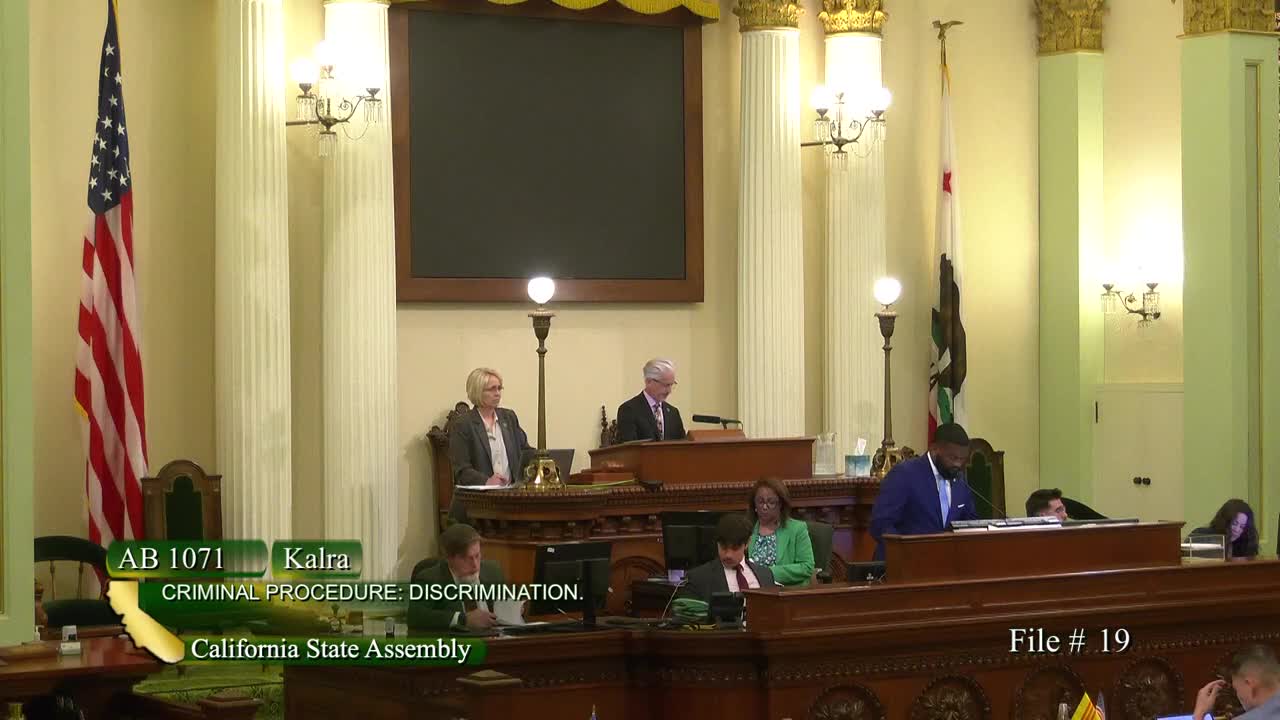 2MIN
Assembly Floor
 18MIN
Assembly Standing Committee on Public Safety
Bill Author

Bill Co-Author(s):