AB 1084: Change of name and gender and sex identifier.
- Session Year: 2025-2026
- House: Assembly
- Latest Version Date: 2025-10-13
Current Status:
Passed
(2025-10-13: Chaptered by Secretary of State - Chapter 723, Statutes of 2025.)
Introduced
In Committee
Awaiting First Chamber Vote
Passed First Chamber
In Committee
Awaiting Second Chamber Vote
Passed Second Chamber
Enacted
Existing law establishes procedures for an adult petitioner to obtain a court order for a change of name to conform to the petitioners gender identity. Existing law requires the court to make an order to show cause with regard to the petition and a process for persons interested to make known any objection to the change of name by filing a written objection within 6 weeks of the making of the order. Existing law requires, in the case of a conforming name change petition for a minor that does not include the signatures of both living parents, the petition and the order to show cause to be served as prescribed on the nonsigning parent within 30 days of the order.
This bill, commencing July 1, 2026, would eliminate the mechanism to file an objection to an adult petitioners change of name to conform to the petitioners name to the petitioners gender identity. The bill would require the court to enter an order granting the petition without a hearing within 6 weeks of the petitions filing, as specified.
The bill would require, for a change of name to conform a minor petitioners name to their gender identity signed by all living parents of the minor, the court to enter, within 6 weeks of the filing of the petition and without a hearing, an order that the change of name is granted. The bill would require, if the petition is not signed by all living parents of the minor, the court to make an order reciting specified information, and require the petition and the order to be served on any parent who did not sign the petition within 4 weeks of the date of the order. The bill would require that no hearing date be set unless an objection is timely filed and shows good cause for opposing the name change.
Existing law authorizes a person to file a petition with the superior court for a court order to issue a new marriage license and certificate, confidential marriage license and certificate, or birth certificate to reflect a change in gender and sex identifier. Existing law provides a process for specified individuals to be given notice and an opportunity to respond to the petition, as specified, including that any objection to the petition must be filed within 6 weeks of the making of the order or the court will, without hearing, enter an order granting the petition. Existing law requires, if no service on any party is required, the court to grant the petition without a hearing if no written objection is timely filed within 6 weeks of the filing of the petition.
Existing law requires the petitioner to file a judgment ordering a new birth certificate or marriage license and certificate to be filed with the State Registrar or county clerk, as applicable, within 30 days from the date of the judgment.
This bill, commencing July 1, 2026, would eliminate the requirement that a petitioner file the judgment within 30 days from the date of the judgment.
Existing law establishes procedures for an adult petitioner to obtain a court order for a change of name to conform to the petitioners gender identity. Existing law requires the court to make an order to show cause with regard to the petition and a process for persons interested to make known any objection to the change of name by filing a written objection within 6 weeks of the making of the order. Existing law requires, in the case of a conforming name change petition for a minor that does not include the signatures of both living parents, the petition and the order to show cause to be served as prescribed on the nonsigning parent within 30 days of the order.
This bill bill, commencing July 1, 2026, would eliminate the mechanism to file an objection to an adult petitioners change of name to conform to the petitioners name to the petitioners gender identity. The bill would require the court to enter an order granting the petition without a hearing within 6 weeks of the petitions filing, as specified.
The bill would require, for a change of name to conform a minor petitioners name to their gender identity signed by all living parents of the minor, the court to enter, within 6 weeks of the filing of the petition and without a hearing, an order that the change of name is granted. The bill would require, if the petition is not signed by all living parents of the minor, the court to make an order reciting specified information, and require the petition and the order to be served on any parent who did not sign the petition. petition within 4 weeks of the date of the order. The bill would require that no hearing date be set unless an objection is timely filed and shows good cause for opposing the name change.
Existing law authorizes a person to file a petition with the superior court for a court order to issue a new marriage license and certificate, confidential marriage license and certificate, or birth certificate to reflect a change in gender and sex identifier. Existing law provides a process for specified individuals to be given notice and an opportunity to respond to the petition, as specified, including that any objection to the petition must be filed within 6 weeks of the making of the order or the court will, without hearing, enter an order granting the petition. Existing law requires, if no service on any party is required, the court to grant the petition without a hearing if no written objection is timely filed within 6 weeks of the filing of the petition.
This bill would require the notice provided to specified individuals to additionally include that the court will grant the petition as soon as possible after the completion of the 6-week objection period. The bill would require, if no service on any party is required, the court to grant the petition without a hearing if no written objection is timely filed within 6 weeks of the filing of the petition, and as soon as possible after the completion of the 2-week objection period.Existing law requires the petitioner to file a judgment ordering a new birth certificate or marriage license and certificate to be filed with the State Registrar or county clerk, as applicable, within 30 days from the date of the judgment.
This bill bill, commencing July 1, 2026, would eliminate the requirement that a petitioner file the judgment within 30 days from the date of the judgment.
This bill would declare that it is to take effect immediately as an urgency statute.Existing law establishes procedures for an adult petitioner to obtain a court order for a change of name to conform to the petitioners gender identity. Existing law requires the court to make an order to show cause with regard to the petition and a process for persons interested to make known any objection to the change of name by filing a written objection within 6 weeks of the making of the order. Existing law requires, in the case of a conforming name change petition for a minor that does not include the signatures of both living parents, the petition and the order to show cause to be served as prescribed on the nonsigning parent within 30 days of the order.
This bill would eliminate the mechanism to file an objection to an adult petitioners change of name to conform to the petitioners name to the petitioners gender identity. The bill would require the court to enter an order granting the petition without a hearing within 2 6 weeks of the petitions filing, as specified.
The bill would require, for a change of name to conform a minor petitioners name to their gender identity signed by all living parents of the minor, the court to enter, within 2 6 weeks of the filing of the petition and without a hearing, an order that the change of name is granted. The bill would require, if the petition is not signed by all living parents of the minor, the court to make an order reciting specified information, and require the petition and the order to be served on any parent who did not sign the petition. The bill would require that no hearing date be set unless an objection is timely filed and shows good cause for opposing the name change.
Existing law authorizes a person to file a petition with the superior court for a court order to issue a new marriage license and certificate, confidential marriage license and certificate, or birth certificate to reflect a change in gender and sex identifier. Existing law provides a process for specified individuals to be given notice and an opportunity to respond to the petition, as specified, including that any objection to the petition must be filed within 6 weeks of the making of the order or the court will, without hearing, enter an order granting the petition. Existing law requires, if no service on any party is required, the court to grant the petition without a hearing if no written objection is timely filed within 6 weeks of the filing of the petition.
This bill would require the notice provided to specified individuals to additionally include that the court will grant the petition as soon as possible after the completion of the 6-week objection period. The bill would require, if no service on any party is required, the court to grant the petition without a hearing if no written objection is timely filed within 2 6 weeks of the filing of the petition, and as soon as possible after the completion of the 2-week objection period.
Existing law authorizes a person to obtain a new marriage license and certificate, confidential marriage license and certificate, or birth certificate for their minor or adult child directly from the State Registrar or county clerk, as applicable, to reflect the persons change of gender and sex identifier to female, male, or nonbinary without a court order, if the person submits specific supporting documentation. Existing law requires the petitioner to file a judgment ordering a new birth certificate or marriage license and certificate to be filed with the State Registrar or county clerk, as applicable, within 30 days from the date of the judgment.
This bill would eliminate the requirement that a petitioner file the judgment within 30 days from the date of the judgment. The bill would require the State Registrar or county clerk, as applicable, to issue a new birth certificate or marriage license and certificate within 6 weeks of the receipt of an application. By creating new duties of a county clerk under these provisions, this bill would impose a state-mandated local program.
The California Constitution requires the state to reimburse local agencies and school districts for certain costs mandated by the state. Statutory provisions establish procedures for making that reimbursement.This bill would provide that, if the Commission on State Mandates determines that the bill contains costs mandated by the state, reimbursement for those costs shall be made pursuant to the statutory provisions noted above.This bill would declare that it is to take effect immediately as an urgency statute.
Existing law establishes procedures for an adult petitioner to obtain a court order for a change of name to conform to the petitioners gender identity. Existing law requires the court to make an order to show cause with regard to the petition and a process for persons interested to make known any objection to the change of name by filing a written objection within six 6 weeks of the making of the order. Existing law requires, in the case of a conforming name change petition for a minor that does not include the signatures of both living parents, the petition and the order to show cause to be served as prescribed on the nonsigning parent within 30 days of the order.
This bill would eliminate the mechanism to file an objection to an adult petitioners change of name to conform to the petitioners name to the petitioners gender identity. The bill would require the court to enter an order granting the petition without a hearing within two 2 weeks of the petitions filing, as specified.
The bill would require, for a change of name to conform a minor petitioners name to their gender identity signed by all living parents of the minor, the court to enter, within two 2 weeks of the filing of the petition and without a hearing, an order that the change of name is granted. The bill would require, if the petition is not signed by all living parents of the minor, the court to make an order reciting specified information, and require the petition and the order to be served on any parent who did not sign the petition. The bill would require that no hearing date be set unless an objection is timely filed and shows good cause for opposing the name change.
Existing law authorizes a person to file a petition with the superior court for a court order to issue a new marriage license and certificate, confidential marriage license and certificate, or birth certificate to reflect a change in gender and sex identifier. Existing law provides a process for specified individuals to be given notice and an opportunity to respond to the petition, as specified, including that any objection to the petition must be filed within 6 weeks of the making of the order or the court will, without hearing, enter an order granting the petition. Existing law requires, if no service on any party is required, the court to grant the petition without a hearing if no written objection is timely filed within 6 weeks of the filing of the petition.
This bill would require the notice provided to specified individuals to additionally include that the court will grant the petition as soon as possible after the completion of the 6-week objection period. The bill would require, if no service on any party is required, the court to grant the petition without a hearing if no written objection is timely filed within 2 weeks of the filing of the petition, and as soon as possible after the completion of the 2-week objection period.
Existing law authorizes a person to obtain a new marriage license and certificate, confidential marriage license and certificate, or birth certificate for their minor or adult child directly from the State Registrar or county clerk, as applicable, to reflect the persons change of gender and sex identifier to female, male, or nonbinary without a court order, if the person submits specific supporting documentation. Existing law requires the petitioner to file a judgment ordering a new birth certificate or marriage license and certificate to be filed with the State Registrar or county clerk, as applicable, within 30 days from the date of the judgment.
This bill would eliminate the requirement that a petitioner file the judgment within 30 days from the date of the judgment. The bill would require the State Registrar or county clerk, as applicable, to issue a new birth certificate or marriage license and certificate within two 6 weeks of the receipt of an application. By creating new duties of a county clerk under these provisions, this bill would impose a state-mandated local program.
The California Constitution requires the state to reimburse local agencies and school districts for certain costs mandated by the state. Statutory provisions establish procedures for making that reimbursement.
This bill would provide that, if the Commission on State Mandates determines that the bill contains costs mandated by the state, reimbursement for those costs shall be made pursuant to the statutory provisions noted above.
This bill would declare that it is to take effect immediately as an urgency statute.
Existing law establishes procedures for an adult petitioner to obtain a court order for a change of name to conform to the petitioners gender identity. Existing law requires the court to make an order to show cause with regard to the petition and a process for persons interested to make known any objection to the change of name by filing a written objection within six weeks of the making of the order. Existing law requires, in the case of a conforming name change petition for a minor that does not include the signatures of both living parents, the petition and the order to show cause to be served as prescribed on the nonsigning parent within 30 days of the order.
This bill would eliminate the mechanism to file an objection to an adult petitioners change of name to conform to the petitioners name to the petitioners gender identity. The bill would require the court to enter an order granting the petition without a hearing within two weeks of the petitions filing, as specified.
The bill would require, for a change of name to conform a minor petitioners name to their gender identity signed by all living parents of the minor, the court to enter, within two weeks of the filing of the petition and without a hearing, an order that the change of name is granted. The bill would require, if the petition is not signed by all living parents of the minor, the court to make an order reciting specified information, and require the petition and the order to be served on any parent who did not sign the petition. The bill would require that no hearing date be set unless an objection is timely filed and shows good cause for opposing the name change.
Existing law authorizes a person to file a petition with the superior court for a court order to issue a new marriage license and certificate, confidential marriage license and certificate, or birth certificate to reflect a change in gender and sex identifier. Existing law provides a process for specified individuals to be given notice and an opportunity to respond to the petition, as specified, including that any objection to the petition must be filed within 6 weeks of the making of the order or the court will, without hearing, enter an order granting the petition. Existing law requires, if no service on any party is required, the court to grant the petition without a hearing if no written objection is timely filed within 6 weeks of the filing of the petition.
This bill would require the notice provided to specified individuals to additionally include that the court will grant the petition as soon as possible after the completion of the 6-week objection period. The bill would require, if no service on any party is required, the court to grant the petition without a hearing if no written objection is timely filed within 2 weeks of the filing of the petition, and as soon as possible after the completion of the 2-week objection period.
Existing law authorizes a person to obtain a new marriage license and certificate, confidential marriage license and certificate, or birth certificate for their minor or adult child directly from the State Registrar or county clerk, as applicable, to reflect the persons change of gender and sex identifier to female, male, or nonbinary without a court order, if the person submits specific supporting documentation. Existing law requires the petitioner to file a judgment ordering a new birth certificate or marriage license and certificate to be filed with the State Registrar or county clerk, as applicable, within 30 days from the date of the judgment.
This bill would eliminate the requirement that a petitioner file the judgment within 30 days from the date of the judgment. The bill would require the State Registrar or county clerk, as applicable, to issue a new birth certificate or marriage license and certificate within two weeks of the receipt of an application. By creating new duties of a county clerk under these provisions, this bill would impose a state-mandated local program.
The California Constitution requires the state to reimburse local agencies and school districts for certain costs mandated by the state. Statutory provisions establish procedures for making that reimbursement.
This bill would provide that, if the Commission on State Mandates determines that the bill contains costs mandated by the state, reimbursement for those costs shall be made pursuant to the statutory provisions noted above.
This bill would declare that it is to take effect immediately as an urgency statute.
(a)(1)If a proceeding for a change of name to conform the petitioners name to the petitioners gender identity is commenced by the filing of a petition, the court shall thereupon make an order reciting the filing of the petition, the name of the person by whom it is filed, and the name proposed. The order shall direct all persons interested in the matter to make known any objection to the change of name by filing a written objection, which includes any reasons for the objection, within six weeks of the making of the order, and shall state that if no objection showing good cause to oppose the name change is timely filed, the court shall, without hearing, enter the order that the change of name is granted.
(2)If a petition is filed to change the name of a minor to conform to gender identity that does not include the signatures of both living parents, the petition and the order to show cause made in accordance with paragraph (1) shall be served on the parent who did not sign the petition, pursuant to Section 413.10, 414.10, 415.10, or 415.40, within 30 days from the date on which the order is made by the court. If service cannot reasonably be accomplished pursuant to Section 415.10 or 415.40, the court may order that service be accomplished in a manner that the court determines is reasonably calculated to give actual notice to the parent who did not sign the petition.
(b)The proceeding for a change of name to conform the petitioners name to the petitioners gender identity is exempt from any requirement for publication.
(c)A hearing date shall not be set in the proceeding unless an objection is timely filed and shows good cause for opposing the name change. Objections based solely on concerns that the proposed change is not the petitioners actual gender identity or gender assigned at birth shall not constitute good cause. At the hearing, the court may examine under oath any of the petitioners, remonstrants, or other persons touching the petition or application, and may make an order changing the name or dismissing the petition or application as the court may deem right and proper.
(d)This section shall become inoperative on July 1, 2026, and, as of January 1, 2027, is repealed.
SEC. 2.Section 1277.5 is added to the Code of Civil Procedure, to read:1277.5.(a)If a proceeding for a change of name to conform an adult petitioners name to their gender identity is commenced by the filing of a petition, the court shall, without hearing and within six weeks of the petitions filing, enter an order that the change of name is granted, except as provided in Section 1279.5.
(b)(1)If a proceeding for a change of name to conform a minor petitioners name to their gender identity is commenced by the filing of a petition, and that petition includes the signatures of all of the minors living parents, the court shall, without hearing and within six weeks of the filing of the petition, enter an order that the change of name is granted, except as provided in Section 1279.5.
(2)(A)If a proceeding for change of name to conform a minor petitioners name to their gender identity is commenced by the filing of a petition, and that petition does not include the signatures of all of the minors living parents, the court shall make an order reciting the filing of the petition, the name of the person by whom it is filed, and the name proposed.
(B)The order shall direct all persons interested in the matter to make known any objection to the change of name by filing a written objection, which includes any reasons for the objection, within six weeks of the making of the order, and shall state that if no objection showing good cause to oppose the name change is timely filed, the court shall, without hearing, enter the order that the change of name is granted after the completion of the six weeks, except as provided in Section 1279.5.
(C)The petition and the order shall be served on any parent who did not sign the petition, pursuant to Section 413.10, 414.10, 415.10, or 415.40, within four weeks from the date on which the order is made by the court. If service cannot reasonably be accomplished pursuant to Section 415.10 or 415.40, the court may order that service be accomplished in a manner that the court determines is reasonably calculated to give actual notice to the parent who did not sign the petition.
(D)A hearing date shall not be set in the proceeding unless an objection is timely filed and shows good cause for opposing the name change. Objections based solely on concerns that the proposed change is not the petitioners actual gender identity or gender assigned at birth shall not constitute good cause. At the hearing, the court may examine under oath any of the petitioners, remonstrants, or other persons touching the petition or application, and may make an order changing the name or dismissing the petition or application as the court may deem right and proper.
(c)The proceeding for a change of name to conform the petitioners name to the petitioners gender identity is exempt from any requirement for publication.
(d)This section shall become operative on July 1, 2026.
SEC. 3.Section 103430 of the Health and Safety Code is amended to read:103430.(a)A petition for a court order to recognize a change in the petitioners gender and sex identifier as female, male, or nonbinary and to direct the issuance of new administrative documents to reflect those changes shall be accompanied by an affidavit from the petitioner and a certified copy of the court order changing the petitioners name, if applicable. The petitioners affidavit shall be accepted as conclusive proof of gender change if it contains substantially the following language: I, (petitioners full name), hereby attest under penalty of perjury that the request for a change in gender to (female, male, or nonbinary) is to conform my legal gender to my gender identity and is not for any fraudulent purpose.
(b)(1)If the person whose gender is to be changed is under 18 years of age, the petition shall be signed either (A) by at least one of the minors parents, any guardian of the minor, or a person specified in subdivision (c); or (B) if both parents are deceased and there is no guardian of the minor, by either a near relative or friend of the minor. The affidavit pursuant to subdivision (a) may be signed by the minor.
(2)If the person whose gender is to be changed requests in their petition the issuance of a new marriage license and certificate or confidential marriage license and certificate pursuant to subdivision (c) of Section 103425, the petition shall be signed by the spouse who shares the marriage license and certificate or confidential marriage license and certificate that would be changed by granting the petition if the spouse is living and capable of signing the petition, or, if not signed by the spouse who shares the marriage license and certificate or confidential marriage license and certificate, and the spouse is living and capable, notice must be given to that nonsigning spouse as provided in subdivision (f).
(3)If the person whose gender is to be changed requests in their petition the issuance of a new birth certificate for their adult child pursuant to subdivision (d) of Section 103425, the petition shall be signed by the child whose birth certificate would be changed by granting the petition if the child is 18 years of age or older. A petition that requests a new birth certificate for an adult child pursuant to subdivision (d) of Section 103425 that does not include the signature of the adult child shall not be granted with respect to the new birth certificate for that child if the child is living and capable of providing a signature.
(4)If the person whose gender is to be changed requests in their petition the issuance of a new birth certificate for their minor child pursuant to subdivision (d) of Section 103425, the petition need not include the signature of the petitioners child if the child is under 18 years of age.
(c)A petition to recognize a change of the gender of a minor signed by a guardian appointed by the juvenile court or the probate court, by a court-appointed dependency attorney appointed as guardian ad litem pursuant to rules adopted under Section 326.5 of the Welfare and Institutions Code, or by an attorney for a minor who is alleged or adjudged to be a person described in Section 601 or 602 of the Welfare and Institutions Code shall be made in the court having jurisdiction over the minor. All petitions to recognize a change of the gender of a nonminor dependent may be made in the juvenile court.
(d)(1)If the petition is signed by a guardian, the petition shall specify relevant information regarding the guardianship, the likelihood that the child will remain under the guardians care until the child reaches the age of majority, and information suggesting that the child will not likely be returned to the custody of the childs parents.
(2)Before granting a petition in accordance with this subdivision, the court shall first find that the ward is likely to remain in the guardians care until the age of majority and that the ward is not likely to be returned to the custody of the parents.
(e)(1)If a petition to recognize a change of gender of a minor does not include the signature of all living parents, then upon receipt of the petition, the court shall thereupon make an order directing the parent or parents who did not sign the petition to show cause why the petition for a court order to recognize a change in the minors gender and sex identifier to female, male, or nonbinary should not be granted by filing a written objection, which includes any reasons for the objection, within six weeks of the making of the order, and shall state that if no objection showing good cause to oppose the gender recognition is timely filed, the court shall, without hearing, enter the order that the gender and sex identifier recognition is granted.
(2)If a petition to recognize a change of gender of a minor is filed by a person specified in subdivision (c) and all parents are deceased or cannot be located, then upon receipt of the petition, the court shall thereupon make an order directing the living grandparents to show cause why the petition for a court order to recognize a change in the minors gender and sex identifier to female, male, or nonbinary should not be granted by filing a written objection, which includes any reasons for the objection, within six weeks of the making of the order, and shall state that if no objection showing good cause to oppose the gender recognition is timely filed, the court shall, without hearing, enter the order that the gender and sex identifier recognition is granted.
(3)If a petition pursuant to this section does not include any signature required by paragraph (2) of subdivision (b), then upon receipt of the petition, the court shall thereupon make an order reciting the filing of the petition, the proposed changes to the petitioners marriage license and certificate or confidential marriage license and certificate, and the name of the person by whom it is filed. The order shall direct the spouse of the petitioner who appears on the marriage license and certificate or confidential marriage license and certificate to make known any objection to the changes requested on the marriage license and certificate or confidential marriage license and certificate by filing a written objection, which includes any reasons why the requested changes would be fraudulent, within six weeks of the making of the order, and shall state that if no objection showing good cause to oppose the changes to the marriage license and certificate or confidential marriage license and certificate is timely filed, the court shall, without hearing, enter the order that the gender and sex identifier recognition is granted.
(f)If the court makes an order to show cause in accordance with subdivision (e), the petition and the order to show cause shall be served on the required person or persons who did not sign the petition, pursuant to Section 413.10, 414.10, 415.10, or 415.40 of the Code of Civil Procedure, within four weeks from the date on which the order is made by the court. If service cannot reasonably be accomplished pursuant to Section 415.10 or 415.40 of the Code of Civil Procedure, the court may order that service be accomplished in a manner that the court determines is reasonably calculated to give actual notice to the person who did not sign the petition.
(g)If no service is required on any party pursuant this section, the court shall grant the petition without a hearing if no written objection is timely filed within six weeks of the filing of the petition.
(h)The court shall grant the petition without a hearing, unless a timely objection showing good cause is filed. If an objection showing good cause is timely filed, the court may set a hearing at a time designated by the court. Objections based solely on concerns over the petitioners actual gender identity or gender assigned at birth shall not constitute good cause.
(1)If a timely objection showing good cause is filed by anyone other than a parent who objects to changes to their minor childs birth certificate, at the hearing, the court may examine under oath the petitioner and any other person having knowledge of the facts relevant to the petition. At the conclusion of the hearing, the court shall grant the petition if the court determines that the petition is not made for any fraudulent purpose.
(2)If the objection was timely filed by a parent who objects to changes to their minor childs birth certificate, after holding a hearing on the matter, the court may deny the petition if the court finds that the change of gender and sex identifier is not in the best interest of the minor. At the hearing, the court may examine under oath the minor and any other person having knowledge of the facts relevant to the petition.
(i)This section shall become inoperative on July 1, 2026, and, as of January 1, 2027, is repealed.
SEC. 4.Section 103430 is added to the Health and Safety Code, to read:103430.(a)A petition for a court order to recognize a change in the petitioners gender and sex identifier as female, male, or nonbinary and to direct the issuance of new administrative documents to reflect those changes shall be accompanied by an affidavit from the petitioner and a certified copy of the court order changing the petitioners name, if applicable. The petitioners affidavit shall be accepted as conclusive proof of gender change if it contains substantially the following language: I, (petitioners full name), hereby attest under penalty of perjury that the request for a change in gender to (female, male, or nonbinary) is to conform my legal gender to my gender identity and is not for any fraudulent purpose.
(b)(1)If the person whose gender is to be changed is under 18 years of age, the petition shall be signed either (A) by at least one of the minors parents, any guardian of the minor, or a person specified in subdivision (c); or (B) if both parents are deceased and there is no guardian of the minor, by either a near relative or friend of the minor. The affidavit pursuant to subdivision (a) may be signed by the minor.
(2)If the person whose gender is to be changed requests in their petition the issuance of a new marriage license and certificate or confidential marriage license and certificate pursuant to subdivision (c) of Section 103425, the petition shall be signed by the spouse who shares the marriage license and certificate or confidential marriage license and certificate that would be changed by granting the petition if the spouse is living and capable of signing the petition, or, if not signed by the spouse who shares the marriage license and certificate or confidential marriage license and certificate, and the spouse is living and capable, notice must be given to that nonsigning spouse as provided in subdivision (f).
(3)If the person whose gender is to be changed requests in their petition the issuance of a new birth certificate for their adult child pursuant to subdivision (d) of Section 103425, the petition shall be signed by the child whose birth certificate would be changed by granting the petition if the child is 18 years of age or older. A petition that requests a new birth certificate for an adult child pursuant to subdivision (d) of Section 103425 that does not include the signature of the adult child shall not be granted with respect to the new birth certificate for that child if the child is living and capable of providing a signature.
(4)If the person whose gender is to be changed requests in their petition the issuance of a new birth certificate for their minor child pursuant to subdivision (d) of Section 103425, the petition need not include the signature of the petitioners child if the child is under 18 years of age.
(c)A petition to recognize a change of the gender of a minor signed by a guardian appointed by the juvenile court or the probate court, by a court-appointed dependency attorney appointed as guardian ad litem pursuant to rules adopted under Section 326.5 of the Welfare and Institutions Code, or by an attorney for a minor who is alleged or adjudged to be a person described in Section 601 or 602 of the Welfare and Institutions Code shall be made in the court having jurisdiction over the minor. All petitions to recognize a change of the gender of a nonminor dependent may be made in the juvenile court.
(d)(1)If the petition is signed by a guardian, the petition shall specify relevant information regarding the guardianship, the likelihood that the child will remain under the guardians care until the child reaches the age of majority, and information suggesting that the child will not likely be returned to the custody of the childs parents.
(2)Before granting a petition in accordance with this subdivision, the court shall first find that the ward is likely to remain in the guardians care until the age of majority and that the ward is not likely to be returned to the custody of the parents.
(e)(1)If a petition to recognize a change of gender of a minor does not include the signature of all living parents, then upon receipt of the petition, the court shall thereupon make an order directing the parent or parents who did not sign the petition to show cause why the petition for a court order to recognize a change in the minors gender and sex identifier to female, male, or nonbinary should not be granted by filing a written objection, which includes any reasons for the objection, within six weeks of the making of the order, and shall state that if no objection showing good cause to oppose the gender recognition is timely filed, the court shall, without hearing, enter the order that the gender and sex identifier recognition is granted after the completion of the six weeks.
(2)If a petition to recognize a change of gender of a minor is filed by a person specified in subdivision (c) and all parents are deceased or cannot be located, then upon receipt of the petition, the court shall thereupon make an order directing the living grandparents to show cause why the petition for a court order to recognize a change in the minors gender and sex identifier to female, male, or nonbinary should not be granted by filing a written objection, which includes any reasons for the objection, within six weeks of the making of the order, and shall state that if no objection showing good cause to oppose the gender recognition is timely filed, the court shall, without hearing, enter the order that the gender and sex identifier recognition is granted after the completion of the six weeks.
(3)If a petition pursuant to this section does not include any signature required by paragraph (2) of subdivision (b), then upon receipt of the petition, the court shall thereupon make an order reciting the filing of the petition, the proposed changes to the petitioners marriage license and certificate or confidential marriage license and certificate, and the name of the person by whom it is filed. The order shall direct the spouse of the petitioner who appears on the marriage license and certificate or confidential marriage license and certificate to make known any objection to the changes requested on the marriage license and certificate or confidential marriage license and certificate by filing a written objection, which includes any reasons why the requested changes would be fraudulent, within six weeks of the making of the order, and shall state that if no objection showing good cause to oppose the changes to the marriage license and certificate or confidential marriage license and certificate is timely filed, the court shall, without hearing, enter the order that the gender and sex identifier recognition is granted after the completion of the six weeks.
(f)If the court makes an order to show cause in accordance with subdivision (e), the petition and the order to show cause shall be served on the required person or persons who did not sign the petition, pursuant to Section 413.10, 414.10, 415.10, or 415.40 of the Code of Civil Procedure, within four weeks from the date on which the order is made by the court. If service cannot reasonably be accomplished pursuant to Section 415.10 or 415.40 of the Code of Civil Procedure, the court may order that service be accomplished in a manner that the court determines is reasonably calculated to give actual notice to the person who did not sign the petition.
(g)If no service is required on any party pursuant this section, the court shall grant the petition without a hearing if no written objection is timely filed within six weeks of the filing of the petition.
(h)The court shall grant the petition without a hearing, unless a timely objection showing good cause is filed. If an objection showing good cause is timely filed, the court may set a hearing at a time designated by the court. Objections based solely on concerns over the petitioners actual gender identity or gender assigned at birth shall not constitute good cause.
(1)If a timely objection showing good cause is filed by anyone other than a parent who objects to changes to their minor childs birth certificate, at the hearing, the court may examine under oath the petitioner and any other person having knowledge of the facts relevant to the petition. At the conclusion of the hearing, the court shall grant the petition if the court determines that the petition is not made for any fraudulent purpose.
(2)If the objection was timely filed by a parent who objects to changes to their minor childs birth certificate, after holding a hearing on the matter, the court may deny the petition if the court finds that the change of gender and sex identifier is not in the best interest of the minor. At the hearing, the court may examine under oath the minor and any other person having knowledge of the facts relevant to the petition.
(i)This section shall become operative on July 1, 2026.
SEC. 5.Section 103431 of the Health and Safety Code is amended to read:103431.(a)(1)If a judgment pursuant to Section 103430 includes an order for a new birth certificate for the petitioner and if the petitioner has a birth certificate issued by this state, a certified copy of the judgment of the court ordering the new birth certificate, shall, within 30 days from the date of the judgment, be filed by the petitioner with the State Registrar. Upon receipt thereof, together with the application and the fee prescribed by Section 103725, the State Registrar shall establish a new birth certificate for the petitioner.
(2)The new birth certificate shall reflect the gender of the petitioner, as specified in the judgment of the court, and shall reflect any change of name, as specified in the court order, as prescribed by Section 103425. No reference shall be made in the new birth certificate, nor shall its form in any way indicate, that it is not the original birth certificate of the petitioner.
(b)(1)(A)If a judgment pursuant to Section 103430 includes an order for a new marriage license and certificate, and the original marriage license and certificate was confidential and issued within this state, a certified copy of the judgment of the court ordering the new confidential marriage license and certificate shall, within 30 days from the date of the judgment, be filed by the petitioner with the county clerk in the county where the confidential marriage license and certificate was issued, along with the application and the fee established by the county clerk, not to exceed the fee for any other confidential marriage license and certificate issued by the county clerk and not to exceed the reasonable cost to provide the confidential marriage license and certificate. Upon receipt of the copy of the judgment, the application, and the fee, the county clerk shall issue a confidential marriage license and certificate for the petitioner.
(B)If a judgment pursuant to Section 103430 includes an order for a new marriage license and certificate, and the original marriage license and certificate was not confidential and issued within this state, a certified copy of the judgment of the court ordering the new marriage license and certificate shall, within 30 days from the date of the judgment, be filed by the petitioner with the State Registrar, along with the application and the fee prescribed by Section 103725. Upon receipt of the copy of the judgment, the application, and the fee, the State Registrar shall establish a new marriage license and certificate for the petitioner.
(2)If a new marriage license and certificate or confidential marriage license and certificate is requested under subdivision (c) of Section 103425, the new marriage license and certificate or new confidential marriage license and certificate shall reflect any change in the designation of the person as bride, groom, or having neither box checked as requested, and shall reflect any change of name, as specified in the court order, as prescribed by Section 103425. If the New Names section of the original marriage license and certificate or original confidential marriage license and certificate that refers to the person whose gender and sex identifier was changed pursuant to Section 103430 does not match any change of name, as specified in the court order, then the New Names section for that person shall be left blank on the new marriage license and certificate or new confidential marriage license and certificate of marriage. A new marriage license and certificate or new confidential marriage license and certificate issued pursuant to this article shall not entitle the parties to the marriage to change their names using the procedures in Section 306.5 of the Family Code at the time of the issuance of the new marriage license and certificate or confidential marriage license and certificate. Notwithstanding Sections 103235 and 103255, reference shall not be made in the new marriage license and certificate or new confidential marriage license and certificate, and its form shall not in any way indicate, that it is not the original marriage license and certificate or original confidential marriage license and certificate of the petitioner.
(c)(1)If a judgment pursuant to Section 103430 includes an order for a new birth certificate for the petitioners child and if the petitioners child has a birth certificate issued by this state, a certified copy of the judgment of the court ordering the new birth certificate, shall, within 30 days from the date of the judgment, be filed by the petitioner with the State Registrar. Upon receipt thereof, together with the application and the fee prescribed by Section 103725, the State Registrar shall establish a new birth certificate for the petitioners child.
(2)If a new birth certificate is requested under subdivision (d) of Section 103425, the new birth certificate for the petitioners child shall reflect the change of the designation of the petitioner as mother, father, or parent and, if applicable, any change of name of the petitioner, as specified in the court order and as prescribed by Section 103425. Reference shall not be made in the new birth certificate, and its form shall not in any way indicate, that it is not the original birth certificate of the petitioners child.
(d)This section shall become inoperative on July 1, 2026, and, as of January 1, 2027, is repealed.
SEC. 6.Section 103431 is added to the Health and Safety Code, to read:103431.(a)(1)If a judgment pursuant to Section 103430 includes an order for a new birth certificate for the petitioner and if the petitioner has a birth certificate issued by this state, a certified copy of the judgment of the court ordering the new birth certificate, shall be filed by the petitioner with the State Registrar. Upon receipt thereof, together with the application and the fee prescribed by Section 103725, the State Registrar shall establish a new birth certificate for the petitioner.
(2)The new birth certificate shall reflect the gender of the petitioner, as specified in the judgment of the court, and shall reflect any change of name, as specified in the court order, as prescribed by Section 103425. No reference shall be made in the new birth certificate, nor shall its form in any way indicate, that it is not the original birth certificate of the petitioner.
(b)(1)(A)If a judgment pursuant to Section 103430 includes an order for a new marriage license and certificate, and the original marriage license and certificate was confidential and issued within this state, a certified copy of the judgment of the court ordering the new confidential marriage license and certificate shall be filed by the petitioner with the county clerk in the county where the confidential marriage license and certificate was issued, along with the application and the fee established by the county clerk, not to exceed the fee for any other confidential marriage license and certificate issued by the county clerk and not to exceed the reasonable cost to provide the confidential marriage license and certificate. Upon receipt of the copy of the judgment, the application, and the fee, the county clerk shall issue a confidential marriage license and certificate for the petitioner.
(B)If a judgment pursuant to Section 103430 includes an order for a new marriage license and certificate, and the original marriage license and certificate was not confidential and issued within this state, a certified copy of the judgment of the court ordering the new marriage license and certificate shall be filed by the petitioner with the State Registrar, along with the application and the fee prescribed by Section 103725. Upon receipt of the copy of the judgment, the application, and the fee, the State Registrar shall establish a new marriage license and certificate for the petitioner.
(2)If a new marriage license and certificate or confidential marriage license and certificate is requested under subdivision (c) of Section 103425, the new marriage license and certificate or new confidential marriage license and certificate shall reflect any change in the designation of the person as bride, groom, or having neither box checked as requested, and shall reflect any change of name, as specified in the court order, as prescribed by Section 103425. If the New Names section of the original marriage license and certificate or original confidential marriage license and certificate that refers to the person whose gender and sex identifier was changed pursuant to Section 103430 does not match any change of name, as specified in the court order, then the New Names section for that person shall be left blank on the new marriage license and certificate or new confidential marriage license and certificate of marriage. A new marriage license and certificate or new confidential marriage license and certificate issued pursuant to this article shall not entitle the parties to the marriage to change their names using the procedures in Section 306.5 of the Family Code at the time of the issuance of the new marriage license and certificate or confidential marriage license and certificate. Notwithstanding Sections 103235 and 103255, reference shall not be made in the new marriage license and certificate or new confidential marriage license and certificate, and its form shall not in any way indicate, that it is not the original marriage license and certificate or original confidential marriage license and certificate of the petitioner.
(c)(1)If a judgment pursuant to Section 103430 includes an order for a new birth certificate for the petitioners child and if the petitioners child has a birth certificate issued by this state, a certified copy of the judgment of the court ordering the new birth certificate, shall be filed by the petitioner with the State Registrar. Upon receipt thereof, together with the application and the fee prescribed by Section 103725, the State Registrar shall establish a new birth certificate for the petitioners child.
(2)If a new birth certificate is requested under subdivision (d) of Section 103425, the new birth certificate for the petitioners child shall reflect the change of the designation of the petitioner as mother, father, or parent and, if applicable, any change of name of the petitioner, as specified in the court order and as prescribed by Section 103425. Reference shall not be made in the new birth certificate, and its form shall not in any way indicate, that it is not the original birth certificate of the petitioners child.
(d)This section shall become operative on July 1, 2026.
SEC. 7.Section 103435 of the Health and Safety Code is amended to read:103435.(a)In lieu of separate proceedings, a single petition may be filed with the superior court to change the petitioners name and recognize the change to the petitioners gender and sex identifier and, if requested, to order the issuance of a new birth certificate, marriage license and certificate, confidential marriage license and certificate, or birth certificate of the petitioners child. With respect to a single petition, the court shall comply with both of the following:
(1)The procedure set forth in Title 8 (commencing with Section 1275) of Part 3 of the Code of Civil Procedure; however, the order to show cause shall not include the petition to recognize the change of gender and sex identifier.
(2)The procedure set forth in Section 103430 if there is a request for a new marriage license and certificate, confidential marriage license and certificate, or for a new birth certificate for any child of the petitioner.
(b)(1)A certified copy of the judgment of the court issued pursuant to this section shall, within 30 days, be filed by the petitioner with the Secretary of State.
(2)A certified copy of the judgment of the court issued pursuant to this section shall, within 30 days, be filed by the petitioner with the State Registrar, if any of the following conditions are met:
(A)The judgment includes an order for a new birth certificate and the petitioner has a birth certificate issued by this state.
(B)The judgment includes an order for a new marriage license and certificate and the original marriage license and certificate was issued within this state.
(C)The judgment includes an order for a new birth certificate for the petitioners child and the petitioners child has a birth certificate issued by this state.
(3)If the judgment issued pursuant to this section includes an order for a new marriage license and certificate, and the original marriage license and certificate was confidential and issued within this state, a certified copy of the judgment of the court shall, within 30 days, be filed by the petitioner with the county clerk in the county where the confidential marriage license and certificate was issued.
(c)Upon receipt of a certified copy of a judgment of the court issued pursuant to this section, together with the application and the fee prescribed by Section 103725, the State Registrar shall establish a new birth certificate or marriage license and certificate as provided in this article.
(d)Upon receipt of a certified copy of a judgment of the court issued pursuant to this section, together with the application and the fee established by the county clerk, not to exceed the fee for any other confidential marriage license and certificate issued by the county clerk and not to exceed the reasonable cost to provide the confidential marriage license and certificate, the county clerk shall issue a new confidential marriage license and certificate as provided in this article.
(e)This section shall become inoperative on July 1, 2026, and, as of January 1, 2027, is repealed.
SEC. 8.Section 103435 is added to the Health and Safety Code, to read:103435.(a)In lieu of separate proceedings, a single petition may be filed with the superior court to change the petitioners name and recognize the change to the petitioners gender and sex identifier and, if requested, to order the issuance of a new birth certificate, marriage license and certificate, confidential marriage license and certificate, or birth certificate of the petitioners child. With respect to a single petition, the court shall comply with both of the following:
(1)The procedure set forth in Title 8 (commencing with Section 1275) of Part 3 of the Code of Civil Procedure; however, the order to show cause shall not include the petition to recognize the change of gender and sex identifier.
(2)The procedure set forth in Section 103430 if there is a request for a new marriage license and certificate, confidential marriage license and certificate, or for a new birth certificate for any child of the petitioner.
(b)(1)A certified copy of the judgment of the court issued pursuant to this section shall be filed by the petitioner with the Secretary of State.
(2)A certified copy of the judgment of the court issued pursuant to this section shall be filed by the petitioner with the State Registrar, if any of the following conditions are met:
(A)The judgment includes an order for a new birth certificate and the petitioner has a birth certificate issued by this state.
(B)The judgment includes an order for a new marriage license and certificate and the original marriage license and certificate was issued within this state.
(C)The judgment includes an order for a new birth certificate for the petitioners child and the petitioners child has a birth certificate issued by this state.
(3)If the judgment issued pursuant to this section includes an order for a new marriage license and certificate, and the original marriage license and certificate was confidential and issued within this state, a certified copy of the judgment of the court shall be filed by the petitioner with the county clerk in the county where the confidential marriage license and certificate was issued.
(c)Upon receipt of a certified copy of a judgment of the court issued pursuant to this section, together with the application and the fee prescribed by Section 103725, the State Registrar shall establish a new birth certificate or marriage license and certificate as provided in this article.
(d)Upon receipt of a certified copy of a judgment of the court issued pursuant to this section, together with the application and the fee established by the county clerk, not to exceed the fee for any other confidential marriage license and certificate issued by the county clerk and not to exceed the reasonable cost to provide the confidential marriage license and certificate, the county clerk shall issue a new confidential marriage license and certificate as provided in this article.
(e)This section shall become operative on July 1, 2026.
(a)(1)If a proceeding for a change of name to conform the petitioners name to the petitioners gender identity is commenced by the filing of a petition, the court shall thereupon make an order reciting the filing of the petition, the name of the person by whom it is filed, and the name proposed. The order shall direct all persons interested in the matter to make known any objection to the change of name by filing a written objection, which includes any reasons for the objection, within six weeks of the making of the order, and shall state that if no objection showing good cause to oppose the name change is timely filed, the court shall, without hearing, enter the order that the change of name is granted.
(2)If a petition is filed to change the name of a minor to conform to gender identity that does not include the signatures of both living parents, the petition and the order to show cause made in accordance with paragraph (1) shall be served on the parent who did not sign the petition, pursuant to Section 413.10, 414.10, 415.10, or 415.40, within 30 days from the date on which the order is made by the court. If service cannot reasonably be accomplished pursuant to Section 415.10 or 415.40, the court may order that service be accomplished in a manner that the court determines is reasonably calculated to give actual notice to the parent who did not sign the petition.
(b)The proceeding for a change of name to conform the petitioners name to the petitioners gender identity is exempt from any requirement for publication.
(c)A hearing date shall not be set in the proceeding unless an objection is timely filed and shows good cause for opposing the name change. Objections based solely on concerns that the proposed change is not the petitioners actual gender identity or gender assigned at birth shall not constitute good cause. At the hearing, the court may examine under oath any of the petitioners, remonstrants, or other persons touching the petition or application, and may make an order changing the name or dismissing the petition or application as the court may deem right and proper.
(d)This section shall become inoperative on July 1, 2026, and, as of January 1, 2027, is repealed.
SEC. 2.Section 1277.5 is added to the Code of Civil Procedure, to read:1277.5.(a)If a proceeding for a change of name to conform an adult petitioners name to their gender identity is commenced by the filing of a petition, the court shall, without hearing and within six weeks of the petitions filing, enter an order that the change of name is granted, except as provided in Section 1279.5.
(b)(1)If a proceeding for a change of name to conform a minor petitioners name to their gender identity is commenced by the filing of a petition, and that petition includes the signatures of all of the minors living parents, the court shall, without hearing and within six weeks of the filing of the petition, enter an order that the change of name is granted, except as provided in Section 1279.5.
(2)(A)If a proceeding for change of name to conform a minor petitioners name to their gender identity is commenced by the filing of a petition, and that petition does not include the signatures of all of the minors living parents, the court shall make an order reciting the filing of the petition, the name of the person by whom it is filed, and the name proposed.
(B)The order shall direct all persons interested in the matter to make known any objection to the change of name by filing a written objection, which includes any reasons for the objection, within six weeks of the making of the order, and shall state that if no objection showing good cause to oppose the name change is timely filed, the court shall, without hearing, enter the order that the change of name is granted after the completion of the six weeks, except as provided in Section 1279.5.
(C)The petition and the order shall be served on any parent who did not sign the petition, pursuant to Section 413.10, 414.10, 415.10, or 415.40, within four weeks from the date on which the order is made by the court. If service cannot reasonably be accomplished pursuant to Section 415.10 or 415.40, the court may order that service be accomplished in a manner that the court determines is reasonably calculated to give actual notice to the parent who did not sign the petition.
(D)A hearing date shall not be set in the proceeding unless an objection is timely filed and shows good cause for opposing the name change. Objections based solely on concerns that the proposed change is not the petitioners actual gender identity or gender assigned at birth shall not constitute good cause. At the hearing, the court may examine under oath any of the petitioners, remonstrants, or other persons touching the petition or application, and may make an order changing the name or dismissing the petition or application as the court may deem right and proper.
(c)The proceeding for a change of name to conform the petitioners name to the petitioners gender identity is exempt from any requirement for publication.
(d)This section shall become operative on July 1, 2026.
SEC. 3.Section 103430 of the Health and Safety Code is amended to read:103430.(a)A petition for a court order to recognize a change in the petitioners gender and sex identifier as female, male, or nonbinary and to direct the issuance of new administrative documents to reflect those changes shall be accompanied by an affidavit from the petitioner and a certified copy of the court order changing the petitioners name, if applicable. The petitioners affidavit shall be accepted as conclusive proof of gender change if it contains substantially the following language: I, (petitioners full name), hereby attest under penalty of perjury that the request for a change in gender to (female, male, or nonbinary) is to conform my legal gender to my gender identity and is not for any fraudulent purpose.
(b)(1)If the person whose gender is to be changed is under 18 years of age, the petition shall be signed either (A) by at least one of the minors parents, any guardian of the minor, or a person specified in subdivision (c); or (B) if both parents are deceased and there is no guardian of the minor, by either a near relative or friend of the minor. The affidavit pursuant to subdivision (a) may be signed by the minor.
(2)If the person whose gender is to be changed requests in their petition the issuance of a new marriage license and certificate or confidential marriage license and certificate pursuant to subdivision (c) of Section 103425, the petition shall be signed by the spouse who shares the marriage license and certificate or confidential marriage license and certificate that would be changed by granting the petition if the spouse is living and capable of signing the petition, or, if not signed by the spouse who shares the marriage license and certificate or confidential marriage license and certificate, and the spouse is living and capable, notice must be given to that nonsigning spouse as provided in subdivision (f).
(3)If the person whose gender is to be changed requests in their petition the issuance of a new birth certificate for their adult child pursuant to subdivision (d) of Section 103425, the petition shall be signed by the child whose birth certificate would be changed by granting the petition if the child is 18 years of age or older. A petition that requests a new birth certificate for an adult child pursuant to subdivision (d) of Section 103425 that does not include the signature of the adult child shall not be granted with respect to the new birth certificate for that child if the child is living and capable of providing a signature.
(4)If the person whose gender is to be changed requests in their petition the issuance of a new birth certificate for their minor child pursuant to subdivision (d) of Section 103425, the petition need not include the signature of the petitioners child if the child is under 18 years of age.
(c)A petition to recognize a change of the gender of a minor signed by a guardian appointed by the juvenile court or the probate court, by a court-appointed dependency attorney appointed as guardian ad litem pursuant to rules adopted under Section 326.5 of the Welfare and Institutions Code, or by an attorney for a minor who is alleged or adjudged to be a person described in Section 601 or 602 of the Welfare and Institutions Code shall be made in the court having jurisdiction over the minor. All petitions to recognize a change of the gender of a nonminor dependent may be made in the juvenile court.
(d)(1)If the petition is signed by a guardian, the petition shall specify relevant information regarding the guardianship, the likelihood that the child will remain under the guardians care until the child reaches the age of majority, and information suggesting that the child will not likely be returned to the custody of the childs parents.
(2)Before granting a petition in accordance with this subdivision, the court shall first find that the ward is likely to remain in the guardians care until the age of majority and that the ward is not likely to be returned to the custody of the parents.
(e)(1)If a petition to recognize a change of gender of a minor does not include the signature of all living parents, then upon receipt of the petition, the court shall thereupon make an order directing the parent or parents who did not sign the petition to show cause why the petition for a court order to recognize a change in the minors gender and sex identifier to female, male, or nonbinary should not be granted by filing a written objection, which includes any reasons for the objection, within six weeks of the making of the order, and shall state that if no objection showing good cause to oppose the gender recognition is timely filed, the court shall, without hearing, enter the order that the gender and sex identifier recognition is granted.
(2)If a petition to recognize a change of gender of a minor is filed by a person specified in subdivision (c) and all parents are deceased or cannot be located, then upon receipt of the petition, the court shall thereupon make an order directing the living grandparents to show cause why the petition for a court order to recognize a change in the minors gender and sex identifier to female, male, or nonbinary should not be granted by filing a written objection, which includes any reasons for the objection, within six weeks of the making of the order, and shall state that if no objection showing good cause to oppose the gender recognition is timely filed, the court shall, without hearing, enter the order that the gender and sex identifier recognition is granted.
(3)If a petition pursuant to this section does not include any signature required by paragraph (2) of subdivision (b), then upon receipt of the petition, the court shall thereupon make an order reciting the filing of the petition, the proposed changes to the petitioners marriage license and certificate or confidential marriage license and certificate, and the name of the person by whom it is filed. The order shall direct the spouse of the petitioner who appears on the marriage license and certificate or confidential marriage license and certificate to make known any objection to the changes requested on the marriage license and certificate or confidential marriage license and certificate by filing a written objection, which includes any reasons why the requested changes would be fraudulent, within six weeks of the making of the order, and shall state that if no objection showing good cause to oppose the changes to the marriage license and certificate or confidential marriage license and certificate is timely filed, the court shall, without hearing, enter the order that the gender and sex identifier recognition is granted.
(f)If the court makes an order to show cause in accordance with subdivision (e), the petition and the order to show cause shall be served on the required person or persons who did not sign the petition, pursuant to Section 413.10, 414.10, 415.10, or 415.40 of the Code of Civil Procedure, within four weeks from the date on which the order is made by the court. If service cannot reasonably be accomplished pursuant to Section 415.10 or 415.40 of the Code of Civil Procedure, the court may order that service be accomplished in a manner that the court determines is reasonably calculated to give actual notice to the person who did not sign the petition.
(g)If no service is required on any party pursuant this section, the court shall grant the petition without a hearing if no written objection is timely filed within six weeks of the filing of the petition.
(h)The court shall grant the petition without a hearing, unless a timely objection showing good cause is filed. If an objection showing good cause is timely filed, the court may set a hearing at a time designated by the court. Objections based solely on concerns over the petitioners actual gender identity or gender assigned at birth shall not constitute good cause.
(1)If a timely objection showing good cause is filed by anyone other than a parent who objects to changes to their minor childs birth certificate, at the hearing, the court may examine under oath the petitioner and any other person having knowledge of the facts relevant to the petition. At the conclusion of the hearing, the court shall grant the petition if the court determines that the petition is not made for any fraudulent purpose.
(2)If the objection was timely filed by a parent who objects to changes to their minor childs birth certificate, after holding a hearing on the matter, the court may deny the petition if the court finds that the change of gender and sex identifier is not in the best interest of the minor. At the hearing, the court may examine under oath the minor and any other person having knowledge of the facts relevant to the petition.
(i)This section shall become operative January 1, 2023.(i)This section shall become inoperative on July 1, 2026, and, as of January 1, 2027, is repealed.
SEC. 4.Section 103430 is added to the Health and Safety Code, to read:103430.(a)A petition for a court order to recognize a change in the petitioners gender and sex identifier as female, male, or nonbinary and to direct the issuance of new administrative documents to reflect those changes shall be accompanied by an affidavit from the petitioner and a certified copy of the court order changing the petitioners name, if applicable. The petitioners affidavit shall be accepted as conclusive proof of gender change if it contains substantially the following language: I, (petitioners full name), hereby attest under penalty of perjury that the request for a change in gender to (female, male, or nonbinary) is to conform my legal gender to my gender identity and is not for any fraudulent purpose.
(b)(1)If the person whose gender is to be changed is under 18 years of age, the petition shall be signed either (A) by at least one of the minors parents, any guardian of the minor, or a person specified in subdivision (c); or (B) if both parents are deceased and there is no guardian of the minor, by either a near relative or friend of the minor. The affidavit pursuant to subdivision (a) may be signed by the minor.
(2)If the person whose gender is to be changed requests in their petition the issuance of a new marriage license and certificate or confidential marriage license and certificate pursuant to subdivision (c) of Section 103425, the petition shall be signed by the spouse who shares the marriage license and certificate or confidential marriage license and certificate that would be changed by granting the petition if the spouse is living and capable of signing the petition, or, if not signed by the spouse who shares the marriage license and certificate or confidential marriage license and certificate, and the spouse is living and capable, notice must be given to that nonsigning spouse as provided in subdivision (f).
(3)If the person whose gender is to be changed requests in their petition the issuance of a new birth certificate for their adult child pursuant to subdivision (d) of Section 103425, the petition shall be signed by the child whose birth certificate would be changed by granting the petition if the child is 18 years of age or older. A petition that requests a new birth certificate for an adult child pursuant to subdivision (d) of Section 103425 that does not include the signature of the adult child shall not be granted with respect to the new birth certificate for that child if the child is living and capable of providing a signature.
(4)If the person whose gender is to be changed requests in their petition the issuance of a new birth certificate for their minor child pursuant to subdivision (d) of Section 103425, the petition need not include the signature of the petitioners child if the child is under 18 years of age.
(c)A petition to recognize a change of the gender of a minor signed by a guardian appointed by the juvenile court or the probate court, by a court-appointed dependency attorney appointed as guardian ad litem pursuant to rules adopted under Section 326.5 of the Welfare and Institutions Code, or by an attorney for a minor who is alleged or adjudged to be a person described in Section 601 or 602 of the Welfare and Institutions Code shall be made in the court having jurisdiction over the minor. All petitions to recognize a change of the gender of a nonminor dependent may be made in the juvenile court.
(d)(1)If the petition is signed by a guardian, the petition shall specify relevant information regarding the guardianship, the likelihood that the child will remain under the guardians care until the child reaches the age of majority, and information suggesting that the child will not likely be returned to the custody of the childs parents.
(2)Before granting a petition in accordance with this subdivision, the court shall first find that the ward is likely to remain in the guardians care until the age of majority and that the ward is not likely to be returned to the custody of the parents.
(e)(1)If a petition to recognize a change of gender of a minor does not include the signature of all living parents, then upon receipt of the petition, the court shall thereupon make an order directing the parent or parents who did not sign the petition to show cause why the petition for a court order to recognize a change in the minors gender and sex identifier to female, male, or nonbinary should not be granted by filing a written objection, which includes any reasons for the objection, within six weeks of the making of the order, and shall state that if no objection showing good cause to oppose the gender recognition is timely filed, the court shall, without hearing, enter the order that the gender and sex identifier recognition is granted after the completion of the six weeks.
(2)If a petition to recognize a change of gender of a minor is filed by a person specified in subdivision (c) and all parents are deceased or cannot be located, then upon receipt of the petition, the court shall thereupon make an order directing the living grandparents to show cause why the petition for a court order to recognize a change in the minors gender and sex identifier to female, male, or nonbinary should not be granted by filing a written objection, which includes any reasons for the objection, within six weeks of the making of the order, and shall state that if no objection showing good cause to oppose the gender recognition is timely filed, the court shall, without hearing, enter the order that the gender and sex identifier recognition is granted after the completion of the six weeks.
(3)If a petition pursuant to this section does not include any signature required by paragraph (2) of subdivision (b), then upon receipt of the petition, the court shall thereupon make an order reciting the filing of the petition, the proposed changes to the petitioners marriage license and certificate or confidential marriage license and certificate, and the name of the person by whom it is filed. The order shall direct the spouse of the petitioner who appears on the marriage license and certificate or confidential marriage license and certificate to make known any objection to the changes requested on the marriage license and certificate or confidential marriage license and certificate by filing a written objection, which includes any reasons why the requested changes would be fraudulent, within six weeks of the making of the order, and shall state that if no objection showing good cause to oppose the changes to the marriage license and certificate or confidential marriage license and certificate is timely filed, the court shall, without hearing, enter the order that the gender and sex identifier recognition is granted after the completion of the six weeks.
(f)If the court makes an order to show cause in accordance with subdivision (e), the petition and the order to show cause shall be served on the required person or persons who did not sign the petition, pursuant to Section 413.10, 414.10, 415.10, or 415.40 of the Code of Civil Procedure, within four weeks from the date on which the order is made by the court. If service cannot reasonably be accomplished pursuant to Section 415.10 or 415.40 of the Code of Civil Procedure, the court may order that service be accomplished in a manner that the court determines is reasonably calculated to give actual notice to the person who did not sign the petition.
(g)If no service is required on any party pursuant this section, the court shall grant the petition without a hearing if no written objection is timely filed within six weeks of the filing of the petition.
(h)The court shall grant the petition without a hearing, unless a timely objection showing good cause is filed. If an objection showing good cause is timely filed, the court may set a hearing at a time designated by the court. Objections based solely on concerns over the petitioners actual gender identity or gender assigned at birth shall not constitute good cause.
(1)If a timely objection showing good cause is filed by anyone other than a parent who objects to changes to their minor childs birth certificate, at the hearing, the court may examine under oath the petitioner and any other person having knowledge of the facts relevant to the petition. At the conclusion of the hearing, the court shall grant the petition if the court determines that the petition is not made for any fraudulent purpose.
(2)If the objection was timely filed by a parent who objects to changes to their minor childs birth certificate, after holding a hearing on the matter, the court may deny the petition if the court finds that the change of gender and sex identifier is not in the best interest of the minor. At the hearing, the court may examine under oath the minor and any other person having knowledge of the facts relevant to the petition.
(i)This section shall become operative on July 1, 2026.
SEC. 5.Section 103431 of the Health and Safety Code is amended to read:103431.(a)(1)If a judgment pursuant to Section 103430 includes an order for a new birth certificate for the petitioner and if the petitioner has a birth certificate issued by this state, a certified copy of the judgment of the court ordering the new birth certificate, shall, within 30 days from the date of the judgment, be filed by the petitioner with the State Registrar. Upon receipt thereof, together with the application and the fee prescribed by Section 103725, the State Registrar shall establish a new birth certificate for the petitioner.
(2)The new birth certificate shall reflect the gender of the petitioner, as specified in the judgment of the court, and shall reflect any change of name, as specified in the court order, as prescribed by Section 103425. No reference shall be made in the new birth certificate, nor shall its form in any way indicate, that it is not the original birth certificate of the petitioner.
(b)(1)(A)If a judgment pursuant to Section 103430 includes an order for a new marriage license and certificate, and the original marriage license and certificate was confidential and issued within this state, a certified copy of the judgment of the court ordering the new confidential marriage license and certificate shall, within 30 days from the date of the judgment, be filed by the petitioner with the county clerk in the county where the confidential marriage license and certificate was issued, along with the application and the fee established by the county clerk, not to exceed the fee for any other confidential marriage license and certificate issued by the county clerk and not to exceed the reasonable cost to provide the confidential marriage license and certificate. Upon receipt of the copy of the judgment, the application, and the fee, the county clerk shall issue a confidential marriage license and certificate for the petitioner.
(B)If a judgment pursuant to Section 103430 includes an order for a new marriage license and certificate, and the original marriage license and certificate was not confidential and issued within this state, a certified copy of the judgment of the court ordering the new marriage license and certificate shall, within 30 days from the date of the judgment, be filed by the petitioner with the State Registrar, along with the application and the fee prescribed by Section 103725. Upon receipt of the copy of the judgment, the application, and the fee, the State Registrar shall establish a new marriage license and certificate for the petitioner.
(2)If a new marriage license and certificate or confidential marriage license and certificate is requested under subdivision (c) of Section 103425, the new marriage license and certificate or new confidential marriage license and certificate shall reflect any change in the designation of the person as bride, groom, or having neither box checked as requested, and shall reflect any change of name, as specified in the court order, as prescribed by Section 103425. If the New Names section of the original marriage license and certificate or original confidential marriage license and certificate that refers to the person whose gender and sex identifier was changed pursuant to Section 103430 does not match any change of name, as specified in the court order, then the New Names section for that person shall be left blank on the new marriage license and certificate or new confidential marriage license and certificate of marriage. A new marriage license and certificate or new confidential marriage license and certificate issued pursuant to this article shall not entitle the parties to the marriage to change their names using the procedures in Section 306.5 of the Family Code at the time of the issuance of the new marriage license and certificate or confidential marriage license and certificate. Notwithstanding Sections 103235 and 103255, reference shall not be made in the new marriage license and certificate or new confidential marriage license and certificate, and its form shall not in any way indicate, that it is not the original marriage license and certificate or original confidential marriage license and certificate of the petitioner.
(c)(1)If a judgment pursuant to Section 103430 includes an order for a new birth certificate for the petitioners child and if the petitioners child has a birth certificate issued by this state, a certified copy of the judgment of the court ordering the new birth certificate, shall, within 30 days from the date of the judgment, be filed by the petitioner with the State Registrar. Upon receipt thereof, together with the application and the fee prescribed by Section 103725, the State Registrar shall establish a new birth certificate for the petitioners child.
(2)If a new birth certificate is requested under subdivision (d) of Section 103425, the new birth certificate for the petitioners child shall reflect the change of the designation of the petitioner as mother, father, or parent and, if applicable, any change of name of the petitioner, as specified in the court order and as prescribed by Section 103425. Reference shall not be made in the new birth certificate, and its form shall not in any way indicate, that it is not the original birth certificate of the petitioners child.
(d)This section shall become inoperative on July 1, 2026, and, as of January 1, 2027, is repealed.
SEC. 6.Section 103431 is added to the Health and Safety Code, to read:103431.(a)(1)If a judgment pursuant to Section 103430 includes an order for a new birth certificate for the petitioner and if the petitioner has a birth certificate issued by this state, a certified copy of the judgment of the court ordering the new birth certificate, shall be filed by the petitioner with the State Registrar. Upon receipt thereof, together with the application and the fee prescribed by Section 103725, the State Registrar shall establish a new birth certificate for the petitioner.
(2)The new birth certificate shall reflect the gender of the petitioner, as specified in the judgment of the court, and shall reflect any change of name, as specified in the court order, as prescribed by Section 103425. No reference shall be made in the new birth certificate, nor shall its form in any way indicate, that it is not the original birth certificate of the petitioner.
(b)(1)(A)If a judgment pursuant to Section 103430 includes an order for a new marriage license and certificate, and the original marriage license and certificate was confidential and issued within this state, a certified copy of the judgment of the court ordering the new confidential marriage license and certificate shall be filed by the petitioner with the county clerk in the county where the confidential marriage license and certificate was issued, along with the application and the fee established by the county clerk, not to exceed the fee for any other confidential marriage license and certificate issued by the county clerk and not to exceed the reasonable cost to provide the confidential marriage license and certificate. Upon receipt of the copy of the judgment, the application, and the fee, the county clerk shall issue a confidential marriage license and certificate for the petitioner.
(B)If a judgment pursuant to Section 103430 includes an order for a new marriage license and certificate, and the original marriage license and certificate was not confidential and issued within this state, a certified copy of the judgment of the court ordering the new marriage license and certificate shall be filed by the petitioner with the State Registrar, along with the application and the fee prescribed by Section 103725. Upon receipt of the copy of the judgment, the application, and the fee, the State Registrar shall establish a new marriage license and certificate for the petitioner.
(2)If a new marriage license and certificate or confidential marriage license and certificate is requested under subdivision (c) of Section 103425, the new marriage license and certificate or new confidential marriage license and certificate shall reflect any change in the designation of the person as bride, groom, or having neither box checked as requested, and shall reflect any change of name, as specified in the court order, as prescribed by Section 103425. If the New Names section of the original marriage license and certificate or original confidential marriage license and certificate that refers to the person whose gender and sex identifier was changed pursuant to Section 103430 does not match any change of name, as specified in the court order, then the New Names section for that person shall be left blank on the new marriage license and certificate or new confidential marriage license and certificate of marriage. A new marriage license and certificate or new confidential marriage license and certificate issued pursuant to this article shall not entitle the parties to the marriage to change their names using the procedures in Section 306.5 of the Family Code at the time of the issuance of the new marriage license and certificate or confidential marriage license and certificate. Notwithstanding Sections 103235 and 103255, reference shall not be made in the new marriage license and certificate or new confidential marriage license and certificate, and its form shall not in any way indicate, that it is not the original marriage license and certificate or original confidential marriage license and certificate of the petitioner.
(c)(1)If a judgment pursuant to Section 103430 includes an order for a new birth certificate for the petitioners child and if the petitioners child has a birth certificate issued by this state, a certified copy of the judgment of the court ordering the new birth certificate, shall be filed by the petitioner with the State Registrar. Upon receipt thereof, together with the application and the fee prescribed by Section 103725, the State Registrar shall establish a new birth certificate for the petitioners child.
(2)If a new birth certificate is requested under subdivision (d) of Section 103425, the new birth certificate for the petitioners child shall reflect the change of the designation of the petitioner as mother, father, or parent and, if applicable, any change of name of the petitioner, as specified in the court order and as prescribed by Section 103425. Reference shall not be made in the new birth certificate, and its form shall not in any way indicate, that it is not the original birth certificate of the petitioners child.
(d)This section shall become operative on July 1, 2026.
SEC. 7.Section 103435 of the Health and Safety Code is amended to read:103435.(a)In lieu of separate proceedings, a single petition may be filed with the superior court to change the petitioners name and recognize the change to the petitioners gender and sex identifier and, if requested, to order the issuance of a new birth certificate, marriage license and certificate, confidential marriage license and certificate, or birth certificate of the petitioners child. With respect to a single petition, the court shall comply with both of the following:
(1)The procedure set forth in Title 8 (commencing with Section 1275) of Part 3 of the Code of Civil Procedure; however, the order to show cause shall not include the petition to recognize the change of gender and sex identifier.
(2)The procedure set forth in Section 103430 if there is a request for a new marriage license and certificate, confidential marriage license and certificate, or for a new birth certificate for any child of the petitioner.
(b)(1)A certified copy of the judgment of the court issued pursuant to this section shall, within 30 days, be filed by the petitioner with the Secretary of State.
(2)A certified copy of the judgment of the court issued pursuant to this section shall, within 30 days, be filed by the petitioner with the State Registrar, if any of the following conditions are met:
(A)The judgment includes an order for a new birth certificate and the petitioner has a birth certificate issued by this state.
(B)The judgment includes an order for a new marriage license and certificate and the original marriage license and certificate was issued within this state.
(C)The judgment includes an order for a new birth certificate for the petitioners child and the petitioners child has a birth certificate issued by this state.
(3)If the judgment issued pursuant to this section includes an order for a new marriage license and certificate, and the original marriage license and certificate was confidential and issued within this state, a certified copy of the judgment of the court shall, within 30 days, be filed by the petitioner with the county clerk in the county where the confidential marriage license and certificate was issued.
(c)Upon receipt of a certified copy of a judgment of the court issued pursuant to this section, together with the application and the fee prescribed by Section 103725, the State Registrar shall establish a new birth certificate or marriage license and certificate as provided in this article.
(d)Upon receipt of a certified copy of a judgment of the court issued pursuant to this section, together with the application and the fee established by the county clerk, not to exceed the fee for any other confidential marriage license and certificate issued by the county clerk and not to exceed the reasonable cost to provide the confidential marriage license and certificate, the county clerk shall issue a new confidential marriage license and certificate as provided in this article.
(e)This section shall become inoperative on July 1, 2026, and, as of January 1, 2027, is repealed.
SEC. 8.Section 103435 is added to the Health and Safety Code, to read:103435.(a)In lieu of separate proceedings, a single petition may be filed with the superior court to change the petitioners name and recognize the change to the petitioners gender and sex identifier and, if requested, to order the issuance of a new birth certificate, marriage license and certificate, confidential marriage license and certificate, or birth certificate of the petitioners child. With respect to a single petition, the court shall comply with both of the following:
(1)The procedure set forth in Title 8 (commencing with Section 1275) of Part 3 of the Code of Civil Procedure; however, the order to show cause shall not include the petition to recognize the change of gender and sex identifier.
(2)The procedure set forth in Section 103430 if there is a request for a new marriage license and certificate, confidential marriage license and certificate, or for a new birth certificate for any child of the petitioner.
(b)(1)A certified copy of the judgment of the court issued pursuant to this section shall be filed by the petitioner with the Secretary of State.
(2)A certified copy of the judgment of the court issued pursuant to this section shall be filed by the petitioner with the State Registrar, if any of the following conditions are met:
(A)The judgment includes an order for a new birth certificate and the petitioner has a birth certificate issued by this state.
(B)The judgment includes an order for a new marriage license and certificate and the original marriage license and certificate was issued within this state.
(C)The judgment includes an order for a new birth certificate for the petitioners child and the petitioners child has a birth certificate issued by this state.
(3)If the judgment issued pursuant to this section includes an order for a new marriage license and certificate, and the original marriage license and certificate was confidential and issued within this state, a certified copy of the judgment of the court shall be filed by the petitioner with the county clerk in the county where the confidential marriage license and certificate was issued.
(c)Upon receipt of a certified copy of a judgment of the court issued pursuant to this section, together with the application and the fee prescribed by Section 103725, the State Registrar shall establish a new birth certificate or marriage license and certificate as provided in this article.
(d)Upon receipt of a certified copy of a judgment of the court issued pursuant to this section, together with the application and the fee established by the county clerk, not to exceed the fee for any other confidential marriage license and certificate issued by the county clerk and not to exceed the reasonable cost to provide the confidential marriage license and certificate, the county clerk shall issue a new confidential marriage license and certificate as provided in this article.
(e)This section shall become operative on July 1, 2026.
All matter omitted in this version of the bill appears in the bill as amended in the Assembly, May 23, 2025. (JR11)(a)If a proceeding for a change of name to conform an adult petitioners name to their gender identity is commenced by the filing of a petition, the court shall, without hearing and within two six weeks of the petitions filing, enter an order that the change of name is granted, except as provided in Section 1279.5.
(b)(1)If a proceeding for a change of name to conform a minor petitioners name to their gender identity is commenced by the filing of a petition, and that petition includes the signatures of all of the minors living parents, the court shall, without hearing and within two six weeks of the filing of the petition, enter an order that the change of name is granted.
(2)(A)If a proceeding for change of name to conform a minor petitioners name to their gender identity is commenced by the filing of a petition, and that petition does not include the signatures of all of the minors living parents, the court shall make an order reciting the filing of the petition, the name of the person by whom it is filed, and the name proposed.
(B)The order shall direct all persons interested in the matter to make known any objection to the change of name by filing a written objection, which includes any reasons for the objection, within six weeks of the making of the order, and shall state that if no objection showing good cause to oppose the name change is filed, the court shall, without hearing, enter the order that the change of name is granted as soon as possible after the completion of the six weeks.
(C)The petition and the order shall be served on any parent who did not sign the petition, pursuant to Section 413.10, 414.10, 415.10, or 415.40, within 30 days from the date on which the order is made by the court. If service cannot reasonably be accomplished pursuant to Section 415.10 or 415.40, the court may order that service be accomplished in a manner that the court determines is reasonably calculated to give actual notice to the parent who did not sign the petition.
(D)A hearing date shall not be set in the proceeding unless an objection is timely filed and shows good cause for opposing the name change. Objections based solely on concerns that the proposed change is not the petitioners actual gender identity or gender assigned at birth shall not constitute good cause. At the hearing, the court may examine under oath any of the petitioners, remonstrants, or other persons touching the petition or application, and may make an order changing the name or dismissing the petition or application as the court may deem right and proper.
(c)The proceeding for a change of name to conform the petitioners name to the petitioners gender identity is exempt from any requirement for publication.
SEC. 3.Section 103426 of the Health and Safety Code is amended to read:103426.(a)The State Registrar shall issue a new birth certificate reflecting a change of gender and sex identifier to female, male, or nonbinary without a court order for any person who has a birth certificate issued by this state who submits directly to the State Registrar an application to change the gender and sex identifier on the birth certificate and an affidavit attesting under penalty of perjury that the request for a change of gender and sex identifier to female, male, or nonbinary is to conform the persons legal gender and sex identifier to the persons gender identity and is not made for any fraudulent purpose. Upon receipt of the documentation and the fee prescribed by Section 103725, the State Registrar shall, within six weeks, establish a new birth certificate reflecting the gender and sex identifier stated in the application and any change in name, if accompanied by a certified copy of the court order for a change of name.(b)(1)The State Registrar shall, within six weeks, issue a new birth certificate for the minor child or children who have a birth certificate issued by this state without a court order when a parent submits directly to the State Registrar all of the following:(A)An application for a new birth certificate for their minor child or children reflecting the change of the designation of the petitioner as mother, father, or parent, and, if applicable, any change of name of the parent.(B)A copy of at least one of the following documents:(i)A certified copy of the court-ordered change of gender, including a certified English translation, if applicable.(ii)The parents new birth certificate reflecting a change of gender and sex identifier.(iii)A government-issued identity document reflecting the parents change of gender and sex identifier.(iv)An affidavit attesting under penalty of perjury that the request for a change of the designation of the petitioner as mother, father, or parent is to conform to the persons gender identity and is not made for any fraudulent purpose.(C)The fee prescribed by Section 103725.(D)If applicable, a certified copy of the court-ordered change of name, including a certified English translation, if applicable.(2)The new birth certificate shall reflect the change of the designation of the parent whose gender and sex identifier has been changed as mother, father, or parent, and, if applicable, any change of name that the parent has legally obtained.(c)(1)The State Registrar shall, within six weeks, issue a new birth certificate for an adult child who has a birth certificate issued by this state without a court order when the parent submits directly to the State Registrar all of the following:(A)An application for a new birth certificate for their adult child reflecting the change of the designation of the petitioner as mother, father, or parent, and, if applicable, any change of name of the parent.(B)A copy of at least one of the following documents:(i)A certified copy of the court-ordered change of gender, including a certified English translation, if applicable.(ii)The parents new birth certificate reflecting a change of gender and sex identifier.(iii)A government-issued identity document reflecting the parents change of gender and sex identifier.(iv)An affidavit attesting under penalty of perjury that the request for a change of the designation of the petitioner as mother, father, or parent is to conform to the persons gender identity and is not made for any fraudulent purpose.(C)A notarized letter from the adult child stipulating to the change to the adult childs birth certificate.(D)The fee prescribed by Section 103725.(E)If applicable, a certified copy of the court-ordered change of name, including a certified English translation, if applicable.(2)The notarized letter from the adult child shall be accepted if it contains substantially the following language: I, (adult childs full name), stipulate to an issuance of a new birth certificate for me that reflects my parents legal gender and name.(3)The new birth certificate shall reflect the change of the designation of the parent whose gender and sex identifier has been changed as mother, father, or parent, and, if applicable, any change of name that the parent has legally obtained.(d)(1)The county clerk shall, within six weeks, issue a new confidential marriage license and certificate for a person who has a confidential marriage license and certificate that was issued from their county without a court order when the person submits directly to the county clerk all of the following:(A)An application from the spouse who has legally changed their gender and sex identifier for a new confidential marriage license and certificate reflecting the change to the designation of the person as bride, groom, or having neither box checked on the confidential marriage license and certificate, and, if applicable, any change of name of the spouse.(B)A copy of at least one of the following documents:(i)A certified copy of the court-ordered change of gender, including a certified English translation, if applicable.(ii)The spouses new birth certificate reflecting a change of gender and sex identifier.(iii)A government-issued identity document reflecting the spouses change of gender and sex identifier.(iv)An affidavit attesting under penalty of perjury that the request for a change of the designation of the petitioner as bride, groom, or having neither box checked on the marriage license and certificate is to conform to the persons gender identity and is not made for any fraudulent purpose.(C)A notarized letter from the spouse who is not requesting the new confidential marriage license and certificate stipulating to the change in the confidential marriage license and certificate.(D)The fee established by the county clerk, not to exceed the amount of the fee for any other confidential marriage license and certificate issued by the county clerk and not to exceed the reasonable cost to provide the confidential marriage license and certificate.(E)If applicable, a certified copy of the court-ordered change of name, including a certified English translation, if applicable.(2)The notarized letter from the spouse who is not requesting the new confidential marriage license and certificate shall be accepted if it contains substantially the following language: I, (spouses full name), stipulate to an issuance of a new confidential marriage license and certificate for me that reflects my spouses legal gender and name.(3)The new confidential marriage license and certificate shall reflect the change to the designation of the person as bride, groom, or having neither box checked on the confidential marriage license and certificate, and, if applicable, any change of name that the spouse has legally obtained.(4)For purposes of this section, a court-ordered change of gender or name shall include a change of gender or name accomplished by an order of a court of this state, another state, the District of Columbia, any territory of the United States, or any foreign court.(e)(1)The State Registrar shall, within six weeks, issue a new marriage license and certificate for a person who has a marriage license and certificate without a court order if the person submits directly to the State Registrar all of the following:(A)An application from the spouse who has legally changed their gender and sex identifier for a new marriage license and certificate reflecting the change to the designation of the person as bride, groom, or having neither box checked on the marriage license and certificate, and, if applicable, any change of name of the spouse.(B)A copy of at least one of the following documents:(i)A certified copy of the court-ordered change of gender, including a certified English translation, if applicable.(ii)The spouses new birth certificate reflecting a change of gender and sex identifier.(iii)A government-issued identity document reflecting the spouses change of gender and sex identifier.(iv)An affidavit attesting under penalty of perjury that the request for a change of the designation of the petitioner as bride, groom, or having neither box checked on the marriage license and certificate is to conform to the persons gender identity and is not made for any fraudulent purpose.(C)A notarized letter from the spouse who is not requesting the new marriage license and certificate stipulating to the change in the marriage license and certificate.(D)If applicable, a certified copy of the court-ordered change of name, including a certified English translation, if applicable.(E)The fee prescribed by Section 103725.(2)The notarized letter from the spouse who is not requesting the new marriage license and certificate shall be accepted if it contains substantially the following language: I, (spouses full name), stipulate to an issuance of a new marriage license and certificate for me that reflects my spouses legal gender and name.(3)The new marriage license and certificate shall reflect the change to the designation of the person as bride, groom, or having neither box checked on the marriage license and certificate, and, if applicable, any change of name that the spouse has legally obtained.(4)For purposes of this section, a court-ordered change of gender or name shall include a change of gender or name accomplished by an order of a court of this state, another state, the District of Columbia, any territory of the United States, or any foreign court.SEC. 4.SEC. 3.Section 103430 of the Health and Safety Code is amended to read:103430.(a)A petition for a court order to recognize a change in the petitioners gender and sex identifier as female, male, or nonbinary and to direct the issuance of new administrative documents to reflect those changes shall be accompanied by an affidavit from the petitioner and a certified copy of the court order changing the petitioners name, if applicable. The petitioners affidavit shall be accepted as conclusive proof of gender change if it contains substantially the following language: I, (petitioners full name), hereby attest under penalty of perjury that the request for a change in gender to (female, male, or nonbinary) is to conform my legal gender to my gender identity and is not for any fraudulent purpose.
(b)(1)If the person whose gender is to be changed is under 18 years of age, the petition shall be signed either (A) by at least one of the minors parents, any guardian of the minor, or a person specified in subdivision (c); or (B) if both parents are deceased and there is no guardian of the minor, by either a near relative or friend of the minor. The affidavit pursuant to subdivision (a) may be signed by the minor.
(2)If the person whose gender is to be changed requests in their petition the issuance of a new marriage license and certificate or confidential marriage license and certificate pursuant to subdivision (c) of Section 103425, the petition shall be signed by the spouse who shares the marriage license and certificate or confidential marriage license and certificate that would be changed by granting the petition if the spouse is living and capable of signing the petition, or, if not signed by the spouse who shares the marriage license and certificate or confidential marriage license and certificate, and the spouse is living and capable, notice must be given to that nonsigning spouse as provided in subdivision (f).
(3)If the person whose gender is to be changed requests in their petition the issuance of a new birth certificate for their adult child pursuant to subdivision (d) of Section 103425, the petition shall be signed by the child whose birth certificate would be changed by granting the petition if the child is 18 years of age or older. A petition that requests a new birth certificate for an adult child pursuant to subdivision (d) of Section 103425 that does not include the signature of the adult child shall not be granted with respect to the new birth certificate for that child if the child is living and capable of providing a signature.
(4)If the person whose gender is to be changed requests in their petition the issuance of a new birth certificate for their minor child pursuant to subdivision (d) of Section 103425, the petition need not include the signature of the petitioners child if the child is under 18 years of age.
(c)A petition to recognize a change of the gender of a minor signed by a guardian appointed by the juvenile court or the probate court, by a court-appointed dependency attorney appointed as guardian ad litem pursuant to rules adopted under Section 326.5 of the Welfare and Institutions Code, or by an attorney for a minor who is alleged or adjudged to be a person described in Section 601 or 602 of the Welfare and Institutions Code shall be made in the court having jurisdiction over the minor. All petitions to recognize a change of the gender of a nonminor dependent may be made in the juvenile court.
(d)(1)If the petition is signed by a guardian, the petition shall specify relevant information regarding the guardianship, the likelihood that the child will remain under the guardians care until the child reaches the age of majority, and information suggesting that the child will not likely be returned to the custody of the childs parents.
(2)Before granting a petition in accordance with this subdivision, the court shall first find that the ward is likely to remain in the guardians care until the age of majority and that the ward is not likely to be returned to the custody of the parents.
(e)(1)If a petition to recognize a change of gender of a minor does not include the signature of all living parents, then upon receipt of the petition, the court shall thereupon make an order directing the parent or parents who did not sign the petition to show cause why the petition for a court order to recognize a change in the minors gender and sex identifier to female, male, or nonbinary should not be granted by filing a written objection, which includes any reasons for the objection, within six weeks of the making of the order, and shall state that if no objection showing good cause to oppose the gender recognition is timely filed, the court shall, without hearing, enter the order that the gender and sex identifier recognition is granted as soon as possible after the completion of the six weeks.
(2)If a petition to recognize a change of gender of a minor is filed by a person specified in subdivision (c) and all parents are deceased or cannot be located, then upon receipt of the petition, the court shall thereupon make an order directing the living grandparents to show cause why the petition for a court order to recognize a change in the minors gender and sex identifier to female, male, or nonbinary should not be granted by filing a written objection, which includes any reasons for the objection, within six weeks of the making of the order, and shall state that if no objection showing good cause to oppose the gender recognition is timely filed, the court shall, without hearing, enter the order that the gender and sex identifier recognition is granted as soon as possible after the completion of the six weeks.
(3)If a petition pursuant to this section does not include any signature required by paragraph (2) of subdivision (b), then upon receipt of the petition, the court shall thereupon make an order reciting the filing of the petition, the proposed changes to the petitioners marriage license and certificate or confidential marriage license and certificate, and the name of the person by whom it is filed. The order shall direct the spouse of the petitioner who appears on the marriage license and certificate or confidential marriage license and certificate to make known any objection to the changes requested on the marriage license and certificate or confidential marriage license and certificate by filing a written objection, which includes any reasons why the requested changes would be fraudulent, within six weeks of the making of the order, and shall state that if no objection showing good cause to oppose the changes to the marriage license and certificate or confidential marriage license and certificate is timely filed, the court shall, without hearing, enter the order that the gender and sex identifier recognition is granted as soon as possible after the completion of the six weeks.
(f)If the court makes an order to show cause in accordance with subdivision (e), the petition and the order to show cause shall be served on the required person or persons who did not sign the petition, pursuant to Section 413.10, 414.10, 415.10, or 415.40 of the Code of Civil Procedure, within four weeks from the date on which the order is made by the court. If service cannot reasonably be accomplished pursuant to Section 415.10 or 415.40 of the Code of Civil Procedure, the court may order that service be accomplished in a manner that the court determines is reasonably calculated to give actual notice to the person who did not sign the petition.
(g)If no service is required on any party pursuant this section, the court shall grant the petition without a hearing if no written objection is timely filed within two six weeks of the filing of the petition, and as soon as possible after the completion of the two six weeks.
(h)The court shall grant the petition without a hearing, unless a timely objection showing good cause is filed. If an objection showing good cause is timely filed, the court may set a hearing at a time designated by the court. Objections based solely on concerns over the petitioners actual gender identity or gender assigned at birth shall not constitute good cause.
(1)If a timely objection showing good cause is filed by anyone other than a parent who objects to changes to their minor childs birth certificate, at the hearing, the court may examine under oath the petitioner and any other person having knowledge of the facts relevant to the petition. At the conclusion of the hearing, the court shall grant the petition if the court determines that the petition is not made for any fraudulent purpose.
(2)If the objection was timely filed by a parent who objects to changes to their minor childs birth certificate, after holding a hearing on the matter, the court may deny the petition if the court finds that the change of gender and sex identifier is not in the best interest of the minor. At the hearing, the court may examine under oath the minor and any other person having knowledge of the facts relevant to the petition.
(i)This section shall become operative January 1, 2023.
SEC. 5.SEC. 4.Section 103431 of the Health and Safety Code is amended to read:103431.(a)(1) If a judgment pursuant to Section 103430 includes an order for a new birth certificate for the petitioner and if the petitioner has a birth certificate issued by this state, a certified copy of the judgment of the court ordering the new birth certificate, shall be filed by the petitioner with the State Registrar. Upon receipt thereof, together with the application and the fee prescribed by Section 103725, the State Registrar shall establish a new birth certificate for the petitioner within six weeks. petitioner.
(2)The new birth certificate shall reflect the gender of the petitioner, as specified in the judgment of the court, and shall reflect any change of name, as specified in the court order, as prescribed by Section 103425. No reference shall be made in the new birth certificate, nor shall its form in any way indicate, that it is not the original birth certificate of the petitioner.
(b)(1)(A)If a judgment pursuant to Section 103430 includes an order for a new marriage license and certificate, and the original marriage license and certificate was confidential and issued within this state, a certified copy of the judgment of the court ordering the new confidential marriage license and certificate shall be filed by the petitioner with the county clerk in the county where the confidential marriage license and certificate was issued, along with the application and the fee established by the county clerk, not to exceed the fee for any other confidential marriage license and certificate issued by the county clerk and not to exceed the reasonable cost to provide the confidential marriage license and certificate. Upon receipt of the copy of the judgment, the application, and the fee, the county clerk shall issue a confidential marriage license and certificate for the petitioner within six weeks. petitioner.
(B)If a judgment pursuant to Section 103430 includes an order for a new marriage license and certificate, and the original marriage license and certificate was not confidential and issued within this state, a certified copy of the judgment of the court ordering the new marriage license and certificate shall be filed by the petitioner with the State Registrar, along with the application and the fee prescribed by Section 103725. Upon receipt of the copy of the judgment, the application, and the fee, the State Registrar shall establish a new marriage license and certificate for the petitioner within six weeks. petitioner.
(2)If a new marriage license and certificate or confidential marriage license and certificate is requested under subdivision (c) of Section 103425, the new marriage license and certificate or new confidential marriage license and certificate shall reflect any change in the designation of the person as bride, groom, or having neither box checked as requested, and shall reflect any change of name, as specified in the court order, as prescribed by Section 103425. If the New Names section of the original marriage license and certificate or original confidential marriage license and certificate that refers to the person whose gender and sex identifier was changed pursuant to Section 103430 does not match any change of name, as specified in the court order, then the New Names section for that person shall be left blank on the new marriage license and certificate or new confidential marriage license and certificate of marriage. A new marriage license and certificate or new confidential marriage license and certificate issued pursuant to this article shall not entitle the parties to the marriage to change their names using the procedures in Section 306.5 of the Family Code at the time of the issuance of the new marriage license and certificate or confidential marriage license and certificate. Notwithstanding Sections 103235 and 103255, reference shall not be made in the new marriage license and certificate or new confidential marriage license and certificate, and its form shall not in any way indicate, that it is not the original marriage license and certificate or original confidential marriage license and certificate of the petitioner.
(c)(1)If a judgment pursuant to Section 103430 includes an order for a new birth certificate for the petitioners child and if the petitioners child has a birth certificate issued by this state, a certified copy of the judgment of the court ordering the new birth certificate, shall be filed by the petitioner with the State Registrar. Upon receipt thereof, together with the application and the fee prescribed by Section 103725, the State Registrar shall establish a new birth certificate for the petitioners child within six weeks. child.
(2)If a new birth certificate is requested under subdivision (d) of Section 103425, the new birth certificate for the petitioners child shall reflect the change of the designation of the petitioner as mother, father, or parent and, if applicable, any change of name of the petitioner, as specified in the court order and as prescribed by Section 103425. Reference shall not be made in the new birth certificate, and its form shall not in any way indicate, that it is not the original birth certificate of the petitioners child.
SEC. 6.SEC. 5.Section 103435 of the Health and Safety Code is amended to read:103435.(a)In lieu of separate proceedings, a single petition may be filed with the superior court to change the petitioners name and recognize the change to the petitioners gender and sex identifier and, if requested, to order the issuance of a new birth certificate, marriage license and certificate, confidential marriage license and certificate, or birth certificate of the petitioners child. With respect to a single petition, the court shall comply with both of the following:
(1)The procedure set forth in Title 8 (commencing with Section 1275) of Part 3 of the Code of Civil Procedure; however, the order to show cause shall not include the petition to recognize the change of gender and sex identifier.
(2)The procedure set forth in Section 103430 if there is a request for a new marriage license and certificate, confidential marriage license and certificate, or for a new birth certificate for any child of the petitioner.
(b)(1)A certified copy of the judgment of the court issued pursuant to this section shall be filed by the petitioner with the Secretary of State.
(2)A certified copy of the judgment of the court issued pursuant to this section shall be filed by the petitioner with the State Registrar, if any of the following conditions are met:
(A)The judgment includes an order for a new birth certificate and the petitioner has a birth certificate issued by this state.
(B)The judgment includes an order for a new marriage license and certificate and the original marriage license and certificate was issued within this state.
(C)The judgment includes an order for a new birth certificate for the petitioners child and the petitioners child has a birth certificate issued by this state.
(3)If the judgment issued pursuant to this section includes an order for a new marriage license and certificate, and the original marriage license and certificate was confidential and issued within this state, a certified copy of the judgment of the court shall be filed by the petitioner with the county clerk in the county where the confidential marriage license and certificate was issued.
(c)Upon receipt of a certified copy of a judgment of the court issued pursuant to this section, together with the application and the fee prescribed by Section 103725, the State Registrar shall establish a new birth certificate or marriage license and certificate as provided in this article.
(d)Upon receipt of a certified copy of a judgment of the court issued pursuant to this section, together with the application and the fee established by the county clerk, not to exceed the fee for any other confidential marriage license and certificate issued by the county clerk and not to exceed the reasonable cost to provide the confidential marriage license and certificate, the county clerk shall issue a new confidential marriage license and certificate as provided in this article.
SEC. 7.If the Commission on State Mandates determines that this act contains costs mandated by the state, reimbursement to local agencies and school districts for those costs shall be made pursuant to Part 7 (commencing with Section 17500) of Division 4 of Title 2 of the Government Code.SEC. 8.SEC. 6.This act is an urgency statute necessary for the immediate preservation of the public peace, health, or safety within the meaning of Article IV of the California Constitution and shall go into immediate effect. The facts constituting the necessity are:
In order for transgender and nonbinary people to obtain accurate identification documents and better protect themselves from increasing discrimination, harassment, and physical violence, it is necessary that this act take effect immediately.
(a)If a proceeding for a change of name to conform an adult petitioners name to their gender identity is commenced by the filing of a petition, the court shall, without hearing and within two weeks of the petitions filing, enter an order that the change of name is granted, except as provided in Section 1279.5.
(b)(1)If a proceeding for a change of name to conform a minor petitioners name to their gender identity is commenced by the filing of a petition, and that petition includes the signatures of all of the minors living parents, the court shall, without hearing and within two weeks of the filing of the petition, enter an order that the change of name is granted.
(2)(A)If a proceeding for change of name to conform a minor petitioners name to their gender identity is commenced by the filing of a petition, and that petition does not include the signatures of all of the minors living parents, the court shall make an order reciting the filing of the petition, the name of the person by whom it is filed, and the name proposed.
(B)The order shall direct all persons interested in the matter to make known any objection to the change of name by filing a written objection, which includes any reasons for the objection, within six weeks of the making of the order, and shall state that if no objection showing good cause to oppose the name change is filed, the court shall, without hearing, enter the order that the change of name is granted as soon as possible after the completion of the six weeks.
(C)The petition and the order shall be served on any parent who did not sign the petition, pursuant to Section 413.10, 414.10, 415.10, or 415.40, within 30 days from the date on which the order is made by the court. If service cannot reasonably be accomplished pursuant to Section 415.10 or 415.40, the court may order that service be accomplished in a manner that the court determines is reasonably calculated to give actual notice to the parent who did not sign the petition.
(D)A hearing date shall not be set in the proceeding unless an objection is timely filed and shows good cause for opposing the name change. Objections based solely on concerns that the proposed change is not the petitioners actual gender identity or gender assigned at birth shall not constitute good cause. At the hearing, the court may examine under oath any of the petitioners, remonstrants, or other persons touching the petition or application, and may make an order changing the name or dismissing the petition or application as the court may deem right and proper.
(c)The proceeding for a change of name to conform the petitioners name to the petitioners gender identity is exempt from any requirement for publication.
SEC. 3.Section 103426 of the Health and Safety Code is amended to read:103426.(a)The State Registrar shall issue a new birth certificate reflecting a change of gender and sex identifier to female, male, or nonbinary without a court order for any person who has a birth certificate issued by this state who submits directly to the State Registrar an application to change the gender and sex identifier on the birth certificate and an affidavit attesting under penalty of perjury that the request for a change of gender and sex identifier to female, male, or nonbinary is to conform the persons legal gender and sex identifier to the persons gender identity and is not made for any fraudulent purpose. Upon receipt of the documentation and the fee prescribed by Section 103725, the State Registrar shall, within two six weeks, establish a new birth certificate reflecting the gender and sex identifier stated in the application and any change in name, if accompanied by a certified copy of the court order for a change of name.
(b)(1)The State Registrar shall, within two six weeks, issue a new birth certificate for the minor child or children who have a birth certificate issued by this state without a court order when a parent submits directly to the State Registrar all of the following:
(A)An application for a new birth certificate for their minor child or children reflecting the change of the designation of the petitioner as mother, father, or parent, and, if applicable, any change of name of the parent.
(B)A copy of at least one of the following documents:
(i)A certified copy of the court-ordered change of gender, including a certified English translation, if applicable.
(ii)The parents new birth certificate reflecting a change of gender and sex identifier.
(iii)A government-issued identity document reflecting the parents change of gender and sex identifier.
(iv)An affidavit attesting under penalty of perjury that the request for a change of the designation of the petitioner as mother, father, or parent is to conform to the persons gender identity and is not made for any fraudulent purpose.
(C)The fee prescribed by Section 103725.
(D)If applicable, a certified copy of the court-ordered change of name, including a certified English translation, if applicable.
(2)The new birth certificate shall reflect the change of the designation of the parent whose gender and sex identifier has been changed as mother, father, or parent, and, if applicable, any change of name that the parent has legally obtained.
(c)(1)The State Registrar shall, within two six weeks, issue a new birth certificate for an adult child who has a birth certificate issued by this state without a court order when the parent submits directly to the State Registrar all of the following:
(A)An application for a new birth certificate for their adult child reflecting the change of the designation of the petitioner as mother, father, or parent, and, if applicable, any change of name of the parent.
(B)A copy of at least one of the following documents:
(i)A certified copy of the court-ordered change of gender, including a certified English translation, if applicable.
(ii)The parents new birth certificate reflecting a change of gender and sex identifier.
(iii)A government-issued identity document reflecting the parents change of gender and sex identifier.
(iv)An affidavit attesting under penalty of perjury that the request for a change of the designation of the petitioner as mother, father, or parent is to conform to the persons gender identity and is not made for any fraudulent purpose.
(C)A notarized letter from the adult child stipulating to the change to the adult childs birth certificate.
(D)The fee prescribed by Section 103725.
(E)If applicable, a certified copy of the court-ordered change of name, including a certified English translation, if applicable.
(2)The notarized letter from the adult child shall be accepted if it contains substantially the following language: I, (adult childs full name), stipulate to an issuance of a new birth certificate for me that reflects my parents legal gender and name.
(3)The new birth certificate shall reflect the change of the designation of the parent whose gender and sex identifier has been changed as mother, father, or parent, and, if applicable, any change of name that the parent has legally obtained.
(d)(1)The county clerk shall, within two six weeks, issue a new confidential marriage license and certificate for a person who has a confidential marriage license and certificate that was issued from their county without a court order when the person submits directly to the county clerk all of the following:
(A)An application from the spouse who has legally changed their gender and sex identifier for a new confidential marriage license and certificate reflecting the change to the designation of the person as bride, groom, or having neither box checked on the confidential marriage license and certificate, and, if applicable, any change of name of the spouse.
(B)A copy of at least one of the following documents:
(i)A certified copy of the court-ordered change of gender, including a certified English translation, if applicable.
(ii)The spouses new birth certificate reflecting a change of gender and sex identifier.
(iii)A government-issued identity document reflecting the spouses change of gender and sex identifier.
(iv)An affidavit attesting under penalty of perjury that the request for a change of the designation of the petitioner as bride, groom, or having neither box checked on the marriage license and certificate is to conform to the persons gender identity and is not made for any fraudulent purpose.
(C)A notarized letter from the spouse who is not requesting the new confidential marriage license and certificate stipulating to the change in the confidential marriage license and certificate.
(D)The fee established by the county clerk, not to exceed the amount of the fee for any other confidential marriage license and certificate issued by the county clerk and not to exceed the reasonable cost to provide the confidential marriage license and certificate.
(E)If applicable, a certified copy of the court-ordered change of name, including a certified English translation, if applicable.
(2)The notarized letter from the spouse who is not requesting the new confidential marriage license and certificate shall be accepted if it contains substantially the following language: I, (spouses full name), stipulate to an issuance of a new confidential marriage license and certificate for me that reflects my spouses legal gender and name.
(3)The new confidential marriage license and certificate shall reflect the change to the designation of the person as bride, groom, or having neither box checked on the confidential marriage license and certificate, and, if applicable, any change of name that the spouse has legally obtained.
(4)For purposes of this section, a court-ordered change of gender or name shall include a change of gender or name accomplished by an order of a court of this state, another state, the District of Columbia, any territory of the United States, or any foreign court.
(e)(1)The State Registrar shall, within two six weeks, issue a new marriage license and certificate for a person who has a marriage license and certificate without a court order if the person submits directly to the State Registrar all of the following:
(A)An application from the spouse who has legally changed their gender and sex identifier for a new marriage license and certificate reflecting the change to the designation of the person as bride, groom, or having neither box checked on the marriage license and certificate, and, if applicable, any change of name of the spouse.
(B)A copy of at least one of the following documents:
(i)A certified copy of the court-ordered change of gender, including a certified English translation, if applicable.
(ii)The spouses new birth certificate reflecting a change of gender and sex identifier.
(iii)A government-issued identity document reflecting the spouses change of gender and sex identifier.
(iv)An affidavit attesting under penalty of perjury that the request for a change of the designation of the petitioner as bride, groom, or having neither box checked on the marriage license and certificate is to conform to the persons gender identity and is not made for any fraudulent purpose.
(C)A notarized letter from the spouse who is not requesting the new marriage license and certificate stipulating to the change in the marriage license and certificate.
(D)If applicable, a certified copy of the court-ordered change of name, including a certified English translation, if applicable.
(E)The fee prescribed by Section 103725.
(2)The notarized letter from the spouse who is not requesting the new marriage license and certificate shall be accepted if it contains substantially the following language: I, (spouses full name), stipulate to an issuance of a new marriage license and certificate for me that reflects my spouses legal gender and name.
(3)The new marriage license and certificate shall reflect the change to the designation of the person as bride, groom, or having neither box checked on the marriage license and certificate, and, if applicable, any change of name that the spouse has legally obtained.
(4)For purposes of this section, a court-ordered change of gender or name shall include a change of gender or name accomplished by an order of a court of this state, another state, the District of Columbia, any territory of the United States, or any foreign court.
SEC. 4.Section 103430 of the Health and Safety Code is amended to read:103430.(a)A petition for a court order to recognize a change in the petitioners gender and sex identifier as female, male, or nonbinary and to direct the issuance of new administrative documents to reflect those changes shall be accompanied by an affidavit from the petitioner and a certified copy of the court order changing the petitioners name, if applicable. The petitioners affidavit shall be accepted as conclusive proof of gender change if it contains substantially the following language: I, (petitioners full name), hereby attest under penalty of perjury that the request for a change in gender to (female, male, or nonbinary) is to conform my legal gender to my gender identity and is not for any fraudulent purpose.
(b)(1)If the person whose gender is to be changed is under 18 years of age, the petition shall be signed either (A) by at least one of the minors parents, any guardian of the minor, or a person specified in subdivision (c); or (B) if both parents are deceased and there is no guardian of the minor, by either a near relative or friend of the minor. The affidavit pursuant to subdivision (a) may be signed by the minor.
(2)If the person whose gender is to be changed requests in their petition the issuance of a new marriage license and certificate or confidential marriage license and certificate pursuant to subdivision (c) of Section 103425, the petition shall be signed by the spouse who shares the marriage license and certificate or confidential marriage license and certificate that would be changed by granting the petition if the spouse is living and capable of signing the petition, or, if not signed by the spouse who shares the marriage license and certificate or confidential marriage license and certificate, and the spouse is living and capable, notice must be given to that nonsigning spouse as provided in subdivision (f).
(3)If the person whose gender is to be changed requests in their petition the issuance of a new birth certificate for their adult child pursuant to subdivision (d) of Section 103425, the petition shall be signed by the child whose birth certificate would be changed by granting the petition if the child is 18 years of age or older. A petition that requests a new birth certificate for an adult child pursuant to subdivision (d) of Section 103425 that does not include the signature of the adult child shall not be granted with respect to the new birth certificate for that child if the child is living and capable of providing a signature.
(4)If the person whose gender is to be changed requests in their petition the issuance of a new birth certificate for their minor child pursuant to subdivision (d) of Section 103425, the petition need not include the signature of the petitioners child if the child is under 18 years of age.
(c)A petition to recognize a change of the gender of a minor signed by a guardian appointed by the juvenile court or the probate court, by a court-appointed dependency attorney appointed as guardian ad litem pursuant to rules adopted under Section 326.5 of the Welfare and Institutions Code, or by an attorney for a minor who is alleged or adjudged to be a person described in Section 601 or 602 of the Welfare and Institutions Code shall be made in the court having jurisdiction over the minor. All petitions to recognize a change of the gender of a nonminor dependent may be made in the juvenile court.
(d)(1)If the petition is signed by a guardian, the petition shall specify relevant information regarding the guardianship, the likelihood that the child will remain under the guardians care until the child reaches the age of majority, and information suggesting that the child will not likely be returned to the custody of the childs parents.
(2)Before granting a petition in accordance with this subdivision, the court shall first find that the ward is likely to remain in the guardians care until the age of majority and that the ward is not likely to be returned to the custody of the parents.
(e)(1)If a petition to recognize a change of gender of a minor does not include the signature of all living parents, then upon receipt of the petition, the court shall thereupon make an order directing the parent or parents who did not sign the petition to show cause why the petition for a court order to recognize a change in the minors gender and sex identifier to female, male, or nonbinary should not be granted by filing a written objection, which includes any reasons for the objection, within six weeks of the making of the order, and shall state that if no objection showing good cause to oppose the gender recognition is timely filed, the court shall, without hearing, enter the order that the gender and sex identifier recognition is granted as soon as possible after the completion of the six weeks.
(2)If a petition to recognize a change of gender of a minor is filed by a person specified in subdivision (c) and all parents are deceased or cannot be located, then upon receipt of the petition, the court shall thereupon make an order directing the living grandparents to show cause why the petition for a court order to recognize a change in the minors gender and sex identifier to female, male, or nonbinary should not be granted by filing a written objection, which includes any reasons for the objection, within six weeks of the making of the order, and shall state that if no objection showing good cause to oppose the gender recognition is timely filed, the court shall, without hearing, enter the order that the gender and sex identifier recognition is granted as soon as possible after the completion of the six weeks.
(3)If a petition pursuant to this section does not include any signature required by paragraph (2) of subdivision (b), then upon receipt of the petition, the court shall thereupon make an order reciting the filing of the petition, the proposed changes to the petitioners marriage license and certificate or confidential marriage license and certificate, and the name of the person by whom it is filed. The order shall direct the spouse of the petitioner who appears on the marriage license and certificate or confidential marriage license and certificate to make known any objection to the changes requested on the marriage license and certificate or confidential marriage license and certificate by filing a written objection, which includes any reasons why the requested changes would be fraudulent, within six weeks of the making of the order, and shall state that if no objection showing good cause to oppose the changes to the marriage license and certificate or confidential marriage license and certificate is timely filed, the court shall, without hearing, enter the order that the gender and sex identifier recognition is granted as soon as possible after the completion of the six weeks.
(f)If the court makes an order to show cause in accordance with subdivision (e), the petition and the order to show cause shall be served on the required person or persons who did not sign the petition, pursuant to Section 413.10, 414.10, 415.10, or 415.40 of the Code of Civil Procedure, within four weeks from the date on which the order is made by the court. If service cannot reasonably be accomplished pursuant to Section 415.10 or 415.40 of the Code of Civil Procedure, the court may order that service be accomplished in a manner that the court determines is reasonably calculated to give actual notice to the person who did not sign the petition.
(g)If no service is required on any party pursuant this section, the court shall grant the petition without a hearing if no written objection is timely filed within two weeks of the filing of the petition, and as soon as possible after the completion of the two weeks.
(h)The court shall grant the petition without a hearing, unless a timely objection showing good cause is filed. If an objection showing good cause is timely filed, the court may set a hearing at a time designated by the court. Objections based solely on concerns over the petitioners actual gender identity or gender assigned at birth shall not constitute good cause.
(1)If a timely objection showing good cause is filed by anyone other than a parent who objects to changes to their minor childs birth certificate, at the hearing, the court may examine under oath the petitioner and any other person having knowledge of the facts relevant to the petition. At the conclusion of the hearing, the court shall grant the petition if the court determines that the petition is not made for any fraudulent purpose.
(2)If the objection was timely filed by a parent who objects to changes to their minor childs birth certificate, after holding a hearing on the matter, the court may deny the petition if the court finds that the change of gender and sex identifier is not in the best interest of the minor. At the hearing, the court may examine under oath the minor and any other person having knowledge of the facts relevant to the petition.
(i)This section shall become operative January 1, 2023.
SEC. 5.Section 103431 of the Health and Safety Code is amended to read:103431.(a)(1) If a judgment pursuant to Section 103430 includes an order for a new birth certificate for the petitioner and if the petitioner has a birth certificate issued by this state, a certified copy of the judgment of the court ordering the new birth certificate, shall be filed by the petitioner with the State Registrar. Upon receipt thereof, together with the application and the fee prescribed by Section 103725, the State Registrar shall establish a new birth certificate for the petitioner within two six weeks.
(2)The new birth certificate shall reflect the gender of the petitioner, as specified in the judgment of the court, and shall reflect any change of name, as specified in the court order, as prescribed by Section 103425. No reference shall be made in the new birth certificate, nor shall its form in any way indicate, that it is not the original birth certificate of the petitioner.
(b)(1)(A)If a judgment pursuant to Section 103430 includes an order for a new marriage license and certificate, and the original marriage license and certificate was confidential and issued within this state, a certified copy of the judgment of the court ordering the new confidential marriage license and certificate shall be filed by the petitioner with the county clerk in the county where the confidential marriage license and certificate was issued, along with the application and the fee established by the county clerk, not to exceed the fee for any other confidential marriage license and certificate issued by the county clerk and not to exceed the reasonable cost to provide the confidential marriage license and certificate. Upon receipt of the copy of the judgment, the application, and the fee, the county clerk shall issue a confidential marriage license and certificate for the petitioner within two six weeks.
(B)If a judgment pursuant to Section 103430 includes an order for a new marriage license and certificate, and the original marriage license and certificate was not confidential and issued within this state, a certified copy of the judgment of the court ordering the new marriage license and certificate shall be filed by the petitioner with the State Registrar, along with the application and the fee prescribed by Section 103725. Upon receipt of the copy of the judgment, the application, and the fee, the State Registrar shall establish a new marriage license and certificate for the petitioner within two six weeks.
(2)If a new marriage license and certificate or confidential marriage license and certificate is requested under subdivision (c) of Section 103425, the new marriage license and certificate or new confidential marriage license and certificate shall reflect any change in the designation of the person as bride, groom, or having neither box checked as requested, and shall reflect any change of name, as specified in the court order, as prescribed by Section 103425. If the New Names section of the original marriage license and certificate or original confidential marriage license and certificate that refers to the person whose gender and sex identifier was changed pursuant to Section 103430 does not match any change of name, as specified in the court order, then the New Names section for that person shall be left blank on the new marriage license and certificate or new confidential marriage license and certificate of marriage. A new marriage license and certificate or new confidential marriage license and certificate issued pursuant to this article shall not entitle the parties to the marriage to change their names using the procedures in Section 306.5 of the Family Code at the time of the issuance of the new marriage license and certificate or confidential marriage license and certificate. Notwithstanding Sections 103235 and 103255, reference shall not be made in the new marriage license and certificate or new confidential marriage license and certificate, and its form shall not in any way indicate, that it is not the original marriage license and certificate or original confidential marriage license and certificate of the petitioner.
(c)(1)If a judgment pursuant to Section 103430 includes an order for a new birth certificate for the petitioners child and if the petitioners child has a birth certificate issued by this state, a certified copy of the judgment of the court ordering the new birth certificate, shall be filed by the petitioner with the State Registrar. Upon receipt thereof, together with the application and the fee prescribed by Section 103725, the State Registrar shall establish a new birth certificate for the petitioners child within two six weeks.
(2)If a new birth certificate is requested under subdivision (d) of Section 103425, the new birth certificate for the petitioners child shall reflect the change of the designation of the petitioner as mother, father, or parent and, if applicable, any change of name of the petitioner, as specified in the court order and as prescribed by Section 103425. Reference shall not be made in the new birth certificate, and its form shall not in any way indicate, that it is not the original birth certificate of the petitioners child.
SEC. 6.Section 103435 of the Health and Safety Code is amended to read:103435.(a)In lieu of separate proceedings, a single petition may be filed with the superior court to change the petitioners name and recognize the change to the petitioners gender and sex identifier and, if requested, to order the issuance of a new birth certificate, marriage license and certificate, confidential marriage license and certificate, or birth certificate of the petitioners child. With respect to a single petition, the court shall comply with both of the following:
(1)The procedure set forth in Title 8 (commencing with Section 1275) of Part 3 of the Code of Civil Procedure; however, the order to show cause shall not include the petition to recognize the change of gender and sex identifier.
(2)The procedure set forth in Section 103430 if there is a request for a new marriage license and certificate, confidential marriage license and certificate, or for a new birth certificate for any child of the petitioner.
(b)(1)A certified copy of the judgment of the court issued pursuant to this section shall be filed by the petitioner with the Secretary of State.
(2)A certified copy of the judgment of the court issued pursuant to this section shall be filed by the petitioner with the State Registrar, if any of the following conditions are met:
(A)The judgment includes an order for a new birth certificate and the petitioner has a birth certificate issued by this state.
(B)The judgment includes an order for a new marriage license and certificate and the original marriage license and certificate was issued within this state.
(C)The judgment includes an order for a new birth certificate for the petitioners child and the petitioners child has a birth certificate issued by this state.
(3)If the judgment issued pursuant to this section includes an order for a new marriage license and certificate, and the original marriage license and certificate was confidential and issued within this state, a certified copy of the judgment of the court shall be filed by the petitioner with the county clerk in the county where the confidential marriage license and certificate was issued.
(c)Upon receipt of a certified copy of a judgment of the court issued pursuant to this section, together with the application and the fee prescribed by Section 103725, the State Registrar shall establish a new birth certificate or marriage license and certificate as provided in this article.
(d)Upon receipt of a certified copy of a judgment of the court issued pursuant to this section, together with the application and the fee established by the county clerk, not to exceed the fee for any other confidential marriage license and certificate issued by the county clerk and not to exceed the reasonable cost to provide the confidential marriage license and certificate, the county clerk shall issue a new confidential marriage license and certificate as provided in this article.
SEC. 7.If the Commission on State Mandates determines that this act contains costs mandated by the state, reimbursement to local agencies and school districts for those costs shall be made pursuant to Part 7 (commencing with Section 17500) of Division 4 of Title 2 of the Government Code.
SEC. 8.This act is an urgency statute necessary for the immediate preservation of the public peace, health, or safety within the meaning of Article IV of the California Constitution and shall go into immediate effect. The facts constituting the necessity are:
In order for transgender and nonbinary people to obtain accurate identification documents and better protect themselves from increasing discrimination, harassment, and physical violence, it is necessary that this act take effect immediately.
(a)If a proceeding for a change of name to conform an adult petitioners name to their gender identity is commenced by the filing of a petition, the court shall, without hearing and within two weeks of the petitions filing, enter an order that the change of name is granted, except as provided in Section 1279.5.
(b)(1)If a proceeding for a change of name to conform a minor petitioners name to their gender identity is commenced by the filing of a petition, and that petition includes the signatures of all of the minors living parents, the court shall, without hearing and within two weeks of the filing of the petition, enter an order that the change of name is granted.
(2)(A)If a proceeding for change of name to conform a minor petitioners name to their gender identity is commenced by the filing of a petition, and that petition does not include the signatures of all of the minors living parents, the court shall make an order reciting the filing of the petition, the name of the person by whom it is filed, and the name proposed.
(B)The order shall direct all persons interested in the matter to make known any objection to the change of name by filing a written objection, which includes any reasons for the objection, within six weeks of the making of the order, and shall state that if no objection showing good cause to oppose the name change is filed, the court shall, without hearing, enter the order that the change of name is granted as soon as possible after the completion of the six weeks.
(C)The petition and the order shall be served on any parent who did not sign the petition, pursuant to Section 413.10, 414.10, 415.10, or 415.40, within 30 days from the date on which the order is made by the court. If service cannot reasonably be accomplished pursuant to Section 415.10 or 415.40, the court may order that service be accomplished in a manner that the court determines is reasonably calculated to give actual notice to the parent who did not sign the petition.
(D)A hearing date shall not be set in the proceeding unless an objection is timely filed and shows good cause for opposing the name change. Objections based solely on concerns that the proposed change is not the petitioners actual gender identity or gender assigned at birth shall not constitute good cause. At the hearing, the court may examine under oath any of the petitioners, remonstrants, or other persons touching the petition or application, and may make an order changing the name or dismissing the petition or application as the court may deem right and proper.
(c)The proceeding for a change of name to conform the petitioners name to the petitioners gender identity is exempt from any requirement for publication.
SEC. 3.Section 103426 of the Health and Safety Code is amended to read:103426.(a)The State Registrar shall issue a new birth certificate reflecting a change of gender and sex identifier to female, male, or nonbinary without a court order for any person who has a birth certificate issued by this state who submits directly to the State Registrar an application to change the gender and sex identifier on the birth certificate and an affidavit attesting under penalty of perjury that the request for a change of gender and sex identifier to female, male, or nonbinary is to conform the persons legal gender and sex identifier to the persons gender identity and is not made for any fraudulent purpose. Upon receipt of the documentation and the fee prescribed by Section 103725, the State Registrar shall shall, within two weeks, establish a new birth certificate reflecting the gender and sex identifier stated in the application and any change in name, if accompanied by a certified copy of the court order for a change of name.
(b)(1)The State Registrar shall shall, within two weeks, issue a new birth certificate for the minor child or children who have a birth certificate issued by this state without a court order when a parent submits directly to the State Registrar all of the following:
(A)An application for a new birth certificate for their minor child or children reflecting the change of the designation of the petitioner as mother, father, or parent, and, if applicable, any change of name of the parent.
(B)A copy of at least one of the following documents:
(i)A certified copy of the court-ordered change of gender, including a certified English translation, if applicable.
(ii)The parents new birth certificate reflecting a change of gender and sex identifier.
(iii)A government-issued identity document reflecting the parents change of gender and sex identifier.
(iv)An affidavit attesting under penalty of perjury that the request for a change of the designation of the petitioner as mother, father, or parent is to conform to the persons gender identity and is not made for any fraudulent purpose.
(C)The fee prescribed by Section 103725.
(D)If applicable, a certified copy of the court-ordered change of name, including a certified English translation, if applicable.
(2)The new birth certificate shall reflect the change of the designation of the parent whose gender and sex identifier has been changed as mother, father, or parent, and, if applicable, any change of name that the parent has legally obtained.
(c)(1)The State Registrar shall shall, within two weeks, issue a new birth certificate for an adult child who has a birth certificate issued by this state without a court order when the parent submits directly to the State Registrar all of the following:
(A)An application for a new birth certificate for their adult child reflecting the change of the designation of the petitioner as mother, father, or parent, and, if applicable, any change of name of the parent.
(B)A copy of at least one of the following documents:
(i)A certified copy of the court-ordered change of gender, including a certified English translation, if applicable.
(ii)The parents new birth certificate reflecting a change of gender and sex identifier.
(iii)A government-issued identity document reflecting the parents change of gender and sex identifier.
(iv)An affidavit attesting under penalty of perjury that the request for a change of the designation of the petitioner as mother, father, or parent is to conform to the persons gender identity and is not made for any fraudulent purpose.
(C)A notarized letter from the adult child stipulating to the change to the adult childs birth certificate.
(D)The fee prescribed by Section 103725.
(E)If applicable, a certified copy of the court-ordered change of name, including a certified English translation, if applicable.
(2)The notarized letter from the adult child shall be accepted if it contains substantially the following language: I, (adult childs full name), stipulate to an issuance of a new birth certificate for me that reflects my parents legal gender and name.
(3)The new birth certificate shall reflect the change of the designation of the parent whose gender and sex identifier has been changed as mother, father, or parent, and, if applicable, any change of name that the parent has legally obtained.
(d)(1)The county clerk shall shall, within two weeks, issue a new confidential marriage license and certificate for a person who has a confidential marriage license and certificate that was issued from their county without a court order when the person submits directly to the county clerk all of the following:
(A)An application from the spouse who has legally changed their gender and sex identifier for a new confidential marriage license and certificate reflecting the change to the designation of the person as bride, groom, or having neither box checked on the confidential marriage license and certificate, and, if applicable, any change of name of the spouse.
(B)A copy of at least one of the following documents:
(i)A certified copy of the court-ordered change of gender, including a certified English translation, if applicable.
(ii)The spouses new birth certificate reflecting a change of gender and sex identifier.
(iii)A government-issued identity document reflecting the spouses change of gender and sex identifier.
(iv)An affidavit attesting under penalty of perjury that the request for a change of the designation of the petitioner as bride, groom, or having neither box checked on the marriage license and certificate is to conform to the persons gender identity and is not made for any fraudulent purpose.
(C)A notarized letter from the spouse who is not requesting the new confidential marriage license and certificate stipulating to the change in the confidential marriage license and certificate.
(D)The fee established by the county clerk, not to exceed the amount of the fee for any other confidential marriage license and certificate issued by the county clerk and not to exceed the reasonable cost to provide the confidential marriage license and certificate.
(E)If applicable, a certified copy of the court-ordered change of name, including a certified English translation, if applicable.
(2)The notarized letter from the spouse who is not requesting the new confidential marriage license and certificate shall be accepted if it contains substantially the following language: I, (spouses full name), stipulate to an issuance of a new confidential marriage license and certificate for me that reflects my spouses legal gender and name.
(3)The new confidential marriage license and certificate shall reflect the change to the designation of the person as bride, groom, or having neither box checked on the confidential marriage license and certificate, and, if applicable, any change of name that the spouse has legally obtained.
(4)For purposes of this section, a court-ordered change of gender or name shall include a change of gender or name accomplished by an order of a court of this state, another state, the District of Columbia, any territory of the United States, or any foreign court.
(e)(1)The State Registrar shall shall, within two weeks, issue a new marriage license and certificate for a person who has a marriage license and certificate without a court order if the person submits directly to the State Registrar all of the following:
(A)An application from the spouse who has legally changed their gender and sex identifier for a new marriage license and certificate reflecting the change to the designation of the person as bride, groom, or having neither box checked on the marriage license and certificate, and, if applicable, any change of name of the spouse.
(B)A copy of at least one of the following documents:
(i)A certified copy of the court-ordered change of gender, including a certified English translation, if applicable.
(ii)The spouses new birth certificate reflecting a change of gender and sex identifier.
(iii)A government-issued identity document reflecting the spouses change of gender and sex identifier.
(iv)An affidavit attesting under penalty of perjury that the request for a change of the designation of the petitioner as bride, groom, or having neither box checked on the marriage license and certificate is to conform to the persons gender identity and is not made for any fraudulent purpose.
(C)A notarized letter from the spouse who is not requesting the new marriage license and certificate stipulating to the change in the marriage license and certificate.
(D)If applicable, a certified copy of the court-ordered change of name, including a certified English translation, if applicable.
(E)The fee prescribed by Section 103725.
(2)The notarized letter from the spouse who is not requesting the new marriage license and certificate shall be accepted if it contains substantially the following language: I, (spouses full name), stipulate to an issuance of a new marriage license and certificate for me that reflects my spouses legal gender and name.
(3)The new marriage license and certificate shall reflect the change to the designation of the person as bride, groom, or having neither box checked on the marriage license and certificate, and, if applicable, any change of name that the spouse has legally obtained.
(4)For purposes of this section, a court-ordered change of gender or name shall include a change of gender or name accomplished by an order of a court of this state, another state, the District of Columbia, any territory of the United States, or any foreign court.
SEC. 4.Section 103430 of the Health and Safety Code is amended to read:103430.(a)A petition for a court order to recognize a change in the petitioners gender and sex identifier as female, male, or nonbinary and to direct the issuance of new administrative documents to reflect those changes shall be accompanied by an affidavit from the petitioner and a certified copy of the court order changing the petitioners name, if applicable. The petitioners affidavit shall be accepted as conclusive proof of gender change if it contains substantially the following language: I, (petitioners full name), hereby attest under penalty of perjury that the request for a change in gender to (female, male, or nonbinary) is to conform my legal gender to my gender identity and is not for any fraudulent purpose.
(b)(1)If the person whose gender is to be changed is under 18 years of age, the petition shall be signed either (A) by at least one of the minors parents, any guardian of the minor, or a person specified in subdivision (c); or (B) if both parents are deceased and there is no guardian of the minor, by either a near relative or friend of the minor. The affidavit pursuant to subdivision (a) may be signed by the minor.
(2)If the person whose gender is to be changed requests in their petition the issuance of a new marriage license and certificate or confidential marriage license and certificate pursuant to subdivision (c) of Section 103425, the petition shall be signed by the spouse who shares the marriage license and certificate or confidential marriage license and certificate that would be changed by granting the petition if the spouse is living and capable of signing the petition, or, if not signed by the spouse who shares the marriage license and certificate or confidential marriage license and certificate, and the spouse is living and capable, notice must be given to that nonsigning spouse as provided in subdivision (f).
(3)If the person whose gender is to be changed requests in their petition the issuance of a new birth certificate for their adult child pursuant to subdivision (d) of Section 103425, the petition shall be signed by the child whose birth certificate would be changed by granting the petition if the child is 18 years of age or older. A petition that requests a new birth certificate for an adult child pursuant to subdivision (d) of Section 103425 that does not include the signature of the adult child shall not be granted with respect to the new birth certificate for that child if the child is living and capable of providing a signature.
(4)If the person whose gender is to be changed requests in their petition the issuance of a new birth certificate for their minor child pursuant to subdivision (d) of Section 103425, the petition need not include the signature of the petitioners child if the child is under 18 years of age.
(c)A petition to recognize a change of the gender of a minor signed by a guardian appointed by the juvenile court or the probate court, by a court-appointed dependency attorney appointed as guardian ad litem pursuant to rules adopted under Section 326.5 of the Welfare and Institutions Code, or by an attorney for a minor who is alleged or adjudged to be a person described in Section 601 or 602 of the Welfare and Institutions Code shall be made in the court having jurisdiction over the minor. All petitions to recognize a change of the gender of a nonminor dependent may be made in the juvenile court.
(d)(1)If the petition is signed by a guardian, the petition shall specify relevant information regarding the guardianship, the likelihood that the child will remain under the guardians care until the child reaches the age of majority, and information suggesting that the child will not likely be returned to the custody of the childs parents.
(2)Before granting a petition in accordance with this subdivision, the court shall first find that the ward is likely to remain in the guardians care until the age of majority and that the ward is not likely to be returned to the custody of the parents.
(e)(1)If a petition to recognize a change of gender of a minor does not include the signature of all living parents, then upon receipt of the petition, the court shall thereupon make an order directing the parent or parents who did not sign the petition to show cause why the petition for a court order to recognize a change in the minors gender and sex identifier to female, male, or nonbinary should not be granted by filing a written objection, which includes any reasons for the objection, within six weeks of the making of the order, and shall state that if no objection showing good cause to oppose the gender recognition is timely filed, the court shall, without hearing, enter the order that the gender and sex identifier recognition is granted. granted as soon as possible after the completion of the six weeks.
(2)If a petition to recognize a change of gender of a minor is filed by a person specified in subdivision (c) and all parents are deceased or cannot be located, then upon receipt of the petition, the court shall thereupon make an order directing the living grandparents to show cause why the petition for a court order to recognize a change in the minors gender and sex identifier to female, male, or nonbinary should not be granted by filing a written objection, which includes any reasons for the objection, within six weeks of the making of the order, and shall state that if no objection showing good cause to oppose the gender recognition is timely filed, the court shall, without hearing, enter the order that the gender and sex identifier recognition is granted. granted as soon as possible after the completion of the six weeks.
(3)If a petition pursuant to this section does not include any signature required by paragraph (2) of subdivision (b), then upon receipt of the petition, the court shall thereupon make an order reciting the filing of the petition, the proposed changes to the petitioners marriage license and certificate or confidential marriage license and certificate, and the name of the person by whom it is filed. The order shall direct the spouse of the petitioner who appears on the marriage license and certificate or confidential marriage license and certificate to make known any objection to the changes requested on the marriage license and certificate or confidential marriage license and certificate by filing a written objection, which includes any reasons why the requested changes would be fraudulent, within six weeks of the making of the order, and shall state that if no objection showing good cause to oppose the changes to the marriage license and certificate or confidential marriage license and certificate is timely filed, the court shall, without hearing, enter the order that the gender and sex identifier recognition is granted. granted as soon as possible after the completion of the six weeks.
(f)If the court makes an order to show cause in accordance with subdivision (e), the petition and the order to show cause shall be served on the required person or persons who did not sign the petition, pursuant to Section 413.10, 414.10, 415.10, or 415.40 of the Code of Civil Procedure, within four weeks from the date on which the order is made by the court. If service cannot reasonably be accomplished pursuant to Section 415.10 or 415.40 of the Code of Civil Procedure, the court may order that service be accomplished in a manner that the court determines is reasonably calculated to give actual notice to the person who did not sign the petition.
(g)If no service is required on any party pursuant this section, the court shall grant the petition without a hearing if no written objection is timely filed within six two weeks of the filing of the petition. petition, and as soon as possible after the completion of the two weeks.
(h)The court shall grant the petition without a hearing, unless a timely objection showing good cause is filed. If an objection showing good cause is timely filed, the court may set a hearing at a time designated by the court. Objections based solely on concerns over the petitioners actual gender identity or gender assigned at birth shall not constitute good cause.
(1)If a timely objection showing good cause is filed by anyone other than a parent who objects to changes to their minor childs birth certificate, at the hearing, the court may examine under oath the petitioner and any other person having knowledge of the facts relevant to the petition. At the conclusion of the hearing, the court shall grant the petition if the court determines that the petition is not made for any fraudulent purpose.
(2)If the objection was timely filed by a parent who objects to changes to their minor childs birth certificate, after holding a hearing on the matter, the court may deny the petition if the court finds that the change of gender and sex identifier is not in the best interest of the minor. At the hearing, the court may examine under oath the minor and any other person having knowledge of the facts relevant to the petition.
(i)This section shall become operative January 1, 2023.
SEC. 5.Section 103431 of the Health and Safety Code is amended to read:103431.(a)(1) If a judgment pursuant to Section 103430 includes an order for a new birth certificate for the petitioner and if the petitioner has a birth certificate issued by this state, a certified copy of the judgment of the court ordering the new birth certificate, shall, within 30 days from the date of the judgment, shall be filed by the petitioner with the State Registrar. Upon receipt thereof, together with the application and the fee prescribed by Section 103725, the State Registrar shall establish a new birth certificate for the petitioner. petitioner within two weeks.
(2)The new birth certificate shall reflect the gender of the petitioner, as specified in the judgment of the court, and shall reflect any change of name, as specified in the court order, as prescribed by Section 103425. No reference shall be made in the new birth certificate, nor shall its form in any way indicate, that it is not the original birth certificate of the petitioner.
(b)(1)(A)If a judgment pursuant to Section 103430 includes an order for a new marriage license and certificate, and the original marriage license and certificate was confidential and issued within this state, a certified copy of the judgment of the court ordering the new confidential marriage license and certificate shall, within 30 days from the date of the judgment, shall be filed by the petitioner with the county clerk in the county where the confidential marriage license and certificate was issued, along with the application and the fee established by the county clerk, not to exceed the fee for any other confidential marriage license and certificate issued by the county clerk and not to exceed the reasonable cost to provide the confidential marriage license and certificate. Upon receipt of the copy of the judgment, the application, and the fee, the county clerk shall issue a confidential marriage license and certificate for the petitioner. petitioner within two weeks.
(B)If a judgment pursuant to Section 103430 includes an order for a new marriage license and certificate, and the original marriage license and certificate was not confidential and issued within this state, a certified copy of the judgment of the court ordering the new marriage license and certificate shall, within 30 days from the date of the judgment, shall be filed by the petitioner with the State Registrar, along with the application and the fee prescribed by Section 103725. Upon receipt of the copy of the judgment, the application, and the fee, the State Registrar shall establish a new marriage license and certificate for the petitioner. petitioner within two weeks.
(2)If a new marriage license and certificate or confidential marriage license and certificate is requested under subdivision (c) of Section 103425, the new marriage license and certificate or new confidential marriage license and certificate shall reflect any change in the designation of the person as bride, groom, or having neither box checked as requested, and shall reflect any change of name, as specified in the court order, as prescribed by Section 103425. If the New Names section of the original marriage license and certificate or original confidential marriage license and certificate that refers to the person whose gender and sex identifier was changed pursuant to Section 103430 does not match any change of name, as specified in the court order, then the New Names section for that person shall be left blank on the new marriage license and certificate or new confidential marriage license and certificate of marriage. A new marriage license and certificate or new confidential marriage license and certificate issued pursuant to this article shall not entitle the parties to the marriage to change their names using the procedures in Section 306.5 of the Family Code at the time of the issuance of the new marriage license and certificate or confidential marriage license and certificate. Notwithstanding Sections 103235 and 103255, reference shall not be made in the new marriage license and certificate or new confidential marriage license and certificate, and its form shall not in any way indicate, that it is not the original marriage license and certificate or original confidential marriage license and certificate of the petitioner.
(c)(1)If a judgment pursuant to Section 103430 includes an order for a new birth certificate for the petitioners child and if the petitioners child has a birth certificate issued by this state, a certified copy of the judgment of the court ordering the new birth certificate, shall, within 30 days from the date of the judgment, shall be filed by the petitioner with the State Registrar. Upon receipt thereof, together with the application and the fee prescribed by Section 103725, the State Registrar shall establish a new birth certificate for the petitioners child. child within two weeks.
(2)If a new birth certificate is requested under subdivision (d) of Section 103425, the new birth certificate for the petitioners child shall reflect the change of the designation of the petitioner as mother, father, or parent and, if applicable, any change of name of the petitioner, as specified in the court order and as prescribed by Section 103425. Reference shall not be made in the new birth certificate, and its form shall not in any way indicate, that it is not the original birth certificate of the petitioners child.
SEC. 6.Section 103435 of the Health and Safety Code is amended to read:103435.(a)In lieu of separate proceedings, a single petition may be filed with the superior court to change the petitioners name and recognize the change to the petitioners gender and sex identifier and, if requested, to order the issuance of a new birth certificate, marriage license and certificate, confidential marriage license and certificate, or birth certificate of the petitioners child. With respect to a single petition, the court shall comply with both of the following:
(1)The procedure set forth in Title 8 (commencing with Section 1275) of Part 3 of the Code of Civil Procedure; however, the order to show cause shall not include the petition to recognize the change of gender and sex identifier.
(2)The procedure set forth in Section 103430 if there is a request for a new marriage license and certificate, confidential marriage license and certificate, or for a new birth certificate for any child of the petitioner.
(b)(1)A certified copy of the judgment of the court issued pursuant to this section shall, within 30 days, shall be filed by the petitioner with the Secretary of State.
(2)A certified copy of the judgment of the court issued pursuant to this section shall, within 30 days, shall be filed by the petitioner with the State Registrar, if any of the following conditions are met:
(A)The judgment includes an order for a new birth certificate and the petitioner has a birth certificate issued by this state.
(B)The judgment includes an order for a new marriage license and certificate and the original marriage license and certificate was issued within this state.
(C)The judgment includes an order for a new birth certificate for the petitioners child and the petitioners child has a birth certificate issued by this state.
(3)If the judgment issued pursuant to this section includes an order for a new marriage license and certificate, and the original marriage license and certificate was confidential and issued within this state, a certified copy of the judgment of the court shall, within 30 days, shall be filed by the petitioner with the county clerk in the county where the confidential marriage license and certificate was issued.
(c)Upon receipt of a certified copy of a judgment of the court issued pursuant to this section, together with the application and the fee prescribed by Section 103725, the State Registrar shall establish a new birth certificate or marriage license and certificate as provided in this article.
(d)Upon receipt of a certified copy of a judgment of the court issued pursuant to this section, together with the application and the fee established by the county clerk, not to exceed the fee for any other confidential marriage license and certificate issued by the county clerk and not to exceed the reasonable cost to provide the confidential marriage license and certificate, the county clerk shall issue a new confidential marriage license and certificate as provided in this article.
SEC. 7.If the Commission on State Mandates determines that this act contains costs mandated by the state, reimbursement to local agencies and school districts for those costs shall be made pursuant to Part 7 (commencing with Section 17500) of Division 4 of Title 2 of the Government Code.
SEC. 8.This act is an urgency statute necessary for the immediate preservation of the public peace, health, or safety within the meaning of Article IV of the California Constitution and shall go into immediate effect. The facts constituting the necessity are:
In order for transgender and nonbinary people to obtain accurate identification documents and better protect themselves from increasing discrimination, harassment, and physical violence, it is necessary that this act take effect immediately.
|
Date
|
Status
|
|---|---|
| Oct 13, 2025 | Chaptered by Secretary of State - Chapter 723, Statutes of 2025. |
| Oct 13, 2025 | Approved by the Governor. |
| Sep 24, 2025 | Enrolled and presented to the Governor at 3 p.m. |
| Sep 13, 2025 | Senate amendments concurred in. To Engrossing and Enrolling. (Ayes 58. Noes 16. Page 3467.). |
| Sep 13, 2025 | Joint Rules 61(a)(14) and 51(a)(4) suspended. (Ayes 59. Noes 20. Page 3413.) |
| Sep 12, 2025 | In Assembly. Concurrence in Senate amendments pending. |
| Sep 12, 2025 | Read third time. Passed. Ordered to the Assembly. (Ayes 29. Noes 7. Page 2994.). |
| Sep 8, 2025 | Read second time. Ordered to third reading. |
| Sep 5, 2025 | Read third time and amended. Ordered to second reading. |
| Aug 29, 2025 | Read second time. Ordered to third reading. |
| Aug 29, 2025 | From committee: Do pass. (Ayes 5. Noes 2.) (August 29). |
| Aug 18, 2025 | In committee: Referred to suspense file. |
| Jul 17, 2025 | From committee: Do pass and re-refer to Com. on APPR. (Ayes 9. Noes 0.) (July 16). Re-referred to Com. on APPR. |
| Jul 2, 2025 | From committee: Do pass and re-refer to Com. on HEALTH. (Ayes 11. Noes 1.) (July 1). Re-referred to Com. on HEALTH. |
| Jun 18, 2025 | Referred to Coms. on JUD., HEALTH and APPR. |
| Jun 5, 2025 | In Senate. Read first time. To Com. on RLS. for assignment. |
| Jun 4, 2025 | Read third time. Urgency clause adopted. Passed. Ordered to the Senate. (Ayes 60. Noes 13. Page 2070.). |
| May 27, 2025 | Read second time. Ordered to third reading. |
| May 23, 2025 | Read second time and amended. Ordered returned to second reading. |
| May 23, 2025 | From committee: Amend, and do pass as amended. (Ayes 12. Noes 1.) (May 23). |
| May 23, 2025 | Assembly Rule 63 suspended. (Ayes 51. Noes 16. Page 1644.) |
| May 14, 2025 | In committee: Set, first hearing. Referred to APPR. suspense file. |
| May 5, 2025 | Re-referred to Com. on APPR. |
| May 1, 2025 | Read second time and amended. |
| Apr 30, 2025 | From committee: Amend, and do pass as amended and re-refer to Com. on APPR. (Ayes 12. Noes 2.) (April 29). |
| Mar 26, 2025 | From committee: Do pass and re-refer to Com. on HEALTH. (Ayes 9. Noes 1.) (March 25). Re-referred to Com. on HEALTH. |
| Mar 10, 2025 | Referred to Coms. on JUD. and HEALTH. |
| Feb 21, 2025 | From printer. May be heard in committee March 23. |
| Feb 20, 2025 | Read first time. To print. |
|
Date
|
Description
|
Location
|
Votes
|
|
|---|---|---|---|---|
| Sep 13, 2025 | AB 1084 Zbur Concurrence in Senate Amendments | Assembly Floor |
Passed |
|
| Sep 12, 2025 | Assembly 3rd Reading AB1084 Zbur et al. By Wiener | Senate Floor |
Passed |
|
| Aug 29, 2025 | Do pass | Senate Standing Committee on Appropriations |
Passed |
|
| Aug 18, 2025 | Placed on suspense file | Senate Standing Committee on Appropriations |
Passed |
|
| Jul 16, 2025 | Do pass, but first be re-referred to the Committee on [Appropriations] | Senate Standing Committee on Health |
Passed |
|
| Jul 1, 2025 | Do pass, but first be re-referred to the Committee on [Health] | Senate Standing Committee on Judiciary |
Passed |
|
| Jun 4, 2025 | AB 1084 Zbur Third Reading Urgency | Assembly Floor |
Passed |
|
| May 23, 2025 | Do pass as amended. | Assembly Standing Committee on Appropriations |
Passed |
|
| Apr 29, 2025 | Do pass as amended and be re-referred to the Committee on [Appropriations] | Assembly Standing Committee on Health |
Passed |
|
| Mar 25, 2025 | Do pass and be re-referred to the Committee on [Health] | Assembly Standing Committee on Judiciary |
Passed |
This list shows positions taken on this bill by organizations on the date displayed, which is linked to the original source.
Positions by individuals are not included.
|
Organization
|
Position
|
Date
|
|---|---|---|
| Alice B. Toklas LGBTQ Democratic Club | ** Support | |
| Alliance for Transyouth Liberation | ** Support | |
| API Equality - LA | ** Support | |
| APLA Health | ** Support | |
| Asian Americans Advancing Justice Southern California | ** Support | |
| Bienestar Human Services | ** Support | |
| California Academy of Child and Adolescent Psychiatry | ** Support | |
| California Baptist for Biblical Values | ** Against | |
| California Catholic Conference | ** Against | |
| California Civil Liberties Advocacy | ** Support | |
| California Family Council | ** Against | |
| California Latinas for Reproductive Justice | ** Support | |
| California Legislative LGBTQ Caucus | ** Support | |
| California LGBTQ Health and Human Services Network | ** Support | |
| Calpride | ** Support | |
| Cause Californians United for Sex-Based Evidence in Policy and Law | ** Against | |
| CFT- a Union of Educators & Classified Professionals, Aft, Afl-cio | ** Support | |
| City of San Jose | ** Support | |
| City of West Hollywood | ** Support | |
| Courage California | ** Support | |
| Culture Impact | ** Against | |
| East Bay Community Law Center | ** Support | |
| Ella Baker Center For Human Rights | ** Support | |
| El/La Para TransLatinas | ** Support | |
| Equality California | ** Support | |
| Flux | ** Support | |
| FLUX & The Connie Norman Transgender Empowerment Center | ** Support | |
| Grace Institute - End Child Poverty in Ca | ** Support | |
| LGBTQ+ Inclusivity, Visibility, and Empowerment | ** Support | |
| Lighthouse Baptist Church | ** Against | |
| Los Angeles LGBT Center | ** Support | |
| Oasis Legal Services | ** Support | |
| Our Family Coalition | ** Support | |
| Perk Advocacy | ** Against | |
| PFLAG Sacramento | ** Support | |
| Protection of the Educational Rights of Kids (PERK) – Advocacy | ** Against | |
| Public Counsel - TAY | ** Support | |
| Radiant Health Centers | ** Support | |
| Rainbow Families Action Bay Area | ** Support | |
| Real Impact. | ** Against | |
| Sacramento LGBT Community Center | ** Support | |
| San Francisco Aids Foundation | ** Support | |
| The Source Lgbt+ Center | ** Support | |
| The Transgender District | ** Support | |
| Transfamily Support Services | ** Support | |
| Unique Woman's Coalition | ** Support | |
| Unique Women’s Coalition | ** Support |
CONCURRENCE IN SENATE AMENDMENTS
CSA1 Bill Id:AB 1084
Author:(Zbur)
As Amended Ver:September 5, 2025
Majority vote
SUMMARY
Streamlines the process for legally changing one's name, including a change of name to match a person's gender identity.
Major Provisions
- Deletes existing law's procedures whereby a person may object to an adult's petition for a change of name for a period of six weeks after the petition is filed with the court.
- Requires the court to enter an order approving of an adult's petition for a change of name within six weeks of receiving the petition.
- Requires a court to enter an order approving of a minor's petition for a change of name within six weeks of receiving the petition if all of the minor's living parents have signed the petition.
- Requires, if a minor's petition for a change of name is not signed by all living parents, the court to direct all persons interested in the matter to make known any objection to the change of name by filing a written objection, which includes any reasons for the objection, within four weeks of the date of the order.
- Requires an order issued pursuant to 4), above, to be served on all living parents who did not sign the petition for a change of name.
- Provides that a court may only deny a minor's petition for a change of name in the presence of good cause, which cannot be based solely on concerns that the proposed change is not the petitioner's actual gender identity or gender assigned at birth.
- Exempts all proceedings for a change of name to conform the petitioner's name to the petitioner's gender identity from any requirement for publication.
- Delays the implementation of the bill until July 1, 2026.
Senate Amendments
- Delay implementation of the bill until July 1, 2026.
- Make various technical and conforming changes.
- Delete the urgency clause.
COMMENTS
For many transgender individuals legally adopting a name and gender identifier that matches their gender identity is a significant step in the transition process. However, because changing one's name requires a court order, the legal process can be onerous and time consuming. Seeking to assist transgender individuals navigate the justice system, the Legislature has enacted several measures over the past decade seeking to streamline the name change process. This bill represents another measure seeking to make the name change process easier by removing various hearing requirements, compelling state authorities to issue new documents in a matter of weeks, and modifying some filing requirements.
Background on name change and the procedures. It is well-established in the common law that a person has the right to change their name. (In re Ross (1937) 8 Cal.2d 608, 609.) Although the statutory procedure is merely a way to record that name change, a formal process is generally required to change a person's other identity documents, such as a California's driver's license, a U.S. passport, or a Social Security record. Under the statutory framework, a person seeking a name change files a petition with the court and the court thereafter issues an order to show cause (an order that provides other parties with notice about the opportunity to object to the name change petition at a scheduled hearing). In many cases, the order to show cause must be published in a newspaper of general circulation. If no objections are filed with the court, the court may grant the name change petition without a hearing. The name change procedures can vary slightly for certain individuals deemed to be at risk by the courts or the Legislature (e.g., minors, victims of domestic violence, and transgender individuals). The primary impetus for requiring a public proceeding before one can change their name is wholly unrelated to opposing the rights of LGBTQ persons, but rather to ensure that name changes are not fraudulent or being utilized to avoid paying debts.
Existing name change and gender change procedures for transgender individuals. In 2013, the Legislature enacted AB 1121 (Atkins), Chapter 651, Statutes of 2013, which reduced burdens for transgender individuals seeking a name change. AB 1121 required a court to grant a petition for a change of name that sought to conform an individual's name to the individual's gender identity without a hearing if no timely objection were made. The legislation also exempted such requests from the publication requirement. AB 1121 created an administrative process by which California-born individuals could submit an affidavit of a physician attesting that they have undergone clinically appropriate treatment for the purpose of a gender transition directly to the State Registrar (along with a fee) and thereby change the person's gender on the person's birth certificate. This eliminated the need for the court to review a gender change petition, simplifying the process for transgender individuals to update the gender marker on their birth certificates and therefore allowing persons to more easily update their birth certificate to match their gender identity.
In 2017, SB 179 (Atkins), Chapter 853, Statutes of 2017, streamlined these processes even further and updated the required documentation to reflect an evolved understanding of gender identity. The bill created a standalone statute governing legal name changes that were sought to conform a person's legal gender with their gender identity. The new provision requires the court to make an order reciting the filing of the person's petition. It provided that if no objection were received to the proposed name change, the court would be required to grant the name change. There is no requirement for publication. A hearing is not set unless a timely objection shows good reason against the change of name. In addition, realizing the reality that gender identity is not contingent on whether an individual has received any medical treatment for purposes of a gender transition, SB 179 removed the requirement that individuals submit medical documentation in order to change their gender on a birth certificate or to obtain a court-ordered gender change. A person instead must provide an affidavit in which the person attests, under penalty of perjury, that the request for a change in gender is to conform the person's legal gender to the person's gender identity. For a court-ordered gender change, the court is required to accept the individual's affidavit as conclusive proof of gender change.
SB 179 also required the State Registrar to issue a new birth certificate, reflecting a change of gender, without a court order for any person born in this state who submits directly to the State Registrar an application to change the gender on the birth certificate and an affidavit attesting under penalty of perjury that (1) the request for a change of gender is to conform the person's legal gender to the person's gender identity, and (2) is not made for any fraudulent purpose. In 2021, AB 218 (Ward) Chapter 577, Statutes of 2021 aligned the process for updating marriage certificates of transgender individuals and the birth certificates of their children with the process for updating their own birth certificate.
Seeking to remove unnecessary impediments to legally changing one's name, this bill eliminates the ability for a person to object to an adult seeking a legal name change through the courts. Additionally, the bill removes the hearing requirement for minors seeking a name change so long as all living parents of the minor sign the petition seeking the change of name. The above described changes will reduce the time required to legally process and change of name and gender by at least a month, thus permitting transgender individuals access to new legal documentation in a more timely manner. In light of the recent actions by the federal government to limit transgender person's rights to government documents reflecting their true identity, for example only permitting male or female designations on passports (https://www.npr.org/2025/02/21/nx-s1-5300880/trump-passport-policy-trans-gender-intersex-nonbinary), the need to ensure that transgender individuals can access state documents in an efficient and timely manner outweighs the risk of fraudulent name changes.
According to the Author
Transgender and nonbinary people across the country are facing relentless attacks that are part of a coordinated effort to both make it more difficult for them to live safely and openly as their authentic selves and to erase transgender people from public life entirely. AB 1084 will help to ensure that transgender and nonbinary people do not experience unnecessary delays in obtaining accurate identification documents in California so that they can better protect themselves from growing legal threats to their safety and wellbeing and reduce their vulnerability to discrimination and harassment.
Arguments in Support
This bill is supported by a coalition of LGBTQ+ advocates. Representative of this coalition, CalPride writes:
Under existing law, a person seeking a court-ordered name and gender marker change must wait a minimum of six weeks—although the process usually takes much longer—for anyone who might object to file a written objection with the court. However, the six-week waiting period is burdensome and unnecessary as name and gender change petitions for minors are confidential, and for adults and minors who have consent from both of their parents, there is no notification or publication requirement. Meanwhile, it can take anywhere from two to nine months just to receive an amended birth certificate from the state. These long wait times put transgender and nonbinary people in extremely vulnerable situations with identification documents that do not accurately reflect their identity.
To address these challenges, AB 1084 will shorten the court processing time for uncontested name and gender marker changes. The bill will also require the California Department of Public Health to issue an amended birth certificate within six weeks if it includes a request to change gender. AB 1084 is crucial to ensuring that transgender and nonbinary Californians can obtain identification documents that accurately reflect their name and gender without unnecessary barriers or delays and reduce their vulnerability to discrimination and harassment.
Arguments in Opposition
The organization, Protection of the Educational Rights of Kids (PERK) – Advocacy, writes:
PERK opposes AB 1084 because the bill could result in name change decisions for minors being made more hastily, without full consideration of the social and legal consequences. Minors, especially younger ones, may not fully understand the implications of a name change. It is crucial to ensure that they are emotionally and mentally prepared for such a significant step. Rushing this decision might lead to confusion, regret, or identity challenges later on, particularly if the child hasn't had time to fully explore their gender identity or personal sense of self. Adolescents are still in the process of forming their personal and social identities. A rushed name change could conflict with this ongoing process, especially if the decision is made under pressure or without enough reflection.
FISCAL COMMENTS
According to the Senate Appropriations Committee:
Unknown, potentially significant costs to the state funded trial court system (Trial Court Trust Fund, General Fund) to fast track petitions to change a person's name. The fiscal impact of this bill to the courts will depend on many unknowns, including the number of petitions filed and the factors unique to each case. However, there could be cost savings to the extent that the court is not require to hold hearings on certain petitions. An eight-hour court day costs approximately $10,500 in staff in workload. While the courts are not funded on a workload basis, an increase in workload could result in delayed court services and would put pressure on the General Fund to fund additional staff and resources and to increase the amount appropriated to backfill for trial court operations.
VOTES:
ASM JUDICIARY: 9-1-2
YES: Kalra, Bauer-Kahan, Bryan, Connolly, Harabedian, Pacheco, Papan, Stefani, Zbur
NO: Sanchez
ABS, ABST OR NV: Dixon, Essayli
ASM HEALTH: 12-2-2
YES: Bonta, Addis, Aguiar-Curry, Arambula, Carrillo, Mark González, Krell, Patel, Celeste Rodriguez, Schiavo, Sharp-Collins, Stefani
NO: Patterson, Sanchez
ABS, ABST OR NV: Chen, Flora
ASM APPROPRIATIONS: 12-1-2
YES: Wicks, Arambula, Calderon, Caloza, Elhawary, Fong, Mark González, Hart, Pacheco, Pellerin, Solache, Tangipa
NO: Dixon
ABS, ABST OR NV: Sanchez, Ta
ASSEMBLY FLOOR: 60-13-6
YES: Addis, Aguiar-Curry, Ahrens, Alvarez, Arambula, Ávila Farías, Bains, Bauer-Kahan, Bennett, Berman, Boerner, Bonta, Bryan, Calderon, Caloza, Carrillo, Connolly, Elhawary, Fong, Gabriel, Garcia, Gipson, Mark González, Haney, Harabedian, Hart, Irwin, Jackson, Kalra, Krell, Lee, Lowenthal, McKinnor, Muratsuchi, Nguyen, Ortega, Pacheco, Papan, Patel, Pellerin, Petrie-Norris, Quirk-Silva, Ransom, Celeste Rodriguez, Michelle Rodriguez, Rogers, Blanca Rubio, Schiavo, Schultz, Sharp-Collins, Solache, Soria, Stefani, Valencia, Wallis, Ward, Wicks, Wilson, Zbur, Rivas
NO: Castillo, Chen, Davies, DeMaio, Dixon, Ellis, Flora, Gallagher, Jeff Gonzalez, Hadwick, Macedo, Patterson, Sanchez
ABS, ABST OR NV: Alanis, Hoover, Lackey, Ramos, Ta, Tangipa
UPDATED
VERSION: September 5, 2025
CONSULTANT: Nicholas Liedtke / JUD. / (916) 319-2334 FN: 0001809
SENATE RULES COMMITTEE Office of Senate Floor Analyses (916) 651-1520 Fax: (916) 327-4478 | AB 1084 |
THIRD READING
Bill No: AB 1084
Author: Zbur (D), et al.
Amended: 9/5/25 in Senate
Vote: 21
SENATE JUDICIARY COMMITTEE: 11-1, 7/1/25
AYES: Umberg, Allen, Arreguín, Ashby, Caballero, Durazo, Laird, Stern, Wahab, Weber Pierson, Wiener
NOES: Niello
NO VOTE RECORDED: Valladares
SENATE HEALTH COMMITTEE: 9-0, 7/16/25
AYES: Menjivar, Durazo, Gonzalez, Limón, Padilla, Richardson, Rubio, Weber Pierson, Wiener
NO VOTE RECORDED: Valladares, Grove
SENATE APPROPRIATIONS COMMITTEE: 5-2, 8/29/25
AYES: Caballero, Cabaldon, Grayson, Richardson, Wahab
NOES: Seyarto, Dahle
ASSEMBLY FLOOR: 60-13, 6/4/25 - See last page for vote
SUBJECT: Change of name and gender and sex identifier
SOURCE: Equality California
DIGEST:
This bill streamlines the process for legally changing one’s name, including a change of name to match a person’s gender identity.
Senate Floor Amendments of 9/5/25 remove the urgency clause from the bill and delay implementation until July 1, 2026.
ANALYSIS:
Existing law:
- Provides that a person may file a petition with a superior court seeking a judgment recognizing the change of gender to female, male, or nonbinary. If requested, the judgment shall include an order that a new birth certificate be prepared reflecting the change of gender and any name change accomplished by an order of a court of this state, another state, the District of Columbia, or any territory of the United States. (Health & (Safety) Saf. Code § 103425.)
- Provides the process for a petitioner seeking a court order to recognize a change in the petitioner’s gender and sex identifier as female, male, or nonbinary and to direct the issuance of new administrative documents to reflect those changes. (Health & Saf. Code § 103430.)
- Requires the court to grant the above petition without a hearing if no written objection is timely filed. The relevant court order can include an order for a new birth certificate reflecting the petitioner’s change in gender and name, where applicable. The law provides additional processes for a petitioner under 18 years of age. (Health & Saf. Code § 103430.)
- Authorizes a single petition to be filed to change the petitioner’s name and recognize the change to the petitioner’s gender, and, if requested, to order the issuance of a new birth certificate. It further provides for the filing of such court orders with the Secretary of State and the State Registrar, as specified. (Health & Saf. Code §§ 103435, 103445, 103725.)
- Provides the court procedures for effectuating the above changes. (Code of Civil Procedure (Civ. Proc.) § 1275 et seq.)
- Provides that if a proceeding for a change of name to conform the petitioner’s name to the petitioner’s gender identity is commenced by the filing of a petition, the court shall thereupon make an order reciting the filing of the petition, the name of the person by whom it is filed, and the name proposed. The order shall direct all persons interested in the matter to make known any objection to the change of name by filing a written objection, which includes any reasons for the objection, within six weeks of the making of the order, and shall state that if no objection showing good cause to oppose the name change is timely filed, the court shall, without hearing, enter the order that the change of name is granted. (Code Civ. Proc. § 1277.5(a)(1).)
- Provides that if a petition is filed to change the name of a minor to conform to gender identity that does not include the signatures of both living parents, the petition and the order to show cause shall be served on the parent who did not sign the petition, within 30 days from the date on which the order is made by the court. If service cannot reasonably be accomplished, the court may order that service be accomplished in a manner that the court determines is reasonably calculated to give actual notice to the parent who did not sign the petition. (Code Civ. Proc. § 1277.5(a)(2).)
- Exempts a proceeding for a change of name to conform the petitioner’s name to the petitioner’s gender identity from any requirement for publication. (Code Civ. Proc. § 1277.5(b).)
- Prohibits a hearing date from being set in the proceeding unless an objection is timely filed and shows good cause for opposing the name change. Objections based solely on concerns that the proposed change is not the petitioner’s actual gender identity or gender assigned at birth shall not constitute good cause. At the hearing, the court may examine under oath any of the petitioners, remonstrants, or other persons touching the petition or application, and may make an order changing the name or dismissing the petition or application as the court may deem right and proper. (Code Civ. Proc. § 1277.5(c).)
This bill:
- Eliminates the process whereby a person may object to an adult’s petition for a change of name for a period of six weeks after the petition is filed with the court.
- Requires the court to enter an order without hearing approving of an adult’s petition for a change of name within six weeks of receiving the petition.
- Requires a court to enter an order without hearing approving of a minor’s petition for a change of name within six weeks of receiving the petition if all of the minor’s living parents have signed the petition.
- Provides that a court may only deny a minor’s petition for a change of name in the presence of good cause, which cannot be based solely on concerns that the proposed change is not the petitioner’s actual gender identity or gender assigned at birth, and where all living parents have not signed the petition.
- Expedites the timelines for the granting of petitions, as provided.
- Delays implementation until July 1, 2026.
Background
In 2017, SB 179 (Atkins, Chapter 853, Statutes of 2017) restructured the processes for individuals to change their names and genders to conform with their gender identity and to have these changes reflected on their birth certificates. In addition, a streamlined process was established for changing one’s name and gender and having an updated birth certificate issued as part of a single petition. Specific guidelines and required procedures were laid out for petitioners.
AB 218 (Ward, Chapter 577, Statutes of 2021) incorporated into those processes the ability to likewise change a petitioner’s gender or sex identifier and name on their marriage certificate and their children’s birth certificates. It subjected such updating to similar procedural requirements and included additional provisions to account for objecting spouses and children. It also extended recognition to underlying orders from foreign courts and provided eligibility to persons not born or residing in the state, as specified.
Comments
Code of Civil Procedure section 1277.5 provides the procedure for handling change of name petitions. Currently the court must make an order reciting the filing of the petition, the name of the person by whom it is filed, and the name proposed. The order shall direct all persons interested in the matter to make known any objection to the change of name by filing a written objection, which includes any reasons for the objection, within six weeks of the making of the order, and shall state that if no objection showing good cause to oppose the name change is timely filed, the court shall, without hearing, enter the order that the change of name is granted. Additional procedural requirements apply where the petitioner is a minor and all living parents have not signed the petition.
This bill streamlines the process for legally changing one’s name, including a change of name to match the person’s gender identity.
The bill is sponsored by Equality California and supported by a number of advocacy organizations, including the Ella Baker Center for Human Rights. It is opposed by the Lighthouse Baptist Church.
This bill expedites these processes considerably. It eliminates the ability to object to petitions brought by adults and for minors whose petitions are signed by all living parents. Furthermore, it converts the six-week period into a maximum waiting period, requiring courts to grant such petitions without hearing within six weeks of the filing. This bill also expedites various timelines for the court to enter related orders.
The author identifies another issue:
Current law requires a petitioner to file a judgment ordering a new birth certificate or marriage certificate with the State Registrar or county clerk, as applicable, within 30 days from the date of the judgment. However, in some counties, judgments are not available to the petitioner until seven to ten business days after the court grants it, and if a mailed request is made for copies of the court order, it can take three to six weeks for the copies to arrive. The 30-day statutory deadline is not feasible for many petitioners and is generally not enforced.
This bill removes this timeline from the relevant statutes.
According to the author:
Transgender and nonbinary people across the country are facing relentless attacks that are part of a coordinated effort to both make it more difficult for them to live safely and openly as their authentic selves and to erase transgender people from public life entirely. AB 1084 will help to ensure that transgender and nonbinary people do not experience unnecessary delays in obtaining accurate identification documents in California so that they can better protect themselves from growing legal threats to their safety and wellbeing and reduce their vulnerability to discrimination and harassment.
FISCAL EFFECT: Appropriation: No Fiscal Com.: No Local: No
According to the Senate Appropriations Committee:
- Unknown, potentially significant costs to the state funded trial court system (Trial Court Trust Fund, General Fund) to fast track petitions to change a person’s name. The fiscal impact of this bill to the courts will depend on many unknowns, including the number of petitions filed and the factors unique to each case. However, there could be cost savings to the extent that the court is not require to hold hearings on certain petitions. An eight-hour court day costs approximately $10,500 in staff in workload. While the courts are not funded on a workload basis, an increase in workload could result in delayed court services and would put pressure on the General Fund to fund additional staff and resources and to increase the amount appropriated to backfill for trial court operations.
SUPPORT: (Verified 9/9/25)
Equality California (source)
APLA Health
Asian Americans Advancing Justice – Southern California
Bienestar Human Services
California Civil Liberties Advocacy
California Legislative LGBTQ Caucus
California LGBTQ Health and Human Services Network
CFT — A Union of Educators & Classified Professionals, AFT, AFL-CIO
City of San Jose
Courage California
East Bay Community Law Center
Ella Baker Center for Human Rights
Grace Institute - End Child Poverty in CA
LGBTQ+ Inclusivity, Visibility, and Empowerment
Los Angeles LGBT Center
PFLAG Sacramento
Public Counsel - Tay
Radiant Health Centers
Rainbow Families Action Bay Area
San Francisco Aids Foundation
OPPOSITION: (Verified 9/9/25)
California Baptist for Biblical Values
California Catholic Conference
California Family Council
Cause: Californians United for Sex-based Evidence in Policy and Law
Lighthouse Baptist Church
Real Impact.
ARGUMENTS IN SUPPORT: Equality California, the sponsor of this bill, writes:
Under existing law, an individual seeking a court order recognizing their gender change and changing their legal name must wait a minimum of six weeks for anyone who has an objection to file a written objection with the court. However, the six-week waiting period is burdensome and unnecessary as name and gender change petitions for minors are confidential, and for adults and minors who have consent from both of their parents, there is no notification or publication requirement. AB 1084 streamlines and expedites the process for transgender and nonbinary Californians to obtain a court-ordered name and gender change by eliminating the six-week mandatory waiting period for uncontested petitions and requiring court orders for uncontested petitions to be issued within six weeks.
The Transgender Records Act is crucial and timely legislation to ensure that transgender and nonbinary Californians can swiftly obtain accurate identification documents to protect themselves from growing legal threats and reduce their vulnerability to discrimination and harassment.
ARGUMENTS IN OPPOSITION: The Lighthouse Baptist Church writes in opposition:
While AB 1084 pretends to recognize parental involvement by requiring the consent of both parents for minors, it simultaneously undermines that authority by nullifying objections based on belief in biological sex. The bill states that a court must disregard any parental concern if it is based on the view that “the proposed change is not the petitioner’s actual gender identity or gender assigned at birth.”
ASSEMBLY FLOOR: 60-13, 6/4/25
AYES: Addis, Aguiar-Curry, Ahrens, Alvarez, Arambula, Ávila Farías, Bains, Bauer-Kahan, Bennett, Berman, Boerner, Bonta, Bryan, Calderon, Caloza, Carrillo, Connolly, Elhawary, Fong, Gabriel, Garcia, Gipson, Mark González, Haney, Harabedian, Hart, Irwin, Jackson, Kalra, Krell, Lee, Lowenthal, McKinnor, Muratsuchi, Nguyen, Ortega, Pacheco, Papan, Patel, Pellerin, Petrie-Norris, Quirk-Silva, Ransom, Celeste Rodriguez, Michelle Rodriguez, Rogers, Blanca Rubio, Schiavo, Schultz, Sharp-Collins, Solache, Soria, Stefani, Valencia, Wallis, Ward, Wicks, Wilson, Zbur, Rivas
NOES: Castillo, Chen, Davies, DeMaio, Dixon, Ellis, Flora, Gallagher, Jeff Gonzalez, Hadwick, Macedo, Patterson, Sanchez
NO VOTE RECORDED: Alanis, Hoover, Lackey, Ramos, Ta, Tangipa
Prepared by: Christian Kurpiewski / JUD. / (916) 651-4113
9/9/25 17:11:19
**** END ****
SENATE RULES COMMITTEE Office of Senate Floor Analyses (916) 651-1520 Fax: (916) 327-4478 | AB 1084 |
THIRD READING
Bill No: AB 1084
Author: Zbur (D), et al.
Amended: 5/23/25 in Assembly
Vote: 27 - Urgency
SENATE JUDICIARY COMMITTEE: 11-1, 7/1/25
AYES: Umberg, Allen, Arreguín, Ashby, Caballero, Durazo, Laird, Stern, Wahab, Weber Pierson, Wiener
NOES: Niello
NO VOTE RECORDED: Valladares
SENATE HEALTH COMMITTEE: 9-0, 7/16/25
AYES: Menjivar, Durazo, Gonzalez, Limón, Padilla, Richardson, Rubio, Weber Pierson, Wiener
NO VOTE RECORDED: Valladares, Grove
SENATE APPROPRIATIONS COMMITTEE: 5-2, 8/29/25
AYES: Caballero, Cabaldon, Grayson, Richardson, Wahab
NOES: Seyarto, Dahle
ASSEMBLY FLOOR: 60-13, 6/4/25 - See last page for vote
SUBJECT: Change of name and gender and sex identifier
SOURCE: Equality California
DIGEST:
This bill streamlines the process for legally changing one’s name, including a change of name to match a person’s gender identity.
ANALYSIS:
Existing law:
- Provides that a person may file a petition with a superior court seeking a judgment recognizing the change of gender to female, male, or nonbinary. If requested, the judgment shall include an order that a new birth certificate be prepared reflecting the change of gender and any name change accomplished by an order of a court of this state, another state, the District of Columbia, or any territory of the United States. (Health & (Safety) Saf. Code § 103425.)
- Provides the process for a petitioner seeking a court order to recognize a change in the petitioner’s gender and sex identifier as female, male, or nonbinary and to direct the issuance of new administrative documents to reflect those changes. (Health & Saf. Code § 103430.)
- Requires the court to grant the above petition without a hearing if no written objection is timely filed. The relevant court order can include an order for a new birth certificate reflecting the petitioner’s change in gender and name, where applicable. The law provides additional processes for a petitioner under 18 years of age. (Health & Saf. Code § 103430.)
- Authorizes a single petition to be filed to change the petitioner’s name and recognize the change to the petitioner’s gender, and, if requested, to order the issuance of a new birth certificate. It further provides for the filing of such court orders with the Secretary of State and the State Registrar, as specified. (Health & Saf. Code §§ 103435, 103445, 103725.)
- Provides the court procedures for effectuating the above changes. (Code of Civil Procedure (Civ. Proc.) § 1275 et seq.)
- Provides that if a proceeding for a change of name to conform the petitioner’s name to the petitioner’s gender identity is commenced by the filing of a petition, the court shall thereupon make an order reciting the filing of the petition, the name of the person by whom it is filed, and the name proposed. The order shall direct all persons interested in the matter to make known any objection to the change of name by filing a written objection, which includes any reasons for the objection, within six weeks of the making of the order, and shall state that if no objection showing good cause to oppose the name change is timely filed, the court shall, without hearing, enter the order that the change of name is granted. (Code Civ. Proc. § 1277.5(a)(1).)
- Provides that if a petition is filed to change the name of a minor to conform to gender identity that does not include the signatures of both living parents, the petition and the order to show cause shall be served on the parent who did not sign the petition, within 30 days from the date on which the order is made by the court. If service cannot reasonably be accomplished, the court may order that service be accomplished in a manner that the court determines is reasonably calculated to give actual notice to the parent who did not sign the petition. (Code Civ. Proc. § 1277.5(a)(2).)
- Exempts a proceeding for a change of name to conform the petitioner’s name to the petitioner’s gender identity from any requirement for publication. (Code Civ. Proc. § 1277.5(b).)
- Prohibits a hearing date from being set in the proceeding unless an objection is timely filed and shows good cause for opposing the name change. Objections based solely on concerns that the proposed change is not the petitioner’s actual gender identity or gender assigned at birth shall not constitute good cause. At the hearing, the court may examine under oath any of the petitioners, remonstrants, or other persons touching the petition or application, and may make an order changing the name or dismissing the petition or application as the court may deem right and proper. (Code Civ. Proc. § 1277.5(c).)
This bill:
- Eliminates the process whereby a person may object to an adult’s petition for a change of name for a period of six weeks after the petition is filed with the court.
- Requires the court to enter an order without hearing approving of an adult’s petition for a change of name within six weeks of receiving the petition.
- Requires a court to enter an order without hearing approving of a minor’s petition for a change of name within six weeks of receiving the petition if all of the minor’s living parents have signed the petition.
- Provides that a court may only deny a minor’s petition for a change of name in the presence of good cause, which cannot be based solely on concerns that the proposed change is not the petitioner’s actual gender identity or gender assigned at birth, and where all living parents have not signed the petition.
- Expedites the timelines for the granting of petitions, as provided.
Background
In 2017, SB 179 (Atkins, Chapter 853, Statutes of 2017) restructured the processes for individuals to change their names and genders to conform with their gender identity and to have these changes reflected on their birth certificates. In addition, a streamlined process was established for changing one’s name and gender and having an updated birth certificate issued as part of a single petition. Specific guidelines and required procedures were laid out for petitioners.
AB 218 (Ward, Chapter 577, Statutes of 2021) incorporated into those processes the ability to likewise change a petitioner’s gender or sex identifier and name on their marriage certificate and their children’s birth certificates. It subjected such updating to similar procedural requirements and included additional provisions to account for objecting spouses and children. It also extended recognition to underlying orders from foreign courts and provided eligibility to persons not born or residing in the state, as specified.
This bill streamlines the process for legally changing one’s name, including a change of name to match the person’s gender identity.
The bill is sponsored by Equality California and supported by a number of advocacy organizations, including the Ella Baker Center for Human Rights. It is opposed by the Lighthouse Baptist Church.
Comment
Code of Civil Procedure section 1277.5 provides the procedure for handling change of name petitions. Currently the court must make an order reciting the filing of the petition, the name of the person by whom it is filed, and the name proposed. The order shall direct all persons interested in the matter to make known any objection to the change of name by filing a written objection, which includes any reasons for the objection, within six weeks of the making of the order, and shall state that if no objection showing good cause to oppose the name change is timely filed, the court shall, without hearing, enter the order that the change of name is granted. Additional procedural requirements apply where the petitioner is a minor and all living parents have not signed the petition.
This bill expedites these processes considerably. It eliminates the ability to object to petitions brought by adults and for minors whose petitions are signed by all living parents. Furthermore, it converts the six-week period into a maximum waiting period, requiring courts to grant such petitions without hearing within six weeks of the filing. This bill also expedites various timelines for the court to enter related orders.
The author identifies another issue:
Current law requires a petitioner to file a judgment ordering a new birth certificate or marriage certificate with the State Registrar or county clerk, as applicable, within 30 days from the date of the judgment. However, in some counties, judgments are not available to the petitioner until seven to ten business days after the court grants it, and if a mailed request is made for copies of the court order, it can take three to six weeks for the copies to arrive. The 30-day statutory deadline is not feasible for many petitioners and is generally not enforced.
This bill removes this timeline from the relevant statutes.
According to the author:
Transgender and nonbinary people across the country are facing relentless attacks that are part of a coordinated effort to both make it more difficult for them to live safely and openly as their authentic selves and to erase transgender people from public life entirely. AB 1084 will help to ensure that transgender and nonbinary people do not experience unnecessary delays in obtaining accurate identification documents in California so that they can better protect themselves from growing legal threats to their safety and wellbeing and reduce their vulnerability to discrimination and harassment.
FISCAL EFFECT: Appropriation: No Fiscal Com.: No Local: No
According to the Senate Appropriations Committee:
- Unknown, potentially significant costs to the state funded trial court system (Trial Court Trust Fund, General Fund) to fast track petitions to change a person’s name. The fiscal impact of this bill to the courts will depend on many unknowns, including the number of petitions filed and the factors unique to each case. However, there could be cost savings to the extent that the court is not require to hold hearings on certain petitions. An eight-hour court day costs approximately $10,500 in staff in workload. While the courts are not funded on a workload basis, an increase in workload could result in delayed court services and would put pressure on the General Fund to fund additional staff and resources and to increase the amount appropriated to backfill for trial court operations.
SUPPORT: (Verified 8/29/25)
Equality California (source)
APLA Health
Asian Americans Advancing Justice – Southern California
Bienestar Human Services
California Civil Liberties Advocacy
California Legislative LGBTQ Caucus
California LGBTQ Health and Human Services Network
CFT — A Union of Educators & Classified Professionals, AFT, AFL-CIO
City of San Jose
Courage California
East Bay Community Law Center
Ella Baker Center for Human Rights
Grace Institute - End Child Poverty in CA
LGBTQ+ Inclusivity, Visibility, and Empowerment
Los Angeles LGBT Center
PFLAG Sacramento
Public Counsel - Tay
Radiant Health Centers
Rainbow Families Action Bay Area
San Francisco Aids Foundation
OPPOSITION: (Verified 8/29/25)
California Baptist for Biblical Values
California Catholic Conference
California Family Council
Cause: Californians United for Sex-based Evidence in Policy and Law
Lighthouse Baptist Church
Real Impact.
ARGUMENTS IN SUPPORT: Equality California, the sponsor of this bill, writes:
Under existing law, an individual seeking a court order recognizing their gender change and changing their legal name must wait a minimum of six weeks for anyone who has an objection to file a written objection with the court. However, the six-week waiting period is burdensome and unnecessary as name and gender change petitions for minors are confidential, and for adults and minors who have consent from both of their parents, there is no notification or publication requirement. AB 1084 streamlines and expedites the process for transgender and nonbinary Californians to obtain a court-ordered name and gender change by eliminating the six-week mandatory waiting period for uncontested petitions and requiring court orders for uncontested petitions to be issued within six weeks.
The Transgender Records Act is crucial and timely legislation to ensure that transgender and nonbinary Californians can swiftly obtain accurate identification documents to protect themselves from growing legal threats and reduce their vulnerability to discrimination and harassment.
ARGUMENTS IN OPPOSITION: The Lighthouse Baptist Church writes in opposition:
While AB 1084 pretends to recognize parental involvement by requiring the consent of both parents for minors, it simultaneously undermines that authority by nullifying objections based on belief in biological sex. The bill states that a court must disregard any parental concern if it is based on the view that “the proposed change is not the petitioner’s actual gender identity or gender assigned at birth.”
ASSEMBLY FLOOR: 60-13, 6/4/25
AYES: Addis, Aguiar-Curry, Ahrens, Alvarez, Arambula, Ávila Farías, Bains, Bauer-Kahan, Bennett, Berman, Boerner, Bonta, Bryan, Calderon, Caloza, Carrillo, Connolly, Elhawary, Fong, Gabriel, Garcia, Gipson, Mark González, Haney, Harabedian, Hart, Irwin, Jackson, Kalra, Krell, Lee, Lowenthal, McKinnor, Muratsuchi, Nguyen, Ortega, Pacheco, Papan, Patel, Pellerin, Petrie-Norris, Quirk-Silva, Ransom, Celeste Rodriguez, Michelle Rodriguez, Rogers, Blanca Rubio, Schiavo, Schultz, Sharp-Collins, Solache, Soria, Stefani, Valencia, Wallis, Ward, Wicks, Wilson, Zbur, Rivas
NOES: Castillo, Chen, Davies, DeMaio, Dixon, Ellis, Flora, Gallagher, Jeff Gonzalez, Hadwick, Macedo, Patterson, Sanchez
NO VOTE RECORDED: Alanis, Hoover, Lackey, Ramos, Ta, Tangipa
Prepared by: Christian Kurpiewski / JUD. / (916) 651-4113
8/30/25 13:19:00
**** END ****
SENATE COMMITTEE ON
Senator Anna Caballero, Chair
2025 - 2026 Regular Session
AB 1084 (Zbur) - Change of name and gender and sex identifier
Version: | Policy Vote: |
Urgency: | Mandate: |
Hearing Date: | Consultant: |
Bill Summary:
AB 1084 streamlines the legal process for changing a person’s name.
Fiscal Impact:
Unknown, potentially significant costs to the state funded trial court system (Trial Court Trust Fund, General Fund) to fast track petitions to change a person’s name. The fiscal impact of this bill to the courts will depend on many unknowns, including the number of petitions filed and the factors unique to each case. However, there could be cost savings to the extent that the court is not require to hold hearings on certain petitions. An eight-hour court day costs approximately $10,500 in staff in workload. While the courts are not funded on a workload basis, an increase in workload could result in delayed court services and would put pressure on the General Fund to fund additional staff and resources and to increase the amount appropriated to backfill for trial court operations.
Background:
According to the author:
Transgender and nonbinary people across the country are facing relentless attacks that are part of a coordinated effort to both make it more difficult for them to live safely and openly as their authentic selves and to erase transgender people from public life entirely. AB 1084 will help to ensure that transgender and nonbinary people do not experience unnecessary delays in obtaining accurate identification documents in California so that they can better protect themselves from growing legal threats to their safety and wellbeing and reduce their vulnerability to discrimination and harassment.
Indeed, the current Trump administration has spearheaded a vicious anti-transgender crusade. Example’s of the administration’s push to exclude transgendered people from public life include executive orders that mandate federal departments define gender as an unchangeable male-female binary determined by sex assigned at conception; require the replacement of “gender” with “sex” in all materials; prohibit gender self-identification on federal documents and the use of federally funded facilities congruent with one’s gender identity; and, to potentially remove Title VII protection based on gender identity in federal activities.[1] Executive orders also limit federal funding for K–12 schools that promote what the order defines as “gender ideology” and “discriminatory equity ideology”;[2] prohibit transgender female athletes of all ages from participating in girls’ and women’s sports teams;[3] ban transgender individuals from serving in the armed forces;[4] and, prevent gender-affirming care for Americans under nineteen.[5]
Proposed Law:
- Provides that, if a proceeding for a change of name to conform an adult petitioner’s name to their gender identity is commenced by the filing of a petition, the court shall, without hearing and within six weeks of the petition’s filing, enter an order that the change of name is granted.
- Provides that, if a proceeding for a change of name to conform a minor petitioner’s name to their gender identity is commenced by the filing of a petition, and that petition includes the signatures of all of the minor’s living parents, the court shall, without hearing and within six weeks of the filing of the petition, enter an order that the change of name is granted.
- Provides that, if a proceeding for change of name to conform a minor petitioner’s name to their gender identity is commenced by the filing of a petition, and that petition does not include the signatures of all of the minor’s living parents, all of the following apply:
- The court shall make an order reciting the filing of the petition, the name of the person by whom it is filed, and the name proposed;
- The order shall direct all persons interested in the matter to make known any objection to the change of name by filing a written objection, which includes any reasons for the objection, within six weeks of the making of the order, and shall state that if no objection showing good cause to oppose the name change is filed, the court shall, without hearing, enter the order that the change of name is granted as soon as possible after the completion of the six weeks;
- The petition and the order shall be served on any parent who did not sign the petition, within 30 days from the date on which the order is made by the court, as specified;
- A hearing date shall not be set in the proceeding unless an objection is timely filed and shows good cause for opposing the name change;
- Objections based solely on concerns that the proposed change is not the petitioner’s actual gender identity or gender assigned at birth shall not constitute good cause; and,
- At the hearing, the court may examine under oath any of the petitioners, remonstrants, or other persons touching the petition or application, and may make an order changing the name or dismissing the petition or application as the court may deem right and proper.
- The court shall make an order reciting the filing of the petition, the name of the person by whom it is filed, and the name proposed;
- Provides that the proceeding for a change of name to conform the petitioner’s name to the petitioner’s gender identity is exempt from any requirement for publication.
- Eliminates the 30-day deadline requirement for the petitioner file a judgment ordering a new birth certificate or marriage license and certificate to be filed with the State Registrar or county clerk.
Related Legislation:
AB 59 (Weiner) extends the existing confidentiality provisions regarding court documents related to a minor’s change of name, gender, and sex identifier to all Californians. AB 59 is pending in the Assembly Appropriations Committee.
-- END --
Executive Order 14168, “Defending Women from Gender Ideology Extremism and Restoring Biological Truth to the Federal Government” ↑
Executive Order 14190,“Ending Radical Indoctrination in K-12 Schooling” ↑
Executive Order 14201, “Keeping Men Out of Women’s Sports” ↑
Executive Order 14183, “Prioritizing Military Excellence and Readiness” ↑
Executive Order 14187,“Protecting Children from Chemical and Surgical Mutilation” ↑
SENATE COMMITTEE ON HEALTH
Senator Caroline Menjivar, Chair
BILL NO: AB 1084
AUTHOR: | Zbur | ||
VERSION: | May 23, 2025 | ||
HEARING DATE: | July 16, 2025 | ||
CONSULTANT: | Margarita Niemann | ||
SUBJECT: Change of name and gender and sex identifier
SUMMARY:
Streamlines the legal process for an individual petitioning to change their name to conform to their gender identity. Eliminates the requirement that a petitioner file the judgement within 30 days to the State Registrar or a local registrar for a new vital record reflecting the change in name and gender identity.
Existing law:
- Requires the application for change of names to be made to the superior court of the county where the person whose name is proposed to be changed resides, either by the petition signed by the person or, if the person is under 18 years of age, by one of the person’s parents. [CCP §1276]
- Requires, if a proceeding for a change of name to conform the petitioner’s name to the petitioner’s gender identity is commenced by the filing of a petition, the court to make an order reciting the filing of the petition, the name of the person by whom it is filed, and the name proposed. Requires the order to direct all persons interested in the matter to make known any objection to the change of name by filing a written objection within six weeks of the making of the order. Requires, if no objection showing good cause to oppose the name change is timely filed, the court to enter the order that the change of name is granted without hearing. [CCP §1277.5(a)(1)]
- Establishes the California Department of Public Health (CDPH) and sets forth its powers and duties, including duties as the State Registrar relating to vital records and health statistics. [HSC §102100, et seq.]
- Makes the local health officer of an approved public health department the local registrar in and for all registration districts within that health jurisdiction and requires the local registrar to perform all the duties of a local registrar of births and deaths. Requires the State Registrar, in other areas, to appoint a local registrar of births and deaths for each registration district. [HSC §102275 and §102280]
- Makes the county recorder the local registrar of marriage and requires the local registrar to perform all duties of a local registrar of marriage. [HSC §102285]
- Requires the petitioner to file a certified copy of the judgement of the court ordering a new birth certificate, marriage license and certificate, or birth certificate for the petitioner’s child within 30 days from the date of the judgement to the State Registrar. Requires the State Registrar to establish a new birth certificate, marriage license and certificate, or birth certificate for the petitioner’s child for the petitioner upon receipt. Requires the petitioner to file a certified copy of the judgement of the court ordering a new confidential marriage license and certificate within 30 days from the date of the judgement to the county clerk in the county where the confidential marriage license and certificate. Requires the county clerk to issue a confidential marriage license and certificate for the petitioner. [HSC §103431]
- Authorizes the petitioner to file a single petition with the superior court to change the petitioner’s name and recognize the change to the petitioner’s gender and sex identifier and, if requested, to order the issuance of a new birth certificate, marriage license and certificate, confidential marriage license and certificate, or birth certificate of the petitioner’s child. Requires the petitioner to file the single petition to the specified entities within 30 days from the date of the judgement. [HSC §103435]
This bill:
- Eliminates the requirement that a petitioner file a judgement ordering a new birth certificate or marriage license and certificate with the State Registrar or a local registrar within 30 days from the date of the judgement.
Code of Civil Procedures provisions
- Eliminates the mechanism to file an objection to an adult petitioner’s change of name to conform to the petitioner’s gender identity.
- Requires the court to enter an order granting the petition without a hearing within six weeks of the petition’s filing.
- Requires, if the petition is signed by all living parents of a minor for a change of name to conform a minor petitioner’s name to their gender identity, the court to enter an order that the change of name is granted within six weeks of the filing of the petition and without a hearing.
- Requires, if the petition is not signed by all living parents of a minor, the court to make an order reciting specified information, and require the petition and the order to be served on any parent who did not sign the petition. Prohibits a hearing date from being set unless an objection is timely filed and shows good cause for opposing the name change.
- Requires the notice provided to specified individuals to additionally include that the court will grant the petition as soon as possible after the completion of the six-week objection period. Requires, if no service on any party is required, the court to grant the petition without a hearing if no written objection is timely filed within six weeks of the filing of the petition, and as soon as possible after the completion of the six-week objection period.
FISCAL EFFECT:
According to the Assembly Appropriations Committee:
- Costs of an unknown but potentially significant amount to county clerks. The state must reimburse these costs from the General Fund if the Commission on State Mandates determines the duties imposed by this bill constitute a reimbursable state mandate.
- Unknown, possible fiscal impacts on the courts (Trial Court Trust Fund, General Fund). Although courts are not funded on the basis of workload, increased pressure on the Trial Court Trust Fund may create a demand for increased funding for courts from the General Fund. The fiscal year 2024-25 state budget provides $37.3 million ongoing General Fund to backfill declining revenue to the Trial Court Trust Fund.
PRIOR VOTES:
Senate Judiciary Committee: Assembly Floor: | 11 - 1 60 - 13 |
Assembly Appropriations Committee: | 12 - 1 |
Assembly Health Committee: Assembly Judiciary Committee: | 12 - 2 9 - 1 |
COMMENTS:
- Author’s statement. According to the author, transgender and nonbinary people across the country are facing relentless attacks that are part of a coordinated effort to both make it more difficult for them to live safely and openly as their authentic selves and to erase transgender people from public life entirely. This bill will help to ensure that transgender and nonbinary people do not experience unnecessary delays in obtaining accurate identification documents in California so that they can better protect themselves from growing legal threats to their safety and wellbeing and reduce their vulnerability to discrimination and harassment.
- Background. Transgender and nonbinary are inclusive umbrella terms for individuals whose gender identity or expression is different from their assigned sex at birth. Gender identity refers to one’s internal understanding of one’s own gender, or the gender with which an individual identifies. According to CDPH, there are an estimated 220,000 transgender/ nonbinary adults in California. In the UCLA School of Law Williams Institute 2021 report, Gender Identity Disparities in Criminal Victimization: National Crime Victimization Survey, 2017-2018, they found that transgender people are over four times more likely than cisgender people to experience violence victimization. The report also concluded that households with a transgender person had higher rates of property victimization than cisgender households and that one in four transgender women who were victimized thought the incident was a hate crime.
- Executive Order 14168. Since the beginning of 2025, President Trump has signed multiple executive orders targeting the LGBTQ+ community, particularly transgender, nonbinary, and intersex individuals. One of these executive orders, Executive Order 14168: “Defending Women from Gender Ideology Extremism and Restoring Biological Truth to the Federal Government,” requires federal agencies to only recognize two sexes, which the order defines as the sex assigned at birth. Executive Order 14168 also requires federal IDs, including passports, to only recognize male and female sex markers. Following this executive order, the American Civil Liberties Union (ACLU) filed a federal lawsuit, Orr v. Trump, challenging the State Department’s refusal to issue passports with accurate sex designations on behalf of seven transgender, nonbinary, and intersex people. According to the ACLU, on June 17, 2025, the U.S. District Court for the District of Massachusetts granted plaintiffs’ motions for class certification and for a preliminary injunction. The U.S. Department of State Bureau of Consular Affairs states that following the June 2025 ruling in Orr v. Trump, individuals are temporarily eligible to receive a passport with their sex marker of choice to renew their current passport, change their passport to match the sex printed on the passport to their selected gender identity or to reflect a name change, or to apply for a new passport while this litigation is pending.
- The State Registrar. CDPH’s Vital Records Registration Branch is charged with maintaining a uniform, comprehensive, and continuous index for all birth, death, fetal death, and marriage vital events, which occur in California, of which there are over one million each year. Certified copies of vital records are available from CDPH, 58 county recorders, and 61 local health jurisdictions. CDPH maintains, and can provide, birth and death records from 1905 to the present. For marriage records, CDPH maintains and can provide those from 1946 to the present, with some years excluded. CDPH uses the data collected through death certificates for public health research and planning.
- Local registrars and county recorders. Local health officers serve as the local registrars for their respective health jurisdictions, and perform all the related duties. According to the County Recorders’ Association of California, the local registrar is required to send each original birth or death certificate to the State Registrar, either directly or through the county recorder’s office. Local registrars either send the original birth or death certificate to the county recorder, who makes a special county record and forwards the original to the State Registrar, or the local registrar sends the county recorder a copy of the certificate at the same time they forward the original to the State Registrar. The local registrar keeps birth and death records for current year events and one year prior, but records for all years are maintained by the county recorder.
- Amendment of records for a name change. According to CDPH, after the court orders that the name change to conform to the petitioner’s gender identity is granted, the individual must then properly complete and send the VS 23 Birth Form, certified copy of the court order name change, payment of $26, and a notarized sworn statement to CDPH. Amendments then become part of the original birth certificate, resulting in a multi-page certificate. To amend a marriage license and certificate following a court order, the individual must then properly complete and send the VS 24C Form, certified copy of the court order name change, payment, and a notarized sworn statement to CDPH. Their average time to process an amendment request is 10 to 12 weeks. Confidential marriage records must be amended through the county clerk in the county where the license was issued. Existing law currently requires the petitioner to file a certified copy of the judgement of the court ordering a new birth certificate, marriage license and certificate, or birth certificate for the petitioner’s child within 30 days from the date of the judgement to the State Registrar. The Judicial Branch of California website states that individuals can obtain copies of their court order in person, by mail, and, in many courts, online. There is generally a fee to get a copy of a record unless the individual is granted a fee waiver. For records available online, individuals may be able to get a copy of the record that day. For older records, which may not be stored at the courthouse, it can take many weeks to get a copy of the record.
- Double referral. This bill was heard in the Senate Judiciary Committee on July 1, 2025, and passed with an 11-1 vote.
- Related legislation. AB 64 (Pacheco) requires the State Registrar to require the use of a diacritical mark on an English letter within a name to be properly recorded, when applicable, on a certificate of live birth, fetal death, marriage license and certificate, or confidential marriage license and certificate. AB 64 authorizes, if a name is not accurately recorded because of the absence of a diacritical mark in any vital record already registered, the party asserting the omission to submit a written request to the State Registrar for the issuance of a corrected certificate stating the changes necessary to make a name correct. AB 64 is pending on the Senate Appropriations Committee suspense file.
SB 59 (Wiener) requires a petition for a change of gender and sex identifier or a single petition for change to the petitioner’s name and to recognize the change of the petitioner’s gender and sex identifier, and any papers associated with the proceeding, to be kept confidential by the court, regardless of the age of the petitioner. SB 59 is pending in the Assembly Appropriations Committee.
SB 313 (Cervantes) requires the birthplace of each parent to be contained in the medical and social portion of the certificate of live birth and to be kept confidential. SB 313 is pending in the Assembly Appropriations Committee.
- Prior legislation. AB 223 (Ward, Chapter 221, Statutes of 2023) requires any petition for a change of gender and sex identifier or a petition for change of gender, sex identifier, and name filed by a person under 18 years of age, and any papers associated with the proceeding, to be kept confidential by the court.
AB 760 (Wilson, Chapter 222, Statutes of 2023) requires the California State University, and requests the University of California, to implement a process whereby current students, staff, and faculty may request the updating of any records for that person to include the person’s affirmed name, gender, or both name and gender identification.
AB 421 (Ward, Chapter 40, Statutes of 2022) builds on AB 218 (Ward, Chapter 577, Statutes of 2021) to update procedures for changing gender and sex identifiers on official documents.
AB 218 (Ward, Chapter 577, Statutes of 2021) extends the existing framework for petitioners changing their names and/or genders on their own birth certificates to update their marriage licenses and certificates and the birth certificates of their children. Extends eligibility for certain processes related to changes of information on vital records to persons not born or residing within the state and recognizes orders in foreign jurisdictions for purposes of sufficient documentation.
SB 179 (Atkins, Chapter 853, Statutes of 2017) authorizes a person to submit to the State Registrar an application to change gender on the birth certificate to conform to the person’s legal gender identity and eliminates the requirement that the person have undergone any treatment to submit an application.
AB 1121 (Atkins, Chapter 651, Statutes of 2013) requires the court to grant the petition for a change of name to conform the petitioner’s name to their gender identity without a hearing if no timely objection is filed. Requires the State Registrar to issue a new birth certificate reflecting a change of sex without a court order for any person born in the state who has undergone clinically appropriate treatment for the purpose of gender transition.
- Support. Sponsor, Equality California, and supporters write that this bill will streamline and expedite the process for transgender and nonbinary Californians to obtain a court-ordered name and gender change by eliminating the six-week mandatory waiting period for uncontested petitions and requiring the court orders for uncontested petitions to be issued within six weeks. During the first weeks of his term, President Trump signed a wave of executive orders attempting to mandate discrimination against transgender and nonbinary people across the federal government. This included a directive to the Departments of State and Homeland Security to prevent transgender and nonbinary Americans from obtaining U.S. passports and other federal IDs that accurately reflect their identity. This has left many transgender and nonbinary people in a state of legal uncertainty and fear, needing to rely even more on state-issued forms of identification, such as birth certificates and driver’s licenses, to accurately reflect their identity. They further state that at a time when the federal government is attempting to block transgender and nonbinary Americans from obtaining accurate U.S. passports and other federal IDs, this bill ensures that transgender and nonbinary Californians can swiftly obtain identification documents that accurately reflect their identity and reduce their vulnerability to discrimination. California Civil Liberties Advocacy writes that this bill removes unnecessary obstacles by eliminating the antiquated six-week objection mechanism for adult name-change petitions and directs courts to grant uncontested petitions within six weeks; extends the same efficiency to minors and families when both parents or guardians consent; ends the 30-day filing trap placed on petitioners, and reduces discrimination and violence against transgender and nonbinary Californians. The City of San Jose writes that research shows that transgender individuals without accurate identification documents are more likely to face barriers when accessing employment, housing, health care, and public services. Inconsistent or outdated records can expose individuals to discrimination and harm, particularly in settings that require formal identification. LGBTQ+ Inclusivity, Visibility, and Empowerment states that this bill establishes a streamlined process for updating name and gender markers on identification documents, making it more efficient for transgender individuals to obtain necessary documentation and access essential services and resources more quickly.
- Opposition. The Protection of the Educational Rights of Kids – Advocacy (PERK) writes that this bill could result in name change decisions for minors being made more hastily, without full consideration of the social and legal consequences. Minors may not fully understand the implications of a name change, so rushing this decision may lead to confusion, regret, or identity challengers later on. Real Impact also write that this bill strips away critical safeguards by removing the opportunity for the public to file objections to adult name changes, mandating approval within just a few weeks without a court hearing unless a major issue is identified. California Baptists for Biblical Values and other opponents raise that while this bill claims to acknowledge parental involvement by requiring both parents’ consent for minors, it also weakens that authority by dismissing objections based on beliefs about biological sex.
- Oppose unless amended. The California Catholic Conferences opposes this bill unless amended to remove the inability for a parent to object to a minor’s name change to conform to their gender identity. The Judicial Council of California requests amendments as follows:
- Insert “except as provided in Section 1279.5” at the end of CCP §1277.5(b)(1) and (b)(2)(B) to capture the current process for petitioning to change name or gender for those currently under the jurisdiction of the Department of Corrections and Rehabilitation or sentenced to county jail for minors who are charge and convicted in adult court; and,
- Insert “to show” after “order” in CCP §1277.5(b)(2)(C).
SUPPORT AND OPPOSITION:
Support: Equality California (sponsor)
Alice B. Toklas LGBTQ Democratic Club
Alliance for TransYouth Liberation
API Equality - LA
APLA Health
Asian Americans Advancing Justice -- Southern California
Bienestar Human Services
California Academy of Child and Adolescent Psychiatry
California Civil Liberties Advocacy
California Federation of Teachers
California Latinas for Reproductive Justice
California Legislative LGBTQ Caucus
California LGBTQ Health and Human Services Network
CalPride
City of San Jose
City of West Hollywood
Courage California
East Bay Community Law Center
El/La Para TransLatinas
Ella Baker Center for Human Rights
FLUX & The Connie Norman Transgender Empowerment Center
Grace Institute - End Child Poverty in CA
LGBTQ+ Inclusivity, Visibility, and Empowerment
Los Angeles LGBT Center
Oasis Legal Services
Our Family Coalition
PFLAG Los Angeles
PFLAG Newport Beach
PFLAG Oakland/East Bay
PFLAG Sacramento
Public Counsel
Radiant Health Centers
Rainbow Families Action Bay Area
San Francisco Aids Foundation
The Source LGBT+ Center
The Transgender District
TransFamily Support Services
Unique Women’s Coalition
Oppose: California Baptist for Biblical Values
California Catholic Conference (unless amended)
California Family Council
Culture Impact
Judicial Council of California (unless amended)
Lighthouse Baptist Church
Protection of the Educational Rights of Kids Advocacy
Real Impact.
-- END --
Senator Thomas Umberg, Chair
2025-2026 Regular Session
Bill No: AB 1084 (Author:Zbur)
Version: May 23, 2025
Hearing Date: July 1, 2025
Fiscal: No
Urgency: Yes
Consultant: CK
SUBJECT
Change of name and gender and sex identifier
DIGEST
This bill streamlines the process for legally changing one’s name, including a change of name to match a person’s gender identity.
EXECUTIVE SUMMARY
In 2017, SB 179 (Atkins, Ch. 853, Stats. 2017) restructured the processes for individuals to change their names and genders to conform with their gender identity and to have these changes reflected on their birth certificates. In addition, a streamlined process was established for changing one’s name and gender and having an updated birth certificate issued as part of a single petition. Specific guidelines and required procedures were laid out for petitioners.
AB 218 (Ward, Ch. 577, Stats. 2021) incorporated into those processes the ability to likewise change a petitioner’s gender or sex identifier and name on their marriage certificate and their children’s birth certificates. It subjected such updating to similar procedural requirements and included additional provisions to account for objecting spouses and children. It also extended recognition to underlying orders from foreign courts and provided eligibility to persons not born or residing in the state, as specified.
This bill streamlines the process for legally changing one’s name, including a change of name to match the person’s gender identity.
The bill is sponsored by Equality California and supported by a number of advocacy organizations, including the Ella Baker Center for Human Rights. It is opposed by the Lighthouse Baptist Church. Should this bill pass out of this Committee it will be referred to the Senate Health Committee.
PROPOSED CHANGES TO THE LAW
Existing law:
- Provides that a person may file a petition with a superior court seeking a judgment recognizing the change of gender to female, male, or nonbinary. If requested, the judgment shall include an order that a new birth certificate be prepared reflecting the change of gender and any name change accomplished by an order of a court of this state, another state, the District of Columbia, or any territory of the United States. (Health & Saf. Code § 103425.)
- Provides the process for a petitioner seeking a court order to recognize a change in the petitioner’s gender and sex identifier as female, male, or nonbinary and to direct the issuance of new administrative documents to reflect those changes. (Health & Saf. Code § 103430.)
- Requires the court to grant the above petition without a hearing if no written objection is timely filed. The relevant court order can include an order for a new birth certificate reflecting the petitioner’s change in gender and name, where applicable. The law provides additional processes for a petitioner under 18 years of age. (Health & Saf. Code § 103430.)
- Authorizes a single petition to be filed to change the petitioner’s name and recognize the change to the petitioner’s gender, and, if requested, to order the issuance of a new birth certificate. It further provides for the filing of such court orders with the Secretary of State and the State Registrar, as specified. (Health & Saf. Code §§ 103435, 103445, 103725.)
- Provides the court procedures for effectuating the above changes. (Code Civ. Proc. § 1275 et seq.)
- Provides that if a proceeding for a change of name to conform the petitioner’s name to the petitioner’s gender identity is commenced by the filing of a petition, the court shall thereupon make an order reciting the filing of the petition, the name of the person by whom it is filed, and the name proposed. The order shall direct all persons interested in the matter to make known any objection to the change of name by filing a written objection, which includes any reasons for the objection, within six weeks of the making of the order, and shall state that if no objection showing good cause to oppose the name change is timely filed, the court shall, without hearing, enter the order that the change of name is granted. (Code Civ. Proc. § 1277.5(a)(1).)
- Provides that if a petition is filed to change the name of a minor to conform to gender identity that does not include the signatures of both living parents, the petition and the order to show cause shall be served on the parent who did not sign the petition, within 30 days from the date on which the order is made by the court. If service cannot reasonably be accomplished, the court may order that service be accomplished in a manner that the court determines is reasonably calculated to give actual notice to the parent who did not sign the petition. (Code Civ. Proc. § 1277.5(a)(2).)
- Exempts a proceeding for a change of name to conform the petitioner’s name to the petitioner’s gender identity from any requirement for publication. (Code Civ. Proc. § 1277.5(b).)
- Prohibits a hearing date from being set in the proceeding unless an objection is timely filed and shows good cause for opposing the name change. Objections based solely on concerns that the proposed change is not the petitioner’s actual gender identity or gender assigned at birth shall not constitute good cause. At the hearing, the court may examine under oath any of the petitioners, remonstrants, or other persons touching the petition or application, and may make an order changing the name or dismissing the petition or application as the court may deem right and proper. (Code Civ. Proc. § 1277.5(c).)
This bill:
- Eliminates the process whereby a person may object to an adult’s petition for a change of name for a period of six weeks after the petition is filed with the court.
- Requires the court to enter an order without hearing approving of an adult’s petition for a change of name within six weeks of receiving the petition.
- Requires a court to enter an order without hearing approving of a minor’s petition for a change of name within six weeks of receiving the petition if all of the minor’s living parents have signed the petition.
- Provides that a court may only deny a minor’s petition for a change of name in the presence of good cause, which cannot be based solely on concerns that the proposed change is not the petitioner’s actual gender identity or gender assigned at birth, and where all living parents have not signed the petition.
- Expedites the timelines for the granting of petitions, as provided.
COMMENTS
- Civil rights and government documents
Over the past decade, the struggles of the transgender and gender nonconforming communities have become part of the American zeitgeist, particularly as various media have explored the institutional challenges facing these communities. In order to live safe, full, and authentic lives, it is essential that transgender and gender nonconforming people have access to identity documents that accurately reflect their true name, gender identity, and gender expression. The ability to change one’s documentation or status can have a significant impact on all other aspects of a person’s life including employment, marriage, and inheritance rights. A National Transgender Discrimination Survey found that 90 percent of transgender people experienced mistreatment or discrimination at work or took actions to avoid such discrimination.[1] Nearly 47 percent of those surveyed lost their jobs, were denied a promotion, or were denied a job as a direct result of being transgender. Especially given the assault on the rights of the transgender community in other state and at the federal level, legal protections under California law are critical to protecting the privacy and safety of these communities.
Difficulty is created by the fact that each state (and, for foreign-born United States residents and citizens, each country) and the federal government have their own rules and restrictions on changing names and gender marker information. In a major step backward, President Trump issued an executive order shortly after taking office regarding federal recognition of only two sexes, leading the State Department to eliminate the X gender as an option and suspending its previous policy of allowing transgender, intersex and nonbinary people to update the sex field of their passports.[2]
Even within California, the various agencies that issue identity documents have different requirements for changing name and gender markers, as well as a separate process for doing so.
- California’s efforts to address these issues
In recent years, the Legislature has addressed these hurdles faced by the transgender community. To address the barriers faced by transgender individuals going through the court process for name changes, AB 1121 (Atkins, Ch. 651, Stats. 2013) was introduced and enacted into law. It required courts to grant petitions for a change of name sought to conform an individual’s name to the individual’s gender identity without a hearing if no timely objection is made. The legislation also exempted such requests from the publication requirement.
AB 1121 also created an administrative process by which California-born individuals can submit an affidavit of a physician attesting that the person has undergone clinically appropriate treatment for the purpose of a gender transition, along with a fee, directly to the State Registrar and thereby change the person’s gender on the person’s birth certificate. This eliminated the need for the court to review a gender change petition, simplifying the process for transgender individuals to update the gender marker on their birth certificates and allowing persons born in California, but now residing out of state, to update their birth certificate to match their gender remotely. This administrative process to change one’s gender on a birth certificate is far more cost-effective and accessible for transgender individuals.
In 2017, SB 179 (Atkins, Ch. 853, Stats. 2017) streamlined these processes even further and updated the required documentation to reflect an evolved understanding of gender identity. The bill created a standalone statute governing legal name changes sought to conform one’s legal gender to the person’s gender identity. The new section requires the court to make an order reciting the filing of the person’s petition. It provided that if no objection is received to the proposed name change within six weeks of the order, the court must grant the name change. There is no requirement for publication. A hearing is not to be set unless a timely objection shows good reason against the change of name.
In addition, realizing that an individual’s gender identity is not contingent on whether the individual has received any associated medical treatment, SB 179 removed the requirement that individuals submit medical documentation in order to change their gender on a birth certificate or to obtain a court-ordered gender change.
A person instead must provide an affidavit in which the person attests under penalty of perjury that the request for a change in gender is to conform the person’s legal gender to the person’s gender identity. For a court-ordered gender change, the court is required to accept the individual’s affidavit as conclusive proof of gender change.
- Expansion of existing processes for additional documents
A series of bills have further honed the processes. AB 218 (Ward, Ch. 577, Stats. 2021) took the next step in providing more inclusive processes for the transgender and gender nonconforming communities. That bill extended the existing framework for petitioners changing their names and/or genders on their own birth certificates to further update their marriage licenses and certificates and the birth certificates of their children. It also extended eligibility for certain processes to persons not born or residing within the state and recognized orders in foreign jurisdictions for purposes of sufficient documentation.
Section 103425 of the Health and Safety Code provides that a person may file a petition with the superior court in any county seeking a judgment recognizing the change of gender to female, male, or nonbinary. A petitioner can request that a new birth certificate be ordered in the judgment, reflecting the change in gender and a change in name, as specified. AB 218 allowed for the judgment to additionally include an order for a new marriage certificate reflecting the change of gender and a similar change of name. Furthermore, an order for a new birth certificate for the petitioner’s child could also be included in such a judgment. These avenues to updated documentation were subject to specific procedures. (Health & Saf. Code § 103430; Code Civ. Proc. § 1275 et seq.) The new marriage certificate can reflect the gender of the petitioner, as specified in the judgment of the court, and reflect any change of name, as specified in the court order.
AB 218 applied a detailed set of rules for petitions requesting new documentation specifying who must sign such petitions and who must be served with notice and an order to show cause.
Under previously existing law, if the person whose gender is to be changed is under 18 years of age, the petition is required to be signed by at least one of the minor’s parents or a guardian or attorney of the minor, or if both parents are deceased and there is no guardian of the minor, by a near relative or friend of the minor. If the petition does not include a signature from one of those persons, the court is required to make an order directing the person or persons whose required signatures are not on the petition to show cause why the petition should not be granted by filing a written objection.
AB 421 (Ward, Ch. 40, Stats. 2022) required the court, if the petition is not signed by all living parents, to make that order and to direct the parent or parents who did not sign the petition to show cause why the petition should not be granted by filing a written objection. AB 421 also required the court, where all parents are deceased or cannot be located, to make an order directing the living grandparents to show cause why the petition for a court order to recognize a change in the minor’s gender and sex identifier should not be granted, as specified.
- Streamlining the petition process
Relevant here, Code of Civil Procedure section 1277.5 provides the procedure for handling change of name petitions. Currently the court must make an order reciting the filing of the petition, the name of the person by whom it is filed, and the name proposed. The order shall direct all persons interested in the matter to make known any objection to the change of name by filing a written objection, which includes any reasons for the objection, within six weeks of the making of the order, and shall state that if no objection showing good cause to oppose the name change is timely filed, the court shall, without hearing, enter the order that the change of name is granted. Additional procedural requirements apply where the petitioner is a minor and all living parents have not signed the petition.
This bill expedites these processes considerably. It eliminates the ability to object to petitions brought by adults and for minors whose petitions are signed by all living parents. Furthermore, it converts the six-week period into a maximum waiting period, requiring courts to grant such petitions without hearing within six weeks of the filing. The bill also expedites various timelines for the court to enter related orders.
The author identifies another issue:
Current law requires a petitioner to file a judgment ordering a new birth certificate or marriage certificate with the State Registrar or county clerk, as applicable, within 30 days from the date of the judgment. However, in some counties, judgments are not available to the petitioner until seven to ten business days after the court grants it, and if a mailed request is made for copies of the court order, it can take three to six weeks for the copies to arrive. The 30-day statutory deadline is not feasible for many petitioners and is generally not enforced.
This bill removes this timeline from the relevant statutes.
- Stakeholder positions
According to the author:
Transgender and nonbinary people across the country are facing relentless attacks that are part of a coordinated effort to both make it more difficult for them to live safely and openly as their authentic selves and to erase transgender people from public life entirely. AB 1084 will help to ensure that transgender and nonbinary people do not experience unnecessary delays in obtaining accurate identification documents in California so that they can better protect themselves from growing legal threats to their safety and wellbeing and reduce their vulnerability to discrimination and harassment.
Equality California, the sponsor of the bill, writes:
Under existing law, an individual seeking a court order recognizing their gender change and changing their legal name must wait a minimum of six weeks for anyone who has an objection to file a written objection with the court. However, the six-week waiting period is burdensome and unnecessary as name and gender change petitions for minors are confidential, and for adults and minors who have consent from both of their parents, there is no notification or publication requirement. AB 1084 streamlines and expedites the process for transgender and nonbinary Californians to obtain a court-ordered name and gender change by eliminating the six-week mandatory waiting period for uncontested petitions and requiring court orders for uncontested petitions to be issued within six weeks.
The Transgender Records Act is crucial and timely legislation to ensure that transgender and nonbinary Californians can swiftly obtain accurate identification documents to protect themselves from growing legal threats and reduce their vulnerability to discrimination and harassment.
The East Bay Community Law Center writes in support:
This bill will streamline and expedite the process for transgender and nonbinary Californians to obtain a court-ordered name and gender change by eliminating the six-week mandatory waiting period for uncontested petitions and requiring court orders for uncontested petitions to be issued within six weeks. At a time when the Trump administration is actively blocking transgender and nonbinary Americans from obtaining accurate U.S. passports and other federal IDs, it is more critical than ever for transgender and nonbinary Californians to have swift access to accurate state-issued identification documents.
The Lighthouse Baptist Church writes in opposition:
While AB 1084 pretends to recognize parental involvement by requiring the consent of both parents for minors, it simultaneously undermines that authority by nullifying objections based on belief in biological sex. The bill states that a court must disregard any parental concern if it is based on the view that “the proposed change is not the petitioner’s actual gender identity or gender assigned at birth.”
SUPPORT
Equality California (sponsor)
APLA Health
Asian Americans Advancing Justice – Southern California
Bienestar Human Services
California LGBTQ Health and Human Services Network
Courage California
East Bay Community Law Center
Ella Baker Center for Human Rights
Grace Institute - End Child Poverty in CA
Los Angeles LGBT Center
PFLAG Sacramento
Public Counsel - Tay
Radiant Health Centers
Rainbow Families Action Bay Area
San Francisco Aids Foundation
OPPOSITION
Lighthouse Baptist Church
RELATED LEGISLATION
Pending Legislation: SB 59 (Wiener, 2025) extends the confidentiality provisions that already apply to specified petitions by minors, including for a change of gender and sex identifier, to adults and makes those confidentiality provisions retroactive, as specified. SB 59 prohibits such records from being posted publicly and authorizes an action to enforce any violations. SB 59 is currently in the Assembly Appropriations Committee.
Prior Legislation:
AB 760 (Wilson, Ch. 222, Stats. 2023) required the California State University, and requested the University of California, to implement a process whereby current students, staff, and faculty may request the updating of any records for that person to include the person’s affirmed name, gender, or both name and gender identification.
AB 421 (Ward, Ch. 40, Stats. 2022) See Comment 3.
AB 218 (Ward, Ch. 577, Stats. 2021) See Comment 3.
SB 179 (Atkins, Ch. 853, Stats. 2017) See Comment 2.
AB 1121 (Atkins, Ch. 651, Stats. 2013) See Comment 2.
PRIOR VOTES:
Assembly Floor (Ayes 60, Noes 13)
Assembly Appropriations Committee (Ayes 12, Noes 1)
Assembly Health Committee (Ayes 12, Noes 2)
Assembly Judiciary Committee (Ayes 9, Noes 1)
**************
Jaime M. Grant et al., Injustice at Every Turn: A Report of the National Transgender Discrimination Survey (2011) National Center for Transgender Equality and National Gay and Lesbian Task Force, https://transequality.org/sites/default/files/docs/resources/NTDS_Report.pdf. All internet citations are current as of June 16, 2025. ↑
Jaclyn Diaz, Trump’s passport policy leaves trans, intersex Americans in the lurch (February 21, 2025) NPR, https://www.npr.org/2025/02/21/nx-s1-5300880/trump-passport-policy-trans-gender-intersex-nonbinary. ↑
ASSEMBLY THIRD READING
ATR Bill Id:AB 1084
Author:(Zbur)
As Amended Ver:May 23, 2025
2/3 vote. Urgency
SUMMARY
Streamlines the process for legally changing one's name, including a change of name to match a person's gender identity.
Major Provisions
- Deletes existing law's procedures whereby a person may object to an adult's petition for a change of name for a period of six weeks after the petition is filed with the court.
- Requires the court to enter an order approving of an adult's petition for a change of name within six weeks of receiving the petition.
- Requires a court to enter an order approving of a minor's petition for a change of name within six weeks of receiving the petition if all of the minor's living parents have signed the petition.
- Requires, if a minor's petition for a change of name is not signed by all living parents, the court to direct all persons interested in the matter to make known any objection to the change of name by filing a written objection, which includes any reasons for the objection, within six weeks.
- Requires an order issued pursuant to 4), above, to be served on all living parents who did not sign the petition for a change of name.
- Provides that a court may only deny a minor's petition for a change of name in the presence of good cause, which cannot be based solely on concerns that the proposed change is not the petitioner's actual gender identity or gender assigned at birth.
- Exempts all proceedings for a change of name to conform the petitioner's name to the petitioner's gender identity from any requirement for publication.
COMMENTS
For many transgender individuals legally adopting a name and gender identifier that matches their gender identity is a significant step in the transition process. However, because changing one's name requires a court order, the legal process can be onerous and time consuming. Seeking to assist transgender individuals navigate the justice system, the Legislature has enacted several measures over the past decade seeking to streamline the name change process. This bill represents another measure seeking to make the name change process easier by removing various hearing requirements, compelling state authorities to issue new documents in a matter of weeks, and modifying some filing requirements.
Background on name change and the procedures. It is well-established in the common law that a person has the right to change their name. (In re Ross (1937) 8 Cal.2d 608, 609.) Although the statutory procedure is merely a way to record that name change, a formal process is generally required to change a person's other identity documents, such as a California's driver's license, a U.S. passport, or a Social Security record. Under the statutory framework, a person seeking a name change files a petition with the court and the court thereafter issues an order to show cause (an order that provides other parties with notice about the opportunity to object to the name change petition at a scheduled hearing). In many cases, the order to show cause must be published in a newspaper of general circulation. If no objections are filed with the court, the court may grant the name change petition without a hearing. The name change procedures can vary slightly for certain individuals deemed to be at risk by the courts or the Legislature (e.g., minors, victims of domestic violence, and transgender individuals). The primary impetus for requiring a public proceeding before one can change their name is wholly unrelated to opposing the rights of LGBTQ persons, but rather to ensure that name changes are not fraudulent or being utilized to avoid paying debts.
Existing name change and gender change procedures for transgender individuals. In 2013, the Legislature enacted AB 1121 (Atkins), Chapter 651, Statutes of 2013, which reduced burdens for transgender individuals seeking a name change. AB 1121 required a court to grant a petition for a change of name that sought to conform an individual's name to the individual's gender identity without a hearing if no timely objection were made. The legislation also exempted such requests from the publication requirement. AB 1121 created an administrative process by which California-born individuals could submit an affidavit of a physician attesting that they have undergone clinically appropriate treatment for the purpose of a gender transition directly to the State Registrar (along with a fee) and thereby change the person's gender on the person’s birth certificate. This eliminated the need for the court to review a gender change petition, simplifying the process for transgender individuals to update the gender marker on their birth certificates and therefore allowing persons to more easily update their birth certificate to match their gender identity.
In 2017, SB 179 (Atkins), Chapter 853, Statutes of 2017, streamlined these processes even further and updated the required documentation to reflect an evolved understanding of gender identity. The bill created a standalone statute governing legal name changes that were sought to conform a person's legal gender with their gender identity. The new provision requires the court to make an order reciting the filing of the person's petition. It provided that if no objection were received to the proposed name change, the court would be required to grant the name change. There is no requirement for publication. A hearing is not set unless a timely objection shows good reason against the change of name. In addition, realizing the reality that gender identity is not contingent on whether an individual has received any medical treatment for purposes of a gender transition, SB 179 removed the requirement that individuals submit medical documentation in order to change their gender on a birth certificate or to obtain a court-ordered gender change. A person instead must provide an affidavit in which the person attests, under penalty of perjury, that the request for a change in gender is to conform the person's legal gender to the person's gender identity. For a court-ordered gender change, the court is required to accept the individual's affidavit as conclusive proof of gender change.
SB 179 also required the State Registrar to issue a new birth certificate, reflecting a change of gender, without a court order for any person born in this state who submits directly to the State Registrar an application to change the gender on the birth certificate and an affidavit attesting under penalty of perjury that (1) the request for a change of gender is to conform the person's legal gender to the person's gender identity, and (2) is not made for any fraudulent purpose. In 2021, AB 218 (Ward) Chapter 577, Statutes of 2021 aligned the process for updating marriage certificates of transgender individuals and the birth certificates of their children with the process for updating their own birth certificate.
This bill seeks to eliminate unnecessary hearings, simplify the filing of legal documents, and expedite the issuance of new identification documents. Seeking to remove unnecessary impediments to legally changing one's name, this bill eliminates the ability for a person to object to an adult seeking a legal name change through the courts. Additionally, the bill removes the hearing requirement for minors seeking a name change so long as all living parents of the minor sign the petition seeking the change of name. The above described changes will reduce the time required to legally process and change of name and gender by at least a month, thus permitting transgender individuals access to new legal documentation in a more timely manner. In light of the recent actions by the federal government to limit transgender person's rights to government documents reflecting their true identity, for example only permitting male or female designations on passports (https://www.npr.org/2025/02/21/nx-s1-5300880/trump-passport-policy-trans-gender-intersex-nonbinary), the need to ensure that transgender individuals can access state documents in an efficient and timely manner outweighs the risk of fraudulent name changes.
According to the Author
Transgender and nonbinary people across the country are facing relentless attacks that are part of a coordinated effort to both make it more difficult for them to live safely and openly as their authentic selves and to erase transgender people from public life entirely. AB 1084 will help to ensure that transgender and nonbinary people do not experience unnecessary delays in obtaining accurate identification documents in California so that they can better protect themselves from growing legal threats to their safety and wellbeing and reduce their vulnerability to discrimination and harassment.
Arguments in Support
This bill is supported by a coalition of LGBTQ+ advocates. Representative of this coalition, CalPride writes:
Under existing law, a person seeking a court-ordered name and gender marker change must wait a minimum of six weeks—although the process usually takes much longer—for anyone who might object to file a written objection with the court. However, the six-week waiting period is burdensome and unnecessary as name and gender change petitions for minors are confidential, and for adults and minors who have consent from both of their parents, there is no notification or publication requirement. Meanwhile, it can take anywhere from two to nine months just to receive an amended birth certificate from the state. These long wait times put transgender and nonbinary people in extremely vulnerable situations with identification documents that do not accurately reflect their identity.
To address these challenges, AB 1084 will shorten the court processing time for uncontested name and gender marker changes. The bill will also require the California Department of Public Health to issue an amended birth certificate within six weeks if it includes a request to change gender. AB 1084 is crucial to ensuring that transgender and nonbinary Californians can obtain identification documents that accurately reflect their name and gender without unnecessary barriers or delays and reduce their vulnerability to discrimination and harassment.
Arguments in Opposition
The organization, Protection of the Educational Rights of Kids (PERK) – Advocacy, writes:
PERK opposes AB 1084 because the bill could result in name change decisions for minors being made more hastily, without full consideration of the social and legal consequences. Minors, especially younger ones, may not fully understand the implications of a name change. It is crucial to ensure that they are emotionally and mentally prepared for such a significant step. Rushing this decision might lead to confusion, regret, or identity challenges later on, particularly if the child hasn't had time to fully explore their gender identity or personal sense of self. Adolescents are still in the process of forming their personal and social identities. A rushed name change could conflict with this ongoing process, especially if the decision is made under pressure or without enough reflection.
FISCAL COMMENTS
According to the Assembly Appropriations Committee:
- Costs of an unknown but potentially significant amount to county clerks. The state must reimburse these costs from the General Fund if the Commission on State Mandates determines the duties imposed by this bill constitute a reimbursable state mandate.
- Unknown, possible fiscal impacts on the courts (Trial Court Trust Fund, General Fund). Although courts are not funded on the basis of workload, increased pressure on the Trial Court Trust Fund may create a demand for increased funding for courts from the General Fund. The fiscal year 2024-25 state budget provides $37.3 million ongoing General Fund to backfill declining revenue to the Trial Court Trust Fund.
VOTES
ASM JUDICIARY: 9-1-2
YES: Kalra, Bauer-Kahan, Bryan, Connolly, Harabedian, Pacheco, Papan, Stefani, Zbur
NO: Sanchez
ABS, ABST OR NV: Dixon, Essayli
ASM HEALTH: 12-2-2
YES: Bonta, Addis, Aguiar-Curry, Arambula, Carrillo, Mark González, Krell, Patel, Celeste Rodriguez, Schiavo, Sharp-Collins, Stefani
NO: Patterson, Sanchez
ABS, ABST OR NV: Chen, Flora
ASM APPROPRIATIONS: 12-1-2
YES: Wicks, Arambula, Calderon, Caloza, Elhawary, Fong, Mark González, Hart, Pacheco, Pellerin, Solache, Tangipa
NO: Dixon
ABS, ABST OR NV: Sanchez, Ta
UPDATED
VERSION: May 23, 2025
CONSULTANT: Nicholas Liedtke / JUD. / (916) 319-2334 FN: 0000568
Date of Hearing: May 14, 2025
ASSEMBLY COMMITTEE ON APPROPRIATIONS
Buffy Wicks, Chair
ABPCA Bill Id:AB 1084
Author:(Zbur) – As Amended Ver:May 1, 2025
Policy Committee: | Judiciary | Vote: | 9 - 1 |
Health | 12 - 2 | ||
|
|
Urgency: Yes State Mandated Local Program: Yes Reimbursable: Yes
SUMMARY:
This bill streamlines the legal process for changing a person’s name.
Specifically, among other provisions, this bill:
- Deletes existing procedures that allow a person to object to an adult’s petition for a change of name after the petition is filed with the court.
- Requires the court to enter an order approving of an adult’s petition for a change of name within two weeks of receiving the petition.
- Requires a court to enter an order approving of a minor’s petition for a change of name within two weeks of receiving the petition if all of the minor’s living parents have signed the petition.
- Requires, if a minor’s petition for a change of name is not signed by all living parents, the court to direct all persons interested in the matter to make known any objection to the change of name by filing a written objection, which includes any reasons for the objection, within six weeks.
- Provides that a court may deny a minor’s petition for a change of name only for good cause, and specifies good cause cannot be based solely on concerns that the proposed change is not the petitioner’s actual gender identity or gender assigned at birth.
- Exempts all proceedings for a change of name to conform the petitioner’s name to the petitioner’s gender identity from any requirement for publication.
- Eliminates the 30-day deadline for filing orders granting a name change with the Secretary of State, State Registrar, and county clerk.
- Requires the State Registrar, or county clerk, as applicable to issue a new birth certificate or marriage license and certificate within six weeks of receiving an application to update the documents, as specified.
FISCAL EFFECT:
- Costs (General Fund) to the California Department of Public Health (CDPH) of an unknown but potentially significant amount to issue new birth certificates and marriage licenses on an expedited basis. Actual costs will likely depend on the number of requests subject to the six-week deadline established by the bill and the amount of additional workload required by CDPH to meet the deadline.
- Possible costs to county clerks to issue new marriage licenses and birth certificates within six weeks of application. Existing law allows county clerks to charge a fee to cover the cost of issuing new licenses and certificates. This committee was unable to determine whether existing fees are sufficient to cover the costs of providing documents on the expedited timelines established by this bill. If costs to county clerks exceed the existing fees, counties may need to increase fees or may seek reimbursement from the state for the excess costs. The state must reimburse these costs from the General Fund if the Commission on State Mandates determines the duties imposed by this bill constitute a reimbursable state mandate.
- Unknown, possible fiscal impacts on the courts (Trial Court Trust Fund, General Fund). The courts may incur some costs in complying with the bill’s expedited timelines for entering name change orders. However, the courts may also incur possible cost savings due to the elimination of existing hearing requirements. Although courts are not funded on the basis of workload, increased pressure on the Trial Court Trust Fund may create a demand for increased funding for courts from the General Fund. The fiscal year 2024-25 state budget provides $37.3 million ongoing General Fund to backfill declining revenue to the Trial Court Trust Fund.
COMMENTS:
This bill is sponsored by Equality California. According to the author:
Transgender and nonbinary people across the country are facing relentless attacks that are part of a coordinated effort to both make it more difficult for them to live safely and openly as their authentic selves and to erase transgender people from public life entirely. AB 1084 will help to ensure that transgender and nonbinary people do not experience unnecessary delays in obtaining accurate identification documents in California so that they can better protect themselves from growing legal threats to their safety and wellbeing and reduce their vulnerability to discrimination and harassment.
Although this bill is motivated by facilitating name changes for transgender people in California, the bill’s expedited, streamlined process applies to a name change sought for any reason.
Analysis Prepared by: Annika Carlson / APPR. / (916) 319-2081
Date of Hearing: April 29, 2025
ASSEMBLY COMMITTEE ON HEALTH
Mia Bonta, Chair
ABPCA Bill Id:AB 1084
Author:(Zbur) – As Introduced Ver:February 20, 2025
SUBJECT: Change of name and gender and sex identifier.
SUMMARY: Streamlines the process for legally changing one’s name, including a change of name to match a person’s gender identity. Contains an urgency clause to ensure that the provisions of this bill go into immediate effect upon enactment. Specifically, this bill:
- Deletes existing law’s procedures whereby a person may object to an adult’s petition for a change of name for a period of six weeks after the petition is filed with the court.
- Requires the court to enter an order approving of an adult’s petition for a change of name within two weeks of receiving the petition.
- Requires a court to enter an order approving of a minor’s petition for a change of name within two weeks of receiving the petition if all of the minor’s living parents have signed the petition.
- Requires, if a minor’s petition for a change of name is not signed by all living parents, the court to direct all persons interested in the matter to make known any objection to the change of name by filing a written objection, which includes any reasons for the objection, within six weeks.
- Requires an order issued pursuant to 4) above to be served on all living parents who did not sign the petition for a change of name.
- Provides that a court may only deny a minor’s petition for a change of name in the presence of good cause, which cannot be based solely on concerns that the proposed change is not the petitioner’s actual gender identity or gender assigned at birth.
- Exempts all proceedings for a change of name to conform the petitioner’s name to the petitioner’s gender identity from any requirement for publication.
- Eliminates the 30-day deadline for filing orders granting a name change with the Secretary of State, State Registrar, and county clerk.
- Requires the State Registrar, or county clerk, as applicable to issue a new birth certificate or marriage license and certificate within two weeks of receiving an application to update the documents, as specified.
EXISTING LAW:
- Requires all applications for changes of names to be made in the superior court of the county where the person whose name is to be changed resides by either of the following methods:
- By petition signed by the person or, if the person is under 18 years of age, by one of the person’s parents, by any guardian of the person; or
- If both parents are deceased and there is no guardian of the person, then by some near relative or friend of the person, as specified. [Code of Civil Procedure (CCP) § 1276 (a)]
- Requires, upon the application described in 4) below, the court to make an order reciting the filing of the petition, the name of the person by whom it is filed, and the name proposed, and order all persons interested in the matter to appear before the court at a time and place specified, which is not to be less than 6 weeks nor more than 12 weeks from the time of making the order, unless the court orders a different time, to show cause why the application for change of name should not be granted. [CCP § 1277 (a)(1)]
- Requires the court to direct all persons interested in the matter described in 4) below to make known any objection that they may have to the granting of the petition for change of name by filing a written objection, which includes the reasons for the objection, with the court at least two court days before the matter is scheduled to be heard and by appearing in court at the hearing to show cause why the petition for change of name should not be granted. [Ibid.]
- Requires the State Registrar to issue a new birth certificate reflecting a change of gender and sex identifier to female, male, or nonbinary without a court order for any person who has a birth certificate issued by this state who submits directly to the State Registrar an application to change the gender and sex identifier on the birth certificate and an affidavit attesting under penalty of perjury that the request for a change of gender and sex identifier to female, male, or nonbinary is to conform the person’s legal gender and sex identifier to the person’s gender identity and is not made for any fraudulent purpose, as provided. [HSC § 103426]
- Requires the State Registar, upon receipt of the documentation and a fee, as specified, to establish a new birth certificate reflecting the gender and sex identifier stated in the application and any change in name, if accompanied by a certified copy of the court order for a change of name. [Ibid.]
- Requires the State Registrar to issue a new birth certificate for the minor child or children who have a birth certificate issued by this state without a court order when a parent submits directly to the Registrar specified information, as provided. [Ibid.]
- Requires the State Registrar to issue a new birth certificate for an adult child who has a birth certificate issued by this state without a court order when the parent submits directly to the State Registrar specified information, as provided. [Ibid.]
- Requires the county clerk to issue a new confidential marriage license and certificate for a person who has a confidential marriage license and certificate that was issued from their county without a court order when the person submits specified information, as provided. [Ibid.]
- Provides that a petition for a court order to recognize a change in the petitioner’s gender and sex identifier as female, male, or nonbinary and to direct the issuance of new administrative documents to reflect those changes must be accompanied by an affidavit from the petitioner and a certified copy of the court order changing the petitioner’s name, if applicable. The petitioner’s affidavit must be accepted as conclusive proof of gender change if it contains substantially the following language: “I, (petitioner’s full name), hereby attest under penalty of perjury that the request for a change in gender to (female, male, or nonbinary) is to conform my legal gender to my gender identity and is not for any fraudulent purpose.” [Health and Safety Code (HSC) § 103430 (a)]
- Requires if the person whose gender is to be changed in accordance with 4) is under 18 years of age, the petition must be signed by either of the following:
- By at least one of the minor’s parents, any guardian of the minor, or a specified person; or
- If both parents are deceased and there is no guardian of the minor, by either a near relative or friend of the minor. [HSC §103430 (b)(1)]
- Requires, if the person whose gender is to be changed in accordance with 4), requests in their petition the issuance of a new marriage license and certificate or confidential marriage license and certificate to be signed by the spouse who shares the marriage license and certificate or confidential marriage license and certificate that would be changed by granting the petition if the spouse is living and capable of signing the petition or, if not signed by a living and capable spouse, notice to be given to the nonsigning spouse. [HSC § 103430 (b)(2)]
- Provides that if a petition to recognize a change of gender of a minor does not include the signature of all living parents, then upon receipt of the petition, the court must make an order directing the parent or parents who did not sign the petition to show cause as to why the petition for a court order to recognize a change in the minor’s gender and sex identifier to female, male, or nonbinary should not be granted by filing a written objection, which includes any reasons for the objection, within six weeks of the making of the order, and state that if no objection showing good cause to oppose the gender recognition is timely filed, the court must, without hearing, enter the order that the gender and sex identifier recognition is granted. [HSC § 103430 (e)(1)]
- Provides that if a petition to recognize a change of gender of a minor is filed, and all parents are deceased or cannot be located, then upon receipt of the petition, the court must make an order directing the living grandparents to show cause why the petition for a court order to recognize a change in the minor’s gender and sex identifier to female, male, or nonbinary should not be granted by filing a written objection, which includes any reasons for the objection, within six weeks of the making of the order, and state that if no objection showing good cause to oppose the gender recognition is timely filed, the court must, without hearing, enter the order that the gender and sex identifier recognition is granted. [HSC § 103430 (e)(2)]
- Requires, if the person whose gender is to be changed requests in their petition the issuance of a new birth certificate for their adult child the petition must be signed by the child whose birth certificate would be changed by granting the petition if the child is 18 years of age or older. [HSC § 103430 (b)(3)]
- Requires that if the petition and the order to show cause is made in accordance with 7) or 8) it must be served on the required person or persons who did not sign the petition, as specified, within four weeks from the date on which the order is made by the court, and that if service cannot reasonably be accomplished, the court may order that service be accomplished in a manner that the court determines is reasonably calculated to give actual notice to the person who did not sign the petition. [HSC § 103430 (f)]
- Provides that, in lieu of separate proceedings, a single petition may be filed with the superior court to change the petitioner’s name and recognize the change to the petitioner’s gender and sex identifier and, if requested, to order the issuance of a new birth certificate, marriage license and certificate, confidential marriage license and certificate, or birth certificate of the petitioner’s child. [HSC § 103435 (a)]
- Specifies the procedure for alerting various state agencies of a petitioner’s successfully approved new name, gender and sex identifier. [HSC § 103435 (b)]
FISCAL EFFECT: Unknown. This bill has not been analyzed by a fiscal committee.
COMMENTS:
- PURPOSE OF THIS BILL. According to the author, transgender and nonbinary people across the country are facing relentless attacks that are part of a coordinated effort to both make it more difficult for them to live safely and openly as their authentic selves and to erase transgender people from public life entirely. The author concludes that this bill will help to ensure that transgender and nonbinary people do not experience unnecessary delays in obtaining accurate identification documents in California so that they can better protect themselves from growing legal threats to their safety and wellbeing and reduce their vulnerability to discrimination and harassment.
- BACKGROUND.
- Background. According to the California Department of Justice, hate crimes motivated by anti-transgender bias increased by 10.2% between 2022 and 2023. According to the University of California, Los Angeles School of Law's The Williams Institute report titled, “Gender Identity Disparities in Criminal Victimization: National Crime Victimization Survey, 2017-18,” transgender people were over four times more likely to experience violent victimization, including rape, assault, and aggravated or simple assault than their cisgender peers. According to a report titled, “Early Insights: A Report of the 2022 U.S. Transgender Survey,” 48% of respondents who had at least one form of identity document (such a birth certificate, passport, or driver’s license), said that none of their IDs listed the name they wanted. Twenty percent had the name they wanted on some of their IDs, and 33% had the name they wanted on all their IDs. The report additionally noted that 59% of respondents who had at least one ID said that none of their IDs listed the gender they wanted, 23% said some of their IDs listed the gender they wanted, and 19% said that all their IDs listed the gender they wanted. Further the report noted that 22% of all respondents reported being verbally harassed, assaulted, asked to leave a location, or denied services when they have shown someone an ID with a name or gender that did not match their presentation.
- How does this bill change the judicial process with regard to name changes? This bill eliminates the ability for a person to object to an adult seeking a legal name change through the courts with the intent of removing unnecessary impediments to legally changing one’s name. Additionally, this bill removes the hearing requirement for minors seeking a name change so long as all living parents of the minor sign the petition seeking the change of name. Further, this bill also clarifies and streamlines the requirements for filing the court order granting the name change with the State Registrar, Secretary of State, and county recorder. These provisions were analyzed by the Assembly Committee on Judiciary (AJUD). According to AJUD’s analysis, this bill will reduce the time required to legally process and change of name and gender by at least a month, thus permitting transgender individuals access to new legal documentation in a more timely manner. AJUD’s analysis further noted that in light of the recent actions by the federal government to limit transgender person’s rights to government documents reflecting their true identity, for example only permitting male or female designations on passports, the need to ensure that transgender individuals can access state documents in an efficient and timely manner outweighs the risk of fraudulent name changes.
- Background on California Vital Records. The California Department of Public Health – Vital Records (CDPH-VR) maintains birth, death, fetal death/still birth, marriage, and divorce records for California. Services provided by CDPH-VR include issuing certified copies of California vital records and registering and amending vital records as authorized by law. AB 218 (Ward), Chapter 577, Statutes of 2021 allows a person to obtain an amendment to the following vital records, to reflect the person's change of gender and sex identifier to female, male, or nonbinary: marriage license and certificate, confidential marriage license and certificate, birth certificate for their minor or adult child. This process does not require a court order if the person submits specific supporting documentation. According to DPH’s website, once the amendment is registered, the original record will be sealed and replaced with a new record that reflects the amendment. It should be noted that confidential marriage records must be amended through the county clerk in the county where the license was issued CDPH-VR is funded by fees for certificates outlined in statute. Existing law does not stipulate a required timeline. This bill requires the State Registrar (or county clerk, in the case of a confidential marriage record) to issue updated birth certificates and marriage licenses within two weeks of receiving the required documentation indicating a person has been granted a change of name. This bill also requires the State Registrar to issue a new birth certificate for an adult child who has a birth certificate issued by this state without a court order when the parent submits directly to the State Registrar specified required information. According to DPH’s website, DPH’s average time to process an amendment request of a vital record is 12 to 14 weeks.
- SUPPORT. Equality California (EC) is the sponsor of the bill and writes, under existing law, an individual seeking a court order recognizing their gender change and changing their legal name must wait a minimum of six weeks for anyone who has an objection to file a written objection with the court. EC continues that the six-week waiting period is burdensome and unnecessary as name and gender change petitions for minors are confidential, and for adults and minors who have consent from both of their parents, there is no notification or publication requirement. EC notes that additionally, birth certificates are a critical identification document used in many settings to verify an individual’s identity, and they are often requested for purposes related to education, employment, and family law. EC states that unfortunately, it currently can take anywhere from two to nine months to receive an amended birth or marriage certificate. EC contends that these long wait times put transgender and nonbinary people in extremely vulnerable situations with identification documents that do not accurately reflect their identity. EC continues that this bill will address these challenges by shortening the court processing time for uncontested name and gender change petitions from a minimum of six weeks to a maximum of two weeks. EC further notes that this bill will also require DPH or the county clerk, as applicable, to issue an amended birth or marriage certificate within two weeks if it includes a request to change gender. EC notes that this bill will eliminate the requirement for a petitioner to file a judgment ordering a new birth or marriage certificate within 30 days from the date of the judgment to allow greater flexibility for petitioners to file their paperwork when it is most feasible based on the circumstances. EC concludes that this bill, The Transgender Records Act, is crucial and timely legislation to ensure that transgender and nonbinary Californians can swiftly obtain accurate state-issued identification documents to protect themselves from growing legal threats and reduce their vulnerability to discrimination and harassment.
- OPPOSITION. Protection of the Educational Rights of Kids-Advocacy (PERK) opposes this bill, stating it could result in name change decisions for minors being made more hastily, without full consideration of the social and legal consequences. PERK continues that minors, especially younger ones, may not fully understand the implications of a name change. PERK notes that it is crucial to ensure that they are emotionally and mentally prepared for such a significant step. PERK states that rushing this decision might lead to confusion, regret, or identity challenges later on, particularly if the child hasn’t had time to fully explore their gender identity or personal sense of self. PERK contends that adolescents are still in the process of forming their personal and social identities. PERK argues that a rushed name change could conflict with this ongoing process, especially if the decision is made under pressure or without enough reflection. PERK states that while it’s important to support a minor’s right to express their identity, a rushed name change can have lasting emotional, legal, and social consequences. PERK concludes that it is critical to ensure that the decision is made thoughtfully, with time for reflection, and with the necessary support in place.
- RELATED LEGISLATION.
- AB 1487 (Addis) renames the Transgender, Gender Nonconforming and Intersex Wellness Fund as the Two-Spirit, Transgender, Gender Nonconforming, and Intersex (2TGI) Wellness and Equity Fund. Expands the availability of grant funds to 2TGI-serving organizations for purposes of providing workforce development training for 2TGI individuals, resettlement and social integration programs for 2TGI asylees and immigrants, and diversion programs for, and outreach to, transitional-age 2TGI youth. Revises the definition of “health care” to include mental health services and defines “Two-Spirit” for purposes of these provisions. AB 1487 was heard in Assembly Health Committee on April 22, 2025 and passed with a vote of 12-3.
- SB 59 (Wiener) expands the protections of AB 223 (Ward) to persons over 18. The changes apply retroactively to make confidential all records relating to previous name, gender, and/or sex change held by the courts. SB 59 was heard in Senate Judiciary Committee and April 22, 2025 passed with a vote of 11-2.
- PREVIOUS LEGISLATION.
- SB 179 (Atkins), Chapter 853, Statutes of 2017 provides for a third gender option on the state driver’s license, identification card, and birth certificate; restructures the process for individuals to change their name to conform with their gender identity; and creates a new procedure for an individual to secure a court-ordered change of gender.
- AB 223 (Ward), Chapter 221, Statutes of 2023 expands privacy protections for transgender youth by requiring court records pertaining to name and gender marker changes for minors to be made confidential.
- AB 218 (Ward) creates a process for a petitioner seeking a change of gender to also request that their marriage license and certificate and their children's birth certificates be reissued with updated information about the petitioner.
- SUGGESTED AMENDMENT. This bill requires the State Registrar, or county clerk, as applicable to issue a new birth certificate or marriage license and certificate within two weeks of receiving an application to update the documents, as specified. Given the current 12 to 14 week processing timeline for amendments to vital records, the Committee may wish to extend the proposed timeline to six weeks. Moving forward, the author may also wish to consider working with DPH to determine the most feasible timeline given departmental resources.
- DOUBLE REFERRAL. This bill is double referred, it passed the Assembly Committee on Judiciary with a 9-1 vote on March 25, 2025.
REGISTERED SUPPORT / OPPOSITION:
Support
Alice B. Toklas LGBTQ Democratic Club
Alliance for TransYouth Liberation
API Equality-LA
APLA Health
Asian Americans Advancing Justice-southern California
California Academy of Child and Adolescent Psychiatry
California Latinas for Reproductive Justice
California Legislative LGBTQ Caucus
California LGBTQ Health and Human Services Network
CalPride
CFT, a Union of Educators & Classified Professionals, AFT, AFL-CIO
Courage California
El/La Para Translatinas
Equality California
Flux
Grace Institute - End Child Poverty in CA
LGBTQ + Inclusivity, Visibility, and Empowerment (LIVE)
Los Angeles LGBTQ Center
Oasis Legal Services
Our Family Coalition
PFLAG Los Angeles
PFLAG Newport Beach
PFLAG Oakland-east Bay
PFLAG Sacramento
Sacramento LGBTQ Community Center
San Francisco Aids Foundation
The Source LGBTQ + Center
The Transgender District
Transfamily Support Services
Unique Woman's Coalition
West Hollywood
Two individuals
Opposition
Perk Advocacy
One individual
Analysis Prepared by: Eliza Brooks / HEALTH / (916) 319-2097
Date of Hearing: March 25, 2025
ASSEMBLY COMMITTEE ON JUDICIARY
Ash Kalra, Chair
ABPCA Bill Id:AB 1084
Author:(Zbur) – As Introduced Ver:February 20, 2025
SUBJECT: Change of name and gender and sex identifier
KEY ISSUES:
- Should the right to object to an adult petitioner seeking a name change to conform to their gender identity be eliminated?
- Should the ability to object to a minor petitioner seeking a name change to conform to the gender identity be eliminated if all living parents signed the minor’s petition?
SYNOPSIS
Changing one’s legal name and gender is a critical step for transgender individuals to be able to live openly and authentically. However, like many legal proceedings, filing and receiving a change of name petition can be a time consuming and burdensome process. In fact, under existing law, even uncontested name change proceedings can drag on for months. Additionally, even after a petition for a change of name is granted, a transgender individual must again wait for the State Registrar to process the petition and reissue critical personal documents to reflect the individual’s new name.
This noncontroversial measure is the latest in a series of bills approved by the Legislature in the past decade seeking to streamline the process to legally change one’s name. This bill eliminates the court hearing requirement for uncontested name changes, and eliminates the ability for parties to object to an adult seeking a name change. The bill also expedites judicial review for contested petitions for a change of name involving minors. This measure requires the State Registrar, the Secretary of State, and county recorders to expeditiously issue updated legal documents, including birth certificates and marriage licenses, to reflected approved name changes.
The measure is sponsored by Equality California and is supported by a coalition of LGBTQ+ advocates who highlight the need for transgender individuals to quickly update legal documentation to reflect a change of name. This measure has no known opposition. Should this bill be approved by this Committee it will be considered by the Committee on Health which has primary jurisdiction over vital records and the state registrar.
SUMMARY: Streamlines the process for legally changing one’s name, including a change of name to match a person’s gender identity. Specifically, this bill:
- Deletes existing law’s procedures whereby a person may object to an adult’s petition for a change of name for a period of six weeks after the petition is filed with the court.
- Requires the court to enter an order approving of an adult’s petition for a change of name within two weeks of receiving the petition.
- Requires a court to enter an order approving of a minor’s petition for a change of name within two weeks of receiving the petition if all of the minor’s living parents have signed the petition.
- Requires, if a minor’s petition for a change of name is not signed by all living parents, the court to direct all persons interested in the matter to make known any objection to the change of name by filing a written objection, which includes any reasons for the objection, within six weeks.
- Requires an order issued pursuant to 4) to be served on all living parents who did not sign the petition for a change of name.
- Provides that a court may only deny a minor’s petition for a change of name in the presence of good cause, which cannot be based solely on concerns that the proposed change is not the petitioner’s actual gender identity or gender assigned at birth.
- Exempts all proceedings for a change of name to conform the petitioner’s name to the petitioner’s gender identity from any requirement for publication.
- Eliminates the 30-day deadline for filing orders granting a name change with the Secretary of State, State Registrar, and county clerk.
- Requires the State Registrar, or county clerk when applicable, to issue a new birth certificate or marriage license and certificate within two weeks of receiving an application to update the documents, as specified.
EXISTING LAW:
- Requires all applications for changes of names to be made in the superior court of the county where the person whose name is to be changed resides by either of the following methods:
- By petition signed by the person or, if the person is under 18 years of age, by one of the person’s parents, by any guardian of the person; or
- If both parents are deceased and there is no guardian of the person, then by some near relative or friend of the person, as specified. (Code of Civil Procedure Section 1276 (a).)
- Requires, upon the application described in 4), the court to make an order reciting the filing of the petition, the name of the person by whom it is filed, and the name proposed, and order all persons interested in the matter to appear before the court at a time and place specified, which is not to be less than 6 weeks nor more than 12 weeks from the time of making the order, unless the court orders a different time, to show cause why the application for change of name should not be granted. (Code of Civil Procedure Section 1277 (a)(1).)
- Requires the court to direct all persons interested in the matter described in 4) to make known any objection that they may have to the granting of the petition for change of name by filing a written objection, which includes the reasons for the objection, with the court at least two court days before the matter is scheduled to be heard and by appearing in court at the hearing to show cause why the petition for change of name should not be granted. (Ibid.)
- Provides that a petition for a court order to recognize a change in the petitioner’s gender and sex identifier as female, male, or nonbinary and to direct the issuance of new administrative documents to reflect those changes must be accompanied by an affidavit from the petitioner and a certified copy of the court order changing the petitioner’s name, if applicable. The petitioner’s affidavit must be accepted as conclusive proof of gender change if it contains substantially the following language: “I, (petitioner’s full name), hereby attest under penalty of perjury that the request for a change in gender to (female, male, or nonbinary) is to conform my legal gender to my gender identity and is not for any fraudulent purpose.” (Health and Safety Code Section 103430 (a).)
- Requires if the person whose gender is to be changed in accordance with 4) is under 18 years of age, the petition must be signed by either of the following:
- By at least one of the minor’s parents, any guardian of the minor, or a specified person; or
- If both parents are deceased and there is no guardian of the minor, by either a near relative or friend of the minor. (Health and Safety Code Section 103430 (b)(1).)
- Requires, if the person whose gender is to be changed in accordance with 4), requests in their petition the issuance of a new marriage license and certificate or confidential marriage license and certificate to be signed by the spouse who shares the marriage license and certificate or confidential marriage license and certificate that would be changed by granting the petition if the spouse is living and capable of signing the petition or, if not signed by a living and capable spouse, notice to be given to the nonsigning spouse. (Health and Safety Code Section 103430 (b)(2).)
- Provides that if a petition to recognize a change of gender of a minor does not include the signature of all living parents, then upon receipt of the petition, the court must make an order directing the parent or parents who did not sign the petition to show cause as to why the petition for a court order to recognize a change in the minor’s gender and sex identifier to female, male, or nonbinary should not be granted by filing a written objection, which includes any reasons for the objection, within six weeks of the making of the order, and state that if no objection showing good cause to oppose the gender recognition is timely filed, the court must, without hearing, enter the order that the gender and sex identifier recognition is granted. (Health and Safety Code Section 103430 (e)(1).)
- Provides that if a petition to recognize a change of gender of a minor is filed, and all parents are deceased or cannot be located, then upon receipt of the petition, the court must make an order directing the living grandparents to show cause why the petition for a court order to recognize a change in the minor’s gender and sex identifier to female, male, or nonbinary should not be granted by filing a written objection, which includes any reasons for the objection, within six weeks of the making of the order, and state that if no objection showing good cause to oppose the gender recognition is timely filed, the court must, without hearing, enter the order that the gender and sex identifier recognition is granted. (Health and Safety Code Section 103430 (e)(2).)
- Requires, if the person whose gender is to be changed requests in their petition the issuance of a new birth certificate for their adult child the petition must be signed by the child whose birth certificate would be changed by granting the petition if the child is 18 years of age or older. (Health and Safety Code Section 103430 (b)(3).)
- Requires that if the petition and the order to show cause is made in accordance with 7) or 8) it must be served on the required person or persons who did not sign the petition, as specified, within four weeks from the date on which the order is made by the court, and that if service cannot reasonably be accomplished, the court may order that service be accomplished in a manner that the court determines is reasonably calculated to give actual notice to the person who did not sign the petition. (Health and Safety Code Section 103430 (f).)
- Provides that, in lieu of separate proceedings, a single petition may be filed with the superior court to change the petitioner’s name and recognize the change to the petitioner’s gender and sex identifier and, if requested, to order the issuance of a new birth certificate, marriage license and certificate, confidential marriage license and certificate, or birth certificate of the petitioner’s child. (Health and Safety Code Section 103435 (a).)
- Specifies the procedure for alerting various state agencies of a petitioner’s successfully approved new name, gender and sex identifier. (Health and Safety Code Section 103435 (b).)
FISCAL EFFECT: As currently in print this bill is keyed fiscal.
COMMENTS: For many transgender individuals legally adopting a name and gender identifier that matches their gender identity is a significant step in the transition process. However, because changing one’s name requires a court order, the legal process can be onerous and time consuming. Seeking to assist transgender individuals navigate the justice system, the Legislature has enacted several measures over the past decade seeking to streamline the name change process. This bill represents another measure seeking to make the name change process easier by removing various hearing requirements, compelling state authorities to issue new documents in a matter of weeks, and modifying some filing requirements. In support of this relatively modest measure to assist transgender individuals update their legal documents, the author states:
Transgender and nonbinary people across the country are facing relentless attacks that are part of a coordinated effort to both make it more difficult for them to live safely and openly as their authentic selves and to erase transgender people from public life entirely. AB 1084 will help to ensure that transgender and nonbinary people do not experience unnecessary delays in obtaining accurate identification documents in California so that they can better protect themselves from growing legal threats to their safety and wellbeing and reduce their vulnerability to discrimination and harassment.
Background on name change and the procedures. It is well-established in the common law that a person has the right to change their name. (In re Ross (1937) 8 Cal.2d 608, 609.) Although the statutory procedure is merely a way to record that name change, a formal process is generally required to change a person’s other identity documents, such as a California’s driver’s license, a U.S. passport, or a Social Security record. Under the statutory framework, a person seeking a name change files a petition with the court and the court thereafter issues an order to show cause (an order that provides other parties with notice about the opportunity to object to the name change petition at a scheduled hearing). In many cases, the order to show cause must be published in a newspaper of general circulation. If no objections are filed with the court, the court may grant the name change petition without a hearing. The name change procedures can vary slightly for certain individuals deemed to be at risk by the courts or the Legislature (e.g., minors, victims of domestic violence, and transgender individuals). The primary impetus for requiring a public proceeding before one can change their name is wholly unrelated to opposing the rights of LGBTQ persons, but rather to ensure that name changes are not fraudulent or being utilized to avoid paying debts.
Existing name change and gender change procedures for transgender individuals. In 2013, the Legislature enacted AB 1121 (Atkins), Chap. 651, Stats. 2013, which reduced burdens for transgender individuals seeking a name change. AB 1121 required a court to grant a petition for a change of name that sought to conform an individual’s name to the individual’s gender identity without a hearing if no timely objection were made. The legislation also exempted such requests from the publication requirement. AB 1121 created an administrative process by which California-born individuals could submit an affidavit of a physician attesting that they have undergone clinically appropriate treatment for the purpose of a gender transition directly to the State Registrar (along with a fee) and thereby change the person’s gender on the person’s birth certificate. This eliminated the need for the court to review a gender change petition, simplifying the process for transgender individuals to update the gender marker on their birth certificates and therefore allowing persons to more easily update their birth certificate to match their gender identity.
In 2017, SB 179 (Atkins), Chap. 853, Stats. 2017, streamlined these processes even further and updated the required documentation to reflect an evolved understanding of gender identity. The bill created a standalone statute governing legal name changes that were sought to conform a person’s legal gender with their gender identity. The new provision requires the court to make an order reciting the filing of the person’s petition. It provided that if no objection were received to the proposed name change, the court would be required to grant the name change. There is no requirement for publication. A hearing is not set unless a timely objection shows good reason against the change of name. In addition, realizing the reality that gender identity is not contingent on whether an individual has received any medical treatment for purposes of a gender transition, SB 179 removed the requirement that individuals submit medical documentation in order to change their gender on a birth certificate or to obtain a court-ordered gender change. A person instead must provide an affidavit in which the person attests, under penalty of perjury, that the request for a change in gender is to conform the person’s legal gender to the person’s gender identity. For a court-ordered gender change, the court is required to accept the individual’s affidavit as conclusive proof of gender change.
SB 179 also required the State Registrar to issue a new birth certificate, reflecting a change of gender, without a court order for any person born in this state who submits directly to the State Registrar an application to change the gender on the birth certificate and an affidavit attesting under penalty of perjury that (1) the request for a change of gender is to conform the person's legal gender to the person's gender identity, and (2) is not made for any fraudulent purpose. In 2021, AB 218 (Ward) Chap. 577, Stats. 2021 aligned the process for updating marriage certificates of transgender individuals and the birth certificates of their children with the process for updating their own birth certificate.
This bill seeks to eliminate unnecessary hearings, simplify the filing of legal documents, and expedite the issuance of new identification documents. Seeking to remove unnecessary impediments to legally changing one’s name, this bill eliminates the ability for a person to object to an adult seeking a legal name change through the courts. Additionally, the bill removes the hearing requirement for minors seeking a name change so long as all living parents of the minor sign the petition seeking the change of name. This bill also clarifies and streamlines the requirements for filing the court order granting the name change with the State Registrar, Secretary of State, and county recorder. This bill also requires the State Registrar to issue updated birth certificates and marriage licenses within two weeks of receiving the required documentation indicating a person has been granted a change of name. The above described changes will reduce the time required to legally process and change of name and gender by at least a month, thus permitting transgender individuals access to new legal documentation in a more timely manner. In light of the recent actions by the federal government to limit transgender person’s rights to government documents reflecting their true identity, for example only permitting male or female designations on passports (https://www.npr.org/2025/02/21/nx-s1-5300880/trump-passport-policy-trans-gender-intersex-nonbinary), the need to ensure that transgender individuals can access state documents in an efficient and timely manner outweighs the risk of fraudulent name changes.
ARGUMENTS IN SUPPORT: This bill is supported by a coalition of LGBTQ+ advocates. Representative of this coalition, CalPride writes:
Under existing law, a person seeking a court-ordered name and gender marker change must wait a minimum of six weeks—although the process usually takes much longer—for anyone who might object to file a written objection with the court. However, the six-week waiting period is burdensome and unnecessary as name and gender change petitions for minors are confidential, and for adults and minors who have consent from both of their parents, there is no notification or publication requirement. Meanwhile, it can take anywhere from two to nine months just to receive an amended birth certificate from the state. These long wait times put transgender and nonbinary people in extremely vulnerable situations with identification documents that do not accurately reflect their identity.
To address these challenges, AB 1084 will shorten the court processing time for uncontested name and gender marker changes from a minimum of six weeks to a maximum of two weeks. The bill will also require the California Department of Public Health to issue an amended birth certificate within two weeks if it includes a request to change gender. AB 1084 is crucial to ensuring that transgender and nonbinary Californians can obtain identification documents that accurately reflect their name and gender without unnecessary barriers or delays and reduce their vulnerability to discrimination and harassment.
REGISTERED SUPPORT / OPPOSITION:
Support
Equality California (co-sponsor)
Alice B. Toklas LGBTQ Democratic Club
Alliance for Transyouth Liberation
API Equality-LA
APLA Health
Asian Americans Advancing Justice-Southern California
California LGBTQ Health and Human Services Network
Calpride
California Federation of Teachers
Courage California
Equality California
Flux
Grace Institute - End Child Poverty in CA
LGBTQ+ Inclusivity, Visibility, and Empowerment
Oasis Legal Services
PFLAG Los Angeles
PFLAG Newport Beach
PFLAG Oakland-East Bay
PFLAG Sacramento
Sacramento LGBT Community Center
San Francisco Aids Foundation
The Source LGBT+ Center
The Transgender District
Transfamily Support Services
Unique Woman's Coalition
Opposition
None on file
Analysis Prepared by: Nicholas Liedtke / JUD. / (916) 319-2334
Discussed in Hearing
 1MIN
Assembly Floor
 3MIN
Senate Floor
 2MIN
Senate Standing Committee on Appropriations
 15MIN
Senate Standing Committee on Health
 13MIN
Senate Standing Committee on Judiciary
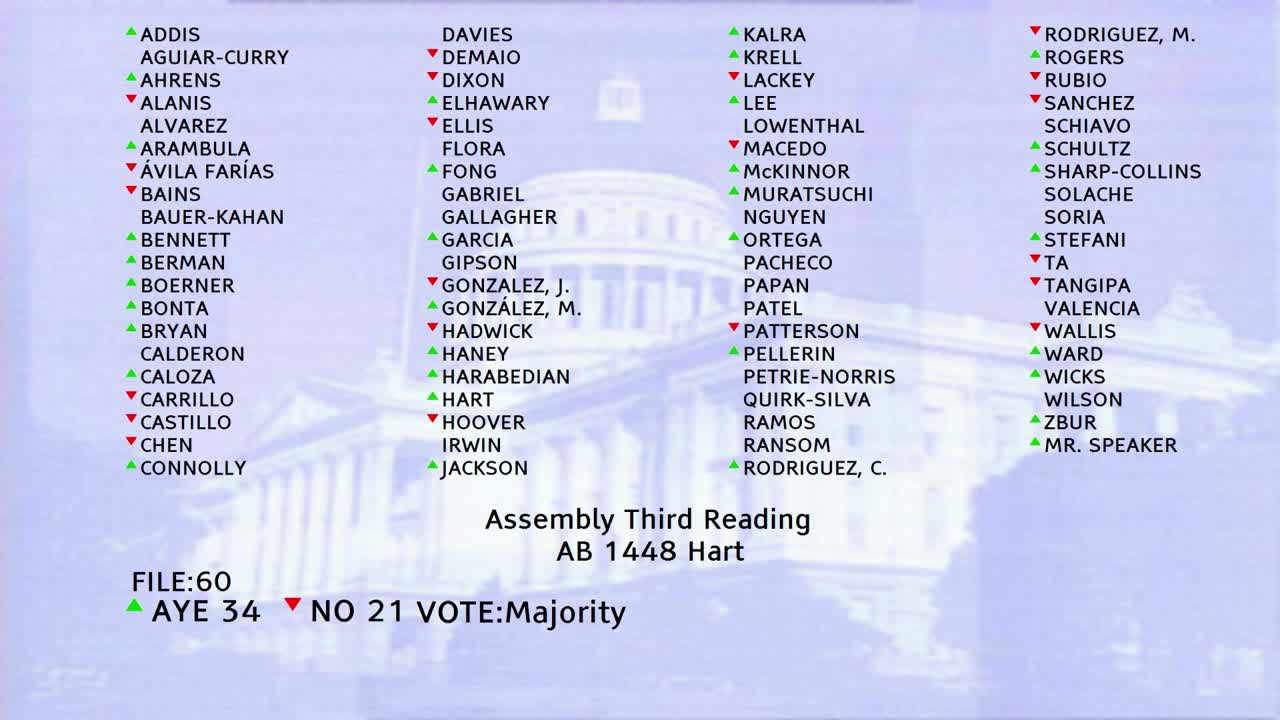 2MIN
Assembly Floor
 9MIN
Assembly Standing Committee on Health
Bill Author