AB 1096: Water: schoolsites: lead testing.
- Session Year: 2025-2026
- House: Assembly
- Latest Version Date: 2025-10-03
Current Status:
Passed
(2025-10-03: Chaptered by Secretary of State - Chapter 290, Statutes of 2025.)
Introduced
In Committee
Awaiting First Chamber Vote
Passed First Chamber
In Committee
Awaiting Second Chamber Vote
Passed Second Chamber
Enacted
Existing law, the California Safe Drinking Water Act, requires the State Water Resources Control Board to administer provisions relating to the regulation of drinking water to protect public health. Existing federal regulations require community water systems to contact all schools and childcare facilities, as defined, to provide information about the health risks from lead in drinking water and of eligibility to be sampled for lead by the water system. Existing federal regulations require a community water system to report to the state annually on the notification of eligibility and sampling for lead, and information regarding the number and names of schools and childcare facilities served by the water system, those sampled in the previous year, the facilities that declined sampling, facilities that did not respond to outreach attempts for sampling, and information pertaining to those outreach attempts for sampling.
Existing law makes it a crime to knowingly make any false statement or representation in any application, record, report, or other document submitted, maintained, or used for purposes of compliance with this act.
This bill would require a community water system, when making outreach attempts to elementary schools and childcare facilities for the purposes of offering lead sampling in drinking water, to compile specified information and to provide elementary schools and childcare facilities that decline lead testing with an opportunity to provide information about their reasons for declining by allowing them to select from a list that includes specified options, unless the school or childcare facility is exempted from lead testing by federal waiver, as provided. The bill would authorize the state board to add additional reasons for declining lead testing to that list. The bill would require a community water system to submit all of the above-described information that it compiles or that is provided to it to the state board, as provided. The bill would require the state board, on or before June 30, 2028, to make all of that information publicly available in a searchable format on its internet website, as specified. The bill also would require, on or before December 31, 2028, a community water system to include, in its annual consumer confidence report, a written statement about the availability of information pertaining to lead testing in schools and childcare facilities on the state boards internet website and a direct link to that website. Because knowingly making a false statement or representation in that report would be a crime under the California Safe Drinking Water Act, the bill would impose a state-mandated local program by expanding the scope of a crime.
The California Constitution requires the state to reimburse local agencies and school districts for certain costs mandated by the state. Statutory provisions establish procedures for making that reimbursement.
This bill would provide that no reimbursement is required by this act for a specified reason.
Existing law, the California Safe Drinking Water Act, requires the State Water Resources Control Board to administer provisions relating to the regulation of drinking water to protect public health. Existing federal regulations require community water systems to contact all schools and childcare facilities, as defined, to provide information about the health risks from lead in drinking water and of eligibility to be sampled for lead by the water system. Existing federal regulations require a community water system to report to the state annually on the notification of eligibility and sampling for lead, and information regarding the number and names of schools and childcare facilities served by the water system, those sampled in the previous year, the facilities that declined sampling, facilities that did not respond to outreach attempts for sampling, and information pertaining to those outreach attempts for sampling.
Existing law makes it a crime to knowingly make any false statement or representation in any application, record, report, or other document submitted, maintained, or used for purposes of compliance with this act.
This bill would require, on or before June 1, 2026, the state board to adopt regulations consistent with the above-described regulations. The bill would authorize the state board to adopt regulations to implement the provision as emergency regulations. The bill would also require, on or before June 30, 2028, the state board to make the information submitted by community water systems, pursuant to the above-described regulations, publicly available on its internet website, including, among other things, the number and names of schools and childcare facilities served by the water system and the number and names of schools and childcare facilities sampled in the previous year. The bill would also require community water systems to provide elementary schools and childcare facilities that decline lead testing with the opportunity to indicate if they are declining for one or more reasons specified by the state board and to report information collected regarding that decline to the state board. Because knowingly making a false statement or representation in that report would be a crime under the California Safe Drinking Water Act, the bill would impose a state-mandated local program by expanding the scope of a crime.This bill would require a community water system, when making outreach attempts to elementary schools and childcare facilities for the purposes of offering lead sampling in drinking water, to compile specified information and to provide elementary schools and childcare facilities that decline lead testing with an opportunity to provide information about their reasons for declining by allowing them to select from a list that includes specified options, unless the school or childcare facility is exempted from lead testing by federal waiver, as provided. The bill would authorize the state board to add additional reasons for declining lead testing to that list. The bill would require a community water system to submit all of the above-described information that it compiles or that is provided to it to the state board, as provided. The bill would require the state board, on or before June 30, 2028, to make all of that information publicly available in a searchable format on its internet website, as specified. The bill also would require, on or before December 31, 2028, a community water system to include, in its annual consumer confidence report, a written statement about the availability of information pertaining to lead testing in schools and childcare facilities on the state boards internet website and a direct link to that website. Because knowingly making a false statement or representation in that report would be a crime under the California Safe Drinking Water Act, the bill would impose a state-mandated local program by expanding the scope of a crime.
The California Constitution requires the state to reimburse local agencies and school districts for certain costs mandated by the state. Statutory provisions establish procedures for making that reimbursement.
This bill would provide that no reimbursement is required by this act for a specified reason.
Existing law, the California Safe Drinking Water Act, requires the State Water Resources Control Board to administer provisions relating to the regulation of drinking water to protect public health. Existing federal regulations require community water systems to contact all schools and childcare facilities, as defined, to provide information about the health risks from lead in drinking water and of eligibility to be sampled for lead by the water system. Existing federal regulations require a community water system to report to the state annually on the notification of eligibility and sampling for lead, and information regarding the number and names of schools and childcare facilities served by the water system, those sampled in the previous year, the facilities that declined sampling, facilities that did not respond to outreach attempts for sampling, and information pertaining to those outreach attempts for sampling.
Existing law makes it a crime to knowingly make any false statement or representation in any application, record, report, or other document submitted, maintained, or used for purposes of compliance with this act.
This bill would require, on or before June 1, 2026, the state board to adopt regulations consistent with the above-described regulations. The bill would authorize the state board to adopt regulations to implement the provision as emergency regulations. The bill would also require, on or before June 30, 2028, the state board to make the information submitted by community water systems, pursuant to the above-described regulations, publicly available on its internet website, including, among other things, the number and names of schools and childcare facilities served by the water system and the number and names of schools and childcare facilities sampled in the previous year. The bill would also require community water systems to provide elementary schools and childcare facilities that decline lead testing with the opportunity to indicate if they are declining for one or more reasons specified by the state board and to report information collected regarding that decline to the state board. Because knowingly making a false statement or representation in that report would be a crime under the California Safe Drinking Water Act, the bill would impose a state-mandated local program by expanding the scope of a crime.
The California Constitution requires the state to reimburse local agencies and school districts for certain costs mandated by the state. Statutory provisions establish procedures for making that reimbursement.
This bill would provide that no reimbursement is required by this act for a specified reason.
Under existing law, a mutual water company is defined as a corporation organized for or engaged in the business of selling, distributing, supplying, or delivering water for irrigation or domestic purposes that provides in its articles or bylaws that the water shall be sold, distributed, supplied, or delivered only to owners of its shares, as specified. Existing law requires each board member of a mutual water company that operates a public water system, within 6 months of taking office and every 6 years thereafter, to complete a course offered by a qualified trainer regarding the duties of board members of mutual water companies, as provided.This bill would require a board member of a mutual water company to provide proof of completion of that training to the State Water Resources Control Board no later than 30 days after completing the training.Under existing law, a mutual water company is defined as a corporation organized for or engaged in the business of selling, distributing, supplying, or delivering water for irrigation or domestic purposes that provides in its articles or bylaws that the water shall be sold, distributed, supplied, or delivered only to owners of its shares, as specified. Existing law requires each board member of a mutual water company that operates a public water system, within 6 months of taking office and every 6 years thereafter, to complete a course offered by a qualified trainer regarding the duties of board members of mutual water companies, as provided.
This bill would require a board member of a mutual water company to provide proof of completion of that training to the State Water Resources Control Board no later than 30 days after completing the training.
The Legislature finds and declares all of the following:
(a)The American Academy of Pediatrics states that there is no safe level of lead in children, and that even blood lead levels too low to cause acute lead poisoning can result in lasting cognitive impairment in children.
(b)According to the National Association of State Boards of Education, lead in drinking water is of special relevance to schools because water is likely to stagnate in school pipes and fixtures during frequent closures over weekends, holidays, or summer break, potentially increasing the concentration of lead leached from the premises plumbing into drinking water. Lead levels can vary from tap to tap and season to season, and change based on multiple factors, including the materials found in the premises plumbing and fixtures, changes in water usage, water temperature, and the amount of time water sits in pipes.
(c)The National Association of State Boards of Education further states that schools may need support collecting and interpreting lead testing data, and that coordinating with experts on testing and mitigation strategies can support effective water testing efforts.
(d)The federal Lead and Copper Rule Improvements, finalized October 8, 2024, strengthen nationwide requirements to protect children from lead in drinking water by, among other things, requiring community water systems to:
(1)Notify elementary schools, secondary schools, and childcare facilities that they are eligible to be sampled for lead by the water system.
(2)Provide information to schools and childcare facilities on the health risks associated with lead in drinking water.
(3)Provide sampling results and information about potential options for remediating lead in drinking water to schools and childcare facilities.
(4)Report specified information to the state board, including the number and names of schools and childcare facilities sampled, sampling results, and the number and names of elementary schools and childcare facilities that declined lead sampling or did not respond to outreach attempts.
(e)It is the goal of the state to ensure public transparency, so that school and childcare community members, including staff and the families of pupils, have access to lead sampling results collected under the federal Lead and Copper Rule Improvements.
SEC. 2.Section 116277 is added to the Health and Safety Code, to read:116277.(a)(1)When making outreach attempts to elementary schools and childcare facilities for the purposes of offering lead sampling in drinking water, pursuant to Sections 141.90(i) and 141.92 of Title 40 of the Code of Federal Regulations, a community water system shall do both of the following:
(A)Compile all of the following information:
(i)The number and names of schools and childcare facilities served by the water system.
(ii)The number and names of schools and childcare facilities sampled in the previous year.
(iii)The number and names of elementary schools and childcare facilities that declined sampling.
(iv)The number and names of elementary schools and childcare facilities that did not respond to outreach attempts for sampling.
(v)Information that pertains to outreach attempts for sampling that were declined or not responded to by an elementary school or childcare facility.
(vi)Sampling results from sampled schools and childcare facilities.
(B)Provide elementary schools and childcare facilities that decline lead testing with an opportunity to provide information about their reasons for declining by allowing them to select from a list that includes all of the following options:
(i)All drinking and food preparation water outlets were tested for lead within the last five years under an independent program in which the elementary school or childcare facility participated.
(ii)The elementary school or childcare facility already maintains a routine water quality testing program, inclusive of lead sampling in drinking water.
(iii)The elementary school or childcare facility is participating in another government-funded water quality program that is inclusive of lead sampling in drinking water.
(iv)The elementary school or childcare facility has opted to coordinate testing for lead in drinking water with a third-party vendor for operational reasons.
(v)The elementary school or childcare facility was constructed after January 1, 2010.
(vi)The elementary school or childcare facility was modernized after January 1, 2010, and the elementary school or childcare facility was fully replumbed as part of the modernization.
(vii)All drinking and food preparation water outlets were installed after January 1, 2010, and all of those outlets are connected to plumbing that was installed or replaced after January 1, 2010.
(viii)The elementary school or childcare facility uses bottled water, water that is filtered with a point-of-use water filtration device certified to meet NSF/ANSI standards for lead and particulate reduction, or both, for all drinking water and food preparation purposes.
(ix)The elementary school or childcare facility is currently undergoing major modernization or construction.
(x)Logistical barriers such as timing, access, or personnel coordination prevent the elementary school or childcare facility from participating in the community water systems offer to test.
(2)(A)If a community water system has received a written waiver from the state board exempting it from lead sampling requirements pursuant to Section 141.92 of Title 40 of the Code of Federal Regulations, the community water system shall be exempt from the requirements under subparagraphs (A) and (B) of paragraph (1) for the subset of schools or childcare facilities to which the waiver applies.
(B)The state board may issue a statewide written waiver exempting more than one community water system from lead sampling requirements pursuant to Section 141.92 of Title 40 of the Code of Federal Regulations, for community water systems subject to a statewide sampling law or program, through the policy handbook adopted pursuant to paragraph (3) of subdivision (b).
(b)(1)Notwithstanding paragraph (2) of subdivision (a), a community water system shall submit all of the information that it compiles or that is provided to it pursuant to paragraph (1) of subdivision (a) to the state board pursuant to a process specified by the state board.
(2)The state board may add additional reasons for declining lead testing to the list specified in subparagraph (B) of paragraph (1) of subdivision (a).
(3)The state board may implement this subdivision through the adoption of a policy handbook. The policy handbook shall not be subject to the requirements of Chapter 3.5 (commencing with Section 11340) of Part 1 of Division 3 of Title 2 of the Government Code.
(c)On or before June 30, 2028, the state board shall make all of the information submitted to it pursuant to paragraph (1) of subdivision (b) publicly available in a searchable format on its internet website. In order to aid members of the public in understanding this information, the state board shall do all of the following:
(1)To the extent possible, present sampling results on its internet website as a specific value and not in a format that uses the mathematical symbol meaning less than.
(2)Bold or otherwise highlight on its internet website sampling results that are above five parts per billion.
(3)Indicate whether a test result represents an exceedance of the action level for lead in drinking water under the federal Lead and Copper Rule.
(4)Provide information on its internet website that explains the health harms posed by lead in drinking water and that even low blood lead levels can result in lasting cognitive impairment in children.
(d)On or before December 31, 2028, a community water system shall include both of the following in its annual consumer confidence report prepared pursuant to Article 20 (commencing with Section 64480) Chapter 15 of Division 4 of Title 22 of the California Code of Regulations:
(1)A written statement that information pertaining to lead testing in schools and childcare facilities, including the names of schools and childcare facilities that received testing from community water systems, is available on the state boards internet website.
(2)A direct link to the state boards internet website, developed pursuant to subdivision (c).
(e)This section shall not be construed as altering the compliance dates specified in Sections 141.90(i) and 141.92 of Title 40 of the Code of Federal Regulations.
(f)For purposes of this section, childcare facility, elementary school, and school have the same meanings as those terms are defined in Section 141.2 of Title 40 of the Code of Federal Regulations.
SEC. 3.No reimbursement is required by this act pursuant to Section 6 of Article XIIIB of the California Constitution because the only costs that may be incurred by a local agency or school district will be incurred because this act creates a new crime or infraction, eliminates a crime or infraction, or changes the penalty for a crime or infraction, within the meaning of Section 17556 of the Government Code, or changes the definition of a crime within the meaning of Section 6 of Article XIIIB of the California Constitution.
The Legislature finds and declares all of the following:
(a)The American Academy of Pediatrics states that there is no safe level of lead in children, and that even blood lead levels too low to cause acute lead poisoning can result in lasting cognitive impairment in children.
(b)According to the National Association of State Boards of Education, lead in drinking water is of special relevance to schools because water is likely to stagnate in school pipes and fixtures during frequent closures over weekends, holidays, or summer break, potentially increasing the concentration of lead leached from the premises' plumbing into drinking water. Lead levels can vary from tap to tap and season to season, and change based on multiple factors, including the materials found in the premises' plumbing and fixtures, changes in water usage, water temperature, and the amount of time water sits in pipes.
(c)The National Association of State Boards of Education further states that schools may need support collecting and interpreting lead testing data, and that coordinating with experts on testing and mitigation strategies can support effective water testing efforts.
(d)The federal Lead and Copper Rule Improvements, finalized October 8, 2024, strengthen nationwide requirements to protect children from lead in drinking water by, among other things, requiring community water systems to:
(1)Notify elementary schools, secondary schools, and childcare facilities that they are eligible to be sampled for lead by the water system.
(2)Provide information to schools and childcare facilities on the health risks associated with lead in drinking water.
(3)Provide sampling results and information about potential options for remediating lead in drinking water to schools and childcare facilities.
(4)Report specified information to the state board, including the number and names of schools and childcare facilities sampled, sampling results, and the number and names of elementary schools and childcare facilities that declined lead sampling or did not respond to outreach attempts.
(e)It is the goal of the state to ensure public transparency, so that school and childcare community members, including staff and the families of pupils, have access to lead sampling results collected under the federal Lead and Copper Rule Improvements.
SEC. 2.Section 116277 is added to the Health and Safety Code, to read:116277.(a)(1)When making outreach attempts to elementary schools and childcare facilities for the purposes of offering lead sampling in drinking water, pursuant to Sections 141.90(i) and 141.92 of Title 40 of the Code of Federal Regulations, a community water system shall do both of the following:
(A)Compile all of the following information:
(i)The number and names of schools and childcare facilities served by the water system.
(ii)The number and names of schools and childcare facilities sampled in the previous year.
(iii)The number and names of elementary schools and childcare facilities that declined sampling.
(iv)The number and names of elementary schools and childcare facilities that did not respond to outreach attempts for sampling.
(v)Information that pertains to outreach attempts for sampling that were declined or not responded to by an elementary school or childcare facility.
(vi)Sampling results from sampled schools and childcare facilities.
(B)Provide elementary schools and childcare facilities that decline lead testing with an opportunity to provide information about their reasons for declining by allowing them to select from a list that includes all of the following options:
(i)All drinking and food preparation water outlets were tested for lead within the last five years under an independent program in which the elementary school or childcare facility participated.
(ii)The elementary school or childcare facility already maintains a routine water quality testing program, inclusive of lead sampling in drinking water.
(iii)The elementary school or childcare facility is participating in another government-funded water quality program that is inclusive of lead sampling in drinking water.
(iv)The elementary school or childcare facility has opted to coordinate testing for lead in drinking water with a third-party vendor for operational reasons.
(v)The elementary school or childcare facility was constructed after January 1, 2010.
(vi)The elementary school or childcare facility was modernized after January 1, 2010, and the elementary school or childcare facility was fully replumbed as part of the modernization.
(vii)All drinking or and food preparation water outlets were installed after January 1, 2010, and all of those outlets are connected to plumbing that was installed or replaced after January 1, 2010.
(viii)The elementary school or childcare facility uses bottled water, water that is filtered with a point-of-use water filtration device certified to meet NSF/ANSI standards for lead and particulate reduction, or both, for all drinking water and food preparation purposes.
(ix)The elementary school or childcare facility is currently undergoing major modernization or construction.
(x)Logistical barriers such as timing, access, or personnel coordination prevent the elementary school or childcare facility from participating in the community water systems offer to test.
(2)(A)If a community water system has received a written waiver from the state board exempting it from lead sampling requirements pursuant to Section 141.92 of Title 40 of the Code of Federal Regulations, the community water system shall be exempt from the requirements under subparagraphs (A) and (B) of paragraph (1) for the subset of schools or childcare facilities to which the waiver applies.
(B)The state board may issue a statewide written waiver exempting more than one community water system from lead sampling requirements pursuant to Section 141.92 of Title 40 of the Code of Federal Regulations, for community water systems subject to a statewide sampling law or program, through the policy handbook adopted pursuant to paragraph (3) of subdivision (b).
(b)(1)Notwithstanding paragraph (2) of subdivision (a), a community water system shall submit all of the information that it compiles or that is provided to it pursuant to paragraph (1) of subdivision (a) to the state board pursuant to a process specified by the state board.
(c)(2)The state board may add additional reasons for declining lead testing to the list specified in subparagraph (B) of paragraph (1) of subdivision (a).
(3)The state board may implement this subdivision through the adoption of a policy handbook. The policy handbook shall not be subject to the requirements of Chapter 3.5 (commencing with Section 11340) of Part 1 of Division 3 of Title 2 of the Government Code.
(d)(c)On or before June 30, 2028, the state board shall make all of the information submitted to it pursuant to paragraph (1) of subdivision (b) publicly available in a searchable format on its internet website. In order to aid members of the public in understanding this information, the state board shall do all of the following:
(1)To the extent possible, present sampling results on its internet website as a specific value and not in a format that uses the mathematical symbol meaning less than.
(2)Bold or otherwise highlight on its internet website sampling results that are above five parts per billion.
(3)Indicate whether a test result represents an exceedance of the action level for lead in drinking water under the federal Lead and Copper Rule.
(4)Provide information on its internet website that explains the health harms posed by lead in drinking water and that even low blood lead levels can result in lasting cognitive impairment in children.
(e)(d)On or before December 31, 2028, a community water system shall include both of the following in its annual consumer confidence report prepared pursuant to Article 20 (commencing with Section 64480) Chapter 15 of Division 4 of Title 22 of the California Code of Regulations:
(1)A written statement that information pertaining to lead testing in schools and childcare facilities, including the names of schools and childcare facilities that received testing from community water systems, is available on the state boards internet website.
(2)A direct link to the state boards internet website, developed pursuant to subdivision (d). (c).
(e)This section shall not be construed as altering the compliance dates specified in Sections 141.90(i) and 141.92 of Title 40 of the Code of Federal Regulations.
(f)For purposes of this section, childcare facility, elementary school, and school have the same meanings as those terms are defined in Section 141.2 of Title 40 of the Code of Federal Regulations.
SEC. 3.No reimbursement is required by this act pursuant to Section 6 of Article XIIIB of the California Constitution because the only costs that may be incurred by a local agency or school district will be incurred because this act creates a new crime or infraction, eliminates a crime or infraction, or changes the penalty for a crime or infraction, within the meaning of Section 17556 of the Government Code, or changes the definition of a crime within the meaning of Section 6 of Article XIIIB of the California Constitution.
The Legislature finds and declares all of the following:
(a)The American Academy of Pediatrics states that there is no safe level of lead in children, and that even blood lead levels too low to cause acute lead poisoning can result in lasting cognitive impairment in children.
(b)According to the National Association of State Boards of Education, lead in drinking water is of special relevance to schools because water is likely to stagnate in school pipes and fixtures during frequent closures over weekends, holidays, or summer break, potentially making the water more corrosive and increasing the chances that lead will leach into drinking water. increasing the concentration of lead leached from the premises' plumbing into drinking water. Lead levels can vary from tap to tap and season to season, and change based on multiple factors, including the materials found in the premises' plumbing and fixtures, changes in water usage, water temperature, and the amount of time water sits in pipes.
(c)The National Association of State Boards of Education further states that schools may need support collecting and interpreting lead testing data, and that coordinating with experts on testing and mitigation strategies can support effective water testing efforts.
(d)The federal Lead and Copper Rule Improvements, finalized October 8, 2024, strengthen nationwide requirements to protect children from lead in drinking water by, among other things, requiring community water systems to:
(1)Notify elementary schools, secondary schools, and childcare facilities that they are eligible to be sampled for lead by the water system.
(2)Provide information to schools and childcare facilities on the health risks associated with lead in drinking water.
(3)Provide sampling results and information about potential options for remediating lead in drinking water to schools and childcare facilities.
(4)Report specified information to the state board, including the number and names of schools and childcare facilities sampled, sampling results, and the number and names of elementary schools and childcare facilities that declined lead sampling or did not respond to outreach attempts.
(e)It is the goal of the state to ensure public transparency, so that school and childcare community members, including staff and the families of pupils, have access to lead sampling results collected under the federal Lead and Copper Rule Improvements.
SEC. 2.Section 116277 is added to the Health and Safety Code, to read:116277.(a)(1)On or before June 1, 2026, the state board shall adopt regulations that are consistent with those in Sections 141.90(i) and 141.92 of Title 40 of the Code of Federal Regulations, as those sections existed on January 19, 2025.(2)The state board may adopt regulations to implement this section as emergency regulations. The adoption of regulations to implement this section shall be deemed to be an emergency and necessary for the immediate preservation of the public peace, health and safety, or general welfare for purposes of Sections 11346.1 and 11349.6 of the Government Code, and the state board is hereby exempted from the requirement that it describe facts showing the need for immediate action. Notwithstanding Chapter 3.5 (commencing with Section 11340) of Part 1 of Division 3 of Title 2 of the Government Code, an emergency regulation adopted by the state board pursuant to this section is not subject to review by the Office of Administrative Law and shall remain in effect until revised by the state board.(b)On or before June 30, 2028, the state board shall make all of the following information submitted to it by community water systems as required by the regulations adopted pursuant to subdivision (a) publicly available on its internet website:(1)The number and names of schools and childcare facilities served by the water system.(2)The number and names of schools and childcare facilities sampled in the previous year.(3)The number and names of elementary schools and childcare facilities that declined sampling.(4)The number and names of elementary schools and childcare facilities that did not respond to outreach attempts for sampling.(5)Information pertaining to outreach attempts for sampling that were declined or not responded to by an elementary school or childcare facility.(6)Sampling results from sampled schools and childcare facilities.(c)(1)In making outreach attempts to elementary schools and childcare facilities, as required by the regulations adopted pursuant to subdivision (a), community water systems shall provide elementary schools and childcare facilities that decline lead testing with an opportunity to indicate their reasons for declining, by allowing them to select from one or more reasons specified by the state board.(2)Community water systems shall submit the information collected pursuant to paragraph (1) to the state board.(3)The state board shall make the information received pursuant to paragraph (2) publicly available on its internet website, in conjunction with the information required pursuant to subdivision (b).SEC. 2.Section 116277 is added to the Health and Safety Code, to read:116277.(a)(1)When making outreach attempts to elementary schools and childcare facilities for the purposes of offering lead sampling in drinking water, pursuant to Sections 141.90(i) and 141.92 of Title 40 of the Code of Federal Regulations, a community water system shall do both of the following:
(A)Compile all of the following information:
(i)The number and names of schools and childcare facilities served by the water system.
(ii)The number and names of schools and childcare facilities sampled in the previous year.
(iii)The number and names of elementary schools and childcare facilities that declined sampling.
(iv)The number and names of elementary schools and childcare facilities that did not respond to outreach attempts for sampling.
(v)Information that pertains to outreach attempts for sampling that were declined or not responded to by an elementary school or childcare facility.
(vi)Sampling results from sampled schools and childcare facilities.
(B)Provide elementary schools and childcare facilities that decline lead testing with an opportunity to provide information about their reasons for declining by allowing them to select from a list that includes all of the following options:
(i)All drinking and food preparation water outlets were tested for lead within the last five years under an independent program in which the elementary school or childcare facility participated.
(ii)The elementary school or childcare facility already maintains a routine water quality testing program, inclusive of lead sampling in drinking water.
(iii)The elementary school or childcare facility is participating in another government-funded water quality program that is inclusive of lead sampling in drinking water.
(iv)The elementary school or childcare facility has opted to coordinate testing for lead in drinking water with a third-party vendor for operational reasons.
(v)The elementary school or childcare facility was constructed after January 1, 2010.
(vi)The elementary school or childcare facility was modernized after January 1, 2010, and the elementary school or childcare facility was fully replumbed as part of the modernization.
(vii)All drinking or food preparation water outlets were installed after January 1, 2010, and all of those outlets are connected to plumbing that was installed or replaced after January 1, 2010.
(viii)The elementary school or childcare facility uses bottled water, water that is filtered with a point-of-use water filtration device certified to meet NSF/ANSI standards for lead and particulate reduction, or both, for all drinking water and food preparation purposes.
(ix)The elementary school or childcare facility is currently undergoing major modernization or construction.
(x)Logistical barriers such as timing, access, or personnel coordination prevent the elementary school or childcare facility from participating in the community water systems offer to test.
(2)If a community water system has received a written waiver from the state board exempting it from lead sampling requirements pursuant to Section 141.92 of Title 40 of the Code of Federal Regulations, the community water system shall be exempt from the requirements under subparagraphs (A) and (B) of paragraph (1) for the subset of schools or childcare facilities to which the waiver applies.
(b)Notwithstanding paragraph (2) of subdivision (a), a community water system shall submit all of the information that it compiles or that is provided to it pursuant to paragraph (1) of subdivision (a) to the state board pursuant to a process specified by the state board.
(c)The state board may add additional reasons for declining lead testing to the list specified in subparagraph (B) of paragraph (1) of subdivision (a).
(d)On or before June 30, 2028, the state board shall make all of the information submitted to it pursuant to subdivision (b) publicly available in a searchable format on its internet website. In order to aid members of the public in understanding this information, the state board shall do all of the following:
(1)To the extent possible, present sampling results on its internet website as a specific value and not in a format that uses the mathematical symbol meaning less than.
(2)Bold or otherwise highlight on its internet website sampling results that are above five parts per billion.
(3)Indicate whether a test result represents an exceedance of the action level for lead in drinking water under the federal Lead and Copper Rule.
(4)Provide information on its internet website that explains the health harms posed by lead in drinking water and that even low blood lead levels can result in lasting cognitive impairment in children.
(e)On or before December 31, 2028, a community water system shall include both of the following in its annual consumer confidence report prepared pursuant to Article 20 (commencing with Section 64480) Chapter 15 of Division 4 of Title 22 of the California Code of Regulations:
(1)A written statement that information pertaining to lead testing in schools and childcare facilities, including the names of schools and childcare facilities that received testing from community water systems, is available on the state boards internet website.
(2)A direct link to the state boards internet website, developed pursuant to subdivision (d).
SEC. 3.No reimbursement is required by this act pursuant to Section 6 of Article XIIIB of the California Constitution because the only costs that may be incurred by a local agency or school district will be incurred because this act creates a new crime or infraction, eliminates a crime or infraction, or changes the penalty for a crime or infraction, within the meaning of Section 17556 of the Government Code, or changes the definition of a crime within the meaning of Section 6 of Article XIIIB of the California Constitution.
The Legislature finds and declares all of the following:
(a)The American Academy of Pediatrics states that there is no safe level of lead in children, and that even blood lead levels too low to cause acute lead poisoning can result in lasting cognitive impairment in children.
(b)According to the National Association of State Boards of Education, lead in drinking water is of special relevance to schools because water is likely to stagnate in school pipes and fixtures during frequent closures over weekends, holidays, or summer break, potentially making the water more corrosive and increasing the chances that lead will leach into drinking water. Lead levels can vary from tap to tap and season to season, and change based on multiple factors, including changes in water usage, water temperature, and the amount of time water sits in pipes.
(c)The National Association of State Boards of Education further states that schools may need support collecting and interpreting lead testing data, and that coordinating with experts on testing and mitigation strategies can support effective water testing efforts.
(d)The federal Lead and Copper Rule Improvements, finalized October 8, 2024, strengthen nationwide requirements to protect children from lead in drinking water by, among other things, requiring community water systems to:
(1)Notify elementary schools, secondary schools, and childcare facilities that they are eligible to be sampled for lead by the water system.
(2)Provide information to schools and childcare facilities on the health risks associated with lead in drinking water.
(3)Provide sampling results and information about potential options for remediating lead in drinking water to schools and childcare facilities.
(4)Report specified information to the state board, including the number and names of schools and childcare facilities sampled, sampling results, and the number and names of elementary schools and childcare facilities that declined lead sampling or did not respond to outreach attempts.
(e)It is the goal of the state to ensure public transparency, so that school and childcare community members, including staff and the families of pupils, have access to lead sampling results collected under the federal Lead and Copper Rule Improvements.
SEC. 2.Section 116277 is added to the Health and Safety Code, to read:116277.(a)(1)On or before June 1, 2026, the state board shall adopt regulations that are consistent with those in Sections 141.90(i) and 141.92 of Title 40 of the Code of Federal Regulations, as those sections existed on January 19, 2025.
(2)The state board may adopt regulations to implement this section as emergency regulations. The adoption of regulations to implement this section shall be deemed to be an emergency and necessary for the immediate preservation of the public peace, health and safety, or general welfare for purposes of Sections 11346.1 and 11349.6 of the Government Code, and the state board is hereby exempted from the requirement that it describe facts showing the need for immediate action. Notwithstanding Chapter 3.5 (commencing with Section 11340) of Part 1 of Division 3 of Title 2 of the Government Code, an emergency regulation adopted by the state board pursuant to this section is not subject to review by the Office of Administrative Law and shall remain in effect until revised by the state board.
(b)On or before June 30, 2028, the state board shall make all of the following information submitted to it by community water systems as required by the regulations adopted pursuant to subdivision (a) publicly available on its internet website:
(1)The number and names of schools and childcare facilities served by the water system.
(2)The number and names of schools and childcare facilities sampled in the previous year.
(3)The number and names of elementary schools and childcare facilities that declined sampling.
(4)The number and names of elementary schools and childcare facilities that did not respond to outreach attempts for sampling.
(5)Information pertaining to outreach attempts for sampling that were declined or not responded to by an elementary school or childcare facility.
(6)Sampling results from sampled schools and childcare facilities.
(c)(1)In making outreach attempts to elementary schools and childcare facilities, as required by the regulations adopted pursuant to subdivision (a), community water systems shall provide elementary schools and childcare facilities that decline lead testing with an opportunity to indicate their reasons for declining, by allowing them to select from one or more reasons specified by the state board.
(2)Community water systems shall submit the information collected pursuant to paragraph (1) to the state board.
(3)The state board shall make the information received pursuant to paragraph (2) publicly available on its internet website, in conjunction with the information required pursuant to subdivision (b).
SEC. 3.No reimbursement is required by this act pursuant to Section 6 of Article XIIIB of the California Constitution because the only costs that may be incurred by a local agency or school district will be incurred because this act creates a new crime or infraction, eliminates a crime or infraction, or changes the penalty for a crime or infraction, within the meaning of Section 17556 of the Government Code, or changes the definition of a crime within the meaning of Section 6 of Article XIIIB of the California Constitution.
SECTION 1.Section 116755 of the Health and Safety Code is amended to read:116755.(a)(1)Each board member of a mutual water company that operates a public water system, as defined in Section 116275, shall, within six months of taking office, or by December 31, 2012, if that member was serving on the board on December 31, 2011, complete a two-hour course offered by a qualified trainer regarding the duties of board members of mutual water companies, including, but not limited to, the duty of a corporate director to avoid contractual conflicts of interest and fiduciary duties, the duties of public water systems to provide clean drinking water that complies with the federal Safe Drinking Water Act (42 U.S.C. Sec. 300f et seq.) and this chapter, and long-term management of a public water system. A board member of a mutual water company that operates a public water system shall repeat this training every six years. For the purposes of this paragraph, a trainer may be qualified in any of the following ways:(A)Membership in the California State Bar.(B)Accreditation by the International Association of Continuing Education and Training (IACET) ANSI/IACET 1-2007.(C)Sponsorship by either the Rural Community Assistance Corporation or the California Rural Water Association.(2)No later than 30 days after completing the training requirements described in paragraph (1), a board member of a mutual water company shall provide proof of completion of the requirements to the state board.(b)A mutual water company formed pursuant to Part 7 (commencing with Section 14300) of Division 3 of Title 1 of the Corporations Code, that operates a public water system, shall be liable for the payment of any fines, penalties, costs, expenses, and other amounts that may be imposed upon the mutual water company pursuant to this chapter. The mutual water company may levy an assessment, pursuant to Section 14303 of the Corporations Code, to pay these fines, penalties, costs, expenses, and other amounts so imposed. If the amount of outstanding fines, penalties, costs, expenses, and other amounts imposed pursuant to this chapter exceed 5 percent of the annual budget of the mutual water company, the mutual water company shall levy an assessment, pursuant to Section 14303 of the Corporations Code, to pay those fines, penalties, costs, expenses, and other amounts so imposed.(a)(1)Each board member of a mutual water company that operates a public water system, as defined in Section 116275, shall, within six months of taking office, or by December 31, 2012, if that member was serving on the board on December 31, 2011, complete a two-hour course offered by a qualified trainer regarding the duties of board members of mutual water companies, including, but not limited to, the duty of a corporate director to avoid contractual conflicts of interest and fiduciary duties, the duties of public water systems to provide clean drinking water that complies with the federal Safe Drinking Water Act (42 U.S.C. Sec. 300f et seq.) and this chapter, and long-term management of a public water system. A board member of a mutual water company that operates a public water system shall repeat this training every six years. For the purposes of this subdivision, paragraph, a trainer may be qualified in any of the following ways:
(1)(A)Membership in the California State Bar.
(2)(B)Accreditation by the International Association of Continuing Education and Training (IACET) ANSI/IACET 1-2007.
(3)(C)Sponsorship by either the Rural Community Assistance Corporation or the California Rural Water Association.
(2)No later than 30 days after completing the training requirements described in paragraph (1), a board member of a mutual water company shall provide proof of completion of the requirements to the state board.
(b)A mutual water company formed pursuant to Part 7 (commencing with Section 14300) of Division 3 of Title 1 of the Corporations Code, that operates a public water system, shall be liable for the payment of any fines, penalties, costs, expenses, and other amounts that may be imposed upon the mutual water company pursuant to this chapter. The mutual water company may levy an assessment, pursuant to Section 14303 of the Corporations Code, to pay these fines, penalties, costs, expenses, and other amounts so imposed. If the amount of outstanding fines, penalties, costs, expenses expenses, and other amounts imposed pursuant to this chapter exceed 5 percent of the annual budget of the mutual water company, then the mutual water company shall levy an assessment, pursuant to Section 14303 of the Corporations Code, to pay those fines, penalties, costs, expenses, and other amounts so imposed.
|
Date
|
Status
|
|---|---|
| Oct 3, 2025 | Chaptered by Secretary of State - Chapter 290, Statutes of 2025. |
| Oct 3, 2025 | Approved by the Governor. |
| Sep 22, 2025 | Enrolled and presented to the Governor at 3 p.m. |
| Sep 10, 2025 | Senate amendments concurred in. To Engrossing and Enrolling. (Ayes 78. Noes 0. Page 3231.). |
| Sep 9, 2025 | In Assembly. Concurrence in Senate amendments pending. |
| Sep 9, 2025 | Read third time. Passed. Ordered to the Assembly. (Ayes 39. Noes 0. Page 2671.). |
| Sep 8, 2025 | Read second time. Ordered to third reading. |
| Sep 4, 2025 | Read third time and amended. Ordered to second reading. |
| Sep 3, 2025 | Ordered to third reading. |
| Sep 3, 2025 | From special consent calendar. |
| Sep 2, 2025 | Ordered to special consent calendar. |
| Aug 29, 2025 | Read second time. Ordered to third reading. |
| Aug 29, 2025 | From committee: Do pass. (Ayes 7. Noes 0.) (August 29). |
| Aug 18, 2025 | In committee: Referred to suspense file. |
| Jul 16, 2025 | From committee: Do pass and re-refer to Com. on APPR. with recommendation: To Consent Calendar. (Ayes 8. Noes 0.) (July 16). Re-referred to Com. on APPR. |
| Jul 9, 2025 | From committee chair, with author's amendments: Amend, and re-refer to committee. Read second time, amended, and re-referred to Com. on E.Q. |
| Jun 12, 2025 | In committee: Set, first hearing. Hearing canceled at the request of author. |
| Jun 11, 2025 | Referred to Com. on E.Q. |
| Jun 3, 2025 | In Senate. Read first time. To Com. on RLS. for assignment. |
| Jun 2, 2025 | Read third time. Passed. Ordered to the Senate. (Ayes 79. Noes 0. Page 1877.) |
| May 27, 2025 | Read second time. Ordered to third reading. |
| May 23, 2025 | From committee: Do pass. (Ayes 14. Noes 0.) (May 23). |
| May 14, 2025 | In committee: Set, first hearing. Referred to APPR. suspense file. |
| Apr 30, 2025 | From committee: Do pass and re-refer to Com. on APPR. with recommendation: To Consent Calendar. (Ayes 7. Noes 0.) (April 29). Re-referred to Com. on APPR. |
| Apr 8, 2025 | Re-referred to Com. on E.S & T.M. |
| Apr 7, 2025 | From committee chair, with author's amendments: Amend, and re-refer to Com. on E.S & T.M. Read second time and amended. |
| Mar 10, 2025 | Referred to Com. on E.S & T.M. |
| Feb 21, 2025 | From printer. May be heard in committee March 23. |
| Feb 20, 2025 | Read first time. To print. |
|
Date
|
Description
|
Location
|
Votes
|
|
|---|---|---|---|---|
| Sep 10, 2025 | AB 1096 Connolly Concurrence in Senate Amendments | Assembly Floor |
Passed |
|
| Sep 9, 2025 | Assembly 3rd Reading AB1096 Connolly By Menjivar | Senate Floor |
Passed |
|
| Aug 29, 2025 | Do pass | Senate Standing Committee on Appropriations |
Passed |
|
| Aug 18, 2025 | Placed on suspense file | Senate Standing Committee on Appropriations |
Passed |
|
| Jul 16, 2025 | Do pass, but first be re-referred to the Committee on [Appropriations] with the recommendation: To Consent Calendar | Senate Standing Committee on Environmental Quality |
Passed |
|
| Jun 2, 2025 | AB 1096 Connolly Assembly Third Reading | Assembly Floor |
Passed |
|
| May 23, 2025 | Do pass. | Assembly Standing Committee on Appropriations |
Passed |
|
| Apr 29, 2025 | Do pass and be re-referred to the Committee on [Appropriations] with recommendation: To Consent Calendar | Assembly Standing Committee on Environmental Safety and Toxic Materials |
Passed |
This list shows positions taken on this bill by organizations on the date displayed, which is linked to the original source.
Positions by individuals are not included.
|
Organization
|
Position
|
Date
|
|---|---|---|
| California State Council of Service Employees International Union | ** Support | |
| Children Now | ** Support | |
| cleanearth4kids.org | ** Support | |
| Clean Water Action | ** Support | |
| Environmental Working Group | ** Support | |
| Facts Families Advocating for Chemical and Toxics Safety | ** Support | |
| Green Policy Initiative | ** Support | |
| Green Science Policy Institute | ** Support | |
| Los Angeles Unified School District | ** Support | |
| Natural Resources Defense Council | ** Support |
CONCURRENCE IN SENATE AMENDMENTS
CSA1 Bill Id:AB 1096
Author:(Connolly)
As Amended Ver:September 04, 2025
Majority vote
SUMMARY
Requires the State Water Resources Control Board (State Water Board) to publicly post on its internet website specified information pertaining to lead testing offered by community water systems (CWS), pursuant to federal requirements, to elementary schools and child care facilities; requires CWSs to allow elementary schools and child care facilities to indicate their reasons for declining an offer to test, if applicable; and, requires CWSs to include specified information pertaining to lead testing in their annual consumer confidence reports.
Senate Amendments
- Delete a requirement for the State Water Board to adopt regulations consistent with the federal Lead and Copper Rule.
- Require a CWS, when making outreach attempts to offer lead sampling to elementary schools and child care facilities, pursuant to the federal Lead and Copper Rule, to do both of the following:
- Compile all of the following information:
- The number and names of schools and child care facilities served by the CWS and sampled in the previous year;
- The number and names of elementary schools and child care facilities that declined sampling or did not respond to outreach attempts;
- Information that pertains to outreach attempts for sampling that were declined or not responded to by an elementary school or child care facility; and,
- Sampling results from sampled schools and child care facilities.
- Provide elementary schools and child care facilities that decline a CWS's offer for lead testing with an opportunity to indicate their reasons for declining, as specified.
- Require CWSs to submit the information listed above (under bullet #2) to the State Water Board, pursuant to a process specified by the State Water Board; authorize the State Water Board to implement this provision through the adoption of a policy handbook.
- Provide that a CWS will be exempt from the requirements listed above (under bullet #2) if the CWS has received a written waiver from the State Water Board exempting it from federal lead sampling requirements, as authorized under the Lead and Copper Rule Improvements (LCRI), for the subset of schools or child care facilities to which the waiver applies.
- Authorize the State Water Board to issue a statewide written waiver exempting more than one CWS from lead sampling requirements, for CWSs subject to a statewide sampling law or program, through the policy handbook specified above.
- Require the State Water Board to make the information listed above (under bullet #2) publicly available in a searchable format on its internet website, and to aid members of the public in understanding the information, as specified.
- Require, on or before December 31, 2028, CWSs to include, in their annual consumer confidence reports, a written statement that information pertaining to lead testing in schools and child care facilities, including the names of schools and child care facilities that received testing, is available on the State Water Board's website.
- Provide that AB 1096 shall not be construed as altering compliance deadlines specified in the federal Lead and Copper Rule.
- Define "child care facility," "elementary school," and "school" to have the same meanings as those established under the federal Lead and Copper Rule.
- Make technical and clarifying changes.
COMMENTS
No safe level of lead: According to the Centers for Disease Control and Prevention (CDC), there is no safe level of lead in drinking water and even very low levels can have negative and irreversible health effects, especially for children and pregnant persons. Because of lead's health impacts, the United States Environmental Protection Agency (US EPA) maintains a maximum contaminant level goal of zero. According to the CDC, people with low incomes and people of color are more likely to live in neighborhoods with outdated infrastructure, and are thus more likely to be exposed to lead.
Lead in drinking water in educational settings: In a 2021 report, How States Are Handling Lead in School Drinking Water, the National Association of State Boards of Education (NASBE) states: "Due in part to their frequent closures and uneven water use patterns during weekends, holidays, summer break, or extenuating circumstances like the pandemic, the topic of lead in drinking water is of special relevance to schools. Water is more likely to stagnate in school pipes and fixtures during closures, potentially making the water more corrosive and increasing the chances that lead leaches into the water." NASBE's report further states that because it is not possible to see, smell, or taste lead in drinking water, testing is the only way to identify its presence. The report recommends that schools test all cooking and drinking water sources, since lead levels can vary across taps, seasons, and with changes in water usage, temperature, the amount of time water sits in pipes, and the flow rate at the time of collection.
The federal LCRI: On October 8, 2024, the US EPA adopted the LCRI, which update the federal Lead and Copper Rule, the nation's regulations pertaining to the management of lead in drinking water. The LCRI build on a previous round of federal rulemaking (the Lead and Copper Rule Revisions) that, for the first time, required CWSs to offer lead testing to schools and child care facilities.
Among other things, the LCRI require CWSs to notify elementary schools, secondary schools, and child care facilities that they are eligible to be sampled by the CWS for lead in drinking water. The LCRI go a step farther for elementary schools and child care facilities, requiring that each year for five years, CWSs offer sampling to 20% of the elementary schools and 20% of the child care facilities they serve, until all elementary schools and child care facilities have been offered testing. After testing, CWSs must—within 30 days of receiving the lead test results—provide the results to the sampled school or child care facility and to the State Water Board. The LCRI also require that CWSs submit other kinds of information to the State Water Board, including the numbers and names of schools and child care facilities that were tested, and the number and names of elementary schools and child care facilities that declined sampling or did not respond to the CWS's outreach attempts.
While the federal regulations establish first-of-their-kind nationwide requirements for CWSs to offer lead testing to schools and child care facilities, the LCRI lack some basic public transparency measures. For example, the LCRI do not require that any of the information collected by CWSs be made publicly available. This means that families, students, and educational staff may not know that their facilities were offered testing, or what the test results were. AB 1096 builds on the LCRI's protections by ensuring that the information collected by CWSs, including test results, are made publicly available on the State Water Board's website.
State action on lead in drinking water: In 2017, the State Water Board required approximately 1,200 CWSs to test the drinking water for lead at any school that requested it. The same year, AB 746 (Gonzalez Fletcher, Chapter 746, Statutes of 2017) was enacted to require CWSs that serve a schoolsite built before January 1, 2010, to test for lead in the potable faucets of the schoolsite, on or before July 1, 2019.
In 2018, EdSource concluded after analyzing lead testing data from nearly 3,700 California schools that "gaps in [AB 746]…could leave children vulnerable to the toxic metal." The analysis found that 4% of schools tested—about 150 schools—recorded a lead level over the 15 parts per billion (ppb) action level specified in AB 746. The analysis also showed that at 897 schools, at least one water outlet tested between 5 and 15 ppb, which required no remediation under AB 746. A 2020 study of AB 746 implementation in Preventing Chronic Disease (Umunna et al.) found that among 240 randomly selected California public schools, roughly 3% of schools that tested had at least one sample that exceeded 15 ppb. The authors also found a wide range in implementation among schools, stating that "although some schools tested only one tap, others tested as many as 76. Schools that test fewer taps may be less likely to adequately capture the risk of elevated lead in drinking water than schools that test a greater number of taps."
In 2018, the Legislature enacted AB 2370 (Holden, Chapter 676, Statutes of 2018), which requires licensed child day care centers operating in buildings constructed before January 1, 2010 to have their drinking water tested for lead by January 1, 2023, and every five years after the initial test. AB 2370 also requires the State Water Board to post all lead test results for child day care centers on its internet website. Subsequent written directives from the California Department of Social Services specified an action level of 5 ppb, with a minimum reporting threshold of 1 ppb, for lead in water in child day care centers. Through SB 862 (Budget Committee, Chapter 449, Statutes of 2018), the Legislature appropriated $5 million, which the State Water Board is using to assist child day care centers with the costs of lead testing and fixture replacement.
This bill: The Legislature has worked towards reducing children's exposure to toxic lead for more than decade. AB 1096 builds on these efforts by ensuring that recently adopted federal requirements for lead testing in the drinking water of schools and child care facilities are implemented with transparency, so that members of the public have access to critical information, including lead test results.
According to the Author
"Research shows that there is no safe level of lead in children, and even blood lead levels too low to cause acute poisoning can result in lasting cognitive impairment in children. Adopted in fall 2024, the federal LCRI build upon a previous round of federal rulemaking that, for the first time, requires CWSs to offer lead testing to the schools and child care facilities they serve. However, the federal requirements lack some basic public transparency measures. For example, the LCRI do not require that any of the information collected by CWSs be made publicly available. AB 1096 helps protect children from lead exposure by ensuring that information CWSs are already required to report to the State Water Board, including test results, are made available to the public. This is a common sense public transparency bill that will ensure our communities have access to critical information about lead levels in drinking water in California's schools and child care facilities."
Arguments in Support
According to the Environmental Working Group (EWG):
"EWG has long advocated for stronger protections against lead exposure in drinking water, particularly in settings where children, who are most vulnerable to the toxic effects of lead, spend significant time…Although the federal [LCRI], adopted in late 2024, require [CWSs] to offer lead testing to the schools and child care facilities they serve, these rules fall short in a critical area: public transparency. Families and school communities may never be informed that testing was conducted or be granted access to the results, leaving them unaware of potential lead exposure risks. AB 1096 fills this gap by requiring the public disclosure of lead testing data that CWSs are already obligated to report to the [State Water Board], ensuring that students, parents, and school staff can make informed decisions…This legislation empowers communities, protects children's health, and upholds California's leadership in environmental safety."
Arguments in Opposition
None on file.
FISCAL COMMENTS
According to the Senate Appropriations Committee, the State Water Board estimates limited-term costs of $250,000 over two years for regulation development, ongoing annual costs of $250,000 for data management and posting to the State Water Board's website, and one-time costs of $500,000 to make system enhancements.
VOTES:
ASM ENVIRONMENTAL SAFETY AND TOXIC MATERIALS: 7-0-0
YES: Connolly, Ellis, Bauer-Kahan, Castillo, Lee, McKinnor, Papan
ASM APPROPRIATIONS: 14-0-1
YES: Wicks, Arambula, Calderon, Caloza, Dixon, Elhawary, Fong, Mark González, Hart, Pacheco, Pellerin, Solache, Ta, Tangipa
ABS, ABST OR NV: Sanchez
ASSEMBLY FLOOR: 79-0-0
YES: Addis, Aguiar-Curry, Ahrens, Alanis, Alvarez, Arambula, Ávila Farías, Bains, Bauer-Kahan, Bennett, Berman, Boerner, Bonta, Bryan, Calderon, Caloza, Carrillo, Castillo, Chen, Connolly, Davies, DeMaio, Dixon, Elhawary, Ellis, Flora, Fong, Gabriel, Gallagher, Garcia, Gipson, Jeff Gonzalez, Mark González, Hadwick, Haney, Harabedian, Hart, Hoover, Irwin, Jackson, Kalra, Krell, Lackey, Lee, Lowenthal, Macedo, McKinnor, Muratsuchi, Nguyen, Ortega, Pacheco, Papan, Patel, Patterson, Pellerin, Petrie-Norris, Quirk-Silva, Ramos, Ransom, Celeste Rodriguez, Michelle Rodriguez, Rogers, Blanca Rubio, Sanchez, Schiavo, Schultz, Sharp-Collins, Solache, Soria, Stefani, Ta, Tangipa, Valencia, Wallis, Ward, Wicks, Wilson, Zbur, Rivas
UPDATED
VERSION: September 04, 2025
CONSULTANT: Naomi Ondrasek / E.S. & T.M. / (916) 319-3965 FN: 0001948
SENATE RULES COMMITTEE Office of Senate Floor Analyses (916) 651-1520 Fax: (916) 327-4478 | AB 1096 |
THIRD READING
Bill No: AB 1096
Author: Connolly (D)
Amended: 9/4/25 in Senate
Vote: 21
SENATE ENVIRONMENTAL QUALITY COMMITTEE: 8-0, 7/16/25
AYES: Blakespear, Valladares, Dahle, Gonzalez, Hurtado, Menjivar, Padilla, Pérez
SENATE APPROPRIATIONS COMMITTEE: 7-0, 8/29/25
AYES: Caballero, Seyarto, Cabaldon, Dahle, Grayson, Richardson, Wahab
ASSEMBLY FLOOR: 79-0, 6/2/25 - See last page for vote
SUBJECT: Water: schoolsites: lead testing
SOURCE: Author
DIGEST:
This bill requires the State Water Resources Control Board (State Water Board) to publicly post on its website specified information, collected and submitted to the State Water Board by community water systems (CWSs) pursuant to federal Lead and Copper Rule Improvement (LCRI) requirements for lead testing in schools and child care facilities.
ANALYSIS:
Existing federal law:
- Defines, for the purposes of the Lead and Copper Rule (LCR) under the federal Safe Drinking Water Act, a “school” to mean any building associated with public, private, or charter institutions that primarily provide teaching and learning for elementary or secondary students; defines “child care facility” to mean a location that houses a provider of child care, day care, or early learning services to children, as licensed by the state, local, or tribal licensing agency. (40 Code of Federal Regulations (CFR) § 141.2)
- Establishes, under the federal LCR, multiple requirements for monitoring for lead in schools and child care facilities, including requirements that community water systems (CWSs) must:
- Conduct public education and lead monitoring at the schools and child care facilities they serve;
- Compile a list of schools and child care facilities they serve and submit the list to the state by November 1, 2027;
- Notify child care facilities, elementary, and secondary schools that they are eligible to be sampled for lead by the CWS, as specified;
- Collect lead test samples from child care facilities, elementary, and secondary schools after November 1, 2027, as specified; and,
- Provide documentation to the state if an elementary school or child care facility is non-responsive or otherwise declines to participate in the monitoring or education requirements established under the federal LCR. (40 CFR § 141.92, et seq.)
- Authorizes states to exempt one or more CWSs from lead sampling requirements under the federal LCR, if schools and child care facilities served by a CWS are sampled for lead in drinking water under a state or local law or program and sampling meets specified requirements. (40 CFR § 141.92(h)(1))
- Establishes, under the federal LCR, multiple reporting requirements pertaining to a CWS’s public education and lead sampling in schools and child care facilities, including requirements that CWSs must:
- Report lead sampling results for schools and child care facilities within 30 days of receipt of the results, as specified; and,
- Send, annually by January 30, a report on the prior year’s activity to the state beginning one year after November 1, 2027; requires that the report contain specified information, including the following:
- The number and names of schools and child care facilities served by the CWS;
- The number and names of schools and child care facilities sampled in the previous year;
- The number and names of elementary schools and child care facilities that declined sampling;
- The number and names of elementary schools and child care facilities that did not respond to outreach attempts for sampling; and,
- Information pertaining to outreach attempts for sampling that were declined or not responded to by the elementary school or child care facility. (40 CFR § 141.90)
Existing state law:
- Establishes as policy of the state that every human being has the right to safe, clean, affordable, and accessible water adequate for human consumption, cooking, and sanitary purposes. (Water Code § 106.3)
- Requires, pursuant to the California Safe Drinking Water Act (SDWA), the State Water Board to regulate drinking water and to enforce the federal SDWA and other regulations. (Health and Safety Code (HSC) § 116275, et seq.)
- Requires, under state law, a licensed child day care center that is located in a building constructed before January 1, 2010, to have its drinking water tested for lead contamination levels on or after January 1, 2020, but no later than January 1, 2023, and every five years after the date of the initial test. (HSC § 1597.16(a)(1))
- Requires the State Water Board to post all lead test results received for licensed child day care centers on its internet website in a timely manner, and to make test results readily accessible to the public. (HSC § 1597.16(a)(2)(B)(ii))
- Establishes the Lead-Safe Schools Protection Act and requires the California Department of Public Health (CDPH) to conduct a sample survey of schools, for the purpose of developing risk factors to predict lead contamination in public schools. (Education Code (EC) § 32240-32245)
- Requires, pursuant to the Lead-Safe Schools Protection Act, that the CDPH work with the California Department of Education to develop voluntary guidelines for distribution to schools, to ensure that lead hazards are minimized in the course of school repair and maintenance programs and abatement procedures. (EC § 32242(g))
- Prohibits, beginning January 1, 1994, the use of lead-based paint, lead plumbing and solders, or other potential sources of lead contamination in the construction of any new school facility or the modernization or renovation of any existing school facility. (EC § 32244)
- Prohibits the use of any pipe, pipe or plumbing fitting or fixture, solder, or flux that is not “lead free” in the installation or repair of any public water system or any plumbing in a facility providing water for human consumption. (HSC § 116875(a))
This bill:
- Requires CWSs to compile:
- The number and names of schools and childcare facilities served by the system;
- The number and names of schools and child care facilities sampled in the previous year;
- The number and names of elementary schools and childcare facilities that declined sampling;
- The number and names of elementary schools and childcare facilities that did not respond to outreach attempts for sampling;
- Information that pertains to outreach attempts for sampling that were declined or not responded to by an elementary school or childcare facility; and,
- Sampling results from sampled schools and childcare facilities.
- Requires CWSs to provide elementary schools and childcare facilities that decline lead testing with an opportunity to provide information about their reasons for declining from a specified list of options.
- Exempts a CWS from the requirements to compile and solicit for specified information from elementary schools and childcare facilities if the CWS has received a waiver from the State Water Board.
- Authorizes the State Water Board to issue statewide written waivers through a policy handbook to exempt more than one CWS from the requirements to compile and solicit for specified information from elementary schools and childcare facilities.
- Requires CWSs to submit the compiled and solicited specified information to the State Water Board in a process specified by the State Water Board, which may be implemented through the adoption of a policy handbook.
- Authorizes the State Water Board to add additional reasons to the list of reasons for declining lead testing.
- Requires the State Water Board to make the specified information collected from a CWS publicly available on its internet website in a specified format on or before June 30, 2028.
- Requires CWSs to include a written statement about lead testing in schools and childcare facilities and a link to the State Water Board’s website that displays the information required by this Section in its annual consumer confidence report on or before December 31, 2028.
- Aligns the definitions of “childcare facility”, “elementary school”, and “school” with federal definitions (40 CFR § 141.2).
- Makes related findings and declarations.
Background
- The human right to water. In 2012, the Legislature enacted AB 685 (Eng, Chapter 524, Statutes of 2012), making California the first state in the nation with a Human Right to Water law. AB 685 establishes a state policy that every human being has the right to safe, clean, affordable, and accessible water adequate for human consumption, cooking, and sanitation. However, water supply issues, climate change, contaminants, aging infrastructure, and failing and at-risk systems, especially in disadvantaged communities, are among the multiple factors that continue to challenge progress in implementing the Human Right to Water.
- Consequences of childhood lead exposure. According to the Centers for Disease Control and Prevention (CDC), research shows that there is no safe level of lead in drinking water and even very low levels can have negative and irreversible health effects, especially for children and pregnant persons. Because of lead’s health impacts, the U.S. Environmental Protection Agency (U.S. EPA) maintains a maximum contaminant level goal of zero, and some organizations, such as the American Association of Pediatrics, have called for national and state efforts to bring lead levels in drinking water closer to zero parts per billion (ppb). The CDC states that childhood lead exposure can seriously harm a child’s health and cause well-documented adverse effects, including brain and nervous system damage, slowed growth and development, learning and behavior problems, and hearing and speech problems. These health impacts can in turn lead to decreased attention and underperformance in school among lead-exposed children. One study examined data for nearly 58,000 children attending Chicago public schools and found that increasing blood lead levels were associated with increasing failure rates on standardized reading and math tests.[1]
- Sources of childhood exposure to lead. The U.S. EPA states that children can be exposed to lead in paint, dust, soil, air, and food, as well as drinking water, and that drinking water can make up 20% or more of a person’s total lead exposure. Lead is unlikely to be present in source water, unless a specific source of contamination exists. More commonly, lead enters drinking water through the corrosion of plumbing materials and solder that contain lead. Lead can enter a building’s drinking water by leaching from lead service lines, lead solder used in copper piping, and from brass fixtures.[2] The amount of lead in tap water can depend on several factors, including the age and material of the pipes and fixtures, concentration of lead in water delivered by the public utility, and corrosiveness of the water. More corrosive water can cause greater leaching from pipes.
Schools can be a source of lead exposure. Because of their frequent closures and uneven water use patterns during weekends, holidays, or summer break, water is more likely to stagnate in school pipes and fixtures, potentially making the water more corrosive and increasing the chances that lead leaches into the water.[3] The National Association of State Boards of Education recommends that schools test all cooking and drinking water sources because lead levels can vary across taps, with changes in water usage, the amount of time water sits in pipes, and the flow rate at the time of collection.
- Federal action on lead in drinking water in schools. The federal LCR requires CWSs to conduct public education and lead monitoring at the schools and child care facilities they serve, unless those schools or child care facilities were constructed or had fully plumbing replacement on or after January 1, 2014. The State Water Board enforces the California Lead and Copper Rule (CA LCR), which is aligned with the federal LCR to protect the public’s drinking water from metals that can adversely affect public health. If the action level for lead—which the federal LCRI lowered from 15 ppb to 10 ppb—is exceeded, state regulations require public notification and installation or modifications to corrosion control treatment.
On October 8, 2024, the U.S. EPA adopted the federal LCRI, which updated the federal LCR. The LCRI built on a previous round of federal rulemaking (the Lead and Copper Rule Revisions) that required CWSs to offer lead testing to schools and child care facilities. Among other things, the LCRI requires CWSs to notify elementary schools, secondary schools, and child care facilities that they are eligible to be sampled by the CWS for lead in drinking water. After testing, CWSs must—within 30 days of receiving the lead test results—provide the results to the sampled school or child care facility and to the State Water Board. The LCRI also require that CWSs submit other kinds of information to the State Water Board, including the numbers and names of schools and child care facilities that were tested, and the number and names of elementary schools and child care facilities that declined sampling or did not respond to the CWS’s outreach attempts.
While the federal regulations establish first-of-their-kind nationwide requirements for CWSs to offer lead testing to schools and child care facilities, the LCRI lack some basic public transparency measures. For example, the LCRI do not require that any of the information collected by CWSs be made publicly available. This means that families, students, and educational staff may not know that their facilities were offered testing, or what the test results were. AB 1096 builds on the LCRI’s protections by ensuring that the information collected by CWSs, including test results, are made publicly available on the State Water Board’s website.
- State action on lead in drinking water in schools. Lead has been listed under the Safe Drinking Water and Toxic Enforcement Act of 1986 (Proposition 65) since 1987 as a substance that can cause reproductive damage and birth defects, and as a substance known to cause cancer since 1992. In 2009, the Office of Environmental Health Hazard Assessment established a public health goal of 0.2 ppb for lead in drinking water.
Under the state’s Lead-Safe Schools Protection Act, originally passed in the mid-1990s, the CDPH conducted a sample survey of schools to determine the likely extent and distribution of childhood lead exposure. The report found that an estimated 18.1% of California schools were, at that time, likely to have lead in drinking water at or above the federal action level (15 ppb).
In 2010, four years prior to the adoption of the federal LCR, AB 1953 (Chan, Chapter 853, Statutes of 2006) banned for sale and use any pipe, pipe or plumbing fitting, or fixture intended to convey or dispense water for human consumption through drinking or cooking that is not “lead free.”
In 2017, the State Water Board required approximately 1,200 CWSs to test the drinking water for lead at any school that requested it. The same year, AB 746 (Gonzalez Fletcher, Chapter 746, Statutes of 2017) was enacted to require CWSs that serve a school-site built before January 1, 2010, to test for lead in the potable faucets of the school-site, on or before July 1, 2019.
In 2018, the Legislature enacted AB 2370 (Holden, Chapter 676, Statutes of 2018), which requires licensed child day care centers operating in buildings constructed before January 1, 2010, to have their drinking water tested for lead by January 1, 2023, and every five years after the initial test. AB 2370 also requires the State Water Board to post all lead test results, received for child day care centers, on its internet website. Subsequent written directives from the California Department of Social Services (CDSS) specified an action level of 5 ppb, with a minimum reporting threshold of 1 ppb, for lead in water in child day care centers. Through SB 862 (Budget Committee, Chapter 449, Statutes of 2018), the Legislature appropriated $5 million, which the State Water Board is using to assist child day care centers with the costs of lead testing and fixture replacement.
Comments
- Purpose of Bill. According to the author, “Research shows that there is no safe level of lead in children, and even blood lead levels too low to cause acute poisoning can result in lasting cognitive impairment in children. Adopted in fall 2024, the federal LCRI build upon a previous round of federal rulemaking that, for the first time, requires CWSs to offer lead testing to the schools and child care facilities they serve. However, the federal requirements lack some basic public transparency measures. For example, the LCRI do not require that any of the information collected by CWSs be made publicly available. AB 1096 helps protect children from lead exposure by ensuring that information CWSs are already required to report to the State Water Board, including test results, are made available to the public. This is a common sense public transparency bill that will help ensure local communities and stakeholders have access to critical information about lead levels in drinking water in California's schools and child care facilities.”
FISCAL EFFECT: Appropriation: No Fiscal Com.: Yes Local: Yes
The State Water Board estimates limited-term costs of $250,000 over two years for regulation development; ongoing costs of $250,000 annually to modify systems, collect, and compile data, and post it to the State Water Board's website; and one-time costs of $500,000 for contracting costs to make the system enhancements needed (Safe Drinking Water Account).
SUPPORT: (Verified 9/4/2025)
California State Council of Service Employees International Union
Children Now
Cleanearth4kids.org
Environmental Working Group
Green Policy Initiative
Los Angeles Unified School District
OPPOSITION: (Verified 9/4/2025)
None received
ASSEMBLY FLOOR: 79-0, 6/2/25
AYES: Addis, Aguiar-Curry, Ahrens, Alanis, Alvarez, Arambula, Ávila Farías, Bains, Bauer-Kahan, Bennett, Berman, Boerner, Bonta, Bryan, Calderon, Caloza, Carrillo, Castillo, Chen, Connolly, Davies, DeMaio, Dixon, Elhawary, Ellis, Flora, Fong, Gabriel, Gallagher, Garcia, Gipson, Jeff Gonzalez, Mark González, Hadwick, Haney, Harabedian, Hart, Hoover, Irwin, Jackson, Kalra, Krell, Lackey, Lee, Lowenthal, Macedo, McKinnor, Muratsuchi, Nguyen, Ortega, Pacheco, Papan, Patel, Patterson, Pellerin, Petrie-Norris, Quirk-Silva, Ramos, Ransom, Celeste Rodriguez, Michelle Rodriguez, Rogers, Blanca Rubio, Sanchez, Schiavo, Schultz, Sharp-Collins, Solache, Soria, Stefani, Ta, Tangipa, Valencia, Wallis, Ward, Wicks, Wilson, Zbur, Rivas
Prepared by: Taylor McKie / E.Q. / (916) 651-4108
9/8/25 21:33:32
**** END ****
Evens, A., et. al. (2015). The impact of low-level lead toxicity on school performance among children in the Chicago Public Schools: a population-based retrospective cohort study. ↑
Brown, M. J. and Margolis, S. (2012). Lead in Drinking Water and Human Blood Lead Levels in the United States. ↑
Pakenham, C. and Olson, B. (2021). How States are Handling Lead in School Drinking Water. ↑
SENATE RULES COMMITTEE Office of Senate Floor Analyses (916) 651-1520 Fax: (916) 327-4478 | AB 1096 |
THIRD READING
Bill No: AB 1096
Author: Connolly (D)
Amended: 7/9/25 in Senate
Vote: 21
SENATE ENVIRONMENTAL QUALITY COMMITTEE: 8-0, 7/16/25
AYES: Blakespear, Valladares, Dahle, Gonzalez, Hurtado, Menjivar, Padilla, Pérez
SENATE APPROPRIATIONS COMMITTEE: 7-0, 8/29/25
AYES: Caballero, Seyarto, Cabaldon, Dahle, Grayson, Richardson, Wahab
ASSEMBLY FLOOR: 79-0, 6/2/25 - See last page for vote
SUBJECT: Water: schoolsites: lead testing
SOURCE: Author
DIGEST:
This bill requires the State Water Resources Control Board (State Water Board) to publicly post on its website specified information, collected and submitted to the State Water Board by community water systems (CWSs) pursuant to federal Lead and Copper Rule Improvement (LCRI) requirements for lead testing in schools and child care facilities.
ANALYSIS:
Existing federal law:
- Defines, for the purposes of the Lead and Copper Rule (LCR) under the federal SDWA, a “school” to mean any building associated with public, private, or charter institutions that primarily provide teaching and learning for elementary or secondary students; defines “child care facility” to mean a location that houses a provider of child care, day care, or early learning services to children, as licensed by the state, local, or tribal licensing agency. (40 Code of Federal Regulations (CFR) § 141.2)
- Establishes, under the federal LCR, multiple requirements for monitoring for lead in schools and child care facilities, including requirements that community water systems (CWSs) must:
- Conduct public education and lead monitoring at the schools and child care facilities they serve;
- Compile a list of schools and child care facilities they serve and submit the list to the state by November 1, 2027;
- Notify child care facilities, elementary, and secondary schools that they are eligible to be sampled for lead by the CWS, as specified;
- Collect lead test samples from child care facilities, elementary, and secondary schools after November 1, 2027, as specified; and,
- Provide documentation to the state if an elementary school or child care facility is non-responsive or otherwise declines to participate in the monitoring or education requirements established under the federal LCR. (40 CFR § 141.92, et seq.)
- Authorizes states to exempt one or more CWSs from lead sampling requirements under the federal LCR, if schools and child care facilities served by a CWS are sampled for lead in drinking water under a state or local law or program and sampling meets specified requirements. (40 CFR § 141.92(h)(1))
- Establishes, under the federal LCR, multiple reporting requirements pertaining to a CWS’s public education and lead sampling in schools and child care facilities, including requirements that CWSs must:
- Report lead sampling results for schools and child care facilities within 30 days of receipt of the results, as specified; and,
- Send, annually by January 30, a report on the prior year’s activity to the state beginning one year after November 1, 2027; requires that the report contain specified information, including the following:
- The number and names of schools and child care facilities served by the CWS;
- The number and names of schools and child care facilities sampled in the previous year;
- The number and names of elementary schools and child care facilities that declined sampling;
- The number and names of elementary schools and child care facilities that did not respond to outreach attempts for sampling; and,
- Information pertaining to outreach attempts for sampling that were declined or not responded to by the elementary school or child care facility. (40 CFR § 141.90)
Existing state law:
- Establishes as policy of the state that every human being has the right to safe, clean, affordable, and accessible water adequate for human consumption, cooking, and sanitary purposes. (Water Code § 106.3)
- Requires, pursuant to the California Safe Drinking Water Act (SDWA), the State Water Board to regulate drinking water and to enforce the federal SDWA and other regulations. (Health and Safety Code (HSC) § 116275, et seq.)
- Requires, under state law, a licensed child day care center that is located in a building constructed before January 1, 2010, to have its drinking water tested for lead contamination levels on or after January 1, 2020, but no later than January 1, 2023, and every five years after the date of the initial test. (HSC § 1597.16(a)(1))
- Requires the State Water Board to post all lead test results received for licensed child day care centers on its internet website in a timely manner, and to make test results readily accessible to the public. (HSC § 1597.16(a)(2)(B)(ii))
- Establishes the Lead-Safe Schools Protection Act and requires the California Department of Public Health (CDPH) to conduct a sample survey of schools, for the purpose of developing risk factors to predict lead contamination in public schools. (Education Code (EC) § 32240-32245)
- Requires, pursuant to the Lead-Safe Schools Protection Act, that the CDPH work with the California Department of Education to develop voluntary guidelines for distribution to schools, to ensure that lead hazards are minimized in the course of school repair and maintenance programs and abatement procedures. (EC § 32242(g))
- Prohibits, beginning January 1, 1994, the use of lead-based paint, lead plumbing and solders, or other potential sources of lead contamination in the construction of any new school facility or the modernization or renovation of any existing school facility. (EC § 32244)
- Prohibits the use of any pipe, pipe or plumbing fitting or fixture, solder, or flux that is not “lead free” in the installation or repair of any public water system or any plumbing in a facility providing water for human consumption. (HSC § 116875(a))
This bill:
- Requires CWSs to compile:
- The number and names of schools and childcare facilities served by the system;
- The number and names of schools and child care facilities sampled in the previous year;
- The number and names of elementary schools and childcare facilities that declined sampling;
- The number and names of elementary schools and childcare facilities that did not respond to outreach attempts for sampling;
- Information that pertains to outreach attempts for sampling that were declined or not responded to by an elementary school or childcare facility; and,
- Sampling results from sampled schools and childcare facilities.
- Requires CWSs to provide elementary schools and childcare facilities that decline lead testing with an opportunity to provide information about their reasons for declining from a specified list of options.
- Exempts a CWS from the requirements to compile and solicit for specified information from elementary schools and childcare facilities if the CWS has received a waiver from the State Water Board.
- Requires CWSs to submit the compiled and solicited specified information to the State Water Board in a process specified by the State Water Board.
- Authorizes the State Water Board to add additional reasons to the list of reasons for declining lead testing.
- Requires the State Water Board to make the specified information collected from a CWS publicly available on its internet website in a specified format on or before June 30, 2028.
- Requires CWSs to include a written statement about lead testing in schools and childcare facilities and a link to the State Water Board’s website that displays the information required by this Section in its annual consumer confidence report on or before December 31, 2028.
- Makes related findings and declarations.
Background
- The human right to water. In 2012, the Legislature enacted AB 685 (Eng, Chapter 524, Statutes of 2012), making California the first state in the nation with a Human Right to Water law. AB 685 establishes a state policy that every human being has the right to safe, clean, affordable, and accessible water adequate for human consumption, cooking, and sanitation. However, water supply issues, climate change, contaminants, aging infrastructure, and failing and at-risk systems, especially in disadvantaged communities, are among the multiple factors that continue to challenge progress in implementing the Human Right to Water.
- Consequences of childhood lead exposure. According to the Centers for Disease Control and Prevention (CDC), research shows that there is no safe level of lead in drinking water and even very low levels can have negative and irreversible health effects, especially for children and pregnant persons. Because of lead’s health impacts, the U.S. Environmental Protection Agency (U.S. EPA) maintains a maximum contaminant level goal of zero, and some organizations, such as the American Association of Pediatrics, have called for national and state efforts to bring lead levels in drinking water closer to zero parts per billion (ppb). The CDC states that childhood lead exposure can seriously harm a child’s health and cause well-documented adverse effects, including brain and nervous system damage, slowed growth and development, learning and behavior problems, and hearing and speech problems. These health impacts can in turn lead to decreased attention and underperformance in school among lead-exposed children. One study examined data for nearly 58,000 children attending Chicago public schools and found that increasing blood lead levels were associated with increasing failure rates on standardized reading and math tests.[1]
- Sources of childhood exposure to lead. The U.S. EPA states that children can be exposed to lead in paint, dust, soil, air, and food, as well as drinking water, and that drinking water can make up 20% or more of a person’s total lead exposure. Lead is unlikely to be present in source water, unless a specific source of contamination exists. More commonly, lead enters drinking water through the corrosion of plumbing materials and solder that contain lead. Lead can enter a building’s drinking water by leaching from lead service lines, lead solder used in copper piping, and from brass fixtures.[2] The amount of lead in tap water can depend on several factors, including the age and material of the pipes and fixtures, concentration of lead in water delivered by the public utility, and corrosiveness of the water. More corrosive water can cause greater leaching from pipes.
Schools can be a source of lead exposure. Because of their frequent closures and uneven water use patterns during weekends, holidays, or summer break, water is more likely to stagnate in school pipes and fixtures, potentially making the water more corrosive and increasing the chances that lead leaches into the water.[3] The National Association of State Boards of Education recommends that schools test all cooking and drinking water sources because lead levels can vary across taps, with changes in water usage, the amount of time water sits in pipes, and the flow rate at the time of collection.
- Federal action on lead in drinking water in schools. The federal LCR requires CWSs to conduct public education and lead monitoring at the schools and child care facilities they serve, unless those schools or child care facilities were constructed or had fully plumbing replacement on or after January 1, 2014. The State Water Board enforces the California Lead and Copper Rule (CA LCR), which is aligned with the federal LCR to protect the public’s drinking water from metals that can adversely affect public health. If the action level for lead—which the federal LCRI lowered from 15 ppb to 10 ppb—is exceeded, state regulations require public notification and installation or modifications to corrosion control treatment.
On October 8, 2024, the U.S. EPA adopted the federal LCRI, which updated the federal LCR. The LCRI built on a previous round of federal rulemaking (the Lead and Copper Rule Revisions) that required CWSs to offer lead testing to schools and child care facilities. Among other things, the LCRI requires CWSs to notify elementary schools, secondary schools, and child care facilities that they are eligible to be sampled by the CWS for lead in drinking water. After testing, CWSs must—within 30 days of receiving the lead test results—provide the results to the sampled school or child care facility and to the State Water Board. The LCRI also require that CWSs submit other kinds of information to the State Water Board, including the numbers and names of schools and child care facilities that were tested, and the number and names of elementary schools and child care facilities that declined sampling or did not respond to the CWS’s outreach attempts.
While the federal regulations establish first-of-their-kind nationwide requirements for CWSs to offer lead testing to schools and child care facilities, the LCRI lack some basic public transparency measures. For example, the LCRI do not require that any of the information collected by CWSs be made publicly available. This means that families, students, and educational staff may not know that their facilities were offered testing, or what the test results were. AB 1096 builds on the LCRI’s protections by ensuring that the information collected by CWSs, including test results, are made publicly available on the State Water Board’s website.
- State action on lead in drinking water in schools. Lead has been listed under the Safe Drinking Water and Toxic Enforcement Act of 1986 (Proposition 65) since 1987 as a substance that can cause reproductive damage and birth defects, and as a substance known to cause cancer since 1992. In 2009, the Office of Environmental Health Hazard Assessment established a public health goal of 0.2 ppb for lead in drinking water.
Under the state’s Lead-Safe Schools Protection Act, originally passed in the mid-1990s, the CDPH conducted a sample survey of schools to determine the likely extent and distribution of childhood lead exposure. The report found that an estimated 18.1% of California schools were, at that time, likely to have lead in drinking water at or above the federal action level (15 ppb).
In 2010, four years prior to the adoption of the federal LCR, AB 1953 (Chan, Chapter 853, Statutes of 2006) banned for sale and use any pipe, pipe or plumbing fitting, or fixture intended to convey or dispense water for human consumption through drinking or cooking that is not “lead free.”
In 2017, the State Water Board required approximately 1,200 CWSs to test the drinking water for lead at any school that requested it. The same year, AB 746 (Gonzalez Fletcher, Chapter 746, Statutes of 2017) was enacted to require CWSs that serve a school-site built before January 1, 2010, to test for lead in the potable faucets of the school-site, on or before July 1, 2019.
In 2018, the Legislature enacted AB 2370 (Holden, Chapter 676, Statutes of 2018), which requires licensed child day care centers operating in buildings constructed before January 1, 2010, to have their drinking water tested for lead by January 1, 2023, and every five years after the initial test. AB 2370 also requires the State Water Board to post all lead test results, received for child day care centers, on its internet website. Subsequent written directives from the California Department of Social Services (CDSS) specified an action level of 5 ppb, with a minimum reporting threshold of 1 ppb, for lead in water in child day care centers. Through SB 862 (Budget Committee, Chapter 449, Statutes of 2018), the Legislature appropriated $5 million, which the State Water Board is using to assist child day care centers with the costs of lead testing and fixture replacement.
Comments
- Purpose of Bill. According to the author, “Research shows that there is no safe level of lead in children, and even blood lead levels too low to cause acute poisoning can result in lasting cognitive impairment in children. Adopted in fall 2024, the federal LCRI build upon a previous round of federal rulemaking that, for the first time, requires CWSs to offer lead testing to the schools and child care facilities they serve. However, the federal requirements lack some basic public transparency measures. For example, the LCRI do not require that any of the information collected by CWSs be made publicly available. AB 1096 helps protect children from lead exposure by ensuring that information CWSs are already required to report to the State Water Board, including test results, are made available to the public. This is a common sense public transparency bill that will help ensure local communities and stakeholders have access to critical information about lead levels in drinking water in California's schools and child care facilities.”
FISCAL EFFECT: Appropriation: No Fiscal Com.: Yes Local: Yes
The State Water Board estimates limited-term costs of $250,000 over two years for regulation development; ongoing costs of $250,000 annually to modify systems, collect, and compile data, and post it to the State Water Board's website; and one-time costs of $500,000 for contracting costs to make the system enhancements needed (Safe Drinking Water Account).
SUPPORT: (Verified 8/29/25)
California State Council of Service Employees International Union
Children Now
Cleanearth4kids.org
Environmental Working Group
Green Policy Initiative
Los Angeles Unified School District
OPPOSITION: (Verified 8/29/25)
None received
ASSEMBLY FLOOR: 79-0, 6/2/25
AYES: Addis, Aguiar-Curry, Ahrens, Alanis, Alvarez, Arambula, Ávila Farías, Bains, Bauer-Kahan, Bennett, Berman, Boerner, Bonta, Bryan, Calderon, Caloza, Carrillo, Castillo, Chen, Connolly, Davies, DeMaio, Dixon, Elhawary, Ellis, Flora, Fong, Gabriel, Gallagher, Garcia, Gipson, Jeff Gonzalez, Mark González, Hadwick, Haney, Harabedian, Hart, Hoover, Irwin, Jackson, Kalra, Krell, Lackey, Lee, Lowenthal, Macedo, McKinnor, Muratsuchi, Nguyen, Ortega, Pacheco, Papan, Patel, Patterson, Pellerin, Petrie-Norris, Quirk-Silva, Ramos, Ransom, Celeste Rodriguez, Michelle Rodriguez, Rogers, Blanca Rubio, Sanchez, Schiavo, Schultz, Sharp-Collins, Solache, Soria, Stefani, Ta, Tangipa, Valencia, Wallis, Ward, Wicks, Wilson, Zbur, Rivas
Prepared by: Taylor McKie / E.Q. / (916) 651-4108
8/30/25 13:36:35
**** END ****
Evens, A., et. al. (2015). The impact of low-level lead toxicity on school performance among children in the Chicago Public Schools: a population-based retrospective cohort study. ↑
Brown, M. J. and Margolis, S. (2012). Lead in Drinking Water and Human Blood Lead Levels in the United States. ↑
Pakenham, C. and Olson, B. (2021). How States are Handling Lead in School Drinking Water. ↑
SENATE COMMITTEE ON
Senator Anna Caballero, Chair
2025 - 2026 Regular Session
AB 1096 (Connolly) - Water: schoolsites: lead testing
Version: | Policy Vote: |
Urgency: | Mandate: |
Hearing Date: | Consultant: |
Bill Summary:
This bill would require community water systems to provide schools that decline lead testing the opportunity indicate the reason they declined testing from a list of specified options, among other things.
Fiscal Impact:
- The State Water Board estimates limited-term costs of $250,000 over two years for regulation development; ongoing costs of $250,000 annually to modify systems, collect, and compile data, and post it to the State Water Board's website; and one-time costs of $500,000 for contracting costs to make the system enhancements needed (Safe Drinking Water Account).
Background:
Sources of childhood exposure to lead. The U.S. EPA states that children can be exposed to lead in paint, dust, soil, air, and food, as well as drinking water, and that drinking water can make up 20% or more of a person’s total lead exposure. Lead is unlikely to be present in source water, unless a specific source of contamination exists. More commonly, lead enters drinking water through the corrosion of plumbing materials and solder that contain lead. Lead can enter a building’s drinking water by leaching from lead service lines, lead solder used in copper piping, and from brass fixtures. The amount of lead in tap water can depend on several factors, including the age and material of the pipes and fixtures, concentration of lead in water delivered by the public utility, and corrosiveness of the water. More corrosive water can cause greater leaching from pipes.
Schools can be a source of lead exposure. Because of their frequent closures and uneven water use patterns during weekends, holidays, or summer break, water is more likely to stagnate in school pipes and fixtures, potentially making the water more corrosive and increasing the chances that lead leaches into the water. The National Association of State Boards of Education recommends that schools test all cooking and drinking water sources because lead levels can vary across taps, with changes in water usage, the amount of time water sits in pipes, and the flow rate at the time of collection.
Federal action on lead in drinking water in schools. The federal LCR requires CWSs to conduct public education and lead monitoring at the schools and child care facilities they serve, unless those schools or child care facilities were constructed or had fully plumbing replacement on or after January 1, 2014. The State Water Board enforces the California Lead and Copper Rule (CA LCR), which is aligned with the federal LCR to protect the public’s drinking water from metals that can adversely affect public health. If the action level for lead—which the federal LCRI lowered from 15 ppb to 10 ppb—is exceeded, state regulations require public notification and installation or modifications to corrosion control treatment.
On October 8, 2024, the U.S. EPA adopted the federal LCRI, which updated the federal LCR. The LCRI built on a previous round of federal rulemaking (the Lead and Copper Rule Revisions) that, for the first time, required CWSs to offer lead testing to schools and child care facilities. Among other things, the LCRI requires CWSs to notify elementary schools, secondary schools, and child care facilities that they are eligible to be sampled by the CWS for lead in drinking water. After testing, CWSs must—within 30 days of receiving the lead test results—provide the results to the sampled school or child care facility and to the State Water Board. The LCRI also require that CWSs submit other kinds of information to the State Water Board, including the numbers and names of schools and child care facilities that were tested, and the number and names of elementary schools and child care facilities that declined sampling or did not respond to the CWS’s outreach attempts.
While the federal regulations establish first-of-their-kind nationwide requirements for CWSs to offer lead testing to schools and child care facilities, the LCRI lack some basic public transparency measures. For example, the LCRI do not require that any of the information collected by CWSs be made publicly available. This means that families, students, and educational staff may not know that their facilities were offered testing, or what the test results were. AB 1096 builds on the LCRI’s protections by ensuring that the information collected by CWSs, including test results, are made publicly available on the State Water Board’s website.
State action on lead in drinking water in schools. Lead has been listed under the Safe Drinking Water and Toxic Enforcement Act of 1986 (Proposition 65) since 1987 as a substance that can cause reproductive damage and birth defects, and as a substance known to cause cancer since 1992. In 2009, the Office of Environmental Health Hazard Assessment established a public health goal of 0.2 ppb for lead in drinking water.
Under the state’s Lead-Safe Schools Protection Act, originally passed in the mid-1990s, the CDPH conducted a sample survey of schools to determine the likely extent and distribution of childhood lead exposure from paint, soil in play areas, drinking water, and other potential sources. The resulting report, based on data collected from 200 randomly selected schools between 1995 and 1997, was submitted to the Legislature in 1998. The report demonstrates that lead in drinking water in schools constitutes a long-standing concern in California, finding that an estimated 18.1% of California schools were, at that time, likely to have lead in drinking water at or above the federal action level (15 ppb). The report concluded that “in some situations drinking water from school water outlets could contribute to children's lead exposure, and demonstrate a need for monitoring lead from drinking water outlets in schools.”
In 2010, four years prior to the adoption of the federal LCR, AB 1953 (Chan, Chapter 853, Statutes of 2006) banned for sale and use any pipe, pipe or plumbing fitting, or fixture intended to convey or dispense water for human consumption through drinking or cooking that is not “lead free,” which sets very low limits to the amount of lead allowable each with respect to the soldering, fittings, fixtures, and pipes. This definition applies to kitchen faucets, bathroom faucets, and any other endpoint device intended to convey or dispense water for human consumption through drinking or cooking.
In 2017, the State Water Board required approximately 1,200 CWSs to test the drinking water for lead at any school that requested it. The same year, AB 746 (Gonzalez Fletcher, Chapter 746, Statutes of 2017) was enacted to require CWSs that serve a school-site built before January 1, 2010, to test for lead in the potable faucets of the school-site, on or before July 1, 2019. In 2018, EdSource concluded after analyzing lead testing data from nearly 3,700 California schools that “gaps in [AB 746]…could leave children vulnerable to the toxic metal.” The analysis found that 4% of schools tested—about 150 schools—recorded a lead level over the 15 ppb action level specified in AB 746. The analysis also showed that at 897 schools, at least one water outlet tested between 5 and 15 ppb, which required no remediation under AB 746.
In 2018, the Legislature enacted AB 2370 (Holden, Chapter 676, Statutes of 2018), which requires licensed child day care centers operating in buildings constructed before January 1, 2010, to have their drinking water tested for lead by January 1, 2023, and every five years after the initial test. AB 2370 also requires the State Water Board to post all lead test results, received for child day care centers, on its internet website. Subsequent written directives from the California Department of Social Services (CDSS) specified an action level of 5 ppb, with a minimum reporting threshold of 1 ppb, for lead in water in child day care centers. Through SB 862 (Budget Committee, Chapter 449, Statutes of 2018), the Legislature appropriated $5 million, which the State Water Board is using to assist child day care centers with the costs of lead testing and fixture replacement.
Proposed Law:
This bill would require a community water system, when making outreach attempts to elementary schools and childcare facilities for the purposes of offering lead sampling in drinking water, to compile specified information and to provide elementary schools and childcare facilities that decline lead testing with an opportunity to provide information about their reasons for declining by allowing them to select from a list that includes specified options, unless the school or childcare facility is exempted from lead testing by federal waiver, as provided. The bill would authorize the state board to add additional reasons for declining lead testing to that list. The bill would require a community water system to submit all of the above-described information that it compiles or that is provided to it to the state board, as provided. The bill would require the state board, on or before June 30, 2028, to make all of that information publicly available in a searchable format on its internet website, as specified. The bill also would require, on or before December 31, 2028, a community water system to include, in its annual consumer confidence report, a written statement about the availability of information pertaining to lead testing in schools and childcare facilities on the state board’s internet website and a direct link to that website. Because knowingly making a false statement or representation in that report would be a crime under the California Safe Drinking Water Act, the bill would impose a state-mandated local program by expanding the scope of a crime.
Related Legislation:
AB 1851 (Holden, 2024) would have required the State Superintendent of Public Instruction to establish a pilot program to test for and remediate lead in drinking water in the schools of 6-10 local educational agencies. This bill was held on the suspense file in the Senate Appropriations Committee.
AB 2671 (Weber, 2024) would have required licensed family day care homes (also known as family child care homes) to only serve children with water, or food prepared with water, that has been filtered using a point-of-use water filtration device certified to meet National Sanitation Foundation/American National Standards Institute standards for lead reduction. This bill was held on the suspense file in the Assembly Appropriations Committee.
AB 249 (Holden, 2023) would have required, on or before January 1, 2027, a community water system that serves a school-site receiving federal Title I funds to test for lead in each of the school-site’s potable water system outlets and to perform specified actions, if lead levels exceeded 5 ppb. This bill was vetoed by Governor Gavin Newsom.
AB 2370 (Holden, Chapter 676, Statutes of 2018) required licensed child day care facilities to provide parents or guardians with certain written information related to the risks and effects of lead exposure and blood lead testing recommendations and requirements, and subjects certain child day care centers to requirements related to testing drinking water for lead.
SB 862 (Budget Committee, Chapter 449, Statutes of 2018) appropriated $5 million to the State Water Board to provide grants or contracts for drinking water testing for lead at licensed child day care centers, remediation of lead in plumbing and drinking water fixtures, and technical assistance for licensed child day care providers to apply for testing and remediation.
AB 746 (Gonzalez Fletcher, Chapter 746, Statutes of 2017) required a community water system that serves a school-site built before January 1, 2010 to test for lead in the potable water system of the school-site, on or before July 1, 2019.
AB 2124 (E. Garcia, Lackey, 2016) would have required a public water system to include in its water analysis samples from schools, day care facilities, and health care facilities, to the extent those locations are within the public water system. This bill was held in the Senate Environmental Quality Committee.
AB 1953 (Chan, Chapter 853, Statutes of 2006) banned for sale and use any pipe, pipe or plumbing fitting, or fixture intended to convey or dispense water for human consumption through drinking or cooking that is not “lead free.”
Staff Comments:
The State Water Board notes the $250,000 2-year limited term costs for regulation development could be removed should the State Water Board be authorized to add to the list of options provided to schools that decline lead testing through a board process in lieu of regulations to issue a blanket statewide childcare waiver through subsequent amends to this bill.
-- END --
SENATE COMMITTEE ON ENVIRONMENTAL QUALITY
Senator Blakespear, Chair
2025 - 2026 Regular
Bill No: AB 1096
Author: | Connolly | ||
Version: | 4/7/2025 | Hearing Date: | 7/16/2025 |
Urgency: | No | Fiscal: | Yes |
Consultant: | Taylor McKie | ||
SUBJECT: Water: schoolsites: lead testing
DIGEST: This bill requires the State Water Resources Control Board (State Water Board) to publicly post on its website specified information, collected and submitted to the State Water Board by community water systems (CWSs) pursuant to federal Lead and Copper Rule Improvement (LCRI) requirements for lead testing in schools and child care facilities.
ANALYSIS:
Existing federal law:
- Defines, for the purposes of the Lead and Copper Rule (LCR) under the federal SDWA, a “school” to mean any building associated with public, private, or charter institutions that primarily provide teaching and learning for elementary or secondary students; defines “child care facility” to mean a location that houses a provider of child care, day care, or early learning services to children, as licensed by the state, local, or tribal licensing agency. (40 Code of Federal Regulations (CFR) § 141.2)
- Establishes, under the federal LCR, multiple requirements for monitoring for lead in schools and child care facilities, including requirements that community water systems (CWSs) must:
- Conduct public education and lead monitoring at the schools and child care facilities they serve;
- Compile a list of schools and child care facilities they serve and submit the list to the state by November 1, 2027;
- Notify child care facilities, elementary, and secondary schools that they are eligible to be sampled for lead by the CWS, as specified;
- Collect lead test samples from child care facilities, elementary, and secondary schools after November 1, 2027, as specified; and,
- Provide documentation to the state if an elementary school or child care facility is non-responsive or otherwise declines to participate in the monitoring or education requirements established under the federal LCR. (40 CFR § 141.92, et seq.)
- Authorizes states to exempt one or more CWSs from lead sampling requirements under the federal LCR, if schools and child care facilities served by a CWS are sampled for lead in drinking water under a state or local law or program and sampling meets specified requirements. (40 CFR § 141.92(h)(1))
- Establishes, under the federal LCR, multiple reporting requirements pertaining to a CWS’s public education and lead sampling in schools and child care facilities, including requirements that CWSs must:
- Report lead sampling results for schools and child care facilities within 30 days of receipt of the results, as specified; and,
- Send, annually by January 30, a report on the prior year’s activity to the state beginning one year after November 1, 2027; requires that the report contain specified information, including the following:
- The number and names of schools and child care facilities served by the CWS;
- The number and names of schools and child care facilities sampled in the previous year;
- The number and names of elementary schools and child care facilities that declined sampling;
- The number and names of elementary schools and child care facilities that did not respond to outreach attempts for sampling; and,
- Information pertaining to outreach attempts for sampling that were declined or not responded to by the elementary school or child care facility. (40 CFR § 141.90)
Existing state law:
- Establishes as policy of the state that every human being has the right to safe, clean, affordable, and accessible water adequate for human consumption, cooking, and sanitary purposes. (Water Code § 106.3)
- Requires, pursuant to the California Safe Drinking Water Act (SDWA), the State Water Board to regulate drinking water and to enforce the federal SDWA and other regulations. (Health and Safety Code (HSC) § 116275, et seq.)
- Requires, under state law, a licensed child day care center that is located in a building constructed before January 1, 2010, to have its drinking water tested for lead contamination levels on or after January 1, 2020, but no later than January 1, 2023, and every five years after the date of the initial test. (HSC § 1597.16(a)(1))
- Requires the State Water Board to post all lead test results received for licensed child day care centers on its internet website in a timely manner, and to make test results readily accessible to the public. (HSC § 1597.16(a)(2)(B)(ii))
- Establishes the Lead-Safe Schools Protection Act and requires the California Department of Public Health (CDPH) to conduct a sample survey of schools, for the purpose of developing risk factors to predict lead contamination in public schools. (Education Code (EC) § 32240-32245)
- Requires, pursuant to the Lead-Safe Schools Protection Act, that the CDPH work with the California Department of Education to develop voluntary guidelines for distribution to schools, to ensure that lead hazards are minimized in the course of school repair and maintenance programs and abatement procedures. (EC § 32242(g))
- Prohibits, beginning January 1, 1994, the use of lead-based paint, lead plumbing and solders, or other potential sources of lead contamination in the construction of any new school facility or the modernization or renovation of any existing school facility. (EC § 32244)
- Prohibits the use of any pipe, pipe or plumbing fitting or fixture, solder, or flux that is not “lead free” in the installation or repair of any public water system or any plumbing in a facility providing water for human consumption. (HSC § 116875(a))
This bill:
- Requires CWSs to compile:
- The number and names of schools and childcare facilities served by the system;
- The number and names of schools and child care facilities sampled in the previous year;
- The number and names of elementary schools and childcare facilities that declined sampling;
- The number and names of elementary schools and childcare facilities that did not respond to outreach attempts for sampling;
- Information that pertains to outreach attempts for sampling that were declined or not responded to by an elementary school or childcare facility; and,
- Sampling results from sampled schools and childcare facilities.
- Requires CWSs to provide elementary schools and childcare facilities that decline lead testing with an opportunity to provide information about their reasons for declining from a specified list of options.
- Exempts a CWS from the requirements to compile and solicit for specified information from elementary schools and childcare facilities if the CWS has received a waiver from the State Water Board.
- Requires CWSs to submit the compiled and solicited specified information to the State Water Board in a process specified by the State Water Board.
- Authorizes the State Water Board to add additional reasons to the list of reasons for declining lead testing.
- Requires the State Water Board to make the specified information collected from a CWS publicly available on its internet website in a specified format on or before June 30, 2028.
- Requires CWSs to include a written statement about lead testing in schools and childcare facilities and a link to the State Water Board’s website that displays the information required by this Section in its annual consumer confidence report on or before December 31, 2028.
- Makes related findings and declarations.
Background
- The human right to water. In 2012, the Legislature enacted AB 685 (Eng, Chapter 524, Statutes of 2012), making California the first state in the nation with a Human Right to Water law. AB 685 establishes a state policy that every human being has the right to safe, clean, affordable, and accessible water adequate for human consumption, cooking, and sanitation. However, water supply issues, climate change, contaminants, aging infrastructure, and failing and at-risk systems, especially in disadvantaged communities, are among the multiple factors that continue to challenge progress in implementing the Human Right to Water.
- Consequences of childhood lead exposure. According to the Centers for Disease Control and Prevention (CDC), research shows that there is no safe level of lead in drinking water and even very low levels can have negative and irreversible health effects, especially for children and pregnant persons. Because of lead’s health impacts, the U.S. Environmental Protection Agency (U.S. EPA) maintains a maximum contaminant level goal of zero, and some organizations, such as the American Association of Pediatrics, have called for national and state efforts to bring lead levels in drinking water closer to zero parts per billion (ppb). The CDC states that childhood lead exposure can seriously harm a child’s health and cause well-documented adverse effects, including brain and nervous system damage, slowed growth and development, learning and behavior problems, and hearing and speech problems. These health impacts can in turn lead to decreased attention and underperformance in school among lead-exposed children. One study examined data for nearly 58,000 children attending Chicago public schools and found that increasing blood lead levels were associated with increasing failure rates on standardized reading and math tests. Among children with the lowest blood lead levels, even small increases in blood lead levels were associated with what the authors described as “steeper failure rates.”[1]
While children, pregnant persons, and developing fetuses are particularly susceptible to the harmful effects of lead, lead in blood can also result in an increased risk of cardiovascular disease, high blood pressure, and kidney and nervous system problems for adults. Because the human body can store lead in bone, even temporary environmental exposures in childhood can result in many years to decades of recurring or ongoing elevations in blood lead levels. Research reports that lead stored in bone can release back into the blood, resulting in elevated blood lead levels during periods of illness (e.g., with skeletal or dental disease) and during multiple life stages, including childhood, pregnancy, lactation, and menopause.[2]
- Inequities in childhood lead exposure. According to the CDC, people with low incomes and people of color are more likely to live in neighborhoods with outdated infrastructure, and are thus more likely to be exposed to lead-based paint and pipes, faucets, and plumbing fixtures containing lead. For Chicago public schools, blood lead levels were highest in black children (relative to Hispanic and white children) and higher in low-income children.1
Children from low-income families and communities of color can also be further disadvantaged through the cumulative impacts of lead and other challenges they may face, including higher rates of poverty, malnutrition, exposure to multiple pollutants, and enrollment in under-resourced schools. The combination of lead exposure and being from a low-income family can result in worse impacts for children, when compared to children who have only one of these risk factors. Specifically, children from low-income families and with the highest risk levels for lead exposure showed reduced cognitive performance and changes in parts of the brain that regulate the capacity for problem solving, planning, critical thinking, and memory.[3]
- Sources of childhood exposure to lead. The U.S. EPA states that children can be exposed to lead in paint, dust, soil, air, and food, as well as drinking water, and that drinking water can make up 20% or more of a person’s total lead exposure. Lead is unlikely to be present in source water, unless a specific source of contamination exists. More commonly, lead enters drinking water through the corrosion of plumbing materials and solder that contain lead. Lead can enter a building’s drinking water by leaching from lead service lines, lead solder used in copper piping, and from brass fixtures.[4] The amount of lead in tap water can depend on several factors, including the age and material of the pipes and fixtures, concentration of lead in water delivered by the public utility, and corrosiveness of the water. More corrosive water can cause greater leaching from pipes.
Schools can be a source of lead exposure. Because of their frequent closures and uneven water use patterns during weekends, holidays, or summer break, water is more likely to stagnate in school pipes and fixtures, potentially making the water more corrosive and increasing the chances that lead leaches into the water.[5] The National Association of State Boards of Education recommends that schools test all cooking and drinking water sources because lead levels can vary across taps, with changes in water usage, the amount of time water sits in pipes, and the flow rate at the time of collection.
- Federal action on lead in drinking water in schools. The federal LCR requires CWSs to conduct public education and lead monitoring at the schools and child care facilities they serve, unless those schools or child care facilities were constructed or had fully plumbing replacement on or after January 1, 2014. The State Water Board enforces the California Lead and Copper Rule (CA LCR), which is aligned with the federal LCR to protect the public’s drinking water from metals that can adversely affect public health. If the action level for lead—which the federal LCRI lowered from 15 ppb to 10 ppb—is exceeded, state regulations require public notification and installation or modifications to corrosion control treatment.
On October 8, 2024, the U.S. EPA adopted the federal LCRI, which updated the federal LCR. The LCRI built on a previous round of federal rulemaking (the Lead and Copper Rule Revisions) that, for the first time, required CWSs to offer lead testing to schools and child care facilities. Among other things, the LCRI requires CWSs to notify elementary schools, secondary schools, and child care facilities that they are eligible to be sampled by the CWS for lead in drinking water. After testing, CWSs must—within 30 days of receiving the lead test results—provide the results to the sampled school or child care facility and to the State Water Board. The LCRI also require that CWSs submit other kinds of information to the State Water Board, including the numbers and names of schools and child care facilities that were tested, and the number and names of elementary schools and child care facilities that declined sampling or did not respond to the CWS’s outreach attempts.
While the federal regulations establish first-of-their-kind nationwide requirements for CWSs to offer lead testing to schools and child care facilities, the LCRI lack some basic public transparency measures. For example, the LCRI do not require that any of the information collected by CWSs be made publicly available. This means that families, students, and educational staff may not know that their facilities were offered testing, or what the test results were. AB 1096 builds on the LCRI’s protections by ensuring that the information collected by CWSs, including test results, are made publicly available on the State Water Board’s website.
- State action on lead in drinking water in schools. Lead has been listed under the Safe Drinking Water and Toxic Enforcement Act of 1986 (Proposition 65) since 1987 as a substance that can cause reproductive damage and birth defects, and as a substance known to cause cancer since 1992. In 2009, the Office of Environmental Health Hazard Assessment established a public health goal of 0.2 ppb for lead in drinking water.
Under the state’s Lead-Safe Schools Protection Act, originally passed in the mid-1990s, the CDPH conducted a sample survey of schools to determine the likely extent and distribution of childhood lead exposure from paint, soil in play areas, drinking water, and other potential sources. The resulting report, based on data collected from 200 randomly selected schools between 1995 and 1997, was submitted to the Legislature in 1998. The report demonstrates that lead in drinking water in schools constitutes a long-standing concern in California, finding that an estimated 18.1% of California schools were, at that time, likely to have lead in drinking water at or above the federal action level (15 ppb). The report concluded that “in some situations drinking water from school water outlets could contribute to children's lead exposure, and demonstrate a need for monitoring lead from drinking water outlets in schools.”
In 2010, four years prior to the adoption of the federal LCR, AB 1953 (Chan, Chapter 853, Statutes of 2006) banned for sale and use any pipe, pipe or plumbing fitting, or fixture intended to convey or dispense water for human consumption through drinking or cooking that is not “lead free,” which sets very low limits to the amount of lead allowable each with respect to the soldering, fittings, fixtures, and pipes. This definition applies to kitchen faucets, bathroom faucets, and any other endpoint device intended to convey or dispense water for human consumption through drinking or cooking.
In 2017, the State Water Board required approximately 1,200 CWSs to test the drinking water for lead at any school that requested it. The same year, AB 746 (Gonzalez Fletcher, Chapter 746, Statutes of 2017) was enacted to require CWSs that serve a school-site built before January 1, 2010, to test for lead in the potable faucets of the school-site, on or before July 1, 2019. In 2018, EdSource concluded after analyzing lead testing data from nearly 3,700 California schools that “gaps in [AB 746]…could leave children vulnerable to the toxic metal.” The analysis found that 4% of schools tested—about 150 schools—recorded a lead level over the 15 ppb action level specified in AB 746. The analysis also showed that at 897 schools, at least one water outlet tested between 5 and 15 ppb, which required no remediation under AB 746.
In 2018, the Legislature enacted AB 2370 (Holden, Chapter 676, Statutes of 2018), which requires licensed child day care centers operating in buildings constructed before January 1, 2010, to have their drinking water tested for lead by January 1, 2023, and every five years after the initial test. AB 2370 also requires the State Water Board to post all lead test results, received for child day care centers, on its internet website. Subsequent written directives from the California Department of Social Services (CDSS) specified an action level of 5 ppb, with a minimum reporting threshold of 1 ppb, for lead in water in child day care centers. Through SB 862 (Budget Committee, Chapter 449, Statutes of 2018), the Legislature appropriated $5 million, which the State Water Board is using to assist child day care centers with the costs of lead testing and fixture replacement.
Comments
- Purpose of Bill. According to the author, “Research shows that there is no safe level of lead in children, and even blood lead levels too low to cause acute poisoning can result in lasting cognitive impairment in children. Adopted in fall 2024, the federal LCRI build upon a previous round of federal rulemaking that, for the first time, requires CWSs to offer lead testing to the schools and child care facilities they serve. However, the federal requirements lack some basic public transparency measures. For example, the LCRI do not require that any of the information collected by CWSs be made publicly available. AB 1096 helps protect children from lead exposure by ensuring that information CWSs are already required to report to the State Water Board, including test results, are made available to the public. This is a common sense public transparency bill that will help ensure local communities and stakeholders have access to critical information about lead levels in drinking water in California's schools and child care facilities.”
Related/Prior Legislation
AB 1851 (Holden, 2024) would have required the State Superintendent of Public Instruction to establish a pilot program to test for and remediate lead in drinking water in the schools of 6-10 local educational agencies. This bill was held on the suspense file in the Senate Appropriations Committee.
AB 2671 (Weber, 2024) would have required licensed family day care homes (also known as family child care homes) to only serve children with water, or food prepared with water, that has been filtered using a point-of-use water filtration device certified to meet National Sanitation Foundation/American National Standards Institute standards for lead reduction. This bill was held on the suspense file in the Assembly Appropriations Committee.
AB 249 (Holden, 2023) would have required, on or before January 1, 2027, a community water system that serves a school-site receiving federal Title I funds to test for lead in each of the school-site’s potable water system outlets and to perform specified actions, if lead levels exceeded 5 ppb. This bill was vetoed by Governor Gavin Newsom.
AB 2370 (Holden, Chapter 676, Statutes of 2018) required licensed child day care facilities to provide parents or guardians with certain written information related to the risks and effects of lead exposure and blood lead testing recommendations and requirements, and subjects certain child day care centers to requirements related to testing drinking water for lead.
SB 862 (Budget Committee, Chapter 449, Statutes of 2018) appropriated $5 million to the State Water Board to provide grants or contracts for drinking water testing for lead at licensed child day care centers, remediation of lead in plumbing and drinking water fixtures, and technical assistance for licensed child day care providers to apply for testing and remediation.
AB 746 (Gonzalez Fletcher, Chapter 746, Statutes of 2017) required a community water system that serves a school-site built before January 1, 2010 to test for lead in the potable water system of the school-site, on or before July 1, 2019.
AB 2124 (E. Garcia, Lackey, 2016) would have required a public water system to include in its water analysis samples from schools, day care facilities, and health care facilities, to the extent those locations are within the public water system. This bill was held in the Senate Environmental Quality Committee.
AB 1953 (Chan, Chapter 853, Statutes of 2006) banned for sale and use any pipe, pipe or plumbing fitting, or fixture intended to convey or dispense water for human consumption through drinking or cooking that is not “lead free.”
SOURCE:
Author
SUPPORT:
California State Council of Service Employees International Union (seiu California)
Children Now
Cleanearth4kids.org
Green Policy Initiative
Los Angeles Unified School District
OPPOSITION:
None received
-- END --
Evens, A., et. al. (2015). The impact of low-level lead toxicity on school performance among children in the Chicago Public Schools: a population-based retrospective cohort study. ↑
Nie, H., et. al. (2009). Bone lead and endogenous exposure in an environmentally exposed elderly population: the normative aging study. ↑
Marshall, A. T., et. al. (2020). Association of lead-exposure risk and family income with childhood brain outcomes. ↑
Brown, M. J. and Margolis, S. (2012). Lead in Drinking Water and Human Blood Lead Levels in the United States. ↑
Pakenham, C. and Olson, B. (2021). How States are Handling Lead in School Drinking Water. ↑
ASSEMBLY THIRD READING
ATR Bill Id:AB 1096
Author:(Connolly)
As Amended Ver:April 7, 2025
Majority vote
SUMMARY
Requires the State Water Resources Control Board (State Water Board) to publicly post on its internet website specified information, collected and submitted to the State Water Board by community water systems (CWSs) pursuant to federal Lead and Copper Rule Improvement (LCRI) requirements for lead testing in schools and child care facilities; requires the State Water Board to adopt regulations that are consistent with specified sections in the LCRI, and authorizes the State Water Board to adopt these as emergency regulations.
Major Provisions
- Makes several findings and declarations.
- Requires, on or before June 1, 2026, the State Water Board to adopt regulations that are consistent with Code of Federal Regulations (CFR) Section 141.90(i) and 141.92—which specify lead testing, reporting, and public education requirements pertaining to lead in the drinking water of schools and child care facilities—as those sections existed on January 19, 2025; authorizes the State Water Board to adopt these regulations as emergency regulations, deemed to be an emergency and necessary for the immediate preservation of the public peace, health and safety, or general welfare, pursuant to existing state law.
- Requires the State Water Board, on or before June 30, 2028, to make all of the following information submitted to it by CWSs, as required by the regulations adopted pursuant to this bill, publicly available on its internet website:
- The number and names of:
- Schools and child care facilities served by the CWS;
- Schools and child care facilities sampled in the previous year;
- Elementary schools and child care facilities that declined sampling; and,
- Elementary schools and child care facilities that did not respond to outreach attempts for sampling;
- Information pertaining to outreach attempts for sampling that were declined or not responded to by an elementary school or child care facility; and,
- Lead sampling results from schools and child care facilities.
- Requires CWSs—in making outreach attempts to elementary schools and child care facilities, as required by regulations adopted pursuant to this bill—to provide elementary schools and child care facilities that decline lead testing with an opportunity to indicate their reasons for declining, by allowing them to select from one or more reasons specified by the State Water Board; requires CWSs to submit this information to the State Water Board; requires the State Water Board to make this information publicly available on its internet website.
COMMENTS
No safe level of lead: According to the Centers for Disease Control and Prevention (CDC), there is no safe level of lead in drinking water and even very low levels can have negative and irreversible health effects, especially for children and pregnant persons. Because of lead's health impacts, the United States Environmental Protection Agency (US EPA) maintains a maximum contaminant level goal of zero. According to the CDC, people with low incomes and people of color are more likely to live in neighborhoods with outdated infrastructure, and are thus more likely to be exposed to lead.
Lead in drinking water in educational settings: In a 2021 report, How States Are Handling Lead in School Drinking Water, the National Association of State Boards of Education (NASBE) states: "Due in part to their frequent closures and uneven water use patterns during weekends, holidays, summer break, or extenuating circumstances like the pandemic, the topic of lead in drinking water is of special relevance to schools. Water is more likely to stagnate in school pipes and fixtures during closures, potentially making the water more corrosive and increasing the chances that lead leaches into the water." NASBE's report further states that because it is not possible to see, smell, or taste lead in drinking water, testing is the only way to identify its presence. The report recommends that schools test all cooking and drinking water sources, since lead levels can vary across taps, seasons, and with changes in water usage, temperature, the amount of time water sits in pipes, and the flow rate at the time of collection.
The federal Lead and Copper Rule Improvements (LCRI): On October 8, 2024, the US EPA adopted the federal LCRI, which update the federal Lead and Copper Rule, the nation's regulations pertaining to the management of lead in drinking water. The LCRI build on a previous round of federal rulemaking (the Lead and Copper Rule Revisions) that, for the first time, required CWSs to offer lead testing to schools and child care facilities.
Among other things, the LCRI require CWSs to notify elementary schools, secondary schools, and child care facilities that they are eligible to be sampled by the CWS for lead in drinking water. The LCRI go a step farther for elementary schools and child care facilities, requiring that each year for five years, CWSs offer sampling to 20% of the elementary schools and 20% of the child care facilities they serve, until all elementary schools and child care facilities have been offered testing. After testing, CWSs must—within 30 days of receiving the lead test results—provide the results to the sampled school or child care facility and to the State Water Board. The LCRI also require that CWSs submit other kinds of information to the State Water Board, including the numbers and names of schools and child care facilities that were tested, and the number and names of elementary schools and child care facilities that declined sampling or did not respond to the CWS's outreach attempts.
While the federal regulations establish first-of-their-kind nationwide requirements for CWSs to offer lead testing to schools and child care facilities, the LCRI lack some basic public transparency measures. For example, the LCRI do not require that any of the information collected by CWSs be made publicly available. This means that families, students, and educational staff may not know that their facilities were offered testing, or what the test results were. AB 1096 builds on the LCRI's protections by ensuring that the information collected by CWSs, including test results, are made publicly available on the State Water Board's website.
State action on lead in drinking water: In 2017, the State Water Board required approximately 1,200 CWSs to test the drinking water for lead at any school that requested it. The same year, AB 746 (Gonzalez Fletcher, Chapter 746, Statutes of 2017) was enacted to require CWSs that serve a schoolsite built before January 1, 2010, to test for lead in the potable faucets of the schoolsite, on or before July 1, 2019.
In 2018, EdSource concluded after analyzing lead testing data from nearly 3,700 California schools that "gaps in [AB 746]…could leave children vulnerable to the toxic metal." The analysis found that 4% of schools tested—about 150 schools—recorded a lead level over the 15 parts per billion (ppb) action level specified in AB 746. The analysis also showed that at 897 schools, at least one water outlet tested between 5 and 15 ppb, which required no remediation under AB 746. A 2020 study of AB 746 implementation in Preventing Chronic Disease (Umunna et al.) found that among 240 randomly selected California public schools, roughly 3% of schools that tested had at least one sample that exceeded 15 ppb. The authors also found a wide range in implementation among schools, stating that "although some schools tested only one tap, others tested as many as 76. Schools that test fewer taps may be less likely to adequately capture the risk of elevated lead in drinking water than schools that test a greater number of taps."
In 2018, the Legislature enacted AB 2370 (Holden, Chapter 676, Statutes of 2018), which requires licensed child day care centers operating in buildings constructed before January 1, 2010 to have their drinking water tested for lead by January 1, 2023, and every five years after the initial test. AB 2370 also requires the State Water Board to post all lead test results, received for child day care centers, on its internet website. Subsequent written directives from the California Department of Social Services (CDSS) specified an action level of 5 ppb, with a minimum reporting threshold of 1 ppb, for lead in water in child day care centers. Through SB 862 (Budget Committee, Chapter 449, Statutes of 2018), the Legislature appropriated $5 million, which the State Water Board is using to assist child day care centers with the costs of lead testing and fixture replacement.
This bill: The Legislature has worked towards reducing children's exposure to toxic lead for more than decade. AB 1096 builds on these efforts by preserving recently adopted federal requirements for lead testing in the drinking water of schools and child care facilities, and by ensuring that these requirements are implemented with transparency, so that members of the public have access to lead test results and know which schools were offered and received testing from a CWS.
According to the Author
"Research shows that there is no safe level of lead in children, and even blood lead levels too low to cause acute poisoning can result in lasting cognitive impairment in children. Adopted in fall 2024, the federal LCRI build upon a previous round of federal rulemaking that, for the first time, requires CWSs to offer lead testing to the schools and child care facilities they serve. However, the federal requirements lack some basic public transparency measures. For example, the LCRI do not require that any of the information collected by CWSs be made publicly available. AB 1096 helps protect children from lead exposure by providing public transparency, so that information CWSs are already required to report to the State Water Board, including test results, are made available to the public. AB 1096 also preserves protections established in the LCRI, so that the lead testing, public education, and reporting requirements pertaining to schools and child care facilities are not lost if the federal LCRI are repealed. This is a common sense public transparency bill that will help ensure local communities and stakeholders have access to critical information about lead levels in drinking water in California's schools and child care facilities."
Arguments in Support
According to the Environmental Working Group (EWG):
"EWG has long advocated for stronger protections against lead exposure in drinking water, particularly in settings where children, who are most vulnerable to the toxic effects of lead, spend significant time…Although the federal [LCRI], adopted in late 2024, require [CWSs] to offer lead testing to the schools and child care facilities they serve, these rules fall short in a critical area: public transparency. Families and school communities may never be informed that testing was conducted or be granted access to the results, leaving them unaware of potential lead exposure risks. AB 1096 fills this gap by requiring the public disclosure of lead testing data that CWSs are already obligated to report to the [State Water Board], ensuring that students, parents, and school staff can make informed decisions; and preserving key requirements of the federal LCRI, including the mandate for water systems to offer lead testing to schools and child care facilities. This legislation empowers communities, protects children’s health, and upholds California’s leadership in environmental safety."
Arguments in Opposition
None on file.
FISCAL COMMENTS
According to the Assembly Appropriations Committee, the State Water Board estimates limited-term costs of approximately $500,000 to develop emergency regulations, and one-time costs of approximately $250,000 to make system enhancements to collect and post data to its website.
VOTES
ASM ENVIRONMENTAL SAFETY AND TOXIC MATERIALS: 7-0-0
YES: Connolly, Ellis, Bauer-Kahan, Castillo, Lee, McKinnor, Papan
ASM APPROPRIATIONS: 14-0-1
YES: Wicks, Arambula, Calderon, Caloza, Dixon, Elhawary, Fong, Mark González, Hart, Pacheco, Pellerin, Solache, Ta, Tangipa
ABS, ABST OR NV: Sanchez
UPDATED
VERSION: April 7, 2025
CONSULTANT: Naomi Ondrasek / E.S. & T.M. / (916) 319-3965 FN: 0000511
Date of Hearing: May 14, 2025
ASSEMBLY COMMITTEE ON APPROPRIATIONS
Buffy Wicks, Chair
ABPCA Bill Id:AB 1096
Author:(Connolly) – As Amended Ver:April 7, 2025
Policy Committee: | Environmental Safety and Toxic Materials | Vote: | 7 - 0 |
|
| ||
|
|
Urgency: No State Mandated Local Program: Yes Reimbursable: No
SUMMARY:
This bill requires the State Water Resources Control Board (State Water Board) to publicly post on its website specified information, collected and submitted to the State Water Board by community water systems (CWSs) pursuant to federal Lead and Copper Rule Improvements (LCRI) requirements for lead testing in schools and child care facilities. This bill also requires the State Water Board to adopt regulations consistent with specified sections in the LCRI, and authorizes the State Water Board to adopt these as emergency regulations.
Specifically, this bill, among other things:
- Requires the State Water Board, by June 1, 2026, to adopt regulations consistent with Code of Federal Regulations (CFR) sections 141.90(i) and 141.92 – which specify lead testing, reporting, and public education requirements pertaining to lead in the drinking water of schools and child care facilities – as those sections existed on January 19, 2025. Authorizes the State Water Board to adopt these regulations as emergency regulations.
- Requires the State Water Board, by June 30, 2028, to make all of the following information submitted to it by CWSs, as required by the regulations adopted pursuant to this bill, publicly available on its website:
- The number and names of: (i) schools and child care facilities served by the CWS, (ii) schools and child care facilities sampled in the previous year, (iii) elementary schools and child care facilities that declined sampling, and (iv) elementary schools and child care facilities that did not respond to outreach attempts for sampling.
- Information pertaining to outreach attempts for sampling that were declined or not responded to by an elementary school or child care facility.
- Lead sampling results from schools and child care facilities.
- Requires CWSs, in making outreach attempts to elementary schools and child care facilities, as required by regulations adopted pursuant to this bill, to provide elementary schools and child care facilities that decline lead testing with an opportunity to indicate their reasons for declining, by allowing them to select from one or more reasons specified by the State Water Board; requires CWSs to submit this information to the State Water Board; requires the State Water Board to make this information publicly available on its website.
FISCAL EFFECT:
The State Water Board estimates limited-term costs of approximately $500,000 to develop the emergency regulations necessary to implement this bill within the provided deadlines. Additionally, the State Water Board estimates one-time contracting costs of approximately $250,000 to make system enhancements to collect and post data to its website (Safe Drinking Water Account).
COMMENTS:
According to the Centers for Disease Control and Prevention, research shows there is no safe level of lead in drinking water and even very low levels can have negative and irreversible health effects, especially for children and pregnant persons. Lead can enter a building's drinking water by leaching from lead service lines, lead solder used in copper piping, and from brass fixtures. State and federal laws regulate the lead content of fixtures. For more information about these laws and the state’s extensive efforts to regulate lead in drinking water over the past decade, please see the Assembly Environmental Safety and Toxic Materials Committee’s analysis of this bill.
On October 8, 2024, the United States Environmental Protection Agency (U.S. EPA) adopted the federal LCRI, which update the federal Lead and Copper Rule, the nation's regulations pertaining to the management of lead in drinking water. The LCRI build on a previous round of federal rulemaking (the Lead and Copper Rule Revisions) that, for the first time, required CWSs to offer lead testing to schools and child care facilities.
Among other things, the LCRI require CWSs to notify elementary schools, secondary schools, and child care facilities that they are eligible to be sampled by the CWS for lead in drinking water. The LCRI go a step further for elementary schools and child care facilities, requiring that each year for five years, CWSs offer sampling to 20% of the elementary schools and 20% of the child care facilities they serve, until all elementary schools and child care facilities have been offered testing. After testing, CWSs must – within 30 days of receiving the lead test results –provide the results to the sampled school or child care facility and to the State Water Board. The LCRI also require that CWSs submit other kinds of information to the State Water Board, including the numbers and names of schools and child care facilities that were tested, and the number and names of elementary schools and child care facilities that declined sampling or did not respond to the CWS's outreach attempts.
While the federal regulations establish first-of-their-kind nationwide requirements for CWSs to offer lead testing to schools and child care facilities, the LCRI lack some basic public transparency measures. For example, the LCRI do not require that any of the information collected by CWSs be made publicly available. This means that families, students, and educational staff may not know their facilities were offered testing, or what the test results were. This bill builds on the LCRI's protections by ensuring that the information collected by CWSs, including test results, are made publicly available on the State Water Board's website.
Since the LCRI went into effect, several efforts have been mounted at the federal level to repeal the regulations. This includes a court challenge, filed by the American Water Works Association, based on an argument that certain provisions in the LCRI – unrelated to the requirements for CWSs to conduct lead testing in schools and child care facilities – are infeasible or contrary to law. On January 14, 2025, California's Attorney General (AG) joined a multi-state coalition to participate as an amicus curiae in the lawsuit filed against the LCRI. In a press release, the AG’s office stated that the LCRI “strengthens the original Lead and Copper Rule by implementing more stringent standards to ensure safe drinking water.” In addition to the lawsuit against the LCRI, a joint resolution introduced on February 12, 2025, in the House of Representatives would, if enacted, repeal the LCRI in their entirety, using authority granted to Congress under the Congressional Review Act to overturn federal regulations in certain circumstances.
To preserve the LCRI's protections for children, this bill requires the State Water Board to adopt regulations consistent with the LCRI's requirements pertaining to public education, reporting, and lead testing in schools and child care facilities. The bill also authorizes the State Water Board to adopt these provisions as emergency regulations. This authorization is consistent with existing state law that allows the State Water Board to adopt emergency regulations, as long as the emergency regulations do not establish a drinking water standard, and they are not more stringent or materially different from the relevant regulation under the federal Safe Drinking Water Act.
Analysis Prepared by: Nikita Koraddi / APPR. / (916) 319-2081
Date of Hearing: April 29, 2025
ASSEMBLY COMMITTEE ON ENVIRONMENTAL SAFETY AND TOXIC MATERIALS
Damon Connolly, Chair
ABPCA Bill Id:AB 1096 (
Author:Connolly) – As Amended Ver:April 7, 2025
SUBJECT: Water: schoolsites: lead testing
SUMMARY: Requires the State Water Resources Control Board (State Water Board) to publicly post on its website specified information, collected and submitted to the State Water Board by community water systems (CWSs) pursuant to federal Lead and Copper Rule Improvement (LCRI) requirements for lead testing in schools and child care facilities; requires the State Water Board to adopt regulations that are consistent with specified sections in the LCRI, and authorizes the State Water Board to adopt these as emergency regulations. Specifically, this bill:
- Makes several findings and declarations, including the following:
- The American Academy of Pediatrics states that there is no safe level of lead in children, and even blood lead levels too low to cause acute lead poisoning can result in lasting cognitive impairment in children;
- The federal LCRI, finalized on October 8, 2024, strengthen nationwide requirements to protect children from lead in drinking water by, among other things, requiring CWSs to:
- Notify elementary schools, secondary schools, and child care facilities that they are eligible to be sampled for lead by the CWS;
- Provide information to schools and child care facilities on the health risks associated with lead in drinking water;
- Provide sampling results and information about potential options for remediating lead in drinking water to schools and child care facilities; and,
- Report specified information to the State Water Board, including the number and names of schools and child care facilities sampled, sampling results, and the number and names of elementary schools and child care facilities that declined lead sampling or did not respond to outreach attempts; and,
- It is the goal of the state to ensure public transparency, so that school and child care community members, including staff and the families of pupils, have access to lead sampling results collected under the LCRI.
- Requires, on or before June 1, 2026, the State Water Board to adopt regulations that are consistent with Code of Federal Regulations (CFR) § 141.90(i) and 141.92—which specify lead testing, reporting, and public education requirements pertaining to lead in the drinking water of schools and child care facilities—as those sections existed on January 19, 2025; authorizes the State Water Board to adopt these regulations as emergency regulations, deemed to be an emergency and necessary for the immediate preservation of the public peace, health and safety, or general welfare, pursuant to existing state law.
- Requires the State Water Board, on or before June 30, 2028, to make all of the following information submitted to it by CWSs, as required by the regulations adopted pursuant to this bill, publicly available on its internet website:
- The number and names of:
- Schools and child care facilities served by the CWS;
- Schools and child care facilities sampled in the previous year;
- Elementary schools and child care facilities that declined sampling; and,
- Elementary schools and child care facilities that did not respond to outreach attempts for sampling;
- Information pertaining to outreach attempts for sampling that were declined or not responded to by an elementary school or child care facility; and,
- Lead sampling results from schools and child care facilities.
- Requires CWSs—in making outreach attempts to elementary schools and child care facilities, as required by regulations adopted pursuant to AB 1096—to provide elementary schools and child care facilities that decline lead testing with an opportunity to indicate their reasons for declining, by allowing them to select from one or more reasons specified by the State Water Board; requires CWSs to submit this information to the State Water Board; requires the State Water Board to make this information publicly available on its internet website.
EXISTING LAW:
- Establishes as policy of the state that every human being has the right to safe, clean, affordable, and accessible water adequate for human consumption, cooking, and sanitary purposes. (Water Code § 106.3)
- Requires, pursuant to the California Safe Drinking Water Act (SDWA), the State Water Board to regulate drinking water and to enforce the federal SDWA and other regulations. (Health and Safety Code (HSC) § 116275, et seq.)
- Defines, for the purposes of the Lead and Copper Rule (LCR) under the federal SDWA, a "school" to mean any building associated with public, private, or charter institutions that primarily provide teaching and learning for elementary or secondary students; defines "child care facility" to mean a location that houses a provider of child care, day care, or early learning services to children, as licensed by the state, local, or tribal licensing agency. (40 Code of Federal Regulations (CFR) § 141.2)
- Establishes, under the federal LCR, multiple requirements for monitoring for lead in schools and child care facilities, including requirements that CWSs must:
- Conduct public education and lead monitoring at the schools and child care facilities they serve unless those schools or child care facilities:
- Were constructed or had full plumbing replacement on or after January 1, 2014, or the date the state adopted standards that meet the definition of "lead free" under the federal SDWA; or,
- Are not served by a lead, galvanized-requiring-replacement, or unknown service line;
- Compile a list of schools and child care facilities they serve and submit the list to the state by November 1, 2027;
- At least once a year, beginning November 1, 2027, contact all schools and child care facilities identified on the list submitted to the state, to provide information about the health risks from lead in drinking water, as specified;
- Within the first five years following November 1, 2027, notify elementary schools and child care facilities that they are eligible to be sampled for lead by the CWS, as specified;
- Notify, at least once per year, all secondary schools that they are eligible to be sampled for lead by the CWS, upon request;
- Contact, starting with the sixth year after November 1, 2027, all elementary schools, secondary schools, and child care facilities, to notify them that they are eligible to be sampled for lead by the CWS upon request;
- Collect, within the first five years following November 1, 2027, lead test samples from at least 20% of the elementary schools served by the CWS per year, and at least 20% of the child care facilities served by the CWS per year, or according to a schedule approved by the state, until all elementary schools and child care facilities have been sampled once, or have declined to participate or are non-responsive;
- Provide documentation to the state if an elementary school or child care facility is non-responsive or otherwise declines to participate in the monitoring or education requirements established under the federal LCR; provides that a CWS may consider an elementary school or child care facility non-responsive after the CWS makes at least two separate outreach attempts to contact the facility to schedule sampling and does not receive any response on either attempt; authorizes a CWS to count a refusal or a non-response from an elementary school or child care facility as part of the minimum 20% of elementary schools and child care facilities sampled per year;
- Conduct lead sampling, starting November 1, 2027, when requested by a secondary school; provides that a CWS is not required to sample more than 20% of the secondary schools it serves in any given year, or more than once in any five-year period;
- When collecting lead samples, collect five samples per school and two samples per child care facility at outlets typically used to provide water for human consumption, as provided; requires, if any school or child care facility has fewer than the required number of outlets, the CWS must sample all outlets used to provide water for human consumption; and,
- Provide lead sampling results as soon as practicable, but no later than 30 days after receipt of the results, to the sampled school or child care facility, along with information about potential remediation options; to the local and state health department; and to the state, as provided. (40 CFR § 141.92, et seq.)
- Conduct public education and lead monitoring at the schools and child care facilities they serve unless those schools or child care facilities:
- Authorizes states to exempt one or more CWSs from lead sampling requirements under the federal LCR, if schools and child care facilities served by a CWS are sampled for lead in drinking water under a state or local law or program and sampling meets specified requirements. (40 CFR § 141.92(h)(1))
- Establishes, under the federal LCR, multiple reporting requirements pertaining to a CWS's public education and lead sampling in schools and child care facilities, including requirements that CWSs must:
- Report lead sampling results for schools and child care facilities within 30 days of receipt of the results, as specified; and,
- Send, annually by January 30, a report on the prior year's activity to the state beginning one year after November 1, 2027; requires that the report contain specified information, including the following:
- The number and names of schools and child care facilities served by the CWS;
- The number and names of schools and child care facilities sampled in the previous year;
- The number and names of elementary schools and child care facilities that declined sampling;
- The number and names of elementary schools and child care facilities that did not respond to outreach attempts for sampling; and,
- Information pertaining to outreach attempts for sampling that were declined or not responded to by the elementary school or child care facility. (40 CFR § 141.90)
- Requires, under state law, a licensed child day care center that is located in a building constructed before January 1, 2010 to have its drinking water tested for lead contamination levels on or after January 1, 2020, but no later than January 1, 2023, and every five years after the date of the initial test. (HSC § 1597.16(a)(1))
- Requires the State Water Board to post all lead test results received for licensed child day care centers on its internet website in a timely manner, and to make test results readily accessible to the public. (HSC § 1597.16(a)(2)(B)(ii))
- Establishes the Lead-Safe Schools Protection Act and requires the California Department of Public Health (CDPH) to conduct a sample survey of schools, for the purpose of developing risk factors to predict lead contamination in public schools. (Education Code (EC) § 32240-32245)
- Requires, pursuant to the Lead-Safe Schools Protection Act, that the CDPH work with the California Department of Education to develop voluntary guidelines for distribution to schools, to ensure that lead hazards are minimized in the course of school repair and maintenance programs and abatement procedures. (EC § 32242(g))
- Prohibits, beginning January 1, 1994, the use of lead-based paint, lead plumbing and solders, or other potential sources of lead contamination in the construction of any new school facility or the modernization or renovation of any existing school facility. (EC § 32244)
- Prohibits the use of any pipe, pipe or plumbing fitting or fixture, solder, or flux that is not "lead free" in the installation or repair of any public water system or any plumbing in a facility providing water for human consumption. (HSC § 116875(a))
- Authorizes the State Water Board to adopt a regulation as an emergency regulation, provided that the emergency regulation does not establish maximum contaminant levels for primary and secondary drinking water standards and is not more stringent than, or materially different from, the requirements of a regulation promulgated pursuant to the federal SDWA. (HSC § 116365.03)
FISCAL EFFECT: Unknown.
COMMENTS:
Need for the bill: According to the author:
"Research shows that there is no safe level of lead in children, and even blood lead levels too low to cause acute poisoning can result in lasting cognitive impairment in children. Adopted in fall 2024, the federal LCRI build upon a previous round of federal rulemaking that, for the first time, requires CWSs to offer lead testing to the schools and child care facilities they serve. However, the federal requirements lack some basic public transparency measures. For example, the LCRI do not require that any of the information collected by CWSs be made publicly available. AB 1096 helps protect children from lead exposure by providing public transparency, so that information CWSs are already required to report to the State Water Board, including test results, are made available to the public. AB 1096 also preserves protections established in the LCRI, so that the lead testing, public education, and reporting requirements pertaining to schools and child care facilities are not lost if the federal LCRI are repealed. This is a common sense public transparency bill that will help ensure local communities and stakeholders have access to critical information about lead levels in drinking water in California's schools and child care facilities."
Human right to water: In 2012, the Legislature enacted AB 685 (Eng, Chapter 524, Statutes of 2012), making California the first state in the nation with a Human Right to Water law. AB 685 establishes a state policy that every human being has the right to safe, clean, affordable, and accessible water adequate for human consumption, cooking, and sanitation. However, water supply issues, climate change, contaminants, aging infrastructure, and failing and at-risk systems, especially in disadvantaged communities, are among the multiple factors that continue to challenge progress in implementing the Human Right to Water.
Short- and long-term consequences of childhood lead exposure: According to the Centers for Disease Control and Prevention (CDC), research shows that there is no safe level of lead in drinking water and even very low levels can have negative and irreversible health effects, especially for children and pregnant persons. Because of lead's health impacts, the US EPA maintains a maximum contaminant level goal of zero, and some organizations, such as the American Association of Pediatrics, have called for national and state efforts to bring lead levels in drinking water closer to zero parts per billion (ppb). The CDC states that childhood lead exposure can seriously harm a child's health and cause well-documented adverse effects, including brain and nervous system damage, slowed growth and development, learning and behavior problems, and hearing and speech problems. These health impacts can in turn lead to decreased attention and underperformance in school among lead-exposed children. One study by Evens et al. (2015), published in Environmental Health, examined data for nearly 58,000 children attending Chicago public schools and found that increasing blood lead levels were associated with increasing failure rates on standardized reading and math tests. Among children with the lowest blood lead levels, even small increases in blood lead levels were associated with what the authors described as "steeper failure rates."
While children, pregnant persons, and developing fetuses are particularly susceptible to the harmful effects of lead, lead in blood can also result in an increased risk of cardiovascular disease, high blood pressure, and kidney and nervous system problems for adults. Because the human body can store lead in bone, even temporary environmental exposures in childhood can result in many years to decades of recurring or ongoing elevations in blood lead levels. One study by Nie et al. (2009), published in the Journal of Occupational and Environmental Medicine, reports that lead stored in bone can release back into the blood, resulting in elevated blood lead levels during periods of illness (e.g., with skeletal or dental disease) and during multiple life stages, including childhood, pregnancy, lactation, and menopause.
Inequities in childhood lead exposure: According to the CDC, people with low incomes and people of color are more likely to live in neighborhoods with outdated infrastructure, and are thus more likely to be exposed to lead-based paint and pipes, faucets, and plumbing fixtures containing lead. Evens et al. (2015) found that among nearly 58,000 children attending Chicago public schools, blood lead levels were highest in black children (relative to Hispanic and white children) and higher in low-income children.
Children from low-income families and communities of color can also be further disadvantaged through the cumulative impacts of lead and other challenges they may face, including higher rates of poverty, malnutrition, exposure to multiple pollutants, and enrollment in under-resourced schools. A 2020 study published in Nature Medicine (Marshall et al.) reported that the combination of lead exposure and being from a low-income family can result in worse impacts for children, when compared to children who have only one of these risk factors. Specifically, children from low-income families and with the highest risk levels for lead exposure showed reduced cognitive performance and changes in parts of the brain that regulate the capacity for problem solving, planning, critical thinking, and memory.
Sources of childhood exposure to lead: The US EPA states that children can be exposed to lead in paint, dust, soil, air, and food, as well as drinking water, and that drinking water can make up 20% or more of a person’s total lead exposure. According to a 2012 article published in the CDC's Morbidity and Mortality Weekly Report (Brown and Margolis), lead is unlikely to be present in source water, unless a specific source of contamination exists. More commonly, lead enters drinking water through the corrosion of plumbing materials and solder that contain lead. Lead can enter a building's drinking water by leaching from lead service lines, lead solder used in copper piping, and from brass fixtures. The amount of lead in tap water can depend on several factors, including the age and material of the pipes and fixtures, concentration of lead in water delivered by the public utility, and corrosiveness of the water. More corrosive water can cause greater leaching from pipes.
State and federal laws regulate the lead content of fixtures. Beginning January 1, 2010, California law (AB 1953, Chan, Chapter 853, Statutes of 2006) banned for sale and use any pipe, pipe or plumbing fitting, or fixture intended to convey or dispense water for human consumption through drinking or cooking that is not "lead free." "Lead free" is defined as not more than 0.2% lead when used with respect to solder and flux; not more than a weighted average of 0.25% when used with respect to the wetted surfaces of pipes and pipe fittings, plumbing fittings, and fixtures; and not more than 8% when used with respect to pipes and pipe fittings. This definition applies to kitchen faucets, bathroom faucets, and any other endpoint device intended to convey or dispense water for human consumption through drinking or cooking.
A federal law similar to AB 1953 went into effect on January 1, 2014. The federal LCR require CWSs to conduct public education and lead monitoring at the schools and child care facilities they serve, unless those schools or child care facilities were constructed or had full plumbing replacement on or after January 1, 2014, or the date the state adopted standards that meet the federal standard for "lead free." In California, that date would presumably be January 1, 2010, when AB 1953 went into effect.
Lead in drinking water in educational settings: In a 2021 report, How States Are Handling Lead in School Drinking Water, the National Association of State Boards of Education (NASBE) states: "Due in part to their frequent closures and uneven water use patterns during weekends, holidays, summer break, or extenuating circumstances like the pandemic, the topic of lead in drinking water is of special relevance to schools. Water is more likely to stagnate in school pipes and fixtures during closures, potentially making the water more corrosive and increasing the chances that lead leaches into the water." NASBE's report further states that because it is not possible to see, smell, or taste lead in drinking water, testing is the only way to identify its presence. The report recommends that schools test all cooking and drinking water sources, since lead levels can vary across taps, seasons, and with changes in water usage, temperature, the amount of time water sits in pipes, and the flow rate at the time of collection.
The federal Lead and Copper Rule Improvements (LCRI): On October 8, 2024, the United States Environmental Protection Agency (US EPA) adopted the federal LCRI, which update the federal LCR, the nation's regulations pertaining to the management of lead in drinking water. The LCRI build on a previous round of federal rulemaking (the Lead and Copper Rule Revisions) that, for the first time, required CWSs to offer lead testing to schools and child care facilities.
Among other things, the LCRI require CWSs to notify elementary schools, secondary schools, and child care facilities that they are eligible to be sampled by the CWS for lead in drinking water. The LCRI go a step farther for elementary schools and child care facilities, requiring that each year for five years, CWSs offer sampling to 20% of the elementary schools and 20% of the child care facilities they serve, until all elementary schools and child care facilities have been offered testing. After testing, CWSs must—within 30 days of receiving the lead test results—provide the results to the sampled school or child care facility and to the State Water Board. The LCRI also require that CWSs submit other kinds of information to the State Water Board, including the numbers and names of schools and child care facilities that were tested, and the number and names of elementary schools and child care facilities that declined sampling or did not respond to the CWS's outreach attempts.
While the federal regulations establish first-of-their-kind nationwide requirements for CWSs to offer lead testing to schools and child care facilities, the LCRI lack some basic public transparency measures. For example, the LCRI do not require that any of the information collected by CWSs be made publicly available. This means that families, students, and educational staff may not know that their facilities were offered testing, or what the test results were. AB 1096 builds on the LCRI's protections by ensuring that the information collected by CWSs, including test results, are made publicly available on the State Water Board's website.
Since the regulations went into effect, several efforts have been mounted at the federal level to repeal the LCRI. This includes a court challenge, filed by the American Water Works Association, based on an argument that certain provisions in the LCRI—unrelated to the requirements for CWSs to conduct lead testing in schools and child care facilities—are infeasible and/or contrary to law. On January 14, 2025, California's Attorney General joined a multi-state coalition—comprised of the attorneys general of New York, Connecticut, Illinois, Maryland, Massachusetts, Minnesota, North Carolina, Wisconsin, and the District of Columbia—to participate as an amicus curiae (i.e., a "friend of the court," or someone who is not party to a case, but offers information that bears on the case) in the lawsuit filed against the LCRI. In a press release, the California Attorney General's office states that the LCRI "strengthens the original Lead and Copper Rule by implementing more stringent standards to ensure safe drinking water…" In addition to the lawsuit against the LCRI, a joint resolution introduced on February 12, 2025 in the Congressional House of Representatives would, if enacted, repeal the LCRI in their entirety, using authority granted to Congress under the Congressional Review Act to overturn federal regulations in certain circumstances.
To preserve the LCRI's protections for children, AB 1096 requires the State Water Board to adopt regulations that are consistent with the LCRI's requirements pertaining to public education, reporting, and lead testing in schools and child care facilities. The bill also authorizes the State Water Board to adopt these provisions as emergency regulations. This authorization is consistent with existing state law that allows the State Water Board to adopt emergency regulations, as long as the emergency regulations do not establish a drinking water standard, and they are not more stringent or materially different from the relevant regulation under the federal SDWA.
State action on lead in drinking water in schools and child care: Lead has been listed under the Safe Drinking Water and Toxic Enforcement Act of 1986 (Proposition 65) since 1987 as a substance that can cause reproductive damage and birth defects, and as a substance known to cause cancer since 1992. In 2009, the Office of Environmental Health Hazard Assessment established a public health goal of 0.2 ppb for lead in drinking water. In addition, the State Water Board enforces the California Lead and Copper Rule (CA LCR), which is aligned with the federal LCR to protect the public’s drinking water from metals that can adversely affect public health. The CA LCR requires water systems to monitor lead and copper levels at consumers’ taps. If the action level for lead—which the federal LCRI lowered from 15 ppb to 10 ppb—is exceeded, state regulations require public notification and installation or modifications to corrosion control treatment.
Under the state's Lead-Safe Schools Protection Act, originally passed in the mid-1990s, the CDPH conducted a sample survey of schools to determine the likely extent and distribution of childhood lead exposure from paint, soil in play areas, drinking water, and other potential sources. The resulting report, based on data collected from 200 randomly selected schools between 1995 and 1997, was submitted to the Legislature in 1998. The report demonstrates that lead in drinking water in schools constitutes a long-standing concern in California, finding that an estimated 18.1% of California schools were, at that time, likely to have lead in drinking water at or above the federal action level (15 ppb). The report concluded that "in some situations drinking water from school water outlets could contribute to children's lead exposure, and demonstrate a need for monitoring lead from drinking water outlets in schools."
In 2017, the State Water Board required approximately 1,200 CWSs to test the drinking water for lead at any school that requested it. The same year, AB 746 (Gonzalez Fletcher, Chapter 746, Statutes of 2017) was enacted to require CWSs that serve a schoolsite built before January 1, 2010, to test for lead in the potable faucets of the schoolsite, on or before July 1, 2019.
In 2018, EdSource concluded after analyzing lead testing data from nearly 3,700 California schools that "gaps in [AB 746]…could leave children vulnerable to the toxic metal." The analysis found that 4% of schools tested—about 150 schools—recorded a lead level over the 15 ppb action level specified in AB 746. The analysis also showed that at 897 schools, at least one water outlet tested between 5 and 15 ppb, which required no remediation under AB 746. A 2020 study of AB 746 implementation in Preventing Chronic Disease (Umunna et al.) found that among 240 randomly selected California public schools, roughly 3% of schools that tested had at least one sample that exceeded 15 ppb. The authors also found a wide range in implementation among schools, stating that "although some schools tested only one tap, others tested as many as 76. Schools that test fewer taps may be less likely to adequately capture the risk of elevated lead in drinking water than schools that test a greater number of taps."
In 2018, the Legislature enacted AB 2370 (Holden, Chapter 676, Statutes of 2018), which requires licensed child day care centers operating in buildings constructed before January 1, 2010 to have their drinking water tested for lead by January 1, 2023, and every five years after the initial test. AB 2370 also requires the State Water Board to post all lead test results, received for child day care centers, on its internet website. Subsequent written directives from the California Department of Social Services (CDSS) specified an action level of 5 ppb, with a minimum reporting threshold of 1 ppb, for lead in water in child day care centers. Through SB 862 (Budget Committee, Chapter 449, Statutes of 2018), the Legislature appropriated $5 million, which the State Water Board is using to assist child day care centers with the costs of lead testing and fixture replacement.
This bill: The Legislature has worked towards reducing children's exposure to toxic lead for more than decade. AB 1096 builds on these efforts by preserving recently adopted federal requirements for lead testing in the drinking water of schools and child care facilities, and by ensuring that these requirements are implemented with transparency, so that members of the public have access to lead test results and know which schools were offered and received testing from a CWS.
Arguments in support: According to the Environmental Working Group (EWG):
"EWG has long advocated for stronger protections against lead exposure in drinking water, particularly in settings where children, who are most vulnerable to the toxic effects of lead, spend significant time…Although the federal [LCRI], adopted in late 2024, require [CWSs] to offer lead testing to the schools and child care facilities they serve, these rules fall short in a critical area: public transparency. Families and school communities may never be informed that testing was conducted or be granted access to the results, leaving them unaware of potential lead exposure risks. AB 1096 fills this gap by requiring the public disclosure of lead testing data that CWSs are already obligated to report to the [State Water Board], ensuring that students, parents, and school staff can make informed decisions; and preserving key requirements of the federal LCRI, including the mandate for water systems to offer lead testing to schools and child care facilities. This legislation empowers communities, protects children’s health, and upholds California’s leadership in environmental safety."
Arguments in opposition: None on file.
Related legislation:
- AB 1851 (Holden, 2024). Would have required the State Superintendent of Public Instruction to establish a pilot program to test for and remediate lead in drinking water in the schools of 6-10 local educational agencies; and would have required a technical assistance provider to advise participating local educational agencies on meeting the requirements of the pilot program, analyze the pilot program's outcomes, and provide recommendations to the state on reducing lead in drinking water in schools across California. This bill was held on the suspense file in the Senate Appropriations Committee.
- AB 2671 (Weber, 2024). Would have required licensed family day care homes (also known as family child care homes) to only serve children with water, or food prepared with water, that has been filtered using a point-of-use water filtration device certified to meet National Sanitation Foundation/American National Standards Institute standards for lead reduction; would have required CDSS to adopt regulations, as specified, to implement the requirements of AB 2671. This bill was held on the suspense file in the Assembly Appropriations Committee.
- AB 249 (Holden, 2023). Would have required, on or before January 1, 2027, a community water system that serves a schoolsite receiving federal Title I funds to test for lead in each of the schoolsite's potable water system outlets and to perform specified actions, if lead levels exceeded 5 ppb. This bill was vetoed by Governor Gavin Newsom.
- AB 100 (Holden, Chapter 692, Statutes of 2021). Requires, commencing January 1, 2023, manufacturer compliance with a specified lower lead leaching standard for faucets and other end point devices used for providing drinking water; prohibits sales of products that do not meet the new standard beginning July 1, 2023; and, requires labeling of products that comply with the definition of "lead free" to indicate compliance in an easily identifiable manner.
- AB 2370 (Holden, Chapter 676, Statutes of 2018). Requires licensed child day care facilities to, upon enrolling any child, provide parents or guardians with certain written information related to the risks and effects of lead exposure and blood lead testing recommendations and requirements, and subjects certain child day care centers to requirements related to testing drinking water for lead.
- SB 862 (Budget Committee, Chapter 449, Statutes of 2018). Appropriated $5 million to the State Water Board to provide grants or contracts for drinking water testing for lead at licensed child day care centers, remediation of lead in plumbing and drinking water fixtures, and technical assistance for licensed child day care providers to apply for testing and remediation.
- AB 746 (Gonzalez Fletcher, Chapter 746, Statutes of 2017). Required a community water system that serves a schoolsite built before January 1, 2010 to test for lead in the potable water system of the schoolsite, on or before July 1, 2019.
- AB 2124 (E. Garcia, Lackey, 2016). Would have required a public water system to include in its water analysis samples from schools, day care facilities, and health care facilities, to the extent those locations are within the public water system. This bill was held in the Senate Environmental Quality Committee.
- AB 1953 (Chan, Chapter 853, Statutes of 2006). Banned for sale and use any pipe, pipe or plumbing fitting, or fixture intended to convey or dispense water for human consumption through drinking or cooking that is not "lead free."
REGISTERED SUPPORT / OPPOSITION:
Support
California State Council of Service Employees International Union
Children Now
Clean Water Action
Environmental Working Group
Facts Families Advocating for Chemical and Toxics Safety
Green Science Policy Institute
Natural Resources Defense Council
Opposition
None on file.
Analysis Prepared by: Naomi Ondrasek / E.S. & T.M. / (916) 319-3965
Discussed in Hearing
View Older Hearings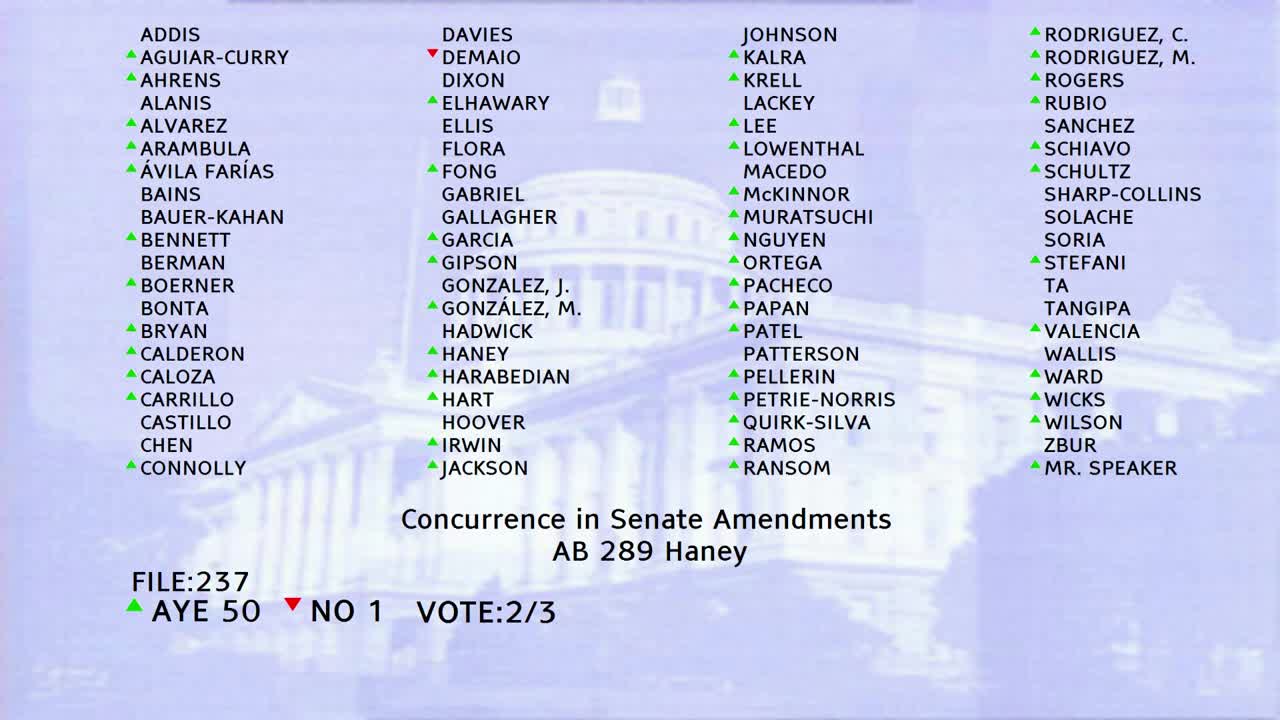
Bill Author

Bill Co-Author(s):