AB 1104: Net energy metering: construction of renewable electrical generation facilities: public works project requirements.
- Session Year: 2025-2026
- House: Assembly
- Latest Version Date: 2025-10-11
Current Status:
Passed
(2025-10-11: Chaptered by Secretary of State - Chapter 632, Statutes of 2025.)
Introduced
In Committee
Awaiting First Chamber Vote
Passed First Chamber
In Committee
Awaiting Second Chamber Vote
Passed Second Chamber
Enacted
(1)Existing law requires each electrical utility or other entity that offers electrical service, except as specified, to develop a standard contract or tariff that provides for net energy metering (NEM), that, among other things, compensates each eligible customer-generator, as defined, for the electricity it generated, as provided. Existing law requires each electrical utility to make the contract or tariff, commonly known as NEM 1.0, available to eligible customer-generators, upon request, as specified. Existing law requires the Public Utilities Commission to develop an additional standard contract or tariff, and requires each large electrical corporation to offer that standard contract or tariff, commonly known as NEM 2.0, to its eligible customer-generators, as provided. Existing law authorizes the commission to revise the standard contract or tariff, as specified. Pursuant to its authority, the commission adopted Decision 22-12-056 (December 19, 2022), commonly known as the net billing tariff, which creates a successor tariff to NEM 1.0 and NEM 2.0 and includes specified elements.
Existing law requires that, except as specified, not less than the general prevailing rate of per diem wages, determined by the Director of Industrial Relations, be paid to workers employed on public works projects. Existing law defines public works for purposes of requirements regarding the payment of prevailing wages to include construction, alteration, demolition, installation, or repair work done under contract and paid for using public funds, except as specified. Existing law requires the awarding body, as defined, of a contract for public work to do specified things, including to withhold and retain all amounts required to satisfy any civil wage and penalty assessments issued by the Labor Commissioner from payments made to the contractor, as specified. Existing law requires an awarding body to provide notice, containing certain information, to the Department of Industrial Relations of any public works contract subject to the public works requirements, within 30 days of the award, as provided. Existing law constitutes, beginning December 31, 2023, the construction of any renewable electrical generation facility and any associated battery storage that receives service pursuant to NEM 1.0, NEM 2.0, or the net billing tariff, except as specified, as a public works project.
This bill would specify that an entity that engaged a contractor for construction of a renewable electrical generation facility and associated battery storage, as described above, is not an awarding body and that certain public works project requirements do not apply to that entity. The bill would also specify that the contractor who enters into a contract with that entity for those construction services is the awarding body only for purposes of the above-described requirement to provide notice to the Department of Industrial Relations.
Existing law provides for various enforcement mechanisms related to ensuring a contractor pays each construction worker the prevailing rate of per diem wages, and provides that enforcement of a willful violation of any of these mechanisms against a contractor for the construction of a renewable electrical generation facility disqualifies that facility from being eligible to receive service pursuant to NEM 1.0, NEM 2.0, or the net billing tariff.
This bill instead would specify that a renewable electrical generation facility remains eligible to receive service pursuant to NEM 1.0, NEM 2.0, or the net billing tariff despite enforcement of a willful violation against a contractor for the construction of the facility, as described above, if restitution has been made to the affected workers and all associated penalties and fines have been paid.
(2)Under existing law, a violation of the Public Utilities Act or any order, decision, rule, direction, demand, or requirement of the commission is a crime.
Because the above-described provisions of this bill would be a part of the act and a violation of a commission action implementing the bills requirements would be a crime, the bill would impose a state-mandated local program.
The California Constitution requires the state to reimburse local agencies and school districts for certain costs mandated by the state. Statutory provisions establish procedures for making that reimbursement.
This bill would provide that no reimbursement is required by this act for a specified reason.
(1)Existing law requires each electrical utility or other entity that offers electrical service, except as specified, to develop a standard contract or tariff that provides for net energy metering (NEM), that, among other things, compensates each eligible customer-generator, as defined, for the electricity it generated, as provided. Existing law requires each electrical utility to make the contract or tariff, commonly known as NEM 1.0, available to eligible customer-generators, upon request, as specified. Existing law requires the Public Utilities Commission to develop an additional standard contract or tariff, and requires each large electrical corporation to offer that standard contract or tariff, commonly known as NEM 2.0, to its eligible customer-generators, as provided. Existing law authorizes the commission to revise the standard contract or tariff, as specified. Pursuant to its authority, the commission adopted Decision 22-12-056 (December 19, 2022), commonly known as the net billing tariff, which creates a successor tariff to NEM 1.0 and NEM 2.0 and includes specified elements.
Existing law requires that, except as specified, not less than the general prevailing rate of per diem wages, determined by the Director of Industrial Relations, be paid to workers employed on public works projects. Existing law defines public works for purposes of requirements regarding the payment of prevailing wages to include construction, alteration, demolition, installation, or repair work done under contract and paid for using public funds, except as specified. Existing law requires the awarding body, as defined, of a contract for public work to do specified things, including to withhold and retain all amounts required to satisfy any civil wage and penalty assessments issued by the Labor Commissioner from payments made to the contractor, as specified. Existing law requires an awarding body to provide notice, containing certain information, to the Department of Industrial Relations of any public works contract subject to the public works requirements, within 30 days of the award, as provided. Existing law constitutes, beginning December 31, 2023, the construction of any renewable electrical generation facility and any associated battery storage that receives service pursuant to NEM 1.0, NEM 2.0, or the net billing tariff, except as specified, as a public works project.
This bill would specify that an entity that engaged a contractor for construction of a renewable electrical generation facility or and associated battery storage, as described above, is not an awarding body and that certain public works project requirements do not apply to that entity. The bill would also specify that the contractor who enters into a contract with that entity for those construction services is the awarding body only for purposes of the above-described requirement to provide notice to the Department of Industrial Relations.
Existing law provides for various enforcement mechanisms related to ensuring a contractor pays each construction worker the prevailing rate of per diem wages, and provides that enforcement of a willful violation of any of these mechanisms against a contractor for the construction of a renewable electrical generation facility disqualifies that facility from being eligible to receive service pursuant to NEM 1.0, NEM 2.0, or the net billing tariff.
This bill instead would make specify that a renewable electrical generation facility remains eligible to receive service pursuant to NEM 1.0, NEM 2.0, or the net billing tariff despite enforcement of a willful violation against a contractor for the construction of the facility, as described above, if restitution has been made to the affected workers and all associated penalties and fines have been paid.
(2)Under existing law, a violation of the Public Utilities Act or any order, decision, rule, direction, demand, or requirement of the commission is a crime.
Because the above-described provisions of this bill would be a part of the act and a violation of a commission action implementing the bills requirements would be a crime, the bill would impose a state-mandated local program.
The California Constitution requires the state to reimburse local agencies and school districts for certain costs mandated by the state. Statutory provisions establish procedures for making that reimbursement.
This bill would provide that no reimbursement is required by this act for a specified reason.
(1)Existing law requires each electrical utility or other entity that offers electrical service, except as specified, to develop a standard contract or tariff that provides for net energy metering (NEM), that, among other things, compensates each eligible customer-generator, as defined, for the electricity it generated, as provided. Existing law requires each electrical utility to make the contract or tariff, commonly known as NEM 1.0, available to eligible customer-generators, upon request, as specified. Existing law requires the commission Public Utilities Commission to develop an additional standard contract or tariff, and requires each large electrical corporation to offer this that standard contract or tariff, commonly known as NEM 2.0, to its eligible customer-generators, as provided. Existing law authorizes the commission to revise the standard contract or tariff, as specified. Pursuant to its authority, the commission adopted Decision 22-12-056 (December 19, 2022), commonly known as the net billing tariff, that which creates a successor tariff to NEM 1.0 and NEM 2.0, 2.0 and includes specified elements.
Existing law requires that, except as specified, not less than the general prevailing rate of per diem wages, determined by the Director of Industrial Relations, be paid to workers employed on public works projects. Existing law defines public works for purposes of requirements regarding the payment of prevailing wages to include construction, alteration, demolition, installation, or repair work done under contract and paid for using public funds, except as specified. Existing law requires the awarding body, as defined, of a contract for public work to do specified things, including to withhold and retain all amounts required to satisfy any civil wage and penalty assessments issued by the Labor Commissioner from payments made to the contractor, as specified. Existing law constitutes, beginning December 31, 2023, the construction of any renewable electrical generation facility and any associated battery storage that receives service pursuant to NEM 1.0, NEM 2.0, or the net billing tariff, except as specified, as a public works project.
This bill would prohibit the specify that an entity that engaged the a contractor for construction of a renewable electrical generation facility or associated battery storage, as described above, from being is not an awarding body, as defined, body and would prohibit that certain public works project requirements from applying do not apply to that entity.
Existing law provides for various enforcement mechanisms related to ensuring a contractor pays each construction worker the prevailing rate of per diem wages, and provides that enforcement of a willful violation of any of these mechanisms against a contractor for the construction of a renewable electrical generation facility disqualifies that facility from being eligible to receive service pursuant to NEM 1.0, NEM 2.0, or the net billing tariff.
This bill instead would make a renewable electrical generation facility eligible to receive service pursuant to NEM 1.0, NEM 2.0, or the net billing tariff despite enforcement of a willful violation against a contractor for the construction of the facility, as described above, if restitution has been made to the affected workers and all associated penalties and fines have been paid.
(2)Existing law provides for the regulation of electrical corporations and electric service providers by the commission and requires the electrical corporations and electric service providers to do specified things. Existing law exempts from the definitions of electrical corporation and electric service provider an independent solar energy producer, defined as a corporation or person employing one or more solar energy systems for the generation or electricity for its own use or the use of one of its tenants, or the use of, or sale to, not more than 2 other entities, as provided. Existing law requires independent solar energy producers to do specified things, including, when contracting for the use or sale of electricity or lease of the solar energy system, to record a Notice of an Independent Solar Energy Producer Contract against the title to the real property on which the electricity is generated, and against the title of any adjacent real property on which the electricity will be used, in the office of the county recorder, as specified.This bill would also allow an independent solar energy producer to generate electricity for use of, or sale to, not more than a specified number of entities per generation system.(3)(2)Under existing law, a violation of the Public Utilities Act or any order, decision, rule, direction, demand, or requirement of the commission is a crime.
Because certain of the above-described provisions of this bill would be a part of the act and a violation of a commission action implementing the bills requirements would be a crime, the bill would impose a state-mandated local program.
The California Constitution requires the state to reimburse local agencies and school districts for certain costs mandated by the state. Statutory provisions establish procedures for making that reimbursement.
This bill would provide that no reimbursement is required by this act for a specified reason.
(1)Existing law requires each electrical utility or other entity that offers electrical service, except as specified, to develop a standard contract or tariff that provides for net energy metering (NEM), that, among other things, compensates each eligible customer-generator, as defined, for the electricity it generated, as provided. Existing law requires each electrical utility to make the contract or tariff, commonly known as NEM 1.0, available to eligible customer-generators, upon request, as specified. Existing law requires the commission to develop an additional standard contract or tariff, and requires each large electrical corporation to offer this standard contract or tariff, commonly known as NEM 2.0, to its eligible customer-generators, as provided. Existing law authorizes the commission to revise the standard contract or tariff, as specified. Pursuant to its authority, the commission adopted Decision 22-12-056 (December 19, 2022), commonly known as the net billing tariff, that creates a successor tariff to NEM 1.0 and NEM 2.0, and includes specified elements.
Existing law requires that, except as specified, not less than the general prevailing rate of per diem wages, determined by the Director of Industrial Relations, be paid to workers employed on public works projects. Existing law defines the term public works for purposes of requirements regarding the payment of prevailing wages to include construction, alteration, demolition, installation, or repair work done under contract and paid for using public funds, except as specified. Existing law requires the awarding body, as defined, of a contract for public work to do specified things, including to withhold and retain all amounts required to satisfy any civil wage and penalty assessments issued by the Labor Commissioner from payments made to the contractor, as specified. Existing law constitutes, beginning December 31, 2023, the construction of any renewable electrical generation facility and any associated battery storage that receives service pursuant to NEM 1.0, NEM 2.0, or the net billing tariff, except as specified, as a public works project.
This bill would provide, for the construction of a nonresidential photovoltaic renewable electrical generation facility that has a maximum net output of less than one megawatt of electrical energy, and any associated battery storage, that the entity that engaged the contractor is not an awarding body. The bill would provide that specified public works project requirements apply to the entity.This bill would prohibit the entity that engaged the contractor for construction of a renewable electrical generation facility or associated battery storage, as described above, from being an awarding body, as defined, and would prohibit certain public works project requirements from applying to that entity.
Existing law provides for various enforcement mechanisms related to ensuring a contractor pays each construction worker the prevailing rate of per diem wages, and provides that an enforcement of a willful violation of any of these mechanisms against a contractor for the construction of a renewable electrical generation facility disqualifies that facility from eligibility being eligible to receive service pursuant to NEM 1.0, NEM 2.0, or the net billing tariff.
This bill would qualify a nonresidential photovoltaic renewable electrical generation facility to receive service pursuant to NEM 1.0, NEM 2.0, or the net billing tariff despite an enforcement of a willful violation as described above against a contractor for the construction of the facility, as provided. The bill would, for a technical or unintentional violation by the contractor, grant a cure period of 90 calendar days from the date of the notice of noncompliance to the contractor to cure the violation and make restitution to any affected workers. The bill would provide that if the contractor corrects the violation within the cure period and provides evidence of correction to the Department of Industrial Relations, the violation will be considered resolved, and no penalties will be imposed for that violation. The bill would provide that specified penalties for contractor noncompliance do not accrue to the entity that engaged the contractor, but to the contractor.This bill instead would make a renewable electrical generation facility eligible to receive service pursuant to NEM 1.0, NEM 2.0, or the net billing tariff despite enforcement of a willful violation against a contractor for the construction of the facility, as described above, if restitution has been made to the affected workers and all associated penalties and fines have been paid.
(2)Existing law provides for the regulation of electrical corporations and electric service providers by the commission and requires the electrical corporations and electric service providers to do specified things. Existing law exempts from the definitions of electrical corporation and electric service provider an independent solar energy producer, defined as a corporation or person employing one or more solar energy systems for the generation or electricity for its own use or the use of one of its tenants, or the use of, or sale to, not more than 2 other entities, as provided. Existing law requires independent solar energy producers to do specified things, including, when contracting for the use or sale of electricity or lease of the solar energy system, to record a Notice of an Independent Solar Energy Producer Contract against the title to the real property on which the electricity is generated, and against the title of any adjacent real property on which the electricity will be used, in the office of the county recorder, as specified.
This bill would also allow an independent solar energy producer to generate electricity for use of, or sale to, not more than a specified number of entities per generation system.
(3)Under existing law, a violation of the Public Utilities Act or any order, decision, rule, direction, demand, or requirement of the commission is a crime.
Because certain of the above-described provisions of this bill would be a part of the act and a violation of a commission action implementing the bills requirements would be a crime, the bill would impose a state-mandated local program.
The California Constitution requires the state to reimburse local agencies and school districts for certain costs mandated by the state. Statutory provisions establish procedures for making that reimbursement.
This bill would provide that no reimbursement is required by this act for a specified reason.
(1)Existing law requires each electrical utility or other entity that offers electrical service, except as specified, to develop a standard contract or tariff that provides for net energy metering (NEM), that, among other things, compensates each eligible customer-generator, as defined, for the electricity it generated, as provided. Existing law requires each electrical utility to make the contract or tariff, commonly known as NEM 1.0, available to eligible customer-generators, upon request, as specified. Existing law requires the commission to develop an additional standard contract or tariff, and requires each large electrical corporation to offer this standard contract or tariff, commonly known as NEM 2.0, to its eligible customer-generators, as provided. Existing law authorizes the commission to revise the standard contract or tariff, as specified. Pursuant to its authority, the commission adopted Decision 22-12-056 (December 19, 2022), commonly known as the net billing tariff, that creates a successor tariff to NEM 1.0 and NEM 2.0, and includes specified elements.
Existing law requires that, except as specified, not less than the general prevailing rate of per diem wages, determined by the Director of Industrial Relations, be paid to workers employed on public works projects. Existing law defines the term public works for purposes of requirements regarding the payment of prevailing wages to include construction, alteration, demolition, installation, or repair work done under contract and paid for using public funds, except as specified. Existing law requires the awarding body, as defined, of a contract for public work to do specified things, including to withhold and retain all amounts required to satisfy any civil wage and penalty assessments issued by the Labor Commissioner from payments made to the contractor, as specified. Existing law constitutes, beginning December 31, 2023, the construction of any renewable electrical generation facility and any associated battery storage that receives service pursuant to NEM 1.0, NEM 2.0, or the net billing tariff, except as specified, as a public works project.
This bill would provide, for the construction of a nonresidential photovoltaic renewable electrical generation facility that has a maximum net output of less than one megawatt of electrical energy, and any associated battery storage, that the entity that engaged the contractor is not an awarding body. The bill would provide that specified public works project requirements apply to the entity.
Existing law provides for various enforcement mechanisms related to ensuring a contractor pays each construction worker the prevailing rate of per diem wages, and provides that an enforcement of a willful violation of any of these mechanisms against a contractor for the construction of a renewable electrical generation facility disqualifies that facility from eligibility to receive service pursuant to NEM 1.0, NEM 2.0, or the net billing tariff.
This bill would qualify a nonresidential photovoltaic renewable electrical generation facility to receive service pursuant to NEM 1.0, NEM 2.0, or the net billing tariff despite an enforcement of a willful violation as described above against a contractor for the construction of the facility, as provided. The bill would, for a technical or unintentional violation by the contractor, grant a cure period of 90 calendar days from the date of the notice of noncompliance to the contractor to cure the violation and make restitution to any affected workers. The bill would provide that if the contractor corrects the violation within the cure period and provides evidence of correction to the Department of Industrial Relations, the violation will be considered resolved, and no penalties will be imposed for that violation. The bill would provide that specified penalties for contractor noncompliance do not accrue to the entity that engaged the contractor, but to the contractor.
(2)Existing law provides for the regulation of electrical corporations and electric service providers by the commission and requires the electrical corporations and electric service providers to do specified things. Existing law exempts from the definitions of electrical corporation and electric service provider an independent solar energy producer, defined as a corporation or person employing one or more solar energy systems for the generation or electricity for its own use or the use of one of its tenants, or the use of, or sale to, not more than 2 other entities, as provided. Existing law requires independent solar energy producers to do specified things, including, when contracting for the use or sale of electricity or lease of the solar energy system, to record a Notice of an Independent Solar Energy Producer Contract against the title to the real property on which the electricity is generated, and against the title of any adjacent real property on which the electricity will be used, in the office of the county recorder, as specified.
This bill would also allow an independent solar energy producer to generate electricity for use of, or sale to, not more than a specified number of entities per generation system.
(3)Under existing law, a violation of the Public Utilities Act or any order, decision, rule, direction, demand, or requirement of the commission is a crime.
Because certain of the above-described provisions of this bill would be a part of the act and a violation of a commission action implementing the bills requirements would be a crime, the bill would impose a state-mandated local program.
The California Constitution requires the state to reimburse local agencies and school districts for certain costs mandated by the state. Statutory provisions establish procedures for making that reimbursement.
This bill would provide that no reimbursement is required by this act for a specified reason.
Existing law requires the State Energy Resources Conservation and Development Commission to continuously carry out studies, research projects, data collection, and other activities required to assess the nature, extent, and distribution of energy resources to meet the needs of the state, including, but not limited to, solar energy resources.This bill would express the intent of the Legislature to enact legislation relating to solar energy resources.Existing law requires the State Energy Resources Conservation and Development Commission to continuously carry out studies, research projects, data collection, and other activities required to assess the nature, extent, and distribution of energy resources to meet the needs of the state, including, but not limited to, solar energy resources.
This bill would express the intent of the Legislature to enact legislation relating to solar energy resources.
(a)Notwithstanding paragraph (1) of subdivision (a) of Section 1720 of the Labor Code, construction of a renewable electrical generation facility, and associated battery storage, after December 31, 2023, that receives service pursuant to the standard contract or tariff developed pursuant to Section 2827.1, shall constitute a public works project for purposes of Article 2 (commencing with Section 1770) of Chapter 1 of Part 7 of Division 2 of the Labor Code, except as specified in subdivision (f).
(b)A contractor who enters into a contract to perform work on a renewable electrical generation facility or associated battery storage described in subdivision (a) shall do all of the following:
(1)The contractor shall pay each construction worker employed in the execution of the work, at minimum, the general prevailing rate of per diem wages, except that an apprentice registered in a program approved by the Chief of the Division of Apprenticeship Standards shall be paid, at minimum, the applicable apprentice prevailing rate.
(2)The contractor shall maintain and verify payroll records pursuant to Section 1776 of the Labor Code and make those records available for inspection and copying as provided in that section. Notwithstanding Section 1776 of the Labor Code, the contractor shall not be required to provide copies of certified payroll records to any entity other than the Department of Industrial Relations and the commission.
(3)The contractor shall biannually, on July 1 and December 31 of each year, submit to the commission digital copies of its certified payroll records, in a format consistent with systems used for compliance with Section 1776 of the Labor Code, for projects subject to this section. The commission shall retain these records as public records for five years.
(c)The requirement imposed in paragraph (1) of subdivision (b) may be enforced through any of the following mechanisms:
(1)Within 18 months after completing the renewable electrical generation facility, by the Labor Commissioner through the issuance of a civil wage and penalty assessment pursuant to Section 1741 of the Labor Code, which may be reviewed pursuant to Section 1742 of the Labor Code.
(2)By an underpaid construction worker or apprentice through an administrative complaint or civil action.
(3)By a joint labor-management committee through a civil action pursuant to Section 1771.2 of the Labor Code.
(d)If a willful violation of this section has been enforced against a contractor for the construction of a renewable electrical generation facility pursuant to subdivision (c), that facility shall remain eligible to receive service pursuant to a standard contract or tariff developed pursuant to Section 2827 or 2827.1 if restitution has been made to the affected workers and all associated penalties and fines have been paid.
(e)The commission shall require each large electrical corporation to include the requirements of this section in each standard contract or tariff offered pursuant to Section 2827.1.
(f)(1)This section does not apply to a residential renewable electrical generation facility that is eligible to receive service pursuant to the standard contract or tariff developed pursuant to Section 2827.1 and has a maximum generating capacity of 15 kilowatts or less of electricity.
(2)This section does not apply to a residential renewable electrical generation facility that is eligible to receive service pursuant to the standard contract or tariff developed pursuant to Section 2827.1 and that is installed on a single-family home.
(3)This section does not apply to a project that is a public work, as defined in Section 1720 of the Labor Code, and that is subject to Article 2 (commencing with Section 1770) of Chapter 1 of Part 7 of Division 2 of the Labor Code.
(4)This section does not apply to a renewable electrical generation facility that serves only a modular home, a modular home community, or multiunit housing that has two or fewer stories.
(g)(1)The entity that engaged the contractor to perform work on a renewable electrical generation facility and associated battery storage described in subdivision (a) is not an awarding body, as defined in Section 1722 of the Labor Code. Public works project requirements not found in this section do not apply to the entity. This section does not affect the entitys liability for nonpayment of wages or materials under Section 3 of Article XIV of the California Constitution.
(2)The contractor who enters into a contract with the entity described in paragraph (1) to perform work on a renewable electrical generation facility and associated battery storage described in subdivision (a) is the awarding body only for the limited purposes of Section 1773.3 of the Labor Code.
SEC. 2.No reimbursement is required by this act pursuant to Section 6 of Article XIIIB of the California Constitution because the only costs that may be incurred by a local agency or school district will be incurred because this act creates a new crime or infraction, eliminates a crime or infraction, or changes the penalty for a crime or infraction, within the meaning of Section 17556 of the Government Code, or changes the definition of a crime within the meaning of Section 6 of Article XIIIB of the California Constitution.
(a)Notwithstanding paragraph (1) of subdivision (a) of Section 1720 of the Labor Code, construction of a renewable electrical generation facility, and associated battery storage, after December 31, 2023, that receives service pursuant to the standard contract or tariff developed pursuant to Section 2827.1, shall constitute a public works project for purposes of Article 2 (commencing with Section 1770) of Chapter 1 of Part 7 of Division 2 of the Labor Code, except as specified in subdivision (f).
(b)A contractor who enters into a contract to perform work on a renewable electrical generation facility or associated battery storage described in subdivision (a) shall do all of the following:
(1)The contractor shall pay each construction worker employed in the execution of the work, at minimum, the general prevailing rate of per diem wages, except that an apprentice registered in a program approved by the Chief of the Division of Apprenticeship Standards shall be paid, at minimum, the applicable apprentice prevailing rate.
(2)The contractor shall maintain and verify payroll records pursuant to Section 1776 of the Labor Code and make those records available for inspection and copying as provided in that section. Notwithstanding Section 1776 of the Labor Code, the contractor shall not be required to provide copies of certified payroll records to any entity other than the Department of Industrial Relations and the commission.
(3)The contractor shall biannually, on July 1 and December 31 of each year, submit to the commission digital copies of its certified payroll records records, in a format consistent with systems used for compliance with Section 1776 of the Labor Code, for projects subject to this section. The commission shall retain these records as public records for five years.
(c)The requirement imposed in paragraph (1) of subdivision (b) may be enforced through any of the following mechanisms:
(1)Within 18 months after completing the renewable electrical generation facility, by the Labor Commissioner through the issuance of a civil wage and penalty assessment pursuant to Section 1741 of the Labor Code, which may be reviewed pursuant to Section 1742 of the Labor Code.
(2)By an underpaid construction worker or apprentice through an administrative complaint or civil action.
(3)By a joint labor-management committee through a civil action pursuant to Section 1771.2 of the Labor Code.
(d)If a willful violation of this section has been enforced against a contractor for the construction of a renewable electrical generation facility pursuant to subdivision (c), that facility shall be remain eligible to receive service pursuant to a standard contract or tariff developed pursuant to Section 2827 or 2827.1 if restitution has been made to the affected workers and all associated penalties and fines have been paid.
(e)The commission shall require each large electrical corporation to include the requirements of this section in each standard contract or tariff offered pursuant to Section 2827.1.
(f)(1)This section does not apply to a residential renewable electrical generation facility that is eligible to receive service pursuant to the standard contract or tariff developed pursuant to Section 2827.1 and has a maximum generating capacity of 15 kilowatts or less of electricity.
(2)This section does not apply to a residential renewable electrical generation facility that is eligible to receive service pursuant to the standard contract or tariff developed pursuant to Section 2827.1 and that is installed on a single-family home.
(3)This section does not apply to a project that is a public work, as defined in Section 1720 of the Labor Code, and that is subject to Article 2 (commencing with Section 1770) of Chapter 1 of Part 7 of Division 2 of the Labor Code.
(4)This section does not apply to a renewable electrical generation facility that serves only a modular home, a modular home community, or multiunit housing that has two or fewer stories.
(5)(g)(1)The entity that engaged the contractor to perform work on a renewable electrical generation facility and associated battery storage described in subdivision (a) is not an awarding body, as defined in Section 1722 of the Labor Code. Public works project requirements not found in this section do not apply to the entity. This section does not affect the entitys liability for nonpayment of wages or materials under Section 3 of Article XIV of the California Constitution.
(2)The contractor who enters into a contract with the entity described in paragraph (1) to perform work on a renewable electrical generation facility and associated battery storage described in subdivision (a) is the awarding body only for the limited purposes of Section 1773.3 of the Labor Code.
SEC. 2.No reimbursement is required by this act pursuant to Section 6 of Article XIIIB of the California Constitution because the only costs that may be incurred by a local agency or school district will be incurred because this act creates a new crime or infraction, eliminates a crime or infraction, or changes the penalty for a crime or infraction, within the meaning of Section 17556 of the Government Code, or changes the definition of a crime within the meaning of Section 6 of Article XIIIB of the California Constitution.
(a)Notwithstanding paragraph (1) of subdivision (a) of Section 1720 of the Labor Code, construction of a renewable electrical generation facility, and associated battery storage, after December 31, 2023, that receives service pursuant to the standard contract or tariff developed pursuant to Section 2827.1, shall constitute a public works project for purposes of Article 2 (commencing with Section 1770) of Chapter 1 of Part 7 of Division 2 of the Labor Code, except as specified in subdivision (f).
(b)A contractor who enters into a contract to perform work on a renewable electrical generation facility or associated battery storage described in subdivision (a) shall do all of the following:
(1)The contractor shall pay each construction worker employed in the execution of the work, at minimum, the general prevailing rate of per diem wages, except that an apprentice registered in a program approved by the Chief of the Division of Apprenticeship Standards shall be paid, at minimum, the applicable apprentice prevailing rate.
(2)The contractor shall maintain and verify payroll records pursuant to Section 1776 of the Labor Code and make those records available for inspection and copying as provided in that section. Notwithstanding Section 1776 of the Labor Code, the contractor shall not be required to provide copies of certified payroll records to any entity other than the Department of Industrial Relations and the commission.
(3)The contractor shall biannually, on July 1 and December 31 of each year, submit to the commission digital copies of its certified payroll records for projects subject to this section. The commission shall retain these records as public records for five years.
(c)The requirement imposed in paragraph (1) of subdivision (b) may be enforced through any of the following mechanisms:
(1)Within 18 months after completing the renewable electrical generation facility, by the Labor Commissioner through the issuance of a civil wage and penalty assessment pursuant to Section 1741 of the Labor Code, which may be reviewed pursuant to Section 1742 of the Labor Code.
(2)By an underpaid construction worker or apprentice through an administrative complaint or civil action.
(3)By a joint labor-management committee through a civil action pursuant to Section 1771.2 of the Labor Code.
(d)If a willful violation of this section has been enforced against a contractor for the construction of a renewable electrical generation facility pursuant to subdivision (c), that facility shall be eligible to receive service pursuant to a standard contract or tariff developed pursuant to Section 2827 or 2827.1 if restitution has been made to the affected workers and all associated penalties and fines have been paid.
(e)The commission shall require each large electrical corporation to include the requirements of this section in each standard contract or tariff offered pursuant to Section 2827.1.
(f)(1)This section does not apply to a residential renewable electrical generation facility that is eligible to receive service pursuant to the standard contract or tariff developed pursuant to Section 2827.1 and has a maximum generating capacity of 15 kilowatts or less of electricity.
(2)This section does not apply to a residential renewable electrical generation facility that is eligible to receive service pursuant to the standard contract or tariff developed pursuant to Section 2827.1 and that is installed on a single-family home.
(3)This section does not apply to a project that is a public work, as defined in Section 1720 of the Labor Code, and that is subject to Article 2 (commencing with Section 1770) of Chapter 1 of Part 7 of Division 2 of the Labor Code.
(4)This section does not apply to a renewable electrical generation facility that serves only a modular home, a modular home community, or multiunit housing that has two or fewer stories.
(5)The entity that engaged the contractor is not an awarding body, as defined in Section 1722 of the Labor Code. Public works project requirements not found in this section do not apply to the entity. This section does not affect the entitys liability for nonpayment of wages or materials under Section 3 of Article XIV of the California Constitution.
SEC. 4.Section 2868 of the Public Utilities Code is amended to read:2868.The following definitions shall apply for purposes of this article:(a)Electric utility means an electrical corporation as defined in Section 218, a local publicly owned electric utility as defined in Section 224.3, or an electrical cooperative as defined in Section 2776.(b)Independent solar energy producer means a corporation or person employing one or more solar energy systems for the generation of electricity for any one or more of the following purposes:(1)Its own use or the use of its tenants.(2)The use of, or sale to, not more than two other entities or persons per generation system solely for use on the real property on which the electricity is generated, or on real property immediately adjacent thereto.(3)The use of, or sale to, not more than a specified number of entities per generation system.(c)Real property means a single parcel of land.(d)Solar energy system means any configuration of solar energy devices that collects and distributes solar energy for the purpose of generating electricity and that has a single interconnection with the electric utility transmission or distribution network.SEC. 5.SEC. 2.No reimbursement is required by this act pursuant to Section 6 of Article XIIIB of the California Constitution because the only costs that may be incurred by a local agency or school district will be incurred because this act creates a new crime or infraction, eliminates a crime or infraction, or changes the penalty for a crime or infraction, within the meaning of Section 17556 of the Government Code, or changes the definition of a crime within the meaning of Section 6 of Article XIIIB of the California Constitution.
This act shall be known, and may be cited, as the Small Business Renewable Energy Access and Protection Act.
SEC. 2.(a)The Legislature finds and declares all of the following:
(1)Californias commercial solar market is facing significant challenges, including restrictive policies, that are resulting in job losses and undermining the states goal that 100 percent of all retail sales of electricity to California end-use customers come from eligible renewable energy resources and zero-carbon resources by 2045 pursuant to Section 454.53 of the Public Utilities Code.
(2)Policies that limit the development of clean energy projects are hindering business investments and contributing to significant job losses within the sector.
(3)Federal laws, including the Inflation Reduction Act of 2022 (Public Law 117-169), provide an effective framework for supporting small clean energy projects. Alignment with federal provisions will help stimulate growth in Californias commercial solar market.
(b)It is the intent of the Legislature to do all of the following: accelerate the achievement of Californias clean energy goals by clarifying that the use or sale of solar to no more than 20 entities per generation system is not subject to public utility regulation.
(1)Encourage businesses to invest in clean energy projects by providing a tailored exemption to some public works project requirements for the nonresidential entities that construct solar projects of 1 megawatt of generating capacity and smaller.(2)Provide an opportunity for contractors to cure violations of certain public works project requirements, in line with protections provided by the Inflation Reduction Act of 2022 (Public Law 117-169), so that contractors can maintain compliance without imposing undue penalties on the nonresidential entities that construct these projects.(3)Accelerate the achievement of Californias clean energy goals by clarifying that the use or sale of solar to no more than 20 entities per generation system is not subject to public utility regulation.SEC. 3.Section 769.2 of the Public Utilities Code is amended to read:769.2.(a)Notwithstanding paragraph (1) of subdivision (a) of Section 1720 of the Labor Code, construction of a renewable electrical generation facility, and associated battery storage, after December 31, 2023, that receives service pursuant to the standard contract or tariff developed pursuant to Section 2827.1, shall constitute a public works project for purposes of Article 2 (commencing with Section 1770) of Chapter 1 of Part 7 of Division 2 of the Labor Code, except as specified in subdivision (f).
(b)A contractor who enters into a contract to perform work on a renewable electrical generation facility or associated battery storage described in subdivision (a) shall do all of the following:
(1)The contractor shall pay each construction worker employed in the execution of the work, at minimum, the general prevailing rate of per diem wages, except that an apprentice registered in a program approved by the Chief of the Division of Apprenticeship Standards shall be paid, at minimum, the applicable apprentice prevailing rate.
(2)The contractor shall maintain and verify payroll records pursuant to Section 1776 of the Labor Code and make those records available for inspection and copying as provided in that section. Notwithstanding Section 1776 of the Labor Code, the contractor shall not be required to provide copies of certified payroll records to any entity other than the Department of Industrial Relations and the commission.
(3)The contractor shall biannually, on July 1 and December 31 of each year, submit to the commission digital copies of its certified payroll records for projects subject to this section. The commission shall retain these records as public records for five years.
(c)The requirement imposed in paragraph (1) of subdivision (b) may be enforced through any of the following mechanisms:
(1)Within 18 months after completing the renewable electrical generation facility, by the Labor Commissioner through the issuance of a civil wage and penalty assessment pursuant to Section 1741 of the Labor Code, which may be reviewed pursuant to Section 1742 of the Labor Code.
(2)By an underpaid construction worker or apprentice through an administrative complaint or civil action.
(3)By a joint labor-management committee through a civil action pursuant to Section 1771.2 of the Labor Code.
(d)If a willful violation of this section has been enforced against a contractor for the construction of a renewable electrical generation facility pursuant to subdivision (c), that facility shall not be eligible to receive service pursuant to a standard contract or tariff developed pursuant to Section 2827 or 2827.1. 2827.1 if restitution has been made to the affected workers and all associated penalties and fines have been paid.
(e)The commission shall require each large electrical corporation to include the requirements of this section in each standard contract or tariff offered pursuant to Section 2827.1.
(f)(1)This section does not apply to a residential renewable electrical generation facility that is eligible to receive service pursuant to the standard contract or tariff developed pursuant to Section 2827.1 and has a maximum generating capacity of 15 kilowatts or less of electricity.
(2)This section does not apply to a residential renewable electrical generation facility that is eligible to receive service pursuant to the standard contract or tariff developed pursuant to Section 2827.1 and that is installed on a single-family home.
(3)This section does not apply to a project that is a public work, as defined in Section 1720 of the Labor Code, and that is subject to Article 2 (commencing with Section 1770) of Chapter 1 of Part 7 of Division 2 of the Labor Code.
(4)This section does not apply to a renewable electrical generation facility that serves only a modular home, a modular home community, or multiunit housing that has two or fewer stories.
(g)(1)For the construction of a nonresidential photovoltaic renewable electrical generation facility that has a maximum net output of less than 1 megawatt of electrical energy, as measured in alternating current, and associated battery storage, all of the following shall apply:(A)The entity that engaged the contractor is not an awarding body, as defined in Section 1722 of the Labor Code. Public works project requirements not found in this section do not apply to the entity.(B)Notwithstanding subdivision (d), the nonresidential photovoltaic renewable electrical generation facility shall be eligible to receive service pursuant to a standard contract or tariff developed pursuant to Section 2827 or 2827.1 regardless of whether a willful violation of this section has been enforced against the contractor for the construction of the facility pursuant to subdivision (c).(C)For a technical or unintentional violation of this section by the contractor, the contractor shall have a period of 90 calendar days from the date of the notice of noncompliance to cure the violation and make restitution to any affected workers. If the contractor corrects the violation within this 90-day cure period and provides evidence of correction to the Department of Industrial Relations, the violation shall be considered resolved, and no penalty shall be imposed for that violation. If the contractor fails to cure the violation within the 90-day cure period, the contractor shall be subject to a penalty pursuant to subdivision (c).(D)A penalty for contractor noncompliance with this section shall not accrue to the entity that engaged the contractor, but only to the contractor.(2)This subdivision does not alter a contractors obligation to comply with prevailing wage or apprenticeship requirements that are required for a project subject to this section, including, but not limited to, any registration, reporting, or compliance requirements of the commission or of the Department of Industrial Relations.(5)The entity that engaged the contractor is not an awarding body, as defined in Section 1722 of the Labor Code. Public works project requirements not found in this section do not apply to the entity. This section does not affect the entitys liability for nonpayment of wages or materials under Section 3 of Article XIV of the California Constitution.
SEC. 4.Section 2868 of the Public Utilities Code is amended to read:2868.The following definitions shall apply for purposes of this article:
(a)Electric utility means an electrical corporation as defined in Section 218, a local publicly owned electric utility as defined in Section 224.3, or an electrical cooperative as defined in Section 2776.
(b)Independent solar energy producer means a corporation or person employing one or more solar energy systems for the generation of electricity for any one or more of the following purposes:
(1)Its own use or the use of its tenants.
(2)The use of, or sale to, not more than two other entities or persons per generation system solely for use on the real property on which the electricity is generated, or on real property immediately adjacent thereto.
(3)The use of, or sale to, not more than a specified number of entities per generation system.
(c)Real property means a single parcel of land.
(d)Solar energy system means any configuration of solar energy devices that collects and distributes solar energy for the purpose of generating electricity and that has a single interconnection with the electric utility transmission or distribution network.
SEC. 5.No reimbursement is required by this act pursuant to Section 6 of Article XIIIB of the California Constitution because the only costs that may be incurred by a local agency or school district will be incurred because this act creates a new crime or infraction, eliminates a crime or infraction, or changes the penalty for a crime or infraction, within the meaning of Section 17556 of the Government Code, or changes the definition of a crime within the meaning of Section 6 of Article XIIIB of the California Constitution.
This act shall be known, and may be cited, as the Small Business Renewable Energy Access and Protection Act.
SEC. 2.(a)The Legislature finds and declares all of the following:
(1)Californias commercial solar market is facing significant challenges, including restrictive policies, that are resulting in job losses and undermining the states goal that 100 percent of all retail sales of electricity to California end-use customers come from eligible renewable energy resources and zero-carbon resources by 2045 pursuant to Section 454.53 of the Public Utilities Code.
(2)Policies that limit the development of clean energy projects are hindering business investments and contributing to significant job losses within the sector.
(3)Federal laws, including the Inflation Reduction Act of 2022 (Public Law 117-169), provide an effective framework for supporting small clean energy projects. Alignment with federal provisions will help stimulate growth in Californias commercial solar market.
(b)It is the intent of the Legislature to do all of the following:
(1)Encourage businesses to invest in clean energy projects by providing a tailored exemption to some public works project requirements for the nonresidential entities that construct solar projects of 1 megawatt of generating capacity and smaller.
(2)Provide an opportunity for contractors to cure violations of certain public works project requirements, in line with protections provided by the Inflation Reduction Act of 2022 (Public Law 117-169), so that contractors can maintain compliance without imposing undue penalties on the nonresidential entities that construct these projects.
(3)Accelerate the achievement of Californias clean energy goals by clarifying that the use or sale of solar to no more than 20 entities per generation system is not subject to public utility regulation.
SEC. 3.Section 769.2 of the Public Utilities Code is amended to read:769.2.(a)Notwithstanding paragraph (1) of subdivision (a) of Section 1720 of the Labor Code, construction of any a renewable electrical generation facility, and any associated battery storage, after December 31, 2023, that receives service pursuant to the standard contract or tariff developed pursuant to Section 2827.1, shall constitute a public works project for purposes of Article 2 (commencing with Section 1770) of Chapter 1 of Part 7 of Division 2 of the Labor Code, except as specified in subdivision (f).
(b)A contractor who enters into a contract to perform work on a renewable electrical generation facility or associated battery storage described in subdivision (a) shall do all of the following:
(1)The contractor shall pay each construction worker employed in the execution of the work, at minimum, the general prevailing rate of per diem wages, except that an apprentice registered in a program approved by the Chief of the Division of Apprenticeship Standards shall be paid, at minimum, the applicable apprentice prevailing rate.
(2)The contractor shall maintain and verify payroll records pursuant to Section 1776 of the Labor Code and make those records available for inspection and copying as provided in that section. Notwithstanding Section 1776 of the Labor Code, the contractor shall not be required to provide copies of certified payroll records to any entity other than the Department of Industrial Relations and the commission.
(3)The contractor shall biannually, on July 1 and December 31 of each year, submit to the commission digital copies of its certified payroll records for projects subject to this section. The commission shall retain these records as public records for five years.
(c)The requirement imposed in paragraph (1) of subdivision (b) may be enforced through any of the following mechanisms:
(1)Within 18 months after completing the renewable electrical generation facility, by the Labor Commissioner through the issuance of a civil wage and penalty assessment pursuant to Section 1741 of the Labor Code, which may be reviewed pursuant to Section 1742 of the Labor Code.
(2)By an underpaid construction worker or apprentice through an administrative complaint or civil action.
(3)By a joint labor-management committee through a civil action pursuant to Section 1771.2 of the Labor Code.
(d)If a willful violation of this section has been enforced against a contractor for the construction of a renewable electrical generation facility pursuant to subdivision (c), that facility shall not be eligible to receive service pursuant to a standard contract or tariff developed pursuant to Section 2827 or 2827.1.
(e)The commission shall require each large electrical corporation to include the requirements of this section in any each standard contract or tariff offered pursuant to Section 2827.1.
(f)(1)This section does not apply to a residential renewable electrical generation facility that is eligible to receive service pursuant to the standard contract or tariff developed pursuant to Section 2827.1 and has a maximum generating capacity of 15 kilowatts or less of electricity.
(2)This section does not apply to a residential renewable electrical generation facility that is eligible to receive service pursuant to the standard contract or tariff developed pursuant to Section 2827.1 and that is installed on a single-family home.
(3)This section does not apply to a project that is a public work, as defined in Section 1720 of the Labor Code, and that is subject to Article 2 (commencing with Section 1770) of Chapter 1 of Part 7 of Division 2 of the Labor Code.
(4)This section does not apply to a renewable electrical generation facility that serves only a modular home, a modular home community, or multiunit housing that has two or fewer stories.
(g)(1)For the construction of a nonresidential photovoltaic renewable electrical generation facility that has a maximum net output of less than 1 megawatt of electrical energy, as measured in alternating current, and associated battery storage, all of the following shall apply:
(A)The entity that engaged the contractor is not an awarding body, as defined in Section 1722 of the Labor Code. Public works project requirements not found in this section do not apply to the entity.
(B)Notwithstanding subdivision (d), the nonresidential photovoltaic renewable electrical generation facility shall be eligible to receive service pursuant to a standard contract or tariff developed pursuant to Section 2827 or 2827.1 regardless of whether a willful violation of this section has been enforced against the contractor for the construction of the facility pursuant to subdivision (c).
(C)For a technical or unintentional violation of this section by the contractor, the contractor shall have a period of 90 calendar days from the date of the notice of noncompliance to cure the violation and make restitution to any affected workers. If the contractor corrects the violation within this 90-day cure period and provides evidence of correction to the Department of Industrial Relations, the violation shall be considered resolved, and no penalty shall be imposed for that violation. If the contractor fails to cure the violation within the 90-day cure period, the contractor shall be subject to a penalty pursuant to subdivision (c).
(D)A penalty for contractor noncompliance with this section shall not accrue to the entity that engaged the contractor, but only to the contractor.
(2)This subdivision does not alter a contractors obligation to comply with prevailing wage or apprenticeship requirements that are required for a project subject to this section, including, but not limited to, any registration, reporting, or compliance requirements of the commission or of the Department of Industrial Relations.
SEC. 4.Section 2868 of the Public Utilities Code is amended to read:2868.The following definitions shall apply for purposes of this article:
(a)Electric utility means an electrical corporation as defined in Section 218, a local publicly owned electric utility as defined in Section 9604, 224.3, or an electrical cooperative as defined in Section 2776.
(b)Independent solar energy producer means a corporation or person employing one or more solar energy systems for the generation of electricity for any one or more of the following purposes:
(1)Its own use or the use of its tenants.
(2)The use of, or sale to, not more than two other entities or persons per generation system solely for use on the real property on which the electricity is generated, or on real property immediately adjacent thereto.
(3)The use of, or sale to, not more than a specified number of entities per generation system.
(c)Real property means a single parcel of land.
(d)Solar energy system means any configuration of solar energy devices that collects and distributes solar energy for the purpose of generating electricity and that has a single interconnection with the electric utility transmission or distribution network.
SEC. 5.No reimbursement is required by this act pursuant to Section 6 of Article XIIIB of the California Constitution because the only costs that may be incurred by a local agency or school district will be incurred because this act creates a new crime or infraction, eliminates a crime or infraction, or changes the penalty for a crime or infraction, within the meaning of Section 17556 of the Government Code, or changes the definition of a crime within the meaning of Section 6 of Article XIIIB of the California Constitution.
SECTION 1.It is the intent of the Legislature to enact legislation relating to solar energy resources.It is the intent of the Legislature to enact legislation relating to solar energy resources.
|
Date
|
Status
|
|---|---|
| Oct 11, 2025 | Chaptered by Secretary of State - Chapter 632, Statutes of 2025. |
| Oct 11, 2025 | Approved by the Governor. |
| Sep 22, 2025 | Enrolled and presented to the Governor at 3 p.m. |
| Sep 10, 2025 | Senate amendments concurred in. To Engrossing and Enrolling. (Ayes 79. Noes 0. Page 3231.). |
| Sep 9, 2025 | In Assembly. Concurrence in Senate amendments pending. |
| Sep 9, 2025 | Read third time. Passed. Ordered to the Assembly. (Ayes 40. Noes 0. Page 2676.). |
| Sep 8, 2025 | Read second time. Ordered to third reading. |
| Sep 5, 2025 | Read third time and amended. Ordered to second reading. |
| Aug 25, 2025 | Ordered to third reading. |
| Aug 25, 2025 | From Consent Calendar. |
| Aug 20, 2025 | Read second time. Ordered to Consent Calendar. |
| Aug 19, 2025 | From committee: Be ordered to second reading file pursuant to Senate Rule 28.8 and ordered to Consent Calendar. |
| Jul 8, 2025 | From committee: Do pass and re-refer to Com. on APPR. with recommendation: To Consent Calendar. (Ayes 16. Noes 0.) (July 7). Re-referred to Com. on APPR. |
| Jun 11, 2025 | From committee: Do pass and re-refer to Com. on E., U & C. (Ayes 5. Noes 0.) (June 11). Re-referred to Com. on E., U & C. |
| Jun 4, 2025 | Referred to Coms. on L., P.E. & R. and E., U & C. |
| May 28, 2025 | In Senate. Read first time. To Com. on RLS. for assignment. |
| May 27, 2025 | Read third time. Passed. Ordered to the Senate. (Ayes 76. Noes 0. Page 1740.) |
| May 22, 2025 | Read second time. Ordered to Consent Calendar. |
| May 21, 2025 | From committee: Do pass. To Consent Calendar. (Ayes 15. Noes 0.) (May 21). |
| May 14, 2025 | In committee: Hearing postponed by committee. |
| May 6, 2025 | Re-referred to Com. on APPR. |
| May 5, 2025 | Read second time and amended. |
| May 1, 2025 | From committee: Amend, and do pass as amended and re-refer to Com. on APPR. with recommendation: To Consent Calendar. (Ayes 18. Noes 0.) (April 30). |
| Apr 30, 2025 | In committee: Hearing postponed by committee. |
| Apr 24, 2025 | From committee: Do pass and re-refer to Com. on U. & E. (Ayes 6. Noes 0.) (April 23). Re-referred to Com. on U. & E. |
| Apr 22, 2025 | Re-referred to Com. on L. & E. |
| Apr 21, 2025 | From committee chair, with author's amendments: Amend, and re-refer to Com. on L. & E. Read second time and amended. |
| Mar 28, 2025 | Re-referred to Coms. on L. & E. and U. & E. pursuant to Assembly Rule 96. |
| Mar 26, 2025 | Re-referred to Com. on U. & E. |
| Mar 25, 2025 | From committee chair, with author's amendments: Amend, and re-refer to Com. on U. & E. Read second time and amended. |
| Mar 24, 2025 | Referred to Coms. on U. & E. and L. & E. |
| Feb 21, 2025 | From printer. May be heard in committee March 23. |
| Feb 20, 2025 | Read first time. To print. |
|
Date
|
Description
|
Location
|
Votes
|
|
|---|---|---|---|---|
| Sep 10, 2025 | AB 1104 Pellerin Concurrence in Senate Amendments | Assembly Floor |
Passed |
|
| Sep 9, 2025 | Assembly 3rd Reading AB1104 Pellerin By Becker | Senate Floor |
Passed |
|
| Jul 7, 2025 | Do pass, but first be re-referred to the Committee on [Appropriations] with the recommendation: To Consent Calendar | Senate Standing Committee on Energy, Utilities and Communications |
Passed |
|
| Jun 11, 2025 | Do pass, but first be re-referred to the Committee on [Energy, Utilities and Communications] | Senate Standing Committee on Labor, Public Employment and Retirement |
Passed |
|
| May 27, 2025 | AB 1104 Pellerin Consent Calendar Second Day Regular Session | Assembly Floor |
Passed |
|
| May 21, 2025 | Do pass. To Consent Calendar. | Assembly Standing Committee on Appropriations |
Passed |
|
| Apr 30, 2025 | Do pass as amended, and be re-referred to the Committee on [Appropriations] with recommendation: To Consent Calendar | Assembly Standing Committee on Utilities and Energy |
Passed |
|
| Apr 23, 2025 | Do pass and be re-referred to the Committee on [Utilities and Energy] | Assembly Standing Committee on Labor and Employment |
Passed |
This list shows positions taken on this bill by organizations on the date displayed, which is linked to the original source.
Positions by individuals are not included.
|
Organization
|
Position
|
Date
|
|---|---|---|
| 180 Solar Power | ** Support | |
| Aeterna Energy | ** Support | |
| All Seasons Roofing & Waterproofing, Inc. | ** Support | |
| Allterra Solar | ** Support | |
| Associated Builders And Contractors Northern California Chapter | ** Support | |
| Aws Solar | ** Support | |
| Baker Home Energy | ** Support | |
| Brighten Solar | ** Support | |
| California Building Industry Association | ** Support | |
| California Solar & Storage Association | ** Support | |
| California State Association Of Electrical Workers | ** Against | |
| Capital City Solar | ** Support | |
| Chico Electric | ** Support | |
| Cinnamon Energy Systems | ** Support | |
| Citadel Roofing and Solar | ** Support | |
| CleanFi | ** Support | |
| Climate Action California | ** Support | |
| Coalition of California Utility Employees | ** Against | |
| Collective Sun | ** Support | |
| Corda Solar | ** Support | |
| Core Energy | ** Support | |
| Energy Team, Climate Action California | ** Support | |
| Enphase Energy | ** Support | |
| Estratius Law Pc | ** Support | |
| Estriatus Law Pc | ** Support | |
| Excite Energy | ** Support | |
| Grid Alternatives | ** Support | |
| Harmony Air | ** Support | |
| Individual | ** Support | |
| Kodiak Roofing & Waterproofing Co. | ** Support | |
| Mr. Roofing | ** Support | |
| MW Energy | ** Support | |
| Mynt Systems | ** Support | |
| Nova West Energy | ** Support | |
| PearlX Infrastructure | ** Support | |
| Pearlx Infrastructure LLC | ** Support | |
| PEARLX INFRASTRUCTURE, LLC | ** Support | |
| Pickett Solar | ** Support | |
| Sandbar Solar & Electric | ** Support | |
| Sandbar Solar & Electric, dba Sandbar | ** Support | |
| Santa Cruz County Chamber of Commerce | ** Support | |
| Santa Cruz Westside Electric, dba Sandbar | ** Support | |
| Santa Cruz Westside Electric, dba Sandbar Solar | ** Support | |
| Schneider Electric | ** Support | |
| Scudder Solar Electrical Energy Systems | ** Support | |
| Simply Solar | ** Support | |
| Six Rivers Solar | ** Support | |
| Solar Energy Builders, INC | ** Support | |
| Solar Renewable Energy | ** Support | |
| Solar Rights Alliance | ** Support | |
| Solar Symphony Construction | ** Support | |
| SOLAR TECHNOLOGIES | ** Support | |
| Solex Applied Solar Energy | ** Support | |
| Source Solar | ** Support | |
| SPCA Monterey County | ** Support | |
| Sungreen Systems | ** Support | |
| Sun Light & Power | ** Support | |
| Tenco Solar | ** Support | |
| Your Solarmate | ** Support |
CONCURRENCE IN SENATE AMENDMENTS
CSA1 Bill Id:AB 1104
Author:(Pellerin)
As Amended Ver:September 5, 2025
Majority vote
SUMMARY
Makes changes regarding labor laws governing construction of larger, nonresidential renewable electrical generating facilities.
Specifies that, for the construction of a renewable electrical generation facility and associated battery storage, the contractor who enters into a contract with the entity, not the entity itself, is the awarding body only for limited purposes; also specifies which public works requirements apply to such construction projects; and authorizes a renewable electrical generation facility to remain eligible to receive service pursuant to a standard contract or tariff, regardless of a contractor's willful violation of prevailing wage requirements, if restitution has been made to the affected workers and all associated penalties and fines have been paid.
Senate Amendments
Make clarifying amendments which:
- clarify the format contractors must use to fulfill existing certified payroll records requirements;
- provide that a renewable electrical generation facility shall remain eligible to receive service pursuant to a standard contract or tariff, regardless of a contractor's willful violation of specified public works requirements, if restitution has been made, as specified;
- clarify that the entity that engaged the contractor to perform work is not an awarding body; and
- specify that the contractor who enters into a contract with the entity is the awarding body only for the limited purposes of Section 1773.3 of the Labor Code.
COMMENTS
In 2022, California enacted AB 2143 (Carrillo, Chapter 774, Statutes of 2022) to require that prevailing wage be paid for certain solar projects over 15 kilowatts constructed after December 31, 2023, that are interconnected under the Net Energy Metering (NEM) tariff. AB 2143 sought to ensure workers on larger solar projects are paid fairly and with family-sustaining wages. The policy behind paying a prevailing wage is to ensure that contractors are not awarded these solar projects by virtue of paying low wages and undercutting competitors who provide higher compensation. Typically requirements for prevailing wage fall on both the contractor undertaking the work, as well as the public agency – or in the case of rooftop solar, the customer-generator of a 15 kilowatts (or greater) system taking service under a NEM tariff – hiring the contractor to perform the work. This bill removes the requirements on the customer-generator.
The author motivates this change by noting compliance with labor law for large, public agencies can be onerous to the small businesses seeking to install rooftop solar. Principally, the author notes under AB 2143 businesses have to 1) register as an "awarding body" at the Department of Industrial Relations (DIR); 2) register their solar project as a public works project with DIR; 3) obtain prevailing wage rates from DIR; 4) specify these rates in making bid calls; 5) prepare bid specifications, including prevailing wage notices in contracts; and 6) post wage rate info at the job site. This bill removes some of the administrative responsibilities of these solar system owners by no longer defining them as "awarding bodies," thus not having to do any of the aforementioned steps. However, this bill, importantly, does not remove the prevailing wage requirements as laid out in AB 2143 for the contractor, and upholds that the rooftop solar owner's liability for nonpayment of wages or materials is not affected.
According to the Author
According to the author, "Although California has committed to achieving 100% clean energy by 2045, the state’s commercial solar market is facing serious setbacks that threaten this goal. AB 1104, the Small Business Renewable Energy Access and Protection Act, will expand opportunities for small businesses to access renewable energy by reducing administrative burdens. Specifically, it will exempt the owners of commercial solar projects under 1 MW from registering as an awarding body with the Department of Industrial Relations, while maintaining all current prevailing wage and apprenticeship requirements."
Arguments in Support
The bill is supported by a coalition of solar energy businesses and advocacy organizations, as well as building and roofing organizations. Scudder Solar Electrical Energy Systems, the sponsors of the bill write, "AB 1104 is narrowly tailored to protect small businesses’ access to solar energy while upholding AB 2143's labor standards and protecting the environment. This bill is vital to safeguard small businesses' ability to access and own clean energy sources, which is particularly important during a natural disaster, such as a wildfire, or when the grid is down or unavailable."
Arguments in Opposition
None on file.
FISCAL COMMENTS
According to the Assembly Committee on Appropriations, this bill will result in cost of an unknown amount to the Labor Commissioner. The Senate Committee on Appropriations passed this measure out pursuant to Senate Rule 28.8 finding that any state costs of the measure are not significant.
VOTES:
ASM LABOR AND EMPLOYMENT: 6-0-1
YES: Ortega, Flora, Chen, Elhawary, Kalra, Ward
ABS, ABST OR NV: Lee
ASM UTILITIES AND ENERGY: 18-0-0
YES: Petrie-Norris, Patterson, Boerner, Calderon, Chen, Davies, Fong, Mark González, Harabedian, Hart, Irwin, Papan, Rogers, Schiavo, Solache, Ta, Wallis, Zbur
ASM APPROPRIATIONS: 15-0-0
YES: Wicks, Sanchez, Arambula, Calderon, Caloza, Dixon, Elhawary, Fong, Mark González, Hart, Pacheco, Pellerin, Solache, Ta, Tangipa
ASSEMBLY FLOOR: 76-0-3
YES: Addis, Aguiar-Curry, Ahrens, Alanis, Alvarez, Arambula, Ávila Farías, Bains, Bauer‑Kahan, Berman, Boerner, Bonta, Bryan, Calderon, Caloza, Carrillo, Castillo, Chen, Connolly, Davies, DeMaio, Dixon, Elhawary, Ellis, Flora, Fong, Gabriel, Gallagher, Garcia, Gipson, Mark González, Hadwick, Haney, Harabedian, Hart, Hoover, Irwin, Jackson, Kalra, Krell, Lackey, Lee, Lowenthal, Macedo, McKinnor, Muratsuchi, Ortega, Pacheco, Papan, Patel, Patterson, Pellerin, Petrie-Norris, Quirk-Silva, Ramos, Ransom, Celeste Rodriguez, Michelle Rodriguez, Rogers, Blanca Rubio, Sanchez, Schiavo, Schultz, Sharp-Collins, Solache, Soria, Stefani, Ta, Tangipa, Valencia, Wallis, Ward, Wicks, Wilson, Zbur, Rivas
ABS, ABST OR NV: Bennett, Jeff Gonzalez, Nguyen
UPDATED
VERSION: September 5, 2025
CONSULTANT: Laura Shybut / U. & E. / (916) 319-2083 FN: 0001955
SENATE RULES COMMITTEE Office of Senate Floor Analyses (916) 651-1520 Fax: (916) 327-4478 | AB 1104 |
THIRD READING
Bill No: AB 1104
Author: Pellerin (D)
Amended: 9/5/25 in Senate
Vote: 21
SENATE LABOR, PUB. EMP. & RET. COMMITTEE: 5-0, 6/11/25
AYES: Smallwood-Cuevas, Strickland, Cortese, Durazo, Laird
SENATE ENERGY, U. & C. COMMITTEE: 16-0, 7/7/25
AYES: Becker, Ochoa Bogh, Allen, Archuleta, Arreguín, Ashby, Caballero, Gonzalez, Grove, Hurtado, Limón, McNerney, Rubio, Stern, Strickland, Wahab
NO VOTE RECORDED: Dahle
SENATE APPROPRIATIONS COMMITTEE: Senate Rule 28.8
ASSEMBLY FLOOR: 76-0, 5/27/25 (Consent) - See last page for vote
SUBJECT: Net energy metering: construction of renewable electrical generation facilities: public works project requirements
SOURCE: Scudder Solar Electrical Energy Systems
DIGEST:
This bill 1) specifies that, for the construction of a renewable electrical generation facility and associated battery storage, the contractor who enters into a contract with the entity, not the entity itself, is the awarding body only for limited purposes; 2) specifies which public works requirements apply to such construction projects; and 3) authorizes a renewable electrical generation facility to remain eligible to receive service pursuant to a standard contract or tariff, regardless of a contractor’s willful violation of prevailing wage requirements, if restitution has been made to the affected workers and all associated penalties and fines have been paid.
Senate Floor Amendments of 9/5/25 1) clarify the format contractors must use to fulfill existing certified payroll records requirements; 2) provide that a renewable electrical generation facility shall remain eligible to receive service pursuant to a standard contract or tariff, regardless of a contractor’s willful violation of specified public works requirements, if restitution has been made, as specified; 3) clarify that the entity that engaged the contractor to perform work is not an awarding body; and 4) specify that the contractor who enters into a contract with the entity is the awarding body only for the limited purposes of Section 1773.3 of the Labor Code.
ANALYSIS:
Existing law:
- Establishes and vests the California Public Utilities Commission (CPUC) with regulatory authority over public utilities, including electrical corporations and gas corporations. (Article XII of the California Constitution)
- Establishes within the Department of Industrial Relations the Division of Labor Standards Enforcement (DLSE) under the direction of the Labor Commissioner (LC), and empowers the LC to ensure a just day’s pay in every work place and to promote justice through robust enforcement of labor laws. (Labor Code §79-107)
- Defines “public works” to mean construction, alteration, demolition, installation, or repair work done under contract and paid for in whole or in part out of public funds, except work done directly by a public utility company pursuant to order of the Public Utilities Commission (PUC) or other public authority. Public works also includes, among other things, irrigation work, street improvements, and tree trimming. (Labor Code §1720(a))
- Requires, except for public works projects of one thousand dollars ($1,000) or less, not less than the general prevailing rate of per diem wages for work of a similar character in the locality in which the public work is performed, and not less than the general prevailing rate of per diem wages for holiday and overtime work fixed as provided in this chapter, shall be paid to all workers employed on public works. (Labor Code §1771)
- Defines “awarding body” to mean a department, board, authority, officer or agent awarding a contract for public work. (Labor Code §1722)
- Requires each contractor and subcontractor on a public work to keep accurate payroll records, showing the name, address, social security number, work classification, straight time and overtime hours worked each day and week, and the actual per diem wages paid to each journeyman, apprentice, worker, or other employee employed by the contractor or subcontractor in connection with the public work. Each payroll record shall contain or be verified by a written declaration that it is made under penalty of perjury, with specified information. (Labor Code §1776(a))
- Requires an awarding body to provide notice to DIR of any public works contract subject to public works law, within 30 days of the award, but in no event later than the first day in which a contractor has workers employed upon the public work. (Labor Code §1773.3(a))
- Provides that the construction of any renewable electrical generation facility, and any associated battery storage, after December 31, 2023, that receives service pursuant to the standard contract or tariff, as specified, shall constitute a public works project. (Public Utilities Code §769.2(a))
- Requires a contractor who enters into a contract to perform work on a renewable electrical generation facility or associated battery storage described in 8), above, to do all of the following:
- The contractor shall pay each construction worker employed in the execution of the work, at minimum, the general prevailing rate of per diem wages, except that an apprentice registered in a program approved by the Chief of the Division of Apprenticeship Standards shall be paid, at minimum, the applicable apprentice prevailing rate.
- The contractor shall maintain and verify payroll records pursuant to recordkeeping provisions of the Labor Code and make those records available for inspection and copying as required by those provisions. The contractor shall not be required to provide copies of certified payroll records to any entity other than the Department of Industrial Relations (DIR) and the Public Utilities Commission (PUC).
- The contractor shall biannually, on July 1 and December 31 of each year, submit to the commission digital copies of its certified payroll records for projects covered by this bill. The PUC shall retain these records as public records for five years. (Public Utilities Code §769.2(b))
- Provides that the requirements in 9), above, may be enforced through the following mechanisms:
- Within 18 months after completing the renewable electrical generation facility, by LC through the issuance of a civil wage and penalty assessment, as specified, which may be reviewed.
- By an underpaid construction worker or apprentice through an administrative complaint or civil action.
- By a joint labor-management committee through a civil action. (Public Utilities Code §769.2(c))
- States that if a willful violation of the prevailing wage requirement has been enforced against a contractor for the construction of a renewable electrical generation facility pursuant to 8), above, that facility shall not be eligible to receive service pursuant to a standard contract or tariff developed, as specified. (Public Utilities Code §769.2(d))
- Provides that mechanics, persons furnishing materials, artisans, and laborers of every class, shall have a lien upon the property upon which they have bestowed labor or furnished material for the value of such labor done and material furnished; and the Legislature shall provide, by law, for the speedy and efficient enforcement of such liens. (Article XIV, Section 3 of the California Constitution)
This bill:
- Specifies that when contractors who enter into a contract to perform work on a renewable electrical generation facility or associated battery storage fulfill existing certified payroll records requirements, they must furnish the records in a format consistent with systems used for compliance with Section 1776 of the Labor Code.
- Provides that a renewable electrical generation facility shall remain eligible to receive service pursuant to a standard contract or tariff, regardless of a contractor’s willful violation of specified public works requirements, if restitution has been made to the affected workers and all associated penalties and fines have been paid.
- Clarifies that, for purposes of construction of a renewable electrical generation facility, the entity that engaged the contractor is not an awarding body, as defined. Public works project requirements not found in Section 769.2 of the Public Utilities Code do not apply to the entity. This does not affect the entity’s liability for nonpayment of wages or materials under (Article XIV, Section 3 of the California Constitution.)
- Clarifies that for purposes of construction of a renewable electrical generation facility and associated battery storage, the contractor who enters into a contract with the entity described in 3), above, is an awarding body only for the limited purposes of Section 1773.3 of the Labor Code.
Background
AB 2143 (Carrillo, Chapter 744, Statutes of 2022). In 2022, the Legislature extended public works requirements to the construction of any renewable electrical generation facility and any associated battery storage after December 31, 2023 (Carrillo, 2022). Contractors who enter into a contract to perform work on projects subject to AB 2143’s requirements must 1) pay each construction worker, at minimum, the general prevailing rate of per diem wages, 2) maintain and verify payroll records and make those records available for inspection and copying, as specified, and 3) submit biannually, on July 1 and December 31, to the PUC digital copies of certified payroll records. Unlike other public works projects, AB 2143 only requires contractors to provide certified payroll data to DIR and the PUC. The LC, an underpaid construction worker or apprentice, and joint labor-management committees are authorized to enforce the prevailing wage requirement. Renewable electrical generation facilities built by contractors who willfully violated AB 2143’s provisions are not eligible to receive service pursuant to a standard contract or tariff, as specified.
Awarding Bodies. Awarding bodies and contractors working on public works projects are required to abide by a set of laws that ensure the responsible use of public funds. AB 1104 would clarify that the entity that engaged the contractor for the construction of a renewable electrical generation facility and any associated battery storage is not an awarding body and that public works requirements not found in Section 769.2 of the Public Utilities Code (AB 2143, Carrillo, 2022) do not apply to the entity. Instead, the contractor who enters into a contract with the entity is the awarding body only for the limited purposes of Section 1773.3 of the Labor Code. Section 1773.3 requires, among other things, awarding bodies to notify DIR of any public works contract within 30 days of the award, but in no event later than the first day in which a contractor has workers employed upon the public work. While this removes some of the administrative responsibilities associated with public works projects, it preserves the requirements to pay prevailing wages and maintain certified payroll records. AB 1104 also authorizes a renewable electrical generation facility to remain eligible to receive service pursuant to a standard contract or tariff, regardless of a contractor’s willful violation of specified public works requirements, if restitution has been made to the affected workers and all associated penalties and fines have been paid.
Related/Prior Legislation
AB 2143 (Carrillo, Chapter 744, Statutes of 2022) required a contractor who enters into a contract to perform work on the renewable electrical generation facility or associated battery storage to pay each construction worker employed in the execution of the work, at minimum, the general prevailing rate of per diem wages and each apprentice, at minimum, the applicable apprentice prevailing rate, as specified.
FISCAL EFFECT: Appropriation: No Fiscal Com.: Yes Local: Yes
SUPPORT: (Verified 9/5/25)
Scudder Solar Electrical Energy Systems (Source)
180 Solar Power
Aeterna Energy
All Seasons Roofing & Waterproofing, INC.
Allterra Solar
Associated Builders and Contractors Northern California Chapter
Aws Solar
Baker Home Energy
Brighten Solar
California Building Industry Association
California Solar & Storage Association
Capital City Solar
Chico Electric
Cinnamon Energy Systems
Citadel Roofing and Solar
Cleanfi
Climate Action California
Collective Sun
Corda Solar
Core Energy
Energy Team, Climate Action California
Enphase Energy
Estriatus Law Pc
Excite Energy
Grid Alternatives
Harmony Air
Individual
Kodiak Roofing & Waterproofing Co.
Mr. Roofing
MW Energy
Mynt Systems
Nova West Energy
Pearlx Infrastructure
Pickett Solar
Sandbar Solar & Electric
Santa Cruz County Chamber of Commerce
Santa Cruz Westside Electric, dba Sandbar
Schneider Electric
Simply Solar
Six Rivers Solar
Solar Energy Builders, Inc.
Solar Renewable Energy
Solar Rights Alliance
Solar Symphony Construction
Solar Technologies
Solex Applied Solar Energy
Source Solar
SPCA Monterey County
Sun Light & Power
Sungreen Systems
Tenco Solar
Your Solarmate
OPPOSITION: (Verified 9/5/25)
None received
ARGUMENTS IN SUPPORT: According to the sponsors, Scudder Solar Electrical Energy Systems, “AB 1104 is narrowly tailored to protect small businesses’ access to solar energy while upholding AB 2143’s labor standards and protecting the environment. This bill is vital to safeguard small businesses’ ability to access and own clean energy sources, which is particularly important during a natural disaster, such as a wildfire, or when the grid is down or unavailable.
As the sponsor of AB 1104, Scudder Solar Electrical Energy Systems believes that this bill offers a critical policy fix to the recent declines in the commercial solar market. It strikes the right balance between supporting small businesses, sustaining clean energy progress, and maintaining our state’s labor standards and their enforcement. We respectfully ask for your support of AB 1104 and thank you for your time, consideration and dedication to the people of California.”
ASSEMBLY FLOOR: 76-0, 5/27/25
AYES: Addis, Aguiar-Curry, Ahrens, Alanis, Alvarez, Arambula, Ávila Farías, Bains, Bauer-Kahan, Berman, Boerner, Bonta, Bryan, Calderon, Caloza, Carrillo, Castillo, Chen, Connolly, Davies, DeMaio, Dixon, Elhawary, Ellis, Flora, Fong, Gabriel, Gallagher, Garcia, Gipson, Mark González, Hadwick, Haney, Harabedian, Hart, Hoover, Irwin, Jackson, Kalra, Krell, Lackey, Lee, Lowenthal, Macedo, McKinnor, Muratsuchi, Ortega, Pacheco, Papan, Patel, Patterson, Pellerin, Petrie-Norris, Quirk-Silva, Ramos, Ransom, Celeste Rodriguez, Michelle Rodriguez, Rogers, Blanca Rubio, Sanchez, Schiavo, Schultz, Sharp-Collins, Solache, Soria, Stefani, Ta, Tangipa, Valencia, Wallis, Ward, Wicks, Wilson, Zbur, Rivas
NO VOTE RECORDED: Bennett, Jeff Gonzalez, Nguyen
Prepared by: Emma Bruce / L., P.E. & R. / (916) 651-1556
9/8/25 21:33:32
**** END ****
SENATE RULES COMMITTEE Office of Senate Floor Analyses (916) 651-1520 Fax: (916) 327-4478 | AB 1104 |
THIRD READING
Bill No: AB 1104
Author: Pellerin (D)
Amended: 5/5/25 in Assembly
Vote: 21
SENATE LABOR, PUB. EMP. & RET. COMMITTEE: 5-0, 6/11/25
AYES: Smallwood-Cuevas, Strickland, Cortese, Durazo, Laird
SENATE ENERGY, U. & C. COMMITTEE: 16-0, 7/7/25
AYES: Becker, Ochoa Bogh, Allen, Archuleta, Arreguín, Ashby, Caballero, Gonzalez, Grove, Hurtado, Limón, McNerney, Rubio, Stern, Strickland, Wahab
NO VOTE RECORDED: Dahle
ASSEMBLY FLOOR: 76-0, 5/27/25 (Consent) - See last page for vote
SUBJECT: Net energy metering: construction of renewable electrical generation facilities: public works project requirements
SOURCE: Scudder Solar Electrical Energy Systems
DIGEST:
This bill (1) specifies that, for the construction of a renewable electrical generation facility and associated battery storage, the entity that engaged the contractor is not an awarding body and only specified public works requirements apply. This bill also (2) authorizes a renewable electrical generation facility to be eligible to receive service pursuant to a standard contract or tariff, regardless of a contractor’s willful violation of prevailing wage requirements, if restitution has been made to the affected workers and all associated penalties and fines have been paid.
ANALYSIS:
Existing law:
- Establishes and vests the California Public Utilities Commission (CPUC) with regulatory authority over public utilities, including electrical corporations and gas corporations. (Article XII of the California Constitution)
- Establishes within the Department of Industrial Relations the Division of Labor Standards Enforcement (DLSE) under the direction of the Labor Commissioner (LC), and empowers the LC to ensure a just day’s pay in every work place and to promote justice through robust enforcement of labor laws. (Labor Code §79-107)
- Defines “public works” to mean construction, alteration, demolition, installation, or repair work done under contract and paid for in whole or in part out of public funds, except work done directly by a public utility company pursuant to order of the Public Utilities Commission (PUC) or other public authority. Public works also includes, among other things, irrigation work, street improvements, and tree trimming. (Labor Code §1720(a))
- Defines “awarding body” to mean a department, board, authority, officer or agent awarding a contract for public work. (Labor Code §1722)
- Requires each contractor and subcontractor on a public work to keep accurate payroll records, showing the name, address, social security number, work classification, straight time and overtime hours worked each day and week, and the actual per diem wages paid to each journeyman, apprentice, worker, or other employee employed by the contractor or subcontractor in connection with the public work. Each payroll record shall contain or be verified by a written declaration that it is made under penalty of perjury, with specified information. (Labor Code §1776(a))
- Provides that the construction of any renewable electrical generation facility, and any associated battery storage, after December 31, 2023, that receives service pursuant to the standard contract or tariff, as specified, shall constitute a public works project. (Public Utilities Code §769.2(a))
- Requires a contractor who enters into a contract to perform work on a renewable electrical generation facility or associated battery storage described in 6), above, to do all of the following:
- The contractor shall pay each construction worker employed in the execution of the work, at minimum, the general prevailing rate of per diem wages, except that an apprentice registered in a program approved by the Chief of the Division of Apprenticeship Standards shall be paid, at minimum, the applicable apprentice prevailing rate.
- The contractor shall maintain and verify payroll records pursuant to recordkeeping provisions of the Labor Code and make those records available for inspection and copying as required by those provisions. The contractor shall not be required to provide copies of certified payroll records to any entity other than the Department of Industrial Relations (DIR) and the Public Utilities Commission (PUC).
- The contractor shall biannually, on July 1 and December 31 of each year, submit to the commission digital copies of its certified payroll records for projects covered by this bill. The PUC shall retain these records as public records for five years. (Public Utilities Code §769.2(b))
- Provides that the requirement in 6), above, may be enforced through the following mechanisms:
- Within 18 months after completing the renewable electrical generation facility, by LC through the issuance of a civil wage and penalty assessment, as specified, which may be reviewed.
- By an underpaid construction worker or apprentice through an administrative complaint or civil action.
- By a joint labor-management committee through a civil action. (Public Utilities Code §769.2(c))
- States that if a willful violation of the prevailing wage requirement has been enforced against a contractor for the construction of a renewable electrical generation facility pursuant to 8), above, that facility shall not be eligible to receive service pursuant to a standard contract or tariff developed, as specified. (Public Utilities Code §769.2(d))
- Provides that mechanics, persons furnishing materials, artisans, and laborers of every class, shall have a lien upon the property upon which they have bestowed labor or furnished material for the value of such labor done and material furnished; and the Legislature shall provide, by law, for the speedy and efficient enforcement of such liens. (Article XIV, Section 3 of the California Constitution)
This bill:
- Provides that a renewable electrical generation facility shall be eligible to receive service pursuant to a standard contract or tariff, regardless of a contractor’s willful violation of prevailing wage requirements, if restitution has been made to the affected workers and all associated penalties and fines have been paid.
- Clarifies that for purposes of construction of a renewable electrical generation facility and associated battery storage, the entity that engaged the contractor is not an awarding body, as defined. Public works project requirements not found in Section 769.2 of the Public Utilities Code do not apply to the entity. This does not affect the entity’s liability for nonpayment of wages or materials under (Article XIV, Section 3 of the California Constitution.)
Background
AB 2143 (Carrillo, Chapter 744, Statutes of 2022). In 2022, the Legislature extended public works requirements to the construction of any renewable electrical generation facility and any associated battery storage after December 31, 2023 (Carrillo, 2022). Contractors who enter into a contract to perform work on projects subject to AB 2143’s requirements must 1) pay each construction worker, at minimum, the general prevailing rate of per diem wages, 2) maintain and verify payroll records and make those records available for inspection and copying, as specified, and 3) submit biannually, on July 1 and December 31, to the PUC digital copies of certified payroll records. Unlike other public works projects, AB 2143 only requires contractors to provide certified payroll data to DIR and the PUC. The LC, an underpaid construction worker or apprentice, and joint labor-management committees are authorized to enforce the prevailing wage requirement. Renewable electrical generation facilities built by contractors who willfully violated AB 2143’s provisions are not eligible to receive service pursuant to a standard contract or tariff, as specified.
Awarding Bodies. Awarding bodies and contractors working on public works projects are required to abide by a set of laws that ensure public funds are used responsibly. Among other things, these laws require awarding bodies to notify DIR of public works contracts and to ensure all contractors utilized on the project are registered. AB 1104 would clarify that the entity that engaged the contractor for the construction of a renewable electrical generation facility and any associated battery storage is not an awarding body and that public works requirements not found in Section 769.2 of the Public Utilities Code (AB 2143, Carrillo, 2022) do not apply to the entity. While this removes some of the administrative responsibilities associated with public works projects, it preserves the requirements to pay prevailing wages and maintain certified payroll records. AB 1104 also authorizes a renewable electrical generation facility to be eligible to receive service pursuant to a standard contract or tariff, regardless of a contractor’s willful violation of prevailing wage requirements, if restitution has been made to the affected workers and all associated penalties and fines have been paid.
Prior/Related Legislation
AB 2143 (Carrillo, Chapter 744, Statutes of 2022) required a contractor who enters into a contract to perform work on the renewable electrical generation facility or associated battery storage to pay each construction worker employed in the execution of the work, at minimum, the general prevailing rate of per diem wages and each apprentice, at minimum, the applicable apprentice prevailing rate, as specified.
FISCAL EFFECT: Appropriation: No Fiscal Com.: Yes Local: Yes
SUPPORT: (Verified 8/18/25)
Scudder Solar Electrical Energy Systems (Source)
180 Solar Power
Aeterna Energy
All Seasons Roofing & Waterproofing, INC.
Allterra Solar
Associated Builders and Contractors Northern California Chapter
Aws Solar
Baker Home Energy
Brighten Solar
California Building Industry Association
California Solar & Storage Association
Capital City Solar
Chico Electric
Cinnamon Energy Systems
Citadel Roofing and Solar
Cleanfi
Climate Action California
Collective Sun
Corda Solar
Core Energy
Energy Team, Climate Action California
Enphase Energy
Estriatus Law Pc
Excite Energy
Grid Alternatives
Harmony Air
Individual
Kodiak Roofing & Waterproofing Co.
Mr. Roofing
MW Energy
Mynt Systems
Nova West Energy
Pearlx Infrastructure
Pickett Solar
Sandbar Solar & Electric
Santa Cruz County Chamber of Commerce
Santa Cruz Westside Electric, dba Sandbar
Schneider Electric
Simply Solar
Six Rivers Solar
Solar Energy Builders, Inc.
Solar Renewable Energy
Solar Rights Alliance
Solar Symphony Construction
Solar Technologies
Solex Applied Solar Energy
Source Solar
SPCA Monterey County
Sun Light & Power
Sungreen Systems
Tenco Solar
Your Solarmate
OPPOSITION: (Verified 8/18/25)
None received
ARGUMENTS IN SUPPORT: According to the sponsors, Scudder Solar Electrical Energy Systems:
“AB 1104 is narrowly tailored to protect small businesses’ access to solar energy while upholding AB 2143’s labor standards and protecting the environment. This bill is vital to safeguard small businesses’ ability to access and own clean energy sources, which is particularly important during a natural disaster, such as a wildfire, or when the grid is down or unavailable.
As the sponsor of AB 1104, Scudder Solar Electrical Energy Systems believes that this bill offers a critical policy fix to the recent declines in the commercial solar market. It strikes the right balance between supporting small businesses, sustaining clean energy progress, and maintaining our state’s labor standards and their enforcement.
We respectfully ask for your support of AB 1104 and thank you for your time, consideration and dedication to the people of California.”
ASSEMBLY FLOOR: 76-0, 5/27/25
AYES: Addis, Aguiar-Curry, Ahrens, Alanis, Alvarez, Arambula, Ávila Farías, Bains, Bauer-Kahan, Berman, Boerner, Bonta, Bryan, Calderon, Caloza, Carrillo, Castillo, Chen, Connolly, Davies, DeMaio, Dixon, Elhawary, Ellis, Flora, Fong, Gabriel, Gallagher, Garcia, Gipson, Mark González, Hadwick, Haney, Harabedian, Hart, Hoover, Irwin, Jackson, Kalra, Krell, Lackey, Lee, Lowenthal, Macedo, McKinnor, Muratsuchi, Ortega, Pacheco, Papan, Patel, Patterson, Pellerin, Petrie-Norris, Quirk-Silva, Ramos, Ransom, Celeste Rodriguez, Michelle Rodriguez, Rogers, Blanca Rubio, Sanchez, Schiavo, Schultz, Sharp-Collins, Solache, Soria, Stefani, Ta, Tangipa, Valencia, Wallis, Ward, Wicks, Wilson, Zbur, Rivas
NO VOTE RECORDED: Bennett, Jeff Gonzalez, Nguyen
Prepared by: Emma Bruce / L., P.E. & R. / (916) 651-1556
8/25/25 17:20:24
**** END ****
SENATE RULES COMMITTEE Office of Senate Floor Analyses (916) 651-1520 Fax: (916) 327-4478 | AB 1104 |
CONSENT
Bill No: AB 1104
Author: Pellerin (D)
Amended: 5/5/25 in Assembly
Vote: 21
SENATE LABOR, PUB. EMP. & RET. COMMITTEE: 5-0, 6/11/25
AYES: Smallwood-Cuevas, Strickland, Cortese, Durazo, Laird
SENATE ENERGY, U. & C. COMMITTEE: 16-0, 7/7/25
AYES: Becker, Ochoa Bogh, Allen, Archuleta, Arreguín, Ashby, Caballero, Gonzalez, Grove, Hurtado, Limón, McNerney, Rubio, Stern, Strickland, Wahab
NO VOTE RECORDED: Dahle
ASSEMBLY FLOOR: 76-0, 5/27/25 (Consent) - See last page for vote
SUBJECT: Net energy metering: construction of renewable electrical generation facilities: public works project requirements
SOURCE: Scudder Solar Electrical Energy Systems
DIGEST:
This bill (1) specifies that, for the construction of a renewable electrical generation facility and associated battery storage, the entity that engaged the contractor is not an awarding body and only specified public works requirements apply. This bill also (2) authorizes a renewable electrical generation facility to be eligible to receive service pursuant to a standard contract or tariff, regardless of a contractor’s willful violation of prevailing wage requirements, if restitution has been made to the affected workers and all associated penalties and fines have been paid.
ANALYSIS:
Existing law:
- Establishes and vests the California Public Utilities Commission (CPUC) with regulatory authority over public utilities, including electrical corporations and gas corporations. (Article XII of the California Constitution)
- Establishes within the Department of Industrial Relations the Division of Labor Standards Enforcement (DLSE) under the direction of the Labor Commissioner (LC), and empowers the LC to ensure a just day’s pay in every work place and to promote justice through robust enforcement of labor laws. (Labor Code §79-107)
- Defines “public works” to mean construction, alteration, demolition, installation, or repair work done under contract and paid for in whole or in part out of public funds, except work done directly by a public utility company pursuant to order of the Public Utilities Commission (PUC) or other public authority. Public works also includes, among other things, irrigation work, street improvements, and tree trimming. (Labor Code §1720(a))
- Defines “awarding body” to mean a department, board, authority, officer or agent awarding a contract for public work. (Labor Code §1722)
- Requires each contractor and subcontractor on a public work to keep accurate payroll records, showing the name, address, social security number, work classification, straight time and overtime hours worked each day and week, and the actual per diem wages paid to each journeyman, apprentice, worker, or other employee employed by the contractor or subcontractor in connection with the public work. Each payroll record shall contain or be verified by a written declaration that it is made under penalty of perjury, with specified information. (Labor Code §1776(a))
- Provides that the construction of any renewable electrical generation facility, and any associated battery storage, after December 31, 2023, that receives service pursuant to the standard contract or tariff, as specified, shall constitute a public works project. (Public Utilities Code §769.2(a))
- Requires a contractor who enters into a contract to perform work on a renewable electrical generation facility or associated battery storage described in 6), above, to do all of the following:
- The contractor shall pay each construction worker employed in the execution of the work, at minimum, the general prevailing rate of per diem wages, except that an apprentice registered in a program approved by the Chief of the Division of Apprenticeship Standards shall be paid, at minimum, the applicable apprentice prevailing rate.
- The contractor shall maintain and verify payroll records pursuant to recordkeeping provisions of the Labor Code and make those records available for inspection and copying as required by those provisions. The contractor shall not be required to provide copies of certified payroll records to any entity other than the Department of Industrial Relations (DIR) and the Public Utilities Commission (PUC).
- The contractor shall biannually, on July 1 and December 31 of each year, submit to the commission digital copies of its certified payroll records for projects covered by this bill. The PUC shall retain these records as public records for five years. (Public Utilities Code §769.2(b))
- Provides that the requirement in 6), above, may be enforced through the following mechanisms:
- Within 18 months after completing the renewable electrical generation facility, by LC through the issuance of a civil wage and penalty assessment, as specified, which may be reviewed.
- By an underpaid construction worker or apprentice through an administrative complaint or civil action.
- By a joint labor-management committee through a civil action. (Public Utilities Code §769.2(c))
- States that if a willful violation of the prevailing wage requirement has been enforced against a contractor for the construction of a renewable electrical generation facility pursuant to 8), above, that facility shall not be eligible to receive service pursuant to a standard contract or tariff developed, as specified. (Public Utilities Code §769.2(d))
- Provides that mechanics, persons furnishing materials, artisans, and laborers of every class, shall have a lien upon the property upon which they have bestowed labor or furnished material for the value of such labor done and material furnished; and the Legislature shall provide, by law, for the speedy and efficient enforcement of such liens. (Article XIV, Section 3 of the California Constitution)
This bill:
- Provides that a renewable electrical generation facility shall be eligible to receive service pursuant to a standard contract or tariff, regardless of a contractor’s willful violation of prevailing wage requirements, if restitution has been made to the affected workers and all associated penalties and fines have been paid.
- Clarifies that for purposes of construction of a renewable electrical generation facility and associated battery storage, the entity that engaged the contractor is not an awarding body, as defined. Public works project requirements not found in Section 769.2 of the Public Utilities Code do not apply to the entity. This does not affect the entity’s liability for nonpayment of wages or materials under (Article XIV, Section 3 of the California Constitution.)
Background
AB 2143 (Carrillo, Chapter 744, Statutes of 2022). In 2022, the Legislature extended public works requirements to the construction of any renewable electrical generation facility and any associated battery storage after December 31, 2023 (Carrillo, 2022). Contractors who enter into a contract to perform work on projects subject to AB 2143’s requirements must 1) pay each construction worker, at minimum, the general prevailing rate of per diem wages, 2) maintain and verify payroll records and make those records available for inspection and copying, as specified, and 3) submit biannually, on July 1 and December 31, to the PUC digital copies of certified payroll records. Unlike other public works projects, AB 2143 only requires contractors to provide certified payroll data to DIR and the PUC. The LC, an underpaid construction worker or apprentice, and joint labor-management committees are authorized to enforce the prevailing wage requirement. Renewable electrical generation facilities built by contractors who willfully violated AB 2143’s provisions are not eligible to receive service pursuant to a standard contract or tariff, as specified.
Awarding Bodies. Awarding bodies and contractors working on public works projects are required to abide by a set of laws that ensure public funds are used responsibly. Among other things, these laws require awarding bodies to notify DIR of public works contracts and to ensure all contractors utilized on the project are registered. AB 1104 would clarify that the entity that engaged the contractor for the construction of a renewable electrical generation facility and any associated battery storage is not an awarding body and that public works requirements not found in Section 769.2 of the Public Utilities Code (AB 2143, Carrillo, 2022) do not apply to the entity. While this removes some of the administrative responsibilities associated with public works projects, it preserves the requirements to pay prevailing wages and maintain certified payroll records. AB 1104 also authorizes a renewable electrical generation facility to be eligible to receive service pursuant to a standard contract or tariff, regardless of a contractor’s willful violation of prevailing wage requirements, if restitution has been made to the affected workers and all associated penalties and fines have been paid.
Prior/Related Legislation
AB 2143 (Carrillo, Chapter 744, Statutes of 2022) required a contractor who enters into a contract to perform work on the renewable electrical generation facility or associated battery storage to pay each construction worker employed in the execution of the work, at minimum, the general prevailing rate of per diem wages and each apprentice, at minimum, the applicable apprentice prevailing rate, as specified.
FISCAL EFFECT: Appropriation: No Fiscal Com.: Yes Local: Yes
SUPPORT: (Verified 8/18/25)
Scudder Solar Electrical Energy Systems (Source)
180 Solar Power
Aeterna Energy
All Seasons Roofing & Waterproofing, INC.
Allterra Solar
Associated Builders and Contractors Northern California Chapter
Aws Solar
Baker Home Energy
Brighten Solar
California Building Industry Association
California Solar & Storage Association
Capital City Solar
Chico Electric
Cinnamon Energy Systems
Citadel Roofing and Solar
Cleanfi
Climate Action California
Collective Sun
Corda Solar
Core Energy
Energy Team, Climate Action California
Enphase Energy
Estriatus Law Pc
Excite Energy
Grid Alternatives
Harmony Air
Individual
Kodiak Roofing & Waterproofing Co.
Mr. Roofing
MW Energy
Mynt Systems
Nova West Energy
Pearlx Infrastructure
Pickett Solar
Sandbar Solar & Electric
Santa Cruz County Chamber of Commerce
Santa Cruz Westside Electric, dba Sandbar
Schneider Electric
Simply Solar
Six Rivers Solar
Solar Energy Builders, Inc.
Solar Renewable Energy
Solar Rights Alliance
Solar Symphony Construction
Solar Technologies
Solex Applied Solar Energy
Source Solar
SPCA Monterey County
Sun Light & Power
Sungreen Systems
Tenco Solar
Your Solarmate
OPPOSITION: (Verified 8/18/25)
None received
ARGUMENTS IN SUPPORT: According to the sponsors, Scudder Solar Electrical Energy Systems:
“AB 1104 is narrowly tailored to protect small businesses’ access to solar energy while upholding AB 2143’s labor standards and protecting the environment. This bill is vital to safeguard small businesses’ ability to access and own clean energy sources, which is particularly important during a natural disaster, such as a wildfire, or when the grid is down or unavailable.
As the sponsor of AB 1104, Scudder Solar Electrical Energy Systems believes that this bill offers a critical policy fix to the recent declines in the commercial solar market. It strikes the right balance between supporting small businesses, sustaining clean energy progress, and maintaining our state’s labor standards and their enforcement.
We respectfully ask for your support of AB 1104 and thank you for your time, consideration and dedication to the people of California.”
ASSEMBLY FLOOR: 76-0, 5/27/25
AYES: Addis, Aguiar-Curry, Ahrens, Alanis, Alvarez, Arambula, Ávila Farías, Bains, Bauer-Kahan, Berman, Boerner, Bonta, Bryan, Calderon, Caloza, Carrillo, Castillo, Chen, Connolly, Davies, DeMaio, Dixon, Elhawary, Ellis, Flora, Fong, Gabriel, Gallagher, Garcia, Gipson, Mark González, Hadwick, Haney, Harabedian, Hart, Hoover, Irwin, Jackson, Kalra, Krell, Lackey, Lee, Lowenthal, Macedo, McKinnor, Muratsuchi, Ortega, Pacheco, Papan, Patel, Patterson, Pellerin, Petrie-Norris, Quirk-Silva, Ramos, Ransom, Celeste Rodriguez, Michelle Rodriguez, Rogers, Blanca Rubio, Sanchez, Schiavo, Schultz, Sharp-Collins, Solache, Soria, Stefani, Ta, Tangipa, Valencia, Wallis, Ward, Wicks, Wilson, Zbur, Rivas
NO VOTE RECORDED: Bennett, Jeff Gonzalez, Nguyen
Prepared by: Emma Bruce / L., P.E. & R. / (916) 651-1556
8/21/25 16:45:40
**** END ****
SENATE COMMITTEE ON LABOR, PUBLIC EMPLOYMENT AND RETIREMENT
Senator Lola Smallwood-Cuevas, Chair
2025 - 2026 Regular
Bill No: AB 1104 Hearing Date: June 11, 2025
Author: | Pellerin | ||
Version: | May 5, 2025 | ||
Urgency: | No | Fiscal: | Yes |
Consultant: | Emma Bruce | ||
SUBJECT: Net energy metering: construction of renewable electrical generation facilities: public works project requirements
KEY ISSUE
This bill specifies that, for the construction of a renewable electrical generation facility and associated battery storage, the entity that engaged the contractor is not an awarding body and only specified public works requirements apply. The bill also authorizes a renewable electrical generation facility to be eligible to receive service pursuant to a standard contract or tariff, regardless of a contractor’s willful violation of prevailing wage requirements, if restitution has been made to the affected workers and all associated penalties and fines have been paid.
ANALYSIS
Existing law:
- Establishes and vests the California Public Utilities Commission (CPUC) with regulatory authority over public utilities, including electrical corporations and gas corporations. (Article XII of the California Constitution)
- Establishes within the Department of Industrial Relations the Division of Labor Standards Enforcement (DLSE) under the direction of the Labor Commissioner (LC), and empowers the LC to ensure a just day’s pay in every work place and to promote justice through robust enforcement of labor laws. (Labor Code §79-107)
- Defines “public works” to mean construction, alteration, demolition, installation, or repair work done under contract and paid for in whole or in part out of public funds, except work done directly by a public utility company pursuant to order of the PUC or other public authority. Public works also includes, among other things, irrigation work, street improvements, and tree trimming. (Labor Code §1720(a))
- Defines “awarding body” to mean a department, board, authority, officer or agent awarding a contract for public work. (Labor Code §1722)
- Requires each contractor and subcontractor on a public work to keep accurate payroll records, showing the name, address, social security number, work classification, straight time and overtime hours worked each day and week, and the actual per diem wages paid to each journeyman, apprentice, worker, or other employee employed by the contractor or subcontractor in connection with the public work. Each payroll record shall contain or be verified by a written declaration that it is made under penalty of perjury, with specified information. (Labor Code §1776(a))
- Provides that the construction of any renewable electrical generation facility, and any associated battery storage, after December 31, 2023, that receives service pursuant to the standard contract or tariff, as specified, shall constitute a public works project. (Public Utilities Code §769.2(a))
- Requires a contractor who enters into a contract to perform work on a renewable electrical generation facility or associated battery storage described in 6), above, to do all of the following:
- The contractor shall pay each construction worker employed in the execution of the work, at minimum, the general prevailing rate of per diem wages, except that an apprentice registered in a program approved by the Chief of the Division of Apprenticeship Standards shall be paid, at minimum, the applicable apprentice prevailing rate.
- The contractor shall maintain and verify payroll records pursuant to recordkeeping provisions of the Labor Code and make those records available for inspection and copying as required by those provisions. The contractor shall not be required to provide copies of certified payroll records to any entity other than the Department of Industrial Relations and the Public Utilities Commission (PUC).
- The contractor shall biannually, on July 1 and December 31 of each year, submit to the commission digital copies of its certified payroll records for projects covered by this bill. The PUC shall retain these records as public records for five years.
(Public Utilities Code §769.2(b))
- Provides that the requirement in 6), above, may be enforced through the following mechanisms:
- Within 18 months after completing the renewable electrical generation facility, by the Labor Commissioner (LC) through the issuance of a civil wage and penalty assessment, as specified, which may be reviewed.
- By an underpaid construction worker or apprentice through an administrative complaint or civil action.
- By a joint labor-management committee through a civil action.
(Public Utilities Code §769.2(c))
- States that if a willful violation of the prevailing wage requirement has been enforced against a contractor for the construction of a renewable electrical generation facility pursuant to 8), above, that facility shall not be eligible to receive service pursuant to a standard contract or tariff developed, as specified. (Public Utilities Code §769.2(d))
- Provides that mechanics, persons furnishing materials, artisans, and laborers of every class, shall have a lien upon the property upon which they have bestowed labor or furnished material for the value of such labor done and material furnished; and the Legislature shall provide, by law, for the speedy and efficient enforcement of such liens. (Article XIV, Section 3 of the California Constitution)
This bill:
- Provides that a renewable electrical generation facility shall be eligible to receive service pursuant to a standard contract or tariff, regardless of a contractor’s willful violation of prevailing wage requirements, if restitution has been made to the affected workers and all associated penalties and fines have been paid.
- Clarifies that for purposes of construction of a renewable electrical generation facility and associated battery storage, the entity that engaged the contractor is not an awarding body, as defined. Public works project requirements not found in Section 769.2 of the Public Utilities Code do not apply to the entity. This does not affect the entity’s liability for nonpayment of wages or materials under (Article XIV, Section 3 of the California Constitution.)
COMMENTS
1. Background:
AB 2143 (Carrillo, Chapter 744, Statutes of 2022)
In 2022, the Legislature extended public works requirements to the construction of any renewable electrical generation facility and any associated battery storage after December 31, 2023 (Carrillo, 2022). Contractors who enter into a contract to perform work on projects subject to AB 2143’s requirements must 1) pay each construction worker, at minimum, the general prevailing rate of per diem wages, 2) maintain and verify payroll records and make those records available for inspection and copying, as specified, and 3) submit biannually, on July 1 and December 31, to the PUC digital copies of certified payroll records. Unlike other public works projects, AB 2143 only requires contractors to provide certified payroll data to DIR and the PUC. The LC, an underpaid construction worker or apprentice, and joint labor-management committees are authorized to enforce the prevailing wage requirement. Renewable electrical generation facilities built by contractors who willfully violated AB 2143’s provisions are not eligible to receive service pursuant to a standard contract or tariff, as specified.
Awarding Bodies
Awarding bodies and contractors working on public works projects are required to abide by a set of laws that ensure public funds are used responsibly. Among other things, these laws require awarding bodies to notify DIR of public works contracts and to ensure all contractors utilized on the project are registered. AB 1104 would clarify that the entity that engaged the contractor for the construction of a renewable electrical generation facility and any associated battery storage is not an awarding body and that public works requirements not found in Section 769.2 of the Public Utilities Code (AB 2143, Carrillo, 2022) do not apply to the entity. While this removes some of the administrative responsibilities associated with public works projects, it preserves the requirements to pay prevailing wages and maintain certified payroll records. AB 1104 also authorizes a renewable electrical generation facility to be eligible to receive service pursuant to a standard contract or tariff, regardless of a contractor’s willful violation of prevailing wage requirements, if restitution has been made to the affected workers and all associated penalties and fines have been paid.
2. Need for this bill?
According to the author:
“Under Public Utilities Code Section 769.2, set by AB 2143 (Carillo, 2022), non-residential entities purchasing a renewable energy generation facility that interconnects with California’s electric grid are subject to the full set of public works project requirements. This includes compliance with complex contractor and enforcement requirements that are generally imposed on large public agencies, regardless of the size of the renewable energy project. These requirements place an undue financial and administrative burden on small businesses, discouraging them from pursuing clean energy investments.
AB 1104 clarifies that the entity that engaged with the solar contractor is not an awarding body, removing the need for small businesses to comply with public works contracting and enforcement provisions, as outlined in Section 769.2.”
3. Proponent Arguments:
According to the sponsors, Scudder Solar Electrical Energy Systems:
“AB 1104 is narrowly tailored to protect small businesses’ access to solar energy while upholding AB 2143’s labor standards and protecting the environment. This bill is vital to safeguard small businesses’ ability to access and own clean energy sources, which is particularly important during a natural disaster, such as a wildfire, or when the grid is down or unavailable.
As the sponsor of AB 1104, Scudder Solar Electrical Energy Systems believes that this bill offers a critical policy fix to the recent declines in the commercial solar market. It strikes the right balance between supporting small businesses, sustaining clean energy progress, and maintaining our state’s labor standards and their enforcement.
We respectfully ask for your support of AB 1104 and thank you for your time, consideration and dedication to the people of California.”
4. Opponent Arguments:
None received.
5. Double Referral:
The Senate Rules Committee referred AB 1104 to the Senate Labor, Public Employment and Retirement Committee and the Energy, Utilities and Communications Committee.
6. Prior Legislation:
SB 1148 (Blakespear, 2024) would have authorized the use of master meters for electrical service by exempting: 1) multifamily sites with specified solar and battery storage; and 2) any building owned or operated by a local government, institution of higher education, private school, or religious institution from the state requirement that every residential unit be individually metered for electrical service. The bill would have required multifamily sites seeking the exemption to, among other things, adhere to public works law, as specified. This bill failed passage in the Senate Energy, Utilities and Communications Committee.
AB 2143 (Carrillo, Chapter 744, Statutes of 2022) required a contractor who enters into a contract to perform work on the renewable electrical generation facility or associated battery storage to pay each construction worker employed in the execution of the work, at minimum, the general prevailing rate of per diem wages and each apprentice, at minimum, the applicable apprentice prevailing rate, as specified.
SUPPORT
Scudder Solar Electrical Energy Systems (Sponsor)
180 Solar Power
Aeterna Energy
All Seasons Roofing & Waterproofing, INC.
Allterra Solar
Associated Builders and Contractors Northern California Chapter
Aws Solar
Baker Home Energy
Brighten Solar
California Solar & Storage Association
Capital City Solar
Chico Electric
Cinnamon Energy Systems
Citadel Roofing and Solar
Cleanfi
Collective Sun
Corda Solar
Core Energy
Enphase Energy
Estriatus Law Pc
Excite Energy
Grid Alternatives
Harmony Air
Individual
Kodiak Roofing & Waterproofing Co.
Mr. Roofing
MW Energy
Mynt Systems
Nova West Energy
Pearlx Infrastructure, LLC
Pickett Solar
Sandbar Solar & Electric
Santa Cruz County Chamber of Commerce
Santa Cruz Westside Electric, dba Sandbar Solar
Schneider Electric
Simply Solar
Six Rivers Solar
Solar Energy Builders, INC
Solar Renewable Energy
Solar Rights Alliance
Solar Symphony Construction
Solar Technologies
Solex Applied Solar Energy
Source Solar
SPCA Monterey County
Sun Light & Power
Sungreen Systems
Tenco Solar
Your Solarmate
OPPOSITION
None received
-- END --
Date of Hearing: May 21, 2025
ASSEMBLY COMMITTEE ON APPROPRIATIONS
Buffy Wicks, Chair
ABPCA Bill Id:AB 1104
Author:(Pellerin) – As Amended Ver:May 5, 2025
Policy Committee: | Labor and Employment | Vote: | 6 - 0 |
Utilities and Energy | 18 - 0 | ||
|
|
Urgency: No State Mandated Local Program: Yes Reimbursable: No
SUMMARY:
This bill makes two changes regarding labor laws governing construction of larger, nonresidential renewable electrical generating facilities.
Specifically, this bill:
- States that, for the construction of a nonresidential renewable electrical generation facility that has a generating capacity of more than 15 kilowatts, the facility is eligible to receive service pursuant to a standard contract or tariff, regardless of an enforced willful violation of prevailing wage requirements by the contractor, provided that restitution to the affected workers has been made and any and all associated penalties and fines have been paid.
- Provides that the entity that engaged the contractor in the construction of the facility is not an awarding body, as defined, public works project requirements generally do not apply to the entity and this bill does not affect the entity’s liability for nonpayment of wages or materials under Article XIV, Section 3 of the California Constitution.
FISCAL EFFECT:
Costs of an unknown amount to the Labor Commissioner (LC) to implement this bill’s provisions. To the extent this bill results in fewer entities being subject to public works project requirements, the LC would likely incur absorbable costs to update informational materials and may experience cost savings if fewer enforcement actions are initiated.
Minor and absorbable costs, if any, to the California Public Utilities Commission (CPUC).
COMMENTS:
Recently enacted statute (AB 2143 (Carrillo), Chapter 774, Statutes of 2022), declares construction, after December 31, 2023, of any renewable electrical generation facility and any associated battery storage with a maximum generating capacity of more than 15 kilowatts and installed on a building that is not a single-family home and that receives service pursuant to an electric utility's net energy metering (NEM) offering to be a public works project for which prevailing wage must be paid.
The author intends this bill to expand opportunities for small businesses to access renewable energy by “clarifying that owners of commercial solar projects are not an awarding body with the Department of Industrial Relations and are not subject to the administrative public works requirements.”
The Solar Rights Alliance, writing in support of an earlier version of this bill, expressed the effect of the bill this way:
Current requirements—which were designed for large-scale public works projects and publicly regulated utilities—are too complex and time-consuming for small businesses and nonprofits to navigate. It makes no sense to treat a church like a highway project, or an almond farmer like a school. The current one-size fits all approach is tone-deaf to the on-the-ground realities faced by houses of worship, small businesses, farms, and the like.”
Analysis Prepared by: Jay Dickenson / APPR. / (916) 319-2081
Date of Hearing: April 30, 2025
ASSEMBLY COMMITTEE ON UTILITIES AND ENERGY
Cottie Petrie-Norris, Chair
ABPCA Bill Id:AB 1104 (
Author:Pellerin) – As Amended Ver:April 21, 2025
SUBJECT: Small Business Renewable Energy Access and Protection Act
SUMMARY: Exempts solar energy producers with an unspecified number of solar facilities selling power to an unspecified number of customers from state law applicable to “electrical corporations.” Additionally, provides that if a renewable energy facility (like a solar or wind project) is built and receives electric service under a standard contract or tariff, the entity that hires a contractor to build the facility is not considered an “awarding body” under California public works law. Specifically, this bill:
- States that, for the construction of a nonresidential renewable electrical generation facility, the facility shall be eligible to receive service pursuant to a standard contract or tariff, regardless of an enforced willful violation of prevailing wage requirements by the contractor, provided that restitution to the affected workers has been made and any and all associated penalties and fines have been paid.
- Provides that the entity that engaged the contractor in the construction of the facility is not an awarding body, as defined. Public works project requirements not found in this section do not apply to the entity. This does not affect the entity’s liability for nonpayment of wages or materials under Article XIV, Section 3 of the California Constitution.
EXISTING LAW:
- Authorizes the California Public Utilities Commission (CPUC) to regulate public utilities, including electric and natural gas corporations and establish rates for these utilities. (Public Utilities Code § 201 et. seq.)
- Defines an “electrical corporation” as every corporation or person owning, controlling, operating, or managing any electric plant for compensation in the state, except where electricity is generated on or distributed by the producer through private property solely for its own use or the use of its tenants and not for sale or transmission to others; establishes limited exemptions to the definition of an electrical corporation; and generally designates any entity that sells electricity to more than two contiguous parcels or across the street as an “electrical corporation.” (Public Utilities Code § 218)
- Defines “awarding body” to mean a department, board, authority, officer or agent awarding a contract for public work. (Labor Code § 1722)
- Defines “public works” to mean construction, alteration, demolition, installation, or repair work done under contract and paid for in whole or in part out of public funds, except work done directly by a public utility company pursuant to order of the PUC or other public authority. Public works also includes, among other things, irrigation work, street improvements, and tree trimming. (Labor Code § 1720(a))
- Requires each contractor and subcontractor on a public work to keep accurate payroll records, showing the name, address, social security number, work classification, straight time and overtime hours worked each day and week, and the actual per diem wages paid to each journeyman, apprentice, worker, or other employee employed by the contractor or subcontractor in connection with the public work. Each payroll record shall contain or be verified by a written declaration that it is made under penalty of perjury, with specified information. (Labor Code § 1776(a))
- Provides that the construction of any renewable electrical generation facility, and any associated battery storage, after December 31, 2023, that receives service pursuant to the standard contract or tariff, as specified, shall constitute a public works project. (Public Utilities Code § 769.2(a))
- Requires a contractor who enters into a contract to perform work on a renewable electrical generation facility or associated battery storage described above to do all of the following:
- The contractor shall pay each construction worker employed in the execution of the work, at minimum, the general prevailing rate of per diem wages, except that an apprentice registered in a program approved by the Chief of the Division of Apprenticeship Standards shall be paid, at minimum, the applicable apprentice prevailing rate.
- The contractor shall maintain and verify payroll records pursuant to recordkeeping provisions of the Labor Code and make those records available for inspection and copying as required by those provisions. The contractor shall not be required to provide copies of certified payroll records to any entity other than the Department of Industrial Relations and the CPUC.
- The contractor shall biannually, on July 1 and December 31 of each year, submit to the commission digital copies of its certified payroll records for projects covered by this bill. The PUC shall retain these records as public records for five years. (Public Utilities Code § 769.2(b))
- States that if a willful violation of the prevailing wage requirement has been enforced against a contractor for the construction of a renewable electrical generation facility, that facility shall not be eligible to receive service pursuant to a standard contract or tariff developed, as specified. (Public Utilities Code §769.2(d))
- Provides that mechanics, persons furnishing materials, artisans, and laborers of every class, shall have a lien upon the property upon which they have bestowed labor or furnished material for the value of such labor done and material furnished; and the Legislature shall provide, by law, for the speedy and efficient enforcement of such liens. (Article XIV, Section 3 of the California Constitution)
FISCAL EFFECT: Unknown. This bill is keyed fiscal, and will be referred to the Assembly Committee on Appropriations for its review.
CONSUMER COST IMPACTS: Unknown, likely negligible. This bill may lower costs to some solar consumers, who would benefit from the waiving of various requirements and costs provided by this measure.
BACKGROUND:
Net Energy Metering (NEM) – Electric ratepayers have long subsidized the cost of customer-sited electricity generation from renewable resources, which has overwhelmingly meant electricity generated by rooftop solar. One of the primary forms of subsidy has been the availability of NEM tariffs, which state law requires each electrical investor-owned utility to offer to any customer with rooftop solar (or other on-site renewable generating facility). Under the tariff, such a customer is compensated by the utility for the electricity the customer exports to the electric grid in excess of the electricity the customer draws from the grid.
California’s NEM program started in 1997, prompted by SB 656 (Alquist, Chapter 369, Statutes of 1995). It allows customers who install eligible renewable electrical generation facilities to serve onsite energy needs and receive credits on their electric bills for surplus energy sent to the electric grid. Most customer-sited, grid-connected solar in California is interconnected through NEM tariffs. Enrollment in the first NEM program, now colloquially known as “NEM 1.0,” continued and was phased out between 2016 and 2017. NEM 1.0 was not meant to be cost-effective. Rather, the NEM tariff, and the larger state program, was meant to encourage adoption of rooftop solar so that manufacturing and installation costs could come down. This effort was successful: rooftop solar installation grew considerably from 2006 through 2012.
The Legislature called for the revision of NEM 1.0 per AB 327 (Perea, Chapter 611, Statutes of 2013) primarily to address the cost associated with the full retail credits available under the tariff. The CPUC responded with what is commonly referred to as NEM 2.0 in 2016. Customers taking service under that tariff – NEM 2.0 – pay the cost to connect to the grid; take service on a “time-of-use” rate plan; and pay “non-bypassable” charges that are not offset with surplus energy credits. On August 27, 2020, the CPUC initiated Rulemaking 20-08-020 to develop a successor to the NEM 2.0 tariff, as part of the requirement in statute and a commitment in a previous decision to review the current tariff to address the shift in costs to nonparticipating customers. The CPUC released a proposed decision in December 2021.[1] However, the final decision was delayed while the CPUC considered party comments and evaluated alternatives. On December 15, 2022 the CPUC adopted a new decision establishing the Net Billing Tariff (NBT), or colloquially NEM 3.0.[2]
The NBT applied to customers who submit an interconnection application on or after April 15, 2023. The NBT made a number of changes from NEM 2.0, replacing export compensation tied to the retail rate with the avoided cost calculator (ACC) rate. The retail rate is typically a fixed amount, around 30-40¢/kWh, depending on service territory.[3] The ACC-calculated rate is variable, changing for each hour per month, with different values on weekends versus weekdays. These values are meant to track grid conditions, and can range from 0.03-0.05¢/kWh on the low end for most months of the year to over $1-$4/kWh on the high end for select evenings (5-7pm) in August-October.[4]
The NBT eliminated the netting interval, meaning customers’ imports on the first meter channel are charged the import retail rate (fixed, usually higher prices), and all recorded exports on the second meter channel are credited the retail export compensation rate (variable, only high during certain evenings).[5] The consequence of eliminating the netting interval is that behind-the-meter consumption is incentivized (it effectively earns the retail rate), encouraging customers to install both electric vehicle charging equipment and battery storage paired with their solar. The NBT decision also did not affect existing rooftop solar customers; those legacy NEM 1.0 and NEM 2.0 customers remain on their tariff. The NBT decision also did not include any charges unique to solar customers (despite early draft decisions doing that). The result of these changes led to a drop in the compensation rooftop solar customers will receive, increasing the payback period to 9 years.[6]
According to the Distributed Generation Statistics database, as of 2024, the NEM program had enabled 1.8 million project installations, equating to roughly 16 gigawatts (GWs) of customer-sited renewable generation, almost all of which is rooftop solar.[7] Now, NEM systems reduce the demand on the electric grid by as much as 25% during midday when the sun is shining.[8]
Over-the-Fence – The definition of “electrical corporations” provided in Public Utilities Code § 218 is the subject of a long-standing point of division colloquially known as the “over-the-fence” rule. Current statute limits the ability of an entity to serve multiple customers (greater than two on adjacent properties) if that entity is not an electric utility. Statute ensures regulatory oversight of a private entity providing electric service for compensation, that is not otherwise a corporation or person employing cogeneration, landfill gas technology, or digester gas technology. The implications for defining an electrical corporation are to ensure adequate regulatory oversight, including the bedrock principles of safe, reliable, and affordable service. The CPUC has regulatory oversight of all electrical corporations, maintaining broad authority, including the ability to review books, set rates, fine and penalize, and revoke licenses to operate. However, many private entities seeking unique electrical generation arrangements – such as microgrid developers – see these legal limitations as a hurdle to deploying greater use of emergent technologies.
COMMENTS:
- Author’s Statement. According to the author, “Although California has committed to achieving 100% clean energy by 2045, the state’s commercial solar market is facing serious setbacks that threaten this goal. AB 1104, the Small Business Renewable Energy Access and Protection Act, will expand opportunities for small businesses to access renewable energy by reducing administrative burdens. Specifically, it will exempt the owners of commercial solar projects under 1 MW from registering as an awarding body with the Department of Industrial Relations, while maintaining all current prevailing wage and apprenticeship requirements. Additionally, AB 1104 will enact a limited expansion to the definition of “independent solar energy producer,” allowing more business-to-business solar transactions to occur without being regulated as a public utility.”
- Purpose of Bill. In 2022, California enacted AB 2143 (Carrillo, Chapter 774, Statutes of 2022) to require that prevailing wage be paid for certain solar projects over 15 kW constructed after December 31, 2023, that are interconnected under the NEM tariff. AB 2143 sought to ensure workers on larger solar projects are paid fairly and with family-sustaining wages. The policy behind paying a prevailing wage is to ensure that contractors are not awarded these solar projects by virtue of paying low wages and undercutting competitors who provide higher compensation. Typically requirements for prevailing wage fall on both the contractor undertaking the work, as well as the public agency – or in the case of rooftop solar, the customer-generator of a 15kW (or greater) system taking service under a NEM or NBT – hiring the contractor to perform the work. This bill removes the requirements on the customer-generator.
The author motivates this change by noting compliance with labor law for large, public agencies can be onerous to the small businesses seeking to install rooftop solar. Principally, the author notes under AB 2143 businesses have to 1) register as an “awarding body” at the Department of Industrial Relations (DIR); 2) register their solar project as a public works project with DIR; 3) obtain prevailing wage rates from DIR; 4) specify these rates in making bid calls; 5) prepare bid specifications, including prevailing wage notices in contracts; and 6) post wage rate info at the job site. This bill removes some of the administrative responsibilities of these solar system owners by no longer defining them as “awarding bodies,” thus not having to do any of the aforementioned steps. However, this bill, importantly, does not remove the prevailing wage requirements as laid out in AB 2143 for the contractor, and upholds that the rooftop solar owner’s liability for nonpayment of wages or materials is not affected.
- Tearing Down the Fence. This bill additionally exempts solar energy producers with an unspecified number of solar facilities selling power to an unspecified number of customers from state law applicable to “electrical corporations.” Existing law generally classifies any entity selling electricity to more than two adjacent parcels as an electrical corporation, subject to full regulation by the CPUC. While existing law establishes very limited exemptions to this definition, those exemptions generally only apply to electricity generated for on-site energy consumption or electricity provided to no more than two parcels that are contiguous to the property on which the electricity is generated. These restrictions are generally known as the “over-the-fence” rules due to the requirement that parcels be adjacent to each other. Many private entities seeking unique electrical generation arrangements – such as microgrid developers – see these legal limitations as a hurdle to deploying greater use of emergent technologies.
Customers of the state’s electric utilities have financial incentives to shed the many charges that are bundled into the rates for each kilowatt of electricity, approved by the CPUC and charged by the utilities. Yet, one customer successfully avoiding these charges oftentimes creates problems for the customers who are left to pay the costs that are recovered through those charges, which remain unchanged. This phenomenon is commonly known as a “cost shift” and has been the subject of intense debate for well over a decade. Oftentimes, efforts to expand “over-the-fence” rules are really efforts to avoid certain charges and avoid the burden of supporting the greater electrical system. Recent legislative attempts to expand the “over-the-fence” rule have tried to address this, by targeting the expansion only on new load; thus no load is departing and no facilities nor charges would be shifted to remaining ratepayers to cover.[9]
This bill, however, offers no such constraints. Instead it broadly allows a solar energy producer – which could employ an infinite number of solar energy systems – to sell electricity to an unspecified number of customers. This provision, if adopted, would be limitless: no locational, customer size, facility size, nor customer class constraints. This would be a monumental shift in energy policy, without a regulator to ensure consumers were not overcharged, assure the facilities are operated in a safe and reliable manner, and avoid the duplication of utility infrastructure.[10]
The author contends this broad sweep is not the intent, noting the changes to the over-the-fence statute were intended to begin a conversation about potential solutions to aid the commercial solar industry. While this bill’s provisions would likely financially benefit those eligible customer-generators, it has the potential to harm both participating customers (who are no longer benefitting from regulatory oversight) and nonparticipating ratepayers (who would be left bearing more of the fixed cost of the system). As such, the committee recommends striking Sections 1, 2, and 4 of the bill, retaining the provisions related to public works law.
- Related Legislation.
AB 388 (Rogers, 2025) provides two exemptions – one from state and one from federal law regulating utilities – for entities that sell electricity from solar and wind generation if those entities provide electric generation exclusively for electrolytic hydrogen production and electrifying industrial heat processes. The state exemption is from the over-the-fence rule. Status: Set for hearing in this committee on April 30, 2025.
- Prior Legislation.
SB 1018 (Becker, 2024), largely similar to AB 388 (Rogers, 2025), provides two exemptions from existing law for an entity that sells electricity generated from solar or wind energy if the entity supplies the electricity exclusively for electrolytic hydrogen production and electrifying industrial heat processes. Status: Held in the Assembly Committee on Appropriations.
AB 2143 (Carrillo) declares construction, after December 31, 2023, of any renewable electrical generation facility and any associated battery storage with a maximum generating capacity of more than 15 kilowatts (kWs) and installed on a non-single family home that receives service pursuant to an electric utility's net energy metering (NEM) offering to be a public works project for which prevailing wage must be paid. Status: Chapter 774, Statutes of 2022.
- Double Referral. This bill is double referred. Prior to being heard in this committee, it was heard in the Assembly Committee on Labor and Employment, where it passed out on April 23, 2025, on a 6-0-1 vote.
REGISTERED SUPPORT / OPPOSITION:
Support
180 Solar Power
Aeterna Energy
All Seasons Roofing & Waterproofing, INC.
Allterra Solar
Associated Builders and Contractors Northern California Chapter
Aws Solar
Baker Home Energy
Brighten Solar
California Solar & Storage Asociation
Capital City Solar
Chico Electric
Cinnamon Energy Systems
Citadel Roofing and Solar
Cleanfi
Collective Sun
Corda Solar
Core Energy
Enphase Energy
Estriatus Law Pc
Excite Energy
Grid Alternatives
Harmony Air
Individual
Kodiak Roofing & Waterproofing Co.
Mr. Roofing
Mw Energy
Mynt Systems
Nova West Energy
Pearlx Infrastructure, LLC
Pickett Solar
Sandbar Solar & Electric
Santa Cruz County Chamber of Commerce
Santa Cruz Westside Electric, Dba Sandbar
Schneider Electric
Simply Solar
Six Rivers Solar
Solar Energy Builders, INC
Solar Renewable Energy
Solar Rights Alliance
Solar Symphony Construction
Solar Technologies
Solex Applied Solar Energy
Source Solar
Spca Monterey County
Sun Light & Power
Sungreen Systems
Tenco Solar
Your Solarmate
Oppose
California State Association of Electrical Workers
Coalition of California Utility Employees
Analysis Prepared by: Laura Shybut / U. & E. / (916) 319-2083
See Decision Revising Net Energy Metering and Subtariffs, CPUC, December 13, 2021, at: https://docs.cpuc.ca.gov/PublishedDocs/Efile/G000/M430/K903/430903088.PDF ↑
D. 22-12-056 ↑
See PG&E’s 2024 residential TOU at ~45¢ here: https://view.officeapps.live.com/op/view.aspx?src=https://www.pge.com/assets/rates/tariffs/Res_Inclu_TOU_Current.xlsx ↑
Values relative to SDG&E’s Energy Export Credits under the NBT; https://www.sdge.com/solar/solar-billing-plan/export-pricing ↑
Pg. 129, D. 22-12-056 ↑
CPUC, “Fact Sheet: Modernizing NEM to Meet California’s Reliability and Climate Goals;” November 10, 2022. https://www.cpuc.ca.gov/-/media/cpuc-website/divisions/energy-division/documents/net-energy-metering-nem/nemrevisit/final-fact-sheet-nem.pdf ↑
https://www.californiadgstats.ca.gov/charts/nem/ ↑
CPUC Fact Sheet; “Modernizing California’s Net Energy Metering Program to Meet our Clean Energy Goals.” December 13, 2021. ↑
Such is the arrangement for hydrogen and industrial heat in AB 388 (Rogers, 2025) and SB 1018 (Becker, 2024) ↑
CPUC Decision 24-11-004; Decision Adopting Implementation Rules for Multi-Property Microgrid Tariffs and Other Matters; R. 19-09-009; November 7, 2024; https://docs.cpuc.ca.gov/PublishedDocs/Published/G000/M546/K650/546650794.PDF ↑
Date of Hearing: April 23, 2025
ASSEMBLY COMMITTEE ON LABOR AND EMPLOYMENT
Liz Ortega, Chair
ABPCA Bill Id:AB 1104 (
Author:Pellerin) – As Amended Ver:April 21, 2025
SUBJECT: Small Business Renewable Energy Access and Protection Act
Note: Because this bill is double-referred to the Assembly Committee on Utilities and Energy, this analysis will focus on the labor provisions of the bill.
SUMMARY: Provides that for the construction of any renewable electrical generation facility that receives service pursuant to the standard contract or tariff, the entity that engaged the contractor is not an awarding body as defined in public works law. Specifically, this bill:
- States that, for the construction of a nonresidential renewable electrical generation facility, the facility shall be eligible to receive service pursuant to a standard contract or tariff, regardless of an enforced willful violation of prevailing wage requirements by the contractor, provided that restitution to the affected workers has been made and any and all associated penalties and fines have been paid.
- Provides that the entity that engaged the contractor in the construction of the facility is not an awarding body, as defined. Public works project requirements not found in this section do not apply to the entity. This does not affect the entity’s liability for nonpayment of wages or materials under Article XIV, Section 3 of the California Constitution.
EXISTING LAW:
- Defines “awarding body” to mean a department, board, authority, officer or agent awarding a contract for public work. Labor Code §1722.
- Defines “public works” to mean construction, alteration, demolition, installation, or repair work done under contract and paid for in whole or in part out of public funds, except work done directly by a public utility company pursuant to order of the PUC or other public authority. Public works also includes, among other things, irrigation work, street improvements, and tree trimming. Labor Code §1720(a).
- Requires each contractor and subcontractor on a public work to keep accurate payroll records, showing the name, address, social security number, work classification, straight time and overtime hours worked each day and week, and the actual per diem wages paid to each journeyman, apprentice, worker, or other employee employed by the contractor or subcontractor in connection with the public work. Each payroll record shall contain or be verified by a written declaration that it is made under penalty of perjury, with specified information. Labor Code §1776(a).
- Provides that the construction of any renewable electrical generation facility, and any associated battery storage, after December 31, 2023, that receives service pursuant to the standard contract or tariff, as specified, shall constitute a public works project. Public Utilities Code §769.2(a).
- Requires a contractor who enters into a contract to perform work on a renewable electrical generation facility or associated battery storage described in 4) above to do all of the following:
- The contractor shall pay each construction worker employed in the execution of the work, at minimum, the general prevailing rate of per diem wages, except that an apprentice registered in a program approved by the Chief of the Division of Apprenticeship Standards shall be paid, at minimum, the applicable apprentice prevailing rate.
- The contractor shall maintain and verify payroll records pursuant to recordkeeping provisions of the Labor Code and make those records available for inspection and copying as required by those provisions. The contractor shall not be required to provide copies of certified payroll records to any entity other than the Department of Industrial Relations and the Public Utilities Commission (PUC).
- The contractor shall biannually, on July 1 and December 31 of each year, submit to the commission digital copies of its certified payroll records for projects covered by this bill. The PUC shall retain these records as public records for five years. Public Utilities Code §769.2(b).
- The requirement imposed in 5a) above may be enforced through any of the following mechanisms:
- Within 18 months after completing the renewable electrical generation facility, by the Labor Commissioner (LC) through the issuance of a civil wage and penalty assessment, as specified, which may be reviewed.
- By an underpaid construction worker or apprentice through an administrative complaint or civil action.
- By a joint labor-management committee through a civil action. Public Utilities Code §769.2(c).
- States that if a willful violation of the prevailing wage requirement has been enforced against a contractor for the construction of a renewable electrical generation facility pursuant to 6) above, that facility shall not be eligible to receive service pursuant to a standard contract or tariff developed, as specified. Public Utilities Code §769.2(d).
- Provides that mechanics, persons furnishing materials, artisans, and laborers of every class, shall have a lien upon the property upon which they have bestowed labor or furnished material for the value of such labor done and material furnished; and the Legislature shall provide, by law, for the speedy and efficient enforcement of such liens. Article XIV, Section 3 of the California Constitution.
FISCAL EFFECT: Unknown
COMMENTS: In 2022, California enacted AB 2143 (Carrillo) to require that prevailing wage be paid for certain solar projects over 15 kW constructed after December 31, 2023 that are interconnected under the net billing tariff. AB 2143 was important legislation because it ensures that workers on larger solar projects are paid fairly and with family-sustaining wages. The policy behind paying a prevailing wage is to ensure that contractors are not awarded these solar projects by virtue of paying low wages and undercutting competitors who provide higher compensation. While this bill removes some of the administrative responsibilities of project owners by no longer defining them as “awarding bodies,” it does not remove the prevailing wage requirements as laid out in AB 2143.
According to the author, “AB 1104, the Small Business Renewable Energy Access and Protection Act, will expand opportunities for small businesses to access renewable energy by clarifying that owners of commercial solar projects are not an awarding body with the Department of Industrial Relations and are not subject to the administrative public works requirements. Additionally, AB 1104 will enact a limited expansion to the definition of “independent solar energy producer,” allowing more business-to-business solar transactions to occur without being regulated as a public utility.”
The author further states, AB 1104 “is focused on protecting small businesses and their ability to invest in clean energy. Given that all businesses in California are impacted by AB 2143, this bill will positively impact and benefit all small business owners originating from and/or operating in a vulnerable community, as defined in House Resolution 39 (Gipson, 2021). These types of small business owners and communities will be able to invest in clean energy projects without undue administrative, financial and liability burdens that would otherwise make their investments impossible to pursue.”
Arguments in Support
Solar Rights Alliance is in support and states, “Current requirements—which were designed for large-scale public works projects and publicly regulated utilities—are too complex and time-consuming for small businesses and nonprofits to navigate. It makes no sense to treat a church like a highway project, or an almond farmer like a school. The current one-size fits all approach is tone-deaf to the on-the-ground realities faced by houses of worship, small businesses, farms, and the like.”
Arguments in Opposition
The Coalition of California Utility Employees and the California State Association of Electrical Workers, are opposed to the bill and state, “the premise of AB 1104 – that the commercial rooftop solar industry is in peril– is entirely false. According to the State’s data on California Distributed Generation Statistics, 2024 was a banner year for non-residential rooftop solar (80% of which DG Stats classifies as commercial and 20% as educational/government/industrial/non-profit/military). The amount of non-residential rooftop solar capacity added in 2024 (546 MW) was more than the capacity added in any prior year. Similarly, the number of non-residential rooftop solar projects added in 2024 (3,792) was more than in any prior year since NEM 2.0 was implemented in 2016. Commercial rooftop solar is thriving. There is zero need for a ‘Small Business Renewable Energy Access and Protection Act.’”
Prior Legislation
AB 2143 (Carrillo) Chapter 744, Statutes of 2022 requires a contractor who enters into a contract to perform work on the renewable electrical generation facility or associated battery storage to pay each construction worker employed in the execution of the work, at minimum, the general prevailing rate of per diem wages and each apprentice, at minimum, the applicable apprentice prevailing rate, as specified.
REGISTERED SUPPORT / OPPOSITION:
Support
1 Individual
180 Solar Power
Aeterna Energy
All Seasons Roofing & Waterproofing, Inc.
Allterra Solar
Associated Builders and Contractors Northern California Chapter
Aws Solar
Baker Home Energy
Brighten Solar
California Solar & Storage Association
Capital City Solar
Chico Electric
Citadel Roofing and Solar
CleanFi
Collective Sun
Corda Solar
Core Energy
Enphase Energy
Excite Energy
Grid Alternatives
Harmony Air
Individual
Kodiak Roofing & Waterproofing Co.
Mr. Roofing
MW Energy
Mynt Systems
Nova West Energy
Pickett Solar
Sandbar Solar & Electric
Santa Cruz Westside Electric, dba Sandbar
Schneider Electric
Simply Solar
Six Rivers Solar
Solar Renewable Energy
Solar Rights Alliance
Solar Symphony Construction
Solex Applied Solar Energy
Source Solar
Spca Monterey County
Tenco Solar
Your Solarmate
Oppose
California State Association of Electrical Workers
Coalition of California Utility Employees
Analysis Prepared by: Megan Lane / L. & E. /
Discussed in Hearing
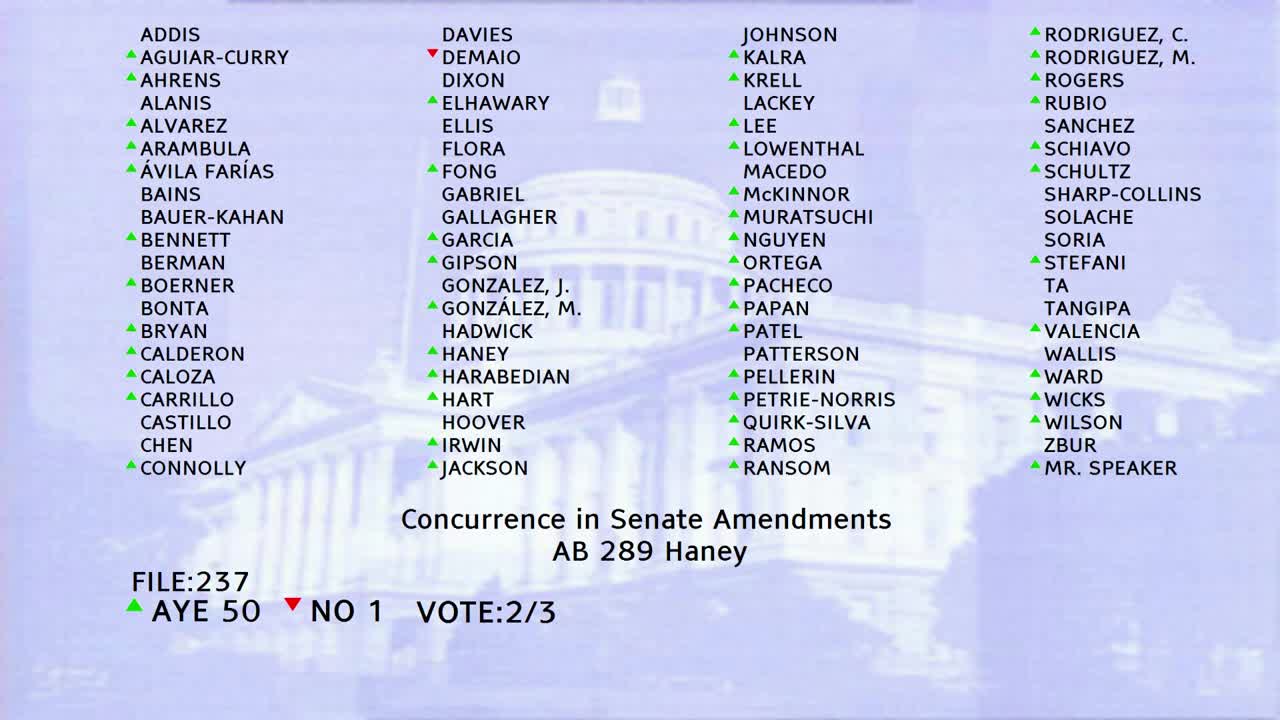 45SEC
Assembly Floor
 2MIN
Senate Floor
 9MIN
Senate Standing Committee on Labor, Public Employment and Retirement
 20MIN
Assembly Standing Committee on Labor and Employment
Bill Author

Bill Co-Author(s):