AB 1111: Pupil transportation: schoolbuses: zero-emission vehicles: scrapping.
- Session Year: 2025-2026
- House: Assembly
- Latest Version Date: 2025-07-22
Current Status:
In Progress
(2025-08-29: In committee: Held under submission.)
Introduced
In Committee
Awaiting First Chamber Vote
Passed First Chamber
In Committee
Awaiting Second Chamber Vote
Passed Second Chamber
Enacted
Existing law appropriates, for the 202324 fiscal year, $375,000,000 from the General Fund to the State Air Resources Board for the California Hybrid and Zero-Emission Truck and Bus Voucher Incentive Project (HVIP) to fund grants to local educational agencies, as defined, for zero-emission schoolbuses to replace heavy-duty internal combustion schoolbuses owned by local educational agencies, as specified. Existing law requires any schoolbuses that are replaced pursuant to the HVIP to be scrapped no later than 24 months from date of delivery of the replacement. Existing law requires grantees to provide to the state board proof of scrap of the retired internal combustion schoolbus or schoolbuses.
This bill would exclude a schoolbus from that scrapping requirement if the schoolbus is 25 years of age or less at the time of delivery of the replacement vehicle and its ownership is transferred to a frontier local educational agency or small school district meeting certain requirements.
(1)Existing law authorizes state funds, upon appropriation by the Legislature, to be distributed to the Superintendent of Public Instruction for distribution to certain local educational agencies for the purchase of low- or zero-emission schoolbuses that replace, or increase the number of, schoolbuses in the existing schoolbus fleet or for retrofitting existing schoolbuses to achieve reductions in emissions, as specified.
Existing law, commencing January 1, 2035, requires 100% of all newly purchased or contracted schoolbuses of a school district, county office of education, or charter school to be zero-emission vehicles, where feasible. In order to comply with that requirement, existing law authorizes those local educational agencies to request a one-time extension for a term not to exceed 5 years if a local educational agency determines that the purchase or contracting of a zero-emission schoolbus is not feasible due to both terrain and route constraints, provided that certain conditions are met. Existing law, commencing January 1, 2040, authorizes a frontier local educational agency, as defined, if it determines that the purchase or contracting of a zero-emission schoolbus is not feasible due to both terrain and route constraints, to request annual extensions with the last extension expiring on January 1, 2045, if specified conditions are met.
This bill would revise and recast those provisions by (A) delaying the deadline by 10 years to 2045, for certain local educational agencies, (B) changing the extension applicable only to frontier local educational agencies from an annual extension to a 5-year extension, (C) authorizing 5-year extensions due to (i) a lack of sufficient infrastructure, or a lack of availability of sufficient repair and maintenance, that is necessary to support the operation of a zero-emission schoolbus, as provided, or (ii) safety concerns relating to a local fire agencys response capabilities and resources, as provided, and (D) requiring the State Air Resources Board, in consultation with the State Department of Education and the State Energy Resources Conservation and Development Commission, to receive and evaluate a local educational agencys extension request and to grant an extension if the local educational agency reasonably demonstrates the conditions required for the requested extension. To the extent the bill would impose additional duties on local fire agencies in consulting with local educational agencies on their response capabilities and providing affirmations, the bill would impose a state-mandated local program. authorize a local educational agency to also use the lack of sufficient infrastructure that is necessary to support the operation of a zero-emission schoolbus, or a lack of availability of sufficient repair and maintenance that is necessary to support the operation of a zero-emission schoolbus, as reasons to determine that the purchase or contracting of a zero-emission schoolbus is not feasible, thereby allowing the local educational agency to request the extensions described above. Commencing January 1, 2040, the bill would also authorize a small school district, as defined, to request the above-described annual extensions that are applicable to frontier local educational agencies.(2)Existing law appropriates, for the 202324 fiscal year, $375,000,000 from the General Fund to the State Air Resources Board for the California Hybrid and Zero-Emission Truck and Bus Voucher Incentive Project (HVIP) to fund grants to local educational agencies, as defined, for zero-emission schoolbuses to replace heavy-duty internal combustion schoolbuses owned by local educational agencies, as specified. Existing law requires any schoolbuses that are replaced pursuant to the HVIP to be scrapped no later than 24 months from date of delivery of the replacement.This bill would exclude a schoolbus from that scrapping requirement if the schoolbus is 25 years of age or less at the time of delivery of the replacement vehicle and its ownership is transferred to another local educational agency a frontier local educational agency or small school district meeting certain requirements.
(3)The California Constitution requires the state to reimburse local agencies and school districts for certain costs mandated by the state. Statutory provisions establish procedures for making that reimbursement.This bill would provide that, if the Commission on State Mandates determines that the bill contains costs mandated by the state, reimbursement for those costs shall be made pursuant to the statutory provisions noted above.(1)Existing law authorizes state funds, upon appropriation by the Legislature, to be distributed to the Superintendent of Public Instruction for distribution to certain local educational agencies for the purchase of low- or zero-emission schoolbuses that replace, or increase the number of, schoolbuses in the existing schoolbus fleet or for retrofitting existing schoolbuses to achieve reductions in emissions, as specified.
Existing law, commencing January 1, 2035, requires 100% of all newly purchased or contracted schoolbuses of a school district, county office of education, or charter school to be zero-emission vehicles, where feasible. In order to comply with that requirement, existing law authorizes those local educational agencies to request a one-time extension for a term not to exceed 5 years if a local educational agency determines that the purchase or contracting of a zero-emission schoolbus is not feasible due to both terrain and route constraints, provided that certain conditions are met. Existing law, commencing January 1, 2040, authorizes a frontier local educational agency, as defined, if it determines that the purchase or contracting of a zero-emission schoolbus is not feasible due to both terrain and route constraints, to request annual extensions with the last extension expiring on January 1, 2045, if specified conditions are met.
This bill would revise and recast those provisions by (A) delaying the deadline by 10 years to 2045, for certain local educational agencies, (B) changing the extension applicable only to frontier local educational agencies from an annual extension to a 5-year extension, (C) authorizing 5-year extensions due to (i) a lack of sufficient infrastructure, or a lack of availability of sufficient repair and maintenance, that is necessary to support the operation of a zero-emission schoolbus, as provided, or (ii) safety concerns relating to a local fire agencys response capabilities and resources, as provided, and (D) requiring the State Air Resources Board, in consultation with the State Department of Education and the State Energy Resources Conservation and Development Commission, to receive and evaluate a local educational agencys extension request and to grant an extension if the local educational agency reasonably demonstrates the conditions required for the requested extension. To the extent the bill would impose additional duties on local fire agencies in consulting with local educational agencies on their response capabilities and providing affirmations, the bill would impose a state-mandated local program.
(2)Existing law appropriates, for the 202324 fiscal year, $375,000,000 from the General Fund to the State Air Resources Board for the California Hybrid and Zero-Emission Truck and Bus Voucher Incentive Project (HVIP) to fund grants to local educational agencies, as defined, for zero-emission schoolbuses to replace heavy-duty internal combustion schoolbuses owned by local educational agencies, as specified. Existing law requires any schoolbuses that are replaced pursuant to the HVIP to be scrapped no later than 24 months from date of delivery of the replacement.
This bill would exclude a schoolbus from that scrapping requirement if the schoolbus is 25 years of age or less at the time of delivery of the replacement vehicle and its ownership is transferred to another local educational agency. agency meeting certain requirements.
(3)The California Constitution requires the state to reimburse local agencies and school districts for certain costs mandated by the state. Statutory provisions establish procedures for making that reimbursement.
This bill would provide that, if the Commission on State Mandates determines that the bill contains costs mandated by the state, reimbursement for those costs shall be made pursuant to the statutory provisions noted above.
(1)Existing law authorizes state funds, upon appropriation by the Legislature, to be distributed to the Superintendent of Public Instruction for distribution to certain local educational agencies for the purchase of low- or zero-emission schoolbuses that replace, or increase the number of, schoolbuses in the existing schoolbus fleet or for retrofitting existing schoolbuses to achieve reductions in emissions, as specified.
Existing law, commencing January 1, 2035, requires 100% of all newly purchased or contracted schoolbuses of a school district, county office of education, or charter school to be zero-emission vehicles, where feasible. In order to comply with that requirement, existing law authorizes those local educational agencies to request a one-time extension for a term not to exceed 5 years if a local educational agency determines that the purchase or contracting of a zero-emission schoolbus is not feasible due to both terrain and route constraints, provided that certain conditions are met. Existing law, commencing January 1, 2040, authorizes a frontier local educational agency, as defined, if it determines that the purchase or contracting of a zero-emission schoolbus is not feasible due to both terrain and route constraints, to request annual extensions with the last extension expiring on January 1, 2045, if specified conditions are met.
This bill would revise and recast those provisions by (A) delaying the deadline by 10 years to 2045, (B) changing the extension applicable only to frontier local educational agencies from an annual extension to a 5-year extension, (C) authorizing 5-year extensions due to a lack of sufficient infrastructure, as provided, or safety concerns relating to a local fire agencys response capabilities and resources, as provided, and (D) requiring the State Air Resources Board, in consultation with the State Department of Education and the State Energy Resources Conservation and Development Commission, to receive and evaluate a local educational agencys extension request and to grant an extension if the local educational agency reasonably demonstrates the conditions required for the requested extension. To the extent the bill would impose additional duties on local fire agencies in consulting with local educational agencies on their response capabilities and providing affirmations, the bill would impose a state-mandated local program.
(2)Existing law appropriates, for the 202324 fiscal year, $375,000,000 from the General Fund to the State Air Resources Board for the California Hybrid and Zero-Emission Truck and Bus Voucher Incentive Project (HVIP) to fund grants to local educational agencies, as defined, for zero-emission schoolbuses to replace heavy-duty internal combustion schoolbuses owned by local educational agencies, as specified. Existing law requires any schoolbuses that are replaced pursuant to the HVIP to be scrapped no later than 24 months from date of delivery of the replacement.
This bill would exclude a schoolbus from that scrapping requirement if the schoolbus is 25 years of age or less at the time of delivery of the replacement vehicle and its ownership is transferred to another local educational agency.
(3)The California Constitution requires the state to reimburse local agencies and school districts for certain costs mandated by the state. Statutory provisions establish procedures for making that reimbursement.
This bill would provide that, if the Commission on State Mandates determines that the bill contains costs mandated by the state, reimbursement for those costs shall be made pursuant to the statutory provisions noted above.
Existing law authorizes the governing board of a school district to provide for the transportation of pupils to and from school whenever, in the judgment of the board, the transportation is advisable and good reasons exist to do so.This bill would state the intent of the Legislature to enact subsequent legislation relating to pupil transportation.Existing law authorizes the governing board of a school district to provide for the transportation of pupils to and from school whenever, in the judgment of the board, the transportation is advisable and good reasons exist to do so.
This bill would state the intent of the Legislature to enact subsequent legislation relating to pupil transportation.
(a)(1)For the 202324 fiscal year, the sum of three hundred seventy-five million dollars ($375,000,000) is hereby appropriated from the General Fund to the State Air Resources Board for the California Hybrid and Zero-Emission Truck and Bus Voucher Incentive Project to fund zero-emission schoolbuses to replace heavy-duty internal combustion schoolbuses owned by local educational agencies over five years beginning in the 202324 fiscal year, consistent with this section. This funding shall be available as grants to local educational agencies for encumbrance until June 30, 2029. Local educational agencies shall have three fiscal years after the fiscal year in which the funds are received to expend the funds. Any funds that are not expended by a local educational agency by the end of that period shall be returned to the state.
(2)For the 202324 fiscal year, the sum of one hundred twenty-five million dollars ($125,000,000) is hereby appropriated from the General Fund to the Energy Commission to fund zero-emission schoolbus charging or fueling infrastructure and related activities, including, but not limited to, charging or fueling stations, equipment, site design, construction, and related infrastructure upgrades, in order to complement the vehicle investments described in paragraph (1). This funding shall be available as grants to local educational agencies for encumbrance until June 30, 2029. Local educational agencies shall have three fiscal years after the fiscal year in which the funds are received to expend the funds. Any funds that are not expended by a local educational agency by the end of that period shall be returned to the state.
(b)The State Air Resources Board and the Energy Commission shall coordinate to offer a single application to cover vehicle purchases, infrastructure investments, and other associated funding pursuant to this section.
(c)The State Air Resources Board and the Energy Commission shall ensure that the funding provided in this section supports the transition to zero-emission schoolbus fleets by supporting up to the full purchase cost of zero-emission schoolbuses and related schoolbus charging or fueling infrastructure, as well as provide funding support for other associated costs, including workforce development and training.
(d)(1)The State Air Resources Board, in consultation with the Energy Commission, shall prioritize funding zero-emission schoolbuses under this section.
(2)If a local educational agency is able to provide sufficient information to the State Air Resources Board and the Energy Commission to demonstrate significant barriers to the adoption of zero-emission technology at the time of application, and that alternate approaches to decrease internal combustion vehicle use are not appropriate, the State Air Resources Board and the Energy Commission may fund schoolbuses powered by renewable fuel under this section, to the extent and in the time period that these barriers apply to the local educational agency.
(e)Priority shall be given pursuant to this section to grantees serving a high percentage of unduplicated pupils, as defined in Section 42238.02 of the Education Code, grantees operating the oldest internal combustion buses, grantees that are small and rural school districts, and grantees purchasing zero-emission buses with bidirectional charging where available.
(f)The State Air Resources Board and the Energy Commission shall create program guidelines relative to their respective activities pursuant to this section. Notwithstanding any other law, the Administrative Procedure Act (Chapter 3.5 (commencing with Section 11340) of Part 1 of Division 3 of Title 2 of the Government Code) shall not apply to the development and approval of the guidelines or other standards or requirements adopted or used by the State Air Resources Board or the Energy Commission in administering these funds.
(g)No less than 90 percent of a grantees grant award shall be expended for the purchase of zero-emission schoolbuses, as well as the supporting charging infrastructure needed to operate the zero-emission schoolbuses and related activities, including, but not limited to, charging or fueling stations, equipment, site design, construction, and related infrastructure upgrades.
(h)Up to 10 percent of a grantees grant award may be expended to incorporate or supplement funding for the grantees school transportation program.
(i)(1)(A)Any schoolbuses that are replaced pursuant to this section shall be scrapped no later than 24 months from date of delivery of the replacement vehicles. vehicles, except as provided in subparagraph (B). Grantees shall provide to the State Air Resources Board proof of scrap of the retired internal combustion schoolbus or schoolbuses.
(B)Notwithstanding subparagraph (A), a schoolbus that is replaced pursuant to this section shall not be required to be scrapped if both of the following apply:
(i)The schoolbus is 25 years of age or less at the time of delivery of the replacement vehicle.
(ii)The ownership of the schoolbus has been transferred to another local educational agency that either qualifies for or has been approved for an extension by the State Air Resources Board pursuant to subdivision (c) of Section 17927 of the Education Code.
(2)The grant agreement related to the grant award pursuant to this section shall require grantees to submit schoolbus and infrastructure information and documentation resulting from the grants provided in this section to the State Air Resources Board and the Energy Commission.
(j)The Department of General Services, in consultation with the Energy Commission and the California Workforce Development Board, shall establish statewide contracts with manufacturers of zero- or low-emission schoolbuses. These contracts shall satisfy the high road standards pursuant to subdivision (r) of Section 14005 of the Unemployment Insurance Code.
(k)As a condition of entering into a statewide contract with the state, a bidder shall incorporate high road job standards designed to achieve all of the following goals:
(1)Support the creation and retention of quality, nontemporary, and full-time jobs that provide high wages, including benefits and access to training.
(2)Support the hiring of displaced workers and individuals facing barriers to employment.
(3)Encourage the development of the states long-term, climate-sustainable transportation and related infrastructure and manufacturing sectors.
(4)Protect public health by supporting the adoption of specific protections for worker health and safety.
(l)At a minimum, the contract shall include all of the following terms:
(1)All of the bidders employees performing work to fulfill the contract shall be paid no less than the minimum trainee wage set by the Employment Training Panel for the county in which the work is performed, or the applicable federal, state, or local minimum wage, whichever is greater. To the extent permissible, health care benefits valued at up to two dollars and fifty cents ($2.50) per hour may be used to meet this wage requirement.
(2)Any person performing work to fulfill the contract shall be placed in the proper employment classification. This requirement includes, but is not limited to, prohibitions on misclassifying a person performing work to fulfill the contract as an independent contractor.
(3)The bidder and any contractors and subcontractors performing work to fulfill the contract shall comply with all applicable federal, state, and local laws pertaining to paid sick leave, including any antiretaliation provisions contained in such laws.
(4)The bidder and any contractors and subcontractors performing work to fulfill the contract shall comply with all applicable safety and health requirements, and shall comply with Sections 6310 and 6311 of the Labor Code, pertaining to protection of employees who file complaints or refuse to work in the face of hazardous conditions.
(5)The bidder and any contractors and subcontractors comply and shall comply with the federal Americans with Disabilities Act (42 U.S.C. Sec. 12101 et seq.) and all regulations thereunder.
(m)Grants received pursuant to this section shall supplement, not supplant, existing services and funds provided by grantees in support of transportation programs.
(n)For purposes of this section, the following definitions apply:
(1)Bidder means a manufacturer of zero-emission schoolbuses that seeks to enter into a statewide contract with the Department of General Services pursuant to this section.
(2)Energy Commission means the State Energy Resources Conservation and Development Commission.
(3)Local educational agency means any of the following:
(A)A school district, county office of education, or charter school, excluding a charter school classified as a nonclassroom-based charter school as of the 202122 fiscal year second principal apportionment certification pursuant to Section 47612.5 of the Education Code, with ownership of title for a schoolbus or schoolbuses.
(B)A school district or charter school, excluding a charter school classified as a nonclassroom-based charter school as of the 202122 fiscal year second principal apportionment certification pursuant to Section 47612.5 of the Education Code, that contracts with a county office of education or private contractor for the maintenance and operation of its schoolbuses.
(C)A county office of education that contracts with a private contractor for maintenance and operation of its schoolbuses.
(D)A joint powers authority currently operating home-to-school transportation programs on behalf of school districts, county offices of education, or charter schools, excluding charter schools classified as a nonclassroom-based charter school as of the 202122 fiscal year second principal apportionment certification pursuant to Section 47612.5 of the Education Code.
(4)Rural school district means a school district with a school with a locale code of 31, 32, 33, 41, 42, or 43, as classified by the National Center for Education Statistics.
(5)Small school district means a school district with fewer than 2,501 units of average daily attendance using the most recently reported annual data in the California Longitudinal Pupil Attendance Data System.
(o)If a participating charter school acquires a schoolbus pursuant to this section and the charter school subsequently ceases operation, the schoolbus shall be made available to the State Air Resources Board for reallocation to other eligible local educational agencies.
(p)For purposes of making the computations required by Section 8 of Article XVI of the California Constitution, the appropriations made by paragraphs (1) and (2) of subdivision (a) shall be deemed to be General Fund revenues appropriated for school districts, as defined in subdivision (c) of Section 41202 of the Education Code, for the 202122 fiscal year, and included within the total allocations to school districts and community college districts from General Fund proceeds of taxes appropriated pursuant to Article XIIIB, as defined in subdivision (e) of Section 41202 of the Education Code, for the 202122 fiscal year.
(q)The provisions of this section are severable. If any provision of this section or its application is held invalid, that invalidity shall not affect other provisions or applications that can be given effect without the invalid provision or application.
All matter omitted in this version of the bill appears in the bill as amended in the Assembly, April 30, 2025. (JR11)(a)Commencing January 1, 2035, 100 percent of all newly purchased or contracted schoolbuses of a local educational agency shall be zero-emission vehicles, where feasible.
(b)If a local educational agency determines that the purchase or contracting of a zero-emission schoolbus is not feasible due to both terrain and route constraints, a lack of sufficient infrastructure that is necessary to support the operation of a zero-emission schoolbus, or a lack of availability of sufficient repair and maintenance that is necessary to support the operation of a zero-emission schoolbus, the local educational agency may request a one-time extension for a term not to exceed five years, in order to meet the requirements in subdivision (a), provided that both of the following conditions are met:
(1)The local educational agency can reasonably demonstrate that a daily planned bus route for transporting pupils to and from school cannot be serviced through available zero-emission technology in 2035.
(2)The State Air Resources Board, in consultation with the department and the State Energy Resources Conservation and Development Commission, receives and evaluates a local educational agencys request, and grants a one-time extension based on the local educational agency reasonably demonstrating the condition in paragraph (1).
(c)Commencing January 1, 2040, if a local educational agency that is a frontier local educational agency or small school district determines that the purchase or contracting of a zero-emission schoolbus is not feasible due to both terrain and route constraints, a lack of sufficient infrastructure that is necessary to support the operation of a zero-emission schoolbus, or a lack of availability of sufficient repair and maintenance that is necessary to support the operation of a zero-emission schoolbus, the frontier local educational agency or small school district may request annual extensions, with the last extension expiring on January 1, 2045, in order to meet the requirements in subdivision (a), provided that both of the following conditions are met:
(1)The frontier local educational agency or small school district can reasonably demonstrate that a daily planned bus route for transporting pupils to and from school cannot be serviced through available zero-emission technology in the period in which the annual waiver is sought.
(2)The State Air Resources Board, in consultation with the department and the State Energy Resources Conservation and Development Commission, receives and evaluates the request of the frontier local educational agencys request, agency or small school district, and grants an annual extension based on the frontier local educational agency or small school district reasonably demonstrating the condition in paragraph (1).
(d)For purposes of this section, the following definitions apply:
(1)Frontier local educational agency means a local educational agency that meets either of the following conditions:
(A)The total number of pupils in average daily attendance at all of the schools served by the local educational agency is fewer than 600.
(B)Each county in which a school operated by the local educational agency is located has a total population density fewer of less than 10 persons per square mile.
(2)Local educational agency means a school district, county office of education, or charter school.
(3)Small school district means a school district with fewer than 2,501 units of average daily attendance using the most recently reported annual data in the California Longitudinal Pupil Attendance Data System.
SEC. 2.Section 121 of Chapter 52 of the Statutes of 2022, as amended by Section 97 of Chapter 38 of the Statutes of 2024, is amended to read:Sec. 121.(a)(1)For the 202324 fiscal year, the sum of three hundred seventy-five million dollars ($375,000,000) is hereby appropriated from the General Fund to the State Air Resources Board for the Hybrid and Zero-Emission Truck and Bus Voucher Incentive Project to fund zero-emission schoolbuses to replace heavy-duty internal combustion schoolbuses owned by local educational agencies over five years beginning in the 202324 fiscal year, consistent with this section. This funding shall be available as grants to local educational agencies for encumbrance until June 30, 2029. Local educational agencies shall have three fiscal years after the fiscal year in which the funds are received to expend the funds. Any funds that are not expended by a local educational agency by the end of that period shall be returned to the state.
(2)For the 202324 fiscal year, the sum of one hundred twenty-five million dollars ($125,000,000) is hereby appropriated from the General Fund to the Energy Commission to fund zero-emission schoolbus charging or fueling infrastructure and related activities, including, but not limited to, charging or fueling stations, equipment, site design, construction, and related infrastructure upgrades, in order to complement the vehicle investments described in paragraph (1). This funding shall be available as grants to local educational agencies for encumbrance until June 30, 2029. Local educational agencies shall have three fiscal years after the fiscal year in which the funds are received to expend the funds. Any funds that are not expended by a local educational agency by the end of that period shall be returned to the state.
(b)It is the intent of the Legislature to appropriate three hundred seventy-five million dollars ($375,000,000) in the 202526 fiscal year to the State Air Resources Board, and one hundred twenty-five million dollars ($125,000,000) in the 202526 fiscal year to the Energy Commission, for purposes of subdivision (a).
(c)The State Air Resources Board and the Energy Commission shall coordinate to offer a single application to cover vehicle purchases, infrastructure investments, and other associated funding pursuant to this section.
(d)The State Air Resources Board and the Energy Commission shall ensure that the funding provided in this section supports the transition to zero-emission schoolbus fleets by supporting up to the full purchase cost of zero-emission schoolbuses and related schoolbus charging or fueling infrastructure, as well as provide funding support for other associated costs, including workforce development and training.
(e)(1)The State Air Resources Board, in consultation with the Energy Commission, shall prioritize funding zero-emission schoolbuses under this section.
(2)If a local educational agency is able to provide sufficient information to the State Air Resources Board and the Energy Commission to demonstrate significant barriers to the adoption of zero-emission technology at the time of application, and that alternate approaches to decrease internal combustion vehicle use are not appropriate, the State Air Resources Board and the Energy Commission may fund schoolbuses powered by renewable fuel under this section, to the extent and in the time period that these barriers apply to the local educational agency.
(f)Priority shall be given pursuant to this section to grantees serving a high percentage of unduplicated pupils, as defined in Section 42238.02 of the Education Code, grantees operating the oldest internal combustion buses, grantees that are small and rural school districts, and grantees purchasing zero-emission buses with bidirectional charging where available.
(g)The State Air Resources Board and the Energy Commission shall create program guidelines relative to their respective activities pursuant to this section. Notwithstanding any other law, the Administrative Procedure Act (Chapter 3.5 (commencing with Section 11340) of Part 1 of Division 3 of Title 2 of the Government Code) shall not apply to the development and approval of the guidelines or other standards or requirements adopted or used by the State Air Resources Board or the Energy Commission in administering these funds.
(h)No less than 90 percent of a grantees grant award shall be expended for the purchase of zero-emission schoolbuses, as well as the supporting charging infrastructure needed to operate the zero-emission schoolbuses and related activities, including, but not limited to, charging or fueling stations, equipment, site design, construction, and related infrastructure upgrades.
(i)Up to 10 percent of a grantees grant award may be expended to incorporate or supplement funding for the grantees school transportation program.
(j)(1)(A)Any schoolbuses that are replaced pursuant to this section shall be scrapped no later than 24 months from date of delivery of the replacement vehicles, except as provided in subparagraph (B). Grantees shall provide to the State Air Resources Board proof of scrap of the retired internal combustion schoolbus or schoolbuses.
(B)Notwithstanding subparagraph (A), a schoolbus that is replaced pursuant to this section shall not be required to be scrapped if both of the following apply:
(i)The schoolbus is 25 years of age or less at the time of delivery of the replacement vehicle.
(ii)The ownership of the schoolbus has been transferred to another local educational agency that either qualifies for or has been approved for an extension by the State Air Resources Board pursuant to subdivision (c) of Section 17927 of the Education Code.
(2)The grant agreement related to the grant award pursuant to this section shall require grantees to submit schoolbus and infrastructure information and documentation resulting from the grants provided in this section to the State Air Resources Board and the Energy Commission.
(k)The Department of General Services, in consultation with the Energy Commission and the California Workforce Development Board, shall establish statewide contracts with manufacturers of zero- or low-emission schoolbuses. These contracts shall satisfy the high road standards pursuant to subdivision (r) of Section 14005 of the Unemployment Insurance Code.
(l)As a condition of entering into a statewide contract with the state, a bidder shall incorporate high road job standards designed to achieve all of the following goals:
(1)Support the creation and retention of quality, nontemporary, and full-time jobs that provide high wages, including benefits and access to training.
(2)Support the hiring of displaced workers and individuals facing barriers to employment.
(3)Encourage the development of the states long-term, climate-sustainable transportation and related infrastructure and manufacturing sectors.
(4)Protect public health by supporting the adoption of specific protections for worker health and safety.
(m)At a minimum, the contract shall include all of the following terms:
(1)All of the bidders employees performing work to fulfill the contract shall be paid no less than the minimum trainee wage set by the Employment Training Panel for the county in which the work is performed, or the applicable federal, state, or local minimum wage, whichever is greater. To the extent permissible, health care benefits valued at up to two dollars and fifty cents ($2.50) per hour may be used to meet this wage requirement.
(2)Any person performing work to fulfill the contract shall be placed in the proper employment classification. This requirement includes, but is not limited to, prohibitions on misclassifying a person performing work to fulfill the contract as an independent contractor.
(3)The bidder and any contractors and subcontractors performing work to fulfill the contract shall comply with all applicable federal, state, and local laws pertaining to paid sick leave, including any antiretaliation provisions contained in such laws.
(4)The bidder and any contractors and subcontractors performing work to fulfill the contract shall comply with all applicable safety and health requirements, and shall comply with Sections 6310 and 6311 of the Labor Code, pertaining to protection of employees who file complaints or refuse to work in the face of hazardous conditions.
(5)The bidder and any contractors and subcontractors comply and shall comply with the federal Americans with Disabilities Act (42 U.S.C. Sec. 12101 et seq.) and all regulations thereunder.
(n)Grants received pursuant to this section shall supplement, not supplant, existing services and funds provided by grantees in support of transportation programs.
(o)For purposes of this section, the following definitions apply:
(1)Bidder means a manufacturer of zero-emission schoolbuses that seeks to enter into a statewide contract with the Department of General Services pursuant to this section.
(2)Energy Commission means the State Energy Resources Conservation and Development Commission.
(3)Local educational agency means any of the following:
(A)A school district, county office of education, or charter school, excluding a charter school classified as a nonclassroom-based charter school as of the 202122 fiscal year second principal apportionment certification pursuant to Section 47612.5 of the Education Code, with ownership of title for a schoolbus or schoolbuses.
(B)A school district or charter school, excluding a charter school classified as a nonclassroom-based charter school as of the 202122 fiscal year second principal apportionment certification pursuant to Section 47612.5 of the Education Code, that contracts with a county office of education or private contractor for the maintenance and operation of its schoolbuses.
(C)A county office of education that contracts with a private contractor for maintenance and operation of its schoolbuses.
(D)A joint powers authority currently operating home-to-school transportation programs on behalf of school districts, county offices of education, or charter schools, excluding charter schools classified as a nonclassroom-based charter school as of the 202122 fiscal year second principal apportionment certification pursuant to Section 47612.5 of the Education Code.
(4)Rural school district means a school district with a school with a locale code of 31, 32, 33, 41, 42, or 43, as classified by the National Center for Education Statistics.
(5)Small school district means a school district with fewer than 2,501 units of average daily attendance using the most recently reported annual data in the California Longitudinal Pupil Attendance Data System.
(p)If a participating charter school acquires a schoolbus pursuant to this section and the charter school subsequently ceases operation, the schoolbus shall be made available to the State Air Resources Board for reallocation to other eligible local educational agencies.
(q)For purposes of making the computations required by Section 8 of Article XVI of the California Constitution, the appropriations made by paragraphs (1) and (2) of subdivision (a) shall be deemed to be General Fund revenues appropriated for school districts, as defined in subdivision (c) of Section 41202 of the Education Code, for the 202122 fiscal year, and included within the total allocations to school districts and community college districts from General Fund proceeds of taxes appropriated pursuant to Article XIIIB, as defined in subdivision (e) of Section 41202 of the Education Code, for the 202122 fiscal year.
(r)The provisions of this section are severable. If any provision of this section or its application is held invalid, that invalidity shall not affect other provisions or applications that can be given effect without the invalid provision or application.
SEC. 3.If the Commission on State Mandates determines that this act contains costs mandated by the state, reimbursement to local agencies and school districts for those costs shall be made pursuant to Part 7 (commencing with Section 17500) of Division 4 of Title 2 of the Government Code.(a)(1)Commencing January 1, 2045, 2035, 100 percent of all newly purchased or contracted schoolbuses of a local educational agency shall be zero-emission vehicles, where feasible.
(2)A local educational agency shall be exempt from the requirement of paragraph (1) if it meets either of the following conditions:
(A)The local educational agency is a frontier local educational agency.
(B)The local educational agency meets both of the following conditions:
(i)The total number of pupils in average daily attendance at all of the schools served by the local educational agency is 2,500 or fewer.
(ii)The local educational agency is located in a rural area.
(b)Commencing January 1, 2045, 100 percent of all newly purchased or contracted schoolbuses of a local educational agency shall be zero-emission vehicles, where feasible.
(b)(c)A local educational agency may request an extension from the requirement in subdivision (a) requirements of subdivision (a) or (b), as applicable, from the State Air Resources Board as follows:
(1)If a local educational agency determines that the purchase or contracting of a zero-emission schoolbus is not feasible due to both terrain and route constraints, the local educational agency may request a one-time extension for a term not to exceed five years, provided that the local educational agency can reasonably demonstrate that a daily planned bus route for transporting pupils to and from school cannot be serviced through available zero-emission technology in 2045. the applicable requirement year.
(2)Commencing January 1, 2050, if a local educational agency that is a frontier local educational agency determines that the purchase or contracting of a zero-emission schoolbus is not feasible due to both terrain and route constraints, the local educational agency may request an additional extension for a term not to exceed five years and expiring no later than January 1, 2055, provided that the local educational agency can reasonably demonstrate that a daily planned bus route for transporting pupils to and from school cannot be serviced through available zero-emission technology in the period in which the extension is sought.
(3)If a local educational agency determines that the purchase or contracting of a zero-emission schoolbus is not feasible due to a lack of sufficient infrastructure infrastructure, or a lack of availability of sufficient repair and maintenance, that is necessary to support the operation of a zero-emission schoolbus, the local educational agency may request a five-year extension, provided that the local educational agency can reasonably demonstrate that a daily planned bus route for transporting pupils to and from school cannot be serviced through available zero-emission technology due to a lack of sufficient infrastructure that is necessary to support the operation of a zero-emission schoolbus, such as insufficient charging or fueling infrastructure. The demonstration shall include details regarding the barriers to establishing sufficient infrastructure.
(4)If a local educational agency, in consultation with a local fire agency, determines that the regular operation of a zero-emission schoolbus within that local fire agencys jurisdiction poses a significant risk to health and safety that exceed the local fire agencys response capabilities and resources, and therefore the purchase or contracting of a zero-emission schoolbus is not feasible, the local educational agency may request a five-year extension, provided that the local educational agency obtains affirmation from a local fire agency that a daily planned bus route for transporting pupils to and from school poses a significant risk to health and safety that exceeds the local fire agencys response capabilities.
(c)(d)The State Air Resources Board, in consultation with the department and the State Energy Resources Conservation and Development Commission, shall receive and evaluate a local educational agencys request made pursuant to subdivision (b) (c) and shall grant an extension if the local educational agency reasonably demonstrates the conditions required for the requested extension.
(d)(e)For purposes of this section, the following definitions apply:
(1)Frontier local educational agency means a local educational agency that meets either of the following conditions:
(A)The total number of pupils in average daily attendance at all of the schools served by the local educational agency is fewer than 600.
(B)Each county in which a school operated by the local educational agency is located has a total population density fewer than 10 persons per square mile.
(2)Local educational agency means a school district, county office of education, or charter school.
(3)Rural area means a local educational agency in National Center for Education Statistics Locale Code numbers 23, 31, 32, 33, 41, 42, or 43.
SEC. 2.Section 121 of Chapter 52 of the Statutes of 2022, as amended by Section 97 of Chapter 38 of the Statutes of 2024, is amended to read:Sec. 121.(a)(1)For the 202324 fiscal year, the sum of three hundred seventy-five million dollars ($375,000,000) is hereby appropriated from the General Fund to the State Air Resources Board for the Hybrid and Zero-Emission Truck and Bus Voucher Incentive Project to fund zero-emission schoolbuses to replace heavy-duty internal combustion schoolbuses owned by local educational agencies over five years beginning in the 202324 fiscal year, consistent with this section. This funding shall be available as grants to local educational agencies for encumbrance until June 30, 2029. Local educational agencies shall have three fiscal years after the fiscal year in which the funds are received to expend the funds. Any funds that are not expended by a local educational agency by the end of that period shall be returned to the state.
(2)For the 202324 fiscal year, the sum of one hundred twenty-five million dollars ($125,000,000) is hereby appropriated from the General Fund to the Energy Commission to fund zero-emission schoolbus charging or fueling infrastructure and related activities, including, but not limited to, charging or fueling stations, equipment, site design, construction, and related infrastructure upgrades, in order to complement the vehicle investments described in paragraph (1). This funding shall be available as grants to local educational agencies for encumbrance until June 30, 2029. Local educational agencies shall have three fiscal years after the fiscal year in which the funds are received to expend the funds. Any funds that are not expended by a local educational agency by the end of that period shall be returned to the state.
(b)It is the intent of the Legislature to appropriate three hundred seventy-five million dollars ($375,000,000) in the 202526 fiscal year to the State Air Resources Board, and one hundred twenty-five million dollars ($125,000,000) in the 202526 fiscal year to the Energy Commission, for purposes of subdivision (a).
(c)The State Air Resources Board and the Energy Commission shall coordinate to offer a single application to cover vehicle purchases, infrastructure investments, and other associated funding pursuant to this section.
(d)The State Air Resources Board and the Energy Commission shall ensure that the funding provided in this section supports the transition to zero-emission schoolbus fleets by supporting up to the full purchase cost of zero-emission schoolbuses and related schoolbus charging or fueling infrastructure, as well as provide funding support for other associated costs, including workforce development and training.
(e)(1)The State Air Resources Board, in consultation with the Energy Commission, shall prioritize funding zero-emission schoolbuses under this section.
(2)If a local educational agency is able to provide sufficient information to the State Air Resources Board and the Energy Commission to demonstrate significant barriers to the adoption of zero-emission technology at the time of application, and that alternate approaches to decrease internal combustion vehicle use are not appropriate, the State Air Resources Board and the Energy Commission may fund schoolbuses powered by renewable fuel under this section, to the extent and in the time period that these barriers apply to the local educational agency.
(f)Priority shall be given pursuant to this section to grantees serving a high percentage of unduplicated pupils, as defined in Section 42238.02 of the Education Code, grantees operating the oldest internal combustion buses, grantees that are small and rural school districts, and grantees purchasing zero-emission buses with bidirectional charging where available.
(g)The State Air Resources Board and the Energy Commission shall create program guidelines relative to their respective activities pursuant to this section. Notwithstanding any other law, the Administrative Procedure Act (Chapter 3.5 (commencing with Section 11340) of Part 1 of Division 3 of Title 2 of the Government Code) shall not apply to the development and approval of the guidelines or other standards or requirements adopted or used by the State Air Resources Board or the Energy Commission in administering these funds.
(h)No less than 90 percent of a grantees grant award shall be expended for the purchase of zero-emission schoolbuses, as well as the supporting charging infrastructure needed to operate the zero-emission schoolbuses and related activities, including, but not limited to, charging or fueling stations, equipment, site design, construction, and related infrastructure upgrades.
(i)Up to 10 percent of a grantees grant award may be expended to incorporate or supplement funding for the grantees school transportation program.
(j)(1)(A)Any schoolbuses that are replaced pursuant to this section shall be scrapped no later than 24 months from date of delivery of the replacement vehicles, except as provided in subparagraph (B). Grantees shall provide to the State Air Resources Board proof of scrap of the retired internal combustion schoolbus or schoolbuses.
(B)Notwithstanding subparagraph (A), a schoolbus that is replaced pursuant to this section shall not be required to be scrapped if both of the following apply:
(i)The schoolbus is 25 years of age or less at the time of delivery of the replacement vehicle.
(ii)The ownership of the schoolbus has been transferred to another local educational agency. agency that either qualifies for or has been approved for an extension by the State Air Resources Board pursuant to subdivision (c) of Section 17927 of the Education Code.
(2)The grant agreement related to the grant award pursuant to this section shall require grantees to submit schoolbus and infrastructure information and documentation resulting from the grants provided in this section to the State Air Resources Board and the Energy Commission.
(k)The Department of General Services, in consultation with the Energy Commission and the California Workforce Development Board, shall establish statewide contracts with manufacturers of zero- or low-emission schoolbuses. These contracts shall satisfy the high road standards pursuant to subdivision (r) of Section 14005 of the Unemployment Insurance Code.
(l)As a condition of entering into a statewide contract with the state, a bidder shall incorporate high road job standards designed to achieve all of the following goals:
(1)Support the creation and retention of quality, nontemporary, and full-time jobs that provide high wages, including benefits and access to training.
(2)Support the hiring of displaced workers and individuals facing barriers to employment.
(3)Encourage the development of the states long-term, climate-sustainable transportation and related infrastructure and manufacturing sectors.
(4)Protect public health by supporting the adoption of specific protections for worker health and safety.
(m)At a minimum, the contract shall include all of the following terms:
(1)All of the bidders employees performing work to fulfill the contract shall be paid no less than the minimum trainee wage set by the Employment Training Panel for the county in which the work is performed, or the applicable federal, state, or local minimum wage, whichever is greater. To the extent permissible, health care benefits valued at up to two dollars and fifty cents ($2.50) per hour may be used to meet this wage requirement.
(2)Any person performing work to fulfill the contract shall be placed in the proper employment classification. This requirement includes, but is not limited to, prohibitions on misclassifying a person performing work to fulfill the contract as an independent contractor.
(3)The bidder and any contractors and subcontractors performing work to fulfill the contract shall comply with all applicable federal, state, and local laws pertaining to paid sick leave, including any antiretaliation provisions contained in such laws.
(4)The bidder and any contractors and subcontractors performing work to fulfill the contract shall comply with all applicable safety and health requirements, and shall comply with Sections 6310 and 6311 of the Labor Code, pertaining to protection of employees who file complaints or refuse to work in the face of hazardous conditions.
(5)The bidder and any contractors and subcontractors comply and shall comply with the federal Americans with Disabilities Act (42 U.S.C. Sec. 12101 et seq.) and all regulations thereunder.
(n)Grants received pursuant to this section shall supplement, not supplant, existing services and funds provided by grantees in support of transportation programs.
(o)For purposes of this section, the following definitions apply:
(1)Bidder means a manufacturer of zero-emission schoolbuses that seeks to enter into a statewide contract with the Department of General Services pursuant to this section.
(2)Energy Commission means the State Energy Resources Conservation and Development Commission.
(3)Local educational agency means any of the following:
(A)A school district, county office of education, or charter school, excluding a charter school classified as a nonclassroom-based charter school as of the 202122 fiscal year second principal apportionment certification pursuant to Section 47612.5 of the Education Code, with ownership of title for a schoolbus or schoolbuses.
(B)A school district or charter school, excluding a charter school classified as a nonclassroom-based charter school as of the 202122 fiscal year second principal apportionment certification pursuant to Section 47612.5 of the Education Code, that contracts with a county office of education or private contractor for the maintenance and operation of its schoolbuses.
(C)A county office of education that contracts with a private contractor for maintenance and operation of its schoolbuses.
(D)A joint powers authority currently operating home-to-school transportation programs on behalf of school districts, county offices of education, or charter schools, excluding charter schools classified as a nonclassroom-based charter school as of the 202122 fiscal year second principal apportionment certification pursuant to Section 47612.5 of the Education Code.
(4)Rural school district means a school district with a school with a locale code of 31, 32, 33, 41, 42, or 43, as classified by the National Center for Education Statistics.
(5)Small school district means a school district with fewer than 2,501 units of average daily attendance using the most recently reported annual data in the California Longitudinal Pupil Attendance Data System.
(p)If a participating charter school acquires a schoolbus pursuant to this section and the charter school subsequently ceases operation, the schoolbus shall be made available to the State Air Resources Board for reallocation to other eligible local educational agencies.
(q)For purposes of making the computations required by Section 8 of Article XVI of the California Constitution, the appropriations made by paragraphs (1) and (2) of subdivision (a) shall be deemed to be General Fund revenues appropriated for school districts, as defined in subdivision (c) of Section 41202 of the Education Code, for the 202122 fiscal year, and included within the total allocations to school districts and community college districts from General Fund proceeds of taxes appropriated pursuant to Article XIIIB, as defined in subdivision (e) of Section 41202 of the Education Code, for the 202122 fiscal year.
(r)The provisions of this section are severable. If any provision of this section or its application is held invalid, that invalidity shall not affect other provisions or applications that can be given effect without the invalid provision or application.
SEC. 3.If the Commission on State Mandates determines that this act contains costs mandated by the state, reimbursement to local agencies and school districts for those costs shall be made pursuant to Part 7 (commencing with Section 17500) of Division 4 of Title 2 of the Government Code.
(a)Commencing January 1, 2035, 2045, 100 percent of all newly purchased or contracted schoolbuses of a local educational agency shall be zero-emission vehicles, where feasible.
(b)A local educational agency may request an extension from the requirement in subdivision (a) from the State Air Resources Board as follows:
(b)(1)If a local educational agency determines that the purchase or contracting of a zero-emission schoolbus is not feasible due to both terrain and route constraints, the local educational agency may request a one-time extension for a term not to exceed five years, in order to meet the requirements in subdivision (a), provided that both of the following conditions are met:
(1)The years, provided that the local educational agency can reasonably demonstrate that a daily planned bus route for transporting pupils to and from school cannot be serviced through available zero-emission technology in 2035. 2045.
(2)The State Air Resources Board, in consultation with the department and the State Energy Resources Conservation and Development Commission, receives and evaluates a local educational agencys request, and grants a one-time extension based on the local educational agency reasonably demonstrating the condition in paragraph (1).(c)(2)Commencing January 1, 2040, 2050, if a local educational agency that is a frontier local educational agency determines that the purchase or contracting of a zero-emission schoolbus is not feasible due to both terrain and route constraints, the frontier local educational agency may request annual extensions, with the last extension expiring on an additional extension for a term not to exceed five years and expiring no later than January 1, 2045, in order to meet the requirements in subdivision (a), provided that both of the following conditions are met:
(1)The frontier 2055, provided that the local educational agency can reasonably demonstrate that a daily planned bus route for transporting pupils to and from school cannot be serviced through available zero-emission technology in the period in which the annual waiver extension is sought.
(2)The State Air Resources Board, in consultation with the department and the State Energy Resources Conservation and Development Commission, receives and evaluates the frontier local educational agencys request, and grants an annual extension based on the frontier local educational agency reasonably demonstrating the condition in paragraph (1).(3)If a local educational agency determines that the purchase or contracting of a zero-emission schoolbus is not feasible due to a lack of sufficient infrastructure that is necessary to support the operation of a zero-emission schoolbus, the local educational agency may request a five-year extension, provided that the local educational agency can reasonably demonstrate that a daily planned bus route for transporting pupils to and from school cannot be serviced through available zero-emission technology due to a lack of sufficient infrastructure that is necessary to support the operation of a zero-emission schoolbus, such as insufficient charging or fueling infrastructure. The demonstration shall include details regarding the barriers to establishing sufficient infrastructure.
(4)If a local educational agency, in consultation with a local fire agency, determines that the regular operation of a zero-emission schoolbus within that local fire agencys jurisdiction poses a significant risk to health and safety that exceed the local fire agencys response capabilities and resources, and therefore the purchase or contracting of a zero-emission schoolbus is not feasible, the local educational agency may request a five-year extension, provided that the local educational agency obtains affirmation from a local fire agency that a daily planned bus route for transporting pupils to and from school poses a significant risk to health and safety that exceeds the local fire agencys response capabilities.
(c)The State Air Resources Board, in consultation with the department and the State Energy Resources Conservation and Development Commission, shall receive and evaluate a local educational agencys request made pursuant to subdivision (b) and shall grant an extension if the local educational agency reasonably demonstrates the conditions required for the requested extension.
(d)For purposes of this section, the following definitions apply:
(1)Frontier local educational agency means a local educational agency that meets either of the following conditions:
(A)The total number of pupils in average daily attendance at all of the schools served by the local educational agency is fewer than 600.
(B)Each county in which a school operated by the local educational agency is located has a total population density fewer than 10 persons per square mile.
(2)Local educational agency means a school district, county office of education, or charter school.
SEC. 2.Section 121 of Chapter 52 of the Statutes of 2022, as amended by Section 97 of Chapter 38 of the Statutes of 2024, is amended to read:Sec. 121.(a)(1)For the 202324 fiscal year, the sum of three hundred seventy-five million dollars ($375,000,000) is hereby appropriated from the General Fund to the State Air Resources Board for the Hybrid and Zero-Emission Truck and Bus Voucher Incentive Project to fund zero-emission schoolbuses to replace heavy-duty internal combustion schoolbuses owned by local educational agencies over five years beginning in the 202324 fiscal year, consistent with this section. This funding shall be available as grants to local educational agencies for encumbrance until June 30, 2029. Local educational agencies shall have three fiscal years after the fiscal year in which the funds are received to expend the funds. Any funds that are not expended by a local educational agency by the end of that period shall be returned to the state.
(2)For the 202324 fiscal year, the sum of one hundred twenty-five million dollars ($125,000,000) is hereby appropriated from the General Fund to the Energy Commission to fund zero-emission schoolbus charging or fueling infrastructure and related activities, including, but not limited to, charging or fueling stations, equipment, site design, construction, and related infrastructure upgrades, in order to complement the vehicle investments described in paragraph (1). This funding shall be available as grants to local educational agencies for encumbrance until June 30, 2029. Local educational agencies shall have three fiscal years after the fiscal year in which the funds are received to expend the funds. Any funds that are not expended by a local educational agency by the end of that period shall be returned to the state.
(b)It is the intent of the Legislature to appropriate three hundred seventy-five million dollars ($375,000,000) in the 202526 fiscal year to the State Air Resources Board, and one hundred twenty-five million dollars ($125,000,000) in the 202526 fiscal year to the Energy Commission, for purposes of subdivision (a).
(c)The State Air Resources Board and the Energy Commission shall coordinate to offer a single application to cover vehicle purchases, infrastructure investments, and other associated funding pursuant to this section.
(d)The State Air Resources Board and the Energy Commission shall ensure that the funding provided in this section supports the transition to zero-emission schoolbus fleets by supporting up to the full purchase cost of zero-emission schoolbuses and related schoolbus charging or fueling infrastructure, as well as provide funding support for other associated costs, including workforce development and training.
(e)(1)The State Air Resources Board, in consultation with the Energy Commission, shall prioritize funding zero-emission schoolbuses under this section.
(2)If a local educational agency is able to provide sufficient information to the State Air Resources Board and the Energy Commission to demonstrate significant barriers to the adoption of zero-emission technology at the time of application, and that alternate approaches to decrease internal combustion vehicle use are not appropriate, the State Air Resources Board and the Energy Commission may fund schoolbuses powered by renewable fuel under this section, to the extent and in the time period that these barriers apply to the local educational agency.
(f)Priority shall be given pursuant to this section to grantees serving a high percentage of unduplicated pupils, as defined in Section 42238.02 of the Education Code, grantees operating the oldest internal combustion buses, grantees that are small and rural school districts, and grantees purchasing zero-emission buses with bidirectional charging where available.
(g)The State Air Resources Board and the Energy Commission shall create program guidelines relative to their respective activities pursuant to this section. Notwithstanding any other law, the Administrative Procedure Act (Chapter 3.5 (commencing with Section 11340) of Part 1 of Division 3 of Title 2 of the Government Code) shall not apply to the development and approval of the guidelines or other standards or requirements adopted or used by the State Air Resources Board or the Energy Commission in administering these funds.
(h)No less than 90 percent of a grantees grant award shall be expended for the purchase of zero-emission schoolbuses, as well as the supporting charging infrastructure needed to operate the zero-emission schoolbuses and related activities, including, but not limited to, charging or fueling stations, equipment, site design, construction, and related infrastructure upgrades.
(i)Up to 10 percent of a grantees grant award may be expended to incorporate or supplement funding for the grantees school transportation program.
(j)(1)(A)Any schoolbuses that are replaced pursuant to this section shall be scrapped no later than 24 months from date of delivery of the replacement vehicles. vehicles, except as provided in subparagraph (B). Grantees shall provide to the State Air Resources Board proof of scrap of the retired internal combustion schoolbus or schoolbuses.
(B)Notwithstanding subparagraph (A), a schoolbus that is replaced pursuant to this section shall not be required to be scrapped if both of the following apply:
(i)The schoolbus is 25 years of age or less at the time of delivery of the replacement vehicle.
(ii)The ownership of the schoolbus has been transferred to another local educational agency.
(2)The grant agreement related to the grant award pursuant to this section shall require grantees to submit schoolbus and infrastructure information and documentation resulting from the grants provided in this section to the State Air Resources Board and the Energy Commission.
(k)The Department of General Services, in consultation with the Energy Commission and the California Workforce Development Board, shall establish statewide contracts with manufacturers of zero- or low-emission schoolbuses. These contracts shall satisfy the high road standards pursuant to subdivision (r) of Section 14005 of the Unemployment Insurance Code.
(l)As a condition of entering into a statewide contract with the state, a bidder shall incorporate high road job standards designed to achieve all of the following goals:
(1)Support the creation and retention of quality, nontemporary, and full-time jobs that provide high wages, including benefits and access to training.
(2)Support the hiring of displaced workers and individuals facing barriers to employment.
(3)Encourage the development of the states long-term, climate-sustainable transportation and related infrastructure and manufacturing sectors.
(4)Protect public health by supporting the adoption of specific protections for worker health and safety.
(m)At a minimum, the contract shall include all of the following terms:
(1)All of the bidders employees performing work to fulfill the contract shall be paid no less than the minimum trainee wage set by the Employment Training Panel for the county in which the work is performed, or the applicable federal, state, or local minimum wage, whichever is greater. To the extent permissible, health care benefits valued at up to two dollars and fifty cents ($2.50) per hour may be used to meet this wage requirement.
(2)Any person performing work to fulfill the contract shall be placed in the proper employment classification. This requirement includes, but is not limited to, prohibitions on misclassifying a person performing work to fulfill the contract as an independent contractor.
(3)The bidder and any contractors and subcontractors performing work to fulfill the contract shall comply with all applicable federal, state, and local laws pertaining to paid sick leave, including any antiretaliation provisions contained in such laws.
(4)The bidder and any contractors and subcontractors performing work to fulfill the contract shall comply with all applicable safety and health requirements, and shall comply with Sections 6310 and 6311 of the Labor Code, pertaining to protection of employees who file complaints or refuse to work in the face of hazardous conditions.
(5)The bidder and any contractors and subcontractors comply and shall comply with the federal Americans with Disabilities Act (42 U.S.C. Sec. 12101 et seq.) and all regulations thereunder.
(n)Grants received pursuant to this section shall supplement, not supplant, existing services and funds provided by grantees in support of transportation programs.
(o)For purposes of this section, the following definitions apply:
(1)Bidder means a manufacturer of zero-emission schoolbuses that seeks to enter into a statewide contract with the Department of General Services pursuant to this section.
(2)Energy Commission means the State Energy Resources Conservation and Development Commission.
(3)Local educational agency means any of the following:
(A)A school district, county office of education, or charter school, excluding a charter school classified as a nonclassroom-based charter school as of the 202122 fiscal year second principal apportionment certification pursuant to Section 47612.5 of the Education Code, with ownership of title for a schoolbus or schoolbuses.
(B)A school district or charter school, excluding a charter school classified as a nonclassroom-based charter school as of the 202122 fiscal year second principal apportionment certification pursuant to Section 47612.5 of the Education Code, that contracts with a county office of education or private contractor for the maintenance and operation of its schoolbuses.
(C)A county office of education that contracts with a private contractor for maintenance and operation of its schoolbuses.
(D)A joint powers authority currently operating home-to-school transportation programs on behalf of school districts, county offices of education, or charter schools, excluding charter schools classified as a nonclassroom-based charter school as of the 202122 fiscal year second principal apportionment certification pursuant to Section 47612.5 of the Education Code.
(4)Rural school district means a school district with a school with a locale code of 31, 32, 33, 41, 42, or 43, as classified by the National Center for Education Statistics.
(5)Small school district means a school district with fewer than 2,501 units of average daily attendance using the most recently reported annual data in the California Longitudinal Pupil Attendance Data System.
(p)If a participating charter school acquires a schoolbus pursuant to this section and the charter school subsequently ceases operation, the schoolbus shall be made available to the State Air Resources Board for reallocation to other eligible local educational agencies.
(q)For purposes of making the computations required by Section 8 of Article XVI of the California Constitution, the appropriations made by paragraphs (1) and (2) of subdivision (a) shall be deemed to be General Fund revenues appropriated for school districts, as defined in subdivision (c) of Section 41202 of the Education Code, for the 202122 fiscal year, and included within the total allocations to school districts and community college districts from General Fund proceeds of taxes appropriated pursuant to Article XIIIB, as defined in subdivision (e) of Section 41202 of the Education Code, for the 202122 fiscal year.
(r)The provisions of this section are severable. If any provision of this section or its application is held invalid, that invalidity shall not affect other provisions or applications that can be given effect without the invalid provision or application.
SEC. 3.If the Commission on State Mandates determines that this act contains costs mandated by the state, reimbursement to local agencies and school districts for those costs shall be made pursuant to Part 7 (commencing with Section 17500) of Division 4 of Title 2 of the Government Code.
SECTION 1.It is the intent of the Legislature to enact subsequent legislation relating to pupil transportation.It is the intent of the Legislature to enact subsequent legislation relating to pupil transportation.
|
Date
|
Status
|
|---|---|
| Aug 29, 2025 | In committee: Held under submission. |
| Aug 18, 2025 | In committee: Referred to suspense file. |
| Jul 22, 2025 | Read second time and amended. Re-referred to Com. on APPR. |
| Jul 22, 2025 | From committee: Amend, and do pass as amended and re-refer to Com. on APPR. (Ayes 8. Noes 0.) (July 16). |
| Jul 2, 2025 | From committee: Do pass and re-refer to Com. on E.Q. (Ayes 6. Noes 0.) (July 2). Re-referred to Com. on E.Q. |
| Jun 18, 2025 | Referred to Coms. on ED. and E.Q. |
| Jun 4, 2025 | In Senate. Read first time. To Com. on RLS. for assignment. |
| Jun 3, 2025 | Read third time. Passed. Ordered to the Senate. (Ayes 73. Noes 0. Page 1986.) |
| May 27, 2025 | Read second time. Ordered to third reading. |
| May 23, 2025 | From committee: Do pass. (Ayes 14. Noes 0.) (May 23). |
| May 14, 2025 | In committee: Set, first hearing. Referred to APPR. suspense file. |
| May 1, 2025 | Re-referred to Com. on APPR. |
| Apr 30, 2025 | Read second time and amended. |
| Apr 29, 2025 | From committee: Amend, and do pass as amended and re-refer to Com. on APPR. (Ayes 16. Noes 0.) (April 28). |
| Apr 22, 2025 | Re-referred to Com. on TRANS. |
| Apr 21, 2025 | Read second time and amended. |
| Apr 16, 2025 | In committee: Hearing postponed by committee. |
| Apr 10, 2025 | From committee: Amend, and do pass as amended and re-refer to Com. on TRANS. (Ayes 8. Noes 1.) (April 9). |
| Apr 1, 2025 | Re-referred to Com. on ED. |
| Mar 28, 2025 | From committee chair, with author's amendments: Amend, and re-refer to Com. on ED. Read second time and amended. |
| Mar 28, 2025 | Referred to Coms. on ED. and TRANS. |
| Feb 21, 2025 | From printer. May be heard in committee March 23. |
| Feb 20, 2025 | Read first time. To print. |
|
Date
|
Description
|
Location
|
Votes
|
|
|---|---|---|---|---|
| Aug 18, 2025 | Placed on suspense file | Senate Standing Committee on Appropriations |
Passed |
|
| Jul 16, 2025 | Do pass as amended, but first amend, and re-refer to the Committee on [Appropriations] | Senate Standing Committee on Environmental Quality |
Passed |
|
| Jul 2, 2025 | Do pass, but first be re-referred to the Committee on [Environmental Quality] | Senate Standing Committee on Education |
Passed |
|
| Jun 3, 2025 | AB 1111 Soria Assembly Third Reading | Assembly Floor |
Passed |
|
| May 23, 2025 | Do pass. | Assembly Standing Committee on Appropriations |
Passed |
|
| Apr 28, 2025 | Do pass as amended and be re-referred to the Committee on [Appropriations] | Assembly Standing Committee on Transportation |
Passed |
|
| Apr 9, 2025 | Do pass as amended and be re-referred to the Committee on [Transportation] | Assembly Standing Committee on Education |
Passed |
This list shows positions taken on this bill by organizations on the date displayed, which is linked to the original source.
Positions by individuals are not included.
|
Organization
|
Position
|
Date
|
|---|---|---|
| Advanced Energy United | ** Against | |
| Association Of California School Administrators | ** Support | |
| California Association Of School Business Officials | ** Support | |
| California Electric Transportation Coalition | ** Against | |
| California Environmental Voters | ** Against | |
| California School Boards Association | ** Support | |
| Calstart INC. | ** Against | |
| Center For Biological Diversity | ** Against | |
| cleanearth4kids.org | ** Against | |
| Climate Action California | ** Against | |
| Clovis Unified School District | ** Support | |
| Earthjustice | ** Against | |
| Electric Vehicle Charging Association | ** Against | |
| jobs to move america | ** Against | |
| Kern County Superintendent of Schools Office | ** Support | |
| Los Angeles County Electric Truck & Bus Coalition | ** Against | |
| McCabe Union Elementary School District | ** Support | |
| San Bernardino County District Advocates for Better Schools | ** Support | |
| Sierra Club California | ** Against | |
| Small School Districts Association | ** Support | |
| The Climate Center | ** Against |
SENATE COMMITTEE ON APPROPRIATIONS
Senator Anna Caballero, Chair
2025 - 2026 Regular Session
AB 1111 (Soria) - Pupil transportation: schoolbuses: zero-emission vehicles: scrapping
Version: July 22, 2025 | Policy Vote: ED. 6 - 0, E.Q. 8 - 0 |
Urgency: No | Mandate: No |
Hearing Date: August 18, 2025 | Consultant: Lenin Del Castillo |
Bill Summary:
The bill allows a recipient of a grant under the Hybrid and Zero-Emission Truck and Bus Voucher Incentive Project (HVIP) to avoid scrapping a non-zero emission schoolbus under specified conditions.
Fiscal Impact:
The California Air Resources Board estimates one-time General Fund costs of approximately $838,000 and ongoing General Fund costs of about $1.3 million for 6.5 positions to support increased workload under the existing HVIP program. This estimate assumes that CARB would need to cancel existing program applications, establish an updated incentive program to incorporate the bill’s requirements, relaunch the application process and enter into new project agreements with applicants. However, the bill’s actual costs are likely to be lower to the extent that existing staff associated with the HVIP program can absorb some of these activities. Additionally, the implementing legislation for the schoolbus voucher program within the HVIP authorized up to $10 million to support CARB’s administrative costs for the program.
Background:
Existing law requires, commencing January 1, 2035, 100% of all newly purchased or contracted schoolbuses by a local educational agency (LEA) to be zero-emission vehicles (ZEVs), where feasible.
Existing law authorizes an LEA to request a one-time extension of up to five years if ZEV operation is not feasible due to both terrain and route constraints, subject to review and approval by CARB, in consultation with the California Department of Education (CDE) and the Energy Commission. The law allows a “frontier” LEA—defined as serving fewer than 600 average daily attendance (ADA) or operating in a county with fewer than 10 persons per square mile—to request up to five annual extensions beginning in 2040, with the final extension expiring no later than January 1, 2045.
Existing law establishes the Hybrid and Zero-Emission Truck and Bus Voucher Incentive Project which provides grants to LEAs for ZEV schoolbus purchases and infrastructure. $375 million was appropriated in 2023–24 for bus purchases and $125 million for charging infrastructure, with funding available for encumbrance through June 30, 2029. (AB 181 Committee on Budget, Section 121 of Chapter 52, Statutes of 2022, as amended)
Existing law requires LEAs receiving HVIP funding to scrap replaced internal combustion schoolbuses within 24 months of delivery of the replacement vehicle, with an exception for buses that are no more than 25 years old and are transferred to another LEA eligible for a ZEV extension.
Proposed Law:
This bill permits the limited reuse of replaced fossil-fuel schoolbuses instead of mandatory scrapping, if both of the following apply: the bus is no more than 25 years old at the time of ZEV delivery and ownership is transferred to an LEA that is eligible for an extension.
This bill requires LEAs that request an extension to demonstrate that their daily schoolbus routes cannot feasibly be served by available ZEV technology.
Related Legislation:
AB 579 (Ting, Chapter 445, Statutes of 2023) requires that in 2035, 100 percent of an LEA’s newly purchased or contracted schoolbuses must be ZE, where feasible. CARB may grant extensions if an LEA determines a ZE schoolbus is not feasible due to both terrain and route constraints.
Staff Comments:
Current law requires schoolbuses replaced through the state’s HVIP program to be scrapped within 24 months to prevent continued use of older, polluting vehicles. This bill would provide an exception to the scrapping requirement and allow LEAs to transfer buses that are under 25 years old to another LEA that qualifies for an extension. This change is intended to help districts that are struggling to procure usable vehicles in the interim, but it would also prolong the operational life of older buses. CARB indicates that 726 buses could remain in circulation under this provision. According to the author, “In 2023, the Legislature passed and the Governor signed into law California’s mandate to convert its school buses to zero-emission vehicles by 2035. This new requirement recognized that some areas of the state faced barriers to implementation that required more consideration such as terrain and route constraints in rural areas and gave more time for compliance to accommodate these areas. Unfortunately, not all barriers to the implementation of this requirement were given full consideration at the time of its passage.
“School districts, especially those in rural areas, attempting to prepare for the 2035 deadline have encountered serious limitations in existing electrical infrastructure to support needed charging stations and concerns regarding the capacity of local firefighters to deal with burning electric vehicle batteries. Additionally, the pending zero-emission requirement has led school bus manufacturers to wind down diesel bus production, making it difficult if not impossible for districts that qualify for a longer implementation period to find busses to operate during that extra time. AB 1111 seeks to give districts both additional time to meet California’s new zero emission standards, a more robust consideration of which districts are not ready due to limited electrical infrastructure or fire protection and allows school districts making the switch to zero emission busses early to furnish their still functional decommissioned busses to districts unable to make the switch at this time. This will ensure a smoother transition to zero-emission buses for California’s schools and reduce disruptions in school transportation services for California’s students.”
-- END --
SENATE COMMITTEE ON ENVIRONMENTAL QUALITY
Senator Blakespear, Chair
2025 - 2026 Regular
Bill No: AB 1111
Author: | Soria | ||
Version: | 4/30/2025 | Hearing Date: | 7/16/2025 |
Urgency: | No | Fiscal: | Yes |
Consultant: | Eric Walters | ||
SUBJECT: Pupil transportation: schoolbuses: zero-emission vehicles: extensions: scrapping
DIGEST: This bill adds additional criteria that allow certain schools to delay the requirement to purchase zero-emission schoolbuses, and removes the requirement that retired schoolbuses be scrapped to be eligible for certain zero-emission schoolbus funding.
ANALYSIS:
Existing law:
- Defines the following:
- “Local educational agency” (LEA) to mean a school district, county office of education (COE), or charter school. (Education Code (EC) 17927)
- “Frontier LEA” to mean an LEA that meets either of the following conditions:
- The total number of pupils in average daily attendance (ADA) at all of the schools served by the LEA is fewer than 600; or
- Each county in which a school operated by the LEA is located has a total population density fewer than 10 persons per square mile.
- Requires, commencing January 1, 2035, 100% of all newly purchased or contracted schoolbuses of an LEA to be zero-emission vehicles, where feasible. (Education Code (EC) 17927)
- Authorizes, if an LEA determines that the purchase or contracting of a zero-emission schoolbus is not feasible due to both terrain and route constraints, the LEA to request a one-time extension for a term not to exceed five years, provided that both of the following conditions are met:
- The LEA can reasonably demonstrate that a daily planned bus route for transporting pupils to and from school cannot be serviced through available zero-emission technology in 2035; and,
- CARB, in consultation with the California Department of Education (CDE) and the State Energy Resources Conservation and Development Commission, receives and evaluates an LEA’s request, and grants a one-time extension based on the LEA reasonably demonstrating that they cannot meet the requirement. (EC 17927)
- Authorizes, commencing January 1, 2040, if a frontier LEA determines that the purchase or contracting of a zero-emission schoolbus is not feasible due to both terrain and route constraints, the frontier LEA to request annual extensions, with the last extension expiring on January 1, 2045, provided that both of the following conditions are met:
- The frontier LEA can reasonably demonstrate that a daily planned bus route for transporting pupils to and from school cannot be serviced through available zero-emission technology in the period in which the annual waiver is sought; and,
- The CARB, in consultation with the CDE and the State Energy Resources Conservation and Development Commission, receives and evaluates the frontier LEA’s request, and grants an annual extension based on the frontier local educational agency reasonably demonstrating that they cannot meet the requirement. (EC 17927)
- Requires all diesel-fueled schoolbuses with a Gross Vehicle Weight Rating (GVWR) over 14,000 pounds to have a Level 3 particulate matter (PM) filter, the highest level verified retrofit, or an original equipment manufactured PM filter that most commonly comes installed on 2007 model year and newer engines. Prohibits, as of January 1, 2012, schoolbuses manufactured before April 1, 1977, to operate in California. Requires recordkeeping to demonstrate compliance in lieu of a report. (California Code of Regulations (CCR), Title 13, 2025(k))
- Requires, if a continuing contract for the furnishing of transportation of pupils in school districts to and from school using schoolbuses that are zero-emission vehicles is made, it must be made for a term not to exceed 15 years. Authorizes a contract to be renewable at the option of the school district and the party contracting to provide transportation services jointly at the end of the term of the contract. Requires the contract as renewed to include all of the terms and conditions of the previous contract, including any provisions increasing rates based on increased costs. (EC 39803.5)
- Specifies that a schoolbus replaced with HVIP funding shall be scrapped no later than 24 months from the date of delivery of the replacement vehicles. Requires grantees to provide CARB proof of scrap of the retired internal combustion engine (ICE) schoolbus or schoolbuses. (Section 121 of Chapter 52 of the Statutes of 2022, as amended by Section 97 of Chapter 38 of the Statutes of 2024)
This bill:
- Expands the applicability of all LEAs’ ability to request a one-time, no-more-than-five-year extension on the ZEV schoolbus purchase requirements to include determining there is a lack of sufficient infrastructure or a lack of sufficient repair and maintenance necessary to support the operation of a zero-emissions schoolbus.
- Expands the annual exemptions that can be requested by frontier LEAs 2040-2045 to also apply to small school districts, and to include the infrastructure and repair and maintenance provisions above.
- Creates an exemption from an existing requirement for schoolbuses being replaced using HVIP funding to be scrapped within 24 months of delivery of the replacement vehicle for instances where the schoolbus 1) is less than 25 years old, and 2) will be transferred to a frontier LEA or small school district eligible for the annual exemption described above.
Background
- Schoolbuses in California. According to CARB’s 2024 report pursuant to SB 1403 (Lara, Chapter 370, Statutes of 2018), staff estimates there are approximately 20,000 school buses operating in California. Approximately 55% of the combined public and private schoolbus fleet are powered by diesel fuel. When only considering publicly owned schoolbuses, this figure increases to 62%. Of the approximately 20,000 schoolbuses, 23% are powered by gasoline or flexible fuel (a gasoline blend with up to 85% ethanol), 14% are compressed natural gas (CNG), 5% are propane, and 3% are hybrid or electric.
The average publicly owned schoolbus in California is 14 years old and 25% of publicly owned buses are more than 20 years old with 68 diesel powered buses that are model years 1978-1988. These oldest buses are the most critical for replacement as they are high pollutant emitting and posed the greatest health risk to children.
Diesel exhaust produces harmful air contaminants such as NOx and diesel particulate matter (DPM). Breathing these emissions is harmful to everyone, but especially to children because they have a faster breathing rate than adults. Exposure to these emissions, even at low concentrations, can reduce lung development and also lead to respiratory diseases, aggravating conditions such as asthma, which affects nearly 6.3 million U.S. children, making it the most common long term childhood disease in America.
- State actions to transition away from diesel and CNG buses. CARB has taken several actions to reduce children’s exposure to vehicle-related pollutants during their commute by schoolbus. CARB’s Truck and Bus rule requires old heavy-duty trucks and buses to be retired in order to reduce DPM and other pollutants to meet the state’s emission reduction goals and comply with the NAAQs. Schoolbuses that weigh over 14,000 GVWR and transport pupils to and from school are regulated under the Truck and Bus Regulation (CCR, Title 13, 2025). All schoolbuses are required to have a Level 3 PM exhaust filter or be designated as low-use, are restricted from idling, and are required to have routine smoke tests. The presence of PM exhaust filters reduces PM emissions by at least 85%. Nearly all engines that have an engine model year of 2007 or newer come assembled from the manufacturer equipped with a PM exhaust filter .Additionally, school districts with schoolbuses under the Truck and Bus Rule must retire pre-1977 schoolbuses and maintain specified records of the vehicle.
AB 579 (Ting), Chapter 445, Statutes of 2023 requires that in 2035, 100% of a LEA’s newly purchased or contracted schoolbuses must be ZE, where feasible. CARB may grant extensions if a LEA determines a ZE schoolbus is not feasible due to both terrain and route constraints.
Comments
- Purpose of Bill. According to the author, “School districts, especially those in rural areas, attempting to prepare for the state mandate to convert to 100% zero-emission school busses by 2035 have encountered serious limitations in existing electrical infrastructure to support needed charging stations and their district’s ability to maintain and repair zero-emission bus fleets once adopted. Additionally, school bus manufacturers are winding down diesel bus production, making it difficult if not impossible for districts that qualify for a longer implementation period to find busses to operate during that extra time. AB 1111 Seeks to give small rural districts additional time to meet California’s new zero-emission standards, provide a more robust consideration of which districts are not ready due to limited electrical infrastructure and allows school districts making the switch to zero emission busses early to furnish their still functional decommissioned busses to districts unable to make the switch at this time. This will ensure a smoother transition to zero-emission busses for California’s schools and reduce disruptions in school transportation services for California’s students.”
- Who knows what the future holds? If the existing AB 579 requirements are implemented, the ZEV purchase requirement will be imposed on school districts starting in 2035, 10 years from today. Especially given the rate at which the ZEV market is growing, it is nearly impossible to predict the availability of vehicles a decade from now. For instance, looking back ten years, in 2015 only 34,477 electric vehicles were sold in all of California. This year, over 100,000 EVs were sold in the first quarter of 2025 alone.[1]
While the conditions proposed by this bill that would necessitate a delay (e.g. lack of infrastructure or maintenance abilities), it is not clear what the benefit is in providing the extension in statute today. On the other hand, setting a ZEV schoolbus target and then almost immediately weakening the requirements could send a clear and discouraging signal to manufacturers. Technology-forcing regulations, by their very nature, are intended to set ambitious goals to push markets to develop new offerings that will comply and provide them certainty there will be interested buyers.
Given the lack of obvious immediate upside and likely self-fulfilling negative impacts of weakening 2035 requirements today, the author and committee may wish to strike Section 1 from the bill. - Bumpy road ahead. The second section of AB 1111 pertains to a requirement that school districts must scrap retired ICE schoolbuses in order to be eligible for HVIP funding apportioned in the 2023 Budget Act. Scrappage requirements are a somewhat common feature of ZEV incentive programs: the air district-run Clean Cars 4 All (CC4A) program (and by extension the statewide Driving Clean Assistance Program (DCAP)) require the replaced vehicle to be scrapped, as does CARB’s Voluntary Accelerated Vehicle Retirement (VAVR) program.
In all of these cases, the intent of requiring the replaced ICE vehicle to be scrapped are to ensure the purchase of the new ZEV induces the most possible emission reductions. If adding a ZEV takes an ICE vehicle off the road, it is clear that it overall reduced emissions. If doing so only shifts a used vehicle elsewhere to be used by a different driver (who themselves may be able to buy an ICE vehicle at a lower cost than they otherwise would have), it is less clear what the emission reduction benefits are.
Requiring scrappage of replaced ICE vehicles is not a universally and objectively correct requirement to impose, but is a policy decision whose tradeoffs must be weighed. Small, rural LEAs have the treatment they do under ZEV schoolbus purchase requirements because of the unique challenges they face. It is understandable that the author would wish to make it easier and less costly for these schools to keep a functioning fleet. However, this is HVIP money, and so it may be appropriate to judge this policy primarily for its impact on statewide emissions. Regardless of the challenges small, rural LEAs face, this policy could keep ICE schoolbuses on the roads longer than they otherwise would have. Despite route and terrain challenges requiring special considerations, diesel particulate matter affects young lungs all the same. Given amendments in this and previous committees, going forward the author may wish to ensure Section 2 still provides the intended ability for frontier LEAs to acquire schoolbuses that would otherwise be scrapped. - Committee amendments. Staff recommends the committee adopt the bolded amendments in comments 2 above.
DOUBLE REFERRAL:
This measure was heard in Senate Education Committee on July 2, 2024, and passed out of committee with a vote of 6-0.
Related/Prior Legislation
AB 579 (Ting) Chapter 445, Statutes of 2023, requires, commencing January 1, 2035, all newly purchased or contracted schoolbuses of an LEA be zero-emission vehicles.
SOURCE:
California School Boards Association
SUPPORT:
Association of California School Administrators
California Association of School Business Officials (CASBO)
California School Boards Association
Clovis Unified School District
San Bernardino County District Advocates for Better Schools
Small School Districts Association
OPPOSITION:
Advanced Energy United
California Electric Transportation Coalition
California Environmental Voters
Center for Biological Diversity
Cleanearth4kids.org
Climate Action California
Earthjustice
Jobs to Move America
Los Angeles County Electric Truck & Bus Coalition
Sierra Club California
The Climate Center
-- END --
CEC. California ZEV Sales Hold Steady to Start 2025. May 16, 2025. https://www.energy.ca.gov/news/2025-05/california-zev-sales-hold-steady-start-2025 ↑
ASSEMBLY THIRD READING
ATR Bill Id:AB 1111
Author:(Soria)
As Amended Ver:April 30, 2025
Majority vote
SUMMARY
Expands eligibility for a potential ten year total extension of the state's 2035 zero-emission schoolbus target to include a small school district, defined as 2,501 units of average daily attendance (ADA) or fewer.
Major Provisions
- Expands eligibility for a potential ten year total extension of the state's 2035 zero-emission schoolbus target to include a small school district, defined as 2,501 units of ADA or fewer.
- Adds a lack of charging infrastructure or required maintenance availability as qualifying constraints for an extension.
- Authorizes a recipient of a grant under the Hybrid and Zero-Emission Truck and Bus Voucher Incentive Project (HVIP) to avoid scrapping a non-zero emission schoolbus under specified conditions.
COMMENTS
Schoolbus Fleets in California. According to a 2024 California Air Resources Board (CARB) report, there are approximately 20,000 school buses operating in California. Approximately 55% of the combined public and private schoolbus fleet are powered by diesel fuel. When only considering publicly owned schoolbuses, this figure increases to 62%. Of the approximately 20,000 schoolbuses, 23% are powered by gasoline or flexible fuel (a gasoline blend with up to 85% ethanol), 14% are compressed natural gas (CNG), 5% are propane, and 3% are hybrid or electric. The average publicly owned schoolbus in California is 14 years old and 25% of publicly owned buses are more than 20 years old with 68 diesel powered buses that are model years 1978 through 1988. These oldest buses are the most critical for replacement as they are high pollutant emitting and posed the greatest health risk to children.
HVIP Funds and Lack of Fossil-Fueled Buses. The Budget Act of 2022 appropriated $1.1 billion dollars Proposition 98 General Fund (later reduced to $375 million by the Budget Act of 2024) for the HVIP, administered by CARB, to incentivize LEAs to replace heavy-duty internal combustion, non-zero emission schoolbuses owned by LEAs over five years, beginning in fiscal year 2023-24. One condition for recipients of HVIP funds is scrapping of buses replaced by the HVIP.
This bill removes the scrapping requirement for a zero-emission schoolbus purchased with HVIP funds if the schoolbus is 25 years old or less and local educational agency (LEA) transfers ownership of the schoolbus to another LEA. This may help to increase the availability of fossil fuel powered schoolbuses by helping to return buses that still have a useful life to the market for purchase by another LEA. CARB estimates this provision would increase the inventory of buses available for purchase that meet the requirements in this bill by 726 buses. However, 274 of those buses do not have seatbelts as required for schoolbuses manufactured on or after July 1, 2005 under current law. As a result, this bill prolongs the useful life of these less-safe schoolbuses.
Existing Flexibility for LEAs. Under existing law, beginning January 1, 2035, an LEA may purchase or contract for only zero-emission schoolbuses. An LEA that determines this is not feasible due to both terrain and route constraints may request a one-time extension, for approval by CARB, up to January 1, 2040. Additionally, an LEA that is a "frontier" LEA, defined as serving fewer than 600 ADA or operating within a county with a total population density of less than 10 persons per square mile, may request annual extensions, not more than five total, for a waiver from the state's 2035 requirement, until January 1, 2045.
This bill adds a lack of sufficient infrastructure or a lack of availability of sufficient repair and maintenance necessary to support zero-emission schoolbus operation as qualifying constraints for an extension and expands eligibility for the annual waiver, up to January 1, 2045, to small school districts.
According to the Author
"In 2023, the Legislature passed and the Governor signed into law California's mandate to convert its school buses to zero-emission vehicles by 2035. This new requirement recognized that some areas of the state faced barriers to implementation that required more consideration such as terrain and route constraints in rural areas and gave more time for compliance to accommodate these areas. Unfortunately, not all barriers to the implementation of this requirement were given full consideration at the time of its passage.
School districts, especially those in rural areas, attempting to prepare for the 2035 deadline have encountered serious limitations in existing electrical infrastructure to support needed charging stations and concerns regarding the capacity of local firefighters to deal with burning electric vehicle batteries. Additionally, the pending zero-emission requirement has lead school bus manufacturers to wind down diesel bus production, making it difficult if not impossible for districts that qualify for a longer implementation period to find busses to operate during that extra time. AB 1111 seeks to give districts both additional time to meet California's new zero-emission standards, a more robust consideration of which districts are not ready due to limited electrical infrastructure or fire protection and allows school districts making the switch to zero emission busses early to furnish their still functional decommissioned busses to districts unable to make the switch at this time. This will ensure a smoother transition to zero-emission busses for California's schools and reduce disruptions in school transportation services for California's students."
Arguments in Support
The California School Boards Association writes, "Current law requires that LEAs only purchase or contract for zero-emission schoolbuses starting January 1, 2035, where feasible, with one very limited exemption.
Recently the CSBA conducted a survey of 154 superintendents from across the state that found only 11 percent were extremely confident that their local educational agency (LEA) could meet the above requirement. The CSBA survey also asked about challenges experienced by LEAs that have already adopted zero-emission electric schoolbuses as well as issues anticipated by those LEAs that have not adopted these buses, and found that maintenance, cost, and sufficiency of charging infrastructure and working with local utility providers all ranked towards the top for both groups.
LEAs have also raised concerns regarding the viability of using zero-emission schoolbuses for irregular travel with longer drive times, such as field trips or athletic events, even if zero-emission buses can be used for many daily routes. Additionally, many LEAs have indicated it has become more difficult to procure conventional or low-emission schoolbuses for routes where there is no feasible zero-emission option, an unintended consequence of existing law. These are significant barriers that hinder the successful adoption of zero-emission schoolbuses that need to be overcome."
Arguments in Opposition
Earthjustice writes, "We wish to express our strong opposition to AB 1111, which would needlessly push back California's transition to zero-emission school buses by an additional 10 years. Critically, the proposed delay means that diesel school buses will likely continue to take our kids to school well beyond 2045 and into the 2060s. California's pupils, our health, and our climate deserve better.
As of 2023, 62% of the publicly owned school buses in California were still fueled by diesel, with about half of these being from 2007 or earlier. Pollutants from mobile sources are particularly harmful to children—leading to reduced lung development and increasing risk of lung cancer, asthma symptoms, bronchitis, and pneumonia. Exposure to emissions has also been linked to poor academic performance. Zero-emission technologies are here, and our children deserve every effort to provide these school buses.
Now, more than ever, it is imperative that California remains committed to supporting the essential transition to zero-emission school buses in order to protect the health of children and communities."
FISCAL COMMENTS
According to the Assembly Appropriations Committee:
- One-time General Fund costs of approximately $1.9 million, and $2.4 million ongoing, for the CARB to hire additional staff to support increased workload under the existing HVIP program to accommodate the changes required by this bill.
- Implementing legislation for the schoolbus voucher program investment within the HVIP in 2022 authorized up to $10 million from the total program's appropriation to support administrative costs incurred by CARB to administer the program. At the time this analysis was prepared, the committee was unaware of how much of this authorization CARB has used to date to fund activities associated with this program.
VOTES
ASM EDUCATION: 8-1-0
YES: Muratsuchi, Hoover, Addis, Alvarez, Bonta, Castillo, Lowenthal, Patel
NO: Garcia
ASM TRANSPORTATION: 16-0-0
YES: Wilson, Davies, Aguiar-Curry, Ahrens, Carrillo, Harabedian, Hart, Hoover, Jackson, Lackey, Lowenthal, Macedo, Papan, Ransom, Rogers, Ward
ASM APPROPRIATIONS: 14-0-1
YES: Wicks, Arambula, Calderon, Caloza, Dixon, Elhawary, Fong, Mark González, Hart, Pacheco, Pellerin, Solache, Ta, Tangipa
ABS, ABST OR NV: Sanchez
UPDATED
VERSION: April 30, 2025
CONSULTANT: Marguerite Ries / ED. / (916) 319-2087 FN: 0000636
Date of Hearing: May 14, 2025
ASSEMBLY COMMITTEE ON APPROPRIATIONS
Buffy Wicks, Chair
ABPCA Bill Id:AB 1111
Author:(Soria) – As Amended Ver:April 30, 2025
Policy Committee: | Education | Vote: | 8 - 1 |
Transportation | 16 - 0 | ||
|
|
Urgency: No State Mandated Local Program: No Reimbursable: No
SUMMARY:
This bill expands eligibility for a potential ten year total extension of the state’s 2035 zero-emission schoolbus target to include a small school district, defined as 2,501 units of average daily attendance (ADA) or fewer, and adds a lack of charging infrastructure or required maintenance availability as qualifying constraints for an extension. The bill also allows a recipient of a grant under the Hybrid and Zero-Emission Truck and Bus Voucher Incentive Project (HVIP) to avoid scrapping a non-zero emission schoolbus under specified conditions.
FISCAL EFFECT:
One-time General Fund costs of approximately $1.9 million, and $2.4 million ongoing, for the California Air Resources Board (CARB) to hire additional staff to support increased workload under the existing HVIP program to accommodate the changes required by this bill.
Implementing legislation for the schoolbus voucher program investment within the HVIP in 2022 authorized up to $10 million from the total program’s appropriation to support administrative costs incurred by CARB to administer the program. At the time this analysis was prepared, the committee was unaware of how much of this authorization CARB has used to date to fund activities associated with this program.
COMMENTS:
- Purpose. According to the author:
School districts, especially those in rural areas, attempting to prepare for the state mandate to convert to 100% zero-emission school busses by 2035 have encountered serious limitations in existing electrical infrastructure to support needed charging stations and concerns regarding the capacity of local firefighters to deal with burning electric vehicle batteries. Additionally, the pending zero-emission requirement has lead school bus manufacturers to wind down diesel bus production, making it difficult if not impossible for districts that qualify for a longer implementation period to find busses to operate during that extra time. AB 1111 Seeks to give small rural districts additional time to meet California’s new zero-emission standards, provide a more robust consideration of which districts are not ready due to limited electrical infrastructure or fire protection and allows school districts making the switch to zero emission busses early to furnish their still functional decommissioned busses to districts unable to make the switch at this time.
- Background. Schoolbus Fleets in California. According to a 2024 CARB report, there are approximately 20,000 school buses operating in California. Approximately 55% of the combined public and private schoolbus fleet are powered by diesel fuel. When only considering publicly owned schoolbuses, this figure increases to 62%. Of the approximately 20,000 schoolbuses, 23% are powered by gasoline or flexible fuel (a gasoline blend with up to 85% ethanol), 14% are compressed natural gas (CNG), 5% are propane, and 3% are hybrid or electric.
The average publicly owned schoolbus in California is 14 years old and 25% of publicly owned buses are more than 20 years old with 68 diesel powered buses that are model years 1978 through 1988. These oldest buses are the most critical for replacement as they are high pollutant emitting and posed the greatest health risk to children.
HVIP Funds and Lack of Fossil-Fueled Buses. The Budget Act of 2022 appropriated $1.1 billion dollars Proposition 98 General Fund (later reduced to $375 million by the Budget Act of 2024) for the HVIP, administered by CARB, to incentivize local educational agencies (LEAs) to replace heavy-duty internal combustion, non-zero emission schoolbuses owned by LEAs over five years, beginning in fiscal year 2023-24. One condition for recipients of HVIP funds is scrapping of buses replaced by the HVIP.
This bill removes the scrapping requirement for a zero-emission schoolbus purchased with HVIP funds if the schoolbus is 25 years old or less and LEA transfers ownership of the schoolbus to another LEA. This may help to increase the availability of fossil fuel powered schoolbuses by helping to return buses that still have a useful life to the market for purchase by another LEA. CARB estimates this provision would increase the inventory of buses available for purchase that meet the requirements in this bill by 726 buses. However, 274 of those buses do not have seatbelts as required for schoolbuses manufactured on or after July 1, 2005 under current law. As a result, this bill prolongs the useful life of these less-safe schoolbuses.
Existing Flexibility for LEAs. Under existing law, beginning January 1, 2035, an LEA may purchase or contract for only zero-emission schoolbuses. An LEA that determines this is not feasible due to both terrain and route constraints may request a one-time extension, for approval by CARB, up to January 1, 2040. Additionally, an LEA that is a “frontier” LEA, defined as serving fewer than 600 ADA or operating within a county with a total population density of less than 10 persons per square mile, may request annual extensions, not more than five total, for a waiver from the state’s 2035 requirement until January 1, 2045.
This bill adds a lack of sufficient infrastructure or a lack of availability of sufficient repair and maintenance necessary to support zero-emission schoolbus operation as qualifying constraints for an extension and expands eligibility for the annual waiver, up to January 1, 2045, to small school districts.
Analysis Prepared by: Aaron Heredia / APPR. / (916) 319-2081
Date of Hearing: April 28, 2025
ASSEMBLY COMMITTEE ON TRANSPORTATION
Lori D. Wilson, Chair
ABPCA Bill Id:AB 1111 (
Author:Soria) – As Amended Ver:April 21, 2025
SUBJECT: Pupil transportation: schoolbuses: zero-emission vehicles: extensions: scrapping
SUMMARY: Delays the requirement for 100% of newly purchased or contracted schoolbuses to be zero emission (ZE) for specified local education agencies (LEA) from 2035 to 2045, allows any LEA to request a five year extension from their applicable deadline, adds additional criteria for extension requests, makes exceptions to the requirement that schoolbuses replaced under the Hybrid and Zero-Emission Truck and Bus Voucher Incentive Project (HVIP) must be scrapped. Specifically, this bill:
- Exempts a LEA from the 2035 requirement to have all new schoolbus purchases be 100% ZE, where feasible, if it meets either of the following conditions:
- The LEA is a frontier LEA.
- The LEA meets both of the following conditions:
- The total number of pupils in average daily attendance at all of the schools served by the LEA is 2,500 or fewer; and,
- The LEA is located in a rural area.
- Requires 100 % all newly purchased or contracted schoolbuses of an LEA to be ZE, where feasible commencing January 1, 2045.
- Allows a LEA to request an extension from either deadline from the California Air Resource Board (CARB) if:
- A LEA determines that the purchase or contracting of a ZE schoolbus is not feasible due to both terrain and rout constraints, the LEA may request a one-time extension for a term not to exceed five years, provided the LEA can reasonably demonstrate that a daily planned bus route for transporting pupils to and from school cannot be serviced through available zero-emission technology in the applicable requirement year.
- Commencing January 1, 2050, a LEA is a frontier LEA and determines that the purchase or contracting of a ZE schoolbus is not feasible due to both terrain and rout constraints, the LEA may request an additional extension for a term not to exceed five years and expiring no later than January 1, 2055, provided the LEA can reasonably demonstrate that a daily planned bus route for transporting pupils to and from school cannot be serviced through available zero-emission technology in the period in which the extension is sought.
- A LEA determines that the purchase or contracting of a ZE schoolbus is not feasible due to lack of sufficient infrastructure, or a lack of availability of sufficient repair and maintenance that is necessary to support the operation of a ZE schoolbus, the LEA may request a five year extension, provided the LEA can reasonably demonstrate that a daily planned bus route for transporting pupils to and from school cannot be serviced through available zero-emission technology due to lack of sufficient infrastructure that is necessary to support the operation of a ZE schoolbus, such as insufficient charging or fueling infrastructure. The demonstration shall include details regarding the barriers to establishing sufficient infrastructure.
- A LEA, in consultation with a local fire agency, determines the regular operation of a ZE schoolbus within that local fire agency’s jurisdiction poses a significant risk to health and safety that exceed the local fire agency’s response capabilities and resources, and therefore the purchase or contracting of a ZE schoolbus is not feasible, the LEA may request a five year extension, provided the LEA obtains affirmation from a local fire agency that a daily planned bus route for transporting pupils to and from school poses a significant risk to health and safety that exceeds the local fire agency’s response capabilities.
- Defines “rural area” as a LEA in National Center for Education Statistics Locale Code numbers 23, 31, 32, 33, 41, 42, or 43.
- Exempts any schoolbuses that are replaced pursuant to Section 121 of Chapter 52 of the Statutes of 2022, as amended by Section 97 of Chapter 38 of states of 2024 from being scrapped no later than 24 months from the date of delivery of the replacement vehicle if both of the following apply:
- The schoolbus being replaced is 25 years of age or less at the time of delivery of the replacement vehicle; and,
- The ownership of the schoolbus has been transferred to another LEA.
EXISTING LAW:
- Requires, commencing January 1, 2035, 100% of all newly purchased or contracted schoolbuses of an LEA to be zero-emission vehicles, where feasible. (Education Code (EC) 17927)
- Authorizes, if an LEA determines that the purchase or contracting of a zero-emission schoolbus is not feasible due to both terrain and route constraints, the LEA to request a one-time extension for a term not to exceed five years, provided that both of the following conditions are met:
- The LEA can reasonably demonstrate that a daily planned bus route for transporting pupils to and from school cannot be serviced through available zero-emission technology in 2035; and,
- CARB, in consultation with the California Department of Education (CDE) and the State Energy Resources Conservation and Development Commission, receives and evaluates an LEA’s request, and grants a one-time extension based on the LEA reasonably demonstrating that they cannot meet the requirement. (EC 17927)
- Authorizes, commencing January 1, 2040, if a frontier LEA determines that the purchase or contracting of a zero-emission schoolbus is not feasible due to both terrain and route constraints, the frontier LEA to request annual extensions, with the last extension expiring on January 1, 2045, provided that both of the following conditions are met:
- The frontier LEA can reasonably demonstrate that a daily planned bus route for transporting pupils to and from school cannot be serviced through available zero-emission technology in the period in which the annual waiver is sought; and,
- The CARB, in consultation with the CDE and the State Energy Resources Conservation and Development Commission, receives and evaluates the frontier LEA’s request, and grants an annual extension based on the frontier local educational agency reasonably demonstrating that they cannot meet the requirement. (EC 17927)
- Defines the following:
- “Frontier LEA” to mean an LEA that meets either of the following conditions:
- The total number of pupils in average daily attendance (ADA) at all of the schools served by the LEA is fewer than 600; or,
- Each county in which a school operated by the LEA is located has a total population density fewer than 10 persons per square mile.
- “Local educational agency” to mean a school district, county office of education (COE), or charter school. (EC 17927)
- “Frontier LEA” to mean an LEA that meets either of the following conditions:
- Defines a “schoolbus” as a motor vehicle designed, used, or maintained for the transportation of any school pupil at or below the 12th grade level to or from a public or private school or to or from public or private school activities. (Vehicle Code (VEH) 545)
- Requires the California Highway Patrol to inspect every schoolbus at least once each school year to ascertain whether its construction, design, equipment, and color comply with all provisions of law. (VEH 2807)
- Requires all diesel-fueled schoolbuses with a Gross Vehicle Weight Rating (GVWR) over 14,000 pounds to have a Level 3 particulate matter (PM) filter, the highest level verified retrofit, or an original equipment manufactured PM filter that most commonly comes installed on 2007 model year and newer engines. Prohibits, as of January 1, 2012, schoolbuses manufactured before April 1, 1977, to operate in California. Requires recordkeeping to demonstrate compliance in lieu of a report. (California Code of Regulations (CCR), Title 13, 2025(k))
- Authorizes the governing board of any school district to provide for the transportation of pupils to and from school whenever, in the judgment of the board, the transportation is advisable and good reasons exist therefor. Authorizes the governing board to purchase or rent and provide for the upkeep, care, and operation of vehicles, or to contract and pay for the transportation of pupils to and from school by common carrier or municipally owned transit system, or to contract with and pay responsible private parties for the transportation. Authorizes these contracts to be made with the parent or guardian of the pupil being transported. (EC 39800)
- Requires, if a continuing contract for the furnishing of transportation of pupils in school districts to and from school using schoolbuses that are zero-emission vehicles is made, it must be made for a term not to exceed 15 years. Authorizes a contract to be renewable at the option of the school district and the party contracting to provide transportation services jointly at the end of the term of the contract. Requires the contract as renewed to include all of the terms and conditions of the previous contract, including any provisions increasing rates based on increased costs. (EC 39803.5)
- Requires a continuing contract to be made for the lease or rental of schoolbuses that are zero-emission vehicles not to exceed 15 years, except that if a lease or rental contract provides that the LEA may exercise an option either to purchase the buses or to cancel the lease at the end of each annual period during the period of the contract, the contract may be made for a term not to exceed 20 years (EC 39803.5)
- Appropriates $375,000,000 from the General Fund in the 2023-24 fiscal year (FY) to CARB for HVIP to fund ZE schoolbuses to replace heavy-duty internal combustion (ICE) schoolbuses owned by LEAs over five years beginning in the 2023-2024 FY. (Section 121 of Chapter 52 of the Statutes of 2022, as amended by Section 97 of Chapter 38 of the Statutes of 2024)
- Appropriates $125,000,000 from the General Fund in the 2023-24 FY to the Energy Commission to fund ZE schoolbus charging and fueling infrastructure related activities, including, but not limited to, charging or fueling stations, equipment, site design, construction, and related infrastructure upgrades. (Section 121 of Chapter 52 of the Statutes of 2022, as amended by Section 97 of Chapter 38 of the Statutes of 2024)
- Specifies that a schoolbus replaced with HVIP funding shall be scrapped no later than 24 months from the date of delivery of the replacement vehicles. Requires grantees to provide CARB proof of scrap of the retired ICE schoolbus or schoolbuses. (Section 121 of Chapter 52 of the Statutes of 2022, as amended by Section 97 of Chapter 38 of the Statutes of 2024)
FISCAL EFFECT: Unknown
COMMENTS: Why regulate vehicle emissions? Mobile sources and the fossil fuels that power them are the largest contributors to the formation of ozone, greenhouse gas (GHG) emissions, fine particulate matter (PM2.5), and toxic diesel particulate matter. In California, they are responsible for approximately 80% of smog-forming nitrogen oxide (NOx) emissions. They also represent about 50% of greenhouse gas emissions when including emissions from fuel production, and more than 95% of toxic diesel particulate matter emissions. Statewide, more than 21 million out of over 39 million Californians live in areas that exceed the federal ozone standards; within these areas, there are many low-income and disadvantaged communities that are exposed to not only ozone, but also particulate and toxic, pollutant levels significantly higher than the federal standards which have immediate and detrimental health effects.
The National Ambient Air Quality Standard (NAAQS). The Clean Air Act of 1970 instructs the U.S. Environmental Protection Agency to set primary NAAQS to protect public health, and secondary NAAQS to protect plants, forests, crops and materials from damage due to exposure to six air pollutants. These pollutants include: particulate matter, ozone, nitrogen oxides, sulfur oxides, carbon monoxide, and lead.
Federal law (42 United States Code 7409 and 7410) requires that all states attain the NAAQS and develop State Implementation Plans (SIP) for nonattainment areas to attain the NAAQS, and attainment areas to maintain attainment. Failure of a state to reach attainment of the NAAQS by the target date can trigger penalties, including withholding of federal highway funds.
Under State law (Health and Safety Code (HSC) 39602), CARB is responsible for developing the SIP emission reduction strategies for cars, trucks, and other mobile sources to meet the requirements in the Clean Air Act. The California Department of Pesticide Regulation (DPR) is the State agency responsible for controlling pesticide emissions. Local air districts are primarily responsible for controlling emissions from stationary sources such as factories and power plants. CARB coordinates closely with the local air districts in the development of attainment plans which are then incorporated into the SIP.
GHG reduction goals. The Legislature has set a number of goals to reduce GHG emissions and address climate change. The Global Warming Solutions Act of 2006, AB 32 (Nuñez), Chapter 488, Statutes of 2006 and subsequent companion legislation SB 32 (Pavley), Chapter 249, Statutes of 2016, requires California to reduce statewide GHG emissions to 40% below the 1990 level by 2030. AB 1279 (Muratsuchi), Chapter 337, Statutes of 2022 establishes the policy of the state to achieve carbon neutrality as soon as possible, but no later than 2045. CARB is responsible for developing a Scoping Plan to detail how the state will achieve its GHG emissions reduction targets mandated by law.
Schoolbus fleets in California. According to CARB’s 2024 report pursuant to SB 1403 (Lara, Chapter 370, Statutes of 2018), staff estimates there are approximately 20,000 school buses operating in California. Approximately 55% of the combined public and private schoolbus fleet are powered by diesel fuel. When only considering publicly owned schoolbuses, this figure increases to 62%. Of the approximately 20,000 schoolbuses, 23% are powered by gasoline or flexible fuel (a gasoline blend with up to 85% ethanol), 14% are compressed natural gas (CNG), 5% are propane, and 3% are hybrid or electric.
The average publicly owned schoolbus in California is 14 years old and 25% of publicly owned buses are more than 20 years old with 68 diesel powered buses that are model years 1978-1988. These oldest buses are the most critical for replacement as they are high pollutant emitting and posed the greatest health risk to children.
Diesel pollution health risks. Diesel exhaust produces harmful air contaminants such as NOx and diesel particulate matter (DPM). Breathing these emissions is harmful to everyone, but especially to children because they have a faster breathing rate than adults. Exposure to these emissions, even at low concentrations, can reduce lung development and also lead to respiratory diseases, aggravating conditions such as asthma, which affects nearly 6.3 million U.S. children, making it the most common long term childhood disease in America.
State actions to transition away from diesel and CNG buses. CARB has taken several actions to reduce children’s exposure to vehicle-related pollutants during their commute by schoolbus. CARB’s Truck and Bus rule requires old heavy-duty trucks and buses to be retired in order to reduce DPM and other pollutants to meet the state’s emission reduction goals and comply with the NAAQs. Schoolbuses that weigh over 14,000 GVWR and transport pupils to and from school are regulated under the Truck and Bus Regulation (CCR, Title 13, 2025). All schoolbuses are required to have a Level 3 PM exhaust filter or be designated as low-use, are restricted from idling, and are required to have routine smoke tests. The presence of PM exhaust filters reduces PM emissions by at least 85%. Nearly all engines that have an engine model year of 2007 or newer come assembled from the manufacturer equipped with a PM exhaust filter .Additionally, school districts with schoolbuses under the Truck and Bus Rule must retire pre-1977 schoolbuses and maintain specified records of the vehicle.
AB 579 (Ting), Chapter 445, Statutes of 2023 requires that in 2035, 100% of a LEA’s newly purchased or contracted schoolbuses must be ZE, where feasible. CARB may grant extensions if a LEA determines a ZE schoolbus is not feasible due to both terrain and route constraints.
Committee comments. This bill attempts to address two concerns that LEAs have:
- The transition to ZE is resulting in a lack of availability of diesel or CNG buses for LEAs to purchase prior to 2035.
- Rural LEAs have encountered challenges in upgrading existing electrical infrastructure to support needed charging stations and have concerns regarding the capacity of local firefighters to deal with burning electric vehicles.
Lack of fossil fuel powered buses. Proponents of this bill argue that they are not able to purchase new diesel or natural gas powered buses in California. This bill removes the scrapping requirement for ZE schoolbuses purchased with HVIP funds if the schoolbus is 25 years old or less and ownership of the schoolbus is transferred to another LEA. This may help to increase the availability of fossil fuel powered schoolbuses by helping to return buses that still have a useful life to the market for purchase by another LEA. CARB estimates this provision would increase the inventory of buses available for purchase that meet the requirements in this bill by 726 buses. However, 274 of those buses are not equipped with seatbelts as required for schoolbuses manufactured on or after July 1, 2005 by SB 568 (Morrow), Chapter 581, Statutes of 2001. As a result, this provision prolongs the life of these less-safe schoolbuses.
There is not good data to assess if fossil fuel powered schoolbuses are truly unavailable in California. However, if that is the case, it may be necessary for LEAs to import schoolbuses from out of state that meet California emissions requirements including those specified in the Clean Truck and Bus Regulation and the Heavy-Duty Omnibus Regulation.
ZE infrastructure challenges and battery fires. AB 579 only recently went into effect and purchase requirements do not begin for 10 years. Technology in the ZE sector is rapidly evolving as exemplified by Green Power Motor Company’s bus that boasts a range of up to 300 miles, almost doubling the range of many schoolbuses on the market. Taking into account the quick evolution of ZE technology, it is too soon to consider delaying implementation dates for 100% ZE schoolbus purchases. Additionally, the schoolbus market has responded to signals and shifted manufacturing to focus on ZE schoolbuses. Changing implementation dates now would muddle signals to manufacturers and could cause major confusion and business uncertainty.
This bill adds a provision that allows for an extension request if a local fire agency certifies that they believe the operation of a ZE schoolbus in their jurisdiction poses health and safety risks that exceed response capabilities and resources. Lithium-ion batteries used in electric vehicles are subject to certification and testing to reduce the frequency and severity of failures. While thermal runaway events involving ZE vehicle (ZEV) batteries are a risk, no deaths have been associated with a ZE schoolbus fire. A recent review found a significantly lower rate of ZEV fires as compared to ICE vehicles. ICE vehicle fires are commonplace and well documented in the media over the past decades. Clear protocols for fire response has been developed due to the frequency of ICE fires. ZEV fires are rare enough that they garner special attention from the media. While ZEV fires can pose a greater risk due to thermal runaway, fire response protocols are being developed to minimize damage during these events.
Committee Amendments. The author and this Committee have agreed the following amendments:
Compliance dates for LEAs to begin purchasing 100% zero-emission school buses are returned to 2035 with the ability for LEAs to seek a one time, 5-year extension for specified reasons. In addition to frontier school districts, small school districts may apply for an annual extension beginning in 2040 with the final possible extension expiring no later than January 1, 2045. Criteria are added specifying that LEAs may seek an extension due to a lack of infrastructure or a lack of availability of sufficient repair and maintenance.
SECTION 1. Section 17927 of the Education Code is amended to read:
17927. (a) (1) Commencing January 1, 2045, 2035, 100 percent of all newly purchased or contracted schoolbuses of a local educational agency shall be zero-emission vehicles, where feasible.
(2) A local educational agency shall be exempt from the requirement of paragraph (1) if it meets either of the following conditions:
(A) The local educational agency is a frontier local educational agency.
(B) The local educational agency meets both of the following conditions:
(i) The total number of pupils in average daily attendance at all of the schools served by the local educational agency is 2,500 or fewer.
(ii) The local educational agency is located in a rural area.
(b) Commencing January 1, 2045, 100 percent of all newly purchased or contracted schoolbuses of a local educational agency shall be zero-emission vehicles, where feasible.
(b)
(c) A local educational agency may request an extension from the requirement in subdivision (a) requirements of subdivision (a) or (b), as applicable, from the State Air Resources Board as follows:
(1) (b) If a local educational agency determines that the purchase or contracting of a zero-emission schoolbus is not feasible due to both terrain and route constraints, infrastructure infrastructure, or a lack of availability of sufficient repair and maintenance, the local educational agency may request a one-time extension for a term not to exceed five years, provided that the local educational agency can reasonably demonstrate that a daily planned bus route for transporting pupils to and from school cannot be serviced through available zero-emission technology in 2045. the applicable requirement year. in order to meet the requirements in subdivision (a), provided that both of the following conditions are met:
(1) The local educational agency can reasonably demonstrate that a daily planned bus route for transporting pupils to and from school cannot be serviced through available zero-emission technology in 2035.
(2) The State Air Resources Board, in consultation with the department and the State Energy Resources Conservation and Development Commission, receives and evaluates a local educational agency’s request, and grants a one-time extension based on the local educational agency reasonably demonstrating the condition in paragraph (1).
(2) (c) Commencing January 1, 2050, 2040, if a local educational agency that is a frontier local educational agency or small school district, determines that the purchase or contracting of a zero-emission schoolbus is not feasible due to both terrain and route constraints, infrastructure, or a lack of availability of sufficient repair and maintenance, the frontier local educational agency may request annual extensions, with the last extension expiring on January 1, 2045, in order to meet the requirements in subdivision (a), provided that both of the following conditions are met:
(1) The frontier local educational agency or small school district, can reasonably demonstrate that a daily planned bus route for transporting pupils to and from school cannot be serviced through available zero-emission technology in the period in which the annual waiver is sought.
(2) The State Air Resources Board, in consultation with the department and the State Energy Resources Conservation and Development Commission, receives and evaluates the frontier local educational agency’s request, and grants an annual extension based on the frontier local educational agency reasonably demonstrating the condition in paragraph (1).
According to the author. “School districts, especially those in rural areas, attempting to prepare for the state mandate to convert to 100% zero-emission school busses by 2035 have encountered serious limitations in existing electrical infrastructure to support needed charging stations and concerns regarding the capacity of local firefighters to deal with burning electric vehicle batteries. Additionally, the pending zero-emission requirement has lead school bus manufacturers to wind down diesel bus production, making it difficult if not impossible for districts that qualify for a longer implementation period to find busses to operate during that extra time. AB 1111 Seeks to give small rural districts additional time to meet California’s new zero-emission standards, provide a more robust consideration of which districts are not ready due to limited electrical infrastructure or fire protection and allows school districts making the switch to zero emission busses early to furnish their still functional decommissioned busses to districts unable to make the switch at this time. This will ensure a smoother transition to zero-emission busses for California’s schools and reduce disruptions in school transportation services for California’s students.”
Arguments in support. According to the California School Boards Association, “Recently the CSBA conducted a survey of 154 superintendents from across the state that found only 11 percent were extremely confident that their local educational agency (LEA) could meet the above requirement. The CSBA survey also asked about challenges experienced by LEAs that have already adopted zero-emission electric schoolbuses as well as issues anticipated by those LEAs that have not adopted these buses, and found that maintenance, cost, and sufficiency of charging infrastructure and working with local utility providers all ranked towards the top for both groups.
LEAs have also raised concerns regarding the viability of using zero-emission schoolbuses for irregular travel with longer drive times, such as field trips or athletic events, even if zero-emission buses can be used for many daily routes. Additionally, many LEAs have indicated it has become more difficult to procure conventional or low-emission schoolbuses for routes where there is no feasible zero-emission option, an unintended consequence of existing law. These are significant barriers that hinder the successful adoption of zero-emission schoolbuses that need to be overcome.”
Arguments in opposition. According to Advanced Energy United, “AB 579 sets a clear, achievable timeline requiring all new school bus purchases to be zero emission starting in 2035, with thoughtful accommodations built in for rural and hard-to-reach communities. This policy was the result of years of stakeholder collaboration, substantial public investment, and overwhelming support from clean energy leaders, environmental justice advocates, and school districts ready to lead.
By extending the zero-emission school bus mandate an entire decade—from 2035 to 2045—
AB 1111 is a de facto repeal of AB 579, sending a chilling signal to manufacturers, fleet providers, and communities that California is walking back its leadership on clean air and safe transportation for children and would result in more schools missing out on the substantial long term savings of using more cost-efficient electric fuels instead of expensive and highly variable diesels.
More than 200 school districts across California have already deployed zero-emission school buses, with over 1,100 buses on the road today, many operating in the most pollution burdened communities. At the same time, the state has committed nearly $2 billion in funding and incentive programs to help schools make the switch. With the future of federal programs for these critical transportation and pollution solutions in doubt, it is more important than ever for California to ensure that all school districts can transition to electric school buses”.
Double Referral. This bill was heard in the Assembly Education Committee on April 9, 2025 and passed out of the committee by a vote of 8-1.
Previous and related legislation. AB 579 (Ting) Chapter 445, Statutes of 2023, requires, commencing January 1, 2035, all newly purchased or contracted schoolbuses of an LEA be zero-emission vehicles.
AB 181, Chapter 52, Statutes of 2022, and amended by AB 185, Chapter 571, Statutes of 2022, established the Home-to-School (HTS) Transportation Reimbursement funding. It provides reimbursement funding for school districts and COEs based on the prior year eligible transportation expenditures and prior year Local Control Funding Formula (LCFF) transportation related add-on funding.
AB 2933 (O’Donnell) of the 2021-22 Session would have required the SPI, commencing with the 2022–23 fiscal year and for each fiscal year thereafter, to apportion to each school district, COE, entity providing services under a school transportation joint powers authority, or regional occupational program/academy that provides pupil transportation services, either 100% of its school transportation apportionment for the 2020–21 fiscal year or 100% of its reported HTST costs as determined by a specified report, whichever is greater. This bill was held in the Senate Education Committee.
AB 2731 (Ting) of the 2021-22 Session would have required all newly purchased, contracted, or operated schoolbuses of an LEA to be zero-emissions by January 1, 2035, would have extended continuing schoolbus lease and rental contracts for pupil transportation services, and would have extended continuing schoolbus lease and rental contracts containing purchase or cancel option for pupil transportation services. This bill was held in the Senate Appropriations Committee.
AB 760 (Cooper) of the 2019-20 Session would have established a new calculation methodology for home-to-school transportation for school districts, COEs, based on a COLA, in order to equalize transportation funding, commencing with the 2019-20 fiscal year. This bill was held in the Assembly Education Committee.
AB 1469 (Grayson) of the 2017-18 Session would have required school districts to provide free transportation to and from school for pupils attending public, noncharter schools that receive Title I federal funding, subject to an appropriation for this purpose. This bill was held in the Assembly Appropriations Committee.
AB 1572 (Campos) of the 2015-16 Session would have required a public, noncharter school to provide free transportation to a pupil attending a school that is eligible for Title I federal funding. This bill was held in the Assembly Appropriations Committee.
AB 891 (Campos) of the 2015-16 Session would have required an LEA to provide free transportation, to and from school, to a pupil entitled to free or reduced-price meals or who attends a school that participates in the Community Eligibility Option, under either of the following conditions: 1) the pupil resides more than one-half mile from the school; or 2) the neighborhood through which the pupil must travel to get to school is unsafe because of stray dogs, no sidewalks, known gang activity, or other reason documented by stakeholders. Would have required an LEA to designate a liaison to be responsible for implementing a plan to ensure that eligible pupils are provided transportation in a timely manner. This bill was held in the Assembly Appropriations Committee.
SB 191 (Block and Vidak) of the 2015-16 Session would have established a formula to provide state funding for pupil transportation services. This bill was held in the Assembly Education Committee.
AB 694 (Wolk) of the 2007-2008 Session would have increased HTST funding to eligible districts through a specified formula that is equivalent to 90% of their approved HTST costs. This bill was held in the Assembly Appropriations Committee.
AB 1052 (Leslie), Chapter 324, Statutes of 2005, requires a school district or COE that employs a driver to operate a school transportation vehicle, and the driver of that vehicle, to participate in a program that is consistent with the federally controlled substance and alcohol use testing requirements that apply to school bus drivers.
REGISTERED SUPPORT / OPPOSITION:
Support
California School Boards Association
Kern County Superintendent of Schools Office
McCabe Union Elementary School District
Opposition
Advanced Energy United
California Environmental Voters
Calstart INC.
Center for Biological Diversity
Cleanearth4kids.org
Climate Action California
Earthjustice
Electric Vehicle Charging Association
Jobs to Move America
Los Angeles County Electric Truck & Bus Coalition
Sierra Club California
The Climate Center
Analysis Prepared by: Aaron Kurz / TRANS. / (916) 319-2093
Date of Hearing: April 9, 2025
ASSEMBLY COMMITTEE ON EDUCATION
Al Muratsuchi, Chair
ABPCA Bill Id:AB 1111 (
Author:Soria) – As Amended Ver:March 28, 2025
[Note: This bill was double referred to the Assembly Transportation Committee and will be heard by that Committee as it relates to issues under its jurisdiction.]
SUBJECT: Pupil transportation: schoolbuses: zero-emission vehicles: extensions: scrapping
SUMMARY: Changes the date by which 100% of all newly purchased or contracted schoolbuses of a local educational agency (LEA) to be zero-emission vehicles (ZEVs), where feasible, from 2035 to 2045. Specifically, this bill:
- Changes the date by which 100% of all newly purchased or contracted schoolbuses of a local educational agency (LEA) to be zero-emission vehicles (ZEVs), where feasible, from 2035 to 2045.
- Authorizes an LEA to request an extension from the January 1, 2045, deadline from the California Air Resources Board (CARB) as follows:
- If an LEA determines that the purchase or contracting of a zero-emission schoolbus is not feasible due to both terrain and route constraints, the LEA is authorized to request a one-time extension for a term not to exceed five years, provided that LEA can reasonably demonstrate that a daily planned bus route for transporting pupils to and from school cannot be serviced through available zero-emission technology in 2045;
- If, commencing January 1, 2050, an LEA that is a frontier LEA determines that the purchase or contracting of a zero-emission schoolbus is not feasible due to both terrain and route constraints, the frontier LEA is authorized to request an additional extension for a term not to exceed five years and expiring no later than January 1, 2055, provided that the LEA can reasonably demonstrate that a daily planned bus route for transporting pupils to and from school cannot be serviced through available zero-emission technology in the period in which the extension is sought;
- If an LEA determines that the purchase or contracting of a zero-emission school bus is not feasible due to a lack of sufficient infrastructure that is necessary to support the operation of a zero-emission schoolbus, the LEA is authorized to request a five-year extension, provided that the LEA can reasonably demonstrate that a daily planned bus route for transporting pupils to and from school cannot be serviced through available zero-emission technology due to a lack of sufficient infrastructure that is necessary to support the operation of a zero-emission schoolbus, such as insufficient charging or fueling infrastructure. Requires the demonstration to include details regarding the barriers to establishing sufficient infrastructure; or
- If an LEA, in consultation with a local fire agency, determines that the regular operation of a zero-emission schoolbus within that local fire agency’s jurisdiction poses a significant risk to health and safety that exceed the local fire agency’s response capabilities and resources, and therefore the purchase or contracting of a zero-emission schoolbus is not feasible, the LEA is authorized to request a five-year extension, provided the LEA obtains affirmation from a local fire agency that a daily planned bus route for transporting pupils to and from school poses a significant risk to health and safety that exceeds the local fire agency’s response capabilities.
- Requires the CARB, in consultation with the California Department of Education (CDE) and the State Energy Resources Conservation and Development Commission, to receive and evaluate an LEA’s request and to grant an extension if the LEA reasonably demonstrates the conditions required for the requested extension.
- Requires any schoolbuses that are replaced pursuant to the Hybrid and Zero-Emission Truck and Bus Voucher Incentive Project to be scrapped no later than 24 months from the date of delivery of the replacement vehicles, except when both of the following apply:
- The schoolbus is 25 years of age or less at the time of delivery of the replacement vehicle; and
- The ownership of the schoolbus has been transferred to another LEA.
EXISTING LAW:
- Requires, commencing January 1, 2035, 100% of all newly purchased or contracted schoolbuses of an LEA to be zero-emission vehicles, where feasible. (Education Code (EC) 17927)
- Authorizes, if an LEA determines that the purchase or contracting of a zero-emission schoolbus is not feasible due to both terrain and route constraints, the LEA to request a one-time extension for a term not to exceed five years, provided that both of the following conditions are met:
- The LEA can reasonably demonstrate that a daily planned bus route for transporting pupils to and from school cannot be serviced through available zero-emission technology in 2035; and
- The CARB, in consultation with the California Department of Education (CDE) and the State Energy Resources Conservation and Development Commission, receives and evaluates an LEA’s request, and grants a one-time extension based on the LEA reasonably demonstrating that they cannot meet the requirement. (EC 17927)
- Authorizes, commencing January 1, 2040, if a frontier LEA determines that the purchase or contracting of a zero-emission schoolbus is not feasible due to both terrain and route constraints, the frontier LEA to request annual extensions, with the last extension expiring on January 1, 2045, provided that both of the following conditions are met:
- The frontier LEA can reasonably demonstrate that a daily planned bus route for transporting pupils to and from school cannot be serviced through available zero-emission technology in the period in which the annual waiver is sought; and
- The CARB, in consultation with the CDE and the State Energy Resources Conservation and Development Commission, receives and evaluates the frontier LEA’s request, and grants an annual extension based on the frontier local educational agency reasonably demonstrating that they cannot meet the requirement. (EC 17927)
- Defines the following:
- “Frontier LEA” to mean an LEA that meets either of the following conditions:
- The total number of pupils in average daily attendance (ADA) at all of the schools served by the LEA is fewer than 600; or
- Each county in which a school operated by the LEA is located has a total population density fewer than 10 persons per square mile.
- “Local educational agency” to mean a school district, county office of education (COE), or charter school. (EC 17927)
- “Frontier LEA” to mean an LEA that meets either of the following conditions:
- Defines a “schoolbus” as a motor vehicle designed, used, or maintained for the transportation of any school pupil at or below the 12th grade level to or from a public or private school or to or from public or private school activities. (Vehicle Code (VEH) 545)
- Requires the California Highway Patrol to inspect every schoolbus at least once each school year to ascertain whether its construction, design, equipment, and color comply with all provisions of law. (VEH 2807)
- Requires all diesel-fueled schoolbuses with a Gross Vehicle Weight Rating (GVWR) over 14,000 pounds to have a Level 3 PM filter, the highest level verified retrofit, or an original equipment manufactured particulate matter (PM) filter that most commonly comes installed on 2007 model year and newer engines. Prohibits, as of January 1, 2012, schoolbuses manufactured before April 1, 1977, to operate in California. Requires recordkeeping to demonstrate compliance in lieu of a report. (California Code of Regulations (CCR), Title 13, 2025(k))
- Authorizes the governing board of any school district to provide for the transportation of pupils to and from school whenever, in the judgment of the board, the transportation is advisable and good reasons exist therefor. Authorizes the governing board to purchase or rent and provide for the upkeep, care, and operation of vehicles, or to contract and pay for the transportation of pupils to and from school by common carrier or municipally owned transit system, or to contract with and pay responsible private parties for the transportation. Authorizes these contracts to be made with the parent or guardian of the pupil being transported. (EC 39800)
- Requires, in order to procure the service at the lowest possible figure consistent with proper and satisfactory service, the governing board to, whenever an expenditure of more than $10,000 is involved, secure bids pursuant to the Public Contract Code whenever it is contemplated that a contract may be made with a person or corporation other than a common carrier or a municipally owned transit system or a parent or guardian of the pupils to be transported. Authorizes the governing board to award the contract for the service to those that are not the lowest bidder. (EC 39802)
- Requires, if a continuing contract for the furnishing of transportation of pupils in school districts to and from school is made, it must be made for a term not to exceed five years. Authorizes a contract to be renewable at the option of the school district and the party contracting to provide transportation services jointly at the end of the term of the contract. Requires the contract as renewed to include all of the terms and conditions of the previous contract, including any provisions increasing rates based on increased costs. (EC 39803)
FISCAL EFFECT: This bill has been keyed as a possible state-mandated local program by the Office of Legislative Counsel.
COMMENTS:
Need for the bill. According to the author, “In 2023, the Legislature passed and the Governor signed into law California’s mandate to convert its school buses to zero-emission vehicles by 2035. This new requirement recognized that some areas of the state faced barriers to implementation that required more consideration such as terrain and route constraints in rural areas and gave more time for compliance to accommodate these areas. Unfortunately, not all barriers to the implementation of this requirement were given full consideration at the time of its passage.
School districts, especially those in rural areas, attempting to prepare for the 2035 deadline have encountered serious limitations in existing electrical infrastructure to support needed charging stations and concerns regarding the capacity of local firefighters to deal with burning electric vehicle batteries. Additionally, the pending zero-emission requirement has lead school bus manufacturers to wind down diesel bus production, making it difficult if not impossible for districts that qualify for a longer implementation period to find busses to operate during that extra time. AB 1111 seeks to give districts both additional time to meet California’s new zero-emission standards, a more robust consideration of which districts are not ready due to limited electrical infrastructure or fire protection and allows school districts making the switch to zero emission busses early to furnish their still functional decommissioned busses to districts unable to make the switch at this time. This will ensure a smoother transition to zero-emission busses for California’s schools and reduce disruptions in school transportation services for California’s students.”
Key provisions of the bill. Current law requires, commencing January 1, 2035, all newly purchased or contracted schoolbuses of an LEA to be zero-emission, where feasible. While there is still about a decade before the prohibition goes into effect, LEAs have expressed serious concerns about their ability to comply with the requirement. In addition, school districts anticipate several challenges with transitioning to zero-emission school buses, including: cost, difficulties with charging infrastructure, and issues with maintenance. Finally, school districts have indicated that it has become increasingly difficult to procure non-zero-emission schoolbuses, resulting in a loss of capacity for transportation programs as older buses reach the end of their life.
The bill also authorizes an LEA to request an extension from the January 1, 2045 deadline from the CARB for any of the following reasons, if 1) the LEA determines the purchase of the zero-emissions schoolbus is not feasible due to both terrain and route constraints, 2) if a Frontier LEA determines the purchase of the zero-emissions schoolbus is not feasible due to both terrain and route constraints they may request a longer extension than that of a non-frontier LEA, 3) if an LEA determines that the purchase or contracting of a zero-emission school bus is not feasible due to a lack of sufficient infrastructure that is necessary to support the operation of a zero-emission schoolbus, or 4) an LEA, in consultation with a local fire agency, determines that the regular operation of a zero-emission schoolbus within that local fire agency’s jurisdiction poses a significant risk to health and safety that exceed the local fire agency’s response capabilities and resources.
Finally, the bill requires any schoolbuses that are replaced pursuant to the Hybrid and Zero-Emission Truck and Bus Voucher Incentive Project to be scrapped no later than 24 months from the date of delivery of the replacement vehicles, except when both of the following apply: the schoolbus is 25 years of age or less at the time of delivery of the replacement vehicle; and the ownership of the schoolbus has been transferred to another LEA.
The Committee may wish to consider that schoolbuses are the only type of vehicle required in statute to meet a deadline of 2035 for all newly purchased vehicles to be zero emission. Other vehicle types are authorized as a result of regulation.
Zero-emission regulations withdrawn by California. Signed in 2020, the Governor's EO (N-79-20) sets a goal to end sales of internal combustion vehicles by 2045. Specifically, it states that 100% of new passenger cars, light-duty trucks, drayage trucks, off-road vehicles, and equipment sales will be zero-emission by 2035. It also states that medium- and heavy-duty truck sales will be zero-emission by 2045. This EO includes sales of new schoolbuses. The CARB adopted regulations in order to implement this EO, and the regulations set requirements pertaining to the purchase, manufacture, or sale of heavy duty zero-emission vehicles. The Committee may wish to consider that these regulations required federal Environmental Protection Agency (EPA) approval, and were withdrawn by California from approval in January 2025.
Schoolbus fleets in California. According to a 2022 report from the Legislative Analyst's Office (LAO), The 2022-23 Budget: Green School Bus Grant, school districts that operate their own transportation services own about 15,800 schoolbuses, including small (10 people capacity) and large buses (50 or more people capacity). An additional 9,000 buses are owned by contractors. Out of the 15,800 schoolbuses owned by districts, 10,200 are powered by diesel, constituting nearly two-thirds of their fleet. According to Appendix E of the CARB 2022 report, SB 1403 School Bus Incentive Program, staff estimates there are approximately 23,800 school buses operating in California. Nearly 200 school districts in California have at least one battery electric schoolbus. Approximately 570 battery electric schoolbuses are operating in the state.
Limitations of electric schoolbuses. According to the 2022 LAO report, the main limitation for electric school buses is the limited range they can operate between charges. Early models often had a maximum range of between 70 and 90 miles. Recent models have longer ranges, often between 120 and 150 miles; however, pricing for electric schoolbuses varies based on battery capacity and range. These ranges are also highly dependent on the usage and terrain. Other factors affecting the range include the number of stops along the route, driving behavior, and usage of air conditioning and heating. Buses powered by diesel, compressed natural gas (CNG), or propane all have significantly longer ranges than electric buses.
Some school districts in rural and remote parts of the state necessitate long bus routes over difficult terrain to transport students between home and school. Many have raised concerns that the range limitations of the models of electric school buses currently available would require additional charging stations throughout their school district, which would increase costs as well as time the electric bus would be unavailable to transport students while charging. In order to reduce costs, many school districts use one bus to run multiple routes at staggered times throughout the school day. This model may no longer be feasible given the additional time needed to charge the vehicles, and districts may need to purchase additional electric school buses to maintain the same number of routes. Rural school districts also expressed serious concerns regarding the ability of some of their power grid to support the necessary schoolbus charging infrastructure, availability of qualified technicians to repair and maintain schoolbuses and charging stations, availability of replacement parts, and rolling energy blackouts, which make charging stations unreliable.
Electrical fires involving ZEVs. According to information provided by the author’s office, the National Fire Protection Association’s (NFPA) Research Foundation is conducting an assessment of EV firefighting techniques, and is reviewing lithium-ion battery transit bus fire prevention and risk management, with a report scheduled to be released later this year. Related to lithium-ion battery transit bus fire prevention and risk management, the NFPA specifically notes:
As the transportation sector undergoes the transition to electrify their bus fleets, the hazards and risk posed by electric bus fleets must be examined. A review of recent electric bus fire incidents found that many of the involved zero-emission buses were connected to chargers at the time of the fire and several incidents occurred while parked in bus depots. Of those parked in bus depots, most of the incidents experienced fire spread beyond the vehicle of origin. Thus, fire prevention and management strategies for transit facilities, bus depots and maintenance facilities that store, charge, or work on electric buses, must also be re-examined.
Funding available for schoolbuses. State and federal funding sources to obtain schoolbuses include:
- Zero-Emission School Bus and Infrastructure incentive project (ZESBI): The ZESBI is intended to cover nearly, if not all, of the full cost of new zero-emission school buses and their accompanying infrastructure for eligible applicants. A total of $500 million was appropriated by SB 114 (Committee on Budget and Fiscal Review), Chapter 48, Statutes of 2023, for ZESBI. In fiscal year 2023-24, $375 million was allocated to support purchases of qualifying zero-emission school buses, and $125 million was allocated to support infrastructure and associated cost incentives. The ZESBI funding prioritizes grantees operating the oldest internal combustion buses, grantees that are small and rural school districts, grantees that serve a high percentage of students who are foster youths, receive free or reduced-price meals, or are English learners, and grantees purchasing zero-emission buses with bidirectional charging where available.
- The Clean Truck and Bus Voucher Incentive Project (HVIP Standard): The HVIP Standard offers funding to help offset the incremental cost of zero-emission medium- and heavy-duty truck and bus purchases, including schoolbuses. HVIP approved dealers complete the application on behalf of the fleet, and fleets are not required to scrap an existing vehicle. HVIP Standard is available statewide on a first-come, first-served basis, and all public school districts and third-party school transportation providers that serve public school districts are eligible for funding.
- Community Air Protection Incentives: Community Air Protection funds are implemented by local air districts. Incentives are available to support early action emissions reductions in communities most affected by air pollution, as well as to support communities selected for air monitoring or emissions reduction programs and those under consideration for future selection. School bus replacements are an eligible project type under Community Air Protection incentives.
- Carl Moyer Program: The Carl Moyer Program is administered by local air districts and provides funding for cleaner-than-required engines and equipment. School buses are one of the many categories of equipment funded through the program. Grant amounts vary depending on the project type.
- Clean Mobility in Schools: Clean Mobility in Schools funds clean transportation and mobility strategies, including electric vehicles and electric vehicle supply equipment in K-12 schools (K-12); car sharing for staff at schools to use ZEVs; curriculum development; workforce training; and outreach to students, parents, and the community.
- Lower-Emission School Bus Program (LESBP): The LESBP is administered by local air districts, and funds new, cleaner technology school bus replacements and retrofit devices that significantly reduce toxic particulate matter emissions from diesel school buses.
- Federal Clean School Bus Program: With funding from H.R.3684 - Infrastructure Investment and Jobs Act, 117th Congress (2021-2022), the EPA’s Clean School Bus Program provided $5 billion to replace existing school buses with zero-emission and low-emission models. The CARB supported efforts by LEAs in applying for this grant by providing letters in support of funding applications.
- Federal Diesel Emission Reduction Act (DERA): The DERA of 2010 allows the EPA to offer grants and rebates to reduce harmful emissions from older, dirtier diesel vehicles. EPA offers DERA funds via National Grants, Tribal Grants, Rebates, and State Allocations. The CARB has used DERA's State Allocations to fund retrofits and replacement of diesel school buses since 2011.
- Federal Clean Heavy-Duty Vehicle Grant Program: With funding from H.R.3684 - Infrastructure Investment and Jobs Act, 117th Congress (2021-2022), the EPA Clean School Bus Program provided $5 billion over five years (fiscal years 2022-2026) to replace existing school buses with zero-emission and low-emission models.
Diesel bus emissions can have harmful health effects. Diesel buses emit several pollutants that can have negative effects on human health. According to a 2005 study in the Journal of Exposure Analysis and Environmental Epidemiology, Characterizing the Range of Children's Air Pollutant Exposure During School Bus Commutes, minimizing commute times, using the cleanest buses for the longest routes, and reducing bus caravanning and idling time will reduce children's exposure to bus-related pollutants. The 2022 LAO report lists the most concerning pollutants to be nitrogen oxides and PM. Nitrogen oxides can irritate the human respiratory tract and can increase the risk of asthma and other respiratory diseases, and PM refers to tiny solid particles and liquid droplets that can become embedded in the lungs or bloodstream. Sustained exposure can cause breathing problems and lung damage. According to the CARB, in 1998, California identified diesel PM as a toxic air contaminant based on its potential to cause cancer. Other agencies, such as the National Toxicology Program, the U.S. Environmental Protection Agency, and the National Institute of Occupational Safety and Health have concluded that exposure to diesel exhaust likely causes cancer.
Home-to-school transportation overview. California does not require districts to transport students to and from school. Instead, state law gives discretion to the district governing board to provide pupil transportation, “whenever in the judgment of the board the transportation is advisable and good reasons exist.” Federal law requires districts to provide transportation to students with disabilities if required by their individual education program (IEP), and to homeless students. Starting in the 1970’s several school districts ran large transportation programs to comply with court-ordered desegregation requirements.
According to a 2014 report by the LAO, Review of School Transportation in California, approximately 12% of California students rode the school bus on a daily basis in 2011-12. Nationally, up to 50% of students ride the bus to school. The report suggests the lower rate of school bus usage in California may be partially due to the greater proportion of students who live within two miles of school in California, an estimated 70%, versus 50% nationally. According to 2009 data, California students travel to and from school using a variety of modes: 54% by automobile, 28% by walking/biking, 14% by school bus, and 4% using public transit or other methods.
Approximately 275 districts, or one-quarter of the districts in the state, transport fewer than 10% of their students, while 100 districts transport more than half of their students. The districts transporting larger shares of students tend to have smaller enrollments, be located in more rural areas, and enroll larger proportions of students from low-income families. Many districts running larger transportation programs reported that they offer such services because many of their students lack viable alternatives for getting to school. Other reasons included long distances between homes and schools, and unsafe conditions affecting travel between home and school.
Home-to-School (HTS) Transportation Reimbursement funding was established by AB 181, Chapter 52, Statutes of 2022, and amended by AB 185, Chapter 571, Statutes of 2022. It provides reimbursement funding for school districts and COEs based on the prior year eligible transportation expenditures and prior year Local Control Funding Formula (LCFF) transportation related add-on funding.
Despite the recent augmentation to transportation reimbursement, due to historically limited state funding for this purpose and lack of universal transportation programs, many LEAs now contract with third-party private transportation companies to transport specific student populations – primarily students with disabilities, foster youth, and homeless youth. LEAs that contract with third-party providers report economies of scale, but few state laws directly govern this type of student transportation. Some third-party providers operate under permits authorized and regulated by the California Public Utilities Commission (CPUC) as transportation network companies authorized to transport minors or as charter party carriers.
Schoolbus safety. According to the National Highway Traffic Safety Administration (NHTSA), “Students are about 70 times more likely to get to school safely when taking a bus instead of traveling by car. That’s because school buses are the most regulated vehicles on the road; they’re designed to be safer than passenger vehicles in preventing crashes and injuries; and in every state, stop-arm laws protect children from other motorists.” In comparison with other forms of transportation, the NHTSA’s 2021 publication, The Unedited Summary of School Bus Report, shows that the fatality rate for school buses is 0.2 fatalities per 100 million vehicle miles traveled (VMT) compared to 1.5 fatalities per 100 million VMT for cars. Since 2010, school buses annually have averaged about 26,000 crashes resulting in 10 deaths – 25% were drivers; 75% were passengers. Frontal crashes account for about two passenger deaths each year.
Is there a link between taking the bus to school and lower absenteeism? According to a 2017 Educational Evaluation and Policy Analysis article, Linking Getting to School with Going to School, children who took the schoolbus to kindergarten had fewer absent days over the school year and were less likely to be chronically absent compared with children who commuted to school in any other way. The article reported, “Prior research in absenteeism has concluded that students with more absences have fewer opportunities to learn in school and perform more poorly on exams as a consequence of missing school. Hence, if taking the bus lowers absenteeism, then access to this resource may benefit students in ways that have implications for individual learning and, ultimately, academic success. There is also the potential for aggregate effects. Districts may benefit by mitigating the need for remedial activities, as fewer absent students implies fewer missed opportunities to learn at school. In this way, bus taking may indirectly benefit aggregate school performance.”
School locale types. The U.S. Department of Education’s National Center on Education Statistics (NCES), establishes school local classification as a general geographic indicator that describes the type of area where a school is located. NCES classifies all territory in the U.S. into four types – City, Suburban, Town, and Rural – and each type is divided into three subtypes based on population size or proximity to populated areas. The classifications begin with standard urban and rural criteria defined by the Census Bureau, and NCES extends these designations to provide additional detail. For example, rural areas are designated by the Census Bureau as those areas that do not lie inside an urbanized area or urban cluster. Some federal education programs define rural to include all of the following locale types:
- Suburban-Small (23): Census-defined suburban territory outside a principal city and inside an urban area with population less than 100,000 and greater than or equal to 50,000.
- Town-Fringe (31): Census-defined town territory inside an urban area with population less than 50,000 that is less than or equal to 10 miles from an urban area with population of 50,000 or more.
- Town-Distant (32): Census-defined town territory inside an urban area with population less than 50,000 that is more than 10 miles and less than or equal to 35 miles from an urban area with population of 50,000 or more.
- Town-Remote (33): Census-defined town territory inside an urban area with population less than 50,000 that is more than 35 miles from an urban area with population of 50,000 or more.
- Rural-Fringe (41): Census-defined rural territory that is less than or equal to 5 miles from an urbanized area, as well as rural territory that is less than or equal to 2.5 miles from an urban cluster.
- Rural-Distant (42): Census-defined rural territory that is more than 5 miles but less than or equal to 25 miles from an urbanized area, as well as rural territory that is more than 2.5 miles but less than or equal to 10 miles from an urban cluster.
- Rural-Remote (43): Census-defined rural territory that is more than 25 miles from an urbanized area and is also more than 10 miles from an urban cluster.
Arguments in support. The California School Boards Association writes, “Current law requires that LEAs only purchase or contract for zero-emission schoolbuses starting January 1, 2035, where feasible, with one very limited exemption.
Recently the CSBA conducted a survey of 154 superintendents from across the state that found only 11 percent were extremely confident that their local educational agency (LEA) could meet the above requirement. The CSBA survey also asked about challenges experienced by LEAs that have already adopted zero-emission electric schoolbuses as well as issues anticipated by those LEAs that have not adopted these buses, and found that maintenance, cost, and sufficiency of charging infrastructure and working with local utility providers all ranked towards the top for both groups.
LEAs have also raised concerns regarding the viability of using zero-emission schoolbuses for irregular travel with longer drive times, such as field trips or athletic events, even if zero-emission buses can be used for many daily routes. Additionally, many LEAs have indicated it has become more difficult to procure conventional or low-emission schoolbuses for routes where there is no feasible zero-emission option, an unintended consequence of existing law. These are significant barriers that hinder the successful adoption of zero-emission schoolbuses that need to be overcome.”
Arguments in opposition. Earthjustice writes, “We wish to express our strong opposition to AB 1111, which would needlessly push back California’s transition to zero-emission school buses by an additional 10 years. Critically, the proposed delay means that diesel school buses will likely continue to take our kids to school well beyond 2045 and into the 2060s. California’s pupils, our health, and our climate deserve better.
As of 2023, 62% of the publicly owned school buses in California were still fueled by diesel, with about half of these being from 2007 or earlier. Pollutants from mobile sources are particularly harmful to children—leading to reduced lung development and increasing risk of lung cancer, asthma symptoms, bronchitis, and pneumonia. Exposure to emissions has also been linked to poor academic performance. Zero-emission technologies are here, and our children deserve every effort to provide these school buses.
Now, more than ever, it is imperative that California remains committed to supporting the essential transition to zero-emission school buses in order to protect the health of children and communities.”
Recommended Committee Amendments. Staff recommends that the bill be amended as follows:
- Require, commencing January 1, 2035, 100% of all newly purchased or contracted schoolbuses of an LEA to be ZEVs, except for an LEA that is either:
- A frontier LEA; or
- An LEA that both: 1) has an ADA of 2,500 or fewer, and 2) is located in a rural area. Define rural to mean an LEA with at least one school located in an area designated in National Center for Education Statistics (NCES) Locale Code numbers 23, 31, 32, 33, 41, 42, or 43.
- Require, commencing January 1, 2045, 100% of all newly purchased or contracted schoolbuses of all LEAs to be ZEVs.
- Add to the proposed extension option for LEAs that determines a ZEV schoolbus is not feasible due to the lack of sufficient infrastructure that is necessary to support the operation of a ZEV a provision for the lack of availability of sufficient repair and maintenance.
- Related to the proposed requirement for any schoolbuses that are replaced pursuant to the Hybrid and Zero-Emission Truck and Bus Voucher Initiative Project to be scrapped no later than 24 months from the date of delivery of the replacement vehicles that the exemptions apply only to those LEAs that either qualify for or have been granted an extension by the CARB.
Related legislation. AB 579 (Ting), Chapter 445, Statutes of 2023, requires, commencing January 1, 2035, all newly purchased or contracted schoolbuses of an LEA be zero-emission vehicles.
AB 181, Chapter 52, Statutes of 2022, and amended by AB 185, Chapter 571, Statutes of 2022, established the Home-to-School (HTS) Transportation Reimbursement funding was established by. It provides reimbursement funding for school districts and COEs based on the prior year eligible transportation expenditures and prior year Local Control Funding Formula (LCFF) transportation related add-on funding.
AB 2933 (O’Donnell) of the 2021-22 Session would have required the SPI, commencing with the 2022–23 fiscal year and for each fiscal year thereafter, to apportion to each school district, COE, entity providing services under a school transportation joint powers authority, or regional occupational program/academy that provides pupil transportation services, either 100% of its school transportation apportionment for the 2020–21 fiscal year or 100% of its reported HTST costs as determined by a specified report, whichever is greater. This bill was held in the Senate Education Committee.
AB 2731 (Ting) of the 2021-22 Session would have required all newly purchased, contracted, or operated schoolbuses of an LEA to be zero-emissions by January 1, 2035, would have extended continuing schoolbus lease and rental contracts for pupil transportation services, and would have extended continuing schoolbus lease and rental contracts containing purchase or cancel option for pupil transportation services. This bill was held in the Senate Appropriations Committee.
AB 760 (Cooper) of the 2019-20 Session would have established a new calculation methodology for home-to-school transportation for school districts, COEs, based on a COLA, in order to equalize transportation funding, commencing with the 2019-20 fiscal year. This bill was held in the Assembly Education Committee.
AB 1469 (Grayson) of the 2017-18 Session would have required school districts to provide free transportation to and from school for pupils attending public, noncharter schools that receive Title I federal funding, subject to an appropriation for this purpose. This bill was held in the Assembly Appropriations Committee.
AB 1572 (Campos) of the 2015-16 Session would have required a public, noncharter school to provide free transportation to a pupil attending a school that is eligible for Title I federal funding. This bill was held in the Assembly Appropriations Committee.
AB 891 (Campos) of the 2015-16 Session would have required an LEA to provide free transportation, to and from school, to a pupil entitled to free or reduced-price meals or who attends a school that participates in the Community Eligibility Option, under either of the following conditions: 1) the pupil resides more than one-half mile from the school; or 2) the neighborhood through which the pupil must travel to get to school is unsafe because of stray dogs, no sidewalks, known gang activity, or other reason documented by stakeholders. Would have required an LEA to designate a liaison to be responsible for implementing a plan to ensure that eligible pupils are provided transportation in a timely manner. This bill was held in the Assembly Appropriations Committee.
SB 191 (Block and Vidak) of the 2015-16 Session would have established a formula to provide state funding for pupil transportation services. This bill was held in the Assembly Education Committee.
AB 694 (Wolk) of the 2007-2008 Session would have increased HTST funding to eligible districts through a specified formula that is equivalent to 90% of their approved HTST costs. This bill was held in the Assembly Appropriations Committee.
AB 1052 (Leslie), Chapter 324, Statutes of 2005, requires a school district or COE that employs a driver to operate a school transportation vehicle, and the driver of that vehicle, to participate in a program that is consistent with the federally controlled substance and alcohol use testing requirements that apply to school bus drivers.
REGISTERED SUPPORT / OPPOSITION:
Support
California School Boards Association
Opposition
Advanced Energy United
California Environmental Voters
Calstart INC.
Climate Action California
Climate Center; the
Earthjustice
Jobs to Move America
Los Angeles County Electric Truck & Bus Coalition
Sierra Club California
Analysis Prepared by: Marguerite Ries / ED. / (916) 319-2087
Discussed in Hearing
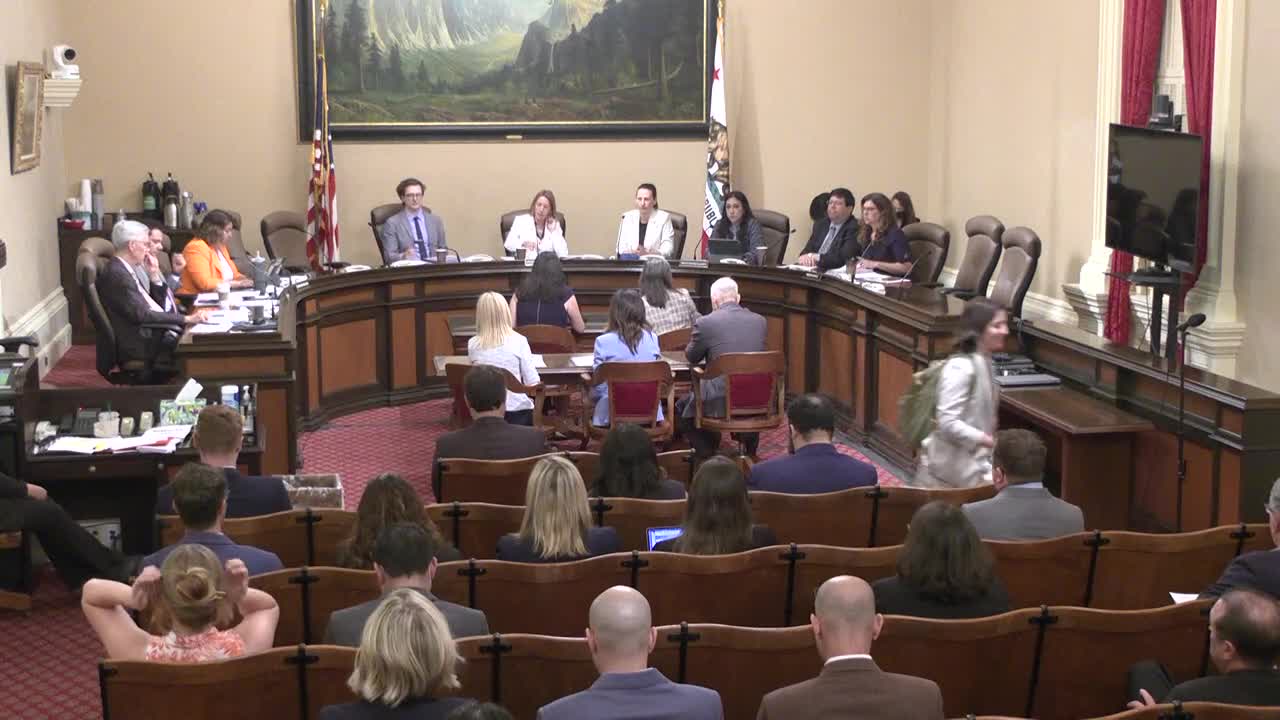 8MIN
Senate Standing Committee on Environmental Quality
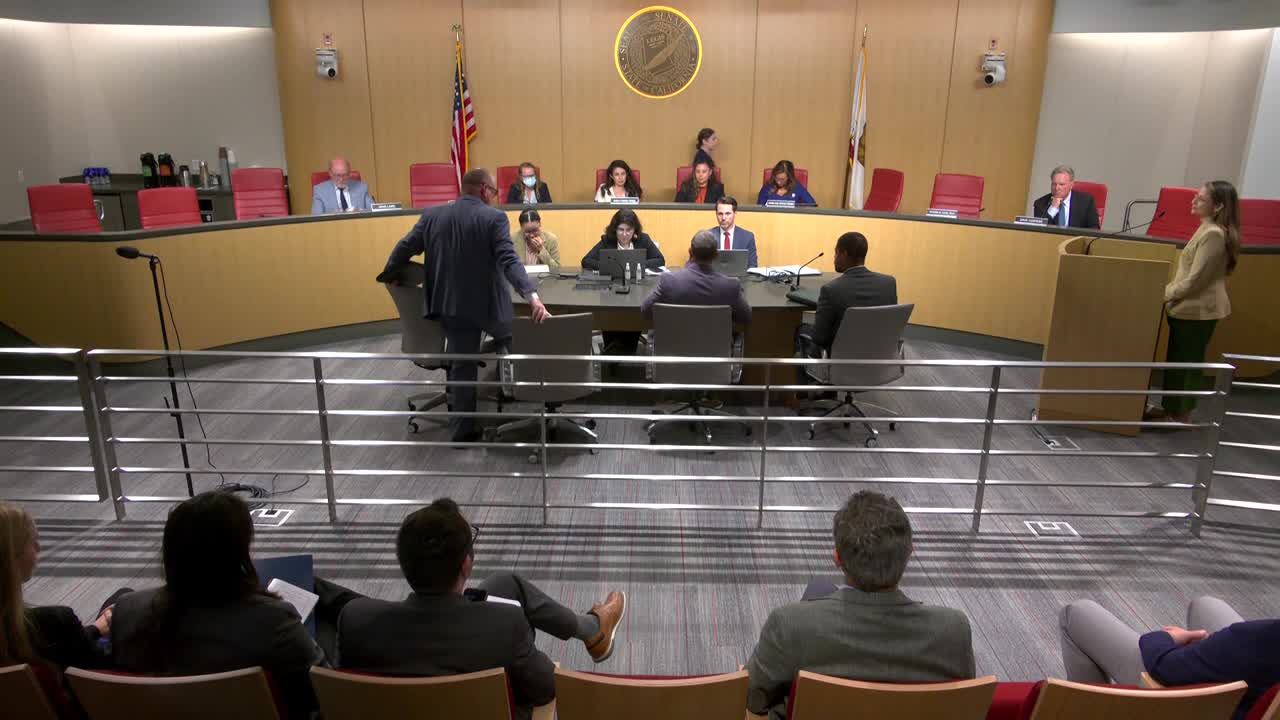 23MIN
Senate Standing Committee on Education
 3MIN
Assembly Floor
 20MIN
Assembly Standing Committee on Transportation
 44MIN
Assembly Standing Committee on Education
Bill Author