AB 1112: Tax Equity Allocation.
- Session Year: 2025-2026
- House: Assembly
- Latest Version Date: 2026-08-31
Current Status:
Passed
(2026-08-31: Chaptered by Secretary of State - Chapter 165, Statutes of 2026.)
Introduced
In Committee
Awaiting First Chamber Vote
Passed First Chamber
In Committee
Awaiting Second Chamber Vote
Passed Second Chamber
Enacted
Existing property tax law requires the auditor of each county with qualifying cities, as defined, to make certain property tax revenue allocations to those cities in accordance with an established Tax Equity Allocation formula. In any fiscal year in which a qualifying city is to receive a distribution under these provisions, existing law requires the auditor to reduce the actual amount distributed to the qualifying city by the sum of specified amounts, including any amount of property tax revenues that has been exchanged pursuant to specified law between the City of Rancho Mirage and a community services district.
This bill would remove the above-described property tax revenues from the reductions to the actual amount distributed. By changing the duties on local officials to administer Tax Equity Allocation, this bill would impose a state-mandated local program.
The California Constitution requires the state to reimburse local agencies and school districts for certain costs mandated by the state. Statutory provisions establish procedures for making that reimbursement.
This bill would provide that, if the Commission on State Mandates determines that the bill contains costs mandated by the state, reimbursement for those costs shall be made pursuant to the statutory provisions noted above.
By removing the above-described property tax revenues from the reductions to the actual amount distributed, this bill would change the pro rata shares in which ad valorem property tax revenues are allocated among local agencies in a county, within the meaning of paragraph (3) of subdivision (a) of Section 25.5 of Article XIII of the California Constitution, and thus would require for passage the approval of 2/3 of the membership of each house of the Legislature.
Existing property tax law requires the auditor of each county with qualifying cities, as defined, to make certain property tax revenue allocations to those cities in accordance with an established Tax Equity Allocation formula. In any fiscal year in which a qualifying city is to receive a distribution under these provisions, existing law requires the auditor to reduce the actual amount distributed to the qualifying city by the sum of specified amounts, including any amount of property tax revenues that has been exchanged pursuant to specified law between the City of Rancho Mirage and a community services district.
This bill would remove the above-described property tax revenues from the reductions to the actual amount distributed. By changing the duties on local officials to administer Tax Equity Allocation, this bill would impose a state-mandated local program.
The California Constitution requires the state to reimburse local agencies and school districts for certain costs mandated by the state. Statutory provisions establish procedures for making that reimbursement.
This bill would provide that, if the Commission on State Mandates determines that the bill contains costs mandated by the state, reimbursement for those costs shall be made pursuant to the statutory provisions noted above.
(a)In each county, other than the County of Ventura, having within its boundaries a qualifying city, the computations made pursuant to Section 96.1 or its predecessor section, for the 198990 fiscal year and each fiscal year thereafter, shall be modified as follows:
With respect to tax rate areas within the boundaries of a qualifying city, there shall be excluded from the aggregate amount of property tax revenue allocated pursuant to this chapter to local agencies, other than for a qualifying city, in the prior fiscal year, an amount equal to the sum of the amounts calculated pursuant to the TEA formula.
(b)(1)Except as otherwise provided in this section, each qualifying city shall, for the 198990 fiscal year and each fiscal year thereafter, be allocated by the auditor an amount determined pursuant to the TEA formula.
(2)For each qualifying city, the auditor shall, for the 198990 fiscal year and each fiscal year thereafter, allocate the amount determined pursuant to the TEA formula to all tax rate areas within that city in proportion to each tax rate areas share of the total assessed value in the city for the applicable fiscal year, and the amount so determined shall be subtracted from the countys proportionate share of property tax revenue for that fiscal year within those tax rate areas.
(3)After making the allocations pursuant to paragraphs (1) and (2), but before making the calculations pursuant to Section 96.5 or its predecessor section, the auditor shall, for all tax rate areas in the qualifying city, calculate the proportionate share of property tax revenue allocated pursuant to this section and Section 96.1, or their predecessor sections, in the 198990 fiscal year and each fiscal year thereafter to each jurisdiction in the tax rate area.
(4)In lieu of making the allocations of annual tax increment pursuant to subdivision (e) of Section 96.5 or its predecessor section, the auditor shall, for the 198990 fiscal year and each fiscal year thereafter, allocate the amount of property tax revenue determined pursuant to subdivision (d) of Section 96.5 or its predecessor section to jurisdictions in the tax rate area using the proportionate shares derived pursuant to paragraph (3).
(5)For purposes of the calculations made pursuant to Section 96.1 or its predecessor section, in the 199091 fiscal year and each fiscal year thereafter, the amounts that would have been allocated to qualifying cities pursuant to this subdivision shall be deemed to be the amount of property tax revenue allocated in the prior fiscal year.
(c)TEA formula means the Tax Equity Allocation formula, and shall be calculated by the auditor for each qualifying city as follows:
(1)For the 198889 fiscal year and each fiscal year thereafter, the auditor shall determine the total amount of property tax revenue to be allocated to all jurisdictions in all tax rate areas within the qualifying city, before the allocation and payment of funds in that fiscal year to a community redevelopment agency within the qualifying city, as provided in subdivision (b) of Section 33670 of the Health and Safety Code.
(2)The auditor shall determine the total amount of funds allocated in each fiscal year to a community redevelopment agency in accordance with subdivision (b) of Section 33670 of the Health and Safety Code.
(3)The auditor shall determine the total amount of funds paid in each fiscal year by a community redevelopment agency within the city to jurisdictions other than the city pursuant to subdivision (b) of Section 33401 and Section 33676 of the Health and Safety Code, and the cost to the redevelopment agency of any land or facilities transferred and any amounts paid to jurisdictions other than the city to assist in the construction or reconstruction of facilities pursuant to an agreement entered into under Section 33401 or 33445.5 of the Health and Safety Code.
(4)The auditor shall subtract the amount determined in paragraph (3) from the amount determined in paragraph (2).
(5)The auditor shall subtract the amount determined in paragraph (4) from the amount determined in paragraph (1).
(6)The amount computed in paragraph (5) shall be multiplied by the following percentages in order to determine the TEA formula amount to be distributed to the qualifying city in each fiscal year:
(A)For the first fiscal year in which the qualifying city receives a distribution pursuant to this section, 1 percent of the amount determined in paragraph (5).
(B)For the second fiscal year in which the qualifying city receives a distribution pursuant to this section, 2 percent of the amount determined in paragraph (5).
(C)For the third fiscal year in which the qualifying city receives a distribution pursuant to this section, 3 percent of the amount determined in paragraph (5).
(D)For the fourth fiscal year in which the qualifying city receives a distribution pursuant to this section, 4 percent of the amount determined in paragraph (5).
(E)For the fifth fiscal year in which the qualifying city receives a distribution pursuant to this section, 5 percent of the amount determined in paragraph (5).
(F)For the sixth fiscal year in which the qualifying city receives a distribution pursuant to this section, 6 percent of the amount determined in paragraph (5).
(G)For the seventh fiscal year and each fiscal year thereafter in which the city receives a distribution pursuant to this section, 7 percent of the amount determined in paragraph (5).
(d)Qualifying city means any city, except a qualifying city as defined in Section 98.1, that incorporated prior to June 5, 1987, and had an amount of property tax revenue allocated to it pursuant to subdivision (a) of Section 96.1 or its predecessor section in the 198889 fiscal year that is less than 7 percent of the amount of property tax revenue computed as follows:
(1)The auditor shall determine the total amount of property tax revenue allocated to the city in the 198889 fiscal year.
(2)The auditor shall subtract the amount in the 198889 fiscal year determined in paragraph (3) of subdivision (c) from the amount determined in paragraph (2) of subdivision (c).
(3)The auditor shall subtract the amount determined in paragraph (2) from the amount of property tax revenue determined in paragraph (1) of subdivision (c).
(4)The auditor shall divide the amount of property tax revenue determined in paragraph (1) of this subdivision by the amount of property tax revenue determined in paragraph (3) of this subdivision.
(5)If the quotient determined in paragraph (4) of this subdivision is less than 0.07, the city is a qualifying city. If the quotient determined in that paragraph is equal to or greater than 0.07, the city is not a qualifying city.
(e)The auditor may assess each qualifying city its proportional share of the actual costs of making the calculations required by this section, and may deduct that assessment from the amount allocated pursuant to subdivision (b). For purposes of this subdivision, a qualifying citys proportional share of the auditors actual costs shall not exceed the proportion it receives of the total amounts excluded in the county pursuant to subdivision (a).
(f)Notwithstanding subdivision (b), in any fiscal year in which a qualifying city is to receive a distribution pursuant to this section, the auditor shall reduce the actual amount distributed to the qualifying city by the sum of the following:
(1)The amount of property tax revenue that was exchanged between the county and the qualifying city as a result of negotiation pursuant to Section 99.03.
(2)(A)The amount of revenue not collected by the qualifying city in the first fiscal year following the citys reduction after January 1, 1988, of the tax rate or tax base of any locally imposed tax, except any tax that was imposed after January 1, 1988. In the case of a tax that existed before January 1, 1988, this clause shall apply only with respect to an amount attributable to a reduction of the rate or base to a level lower than the rate or base applicable on January 1, 1988. The amount so computed by the auditor shall constitute a reduction in the amount of property tax revenue distributed to the qualifying city pursuant to this section in each succeeding fiscal year. That amount shall be aggregated with any additional amount computed pursuant to this clause as the result of the citys reduction in any subsequent year of the tax rate or tax base of the same or any other locally imposed general or special tax.
(B)No reduction may be made pursuant to subparagraph (A) in the case in which a local tax is reduced or eliminated as a result of either a court decision or the approval or rejection of a ballot measure by the voters.
(3)The amount of property tax revenue received pursuant to this chapter in excess of the amount allocated for the 198687 fiscal year by all special districts that are governed by the city council of the qualifying city or whose governing body is the same as the city council of the qualifying city with respect to all tax rate areas within the boundaries of the qualifying city.
Notwithstanding this paragraph:
(A)Commencing with the 199495 fiscal year, the auditor shall not reduce the amount distributed to a qualifying city under this section by reason of that city becoming the successor agency to a special district, that is dissolved, merged with that city, or becomes a subsidiary district of that city, on or after July 1, 1994.
(B)Commencing with the 199798 fiscal year, the auditor shall not reduce the amount distributed to a qualifying city under this section by reason of that city withdrawing from a county free library system pursuant to Section 19116 of the Education Code.
(g)Notwithstanding any other provision of this section, in no event may the auditor reduce the amount of ad valorem property tax revenue otherwise allocated to a qualifying city pursuant to this section on the basis of any additional ad valorem property tax revenues received by that city pursuant to a services for revenue agreement. For purposes of this subdivision, a services for revenue agreement means any agreement between a qualifying city and the county in which it is located, entered into by joint resolution of that city and that county, under which additional service responsibilities are exchanged in consideration for additional property tax revenues.
(h)In any fiscal year in which a qualifying city is to receive a distribution pursuant to this section, the auditor shall increase the actual amount distributed to the qualifying city by the amount of property tax revenue allocated to the qualifying city pursuant to Section 19116 of the Education Code.
(i)If the auditor determines that the amount to be distributed to a qualifying city pursuant to subdivision (b), as modified by subdivisions (e), (f), and (g) would result in a qualifying city having proceeds of taxes in excess of its appropriation limit, the auditor shall reduce the amount, on a dollar-for-dollar basis, by the amount that exceeds the citys appropriations limit.
(j)The amount not distributed to the tax rate areas of a qualifying city as a result of this section shall be distributed by the auditor to the county.
(k)Notwithstanding any other provision of this section, no qualifying city shall be distributed an amount pursuant to this section that is less than the amount the city would have been allocated without the application of the TEA formula.
(l)Notwithstanding any other provision of this section, the auditor shall not distribute any amount determined pursuant to this section to any qualifying city that has in the prior fiscal year used any revenues or issued bonds for the construction, acquisition, or development, of any facility which is defined in Section 103(b)(4), 103(b)(5), or 103(b)(6) of the Internal Revenue Code of 1954 prior to the enactment of the Tax Reform Act of 1986 (Public Law 99-514) and is no longer eligible for tax-exempt financing.
(m)(1)The amendments made to this section, and the repeal of Section 98.04, by the act that added this subdivision shall apply for the 200607 fiscal year and each fiscal year thereafter.
(2)For the 200607 fiscal year and for each fiscal year thereafter, all of the following apply:
(A)The auditor of the County of Santa Clara shall do both of the following:
(i)Reduce the total amount of ad valorem property tax revenue otherwise required to be allocated to qualifying cities in that county by the ERAF reimbursement amount. This reduction for each qualifying city in the county for each fiscal year shall be the percentage share, of the total reduction required by this clause for all qualifying cities in the county for the 200607 fiscal year, that is equal to the proportion that the total amount of additional ad valorem property tax revenue that is required to be allocated to the qualifying city as a result of the act that added this subdivision bears to the total amount of additional ad valorem property tax revenue that is required to be allocated to all qualifying cities in the county as a result of the act that added this subdivision.
(ii)Increase the total amount of ad valorem property tax revenue otherwise required to be allocated to the county Educational Revenue Augmentation Fund by the ERAF reimbursement amount.
(B)For purposes of this subdivision, ERAF reimbursement amount means an amount equal to the difference between the following two amounts:
(i)The portion of the annual tax increment that would have been allocated from the county to the county Educational Revenue Augmentation Fund for the applicable fiscal year if the act that added this subdivision had not been enacted.
(ii)The portion of the annual tax increment that is allocated from the county to the county Educational Revenue Augmentation Fund for the applicable fiscal year.
(n)Notwithstanding subdivision (m) and except as provided in paragraph (2), for the 201516 fiscal year and for each fiscal year thereafter, all of the following shall apply:
(1)The auditor of the County of Santa Clara shall do both of the following:
(A)(i)Reduce the total amount of ad valorem property tax revenue otherwise required to be allocated to qualifying cities in that county by the percentage specified in clause (ii) of the ERAF reimbursement amount. This reduction for each qualifying city in the county for each fiscal year shall be the percentage share, of the total reduction required by this clause for all qualifying cities in the county for the 201516 fiscal year, that is equal to the proportion that the total amount of additional ad valorem property tax revenue that is required to be allocated to the qualifying city as a result of the act that added this subdivision bears to the total amount of additional ad valorem property tax revenue that is required to be allocated to all qualifying cities in the county as a result of the act that added this subdivision.
(ii)(I)For the first fiscal year in which qualifying cities receive an allocation pursuant to this subdivision, 80 percent.
(II)For the second fiscal year in which qualifying cities receive an allocation pursuant to this subdivision, 60 percent.
(III)For the third fiscal year in which qualifying cities receive an allocation pursuant to this subdivision, 40 percent.
(IV)For the fourth fiscal year in which qualifying cities receive an allocation pursuant to this subdivision, 20 percent.
(V)For the fifth fiscal year in which qualifying cities receive an allocation pursuant to this subdivision, and for each fiscal year thereafter in which a qualifying city receives an allocation pursuant to this subdivision, 0 percent.
(B)Increase the total amount of ad valorem property tax revenue otherwise required to be allocated to the county Educational Revenue Augmentation Fund by the percentage specified in clause (ii) of subparagraph (A) of the ERAF reimbursement amount.
(2)The auditor of the County of Santa Clara shall not adjust the ERAF reimbursement amount by the percentages specified in clause (ii) of subparagraph (A) of paragraph (1) in any fiscal year in which the amount of moneys required to be applied by the state for the support of school districts and community college districts is determined pursuant to paragraph (1) of subdivision (b) of Section 8 of Article XVI of the California Constitution.
(3)For purposes of this subdivision, ERAF reimbursement amount has the same meaning as defined in subparagraph (B) of paragraph (2) of subdivision (m).
SEC. 2.If the Commission on State Mandates determines that this act contains costs mandated by the state, reimbursement to local agencies and school districts for those costs shall be made pursuant to Part 7 (commencing with Section 17500) of Division 4 of Title 2 of the Government Code.
(a)In each county, other than the County of Ventura, having within its boundaries a qualifying city, the computations made pursuant to Section 96.1 or its predecessor section, for the 198990 fiscal year and each fiscal year thereafter, shall be modified as follows:
With respect to tax rate areas within the boundaries of a qualifying city, there shall be excluded from the aggregate amount of property tax revenue allocated pursuant to this chapter to local agencies, other than for a qualifying city, in the prior fiscal year, an amount equal to the sum of the amounts calculated pursuant to the TEA formula.
(b)(1)Except as otherwise provided in this section, each qualifying city shall, for the 198990 fiscal year and each fiscal year thereafter, be allocated by the auditor an amount determined pursuant to the TEA formula.
(2)For each qualifying city, the auditor shall, for the 198990 fiscal year and each fiscal year thereafter, allocate the amount determined pursuant to the TEA formula to all tax rate areas within that city in proportion to each tax rate areas share of the total assessed value in the city for the applicable fiscal year, and the amount so determined shall be subtracted from the countys proportionate share of property tax revenue for that fiscal year within those tax rate areas.
(3)After making the allocations pursuant to paragraphs (1) and (2), but before making the calculations pursuant to Section 96.5 or its predecessor section, the auditor shall, for all tax rate areas in the qualifying city, calculate the proportionate share of property tax revenue allocated pursuant to this section and Section 96.1, or their predecessor sections, in the 198990 fiscal year and each fiscal year thereafter to each jurisdiction in the tax rate area.
(4)In lieu of making the allocations of annual tax increment pursuant to subdivision (e) of Section 96.5 or its predecessor section, the auditor shall, for the 198990 fiscal year and each fiscal year thereafter, allocate the amount of property tax revenue determined pursuant to subdivision (d) of Section 96.5 or its predecessor section to jurisdictions in the tax rate area using the proportionate shares derived pursuant to paragraph (3).
(5)For purposes of the calculations made pursuant to Section 96.1 or its predecessor section, in the 199091 fiscal year and each fiscal year thereafter, the amounts that would have been allocated to qualifying cities pursuant to this subdivision shall be deemed to be the amount of property tax revenue allocated in the prior fiscal year.
(c)TEA formula means the Tax Equity Allocation formula, and shall be calculated by the auditor for each qualifying city as follows:
(1)For the 198889 fiscal year and each fiscal year thereafter, the auditor shall determine the total amount of property tax revenue to be allocated to all jurisdictions in all tax rate areas within the qualifying city, before the allocation and payment of funds in that fiscal year to a community redevelopment agency within the qualifying city, as provided in subdivision (b) of Section 33670 of the Health and Safety Code.
(2)The auditor shall determine the total amount of funds allocated in each fiscal year to a community redevelopment agency in accordance with subdivision (b) of Section 33670 of the Health and Safety Code.
(3)The auditor shall determine the total amount of funds paid in each fiscal year by a community redevelopment agency within the city to jurisdictions other than the city pursuant to subdivision (b) of Section 33401 and Section 33676 of the Health and Safety Code, and the cost to the redevelopment agency of any land or facilities transferred and any amounts paid to jurisdictions other than the city to assist in the construction or reconstruction of facilities pursuant to an agreement entered into under Section 33401 or 33445.5 of the Health and Safety Code.
(4)The auditor shall subtract the amount determined in paragraph (3) from the amount determined in paragraph (2).
(5)The auditor shall subtract the amount determined in paragraph (4) from the amount determined in paragraph (1).
(6)The amount computed in paragraph (5) shall be multiplied by the following percentages in order to determine the TEA formula amount to be distributed to the qualifying city in each fiscal year:
(A)For the first fiscal year in which the qualifying city receives a distribution pursuant to this section, 1 percent of the amount determined in paragraph (5).
(B)For the second fiscal year in which the qualifying city receives a distribution pursuant to this section, 2 percent of the amount determined in paragraph (5).
(C)For the third fiscal year in which the qualifying city receives a distribution pursuant to this section, 3 percent of the amount determined in paragraph (5).
(D)For the fourth fiscal year in which the qualifying city receives a distribution pursuant to this section, 4 percent of the amount determined in paragraph (5).
(E)For the fifth fiscal year in which the qualifying city receives a distribution pursuant to this section, 5 percent of the amount determined in paragraph (5).
(F)For the sixth fiscal year in which the qualifying city receives a distribution pursuant to this section, 6 percent of the amount determined in paragraph (5).
(G)For the seventh fiscal year and each fiscal year thereafter in which the city receives a distribution pursuant to this section, 7 percent of the amount determined in paragraph (5).
(d)Qualifying city means any city, except a qualifying city as defined in Section 98.1, that incorporated prior to June 5, 1987, and had an amount of property tax revenue allocated to it pursuant to subdivision (a) of Section 96.1 or its predecessor section in the 198889 fiscal year that is less than 7 percent of the amount of property tax revenue computed as follows:
(1)The auditor shall determine the total amount of property tax revenue allocated to the city in the 198889 fiscal year.
(2)The auditor shall subtract the amount in the 198889 fiscal year determined in paragraph (3) of subdivision (c) from the amount determined in paragraph (2) of subdivision (c).
(3)The auditor shall subtract the amount determined in paragraph (2) from the amount of property tax revenue determined in paragraph (1) of subdivision (c).
(4)The auditor shall divide the amount of property tax revenue determined in paragraph (1) of this subdivision by the amount of property tax revenue determined in paragraph (3) of this subdivision.
(5)If the quotient determined in paragraph (4) of this subdivision is less than 0.07, the city is a qualifying city. If the quotient determined in that paragraph is equal to or greater than 0.07, the city is not a qualifying city.
(e)The auditor may assess each qualifying city its proportional share of the actual costs of making the calculations required by this section, and may deduct that assessment from the amount allocated pursuant to subdivision (b). For purposes of this subdivision, a qualifying citys proportional share of the auditors actual costs shall not exceed the proportion it receives of the total amounts excluded in the county pursuant to subdivision (a).
(f)Notwithstanding subdivision (b), in any fiscal year in which a qualifying city is to receive a distribution pursuant to this section, the auditor shall reduce the actual amount distributed to the qualifying city by the sum of the following:
(1)The amount of property tax revenue that was exchanged between the county and the qualifying city as a result of negotiation pursuant to Section 99.03.
(2)(A)The amount of revenue not collected by the qualifying city in the first fiscal year following the citys reduction after January 1, 1988, of the tax rate or tax base of any locally imposed tax, except any tax that was imposed after January 1, 1988. In the case of a tax that existed before January 1, 1988, this clause shall apply only with respect to an amount attributable to a reduction of the rate or base to a level lower than the rate or base applicable on January 1, 1988. The amount so computed by the auditor shall constitute a reduction in the amount of property tax revenue distributed to the qualifying city pursuant to this section in each succeeding fiscal year. That amount shall be aggregated with any additional amount computed pursuant to this clause as the result of the citys reduction in any subsequent year of the tax rate or tax base of the same or any other locally imposed general or special tax.
(B)No reduction may be made pursuant to subparagraph (A) in the case in which a local tax is reduced or eliminated as a result of either a court decision or the approval or rejection of a ballot measure by the voters.
(3)The amount of property tax revenue received pursuant to this chapter in excess of the amount allocated for the 198687 fiscal year by all special districts that are governed by the city council of the qualifying city or whose governing body is the same as the city council of the qualifying city with respect to all tax rate areas within the boundaries of the qualifying city.
Notwithstanding this paragraph:
(A)Commencing with the 199495 fiscal year, the auditor shall not reduce the amount distributed to a qualifying city under this section by reason of that city becoming the successor agency to a special district, that is dissolved, merged with that city, or becomes a subsidiary district of that city, on or after July 1, 1994.
(B)Commencing with the 199798 fiscal year, the auditor shall not reduce the amount distributed to a qualifying city under this section by reason of that city withdrawing from a county free library system pursuant to Section 19116 of the Education Code.
(g)Notwithstanding any other provision of this section, in no event may the auditor reduce the amount of ad valorem property tax revenue otherwise allocated to a qualifying city pursuant to this section on the basis of any additional ad valorem property tax revenues received by that city pursuant to a services for revenue agreement. For purposes of this subdivision, a services for revenue agreement means any agreement between a qualifying city and the county in which it is located, entered into by joint resolution of that city and that county, under which additional service responsibilities are exchanged in consideration for additional property tax revenues.
(h)In any fiscal year in which a qualifying city is to receive a distribution pursuant to this section, the auditor shall increase the actual amount distributed to the qualifying city by the amount of property tax revenue allocated to the qualifying city pursuant to Section 19116 of the Education Code.
(i)If the auditor determines that the amount to be distributed to a qualifying city pursuant to subdivision (b), as modified by subdivisions (e), (f), and (g) would result in a qualifying city having proceeds of taxes in excess of its appropriation limit, the auditor shall reduce the amount, on a dollar-for-dollar basis, by the amount that exceeds the citys appropriations limit.
(j)The amount not distributed to the tax rate areas of a qualifying city as a result of this section shall be distributed by the auditor to the county.
(k)Notwithstanding any other provision of this section, no qualifying city shall be distributed an amount pursuant to this section that is less than the amount the city would have been allocated without the application of the TEA formula.
(l)Notwithstanding any other provision of this section, the auditor shall not distribute any amount determined pursuant to this section to any qualifying city that has in the prior fiscal year used any revenues or issued bonds for the construction, acquisition, or development, of any facility which is defined in Section 103(b)(4), 103(b)(5), or 103(b)(6) of the Internal Revenue Code of 1954 prior to the enactment of the Tax Reform Act of 1986 (Public Law 99-514) and is no longer eligible for tax-exempt financing.
(m)(1)The amendments made to this section, and the repeal of Section 98.04, by the act that added this subdivision shall apply for the 200607 fiscal year and each fiscal year thereafter.
(2)For the 200607 fiscal year and for each fiscal year thereafter, all of the following apply:
(A)The auditor of the County of Santa Clara shall do both of the following:
(i)Reduce the total amount of ad valorem property tax revenue otherwise required to be allocated to qualifying cities in that county by the ERAF reimbursement amount. This reduction for each qualifying city in the county for each fiscal year shall be the percentage share, of the total reduction required by this clause for all qualifying cities in the county for the 200607 fiscal year, that is equal to the proportion that the total amount of additional ad valorem property tax revenue that is required to be allocated to the qualifying city as a result of the act that added this subdivision bears to the total amount of additional ad valorem property tax revenue that is required to be allocated to all qualifying cities in the county as a result of the act that added this subdivision.
(ii)Increase the total amount of ad valorem property tax revenue otherwise required to be allocated to the county Educational Revenue Augmentation Fund by the ERAF reimbursement amount.
(B)For purposes of this subdivision, ERAF reimbursement amount means an amount equal to the difference between the following two amounts:
(i)The portion of the annual tax increment that would have been allocated from the county to the county Educational Revenue Augmentation Fund for the applicable fiscal year if the act that added this subdivision had not been enacted.
(ii)The portion of the annual tax increment that is allocated from the county to the county Educational Revenue Augmentation Fund for the applicable fiscal year.
(n)Notwithstanding subdivision (m) and except as provided in paragraph (2), for the 201516 fiscal year and for each fiscal year thereafter, all of the following shall apply:
(1)The auditor of the County of Santa Clara shall do both of the following:
(A)(i)Reduce the total amount of ad valorem property tax revenue otherwise required to be allocated to qualifying cities in that county by the percentage specified in clause (ii) of the ERAF reimbursement amount. This reduction for each qualifying city in the county for each fiscal year shall be the percentage share, of the total reduction required by this clause for all qualifying cities in the county for the 201516 fiscal year, that is equal to the proportion that the total amount of additional ad valorem property tax revenue that is required to be allocated to the qualifying city as a result of the act that added this subdivision bears to the total amount of additional ad valorem property tax revenue that is required to be allocated to all qualifying cities in the county as a result of the act that added this subdivision.
(ii)(I)For the first fiscal year in which qualifying cities receive an allocation pursuant to this subdivision, 80 percent.
(II)For the second fiscal year in which qualifying cities receive an allocation pursuant to this subdivision, 60 percent.
(III)For the third fiscal year in which qualifying cities receive an allocation pursuant to this subdivision, 40 percent.
(IV)For the fourth fiscal year in which qualifying cities receive an allocation pursuant to this subdivision, 20 percent.
(V)For the fifth fiscal year in which qualifying cities receive an allocation pursuant to this subdivision, and for each fiscal year thereafter in which a qualifying city receives an allocation pursuant to this subdivision, zero 0 percent.
(B)Increase the total amount of ad valorem property tax revenue otherwise required to be allocated to the county Educational Revenue Augmentation Fund by the percentage specified in clause (ii) of subparagraph (A) of the ERAF reimbursement amount.
(2)The auditor of the County of Santa Clara shall not adjust the ERAF reimbursement amount by the percentages specified in clause (ii) of subparagraph (A) of paragraph (1) in any fiscal year in which the amount of moneys required to be applied by the state for the support of school districts and community college districts is determined pursuant to paragraph (1) of subdivision (b) of Section 8 of Article XVI of the California Constitution.
(3)For purposes of this subdivision, ERAF reimbursement amount has the same meaning as defined in subparagraph (B) of paragraph (2) of subdivision (m).
SEC. 2.If the Commission on State Mandates determines that this act contains costs mandated by the state, reimbursement to local agencies and school districts for those costs shall be made pursuant to Part 7 (commencing with Section 17500) of Division 4 of Title 2 of the Government Code.
(a)In each county, other than the County of Ventura, having within its boundaries a qualifying city, the computations made pursuant to Section 96.1 or its predecessor section, for the 198990 fiscal year and each fiscal year thereafter, shall be modified as follows:
With respect to tax rate areas within the boundaries of a qualifying city, there shall be excluded from the aggregate amount of property tax revenue allocated pursuant to this chapter to local agencies, other than for a qualifying city, in the prior fiscal year, an amount equal to the sum of the amounts calculated pursuant to the TEA formula.
(b)(1)Except as otherwise provided in this section, each qualifying city shall, for the 198990 fiscal year and each fiscal year thereafter, be allocated by the auditor an amount determined pursuant to the TEA formula.
(2)For each qualifying city, the auditor shall, for the 198990 fiscal year and each fiscal year thereafter, allocate the amount determined pursuant to the TEA formula to all tax rate areas within that city in proportion to each tax rate areas share of the total assessed value in the city for the applicable fiscal year, and the amount so determined shall be subtracted from the countys proportionate share of property tax revenue for that fiscal year within those tax rate areas.
(3)After making the allocations pursuant to paragraphs (1) and (2), but before making the calculations pursuant to Section 96.5 or its predecessor section, the auditor shall, for all tax rate areas in the qualifying city, calculate the proportionate share of property tax revenue allocated pursuant to this section and Section 96.1, or their predecessor sections, in the 198990 fiscal year and each fiscal year thereafter to each jurisdiction in the tax rate area.
(4)In lieu of making the allocations of annual tax increment pursuant to subdivision (e) of Section 96.5 or its predecessor section, the auditor shall, for the 198990 fiscal year and each fiscal year thereafter, allocate the amount of property tax revenue determined pursuant to subdivision (d) of Section 96.5 or its predecessor section to jurisdictions in the tax rate area using the proportionate shares derived pursuant to paragraph (3).
(5)For purposes of the calculations made pursuant to Section 96.1 or its predecessor section, in the 199091 fiscal year and each fiscal year thereafter, the amounts that would have been allocated to qualifying cities pursuant to this subdivision shall be deemed to be the amount of property tax revenue allocated in the prior fiscal year.
(c)TEA formula means the Tax Equity Allocation formula, and shall be calculated by the auditor for each qualifying city as follows:
(1)For the 198889 fiscal year and each fiscal year thereafter, the auditor shall determine the total amount of property tax revenue to be allocated to all jurisdictions in all tax rate areas within the qualifying city, before the allocation and payment of funds in that fiscal year to a community redevelopment agency within the qualifying city, as provided in subdivision (b) of Section 33670 of the Health and Safety Code.
(2)The auditor shall determine the total amount of funds allocated in each fiscal year to a community redevelopment agency in accordance with subdivision (b) of Section 33670 of the Health and Safety Code.
(3)The auditor shall determine the total amount of funds paid in each fiscal year by a community redevelopment agency within the city to jurisdictions other than the city pursuant to subdivision (b) of Section 33401 and Section 33676 of the Health and Safety Code, and the cost to the redevelopment agency of any land or facilities transferred and any amounts paid to jurisdictions other than the city to assist in the construction or reconstruction of facilities pursuant to an agreement entered into under Section 33401 or 33445.5 of the Health and Safety Code.
(4)The auditor shall subtract the amount determined in paragraph (3) from the amount determined in paragraph (2).
(5)The auditor shall subtract the amount determined in paragraph (4) from the amount determined in paragraph (1).
(6)The amount computed in paragraph (5) shall be multiplied by the following percentages in order to determine the TEA formula amount to be distributed to the qualifying city in each fiscal year:
(A)For the first fiscal year in which the qualifying city receives a distribution pursuant to this section, 1 percent of the amount determined in paragraph (5).
(B)For the second fiscal year in which the qualifying city receives a distribution pursuant to this section, 2 percent of the amount determined in paragraph (5).
(C)For the third fiscal year in which the qualifying city receives a distribution pursuant to this section, 3 percent of the amount determined in paragraph (5).
(D)For the fourth fiscal year in which the qualifying city receives a distribution pursuant to this section, 4 percent of the amount determined in paragraph (5).
(E)For the fifth fiscal year in which the qualifying city receives a distribution pursuant to this section, 5 percent of the amount determined in paragraph (5).
(F)For the sixth fiscal year in which the qualifying city receives a distribution pursuant to this section, 6 percent of the amount determined in paragraph (5).
(G)For the seventh fiscal year and each fiscal year thereafter in which the city receives a distribution pursuant to this section, 7 percent of the amount determined in paragraph (5).
(d)Qualifying city means any city, except a qualifying city as defined in Section 98.1, that incorporated prior to June 5, 1987, and had an amount of property tax revenue allocated to it pursuant to subdivision (a) of Section 96.1 or its predecessor section in the 198889 fiscal year that is less than 7 percent of the amount of property tax revenue computed as follows:
(1)The auditor shall determine the total amount of property tax revenue allocated to the city in the 198889 fiscal year.
(2)The auditor shall subtract the amount in the 198889 fiscal year determined in paragraph (3) of subdivision (c) from the amount determined in paragraph (2) of subdivision (c).
(3)The auditor shall subtract the amount determined in paragraph (2) from the amount of property tax revenue determined in paragraph (1) of subdivision (c).
(4)The auditor shall divide the amount of property tax revenue determined in paragraph (1) of this subdivision by the amount of property tax revenue determined in paragraph (3) of this subdivision.
(5)If the quotient determined in paragraph (4) of this subdivision is less than 0.07, the city is a qualifying city. If the quotient determined in that paragraph is equal to or greater than 0.07, the city is not a qualifying city.
(e)The auditor may assess each qualifying city its proportional share of the actual costs of making the calculations required by this section, and may deduct that assessment from the amount allocated pursuant to subdivision (b). For purposes of this subdivision, a qualifying citys proportional share of the auditors actual costs shall not exceed the proportion it receives of the total amounts excluded in the county pursuant to subdivision (a).
(f)Notwithstanding subdivision (b), in any fiscal year in which a qualifying city is to receive a distribution pursuant to this section, the auditor shall reduce the actual amount distributed to the qualifying city by the sum of the following:
(1)The amount of property tax revenue that was exchanged between the county and the qualifying city as a result of negotiation pursuant to Section 99.03.
(2)(A)The amount of revenue not collected by the qualifying city in the first fiscal year following the citys reduction after January 1, 1988, of the tax rate or tax base of any locally imposed tax, except any tax that was imposed after January 1, 1988. In the case of a tax that existed before January 1, 1988, this clause shall apply only with respect to an amount attributable to a reduction of the rate or base to a level lower than the rate or base applicable on January 1, 1988. The amount so computed by the auditor shall constitute a reduction in the amount of property tax revenue distributed to the qualifying city pursuant to this section in each succeeding fiscal year. That amount shall be aggregated with any additional amount computed pursuant to this clause as the result of the citys reduction in any subsequent year of the tax rate or tax base of the same or any other locally imposed general or special tax.
(B)No reduction may be made pursuant to subparagraph (A) in the case in which a local tax is reduced or eliminated as a result of either a court decision or the approval or rejection of a ballot measure by the voters.
(3)The amount of property tax revenue received pursuant to this chapter in excess of the amount allocated for the 198687 fiscal year by all special districts that are governed by the city council of the qualifying city or whose governing body is the same as the city council of the qualifying city with respect to all tax rate areas within the boundaries of the qualifying city.
Notwithstanding this paragraph:
(A)Commencing with the 199495 fiscal year, the auditor shall not reduce the amount distributed to a qualifying city under this section by reason of that city becoming the successor agency to a special district, that is dissolved, merged with that city, or becomes a subsidiary district of that city, on or after July 1, 1994.
(B)Commencing with the 199798 fiscal year, the auditor shall not reduce the amount distributed to a qualifying city under this section by reason of that city withdrawing from a county free library system pursuant to Section 19116 of the Education Code.
(4)Any amount of property tax revenues that has been exchanged pursuant to Section 56842 of the Government Code, as that section read on January 1, 1998, between the City of Rancho Mirage and a community services district, the formation of which was initiated on or after March 6, 1997, pursuant to Chapter 4 (commencing with Section 56800) of Part 3 of Division 3 of Title 5 of the Government Code.(g)Notwithstanding any other provision of this section, in no event may the auditor reduce the amount of ad valorem property tax revenue otherwise allocated to a qualifying city pursuant to this section on the basis of any additional ad valorem property tax revenues received by that city pursuant to a services for revenue agreement. For purposes of this subdivision, a services for revenue agreement means any agreement between a qualifying city and the county in which it is located, entered into by joint resolution of that city and that county, under which additional service responsibilities are exchanged in consideration for additional property tax revenues.
(h)In any fiscal year in which a qualifying city is to receive a distribution pursuant to this section, the auditor shall increase the actual amount distributed to the qualifying city by the amount of property tax revenue allocated to the qualifying city pursuant to Section 19116 of the Education Code.
(i)If the auditor determines that the amount to be distributed to a qualifying city pursuant to subdivision (b), as modified by subdivisions (e), (f), and (g) would result in a qualifying city having proceeds of taxes in excess of its appropriation limit, the auditor shall reduce the amount, on a dollar-for-dollar basis, by the amount that exceeds the citys appropriations limit.
(j)The amount not distributed to the tax rate areas of a qualifying city as a result of this section shall be distributed by the auditor to the county.
(k)Notwithstanding any other provision of this section, no qualifying city shall be distributed an amount pursuant to this section that is less than the amount the city would have been allocated without the application of the TEA formula.
(l)Notwithstanding any other provision of this section, the auditor shall not distribute any amount determined pursuant to this section to any qualifying city that has in the prior fiscal year used any revenues or issued bonds for the construction, acquisition, or development, of any facility which is defined in Section 103(b)(4), 103(b)(5), or 103(b)(6) of the Internal Revenue Code of 1954 prior to the enactment of the Tax Reform Act of 1986 (Public Law 99-514) and is no longer eligible for tax-exempt financing.
(m)(1)The amendments made to this section, and the repeal of Section 98.04, by the act that added this subdivision shall apply for the 200607 fiscal year and each fiscal year thereafter.
(2)For the 200607 fiscal year and for each fiscal year thereafter, all of the following apply:
(A)The auditor of the County of Santa Clara shall do both of the following:
(i)Reduce the total amount of ad valorem property tax revenue otherwise required to be allocated to qualifying cities in that county by the ERAF reimbursement amount. This reduction for each qualifying city in the county for each fiscal year shall be the percentage share, of the total reduction required by this clause for all qualifying cities in the county for the 200607 fiscal year, that is equal to the proportion that the total amount of additional ad valorem property tax revenue that is required to be allocated to the qualifying city as a result of the act that added this subdivision bears to the total amount of additional ad valorem property tax revenue that is required to be allocated to all qualifying cities in the county as a result of the act that added this subdivision.
(ii)Increase the total amount of ad valorem property tax revenue otherwise required to be allocated to the county Educational Revenue Augmentation Fund by the ERAF reimbursement amount.
(B)For purposes of this subdivision, ERAF reimbursement amount means an amount equal to the difference between the following two amounts:
(i)The portion of the annual tax increment that would have been allocated from the county to the county Educational Revenue Augmentation Fund for the applicable fiscal year if the act that added this subdivision had not been enacted.
(ii)The portion of the annual tax increment that is allocated from the county to the county Educational Revenue Augmentation Fund for the applicable fiscal year.
(n)Notwithstanding subdivision (m) and except as provided in paragraph (2), for the 201516 fiscal year and for each fiscal year thereafter, all of the following shall apply:
(1)The auditor of the County of Santa Clara shall do both of the following:
(A)(i)Reduce the total amount of ad valorem property tax revenue otherwise required to be allocated to qualifying cities in that county by the percentage specified in clause (ii) of the ERAF reimbursement amount. This reduction for each qualifying city in the county for each fiscal year shall be the percentage share, of the total reduction required by this clause for all qualifying cities in the county for the 201516 fiscal year, that is equal to the proportion that the total amount of additional ad valorem property tax revenue that is required to be allocated to the qualifying city as a result of the act that added this subdivision bears to the total amount of additional ad valorem property tax revenue that is required to be allocated to all qualifying cities in the county as a result of the act that added this subdivision.
(ii)(I)For the first fiscal year in which qualifying cities receive an allocation pursuant to this subdivision, 80 percent.
(II)For the second fiscal year in which qualifying cities receive an allocation pursuant to this subdivision, 60 percent.
(III)For the third fiscal year in which qualifying cities receive an allocation pursuant to this subdivision, 40 percent.
(IV)For the fourth fiscal year in which qualifying cities receive an allocation pursuant to this subdivision, 20 percent.
(V)For the fifth fiscal year in which qualifying cities receive an allocation pursuant to this subdivision, and for each fiscal year thereafter in which a qualifying city receives an allocation pursuant to this subdivision, zero percent.
(B)Increase the total amount of ad valorem property tax revenue otherwise required to be allocated to the county Educational Revenue Augmentation Fund by the percentage specified in clause (ii) of subparagraph (A) of the ERAF reimbursement amount.
(2)The auditor of the County of Santa Clara shall not adjust the ERAF reimbursement amount by the percentages specified in clause (ii) of subparagraph (A) of paragraph (1) in any fiscal year in which the amount of moneys required to be applied by the state for the support of school districts and community college districts is determined pursuant to paragraph (1) of subdivision (b) of Section 8 of Article XVI of the California Constitution.
(3)For purposes of this subdivision, ERAF reimbursement amount has the same meaning as defined in subparagraph (B) of paragraph (2) of subdivision (m).
SEC. 2.If the Commission on State Mandates determines that this act contains costs mandated by the state, reimbursement to local agencies and school districts for those costs shall be made pursuant to Part 7 (commencing with Section 17500) of Division 4 of Title 2 of the Government Code.
|
Date
|
Status
|
|---|---|
| Aug 31, 2026 | Chaptered by Secretary of State - Chapter 165, Statutes of 2026. |
| Aug 31, 2026 | Approved by the Governor. |
| Aug 24, 2026 | Enrolled and presented to the Governor at 4:30 p.m. |
| Aug 17, 2026 | In Assembly. Ordered to Engrossing and Enrolling. |
| Aug 17, 2026 | Read third time. Passed. Ordered to the Assembly. (Ayes 40. Noes 0. Page 5494.). |
| Aug 17, 2026 | Read third time. Passed. Ordered to the Assembly. (Ayes 40. Noes 0.). |
| Jun 29, 2026 | Read second time. Ordered to third reading. |
| Jun 25, 2026 | Ordered to second reading. |
| Jun 25, 2026 | From inactive file. |
| Aug 29, 2025 | Ordered to inactive file at the request of Senator Ochoa Bogh. |
| Aug 20, 2025 | Read second time. Ordered to third reading. |
| Aug 19, 2025 | From committee: Be ordered to second reading pursuant to Senate Rule 28.8. |
| Jul 16, 2025 | From committee: Do pass and re-refer to Com. on APPR. (Ayes 7. Noes 0.) (July 16). Re-referred to Com. on APPR. |
| Jun 4, 2025 | Referred to Com. on L. GOV. |
| May 28, 2025 | In Senate. Read first time. To Com. on RLS. for assignment. |
| May 27, 2025 | Read third time. Passed. Ordered to the Senate. (Ayes 75. Noes 0. Page 1731.) |
| May 15, 2025 | Read second time. Ordered to third reading. |
| May 14, 2025 | From committee: Do pass. (Ayes 15. Noes 0.) (May 14). |
| May 6, 2025 | Re-referred to Com. on APPR. |
| May 5, 2025 | Read second time and amended. |
| May 1, 2025 | From committee: Amend, and do pass as amended and re-refer to Com. on APPR. (Ayes 10. Noes 0.) (April 30). |
| Mar 17, 2025 | Referred to Com. on L. GOV. |
| Feb 21, 2025 | From printer. May be heard in committee March 23. |
| Feb 20, 2025 | Read first time. To print. |
|
Date
|
Description
|
Location
|
Votes
|
|
|---|---|---|---|---|
| Aug 17, 2026 | Assembly 3rd Reading AB1112 Wallis By Ochoa Bogh | Senate Floor |
Passed |
|
| Jul 16, 2025 | Do pass, but first be re-referred to the Committee on [Appropriations] | Senate Standing Committee on Local Government |
Passed |
|
| May 27, 2025 | AB 1112 Wallis Assembly Third Reading | Assembly Floor |
Passed |
|
| May 14, 2025 | Do pass. | Assembly Standing Committee on Appropriations |
Passed |
|
| Apr 30, 2025 | Do pass as amended and be re-referred to the Committee on [Appropriations] | Assembly Standing Committee on Local Government |
Passed |
This list shows positions taken on this bill by organizations on the date displayed, which is linked to the original source.
Positions by individuals are not included.
|
Organization
|
Position
|
Date
|
|---|---|---|
| City of Rancho Mirage | ** Support |
SENATE RULES COMMITTEE Office of Senate Floor Analyses (916) 651-1520 Fax: (916) 327-4478 | AB 1112 |
THIRD READING
Bill No: AB 1112
Author: Wallis (R)
Amended: 5/5/25 in Assembly
Vote: 27
SENATE LOCAL GOVERNMENT COMMITTEE: 7-0, 7/16/25
AYES: Durazo, Choi, Arreguín, Cabaldon, Laird, Seyarto, Wiener
SENATE APPROPRIATIONS COMMITTEE: Senate Rule 28.8
ASSEMBLY FLOOR: 75-0, 5/27/25 - See last page for vote
SUBJECT: Tax Equity Allocation
SOURCE: City of Rancho Mirage
DIGEST:
This bill repeals the requirement for Riverside County to reduce the amount of property taxes distributed to the City of Rancho Mirage due to the creation of a community services district.
ANALYSIS:
Existing law:
- Provides, pursuant to Article XIII of the California Constitution, that all property is taxable at the same percentage of fair market value unless explicitly exempted by the Constitution or federal law. The Constitution limits the maximum amount of any ad valorem tax on real property at 1% of full cash value, plus any to pay locally-authorized bonded indebtedness for the acquisition or improvement of real property approved on or after July 1, 1978 by two-thirds of the votes cast by the voters voting on the proposition (for non-school entities).
- Specifies procedures for collection and allocation of property taxes in California to cities, the county, special districts, former redevelopment agencies, and school districts within each county.
- Specifies that, in any fiscal year in which a qualifying city, defined to mean any city, unless otherwise excepted, that incorporated prior to June 5, 1987, and had an amount of property tax revenue allocated to it that is less than 7% of the amount of property tax revenue computed as specified, is to receive a property tax distribution, as specified, the auditor shall reduce the actual amount distributed to the qualifying city if certain circumstances apply.
- Requires the Riverside County Auditor to reduce the actual amount distributed to the City of Rancho Mirage by any amount of property tax revenues that has been exchanged between the City of Rancho Mirage and a community services district (CSD), the formation of which was initiated on or after March 6, 1997.
This bill repeals the requirement that the Riverside County Auditor must reduce the actual amount of property taxes distributed to the City of Rancho Mirage by any amount of property tax revenues exchanged between the City of Rancho Mirage and a CSD formed on or after March 6, 1997.
Background
Property tax. Counties collect and allocate property taxes in California according to state law to cities, the county, special districts, former redevelopment agencies, and school districts within the county. Proposition 13 set a single, countywide rate of 1%, replacing the numerous individual tax rates set by the various taxing agencies. In what the Legislature intended as a permanent resolution to the issue of how to distribute property tax revenues post Proposition 13, the Legislature passed AB 8 (L. Greene, 1979). AB 8 required each county to allocate revenues to local agencies based on their average property tax revenue in the three years preceding Fiscal Year 1978‑79 (the year voters adopted Proposition 13). Each year thereafter, counties have allocated property tax revenues according to 1) the property tax revenues allocated to each agency in the previous year, plus 2) a share of the growth in tax revenues resulting from increases in assessed value in the jurisdiction.
Approximately 30 cities never levied property tax rates before Proposition 13, and are called no-property tax cities. Other cities (approximately 60), levied low property tax rates and are known as low property-tax cities. Proposition 13 and its implementing legislation effectively froze property taxes at their existing levels. To compensate for the low levels of property tax revenue these cities receive, the Legislature requires counties to shift some of their own property tax revenues to these cities (AB 1197, W. Brown, 1988). AB 1197 specified that, in most counties, “no/low cities” get 7% of the property tax revenues generated within their city limits, known as a “tax equity allocation” (TEA).
City of Rancho Mirage. Rancho Mirage is a city of about 17,000 residents in Riverside County. The City incorporated in 1973. The City withdrew from the Riverside City and County Library System and the Riverside County Structural Fire Tax System in 1991 and 1993 respectively. As a result of the withdrawal from both of the systems, the city received additional property tax revenue that previously went to the county. The City then formed the Rancho Mirage CSD to fund fire and library services. Shifting the property tax revenue to the CSD instead of the City would have made Rancho Mirage a no or low property tax city eligible for a TEA from the county. In 1997, the Legislature adjusted the TEA formula to exempt Riverside County from having to make a TEA payment to the City of Rancho Mirage due to the formation of the CSD.
To shift additional property tax revenue from the county to the city, Rancho Mirage wants to eliminate this requirement.
Comments
Purpose of this bill. According to the author, “The City of Rancho Mirage believes Section 98(f)(4) was added under the mistaken belief it would benefit the City; however, it has instead lowered our property tax allocation formula below the 7% minimum received by other qualifying cities. Removing this subsection will restore equity, strengthen the City’s ability to fund essential services, and correct a decades-old inequity.”
Zero-sum game. The reallocation of property tax revenues is a zero-sum game; every reallocation creates winners and losers. While this bill may provide additional funding to the City of Rancho Mirage, Riverside County could have less revenue to dedicate to the services it provides. Given that property taxes are a finite resource, the Committee may wish to consider the impact this bill may have on both the City of Rancho Mirage and Riverside County.
FISCAL EFFECT: Appropriation: No Fiscal Com.: Yes Local: Yes
SUPPORT: (Verified 8/19/25)
City of Rancho Mirage (source)
OPPOSITION: (Verified 8/19/25)
None received
ASSEMBLY FLOOR: 75-0, 5/27/25
AYES: Addis, Aguiar-Curry, Ahrens, Alanis, Alvarez, Arambula, Ávila Farías, Bains, Bauer-Kahan, Bennett, Berman, Boerner, Bonta, Bryan, Calderon, Caloza, Carrillo, Castillo, Chen, Connolly, Davies, DeMaio, Dixon, Elhawary, Flora, Fong, Gabriel, Gallagher, Garcia, Gipson, Mark González, Hadwick, Haney, Harabedian, Hart, Hoover, Irwin, Jackson, Kalra, Krell, Lackey, Lowenthal, Macedo, McKinnor, Muratsuchi, Ortega, Pacheco, Papan, Patel, Patterson, Pellerin, Petrie-Norris, Quirk-Silva, Ramos, Ransom, Celeste Rodriguez, Michelle Rodriguez, Rogers, Blanca Rubio, Sanchez, Schiavo, Schultz, Sharp-Collins, Solache, Soria, Stefani, Ta, Tangipa, Valencia, Wallis, Ward, Wicks, Wilson, Zbur, Rivas
NO VOTE RECORDED: Ellis, Jeff Gonzalez, Lee, Nguyen
Prepared by: Jonathan Peterson / L. GOV. / (916) 651-4119
8/20/25 23:28:49
**** END ****
SENATE COMMITTEE ON LOCAL GOVERNMENT
Senator María Elena Durazo, Chair
2025 - 2026 Regular
Bill No: | AB 1112 | Hearing Date: | 7/16/25 |
Author: | Wallis | Fiscal: | Yes |
Version: | 5/5/25 | Consultant: | Peterson |
Tax Equity Allocation
No longer requires Riverside County to reduce the amount of property taxes distributed to the City of Rancho Mirage due to the creation of a community services district.
Background
Property taxes. Article XIII of the California Constitution provides that all property is taxable at the same percentage of fair market value unless explicitly exempted by the Constitution or federal law. The Constitution limits the maximum amount of any ad valorem tax on real property at 1% of full cash value, plus any to pay locally-authorized bonded indebtedness for the acquisition or improvement of real property approved on or after July 1, 1978 by two-thirds of the votes cast by the voters voting on the proposition (for non-school entities).
Counties collect and allocate property taxes in California according to state law to cities, the county, special districts, former redevelopment agencies, and school districts within the county Proposition 13 set a single, countywide rate of 1%, replacing the numerous individual tax rates set by the various taxing agencies. In what the Legislature intended as a permanent resolution to the issue of how to distribute property tax revenues post Proposition 13, the Legislature passed AB 8 (L. Greene, 1979). AB 8 required each county to allocate revenues to local agencies based on their average property tax revenue in the three years preceding Fiscal Year 1978‑79 (the year voters adopted Proposition 13). Each year thereafter, counties have allocated property tax revenues according to 1) the property tax revenues allocated to each agency in the previous year, plus 2) a share of the growth in tax revenues resulting from increases in assessed value in the jurisdiction.
Approximately 30 cities never levied property tax rates before Proposition 13, and are called no-property tax cities. Other cities (approximately 60), levied low property tax rates and are known as low property-tax cities. Proposition 13 and its implementing legislation effectively froze property taxes at their existing levels. To compensate for the low levels of property tax revenue these cities receive, the Legislature requires counties to shift some of their own property tax revenues to these cities (AB 1197, W. Brown, 1988). AB 1197 specified that, in most counties, “no/low cities” get 7% of the property tax revenues generated within their city limits, known as a “tax equity allocation” (TEA).
City of Rancho Mirage. Rancho Mirage is a city of about 17,000 residents in Riverside County. The City incorporated in 1973. The City withdrew from the Riverside City and County Library System and the Riverside County Structural Fire Tax System in 1991 and 1993 respectively. As a result of the withdrawal from both of the systems, the city received additional property tax revenue that previously went to the county. The City then formed the Rancho Mirage Community Services District (CSD) to fund fire and library services. Shifting the property tax revenue to the CSD instead of the City would have made Rancho Mirage a no or low property tax city eligible for a TEA from the county. AB 922 (Battin, 1997) adjusted the TEA formula to exempt Riverside County from having to make a TEA payment to the City of Rancho Mirage due to the formation of the CSD.
To shift additional property tax revenue from the county to the city, Rancho Mirage wants to eliminate AB 922’s requirements.
Proposed Law
Assembly Bill 1112 removes a requirement that the Riverside County Auditor must reduce the actual amount of property taxes distributed to the City of Rancho Mirage by any amount of property tax revenues exchanged between the City of Rancho Mirage and a CSD formed on or after March 6, 1997.
Comments
1. Purpose of the bill. According to the author, “The City of Rancho Mirage believes Section 98(f)(4) was added under the mistaken belief it would benefit the City; however, it has instead lowered our property tax allocation formula below the 7% minimum received by other qualifying cities. Removing this subsection will restore equity, strengthen the City’s ability to fund essential services, and correct a decades-old inequity.”
2. Zero-sum game. The reallocation of property tax revenues is a zero-sum game; every reallocation creates winners and losers. While this bill may provide additional funding to the City of Rancho Mirage, Riverside County could have less revenue to dedicate to the services it provides. Given that property taxes are a finite resource, the Committee may wish to consider the impact this bill may have on both the City of Rancho Mirage and Riverside County.
3. Two-thirds vote. This bill would change the pro rata shares of ad valorem property tax revenues allocated among local agencies in a county, within the meaning of paragraph (3) of subdivision (a) of Section 25.5 of Article XIII of the California Constitution. This provision of the Constitution requires a 2/3 vote of the Legislature to change pro rate shares of ad valorem property tax revenues in a county.
4. Mandate. The California Constitution requires the state to reimburse local governments for the costs of new or expanded state mandated local programs. Because AB 1112 imposes new duties on local agencies, Legislative Counsel says it imposes a new state mandate. The measure states that if the Commission on State Mandates determines that the bill imposes a reimbursable mandate, then reimbursement must be made pursuant to existing statutory provisions.
Assembly Actions
Assembly Local Government Committee: 10-0
Assembly Appropriations Committee: 15-0
Assembly Floor: 75-0
Support and Opposition
(7/11/25)
Support: City of Rancho Mirage (Sponsor)
Opposition: None Submitted
-- END --
ASSEMBLY THIRD READING
ATR Bill Id:AB 1112
Author:(Wallis)
As Amended Ver:May 5, 2025
2/3 vote
SUMMARY
Deletes a requirement that the Riverside County Auditor must reduce the actual amount of property taxes distributed to the City of Rancho Mirage by a specified amount.
Major Provisions
- Removes a requirement that the Riverside County Auditor shall reduce the actual amount of property taxes distributed to the City of Rancho Mirage by any amount of property tax revenues that has been exchanged between the City of Rancho Mirage and a community services district, the formation of which was initiated on or after March 6, 1997.
- Provides that if the Commission on State Mandates determines that this bill contains costs mandated by the state, reimbursement to local agencies and school districts for those costs shall be made.
COMMENTS
Property Tax. Article XIII of the California Constitution provides that all property is taxable at the same percentage of fair market value unless explicitly exempted by the Constitution or federal law. The Constitution limits the maximum amount of any ad valorem tax on real property at 1% of full cash value, plus any to pay locally-authorized bonded indebtedness for the acquisition or improvement of real property approved on or after July 1, 1978 by two-thirds of the votes cast by the voters voting on the proposition (for non-school entities).
Property taxes in California are collected by counties and allocated according to state law to cities, the county, special districts, former redevelopment agencies and school districts within the county from which they are collected. Proposition 13 set a single, countywide rate of 1%, replacing the numerous individual tax rates set by the various taxing agencies. In what was intended as a permanent resolution to the issue of how to distribute property tax revenues, the Legislature passed AB 8 (L. Greene), Chapter 282, Statutes of 1979, which established the system of apportioning property tax revenue. Pursuant to this law, each county allocated revenues to local agencies based on their average property tax revenue in the three years preceding Fiscal Year 1978‑79 (when Proposition 13 was adopted). Each year thereafter, counties have allocated property tax revenues according to 1) the property tax revenues allocated to each agency in the previous year; plus 2) a share of the growth in tax revenues resulting from increases in assessed value in the jurisdiction.
Approximately 30 cities which never levied property tax rates before Proposition 13 are called no-property tax cities. Other cities (approximately 60), levied low property tax rates and are known as low property-tax cities. Proposition 13 and its implementing legislation effectively froze property taxes at their existing levels. The Legislature requires counties to shift some of their own property tax revenues to these cities [AB 1197 (W. Brown), Chapter 944, Statutes of 1988]. AB 1197 specified that, in most counties, "no/low cities" get 7% of the property tax revenues generated within their city limits. This payment is called a "tax equity allocation" (TEA). AB 922 (Battin), Chapter 835, Statutes of 1997, adjusted the TEA formula in order to exempt Riverside County from having to make a TEA payment to the City of Rancho Mirage if the city forms a community services district to provide fire and library services, among other provisions.
Rancho Mirage. According to the City of Rancho Mirage's two-year budget document for Fiscal Years 2023-2024 and 2024-2025, the City withdrew from the Riverside City and County Library System and the Riverside County Structural Fire Tax System in 1991 and 1993 respectively. As a result of the withdrawal from both of the systems, additional property tax was received by both the City and the former Redevelopment Agency (RDA). The Rancho Mirage Community Services District (CSD) was created as a result of a joint effort by the City and Riverside County to transfer RDA tax increment to the City for the provision of both fire and library services. The CSD is a dependent district of the city and currently serves as a funding conduit for library and fire service.
The Senate Floor analysis for AB 922 detailed the circumstances that led to the provision that this bill would remove, stating, "Rancho Mirage had participated in the Riverside County library system, which was partially funded by allocations of the city's property tax and pass-throughs from its redevelopment agency. The city withdrew from the library system in 1991, and in creating a community services district to provide library services, using the same revenues which were allocated to the county library system. Under current law, this would 1) result in Rancho Mirage receiving more of the county's property tax funds, and 2) be in excess of the amount the city's redevelopment agency could pass-through to the district.
"This bill would adjust the TEA formula in such a way to exempt the County of Riverside from having to make a TEA payment to the City of Rancho Mirage if the city forms a community services district to provide fire and library services and if the transfer of the associated property taxes to the community services district causes the City of Rancho Mirage to fall below the 'no and low' property tax level. The interaction between 'no and low' property tax laws and the separation of specified services from the City of Rancho Mirage to a community services district could drop Rancho Mirage into 'no and low' property tax status and require Riverside County to make a TEA payment to the city. This bill would protect the County of Riverside from losing property tax revenue and preclude the City of Rancho Mirage from receiving a financial windfall when the community services district relieves the city of its fire and library obligations."
The City of Rancho Mirage estimates that, with the removal of the provision allowing the Riverside County Auditor to reduce the amount of property tax revenue transferred to the City, the City will regain approximately $2 million dollars annually from the County.
According to the Author
"The City of Rancho Mirage believes Section 98(f)(4) was added under the mistaken belief it would benefit the City; however, it has instead lowered our property tax allocation formula below the 7% minimum received by other qualifying cities. Removing this subsection will restore equity, strengthen the City's ability to fund essential services, and correct a decades-old inequity."
Arguments in Support
According to the City of Rancho Mirage, "In the mid-1990s, Rancho Mirage withdrew from Riverside County's provision of fire and library services and sought to continue funding these services using property tax revenues and redevelopment agency pass-throughs. To facilitate this, the city worked with the County to form a County Service Area (CSA), which would later be transitioned into a city-governed financing structure – allowing these essential services to continue. However, concerns arose at the County level that this arrangement could increase the City's calculated share of property tax under TEA and result in that was characterized as a potential 'windfall'.
"To avoid this perceived risk, the County insisted on a legislative amendment to Revenue and Taxation Code Section 98. The resulting subsection (f)(4) applied only to Rancho Mirage and permanently excluded certain property tax revenues from being counted toward the City's TEA formula. The City agreed to support this legislation at the time in good faith – believing it was a fair compromise to maintain local control without unduly affecting County resources. What was not fully understood at the time was that the amendment would create a lasting disadvantage for Rancho Mirage relative to all other qualifying cities.
"Since the dissolution of redevelopment agencies (RDAs) in 2012, the financial arrangement that gave rise to Section 98(f)(4) no longer exist. The original property tax exchanges and pass-through structures that this section was intended to mitigate are obsolete. Yet, Rancho Mirage remains the only city still penalized by the carve-out ties to redevelopment-era finance mechanisms that the state has since dismantled.
"AB 1112 is a modest and appropriate cleanup bill. It aligns Revenue and Taxation Code Section 98 with California's current post-redevelopment tax policy landscape. It does not ask for preferential treatment or a new benefit – only that Rancho Mirage be treated the same as every other qualifying city under TEA. Restoring the City's eligibility for the full 7% allocation will strengthen our ability to deliver essential services such as public safety, parks, infrastructure, and community programming.
"The original intent of the TEA law was to provide equity for cities that were historically shortchanged by Proposition 13-era allocations. Rancho Mirage is precisely the kind of city this law was designed to protect. But a decades-old, now-obsolete exception has created an inequity that persist today."
Arguments in Opposition
None on file.
FISCAL COMMENTS
According to the Assembly Appropriations Committee:
- One-time costs to the Riverside County Auditor to change the allocation of property tax revenues within the county. Although these costs are potentially reimbursable by the state, subject to a determination by the Commission on State Mandates, they are likely minor, and it is unlikely the county would submit a claim.
- This bill results in a transfer of local property tax revenues from the County of Riverside to the City of Rancho Mirage. The city estimates the amount of the transfer to be approximately $2 million annually. Because the tax equity formula (TEA) established after Proposition 13 (1978) required these types of allocations to come exclusively from the county share of property tax revenues, this transfer should have no impact on the school share of property tax revenue and, thus, no impact on Proposition 98 funding or the state General Fund.
VOTES
ASM LOCAL GOVERNMENT: 10-0-0
YES: Carrillo, Ta, Hoover, Pacheco, Ramos, Ransom, Blanca Rubio, Stefani, Ward, Wilson
ASM APPROPRIATIONS: 15-0-0
YES: Wicks, Sanchez, Arambula, Calderon, Caloza, Dixon, Elhawary, Fong, Mark González, Hart, Pacheco, Pellerin, Solache, Ta, Tangipa
UPDATED
VERSION: May 5, 2025
CONSULTANT: Jimmy MacDonald / L. GOV. / (916) 319-3958 FN: 0000422
Date of Hearing: May 14, 2025
ASSEMBLY COMMITTEE ON APPROPRIATIONS
Buffy Wicks, Chair
ABPCA Bill Id:AB 1112
Author:(Wallis) – As Amended Ver:May 5, 2025
Policy Committee: | Local Government | Vote: | 10 - 0 |
|
| ||
|
|
Urgency: No State Mandated Local Program: Yes Reimbursable: Yes
SUMMARY:
This bill deletes the requirement for the Riverside County Auditor to reduce the amount of property tax revenues distributed to the City of Rancho Mirage by any amount of property tax revenues exchanged between the city and a community services district, the formation of which was initiated on or after March 6, 1997.
FISCAL EFFECT:
- One-time costs to the Riverside County Auditor to change the allocation of property tax revenues within the county. Although these costs are potentially reimbursable by the state, subject to a determination by the Commission on State Mandates, they are likely minor, and it is unlikely the county would submit a claim.
- This bill results in a transfer of local property tax revenues from the County of Riverside to the City of Rancho Mirage. The city estimates the amount of the transfer to be approximately $2 million annually. Because the tax equity formula (TEA) established after Proposition 13 (1978) required these types of allocations to come exclusively from the county share of property tax revenues, this transfer should have no impact on the school share of property tax revenue and, thus, no impact on Proposition 98 funding or the state General Fund.
COMMENTS:
- Purpose. This bill is sponsored by the City of Rancho Mirage. According to the author:
The City of Rancho Mirage believes Section 98(f)(4) was added under the mistaken belief it would benefit the City; however, it has instead lowered our property tax allocation formula below the 7% minimum received by other qualifying cities. Removing this subsection will restore equity, strengthen the City’s ability to fund essential services, and correct a decades-old inequity.
- Background. Each county collects property taxes and allocates the property tax revenues according to state law to the county and the cities, special districts, former redevelopment agencies, and school districts within the county. Proposition 13 (1978) set a single, countywide rate of 1%, replacing the numerous individual tax rates set by the various taxing agencies.
AB 8 (L. Greene), Chapter 282, Statutes of 1979, established the system of apportioning property tax revenue. AB 8 requires each county to allocate revenues to local agencies based on their average property tax revenue in the three years preceding Fiscal Year 1978‑79 (when Proposition 13 was adopted). Each year thereafter, counties must allocate the amount of property tax revenue allocated to each agency in the previous year, plus a share of the growth in property tax revenues resulting from increases in assessed value in the jurisdiction.
Prior to the enactment of Proposition 13 (1978), 31 cities never levied property tax rates and approximately 60 cities, including the City of Rancho Mirage, levied very low property tax rates. Collectively, these cities are known as the “no and low” property-tax cities. Because Proposition 13 (1978) effectively froze property taxes at their existing levels, the Legislature required each county to make a "tax equity allocation" (TEA) to its no and low cities by shifting a portion of the county’s share of property tax revenues to each qualified city sufficient to ensure the city received 7% of the property tax revenues generated within its city limits.
AB 922 (Battin), Chapter 835, Statutes of 1997, adjusted the TEA formula to exempt Riverside County from making a TEA payment to the City of Rancho Mirage if the city formed a community services district to provide fire and library services, and if the transfer of the associated property taxes from the city to the community services district caused the City of Rancho Mirage to fall below the ‘no and low’ property tax level.
At the time, this exemption protected the County of Riverside from losing property tax revenue (essentially paying twice for the same services) and precluded the City of Rancho Mirage from receiving a financial windfall when the community services district relieved the city of its fire and library obligations.
According to the City of Rancho Mirage:
Since the dissolution of redevelopment agencies (RDAs) in 2012, the financial arrangement that gave rise to [the current law exemption] no longer exists. The original property tax exchanges and pass-through structures that this section was intended to mitigate are obsolete. Yet, Rancho Mirage remains the only city still penalized by the carve-out ties to redevelopment-era finance mechanisms that the state has since dismantled.
[This bill] is a modest and appropriate cleanup bill. It aligns Revenue and Taxation Code Section 98 with California’s current post-redevelopment tax policy landscape. It does not ask for preferential treatment or a new benefit – only that Rancho Mirage be treated the same as every other qualifying city under TEA. Restoring the City’s eligibility for the full 7% allocation will strengthen our ability to deliver essential services such as public safety, parks, infrastructure, and community programming.
This bill deletes the restriction on the amount of property tax revenue the county may transfer to the city, thereby allowing the city to receive its full 7% allocation.
Analysis Prepared by: Jennifer Swenson / APPR. / (916) 319-2081
Date of Hearing: April 30, 2025
ASSEMBLY COMMITTEE ON LOCAL GOVERNMENT
Juan Carrillo, Chair
ABPCA Bill Id:AB 1112 (
Author:Wallis) – As Introduced Ver:February 20, 2025
SUBJECT: Tax Equity Allocation.
SUMMARY: Deletes a requirement that the Riverside County Auditor must reduce the actual amount of property taxes distributed to the City of Rancho Mirage by a specified amount. Specifically, this bill:
- Removes a requirement that the Riverside County Auditor shall reduce the actual amount of property taxes distributed to the City of Rancho Mirage by any amount of property tax revenues that has been exchanged between the City of Rancho Mirage and a community services district, the formation of which was initiated on or after March 6, 1997.
- Provides that if the Commission on State Mandates determines that this bill contains costs mandated by the state, reimbursement to local agencies and school districts for those costs shall be made.
EXISTING LAW:
- Defines “Qualifying city” to mean any city, unless otherwise excepted, that incorporated prior to June 5, 1987, and had an amount of property tax revenue allocated to it that is less than 7% of the amount of property tax revenue computed as specified [Revenue and Taxation Code (RTC) § 98]
- Specifies that, in any fiscal year in which a qualifying city is to receive a property tax distribution, as specified, the auditor shall reduce the actual amount distributed to the qualifying city if certain circumstances apply (RTC § 98).
- Requires that the Riverside County Auditor shall reduce the actual amount distributed to the City of Rancho Mirage by any amount of property tax revenues that has been exchanged between the City of Rancho Mirage and a community services district, the formation of which was initiated on or after March 6, 1997 (RTC § 98).
FISCAL EFFECT: This bill is keyed fiscal and contains a state-mandated local program.
COMMENTS:
- Property Tax. Article XIII of the California Constitution provides that all property is taxable at the same percentage of fair market value unless explicitly exempted by the Constitution or federal law. The Constitution limits the maximum amount of any ad valorem tax on real property at 1% of full cash value, plus any to pay locally-authorized bonded indebtedness for the acquisition or improvement of real property approved on or after July 1, 1978 by two-thirds of the votes cast by the voters voting on the proposition (for non-school entities).
Property taxes in California are collected by counties and allocated according to state law to cities, the county, special districts, former redevelopment agencies and school districts within the county from which they are collected. Proposition 13 set a single, countywide rate of 1%, replacing the numerous individual tax rates set by the various taxing agencies. In what was intended as a permanent resolution to the issue of how to distribute property tax revenues, the Legislature passed AB 8 (L. Greene), Chapter 282, Statutes of 1979, which established the system of apportioning property tax revenue. Pursuant to this law, each county allocated revenues to local agencies based on their average property tax revenue in the three years preceding Fiscal Year 1978‑79 (when Proposition 13 was adopted). Each year thereafter, counties have allocated property tax revenues according to 1) the property tax revenues allocated to each agency in the previous year; plus 2) a share of the growth in tax revenues resulting from increases in assessed value in the jurisdiction.
Approximately 30 cities which never levied property tax rates before Proposition 13 are called no-property tax cities. Other cities (approximately 60), levied low property tax rates and are known as low property-tax cities. Proposition 13 and its implementing legislation effectively froze property taxes at their existing levels. The Legislature requires counties to shift some of their own property tax revenues to these cities [AB 1197 (W. Brown), Chapter 944, Statutes of 1988]. AB 1197 specified that, in most counties, "no/low cities" get 7% of the property tax revenues generated within their city limits. This payment is called a "tax equity allocation" (TEA). AB 922 (Battin), Chapter 835, Statutes of 1997, adjusted the TEA formula in order to exempt Riverside County from having to make a TEA payment to the City of Rancho Mirage if the city forms a community services district to provide fire and library services, among other provisions.
- Rancho Mirage. According to the City of Rancho Mirage’s two-year budget document for Fiscal Years 2023-2024 and 2024-2025, the City withdrew from the Riverside City and County Library System and the Riverside County Structural Fire Tax System in 1991 and 1993 respectively. As a result of the withdrawal from both of the systems, additional property tax was received by both the City and the former Redevelopment Agency (RDA). The Rancho Mirage Community Services District (CSD) was created as a result of a joint effort by the City and Riverside County to transfer RDA tax increment to the City for the provision of both fire and library services. The CSD is a dependent district of the city and currently serves as a funding conduit for library and fire service.
The Senate Floor analysis for AB 922 detailed the circumstances that led to the provision that this bill would remove, stating, “Rancho Mirage had participated in the Riverside County library system, which was partially funded by allocations of the city's property tax and pass-throughs from its redevelopment agency. The city withdrew from the library system in 1991, and in creating a community services district to provide library services, using the same revenues which were allocated to the county library system. Under current law, this would (1) result in Rancho Mirage receiving more of the county's property tax funds, and (2) be in excess of the amount the city's redevelopment agency could pass-through to the district.
“This bill would adjust the TEA formula in such a way to exempt the County of Riverside from having to make a TEA payment to the City of Rancho Mirage if the city forms a community services district to provide fire and library services and if the transfer of the associated property taxes to the community services district causes the City of Rancho Mirage to fall below the ‘no and low’ property tax level. The interaction between ‘no and low’ property tax laws and the separation of specified services from the City of Rancho Mirage to a community services district could drop Rancho Mirage into ‘no and low’ property tax status and require Riverside County to make a TEA payment to the city. This bill would protect the County of Riverside from losing property tax revenue and preclude the City of Rancho Mirage from receiving a financial windfall when the community services district relieves the city of its fire and library obligations.”
The City of Rancho Mirage estimates that, with the removal of the provision allowing the Riverside County Auditor to reduce the amount of property tax revenue transferred to the City, the City will regain approximately $2 million dollars annually from the County.
- Bill Summary and Author’s Statement. This bill removes a provision that requires the Riverside County Auditor to reduce Rancho Mirage's TEA payment by the amount of any property tax revenues that have been exchanged between the City and a CSD formed at the request of the City. The City of Rancho Mirage is the sponsor of this bill.
According to the author, “The City of Rancho Mirage believes Section 98(f)(4) was added under the mistaken belief it would benefit the City; however, it has instead lowered our property tax allocation formula below the 7% minimum received by other qualifying cities. Removing this subsection will restore equity, strengthen the City’s ability to fund essential services, and correct a decades-old inequity.”
- Policy Consideration. The reallocation of property tax revenues is a zero-sum game; every reallocation creates winners and losers. While this bill may provide additional funding to the City of Rancho Mirage, Riverside County could have less revenue to dedicate to the services it provides. Given that property taxes are a finite resource, the Committee may wish to consider the impact this bill may have on both the City of Rancho Mirage and Riverside County.
- Author Amendment. The author has asked the Committee to accept amendments that would change the vote key from a majority vote to a 2/3rds vote. This bill would change the pro rata shares in which ad valorem property tax revenues are allocated among local agencies in a county, within the meaning of paragraph (3) of subdivision (a) of Section 25.5 of Article XIII of the California Constitution, and thus would require for passage the approval of two-thirds of the membership of each house of the Legislature.
- Arguments in Support. According to the City of Rancho Mirage, “In the mid-1990s, Rancho Mirage withdrew from Riverside County’s provision of fire and library services and sought to continue funding these services using property tax revenues and redevelopment agency pass-throughs. To facilitate this, the city worked with the County to form a County Service Area (CSA), which would later be transitioned into a city-governed financing structure – allowing these essential services to continue. However, concerns arose at the County level that this arrangement could increase the City’s calculated share of property tax under TEA and result in that was characterized as a potential ‘windfall’.
“To avoid this perceived risk, the County insisted on a legislative amendment to Revenue and Taxation Code Section 98. The resulting subsection (f)(4) applied only to Rancho Mirage and permanently excluded certain property tax revenues from being counted toward the City’s TEA formula. The City agreed to support this legislation at the time in good faith – believing it was a fair compromise to maintain local control without unduly affecting County resources. What was not fully understood at the time was that the amendment would create a lasting disadvantage for Rancho Mirage relative to all other qualifying cities.
“Since the dissolution of redevelopment agencies (RDAs) in 2012, the financial arrangement that gave rise to Section 98(f)(4) no longer exist. The original property tax exchanges and pass-through structures that this section was intended to mitigate are obsolete. Yet, Rancho Mirage remains the only city still penalized by the carve-out ties to redevelopment-era finance mechanisms that the state has since dismantled.
“AB 1112 is a modest and appropriate cleanup bill. It aligns Revenue and Taxation Code Section 98 with California’s current post-redevelopment tax policy landscape. It does not ask for preferential treatment or a new benefit – only that Rancho Mirage be treated the same as every other qualifying city under TEA. Restoring the City’s eligibility for the full 7% allocation will strengthen our ability to deliver essential services such as public safety, parks, infrastructure, and community programming.
“The original intent of the TEA law was to provide equity for cities that were historically shortchanged by Proposition 13-era allocations. Rancho Mirage is precisely the kind of city this law was designed to protect. But a decades-old, now-obsolete exception has created an inequity that persist today.”
- Arguments in Opposition. None on file.
REGISTERED SUPPORT / OPPOSITION:
Support
City of Rancho Mirage [SPONSOR]
Opposition
None on file
Analysis Prepared by: Jimmy MacDonald / L. GOV. / (916) 319-3958
Discussed in Hearing
 1MIN
Senate Floor
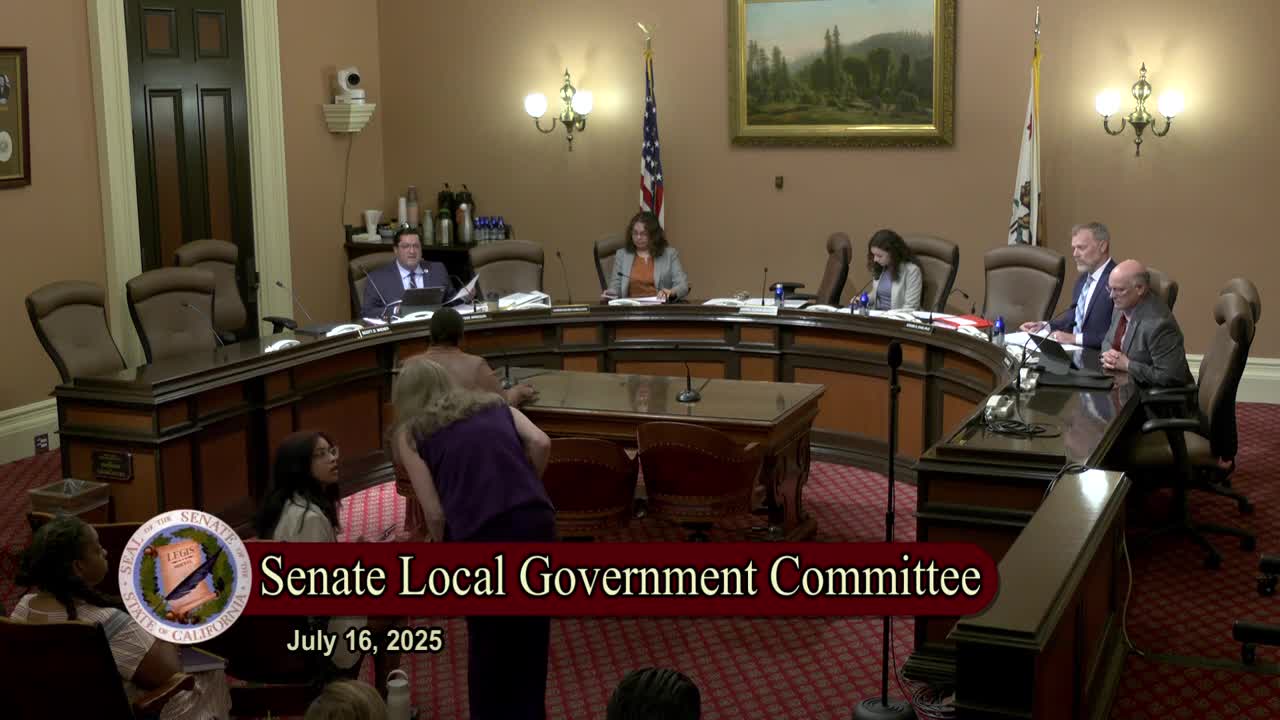 5MIN
Senate Standing Committee on Local Government
 54SEC
Assembly Floor
 5MIN
Assembly Standing Committee on Local Government
Bill Author

Bill Co-Author(s):