AB 1127: Firearms: converter pistols.
- Session Year: 2025-2026
- House: Assembly
- Latest Version Date: 2025-10-10
Current Status:
Passed
(2025-10-10: Chaptered by Secretary of State - Chapter 572, Statutes of 2025.)
Introduced
In Committee
Awaiting First Chamber Vote
Passed First Chamber
In Committee
Awaiting Second Chamber Vote
Passed Second Chamber
Enacted
Existing law prohibits any person from selling, leasing, or transferring any firearm unless the person is licensed as a firearms dealer, as specified. Existing law prescribes certain requirements and prohibitions for licensed firearms dealers. A violation of any of these requirements or prohibitions is grounds for forfeiture of a firearms dealers license. For purposes of these provisions, existing law defines machinegun to mean, among other definitions, any weapon that shoots or is designed to shoot automatically more than one shot, without manual reloading, by a single function of the trigger.
This bill would, on and after July 1, 2026, prohibit a licensed firearms dealer to sell, offer for sale, exchange, give, transfer, or deliver any semiautomatic machinegun-convertible pistol, except as specified. For these purposes, the bill would define machinegun-convertible pistol as any semiautomatic pistol with a cruciform trigger bar that can be readily converted by hand or with common household tools into a machinegun by the installation or attachment of a pistol converter, as specified, and pistol converter as any device or instrument that, when installed in or attached to the rear of the slide of a semiautomatic pistol, replaces the backplate and interferes with the trigger mechanism and thereby enables the pistol to shoot automatically more than one shot by a single function of the trigger. The bill would make a violation of these provisions punishable by a fine, a 2nd violation punishable by a fine that may result in a suspension or revocation of the dealers license and removal from certain centralized lists maintained by the Department of Justice, and a 3rd violation punishable as a misdemeanor that shall result in the revocation of the dealers license and removal from certain centralized lists.
Existing law prohibits the manufacture, sale, possession, or transportation of a machinegun, except as authorized. A violation of these prohibitions is punishable as a felony.
This bill would expand the above definition of machinegun to include any machinegun-convertible pistol equipped with a pistol converter and, thus, prohibit the manufacture, sale, possession, or transportation of a machinegun-convertible pistol equipped with a pistol converter.
Existing law, subject to certain exceptions, generally makes it an offense to manufacture or sell an unsafe handgun, as defined, and requires the Department of Justice to compile a roster listing all of the handguns that have been tested and determined not to be unsafe handguns. Existing law establishes criteria for determining if a handgun is an unsafe handgun, including, for firearms manufactured after a certain date and not already listed on the roster, the lack of a chamber load indicator and a magazine disconnect mechanism.
For any pistol listed on the roster on January 1, 2026, that was not subject to the above-described requirements to be on the list because it was submitted for testing before specified dates, that is thereafter only modified to change the design features that brought the pistol within the definition of a machinegun-convertible pistol, and that is submitted to an independent certified laboratory for testing pursuant to the above-described testing provisions before January 1, 2027, this bill would authorize that pistol to be submitted for testing and added to the roster without meeting those requirements.
This bill would make these provisions severable.
This bill would incorporate additional changes to Section 3273.50 of the Civil Code proposed by AB 1263 to be operative only if this bill and AB 1263 are enacted and this bill is enacted last.
By creating a new crime and expanding the application of an existing crime, this bill would create a state-mandated local program.
The California Constitution requires the state to reimburse local agencies and school districts for certain costs mandated by the state. Statutory provisions establish procedures for making that reimbursement.
This bill would provide that no reimbursement is required by this act for a specified reason.
Existing law prohibits any person from selling, leasing, or transferring any firearm unless the person is licensed as a firearms dealer, as specified. Existing law prescribes certain requirements and prohibitions for licensed firearms dealers. A violation of any of these requirements or prohibitions is grounds for forfeiture of a firearms dealers license. For purposes of these provisions, existing law defines machinegun to mean, among other definitions, any weapon that shoots or is designed to shoot automatically more than one shot, without manual reloading, by a single function of the trigger.
This bill would would, on and after July 1, 2026, prohibit a licensed firearms dealer to sell, offer for sale, exchange, give, transfer, or deliver any semiautomatic machinegun-convertible pistol, except as specified. For these purposes, the bill would define machinegun-convertible pistol as any semiautomatic pistol with a cruciform trigger bar that can be readily converted by hand or with common household tools into a machinegun by the installation or attachment of a pistol converter, as specified, and pistol converter as any device or instrument that, when installed in or attached to the rear of the slide of a semiautomatic pistol, replaces the backplate and interferes with the trigger mechanism and thereby enables the pistol to shoot automatically more than one shot by a single function of the trigger. The bill would make a violation of these provisions punishable by a fine, a 2nd violation punishable by a fine that may result in a suspension or revocation of the dealers license and removal from certain centralized lists maintained by the Department of Justice, and a 3rd violation punishable as a misdemeanor that shall result in the revocation of the dealers license and removal from certain centralized lists.
Existing law prohibits the manufacture, sale, possession, or transportation of a machinegun, except as authorized. A violation of these prohibitions is punishable as a felony.
This bill would expand the above definition of machinegun to include any machinegun-convertible pistol equipped with a pistol converter and, thus, prohibit the manufacture, sale, possession, or transportation of a machinegun-convertible pistol equipped with a pistol converter.
Existing law, subject to certain exceptions, generally makes it an offense to manufacture or sell an unsafe handgun, as defined, and requires the Department of Justice to compile a roster listing all of the handguns that have been tested and determined not to be unsafe handguns. Existing law establishes criteria for determining if a handgun is an unsafe handgun, including, for firearms manufactured after a certain date and not already listed on the roster, the lack of a chamber load indicator and a magazine disconnect mechanism.
For any pistol listed on the roster on January 1, 2026, that was not subject to the above-described requirements to be on the list because it was submitted for testing before specified dates, that is thereafter only modified to change the design features that brought the pistol within the definition of a machinegun-convertible pistol, and that is submitted to an independent certified laboratory for testing pursuant to the above-described testing provisions before January 1, 2027, this bill would authorize that pistol to be submitted for testing and added to the roster without meeting those requirements.
This bill would make these provisions severable.
This bill would incorporate additional changes to Section 3273.50 of the Civil Code proposed by AB 1263 to be operative only if this bill and AB 1263 are enacted and this bill is enacted last.
By creating a new crime and expanding the application of an existing crime, this bill would create a state-mandated local program.
The California Constitution requires the state to reimburse local agencies and school districts for certain costs mandated by the state. Statutory provisions establish procedures for making that reimbursement.
This bill would provide that no reimbursement is required by this act for a specified reason.
Existing law prohibits any person from selling, leasing, or transferring any firearm unless the person is licensed as a firearms dealer, as specified. Existing law prescribes certain requirements and prohibitions for licensed firearms dealers. A violation of any of these requirements or prohibitions is grounds for forfeiture of a firearms dealers license. For purposes of these provisions, existing law defines machinegun to mean, among other definitions, any weapon that shoots or is designed to shoot automatically more than one shot, without manual reloading, by a single function of the trigger.
This bill would prohibit a licensed firearms dealer to sell, offer for sale, exchange, give, transfer, or deliver any semiautomatic machinegun-convertible pistol, except as specified. For these purposes, the bill would define machinegun-convertible pistol as any semiautomatic pistol with a cruciform trigger bar that can be readily converted by hand or with common household tools into a machinegun by the installation or attachment of a pistol converter, as specified, and pistol converter as any device or instrument that, when installed in or attached to the rear of the slide of a semiautomatic pistol, replaces the backplate and interferes with the trigger mechanism and thereby enables the pistol to shoot automatically more than one shot by a single function of the trigger. The bill would make a violation of these provisions punishable by a fine, a 2nd violation punishable by a fine that may result in a suspension or revocation of the dealers license and removal from certain centralized lists maintained by the Department of Justice, and a 3rd violation punishable as a misdemeanor that shall result in the revocation of the dealers license and removal from certain centralized lists.
Existing law prohibits the manufacture, sale, possession, or transportation of a machinegun, except as authorized. A violation of these prohibitions is punishable as a felony.
This bill would expand the above definition of machinegun to include any machinegun-convertible pistol equipped with a pistol converter and, thus, prohibit the manufacture, sale, possession, or transportation of a machinegun-convertible pistol equipped with a pistol converter.
This bill would make these provisions severable.
By creating a new crime and expanding the application of an existing crime, this bill would create a state-mandated local program.
The California Constitution requires the state to reimburse local agencies and school districts for certain costs mandated by the state. Statutory provisions establish procedures for making that reimbursement.
This bill would provide that no reimbursement is required by this act for a specified reason.
Existing law prohibits any person from selling, leasing, or transferring any firearm unless the person is licensed as a firearms dealer, as specified. Existing law prescribes certain requirements and prohibitions for licensed firearms dealers. A violation of any of these requirements or prohibitions is grounds for forfeiture of a firearms dealers license. For purposes of these provisions, existing law defines machinegun to mean, among other definitions, any weapon that shoots or is designed to shoot automatically more than one shot, without manual reloading, by a single function of the trigger.
This bill would prohibit a licensed firearms dealer to sell, offer for sale, exchange, give, transfer, or deliver any semiautomatic convertible machinegun-convertible pistol, except as specified. For these purposes, the bill would define convertible machinegun-convertible pistol as any semiautomatic pistol with a cruciform trigger bar that can be readily converted by hand or with common household tools into a machinegun solely by the installation or attachment of a pistol converter converter, as specified, and pistol converter as any device or instrument that that, when installed in or attached to the rear of the slide of a semiautomatic pistol pistol, replaces the backplate and interferes with the trigger mechanism and thereby enables the pistol to discharge a number of shots or bullets rapidly or automatically with one continuous pull of the trigger. shoot automatically more than one shot by a single function of the trigger. The bill would make a violation of these provisions punishable by a fine, a 2nd violation punishable by a fine that may result in a suspension or revocation of the dealers license, license and removal from certain centralized lists maintained by the Department of Justice, and a 3rd violation punishable as a misdemeanor that shall result in the revocation of the dealers license. license and removal from certain centralized lists.
Existing law prohibits the manufacture, sale, possession, or transportation of a machinegun, except as authorized. A violation of these prohibitions is punishable as a felony.
This bill would expand the above definition of machinegun to include any convertible machinegun-convertible pistol equipped with a pistol converter and, thus, prohibit the manufacture, sale, possession, or transportation of a convertible machinegun-convertible pistol equipped with a pistol converter.
This bill would make these provisions severable.
By creating a new crime and expanding the application of an existing crime, this bill would create a state-mandated local program.
The California Constitution requires the state to reimburse local agencies and school districts for certain costs mandated by the state. Statutory provisions establish procedures for making that reimbursement.
This bill would provide that no reimbursement is required by this act for a specified reason.
Existing law prohibits any person from selling, leasing, or transferring any firearm unless the person is licensed as a firearms dealer, as specified. Existing law prescribes certain requirements and prohibitions for licensed firearms dealers. A violation of any of these requirements or prohibitions is grounds for forfeiture of a firearms dealers license. For purposes of these provisions, existing law defines machinegun to mean, among other definitions, any weapon that shoots or is designed to shoot automatically more than one shot, without manual reloading, by a single function of the trigger.
This bill would prohibit a licensed firearms dealer to sell, offer for sale, exchange, give, transfer, or deliver any semiautomatic convertible pistol, except as specified. For these purposes, the bill would define convertible pistol as any semiautomatic pistol that can be converted into a machinegun solely by the installation or attachment of a pistol converter and pistol converter as any device or instrument that when installed in or attached to the slide of a semiautomatic pistol interferes with the trigger mechanism and thereby enables the pistol to discharge a number of shots or bullets rapidly or automatically with one continuous pull of the trigger. The bill would make a violation of these provisions punishable by a fine, a 2nd violation punishable by a fine that may result in a revocation of the dealers license, and a 3rd violation punishable as a misdemeanor that shall result in the revocation of the dealers license.
Existing law prohibits the manufacture, sale, possession, or transportation of a machinegun, except as authorized. A violation of these prohibitions is punishable as a felony.
This bill would expand the above definition of machinegun to include any convertible pistol equipped with a pistol converter and, thus, prohibit the manufacture, sale, possession, or transportation of a convertible pistol equipped with a pistol converter.
By creating a new crime and expanding the application of an existing crime, this bill would create a state-mandated local program.
The California Constitution requires the state to reimburse local agencies and school districts for certain costs mandated by the state. Statutory provisions establish procedures for making that reimbursement.
This bill would provide that no reimbursement is required by this act for a specified reason.
Existing law defines a machine gun as any weapon that shoots, is designed to shoot, or can readily be restored to shoot, automatically more than one shot, without manual reloading, by a single function of the trigger. Existing law prohibits, among other things, the conversion of a firearm into a machine gun. A violation of this prohibition is punishable as a felony.This bill would state the intent of the Legislature to enact legislation regarding semi-automatic firearms that can be converted into automatic firearms by a converter attachment.Existing law defines a machine gun as any weapon that shoots, is designed to shoot, or can readily be restored to shoot, automatically more than one shot, without manual reloading, by a single function of the trigger. Existing law prohibits, among other things, the conversion of a firearm into a machine gun. A violation of this prohibition is punishable as a felony.
This bill would state the intent of the Legislature to enact legislation regarding semi-automatic firearms that can be converted into automatic firearms by a converter attachment.
As used in this title, the following definitions apply:
(a)Ammunition has the same meaning as provided in subdivision (b) of Section 16150 of the Penal Code.
(b)Firearm has the same meaning as provided in subdivisions (a) and (b) of Section 16520 of the Penal Code.
(c)Firearm accessory means an attachment or device designed or adapted to be inserted into, affixed onto, or used in conjunction with a firearm that is designed, intended, or functions to alter or enhance the firing capabilities of a firearm, the lethality of the firearm, or a shooters ability to hold and use a firearm.
(d)Firearm-related product means a firearm, ammunition, a firearm precursor part, a firearm component, firearm manufacturing machine, and a firearm accessory that meets any of the following conditions:
(1)The item is sold, made, or distributed in California.
(2)The item is intended to be sold or distributed in California.
(3)The item is or was possessed in California and it was reasonably foreseeable that the item would be possessed in California.
(e)Firearm precursor part has the same meaning as provided in Section 16531 of the Penal Code.
(f)Firearm industry member shall mean a person, firm, corporation, company, partnership, society, joint stock company, or any other entity or association engaged in the manufacture, distribution, importation, marketing, wholesale sale, or retail sale of firearm-related products.
(g)Firearm manufacturing machine means a three-dimensional printer, as defined in Section 29185 of the Penal Code, or CNC milling machine that, as described in that section, is marketed or sold as, or reasonably designed or intended to be used to manufacture or produce a firearm.
(h)Reasonable controls means reasonable procedures, acts, or practices that are designed, implemented, and enforced to do the following:
(1)Prevent the sale or distribution of a firearm-related product to a straw purchaser, a firearm trafficker, a person prohibited from possessing a firearm under state or federal law, or a person who the firearm industry member has reasonable cause to believe is at substantial risk of using a firearm-related product to harm themselves or another or of possessing or using a firearm-related product unlawfully.
(2)Prevent the loss or theft of a firearm-related product from the firearm industry member.
(3)Ensure that the firearm industry member complies with all provisions of California and federal law and does not otherwise promote the unlawful manufacture, sale, possession, marketing, or use of a firearm-related product.
(4)Prevent the installation and use of a pistol converter, as defined in Section 17015 of the Penal Code, with a firearm.
SEC. 1.5.Section 3273.50 of the Civil Code is amended to read:3273.50.As used in this title, the following definitions apply:
(a)Ammunition has the same meaning as provided in subdivision (b) of Section 16150 of the Penal Code.
(b)Firearm has the same meaning as provided in subdivisions (a) and (b) of Section 16520 of the Penal Code.
(c)Firearm accessory means an attachment or device designed or adapted to be inserted into, affixed onto, or used in conjunction with a firearm that is designed, intended, or functions to increase a firearms rate of fire or to increase the speed at which a person may reload a firearm or replace the magazine, or any other attachment or device described in subdivision (a) of Section 30515 of the Penal Code that may render a firearm an assault weapon when inserted into, affixed onto, or used in conjunction with a firearm. The term firearm accessory also includes any other device, tool, kit, part, or parts set that is clearly designed and intended for use in manufacturing firearms.
(d)Firearm-related product means a firearm, ammunition, a firearm precursor part, a firearm component, firearm manufacturing machine, and a firearm accessory that meets any of the following conditions:
(1)The item is sold, made, or distributed in California.
(2)The item is intended to be sold or distributed in California.
(3)The item is or was possessed in California and it was reasonably foreseeable that the item would be possessed in California.
(e)Firearm precursor part has the same meaning as provided in Section 16531 of the Penal Code.
(f)Firearm industry member shall mean a person, firm, corporation, company, partnership, society, joint stock company, or any other entity or association engaged in the manufacture, distribution, importation, marketing, wholesale sale, or retail sale of firearm-related products.
(g)Firearm manufacturing machine means a three-dimensional printer, as defined in Section 29185 of the Penal Code, a computer numerical control (CNC) milling machine, or a similar machine, that is marketed or sold as or is reasonably designed or intended to be used to manufacture or produce firearms, firearm components, or firearm accessories.
(h)Reasonable controls means reasonable procedures, acts, or practices that are designed, implemented, and enforced to do the following:
(1)Prevent the sale or distribution of a firearm-related product to a straw purchaser, a firearm trafficker, a person prohibited from possessing a firearm under state or federal law, or a person who the firearm industry member has reasonable cause to believe is at substantial risk of using a firearm-related product to harm themselves or another or of possessing or using a firearm-related product unlawfully.
(2)Prevent the loss or theft of a firearm-related product from the firearm industry member.
(3)Ensure that the firearm industry member complies with all provisions of California and federal law and does not otherwise promote the unlawful manufacture, sale, possession, marketing, or use of a firearm-related product.
(4)Prevent the installation and use of a pistol converter, as defined in Section 17015 of the Penal Code, with a firearm.
SEC. 2.Section 16880 of the Penal Code is amended to read:16880.(a)As used in this part, machinegun means any weapon that shoots, is designed to shoot, or can readily be restored to shoot, automatically more than one shot, without manual reloading, by a single function of the trigger.
(b)The term machinegun also includes the frame or receiver of any weapon described in subdivision (a), any part designed and intended solely and exclusively, or combination of parts designed and intended, for use in converting a weapon into a machinegun, and any combination of parts from which a machinegun can be assembled if those parts are in the possession or under the control of a person.
(c)The term machinegun also includes any weapon deemed by the federal Bureau of Alcohol, Tobacco, Firearms and Explosives as readily convertible to a machinegun under Chapter 53 (commencing with Section 5801) of Title 26 of the United States Code.
(d)The term machinegun also includes any machinegun-convertible pistol equipped with a pistol converter, as defined in Section 17015.
SEC. 3.Section 16885 is added to the Penal Code, to read:16885.(a)As used in this part, machinegun-convertible pistol means any semiautomatic pistol with a cruciform trigger bar that can be readily converted by hand or with common household tools, as defined in Section 4082 of Title 11 of the California Code of Regulations, into a machinegun by the installation or attachment of a pistol converter as a replacement for the slides backplate without any additional engineering, machining, or modification of the pistols trigger mechanism.
(b)A machinegun-convertible pistol does not include a hammer-fired semiautomatic pistol or striker-fired semiautomatic pistol lacking a cruciform trigger bar, which instead has a trigger bar that is shielded from interference by a pistol converter.
(c)A polymer notch or other piece of polymer molded into the rear of the pistol frame does not prevent ready conversion into a machinegun and will not prevent a pistol from qualifying under this definition.
SEC. 4.Section 17015 is added to the Penal Code, to read:17015.Pistol converter means any device or instrument that when installed in or attached to the rear of the slide of a semiautomatic pistol, replaces the backplate, and interferes with the trigger mechanism and thereby enables the pistol to shoot automatically more than one shot by a single function of the trigger. A pistol converter includes, but is not limited to, a pistol converter manufactured using a three-dimensional printer, as defined in Section 29185.
SEC. 5.Section 27595 is added to the Penal Code, to read:27595.(a)Except as provided in subdivision (c), commencing on July 1, 2026, a firearms dealer licensed pursuant to Sections 26700 to 26920, shall not sell, offer for sale, exchange, give, transfer, or deliver any semiautomatic machinegun-convertible pistol, as defined in Section 16885.
(b)(1)A violation of subdivision (a) shall be punishable by a fine of not more than one thousand dollars ($1,000).
(2)A second violation of subdivision (a) shall be punishable by a fine of not more than five thousand dollars ($5,000) and may result in the suspension or revocation of the dealers license issued under Sections 26700 to 26920, inclusive, and removal of the firearms dealer from any centralized list maintained by the Department of Justice pursuant to Sections 26715, 28450, and 29060.
(3)A third violation of subdivision (a) is a misdemeanor and shall result in the revocation of the dealers license issued under Sections 26700 to 26920, inclusive, and removal of the firearms dealer from any centralized list maintained by the Department pursuant to Sections 26715, 28450, and 29060.
(c)This section shall not apply to any of the following:
(1)A machinegun-convertible pistol delivered to a firearms dealer prior to January 1, 2026.
(2)The sale of a machinegun-convertible pistol to any of the following entities for lawful use in the discharge of their official duties:
(A)A police department, sheriffs office, probation department, marshals office, district attorneys office, the California Highway Patrol, the Department of Justice, the Department of Corrections and Rehabilitation.
(B)Any state agency listed in paragraph (6) or paragraph (7) of subdivision (b) of Section 32000.
(C)The military or naval forces of this state or of the United States.
(3)A private party to private party transaction conducted through a licensed firearms dealer pursuant to Chapter 5 (commencing with Section 28050).
(4)A transfer of a machinegun-convertible pistol to a gunsmith or other qualified entity for service or repair.
(5)The sale or transfer of a machinegun-convertible pistol to a firearms dealer licensed pursuant to Sections 26700 to 26920, inclusive, or to federally licensed firearms manufacturers or dealers outside California.
(6)A transfer of a machinegun-convertible pistol back to a private party after temporary safekeeping storage pursuant to Section 26892.
(7)A transfer of a machinegun-convertible pistol back to a private party after a period of temporary prohibition pursuant to Section 29830.
(8)A transfer of a machinegun-convertible pistol to any forensic laboratory or forensic laboratory employee, while on duty and acting within the scope and course of employment.
(9)The sale of a machinegun-convertible pistol to an individual who is an active peace officer described in Section 830.1 or a reserve peace officer described in Section 830.6 who is employed or appointed by a law enforcement agency described in Section 830.1 and is authorized to carry a firearm on duty.
SEC. 6.Section 27595.1 is added to the Penal Code, to read:27595.1.The Department of Justice is authorized to adopt regulations to implement Section 27595.
SEC. 7.Section 32103 is added to the Penal Code, to read:32103.(a)A pistol may be submitted for testing described in Section 32010 and added to the roster described in subdivision (a) of Section 32015 without being subject to the requirements of subparagraph (D) or (E) of paragraph (2) of subdivision (a) of Section 31910, or the requirements of subdivision (d) of Section 32010, if all of the following conditions are met:
(1)The pistol was listed on the roster, described in subdivision (a) of Section 32015, on January 1, 2026.
(2)The pistol was not subject to the requirements of subparagraph (D) or (E) of paragraph (2) of subdivision (a) of Section 31910 because it was submitted for testing before the dates identified in subdivision (d) of Section 32010.
(3)The pistol was thereafter only modified to change design features which brought the pistol within the definition of machinegun-convertible pistol in Section 16885.
(4)The modified pistol is submitted to an independent certified laboratory for testing pursuant to Article 5 (commencing with Section 32000) of Chapter 4 before January 1, 2027.
(b)Any firearm meeting the requirements of this section shall be removed from the roster according to subdivision (b) of Section 31910 on the same timeline as the pistol that appeared on the roster prior to being modified pursuant to this section.
SEC. 8.If any section, subsection, sentence, or clause of this act is for any reason declared unconstitutional, invalid, or unenforceable by any court of competent jurisdiction, such decision shall not affect the constitutionality, validity, or enforceability of the remaining portions of this act or any part thereof. The Legislature hereby declares that it would have adopted this act notwithstanding the unconstitutionality, invalidity, or unenforceability of any one or more of its sections, subsections, sentences, or clauses.
SEC. 9.Section 1.5 of this bill incorporates amendments to Section 3273.50 of the Civil Code proposed by both this bill and Assembly Bill 1263. That section of this bill shall only become operative if (1) both bills are enacted and become effective on or before January 1, 2026, (2) each bill amends Section 3273.50 of the Civil Code, and (3) this bill is enacted after Assembly Bill 1263, in which case Section 1 of this bill shall not become operative.
SEC. 10.No reimbursement is required by this act pursuant to Section 6 of Article XIIIB of the California Constitution because the only costs that may be incurred by a local agency or school district will be incurred because this act creates a new crime or infraction, eliminates a crime or infraction, or changes the penalty for a crime or infraction, within the meaning of Section 17556 of the Government Code, or changes the definition of a crime within the meaning of Section 6 of Article XIIIB of the California Constitution.
As used in this title, the following definitions apply:
(a)Ammunition has the same meaning as provided in subdivision (b) of Section 16150 of the Penal Code.
(b)Firearm has the same meaning as provided in subdivisions (a) and (b) of Section 16520 of the Penal Code.
(c)Firearm accessory means an attachment or device designed or adapted to be inserted into, affixed onto, or used in conjunction with a firearm that is designed, intended, or functions to alter or enhance the firing capabilities of a firearm, the lethality of the firearm, or a shooters ability to hold and use a firearm.
(d)Firearm-related product means a firearm, ammunition, a firearm precursor part, a firearm component, firearm manufacturing machine, and a firearm accessory that meets any of the following conditions:
(1)The item is sold, made, or distributed in California.
(2)The item is intended to be sold or distributed in California.
(3)The item is or was possessed in California and it was reasonably foreseeable that the item would be possessed in California.
(e)Firearm precursor part has the same meaning as provided in Section 16531 of the Penal Code.
(f)Firearm industry member shall mean a person, firm, corporation, company, partnership, society, joint stock company, or any other entity or association engaged in the manufacture, distribution, importation, marketing, wholesale sale, or retail sale of firearm-related products.
(g)Firearm manufacturing machine means a three-dimensional printer, as defined in Section 29185 of the Penal Code, or CNC milling machine that, as described in that section, is marketed or sold as, or reasonably designed or intended to be used to manufacture or produce a firearm.
(h)Reasonable controls means reasonable procedures, acts, or practices that are designed, implemented, and enforced to do the following:
(1)Prevent the sale or distribution of a firearm-related product to a straw purchaser, a firearm trafficker, a person prohibited from possessing a firearm under state or federal law, or a person who the firearm industry member has reasonable cause to believe is at substantial risk of using a firearm-related product to harm themselves or another or of possessing or using a firearm-related product unlawfully.
(2)Prevent the loss or theft of a firearm-related product from the firearm industry member.
(3)Ensure that the firearm industry member complies with all provisions of California and federal law and does not otherwise promote the unlawful manufacture, sale, possession, marketing, or use of a firearm-related product.
(4)Prevent the installation and use of a pistol converter, as defined in Section 17015 of the Penal Code, with a firearm.
SEC. 1.5.Section 3273.50 of the Civil Code is amended to read:3273.50.As used in this title, the following definitions apply:
(a)Ammunition has the same meaning as provided in subdivision (b) of Section 16150 of the Penal Code.
(b)Firearm has the same meaning as provided in subdivisions (a) and (b) of Section 16520 of the Penal Code.
(c)Firearm accessory means an attachment or device designed or adapted to be inserted into, affixed onto, or used in conjunction with a firearm that is designed, intended, or functions to alter or enhance the firing capabilities of a firearm, the lethality of the firearm, or a shooters ability to hold and use a firearm. increase a firearms rate of fire or to increase the speed at which a person may reload a firearm or replace the magazine, or any other attachment or device described in subdivision (a) of Section 30515 of the Penal Code that may render a firearm an assault weapon when inserted into, affixed onto, or used in conjunction with a firearm. The term firearm accessory also includes any other device, tool, kit, part, or parts set that is clearly designed and intended for use in manufacturing firearms.
(d)Firearm-related product means a firearm, ammunition, a firearm precursor part, a firearm component, firearm manufacturing machine, and a firearm accessory that meets any of the following conditions:
(1)The item is sold, made, or distributed in California.
(2)The item is intended to be sold or distributed in California.
(3)The item is or was possessed in California and it was reasonably foreseeable that the item would be possessed in California.
(e)Firearm precursor part has the same meaning as provided in Section 16531 of the Penal Code.
(f)Firearm industry member shall mean a person, firm, corporation, company, partnership, society, joint stock company, or any other entity or association engaged in the manufacture, distribution, importation, marketing, wholesale sale, or retail sale of firearm-related products.
(g)Firearm manufacturing machine means a three-dimensional printer, as defined in Section 29185 of the Penal Code, or CNC milling machine that, as described in that section, a computer numerical control (CNC) milling machine, or a similar machine, that is marketed or sold as, as or is reasonably designed or intended to be used to manufacture or produce a firearm. firearms, firearm components, or firearm accessories.
(h)Reasonable controls means reasonable procedures, acts, or practices that are designed, implemented, and enforced to do the following:
(1)Prevent the sale or distribution of a firearm-related product to a straw purchaser, a firearm trafficker, a person prohibited from possessing a firearm under state or federal law, or a person who the firearm industry member has reasonable cause to believe is at substantial risk of using a firearm-related product to harm themselves or another or of possessing or using a firearm-related product unlawfully.
(2)Prevent the loss or theft of a firearm-related product from the firearm industry member.
(3)Ensure that the firearm industry member complies with all provisions of California and federal law and does not otherwise promote the unlawful manufacture, sale, possession, marketing, or use of a firearm-related product.
(4)Prevent the installation and use of a pistol converter, as defined in Section 17015 of the Penal Code, with a firearm.
SEC. 2.Section 16880 of the Penal Code is amended to read:16880.(a)As used in this part, machinegun means any weapon that shoots, is designed to shoot, or can readily be restored to shoot, automatically more than one shot, without manual reloading, by a single function of the trigger.
(b)The term machinegun also includes the frame or receiver of any weapon described in subdivision (a), any part designed and intended solely and exclusively, or combination of parts designed and intended, for use in converting a weapon into a machinegun, and any combination of parts from which a machinegun can be assembled if those parts are in the possession or under the control of a person.
(c)The term machinegun also includes any weapon deemed by the federal Bureau of Alcohol, Tobacco, Firearms and Explosives as readily convertible to a machinegun under Chapter 53 (commencing with Section 5801) of Title 26 of the United States Code.
(d)The term machinegun also includes any machinegun-convertible pistol equipped with a pistol converter, as defined in Section 17015.
SEC. 3.Section 16885 is added to the Penal Code, to read:16885.(a)As used in this part, machinegun-convertible pistol means any semiautomatic pistol with a cruciform trigger bar that can be readily converted by hand or with common household tools, as defined in Section 4082 of Title 11 of the California Code of Regulations, into a machinegun by the installation or attachment of a pistol converter as a replacement for the slides backplate without any additional engineering, machining, or modification of the pistols trigger mechanism.
(b)A machinegun-convertible pistol does not include a hammer-fired semiautomatic pistol or striker-fired semiautomatic pistol lacking a cruciform trigger bar, which instead has a trigger bar that is shielded from interference by a pistol converter.
(c)A polymer notch or other piece of polymer molded into the rear of the pistol frame does not prevent ready conversion into a machinegun and will not prevent a pistol from qualifying under this definition.
SEC. 4.Section 17015 is added to the Penal Code, to read:17015.Pistol converter means any device or instrument that when installed in or attached to the rear of the slide of a semiautomatic pistol, replaces the backplate, and interferes with the trigger mechanism and thereby enables the pistol to shoot automatically more than one shot by a single function of the trigger. A pistol converter includes, but is not limited to, a pistol converter manufactured using a three-dimensional printer, as defined in Section 29185.
SEC. 5.Section 27595 is added to the Penal Code, to read:27595.(a)Except as provided in subdivision (c), commencing on January July 1, 2026, a firearms dealer licensed pursuant to Sections 26700 to 26920, shall not sell, offer for sale, exchange, give, transfer, or deliver any semiautomatic machinegun-convertible pistol, as defined in Section 16885.
(b)(1)A violation of subdivision (a) shall be punishable by a fine of not more than one thousand dollars ($1,000).
(2)A second violation of subdivision (a) shall be punishable by a fine of not more than five thousand dollars ($5,000) and may result in the suspension or revocation of the dealers license issued under Sections 26700 to 26920, inclusive, and removal of the firearms dealer from any centralized list maintained by the Department of Justice pursuant to Sections 26715, 28450, and 29060.
(3)A third violation of subdivision (a) is a misdemeanor and shall result in the revocation of the dealers license issued under Sections 26700 to 26920, inclusive, and removal of the firearms dealer from any centralized list maintained by the Department pursuant to Sections 26715, 28450, and 29060.
(c)This section shall not apply to any of the following:
(1)A machinegun-convertible pistol delivered to a firearms dealer prior to January 1, 2026.
(2)The sale of a machinegun-convertible pistol to any of the following entities for lawful use in the discharge of their official duties:
(A)A police department, sheriffs office, probation department, marshals office, district attorneys office, the California Highway Patrol, the Department of Justice, the Department of Corrections and Rehabilitation.
(B)Any state agency listed in paragraph (6) or paragraph (7) of subdivision (b) of Section 32000.
(C)The military or naval forces of this state or of the United States.
(3)A private party to private party transaction conducted through a licensed firearms dealer pursuant to Chapter 5 (commencing with Section 28050).
(4)A transfer of a machinegun-convertible pistol to a gunsmith or other qualified entity for service or repair.
(5)The sale or transfer of a machinegun-convertible pistol to a firearms dealer licensed pursuant to Sections 26700 to 26920, inclusive, or to federally licensed firearms manufacturers or dealers outside California.
(6)A transfer of a machinegun-convertible pistol back to a private party after temporary safekeeping storage pursuant to Section 26892.
(7)A transfer of a machinegun-convertible pistol back to a private party after a period of temporary prohibition pursuant to Section 29830.
(8)A transfer of a machinegun-convertible pistol to any forensic laboratory or forensic laboratory employee, while on duty and acting within the scope and course of employment.
(9)The sale of a machinegun-convertible pistol to an individual who is an active peace officer described in Section 830.1 or a reserve peace officer described in Section 830.6 who is employed or appointed by a law enforcement agency described in Section 830.1 and is authorized to carry a firearm on duty.
SEC. 6.Section 27595.1 is added to the Penal Code, to read:27595.1.The Department of Justice is authorized to adopt regulations to implement Section 27595.
SEC. 7.Section 32103 is added to the Penal Code, to read:32103.(a)A pistol may be submitted for testing described in Section 32010 and added to the roster described in subdivision (a) of Section 32015 without being subject to the requirements of subparagraph (D) or (E) of paragraph (2) of subdivision (a) of Section 31910, or the requirements of subdivision (d) of Section 32010, if all of the following conditions are met:
(1)The pistol was listed on the roster, described in subdivision (a) of Section 32015, on January 1, 2026.
(2)The pistol was not subject to the requirements of subparagraph (D) or (E) of paragraph (2) of subdivision (a) of Section 31910 because it was submitted for testing before the dates identified in subdivision (d) of Section 32010.
(3)The pistol was thereafter only modified to change design features which brought the pistol within the definition of machinegun-convertible pistol in Section 16885.
(4)The modified pistol is submitted to an independent certified laboratory for testing pursuant to Article 5 (commencing with Section 32000) of Chapter 4 before January 1, 2027.
(b)Any firearm meeting the requirements of this section shall be removed from the roster according to subdivision (b) of Section 31910 on the same timeline as the pistol that appeared on the roster prior to being modified pursuant to this section.
SEC. 6.SEC. 8.If any section, subsection, sentence, or clause of this act is for any reason declared unconstitutional, invalid, or unenforceable by any court of competent jurisdiction, such decision shall not affect the constitutionality, validity, or enforceability of the remaining portions of this act or any part thereof. The Legislature hereby declares that it would have adopted this act notwithstanding the unconstitutionality, invalidity, or unenforceability of any one or more of its sections, subsections, sentences, or clauses.
SEC. 9.Section 1.5 of this bill incorporates amendments to Section 3273.50 of the Civil Code proposed by both this bill and Assembly Bill 1263. That section of this bill shall only become operative if (1) both bills are enacted and become effective on or before January 1, 2026, (2) each bill amends Section 3273.50 of the Civil Code, and (3) this bill is enacted after Assembly Bill 1263, in which case Section 1 of this bill shall not become operative.
SEC. 7.SEC. 10.No reimbursement is required by this act pursuant to Section 6 of Article XIIIB of the California Constitution because the only costs that may be incurred by a local agency or school district will be incurred because this act creates a new crime or infraction, eliminates a crime or infraction, or changes the penalty for a crime or infraction, within the meaning of Section 17556 of the Government Code, or changes the definition of a crime within the meaning of Section 6 of Article XIIIB of the California Constitution.
As used in this title, the following definitions apply:
(a)Ammunition has the same meaning as provided in subdivision (b) of Section 16150 of the Penal Code.
(b)Firearm has the same meaning as provided in subdivisions (a) and (b) of Section 16520 of the Penal Code.
(c)Firearm accessory means an attachment or device designed or adapted to be inserted into, affixed onto, or used in conjunction with a firearm that is designed, intended, or functions to alter or enhance the firing capabilities of a firearm, the lethality of the firearm, or a shooters ability to hold and use a firearm.
(d)Firearm-related product means a firearm, ammunition, a firearm precursor part, a firearm component, firearm manufacturing machine, and a firearm accessory that meets any of the following conditions:
(1)The item is sold, made, or distributed in California.
(2)The item is intended to be sold or distributed in California.
(3)The item is or was possessed in California and it was reasonably foreseeable that the item would be possessed in California.
(e)Firearm precursor part has the same meaning as provided in Section 16531 of the Penal Code.
(f)Firearm industry member shall mean a person, firm, corporation, company, partnership, society, joint stock company, or any other entity or association engaged in the manufacture, distribution, importation, marketing, wholesale sale, or retail sale of firearm-related products.
(g)Firearm manufacturing machine means a three-dimensional printer, as defined in Section 29185 of the Penal Code, or CNC milling machine that, as described in that section, is marketed or sold as, or reasonably designed or intended to be used to manufacture or produce a firearm.
(h)Reasonable controls means reasonable procedures, acts, or practices that are designed, implemented, and enforced to do the following:
(1)Prevent the sale or distribution of a firearm-related product to a straw purchaser, a firearm trafficker, a person prohibited from possessing a firearm under state or federal law, or a person who the firearm industry member has reasonable cause to believe is at substantial risk of using a firearm-related product to harm themselves or another or of possessing or using a firearm-related product unlawfully.
(2)Prevent the loss or theft of a firearm-related product from the firearm industry member.
(3)Ensure that the firearm industry member complies with all provisions of California and federal law and does not otherwise promote the unlawful manufacture, sale, possession, marketing, or use of a firearm-related product.
(4)Prevent the installation and use of a pistol converter, as defined in Section 17015 of the Penal Code, with a firearm.
SEC. 2.Section 16880 of the Penal Code is amended to read:16880.(a)As used in this part, machinegun means any weapon that shoots, is designed to shoot, or can readily be restored to shoot, automatically more than one shot, without manual reloading, by a single function of the trigger.
(b)The term machinegun also includes the frame or receiver of any weapon described in subdivision (a), any part designed and intended solely and exclusively, or combination of parts designed and intended, for use in converting a weapon into a machinegun, and any combination of parts from which a machinegun can be assembled if those parts are in the possession or under the control of a person.
(c)The term machinegun also includes any weapon deemed by the federal Bureau of Alcohol, Tobacco, Firearms and Explosives as readily convertible to a machinegun under Chapter 53 (commencing with Section 5801) of Title 26 of the United States Code.
(d)The term machinegun also includes any machinegun-convertible pistol equipped with a pistol converter, as defined in Section 17015.
SEC. 3.Section 16885 is added to the Penal Code, to read:16885.(a)As used in this part, machinegun-convertible pistol means any semiautomatic pistol with a cruciform trigger bar that can be readily converted by hand or with common household tools, as defined in Section 4082 of Title 11 of the California Code of Regulations, into a machinegun by the installation or attachment of a pistol converter as a replacement for the slides backplate without any additional engineering, machining, or modification of the pistols trigger mechanism.
(b)A machinegun-convertible pistol does not include a hammer-fired semiautomatic pistol or striker-fired semiautomatic pistol lacking a cruciform trigger bar, which instead has a trigger bar that is shielded from interference by a pistol converter.
(c)A polymer notch or other piece of polymer molded into the rear of the pistol frame does not prevent ready conversion into a machinegun and will not prevent a pistol from qualifying under this definition.
SEC. 4.Section 17015 is added to the Penal Code, to read:17015.Pistol converter means any device or instrument that when installed in or attached to the rear of the slide of a semiautomatic pistol, replaces the backplate, and interferes with the trigger mechanism and thereby enables the pistol to shoot automatically more than one shot by a single function of the trigger. A pistol converter includes, but is not limited to, a pistol converter manufactured using a three-dimensional printer, as defined in Section 29185.
SEC. 5.Section 27595 is added to the Penal Code, to read:27595.(a)Except as provided in subdivision (c), commencing on January 1, 2026, a firearms dealer licensed pursuant to Sections 26700 to 26920, shall not sell, offer for sale, exchange, give, transfer, or deliver any semiautomatic machinegun-convertible pistol, as defined in Section 16885.
(b)(1)A violation of subdivision (a) shall be punishable by a fine of not more than one thousand dollars ($1,000).
(2)A second violation of subdivision (a) shall be punishable by a fine of not more than five thousand dollars ($5,000) and may result in the suspension or revocation of the dealers license issued under Sections 26700 to 26920, inclusive, and removal of the firearms dealer from any centralized list maintained by the Department of Justice pursuant to Sections 26715, 28450, and 29060.
(3)A third violation of subdivision (a) is a misdemeanor and shall result in the revocation of the dealers license issued under Sections 26700 to 26920, inclusive, and removal of the firearms dealer from any centralized list maintained by the Department pursuant to Sections 26715, 28450, and 29060.
(c)This section shall not apply to any of the following:
(1)A machinegun-convertible pistol delivered to a firearms dealer prior to January 1, 2026.
(2)The sale of a machinegun-convertible pistol to any of the following entities for lawful use in the discharge of their official duties:
(A)A police department, sheriffs office, probation department, marshals office, district attorneys office, the California Highway Patrol, the Department of Justice, the Department of Corrections and Rehabilitation.
(B)Any state agency listed in paragraph (6) or paragraph (7) of subdivision (b) of Section 32000.
(C)The military or naval forces of this state or of the United States.
(3)A private party to private party transaction conducted through a licensed firearms dealer pursuant to Chapter 5 (commencing with Section 28050).
(4)A transfer of a machinegun-convertible pistol to a gunsmith or other qualified entity for service or repair.
(5)The sale or transfer of a machinegun-convertible pistol to a firearms dealer licensed pursuant to Sections 26700 to 26920, inclusive, or to federally licensed firearms manufacturers or dealers outside California.
(6)A transfer of a machinegun-convertible pistol back to a private party after temporary safekeeping storage pursuant to Section 26892.
(7)A transfer of a machinegun-convertible pistol back to a private party after a period of temporary prohibition pursuant to Section 29830.
(8)A transfer of a machinegun-convertible pistol to any forensic laboratory or forensic laboratory employee, while on duty and acting within the scope and course of employment.
(9)The sale of a machinegun-convertible pistol to an individual who is an active peace officer described in Section 830.1 or a reserve peace officer described in Section 830.6 who is employed or appointed by a law enforcement agency described in Section 830.1 and is authorized to carry a firearm on duty.
SEC. 6.Section 27595.1 is added to the Penal Code, to read:27595.1.The Department of Justice is authorized to adopt regulations to implement Section 27595. Regulations adopted pursuant to Section 27595 are exempt from the Administrative Procedure Act (Chapter 3.5 (commencing with Section 11340) of Part 1 of Division 3 of Title 2 of the Government Code).SEC. 7.SEC. 6.If any section, subsection, sentence, or clause of this act is for any reason declared unconstitutional, invalid, or unenforceable by any court of competent jurisdiction, such decision shall not affect the constitutionality, validity, or enforceability of the remaining portions of this act or any part thereof. The Legislature hereby declares that it would have adopted this act notwithstanding the unconstitutionality, invalidity, or unenforceability of any one or more of its sections, subsections, sentences, or clauses.
SEC. 8.SEC. 7.No reimbursement is required by this act pursuant to Section 6 of Article XIIIB of the California Constitution because the only costs that may be incurred by a local agency or school district will be incurred because this act creates a new crime or infraction, eliminates a crime or infraction, or changes the penalty for a crime or infraction, within the meaning of Section 17556 of the Government Code, or changes the definition of a crime within the meaning of Section 6 of Article XIIIB of the California Constitution.
As used in this title, the following definitions apply:
(a)Ammunition has the same meaning as provided in subdivision (b) of Section 16150 of the Penal Code.
(b)Firearm has the same meaning as provided in subdivisions (a) and (b) of Section 16520 of the Penal Code.
(c)Firearm accessory means an attachment or device designed or adapted to be inserted into, affixed onto, or used in conjunction with a firearm that is designed, intended, or functions to alter or enhance the firing capabilities of a firearm, the lethality of the firearm, or a shooters ability to hold and use a firearm.
(d)Firearm-related product means a firearm, ammunition, a firearm precursor part, a firearm component, firearm manufacturing machine, and a firearm accessory that meets any of the following conditions:
(1)The item is sold, made, or distributed in California.
(2)The item is intended to be sold or distributed in California.
(3)The item is or was possessed in California and it was reasonably foreseeable that the item would be possessed in California.
(e)Firearm precursor part has the same meaning as provided in Section 16531 of the Penal Code.
(f)Firearm industry member shall mean a person, firm, corporation, company, partnership, society, joint stock company, or any other entity or association engaged in the manufacture, distribution, importation, marketing, wholesale sale, or retail sale of firearm-related products.
(g)Firearm manufacturing machine means a three-dimensional printer, as defined in Section 29185 of the Penal Code, or CNC milling machine that, as described in that section, is marketed or sold as, or reasonably designed or intended to be used to manufacture or produce a firearm.
(h)Reasonable controls means reasonable procedures, acts, or practices that are designed, implemented, and enforced to do the following:
(1)Prevent the sale or distribution of a firearm-related product to a straw purchaser, a firearm trafficker, a person prohibited from possessing a firearm under state or federal law, or a person who the firearm industry member has reasonable cause to believe is at substantial risk of using a firearm-related product to harm themselves or another or of possessing or using a firearm-related product unlawfully.
(2)Prevent the loss or theft of a firearm-related product from the firearm industry member.
(3)Ensure that the firearm industry member complies with all provisions of California and federal law and does not otherwise promote the unlawful manufacture, sale, possession, marketing, or use of a firearm-related product.
(4)Prevent the installation and use of a pistol converter, as defined in Section 17015 of the Penal Code, with a firearm.
SEC. 2.Section 16880 of the Penal Code is amended to read:16880.(a)As used in this part, machinegun means any weapon that shoots, is designed to shoot, or can readily be restored to shoot, automatically more than one shot, without manual reloading, by a single function of the trigger.
(b)The term machinegun also includes the frame or receiver of any weapon described in subdivision (a), any part designed and intended solely and exclusively, or combination of parts designed and intended, for use in converting a weapon into a machinegun, and any combination of parts from which a machinegun can be assembled if those parts are in the possession or under the control of a person.
(c)The term machinegun also includes any weapon deemed by the federal Bureau of Alcohol, Tobacco, Firearms and Explosives as readily convertible to a machinegun under Chapter 53 (commencing with Section 5801) of Title 26 of the United States Code.
(d)The term machinegun also includes any machinegun-convertible pistol equipped with a pistol converter, as defined in Section 17015.
SEC. 3.Section 16885 is added to the Penal Code, to read:16885.(a)As used in this part, machinegun-convertible pistol means any semiautomatic pistol with a cruciform trigger bar that can be readily converted by hand or with common household tools, as defined in Section 4082 of Title 11 of the California Code of Regulations, into a machinegun by the installation or attachment of a pistol converter as a replacement for the slides backplate without any additional engineering, machining, or modification of the pistols trigger mechanism.
(b)A machinegun-convertible pistol does not include a hammer-fired semiautomatic pistol or striker-fired semiautomatic pistol lacking a cruciform trigger bar, which instead has a trigger bar that is shielded from interference by a pistol converter.
(c)A polymer notch or other piece of polymer molded into the rear of the pistol frame does not prevent ready conversion into a machinegun and will not prevent a pistol from qualifying under this definition.
SEC. 4.Section 17015 is added to the Penal Code, to read:17015.Pistol converter means any device or instrument that when installed in or attached to the rear of the slide of a semiautomatic pistol, replaces the backplate, and interferes with the trigger mechanism and thereby enables the pistol to shoot automatically more than one shot by a single function of the trigger. A pistol converter includes, but is not limited to, a pistol converter manufactured using a three-dimensional printer, as defined in Section 29185.
SEC. 5.Section 27595 is added to the Penal Code, to read:27595.(a)Except as provided in subdivision (c), commencing on January 1, 2026, a firearms dealer licensed pursuant to Sections 26700 to 26920, shall not sell, offer for sale, exchange, give, transfer, or deliver any semiautomatic machinegun-convertible pistol, as defined in Section 16885.
(b)(1)A violation of subdivision (a) shall be punishable by a fine of not more than one thousand dollars ($1,000).
(2)A second violation of subdivision (a) shall be punishable by a fine of not more than five thousand dollars ($5,000) and may result in the suspension or revocation of the dealers license issued under Sections 26700 to 26920, inclusive, and removal of the firearms dealer from any centralized list maintained by the Department of Justice pursuant to Sections 26715, 28450, and 29060.
(3)A third violation of subdivision (a) is a misdemeanor and shall result in the revocation of the dealers license issued under Sections 26700 to 26920, inclusive, and removal of the firearms dealer from any centralized list maintained by the Department pursuant to Sections 26715, 28450, and 29060.
(c)This section shall not apply to any of the following:
(1)A machinegun-convertible pistol delivered to a firearms dealer prior to January 1, 2026.
(2)The sale of a machinegun-convertible pistol to a any of the following entities for lawful use in the discharge of their official duties:
(A)A police department, sheriffs office, probation department, marshals office, district attorneys office, the California Highway Patrol, the Department of Justice, the Department of Corrections and Rehabilitation, or the military or naval forces of this state or of the United States for use in the discharge of their official duties. Rehabilitation.
(B)Any state agency listed in paragraph (6) or paragraph (7) of subdivision (b) of Section 32000.
(C)The military or naval forces of this state or of the United States.
(3)A private party to private party transaction conducted through a licensed firearms dealer pursuant to Chapter 5 (commencing with Section 28050).
(4)A transfer of a machinegun-convertible pistol to a gunsmith or other qualified entity for service or repair.
(5)The sale or transfer of a machinegun-convertible pistol to a firearms dealer licensed pursuant to Sections 26700 to 26920, inclusive, or to federally licensed firearms manufacturers or dealers outside California.
(6)A transfer of a machinegun-convertible pistol back to a private party after temporary safekeeping storage pursuant to Section 26892.
(7)A transfer of a machinegun-convertible pistol back to a private party after a period of temporary prohibition pursuant to Section 29830.
(8)A transfer of a machinegun-convertible pistol to any forensic laboratory or forensic laboratory employee, while on duty and acting within the scope and course of employment.
SEC. 6.Section 27595.1 is added to the Penal Code, to read:27595.1.The Department of Justice is authorized to adopt regulations to implement Section 27595. Regulations adopted pursuant to Section 27595 are exempt from the Administrative Procedure Act (Chapter 3.5 (commencing with Section 11340) of Part 1 of Division 3 of Title 2 of the Government Code).
SEC. 7.If any section, subsection, sentence, or clause of this act is for any reason declared unconstitutional, invalid, or unenforceable by any court of competent jurisdiction, such decision shall not affect the constitutionality, validity, or enforceability of the remaining portions of this act or any part thereof. The Legislature hereby declares that it would have adopted this act notwithstanding the unconstitutionality, invalidity, or unenforceability of any one or more of its sections, subsections, sentences, or clauses.
SEC. 8.No reimbursement is required by this act pursuant to Section 6 of Article XIIIB of the California Constitution because the only costs that may be incurred by a local agency or school district will be incurred because this act creates a new crime or infraction, eliminates a crime or infraction, or changes the penalty for a crime or infraction, within the meaning of Section 17556 of the Government Code, or changes the definition of a crime within the meaning of Section 6 of Article XIIIB of the California Constitution.
As used in this title, the following definitions apply:
(a)Ammunition has the same meaning as provided in subdivision (b) of Section 16150 of the Penal Code.
(b)Firearm has the same meaning as provided in subdivisions (a) and (b) of Section 16520 of the Penal Code.
(c)Firearm accessory means an attachment or device designed or adapted to be inserted into, affixed onto, or used in conjunction with a firearm that is designed, intended, or functions to alter or enhance the firing capabilities of a firearm, the lethality of the firearm, or a shooters ability to hold and use a firearm.
(d)Firearm-related product means a firearm, ammunition, a firearm precursor part, a firearm component, firearm manufacturing machine, and a firearm accessory that meets any of the following conditions:
(1)The item is sold, made, or distributed in California.
(2)The item is intended to be sold or distributed in California.
(3)The item is or was possessed in California and it was reasonably foreseeable that the item would be possessed in California.
(e)Firearm precursor part has the same meaning as provided in Section 16531 of the Penal Code.
(f)Firearm industry member shall mean a person, firm, corporation, company, partnership, society, joint stock company, or any other entity or association engaged in the manufacture, distribution, importation, marketing, wholesale sale, or retail sale of firearm-related products.
(g)Firearm manufacturing machine means a three-dimensional printer, as defined in Section 29185 of the Penal Code, or CNC milling machine that, as described in that section, is marketed or sold as, or reasonably designed or intended to be used to manufacture or produce a firearm.
(h)Reasonable controls means reasonable procedures, acts, or practices that are designed, implemented, and enforced to do the following:
(1)Prevent the sale or distribution of a firearm-related product to a straw purchaser, a firearm trafficker, a person prohibited from possessing a firearm under state or federal law, or a person who the firearm industry member has reasonable cause to believe is at substantial risk of using a firearm-related product to harm themselves or another or of possessing or using a firearm-related product unlawfully.
(2)Prevent the loss or theft of a firearm-related product from the firearm industry member.
(3)Ensure that the firearm industry member complies with all provisions of California and federal law and does not otherwise promote the unlawful manufacture, sale, possession, marketing, or use of a firearm-related product.
(4)Prevent the installation and use of a pistol converter, as defined in Section 17015 of the Penal Code, with a firearm.
SEC. 2.Section 16880 of the Penal Code is amended to read:16880.(a)As used in this part, machinegun means any weapon that shoots, is designed to shoot, or can readily be restored to shoot, automatically more than one shot, without manual reloading, by a single function of the trigger.
(b)The term machinegun also includes the frame or receiver of any weapon described in subdivision (a), any part designed and intended solely and exclusively, or combination of parts designed and intended, for use in converting a weapon into a machinegun, and any combination of parts from which a machinegun can be assembled if those parts are in the possession or under the control of a person.
(c)The term machinegun also includes any weapon deemed by the federal Bureau of Alcohol, Tobacco, Firearms and Explosives as readily convertible to a machinegun under Chapter 53 (commencing with Section 5801) of Title 26 of the United States Code.
(d)The term machinegun also includes any machinegun-convertible pistol equipped with a pistol converter, as defined in Section 17015.
SEC. 3.Section 16885 is added to the Penal Code, to read:16885.(a)As used in this part, machinegun-convertible pistol means any semiautomatic pistol with a cruciform trigger bar that can be readily converted by hand or with common household tools, as defined in 11 C.C.R 4082, Section 4082 of Title 11 of the California Code of Regulations, into a machinegun by the installation or attachment of a pistol converter as a replacement for the slides backplate without any additional engineering, machining, or modification of the pistols trigger mechanism.
(b)Machinegun-convertible pistols do A machinegun-convertible pistol does not include a hammer-fired semiautomatic pistol or striker-fired semiautomatic pistol lacking a cruciform trigger bars, bar, which instead have has a trigger bars bar that are is shielded from interference by a pistol converter.
(c)A polymer notch or other piece of polymer molded into the rear of the pistol frame does not prevent ready conversion into a machinegun and will not prevent a pistol from qualifying under this definition.
SEC. 4.Section 17015 is added to the Penal Code, to read:17015.Pistol converter means any device or instrument that when installed in or attached to the rear of the slide of a semiautomatic pistol, replaces the backplate, and interferes with the trigger mechanism and thereby enables the pistol to shoot automatically more than one shot by a single function of the trigger. A pistol converter includes, but is not limited to, a pistol converter manufactured using a three-dimensional printer, as defined in Section 29185.
SEC. 5.Section 27595 is added to the Penal Code, to read:27595.(a)Except as provided in subdivision (c), commencing on January 1, 2026, a firearms dealer licensed pursuant to Sections 26700 to 26920, shall not sell, offer for sale, exchange, give, transfer, or deliver any semiautomatic machinegun-convertible pistol, as defined in Section 16415. 16885.
(b)(1)A violation of subdivision (a) shall be punishable by a fine of not more than one thousand dollars ($1,000).
(2)A second violation of subdivision (a) shall be punishable by a fine of not more than five thousand dollars ($5,000) and may result in the suspension or revocation of the dealers license issued under Sections 26700 to 26920, inclusive, and removal of the firearms dealer from any centralized list maintained by the Department of Justice pursuant to Sections 26715, 28450, and 29060.
(3)A third violation of subdivision (a) is a misdemeanor and shall result in the revocation of the dealers license issued under Sections 26700 to 26920, inclusive, and removal of the firearms dealer from any centralized list maintained by the Department pursuant to Sections 26715, 28450, and 29060.
(c)This section shall not apply to any of the following:
(1)A machinegun-convertible pistol delivered to a firearms dealer prior to January 1, 2026.
(2)The sale of a machinegun-convertible pistol to a police department, sheriffs office, probation department, marshals office, district attorneys office, the California Highway Patrol, the Department of Justice, the Department of Corrections and Rehabilitation, or the military or naval forces of this state or of the United States for use in the discharge of their official duties.
(3)A private party to private party transaction conducted through a licensed firearms dealer pursuant to Chapter 5 (commencing with Section 28050).
(4)A transfer of a machinegun-convertible pistol to a gunsmith or other qualified entity for service or repair.
(5)The sale or transfer of a machinegun-convertible pistol to a firearms dealer licensed pursuant to Sections 26700 to 26920, inclusive, or to federally licensed firearms manufacturers or dealers outside California.
(6)A transfer of a firearm machinegun-convertible pistol back to a private party after temporary safekeeping storage pursuant to Section 26892.
(7)A transfer of a firearm machinegun-convertible pistol back to a private party after a period of temporary prohibition pursuant to Section 29830.
(8)A transfer of a machinegun-convertible pistol to any forensic laboratory or forensic laboratory employee, while on duty and acting within the scope and course of employment.
SEC. 6.Section 27595.1 is added to the Penal Code, to read:27595.1.The Department of Justice is authorized to adopt regulations to implement Section 27595. Regulations adopted pursuant to Section 27595 are exempt from the Administrative Procedure Act (Chapter 3.5 (commencing with Section 11340) of Part 1 of Division 3 of Title 2 of the Government Code).
SEC. 7.If any section, subsection, sentence, or clause of this act is for any reason declared unconstitutional, invalid, or unenforceable by any court of competent jurisdiction, such decision shall not affect the constitutionality, validity, or enforceability of the remaining portions of this act or any part thereof. The Legislature hereby declares that it would have adopted this act notwithstanding the unconstitutionality, invalidity, or unenforceability of any one or more of its sections, subsections, sentences, or clauses.
SEC. 8.No reimbursement is required by this act pursuant to Section 6 of Article XIIIB of the California Constitution because the only costs that may be incurred by a local agency or school district will be incurred because this act creates a new crime or infraction, eliminates a crime or infraction, or changes the penalty for a crime or infraction, within the meaning of Section 17556 of the Government Code, or changes the definition of a crime within the meaning of Section 6 of Article XIIIB of the California Constitution.
As used in this title, the following definitions apply:
(a)Ammunition has the same meaning as provided in subdivision (b) of Section 16150 of the Penal Code.
(b)Firearm has the same meaning as provided in subdivisions (a) and (b) of Section 16520 of the Penal Code.
(c)Firearm accessory means an attachment or device designed or adapted to be inserted into, affixed onto, or used in conjunction with a firearm that is designed, intended, or functions to alter or enhance the firing capabilities of a firearm, the lethality of the firearm, or a shooters ability to hold and use a firearm.
(d)Firearm-related product means a firearm, ammunition, a firearm precursor part, a firearm component, firearm manufacturing machine, and a firearm accessory that meets any of the following conditions:
(1)The item is sold, made, or distributed in California.
(2)The item is intended to be sold or distributed in California.
(3)The item is or was possessed in California and it was reasonably foreseeable that the item would be possessed in California.
(e)Firearm precursor part has the same meaning as provided in Section 16531 of the Penal Code.
(f)Firearm industry member shall mean a person, firm, corporation, company, partnership, society, joint stock company, or any other entity or association engaged in the manufacture, distribution, importation, marketing, wholesale sale, or retail sale of firearm-related products.
(g)Firearm manufacturing machine means a three-dimensional printer, as defined in Section 29185 of the Penal Code, or CNC milling machine that, as described in that section, is marketed or sold as, or reasonably designed or intended to be used to manufacture or produce a firearm.
(h)Reasonable controls means reasonable procedures, acts, or practices that are designed, implemented, and enforced to do the following:
(1)Prevent the sale or distribution of a firearm-related product to a straw purchaser, a firearm trafficker, a person prohibited from possessing a firearm under state or federal law, or a person who the firearm industry member has reasonable cause to believe is at substantial risk of using a firearm-related product to harm themselves or another or of possessing or using a firearm-related product unlawfully.
(2)Prevent the loss or theft of a firearm-related product from the firearm industry member.
(3)Ensure that the firearm industry member complies with all provisions of California and federal law and does not otherwise promote the unlawful manufacture, sale, possession, marketing, or use of a firearm-related product.
(4)Prevent the installation and use of a pistol converter, as defined in Section 17015 of the Penal Code, with a firearm.
SEC. 2.Section 16415 is added to the Penal Code, to read:16415.As used in this part, convertible pistol means any semiautomatic pistol that can be converted into a machinegun solely by the installation or attachment of a pistol converter.SEC. 3.SEC. 2.Section 16880 of the Penal Code is amended to read:16880.(a)As used in this part, machinegun means any weapon that shoots, is designed to shoot, or can readily be restored to shoot, automatically more than one shot, without manual reloading, by a single function of the trigger.
(b)The term machinegun also includes the frame or receiver of any weapon described in subdivision (a), any part designed and intended solely and exclusively, or combination of parts designed and intended, for use in converting a weapon into a machinegun, and any combination of parts from which a machinegun can be assembled if those parts are in the possession or under the control of a person.
(c)The term machinegun also includes any weapon deemed by the federal Bureau of Alcohol, Tobacco, Firearms and Explosives as readily convertible to a machinegun under Chapter 53 (commencing with Section 5801) of Title 26 of the United States Code.
(d)The term machinegun also includes any convertible machinegun-convertible pistol equipped with a pistol converter, as defined in Section 17015.
SEC. 3.Section 16885 is added to the Penal Code, to read:16885.(a)As used in this part, machinegun-convertible pistol means any semiautomatic pistol with a cruciform trigger bar that can be readily converted by hand or with common household tools, as defined in 11 C.C.R 4082, into a machinegun by the installation or attachment of a pistol converter as a replacement for the slides backplate without any additional engineering, machining, or modification of the pistols trigger mechanism.
(b)Machinegun-convertible pistols do not include a hammer-fired semiautomatic pistol or striker-fired semiautomatic pistol lacking cruciform trigger bars, which instead have trigger bars that are shielded from interference by a pistol converter.
(c)A polymer notch or other piece of polymer molded into the rear of the pistol frame does not prevent ready conversion into a machinegun and will not prevent a pistol from qualifying under this definition.
SEC. 4.Section 17015 is added to the Penal Code, to read:17015.Pistol converter means any device or instrument that when installed in or attached to the rear of the slide of a semiautomatic pistol pistol, replaces the backplate, and interferes with the trigger mechanism and thereby enables the pistol to discharge a number of shots or bullets rapidly or automatically with one continuous pull of the trigger. shoot automatically more than one shot by a single function of the trigger.
SEC. 5.Section 27595 is added to the Penal Code, to read:27595.(a)(1)Commencing on January 1, 2026, it shall be unlawful for Except as provided in subdivision (c), commencing on January 1, 2026, a firearms dealer licensed pursuant to Sections 26700 to 26920, inclusive, to shall not sell, offer for sale, exchange, give, transfer, or deliver any semiautomatic convertible pistol. machinegun-convertible pistol, as defined in Section 16415.
(2)A dealer shall be in compliance with this section if the dealer relies in good faith on a written certification made by the pistols manufacturer or the Department of Justice that the pistol is not a convertible pistol, as defined in Section 16415.(b)(1)A violation of subdivision (a) shall be punishable by a fine of not more than one thousand dollars ($1,000).
(2)A second violation of subdivision (a) shall be punishable by a fine of not more than five thousand dollars ($5,000) and may result in the suspension or revocation of the dealers license issued under Sections 26700 to 26920, inclusive. inclusive, and removal of the firearms dealer from any centralized list maintained by the Department of Justice pursuant to Sections 26715, 28450, and 29060.
(3)A third violation of subdivision (a) is a misdemeanor and shall result in the revocation of the dealers license issued under Sections 26700 to 26920, inclusive. inclusive, and removal of the firearms dealer from any centralized list maintained by the Department pursuant to Sections 26715, 28450, and 29060.
(c)This section shall not apply to any of the following:
(1)A convertible machinegun-convertible pistol manufactured or delivered to a firearms dealer prior to January 1, 2026.
(2)The sale of a convertible machinegun-convertible pistol to a police department, sheriffs office, marshals office, district attorneys office, the California Highway Patrol, the Department of Justice, the Department of Corrections and Rehabilitation, or the military or naval forces of this state or of the United States for use in the discharge of their official duties.
(3)A private party to private party transaction conducted through a licensed firearms dealer pursuant to Chapter 5 (commencing with Section 28050).
(4)A transfer to a gunsmith or other qualified entity for service or repair.
(5)The sale or transfer to a firearms dealer licensed pursuant to Sections 26700 to 26920, inclusive, or to federally licensed firearms manufacturers or dealers outside California.
(6)A transfer of a firearm back to a private party after temporary safekeeping storage pursuant to Section 26892.
(7)A transfer of a firearm back to a private party after a period of temporary prohibition pursuant to Section 29830.
(8)A transfer to any forensic laboratory or forensic laboratory employee, while on duty and acting within the scope and course of employment.
SEC. 6.Section 27595.1 is added to the Penal Code, to read:27595.1.The Department of Justice is authorized to adopt regulations to implement Section 27595. Regulations adopted pursuant to Section 27595 are exempt from the Administrative Procedure Act (Chapter 3.5 (commencing with Section 11340) of Part 1 of Division 3 of Title 2 of the Government Code).
SEC. 7.If any section, subsection, sentence, or clause of this act is for any reason declared unconstitutional, invalid, or unenforceable by any court of competent jurisdiction, such decision shall not affect the constitutionality, validity, or enforceability of the remaining portions of this act or any part thereof. The Legislature hereby declares that it would have adopted this act notwithstanding the unconstitutionality, invalidity, or unenforceability of any one or more of its sections, subsections, sentences, or clauses.
SEC. 6.SEC. 8.No reimbursement is required by this act pursuant to Section 6 of Article XIIIB of the California Constitution because the only costs that may be incurred by a local agency or school district will be incurred because this act creates a new crime or infraction, eliminates a crime or infraction, or changes the penalty for a crime or infraction, within the meaning of Section 17556 of the Government Code, or changes the definition of a crime within the meaning of Section 6 of Article XIIIB of the California Constitution.
REVISIONS: HeadingLine 3.As used in this title, the following definitions apply:
(a)Ammunition has the same meaning as provided in subdivision (b) of Section 16150 of the Penal Code.
(b)Firearm has the same meaning as provided in subdivisions (a) and (b) of Section 16520 of the Penal Code.
(c)Firearm accessory means an attachment or device designed or adapted to be inserted into, affixed onto, or used in conjunction with a firearm that is designed, intended, or functions to alter or enhance the firing capabilities of a firearm, the lethality of the firearm, or a shooters ability to hold and use a firearm.
(d)Firearm-related product means a firearm, ammunition, a firearm precursor part, a firearm component, firearm manufacturing machine, and a firearm accessory that meets any of the following conditions:
(1)The item is sold, made, or distributed in California.
(2)The item is intended to be sold or distributed in California.
(3)The item is or was possessed in California and it was reasonably foreseeable that the item would be possessed in California.
(e)Firearm precursor part has the same meaning as provided in Section 16531 of the Penal Code.
(f)Firearm industry member shall mean a person, firm, corporation, company, partnership, society, joint stock company, or any other entity or association engaged in the manufacture, distribution, importation, marketing, wholesale sale, or retail sale of firearm-related products.
(g)Firearm manufacturing machine means a three-dimensional printer, as defined in Section 29185 of the Penal Code, or CNC milling machine that, as described in that section, is marketed or sold as, or reasonably designed or intended to be used to manufacture or produce a firearm.
(h)Reasonable controls means reasonable procedures, acts, or practices that are designed, implemented, and enforced to do the following:
(1)Prevent the sale or distribution of a firearm-related product to a straw purchaser, a firearm trafficker, a person prohibited from possessing a firearm under state or federal law, or a person who the firearm industry member has reasonable cause to believe is at substantial risk of using a firearm-related product to harm themselves or another or of possessing or using a firearm-related product unlawfully.
(2)Prevent the loss or theft of a firearm-related product from the firearm industry member.
(3)Ensure that the firearm industry member complies with all provisions of California and federal law and does not otherwise promote the unlawful manufacture, sale, possession, marketing, or use of a firearm-related product.
(4)Prevent the installation and use of a pistol converter, as defined in Section 17015 of the Penal Code, with a firearm.
SEC. 2.Section 16415 is added to the Penal Code, to read:16415.As used in this part, convertible pistol means any semiautomatic pistol that can be converted into a machinegun solely by the installation or attachment of a pistol converter.
SEC. 3.Section 16880 of the Penal Code is amended to read:16880.(a)As used in this part, machinegun means any weapon that shoots, is designed to shoot, or can readily be restored to shoot, automatically more than one shot, without manual reloading, by a single function of the trigger.
(b)The term machinegun also includes the frame or receiver of any weapon described in subdivision (a), any part designed and intended solely and exclusively, or combination of parts designed and intended, for use in converting a weapon into a machinegun, and any combination of parts from which a machinegun can be assembled if those parts are in the possession or under the control of a person.
(c)The term machinegun also includes any weapon deemed by the federal Bureau of Alcohol, Tobacco, Firearms and Explosives as readily convertible to a machinegun under Chapter 53 (commencing with Section 5801) of Title 26 of the United States Code.
(d)The term machinegun also includes any convertible pistol equipped with a pistol converter, as defined in Section 17015.
SEC. 4.Section 17015 is added to the Penal Code, to read:17015.Pistol converter means any device or instrument that when installed in or attached to the slide of a semiautomatic pistol interferes with the trigger mechanism and thereby enables the pistol to discharge a number of shots or bullets rapidly or automatically with one continuous pull of the trigger.
SEC. 5.Section 27595 is added to the Penal Code, to read:27595.(a)(1)Commencing on January 1, 2026, it shall be unlawful for a firearms dealer licensed pursuant to Sections 26700 to 26920, inclusive, to sell, offer for sale, exchange, give, transfer, or deliver any semiautomatic convertible pistol.
(2)A dealer shall be in compliance with this section if the dealer relies in good faith on a written certification made by the pistols manufacturer or the Department of Justice that the pistol is not a convertible pistol, as defined in Section 16415.
(b)(1)A violation of subdivision (a) shall be punishable by a fine of not more than one thousand dollars ($1,000).
(2)A second violation of subdivision (a) shall be punishable by a fine of not more than five thousand dollars ($5,000) and may result in the revocation of the dealers license issued under Sections 26700 to 26920, inclusive.
(3)A third violation of subdivision (a) is a misdemeanor and shall result in the revocation of the dealers license issued under Sections 26700 to 26920, inclusive.
(c)This section shall not apply to any of the following:
(1)A convertible pistol manufactured or delivered to a firearms dealer prior to January 1, 2026.
(2)The sale of a convertible pistol to a police department, sheriffs office, marshals office, district attorneys office, the California Highway Patrol, the Department of Justice, the Department of Corrections and Rehabilitation, or the military or naval forces of this state or of the United States for use in the discharge of their official duties.
(3)A private party to private party transaction conducted through a licensed firearms dealer pursuant to Chapter 5 (commencing with Section 28050).
SEC. 6.No reimbursement is required by this act pursuant to Section 6 of Article XIIIB of the California Constitution because the only costs that may be incurred by a local agency or school district will be incurred because this act creates a new crime or infraction, eliminates a crime or infraction, or changes the penalty for a crime or infraction, within the meaning of Section 17556 of the Government Code, or changes the definition of a crime within the meaning of Section 6 of Article XIIIB of the California Constitution.
SECTION 1.It is the intent of the Legislature to enact legislation regarding semi-automatic firearms that can be converted into automatic firearms by a converter attachment.It is the intent of the Legislature to enact legislation regarding semi-automatic firearms that can be converted into automatic firearms by a converter attachment.
|
Date
|
Status
|
|---|---|
| Oct 10, 2025 | Chaptered by Secretary of State - Chapter 572, Statutes of 2025. |
| Oct 10, 2025 | Approved by the Governor. |
| Sep 24, 2025 | Enrolled and presented to the Governor at 3 p.m. |
| Sep 13, 2025 | Senate amendments concurred in. To Engrossing and Enrolling. (Ayes 54. Noes 16. Page 3506.). |
| Sep 13, 2025 | Assembly Rule 63 suspended. (Page 3484.) |
| Sep 13, 2025 | Joint Rules 61(a)(14) and 51(a)(4) suspended. (Ayes 59. Noes 20. Page 3413.) |
| Sep 13, 2025 | In Assembly. Concurrence in Senate amendments pending. |
| Sep 12, 2025 | Read third time. Passed. Ordered to the Assembly. (Ayes 29. Noes 9. Page 2964.). |
| Sep 10, 2025 | Read second time. Ordered to third reading. |
| Sep 9, 2025 | Read third time and amended. Ordered to second reading. |
| Sep 9, 2025 | Joint Rule 61(a)(13) suspended. (Ayes 28. Noes 8. Page 2568.) |
| Sep 2, 2025 | Read second time. Ordered to third reading. |
| Aug 29, 2025 | Read second time and amended. Ordered returned to second reading. |
| Aug 29, 2025 | From committee: Amend, and do pass as amended. (Ayes 5. Noes 2.) (August 29). |
| Aug 18, 2025 | In committee: Referred to suspense file. |
| Jul 16, 2025 | From committee: Do pass and re-refer to Com. on APPR. (Ayes 11. Noes 2.) (July 15). Re-referred to Com. on APPR. |
| Jul 3, 2025 | Read second time and amended. Re-referred to Com. on JUD. |
| Jul 2, 2025 | From committee: Amend, and do pass as amended and re-refer to Com. on JUD. (Ayes 4. Noes 1.) (July 1). |
| Jun 19, 2025 | From committee chair, with author's amendments: Amend, and re-refer to committee. Read second time, amended, and re-referred to Com. on PUB. S. |
| Jun 18, 2025 | Referred to Coms. on PUB. S. and JUD. |
| Jun 4, 2025 | In Senate. Read first time. To Com. on RLS. for assignment. |
| Jun 3, 2025 | Read third time. Passed. Ordered to the Senate. (Ayes 58. Noes 17. Page 1988.) |
| May 27, 2025 | Read second time. Ordered to third reading. |
| May 23, 2025 | From committee: Do pass. (Ayes 11. Noes 2.) (May 23). |
| May 7, 2025 | In committee: Set, first hearing. Referred to APPR. suspense file. |
| Apr 22, 2025 | Coauthors revised. |
| Apr 22, 2025 | From committee: Do pass and re-refer to Com. on APPR. (Ayes 9. Noes 2.) (April 22). Re-referred to Com. on APPR. |
| Apr 21, 2025 | Re-referred to Com. on JUD. |
| Apr 10, 2025 | Read second time and amended. |
| Apr 9, 2025 | From committee: Amend, and do pass as amended and re-refer to Com. on JUD. (Ayes 7. Noes 1.) (April 8). |
| Apr 1, 2025 | Re-referred to Com. on PUB. S. |
| Mar 28, 2025 | From committee chair, with author's amendments: Amend, and re-refer to Com. on PUB. S. Read second time and amended. |
| Mar 28, 2025 | Referred to Coms. on PUB. S. and JUD. |
| Feb 21, 2025 | From printer. May be heard in committee March 23. |
| Feb 20, 2025 | Read first time. To print. |
|
Date
|
Description
|
Location
|
Votes
|
|
|---|---|---|---|---|
| Sep 13, 2025 | AB 1127 GABRIEL Concurrence in Senate Amendments | Assembly Floor |
Passed |
|
| Sep 12, 2025 | Assembly 3rd Reading AB1127 Gabriel et al. By Blakespear | Senate Floor |
Passed |
|
| Aug 29, 2025 | Do pass as amended | Senate Standing Committee on Appropriations |
Passed |
|
| Aug 18, 2025 | Placed on suspense file | Senate Standing Committee on Appropriations |
Passed |
|
| Jul 15, 2025 | Do pass, but first be re-referred to the Committee on [Appropriations] | Senate Standing Committee on Judiciary |
Passed |
|
| Jul 1, 2025 | Do pass as amended, but first amend, and re-refer to the Committee on [Judiciary] | Senate Standing Committee on Public Safety |
Passed |
|
| Jun 3, 2025 | AB 1127 Gabriel Assembly Third Reading | Assembly Floor |
Passed |
|
| May 23, 2025 | Do pass. | Assembly Standing Committee on Appropriations |
Passed |
|
| Apr 22, 2025 | Do pass and be re-referred to the Committee on [Appropriations] | Assembly Standing Committee on Judiciary |
Passed |
|
| Apr 8, 2025 | Do pass as amended and be re-referred to the Committee on [Judiciary] | Assembly Standing Committee on Public Safety |
Passed |
This list shows positions taken on this bill by organizations on the date displayed, which is linked to the original source.
Positions by individuals are not included.
|
Organization
|
Position
|
Date
|
|---|---|---|
| 150+ individuals | ** Support | |
| 40 faith leaders | ** Support | |
| 40 faith leaders from across California | ** Support | |
| 6 California mayors | ** Support | |
| Asian American Christian Collaborative | ** Support | |
| Attorney General Rob Bonta | ** Support | |
| Brady California | ** Support | |
| Brady Campaign | ** Support | |
| Build | ** Support | |
| California Democratic Party | ** Support | |
| California Department of Justice | ** Support | |
| California-Hawaii State Conference Of The Naacp | ** Support | |
| California Rifle and Pistol Association | ** Against | |
| California State Treasurer Fiona Ma | ** Support | |
| Chapman University Students Demand Action | ** Support | |
| City of Alameda | ** Support | |
| City of Goleta | ** Support | |
| City Of Oakland | ** Support | |
| City of Perris Mayor Michael Vargas | ** Support | |
| City of San Rafael | ** Support | |
| City of Santa Rosa | ** Support | |
| City of West Hollywood | ** Support | |
| city of west sacramento | ** Support | |
| Consumer Protection Policy Center at the University of San Diego School of Law | ** Support | |
| County Of San Diego | ** Support | |
| Courage California | ** Support | |
| Equality California | ** Support | |
| Everytown for Gun Safety | ** Support | |
| Everytown for Gun Safety (co-source) | ** Support | |
| Friends Committee On Legislation Of California | ** Support | |
| Giffords Law Center To Prevent Gun Violence | ** Support | |
| GLMA: Health Professionals Advancing LGBT Equality | ** Support | |
| Gun Owners of California | ** Against | |
| Hispanic Federation | ** Support | |
| Kipp Public Schools Northern California | ** Support | |
| LATINO VICTORY PROJECT | ** Support | |
| Moms Demand Action for Gun Sense in America (co-source) | ** Support | |
| Monta Vista Students Demand Action | ** Support | |
| National Council of Jewish Women, CA | ** Support | |
| National Rifle Association | ** Against | |
| National Rifle Association - Institute For Legislative Action | ** Against | |
| Newtown Action Alliance | ** Support | |
| North County San Diego Students Demand Action | ** Support | |
| Occidental College Students Demand Action | ** Support | |
| Prosecutors Alliance of California | ** Support | |
| Rubicon Programs | ** Support | |
| San Diegans For Gun Violence Prevention | ** Support | |
| Santa Clara County District Attorneys Office | ** Support | |
| Students Demand Action for Gun Sense in America (co-source) | ** Support | |
| The Chamberlain Network | ** Support | |
| Ucla Students Demand Action | ** Support | |
| vet voice foundation | ** Support | |
| Voices for Progress | ** Support | |
| Youth ALIVE! | ** Support |
CONCURRENCE IN SENATE AMENDMENTS
CSA1 Bill Id:AB 1127
Author:(Gabriel and Stefani)
As Amended Ver:September 9, 2025
Majority vote
SUMMARY
Prohibits a licensed firearms dealer from selling, offering for sale, exchanging, giving, transferring, or delivering any semiautomatic machinegun-convertible pistol, and would provide for escalating punishments for violations of this law.
Senate Amendments
- Provide rules for the rostering and testing of firearms under this bill, including:
- A pistol may be submitted for testing without being subject to the chamber load indicator and magazine disconnect requirements, as specified, if all of the following conditions are met:
- The pistol was listed on the roster, as described, on January 1, 2026.
- The pistol was not subject to the chamber load indicator and magazine disconnect requirements because it was submitted for testing before the dates identified.
- The pistol was thereafter only modified to change design features which brought the pistol within the definition of machinegun-convertible pistol in the defined section.
- The modified pistol is submitted to an independent certified laboratory for testing, as specified, before January 1, 2027.
- Any firearm meeting the requirements of this section shall be removed from the roster, as specified, on the same timeline as the pistol that appeared on the roster prior to being modified pursuant to this section.
- A pistol may be submitted for testing without being subject to the chamber load indicator and magazine disconnect requirements, as specified, if all of the following conditions are met:
- Authorize the California Department of Justice to adopt regulations to implement defined sections.
- State that a firearms dealer shall not sell, offer for sale, exchange, give, transfer, or deliver any semiautomatic machinegun-convertible pistol, as defined, commencing on July 1, 2026.
- Define a pistol converter to include, but is not limited to, a pistol converter manufactured using a three-dimensional printer, as defined.
- Provide that firearms restrictions in this bill do not apply to defined entities "for lawful use in discharge of their duties."
- State that firearms restrictions in this bill do not apply to probation departments.
- Establish that firearms restrictions in this bill do not apply to any state agency, as specified.
- Provide that the sale of a machinegun-convertible pistol does not apply to the military or naval forces of this state or of the United States.
- Establish that the sale of a machinegun-convertible pistol does not apply to defined entities, an individual who is an active peace officer or a reserve peace officer, as defined, who is employed or appointed by a law enforcement agency, as specified, and is authorized to carry a firearm on duty.
- Double-joints this bill with AB 1263 (Gipson) in order to avoid chaptering issues.
- Make other technical and nonsubstantive alterations.
COMMENTS
As passed by the Assembly: This bill prohibited a licensed firearms dealer from selling, offering for sale, exchanging, giving, transferring, or delivering any semiautomatic machinegun-convertible pistol, and would provide for escalating punishments for violations of this law.
Major Provisions
- Made unlawful the sale, offer for sale, exchange, give, transfer, or delivery of any semiautomatic machinegun-convertible pistol by a licensed firearms dealer, as defined.
- Provided for punishment by a fine of up to $1,000 for a first offense.
- Provided for punishment by a fine of up to $5,000 and discretionary suspension or revocation of a dealer's license for a second offense.
- Provided for punishment by a misdemeanor and mandatory revocation of a dealer's license for a third offense.
- Established that the prohibition on semiautomatic machinegun-convertible pistols does not apply to a convertible pistol manufactured or delivered prior to January 1, 2026, the sale of a convertible pistol to a police department, sheriff's office, marshal's office, district attorney's office, the California Highway Patrol, the Department of Justice, the Department of Corrections and Rehabilitation, or the military or naval forces of this state or of the United States for use in the discharge of their official duties, or a private party to private party transaction conducted through a licensed firearms dealer, as defined.
- Established additionally that the prohibition on semiautomatic machinegun-convertible pistols does not apply to: A transfer to a gunsmith or other qualified entity for service or repair, sale or transfer to a firearms dealers licensed, as defined, or to federally licensed firearms manufacturers or dealers outside California, a transfer of a firearm back to a private party after temporary safekeeping storage, as defined, a transfer of a firearm back to a private party after a defined period of temporary prohibition, and a transfer to any forensic laboratory or forensic laboratory employee, while on duty and acting within the scope and course of employment.
- Defined "pistol converter" to mean any device or instrument that when installed in or attached to the rear of the slide of a semiautomatic pistol, replaces the backplate, and interferes with the trigger mechanism and thereby enables the pistol to shoot automatically more than one shot by a single function of the trigger discharge a number of shots or bullets rapidly or automatically with one continuous pull of the trigger.
- Defined "machingun-convertible pistol" to mean any semiautomatic pistol with a cruciform trigger bar that can be readily converted by hand or with common household tools, as defined in 11 C.C.R. 4082, into a machinegun solely by the installation or attachment of a pistol converter as a replacement for the slide's backplate without any additional engineering, machining, or modification of the pistol's trigger mechanism.
- Provided that machinegun-convertible pistols do not include hammer-fired semiautomatic pistols or striker-fired semiautomatic pistols lacking cruciform trigger bars, which instead have trigger bars that are shielded from interference by a pistol converter.
- Stated that a polymer notch or other piece of polymer molded into the rear of the pistol frame does not prevent ready conversion into a machinegun and will not prevent a pistol from qualifying under this definition.
- Expanded the definition of "reasonable controls" to mean reasonable procedures, acts, or practices that are designed, implemented, and enforced to prevent the installation and use of a pistol converter with a firearm, as defined.
- Included severability provision in the law.
According to the Author
"The increased prevalence of automatic weapons across the nation is deeply concerning. We all agree that machine guns have no place in our communities, yet a select few gun manufacturers refuse to address a deadly design flaw with their guns that allows them to be converted into dangerous automatic weapons. Assembly Bill 1127 seeks to protect communities from mass shootings and gun violence by preventing easy conversion of semi-automatic firearms to fully automatic machine guns. Most handguns designs don't have this flaw, and this legislation will ensure the limited number of gun manufacturers who refuse to address this begin to do their part to keep deadly automatic weapons off our streets."
Arguments in Support
According to Vet Voice Foundation, "DIY machine guns are a growing threat to public safety. Fully automatic machine guns have been illegal under federal and state law for decades, but they can be made at home by attaching a tiny piece of plastic commonly known as a "Glock switch" to a convertible pistol.
"Glock, and other gunmakers who have copied Glock's designs, do not make Glock switches, but manufacture their pistols in a way that makes them uniquely easy to convert into illegal machine guns at home. Glock has known about this problem for years, but has not taken responsibility for its easily convertible products and instead has refused to take serious action to fix its design. When the firearm industry refuses to take action to prevent tragedies, California lawmakers must act by prohibiting the sale of dangerous convertible pistols.
"Shootings committed with these modified, fully automatic Glocks and Glock clones are significantly more deadly, since they allow shooters to spray bullets with a single pull of the trigger, endangering bystanders. In 2022 — right here in Sacramento — a Glock pistol converted into a machine gun was used during a gun battle that killed six and injured twelve. Officers recovered over 110 shell casings at the scene.
"California law prohibits the devices used to convert pistols into machine guns, and is now taking further steps to address the pistols that are easily able to accept those devices. As long as California gun dealers are selling pistols that can quickly and easily be turned into machine guns solely by adding these plastic conversion devices, this public safety threat will continue."
Arguments in Opposition
According to Gun Owners of California, "On behalf of Gun Owners of California, I am writing to express my strong opposition to Assembly Bill 1127, which seeks to ban so-called "convertible pistols" by expanding California's already excessive firearm restrictions. By redefining semi-automatic pistols as "convertible" simply because they could hypothetically be modified, AB 1127 sets a dangerous precedent for future gun bans and further erosion of Second Amendment rights.
"AB 1127 operates as a veiled ban on Glock handguns and dozens of its clones, one of the most widely used and trusted firearm brands in the world. Glocks are carried by law enforcement, military personnel, and responsible civilians across the country due to their reliability and ease of use. By specifically targeting the potential for modification, this bill disproportionately affects potential Glock purchasers and restricts access to one of the most popular handguns available, further demonstrating that this legislation is not about safety but about incremental firearm prohibition.
"California's restrictive handgun roster already prevents the sale of modern Glock models that are designed to be incompatible with so-called "Glock switches," yet AB 1127 further punishes legal firearm purchasers by limiting their choices while criminals will continue to operate without regard for the law. Ironically, California is now scrambling to fix a problem of its own making—blocking access to modern, safer handgun models and then blaming legal gun owners for the consequences. Additionally, this bill fails to acknowledge that nearly all semi-automatic pistols could theoretically be considered a "convertible pistol" making their definition overly broad and unenforceable.
FISCAL COMMENTS
According to the Senate Appropriations Committee:
- Unknown, potentially significant costs to the state funded trial court system (Trial Court Trust Fund, General Fund) to adjudicate the civil and criminal penalties in this bill. Defendants are constitutionally guaranteed certain rights during criminal proceedings, including the right to a jury trial and the right to counsel (at public expense if the defendants are unable to afford the costs of representation). Increasing penalties leads to lengthier and more complex court proceedings with attendant workload and resource costs to the court. The fiscal impact of this bill to the courts will depend on many unknowns, including the numbers of people charged with an offense and the factors unique to each case. An eight-hour court day costs approximately $10,500 in staff in workload. This is a conservative estimate, based on the hourly rate of court personnel including at minimum the judge, clerk, bailiff, court reporter, jury administrator, administrative staff, and jury per-diems. If court days exceed 10, costs to the trial courts could reach hundreds of thousands of dollars. While the courts are not funded on a workload basis, an increase in workload could result in delayed court services and would put pressure on the General Fund to fund additional staff and resources and to increase the amount appropriated to backfill for trial court operations.
- Unknown, potentially significant costs (local funds, General Fund) to the counties to incarcerate people for the crime created by this bill. The average annual cost to incarcerate one person in county jail varies by county, but likely ranges from $70,000 to $90,000 per year. For example, in 2021, Los Angeles County budgeted $1.3 billion for jail spending, including $89,580 per incarcerated person. Actual incarceration costs to counties will depend on the number of convictions and the length of each sentence. Generally, county incarceration costs are not reimbursable state mandates pursuant to Proposition 30 (2012).
- The Department of Justice (DOJ) estimates a fiscal impact of $40,000 or less (General Fund). DOJ notes that implementation of this bill will be dependent upon the appropriation of funds. The DOJ will be unable to absorb the costs to comply with or implement the requirements of the bill within existing budgeted resources. DOJ also indicates that the estimated expenditures for this bill cannot be funded from the Dealers' Record of Sale (DROS) Account. Current revenues are insufficient to cover the increased cost of this bill. As such, a General Fund appropriation would be required to support the costs of this bill. In order to implement the mandates of this bill, the Division of Law Enforcement (DLE), Bureau of Firearms would require the following resources in FY 2025-26.
- 40 overtime hours for one Crime Analyst (CA) III in the Regulatory Compliance Unit (RCU) to advise and assist with the regulation amendment;
- 80 total overtime hours for two Field Representatives in the RCU to update procedure manuals and inspection documents (BOF 938, BOF 938a, etc.) with the new requirements specified;
- 44 total overtime hours twenty-two (22) Field Representatives in the RCU to provide training to recognize semiautomatic machine-gun convertible pistols; and,
- 166 total overtime hours for four Associate Governmental Program Analysts (AGPA) in the Legislation Unit to modify forms, letters, and regulation updates.
DOJ further notes that the BOF would also require a one-time funding in FY 2025-26 for 57 Deputy Attorney General (DAG) hours to provide consultation and review in drafting regulation changes and consultation during the updates of procedure manuals and inspection documents, at a rate of $228 per hour. In addition, the Legal Unit within DOJ's Office of General Counsel would be responsible for preparing regulation packages. The Unit's workload is anticipated to increase in FY 2025-26 as follows:
- Supervising Deputy Attorney General: 40 hours;
- Deputy Attorney General: 120 hours; and,
- Associate Governmental Program Analyst: 40 hours.
VOTES:
ASM PUBLIC SAFETY: 7-1-1
YES: Schultz, Mark González, Haney, Harabedian, Nguyen, Ramos, Sharp-Collins
NO: Lackey
ABS, ABST OR NV: Alanis
ASM JUDICIARY: 9-2-1
YES: Kalra, Bauer-Kahan, Bryan, Connolly, Harabedian, Pacheco, Lee, Stefani, Zbur
NO: Macedo, Sanchez
ABS, ABST OR NV: Dixon
ASM APPROPRIATIONS: 11-2-2
YES: Wicks, Arambula, Calderon, Caloza, Elhawary, Fong, Mark González, Hart, Pacheco, Pellerin, Solache
NO: Dixon, Tangipa
ABS, ABST OR NV: Sanchez, Ta
ASSEMBLY FLOOR: 58-17-4
YES: Addis, Aguiar-Curry, Ahrens, Alvarez, Arambula, Ávila Farías, Bains, Bauer-Kahan, Bennett, Berman, Boerner, Bonta, Bryan, Calderon, Caloza, Carrillo, Connolly, Elhawary, Fong, Gabriel, Garcia, Gipson, Mark González, Haney, Harabedian, Hart, Irwin, Jackson, Kalra, Krell, Lee, Lowenthal, McKinnor, Muratsuchi, Nguyen, Ortega, Pacheco, Papan, Patel, Pellerin, Petrie‑Norris, Quirk-Silva, Ramos, Ransom, Celeste Rodriguez, Rogers, Blanca Rubio, Schiavo, Schultz, Sharp-Collins, Solache, Stefani, Valencia, Ward, Wicks, Wilson, Zbur, Rivas
NO: Castillo, Chen, Davies, DeMaio, Dixon, Ellis, Flora, Gallagher, Jeff Gonzalez, Hadwick, Hoover, Lackey, Macedo, Patterson, Sanchez, Tangipa, Wallis
ABS, ABST OR NV: Alanis, Michelle Rodriguez, Soria, Ta
UPDATED
VERSION: September 9, 2025
CONSULTANT: Dustin Weber / PUB. S. / (916) 319-3744 FN: 0002107
SENATE RULES COMMITTEE Office of Senate Floor Analyses (916) 651-1520 Fax: (916) 327-4478 | AB 1127 |
THIRD READING
Bill No: AB 1127
Author: Gabriel (D) and Stefani (D), et al.
Amended: 9/9/25 in Senate
Vote: 21
SENATE PUBLIC SAFETY COMMITTEE: 4-1, 7/1/25
AYES: Arreguín, Gonzalez, Pérez, Wiener
NOES: Seyarto
NO VOTE RECORDED: Caballero
SENATE JUDICIARY COMMITTEE: 11-2, 7/15/25
AYES: Umberg, Allen, Arreguín, Ashby, Caballero, Durazo, Laird, Stern, Wahab, Weber Pierson, Wiener
NOES: Niello, Valladares
SENATE APPROPRIATIONS COMMITTEE: 5-2, 8/29/25
AYES: Caballero, Cabaldon, Grayson, Richardson, Wahab
NOES: Seyarto, Dahle
ASSEMBLY FLOOR: 58-17, 6/3/25 - See last page for vote
SUBJECT: Firearms: converter pistols
SOURCE: Everytown for Gun Safety; Moms Demand Action for Gun Sense in America; Students Demand Action for Gun Sense in America
DIGEST:
This bill prohibits, commencing July 1, 2026 licensed firearm dealers from selling, offering for sale, exchanging, giving, transferring, or delivering any semiautomatic machinegun-convertible pistol, except as specified.
Senate Floor Amendments of 9/9/25 delay implementation to July 1, 2026, resolve chaptering conflicts, authorize DOJ to issue regulations, and exempt specified handguns that are modified to remove machinegun-convertability and meet other criteria from certain requirements regarding “not unsafe” handguns.
ANALYSIS:
Existing law:
- Establishes the “Firearm Industry Responsibility Act” (hereinafter, “FIRA”) which allows for civil actions to be brought against firearm industry members who deal in abnormally dangerous firearm-related products. (Civil Code (Civ. Code), § 3273.50 et seq.)
- Provides that a firearm industry member must comply with the firearm industry standard of conduct; and it shall be a violation of the firearm industry standard of conduct for a firearm industry member to fail to comply with any requirement below:
- A firearm industry member shall do both of the following:
- Establish, implement, and enforce reasonable controls.
- Take reasonable precautions to ensure that the firearm industry member does not sell, distribute, or provide a firearm-related product to a downstream distributor or retailer of firearm-related products who fails to establish, implement, and enforce reasonable controls.
- A firearm industry member shall not manufacture, market, import, offer for wholesale, or offer for retail sale a firearm-related product that is likely to create an unreasonable risk of harm to public health and safety, as provided.
- A firearm industry member shall not engage in any conduct related to the sale or marketing of firearm-related products, as specified. (Civ. Code, § 3273.51, subds. (a)-(d).)
- A firearm industry member shall do both of the following:
- Defines “reasonable controls” following for the purposes of FIRA, as reasonable procedures, acts, or practices that are designed, implemented, and enforced to do the following:
- Prevent the sale or distribution of a firearm-related product to a straw purchaser, a firearm trafficker, a person prohibited from possessing a firearm under state or federal law, or a person who the firearm industry member has reasonable cause to believe is at substantial risk of using a firearm-related product to harm themselves or another or of possessing or using a firearm-related product unlawfully.
- Prevent the loss or theft of a firearm-related product from the firearm industry member.
- Ensure that the firearm industry member complies with all provisions of California and federal law and does not otherwise promote the unlawful manufacture, sale, possession, marketing, or use of a firearm-related product. (Civ. Code, § 3273.50, subds. (c), (f), (g), (h).)
- Generally prohibits the sale, lease or transfer of firearms by any person unless they have been issued a license by the Department of Justice (DOJ), and establishes various exceptions to this prohibition. (Penal Code (Pen. Code), §§ 26500 – 26625.)
- Provides that a license to sell firearms is subject to forfeiture for any violation of a number of specified prohibitions and requirements, with limited exceptions. (Pen. Code, § 26800, subd. (a).)
- Includes several exemptions from the requirement that transfers go through a licensed dealer, including for the transfer of a firearm by bequest or intestate succession, or to a surviving spouse, or transfers by a person acting pursuant to operation of law, a court order, or pursuant to other specified laws. (Pen. Code, §§ 26505, 26515.)
- Provides that where neither party to a firearms transaction holds a dealer’s license (i.e. a “private party transaction”), the parties shall complete the transaction through a licensed firearms dealer. (Pen. Code, § 27545.)
- Requires that in connection with any sale, loan or transfer of a firearm, a licensed dealer must provide the DOJ with specified personal information about the seller and purchaser as well as the name and address of the dealer. This personal information of buyer and seller required to be provided includes: the name; address; phone number; date of birth; place of birth; occupation; eye color; hair color; height; weight; race; sex; citizenship status; and a driver's license number; California identification card number; or, military identification number. A copy of the Dealer’s Record of Sale, containing the buyer and seller's personal information, must be provided to the buyer or seller upon request. (Pen. Code, §§ 28160, 28210, & 28215.)
- Establishes various crimes related to the sale, lease or transfer of firearms, including a prohibition on the sale or transfer of a firearm that is not serialized, as provided. (Pen. Code, §§27500 et. seq., 27530.)
- Requires the DOJ to participate in the National Instant Criminal Background Check System, and specifies the process DOJ must follow in notifying various parties that a prospective firearm purchaser is prohibited from acquiring a firearm under state or federal law. (Pen. Code, § 28220.)
- Provides that a person in this state who manufactures or causes to be manufactured, imports into the state for sale, keeps for sale, offers or exposes for sale, gives, or lends an unsafe handgun, as defined, shall be punished by imprisonment in a county jail not exceeding one year, and that other specified violations may be punished by specified civil penalties. (Pen. Code, § 32000, subd. (a).)
- Defines “firearm” for most provisions of the Penal Code related to firearms as a device, designed to be used as a weapon, from which is expelled through a barrel, a projectile by the force of an explosion or other form of combustion. (Pen. Code, § 16520, subd. (a).)
- Provides that for numerous specified provisions, the definition of “firearm” includes the frame or receiver of the weapon, including both a completed frame or receiver or firearm precursor part. (Pen. Code, § 16520, subd. (b).)
- Establishes what firearms fall into the category of “assault weapons” and generally prohibits the purchase, sale, possession and transfer of such weapons. (Pen. Code, §§ 30500 et. seq.)
- Defines “multiburst trigger activator” as either of the following:
- A device designed or redesigned to be attached to, built into, or used in conjunction with, a semiautomatic firearm, which allows the firearm to discharge two or more shots in a burst by activating the device.
- A manual or power-driven trigger activating device constructed and designed so that when attached to, built into, or used in conjunction with, a semiautomatic firearm it increases the rate of fire of that firearm. (Pen. Code, § 16930, subd. (a).)
- Provides that any person who manufactures or causes to be manufactured, imports into the state, keeps for sale, or offers or exposes for sale, or who gives, lends, or possesses any multiburst trigger activator is guilty of a misdemeanor or felony, as provided. (Pen. Code, § 32900.)
- Defines “machinegun” as any weapon that shoots, is designed to shoot, or can readily be restored to shoot, automatically more than one shot, without manual reloading, by a single function of the trigger, and specifies that the term also includes the following:
- The frame or receiver of any weapon described immediately above, any part designed and intended solely and exclusively, or combination of parts designed and intended, for use in converting a weapon into a machinegun, and any combination of parts from which a machinegun can be assembled if those parts are in the possession or under the control of a person.
- Any weapon deemed by the federal Bureau of Alcohol, Tobacco, Firearms and Explosives as readily convertible to a machinegun under specified provisions of federal law. (Pen. Code, § 16880.)
- Provides that any person, firm, or corporation, who within this state possesses or knowingly transports a machinegun, except as authorized, is guilty of a felony, as specified. (Pen. Code, § 32625, subd. (a).)
- Provides that any person, firm, or corporation who within this state intentionally converts a firearm into a machinegun, or who sells, or offers for sale, or knowingly manufactures a machinegun, except as authorized, is guilty of a felony, as specified. (Pen. Code, § 32625, subd. (b).)
- Sets forth a definition of “unsafe handgun” for both revolvers and pistols, which applies to the provisions listed below:
- A revolver meets the definition of “unsafe handgun” if it 1) does not have a safety device that causes the hammer to retract to a point where the firing pin does not rest upon the primer of the cartridge, 2) does not meet the firing requirements for handguns, as specified, or 3) does not meet the drop safety requirement for handguns.
- A pistol meets the definition of “unsafe handgun” if 1) it does not have a positive manually operated safety device, as specified, 2) it does not meet the firing requirement for handguns, 3) it does not meet the drop safety requirement for handguns, 4) it does not have a chamber load indicator, 5) it does not have a magazine disconnect mechanism if it has a detachable magazine, or 6) it is not designed and equipped with a microscopic array of characters used to identify the pistol, as specified (see more below). (Pen. Code § 31910, subds. (a), (b).)
- Requires DOJ, on and after January 1, 2001, to compile, publish, and thereafter maintain a roster listing all of the pistols, revolvers, and other firearms capable of being concealed upon the person that have been tested by a certified testing laboratory, have been determined not to be unsafe handguns, and may be sold in this state, as specified. The roster shall list, for each firearm, the manufacturer, model number, and model name. (Pen. Code, § 32015, subd. (a).)
- Requires that every handgun manufactured, imported, or offered for sale in this state shall be tested within a reasonable period of time by an independent laboratory certified by the DOJ prior to being deemed “not unsafe.” (Pen. Code, § 32010.)
This bill:
- For the purposes of liability under FIRA, expands the definition of “reasonable controls” to include reasonable procedures, acts or practices that are designed, implemented and enforced to prevent the installation and use of a pistol converter with a firearm.
- Defines the following terms:
- “Machinegun-convertible pistol” means any semiautomatic pistol with a cruciform trigger bar that can be readily converted by hand or with common household tools, as defined, into a machinegun by the installation or attachment of a pistol converter as a replacement for the slide’s backplate without any additional engineering machining, or modification of the pistol’s trigger mechanism.
- A machinegun convertible pistol does not include a hammer-fired semiautomatic pistol or striker-fired semiautomatic pistol lacking a cruciform trigger bar, which instead has a trigger bar that is shielded from interference by a pistol converter.
- A polymer notch or other piece of polymer molded into the rear of the pistol frame does not prevent ready conversion into a machinegun and will not prevent a pistol from qualifying under this definition.
- “Pistol converter” means any device or instrument that when installed in, or attached to, the rear of the slide of a semiautomatic pistol, replaces the backplate, and interferes with the trigger mechanism and thereby enables the pistol to shoot automatically more than one shot by a single function of the trigger. A pistol converter includes, but is not limited to, a pistol converter manufactured using a three-dimensional printer.
- “Machinegun-convertible pistol” means any semiautomatic pistol with a cruciform trigger bar that can be readily converted by hand or with common household tools, as defined, into a machinegun by the installation or attachment of a pistol converter as a replacement for the slide’s backplate without any additional engineering machining, or modification of the pistol’s trigger mechanism.
- Expands the existing definition of “machinegun” to include any machinegun-convertible pistol equipped with a pistol converter.
- Provides that commencing January 1, 2026, a licensed firearms dealer shall not sell, offer for sale, exchange, give, transfer, or deliver any semiautomatic machinegun-convertible pistol.
- Imposes the following penalty schedule for a violation of the above prohibition:
- A first offense is punishable by a fine of not more than $1,000.
- A second offense is punishable by a fine of not more than $5,000 and may result in the suspension or revocation of the dealer’s license.
- A third violation is a misdemeanor and shall result in the revocation of the dealer’s license.
- Exempts the following from the prohibition against the transfer of machinegun-convertible pistols:
- A machinegun-convertible pistol delivered to a firearms dealer prior to January 1, 2026.
- The sale of a machinegun-convertible pistol to any of the following entities for lawful use in the discharge of their official duties:
- A police department, sheriff’s office, probation department, marshal’s office, district attorney’s office, the California Highway Patrol, the Department of Justice, the Department of Corrections and Rehabilitation.
- Specified state agencies that are exempt from existing restrictions on the purchase of unsafe handguns.
- The military or naval forces of the United States.
- A private party to private party transaction conducted through a licensed firearms dealer.
- A transfer of a machinegun-convertible pistol to a gunsmith or other qualified entity for service or repair.
- The sale or transfer of a machinegun-convertible pistol to a firearms dealer or to federally licensed firearms manufacturers or dealers outside California.
- A transfer of a machinegun-convertible pistol back to a private party after temporary safekeeping storage, as specified.
- A transfer of a machinegun-convertible pistol back to a private party after a period of temporary prohibition.
- A transfer of a machinegun-convertible pistol to any forensic laboratory or forensic laboratory employee, while on duty and acting within the scope and course of employment.
- The sale of a machinegun-convertible pistol to an individual who is an active peace officer or a reserve peace officer who is employed or appointed by a law enforcement agency and is authorized to carry a firearm on duty.
- Provides that a pistol may be added to the roster of “not unsafe” handguns without being subject to the chamber load indicator (CLI) and magazine disconnect mechanism (MDM) requirements if all of the following conditions are met:
- The pistol was listed on the roster as of January 1, 2026.
- The pistol was “grandfathered” onto the roster and thus was not required to meet the CLI and MDM requirements.
- The pistol was thereafter modified to change the design features which brought it within the definition of “machinegun convertible pistol.”
- The new pistol is submitted for lab testing pursuant to existing law prior to January 1, 2027.
- Authorizes DOJ to promulgate regulations to implement the bill.
- Includes a severability clause.
Comments
For a more in-depth discussion of this bill’s provisions, please see the analysis prepared by the Senate Committee on Public Safety.
FISCAL EFFECT: Appropriation: No Fiscal Com.: Yes Local: Yes
According to the Senate Appropriations Committee:
- Unknown, potentially significant costs to the state funded trial court system (Trial Court Trust Fund, General Fund) to adjudicate the civil and criminal penalties in this bill. Defendants are constitutionally guaranteed certain rights during criminal proceedings, including the right to a jury trial and the right to counsel (at public expense if the defendants are unable to afford the costs of representation). Increasing penalties leads to lengthier and more complex court proceedings with attendant workload and resource costs to the court. The fiscal impact of this bill to the courts will depend on many unknowns, including the numbers of people charged with an offense and the factors unique to each case.
- Unknown, potentially significant costs (local funds, General Fund) to the counties to incarcerate people for the crime created by this bill.
- The Department of Justice (DOJ) estimates a fiscal impact of $40,000 or less (General Fund). DOJ notes that implementation of this bill will be dependent upon the appropriation of funds. The DOJ will be unable to absorb the costs to comply with or implement the requirements of the bill within existing budgeted resources.
SUPPORT: (Verified 9/8/25)
Everytown for Gun Safety (co-source)
Moms Demand Action for Gun Sense in America (co-source)
Students Demand Action for Gun Sense in America (co-source)
Brady California
Brady Campaign
California Democratic Party
California Department of Justice
California-Hawaii State Conference of the NAACP
California State Treasurer Fiona Ma
Chapman University Students Demand Action
City of Alameda
City of Goleta
City of Oakland
City of Perris, Mayor Michael Vargas
City of San Rafael
City of Santa Rosa
City of West Hollywood
City of West Sacramento
Consumer Protection Policy Center at the University of San Diego School of Law
County of San Diego
Equality California
Friends Committee on Legislation of California
Giffords Law Center to Prevent Gun Violence
Hispanic Federation
Monte Vista Students Demand Action
Newtown Action Alliance
North County San Diego Students Demand Action
Occidental College Students Demand Action
Prosecutors Alliance of California
San Diegans for Gun Violence Prevention
Santa Clara County District Attorney’s Office
UCLA Students Demand Action
The Chamberlain Network
Vet Voice Foundation
40 faith leaders from across California
6 California mayors
50+ Individuals
OPPOSITION: (Verified 9/8/25)
Gun Owners of California, INC.
National Rifle Association
1 Individual
ASSEMBLY FLOOR: 58-17, 6/3/25
AYES: Addis, Aguiar-Curry, Ahrens, Alvarez, Arambula, Ávila Farías, Bains, Bauer-Kahan, Bennett, Berman, Boerner, Bonta, Bryan, Calderon, Caloza, Carrillo, Connolly, Elhawary, Fong, Gabriel, Garcia, Gipson, Mark González, Haney, Harabedian, Hart, Irwin, Jackson, Kalra, Krell, Lee, Lowenthal, McKinnor, Muratsuchi, Nguyen, Ortega, Pacheco, Papan, Patel, Pellerin, Petrie-Norris, Quirk-Silva, Ramos, Ransom, Celeste Rodriguez, Rogers, Blanca Rubio, Schiavo, Schultz, Sharp-Collins, Solache, Stefani, Valencia, Ward, Wicks, Wilson, Zbur, Rivas
NOES: Castillo, Chen, Davies, DeMaio, Dixon, Ellis, Flora, Gallagher, Jeff Gonzalez, Hadwick, Hoover, Lackey, Macedo, Patterson, Sanchez, Tangipa, Wallis
NO VOTE RECORDED: Alanis, Michelle Rodriguez, Soria, Ta
Prepared by: Alex Barnett / PUB. S. /
9/11/25 10:07:02
**** END ****
SENATE RULES COMMITTEE Office of Senate Floor Analyses (916) 651-1520 Fax: (916) 327-4478 | AB 1127 |
THIRD READING
Bill No: AB 1127
Author: Gabriel (D) and Stefani (D), et al.
Amended: 8/29/25 in Senate
Vote: 21
SENATE PUBLIC SAFETY COMMITTEE: 4-1, 7/1/25
AYES: Arreguín, Gonzalez, Pérez, Wiener
NOES: Seyarto
NO VOTE RECORDED: Caballero
SENATE JUDICIARY COMMITTEE: 11-2, 7/15/25
AYES: Umberg, Allen, Arreguín, Ashby, Caballero, Durazo, Laird, Stern, Wahab, Weber Pierson, Wiener
NOES: Niello, Valladares
SENATE APPROPRIATIONS COMMITTEE: 5-2, 8/29/25
AYES: Caballero, Cabaldon, Grayson, Richardson, Wahab
NOES: Seyarto, Dahle
ASSEMBLY FLOOR: 58-17, 6/3/25 - See last page for vote
SUBJECT: Firearms: converter pistols
SOURCE: Everytown for Gun Safety; Moms Demand Action for Gun Sense in America; Students Demand Action for Gun Sense in America
DIGEST:
This bill prohibits licensed firearm dealers from selling, offering for sale, exchanging, giving, transferring, or delivering any semiautomatic machinegun-convertible pistol, except as specified.
ANALYSIS:
Existing law:
- Establishes the “Firearm Industry Responsibility Act” (hereinafter, “FIRA”) which allows for civil actions to be brought against firearm industry members who deal in abnormally dangerous firearm-related products. (Civil Code (Civ. Code), § 3273.50 et seq.)
- Provides that a firearm industry member must comply with the firearm industry standard of conduct; and it shall be a violation of the firearm industry standard of conduct for a firearm industry member to fail to comply with any requirement below:
- A firearm industry member shall do both of the following:
- Establish, implement, and enforce reasonable controls.
- Take reasonable precautions to ensure that the firearm industry member does not sell, distribute, or provide a firearm-related product to a downstream distributor or retailer of firearm-related products who fails to establish, implement, and enforce reasonable controls.
- A firearm industry member shall not manufacture, market, import, offer for wholesale, or offer for retail sale a firearm-related product that is likely to create an unreasonable risk of harm to public health and safety, as provided.
- A firearm industry member shall not engage in any conduct related to the sale or marketing of firearm-related products, as specified. (Civ. Code, § 3273.51, subds. (a)-(d).)
- A firearm industry member shall do both of the following:
- Defines “reasonable controls” following for the purposes of FIRA, as reasonable procedures, acts, or practices that are designed, implemented, and enforced to do the following:
- Prevent the sale or distribution of a firearm-related product to a straw purchaser, a firearm trafficker, a person prohibited from possessing a firearm under state or federal law, or a person who the firearm industry member has reasonable cause to believe is at substantial risk of using a firearm-related product to harm themselves or another or of possessing or using a firearm-related product unlawfully.
- Prevent the loss or theft of a firearm-related product from the firearm industry member.
- Ensure that the firearm industry member complies with all provisions of California and federal law and does not otherwise promote the unlawful manufacture, sale, possession, marketing, or use of a firearm-related product. (Civ. Code, § 3273.50, subds. (c), (f), (g), (h).)
- Generally prohibits the sale, lease or transfer of firearms by any person unless they have been issued a license by the Department of Justice (DOJ), and establishes various exceptions to this prohibition. (Penal Code (Pen. Code), §§ 26500 – 26625.)
- Provides that a license to sell firearms is subject to forfeiture for any violation of a number of specified prohibitions and requirements, with limited exceptions. (Pen. Code, § 26800, subd. (a).)
- Includes several exemptions from the requirement that transfers go through a licensed dealer, including for the transfer of a firearm by bequest or intestate succession, or to a surviving spouse, or transfers by a person acting pursuant to operation of law, a court order, or pursuant to other specified laws. (Pen. Code, §§ 26505, 26515.)
- Provides that where neither party to a firearms transaction holds a dealer’s license (i.e. a “private party transaction”), the parties shall complete the transaction through a licensed firearms dealer. (Pen. Code, § 27545.)
- Requires that in connection with any sale, loan or transfer of a firearm, a licensed dealer must provide the DOJ with specified personal information about the seller and purchaser as well as the name and address of the dealer. This personal information of buyer and seller required to be provided includes: the name; address; phone number; date of birth; place of birth; occupation; eye color; hair color; height; weight; race; sex; citizenship status; and a driver's license number; California identification card number; or, military identification number. A copy of the Dealer’s Record of Sale, containing the buyer and seller's personal information, must be provided to the buyer or seller upon request. (Pen. Code, §§ 28160, 28210, & 28215.)
- Establishes various crimes related to the sale, lease or transfer of firearms, including a prohibition on the sale or transfer of a firearm that is not serialized, as provided. (Pen. Code, §§27500 et. seq., 27530.)
- Requires the DOJ to participate in the National Instant Criminal Background Check System, and specifies the process DOJ must follow in notifying various parties that a prospective firearm purchaser is prohibited from acquiring a firearm under state or federal law. (Pen. Code, § 28220.)
- Provides that a person in this state who manufactures or causes to be manufactured, imports into the state for sale, keeps for sale, offers or exposes for sale, gives, or lends an unsafe handgun, as defined, shall be punished by imprisonment in a county jail not exceeding one year, and that other specified violations may be punished by specified civil penalties. (Pen. Code, § 32000, subd. (a).)
- Defines “firearm” for most provisions of the Penal Code related to firearms as a device, designed to be used as a weapon, from which is expelled through a barrel, a projectile by the force of an explosion or other form of combustion. (Pen. Code, § 16520, subd. (a).)
- Provides that for numerous specified provisions, the definition of “firearm” includes the frame or receiver of the weapon, including both a completed frame or receiver or firearm precursor part. (Pen. Code, § 16520, subd. (b).)
- Establishes what firearms fall into the category of “assault weapons” and generally prohibits the purchase, sale, possession and transfer of such weapons. (Pen. Code, §§ 30500 et. seq.)
- Defines “multiburst trigger activator” as either of the following:
- A device designed or redesigned to be attached to, built into, or used in conjunction with, a semiautomatic firearm, which allows the firearm to discharge two or more shots in a burst by activating the device.
- A manual or power-driven trigger activating device constructed and designed so that when attached to, built into, or used in conjunction with, a semiautomatic firearm it increases the rate of fire of that firearm. (Pen. Code, § 16930, subd. (a).)
- provides that any person who manufactures or causes to be manufactured, imports into the state, keeps for sale, or offers or exposes for sale, or who gives, lends, or possesses any multiburst trigger activator is guilty of a misdemeanor or felony, as provided. (Pen. Code, § 32900.)
- Defines “machinegun” as any weapon that shoots, is designed to shoot, or can readily be restored to shoot, automatically more than one shot, without manual reloading, by a single function of the trigger, and specifies that the term also includes the following:
- The frame or receiver of any weapon described immediately above, any part designed and intended solely and exclusively, or combination of parts designed and intended, for use in converting a weapon into a machinegun, and any combination of parts from which a machinegun can be assembled if those parts are in the possession or under the control of a person.
- Any weapon deemed by the federal Bureau of Alcohol, Tobacco, Firearms and Explosives as readily convertible to a machinegun under specified provisions of federal law. (Pen. Code, § 16880.)
- Provides that any person, firm, or corporation, who within this state possesses or knowingly transports a machinegun, except as authorized, is guilty of a felony, as specified. (Pen. Code, § 32625, subd. (a).)
- Provides that any person, firm, or corporation who within this state intentionally converts a firearm into a machinegun, or who sells, or offers for sale, or knowingly manufactures a machinegun, except as authorized, is guilty of a felony, as specified. (Pen. Code, § 32625, subd. (b).)
This bill:
- For the purposes of liability under FIRA, expands the definition of “reasonable controls” to include reasonable procedures, acts or practices that are designed, implemented and enforced to prevent the installation and use of a pistol converter with a firearm.
- Defines the following terms:
- “Machinegun-convertible pistol” means any semiautomatic pistol with a cruciform trigger bar that can be readily converted by hand or with common household tools, as defined, into a machinegun by the installation or attachment of a pistol converter as a replacement for the slide’s backplate without any additional engineering machining, or modification of the pistol’s trigger mechanism.
- A machinegun convertible pistol does not include a hammer-fired semiautomatic pistol or striker-fired semiautomatic pistol lacking a cruciform trigger bar, which instead has a trigger bar that is shielded from interference by a pistol converter.
- A polymer notch or other piece of polymer molded into the rear of the pistol frame does not prevent ready conversion into a machinegun and will not prevent a pistol from qualifying under this definition.
- “Pistol converter” means any device or instrument that when installed in, or attached to, the rear of the slide of a semiautomatic pistol, replaces the backplate, and interferes with the trigger mechanism and thereby enables the pistol to shoot automatically more than one shot by a single function of the trigger.
- A pistol converter includes, but is not limited to, a pistol converter manufactured using a three-dimensional printer.
- “Machinegun-convertible pistol” means any semiautomatic pistol with a cruciform trigger bar that can be readily converted by hand or with common household tools, as defined, into a machinegun by the installation or attachment of a pistol converter as a replacement for the slide’s backplate without any additional engineering machining, or modification of the pistol’s trigger mechanism.
- Expands the existing definition of “machinegun” to include any machinegun-convertible pistol equipped with a pistol converter.
- Provides that commencing January 1, 2026, a licensed firearms dealer shall not sell, offer for sale, exchange, give, transfer, or deliver any semiautomatic machinegun-convertible pistol.
- Imposes the following penalty schedule for a violation of the above prohibition:
- A first offense is punishable by a fine of not more than $1,000.
- A second offense is punishable by a fine of not more than $5,000 and may result in the suspension or revocation of the dealer’s license.
- A third violation is a misdemeanor and shall result in the revocation of the dealer’s license.
- Exempts the following from the prohibition against the transfer of machinegun-convertible pistols:
- A machinegun-convertible pistol delivered to a firearms dealer prior to January 1, 2026.
- The sale of a machinegun-convertible pistol to any of the following entities for lawful use in the discharge of their official duties:
- A police department, sheriff’s office, probation department, marshal’s office, district attorney’s office, the California Highway Patrol, the Department of Justice, the Department of Corrections and Rehabilitation.
- Specified state agencies that are exempt from existing restrictions on the purchase of unsafe handguns.
- The military or naval forces of the United States.
- A private party to private party transaction conducted through a licensed firearms dealer.
- A transfer of a machinegun-convertible pistol to a gunsmith or other qualified entity for service or repair.
- The sale or transfer of a machinegun-convertible pistol to a firearms dealer or to federally licensed firearms manufacturers or dealers outside California.
- A transfer of a machinegun-convertible pistol back to a private party after temporary safekeeping storage, as specified.
- A transfer of a machinegun-convertible pistol back to a private party after a period of temporary prohibition.
- A transfer of a machinegun-convertible pistol to any forensic laboratory or forensic laboratory employee, while on duty and acting within the scope and course of employment.
- The sale of a machinegun-convertible pistol to an individual who is an active peace officer or a reserve peace officer who is employed or appointed by a law enforcement agency and is authorized to carry a firearm on duty.
- Includes a severability clause.
Comments
For a more in-depth discussion of this bill’s provisions, please see the analysis prepared by the Senate Committee on Public Safety.
FISCAL EFFECT: Appropriation: No Fiscal Com.: Yes Local: Yes
According to the Senate Appropriations Committee:
- Unknown, potentially significant costs to the state funded trial court system (Trial Court Trust Fund, General Fund) to adjudicate the civil and criminal penalties in this bill. Defendants are constitutionally guaranteed certain rights during criminal proceedings, including the right to a jury trial and the right to counsel (at public expense if the defendants are unable to afford the costs of representation). Increasing penalties leads to lengthier and more complex court proceedings with attendant workload and resource costs to the court. The fiscal impact of this bill to the courts will depend on many unknowns, including the numbers of people charged with an offense and the factors unique to each case.
- Unknown, potentially significant costs (local funds, General Fund) to the counties to incarcerate people for the crime created by this bill.
- The Department of Justice (DOJ) estimates a fiscal impact of $40,000 or less (General Fund). DOJ notes that implementation of this bill will be dependent upon the appropriation of funds. The DOJ will be unable to absorb the costs to comply with or implement the requirements of the bill within existing budgeted resources.
SUPPORT: (Verified 8/29/25)
Everytown for Gun Safety (co-source)
Moms Demand Action for Gun Sense in America (co-source)
Students Demand Action for Gun Sense in America (co-source)
Brady Campaign and Brady California
California Department of Justice
California-Hawaii State Conference of the NAACP
California State Treasurer Fiona Ma
Chapman University Students Demand Action
City of Alameda
City of Goleta
City of Oakland
City of Santa Rosa
Consumer Protection Policy Center at the University of San Diego School of Law
County of San Diego
Equality California
Friends Committee on Legislation of California
Giffords Law Center to Prevent Gun Violence
Hispanic Federation
Monte Vista Students Demand Action
Newtown Action Alliance
North County San Diego Students Demand Action
Occidental College Students Demand Action
Prosecutors Alliance of California
San Diegans for Gun Violence Prevention
Santa Clara County District Attorney’s Office
UCLA Students Demand Action
The Chamberlain Network
Vet Voice Foundation
40 faith leaders from across California
6 California mayors
50+ Individuals
OPPOSITION: (Verified 8/29/25)
Gun Owners of California, INC.
National Rifle Association
ASSEMBLY FLOOR: 58-17, 6/3/25
AYES: Addis, Aguiar-Curry, Ahrens, Alvarez, Arambula, Ávila Farías, Bains, Bauer-Kahan, Bennett, Berman, Boerner, Bonta, Bryan, Calderon, Caloza, Carrillo, Connolly, Elhawary, Fong, Gabriel, Garcia, Gipson, Mark González, Haney, Harabedian, Hart, Irwin, Jackson, Kalra, Krell, Lee, Lowenthal, McKinnor, Muratsuchi, Nguyen, Ortega, Pacheco, Papan, Patel, Pellerin, Petrie-Norris, Quirk-Silva, Ramos, Ransom, Celeste Rodriguez, Rogers, Blanca Rubio, Schiavo, Schultz, Sharp-Collins, Solache, Stefani, Valencia, Ward, Wicks, Wilson, Zbur, Rivas
NOES: Castillo, Chen, Davies, DeMaio, Dixon, Ellis, Flora, Gallagher, Jeff Gonzalez, Hadwick, Hoover, Lackey, Macedo, Patterson, Sanchez, Tangipa, Wallis
NO VOTE RECORDED: Alanis, Michelle Rodriguez, Soria, Ta
Prepared by: Alex Barnett / PUB. S. /
9/2/25 18:13:24
**** END ****
SENATE COMMITTEE ON
Senator Anna Caballero, Chair
2025 - 2026 Regular Session
AB 1127 (Gabriel) - Firearms: converter pistols
Version: | Policy Vote: |
Urgency: | Mandate: |
Hearing Date: | Consultant: |
Bill Summary:
AB 1127 prohibits licensed firearms dealers from selling any semiautomatic machinegun-convertible pistol, except as specified.
*********** ANALYSIS ADDENDUM – SUSPENSE FILE ***********
The following information is revised to reflect amendments
adopted by the committee on August 29, 2025
Fiscal Impact:
- Unknown, potentially significant costs to the state funded trial court system (Trial Court Trust Fund, General Fund) to adjudicate the civil and criminal penalties in this bill. Defendants are constitutionally guaranteed certain rights during criminal proceedings, including the right to a jury trial and the right to counsel (at public expense if the defendants are unable to afford the costs of representation). Increasing penalties leads to lengthier and more complex court proceedings with attendant workload and resource costs to the court. The fiscal impact of this bill to the courts will depend on many unknowns, including the numbers of people charged with an offense and the factors unique to each case. An eight-hour court day costs approximately $10,500 in staff in workload. This is a conservative estimate, based on the hourly rate of court personnel including at minimum the judge, clerk, bailiff, court reporter, jury administrator, administrative staff, and jury per-diems. If court days exceed 10, costs to the trial courts could reach hundreds of thousands of dollars. While the courts are not funded on a workload basis, an increase in workload could result in delayed court services and would put pressure on the General Fund to fund additional staff and resources and to increase the amount appropriated to backfill for trial court operations.
- Unknown, potentially significant costs (local funds, General Fund) to the counties to incarcerate people for the crime created by this bill. The average annual cost to incarcerate one person in county jail varies by county, but likely ranges from $70,000 to $90,000 per year. For example, in 2021, Los Angeles County budgeted $1.3 billion for jail spending, including $89,580 per incarcerated person. Actual incarceration costs to counties will depend on the number of convictions and the length of each sentence. Generally, county incarceration costs are not reimbursable state mandates pursuant to Proposition 30 (2012).
- The Department of Justice (DOJ) estimates a fiscal impact of $40,000 or less (General Fund). DOJ notes that implementation of this bill will be dependent upon the appropriation of funds. The DOJ will be unable to absorb the costs to comply with or implement the requirements of the bill within existing budgeted resources. DOJ also indicates that the estimated expenditures for this bill cannot be funded from the Dealers’ Record of Sale (DROS) Account. Current revenues are insufficient to cover the increased cost of this bill. As such, a General Fund appropriation would be required to support the costs of this bill. In order to implement the mandates of this bill, the Division of Law Enforcement (DLE), Bureau of Firearms would require the following resources in FY 2025-26.
- 40 overtime hours for one Crime Analyst (CA) III in the Regulatory Compliance Unit (RCU) to advise and assist with the regulation amendment;
- 80 total overtime hours for two Field Representatives in the RCU to update procedure manuals and inspection documents (BOF 938, BOF 938a, etc.) with the new requirements specified;
- 44 total overtime hours twenty-two (22) Field Representatives in the RCU to provide training to recognize semiautomatic machine-gun convertible pistols; and,
- 166 total overtime hours for four Associate Governmental Program Analysts (AGPA) in the Legislation Unit to modify forms, letters, and regulation updates.
DOJ further notes that the BOF would also require a one-time funding in FY 2025-26 for 57 Deputy Attorney General (DAG) hours to provide consultation and review in drafting regulation changes and consultation during the updates of procedure manuals and inspection documents, at a rate of $228 per hour. In addition, the Legal Unit within DOJ’s Office of General Counsel would be responsible for preparing regulation packages. The Unit’s workload is anticipated to increase in FY 2025-26 as follows:
- Supervising Deputy Attorney General: 40 hours;
- Deputy Attorney General: 120 hours; and,
- Associate Governmental Program Analyst: 40 hours.
Author Amendments:
- Add coauthors.
- Allow the sale of machinegun-convertible pistols to peace officers and reserve peace officers, as specified.
Committee Amendments:
Strike provisions that authorize the Department of Justice to adopt regulations and provide that they are exempt from the Administrative Procedure Act.
-- END --
SENATE COMMITTEE ON APPROPRIATIONS
Senator Anna Caballero, Chair
2025 - 2026 Regular Session
AB 1127 (Gabriel) - Firearms: converter pistols
Version: July 3, 2025 | Policy Vote: PUB. S. 4 - 1, JUD. 11 - 2 |
Urgency: No | Mandate: Yes |
Hearing Date: August 18, 2025 | Consultant: Liah Burnley |
Bill Summary:
AB 1127 prohibits licensed firearms dealers from selling any semiautomatic machinegun-convertible pistol, except as specified.
Fiscal Impact:
- Unknown, potentially significant costs to the state funded trial court system (Trial Court Trust Fund, General Fund) to adjudicate the civil and criminal penalties in this bill. Defendants are constitutionally guaranteed certain rights during criminal proceedings, including the right to a jury trial and the right to counsel (at public expense if the defendants are unable to afford the costs of representation). Increasing penalties leads to lengthier and more complex court proceedings with attendant workload and resource costs to the court. The fiscal impact of this bill to the courts will depend on many unknowns, including the numbers of people charged with an offense and the factors unique to each case. An eight-hour court day costs approximately $10,500 in staff in workload. This is a conservative estimate, based on the hourly rate of court personnel including at minimum the judge, clerk, bailiff, court reporter, jury administrator, administrative staff, and jury per-diems. If court days exceed 10, costs to the trial courts could reach hundreds of thousands of dollars. While the courts are not funded on a workload basis, an increase in workload could result in delayed court services and would put pressure on the General Fund to fund additional staff and resources and to increase the amount appropriated to backfill for trial court operations.
- Unknown, potentially significant costs (local funds, General Fund) to the counties to incarcerate people for the crime created by this bill. The average annual cost to incarcerate one person in county jail varies by county, but likely ranges from $70,000 to $90,000 per year. For example, in 2021, Los Angeles County budgeted $1.3 billion for jail spending, including $89,580 per incarcerated person. Actual incarceration costs to counties will depend on the number of convictions and the length of each sentence. Generally, county incarceration costs are not reimbursable state mandates pursuant to Proposition 30 (2012).
- The Department of Justice (DOJ) estimates a fiscal impact of $40,000 or less (General Fund). DOJ notes that implementation of this bill will be dependent upon the appropriation of funds. The DOJ will be unable to absorb the costs to comply with or implement the requirements of the bill within existing budgeted resources. DOJ also indicates that the estimated expenditures for this bill cannot be funded from the Dealers’ Record of Sale (DROS) Account. Current revenues are insufficient to cover the increased cost of this bill. As such, a General Fund appropriation would be required to support the costs of this bill. In order to implement the mandates of this bill, the Division of Law Enforcement (DLE), Bureau of Firearms would require the following resources in FY 2025-26.
- 40 overtime hours for one Crime Analyst (CA) III in the Regulatory Compliance Unit (RCU) to advise and assist with the regulation amendment;
- 80 total overtime hours for two Field Representatives in the RCU to update procedure manuals and inspection documents (BOF 938, BOF 938a, etc.) with the new requirements specified;
- 44 total overtime hours twenty-two (22) Field Representatives in the RCU to provide training to recognize semiautomatic machine-gun convertible pistols; and,
- 166 total overtime hours for four Associate Governmental Program Analysts (AGPA) in the Legislation Unit to modify forms, letters, and regulation updates.
DOJ further notes that the BOF would also require a one-time funding in FY 2025-26 for 57 Deputy Attorney General (DAG) hours to provide consultation and review in drafting regulation changes and consultation during the updates of procedure manuals and inspection documents, at a rate of $228 per hour. In addition, the Legal Unit within DOJ’s Office of General Counsel would be responsible for preparing regulation packages. The Unit’s workload is anticipated to increase in FY 2025-26 as follows:
- Supervising Deputy Attorney General: 40 hours;
- Deputy Attorney General: 120 hours; and,
- Associate Governmental Program Analyst: 40 hours.
Background:
According to Everytown for Gun Safety, the sponsors of this bill, “DIY machine guns are a growing threat to public safety. Fully automatic machine guns have been illegal under federal and state law for decades, but they can be made at home by attaching a tiny piece of plastic or metal commonly known as a “Glock switch” to a convertible pistol.”
Proposed Law:
- Defines the following:
- “Machinegun-convertible pistol” as any semiautomatic pistol with a cruciform trigger bar that can be readily converted by hand or with common household tools, into a machinegun by the installation or attachment of a pistol converter as a replacement for the slide’s backplate without any additional engineering, machining, or modification of the pistol’s trigger mechanism. A machinegun-convertible pistol does not include a hammer-fired semiautomatic pistol or striker-fired semiautomatic pistol lacking a cruciform trigger bar, which instead has a trigger bar that is shielded from interference by a pistol converter; and,
- “Pistol converter” as any device or instrument that when installed in or attached to the rear of the slide of a semiautomatic pistol, replaces the backplate, and interferes with the trigger mechanism and thereby enables the pistol to shoot automatically more than one shot by a single function of the trigger. A pistol converter includes, but is not limited to, a pistol converter manufactured using a three-dimensional printer, as defined in Section 29185.
- Prohibits, except as provided specified, commencing on January 1, 2026, a licensed firearms dealer from selling, offering for sale, exchanging, giving, transferring, or delivering any semiautomatic machinegun-convertible pistol. A violation shall be punishable by:
- A fine of not more than one $1,000 for a first violation;
- A fine of not more than $5,000, the suspension or revocation of the dealer’s license issued, and removal of the firearms dealer from any centralized list maintained by the Department of Justice for a second violation; and,
- As a misdemeanor, revocation of the dealer’s license, and removal of the firearms dealer from any centralized list maintained by the Department for any third or subsequent violation.
- Authorizes the Department of Justice is authorized to adopt regulations to implement these provisions and provides that they are exempt from the Administrative Procedure Act.
-- END --
Senator Thomas Umberg, Chair
2025-2026 Regular Session
Bill No: AB 1127 (Author:Gabriel)
Version: July 3, 2025
Hearing Date: July 15, 2025
Fiscal: Yes
Urgency: No
AMConsultant:
SUBJECT
Firearms: converter pistols
DIGEST
This bill expands the definition of “reasonable controls” under the Firearm Industry Responsibility Act (FIRA) to also include reasonable procedures, acts, or practices that are designed, implemented, and enforced to prevent the installation and use of a pistol converter, as defined, with a firearm. The bill also prohibits a licensed firearms dealer from selling, offering for sale, exchanging, giving, transferring, or delivering any semiautomatic machinegun-convertible pistol, as defined. The bill also expands the definition of machinegun under the Penal Code to include any machinegun-convertible pistol equipped with a pistol converter, as defined.
EXECUTIVE SUMMARY
AB 1594 (Ting, 2022, Ch. 98, Stats 2022) enacted the Firearm Industry Responsibility Act (FIRA) to require the firearms industry to establish reasonable controls, follow the law, and prevent abnormally dangerous weapons from being sold in this state. Failure to comply with any requirement of FIRA is a violation of the firearm industry standard of conduct, and therefore is cause for bringing a civil action—by the Attorney General, a city attorney, county counsel, or person who has suffered harm because of a firearm industry member’s conduct—in a court of competent jurisdiction against the firearm industry member. This bill expands the definition of “reasonable controls” under FIRA to also include reasonable procedures, acts, or practices that are designed, implemented, and enforced to prevent the installation and use of a pistol converter with a firearm. This analysis will focus on the provisions of the bill in this Committee’s jurisdiction. Issues related to the Penal Code were analyzed by the Senate Public Safety Committee, which passed the bill on a vote of 4 to 1. The bill is sponsored by Everytown for Gun Safety, Moms Demand Action for Gun Sense in America, and Students Demand Action for Gun Sense in America. The bill is supported by several cities, mayors, advocacy organizations, and several individuals. The bill is opposed by organizations that advocate for the rights of gun owners and one individual.
PROPOSED CHANGES TO THE LAW
Existing federal law:
- Provides, pursuant to the Second Amendment to the United States Constitution, that a well regulated militia, being necessary to the security of a free state, the right of the people to keep and bear arms, shall not be infringed. (U.S. Const. Amend. 2.)
- Prohibits a qualified civil liability action from being brought in any Federal or State court. (15 U.S.C. § 7902.) A “qualified civil liability action” means a civil action or proceeding or an administrative proceeding brought by any person against a manufacturer or seller of a qualified product, or a trade association, for damages, punitive damages, injunctive or declaratory relief, abatement, restitution, fines, or penalties, or other relief, resulting from the criminal or unlawful misuse of a qualified product by the person or a third party. (15 U.S.C. § 7903.)
Existing state law:
- Establishes the “Firearm Industry Responsibility Act” (FIRA) which allows for civil actions to be brought against firearm industry members who deal in abnormally dangerous firearm-related products. (Civ. Code § 3273.50 et seq.)
- Defines, for the purposes of FIRA, a “firearm-related product” as a firearm, ammunition, a firearm precursor part, a firearm component, firearm manufacturing machine, and a firearm accessory that meets any of several specified conditions. (Civ. Code §3273.50(d).)
- Requires a firearm industry member to comply with the firearm industry standard of conduct. Makes it a violation of the firearm industry standard of conduct for a firearm industry member to fail to comply with specified provisions, including establishing, implementing, and enforcing reasonable controls. (Civ. Code §3273.51(a) & (b)(1).)
- Reasonable controls means reasonable procedures, acts, or practices that are designed, implemented, and enforced to do the following:
- prevent the sale or distribution of a firearm-related product to a straw purchaser, a firearm trafficker, a person prohibited from possessing a firearm under state or federal law, or a person who the firearm industry member has reasonable cause to believe is at substantial risk of using a firearm-related product to harm themselves or another or of possessing or using a firearm-related product unlawfully;
- prevent the loss or theft of a firearm-related product from the firearm industry member; and
- ensure that the firearm industry member complies with all provisions of California and federal law and does not otherwise promote the unlawful manufacture, sale, possession, marketing, or use of a firearm-related product.
- Reasonable controls means reasonable procedures, acts, or practices that are designed, implemented, and enforced to do the following:
- Authorizes the following to bring an action in a court of competent jurisdiction under FIRA:
- A person who has suffered harm because of a firearm industry member’s conduct. (Civ. Code § 3273.52(b).)
- The Attorney General, in the name of the people of the State of California, to enforce the Act’s requirements and remedy harm caused by a violation.
- A city attorney, in the name of the people of that city, to enforce to enforce the Act’s requirements and remedy harm caused by a violation.
- A county counsel, in the name of the people of that county, to enforce the Act’s requirements and remedy harm caused by a violation. (Id., at (c).)
- Authorizes a court, if it determines that a firearm industry member engaged in conduct in violation of the firearm industry standard of conduct to award any or all of the following:
- Injunctive relief sufficient to prevent the firearm industry member and any other defendant from further violating the law.
- Damages.
- Attorney’s fees and costs.
- Any other appropriate relief necessary to enforce this title and remedy the harm caused by the conduct. (Civ. Code § 3273.52(d).)
- Provides that any person, firm, or corporation, who within this state possesses or knowingly transports a machinegun, except as authorized, is guilty of a felony, as specified. (Pen. Code § 32625(a).)
- “Machinegun” is defined as any weapon that shoots, is designed to shoot, or can readily be restored to shoot, automatically more than one shot, without manual reloading, by a single function of the trigger, and specifies that the term also includes the following:
- The frame or receiver of any weapon described immediately above, any part designed and intended solely and exclusively, or combination of parts designed and intended, for use in converting a weapon into a machinegun, and any combination of parts from which a machinegun can be assembled if those parts are in the possession or under the control of a person.
- Any weapon deemed by the federal Bureau of Alcohol, Tobacco, Firearms and Explosives (ATF) as readily convertible to a machinegun under specified provisions of federal law. (Pen. Code, § 16880.)
- “Machinegun” is defined as any weapon that shoots, is designed to shoot, or can readily be restored to shoot, automatically more than one shot, without manual reloading, by a single function of the trigger, and specifies that the term also includes the following:
- Prohibits, generally, the sale, lease or transfer of firearms by any person unless they have been issued a license by the Department of Justice (DOJ), and establishes various exceptions to this prohibition. (Pen. Code §§ 26500 – 26625.)
- Provides that a license to sell firearms is subject to forfeiture for any violation of a number of specified prohibitions and requirements, with limited exceptions. (Pen. Code, § 26800(a).)
- Defines “firearm” for most provisions of the Penal Code related to firearms as a device, designed to be used as a weapon, from which is expelled through a barrel, a projectile by the force of an explosion or other form of combustion. (Pen. Code, § 16520(a).)
- Prohibits the purchase, sale, offer for sale, or transfer of ownership of any firearm precursor part that is not a federally regulated firearm precursor part, except as specified. (Pen. Code §§ 30400 & 30420.)
- Defines “firearm precursor part” as any forging, casting, printing, extrusion, machined body or similar article that has reached a stage in manufacture where it may readily be completed, assembled or converted to be used as the frame or receiver of a functional firearm, or that is marketed or sold to the public to become or be used as the frame or receiver of a functional firearm once completed, assembled or converted. (Pen. Code § 16531(a).)
- Establishes what firearms fall into the category of “assault weapons” and generally prohibits the purchase, sale, possession and transfer of such weapons. (Pen. Code, §§ 30500 et seq.)
This bill:
- Expands the definition of "reasonable controls" to include reasonable procedures, acts, or practices that are designed, implemented, and enforced to prevent the installation and use of a pistol converter with a firearm.
- Defines pistol converter to mean any device or instrument that when installed in or attached to the rear of the slide of a semiautomatic pistol, replaces the backplate, and interferes with the trigger mechanism and thereby enables the pistol to shoot automatically more than one shot by a single function of the trigger. A pistol converter includes, but is not limited to, a pistol converter manufactured using a three-dimensional printer.
- Prohibits a licensed firearms dealer from selling, offering for sale, exchanging, giving, transferring, or delivering any semiautomatic machinegun-convertible pistol on and after January 1, 2026, subject to specified fines. Provides certain exceptions for specified entities for lawful use in their official duties.
- Defines “machinegun-convertible pistol” to mean any semiautomatic pistol with a cruciform trigger bar that can be readily converted by hand or with common household tools, as defined in Section 4082 of Title 11 of the California Code of Regulations, into a machinegun by the installation or attachment of a pistol converter as a replacement for the slide’s backplate without any additional engineering, machining, or modification of the pistol’s trigger mechanism.
- A machinegun-convertible pistol does not include a hammer-fired semiautomatic pistol or striker-fired semiautomatic pistol lacking a cruciform trigger bar, which instead has a trigger bar that is shielded from interference by a pistol converter.
- A polymer notch or other piece of polymer molded into the rear of the pistol frame does not prevent ready conversion into a machinegun and will not prevent a pistol from qualifying under this definition.
- Expands the definition of “machinegun” to include any machinegun-convertible pistol equipped with a pistol converter, as defined in Section 17015.
- Provides that if any section, subsection, sentence, or clause of this act is for any reason declared unconstitutional, invalid, or unenforceable by any court of competent jurisdiction, such decision shall not affect the constitutionality, validity, or enforceability of the remaining portions of this act or any part thereof. The Legislature hereby declares that it would have adopted this act notwithstanding the unconstitutionality, invalidity, or unenforceability of any one or more of its sections, subsections, sentences, or clauses.
COMMENTS
- Stated need for the bill
The author writes:
AB 1127 will protect communities from mass shootings and gun violence. As parents and lawmakers, we refuse to stand idly by while our schools and communities are being threatened by illegal machine guns. This commonsense legislation will ensure that the gun industry is held accountable and that we are doing everything possible to protect our communities from mass shootings.
- The epidemic of gun violence
Gun violence in the United States has surged in recent years. Most shooting deaths involve handguns, however there has been a dramatic rise in the use of assault weapons in gun massacres with six or more deaths, owing to their ability to inflict greater damage at a quicker rate.[1] Research shows that laws restricting assault weapons reduce deaths; estimates find mass-shooting fatalities were 70 percent less likely during the period when the federal ban was in effect.[2] Another rising scourge is the prevalence of “ghost guns.” In 2020, California accounted for 65 percent of all ghost guns seized by the Bureau of Alcohol, Tobacco, Firearms and Explosives.[3] The weapons have been linked to 24 killings and dozens of other crimes in 2020 in Los Angeles alone. The problem of gun violence in our society is not going away. The United States saw a record number of mass shootings in 2023, with the Gun Violence Archive reporting 659 mass shootings, and 503 in 2024.[4] As of July 3 of this year, the Gun Violence Archive reports 212 mass shooting in 2025.[5]
- FIRA and constitutional challenges
- FIRA
FIRA was established to require the firearms industry to establish reasonable controls, follow the law, and prevent abnormally dangerous weapons from being sold in this state. “Reasonable controls” are reasonable procedures, acts, or practices that are designed, implemented, and enforced to do several things. First, they must prevent the loss or theft of firearm-related products. They must also ensure the member complies with applicable state and federal law, including refraining from promotion of the unlawful manufacture, sale, possession, marketing, or use of a firearm-related product. Finally, these controls must prevent the sale or distribution of a firearm-related product to various persons, including a straw purchaser, a firearm trafficker, a person prohibited from possessing a firearm, or a person who the firearm industry member has reasonable cause to believe is at substantial risk of using a firearm-related product to harm themselves or another or of possessing or using a firearm-related product unlawfully. This latter requirement places an affirmative obligation on firearm industry members to act on circumstances that give them a strong basis to think the product will be used in these problematic ways.
The bill creates a rebuttable presumption, in a civil action alleging a violation of FIRA, that the firearm industry member failed to implement reasonable controls if both of the following conditions are satisfied:
- the firearm industry member’s action or failure to act created a reasonably foreseeable risk that the harm alleged by the claimant would occur; and
- the firearm industry member could have established, implemented, and enforced reasonable controls to prevent or substantially mitigate the risk that the harm would occur.
Once the presumption is established, the burden shifts to the member to prove by a preponderance of the evidence that they established, implemented, and enforced reasonable controls. The standard also requires firearm industry members to take reasonable precautions to ensure that they do not sell, distribute, or provide a firearm-related product to a downstream distributor or retailer of such products who fails to establish, implement, and enforce the reasonable controls described above. This again places obligations on members to take affirmative steps to prevent misconduct that could occur after the firearm products leave their hands. Violations of the firearm industry standard of conduct can be enforced by the Attorney General, any city attorney or county counsel, and by a person who has suffered harm as a result of the violation. A court is authorized to award injunctive relief, “damages,” attorney’s fees and costs, and any other appropriate relief necessary to enforce the law and remedy the harm caused by the conduct.
FIRA also provided that the firearm industry standard of conduct prohibits a firearm industry member from manufacturing, marketing, importing, offering for wholesale sale, or offering for retail sale a firearm-related product that is abnormally dangerous and likely to create an unreasonable risk of harm to public health and safety. AB 1594 provided that a firearm-related product is not to be considered abnormally dangerous and likely to create an unreasonable risk of harm to public health and safety based on a firearm’s inherent capacity to cause injury or lethal harm. However, it established a presumption that a firearm-related product meets this threshold if any of several conditions are met. The first is the product’s features “render the product most suitable for assaultive purposes instead of lawful self-defense, hunting, or other legitimate sport and recreational activities.” This essentially established a civil assault-weapons ban.
- Pending challenge to FIRA
FIRA was quickly challenged in the courts and the case is still pending. (National Shooting Sports Foundation v. Bonta (2024) 718 F.Supp.3d 1244.) The plaintiff in the case challenged FIRA on the basis that it violates the First and Second Amendments, the dormant Commerce Clause, and other constitutional protections and sought a preliminary injunction. (Id. at 1249.) The district court issued a preliminary injunction to the provisions related to an abnormally dangerous product stating that the plaintiff seemed likely to win the case on a Dormant Commerce Clause claim, but allowed the provisions related to reasonable controls and unfair business practices to remain operative due to plaintiffs’ lack of standing to challenge those provisions. (Id. at 1257.) In regards to the Dormant Commerce Clause claim, the district court found that the abnormally dangerous provisions of FIRA banned or directly affected “commercial transactions that take place entirely outside the state’s borders,” which “plainly contravenes the [D]ormant Commerce Clause.” (Id. at 1256.) The issues regarding the plaintiff’s assertions of First and Second Amendment violations and other constitutional violations will be litigated in the pending case.
- Constitutional considerations
In 2008, the Supreme Court ruled along ideological lines that a District of Columbia law banning handguns violated the Second Amendment.[6] The Court held for the first time that the Second Amendment protected an individual right to possess a firearm unconnected with service in a militia and to use that firearm for traditionally lawful purposes, such as self-defense within the home. Two years later, the Supreme Court reaffirmed, again along ideological lines, that the Second Amendment protected the right to keep and bear arms for the purpose of self-defense and further held that the Second Amendment was fully applicable to the states.[7] While it is clear that states have authority to regulate firearms, any robust regulation, such as FIRA or this bill, will be susceptible to and almost certainly challenged. In one relevant example, a federal appeals court struck down California’s laws limiting sales of semiautomatic rifles to persons under 21 years of age.[8]
The Supreme Court revisited its Second Amendment jurisprudence in the case New York State Rifle & Pistol Association v. Bruen. In that case, the Court determined that the two-step analysis it had previously outlined in Heller was “one step too many.” (N.Y. State Rifle & Pistol Ass’n v. Bruen, 142 U.S. 2111 (2022).) Instead, the Court created a new standard: if the Second Amendment’s plain text covers the individual’s conduct, it is presumptively protected, and the government must demonstrate that the regulation is consistent with the nation’s historical tradition of firearm regulation. (N.Y. State Rifle & Pistol Ass’n, 142 U.S. at 2126.)
In addition to the barriers faced by courts’ interpretation of the Second Amendment, the federal Protection of Lawful Commerce in Arms Act (PLCAA), signed into law in 2005 by President Bush, prohibits a qualified civil liability action from being brought in any federal or state court. (15 U.S.C. § 7902.) A “qualified civil liability action” means a civil action or proceeding or an administrative proceeding brought by any person against a manufacturer or seller of a qualified product, or a trade association, for damages, punitive damages, injunctive or declaratory relief, abatement, restitution, fines, or penalties, or other relief resulting from the criminal or unlawful misuse of a qualified product by the person or a third party. (15 U.S.C. § 7903.) These statutes stand to preempt state laws that impose liability on manufacturers, sellers, and trade associations for the misuse of firearms by third parties. There are; however, exceptions to the PLCAA’s preemptive effect, including one that explicitly provides it does not preempt “an action in which a manufacturer or seller of a qualified product knowingly violated a State or Federal statute applicable to the sale or marketing of the product, and the violation was a proximate cause of the harm for which relief is sought.” (15 U.S.C. § 7903.) Attorney General Bonta, one of the sponsors of AB 1594, argued that FIRA takes advantage of the room provided to states under the PLCAA.
- This bill expands reasonable controls to include preventing the installation of a pistol converter
This bill expands the definition of “reasonable controls” under FIRA to also include reasonable procedures, acts, or practices that are designed, implemented, and enforced to prevent the installation and use of a pistol converter with a firearm. “Pistol converter” is defined as any device or instrument that when installed in or attached to the rear of the slide of a semiautomatic pistol, replaces the backplate, and interferes with the trigger mechanism and thereby enables the pistol to shoot automatically more than one shot by a single function of the trigger. A pistol converter includes, but is not limited to, a pistol converter manufactured using a three-dimensional printer, as defined. Therefore, if a firearm industry member failed to prevent the installation or use of a pistol converter in a firearm, they would be in violation of the firearm industry standard of conduct, which would subject them to civil liability under FIRA. (Civil Code Section 3273.52 (a).) As noted above, it is likely that this bill is susceptible to challenge. As evidenced by the current case challenging FINRA, the likelihood of this happening is high.
- Statements in support
The Attorney General, Rob Bonta, writes in support, stating:
[…] Fully automatic machine guns are exceptionally lethal weapons capable of firing hundreds of rounds per minute and have been generally illegal under federal and state law for decades. Unfortunately, some semi-automatic firearms feature a dangerous design flaw that allows for conversion to a fully automatic weapon with the use of a plastic converter, commonly known as a “Glock switch.” These converters are cheap and easy to make at home with a 3D printer, and are small enough to be easily trafficked. The ease of conversion has made these particular types of pistols popular with criminals. Once modified to full-automatic, these pistols can fire up to 1,200 rounds per minute with a single pull of a trigger.
AB 1127 will prohibit new sales of those models of semi-automatic pistols that have specific design features that make them uniquely susceptible to conversion into automatic machine guns. The bill will require the manufacturers of these pistols to incorporate design features that effectively prevent installation of machine gun conversion devices, and which cannot be defeated or removed using common household tools.
California has one of the lowest rates of firearms deaths in the nation and that is due to our strong commonsense gun safety laws. These laws are effective and save lives. Prohibiting this dangerous design flaw is an integral step in keeping automatic weapons off our streets. […]
The Brady Campaign writes in support, stating:
[…] AB 1127 […] will protect Californians from DIY machine guns by prohibiting the future sale of any pistol that can quickly and easily be converted into a machine gun by attaching a so-called Glock switch — forcing the companies who design their pistols to easily accept these devices to stop selling them to civilians unless and until they fix the problem.
DIY machine guns are a growing threat to public safety. Fully automatic machine guns have been illegal under federal and state law for decades, but they can be made at home by attaching a tiny piece of metal or plastic commonly known as a “Glock switch” to a convertible pistol.
Shootings committed with these modified, fully automatic handguns can be significantly more deadly, since they allow shooters to spray bullets with a single pull of the trigger, endangering bystanders. In 2022 — right here in Sacramento — a Glock pistol converted into a machine gun was used during a gun battle that killed six and injured twelve. Officers recovered over 110 shell casings at the scene.
These DIY machine guns are flooding our streets because Glock and other companies using the same design have manufactured their pistols in a way that makes them uniquely easy to convert into illegal machine guns by attaching a Glock switch. Because these companies choose profits over public safety, anyone with one of these pistols, a Glock switch – which can be 3D-printed or purchased online for $25 – and a screwdriver can turn their pistol into an illegal and extremely lethal machine gun in just a few minutes. Glock, specifically, has known about this problem for years, but has not taken responsibility for its easily convertible products and instead has refused to take serious action to fix its design. When the firearm industry refuses to take action to prevent tragedies, California lawmakers must act by prohibiting the sale of dangerous machinegun-convertible pistols. […]
- Statements in opposition
The Gun Owners of California write in opposition, stating:
[…] By redefining semi-automatic pistols as “convertible” simply because they could hypothetically be modified, AB 1127 sets a dangerous precedent for future gun bans and further erosion of Second Amendment rights.
AB 1127 operates as a veiled ban on Glock handguns and dozens of its clones, one of the most widely used and trusted firearm brands in the world. Glocks are carried by law enforcement, military personnel, and responsible civilians across the country due to their reliability and ease of use. By specifically targeting the potential for modification, this bill disproportionately affects potential Glock purchasers and restricts access to one of the most popular handguns available, further demonstrating that this legislation is not about safety but about incremental firearm prohibition.
California’s restrictive handgun roster already prevents the sale of modern Glock models that are designed to be incompatible with so-called “Glock switches,” yet AB 1127 further punishes legal firearm purchasers by limiting their choices while criminals will continue to operate without regard for the law. Ironically, California is now scrambling to fix a problem of its own making—blocking access to modern, safer handgun models and then blaming legal gun owners for the consequences. Additionally, this bill fails to acknowledge that nearly all semi-automatic pistols could theoretically be considered a “convertible pistol” making their definition overly broad and unenforceable. […]
SUPPORT
Everytown for Gun Safety Action Fund (sponsor)
Moms Demand Action for Gun Sense in America (sponsor)
Students Demand Action for Gun Sense in America (sponsor)
Attorney General, Rob Bonta
Brady Campaign
California Moms Demand Action
Chapman University Students Demand Action
City of Alameda
City of Goleta
City of Santa Rosa
Consumer Protection Policy Center
Equality California
Friends Committee on Legislation of California
Giffords Law Center to Prevent Gun Violence
Hispanic Federation
Mayor Kate Colin, City of San Rafael
Mayor Martha Guerro, City of West Sacramento
Mayor Michael Vargas, City of Perris
Mayor Chelsea Byers, West Hollywood
Mayor Paula Perotte, City of Goleta
Monta Vista Students Demand Action
Newtown Action Alliance
North County San Diego Students Demand Action
Occidental College Students Demand Action
The Chamberlain Network
UCLA Students Demand Action
Vet Voice Foundation
40 faith leaders
5 individuals
OPPOSITION
California Rifle and Pistol Association
Gun Owners of California
National Rifle Association
1 individual
RELATED LEGISLATION
Pending Legislation: AB 1263 (Gipson, 2025), among other things, expands the duties of a firearm industry member under FIRA. AB 1263 is set to be heard in this Committee on the same day as this bill.
Prior Legislation:
AB 1594 (Ting, Ch. 98, Stats. 2022) established FIRA.
AB 1089 (Gipson, Ch. 243, Stats. 2023) regulated three-dimensional printers and CNC milling machines as firearms related products, and required anybody who uses a three-dimensional printer or CNC milling machine to manufacture a firearm to be a state-licensed manufacturer.
PRIOR VOTES
Senate Public Safety Committee (Ayes 4, Noes 1)
Assembly Floor (Ayes 58, Noes 17)
Assembly Appropriations Committee (Ayes 11, Noes 2)
Assembly Judiciary Committee (Ayes 9, Noes 2)
Assembly Public Safety Committee (Ayes 7, Noes 1)
**************
Emily Shapiro, The type of gun used in most US homicides is not an AR-15 (October 26, 2021) ABC News, https://abcnews.go.com/US/type-gun-us-homicides-ar-15/story?id=78689504. ↑
Charles DiMaggio, et al., Changes in US mass shooting deaths associated with the 1994-2004 federal assault weapons ban: Analysis of open-source data (January 2019) The Journal of Trauma and Acute Care Surgery, https://doi.org/10.1097/TA.0000000000002060. ↑
Justin Ray, ‘An instrument of death’: The problem of ghost guns in California (November 15, 2021) Los Angeles Times, https://www.latimes.com/california/newsletter/2021-11-15/ghost-guns-california-essential-california. ↑
Gun Violence Archive, available at https://www.gunviolencearchive.org/. ↑
Ibid. ↑
District of Columbia v. Heller, 554 U.S. 570 (2008). ↑
McDonald v. City of Chi., 561 U.S. 742 (2010). ↑
Jones v. Bonta, No. 20-56174, 2022 U.S. App. LEXIS 12657, at *41-43 (9th Cir. May 11, 2022). ↑
ASSEMBLY THIRD READING
ATR Bill Id:AB 1127
Author:(Gabriel and Stefani)
As Amended Ver:April 10, 2025
Majority vote
SUMMARY
Prohibits a licensed firearms dealer from selling, offering for sale, exchanging, giving, transferring, or delivering any semiautomatic machinegun-convertible pistol, and would provide for escalating punishments for violations of this law.
Major Provisions
- Makes unlawful the sale, offer for sale, exchange, give, transfer, or delivery of any semiautomatic machinegun-convertible pistol by a licensed firearms dealer, as defined.
- Provides for punishment by a fine of up to $1,000 for a first offense.
- Provides for punishment by a fine of up to $5,000 and discretionary suspension or revocation of a dealer's license for a second offense.
- Provides for punishment by a misdemeanor and mandatory revocation of a dealer's license for a third offense.
- Establishes that the prohibition on semiautomatic machinegun-convertible pistols does not apply to a convertible pistol manufactured or delivered prior to January 1, 2026, the sale of a convertible pistol to a police department, sheriff's office, marshal's office, district attorney's office, the California Highway Patrol, the Department of Justice, the Department of Corrections and Rehabilitation, or the military or naval forces of this state or of the United States for use in the discharge of their official duties, or a private party to private party transaction conducted through a licensed firearms dealer, as defined.
- Establishes additionally that the prohibition on semiautomatic machinegun-convertible pistols does not apply to: A transfer to a gunsmith or other qualified entity for service or repair, sale or transfer to a firearms dealers licensed pursuant to Sections 26700 to 26920, or to federally licensed firearms manufacturers or dealers outside California, a transfer of a firearm back to a private party after temporary safekeeping storage, as defined, a transfer of a firearm back to a private party after a defined period of temporary prohibition, and a transfer to any forensic laboratory or forensic laboratory employee, while on duty and acting within the scope and course of employment.
- Defines "pistol converter" to mean any device or instrument that when installed in or attached to the rear of the slide of a semiautomatic pistol, replaces the backplate, and interferes with the trigger mechanism and thereby enables the pistol to shoot automatically more than one shot by a single function of the trigger discharge a number of shots or bullets rapidly or automatically with one continuous pull of the trigger.
- Defines "machingun-convertible pistol" to mean any semiautomatic pistol with a cruciform trigger bar that can be readily converted by hand or with common household tools, as defined in 11 C.C.R. 4082, into a machinegun solely by the installation or attachment of a pistol converter as a replacement for the slide's backplate without any additional engineering, machining, or modification of the pistol's trigger mechanism.
- Provides that machinegun-convertible pistols do not include hammer-fired semiautomatic pistols or striker-fired semiautomatic pistols lacking cruciform trigger bars, which instead have trigger bars that are shielded from interference by a pistol converter.
- States that a polymer notch or other piece of polymer molded into the rear of the pistol frame does not prevent ready conversion into a machinegun and will not prevent a pistol from qualifying under this definition.
- Expands the definition of "reasonable controls" to mean reasonable procedures, acts, or practices that are designed, implemented, and enforced to prevent the installation and use of a pistol converter with a firearm, as defined.
- Includes severability provision in the law.
COMMENTS
According to the Author
"The increased prevalence of automatic weapons across the nation is deeply concerning. We all agree that machine guns have no place in our communities, yet a select few gun manufacturers refuse to address a deadly design flaw with their guns that allows them to be converted into dangerous automatic weapons. Assembly Bill 1127 seeks to protect communities from mass shootings and gun violence by preventing easy conversion of semi-automatic firearms to fully automatic machine guns. Most handguns designs don't have this flaw, and this legislation will ensure the limited number of gun manufacturers who refuse to address this begin to do their part to keep deadly automatic weapons off our streets."
Arguments in Support
According to Vet Voice Foundation, "DIY machine guns are a growing threat to public safety. Fully automatic machine guns have been illegal under federal and state law for decades, but they can be made at home by attaching a tiny piece of plastic commonly known as a "Glock switch" to a convertible pistol.
"Glock, and other gunmakers who have copied Glock's designs, do not make Glock switches, but manufacture their pistols in a way that makes them uniquely easy to convert into illegal machine guns at home. Glock has known about this problem for years, but has not taken responsibility for its easily convertible products and instead has refused to take serious action to fix its design. When the firearm industry refuses to take action to prevent tragedies, California lawmakers must act by prohibiting the sale of dangerous convertible pistols.
"Shootings committed with these modified, fully automatic Glocks and Glock clones are significantly more deadly, since they allow shooters to spray bullets with a single pull of the trigger, endangering bystanders. In 2022 — right here in Sacramento — a Glock pistol converted into a machine gun was used during a gun battle that killed six and injured twelve. Officers recovered over 110 shell casings at the scene.
"California law prohibits the devices used to convert pistols into machine guns, and is now taking further steps to address the pistols that are easily able to accept those devices. As long as California gun dealers are selling pistols that can quickly and easily be turned into machine guns solely by adding these plastic conversion devices, this public safety threat will continue."
Arguments in Opposition
According to Gun Owners of California, "On behalf of Gun Owners of California, I am writing to express my strong opposition to Assembly Bill 1127, which seeks to ban so-called "convertible pistols" by expanding California's already excessive firearm restrictions. By redefining semi-automatic pistols as "convertible" simply because they could hypothetically be modified, AB 1127 sets a dangerous precedent for future gun bans and further erosion of Second Amendment rights.
"AB 1127 operates as a veiled ban on Glock handguns and dozens of its clones, one of the most widely used and trusted firearm brands in the world. Glocks are carried by law enforcement, military personnel, and responsible civilians across the country due to their reliability and ease of use. By specifically targeting the potential for modification, this bill disproportionately affects potential Glock purchasers and restricts access to one of the most popular handguns available, further demonstrating that this legislation is not about safety but about incremental firearm prohibition.
"California's restrictive handgun roster already prevents the sale of modern Glock models that are designed to be incompatible with so-called "Glock switches," yet AB 1127 further punishes legal firearm purchasers by limiting their choices while criminals will continue to operate without regard for the law. Ironically, California is now scrambling to fix a problem of its own making—blocking access to modern, safer handgun models and then blaming legal gun owners for the consequences. Additionally, this bill fails to acknowledge that nearly all semi-automatic pistols could theoretically be considered a "convertible pistol" making their definition overly broad and unenforceable.
FISCAL COMMENTS
According to the Assembly Appropriations Committee:
- Costs (General Fund, special funds) to the Department of Justice to adopt regulations, investigate and enforce violations of the bill's prohibition on dealer sales of specified firearms, and file civil enforcement actions. Actual costs will depend on the amount of additional workload required and whether the Attorney General chooses to pursue civil enforcement, but may be in the hundreds of thousands to millions of dollars annually.
- Cost pressures (Trial Court Trust Fund, General Fund) of an unknown but potentially significant amount to the courts to adjudicate civil cases and misdemeanor charges resulting from this bill. Actual costs will depend on the number of cases filed and the amount of court time needed to resolve each case. It generally costs approximately $1,000 to operate a courtroom for one hour. Although courts are not funded on the basis of workload, increased pressure on the Trial Court Trust Fund may create a demand for increased funding for courts from the General Fund. The fiscal year 2024-25 state budget provides $37.3 million ongoing General Fund to backfill declining revenue to the Trial Court Trust Fund.
- Costs to the counties to incarcerate people convicted of the misdemeanor created by this bill. Actual incarceration costs will depend on the number of convictions and the length of each sentence. The average annual cost to incarcerate one person in county jail is approximately $29,000. County incarceration costs are not subject to reimbursement by the state. However, overcrowding in county jails creates cost pressure on the General Fund because the state has historically granted new funding to counties to offset overcrowding resulting from public safety realignment.
VOTES
ASM PUBLIC SAFETY: 7-1-1
YES: Schultz, Mark González, Haney, Harabedian, Nguyen, Ramos, Sharp-Collins
NO: Lackey
ABS, ABST OR NV: Alanis
ASM JUDICIARY: 9-2-1
YES: Kalra, Bauer-Kahan, Bryan, Connolly, Harabedian, Pacheco, Lee, Stefani, Zbur
NO: Macedo, Sanchez
ABS, ABST OR NV: Dixon
ASM APPROPRIATIONS: 11-2-2
YES: Wicks, Arambula, Calderon, Caloza, Elhawary, Fong, Mark González, Hart, Pacheco, Pellerin, Solache
NO: Dixon, Tangipa
ABS, ABST OR NV: Sanchez, Ta
UPDATED
VERSION: April 10, 2025
CONSULTANT: Dustin Weber / PUB. S. / (916) 319-3744 FN: 0000716
Date of Hearing: May 7, 2025
ASSEMBLY COMMITTEE ON APPROPRIATIONS
Buffy Wicks, Chair
ABPCA Bill Id:AB 1127
Author:(Gabriel) – As Amended Ver:April 10, 2025
Policy Committee: | Public Safety | Vote: | 7 - 1 |
Judiciary | 9 - 2 | ||
|
|
Urgency: No State Mandated Local Program: Yes Reimbursable: No
SUMMARY:
This bill prohibits the sale of a specified semiautomatic firearm that can be converted into a machine gun using a pistol converter, and subjects a firearm industry member to civil liability for failing to take steps to prevent installation and use of pistol converters.
Specifically, among other provisions, this bill:
- Prohibits, with specified exceptions, a firearms dealer from selling or offering for sale a semiautomatic machinegun-convertible pistol. A dealer’s first violation is punishable by a fine. A dealer’s second violation is punishable by a fine and the suspension or revocation of the dealer’s license. A dealer’s third violation is punishable by a mandatory revocation of the dealer’s license and may be charged as a misdemeanor.
- Requires a firearm industry member to establish, implement, and enforce reasonable procedures, acts, or practices to prevent the installation and use of a pistol converter with a firearm, and imposes civil liability on a firearm industry member that fails to do so.
FISCAL EFFECT:
- Costs (General Fund, special funds) to the Department of Justice to adopt regulations, investigate and enforce violations of the bill’s prohibition on dealer sales of specified firearms, and file civil enforcement actions. Actual costs will depend on the amount of additional workload required and whether the Attorney General chooses to pursue civil enforcement, but may be in the hundreds of thousands to millions of dollars annually.
- Cost pressures (Trial Court Trust Fund, General Fund) of an unknown but potentially significant amount to the courts to adjudicate civil cases and misdemeanor charges resulting from this bill. Actual costs will depend on the number of cases filed and the amount of court time needed to resolve each case. It generally costs approximately $1,000 to operate a courtroom for one hour. Although courts are not funded on the basis of workload, increased pressure on the Trial Court Trust Fund may create a demand for increased funding for courts from the General Fund. The fiscal year 2024-25 state budget provides $37.3 million ongoing General Fund to backfill declining revenue to the Trial Court Trust Fund.
- Costs to the counties to incarcerate people convicted of the misdemeanor created by this bill. Actual incarceration costs will depend on the number of convictions and the length of each sentence. The average annual cost to incarcerate one person in county jail is approximately $29,000. County incarceration costs are not subject to reimbursement by the state. However, overcrowding in county jails creates cost pressure on the General Fund because the state has historically granted new funding to counties to offset overcrowding resulting from public safety realignment.
COMMENTS:
California law bans possession and sale of machine guns. A machine gun is a fully automatic firearm that allows its user to fire ammunition continuously while holding down the trigger. However, some semiautomatic firearms can be converted into machine guns using parts or kits (defined in this bill as “pistol converters”), which are currently available for sale in California.
In 2022, the Legislature enacted AB 1524 (Ting), Chapter 98, Statutes of 2022, which established a firearm industry standard of conduct that applies to members of the firearm industry. The law defines “firearm industry member” as a person, firm, corporation, company, partnership, society, joint stock company, or any other entity or association engaged in the manufacture, distribution, importation, marketing, wholesale, or retail sale of firearm-related products. The law requires, among other things, a firearm industry member to establish, implement, and enforce reasonable controls to prevent unlawful distribution of firearms and firearm-related products. A public prosecutor or a person who has been harmed as a result of a firearm industry member’s failure to meet the law’s requirements may file a civil enforcement action to hold the firearm industry member accountable for a violation of the law.
This bill expands the definition of “reasonable controls” a firearm industry member must enact to include efforts to prevent the installation and use of a pistol converter with a firearm. Failure to do so is subject to the civil enforcement actions described above.
Additionally, this bill prohibits a firearm dealer from selling, offering for sale, exchanging, giving, transferring, or delivering a semiautomatic machinegun-convertible pistol. The bill establishes escalating punishments for a dealer who violates this prohibition, with a mandatory license revocation and misdemeanor liability for a dealer’s third violation. The bill defines a “machinegun-convertible pistol” as a semiautomatic pistol with a specified trigger that can be readily converted into a machine gun by the installation or attachment of a pistol converter.
Analysis Prepared by: Annika Carlson / APPR. / (916) 319-2081
Date of Hearing: April 22, 2025
ASSEMBLY COMMITTEE ON JUDICIARY
Ash Kalra, Chair
ABPCA Bill Id:AB 1127
Author:(Gabriel) – As Amended Ver:April 10, 2025
SUBJECT: Firearms: converter pistols
KEY ISSUE: ShOULD a firearm industry member be subject to potential civil liability for their failure to prevent the installation and use of a pistol converter in a firearm?
SYNOPSIS
In order to hold gun manufacturers, importers and dealers who are irresponsible, reckless, and negligent in the sale or marketing of their products to the same standard of accountability for their actions as other parties, AB 1524 (Ting) Chap. 98, Stats. 2022, created a “firearm industry standard of conduct” that applies to every “firearm industry member” (defined to mean “a person, firm, corporation, company, partnership, society, joint stock company, or any other entity or association engaged in the manufacture, distribution, importation, marketing, wholesale, or retail sale of firearm-related products”). The standard of conduct requires a firearm industry member to do certain things, and prohibits them from doing others. Failure to comply with any requirement is a violation of the firearm industry standard of conduct, and therefore is cause for bringing a civil action—by the AG, a city attorney, county counsel, or person who has suffered harm because of a firearm industry member’s conduct—in a court of competent jurisdiction against the firearm industry member.
This bill, co-sponsored by Everytown for Gun Safety, Moms Demand Action for Gun Sense in America, and Students Demand Action for Gun Sense in America, does three things in an effort to reduce the availability of particularly dangerous firearms in California. First, it seeks to prevent a licensed firearms dealer from selling, offering for sale, exchanging, giving, transferring, or delivering any semiautomatic machine gun-convertible pistol, and would provide for escalating punishments for violations. Second, it defines pistol converters and semiautomatic pistols to be akin to machineguns. And third, it expands the definition of “reasonable controls” that a firearms industry member must practice, to include “prevent[ing] the installation and use of a pistol converter” with a firearm. A court, if it were determined that the firearm industry member failed to prevent the installation or use of a pistol converter in a firearm, could award the prevailing plaintiff any or all of the remedies available to a plaintiff under existing law. This third issue is the only provision of the bill that is in the jurisdiction of this Committee and therefore is the focus of this analysis.
The Assembly Committee on Public Safety recently approved the bill by a vote of 7-1-1. The bill is supported by a large number of civil rights and gun violence prevention advocacy organizations. It is opposed by two gun rights organizations.
SUMMARY: Expands a firearm industry member’s liability for failure to use "reasonable controls" under the Firearm Industry Responsibility Act. Specifically, this bill:
- Expands the definition of "reasonable controls" to include reasonable procedures, acts, or practices that are designed, implemented, and enforced to prevent the installation and use of a pistol converter with a firearm.
- Imposes civil liability on a firearm industry member for failure to comply with reasonable procedures, acts, or practices that are designed, implemented, and enforced to prevent the installation and use of a pistol converter with a firearm.
EXISTING LAW:
- Makes everyone responsible, not only for the result of their willful acts, but also for an injury occasioned to another by their want of ordinary care of skill in the management of their property or person, except so far as the latter has, willfully or by want of ordinary care, brought the injury on themselves. (Civil Code Section 1714 (a).)
- Establishes the Firearm Industry Responsibility Act (the Act) which allows for civil actions to be brought against firearm industry members who deal in abnormally dangerous firearm-related products. (Civil Code Section 3273.50 et seq.)
- Defines the following for purposes of the Firearm Industry Responsibility Act:
- “Firearm industry member” shall mean a person, firm, corporation, company, partnership, society, joint stock company, or any other entity or association engaged in the manufacture, distribution, importation, marketing, wholesale, or retail sale of firearm-related products. (Civil Code Section 3273.50 (f).)
- “Reasonable controls” means reasonable procedures, acts, or practices that are designed, implemented, and enforced to do the following:
- Prevent the sale or distribution of a firearm-related product to a straw purchaser, a firearm trafficker, a person prohibited from possessing a firearm under state or federal law, or a person who the firearm industry member has reasonable cause to believe is at substantial risk of using a firearm-related product to harm themselves or another or of possessing or using a firearm-related product unlawfully.
- Prevent the loss or theft of a firearm-related product from the firearm industry member.
- Ensure that the firearm industry member complies with all provisions of California and federal law and does not otherwise promote the unlawful manufacture, sale, possession, marketing, or use of a firearm-related product. (Civil Code Section 3273.50 (h).)
- Provides that a firearm industry member must comply with the firearm industry standard of conduct; and it shall be a violation of the firearm industry standard of conduct for a firearm industry member to fail to comply with any requirement below:
- A firearm industry member who manufactures, markets, imports, offers for wholesale, or offers for retail sale a firearm-related product shall do both of the following:
- Establish, implement, and enforce reasonable controls.
- Take reasonable precautions to ensure that the firearm industry member does not sell, distribute, or provide a firearm-related product to a downstream distributor or retailer of firearm-related products who fails to establish, implement, and enforce reasonable controls. (Civil Code Section 3273.51 (b).)
- A firearm industry member shall not manufacture, market, import, offer for wholesale, or offer for retail sale a firearm-related product that is likely to create an unreasonable risk of harm to public health and safety; provides, for the purposes of this prohibition, that the following apply:
- A firearm-related product shall not be considered abnormally dangerous and likely to create an unreasonable risk of harm to public health and safety based on a firearm’s inherent capacity to cause injury or lethal harm.
- There shall be a presumption that a firearm-related product is abnormally dangerous and likely to create an unreasonable risk of harm to public health and safety if any of the following exist:
- The firearm-related product's features render the product most suitable for assaultive purposes instead of lawful self-defense, hunting, or other legitimate sport and recreational activities.
- The firearm related-product is designed, sold, or marketed in a manner that foreseeably promotes conversion of legal firearm related-products into illegal firearm-related products; or
- The firearm-related product is designed, sold, or marketed in a manner that is targeted at minors or other individuals who are legally prohibited from accessing firearms. (Civil Code Section 3273.51 (c).)
- A firearm industry member shall not engage in any conduct related to the sale or marketing of firearm-related products that is in violation of specified sections of the Civil and Business & Professions Code. (Civil Code Section 3273.51 (d).)
- A firearm industry member shall not manufacture, market, import, offer for wholesale, or offer for retail sale a firearm-related product that is likely to create an unreasonable risk of harm to public health and safety; provides, for the purposes of this prohibition, that the following apply:
- Makes an act or omission by a firearm industry member in violation of the firearm industry standard of conduct shall be actionable under this section. (Civil Code Section 3273.52 (a).)
- Provides that the following may bring an action in a court of competent jurisdiction:
- A person who has suffered harm because of a firearm industry member’s conduct. (Civil Code Section 3273.52 (b).)
- The Attorney General, in the name of the people of the State of California, to enforce the Act’s requirements and remedy harm caused by a violation.
- A city attorney, in the name of the people of that city, to enforce to enforce the Act’s requirements and remedy harm caused by a violation.
- A county counsel, in the name of the people of that county, to enforce the Act’s requirements and remedy harm caused by a violation. (Id., at (c).)
- Authorizes a court, if it determines that a firearm industry member engaged in conduct in violation of the firearm industry standard of conduct set forth above to award any or all of the following:
- Injunctive relief sufficient to prevent the firearm industry member and any other defendant from further violating the law.
- Damages.
- Attorney’s fees and costs.
- Any other appropriate relief necessary to enforce this title and remedy the harm caused by the conduct. (Civil Code Section 3273.52 (d).)
- Provides that in an action alleging that a firearm industry member failed to establish, implement, and enforce reasonable controls, there shall be a rebuttable presumption that the firearm industry member knowingly failed to implement reasonable controls if both of the following conditions are satisfied; and if so, provides that the firearm industry member has the burden of proving by a preponderance of the evidence that the firearm industry member established, implemented, and enforced reasonable controls.
- The firearm industry member’s action or failure to act created a reasonably foreseeable risk that the harm alleged by the claimant would occur.
- The firearm industry member could have established, implemented, and enforced reasonable controls to prevent or substantially mitigate the risk that the harm would occur. (Civil Code Section 3273.52 (e).)
- Clarifies that an intervening act by a third party, including, but not limited to, criminal misuse of a firearm-related product, shall not preclude a firearm industry member from liability. (Civil Code Section 3273.52 (f).)
- Clarifies that the Firearm Industry Responsibility Act (described in 2) – 9) , above) shall not be construed or implied to limit or impair in any way the following:
- The right of a person or entity to pursue a legal action under any other authority.
- An obligation or requirement placed on a firearm industry member by any other authority. (Civil Code Section 3273.54.)
FISCAL EFFECT: As currently in print this bill is keyed fiscal.
COMMENTS: This bill does three things in an effort to reduce the availability of particularly dangerous firearms in California. First, it seeks to prevent a licensed firearms dealer from selling, offering for sale, exchanging, giving, transferring, or delivering any semiautomatic machine gun-convertible pistol, and would provide for escalating punishments for violations. Second, it defines pistol converters and semiautomatic pistols to be akin to machineguns. And third, it expands the definition of “reasonable controls” that a firearms industry member must practice, to include “prevent[ing] the installation and use of a pistol converter” with a firearm. The first two provisions are solely in the jurisdiction of the Assembly Committee on Public Safety, which recently approved the bill by a vote of 7-1-1. Therefore, this analysis will focus on the third (and only) issue that is within this Committee’s jurisdiction: expanded civil liability for firearm industry members.
Background: AB 1524 made a “firearm industry member” liable in a civil action for their failure to exercise “reasonable controls.” In order to hold gun manufacturers, importers and dealers who are irresponsible, reckless, and negligent in the sale or marketing of their products to the same standard of accountability for their actions as other parties, AB 1524 (Ting) Chap. 98, Stats. 2022, enacted the Firearm Industry Responsibility Act (Act). AB 1524 created a “firearm industry standard of conduct” that applies to every “firearm industry member” (defined to mean “a person, firm, corporation, company, partnership, society, joint stock company, or any other entity or association engaged in the manufacture, distribution, importation, marketing, wholesale, or retail sale of firearm-related products”). The standard of conduct requires a firearm industry member to do certain things, and prohibits them from doing others. Failure to comply with any requirement is a violation of the firearm industry standard of conduct, and therefore is cause for bringing a civil action—by the AG, a city attorney, county counsel, or person who has suffered harm because of a firearm industry member’s conduct—in a court of competent jurisdiction against the firearm industry member.
Under the Act, the following are components of the firearm industry standard of conduct with which a firearm industry member is required to comply:
- Establish, implement, and enforce “reasonable controls” as defined in Section 3273.50.
- Take reasonable precautions to ensure that the firearm industry member does not sell, distribute, or provide a firearm-related product to a downstream distributor or retailer of firearm-related products who fails to establish, implement, and enforce reasonable controls.
A firearm industry member is prohibited from manufacturing, marketing, importing, offering for wholesale sale, or offering for retail sale a firearm-related product that is “abnormally dangerous and likely to create a substantial and an unreasonable risk of harm to public health and safety.”
Relative to this second provision, there is a presumption that affects the burden of producing evidence that a firearm-related product is “abnormally dangerous and likely to create an unreasonable risk of harm to public health and safety” under any of the following circumstances:
- The firearm-related product's features render the product most suitable for assaultive purposes instead of lawful self-defense, hunting, or other legitimate sport and recreational activities;
- The firearm related-product is designed, sold, or marketed in a manner that foreseeably promotes conversion of legal firearm related-products into illegal firearm-related products; or
- The firearm-related product is designed, sold, or marketed in a manner that is targeted at minors or other individuals who are legally prohibited from accessing firearms.
The presumption is rebuttable. Once established, the firearm industry member would have the burden of proving evidence, by a preponderance of the evidence standard, that the firearm industry member established, implemented, and enforced “reasonable controls” as that phrase is defined. The Act clarifies that an intervening act by a third party, including, but not limited to, criminal misuse of a firearm-related product, does not preclude a firearm industry member from civil liability for their failure to exercise “reasonable controls” of a firearm-related product.
Civil enforcement under the Act. Under the Act, a person who has suffered harm because of a firearm industry member’s conduct may bring a civil action in a court of competent jurisdiction. (Civil Code Section 3273.52 (a).) In addition, the following public attorneys may bring a civil action to enforce the Act:
- The Attorney General, in the name of the people of the State of California, to enforce the Act’s requirements and remedy harm caused by a violation.
- A city attorney, in the name of the people of that city, to enforce to enforce the Act’s requirements and remedy harm caused by a violation.
- A county counsel, in the name of the people of that county, to enforce the Act’s requirements and remedy harm caused by a violation. (Civil Code Section 3273.52 (b) - (c).)
If a court determined that a firearm industry member engaged in conduct in violation of the firearm industry standard of conduct, it could award any or all of the following to the plaintiff:
- Injunctive relief sufficient to prevent the firearm industry member and any other defendant from further violating the law.
- Damages.
- Attorney’s fees and costs.
- Any other appropriate relief necessary to enforce this title and remedy the harm caused by the conduct. (Civil Code Section 3273.52 (d).)
The bill expands the responsibilities of a firearm industry member (and imposes civil liability for failure to comply with their new responsibility). In addition to other changes that the bill makes to reduce the availability of particularly dangerous firearms in California, it expands the civil liability of a firearm industry member. According to the author:
AB 1127 will protect communities from mass shoots and gun violence. As parents and lawmakers, we refuse to stand idly by while our schools and communities are being threatened by illegal machine guns. This commonsense legislation will ensure that the gun industry is held accountable and that we are doing everything possible to protect our communities from mass shootings.
Under current law, a firearm industry member must undertake “reasonable controls” to ensure that their products are not unnecessarily dangerous to the public. Current law defines “reasonable controls” to mean reasonable procedures, acts, or practices that are designed, implemented, and enforced to do all three of the following:
- Prevent the sale or distribution of a firearm-related product to a straw purchaser, a firearm trafficker, a person prohibited from possessing a firearm under state or federal law, or a person who the firearm industry member has reasonable cause to believe is at substantial risk of using a firearm-related product to harm themselves or another or of possessing or using a firearm-related product unlawfully.
- Prevent the loss or theft of a firearm-related product from the firearm industry member.
- Ensure that the firearm industry member complies with all provisions of California and federal law and does not otherwise promote the unlawful manufacture, sale, possession, marketing, or use of a firearm-related product. (Civil Code 3273.50 (h).)
The bill, co-sponsored by Everytown for Gun Safety, Moms Demand Action for Gun Sense in America, and Students Demand Action for Gun Sense in America, would add a fourth item to the list of “reasonable controls” that an industry member is required to undertake. Specifically, it would require an industry member to “prevent the installation and use of a pistol converter, as defined in Section 17015 of the Penal Code, with a firearm.” Penal Code Section 17015 defines a pistol converter to mean “any device or instrument that when installed in or attached to the rear of the slide of a semiautomatic pistol, replaces the backplate, and interferes with the trigger mechanism and thereby enables the pistol to shoot automatically more than one shot by a single function of the trigger.” Therefore, if an industry member failed to prevent the installation or use of a pistol converter in a firearm, they would be in violation of the firearm industry standard of conduct, which would be subject to civil liability under the Act. (Civil Code Section 3273.52 (a).)
Any of the following could bring an action in a court of competent jurisdiction for the industry member’s failure to prevent the installation or use of a pistol converter in a firearm:
- A person who has suffered harm because of a firearm industry member’s conduct. (Civil Code Section 3273.52 (b).)
- The Attorney General, in the name of the people of the State of California, to enforce the bill’s requirements and remedy harm caused by a violation.
- A city attorney, in the name of the people of that city, to enforce to enforce the bill’s requirements and remedy harm caused by a violation.
- A county counsel, in the name of the people of that county, to enforce the bill’s requirements and remedy harm caused by a violation. (Id., at (c).)
A court, if it were determined that the firearm industry member failed to prevent the installation or use of a pistol converter in a firearm, could award the prevailing plaintiff any or all of the following:
- Injunctive relief sufficient to prevent the firearm industry member and any other defendant from further violating the law.
- Damages.
- Attorney’s fees and costs.
- Any other appropriate relief necessary to enforce this title and remedy the harm caused by the conduct. (Civil Code Section 3273.52 (d).)
While it is not entirely clear what it would mean under the bill for a firearm industry member to prevent the use of a pistol converter, or how that responsibility is greater than, or different from, the industry member’s responsibility to prevent the installation of a pistol converter, the terms logically appear to be interchangeable in terms of a firearm’s design and manufacture. Naturally, a pistol converter that cannot be installed also cannot be used (and vice versa).
ARGUMENTS IN SUPPORT: Co-sponsors Everytown for Gun Safety, Moms Demand Action for Gun Sense in America, and Students Demand Action for Gun Sense in America writes the following about the bill:
When the firearm industry refuses to take action to prevent tragedies, California lawmakers must act by prohibiting the sale of dangerous “machinegun-convertible pistols” and ensuring legal pathways exist to address irresponsible firearm industry practices that put Californians’ lives at risk. Unfortunately, the need for action is more urgent than ever. . . . No firearm manufacturer should sell pistols in the civilian market that can be converted into machine guns faster than brewing a cup of coffee. And indeed, almost all pistol manufacturers have avoided this dangerous design choice. But Glock has known about the risk of machine gun conversion for decades and continues to sell its pistols without changing their design to avoid easy conversion into DIY machine guns. . . . However, Glock has not taken responsibility for its easily convertible products and continues to sell them without changing their design. Indeed, Glock’s popularity with criminals has been surging and — despite not selling its newer generations of handguns in California — Glock became the top manufacturer of crime guns in California in 2023 [footnote omitted].
. . .
Every firearm manufacturer should be taking steps to make sure their guns can’t be easily converted into DIY machine guns, but that’s not what’s happening. As long as California gun dealers are still selling pistols that can be easily converted into machine guns by adding easily-printed or easily-smuggled Glock switches, the public safety threat of DIY machine guns will continue. AB 1127 will curb the sales of pistols that can be easily turned into homemade machine guns in minutes with nothing more than a screwdriver and a $25 piece of plastic or metal.
ARGUMENTS IN OPPOSITION: Gun Owners of California writes:
. . . AB 1127 further punishes legal firearm purchasers by limiting their choices while criminals will continue to operate without regard for the law. . . .[T]his bill fails to acknowledge that nearly all semi-automatic pistols could theoretically be considered a “convertible pistol” making their definition overly broad and unenforceable.
AB 1127 will not yield the intended results of solving the problem of firearm misuse. Rather, this provides unnecessary government regulations which seem intent on providing obstacles to lawful, responsible citizens who simply yearn to protect their families and homes. The safety of Californians is at the very foundation of our mission, and it has been our consistent goal to work toward common sense solutions regarding the issue of crime and firearm ownership; this can be done, however, without sacrificing our Constitutional rights and the ability of the law abiding to protect their families
The National Rifle Association – Institute for Legislative Action writes:
Devices that are designed to convert semi-automatic firearms to fire automatically, so-called “auto switches,” “Glock switches,” etc., are already prohibited under federal law. AB 1227 unnecessarily goes beyond this prohibition to now also ban the sale or transfer or semi-automatic converter pistols. . . With the alleged intent of AB 1127 already covered under federal law, this bill only serves to villainize certain categories of firearms in an effort to impose further gun bans in California.
REGISTERED SUPPORT / OPPOSITION:
Support
Asian American Christian Collaborative
BUILD
Courage California
Everytown for Gun Safety Action Fund (co-sponsor)
Friends Committee on Legislation of California
Giffords Law Center to Prevent Gun Violence
GLMA: Health Professionals Advancing LGBTQ Equality
Hispanic Federation
KIPP Public Schools Northern California
Latino Victory Project
Moms Demand Action for Gun Sense in America (co-sponsor)
National Council of Jewish Women CA
Newtown Action Alliance
Prosecutors Alliance Action
Rubicon Programs
Students Demand Action At UC Davis
Students Demand Action for Gun Sense in America (co-sponsor)
The Chamberlain Network
UCLA Students Demand Action
Vet Voice Foundation
Voices for Progress
Youth Alive!
73 Individuals
Opposition
Gun Owners of California, Inc.
National Rifle Association - Institute for Legislative Action
1 Individual
Analysis Prepared by: Alison Merrilees / JUD. / (916) 319-2334
Date of Hearing: April 8, 2025
Counsel: Dustin Weber
ASSEMBLY COMMITTEE ON
Nick Schultz, Chair
ABPCA Bill Id:
Author:() – As Ver:
As Proposed to be Amended in Committee
SUMMARY:
Prohibits a licensed firearms dealer from selling, offering for sale, exchanging, giving, transferring, or delivering any semiautomatic machinegun-convertible pistol, and would provide for escalating punishments for violations of this law. Specifically, this bill:
- Makes unlawful the sale, offer for sale, exchange, give, transfer, or delivery of any semiautomatic machinegun-convertible pistol by a licensed firearms dealer, as defined.
- Provides for punishment by a fine of up to $1,000 for a first offense.
- Provides for punishment by a fine of up to $5,000 and discretionary suspension or revocation of a dealer’s license for a second offense.
- Provides for punishment by a misdemeanor and mandatory revocation of a dealer’s license for a third offense.
- Establishes that the prohibition on semiautomatic machinegun-convertible pistols does not apply to a convertible pistol manufactured or delivered prior to January 1, 2026, the sale of a convertible pistol to a police department, sheriff’s office, marshal’s office, district attorney’s office, the California Highway Patrol, the Department of Justice, the Department of Corrections and Rehabilitation, or the military or naval forces of this state or of the United States for use in the discharge of their official duties, or a private party to private party transaction conducted through a licensed firearms dealer, as defined.
- Establishes additionally that the prohibition on semiautomatic machinegun-convertible pistols does not apply to: A transfer to a gunsmith or other qualified entity for service or repair, sale or transfer to a firearms dealers licensed pursuant to Sections 26700 to 26920, or to federally licensed firearms manufacturers or dealers outside California, a transfer of a firearm back to a private party after temporary safekeeping storage, as defined, a transfer of a firearm back to a private party after a defined period of temporary prohibition, and a transfer to any forensic laboratory or forensic laboratory employee, while on duty and acting within the scope and course of employment.
- Defines “pistol converter” to mean any device or instrument that when installed in or attached to the rear of the slide of a semiautomatic pistol, replaces the backplate, and interferes with the trigger mechanism and thereby enables the pistol to shoot automatically more than one shot by a single function of the trigger discharge a number of shots or bullets rapidly or automatically with one continuous pull of the trigger.
- Defines “machingun-convertible pistol” to mean any semiautomatic pistol with a cruciform trigger bar that can be readily converted by hand or with common household tools, as defined in 11 C.C.R. 4082, into a machinegun solely by the installation or attachment of a pistol converter as a replacement for the slide’s backplate without any additional engineering, machining, or modification of the pistol’s trigger mechanism.
- Provides that machinegun-convertible pistols do not include hammer-fired semiautomatic pistols or striker-fired semiautomatic pistols lacking cruciform trigger bars, which instead have trigger bars that are shielded from interference by a pistol converter.
- States that a polymer notch or other piece of polymer molded into the rear of the pistol frame does not prevent ready conversion into a machinegun and will not prevent a pistol from qualifying under this definition.
- Expands the definition of “reasonable controls” to mean reasonable procedures, acts, or practices that are designed, implemented, and enforced to prevent the installation and use of a pistol converter with a firearm, as defined.
- Includes severability provision in the law.
EXISTING LAW:
- States that any person, firm, or corporation, who within this state possesses or knowingly transports a machinegun, except as authorized by this chapter, is guilty of a public offense and upon conviction thereof shall be punished in county jail by 16 months, 2 or 3 years, or by a fine not to exceed $10,000, or by both that fine and imprisonment. (Pen. Code, § 32625, subd. (a).)
- Provides that any person, firm, or corporation who within this state intentionally converts a firearm into a machinegun, or who sells, or offers for sale, or knowingly manufactures a machinegun, except as authorized by this chapter, is punishable by imprisonment in the county jail for four, six, or eight years. (Pen. Code, § 32625, subd. (b).)
- Establishes that the Department of Justice shall, for each semiautomatic pistol newly added to the roster, remove from the roster exactly three semiautomatic pistols lacking one or more of the applicable features, as defined and added to the roster before July 1, 2022. Each semiautomatic pistol removed from the roster pursuant to this subdivision shall be considered an unsafe handgun. (Pen. Code, § 31910, subd. (b).)
- Defines “semiautomatic pistol” means a pistol, as defined in Section 16530, that has an operating mode that uses the energy of the explosive in a fixed cartridge to extract a fired cartridge and chamber a fresh cartridge with each single pull or activation of the trigger. (Pen. Code, § 27531, subd. (e).)
- Defines “assault weapon” as a semiautomatic pistol that does not have a fixed magazine but has any one of the following:
- A threaded barrel, capable of accepting a flash suppressor, forward handgrip, or silencer.
- A second handgrip.
- A shroud that is attached to, or partially or completely encircles, the barrel that allows the bearer to fire the weapon without burning the bearer’s hand, except a slide that encloses the barrel.
- The capacity to accept a detachable magazine at some location outside of the pistol grip. (Pen. Code, § 30515, subds. (a)(4)(A)-(D).)
- Expands definition of “assault weapon” to include a semiautomatic pistol with a fixed magazine that has the capacity to accept more than 10 rounds. (Pen. Code, § 30515, subd. (a)(5).)
- Defines “unsafe handgun” means any pistol, for which any of the following is true:
- It does not have a positive manually operated safety device, as determined by standards relating to imported guns promulgated by the federal Bureau ATF.
- It does not meet the firing requirement for handguns.
- It does not meet the drop safety requirement for handguns.
- Commencing July 1, 2022, for all centerfire semiautomatic pistols that are not already listed on the established roster, it does not have a chamber load indicator.
- Commencing July 1, 2022, for all centerfire or rimfire semiautomatic pistols that are not already listed on the established roster, it does not have a magazine disconnect mechanism if it has a detachable magazine. (Pen. Code, § 31910, subds. (a)(2)(A)-(E).)
- Defines “machinegun” means any weapon that shoots, is designed to shoot, or can readily be restored to shoot, automatically more than one shot, without manual reloading, by a single function of the trigger. (Pen. Code, § 16880, subd. (a).)
- States that “machinegun” also includes the frame or receiver of any weapon, as defined, any part designed and intended solely and exclusively, or combination of parts designed and intended, for use in converting a weapon into a machinegun, and any combination of parts from which a machinegun can be assembled if those parts are in the possession or under the control of a person. (Pen. Code, § 16880, subd. (b).)
- Specifies that “machinegun” also includes any weapon deemed by the federal Bureau of ATF as readily convertible to a machinegun, as defined. (Pen. Code, § 16880, subd. (c).)
- Defines “firearm” to mean a device, designed to be used as a weapon, from which is expelled through a barrel, a projectile by the force of an explosion or other form of combustion. (Pen. Code, § 3273.50, subd. (b).)
- States that “firearm accessory” means an attachment or device designed or adapted to be inserted into, affixed onto, or used in conjunction with a firearm that is designed, intended, or functions to alter or enhance the firing capabilities of a firearm, the lethality of the firearm, or a shooter’s ability to hold and use a firearm. (Pen. Code, § 3273.50, subd. (c).)
- Provides that “firearm-related product” means a firearm, ammunition, a firearm precursor part, a firearm component, firearm manufacturing machine, and a firearm accessory that meets any of the following conditions:
- The item is sold, made, or distributed in California.
- The item is intended to be sold or distributed in California.
- The item is or was possessed in California and it was reasonably foreseeable that the item would be possessed in California. (Pen. Code, § 3273.50, subds. (d)(1)-(3).)
- Defines “firearm industry member” to mean a person, firm, corporation, company, partnership, society, joint stock company, or any other entity or association engaged in the manufacture, distribution, importation, marketing, wholesale sale, or retail sale of firearm-related products. (Pen. Code, § 3273.50, subd. (f).)
- Establishes that “reasonable controls” means reasonable procedures, acts, or practices that are designed, implemented, and enforced to do the following:
- Prevent the sale or distribution of a firearm-related product to a straw purchaser, a firearm trafficker, a person prohibited from possessing a firearm under state or federal law, or a person who the firearm industry member has reasonable cause to believe is at substantial risk of using a firearm-related product to harm themselves or another or of possessing or using a firearm-related product unlawfully.
- Prevent the loss or theft of a firearm-related product from the firearm industry member.
- Ensure that the firearm industry member complies with all provisions of California and federal law and does not otherwise promote the unlawful manufacture, sale, possession, marketing, or use of a firearm-related product. (Pen. Code, § 3273.50, subds. (h)(1)-(3).)
FISCAL EFFECT:
Unknown
COMMENTS:
- Author's Statement: According to the author, “The increased prevalence of automatic weapons across the nation is deeply concerning. We all agree that machine guns have no place in our communities, yet a select few gun manufacturers refuse to address a deadly design flaw with their guns that allows them to be converted into dangerous automatic weapons. Assembly Bill 1127 seeks to protect communities from mass shootings and gun violence by preventing easy conversion of semi-automatic firearms to fully automatic machine guns. Most handguns designs don’t have this flaw, and this legislation will ensure the limited number of gun manufacturers who refuse to address this begin to do their part to keep deadly automatic weapons off our streets.”
- Effect of the Bill: This bill would prevent a licensed firearms dealer from selling, offering for sale, exchanging, giving, transferring, or delivering any semiautomatic machingun-convertible pistol, and would provide for escalating punishments for violations.
This bill would define pistol converters and semiautomatic pistols as akin to machineguns, for the purposes of acts with pistol converters and would introduce a new penalty scheme for violations of this code section. Those penalties would include, a fine of not more than one thousand dollars ($1,000) for a first violation, a fine of not more than five thousand dollars ($5,000) and possible suspension or revocation of the dealer’s license and removal of the firearms dealer from any centralized list for a second violation, and a misdemeanor and required suspension or revocation of the dealer’s license removal of the firearms dealer from any centralized list for a third violation.
This bill would also expand the definition of reasonable controls, part of defined firearms industry practices, to include “prevent[ing] the installation and use of a pistol converter, as defined, with a firearm.” This bill would also expand the scenarios in which this law would not apply.
One possible issue with the bill, which since appear resolved through amendments is the possibility that the bill could act as an unintentional ban on semiautomatic pistols statewide. Interestingly, the State of New York has wrestled with this issue their last two legislative sessions as well. The amended language appears to reconcile this potential issue by defining “machinegun-convertible pistols” to not include “hammer-fired semiautomatic pistols or striker-fired semiautomatic pistols lacking cruciform trigger bars, which instead have trigger bars that are shielded from interference by a pistol converter.”
While an exact percentage was unable to be located, many semiautomatic pistols are manufactured in a way that makes them potentially convertible. Clarifying the definition of semiautomatic machinegun-convertible pistols to “mean any semiautomatic pistol with a cruciform trigger bar that can be readily converted by hand or with common household tools, as defined in 11 C.C.R. 4082, into a machinegun solely by the installation or attachment of a pistol converter as a replacement for the slide’s backplate without any additional engineering, machining, or modification of the pistol’s trigger mechanism” seems to address any remaining issues regarding an unintentional ban on otherwise lawful weapons.
This bill would also add a severability provision to control for the risk of adverse judicial action on the bill. By putting further restrictions on a potentially dangerous component and firearm modification activity, in addition to clarifying how the law is supposed to work, this bill could generate public safety benefits.
- The Bruen Analysis: This bill restricts, among other things, possession, ownership, and sale of a converted semiautomatic pistol. Since this bill would regulate plain text Second Amendment conduct, a person’s right to keep and bear arms, completing a Bruen analysis should help evaluate the law’s constitutionality.
To justify a law or regulation that purports to place restrictions on protected Second Amendment conduct, the government must demonstrate the law is “consistent with the nation’s historical tradition of firearms regulation.” (New York State Rifle & Pistol Association, Inc. v. Bruen, (2022) 597 U.S. 1.) A firearms regulation is constitutional under the Second Amendment if the government establishes the proposed law is “relevantly similar” to historical laws, regulations, and traditions. (Ibid.) Relevantly similar means laws that have historical analogues, how the proposed law comparatively burdens a person’s Second Amendment rights, and how the proposed law is comparatively justified. (Ibid.)
American history is not clear on how pistol converters or other firearm conversion parts fit within the nation’s history of firearms regulation. One of the reasons for this could be the advancements in firearms manufacturing had not reached a stage where this type of issue would be a concern. These specific types of modifications unlikely generated much thought from the Framers of the Second Amendment or drafters of the Fourteenth Amendment, which are timeframes the Supreme Court focuses on to establish a national history or tradition. (See Bruen, supra, at p. 20.) Surely, there are examples of modified weapons in the historical literature, but nothing was found that squarely addresses the issue here.
If an argument can be established that pistol converters are “unusual” or “dangerous”, then it likely would be easier to establish a historical tradition of regulation in this area. It is likely an easier argument to make that machinegun-converted semiautomatic pistols are “dangerous” given the converted weapon’s efficiently deadly potential. The Court has already identified this area of dangerousness as one with potential for constitutional clearance under the historical tradition test. (See Bruen, supra, at p. 39.) Similarly, if courts accept that a converted semiautomatic pistol and machinegun are sufficiently alike to both be regulated as a machinegun, then prohibition of these weapons likely would be presumptively constitutional. (See District of Columbia v. Heller (2008) 554 U.S. 570, 625 [Scalia, J., discussing “M-16’s and like [military style weapons] as likely constitutionally prohibitable.) It is not completely clear from the case law, however, whether courts would endorse converted semiautomatic pistols as sufficiently analogous to the dangerous or unusual weapons prohibited during the key timeframes.
A potentially cogent argument can be made for analogizing pistol converters and converted semiautomatic pistols as dangerous weapons, which suggests this bill could survive constitutional scrutiny. Without further guidance from the courts, however it is not completely clear whether this bill constitutionally fits within the nation’s historical tradition of Second Amendment regulations.
- Committee Amendments: The amendments update the definition of “machinegun-convertible pistols” to clarify what is included and what is excluded. The amendments also provide additional exemptions for the prohibition against converted machinegun-semiautomatic pistol. The amendments additionally include a severability provision.
- Argument in Support: According to Vet Voice Foundation, “DIY machine guns are a growing threat to public safety. Fully automatic machine guns have been illegal under federal and state law for decades, but they can be made at home by attaching a tiny piece of plastic commonly known as a “Glock switch” to a convertible pistol.
“Glock, and other gunmakers who have copied Glock’s designs, do not make Glock switches, but manufacture their pistols in a way that makes them uniquely easy to convert into illegal machine guns at home. Glock has known about this problem for years, but has not taken responsibility for its easily convertible products and instead has refused to take serious action to fix its design. When the firearm industry refuses to take action to prevent tragedies, California lawmakers must act by prohibiting the sale of dangerous convertible pistols.
“Shootings committed with these modified, fully automatic Glocks and Glock clones are significantly more deadly, since they allow shooters to spray bullets with a single pull of the trigger, endangering bystanders. In 2022 — right here in Sacramento — a Glock pistol converted into a machine gun was used during a gun battle that killed six and injured twelve. Officers recovered over 110 shell casings at the scene.
“California law prohibits the devices used to convert pistols into machine guns, and is now taking further steps to address the pistols that are easily able to accept those devices. As long as California gun dealers are selling pistols that can quickly and easily be turned into machine guns solely by adding these plastic conversion devices, this public safety threat will continue.”
- Argument in Opposition: According to Gun Owners of California, “On behalf of Gun Owners of California, I am writing to express my strong opposition to Assembly Bill 1127, which seeks to ban so-called “convertible pistols” by expanding California’s already excessive firearm restrictions. By redefining semi-automatic pistols as “convertible” simply because they could hypothetically be modified, AB 1127 sets a dangerous precedent for future gun bans and further erosion of Second Amendment rights.
“AB 1127 operates as a veiled ban on Glock handguns and dozens of its clones, one of the most widely used and trusted firearm brands in the world. Glocks are carried by law enforcement, military personnel, and responsible civilians across the country due to their reliability and ease of use. By specifically targeting the potential for modification, this bill disproportionately affects potential Glock purchasers and restricts access to one of the most popular handguns available, further demonstrating that this legislation is not about safety but about incremental firearm prohibition.
“California’s restrictive handgun roster already prevents the sale of modern Glock models that are designed to be incompatible with so-called “Glock switches,” yet AB 1127 further punishes legal firearm purchasers by limiting their choices while criminals will continue to operate without regard for the law. Ironically, California is now scrambling to fix a problem of its own making—blocking access to modern, safer handgun models and then blaming legal gun owners for the consequences. Additionally, this bill fails to acknowledge that nearly all semi-automatic pistols could theoretically be considered a “convertible pistol” making their definition overly broad and unenforceable.
- Related Legislation:
- SB 649 (Alvarado-Gil) would replace the term “silencer” with the term “suppressor” in specified portion of the Penal Code. This bill is in the Senate Rules Committee.
- SB 704 (Arreguin) would prohibit the sale or transfer of a firearm barrel, unless the transaction is completed in person by a licensed firearms dealer. The bill would require the licensed firearms dealer to conduct a background check of the purchaser and to record specified information about the transaction. This bill is in the Senate Rules Committee.
- AB 879 (Patterson) would authorize a peace officer employed by a county probation department and using an unsafe handgun as a service weapon to satisfy the above-described training requirement by completion of the firearm portion of a training course prescribed by POST. This bill is set to be heard in the Assembly Public Safety Committee.
- AB 1263 (Gipson), among other things, would prohibit a person from knowingly or willfully causing another person to engage in the unlawful manufacture of firearms or knowingly or willfully aiding, abetting, prompting, or facilitating the unlawful manufacture of firearms, including the manufacture of assault weapons or .50 BMG rifles or the manufacture of any firearm using a three-dimensional printer or CNC milling machine, as specified. This bill is set to be heard in the Assembly Public Safety Committee.
- Prior Legislation:
- SB 241 (Min), Chapter 250, Statutes of 2023, requires a licensee and any employees that handle firearms to annually complete specified training. This law requires the Department of Justice, on or before February 1, 2026, to develop and implement a training course, as specified, including a testing certification component.
- AB 97 (Rodriguez), Chapter 233, Statutes of 2023, requires the Department of Justice to collect and report specified information, including, among other things, the number and disposition of arrests made for violations of manufacturing a firearm or assembling a firearm from unserialized components.
- AB 355 (Alanis), Chapter 235, Statutes of 2023, exempts from the assault weapons loan prohibition the loaning of an assault weapon to, or the possession of an assault weapon by, a person enrolled in the course of basic training prescribed by the Commission on Peace Officer Standards and Training, while engaged in firearms training and being supervised by a firearms instructor.
- AB 574 (Jones-Sawyer), Chapter 237, Statutes of 2023, requires the register or record to include the acknowledgment by the purchaser or transferee that they have, within the past 30 days, confirmed possession of every firearm that they own or possess.
- AB 1089 (Gipson), Chapter 243, Statutes of 2023, prohibits the sale, purchase, possession, or receipt of a three-dimensional printer that has the sole or primary function of manufacturing firearms to or by any person in the state other than a state-licensed firearms manufacturer.
- AB 1420 (Berman), Chapter 245, Statutes of 2023, authorizes the Department of Justice to conduct inspections and assess that fine for any violation of provisions relating to regulation of those licenses, for violations of specified provisions regulating the sale of secondhand firearms.
REGISTERED SUPPORT / OPPOSITION:
Support
Asian American Christian Collaborative
Build
Everytown for Gun Safety Action Fund
Friends Committee on Legislation of California
Glma: Health Professionals Advancing Lgbtq Equality
Hispanic Federation
Kipp Public Schools Northern California
Moms Demand Action for Gun Sense in America
Newtown Action Alliance
Students Demand Action At UC Davis
Students Demand Action for Gun Sense in America
The Chamberlain Network
Ucla Students Demand Action
Vet Voice Foundation
Voices for Progress
Youth Alive!
66 private individuals
Oppose
Gun Owners of California, INC.
National Rifle Association - Institute for Legislative Action
Analysis Prepared by:
Discussed in Hearing
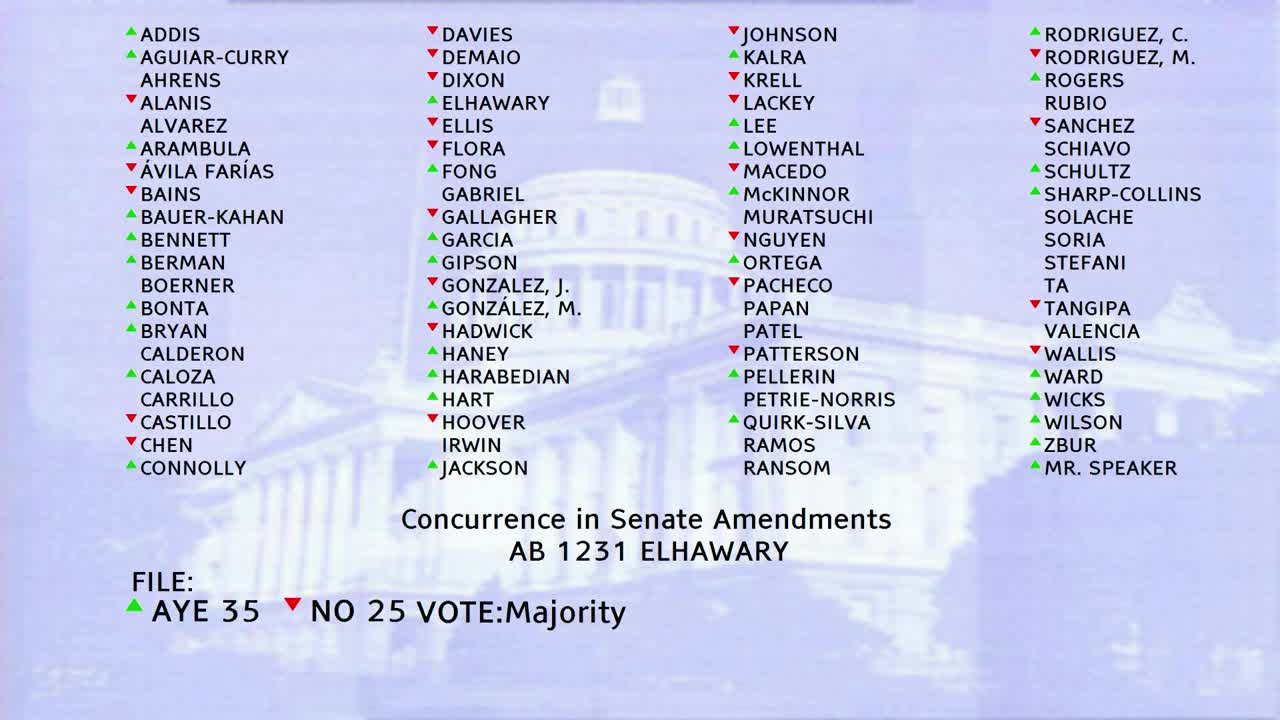 38SEC
Assembly Floor
 3MIN
Senate Floor
 1MIN
Senate Standing Committee on Appropriations
 11MIN
Senate Standing Committee on Judiciary
 17MIN
Senate Standing Committee on Public Safety
 1MIN
Assembly Floor
 21MIN
Assembly Standing Committee on Judiciary
 22MIN