AB 1132: Department of Transportation: climate change vulnerability assessment: community resilience assessment.
- Session Year: 2025-2026
- House: Assembly
- Latest Version Date: 2025-04-10
Current Status:
Failed
(2026-02-02: From committee: Filed with the Chief Clerk pursuant to Joint Rule 56.)
Introduced
In Committee
Awaiting First Chamber Vote
Passed First Chamber
In Committee
Awaiting Second Chamber Vote
Passed Second Chamber
Enacted
Existing law establishes the Department of Transportation to, among other things, plan, design, construct, operate, and maintain the state highway system, as provided. Pursuant to that authority, the department developed 12 district-based Climate Change Vulnerability Assessment reports designed to provide the department with a comprehensive database to help in evaluating, mitigating, and adapting to the effects of increasing extreme weather events on the state transportation system.
This bill would require the department, on or before January 1, 2027, 2029, to identify key community resilience indicators for measuring the impacts of climate-induced transportation disruptions. disruptions, as specified. The bill would also require the department, on or before January 1, 2028, 2030, to include in the Climate Change Vulnerability Assessment reports an evaluation of the broader social and economic impacts on communities connected to the evaluated infrastructure risks, as specified.
Existing law establishes the Department of Transportation to, among other things, plan, design, construct, operate, and maintain the state highway system, as provided. Pursuant to that authority, the department developed 12 district-based Climate Change Vulnerability Assessment reports designed to provide the department with a comprehensive database to help in evaluating, mitigating, and adapting to the effects of increasing extreme weather events on the state transportation system.
This bill would require the department, on or before January 1, 2027, to identify key community resilience indicators for measuring the impacts of climate-induced transportation disruptions. The bill would also require the department, on or before January 1, 2028, to include in the Climate Change Vulnerability Assessment reports an evaluation of the broader social and economic impacts on communities connected to the evaluated infrastructure risks, as specified.
The Legislature finds and declares all of the following:
(a)The Transportation Agency finalized the Climate Action Plan for Transportation Infrastructure (CAPTI) in 2021, outlining recommendations for how to invest transportation dollars annually to combat climate change. Climate resilience is embedded within CAPTI to prevent impediments to travel within California and prevent significant fiscal impacts on road repair efforts with a concerted effort to support public health, safety, and equity.
(b)Governor Newsoms Executive Order N-19-19 requires every aspect of state government to redouble its efforts to reduce greenhouse gas (GHG) emissions and mitigate the impacts of climate change while building a sustainable, inclusive economy.
(c)Governor Newsoms Executive Order N-79-20 requires the sale of all passenger cars and trucks in California to be zero emission by 2035. Further, the state requires that by 2045, all medium- and heavy-duty trucks to be zero emission. To facilitate this change, relevant agencies are required to develop a Zero-Emissions Vehicle Market Development Strategy and affordable fueling options for those vehicles.
(d)The California Transportation Plan 2050 defines statewide guidance to build healthy and resilient communities. The plan seeks to advance racial and economic justice by redirecting resources to marginalized communities, better connecting individuals to jobs, health care, education, and other opportunities, improving environmental justice, and amplifying the voices of those who have been historically excluded from the transportation decisionmaking process. The plan outlines Californias commitment to climate resilience and goal to be global leaders in climate policy, and sets aggressive benchmarks to reduce GHG emissions by 2050.
(e)The Department of Transportations Vulnerability Assessment compiles data collected by the Department of Transportation to understand the potential climate impacts to the state highway system due to climate change. The assessment identifies climate change impacts to the state highway system and identifies a subset of state highway system assets on which to focus future efforts.
(f)While efforts to make Californias transportation infrastructure more resilient in the face of climate change are valuable, they fail to consider community resilience, resulting in resilience strategies that protect physical transportation assets but neglect the people who depend on them most.
SEC. 2.Section 14049 is added to the Government Code, to read:14049.(a)For purposes of this section, the following definitions apply:
(1)Climate change vulnerability assessment means the Climate Change Vulnerability Assessment Technical and Summary Reports developed by the department.
(2)Community resilience means the ability of a community to withstand, adapt to, or recover from climate-related disruptions to its infrastructure, critical resources, and services. Additional consideration for defining community resilience shall be shaped by community priorities and shall be refined through consultation with relevant stakeholders.
(3)Community resilience assessment means an evaluation of the broader social and economic impacts on communities connected to the evaluated infrastructure risks, especially the communities that are most vulnerable to climate change risks. A community resilience assessment shall be completed across the state highway and passenger rail systems, with each element including an assessment on the impacts to priority populations. A community resilience assessment shall include, but not be limited to, all of the following:
(A)An assessment of how disruptions to transportation infrastructure, including, but not limited to, highways, bridges, and passenger rail systems, caused by climate impacts, including, but not limited to, extreme heat, fires, floods, or sea level sea-level rise, disrupt access to essential services to communities, including, but not limited to, education, emergency services, employment centers, and health care.
(B)Coordination with local jurisdictions and review of local evacuation plans to ensure that the state highway and passenger rail systems are facilitating alternative modes of evacuation, including, but not limited to, the use of public transit or school bus fleets, to assist people without access to personal vehicles and people who are unable to operate a vehicle. The guidance shall include recommendations for ensuring the accessibility of electric vehicle (EV) chargers along evacuation routes.
(C)An assessment and identification of locations in communities for implementation of shelters or green infrastructure to mitigate the impacts of extreme heat. When identifying these locations, the assessment shall include coordination with local jurisdictions, with a particular emphasis on evaluating locally planned resilience infrastructure and their capacity to meet community needs, and shall prioritize high-risk areas.
(D)A list of the highest risk locations and state highway and passenger rail system assets based on community resilience indicators.
(4)Community resilience indicators means specific metrics used to measure and track the resilience of communities experiencing climate-induced transportation disruptions. These indicators shall be selected and continually evaluated with input from community stakeholders to ensure the indicators address the most pressing needs of affected populations, including, but not limited to, people with disabilities, the elderly, people without access to personal vehicles, people who are unable to operate vehicles, and other at-risk populations. Potential indicators include, but are not limited to, all of the following:
(A)Access to critical services, including, but not limited to, health care, education, employment, and emergency services, during climate events.
(B)Availability and accessibility of electric vehicle charging infrastructure, particularly along evacuation routes or in underserved areas.
(C)Protection strategies for maintenance workers, transit riders, and others who use transportation networks during extreme heat or other climate risks.
(5)Priority populations means any of the following:
(A)An area identified as being among the most disadvantaged 25 percent in the state according to the most recent update to the California Communities Environmental Health Screening tool, also known as CalEnviroScreen.
(B)An area identified as a priority population in the departments equity index.
(C)An area within federally designated tribal lands.
(D)A community that meets the regional definition of environmental justice community, community of concern, or disadvantaged community, if that regional definition is adopted as part of the applicable regional transportation plan, including the sustainable communities strategy, adopted pursuant to Section 65080.
(b)(1)On or before January 1, 2027, 2029, the department shall identify key community resilience indicators for measuring the impacts of climate-induced transportation disruptions.
(2)In complying with paragraph (1), the department shall hold at least one public workshop and include stakeholders from priority populations, including, but not limited to, representatives from local jurisdictions responsible for implementing resilience strategies.
(3)The department shall consult with the Department of the California Highway Patrol and the Office of Emergency Services in complying with the requirements of paragraphs (1) and (2).
(c)(1)On or before January 1, 2028, 2030, the department shall include a community resilience assessment in the climate change vulnerability assessment that emphasizes the identification and evaluation of high-risk locations, especially those that serve priority populations.
(2)In complying with paragraph (1), the department shall hold at least two public stakeholder meetings in each of its 12 transportation districts and the public stakeholder meetings shall include stakeholders from priority populations.
(3)The department shall consult with the Department of the California Highway Patrol and the Office of Emergency Services in complying with the requirements of paragraphs (1) and (2).
The Legislature finds and declares all of the following:
(a)The Transportation Agency finalized the Climate Action Plan for Transportation Infrastructure (CAPTI) in 2021, outlining recommendations for how to invest transportation dollars annually to combat climate change. Climate resilience is embedded within CAPTI to prevent impediments to travel within California and prevent significant fiscal impacts on road repair efforts with a concerted effort to support public health, safety, and equity.
(b)Governor Newsoms Executive Order N-19-19 requires every aspect of state government to redouble its efforts to reduce greenhouse gas (GHG) emissions and mitigate the impacts of climate change while building a sustainable, inclusive economy.
(c)Governor Newsoms Executive Order N-79-20 requires the sale of all passenger cars and trucks in California to be zero emission by 2035. Further, the state requires that by 2045, all medium- and heavy-duty trucks to be zero emission. To facilitate this change, relevant agencies are required to develop a Zero-Emissions Vehicle Market Development Strategy and affordable fueling options for those vehicles.
(d)The California Transportation Plan 2050 defines statewide guidance to build healthy and resilient communities. The plan seeks to advance racial and economic justice by redirecting resources to marginalized communities, better connecting individuals to jobs, health care, education, and other opportunities, improving environmental justice, and amplifying the voices of those who have been historically excluded from the transportation decisionmaking process. The plan outlines Californias commitment to climate resilience and goal to be global leaders in climate policy, and sets aggressive benchmarks to reduce GHG emissions by 2050.
(e)The Department of Transportations Vulnerability Assessment compiles data collected by the Department of Transportation to understand the potential climate impacts to the state highway system due to climate change. The assessment identifies climate change impacts to the state highway system and identifies a subset of state highway system assets on which to focus future efforts.
(f)While efforts to make Californias transportation infrastructure more resilient in the face of climate change are valuable, they fail to consider community resilience, resulting in resilience strategies that protect physical transportation assets but neglect the people who depend on them most.
SEC. 2.Section 14049 is added to the Government Code, to read:14049.(a)For purposes of this section, the following definitions apply:
(1)Climate change vulnerability assessment means the Climate Change Vulnerability Assessment Technical and Summary Reports developed by the department.
(2)Community resilience means the ability of a community to withstand, adapt to, or recover from climate-related disruptions to its infrastructure, critical resources, and services. Additional consideration for defining community resilience shall be shaped by community priorities and shall be refined through consultation with relevant stakeholders.
(3)Community resilience assessment means an evaluation of the broader social and economic impacts on communities connected to the evaluated infrastructure risks, especially the communities that are most vulnerable to climate change risks. A community resilience assessment shall be completed across the state highway and passenger rail systems, with each element including an assessment on the impacts to priority populations. A community resilience assessment shall include, but not be limited to, all of the following:
(A)An assessment of how disruptions to transportation infrastructure, including, but not limited to, highways, bridges, and passenger rail systems, caused by climate impacts, including, but not limited to, extreme heat, fires, floods, or sea level rise, disrupt access to essential services to communities, including, but not limited to, education, emergency services, employment centers, and health care.
(B)Coordination with local jurisdictions and review of local evacuation plans to ensure that the state highway and passenger rail systems are facilitating alternative modes of evacuation, including, but not limited to, the use of public transit or school bus fleets, to assist people without access to personal vehicles and people who are unable to operate a vehicle. The guidance shall include recommendations for ensuring the accessibility of electric vehicle (EV) chargers along evacuation routes.
(C)An assessment and identification of locations in communities for implementation of shelters or green infrastructure to mitigate the impacts of extreme heat. When identifying these locations, the assessment shall include coordination with local jurisdictions, with a particular emphasis on evaluating locally planned resilience infrastructure and their capacity to meet community needs, and shall prioritize high-risk areas.
(D)A list of the highest risk locations and state highway and passenger rail system assets based on community resilience indicators.
(4)Community resilience indicators means specific metrics used to measure and track the resilience of communities experiencing climate-induced transportation disruptions. These indicators shall be selected and continually evaluated with input from community stakeholders to ensure the indicators address the most pressing needs of affected populations, including, but not limited to, people with disabilities, the elderly, people without access to personal vehicles, people who are unable to operate vehicles, and other at-risk populations. Potential indicators include, but are not limited to, all of the following:
(A)Access to critical services, including, but not limited to, health care, education, employment, and emergency services, during climate events.
(B)Availability and accessibility of electric vehicle charging infrastructure, particularly along evacuation routes or in underserved areas.
(C)Protection strategies for maintenance workers, transit riders, and others who use transportation networks during extreme heat or other climate risks.
(5)Priority populations means any of the following:
(A)An area identified as being among the most disadvantaged 25 percent in the state according to the most recent update to the California Communities Environmental Health Screening tool, also known as CalEnviroScreen.
(B)An area identified as a priority population in the departments equity index.
(C)An area within federally designated tribal lands.
(D)A community that meets the regional definition of environmental justice community, community of concern, or disadvantaged community, if that regional definition is adopted as part of the applicable regional transportation plan, including the sustainable communities strategy, adopted pursuant to Section 65080.
(b)(1)On or before January 1, 2027, the department shall identify key community resilience indicators for measuring the impacts of climate-induced transportation disruptions.
(2)In complying with paragraph (1), the department shall hold at least one public workshop and include stakeholders from priority populations, including, but not limited to, representatives from local jurisdictions responsible for implementing resilience strategies.
(c)(1)On or before January 1, 2028, the department shall include a community resilience assessment in the climate change vulnerability assessment that emphasizes the identification and evaluation of high-risk locations, especially those that serve priority populations.
(2)In complying with paragraph (1), the department shall hold at least two public stakeholder meetings in each of its 12 transportation districts and the public stakeholder meetings shall include stakeholders from priority populations.
|
Date
|
Status
|
|---|---|
| Feb 2, 2026 | From committee: Filed with the Chief Clerk pursuant to Joint Rule 56. |
| Jan 31, 2026 | Died pursuant to Art. IV, Sec. 10(c) of the Constitution. |
| May 23, 2025 | In committee: Held under submission. |
| May 7, 2025 | In committee: Set, first hearing. Referred to APPR. suspense file. |
| Apr 22, 2025 | From committee: Do pass and re-refer to Com. on APPR. (Ayes 12. Noes 1.) (April 21). Re-referred to Com. on APPR. |
| Apr 21, 2025 | Re-referred to Com. on TRANS. |
| Apr 10, 2025 | From committee chair, with author's amendments: Amend, and re-refer to Com. on TRANS. Read second time and amended. |
| Mar 13, 2025 | Referred to Com. on TRANS. |
| Feb 21, 2025 | From printer. May be heard in committee March 23. |
| Feb 20, 2025 | Read first time. To print. |
|
Date
|
Description
|
Location
|
Votes
|
|
|---|---|---|---|---|
| Apr 21, 2025 | Do pass and be re-referred to the Committee on [Appropriations] | Assembly Standing Committee on Transportation |
Passed |
This list shows positions taken on this bill by organizations on the date displayed, which is linked to the original source.
Positions by individuals are not included.
|
Organization
|
Position
|
Date
|
|---|---|---|
| 350 Sacramento | ** Support | |
| AARP | ** Support | |
| Active San Gabriel Valley | ** Support | |
| American Lung Association Of California | ** Support | |
| CalBike | ** Support | |
| California Walks | ** Support | |
| Center For Biological Diversity | ** Support | |
| Center For Environmental Health | ** Support | |
| Clean Earth 4 Kids | ** Support | |
| Climate Action California | ** Support | |
| Climate Resolve | ** Support | |
| Greenlining | ** Support | |
| NextGen California | ** Support | |
| Planning And Conservation League | ** Support | |
| Safe Routes Partnership | ** Support | |
| Streets Are For Everyone | ** Support | |
| Streets for All | ** Support | |
| Transbay Coalition | ** Support | |
| Transform | ** Support |
Date of Hearing: May 7, 2025
ASSEMBLY COMMITTEE ON APPROPRIATIONS
Buffy Wicks, Chair
ABPCA Bill Id:AB 1132
Author:(Schiavo) – As Amended Ver:April 10, 2025
Policy Committee: | Transportation | Vote: | 12 - 1 |
|
| ||
|
|
Urgency: No State Mandated Local Program: No Reimbursable: No
SUMMARY:
This bill requires the California Department of Transportation (Caltrans) to include a community resilience assessment in its statewide climate change vulnerability assessment.
Specifically, this bill, among other things:
- Defines the following terms: climate change vulnerability assessment, community resilience, community resilience assessment, community resilience indicators, and priority populations.
- Requires Caltrans, by January 1, 2029, and in consultation with the California Highway Patrol (CHP) and California Department of Emergency Services (Cal OES), to identify key community resilience indicators for measuring the impacts of climate-induced transportation disruptions.
- Requires Caltrans, in consultation with CHP and Cal OES, to hold at least one public workshop and include stakeholders from priority populations, including representatives from local jurisdictions responsible for implementing resilience strategies.
- Requires Caltrans, by January 1, 2030, and in consultation with CHP and Cal OES, to include a community resilience assessment in the climate change vulnerability assessment that emphasizes the identification and evaluation of high-risk locations, especially those that serve priority populations.
- Requires Caltrans, in complying with item 4, above, and in consultation with CHP and Cal OES, to hold at least two public stakeholder meetings in each of its 12 transportation districts and include stakeholders from priority populations.
FISCAL EFFECT:
1) Caltrans will incur significant ongoing costs until at least 2030, likely in the hundreds of thousands to low millions of dollars, to implement the requirements of the bill. For its part, Caltrans estimates one-time and ongoing costs in the millions of dollars for additional contract and staffing resources to research, identify, coordinate, and liaise per the various requirements of the bill (State Highway Account). Caltrans notes that although it completed its climate change vulnerability assessment in 2019, this bill would require the department to incorporate new and complex information and indicators into that assessment. For reference, the assessment cost Caltrans approximately $2 million to engage third-party consultants.
Caltrans contends its workload would include developing community resilience indicators; evaluating community resilience for vulnerabilities identified across 15,000 miles of state highways and over 2,000 miles of passenger rail; requesting, reviewing, and assessing local evacuation plans for jurisdictions statewide; managing third-party consultant contracts and deliverables; holding numerous public workshops across the state; and various other tasks.
2) Ongoing costs until at least 2030 of an unknown amount, potentially ranging from minor and absorbable to the tens of thousands or hundreds of thousands of dollars, for CHP and Cal OES to consult with Caltrans on the bill’s requirements (General Fund or special fund).
COMMENTS:
1) Purpose. According to the author:
California faces over $1 billion per year in infrastructure damages from climate disasters, yet resilience planning largely focuses on protecting physical infrastructure with limited consideration for community needs. AB 1132 addresses this gap by incorporating a Community Resilience Assessment into Caltrans’ Climate Change Vulnerability Assessment. This will help identify high-risk areas, improve evacuation planning, and assess the broader social and economic impacts on affected communities.
2) Background. Caltrans’ climate change vulnerability assessment – and the 12 Caltrans district-based reports that helped inform the assessment – provided the department with a comprehensive database that will help in evaluating, mitigating, and adapting to the effects of increasing extreme weather events on the state highway system. The assessment includes numerous findings. For example, it projects that by the year 2085, sea levels will rise 5.5 feet along the California coast – affecting 130 miles of state highway by accelerating soil erosion and cliff retreat. According to Caltrans’ assessment, California faces over $1 billion per year in infrastructure damages due to climate disasters.
This bill requires Caltrans to incorporate socioeconomic and climate resiliency factors into the climate change vulnerability assessment, in consultation with CHP and Cal OES. The assessment this bill adds is to evaluate how transportation disruptions affect vulnerable populations, identify key resilience indicators, and improve coordination with local governments on emergency planning and evacuation strategies.
Writing in support of this bill, a coalition of organizations notes that vulnerable communities face life-threatening challenges during disasters and in daily life. For example, during the recent Los Angeles fires, senior citizens, people with disabilities, and those without vehicles struggled to evacuate safely, while road closures and gridlock left many trapped. The coalition notes that Caltrans’ climate change vulnerability assessment currently considers the risks to transportation infrastructure but fails to assess how these disruptions threaten the health, safety, and economic well-being of millions of Californians: “This oversight results in resilience strategies that protect physical transportation assets but neglect the people who depend on them most.”
Analysis Prepared by: Nikita Koraddi / APPR. / (916) 319-2081
Date of Hearing: May 7, 2025
ASSEMBLY COMMITTEE ON APPROPRIATIONS
Buffy Wicks, Chair
ABPCA Bill Id:AB 1132
Author:(Schiavo) – As Amended Ver:April 10, 2025
Policy Committee: | Transportation | Vote: | 12 - 1 |
|
| ||
|
|
Urgency: No State Mandated Local Program: No Reimbursable: No
SUMMARY:
This bill requires the California Department of Transportation (Caltrans) to include a community resilience assessment in its statewide climate change vulnerability assessment.
Specifically, this bill, among other things:
- Defines the following terms: climate change vulnerability assessment, community resilience, community resilience assessment, community resilience indicators, and priority populations.
- Requires Caltrans, by January 1, 2029, and in consultation with the California Highway Patrol (CHP) and California Department of Emergency Services (Cal OES), to identify key community resilience indicators for measuring the impacts of climate-induced transportation disruptions.
- Requires Caltrans, in consultation with CHP and Cal OES, to hold at least one public workshop and include stakeholders from priority populations, including representatives from local jurisdictions responsible for implementing resilience strategies.
- Requires Caltrans, by January 1, 2030, and in consultation with CHP and Cal OES, to include a community resilience assessment in the climate change vulnerability assessment that emphasizes the identification and evaluation of high-risk locations, especially those that serve priority populations.
- Requires Caltrans, in complying with item 4, above, and in consultation with CHP and Cal OES, to hold at least two public stakeholder meetings in each of its 12 transportation districts and include stakeholders from priority populations.
FISCAL EFFECT:
1) Caltrans will incur significant ongoing General Fund costs until at least 2030, likely in the hundreds of thousands to low millions of dollars, to implement the requirements of the bill. For its part, Caltrans estimates one-time and ongoing General Fund costs in the millions of dollars for additional contract and staffing resources to research, identify, coordinate, and liaise per the various requirements of the bill. Caltrans notes that although it completed its climate change vulnerability assessment in 2019, this bill would require the department to incorporate new and complex information and indicators into that assessment. For reference, the assessment cost Caltrans approximately $2 million to engage third-party consultants.
Caltrans contends its workload would include developing community resilience indicators; evaluating community resilience for vulnerabilities identified across 15,000 miles of state highways and over 2,000 miles of passenger rail; requesting, reviewing, and assessing local evacuation plans for jurisdictions statewide; managing third-party consultant contracts and deliverables; holding numerous public workshops across the state; and various other tasks.
2) Ongoing General Fund costs until at least 2030 of an unknown amount, potentially ranging from minor and absorbable to the tens of thousands or hundreds of thousands of dollars, for CHP and Cal OES to consult with Caltrans on the bill’s requirements.
COMMENTS:
1) Purpose. According to the author:
California faces over $1 billion per year in infrastructure damages from climate disasters, yet resilience planning largely focuses on protecting physical infrastructure with limited consideration for community needs. AB 1132 addresses this gap by incorporating a Community Resilience Assessment into Caltrans’ Climate Change Vulnerability Assessment. This will help identify high-risk areas, improve evacuation planning, and assess the broader social and economic impacts on affected communities.
2) Background. Caltrans’ climate change vulnerability assessment – and the 12 Caltrans district-based reports that helped inform the assessment – provided the department with a comprehensive database that will help in evaluating, mitigating, and adapting to the effects of increasing extreme weather events on the state highway system. The assessment includes numerous findings. For example, it projects that by the year 2085, sea levels will rise 5.5 feet along the California coast – affecting 130 miles of state highway by accelerating soil erosion and cliff retreat. According to Caltrans’ assessment, California faces over $1 billion per year in infrastructure damages due to climate disasters.
This bill requires Caltrans to incorporate socioeconomic and climate resiliency factors into the climate change vulnerability assessment, in consultation with CHP and Cal OES. The assessment this bill adds is to evaluate how transportation disruptions affect vulnerable populations, identify key resilience indicators, and improve coordination with local governments on emergency planning and evacuation strategies.
Writing in support of this bill, a coalition of organizations notes that vulnerable communities face life-threatening challenges during disasters and in daily life. For example, during the recent Los Angeles fires, senior citizens, people with disabilities, and those without vehicles struggled to evacuate safely, while road closures and gridlock left many trapped. The coalition notes that Caltrans’ climate change vulnerability assessment currently considers the risks to transportation infrastructure but fails to assess how these disruptions threaten the health, safety, and economic well-being of millions of Californians: “This oversight results in resilience strategies that protect physical transportation assets but neglect the people who depend on them most.”
Analysis Prepared by: Nikita Koraddi / APPR. / (916) 319-2081
Date of Hearing: April 21, 2025
ASSEMBLY COMMITTEE ON TRANSPORTATION
Lori D. Wilson, Chair
ABPCA Bill Id:AB 1132 (
Author:Schiavo) – As Amended Ver:April 10, 2025
SUBJECT: Department of Transportation: climate change vulnerability assessment: community resilience assessment
SUMMARY: Requires the California Department of Transportation (Caltrans) to include a community resilience assessment into its statewide Climate Change Vulnerability Assessment. Specifically, this bill:
- Requires Caltrans, in consultation with the California Highway Patrol (CHP) and California Department of Emergency Services (CalOES), to identify key community resilience indicators for measuring the impacts of climate-induced transportation disruptions on or before January 1, 2029.
- Requires Caltrans, in consultation with CHP and CalOES, to hold at least one public workshop and include stakeholders from priority populations, including, but not limited to, representatives from local jurisdictions responsible for implementing resilience strategies.
- Requires Caltrans to include a community resilience assessment in the climate change vulnerability assessment that emphasizes the identification and evaluation of high-risk locations, especially those that serve priority populations on or before January 1, 2030.
- Requires Caltrans to hold at least two public stakeholder meetings in each of its 12 transportation districts and the public stakeholder meetings shall include stakeholders from priority populations.
- Makes findings and declarations related to the state’s Climate Action Plan for Transportation Infrastructure (CAPTI), Executive Order N-19-19, Executive Order N-79-20, California Transportation Plan 2050, and the Department of Transportation’s Vulnerability Assessment.
- Defines the following;
- “Climate change vulnerability assessment” as the Climate Change Vulnerability Assessment Technical and Summary Reports developed by Caltrans;
- “Community resilience” as the ability of a community to withstand, adapt to, or recover from climate-related disruptions to its infrastructure, critical resources, and services;
- “Community resilience assessment” as an evaluation of the broader social and economic impacts on communities connected to the evaluated infrastructure risks, especially the communities that are most vulnerable to climate change risks, and requires a community resilience assessment to include, all of the following;
- How disruptions to transportation infrastructure caused by climate impacts disrupt access to essential services to communities, including education, emergency services, employment centers, and health care;
- Coordination with local jurisdictions and review of local evacuation plans to ensure that the state highway and passenger rail systems are facilitating alternative modes of evacuation;
- An assessment and identification of locations in communities for implementation of shelters or green infrastructure to mitigate the impacts of extreme heat; and,
- A list of the highest risk locations and state highway and passenger rail system assets based on community resilience indicators.
- “Community resilience indicators” as specific metrics used to measure and track the resilience of communities experiencing climate-induced transportation disruptions, and requires the indicators be selected and continually evaluated with input from community stakeholders to ensure the indicators address the most pressing needs of affected populations; and,
- “Priority populations” as any of the following:
- An area identified as being among the most disadvantaged 25 percent in the state according to the most recent update to the California Communities Environmental Health Screening tool, also known as CalEnviroScreen;
- An area identified as a priority population in Caltrans’ equity index;
- An area within federally designated tribal lands; and,
- A community that meets the regional definition of “environmental justice community,” “community of concern,” or “disadvantaged community,” if that regional definition is adopted as part of the applicable regional transportation plan, including the sustainable communities strategy.
EXISTING LAW:
- Establishes Caltrans and provides that it has full possession and control of all state highways and property and rights in property acquired for state highway purposes, construct all state highways. (Streets and Highways Code Section (SHC) 90)
- Requires the California Natural Resources Agency (CNRA) to update the state’s climate adaptation strategy every three years, coordinate with other state agencies, and requires the plan to including the following sectors: water, energy, transportation, public health, agriculture, emergency services, forestry, biodiversity and habitat, and ocean and coastal resources. (Public Resources Code Section (PRC) 71153)
- Requires state agencies to take into account the current and future impacts of climate change when planning, designing, building, operating, maintaining and investing in state infrastructure and establishes the Climate-Safe Infrastructure Working Group for the purpose of examining how to integrate scientific data concerning projected climate change impacts into state infrastructure engineering, including oversight, investment, design, and construction. (PRC 71155)
- Establishes the Transportation Infrastructure Climate Adaptation Strategy Grant Program as a competitive grant program to be awarded and administered Caltrans to provide funding to local agencies to identify transportation-related climate vulnerabilities through the development of climate adaptation plans and to identify ways to incorporate transportation-related climate adaptation needs into existing transportation plans. (Government Code Section (GOV) 14560)
FISCAL EFFECT: Unknown
COMMENTS: Caltrans manages California’s state highway system, which includes over 50,000 miles of highway. To ensure the longevity and quality of the state’s transportation infrastructure, Caltrans is assessing the impacts of climate change and impacts to the state highway system in terms of damage, travel disruption, and long-term maintenance needs. Additionally, in accordance with the California Action Plan for Transportation Infrastructure (CAPTI), Executive Order (EO) N-19-19, and EO B-30-15 Caltrans must incorporate climate change impacts into state investments.
Caltrans completed a statewide Climate Change Vulnerability Assessment (Assessment) for the state highway system in 2019, and most recently in 2021. This study involves using climate data to refine Caltrans’ understanding of potential climate impacts to the state highway system, and coordination with various state and federal agencies and academic institutions to obtain the best available climate data for California. Each of Caltrans’ 12 districts developed climate change vulnerability assessment technical and summary reports that include assessment methodologies, findings, potential challenges, and ongoing efforts. Discussions with professionals from various engineering disciplines helped identify how changing climate hazards may affect highways, including their design. This assessment allows Caltrans to begin to understand how climate change may affect state transportation infrastructure and identifies a subset of state highway system assets on which to focus future efforts. Additionally, this enables Caltrans to incorporate climate change assessments into project development and ensure staff and stakeholders are engaged.
- The results from the Assessment conclude that California’s transportation system is under increasing threat from climate change, with extreme weather events like wildfires, floods, and heat waves causing major disruptions. According to Caltrans 2021 Assessment, California faces over $1 billion per year in infrastructure damages due to climate disasters.
- Transportation in climate emergencies. Transportation is critical to evacuation from climate disasters such as wildfires, mudslides, and sea level rise. Reliable access to roads, a vehicle, and transit can enable safe and efficient evacuations. Lack of reliable transportation options in evacuation scenarios often disproportionately impacts vulnerable communities such as low-income households, seniors, people with disabilities, and those without access to personal vehicles. According to the California Department of Forestry and Fire Protection (CalFire), households without a vehicle are considered “at-risk” due to the lack of reliable transportation needed for an evacuation.
The Palisades and Eaton wildfires of 2025 provide examples of how efficient evacuation routes are critical in a climate emergency. The city's reliance on personal vehicles, limited street connectivity, and the simultaneous evacuation attempts by many residents created widespread gridlock and delays, made it difficult for both residents and emergency responders to navigate. Additionally, residents without access to personal vehicles faced significant barriers to safety and evacuation. Vulnerable populations, including the elderly, people with disabilities, and those experiencing homelessness, faced delayed evacuation alerts, lack of transportation, and difficulty accessing resources.
This bill requires socio-economic and climate resiliency factors to be incorporated in the Assessment, in consultation with CHP and CalOES. The assessment this bill adds is intended to evaluate how transportation disruptions affect vulnerable populations, identify key resilience indicators, and improve coordination with local governments on emergency planning and evacuation strategies.
Climate resilience investments. The state has a variety of funding opportunities and guidance related to climate adaptation and mitigation, including emergency response. The Local Transportation Climate Adaptation Program, created by the Biden Administration’s Infrastructure Investment Jobs Act (IIJA), funds local adaptation projects to vulnerable communities; CalOES provides evacuation planning and transportation guidance which emphasizes the importance of planning for individuals with access and functional needs; the Integrated Climate Adaptation and Resiliency Program (ICARP) offers resources designed to help state and local agencies develop actionable resilience plans, and Cal-Adapt provides datasets and tools for state agencies and other stakeholders to develop climate adaptation and resilience plans and foster community engagement.
This bill seeks to add to these efforts by requiring a transportation vulnerability assessment focused on those most impacted by climate change, and those least likely to have reliable evacuation options.
Staff comments. The author may wish to simplify the definitions in this bill by utilizing the myriad of existing guidance and tools the state provides on climate resiliency and vulnerability. While there is value in incorporating community resiliency indicators into Caltrans’ vulnerability study, the intent should be to utilize existing efforts to ensure the requirements of this bill are not duplicative.
According to the author, “California’s transportation system is increasingly vulnerable to climate change, facing disruptions from wildfires, floods, extreme heat, and sea-level rise. While the state has made efforts to assess risks to transportation infrastructure, current analyses often overlook the well-being of the communities that depend on these systems, particularly low-income and disadvantaged populations. California faces over $1 billion per year in infrastructure damages from climate disasters, yet resilience planning largely focuses on protecting physical infrastructure with limited consideration for community needs. AB 1132 addresses this gap by incorporating a Community Resilience Assessment into Caltrans’ Climate Change Vulnerability Assessment. This will help identify high-risk areas, improve evacuation planning, and assess the broader social and economic impacts on affected communities. By requiring Caltrans to consult with stakeholders, including state agencies, local governments, community-based organizations, and groups representing vulnerable populations, AB 1132 will enhance California’s ability to protect its most vulnerable residents from climate-induced disruptions.”
In support, the Greenlining Institute writes, “The vulnerability of our transportation system goes beyond the roads we travel; it hampers our ability to move economically, socially, and physically, while also undermining California’s resilience in the face of growing climate threats. Together, we can build a climate-ready transportation system that prioritizes people, strengthens resilience, and serves all Californians. We strongly support AB 1132, to establish a community resilience assessment.”
Previous legislation. SB 198 (Committee on Budget and Fiscal Review) establishes three programs that are intended to fund activities necessary to help the state and local governments identify and fund projects to adapt transportation infrastructure to climate change.
AB 2438 (Friedman) of 2022 would have required various state transportation programs to incorporate strategies from the CAPTI into program guidelines. Also would have required various state agencies to establish new transparency and accountability guidelines for certain transportation funding programs. This bill was vetoed by Governor Newsom.
SB 1 (Beall), Chapter 5, Statutes of 2017 increases several taxes and fees to raise the equivalent of roughly $52.4 billion over ten years in new transportation revenues and makes adjustments for inflation every year; directed the funding to be used towards deferred maintenance on the state highways and local streets and roads, and to improve the state's trade corridors, transit, and active transportation facilities.
AB 1482 (Gordon) Chapter 603, Statutes of 2015 requires the California Natural Resources Agency (NRA) to update its climate adaptation strategy, the Safeguarding California Plan (Plan), by July 1, 2017, and every three years thereafter by coordinating adaption activities among lead state agencies in each sector, and requires relevant state agencies to maximize specified objectives across sectors to address vulnerabilities identified in the Plan and requires the Strategic Growth Council (SGC) to identify and review activities and funding programs of state agencies that may be coordinated to meet the goals of the strategies and priorities in the Plan.
AB 2800 (Quirk) Chapter 580, Statutes of 2016 establishes a Climate-Safe Infrastructure Working Group (Working Group) to examine how to integrate scientific data concerning projected climate change impacts into state infrastructure engineering.
REGISTERED SUPPORT / OPPOSITION:
Support
Greenlining (co-sponsor)
NextGen California (co-sponsor)
350 Sacramento
AARP
Active San Gabriel Valley
American Lung Association of California
Calbike
California Walks
Center for Biological Diversity
Center for Environmental Health
Clean Earth 4 Kids
Climate Action California
Climate Resolve
Planning and Conservation League
Safe Routes Partnership
Streets are for Everyone
Streets for All
Transbay Coalition
Transform
One Individual
Opposition
None on file
Analysis Prepared by: Julia Kingsley / TRANS. / (916) 319-2093
Discussed in Hearing
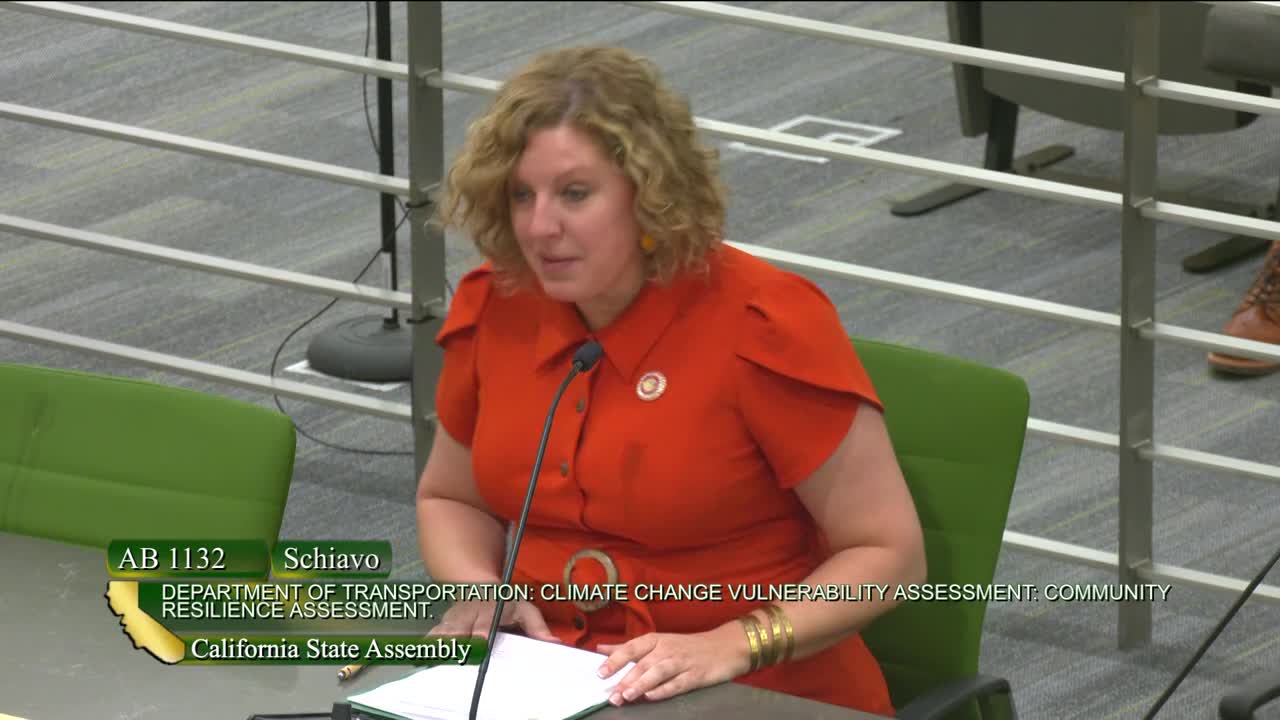 15MIN
Assembly Standing Committee on Transportation
Bill Author

Bill Co-Author(s):