AB 1136: Employment: immigration and work authorization.
- Session Year: 2025-2026
- House: Assembly
- Latest Version Date: 2025-09-15
Current Status:
Failed
(2026-01-22: Consideration of Governor's veto stricken from file.)
Introduced
In Committee
Awaiting First Chamber Vote
Passed First Chamber
In Committee
Awaiting Second Chamber Vote
Passed Second Chamber
Enacted
Existing law, the California Fair Employment and Housing Act, prohibits various forms of employment and housing discrimination, including various types of discrimination because of national origin. Existing law empowers the Civil Rights Department to investigate and prosecute complaints alleging unlawful practices.
Existing labor law also prohibits an employer or other person or entity from engaging in, or to directing another person or entity to engage in, unfair immigration-related practices against a person for exercising specified rights. Existing law defines unfair immigration-related practices for these purposes. Existing law additionally makes it unlawful for an employer to request more or different immigration documents than are required under federal law, to refuse to honor documents tendered that reasonably appear to be genuine, and to take other related actions concerning employee work authorization documents. Existing law authorizes an applicant for employment or an employee who is subject to an unlawful act that is prohibited by these provisions, or a representative of that applicant for employment or employee, to file a complaint with the Division of Labor Standards Enforcement. Existing law establishes specified civil penalties for a violation of these provisions.
This bill would require each employee, upon request, to be released by their employer for up to 5 unpaid working days within a 12-month period in order to attend appointments, interviews, adjudications, legal proceedings, detainment, or any other meeting at which the employees presence is required concerning the employees immigration status, work authorization, visa status, or any other immigration-related matter, as specified. The bill would also require a postintroductory employee, as defined, whose employment has been terminated due to an inability to provide documentation of proper work authorization, to be immediately reinstated to their former classification without loss in seniority, subject to producing proper work authorization, except as provided. The bill would also require an employer, if the employee demonstrates a need for additional time, to rehire the employee into the next available opening in the employees former classification, as a new hire without retaining seniority, subject to the employee providing proper work authorization and meeting certain other conditions.
This bill would require an employer that is notified that an employee has been detained or incarcerated as a result of pending immigration or deportation proceedings, to place the employee on an unpaid leave of absence for a period pending the employees release from detainment or incarceration and not to exceed 12 months. If the employee is released and provides appropriate work authorization documentation within the period of the authorized unpaid leave of absence, the bill would require the employer to return the employee to their former job classification without loss of seniority, except as specified.
This bill would apply the above requirements to a public or private employer, but would exempt a public or private employer with 25 or fewer employees.
The bill would prohibit each public or private employer from disciplining, discharging, or discriminating against an employee because of national origin or immigration status, or solely because the employee is subject to immigration or deportation proceedings, except as required to comply with the law. The bill would prohibit an employee subject to immigration or deportation proceedings from being discharged solely because of those proceedings, so long as the employee is authorized to work in the United States.
This bill would provide that its provisions do not invalidate a collective bargaining agreement or a memorandum of understanding that contains a provision addressing rehire or reinstatement rights or leave rights regarding employees who are subject to immigration proceedings, nor does it supersede the seniority provisions of a collective bargaining agreement or a memorandum of understanding. The bill would require the Labor Commissioner to enforce the bills provisions.
This bill would make these provisions inoperative on July 1, 2029, and would repeal them on January 1, 2030.
Existing law, the California Fair Employment and Housing Act, prohibits various forms of employment and housing discrimination, including various types of discrimination because of national origin. Existing law empowers the Civil Rights Department to investigate and prosecute complaints alleging unlawful practices.
Existing labor law also prohibits an employer or other person or entity from engaging in, or to directing another person or entity to engage in, unfair immigration-related practices against a person for exercising specified rights. Existing law defines unfair immigration-related practices for these purposes. Existing law additionally makes it unlawful for an employer to request more or different immigration documents than are required under federal law, to refuse to honor documents tendered that reasonably appear to be genuine, and to take other related actions concerning employee work authorization documents. Existing law authorizes an applicant for employment or an employee who is subject to an unlawful act that is prohibited by these provisions, or a representative of that applicant for employment or employee, to file a complaint with the Division of Labor Standards Enforcement. Existing law establishes specified civil penalties for a violation of these provisions.
This bill would require each employee, upon request, to be released by their employer for up to 5 unpaid working days within a 12-month period in order to attend appointments, interviews, adjudications, legal proceedings, detainment, or any other meeting at which the employees presence is required concerning the employees immigration status, work authorization, visa status, or any other immigration-related matter. matter, as specified. The bill would also require a postintroductory employee, as defined, whose employment has been terminated due to an inability to provide documentation of proper work authorization authorization, to be immediately reinstated to their former classification without loss in seniority, subject to producing proper work authorization, except as provided. The bill would also require an employer, if the employee needs demonstrates a need for additional time to produce the proper work authorization, time, to rehire the employee into the next available opening in the employees former classification, as a new hire without retaining seniority, subject to the employee providing proper work authorization and meeting certain other conditions.
This bill would require an employer that is notified that an employee has been detained or incarcerated as a result of pending immigration or deportation proceedings, to place the employee on an unpaid leave of absence for a period pending the employees release from detainment or incarceration and not to exceed 12 months. If the employee is released and provides appropriate work authorization documentation within the period of the authorized unpaid leave of absence, the bill would require the employee, upon the employers receipt of that documentation, to be returned to work employer to return the employee to their former job classification without loss of seniority to their former job classification, seniority, except as specified.
This bill would apply the above requirements to a public or private employer, but would exempt a public or private employer with 25 or fewer employees.
The bill would prohibit each public or private employer from disciplining, discharging, or discriminating against an employee because of national origin or immigration status, or solely because the employee is subject to immigration or deportation proceedings, except as required to comply with the law. The bill would prohibit an employee subject to immigration or deportation proceedings from being discharged solely because of those proceedings, so long as the employee is authorized to work in the United States.
This bill would provide that its provisions do not invalidate a collective bargaining agreement or a memorandum of understanding that contains a provision addressing rehire or reinstatement rights or leave rights regarding employees who are subject to immigration proceedings, nor does it supersede the seniority provisions of a collective bargaining agreement or a memorandum of understanding. The bill would require the Labor Commissioner to enforce the bills provisions, and would make other related changes. provisions.
This bill would make these provisions inoperative on July 1, 2029, and would repeal them on January 1, 2030.
Existing law, the California Fair Employment and Housing Act, prohibits various forms of employment and housing discrimination, including various types of discrimination because of national origin. Existing law empowers the Civil Rights Department to investigate and prosecute complaints alleging unlawful practices.
Existing labor law also prohibits an employer or other person or entity from engaging in, or to directing another person or entity to engage in, unfair immigration-related practices against a person for exercising specified rights. Existing law defines unfair immigration-related practices for these purposes. Existing law additionally makes it unlawful for an employer to request more or different immigration documents than are required under federal law, to refuse to honor documents tendered that reasonably appear to be genuine, and to take other related actions concerning employee work authorization documents. Existing law authorizes an applicant for employment or an employee who is subject to an unlawful act that is prohibited by these provisions, or a representative of that applicant for employment or employee, to file a complaint with the Division of Labor Standards Enforcement. Existing law establishes specified civil penalties for a violation of these provisions.
This bill would require each employee, upon request, to be released by their employer for up to 5 unpaid working days in order to attend appointments, interviews, adjudications, legal proceedings, detainment, or any other meeting at which the employees presence is required concerning the employees immigration status, work authorization, visa status, or any other immigration-related matter. The bill would also require a postintroductory employee, as defined, whose employment has been terminated due to an inability to provide documentation of proper work authorization to be immediately reinstated to their former classification without loss in seniority, subject to producing proper work authorization, as prescribed. except as provided. The bill would also require an employer, if the employee needs additional time, time to produce the proper work authorization, to rehire the employee into the next available opening in the employees former classification, as a new hire without retaining seniority, subject to meeting certain conditions. The
This bill would require an employer that is notified that an employee has been detained or incarcerated as a result of pending immigration or deportation proceedings, to place the employee on an unpaid leave of absence for a period pending the employees release from detainment or incarceration and not to exceed 12 months. If the employee is released and provides appropriate work authorization documentation within the period of the authorized unpaid leave of absence, the bill would require the employee, upon the employers receipt of that documentation, to be returned to work without loss of seniority to their former job classification, except as specified.
This bill would apply these the above requirements to a public or private employer, but would exempt a public or private employer with 25 or fewer employees.
The bill would prohibit each public or private employer from disciplining, discharging, or discriminating against an employee because of national origin or immigration status, or because the employee is subject to immigration or deportation proceedings, except as required to comply with the law. The bill would prohibit an employee subject to immigration or deportation proceedings from being discharged solely because of those proceedings, so long as the employee is authorized to work in the United States. If the employer is notified that an employee has been detained or incarcerated as a result of pending immigration or deportation proceedings, the bill would require the employer to place the employee on an unpaid leave of absence for a period of 12 months. If the employee is released and provides appropriate work authorization documentation within the 12-month period, the bill would require the employee to be returned to work without loss of seniority to their former job classification, as prescribed. The
This bill would require the Labor Commissioner to enforce these the bills provisions, and would make other related and conforming changes.
Existing law, the California Fair Employment and Housing Act, prohibits various forms of employment and housing discrimination, including various types of discrimination because of national origin. Existing law empowers the Civil Rights Department to investigate and prosecute complaints alleging unlawful practices.
Existing labor law also prohibits an employer or other person or entity from engaging in, or to directing another person or entity to engage in, unfair immigration-related practices against a person for exercising specified rights. Existing law defines unfair immigration-related practices for these purposes. Existing law additionally makes it unlawful for an employer to request more or different immigration documents than are required under federal law, to refuse to honor documents tendered that reasonably appear to be genuine, and to take other related actions concerning employee work authorization documents. Existing law authorizes an applicant for employment or an employee who is subject to an unlawful act that is prohibited by these provisions, or a representative of that applicant for employment or employee, to file a complaint with the Division of Labor Standards Enforcement. Existing law establishes specified civil penalties for a violation of these provisions.
This bill would require each employee, upon request, to be released by their employer for up to 5 unpaid working days in order to attend United States Citizenship and Immigration Services proceedings and related matters for the employee, as specified. appointments, interviews, adjudications, legal proceedings, detainment, or any other meeting at which the employees presence is required concerning the employees immigration status, work authorization, visa status, or any other immigration-related matter. The bill would also require a postintroductory employee who is not authorized to work in the United States and employee, as defined, whose employment has been terminated due to an inability to provide documentation of proper work authorization to be immediately reinstated to their former classification without loss in seniority, subject to producing proper work authorization, as prescribed. The bill would also require an employer, if the employee needs additional time, to rehire the employee into the next available opening in the employees former classification, as a new hire without retaining seniority, subject to meeting certain conditions. The bill would apply these requirements to a public or private employer, but would exempt a public or private employer with 25 or fewer employees.
The bill would prohibit each public or private employer from disciplining, discharging, or discriminating against an employee because of national origin or immigration status, or because the employee is subject to immigration or deportation proceedings, except as required to comply with the law. The bill would prohibit an employee subject to immigration or deportation proceedings from being discharged solely because of those proceedings, so long as the employee is authorized to work in the United States. The bill would apply to a private or public employer, as defined, but would exempt a public or private employer with 25 or fewer employees. If the employer is notified that an employee has been detained or incarcerated as a result of pending immigration or deportation proceedings, the bill would require the employer to place the employee on an unpaid leave of absence for a period of 12 months. If the employee is released and provides appropriate work authorization documentation within the 12-month period, the bill would require the employee to be returned to work without loss of seniority to their former job classification, as prescribed. The bill would require the Labor Commissioner to enforce these provisions, and would make other related and conforming changes.
Existing law, the California Fair Employment and Housing Act, prohibits various forms of employment and housing discrimination, including various types of discrimination because of national origin. Existing law empowers the Civil Rights Department to investigate and prosecute complaints alleging unlawful practices.
Existing labor law also prohibits an employer or other person or entity from engaging in, or to directing another person or entity to engage in, unfair immigration-related practices against a person for exercising specified rights. Existing law defines unfair immigration-related practices for these purposes. Existing law additionally makes it unlawful for an employer to request more or different immigration documents than are required under federal law, to refuse to honor documents tendered that reasonably appear to be genuine, and to take other related actions concerning employee work authorization documents. Existing law authorizes an applicant for employment or an employee who is subject to an unlawful act that is prohibited by these provisions, or a representative of that applicant for employment or employee, to file a complaint with the Division of Labor Standards Enforcement. Existing law establishes specified civil penalties for a violation of these provisions.
This bill would require each employee, upon request, to be released by their employer for up to 5 unpaid working days in order to attend United States Citizenship and Immigration Services proceedings and related matters for the employee, as specified. The bill would also require a postintroductory employee who is not authorized to work in the United States and whose employment has been terminated to be immediately reinstated to their former classification without loss in seniority, subject to producing proper work authorization, as prescribed. The bill would also require an employer, if the employee needs additional time, to rehire the employee into the next available opening in the employees former classification, as a new hire without retaining seniority, subject to meeting certain conditions.
The bill would prohibit each public or private employer from disciplining, discharging, or discriminating against an employee because of national origin or immigration status, or because the employee is subject to immigration or deportation proceedings, except as required to comply with the law. The bill would prohibit an employee subject to immigration or deportation proceedings from being discharged solely because of those proceedings, so long as the employee is authorized to work in the United States. The bill would apply to a private or public employer, as defined, but would exempt a public or private employer with 25 or fewer employees. The bill would require the Labor Commissioner to enforce these provisions, and would make other related and conforming changes.
Existing law establishes the California Workforce Development Board as the body responsible for assisting the Governor in the development, oversight, and continuous improvement of Californias workforce investment system and the alignment of the education and workforce investment systems to the needs of the 21st century economy and workforce. Existing law requires the board to assist the Governor in promoting the development of a well-educated and highly skilled 21st century workforce, and the development of a high road economy that offers an educated and skilled workforce with fair compensation and treatment in the workplace. Existing law also requires the board to assist in developing standards, procedures, and criteria for defining, among other things, high road training partners, as specified. Existing law defines high road training partnership to mean an initiative or project that models strategies for developing industry-based, worker-focused training partnerships, including labor-management partnerships. Existing law further describes high road training partnerships as operating via regional, industry- or sector-based training partnerships comprised of employers, workers, and their representatives including organized labor, community-based organizations, education, training, and social services providers, and labor market intermediaries, as specified.This bill would expand the description of high road training partnership to include operating via a partnership across multiple industry sectors, as defined.Existing law establishes the California Workforce Development Board as the body responsible for assisting the Governor in the development, oversight, and continuous improvement of Californias workforce investment system and the alignment of the education and workforce investment systems to the needs of the 21st century economy and workforce. Existing law requires the board to assist the Governor in promoting the development of a well-educated and highly skilled 21st century workforce, and the development of a high road economy that offers an educated and skilled workforce with fair compensation and treatment in the workplace. Existing law also requires the board to assist in developing standards, procedures, and criteria for defining, among other things, high road training partners, as specified. Existing law defines high road training partnership to mean an initiative or project that models strategies for developing industry-based, worker-focused training partnerships, including labor-management partnerships. Existing law further describes high road training partnerships as operating via regional, industry- or sector-based training partnerships comprised of employers, workers, and their representatives including organized labor, community-based organizations, education, training, and social services providers, and labor market intermediaries, as specified.
This bill would expand the description of high road training partnership to include operating via a partnership across multiple industry sectors, as defined.
(a)(1)Upon request, each employee shall be released by their employer for up to five unpaid working days within a 12-month period, which may be either consecutive or nonconsecutive working days, in order to attend appointments, interviews, adjudications, legal proceedings, detainment, or any other meeting at which the employees presence is required concerning the employees immigration status, work authorization, visa status, or any other immigration-related matter.
(2)An employer may require an employee to use earned, unused vacation or paid time off leave before the employee uses the benefit described in paragraph (1).
(b)(1)A postintroductory employee whose employment has been terminated due to an inability to provide documentation of proper work authorization shall be immediately reinstated to their former classification without loss of prior seniority provided the employee produces proper work authorization within 12 months of the date of termination. An employee shall not accrue vacation or other benefits based upon particular employment plan policies during those absences. If there is no position in the employees former job classification available at the time the employee produces proper work authorization, an employer shall offer the employee in writing all job positions that thereafter become available within 12 months of the date of termination for which the employee is qualified. If more than one employee is entitled to preference for a position, the employer shall offer the position to the terminated employee with the greatest length of service based on the employees date of hire. The employee shall receive their prior pay rate and seniority. If the employee communicates to the employer that they are no longer interested in working for that employer, the employer is not obligated to offer any further job positions that become available.
(2)If the employee demonstrates a need for additional time, the employer shall rehire the employee into the next available opening in the employees former classification, as a new hire without retaining seniority, upon the former employee providing proper work authorization within a maximum of 12 additional months from the date the employee notifies the employer that they need additional time. If this occurs, the employee shall be subject to an introductory period upon rehire.
(c)(1)(A)If the employer is notified that an employee has been detained or incarcerated as a result of pending immigration or deportation proceedings, the employer shall place the employee on an unpaid leave of absence for a period pending the employees release from detainment or incarceration and not to exceed 12 months. Upon the employees release and once the employee provides the employer with the appropriate work authorization documentation, the employer shall do either of the following:
(i)Return the employee to their former job classification without loss of seniority.
(ii)If a position in the employees former job classification is not available at the time the employee produces proper work authorization upon release, the employer shall offer the employee in writing all job positions that become available within 12 months for which the employee is qualified. If more than one employee is entitled to preference for a position, the employer shall offer the position to the terminated employee with the greatest length of service based on the employees date of hire. The employee shall receive their prior pay rate and seniority. If the employee communicates to the employer that they are no longer interested in working for that employer, the employer is not obligated to offer any further job positions that become available.
(B)An employee on a leave of absence pursuant to this paragraph shall not accrue vacation or other benefits during the leave of absence.
(2)Nothing in this subdivision shall be construed as requiring the employer to employ an individual if doing so would be a violation of state or federal law or regulations.
(d)This section applies to a private or public employer, except that it shall not apply to a public or private employer with 25 or fewer employees.
1019.7.(a)Each public or private employer shall not discipline, discharge, or discriminate against any employee because of national origin or immigration status, or solely because the employee is subject to immigration or deportation proceedings, except as required to comply with the law. An employee subject to immigration or deportation proceedings shall not be discharged solely because of pending immigration or deportation proceedings, so long as the employee is authorized to work in the United States.
(b)Subdivision (a) shall not be construed to require leave in addition to the leave required pursuant to Section 1019.6.
1019.8.(a)(1)The provisions of this chapter shall not invalidate a collective bargaining agreement or memorandum of understanding that contains a provision addressing rehire or reinstatement rights or leave rights regarding employees who are subject to immigration proceedings.
(2)The provisions of this chapter shall not supersede the seniority provisions of a collective bargaining agreement or a memorandum of understanding.
(b)The Labor Commissioner shall enforce this chapter.
1019.9.For purposes of this chapter, the following definitions apply:
(a)Postintroductory employee means an employee who has successfully completed their probation period of employment, if applicable.
(b)Public employer means an employer as defined in paragraph (2) of subdivision (e) of Section 512.1.
1019.10.This chapter shall become inoperative on July 1, 2029, and, as of January 1, 2030, is repealed.
SEC. 2.The provisions of this act are severable. If any provision of this act or its application is held invalid, that invalidity shall not affect other provisions or applications that can be given effect without the invalid provision or application.
(a)(1)Upon request, each employee shall be released by their employer for up to five unpaid working days, days within a 12-month period, which may be either consecutive or nonconsecutive working days, in order to attend appointments, interviews, adjudications, legal proceedings, detainment, or any other meeting at which the employees presence is required concerning the employees immigration status, work authorization, visa status, or any other immigration-related matter.
(2)An employer may require an employee to use earned, unused vacation or paid time off leave before the employee uses the benefit described in paragraph (1).
(b)(1)A postintroductory employee whose employment has been terminated due to an inability to provide documentation of proper work authorization shall be immediately reinstated to their former classification without loss of prior seniority provided the employee produces proper work authorization within 12 months of the date of termination. An employee shall not accrue vacation or other benefits based upon particular employment plan policies during those absences. If there is no position in the employees former job classification available at the time the employee produces proper work authorization, an employer shall offer the employee in writing, by hand delivering or mailing to their last known physical address, and by email and text message, to the extent the employer possesses this information, writing all job positions that thereafter become available within 12 months of the date of termination for which the employee is qualified and for which priority is based on length of service with the employer, before a new employee may be hired. qualified. If more than one employee is entitled to preference for a position, the employer shall offer the position to the terminated employee with the greatest length of service based on the employees date of hire. The employee shall receive their prior pay rate and seniority. If the employee communicates to the employer that they are no longer interested in working for that employer, the employer is not obligated to offer any further job positions that become available.
(2)If the employee needs demonstrates a need for additional time, the employer shall rehire the employee into the next available opening in the employees former classification, as a new hire without retaining seniority, upon the former employee providing proper work authorization within a maximum of 12 additional months from the date the employee notifies the employer that they need additional time. If this occurs, the employee shall be subject to an introductory period upon rehire.
(c)(1)(A)If the employer is notified that an employee has been detained or incarcerated as a result of pending immigration or deportation proceedings, the employer shall place the employee on an unpaid leave of absence for a period pending the employees release from detainment or incarceration and not to exceed 12 months. An Upon the employees release and once the employee provides the employer with the appropriate work authorization documentation, the employer shall do either of the following:
(i)Return the employee to their former job classification without loss of seniority.
(ii)If a position in the employees former job classification is not available at the time the employee produces proper work authorization upon release, the employer shall offer the employee in writing all job positions that become available within 12 months for which the employee is qualified. If more than one employee is entitled to preference for a position, the employer shall offer the position to the terminated employee with the greatest length of service based on the employees date of hire. The employee shall receive their prior pay rate and seniority. If the employee communicates to the employer that they are no longer interested in working for that employer, the employer is not obligated to offer any further job positions that become available.
(B)An employee on a leave of absence pursuant to this paragraph shall not accrue vacation or other benefits during the leave of absence.
(2)If the employee is released and provides the employer with appropriate work authorization documentation within the period of the authorized unpaid leave of absence, upon the employers receipt of that documentation, the employee shall be returned to work without loss of seniority to their former job classification.(3)If there is no position available at the time the employee produces proper work authorization, an employer shall offer the employee in writing, by hand delivering or mailing to their last known physical address, and by email and text message, to the extent the employer possesses this information, all job positions that become available for which the employee is qualified and for which priority is based on length of service with the employer, before a new employee may be hired. The employee shall receive their prior pay rate and seniority.(2)Nothing in this subdivision shall be construed as requiring the employer to employ an individual if doing so would be a violation of state or federal law or regulations.
(d)This section applies to a private or public employer, except that it shall not apply to a public or private employer with 25 or fewer employees.
1019.7.(a)Each public or private employer shall not discipline, discharge, or discriminate against any employee because of national origin or immigration status, or solely because the employee is subject to immigration or deportation proceedings, except as required to comply with the law. An employee subject to immigration or deportation proceedings shall not be discharged solely because of pending immigration or deportation proceedings, so long as the employee is authorized to work in the United States.
(b)Subdivision (a) shall not be construed to require leave in addition to the leave required pursuant to Section 1019.6.
1019.8.(a)(1)The provisions of this chapter shall not invalidate a collective bargaining agreement or memorandum of understanding that provides additional protections to employees than what is included in the provisions of this chapter. contains a provision addressing rehire or reinstatement rights or leave rights regarding employees who are subject to immigration proceedings.
(2)The provisions of this chapter shall not supersede the seniority provisions of a collective bargaining agreement or a memorandum of understanding.
(b)The Labor Commissioner shall enforce this chapter.
1019.9.For purposes of this chapter, the following definitions apply:
(a)Postintroductory employee means an employee who has successfully completed their probation period of employment. employment, if applicable.
(b)Public employer means an employer as defined in paragraph (2) of subdivision (e) of Section 512.1.
1019.10.This chapter shall become inoperative on July 1, 2029, and, as of January 1, 2030, is repealed.
SEC. 2.The provisions of this act are severable. If any provision of this act or its application is held invalid, that invalidity shall not affect other provisions or applications that can be given effect without the invalid provision or application.
(a)Upon request, each employee shall be released by their employer for up to five unpaid working days, which may be either consecutive or nonconsecutive working days, in order to attend appointments, interviews, adjudications, legal proceedings, detainment, or any other meeting at which the employees presence is required concerning the employees immigration status, work authorization, visa status, or any other immigration-related matter. The employer may request verification of the absence.
(b)(1)A postintroductory employee whose employment has been terminated due to an inability to provide documentation of proper work authorization shall be immediately reinstated to their former classification without loss of prior seniority provided the employee produces proper work authorization within 12 months of the date of termination. The employee shall be reinstated to their former classification displacing the least senior employee in that job classification. An employee shall not accrue vacation or other benefits based upon particular employment plan policies during those absences. If there is no position available at the time the employee produces proper work authorization, an employer shall offer the employee in writing, by hand delivering or mailing to their last known physical address, and by email and text message, to the extent the employer possesses this information, all job positions that become available for which the employee is qualified and for which priority is based on length of service with the employer, before a new employee may be hired. The employee shall receive their prior pay rate and seniority.
(c)(2)If the employee needs additional time, the employer shall rehire the employee into the next available opening in the employees former classification, as a new hire without retaining seniority, upon the former employee providing proper work authorization within a maximum of 12 additional months from the date the employee notifies the employer that they need additional time. If this occurs, the employee shall be subject to an introductory period upon rehire.
(c)(1)If the employer is notified that an employee has been detained or incarcerated as a result of pending immigration or deportation proceedings, the employer shall place the employee on an unpaid leave of absence for a period pending the employees release from detainment or incarceration and not to exceed 12 months. An employee on a leave of absence shall not accrue vacation or other benefits during the leave of absence.
(2)If the employee is released and provides the employer with appropriate work authorization documentation within the period of the authorized unpaid leave of absence, upon the employers receipt of that documentation, the employee shall be returned to work without loss of seniority to their former job classification.
(3)If there is no position available at the time the employee produces proper work authorization, an employer shall offer the employee in writing, by hand delivering or mailing to their last known physical address, and by email and text message, to the extent the employer possesses this information, all job positions that become available for which the employee is qualified and for which priority is based on length of service with the employer, before a new employee may be hired. The employee shall receive their prior pay rate and seniority.
(d)This section applies to a private or public employer, except that it shall not apply to a public or private employer with 25 or fewer employees.
1019.7.Each public or private employer shall not discipline, discharge, or discriminate against any employee because of national origin or immigration status, or because the employee is subject to immigration or deportation proceedings, except as required to comply with the law. An employee subject to immigration or deportation proceedings shall not be discharged solely because of pending immigration or deportation proceedings, so long as the employee is authorized to work in the United States. If the employer is notified that an employee has been detained or incarcerated as a result of pending immigration or deportation proceedings, the employer shall place the employee on an unpaid leave of absence for a period of 12 months. If the employee is released and provides appropriate work authorization documentation within the 12-month period, the employee shall be returned to work without loss of seniority to their former job classification, displacing the least senior employee in that job classification. Employees on a leave of absence shall not accrue vacation or other benefits during the leave of absence.
1019.8.(a)The provisions of this chapter shall not invalidate a collective bargaining agreement or memorandum of understanding that provides additional protections to employees than what is included in the provisions of this chapter.
(b)The Labor Commissioner shall enforce this chapter.
1019.9.For purposes of this chapter, the following definitions apply:
(a)Postintroductory employee means an employee who has successfully completed their probation period of employment.
(b)Public employer means an employer as defined in paragraph (2) of subdivision (e) of Section 512.1.
SEC. 2.The provisions of this act are severable. If any provision of this act or its application is held invalid, that invalidity shall not affect other provisions or applications that can be given effect without the invalid provision or application.
(a)Upon request, each employee shall be released by their employer for up to five unpaid working days days, which may be either consecutive or nonconsecutive working days, in order to attend United States Citizenship and Immigration Services proceedings and any related matters for the employee only. appointments, interviews, adjudications, legal proceedings, detainment, or any other meeting at which the employees presence is required concerning the employees immigration status, work authorization, visa status, or any other immigration-related matter. The employer may request verification of the absence.
(b)A postintroductory employee who is not authorized to work in the United States and whose employment has been terminated due to an inability to provide documentation of proper work authorization shall be immediately reinstated to their former classification without loss of prior seniority provided the employee produces proper work authorization within 12 months of the date of termination, and to their former shift and station if the employee produces proper work authorization within 90 days of the date of termination. If the employee produces proper work authorization within 12 months from date of termination, the employee may return, without loss of prior seniority, to the employees termination. The employee shall be reinstated to their former classification displacing the least senior employee in that job classification. An employee shall not accrue vacation or other benefits based upon particular employment plan policies during those absences.
(c)If the employee needs additional time, the employer shall rehire the employee into the next available opening in the employees former classification, as a new hire without retaining seniority, upon the former employee providing proper work authorization within a maximum of 12 additional months from the date the employee notifies the employer that they need additional time. If this occurs, the employee shall be subject to an introductory period upon rehire.
(d)This section applies to a private or public employer, except that it shall not apply to a public or private employer with 25 or fewer employees.
1019.7.(a)Each public or private employer shall not discipline, discharge, or discriminate against any employee because of national origin or immigration status, or because the employee is subject to immigration or deportation proceedings, except as required to comply with the law. An employee subject to immigration or deportation proceedings shall not be discharged solely because of pending immigration or deportation proceedings, so long as the employee is authorized to work in the United States. If the employer is notified that an employee has been detained or incarcerated as a result of pending immigration or deportation proceedings, the employer shall place the employee on an unpaid leave of absence for a period of 12 months. If the employee is released and provides appropriate work authorization documentation within the 12-month period, the employee will shall be returned to work without loss of seniority to their former job classification, displacing the least senior employee in that job classification. Employees on a leave of absence shall not accrue vacation or other benefits during the leave of absence.
(b)The employer shall not take any adverse action against an employee because of changes to the employees name or social security number, provided that the employee provides acceptable proof of correct identity and is authorized to work in the United States. 1019.8.(a)The provisions of this chapter shall not invalidate a collective bargaining agreement or memorandum of understanding that provides additional protections to employees than what is included in the provisions of this chapter.
(b)(1)This chapter applies to a private or public employer, except that it shall not apply to a public or private employer with 25 or fewer employees.(2)For purposes of this section, public employer means an employer as defined in paragraph (2) of subdivision (e) of Section 512.1.(c)(b)The Labor Commissioner shall enforce this chapter.
1019.9.For purposes of this chapter, the following definitions apply:
(a)Postintroductory employee means an employee who has successfully completed their probation period of employment.
(b)Public employer means an employer as defined in paragraph (2) of subdivision (e) of Section 512.1.
SEC. 2.The provisions of this act are severable. If any provision of this act or its application is held invalid, that invalidity shall not affect other provisions or applications that can be given effect without the invalid provision or application.
(a)Upon request, each employee shall be released by their employer for up to five unpaid working days in order to attend United States Citizenship and Immigration Services proceedings and any related matters for the employee only. The employer may request verification of the absence.
(b)A postintroductory employee who is not authorized to work in the United States and whose employment has been terminated shall be immediately reinstated to their former classification without loss of prior seniority provided the employee produces proper work authorization within 12 months of the date of termination, and to their former shift and station if the employee produces proper work authorization within 90 days of the date of termination. If the employee produces proper work authorization within 12 months from date of termination, the employee may return, without loss of prior seniority, to the employees former classification displacing the least senior employee in that job classification. An employee shall not accrue vacation or other benefits based upon particular employment plan policies during those absences.
(c)If the employee needs additional time, the employer shall rehire the employee into the next available opening in the employees former classification, as a new hire without retaining seniority, upon the former employee providing proper work authorization within a maximum of 12 additional months from the date the employee notifies the employer that they need additional time. If this occurs, the employee shall be subject to an introductory period upon rehire.
1019.7.(a)Each public or private employer shall not discipline, discharge, or discriminate against any employee because of national origin or immigration status, or because the employee is subject to immigration or deportation proceedings, except as required to comply with the law. An employee subject to immigration or deportation proceedings shall not be discharged solely because of pending immigration or deportation proceedings, so long as the employee is authorized to work in the United States. If the employer is notified that an employee has been detained or incarcerated as a result of pending immigration or deportation proceedings, the employer shall place the employee on an unpaid leave of absence for a period of 12 months. If the employee is released and provides appropriate work authorization documentation within the 12-month period, the employee will be returned to work without loss of seniority to their former job classification, displacing the least senior employee in that job classification. Employees on a leave of absence shall not accrue vacation or other benefits during the leave of absence.
(b)The employer shall not take any adverse action against an employee because of changes to the employees name or social security number, provided that the employee provides acceptable proof of correct identity and is authorized to work in the United States.
1019.8.(a)The provisions of this chapter shall not invalidate a collective bargaining agreement or memorandum of understanding that provides additional protections to employees than what is included in the provisions of this chapter.
(b)(1)This chapter applies to a private or public employer, except that it shall not apply to a public or private employer with 25 or fewer employees.
(2)For purposes of this section, public employer means an employer as defined in paragraph (2) of subdivision (e) of Section 512.1.
(c)The Labor Commissioner shall enforce this chapter.
SEC. 2.The provisions of this act are severable. If any provision of this act or its application is held invalid, that invalidity shall not affect other provisions or applications that can be given effect without the invalid provision or application.
All matter omitted in this version of the bill appears in the bill as introduced in the Assembly, February 20, 2025. (JR11)For purposes of this division:
(a)Board means the California Workforce Development Board.
(b)Agency means the Labor and Workforce Development Agency.
(c)Career pathways, career ladders, or career lattices are an identified series of positions, work experiences, or educational benchmarks or credentials with multiple access points that offer occupational and financial advancement within a specified career field or related fields over time. Career pathways, career ladders, and career lattices offer combined programs of rigorous and high-quality education, training, and other services that do all of the following:
(1)Align with the skill needs of industries in the economy of the state or regional economy involved.
(2)Prepare an individual to be successful in any of a full range of secondary or postsecondary education options, including apprenticeships registered under the National Apprenticeship Act of 1937 (29 U.S.C. Sec. 50 et seq.), except as in Section 3226 of Title 29 of the United States Code.
(3)Include counseling to support an individual in achieving the individuals education and career goals.
(4)Include, as appropriate, education offered concurrently with and in the same context as workforce preparation activities and training for a specific occupation or occupational cluster.
(5)Organize education, training, and other services to meet the particular needs of an individual in a manner that accelerates the educational and career advancement of the individual to the extent practicable.
(6)Enable an individual to attain a secondary school diploma or its recognized equivalent, and at least one recognized postsecondary credential.
(7)Help an individual enter or advance within a specific occupation or occupational cluster.
(d)Cluster-based sector strategies mean methods of focusing workforce and economic development on those sectors that have demonstrated a capacity for economic growth and job creation in a particular geographic area.
(e)Data driven means a process of making decisions about investments and policies based on systematic analysis of data, which may include data pertaining to labor markets.
(f)Economic security means, with respect to a worker, earning a wage sufficient to support a family adequately, and, over time, to save for emergency expenses and adequate retirement income, based on factors such as household size, the cost of living in the workers community, and other factors that may vary by region.
(g)Evidence-based means making use of policy research as a basis for determining best policy practices. Evidence-based policymakers adopt policies that research has shown to produce positive outcomes, in a variety of settings, for a variety of populations over time. Successful, evidence-based programs deliver quantifiable and sustainable results. Evidence-based practices differ from approaches that are based on tradition, belief, convention, or anecdotal evidence.
(h)High-priority occupations mean occupations that have a significant presence in a targeted industry sector or industry cluster, are in demand, or projected to be in demand, by employers, and pay or lead to payment of a wage that provides economic security.
(i)(1)In-demand industry sector or occupation means either of the following:
(A)An industry sector that has a substantial current or potential impact, including through jobs that lead to economic self-sufficiency and opportunities for advancement, on the state, regional, or local economy, as appropriate, and that contributes to the growth or stability of other supporting businesses, or the growth of other industry sectors.
(B)An occupation that currently has or is projected to have a number of positions, including positions that lead to economic self-sufficiency and opportunities for advancement, in an industry sector so as to have a significant impact on the state, regional, or local economy, as appropriate.
(2)The determination of whether an industry sector or occupation is in-demand under this subdivision shall be made by the board or local board, or through the regional planning process in which local boards participate under the Workforce Innovation and Opportunity Act, as appropriate, using state and regional business and labor market projections, including the use of labor market information.
(j)Individual with employment barriers means an individual with any characteristic that substantially limits an individuals ability to obtain employment, including indicators of poor work history, lack of work experience, or access to employment in nontraditional occupations, long-term unemployment, lack of educational or occupational skills attainment, dislocation from high-wage and high-benefit employment, low levels of literacy or English proficiency, disability status, or welfare dependency, including members of all of the following groups:
(1)Displaced homemakers.
(2)Low-income individuals.
(3)Indians, Alaska Natives, and Native Hawaiians, as those terms are defined in Section 3221 of Title 29 of the United States Code.
(4)Individuals with disabilities, including youths who are individuals with disabilities.
(5)Older individuals.
(6)Ex-offenders.
(7)Homeless individuals, as defined in Section 14043e-2(6) of Title 42 of the United States Code, or homeless children and youths, as defined in Section 11434a(2) of Title 42 of the United States Code.
(8)Youth who are in, or have aged out of, the foster care system.
(9)Individuals who are English language learners, individuals who have low levels of literacy, and individuals facing substantial cultural barriers.
(10)Eligible migrant and seasonal farmworkers, as defined in Section 3322(i) of Title 29 of the United States Code.
(11)Individuals within two years of exhausting lifetime eligibility under Part A of Title IV of the Social Security Act (42 U.S.C. Sec. 601 et seq.).
(12)Single parents, including single, pregnant women.
(13)Long-term unemployed individuals.
(14)Transgender and gender nonconforming individuals.
(15)Any other groups as the Governor determines to have barriers to employment.
(k)Industry cluster means a geographic concentration or emerging concentration of interdependent industries with direct service, supplier, and research relationships, or independent industries that share common resources in a given regional economy or labor market. An industry cluster is a group of employers closely linked by common product or services, workforce needs, similar technologies, and supply chains in a given regional economy or labor market.
(l)Industry or sector partnership means a workforce collaborative, convened or acting in partnership with the board or a local board, that does the following:
(1)Organizes key stakeholders in an industry cluster into a working group that focuses on the shared goals and human resources needs of the industry cluster and that includes, at the appropriate stages of development of the partnership:
(A)Representatives of multiple businesses or other employers in the industry cluster, including small and medium-sized employers when practicable.
(B)One or more representatives of a recognized state labor organization or central labor council, or another labor representative, as appropriate.
(C)One or more representatives of an institution of higher education with, or another provider of, education or training programs that support the industry cluster.
(2)The workforce collaborative may include representatives of any of the following:
(A)State or local government.
(B)State or local economic development agencies.
(C)State boards or local boards, as appropriate.
(D)A state workforce agency or entity providing employment services.
(E)Other state or local agencies.
(F)Business or trade associations.
(G)Economic development organizations.
(H)Nonprofit organizations, community-based organizations, or intermediaries.
(I)Philanthropic associations.
(J)Industry associations.
(K)Other organizations, as determined to be necessary by the members comprising the industry sector or partnership.
(m)Industry sector means those firms that produce similar products or provide similar services using somewhat similar business processes, and are closely linked by workforce needs, within a regional labor market.
(n)Local labor federation means a central labor council that is an organization of local unions affiliated with the California Labor Federation or a local building and construction trades council affiliated with the State Building and Construction Trades Council of California.
(o)Sector strategies means methods of prioritizing investments in competitive and emerging industry sectors and industry clusters on the basis of labor market and other economic data indicating strategic growth potential, especially with regard to jobs and income, and exhibit the following characteristics:
(1)Focus workforce investment in education and workforce training programs that are likely to lead to jobs providing economic security or to an entry-level job with a well-articulated career pathway into a job providing economic security.
(2)Effectively boost labor productivity or reduce business barriers to growth and expansion stemming from workforce supply problems, including skills gaps and occupational shortages by directing resources and making investments to plug skills gaps and provide education and training programs for high-priority occupations.
(3)May be implemented using articulated career pathways or lattices and a system of stackable credentials.
(4)May target underserved communities, disconnected youths, incumbent workers, and recently separated military veterans.
(5)Frequently are implemented using industry or sector partnerships.
(6)Typically are implemented at the regional level where sector firms, those employers described in subdivisions (j) and (l), often share a common labor market and supply chains. However, sector strategies may also be implemented at the state or local level depending on sector needs and labor market conditions.
(p)Workforce Innovation and Opportunity Act of 2014 means the federal act enacted as Public Law 113-128.
(q)(1)Earn and learn includes, but is not limited to, a program that does either of the following:
(A)Combines applied learning in a workplace setting with compensation allowing workers or students to gain work experience and secure a wage as they develop skills and competencies directly relevant to the occupation or career for which they are preparing.
(B)Brings together classroom instruction with on-the-job training to combine both formal instruction and actual paid work experience.
(2)Earn and learn programs include, but are not limited to, all of the following:
(A)Apprenticeships.
(B)Preapprenticeships.
(C)Incumbent worker training.
(D)Transitional jobs, as described in paragraph (5) of subsection (d) of Section 3174 of Title 29 of the United States Code, as that section read on January 1, 2021, and subsidized employment with an employer of record, which may include, but not be limited to, an employment social enterprise or a worker cooperative, particularly for individuals with barriers to employment.
(E)Paid internships and externships.
(F)Project-based compensated learning.
(r)High road means a set of economic and workforce development strategies to achieve economic growth, economic equity, shared prosperity and a clean environment. The strategies include, but are not limited to, interventions that:
(1)Improve job quality and job access, including for women and people from underserved and underrepresented populations.
(2)Meet the skill and profitability needs of employers.
(3)Meet the economic, social, and environmental needs of the community.
(s)High road training partnership means an initiative or project that models strategies for developing industry-based, worker-focused training partnerships, including labor-management partnerships. High Road Training road training partnerships operate via regional, industry- or sector-based training partnerships, or partnerships across multiple industry sectors, comprised of employers, workers, and their representatives including organized labor, community-based organizations, education, training, and social services providers, and labor market intermediaries. High Road Training road training partnerships demonstrate job quality standards and employment practices that include, but are not limited to, the following:
(1)Provision of comparatively good wages and benefits, relative to the industry, occupation, and labor market in which participating workers are employed.
(2)Payment of workers at or above local or regional living wage standards as well as payment at or above regional prevailing wage standards where such standards exist for the occupations in question.
(3)A history of investment in employee training, growth, and development.
(4)Provision of opportunities for career advancement and wage growth.
(5)Safe and healthy working conditions.
(6)Consistent compliance with workplace laws and regulations, including proactive efforts to remedy past problems.
(7)Adoption of mechanisms to include worker voice and agency in the workplace.
(t)High road construction careers are high road training partnerships that invest in regional training partnerships comprised of local building trades councils, workforce, community, and education interests that connect to state-approved apprenticeship programs, that utilize the standard Multi-Craft Core preapprenticeship training curriculum and provide a range of supportive services and career placement assistance to women and people from underserved and underrepresented populations.
(u)Career advancement means demonstrated progression along a career ladder as evidenced by both wage growth and occupational advancement.
(v)Employment social enterprise means a nonprofit or for-profit organization that meets all of the following requirements:
(1)Is organized as a social purpose corporation or a benefit corporation, or as an organization incorporated within a larger organization.
(2)Demonstrates evidence of a mission to provide and to access employment and social supports with on-the-job and life skills training to a direct labor force comprised of individuals with a barrier to employment, as that phrase is defined in Section 3102 of Title 29 of the United States Code, as that section read on January 1, 2021.
(3)Is evidence-based and utilizes data-driven policies in implementing procedures and measuring outcomes.
(4)Produces or assembles goods or provides services, or a combination of both.
(w)Worker cooperative has the same meaning as defined in Section 12253.5 of the Corporations Code.
|
Date
|
Status
|
|---|---|
| Jan 22, 2026 | Consideration of Governor's veto stricken from file. |
| Oct 13, 2025 | Consideration of Governor's veto pending. |
| Oct 13, 2025 | Vetoed by Governor. |
| Sep 23, 2025 | Enrolled and presented to the Governor at 4 p.m. |
| Sep 11, 2025 | Senate amendments concurred in. To Engrossing and Enrolling. (Ayes 57. Noes 13. Page 3335.). |
| Sep 10, 2025 | From committee: That the Senate amendments be concurred in. (Ayes 5. Noes 0.) (September 10). |
| Sep 9, 2025 | Joint Rule 62(a), file notice suspended. (Page 3061.) |
| Sep 4, 2025 | Re-referred to Com. on L. & E. pursuant to Assembly Rule 77.2. |
| Sep 4, 2025 | In Assembly. Concurrence in Senate amendments pending. |
| Sep 4, 2025 | Read third time. Passed. Ordered to the Assembly. (Ayes 29. Noes 10. Page 2517.). |
| Aug 29, 2025 | Read second time. Ordered to third reading. |
| Aug 29, 2025 | From committee: Do pass. (Ayes 5. Noes 2.) (August 29). |
| Aug 25, 2025 | In committee: Referred to suspense file. |
| Aug 19, 2025 | From committee chair, with author's amendments: Amend, and re-refer to committee. Read second time, amended, and re-referred to Com. on APPR. |
| Aug 13, 2025 | In committee: Hearing postponed by committee. |
| Jul 17, 2025 | Read second time and amended. Re-referred to Com. on APPR. |
| Jul 16, 2025 | From committee: Amend, and do pass as amended and re-refer to Com. on APPR. (Ayes 11. Noes 2.) (July 15). |
| Jul 9, 2025 | From committee: Do pass and re-refer to Com. on JUD. (Ayes 4. Noes 1.) (July 9). Re-referred to Com. on JUD. |
| Jun 30, 2025 | From committee chair, with author's amendments: Amend, and re-refer to committee. Read second time, amended, and re-referred to Com. on L., P.E. & R. |
| Jun 25, 2025 | Re-referred to Coms. on L., P.E. & R. and JUD. |
| Jun 24, 2025 | Re-referred to Com. on RLS. |
| Jun 24, 2025 | Withdrawn from committee. |
| Jun 23, 2025 | From committee chair, with author's amendments: Amend, and re-refer to committee. Read second time, amended, and re-referred to Com. on L., P.E. & R. |
| Jun 18, 2025 | Referred to Com. on L., P.E. & R. |
| Jun 4, 2025 | In Senate. Read first time. To Com. on RLS. for assignment. |
| Jun 3, 2025 | Read third time. Passed. Ordered to the Senate. (Ayes 68. Noes 2. Page 1990.) |
| May 27, 2025 | Read second time. Ordered to third reading. |
| May 23, 2025 | From committee: Do pass. (Ayes 12. Noes 0.) (May 23). |
| Apr 23, 2025 | In committee: Set, first hearing. Referred to suspense file. |
| Apr 3, 2025 | From committee: Do pass and re-refer to Com. on APPR. (Ayes 6. Noes 0.) (April 2). Re-referred to Com. on APPR. |
| Mar 10, 2025 | Referred to Com. on L. & E. |
| Feb 21, 2025 | From printer. May be heard in committee March 23. |
| Feb 20, 2025 | Read first time. To print. |
|
Date
|
Description
|
Location
|
Votes
|
|
|---|---|---|---|---|
| Sep 11, 2025 | AB 1136 Ortega Concurrence in Senate Amendments | Assembly Floor |
Passed |
|
| Sep 10, 2025 | With recommendation: That Senate amendments be concurred in. | Assembly Standing Committee on Labor and Employment |
Passed |
|
| Sep 4, 2025 | Assembly 3rd Reading AB1136 Ortega et al. By Durazo | Senate Floor |
Passed |
|
| Aug 29, 2025 | Do pass | Senate Standing Committee on Appropriations |
Passed |
|
| Aug 25, 2025 | Placed on suspense file | Senate Standing Committee on Appropriations |
Passed |
|
| Jul 15, 2025 | Do pass as amended, but first amend, and re-refer to the Committee on [Appropriations] | Senate Standing Committee on Judiciary |
Passed |
|
| Jul 9, 2025 | Do pass, but first be re-referred to the Committee on [Judiciary] | Senate Standing Committee on Labor, Public Employment and Retirement |
Passed |
|
| Jun 3, 2025 | AB 1136 Ortega Assembly Third Reading | Assembly Floor |
Passed |
|
| May 23, 2025 | Do pass. | Assembly Standing Committee on Appropriations |
Passed |
|
| Apr 2, 2025 | Do pass and be re-referred to the Committee on [Appropriations] | Assembly Standing Committee on Labor and Employment |
Passed |
This list shows positions taken on this bill by organizations on the date displayed, which is linked to the original source.
Positions by individuals are not included.
|
Organization
|
Position
|
Date
|
|---|---|---|
| Acclamation Insurance Management Services | ** Against | |
| AFSCME LOCAL 3299 | ** Support | |
| Agricultural Council Of California | ** Against | |
| Alameda County Office Of Education | ** Against | |
| Allied Managed Care | ** Against | |
| Associated Equipment Distributors | ** Against | |
| Association Of California School Administrators | ** Against | |
| California Alliance of Family Owned Businesses | ** Against | |
| California Association Of Winegrape Growers | ** Against | |
| California Chamber Of Commerce | ** Against | |
| California Farm Bureau | ** Against | |
| california farm labor contractor association | ** Against | |
| California Federation of Labor Unions | ** Support | |
| California Immigrant Policy Center | ** Support | |
| California League of United Latin American Citizens | ** Support | |
| California Nurses Association | ** Support | |
| California School Employees Association | ** Support | |
| California State Council Of Laborers | ** Support | |
| California State Council of SHRM | ** Against | |
| California State Council of SHRM (CALSHRM) | ** Against | |
| CFT- a Union of Educators & Classified Professionals, Aft, Afl-cio | ** Support | |
| Coalition of Small and Disabled Veteran Businesses | ** Against | |
| Flasher Barricade Association | ** Against | |
| Housing Contractors Of California | ** Against | |
| LeadingAge California | ** Against | |
| Los Angeles Worker Center Network | ** Support | |
| National Federation Of Independent Business | ** Against | |
| pilipino workers center | ** Support | |
| SEIU California | ** Support | |
| UAW Local 4811 (UNREG) | ** Support | |
| UFCW - Western States Council | ** Support | |
| United Domestic Workers/AFSCME, Local 3930 | ** Support | |
| United Farm Workers | ** Support | |
| Western Growers Association | ** Against |
GOVERNOR'S VETO
GV Bill Id:AB 1136
Author:(Ortega)
As Enrolled Ver:September 15, 2025
2/3 vote
SUMMARY
Provides, until July 1, 2029, job protections to workers who are detained or need to take time off from work to resolve immigration-related matters, including requiring employers to reinstate employees to their former job classification without loss of seniority upon their return, as specified.
Senate Amendments:
Delete the Assembly version of this bill and instead:
- Require, upon request, each employee to be released by their employer for up to five unpaid working days within a 12-month period, which may be either consecutive or nonconsecutive working days, in order to attend appointments, interviews, adjudications, legal proceedings, detainment, or any other meeting at which the employee's presence is required concerning the employee's immigration status, work authorization, visa status, or any other immigration-related matter.
- Authorize an employer to require an employee to use earned, unused vacation or paid time off leave before the employee uses this benefit.
- Require a postintroductory employee whose employment has been terminated due to an inability to provide documentation of proper work authorization to be immediately reinstated to their former classification without loss of prior seniority, provided the employee produces proper work authorization within 12 months of the date of termination.
- Provide that an employee shall not accrue vacation or other benefits based upon particular employment plan policies during those absences.
- Require, if there is no position in the employee's former job classification available at the time the employee produces proper work authorization, an employer to offer the employee in writing all job positions for which the employee is qualified that thereafter become available within 12 months of the date of termination.
- Require, if more than one employee is entitled to preference for a position, the employer to offer the position to the terminated employee with the greatest length of service based on the employee's date of hire.
- Require the employee to receive their prior pay rate and seniority.
- Provide that, if the employee communicates to the employer that they are no longer interested in working for that employer, the employer is not obligated to offer any further job positions that become available.
- Require, if the employee demonstrates a need for additional time, the employer to rehire the employee into the next available opening in the employee's former classification, as a new hire without retaining seniority, upon the former employee providing proper work authorization within a maximum of 12 additional months from the date the employee notifies the employer that they need additional time. Require, if this occurs, the employee to be subject to an introductory period upon rehire.
- Require, if the employer is notified that an employee has been detained or incarcerated as a result of pending immigration or deportation proceedings, the employer to place the employee on an unpaid leave of absence for a period pending the employee's release from detainment or incarceration and not to exceed 12 months.
- Require, upon the employee's release and once the employee provides the employer with the appropriate work authorization documentation, the employer to do either of the following:
- Return the employee to their former job classification without loss of seniority.
- If a position in the employee's former job classification is not available at the time the employee produces proper work authorization upon release, the employer shall offer the employee in writing all job positions that become available within 12 months for which the employee is qualified.
- Require, if more than one employee is entitled to preference for a position, the employer to offer the position to the terminated employee with the greatest length of service based on the employee's date of hire. Require that the employee receive their prior pay rate and seniority.
- Provide that, if the employee communicates to the employer that they are no longer interested in working for that employer, the employer is not obligated to offer any further job positions that become available.
- Provide that an employee on a leave of absence pursuant to these provisions shall not accrue vacation or other benefits during the leave of absence.
- Provide that these provisions shall not be construed as requiring the employer to employ an individual if doing so would be a violation of state or federal law or regulations.
- Require, upon the employee's release and once the employee provides the employer with the appropriate work authorization documentation, the employer to do either of the following:
- Apply the above provisions to a private or public employer, but exempts a public or private employer with 25 or fewer employees.
- Prohibit each public or private employer from disciplining, discharging, or discriminating against any employee because of national origin or immigration status, or solely because the employee is subject to immigration or deportation proceedings, except as required to comply with the law.
- Prohibit an employee subject to immigration or deportation proceedings from being discharged solely because of pending immigration or deportation proceedings, so long as the employee is authorized to work in the United States.
- Provide that (6) and (7) above shall not be construed to require leave in addition to the leave required pursuant to (1)-(5) above.
- Provide that the provisions of this bill shall not invalidate a collective bargaining agreement or memorandum of understanding that contains a provision addressing rehire or reinstatement rights or leave rights regarding employees who are subject to immigration proceedings.
- Provide that the provisions of this bill shall not supersede the seniority provisions of a collective bargaining agreement or a memorandum of understanding.
- Require the Labor Commissioner (LC) to enforce the bill.
- Provide that the bill becomes inoperative on July 1, 2029, and, as of January 1, 2030, is repealed.
- Contain a severability clause.
- Define "postintroductory employee" to mean an employee who has successfully completed their probation period of employment, if applicable.
- Define "public employer" to mean the state, political subdivisions of the state, counties, municipalities, and the Regents of the University of California.
Governor’s Veto Message
This bill would allow workers to take up to five days of unpaid leave to attend adjudications, legal proceedings, detainments, or other immigration-related matters. It also would require employers to reinstate employees who were terminated for failing to provide proof of work authorization if the employee presents valid authorization within 12 months of termination. In addition, the bill would require employers who are aware that an employee is detained or incarcerated due to a pending deportation or immigration proceeding to place the employee on unpaid leave for up to 12 months, during which the employee would have the same reinstatement rights as employees terminated for lacking work authorization.
I commend the author for her efforts to protect our most vulnerable workers amid the indiscriminate raids that have rounded up American citizens, people with legal status, and hardworking parents. However, this measure could cause significant confusion for both employees and employers, exacerbated by the shifting tactics of federal law enforcement. The bill duplicates existing discrimination protections and is inconsistent with other leave frameworks in state law, which will lead to compliance challenges and inefficiencies with enforcement.
This measure's 12-month rehire provisions also present logistical and compliance challenges that may undermine their effectiveness. For local education agencies, this measure interferes with existing rehire protections. Moreover, the 12-month window for these requirements, which can be extended even longer in some situations, is impractical for many employers and employees.
Finally, this measure imposes a significant but preventable burden on the Labor Commissioner that will undermine other enforcement efforts. As drafted, this bill will require the Labor Commissioner to undertake costly and time-consuming civil actions to enforce its requirements, resulting in annual costs exceeding $10 million.
I encourage the author to introduce a measure next year that takes a more surgical approach to protecting workers and our economy, which are now under attack by the federal government. In the meantime, I am directing the Department of Industrial Relations, the Labor Commissioner's Office, Cal/OSHA, and the Civil Rights Department to aggressively fulfill their commitment to protect all California workers, regardless of their immigration status, against labor or civil rights violations. These departments will work closely with community partners to advance strategies, informed by the Rural Strategic Engagement Program and the California Workplace Outreach Project, that reinforce trust that even in the face of this assault on our communities by federal actors, California's labor and civil rights laws still protect every worker in the state, regardless of their immigration status. This helps keep all workers safe and supports a fair playing field for law-abiding employers. That vital work will not stop.
For these reasons, I cannot sign this bill.
COMMENTS
The Trump Administration's focus on immigration enforcement has heavily targeted California and is expected to expand significantly, after Congress in July 2025 approved a $170 billion budget over four years for border and immigration enforcement. News reports and eyewitness accounts have accused federal agents of engaging in racial profiling when making immigration arrests, leading to residents with lawful immigration status and even some US citizens being detained.
For example, in August 2025, the Los Angeles Times reported that "American citizens have been increasingly caught up in the immigration crackdown: a four year-old boy with cancer deported to Honduras, a doctoral student filming a raid in Hollywood detained for 25 hours, and Illinois man held for 10 hours in detention."[1]
According to the author, "While ICE claims they are targeting individuals who have criminal convictions and are in the country illegally, the reality on the ground has been that federal agents are indiscriminately arresting people of color with no warrants or probable cause other than the color of their skin. According to government data provided by ICE to the Deportation Data Project and analyzed by the Cato Institute, ICE has been arresting thousands of individuals with no prior contact with law enforcement in what they deem "general" areas – which is "the telltale sign of illegal profiling." Looking at the over 16,000 street arrests of immigrants with no criminal convictions between January and July, 90% of the individuals arrested were immigrants from Latin America."
The author states that "AB 1136 focuses on the innocent California workers caught up in these raids, ensuring that they can return to their jobs and support their families. Using decades-long collective bargaining agreement language used around the country – including in the Trump Las Vegas Casino – AB 1136 provides reasonable protections and remedies that are above the noise. This bill allows Californians who are mistakenly caught up in overzealous immigration enforcement a necessary and humane grace period to organize their affairs and return to their jobs, without putting employers at either legal or financial risk."
California labor laws protect workers regardless of immigration status. Workers who file claims or complaints, or exercise other rights under California labor laws are not required to disclose their immigration status to the DIR or its entities, nor do those entities inquire about immigration status. The only limits to this are those established under federal law.
According to the Author
See comments above.
Arguments in Support
The California Federation of Labor Unions is in support and states that, "with increased workplace enforcement, it is important to protect workers who are updating paperwork, attending citizenship meetings, or otherwise trying to comply with the law. AB 1136 takes a series of reasonable steps to guarantee that these workers are able to return to their job without losing job seniority. It allows unpaid time off for workers to attend citizenship proceedings and creates an orderly process for reinstatement when appropriate documentation is provided. This bill will protect workers and help employers who depend on experienced workers being able to show up every day. It will also increase economic stability in communities that are currently seeing significant disruptions due to workplace raids."
Arguments in Opposition
A coalition of employer and business organizations, including the California Chamber of Commerce, are opposed unless amended and state that "our outstanding requested amendment is the period of time during which an employer is required to rehire a former employee. Proposed subdivision (b) of Section 1019.6 would require employers to rehire employees for up to two years after they were terminated for not having documentation of proper work authorization. While we encourage our members to hold positions open or rehire employees for a reasonable period of time where an employee is trying to renew an expired work authorization, two years is a significant period of time. Subdivision (c) similarly requires a rehire period of 12 months for any employee that is detained or incarcerated as a result of pending immigration or deportation proceedings. Again, we are concerned that twelve months is a significant period of time."
FISCAL COMMENTS
According to the Senate Appropriations Committee:
- The Department of Industrial Relations (DIR) indicates that it would incur annual costs in the millions of dollars to implement the provisions of the bill. (Labor Enforcement and Compliance Fund).
- This bill would result in administrative costs to the State as a direct employer. The total cost across all departments and agencies is unknown, and could reach the tens of millions of dollars annually. As an example, the University of California (UC) indicates that the bill would result in first-year costs of $10 million, and $8.6 million annually thereafter (General Fund).
VOTES
ASM LABOR AND EMPLOYMENT: 6-0-1
YES: Ortega, Flora, Chen, Kalra, Lee, Ward
ABS, ABST OR NV: Elhawary
ASM APPROPRIATIONS: 12-0-3
YES: Wicks, Arambula, Calderon, Caloza, Elhawary, Fong, Mark González, Hart, Pacheco, Pellerin, Solache, Ta
ABS, ABST OR NV: Sanchez, Dixon, Tangipa
ASSEMBLY FLOOR: 68-2-9
YES: Addis, Aguiar-Curry, Ahrens, Alanis, Alvarez, Arambula, Ávila Farías, Bains, Bauer-Kahan, Bennett, Berman, Boerner, Bonta, Bryan, Calderon, Caloza, Carrillo, Chen, Connolly, Davies, Dixon, Elhawary, Fong, Gabriel, Garcia, Gipson, Jeff Gonzalez, Mark González, Haney, Harabedian, Hart, Hoover, Irwin, Jackson, Kalra, Krell, Lee, Lowenthal, McKinnor, Muratsuchi, Nguyen, Ortega, Pacheco, Papan, Patel, Pellerin, Petrie-Norris, Quirk-Silva, Ramos, Ransom, Celeste Rodriguez, Michelle Rodriguez, Rogers, Blanca Rubio, Schiavo, Schultz, Sharp-Collins, Solache, Soria, Stefani, Ta, Valencia, Wallis, Ward, Wicks, Wilson, Zbur, Rivas
NO: DeMaio, Flora
ABS, ABST OR NV: Castillo, Ellis, Gallagher, Hadwick, Lackey, Macedo, Patterson, Sanchez, Tangipa
SENATE FLOOR: 29-10-1
YES: Allen, Archuleta, Arreguín, Ashby, Becker, Blakespear, Cabaldon, Caballero, Cervantes, Cortese, Durazo, Gonzalez, Grayson, Hurtado, Laird, Limón, McGuire, McNerney, Menjivar, Padilla, Pérez, Richardson, Rubio, Smallwood-Cuevas, Stern, Umberg, Wahab, Weber Pierson, Wiener
NO: Alvarado-Gil, Choi, Dahle, Grove, Jones, Niello, Ochoa Bogh, Seyarto, Strickland, Valladares
ABS, ABST OR NV: Reyes
ASM LABOR AND EMPLOYMENT: 5-0-2
YES: Ortega, Elhawary, Kalra, Lee, Ward
ABS, ABST OR NV: Flora, Chen
ASSEMBLY FLOOR: 57-13-10
YES: Addis, Aguiar-Curry, Ahrens, Alvarez, Arambula, Bains, Bauer-Kahan, Bennett, Berman, Boerner, Bonta, Bryan, Calderon, Caloza, Carrillo, Connolly, Elhawary, Fong, Gabriel, Garcia, Gipson, Mark González, Haney, Harabedian, Hart, Irwin, Jackson, Kalra, Krell, Lee, Lowenthal, McKinnor, Muratsuchi, Nguyen, Ortega, Pacheco, Papan, Patel, Pellerin, Petrie-Norris, Quirk-Silva, Ramos, Ransom, Celeste Rodriguez, Michelle Rodriguez, Rogers, Schultz, Sharp-Collins, Solache, Soria, Stefani, Valencia, Ward, Wicks, Wilson, Zbur, Rivas
NO: Ávila Farías, DeMaio, Dixon, Ellis, Flora, Gallagher, Hadwick, Johnson, Lackey, Macedo, Patterson, Sanchez, Ta
ABS, ABST OR NV: Alanis, Castillo, Chen, Davies, Jeff Gonzalez, Hoover, Blanca Rubio, Schiavo, Tangipa, Wallis
UPDATED
VERSION: September 15, 2025
CONSULTANT: Erin Hickey / L. & E. / (916) 319-2091 FN: 0002001
Uranga, Rachel. (August 2025) "As more citizens are swept up in immigration raids, Democrats demand answers." Los Angeles Times. https://www.latimes.com/california/story/2025-08-08/how-many-citizens-have-been-arrested-in-immigration-crackdown ↑
CONCURRENCE IN SENATE AMENDMENTS
CSA2 Bill Id:AB 1136
Author:(Ortega)
As Amended Ver:August 19, 2025
Majority vote
SUMMARY
Original Committee of Reference: Assembly Labor and Employment Committee.
Provides, until July 1, 2029, job protections to workers who are detained or need to take time off from work to resolve immigration-related matters, including requiring employers to reinstate employees to their former job classification without loss of seniority upon their return, as specified.
Senate Amendments
Current Committee Recommendation: Concur in Senate amendments.
Delete the Assembly version of this bill and instead:
- Require, upon request, each employee to be released by their employer for up to five unpaid working days within a 12-month period, which may be either consecutive or nonconsecutive working days, in order to attend appointments, interviews, adjudications, legal proceedings, detainment, or any other meeting at which the employee's presence is required concerning the employee's immigration status, work authorization, visa status, or any other immigration-related matter.
- Authorize an employer to require an employee to use earned, unused vacation or paid time off leave before the employee uses this benefit.
- Require a postintroductory employee whose employment has been terminated due to an inability to provide documentation of proper work authorization to be immediately reinstated to their former classification without loss of prior seniority, provided the employee produces proper work authorization within 12 months of the date of termination.
- Provide that an employee shall not accrue vacation or other benefits based upon particular employment plan policies during those absences.
- Require, if there is no position in the employee's former job classification available at the time the employee produces proper work authorization, an employer to offer the employee in writing all job positions for which the employee is qualified that thereafter become available within 12 months of the date of termination.
- Require, if more than one employee is entitled to preference for a position, the employer to offer the position to the terminated employee with the greatest length of service based on the employee's date of hire.
- Require the employee to receive their prior pay rate and seniority.
- Provide that, if the employee communicates to the employer that they are no longer interested in working for that employer, the employer is not obligated to offer any further job positions that become available.
- Require, if the employee demonstrates a need for additional time, the employer to rehire the employee into the next available opening in the employee's former classification, as a new hire without retaining seniority, upon the former employee providing proper work authorization within a maximum of 12 additional months from the date the employee notifies the employer that they need additional time. Require, if this occurs, the employee to be subject to an introductory period upon rehire.
- Require, if the employer is notified that an employee has been detained or incarcerated as a result of pending immigration or deportation proceedings, the employer to place the employee on an unpaid leave of absence for a period pending the employee's release from detainment or incarceration and not to exceed 12 months.
- Require, upon the employee's release and once the employee provides the employer with the appropriate work authorization documentation, the employer to do either of the following:
- Return the employee to their former job classification without loss of seniority.
- If a position in the employee's former job classification is not available at the time the employee produces proper work authorization upon release, the employer shall offer the employee in writing all job positions that become available within 12 months for which the employee is qualified.
- Require, if more than one employee is entitled to preference for a position, the employer to offer the position to the terminated employee with the greatest length of service based on the employee's date of hire. Require that the employee receive their prior pay rate and seniority.
- Provide that, if the employee communicates to the employer that they are no longer interested in working for that employer, the employer is not obligated to offer any further job positions that become available.
- Provide that an employee on a leave of absence pursuant to these provisions shall not accrue vacation or other benefits during the leave of absence.
- Provide that these provisions shall not be construed as requiring the employer to employ an individual if doing so would be a violation of state or federal law or regulations.
- Require, upon the employee's release and once the employee provides the employer with the appropriate work authorization documentation, the employer to do either of the following:
- Apply the above provisions to a private or public employer, but exempts a public or private employer with 25 or fewer employees.
- Prohibit each public or private employer from disciplining, discharging, or discriminating against any employee because of national origin or immigration status, or solely because the employee is subject to immigration or deportation proceedings, except as required to comply with the law.
- Prohibit an employee subject to immigration or deportation proceedings from being discharged solely because of pending immigration or deportation proceedings, so long as the employee is authorized to work in the United States.
- Provide that (6) and (7) above shall not be construed to require leave in addition to the leave required pursuant to (1)-(5) above.
- Provide that the provisions of this bill shall not invalidate a collective bargaining agreement or memorandum of understanding that contains a provision addressing rehire or reinstatement rights or leave rights regarding employees who are subject to immigration proceedings.
- Provide that the provisions of this bill shall not supersede the seniority provisions of a collective bargaining agreement or a memorandum of understanding.
- Require the Labor Commissioner (LC) to enforce the bill.
- Provide that the bill becomes inoperative on July 1, 2029, and, as of January 1, 2030, is repealed.
- Contain a severability clause.
- Define "postintroductory employee" to mean an employee who has successfully completed their probation period of employment, if applicable.
- Define "public employer" to mean the state, political subdivisions of the state, counties, municipalities, and the Regents of the University of California.
COMMENTS
The Trump Administration's focus on immigration enforcement has heavily targeted California and is expected to expand significantly, after Congress in July 2025 approved a $170 billion budget over four years for border and immigration enforcement. News reports and eyewitness accounts have accused federal agents of engaging in racial profiling when making immigration arrests, leading to residents with lawful immigration status and even some US citizens being detained.
For example, in August 2025, the Los Angeles Times reported that "American citizens have been increasingly caught up in the immigration crackdown: a four year-old boy with cancer deported to Honduras, a doctoral student filming a raid in Hollywood detained for 25 hours, and Illinois man held for 10 hours in detention."[1]
According to the author, "While ICE claims they are targeting individuals who have criminal convictions and are in the country illegally, the reality on the ground has been that federal agents are indiscriminately arresting people of color with no warrants or probable cause other than the color of their skin. According to government data provided by ICE to the Deportation Data Project and analyzed by the Cato Institute, ICE has been arresting thousands of individuals with no prior contact with law enforcement in what they deem "general" areas – which is "the telltale sign of illegal profiling." Looking at the over 16,000 street arrests of immigrants with no criminal convictions between January and July, 90% of the individuals arrested were immigrants from Latin America."
The author states that "AB 1136 focuses on the innocent California workers caught up in these raids, ensuring that they can return to their jobs and support their families. Using decades-long collective bargaining agreement language used around the country – including in the Trump Las Vegas Casino – AB 1136 provides reasonable protections and remedies that are above the noise. This bill allows Californians who are mistakenly caught up in overzealous immigration enforcement a necessary and humane grace period to organize their affairs and return to their jobs, without putting employers at either legal or financial risk."
California labor laws protect workers regardless of immigration status. Workers who file claims or complaints, or exercise other rights under California labor laws are not required to disclose their immigration status to the DIR or its entities, nor do those entities inquire about immigration status. The only limits to this are those established under federal law.
According to the Author
See comments above.
Arguments in Support
The California Federation of Labor Unions is in support and states that, "with increased workplace enforcement, it is important to protect workers who are updating paperwork, attending citizenship meetings, or otherwise trying to comply with the law. AB 1136 takes a series of reasonable steps to guarantee that these workers are able to return to their job without losing job seniority. It allows unpaid time off for workers to attend citizenship proceedings and creates an orderly process for reinstatement when appropriate documentation is provided. This bill will protect workers and help employers who depend on experienced workers being able to show up every day. It will also increase economic stability in communities that are currently seeing significant disruptions due to workplace raids."
Arguments in Opposition
A coalition of employer and business organizations, including the California Chamber of Commerce, are opposed unless amended and state that "our outstanding requested amendment is the period of time during which an employer is required to rehire a former employee. Proposed subdivision (b) of Section 1019.6 would require employers to rehire employees for up to two years after they were terminated for not having documentation of proper work authorization. While we encourage our members to hold positions open or rehire employees for a reasonable period of time where an employee is trying to renew an expired work authorization, two years is a significant period of time. Subdivision (c) similarly requires a rehire period of 12 months for any employee that is detained or incarcerated as a result of pending immigration or deportation proceedings. Again, we are concerned that twelve months is a significant period of time."
FISCAL COMMENTS
According to the Senate Appropriations Committee:
- The Department of Industrial Relations (DIR) indicates that it would incur annual costs in the millions of dollars to implement the provisions of the bill. (Labor Enforcement and Compliance Fund).
- This bill would result in administrative costs to the State as a direct employer. The total cost across all departments and agencies is unknown, and could reach the tens of millions of dollars annually. As an example, the University of California (UC) indicates that the bill would result in first-year costs of $10 million, and $8.6 million annually thereafter (General Fund).
VOTES
ASM LABOR AND EMPLOYMENT: Votes not relevant
YES:
ABS, ABST OR NV:
ASM APPROPRIATIONS: Votes not relevant
YES:
ABS, ABST OR NV:
ASSEMBLY FLOOR: Votes not relevant
YES:
NO:
ABS, ABST OR NV:
SENATE FLOOR: 29-10-1
YES: Allen, Archuleta, Arreguín, Ashby, Becker, Blakespear, Cabaldon, Caballero, Cervantes, Cortese, Durazo, Gonzalez, Grayson, Hurtado, Laird, Limón, McGuire, McNerney, Menjivar, Padilla, Pérez, Richardson, Rubio, Smallwood-Cuevas, Stern, Umberg, Wahab, Weber Pierson, Wiener
NO: Alvarado-Gil, Choi, Dahle, Grove, Jones, Niello, Ochoa Bogh, Seyarto, Strickland, Valladares
ABS, ABST OR NV: Reyes
ASM LABOR AND EMPLOYMENT: 5-0-2
YES: Ortega, Elhawary, Kalra, Lee, Ward
ABS, ABST OR NV: Flora, Chen
UPDATED
VERSION: August 19, 2025
CONSULTANT: Erin Hickey / L. & E. / (916) 319 - 2091 FN: 0002001
Uranga, Rachel. (August 2025) "As more citizens are swept up in immigration raids, Democrats demand answers." Los Angeles Times. https://www.latimes.com/california/story/2025-08-08/how-many-citizens-have-been-arrested-in-immigration-crackdown ↑
Date of Hearing: September 10, 2025
ASSEMBLY COMMITTEE ON LABOR AND EMPLOYMENT
Liz Ortega, Chair
ABPCA Bill Id:AB 1136 (
Author:Ortega) – As Amended Ver:August 19, 2025
SUBJECT: Employment: immigration and work authorization
SUMMARY: Provides, until July 1, 2029, job protections to workers who are detained or need to take time off from work to resolve immigration-related matters, including requiring employers to reinstate employees to their former job classification without loss of seniority upon their return, as specified. Specifically, this bill:
- Requires, upon request, each employee to be released by their employer for up to five unpaid working days within a 12-month period, which may be either consecutive or nonconsecutive working days, in order to attend appointments, interviews, adjudications, legal proceedings, detainment, or any other meeting at which the employee’s presence is required concerning the employee’s immigration status, work authorization, visa status, or any other immigration-related matter.
- Authorizes an employer to require an employee to use earned, unused vacation or paid time off leave before the employee uses this benefit.
- Requires a postintroductory employee whose employment has been terminated due to an inability to provide documentation of proper work authorization to be immediately reinstated to their former classification without loss of prior seniority, provided the employee produces proper work authorization within 12 months of the date of termination.
- Provides that an employee shall not accrue vacation or other benefits based upon particular employment plan policies during those absences.
- Requires, if there is no position in the employee’s former job classification available at the time the employee produces proper work authorization, an employer to offer the employee in writing all job positions for which the employee is qualified that thereafter become available within 12 months of the date of termination.
- Requires, if more than one employee is entitled to preference for a position, the employer to offer the position to the terminated employee with the greatest length of service based on the employee’s date of hire.
- Requires the employee to receive their prior pay rate and seniority.
- Provides that, if the employee communicates to the employer that they are no longer interested in working for that employer, the employer is not obligated to offer any further job positions that become available.
- Requires, if the employee demonstrates a need for additional time, the employer to rehire the employee into the next available opening in the employee’s former classification, as a new hire without retaining seniority, upon the former employee providing proper work authorization within a maximum of 12 additional months from the date the employee notifies the employer that they need additional time. Requires, if this occurs, the employee to be subject to an introductory period upon rehire.
- Requires, if the employer is notified that an employee has been detained or incarcerated as a result of pending immigration or deportation proceedings, the employer to place the employee on an unpaid leave of absence for a period pending the employee’s release from detainment or incarceration and not to exceed 12 months.
- Requires, upon the employee’s release and once the employee provides the employer with the appropriate work authorization documentation, the employer to do either of the following:
- Return the employee to their former job classification without loss of seniority.
- If a position in the employee’s former job classification is not available at the time the employee produces proper work authorization upon release, the employer shall offer the employee in writing all job positions that become available within 12 months for which the employee is qualified.
- Requires, if more than one employee is entitled to preference for a position, the employer to offer the position to the terminated employee with the greatest length of service based on the employee’s date of hire. Requires that the employee receive their prior pay rate and seniority.
- Provides that, if the employee communicates to the employer that they are no longer interested in working for that employer, the employer is not obligated to offer any further job positions that become available.
- Provides that an employee on a leave of absence pursuant to these provisions shall not accrue vacation or other benefits during the leave of absence.
- Provides that these provisions shall not be construed as requiring the employer to employ an individual if doing so would be a violation of state or federal law or regulations.
- Requires, upon the employee’s release and once the employee provides the employer with the appropriate work authorization documentation, the employer to do either of the following:
- Applies the above provisions to a private or public employer, but exempts a public or private employer with 25 or fewer employees.
- Prohibits each public or private employer from disciplining, discharging, or discriminating against any employee because of national origin or immigration status, or solely because the employee is subject to immigration or deportation proceedings, except as required to comply with the law.
- Prohibits an employee subject to immigration or deportation proceedings from being discharged solely because of pending immigration or deportation proceedings, so long as the employee is authorized to work in the United States.
- Provides that (6) and (7) above shall not be construed to require leave in addition to the leave required pursuant to (1)-(5) above.
- Provides that the provisions of this bill shall not invalidate a collective bargaining agreement or memorandum of understanding that contains a provision addressing rehire or reinstatement rights or leave rights regarding employees who are subject to immigration proceedings.
- Provides that the provisions of this bill shall not supersede the seniority provisions of a collective bargaining agreement or a memorandum of understanding.
- Requires the Labor Commissioner (LC) to enforce the bill.
- Provides that the bill becomes inoperative on July 1, 2029, and, as of January 1, 2030, is repealed.
- Contains a severability clause.
- Defines “postintroductory employee” to mean an employee who has successfully completed their probation period of employment, if applicable.
- Defines “public employer” to mean the state, political subdivisions of the state, counties, municipalities, and the Regents of the University of California.
EXISTING FEDERAL LAW:
- Makes it unlawful for a person or other entity to hire, or to recruit or refer for a fee, for employment in the United States an alien knowing the alien is an unauthorized alien, as defined, with respect to such employment, or without complying with specified employment eligibility verification procedures. 8 U.S.C. §1324a(a).
- Makes it unlawful for a person or other entity, after hiring an alien for employment in accordance with (1) above to continue to employ the alien in the United States knowing the alien is or has become an unauthorized alien with respect to such employment. 8 U.S.C. §1324a(a)(2).
- Requires an employer to verify, through examination of specified documents, whether or not an individual is authorized to work in the United States and attest thereto under penalty of perjury by completing Form I-9 Employment Eligibility Verification; specifies that, if the document is presented and reasonably appears on its face to be genuine, then the employer has complied with this requirement and is not required to solicit or demand any other document. The worker must also attest, under penalty of perjury, that they are legally authorized to work in the United States. 8 U.S.C. § 1324a(b).
- Subjects employers who knowingly hire an unauthorized individual to work in violation of federal immigration laws to specified penalties and civil actions. 8 U.S.C. § 1324a(e)-(f).
- Makes it an unfair immigration-related employment practice for any person or entity to do any of the following: (a) discriminate against any individual, except as provided, with respect to the hiring, recruitment, or referral of the individual for employment or the discharging of the individual from employment; or (b) request, with the intent of discriminating against an individual, more or different documents than are required under law or refuse to honor documents tendered which, on their face, reasonably appear to be genuine. 8 U.S.C. § 1324b(a)(1)-(6).
EXISTING STATE LAW:
- Establishes the Division of Labor Standards Enforcement within the Department of Industrial Relations (DIR) under the direction of the LC, to enforce, among other things, wage and hour law, anti-retaliation provisions, and employer notice requirements. Labor Code § 79 et seq.
- Prohibits an employer or any other person or entity from engaging in, or directing another person or entity to engage in, an unfair immigration-related practice, as defined, against any person for the purpose of retaliating against that person for exercising his or her rights under state or local labor law. Labor Code § 1019.
- Defines “unfair immigration-related practice,” for purposes of state law, to mean any of the following practices when undertaken for retaliatory purposes, and not at the direction or request of the federal government: (a) requesting more or different documents than are required by federal law or refusing to honor required documents that, on their face, appear to be genuine; (b) using the federal E-Verify system to check the employment authorization status of a person at a time or in a manner not required or authorized by federal law; (c) threatening to file or filing of a false police report, threatening to file or filing a false report or complaint with any state or federal agency, or threatening to contact or contacting immigration authorities. Labor Code § 1019(b).
- Authorizes an employee or any other person who is subject to an unfair immigration-related practice, where the unfair practice is retaliatory in nature, to bring a civil action for equitable relief and any applicable damages or penalties, and specifies that an employee or other person who prevails shall recover his or her reasonable attorney’s fees. Labor Code § 1019(d)(1).
- Prohibits an employer, in the course of satisfying federal immigration law, from requesting more or different documents than are required under federal immigration law; refusing to honor valid documents, as specified; or attempting to reinvestigate or re-verify an incumbent employee’s authorization to work using an unfair immigration-related practice. Provides for a penalty imposed by the LC and liability for equitable relief. Labor Code § 1019.1.
- Prohibits, except as otherwise required by federal law, a public or private employer, or a person acting on behalf of a public or private employer, from reverifying the employment eligibility of a current employee at a time or in a manner not required by Section 1324a(b) of Title 8 of the United States Code (see (3) above in federal law). An employer who violates this provision is subject to a civil penalty up to $10,000, recoverable by the LC, except as specified. Labor Code § 1019.2.
- Provides that all protections, rights, and remedies available under state law, except any reinstatement remedy prohibited by federal law, are available to all individuals regardless of immigration status who have applied for employment, or who are or who have been employed, in this state. Labor Code § 1171.5(a).
- Provides that, for purposes of enforcing state labor, employment, civil rights, consumer protection, and housing laws, a person’s immigration status is irrelevant to the issue of liability and, in proceedings or discovery undertaken to enforce those state laws, no inquiry shall be permitted into a person’s immigration status unless the person seeking to make this inquiry has shown by clear and convincing evidence that the inquiry is necessary in order to comply with federal immigration law. Labor Code § 1171.5(b).
FISCAL EFFECT: According to the Senate Appropriations Committee:
- The Department of Industrial Relations (DIR) indicates that it would incur annual costs in the millions of dollars to implement the provisions of the bill. (Labor Enforcement and Compliance Fund).
- This bill would result in administrative costs to the State as a direct employer. The total cost across all departments and agencies is unknown, and could reach the tens of millions of dollars annually. As an example, the University of California (UC) indicates that the bill would result in first-year costs of $10 million, and $8.6 million annually thereafter (General Fund).
COMMENTS: The Trump Administration’s focus on immigration enforcement has heavily targeted California and is expected to expand significantly, after Congress in July 2025 approved a $170 billion budget over four years for border and immigration enforcement. News reports and eyewitness accounts have accused federal agents of engaging in racial profiling when making immigration arrests, leading to residents with lawful immigration status and even some US citizens being detained.
For example, in August 2025, the Los Angeles Times reported that “American citizens have been increasingly caught up in the immigration crackdown: a 4-year-old boy with cancer deported to Honduras, a doctoral student filming a raid in Hollywood detained for 25 hours, and Illinois man held for 10 hours in detention.”[1]
According to the author, “While ICE claims they are targeting individuals who have criminal convictions and are in the country illegally, the reality on the ground has been that federal agents are indiscriminately arresting people of color with no warrants or probable cause other than the color of their skin. According to government data provided by ICE to the Deportation Data Project and analyzed by the Cato Institute, ICE has been arresting thousands of individuals with no prior contact with law enforcement in what they deem “general” areas – which is “the telltale sign of illegal profiling.” Looking at the over 16,000 street arrests of immigrants with no criminal convictions between January and July, 90% of the individuals arrested were immigrants from Latin America.”
The author states that “AB 1136 focuses on the innocent California workers caught up in these raids, ensuring that they can return to their jobs and support their families. Using decades-long collective bargaining agreement language used around the country – including in the Trump Las Vegas Casino – AB 1136 provides reasonable protections and remedies that are above the noise. This bill allows Californians who are mistakenly caught up in overzealous immigration enforcement a necessary and humane grace period to organize their affairs and return to their jobs, without putting employers at either legal or financial risk.”
California labor laws protect workers regardless of immigration status. Workers who file claims or complaints, or exercise other rights under California labor laws are not required to disclose their immigration status to the DIR or its entities, nor do those entities inquire about immigration status. The only limits to this are those established under federal law (see existing law).
Arguments in Support
The California Federation of Labor Unions is in support and states that, “with increased workplace enforcement, it is important to protect workers who are updating paperwork, attending citizenship meetings, or otherwise trying to comply with the law. AB 1136 takes a series of reasonable steps to guarantee that these workers are able to return to their job without losing job seniority. It allows unpaid time off for workers to attend citizenship proceedings and creates an orderly process for reinstatement when appropriate documentation is provided. This bill will protect workers and help employers who depend on experienced workers being able to show up every day. It will also increase economic stability in communities that are currently seeing significant disruptions due to workplace raids.”
Arguments in Opposition
A coalition of employer and business organizations, including the California Chamber of Commerce, are opposed unless amended and state that “our outstanding requested amendment is the period of time during which an employer is required to rehire a former employee. Proposed subdivision (b) of Section 1019.6 would require employers to rehire employees for up to two years after they were terminated for not having documentation of proper work authorization. While we encourage our members to hold positions open or rehire employees for a reasonable period of time where an employee is trying to renew an expired work authorization, two years is a significant period of time. Subdivision (c) similarly requires a rehire period of 12 months for any employee that is detained or incarcerated as a result of pending immigration or deportation proceedings. Again, we are concerned that twelve months is a significant period of time.”
Prior and Related Legislation
AB 858 (Lee) of 2025 would extend the sunset date of the recall and reinstatement rights for employees laid off as a result of the COVID-19 pandemic to January 1, 2027. Pending on the Senate Floor.
SB 723 (Durazo), Chapter 719, Statutes of 2023, among other things, extended, from December 31, 2024, to December 31, 2025, the sunset date on the existing “right to recall” rights for employees in the hospitality and service industry laid off as a result of the COVID-19 pandemic.
AB 647 (Holden), Chapter 452, Statutes of 2023 revised recall rights for grocery workers when there is a change of control in a grocery establishment to: 1) cover workers of a grocery distribution center; and 2) create a private right of action with an opportunity for an employer to cure and an administrative complaint process for violations of recall provisions.
SB 627 (Smallwood-Cuevas) of 2023 would have established the Displaced Worker Retention and Transfer Rights Act to, among other things, require a chain employer to provide workers the opportunity to transfer to a location of the chain within 25 miles of the closing establishment; and require chain employers to maintain a preferential transfer list and make job offers based on length of service. Vetoed by Governor Newsom.
SB 93 (Committee on Budget and Fiscal Review) Chapter 16, Statutes of 2021 required hospitality and service industry employers, as specified, to offer to rehire qualified former employees who were laid off due to the COVID-19 pandemic.
AB 3216 (Kalra) of 2020, among other things, would have required employers that operate a hotel, private club, event center, airport hospitality operation, airport service provider, janitorial service, building maintenance or security service to recall employees previously laid-off, as specified. Vetoed by Governor Newsom.
AB 359 (Gonzalez) Chapter 212, Statutes of 2015 requires, among other things, that a successor grocery employer retain their current workforce for a minimum of 90 days after a change in ownership.
SB 20 (Alarcon) Chapter 795, Statutes of 2001 established the Displaced Janitor Opportunity Act and requires a contractor who enters into a contract for janitorial and building maintenance services at a job site to retain the employees of a former contractor providing such services at the job site during a 60-day transition employment period.
REGISTERED SUPPORT / OPPOSITION:
Support
AFSCME Local 3299
California Federation of Labor Unions, AFL-CIO
California Immigrant Policy Center
California League of United Latin American Citizens
California Nurses Association
California School Employees Association
California State Council of Laborers
CFT - A Union of Educators & Classified Professionals, AFT, AFL-CIO
Los Angeles Worker Center Network
Pilipino Workers Center
SEIU California
UAW Local 4811 (UNREG)
United Domestic Workers/AFSCME Local 3930
United Farm Workers
Oppose Unless Amended
Acclamation Insurance Management Services
Agricultural Council of California
Alameda County Office of Education
Allied Managed Care
Associated Equipment Distributors
Association of California School Administrators
California Alliance of Family Owned Businesses
California Association of Winegrape Growers
California Chamber of Commerce
California Farm Bureau
California Farm Labor Contractor Association
California State Council of SHRM (CALSHRM)
Coalition of Small and Disabled Veteran Businesses
Flasher Barricade Association
Housing Contractors of California
LeadingAge California
National Federation of Independent Business
Western Growers Association
Analysis Prepared by: Erin Hickey / L. & E. /
Uranga, Rachel. (August 2025) “As more citizens are swept up in immigration raids, Democrats demand answers.” Los Angeles Times. https://www.latimes.com/california/story/2025-08-08/how-many-citizens-have-been-arrested-in-immigration-crackdown ↑
SENATE RULES COMMITTEE Office of Senate Floor Analyses (916) 651-1520 Fax: (916) 327-4478 | AB 1136 |
THIRD READING
Bill No: AB 1136
Author: Ortega (D), et al.
Amended: 8/19/25 in Senate
Vote: 21
SENATE LABOR, PUB. EMP. & RET. COMMITTEE: 4-1, 7/9/25
AYES: Smallwood-Cuevas, Cortese, Durazo, Laird
NOES: Strickland
SENATE JUDICIARY COMMITTEE: 11-2, 7/15/25
AYES: Umberg, Allen, Arreguín, Ashby, Caballero, Durazo, Laird, Stern, Wahab, Weber Pierson, Wiener
NOES: Niello, Valladares
SENATE APPROPRIATIONS COMMITTEE: 5-2, 8/29/25
AYES: Caballero, Cabaldon, Grayson, Richardson, Wahab
NOES: Seyarto, Dahle
ASSEMBLY FLOOR: 68-2, 6/3/25 - See last page for vote
SUBJECT: Employment: immigration and work authorization
SOURCE: Author
DIGEST:
This bill, until July 1, 2029, provides job protections to workers who are detained or need to take time off from work to resolve immigration-related matters including requiring employers to reinstate the employee to their former job classification without loss of seniority upon their return, as specified.
ANALYSIS:
Existing federal law:
- Under the Immigration and Nationality Act (INA), requires an employer to verify, through examination of specified documents, whether or not an individual is authorized to work in the United States. Specifies that if the document is presented and reasonably appears on its face to be genuine, then the employer has complied with this requirement and is not required to solicit or demand any other document. (8 United States (U.S.) Code §1324a)
- Requires every employer to attest, under penalty of perjury, and verify every new hire’s employment eligibility by completing Form I-9 Employment Eligibility Verification within three business days of the employee’s first day of work for pay. The worker must also attest, under penalty of perjury, that they are legally authorized to work in the United States. If an employer complies with the verification requirements when hiring an individual but later discovers that the employee isn’t authorized to work in the United States, the employer is prohibited from employing that person. Similarly, it is unlawful to contract an undocumented worker for labor knowing that the individual is unauthorized to work in the United States. (8 U.S. Code §1324a)
- Employers who knowingly hire an unauthorized individual to work in violation of federal immigration laws may be subject to civil penalties for each violation and, depending on the seriousness of the violation, civil actions in the appropriate U.S. District Court requesting relief, including a permanent or temporary injunction, restraining order, or other order against the employer and their business. Additionally, a pattern or practice of engaging in regular, repeated, and intentional violations may be subject to imprisonment. (8 U.S. Code §1324a)
- Requires that employers retain a copy of the attestations discussed above and make them available for inspection by officers of the Service, the Special Counsel for Immigration-Related Unfair Employment Practices, or the Department of Labor during a period beginning on the date of the hiring, recruiting, or referral of the individual and for three years or one year after a worker’s termination, whichever is later. (8 U.S. Code §1324a)
- Makes it an unfair immigration-related employment practice for any person or entity to do any of the following:
- Discriminate against any individual, except as provided, with respect to the hiring, recruitment, or referral of the individual for employment or the discharging of the individual from employment because of the individual’s origin or citizenship.
- Request, with the intent of discriminating against an individual, more or different documents than are required under law or refuse to honor documents tendered which, on their face, reasonably appear to be genuine.
(8 U.S.C. §1324b(a)(1)-(6))
Existing state law:
- Provides that all protections, rights, and remedies available under state law, except any reinstatement remedy prohibited by federal law, are available to all individuals regardless of immigration status who have applied for employment, or who are or who have been employed, in this state. For purposes of enforcing state labor and employment laws, existing law provides that a person’s immigration status is irrelevant to the issue of liability, and in proceedings or discovery undertaken to enforce those state laws, no inquiry shall be permitted into a person’s immigration status except where the person seeking to make this inquiry has shown by clear and convincing evidence that the inquiry is necessary in order to comply with federal immigration law. (Labor Code §1171.5; Civil Code §3339; Government Code §7285; Health & Safety Code §24000)
- Prohibits an employer or any other person or entity from engaging in, or directing another person or entity to engage in, an unfair immigration-related practice, as defined, against any person for the purpose of retaliating against that person for exercising his or her rights under state or local labor law. (Labor Code §1019)
- Defines "unfair immigration-related practice," for purposes of state law, to mean any of the following practices when undertaken for retaliatory purposes, and not at the direction or request of the federal government:
- Requesting more or different documents than are required by federal law or refusing to honor required documents that on their face appear to be genuine.
- Using the federal E-Verify system to check the employment authorization status of a person at a time or in a manner not required or authorized by federal law.
- Threatening to file or filing of a false police report, or threatening to file or filing a false report or complaint with any state or federal agency.
- Threatening to contact or contacting immigration authorities. (Labor Code §1019)
- Permits an employee or any other person who is subject to an unfair immigration-related practice, where the unfair practice is retaliatory in nature, to bring a civil action for equitable relief and any applicable damages or penalties, and specifies that an employee or other person who prevails shall recover his or her reasonable attorney's fees. (Labor Code §1019)
- Prohibits an employer, in the course of satisfying federal immigration law, from requesting more or different documents than are required under federal immigration law; refusing to honor valid documents, as specified; or attempting to reinvestigate or reverify an incumbent employee's authorization to work using an unfair immigration-related practice. Violation of these provisions is subject to penalties imposed by the Labor Commissioner, up to $10,000 per violation, and equitable relief. (Labor Code §1019.1)
- Except as otherwise required by federal law, prohibits a public or private employer, or a person acting on behalf of a public or private employer, from reverifying the employment eligibility of a current employee at a time or in a manner not required by Section 1324a(b) of Title 8 of the United States Code. Violations of these provisions are subject to a civil penalty of up to ten thousand dollars ($10,000) recoverable by the Labor Commissioner. (Labor Code §1019.2)
- Except as otherwise required by federal law, requires an employer to provide a notice to each employee, by posting in the workplace and containing specified information, of any inspections of I-9 Employment Eligibility Verification forms or other employment records conducted by an immigration agency within 72 hours of receiving notice of the inspection. Written notice shall also be given within 72 hours to the employee’s authorized representative, if any. Violations of these provisions are subject to civil penalties of two to ten thousand dollars, as specified. (Labor Code §90.2)
- Except as otherwise required by federal law, prohibits an employer, or a person acting on behalf of the employer, from providing voluntary consent to an immigration enforcement agent to enter any nonpublic areas of a place of labor. This section does not apply if the immigration enforcement agent provides a judicial warrant. Violations of these provisions are subject to civil penalties of two to ten thousand dollars, as specified. (Government Code §7285.1)
- Except as otherwise required by federal law, prohibits an employer, or a person acting on behalf of the employer, from providing voluntary consent to an immigration enforcement agent to access, review, or obtain the employer’s employee records without a subpoena or judicial warrant. These provisions do not apply to I-9 Employment Eligibility Verification forms and other documents for which a Notice of Inspection has been provided to the employer. Violations of these provisions are subject to civil penalties of two to ten thousand dollars, as specified. (Government Code §7285.2)
- Establishes within the Department of Industrial Relations (DIR) and under the direction of the Labor Commissioner, the Division of Labor Standards Enforcement (DLSE) tasked with administering and enforcing labor code provisions concerning wages, hours and working conditions. (Labor Code §56)
This bill:
- Requires employers, upon request, to release employees for up to five unpaid working days within a 12-month period, as specified, in order to attend appointments, interviews, adjudications, legal proceedings, detainment, or any other meeting at which the employee’s presence is required concerning the employee’s immigration status, work authorization, visa status, or any other immigration-related matter.
- Authorizes the employer to require employees to use earned, unused vacation or paid time off leave before they can use the above benefit.
- Requires a postintroductory employee, as defined, whose employment has been terminated due to an inability to provide documentation of proper work authorization, to be immediately reinstated by an employer to their former classification without loss of prior seniority provided the employee produces proper work authorization within 12 months of the date of termination. Specifies the following for these circumstances:
- Provides that an employee shall not accrue vacation or other benefits based upon particular employment plan policies during those absences.
- If there is no position in the employee’s former job classification available at the time the employee produces proper work authorization, requires an employer to offer the employee in writing all job positions that thereafter become available within 12 months of the date of termination for which the employee is qualified.
- If more than one employee is entitled to preference for a position, the employer shall offer the position to the terminated employee with the greatest length of service based on the employee’s date of hire.
- Requires the employee to receive their prior pay rate and seniority.
- If the employee communicates to the employer that they are no longer interested in working for that employer, the employer is not obligated to offer any further job positions that become available.
- Requires, if the employee demonstrates a need for additional time (past the first 12 months), the employer to rehire the employee into the next available opening in the employee’s former classification, as a new hire without retaining seniority, upon the former employee providing proper work authorization within a maximum of 12 additional months from the date the employee notifies the employer that they need additional time. If this occurs, the employee shall be subject to an introductory period upon rehire.
- Requires, if the employer is notified that an employee has been detained or incarcerated as a result of pending immigration or deportation proceedings, the employer to place the employee on an unpaid leave of absence for a period pending the employee’s release and not to exceed 12 months. Specifies the following for these circumstances:
- Upon the employee’s release and once the employee provides the employer with the appropriate work authorization documentation, the employer shall do either of the following:
- Return the employee to their former job classification without loss of seniority.
- If a position in the employee’s former job classification is not available at the time the employee produces proper work authorization upon release, the employer shall offer the employee in writing all job positions that become available within 12 months for which the employee is qualified.
- If more than one employee is entitled to preference for a position, the employer shall offer the position to the terminated employee with the greatest length of service based on the employee’s date of hire.
- Requires the employee to receive their prior pay rate and seniority.
- An employee on a leave of absence pursuant to these provisions shall not accrue vacation or other benefits during the leave of absence.
- If the employee communicates to the employer that they are no longer interested in working for that employer, the employer is not obligated to offer any further job positions that become available.
- Upon the employee’s release and once the employee provides the employer with the appropriate work authorization documentation, the employer shall do either of the following:
- Provides that nothing in these provisions shall be construed as requiring the employer to employ an individual if doing so would be a violation of state or federal law or regulations.
- Specifies that the above requirements apply to both private and public employers, but would exempt a public or private employer with 25 or fewer employees.
- Prohibits a public or private employer from disciplining, discharging, or discriminating against any employee because of national origin or immigration status, or solely because the employee is subject to immigration or deportation proceedings, except as required to comply with the law.
- Prohibits an employee subject to immigration or deportation proceedings from being discharged solely because of pending immigration or deportation proceedings, so long as the employee is authorized to work in the United States.
- Provides that these provisions shall not invalidate a collective bargaining agreement or memorandum of understanding that contains a provision addressing rehire or reinstatement rights or leave rights regarding employees who are subject to immigration proceedings.
- Provides that these provisions shall not supersede the seniority provisions of a collective bargaining agreement or a memorandum of understanding.
- Requires the Labor Commissioner to enforce these provisions.
- Defines the following terms:
- “Postintroductory employee” means an employee who has successfully completed their probation period of employment, if applicable.
- “Public employer” means the state, political subdivisions of the state, counties, municipalities, and the Regents of the University of California.
- Makes the provisions of this bill severable and if any provision or its application is held invalid, that invalidity shall not affect other provisions or applications that can be given effect without the invalid provision or application.
- Makes the provisions of this bill inoperative on July 1, 2029, and, as of January 1, 2030, are repealed.
Background
Need for this bill? According to the author: “In California and across the country, multiple examples have come to light of individuals not just being detained but deported unjustly...These individuals should not be subject to losing their job, their seniority, or facing any other punishment for being wrongly detained or picked up in an immigration sweep. AB 1136 gives Californians who are wrongly detained by immigration enforcement a grace period to return to work.”
[NOTE: Please see the Senate Labor, Public Employment and Retirement Committee analysis on this bill for more background information and information on prior and related legislation.]
FISCAL EFFECT: Appropriation: No Fiscal Com.: Yes Local: No
According to the Senate Appropriations Committee:
- The Department of Industrial Relations (DIR) indicates that it would incur annual costs in the millions of dollars to implement the provisions of the bill. (Labor Enforcement and Compliance Fund).
- This bill would result in administrative costs to the State as a direct employer. The total cost across all departments and agencies is unknown, and could reach the tens of millions of dollars annually. As an example, the University of California (UC) indicates that the bill would result in first-year costs of $10 million, and $8.6 million annually thereafter (General Fund).
SUPPORT: (Verified 8/29/25)
AFSCME Local 3299
California Federation of Labor Unions
California Federation of Teachers
California Immigrant Policy Center
California League of United Latin American Citizens
California Nurses Association
California School Employees Association
California State Council of Laborers
Los Angeles Worker Center Network
Pilipino Workers Center
SEIU California
United Autoworkers Local 4811
United Domestic Workers/AFSCME Local 3930
United Farm Workers
OPPOSITION: (Verified 8/29/25)
Acclamation Insurance Management Services
Agricultural Council of California
Alameda County Office of Education
Allied Managed Care
Associated Equipment Distributors
Association of California School Administrators
California Alliance of Family-Owned Businesses
California Association of Winegrape Growers
California Chamber of Commerce
California Farm Bureau
California Farm Labor Contractor Association
California State Council of SHRM
Coalition of Small and Disabled Veteran Businesses
Flasher Barricade Association
Housing Contractors of California
LeadingAge California
National Federation of Independent Business
Western Growers Association
ARGUMENTS IN SUPPORT:
According to proponents, including the California Immigrant Policy Center: “AB 1136 takes a series of reasonable steps to guarantee that workers who need to tend to their immigration status or who are caught up in the inevitable erroneous deportation proceedings can get their job back without losing job seniority… AB 1136 creates reasonable protections and remedies that are above the noise of the federal government’s mass deportation agenda. This bill gives Californians who are mistakenly caught up in overzealous immigration enforcement a necessary and humane grace period to prove their immigration status and return to their jobs.”
ARGUMENTS IN OPPOSITION:
A coalition of employer organizations are opposed unless amended to address concerns. Among other things, they write: “While we encourage our members to hold positions open for a reasonable period of time where an employee is trying to renew an expired work authorization, two years is a significant period of time to hold a position open, by far surpassing other available leaves. Subdivision (c) also provides that an employer must provide up to one year of unpaid leave for any employee that is detained or incarcerated as a result of pending immigration or deportation proceedings. Similar to (b), we are concerned that twelve months is a significant period of time.”
Additional opposition from the Association of California School Administrators and the Alameda County Office of Education notes, “Regrettably, AB 1136 still creates processes that are likely better suited for private labor practices and does not fully consider local educational agencies (LEA) serving TK-12 grade levels. Even with the recent amendments, AB 1136 would create a bifurcated system of rehire practices that adds additional cost and resources constraints for LEAs. Further, it will likely bump other school employees from their return-to-work rehiring rights by undermining existing collectively bargained agreements and practices conforming with California Education Code statutes. We believe the intended goals of AB 1136 are achievable by adding individuals who lose employment eligibility due to documentation issues to the well-established rehire list process LEAs currently use.”
ASSEMBLY FLOOR: 68-2, 6/3/25
AYES: Addis, Aguiar-Curry, Ahrens, Alanis, Alvarez, Arambula, Ávila Farías, Bains, Bauer-Kahan, Bennett, Berman, Boerner, Bonta, Bryan, Calderon, Caloza, Carrillo, Chen, Connolly, Davies, Dixon, Elhawary, Fong, Gabriel, Garcia, Gipson, Jeff Gonzalez, Mark González, Haney, Harabedian, Hart, Hoover, Irwin, Jackson, Kalra, Krell, Lee, Lowenthal, McKinnor, Muratsuchi, Nguyen, Ortega, Pacheco, Papan, Patel, Pellerin, Petrie-Norris, Quirk-Silva, Ramos, Ransom, Celeste Rodriguez, Michelle Rodriguez, Rogers, Blanca Rubio, Schiavo, Schultz, Sharp-Collins, Solache, Soria, Stefani, Ta, Valencia, Wallis, Ward, Wicks, Wilson, Zbur, Rivas
NOES: DeMaio, Flora
NO VOTE RECORDED: Castillo, Ellis, Gallagher, Hadwick, Lackey, Macedo, Patterson, Sanchez, Tangipa
Prepared by: Alma Perez-Schwab / L., P.E. & R. / (916) 651-1556
8/30/25 15:24:46
SENATE COMMITTEE ON
Senator Anna Caballero, Chair
2025 - 2026 Regular Session
AB 1136 (Ortega) - Employment: immigration and work authorization
Version: | Policy Vote: |
Urgency: | Mandate: |
Hearing Date: | Consultant: |
Bill Summary:
AB 1136 would provide job protections to workers who are detained or need to take time off from work to resolve immigration matters.
Fiscal Impact:
- The Department of Industrial Relations (DIR) indicates that it would incur annual costs in the millions of dollars to implement the provisions of the bill. (Labor Enforcement and Compliance Fund).
- This bill would result in administrative costs to the State as a direct employer. The total cost across all departments and agencies is unknown, and could reach the tens of millions of dollars annually. As an example, the University of California (UC) indicates that the bill would result in first-year costs of $10 million, and $8.6 million annually thereafter (General Fund).
Background:
As summarized by the Senate Judiciary Committee, immigrant advocates and civil rights lawyers say evidence is mounting that immigration agents carrying out the current federal administration's deportation crackdown in Southern California are engaging in widespread racial profiling.
They've raided known hubs for Latino workers almost daily – hardware store parking lots, car washes, and street vendor corners. Videos of many of those operations, filmed by bystanders and posted to social media, have shown agents arresting people who appear to be Latino as they stand on sidewalks or wait at bus stops.
In broad strokes, current law behind establishing eligibility to work operates as follows. All employers are required to verify that new hires are authorized to work in the United States. To do so, they must have the employee fill out Section 1 of an I-9 form, providing basic information about their identity and attested to their citizenship or immigration status in the United States. This step is supposed to happen after a job offer has been accepted, but before the employee completes the employee’s first day of work.
Within three business days of starting work, the new hire must present evidence, in the form of one or a combination of specified documents, that the new hire is eligible to work in the United States. As the employer is not expected to be a forensic expert or to act as an immigration authority, the employer must simply confirm that the documents presented appear, on their face, reasonably genuine and relate to the person who is presenting them. The employer makes notes about the documents reviewed in Section 2 of the I-9 form, may take copies of the documents if the employer chooses to do so, and then the process is done. Employers must keep I-9 forms on file for three years after the person is hired or one year after the person is terminated, whichever is later.
As a default matter, once an employer has verified an employee’s eligibility to work at the time of hire, there is no need to re-verify that eligibility ever. Re-verification is only necessary in certain specific circumstances, such as when the employee initially establishes eligibility using a document that only confers temporary eligibility to work, such as an H1-B visa, for example. In that case, the employer should re-verify the employee’s eligibility to work prior to the expiration of the temporary document by going through the I-9 process again.
Federal and state law prohibit the improper use of the I-9 work eligibility process. Among the abuses forbidden are discriminatory application of the process (demanding more, or particular, documentation of people from certain countries, for instance) and retaliatory use of the I-9 process (suddenly re-verifying the eligibility of an employee who has expressed concern about safety at the worksite, for example). State law prohibits employers from using the eligibility verification process in a discriminatory or retaliatory fashion.
Proposed Law:
This bill, among other things would do the following:
- Require each employee, upon request, to be released by their employer for up to 5 unpaid working days within a 12-month period in order to attend appointments, interviews, adjudications, legal proceedings, detainment, or any other meeting at which the employee’s presence is required concerning the employee’s immigration status, work authorization, visa status, or any other immigration-related matter, as specified.
- Require a postintroductory employee, as defined, whose employment has been terminated due to an inability to provide documentation of proper work authorization, to be immediately reinstated to their former classification without loss in seniority, subject to producing proper work authorization, except as provided.
- Require an employer, if the employee demonstrates a need for additional time, to rehire the employee into the next available opening in the employee’s former classification, as a new hire without retaining seniority, subject to the employee providing proper work authorization and meeting certain other conditions.
- Require an employer that is notified that an employee has been detained or incarcerated as a result of pending immigration or deportation proceedings, to place the employee on an unpaid leave of absence for a period pending the employee’s release from detainment or incarceration and not to exceed 12 months. If the employee is released and provides appropriate work authorization documentation within the period of the authorized unpaid leave of absence, the bill would require the employer to return the employee to their former job classification without loss of seniority, except as specified.
- Apply the above requirements to a public or private employer, but would exempt a public or private employer with 25 or fewer employees.
- Prohibit each public or private employer from disciplining, discharging, or discriminating against an employee because of national origin or immigration status, or solely because the employee is subject to immigration or deportation proceedings, except as required to comply with the law. The bill would prohibit an employee subject to immigration or deportation proceedings from being discharged solely because of those proceedings, so long as the employee is authorized to work in the United States.
- Provide that its provisions do not invalidate a collective bargaining agreement or a memorandum of understanding that contains a provision addressing rehire or reinstatement rights or leave rights regarding employees who are subject to immigration proceedings, nor does it supersede the seniority provisions of a collective bargaining agreement or a memorandum of understanding.
- Require the Labor Commissioner to enforce the bill’s provisions.
- Make its provisions inoperative on July 1, 2029, and would repeal them on January 1, 2030.
Related Legislation:
- SB 54 (De Leon, Chapter 495, Statutes of 2017) limited the involvement of state and local law enforcement agencies in federal immigration enforcement.
- AB 450 (Chiu, Chapter 492, Statutes of 2017) prohibited an employer from providing access to a federal government immigration enforcement agent to any non-public areas of a place of labor if the agent does not have a warrant.
- SB 1001 (Mitchell, Chapter 782, Statutes of 2016) prohibited, among other things, any attempt to reinvestigate or reverify an incumbent employee’s authorization to work using an unfair immigration-related practice.
- AB 622 (Hernandez, Chapter 732, Statutes of 2015) expanded the definition of an unlawful employment practice to prohibit the use of the E-Verify system at a time or in a manner not required by federal law to check the employment authorization status of an existing employee or an applicant for employment.
- AB 263 (Hernandez, Chapter 732, Statutes of 2013) expanded the scope of employment-based retaliation to include immigration-related practices and provided a civil cause of action for employees who are subject to such practices.
-- END --
Senator Thomas Umberg, Chair
2025-2026 Regular Session
Bill No: AB 1136 (Author:Ortega)
Version: June 30, 2025
Hearing Date: July 15, 2025
Fiscal: Yes
Urgency: No
Consultant: ME
SUBJECT
Employment: immigration and work authorization
DIGEST
This bill, in response to the federal administration’s ramped up immigrant detention, provides job protections to workers who are detained or need to take time off of work to resolve immigration matters.
EXECUTIVE SUMMARY
The federal administration has increased efforts to detain and deport immigrants. News reports note that Californians with lawful immigration status and even United States Citizens have been detained by immigration authorities. This has led to workers missing shifts and needing to spend more time fighting to verify and maintain their lawful immigration status.
This bill provides protections for workers who are caught up in the federal immigration drag net. The bill requires employers to provide up to five unpaid days off to workers who need to attend appointments concerning immigration-related matters. The bill also requires unpaid leaves of absence for detained workers and reinstatement of specified workers when they produce proper work authorization.
The bill is supported by immigrant and worker rights organizations, including the United Farm Workers, the California State Council of Laborers, and the California Immigrant Policy Center. It is opposed by the California Chamber of Commerce and other employer organizations.
AB 1136 passed the Senate Labor, Public and Retirement Committee with a 4 to 1 vote.
PROPOSED CHANGES TO THE LAW
Existing law:
- Requires an employer to verify, through examination of specified documents, whether or not an individual is authorized to work in the United States. It specifies that if the document is presented and reasonably appears on its face to be genuine, then the employer has complied with this requirement and is not required to solicit or demand any other document. (8 U.S.C. § 1324a(b).)
- Makes it an unfair immigration-related employment practice for any person or entity to do any of the following: (a) discriminate against any individual, except as provided, with respect to the hiring, recruitment, or referral of the individual for employment or the discharging of the individual from employment; or (b) request, with the intent of discriminating against an individual, more or different documents than are required under law or refuse to honor documents tendered which, on their face, reasonably appear to be genuine. (8 U.S.C. § 1342a(a)(1)-(6).)
- Prohibits an employer or any other person or entity from engaging in, or directing another person or entity to engage in, an unfair immigration-related practice against any person for the purpose of retaliating against that person for exercising their rights under state or local labor law. These protected rights include the following: (a) filing a complaint or informing any person of an employer’s or other party’s alleged violation of a state or local labor law, so long as the complaint or disclosure is made in good faith; (b) seeking information regarding whether an employer or other party is in compliance with state or local labor law; and (c) informing a person of his or her potential rights and remedies under state or local labor law, or them in asserting those rights. (Lab. Code § 1019(a).)
- Defines “unfair immigration-related practice,” for purposes of state law, to mean any of the following practices when undertaken for retaliatory purposes, and not at the direction or request of the federal government: (a) requesting more or different documents than are required by federal law or refusing to honor required documents that on their face appear to be genuine; (b) using the federal E-Verify system to check the employment authorization status of a person at a time or in a manner not required or authorized by federal law; (c) threatening to file or filing of a false police report, threatening to file or filing a false report or complaint with any state or federal agency, or threatening to contact or contacting immigration authorities. (Lab. Code § 1019(b).)
- Specifies that engaging in an unfair immigration-related practice against a person within 90 days of the person’s exercise of a protected right shall raise a rebuttable presumption of having done so in retaliation for the exercise of those rights. (Lab. Code § 1019(c).)
- Permits an employee or any other person who is subject to an unfair immigration-related practice, where the unfair practice is retaliatory in nature, to bring a civil action for equitable relief and any applicable damages or penalties, and specifies that an employee or other person who prevails shall recover his or her reasonable attorney’s fees. (Lab. Code § 1019(d)(1).)
- Prohibits an employer, in the course of satisfying federal immigration law, from requesting more or different documents than are required under federal immigration law; refusing to honor valid documents, as specified; or attempting to reinvestigate or re-verify an incumbent employee’s authorization to work using an unfair immigration-related practice. (Lab. Code § 1019.1.)
- Provides that except as otherwise required by federal law, a public or private employer, or a person acting on behalf of a public or private employer, shall not reverify the employment eligibility of a current employee at a time or in a manner not required by Section 1324a(b) of Title 8 of the United States Code. An employer who violates this provision is subject to a civil penalty up to $10,000, recoverable by the Labor Commissioner, except as specified. (Lab. Code § 1019.2.)
- Provides that an employer is not prohibited from reverifying an employees’ employment authorization, as specified; taking any lawful action to review the employment authorization of an employee upon knowing that the employee is, or has become, unauthorized to be employed in the United States, as specified; reminding an employee, at least 90 days before the date reverification is required, that the employee will be required to present specified documents, as required by the I-9 Employment Eligibility Verification Form; and taking any lawful action to correct errors or omissions in a missing or incomplete I-9 Employment Eligibility Verification Form. (Lab. Code § 1019.2.)
- Specifies, in accordance with state and federal law, nothing above shall be interpreted, construed, or applied to restrict or limit an employer’s compliance with a memorandum of understanding governing the use of the federal E-Verify system. (Lab. Code § 1019.2.)
- Provides that for purposes of 8) through 10), above, the term “knowing” is defined as set forth in Section 274a.1(l) of Title 8 of the Code of Federal Regulations and as interpreted by applicable federal rules, regulations, and controlling federal case law, and the term “knowing” includes not only actual knowledge, but also knowledge that may fairly be inferred through notice of certain facts and circumstances that would lead a person, through the exercise of reasonable care, to know about a certain condition. Provides that constructive knowledge may be found under the circumstances described in Section 274a.1(l)(2) of Title 8 of the Code of Federal Regulations and may not be inferred from an employee’s foreign appearance or accent. (Lab. Code § 1019.2.)
- Defines “reverify” or “reverifying” as the actions described in Section 274a.2(b)(1)(vii) of Title 8 of the Code of Federal Regulations and provides that these terms shall be interpreted consistently with any applicable federal rules, regulations, and controlling federal case law. (Lab. Code § 1019.4.)
This bill:
- Specifies that upon request, each employee shall be released by their employer for up to five unpaid working days in order to attend appointments, interviews, adjudications, legal proceedings, detainment, or any other meeting at which the employee’s presence is required concerning the employee’s immigration status, work authorization, visa status, or any other immigration-related matter. The five unpaid working days may be either consecutive or nonconsecutive working days.
- Specifies that the employer may request verification of the absence.
- Provides that a postintroductory employee, as defined, whose employment has been terminated due to an inability to provide documentation of proper work authorization shall be immediately reinstated to their former classification without loss of prior seniority provided the employee produces proper work authorization within 12 months of the date of termination.
- Requires the employee to be reinstated to their former classification displacing the least senior employee in that job classification.
- Specifies that an employee shall not accrue vacation or other benefits based upon particular employment plan policies during those absences.
- Provides that if the employee needs additional time, the employer shall rehire the employee into the next available opening in the employee’s former classification, as a new hire without retaining seniority, upon the former employee providing proper work authorization within a maximum of 12 additional months from the date the employee notifies the employer that they need additional time. If this occurs, the employee shall be subject to an introductory period upon rehire.
- Specifies that the provisions of this bill apply to a private or public employer, except that it shall not apply to a public or private employer with 25 or fewer employees.
- Provides that each public or private employer shall not discipline, discharge, or discriminate against any employee because of national origin or immigration status, or because the employee is subject to immigration or deportation proceedings, except as required to comply with the law.
- Provides that an employee subject to immigration or deportation proceedings shall not be discharged solely because of pending immigration or deportation proceedings, so long as the employee is authorized to work in the United States.
- Provides that if the employer is notified that an employee has been detained or incarcerated as a result of pending immigration or deportation proceedings, the employer shall place the employee on an unpaid leave of absence for a period of 12 months.
- Provides that if the employee is released and provides appropriate work authorization documentation within the 12-month period, the employee shall be returned to work without loss of seniority to their former job classification, displacing the least senior employee in that job classification.
- Specifies that employees on a leave of absence shall not accrue vacation or other benefits during the leave of absence.
- Provides that provisions of this bill shall not invalidate a collective bargaining agreement or memorandum of understanding that provides additional protections to employees than what is included in the bill.
- Specifies that the Labor Commissioner shall enforce the provisions of the bill.
- Defines “postintroductory employee” as an employee who has successfully completed their probation period of employment.
- Defines “Public employer” as the state, political subdivisions of the state, counties, municipalities, and the Regents of the University of California.
- Contains a severability clause.
COMMENTS
- Stated need for the bill
According to the author:
AB 1136 is a vital piece in California’s response to federal overreach via racially-targeted reckless acts of “immigration enforcement.” Over the past few weeks, increasing numbers of innocent long-time, law-abiding, taxpaying working Californians, including immigrants with legal status and U.S. citizens, are being swept up by federal agents, detained, and deported without due process. AB 1136 focuses on the innocent California workers caught up in these raids, ensuring that they can return to their jobs and support their families. Using decades-long collective bargaining agreement language used around the country – including in the Trump Las Vegas Casino – AB 1136 provides reasonable protections and remedies that are above the noise. This bill allows Californians who are mistakenly caught up in overzealous immigration enforcement a necessary and humane grace period to organize their affairs and return to their jobs, without putting employers at either legal or financial risk.
In support, the United Farm Workers write:
The United Farm Workers (UFW) supports AB 1136, which would protect California workers caught up in mass deportation immigration sweeps from losing their jobs.
Mass deportation sweeps have become increasingly common, with federal agents detaining immigrants with no warrant and no actual knowledge of detainees’ immigration status.
As mass deportations continue, AB 1136 creates reasonable protections and remedies for working Californians caught up in immigration enforcement and offers workers the opportunity to prove their immigration status and return to their jobs.
In further support, the California Immigrant Policy Center writes:
Mass deportation sweeps have become increasingly common across California, with federal agents indiscriminately detaining immigrants by the dozens with no warrant and no actual knowledge of detainees’ immigration status. As mass deportation sweeps increase and escalate, so will the number of individuals detained, including Californians who may have a provisional immigration status, who are otherwise in the United States legally, and in some cases who are not even immigrants themselves.
AB 1136 takes a series of reasonable steps to guarantee that workers who need to tend to their immigration status or who are caught up in the inevitable erroneous deportation proceedings can get their job back without losing job seniority:
1. A worker whose employment has been terminated due to a loss of work authorization must be reinstated to their former position if they provide proof of work authorization within 12 months.
2. Workers who have been detained due to pending immigration proceedings must be granted an unpaid leave of absence for up to 12 months. Further, they must be granted their former position upon their return.
3. Workers must be granted five unpaid working days of leave to attend to immigration-related matters.
4. Workers may not be fired, disciplined, or discriminated against solely because they are the subject of pending immigration proceedings.
2. The federal government is arresting and detaining immigrants with legal status and U.S. citizens
It has been widely reported that federal immigration authorities are terrorizing immigrant communities in California.[1] For example, the United Farm Workers and Kern County residents sued the Department of Homeland Security, Customs and Border Protection, and the U.S. Border Patrol in February 2025 after Border Patrol agent arrested people in Kern County and transported them to El Centro.[2] A preliminary injunction was obtained in the lawsuit whereby Border Patrol agents are prohibited from “stopping people without reasonable suspicion that they are noncitizens and in the U.S. in violation of federal immigration law; and arresting people without a warrant if agents don’t have probable cause to believe the person is likely to flee.”[3] The ruling applies to Border Patrol operations in the eastern District of California.[4] It has even been reported that ICE has detained United States citizens.[5] As detailed in a news report[6]:
Immigrant advocates and civil rights lawyers say evidence is mounting that immigration agents carrying out the Trump administration's deportation crackdown in southern California are engaging in widespread racial profiling.
They've raided known hubs for Latino workers almost daily – hardware store parking lots, car washes, and street vendor corners. Videos of many of those operations, filmed by bystanders and posted to social media, have shown agents arresting people who appear to be Latino as they stand on sidewalks or wait at bus stops.
On Wednesday, the American Civil Liberties Union and other legal groups filed a federal class action lawsuit alleging that immigration agents roving the streets are targeting people based on the color of their skin or their apparent occupation. They want a judge to declare the raids unconstitutional.
"There is a real sense that it is open season on anyone who appears to be an immigrant," said Eva Bitran, director of immigrants' rights at the ACLU of Southern California. "They are arriving, corralling people before asking one single question, just based on their location and their appearance. Often they are handcuffing people even before they have asked for their papers, or even after a person has said 'I am a US citizen, I have a green card, I have every right to be here.' "
Given what is reported as the indiscriminate detention of Californians by ICE, it is more important than ever to ensure that workers who are detained by immigration authorities are provided with job protections. Workers who are detained on and off work hours may be unable to attend work as they try to be released from incarceration and also may need time off of work in order to get their immigration situation settled.
3. Employment eligibility verification and reverification: the I-9 process
In broad strokes, the law behind establishing eligibility to work operates as follows.[7] All employers are required to verify that new hires are authorized to work in the United States. To do so, they must have the employee fill out Section 1 of an I-9 form, providing basic information about their identity and attested to their citizenship or immigration status in the United States. This step is supposed to happen after a job offer has been accepted, but before the employee completes the employee’s first day of work.
Within three business days of starting work, the new hire must present evidence, in the form of one or a combination of specified documents, that the new hire is eligible to work in the United States. As the employer is not expected to be a forensic expert or to act as an immigration authority, the employer must simply confirm that the documents presented appear, on their face, reasonably genuine and relate to the person who is presenting them. The employer makes notes about the documents reviewed in Section 2 of the I-9 form, may take copies of the documents if the employer chooses to do so, and then the process is done. Employers must keep I-9 forms on file for three years after the person is hired or one year after the person is terminated, whichever is later.
As a default matter, once an employer has verified an employee’s eligibility to work at the time of hire, there is no need to re-verify that eligibility ever. Re-verification is only necessary in certain specific circumstances, such as when the employee initially establishes eligibility using a document that only confers temporary eligibility to work, such as an H1-B visa, for example. In that case, the employer should re-verify the employee’s eligibility to work prior to the expiration of the temporary document by going through the I-9 process again.
Federal and state law prohibit the improper use of the I-9 work eligibility process. Among the abuses forbidden are discriminatory application of the process (demanding more, or particular, documentation of people from certain countries, for instance) and retaliatory use of the I-9 process (suddenly re-verifying the eligibility of an employee who has expressed concern about safety at the worksite, for example). State law prohibits employers from using the eligibility verification process in a discriminatory or retaliatory fashion.
4. Expressed concerns with the bill
In opposition to the bill, the California Chamber of Commerce writes:
[ . . . ] We respect the efforts of this bill to ensure that those who are authorized to work in the United States remain able to do so without fear of losing their job, however we have several concerns about implementation as well as the ability for smaller employers to adhere to these requirements. We respectfully request amendments to address the following:
• Proposed subdivision (a) of Section 1019.6: Some of our members have extensive paid or unpaid time off benefits for employees, which can be used for a variety of different reasons. We would request that employers who offer leave that is above and beyond the minimum required by current law be allowed to require employees to first use those days before using the time provided for in subdivision (a), especially considering the breadth of the types of activities for which this leave could be used.
• Proposed subdivisions (b) and (c) of Section 1019.6: Collectively, these subdivisions would require employers to hold positions open for up to two years 1 for any employee who has been terminated for not having documentation of proper work authorization. While we encourage our members to hold positions open for a reasonable period of time where an employee is trying to renew an expired work authorization, two years is a significant period of time to hold a position open, by far surpassing other available leaves. Further, pursuant to (b), if the documentation is presented at any point within the first year, the employer would be required to “displace” another employee. Again, while we appreciate the intent of the bill, the unintended consequence of it is either that another employee would need to be laid off or demoted to bring back the first employee or the employer would be forced to employ more people than it can possibly afford.
• Proposed Section 1019.7: This section provides that the employer cannot discharge an employee “solely” because of pending immigration or deportation proceedings. We would ask for language clarifying that this does not impact the ability of an employer to enforce its attendance policies if, for example, an employee has exhausted their leave as allowed for by proposed subdivision (a) of Section 1019.6. For example, a small restaurant or other business will at some point need to backfill that position. This section also provides that an employer must provide up to one year of unpaid leave for any employee that is detained or incarcerated as a result of pending immigration or deportation proceedings. Similar to the above comment on Section 1019.6, we are concerned that twelve months is a significant period of time and the similar “displace” language would require terminating or demoting another employee.
Another issue worth considering is whether compliance with these provisions would constitute “constructive knowledge” for an employer that an employee may not be authorized to work in the United States. Employers are not permitted to employ someone where they have constructive knowledge that the person is not authorized to work in the United States. That has been interpreted broadly by courts, including where the employer has information “cast[ing] doubt” about whether employee is authorized to work. See Foothill Packing, Inc., 11 OCAHO 1240, 2015 WL 329579 at *8; Split Rail Fence Company, Inc. v. United States, 852 F.3d. 1228, 1243 (10th Cir. 2017); Mester Mfg. Co. v. INS, 879 F.2d 561 (9th Cir.1989); New El Rey Sausage Co. v. INS, 925 F.2d 1153 (9th Cir.1991). If an employee utilizes this leave, it may be deemed sufficient to constitute constructive knowledge that they are not authorized to work in the U.S. We do not unintentionally want to create scenarios where employers are either violating federal law or are considered to have constructive knowledge of someone’s immigration status.
5. Amendments
The Senate Labor, Public Employment and Retirement Committee passed the bill out on a vote of 4 to 1 with amendments to be taken in this Committee. The Senate Labor, Public Employment and Retirement Committee explains the amendments they approved as follows:
- After a termination or detainment and placement on unpaid leave due to an immigration related matter, when a worker is able to return to work with proper authorization, requires the employer to reinstate the individual to their previous job.
- Strikes the provisions regarding the displacement of the least senior employee in order to accommodate the return, and instead specifies that if there is no position available, an employer shall offer the employee job positions that become available, with priority for hiring given based on length of service, before new employees can be hired. These provisions are consistent with “Right of Recall” provisions of existing law.
- Once rehired by the employer, requires the employee to receive the prior pay rate and maintain seniority.
The author has additionally agreed to amend the bill to remove the following sentence:
“The employer may request verification of the absence.”
SUPPORT
AFSCME 3299
California Federation of Labor Unions, AFL-CIO
California Immigrant Policy Center
California State Council of Laborers
CFT-A Union of Educators & Classified Professionals, AFT, AFL-CIO
Los Angeles Worker Center Network
Pilipino Workers Center
SEIU California
United Farm Workers
OPPOSITION
Acclamation Insurance Management Services
Agricultural Council of California
Allied Managed Care
Associated Equipment Distributors
California Alliance of Family-Owned Businesses
California Association of Winegrape Growers
California Chamber of Commerce
California Farm Bureau
California Farm Labor Contractor Association
California State Council of SHRM
Coalition of Small and Disabled Veteran Businesses
Flasher Barricade Association
Housing Contractors of California
LeadingAge California
National Federation of Independent Business
Western Growers Association
RELATED LEGISLATION
Pending Legislation: None known.
Prior Legislation:
SB 112 (Committee on Budget and Fiscal Review, Ch. 364, Stats. 2019) clarified existing state law related to employment verification processes administered by employers that are consistent with federal law.
SB 1001 (Mitchell, Ch. 782, Stats. 2016) prohibited, among other things, any attempt to reinvestigate or re-verify an incumbent employee’s authorization to work using an unfair immigration-related practice.
SB 666 (Steinberg, Ch. 577, Stats. 2013) prohibited employers from making, adopting, or enforcing any rule, regulation, or policy preventing an employee from disclosing information to a government or law enforcement agency, as provided, and extended those prohibitions to preventing an employee from, or retaliating against an employee for, providing information to, or testifying before, any public body conducting an investigation, hearing, or inquiry.
AB 622 (Hernández, Ch. 696, Stats. 2015) prohibited an employer or any other person or entity from using the E-Verify system at a time or in a manner not required by a specified federal law or not authorized by a federal agency memorandum of understanding to check the employment authorization status of an existing employee or an applicant who has not received an offer of employment, except as required by federal law or as a condition of receiving federal funds.
AB 1236 (Fong, Ch. 691, Stats. 2011) set forth a series limitations on the use of electronic employment eligibility verification systems.
PRIOR VOTES:
Assembly Floor (Ayes 68, Noes 2)
Assembly Appropriations Committee (Ayes 12, Noes 0)
Assembly Labor and Employment Committee (Ayes 6, Noes 0)
**************
Court Bars Border Patrol’s Unlawful Stop-and Arrest Practices (April 29, 2025) ACLU Southern California, available at: https://www.aclusocal.org/en/press-releases/court-bars-border-patrols-unlawful-stop-and-arrest-practices [as of July 6, 2025]. ↑
Id.; Court order available at: https://www.aclunc.org/sites/default/files/UFW%20v%20Noem%20PI%20CLASS%20CERT%20RULING_04.29.pdf [as of July 6, 2025]. ↑
Id. ↑
Gabriel San Román, ‘Shock and disbelief’: U.S. citizen says ICE arrested her during Santa Ana park raid (July 2, 2025) Los Angeles Times, available at: https://www.latimes.com/socal/daily-pilot/entertainment/story/2025-07-02/centennial-park-ice-raid-santa-ana [as of July 6, 2025]; Patrick Smith, ICE detains a U.S. citizen in L.A. and charges her with obstructing an arrest (June 27, 2025) NBC News, available at: https://www.nbcnews.com/news/us-news/ice-detained-us-citizen-l-charged-obstructing-arrest-rcna215481 [as of July 6, 2025]; Adrian Florido, ‘Antagonized for being Hispanic’: Growing claims of racial profiling in LA raids (July 4, 2025) NPR All Things Considered, available at: https://www.npr.org/2025/07/04/nx-s1-5438396/antagonized-for-being-hispanic-growing-claims-of-racial-profiling-in-la-raids [as of July 6, 2025]. ↑
Adrian Florido, ‘Antagonized for being Hispanic’: Growing claims of racial profiling in LA raids (July 4, 2025) NPR All Things Considered, available at: https://www.npr.org/2025/07/04/nx-s1-5438396/antagonized-for-being-hispanic-growing-claims-of-racial-profiling-in-la-raids [as of July 6, 2025] ↑
The information contained in this Comment is based on the U.S. Customs and Immigration Services’ Handbook for Employers – Guidance on Completing Form I-9 (Jan. 22, 2017), available at https://www.uscis.gov/sites/default/files/USCIS/Verification/E-Verify/E-Verify_Native_Documents/E-Verify%20Manuals%20and%20Guides/M-274-Handbook-for-Employers.pdf [as of July 6, 2025]. ↑
SENATE COMMITTEE ON LABOR, PUBLIC EMPLOYMENT AND RETIREMENT
Senator Lola Smallwood-Cuevas, Chair
2025 - 2026 Regular
Bill No: AB 1136 Hearing Date: July 9, 2025
Author: | Ortega | ||
Version: | June 30, 2025 | ||
Urgency: | No | Fiscal: | Yes |
Consultant: | Alma Perez-Schwab | ||
SUBJECT: Employment: immigration and work authorization
KEY ISSUES
This bill establishes immigration status-related employment protections and rights, including, among other things: 1) granting workers up to five unpaid working days in order to attend immigration-related matters, as specified; 2) for workers impacted by specified immigration status-related detainments, requiring employers to reinstate the employee to their former job without loss of seniority and displacing the least senior employee in that job classification for up to 12 months after, as specified; 3) prohibiting an employer from disciplining, discharging, or discriminating against an employee because of origin or immigration status, as specified; and 4) requiring the Labor Commissioner to enforce these provisions.
ANALYSIS
Existing federal law:
- Under the Immigration and Nationality Act (INA), requires an employer to verify, through examination of specified documents, whether or not an individual is authorized to work in the United States. Specifies that if the document is presented and reasonably appears on its face to be genuine, then the employer has complied with this requirement and is not required to solicit or demand any other document. (8 U.S. Code §1324a)
- Requires every employer to attest, under penalty of perjury, and verify every new hire’s employment eligibility by completing Form I-9 Employment Eligibility Verification within three business days of the employee’s first day of work for pay. The worker must also attest, under penalty of perjury, that they are legally authorized to work in the United States. If an employer complies with the verification requirements when hiring an individual but later discovers that the employee isn’t authorized to work in the United States, the employer is prohibited from employing that person. Similarly, it is unlawful to contract an undocumented worker for labor knowing that the individual is unauthorized to work in the United States. (8 U.S. Code §1324a)
- Employers who knowingly hire an unauthorized individual to work in violation of federal immigration laws may be subject to civil penalties for each violation and, depending on the seriousness of the violation, civil actions in the appropriate U.S. District Court requesting relief, including a permanent or temporary injunction, restraining order, or other order against the employer and their business. Additionally, a pattern or practice of engaging in regular, repeated, and intentional violations may be subject to imprisonment. (8 U.S. Code §1324a)
- Requires that employers retain a copy of the attestations discussed above and make them available for inspection by officers of the Service, the Special Counsel for Immigration-Related Unfair Employment Practices, or the Department of Labor during a period beginning on the date of the hiring, recruiting, or referral of the individual and for three years or one year after a worker’s termination, whichever is later. (8 U.S. Code §1324a)
- Makes it an unfair immigration-related employment practice for any person or entity to do any of the following:
- Discriminate against any individual, except as provided, with respect to the hiring, recruitment, or referral of the individual for employment or the discharging of the individual from employment because of the individual’s origin or citizenship.
- Request, with the intent of discriminating against an individual, more or different documents than are required under law or refuse to honor documents tendered which, on their face, reasonably appear to be genuine.
(8 U.S.C. §1324b(a)(1)-(6))
Existing state law:
- Provides that all protections, rights, and remedies available under state law, except any reinstatement remedy prohibited by federal law, are available to all individuals regardless of immigration status who have applied for employment, or who are or who have been employed, in this state. For purposes of enforcing state labor and employment laws, existing law provides that a person’s immigration status is irrelevant to the issue of liability, and in proceedings or discovery undertaken to enforce those state laws, no inquiry shall be permitted into a person’s immigration status except where the person seeking to make this inquiry has shown by clear and convincing evidence that the inquiry is necessary in order to comply with federal immigration law. (Labor Code §1171.5; Civil Code §3339; Government Code §7285; Health & Safety Code §24000)
- Prohibits an employer or any other person or entity from engaging in, or directing another person or entity to engage in, an unfair immigration-related practice, as defined, against any person for the purpose of retaliating against that person for exercising his or her rights under state or local labor law. (Labor Code §1019)
- Defines "unfair immigration-related practice," for purposes of state law, to mean any of the following practices when undertaken for retaliatory purposes, and not at the direction or request of the federal government:
- Requesting more or different documents than are required by federal law or refusing to honor required documents that on their face appear to be genuine.
- Using the federal E-Verify system to check the employment authorization status of a person at a time or in a manner not required or authorized by federal law.
- Threatening to file or filing of a false police report, or threatening to file or filing a false report or complaint with any state or federal agency.
- Threatening to contact or contacting immigration authorities.
(Labor Code §1019)
- Permits an employee or any other person who is subject to an unfair immigration-related practice, where the unfair practice is retaliatory in nature, to bring a civil action for equitable relief and any applicable damages or penalties, and specifies that an employee or other person who prevails shall recover his or her reasonable attorney's fees. (Labor Code §1019)
- Prohibits an employer, in the course of satisfying federal immigration law, from requesting more or different documents than are required under federal immigration law; refusing to honor valid documents, as specified; or attempting to reinvestigate or reverify an incumbent employee's authorization to work using an unfair immigration-related practice. Violation of these provisions is subject to penalties imposed by the Labor Commissioner, up to $10,000 per violation, and equitable relief. (Labor Code §1019.1)
- Except as otherwise required by federal law, prohibits a public or private employer, or a person acting on behalf of a public or private employer, from reverifying the employment eligibility of a current employee at a time or in a manner not required by Section 1324a(b) of Title 8 of the United States Code. Violations of these provisions are subject to a civil penalty of up to ten thousand dollars ($10,000) recoverable by the Labor Commissioner. (Labor Code §1019.2)
- Except as otherwise required by federal law, requires an employer to provide a notice to each employee, by posting in the workplace and containing specified information, of any inspections of I-9 Employment Eligibility Verification forms or other employment records conducted by an immigration agency within 72 hours of receiving notice of the inspection. Written notice shall also be given within 72 hours to the employee’s authorized representative, if any. Violations of these provisions are subject to civil penalties of two to ten thousand dollars, as specified. (Labor Code §90.2)
- Except as otherwise required by federal law, prohibits an employer, or a person acting on behalf of the employer, from providing voluntary consent to an immigration enforcement agent to enter any nonpublic areas of a place of labor. This section does not apply if the immigration enforcement agent provides a judicial warrant. Violations of these provisions are subject to civil penalties of two to ten thousand dollars, as specified. (Government Code §7285.1)
- Except as otherwise required by federal law, prohibits an employer, or a person acting on behalf of the employer, from providing voluntary consent to an immigration enforcement agent to access, review, or obtain the employer’s employee records without a subpoena or judicial warrant. These provisions do not apply to I-9 Employment Eligibility Verification forms and other documents for which a Notice of Inspection has been provided to the employer. Violations of these provisions are subject to civil penalties of two to ten thousand dollars, as specified. (Government Code §7285.2)
- Establishes within the Department of Industrial Relations (DIR) and under the direction of the Labor Commissioner, the Division of Labor Standards Enforcement (DLSE) tasked with administering and enforcing labor code provisions concerning wages, hours and working conditions. (Labor Code §56)
This bill:
- Requires employers, upon request, to release employees for up to five unpaid working days, which may be either consecutive or nonconsecutive, in order to attend appointments, interviews, adjudications, legal proceedings, detainment, or any other meeting at which the employee’s presence is required concerning the employee’s immigration status, work authorization, visa status, or any other immigration-related matter.
- Requires a postintroductory employee, as defined, whose employment has been terminated due to an inability to provide documentation of proper work authorization, to be immediately reinstated by an employer to their former classification without loss of prior seniority provided the employee produces proper work authorization within 12 months of the date of termination.
- Requires the employee to be reinstated to their former classification displacing the least senior employee in that job classification.
- Provides that an employee shall not accrue vacation or other benefits based upon particular employment plan policies during those absences.
- If the employee needs additional time (past the first 12 months), requires the employer to rehire the employee into the next available opening in the employee’s former classification, as a new hire without retaining seniority, upon the former employee providing proper work authorization within a maximum of 12 additional months from the date the employee notifies the employer that they need additional time. If this occurs, the employee shall be subject to an introductory period upon rehire.
- Specifies that the above requirements apply to both private and public employers, but would exempt a public or private employer with 25 or fewer employees.
- Prohibits a public or private employer from disciplining, discharging, or discriminating against any employee because of national origin or immigration status, or because the employee is subject to immigration or deportation proceedings, except as required to comply with the law.
- Prohibits an employee subject to immigration or deportation proceedings from being discharged solely because of pending immigration or deportation proceedings, so long as the employee is authorized to work in the United States.
- Requires an employer that is notified that an employee has been detained or incarcerated as a result of pending immigration or deportation proceedings, to place the employee on an unpaid leave of absence for a period of 12 months.
- If the employee is released and provides appropriate work authorization documentation within the 12-month period, the employee shall be returned to work without loss of seniority to their former job classification, displacing the least senior employee in that job classification.
- Employees on a leave of absence shall not accrue vacation or other benefits during the leave of absence.
- Provides that these provisions shall not invalidate a collective bargaining agreement or memorandum of understanding that provides additional protections to employees.
- Requires the Labor Commissioner to enforce these provisions.
- Defines the following terms:
- “Postintroductory employee” means an employee who has successfully completed their probation period of employment.
- “Public employer” means the state, political subdivisions of the state, counties, municipalities, and the Regents of the University of California.
- Makes the provisions of this bill severable and if any provision or its application is held invalid, that invalidity shall not affect other provisions or applications that can be given effect without the invalid provision or application.
COMMENTS
1. Need for this bill?
According to the author:
“Existing law (Labor Code Section 1019) establishes protection for workers from immigration-related retaliation. AB 1136 adds to this section of code a series of much-needed protections not only for immigrants but for all Californians being impacted by the current wave of anti-immigrant sentiment and indiscriminate raids by ICE and Border Patrol. There have been countless examples so far of Californians who have done nothing wrong – some who are not even immigrants – being wrongfully detained and even deported.
In California and across the country, multiple examples have come to light of individuals not just being detained but deported unjustly. Earlier this month, an Arizona woman and her US-born child were arrested at a routine check-in with Immigration and Customs Enforcement (ICE) and sent to Guatemala. In March, an ‘administrative error’ led to a Maryland man being arrested and sent to El Salvador. And at one of many raids that took place recently in Southern California, multiple workers were detained by federal agents, including American citizens with their passports in their pockets.
These individuals should not be subject to losing their job, their seniority, or facing any other punishment for being wrongly detained or picked up in an immigration sweep. AB 1136 gives Californians who are wrongly detained by immigration enforcement a grace period to return to work.”
2. Committee Comments:
Immigrants are the backbone of this country and without their work and contributions, California would not be the fourth largest economy in the world.
As noted above, this bill would provide employees terminated by an employer due to their inability to provide documentation of proper work authorization or an individual detained or incarcerated as a result of pending immigration or deportation proceedings, with the right to be reinstated by their former employer to their previous job, without loss of seniority, thus displacing the least senior employee in that job classification. The current attacks on immigrants demand an urgent and aggressive response to help protect the most vulnerable in our community. This bill includes provisions that are desperately needed for workers impacted by these attacks and facing this uncertainty.
As conversations on this bill continue, the author may wish to consider the following:
- “Taking from one to feed the other:” there are several provisions in existing law where the Legislature has mandated, for a limited amount of time, or encouraged employers to hire certain individuals. Below are some examples:
- California’s “Right of Recall” provisions require, until December 31, 2025, certain hospitality and service industry employers to offer to rehire qualified former employees who were laid off due to the COVID-19 pandemic. Employers are required to notify former employees of job openings for the same or similar position as the ones they last held and offer employment, with priority given based on seniority, to those prior employees before new employees can be hired. (Labor Code §2810.8)
- Under the Displaced Janitor Opportunity Act, regarding contracts to provide janitorial or building maintenance services, current law requires a successor contractor or subcontractor to retain, for a 60-day transition employment period, employees of the terminated contractor and subcontractor, as specified. If at any time the successor determines that fewer employees are needed, the successor contractor or subcontractor shall retain employees by seniority. (Labor Code §1060-1065)
- Regarding grocery establishments, when a change in control (such as a sale or transfer) occurs, California requires a successor grocery employer to maintain a preferential hiring list of eligible workers identified and hire from that list for a period of 90 days. If the successor employer determines that it requires fewer workers, the successor grocery employer shall retain eligible grocery workers by seniority, as specified. If the eligible worker’s performance during the 90-day transition employment period is satisfactory, the successor employer must consider offering the worker continued employment. (Labor Code §2500-2522)
- For public transit service contracts and contracts for the collection and transportation of solid waste, existing law requires a bidder to declare as part of the bid whether or not they will retain employees of the prior contractor/subcontractor for a 90-day transition period if awarded the contract. Bidders who agree receive a 10-percent bid preference to any bidder who agrees to retain those employees. If, at any time, the successor contractor/subcontractor determines that fewer employees are required, the successor contractor/subcontractor must retain employees by seniority within the job classification, as specified. (Labor Code §1072)
In none of these provisions does the law require the employer to displace another employee in order to comply with the law. This bill proposes to do that – in an attempt to help one member of the immigrant community impacted by the country’s broken immigration system, we would be hurting another member of the community. The restaurant owner who lost their workers due to an immigration raid would have to hire a new workforce in order to continue operating or risk losing their business. The new workers they hire could potentially be at their job for a whole year, but under this bill, if a previous employee returned with proper paperwork, the employer would have to either demote the new employee, take on another employee (if they can afford and have the need), or fire the new employee in order to comply with the requirements of this bill. Should the legislature require the displacement of one employee in order to help another?
- The immigrant worker experience in this country is a very challenging one. These workers live in fear – fear of arrest and deportation for those that are unauthorized to be in the United States, fear of retaliation from bad employers who prey on this fact, and fear of not bringing home enough money to sustain themselves and their families. All of these fears are especially heightened for immigrants under this administration. Given the lack of transparency from the Department of Homeland Security, it is difficult to quantify the extent of workplace immigration enforcement actions. Understanding the frequency and amount of workers impacted by these immigration actions, would give the State a better idea of the impact that this bill could have as well as the impact of these actions on California’s economy and workforce. The author may wish to consider requiring employers to notify the Labor Commissioner when they experience an immigration raid and how many workers were impacted and require the Labor Commissioner to aggregate the data and post it on their website.
Amendments:
In order to address the concerns raised above, the author would like to amend the bill to do the following:
- After a termination or detainment and placement on unpaid leave due to an immigration related matter, when a worker is able to return to work with proper authorization, requires the employer to reinstate the individual to their previous job.
- Strikes the provisions regarding the displacement of the least senior employee in order to accommodate the return, and instead specifies that if there is no position available, an employer shall offer the employee job positions that become available, with priority for hiring given based on length of service, before new employees can be hired. These provisions are consistent with “Right of Recall” provisions of existing law.
- Once rehired by the employer, requires the employee to receive the prior pay rate and maintain seniority.
This bill has been double referred to our Committee and Senate Judiciary Committee. Due to the double referral, these amendments will need to be taken in the next Committee.
3. Proponent Arguments:
According to proponents, including the California Immigrant Policy Center:
“Mass deportation sweeps have become increasingly common across California, with federal agents indiscriminately detaining immigrants by the dozens with no warrant and no actual knowledge of detainees’ immigration status. As mass deportation sweeps increase and escalate, so will the number of individuals detained, including Californians who may have a provisional immigration status, who are otherwise in the United States legally, and in some cases who are not even immigrants themselves.
AB 1136 takes a series of reasonable steps to guarantee that workers who need to tend to their immigration status or who are caught up in the inevitable erroneous deportation proceedings can get their job back without losing job seniority… AB 1136 creates reasonable protections and remedies that are above the noise of the federal government’s mass deportation agenda. This bill gives Californians who are mistakenly caught up in overzealous immigration enforcement a necessary and humane grace period to prove their immigration status and return to their jobs.”
4. Opponent Arguments:
A coalition of employer organizations, including the California Chamber of Commerce, are opposed unless amended and write:
“We respect the efforts of this bill to ensure that those who are authorized to work in the United States remain able to do so without fear of losing their job, however we have several concerns about implementation as well as the ability for smaller employers to adhere to these requirements. We respectfully request amendments to address the following:
- Proposed subdivision (a) of Section 1019.6: Some of our members have extensive paid or unpaid time off benefits for employees, which can be used for a variety of different reasons. We would request that employers who offer leave that is above and beyond the minimum required by current law be allowed to require employees to first use those days before using the time provided for in subdivision (a), especially considering the breadth of the types of activities for which this leave could be used.
- Proposed subdivisions (b) and (c) of Section 1019.6: Collectively, these subdivisions would require employers to hold positions open for up to two years for any employee who has been terminated for not having documentation of proper work authorization. While we encourage our members to hold positions open for a reasonable period of time where an employee is trying to renew an expired work authorization, two years is a significant period of time to hold a position open, by far surpassing other available leaves. Further, pursuant to (b), if the documentation is presented at any point within the first year, the employer would be required to ‘displace’ another employee. Again, while we appreciate the intent of the bill, the unintended consequence of it is either that another employee would need to be laid off or demoted to bring back the first employee or the employer would be forced to employ more people than it can possibly afford.
- Proposed Section 1019.7: This section provides that the employer cannot discharge an employee ‘solely’ because of pending immigration or deportation proceedings. We would ask for language clarifying that this does not impact the ability of an employer to enforce its attendance policies if, for example, an employee has exhausted their leave as allowed for by proposed subdivision (a) of Section 1019.6. For example, a small restaurant or other business will at some point need to backfill that position.
This section also provides that an employer must provide up to one year of unpaid leave for any employee that is detained or incarcerated as a result of pending immigration or deportation proceedings. Similar to the above comment on Section 1019.6, we are concerned that twelve months is a significant period of time and the similar ‘displace’ language would require terminating or demoting another employee.
Another issue worth considering is whether compliance with these provisions would constitute ‘constructive knowledge’ for an employer that an employee may not be authorized to work in the United States. Employers are not permitted to employ someone where they have constructive knowledge that the person is not authorized to work in the United States. That has been interpreted broadly by courts, including where the employer has information “cast[ing] doubt” about whether employee is authorized to work. See Foothill Packing, Inc., 11 OCAHO 1240, 2015 WL 329579 at *8; Split Rail Fence Company, Inc. v. United States, 852 F.3d. 1228, 1243 (10th Cir. 2017); Mester Mfg. Co. v. INS, 879 F.2d 561 (9th Cir.1989); New El Rey Sausage Co. v. INS, 925 F.2d 1153 (9th Cir.1991). If an employee utilizes this leave, it may be deemed sufficient to constitute constructive knowledge that they are not authorized to work in the U.S. We do not unintentionally want to create scenarios where employers are either violating federal law or are considered to have constructive knowledge of someone’s immigration status.
Finally, we respectfully request that the bill include a sunset provision. AB 1136 arises during a unique political moment under the current federal administration, when the state seeks to protect immigrant workers from aggressive and often unpredictable immigration enforcement policies. These circumstances reflect an urgent desire to provide added protections due to widespread fear and instability in our communities.
However, it is prudent to include a sunset provision that allows the Legislature to reassess its necessity in light of future federal enforcement priorities and legal developments. Without such a mechanism, the bill’s mandates — many of which impose significant obligations on employers — risk becoming permanent solutions to what may prove to be temporary or evolving challenges. A sunset would allow the Legislature to revisit these requirements based on data, experience, and the broader federal policy landscape, ensuring the law remains appropriately tailored and responsive to current circumstances.”
5. Double Referral:
This bill has been double referred to the Senate Labor, Public Employment and Retirement Committee and the Senate Judiciary Committee.
6. Prior/Related Legislation:
SB 54 (De Leon, Chapter 495, Statutes of 2017) limited the involvement of state and local law enforcement agencies in federal immigration enforcement.
AB 450 (Chiu, Chapter 492, Statutes of 2017) prohibited an employer from providing access to a federal government immigration enforcement agent to any non-public areas of a place of labor if the agent does not have a warrant.
SB 1001 (Mitchell, Chapter 782, Statutes of 2016) prohibited, among other things, any attempt to reinvestigate or reverify an incumbent employee’s authorization to work using an unfair immigration-related practice.
AB 622 (Hernandez, Chapter 732, Statutes of 2015) expanded the definition of an unlawful employment practice to prohibit the use of the E-Verify system at a time or in a manner not required by federal law to check the employment authorization status of an existing employee or an applicant for employment.
AB 263 (Hernandez, Chapter 732, Statutes of 2013) expanded the scope of employment-based retaliation to include immigration-related practices and provided a civil cause of action for employees who are subject to such practices.
SUPPORT
AFSCME Local 3299
California Immigrant Policy Center
California State Council of Laborers
Los Angeles Worker Center Network
Pilipino Workers Center
United Farm Workers
OPPOSITION
Acclamation Insurance Management Services
Agricultural Council of California
Allied Managed Care
Associated Equipment Distributors
California Alliance of Family-Owned Businesses
California Association of Winegrape Growers
California Chamber of Commerce
California Farm Bureau
California Farm Labor Contractor Association
California State Council of SHRM
Coalition of Small and Disabled Veteran Businesses
Flasher Barricade Association
Housing Contractors of California
LeadingAge California
National Federation of Independent Business
Western Growers Association
-- END --
ASSEMBLY THIRD READING
ATR Bill Id:AB 1136
Author:(Ortega)
As Introduced Ver:February 20, 2025
Majority vote
SUMMARY
Amends the definition of ″high road training partnership″ (HRTP) in the context of workforce development to include initiatives or projects that operate via partnerships across multiple industry sectors.
Major Provisions
See summary above.
COMMENTS
HRTPs are workforce development programs aiming to build economic opportunity for historically underserved and marginalized workers. They are generally run by a partnership that includes a training provider, and employer and worker representatives, and they provide high-quality workforce training and education to workers. Participation in HRTPs not only gives workers access to good jobs with a stable future, but provides employers with a pipeline of highly-skilled and well-educated workers.
The legal definition of HRTPs has been interpreted to limit the funding to programs that focus on a single sector or industry. This results in HRTPs that provide cross-sector training being unable to access this state funding.
The author asserts that one program excluded by the current HRTP definition is UFCW WorkForward, a workforce development initiative aimed at equipping participants with the skills and training necessary to advance within UFCW-represented industries. The program focuses on upskilling, career pathways, and job stability for workers in retail, grocery, and related sectors. Given that the program involves multiple industry sectors, it currently cannot access HRTP funding under the current definition of HRTP.
According to the Author
″AB 1136 is a small change with a big impact. High-road training partnerships are workforce development programs that provide high-quality education and workforce training to workers who have historically been marginalized, disadvantaged, and denied opportunity to quality jobs. But workers in certain industries have been inadvertently shut out of the opportunities high-road partnerships provide. AB 1136 clarifies the legal definition, opening up these programs to workers in industries such as grocery, retail, and healthcare, giving more workers access to high-quality education and training that will help them progress in their careers and earn higher wages.″
With regards to how the bill promotes equity solutions and maximizes benefits for underserved and marginalized communities, the author adds that ″Multi-sector HRTPs are especially focused on the promotion aspect; for example, an HRTP for grocery store workers may train a worker with the skills needed to progress from a bagger (one of the lowest-paying jobs) to a butcher (one of the highest-paying jobs) throughout their career. These promotions are especially important as grocery work has deteriorated in working conditions, pay, and stability over the past decades, even as the grocery industry itself has thrived. According to UC Berkeley Labor Center calculations, 36% of grocery store workers in California are enrolled in public assistance programs.″
Arguments in Support
UFCW Western States Council, sponsor of this measure, states that ″The small change to the HRTP definition in AB 1136 will greatly enhance our training efforts for our members. Furthermore, this bill will help current and future UFCW members and other workers in the grocery industry access training programs that not only help them in their current job, but also train them for future opportunities and provide professional development, general education, and supportive services.″
Arguments in Opposition
None on file.
FISCAL COMMENTS
According to the Assembly Appropriations Committee:
- Cost pressures of an unknown amount, potentially in the low millions of dollars, to appropriate additional HRTP moneys to multi-sector programs, as this bill may result in an increased number of multi-sector applicants for limited HRTP program funds (General Fund). The author is not requesting an appropriation for this purpose in the 2025-26 state budget. For reference, however, the Budget Act of 2021 included $100 million to the California Workforce Development Board (CWDB) to expand HRTP programs, with funds available for encumbrance or expenditure until June 30, 2026.
- Minor and absorbable costs to the CWDB. The CWDB notes that multi-sector partnerships are not prohibited from current HRTP funding.
VOTES
ASM LABOR AND EMPLOYMENT: 6-0-1
YES: Ortega, Flora, Chen, Kalra, Lee, Ward
ABS, ABST OR NV: Elhawary
ASM APPROPRIATIONS: 12-0-3
YES: Wicks, Arambula, Calderon, Caloza, Elhawary, Fong, Mark González, Hart, Pacheco, Pellerin, Solache, Ta
ABS, ABST OR NV: Sanchez, Dixon, Tangipa
UPDATED
VERSION: February 20, 2025
CONSULTANT: Erin Hickey / L. & E. / (916) 319-2091 FN: 0000739
Date of Hearing: April 23, 2025
ASSEMBLY COMMITTEE ON APPROPRIATIONS
Buffy Wicks, Chair
ABPCA Bill Id:AB 1136
Author:(Ortega) – As Introduced Ver:February 20, 2025
Policy Committee: | Labor and Employment | Vote: | 6 - 0 |
|
| ||
|
|
Urgency: No State Mandated Local Program: No Reimbursable: No
SUMMARY:
This bill expands the definition of a “high road training partnership (HRTP)” to include a partnership operating across multiple industry sectors.
FISCAL EFFECT:
- Cost pressures of an unknown amount, potentially in the low millions of dollars, to appropriate additional HRTP moneys to multi-sector programs, as this bill may result in an increased number of multi-sector applicants for limited HRTP program funds (General Fund). The author is not requesting an appropriation for this purpose in the 2025-26 state budget. For reference, however, the Budget Act of 2021 included $100 million to the California Workforce Development Board (CWDB) to expand HRTP programs, with funds available for encumbrance or expenditure until June 30, 2026.
- Minor and absorbable costs to the CWDB. The CWDB notes that multi-sector partnerships are not prohibited from current HRTP funding.
COMMENTS:
- Purpose. According to the author, this bill clarifies the legal definition of HRTPs, “opening up these programs to workers in industries such as grocery, retail, and healthcare, giving more workers access to high-quality education and training that will help them progress in their careers and earn higher wages.” This bill is sponsored by the United Food and Commercial Workers (UFCW), Western States Council.
- HRTPs. An HRTP is a workforce development program that aims to build economic opportunity for historically underserved and marginalized workers. The program is generally run by a partnership that includes a training provider, an employer, and worker representatives to provide high-quality workforce training and education to workers. Existing law specifies that an HRTP operates via regional, industry- or sector-based partnerships. This bill provides that an HRTP also includes a partnership across multiple industry sectors. According to this bill’s sponsor, an example of a program “excluded by the current HRTP definition” that “currently cannot access HRTP funding” is UFCW WorkForward, which focuses on upskilling, career pathways, and job stability for workers in the retail, grocery, and related sectors.
Analysis Prepared by: Irene Ho / APPR. / (916) 319-2081
Date of Hearing: April 2, 2025
ASSEMBLY COMMITTEE ON LABOR AND EMPLOYMENT
Liz Ortega, Chair
ABPCA Bill Id:AB 1136 (
Author:Ortega) – As Introduced Ver:February 20, 2025
SUBJECT: California Workforce Development Board: high road training partnerships
SUMMARY: Amends the definition of “high road training partnership” (HRTP) in the context of workforce development to include initiatives or projects that operate via partnerships across multiple industry sectors.
EXISTING LAW:
- Establishes the California Workforce Development Board (CWDB) as the body responsible for assisting the Governor in the development, oversight, and continuous improvement of California’s workforce investment system and the alignment of the education and workforce investment systems to the needs of the 21st century economy and workforce. Unemployment Insurance Code § 14010.
- Requires the CWDB to assist the Governor in promoting the development of a well-educated and highly-skilled 21st century workforce, and the development of a high road economy that offers an educated and skilled workforce with fair compensation and treatment in the workplace. Unemployment Insurance Code § 14013(a).
- Requires the CWDB to assist in developing standards, procedures, and criteria for defining, among other things, high road training partners, as specified. Unemployment Insurance Code § 14013(d)(5).
- Requires the CWDB to assist in the administration, promotion, and expansions of, as well as field assistance for, HRTPs, as defined. Unemployment Insurance Code § 14013(d)(6).
- Defines “high road training partnership” to mean an initiative or project that models strategies for developing industry-based, worker-focused training partnerships, including labor-management partnerships, and that operates via regional, industry- or sector-based training partnerships comprised of employers, workers, and their representatives, as specified. Unemployment Insurance Code § 14005(s).
FISCAL EFFECT: Unknown
COMMENTS: HRTPs are workforce development programs aiming to build economic opportunity for historically underserved and marginalized workers. They are generally run by a partnership that includes a training provider, and employer and worker representatives, and they provide high-quality workforce training and education to workers. Participation in HRTPs not only gives workers access to good jobs with a stable future, but provides employers with a pipeline of highly-skilled and well-educated workers.
The legal definition of HRTPs has been interpreted to limit the funding to programs that focus on a single sector or industry. This results in HRTPs that provide cross-sector training being unable to access this state funding.
The author asserts that one program excluded by the current HRTP definition is UFCW WorkForward, a workforce development initiative aimed at equipping participants with the skills and training necessary to advance within UFCW-represented industries. The program focuses on upskilling, career pathways, and job stability for workers in retail, grocery, and related sectors. Given that the program involves multiple industry sectors, it currently cannot access HRTP funding under the current definition of HRTP.
According to the author, “AB 1136 is a small change with a big impact. High-road training partnerships are workforce development programs that provide high-quality education and workforce training to workers who have historically been marginalized, disadvantaged, and denied opportunity to quality jobs. But workers in certain industries have been inadvertently shut out of the opportunities high-road partnerships provide. AB 1136 clarifies the legal definition, opening up these programs to workers in industries such as grocery, retail, and healthcare, giving more workers access to high-quality education and training that will help them progress in their careers and earn higher wages."
With regards to how the bill promotes equity solutions and maximizes benefits for underserved and marginalized communities, the author adds that “Multi-sector HRTPs are especially focused on the promotion aspect; for example, an HRTP for grocery store workers may train a worker with the skills needed to progress from a bagger (one of the lowest-paying jobs) to a butcher (one of the highest-paying jobs) throughout their career. These promotions are especially important as grocery work has deteriorated in working conditions, pay, and stability over the past decades, even as the grocery industry itself has thrived. According to UC Berkeley Labor Center calculations, 36% of grocery store workers in California are enrolled in public assistance programs.”
Arguments in Support
UFCW Western States Council, sponsor of this measure, states that “The small change to the HRTP definition in AB 1136 will greatly enhance our training efforts for our members. Furthermore, this bill will help current and future UFCW members and other workers in the grocery industry access training programs that not only help them in their current job, but also train them for future opportunities and provide professional development, general education, and supportive services.”
Arguments in Opposition
None on file.
Prior Legislation
AB 735 (Berman) of 2023 would have established the High Road Utility Careers program administered by the CWDB in coordination with existing programs and initiatives, including HRTPs, to connect existing resources with individuals interested in careers in the utilities sector. Died in the Assembly Appropriations Committee.
AB 138 (Committee on Budget), Chapter 78, Statutes of 2021, defined “High Road Training Partnerships” as strategies for developing industry based, worker focused partnerships, and provided that these partnerships demonstrate various job quality and employment practices; specifies that the CWDB shall collect wage and employment data to evaluate HRTPs, as well provide reports to the Legislature on outcome data for the program.
SB 1103 (Hurtado) of 2020 would have required the CWDB to develop HRTPs or other similar programs to address the displacement of workers, including farmworkers in the southern central valley and youth who are in or out of school who are individuals with a barrier to employment, as specified; would also have authorized a HRTP or other similar workforce training program to focus on the healthcare industry and evaluate provider network adequacy. Died in the Assembly Appropriations Committee.
REGISTERED SUPPORT / OPPOSITION:
Support
UFCW - Western States Council (Sponsor)
Opposition
None on file.
Analysis Prepared by: Erin Hickey / L. & E. / (916) 319-2733
Discussed in Hearing
 3MIN
Assembly Floor
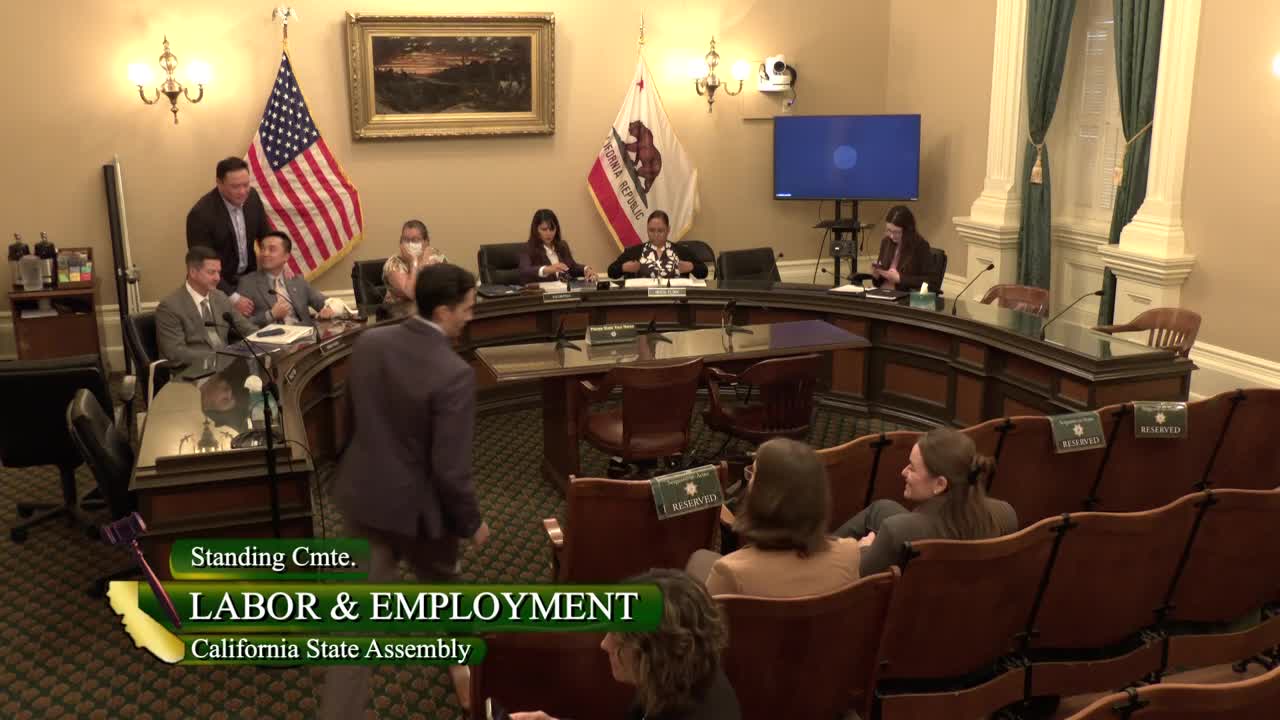 5MIN
Assembly Standing Committee on Labor and Employment
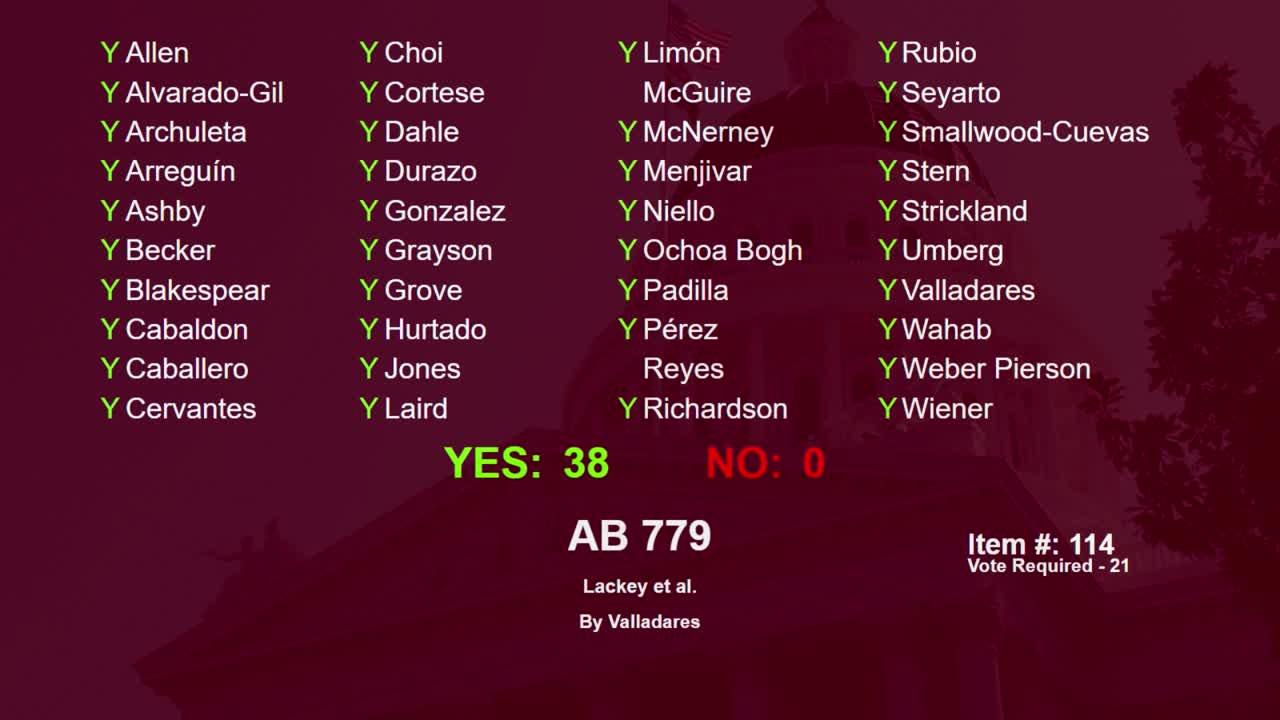 2MIN
Senate Floor
 6MIN
Senate Standing Committee on Judiciary
 7MIN
Senate Standing Committee on Labor, Public Employment and Retirement
 51SEC
Assembly Floor
 2MIN
Assembly Standing Committee on Labor and Employment
Bill Author