AB 1153: Illegal disposal site abatement.
- Session Year: 2025-2026
- House: Assembly
- Latest Version Date: 2026-09-14
Current Status:
Passed
(2026-09-15: Chaptered by Secretary of State - Chapter 194, Statutes of 2026.)
Introduced
In Committee
Awaiting First Chamber Vote
Passed First Chamber
In Committee
Awaiting Second Chamber Vote
Passed Second Chamber
Enacted
The California Integrated Waste Management Act of 1989, which is administered by the Department of Resources Recycling and Recovery, establishes an integrated waste management program. The act requires the department to initiate a program for the cleanup of solid waste disposal sites and for cleanup of solid waste at codisposal sites where no responsible party is available to pay for timely remediation, and where cleanup is needed to protect public health and safety or the environment.
This bill would authorize the department, upon appropriation by the Legislature, to develop regulations and expend funds to remove and dispose of recreational vehicles, as defined, to develop enforcement strategies, and to develop local enforcement teams and illegal dumping enforcement officers, as specified.
The California Integrated Waste Management Act of 1989, which is administered by the Department of Resources Recycling and Recovery, establishes an integrated waste management program. The act requires the department to initiate a program for the cleanup of solid waste disposal sites and for cleanup of solid waste at codisposal sites where no responsible party is available to pay for timely remediation, and where cleanup is needed to protect public health and safety or the environment. Existing law provides that all expenses incurred by the department in carrying out the program are to be paid from the Solid Waste Disposal Site Cleanup Trust Fund, which is continuously appropriated to the department for purposes of the program. Existing law authorizes the department, in administering the program, to expend funds for specified purposes, including providing grants to public entities for the abatement of illegal disposal sites.
This bill would additionally authorize the department department, upon appropriation by the Legislature, to expend funds appropriated for the program for removing and disposing to remove and dispose of recreational vehicles, as defined, for developing to develop enforcement strategies, and for developing to develop local enforcement teams and illegal dumping enforcement officers, as specified. By authorizing new uses of moneys in a continuously appropriated fund, this bill would make an appropriation.
The California Integrated Waste Management Act of 1989, which is administered by the Department of Resources Recycling and Recovery, establishes an integrated waste management program. The act requires the department to initiate a program for the cleanup of solid waste disposal sites and for cleanup of solid waste at codisposal sites where no responsible party is available to pay for timely remediation, and where cleanup is needed to protect public health and safety or the environment. Existing law provides that all expenses incurred by the department in carrying out the program are to be paid from the Solid Waste Disposal Site Cleanup Trust Fund, which is continuously appropriated to the department for purposes of the program. Existing law authorizes the department, in administering the program, to expend funds for specified purposes, including providing grants to public entities for the abatement of illegal disposal sites.
This bill would additionally authorize the department, as part of grants provided to public entities to abate illegal disposal sites, to provide funding department to expend funds appropriated for the program for removing and disposing of recreational vehicles, as defined, for developing enforcement strategies, and for developing local enforcement teams and illegal dumping enforcement officers, as defined. specified. By expanding the scope of the grants, which are funded by authorizing new uses of moneys in a continuously appropriated fund, this bill would make an appropriation.
The California Integrated Waste Management Act of 1989, which is administered by the Department of Resources Recycling and Recovery, establishes an integrated waste management program. The act requires the department to initiate a program for the cleanup of solid waste disposal sites and for cleanup of solid waste at codisposal sites where no responsible party is available to pay for timely remediation, and where cleanup is needed to protect public health and safety or the environment. Existing law provides that all expenses incurred by the department in carrying out the program are to be paid from the Solid Waste Disposal Site Cleanup Trust Fund, which is continuously appropriated to the department for purposes of the program. Existing law authorizes the department, in administering the program, to expend funds for specified purposes, including providing grants to public entities for the abatement of illegal disposal sites.
This bill would additionally authorize the department, as part of grants provided to public entities to abate illegal disposal sites, to provide funding for removing and disposing of recreational vehicles, as defined, for enforcement strategies, and for developing local enforcement teams and illegal dumping enforcement officers, as defined. By expanding the scope of the grants, which are funded by a continuously appropriated fund, this bill would make an appropriation.
(a)The department, upon appropriation by the Legislature, may develop regulations and expend funds through grants and existing programs to support local enforcement agencies in any of the following:
(1)The removal and disposal of an abandoned recreational vehicle, as defined in Section 18010 of the Health and Safety Code.
(2)The development of enforcement strategies.
(3)The development of local enforcement teams and illegal dumping enforcement officers, as defined in Section 830.7 of the Penal Code.
(b)When implementing this section, the department shall prioritize projects in disadvantaged communities, as described in Section 39711 of the Health and Safety Code.
(a)The department, upon appropriation by the Legislature, may develop regulations and expend funds for through grants and existing programs to support local enforcement agencies in any of the following:
(1)The removal and disposal of an abandoned recreational vehicle, as defined in Section 18010 of the Health and Safety Code.
(2)The development of enforcement strategies.
(3)The development of local enforcement teams and illegal dumping enforcement officers, as defined in Section 830.7 of the Penal Code.
(b)When implementing this section, the department shall prioritize projects in disadvantaged communities, as described in Section 39711 of the Health and Safety Code.
(a)The department, upon appropriation by the Legislature, may expend funds for any of the following:
(1)The removal and disposal of an abandoned recreational vehicle, as defined in Section 18010 of the Health and Safety Code.
(2)The development of enforcement strategies.
(3)The development of local enforcement teams and illegal dumping enforcement officers, as defined in Section 830.7 of the Penal Code.
(b)When implementing this section, the department shall prioritize projects in disadvantaged communities, as described in Section 39711 of the Health and Safety Code.
SECTION 1.Section 48021 of the Public Resources Code is amended to read:48021.(a)In prioritizing the sites for cleanup pursuant to Section 48020, the department shall consider the degree of risk to public health and safety and the environment posed by conditions at a site, the ability of the site owner to clean up the site without monetary assistance, the ability of the department to clean up the site adequately with available funds, maximizing the use of available funds, and other factors as determined by the department.(b)(1)In administering the program authorized by Section 48020, the department may expend funds directly for cleanup, provide loans to parties who demonstrate the ability to repay state funds, and provide partial grants to public entities, to assist in site cleanup.(2)The department may expend funds directly for the cleanup of a publicly owned site only if the department determines that the public entity lacks resources or expertise to timely manage the cleanup itself.(3)In addition to the criteria specified in subdivision (a), in considering partial grants that provide greater than 50 percent of the funds directly for cleanup, the department shall consider all of the following:(A)The amount of contributions of moneys or in-kind services from the applicant.(B)The availability of other appropriate funding sources to remediate the site.(C)The degree of public benefit.(D)The presence of innovative and cost-effective programs to abate or prevent solid waste problems to be addressed by the grants.(E)Other factors as determined by the department.(c)(1)In addition to the expenditures specified in subdivision (b), the department may expend a portion of the funds appropriated for the program to abate illegal disposal sites.(2)For the purposes of this subdivision, the department may provide grants to public entities.(3)Where funds are provided by the department to address illegal disposal sites within a jurisdiction, the local enforcement agency shall provide ongoing enforcement to prevent recurring illegal disposal at the site.(4)For the purposes of this subdivision, an activity to remove or abate solid waste disposed into a municipal storm sewer is eligible to receive a partial grant, if the grant is used for solid waste cleanup, solid waste abatement, or any other activity that mitigates the impact of solid waste, and an ongoing program is established to prevent recurring solid waste disposal into the municipal storm sewer.(d)(1)In addition to the expenditures specified in subdivisions (b) and (c), the department may expend funds appropriated for the program for any of the following:(A)The removal and disposal of an abandoned recreational vehicle, as defined in Section 18010 of the Health and Safety Code.(B)The development of enforcement strategies.(C)The development of local enforcement teams and illegal dumping enforcement officers, as defined in Section 830.7 of the Penal Code.(2)When implementing this subdivision, the department shall prioritize projects in disadvantaged communities, as described in Section 39711 of the Health and Safety Code. (e)In developing and implementing the program, the department shall consult with certified local enforcement agencies and the regional water boards.(a)In prioritizing the sites for cleanup pursuant to Section 48020, the board department shall consider the degree of risk to public health and safety and the environment posed by conditions at a site, the ability of the site owner to clean up the site without monetary assistance, the ability of the board department to clean up the site adequately with available funds, maximizing the use of available funds, and other factors as determined by the board. department.
(b)(1)In administering the program authorized by Section 48020, the board department may expend funds directly for cleanup, provide loans to parties who demonstrate the ability to repay state funds, and provide partial grants to public entities, to assist in site cleanup.
(2)The board department may expend funds directly for the cleanup of a publicly owned site only if the board department determines that the public entity lacks resources or expertise to timely manage the cleanup itself.
(3)In addition to the criteria specified in subdivision (a), in considering partial grants that provide greater than 50 percent of the funds directly for cleanup, the board department shall consider all of the following:
(A)The amount of contributions of moneys or in-kind services from the applicant.
(B)The availability of other appropriate funding sources to remediate the site.
(C)The degree of public benefit.
(D)The presence of innovative and cost-effective programs to abate or prevent solid waste problems to be addressed by the grants.
(E)Other factors as determined by the board. department.
(c)(1)In addition to the expenditures specified in subdivision (b), the board department may expend a portion of the funds appropriated for the program to abate illegal disposal sites, including, but not limited to, all of the following: sites.
(A)Funding for the removal and disposal of a recreational vehicle, as defined in Section 18010 of the Health and Safety Code.(B)Funding for enforcement strategies.(C)Funding for developing local enforcement teams and illegal dumping enforcement officers, as defined in Section 830.7 of the Penal Code.(2)For the purposes of this subdivision, the board department may provide grants to public entities.
(3)Where funds are provided by the board department to address illegal disposal sites within a jurisdiction, the local enforcement agency shall provide ongoing enforcement to prevent recurring illegal disposal at the site.
(4)For the purposes of this subdivision, an activity to remove or abate solid waste disposed into a municipal storm sewer is eligible to receive a partial grant, if the grant is used for solid waste cleanup, solid waste abatement, or any other activity that mitigates the impact of solid waste, and an ongoing program is established to prevent recurring solid waste disposal into the municipal storm sewer.
(d)(1)In addition to the expenditures specified in subdivisions (b) and (c), the department may expend funds appropriated for the program for any of the following:
(A)The removal and disposal of an abandoned recreational vehicle, as defined in Section 18010 of the Health and Safety Code.
(B)The development of enforcement strategies.
(C)The development of local enforcement teams and illegal dumping enforcement officers, as defined in Section 830.7 of the Penal Code.
(2)When implementing this subdivision, the department shall prioritize projects in disadvantaged communities, as described in Section 39711 of the Health and Safety Code.
(d)(e)In developing and implementing the program, the board department shall consult with certified local enforcement agencies and the regional water boards.
(a)In prioritizing the sites for cleanup pursuant to Section 48020, the board shall consider the degree of risk to public health and safety and the environment posed by conditions at a site, the ability of the site owner to clean up the site without monetary assistance, the ability of the board to clean up the site adequately with available funds, maximizing the use of available funds, and other factors as determined by the board.
(b)(1)In administering the program authorized by Section 48020, the board may expend funds directly for cleanup, provide loans to parties who demonstrate the ability to repay state funds, and provide partial grants to public entities, to assist in site cleanup.
(2)The board may expend funds directly for the cleanup of a publicly owned site only if the board determines that the public entity lacks resources or expertise to timely manage the cleanup itself.
(3)In addition to the criteria specified in subdivision (a), in considering partial grants that provide greater than 50 percent of the funds directly for cleanup, the board shall consider the all of the following:
(A)The amount of contributions of moneys or in-kind services from the applicant; the applicant.
(B)The availability of other appropriate funding sources to remediate the site; the site.
(C)The degree of public benefit; the benefit.
(D)The presence of innovative and cost-effective programs to abate or prevent solid waste problems to be addressed by the grants; and other grants.
(E)Other factors as determined by the board.
(c)(1)In addition to the expenditures specified in subdivision (b), the board may expend a portion of the funds appropriated for the program to abate illegal disposal sites. sites, including, but not limited to, all of the following:
(A)Funding for the removal and disposal of a recreational vehicle, as defined in Section 18010 of the Health and Safety Code.
(B)Funding for enforcement strategies.
(C)Funding for developing local enforcement teams and illegal dumping enforcement officers, as defined in Section 830.7 of the Penal Code.
(2)For the purposes of this subdivision, the board may provide grants to public entities.
(3)Where funds are provided by the board to address illegal disposal sites within a jurisdiction, the local enforcement agency shall provide ongoing enforcement to prevent recurring illegal disposal at the site.
(4)For the purposes of this subdivision, an activity to remove or abate solid waste disposed into a municipal storm sewer is eligible to receive a partial grant, if the grant is used for solid waste cleanup, solid waste abatement, or any other activity that mitigates the impact of solid waste, and an ongoing program is established to prevent recurring solid waste disposal into the municipal storm sewer.
(d)In developing and implementing the program, the board shall consult with certified local enforcement agencies and the regional water boards.
|
Date
|
Status
|
|---|---|
| Sep 15, 2026 | Chaptered by Secretary of State - Chapter 194, Statutes of 2026. |
| Sep 15, 2026 | Approved by the Governor. |
| Sep 14, 2026 | Chaptered by Secretary of State - Chapter 194, Statutes of 2026. |
| Sep 14, 2026 | Approved by the Governor. |
| Aug 28, 2026 | Enrolled and presented to the Governor at 3:30 p.m. |
| Aug 24, 2026 | Senate amendments concurred in. To Engrossing and Enrolling. (Ayes 77. Noes 0. Page 6398.). |
| Aug 24, 2026 | Senate amendments concurred in. To Engrossing and Enrolling. (Ayes 77. Noes 0.). |
| Aug 24, 2026 | Senate amendments concurred in. To Engrossing and Enrolling. |
| Aug 20, 2026 | In Assembly. Concurrence in Senate amendments pending. |
| Aug 20, 2026 | Read third time. Passed. Ordered to the Assembly. (Ayes 39. Noes 0. Page 5588.). |
| Aug 20, 2026 | Read third time. Passed. Ordered to the Assembly. (Ayes 39. Noes 0.). |
| Aug 18, 2026 | Ordered to special consent calendar. |
| Aug 13, 2026 | Read second time. Ordered to third reading. |
| Aug 13, 2026 | From committee: Do pass. (Ayes 7. Noes 0.) (August 13). |
| Jun 29, 2026 | In committee: Referred to APPR. suspense file. |
| Jun 18, 2026 | Read second time and amended. Re-referred to Com. on APPR. |
| Jun 17, 2026 | From committee: Amend, and do pass as amended and re-refer to Com. on APPR. with recommendation: To Consent Calendar. (Ayes 7. Noes 0.) (June 17). |
| May 28, 2026 | In committee: Hearing postponed by committee. |
| May 6, 2026 | Referred to Com. on E.Q. |
| Jan 29, 2026 | In Senate. Read first time. To Com. on RLS. for assignment. |
| Jan 29, 2026 | Read third time. Passed. Ordered to the Senate. (Ayes 75. Noes 0. Page 3875.) |
| Jan 26, 2026 | Read second time. Ordered to third reading. |
| Jan 22, 2026 | Read second time and amended. Ordered returned to second reading. |
| Jan 22, 2026 | From committee: Amend, and do pass as amended. (Ayes 11. Noes 0.) (January 22). |
| Jan 22, 2026 | Assembly Rule 63 suspended. (Page 3806.) |
| May 23, 2025 | In committee: Hearing postponed by committee. |
| Apr 30, 2025 | In committee: Set, first hearing. Referred to suspense file. |
| Apr 23, 2025 | Re-referred to Com. on APPR. |
| Apr 22, 2025 | Read second time and amended. |
| Apr 21, 2025 | From committee: Amend, and do pass as amended and re-refer to Com. on APPR. (Ayes 14. Noes 0.) (April 7). |
| Mar 10, 2025 | Referred to Com. on NAT. RES. |
| Feb 21, 2025 | From printer. May be heard in committee March 23. |
| Feb 20, 2025 | Read first time. To print. |
|
Date
|
Description
|
Location
|
Votes
|
|
|---|---|---|---|---|
| Aug 24, 2026 | AB 1153 Bonta Concurrence in Senate Amendments | Assembly Floor |
Passed |
|
| Aug 20, 2026 | Special Consent AB1153 Bonta | Senate Floor |
Passed |
|
| Aug 13, 2026 | Do pass | Senate Standing Committee on Appropriations |
Passed |
|
| Jun 29, 2026 | Placed on suspense file | Senate Standing Committee on Appropriations |
Passed |
|
| Jun 17, 2026 | Do pass as amended, but first amend, and re-refer to the Committee on [Appropriations] with the recommendation: To Consent Calendar | Senate Standing Committee on Environmental Quality |
Passed |
|
| Jan 29, 2026 | AB 1153 Bonta Assembly Third Reading | Assembly Floor |
Passed |
|
| Jan 22, 2026 | Do pass as amended. | Assembly Standing Committee on Appropriations |
Passed |
|
| Apr 7, 2025 | Do pass as amended and be re-referred to the Committee on [Appropriations] | Assembly Standing Committee on Natural Resources |
Passed |
This list shows positions taken on this bill by organizations on the date displayed, which is linked to the original source.
Positions by individuals are not included.
|
Organization
|
Position
|
Date
|
|---|---|---|
| ALAMEDA; COUNTY OF | ** Support | |
| A Voice for Choice Advocacy | ** Support | |
| Californians Against Waste | ** Support | |
| California State Association Of Counties | ** Support | |
| City of Alameda | ** Support | |
| City of Milpitas | ** Support | |
| County Of Alameda | ** Support | |
| East Bay Municipal Utility District | ** Support | |
| Emeryville; City Of | ** Support | |
| League Of California Cities | ** Support | |
| Los Angeles County | ** Support | |
| RCRC | ** Support | |
| Rural County Representatives of California | ** Support | |
| Yorba Linda Water District | ** Support |
CONCURRENCE IN SENATE AMENDMENTS
CSA1 Bill Id:AB 1153
Author:(Bonta)
As Amended Ver:June 18, 2026
Majority vote
SUMMARY
Authorizes the Department of Resources Recycling and Recovery (CalRecycle) to, upon appropriation, fund the disposal of abandoned recreational vehicles (RVs), and the development of enforcement strategies, including development of local enforcement teams and illegal dumping enforcement officers.
Senate Amendments
Authorize CalRecycle to develop regulations and to expend funds through grants and existing programs to support local enforcement agencies.
COMMENTS
Illegal dumping. Illegal dumping occurs when a person or business disposes of solid waste at locations other than permitted solid waste disposal facilities. Across the state, illegal dumping creates significant environmental, social, and economic impacts. Illegal dumping can contaminate soil and water when plastics, heavy metals, and other waste materials leach into the ground. Permitted landfills are designed to properly contain waste and prevent contamination of surrounding soil and water. In addition, landfills undergo continuous environmental monitoring to help ensure they do not pollute nearby areas.
Illegal dumping also creates substantial financial burdens. Local governments spend tens of millions of dollars each year removing illegally dumped materials. Private property owners may also bear cleanup costs when waste is dumped on their land or when they work to beautify and protect their communities.
Despite ongoing state and local efforts, illegal dumping continues to increase in many parts of California. For example, reports of illegal dumping rose sharply in 2025 compared to the same period in 2024. According to data compiled by Crosstown LA, reports of illegally discarded trash, furniture, and other debris increased from 16,212 during January and February 2024 to 22,046 during the same two-month period last year.
A report commissioned by Sacramento County, the City of Sacramento, and the Sacramento Regional Solid Waste Authority found that Sacramento experienced a 32% increase in illegal dumping over the past three years.
Illegal dumping technical advisory committee (IDTAC). In 2006, CalRecycle established a state and local technical advisory committee to assess the extent of illegal dumping and to develop recommendations to improve the effectiveness of local and regional responses to the problem. Originally established as a task force, the group developed recommendations that were presented to the former California Integrated Waste Management Board in 2007. IDTAC is composed of local government entities, state government entities, nonprofit organizations, and others. The Illegal Dumping Toolbox was created by the IDTAC to provide resources to local governments to help combat illegal dumping.
In 2020, IDTAC completed a Work Plan to develop new and expanded resources and objectives to address illegal dumping. The Work Plan includes priorities and objectives in three areas: enforcement, outreach, and standards. In addition to the Work Plan, the IDTAC has focused on, and provides information to local governments and the public about, the topics of homeless encampments and abandoned vehicles.
State and local responsibility. State and local agencies are authorized to cite individuals that are caught illegally dumping, but those agencies are not usually responsible for cleanup programs. Instead, different branches of local government are generally responsible for abating illegal dump sites.
Every local government has a different strategy and capacity to address illegal dumping. For example, Los Angeles County has created a web portal for residents to report illegal dumping and prioritizes cleanups of dump sites based in part on the number of residents who report a given site. However, many more counties or cities have no system in place for residents to report illegal dump sites. In some local jurisdictions, local code enforcement is the primary mechanism for abating litter and enforcing cleanups: in others, public work departments have the primary role in organizing cleanups.
CalRecycle provides direction, training, and certification of Local Enforcement Agencies (LEAs) that carry out many CalRecycle directives. CalRecycle also administers some limited funding for litter and illegal dumping cleanup projects. These funding opportunities include the Farm and Ranch Grant Program and grants for California Conservation Corps.
Abandoned vehicles. According to the US Department of Justice′s Problem Oriented Guide for Police: Problem Specific Guides: Abandoned Vehicles, factors that contribute to abandonment include the costs of operating and maintaining vehicles, regulation and licensing requirements, and other circumstances, such as using them for shelter and difficulty associated with removal.
Removing abandoned vehicles presents both operational and legal challenges. Vehicles are personal property, and there are constitutional and other laws governing their removal. Generally, abandoned vehicles must be tagged or cited, efforts must be undertaken to identify and notice the owner, and specified time periods must pass before they can be removed. Upon removal, they are generally stored for some time before being dismantled or disposed. RVs often require specialized towing and are more costly to remove and store than cars, and costs vary depending on their size, condition, and location. According to one removal service, costs vary from around $500 to $2500 for removal. Another removal service charges $100 per foot (length), for motorhomes. Estimates for the dismantling of inoperable RVs range from approximately $5,000 to $9,000 per vehicle.
Abandoned Vehicle Abatement (AVA) Program. The California Highway Patrol's (CHP′s) AVA Program was designed to provide guidance for counties that wish to develop and administer AVA authorities. The AVA Program provides a means to remove abandoned vehicles that create a public nuisance or a health and safety hazard. There are currently 37 counties participating in the AVA Program, and additional counties have expressed interest in sample plans to develop local plans that conform to program guidelines. Counties that participate charge a $1 vehicle registration fee for all vehicles registered in the county, and that money funds removal of abandoned vehicles.
Solid Waste Disposal and Codisposal Site Cleanup Program. CalRecycle administers the solid waste disposal and codisposal site cleanup program, which allocates $1 million annually for public entities to fund illegally disposed waste removal and disposal, security measures (i.e., fences, signs, etc.), and health and safety measures associated with the cleanup. Grant awards are limited to $50,000 per applicant per year. According to CalRecycle, the current balance of the Solid Waste Disposal Site Cleanup Trust Fund (SWTF) is $1.2 million. The existing grant programs were oversubscribed by an average of 235% over the past three years, with the illegal disposal site abatement grant program oversubscribed by 323%. CalRecycle has utilized approximately 45% of its SWTF budget for department-managed projects, with $5.3 million in projects currently under development and an additional $4.2 million in projects under review and for future consideration.
This bill. AB 1153 would tap in CalRecycle to, upon appropriation, develop regulations to specify how funds for removal and disposal of an abandoned recreational vehicle and enforcement strategies shall be expended in coordination with existing local enforcement activities. This will use state resources to address an emerging problem that currently rests primarily on the shoulders of local agencies.
According to the Author
Across California, the growing number of abandoned recreational vehicles (RVs) is creating significant public health, safety, and environmental hazards in our communities. Currently, local governments lack adequate resources and authority to properly address the removal and disposal of these vehicles. The cost to dismantle and dispose of RVs can reach up to $9,000 per vehicle, far exceeding what most cities can absorb in their illegal dumping budgets.
AB 1153 the Funding Clean Streets Act ensures that local governments have the tools they need to tackle this growing issue by expanding CalRecycle's Illegal and Abandoned Disposal Sites Program to cover abandoned recreational vehicles. This bill will help protect our communities, improve public safety, and ensure clean and accessible streets for everyone—especially in neighborhoods that have historically been overburdened by illegal dumping and environmental neglect.
Arguments in Support
According to a coalition of local government supporters, "Abandoned vehicles increase the complexity and cost of illegal dumping cleanup, requiring local governments to navigate legal notice requirements and waiting periods before vehicles can be towed, dismantled, and disposed of. There is a growing need for financial assistance from local jurisdictions for the purposes of illegal disposal site abatement including the costly management of abandoned vehicles."
Arguments in Opposition
None on file
FISCAL COMMENTS
- Ongoing cost pressure of an unknown but potentially significant amount, possibly in the hundreds of thousands of dollars annually (Solid Waste Disposal Site Cleanup Trust Fund [SWTF]), to CalRecycle's cleanup program in order to fund the removal and disposal of abandoned RVs and for the other purposes stated in this bill.
- Unknown but likely significant ongoing costs, likely in the hundreds of thousands of dollars annually (SWTF or other special fund), for CalRecycle to promulgate regulations, develop grant program criteria and application materials, implement the grant program, and provide ongoing assistance to grantees, among other things.
VOTES:
ASM NATURAL RESOURCES: 14-0-0
YES: Bryan, Alanis, Connolly, Ellis, Flora, Garcia, Haney, Hoover, Kalra, Muratsuchi, Pellerin, Schultz, Wicks, Zbur
ASM APPROPRIATIONS: 11-0-4
YES: Wicks, Stefani, Calderon, Caloza, Fong, Mark González, Krell, Bauer-Kahan, Pacheco, Pellerin, Solache
ABS, ABST OR NV: Hoover, Dixon, Ta, Tangipa
ASSEMBLY FLOOR: 75-0-5
YES: Addis, Aguiar-Curry, Ahrens, Alanis, Alvarez, Ávila Farías, Bains, Bauer-Kahan, Bennett, Berman, Boerner, Bonta, Bryan, Calderon, Caloza, Carrillo, Castillo, Chen, Connolly, Davies, DeMaio, Dixon, Elhawary, Ellis, Flora, Fong, Gabriel, Gallagher, Garcia, Jeff Gonzalez, Mark González, Hadwick, Haney, Harabedian, Hart, Hoover, Irwin, Jackson, Johnson, Kalra, Krell, Lackey, Lee, Lowenthal, Macedo, McKinnor, Muratsuchi, Nguyen, Ortega, Pacheco, Papan, Patel, Patterson, Pellerin, Petrie-Norris, Quirk-Silva, Ramos, Michelle Rodriguez, Rogers, Blanca Rubio, Sanchez, Schiavo, Schultz, Sharp-Collins, Solache, Soria, Stefani, Ta, Tangipa, Wallis, Ward, Wicks, Wilson, Zbur, Rivas
ABS, ABST OR NV: Arambula, Gipson, Ransom, Celeste Rodriguez, Valencia
UPDATED
VERSION: June 18, 2026
CONSULTANT: Elizabeth MacMillan / NAT. RES. /(916) 319-2092 FN: 0003838
SENATE RULES COMMITTEE Office of Senate Floor Analyses (916) 651-4171 | AB 1153 |
THIRD READING
Bill No: AB 1153
Author: Bonta (D)
Amended: 6/18/26 in Senate
Vote: 21
SENATE ENVIRONMENTAL QUALITY COMMITTEE: 7-0, 6/17/26
AYES: Blakespear, Valladares, Allen, Dahle, Gonzalez, Hurtado, Menjivar
SENATE APPROPRIATIONS COMMITTEE: 7-0, 8/13/26
AYES: Cervantes, Seyarto, Cabaldon, Dahle, Grayson, Richardson, Wahab
ASSEMBLY FLOOR: 75-0, 1/29/26 - See last page for vote
SUBJECT: Illegal disposal site abatement
SOURCE: Author
DIGEST:
This bill authorizes the Department of Resources Recycling and Recovery (CalRecycle) to, upon appropriation, fund the disposal of abandoned recreational vehicles (RVs), and the development of enforcement strategies, including development of local enforcement teams and illegal dumping enforcement officers.
ANALYSIS:
Existing law:
- The California Integrated Waste Management Act of 1989 (The Act), administered by CalRecycle, generally regulates solid waste disposal, management, and recycling. (Public Resources Code (PRC) § 40050 et seq.)
- The Act authorizes a local governmental agency to determine aspects of solid waste handling that are of local concern, including, but not limited to, fees to charge and the extent of providing solid waste handling services. (PRC § 40058-4006)
- Establishes the cleanup program for the cleanup of solid waste disposal sites and the cleanup of solid waste at codisposal sites (i.e., sites that contain both solid and hazardous waste) where the responsible party either cannot be identified or is unable or unwilling to pay for timely remediation, and where cleanup is needed to protect public health and safety or the environment. (PRC § 48020)
- Establishes the Solid Waste Disposal and Codisposal Site Cleanup Trust Fund (trust fund). (PRC § 48027)
- Requires CalRecycle to prioritize grants depending on the degree of risk to public health and safety and the environment posed by the site, the ability of the site owner to clean up the site, the ability of CalRecycle to clean up the site with available funds, maximize the use of available funds, and other factors determined by CalRecycle. (PRC § 48021)
- Requires CalRecycle to pursue reimbursement from responsible parties in an amount equal to the amount expended for the cleanup, a reasonable amount to cover administration, and an amount equal to the interest that would have been earned on expended funds. (PRC § 48023)
- Specifies that any costs or damages incurred by CalRecycle constitute a lien on the real property owned by any responsible party that is subject to remedial action, whether or not the party is insolvent. (PRC § 48023.5)
- Prohibits a peace officer or unauthorized person from removing an unattended vehicle from a highway to a garage or any other place, except as specified. Specifies that the removal of a vehicle is a seizure under the Fourth Amendment of the United States Constitution. (Vehicle Code (VC) § 22650)
- Authorizes local governments to adopt ordinances establishing procedures for the abatement and removal, as public nuisances, of abandoned, wrecked, dismantled, or inoperative vehicles or parts thereof from private or public property. (VC § 22660)
- Authorizes the California Highway Patrol (CHP) to administer a local jurisdiction’s abandoned vehicle abatement and removal program (AVA Program) and establishes procedures for the abatement and removal of abandoned vehicles. (VC § 22665-22666)
- Authorizes a county to establish a service authority for the abatement of abandoned vehicles (AVA authority) and allows a $1 vehicle registration fee to be imposed, in the county. Authorizes the service authority to adopt an ordinance establishing procedures for the abatement, removal, and disposal of abandoned, wrecked, dismantled, or inoperative vehicle or part of the vehicle from private or public property and for the recovery of costs associated with the enforcement of the ordinance. (VC § 22710)
This bill:
- This bill authorizes CalRecycle to, upon appropriation, fund the removal and disposal of an abandoned recreational vehicle (RV), the development of enforcement strategies, and the development of local enforcement teams and illegal dumping enforcement officers.
- Requires CalRecycle to prioritize projects in disadvantaged communities when implementing this bill.
Background
- Illegal dumping. Illegal dumping occurs when a person or business disposes of solid waste at locations other than permitted solid waste disposal facilities. Across the state, illegal dumping creates significant environmental, social, and economic impacts. Illegal dumping can contaminate soil and water when plastics, heavy metals, and other waste materials leach into the ground. Permitted landfills are designed to properly contain waste and prevent contamination of surrounding soil and water. In addition, landfills undergo continuous environmental monitoring to help ensure they do not pollute nearby areas.
Illegal dumping also creates substantial financial burdens. Local governments spend tens of millions of dollars each year removing illegally dumped materials. Private property owners may also bear cleanup costs when waste is dumped on their land or when they work to beautify and protect their communities.
Despite ongoing state and local efforts, illegal dumping continues to increase in many parts of California. For example, reports of illegal dumping rose sharply earlier this year compared to the same period in 2024. According to data compiled by Crosstown LA, reports of illegally discarded trash, furniture, and other debris increased from 16,212 during January and February 2024 to 22,046 during the same two-month period this year.
A report commissioned by Sacramento County, the City of Sacramento, and the Sacramento Regional Solid Waste Authority found that Sacramento experienced a 32% increase in illegal dumping over the past three years.
- Illegal dumping technical advisory committee (IDTAC). In 2006, CalRecycle established a state and local technical advisory committee to assess the extent of illegal dumping and to develop recommendations to improve the effectiveness of local and regional responses to the problem. Originally established as a task force, the group developed recommendations that were presented to the former California Integrated Waste Management Board in 2007. IDTAC is composed of local government entities, state government entities, nonprofit organizations, and others. The Illegal Dumping Toolbox was created by the IDTAC to provide resources to local governments to help combat illegal dumping.
In 2020, IDTAC completed a Work Plan to develop new and expanded resources and objectives to address illegal dumping. The Work Plan includes priorities and objectives in three areas: enforcement, outreach, and standards. In addition to the Work Plan, the IDTAC has focused on, and provides information to local governments and the public about, the topics of homeless encampments and abandoned vehicles.
- Government Responsibility for Illegal Dumping? Local and State policing agencies cite individuals that are caught illegally dumping, but those agencies are not usually responsible for cleanup programs. Instead, different branches of local governments may be responsible for abating and cleaning up illegal dump sites.
Every local government has a different strategy and capacity to address illegal dumping. For example, Los Angeles County has created a web portal for residents to report illegal dumping and prioritizes cleanups of dump sites based in part on the number of residents who report a given site. However, many more counties or cities have no system in place for residents to report illegal dump sites. In some local jurisdictions, local code enforcement is the primary mechanism for abating litter and enforcing cleanups: in others, public work departments have the primary role in organizing cleanups.
However they approach abatement and cleanup activities, local entities are supported in their efforts by CalRecycle, which provides direction, training, and certification of Local Enforcement Agencies (LEAs) that carry out many CalRecycle directives. CalRecycle also administers some limited funding for litter and illegal dumping cleanup projects. These funding opportunities include the Farm and Ranch Grant Program and grants for California Conservation Corps.
- Abandoned vehicles. According to the US Department of Justice′s Problem Oriented Guide for Police: Problem Specific Guides: Abandoned Vehicles (which includes all kinds of vehicles, not just RVs), factors that contribute to abandonment include the costs of operating and maintaining vehicles, regulation and licensing requirements, and other circumstances, such as using them for shelter and difficulty associated with removal.
Removing abandoned vehicles presents both operational and legal challenges. Vehicles are personal property, and there are constitutional and other laws governing their removal. Generally, abandoned vehicles must be tagged or cited, efforts must be undertaken to identify and notice the owner, and specified time periods must pass before they can be removed. Upon removal, they are generally stored for some time before being dismantled or disposed. RVs often require specialized towing and are more costly to remove and store than cars, and costs vary depending on their size, condition, and location. According to one removal service, costs vary from around $500 to $2500 for removal. Another removal service charged $100 per foot (length), for motorhomes. Estimates for the dismantling of inoperable RVs range from approximately $5,000 to $9,000 per vehicle.
- Abandoned Vehicle Abatement Program. The CHP′s AVA Program was designed to provide guidance for counties that wish to develop and administer AVA authorities. The AVA Program provides a means to remove abandoned vehicles that create a public nuisance or a health and safety hazard. There are currently 37 counties participating in the AVA Program, and additional counties have expressed interest in sample plans to develop local plans that conform to program guidelines. Counties that participate charge a $1 vehicle registration fee for all vehicles registered in the county, and that money funds removal of abandoned vehicles.
- Solid Waste Disposal and Codisposal Site Cleanup Program. CalRecycle administers the solid waste disposal and codisposal site cleanup program, which allocates $1 million annually for public entities to fund illegally disposed waste removal and disposal, security measures (i.e., fences, signs, etc.), and health and safety measures associated with the cleanup. Grant awards are limited to $50,000 per applicant per year. According to CalRecycle, the current balance of the Solid Waste Disposal Site Cleanup Trust Fund (SWTF) is $1.2 million. The existing grant programs were oversubscribed by an average of 235% over the past three years, with the illegal disposal site abatement grant program oversubscribed by 323%. CalRecycle has utilized approximately 45% of its SWTF budget for department-managed projects, with $5.3 million in projects currently under development and an additional $4.2 million in projects under review and for future consideration.
Comments
- Purpose of Bill. According to the author, “Across California, the growing number of abandoned recreational vehicles (RVs) is creating significant public health, safety, and environmental hazards in our communities. Currently, local governments lack adequate resources and authority to properly address the removal and disposal of these vehicles. The cost to dismantle and dispose of RVs can reach up to $9,000 per vehicle, far exceeding what most cities can absorb in their illegal dumping budgets.
“AB 1153 the Funding Clean Streets Act ensures that local governments have the tools they need to tackle this growing issue by expanding CalRecycle’s Illegal and Abandoned Disposal Sites Program to cover abandoned recreational vehicles. This bill will help protect our communities, improve public safety, and ensure clean and accessible streets for everyone—especially in neighborhoods that have historically been overburdened by illegal dumping and environmental neglect.”
- What funds, expended how? AB 1153 would tap in CalRecycle to, upon appropriation, develop regulations to specify how funds for removal and disposal of an abandoned recreational vehicle and enforcement strategies shall be expended in coordination with existing local enforcement activities. This will use state resources to address an emerging problem that currently rests primarily on the shoulders of local agencies.
Related/Prior Legislation
SB 1230 (Valladares, 2026) would increase the fines for the illegal dumping of waste matter for repeat offenders and requires the CalRecycle to act as a resource for cities and counties to address illegal dumping through the creation of a website. SB 1230 is currently on the Senate Floor.
FISCAL EFFECT: Appropriation: No Fiscal Com.: Yes Local: No
According to the assembly appropriations committee, SB 1230 will incur:
- Ongoing cost pressure of an unknown but potentially significant amount, possibly in the hundreds of thousands of dollars annually (Solid Waste Disposal Site Cleanup Trust Fund [SWTF]), to CalRecycle’s cleanup program in order to fund the removal and disposal of abandoned RVs and for the other purposes stated in this bill.
- Unknown but likely significant ongoing costs, likely in the hundreds of thousands of dollars annually (SWTF or other special fund), for CalRecycle to promulgate regulations, develop grant program criteria and application materials, implement the grant program, and provide ongoing assistance to grantees, among other things.
SUPPORT: (Verified 8/14/26)
Alameda; County of
California State Association of Counties
Californians Against Waste
City of Alameda
City of Milpitas
East Bay Municipal Utility District
Emeryville; City of
League of California Cities
Los Angeles County
Rural County Representatives of California
Yorba Linda Water District
OPPOSITION: (Verified 8/14/26)
1 Individual
ASSEMBLY FLOOR: 75-0, 1/29/26
AYES: Addis, Aguiar-Curry, Ahrens, Alanis, Alvarez, Ávila Farías, Bains, Bauer-Kahan, Bennett, Berman, Boerner, Bonta, Bryan, Calderon, Caloza, Carrillo, Castillo, Chen, Connolly, Davies, DeMaio, Dixon, Elhawary, Ellis, Flora, Fong, Gabriel, Gallagher, Garcia, Jeff Gonzalez, Mark González, Hadwick, Haney, Harabedian, Hart, Hoover, Irwin, Jackson, Johnson, Kalra, Krell, Lackey, Lee, Lowenthal, Macedo, McKinnor, Muratsuchi, Nguyen, Ortega, Pacheco, Papan, Patel, Patterson, Pellerin, Petrie-Norris, Quirk-Silva, Ramos, Michelle Rodriguez, Rogers, Blanca Rubio, Sanchez, Schiavo, Schultz, Sharp-Collins, Solache, Soria, Stefani, Ta, Tangipa, Wallis, Ward, Wicks, Wilson, Zbur, Rivas
NO VOTE RECORDED: Arambula, Gipson, Ransom, Celeste Rodriguez, Valencia
Prepared by: Brynn Cook / E.Q. / (916) 651-4108
8/14/26 15:13:15
**** END ****
SENATE COMMITTEE ON
Senator Sabrina Cervantes, Chair
2025 - 2026 Regular Session
AB 1153 (Bonta) - Illegal disposal site abatement
Version: | Policy Vote: |
Urgency: | Mandate: |
Hearing Date: | Consultant: |
Bill Summary:
This bill would authorize the Department of Resources Recycling and Recovery (CalRecycle) to, upon appropriation, fund the disposal of abandoned recreational vehicles (RVs), and the development of enforcement strategies, including development of local enforcement teams and illegal dumping enforcement officers
Fiscal Impact:
- Ongoing cost pressure of an unknown but potentially significant amount, possibly in the hundreds of thousands of dollars annually (Solid Waste Disposal Site Cleanup Trust Fund [SWTF]), to CalRecycle’s cleanup program in order to fund the removal and disposal of abandoned RVs and for the other purposes stated in this bill.
- Unknown but likely significant ongoing costs, likely in the hundreds of thousands of dollars annually (SWTF or other special fund), for CalRecycle to promulgate regulations, develop grant program criteria and application materials, implement the grant program, and provide ongoing assistance to grantees, among other things.
Background:
Illegal dumping technical advisory committee (IDTAC). In 2006, CalRecycle established a state and local technical advisory committee to assess the extent of illegal dumping and to develop recommendations to improve the effectiveness of local and regional responses to the problem. Originally established as a task force, the group developed recommendations that were presented to the former California Integrated Waste Management Board in 2007. IDTAC is composed of local government entities, state government entities, nonprofit organizations, and others. The Illegal Dumping Toolbox was created by the IDTAC to provide resources to local governments to help combat illegal dumping.
In 2020, IDTAC completed a Work Plan to develop new and expanded resources and objectives to address illegal dumping. The Work Plan includes priorities and objectives in three areas: enforcement, outreach, and standards. In addition to the Work Plan, the IDTAC has focused on, and provides information to local governments and the public about, the topics of homeless encampments and abandoned vehicles.
Government role. Local and State policing agencies cite individuals that are caught illegally dumping, but those agencies are not usually responsible for cleanup programs. Instead, different branches of local governments may be responsible for abating and cleaning up illegal dump sites.
Every local government has a different strategy and capacity to address illegal dumping. For example, Los Angeles County has created a web portal for residents to report illegal dumping and prioritizes cleanups of dump sites based in part on the number of residents who report a given site. However, many more counties or cities have no system in place for residents to report illegal dump sites. In some local jurisdictions, local code enforcement is the primary mechanism for abating litter and enforcing cleanups: in others, public work departments have the primary role in organizing cleanups.
However they approach abatement and cleanup activities, local entities are supported in their efforts by CalRecycle, which provides direction, training, and certification of Local Enforcement Agencies (LEAs) that carry out many CalRecycle directives. CalRecycle also administers some limited funding for litter and illegal dumping cleanup projects. These funding opportunities include the Farm and Ranch Grant Program and grants for California Conservation Corps.
Abandoned vehicles. According to the US Department of Justice′s Problem Oriented Guide for Police: Problem Specific Guides: Abandoned Vehicles (which includes all kinds of vehicles, not just RVs), factors that contribute to abandonment include the costs of operating and maintaining vehicles, regulation and licensing requirements, and other circumstances, such as using them for shelter and difficulty associated with removal.
Removing abandoned vehicles presents both operational and legal challenges. Vehicles are personal property, and there are constitutional and other laws governing their removal. Generally, abandoned vehicles must be tagged or cited, efforts must be undertaken to identify and notice the owner, and specified time periods must pass before they can be removed. Upon removal, they are generally stored for some time before being dismantled or disposed. RVs often require specialized towing and are more costly to remove and store than cars, and costs vary depending on their size, condition, and location. According to one removal service, costs vary from around $500 to $2500 for removal. Another removal service charged $100 per foot (length), for motorhomes. Estimates for the dismantling of inoperable RVs range from approximately $5,000 to $9,000 per vehicle.
Abandoned Vehicle Abatement Program. The CHP′s AVA Program was designed to provide guidance for counties that wish to develop and administer AVA authorities. The AVA Program provides a means to remove abandoned vehicles that create a public nuisance or a health and safety hazard. There are currently 37 counties participating in the AVA Program, and additional counties have expressed interest in sample plans to develop local plans that conform to program guidelines. Counties that participate charge a $1 vehicle registration fee for all vehicles registered in the county, and that money funds removal of abandoned vehicles.
Solid Waste Disposal and Codisposal Site Cleanup Program. CalRecycle administers the solid waste disposal and codisposal site cleanup program, which allocates $1 million annually for public entities to fund illegally disposed waste removal and disposal, security measures (i.e., fences, signs, etc.), and health and safety measures associated with the cleanup. Grant awards are limited to $50,000 per applicant per year. According to CalRecycle, the current balance of the Solid Waste Disposal Site Cleanup Trust Fund (SWTF) is $1.2 million. The existing grant programs were oversubscribed by an average of 235% over the past three years, with the illegal disposal site abatement grant program oversubscribed by 323%. CalRecycle has utilized approximately 45% of its SWTF budget for department-managed projects, with $5.3 million in projects currently under development and an additional $4.2 million in projects under review and for future consideration.
Proposed Law:
This bill would:
- This bill authorizes CalRecycle to, upon appropriation, develop regulations and expend funds through grants and existing programs to support local enforcement agencies in the removal and disposal of an abandoned RV, the development of enforcement strategies, and the development of local enforcement teams and illegal dumping enforcement officers.
- Requires CalRecycle to prioritize projects in disadvantaged communities when implementing this bill.
Related Legislation:
SB 1230 (Valladares, 2026) would increase the fines for the illegal dumping of waste matter for repeat offenders and require the CalRecycle to act as a resource for cities and counties to address illegal dumping through the creation of a website.
Staff Comments:
CalRecycle typically utilizes the entirety of the $5 million allocated to the cleanup program in the annual budget. Of this total amount, $2.5 million is allocated to grants, with $1.5 million for legacy solid waste disposal site remediation grants and $1 million for illegal disposal site abatement grants.
According to CalRecycle, the current balance of the SWTF is $1.2 million. The existing grant programs were oversubscribed by an average of 235% over the past three years, with the illegal disposal site abatement grant program oversubscribed by 323%. CalRecycle has utilized approximately 45% of its SWTF budget for department-managed projects, with $5.3 million in projects currently under development and an additional $4.2 million in projects under review and for future consideration. Given the high cost of RV removal, this bill has the potential to significantly reduce the amount of funds available for traditional illegal disposal sites.
AB 1153 would authorize CalRecycle to expend funds through grants and existing programs to support local enforcement agencies to clean up abandoned RVs, and to develop enforcement strategies including developing local enforcement teams and illegal dumping enforcement officers. Given that abandoned RVs are expensive to dispose of, any funds from the state to cover disposal costs will benefit the city or county that is currently on the hook for cleanup costs associated with abandoned RVs (assuming that they are not salvageable).
-- END --
SENATE COMMITTEE ON ENVIRONMENTAL QUALITY
Senator Blakespear, Chair
2025 - 2026 Regular
Bill No: AB 1153
Author: | Bonta | ||
Version: | 1/22/2026 | Hearing Date: | 06/17/2026 |
Urgency: | No | Fiscal: | Yes |
Consultant: | Brynn Cook | ||
SUBJECT: Illegal disposal site abatement
DIGEST: This bill authorizes the Department of Resources Recycling and Recovery (CalRecycle) to, upon appropriation, fund the disposal of abandoned recreational vehicles (RVs), and the development of enforcement strategies, including development of local enforcement teams and illegal dumping enforcement officers.
ANALYSIS:
Existing law:
- The California Integrated Waste Management Act of 1989 (The Act), administered by the Department of Resources Recycling and Recovery (CalRecycle), generally regulates solid waste disposal, management, and recycling. (Public Resources Code (PRC) § 40050 et seq.)
- The Act authorizes a local governmental agency to determine aspects of solid waste handling that are of local concern, including, but not limited to, fees to charge and the extent of providing solid waste handling services. (PRC § 40058-4006)
- Establishes the cleanup program for the cleanup of solid waste disposal sites and the cleanup of solid waste at codisposal sites (i.e., sites that contain both solid and hazardous waste) where the responsible party either cannot be identified or is unable or unwilling to pay for timely remediation, and where cleanup is needed to protect public health and safety or the environment. (PRC § 48020)
- Establishes the Solid Waste Disposal and Codisposal Site Cleanup Trust Fund (trust fund). (PRC § 48027)
- Requires CalRecycle to prioritize grants depending on the degree of risk to public health and safety and the environment posed by the site, the ability of the site owner to clean up the site, the ability of CalRecycle to clean up the site with available funds, maximize the use of available funds, and other factors determined by CalRecycle. (PRC § 48021)
- Requires CalRecycle to pursue reimbursement from responsible parties in an amount equal to the amount expended for the cleanup, a reasonable amount to cover administration, and an amount equal to the interest that would have been earned on expended funds. (PRC § 48023)
- Specifies that any costs or damages incurred by CalRecycle constitute a lien on the real property owned by any responsible party that is subject to remedial action, whether or not the party is insolvent. (PRC § 48023.5)
- Prohibits a peace officer or unauthorized person from removing an unattended vehicle from a highway to a garage or any other place, except as specified. Specifies that the removal of a vehicle is a seizure under the Fourth Amendment of the United States Constitution. (Vehicle Code (VC) § 22650)
- Authorizes local governments to adopt ordinances establishing procedures for the abatement and removal, as public nuisances, of abandoned, wrecked, dismantled, or inoperative vehicles or parts thereof from private or public property. (VC § 22660)
- Authorizes the California Highway Patrol (CHP) to administer a local jurisdiction’s abandoned vehicle abatement and removal program (AVA Program) and establishes procedures for the abatement and removal of abandoned vehicles. (VC § 22665-22666)
- Authorizes a county to establish a service authority for the abatement of abandoned vehicles (AVA authority) and allows a $1 vehicle registration fee to be imposed, in the county. Authorizes the service authority to adopt an ordinance establishing procedures for the abatement, removal, and disposal of abandoned, wrecked, dismantled, or inoperative vehicle or part of the vehicle from private or public property and for the recovery of costs associated with the enforcement of the ordinance. (VC § 22710)
This bill:
- This bill authorizes CalRecycle to, upon appropriation, fund the removal and disposal of an abandoned recreational vehicle (RV), the development of enforcement strategies, and the development of local enforcement teams and illegal dumping enforcement officers.
- Requires CalRecycle to prioritize projects in disadvantaged communities when implementing this bill.
Background
- Illegal dumping. Illegal dumping occurs when a person or business disposes of solid waste at locations other than permitted solid waste disposal facilities. Across the state, illegal dumping creates significant environmental, social, and economic impacts. Illegal dumping can contaminate soil and water when plastics, heavy metals, and other waste materials leach into the ground. Permitted landfills are designed to properly contain waste and prevent contamination of surrounding soil and water. In addition, landfills undergo continuous environmental monitoring to help ensure they do not pollute nearby areas.
Illegal dumping also creates substantial financial burdens. Local governments spend tens of millions of dollars each year removing illegally dumped materials. Private property owners may also bear cleanup costs when waste is dumped on their land or when they work to beautify and protect their communities.
Despite ongoing state and local efforts, illegal dumping continues to increase in many parts of California. For example, reports of illegal dumping rose sharply earlier this year compared to the same period in 2024. According to data compiled by Crosstown LA, reports of illegally discarded trash, furniture, and other debris increased from 16,212 during January and February 2024 to 22,046 during the same two-month period this year.
A report commissioned by Sacramento County, the City of Sacramento, and the Sacramento Regional Solid Waste Authority found that Sacramento experienced a 32% increase in illegal dumping over the past three years.
- Illegal dumping technical advisory committee (IDTAC). In 2006, CalRecycle established a state and local technical advisory committee to assess the extent of illegal dumping and to develop recommendations to improve the effectiveness of local and regional responses to the problem. Originally established as a task force, the group developed recommendations that were presented to the former California Integrated Waste Management Board in 2007. IDTAC is composed of local government entities, state government entities, nonprofit organizations, and others. The Illegal Dumping Toolbox was created by the IDTAC to provide resources to local governments to help combat illegal dumping.
In 2020, IDTAC completed a Work Plan to develop new and expanded resources and objectives to address illegal dumping. The Work Plan includes priorities and objectives in three areas: enforcement, outreach, and standards. In addition to the Work Plan, the IDTAC has focused on, and provides information to local governments and the public about, the topics of homeless encampments and abandoned vehicles.
- Government Responsibility for Illegal Dumping? Local and State policing agencies cite individuals that are caught illegally dumping, but those agencies are not usually responsible for cleanup programs. Instead, different branches of local governments may be responsible for abating and cleaning up illegal dump sites.
Every local government has a different strategy and capacity to address illegal dumping. For example, Los Angeles County has created a web portal for residents to report illegal dumping and prioritizes cleanups of dump sites based in part on the number of residents who report a given site. However, many more counties or cities have no system in place for residents to report illegal dump sites. In some local jurisdictions, local code enforcement is the primary mechanism for abating litter and enforcing cleanups: in others, public work departments have the primary role in organizing cleanups.
However they approach abatement and cleanup activities, local entities are supported in their efforts by CalRecycle, which provides direction, training, and certification of Local Enforcement Agencies (LEAs) that carry out many CalRecycle directives. CalRecycle also administers some limited funding for litter and illegal dumping cleanup projects. These funding opportunities include the Farm and Ranch Grant Program and grants for California Conservation Corps.
- Abandoned vehicles. According to the US Department of Justice′s Problem Oriented Guide for Police: Problem Specific Guides: Abandoned Vehicles (which includes all kinds of vehicles, not just RVs), factors that contribute to abandonment include the costs of operating and maintaining vehicles, regulation and licensing requirements, and other circumstances, such as using them for shelter and difficulty associated with removal.
Removing abandoned vehicles presents both operational and legal challenges. Vehicles are personal property, and there are constitutional and other laws governing their removal. Generally, abandoned vehicles must be tagged or cited, efforts must be undertaken to identify and notice the owner, and specified time periods must pass before they can be removed. Upon removal, they are generally stored for some time before being dismantled or disposed. RVs often require specialized towing and are more costly to remove and store than cars, and costs vary depending on their size, condition, and location. According to one removal service, costs vary from around $500 to $2500 for removal. Another removal service charged $100 per foot (length), for motorhomes. Estimates for the dismantling of inoperable RVs range from approximately $5,000 to $9,000 per vehicle.
- Abandoned Vehicle Abatement Program. The CHP′s AVA Program was designed to provide guidance for counties that wish to develop and administer AVA authorities. The AVA Program provides a means to remove abandoned vehicles that create a public nuisance or a health and safety hazard. There are currently 37 counties participating in the AVA Program, and additional counties have expressed interest in sample plans to develop local plans that conform to program guidelines. Counties that participate charge a $1 vehicle registration fee for all vehicles registered in the county, and that money funds removal of abandoned vehicles.
- Solid Waste Disposal and Codisposal Site Cleanup Program. CalRecycle administers the solid waste disposal and codisposal site cleanup program, which allocates $1 million annually for public entities to fund illegally disposed waste removal and disposal, security measures (i.e., fences, signs, etc.), and health and safety measures associated with the cleanup. Grant awards are limited to $50,000 per applicant per year. According to CalRecycle, the current balance of the Solid Waste Disposal Site Cleanup Trust Fund (SWTF) is $1.2 million. The existing grant programs were oversubscribed by an average of 235% over the past three years, with the illegal disposal site abatement grant program oversubscribed by 323%. CalRecycle has utilized approximately 45% of its SWTF budget for department-managed projects, with $5.3 million in projects currently under development and an additional $4.2 million in projects under review and for future consideration.
Comments
- Purpose of Bill. According to the author, “Across California, the growing number of abandoned recreational vehicles (RVs) is creating significant public health, safety, and environmental hazards in our communities. Currently, local governments lack adequate resources and authority to properly address the removal and disposal of these vehicles. The cost to dismantle and dispose of RVs can reach up to $9,000 per vehicle, far exceeding what most cities can absorb in their illegal dumping budgets.
“AB 1153 the Funding Clean Streets Act ensures that local governments have the tools they need to tackle this growing issue by expanding CalRecycle’s Illegal and Abandoned Disposal Sites Program to cover abandoned recreational vehicles. This bill will help protect our communities, improve public safety, and ensure clean and accessible streets for everyone—especially in neighborhoods that have historically been overburdened by illegal dumping and environmental neglect.”
- What funds, expended how? AB 1153 would authorize CalRecycle to expend funds to clean up abandoned RVs, and to develop enforcement strategies including developing local enforcement teams and illegal dumping enforcement officers. Given that abandoned RVs are expensive to dispose of, any funds from the state to cover disposal costs will benefit the city or county that is currently on the hook for cleanup costs associated with abandoned RVs (assuming that they are not salvageable).
However, in its current form it is not clear how CalRecycle would determine how and where these funds should be expended, or how persons or entities, like governments, would contact CalRecycle to receive any funds. It is also unclear how CalRecycle would expend funds to develop local enforcement teams and illegal dumping enforcement officers. At a minimum, it would seem that this would be best accomplished under direction from local agencies that currently oversee enforcement of illegal dumping and abandoned vehicles. It is also unclear how much money would be needed to make a significant difference in mitigating RV dumping.
The author and committee may wish to specify that CalRecycle will, upon appropriation, develop regulations to specify how funds for removal and disposal of an abandoned recreational vehicle and enforcement strategies shall be expended in coordination with existing local enforcement activities. - Committee amendments. Staff recommends the committee adopt the bolded amendments in comment 2 above.
Related/Prior Legislation
SB 1230 (Valladares, 2026) This bill would increase the fines for the illegal dumping of waste matter for repeat offenders and requires the CalRecycle to act as a resource for cities and counties to address illegal dumping through the creation of a website. SB 1230 is currently on the Senate Floor.
SOURCE:
Author
SUPPORT:
Alameda; County of
California State Association of Counties (CSAC)
Californians Against Waste
City of Alameda
East Bay Municipal Utility District
Emeryville; City of
League of California Cities
Los Angeles County
Rural County Representatives of California (RCRC)
OPPOSITION:
None received
-- END --
ASSEMBLY THIRD READING
ATR Bill Id:AB 1153
Author:(Bonta)
As Amended Ver:January 22, 2026
Majority vote
SUMMARY
This bill authorizes the Department of Resources Recycling and Recovery (CalRecycle) to, upon appropriation, fund the removal and disposal of an abandoned recreational vehicle (RV), the development of enforcement strategies, and the development of local enforcement teams and illegal dumping enforcement officers. The bill requires CalRecycle to prioritize projects in disadvantaged communities when implementing this bill.
Major Provisions
COMMENTS
- Illegal dumping. Illegal dumping is the act of disposing of solid waste at a location that is not a permitted solid waste facility. In California, illegal dumping is often done for economic gain, either by individuals who opt to dump their own waste illegally to avoid paying disposal fees or by illegitimate “junk hauling” entities that collect waste for disposal for a fee, but don′t haul the material to a permitted facility. Illegal dumping poses significant social, environmental, and economic impacts statewide. According to CalRecycle, local governments spend tens of millions of dollars annually to remove illegally dumped materials, and private property owners incur significant costs to clean up illegal dumping on private lands. Once a site has illegally dumped material, the site tends to grow in size and becomes more difficult to abate.
Most local governments treat illegal dumping as a nuisance/litter issue rather than a violation of solid waste laws. The methods used by local governments to manage illegal dumping vary widely. Local and state law enforcement entities will cite people caught illegally dumping, but those agencies are not responsible for cleanup programs. No single state or local agency is given responsibility for a comprehensive program to combat littering and illegal dumping. CalRecycle is responsible for investigation, cleanup, and enforcement of sites that qualify as illegal solid waste disposal sites and shares this responsibility with local enforcement agencies.
In spite of state and local efforts, illegal dumping is increasing in many parts of the state. For example, reports of illegal dumping soared early this year compared to the same period in 2024. According to data compiled by Crosstown LA, there were 22,046 reports of trash, furniture, and other debris illegally disposed in the months of January and February, compared to 16,212 last year over the same two-month period.
- Illegal dumping technical advisory committee (IDTAC). CalRecycle established a state and local technical advisory committee in 2006 to assess the extent of illegal dumping and to develop recommendations to improve the effectiveness of local and regional responses to the problem. Originally established as a task force, the group developed recommendations that were presented to the former California Integrated Waste Management Board in 2007. IDTAC is comprised of local government entities, state government entities, nonprofit organizations, and others. The Illegal Dumping Toolbox was created by the IDTAC to provide resources to local governments to help combat illegal dumping.
In 2020, IDTAC completed a Work Plan to develop new and expanded resources and objectives to address illegal dumping. The Work Plan includes priorities and objectives in three areas: enforcement, outreach, and standards. In addition to the Work Plan, the IDTAC has focused on, and provides information to local governments and the public about, the topics of homeless encampments and abandoned vehicles.
- Abandoned vehicles. Abandoned vehicle abatement efforts encompass everything from motorcycles to ships. This bill is focused on the abatement of abandoned RVs. According to the US Department of Justice′s Problem Oriented Guide for Police: Problem Specific Guides: Abandoned Vehicles, factors that contribute to abandonment include the costs of operating and maintaining vehicles, regulation and licensing requirements, and other circumstances, such as using them for shelter and difficulty associated with removal.
Unlike other forms of illegal dumping, removal of abandoned vehicles is complex and requires numerous steps. Vehicles are personal property, and there are constitutional and other laws governing their removal. Generally, abandoned vehicles must be tagged or cited, efforts must be undertaken to identify and notice the owner, and specified time periods must pass before they can be removed. Upon removal, they are generally stored for some time before being dismantled or disposed. RVs often require specialized towing and are more costly to remove and store than cars, and costs vary depending on their size, condition, and location. According to one removal service, costs vary from around $500 to $2500 for removal. Estimates for the dismantling of inoperable RVs range from approximately $5,000 to $9,000 per vehicle.
- Abandoned Vehicle Abatement Program. The CHP′s AVA Program was designed to provide guidance for counties that wish to develop and administer AVA authorities. The AVA Program provides a means to remove abandoned vehicles that create a public nuisance or a health and safety hazard. There are currently 37 counties participating in the AVA Program, and additional counties have expressed interest in sample plans to develop local plans that conform to program guidelines. Counties participating in the program are eligible for funding for the removal of abandoned vehicles using funding from a $1 vehicle registration fee for all vehicles registered within the county.
- Solid Waste Disposal and Codisposal Site Cleanup Program. CalRecycle administers this cleanup program, which allocates $1 million annually for public entities to fund illegally disposed waste removal and disposal, security measures (i.e., fences, signs, etc.), and health and safety measures associated with the cleanup. Grant awards are limited to $50,000 per applicant per year.
- Farm and Ranch Solid Waste Cleanup and Abatement Program. CalRecycle administers a grant program to eligible cities, counties, resource conservation districts, and Native American tribes for the cleanup and abatement of illegal dumping on farm and ranch properties. Funding for this program is limited to $1 million each fiscal year. Grants are limited to $50,000 per site and $200,000 per applicant per year.
According to the Author
Across California, the growing number of abandoned recreational vehicles (RVs) is creating significant public health, safety, and environmental hazards in our communities. Currently, local governments lack adequate resources and authority to properly address the removal and disposal of these vehicles. The cost to dismantle and dispose of RVs can reach up to $9,000 per vehicle, far exceeding what most cities can absorb in their illegal dumping budgets.
This bill will help protect our communities, improve public safety, and ensure clean and accessible streets for everyone—especially in neighborhoods that have historically been overburdened by illegal dumping and environmental neglect.
Arguments in Support
According to a coalition of local government organizations:
The California Integrated Waste Management Act of 1989 requires the Department of Resources Recycling and Recovery (CalRecycle) to initiate a program to pay for the cleanup of solid waste disposal sites and solid waste at codisposal sites where no responsible party is available to pay for timely remediation, and where cleanup is needed to protect public health and safety or the environment. Paid from the Solid Waste Disposal Site Cleanup Trust Fund, CalRecycle′s Solid Waste Site Cleanup Program utilizes the funding to provide grants or loans to local, state, or federal governments, certified local enforcement agencies, or directly manage and fund cleanup projects. AB 1153 (Bonta) expands the activities eligible for funding under this grant program to include enforcement strategies, local enforcement officers and teams, and the removal and disposal of recreational vehicles.
CSAC, RCRC, and Cal Cities support AB 1153 (Bonta), however, additional funding is needed for this grant program to address the growing need for financial assistance from local jurisdictions for the purposes of illegal disposal site abatement including the costly management of abandoned vehicles.
Arguments in Opposition
None on file
FISCAL COMMENTS
According to the Assembly Appropriations Committee:
- Ongoing cost pressure of an unknown but potentially significant amount, possibly in the hundreds of thousands of dollars, to fund the removal and disposal of abandoned RVs and for the other purposes stated in the bill. As discussed below, removing abandoned RVs may require specialized equipment, with costs ranging from $500 to $2,500 per vehicle. Estimates for the dismantling of inoperable RVs range from approximately $5,000 to $9,000 per vehicle. Funding for the proposed program is subject to appropriation by the Legislature.
2) CalRecycle estimates ongoing annual costs of approximately $150,000 for one new position (General Fund or special fund) to develop grant program criteria and application materials, implement the grant program, and provide ongoing assistance to grantees.
VOTES
ASM NATURAL RESOURCES: 14-0-0
YES: Bryan, Alanis, Connolly, Ellis, Flora, Garcia, Haney, Hoover, Kalra, Muratsuchi, Pellerin, Schultz, Wicks, Zbur
ASM APPROPRIATIONS: 11-0-4
YES: Wicks, Stefani, Calderon, Caloza, Fong, Mark González, Krell, Bauer-Kahan, Pacheco, Pellerin, Solache
ABS, ABST OR NV: Hoover, Dixon, Ta, Tangipa
UPDATED
VERSION: January 22, 2025
CONSULTANT: Elizabeth MacMillan / NAT. RES. / FN: 0002265
Date of Hearing: April 30, 2025
ASSEMBLY COMMITTEE ON APPROPRIATIONS
Buffy Wicks, Chair
ABPCA Bill Id:AB 1153
Author:(Bonta) – As Amended Ver:April 22, 2025
Policy Committee: | Natural Resources | Vote: | 14 - 0 |
|
| ||
|
|
Urgency: No State Mandated Local Program: No Reimbursable: No
SUMMARY:
This bill authorizes the Department of Resources Recycling and Recovery (CalRecycle) to expend funds appropriated for the solid waste disposal and codisposal site cleanup program (cleanup program) for the removal and disposal of an abandoned recreational vehicle (RV), the development of enforcement strategies, and the development of local enforcement teams and illegal dumping enforcement officers. The bill requires CalRecycle to prioritize projects in disadvantaged communities when implementing this bill.
FISCAL EFFECT:
1) Ongoing cost pressure of an unknown but potentially significant amount, possibly in the hundreds of thousands of dollars, on CalRecycle’s cleanup program to fund the removal and disposal of abandoned RVs and for the other purposes stated in the bill (Solid Waste Disposal Site Cleanup Trust Fund (SWTF)). CalRecycle typically utilizes the entirety of the $5 million allocated to the cleanup program in the annual budget. Of this total amount, $2.5 million is allocated to grants, with $1.5 million for legacy solid waste disposal site remediation grants and $1 million for illegal disposal site abatement grants.
According to CalRecycle, the current balance of the SWTF is $1.2 million. The existing grant programs were oversubscribed by an average of 235% over the past three years, with the illegal disposal site abatement grant program oversubscribed by 323%. CalRecycle has utilized approximately 45% of its SWTF budget for department-managed projects, with $5.3 million in projects currently under development and an additional $4.2 million in projects under review and for future consideration. Given the high cost of RV removal, this bill has the potential to significantly reduce the amount of funds available for traditional illegal disposal sites.
2) CalRecycle estimates ongoing annual costs of approximately $150,000 for one new position (SWTF or other special fund) to develop grant program criteria and application materials, implement the grant program, and provide ongoing assistance to grantees.
COMMENTS:
1) Purpose. According to the author:
Across California, the growing number of abandoned recreational vehicles (RVs) is creating significant public health, safety, and environmental hazards in our communities. Currently, local governments lack adequate resources and authority to properly address the removal and disposal of these vehicles…AB 1153 the Funding Clean Streets Act ensures that local governments have the tools they need to tackle this growing issue by expanding CalRecycle’s Illegal and Abandoned Disposal Sites Program to cover abandoned recreational vehicles.
2) Background. CalRecycle’s cleanup program funds the cleanup of solid waste sites and solid waste located at codisposal sites where the responsible party either cannot be identified or is unwilling or unable to pay for the timely remediation of the site – and where cleanup is necessary to protect public health and safety or the environment. The program provides four types of funding: CalRecycle-managed cleanup, legacy disposal site abatement grants, illegal disposal site abatement grants, and loans to local governments.
The program is funded by the SWTF, which is continuously appropriated, can expend a maximum of $5 million each fiscal year, and cannot have a balance exceeding $30 million, with a typical unencumbered fund balance of $1 million to $2 million maintained as a prudent reserve. Revenues in the SWTF are comprised of funds appropriated by the Legislature from the Integrated Waste Management Fund (IWMF) to CalRecycle for solid waste disposal or codisposal site cleanup, interest earned from the money in the fund, and cost recoveries from responsible parties for solid waste disposal loan repayments.
Writing in support of this bill, the City of Alameda notes that while CalRecycle’s cleanup program is a great resource for cities, it does not allow funds to be used to remove abandoned RVs. Removing abandoned RVs may require specialized equipment, with costs ranging from $500 to $2,500 per vehicle. Estimates for the dismantling of inoperable RVs range from approximately $5,000 to $9,000 per vehicle. Californians Against Waste (CAW) notes that in places like Los Angeles County, officials have had to launch dedicated programs to manage the estimated 500 illegally parked RVs lining local streets. CAW argues: “The sheer scope of the problem underscores the urgent need for an expansion of existing funding mechanisms to help local governments manage these high-cost removals.”
Analysis Prepared by: Nikita Koraddi / APPR. / (916) 319-2081
Date of Hearing: April 7, 2025
ASSEMBLY COMMITTEE ON NATURAL RESOURCES
Isaac G. Bryan, Chair
ABPCA Bill Id:AB 1153 (
Author:Bonta) – As Introduced Ver:February 20, 2025
SUBJECT: Solid waste disposal and codisposal site cleanup: illegal disposal site abatement
SUMMARY: Revises the Department of Resources Recycling and Recovery’s (CalRecycle) Solid Waste Disposal and Codisposal Site Cleanup Program (cleanup program) to specify that illegal disposal site cleanup includes the funding of removal and disposal of recreational vehicles (RVs), enforcement strategies, and developing local enforcement teams and illegal dumping enforcement officers, as specified.
EXISTING LAW:
- Establishes the cleanup program for the cleanup of solid waste disposal sites and the cleanup of solid waste at codisposal sites (i.e., sites that contain both solid and hazardous waste) where the responsible party either cannot be identified or is unable or unwilling to pay for timely remediation, and where cleanup is needed to protect public health and safety or the environment. (Public Resources Code (PRC) 48020)
- Establishes the Solid Waste Disposal and Codisposal Site Cleanup Trust Fund (trust fund). (PRC 48027)
- Requires CalRecycle to prioritize grants depending on the degree of risk to public health and safety and the environment posed by the site, the ability of the site owner to clean up the site, the ability of CalRecycle to clean up the site with available funds, maximize the use of available funds, and other factors determined by CalRecycle. (PRC 48021)
- Requires CalRecycle to pursue reimbursement from responsible parties in an amount equal to the amount expended for the cleanup, a reasonable amount to cover administration, and an amount equal to the interest that would have been earned on expended funds. (PRC 48023)
- Specifies that any costs or damages incurred by CalRecycle constitute a lien on the real property owned by any responsible party that is subject to remedial action, whether or not the party is insolvent. (PRC 48023.5)
- Prohibits a peace officer or unauthorized person from removing an unattended vehicle from a highway to a garage or any other place, except as specified. Specifies that the removal of a vehicle is a seizure under the Fourth Amendment of the United States Constitution. (Vehicle Code (VC) 22650)
- Authorizes local governments to adopt ordinances establishing procedures for the abatement and removal, as public nuisances, of abandoned, wrecked, dismantled, or inoperative vehicles or parts thereof from private or public property. (VC 22660)
- Authorizes the California Highway Patrol (CHP) to administer a local jurisdiction’s abandoned vehicle abatement and removal program (AVA Program) and establishes procedures for the abatement and removal of abandoned vehicles. (VC 22665-22666)
- Authorizes a county to establish a service authority for the abatement of abandoned vehicles (AVA authority) and allows a $1 vehicle registration fee to be imposed, in the county. Authorizes the service authority to adopt an ordinance establishing procedures for the abatement, removal, and disposal of abandoned, wrecked, dismantled, or inoperative vehicle or part of the vehicle from private or public property and for the recovery of costs associated with the enforcement of the ordinance. (VC 22710)
FISCAL EFFECT: Unknown
COMMENTS:
- Illegal dumping. Illegal dumping is the act of disposing of solid waste at a location that is not a permitted solid waste facility. In California, illegal dumping is often done for economic gain, either by individuals who opt to dump their own waste illegally to avoid paying disposal fees or by illegitimate “junk hauling” entities that collect waste for disposal for a fee, but don’t haul the material to a permitted facility. Illegal dumping poses significant social, environmental, and economic impacts statewide. According to CalRecycle, local governments spend tens of millions of dollars annually to remove illegally dumped materials, and private property owners incur significant costs to clean up illegal dumping on private lands. Once a site has illegally dumped material, the site tends to grow in size and becomes more difficult to abate.
Most local governments treat illegal dumping as a nuisance/litter issue rather than a violation of solid waste laws. The methods used by local governments to manage illegal dumping vary widely. Local and state law enforcement entities will cite people caught illegally dumping, but those agencies are not responsible for cleanup programs. No single state or local agency is given responsibility for a comprehensive program to combat littering and illegal dumping. CalRecycle is responsible for investigation, cleanup, and enforcement of sites that qualify as illegal solid waste disposal sites and shares this responsibility with local enforcement agencies.
In spite of state and local efforts, illegal dumping is increasing in many parts of the state. For example, reports of illegal dumping soared early this year compared to the same period in 2024. According to data compiled by Crosstown LA, there were 22,046 reports of trash, furniture, and other debris illegally disposed in the months of January and February, compared to 16,212 last year over the same two-month period.
- Illegal dumping technical advisory committee (IDTAC). CalRecycle established a state and local technical advisory committee in 2006 to assess the extent of illegal dumping and to develop recommendations to improve the effectiveness of local and regional responses to the problem. Originally established as a task force, the group developed recommendations that were presented to the former California Integrated Waste Management Board in 2007. IDTAC is comprised of local government entities, state government entities, nonprofit organizations, and others. The Illegal Dumping Toolbox was created by the IDTAC to provide resources to local governments to help combat illegal dumping.
In 2020, IDTAC completed a Work Plan to develop new and expanded resources and objectives to address illegal dumping. The Work Plan includes priorities and objectives in three areas: enforcement, outreach, and standards. In addition to the Work Plan, the IDTAC has focused on, and provides information to local governments and the public about, the topics of homeless encampments and abandoned vehicles. - Abandoned vehicles. Abandoned vehicle abatement efforts encompass everything from motorcycles to ships. This bill is focused on the abatement of abandoned RVs. According to the US Department of Justice’s Problem Oriented Guide for Police: Problem Specific Guides: Abandoned Vehicles, factors that contribute to abandonment include the costs of operating and maintaining vehicles, regulation and licensing requirements, and other circumstances, such as using them for shelter and difficulty associated with removal.
Unlike other forms of illegal dumping, removal of abandoned vehicles is complex and requires numerous steps. Vehicles are personal property, and there are constitutional and other laws governing their removal. Generally, abandoned vehicles must be tagged or cited, efforts must be undertaken to identify and notice the owner, and specified time periods must pass before they can be removed. Upon removal, they are generally stored for some time before being dismantled or disposed. RVs often require specialized towing and are more costly to remove and store than cars, and costs vary depending on their size, condition, and location. According to one removal service, costs vary from around $500 to $2500 for removal. Estimates for the dismantling of inoperable RVs range from approximately $5,000 to $9,000 per vehicle. - Abandoned Vehicle Abatement Program. The CHP’s AVA Program was designed to provide guidance for counties that wish to develop and administer AVA authorities. The AVA Program provides a means to remove abandoned vehicles that create a public nuisance or a health and safety hazard. There are currently 37 counties participating in the AVA Program, and additional counties have expressed interest in sample plans to develop local plans that conform to program guidelines. Counties participating in the program are eligible for funding for the removal of abandoned vehicles using funding from a $1 vehicle registration fee for all vehicles registered within the county.
- Solid Waste Disposal and Codisposal Site Cleanup Program. The cleanup program allocates $1 million annually for public entities to fund illegally disposed waste removal and disposal, security measures (i.e., fences, signs, etc.), and health and safety measures associated with the cleanup. Grant awards are limited to $50,000 per applicant per year.
- Farm and Ranch Solid Waste Cleanup and Abatement Program. CalRecycle administers a grant program to eligible cities, counties, resource conservation districts, and Native American tribes for the cleanup and abatement of illegal dumping on farm and ranch properties. Funding for this program is limited to $1 million each fiscal year. Grants are limited to $50,000 per site and $200,000 per applicant per year.
- Author’s statement:
Across California, the growing number of abandoned recreational vehicles (RVs) is creating significant public health, safety, and environmental hazards in our communities. Currently, local governments lack adequate resources and authority to properly address the removal and disposal of these vehicles. The cost to dismantle and dispose of RVs can reach up to $9,000 per vehicle, far exceeding what most cities can absorb in their illegal dumping budgets.
AB 1153 the Funding Clean Streets Act ensures that local governments have the tools they need to tackle this growing issue by expanding CalRecycle’s Illegal and Abandoned Disposal Sites Program to cover abandoned recreational vehicles. This bill will help protect our communities, improve public safety, and ensure clean and accessible streets for everyone—especially in neighborhoods that have historically been overburdened by illegal dumping and environmental neglect.
- This bill. This bill is intended to expand the existing grant program for illegal dump site cleanup to include the removal of abandoned RVs, which pose significant and costly challenges for local governments and communities. Given the high cost of RV removal and the small amount of funding allocated for the grant program, this bill has the potential to significantly reduce the amount of funds available for traditional illegal disposal sites.
- Suggested amendments. The committee may wish to amend the bill to create a new subdivision for this provision within the existing grant program.
REGISTERED SUPPORT / OPPOSITION:
Support
A Voice for Choice Advocacy
California State Association of Counties
Californians Against Waste
County of Alameda
Opposition
None on file
Analysis Prepared by: Elizabeth MacMillan / NAT. RES. /
Discussed in Hearing
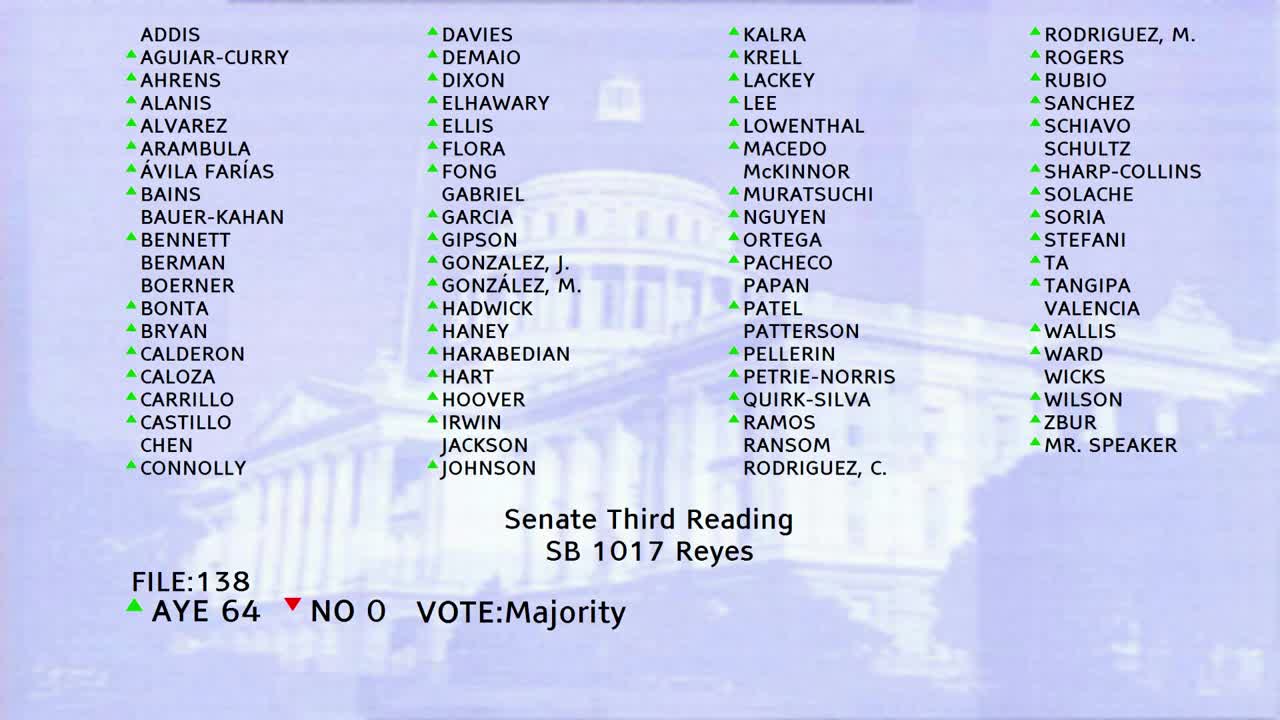 1MIN
Assembly Floor
 2MIN
Assembly Floor
 7MIN
Assembly Standing Committee on Natural Resources
Bill Author

Bill Co-Author(s):