AB 1154: Junior accessory dwelling units.
- Session Year: 2025-2026
- House: Assembly
- Latest Version Date: 2025-10-10
Current Status:
Passed
(2025-10-10: Chaptered by Secretary of State - Chapter 507, Statutes of 2025.)
Introduced
In Committee
Awaiting First Chamber Vote
Passed First Chamber
In Committee
Awaiting Second Chamber Vote
Passed Second Chamber
Enacted
The Planning and Zoning Law, among other things, provides for the creation of
junior accessory dwelling units by local ordinance, or, if a local agency has not adopted an ordinance, by ministerial approval, in accordance with specified standards and conditions. Existing law requires an ordinance that provides for the creation of a junior accessory dwelling unit to, among other things, require owner-occupancy in the single-family residence in which the junior accessory dwelling unit is permitted.
Under this bill, that owner-occupancy requirement would apply only if the junior accessory dwelling unit has shared sanitation facilities with the existing structure. The bill would require an ordinance that provides for the creation of a junior accessory dwelling unit to require that a rental of a junior accessory dwelling unit be for a term longer than 30 days.
By imposing new duties on local governments with respect to the approval of junior accessory dwelling units, the bill would impose a state-mandated local program.
The California Constitution requires the state to reimburse local agencies and school districts for certain costs mandated by the state. Statutory provisions establish procedures for making that reimbursement.
This bill would provide that no reimbursement is required by this act for a specified reason.
The Planning and Zoning Law, among other things, provides for the creation of accessory dwelling units by local ordinance, or, if a local agency has not adopted an ordinance, by ministerial approval, in accordance with specified standards and conditions. Existing law prohibits a local agency from imposing parking standards for an accessory dwelling unit under certain circumstances, whether or not the local agency has adopted a local ordinance pursuant to the above provisions. Under existing law, those circumstances include, among others, if the accessory dwelling unit is located within 1/2 of one mile walking distance of public transit or there is a car share vehicle located within one block of the accessory dwelling unit.
This bill would additionally prohibit a local agency from imposing any parking standards if the accessory dwelling unit is 500 square feet or smaller.Existing law also provides for the creation of junior accessory dwelling units by local ordinance, or, if a local agency has not adopted an ordinance, by ministerial approval, in accordance with specified standards and conditions. Existing law requires an ordinance that provides for the creation of a junior accessory dwelling unit to, among other things, require owner-occupancy in the single-family residence in which the junior accessory dwelling unit is permitted.
Under this bill, that owner-occupancy requirement would apply only if the junior accessory dwelling unit has shared sanitation facilities with the existing structure. The bill would require an ordinance that provides for the creation of a junior accessory dwelling unit to require that a rental of a junior accessory dwelling unit be for a term longer than 30 days.
By imposing new duties on local governments with respect to the approval of accessory dwelling units and junior accessory dwelling units, the bill would impose a state-mandated local program.
The California Constitution requires the state to reimburse local agencies and school districts for certain costs mandated by the state. Statutory provisions establish procedures for making that reimbursement.
This bill would provide that no reimbursement is required by this act for a specified reason.
The Planning and Zoning Law, among other things, provides for the creation of accessory dwelling units by local ordinance, or, if a local agency has not adopted an ordinance, by ministerial approval, in accordance with specified standards and conditions. Existing law prohibits a local agency from imposing parking standards for an accessory dwelling unit under certain circumstances, whether or not the local agency has adopted a local ordinance pursuant to the above provisions. Under existing law, those circumstances include, among others, if the accessory dwelling unit is located within 1/2 of one mile walking distance of public transit or there is a car share vehicle located within one block of the accessory dwelling unit.
This bill would additionally prohibit a local agency from imposing any parking standards if the accessory dwelling unit is 500 square feet or smaller.
Existing law also provides for the creation of junior accessory dwelling units by local ordinance, or, if a local agency has not adopted an ordinance, by ministerial approval, in accordance with specified standards and conditions. Existing law requires an ordinance that provides for the creation of a junior accessory dwelling unit to, among other things, require owner-occupancy in the single-family residence in which the junior accessory dwelling unit is permitted.
Under this bill, that owner-occupancy requirement would apply only if the junior accessory dwelling unit has shared sanitation facilities with the existing structure. The bill would require an ordinance that provides for the creation of a junior accessory dwelling unit to require that a rental of a junior accessory dwelling unit be for a term longer than 30 days.
By imposing new duties on local governments with respect to the approval of accessory dwelling units and junior accessory dwelling units, the bill would impose a state-mandated local program.
The California Constitution requires the state to reimburse local agencies and school districts for certain costs mandated by the state. Statutory provisions establish procedures for making that reimbursement.
This bill would provide that no reimbursement is required by this act for a specified reason.
Notwithstanding Article 2 (commencing with Section 66314), a local agency may, by ordinance, provide for the creation of junior accessory dwelling units in single-family residential zones. The ordinance may require a permit to be obtained for the creation of a junior accessory dwelling unit, and shall do all of the following:
(a)Limit the number of junior accessory dwelling units to one per residential lot zoned for single-family residences with a single-family residence built, or proposed to be built, on the lot.
(b)If the junior accessory dwelling unit has shared sanitation facilities with the existing structure, require owner-occupancy in the single family residence in which the junior accessory dwelling unit will be permitted. The owner may reside in either the remaining portion of the structure or the newly created junior accessory dwelling unit. Owner-occupancy shall not be required if the junior accessory dwelling unit has separate sanitation facilities, or if the owner is another governmental agency, land trust, or housing organization.
(c)Require the recordation of a deed restriction, which shall run with the land, shall be filed with the permitting agency, and shall include both of the following:
(1)A prohibition on the sale of the junior accessory dwelling unit separate from the sale of the single-family residence, including a statement that the deed restriction may be enforced against future purchasers.
(2)A restriction on the size and attributes of the junior accessory dwelling unit that conforms with this article.
(d)Require a permitted junior accessory dwelling unit to be constructed within the walls of the proposed or existing single-family residence. For purposes of this subdivision, enclosed uses within the residence, such as attached garages, are considered a part of the proposed or existing single-family residence.
(e)(1)Require a permitted junior accessory dwelling unit to include a separate entrance from the main entrance to the proposed or existing single-family residence.
(2)If a permitted junior accessory dwelling unit does not include a separate bathroom, the permitted junior accessory dwelling unit shall include a separate entrance from the main entrance to the structure, with an interior entry to the main living area.
(f)Require the permitted junior accessory dwelling unit to include an efficiency kitchen, which shall include all of the following:
(1)A cooking facility with appliances.
(2)A food preparation counter and storage cabinets that are of reasonable size in relation to the size of the junior accessory dwelling unit.
(g)Require that a rental of a junior accessory dwelling unit be for a term longer than 30 days.
SEC. 2.No reimbursement is required by this act pursuant to Section 6 of Article XIIIB of the California Constitution because a local agency or school district has the authority to levy service charges, fees, or assessments sufficient to pay for the program or level of service mandated by this act, within the meaning of Section 17556 of the Government Code.
Notwithstanding Article 2 (commencing with Section 66314), a local agency may, by ordinance, provide for the creation of junior accessory dwelling units in single-family residential zones. The ordinance may require a permit to be obtained for the creation of a junior accessory dwelling unit, and shall do all of the following:
(a)Limit the number of junior accessory dwelling units to one per residential lot zoned for single-family residences with a single-family residence built, or proposed to be built, on the lot.
(b)If the junior accessory dwelling unit has shared sanitation facilities with the existing structure, require owner-occupancy in the single family residence in which the junior accessory dwelling unit will be permitted. The owner may reside in either the remaining portion of the structure or the newly created junior accessory dwelling unit. Owner-occupancy shall not be required if the junior accessory dwelling unit has separate sanitation facilities, or if the owner is another governmental agency, land trust, or housing organization.
(c)Require the recordation of a deed restriction, which shall run with the land, shall be filed with the permitting agency, and shall include both of the following:
(1)A prohibition on the sale of the junior accessory dwelling unit separate from the sale of the single-family residence, including a statement that the deed restriction may be enforced against future purchasers.
(2)A restriction on the size and attributes of the junior accessory dwelling unit that conforms with this article.
(d)Require a permitted junior accessory dwelling unit to be constructed within the walls of the proposed or existing single-family residence. For purposes of this subdivision, enclosed uses within the residence, such as attached garages, are considered a part of the proposed or existing single-family residence.
(e)(1)Require a permitted junior accessory dwelling unit to include a separate entrance from the main entrance to the proposed or existing single-family residence.
(2)If a permitted junior accessory dwelling unit does not include a separate bathroom, the permitted junior accessory dwelling unit shall include a separate entrance from the main entrance to the structure, with an interior entry to the main living area.
(f)Require the permitted junior accessory dwelling unit to include an efficiency kitchen, which shall include all of the following:
(1)A cooking facility with appliances.
(2)A food preparation counter and storage cabinets that are of reasonable size in relation to the size of the junior accessory dwelling unit.
(g)Require that a rental of a junior accessory dwelling unit be for a term longer than 30 days.
SEC. 3.SEC. 2.No reimbursement is required by this act pursuant to Section 6 of Article XIIIB of the California Constitution because a local agency or school district has the authority to levy service charges, fees, or assessments sufficient to pay for the program or level of service mandated by this act, within the meaning of Section 17556 of the Government Code.
Notwithstanding any other law, and whether or not the local agency has adopted an ordinance governing accessory dwelling units in accordance with Section 66314, all of the following shall apply:
(a)A local agency shall not impose any parking standards for an accessory dwelling unit in any of the following instances:
(1)Where the The accessory dwelling unit is located within one-half of one mile walking distance of public transit.
(2)Where the The accessory dwelling unit is located within an architecturally and historically significant historic district.
(3)Where the The accessory dwelling unit is part of the proposed or existing primary residence or an accessory structure.
(4)When on-street On-street parking permits are required but not offered to the occupant of the accessory dwelling unit.
(5)When there There is a car share vehicle located within one block of the accessory dwelling unit.
(6)When a A permit application for an accessory dwelling unit is submitted with a permit application to create a new single-family dwelling or a new multifamily dwelling on the same lot, provided that the accessory dwelling unit or the parcel satisfies any other criteria listed in this subdivision.
(7)The accessory dwelling unit is 500 square feet or smaller.
(b)The local agency shall not deny an application for a permit to create an accessory dwelling unit due to the correction of nonconforming zoning conditions, building code violations, or unpermitted structures that do not present a threat to public health and safety and are not affected by the construction of the accessory dwelling unit.
SEC. 2.Section 66333 of the Government Code is amended to read:66333.Notwithstanding Article 2 (commencing with Section 66314), a local agency may, by ordinance, provide for the creation of junior accessory dwelling units in single-family residential zones. The ordinance may require a permit to be obtained for the creation of a junior accessory dwelling unit, and shall do all of the following:
(a)Limit the number of junior accessory dwelling units to one per residential lot zoned for single-family residences with a single-family residence built, or proposed to be built, on the lot.
(b)Require If the junior accessory dwelling unit has shared sanitation facilities with the existing structure, require owner-occupancy in the single family residence in which the junior accessory dwelling unit will be permitted. The owner may reside in either the remaining portion of the structure or the newly created junior accessory dwelling unit. Owner-occupancy shall not be required if the junior accessory dwelling unit has separate sanitation facilities, or if the owner is another governmental agency, land trust, or housing organization.
(c)Require the recordation of a deed restriction, which shall run with the land, shall be filed with the permitting agency, and shall include both of the following:
(1)A prohibition on the sale of the junior accessory dwelling unit separate from the sale of the single-family residence, including a statement that the deed restriction may be enforced against future purchasers.
(2)A restriction on the size and attributes of the junior accessory dwelling unit that conforms with this article.
(d)Require a permitted junior accessory dwelling unit to be constructed within the walls of the proposed or existing single-family residence. For purposes of this subdivision, enclosed uses within the residence, such as attached garages, are considered a part of the proposed or existing single-family residence.
(e)(1)Require a permitted junior accessory dwelling unit to include a separate entrance from the main entrance to the proposed or existing single-family residence.
(2)If a permitted junior accessory dwelling unit does not include a separate bathroom, the permitted junior accessory dwelling unit shall include a separate entrance from the main entrance to the structure, with an interior entry to the main living area.
(f)Require the permitted junior accessory dwelling unit to include an efficiency kitchen, which shall include all of the following:
(1)A cooking facility with appliances.
(2)A food preparation counter and storage cabinets that are of reasonable size in relation to the size of the junior accessory dwelling unit.
(g)Require that a rental of a junior accessory dwelling unit be for a term longer than 30 days.
SEC. 3.No reimbursement is required by this act pursuant to Section 6 of Article XIIIB of the California Constitution because a local agency or school district has the authority to levy service charges, fees, or assessments sufficient to pay for the program or level of service mandated by this act, within the meaning of Section 17556 of the Government Code.
|
Date
|
Status
|
|---|---|
| Oct 10, 2025 | Chaptered by Secretary of State - Chapter 507, Statutes of 2025. |
| Oct 10, 2025 | Approved by the Governor. |
| Sep 9, 2025 | Enrolled and presented to the Governor at 3 p.m. |
| Sep 3, 2025 | Senate amendments concurred in. To Engrossing and Enrolling. (Ayes 75. Noes 0. Page 2861.). |
| Sep 2, 2025 | In Assembly. Concurrence in Senate amendments pending. |
| Sep 2, 2025 | Read third time. Passed. Ordered to the Assembly. (Ayes 40. Noes 0. Page 2394.). |
| Aug 20, 2025 | Read second time. Ordered to third reading. |
| Aug 19, 2025 | From committee: Be ordered to second reading pursuant to Senate Rule 28.8. |
| Jul 9, 2025 | From committee: Do pass and re-refer to Com. on APPR. (Ayes 7. Noes 0.) (July 9). Re-referred to Com. on APPR. |
| Jul 3, 2025 | Read second time and amended. Re-referred to Com. on L. GOV. |
| Jul 2, 2025 | From committee: Amend, and do pass as amended and re-refer to Com. on L. GOV. (Ayes 11. Noes 0.) (July 1). |
| May 7, 2025 | Referred to Coms. on HOUSING and L. GOV. |
| Apr 29, 2025 | In Senate. Read first time. To Com. on RLS. for assignment. |
| Apr 28, 2025 | Read third time. Passed. Ordered to the Senate. (Ayes 70. Noes 1. Page 1320.) |
| Apr 24, 2025 | Read second time. Ordered to third reading. |
| Apr 23, 2025 | From committee: Do pass. (Ayes 15. Noes 0.) (April 23). |
| Apr 10, 2025 | From committee: Do pass and re-refer to Com. on APPR. (Ayes 10. Noes 0.) (April 9). Re-referred to Com. on APPR. |
| Mar 26, 2025 | From committee: Do pass and re-refer to Com. on L. GOV. with recommendation: To Consent Calendar. (Ayes 10. Noes 0.) (March 26). Re-referred to Com. on L. GOV. |
| Mar 10, 2025 | Referred to Coms. on H. & C.D. and L. GOV. |
| Feb 21, 2025 | From printer. May be heard in committee March 23. |
| Feb 20, 2025 | Read first time. To print. |
|
Date
|
Description
|
Location
|
Votes
|
|
|---|---|---|---|---|
| Sep 3, 2025 | Reconsideration of action taken on Tuesday, 04-01-25. | Assembly Floor |
Passed |
|
| Sep 2, 2025 | The committee on CPC recommend that the measure be PASSED, WITH AMENDMENTS | Senate Floor |
Passed |
|
| Jul 9, 2025 | Do pass, but first be re-referred to the Committee on [Appropriations] | Senate Standing Committee on Local Government |
Passed |
|
| Jul 1, 2025 | Do pass as amended, but first amend, and re-refer to the Committee on [Local Government] | Senate Standing Committee on Housing |
Passed |
|
| Apr 28, 2025 | AB 1154 Carrillo Assembly Third Reading | Assembly Floor |
Passed |
|
| Apr 23, 2025 | Do pass. | Assembly Standing Committee on Appropriations |
Passed |
|
| Apr 9, 2025 | Do pass and be re-referred to the Committee on [Appropriations] | Assembly Standing Committee on Local Government |
Passed |
|
| Mar 26, 2025 | Do pass and be re-referred to the Committee on [Local Government] with recommendation: To Consent Calendar | Assembly Standing Committee on Housing and Community Development |
Passed |
This list shows positions taken on this bill by organizations on the date displayed, which is linked to the original source.
Positions by individuals are not included.
|
Organization
|
Position
|
Date
|
|---|---|---|
| Abundant Housing LA | ** Support | |
| Association of California Cities - Orange County | ** Against | |
| Bay Area Council | ** Support | |
| California Apartment Association | ** Support | |
| California community builders | ** Support | |
| California Public Defenders Association | ** Support | |
| Casita Coalition | ** Support | |
| Circulate San Diego | ** Support | |
| City Of Lake Forest | ** Against | |
| City of Los Alamitos | ** Against | |
| City of Santa Clarita | ** Against | |
| Equitable Land Use Alliance | ** Against | |
| Fieldstead And Company, Inc. | ** Support | |
| Fremont for Everyone | ** Support | |
| Hello Housing | ** Against | |
| House Sacramento | ** Support | |
| LeadingAge California | ** Support | |
| Lieutenant Governor Eleni Kounalakis | ** Support | |
| Lieutenant Governor Eleni Kounalakis (Sponsor) | ** Support | |
| People For Housing Orange County | ** Support | |
| Redlands YIMBY | ** Support | |
| San Fernando Valley for All | ** Support | |
| SPUR | ** Support | |
| Streets for All | ** Support | |
| Student Homes Coalition | ** Support | |
| The Central Valley Urban Institute | ** Support | |
| The Two Hundred | ** Support | |
| UnidosUS(Sponsor) | ** Support | |
| Ventura County Clergy and Laity United for Economic Justice | ** Support | |
| Ventura County YIMBY | ** Support | |
| Westside for Everyone | ** Support |
SENATE RULES COMMITTEE Office of Senate Floor Analyses (916) 651-1520 Fax: (916) 327-4478 | AB 1154 |
THIRD READING
Bill No: AB 1154
Author: Carrillo (D)
Amended: 7/3/25 in Senate
Vote: 21
SENATE HOUSING COMMITTEE: 11-0, 7/1/25
AYES: Wahab, Seyarto, Arreguín, Cabaldon, Caballero, Cortese, Durazo, Gonzalez, Grayson, Ochoa Bogh, Padilla
SENATE LOCAL GOVERNMENT COMMITTEE: 7-0, 7/9/25
AYES: Durazo, Choi, Arreguín, Cabaldon, Laird, Seyarto, Wiener
SENATE APPROPRIATIONS COMMITTEE: Senate Rule 28.8
ASSEMBLY FLOOR: 70-1, 4/28/25 - See last page for vote
SUBJECT: Junior accessory dwelling units
SOURCE: California YIMBY, Lieutenant Governor Eleni Kounalakis
DIGEST:
This bill limits owner-occupancy requirements for junior accessory dwelling units (JADUS)
ANALYSIS:
Existing law:
- Defines a JADU to mean a unit that is no more than 500 square feet in size and contained entirely within a single-family residence. A JADU may include separate sanitation facilities or may share sanitation facilities with the existing structure.
- Requires JADUs to be permitted in all single-family residential zones, and establishes certain development standards and local approval requirements for the creation of JADUs.
- Requires all single family residences with JADUs to be owner-occupied, meaning that the property owner is required to live in either the remaining portion of the primary residence once a JADU is created, or in the newly created JADU. This requirement exists regardless of whether or not the JADU has shared sanitation facilities.
This bill:
- Eliminates owner-occupancy requirements for JADUs if the JADU has sanitation facilities (e.g., bathrooms) that are separate from the existing structure.
- Requires that a rental of a JADU be for a term longer than 30 days.
Background
ADUs/JADUs. ADUs, also known as mother-in-law units or granny flats, are additional living spaces that have a separate kitchen, bathroom, and exterior access independent of the primary residence; ADUs may be attached or detached from the primary residence. A JADU is a unit of up to 500 square feet within the primary residence. ADU/JADU law has evolved over the years to lower barriers to ADU development which has resulted in a surge in ADUs built in California. SB 1069 (Wieckowski, Chapter 720, Statutes of 2016) and AB 2299 (Bloom, Chapter 735, Statutes of 2016), permitted ADUs by-right on all residentially-zoned parcels in the state. By permitting an ADU as a second unit on all single-family lots, these laws effectively doubled their allowed density. According to HCD, between 2016-2023, the number of ADUs permitted annually in the state grew from 1,336 to 26,924, a 20-fold increase. In 2023, ADUs comprised more than 21% of all homes permitted statewide.
Comments
Author’s statement. “ADUs and JADUs are powerful tools to help homeowners build generational wealth while addressing California’s housing shortage. AB 1154 streamlines our housing laws by removing unnecessary barriers that deter homeowners from adding these much-needed units. By eliminating restrictive owner-occupancy requirements and aligning parking mandates for smaller ADUs with JADUs, we are empowering more Californians to maximize their property’s potential and increase the availability of affordable housing in our state."
Owner Occupancy Requirements: ADUs/JADUs. Owner occupancy requirements also differ between ADUS and JADUs. While there is no owner-occupancy requirement for ADUs, JADUs require the property owner to reside on-site, in either the primary home or the JADU itself. This bill would remove the owner-occupancy requirement for JADUs that have their own private bathroom, allowing a property owner to rent out both the main residence and the JADU. Essentially allowing the conversion of an existing single family home into a type of duplex. JADUs with shared sanitation facilities would still be subject to owner-occupancy requirements.
Occupying JADUs. JADU Law provides that a JADU is a residential unit up to 500-square feet constructed entirely within the walls of a proposed or existing single-family residence. A JADU is required to include an efficiency kitchen but is not required to include its own bathroom. A JADU that does not include a bathroom is required to have access to the bathroom and living space in the primary dwelling unit. A JADU could look like a studio apartment built within the walls of an existing home or an attached garage, effectively adding a new dwelling unit to the rental market; alternatively, a project to convert a basement into a poolroom or home theatre with a small kitchen/bar could be considered a JADU and afforded all of the streamlined permitting benefits of JADU law, and counted as a new residential unit.
It is unclear what percent of newly developed JADUs are occupied as independent dwelling units, serving a resident that would otherwise need to find another unit in the rental market. Data available on ADUs suggests that roughly half of newly constructed ADUs add new supply to the rental market with another 10%-15% of newly built ADUS being used to house family or friends, indirectly reducing demand in the rental market.[1] It is not clear how these numbers translate to JADUs, which unlike ADUs are not required to include features required for independent living facilities.
FISCAL EFFECT: Appropriation: No Fiscal Com.: Yes Local: Yes
SUPPORT: (Verified 9/2/25)
California YIMBY (Sponsor)
Lieutenant Governor Eleni Kounalakis (Sponsor)
UnidosUS(Sponsor)
Abundant Housing LA
Bay Area Council
California Apartment Association
California Community Builders
Casita Coalition
Circulate San Diego
Fieldstead and Company, INC.
Fremont for Everyone
House Sacramento
People for Housing - Orange County
Redlands Yimby
San Fernando Valley for All
SPUR
Student Homes Coalition
The Central Valley Urban Institute
The Two Hundred
Ventura County Clergy and Laity United for Economic Justice
Ventura County YIMBY
Westside for Everyone
OPPOSITION: (Verified 9/2/25)
Association of California Cities - Orange County
Equitable Land Use Alliance
City of Lake Forest
City of Los Alamitos
City of Santa Clarita
Hello Housing
ARGUMENTS IN SUPPORT: UnidosUS writes in support, “By expanding ADU and JADU development, especially in high-need areas, AB 1154 accelerates housing production, reduces construction costs, and advances California’s housing goals by eliminating outdated restrictions that hinder affordable housing growth. This will also help to support residents by expanding their opportunities to leverage existing space to facilitate multi-generational living, create increased opportunities for student housing, and support homeowners by providing new opportunities to supplement mortgage payments as cost of living continues to rise.”
ARGUMENTS IN OPPOSITION: The City of Los Alamitos writes in opposition, “AB 1154 eliminates the owner occupancy requirements for [JADUs] if the JADU has sanitation facilities separate from the main residence. Lastly, the bill requires that rentals of JADUs must be for a term longer than 30 days. Owner occupancy requirements for lots that contain an ADU play an important role in ensuring community safety and compliance with local ordinances.”
ASSEMBLY FLOOR: 70-1, 4/28/25
AYES: Addis, Aguiar-Curry, Ahrens, Alanis, Alvarez, Arambula, Ávila Farías, Bains, Bauer-Kahan, Berman, Bonta, Bryan, Calderon, Caloza, Carrillo, Castillo, Chen, Connolly, Davies, DeMaio, Dixon, Elhawary, Ellis, Fong, Gabriel, Gallagher, Garcia, Gipson, Jeff Gonzalez, Mark González, Hadwick, Haney, Harabedian, Hart, Hoover, Jackson, Kalra, Lackey, Lee, Lowenthal, McKinnor, Nguyen, Ortega, Pacheco, Papan, Patel, Patterson, Pellerin, Petrie-Norris, Quirk-Silva, Ramos, Ransom, Celeste Rodriguez, Michelle Rodriguez, Rogers, Blanca Rubio, Schiavo, Schultz, Sharp-Collins, Soria, Stefani, Ta, Tangipa, Valencia, Wallis, Ward, Wicks, Wilson, Zbur, Rivas
NOES: Boerner
NO VOTE RECORDED: Bennett, Flora, Irwin, Krell, Macedo, Muratsuchi, Sanchez, Solache
Prepared by: Hank Brady / HOUSING / (916) 651-4124
9/2/25 10:36:45
**** END ****
Karen Chapple, Dori Ganetsos, and Emmanuel Lopez, Implementing the Backyard Revolution: Perspectives of California’s ADU Owners (Berkeley, CA: UC Berkeley Center for Community Innovation, April 22, 2021), 15-16. ↑
CONCURRENCE IN SENATE AMENDMENTS
CSA1 Bill Id:AB 1154
Author:(Carrillo)
As Amended Ver:July 3, 2025
Majority vote
SUMMARY
This bill limits owner-occupancy requirements for junior accessory dwelling units (JADUS).
Senate Amendments
Remove provisions of the bill that would have prohibited a local agency from imposing parking standards for accessory dwelling units (ADUs) that are 500 square feet smaller.
COMMENTS
Benefits of ADUs and JADUs: Recently, there has been a national trend to allow for more "gentle density," e.g., ADUs, duplexes, fourplexes, townhomes, and other moderately dense developments that were common before the imposition of zoning. In 2016, SB 1069 (Wieckowski), Chapter 720, and AB 2299 (Bloom) Chapter 735, permitted ADUs by right on all residentially-zoned parcels in the state. SB 1211 (Skinner), Chapter 296, Statutes of 2024, furthered the trend towards gentle density by increasing the number of allowable ADUs on multifamily properties. By allowing attached, detached, and JADUs on all residential lots, these laws, among others, facilitated the construction of missing middle housing in exclusionary single-family neighborhoods. Since then, various pieces of legislation have been passed to establish statewide standards regarding ADU setbacks, height limits, square footage requirements, and other land use controls, regardless of the underlying zoning district. As a result, ADUs are now required to be reviewed within 60 days by local governments in a streamlined and ministerial fashion.
Taken as a whole, ADU and JADU laws have established a fast, predictable, uniform, and enforceable process for the approval of ADUs statewide. These laws have transformed these units from being less than 1% of new construction before 2017 to now being approximately 20%, with over 23,000 new ADUs legally completed in 2023. The number of ADUs and JADUs is expected to continue growing as the ADU construction and financing industry matures, which will help meet the market feasibility that is estimated to be approximately 1.8 million units in California. With thousands of ADUs being added every year, ADUs have already become an important part of the state's stock of new housing, with a growth potential that is not subject to the state’s funding allocations.
These ADUs and JADUs help to address California's severe housing deficit and provide benefits for both the homeowners on which the new units are being built, and the future residents of these units. For homeowners, ADUs and JADUs provide an opportunity to generate rental income, helping to offset mortgage payments or supplement retirement savings. They can also increase property value and offer flexibility for multigenerational living, allowing families to accommodate aging parents, adult children, or caregivers while maintaining privacy. JADUs, which are typically smaller and attached to the main residence, offer an affordable way to create additional living space with minimal construction costs. For renters, ADUs and JADUs help increase the supply of housing in established neighborhoods, providing more rental options in areas where traditional housing may be scarce or expensive.
Differences between ADUs and JADUs: ADUs and JADUs are both secondary housing units that the Legislature has allowed to be built on virtually any single-family lot in the state, but they differ in size, configuration, and regulatory requirements. ADUs can be up to 1,200 square feet and may be detached, attached, or converted from existing space, such as a garage or basement. In contrast, JADUs are limited to 500 square feet and must be created within an existing or proposed single-family home, often by converting a bedroom. ADUs must include a full kitchen with a sink, cooking appliances, and counter space, while JADUs only require an efficiency kitchen, which includes a sink, a cooking appliance, and a food prep area. Additionally, ADUs must have a separate bathroom, whereas JADUs can share a bathroom with the main home or have their own.
Ownership and occupancy rules differ by unit typology (ADU versus JADU). State law currently prohibits owner-occupancy requirements, where the property owner must reside in either the main residence or in the ADU, for ADUs. In contrast, JADUs require the property owner to reside on-site in either the primary home or the JADU itself. This bill would remove the owner-occupancy requirement for JADUs that have their own private bathroom, allowing a property owner to rent out both the main residence and the JADU if they so choose. In doing so, this may increase developer interest in JADU construction, and would allow properties with certain JADUs to function as rental duplexes. Owner-occupancy would still be required for JADUs with shared sanitation facilities.
ADUs created under state law are expressly prohibited from being "short-term rentals," or rented out for periods less than 30 days, while no such language exists in statute establishing a similar restriction for JADUs. This bill would prohibit JADUs from being rented out as short-term rentals, aligning JADU law with ADU law. This may increase the supply of permanent rental housing availability, as property owners who may currently use their JADU as short-term rentals might instead choose to fill their unit with a long-term tenant.
According to the Author
"ADUs and JADUs are powerful tools to help homeowners build generational wealth while addressing California's housing shortage. AB 1154 streamlines our housing laws by removing unnecessary barriers that deter homeowners from adding these much-needed units. By eliminating restrictive owner-occupancy requirements for JADUs that do not share a bathroom with the existing structure, we are empowering more Californians to maximize their property's potential and increase the availability of affordable housing in our state."
Arguments in Support
A coalition of groups forming the California Home Building Alliance (HBA) writes in support: "These reforms will streamline development, lower costs, and expand rental housing opportunities. By expanding ADU and JADU development, especially in high-need areas, AB 1154 accelerates housing production, reduces construction costs, and advances California's housing goals by eliminating outdated restrictions that hinder affordable housing growth."
Arguments in Opposition
The City of Los Alamitos writes in opposition: "AB 1154 eliminates the owner-occupancy requirements for Junior Accessory Dwelling Units (JADU) if the JADU has sanitation facilities separate from the main residence. Lastly, the bill requires that rentals of JADUs must be for a term longer than 30 days. Owner occupancy requirements for lots that contain an ADU play an important role in ensuring community safety and compliance with local ordinances."
FISCAL COMMENTS
According to the Assembly Committee on Appropriations, local costs resulting from this bill are not reimbursable by the state because local agencies have general authority to charge and adjust planning and permitting fees to cover their administrative expenses associated with new planning mandates.
VOTES:
ASM HOUSING AND COMMUNITY DEVELOPMENT: 10-0-1
YES: Haney, Patterson, Ávila Farías, Caloza, Kalra, Lee, Quirk-Silva, Ta, Wicks, Wilson
ABS, ABST OR NV: Gallagher
ASM LOCAL GOVERNMENT: 10-0-0
YES: Carrillo, Ta, Hoover, Pacheco, Ramos, Ransom, Blanca Rubio, Stefani, Ward, Wilson
ASM APPROPRIATIONS: 15-0-0
YES: Wicks, Sanchez, Arambula, Calderon, Caloza, Dixon, Elhawary, Fong, Mark González, Hart, Pacheco, Pellerin, Solache, Ta, Tangipa
ASSEMBLY FLOOR: 70-1-8
YES: Addis, Aguiar-Curry, Ahrens, Alanis, Alvarez, Arambula, Ávila Farías, Bains, Bauer-Kahan, Berman, Bonta, Bryan, Calderon, Caloza, Carrillo, Castillo, Chen, Connolly, Davies, DeMaio, Dixon, Elhawary, Ellis, Fong, Gabriel, Gallagher, Garcia, Gipson, Jeff Gonzalez, Mark González, Hadwick, Haney, Harabedian, Hart, Hoover, Jackson, Kalra, Lackey, Lee, Lowenthal, McKinnor, Nguyen, Ortega, Pacheco, Papan, Patel, Patterson, Pellerin, Petrie-Norris, Quirk-Silva, Ramos, Ransom, Celeste Rodriguez, Michelle Rodriguez, Rogers, Blanca Rubio, Schiavo, Schultz, Sharp-Collins, Soria, Stefani, Ta, Tangipa, Valencia, Wallis, Ward, Wicks, Wilson, Zbur, Rivas
NO: Boerner
ABS, ABST OR NV: Bennett, Flora, Irwin, Krell, Macedo, Muratsuchi, Sanchez, Solache
SENATE FLOOR: 40-0-0
YES: Allen, Alvarado-Gil, Archuleta, Arreguín, Ashby, Becker, Blakespear, Cabaldon, Caballero, Cervantes, Choi, Cortese, Dahle, Durazo, Gonzalez, Grayson, Grove, Hurtado, Jones, Laird, Limón, McGuire, McNerney, Menjivar, Niello, Ochoa Bogh, Padilla, Pérez, Reyes, Richardson, Rubio, Seyarto, Smallwood-Cuevas, Stern, Strickland, Umberg, Valladares, Wahab, Weber Pierson, Wiener
UPDATED
VERSION: July 3, 2025
CONSULTANT: Dori Ganetsos / H. & C.D. / (916) 319-2085 FN: 0001533
SENATE RULES COMMITTEE Office of Senate Floor Analyses (916) 651-1520 Fax: (916) 327-4478 | AB 1154 |
THIRD READING
Bill No: AB 1154
Author: Carrillo (D)
Amended: 7/3/25 in Senate
Vote: 21
SENATE HOUSING COMMITTEE: 11-0, 7/1/25
AYES: Wahab, Seyarto, Arreguín, Cabaldon, Caballero, Cortese, Durazo, Gonzalez, Grayson, Ochoa Bogh, Padilla
SENATE LOCAL GOVERNMENT COMMITTEE: 7-0, 7/9/25
AYES: Durazo, Choi, Arreguín, Cabaldon, Laird, Seyarto, Wiener
SENATE APPROPRIATIONS COMMITTEE: Senate Rule 28.8
ASSEMBLY FLOOR: 70-1, 4/28/25 - See last page for vote
SUBJECT: Junior accessory dwelling units
SOURCE: California YIMBY, Lieutenant Governor Eleni Kounalakis
DIGEST:
This bill limits owner-occupancy requirements for junior accessory dwelling units (JADUS)
ANALYSIS:
Existing law:
- Defines a JADU to mean a unit that is no more than 500 square feet in size and contained entirely within a single-family residence. A JADU may include separate sanitation facilities or may share sanitation facilities with the existing structure.
- Requires JADUs to be permitted in all single-family residential zones, and establishes certain development standards and local approval requirements for the creation of JADUs.
- Requires all single family residences with JADUs to be owner-occupied, meaning that the property owner is required to live in either the remaining portion of the primary residence once a JADU is created, or in the newly created JADU. This requirement exists regardless of whether or not the JADU has shared sanitation facilities.
This bill:
- Eliminates owner-occupancy requirements for JADUs if the JADU has sanitation facilities (e.g., bathrooms) that are separate from the existing structure.
- Requires that a rental of a JADU be for a term longer than 30 days.
Background
ADUs/JADUs. ADUs, also known as mother-in-law units or granny flats, are additional living spaces that have a separate kitchen, bathroom, and exterior access independent of the primary residence; ADUs may be attached or detached from the primary residence. A JADU is a unit of up to 500 square feet within the primary residence. ADU/JADU law has evolved over the years to lower barriers to ADU development which has resulted in a surge in ADUs built in California. SB 1069 (Wieckowski, Chapter 720, Statutes of 2016) and AB 2299 (Bloom, Chapter 735, Statutes of 2016), permitted ADUs by-right on all residentially-zoned parcels in the state. By permitting an ADU as a second unit on all single-family lots, these laws effectively doubled their allowed density. According to HCD, between 2016-2023, the number of ADUs permitted annually in the state grew from 1,336 to 26,924, a 20-fold increase. In 2023, ADUs comprised more than 21% of all homes permitted statewide.
Comments
Author’s statement. “ADUs and JADUs are powerful tools to help homeowners build generational wealth while addressing California’s housing shortage. AB 1154 streamlines our housing laws by removing unnecessary barriers that deter homeowners from adding these much-needed units. By eliminating restrictive owner-occupancy requirements and aligning parking mandates for smaller ADUs with JADUs, we are empowering more Californians to maximize their property’s potential and increase the availability of affordable housing in our state."
Owner Occupancy Requirements: ADUs/JADUs. Owner occupancy requirements also differ between ADUS and JADUs. While there is no owner-occupancy requirement for ADUs, JADUs require the property owner to reside on-site, in either the primary home or the JADU itself. This bill would remove the owner-occupancy requirement for JADUs that have their own private bathroom, allowing a property owner to rent out both the main residence and the JADU. Essentially allowing the conversion of an existing single family home into a type of duplex. JADUs with shared sanitation facilities would still be subject to owner-occupancy requirements.
Occupying JADUs. JADU Law provides that a JADU is a residential unit up to 500-square feet constructed entirely within the walls of a proposed or existing single-family residence. A JADU is required to include an efficiency kitchen but is not required to include its own bathroom. A JADU that does not include a bathroom is required to have access to the bathroom and living space in the primary dwelling unit. A JADU could look like a studio apartment built within the walls of an existing home or an attached garage, effectively adding a new dwelling unit to the rental market; alternatively, a project to convert a basement into a poolroom or home theatre with a small kitchen/bar could be considered a JADU and afforded all of the streamlined permitting benefits of JADU law, and counted as a new residential unit.
It is unclear what percent of newly developed JADUs are occupied as independent dwelling units, serving a resident that would otherwise need to find another unit in the rental market. Data available on ADUs suggests that roughly half of newly constructed ADUs add new supply to the rental market with another 10%-15% of newly built ADUS being used to house family or friends, indirectly reducing demand in the rental market.[1] It is not clear how these numbers translate to JADUs, which unlike ADUs are not required to include features required for independent living facilities.
FISCAL EFFECT: Appropriation: No Fiscal Com.: Yes Local: Yes
SUPPORT: (Verified 8/19/25)
California YIMBY (Sponsor)
Lieutenant Governor Eleni Kounalakis (Sponsor)
UnidosUS(Sponsor)
Abundant Housing LA
Bay Area Council
California Apartment Association
California Community Builders
Casita Coalition
Circulate San Diego
Fieldstead and Company, INC.
Fremont for Everyone
House Sacramento
People for Housing - Orange County
Redlands Yimby
San Fernando Valley for All
SPUR
Student Homes Coalition
The Central Valley Urban Institute
The Two Hundred
Ventura County Clergy and Laity United for Economic Justice
Ventura County YIMBY
Westside for Everyone
OPPOSITION: (Verified 8/19/25)
Association of California Cities - Orange County
City of Lake Forest
City of Los Alamitos
City of Santa Clarita
Hello Housing
ARGUMENTS IN SUPPORT: UnidosUS writes in support, “By expanding ADU and JADU development, especially in high-need areas, AB 1154 accelerates housing production, reduces construction costs, and advances California’s housing goals by eliminating outdated restrictions that hinder affordable housing growth. This will also help to support residents by expanding their opportunities to leverage existing space to facilitate multi-generational living, create increased opportunities for student housing, and support homeowners by providing new opportunities to supplement mortgage payments as cost of living continues to rise.”
ARGUMENTS IN OPPOSITION: The City of Los Alamitos writes in opposition, “AB 1154 eliminates the owner occupancy requirements for [JADUs] if the JADU has sanitation facilities separate from the main residence. Lastly, the bill requires that rentals of JADUs must be for a term longer than 30 days. Owner occupancy requirements for lots that contain an ADU play an important role in ensuring community safety and compliance with local ordinances.”
ASSEMBLY FLOOR: 70-1, 4/28/25
AYES: Addis, Aguiar-Curry, Ahrens, Alanis, Alvarez, Arambula, Ávila Farías, Bains, Bauer-Kahan, Berman, Bonta, Bryan, Calderon, Caloza, Carrillo, Castillo, Chen, Connolly, Davies, DeMaio, Dixon, Elhawary, Ellis, Fong, Gabriel, Gallagher, Garcia, Gipson, Jeff Gonzalez, Mark González, Hadwick, Haney, Harabedian, Hart, Hoover, Jackson, Kalra, Lackey, Lee, Lowenthal, McKinnor, Nguyen, Ortega, Pacheco, Papan, Patel, Patterson, Pellerin, Petrie-Norris, Quirk-Silva, Ramos, Ransom, Celeste Rodriguez, Michelle Rodriguez, Rogers, Blanca Rubio, Schiavo, Schultz, Sharp-Collins, Soria, Stefani, Ta, Tangipa, Valencia, Wallis, Ward, Wicks, Wilson, Zbur, Rivas
NOES: Boerner
NO VOTE RECORDED: Bennett, Flora, Irwin, Krell, Macedo, Muratsuchi, Sanchez, Solache
Prepared by: Hank Brady / HOUSING / (916) 651-4124
8/20/25 23:28:51
**** END ****
Karen Chapple, Dori Ganetsos, and Emmanuel Lopez, Implementing the Backyard Revolution: Perspectives of California’s ADU Owners (Berkeley, CA: UC Berkeley Center for Community Innovation, April 22, 2021), 15-16. ↑
SENATE COMMITTEE ON LOCAL GOVERNMENT
Senator María Elena Durazo, Chair
2025 - 2026 Regular
Bill No: | AB 1154 | Hearing Date: | 7/9/25 |
Author: | Carrillo | Fiscal: | Yes |
Version: | 7/3/25 | Consultant: | Favorini-Csorba |
Accessory dwelling units: junior accessory dwelling units
Limits owner-occupancy requirements for Junior ADUs.
Background
The Legislature has long identified accessory dwelling units (ADUs), also known as second units, in-law apartments, or “granny flats,” as a valuable form of housing for family members, students, the elderly, in-home health care providers, the disabled, and others, at below-market prices within existing neighborhoods. In 1982, the Legislature first provided a framework for local governments to enact ordinances that permit the construction of ADUs, while preserving local government flexibility to regulate the units as necessary. When fewer ADUs than anticipated were developed, the Legislature significantly amended ADU law to address some of the barriers property owners encountered while trying to develop them (AB 1866, Wright, 2002).
Legislators have enacted a flurry of changes to ADU laws in recent years. Beginning in 2016, the Legislature revised ADU laws to address some of the barriers to ADU creation that local governments had adopted (SB 1069, Wieckowski and AB 2299, Bloom). These changes prohibited local ordinances from banning ADUs and required a local agency to, among other provisions:
- Designate areas within the jurisdiction where ADUs may be permitted;
- Permit ADUs that do not exceed various zoning requirements set in statute, such as minimum lot sizes and distances from property lines (“setbacks”);
- Limit parking to one space per ADU;
- Approve or disapprove an application for an ADU ministerially without discretionary review if the local government does not have an ADU ordinance when it receives a permit application; and
- Approve building permits to create an ADU ministerially if the ADU is within an existing residence, has independent exterior access, and meets certain fire safety requirements.
These bills also limited the cases when local agencies could require new utility connections for water and sewer, and limited those fees to be proportionate to the burden created by the ADU.
Junior ADUs. AB 2408 (Thurmond, 2016) also allowed local agencies to adopt an ordinance regulating Junior ADUs (JADUs), which are smaller ADUs under 500 square feet, are contained entirely within an existing single-family residence, and may or may not have separate sanitation facilities.
A JADU is a residential unit up to 500-square feet constructed entirely within the walls of a proposed or existing single-family residence. A JADU is required to include an efficiency kitchen but is not required to include its own bathroom. A JADU that does not include a bathroom is required to have access to the bathroom and living space in the primary dwelling unit. A JADU could look like a studio apartment built within the walls of an existing home or an attached garage, effectively adding a new dwelling unit to the rental market; alternatively, a project to convert a basement into a poolroom or home theatre with a small kitchen/bar could be considered a JADU and afforded all of the streamlined permitting benefits of JADU law, and counted as a new residential unit.
More recently, SB 477 (Committee on Housing, 2024) was chaptered as an urgency measure to relocate and renumber ADU statutes to make them clearer and more readable. SB 477 also reorganized ADU law with distinct provisions establishing standards unique to ADUs and standards unique to JADUs.
Owner occupancy requirements for JADUs. Owner occupancy requirements differ between ADUs and JADUs. In 2023, the Legislature permanently prohibited local governments from requiring owner-occupancy for ADUs (AB 976, Ting) and authorized local governments to adopt ordinances that permit property owners to sell or otherwise convey their ADU separately from the primary residence (AB 1033, Ting). JADUs, on the other hand, require the property owner to reside on-site, in either the primary home or the JADU itself.
Lieutenant Governor Eleni Kounalakis, California YIMBY, and Unidosus want the Legislature to clarify owner-occupancy requirements for JADUs.
Proposed Law
Assembly Bill 1154 eliminates owner-occupancy requirements for JADUs if the JADU has sanitation facilities that are separate from the existing structure. The bill also requires that a rental of a JADU be for a term longer than 30 days.
Comments
1. Purpose of the bill. According to the author, “ADUs and JADUs are powerful tools to help homeowners build generational wealth while addressing California’s housing shortage. AB 1154 streamlines our housing laws by removing unnecessary barriers that deter homeowners from adding these much-needed units. By eliminating restrictive owner-occupancy requirements for JADUs that do not share a bathroom with the existing structure, we are empowering more Californians to maximize their property’s potential and increase the availability of affordable housing in our state.”
2. Uncle! Local planning officials must update their zoning codes or procedures every year to reflect new state laws. As the volume of changes grows, so does the workload. After nearly a decade of multiple changes a year to ADU law, AB 1154 proposes additional changes. While these changes are minor, they are not without cost at a time when local governments face budgetary challenges. For example, the City of Los Angeles faces a budget deficit of nearly $1 billion and has proposed layoffs in the city planning department. The Committee may wish to consider whether AB 1154’s changes are sufficiently important to merit the added workload on local planning officials.
3. Mandate. The California Constitution requires the state to reimburse local governments for the costs of new or expanded state mandated local programs. Because AB 1154 imposes new duties on local governments with respect to the approval of JADUs, Legislative Counsel says it imposes a new state mandate. AB 1154 disclaims the state’s responsibility for providing reimbursement by citing local governments’ authority to charge for the costs of implementing the bill’s provisions.
4. Incoming! The Senate Rules Committee has ordered a double referral of SB 92: first to the Committee on Housing, which approved AB 1154 at its July 1st hearing on a vote of 11-0, and second to the Committee on Local Government.
5. Related legislation. The Legislature is considering two additional measures that modify ADU and JADU laws:
- SB 9 (Arreguin), which the Committee approved at its May 7th hearing on a vote of 5-0, specifies that a local ordinance implementing ADU law is null and void if the local agency adopting the ordinance fails to submit a copy of the ordinance to the Department of Housing and Community Development as required by existing law.
- SB 543 (McNerney), which the Committee approved at its April 30th hearing on a vote of 7-0, makes a series of organizational, technical, and clarifying changes to ADU and JADU law.
Assembly Actions
Assembly Housing and Community Development Committee: 10-0
Assembly Local Government Committee: 10-0
Assembly Appropriations Committee: 15-0
Assembly Floor: 70-1
Support and Opposition
(7/3/25)
Support: California Yimby (Co-Sponsor)
Lieutenant Governor Eleni Kounalakis (Co-Sponsor)
Unidosus (Co-Sponsor)
Abundant Housing LA
Bay Area Council
California Apartment Association
California Community Builders
Casita Coalition
Circulate San Diego
Fieldstead and Company, INC.
Fremont for Everyone
House Sacramento
People for Housing - Orange County
Redlands Yimby
San Fernando Valley for All
Spur
Student Homes Coalition
The Central Valley Urban Institute
The Two Hundred
Ventura County Clergy and Laity United for Economic Justice
Ventura County Yimby
Westside for Everyone
Opposition: City of Lake Forest
City of Santa Clarita
Hello Housing
-- END --
SENATE COMMITTEE ON HOUSING
Senator Aisha Wahab, Chair
2025 - 2026 Regular
Bill No: AB 1154 Hearing Date: 7/1/2025
Author: | Carrillo | ||
Version: | 2/20/2025 Introduced | ||
Urgency: | No | Fiscal: | Yes |
Consultant: | Hank Brady | ||
SUBJECT: Accessory dwelling units: junior accessory dwelling units.
DIGEST: This bill exempts small Accessory Dwelling Units (ADUs) from parking requirements and limits owner-occupancy requirements for Junior ADUs (JADUS).
ANALYSIS:
Existing law:
- Defines an ADU as an attached or a detached residential dwelling unit that provides complete independent living facilities for one or more persons and is located on a lot with a proposed or existing primary residence. It must include permanent provisions for living, sleeping, eating, cooking, and sanitation on the same parcel as the single-family or multifamily dwelling is or will be situated.
- Requires a local agency to ministerially approve an application for a building permit within a residential or mixed-use zone to create one or more ADUs that meet all state and local requirements.
- Prohibits local agencies from imposing an owner-occupancy requirement on ADUs, except that a local agency may require that a property may be used for rentals of terms 30 days or longer.
- Prohibits a local agency from imposing any parking standards for an ADU in any of the following instances:
- The ADU is located within one-half of one mile walking distance of public transit.
- The ADU is located within an architecturally and historically significant historic district.
- The ADU is part of the proposed or existing primary residence or an accessory structure.
- On-street parking permits are required but not offered to the occupant of the ADU.
- There is a car share vehicle located within one block of the ADU.
- A permit application for an ADU is submitted with a permit application to create a new single-family dwelling or a new multifamily dwelling on the same lot, provided that the ADU or the parcel satisfies other criteria noted above.
- Defines a JADU to mean a unit that is no more than 500 square feet in size and contained entirely within a single-family residence. A JADU may include separate sanitation facilities or may share sanitation facilities with the existing structure.
- Requires JADUs to be permitted in all single-family residential zones, and establishes certain development standards and local approval requirements for the creation of JADUs.
- Requires all single family residences with JADUs to be owner-occupied, meaning that the property owner is required to live in either the remaining portion of the primary residence once a JADU is created, or in the newly created JADU. This requirement exists regardless of whether or not the JADU has shared sanitation facilities.
- The Housing Crisis Act (HCA), among other provisions, prohibits affected cities, as defined, from approving a housing development project that requires demolition of housing units unless the project will create at least as many residential units as will be demolished.
This bill:
- Prohibits a local agency from imposing parking standards for ADUs that are 500 square feet or smaller.
- Eliminates owner-occupancy requirements for JADUs if the JADU has sanitation facilities (e.g., bathrooms) that are separate from the existing structure.
- Requires that a rental of a JADU be for a term longer than 30 days.
Background
ADUs/JADUs. ADUs, also known as mother-in-law units or granny flats, are additional living spaces that have a separate kitchen, bathroom, and exterior access independent of the primary residence; ADUs may be attached or detached from the primary residence. A JADU is a unit of up to 500 square feet within the primary residence. ADU/JADU law has evolved over the years to lower barriers to ADU development which has resulted in a surge in ADUs built in California. SB 1069 (Wieckowski, Chapter 720, Statutes of 2016) and AB 2299 (Bloom, Chapter 735, Statutes of 2016), permitted ADUs by-right on all residentially-zoned parcels in the state. By permitting an ADU as a second unit on all single-family lots, these laws effectively doubled their allowed density. According to HCD, between 2016-2023, the number of ADUs permitted annually in the state grew from 1,336 to 26,924, a 20-fold increase. In 2023, ADUs comprised more than 21% of all homes permitted statewide.
Comments
- Author’s statement. “ADUs and JADUs are powerful tools to help homeowners build generational wealth while addressing California’s housing shortage. AB 1154 streamlines our housing laws by removing unnecessary barriers that deter homeowners from adding these much-needed units. By eliminating restrictive owner-occupancy requirements and aligning parking mandates for smaller ADUs with JADUs, we are empowering more Californians to maximize their property’s potential and increase the availability of affordable housing in our state."
- Local authority to establish parking regulations. The California Constitution provides cities and counties the authority to regulate behavior to preserve the health, safety, and welfare of the public. This provision, (commonly called the police power) gives cities and counties broad authority to regulate land use and other matters, provided that the local policy is “not in conflict with general laws.”
Cities and counties use their police power to enact zoning ordinances that shape development, such as setting maximum heights and densities for housing units, setbacks to preserve privacy, lot coverage ratios to increase open space, and others. Through this authority, cities and counties also establish minimum numbers of required vehicle parking spaces for nonresidential and residential buildings.
- No Parking! Existing law limits the ability of local agencies to impose parking requirements on ADUs and JADUs that meet specific criteria. The criteria that limit that ability of local agencies to impose parking requirements on ADUs and JADUs are generally linked to factors that reduce the likelihood that a newly built ADU will create demand for additional vehicle parking. For example, local agencies are not allowed to impose parking requirements on ADUs that are located within ½ mile of a transit stop, located near a car-share vehicle, or located entirely within the existing or proposed primary structure. Additionally, local agencies are not allowed to impose parking requirements on ADUs that are located in historic districts.
This bill will prohibit local agencies from imposing parking requirements on ADUs based solely on the size of the ADU. While it may be true that household with more rooms triggers more demand for vehicle parking than a smaller unit (e.g., a five-bedroom home is more likely to be a 2-3 car household than a studio apartment), it is not clear that simply constructing a smaller unit eliminates any need for a vehicle entirely. The 500 square foot ADU parking exemption proposed in this bill appears untethered to any transit-oriented conditions that would reduce demand for a vehicle.
- Owner Occupancy Requirements: ADUs/JADUs. Owner occupancy requirements also differ between ADUS and JADUs. While there is no owner-occupancy requirement for ADUs, JADUs require the property owner to reside on-site, in either the primary home or the JADU itself. This bill would remove the owner-occupancy requirement for JADUs that have their own private bathroom, allowing a property owner to rent out both the main residence and the JADU. Essentially allowing the conversion of an existing single family home into a type of duplex. JADUs with shared sanitation facilities would still be subject to owner-occupancy requirements.
- Occupying JADUs. JADU Law provides that a JADU is a residential unit up to 500-square feet constructed entirely within the walls of a proposed or existing single-family residence. A JADU is required to include an efficiency kitchen but is not required to include its own bathroom. A JADU that does not include a bathroom is required to have access to the bathroom and living space in the primary dwelling unit. A JADU could look like a studio apartment built within the walls of an existing home or an attached garage, effectively adding a new dwelling unit to the rental market; alternatively, a project to convert a basement into a poolroom or home theatre with a small kitchen/bar could be considered a JADU and afforded all of the streamlined permitting benefits of JADU law, and counted as a new residential unit.
It is unclear what percent of newly developed JADUs are occupied as independent dwelling units, serving a resident that would otherwise need to find another unit in the rental market. Data available on ADUs suggests that roughly half of newly constructed ADUs add new supply to the rental market with another 10%-15% of newly built ADUS being used to house family or friends, indirectly reducing demand in the rental market.[1] It is not clear how these numbers translate to JADUs, which unlike ADUs are not required to include features required for independent living facilities.
- Committee amendments. To address the issues raised above, the author has agreed to accept the following amendments:
- Remove the language from the bill that eliminates parking requirements for ADUS that are smaller than 500 square feet.
- Double-referral. This bill was also referred to the Local Government Committee.
Related/Prior Legislation
AB 894 (Friedman, Chapter 749, Statutes of 2023) — required local agencies to allow developments to count underutilized and shared parking spaces toward a parking requirement imposed by the agency, under specified conditions.
AB 976 (Ting, Chapter 751, Statutes of 2023) — removed the "sunrise" provision of SB 13, and thus permanently removed the ability for local governments to require owner-occupancy of the units on a parcel with an ADU.
AB 2097 (Friedman, Chapter 459, Statutes of 2022) — prohibited public agencies from imposing minimum automobile parking requirements on specified residential, commercial and other developments located within one-half mile of public transit.
SB 13 (Wieckowski, Chapter 653, Statutes of 2019) and AB 881 (Bloom, Chapter 659, Statutes of 2019) — eliminated, for five years, the potential for local agencies to place owner-occupancy requirements on the units.
SB 1069 (Wieckowski, Chapter 720, Statutes of 2016) and AB 2299 (Bloom, Chapter 735, Statutes of 2016) —required a local government to ministerially approve ADUs if the unit complies with certain parking requirements, the maximum allowable size of an attached ADU, and setback requirements. Also allowed a local government to require owner-occupancy of the units on a parcel with an ADU.
FISCAL EFFECT: Appropriation: No Fiscal Com.: Yes Local: Yes
POSITIONS: (Communicated to the committee before noon on Wednesday,
June 25, 2025.)
SUPPORT:
California YIMBY (Sponsor)
Lieutenant Governor Eleni Kounalakis (Co-Sponsor)
Unidosus (Co-Sponsor)
Abundant Housing LA
Bay Area Council
California Apartment Association
California Community Builders
Casita Coalition
Circulate San Diego
Fieldstead and Company, INC.
Fremont for Everyone
House Sacramento
People for Housing - Orange County
Redlands Yimby
San Fernando Valley for All
SPUR
Student Homes Coalition
The Central Valley Urban Institute
The Two Hundred
Unidosus
Ventura County Clergy and Laity United for Economic Justice
Ventura County YIMBY
Westside for Everyone
OPPOSITION:
City of Lake Forest
City of Santa Clarita
Hello Housing
-- END --
Karen Chapple, Dori Ganetsos, and Emmanuel Lopez, Implementing the Backyard Revolution: Perspectives of California’s ADU Owners (Berkeley, CA: UC Berkeley Center for Community Innovation, April 22, 2021), 15-16. ↑
ASSEMBLY THIRD READING
ATR Bill Id:AB 1154
Author:(Carrillo)
As Introduced Ver:February 20, 2025
Majority vote
SUMMARY
Amends statutory requirements related to small accessory dwelling units (ADUs) and junior accessory units (JADUs).
Major Provisions
- Prohibits a local agency from imposing parking standards for ADUs that are 500 square feet or less.
- Makes changes to the statewide requirements for JADUs as follows:
- Eliminates owner-occupancy requirements for JADUs if the JADU has sanitation facilities (e.g., bathrooms) that are separate from the main residence; and
- Requires that the rental of a JADU be for a term longer than 30 days, prohibiting these JADUs from being used as short term rentals.
- Makes other non-substantive technical changes.
COMMENTS
Benefits of ADUs and JADUs: Recently, there has been a national trend to allow for more "gentle density," e.g., ADUs, duplexes, fourplexes, townhomes, and other moderately dense developments that were common before the imposition of zoning. In 2016, SB 1069 (Wieckowski), Chapter 720, and AB 2299 (Bloom) Chapter 735, permitted ADUs by right on all residentially-zoned parcels in the state. SB 1211 (Skinner), Chapter 296, Statues of 2024 furthered the trend towards gentle density by increasing the number of allowable ADUs on multifamily properties. By allowing attached, detached, and JADUs on all residential lots, these laws, among others, facilitated the construction of missing middle housing in exclusionary single-family neighborhoods. Since then, various pieces of legislation have been passed to establish statewide standards regarding ADU setbacks, height limits, square footage requirements, and other land use controls, regardless of the underlying zoning district. As a result, ADUs are now required to be reviewed within 60 days by local governments in a streamlined and ministerial fashion.
Taken as a whole, ADU and JADU laws have established a fast, predictable, uniform, and enforceable process for the approval of ADUs statewide. These laws have transformed these units from being less than 1% of new construction before 2017 to now being approximately 20%, with over 23,000 new ADUs legally completed in 2023. The number of ADUs and JADUs is expected to continue growing as the ADU construction and financing industry matures, which will help meet the market feasibility that is estimated to be approximately 1.8 million units in California. With thousands of ADUs being added every year, ADUs have already become an important part of the state's stock of new housing, with a growth potential that is not subject to the state's funding allocations.
These ADUs and JADUs help to address California's severe housing deficit and provide benefits for both the homeowners on which the new units are being built, and the future residents of these units. For homeowners, ADUs and JADUs provide an opportunity to generate rental income, helping to offset mortgage payments or supplement retirement savings. They can also increase property value and offer flexibility for multigenerational living, allowing families to accommodate aging parents, adult children, or caregivers while maintaining privacy. JADUs, which are typically smaller and attached to the main residence, offer an affordable way to create additional living space with minimal construction costs. For renters, ADUs and JADUs help increase the supply of housing in established neighborhoods, providing more rental options in areas where traditional housing may be scarce or expensive.
ADUs are typically smaller than the average home in a community, and often do not have associated land acquisition costs. As such, they tend to be cheaper to build and more affordable to rent other market rate units, thereby better serving lower-income households. A 2021 survey of owners of permitted ADUs conducted by researchers at UC Berkeley found that the median construction cost of an ADU ranged from $100,000 to $177,500, far cheaper than the cost of non-ADU construction. The construction typology of ADUs does impact the cost, with detached ADUs being more costly to build than garage conversions, but still costing significantly less than a typical new construction unit. The cost of JADUs may be even lower, as these units only require an efficiency kitchen, use existing space in a single-family home, and are not required to have a private bathroom. The same survey of ADU owners in coastal markets found that over a third of the owners rent their ADUs at a rate affordable to lower-income households.
Differences between ADUs and JADUs: ADUs and JADUs are both secondary housing units that the Legislature has allowed to be built on virtually any single-family lot in the state, but they differ in size, configuration, and regulatory requirements. ADUs can be up to 1,200 square feet and may be detached, attached, or converted from existing space, such as a garage or basement. In contrast, JADUs are limited to 500 square feet and must be created within an existing or proposed single-family home, often by converting a bedroom. ADUs must include a full kitchen with a sink, cooking appliances, and counter space, while JADUs only require an efficiency kitchen, which includes a sink, a cooking appliance, and a food prep area. Additionally, ADUs must have a separate bathroom, whereas JADUs can share a bathroom with the main home or have their own.
ADU Law prohibits a local government from imposing parking requirements on all JADUs, and on ADUs in these scenarios:
- The ADU is located within ½ mile of public transit;
- The ADU is in a historic district;
- The ADU is created from existing space;
- The ADU is built in an area with on-street parking permits, but those permits are not made available to the resident of the ADU;
- There is a car share vehicle within one block of the ADU; or
- An application to build an ADU is submitted at the same time as an application to build a primary residence, and the project would meet any of the conditions in 1-5.
This bill would provide an exemption from parking requirements for ADUs that are 500 square feet or smaller, regardless of whether or not the ADU meets any of the above conditions. This would align ADU law with the same parking exemption currently provided to JADUs, which are required to be less than, or equal to, 500 square feet. By removing parking requirements for smaller ADUs, homeowners may enjoy cheaper construction costs potentially saving thousands to tens of thousands of dollars per parking space, depending on the type of parking (e.g., surface parking, covered parking, underground parking).
Ownership and occupancy rules also differ between these two unit types. There is no owner-occupancy requirement for ADUs. In contrast, JADUs require the property owner to reside on-site in either the primary home or the JADU itself. This bill would remove the owner-occupancy requirement for JADUs that have their own private bathroom, allowing a property owner to rent out both the main residence and the JADU if they so choose. In doing so, this may increase developer interest in JADU construction, and would allow properties with certain JADUs to function as rental duplexes. Owner-occupancy would still be required for JADUs with shared sanitation facilities.
ADUs created under state law are expressly prohibited from being "short-term rentals," or rented out for periods less than 30 days, while no such language exists in statute establishing a similar restriction for JADUs. This bill would prohibit JADUs from being rented out as short-term rentals, aligning JADU law with ADU law. This may increase the supply of permanent rental housing availability, as property owners who may currently use their JADU as short-term rentals might instead choose to fill their unit with a long-term tenant.
According to the Author
"ADUs and JADUs are powerful tools to help homeowners build generational wealth while addressing California's housing shortage. AB 1154 streamlines our housing laws by removing unnecessary barriers that deter homeowners from adding these much-needed units. By eliminating restrictive owner-occupancy requirements and aligning parking mandates for smaller ADUs with JADUs, we are empowering more Californians to maximize their property's potential and increase the availability of affordable housing in our state."
Arguments in Support
California YIMBY, one of the bill sponsors, writes in support: "AB 1154 eliminates these barriers by eliminating owner-occupancy requirements for JADUs without shared sanitation and exempting small ADUs from parking mandates. These reforms will streamline development, lower costs, and expand rental housing opportunities. By expanding ADU and JADU development, especially in high-need areas, AB 1154 accelerates housing production, reduces construction costs, and advances California's housing goals by eliminating outdated restrictions that hinder affordable housing growth."
Arguments in Opposition
The South Bay Cities Council of Governments writes in opposition: "AB 1154 would give developers, who are unaccountable to local voters, the power to determine parking requirements regardless of the location where the ADU is proposed. Parking remains a necessity for many communities in California, as approximately 70% of residents aged 16 and older drive to work alone, according to the American Community Survey estimates. Parking requirements are most appropriately established at the local level based on the specific needs of that community. A one-size fits all approach to an issue that is project specific does not work."
FISCAL COMMENTS
According to the Assembly Appropriations Committee, local costs resulting from this bill are not reimbursable by the state because local agencies have general authority to charge and adjust planning and permitting fees to cover their administrative expenses associated with new planning mandates.
VOTES
ASM HOUSING AND COMMUNITY DEVELOPMENT: 10-0-1
YES: Haney, Patterson, Ávila Farías, Caloza, Kalra, Lee, Quirk-Silva, Ta, Wicks, Wilson
ABS, ABST OR NV: Gallagher
ASM LOCAL GOVERNMENT: 10-0-0
YES: Carrillo, Ta, Hoover, Pacheco, Ramos, Ransom, Blanca Rubio, Stefani, Ward, Wilson
ASM APPROPRIATIONS: 15-0-0
YES: Wicks, Sanchez, Arambula, Calderon, Caloza, Dixon, Elhawary, Fong, Mark González, Hart, Pacheco, Pellerin, Solache, Ta, Tangipa
UPDATED
VERSION: February 20, 2025
CONSULTANT: Dori Ganetsos / H. & C.D. / (916) 319-2085 FN: 0000281
Date of Hearing: April 23, 2025
ASSEMBLY COMMITTEE ON APPROPRIATIONS
Buffy Wicks, Chair
ABPCA Bill Id:AB 1154
Author:(Carrillo) – As Introduced Ver:February 20, 2025
Policy Committee: | Housing and Community Development | Vote: | 10 - 0 |
Local Government | 10 - 0 | ||
|
|
Urgency: No State Mandated Local Program: Yes Reimbursable: No
SUMMARY:
This bill amends statutory requirements related to small accessory dwelling units (ADUs) and junior accessory units (JADUs) to better align their statutes.
Specifically, this bill:
- Prohibits a local agency from imposing parking standards for an ADUs that is 500 square feet or less.
- Makes changes to the statewide requirements for JADUs as follows:
- Eliminates owner-occupancy requirements for a JADU if the JADU has sanitation facilities that are separate from the main residence.
- Requires the rental of a JADU be for a term longer than 30 days.
FISCAL EFFECT:
Local costs resulting from this bill are not reimbursable by the state because local agencies have general authority to charge and adjust planning and permitting fees to cover their administrative expenses associated with new planning mandates.
COMMENTS:
- Purpose. According to the author:
ADUs and JADUs are powerful tools to help homeowners build generational wealth while addressing California’s housing shortage. [This bill] streamlines our housing laws by removing unnecessary barriers that deter homeowners from adding these much-needed units. By eliminating restrictive owner-occupancy requirements and aligning parking mandates for smaller ADUs with JADUs, we are empowering more Californians to maximize their property’s potential and increase the availability of affordable housing in our state.
- Background. Parking Requirements. Existing ADU law prohibits a local government from imposing parking standards for any JADU, and for an ADU, if any of the following circumstances apply:
- The ADU is located within ½ mile walking distance of public transit.
- The ADU is located in an architecturally and historically significant historic district.
- The ADU is created from existing space, or built in an area with on-street parking permits, but those permits are not made available to the resident of the ADU.
- There is a car share vehicle within one block of the ADU.
- A permit application to build an ADU is submitted with an application to build a primary residence, and the project would meet any of the conditions listed above.
This bill additionally prohibits a local government from imposing parking requirements for an ADU that is 500 square feet or smaller, regardless of whether the ADU meets any of the above conditions. This aligns ADU law with the parking exemption currently provided to JADUs, which are required to be less than, or equal to, 500 square feet.
Owner Occupancy. Existing law requires an ordinance that provides for the creation of a JADU to, among other things, require owner-occupancy in the single-family residence in which the JADU is permitted. The property owner may reside in either the primary home or the JADU itself. This bill removes the owner-occupancy requirement for a JADU that has a separate bathroom, allowing a property owner to rent out both the main residence and the JADU. There is no owner-occupancy requirement for an ADU.
Short-term Rentals. Existing law expressly prohibits an ADU from being a “short-term rental,” or rented out for a period of less than 30 days. Existing law does not contain a similar restriction for JADUs. This bill requires a rental of a JADU be longer than 30 days, thus prohibiting a JADU from being a short-term rental, in alignment with ADU law.
Analysis Prepared by: Jennifer Swenson / APPR. / (916) 319-2081
Date of Hearing: April 9, 2025
ASSEMBLY COMMITTEE ON LOCAL GOVERNMENT
Juan Carrillo, Chair
ABPCA Bill Id:AB 1154 (
Author:Carrillo) – As Introduced Ver:February 20, 2025
SUBJECT: Accessory dwelling units: junior accessory dwelling units
SUMMARY: Amends statutory requirements related to small accessory dwelling units (ADUs) and junior accessory dwelling units (JADUs). Specifically, this bill:
- Prohibits a local agency from imposing parking standards for ADUs that are 500 square feet or smaller.
- Eliminates owner-occupancy requirements for JADUs if the JADU has sanitation facilities (e.g., bathrooms) that are separate from the existing structure.
- Requires that a rental of a JADU be for a term longer than 30 days.
- Provides that no reimbursement is required by this bill because a local agency or school district has the authority to levy service charges, fees, or assessments sufficient to pay for the program or level of service mandated by this bill.
- Makes other technical and conforming changes.
EXISTING LAW:
- Prohibits a local agency from imposing any parking standards for an ADU in any of the following instances:
- The ADU is located within one-half of one mile walking distance of public transit.
- The ADU is located within an architecturally and historically significant historic district.
- The ADU is part of the proposed or existing primary residence or an accessory structure.
- On-street parking permits are required but not offered to the occupant of the ADU.
- There is a car share vehicle located within one block of the ADU.
- A permit application for an ADU is submitted with a permit application to create a new single-family dwelling or a new multifamily dwelling on the same lot, provided that the ADU or the parcel satisfies any other criteria listed in ADU law. [Government Code (GOV) § 66322]
- Prohibits a local agency from denying an application for a permit to create an ADU due to the correction of nonconforming zoning conditions, building code violations, or unpermitted structures that do not present a threat to public health and safety and are not affected by the construction of the ADU. (GOV § 66322)
- Defines a JADU to mean a unit that is no more than 500 square feet in size and contained entirely within a single-family residence. A JADU may include separate sanitation facilities or may share sanitation facilities with the existing structure. (GOV § 66313)
- Requires JADUs to be permitted in all single-family residential zones, and establishes certain development standards and local approval requirements for the creation of JADUs. (GOV § 66333)
- Requires all single family residences with JADUs to be owner-occupied, meaning that the property owner is required to live in either the remaining portion of the primary residence once a JADU is created, or in the newly created JADU. This requirement exists regardless of whether or not the JADU has shared sanitation facilities. (GOV § 66333).
- Requires that the rental of an ADU be for a term longer than 30 days. (GOV § 66323).
FISCAL EFFECT: This bill is keyed fiscal and contains a state-mandated local program.
COMMENTS:
- Bill Summary. This bill prohibits a local agency from imposing parking requirements for ADUs that are 500 square feet or smaller. This bill also removes the owner-occupancy requirement for properties that contain a JADU and requires that JADUs be rented for a term longer than 30 days. This bill is co-sponsored by California YIMBY and the Office of Lieutenant Governor Eleni Kounalakis.
- Author’s Statement. According to the author, “ADUs and JADUs are powerful tools to help homeowners build generational wealth while addressing California’s housing shortage. AB 1154 streamlines our housing laws by removing unnecessary barriers that deter homeowners from adding these much-needed units. By eliminating restrictive owner-occupancy requirements and aligning parking mandates for smaller ADUs with JADUs, we are empowering more Californians to maximize their property's potential and increase the availability of affordable housing in our state."
- Accessory Dwellings. ADUs are additional living quarters that are independent of the primary residence on the same lot. ADUs are either attached to or detached from, the primary residence and provide complete independent living facilities for one or more persons, including separate access from the property’s primary unit. This includes permanent provisions for living, sleeping, eating, cooking, and sanitation. Over the past few years, the Legislature has passed a number of bills to ease zoning restrictions and expedite approval processes for ADUs at the local level, which has contributed to the increased supply of ADUs throughout the state.
- Granny Flats Galore. According to the California Department of Housing and Community Development’s (HCD’s) 2025 ADU Handbook, state laws that allowed attached and detached ADUs and JADUs on all residential lots, facilitated the construction of moderately dense housing in exclusionary single-family neighborhoods. Since then, various pieces of legislation have been passed to establish statewide standards regarding ADU setbacks, height limits, square footage requirements, and other land use controls, regardless of the underlying zoning. As a result, ADUs are now required to be reviewed within 60 days by local governments in a streamlined and ministerial fashion. Taken as a whole, ADU and JADU laws have established a fast, predictable, uniform, and enforceable process for the approval of ADUs statewide.
According HCD’s website titled Annual Progress Reports- Data Dashboard and Download, ADU construction went from being less than 1% of new construction before 2017 to being approximately 20%, with over 23,000 new ADUs legally completed in 2023. The number of ADUs and JADUs is expected to continue growing as the ADU construction and financing industry matures. A recent paper published by the UCLA Lewis Center for Regional Policy Studies titled One to Four: The Market Potential of Fourplexes in California Single Family Neighborhoods estimated that adding ADUs on single-family parcels have the potential of adding 1.2 million new units to the state housing market. With thousands of ADUs being added every year, ADUs have become an important part of the state’s stock of new housing, with a growth potential that is not subject to the state’s funding allocations.
For homeowners, ADUs and JADUs provide an opportunity to generate rental income, helping to offset mortgage payments or supplement retirement savings. They can also increase property value and offer flexibility for multigenerational living, allowing families to accommodate aging parents, adult children, or caregivers while maintaining privacy. JADUs, which are smaller and attached to the main residence, offer an affordable way to create additional living space with minimal construction costs. For renters, ADUs and JADUs help increase the supply of housing in established neighborhoods, providing more rental options in areas where single-family homes or other housing may be scarce or expensive. - Differences Between ADUs and JADUs. ADUs and JADUs are both secondary housing units that the Legislature has allowed to be built on any single-family lot in the state, but they differ in size, configuration, and regulatory requirements. ADUs can be up to 1,200 square feet and may be detached, attached, or converted from existing space, such as a garage or basement. In contrast, JADUs are limited to 500 square feet and must be created within an existing or proposed single-family home. ADUs must include a full kitchen with a sink, cooking appliances, and counter space, while JADUs only require an efficiency kitchen, which includes a sink, a cooking appliance, and a food preparation counter. Additionally, ADUs must have a separate bathroom, whereas JADUs can share a bathroom with the main home or have their own.
- Cost of Building Casitas. ADUs are typically smaller than the average single-family home in a community, and often do not have associated land acquisition costs. As such, they tend to be cheaper to build and more affordable to rent than other market rate units, thereby providing a housing product in established neighborhoods that is more affordable in relation to other units in the community. A 2021 survey of owners of permitted ADUs conducted by researchers at the UC Berkeley Center for Community Innovation found that the median construction cost of an ADU ranged from $100,000 to $177,500, far cheaper than the cost of non-ADU construction. The construction typology of ADUs does impact the cost, with detached ADUs being more costly to build than garage conversions, but still costing significantly less than a typical new construction unit. The cost of JADUs may be even lower, as these units only require an efficiency kitchen, use existing space in a single-family home, and are currently not required to have a private bathroom. The same survey of ADU owners in coastal markets found that over a third of the owners rent their ADUs at a rate affordable to lower-income households.
- Owner Occupancy Requirements. Owner occupancy requirements also differ between these two unit types. While there is no owner-occupancy requirement for ADUs, JADUs require the property owner to reside on-site, in either the primary home or the JADU itself. This bill would remove the owner-occupancy requirement for JADUs that have their own private bathroom, allowing a property owner to rent out both the main residence and the JADU. The proposed changes to owner occupancy requirements on JADUs align with the existing requirements on ADUs. However, JADUs with shared sanitation facilities would still be subject to owner-occupancy requirements.
While it is difficult to empirically isolate the effect that owner-occupancy requirements have on ADU development because they are usually adopted or repealed alongside several other policy changes, parking requirements are broadly understood to be a significant hurdle on ADU development. In the three years between the 2016 statewide ADU reforms and the passage of AB 881 (Bloom) Chapters 659, Statutes of 2019, which outlawed owner-occupancy requirements statewide, application for ADU exploded. For example, UCLA planning professor Vinit Mukhija describes in his book Remaking the American Dream that the City of Los Angeles received 3,818 applications for the ADU construction permits in 2017 which contrasts with the annual average of 278 ADU application in 2015 and 2016. The application for ADU continued to increase in 2018-2020 and the City of Los Angeles received 5,594 applications for ADUs on average in this time span. Professor Mukhija attributes the dramatic increase of ADUs in Los Angeles to the lack of owner occupancy requirements.
AB 1154 would prohibit owner occupancy requirements on JADUs that have their own sanitation facilities. - Short Term Rentals. ADUs created under state law are expressly prohibited from being “short-term rentals,” or rented out for periods less than 30 days, while no such language exists in statute establishing a similar restriction for JADUs. This bill would prohibit JADUs from being rented out as short-term rentals, aligning JADU law with ADU law.
- Parking Requirements. Before the modern era of statewide ADU reform, UC Berkeley researchers identified parking requirements as one of the most significant impediments to ADU construction in California, particularly in denser areas like the East Bay and West Los Angeles. In denser metropolitan areas, where lot sizes and configurations make adding more parking difficult, housing prices are high and housing is in short supply as described in the 2011 article titled “Yes In My Backyard: Mobilizing Secondary Units” by the University of California, Berkley’s Center for Community Innovation article .
As with owner occupancy requirements, it is difficult to pinpoint the precise effect that parking reform has had on total ADU production because it was enacted alongside other significant reforms. However, the provision in SB 1069 (Wieckowski) Chapter 720, Statutes of 2016 to limit parking requirements on ADUs and the provisions in AB 68 (Ting) Chapter 655. Statutes of 2016 to prohibit requirements to replace parking when a garage is converted to an ADU are broadly understood as a major driver of California’s ADU boom.
AB 1154 would add to the list of parking requirement exemptions outlined in existing law, specifically adding ADUs that are 500 square feet or smaller. This proposed change to ADU law would provide the same parking exemption currently provided to JADUs, which are required to be less than, or equal to, 500 square feet. - Related Legislation. SB 9 (Arreguin) prohibits a local agency from imposing an owner-occupant requirement for a proposed or existing ADU. The bill is being considered by the Senate Housing Committee.
- Previous Legislation. AB 2533 (Juan Carrillo), Chapter 834, Statutes of 2024, extended ADU amnesty law to unpermitted ADUs and JADUs built before 2020.
SB 1211 (Skinner), Chapter 296, Statutes of 2024, prohibited local agencies from requiring replacement parking when an uncovered parking space is demolished for or replaced with an ADU. It also increases the quantity of detached ADUs that lots with an existing multifamily dwelling can have.
AB 3057 (Wilson) Chapter 210, Statutes of 2024, expanded an existing California Environmental Quality Act (CEQA) exemption for city or county adoption of an ordinance to facilitate ADUs to also include adoption of an ordinance facilitating JADUs.
SB 477 (Committee on Housing), Chapter 7, Statutes of 2024, reorganized ADU and JADU law.
AB 976 (Ting), Chapter 751, Statutes of 2023, made permanent the existing prohibition on local government’s ability to require owner occupancy on a parcel containing an ADU.
AB 68 (Ting), Chapter 655, Statutes of 2019, AB 881 (Bloom), Chapter 659, Statutes of 2019, and SB 13 (Wieckowski), Chapter 653, Statutes of 2019: Collectively, these bills made changes to ADU and JADU laws, including narrowing the criteria by which local jurisdictions can limit where ADUs are permitted, clarifying that ADUs must be ministerially approved if constructed in existing garages, eliminating for five years the potential for local agencies to place owner-occupancy requirements on the units, prohibiting an ordinance from imposing a minimum lot size for an ADU, and eliminating impact fees on ADUs that are 750 square feet or less and capping fees on ADUs that are 750 square feet or more to 25% of impact fees.
SB 13 (Wieckowski), Chapter 653, Statutes of 2019, and AB 881 (Bloom), Chapter 659, Statutes of 2019, eliminated, for five years, the authority of local agencies to place owner-occupancy requirements on ADUs.
AB 2406 (Thurmond), Chapter 755, Statutes of 2016, allowed a local agency to create an ordinance for junior ADUs in single-family residential zones
AB 2299 (Bloom), Chapter 735, Statutes of 2016; and SB 1069 (Wieckowski), Chapter 720, Statutes of 2016, provided legislative intent on ADU law and provided requirements and authorizations for the entitlement of ADUs.
SB 1069 (Wieckowski), Chapter 720, Statutes of 2016, requires an ordinance for the creation of ADUs to include specified provisions regarding areas where ADUs may be located, standards, and lot density.
- Arguments in Support. The California Home Building Alliance (HBA), including one of the co-sponsors of the bill, California YIMBY, writes, “Current law imposes different rules on JADUs and small ADUs within single-family homes, despite their functional similarities. These discrepancies create confusion for homeowners and local governments, complicate permitting, and slow down ADU production—all due to the lack of a unified regulatory framework.
“AB 1154 removes these barriers by eliminating owner-occupancy requirements for JADUs without shared sanitation and exempting small ADUs from parking mandates. These reforms will streamline development, lower costs, and expand rental housing opportunities. By expanding ADU and JADU development, especially in high-need areas, AB 1154 accelerates housing production, reduces construction costs, and advances California’s housing goals by eliminating outdated restrictions that hinder affordable housing growth.” - Arguments in Opposition. The League of California Cities writes in opposition, “AB 1154 would give developers, who are unaccountable to local voters, the power to determine parking requirements regardless of the location where the ADU is proposed. Parking remains a necessity for many communities in California, as approximately 70% of residents aged 16 and older drive to work alone, according to the American Community Survey estimates.
“While AB 1154 may be well intended, parking requirements are most appropriately established at the local level based on community needs. A one-size fits all approach to an issue that is project specific just does not work.” - Double-Referral. This bill was double referred to the Housing and Community Development Committee, where it passed on a 10-0 vote on March 26, 2025.
REGISTERED SUPPORT / OPPOSITION:
Support
Office of Lieutenant Governor Eleni Kounalakis (Co-Sponsor)
California YIMBY (Co-Sponsor)
Abundant Housing LA
Bay Area Council
California Apartment Association
California Community Builders
California Public Defenders Association (CPDA)
Casita Coalition
Circulate San Diego
Fremont for Everyone
Fieldstead and Company
House Sacramento
Leadingage California
Redlands Yimby
Spur
Streets for All
Student Homes Coalition
The Two Hundred
Unidosus
Ventura County Yimby
Westside for Everyone
Opposition
League of California Cities (Unless Amended)
Analysis Prepared by: Ruby Arceo / L. GOV. / (916) 319-2039, Linda Rios / L. GOV. / (916) 319-3958
Date of Hearing: April 9, 2025
ASSEMBLY COMMITTEE ON LOCAL GOVERNMENT
Juan Carrillo, Chair
ABPCA Bill Id:AB 1154 (
Author:Carrillo) – As Introduced Ver:February 20, 2025
SUBJECT: Accessory dwelling units: junior accessory dwelling units
SUMMARY: > Specifically, this bill: >
EXISTING LAW: >
FISCAL EFFECT: >
COMMENTS: >
REGISTERED SUPPORT / OPPOSITION:
Support
>
Opposition
>
Analysis Prepared by: Linda Rios / L. GOV. / (916) 319-3958
Date of Hearing: March 26, 2025
ASSEMBLY COMMITTEE ON HOUSING AND COMMUNITY DEVELOPMENT
Matt Haney, Chair
ABPCA Bill Id:AB 1154 (
Author:Carrillo) – As Introduced Ver:February 20, 2025
SUBJECT: Accessory dwelling units: junior accessory dwelling units
SUMMARY: Amends statutory requirements related to small accessory dwelling units (ADUs) and junior accessory units (JADUs). Specifically, this bill:
- Prohibits a local agency from imposing parking standards for ADUs that are 500 square feet or less.
- Makes changes to the statewide requirements for JADUs as follows:
- Eliminates owner-occupancy requirements for JADUs if the JADU has sanitation facilities (e.g., bathrooms) that are separate from the main residence; and
- Requires that the rental of a JADU be for a term longer than 30 days, prohibiting these JADUs from being used as short term rentals.
- Makes other non-substantive technical changes.
EXISTING LAW:
- Prohibits a local agency from imposing parking standards for ADUs in any of the following instances:
- The ADU is located within a half mile walking distance of public transit;
- The ADU is within an architecturally and historically significant historic district;
- The ADU will be part of an existing or proposed primary residence or an accessory structure;
- On-street parking permits are required to park on the street, but are not offered to the resident of the ADU;
- There is a car share vehicle located within one block of the ADU; or
- A permit application for an ADU unit is submitted with a permit application to create a new single-family dwelling or a new multifamily dwelling on the same lot, provided that the ADU or the parcel satisfies any other criteria listed above. (Government Code (GOV) 66322)
- Defines a JADU as a unit that is no more than 500 square feet in size and contained entirely within a single-family residence. A JADU may include separate sanitation facilities or may share sanitation facilities with the existing structure. (GOV 66313)
- Requires JADUs to be permitted in all single-family residential zones, and establishes certain development standards and local approval requirements for the creation of JADUs. (GOV 66333)
- Requires all single family residences with JADUs to be owner-occupied, meaning that the property owner is required to live in either the remaining portion of the primary residence once a JADU is created, or in the newly created JADU. This requirement exists regardless of whether or not the JADU has shared sanitation facilities. (GOV 66333).
- Requires that the rental of an ADU be for a term longer than 30 days. (GOV 66323).
FISCAL EFFECT: Unknown.
COMMENTS:
Author’s Statement: According to the author: “ADUs and JADUs are powerful tools to help homeowners build generational wealth while addressing California’s housing shortage. AB 1154 streamlines our housing laws by removing unnecessary barriers that deter homeowners from adding these much-needed units. By eliminating restrictive owner-occupancy requirements and aligning parking mandates for smaller ADUs with JADUs, we are empowering more Californians to maximize their property’s potential and increase the availability of affordable housing in our state."
Benefits of ADUs and JADUs: Recently, there has been a national trend to allow for more “gentle density,” e.g., ADUs, duplexes, fourplexes, townhomes, and other moderately dense developments that were common before the imposition of zoning. In 2016, SB 1069 (Wieckowski), Chapter 720, and AB 2299 (Bloom) Chapter 735, permitted ADUs by right on all residentially-zoned parcels in the state. SB 1211 (Skinner), Chapter 296, Statues of 2024 furthered the trend towards gentle density by increasing the number of allowable ADUs on multifamily properties. By allowing attached, detached, and JADUs on all residential lots, these laws, among others, facilitated the construction of missing middle housing in exclusionary single-family neighborhoods.[1] Since then, various pieces of legislation have been passed to establish statewide standards regarding ADU setbacks, height limits, square footage requirements, and other land use controls, regardless of the underlying zoning district. As a result, ADUs are now required to be reviewed within 60 days by local governments in a streamlined and ministerial fashion.
Taken as a whole, ADU and JADU laws have established a fast, predictable, uniform, and enforceable process for the approval of ADUs statewide. These laws have transformed these units from being less than 1% of new construction before 2017 to now being approximately 20%, with over 23,000 new ADUs legally completed in 2023.[2] The number of ADUs and JADUs is expected to continue growing as the ADU construction and financing industry matures, which will help meet the market feasibility that is estimated to be approximately 1.8 million units in California.[3] With thousands of ADUs being added every year, ADUs have already become an important part of the state’s stock of new housing, with a growth potential that is not subject to the state’s funding allocations.
These ADUs and JADUs help to address California’s severe housing deficit and provide benefits for both the homeowners on which the new units are being built, and the future residents of these units. For homeowners, ADUs and JADUs provide an opportunity to generate rental income, helping to offset mortgage payments or supplement retirement savings. They can also increase property value and offer flexibility for multigenerational living, allowing families to accommodate aging parents, adult children, or caregivers while maintaining privacy. JADUs, which are typically smaller and attached to the main residence, offer an affordable way to create additional living space with minimal construction costs. For renters, ADUs and JADUs help increase the supply of housing in established neighborhoods, providing more rental options in areas where traditional housing may be scarce or expensive.
ADUs are typically smaller than the average home in a community, and often do not have associated land acquisition costs. As such, they tend to be cheaper to build and more affordable to rent other market rate units, thereby better serving lower-income households. A 2021 survey of owners of permitted ADUs conducted by researchers at UC Berkeley found that the median construction cost of an ADU ranged from $100,000 to $177,500, far cheaper than the cost of non-ADU construction.[4] The construction typology of ADUs does impact the cost, with detached ADUs being more costly to build than garage conversions, but still costing significantly less than a typical new construction unit. The cost of JADUs may be even lower, as these units only require an efficiency kitchen, use existing space in a single-family home, and are not required to have a private bathroom. The same survey of ADU owners in coastal markets found that over a third of the owners rent their ADUs at a rate affordable to lower-income households.[5]
Differences between ADUs and JADUs: ADUs and JADUs are both secondary housing units that the Legislature has allowed to be built on virtually any single-family lot in the state, but they differ in size, configuration, and regulatory requirements. ADUs can be up to 1,200 square feet and may be detached, attached, or converted from existing space, such as a garage or basement. In contrast, JADUs are limited to 500 square feet and must be created within an existing or proposed single-family home, often by converting a bedroom. ADUs must include a full kitchen with a sink, cooking appliances, and counter space, while JADUs only require an efficiency kitchen, which includes a sink, a cooking appliance, and a food prep area. Additionally, ADUs must have a separate bathroom, whereas JADUs can share a bathroom with the main home or have their own.
ADU Law prohibits a local government from imposing parking requirements on all JADUs, and on ADUs in these scenarios:
- The ADU is located within ½ mile of public transit;
- The ADU is in a historic district;
- The ADU is created from existing space;
- The ADU is built in an area with on-street parking permits, but those permits are not made available to the resident of the ADU;
- There is a car share vehicle within one block of the ADU; or
- An application to build an ADU is submitted at the same time as an application to build a primary residence, and the project would meet any of the conditions in 1-5.
This bill would provide an exemption from parking requirements for ADUs that are 500 square feet or smaller, regardless of whether or not the ADU meets any of the above conditions. This would align ADU law with the same parking exemption currently provided to JADUs, which are required to be less than, or equal to, 500 square feet. By removing parking requirements for smaller ADUs, homeowners may enjoy cheaper construction costs potentially saving thousands to tens of thousands of dollars per parking space, depending on the type of parking (e.g., surface parking, covered parking, underground parking).
Ownership and occupancy rules also differ between these two unit types. There is no owner-occupancy requirement for ADUs. In contrast, JADUs require the property owner to reside on-site in either the primary home or the JADU itself. This bill would remove the owner-occupancy requirement for JADUs that have their own private bathroom, allowing a property owner to rent out both the main residence and the JADU if they so choose. In doing so, this may increase developer interest in JADU construction, and would allow properties with certain JADUs to function as rental duplexes. Owner-occupancy would still be required for JADUs with shared sanitation facilities.
ADUs created under state law are expressly prohibited from being “short-term rentals,” or rented out for periods less than 30 days, while no such language exists in statute establishing a similar restriction for JADUs. This bill would prohibit JADUs from being rented out as short-term rentals, aligning JADU law with ADU law. This may increase the supply of permanent rental housing availability, as property owners who may currently use their JADU as short-term rentals might instead choose to fill their unit with a long-term tenant.
Arguments in Support: California YIMBY, one of the bill sponsors, writes in support: “AB 1154 eliminates these barriers by eliminating owner-occupancy requirements for JADUs without shared sanitation and exempting small ADUs from parking mandates. These reforms will streamline development, lower costs, and expand rental housing opportunities. By expanding ADU and JADU development, especially in high-need areas, AB 1154 accelerates housing production, reduces construction costs, and advances California’s housing goals by eliminating outdated restrictions that hinder affordable housing growth.
Arguments in Opposition: None on file.
Related Legislation:
AB 2533 (Juan Carrillo), Chapter 834, Statutes of 2024. Extended ADU amnesty law to unpermitted ADUs and JADUs built before 2020.
SB 477 (Senate Committee on Housing), Chapter 7, Statutes of 2024: Reorganized ADU and JADU law.
AB 976 (Ting), Chapter 751, Statutes of 2023: Prohibits a local agency from imposing owner occupancy requirements on properties with an ADU.
AB 68 (Ting), Chapter 655, Statutes of 2019, AB 881 (Bloom), Chapter 659, Statutes of 2019, and SB 13 (Wieckowski), Chapter 653, Statutes of 2019: Collectively, these bills made changes to ADU and JADU laws, including narrowing the criteria by which local jurisdictions can limit where ADUs are permitted, clarifying that ADUs must be ministerially approved if constructed in existing garages, eliminating for five years the potential for local agencies to place owner-occupancy requirements on the units, prohibiting an ordinance from imposing a minimum lot size for an ADU, and eliminating impact fees on ADUs that are 750 square feet or less and capping fees on ADUs that are 750 square feet or more to 25 percent
AB 2299 (Bloom), Chapter 735, Statutes of 2016; and SB 1069 (Wieckowski), Chapter 720, Statutes of 2016: Provided legislative intent re ADUs and provided requirements and authorizations for the entitlement of ADUs.
AB 2406 (Thurmond), Chapter 755, Statutes of 2016: Established JADU law.
Double Referred: This bill was also referred to the Assembly Committee on Local Government, where it will be heard should it pass out of this committee.
REGISTERED SUPPORT / OPPOSITION:
Support
California YIMBY (Sponsor)
Office of Lieutenant Governor Eleni Kounalakis (Co-Sponsor)
Abundant Housing LA
Bay Area Council
California Apartment Association
California Community Builders
Casita Coalition
Freemont for Everyone
LeadingAge California
Redlands YIMBY
SPUR
Streets for All
The Two Hundred
UnidosUS
Opposition
None on file.
Analysis Prepared by: Dori Ganetsos / H. & C.D. / (916) 319-2085
https://www.hcd.ca.gov/sites/default/files/docs/policy-and-research/adu-handbook-update.pdf ↑
Per HCDs “APR Dashboard” https://www.hcd.ca.gov/planning-and-community-development/housing-open-data-tools/housing-element-implementation-and-apr-dashboard. Complete data for 2023 will be made available by June 30, 2024. This statistic relies on data pulled on May 28, 2024. ↑
Monkonnen et al, 2020, One to Four: The Market Potential of Fourplexes in California’s Single-Family Neighborhoods, UCLA Working Paper Series: https://www.lewis.ucla.edu/research/market-potential-fourplexes/ ↑
IBID. ↑
Chapple et al, Implementing the Backyard Revolution: Perspectives of California’s ADU Owners, UC Berkeley Center for Community Innovation, April 2021: https://www.aducalifornia.org/wp-content/uploads/2021/04/Implementing-the-Backyard-Revolution.pdf ↑
Discussed in Hearing
 1MIN
Assembly Floor
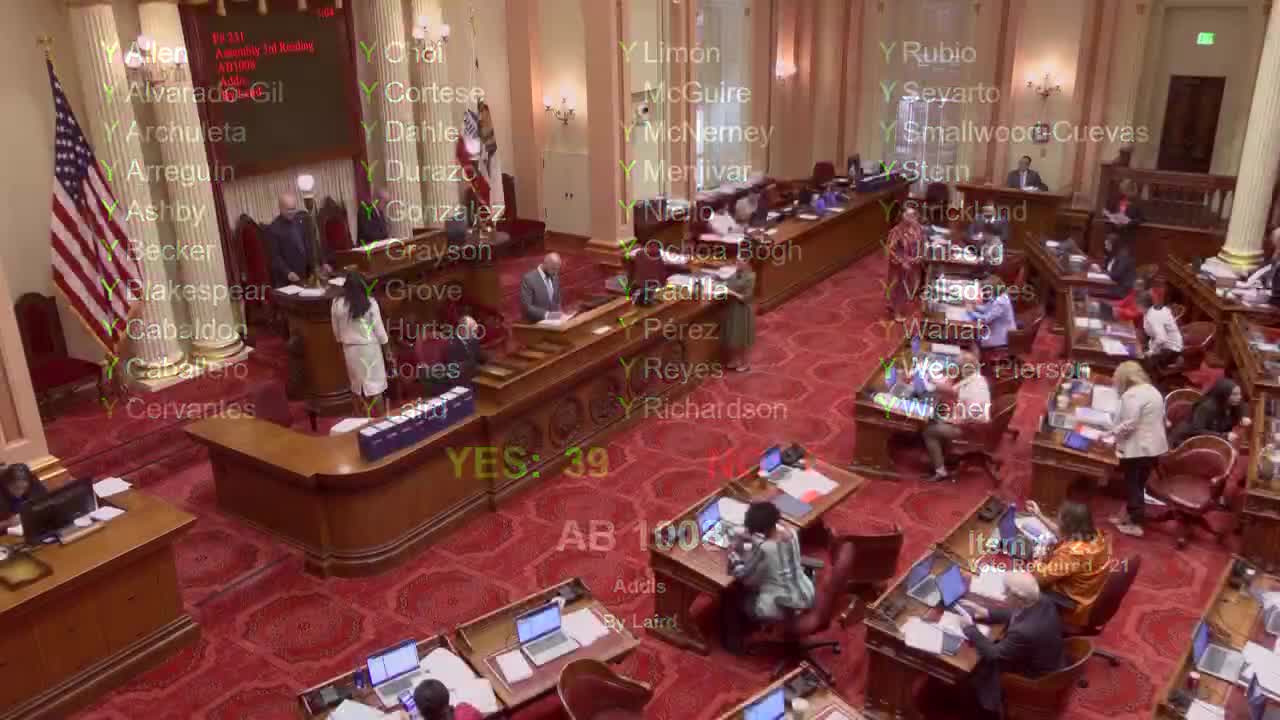 2MIN
Senate Floor
 12MIN
Senate Standing Committee on Local Government
 7MIN
Senate Standing Committee on Housing
 1MIN
Assembly Floor
 10MIN
Assembly Standing Committee on Local Government
Bill Author

Bill Co-Author(s):