AB 1159: Student personal information.
- Session Year: 2025-2026
- House: Assembly
- Latest Version Date: 2026-09-10
Current Status:
Passed
(2026-09-10: Chaptered by Secretary of State - Chapter 182, Statutes of 2026.)
Introduced
In Committee
Awaiting First Chamber Vote
Passed First Chamber
In Committee
Awaiting Second Chamber Vote
Passed Second Chamber
Enacted
Existing law, the K12 Pupil Online Personal Information Protection Act (KOPIPA), generally protects the personal information of a student enrolled in a K12 course of instruction, defined as a pupil, by prescribing requirements and prohibitions applicable to an operator of an internet website, online service, online application, or mobile application with actual knowledge that the site, service, or application is used primarily for K12 school purposes and was designed and marketed for K12 school purposes.
Existing law, the Early Learning Personal Information Protection Act (ELPIPA), generally protects the personal information of a child enrolled in a preschool or prekindergarten course of instruction, defined as a pupil, by prescribing requirements and prohibitions applicable to an operator of an internet website, online service, online application, or mobile application with actual knowledge that the site, service, or application is used primarily for preschool or prekindergarten purposes and was designed and marketed for preschool and prekindergarten purposes.
This bill would instead apply the provisions of KOPIPA and ELPIPA to an operator, or an entity working on behalf of the operator, of an internet website, online service, online application, or mobile application with actual knowledge that the site, service, or application is used for the applicable school purposes and was designed or marketed for those purposes, as specified. The bill would, among other changes to KOPIPA and ELPIPA related to protecting the personal information of students, prohibit an operator from using covered information, as defined, including persistent unique identifiers, created or gathered by the operators site, service, or application to train a generative artificial intelligence system or service or develop an artificial intelligence system.
This bill would also enact the Higher Education Student Information Protection Act (HESIPA), which would generally protect the personal information of a student enrolled in a higher education institution, as defined, in a similar manner as KOPIPA and ELPIPA. The bill would make HESIPA operative on July 1, 2027.
This bill would authorize a pupil or student actually harmed by noncompliance with KOPIPA, ELPIPA, or HESIPA to bring a civil action against the noncompliant operator, as prescribed, and would require a person bringing that action to furnish a copy of the complaint to the Attorney General within 10 days after filing the action.
Existing law, the K12 Pupil Online Personal Information Protection Act (KOPIPA), generally protects the personal information of a student enrolled in a K12 course of instruction, defined as a pupil, by prescribing requirements and prohibitions applicable to an operator of an internet website, online service, online application, or mobile application with actual knowledge that the site, service, or application is used primarily for K12 school purposes and was designed and marketed for K12 school purposes.
Existing law, the Early Learning Personal Information Protection Act (ELPIPA), generally protects the personal information of a child enrolled in a preschool or prekindergarten course of instruction, defined as a pupil, by prescribing requirements and prohibitions applicable to an operator of an internet website, online service, online application, or mobile application with actual knowledge that the site, service, or application is used primarily for preschool or prekindergarten purposes and was designed and marketed for preschool and prekindergarten purposes.
This bill would instead apply the provisions of KOPIPA and ELPIPA to an operator, or an entity working on behalf of the operator, of an internet website, online service, online application, or mobile application with actual knowledge that the site, service, or application is used for the applicable school purposes and was designed or marketed for those purposes, as specified. The bill would, among other changes to KOPIPA and ELPIPA related to protecting the personal information of students, prohibit an operator from using covered information, as defined, including persistent unique identifiers, created or gathered by the operators site, service, or application to train a generative artificial intelligence system or service or develop an artificial intelligence system.
This bill would also enact the Higher Education Student Information Protection Act (HESIPA), which would generally protect the personal information of a student enrolled in a higher education institution, as defined, in a similar manner as KOPIPA and ELPIPA. The bill would make HESIPA operative on July 1, 2027.
This bill would authorize a pupil or student actually harmed by noncompliance with KOPIPA, ELPIPA, or HESIPA to bring a civil action against the noncompliant operator, as prescribed, and would require a person bringing that action to furnish a copy of the complain complaint to the Attorney General within 10 days after filing the action.
Existing law, the K12 Pupil Online Personal Information Protection Act (KOPIPA), generally protects the personal information of a student enrolled in a K12 course of instruction, defined as a pupil, by prescribing requirements and prohibitions applicable to an operator of an internet website, online service, online application, or mobile application with actual knowledge that the site, service, or application is used primarily for K12 school purposes and was designed and marketed for K12 school purposes.
Existing law, the Early Learning Personal Information Protection Act (ELPIPA), generally protects the personal information of a child enrolled in a preschool or prekindergarten course of instruction, defined as a pupil, by prescribing requirements and prohibitions applicable to an operator of an internet website, online service, online application, or mobile application with actual knowledge that the site, service, or application is used primarily for preschool or prekindergarten purposes and was designed and marketed for preschool and prekindergarten purposes.
This bill would instead apply the provisions of KOPIPA and ELPIPA to an operator, or an entity working on behalf of the operator, of an internet website, online service, online application, or mobile application with actual knowledge that the site, service, or application is used for the applicable school purposes and was designed or marketed for those purposes, as specified. The bill would, among other changes to KOPIPA and ELPIPA related to protecting the personal information of students, prohibit an operator from using covered information, as defined, including persistent unique identifiers, created or gathered by the operators site, service, or application to train a generative artificial intelligence system or service or develop an artificial intelligence system.
This bill would also enact the Higher Education Student Information Protection Act (HESIPA), which would generally protect the personal information of a student enrolled in a higher education institution, as defined, in a similar manner as KOPIPA and ELPIPA. The bill would make HESIPA operative on July 1, 2027.
This bill would authorize a pupil or student actually harmed by the noncompliance with KOPIPA, ELPIPA, or HESIPA to bring a civil action against the noncompliant operator, as prescribed. prescribed, and would require a person bringing that action to furnish a copy of the complain to the Attorney General within 10 days after filing the action.
Existing law, the K12 Pupil Online Personal Information Protection Act (KOPIPA), generally protects the personal information of a student enrolled in a K12 course of instruction, defined as a pupil, by prescribing requirements and prohibitions applicable to an operator of an internet website, online service, online application, or mobile application with actual knowledge that the site, service, or application is used primarily for K12 school purposes and was designed and marketed for K12 school purposes.
Existing law, the Early Learning Personal Information Protection Act (ELPIPA), generally protects the personal information of a child enrolled in a preschool or prekindergarten course of instruction, defined as a pupil, by prescribing requirements and prohibitions applicable to an operator of an internet website, online service, online application, or mobile application with actual knowledge that the site, service, or application is used primarily for preschool or prekindergarten purposes and was designed and marketed for preschool and prekindergarten purposes.
This bill would instead apply the provisions of KOPIPA and ELPIPA to an operator operator, or an entity working on behalf of the operator, of an internet website, online service, online application, or mobile application with actual knowledge that the site, service, or application is used for the applicable school purposes and was designed or marketed for those purposes, as specified. The bill would, among other changes to KOPIPA and ELPIPA related to protecting the personal information of students, prohibit an operator from using covered information, as defined, including persistent unique identifiers, created or gathered by the operators site, service, or application to train a generative artificial intelligence system or service or develop an artificial intelligence system.
This bill would also enact the Higher Education Student Information Protection Act (HESIPA), which would generally protect the personal information of a student enrolled in a higher education institution, as defined, in a similar manner as KOPIPA and ELPIPA. The bill would make HESIPA operative on July 1, 2027.
This bill would authorize a pupil or student actually harmed by the noncompliance with KOPIPA, ELPIPA, or HESIPA to bring a civil action against the noncompliant operator, as prescribed.
Existing law, the K12 Pupil Online Personal Information Protection Act (KOPIPA), generally protects the personal information of a student enrolled in a K12 course of instruction, defined as a pupil, by prescribing requirements and prohibitions applicable to an operator of an internet website, online service, online application, or mobile application with actual knowledge that the site, service, or application is used primarily for K12 school purposes and was designed and marketed for K12 school purposes.
Existing law, the Early Learning Personal Information Protection Act (ELPIPA), generally protects the personal information of a child enrolled in a preschool or prekindergarten course of instruction, defined as a pupil, by prescribing requirements and prohibitions applicable to an operator of an internet website, online service, online application, or mobile application with actual knowledge that the site, service, or application is used primarily for preschool or prekindergarten purposes and was designed and marketed for preschool and prekindergarten purposes.
This bill would instead apply the provisions of KOPIPA and ELPIPA to an operator of an internet website, online service, online application, or mobile application with actual knowledge that the site, service, or application is used for the applicable school purposes and was designed or marketed for those purposes, as specified. The bill would, among other changes to KOPIPA and ELPIPA related to protecting the personal information of students, prohibit an operator from using covered information, as defined, including persistent unique identifiers, created or gathered by the operators site, service, or application to train a generative artificial intelligence system or service or develop an artificial intelligence system unless it is in the furtherance of the relevant type of school purpose and for the use and benefit of the school. system.
This bill would also enact the Higher Education Student Information Protection Act (HESIPA), which would generally protect the personal information of a student enrolled in a higher education institution, as defined, in a similar manner as KOPIPA and ELPIPA. The bill would make HESIPA operative on July 1, 2026. 2027.
This bill would authorize a pupil or student actually harmed by the noncompliance with KOPIPA, ELPIPA, or HESIPA to bring a civil action against the noncompliant operator, as prescribed.
Existing law, the K12 Pupil Online Personal Information Protection Act (KOPIPA), generally protects the personal information of a student enrolled in a K12 course of instruction, defined as a pupil, by prescribing requirements and prohibitions applicable to an operator of an internet website, online service, online application, or mobile application with actual knowledge that the site, service, or application is used primarily for K12 school purposes and was designed and marketed for K12 school purposes.
Existing law, the Early Learning Personal Information Protection Act (ELPIPA), generally protects the personal information of a child enrolled in a preschool or prekindergarten course of instruction, defined as a pupil, by prescribing requirements and prohibitions applicable to an operator of an internet website, online service, online application, or mobile application with actual knowledge that the site, service, or application is used primarily for preschool or prekindergarten purposes and was designed and marketed for preschool and prekindergarten purposes.
This bill would instead apply the provisions of KOPIPA and ELPIPA to an operator of an internet website, online service, online application, or mobile application with actual knowledge that the site, service, or application is used for the applicable school purposes and was designed or marketed for those purposes, as specified. The bill would, among other changes to KOPIPA and ELPIPA related to protecting the personal information of students, prohibit an operator from using information, including persistent unique identifiers, created or gathered by the operators site, service, or application to train a generative artificial intelligence system or service or develop an artificial intelligence system unless it is in the furtherance of the relevant type of school purpose and for the use and benefit of the school.
This bill would also enact the Higher Education Student Information Protection Act (HESIPA), which would generally protect the personal information of a student enrolled in a higher education institution, as defined, in a similar manner as KOPIPA and ELPIPA. The bill would make HESIPA operative on July 1, 2026.
This bill would authorize a pupil or student actually harmed by the noncompliance with KOPIPA, ELPIPA, or HESIPA to bring a civil action against the noncompliant operator, as prescribed.
Existing law requires an operator of a commercial internet website or online service that collects personally identifiable information through the internet about individual consumers residing in California who use or visit its commercial internet website or online service to conspicuously make its privacy policy available, as specified.This bill would make nonsubstantive changes to those provisions.Existing law requires an operator of a commercial internet website or online service that collects personally identifiable information through the internet about individual consumers residing in California who use or visit its commercial internet website or online service to conspicuously make its privacy policy available, as specified.
This bill would make nonsubstantive changes to those provisions.
(a)For purposes of this chapter:
(1)Artificial intelligence has the same meaning as defined in Section 3110 of the Civil Code.
(2)California Consumer Privacy Act-excluded covered information or CCPA-excluded covered information means covered information that is not subject to the California Consumer Privacy Act of 2018 (Title 1.81.5 (commencing with Section 1798.100) of Part 4 of Division 3 of the Civil Code).
(3)Covered information means personally identifiable information or materials, in any media or format that meets any of the following:
(A)Is created or provided by a pupil, or the pupils parent, education rights holder, or legal guardian, to an operator in the course of the pupils, parents, education rights holders, or legal guardians use of the operators site, service, or application for K12 school purposes.
(B)Is created or provided by an employee or agent of the school or local educational agency to an operator.
(C)Is gathered by an operator through the operation of a site, service, or application described in paragraph (10) and is descriptive of a pupil or otherwise identifies a pupil, including, but not limited to, information in the pupils educational record or email, first and last name, home address, telephone number, email address, or other information that allows physical or online contact, demographics, discipline records, test results, special education data, extracurricular activities, juvenile dependency records, grades, evaluations, criminal records, medical records, health records, social security number, biometric or behavioral information, disabilities, socioeconomic information, food purchases, political affiliations, religious information, text messages, documents, pupil identifiers, device identifiers, search activity, photographs, voice recordings, or geolocation information.
(4)Deidentified information means information that cannot reasonably identify, relate to, describe, be capable of being associated with, or be linked, directly or indirectly, to a particular individual, school, or household, if the operator that possesses the information does all of the following:
(A)Takes reasonable measures to ensure that the information cannot be associated with a particular individual, school, or household.
(B)(i)Subject to clause (ii), publicly commits to maintain and use the information in deidentified form and not to attempt to reidentify the information.
(ii)The operator may attempt to reidentify the information solely for the purpose of determining whether its deidentification processes satisfy the criteria of this paragraph.
(C)Contractually obligates any recipient of the information to meet the criteria described in subparagraphs (A) and (B).
(D)Applies deidentification measures consistent with those required of educational agencies and institutions under the Family Educational Rights and Privacy Act (20 U.S.C. Sec. 1232g) and implementing regulations, as determined by the local educational agency.
(E)Makes its deidentification processes available for review by the school or local educational agency that the operator serves before any use of deidentified data by the operator.
(F)To the extent the school or local educational agency that the operator serves maintains a deidentification policy or standard, applies deidentification measures in accordance with that policy or standard.
(G)If the school or local educational agency that the operator serves reviews the operators deidentification processes under subparagraph (E), the operator shall not use, share, or retain the information as deidentified information unless that school or local educational agency determines that the operators deidentification process is sufficient under these standards.
(5)Generative artificial intelligence has the same meaning as defined in Section 3110 of the Civil Code.
(6)K12 school purposes means purposes that customarily take place at the direction of the K12 school, teacher, or local educational agency or aid in the administration of school activities, including, but not limited to, instruction in the classroom or at home, administrative activities, and collaboration between pupils, school personnel, or parents, or are for the use and benefit of the school.
(7)Local educational agency means a school district, county office of education, charter school, or the state special schools for the blind and the deaf.
(8)National assessment provider means a person that develops, sponsors, or administers standardized tests.
(9)Online service includes cloud computing services, which must comply with this section if they otherwise meet the definition of an operator.
(10)(A)Operator means the operator, or an entity working on behalf of the operator, of an internet website, online service, online application, or mobile application with actual knowledge that the site, service, or application is used for K12 school purposes and was designed or marketed for K12 school purposes, including a provider of digital educational software or services, including digital course books.
(B)Operator does not include the State Department of Education, a local educational agency, or a school.
(11)Pupil means a student enrolled in a K12 course of instruction.
(12)Standardized test means a test administered in California at the expense of the test subject that meets either of the following criteria:
(A)The test is used for the purposes of admission to, or class placement in, postsecondary educational institutions or their programs.
(B)The test is used for preliminary preparation for a test described in subparagraph (A).
(13)Train a generative artificial intelligence system or service has the same meaning as defined in Section 3110 of the Civil Code.
(b)An operator shall not knowingly engage in any of the following activities with respect to the operators site, service, or application:
(1)(A)Engage in targeted advertising on the operators site, service, or application, or (B) target advertising on any other site, service, or application, including via email or other direct communication to the pupil, when the targeting of the advertising is based upon any information, including covered information and persistent unique identifiers, that the operator has acquired because of the use of that operators site, service, or application described in paragraph (10) of subdivision (a).
(2)Use any information, including covered information and persistent unique identifiers, created or gathered by the operators site, service, or application, to amass a profile about a pupil enrolled in a local educational agency, except in furtherance of K12 school purposes and for the use and benefit of the K12 school and the teacher, pupil, or parent.
(3)Sell a pupils information, including covered information, unless the sale meets either of the following criteria:
(A)The sale is for the purchase, merger, or other type of acquisition of an operator by another entity, provided that the operator or successor entity continues to be subject to the provisions of this section with respect to previously acquired pupil information.
(B)The sale is made pursuant to a written contract that prohibits the recipient from selling or disclosing the information, or any information derived from the information, to any other party other than for a purpose for which the sale is permitted under this paragraph or as required by law and meets either of the following criteria:
(i)The sale is made by a national assessment provider to a K12 school, local educational agency, higher education institution, as defined in Section 22587, or a scholarship-granting organization, or a service provider acting on behalf of any of those entities or the national assessment provider, solely for assessment, admissions, the awarding of scholarships or financial aid, or other K12 school purposes or higher education purposes, as defined in Section 22587, for the benefit of the pupil.
(ii)The sale is made by a nonprofit entity established to provide enrollment data reporting services on behalf of higher education institutions to a state or federal agency, a K12 school, a local educational agency, a higher education institution, an entity servicing student loans, or an entity with a direct relationship with the pupil, solely for verification of a pupils graduation from high school for the benefit of the pupil.
(4)Disclose covered information unless the disclosure meets any of the following criteria:
(A)The disclosure is in furtherance of the K12 purpose of the site, service, or application and the recipient of the covered information disclosed pursuant to this subparagraph meets both of the following criteria:
(i)The recipient does not further disclose the information unless done to allow or improve operability and functionality within that pupils classroom or school.
(ii)The recipient is legally required to comply with subdivision (d).
(B)The disclosure is necessary to ensure legal and regulatory compliance.
(C)The disclosure is necessary to respond to or participate in judicial process.
(D)The disclosure is necessary to protect the safety of users or others or security of the site.
(E)The disclosure is to a service provider, and the operator contractually (i) prohibits the service provider from using any covered information for any purpose other than providing the contracted service to, or on behalf of, the operator, (ii) prohibits the service provider from disclosing any covered information provided by the operator with subsequent third parties, and (iii) requires the service provider to implement and maintain reasonable security procedures and practices as provided in subdivision (d).
(F)The disclosure is made pursuant to a written contract that prohibits the recipient from selling or disclosing the information, or any information derived from the information, to any other party other than for a purpose for which the disclosure is permitted under this paragraph or as required by law and meets either of the following criteria:
(i)The disclosure is by a national assessment provider to a K12 school, local educational agency, higher education institution, as defined in Section 22587, or to a scholarship-granting organization, or a service provider acting on behalf of any of those entities or the national assessment provider, solely for assessment, admissions, the awarding of scholarships or financial aid, or other K12 school purposes or higher education purposes, as defined in Section 22587, for the benefit of the pupil.
(ii)The disclosure is made by a nonprofit entity established to provide enrollment data reporting services on behalf of higher education institutions to a state or federal agency, a K12 school, a local educational agency, a higher education institution, an entity servicing student loans, or an entity with a direct relationship with the pupil, solely for verification of a pupils graduation from high school for the benefit of the pupil.
(5)Use covered information, including persistent unique identifiers, created or gathered by the operators site, service, or application to train a generative artificial intelligence system or service or develop an artificial intelligence system.
(6)Collect, use, retain, or disclose covered information relating to a pupils reproductive or sexual health, immigration status, or sexual orientation or gender identity.
(c)Subdivision (b) does not prohibit the operators use of information for maintaining, developing, supporting, improving, or diagnosing the operators site, service, or application.
(d)An operator shall do all of the following:
(1)Implement and maintain reasonable security procedures and practices appropriate to the nature of the covered information, and protect that information from unauthorized access, destruction, use, modification, or disclosure.
(2)(A)Delete a pupils covered information if the school or local educational agency requests deletion of data under the control of the school or local educational agency.
(B)This paragraph does not require the deletion of pupil records held by a national assessment provider and that only include standardized test results.
(3)(A)Delete a pupils CCPA-excluded covered information under the operators control if a pupils parent, education rights holder, or guardian or, in the case of a former pupil who is 18 years of age or older, the pupil requests an operator to delete the covered information under the operators control if the pupil has been no longer enrolled in the local educational agency for at least 60 days.
(B)Before deleting any information described in subparagraph (A), the operator shall require documentation that the pupil is no longer enrolled in the local educational agency.
(C)This paragraph does not require deletion of mandatory permanent pupil records, described in Section 430 of Title 5 of the California Code of Regulations, or any official records or files directly related to a pupil and maintained by the operator, school, or local educational agency, including, but not limited to, records of achievement and results of evaluative tests or records encompassing all of the material kept in the pupils cumulative folder that is maintained by the school or local educational agency, including, but not limited to, general identifying data, records of attendance and of academic work completed, health data, disciplinary status, test protocols, individualized education programs, or pupil records held by a national assessment provider and that only include standardized test results.
(4)(A)Subject to subparagraph (B), retain covered information only as long as reasonably necessary to fulfill the specific purpose for which the information was collected and delete the information using reasonable measures to protect against unauthorized access to, or use or disclosure of, the information in connection with its deletion when the specific purpose for which the information was collected is accomplished.
(B)This paragraph does not require deletion of mandatory permanent pupil records, described in Section 430 of Title 5 of the California Code of Regulations, or any official records or files directly related to a pupil and maintained by the operator, school, or local educational agency, including, but not limited to, records of achievement and results of evaluative tests or records encompassing all of the material kept in the pupils cumulative folder that is maintained by the school or local educational agency, including, but not limited to, general identifying data, records of attendance and of academic work completed, health data, disciplinary status, test protocols, individualized education programs, or pupil records held by a national assessment provider that include only standardized test results.
(5)(A)Establish, implement, and maintain a written data retention policy, which shall be made available upon request to a pupil, parent, guardian, education rights holder, or K12 personnel, that states the purposes for which covered information is collected, the purpose for retaining the information, and a timeframe for deleting the information pursuant to paragraph (4).
(B)A written data retention policy under this paragraph shall not exceed the retention period for the same information or record if that information or record is maintained by the school or local educational agency.
(6)Disclose to a pupil the pupils CCPA-excluded covered information under the operators control if the pupils parent, education rights holder, or guardian or, in the case of a former pupil who is 18 years of age or older, the pupil requests an operator to disclose the covered information under the operators control if the pupil has no longer been enrolled in the school or local educational agency for at least 60 days.
(e)Notwithstanding paragraph (4) of subdivision (b), an operator may disclose covered information of a pupil, as long as paragraphs (1) to (3), inclusive, of subdivision (b) are not violated, under the following circumstances:
(1)If other provisions of federal or state law require the operator to disclose the information, and the operator complies with the requirements of federal and state law in protecting and disclosing that information.
(2)For legitimate research purposes: (A) as required by state or federal law and subject to the restrictions under applicable state and federal law or (B) as allowed by state or federal law and under the direction of a local educational agency or state department of education, if no covered information is used for any purpose in furtherance of advertising or to amass a profile on the pupil for purposes other than K12 school purposes.
(3)To a state or local educational agency, including schools of local educational agencies, for K12 school purposes, as permitted by state or federal law.
(f)This section does not prohibit an operator from using deidentified pupil covered information as follows:
(1)Within the operators site, service, or application or other sites, services, or applications owned by the operator to improve educational products.
(2)To demonstrate the effectiveness of the operators products or services, including in their marketing.
(g)This section does not prohibit an operator from sharing aggregated deidentified pupil covered information for the development and improvement of educational sites, services, or applications.
(h)This section does not limit the authority of a law enforcement agency to obtain any content or information from an operator as authorized by law or pursuant to an order of a court of competent jurisdiction.
(i)This section does not limit the ability of an operator to use pupil data, including covered information, for adaptive learning or customized pupil learning purposes.
(j)This section does not apply to general audience internet websites, general audience online services, general audience online applications, or general audience mobile applications that are not designed or marketed for K12 school purposes, even if login credentials created for an operators site, service, or application may be used to access those general audience sites, services, or applications.
(k)This section does not limit internet service providers from providing internet connectivity to schools or pupils and their families.
(l)This section does not prohibit an operator of an internet website, online service, online application, or mobile application from marketing educational products directly to parents so long as the marketing did not result from the use of covered information obtained by the operator through the provision of services covered under this section.
(m)This section does not impose a duty upon a provider of an electronic store, gateway, marketplace, or other means of purchasing or downloading software or applications to review or enforce compliance of this section on those applications or software.
(n)This section does not impose a duty upon a provider of an interactive computer service, as defined in Section 230 of Title 47 of the United States Code, to review or enforce compliance with this section by third-party content providers.
(o)This section does not impede the ability of pupils to download, export, or otherwise save or maintain their own pupil-created data or documents.
(p)This section shall not be interpreted to limit or supersede any rights or requirements under the federal Individuals with Disabilities Education Act (20 U.S.C. Sec. 1400 et seq.), the Rehabilitation Act of 1973 (29 U.S.C. Sec. 701 et seq.), the Family Educational Rights and Privacy Act (20 U.S.C. Sec. 1232g), and any rules or regulations promulgated pursuant to those laws.
(q)This section does not require a school or local educational agency to review an operators deidentification processes or to approve an operators retention or use of deidentified information.
SEC. 2.Section 22585 of the Business and Professions Code is repealed.SEC. 3.Section 22585 is added to the Business and Professions Code, to read:22585.(a)A pupil who suffers actual damages as a result of an operators failure to comply with this chapter, or the pupils parent, education rights holder, or guardian, may, pursuant to this section, bring an action on that persons behalf and on behalf of a similarly situated class of pupils against that operator to recover or obtain any of the following relief:
(1)The greater of actual damages or five hundred dollars ($500) per plaintiff, per violation.
(2)Injunctive relief.
(3)Punitive damages.
(4)Reasonable attorneys fees and costs.
(b)(1)At least 60 days before bringing an action pursuant to this section, a pupil shall do both of the following:
(A)Provide written notice to the operator alleged to have violated this chapter regarding the nature of the alleged violations.
(B)Demand that the operator correct and remedy the alleged violations.
(2)The notice required by this subdivision shall be sent by certified or registered mail, return receipt requested, to the operators address on file with the state or to the operators principal place of business within the state.
(c)An action pursuant to this section brought by a pupil only on that pupils behalf shall not be maintained upon a showing by an operator that an appropriate correction and remedy has been made, or agreed to be made within a reasonable time, to the pupil within 60 days after receipt of the notice required by subdivision (b).
(d)An action pursuant to this section brought by a pupil on both the pupils behalf and on behalf of a similarly situated class of pupils shall not be maintained upon a showing by an operator that all of the following are true:
(1)Any pupil similarly situated has been identified, or a reasonable effort to identify the pupil has been made.
(2)Any similarly situated pupil identified has been notified that, upon the pupils request, the operator shall make the appropriate correction and remedy.
(3)The correction and remedy requested by the pupil has been made, or in a reasonable time will be made.
(4)The operator has ceased, or will cease within a reasonable time, violating this chapter.
(e)(1)Attempts to comply with a demand described in subdivision (b) by an operator shall be deemed an offer to compromise and shall be inadmissible under Section 1152 of the Evidence Code and shall not be deemed an admission of violating this chapter.
(2)A defendant may introduce evidence of compliance or attempts to comply with this section for the purpose of establishing good faith or to show compliance with this chapter.
(f)A pupil, or the pupils parent, education rights holder, or guardian, who brings an action under this section shall furnish a copy of the complaint to the Attorney General within 10 days after filing the action.
SEC. 4.Section 22586 of the Business and Professions Code is amended to read:22586.(a)For purposes of this chapter:
(1)Artificial intelligence has the same meaning as defined in Section 3110 of the Civil Code.
(2)California Consumer Privacy Act-excluded covered information or CCPA-excluded covered information means covered information that is not subject to the California Consumer Privacy Act of 2018 (Title 1.81.5 (commencing with Section 1798.100) of Part 4 of Division 3 of the Civil Code).
(3)Covered information means personally identifiable information or materials, in any media or format that meets any of the following:
(A)Is created or provided by a pupil, or the pupils parent, education rights holder, or legal guardian, to an operator in the course of the pupils, parents, education rights holders, or legal guardians use of the operators site, service, or application for preschool and prekindergarten purposes.
(B)Is created or provided by an employee or agent of the preschool, prekindergarten, school district, local educational agency, or county office of education, to an operator.
(C)Is gathered by an operator through the operation of a site, service, or application described in paragraph (7) and is descriptive of a pupil or otherwise identifies a pupil, including, but not limited to, information in the pupils educational record or email, first and last name, home address, telephone number, email address, or other information that allows physical or online contact, demographics, discipline records, test results, special education data, extracurricular activities, juvenile dependency records, grades, evaluations, criminal records, medical records, health records, social security number, biometric or behavioral information, disabilities, socioeconomic information, food purchases, political affiliations, religious information, text messages, documents, pupil identifiers, device identifiers, search activity, photographs, voice recordings, or geolocation information.
(4)Deidentified information means information that cannot reasonably identify, relate to, describe, be capable of being associated with, or be linked, directly or indirectly, to a particular individual, preschool, prekindergarten, or household, if the operator that possesses the information does all of the following:
(A)Takes reasonable measures to ensure that the information cannot be associated with a particular individual, preschool, prekindergarten, or household.
(B)(i)Subject to clause (ii), publicly commits to maintain and use the information in deidentified form and not to attempt to reidentify the information.
(ii)The operator may attempt to reidentify the information solely for the purpose of determining whether its deidentification processes satisfy the criteria of this paragraph.
(C)Contractually obligates any recipient of the information to meet the criteria described in subparagraphs (A) and (B).
(D)Applies deidentification measures consistent with those required of educational agencies and institutions under the Family Educational Rights and Privacy Act (20 U.S.C. Sec. 1232g) and implementing regulations, as determined by the preschool, prekindergarten, or local educational agency.
(E)Makes its deidentification processes available for review by the preschool, prekindergarten, or local educational agency that the operator serves before any use of deidentified data by the operator.
(F)To the extent the preschool, prekindergarten, or local educational agency that the operator serves maintains a deidentification policy or standard, applies deidentification measures in accordance with that policy or standard.
(G)If the preschool, prekindergarten, or local educational agency that the operator serves reviews the operators deidentification processes under subparagraph (E), the operator shall not use, share, or retain the information as deidentified information unless that preschool, prekindergarten, or local educational agency determines that the operators deidentification process is sufficient under these standards.
(5)Generative artificial intelligence has the same meaning as defined in Section 3110 of the Civil Code.
(6)Online service includes cloud computing services, which must comply with this section if they otherwise meet the definition of an operator.
(7)(A)Operator means the operator, or an entity working on behalf of the operator, of an internet website, online service, online application, or mobile application with actual knowledge that the site, service, or application is used for preschool or prekindergarten purposes and was designed or marketed for preschool or prekindergarten purposes, including a provider of digital educational software or services, including digital course books.
(B)Operator does not include the State Department of Education, a local educational agency, a preschool, or a prekindergarten.
(8)Preschool or prekindergarten purposes means purposes that customarily take place at the direction of the preschool, prekindergarten, teacher, or school district, or aid in the administration of preschool or prekindergarten activities, including, but not limited to, instruction in the classroom or at home, administrative activities, and collaboration between pupils, preschool or prekindergarten personnel, or parents, or are for the use and benefit of the preschool or prekindergarten.
(9)Pupil means a child enrolled in a preschool or prekindergarten course of instruction.
(10)Train a generative artificial intelligence system or service has the same meaning as defined in Section 3110 of the Civil Code.
(b)An operator shall not knowingly engage in any of the following activities with respect to the operators site, service, or application:
(1)(A)Engage in targeted advertising on the operators site, service, or application.
(B)Target advertising on any other site, service, or application, including via email or other direct communication to the pupil when the targeting of the advertising is based upon any information, including covered information and persistent unique identifiers, that the operator has acquired because of the use of that operators site, service, or application described in paragraph (7) of subdivision (a).
(2)Use covered information, including persistent unique identifiers, created or gathered by the operators site, service, or application, to amass a profile about a pupil, except in furtherance of a preschool or prekindergarten purpose for the use and benefit of the preschool or prekindergarten and the teacher, pupil, or parent.
(3)Sell a pupils information, including covered information. This prohibition does not apply to the purchase, merger, or other type of acquisition of an operator by another entity, provided that the operator or successor entity continues to be subject to the provisions of this section with respect to previously acquired pupil information.
(4)Disclose covered information unless the disclosure meets any of the following criteria:
(A)The disclosure is in furtherance of the preschool and prekindergarten purposes of the site, service, or application, and the recipient of the covered information disclosed pursuant to this subparagraph meets both of the following criteria:
(i)The recipient does not further disclose the information unless done to allow or improve operability and functionality within that pupils preschool or prekindergarten.
(ii)The recipient is legally required to comply with subdivision (d).
(B)The disclosure is necessary to ensure legal and regulatory compliance.
(C)The disclosure is necessary to respond to or participate in a judicial process.
(D)The disclosure is necessary to protect the safety of users or others or security of the site.
(E)The disclosure is to a service provider, provided the operator contractually (i) prohibits the service provider from using any covered information for any purpose other than providing the contracted service to, or on behalf of, the operator, (ii) prohibits the service provider from disclosing any covered information provided by the operator with subsequent third parties, and (iii) requires the service provider to implement and maintain reasonable security procedures and practices as provided in subdivision (d).
(5)Use covered information, including persistent unique identifiers, created or gathered by the operators site, service, or application to train a generative artificial intelligence system or service or develop an artificial intelligence system.
(6)Collect, use, retain, or disclose covered information relating to a pupils reproductive or sexual health, immigration status, or sexual orientation or gender identity.
(c)Subdivision (b) does not prohibit the operators use of information for maintaining, developing, supporting, improving, or diagnosing the operators site, service, or application.
(d)An operator shall do all of the following:
(1)Implement and maintain reasonable security procedures and practices appropriate to the nature of the covered information, and protect that information from unauthorized access, destruction, use, modification, or disclosure.
(2)Delete a pupils covered information if the preschool, prekindergarten, or district requests deletion of data under the control of the preschool, prekindergarten, or district.
(3)(A)Delete a pupils CCPA-excluded covered information under the operators control if a pupils parent, guardian, or education rights holder or, in the case of a former pupil 18 years of age or older, the pupil requests an operator to delete the covered information under the operators control if the pupil has been no longer enrolled in the preschool, prekindergarten, or district for at least 60 days.
(B)Before deleting any information described in subparagraph (A), the operator shall require documentation that the pupil is no longer enrolled in the preschool, prekindergarten, or district.
(4)(A)Subject to subparagraph (B), retain covered information only as long as reasonably necessary to fulfill the specific purpose for which the information was collected and delete the information using reasonable measures to protect against unauthorized access to, or use or disclosure of, the information in connection with its deletion when the specific purpose for which the information was collected is accomplished.
(B)This paragraph does not require deletion of mandatory permanent pupil records, described in Section 430 of Title 5 of the California Code of Regulations, or any official records or files directly related to a pupil and maintained by the operator, school, or local educational agency, including, but not limited to, records of achievement and results of evaluative tests or records encompassing all of the material kept in the pupils cumulative folder that is maintained by the school or local educational agency, including, but not limited to, general identifying data, records of attendance and of academic work completed, health data, disciplinary status, test protocols, individualized education programs, or pupil records held by a national assessment provider that include only standardized test results.
(5)(A)Establish, implement, and maintain a written data retention policy, which shall be made available upon request to a pupil, parent, guardian, education rights holder, or preschool or prekindergarten personnel, that states the purposes for which covered information is collected, the purpose for retaining the information, and a timeframe for deleting the information pursuant to paragraph (4).
(B)A written data retention policy under this paragraph shall not exceed the retention period for the same information or record if that information or record is maintained by the preschools or prekindergartens personnel.
(6)Disclose to a pupil the pupils CCPA-excluded covered information under the operators control if the pupils parent, education rights holder, or guardian or, in the case of a former pupil who is 18 years of age or older, the pupil requests an operator to disclose the covered information under the operators control if the pupil has no longer been enrolled in the preschool, prekindergarten, or local educational agency for at least 60 days.
(e)Notwithstanding paragraph (4) of subdivision (b), an operator may disclose covered information of a pupil, as long as paragraphs (1) to (3), inclusive, of subdivision (b) are not violated, under the following circumstances:
(1)If other provisions of federal or state law require the operator to disclose the information, and the operator complies with the requirements of federal and state law in protecting and disclosing that information.
(2)For legitimate research purposes: (A) as required by state or federal law and subject to the restrictions under applicable state and federal law or (B) as allowed by state or federal law and under the direction of a preschool, prekindergarten, school district, or state department of education, if no covered information is used for any purpose in furtherance of advertising or to amass a profile on the pupil for purposes other than preschool and prekindergarten purposes.
(3)To a state or local educational agency, including preschools, prekindergartens, and school districts, for preschool and prekindergarten purposes, as permitted by state or federal law.
(f)This section does not prohibit an operator from using deidentified pupil covered information as follows:
(1)Within the operators site, service, or application or other sites, services, or applications owned by the operator to improve educational products.
(2)To demonstrate the effectiveness of the operators products or services, including in their marketing.
(g)This section does not prohibit an operator from sharing aggregated deidentified pupil covered information for the development and improvement of educational sites, services, or applications.
(h)This section does not limit the authority of a law enforcement agency to obtain any content or information from an operator as authorized by law or pursuant to an order of a court of competent jurisdiction.
(i)This section does not limit the ability of an operator to use a pupils data, including covered information, for adaptive learning or customized early learning purposes.
(j)This section does not apply to general audience internet websites, general audience online services, general audience online applications, or general audience mobile applications that are not designed or marketed for preschool or prekindergarten purposes, even if login credentials created for an operators site, service, or application may be used to access those general audience sites, services, or applications.
(k)This section does not limit internet service providers from providing internet connectivity to preschools, prekindergartens, or pupils and their families.
(l)This section does not prohibit an operator of an internet website, online service, online application, or mobile application from marketing educational products directly to parents so long as the marketing did not result from the use of covered information obtained by the operator through the provision of services covered under this section.
(m)This section does not impose a duty upon a provider of an electronic store, gateway, marketplace, or other means of purchasing or downloading software or applications to review or enforce compliance of this section on those applications or software.
(n)This section does not impose a duty upon a provider of an interactive computer service, as defined in Section 230 of Title 47 of the United States Code, to review or enforce compliance with this section by third-party content providers.
(o)This section does not impede the ability of pupils to download, export, or otherwise save or maintain their own personally created data or documents.
(p)This section shall not be interpreted to limit or supersede any rights or requirements under the federal Individuals with Disabilities Education Act (20 U.S.C. Sec. 1400 et seq.), the Rehabilitation Act of 1973 (29 U.S.C. Sec. 701 et seq.), the Family Educational Rights and Privacy Act (20 U.S.C. Sec. 1232g), and any rules or regulations promulgated pursuant to those laws.
(q)This section does not require a preschool, prekindergarten, or local educational agency to review an operators deidentification processes or to approve an operators retention or use of deidentified information.
SEC. 5.Section 22586.1 is added to the Business and Professions Code, to read:22586.1.(a)A pupil who suffers actual damages as a result of an operators failure to comply with this chapter, or the pupils parent, education rights holder, or guardian, may, pursuant to this section, bring an action on that persons behalf and on behalf of a similarly situated class of pupils against that operator to recover or obtain any of the following relief:
(1)The greater of actual damages or five hundred dollars ($500) per plaintiff, per violation.
(2)Injunctive relief.
(3)Punitive damages.
(4)Reasonable attorneys fees and costs.
(b)(1)At least 60 days before bringing an action pursuant to this section, a pupil shall do both of the following:
(A)Provide written notice to the operator alleged to have violated this chapter regarding the nature of the alleged violations.
(B)Demand that the operator correct and remedy the alleged violations.
(2)The notice required by this subdivision shall be sent by certified or registered mail, return receipt requested, to the operators address on file with the state or to the operators principal place of business within the state.
(c)An action pursuant to this section brought by a pupil only on that pupils behalf shall not be maintained upon a showing by an operator that an appropriate correction and remedy has been made, or agreed to be made within a reasonable time, to the pupil within 60 days after receipt of the notice required by subdivision (b).
(d)An action pursuant to this section brought by a pupil on both the pupils behalf and on behalf of a similarly situated class of pupils shall not be maintained upon a showing by an operator that all of the following are true:
(1)Any pupil similarly situated has been identified, or a reasonable effort to identify the pupil has been made.
(2)Any similarly situated pupil identified has been notified that, upon the pupils request, the operator shall make the appropriate correction and remedy.
(3)The correction and remedy requested by the pupil has been made, or in a reasonable time will be made.
(4)The operator has ceased, or will cease within a reasonable time, violating this chapter.
(e)(1)Attempts to comply with a demand described in subdivision (b) by an operator shall be deemed an offer to compromise and shall be inadmissible under Section 1152 of the Evidence Code and shall not be deemed an admission of violating this chapter.
(2)A defendant may introduce evidence of compliance or attempts to comply with this section for the purpose of establishing good faith or to show compliance with this chapter.
(f)A pupil, or the pupils parent, education rights holder, or guardian, who brings an action under this section shall furnish a copy of the complaint to the Attorney General within 10 days after filing the action.
SEC. 6.Section 22587 of the Business and Professions Code is repealed.SEC. 7.Chapter 22.2.6 (commencing with Section 22587) is added to Division 8 of the Business and Professions Code, to read:22.2.6.Higher Education Student Information Protection Act22587.(a)For purposes of this chapter:
(1)Artificial intelligence has the same meaning as defined in Section 3110 of the Civil Code.
(2)California Consumer Privacy Act-excluded covered information or CCPA-excluded covered information means covered information that is not subject to the California Consumer Privacy Act of 2018 (Title 1.81.5 (commencing with Section 1798.100) of Part 4 of Division 3 of the Civil Code).
(3)Covered information means personally identifiable information or materials, in any media or format, that is any of the following:
(A)Created or provided by a student, or if the student is under 18 years of age, the students parent, educational rights holder, or legal guardian, to an operator in the course of the students, parents, education rights holders, or legal guardians use of the operators site, service, or application for higher education purposes.
(B)Created or provided by an employee or agent of a higher education institution to an operator.
(C)Gathered by an operator through the operation of a site, service, or application described in paragraph (11) and is descriptive of a student, or otherwise identifies a student, including, but not limited to, information in the students educational record or email, first and last name, home address, telephone number, or other information that allows physical or online contact, demographics, course of study, discipline records, test results, special education data, extracurricular activities, juvenile dependency records, grades, evaluations, criminal records, medical records, health records, social security number, biometric or behavioral information, disabilities, socioeconomic information, food purchases, political affiliations, religious information, text messages, documents, student identifiers, device identifiers, online search activity, photographs, voice recordings, or geolocation information.
(4)Deidentified information means information that cannot reasonably identify, relate to, describe, be capable of being associated with, or be linked, directly or indirectly, to a particular individual, higher education institution, or household, if the operator that possesses the information does all of the following:
(A)Takes reasonable measures to ensure that the information cannot be associated with a particular individual, higher education institution, or household.
(B)(i)Subject to clause (ii), publicly commits to maintain and use the information in deidentified form and not to attempt to reidentify the information.
(ii)The operator may attempt to reidentify the information solely for the purpose of determining whether its deidentification processes satisfy the criteria of this paragraph.
(C)Contractually obligates any recipient of the information to meet the criteria described in subparagraphs (A) and (B).
(D)Applies deidentification measures consistent with those required of educational agencies and institutions under the Family Educational Rights and Privacy Act (20 U.S.C. Sec. 1232g) and implementing regulations, as determined by the higher education institution.
(E)Makes its deidentification processes available for review by the higher education institution that the operator serves before any use of deidentified data by the operator.
(F)To the extent the higher education institution that the operator serves maintains a deidentification policy or standard, applies deidentification measures in accordance with that policy or standard.
(G)If the higher education institution that the operator serves reviews the operators deidentification processes under subparagraph (E), the operator shall not use, share, or retain the information as deidentified information unless that higher education institution determines that the operators deidentification process is sufficient under these standards.
(5)Generative artificial intelligence has the same meaning as defined in Section 3110 of the Civil Code.
(6)Higher education institution means a postsecondary institution, vocational program, or postgraduate program that is accredited by an accrediting agency or organization recognized by the state or the United States Department of Education.
(7)Higher education purposes means purposes that customarily take place at the direction of the instructor or higher education institution or aid in the administration of higher education institution activities, including, but not limited to, instruction in the classroom or at home, administrative activities, and collaboration between students and higher education institution personnel or are for the use and benefit of the higher education institution.
(8)Local educational agency means a school district, county office of education, charter school, or the state special schools for the blind and the deaf.
(9)National assessment provider means a person that develops, sponsors, or administers standardized tests.
(10)Online service includes a cloud computing service, which shall comply with this section if it is an operator.
(11)(A)Operator means the operator, or an entity working on behalf of the operator, of an internet website, online service, online application, or mobile application with actual knowledge that the site, service, or application is used for higher educational purposes and was designed or marketed for higher educational purposes, including a provider of digital educational software or services, including digital course books.
(B)Operator does not include a local educational agency or a higher education institution.
(12)Student means a student enrolled in a higher education institution.
(13)Train a generative artificial intelligence system or service has the same meaning as defined in Section 3110 of the Civil Code.
(b)An operator shall not knowingly engage in any of the following activities with respect to the operators site, service, or application:
(1)(A)Engage in targeted advertising on the operators site, service, or application, or (B) target advertising on any other site, service, or application, including via email or other direct communication to the student, when the targeting of the advertising is based upon any information, including covered information and persistent unique identifiers, that the operator has acquired because of the use of that operators site, service, or application described in paragraph (11) of subdivision (a).
(2)Use information, including persistent unique identifiers, created or gathered by the operators site, service, or application, to amass a profile about a student, unless it is in the furtherance of higher education purposes.
(3)Sell a students information, including covered information, unless the sale meets either of the following criteria:
(A)The sale is for the purchase, merger, or other type of acquisition of an operator by another entity, provided that the operator or successor entity continues to be subject to the provisions of this section with respect to previously acquired student information.
(B)The sale is made pursuant to a written contract that prohibits the recipient from selling or disclosing the information, or any information derived from the information, to any other party other than for a purpose for which the sale is permitted under this paragraph or as required by law and meets either of the following criteria:
(i)The sale is made by a national assessment provider to a K12 school, a local educational agency, a higher education institution, or a scholarship-granting organization, or a service provider acting on behalf of any of those entities or the national assessment provider, solely for assessment, admissions, the awarding of scholarships or financial aid, or other K12 school purposes or higher education purposes for the benefit of the student.
(ii)The sale is made by a nonprofit entity established to provide enrollment data reporting services on behalf of higher education institutions to a state or federal agency, a higher education institution, an entity servicing student loans, an entity with a direct relationship with the student, or any such entitys service provider requesting data on behalf of that entity for any of the following purposes for the benefit of the student:
(I)As part of an enrollment verification, credential verification, transcript delivery, an enrollment reporting service, or a service that provides information on a students subsequent enrollment or credential attainment.
(II)For legal, accreditation, or regulatory compliance purposes.
(III)For a higher education purpose.
(4)Disclose covered information unless the disclosure meets any of the following criteria:
(A)The disclosure is in furtherance of the higher education purposes of the site, service, or application, and the recipient of the covered information disclosed pursuant to this subparagraph meets both of the following criteria:
(i)The recipient does not further disclose the information unless done to allow or improve operability and functionality within that students higher education institution.
(ii)The recipient is legally required to comply with subdivision (d).
(B)The disclosure is necessary to ensure legal and regulatory compliance.
(C)The disclosure is necessary to respond to or participate in judicial process.
(D)The disclosure is necessary to protect the safety of users or others or security of the site.
(E)The disclosure is to a service provider, provided the operator contractually (i) prohibits the service provider from using any covered information for any purpose other than providing the contracted service to, or on behalf of, the operator, (ii) prohibits the service provider from disclosing any covered information provided by the operator with subsequent third parties, and (iii) requires the service provider to implement and maintain reasonable security procedures and practices as provided in subdivision (d).
(F)The disclosure is made pursuant to a written contract that prohibits the recipient from selling or disclosing the information, or any information derived from the information, to any other party other than for a purpose for which the disclosure is permitted under this paragraph or as required by law and meets either of the following criteria:
(i)The disclosure is by a national assessment provider to a higher education institution, K12 school, local educational agency, as defined in Section 22584, or a scholarship-granting organization, or a service provider acting on behalf of any of those entities or the national assessment provider, solely for assessment, admissions, the awarding of scholarships or financial aid, or other higher education purposes or K12 school purposes, as defined in Section 22584, for the benefit of the student.
(ii)The disclosure is made by a nonprofit entity established to provide enrollment data reporting services on behalf of higher education institutions to a state or federal agency, a higher education institution, an entity servicing student loans, an entity with a direct relationship with the student, or any such entitys service provider requesting data on behalf of that entity for any of the following purposes for the benefit of the student:
(I)As part of an enrollment verification, a credential verification, a transcript delivery, an enrollment reporting service, or a service that provides information on a students subsequent enrollment or credential attainment.
(II)For legal, accreditation, or regulatory compliance purposes.
(III)For a higher education purpose.
(G)The disclosure is for legitimate research purposes under the direction of a higher education institution or state department of education and covered information is not used for advertising or to amass a profile on the student for purposes other than higher education purposes.
(H)The disclosure is to a state agency or higher education institution, including schools of local educational agencies, for higher education purposes.
(5)Use covered information, including persistent unique identifiers, created or gathered by the operators site, service, or application to train a generative artificial intelligence system or service or develop an artificial intelligence system.
(6)Collect, use, retain, or disclose covered information relating to a students reproductive or sexual health, immigration status, precise geolocation information, or sexual orientation or gender identity.
(c)Subdivision (b) does not prohibit the operators use of information for maintaining, developing, supporting, improving, or diagnosing the operators site, service, or application.
(d)An operator shall do all of the following:
(1)Implement and maintain reasonable security procedures and practices appropriate to the nature of the covered information, and protect that information from unauthorized access, destruction, use, modification, or disclosure.
(2)Delete a students covered information if the higher education institution requests deletion of data under the control of the higher education institution.
(3)(A)Delete a students CCPA-excluded covered information under the operators control if a student or, if the student is under 18 years of age, the students parent, guardian, or education rights holder requests an operator to delete the covered information under the operators control if the student has been no longer enrolled in the local education agency or higher education institution for at least 60 days.
(B)Before deleting any information described in subparagraph (A), the operator shall require documentation that the student is no longer enrolled in the higher education institution.
(4)(A)Subject to subparagraph (B), retain covered information only as long as reasonably necessary to fulfill the specific purpose for which the information was collected and delete the information using reasonable measures to protect against unauthorized access to, or use or disclosure of, the information in connection with its deletion when the specific purpose for which the information was collected is accomplished.
(B)This paragraph does not require deletion of mandatory permanent student records, described in Section 430 of Title 5 of the California Code of Regulations, or any official records or files directly related to a student and maintained by the operator or higher education institution, including, but not limited to, records of achievement and results of evaluative tests or records encompassing all of the material kept in the students cumulative folder that is maintained by the higher education institution, including, but not limited to, general identifying data, records of attendance and of academic work completed, health data, disciplinary status, test protocols, individualized education programs, or student records held by a national assessment provider that include only standardized test results.
(5)(A)Establish, implement, and maintain a written data retention policy, which shall be made available upon request to a student or higher education personnel, that states the purposes for which covered information is collected, the purpose for retaining the information, and a timeframe for deleting the information pursuant to paragraph (4).
(B)A written data retention policy under this paragraph shall not exceed the retention period for the same information or record if that information or record is maintained by the higher education institutions personnel.
(6)Disclose to a student the students CCPA-excluded covered information under the operators control if the students parent, education rights holder, or guardian or, in the case of a former student who is 18 years of age or older, the student requests an operator to disclose the covered information under the operators control if the student has no longer been enrolled in the higher education institution or local educational agency for at least 60 days.
(e)This section does not prohibit an operator from using deidentified student covered information for either of the following purposes:
(1)Within the operators site, service, or application or other sites, services, or applications owned by the operator to improve educational products.
(2)To demonstrate the effectiveness of the operators products or services, including in the operators marketing.
(f)This section does not prohibit an operator from sharing aggregated deidentified student covered information for the development and improvement of educational sites, services, or applications.
(g)This section does not limit the authority of a law enforcement agency to obtain any content or information from an operator as authorized by law or pursuant to an order of a court of competent jurisdiction.
(h)This section does not limit the ability of an operator to use student data, including covered information, for adaptive learning or customized student learning purposes.
(i)This section does not apply to general audience internet websites, general audience online services, general audience online applications, or general audience mobile applications that are not designed or marketed for a higher education purpose, even if login credentials created for an operators site, service, or application may be used to access those general audience sites, services, or applications.
(j)This section does not limit internet service providers from providing internet connectivity to higher education institutions or students.
(k)This section does not impose a duty upon a provider of an electronic store, gateway, marketplace, or other means of purchasing or downloading software or applications to review or enforce compliance of this section on those applications or software.
(l)This section does not impose a duty upon a provider of an interactive computer service, as defined in Section 230 of Title 47 of the United States Code, to review or enforce compliance with this section by third-party content providers.
(m)This section does not impede the ability of students to download, export, or otherwise save or maintain their own student-created data or documents.
(n)This section shall not be interpreted to limit or supersede any rights or requirements under the federal Individuals with Disabilities Education Act (20 U.S.C. Sec. 1400 et seq.), the Rehabilitation Act of 1973 (29 U.S.C. Sec. 701 et seq.), the Family Educational Rights and Privacy Act (20 U.S.C. Sec. 1232g), and any rules or regulations promulgated pursuant to those laws.
(o)This section does not prohibit an operator of an internet website, online service, online application, or mobile application from marketing educational products directly to students or, if the student is under 18 years of age, the students parent, guardian, or educational rights holder, if the marketing did not result from the use of covered information obtained by the operator through the provision of services covered under this section.
(p)This section does not require a higher education institution to review an operators deidentification processes or to approve an operators retention or use of deidentified information.
(q)This section does not prohibit an operator from communicating with a student regarding course materials that are required or recommended for the students courses by the students instructor or higher education institution, payment deadlines, equipment and course material rental and return policies, refunds, returns, and order fulfillment status.
22587.1.(a)A student who suffers actual damages as a result of an operators failure to comply with this chapter, or the students parent, education rights holder, or guardian, may, pursuant to this section, bring an action on that persons behalf and on behalf of a similarly situated class of students against that operator to recover or obtain any of the following relief:
(1)The greater of actual damages or five hundred dollars ($500) per plaintiff, per violation.
(2)Injunctive relief.
(3)Punitive damages.
(4)Reasonable attorneys fees and costs.
(b)(1)At least 60 days before bringing an action pursuant to this section, a student shall do both of the following:
(A)Provide written notice to the operator alleged to have violated this chapter regarding the nature of the alleged violations.
(B)Demand that the operator correct and remedy the alleged violations.
(2)The notice required by this subdivision shall be sent by certified or registered mail, return receipt requested, to the operators address on file with the state or to the operators principal place of business within the state.
(c)An action pursuant to this section brought by a student only on that students behalf shall not be maintained upon a showing by an operator that an appropriate correction and remedy has been made, or agreed to be made within a reasonable time, to the student within 60 days after receipt of the notice required by subdivision (b).
(d)An action pursuant to this section brought by a student on both the students behalf and on behalf of a similarly situated class of students shall not be maintained upon a showing by an operator that all of the following are true:
(1)Any student similarly situated has been identified, or a reasonable effort to identify the student has been made.
(2)Any similarly situated student identified has been notified that, upon the students request, the operator shall make the appropriate correction and remedy.
(3)The correction and remedy requested by the student has been made, or in a reasonable time will be made.
(4)The operator has ceased, or will cease within a reasonable time, violating this chapter.
(e)(1)Attempts to comply with a demand described in subdivision (b) by an operator shall be deemed an offer to compromise and shall be inadmissible under Section 1152 of the Evidence Code and shall not be deemed an admission of violating this chapter.
(2)A defendant may introduce evidence of compliance or attempts to comply with this section for the purpose of establishing good faith or to show compliance with this chapter.
(f)A student, or the students parent, education rights holder, or guardian, who brings an action under this section shall furnish a copy of the complaint to the Attorney General within 10 days after filing the action.
22587.2.This chapter shall become operative on July 1, 2027.
(a)For purposes of this chapter:
(1)Artificial intelligence has the same meaning as defined in Section 3110 of the Civil Code.
(2)California Consumer Privacy Act-excluded covered information or CCPA-excluded covered information means covered information that is not subject to the California Consumer Privacy Act of 2018 (Title 1.81.5 (commencing with Section 1798.100) of Part 4 of Division 3 of the Civil Code).
(3)Covered information means personally identifiable information or materials, in any media or format that meets any of the following:
(A)Is created or provided by a pupil, or the pupils parent, education rights holder, or legal guardian, to an operator in the course of the pupils, parents, education rights holders, or legal guardians use of the operators site, service, or application for K12 school purposes.
(B)Is created or provided by an employee or agent of the school or local educational agency to an operator.
(C)Is gathered by an operator through the operation of a site, service, or application described in paragraph (10) and is descriptive of a pupil or otherwise identifies a pupil, including, but not limited to, information in the pupils educational record or email, first and last name, home address, telephone number, email address, or other information that allows physical or online contact, demographics, discipline records, test results, special education data, extracurricular activities, juvenile dependency records, grades, evaluations, criminal records, medical records, health records, social security number, biometric or behavioral information, disabilities, socioeconomic information, food purchases, political affiliations, religious information, text messages, documents, pupil identifiers, device identifiers, search activity, photographs, voice recordings, or geolocation information.
(4)Deidentified information means information that cannot reasonably identify, relate to, describe, be capable of being associated with, or be linked, directly or indirectly, to a particular individual, school, or household, if the operator that possesses the information does all of the following:
(A)Takes reasonable measures to ensure that the information cannot be associated with a particular individual, school, or household.
(B)(i)Subject to clause (ii), publicly commits to maintain and use the information in deidentified form and not to attempt to reidentify the information.
(ii)The operator may attempt to reidentify the information solely for the purpose of determining whether its deidentification processes satisfy the criteria of this paragraph.
(C)Contractually obligates any recipient of the information to meet the criteria described in subparagraphs (A) and (B).
(D)Applies deidentification measures pursuant to consistent with those required of educational agencies and institutions under the Family Educational Rights and Privacy Act (20 U.S.C. Sec. 1232g) and implementing regulations. regulations, as determined by the local educational agency.
(E)Makes its deidentification processes available for review, upon request, review by the school or local educational agency that the operator serves. serves before any use of deidentified data by the operator.
(F)To the extent the school or local educational agency that the operator serves maintains a deidentification policy or standard, applies deidentification measures in accordance with that policy or standard.
(G)If the school or local educational agency that the operator serves determines, following a review reviews the operators deidentification processes under subparagraph (E), that the information has not been sufficiently deidentified, ceases to the operator shall not use, share, or retain the information as deidentified information unless the operator remediates its deidentification of the information to the satisfaction of that school or local educational agency. agency determines that the operators deidentification process is sufficient under these standards.
(5)Generative artificial intelligence has the same meaning as defined in Section 3110 of the Civil Code.
(6)K12 school purposes means purposes that customarily take place at the direction of the K12 school, teacher, or local educational agency or aid in the administration of school activities, including, but not limited to, instruction in the classroom or at home, administrative activities, and collaboration between pupils, school personnel, or parents, or are for the use and benefit of the school.
(7)Local educational agency means a school district, county office of education, charter school, or the state special schools for the blind and the deaf.
(8)National assessment provider means a person that develops, sponsors, or administers standardized tests.
(9)Online service includes cloud computing services, which must comply with this section if they otherwise meet the definition of an operator.
(10)(A)Operator means the operator, or an entity working on behalf of the operator, of an internet website, online service, online application, or mobile application with actual knowledge that the site, service, or application is used for K12 school purposes and was designed or marketed for K12 school purposes, including a provider of digital educational software or services, including digital course books.
(B)Operator does not include the State Department of Education, a local educational agency, or a school.
(11)Pupil means a student enrolled in a K12 course of instruction.
(12)Standardized test means a test administered in California at the expense of the test subject that meets either of the following criteria:
(A)The test is used for the purposes of admission to, or class placement in, postsecondary educational institutions or their programs.
(B)The test is used for preliminary preparation for a test described in subparagraph (A).
(13)Train a generative artificial intelligence system or service has the same meaning as defined in Section 3110 of the Civil Code.
(b)An operator shall not knowingly engage in any of the following activities with respect to the operators site, service, or application:
(1)(A)Engage in targeted advertising on the operators site, service, or application, or (B) target advertising on any other site, service, or application, including via email or other direct communication to the pupil, when the targeting of the advertising is based upon any information, including covered information and persistent unique identifiers, that the operator has acquired because of the use of that operators site, service, or application described in paragraph (10) of subdivision (a).
(2)Use any information, including covered information and persistent unique identifiers, created or gathered by the operators site, service, or application, to amass a profile about a pupil enrolled in a local educational agency, except in furtherance of K12 school purposes and for the use and benefit of the K12 school and the teacher, pupil, or parent.
(3)Sell a pupils information, including covered information, unless the sale meets either of the following criteria:
(A)The sale is for the purchase, merger, or other type of acquisition of an operator by another entity, provided that the operator or successor entity continues to be subject to the provisions of this section with respect to previously acquired pupil information.
(B)The sale is made by a national assessment provider to a K12 school, local educational agency, or higher education institution, as defined in Section 22587, solely for assessment, admissions, or other K12 school purposes or higher education purposes, as defined in Section 22587, for the benefit and use of the receiving institution.(B)The sale is made pursuant to a written contract that prohibits the recipient from selling or disclosing the information, or any information derived from the information, to any other party other than for a purpose for which the sale is permitted under this paragraph or as required by law and meets either of the following criteria:
(i)The sale is made by a national assessment provider to a K12 school, local educational agency, higher education institution, as defined in Section 22587, or a scholarship-granting organization, or a service provider acting on behalf of any of those entities or the national assessment provider, solely for assessment, admissions, the awarding of scholarships or financial aid, or other K12 school purposes or higher education purposes, as defined in Section 22587, for the benefit of the pupil.
(ii)The sale is made by a nonprofit entity established to provide enrollment data reporting services on behalf of higher education institutions to a state or federal agency, a K12 school, a local educational agency, a higher education institution, an entity servicing student loans, or an entity with a direct relationship with the pupil, solely for verification of a pupils graduation from high school for the benefit of the pupil.
(4)Disclose covered information unless the disclosure meets any of the following criteria:
(A)The disclosure is in furtherance of the K12 purpose of the site, service, or application and the recipient of the covered information disclosed pursuant to this subparagraph meets both of the following criteria:
(i)The recipient does not further disclose the information unless done to allow or improve operability and functionality within that pupils classroom or school.
(ii)The recipient is legally required to comply with subdivision (d).
(B)The disclosure is necessary to ensure legal and regulatory compliance.
(C)The disclosure is necessary to respond to or participate in judicial process.
(D)The disclosure is necessary to protect the safety of users or others or security of the site.
(E)The disclosure is to a service provider, and the operator contractually (i) prohibits the service provider from using any covered information for any purpose other than providing the contracted service to, or on behalf of, the operator, (ii) prohibits the service provider from disclosing any covered information provided by the operator with subsequent third parties, and (iii) requires the service provider to implement and maintain reasonable security procedures and practices as provided in subdivision (d).
(F)By a national assessment provider to a K12 school, local educational agency, or higher education institution, as defined in Section 22587, solely for assessment, admissions, or other K12 school purposes or higher education purposes, as defined in Section 22587, for the benefit and use of the receiving institution.(F)The disclosure is made pursuant to a written contract that prohibits the recipient from selling or disclosing the information, or any information derived from the information, to any other party other than for a purpose for which the disclosure is permitted under this paragraph or as required by law and meets either of the following criteria:
(i)The disclosure is by a national assessment provider to a K12 school, local educational agency, higher education institution, as defined in Section 22587, or to a scholarship-granting organization, or a service provider acting on behalf of any of those entities or the national assessment provider, solely for assessment, admissions, the awarding of scholarships or financial aid, or other K12 school purposes or higher education purposes, as defined in Section 22587, for the benefit of the pupil.
(ii)The disclosure is made by a nonprofit entity established to provide enrollment data reporting services on behalf of higher education institutions to a state or federal agency, a K12 school, a local educational agency, a higher education institution, an entity servicing student loans, or an entity with a direct relationship with the pupil, solely for verification of a pupils graduation from high school for the benefit of the pupil.
(5)Use covered information, including persistent unique identifiers, created or gathered by the operators site, service, or application to train a generative artificial intelligence system or service or develop an artificial intelligence system.
(6)Collect, use, retain, or disclose covered information relating to a pupils reproductive or sexual health, immigration status, or sexual orientation or gender identity.
(c)Subdivision (b) does not prohibit the operators use of information for maintaining, developing, supporting, improving, or diagnosing the operators site, service, or application.
(d)An operator shall do all of the following:
(1)Implement and maintain reasonable security procedures and practices appropriate to the nature of the covered information, and protect that information from unauthorized access, destruction, use, modification, or disclosure.
(2)(A)Delete a pupils covered information if the school or local educational agency requests deletion of data under the control of the school or local educational agency.
(B)This paragraph does not require the deletion of pupil records held by a national assessment provider and that only include standardized test results.
(3)(A)Delete a pupils CCPA-excluded covered information under the operators control if a pupils parent, education rights holder, or guardian or, in the case of a former pupil who is 18 years of age or older, the pupil requests an operator to delete the covered information under the operators control if the pupil has been no longer enrolled in the local educational agency for at least 60 days.
(B)Before deleting any information described in subparagraph (A), the operator shall require documentation that the pupil is no longer enrolled in the local educational agency.
(C)This paragraph does not require deletion of mandatory permanent pupil records, described in Section 430 of Title 5 of the California Code of Regulations, or any official records or files directly related to a pupil and maintained by the operator, school, or local educational agency, including, but not limited to, records of achievement and results of evaluative tests or records encompassing all of the material kept in the pupils cumulative folder that is maintained by the school or local educational agency, including, but not limited to, general identifying data, records of attendance and of academic work completed, health data, disciplinary status, test protocols, individualized education programs, or pupil records held by a national assessment provider and that only include standardized test results.
(4)(A)Subject to subparagraph (B), retain covered information only as long as reasonably necessary to fulfill the specific purpose for which the information was collected and delete the information using reasonable measures to protect against unauthorized access to, or use or disclosure of, the information in connection with its deletion when the specific purpose for which the information was collected is accomplished.
(B)This paragraph does not require deletion of mandatory permanent pupil records, described in Section 430 of Title 5 of the California Code of Regulations, or any official records or files directly related to a pupil and maintained by the operator, school, or local educational agency, including, but not limited to, records of achievement and results of evaluative tests or records encompassing all of the material kept in the pupils cumulative folder that is maintained by the school or local educational agency, including, but not limited to, general identifying data, records of attendance and of academic work completed, health data, disciplinary status, test protocols, individualized education programs, or pupil records held by a national assessment provider that include only standardized test results.
(5)(A)Establish, implement, and maintain a written data retention policy, which shall be made available upon request to a pupil, parent, guardian, education rights holder, or K12 personnel, that states the purposes for which covered information is collected, the purpose for retaining the information, and a timeframe for deleting the information pursuant to paragraph (4).
(B)A written data retention policy under this paragraph shall not exceed the retention period for the same information or record if that information or record is maintained by the school or local educational agency.
(6)Disclose to a pupil the pupils CCPA-excluded covered information under the operators control if the pupils parent, education rights holder, or guardian or, in the case of a former pupil who is 18 years of age or older, the pupil requests an operator to disclose the covered information under the operators control if the pupil has no longer been enrolled in the school or local educational agency for at least 60 days.
(e)Notwithstanding paragraph (4) of subdivision (b), an operator may disclose covered information of a pupil, as long as paragraphs (1) to (3), inclusive, of subdivision (b) are not violated, under the following circumstances:
(1)If other provisions of federal or state law require the operator to disclose the information, and the operator complies with the requirements of federal and state law in protecting and disclosing that information.
(2)For legitimate research purposes: (A) as required by state or federal law and subject to the restrictions under applicable state and federal law or (B) as allowed by state or federal law and under the direction of a local educational agency or state department of education, if no covered information is used for any purpose in furtherance of advertising or to amass a profile on the pupil for purposes other than K12 school purposes.
(3)To a state or local educational agency, including schools of local educational agencies, for K12 school purposes, as permitted by state or federal law.
(f)This section does not prohibit an operator from using deidentified pupil covered information as follows:
(1)Within the operators site, service, or application or other sites, services, or applications owned by the operator to improve educational products.
(2)To demonstrate the effectiveness of the operators products or services, including in their marketing.
(g)This section does not prohibit an operator from sharing aggregated deidentified pupil covered information for the development and improvement of educational sites, services, or applications.
(h)This section does not limit the authority of a law enforcement agency to obtain any content or information from an operator as authorized by law or pursuant to an order of a court of competent jurisdiction.
(i)This section does not limit the ability of an operator to use pupil data, including covered information, for adaptive learning or customized pupil learning purposes.
(j)This section does not apply to general audience internet websites, general audience online services, general audience online applications, or general audience mobile applications that are not designed or marketed for K12 school purposes, even if login credentials created for an operators site, service, or application may be used to access those general audience sites, services, or applications.
(k)This section does not limit internet service providers from providing internet connectivity to schools or pupils and their families.
(l)This section does not prohibit an operator of an internet website, online service, online application, or mobile application from marketing educational products directly to parents so long as the marketing did not result from the use of covered information obtained by the operator through the provision of services covered under this section.
(m)This section does not impose a duty upon a provider of an electronic store, gateway, marketplace, or other means of purchasing or downloading software or applications to review or enforce compliance of this section on those applications or software.
(n)This section does not impose a duty upon a provider of an interactive computer service, as defined in Section 230 of Title 47 of the United States Code, to review or enforce compliance with this section by third-party content providers.
(o)This section does not impede the ability of pupils to download, export, or otherwise save or maintain their own pupil-created data or documents.
(p)This section shall not be interpreted to limit or supersede any rights or requirements under the federal Individuals with Disabilities Education Act (20 U.S.C. Sec. 1400 et seq.), the Rehabilitation Act of 1973 (29 U.S.C. Sec. 701 et seq.), the Family Educational Rights and Privacy Act (20 U.S.C. Sec. 1232g), and any rules or regulations promulgated pursuant to those laws.
(q)This section does not require a school or local educational agency to review an operators deidentification processes or to approve an operators retention or use of deidentified information.
SEC. 2.Section 22585 of the Business and Professions Code is repealed.SEC. 3.Section 22585 is added to the Business and Professions Code, to read:22585.(a)A pupil who suffers actual damages as a result of an operators failure to comply with this chapter, or the pupils parent, education rights holder, or guardian, may, pursuant to this section, bring an action on that persons behalf and on behalf of a similarly situated class of pupils against that operator to recover or obtain any of the following relief:
(1)The greater of actual damages or five hundred dollars ($500) per plaintiff, per violation.
(2)Injunctive relief.
(3)Punitive damages.
(4)Reasonable attorneys fees and costs.
(b)(1)At least 45 60 days before bringing an action pursuant to this section, a pupil shall do both of the following:
(A)Provide written notice to the operator alleged to have violated this chapter regarding the nature of the alleged violations.
(B)Demand that the operator correct and remedy the alleged violations.
(2)The notice required by this subdivision shall be sent by certified or registered mail, return receipt requested, to the operators address on file with the state or to the operators principal place of business within the state.
(c)An action pursuant to this section brought by a pupil only on that pupils behalf shall not be maintained upon a showing by an operator that an appropriate correction and remedy has been made, or agreed to be made within a reasonable time, to the pupil within 30 60 days after receipt of the notice required by subdivision (b).
(d)An action pursuant to this section brought by a pupil on both the pupils behalf and on behalf of a similarly situated class of pupils shall not be maintained upon a showing by an operator that all of the following are true:
(1)Any pupil similarly situated has been identified, or a reasonable effort to identify the pupil has been made.
(2)Any similarly situated pupil identified has been made, notified that, upon the pupils request, the operator shall make the appropriate correction and remedy.
(3)The correction and remedy requested by the pupil has been made, or in a reasonable time will be made.
(4)The operator has ceased, or will cease within a reasonable time, violating this chapter.
(e)(1)Attempts to comply with a demand described in subdivision (b) by an operator shall be deemed an offer to compromise and shall be inadmissible under Section 1152 of the Evidence Code and shall not be deemed an admission of violating this chapter.
(2)A defendant may introduce evidence of compliance or attempts to comply with this section for the purpose of establishing good faith or to show compliance with this chapter.
(f)A pupil, or the pupils parent, education rights holder, or guardian, who brings an action under this section shall furnish a copy of the complaint to the Attorney General within 10 days after filing the action.
SEC. 4.Section 22586 of the Business and Professions Code is amended to read:22586.(a)For purposes of this chapter:
(1)Artificial intelligence has the same meaning as defined in Section 3110 of the Civil Code.
(2)California Consumer Privacy Act-excluded covered information or CCPA-excluded covered information means covered information that is not subject to the California Consumer Privacy Act of 2018 (Title 1.81.5 (commencing with Section 1798.100) of Part 4 of Division 3 of the Civil Code).
(3)Covered information means personally identifiable information or materials, in any media or format that meets any of the following:
(A)Is created or provided by a pupil, or the pupils parent, education rights holder, or legal guardian, to an operator in the course of the pupils, parents, education rights holders, or legal guardians use of the operators site, service, or application for preschool and prekindergarten purposes.
(B)Is created or provided by an employee or agent of the preschool, prekindergarten, school district, local educational agency, or county office of education, to an operator.
(C)Is gathered by an operator through the operation of a site, service, or application described in paragraph (7) and is descriptive of a pupil or otherwise identifies a pupil, including, but not limited to, information in the pupils educational record or email, first and last name, home address, telephone number, email address, or other information that allows physical or online contact, demographics, discipline records, test results, special education data, extracurricular activities, juvenile dependency records, grades, evaluations, criminal records, medical records, health records, social security number, biometric or behavioral information, disabilities, socioeconomic information, food purchases, political affiliations, religious information, text messages, documents, pupil identifiers, device identifiers, search activity, photographs, voice recordings, or geolocation information.
(4)Deidentified information means information that cannot reasonably identify, relate to, describe, be capable of being associated with, or be linked, directly or indirectly, to a particular individual, preschool, prekindergarten, or household, if the operator that possesses the information does all of the following:
(A)Takes reasonable measures to ensure that the information cannot be associated with a particular individual, preschool, prekindergarten, or household.
(B)(i)Subject to clause (ii), publicly commits to maintain and use the information in deidentified form and not to attempt to reidentify the information.
(ii)The operator may attempt to reidentify the information solely for the purpose of determining whether its deidentification processes satisfy the criteria of this paragraph.
(C)Contractually obligates any recipient of the information to meet the criteria described in subparagraphs (A) and (B).
(D)Applies deidentification measures pursuant to consistent with those required of educational agencies and institutions under the Family Educational Rights and Privacy Act (20 U.S.C. Sec. 1232g) and implementing regulations. regulations, as determined by the preschool, prekindergarten, or local educational agency.
(E)Makes its deidentification processes available for review, upon request, review by the preschool, prekindergarten, or local educational agency that the operator serves. serves before any use of deidentified data by the operator.
(F)To the extent the preschool, prekindergarten, or local educational agency that the operator serves maintains a deidentification policy or standard, applies deidentification measures in accordance with that policy or standard.
(G)If the preschool, prekindergarten, or local educational agency that the operator serves determines, following a review reviews the operators deidentification processes under subparagraph (E), that the information has not been sufficiently deidentified, ceases to the operator shall not use, share, or retain the information as deidentified information unless the operator remediates its deidentification of the information to the satisfaction of that preschool, prekindergarten, or local educational agency. agency determines that the operators deidentification process is sufficient under these standards.
(5)Generative artificial intelligence has the same meaning as defined in Section 3110 of the Civil Code.
(6)Online service includes cloud computing services, which must comply with this section if they otherwise meet the definition of an operator.
(7)(A)Operator means the operator, or an entity working on behalf of the operator, of an internet website, online service, online application, or mobile application with actual knowledge that the site, service, or application is used for preschool or prekindergarten purposes and was designed or marketed for preschool or prekindergarten purposes, including a provider of digital educational software or services, including digital course books.
(B)Operator does not include the State Department of Education, a local educational agency, a preschool, or a prekindergarten.
(8)Preschool or prekindergarten purposes means purposes that customarily take place at the direction of the preschool, prekindergarten, teacher, or school district, or aid in the administration of preschool or prekindergarten activities, including, but not limited to, instruction in the classroom or at home, administrative activities, and collaboration between pupils, preschool or prekindergarten personnel, or parents, or are for the use and benefit of the preschool or prekindergarten.
(9)Pupil means a child enrolled in a preschool or prekindergarten course of instruction.
(10)Train a generative artificial intelligence system or service has the same meaning as defined in Section 3110 of the Civil Code.
(b)An operator shall not knowingly engage in any of the following activities with respect to the operators site, service, or application:
(1)(A)Engage in targeted advertising on the operators site, service, or application.
(B)Target advertising on any other site, service, or application, including via email or other direct communication to the pupil when the targeting of the advertising is based upon any information, including covered information and persistent unique identifiers, that the operator has acquired because of the use of that operators site, service, or application described in paragraph (7) of subdivision (a).
(2)Use covered information, including persistent unique identifiers, created or gathered by the operators site, service, or application, to amass a profile about a pupil, except in furtherance of a preschool or prekindergarten purpose for the use and benefit of the preschool or prekindergarten and the teacher, pupil, or parent.
(3)Sell a pupils information, including covered information. This prohibition does not apply to the purchase, merger, or other type of acquisition of an operator by another entity, provided that the operator or successor entity continues to be subject to the provisions of this section with respect to previously acquired pupil information.
(4)Disclose covered information unless the disclosure meets any of the following criteria:
(A)The disclosure is in furtherance of the preschool and prekindergarten purposes of the site, service, or application, and the recipient of the covered information disclosed pursuant to this subparagraph meets both of the following criteria:
(i)The recipient does not further disclose the information unless done to allow or improve operability and functionality within that pupils preschool or prekindergarten.
(ii)The recipient is legally required to comply with subdivision (d).
(B)The disclosure is necessary to ensure legal and regulatory compliance.
(C)The disclosure is necessary to respond to or participate in a judicial process.
(D)The disclosure is necessary to protect the safety of users or others or security of the site.
(E)The disclosure is to a service provider, provided the operator contractually (i) prohibits the service provider from using any covered information for any purpose other than providing the contracted service to, or on behalf of, the operator, (ii) prohibits the service provider from disclosing any covered information provided by the operator with subsequent third parties, and (iii) requires the service provider to implement and maintain reasonable security procedures and practices as provided in subdivision (d).
(5)Use covered information, including persistent unique identifiers, created or gathered by the operators site, service, or application to train a generative artificial intelligence system or service or develop an artificial intelligence system.
(6)Collect, use, retain, or disclose covered information relating to a pupils reproductive or sexual health, immigration status, or sexual orientation or gender identity.
(c)Subdivision (b) does not prohibit the operators use of information for maintaining, developing, supporting, improving, or diagnosing the operators site, service, or application.
(d)An operator shall do all of the following:
(1)Implement and maintain reasonable security procedures and practices appropriate to the nature of the covered information, and protect that information from unauthorized access, destruction, use, modification, or disclosure.
(2)Delete a pupils covered information if the preschool, prekindergarten, or district requests deletion of data under the control of the preschool, prekindergarten, or district.
(3)(A)Delete a pupils CCPA-excluded covered information under the operators control if a pupils parent, guardian, or education rights holder or, in the case of a former pupil 18 years of age or older, the pupil requests an operator to delete the covered information under the operators control if the pupil has been no longer enrolled in the preschool, prekindergarten, or district for at least 60 days.
(B)Before deleting any information described in subparagraph (A), the operator shall require documentation that the pupil is no longer enrolled in the preschool, prekindergarten, or district.
(4)(A)Subject to subparagraph (B), retain covered information only as long as reasonably necessary to fulfill the specific purpose for which the information was collected and delete the information using reasonable measures to protect against unauthorized access to, or use or disclosure of, the information in connection with its deletion when the specific purpose for which the information was collected is accomplished.
(B)This paragraph does not require deletion of mandatory permanent pupil records, described in Section 430 of Title 5 of the California Code of Regulations, or any official records or files directly related to a pupil and maintained by the operator, school, or local educational agency, including, but not limited to, records of achievement and results of evaluative tests or records encompassing all of the material kept in the pupils cumulative folder that is maintained by the school or local educational agency, including, but not limited to, general identifying data, records of attendance and of academic work completed, health data, disciplinary status, test protocols, individualized education programs, or pupil records held by a national assessment provider that include only standardized test results.
(5)(A)Establish, implement, and maintain a written data retention policy, which shall be made available upon request to a pupil, parent, guardian, education rights holder, or preschool or prekindergarten personnel, that states the purposes for which covered information is collected, the purpose for retaining the information, and a timeframe for deleting the information pursuant to paragraph (4).
(B)A written data retention policy under this paragraph shall not exceed the retention period for the same information or record if that information or record is maintained by the preschools or prekindergartens personnel.
(6)Disclose to a pupil the pupils CCPA-excluded covered information under the operators control if the pupils parent, education rights holder, or guardian or, in the case of a former pupil who is 18 years of age or older, the pupil requests an operator to disclose the covered information under the operators control if the pupil has no longer been enrolled in the preschool, prekindergarten, or local educational agency for at least 60 days.
(e)Notwithstanding paragraph (4) of subdivision (b), an operator may disclose covered information of a pupil, as long as paragraphs (1) to (3), inclusive, of subdivision (b) are not violated, under the following circumstances:
(1)If other provisions of federal or state law require the operator to disclose the information, and the operator complies with the requirements of federal and state law in protecting and disclosing that information.
(2)For legitimate research purposes: (A) as required by state or federal law and subject to the restrictions under applicable state and federal law or (B) as allowed by state or federal law and under the direction of a preschool, prekindergarten, school district, or state department of education, if no covered information is used for any purpose in furtherance of advertising or to amass a profile on the pupil for purposes other than preschool and prekindergarten purposes.
(3)To a state or local educational agency, including preschools, prekindergartens, and school districts, for preschool and prekindergarten purposes, as permitted by state or federal law.
(f)This section does not prohibit an operator from using deidentified pupil covered information as follows:
(1)Within the operators site, service, or application or other sites, services, or applications owned by the operator to improve educational products.
(2)To demonstrate the effectiveness of the operators products or services, including in their marketing.
(g)This section does not prohibit an operator from sharing aggregated deidentified pupil covered information for the development and improvement of educational sites, services, or applications.
(h)This section does not limit the authority of a law enforcement agency to obtain any content or information from an operator as authorized by law or pursuant to an order of a court of competent jurisdiction.
(i)This section does not limit the ability of an operator to use a pupils data, including covered information, for adaptive learning or customized early learning purposes.
(j)This section does not apply to general audience internet websites, general audience online services, general audience online applications, or general audience mobile applications that are not designed or marketed for preschool or prekindergarten purposes, even if login credentials created for an operators site, service, or application may be used to access those general audience sites, services, or applications.
(k)This section does not limit internet service providers from providing internet connectivity to preschools, prekindergartens, or pupils and their families.
(l)This section does not prohibit an operator of an internet website, online service, online application, or mobile application from marketing educational products directly to parents so long as the marketing did not result from the use of covered information obtained by the operator through the provision of services covered under this section.
(m)This section does not impose a duty upon a provider of an electronic store, gateway, marketplace, or other means of purchasing or downloading software or applications to review or enforce compliance of this section on those applications or software.
(n)This section does not impose a duty upon a provider of an interactive computer service, as defined in Section 230 of Title 47 of the United States Code, to review or enforce compliance with this section by third-party content providers.
(o)This section does not impede the ability of pupils to download, export, or otherwise save or maintain their own personally created data or documents.
(p)This section shall not be interpreted to limit or supersede any rights or requirements under the federal Individuals with Disabilities Education Act (20 U.S.C. Sec. 1400 et seq.), the Rehabilitation Act of 1973 (29 U.S.C. Sec. 701 et seq.), the Family Educational Rights and Privacy Act (20 U.S.C. Sec. 1232g), and any rules or regulations promulgated pursuant to those laws.
(q)This section does not require a preschool, prekindergarten, or local educational agency to review an operators deidentification processes or to approve an operators retention or use of deidentified information.
SEC. 5.Section 22586.1 is added to the Business and Professions Code, to read:22586.1.(a)A pupil who suffers actual damages as a result of an operators failure to comply with this chapter, or the pupils parent, education rights holder, or guardian, may, pursuant to this section, bring an action on that persons behalf and on behalf of a similarly situated class of pupils against that operator to recover or obtain any of the following relief:
(1)The greater of actual damages or five hundred dollars ($500) per plaintiff, per violation.
(2)Injunctive relief.
(3)Punitive damages.
(4)Reasonable attorneys fees and costs.
(b)(1)At least 45 60 days before bringing an action pursuant to this section, a pupil shall do both of the following:
(A)Provide written notice to the operator alleged to have violated this chapter regarding the nature of the alleged violations.
(B)Demand that the operator correct and remedy the alleged violations.
(2)The notice required by this subdivision shall be sent by certified or registered mail, return receipt requested, to the operators address on file with the state or to the operators principal place of business within the state.
(c)An action pursuant to this section brought by a pupil only on that pupils behalf shall not be maintained upon a showing by an operator that an appropriate correction and remedy has been made, or agreed to be made within a reasonable time, to the pupil within 30 60 days after receipt of the notice required by subdivision (b).
(d)An action pursuant to this section brought by a pupil on both the pupils behalf and on behalf of a similarly situated class of pupils shall not be maintained upon a showing by an operator that all of the following are true:
(1)Any pupil similarly situated has been identified, or a reasonable effort to identify the pupil has been made.
(2)Any similarly situated pupil identified has been notified that, upon the pupils request, the operator shall make the appropriate correction and remedy.
(3)The correction and remedy requested by the pupil has been made, or in a reasonable time will be made.
(4)The operator has ceased, or will cease within a reasonable time, violating this chapter.
(e)(1)Attempts to comply with a demand described in subdivision (b) by an operator shall be deemed an offer to compromise and shall be inadmissible under Section 1152 of the Evidence Code and shall not be deemed an admission of violating this chapter.
(2)A defendant may introduce evidence of compliance or attempts to comply with this section for the purpose of establishing good faith or to show compliance with this chapter.
(f)A pupil, or the pupils parent, education rights holder, or guardian, who brings an action under this section shall furnish a copy of the complaint to the Attorney General within 10 days after filing the action.
SEC. 6.Section 22587 of the Business and Professions Code is repealed.SEC. 7.Chapter 22.2.6 (commencing with Section 22587) is added to Division 8 of the Business and Professions Code, to read:22.2.6.Higher Education Student Information Protection Act22587.(a)For purposes of this chapter:
(1)Artificial intelligence has the same meaning as defined in Section 3110 of the Civil Code.
(2)California Consumer Privacy Act-excluded covered information or CCPA-excluded covered information means covered information that is not subject to the California Consumer Privacy Act of 2018 (Title 1.81.5 (commencing with Section 1798.100) of Part 4 of Division 3 of the Civil Code).
(3)Covered information means personally identifiable information or materials, in any media or format, that is any of the following:
(A)Created or provided by a student, or if the student is under 18 years of age, the students parent, educational rights holder, or legal guardian, to an operator in the course of the students, parents, education rights holders, or legal guardians use of the operators site, service, or application for higher education purposes.
(B)Created or provided by an employee or agent of a higher education institution to an operator.
(C)Gathered by an operator through the operation of a site, service, or application described in paragraph (11) and is descriptive of a student, or otherwise identifies a student, including, but not limited to, information in the students educational record or email, first and last name, home address, telephone number, or other information that allows physical or online contact, demographics, course of study, discipline records, test results, special education data, extracurricular activities, juvenile dependency records, grades, evaluations, criminal records, medical records, health records, social security number, biometric or behavioral information, disabilities, socioeconomic information, food purchases, political affiliations, religious information, text messages, documents, student identifiers, device identifiers, online search activity, photographs, voice recordings, or geolocation information.
(4)Deidentified information means information that cannot reasonably identify, relate to, describe, be capable of being associated with, or be linked, directly or indirectly, to a particular individual, higher education institution, or household, if the operator that possesses the information does all of the following:
(A)Takes reasonable measures to ensure that the information cannot be associated with a particular individual, higher education institution, or household.
(B)(i)Subject to clause (ii), publicly commits to maintain and use the information in deidentified form and not to attempt to reidentify the information.
(ii)The operator may attempt to reidentify the information solely for the purpose of determining whether its deidentification processes satisfy the criteria of this paragraph.
(C)Contractually obligates any recipient of the information to meet the criteria described in subparagraphs (A) and (B).
(D)Applies deidentification measures pursuant to consistent with those required of educational agencies and institutions under the Family Educational Rights and Privacy Act (20 U.S.C. Sec. 1232g) and implementing regulations. regulations, as determined by the higher education institution.
(E)Makes its deidentification processes available for review, upon request, review by the higher education institution that the operator serves. serves before any use of deidentified data by the operator.
(F)To the extent the higher education institution that the operator serves maintains a deidentification policy or standard, applies deidentification measures in accordance with that policy or standard.
(G)If the higher education institution that the operator serves determines, following a review reviews the operators deidentification processes under subparagraph (E), that the information has not been sufficiently deidentified, ceases to the operator shall not use, share, or retain the information as deidentified information unless the operator remediates its deidentification of the information to the satisfaction of that higher education institution. institution determines that the operators deidentification process is sufficient under these standards.
(5)Generative artificial intelligence has the same meaning as defined in Section 3110 of the Civil Code.
(6)Higher education institution means a postsecondary institution, vocational program, or postgraduate program that is accredited by an accrediting agency or organization recognized by the state or the United States Department of Education.
(7)Higher education purposes means purposes that customarily take place at the direction of the instructor or higher education institution or aid in the administration of higher education institution activities, including, but not limited to, instruction in the classroom or at home, administrative activities, and collaboration between students and higher education institution personnel or are for the use and benefit of the higher education institution.
(8)Local educational agency means a school district, county office of education, charter school, or the state special schools for the blind and the deaf.
(9)National assessment provider means a person that develops, sponsors, or administers standardized tests.
(10)Online service includes a cloud computing service, which shall comply with this section if it is an operator.
(11)(A)Operator means the operator, or an entity working on behalf of the operator, of an internet website, online service, online application, or mobile application with actual knowledge that the site, service, or application is used for higher educational purposes and was designed or marketed for higher educational purposes, including a provider of digital educational software or services, including digital course books.
(B)Operator does not include a local educational agency or a higher education institution.
(12)Student means a student enrolled in a higher education institution.
(13)Train a generative artificial intelligence system or service has the same meaning as defined in Section 3110 of the Civil Code.
(b)An operator shall not knowingly engage in any of the following activities with respect to the operators site, service, or application:
(1)(A)Engage in targeted advertising on the operators site, service, or application, or (B) target advertising on any other site, service, or application, including via email or other direct communication to the student, when the targeting of the advertising is based upon any information, including covered information and persistent unique identifiers, that the operator has acquired because of the use of that operators site, service, or application described in paragraph (11) of subdivision (a).
(2)Use information, including persistent unique identifiers, created or gathered by the operators site, service, or application, to amass a profile about a student, unless it is in the furtherance of higher education purposes.
(3)Sell a students information, including covered information, unless the sale meets either of the following criteria:
(A)The sale is for the purchase, merger, or other type of acquisition of an operator by another entity, provided that the operator or successor entity continues to be subject to the provisions of this section with respect to previously acquired student information.
(B)The sale is made by a national assessment provider to a K12 school, local educational agency, or higher education institution solely for assessment, admissions, or other K12 school purposes or higher education purposes for the benefit and use of the receiving institution and the student.(B)The sale is made pursuant to a written contract that prohibits the recipient from selling or disclosing the information, or any information derived from the information, to any other party other than for a purpose for which the sale is permitted under this paragraph or as required by law and meets either of the following criteria:
(i)The sale is made by a national assessment provider to a K12 school, a local educational agency, a higher education institution, or a scholarship-granting organization, or a service provider acting on behalf of any of those entities or the national assessment provider, solely for assessment, admissions, the awarding of scholarships or financial aid, or other K12 school purposes or higher education purposes for the benefit of the student.
(ii)The sale is made by a nonprofit entity established to provide enrollment data reporting services on behalf of higher education institutions to a state or federal agency, a higher education institution, an entity servicing student loans, an entity with a direct relationship with the student, or any such entitys service provider requesting data on behalf of that entity for any of the following purposes for the benefit of the student:
(I)As part of an enrollment verification, credential verification, transcript delivery, an enrollment reporting service, or a service that provides information on a students subsequent enrollment or credential attainment.
(II)For legal, accreditation, or regulatory compliance purposes.
(III)For a higher education purpose.
(4)Disclose covered information unless the disclosure meets any of the following criteria:
(A)The disclosure is in furtherance of the higher education purposes of the site, service, or application, and the recipient of the covered information disclosed pursuant to this subparagraph meets both of the following criteria:
(i)The recipient does not further disclose the information unless done to allow or improve operability and functionality within that students higher education institution.
(ii)The recipient is legally required to comply with subdivision (d).
(B)The disclosure is necessary to ensure legal and regulatory compliance.
(C)The disclosure is necessary to respond to or participate in judicial process.
(D)The disclosure is necessary to protect the safety of users or others or security of the site.
(E)The disclosure is to a service provider, provided the operator contractually (i) prohibits the service provider from using any covered information for any purpose other than providing the contracted service to, or on behalf of, the operator, (ii) prohibits the service provider from disclosing any covered information provided by the operator with subsequent third parties, and (iii) requires the service provider to implement and maintain reasonable security procedures and practices as provided in subdivision (d).
(F)The disclosure is by a national assessment provider to a higher education institution, or K12 school or local educational agency, as defined in Section 22584, solely for assessment, admissions, or other higher education purposes or K12 school purposes, as defined in Section 22584, for the use and benefit of the receiving institution and the student.(F)The disclosure is made pursuant to a written contract that prohibits the recipient from selling or disclosing the information, or any information derived from the information, to any other party other than for a purpose for which the disclosure is permitted under this paragraph or as required by law and meets either of the following criteria:
(i)The disclosure is by a national assessment provider to a higher education institution, K12 school, local educational agency, as defined in Section 22584, or a scholarship-granting organization, or a service provider acting on behalf of any of those entities or the national assessment provider, solely for assessment, admissions, the awarding of scholarships or financial aid, or other higher education purposes or K12 school purposes, as defined in Section 22584, for the benefit of the student.
(ii)The disclosure is made by a nonprofit entity established to provide enrollment data reporting services on behalf of higher education institutions to a state or federal agency, a higher education institution, an entity servicing student loans, an entity with a direct relationship with the student, or any such entitys service provider requesting data on behalf of that entity for any of the following purposes for the benefit of the student:
(I)As part of an enrollment verification, a credential verification, a transcript delivery, an enrollment reporting service, or a service that provides information on a students subsequent enrollment or credential attainment.
(II)For legal, accreditation, or regulatory compliance purposes.
(III)For a higher education purpose.
(G)The disclosure is for legitimate research purposes under the direction of a higher education institution or state department of education and covered information is not used for advertising or to amass a profile on the student for purposes other than higher education purposes.
(H)The disclosure is to a state agency or higher education institution, including schools of local educational agencies, for higher education purposes.
(5)Use covered information, including persistent unique identifiers, created or gathered by the operators site, service, or application to train a generative artificial intelligence system or service or develop an artificial intelligence system.
(6)Collect, use, retain, or disclose covered information relating to a students reproductive or sexual health, immigration status, precise geolocation information, or sexual orientation or gender identity.
(c)Subdivision (b) does not prohibit the operators use of information for maintaining, developing, supporting, improving, or diagnosing the operators site, service, or application.
(d)An operator shall do all of the following:
(1)Implement and maintain reasonable security procedures and practices appropriate to the nature of the covered information, and protect that information from unauthorized access, destruction, use, modification, or disclosure.
(2)Delete a students covered information if the higher education institution requests deletion of data under the control of the higher education institution.
(3)(A)Delete a students CCPA-excluded covered information under the operators control if a student or, if the student is under 18 years of age, the students parent, guardian, or education rights holder requests an operator to delete the covered information under the operators control if the student has been no longer enrolled in the local education agency or higher education institution for at least 60 days.
(B)Before deleting any information described in subparagraph (A), the operator shall require documentation that the student is no longer enrolled in the higher education institution.
(4)(A)Subject to subparagraph (B), retain covered information only as long as reasonably necessary to fulfill the specific purpose for which the information was collected and delete the information using reasonable measures to protect against unauthorized access to, or use or disclosure of, the information in connection with its deletion when the specific purpose for which the information was collected is accomplished.
(B)This paragraph does not require deletion of mandatory permanent student records, described in Section 430 of Title 5 of the California Code of Regulations, or any official records or files directly related to a student and maintained by the operator or higher education institution, including, but not limited to, records of achievement and results of evaluative tests or records encompassing all of the material kept in the students cumulative folder that is maintained by the higher education institution, including, but not limited to, general identifying data, records of attendance and of academic work completed, health data, disciplinary status, test protocols, individualized education programs, or student records held by a national assessment provider that include only standardized test results.
(5)(A)Establish, implement, and maintain a written data retention policy, which shall be made available upon request to a student or higher education personnel, that states the purposes for which covered information is collected, the purpose for retaining the information, and a timeframe for deleting the information pursuant to paragraph (4).
(B)A written data retention policy under this paragraph shall not exceed the retention period for the same information or record if that information or record is maintained by the higher education institutions personnel.
(6)Disclose to a student the students CCPA-excluded covered information under the operators control if the students parent, education rights holder, or guardian or, in the case of a former student who is 18 years of age or older, the student requests an operator to disclose the covered information under the operators control if the student has no longer been enrolled in the higher education institution or local educational agency for at least 60 days.
(e)This section does not prohibit an operator from using deidentified student covered information for either of the following purposes:
(1)Within the operators site, service, or application or other sites, services, or applications owned by the operator to improve educational products.
(2)To demonstrate the effectiveness of the operators products or services, including in the operators marketing.
(f)This section does not prohibit an operator from sharing aggregated deidentified student covered information for the development and improvement of educational sites, services, or applications.
(g)This section does not limit the authority of a law enforcement agency to obtain any content or information from an operator as authorized by law or pursuant to an order of a court of competent jurisdiction.
(h)This section does not limit the ability of an operator to use student data, including covered information, for adaptive learning or customized student learning purposes.
(i)This section does not apply to general audience internet websites, general audience online services, general audience online applications, or general audience mobile applications that are not designed or marketed for a higher education purpose, even if login credentials created for an operators site, service, or application may be used to access those general audience sites, services, or applications.
(j)This section does not limit internet service providers from providing internet connectivity to higher education institutions or students.
(k)This section does not impose a duty upon a provider of an electronic store, gateway, marketplace, or other means of purchasing or downloading software or applications to review or enforce compliance of this section on those applications or software.
(l)This section does not impose a duty upon a provider of an interactive computer service, as defined in Section 230 of Title 47 of the United States Code, to review or enforce compliance with this section by third-party content providers.
(m)This section does not impede the ability of students to download, export, or otherwise save or maintain their own student-created data or documents.
(n)This section shall not be interpreted to limit or supersede any rights or requirements under the federal Individuals with Disabilities Education Act (20 U.S.C. Sec. 1400 et seq.), the Rehabilitation Act of 1973 (29 U.S.C. Sec. 701 et seq.), the Family Educational Rights and Privacy Act (20 U.S.C. Sec. 1232g), and any rules or regulations promulgated pursuant to those laws.
(o)This section does not prohibit an operator of an internet website, online service, online application, or mobile application from marketing educational products directly to students or, if the student is under 18 years of age, the students parent, guardian, or educational rights holder, if the marketing did not result from the use of covered information obtained by the operator through the provision of services covered under this section.
(p)This section does not require a higher education institution to review an operators deidentification processes or to approve an operators retention or use of deidentified information.
(q)This section does not prohibit an operator from communicating with a student regarding course materials that are required or recommended for the students courses by the students instructor or higher education institution, payment deadlines, equipment and course material rental and return policies, refunds, returns, and order fulfillment status.
22587.1.(a)A student who suffers actual damages as a result of an operators failure to comply with this chapter, or the students parent, education rights holder, or guardian, may, pursuant to this section, bring an action on that persons behalf and on behalf of a similarly situated class of students against that operator to recover or obtain any of the following relief:
(1)The greater of actual damages or five hundred dollars ($500) per plaintiff, per violation.
(2)Injunctive relief.
(3)Punitive damages.
(4)Reasonable attorneys fees and costs.
(b)(1)At least 45 60 days before bringing an action pursuant to this section, a student shall do both of the following:
(A)Provide written notice to the operator alleged to have violated this chapter regarding the nature of the alleged violations.
(B)Demand that the operator correct and remedy the alleged violations.
(2)The notice required by this subdivision shall be sent by certified or registered mail, return receipt requested, to the operators address on file with the state or to the operators principal place of business within the state.
(c)An action pursuant to this section brought by a student only on that students behalf shall not be maintained upon a showing by an operator that an appropriate correction and remedy has been made, or agreed to be made within a reasonable time, to the student within 30 60 days after receipt of the notice required by subdivision (b).
(d)An action pursuant to this section brought by a student on both the students behalf and on behalf of a similarly situated class of students shall not be maintained upon a showing by an operator that all of the following are true:
(1)Any student similarly situated has been identified, or a reasonable effort to identify the student has been made.
(2)Any similarly situated student identified has been notified that, upon the students request, the operator shall make the appropriate correction and remedy.
(3)The correction and remedy requested by the student has been made, or in a reasonable time will be made.
(4)The operator has ceased, or will cease within a reasonable time, violating this chapter.
(e)(1)Attempts to comply with a demand described in subdivision (b) by an operator shall be deemed an offer to compromise and shall be inadmissible under Section 1152 of the Evidence Code and shall not be deemed an admission of violating this chapter.
(2)A defendant may introduce evidence of compliance or attempts to comply with this section for the purpose of establishing good faith or to show compliance with this chapter.
(f)A student, or the students parent, education rights holder, or guardian, who brings an action under this section shall furnish a copy of the complaint to the Attorney General within 10 days after filing the action.
22587.2.This chapter shall become operative on July 1, 2027.
(a)For purposes of this chapter:
(1)Artificial intelligence has the same meaning as defined in Section 3110 of the Civil Code.
(2)California Consumer Privacy Act-excluded covered information or CCPA-excluded covered information means covered information that is not subject to the California Consumer Privacy Act of 2018 (Title 1.81.5 (commencing with Section 1798.100) of Part 4 of Division 3 of the Civil Code).
(3)Covered information means personally identifiable information or materials, in any media or format that meets any of the following:
(A)Is created or provided by a pupil, or the pupils parent parent, education rights holder, or legal guardian, to an operator in the course of the pupils, parents, education rights holders, or legal guardians use of the operators site, service, or application for K12 school purposes.
(B)Is created or provided by an employee or agent of the school or local educational agency to an operator.
(C)Is gathered by an operator through the operation of a site, service, or application described in paragraph (10) and is descriptive of a pupil or otherwise identifies a pupil, including, but not limited to, information in the pupils educational record or email, first and last name, home address, telephone number, email address, or other information that allows physical or online contact, demographics, discipline records, test results, special education data, extracurricular activities, juvenile dependency records, grades, evaluations, criminal records, medical records, health records, social security number, biometric or behavioral information, disabilities, socioeconomic information, food purchases, political affiliations, religious information, text messages, documents, pupil identifiers, device identifiers, search activity, photographs, voice recordings, or geolocation information.
(4)Deidentified information means information that cannot reasonably identify, relate to, describe, be capable of being associated with, or be linked, directly or indirectly, to a particular individual individual, school, or household, if the operator that possesses the information does all of the following:
(A)Takes reasonable measures to ensure that the information cannot be associated with a particular individual individual, school, or household.
(B)(i)Subject to clause (ii), publicly commits to maintain and use the information in deidentified form and not to attempt to reidentify the information.
(ii)The operator may attempt to reidentify the information solely for the purpose of determining whether its deidentification processes satisfy the criteria of this paragraph.
(C)Contractually obligates any recipient of the information to meet the criteria described in subparagraphs (A) and (B).
(D)Applies deidentification measures pursuant to the Family Educational Rights and Privacy Act (20 U.S.C. Sec. 1232g) and implementing regulations.
(E)Makes its deidentification processes available for review, upon request, by the school or local educational agency that the operator serves.
(F)To the extent the school or local educational agency that the operator serves maintains a deidentification policy or standard, applies deidentification measures in accordance with that policy or standard.
(G)If the school or local educational agency that the operator serves determines, following a review under subparagraph (E), that the information has not been sufficiently deidentified, ceases to use, share, or retain the information as deidentified information unless the operator remediates its deidentification of the information to the satisfaction of that school or local educational agency.
(5)Generative artificial intelligence has the same meaning as defined in Section 3110 of the Civil Code.
(6)K12 school purposes means purposes that customarily take place at the direction of the K12 school, teacher, or local educational agency or aid in the administration of school activities, including, but not limited to, instruction in the classroom or at home, administrative activities, and collaboration between pupils, school personnel, or parents, or are for the use and benefit of the school.
(7)Local educational agency means a school district, county office of education, charter school, or the state special schools for the blind and the deaf.
(8)National assessment provider means a person that develops, sponsors, or administers standardized tests.
(9)Online service includes cloud computing services, which must comply with this section if they otherwise meet the definition of an operator.
(10)(A)Operator means the operator, or an entity working on behalf of the operator, of an internet website, online service, online application, or mobile application with actual knowledge that the site, service, or application is used for K12 school purposes and was designed or marketed for K12 school purposes, including a provider of digital educational software or services, including digital course books.
(B)Operator does not include the State Department of Education, a local educational agency, or a school.
(11)Pupil means a student enrolled in a K12 course of instruction.
(12)Standardized test means a test administered in California at the expense of the test subject that meets either of the following criteria:
(A)The test is used for the purposes of admission to, or class placement in, postsecondary educational institutions or their programs.
(B)The test is used for preliminary preparation for a test described in subparagraph (A).
(13)Train a generative artificial intelligence system or service has the same meaning as defined in Section 3110 of the Civil Code.
(b)An operator shall not knowingly engage in any of the following activities with respect to the operators site, service, or application:
(1)(A)Engage in targeted advertising on the operators site, service, or application, or (B) target advertising on any other site, service, or application, including via email or other direct communication to the pupil, when the targeting of the advertising is based upon any information, including covered information and persistent unique identifiers, that the operator has acquired because of the use of that operators site, service, or application described in paragraph (10) of subdivision (a).
(2)Use any information, including covered information and persistent unique identifiers, created or gathered by the operators site, service, or application, to amass a profile about a pupil enrolled in a local educational agency, except in furtherance of K12 school purposes and for the use and benefit of the K12 school and the teacher, pupil, or parent.
(3)Sell a pupils information, including covered information, unless the sale meets either of the following criteria:
(A)The sale is for the purchase, merger, or other type of acquisition of an operator by another entity, provided that the operator or successor entity continues to be subject to the provisions of this section with respect to previously acquired pupil information.
(B)The sale is made by a national assessment provider to a K12 school, local educational agency, or higher education institution, as defined in Section 22587, solely for assessment, admissions, or other K12 school purposes or higher education purposes, as defined in Section 22587, for the benefit and use of the receiving institution.
(4)Disclose covered information unless the disclosure meets any of the following criteria:
(A)The disclosure is in furtherance of the K12 purpose of the site, service, or application and the recipient of the covered information disclosed pursuant to this subparagraph meets both of the following criteria:
(i)The recipient does not further disclose the information unless done to allow or improve operability and functionality within that pupils classroom or school.
(ii)The recipient is legally required to comply with subdivision (d).
(B)The disclosure is necessary to ensure legal and regulatory compliance.
(C)The disclosure is necessary to respond to or participate in judicial process.
(D)The disclosure is necessary to protect the safety of users or others or security of the site.
(E)The disclosure is to a service provider, and the operator contractually (i) prohibits the service provider from using any covered information for any purpose other than providing the contracted service to, or on behalf of, the operator, (ii) prohibits the service provider from disclosing any covered information provided by the operator with subsequent third parties, and (iii) requires the service provider to implement and maintain reasonable security procedures and practices as provided in subdivision (d).
(F)By a national assessment provider to a K12 school, local educational agency, or higher education institution, as defined in Section 22587, solely for assessment, admissions, or other K12 school purposes or higher education purposes, as defined in Section 22587, for the benefit and use of the receiving institution.
(5)Use covered information, including persistent unique identifiers, created or gathered by the operators site, service, or application to train a generative artificial intelligence system or service or develop an artificial intelligence system.
(6)Collect, use, retain, or disclose covered information relating to a pupils reproductive or sexual health, immigration status, or sexual orientation or gender identity.
(c)Subdivision (b) does not prohibit the operators use of information for maintaining, developing, supporting, improving, or diagnosing the operators site, service, or application.
(d)An operator shall do all of the following:
(1)Implement and maintain reasonable security procedures and practices appropriate to the nature of the covered information, and protect that information from unauthorized access, destruction, use, modification, or disclosure.
(2)(A)Delete a pupils covered information if the school or local educational agency requests deletion of data under the control of the school or local educational agency.
(B)This paragraph does not require the deletion of pupil records held by a national assessment provider and that only include standardized test results.
(3)(A)Delete a pupils CCPA-excluded covered information under the operators control if a pupils parent parent, education rights holder, or guardian or, in the case of a former pupil who is 18 years of age or older, the pupil requests an operator to delete the covered information under the operators control if the pupil has been no longer enrolled in the local educational agency for at least 60 days.
(B)Before deleting any information described in subparagraph (A), the operator shall require documentation that the pupil is no longer enrolled in the local educational agency.
(C)This paragraph does not require deletion of mandatory permanent pupil records, described in Section 430 of Title 5 of the California Code of Regulations, or any official records or files directly related to a pupil and maintained by the operator, school, or local educational agency, including, but not limited to, records of achievement and results of evaluative tests or records encompassing all of the material kept in the pupils cumulative folder that is maintained by the school or local educational agency, including, but not limited to, general identifying data, records of attendance and of academic work completed, health data, disciplinary status, test protocols, individualized education programs, or pupil records held by a national assessment provider and that only include standardized test results.
(4)(A)Subject to subparagraph (B), retain covered information only as long as reasonably necessary to fulfill the specific purpose for which the information was collected and delete the information using reasonable measures to protect against unauthorized access to, or use or disclosure of, the information in connection with its deletion when the specific purpose for which the information was collected is accomplished.
(B)This paragraph does not require deletion of mandatory permanent pupil records, described in Section 430 of Title 5 of the California Code of Regulations, or any official records or files directly related to a pupil and maintained by the operator, school, or local educational agency, including, but not limited to, records of achievement and results of evaluative tests or records encompassing all of the material kept in the pupils cumulative folder that is maintained by the school or local educational agency, including, but not limited to, general identifying data, records of attendance and of academic work completed, health data, disciplinary status, test protocols, individualized education programs, or pupil records held by a national assessment provider that include only standardized test results.
(5)(A)Establish, implement, and maintain a written data retention policy, which shall be made available upon request to a pupil, parent, guardian, education rights holder, or K12 personnel, that states the purposes for which covered information is collected, the purpose for retaining the information, and a timeframe for deleting the information pursuant to paragraph (4).
(B)A written data retention policy under this paragraph shall not exceed the retention period for the same information or record if that information or record is maintained by the school or local educational agency.
(6)Disclose to a pupil the pupils CCPA-excluded covered information under the operators control if the pupils parent parent, education rights holder, or guardian or, in the case of a former pupil who is 18 years of age or older, the pupil requests an operator to disclose the covered information under the operators control if the pupil has no longer been enrolled in the school or local educational agency for at least 60 days.
(e)Notwithstanding paragraph (4) of subdivision (b), an operator may disclose covered information of a pupil, as long as paragraphs (1) to (3), inclusive, of subdivision (b) are not violated, under the following circumstances:
(1)If other provisions of federal or state law require the operator to disclose the information, and the operator complies with the requirements of federal and state law in protecting and disclosing that information.
(2)For legitimate research purposes: (A) as required by state or federal law and subject to the restrictions under applicable state and federal law or (B) as allowed by state or federal law and under the direction of a local educational agency or state department of education, if no covered information is used for any purpose in furtherance of advertising or to amass a profile on the pupil for purposes other than K12 school purposes.
(3)To a state or local educational agency, including schools of local educational agencies, for K12 school purposes, as permitted by state or federal law.
(f)This section does not prohibit an operator from using deidentified pupil covered information as follows:
(1)Within the operators site, service, or application or other sites, services, or applications owned by the operator to improve educational products.
(2)To demonstrate the effectiveness of the operators products or services, including in their marketing.
(g)This section does not prohibit an operator from sharing aggregated deidentified pupil covered information for the development and improvement of educational sites, services, or applications.
(h)This section does not limit the authority of a law enforcement agency to obtain any content or information from an operator as authorized by law or pursuant to an order of a court of competent jurisdiction.
(i)This section does not limit the ability of an operator to use pupil data, including covered information, for adaptive learning or customized pupil learning purposes.
(j)This section does not apply to general audience internet websites, general audience online services, general audience online applications, or general audience mobile applications that are not designed or marketed for K12 school purposes, even if login credentials created for an operators site, service, or application may be used to access those general audience sites, services, or applications.
(k)This section does not limit internet service providers from providing internet connectivity to schools or pupils and their families.
(l)This section does not prohibit an operator of an internet website, online service, online application, or mobile application from marketing educational products directly to parents so long as the marketing did not result from the use of covered information obtained by the operator through the provision of services covered under this section.
(m)This section does not impose a duty upon a provider of an electronic store, gateway, marketplace, or other means of purchasing or downloading software or applications to review or enforce compliance of this section on those applications or software.
(n)This section does not impose a duty upon a provider of an interactive computer service, as defined in Section 230 of Title 47 of the United States Code, to review or enforce compliance with this section by third-party content providers.
(o)This section does not impede the ability of pupils to download, export, or otherwise save or maintain their own pupil-created data or documents.
(p)This section shall not be interpreted to limit or supersede any rights or requirements under the federal Individuals with Disabilities Education Act (20 U.S.C. Sec. 1400 et seq.), the Rehabilitation Act of 1973 (29 U.S.C. Sec. 701 et seq.), the Family Educational Rights and Privacy Act (20 U.S.C. Sec. 1232g), and any rules or regulations promulgated pursuant to those laws.
SEC. 2.Section 22585 of the Business and Professions Code is repealed.SEC. 3.Section 22585 is added to the Business and Professions Code, to read:22585.(a)A pupil, or the pupils parent or guardian, pupil who suffers actual damages as a result of an operators failure to comply with this chapter chapter, or the pupils parent, education rights holder, or guardian, may, subject to subdivisions (b) to (e), inclusive, pursuant to this section, bring an action on that persons behalf and on behalf of a similarly situated class of pupils against that operator to recover or obtain any of the following relief:
(1)The greater of actual damages or five hundred dollars ($500) per plaintiff, per violation.
(2)Injunctive relief.
(3)Punitive damages.
(4)Reasonable attorneys fees and costs.
(b)(1)At least 45 days before bringing an action pursuant to this section, a pupil shall do both of the following:
(A)Provide written notice to the operator alleged to have violated this chapter regarding the nature of the alleged violations.
(B)Demand that the operator correct and remedy the alleged violations.
(2)The notice required by this subdivision shall be sent by certified or registered mail, return receipt requested, to the operators address on file with the state or to the operators principal place of business within the state.
(c)An action pursuant to this section brought by a pupil only on that pupils behalf shall not be maintained upon a showing by an operator that an appropriate correction and remedy has been made, or agreed to be made within a reasonable time, to the pupil within 30 days after receipt of the notice required by subdivision (b).
(d)An action pursuant to this section brought by a pupil on both the pupils behalf and on behalf of a similarly situated class of pupils shall not be maintained upon a showing by an operator that all of the following are true:
(1)Any pupil similarly situated has been identified, or a reasonable effort to identify the pupil has been made.
(2)Any similarly situated pupil identified has been made, notified that, upon the pupils request, the operator shall make the appropriate correction and remedy.
(3)The correction and remedy requested by the pupil has been made, or in a reasonable time will be made.
(4)The operator has ceased, or will cease within a reasonable time, violating this chapter.
(e)(1)Attempts to comply with a demand described in subdivision (b) by an operator shall be deemed an offer to compromise and shall be inadmissible under Section 1152 of the Evidence Code and shall not be deemed an admission of violating this chapter.
(2)A defendant may introduce evidence of compliance or attempts to comply with this section for the purpose of establishing good faith or to show compliance with this chapter.
(f)A pupil, or the pupils parent, education rights holder, or guardian, who brings an action under this section shall furnish a copy of the complaint to the Attorney General within 10 days after filing the action.
SEC. 4.Section 22586 of the Business and Professions Code is amended to read:22586.(a)For purposes of this chapter:
(1)Artificial intelligence has the same meaning as defined in Section 3110 of the Civil Code.
(2)California Consumer Privacy Act-excluded covered information or CCPA-excluded covered information means covered information that is not subject to the California Consumer Privacy Act of 2018 (Title 1.81.5 (commencing with Section 1798.100) of Part 4 of Division 3 of the Civil Code).
(3)Covered information means personally identifiable information or materials, in any media or format that meets any of the following:
(A)Is created or provided by a pupil, or the pupils parent parent, education rights holder, or legal guardian, to an operator in the course of the pupils, parents, education rights holders, or legal guardians use of the operators site, service, or application for preschool and prekindergarten purposes.
(B)Is created or provided by an employee or agent of the preschool, prekindergarten, school district, local educational agency, or county office of education, to an operator.
(C)Is gathered by an operator through the operation of a site, service, or application described in paragraph (7) and is descriptive of a pupil or otherwise identifies a pupil, including, but not limited to, information in the pupils educational record or email, first and last name, home address, telephone number, email address, or other information that allows physical or online contact, demographics, discipline records, test results, special education data, extracurricular activities, juvenile dependency records, grades, evaluations, criminal records, medical records, health records, social security number, biometric or behavioral information, disabilities, socioeconomic information, food purchases, political affiliations, religious information, text messages, documents, pupil identifiers, device identifiers, search activity, photographs, voice recordings, or geolocation information.
(4)Deidentified information means information that cannot reasonably identify, relate to, describe, be capable of being associated with, or be linked, directly or indirectly, to a particular individual individual, preschool, prekindergarten, or household, if the operator that possesses the information does all of the following:
(A)Takes reasonable measures to ensure that the information cannot be associated with a particular individual individual, preschool, prekindergarten, or household.
(B)(i)Subject to clause (ii), publicly commits to maintain and use the information in deidentified form and not to attempt to reidentify the information.
(ii)The operator may attempt to reidentify the information solely for the purpose of determining whether its deidentification processes satisfy the criteria of this paragraph.
(C)Contractually obligates any recipient of the information to meet the criteria described in subparagraphs (A) and (B).
(D)Applies deidentification measures pursuant to the Family Educational Rights and Privacy Act (20 U.S.C. Sec. 1232g) and implementing regulations.
(E)Makes its deidentification processes available for review, upon request, by the preschool, prekindergarten, or local educational agency that the operator serves.
(F)To the extent the preschool, prekindergarten, or local educational agency that the operator serves maintains a deidentification policy or standard, applies deidentification measures in accordance with that policy or standard.
(G)If the preschool, prekindergarten, or local educational agency that the operator serves determines, following a review under subparagraph (E), that the information has not been sufficiently deidentified, ceases to use, share, or retain the information as deidentified information unless the operator remediates its deidentification of the information to the satisfaction of that preschool, prekindergarten, or local educational agency.
(5)Generative artificial intelligence has the same meaning as defined in Section 3110 of the Civil Code.
(6)Online service includes cloud computing services, which must comply with this section if they otherwise meet the definition of an operator.
(7)(A)Operator means the operator, or an entity working on behalf of the operator, of an internet website, online service, online application, or mobile application with actual knowledge that the site, service, or application is used for preschool or prekindergarten purposes and was designed and or marketed for preschool and or prekindergarten purposes, including a provider of digital educational software or services, including digital course books.
(B)Operator does not include the State Department of Education, a local educational agency, a preschool, or a prekindergarten.
(8)Preschool or prekindergarten purposes means purposes that customarily take place at the direction of the preschool, prekindergarten, teacher, or school district, or aid in the administration of preschool or prekindergarten activities, including, but not limited to, instruction in the classroom or at home, administrative activities, and collaboration between pupils, preschool or prekindergarten personnel, or parents, or are for the use and benefit of the preschool or prekindergarten.
(9)Pupil means a child enrolled in a preschool or prekindergarten course of instruction.
(10)Train a generative artificial intelligence system or service has the same meaning as defined in Section 3110 of the Civil Code.
(b)An operator shall not knowingly engage in any of the following activities with respect to the operators site, service, or application:
(1)(A)Engage in targeted advertising on the operators site, service, or application.
(B)Target advertising on any other site, service, or application, including via email or other direct communication to the pupil when the targeting of the advertising is based upon any information, including covered information and persistent unique identifiers, that the operator has acquired because of the use of that operators site, service, or application described in paragraph (4) (7) of subdivision (a).
(2)Use covered information, including persistent unique identifiers, created or gathered by the operators site, service, or application, to amass a profile about a pupil, except in furtherance of a preschool or prekindergarten purpose for the use and benefit of the preschool or prekindergarten and the teacher, pupil, or parent.
(3)Sell a pupils information, including covered information. This prohibition does not apply to the purchase, merger, or other type of acquisition of an operator by another entity, provided that the operator or successor entity continues to be subject to the provisions of this section with respect to previously acquired pupil information.
(4)Disclose covered information unless the disclosure meets any of the following criteria:
(A)The disclosure is in furtherance of the preschool and prekindergarten purposes of the site, service, or application, and the recipient of the covered information disclosed pursuant to this subparagraph meets both of the following criteria:
(i)The recipient does not further disclose the information unless done to allow or improve operability and functionality within that pupils preschool or prekindergarten.
(ii)The recipient is legally required to comply with subdivision (d).
(B)The disclosure is necessary to ensure legal and regulatory compliance.
(C)The disclosure is necessary to respond to or participate in a judicial process.
(D)The disclosure is necessary to protect the safety of users or others or security of the site.
(E)The disclosure is to a service provider, provided the operator contractually (i) prohibits the service provider from using any covered information for any purpose other than providing the contracted service to, or on behalf of, the operator, (ii) prohibits the service provider from disclosing any covered information provided by the operator with subsequent third parties, and (iii) requires the service provider to implement and maintain reasonable security procedures and practices as provided in subdivision (d).
(5)Use covered information, including persistent unique identifiers, created or gathered by the operators site, service, or application to train a generative artificial intelligence system or service or develop an artificial intelligence system.
(6)Collect, use, retain, or disclose covered information relating to a pupils reproductive or sexual health, immigration status, or sexual orientation or gender identity.
(c)Subdivision (b) does not prohibit the operators use of information for maintaining, developing, supporting, improving, or diagnosing the operators site, service, or application.
(d)An operator shall do all of the following:
(1)Implement and maintain reasonable security procedures and practices appropriate to the nature of the covered information, and protect that information from unauthorized access, destruction, use, modification, or disclosure.
(2)Delete a pupils covered information if the preschool, prekindergarten, or district requests deletion of data under the control of the preschool, prekindergarten, or district.
(3)(A)Delete a pupils CCPA-excluded covered information under the operators control if a pupils parent, guardian, or education rights holder or, in the case of a former pupil 18 years of age or older, the pupil requests an operator to delete the covered information under the operators control if the pupil has been no longer enrolled in the preschool, prekindergarten, or district for at least 60 days.
(B)Before deleting any information described in subparagraph (A), the operator shall require documentation that the pupil is no longer enrolled in the preschool, prekindergarten, or district.
(4)(A)Subject to subparagraph (B), retain covered information only as long as reasonably necessary to fulfill the specific purpose for which the information was collected and delete the information using reasonable measures to protect against unauthorized access to, or use or disclosure of, the information in connection with its deletion when the specific purpose for which the information was collected is accomplished.
(B)This paragraph does not require deletion of mandatory permanent pupil records, described in Section 430 of Title 5 of the California Code of Regulations, or any official records or files directly related to a pupil and maintained by the operator, school, or local educational agency, including, but not limited to, records of achievement and results of evaluative tests or records encompassing all of the material kept in the pupils cumulative folder that is maintained by the school or local educational agency, including, but not limited to, general identifying data, records of attendance and of academic work completed, health data, disciplinary status, test protocols, individualized education programs, or pupil records held by a national assessment provider that include only standardized test results.
(5)(A)Establish, implement, and maintain a written data retention policy, which shall be made available upon request to a pupil, parent, guardian, education rights holder, or preschool or prekindergarten personnel, that states the purposes for which covered information is collected, the purpose for retaining the information, and a timeframe for deleting the information pursuant to paragraph (4).
(B)A written data retention policy under this paragraph shall not exceed the retention period for the same information or record if that information or record is maintained by the preschools or prekindergartens personnel.
(6)Disclose to a pupil the pupils CCPA-excluded covered information under the operators control if the pupils parent parent, education rights holder, or guardian or, in the case of a former pupil who is 18 years of age or older, the pupil requests an operator to disclose the covered information under the operators control if the pupil has no longer been enrolled in the preschool, prekindergarten, or local educational agency for at least 60 days.
(e)Notwithstanding paragraph (4) of subdivision (b), an operator may disclose covered information of a pupil, as long as paragraphs (1) to (3), inclusive, of subdivision (b) are not violated, under the following circumstances:
(1)If other provisions of federal or state law require the operator to disclose the information, and the operator complies with the requirements of federal and state law in protecting and disclosing that information.
(2)For legitimate research purposes: (A) as required by state or federal law and subject to the restrictions under applicable state and federal law or (B) as allowed by state or federal law and under the direction of a preschool, prekindergarten, school district, or state department of education, if no covered information is used for any purpose in furtherance of advertising or to amass a profile on the pupil for purposes other than preschool and prekindergarten purposes.
(3)To a state or local educational agency, including preschools, prekindergartens, and school districts, for preschool and prekindergarten purposes, as permitted by state or federal law.
(f)This section does not prohibit an operator from using deidentified pupil covered information as follows:
(1)Within the operators site, service, or application or other sites, services, or applications owned by the operator to improve educational products.
(2)To demonstrate the effectiveness of the operators products or services, including in their marketing.
(g)This section does not prohibit an operator from sharing aggregated deidentified pupil covered information for the development and improvement of educational sites, services, or applications.
(h)This section does not limit the authority of a law enforcement agency to obtain any content or information from an operator as authorized by law or pursuant to an order of a court of competent jurisdiction.
(i)This section does not limit the ability of an operator to use a pupils data, including covered information, for adaptive learning or customized early learning purposes.
(j)This section does not apply to general audience internet websites, general audience online services, general audience online applications, or general audience mobile applications that are not designed or marketed for preschool or prekindergarten purposes, even if login credentials created for an operators site, service, or application may be used to access those general audience sites, services, or applications.
(k)This section does not limit internet service providers from providing internet connectivity to preschools, prekindergartens, or pupils and their families.
(l)This section does not prohibit an operator of an internet website, online service, online application, or mobile application from marketing educational products directly to parents so long as the marketing did not result from the use of covered information obtained by the operator through the provision of services covered under this section.
(m)This section does not impose a duty upon a provider of an electronic store, gateway, marketplace, or other means of purchasing or downloading software or applications to review or enforce compliance of this section on those applications or software.
(n)This section does not impose a duty upon a provider of an interactive computer service, as defined in Section 230 of Title 47 of the United States Code, to review or enforce compliance with this section by third-party content providers.
(o)This section does not impede the ability of pupils to download, export, or otherwise save or maintain their own personally created data or documents.
(p)This section shall not be interpreted to limit or supersede any rights or requirements under the federal Individuals with Disabilities Education Act (20 U.S.C. Sec. 1400 et seq.), the Rehabilitation Act of 1973 (29 U.S.C. Sec. 701 et seq.), the Family Educational Rights and Privacy Act (20 U.S.C. Sec. 1232g), and any rules or regulations promulgated pursuant to those laws.
SEC. 5.Section 22586.1 is added to the Business and Professions Code, to read:22586.1.(a)A pupil, or the pupils parent or guardian, pupil who suffers actual damages as a result of an operators failure to comply with this chapter chapter, or the pupils parent, education rights holder, or guardian, may, subject to subdivisions (b) to (e), inclusive, pursuant to this section, bring an action on that persons behalf and on behalf of a similarly situated class of pupils against that operator to recover or obtain any of the following relief:
(1)The greater of actual damages or five hundred dollars ($500) per plaintiff, per violation.
(2)Injunctive relief.
(3)Punitive damages.
(4)Reasonable attorneys fees and costs.
(b)(1)At least 45 days before bringing an action pursuant to this section, a pupil shall do both of the following:
(A)Provide written notice to the operator alleged to have violated this chapter regarding the nature of the alleged violations.
(B)Demand that the operator correct and remedy the alleged violations.
(2)The notice required by this subdivision shall be sent by certified or registered mail, return receipt requested, to the operators address on file with the state or to the operators principal place of business within the state.
(c)An action pursuant to this section brought by a pupil only on that pupils behalf shall not be maintained upon a showing by an operator that an appropriate correction and remedy has been made, or agreed to be made within a reasonable time, to the pupil within 30 days after receipt of the notice required by subdivision (b).
(d)An action pursuant to this section brought by a pupil on both the pupils behalf and on behalf of a similarly situated class of pupils shall not be maintained upon a showing by an operator that all of the following are true:
(1)Any pupil similarly situated has been identified, or a reasonable effort to identify the pupil has been made.
(2)Any similarly situated pupil identified has been notified that, upon the pupils request, the operator shall make the appropriate correction and remedy.
(3)The correction and remedy requested by the pupil has been made, or in a reasonable time will be made.
(4)The operator has ceased, or will cease within a reasonable time, violating this chapter.
(e)(1)Attempts to comply with a demand described in subdivision (b) by an operator shall be deemed an offer to compromise and shall be inadmissible under Section 1152 of the Evidence Code and shall not be deemed an admission of violating this chapter.
(2)A defendant may introduce evidence of compliance or attempts to comply with this section for the purpose of establishing good faith or to show compliance with this chapter.
(f)A pupil, or the pupils parent, education rights holder, or guardian, who brings an action under this section shall furnish a copy of the complaint to the Attorney General within 10 days after filing the action.
SEC. 6.Section 22587 of the Business and Professions Code is repealed.SEC. 7.Chapter 22.2.6 (commencing with Section 22587) is added to Division 8 of the Business and Professions Code, to read:22.2.6.Higher Education Student Information Protection Act22587.(a)For purposes of this chapter:
(1)Artificial intelligence has the same meaning as defined in Section 3110 of the Civil Code.
(2)California Consumer Privacy Act-excluded covered information or CCPA-excluded covered information means covered information that is not subject to the California Consumer Privacy Act of 2018 (Title 1.81.5 (commencing with Section 1798.100) of Part 4 of Division 3 of the Civil Code).
(3)Covered information means personally identifiable information or materials, in any media or format, that is any of the following:
(A)Created or provided by a student student, or if the student is under 18 years of age, the students parent, educational rights holder, or legal guardian, to an operator in the course of the students students, parents, education rights holders, or legal guardians use of the operators site, service, or application for higher education purposes.
(B)Created or provided by an employee or agent of a higher education institution to an operator.
(C)Gathered by an operator through the operation of a site, service, or application described in paragraph (8) (11) and is descriptive of a student, or otherwise identifies a student, including, but not limited to, information in the students educational record or email, first and last name, home address, telephone number, or other information that allows physical or online contact, demographics, course of study, discipline records, test results, special education data, extracurricular activities, juvenile dependency records, grades, evaluations, criminal records, medical records, health records, social security number, biometric or behavioral information, disabilities, socioeconomic information, food purchases, political affiliations, religious information, text messages, documents, student identifiers, device identifiers, online search activity, photographs, voice recordings, or geolocation information.
(4)Deidentified information means information that cannot reasonably identify, relate to, describe, be capable of being associated with, or be linked, directly or indirectly, to a particular individual individual, higher education institution, or household, if the operator that possesses the information does all of the following:
(A)Takes reasonable measures to ensure that the information cannot be associated with a particular individual individual, higher education institution, or household.
(B)(i)Subject to clause (ii), publicly commits to maintain and use the information in deidentified form and not to attempt to reidentify the information.
(ii)The operator may attempt to reidentify the information solely for the purpose of determining whether its deidentification processes satisfy the criteria of this paragraph.
(C)Contractually obligates any recipient of the information to meet the criteria described in subparagraphs (A) and (B).
(D)Applies deidentification measures pursuant to the Family Educational Rights and Privacy Act (20 U.S.C. Sec. 1232g) and implementing regulations.
(E)Makes its deidentification processes available for review, upon request, by the higher education institution that the operator serves.
(F)To the extent the higher education institution that the operator serves maintains a deidentification policy or standard, applies deidentification measures in accordance with that policy or standard.
(G)If the higher education institution that the operator serves determines, following a review under subparagraph (E), that the information has not been sufficiently deidentified, ceases to use, share, or retain the information as deidentified information unless the operator remediates its deidentification of the information to the satisfaction of that higher education institution.
(5)Generative artificial intelligence has the same meaning as defined in Section 3110 of the Civil Code.
(6)Higher education institution means a postsecondary institution, vocational program, or postgraduate program that is accredited by an accrediting agency or organization recognized by the state or the United States Department of Education.
(7)Higher education purposes means purposes that customarily take place at the direction of the instructor or higher education institution or aid in the administration of higher education institution activities, including, but not limited to, instruction in the classroom or at home, administrative activities, and collaboration between students and higher education institution personnel or are for the use and benefit of the higher education institution.
(8)Local educational agency means a school district, county office of education, charter school, or the state special schools for the blind and the deaf.
(8)(9)National assessment provider means a person that develops, sponsors, or administers standardized tests.
(9)(10)Online service includes a cloud computing service, which shall comply with this section if it is an operator.
(10)(11)(A)Operator means the operator, or an entity working on behalf of the operator, of an internet website, online service, online application, or mobile application with actual knowledge that the site, service, or application is used for higher educational purposes and was designed or marketed for higher educational purposes, including a provider of digital educational software or services, including digital course books.
(B)Operator does not include a local educational agency or a higher education institution.
(11)(12)Student means a student enrolled in a higher education institution.
(12)(13)Train a generative artificial intelligence system or service has the same meaning as defined in Section 3110 of the Civil Code.
(b)An operator shall not knowingly engage in any of the following activities with respect to the operators site, service, or application:
(1)(A)Engage in targeted advertising on the operators site, service, or application, or (B) target advertising on any other site, service, or application, including via email or other direct communication to the student, when the targeting of the advertising is based upon any information, including covered information and persistent unique identifiers, that the operator has acquired because of the use of that operators site, service, or application described in paragraph (10) (11) of subdivision (a).
(2)Use information, including persistent unique identifiers, created or gathered by the operators site, service, or application, to amass a profile about a student, unless it is in the furtherance of higher education purposes.
(3)Sell a students information, including covered information, unless the sale meets either of the following criteria:
(A)The sale is for the purchase, merger, or other type of acquisition of an operator by another entity, provided that the operator or successor entity continues to be subject to the provisions of this section with respect to previously acquired student information.
(B)The sale is made by a national assessment provider to a K12 school, local educational agency, or higher education institution solely for assessment, admissions, or other K12 school purposes or higher education purposes for the benefit and use of the receiving institution and the student.
(4)Disclose covered information unless the disclosure meets any of the following criteria:
(A)The disclosure is in furtherance of the higher education purposes of the site, service, or application, and the recipient of the covered information disclosed pursuant to this subparagraph meets both of the following criteria:
(i)The recipient does not further disclose the information unless done to allow or improve operability and functionality within that students higher education institution.
(ii)The recipient is legally required to comply with subdivision (d).
(B)The disclosure is necessary to ensure legal and regulatory compliance.
(C)The disclosure is necessary to respond to or participate in judicial process.
(D)The disclosure is necessary to protect the safety of users or others or security of the site.
(E)The disclosure is to a service provider, provided the operator contractually (i) prohibits the service provider from using any covered information for any purpose other than providing the contracted service to, or on behalf of, the operator, (ii) prohibits the service provider from disclosing any covered information provided by the operator with subsequent third parties, and (iii) requires the service provider to implement and maintain reasonable security procedures and practices as provided in subdivision (d).
(F)The disclosure is by a national assessment provider to a higher education institution, or K12 school or local educational agency, as defined in Section 22584, solely for assessment, admissions, or other higher education purposes or K12 school purposes, as defined in Section 22584, for the use and benefit of the receiving institution and the student.
(G)The disclosure is for legitimate research purposes under the direction of a higher education institution or state department of education and covered information is not used for advertising or to amass a profile on the student for purposes other than higher education purposes.
(H)The disclosure is to a state agency or higher education institution, including schools of local educational agencies, for higher education purposes.
(5)Use covered information, including persistent unique identifiers, created or gathered by the operators site, service, or application to train a generative artificial intelligence system or service or develop an artificial intelligence system.
(6)Collect, use, retain, or disclose covered information relating to a students reproductive or sexual health, immigration status, precise geolocation information, or sexual orientation or gender identity.
(c)Subdivision (b) does not prohibit the operators use of information for maintaining, developing, supporting, improving, or diagnosing the operators site, service, or application.
(d)An operator shall do all of the following:
(1)Implement and maintain reasonable security procedures and practices appropriate to the nature of the covered information, and protect that information from unauthorized access, destruction, use, modification, or disclosure.
(2)Delete a students covered information if the higher education institution requests deletion of data under the control of the higher education institution.
(3)(A)Delete a students CCPA-excluded covered information under the operators control if a student or, if the student is under 18 years of age, the students parent or guardian parent, guardian, or education rights holder requests an operator to delete the covered information under the operators control if the student has been no longer enrolled in the local education agency or higher education institution for at least 60 days.
(B)Before deleting any information described in subparagraph (A), the operator shall require documentation that the student is no longer enrolled in the higher education institution.
(4)(A)Subject to subparagraph (B), retain covered information only as long as reasonably necessary to fulfill the specific purpose for which the information was collected and delete the information using reasonable measures to protect against unauthorized access to, or use or disclosure of, the information in connection with its deletion when the specific purpose for which the information was collected is accomplished.
(B)This paragraph does not require deletion of mandatory permanent student records, described in Section 430 of Title 5 of the California Code of Regulations, or any official records or files directly related to a student and maintained by the operator or higher education institution, including, but not limited to, records of achievement and results of evaluative tests or records encompassing all of the material kept in the pupils students cumulative folder that is maintained by the higher education institution, including, but not limited to, general identifying data, records of attendance and of academic work completed, health data, disciplinary status, test protocols, individualized education programs, or student records held by a national assessment provider that include only standardized test results.
(5)(A)Establish, implement, and maintain a written data retention policy, which shall be made available upon request to a student or higher education personnel, that states the purposes for which covered information is collected, the purpose for retaining the information, and a timeframe for deleting the information pursuant to paragraph (4).
(B)A written data retention policy under this paragraph shall not exceed the retention period for the same information or record if that information or record is maintained by the higher education institutions personnel.
(6)Disclose to a pupil student the pupils students CCPA-excluded covered information under the operators control if the pupils parent students parent, education rights holder, or guardian or, in the case of a former pupil student who is 18 years of age or older, the pupil student requests an operator to disclose the covered information under the operators control if the pupil student has no longer been enrolled in the higher education institution or local educational agency for at least 60 days.
(e)This section does not prohibit an operator from using deidentified student covered information for either of the following purposes:
(1)Within the operators site, service, or application or other sites, services, or applications owned by the operator to improve educational products.
(2)To demonstrate the effectiveness of the operators products or services, including in the operators marketing.
(f)This section does not prohibit an operator from sharing aggregated deidentified student covered information for the development and improvement of educational sites, services, or applications.
(g)This section does not limit the authority of a law enforcement agency to obtain any content or information from an operator as authorized by law or pursuant to an order of a court of competent jurisdiction.
(h)This section does not limit the ability of an operator to use student data, including covered information, for adaptive learning or customized student learning purposes.
(i)This section does not apply to general audience internet websites, general audience online services, general audience online applications, or general audience mobile applications that are not designed or marketed for a higher education purpose, even if login credentials created for an operators site, service, or application may be used to access those general audience sites, services, or applications.
(j)This section does not limit internet service providers from providing internet connectivity to higher education institutions or students.
(k)This section does not impose a duty upon a provider of an electronic store, gateway, marketplace, or other means of purchasing or downloading software or applications to review or enforce compliance of this section on those applications or software.
(l)This section does not impose a duty upon a provider of an interactive computer service, as defined in Section 230 of Title 47 of the United States Code, to review or enforce compliance with this section by third-party content providers.
(m)This section does not impede the ability of students to download, export, or otherwise save or maintain their own student-created data or documents.
(n)This section shall not be interpreted to limit or supersede any rights or requirements under the federal Individuals with Disabilities Education Act (20 U.S.C. Sec. 1400 et seq.), the Rehabilitation Act of 1973 (29 U.S.C. Sec. 701 et seq.), the Family Educational Rights and Privacy Act (20 U.S.C. Sec. 1232g), and any rules or regulations promulgated pursuant to those laws.
(o)This section does not prohibit an operator of an internet website, online service, online application, or mobile application from marketing educational products directly to students or, if the student is under 18 years of age, the students parent, guardian, or educational rights holder, if the marketing did not result from the use of covered information obtained by the operator through the provision of services covered under this section.
22587.1.(a)A student, or the students parent or guardian, student who suffers actual damages as a result of an operators failure to comply with this chapter chapter, or the students parent, education rights holder, or guardian, may, subject to subdivisions (b) to (e), inclusive, pursuant to this section, bring an action on that persons behalf and on behalf of a similarly situated class of students against that operator to recover or obtain any of the following relief:
(1)The greater of actual damages or five hundred dollars ($500) per plaintiff, per violation.
(2)Injunctive relief.
(3)Punitive damages.
(4)Reasonable attorneys fees and costs.
(b)(1)At least 45 days before bringing an action pursuant to this section, a student shall do both of the following:
(A)Provide written notice to the operator alleged to have violated this chapter regarding the nature of the alleged violations.
(B)Demand that the operator correct and remedy the alleged violations.
(2)The notice required by this subdivision shall be sent by certified or registered mail, return receipt requested, to the operators address on file with the state or to the operators principal place of business within the state.
(c)An action pursuant to this section brought by a student only on that students behalf shall not be maintained upon a showing by an operator that an appropriate correction and remedy has been made, or agreed to be made within a reasonable time, to the student within 30 days after receipt of the notice required by subdivision (b).
(d)An action pursuant to this section brought by a student on both the students behalf and on behalf of a similarly situated class of students shall not be maintained upon a showing by an operator that all of the following are true:
(1)Any student similarly situated has been identified, or a reasonable effort to identify the student has been made.
(2)Any similarly situated student identified has been notified that, upon the students request, the operator shall make the appropriate correction and remedy.
(3)The correction and remedy requested by the student has been made, or in a reasonable time will be made.
(4)The operator has ceased, or will cease within a reasonable time, violating this chapter.
(e)(1)Attempts to comply with a demand described in subdivision (b) by an operator shall be deemed an offer to compromise and shall be inadmissible under Section 1152 of the Evidence Code and shall not be deemed an admission of violating this chapter.
(2)A defendant may introduce evidence of compliance or attempts to comply with this section for the purpose of establishing good faith or to show compliance with this chapter.
(f)A student, or the students parent, education rights holder, or guardian, who brings an action under this section shall furnish a copy of the complaint to the Attorney General within 10 days after filing the action.
22587.2.This chapter shall become operative on July 1, 2027.
(a)For purposes of this chapter:
(1)Artificial intelligence has the same meaning as defined in Section 3110 of the Civil Code.
(2)California Consumer Privacy Act-excluded covered information or CCPA-excluded covered information means covered information that is not subject to the California Consumer Privacy Act of 2018 (Title 1.81.5 (commencing with Section 1798.100) of Part 4 of Division 3 of the Civil Code).
(3)Covered information means personally identifiable information or materials, in any media or format that meets any of the following:
(A)Is created or provided by a pupil, or the pupils parent or legal guardian, to an operator in the course of the pupils, parents, or legal guardians use of the operators site, service, or application for K12 school purposes.
(B)Is created or provided by an employee or agent of the school or local educational agency to an operator.
(C)Is gathered by an operator through the operation of a site, service, or application described in paragraph (10) and is descriptive of a pupil or otherwise identifies a pupil, including, but not limited to, information in the pupils educational record or email, first and last name, home address, telephone number, email address, or other information that allows physical or online contact, demographics, discipline records, test results, special education data, extracurricular activities, juvenile dependency records, grades, evaluations, criminal records, medical records, health records, social security number, biometric or behavioral information, disabilities, socioeconomic information, food purchases, political affiliations, religious information, text messages, documents, pupil identifiers, device identifiers, search activity, photographs, voice recordings, or geolocation information.
(4)Deidentified information means information that cannot reasonably identify, relate to, describe, be capable of being associated with, or be linked, directly or indirectly, to a particular individual or household, if the operator that possesses the information does all of the following:
(A)Takes reasonable measures to ensure that the information cannot be associated with a particular individual or household.
(B)(i)Subject to clause (ii), publicly commits to maintain and use the information in deidentified form and not to attempt to reidentify the information.
(ii)The operator may attempt to reidentify the information solely for the purpose of determining whether its deidentification processes satisfy the criteria of this paragraph.
(C)Contractually obligates any recipient of the information to meet the criteria described in subparagraphs (A) and (B).
(5)Generative artificial intelligence has the same meaning as defined in Section 3110 of the Civil Code.
(6)K12 school purposes means purposes that customarily take place at the direction of the K12 school, teacher, or local educational agency or aid in the administration of school activities, including, but not limited to, instruction in the classroom or at home, administrative activities, and collaboration between pupils, school personnel, or parents, or are for the use and benefit of the school.
(7)Local educational agency means a school district, county office of education, charter school, or the state special schools for the blind and the deaf.
(8)National assessment provider means a person that develops, sponsors, or administers standardized tests.
(9)Online service includes cloud computing services, which must comply with this section if they otherwise meet the definition of an operator.
(10)Operator means the operator operator, or an entity working on behalf of the operator, of an internet website, online service, online application, or mobile application with actual knowledge that the site, service, or application is used for K12 school purposes and was designed or marketed for K12 school purposes, including a provider of digital educational software or services, including digital course books.
(11)Pupil means a student enrolled in a K12 course of instruction.
(12)Standardized test means a test administered in California at the expense of the test subject that meets either of the following criteria:
(A)The test is used for the purposes of admission to, or class placement in, postsecondary educational institutions or their programs.
(B)The test is used for preliminary preparation for a test described in subparagraph (A).
(13)Train a generative artificial intelligence system or service has the same meaning as defined in Section 3110 of the Civil Code.
(b)An operator shall not knowingly engage in any of the following activities with respect to the operators site, service, or application:
(1)(A)Engage in targeted advertising on the operators site, service, or application, or (B) target advertising on any other site, service, or application, including via email or other direct communication to the pupil, when the targeting of the advertising is based upon any information, including covered information and persistent unique identifiers, that the operator has acquired because of the use of that operators site, service, or application described in paragraph (10) of subdivision (a).
(2)Use any information, including covered information and persistent unique identifiers, created or gathered by the operators site, service, or application, to amass a profile about a pupil enrolled in a local educational agency, except in furtherance of K12 school purposes and for the use and benefit of the K12 school. school and the teacher, pupil, or parent.
(3)Sell a pupils information, including covered information, unless the sale meets either of the following criteria:
(A)The sale is for the purchase, merger, or other type of acquisition of an operator by another entity, provided that the operator or successor entity continues to be subject to the provisions of this section with respect to previously acquired pupil information.
(B)The sale is made by a national assessment provider to a K12 school, local educational agency, or higher education institution, as defined in Section 22587, solely for assessment, admissions, or other K12 school purposes or higher education purposes, as defined in Section 22587, for the benefit and use of the receiving institution.
(4)Disclose covered information unless the disclosure meets any of the following criteria:
(A)The disclosure is in furtherance of the K12 purpose of the site, service, or application and the recipient of the covered information disclosed pursuant to this subparagraph meets both of the following criteria:
(i)The recipient does not further disclose the information unless done to allow or improve operability and functionality within that pupils classroom or school.
(ii)The recipient is legally required to comply with subdivision (d).
(B)The disclosure is necessary to ensure legal and regulatory compliance.
(C)The disclosure is necessary to respond to or participate in judicial process.
(D)The disclosure is necessary to protect the safety of users or others or security of the site.
(E)The disclosure is to a service provider, and the operator contractually (i) prohibits the service provider from using any covered information for any purpose other than providing the contracted service to, or on behalf of, the operator, (ii) prohibits the service provider from disclosing any covered information provided by the operator with subsequent third parties, and (iii) requires the service provider to implement and maintain reasonable security procedures and practices as provided in subdivision (d).
(F)By a national assessment provider to a K12 school, local educational agency, or higher education institution, as defined in Section 22587, solely for assessment, admissions, or other K12 school purposes or higher education purposes, as defined in Section 22587, for the benefit and use of the receiving institution.
(5)Use covered information, including persistent unique identifiers, created or gathered by the operators site, service, or application to train an a generative artificial intelligence system or service or develop an artificial intelligence system.
(6)Collect, use, retain, or disclose covered information relating to a pupils reproductive or sexual health, immigration status, or sexual orientation or gender identity.
(c)Subdivision (b) does not prohibit the operators use of information for maintaining, developing, supporting, improving, or diagnosing the operators site, service, or application.
(d)An operator shall do all of the following:
(1)Implement and maintain reasonable security procedures and practices appropriate to the nature of the covered information, and protect that information from unauthorized access, destruction, use, modification, or disclosure.
(2)(A)Delete a pupils covered information if the school or local educational agency requests deletion of data under the control of the school or local educational agency.
(B)This paragraph does not require the deletion of pupil records held by a national assessment provider and that only include standardized test results.
(3)(A)Delete a pupils CCPA-excluded covered information under the operators control if a pupils parent or guardian or, in the case of a former pupil who is 18 years of age or older, the pupil requests an operator to delete the covered information under the operators control if the pupil has been no longer enrolled in the local educational agency for at least 60 days.
(B)Before deleting any information described in subparagraph (A), the operator shall require documentation that the pupil is no longer enrolled in the local educational agency.
(C)This paragraph does not require deletion of mandatory permanent pupil records, described in Section 430 of Title 5 of the California Code of Regulations, or any official records or files directly related to a pupil and maintained by the operator, school, or local educational agency, including, but not limited to, records of achievement and results of evaluative tests or records encompassing all of the material kept in the pupils cumulative folder that is maintained by the school or local educational agency, including, but not limited to, general identifying data, records of attendance and of academic work completed, health data, disciplinary status, test protocols, individualized education programs, or pupil records held by a national assessment provider and that only include standardized test results.
(4)(A)Subject to subparagraph (B), retain covered information only as long as reasonably necessary to fulfill the specific purpose for which the information was collected and delete the information using reasonable measures to protect against unauthorized access to, or use or disclosure of, the information in connection with its deletion when the specific purpose for which the information was collected is accomplished.
(B)This paragraph does not require deletion of mandatory permanent pupil records, described in Section 430 of Title 5 of the California Code of Regulations, or any official records or files directly related to a pupil and maintained by the operator, school, or local educational agency, including, but not limited to, records of achievement and results of evaluative tests or records encompassing all of the material kept in the pupils cumulative folder that is maintained by the school or local educational agency, including, but not limited to, general identifying data, records of attendance and of academic work completed, health data, disciplinary status, test protocols, individualized education programs, or pupil records held by a national assessment provider that include only standardized test results.
(5)(A)Establish, implement, and maintain a written data retention policy, which shall be made available upon request to a pupil, parent, or K12 personnel, that states the purposes for which covered information is collected, the purpose for retaining the information, and a timeframe for deleting the information pursuant to paragraph (4).
(B)A written data retention policy under this paragraph shall not exceed the retention period for the same information or record if that information or record is maintained by the school or local educational agency.
(6)Disclose to a pupil the pupils CCPA-excluded covered information under the operators control if the pupils parent or guardian or, in the case of a former pupil who is 18 years of age or older, the pupil requests an operator to disclose the covered information under the operators control if the pupil has no longer been enrolled in the local educational agency for at least 60 days.
(e)Notwithstanding paragraph (4) of subdivision (b), an operator may disclose covered information of a pupil, as long as paragraphs (1) to (3), inclusive, of subdivision (b) are not violated, under the following circumstances:
(1)If other provisions of federal or state law require the operator to disclose the information, and the operator complies with the requirements of federal and state law in protecting and disclosing that information.
(2)For legitimate research purposes: (A) as required by state or federal law and subject to the restrictions under applicable state and federal law or (B) as allowed by state or federal law and under the direction of a local educational agency or state department of education, if no covered information is used for any purpose in furtherance of advertising or to amass a profile on the pupil for purposes other than K12 school purposes.
(3)To a state or local educational agency, including schools of local educational agencies, for K12 school purposes, as permitted by state or federal law.
(f)This section does not prohibit an operator from using deidentified pupil covered information as follows:
(1)Within the operators site, service, or application or other sites, services, or applications owned by the operator to improve educational products.
(2)To demonstrate the effectiveness of the operators products or services, including in their marketing.
(g)This section does not prohibit an operator from sharing aggregated deidentified pupil covered information for the development and improvement of educational sites, services, or applications.
(h)This section does not limit the authority of a law enforcement agency to obtain any content or information from an operator as authorized by law or pursuant to an order of a court of competent jurisdiction.
(i)This section does not limit the ability of an operator to use pupil data, including covered information, for adaptive learning or customized pupil learning purposes.
(j)This section does not apply to general audience internet websites, general audience online services, general audience online applications, or general audience mobile applications that are not designed or marketed for K12 school purposes, even if login credentials created for an operators site, service, or application may be used to access those general audience sites, services, or applications.
(k)This section does not limit internet service providers from providing internet connectivity to schools or pupils and their families.
(l)This section does not prohibit an operator of an internet website, online service, online application, or mobile application from marketing educational products directly to parents so long as the marketing did not result from the use of covered information obtained by the operator through the provision of services covered under this section.
(m)This section does not impose a duty upon a provider of an electronic store, gateway, marketplace, or other means of purchasing or downloading software or applications to review or enforce compliance of this section on those applications or software.
(n)This section does not impose a duty upon a provider of an interactive computer service, as defined in Section 230 of Title 47 of the United States Code, to review or enforce compliance with this section by third-party content providers.
(o)This section does not impede the ability of pupils to download, export, or otherwise save or maintain their own pupil-created data or documents.
(p)This section shall not be interpreted to limit or supersede any rights or requirements under the federal Individuals with Disabilities Education Act (20 U.S.C. Sec. 1400 et seq.), the Rehabilitation Act of 1973 (29 U.S.C. Sec. 701 et seq.), the Family Educational Rights and Privacy Act (20 U.S.C. Sec. 1232g), and any rules or regulations promulgated pursuant to those laws.
SEC. 2.Section 22585 of the Business and Professions Code is repealed.SEC. 3.Section 22585 is added to the Business and Professions Code, to read:22585.(a)A pupil, or the pupils parent or guardian, who suffers actual damages as a result of an operators failure to comply with this chapter may, subject to subdivisions (b) to (e), inclusive, bring an action on that persons behalf and on behalf of a similarly situated class of pupils against that operator to recover or obtain any of the following relief:
(1)The greater of actual damages or five hundred dollars ($500) per plaintiff, per violation.
(2)Injunctive relief.
(3)Punitive damages.
(4)Reasonable attorneys fees and costs.
(b)(1)At least 45 days before bringing an action pursuant to this section, a pupil shall do both of the following:
(A)Provide written notice to the operator alleged to have violated this chapter regarding the nature of the alleged violations.
(B)Demand that the operator correct and remedy the alleged violations.
(2)The notice required by this subdivision shall be sent by certified or registered mail, return receipt requested, to the operators address on file with the state or to the operators principal place of business within the state.
(c)An action pursuant to this section brought by a pupil only on that pupils behalf shall not be maintained upon a showing by an operator that an appropriate correction and remedy has been made, or agreed to be made within a reasonable time, to the pupil within 30 days after receipt of the notice required by subdivision (b).
(d)An action pursuant to this section brought by a pupil on both the pupils behalf and on behalf of a similarly situated class of pupils shall not be maintained upon a showing by an operator that all of the following are true:
(1)Any pupil similarly situated has been identified, or a reasonable effort to identify the pupil has been made.
(2)Any similarly situated pupil identified has been made, notified that, upon the pupils request, the operator shall make the appropriate correction and remedy.
(3)The correction and remedy requested by the pupil has been made, or in a reasonable time will be made.
(4)The operator has ceased, or will cease within a reasonable time, violating this chapter.
(e)(1)Attempts to comply with a demand described in subdivision (b) by an operator shall be deemed an offer to compromise and shall be inadmissible under Section 1152 of the Evidence Code and shall not be deemed an admission of violating this chapter.
(2)A defendant may introduce evidence of compliance or attempts to comply with this section for the purpose of establishing good faith or to show compliance with this chapter.
SEC. 4.Section 22586 of the Business and Professions Code is amended to read:22586.(a)For purposes of this chapter:
(1)Artificial intelligence has the same meaning as defined in Section 3110 of the Civil Code.
(2)California Consumer Privacy Act-excluded covered information or CCPA-excluded covered information means covered information that is not subject to the California Consumer Privacy Act of 2018 (Title 1.81.5 (commencing with Section 1798.100) of Part 4 of Division 3 of the Civil Code).
(3)Covered information means personally identifiable information or materials, in any media or format that meets any of the following:
(A)Is created or provided by a pupil, or the pupils parent or legal guardian, to an operator in the course of the pupils, parents, or legal guardians use of the operators site, service, or application for preschool and prekindergarten purposes.
(B)Is created or provided by an employee or agent of the preschool, prekindergarten, school district, local educational agency, or county office of education, to an operator.
(C)Is gathered by an operator through the operation of a site, service, or application described in paragraph (7) and is descriptive of a pupil or otherwise identifies a pupil, including, but not limited to, information in the pupils educational record or email, first and last name, home address, telephone number, email address, or other information that allows physical or online contact, demographics, discipline records, test results, special education data, extracurricular activities, juvenile dependency records, grades, evaluations, criminal records, medical records, health records, social security number, biometric or behavioral information, disabilities, socioeconomic information, food purchases, political affiliations, religious information, text messages, documents, pupil identifiers, device identifiers, search activity, photographs, voice recordings, or geolocation information.
(4)Deidentified information means information that cannot reasonably identify, relate to, describe, be capable of being associated with, or be linked, directly or indirectly, to a particular individual or household, if the operator that possesses the information does all of the following:
(A)Takes reasonable measures to ensure that the information cannot be associated with a particular individual or household.
(B)(i)Subject to clause (ii), publicly commits to maintain and use the information in deidentified form and not to attempt to reidentify the information.
(ii)The operator may attempt to reidentify the information solely for the purpose of determining whether its deidentification processes satisfy the criteria of this paragraph.
(C)Contractually obligates any recipient of the information to meet the criteria described in subparagraphs (A) and (B).
(5)Generative artificial intelligence has the same meaning as defined in Section 3110 of the Civil Code.
(6)Online service includes cloud computing services, which must comply with this section if they otherwise meet the definition of an operator.
(7)Operator means the operator operator, or an entity working on behalf of the operator, of an internet website, online service, online application, or mobile application with actual knowledge that the site, service, or application is used for preschool or prekindergarten purposes and was designed and marketed for preschool and prekindergarten purposes, including a provider of digital educational software or services, including digital course books.
(8)Preschool or prekindergarten purposes means purposes that customarily take place at the direction of the preschool, prekindergarten, teacher, or school district, or aid in the administration of preschool or prekindergarten activities, including, but not limited to, instruction in the classroom or at home, administrative activities, and collaboration between pupils, preschool or prekindergarten personnel, or parents, or are for the use and benefit of the preschool or prekindergarten.
(9)Pupil means a child enrolled in a preschool or prekindergarten course of instruction.
(10)Train a generative artificial intelligence system or service has the same meaning as defined in Section 3110 of the Civil Code.
(b)An operator shall not knowingly engage in any of the following activities with respect to the operators site, service, or application:
(1)(A)Engage in targeted advertising on the operators site, service, or application.
(B)Target advertising on any other site, service, or application, including via email or other direct communication to the pupil when the targeting of the advertising is based upon any information, including covered information and persistent unique identifiers, that the operator has acquired because of the use of that operators site, service, or application described in paragraph (4) of subdivision (a).
(2)Use covered information, including persistent unique identifiers, created or gathered by the operators site, service, or application, to amass a profile about a pupil, except in furtherance of a preschool or prekindergarten purpose for the use and benefit of the preschool or prekindergarten. prekindergarten and the teacher, pupil, or parent.
(3)Sell a pupils information, including covered information. This prohibition does not apply to the purchase, merger, or other type of acquisition of an operator by another entity, provided that the operator or successor entity continues to be subject to the provisions of this section with respect to previously acquired pupil information.
(4)Disclose covered information unless the disclosure meets any of the following criteria:
(A)The disclosure is in furtherance of the preschool and prekindergarten purposes of the site, service, or application, and the recipient of the covered information disclosed pursuant to this subparagraph meets both of the following criteria:
(i)The recipient does not further disclose the information unless done to allow or improve operability and functionality within that pupils preschool or prekindergarten.
(ii)The recipient is legally required to comply with subdivision (d).
(B)The disclosure is necessary to ensure legal and regulatory compliance.
(C)The disclosure is necessary to respond to or participate in a judicial process.
(D)The disclosure is necessary to protect the safety of users or others or security of the site.
(E)The disclosure is to a service provider, provided the operator contractually (i) prohibits the service provider from using any covered information for any purpose other than providing the contracted service to, or on behalf of, the operator, (ii) prohibits the service provider from disclosing any covered information provided by the operator with subsequent third parties, and (iii) requires the service provider to implement and maintain reasonable security procedures and practices as provided in subdivision (d).
(5)Use covered information, including persistent unique identifiers, created or gathered by the operators site, service, or application to train a generative artificial intelligence system or service or develop an artificial intelligence system.
(6)Collect, use, retain, or disclose covered information relating to a pupils reproductive or sexual health, immigration status, or sexual orientation or gender identity.
(c)Subdivision (b) does not prohibit the operators use of information for maintaining, developing, supporting, improving, or diagnosing the operators site, service, or application.
(d)An operator shall do all of the following:
(1)Implement and maintain reasonable security procedures and practices appropriate to the nature of the covered information, and protect that information from unauthorized access, destruction, use, modification, or disclosure.
(2)Delete a pupils covered information if the preschool, prekindergarten, or district requests deletion of data under the control of the preschool, prekindergarten, or district.
(3)(A)Delete a pupils CCPA-excluded covered information under the operators control if a pupils parent, guardian, or education rights holder or, in the case of a former pupil 18 years of age or older, the pupil requests an operator to delete the covered information under the operators control if the pupil has been no longer enrolled in the preschool, prekindergarten, or district for at least 60 days.
(B)Before deleting any information described in subparagraph (A), the operator shall require documentation that the pupil is no longer enrolled in the preschool, prekindergarten, or district.
(4)(A)Subject to subparagraph (B), retain covered information only as long as reasonably necessary to fulfill the specific purpose for which the information was collected and delete the information using reasonable measures to protect against unauthorized access to, or use or disclosure of, the information in connection with its deletion when the specific purpose for which the information was collected is accomplished.
(B)This paragraph does not require deletion of mandatory permanent pupil records, described in Section 430 of Title 5 of the California Code of Regulations, or any official records or files directly related to a pupil and maintained by the operator, school, or local educational agency, including, but not limited to, records of achievement and results of evaluative tests or records encompassing all of the material kept in the pupils cumulative folder that is maintained by the school or local educational agency, including, but not limited to, general identifying data, records of attendance and of academic work completed, health data, disciplinary status, test protocols, individualized education programs, or pupil records held by a national assessment provider that include only standardized test results.
(5)(A)Establish, implement, and maintain a written data retention policy, which shall be made available upon request to a pupil, parent, or preschool or prekindergarten personnel, that states the purposes for which covered information is collected, the purpose for retaining the information, and a timeframe for deleting the information pursuant to paragraph (4).
(B)A written data retention policy under this paragraph shall not exceed the retention period for the same information or record if that information or record is maintained by the preschools or prekindergartens personnel.
(6)Disclose to a pupil the pupils CCPA-excluded covered information under the operators control if the pupils parent or guardian or, in the case of a former pupil who is 18 years of age or older, the pupil requests an operator to disclose the covered information under the operators control if the pupil has no longer been enrolled in the local educational agency for at least 60 days.
(e)Notwithstanding paragraph (4) of subdivision (b), an operator may disclose covered information of a pupil, as long as paragraphs (1) to (3), inclusive, of subdivision (b) are not violated, under the following circumstances:
(1)If other provisions of federal or state law require the operator to disclose the information, and the operator complies with the requirements of federal and state law in protecting and disclosing that information.
(2)For legitimate research purposes: (A) as required by state or federal law and subject to the restrictions under applicable state and federal law or (B) as allowed by state or federal law and under the direction of a preschool, prekindergarten, school district, or state department of education, if no covered information is used for any purpose in furtherance of advertising or to amass a profile on the pupil for purposes other than preschool and prekindergarten purposes.
(3)To a state or local educational agency, including preschools, prekindergartens, and school districts, for preschool and prekindergarten purposes, as permitted by state or federal law.
(f)This section does not prohibit an operator from using deidentified pupil covered information as follows:
(1)Within the operators site, service, or application or other sites, services, or applications owned by the operator to improve educational products.
(2)To demonstrate the effectiveness of the operators products or services, including in their marketing.
(g)This section does not prohibit an operator from sharing aggregated deidentified pupil covered information for the development and improvement of educational sites, services, or applications.
(h)This section does not limit the authority of a law enforcement agency to obtain any content or information from an operator as authorized by law or pursuant to an order of a court of competent jurisdiction.
(i)This section does not limit the ability of an operator to use a pupils data, including covered information, for adaptive learning or customized early learning purposes.
(j)This section does not apply to general audience internet websites, general audience online services, general audience online applications, or general audience mobile applications that are not designed or marketed for preschool or prekindergarten purposes, even if login credentials created for an operators site, service, or application may be used to access those general audience sites, services, or applications.
(k)This section does not limit internet service providers from providing internet connectivity to preschools, prekindergartens, or pupils and their families.
(l)This section does not prohibit an operator of an internet website, online service, online application, or mobile application from marketing educational products directly to parents so long as the marketing did not result from the use of covered information obtained by the operator through the provision of services covered under this section.
(m)This section does not impose a duty upon a provider of an electronic store, gateway, marketplace, or other means of purchasing or downloading software or applications to review or enforce compliance of this section on those applications or software.
(n)This section does not impose a duty upon a provider of an interactive computer service, as defined in Section 230 of Title 47 of the United States Code, to review or enforce compliance with this section by third-party content providers.
(o)This section does not impede the ability of pupils to download, export, or otherwise save or maintain their own personally created data or documents.
(p)This section shall not be interpreted to limit or supersede any rights or requirements under the federal Individuals with Disabilities Education Act (20 U.S.C. Sec. 1400 et seq.), the Rehabilitation Act of 1973 (29 U.S.C. Sec. 701 et seq.), the Family Educational Rights and Privacy Act (20 U.S.C. Sec. 1232g), and any rules or regulations promulgated pursuant to those laws.
SEC. 5.Section 22586.1 is added to the Business and Professions Code, to read:22586.1.(a)A pupil, or the pupils parent or guardian, who suffers actual damages as a result of an operators failure to comply with this chapter may, subject to subdivisions (b) to (e), inclusive, bring an action on that persons behalf and on behalf of a similarly situated class of pupils against that operator to recover or obtain any of the following relief:
(1)The greater of actual damages or five hundred dollars ($500) per plaintiff, per violation.
(2)Injunctive relief.
(3)Punitive damages.
(4)Reasonable attorneys fees and costs.
(b)(1)At least 45 days before bringing an action pursuant to this section, a pupil shall do both of the following:
(A)Provide written notice to the operator alleged to have violated this chapter regarding the nature of the alleged violations.
(B)Demand that the operator correct and remedy the alleged violations.
(2)The notice required by this subdivision shall be sent by certified or registered mail, return receipt requested, to the operators address on file with the state or to the operators principal place of business within the state.
(c)An action pursuant to this section brought by a pupil only on that pupils behalf shall not be maintained upon a showing by an operator that an appropriate correction and remedy has been made, or agreed to be made within a reasonable time, to the pupil within 30 days after receipt of the notice required by subdivision (b).
(d)An action pursuant to this section brought by a pupil on both the pupils behalf and on behalf of a similarly situated class of pupils shall not be maintained upon a showing by an operator that all of the following are true:
(1)Any pupil similarly situated has been identified, or a reasonable effort to identify the pupil has been made.
(2)Any similarly situated pupil identified has been notified that, upon the pupils request, the operator shall make the appropriate correction and remedy.
(3)The correction and remedy requested by the pupil has been made, or in a reasonable time will be made.
(4)The operator has ceased, or will cease within a reasonable time, violating this chapter.
(e)(1)Attempts to comply with a demand described in subdivision (b) by an operator shall be deemed an offer to compromise and shall be inadmissible under Section 1152 of the Evidence Code and shall not be deemed an admission of violating this chapter.
(2)A defendant may introduce evidence of compliance or attempts to comply with this section for the purpose of establishing good faith or to show compliance with this chapter.
SEC. 6.Section 22587 of the Business and Professions Code is repealed.SEC. 7.Chapter 22.2.6 (commencing with Section 22587) is added to Division 8 of the Business and Professions Code, to read:22.2.6.Higher Education Student Information Protection Act22587.(a)For purposes of this chapter:
(1)Artificial intelligence has the same meaning as defined in Section 3110 of the Civil Code.
(2)California Consumer Privacy Act-excluded covered information or CCPA-excluded covered information means covered information that is not subject to the California Consumer Privacy Act of 2018 (Title 1.81.5 (commencing with Section 1798.100) of Part 4 of Division 3 of the Civil Code).
(3)Covered information means personally identifiable information or materials, in any media or format, that is any of the following:
(A)Created or provided by a student to an operator in the course of the students use of the operators site, service, or application for higher education purposes.
(B)Created or provided by an employee or agent of a higher education institution to an operator.
(C)Gathered by an operator through the operation of a site, service, or application described in paragraph (8) and is descriptive of a student, or otherwise identifies a student, including, but not limited to, information in the students educational record or email, first and last name, home address, telephone number, or other information that allows physical or online contact, demographics, course of study, discipline records, test results, special education data, extracurricular activities, juvenile dependency records, grades, evaluations, criminal records, medical records, health records, social security number, biometric or behavioral information, disabilities, socioeconomic information, food purchases, political affiliations, religious information, text messages, documents, student identifiers, device identifiers, online search activity, photographs, voice recordings, or geolocation information.
(4)Deidentified information means information that cannot reasonably identify, relate to, describe, be capable of being associated with, or be linked, directly or indirectly, to a particular individual or household, if the operator that possesses the information does all of the following:
(A)Takes reasonable measures to ensure that the information cannot be associated with a particular individual or household.
(B)(i)Subject to clause (ii), publicly commits to maintain and use the information in deidentified form and not to attempt to reidentify the information.
(ii)The operator may attempt to reidentify the information solely for the purpose of determining whether its deidentification processes satisfy the criteria of this paragraph.
(C)Contractually obligates any recipient of the information to meet the criteria described in subparagraphs (A) and (B).
(5)Generative artificial intelligence has the same meaning as defined in Section 3110 of the Civil Code.
(6)Higher education institution means a postsecondary institution, vocational program, or postgraduate program that is accredited by an accrediting agency or organization recognized by the state or the United States Department of Education.
(7)Higher education purposes means purposes that customarily take place at the direction of the instructor or higher education institution or aid in the administration of higher education institution activities, including, but not limited to, instruction in the classroom or at home, administrative activities, and collaboration between students and higher education institution personnel or are for the use and benefit of the higher education institution.
(8)National assessment provider means a person that develops, sponsors, or administers standardized tests.
(9)Online service includes a cloud computing service, which shall comply with this section if it is an operator.
(10)Operator means the operator operator, or an entity working on behalf of the operator, of an internet website, online service, online application, or mobile application with actual knowledge that the site, service, or application is used for higher educational purposes and was designed or marketed for higher educational purposes, including a provider of digital educational software or services, including digital course books.
(11)Student means a student enrolled in a higher education institution.
(12)Train a generative artificial intelligence system or service has the same meaning as defined in Section 3110 of the Civil Code.
(b)An operator shall not knowingly engage in any of the following activities with respect to the operators site, service, or application:
(1)(A)Engage in targeted advertising on the operators site, service, or application, or (B) target advertising on any other site, service, or application, including via email or other direct communication to the student, when the targeting of the advertising is based upon any information, including covered information and persistent unique identifiers, that the operator has acquired because of the use of that operators site, service, or application described in paragraph (10) of subdivision (a).
(2)Use information, including persistent unique identifiers, created or gathered by the operators site, service, or application, to amass a profile about a student, unless it is in the furtherance of higher education purposes.
(3)Sell a students information, including covered information, unless the sale meets either of the following criteria:
(A)The sale is for the purchase, merger, or other type of acquisition of an operator by another entity, provided that the operator or successor entity continues to be subject to the provisions of this section with respect to previously acquired student information.
(B)The sale is made by a national assessment provider to a K12 school, local educational agency, or higher education institution solely for assessment, admissions, or other K12 school purposes or higher education purposes for the benefit and use of the receiving institution. institution and the student.
(4)Disclose covered information unless the disclosure meets any of the following criteria:
(A)The disclosure is in furtherance of the higher education purposes of the site, service, or application, and the recipient of the covered information disclosed pursuant to this subparagraph meets both of the following criteria:
(i)The recipient does not further disclose the information unless done to allow or improve operability and functionality within that students higher education institution.
(ii)The recipient is legally required to comply with subdivision (d).
(B)The disclosure is necessary to ensure legal and regulatory compliance.
(C)The disclosure is necessary to respond to or participate in judicial process.
(D)The disclosure is necessary to protect the safety of users or others or security of the site.
(E)The disclosure is to a service provider, provided the operator contractually (i) prohibits the service provider from using any covered information for any purpose other than providing the contracted service to, or on behalf of, the operator, (ii) prohibits the service provider from disclosing any covered information provided by the operator with subsequent third parties, and (iii) requires the service provider to implement and maintain reasonable security procedures and practices as provided in subdivision (d).
(F)The disclosure is by a national assessment provider to a higher education institution, or K12 school or local educational agency, as defined in Section 22584, solely for assessment, admissions, or other higher education purposes or K12 school purposes, as defined in Section 22584, for the use and benefit of the receiving institution. institution and the student.
(G)The disclosure is for legitimate research purposes under the direction of a higher education institution or state department of education and covered information is not used for advertising or to amass a profile on the student for purposes other than higher education purposes.
(H)The disclosure is to a state agency or higher education institution, including schools of local educational agencies, for higher education purposes.
(5)Use covered information, including persistent unique identifiers, created or gathered by the operators site, service, or application to train a generative artificial intelligence system or service or develop an artificial intelligence system.
(6)Collect, use, retain, or disclose covered information relating to a students reproductive or sexual health, immigration status, precise geolocation information, or sexual orientation or gender identity.
(c)Subdivision (b) does not prohibit the operators use of information for maintaining, developing, supporting, improving, or diagnosing the operators site, service, or application.
(d)An operator shall do all of the following:
(1)Implement and maintain reasonable security procedures and practices appropriate to the nature of the covered information, and protect that information from unauthorized access, destruction, use, modification, or disclosure.
(2)Delete a students covered information if the higher education institution requests deletion of data under the control of the higher education institution.
(3)(A)Delete a students CCPA-excluded covered information under the operators control if a student or, if the student is under 18 years of age, the students parent or guardian or education rights holder requests an operator to delete the covered information under the operators control if the student has been no longer enrolled in the higher education institution for at least 60 days.
(B)Before deleting any information described in subparagraph (A), the operator shall require documentation that the student is no longer enrolled in the higher education institution.
(4)(A)Subject to subparagraph (B), retain covered information only as long as reasonably necessary to fulfill the specific purpose for which the information was collected and delete the information using reasonable measures to protect against unauthorized access to, or use or disclosure of, the information in connection with its deletion when the specific purpose for which the information was collected is accomplished.
(B)This paragraph does not require deletion of mandatory permanent student records, described in Section 430 of Title 5 of the California Code of Regulations, or any official records or files directly related to a student and maintained by the operator or higher education institution, including, but not limited to, records of achievement and results of evaluative tests or records encompassing all of the material kept in the pupils cumulative folder that is maintained by the higher education institution, including, but not limited to, general identifying data, records of attendance and of academic work completed, health data, disciplinary status, test protocols, individualized education programs, or student records held by a national assessment provider that include only standardized test results.
(5)(A)Establish, implement, and maintain a written data retention policy, which shall be made available upon request to a student or higher education personnel, that states the purposes for which covered information is collected, the purpose for retaining the information, and a timeframe for deleting the information pursuant to paragraph (4).
(B)A written data retention policy under this paragraph shall not exceed the retention period for the same information or record if that information or record is maintained by the higher education institutions personnel.
(6)Disclose to a pupil the pupils CCPA-excluded covered information under the operators control if the pupils parent or guardian or, in the case of a former pupil who is 18 years of age or older, the pupil requests an operator to disclose the covered information under the operators control if the pupil has no longer been enrolled in the local educational agency for at least 60 days.
(e)This section does not prohibit an operator from using deidentified student covered information for either of the following purposes:
(1)Within the operators site, service, or application or other sites, services, or applications owned by the operator to improve educational products.
(2)To demonstrate the effectiveness of the operators products or services, including in the operators marketing.
(f)This section does not prohibit an operator from sharing aggregated deidentified student covered information for the development and improvement of educational sites, services, or applications.
(g)This section does not limit the authority of a law enforcement agency to obtain any content or information from an operator as authorized by law or pursuant to an order of a court of competent jurisdiction.
(h)This section does not limit the ability of an operator to use student data, including covered information, for adaptive learning or customized student learning purposes.
(i)This section does not apply to general audience internet websites, general audience online services, general audience online applications, or general audience mobile applications that are not designed or marketed for a higher education purpose, even if login credentials created for an operators site, service, or application may be used to access those general audience sites, services, or applications.
(j)This section does not limit internet service providers from providing internet connectivity to higher education institutions or students.
(k)This section does not impose a duty upon a provider of an electronic store, gateway, marketplace, or other means of purchasing or downloading software or applications to review or enforce compliance of this section on those applications or software.
(l)This section does not impose a duty upon a provider of an interactive computer service, as defined in Section 230 of Title 47 of the United States Code, to review or enforce compliance with this section by third-party content providers.
(m)This section does not impede the ability of students to download, export, or otherwise save or maintain their own student-created data or documents.
(n)This section shall not be interpreted to limit or supersede any rights or requirements under the federal Individuals with Disabilities Education Act (20 U.S.C. Sec. 1400 et seq.), the Rehabilitation Act of 1973 (29 U.S.C. Sec. 701 et seq.), the Family Educational Rights and Privacy Act (20 U.S.C. Sec. 1232g), and any rules or regulations promulgated pursuant to those laws.
22587.1.(a)A student, or the students parent or guardian, who suffers actual damages as a result of an operators failure to comply with this chapter may, subject to subdivisions (b) to (e), inclusive, bring an action on that persons behalf and on behalf of a similarly situated class of students against that operator to recover or obtain any of the following relief:
(1)The greater of actual damages or five hundred dollars ($500) per plaintiff, per violation.
(2)Injunctive relief.
(3)Punitive damages.
(4)Reasonable attorneys fees and costs.
(b)(1)At least 45 days before bringing an action pursuant to this section, a student shall do both of the following:
(A)Provide written notice to the operator alleged to have violated this chapter regarding the nature of the alleged violations.
(B)Demand that the operator correct and remedy the alleged violations.
(2)The notice required by this subdivision shall be sent by certified or registered mail, return receipt requested, to the operators address on file with the state or to the operators principal place of business within the state.
(c)An action pursuant to this section brought by a student only on that students behalf shall not be maintained upon a showing by an operator that an appropriate correction and remedy has been made, or agreed to be made within a reasonable time, to the student within 30 days after receipt of the notice required by subdivision (b).
(d)An action pursuant to this section brought by a student on both the students behalf and on behalf of a similarly situated class of students shall not be maintained upon a showing by an operator that all of the following are true:
(1)Any student similarly situated has been identified, or a reasonable effort to identify the student has been made.
(2)Any similarly situated student identified has been notified that, upon the students request, the operator shall make the appropriate correction and remedy.
(3)The correction and remedy requested by the student has been made, or in a reasonable time will be made.
(4)The operator has ceased, or will cease within a reasonable time, violating this chapter.
(e)(1)Attempts to comply with a demand described in subdivision (b) by an operator shall be deemed an offer to compromise and shall be inadmissible under Section 1152 of the Evidence Code and shall not be deemed an admission of violating this chapter.
(2)A defendant may introduce evidence of compliance or attempts to comply with this section for the purpose of establishing good faith or to show compliance with this chapter.
22587.2.This chapter shall become operative on July 1, 2027.
(a)For purposes of this chapter:
(1)Artificial intelligence has the same meaning as defined in Section 3110 of the Civil Code.
(2)California Consumer Privacy Act-excluded covered information or CCPA-excluded covered information means covered information that is not subject to the California Consumer Privacy Act of 2018 (Title 1.81.5 (commencing with Section 1798.100) of Part 4 of Division 3 of the Civil Code).
(3)Covered information means personally identifiable information or materials, in any media or format that meets any of the following:
(A)Is created or provided by a pupil, or the pupils parent or legal guardian, to an operator in the course of the pupils, parents, or legal guardians use of the operators site, service, or application for K12 school purposes.
(B)Is created or provided by an employee or agent of the school or local educational agency to an operator.
(C)Is gathered by an operator through the operation of a site, service, or application described in paragraph (6) (10) and is descriptive of a pupil or otherwise identifies a pupil, including, but not limited to, information in the pupils educational record or email, first and last name, home address, telephone number, email address, or other information that allows physical or online contact, demographics, discipline records, test results, special education data, extracurricular activities, juvenile dependency records, grades, evaluations, criminal records, medical records, health records, social security number, biometric or behavioral information, disabilities, socioeconomic information, food purchases, political affiliations, religious information, text messages, documents, pupil identifiers, device identifiers, search activity, photographs, voice recordings, or geolocation information.
(4)Deidentified information means information that cannot reasonably identify, relate to, describe, be capable of being associated with, or be linked, directly or indirectly, to a particular individual or household, if the operator that possesses the information does all of the following:
(A)Takes reasonable measures to ensure that the information cannot be associated with a particular individual or household.
(B)(i)Subject to clause (ii), publicly commits to maintain and use the information in deidentified form and not to attempt to reidentify the information.
(ii)The operator may attempt to reidentify the information solely for the purpose of determining whether its deidentification processes satisfy the criteria of this paragraph.
(C)Contractually obligates any recipient of the information to meet the criteria described in subparagraphs (A) and (B).
(4)(5)Generative artificial intelligence has the same meaning as defined in Section 3110 of the Civil Code.
(5)(6)K12 school purposes means purposes that customarily take place at the direction of the K12 school, teacher, or local educational agency or aid in the administration of school activities, including, but not limited to, instruction in the classroom or at home, administrative activities, and collaboration between pupils, school personnel, or parents, or are for the use and benefit of the school.
(6)(7)Local educational agency means a school district, county office of education, charter school, or the state special schools for the blind and the deaf.
(7)(8)National assessment provider means a person that develops, sponsors, or administers standardized tests.
(8)(9)Online service includes cloud computing services, which must comply with this section if they otherwise meet the definition of an operator.
(9)(10)Operator means the operator of an internet website, online service, online application, or mobile application with actual knowledge that the site, service, or application is used for K12 school purposes and was designed or marketed for K12 school purposes, including a provider of digital educational software or services, including digital course books.
(10)(11)Pupil means a student enrolled in a K12 course of instruction.
(11)(12)Standardized test means a test administered in California at the expense of the test subject that meets either of the following criteria:
(A)The test is used for the purposes of admission to, or class placement in, postsecondary educational institutions or their programs.
(B)The test is used for preliminary preparation for a test described in subparagraph (A).
(12)(13)Train a generative artificial intelligence system or service has the same meaning as defined in Section 3110 of the Civil Code.
(b)An operator shall not knowingly engage in any of the following activities with respect to the operators site, service, or application:
(1)(A)Engage in targeted advertising on the operators site, service, or application, or (B) target advertising on any other site, service, or application, including via email or other direct communication to the pupil, when the targeting of the advertising is based upon any information, including covered information and persistent unique identifiers, that the operator has acquired because of the use of that operators site, service, or application described in paragraph (6) (10) of subdivision (a).
(2)Use any information, including covered information and persistent unique identifiers, created or gathered by the operators site, service, or application, to amass a profile about a pupil enrolled in a local educational agency, except in furtherance of K12 school purposes. purposes and for the use and benefit of the K12 school.
(3)Sell a pupils information, including covered information, unless the sale meets either of the following criteria:
(A)The sale is for the purchase, merger, or other type of acquisition of an operator by another entity, provided that the operator or successor entity continues to be subject to the provisions of this section with respect to previously acquired pupil information.
(B)The sale is made by a national assessment provider to a K12 school, local educational agency, or higher education institution, as defined in Section 22587, solely for assessment, admissions, or other K12 school purposes or higher education purposes, as defined in Section 22587, for the benefit and use of the receiving institution.
(4)Disclose covered information unless the disclosure meets any of the following criteria:
(A)The disclosure is in furtherance of the K12 purpose of the site, service, or application and the recipient of the covered information disclosed pursuant to this subparagraph meets both of the following criteria:
(i)The recipient does not further disclose the information unless done to allow or improve operability and functionality within that pupils classroom or school.
(ii)The recipient is legally required to comply with subdivision (d).
(B)The disclosure is necessary to ensure legal and regulatory compliance.
(C)The disclosure is necessary to respond to or participate in judicial process.
(D)The disclosure is necessary to protect the safety of users or others or security of the site.
(E)The disclosure is to a service provider, and the operator contractually (i) prohibits the service provider from using any covered information for any purpose other than providing the contracted service to, or on behalf of, the operator, (ii) prohibits the service provider from disclosing any covered information provided by the operator with subsequent third parties, and (iii) requires the service provider to implement and maintain reasonable security procedures and practices as provided in subdivision (d).
(F)By a national assessment provider to a K12 school, local educational agency, or higher education institution, as defined in Section 22587, solely for assessment, admissions, or other K12 school purposes or higher education purposes, as defined in Section 22587, for the benefit and use of the receiving institution.
(5)Use covered information, including persistent unique identifiers, created or gathered by the operators site, service, or application to train a generative an artificial intelligence system or service or develop an artificial intelligence system unless it is in the furtherance of a K12 school purpose and for the use and benefit of the school. system.
(6)Collect, use, retain, or disclose covered information relating to a pupils reproductive or sexual health, immigration status, or sexual orientation or gender identity, except if both of the following are true: identity.
(A)The covered information is relevant and limited to what is necessary in relation to a K12 school purpose and for the use and benefit of the school.(B)In the case of disclosure to third parties, the disclosure is strictly necessary to further the purpose described in subparagraph (A).(c)Subdivision (b) does not prohibit the operators use of information for maintaining, developing, supporting, improving, or diagnosing the operators site, service, or application.
(d)An operator shall do all of the following:
(1)Implement and maintain reasonable security procedures and practices appropriate to the nature of the covered information, and protect that information from unauthorized access, destruction, use, modification, or disclosure.
(2)(A)Delete a pupils covered information if the school or local educational agency requests deletion of data under the control of the school or local educational agency.
(B)This paragraph does not require the deletion of pupil records held by a national assessment provider and that only include standardized test results.
(3)(A)Delete a pupils CCPA-excluded covered information under the operators control if a pupils parent or guardian or, in the case of a former pupil who is 18 years of age or older, the pupil requests an operator to delete the covered information under the operators control if the pupil has been no longer enrolled in the local educational agency for at least 60 days.
(B)Before deleting any information described in subparagraph (A), the operator shall require documentation that the pupil is no longer enrolled in the local educational agency.
(C)This paragraph does not require deletion of mandatory permanent pupil records, described in Section 430 of Title 5 of the California Code of Regulations, or any official records or files directly related to a pupil and maintained by the operator, school, or local educational agency, including, but not limited to, records of achievement and results of evaluative tests or records encompassing all of the material kept in the pupils cumulative folder that is maintained by the school or local educational agency, including, but not limited to, general identifying data, records of attendance and of academic work completed, health data, disciplinary status, test protocols, individualized education programs, or pupil records held by a national assessment provider and that only include standardized test results.
(4)(A)Subject to subparagraph (B), retain covered information only as long as reasonably necessary to fulfill the specific purpose for which the information was collected and delete the information using reasonable measures to protect against unauthorized access to, or use or disclosure of, the information in connection with its deletion when the specific purpose for which the information was collected is accomplished.
(B)This paragraph does not require deletion of mandatory permanent pupil records, described in Section 430 of Title 5 of the California Code of Regulations, or any official records or files directly related to a pupil and maintained by the operator, school, or local educational agency, including, but not limited to, records of achievement and results of evaluative tests or records encompassing all of the material kept in the pupils cumulative folder that is maintained by the school or local educational agency, including, but not limited to, general identifying data, records of attendance and of academic work completed, health data, disciplinary status, test protocols, individualized education programs, or pupil records held by a national assessment provider that include only standardized test results.
(5)(A)Establish, implement, and maintain a written data retention policy, which shall be made available upon request to a pupil, parent, or K12 personnel personnel, that states the purposes for which covered information is collected, the purpose for retaining the information, and a timeframe for deleting the information pursuant to paragraph (4).
(B)A written data retention policy under this paragraph shall not exceed the retention period for the same information or record if that information or record is maintained by the school or local educational agency.
(6)Disclose to a pupil the pupils CCPA-excluded covered information under the operators control if the pupils parent or guardian or, in the case of a former pupil who is 18 years of age or older, the pupil requests an operator to disclose the covered information under the operators control if the pupil has no longer been enrolled in the local educational agency for at least 60 days.
(e)Notwithstanding paragraph (4) of subdivision (b), an operator may disclose covered information of a pupil, as long as paragraphs (1) to (3), inclusive, of subdivision (b) are not violated, under the following circumstances:
(1)If other provisions of federal or state law require the operator to disclose the information, and the operator complies with the requirements of federal and state law in protecting and disclosing that information.
(2)For legitimate research purposes: (A) as required by state or federal law and subject to the restrictions under applicable state and federal law or (B) as allowed by state or federal law and under the direction of a local educational agency or state department of education, if no covered information is used for any purpose in furtherance of advertising or to amass a profile on the pupil for purposes other than K12 school purposes.
(3)To a state or local educational agency, including schools of local educational agencies, for K12 school purposes, as permitted by state or federal law.
(f)This section does not prohibit an operator from using deidentified pupil covered information as follows:
(1)Within the operators site, service, or application or other sites, services, or applications owned by the operator to improve educational products.
(2)To demonstrate the effectiveness of the operators products or services, including in their marketing.
(g)This section does not prohibit an operator from sharing aggregated deidentified pupil covered information for the development and improvement of educational sites, services, or applications.
(h)This section does not limit the authority of a law enforcement agency to obtain any content or information from an operator as authorized by law or pursuant to an order of a court of competent jurisdiction.
(i)This section does not limit the ability of an operator to use pupil data, including covered information, for adaptive learning or customized pupil learning purposes.
(j)This section does not apply to general audience internet websites, general audience online services, general audience online applications, or general audience mobile applications that are not designed or marketed for K12 school purposes, even if login credentials created for an operators site, service, or application may be used to access those general audience sites, services, or applications.
(k)This section does not limit internet service providers from providing internet connectivity to schools or pupils and their families.
(l)This section does not prohibit an operator of an internet website, online service, online application, or mobile application from marketing educational products directly to parents so long as the marketing did not result from the use of covered information obtained by the operator through the provision of services covered under this section.
(m)This section does not impose a duty upon a provider of an electronic store, gateway, marketplace, or other means of purchasing or downloading software or applications to review or enforce compliance of this section on those applications or software.
(n)This section does not impose a duty upon a provider of an interactive computer service, as defined in Section 230 of Title 47 of the United States Code, to review or enforce compliance with this section by third-party content providers.
(o)This section does not impede the ability of pupils to download, export, or otherwise save or maintain their own pupil-created data or documents.
(p)This section shall not be interpreted to limit or supersede any rights or requirements under the federal Individuals with Disabilities Education Act (20 U.S.C. Sec. 1400 et seq.), the Rehabilitation Act of 1973 (29 U.S.C. Sec. 701 et seq.), the Family Educational Rights and Privacy Act (20 U.S.C. Sec. 1232g), and any rules or regulations promulgated pursuant to those laws.
SEC. 2.Section 22585 of the Business and Professions Code is repealed.SEC. 3.Section 22585 is added to the Business and Professions Code, to read:22585.(a)A pupil, or the pupils parent or guardian, who suffers actual damages as a result of an operators failure to comply with this chapter may, subject to subdivisions (b) to (e), inclusive, bring an action on that persons behalf and on behalf of a similarly situated class of pupils against that operator to recover or obtain any of the following relief:
(1)The greater of actual damages or five hundred dollars ($500) per plaintiff, per violation.
(2)Injunctive relief.
(3)Punitive damages.
(4)Reasonable attorneys fees and costs.
(b)(1)At least 45 days before bringing an action pursuant to this section, a pupil shall do both of the following:
(A)Provide written notice to the operator alleged to have violated this chapter regarding the nature of the alleged violations.
(B)Demand that the operator correct and remedy the alleged violations.
(2)The notice required by this subdivision shall be sent by certified or registered mail, return receipt requested, to the operators address on file with the state or to the operators principal place of business within the state.
(c)An action pursuant to this section brought by a pupil only on that pupils behalf shall not be maintained upon a showing by an operator that an appropriate correction and remedy has been made, or agreed to be made within a reasonable time, to the pupil within 30 days after receipt of the notice required by subdivision (b).
(d)An action pursuant to this section brought by a pupil on both the pupils behalf and on behalf of a similarly situated class of pupils shall not be maintained upon a showing by an operator that all of the following are true:
(1)Any pupil similarly situated has been identified, or a reasonable effort to identify the pupil has been made.
(2)Any similarly situated pupil identified has been made, notified that, upon the pupils request, the operator shall make the appropriate correction and remedy.
(3)The correction and remedy requested by the pupil has been made, or in a reasonable time will be made.
(4)The operator has ceased, or will cease within a reasonable time, violating this chapter.
(e)(1)Attempts to comply with a demand described in subdivision (b) by an operator shall be deemed an offer to compromise and shall be inadmissible under Section 1152 of the Evidence Code and shall not be deemed an admission of violating this chapter.
(2)A defendant may introduce evidence of compliance or attempts to comply with this section for the purpose of establishing good faith or to show compliance with this chapter.
SEC. 4.Section 22586 of the Business and Professions Code is amended to read:22586.(a)For purposes of this chapter:
(1)Artificial intelligence has the same meaning as defined in Section 3110 of the Civil Code.
(2)California Consumer Privacy Act-excluded covered information or CCPA-excluded covered information means covered information that is not subject to the California Consumer Privacy Act of 2018 (Title 1.81.5 (commencing with Section 1798.100) of Part 4 of Division 3 of the Civil Code).
(3)Covered information means personally identifiable information or materials, in any media or format that meets any of the following:
(A)Is created or provided by a pupil, or the pupils parent or legal guardian, to an operator in the course of the pupils, parents, or legal guardians use of the operators site, service, or application for preschool and prekindergarten purposes.
(B)Is created or provided by an employee or agent of the preschool, prekindergarten, school district, local educational agency, or county office of education, to an operator.
(C)Is gathered by an operator through the operation of a site, service, or application described in paragraph (4), (7) and is descriptive of a pupil or otherwise identifies a pupil, including, but not limited to, information in the pupils educational record or email, first and last name, home address, telephone number, email address, or other information that allows physical or online contact, demographics, discipline records, test results, special education data, extracurricular activities, juvenile dependency records, grades, evaluations, criminal records, medical records, health records, social security number, biometric or behavioral information, disabilities, socioeconomic information, food purchases, political affiliations, religious information, text messages, documents, pupil identifiers, device identifiers, search activity, photographs, voice recordings, or geolocation information.
(4)Deidentified information means information that cannot reasonably identify, relate to, describe, be capable of being associated with, or be linked, directly or indirectly, to a particular individual or household, if the operator that possesses the information does all of the following:
(A)Takes reasonable measures to ensure that the information cannot be associated with a particular individual or household.
(B)(i)Subject to clause (ii), publicly commits to maintain and use the information in deidentified form and not to attempt to reidentify the information.
(ii)The operator may attempt to reidentify the information solely for the purpose of determining whether its deidentification processes satisfy the criteria of this paragraph.
(C)Contractually obligates any recipient of the information to meet the criteria described in subparagraphs (A) and (B).
(4)(5)Generative artificial intelligence has the same meaning as defined in Section 3110 of the Civil Code.
(5)(6)Online service includes cloud computing services, which must comply with this section if they otherwise meet the definition of an operator.
(6)(7)Operator means the operator of an internet website, online service, online application, or mobile application with actual knowledge that the site, service, or application is used for preschool or prekindergarten purposes and was designed and marketed for preschool and prekindergarten purposes, including a provider of digital educational software or services, including digital course books.
(7)(8)Preschool or prekindergarten purposes means purposes that customarily take place at the direction of the preschool, prekindergarten, teacher, or school district, or aid in the administration of preschool or prekindergarten activities, including, but not limited to, instruction in the classroom or at home, administrative activities, and collaboration between pupils, preschool or prekindergarten personnel, or parents, or are for the use and benefit of the preschool or prekindergarten.
(8)(9)Pupil means a child enrolled in a preschool or prekindergarten course of instruction.
(9)(10)Train a generative artificial intelligence system or service has the same meaning as defined in Section 3110 of the Civil Code.
(b)An operator shall not knowingly engage in any of the following activities with respect to the operators site, service, or application:
(1)(A)Engage in targeted advertising on the operators site, service, or application.
(B)Target advertising on any other site, service, or application, including via email or other direct communication to the pupil when the targeting of the advertising is based upon any information, including covered information and persistent unique identifiers, that the operator has acquired because of the use of that operators site, service, or application described in paragraph (4) of subdivision (a).
(2)Use covered information, including persistent unique identifiers, created or gathered by the operators site, service, or application, to amass a profile about a pupil, except in furtherance of a preschool or prekindergarten purposes. purpose for the use and benefit of the preschool or prekindergarten.
(3)Sell a pupils information, including covered information. This prohibition does not apply to the purchase, merger, or other type of acquisition of an operator by another entity, provided that the operator or successor entity continues to be subject to the provisions of this section with respect to previously acquired pupil information.
(4)Disclose covered information unless the disclosure meets any of the following criteria:
(A)The disclosure is in furtherance of the preschool and prekindergarten purposes of the site, service, or application, and the recipient of the covered information disclosed pursuant to this subparagraph meets both of the following criteria:
(i)The recipient does not further disclose the information unless done to allow or improve operability and functionality within that pupils preschool or prekindergarten.
(ii)The recipient is legally required to comply with subdivision (d).
(B)The disclosure is necessary to ensure legal and regulatory compliance.
(C)The disclosure is necessary to respond to or participate in a judicial process.
(D)The disclosure is necessary to protect the safety of users or others or security of the site.
(E)The disclosure is to a service provider, provided the operator contractually (i) prohibits the service provider from using any covered information for any purpose other than providing the contracted service to, or on behalf of, the operator, (ii) prohibits the service provider from disclosing any covered information provided by the operator with subsequent third parties, and (iii) requires the service provider to implement and maintain reasonable security procedures and practices as provided in subdivision (d).
(5)Use covered information, including persistent unique identifiers, created or gathered by the operators site, service, or application to train a generative artificial intelligence system or service or develop an artificial intelligence system unless it is in the furtherance of preschool or prekindergarten purposes and for the use and benefit of the preschool or prekindergarten. system.
(6)Collect, use, retain, or disclose covered information relating to a pupils reproductive or sexual health, immigration status, or sexual orientation or gender identity, except if both of the following are true: identity.
(A)The covered information is relevant and limited to what is necessary in relation to preschool or prekindergarten purposes and for the use and benefit of the preschool or prekindergarten.(B)In the case of disclosure to third parties, the disclosure is strictly necessary to further the purpose described in subparagraph (A).(c)Subdivision (b) does not prohibit the operators use of information for maintaining, developing, supporting, improving, or diagnosing the operators site, service, or application.
(d)An operator shall do all of the following:
(1)Implement and maintain reasonable security procedures and practices appropriate to the nature of the covered information, and protect that information from unauthorized access, destruction, use, modification, or disclosure.
(2)Delete a pupils covered information if the preschool, prekindergarten, or district requests deletion of data under the control of the preschool, prekindergarten, or district.
(3)(A)Delete a pupils CCPA-excluded covered information under the operators control if a pupils parent, guardian, or education rights holder or, in the case of a former pupil 18 years of age or older, the pupil requests an operator to delete the covered information under the operators control if the pupil has been no longer enrolled in the preschool, prekindergarten, or district for at least 60 days.
(B)Before deleting any information described in subparagraph (A), the operator shall require documentation that the pupil is no longer enrolled in the preschool, prekindergarten, or district.
(4)(A)Subject to subparagraph (B), retain covered information only as long as reasonably necessary to fulfill the specific purpose for which the information was collected and delete the information using reasonable measures to protect against unauthorized access to, or use or disclosure of, the information in connection with its deletion when the specific purpose for which the information was collected is accomplished.
(B)This paragraph does not require deletion of mandatory permanent pupil records, described in Section 430 of Title 5 of the California Code of Regulations, or any official records or files directly related to a pupil and maintained by the operator, school, or local educational agency, including, but not limited to, records of achievement and results of evaluative tests or records encompassing all of the material kept in the pupils cumulative folder that is maintained by the school or local educational agency, including, but not limited to, general identifying data, records of attendance and of academic work completed, health data, disciplinary status, test protocols, individualized education programs, or pupil records held by a national assessment provider that include only standardized test results.
(5)(A)Establish, implement, and maintain a written data retention policy, which shall be made available upon request to a pupil, parent, or preschool or prekindergarten personnel personnel, that states the purposes for which covered information is collected, the purpose for retaining the information, and a timeframe for deleting the information pursuant to paragraph (4).
(B)A written data retention policy under this paragraph shall not exceed the retention period for the same information or record if that information or record is maintained by the preschools or prekindergartens personnel.
(6)Disclose to a pupil the pupils CCPA-excluded covered information under the operators control if the pupils parent or guardian or, in the case of a former pupil who is 18 years of age or older, the pupil requests an operator to disclose the covered information under the operators control if the pupil has no longer been enrolled in the local educational agency for at least 60 days.
(e)Notwithstanding paragraph (4) of subdivision (b), an operator may disclose covered information of a pupil, as long as paragraphs (1) to (3), inclusive, of subdivision (b) are not violated, under the following circumstances:
(1)If other provisions of federal or state law require the operator to disclose the information, and the operator complies with the requirements of federal and state law in protecting and disclosing that information.
(2)For legitimate research purposes: (A) as required by state or federal law and subject to the restrictions under applicable state and federal law or (B) as allowed by state or federal law and under the direction of a preschool, prekindergarten, school district, or state department of education, if no covered information is used for any purpose in furtherance of advertising or to amass a profile on the pupil for purposes other than preschool and prekindergarten purposes.
(3)To a state or local educational agency, including preschools, prekindergartens, and school districts, for preschool and prekindergarten purposes, as permitted by state or federal law.
(f)This section does not prohibit an operator from using deidentified pupil covered information as follows:
(1)Within the operators site, service, or application or other sites, services, or applications owned by the operator to improve educational products.
(2)To demonstrate the effectiveness of the operators products or services, including in their marketing.
(g)This section does not prohibit an operator from sharing aggregated deidentified pupil covered information for the development and improvement of educational sites, services, or applications.
(h)This section does not limit the authority of a law enforcement agency to obtain any content or information from an operator as authorized by law or pursuant to an order of a court of competent jurisdiction.
(i)This section does not limit the ability of an operator to use a pupils data, including covered information, for adaptive learning or customized early learning purposes.
(j)This section does not apply to general audience internet websites, general audience online services, general audience online applications, or general audience mobile applications that are not designed or marketed for preschool or prekindergarten purposes, even if login credentials created for an operators site, service, or application may be used to access those general audience sites, services, or applications.
(k)This section does not limit internet service providers from providing internet connectivity to preschools, prekindergartens, or pupils and their families.
(l)This section does not prohibit an operator of an internet website, online service, online application, or mobile application from marketing educational products directly to parents so long as the marketing did not result from the use of covered information obtained by the operator through the provision of services covered under this section.
(m)This section does not impose a duty upon a provider of an electronic store, gateway, marketplace, or other means of purchasing or downloading software or applications to review or enforce compliance of this section on those applications or software.
(n)This section does not impose a duty upon a provider of an interactive computer service, as defined in Section 230 of Title 47 of the United States Code, to review or enforce compliance with this section by third-party content providers.
(o)This section does not impede the ability of pupils to download, export, or otherwise save or maintain their own personally created data or documents.
(p)This section shall not be interpreted to limit or supersede any rights or requirements under the federal Individuals with Disabilities Education Act (20 U.S.C. Sec. 1400 et seq.), the Rehabilitation Act of 1973 (29 U.S.C. Sec. 701 et seq.), the Family Educational Rights and Privacy Act (20 U.S.C. Sec. 1232g), and any rules or regulations promulgated pursuant to those laws.
SEC. 5.Section 22586.1 is added to the Business and Professions Code, to read:22586.1.(a)A pupil, or the pupils parent or guardian, who suffers actual damages as a result of an operators failure to comply with this chapter may, subject to subdivisions (b) to (e), inclusive, bring an action on that persons behalf and on behalf of a similarly situated class of pupils against that operator to recover or obtain any of the following relief:
(1)The greater of actual damages or five hundred dollars ($500) per plaintiff, per violation.
(2)Injunctive relief.
(3)Punitive damages.
(4)Reasonable attorneys fees and costs.
(b)(1)At least 45 days before bringing an action pursuant to this section, a pupil shall do both of the following:
(A)Provide written notice to the operator alleged to have violated this chapter regarding the nature of the alleged violations.
(B)Demand that the operator correct and remedy the alleged violations.
(2)The notice required by this subdivision shall be sent by certified or registered mail, return receipt requested, to the operators address on file with the state or to the operators principal place of business within the state.
(c)An action pursuant to this section brought by a pupil only on that pupils behalf shall not be maintained upon a showing by an operator that an appropriate correction and remedy has been made, or agreed to be made within a reasonable time, to the pupil within 30 days after receipt of the notice required by subdivision (b).
(d)An action pursuant to this section brought by a pupil on both the pupils behalf and on behalf of a similarly situated class of pupils shall not be maintained upon a showing by an operator that all of the following are true:
(1)Any pupil similarly situated has been identified, or a reasonable effort to identify the pupil has been made.
(2)Any similarly situated pupil identified has been notified that, upon the pupils request, the operator shall make the appropriate correction and remedy.
(3)The correction and remedy requested by the pupil has been made, or in a reasonable time will be made.
(4)The operator has ceased, or will cease within a reasonable time, violating this chapter.
(e)(1)Attempts to comply with a demand described in subdivision (b) by an operator shall be deemed an offer to compromise and shall be inadmissible under Section 1152 of the Evidence Code and shall not be deemed an admission of violating this chapter.
(2)A defendant may introduce evidence of compliance or attempts to comply with this section for the purpose of establishing good faith or to show compliance with this chapter.
SEC. 6.Section 22587 of the Business and Professions Code is repealed.SEC. 7.Chapter 22.2.6 (commencing with Section 22587) is added to Division 8 of the Business and Professions Code, to read:22.2.6.Higher Education Student Information Protection Act22587.(a)For purposes of this chapter:
(1)Artificial intelligence has the same meaning as defined in Section 3110 of the Civil Code.
(2)California Consumer Privacy Act-excluded covered information or CCPA-excluded covered information means covered information that is not subject to the California Consumer Privacy Act of 2018 (Title 1.81.5 (commencing with Section 1798.100) of Part 4 of Division 3 of the Civil Code).
(3)Covered information means personally identifiable information or materials, in any media or format, that is any of the following:
(A)Created or provided by a student to an operator in the course of the students use of the operators site, service, or application for higher education purposes.
(B)Created or provided by an employee or agent of a higher education institution to an operator.
(C)Gathered by an operator through the operation of a site, service, or application described in paragraph (8) and is descriptive of a student, or otherwise identifies a student, including, but not limited to, information in the students educational record or email, first and last name, home address, telephone number, or other information that allows physical or online contact, demographics, course of study, discipline records, test results, special education data, extracurricular activities, juvenile dependency records, grades, evaluations, criminal records, medical records, health records, social security number, biometric or behavioral information, disabilities, socioeconomic information, food purchases, political affiliations, religious information, text messages, documents, student identifiers, device identifiers, online search activity, photographs, voice recordings, or geolocation information.
(4)Deidentified information means information that cannot reasonably identify, relate to, describe, be capable of being associated with, or be linked, directly or indirectly, to a particular individual or household, if the operator that possesses the information does all of the following:
(A)Takes reasonable measures to ensure that the information cannot be associated with a particular individual or household.
(B)(i)Subject to clause (ii), publicly commits to maintain and use the information in deidentified form and not to attempt to reidentify the information.
(ii)The operator may attempt to reidentify the information solely for the purpose of determining whether its deidentification processes satisfy the criteria of this paragraph.
(C)Contractually obligates any recipient of the information to meet the criteria described in subparagraphs (A) and (B).
(4)(5)Generative artificial intelligence has the same meaning as defined in Section 3110 of the Civil Code.
(5)(6)Higher education institution means a postsecondary institution, vocational program, or postgraduate program that is accredited by an accrediting agency or organization recognized by the state or the United States Department of Education.
(6)(7)Higher education purposes means purposes that customarily take place at the direction of the instructor or higher education institution or aid in the administration of higher education institution activities, including, but not limited to, instruction in the classroom or at home, administrative activities, and collaboration between students and higher education institution personnel or are for the use and benefit of the higher education institution.
(7)(8)National assessment provider means a person that develops, sponsors, or administers standardized tests.
(8)(9)Online service includes a cloud computing service, which shall comply with this section if it is an operator.
(9)(10)Operator means the operator of an internet website, online service, online application, or mobile application with actual knowledge that the site, service, or application is used for higher educational purposes and was designed and or marketed for higher educational purposes, including a provider of digital educational software or services, including digital course books.
(10)(11)Student means a student enrolled in a higher education institution.
(11)(12)Train a generative artificial intelligence system or service has the same meaning as defined in Section 3110 of the Civil Code.
(b)An operator shall not knowingly engage in any of the following activities with respect to the operators site, service, or application:
(1)(A)Engage in targeted advertising on the operators site, service, or application, or (B) target advertising on any other site, service, or application, including via email or other direct communication to the student, when the targeting of the advertising is based upon any information, including covered information and persistent unique identifiers, that the operator has acquired because of the use of that operators site, service, or application described in paragraph (6) (10) of subdivision (a).
(2)Use information, including persistent unique identifiers, created or gathered by the operators site, service, or application, to amass a profile about a student, unless it is in the furtherance of higher education purposes.
(3)Use information, including persistent unique identifiers, created or gathered by the operators site, service, or application, to train a generative artificial intelligence system or service or develop an artificial intelligence system, unless it is in the furtherance of higher educational purposes and for the use and benefit of the higher education institution.(4)(3)Sell a students information, including covered information, unless the sale meets either of the following criteria:
(A)The sale is for the purchase, merger, or other type of acquisition of an operator by another entity, provided that the operator or successor entity continues to be subject to the provisions of this section with respect to previously acquired student information.
(B)The sale is made by a national assessment provider to a K12 school, local educational agency, or higher education institution solely for assessment, admissions, or other K12 school purposes or higher education purposes for the benefit and use of the receiving institution.
(5)(4)Disclose covered information unless the disclosure meets any of the following criteria:
(A)The disclosure is in furtherance of the higher education purposes of the site, service, or application, and the recipient of the covered information disclosed pursuant to this subparagraph meets both of the following criteria:
(i)The recipient does not further disclose the information unless done to allow or improve operability and functionality within that students higher education institution.
(ii)The recipient is legally required to comply with subdivision (d).
(B)The disclosure is necessary to ensure legal and regulatory compliance.
(C)The disclosure is necessary to respond to or participate in judicial process.
(D)The disclosure is necessary to protect the safety of users or others or security of the site.
(E)The disclosure is to a service provider, provided the operator contractually (i) prohibits the service provider from using any covered information for any purpose other than providing the contracted service to, or on behalf of, the operator, (ii) prohibits the service provider from disclosing any covered information provided by the operator with subsequent third parties, and (iii) requires the service provider to implement and maintain reasonable security procedures and practices as provided in subdivision (d).
(F)The disclosure is by a national assessment provider to a higher education institution, or K12 school or local educational agency, as defined in Section 22584, solely for assessment, admissions, or other higher education purposes or K12 school purposes, as defined in Section 22584, for the use and benefit of the receiving institution.
(G)The disclosure is for legitimate research purposes under the direction of a higher education institution or state department of education and covered information is not used for advertising or to amass a profile on the student for purposes other than higher education purposes.
(H)The disclosure is to a state agency or higher education institution, including schools of local educational agencies, for higher education purposes.
(6)(5)Use covered information, including persistent unique identifiers, created or gathered by the operators site, service, or application to train a generative artificial intelligence system or service or develop an artificial intelligence system unless it is in the furtherance of a K12 school purpose and for the use and benefit of a school. system.
(6)Collect, use, retain, or disclose covered information relating to a students reproductive or sexual health, immigration status, precise geolocation information, or sexual orientation or gender identity.
(c)Subdivision (b) does not prohibit the operators use of information for maintaining, developing, supporting, improving, or diagnosing the operators site, service, or application.
(d)An operator shall do all of the following:
(1)Implement and maintain reasonable security procedures and practices appropriate to the nature of the covered information, and protect that information from unauthorized access, destruction, use, modification, or disclosure.
(2)Delete a students covered information if the higher education institution requests deletion of data under the control of the higher education institution.
(3)(A)Delete a students CCPA-excluded covered information under the operators control if a student or, if the student is under 18 years of age, the students parent or guardian or education rights holder requests an operator to delete the covered information under the operators control if the student has been no longer enrolled in the higher education institution for at least 60 days.
(B)Before deleting any information described in subparagraph (A), the operator shall require documentation that the student is no longer enrolled in the higher education institution.
(4)(A)Subject to subparagraph (B), retain covered information only as long as reasonably necessary to fulfill the specific purpose for which the information was collected and delete the information using reasonable measures to protect against unauthorized access to, or use or disclosure of, the information in connection with its deletion when the specific purpose for which the information was collected is accomplished.
(B)This paragraph does not require deletion of mandatory permanent student records, described in Section 430 of Title 5 of the California Code of Regulations, or any official records or files directly related to a student and maintained by the operator or higher education institution, including, but not limited to, records of achievement and results of evaluative tests or records encompassing all of the material kept in the pupils cumulative folder that is maintained by the higher education institution, including, but not limited to, general identifying data, records of attendance and of academic work completed, health data, disciplinary status, test protocols, individualized education programs, or student records held by a national assessment provider that include only standardized test results.
(5)(A)Establish, implement, and maintain a written data retention policy, which shall be made available upon request to a student or higher education personnel personnel, that states the purposes for which covered information is collected, the purpose for retaining the information, and a timeframe for deleting the information pursuant to paragraph (4).
(B)A written data retention policy under this paragraph shall not exceed the retention period for the same information or record if that information or record is maintained by the higher education institutions personnel.
(6)Disclose to a pupil the pupils CCPA-excluded covered information under the operators control if the pupils parent or guardian or, in the case of a former pupil who is 18 years of age or older, the pupil requests an operator to disclose the covered information under the operators control if the pupil has no longer been enrolled in the local educational agency for at least 60 days.
(e)This section does not prohibit an operator from using deidentified student covered information for either of the following purposes:
(1)Within the operators site, service, or application or other sites, services, or applications owned by the operator to improve educational products.
(2)To demonstrate the effectiveness of the operators products or services, including in the operators marketing.
(f)This section does not prohibit an operator from sharing aggregated deidentified student covered information for the development and improvement of educational sites, services, or applications.
(g)This section does not limit the authority of a law enforcement agency to obtain any content or information from an operator as authorized by law or pursuant to an order of a court of competent jurisdiction.
(h)This section does not limit the ability of an operator to use student data, including covered information, for adaptive learning or customized student learning purposes.
(i)This section does not apply to general audience internet websites, general audience online services, general audience online applications, or general audience mobile applications that are not designed or marketed for a higher education purpose, even if login credentials created for an operators site, service, or application may be used to access those general audience sites, services, or applications.
(j)This section does not limit internet service providers from providing internet connectivity to higher education institutions or students.
(k)This section does not impose a duty upon a provider of an electronic store, gateway, marketplace, or other means of purchasing or downloading software or applications to review or enforce compliance of this section on those applications or software.
(l)This section does not impose a duty upon a provider of an interactive computer service, as defined in Section 230 of Title 47 of the United States Code, to review or enforce compliance with this section by third-party content providers.
(m)This section does not impede the ability of students to download, export, or otherwise save or maintain their own student-created data or documents.
(n)This section shall not be interpreted to limit or supersede any rights or requirements under the federal Individuals with Disabilities Education Act (20 U.S.C. Sec. 1400 et seq.), the Rehabilitation Act of 1973 (29 U.S.C. Sec. 701 et seq.), the Family Educational Rights and Privacy Act (20 U.S.C. Sec. 1232g), and any rules or regulations promulgated pursuant to those laws.
22587.1.(a)A student, or the students parent or guardian, who suffers actual damages as a result of an operators failure to comply with this chapter may, subject to subdivisions (b) to (e), inclusive, bring an action on that persons behalf and on behalf of a similarly situated class of students against that operator to recover or obtain any of the following relief:
(1)The greater of actual damages or five hundred dollars ($500) per plaintiff, per violation.
(2)Injunctive relief.
(3)Punitive damages.
(4)Reasonable attorneys fees and costs.
(b)(1)At least 45 days before bringing an action pursuant to this section, a student shall do both of the following:
(A)Provide written notice to the operator alleged to have violated this chapter regarding the nature of the alleged violations.
(B)Demand that the operator correct and remedy the alleged violations.
(2)The notice required by this subdivision shall be sent by certified or registered mail, return receipt requested, to the operators address on file with the state or to the operators principal place of business within the state.
(c)An action pursuant to this section brought by a student only on that students behalf shall not be maintained upon a showing by an operator that an appropriate correction and remedy has been made, or agreed to be made within a reasonable time, to the student within 30 days after receipt of the notice required by subdivision (b).
(d)An action pursuant to this section brought by a student on both the students behalf and on behalf of a similarly situated class of students shall not be maintained upon a showing by an operator that all of the following are true:
(1)Any student similarly situated has been identified, or a reasonable effort to identify the student has been made.
(2)Any similarly situated student identified has been notified that, upon the students request, the operator shall make the appropriate correction and remedy.
(3)The correction and remedy requested by the student has been made, or in a reasonable time will be made.
(4)The operator has ceased, or will cease within a reasonable time, violating this chapter.
(e)(1)Attempts to comply with a demand described in subdivision (b) by an operator shall be deemed an offer to compromise and shall be inadmissible under Section 1152 of the Evidence Code and shall not be deemed an admission of violating this chapter.
(2)A defendant may introduce evidence of compliance or attempts to comply with this section for the purpose of establishing good faith or to show compliance with this chapter.
22587.2.This chapter shall become operative on July 1, 2026. 2027.
(a)For purposes of this chapter:
(1)Artificial intelligence has the same meaning as defined in Section 3110 of the Civil Code.
(1)(2)California Consumer Privacy Act-excluded covered information or CCPA-excluded covered information means covered information that is not subject to the California Consumer Privacy Act of 2018 (Title 1.81.5 (commencing with Section 1798.100) of Part 4 of Division 3 of the Civil Code).
(2)(3)Covered information means personally identifiable information or materials, in any media or format that meets any of the following:
(A)Is created or provided by a pupil, or the pupils parent or legal guardian, to an operator in the course of the pupils, parents, or legal guardians use of the operators site, service, or application for K12 school purposes.
(B)Is created or provided by an employee or agent of the school or local educational agency to an operator.
(C)Is gathered by an operator through the operation of a site, service, or application described in paragraph (6) and is descriptive of a pupil or otherwise identifies a pupil, including, but not limited to, information in the pupils educational record or email, first and last name, home address, telephone number, email address, or other information that allows physical or online contact, discipline records, test results, special education data, juvenile dependency records, grades, evaluations, criminal records, medical records, health records, social security number, biometric information, disabilities, socioeconomic information, food purchases, political affiliations, religious information, text messages, documents, pupil identifiers, search activity, photographs, voice recordings, or geolocation information.
(4)Generative artificial intelligence has the same meaning as defined in Section 3110 of the Civil Code.
(3)(5)K12 school purposes means purposes that customarily take place at the direction of the K12 school, teacher, or local educational agency or aid in the administration of school activities, including, but not limited to, instruction in the classroom or at home, administrative activities, and collaboration between pupils, school personnel, or parents, or are for the use and benefit of the school.
(4)(6)Local educational agency means a school district, county office of education, charter school, or the state special schools for the blind and the deaf.
(5)(7)National assessment provider means a person that develops, sponsors, or administers standardized tests.
(6)(8)Online service includes cloud computing services, which must comply with this section if they otherwise meet the definition of an operator.
(7)(9)Operator means the operator of an internet website, online service, online application, or mobile application with actual knowledge that the site, service, or application is used primarily for K12 school purposes and was designed and or marketed for K12 school purposes. purposes, including a provider of digital educational software or services, including digital course books.
(8)(10)Pupil means a student enrolled in a K12 course of instruction.
(9)(11)Standardized test means a test administered in California at the expense of the test subject that meets either of the following criteria:
(A)The test is used for the purposes of admission to, or class placement in, postsecondary educational institutions or their programs.
(B)The test is used for preliminary preparation for a test described in subparagraph (A).
(12)Train a generative artificial intelligence system or service has the same meaning as defined in Section 3110 of the Civil Code.
(b)An operator shall not knowingly engage in any of the following activities with respect to their the operators site, service, or application:
(1)(A)Engage in targeted advertising on the operators site, service, or application, or (B) target advertising on any other site, service, or application application, including via email or other direct communication to the pupil, when the targeting of the advertising is based upon any information, including covered information and persistent unique identifiers, that the operator has acquired because of the use of that operators site, service, or application described in paragraph (6) of subdivision (a).
(2)Use information, including persistent unique identifiers, created or gathered by the operators site, service, or application, to amass a profile about a pupil enrolled in a local educational agency, except in furtherance of K12 school purposes.
(3)Sell a pupils information, including covered information. This prohibition does not apply to the purchase, merger, or other type of acquisition of an operator by another entity, provided that the operator or successor entity continues to be subject to the provisions of this section with respect to previously acquired pupil information. information, unless the sale meets either of the following criteria:
(A)The sale is for the purchase, merger, or other type of acquisition of an operator by another entity, provided that the operator or successor entity continues to be subject to the provisions of this section with respect to previously acquired pupil information.
(B)The sale is made by a national assessment provider to a K12 school, local educational agency, or higher education institution, as defined in Section 22587, solely for assessment, admissions, or other K12 school purposes or higher education purposes, as defined in Section 22587, for the benefit and use of the receiving institution.
(4)Disclose covered information unless the disclosure is made: meets any of the following criteria:
(A)In The disclosure is in furtherance of the K12 purpose of the site, service, or application, provided application and the recipient of the covered information disclosed pursuant to this subparagraph: subparagraph meets both of the following criteria:
(i)Shall The recipient does not further disclose the information unless done to allow or improve operability and functionality within that pupils classroom or school; and school.
(ii)Is The recipient is legally required to comply with subdivision (d); (d).
(B)To The disclosure is to ensure legal and regulatory compliance; compliance.
(C)To The disclosure is to respond to or participate in judicial process; process.
(D)To The disclosure is to protect the safety of users or others or security of the site; or site.
(E)To The disclosure is to a service provider, provided and the operator contractually (i) prohibits the service provider from using any covered information for any purpose other than providing the contracted service to, or on behalf of, the operator, (ii) prohibits the service provider from disclosing any covered information provided by the operator with subsequent third parties, and (iii) requires the service provider to implement and maintain reasonable security procedures and practices as provided in subdivision (d).
(F)By a national assessment provider to a K12 school, local educational agency, or higher education institution, as defined in Section 22587, solely for assessment, admissions, or other K12 school purposes or higher education purposes, as defined in Section 22587, for the benefit and use of the receiving institution.
(5)Use information, including persistent unique identifiers, created or gathered by the operators site, service, or application to train a generative artificial intelligence system or service or develop an artificial intelligence system unless it is in the furtherance of a K12 school purpose and for the use and benefit of the school.
(6)Collect, use, retain, or disclose covered information relating to a pupils reproductive or sexual health, immigration status, or sexual orientation or gender identity, except if both of the following are true:
(A)The covered information is relevant and limited to what is necessary in relation to a K12 school purpose and for the use and benefit of the school.
(B)In the case of disclosure to third parties, the disclosure is strictly necessary to further the purpose described in subparagraph (A).
(c)Subdivision (b) does not prohibit the operators use of information for maintaining, developing, supporting, improving, or diagnosing the operators site, service, or application.
(d)An operator shall do all of the following:
(1)Implement and maintain reasonable security procedures and practices appropriate to the nature of the covered information, and protect that information from unauthorized access, destruction, use, modification, or disclosure.
(2)(A)Delete a pupils covered information if the school or local educational agency requests deletion of data under the control of the school or local educational agency.
(B)This paragraph does not require the deletion of pupil records held by a national assessment provider and that only include standardized test results.
(3)(A)Delete a pupils CCPA-excluded covered information under the operators control if a pupils parent or guardian or, in the case of a former pupil who is 18 years of age or older, the pupil requests an operator to delete the covered information under the operators control if the pupil has been no longer enrolled in the local educational agency for at least 60 days.
(B)Before deleting any information described in subparagraph (A), the operator shall require documentation that the pupil is no longer enrolled in the local educational agency.
(C)This paragraph does not require deletion of mandatory permanent pupil records, described in Section 430 of Title 5 of the California Code of Regulations, or any official records or files directly related to a pupil and maintained by the operator, school, or local educational agency, including, but not limited to, records of achievement and results of evaluative tests or records encompassing all of the material kept in the pupils cumulative folder that is maintained by the school or local educational agency, including, but not limited to, general identifying data, records of attendance and of academic work completed, health data, disciplinary status, test protocols, individualized education programs, or pupil records held by a national assessment provider and that only include standardized test results.
(4)(A)Subject to subparagraph (B), retain covered information only as long as reasonably necessary to fulfill the specific purpose for which the information was collected and delete the information using reasonable measures to protect against unauthorized access to, or use or disclosure of, the information in connection with its deletion when the specific purpose for which the information was collected is accomplished.
(B)This paragraph does not require deletion of mandatory permanent pupil records, described in Section 430 of Title 5 of the California Code of Regulations, or any official records or files directly related to a pupil and maintained by the operator, school, or local educational agency, including, but not limited to, records of achievement and results of evaluative tests or records encompassing all of the material kept in the pupils cumulative folder that is maintained by the school or local educational agency, including, but not limited to, general identifying data, records of attendance and of academic work completed, health data, disciplinary status, test protocols, individualized education programs, or pupil records held by a national assessment provider that include only standardized test results.
(5)Establish, implement, and maintain a written data retention policy, which shall be made available upon request to a pupil, parent, or K12 personnel that states the purposes for which covered information is collected, the purpose for retaining the information, and a timeframe for deleting the information pursuant to paragraph (4).
(e)Notwithstanding paragraph (4) of subdivision (b), an operator may disclose covered information of a pupil, as long as paragraphs (1) to (3), inclusive, of subdivision (b) are not violated, under the following circumstances:
(1)If other provisions of federal or state law require the operator to disclose the information, and the operator complies with the requirements of federal and state law in protecting and disclosing that information.
(2)For legitimate research purposes: (A) as required by state or federal law and subject to the restrictions under applicable state and federal law or (B) as allowed by state or federal law and under the direction of a local educational agency or state department of education, if no covered information is used for any purpose in furtherance of advertising or to amass a profile on the pupil for purposes other than K12 school purposes.
(3)To a state or local educational agency, including schools of local educational agencies, for K12 school purposes, as permitted by state or federal law.
(f)This section does not prohibit an operator from using deidentified pupil covered information as follows:
(1)Within the operators site, service, or application or other sites, services, or applications owned by the operator to improve educational products.
(2)To demonstrate the effectiveness of the operators products or services, including in their marketing.
(g)This section does not prohibit an operator from sharing aggregated deidentified pupil covered information for the development and improvement of educational sites, services, or applications.
(h)This section does not limit the authority of a law enforcement agency to obtain any content or information from an operator as authorized by law or pursuant to an order of a court of competent jurisdiction.
(i)This section does not limit the ability of an operator to use pupil data, including covered information, for adaptive learning or customized pupil learning purposes.
(j)This section does not apply to general audience internet websites, general audience online services, general audience online applications, or general audience mobile applications, applications that are not designed or marketed for K12 school purposes, even if login credentials created for an operators site, service, or application may be used to access those general audience sites, services, or applications.
(k)This section does not limit internet service providers from providing internet connectivity to schools or pupils and their families.
(l)This section does not prohibit an operator of an internet website, online service, online application, or mobile application from marketing educational products directly to parents so long as the marketing did not result from the use of covered information obtained by the operator through the provision of services covered under this section.
(m)This section does not impose a duty upon a provider of an electronic store, gateway, marketplace, or other means of purchasing or downloading software or applications to review or enforce compliance of this section on those applications or software.
(n)This section does not impose a duty upon a provider of an interactive computer service, as defined in Section 230 of Title 47 of the United States Code, to review or enforce compliance with this section by third-party content providers.
(o)This section does not impede the ability of pupils to download, export, or otherwise save or maintain their own pupil-created data or documents.
(p)This section shall not be interpreted to limit or supersede any rights or requirements under the federal Individuals with Disabilities Education Act (20 U.S.C. Sec. 1400 et seq.), the Rehabilitation Act of 1973 (29 U.S.C. Sec. 701 et seq.), and any rules or regulations promulgated pursuant to those laws.
SEC. 2.Section 22585 of the Business and Professions Code is repealed.22585.This chapter shall become operative on January 1, 2016.SEC. 3.Section 22585 is added to the Business and Professions Code, to read:22585.(a)A pupil, or the pupils parent or guardian, who suffers actual damages as a result of an operators failure to comply with this chapter may, subject to subdivisions (b) to (e), inclusive, bring an action on that persons behalf and on behalf of a similarly situated class of pupils against that operator to recover or obtain any of the following relief:
(1)The greater of actual damages or five hundred dollars ($500) per plaintiff, per violation.
(2)Injunctive relief.
(3)Punitive damages.
(4)Reasonable attorneys fees and costs.
(b)(1)At least 45 days before bringing an action pursuant to this section, a pupil shall do both of the following:
(A)Provide written notice to the operator alleged to have violated this chapter regarding the nature of the alleged violations.
(B)Demand that the operator correct and remedy the alleged violations.
(2)The notice required by this subdivision shall be sent by certified or registered mail, return receipt requested, to the operators address on file with the state or to the operators principal place of business within the state.
(c)An action pursuant to this section brought by a pupil only on that pupils behalf shall not be maintained upon a showing by an operator that an appropriate correction and remedy has been made, or agreed to be made within a reasonable time, to the pupil within 30 days after receipt of the notice required by subdivision (b).
(d)An action pursuant to this section brought by a pupil on both the pupils behalf and on behalf of a similarly situated class of pupils shall not be maintained upon a showing by an operator that all of the following are true:
(1)Any pupil similarly situated has been identified, or a reasonable effort to identify the pupil has been made.
(2)Any similarly situated pupil identified has been made, notified that, upon the pupils request, the operator shall make the appropriate correction and remedy.
(3)The correction and remedy requested by the pupil has been made, or in a reasonable time will be made.
(4)The operator has ceased, or will cease within a reasonable time, violating this chapter.
(e)(1)Attempts to comply with a demand described in subdivision (b) by an operator shall be deemed an offer to compromise and shall be inadmissible under Section 1152 of the Evidence Code and shall not be deemed an admission of violating this chapter.
(2)A defendant may introduce evidence of compliance or attempts to comply with this section for the purpose of establishing good faith or to show compliance with this chapter.
SEC. 4.Section 22586 of the Business and Professions Code is amended to read:22586.(a)For purposes of this chapter:
(1)Artificial intelligence has the same meaning as defined in Section 3110 of the Civil Code.
(1)(2)California Consumer Privacy Act-excluded covered information or CCPA-excluded covered information means covered information that is not subject to the California Consumer Privacy Act of 2018 (Title 1.81.5 (commencing with Section 1798.100) of Part 4 of Division 3 of the Civil Code).
(2)(3)Covered information means personally identifiable information or materials, in any media or format that meets any of the following:
(A)Is created or provided by a pupil, or the pupils parent or legal guardian, to an operator in the course of the pupils, parents, or legal guardians use of the operators site, service, or application for preschool and prekindergarten purposes.
(B)Is created or provided by an employee or agent of the preschool, prekindergarten, school district, local educational agency, or county office of education, to an operator.
(C)Is gathered by an operator through the operation of a site, service, or application described in paragraph (4), and is descriptive of a pupil or otherwise identifies a pupil, including, but not limited to, information in the pupils educational record or email, first and last name, home address, telephone number, email address, or other information that allows physical or online contact, discipline records, test results, special education data, juvenile dependency records, grades, evaluations, criminal records, medical records, health records, social security number, biometric information, disabilities, socioeconomic information, food purchases, political affiliations, religious information, text messages, documents, pupil identifiers, search activity, photographs, voice recordings, or geolocation information.
(4)Generative artificial intelligence has the same meaning as defined in Section 3110 of the Civil Code.
(3)(5)Online service includes cloud computing services, which must comply with this section if they otherwise meet the definition of an operator.
(4)(6)Operator means the operator of an internet website, online service, online application, or mobile application with actual knowledge that the site, service, or application is used primarily for preschool or prekindergarten purposes and was designed and marketed for preschool and prekindergarten purposes. purposes, including a provider of digital educational software or services, including digital course books.
(5)(7)Preschool or prekindergarten purposes means purposes that customarily take place at the direction of the preschool, prekindergarten, teacher, or school district, or aid in the administration of preschool or prekindergarten activities, including, but not limited to, instruction in the classroom or at home, administrative activities, and collaboration between pupils, preschool or prekindergarten personnel, or parents, or are for the use and benefit of the preschool or prekindergarten.
(6)(8)Pupil means a child enrolled in a preschool or prekindergarten course of instruction.
(9)Train a generative artificial intelligence system or service has the same meaning as defined in Section 3110 of the Civil Code.
(b)An operator shall not knowingly engage in any of the following activities with respect to their the operators site, service, or application:
(1)(A)Engage in targeted advertising on the operators site, service, or application.
(B)Target advertising on any other site, service, or application application, including via email or other direct communication to the pupil when the targeting of the advertising is based upon any information, including covered information and persistent unique identifiers, that the operator has acquired because of the use of that operators site, service, or application described in paragraph (4) of subdivision (a).
(2)Use information, including persistent unique identifiers, created or gathered by the operators site, service, or application, to amass a profile about a pupil, except in furtherance of preschool or prekindergarten purposes.
(3)Sell a pupils information, including covered information. This prohibition does not apply to the purchase, merger, or other type of acquisition of an operator by another entity, provided that the operator or successor entity continues to be subject to the provisions of this section with respect to previously acquired pupil information.
(4)Disclose covered information unless the disclosure is made: meets any of the following criteria:
(A)In The disclosure is in furtherance of the preschool and prekindergarten purposes of the site, service, or application, provided that and the recipient of the covered information disclosed pursuant to this subparagraph: subparagraph meets both of the following criteria:
(i)Shall not The recipient does not further disclose the information unless done to allow or improve operability and functionality within that pupils preschool or prekindergarten.
(ii)Is The recipient is legally required to comply with subdivision (d); (d).
(B)To The disclosure is to ensure legal and regulatory compliance; compliance.
(C)To The disclosure is to respond to or participate in a judicial process; process.
(D)To The disclosure is to protect the safety of users or others or security of the site; or site.
(E)To The disclosure is to a service provider, provided the operator contractually (i) prohibits the service provider from using any covered information for any purpose other than providing the contracted service to, or on behalf of, the operator, (ii) prohibits the service provider from disclosing any covered information provided by the operator with subsequent third parties, and (iii) requires the service provider to implement and maintain reasonable security procedures and practices as provided in subdivision (d).
(5)Use information, including persistent unique identifiers, created or gathered by the operators site, service, or application to train a generative artificial intelligence system or service or develop an artificial intelligence system unless it is in the furtherance of preschool or prekindergarten purposes and for the use and benefit of the preschool or prekindergarten.
(6)Collect, use, retain, or disclose covered information relating to a pupils reproductive or sexual health, immigration status, or sexual orientation or gender identity, except if both of the following are true:
(A)The covered information is relevant and limited to what is necessary in relation to preschool or prekindergarten purposes and for the use and benefit of the preschool or prekindergarten.
(B)In the case of disclosure to third parties, the disclosure is strictly necessary to further the purpose described in subparagraph (A).
(c)Subdivision (b) does not prohibit the operators use of information for maintaining, developing, supporting, improving, or diagnosing the operators site, service, or application.
(d)An operator shall do all of the following:
(1)Implement and maintain reasonable security procedures and practices appropriate to the nature of the covered information, and protect that information from unauthorized access, destruction, use, modification, or disclosure.
(2)Delete a pupils covered information if the preschool, prekindergarten, or district requests deletion of data under the control of the preschool, prekindergarten, or district.
(3)(A)Delete a pupils CCPA-excluded covered information under the operators control if a pupils parent, guardian, or education rights holder or, in the case of a former pupil 18 years of age or older, the pupil requests an operator to delete the covered information under the operators control if the pupil has been no longer enrolled in the preschool, prekindergarten, or district for at least 60 days.
(B)Before deleting any information described in subparagraph (A), the operator shall require documentation that the pupil is no longer enrolled in the preschool, prekindergarten, or district.
(4)(A)Subject to subparagraph (B), retain covered information only as long as reasonably necessary to fulfill the specific purpose for which the information was collected and delete the information using reasonable measures to protect against unauthorized access to, or use or disclosure of, the information in connection with its deletion when the specific purpose for which the information was collected is accomplished.
(B)This paragraph does not require deletion of mandatory permanent pupil records, described in Section 430 of Title 5 of the California Code of Regulations, or any official records or files directly related to a pupil and maintained by the operator, school, or local educational agency, including, but not limited to, records of achievement and results of evaluative tests or records encompassing all of the material kept in the pupils cumulative folder that is maintained by the school or local educational agency, including, but not limited to, general identifying data, records of attendance and of academic work completed, health data, disciplinary status, test protocols, individualized education programs, or pupil records held by a national assessment provider that include only standardized test results.
(5)Establish, implement, and maintain a written data retention policy, which shall be made available upon request to a pupil, parent, or preschool or prekindergarten personnel that states the purposes for which covered information is collected, the purpose for retaining the information, and a timeframe for deleting the information pursuant to paragraph (4).
(e)Notwithstanding paragraph (4) of subdivision (b), an operator may disclose covered information of a pupil, as long as paragraphs (1) to (3), inclusive, of subdivision (b) are not violated, under the following circumstances:
(1)If other provisions of federal or state law require the operator to disclose the information, and the operator complies with the requirements of federal and state law in protecting and disclosing that information.
(2)For legitimate research purposes: (A) as required by state or federal law and subject to the restrictions under applicable state and federal law or (B) as allowed by state or federal law and under the direction of a preschool, prekindergarten, school district, or state department of education, if no covered information is used for any purpose in furtherance of advertising or to amass a profile on the pupil for purposes other than preschool and prekindergarten purposes.
(3)To a state or local educational agency, including preschools, prekindergartens, and school districts, for preschool and prekindergarten purposes, as permitted by state or federal law.
(f)This section does not prohibit an operator from using deidentified pupil covered information as follows:
(1)Within the operators site, service, or application or other sites, services, or applications owned by the operator to improve educational products.
(2)To demonstrate the effectiveness of the operators products or services, including in their marketing.
(g)This section does not prohibit an operator from sharing aggregated deidentified pupil covered information for the development and improvement of educational sites, services, or applications.
(h)This section does not limit the authority of a law enforcement agency to obtain any content or information from an operator as authorized by law or pursuant to an order of a court of competent jurisdiction.
(i)This section does not limit the ability of an operator to use a pupils data, including covered information, for adaptive learning or customized early learning purposes.
(j)This section does not apply to general audience internet websites, general audience online services, general audience online applications, or general audience mobile applications, applications that are not designed or marketed for preschool or prekindergarten purposes, even if login credentials created for an operators site, service, or application may be used to access those general audience sites, services, or applications.
(k)This section does not limit internet service providers from providing internet connectivity to preschools, prekindergartens, or pupils and their families.
(l)This section does not prohibit an operator of an internet website, online service, online application, or mobile application from marketing educational products directly to parents so long as the marketing did not result from the use of covered information obtained by the operator through the provision of services covered under this section.
(m)This section does not impose a duty upon a provider of an electronic store, gateway, marketplace, or other means of purchasing or downloading software or applications to review or enforce compliance of this section on those applications or software.
(n)This section does not impose a duty upon a provider of an interactive computer service, as defined in Section 230 of Title 47 of the United States Code, to review or enforce compliance with this section by third-party content providers.
(o)This section does not impede the ability of pupils to download, export, or otherwise save or maintain their own personally created data or documents.
(p)This section shall not be interpreted to limit or supersede any rights or requirements under the federal Individuals with Disabilities Education Act (20 U.S.C. Sec. 1400 et seq.), the Rehabilitation Act of 1973 (29 U.S.C. Sec. 701 et seq.), and any rules or regulations promulgated pursuant to those laws.
SEC. 5.Section 22586.1 is added to the Business and Professions Code, to read:22586.1.(a)A pupil, or the pupils parent or guardian, who suffers actual damages as a result of an operators failure to comply with this chapter may, subject to subdivisions (b) to (e), inclusive, bring an action on that persons behalf and on behalf of a similarly situated class of pupils against that operator to recover or obtain any of the following relief:
(1)The greater of actual damages or five hundred dollars ($500) per plaintiff, per violation.
(2)Injunctive relief.
(3)Punitive damages.
(4)Reasonable attorneys fees and costs.
(b)(1)At least 45 days before bringing an action pursuant to this section, a pupil shall do both of the following:
(A)Provide written notice to the operator alleged to have violated this chapter regarding the nature of the alleged violations.
(B)Demand that the operator correct and remedy the alleged violations.
(2)The notice required by this subdivision shall be sent by certified or registered mail, return receipt requested, to the operators address on file with the state or to the operators principal place of business within the state.
(c)An action pursuant to this section brought by a pupil only on that pupils behalf shall not be maintained upon a showing by an operator that an appropriate correction and remedy has been made, or agreed to be made within a reasonable time, to the pupil within 30 days after receipt of the notice required by subdivision (b).
(d)An action pursuant to this section brought by a pupil on both the pupils behalf and on behalf of a similarly situated class of pupils shall not be maintained upon a showing by an operator that all of the following are true:
(1)Any pupil similarly situated has been identified, or a reasonable effort to identify the pupil has been made.
(2)Any similarly situated pupil identified has been notified that, upon the pupils request, the operator shall make the appropriate correction and remedy.
(3)The correction and remedy requested by the pupil has been made, or in a reasonable time will be made.
(4)The operator has ceased, or will cease within a reasonable time, violating this chapter.
(e)(1)Attempts to comply with a demand described in subdivision (b) by an operator shall be deemed an offer to compromise and shall be inadmissible under Section 1152 of the Evidence Code and shall not be deemed an admission of violating this chapter.
(2)A defendant may introduce evidence of compliance or attempts to comply with this section for the purpose of establishing good faith or to show compliance with this chapter.
SEC. 6.Section 22587 of the Business and Professions Code is repealed.22587.This chapter shall become operative on July 1, 2017.SEC. 7.Chapter 22.2.6 (commencing with Section 22587) is added to Division 8 of the Business and Professions Code, to read:22.2.6.Higher Education Student Information Protection Act22587.(a)For purposes of this chapter:
(1)Artificial intelligence has the same meaning as defined in Section 3110 of the Civil Code.
(2)California Consumer Privacy Act-excluded covered information or CCPA-excluded covered information means covered information that is not subject to the California Consumer Privacy Act of 2018 (Title 1.81.5 (commencing with Section 1798.100) of Part 4 of Division 3 of the Civil Code).
(3)Covered information means personally identifiable information or materials, in any media or format, that is any of the following:
(A)Created or provided by a student to an operator in the course of the students use of the operators site, service, or application for higher education purposes.
(B)Created or provided by an employee or agent of a higher education institution to an operator.
(C)Gathered by an operator through the operation of a site, service, or application described in paragraph (8) and is descriptive of a student, or otherwise identifies a student, including, but not limited to, information in the students educational record or email, first and last name, home address, telephone number, or other information that allows physical or online contact, discipline records, test results, special education data, juvenile dependency records, grades, evaluations, criminal records, medical records, health records, social security number, biometric information, disabilities, socioeconomic information, food purchases, political affiliations, religious information, text messages, documents, student identifiers, online search activity, photographs, voice recordings, or geolocation information.
(4)Generative artificial intelligence has the same meaning as defined in Section 3110 of the Civil Code.
(5)Higher education institution means a postsecondary institution, vocational program, or postgraduate program that is accredited by an accrediting agency or organization recognized by the state or the United States Department of Education.
(6)Higher education purposes means purposes that customarily take place at the direction of the instructor or higher education institution or aid in the administration of higher education institution activities, including, but not limited to, instruction in the classroom or at home, administrative activities, and collaboration between students and higher education institution personnel or are for the use and benefit of the higher education institution.
(7)National assessment provider means a person that develops, sponsors, or administers standardized tests.
(8)Online service includes a cloud computing service, which shall comply with this section if it is an operator.
(9)Operator means the operator of an internet website, online service, online application, or mobile application with actual knowledge that the site, service, or application is used for higher educational purposes and was designed and marketed for higher educational purposes, including a provider of digital educational software or services, including digital course books.
(10)Student means a student enrolled in a higher education institution.
(11)Train a generative artificial intelligence system or service has the same meaning as defined in Section 3110 of the Civil Code.
(b)An operator shall not knowingly engage in any of the following activities with respect to the operators site, service, or application:
(1)(A)Engage in targeted advertising on the operators site, service, or application, or (B) target advertising on any other site, service, or application, including via email or other direct communication to the student, when the targeting of the advertising is based upon any information, including covered information and persistent unique identifiers, that the operator has acquired because of the use of that operators site, service, or application described in paragraph (6) of subdivision (a).
(2)Use information, including persistent unique identifiers, created or gathered by the operators site, service, or application, to amass a profile about a student, unless it is in the furtherance of higher education purposes.
(3)Use information, including persistent unique identifiers, created or gathered by the operators site, service, or application, to train a generative artificial intelligence system or service or develop an artificial intelligence system, unless it is in the furtherance of higher educational purposes and for the use and benefit of the higher education institution.
(4)Sell a students information, including covered information, unless the sale meets either of the following criteria:
(A)The sale is for the purchase, merger, or other type of acquisition of an operator by another entity, provided that the operator or successor entity continues to be subject to the provisions of this section with respect to previously acquired student information.
(B)The sale is made by a national assessment provider to a K12 school, local educational agency, or higher education institution solely for assessment, admissions, or other K12 school purposes or higher education purposes for the benefit and use of the receiving institution.
(5)Disclose covered information unless the disclosure meets any of the following criteria:
(A)The disclosure is in furtherance of the higher education purposes of the site, service, or application, and the recipient of the covered information disclosed pursuant to this subparagraph meets both of the following criteria:
(i)The recipient does not further disclose the information unless done to allow or improve operability and functionality within that students higher education institution.
(ii)The recipient is legally required to comply with subdivision (d).
(B)The disclosure is to ensure legal and regulatory compliance.
(C)The disclosure is to respond to or participate in judicial process.
(D)The disclosure is to protect the safety of users or others or security of the site.
(E)The disclosure is to a service provider, provided the operator contractually (i) prohibits the service provider from using any covered information for any purpose other than providing the contracted service to, or on behalf of, the operator, (ii) prohibits the service provider from disclosing any covered information provided by the operator with subsequent third parties, and (iii) requires the service provider to implement and maintain reasonable security procedures and practices as provided in subdivision (d).
(F)The disclosure is by a national assessment provider to a higher education institution, or K12 school or local educational agency, as defined in Section 22584, solely for assessment, admissions, or other higher education purposes or K12 school purposes, as defined in Section 22584, for the use and benefit of the receiving institution.
(G)The disclosure is for legitimate research purposes under the direction of a higher education institution or state department of education and covered information is not used for advertising or to amass a profile on the student for purposes other than higher education purposes.
(H)The disclosure is to a state agency or higher education institution, including schools of local educational agencies, for higher education purposes.
(6)Use information, including persistent unique identifiers, created or gathered by the operators site, service, or application to train a generative artificial intelligence system or service or develop an artificial intelligence system unless it is in the furtherance of a K12 school purpose and for the use and benefit of a school.
(c)Subdivision (b) does not prohibit the operators use of information for maintaining, developing, supporting, improving, or diagnosing the operators site, service, or application.
(d)An operator shall do all of the following:
(1)Implement and maintain reasonable security procedures and practices appropriate to the nature of the covered information, and protect that information from unauthorized access, destruction, use, modification, or disclosure.
(2)Delete a students covered information if the higher education institution requests deletion of data under the control of the higher education institution.
(3)(A)Delete a students CCPA-excluded covered information under the operators control if a student or, if the student is under 18 years of age, the students parent or guardian or education rights holder requests an operator to delete the covered information under the operators control if the student has been no longer enrolled in the higher education institution for at least 60 days.
(B)Before deleting any information described in subparagraph (A), the operator shall require documentation that the student is no longer enrolled in the higher education institution.
(4)(A)Subject to subparagraph (B), retain covered information only as long as reasonably necessary to fulfill the specific purpose for which the information was collected and delete the information using reasonable measures to protect against unauthorized access to, or use or disclosure of, the information in connection with its deletion when the specific purpose for which the information was collected is accomplished.
(B)This paragraph does not require deletion of mandatory permanent student records, described in Section 430 of Title 5 of the California Code of Regulations, or any official records or files directly related to a student and maintained by the operator or higher education institution, including, but not limited to, records of achievement and results of evaluative tests or records encompassing all of the material kept in the pupils cumulative folder that is maintained by the higher education institution, including, but not limited to, general identifying data, records of attendance and of academic work completed, health data, disciplinary status, test protocols, individualized education programs, or student records held by a national assessment provider that include only standardized test results.
(5)Establish, implement, and maintain a written data retention policy, which shall be made available upon request to a student or higher education personnel that states the purposes for which covered information is collected, the purpose for retaining the information, and a timeframe for deleting the information pursuant to paragraph (4).
(e)This section does not prohibit an operator from using deidentified student covered information for either of the following purposes:
(1)Within the operators site, service, or application or other sites, services, or applications owned by the operator to improve educational products.
(2)To demonstrate the effectiveness of the operators products or services, including in the operators marketing.
(f)This section does not prohibit an operator from sharing aggregated deidentified student covered information for the development and improvement of educational sites, services, or applications.
(g)This section does not limit the authority of a law enforcement agency to obtain any content or information from an operator as authorized by law or pursuant to an order of a court of competent jurisdiction.
(h)This section does not limit the ability of an operator to use student data, including covered information, for adaptive learning or customized student learning purposes.
(i)This section does not apply to general audience internet websites, general audience online services, general audience online applications, or general audience mobile applications that are not designed or marketed for a higher education purpose, even if login credentials created for an operators site, service, or application may be used to access those general audience sites, services, or applications.
(j)This section does not limit internet service providers from providing internet connectivity to higher education institutions or students.
(k)This section does not impose a duty upon a provider of an electronic store, gateway, marketplace, or other means of purchasing or downloading software or applications to review or enforce compliance of this section on those applications or software.
(l)This section does not impose a duty upon a provider of an interactive computer service, as defined in Section 230 of Title 47 of the United States Code, to review or enforce compliance with this section by third-party content providers.
(m)This section does not impede the ability of students to download, export, or otherwise save or maintain their own student-created data or documents.
(n)This section shall not be interpreted to limit or supersede any rights or requirements under the federal Individuals with Disabilities Education Act (20 U.S.C. Sec. 1400 et seq.), the Rehabilitation Act of 1973 (29 U.S.C. Sec. 701 et seq.), and any rules or regulations promulgated pursuant to those laws.
22587.1.(a)A student, or the students parent or guardian, who suffers actual damages as a result of an operators failure to comply with this chapter may, subject to subdivisions (b) to (e), inclusive, bring an action on that persons behalf and on behalf of a similarly situated class of students against that operator to recover or obtain any of the following relief:
(1)The greater of actual damages or five hundred dollars ($500) per plaintiff, per violation.
(2)Injunctive relief.
(3)Punitive damages.
(4)Reasonable attorneys fees and costs.
(b)(1)At least 45 days before bringing an action pursuant to this section, a student shall do both of the following:
(A)Provide written notice to the operator alleged to have violated this chapter regarding the nature of the alleged violations.
(B)Demand that the operator correct and remedy the alleged violations.
(2)The notice required by this subdivision shall be sent by certified or registered mail, return receipt requested, to the operators address on file with the state or to the operators principal place of business within the state.
(c)An action pursuant to this section brought by a student only on that students behalf shall not be maintained upon a showing by an operator that an appropriate correction and remedy has been made, or agreed to be made within a reasonable time, to the student within 30 days after receipt of the notice required by subdivision (b).
(d)An action pursuant to this section brought by a student on both the students behalf and on behalf of a similarly situated class of students shall not be maintained upon a showing by an operator that all of the following are true:
(1)Any student similarly situated has been identified, or a reasonable effort to identify the student has been made.
(2)Any similarly situated student identified has been notified that, upon the students request, the operator shall make the appropriate correction and remedy.
(3)The correction and remedy requested by the student has been made, or in a reasonable time will be made.
(4)The operator has ceased, or will cease within a reasonable time, violating this chapter.
(e)(1)Attempts to comply with a demand described in subdivision (b) by an operator shall be deemed an offer to compromise and shall be inadmissible under Section 1152 of the Evidence Code and shall not be deemed an admission of violating this chapter.
(2)A defendant may introduce evidence of compliance or attempts to comply with this section for the purpose of establishing good faith or to show compliance with this chapter.
22587.2.This chapter shall become operative on July 1, 2026.
SECTION 1.Section 22575 of the Business and Professions Code is amended to read:22575.(a)An operator of a commercial internet website or online service that collects personally identifiable information through the internet about individual consumers residing in California who use or visit its commercial internet website or online service shall conspicuously post its privacy policy on its internet website, or in the case of an operator of an online service, make that policy available in accordance with paragraph (5) of subdivision (b) of Section 22577. An operator shall be in violation of this subdivision only if the operator fails to post its policy within 30 days after being notified of noncompliance.(b)The privacy policy required by subdivision (a) shall do all of the following:(1)Identify the categories of personally identifiable information that the operator collects through the internet website or online service about individual consumers who use or visit its commercial internet website or online service and the categories of third-party persons or entities with whom the operator may share that personally identifiable information.(2)If the operator maintains a process for an individual consumer who uses or visits its commercial internet website or online service to review and request changes to any of the consumers personally identifiable information that is collected through the internet website or online service, provide a description of that process.(3)Describe the process by which the operator notifies consumers who use or visit its commercial internet website or online service of material changes to the operators privacy policy for that internet website or online service.(4)Identify its effective date.(5)Disclose how the operator responds to web browser do not track signals or other mechanisms that provide consumers the ability to exercise choice regarding the collection of personally identifiable information about an individual consumers online activities over time and across third-party internet websites or online services, if the operator engages in that collection.(6)Disclose whether other parties may collect personally identifiable information about an individual consumers online activities over time and across different internet websites when a consumer uses the operators internet website or service.(7)An operator may satisfy the requirement of paragraph (5) by providing a clear and conspicuous hyperlink in the operators privacy policy to an online location containing a description, including the effects, of any program or protocol the operator follows that offers the consumer that choice.(a)An operator of a commercial Web site internet website or online service that collects personally identifiable information through the Internet internet about individual consumers residing in California who use or visit its commercial Web site internet website or online service shall conspicuously post its privacy policy on its Web site, internet website, or in the case of an operator of an online service, make that policy available in accordance with paragraph (5) of subdivision (b) of Section 22577. An operator shall be in violation of this subdivision only if the operator fails to post its policy within 30 days after being notified of noncompliance.
(b)The privacy policy required by subdivision (a) shall do all of the following:
(1)Identify the categories of personally identifiable information that the operator collects through the Web site internet website or online service about individual consumers who use or visit its commercial Web site internet website or online service and the categories of third-party persons or entities with whom the operator may share that personally identifiable information.
(2)If the operator maintains a process for an individual consumer who uses or visits its commercial Web site internet website or online service to review and request changes to any of his or her the consumers personally identifiable information that is collected through the Web site internet website or online service, provide a description of that process.
(3)Describe the process by which the operator notifies consumers who use or visit its commercial Web site internet website or online service of material changes to the operators privacy policy for that Web site internet website or online service.
(4)Identify its effective date.
(5)Disclose how the operator responds to Web web browser do not track signals or other mechanisms that provide consumers the ability to exercise choice regarding the collection of personally identifiable information about an individual consumers online activities over time and across third-party Web sites internet websites or online services, if the operator engages in that collection.
(6)Disclose whether other parties may collect personally identifiable information about an individual consumers online activities over time and across different Web sites internet websites when a consumer uses the operators Web site internet website or service.
(7)An operator may satisfy the requirement of paragraph (5) by providing a clear and conspicuous hyperlink in the operators privacy policy to an online location containing a description, including the effects, of any program or protocol the operator follows that offers the consumer that choice.
|
Date
|
Status
|
|---|---|
| Sep 10, 2026 | Chaptered by Secretary of State - Chapter 182, Statutes of 2026. |
| Sep 10, 2026 | Approved by the Governor. |
| Sep 9, 2026 | Enrolled and presented to the Governor at 1 p.m. |
| Aug 31, 2026 | Senate amendments concurred in. To Engrossing and Enrolling. (Ayes 70. Noes 4. Page 6976.). |
| Aug 31, 2026 | Senate amendments concurred in. To Engrossing and Enrolling. (Ayes 70. Noes 4.). |
| Aug 31, 2026 | Senate amendments concurred in. To Engrossing and Enrolling. |
| Aug 30, 2026 | In Assembly. Concurrence in Senate amendments pending. |
| Aug 30, 2026 | Read third time. Passed. Ordered to the Assembly. (Ayes 32. Noes 0.). |
| Aug 24, 2026 | Read second time. Ordered to third reading. |
| Aug 21, 2026 | Read third time and amended. Ordered to second reading. |
| Aug 13, 2026 | Read second time. Ordered to third reading. |
| Aug 13, 2026 | From committee: Do pass. (Ayes 5. Noes 0.) (August 13). |
| Aug 10, 2026 | In committee: Referred to APPR. suspense file. |
| Aug 3, 2026 | From committee chair, with author's amendments: Amend, and re-refer to committee. Read second time, amended, and re-referred to Com. on APPR. |
| Jul 22, 2026 | In committee: Hearing postponed by committee. |
| Jun 23, 2026 | From committee: Do pass and re-refer to Com. on APPR. (Ayes 7. Noes 0.) (June 22). Re-referred to Com. on APPR. |
| Jun 10, 2026 | From committee: Do pass and re-refer to Com. on P., D.T., & C.P. (Ayes 4. Noes 0.) (June 10). Re-referred to Com. on P., D.T., & C.P. |
| May 20, 2026 | Referred to Coms. on ED. and P., D.T., & C.P. |
| Jan 27, 2026 | In Senate. Read first time. To Com. on RLS. for assignment. |
| Jan 26, 2026 | Read third time. Passed. Ordered to the Senate. (Ayes 65. Noes 5. Page 3835.) |
| Jan 22, 2026 | Read second time. Ordered to third reading. |
| Jan 22, 2026 | From committee: Do pass. (Ayes 14. Noes 1.) (January 22). |
| Jan 22, 2026 | In committee: Set, first hearing. Referred to suspense file. |
| Jan 22, 2026 | Assembly Rule 63 suspended. (Page 3806.) |
| Jan 20, 2026 | Re-referred to Com. on APPR. |
| Jan 16, 2026 | Read second time and amended. |
| Jan 15, 2026 | From committee: Amend, and do pass as amended and re-refer to Com. on APPR. (Ayes 10. Noes 2.) (January 15). |
| Jan 13, 2026 | From committee: Do pass and re-refer to Com. on JUD. (Ayes 11. Noes 2.) (January 13). Re-referred to Com. on JUD. |
| Jan 8, 2026 | Assembly Rule 56 suspended. (Page 3717.) |
| Jan 8, 2026 | (Pending re-refer to Com. on JUD.) |
| Jan 6, 2026 | Re-referred to Com. on P. & C.P. |
| Jan 5, 2026 | From committee chair, with author's amendments: Amend, and re-refer to Com. on P. & C.P. Read second time and amended. |
| Jan 5, 2026 | In committee: Hearing postponed by committee. |
| Apr 8, 2025 | In committee: Set, first hearing. Hearing canceled at the request of author. |
| Mar 25, 2025 | Re-referred to Com. on P. & C.P. |
| Mar 24, 2025 | From committee chair, with author's amendments: Amend, and re-refer to Com. on P. & C.P. Read second time and amended. |
| Mar 24, 2025 | Referred to Coms. on P. & C.P. and JUD. |
| Feb 21, 2025 | From printer. May be heard in committee March 23. |
| Feb 20, 2025 | Read first time. To print. |
|
Date
|
Description
|
Location
|
Votes
|
|
|---|---|---|---|---|
| Aug 31, 2026 | AB 1159 Addis Concurrence in Senate Amendments | Assembly Floor |
Passed |
|
| Aug 30, 2026 | Assembly 3rd Reading AB1159 Addis By Padilla | Senate Floor |
Passed |
|
| Aug 13, 2026 | Do pass | Senate Standing Committee on Appropriations |
Passed |
|
| Aug 10, 2026 | Placed on suspense file | Senate Standing Committee on Appropriations |
Passed |
|
| Jun 22, 2026 | Do pass, but first be re-referred to the Committee on [Appropriations] | Senate Standing Committee on Privacy, Digital Technologies, and Consumer Protection |
Passed |
|
| Jun 10, 2026 | Do pass, but first be re-referred to the Committee on [Privacy, Digital Technologies, and Consumer Protection] | Senate Standing Committee on Education |
Passed |
|
| Jan 26, 2026 | AB 1159 Addis Assembly Third Reading | Assembly Floor |
Passed |
|
| Jan 22, 2026 | Do pass. | Assembly Standing Committee on Appropriations |
Passed |
|
| Jan 15, 2026 | Do pass as amended and be re-referred to the Committee on [Appropriations] | Assembly Standing Committee on Judiciary |
Passed |
|
| Jan 13, 2026 | Do pass and be re-referred to the Committee on [Judiciary] | Assembly Standing Committee on Privacy and Consumer Protection |
Passed |
This list shows positions taken on this bill by organizations on the date displayed, which is linked to the original source.
Positions by individuals are not included.
|
Organization
|
Position
|
Date
|
|---|---|---|
| ACT Education Corporation | ** Against | |
| Alliance of Californians for Community Empowerment Action | ** Support | |
| Asian Americans Advancing Justice Southern California | ** Support | |
| Asian Solidarity Collective | ** Support | |
| Bright Light Strategies | ** Support | |
| California Association Of College Stores | ** Against | |
| California Faculty Association | ** Support | |
| California Federation of Labor Unions, Afl-cio | ** Support | |
| California LGBTQ Health and Human Services Network | ** Support | |
| California National Organization For Women | ** Support | |
| Californians Together | ** Support | |
| California Nurses Association | ** Support | |
| California Police Chiefs Association | ** Support | |
| California School Employees Association | ** Support | |
| California State PTA | ** Support | |
| California Work and Family Coalition | ** Support | |
| CA Now | ** Support | |
| Center for Public Interest Law/Children’s Advocacy Institute/University of San Diego | ** Support | |
| CFT – a Union of Educators & Classified Professionals, AFT, AFL-CIO | ** Support | |
| Chamber of Commerce | ** Against | |
| Children’s Advocacy Institute | ** Support | |
| children's partnership | ** Support | |
| College Board | ** Against | |
| Common Sense Media | ** Support | |
| Computer & Communications Industry Association | ** Against | |
| Consumer Action | ** Support | |
| Consumer Federation Of California | ** Support | |
| Courage California | ** Support | |
| Dental Board of California | ** Support | |
| Equality California | ** Support | |
| Equal Rights Advocates | ** Support | |
| Genders & Sexualities Alliance Network | ** Support | |
| GSA Network | ** Support | |
| Indivisible Ca State Strong | ** Support | |
| Kapor Center Advocacy | ** Support | |
| Lieutenant Governor Eleni Kounalakis | ** Support | |
| National Association Of College Stores | ** Against | |
| NextGen California | ** Support | |
| Oakland Privacy | ** Support | |
| Privacy Defense Alliance | ** Support | |
| Privacy Rights Clearinghouse | ** Support | |
| Privacy Rights Clearinghouse (source) | ** Support | |
| Secure Justice | ** Support | |
| Students Deserve | ** Support | |
| Tech Equity | ** Support | |
| Technet | ** Against | |
| Tech Oversight California | ** Support | |
| The Children’s Partnership | ** Support | |
| Unidosus | ** Support |
CONCURRENCE IN SENATE AMENDMENTS
CSA1 Bill Id:AB 1159
Author:(Addis)
As Amended Ver:August 21, 2026
Majority vote
SUMMARY
This bill establishes, commencing July 1, 2027, the Higher Education Student Information Protection Act governing the collection, use, disclosure, retention, and protection of postsecondary student data by educational technology operators. It further modifies the K-12 Pupil Online Personal Information Protection Act (KOPIPA) and the Early Learning Personal Information Protection Act (ELPIPA) to regulate the use of pupil data in artificial intelligence (AI) systems, applies their respective provisions to entities acting on behalf of an operator, and makes other changes related to protecting pupil information. It further creates a private right of action for specified violations of pupil and student privacy protection.
Senate Amendments
- Revise the standards and institutional review process for operators′ deidentification of student information.
- Require operators to apply deidentification measures consistent with Family Educational Rights and Privacy Act (FERPA) requirements, as determined by educational institutions.
- Clarify that the bill does not require educational institutions to review or approve an operator′s deidentification practices.
- Revise permitted sales and disclosures by national assessment providers and nonprofit enrollment-data reporting entities, subject to contractual restrictions.
- Allow specified communications to students concerning course materials, payments, rentals, returns, and order fulfillment.
- Extend the prelitigation notice and cure periods to 60 days.
COMMENTS
Need for the bill. Concerns have arisen that certain online operators are disregarding the requirements laid out in KOPIPA over potential misinterpretations of the scope of the law′s coverage. Specifically, allegations that standardized testing organizations are collecting and using student information in violation of KOPIPA′s provisions.
Specifically, allegations that certain entities are disregarding the provisions of SOPIPA. The author points to a report put out by Consumer Reports, entitled ″The College Board Is Sharing Student Data Once Again″:
For millions of students, the College Board is the gatekeeper to higher education. And according to a Consumer Reports investigation, the organization uses that role to collect and share information on those students—despite apparent promises to the contrary.
The nonprofit company owns and operates the SAT test. It also administers the Advanced Placement exams high school students take to earn college credit and strengthen their applications. And when you create an account on collegeboard.org to register for the SAT, sign up for an AP test, or research colleges and scholarships, the College Board sends details about your activity to at least seven tech companies that profit from advertising.
The list includes Adobe, Facebook, Google, Microsoft, Snapchat, Yahoo, and an advertising network called AdMedia.
The personal information was relayed to these companies in a manner that appears to violate specific privacy promises made by the College Board. In some cases, it also appeared to be linked to ads for products and services beyond the organization′s scope.[1]
College Board is a nonprofit organization that administers standardized tests (including the PSAT, SAT, and Advanced Placement (AP) tests), primarily to high school students as part of the college admissions process. In addition, College Board operates the ″Student Search″ service, in which it licenses data it collects from students — including their names, contact information, ethnicity, and test scores — to customers like colleges and scholarship programs to use for recruiting students.[2] College Board also provides access to the Big Future School mobile app Connections through contracts with K-12 schools.
This bill responds to these allegations by extending the protections in KOPIPA to higher education students. In addition, the bill adds an enforcement mechanism to all three laws, increases protection for sensitive information, addresses the use of student data to train AI models, and both adds and clarifies definitions. In discussing the need for the bill, the author makes a compelling point when she notes:
Existing law fails to provide California students with comprehensive, enforceable data privacy protections. KOPIPA and ELPIPA contain exploitable ambiguities, exclude higher education students entirely, lack accessible enforcement mechanisms, and do not address contemporary threats including AI training and sensitive data collection. Federal law regulates educational institutions rather than EdTech operators and similarly lacks private enforcement.
According to the Author
The Student Online Personal Information Protection Act and the Early Learner Personal Information Protection Act were landmark pieces of legislation that created protections for student and early learner data. However, technological progress has outpaced the legal protections provided by these laws, leaving students and early learners vulnerable to irresponsible collection, usage, and disclosure of their data. Additionally, students in California′s institutions of higher education completely lack any sort of robust educational data protections. AB 1159, the CA Learner Personal Information Protection Act, modernizes existing data protections in the education field and extends those protections to students in higher education, ensuring that all students can learn safely and securely in an increasingly digital world.
Arguments in Support
Privacy Rights Clearinghouse, sponsors of the bill, write:
EdTech companies do not have a reason to be collecting a student′s immigration status, sexual orientation, gender identity, or sexual and reproductive health information, and collecting this information poses real risks to students and their families.
EdTech platforms collect and share far more information than most people realize. One publisher disclosed that it receives student information from data brokers, and others have been found to share personally identifiable information, including student names and email addresses, with Google Analytics. When EdTech operators collect immigration status information along with home addresses, family contact information, and attendance patterns, that information can be disclosed, subpoenaed, or breached and put California′s immigrant students and their families at risk.
The Chronicle of Higher Education documented invasive questions about students′ sexual history in required courseware for general education health courses, such as how many sexual partners the student had, whether the student used certain types of condoms and lubricants, and how frequently the student performed genital self-examinations. When students answer those questions in required assignments, in addition to being shared with their course instructor, the information becomes part of their digital educational record and may be retained by the EdTech companies.
EdTech monitoring tools have also outed students to parents and administrators. A Center for Democracy and Technology survey found that nearly 30% of LGBTQ+ students reported that they or someone they knew had been outed because of online monitoring.
Arguments in Opposition
The Chamber of Commerce and TechNet write in opposition to the June 18th version of the bill:
Unintended Restrictions on Educational and Postsecondary Pathways
The bill would limit the ability of students to authorize the appropriate use and disclosure of their own educational information for essential purposes, such as applying for scholarships, qualifying for college placement or academic credit, accessing financial aid, and receiving information about postsecondary and workforce opportunities. By restricting these pathways, the bill would disproportionately impact students who rely on opt-in services and data-enabled tools to navigate higher education and career options.
Barriers to Responsible Innovation
The bill′s prohibitions on artificial intelligence and data use would significantly hinder the development and deployment of responsible, education-focused technologies. Data is essential to improving instructional tools, assessment systems, and accessibility features. Preventing the use of appropriately safeguarded education data for product improvement and innovation would slow progress in classrooms and conflict with how modern educational tools are designed and used.
Private Right of Action
The addition of an expansive private right of action, without clear guardrails would expose organization to costly litigation and liability. It would divert limited resources away from educational missions and student services, discourages innovation, and could have the potential to reduce the availability of beneficial tools and programs for California students.
FISCAL COMMENTS
According to the Senate Appropriations Committee analysis, this bill would have the following fiscal impact:
- This bill could result in additional, unknown cost pressures to the courts to adjudicate additional cases that are filed. The actual costs will depend on the number of cases filed and the amount of court time needed to resolve each case. It typically costs about $1,000 to operate a courtroom for one hour. Although the courts are not funded based on workload, increased pressure on the Trial Court Trust Fund may create a demand for increased funding for the courts from the General Fund.
- The Chancellor′s Office estimates minor, one-time Proposition 98 General Fund costs for the community colleges to train staff on student rights under the Higher Education Student Information Protection Act. There could also be one-time General Fund workload costs of $12,000 to $23,000 for the Chancellor′s Office to release guidance.
- The administrative costs to the University of California and California State University are expected to be minor and absorbable within existing resources.
- The Department of Justice anticipates no significant fiscal impact as a result of this measure.
VOTES:
ASM PRIVACY AND CONSUMER PROTECTION: 11-2-2
YES: Bauer-Kahan, Bennett, Bryan, Irwin, Lowenthal, McKinnor, Ortega, Patterson, Pellerin, Ward, Wicks
NO: DeMaio, Macedo
ABS, ABST OR NV: Dixon, Petrie-Norris
ASM JUDICIARY: 10-2-0
YES: Kalra, Dixon, Bauer-Kahan, Bryan, Connolly, Harabedian, Pacheco, Papan, Stefani, Zbur
NO: Macedo, Johnson
ASM APPROPRIATIONS: 14-1-0
YES: Wicks, Hoover, Stefani, Calderon, Caloza, Fong, Mark González, Krell, Bauer-Kahan, Pacheco, Pellerin, Solache, Ta, Tangipa
NO: Dixon
ASSEMBLY FLOOR: 65-5-10
YES: Addis, Aguiar-Curry, Ahrens, Alanis, Alvarez, Ávila Farías, Bains, Bauer-Kahan, Bennett, Berman, Boerner, Bonta, Bryan, Calderon, Caloza, Carrillo, Chen, Connolly, Davies, Elhawary, Fong, Gabriel, Garcia, Gipson, Jeff Gonzalez, Mark González, Haney, Harabedian, Hart, Hoover, Irwin, Jackson, Kalra, Krell, Lee, Lowenthal, McKinnor, Muratsuchi, Nguyen, Ortega, Pacheco, Patel, Patterson, Pellerin, Petrie-Norris, Quirk-Silva, Ramos, Ransom, Michelle Rodriguez, Rogers, Blanca Rubio, Sanchez, Schiavo, Schultz, Sharp-Collins, Solache, Soria, Stefani, Valencia, Wallis, Ward, Wicks, Wilson, Zbur, Rivas
NO: DeMaio, Ellis, Johnson, Macedo, Tangipa
ABS, ABST OR NV: Arambula, Castillo, Dixon, Flora, Gallagher, Hadwick, Lackey, Papan, Celeste Rodriguez, Ta
UPDATED
VERSION: August 21, 2026
CONSULTANT: Julie Salley / P. & C.P. / (916) 319-2200 FN: 0004537
Thomas Germain, The College Board Is Sharing Student Data Once Again (July 30, 2020) Consumer Reports, https://www.consumerreports.org/colleges-universities/college-board-is-sharing-student-data-once-again/#:~:text=The%20College%20Board%20is%20tracking,from%20the%20College%20Board%20website. ↑
Jacqueline Klosek, et al. College Board Settles for $750,000 Penalty for Sharing and Selling Student Data in Violation of New York State′s Student Privacy Law, Goodwin Data Privacy and Cybersecurity Blog, June 11, 2024 accessed at https://www.goodwinlaw.com/en/insights/blogs/2024/06/college-board-settles-for-750000-penalty-for-sharing-and-selling-student-data-in-violation-of-new-york ↑
SENATE RULES COMMITTEE Office of Senate Floor Analyses (916) 651-4171 | AB 1159 |
THIRD READING
Bill No: AB 1159
Author: Addis (D)
Amended: 8/21/26 in Senate
Vote: 21
SENATE EDUCATION COMMITTEE: 4-0, 6/10/26
AYES: Pérez, Cortese, Menjivar, Reyes
NO VOTE RECORDED: Ochoa Bogh, Cabaldon, Choi
SENATE PRIV., DIGITAL TECH. & CONS. PROT. COMMITTEE: 7-0, 6/22/26
AYES: Cabaldon, Gonzalez, McNerney, Padilla, Reyes, Umberg, Wiener
NO VOTE RECORDED: Jones, Ochoa Bogh
SENATE APPROPRIATIONS COMMITTEE: 5-0, 8/13/26
AYES: Cervantes, Cabaldon, Grayson, Richardson, Wahab
NO VOTE RECORDED: Seyarto, Dahle
ASSEMBLY FLOOR: 65-5, 1/26/26 - See last page for vote
SUBJECT: Student personal information
SOURCE: Privacy Rights Clearinghouse
DIGEST:
This bill establishes, commencing July 1, 2027, the Higher Education Student Information Protection Act governing the collection, use, disclosure, retention, and protection of postsecondary student data by educational technology operators. It further modifies the K-12 Pupil Online Personal Information Protection Act (KOPIPA) and the Early Learning Personal Information Protection Act (ELPIPA) to regulate the use of pupil data in artificial intelligence (AI) systems, applies their respective provisions to entities acting on behalf of an operator, and makes other changes related to protecting pupil information. It further creates a private right of action for specified violations of pupil and student privacy protection.
Senate floor amendments of 8/21/26 1) revise the standards and institutional review process for operators’ deidentification of student information, 2) require operators to apply deidentification measures consistent with Family Educational Rights and Privacy Act (FERPA) requirements, as determined by educational institutions, 3) clarify that the bill does not require educational institutions to review or approve an operator’s deidentification practices, 4) revise permitted sales and disclosures by national assessment providers and nonprofit enrollment-data reporting entities, subject to contractual restrictions, 5) allow specified communications to students concerning course materials, payments, rentals, returns, and order fulfillment 6) and extend the prelitigation notice and cure periods to 60 days.
ANALYSIS:
Existing law:
- Establishes the Children’s Online Privacy Protection Act of 1998, which imposes certain requirements on operators of websites or online services directed to children under 13 years of age, and on operators of other websites or online services that have actual knowledge that they are collecting personal information online from a child under 13 years of age. (15 United States Code (USC) § 6501; 16 Code of Federal Regulations (CFR) Part 312)
- Establishes FERPA, which protects the privacy of student education records. The law applies to all schools that receive funds under an applicable program of the U.S. Department of Education. (20 USC § 1232g; 34 CFR Part 99)
- Establishes the California Consumer Privacy Act (CCPA), which grants consumers certain rights with regard to their personal information, including enhanced notice, access, and disclosure; the right to deletion; the right to restrict the sale of information; and protection from discrimination for exercising these rights. It places attendant obligations on businesses to respect those rights. (Civil Code (CIV) § 1798.100 et seq.)
- Defines “personal information” under the CCPA as information that identifies, relates to, describes, is reasonably capable of being associated with, or could reasonably be linked, directly or indirectly, with a particular consumer or household. The CCPA provides a nonexclusive series of categories of information deemed to be personal information, including biometric information, geolocation data, and “sensitive personal information.” (CIV § 1798.140(v)(1))
- Establishes KOPIPA to restrict the use and disclosure of students’ “covered information,” which means personally identifiable information or materials, in any media or format that meets the definition. (Business and Professions Code (BPC) § 22584)
- Prohibits, pursuant to KOPIPA, operators from knowingly engaging in targeted advertising, using information about students to create a profile about them except in furtherance of K-12 school purposes, selling students’ information, or disclosing their information, except as provided. (BPC § 22584(b))
- Requires an operator to delete a pupil’s CCPA-excluded covered information under the operator’s control if a parent, guardian, or adult pupil requests the deletion of the information if the pupil has not been enrolled in the school for 60 days or more. (BPC § 22584(d)(3))
This bill:
- Expands the scope of KOPIPA to regulate the use of pupil data in AI systems by prohibiting operators from using covered information, including persistent unique identifiers, to train or develop AI systems unless the use is in furtherance of K–12 school purposes and for the use and benefit of the school and the teacher, pupil, or parent.
- Expands the scope of ELPIPA to regulate the use of pupil data in AI systems by prohibiting operators from using covered information, including persistent unique identifiers, to train or develop AI systems unless the use is strictly in furtherance of preschool or prekindergarten purposes and for the use and benefit of the preschool or prekindergarten and the teacher, pupil, or parent.
- Establishes, operative July 1, 2027, the Higher Education Student Information Protection Act to regulate the collection, use, disclosure, and protection of postsecondary education student data by educational technology operators, as defined. Specifically, it:
- Prohibits operators from knowingly engaging in targeted advertising
based on student information, creating student profiles unrelated to higher education purposes, selling student information except in limited circumstances, making unauthorized disclosures of covered information, or using covered information to train or develop AI systems, as specified. The bill allows specified sales or disclosures by a national assessment provider for assessment, admissions, scholarships or financial aid, or other educational purposes, and by a nonprofit enrollment data reporting entity for specified verification, reporting compliance, and higher education purposes. These transactions must be governed by a written contract restricting further sales, disclosure, and use of the information, as specified.
- Specifies circumstances under which disclosures of covered
information are not prohibited, including higher education purposes, research, legal compliance, security, contracted services providers, and the assessment and enrollment data reporting activities described, subject to certain conditions, as specified.
- Requires operators to implement and maintain reasonable security
procedures and data governance practices. Operators are to protect student information from unauthorized access or disclosure, comply with specified student and institutional requests to delete covered information, limit retention of covered information to the period reasonably necessary to fulfill its purposes, and maintain a written data retention policy that identifies retention and deletion timelines, as specified.
- Specifies various exemptions and permitted uses of student
Information, including the use of deidentified or aggregated information for product improvement and research, adaptive learning and customized instruction, and disclosures otherwise authorized by law, and communications to students regarding required or recommended course materials, payment deadlines, rental and return policies, refunds, returns, and order fulfillment, as specified.
- Clarifies that this bill’s provisions do not supersede specified federal
student privacy and disability laws.
- Creates a private right of action for specified violations of pupil and student privacy protections.
- Expands the definition of “covered information” under KOPIPA and ELPIPA to include additional categories of information, including extracurricular activities, biometric or behavioral information, device identifiers, search activity, photographs, and voice recordings. This bill applies a similar definition under the Higher Education Student Information Act.
- Expands the definition of “Operator” under KOPIPA and ELPIPA to include entities working on behalf of operators of websites, online services, applications, or online applications designed, marketed, and used for educational purposes, including providers of digital educational software and services. This bill applies a similar definition under the Higher Education Student Information Protection Act.
- Adds the definition of various terms applicable to KOPIPA, ELPIPA, and the Higher Education Student Information Protection Act, including:
- “Deidentified information” to mean information that cannot
reasonably identify, relate to, describe, be capable of being associated with, or be linked, directly or indirectly, to a particular individual or household if the operator that possesses the information does all of the following:
- Takes reasonable measures to ensure that the information cannot be associated with a particular individual or household.
- Publicly commits to maintain and use the information in deidentified form and not to attempt to reidentify the information. The operator may attempt to reidentify the information solely for the purpose of determining whether its deidentification processes satisfy the criteria of this paragraph.
- Contractually obligates any recipient of the information to meet the criteria described above in i) and ii) above of this analysis.
- Applies deidentification measures consistent with those required of educational agencies and institutions under FERPA and implementing regulations, as determined by the preschool, prekindergarten, school, local educational agency (LEA), or higher education institution.
- Makes its deidentification processes available for review, by the preschool, prekindergarten, school, LEA or higher education institution that the operator serves before any use of deidentified data by the operator.
- To the extent the preschool, prekindergarten, school, LEA, or higher education institution that the operator serves maintains a deidentification policy or standard, applies deidentification measures in accordance with that policy or standard.
- If the preschool, prekindergarten, school, LEA, or higher education institution reviews the operator’s deidentification processes, prohibits the operator from using, sharing, or retaining the information as deidentified information until the institution determines that the operator’s process is sufficient under the applicable standards.
- Clarifies that a preschool, prekindergarten, school, LEA, or higher
education institution is not required to review an operator’s deidentification processes or approve an operator’s retention or use of deidentified information.
- “Operator” to mean the operator, or an entity working on behalf of the
operator, of an internet website, online service, online application, or mobile application with actual knowledge that the site, service, or application is used for preschool, prekindergarten, K–12 school or higher educational purposes and was designed or marketed for preschool, prekindergarten, K–12 school or higher educational purposes, including a provider of digital educational software or services, including digital course books.
“Operator” does not include the State Department of Education, a preschool, prekindergarten, a LEA, a school, or a higher education institution.
Comments
- Need for the bill. According to the author, “The Student Online Personal Information Protection Act and the Early Learner Personal Information Protection Act were landmark pieces of legislation that created protections for student and early learner data. However, technological progress has outpaced the legal protections provided by these laws, leaving students and early learners vulnerable to irresponsible collection, usage, and disclosure of their data. Additionally, students in California’s higher education institutions have no equivalent protections. AB 1159, the CA Learner Personal Information Protection Act, modernizes existing data protections in the education field and extends those protections to students in higher education, ensuring that all students can learn safely and securely in an increasingly digital world.”
- Institutional oversight of deidentified information. Existing federal law, including FERPA, governs educational institutions’ handling of student education records and certain disclosures to third parties. FERPA primarily applies to LEAs and institutions that receive funds under programs administered by the United States (U. S.) Department of Education. That includes K-12 schools, school districts, community colleges, the California State University (CSU), the University of California (UC), and many private colleges that participate in federal student aid programs. FERPA further permits educational institutions to disclose education records to contractors and service providers acting as school officials under certain conditions, while requiring institutions to maintain direct control over the use and maintenance of those records. This bill permits operators to use and share deidentified student information for specific purposes and places responsibility on operators to determine whether information has been sufficiently deidentified. Federal guidance issued by the U.S. Department of Education regarding FERPA deidentification practices suggests that LEAs and institutions take an active role in evaluating whether information has been sufficiently deidentified and assessing the risk of reidentification.
Concerns have been raised regarding the extent to which educational institutions (LEA, school, prekindergarten, preschool, and higher education institutions) have oversight of operator deidentification practices, particularly when the underlying information originates from records shared by the institution. In response to these concerns, the amendments require an operator to apply measures consistent with FERPA deidentification requirements, as determined by the educational institution; make its process available for institutional review before using deidentified data; and, if the institution conducts a review, refrain from using, sharing, or retaining the information as deidentified until the institution determines the process is sufficient.
- Student privacy protections consistent across educational segments. This
bill expands existing K-12 and early learning student privacy laws while establishing a new higher education privacy framework. Although many provisions are substantially similar across the three acts, the bill creates separate statutory frameworks governing different educational sectors. Aligning the three privacy act frameworks may make compliance easier for operators that serve multiple educational sectors.
- Permitted disclosures and sales. This bill generally prohibits the sale or disclosure of covered information but establishes certain exceptions. Recent amendments revise the exceptions for national assessment providers and nonprofit enrollment data reporting entities and require written contracts limiting further sales, disclosure, and use. This bill’s provisions stating that it does not limit or supersede FERPA preserves applicable federal requirements, and each disclosure of education records must still be supported by consent or an applicable FERPA exception.
- Private right of action. This bill creates a private right of action for
specified violations of its student privacy protections.
FISCAL EFFECT: Appropriation: No Fiscal Com.: Yes Local: No
According to the Senate Appropriations Committee analysis, this bill would have the following fiscal impact:
- This bill could result in additional, unknown cost pressures to the courts to adjudicate additional cases that are filed. The actual costs will depend on the number of cases filed and the amount of court time needed to resolve each case. It typically costs about $1,000 to operate a courtroom for one hour. Although the courts are not funded based on workload, increased pressure on the Trial Court Trust Fund may create a demand for increased funding for the courts from the General Fund.
- The Chancellor’s Office estimates minor, one-time Proposition 98 General Fund costs for the community colleges to train staff on student rights under the Higher Education Student Information Protection Act. There could also be one-time General Fund workload costs of $12,000 to $23,000 for the Chancellor’s Office to release guidance.
- The administrative costs to the University of California and California State University are expected to be minor and absorbable within existing resources.
- The Department of Justice anticipates no significant fiscal impact as a result of this measure.
SUPPORT: (Verified 8/24/26)
Privacy Rights Clearinghouse (source)
Lieutenant Governor Eleni Kounalakis
Alliance of Californians for Community Empowerment Action
Asian Americans Advancing Justice Southern California
Asian Solidarity Collective
Bright Light Strategies
CA Now
California Faculty Association
California Federation of Labor Unions, AFL-CIO
California LGBTQ Health and Human Services Network
California Nurses Association
California Police Chiefs Association
California School Employees Association
California State PTA
California Work and Family Coalition
Californians Together
Center for Public Interest Law/Children’s Advocacy Institute/University of San Diego
CFT – A Union of Educators & Classified Professionals, AFT, AFL-CIO
Common Sense Media
Consumer Action
Consumer Federation of California
Courage California
Dental Board of California
Equal Rights Advocates
Equality California
GSA Network
Indivisible CA State Strong
Kapor Center Advocacy
NextGen California
Oakland Privacy
Privacy Defense Alliance
Secure Justice
Students Deserve
Tech Equity
Tech Oversight California
The Children’s Partnership
UnidosUS
OPPOSITION: (Verified 8/24/26)
California Association of College Stores
California Chamber of Commerce
Computer & Communications Industry Association
National Association of College Stores
TechNet
ASSEMBLY FLOOR: 65-5, 1/26/26
AYES: Addis, Aguiar-Curry, Ahrens, Alanis, Alvarez, Ávila Farías, Bains, Bauer-Kahan, Bennett, Berman, Boerner, Bonta, Bryan, Calderon, Caloza, Carrillo, Chen, Connolly, Davies, Elhawary, Fong, Gabriel, Garcia, Gipson, Jeff Gonzalez, Mark González, Haney, Harabedian, Hart, Hoover, Irwin, Jackson, Kalra, Krell, Lee, Lowenthal, McKinnor, Muratsuchi, Nguyen, Ortega, Pacheco, Patel, Patterson, Pellerin, Petrie-Norris, Quirk-Silva, Ramos, Ransom, Michelle Rodriguez, Rogers, Blanca Rubio, Sanchez, Schiavo, Schultz, Sharp-Collins, Solache, Soria, Stefani, Valencia, Wallis, Ward, Wicks, Wilson, Zbur, Rivas
NOES: DeMaio, Ellis, Johnson, Macedo, Tangipa
NO VOTE RECORDED: Arambula, Castillo, Dixon, Flora, Gallagher, Hadwick, Lackey, Papan, Celeste Rodriguez, Ta
Prepared by: Olgalilia Ramirez / ED. / (916) 651-4105
8/24/26 12:57:46
**** END ****
SENATE RULES COMMITTEE Office of Senate Floor Analyses (916) 651-4171 | AB 1159 |
THIRD READING
Bill No: AB 1159
Author: Addis (D)
Amended: 8/3/26 in Senate
Vote: 21
SENATE EDUCATION COMMITTEE: 4-0, 6/10/26
AYES: Pérez, Cortese, Menjivar, Reyes
NO VOTE RECORDED: Ochoa Bogh, Cabaldon, Choi
SENATE PRIV., DIGITAL TECH. & CONS. PROT. COMMITTEE: 7-0, 6/22/26
AYES: Cabaldon, Gonzalez, McNerney, Padilla, Reyes, Umberg, Wiener
NO VOTE RECORDED: Jones, Ochoa Bogh
SENATE APPROPRIATIONS COMMITTEE: 5-0, 8/13/26
AYES: Cervantes, Cabaldon, Grayson, Richardson, Wahab
NO VOTE RECORDED: Seyarto, Dahle
ASSEMBLY FLOOR: 65-5, 1/26/26 - See last page for vote
SUBJECT: Student personal information
SOURCE: Privacy Rights Clearinghouse
DIGEST:
This bill establishes, commencing July 1, 2027, the Higher Education Student Information Protection Act governing the collection, use, disclosure, retention, and protection of postsecondary student data by educational technology operators. It further modifies the K-12 Pupil Online Personal Information Protection Act (KOPIPA) and the Early Learning Personal Information Protection Act (ELPIPA) to regulate the use of pupil data in artificial intelligence (AI) systems, applies their respective provisions to entities acting on behalf of an operator, and makes other changes related to protecting pupil information. It further creates a private right of action for specified violations of pupil and student privacy protection.
ANALYSIS:
Existing law:
- Establishes the Children’s Online Privacy Protection Act of 1998, which imposes certain requirements on operators of websites or online services directed to children under 13 years of age, and on operators of other websites or online services that have actual knowledge that they are collecting personal information online from a child under 13 years of age. (15 United States Code (USC) § 6501; 16 Code of Federal Regulations (CFR) Part 312)
- Establishes the Family Educational Rights and Privacy Act (FERPA), which protects the privacy of student education records. The law applies to all schools that receive funds under an applicable program of the U.S. Department of Education. (20 USC § 1232g; 34 CFR Part 99)
- Establishes the California Consumer Privacy Act (CCPA), which grants consumers certain rights with regard to their personal information, including enhanced notice, access, and disclosure; the right to deletion; the right to restrict the sale of information; and protection from discrimination for exercising these rights. It places attendant obligations on businesses to respect those rights. (Civil Code (CIV) § 1798.100 et seq.)
- Defines “personal information” under the CCPA as information that identifies, relates to, describes, is reasonably capable of being associated with, or could reasonably be linked, directly or indirectly, with a particular consumer or household. The CCPA provides a nonexclusive series of categories of information deemed to be personal information, including biometric information, geolocation data, and “sensitive personal information.” (CIV § 1798.140(v)(1))
- Establishes KOPIPA to restrict the use and disclosure of students’ “covered information,” which means personally identifiable information or materials, in any media or format that meets the definition. (Business and Professions Code (BPC) § 22584)
- Prohibits, pursuant to KOPIPA, operators from knowingly engaging in targeted advertising, using information about students to create a profile about them except in furtherance of K-12 school purposes, selling students’ information, or disclosing their information, except as provided. (BPC § 22584(b))
- Requires an operator to delete a pupil’s CCPA-excluded covered information under the operator’s control if a parent, guardian, or adult pupil requests the deletion of the information if the pupil has not been enrolled in the school for 60 days or more. (BPC § 22584(d)(3))
This bill:
- Expands the scope of KOPIPA to regulate the use of pupil data in AI systems by prohibiting operators from using covered information, including persistent unique identifiers, to train or develop AI systems unless the use is in furtherance of K–12 school purposes and for the use and benefit of the school and the teacher, pupil, or parent.
- Expands the scope of ELPIPA to regulate the use of pupil data in AI systems by prohibiting operators from using covered information, including persistent unique identifiers, to train or develop AI systems unless the use is strictly in furtherance of preschool or prekindergarten purposes and for the use and benefit of the preschool or prekindergarten and the teacher, pupil, or parent.
- Establishes, operative July 1, 2027, the Higher Education Student Information Protection Act to regulate the collection, use, disclosure, and protection of postsecondary education student data by educational technology operators, as defined. Specifically, it:
- Prohibits operators from knowingly engaging in targeted advertising
based on student information, creating student profiles unrelated to higher education purposes, selling student information except in limited circumstances, making unauthorized disclosures of covered information, or using covered information to train or develop AI systems, as specified.
- Specifies circumstances under which disclosures of covered
information are not prohibited, including higher education purposes, research, legal compliance, security, and contracted services providers, subject to certain conditions, as specified.
- Requires operators to implement and maintain reasonable security
procedures and data governance practices. Operators are to protect student information from unauthorized access or disclosure, comply with specified student and institutional requests to delete covered information, limit retention of covered information to the period reasonably necessary to fulfill its purposes, and maintain a written data retention policy that identifies retention and deletion timelines, as specified.
- Specifies various exemptions and permitted uses of student
information including the use of deidentified or aggregated information for product improvement and research, adaptive learning and customized instruction, and disclosures otherwise authorized by law, as specified.
- Clarifies that this bill’s provisions do not supersede specified federal
student privacy and disability laws.
- Creates a private right of action for specified violations of pupil and student privacy protections.
- Expands the definition of “covered information” under KOPIPA and ELPIPA to include additional categories of information, including extracurricular activities, biometric or behavioral information, device identifiers, search activity, photographs, and voice recordings. This bill applies a similar definition under the Higher Education Student Information Act.
- Expands the definition of “Operator” under KOPIPA and ELPIPA to include entities working on behalf of operators of websites, online services, applications, or online applications designed, marketed, and used for educational purposes, including providers of digital educational software and services. This bill applies a similar definition under the Higher Education Student Information Protection Act.
- Adds the definition of various terms applicable to KOPIPA, ELPIPA, and the Higher Education Student Information Protection Act, including:
- “Deidentified information” to mean information that cannot
reasonably identify, relate to, describe, be capable of being associated with, or be linked, directly or indirectly, to a particular individual or household if the operator that possesses the information does all of the following:
- Takes reasonable measures to ensure that the information cannot be associated with a particular individual or household.
- Publicly commits to maintain and use the information in deidentified form and not to attempt to reidentify the information. The operator may attempt to reidentify the information solely for the purpose of determining whether its deidentification processes satisfy the criteria of this paragraph.
- Contractually obligates any recipient of the information to meet the criteria described above in i) and ii) above of this analysis.
- Applies deidentification measures pursuant to FERPA and implementing regulations.
- Makes its deidentification processes available for review, upon request, by the preschool, prekindergarten, school, local educational agency (LEA) or higher education institution that the operator serves.
- To the extent the preschool, prekindergarten, school, LEA or higher education institution that the operator serves maintains a deidentification policy or standard, applies deidentification measures in accordance with that policy or standard.
- If the preschool, prekindergarten, school, LEA or higher education institution that the operator serves determines, following a review under subparagraph (E), that the information has not been sufficiently deidentified, ceases to use, share, or retain the information as deidentified information unless the operator remediates its deidentification of the information to the satisfaction of that the preschool, prekindergarten, school, LEA, or higher education institution.
- “Operator” to mean the operator, or an entity working on behalf of the
operator, of an internet website, online service, online application, or mobile application with actual knowledge that the site, service, or application is used for preschool, prekindergarten, K–12 school or higher educational purposes and was designed or marketed for preschool, prekindergarten, K–12 school or higher educational purposes, including a provider of digital educational software or services, including digital course books.
“Operator” does not include the State Department of Education, a preschool, prekindergarten, a LEA, a school, or a higher education institution.
Comments
- Need for the bill. According to the author, “The Student Online Personal Information Protection Act and the Early Learner Personal Information Protection Act were landmark pieces of legislation that created protections for student and early learner data. However, technological progress has outpaced the legal protections provided by these laws, leaving students and early learners vulnerable to irresponsible collection, usage, and disclosure of their data. Additionally, students in California’s higher education institutions have no equivalent protections. AB 1159, the CA Learner Personal Information Protection Act, modernizes existing data protections in the education field and extends those protections to students in higher education, ensuring that all students can learn safely and securely in an increasingly digital world.”
- Institutional oversight of deidentified information. Existing federal law, including FERPA, governs educational institutions’ handling of student education records and certain disclosures to third parties. FERPA primarily applies to LEAs and institutions that receive funds under programs administered by the United States (U. S.) Department of Education. That includes K-12 schools, school districts, community colleges, the California State University (CSU), the University of California (UC), and many private colleges that participate in federal student aid programs. FERPA further permits educational institutions to disclose education records to contractors and service providers acting as school officials under certain conditions, while requiring institutions to maintain direct control over the use and maintenance of those records. This bill permits operators to use and share deidentified student information for specific purposes and places responsibility on operators to determine whether information has been sufficiently deidentified. Federal guidance issued by the U.S. Department of Education regarding FERPA deidentification practices suggests that LEAs and institutions take an active role in evaluating whether information has been sufficiently deidentified and assessing the risk of reidentification.
Concerns have been raised regarding the extent to which educational institutions (LEA, school, prekindergarten, preschool, and higher education institutions) have oversight of operator deidentification practices, particularly when the underlying information originates from records shared by the institution. Recent amendments require the operator to apply deidentification measures pursuant to FERPA and implementing regulations, make deidentification processes available for review by the educational institution that the operator serves and in accordance with its policies or standards. Changes also prohibit the use of deidentified information unless the operator remediates its deidentification of the information to the satisfaction of the objecting educational institution.
- Student privacy protections consistent across educational segments. This
bill expands existing K-12 and early learning student privacy laws while establishing a new higher education privacy framework. Although many provisions are substantially similar across the three acts, the bill creates separate statutory frameworks governing different educational sectors. Aligning the three privacy act frameworks may make compliance easier for operators that service multiple educational sectors.
- Permitted Disclosures. The bill generally prohibits disclosures of covered
information but provides several circumstances under which disclosures are not prohibited, including disclosures for higher education purposes, research, legal compliance, security contracted service providers, and certain governmental entities. These exceptions attempt to balance student privacy protection with the operational needs of educational institutions, researchers, and service providers.
- Private right of action. This bill creates a private right of action for
specified violations of its student privacy protections.
FISCAL EFFECT: Appropriation: No Fiscal Com.: Yes Local: No
According to the Senate Appropriations Committee analysis, this bill would have the following fiscal impact:
- This bill could result in additional, unknown cost pressures to the courts to adjudicate additional cases that are filed. The actual costs will depend on the number of cases filed and the amount of court time needed to resolve each case. It typically costs about $1,000 to operate a courtroom for one hour. Although the courts are not funded based on workload, increased pressure on the Trial Court Trust Fund may create a demand for increased funding for the courts from the General Fund.
- The Chancellor’s Office estimates minor, one-time Proposition 98 General Fund costs for the community colleges to train staff on student rights under the Higher Education Student Information Protection Act. There could also be one-time General Fund workload costs of $12,000 to $23,000 for the Chancellor’s Office to release guidance.
- The administrative costs to the University of California and California State University are expected to be minor and absorbable within existing resources.
- The Department of Justice anticipates no significant fiscal impact as a result of this measure.
SUPPORT: (Verified 8/13/26)
Privacy Rights Clearinghouse (source)
Lieutenant Governor Eleni Kounalakis
Alliance of Californians for Community Empowerment Action
Asian Americans Advancing Justice Southern California
Asian Solidarity Collective
Bright Light Strategies
CA Now
California Faculty Association
California Federation of Labor Unions, AFL-CIO
California LGBTQ Health and Human Services Network
California Nurses Association
California Police Chiefs Association
California School Employees Association
California State PTA
California Work and Family Coalition
Californians Together
Center for Public Interest Law/Children’s Advocacy Institute/University of San Diego
CFT – A Union of Educators & Classified Professionals, AFT, AFL-CIO
Common Sense Media
Consumer Action
Consumer Federation of California
Courage California
Dental Board of California
Equal Rights Advocates
Equality California
GSA Network
Indivisible CA StateStrong
Kapor Center Advocacy
NextGen California
Oakland Privacy
Privacy Defense Alliance
Secure Justice
Students Deserve
Tech Equity
Tech Oversight California
The Children’s Partnership
UnidosUS
OPPOSITION: (Verified 8/13/26)
California Association of College Stores
California Chamber of Commerce
Computer & Communications Industry Association
National Association of College Stores
TechNet
ARGUMENTS IN SUPPORT: The California Faculty Association argues in support of this bill that existing student privacy laws have not kept pace with advances in educational technology and AI and that additional protections are needed to safeguard student information in both K-12 and higher education settings. CFA states, in part, “The additional protections outlined in AB 1159 are particularly important in the era of artificial intelligence, which has been known to training models on private data collected from personal devices. With the rapid acceleration of AI, the future uses of our students’ personal data remain unknown, which is why it is paramount that we protect our students from data collection in school now and in perpetuity.”
ARGUMENTS IN OPPOSITION: The California Association of College Stores and National Association of College Stores argue in their letter to the Senate Education Committee submitted on 5/27/26, in part, that, “The bill is also duplicative of protections already in place. FERPA already limits use of student education records to legitimate educational interests when a vendor acts under institutional authority, and CCPA already regulates consumer-facing data practices by many retail and analytics businesses, including notice, access, deletion, and restrictions on sale or sharing. Layering a separate higher education regime on top of those frameworks without clearer boundaries creates unnecessary uncertainty for vendors operating under contract with institutions and under existing privacy commitments.”
ASSEMBLY FLOOR: 65-5, 1/26/26
AYES: Addis, Aguiar-Curry, Ahrens, Alanis, Alvarez, Ávila Farías, Bains, Bauer-Kahan, Bennett, Berman, Boerner, Bonta, Bryan, Calderon, Caloza, Carrillo, Chen, Connolly, Davies, Elhawary, Fong, Gabriel, Garcia, Gipson, Jeff Gonzalez, Mark González, Haney, Harabedian, Hart, Hoover, Irwin, Jackson, Kalra, Krell, Lee, Lowenthal, McKinnor, Muratsuchi, Nguyen, Ortega, Pacheco, Patel, Patterson, Pellerin, Petrie-Norris, Quirk-Silva, Ramos, Ransom, Michelle Rodriguez, Rogers, Blanca Rubio, Sanchez, Schiavo, Schultz, Sharp-Collins, Solache, Soria, Stefani, Valencia, Wallis, Ward, Wicks, Wilson, Zbur, Rivas
NOES: DeMaio, Ellis, Johnson, Macedo, Tangipa
NO VOTE RECORDED: Arambula, Castillo, Dixon, Flora, Gallagher, Hadwick, Lackey, Papan, Celeste Rodriguez, Ta
Prepared by: Olgalilia Ramirez / ED. / (916) 651-4105
8/15/26 12:27:02
**** END ****
SENATE COMMITTEE ON
Senator Sabrina Cervantes, Chair
2025 - 2026 Regular Session
AB 1159 (Addis) - Student personal information
Version: | Policy Vote: |
Urgency: | Mandate: |
Hearing Date: | Consultant: |
Bill Summary:
This bill establishes the Higher Education Student Information Protection Act to regulate the collection, use, disclosure, and protection of postsecondary education student data by educational technology operators. The bill also modifies the K-12 Pupil Online Personal Information Protection Act (KOPIPA) and the Early Learning Personal Information Protection Act (ELPIPA) to regulate the use of pupil data in artificial intelligence systems.
Fiscal Impact:
- This bill could result in additional, unknown cost pressures to the courts to adjudicate additional cases that are filed. The actual costs will depend on the number of cases filed and the amount of court time needed to resolve each case. It typically costs about $1,000 to operate a courtroom for one hour. Although the courts are not funded based on workload, increased pressure on the Trial Court Trust Fund may create a demand for increased funding for the courts from the General Fund.
- The Chancellor’s Office estimates minor, one-time Proposition 98 General Fund costs for the community colleges to train staff on student rights under the Higher Education Student Information Protection Act. There could also be one-time General Fund workload costs of $12,000 to $23,000 for the Chancellor’s Office to release guidance.
- The administrative costs to the University of California and California State University are expected to be minor and absorbable within existing resources.
- The Department of Justice anticipates no significant fiscal impact as a result of this measure.
Background:
Existing law establishes the Children’s Online Privacy Protection Act of 1998, which imposes certain requirements on operators of websites or online services directed to children under 13 years of age, and on operators of other websites or online services that have actual knowledge that they are collecting personal information online from a child under 13 years of age.
Existing law establishes the Family Educational Rights and Privacy Act (FERPA), which protects the privacy of student education records. The law applies to all schools that receive funds under an applicable program of the U.S. Department of Education.
Existing law establishes the California Consumer Privacy Act (CCPA), which grants consumers certain rights with regard to their personal information, including enhanced notice, access, and disclosure; the right to deletion; the right to restrict the sale of information; and protection from discrimination for exercising these rights. It places attendant obligations on businesses to respect those rights. It defines “personal information” under the CCPA as information that identifies, relates to, describes, is reasonably capable of being associated with, or could reasonably be linked, directly or indirectly, with a particular consumer or household.
Existing law establishes the KOPIPA to restrict the use and disclosure of students’ “covered information,” which means personally identifiable information or materials, in any media or format that meets the definition. The law prohibits, pursuant to KOPIPA, operators from knowingly engaging in targeted advertising, using information about students to create a profile about them except in furtherance of K-12 school purposes, selling students’ information, or disclosing their information, except as provided.
Proposed Law:
This bill expands the scope of KOPIPA to regulate the use of pupil data in AI systems by prohibiting operators from using covered information, including persistent unique identifiers, to train or develop AI systems unless the use is in furtherance of K–12 school purposes and for the use and benefit of the school and the teacher, pupil, or parent.
This bill expands the scope of ELPIPA to regulate the use of pupil data in AI systems by prohibiting operators from using covered information, including persistent unique identifiers, to train or develop AI systems unless the use is strictly in furtherance of preschool or prekindergarten purposes and for the use and benefit of the preschool or prekindergarten and the teacher, pupil, or parent.
This bill establishes the Higher Education Student Information Protection Act to regulate the collection, use, disclosure, and protection of postsecondary education student data by educational technology operators, as defined. Specific elements of the act would:
- Prohibits operators from knowingly engaging in targeted advertising based on student information, creating student profiles unrelated to higher education purposes, selling student information except in limited circumstances, making unauthorized disclosures of covered information, or using covered information to train or develop AI systems, as specified.
- Prohibits operators from collecting, using, retaining, or disclosing specified categories of sensitive student information, including information relating to reproductive or sexual health, immigration status, precise geolocation, and sexual orientation or gender identity, as specified.
- Specifies circumstances under which disclosures of covered information are not prohibited, including higher education purposes, research, legal compliance, security, and contracted services providers, subject to certain conditions, as specified.
This bill creates a private right of action for specified violations of pupil and student privacy protections, as specified.
This bill expands the definitions of “covered information” under KOPIPA and ELPIPA to include additional categories of information, including extracurricular activities, biometric or behavioral information, device identifiers, search activity, photographs, and voice recordings. The bill applies a similar definition under the Higher Education Student Information Act.
This bill expands the definition of “operator” under KOPIPA and ELPIPA to include entities working on behalf of operators of websites, online services, applications, or online applications designed, marketed, and used for educational purposes, including providers of digital educational software and services, as specified.
This bill applies deidentification measures pursuant to FERPA and implementing regulations, as specified.
Staff Comments:
This bill expands existing K-12 and early learning student privacy laws while establishing a new higher education privacy framework. While the provisions are substantially similar, the bill creates separate statutory frameworks governing different educational sectors. According to the author, “The Student Online Personal Information Protection Act and the Early Learner Personal Information Protection Act were landmark pieces of legislation that created protections for student and early learner data. However, technological progress has outpaced the legal protections provided by these laws, leaving students and early learners vulnerable to irresponsible collection, usage, and disclosure of their data. Additionally, students in California’s higher education institutions have no equivalent protections. AB 1159, the CA Learner Personal Information Protection Act, modernizes existing data protections in the education field and extends those protections to students in higher education, ensuring that all students can learn safely and securely in an increasingly digital world.”
-- END --
SENATE PRIVACY, DIGITAL TECHNOLOGIES, AND CONSUMER PROTECTION COMMITTEE
Senator Christopher Cabaldon, Chair
2025-2026 Regular Session
Bill No: AB 1159 (Author:Addis)
Version: January 16, 2026
Hearing Date: June 22, 2026
Fiscal: Yes
Urgency: No
Consultant: BH
SUBJECT
Student personal information
DIGEST
This bill enacts the Higher Education Student Information Protection Act (HESIPA) which extends the general protections of student privacy found in the K-12 Pupil Online Personal Information Protection Act (KOPIPA) and the Early Learning Personal Information Protection Act (ELPIPA). This bill authorizes a pupil or student actually harmed by the noncompliance with KOPIPA, ELPIPA, or HESIPA to bring a civil action against the noncompliant operator, as specified.
EXECUTIVE SUMMARY
Privacy protections for California’s students are contained primarily within KOPIPA and ELPIPA. These protections, however, cover very young students in early education (ELPIPA), with elementary and high school students covered by KOPIPA. This bill extends the privacy protections in place for younger students to students attending college. Protections for college students have lagged behind as courseware, digital textbooks and online materials have made these students increasingly vulnerable to inappropriate data collection and privacy issues.
The bill is sponsored by the Privacy Rights Clearinghouse, working to protect college student privacy. The bill is opposed by technology companies that argue this would restrict how operators may use certain student information and would authorize students to bring a private right of action. The bill passed out of the Senate Education Committee on a vote of 4 to 0.
PROPOSED CHANGES TO THE LAW
Existing law:
- Establishes the California Consumer Privacy Act (CCPA), which grants consumers certain rights regarding their personal information, including enhanced notice, access, and disclosure; the right to deletion; the right to restrict the sale of information; and protection from discrimination for exercising these rights. It places attendant obligations on businesses to respect those rights. (Civil Code (CIV) § 1798.100 et seq.)
- Establishes KOPIPA to restrict the use and disclosure of students’ “covered information,” which means personally identifiable information or materials, in any media or format that meets the definition. Prohibits operators from knowingly engaging in targeted advertising, using information about students to create a profile about them except in furtherance of K-12 school purposes, selling students’ information, or disclosing their information, except as provided. (Busn. & Prof. Code §§ 22584, 22584(b)).
- Establishes the ELPIPA, which extends the protection of KOPIPA to pupils in preschool and prekindergarten. (Busn. & Prof. Code § 22586).
- Establishes the Children’s Online Privacy Protection Act of 1998, which imposes certain requirements on operators of websites or online services directed to children under 13 years of age, and on operators of other websites or online services that have actual knowledge that they are collecting personal information online from a child under 13 years of age. (15 U.S.C. § 6501; 16 C.F.R. Part 312).
- Establishes the Family Educational Rights and Privacy Act (FERPA), which protects the privacy of student education records. The law applies to all schools that receive funds under an applicable program of the U.S. Department of Education. (20 U.S.C. § 1232g; 34 C.F.R. Part 99).
This bill:
- Expands the scope of KOPIPA to regulate the use of pupil data in AI systems by prohibiting operators from using covered information, including persistent unique identifiers, to train or develop AI systems unless the use is in furtherance of K-12 school purposes and for the use and benefit of the school and the teacher, pupil, or parent.
- Expands the scope of ELPIPA to regulate the use of pupil data in AI systems by prohibiting operators from using covered information, including persistent unique identifiers, to train or develop AI systems unless the use is strictly in furtherance of preschool or prekindergarten purposes and for the use and benefit of the preschool or prekindergarten and the teacher, pupil, or parent.
- Establishes, operative July 1, 2027, the Higher Education Student Information Protection Act to regulate the collection, use, disclosure, and protection of postsecondary education student data by educational technology operators, as defined. Specifically, it:
- Prohibits operators from knowingly engaging in targeted advertising based on student information, creating student profiles unrelated to higher education purposes, selling student information except in limited circumstances, making unauthorized disclosures of covered information, or using covered information to train or develop AI systems, as specified.
- Prohibits operators from collecting, using, retaining, or disclosing specified categories of sensitive student information, including information relating to reproductive or sexual health, immigration status, precise geolocation, and sexual orientation or gender identity, as specified.
- Specifies circumstances under which disclosures of covered information are not prohibited, including higher education purposes, research, legal compliance, security, and contracted services providers, subject to certain conditions, as specified
- Requires operators to implement and maintain reasonable security procedures and data governance practices. Operators are to protect student information from unauthorized access or disclosure, comply with specified student and institutional requests to delete covered information, limit retention of covered information to the period reasonably necessary to fulfill its purposes, and maintain a written data retention policy that identifies retention and deletion timelines, as specified.
- Specifies various exemptions and permitted uses of student information, including the use of deidentified or aggregated information for product improvement and research, adaptive learning and customized instruction, and disclosures otherwise authorized by law, as specified.
- Clarifies that the bill’s provisions do not supersede specified federal student privacy and disability laws.
- Creates a private right of action for specified violations of pupil and student privacy protections.
- Expands the definition of “covered information” under KOPIPA and ELPIPA to include additional categories of information, including extracurricular activities, biometric or behavioral information, device identifiers, search activity, photographs, and voice recordings. The bill applies a similar definition under the Higher Education Student Information Act.
- Expands the definition of “Operator” under KOPIPA and ELPIPA to include entities working on behalf of operators of websites, online services, applications, or online applications designed, marketed, and used for educational purposes, including providers of digital educational software and services. The bill applies a similar definition under the Higher Education Student Information Protection Act.
COMMENTS
- A constitutional imperative
It is instructive to note that the Senate Education Committee analysis reminded us that privacy is a constitutional imperative. The full text of Article 1, Section 1 of the California Constitution is as follows:
“All people are by nature free and independent and have inalienable rights. Among these are enjoying and defending life and liberty, acquiring, possessing, and protecting property, and pursuing and obtaining safety, happiness, and privacy” (emphasis added).
This bill, by extending privacy protections to college students, furthers that constitutional requirement. - Expands protection to college students
Privacy protections for California’s students are contained primarily within KOPIPA and ELPIPA. These protections, however, cover very young students in early education (ELPIPA), with elementary and high school students covered by KOPIPA. This bill extends the privacy protections in place for younger students to students attending college. Protections for college students have lagged behind as courseware, digital textbooks, and online materials have made these students increasingly vulnerable to inappropriate data collection and privacy issues.
- The cost of access
In its report, “Paying Twice to Learn,” the Privacy Rights Clearinghouse concludes: “Students disclose personal information while doing coursework required by a professor for a class that they pay for, using a textbook that they pay for (directly or indirectly). What happens to that personal information - whether it is appropriately protected, further monetized for other commercial purposes, or disclosed to additional parties for additional uses - is hard to decipher.”
All students, regardless of age, have a reasonable expectation the college courseware they are required to purchase in an educational environment is covered by the same privacy protections provided younger students from early learning to high school matriculation. This bill seeks to achieve consistent privacy policy protections across all educational levels.
- No equivalent protection
The author argues that currently, there are no equivalent protections for college students. The author has provided the following statement.
The Student Online Personal Information Protection Act and the Early Learner Personal Information Protection Act were landmark pieces of legislation that created protections for student and early learner data. However, technological progress has outpaced the legal protections provided by these laws, leaving students and early learners vulnerable to irresponsible collection, usage, and disclosure of their data. Additionally, students at California's higher education institutions have no equivalent protection. AB 1159, the CA Learner Personal Information Protection Act, modernizes existing data protections in the education field and extends those protections to higher education students, ensuring that all students can learn safely and securely in an increasingly digital world.
This bill expands existing K-12 and early learning student privacy laws while establishing a new higher education privacy framework. Although many provisions are substantially similar across the three acts, the bill creates separate statutory frameworks governing different educational sectors.
- Arguments in support
Privacy Rights Clearinghouse, the sponsor, writes:
Today, students face never-before-seen threats to their privacy in the classroom. The California Learner Personal Information Protection Act (CALPIPA) ensures that California's 6.9 million K-12 and 2.5 million higher education students have strong, comprehensive privacy protections that reflect modern technological realities and the ways our information is being weaponized against us.
CALPIPA ensures that information collected from any California student for educational purposes is used only for educational purposes and cannot be misused by Big Tech. It builds on existing student privacy laws, clarifying and expanding their protections and modernizing them to account for new threats to student privacy. For these reasons, we are proud to support AB 1159.
UnidosUS writes in support:
Assembly Bill 1159 both updates and expands existing student data protections through four main actions. First, it clarifies the existing definitions of “operator”, “school purpose” and “general audience” to protect students in the classroom and at home when accessing EdTech. Second, it creates higher education privacy safeguards for California's 2.9 million college and university students while improving both KOPIPA and ELPIPA, ensuring a comprehensive privacy framework across all educational levels. Third, it sets reasonable limits on data sharing and retention, with protections for sensitive information (immigration status, LGBTQ+ identity, reproductive health), and prohibits businesses from using student data to train GenAI models. Lastly, it establishes a private right of action with safeguards, including 45-day notice and cure periods.
For these reasons, we respectfully request your support for AB 1159 and appreciate your consideration of this important legislation.
- Arguments in opposition
CalChamber, Technet, and the Computer and Communications Industry Association in opposition argue:
Unintended Restrictions on Educational and Postsecondary Pathways
The bill would limit the ability of students to authorize the appropriate use and disclosure of their own educational information for essential purposes, such as applying for scholarships, qualifying for college placement or academic credit, accessing financial aid, and receiving information about postsecondary and workforce opportunities. By restricting these pathways, the bill would disproportionately impact students who rely on opt-in services and data-enabled tools to navigate higher education and career options.
Barriers to Responsible Innovation
The bill’s prohibitions on artificial intelligence and data use would significantly hinder the development and deployment of responsible, education-focused technologies. Data is essential to improving instructional tools, assessment systems, and accessibility features. Preventing the use of appropriately safeguarded education data for product improvement and innovation would slow progress in classrooms and conflict with how modern educational tools are designed and used.
Private right of action.
This bill creates a private right of action for specified violations of its student privacy protections. This committee will consider the students’ private right of action as part of the structural protection of student privacy.
- Possible author’s amendments
The author’s office continues to refine the bill, working with affected parties, and has provided the following list of possible future amendments:
- Update the definition of de-identified information to clarify that de-identification measures must meet or exceed FERPA requirements.
- Give schools oversight over de-identification if they would like, ensuring schools have oversight for FERPA compliance without putting a mandate on schools.
- Require operators follow de-identification policies and standards that meet or exceed a school’s policy or standard.
- Provide an enforcement option for schools to stop providing student information if an operator does not properly de-identify.
- Update the definition of operator to clarify that an operator does not include schools and districts.
- Fix a drafting error so the definition of operator is consistent across all PIPAs.
- Add PRA notice requiring someone filing a PRA provide notice to the AG when filing. This would still allow the AG to weigh in if they think the lawsuit is baseless without burdening them with additional oversight.
SUPPORT
Privacy Rights Clearinghouse (sponsor)
Alliance of Californians for Community Empowerment (ACCE) Action
Asian Americans Advancing Justice Southern California
Asian Solidarity Collective
CA Now
California Faculty Association
California Federation of Labor Unions, AFL-CIO
California LGBTQ Health and Human Services Network
California National Organization for Women
California Nurses Association
California Police Chiefs Association
California School Employees Association
California State PTA
California Work & Family Coalition
Californians Together
CFT – a Union of Educators & Classified Professionals, AFT, AFL-CIO
Children's Advocacy Institute
Children's Partnership
Common Sense Media
Consumer Action
Consumer Federation of California
Courage California
Dental Board of California
Equal Rights Advocates
Genders & Sexualities Alliance Network
GSA Network
Indivisible CA Statestrong
Kapor Center Advocacy
Lieutenant Governor Eleni Kounalakis
Nextgen California
Oakland Privacy
Secure Justice
Students Deserve
Tech Oversight California
Techequity Action
Unidosus
OPPOSITION
California Association of College Stores
California Chamber of Commerce
College Board
Computer & Communications Industry Association
National Association of College Stores
Technet
RELATED LEGISLATION
SB 1177 (Steinberg, 2014) created the Student Online Personal Information Protection Act (SOPIPA). Established California’s first vendor-focused student-privacy law making California a national leader on student data privacy.
AB 2799 (Chau, 2016) extended SOPIPA’s protections to preschool and prekindergarten pupils through the Early Learning Personal Information Protection Act (SOPIPA), effective July 1, 2017.
AB 801 (Patterson, 2024) renamed SOPIPA to the K-12 Pupil Online Personal Information Protection Act (KOPIPA), changed terminology from “student” to “pupil,” and added deletion rights for information not covered by the CCPA.
AB 1971 (Addis, 2024) was introduced to expand KOPIPA to cover standardized testing organizations and remove the “general audience” exemption. Industry opposition narrowed the enacted version to a separate chapter rather than amending KOPIPA itself.
PRIOR VOTES:
Assembly Floor (Ayes 65, Noes 5)
Assembly Appropriations Committee (Ayes 14, Noes 1)
Assembly Judiciary Committee (Ayes 10, Noes 2)
Assembly Privacy and Consumer Protection Committee (Ayes 11, Noes 2)
**************
SENATE COMMITTEE ON EDUCATION
Senator Sasha Renée Pérez, Chair
2025 - 2026 Regular
Bill No: Hearing Date: June 10, 2026
Author: | |||
Version: |
| ||
Urgency: | Fiscal: | ||
Consultant: | |||
Subject: .
NOTE: This bill has been referred to the Committees on Education and Privacy, Digital Technologies, and Consumer Protection. A “do pass” motion should include referral to the Committee on Privacy, Digital Technologies, and Consumer Protection.
SUMMARY
This bill establishes, commencing July 1, 2027, the Higher Education Student Information Protection Act governing the collection, use, disclosure, retention, and protection of postsecondary student data by educational technology operators. It further modifies the K-12 Pupil Online Personal Information Protection Act and the Early Learning Personal Information Protection Act to regulate the use of pupil data in artificial intelligence systems, apply their respective provisions to entities acting on behalf of an operator, and make other changes related to protecting pupil information. It further creates a private right of action for specified violations of pupil and student privacy protection.
BACKGROUND
Existing law:
1) Establishes the Children’s Online Privacy Protection Act of 1998, which imposes
certain requirements on operators of websites or online services directed to children under 13 years of age, and on operators of other websites or online services that have actual knowledge that they are collecting personal information online from a child under 13 years of age. (15 United States Code (USC) § 6501; 16 Code of Federal Regulations (CFR) Part 312)
2) Establishes the Family Educational Rights and Privacy Act (FERPA), which protects the privacy of student education records. The law applies to all schools that receive funds under an applicable program of the U.S. Department of Education. (20 USC § 1232g; 34 CFR Part 99)
3) Provides, pursuant to the California Constitution, that all people are by nature free and independent and have inalienable rights. Among these is the fundamental right to privacy. (California Constitution, Article I, § 1)
4) Establishes the California Consumer Privacy Act (CCPA), which grants consumers certain rights with regard to their personal information, including enhanced notice, access, and disclosure; the right to deletion; the right to restrict the sale of information; and protection from discrimination for exercising these rights. It places attendant obligations on businesses to respect those rights. (Civil Code (CIV) § 1798.100 et seq.)
5) Defines “personal information” under the CCPA as information that identifies, relates to, describes, is reasonably capable of being associated with, or could reasonably be linked, directly or indirectly, with a particular consumer or household. The CCPA provides a nonexclusive series of categories of information deemed to be personal information, including biometric information, geolocation data, and “sensitive personal information.” (CIV § 1798.140(v)(1))
6) Establishes KOPIPA to restrict the use and disclosure of students’ “covered information,” which means personally identifiable information or materials, in any media or format that meets the definition. (Business and Professions Code (BPC) § 22584)
7) Prohibits, pursuant to KOPIPA, operators from knowingly engaging in targeted advertising, using information about students to create a profile about them except in furtherance of K-12 school purposes, selling students’ information, or disclosing their information, except as provided. (BPC § 22584(b))
8) Requires an operator to delete a pupil’s CCPA-excluded covered information under the operator’s control if a parent, guardian, or adult pupil requests the deletion of the information if the pupil has not been enrolled in the school for 60 days or more. (BPC § 22584(d)(3))
9) Defines the following terms for purposes of KOPIPA:
- “Covered information” as personally identifiable information or materials, in any media or format that meets any of the following:
- It is created or provided by a pupil, or the pupil’s parent or legal guardian, to an operator in the course of the pupil’s, parents’, or legal guardian’s use of the operator’s site, service, or application for the school’s purposes.
- It is created or provided by an employee or agent of the preschool, prekindergarten, school district, local educational agency, or county office of education to an operator.
iii) It is gathered by an operator through the operation of a site, service, or application, as defined in number 7 above, and is descriptive of a pupil or otherwise identifies a pupil, including, but not limited to, information in the pupil’s educational record or email, first and last name, home address, telephone number, email address, or other information that allows physical or online contact, discipline records, test results, special education data, juvenile dependency records, grades, evaluations, criminal records, medical records, health records, social security number, biometric information, disabilities, socioeconomic information, food purchases, political affiliations, religious information, text messages, documents, student identifiers, search activity, photos, voice recordings, or geolocation information. (BPC §§ 22584(i) & 22586(i))
b) “Operator” as the operator of a website, online service, online application, or mobile application with actual knowledge that the site, service, or application is used primarily for K-12 school purposes and was designed and marketed for K-12 school purposes.
c) “K-12 school purposes” are purposes that customarily take place at the direction of the K-12 school, teacher, or school district or aid in the administration of school activities, including, but not limited to, instruction in the classroom or at home, administrative activities, and collaboration between students, school personnel, or parents, or are for the use and benefit of the school. (BPC § 22584)
10) Establishes the ELPIPA, which extends the protection of KOPIPA to pupils in preschool and prekindergarten. (BPC § 22586)
11) Prohibits an operator of an Internet Web site, online service, online application, or mobile application, as specified, from marketing specified types of products or services to a minor and from knowingly using, disclosing, or compiling, or knowingly allowing a third party to use, disclose, or compile, the personal information of a minor for the purpose of marketing or advertising specified types of products or services. It also authorizes minor users to remove, or to request and obtain removal of, content or information publicly posted by the minor, subject to specified conditions and exceptions. (BPC § 22580)
12) Defines “artificial intelligence” as an engineered or machine-based system that varies in its level of autonomy and that can, for explicit or implicit objectives, infer from the input it receives how to generate outputs that can influence physical or virtual environments. (CIV § 3110(a))
13) Defines “generative artificial intelligence” as AI that can generate derived synthetic content, such as text, images, video, and audio, that emulates the structure and characteristics of the AI’s training data. (CIV § 3110(c))
14) Defines “trains a generative artificial intelligence system or service” as including testing, validating, or fine-tuning by the developer of the AI system or service. (CIV § 3110(c))
ANALYSIS
- Expands the scope of KOPIPA to regulate the use of pupil data in AI systems by prohibiting operators from using covered information, including persistent unique identifiers, to train or develop AI systems unless the use is in furtherance of K–12 school purposes and for the use and benefit of the school and the teacher, pupil, or parent.
- Expands the scope of ELPIPA to regulate the use of pupil data in AI systems by prohibiting operators from using covered information, including persistent unique identifiers, to train or develop AI systems unless the use is strictly in furtherance of preschool or prekindergarten purposes and for the use and benefit of the preschool or prekindergarten and the teacher, pupil, or parent.
- Establishes, operative July 1, 2027, the Higher Education Student Information Protection Act to regulate the collection, use, disclosure, and protection of postsecondary education student data by educational technology operators, as defined. Specifically, it:
- Prohibits operators from knowingly engaging in targeted advertising based
on student information, creating student profiles unrelated to higher education purposes, selling student information except in limited circumstances, making unauthorized disclosures of covered information, or using covered information to train or develop AI systems, as specified.
- Prohibits operators from collecting, using, retaining, or disclosing specified
categories of sensitive student information, including information relating to reproductive or sexual health, immigration status, precise geolocation, and sexual orientation or gender identity, as specified.
- Specifies circumstances under which disclosures of covered information
are not prohibited, including higher education purposes, research, legal compliance, security, and contracted services providers, subject to certain conditions, as specified.
- Requires operators to implement and maintain reasonable security
procedures and data governance practices. Operators are to protect student information from unauthorized access or disclosure, comply with specified student and institutional requests to delete covered information, limit retention of covered information to the period reasonably necessary to fulfill its purposes, and maintain a written data retention policy that identifies retention and deletion timelines, as specified.
- Specifies various exemptions and permitted uses of student information
including the use of deidentified or aggregated information for product improvement and research, adaptive learning and customized instruction, and disclosures otherwise authorized by law, as specified.
- Clarifies that the bill’s provisions do not supersede specified federal
student privacy and disability laws.
- Creates a private right of action for specified violations of pupil and student privacy protections.
- Expands the definition of “covered information” under KOPIPA and ELPIPA to include additional categories of information, including extracurricular activities, biometric or behavioral information, device identifiers, search activity, photographs, and voice recordings. The bill applies a similar definition under the Higher Education Student Information Act.
- Expands the definition of “Operator” under KOPIPA and ELPIPA to include entities working on behalf of operators of websites, online services, applications, or online applications designed, marketed, and used for educational purposes, including providers of digital educational software and services. The bill applies a similar definition under the Higher Education Student Information Protection Act.
- Adds the definition of various terms applicable to KOPIPA, ELPIPA, and the Higher Education Student Information Protection Act, including:
- “Deidentified information” to mean information that cannot reasonably
identify, relate to, describe, be capable of being associated with, or be linked, directly or indirectly, to a particular individual or household if the operator that possesses the information does all of the following:
- Takes reasonable measures to ensure that the information
cannot be associated with a particular individual or
household.
- Publicly commits to maintain and use the information in
deidentified form and not to attempt to reidentify the information. The operator may attempt to reidentify the information solely for the purpose of determining whether its deidentification processes satisfy the criteria of this paragraph.
iii) Contractually obligates any recipient of the information to
meet the criteria described above in i) and ii) above of this analysis.
STAFF COMMENTS
- Need for the bill. According to the author, “The Student Online Personal Information Protection Act and the Early Learner Personal Information Protection Act were landmark pieces of legislation that created protections for student and early learner data. However, technological progress has outpaced the legal protections provided by these laws, leaving students and early learners vulnerable to irresponsible collection, usage, and disclosure of their data. Additionally, students in California’s higher education institutions have no equivalent protections. AB 1159, the CA Learner Personal Information Protection Act, modernizes existing data protections in the education field and extends those protections to students in higher education, ensuring that all students can learn safely and securely in an increasingly digital world.”
- Institutional oversight of deidentified information. Existing federal law, including FERPA, governs educational institutions’ handling of student education records and certain disclosures to third parties. FERPA primarily applies to educational agencies and institutions that receive funds under programs administered by the U.S. Department of Education. That includes K-12 schools, school districts, community colleges, the California State University (CSU), the University of California (UC), and many private colleges that participate in federal student aid programs. FERPA further permits educational institutions to disclose education records to contractors and service providers acting as school officials under certain conditions, while requiring institutions to maintain direct control over the use and maintenance of those records. This bill permits operators to use and share deidentified student information for specific purposes and places responsibility on operators to determine whether information has been sufficiently deidentified. Federal guidance issued by the U.S. Department of Education regarding FERPA deidentification practices suggests that educational agencies and institutions take an active role in evaluating whether information has been sufficiently deidentified and assessing the risk of reidentification.
Concerns have been raised regarding the extent to which educational institutions have oversight of operator deidentification practices, particularly when the underlying information originates from records shared by the institution. It’s unclear to Committee staff whether those concerns are limited to circumstances in which information is shared by an educational institution with an external provider or whether they extend to circumstances in which the operator independently collects or possesses student information.
The provisions of this bill apply to all covered information possessed by an operator, regardless of whether the information was provided directly by the institution or directly by the student or by other means. The bill further specifies that its provisions do not supersede FERPA; however, additional clarification may be warranted regarding deidentification determinations, the role of educational institutions in overseeing those determinations, and whether different considerations should apply depending on the source of the information.
- Student privacy protections consistent across educational segments. This bill expands existing K-12 and early learning student privacy laws while establishing a new higher education privacy framework. Although many provisions are substantially similar across the three acts, the bill creates separate statutory frameworks governing different educational sectors. Aligning the three privacy act frameworks may make compliance easier for operators that service multiple educational sectors.
- Permitted Disclosures. The bill generally prohibits disclosures of covered information but provides several circumstances under which disclosures are not prohibited, including disclosures for higher education purposes, research, legal compliance, security contracted service providers, and certain governmental entities. These exceptions attempt to balance student privacy protection with the operational needs of educational institutions, researchers, and service providers.
- Private right of action. This bill creates a private right of action for specified violations of its student privacy protections. Questions regarding the scope and operation of private rights of action are generally outside of the jurisdiction of this Committee.
- Arguments in opposition. The California Association of College Stores and National Association of College Stores contend that the bill should more clearly distinguish educational institutions and institution-directed services from the third-party operators the bill is intended to regulate. They argue, in part, that “…institutions already manage student-data risk by designating vendors as FERPA ‘school officials,’ negotiating data protection terms, and vetting vendors through procurement and IT security reviews. The real gap AB 1159 is targeting is unregulated third-party operators, not the schools themselves…”
- Arguments in support. The California Faculty Association argues in support of the bill that existing student privacy laws have not kept pace with advances in educational technology and AI and that additional protections are needed to safeguard student information in both K-12 and higher education settings. CFA states, in part, “The additional protections outlined in AB 1159 are particularly important in the era of artificial intelligence, which has been known to training models on private data collected from personal devices. With the rapid acceleration of AI, the future uses of our students’ personal data remain unknown, which is why it is paramount that we protect our students from data collection in school now and in perpetuity.”
SUPPORT
Lieutenant Governor Eleni Kounalakis
California Faculty Association
California Federation of Labor Unions, AFL-CIO
California Nurses Association
California School Employees Association
CFT – A Union of Educators & Classified Professionals, AFT, AFL-CIO
UnidosUS
OPPOSITION
California Association of College Stores
California Chamber of Commerce
Computer & Communications Industry Association
National Association of College Stores
TechNet
-- END --
ASSEMBLY THIRD READING
ATR Bill Id:AB 1159
Author:(Addis)
As Amended Ver:January 16, 2026
Majority vote
SUMMARY
This bill creates the Higher Education Student Information Protection Act (HESIPA), which extends the protections contained in K-12 Pupil Online Personal Information Protection Act (KOPIPA) and the Early Learning Personal Information Protection Act (ELPIPA) to higher education students. In addition, among other provisions, the bill increases privacy protections for all students.
Major Provisions
- Creates HESIPA, which extends the protections of KOPIPA and ELPIPA to higher education students.
- Prohibits the sale of a student's information, including covered information, except in specific circumstances, as defined.
- Prohibits the use of covered information to train a generative artificial intelligence system.
- Prohibits the collection, use, retention, or disclosure of information relating to a student's reproductive or sexual health, immigration status, sexual orientation, or gender identity.
- Requires an operator to retain covered information only as long as necessary to fulfill the specific purpose for which the information was collected and delete the information in a manner that protects the collected information.
- Requires an operator to establish, implement, and maintain a written data retention policy.
- Prohibits a contractor from retaining information longer than the school or education agency retains the same information.
- Requires an operator to disclose to a student, or a student's parent or guardian if the student is under 18 years of age, the California Consumer Privacy and Protection Act (CCPA)-excluded covered information, as defined.
- Allows students or their parents and guardians to bring a civil action against an operator that fails to comply with the required protections, as defined.
COMMENTS
Need for the bill. Concerns have arisen that certain online operators are disregarding the requirements laid out in KOPIPA over potential misinterpretations of the scope of the law's coverage. Specifically, allegations that standardized testing organizations are collecting and using student information in violation of KOPIPA's provisions.
Specifically, allegations that certain entities are disregarding the provisions of SOPIPA. The author points to a report put out by Consumer Reports, entitled "The College Board Is Sharing Student Data Once Again":
For millions of students, the College Board is the gatekeeper to higher education. And according to a Consumer Reports investigation, the organization uses that role to collect and share information on those students—despite apparent promises to the contrary.
The nonprofit company owns and operates the SAT test. It also administers the Advanced Placement exams high school students take to earn college credit and strengthen their applications. And when you create an account on collegeboard.org to register for the SAT, sign up for an AP test, or research colleges and scholarships, the College Board sends details about your activity to at least seven tech companies that profit from advertising.
The list includes Adobe, Facebook, Google, Microsoft, Snapchat, Yahoo, and an advertising network called AdMedia.
The personal information was relayed to these companies in a manner that appears to violate specific privacy promises made by the College Board. In some cases, it also appeared to be linked to ads for products and services beyond the organization's scope.[1]
College Board is a nonprofit organization that administers standardized tests (including the PSAT, SAT, and AP tests), primarily to high school students as part of the college admissions process. In addition, College Board operates the "Student Search" service, in which it licenses data it collects from students — including their names, contact information, ethnicity, and test scores — to customers like colleges and scholarship programs to use for recruiting students.[2] College Board also provides access to the Big Future School mobile app Connections through contracts with K-12 schools.
This bill responds to these allegations by extending the protections in KOPIPA to higher education students. In addition, the bill adds an enforcement mechanism to all three laws, increases protection for sensitive information, addresses the use of student data to train AI models, and both adds and clarifies definitions. In discussing the need for the bill, the author makes a compelling point when she notes:
Existing law fails to provide California students with comprehensive, enforceable data privacy protections. KOPIPA and ELPIPA contain exploitable ambiguities, exclude higher education students entirely, lack accessible enforcement mechanisms, and do not address contemporary threats including AI training and sensitive data collection. Federal law regulates educational institutions rather than EdTech operators and similarly lacks private enforcement.
According to the Author
The Student Online Personal Information Protection Act and the Early Learner Personal Information Protection Act were landmark pieces of legislation that created protections for student and early learner data. However, technological progress has outpaced the legal protections provided by these laws, leaving students and early learners vulnerable to irresponsible collection, usage, and disclosure of their data. Additionally, students in California's institutions of higher education completely lack any sort of robust educational data protections. AB 1159, the CA Learner Personal Information Protection Act, modernizes existing data protections in the education field and extends those protections to students in higher education, ensuring that all students can learn safely and securely in an increasingly digital world.
Arguments in Support
Privacy Rights Clearinghouse, sponsors of the bill, write:
EdTech companies do not have a reason to be collecting a student's immigration status, sexual orientation, gender identity, or sexual and reproductive health information, and collecting this information poses real risks to students and their families.
EdTech platforms collect and share far more information than most people realize. One publisher disclosed that it receives student information from data brokers, and others have been found to share personally identifiable information, including student names and email addresses, with Google Analytics. When EdTech operators collect immigration status information along with home addresses, family contact information, and attendance patterns, that information can be disclosed, subpoenaed, or breached and put California's immigrant students and their families at risk.
The Chronicle of Higher Education documented invasive questions about students' sexual history in required courseware for general education health courses, such as how many sexual partners the student had, whether the student used certain types of condoms and lubricants, and how frequently the student performed genital self-examinations. When students answer those questions in required assignments, in addition to being shared with their course instructor, the information becomes part of their digital educational record and may be retained by the EdTech companies.
EdTech monitoring tools have also outed students to parents and administrators. A Center for Democracy and Technology survey found that nearly 30% of LGBTQ+ students reported that they or someone they knew had been outed because of online monitoring.
Arguments in Opposition
The College Board is opposed to this bill.
Primarily, they argue that the bill puts at risk "foundational student activities, such as sending SAT or AP scores to scholarship programs, the ability for adult learners to exercise consent over their own data, and students' ability to receive information tied directly to their in-school assessments." Specifically, the opponents note:
The bill fails to permit essential disclosures needed for students to use their test scores for scholarships, college placement, and course credit. KOPIPA currently allows the disclosure of covered information if it is in furtherance of the K-12 purpose and meets certain criteria. The proposed language adds an additional exception. It states that a national assessment provider – the College Board – can disclose covered information to a K-12 school, local educational agency, or higher education institution "solely for assessment, admissions, or other K-12 school purposes or higher education purposes for the benefit and use of the receiving institution and the student." Because sending test scores directly from the College Board to a college continues to be allowed under this bill, there is nothing that will stop a student from requesting that their test scores be sent directly to a school. In addition, nothing in this bill prevents a student from downloading their personal information and sending it directly to any institution or organization, thus ensuring that the student maintains control over their personal information. In fact, current law is very clear that nothing can prevent a student from downloading, exporting, or otherwise saving or maintaining their own personally created data and documents.[3]
The bill's AI prohibitions could significantly hinder AI product development and classroom innovation. The College Board argues that the prohibition on training generative AI tools with covered information "effectively bar[s] California students and educators from access to educational tools that responsibly and safely incorporate AI features." But the bill does not prohibit the use of deidentified personal information for such purposes. It is not clear why this limitation on the scope of information that may be used to train generative AI tools "effectively bar[s]" such tools.
FISCAL COMMENTS
- Possible of one-time workload costs (General Fund) for the Chancellor's Office to release guidance to students.
- Cost pressures (Trial Court Trust Fund, General Fund) of an unknown but potentially significant amount to the courts to adjudicate cases filed by injured individuals. Actual costs will depend on the number of cases filed and the amount of court time needed to resolve each case. It generally costs approximately $1,000 to operate a courtroom for one hour. Although courts are not funded based on workload, increased pressure on the Trial Court Trust Fund may create a demand for increased funding for courts from the General Fund. The Governor's January budget proposal for fiscal year 2026-27 provides $70 million ongoing General Fund to the Trial Court Trust Fund for court operations.
VOTES
ASM PRIVACY AND CONSUMER PROTECTION: 11-2-2
YES: Bauer-Kahan, Bennett, Bryan, Irwin, Lowenthal, McKinnor, Ortega, Patterson, Pellerin, Ward, Wicks
NO: DeMaio, Macedo
ABS, ABST OR NV: Dixon, Petrie-Norris
ASM JUDICIARY: 10-2-0
YES: Kalra, Dixon, Bauer-Kahan, Bryan, Connolly, Harabedian, Pacheco, Papan, Stefani, Zbur
NO: Macedo, Johnson
ASM APPROPRIATIONS: 14-1-0
YES: Wicks, Hoover, Stefani, Calderon, Caloza, Fong, Mark González, Krell, Bauer-Kahan, Pacheco, Pellerin, Solache, Ta, Tangipa
NO: Dixon
UPDATED
VERSION: January 16, 2026
CONSULTANT: Julie Salley / P. & C.P. / (916) 319-2200 FN: 0002261
Thomas Germain, The College Board Is Sharing Student Data Once Again (July 30, 2020) Consumer Reports, https://www.consumerreports.org/colleges-universities/college-board-is-sharing-student-data-once-again/#:~:text=The%20College%20Board%20is%20tracking,from%20the%20College%20Board%20website. ↑
Jacqueline Klosek, et al. College Board Settles for $750,000 Penalty for Sharing and Selling Student Data in Violation of New York State's Student Privacy Law, Goodwin Data Privacy and Cybersecurity Blog, June 11, 2024 accessed at https://www.goodwinlaw.com/en/insights/blogs/2024/06/college-board-settles-for-750000-penalty-for-sharing-and-selling-student-data-in-violation-of-new-york ↑
Bus. & Prof. Code Section 22584(o). ↑
Date of Hearing: January 22, 2026
ASSEMBLY COMMITTEE ON APPROPRIATIONS
Buffy Wicks, Chair
ABPCA Bill Id:AB 1159
Author:(Addis) – As Amended Ver:January 16, 2026
Policy Committee: | Privacy and Consumer Protection | Vote: | 11 - 2 |
Judiciary | 10 - 2 | ||
|
|
Urgency: No State Mandated Local Program: No Reimbursable: No
SUMMARY:
This bill extends California’s student data privacy framework to artificial intelligence uses and higher education and authorizes private enforcement with notice-to-cure provisions.
Specifically, this bill:
- Extends comprehensive student data privacy protections to higher education, applying prohibitions on targeted advertising, profiling, sale of student data, and artificial intelligence training across all covered education sectors.
- Creates new private right of action, including class action authority, by expressly authorizing students and their parents to bring civil actions against educational technology operators for violations of the K–12 Pupil Online Personal Information Protection Act (KOPIPA), the Early Learning Personal Information Protection Act (ELPIPA), or the Higher Education Student Information Protection Act (HESIPA).
- Imposes a 45-day notice-and-cure requirement as a prerequisite to bringing suit.
FISCAL EFFECT:
- Possible of one-time workload costs (General Fund) for the Chancellor’s Office to release guidance to students.
- Cost pressures (Trial Court Trust Fund, General Fund) of an unknown but potentially significant amount to the courts to adjudicate cases filed by injured individuals. Actual costs will depend on the number of cases filed and the amount of court time needed to resolve each case. It generally costs approximately $1,000 to operate a courtroom for one hour. Although courts are not funded based on workload, increased pressure on the Trial Court Trust Fund may create a demand for increased funding for courts from the General Fund. The Governor’s January budget proposal for fiscal year 2026-27 provides $70 million ongoing General Fund to the Trial Court Trust Fund for court operations.
COMMENTS:
- Purpose. This bill is sponsored by Privacy Rights Clearinghouse. According to the author:
The Student Online Personal Information Protection Act and the Early Learner Personal Information Protection Act were landmark pieces of legislation that created protections for student and early learner data. However, technological progress has outpaced the legal protections provided by these laws, leaving students and early learners vulnerable to irresponsible collection, usage, and disclosure of their data. Additionally, students in California’s institutions of higher education completely lack any sort of robust educational data protections. AB 1159, the CA Learner Personal Information Protection Act, modernizes existing data protections in the education field and extends those protections to students in higher education, ensuring that all students can learn safely and securely in an increasingly digital world.
- Background. Under existing law, California regulates student data privacy through sector-specific statutes—most notably KOPIPA and ELPIPA—which prohibit private educational technology operators from engaging in targeted advertising, profiling, or sale of covered student information and impose limits on disclosure, data security, retention, and deletion, but rely exclusively on enforcement by the Attorney General and do not expressly address artificial intelligence or extend comparable protections to higher education students. AB 1159 updates this framework by clarifying that covered student information may not be used to train or develop artificial intelligence systems except for limited educational purposes, extending KOPIPA-like protections to postsecondary students, and creating a limited private right of action for students or their parents who suffer actual harm, subject to a mandatory notice-and-cure process.
Analysis Prepared by: Shiran Zohar / APPR. / (916) 319-2081
Date of Hearing: January 15, 2026
ASSEMBLY COMMITTEE ON JUDICIARY
Ash Kalra, Chair
ABPCA Bill Id:AB 1159
Author:(Addis) – As Amended Ver:January 5, 2026
As Proposed to be Amended
SUBJECT: Student personal information
KEY ISSUE: Should California strengthen its student privacy laws by expressly limiting the use of student data in artificial intelligence systems, extending existing K–12 and early-learning data protections to higher education, and authorizing private enforcement?
SYNOPSIS
Existing California law provides sector-specific protections for student data in K–12 and early-learning contexts through the K–12 Pupil Online Personal Information Protection Act (KOPIPA) and the Early Learning Personal Information Protection Act (ELPIPA), but those statutes were enacted before the widespread use of artificial intelligence in education and do not extend comparable safeguards to higher education students. As educational technology has become ubiquitous both inside and outside the classroom—and increasingly reliant on large-scale data collection and analytics—students now face heightened risks that their personal information may be repurposed for noneducational, commercial uses, including the training of artificial intelligence systems. According to the author, ambiguities in existing law, gaps in coverage for college and university students, and outdated substantive protections for sensitive categories of data have left millions of California learners without adequate privacy safeguards. This bill responds to those concerns by modernizing and harmonizing California’s student data privacy framework, expressly limiting the use of student information in artificial intelligence systems, extending KOPIPA-style protections to higher education, and strengthening enforcement through a calibrated private right of action with a notice-and-cure mechanism designed to promote compliance while avoiding unnecessary litigation. This measure was preciously heard and approved by the Committee on Privacy and Consumer Protection. The bill is sponsored by the Privacy Rights Clearinghouse and is supported by a broad coalition of labor organizations, tech oversight and consumer protection groups and children’s advocacy organizations. College Board and ACT Education Corporation oppose this measure. The proposed author’s amendments are reflected in the SUMMARY below and throughout this analysis. The bill will be heard in the Privacy & Consumer Protection Cmte prior to this hearing.
SUMMARY: Extends California’s student data privacy framework to artificial intelligence uses and higher education and authorizes private enforcement. Specifically, this bill:
- Expands the scope of the K–12 Pupil Online Personal Information Protection Act (KOPIPA) to expressly regulate the use of pupil data in artificial intelligence systems by prohibiting operators from using covered information, including persistent unique identifiers, to train or develop artificial intelligence systems unless the use is strictly in furtherance of K–12 school purposes and for the use and benefit of the school and the teacher, pupil, or parent.
- Expands the scope of the Early Learning Personal Information Protection Act (ELPIPA) to impose parallel restrictions on the use of preschool and prekindergarten pupil data in artificial intelligence systems, subject to the same purpose and benefit limitations applicable to early learning programs.
- Broadens and modernizes the definition of “covered information” under KOPIPA and ELPIPA to expressly include additional categories of data commonly collected by digital education platforms, including behavioral information, device identifiers, extracurricular activities, and similar data elements.
- Clarifies and standardizes definitions related to artificial intelligence, including “artificial intelligence,” “generative artificial intelligence,” and “training a generative artificial intelligence system or service,” by cross-reference to Civil Code section 3110, to ensure consistency across California privacy statutes.
- Enacts the Higher Education Student Information Protection Act (HESIPA) to extend KOPIPA-like privacy protections to students enrolled in higher education institutions, including colleges, universities, vocational programs, and postgraduate programs.
- Prohibits operators serving higher education students from engaging in targeted advertising, profiling, sale of student information, or use of covered information to train artificial intelligence systems, except where such use is in furtherance of higher education purposes and for the use and benefit of the higher education institution and the student.
- Prohibits, without exception, the collection, use, retention, or disclosure of certain highly sensitive categories of student data in the higher education context, including information relating to reproductive or sexual health, immigration status, precise geolocation, and sexual orientation or gender identity.
- Imposes data security, retention, deletion, and disclosure obligations on operators subject to KOPIPA, ELPIPA, and HESIPA, including requirements to maintain reasonable security procedures, delete covered information upon request in specified circumstances, and retain data only as long as reasonably necessary for the applicable educational purpose.
- Creates an express private right of action authorizing a pupil, student, or their parent or guardian who suffers actual harm as a result of an operator’s noncompliance with KOPIPA, ELPIPA, or HESIPA to bring a civil action against the operator.
- Authorizes statutory and equitable remedies in a private action, including the greater of actual damages or five hundred dollars ($500) per plaintiff per violation, injunctive relief, punitive damages, and reasonable attorney’s fees and costs.
- Establishes a notice-and-cure requirement requiring a prospective plaintiff to provide at least 45 days’ written notice of the alleged violation and an opportunity for the operator to correct and remedy the violation before filing suit, with successful cure barring certain individual and class actions.
- Delays the operative date of the Higher Education Student Information Protection Act until July 1, 2027.
EXISTING LAW:
- Regulates the collection, use, retention, and disclosure of K–12 pupil data by educational technology operators through the K–12 Pupil Online Personal Information Protection Act (KOPIPA), which applies to operators of internet websites, online services, online applications, or mobile applications designed and marketed for K–12 school purposes and used with actual knowledge of such use. (Business and Professions Code Section 22584(a). All further statutory references are to the Business and Professions Code, unless otherwise specified.)
- Prohibits operators subject to KOPIPA from engaging in targeted advertising, profiling, or sale of pupil information, except as expressly permitted, including prohibitions on targeted advertising based on covered information, amassing profiles of pupils outside K–12 school purposes, and selling covered information subject to limited transactional exceptions. (Section 22584(b).)
- Restricts disclosure of K–12 pupil covered information to specified circumstances, including disclosures in furtherance of K–12 school purposes, for legal or regulatory compliance, in response to judicial process, to protect safety or security, or to service providers operating under contractually imposed data-use and security limitations. (Id.)
- Requires operators subject to KOPIPA to implement reasonable data security practices and data governance safeguards, including maintaining reasonable security procedures, deleting pupil information upon request by a school or local educational agency, limiting retention to what is reasonably necessary for the purpose collected, and maintaining a written data retention policy. (Section 22584(d).)
- Excludes certain pupil data from the California Consumer Privacy Act of 2018 (CCPA) by defining “CCPA-excluded covered information” and expressly regulating such data under KOPIPA instead of Title 1.81.5 of Part 4 of Division 3 of the Civil Code. (Section 22584(a); Civil Code Section 1798.100 et seq.)
- Extends substantially similar protections to preschool and prekindergarten pupils through the Early Learning Personal Information Protection Act (ELPIPA), which regulates operators of online services designed and marketed for preschool or prekindergarten purposes and imposes parallel prohibitions on targeted advertising, profiling, sale, and improper disclosure of covered information. (Section 22586(a), (b).)
- Imposes data security, deletion, and retention obligations on operators subject to ELPIPA, including requirements to implement reasonable security procedures, delete covered information upon request in specified circumstances, retain data only as long as reasonably necessary, and maintain a written data retention policy. (Section 22586(d).)
- Limits enforcement of KOPIPA and ELPIPA primarily to public enforcement, with no express statutory private right of action authorizing pupils, students, or parents to bring civil actions for violations, and no provision for statutory damages or attorney’s fees. (Sections 22584, 22586.)
FISCAL EFFECT: As currently in print this bill is keyed fiscal.
COMMENTS: Assembly Bill 1159 (the California Learner Personal Information Protection Act, or CALPIPA) updates California’s student data privacy framework in light of dramatic technological changes that have outpaced existing law. When the Student Online Personal Information Protection Act, now known as the K–12 Pupil Online Personal Information Protection Act (KOPIPA), was enacted in 2014, the Legislature was responding to the growing use of educational technology in K–12 classrooms and the emerging risks associated with internet-connected learning tools. At that time, student technology use was largely confined to discrete classroom applications, and the Legislature sought to prevent the commercialization of student data by imposing baseline restrictions on education technology vendors, including prohibitions on the sale of student data, targeted advertising, non-educational profiling, and unauthorized disclosure, as well as requirements to implement reasonable data security practices.
Since KOPIPA took effect in 2016, however, the educational technology landscape has changed fundamentally. Students from preschool through university now maintain a near-constant digital presence across multiple platforms used both inside and outside the classroom, often on personal devices and in home settings. The author explains:
The Student Online Personal Information Protection Act and the Early Learner Personal Information Protection Act were landmark pieces of legislation that created protections for student and early learner data. However, technological progress has outpaced the legal protections provided by these laws, leaving students and early learners vulnerable to irresponsible collection, usage, and disclosure of their data. Additionally, students in California’s institutions of higher education completely lack any sort of robust educational data protections. AB 1159, the CA Learner Personal Information Protection Act, modernizes existing data protections in the education field and extends those protections to students in higher education, ensuring that all students can learn safely and securely in an increasingly digital world.
Existing law. Under existing law, student data privacy in California is governed by a patchwork of federal and state statutes that allocate regulatory responsibility across multiple legal regimes and legislative committees. At the federal level, the Family Educational Rights and Privacy Act (FERPA) (20 U.S.C. § 1232g) regulates the disclosure of education records by educational agencies and institutions receiving federal funds, but generally does not apply to private educational technology vendors except through contractual arrangements with schools, nor does it directly regulate commercial uses of student data. At the state level, California has enacted sector-specific student privacy statutes—including the K–12 Pupil Online Personal Information Protection Act (Business and Professions Code Section 22584) enacted in 2014 by Senate Bill 1177 (Steinberg) (Stats. 2014, Chap. 839), codified at Business and Professions Code sections 22584–22585, in response to the rapid adoption of cloud-based and digital learning tools in K–12 classrooms and the Legislature’s determination that federal law, particularly FERPA, did not adequately regulate private operators’ use of pupil information; the statute therefore prohibits targeted advertising, profiling, and sale of pupil data, restricts disclosure to narrow educational and legal purposes, and imposes data security, retention, and deletion obligations, all with the central aim of preventing commercial exploitation of pupil information while permitting use solely for K–12 school purposes and for the benefit of schools and pupils. Building on that framework, the Legislature enacted ELPIPA in 2016 through Assembly Bill 2799 (Chau) (Stats. 2020, Chap. 620), codified at Business and Professions Code section 22586, to extend substantially similar protections to preschool and prekindergarten children, recognizing that early-learning platforms increasingly collect highly sensitive developmental and behavioral data from children who lack legal capacity to consent and were not covered by KOPIPA or the California Consumer Privacy Act; ELPIPA mirrors KOPIPA’s prohibitions on targeted advertising, profiling, and sale of covered information, as well as its limits on disclosure, security, and retention, to ensure continuity of privacy protections from early learning through K–12. Together, KOPIPA and ELPIPA demonstrate a consistent legislative intent to treat student data privacy as a distinct regulatory domain—separate from general consumer privacy law—focused on limiting secondary commercial uses of educational data by private operators, an intent that has continued to evolve through subsequent amendments addressing new technologies, enforcement gaps, and the expansion of digital education tools.
In sum, these statutes reflect a decade-long legislative effort by the California Legislature to address the growing collection and commercialization of student data by private educational technology vendors operating outside the scope of traditional education privacy laws.
Significantly, both existing statutes provide for enforcement only through Attorney General action.
What the bill does – Enhanced Protections re Artificial Intelligence. This bill modernizes California’s student data privacy framework by expressly regulating the use of student personal information in artificial intelligence systems. Existing student privacy statutes—KOPIPA and ELPIPA—were enacted before the widespread deployment of generative AI and large-scale data analytics in educational technology and do not explicitly address whether, or under what circumstances, student data may be used to train or develop AI models. AB 1159 closes that gap by clarifying that covered student information, including persistent unique identifiers, may not be used to train or develop artificial intelligence systems unless the use is strictly in furtherance of an educational purpose and for the use and benefit of the relevant educational institution. The bill also strengthens protections for sensitive categories of student data, including information relating to immigration status, reproductive or sexual health, and sexual orientation or gender identity, reflecting the heightened risks posed by advanced data aggregation and inference technologies.
Existing law permits disclosure of covered information when “necessary to ensure legal and regulatory compliance” and “to protect the safety of users or others or security of the site,” raising concerns that the vague language might enable law enforcement to inappropriately access covered information. To further protect students and their families from inappropriate sharing of covered information between operators and law enforcement, the author may wish to consider amending the bill to limit the disclosure exception to lawful compliance with a court order.
What the bill does – Extends Student Data Protection to Higher Education. AB 1159 extends comprehensive student data privacy protections beyond K–12 and early learning by enacting the Higher Education Student Information Protection Act, thereby creating a unified privacy framework that applies from preschool through postsecondary education. While ELPIPA extended KOPIPA-like safeguards to preschool and prekindergarten students, higher education students—numbering approximately 2.9 million in California—remain largely outside any comparable state-level statutory regime governing the conduct of educational technology vendors. The bill fills this gap by applying core KOPIPA protections to higher education contexts, including prohibitions on targeted advertising, profiling, sale of student data, and improper disclosure, while also imposing heightened restrictions on the collection and use of particularly sensitive information. In doing so, the bill recognizes that college and university students face similar, and in some cases greater, risks of data misuse due to the scale, persistence, and sensitivity of information collected through modern digital learning platforms.
What the bill does – Provides for a private right of action with notice to cure provision. AB 1159 significantly strengthens enforcement of California’s student data privacy laws by establishing a limited private right of action for students, pupils, or their parents or guardians who suffer actual harm as a result of an operator’s noncompliance with KOPIPA, ELPIPA, or the new higher education provisions, while simultaneously incorporating a structured notice-and-cure framework designed to promote compliance and avoid unnecessary litigation. Under existing law, KOPIPA and ELPIPA have relied exclusively on the Attorney General for enforcement, resulting in only a single enforcement action in nearly a decade. The November 2025 Illuminate Education case, California’s first KOPIPA enforcement, involved a 2021 data breach that affected millions of California students. (Attorney General Bonta Joins States in Securing $5.1 Million in Settlements from Education Software Company for Failing to Protect Students’ Data, available at https://oag.ca.gov/news/press-releases/attorney-general-bonta-joins-states-securing-51-million-settlements-education.)
According to the author, this model has proven insufficient given the scale and complexity of the educational technology market, the rapid evolution of data practices, and the fact that many violations occur within proprietary systems that are difficult for regulators to detect. As a result, students and families who suffer actual harm from unlawful data practices often lack a meaningful remedy.
AB 1159 addresses this gap by authorizing a pupil, student, or their parent or guardian who has suffered actual harm as a result of an operator’s noncompliance to bring a civil action seeking actual or statutory damages, injunctive relief, punitive damages where appropriate, and reasonable attorney’s fees and costs, while conditioning access to the courts on compliance with a detailed pre-litigation process.
Central to this enforcement scheme is the bill’s notice-and-cure requirement, which requires a prospective plaintiff to provide written notice identifying the alleged violations and affords the operator a defined period to cure the noncompliance before any action may be filed. If the operator fully remedies the violation within the cure period and provides appropriate relief, the statute bars the plaintiff from maintaining an individual or class action based on the cured conduct. For class actions, the bill further requires a showing that the operator failed to cure violations affecting similarly situated students, ensuring that class litigation is reserved for systemic or willful noncompliance rather than isolated or technical errors. This structure reflects the author’s intent to make private enforcement remedial rather than punitive, incentivizing prompt correction of unlawful data practices while deterring opportunistic litigation.
AB 1159’s private right of action is modeled directly on the California Student Borrower Bill of Rights (AB 376 (Stone), Chap. 154, Stats. 2020), codified at Civil Code Section 1788.103, which similarly authorizes private enforcement while prioritizing notice, remediation, and good-faith compliance. Under the borrower protections, servicers are afforded an opportunity to correct violations once notified, and successful cure limits or precludes liability, a structure that has been recognized as balancing consumer protection with regulatory certainty. By adopting a parallel approach, AB 1159 places student data privacy enforcement within an established California statutory model that treats violations as correctable regulatory failures rather than automatic triggers for litigation.
Author’s Amendments. The author proposes the following amendments to ensure that covered information used to train generative artificial intelligence is deidentified, and make confirming changes:
Section 22584 (a)(10)
“Operator” means the operator operator, or an entity working on behalf of the operator, of an internet website, online service, online application, or mobile application with actual knowledge that the site, service, or application is used for K–12 school purposes and was designed or marketed for K–12 school purposes, including a provider of digital educational software or services, including digital course books.
Similar changes will be made to the definition of “operator” throughout the bill.
Section 22586(b) An operator shall not knowingly engage in any of the following activities with respect to the operator’s site, service, or application:
(5) Use covered information, including persistent unique identifiers, created or gathered by the operator’s site, service, or application to train an a generative artificial intelligence system or service or develop an artificial intelligence system.
The author also proposes amendments to the existing KOPIPA and ELPIPA statutes to require that the sharing and sale of covered information not only has to benefit the higher education institution, but it also must benefit the student, parent, or teacher.
Section 22584(b) An operator shall not knowingly engage in any of the following activities with respect to the operator’s site, service, or application:
(2) Use any information, including covered information and persistent unique identifiers, created or gathered by the operator’s site, service, or application, to amass a profile about a pupil enrolled in a local educational agency, except in furtherance of K–12 school purposes and for the use and benefit of the K–12 school and the teacher, pupil, or parent.
Section 22586(b) An operator shall not knowingly engage in any of the following activities with respect to the operator’s site, service, or application:
(2) Use any information, including covered information and persistent unique identifiers, created or gathered by the operator’s site, service, or application, to amass a profile about a pupil enrolled in a local educational agency, except in furtherance of K–12 school purposes and for the use and benefit of the K–12 school and the teacher, pupil, or parent.
And amendments to HESIPA to require that the sharing and sale also benefits the student:
Section 22587 (b) An operator shall not knowingly engage in any of the following activities with respect to the operator’s site, service, or application:
(3) Sell a student’s information, including covered information, unless the sale meets either of the following criteria:
(A) The sale is for the purchase, merger, or other type of acquisition of an operator by another entity, provided that the operator or successor entity continues to be subject to the provisions of this section with respect to previously acquired student information.
(B) The sale is made by a national assessment provider to a K–12 school, local educational agency, or higher education institution solely for assessment, admissions, or other K–12 school purposes or higher education purposes for the benefit and use of the receiving institution and the student.
…
(4) Disclose covered information unless the disclosure meets any of the following criteria:
…
(F) The disclosure is by a national assessment provider to a higher education institution, or K–12 school or local educational agency, as defined in Section 22584, solely for assessment, admissions, or other higher education purposes or K–12 school purposes, as defined in Section 22584, for the use and benefit of the receiving institution and the student.
ARGUMENTS IN SUPPORT: Privacy Rights Clearinghouse, the sponsor of this measure explains the need for the private right of action:
KOPIPA and ELPIPA have relied exclusively on the Attorney General for enforcement. The Attorney General's office has limited resources and cannot pursue every violation, resulting in only one enforcement action in nearly a decade. This lack of enforcement provides no incentive for EdTech companies to follow the law. When people have rights on paper but no practical way to vindicate them, they lose faith that the system works for them at all. Research on legal cynicism ties this erosion to people experiencing law as something that happens to them rather than for them.
AB 1159 therefore creates a narrow, very limited private right of action focused on ensuring compliance with the law. It has nearly identical provisions to the Student Borrower Bill of Rights (Civil Code Section 1788.103), which Governor Newsom signed in 2020 with support from 70 civil rights, higher education, and consumer advocacy organizations and which has not resulted in abusive litigation. Students must provide 45 days' written notice before filing suit, giving operators the opportunity to cure. Individual actions are blocked if operators correct violations within 30 days. Class actions face additional guardrails. Compliance efforts cannot be used as admission of wrongdoing. Students must still allege actual harm to have standing.
Students should not be in a position where completing a required assignment puts them or their families at risk. AB 1159 updates California's student privacy framework to address the modern challenges students face while preserving the structure California pioneered a decade ago. For these reasons, we are proud to sponsor AB 1159.
ARGUMENTS IN OPPOSITION: The College Board opposes this measure, arguing that the bill places at risk foundational student activities, such as sending SAT or AP scores to scholarship programs, the ability for adult learners to exercise consent over their own data, and students’ ability to receive information tied directly to their in-school assessment. The College Board also opposes the private right of action, arguing:
The express addition of the private right of action subjects Operators to class action and other litigation exposure, which presents an extraordinary expense that limit College Board’s ability to dedicate nonprofit resources to our educational mission, and by extension, limits resources that can be made available to students. The expansiveness of the bill’s language, which does not include Attorney General enforced guardrails, invites lawsuits by opportunistic litigants seeking to extract settlements from companies developing and offering educational products that serve the public interest and that the Legislature never intended to discourage when passing this landmark legislation over a decade ago.
REGISTERED SUPPORT / OPPOSITION:
Support
Asian Americans Advancing Justice Southern California
Asian Solidarity Collective
California Faculty Association
California Federation of Labor Unions, AFL-CIO
California Federation of Teachers AFL-CIO
California LGBTQ Health and Human Services Network
California School Employees Association
Californians Together
CFT- a Union of Educators & Classified Professionals, AFT, AFL-CIO
Children's Advocacy Institute, University of San Diego School of Law
Children's Partnership, the
Consumer Action
Courage California
GSA Network
Indivisible CA Statestrong
Oakland Privacy
Privacy Rights Clearinghouse
Secure Justice
Students Deserve
Tech Oversight California
Opposition
ACT Education Corporation
College Board
Analysis Prepared by: Shiran Zohar / JUD. / (916) 319-2334
Date of Hearing: January 13, 2026
Fiscal:
ASSEMBLY COMMITTEE ON PRIVACY AND CONSUMER PROTECTION
Rebecca Bauer-Kahan, Chair
ABPCA Bill Id:AB 1159 (
Author:Addis) – As Amended Ver:January 5, 2026
PROPOSED AMENDMENTS
SUBJECT: Student personal information
SYNOPSIS
Existing law, the K-12 Pupil Online Personal Information Protection Act (KOPIPA) and the Early Learning Personal Information Protection Act (ELPIPA), establishes privacy protections for students in California’s preschools and K-12 public schools. The California Consumer Privacy Act (CCPA) offers additional privacy protections for consumers of all ages when it comes to the personal data collected by large for-profit businesses. However, all these statutes naturally contain gaps and loopholes, especially as technology rapidly advances and the quest for data in the form of personal information about Californians becomes more valuable.
This bill, sponsored by Privacy Rights Clearinghouse, is intended to address some of those gaps as they pertain to students. Toward that end, this bill creates the Higher Education Student Information Protection Act (HESIPA), which extends the protections contained in KOPIPA and ELPIPA to higher education students. In addition, among other provisions, the bill increases privacy protections for all students by:
- Prohibiting education technology (EdTech) operators from using student data to train artificial intelligence systems.
- Prohibiting the collection, use, or disclosure of especially sensitive student information (reproductive/sexual health, immigration status, sexual orientation, gender identity) to protect vulnerable students.
- Implementing data minimization requirements and limiting retention to what is “reasonably necessary” for the specific purpose for which the information was collected.
As discussed in this analysis evidence supports the need for more rigorous privacy protections for California students. Closing these gaps when it comes to protecting the private information of students and their parents furthers California’s privacy goals and protects Californian’s fundamental right to determine who should have their personal information.
Comment 6 sets forth two minor amendments:
- In HESIPA, the sharing and sale of covered information will not only have to benefit the higher education institution, but it also must benefit the student. Similarly, in KOPIPA and ELPIPA the sharing and sale must benefit the student, parent, or teacher.
- Clarifies in all three sections that operators or their third-party vendors can only use deidentified data to train generative artificial intelligence tools.
Due to the tight timelines related to two-year bills, the amendments, if approved by this Committee, will be taken in the Judiciary Committee.
The bill is supported by a number of privacy, social justice, labor, and educational groups, including the California Faculty Association, the California Federation of Teachers, Secure Justice, Courage California, and Oakland Privacy.
In opposition, the College Board argues that the bill undermines “foundational student activities, such as sending SAT or AP scores to scholarship programs, the ability for adult learners to exercise consent over their own data, and students’ ability to receive information tied directly to their in-school assessments.” The College Board, ACT Education Corporation, The California Chamber of Commerce, TechNet, and the Computer and Communications Industry Association are in opposition.
If passed by this Committee, this bill will next be heard by the Judiciary Committee.
EXISTING LAW:
- Establishes the Children’s Online Privacy Protection Act of 1998, which imposes certain requirements on operators of websites or online services directed to children under 13 years of age, and on operators of other websites or online services that have actual knowledge that they are collecting personal information online from a child under 13 years of age. (15 U.S.C.S. § 6501; 16 C.F.R. Part 312.)
- Establishes the Family Educational Rights and Privacy Act (FERPA), which protects the privacy of student education records. The law applies to all schools that receive funds under an applicable program of the U.S. Department of Education. (20 U.S.C. § 1232g; 34 C.F.R. Part 99.)
- Provides, pursuant to the California Constitution, that all people are by nature free and independent and have inalienable rights. Among these is the fundamental right to privacy. (Cal. Const. art. I, § 1.)
- Establishes the CCPA, which grants consumers certain rights with regard to their personal information, including enhanced notice, access, and disclosure; the right to deletion; the right to restrict the sale of information; and protection from discrimination for exercising these rights. It places attendant obligations on businesses to respect those rights. (Civ. Code § 1798.100 et seq.)
- Defines “personal information” under the CCPA as information that identifies, relates to, describes, is reasonably capable of being associated with, or could reasonably be linked, directly or indirectly, with a particular consumer or household. The CCPA provides a nonexclusive series of categories of information deemed to be personal information, including biometric information, geolocation data, and “sensitive personal information.” (Civ. Code § 1798.140(v)(1).)
- Establishes KOPIPA to restrict the use and disclosure of students’ “covered information,” which means personally identifiable information or materials, in any media or format that meets the definition. (Bus. & Prof. Code § 22584.)
- Prohibits, pursuant to KOPIPA, operators from knowingly engaging in targeted advertising, using information about students to create a profile about them except in furtherance of K-12 school purposes, selling students’ information, or disclosing their information, except as provided. (Bus. & Prof. Code § 22584(b).)
- Requires an operator to delete a pupil’s CCPA-excluded covered information under the operator’s control if a parent, guardian, adult pupil requests the deletion of the information if the pupil has not been enrolled in the school for 60 days or more. (Bus. & Prof. Code § 22584(d)(3).)
- Defines the following terms for purposes of KOPIPA:
- “Covered information” as personally identifiable information or materials, in any media or format that meets any of the following:
- It is created or provided by a pupil, or the pupil’s parent or legal guardian, to an operator in the course of the pupil’s, parents’, or legal guardian’s use of the operator’s site, service, or application for the school’s purposes.
- It is created or provided by an employee or agent of the preschool, prekindergarten, school district, local educational agency, or county office of education, to an operator.
- It is gathered by an operator through the operation of a site, service, or application, as defined in number 7, and is descriptive of a pupil or otherwise identifies a pupil, including, but not limited to, information in the pupil’s educational record or email, first and last name, home address, telephone number, email address, or other information that allows physical or online contact, discipline records, test results, special education data, juvenile dependency records, grades, evaluations, criminal records, medical records, health records, social security number, biometric information, disabilities, socioeconomic information, food purchases, political affiliations, religious information, text messages, documents, student identifiers, search activity, photos, voice recordings, or geolocation information. (Bus. & Prof. Code §§ 22584(i) & 22586(i).)
- “Operator” as the operator of a website, online service, online application, or mobile application with actual knowledge that the site, service, or application is used primarily for K-12 school purposes and was designed and marketed for K-12 school purposes.
- “K-12 school purposes” as purposes that customarily take place at the direction of the K-12 school, teacher, or school district or aid in the administration of school activities, including, but not limited to, instruction in the classroom or at home, administrative activities, and collaboration between students, school personnel, or parents, or are for the use and benefit of the school. (Bus. & Prof. Code § 22584.)
- “Covered information” as personally identifiable information or materials, in any media or format that meets any of the following:
- Establishes ELPIPA, which extends the protections of KOPIPA to pupils in preschool and prekindergarten. (Bus. & Prof. Code § 22586.)
- Prohibits an operator of an Internet Web site, online service, online application, or mobile application, as specified, from marketing specified types of products or services to a minor and from knowingly using, disclosing, compiling, or knowingly allowing a 3rd party to use, disclose, or compile, the personal information of a minor for the purpose of marketing or advertising specified types of products or services. It also authorizes minor users to remove, or to request and obtain removal of, content or information publicly posted by the minor, subject to specified conditions and exceptions. (Bus. & Prof. Code § 22580.)
- Defines “artificial intelligence” as an engineered or machine-based system that varies in its level of autonomy and that can, for explicit or implicit objectives, infer from the input it receives how to generate outputs that can influence physical or virtual environments. (Civ. Code § 3110(a).)
- Defines “generative artificial intelligence” as artificial intelligence that can generate derived synthetic content, such as text, images, video, and audio, that emulates the structure and characteristics of the artificial intelligence’s training data. (Civ. Code § 3110(c).)
- Defines “trains a generative artificial intelligence system or service” as including testing, validating, or fine tuning by the developer of the artificial intelligence system or service. (Civ. Code § 3110(c).)
THIS BILL:
- Creates the Higher Education Student Information Protection Act (HESIPA), which extends the protections of the K-12 Pupil Online Personal Information Protection Act (KOPIPA) and the Early Learning Personal Information Protection Act (ELPIPA) to higher education students.
- Defines the following terms for the purposes of HESIPA:
- “Higher education institution” as a postsecondary institution, vocational program, or postgraduate program that is accredited by an accrediting agency or organization recognized by the state or the United States Department of Education.
- “Higher education purposes” as purposes that customarily take place at the direction of the instructor or higher education institution or aid in the administration of higher education institution activities, including, but not limited to, instruction in the classroom or at home, administrative activities, and collaboration between students and higher education institution personnel or are for the use and benefit of the higher education institution.
- Defines the following in HESIPA, KOPIPA and ELPIPA[1]:
- “Artificial intelligence,” “Generative artificial intelligence,” and “Train a generative artificial intelligence system or service” as having the same definition as in Civil Code section 3110.
- “Deidentified” as information that cannot reasonably identify, relate to, describe, be capable of being associated with, or be linked, directly or indirectly, to a particular individual or household, if the operator that possesses the information does all the following:
- Takes reasonable measures to ensure that the information cannot be associated with an individual or household.
- Publicly commits to maintaining and using the information in a deidentified form and will not attempt to reidentify it.
- Contractually obligates any recipient of the information to meet the above criteria.
- Adds to the definition of “covered information” demographics, extracurricular activities, behavioral information, and device identifiers. For higher education, “covered information” also includes “course of study.”
- Expands the definition of “operator” to include providers of educational software or services, including digital textbooks.
- Prohibits the sale of a student’s information, including covered information, except in specific circumstances, as defined.
- Prohibits the use of covered information to train a generative artificial intelligence system.
- Prohibits the collection, use, retention, or disclosure of information relating to a student’s reproductive or sexual health, immigration status, sexual orientation, or gender identity.
- Requires an operator to retain covered information only as long as necessary to fulfill the specific purpose for which the information was collected and delete the information in a manner that protects the collected information.
- Clarifies that operators are not required to delete mandatory permanent student records.
- Requires an operator to establish, implement, and maintain a written data retention policy.
- Prohibits a contractor from retaining information longer than the school or education agency retains the same information.
- Requires an operator to disclose to a student, or a student’s parent or guardian if the student is under 18 years of age, the California Consumer Privacy and Protection Act (CCPA)-excluded covered information, as defined.
- Allows students or their parents and guardians to bring a civil action against an operator that fails to comply with the required protections, as defined.
COMMENTS:
1) Author’s statement. According to the author:
The Student Online Personal Information Protection Act and the Early Learner Personal Information Protection Act were landmark pieces of legislation that created protections for student and early learner data. However, technological progress has outpaced the legal protections provided by these laws, leaving students and early learners vulnerable to irresponsible collection, usage, and disclosure of their data. Additionally, students in California’s institutions of higher education completely lack any sort of robust educational data protections. AB 1159, the CA Learner Personal Information Protection Act, modernizes existing data protections in the education field and extends those protections to students in higher education, ensuring that all students can learn safely and securely in an increasingly digital world.
2) Privacy protections for students. The Family Educational Rights and Privacy Act (FERPA) is the primary law that protects the privacy of student records. It applies to all educational institutions that receive federal funds. FERPA gives parents certain rights with respect to their children’s education records. These rights transfer to the student when they reach the age of 18 or attends a school beyond the high school level. Such students are deemed “eligible students.”
- Parents or eligible students have the right to inspect and review the student’s education records maintained by the school. Schools are not required to provide copies of records unless, for reasons such as great distance, it is impossible for parents or eligible students to review the records. Schools may charge a fee for copies.
- Parents or eligible students have the right to request that a school correct records that they believe are inaccurate or misleading. If the school decides not to amend the record, the parent or eligible student then has the right to a formal hearing. After the hearing, if the school still decides not to amend the record, the parent or eligible student has the right to place a statement with the record setting forth his or her view about the contested information.
- Generally, schools must have written permission from the parent or eligible student in order to release any information from a student's education record.
Under FERPA, schools must generally have written permission from the parent or eligible student in order to release information from a student’s education record. However, FERPA allows schools to disclose those records, without consent, to certain parties or under certain conditions.
While FERPA provides certain privacy protections for students and generally prohibits a school from sharing a student’s education information without permission, it “did not anticipate the explosion in online learning. Students shed streams of data about their academic progress, work habits, learning styles and personal interests as they navigate educational Websites. All that data has potential commercial value: It could be used to target ads to the kids and their families, or to build profiles on them ...”[2]
California became the national leader on student privacy when it unanimously passed SB 1177 (Steinberg, Ch. 839, Stats. 2014), establishing KOPIPA. KOPIPA was California’s response to reports regarding uses of student information and the inadequacies of state and federal law in protecting student personal information. In particular, FERPA applies only to schools, not to third parties who operate educational websites, services, or applications.
KOPIPA restricts the use and disclosure of the personally identifiable information or materials of K-12 students.[3] It regulates operators of websites, online services, online applications, or mobile applications with actual knowledge that the sites, services, or applications are used primarily for K–12 school purposes and were designed and marketed for K–12 school purposes. It prohibits operators from knowingly engaging in specified activities with respect to their site, service, or application. These activities include:
- Engaging in targeted advertising when the targeting of the advertising is based upon any information that the operator has acquired because of the use of that operator’s site, service, or application.
- Use of information, including persistent unique identifiers, created or gathered by the operator’s site, service, or application, to amass a profile about a K–12 student except in furtherance of K–12 school purposes.
- Selling a student’s information.
KOPIPA also restricts disclosing covered information but provides various exceptions, including where the disclosure is in furtherance of the K–12 purpose of the site, service, or application or to law enforcement. Operators are also required to implement and maintain reasonable security procedures and practices appropriate to the nature of the information, and protect that information from unauthorized access, destruction, use, modification, or disclosure.
In 2016, the protections in KOPIPA were extended to pre-school and pre-kindergarten students and their parents with the passage of the Early Learning Personal Information Protection Act (ELPIPA) (AB 2799 Chau; Ch. 620, Stats of 2016.)
Since KOPIPA took effect a decade ago, the use of technology in education has accelerated rapidly, in large part due to the COVID-19 pandemic which required schools to shift to remote and online learning seemingly overnight. The use of technology has continued to grow, most recently with the introduction of generative artificial intelligence in classrooms and homes. For example, OpenAI has provided its chatbot, ChatGPT to approximately 500,000 students and almost 65,000 staff and faculty in the California State University system. Similarly, in recent years AI tools, including chat bots, have made their way into K-12 classrooms, with more and more teachers, students, and parents using AI tools as a key component of education despite research studies like a 2025 study from Carnegie Mellon and Microsoft that showed that using GenAI tools may reduce critical thinking skills.[4] According to the California Federation of Teachers writing in support of the bill, students from preschool through university now maintain a near-constant online presence via a profusion of educational platforms.
3) Need for the bill. As discussed in the previous section, prior to KOPIPA and ELPIPA, online companies in the preschool and K-12 education technology space could collect and sell student personal information obtained through student, parent, and teacher use of the online sites used for school purposes. Because KOPIPA and ELPIPA only cover the preschool, pre-kindergarten, and K-12 students, online companies in the higher education technology space can collect and sell student personal information obtained through student, parent, and teacher use of online sites used for higher education purposes. KOPIPA was enacted to protect student personal information by closing loopholes that allowed online companies in the education technology space to profit from student personal information obtained through student, parent, teacher, and administrator use of K-12 online websites, services, and applications. The law applies to operators of such online sites, services, and applications where they have actual knowledge that they are being used primarily for K-12 school purposes and are designed or marketed for K-12 school purposes.
Concerns have arisen that certain online operators are disregarding the requirements laid out in KOPIPA over potential misinterpretations of the scope of the law’s coverage. Specifically, allegations that standardized testing organizations are collecting and using student information in violation of KOPIPA’s provisions.
Specifically, allegations that certain entities are disregarding the provisions of SOPIPA. The author points to a report put out by Consumer Reports, entitled “The College Board Is Sharing Student Data Once Again”:
For millions of students, the College Board is the gatekeeper to higher education. And according to a Consumer Reports investigation, the organization uses that role to collect and share information on those students—despite apparent promises to the contrary.
The nonprofit company owns and operates the SAT test. It also administers the Advanced Placement exams high school students take to earn college credit and strengthen their applications. And when you create an account on collegeboard.org to register for the SAT, sign up for an AP test, or research colleges and scholarships, the College Board sends details about your activity to at least seven tech companies that profit from advertising.
The list includes Adobe, Facebook, Google, Microsoft, Snapchat, Yahoo, and an advertising network called AdMedia.
The personal information was relayed to these companies in a manner that appears to violate specific privacy promises made by the College Board. In some cases, it also appeared to be linked to ads for products and services beyond the organization's scope.[5]
College Board is a nonprofit organization that administers standardized tests (including the PSAT, SAT, and AP tests), primarily to high school students as part of the college admissions process. In addition, College Board operates the “Student Search” service, in which it licenses data it collects from students — including their names, contact information, ethnicity, and test scores — to customers like colleges and scholarship programs to use for recruiting students.[6] College Board also provides access to the Big Future School mobile app Connections through contracts with K-12 schools.
This bill responds to these allegations by extending the protections in KOPIPA to higher education students. In addition, the bill adds an enforcement mechanism to all three laws, increases protection for sensitive information, addresses the use of student data to train AI models, and both adds and clarifies definitions. In discussing the need for the bill, the author makes a compelling point when she notes:
Existing law fails to provide California students with comprehensive, enforceable data privacy protections. KOPIPA and ELPIPA contain exploitable ambiguities, exclude higher education students entirely, lack accessible enforcement mechanisms, and do not address contemporary threats including AI training and sensitive data collection. Federal law regulates educational institutions rather than EdTech operators and similarly lacks private enforcement.
A coalition of supporters further argue the need for the bill:
Since KOPIPA took effect nine years ago, technology in education has accelerated rapidly. Students from preschool through university now maintain a near-constant online presence via a profusion of educational platforms. With artificial intelligence now entering classrooms and new threats to how our information is misused, modernized data protections are urgently needed. [The California Learner Personal Information Protection Act (CALPIPA)] expands protections that exist for Pre-K through 12th grade to higher education students and adds meaningful enforcement through a private right of action for affected students and families. CALPIPA also modernizes these protections by preventing EdTech companies from using student data to train AI systems, closing loopholes that have allowed companies to avoid compliance with existing privacy laws, and protecting sensitive student information related to reproductive health, immigration status, and LGBTQ+ identity.
4) Concerns raised by the opposition. The College Board opposes this bill. Primarily, they argue that the bill puts at risk “foundational student activities, such as sending SAT or AP scores to scholarship programs, the ability for adult learners to exercise consent over their own data, and students’ ability to receive information tied directly to their in-school assessments.”. Additional specific concerns from the College Board are set forth and examined below.
The bill fails to permit essential disclosures needed for students to use their test scores for scholarships, college placement, and course credit. KOPIPA currently allows the disclosure of covered information if it is in furtherance of the K-12 purpose and meets certain criteria. The proposed language adds an additional exception. It states that a national assessment provider – the College Board – can disclose covered information to a K-12 school, local educational agency, or higher education institution “solely for assessment, admissions, or other K-12 school purposes or higher education purposes for the benefit and use of the receiving institution.” Because sending test scores directly from the College Board to a college continues to be allowed under this bill, there is nothing that will stop a student from requesting that their test scores be sent directly to a school. In addition, nothing in this bill prevents a student from downloading their personal information and sending it directly to any institution or organization, thus ensuring that the student maintains control over their personal information. In fact, current law is very clear that nothing can prevent a student from downloading, exporting, or otherwise saving or maintaining their own personally created data and documents.[7]
Over-regulation of college education technology. The opposition asserts that the bill does not allow adult students to make their own informed choices as to how their data is used and to whom it is disclosed. They argue this undermines individual privacy rights. They are also concerned that the language could hinder financial aid programs that are offered to colleges and digital assessments. In addition, they argue that FERPA already governs the way the data of adult students is regulated.
This bill is in keeping with the federal prohibition against schools sharing student educational records. If a school purchases an educational tool, FERPA restricts the use of that data. Nothing in this bill conflicts with FERPA. In addition, as discussed in detail above, FERPA was not designed to address the complexities of educational technology, which is why KOPIPA, ELPIPA, and now HESIPA are necessary.
In addition, the bill does not prohibit the sale or sharing of covered information with a school or local educational agency for assessment, admissions, or other K-12 or higher education purposes. Therefore, the bill does not appear to hinder financial aid programs or digital assessments.
Finally, as mentioned above, adult students under this bill will have increased control over their test scores and other covered data because they are the only individuals who can share their information with businesses that are not covered by these laws.
The bill’s AI prohibitions could significantly hinder AI product development and classroom innovation. The College Board argues that the prohibition on training generative AI tools with covered information “effectively bar[s] California students and educators from access to educational tools that responsibly and safely incorporate AI features.” But the bill does not prohibit the use of deidentified personal information for such purposes. It is not clear why this limitation on the scope of information that may be used to train generative AI tools “effectively bar[s]” such tools.
By removing the word “primarily” from the definition of “operator,” the bill risks extending its reach beyond its intended focus on students in institutional settings. However, KOPIPA and ELPIPA already contain language explicitly exempting general audience websites, online services, and applications. The bill adds the same language for HESIPA. It also clarifies the exemption in all three acts by stating that it exempts products “that are not designed or marketed” for students. Given this exemption, it is unclear how general-purpose websites that are not specifically designed or marketed for school-related purposes would be swept in.
5) Higher Education Committee Comments. According to the Assembly Higher Education Committee:
In the digital age, colleges and universities are asking students to utilize digital tools for educational purposes that are not controlled nor operated by the college and university. Often these educational tools, mobile apps, or digital resources, require the student to create a profile using their personal information. Since the operator of the digital service is not a college or university, the use of the student’s personal information is not as protected as it would be if the tools were operated by a college or university. AB 1159 (Addis) seeks to limit the use of student personal information by non-institutional operators of a digital site, service, online application, or mobile application that is used for higher education purposes and was designed or marketed for higher education purposes. Students should not have their personal information sold or used for noneducational purposes by private operators, if the reason the student gave their personal information was to gain access to a tool for higher education purposes. While one may argue a college-age student should have the agency to determine if and when their data is shared, consent to access an educational tool is not consent for their information to be shared or sold to third parties. Disclosure of information does not equate consent and disclosure of information in order to gain access for an educational purpose does not mean consent was provided for the personal information to be used by the operate for any means. In an age where personal information is being used to provide targeted marketing in the form of advertisement or being used to evolve artificial intelligence, setting a standard to prohibit such practices for those who wish to offer digital tools for higher education purposes is reasonable. This measure appears to be a reasonable response in an age where student’s personal information may be used and disclosed without the student’s knowledge despite the personal information being obtained for higher educational purposes.
6) Amendments. The author has agreed to the following amendments to strengthen and clarify the bill:
- In HESIPA, the sharing and sale of covered information will not only have to benefit the higher education institution, but it also must benefit the student. Similarly, in KOPIPA and ELPIPA the sharing and sale must benefit the student, parent, or teacher.
- Clarifies in all three sections that operators or their third-party vendors can only use deidentified data to train generative artificial intelligence tools.
Due to time constraints, the amendments adopted by this Committee will be crossed by the Judiciary Committee.
ARGUMENTS IN SUPPORT: Privacy Rights Clearinghouse, sponsors of the bill, write:
EdTech companies do not have a reason to be collecting a student’s immigration status, sexual orientation, gender identity, or sexual and reproductive health information, and collecting this information poses real risks to students and their families.
EdTech platforms collect and share far more information than most people realize. One publisher disclosed that it receives student information from data brokers, and others have been found to share personally identifiable information, including student names and email addresses, with Google Analytics. When EdTech operators collect immigration status information along with home addresses, family contact information, and attendance patterns, that information can be disclosed, subpoenaed, or breached and put California’s immigrant students and their families at risk.
The Chronicle of Higher Education documented invasive questions about students' sexual history in required courseware for general education health courses, such as how many sexual partners the student had, whether the student used certain types of condoms and lubricants, and how frequently the student performed genital self-examinations. When students answer those questions in required assignments, in addition to being shared with their course instructor, the information becomes part of their digital educational record and may be retained by the EdTech companies.
EdTech monitoring tools have also outed students to parents and administrators. A Center for Democracy and Technology survey found that nearly 30% of LGBTQ+ students reported that they or someone they knew had been outed because of online monitoring.
The sponsor further raises concerns related to using the data to train AI models:
The granular data these platforms collect—writing samples, problem-solving approaches, learning patterns—should not be mined to build commercial AI products any more than it should be sold to data brokers. KOPIPA and ELPIPA already prohibit operators from monetizing student data through targeted advertising, data sales, and non-educational profiling. Using student data to train AI raises the same concern about commercial exploitation of information students provided for educational purposes that prompted those protections in KOPIPA and ELPIPA. AB 1159 modernizes this protection against monetizing student data by prohibiting EdTech operators from using student data to train AI systems.
Major AI providers already make this commitment voluntarily to not train on student EdTech data, and the infrastructure to segregate training data from user data is well established. OpenAI’s agreement with CSU includes no-training provisions. Anthropic, Microsoft, and Google offer equivalent protections in their educational products. AB 1159 makes this commitment legally required for all operators serving California students, equalizing the protections for all students rather than leaving schools to negotiate protections vendor by vendor, district by district, or hoping that companies do not change their policy.
ARGUMENTS IN OPPOSITION: A coalition of business and technology organizations writes:
TechNet and the signed organizations are strongly committed to protecting student data and privacy. The current language in print, as amended on January 5, 2025 would produce significant unintended consequences that undermine students’ access to educational resources, postsecondary opportunities, and modern instructional tools.
Along with arguments that are similar to those made by the College Board and discussed in detail in Comment 4, the coalition argues:
The addition of an expansive private right of action, without clear guardrails would expose organization to costly litigation and liability. It would divert limited resources away from educational missions and student services, discourages innovation, and could have the potential to reduce the availability of beneficial tools and programs for California students.
REGISTERED SUPPORT / OPPOSITION:
Support
Privacy Rights Clearinghouse
Asian Americans Advancing Justice Southern California
Asian Solidarity Collective
California Faculty Association
California Federation of Labor Unions, Afl-cio
California Federation of Teachers Afl-cio
California Lgbtq Health and Human Services Network
California School Employees Association
Californians Together
Cft- a Union of Educators & Classified Professionals, Aft, Afl-cio
Children's Advocacy Institute, University of San Diego School of Law
Children's Partnership, the
Consumer Action
Courage California
Gsa Network
Indivisible CA Statestrong
Oakland Privacy
Secure Justice
Students Deserve
Tech Oversight California
Opposition
ACT Education Corporation
California Chamber of Commerce
Computer and Communications Industry Association
College Board
TechNet
Analysis Prepared by: Julie Salley / P. & C.P. / (916) 319-2200
All changes subsequently described in the bill summary are included in HESIPA, KOPIPA, and ELPIPA. ↑
Stephanie Simon, The Big Biz of Spying on Little Kids, Politico, (May 15, 2014.) https://www.politico.com/story/2014/05/data-mining-your-children-106676. ↑
Bus. & Prof. Code § 22584. ↑
Hao-Ping Lee, et al. The Impact of Generative AI on Critical Thinking: Self-Reported Reductions in Cognitive Effort and Confidence Effects from a Survey of Knowledge Workers, Carnegie Mellon University (2025), accessed at https://www.microsoft.com/en-us/research/wp-content/uploads/2025/01/lee_2025_ai_critical_thinking_survey.pdf. ↑
Thomas Germain, The College Board Is Sharing Student Data Once Again (July 30, 2020) Consumer Reports, https://www.consumerreports.org/colleges-universities/college-board-is-sharing-student-data-once-again/#:~:text=The%20College%20Board%20is%20tracking,from%20the%20College%20Board%20website. ↑
Jacqueline Klosek, et al. College Board Settles for $750,000 Penalty for Sharing and Selling Student Data in Violation of New York State’s Student Privacy Law, Goodwin Data Privacy and Cybersecurity Blog, June 11, 2024 accessed at https://www.goodwinlaw.com/en/insights/blogs/2024/06/college-board-settles-for-750000-penalty-for-sharing-and-selling-student-data-in-violation-of-new-yo ↑
Bus. & Prof. Code § 22584(o). ↑
Discussed in Hearing
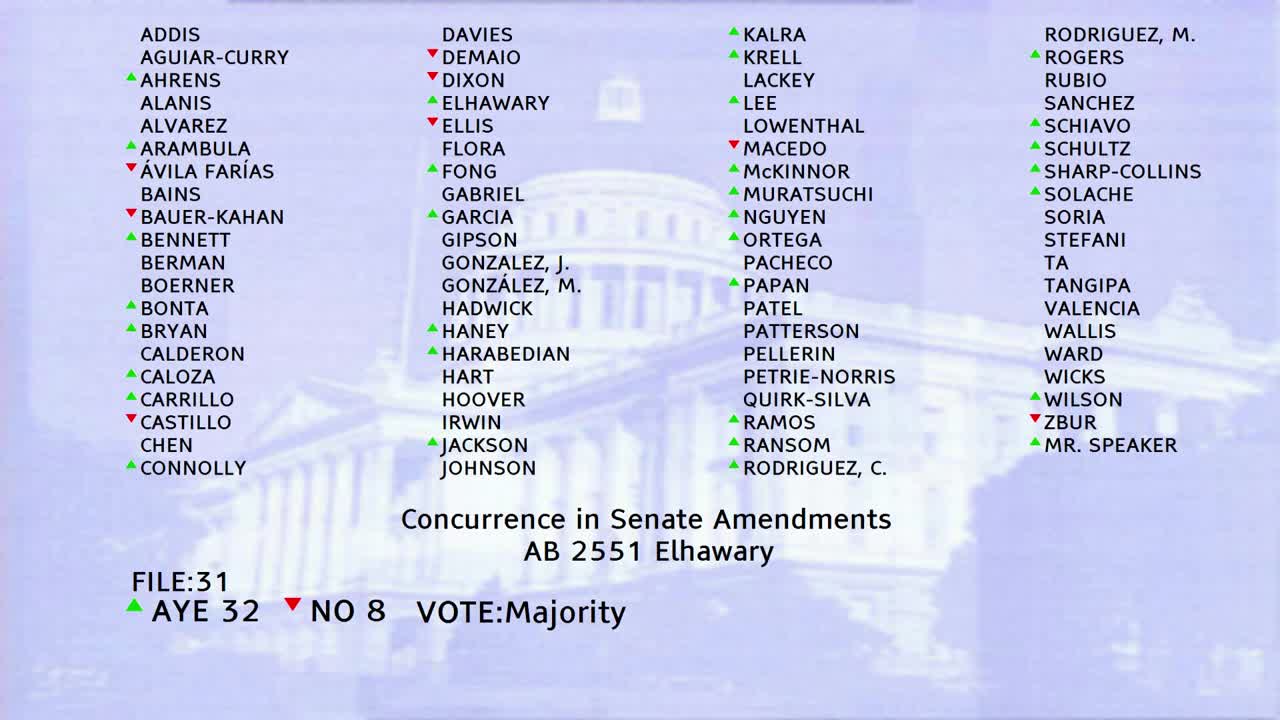 1MIN
Assembly Floor
 3MIN
Senate Floor
 32MIN
Senate Standing Committee on Privacy, Digital Technologies, and Consumer Protection
 23MIN
Senate Standing Committee on Education
 1MIN
Assembly Floor
 28MIN
Assembly Standing Committee on Judiciary
 29MIN
Assembly Standing Committee on Privacy and Consumer Protection
Bill Author

Bill Co-Author(s):