AB 1198: Public works: prevailing wages.
- Session Year: 2025-2026
- House: Assembly
- Latest Version Date: 2026-09-27
Current Status:
Passed
(2026-09-27: Chaptered by Secretary of State - Chapter 513, Statutes of 2026.)
Introduced
In Committee
Awaiting First Chamber Vote
Passed First Chamber
In Committee
Awaiting Second Chamber Vote
Passed Second Chamber
Enacted
Existing law requires that, except as specified, not less than the general prevailing rate of per diem wages, determined by the Director of Industrial Relations, be paid to workers employed on public works projects. Existing law requires the body awarding a contract for a public work to obtain from the director the general prevailing rate of per diem wages for work of a similar character in the locality in which the public work is to be performed, and the general prevailing rate of per diem wages for holiday and overtime work, for each craft, classification, or type of worker needed to execute the contract. Under existing law, if the director determines during any quarterly period that there has been a change in any prevailing rate of per diem wages in a locality, the director is required to make that change available to the awarding body and their determination is final. Under existing law, that determination does not apply to public works contracts for which the notice to bidders has been published.
This bill would instead state, commencing July 1, 2027, that if the director determines, within a semiannual period, that there is a change in any prevailing rate of per diem wages in a locality, that determination applies to any public works contract that is awarded or for which notice to bidders is published after July 1, 2027, if the awarded value of the contract is $35,000,000 or greater. The bill would authorize any contractor, awarding body, or specified representative affected by a change in rates on a particular contract to, within 20 days, file with the director a verified petition to review the determination of that rate, as specified. The bill would require the director to, upon notice to the interested parties, initiate an investigation or hold a hearing, and, within 20 days after the filing of that petition, except as specified, make a final determination and transmit the determination in writing to the awarding body and to the interested parties. The bill would make that determination issued by the director effective 10 days after its issuance, and until it is modified, rescinded, or superseded by the director. The bill would exempt certain housing projects from these provisions, including, among others, projects that are restricted by deed or subject to regulatory restrictions contained in an agreement with a governmental agency or other recorded document, as specified.
Existing law requires that, except as specified, not less than the general prevailing rate of per diem wages, determined by the Director of Industrial Relations, be paid to workers employed on public works projects. Existing law requires the body awarding a contract for a public work to obtain from the director the general prevailing rate of per diem wages for work of a similar character in the locality in which the public work is to be performed, and the general prevailing rate of per diem wages for holiday and overtime work, for each craft, classification, or type of worker needed to execute the contract. Under existing law, if the director determines during any quarterly period that there has been a change in any prevailing rate of per diem wages in a locality, the director is required to make that change available to the awarding body and their determination is final. Under existing law, that determination does not apply to public works contracts for which the notice to bidders has been published.
This bill would instead state, commencing July 1, 2027, that if the director determines, within a semiannual period, that there is a change in any prevailing rate of per diem wages in a locality, that determination applies to any public works contract that is awarded or for which notice to bidders is published after July 1, 2027. 2027, if the awarded value of the contract is $35,000,000 or greater. The bill would authorize any contractor, awarding body, or specified representative affected by a change in rates on a particular contract to, within 20 days, file with the director a verified petition to review the determination of that rate, as specified. The bill would require the director to, upon notice to the interested parties, initiate an investigation or hold a hearing, and, within 20 days after the filing of that petition, except as specified, make a final determination and transmit the determination in writing to the awarding body and to the interested parties. The bill would make that determination issued by the director effective 10 days after its issuance, and until it is modified, rescinded, or superseded by the director. The bill would exempt certain housing projects from these provisions, including, among others, projects that are restricted by deed or subject to regulatory restrictions contained in an agreement with a governmental agency or other recorded document, as specified.
Existing law requires that, except as specified, not less than the general prevailing rate of per diem wages, determined by the Director of Industrial Relations, be paid to workers employed on public works projects. Existing law requires the body awarding a contract for a public work to obtain from the director the general prevailing rate of per diem wages for work of a similar character in the locality in which the public work is to be performed, and the general prevailing rate of per diem wages for holiday and overtime work, for each craft, classification, or type of worker needed to execute the contract. Under existing law, if the director determines during any quarterly period that there has been a change in any prevailing rate of per diem wages in a locality, the director is required to make that change available to the awarding body and their determination is final. Under existing law, that determination does not apply to public works contracts for which the notice to bidders has been published.
This bill would instead state, commencing July 1, 2026, 2027, that if the director determines, within a semiannual period, that there is a change in any prevailing rate of per diem wages in a locality, that determination applies to any public works contract that is awarded or for which notice to bidders is published after July 1, 2026. 2027. The bill would authorize any contractor, awarding body, or specified representative affected by a change in rates on a particular contract to, within 20 days, file with the director a verified petition to review the determination of that rate, as specified. The bill would require the director to, upon notice to the interested parties, initiate an investigation or hold a hearing, and, within 20 days after the filing of that petition, except as specified, make a final determination and transmit the determination in writing to the awarding body and to the interested parties. The bill would make that determination issued by the director effective 10 days after its issuance, and until it is modified, rescinded, or superseded by the director. The bill would exempt certain housing projects from these provisions, including, among others, projects that are restricted by deed or subject to regulatory restrictions contained in an agreement with a governmental agency or other recorded document, as specified.
Existing law requires that, except as specified, not less than the general prevailing rate of per diem wages, determined by the Director of Industrial Relations, be paid to workers employed on public works projects. Existing law requires the body awarding a contract for a public work to obtain from the director the general prevailing rate of per diem wages for work of a similar character in the locality in which the public work is to be performed, and the general prevailing rate of per diem wages for holiday and overtime work, for each craft, classification, or type of worker needed to execute the contract. Under existing law, if the director determines during any quarterly period that there has been a change in any prevailing rate of per diem wages in a locality, the director is required to make that change available to the awarding body and their determination is final. Under existing law, that determination does not apply to public works contracts for which the notice to bidders has been published.
This bill would instead state, commencing July 1, 2026, that if the director determines, within a semiannual period, that there is a change in any prevailing rate of per diem wages in a locality, that determination applies to any public works contract that is awarded or for which notice to bidders is published after July 1, 2026. The bill would authorize any contractor, awarding body, or specified representative affected by a change in rates on a particular contract to, within 20 days, file with the director a verified petition to review the determination of that rate, as specified. The bill would require the director to, upon notice to the interested parties, initiate an investigation or hold a hearing, and, within 20 days after the filing of that petition, except as specified, make a final determination and transmit the determination in writing to the awarding body and to the interested parties. The bill would make that determination issued by the director effective 10 days after its issuance, and until it is modified, rescinded, or superseded by the director.
(a)If during any quarterly period the Director of Industrial Relations shall determine that there has been a change in any prevailing rate of per diem wages in any locality, the director shall make that change available to the awarding body and the directors determination shall be final. This determination by the Director of Industrial Relations shall not be effective as to any contract for which the notice to bidders has been published.
(b)This section shall become inoperative on July 1, 2027, and, as of January 1, 2028, is repealed.
SEC. 2.Section 1773.6 is added to the Labor Code, to read:1773.6.(a)(1)If during any semiannual period the Director of Industrial Relations determines that there has been a change in any prevailing rate of per diem wages in any locality, the director shall make that change available to the awarding body and the directors determination shall be final, except as specified in this section.
(2)A determination pursuant to paragraph (1) shall apply on its effective date to any contract under this chapter that is awarded or for which notice to bidders is published after July 1, 2027, if the awarded value of the prime contract is thirty-five million dollars ($35,000,000) or greater.
(b)(1)Any contractor, awarding body, or representative of any craft, classification, or type of work affected by a change in rates on a particular contract may, within 20 days after publication of the new determination, file with the director a verified petition to review the determination of that rate upon the ground that it has not been determined in accordance with Section 1773. Within two days after the filing of the petition, a copy of that petition shall be filed with the awarding body. The petition shall set forth the facts upon which it is based.
(2)The director, or the directors authorized representative, shall, upon notice to the petitioner, the awarding body, and other persons the director deems proper, including the recognized collective bargaining representatives for the particular crafts, classifications, or types of work involved, initiate an investigation or hold a hearing. Within 20 days after the filing of that petition, or within a longer period as agreed upon by the director, awarding body, and all interested parties, the director shall make a determination and transmit that determination in writing to the awarding body and to the interested parties. This determination shall be final.
(c)A determination issued by the director is effective 10 days after its issuance. The director shall include an issue date on the determination. The determination shall remain in effect until it is modified, rescinded, or superseded by the director.
(d)This section does not apply to contracts for a housing development project if 100 percent of the units, excluding managers units, are restricted by deed, regulatory restrictions contained in an agreement with a governmental agency, or other recorded document as affordable housing for persons and families of low or moderate income, as defined in Section 50093 of the Health and Safety Code, or subject to an agreement that provides housing subsidies for affordable housing for persons and families of low or moderate income, as defined in Section 50093 of the Health and Safety Code or comparable federal statutes.
(e)This section shall become operative on July 1, 2027.
SEC. 3.Section 1773.65 is added to the Labor Code, to read:1773.65.(a)Notwithstanding Section 1773.6, subdivision (b) shall apply to a change in the prevailing rate for public works projects that are housing developments described in subdivision (d) of Section 1773.6.
(b)If, during any semiannual period, the Director of Industrial Relations determines that there has been a change in any prevailing rate of per diem wages in any locality, the director shall make that change available to the awarding body and the directors determination shall be final. This determination by the director shall not be effective as to any contract for which notice to bidders has been published or as to any contract that has been awarded.
(c)This section shall become operative on July 1, 2027.
(a)If during any quarterly period the Director of Industrial Relations shall determine that there has been a change in any prevailing rate of per diem wages in any locality, the director shall make that change available to the awarding body and the directors determination shall be final. This determination by the Director of Industrial Relations shall not be effective as to any contract for which the notice to bidders has been published.
(b)This section shall become inoperative on July 1, 2027, and, as of January 1, 2028, is repealed.
SEC. 2.Section 1773.6 is added to the Labor Code, to read:1773.6.(a)(1)If during any semiannual period the Director of Industrial Relations determines that there has been a change in any prevailing rate of per diem wages in any locality, the director shall make that change available to the awarding body and the directors determination shall be final, except as specified in this section. This determination by the director shall only apply on its effective date to any contract under this chapter that is awarded or for which notice to bidders is published after July 1, 2027.
(2)A determination pursuant to paragraph (1) shall apply on its effective date to any contract under this chapter that is awarded or for which notice to bidders is published after July 1, 2027, if the awarded value of the prime contract is thirty-five million dollars ($35,000,000) or greater.
(b)(1)Any contractor, awarding body, or representative of any craft, classification, or type of work affected by a change in rates on a particular contract may, within 20 days after publication of the new determination, file with the director a verified petition to review the determination of that rate upon the ground that it has not been determined in accordance with Section 1773. Within two days after the filing of the petition, a copy of that petition shall be filed with the awarding body. The petition shall set forth the facts upon which it is based.
(2)The director, or the directors authorized representative, shall, upon notice to the petitioner, the awarding body, and other persons the director deems proper, including the recognized collective bargaining representatives for the particular crafts, classifications, or types of work involved, initiate an investigation or hold a hearing. Within 20 days after the filing of that petition, or within a longer period as agreed upon by the director, awarding body, and all interested parties, the director shall make a determination and transmit that determination in writing to the awarding body and to the interested parties. This determination shall be final.
(c)A determination issued by the director is effective 10 days after its issuance. The director shall include an issue date on the determination. The determination shall remain in effect until it is modified, rescinded, or superseded by the director.
(d)This section does not apply to contracts for a housing development project if 100 percent of the units, excluding managers units, are restricted by deed, regulatory restrictions contained in an agreement with a governmental agency, or other recorded document as affordable housing for persons and families of low or moderate income, as defined in Section 50093 of the Health and Safety Code, or subject to an agreement that provides housing subsidies for affordable housing for persons and families of low or moderate income, as defined in Section 50093 of the Health and Safety Code or comparable federal statutes.
(e)This section shall become operative on July 1, 2027.
SEC. 3.Section 1773.65 is added to the Labor Code, to read:1773.65.(a)Notwithstanding Section 1773.6, subdivision (b) shall apply to a change in the prevailing rate for public works projects that are housing developments described in subdivision (d) of Section 1773.6.
(b)If, during any quarterly semiannual period, the Director of Industrial Relations determines that there has been a change in any prevailing rate of per diem wages in any locality, the director shall make that change available to the awarding body and the directors determination shall be final. This determination by the director shall not be effective as to any contract for which notice to bidders has been published or as to any contract that has been awarded.
(c)This section shall become operative on July 1, 2027.
(a)If during any quarterly period the Director of Industrial Relations shall determine that there has been a change in any prevailing rate of per diem wages in any locality, the director shall make that change available to the awarding body and the directors determination shall be final. This determination by the Director of Industrial Relations shall not be effective as to any contract for which the notice to bidders has been published.
(b)This section shall become inoperative on July 1, 2026, 2027, and, as of January 1, 2027, 2028, is repealed.
SEC. 2.Section 1773.6 is added to the Labor Code, to read:1773.6.(a)If during any semiannual period the Director of Industrial Relations determines that there has been a change in any prevailing rate of per diem wages in any locality, the director shall make that change available to the awarding body and the directors determination shall be final, except as specified in this section. This determination by the director shall only apply on its effective date to any contract under this chapter that is awarded or for which notice to bidders is published after July 1, 2026. 2027.
(b)(1)Any contractor, awarding body, or representative of any craft, classification, or type of work affected by a change in rates on a particular contract may, within 20 days after publication of the new determination, file with the director a verified petition to review the determination of that rate upon the ground that it has not been determined in accordance with Section 1773. Within two days after the filing of the petition, a copy of that petition shall be filed with the awarding body. The petition shall set forth the facts upon which it is based.
(2)The director, or the directors authorized representative, shall, upon notice to the petitioner, the awarding body, and other persons the director deems proper, including the recognized collective bargaining representatives for the particular crafts, classifications, or types of work involved, initiate an investigation or hold a hearing. Within 20 days after the filing of that petition, or within a longer period as agreed upon by the director, awarding body, and all interested parties, the director shall make a determination and transmit that determination in writing to the awarding body and to the interested parties. This determination shall be final.
(c)A determination issued by the director is effective 10 days after its issuance. The director shall include an issue date on the determination. The determination shall remain in effect until it is modified, rescinded, or superseded by the director.
(d)This section does not apply to contracts for a housing development project if 100 percent of the units, excluding managers units, are restricted by deed, regulatory restrictions contained in an agreement with a governmental agency, or other recorded document as affordable housing for persons and families of low or moderate income, as defined in Section 50093 of the Health and Safety Code, or subject to an agreement that provides housing subsidies for affordable housing for persons and families of low or moderate income, as defined in Section 50093 of the Health and Safety Code or comparable federal statutes.
(d)(e)This section shall become operative on July 1, 2026. 2027.
SEC. 3.Section 1773.65 is added to the Labor Code, to read:1773.65.(a)Notwithstanding Section 1773.6, subdivision (b) shall apply to a change in the prevailing rate for public works projects that are housing developments described in subdivision (d) of Section 1773.6.
(b)If, during any quarterly period, the Director of Industrial Relations determines that there has been a change in any prevailing rate of per diem wages in any locality, the director shall make that change available to the awarding body and the directors determination shall be final. This determination by the director shall not be effective as to any contract for which notice to bidders has been published or as to any contract that has been awarded.
(c)This section shall become operative on July 1, 2027.
(a)If during any quarterly period the Director of Industrial Relations shall determine that there has been a change in any prevailing rate of per diem wages in any locality he or she locality, the director shall make such that change available to the awarding body and his or her the directors determination shall be final. Such This determination by the Director of Industrial Relations shall not be effective as to any contract for which the notice to bidders has been published.
(b)This section shall become inoperative on July 1, 2026, and, as of January 1, 2027, is repealed.
SEC. 2.Section 1773.6 is added to the Labor Code, to read:1773.6.(a)If during any semiannual period the Director of Industrial Relations determines that there has been a change in any prevailing rate of per diem wages in any locality, the director shall make that change available to the awarding body and the directors determination shall be final, except as specified in this section. This determination by the director shall only apply on its effective date to any contract under this chapter that is awarded or for which notice to bidders is published after July 1, 2026.
(b)(1)Any contractor, awarding body, or representative of any craft, classification, or type of work affected by a change in rates on a particular contract may, within 20 days after publication of the new determination, file with the director a verified petition to review the determination of that rate upon the ground that it has not been determined in accordance with Section 1773. Within two days after the filing of the petition, a copy of that petition shall be filed with the awarding body. The petition shall set forth the facts upon which it is based.
(2)The director, or the directors authorized representative, shall, upon notice to the petitioner, the awarding body, and other persons the director deems proper, including the recognized collective bargaining representatives for the particular crafts, classifications, or types of work involved, initiate an investigation or hold a hearing. Within 20 days after the filing of that petition, or within a longer period as agreed upon by the director, awarding body, and all interested parties, the director shall make a determination and transmit that determination in writing to the awarding body and to the interested parties. This determination shall be final.
(c)A determination issued by the director is effective 10 days after its issuance. The director shall include an issue date on the determination. The determination shall remain in effect until it is modified, rescinded, or superseded by the director.
(d)This section shall become operative on July 1, 2026.
|
Date
|
Status
|
|---|---|
| Sep 27, 2026 | Chaptered by Secretary of State - Chapter 513, Statutes of 2026. |
| Sep 27, 2026 | Approved by the Governor. |
| Sep 9, 2026 | Enrolled and presented to the Governor at 1 p.m. |
| Aug 30, 2026 | Senate amendments concurred in. To Engrossing and Enrolling. (Ayes 68. Noes 7. Page 6907.). |
| Aug 30, 2026 | Senate amendments concurred in. To Engrossing and Enrolling. |
| Aug 30, 2026 | In Assembly. Concurrence in Senate amendments pending. |
| Aug 30, 2026 | Read third time. Passed. Ordered to the Assembly. (Ayes 31. Noes 9.). |
| Aug 24, 2026 | Read second time. Ordered to third reading. |
| Aug 21, 2026 | Read third time and amended. Ordered to second reading. |
| Aug 13, 2026 | Read second time. Ordered to third reading. |
| Aug 13, 2026 | From committee: Do pass. (Ayes 6. Noes 1.) (August 13). |
| Jun 22, 2026 | In committee: Referred to APPR. suspense file. |
| Jun 10, 2026 | From committee: Do pass and re-refer to Com. on APPR. (Ayes 5. Noes 0.) (June 10). Re-referred to Com. on APPR. |
| May 6, 2026 | Referred to Com. on L., P.E. & R. |
| Jan 29, 2026 | In Senate. Read first time. To Com. on RLS. for assignment. |
| Jan 29, 2026 | Read third time. Passed. Ordered to the Senate. (Ayes 65. Noes 6. Page 3876.) |
| Jan 26, 2026 | Read second time. Ordered to third reading. |
| Jan 22, 2026 | Read second time and amended. Ordered returned to second reading. |
| Jan 22, 2026 | From committee: Amend, and do pass as amended. (Ayes 12. Noes 1.) (January 22). |
| Jan 22, 2026 | Assembly Rule 63 suspended. (Page 3806.) |
| May 23, 2025 | In committee: Hearing postponed by committee. |
| Apr 23, 2025 | In committee: Set, first hearing. Referred to suspense file. |
| Apr 3, 2025 | From committee: Do pass and re-refer to Com. on APPR. (Ayes 7. Noes 0.) (April 2). Re-referred to Com. on APPR. |
| Mar 10, 2025 | Referred to Com. on L. & E. |
| Feb 24, 2025 | Read first time. |
| Feb 22, 2025 | From printer. May be heard in committee March 24. |
| Feb 21, 2025 | Introduced. To print. |
|
Date
|
Description
|
Location
|
Votes
|
|
|---|---|---|---|---|
| Aug 30, 2026 | AB 1198 Haney Concurrence in Senate Amendments | Assembly Floor |
Passed |
|
| Aug 30, 2026 | Assembly 3rd Reading AB1198 Haney By Arreguín | Senate Floor |
Passed |
|
| Aug 13, 2026 | Do pass | Senate Standing Committee on Appropriations |
Passed |
|
| Jun 22, 2026 | Placed on suspense file | Senate Standing Committee on Appropriations |
Passed |
|
| Jun 10, 2026 | Do pass, but first be re-referred to the Committee on [Appropriations] | Senate Standing Committee on Labor, Public Employment and Retirement |
Passed |
|
| Jan 29, 2026 | AB 1198 Haney Assembly Third Reading | Assembly Floor |
Passed |
|
| Jan 22, 2026 | Do pass as amended. | Assembly Standing Committee on Appropriations |
Passed |
|
| Apr 2, 2025 | Do pass and be re-referred to the Committee on [Appropriations] | Assembly Standing Committee on Labor and Employment |
Passed |
This list shows positions taken on this bill by organizations on the date displayed, which is linked to the original source.
Positions by individuals are not included.
|
Organization
|
Position
|
Date
|
|---|---|---|
| American Society of Civil Engineers Region 9 | ** Against | |
| Associated General Contractors Of California | ** Against | |
| Associated General Contractors-San Diego Chapter | ** Against | |
| California Association Of Resource Conservation Districts | ** Against | |
| California Association Of School Business Officials | ** Against | |
| CALIFORNIA ASSOCIATION OF SHEET METAL & AIR CONDITIONING CONTRACTORS NATIONAL ASSOCIATION | ** Support | |
| California Federation of Labor Unions | ** Support | |
| California Housing Consortium | ** Against | |
| California Housing Partnership | ** Against | |
| California Legislative Conference Of Plumbing, Heating & Piping Industry | ** Support | |
| California-Nevada Conference Of Operating Engineers | ** Support | |
| California Solar & Storage Association | ** Against | |
| California Special Districts Association | ** Against | |
| California State Association Of Counties | ** Against | |
| California State Association Of Electrical Workers | ** Support | |
| California State Pipe Trades Council | ** Support | |
| California Transit Association | ** Against | |
| Calleguas Municipal Water District | ** Against | |
| City of Roseville | ** Against | |
| City of Thousand Oaks | ** Against | |
| Finishing Contractors Association Of Southern California | ** Support | |
| International Union of Painters and Allied Trades, District Council 16 | ** Support | |
| International Union of Painters and Allied Trades, District Council 36 | ** Support | |
| League Of California Cities | ** Against | |
| National Electrical Contractors Association | ** Support | |
| Nevada County Board of Supervisors | ** Against | |
| Northern California Allied Trades | ** Support | |
| Northern California Floor Covering Association | ** Support | |
| Resource Conservation District of Tehama County | ** Against | |
| Rural County Representatives of California | ** Against | |
| San Bernardino County | ** Against | |
| Southern California Association of Scaffold Contractors | ** Support | |
| Southern California Contractors Association | ** Support | |
| Southern California Glass Management Association | ** Support | |
| State Building and Construction Trades Council of California | ** Support | |
| Teamsters California | ** Support | |
| The State Building and Construction Trades Council of California | ** Support | |
| United Contractors | ** Support | |
| Urban Counties of California | ** Against | |
| Wall and Ceiling Alliance | ** Support | |
| Western Electrical Contractors Association | ** Against | |
| Western Painting and Coating Contractors Association | ** Support | |
| Western States Council Sheet Metal, Air, Rail And Transportation | ** Support | |
| Western Wall And Ceiling Contractors Association | ** Support |
CONCURRENCE IN SENATE AMENDMENTS
CSA1 Bill Id:AB 1198
Author:(Haney)
As Amended Ver:August 21, 2026
Majority vote
SUMMARY
Provides, commencing July 1, 2027, that if during any semiannual period the director of the Department of Industrial Relations (DIR) determines that there has been a change in a prevailing wage rate in any locality, the director’s determination shall apply to any public works contract that is awarded or for which notice to bidders is published after July 1, 2027, if the awarded value of the prime contract is thirty-five million dollars ($35,000,000) or greater. Exempts from this requirement contracts for an affordable housing development project, as specified.
Senate Amendments
- State that for purposes of the director of the DIR determining in any semiannual period that there has been a change in a prevailing wage rate in any locality and then applying that determination to any public works contract that is awarded or for which notice to bidders is published after July 1, 2027, the prime contract must have an awarded value of thirty-five million dollars ($35,000,000) or greater.
- Align the review period for the director of the DIR to determine a prevailing wage rate change for public works projects that are housing developments, as specified, to semiannual, as provided for in 1) above.
COMMENTS
In California, the prevailing wage rate is an hourly rate paid on public works projects that is often set in the terms of a collective bargaining agreement. According to DIR, the wage rate relies upon such factors as "the particular craft, classification or type of work within the locality and in the nearest labor market area (if majorities of such workers are paid at a single rate). If there is no single rate paid to a majority, then the single or modal rate being paid to the greater number of workers is prevailing."[1]
The policy behind paying a prevailing wage is to ensure that contractors are not awarded public works contracts by virtue of paying low wages and undercutting competitors who provide higher compensation. Prevailing wage creates a level playing field by requiring an across-the-board rate for all bidders on publicly subsidized projects.
This measure seeks to ensure that workers are not locked into prevailing wage rates that are outdated and misaligned with industry standards. Under current law, a worker need only be paid at the rate in effect at the time the public works project is advertised for bid. If the rate is determined to be higher mid-contract, the new rate will not apply unless a collective bargaining agreement assumed this increase.
According to the Author
According to the author, "Workers deserve to be paid the current prevailing wage – regardless of whether a project was bid on years ago, or days ago. AB 1198 levels the playing field for construction workers by making sure that when they begin a project, they are earning the current wage – not the wage that was set when the project was announced. AB 1198 also ensures that contractors are complying with all parts of the State's public works law and will provide transparency on public works projects."
Arguments in Support
The State Building and Construction Trades Council of California, is in support and states, "In California contract law, the asterisk (*) and double asterisk (**) provisions in prevailing wage determinations indicate that future wage increases are tied to a collective bargaining agreement (CBA) but may not be immediately reflected in the contract at the time of bidding. The single asterisk (*) signifies that wage rates are subject to periodic adjustments based on scheduled increases in the CBA, while the double asterisk (**) denotes that the wage determination itself is entirely based on an underlying CBA, including any future wage escalations. However, some non-union contractors exploit this system by bidding on public works projects using the lower, preadjustment wage rates and then refuse to honor subsequent increases once the contract is awarded. This creates an unfair advantage over responsible contractors who comply with CBA-mandated wage adjustments, undermining fair competition and leading to wage suppression for workers.
AB 1198 seeks to close this loophole by ensuring that all contractors adhere to post-award wage adjustments, reinforcing fair labor practices in public works projects. AB 1198 closes this loophole by requiring that prevailing wages be adjusted in accordance with CBAs that take effect after a contract is awarded. This will ensure that all contractors adhere to the same wage obligations, preventing unfair cost-cutting tactics that harm both workers and lawabiding businesses. Furthermore, this bill reinforces California's commitment to fair labor standards and the protection of skilled workers who rely on negotiated wage increases to keep up with the cost of living."
Arguments in Opposition
The Rural County Representatives of California, the California State Association of Counties, the League of California Cities, and the California Special Districts Association, are opposed to the bill and state, "Currently, when a project is first advertised for bid, the public agency (as well as the contractor) can go to a webpage managed by DIR to see what the prevailing wage rates are. These wage rates generally include those upcoming increases which will occur during the duration of the project. We are concerned that further changes to the wages mid-stream will result in uncertainty in bidding and contracting and put projects in jeopardy.
Continual change orders during a public works project would make it impossible to predict the actual cost of a project and, consequently, difficult to budget funds accurately. These additional cost pressures may impact the ability of a jurisdiction to move forward with a project. It would be challenging to predict how many determinations could occur during the project period and adequately plan for cost increases, which may put potential projects at risk."
FISCAL COMMENTS
According to the Senate Appropriations Committee,
- DIR indicates that it would incur first-year costs of $5.75 million to $6 million, and $5.4 million to $5.7 million annually thereafter, to implement the provisions of the bill (State Public Works Enforcement Fund).
- To the extent that state agencies execute a public works project, the bill would result in increased project costs. The magnitude is unknown, but potentially significant (General Fund and special fund).
VOTES:
ASM LABOR AND EMPLOYMENT: 7-0-0
YES: Ortega, Flora, Chen, Elhawary, Kalra, Lee, Ward
ASM APPROPRIATIONS: 12-1-2
YES: Wicks, Hoover, Stefani, Calderon, Caloza, Fong, Mark González, Krell, Bauer-Kahan, Pacheco, Pellerin, Solache
NO: Tangipa
ABS, ABST OR NV: Dixon, Ta
ASSEMBLY FLOOR: 65-6-9
YES: Addis, Aguiar-Curry, Ahrens, Alanis, Alvarez, Ávila Farías, Bains, Bauer-Kahan, Bennett, Berman, Boerner, Bonta, Bryan, Calderon, Caloza, Carrillo, Chen, Connolly, Davies, Elhawary, Fong, Gabriel, Gallagher, Garcia, Jeff Gonzalez, Mark González, Haney, Harabedian, Hart, Hoover, Irwin, Jackson, Kalra, Krell, Lackey, Lee, Lowenthal, McKinnor, Muratsuchi, Nguyen, Ortega, Pacheco, Papan, Patel, Patterson, Pellerin, Petrie-Norris, Quirk-Silva, Ramos, Michelle Rodriguez, Rogers, Blanca Rubio, Schiavo, Schultz, Sharp-Collins, Solache, Soria, Stefani, Ta, Wallis, Ward, Wicks, Wilson, Zbur, Rivas
NO: DeMaio, Ellis, Johnson, Macedo, Sanchez, Tangipa
ABS, ABST OR NV: Arambula, Castillo, Dixon, Flora, Gipson, Hadwick, Ransom, Celeste Rodriguez, Valencia
UPDATED
VERSION: August 21, 2026
CONSULTANT: Megan Lane / L. & E. / (916) 319-2091 FN: 0004287
California Department of Industrial Relations Webpage. Frequently Asked Questions-Prevailing Wage. March 2022. ↑
SENATE RULES COMMITTEE Office of Senate Floor Analyses (916) 651-4171 | AB 1198 |
THIRD READING
Bill No: AB 1198
Author: Haney (D)
Amended: 8/21/26 in Senate
Vote: 21
SENATE LABOR, PUB. EMP. & RET. COMMITTEE: 5-0, 6/10/26
AYES: Smallwood-Cuevas, Strickland, Cortese, Durazo, Laird
SENATE APPROPRIATIONS COMMITTEE: 6-1, 8/13/26
AYES: Cervantes, Cabaldon, Dahle, Grayson, Richardson, Wahab
NOES: Seyarto
ASSEMBLY FLOOR: 65-6, 1/29/26 - See last page for vote
SUBJECT: Public works: prevailing wages
SOURCE: State Building and Construction Trades Council of California
DIGEST:
This bill requires updated prevailing wage rates, as determined by the Director of the Department of Industrial Relations (DIR), to apply to any public works contract that is awarded or for which notice to bidders is published after July 1, 2027, if the awarded value of the prime contract is $35 million or greater. Contracts for affordable housing development projects are exempt from this requirement, as specified.
Senate Floor Amendments of 8/21/26: 1) limit mid-project prevailing wage rate increases to any public works contract that is awarded or for which notice to bidders is published after July 1, 2027, if the awarded value of the prime contract is $35 million or greater; and 2) clarify, for affordable housing development projects, that the Director shall determine prevailing wage rate increases during a semiannual period.[1]
ANALYSIS:
Existing law:
- Establishes the DIR, under the control of an executive officer known as Director of Industrial Relations (Director), to foster, promote, and develop the welfare of the wage earners of California, to improve their working conditions, and to advance their opportunities for profitable employment. (Labor Code §50-64.5)
- Requires that not less than the general prevailing rate of per diem wages be paid to all workers employed on a “public works” project costing over $1,000 dollars and imposes misdemeanor penalties for violations of this requirement. (Labor Code §1771)
- Requires the body awarding any contract for public work, or otherwise undertaking any public work, to obtain the general prevailing rate of per diem wages and the general prevailing rate for holiday and overtime work in the locality in which the public work is to be performed for each craft, classification, or type of worker needed to execute the contract from the Director. (Labor Code §1773)
- Requires the Director to determine the general prevailing rate of per diem wages and the Director’s determination to be final, except as specified. (Labor Code §1770)
- Provides that in determining the prevailing wage rate, the Director shall ascertain and consider the applicable wage rates established by collective bargaining agreements (CBAs) and the rates that may have been predetermined for federal public works, within the locality and in the nearest labor market area. Where the rates do not constitute the rates actually prevailing in the locality, the Director shall obtain and consider further data from the labor organizations and employers or employer associations concerned, including the recognized collective bargaining representatives for the particular craft, classification, or type of work involved. The rate fixed for each craft, classification, or type of work shall be not less than the prevailing rate paid in the craft, classification, or type of work. (Labor Code §1773)
- Provides that if the Director determines that the rate of prevailing wage for any craft, classification, or type of worker is the rate established by a CBA, the Director may adopt that rate by reference as provided for in the CBA and that determination shall be effective for the life of the agreement or until the Director determines that another rate should be adopted. (Labor Code §1773)
- Requires the Director to use the following methodology to determine the general prevailing rate of per diem wages in the locality in which the public work is to be performed:
- The basic hourly wage rate being paid to a majority of workers engaged in the particular craft, classification, or type of work within the locality and in the nearest labor market area, if a majority of the workers are paid at a single rate. If no single rate is being paid to a majority of the workers, then the single rate being paid to the greatest number of workers, or modal rate, is prevailing. If a modal rate cannot be determined, then the Director shall establish an alternative rate by considering the appropriate CBAs, federal rates, rates in the nearest labor market area, or other data such as wage survey data.
- Other employer payments included in per diem wages pursuant to Labor Code §1773.1 and as included as part of the total hourly wage rate from which the basic hourly wage rate was derived. In the event the total hourly wage rate does not include any employer payments, the Director shall establish a prevailing employer payment rate, as specified.
- The rate for holiday and overtime work shall be those rates specified in the CBA when the basic hourly rate is based on a CBA rate. In the event the basic hourly rate is not based on a CBA, the rate for holidays and overtime work, if any, included with the prevailing basic hourly rate of pay shall be prevailing. (Labor Code §1773.9)
- Provides that if the Director determines that the general prevailing rate of per diem wages is the rate established by a CBA, and that the CBA contains definite and predetermined changes during its term that will affect the rate adopted, the Director shall incorporate those changes into the determination. Predetermined changes that are rescinded prior to their effective date shall not be enforced. (Labor Code §1773.9)
- Provides that if during any quarterly period the Director determines that there has been a change in any prevailing rate of per diem wages in any locality he or she shall make such change available to the awarding body and his or her determination shall be final. Such determination by the Director shall not be effective as to any contract for which the notice to bidders has been published. (Labor Code §1773.6)
This bill:
- Requires, if during any semiannual period the Director determines there has been a change in any prevailing rate of per diem wages, the Director to make such change available to the awarding body. The Director’s determination shall be final, except as specified.
- Provides that the Director’s determination of a change in the prevailing wage shall only apply on its effective date to any contract that is awarded or for which notice to bidders is published after July 1, 2027, if the awarded value of the prime contract is $35 million or greater.
- Exempts from the requirement in 2) contracts for a housing development project if 100 percent of units, excluding managers’ units, are restricted by deed, regulatory restrictions contained in an agreement with a governmental agency, or other recorded document as affordable housing for persons and families of low or moderate income, as specified, or subject to an agreement that provides housing subsidies for affordable housing for persons and families of low or moderate income, as specified.
- Provides that for contracts for a housing development project, described in 3), the Director’s determination of a change in the prevailing wage shall not be effective as to any contract for which notice to bidders has been published or as to any contract that has been awarded.
- Authorizes any contractor, awarding body, or representative of any craft, classification, or type of work affected by a change in rates on a particular contract to, within 20 days after publication of the new determination, file with the Director a verified petition to review the determination of that rate upon the ground that it has not been determined in accordance with (Labor Code §1773). Within two days after the filing of the petition, a copy of that petition shall be filed with the awarding body. The petition shall set forth the facts upon which it is based.
- Requires the Director, or the Director’s authorized representative, to, upon notice to the petitioner, the awarding body, and other persons the Director deems proper, including the recognized collective bargaining representatives for the particular crafts, classifications, or types of work involved, initiate an investigation or hold a hearing.
- Requires the Director, within 20 days after the filing of a petition, or within a longer period as agreed upon by the Director, awarding body, and all interested parties, to make a final determination and transmit that determination in writing to the awarding body and to the interested parties.
- States that a determination by the Director is effective 10 days after its issuance. The Director shall include an issue date on the determination. The determination shall remain in effect until it is modified, rescinded, or superseded by the Director.
- Provides that 1) through 8) shall become operative on July 1, 2027.
Background
Prevailing Wages: The prevailing wage rate is the basic hourly rate paid on public works projects to a majority of workers engaged in a particular craft, classification, or type of work within the locality and in the nearest labor market area. Prevailing wage laws ensure that the ability to receive a public works contract is not based on paying lower wages than a competitor. The Director of DIR has the sole responsibility to establish prevailing wage rates for all classifications of workers. In determining the rates, the Director ascertains and considers the applicable wage rates contained in CBAs and the rates that have been predetermined for federal public works.
The Director issues wage determinations semiannually on February 22 and August 22. Determinations become effective 10 days after their issue date- on March 3rd in leap years and March 4th in non-leap years and September 1st.
Predetermined Wage Increases: Existing law states that if the Director determines that there has been a change in the prevailing wage, such change shall be made available to an awarding body. This notification is for informational purposes and does not require an awarding body to update wages on contracts for which the notice to bidders has been published or for ongoing projects. However, there is the potential for prevailing wage rates to change mid-project if the wage determination in effect at the time of bidding includes a predetermined increase.
Each prevailing wage determination contains an expiration date and either one or two asterisks to indicate whether there is a predetermined change. A double asterisk following the determination’s expiration date indicates a predetermined change in the prevailing wage rate. If work on a project extends past the expiration date, the new rates must be paid and should be incorporated into contracts at the start of the project. Predetermined increases typically occur when the prevailing wage rate is based on a CBA and the CBA includes a scheduled pay increase. Predetermined increases are available on DIR’s website. A single asterisk following the determination’s expiration date indicates that the prevailing wage rate remains in effect for the entirety of the project.
Comments
This bill requires the Director’s determination of a change in the prevailing wage rate to apply on its effective date to any public works contract that is awarded or for which notice to bidders is published after July 1, 2027. Put simply, this bill requires mid-project prevailing wage increases. Additionally, this bill exempts contracts for an affordable housing development project, as specified, and establishes a mechanism to review the Director’s determination.
The author argues that if a project extends beyond scheduled wage increases, or if no increases were set by the wage determination in effect at the time of bidding, workers will receive outdated wages that do not reflect current labor standards. Furthermore, the author argues that allowing contractors to pay outdated wage rates for the duration of a project creates an uneven playing field for contractors who update wages to reflect current prevailing wage determinations or negotiated labor agreements.
This bill contains nearly identical language to AB 1140 (Daly, 2013), which was vetoed by Governor Brown, and AB 2182[2] (Haney, 2024), which was vetoed by Governor Newsom.
Governor Brown’s veto message stated the following:
“This measure requires contractors on public works projects to increase workers' pay any time the state updates its prevailing wage rates. This is intended to address the circumstance where a non-union contractor is not required to adjust wages mid-project but a union contractor is subject to such adjustments pursuant to a collective bargaining agreement.
In most cases, projects are bid, awarded and completed in a relatively short period of time and this measure would have little, if any impact. Larger, long term projects are the more likely setting for the union/non-union wage differential this bill seeks to address. Unfortunately, introducing such wage adjustments as proposed by this measure is likely to lead to uncertainty in the cost of public works projects and increase costs ultimately borne by the taxpayers.
Finally, many collective bargaining agreements already address this limited circumstance by allowing wage rates to remain at the level determined by the state at the time of the bid, award or start of the contract. Given this, I do not find a statutory change warranted to address the issue raised by this measure.”
Governor Newsom’s veto message stated the following:
“This bill would require that any change in prevailing wage rates apply to existing contracts on certain public works projects…
While I am a steadfast supporter of prevailing wage law, the adjustments proposed by this measure would likely lead to uncertainty in the cost of public works projects, potentially creating significant cost pressures on the state budget.
In partnership with the Legislature this year, my Administration has enacted a balanced budget that avoids deep program cuts to vital services and protected investments in education, health care, climate, public safety, housing, and social service programs that millions of Californians rely on. It is important to remain disciplined when considering bills with significant fiscal implications that are not included in the budget, such as this measure.”
The questions raised in both veto messages remain relevant today. Who will bear the costs related to increases in wage rates mid-project? What effect will this have on future bids for public works projects? However, the committee also asks, is it fair to pay non-union workers employed on lengthy public works projects an outdated prevailing wage rate? Would applying mid-project wage rate increases maintain a level playing field?
Related/Prior Legislation
AB 2182 (Haney, 2024) would have, among other things, required a change in the prevailing rate of per diem wages, as determined by the Director, to apply to any public works contract for which notice to bidders is published after July 1, 2026, and that meets specified criteria. AB 1198 is substantially similar to AB 2182. The bill was vetoed by Governor Newsom.
AB 1140 (Daly, 2013) would have required a change in the prevailing rate of per diem wages, as determined by the Director, to apply to any public works contract that is awarded or for which notice to bidders is published on or after January 1, 2014. AB 1198 is nearly identical to AB 1140. The bill was vetoed by Governor Brown.
FISCAL EFFECT: Appropriation: No Fiscal Com.: Yes Local: No
According to the Senate Appropriations Committee:
- DIR indicates that it would incur first-year costs of $5.75 million to $6 million, and $5.4 million to $5.7 million annually thereafter, to implement the provisions of the bill (State Public Works Enforcement Fund).
- To the extent that state agencies execute a public works project, the bill would result in increased project costs. The magnitude is unknown, but potentially significant (General Fund and special fund).
SUPPORT: (Verified 8/21/26)
State Building and Construction Trades Council of California (Source)
California Association of Sheet Metal & Air Conditioning Contractors National Association
California Federation of Labor Unions
California Legislative Conference of Plumbing, Heating & Piping Industry
California-Nevada Conference of Operating Engineers
California State Association of Electrical Workers
California State Pipe Trades Council
Finishing Contractors Association of Southern California
International Union of Painters and Allied Trades, District Council 16
International Union of Painters and Allied Trades, District Council 36
National Electrical Contractors Association
Northern California Allied Trades
Northern California Floor Covering Association
Southern California Association of Scaffold Contractors
Southern California Contractors Association
Southern California Glass Management Association
Teamsters California
United Contractors
Wall and Ceiling Alliance
Western Painting and Coating Contractors Association
Western States Council Sheet Metal, Air, Rail and Transportation
Western Wall and Ceiling Contractors Association
OPPOSITION: (Verified 8/21/26)
American Society of Civil Engineers Region 9
Associated General Contractors of California
California Association of Resource Conservation Districts
California Association of School Business Officials
California Solar & Storage Association
California Special Districts Association
California State Association of Counties
California Transit Association
Calleguas Municipal Water District
City of Thousand Oaks
City of Roseville
League of California Cities
Nevada County Board of Supervisors
Resource Conservation District of Tehama County
Rural County Representatives of California
San Bernardino County
Urban Counties of California
Western Electrical Contractors Association
ARGUMENTS IN SUPPORT: The source of the measure, the California Building and Construction Trades, argues:
“[AB 1198] is crucial to ensuring that all contractors operate on a level playing field and that workers receive fair wages as determined by collective bargaining agreements (CBAs) which determine the prevailing wage.
In California contract law, the asterisk (*) and double asterisk (**) provisions in prevailing wage determinations indicate that future wage increases are tied to a collective bargaining agreement (CBA) but may not be immediately reflected in the contract at the time of bidding. The single asterisk (*) signifies that wage rates are subject to periodic adjustments based on scheduled increases in the CBA, while the double asterisk (**) denotes that the wage determination itself is entirely based on an underlying CBA, including any future wage escalations. However, some non-union contractors exploit this system by bidding on public works projects using the lower, pre-adjustment wage rates and then refuse to honor subsequent increases once the contract is awarded. This creates an unfair advantage over responsible contractors who comply with CBA-mandated wage adjustments, undermining fair competition and leading to wage suppression for workers.
AB 1198 seeks to close this loophole by ensuring that all contractors adhere to post-award wage adjustments, reinforcing fair labor practices in public works projects. AB 1198 closes this loophole by requiring that prevailing wages be adjusted in accordance with CBAs that take effect after a contract is awarded. This will ensure that all contractors adhere to the same wage obligations, preventing unfair cost-cutting tactics that harm both workers and law-abiding businesses. Furthermore, this bill reinforces California’s commitment to fair labor standards and the protection of skilled workers who rely on negotiated wage increases to keep up with the cost of living.”
ARGUMENTS IN OPPOSITION: The Western Electrical Contractors Association opposes the measure, arguing:
“AB 1198 would fundamentally change how prevailing wage determinations apply to public
works contracts by requiring that any change in a prevailing wage rate during a semiannual period be applied to contracts awarded or bid after July 1, 2027. While presented as an administrative update, the fiscal and practical consequences are substantial.”
The Rural County Representatives of California, the California State Association of Counties, the League of California Cities, and the California Special Districts Association, among others, oppose the measure unless amended, arguing:
“Under current law, when a project is first advertised for bid, the public agency (as well as the contractor) can go to a webpage managed by DIR to see what the prevailing wage rates are. These wage rates generally include those upcoming increases which will occur during the duration of the project. Contractors incorporate those known labor costs into their bids, allowing public agencies to accurately evaluate proposals, establish project budgets, secure financing, and award contracts with certainty. We are concerned that contracting and put projects in jeopardy.
For projects funded through fixed appropriations, grants, bond proceeds, voter-approved local revenues, or adopted local budgets, unexpected labor cost increases may require agencies to reduce project scope, delay construction, or cancel projects altogether. It would be challenging to predict how many future wage determinations could occur during the project period and adequately plan for cost increases, which may put potential projects at risk…
By introducing additional cost uncertainty into public works contracting, the bill will increase overall project costs and further challenge the affordability of critical infrastructure investments for state and local governments.”
ASSEMBLY FLOOR: 65-6, 1/29/26
AYES: Addis, Aguiar-Curry, Ahrens, Alanis, Alvarez, Ávila Farías, Bains, Bauer-Kahan, Bennett, Berman, Boerner, Bonta, Bryan, Calderon, Caloza, Carrillo, Chen, Connolly, Davies, Elhawary, Fong, Gabriel, Gallagher, Garcia, Jeff Gonzalez, Mark González, Haney, Harabedian, Hart, Hoover, Irwin, Jackson, Kalra, Krell, Lackey, Lee, Lowenthal, McKinnor, Muratsuchi, Nguyen, Ortega, Pacheco, Papan, Patel, Patterson, Pellerin, Petrie-Norris, Quirk-Silva, Ramos, Michelle Rodriguez, Rogers, Blanca Rubio, Schiavo, Schultz, Sharp-Collins, Solache, Soria, Stefani, Ta, Wallis, Ward, Wicks, Wilson, Zbur, Rivas
NOES: DeMaio, Ellis, Johnson, Macedo, Sanchez, Tangipa
NO VOTE RECORDED: Arambula, Castillo, Dixon, Flora, Gipson, Hadwick, Ransom, Celeste Rodriguez, Valencia
Prepared by: Emma Bruce / L., P.E. & R. / (916) 651-1556
8/26/26 9:12:15
**** END ****
For affordable housing developments, the Director’s determination shall not be effective as to any contract for which notice to bidders has been published or as to any contract that has been awarded. ↑
AB 2182 would have applied mid-project prevailing wage increases to any contract for which notice to bidders was published after July 1, 2026, and that met all of the following requirements:
The contract is not for the development of housing.
The contract is subject to public works law, as specified.
The awarded value of the prime contract is $35 million or greater.
The contract is not awarded by the state or a state agency, nor is the contract awarded in furtherance of a project undertaken by the state. “State” is inclusive of the Legislature, the Judicial Council, the California State University, and the University of California. ↑
SENATE RULES COMMITTEE Office of Senate Floor Analyses (916) 651-4171 | AB 1198 |
THIRD READING
Bill No: AB 1198
Author: Haney (D)
Amended: 8/21/26 in Senate
Vote: 21
SENATE LABOR, PUB. EMP. & RET. COMMITTEE: 5-0, 6/10/26
AYES: Smallwood-Cuevas, Strickland, Cortese, Durazo, Laird
SENATE APPROPRIATIONS COMMITTEE: 6-1, 8/13/26
AYES: Cervantes, Cabaldon, Dahle, Grayson, Richardson, Wahab
NOES: Seyarto
ASSEMBLY FLOOR: 65-6, 1/29/26 - See last page for vote
SUBJECT: Public works: prevailing wages
SOURCE: State Building and Construction Trades Council of California
DIGEST:
This bill requires updated prevailing wage rates, as determined by the Director of the Department of Industrial Relations (DIR), to apply to any public works contract that is awarded or for which notice to bidders is published after July 1, 2027, if the awarded value of the prime contract is $35 million or greater. Contracts for affordable housing development projects are exempt from this requirement, as specified.
Senate Floor Amendments of 8/21/26: 1) limit mid-project prevailing wage rate increases to any public works contract that is awarded or for which notice to bidders is published after July 1, 2027, if the awarded value of the prime contract is $35 million or grater; and 2) clarify, for affordable housing development projects, that the Director shall determine prevailing wage rate increases during a semiannual period.[1]
ANALYSIS:
Existing law:
- Establishes the DIR, under the control of an executive officer known as Director of Industrial Relations (Director), to foster, promote, and develop the welfare of the wage earners of California, to improve their working conditions, and to advance their opportunities for profitable employment. (Labor Code §50-64.5)
- Requires that not less than the general prevailing rate of per diem wages be paid to all workers employed on a “public works” project costing over $1,000 dollars and imposes misdemeanor penalties for violations of this requirement. (Labor Code §1771)
- Requires the body awarding any contract for public work, or otherwise undertaking any public work, to obtain the general prevailing rate of per diem wages and the general prevailing rate for holiday and overtime work in the locality in which the public work is to be performed for each craft, classification, or type of worker needed to execute the contract from the Director. (Labor Code §1773)
- Requires the Director to determine the general prevailing rate of per diem wages and the Director’s determination to be final, except as specified. (Labor Code §1770)
- Provides that in determining the prevailing wage rate, the Director shall ascertain and consider the applicable wage rates established by collective bargaining agreements (CBAs) and the rates that may have been predetermined for federal public works, within the locality and in the nearest labor market area. Where the rates do not constitute the rates actually prevailing in the locality, the Director shall obtain and consider further data from the labor organizations and employers or employer associations concerned, including the recognized collective bargaining representatives for the particular craft, classification, or type of work involved. The rate fixed for each craft, classification, or type of work shall be not less than the prevailing rate paid in the craft, classification, or type of work. (Labor Code §1773)
- Provides that if the Director determines that the rate of prevailing wage for any craft, classification, or type of worker is the rate established by a CBA, the Director may adopt that rate by reference as provided for in the CBA and that determination shall be effective for the life of the agreement or until the Director determines that another rate should be adopted. (Labor Code §1773)
- Requires the Director to use the following methodology to determine the general prevailing rate of per diem wages in the locality in which the public work is to be performed:
- The basic hourly wage rate being paid to a majority of workers engaged in the particular craft, classification, or type of work within the locality and in the nearest labor market area, if a majority of the workers are paid at a single rate. If no single rate is being paid to a majority of the workers, then the single rate being paid to the greatest number of workers, or modal rate, is prevailing. If a modal rate cannot be determined, then the Director shall establish an alternative rate by considering the appropriate CBAs, federal rates, rates in the nearest labor market area, or other data such as wage survey data.
- Other employer payments included in per diem wages pursuant to Labor Code §1773.1 and as included as part of the total hourly wage rate from which the basic hourly wage rate was derived. In the event the total hourly wage rate does not include any employer payments, the Director shall establish a prevailing employer payment rate, as specified.
- The rate for holiday and overtime work shall be those rates specified in the CBA when the basic hourly rate is based on a CBA rate. In the event the basic hourly rate is not based on a CBA, the rate for holidays and overtime work, if any, included with the prevailing basic hourly rate of pay shall be prevailing. (Labor Code §1773.9)
- Provides that if the Director determines that the general prevailing rate of per diem wages is the rate established by a CBA, and that the CBA contains definite and predetermined changes during its term that will affect the rate adopted, the Director shall incorporate those changes into the determination. Predetermined changes that are rescinded prior to their effective date shall not be enforced. (Labor Code §1773.9)
- Provides that if during any quarterly period the Director determines that there has been a change in any prevailing rate of per diem wages in any locality he or she shall make such change available to the awarding body and his or her determination shall be final. Such determination by the Director shall not be effective as to any contract for which the notice to bidders has been published. (Labor Code §1773.6)
This bill:
- Requires, if during any semiannual period the Director determines there has been a change in any prevailing rate of per diem wages, the Director to make such change available to the awarding body. The Director’s determination shall be final, except as specified.
- Provides that the Director’s determination of a change in the prevailing wage shall only apply on its effective date to any contract that is awarded or for which notice to bidders is published after July 1, 2027, if the awarded value of the prime contract is $35 million or greater.
- Exempts from the requirement in 2) contracts for a housing development project if 100 percent of units, excluding managers’ units, are restricted by deed, regulatory restrictions contained in an agreement with a governmental agency, or other recorded document as affordable housing for persons and families of low or moderate income, as specified, or subject to an agreement that provides housing subsidies for affordable housing for persons and families of low or moderate income, as specified.
- Provides that for contracts for a housing development project, described in 3), the Director’s determination of a change in the prevailing wage shall not be effective as to any contract for which notice to bidders has been published or as to any contract that has been awarded.
- Authorizes any contractor, awarding body, or representative of any craft, classification, or type of work affected by a change in rates on a particular contract to, within 20 days after publication of the new determination, file with the Director a verified petition to review the determination of that rate upon the ground that it has not been determined in accordance with (Labor Code §1773). Within two days after the filing of the petition, a copy of that petition shall be filed with the awarding body. The petition shall set forth the facts upon which it is based.
- Requires the Director, or the Director’s authorized representative, to, upon notice to the petitioner, the awarding body, and other persons the Director deems proper, including the recognized collective bargaining representatives for the particular crafts, classifications, or types of work involved, initiate an investigation or hold a hearing.
- Requires the Director, within 20 days after the filing of a petition, or within a longer period as agreed upon by the Director, awarding body, and all interested parties, to make a final determination and transmit that determination in writing to the awarding body and to the interested parties.
- States that a determination by the Director is effective 10 days after its issuance. The Director shall include an issue date on the determination. The determination shall remain in effect until it is modified, rescinded, or superseded by the Director.
- Provides that 1) through 8) shall become operative on July 1, 2027.
Background
Prevailing Wages: The prevailing wage rate is the basic hourly rate paid on public works projects to a majority of workers engaged in a particular craft, classification, or type of work within the locality and in the nearest labor market area. Prevailing wage laws ensure that the ability to receive a public works contract is not based on paying lower wages than a competitor. The Director of DIR has the sole responsibility to establish prevailing wage rates for all classifications of workers. In determining the rates, the Director ascertains and considers the applicable wage rates contained in CBAs and the rates that have been predetermined for federal public works.
The Director issues wage determinations semiannually on February 22 and August 22. Determinations become effective 10 days after their issue date- on March 3rd in leap years and March 4th in non-leap years and September 1st.
Predetermined Wage Increases: Existing law states that if the Director determines that there has been a change in the prevailing wage, such change shall be made available to an awarding body. This notification is for informational purposes and does not require an awarding body to update wages on contracts for which the notice to bidders has been published or for ongoing projects. However, there is the potential for prevailing wage rates to change mid-project if the wage determination in effect at the time of bidding includes a predetermined increase.
Each prevailing wage determination contains an expiration date and either one or two asterisks to indicate whether there is a predetermined change. A double asterisk following the determination’s expiration date indicates a predetermined change in the prevailing wage rate. If work on a project extends past the expiration date, the new rates must be paid and should be incorporated into contracts at the start of the project. Predetermined increases typically occur when the prevailing wage rate is based on a CBA and the CBA includes a scheduled pay increase. Predetermined increases are available on DIR’s website. A single asterisk following the determination’s expiration date indicates that the prevailing wage rate remains in effect for the entirety of the project.
Comments
This bill requires the Director’s determination of a change in the prevailing wage rate to apply on its effective date to any public works contract that is awarded or for which notice to bidders is published after July 1, 2027. Put simply, this bill requires mid-project prevailing wage increases. Additionally, this bill exempts contracts for an affordable housing development project, as specified, and establishes a mechanism to review the Director’s determination.
The author argues that if a project extends beyond scheduled wage increases, or if no increases were set by the wage determination in effect at the time of bidding, workers will receive outdated wages that do not reflect current labor standards. Furthermore, the author argues that allowing contractors to pay outdated wage rates for the duration of a project creates an uneven playing field for contractors who update wages to reflect current prevailing wage determinations or negotiated labor agreements.
This bill contains nearly identical language to AB 1140 (Daly, 2013), which was vetoed by Governor Brown, and AB 2182[2] (Haney, 2024), which was vetoed by Governor Newsom.
Governor Brown’s veto message stated the following:
“This measure requires contractors on public works projects to increase workers' pay any time the state updates its prevailing wage rates. This is intended to address the circumstance where a non-union contractor is not required to adjust wages mid-project but a union contractor is subject to such adjustments pursuant to a collective bargaining agreement.
In most cases, projects are bid, awarded and completed in a relatively short period of time and this measure would have little, if any impact. Larger, long term projects are the more likely setting for the union/non-union wage differential this bill seeks to address. Unfortunately, introducing such wage adjustments as proposed by this measure is likely to lead to uncertainty in the cost of public works projects and increase costs ultimately borne by the taxpayers.
Finally, many collective bargaining agreements already address this limited circumstance by allowing wage rates to remain at the level determined by the state at the time of the bid, award or start of the contract. Given this, I do not find a statutory change warranted to address the issue raised by this measure.”
Governor Newsom’s veto message stated the following:
“This bill would require that any change in prevailing wage rates apply to existing contracts on certain public works projects…
While I am a steadfast supporter of prevailing wage law, the adjustments proposed by this measure would likely lead to uncertainty in the cost of public works projects, potentially creating significant cost pressures on the state budget.
In partnership with the Legislature this year, my Administration has enacted a balanced budget that avoids deep program cuts to vital services and protected investments in education, health care, climate, public safety, housing, and social service programs that millions of Californians rely on. It is important to remain disciplined when considering bills with significant fiscal implications that are not included in the budget, such as this measure.”
The questions raised in both veto messages remain relevant today. Who will bear the costs related to increases in wage rates mid-project? What effect will this have on future bids for public works projects? However, the committee also asks, is it fair to pay non-union workers employed on lengthy public works projects an outdated prevailing wage rate? Would applying mid-project wage rate increases maintain a level playing field?
Related/Prior Legislation
AB 2182 (Haney, 2024) would have, among other things, required a change in the prevailing rate of per diem wages, as determined by the Director, to apply to any public works contract for which notice to bidders is published after July 1, 2026, and that meets specified criteria. AB 1198 is substantially similar to AB 2182. The bill was vetoed by Governor Newsom.
AB 1140 (Daly, 2013) would have required a change in the prevailing rate of per diem wages, as determined by the Director, to apply to any public works contract that is awarded or for which notice to bidders is published on or after January 1, 2014. AB 1198 is nearly identical to AB 1140. The bill was vetoed by Governor Brown.
FISCAL EFFECT: Appropriation: No Fiscal Com.: Yes Local: No
According to the Senate Appropriations Committee:
- DIR indicates that it would incur first-year costs of $5.75 million to $6 million, and $5.4 million to $5.7 million annually thereafter, to implement the provisions of the bill (State Public Works Enforcement Fund).
- To the extent that state agencies execute a public works project, the bill would result in increased project costs. The magnitude is unknown, but potentially significant (General Fund and special fund).
SUPPORT: (Verified 8/21/26)
State Building and Construction Trades Council of California (Source)
California Association of Sheet Metal & Air Conditioning Contractors National Association
California Federation of Labor Unions
California Legislative Conference of Plumbing, Heating & Piping Industry
California-Nevada Conference of Operating Engineers
California State Association of Electrical Workers
California State Pipe Trades Council
Finishing Contractors Association of Southern California
International Union of Painters and Allied Trades, District Council 16
International Union of Painters and Allied Trades, District Council 36
National Electrical Contractors Association
Northern California Allied Trades
Northern California Floor Covering Association
Southern California Association of Scaffold Contractors
Southern California Contractors Association
Southern California Glass Management Association
Teamsters California
United Contractors
Wall and Ceiling Alliance
Western Painting and Coating Contractors Association
Western States Council Sheet Metal, Air, Rail and Transportation
Western Wall and Ceiling Contractors Association
OPPOSITION: (Verified 8/21/26)
American Society of Civil Engineers Region 9
Associated General Contractors of California
California Association of Resource Conservation Districts
California Association of School Business Officials
California Solar & Storage Association
California Special Districts Association
California State Association of Counties
California Transit Association
Calleguas Municipal Water District
City of Thousand Oaks
City of Roseville
League of California Cities
Nevada County Board of Supervisors
Resource Conservation District of Tehama County
Rural County Representatives of California
San Bernardino County
Urban Counties of California
Western Electrical Contractors Association
ARGUMENTS IN SUPPORT: The source of the measure, the California Building and Construction Trades, argues:
“[AB 1198] is crucial to ensuring that all contractors operate on a level playing field and that workers receive fair wages as determined by collective bargaining agreements (CBAs) which determine the prevailing wage.
In California contract law, the asterisk (*) and double asterisk (**) provisions in prevailing wage determinations indicate that future wage increases are tied to a collective bargaining agreement (CBA) but may not be immediately reflected in the contract at the time of bidding. The single asterisk (*) signifies that wage rates are subject to periodic adjustments based on scheduled increases in the CBA, while the double asterisk (**) denotes that the wage determination itself is entirely based on an underlying CBA, including any future wage escalations. However, some non-union contractors exploit this system by bidding on public works projects using the lower, pre-adjustment wage rates and then refuse to honor subsequent increases once the contract is awarded. This creates an unfair advantage over responsible contractors who comply with CBA-mandated wage adjustments, undermining fair competition and leading to wage suppression for workers.
AB 1198 seeks to close this loophole by ensuring that all contractors adhere to post-award wage adjustments, reinforcing fair labor practices in public works projects. AB 1198 closes this loophole by requiring that prevailing wages be adjusted in accordance with CBAs that take effect after a contract is awarded. This will ensure that all contractors adhere to the same wage obligations, preventing unfair cost-cutting tactics that harm both workers and law-abiding businesses. Furthermore, this bill reinforces California’s commitment to fair labor standards and the protection of skilled workers who rely on negotiated wage increases to keep up with the cost of living.”
ARGUMENTS IN OPPOSITION: The Western Electrical Contractors Association opposes the measure, arguing:
“AB 1198 would fundamentally change how prevailing wage determinations apply to public
works contracts by requiring that any change in a prevailing wage rate during a semiannual period be applied to contracts awarded or bid after July 1, 2027. While presented as an administrative update, the fiscal and practical consequences are substantial.”
The Rural County Representatives of California, the California State Association of Counties, the League of California Cities, and the California Special Districts Association, among others, oppose the measure unless amended, arguing:
“Under current law, when a project is first advertised for bid, the public agency (as well as the contractor) can go to a webpage managed by DIR to see what the prevailing wage rates are. These wage rates generally include those upcoming increases which will occur during the duration of the project. Contractors incorporate those known labor costs into their bids, allowing public agencies to accurately evaluate proposals, establish project budgets, secure financing, and award contracts with certainty. We are concerned that contracting and put projects in jeopardy.
For projects funded through fixed appropriations, grants, bond proceeds, voter-approved local revenues, or adopted local budgets, unexpected labor cost increases may require agencies to reduce project scope, delay construction, or cancel projects altogether. It would be challenging to predict how many future wage determinations could occur during the project period and adequately plan for cost increases, which may put potential projects at risk…
By introducing additional cost uncertainty into public works contracting, the bill will increase overall project costs and further challenge the affordability of critical infrastructure investments for state and local governments.”
ASSEMBLY FLOOR: 65-6, 1/29/26
AYES: Addis, Aguiar-Curry, Ahrens, Alanis, Alvarez, Ávila Farías, Bains, Bauer-Kahan, Bennett, Berman, Boerner, Bonta, Bryan, Calderon, Caloza, Carrillo, Chen, Connolly, Davies, Elhawary, Fong, Gabriel, Gallagher, Garcia, Jeff Gonzalez, Mark González, Haney, Harabedian, Hart, Hoover, Irwin, Jackson, Kalra, Krell, Lackey, Lee, Lowenthal, McKinnor, Muratsuchi, Nguyen, Ortega, Pacheco, Papan, Patel, Patterson, Pellerin, Petrie-Norris, Quirk-Silva, Ramos, Michelle Rodriguez, Rogers, Blanca Rubio, Schiavo, Schultz, Sharp-Collins, Solache, Soria, Stefani, Ta, Wallis, Ward, Wicks, Wilson, Zbur, Rivas
NOES: DeMaio, Ellis, Johnson, Macedo, Sanchez, Tangipa
NO VOTE RECORDED: Arambula, Castillo, Dixon, Flora, Gipson, Hadwick, Ransom, Celeste Rodriguez, Valencia
Prepared by: Emma Bruce / L., P.E. & R. / (916) 651-1556
8/24/26 12:09:13
**** END ****
For affordable housing developments, the Director’s determination shall not be effective as to any contract for which notice to bidders has been published or as to any contract that has been awarded. ↑
AB 2182 would have applied mid-project prevailing wage increases to any contract for which notice to bidders was published after July 1, 2026, and that met all of the following requirements:
The contract is not for the development of housing.
The contract is subject to public works law, as specified.
The awarded value of the prime contract is $35 million or greater.
The contract is not awarded by the state or a state agency, nor is the contract awarded in furtherance of a project undertaken by the state. “State” is inclusive of the Legislature, the Judicial Council, the California State University, and the University of California. ↑
SENATE RULES COMMITTEE Office of Senate Floor Analyses (916) 651-4171 | AB 1198 |
THIRD READING
Bill No: AB 1198
Author: Haney (D)
Amended: 1/22/26 in Assembly
Vote: 21
SENATE LABOR, PUB. EMP. & RET. COMMITTEE: 5-0, 6/10/26
AYES: Smallwood-Cuevas, Strickland, Cortese, Durazo, Laird
SENATE APPROPRIATIONS COMMITTEE: 6-1, 8/13/26
AYES: Cervantes, Cabaldon, Dahle, Grayson, Richardson, Wahab
NOES: Seyarto
ASSEMBLY FLOOR: 65-6, 1/29/26 - See last page for vote
SUBJECT: Public works: prevailing wages
SOURCE: State Building and Construction Trades Council of California
DIGEST:
This bill requires updated prevailing wage rates, as determined by the Director of the Department of Industrial Relations (DIR), to apply to any public works contract that is awarded or for which notice to bidders is published after July 1, 2027, as specified. Contracts for affordable housing development projects are exempt from this requirement, as specified.
ANALYSIS:
Existing law:
- Establishes the DIR, under the control of an executive officer known as Director of Industrial Relations (Director), to foster, promote, and develop the welfare of the wage earners of California, to improve their working conditions, and to advance their opportunities for profitable employment. (Labor Code §50-64.5)
- Requires that not less than the general prevailing rate of per diem wages be paid to all workers employed on a “public works” project costing over $1,000 dollars and imposes misdemeanor penalties for violations of this requirement. (Labor Code §1771)
- Requires the body awarding any contract for public work, or otherwise undertaking any public work, to obtain the general prevailing rate of per diem wages and the general prevailing rate for holiday and overtime work in the locality in which the public work is to be performed for each craft, classification, or type of worker needed to execute the contract from the Director. (Labor Code §1773)
- Requires the Director to determine the general prevailing rate of per diem wages and the Director’s determination to be final, except as specified. (Labor Code §1770)
- Provides that in determining the prevailing wage rate, the Director shall ascertain and consider the applicable wage rates established by collective bargaining agreements (CBAs) and the rates that may have been predetermined for federal public works, within the locality and in the nearest labor market area. Where the rates do not constitute the rates actually prevailing in the locality, the Director shall obtain and consider further data from the labor organizations and employers or employer associations concerned, including the recognized collective bargaining representatives for the particular craft, classification, or type of work involved. The rate fixed for each craft, classification, or type of work shall be not less than the prevailing rate paid in the craft, classification, or type of work. (Labor Code §1773)
- Provides that if the Director determines that the rate of prevailing wage for any craft, classification, or type of worker is the rate established by a CBA, the Director may adopt that rate by reference as provided for in the CBA and that determination shall be effective for the life of the agreement or until the Director determines that another rate should be adopted. (Labor Code §1773)
- Requires the Director to use the following methodology to determine the general prevailing rate of per diem wages in the locality in which the public work is to be performed:
- The basic hourly wage rate being paid to a majority of workers engaged in the particular craft, classification, or type of work within the locality and in the nearest labor market area, if a majority of the workers are paid at a single rate. If no single rate is being paid to a majority of the workers, then the single rate being paid to the greatest number of workers, or modal rate, is prevailing. If a modal rate cannot be determined, then the Director shall establish an alternative rate by considering the appropriate CBAs, federal rates, rates in the nearest labor market area, or other data such as wage survey data.
- Other employer payments included in per diem wages pursuant to Labor Code §1773.1 and as included as part of the total hourly wage rate from which the basic hourly wage rate was derived. In the event the total hourly wage rate does not include any employer payments, the Director shall establish a prevailing employer payment rate, as specified.
- The rate for holiday and overtime work shall be those rates specified in the CBA when the basic hourly rate is based on a CBA rate. In the event the basic hourly rate is not based on a CBA, the rate for holidays and overtime work, if any, included with the prevailing basic hourly rate of pay shall be prevailing. (Labor Code §1773.9)
- Provides that if the Director determines that the general prevailing rate of per diem wages is the rate established by a CBA, and that the CBA contains definite and predetermined changes during its term that will affect the rate adopted, the Director shall incorporate those changes into the determination. Predetermined changes that are rescinded prior to their effective date shall not be enforced. (Labor Code §1773.9)
- Provides that if during any quarterly period the Director determines that there has been a change in any prevailing rate of per diem wages in any locality he or she shall make such change available to the awarding body and his or her determination shall be final. Such determination by the Director shall not be effective as to any contract for which the notice to bidders has been published. (Labor Code §1773.6)
This bill:
- Requires, if during any semiannual period the Director determines there has been a change in any prevailing rate of per diem wages, the Director to make such change available to the awarding body. The Director’s determination shall be final, except as specified.
- Provides that the Director’s determination of a change in the prevailing wage shall only apply on its effective date to any contract that is awarded or for which notice to bidders is published after July 1, 2027.
- Exempts from the requirement in 2) contracts for a housing development project if 100 percent of units, excluding managers’ units, are restricted by deed, regulatory restrictions contained in an agreement with a governmental agency, or other recorded document as affordable housing for persons and families of low or moderate income, as specified, or subject to an agreement that provides housing subsidies for affordable housing for persons and families of low or moderate income, as specified.
- Provides that for contracts for a housing development project, described in 3), the Director’s determination of a change in the prevailing wage shall not be effective as to any contract for which notice to bidders has been published or as to any contract that has been awarded.
- Authorizes any contractor, awarding body, or representative of any craft, classification, or type of work affected by a change in rates on a particular contract to, within 20 days after publication of the new determination, file with the Director a verified petition to review the determination of that rate upon the ground that it has not been determined in accordance with (Labor Code §1773). Within two days after the filing of the petition, a copy of that petition shall be filed with the awarding body. The petition shall set forth the facts upon which it is based.
- Requires the Director, or the Director’s authorized representative, to, upon notice to the petitioner, the awarding body, and other persons the Director deems proper, including the recognized collective bargaining representatives for the particular crafts, classifications, or types of work involved, initiate an investigation or hold a hearing.
- Requires the Director, within 20 days after the filing of a petition, or within a longer period as agreed upon by the Director, awarding body, and all interested parties, to make a final determination and transmit that determination in writing to the awarding body and to the interested parties.
- States that a determination by the Director is effective 10 days after its issuance. The Director shall include an issue date on the determination. The determination shall remain in effect until it is modified, rescinded, or superseded by the Director.
- Provides that 1) through 8) shall become operative on July 1, 2027.
Background
Prevailing Wages: The prevailing wage rate is the basic hourly rate paid on public works projects to a majority of workers engaged in a particular craft, classification, or type of work within the locality and in the nearest labor market area. Prevailing wage laws ensure that the ability to receive a public works contract is not based on paying lower wages than a competitor. The Director of DIR has the sole responsibility to establish prevailing wage rates for all classifications of workers. In determining the rates, the Director ascertains and considers the applicable wage rates contained in CBAs and the rates that have been predetermined for federal public works.
The Director issues wage determinations semiannually on February 22 and August 22. Determinations become effective 10 days after their issue date- on March 3rd in leap years and March 4th in non-leap years and September 1st.
Predetermined Wage Increases: Existing law states that if the Director determines that there has been a change in the prevailing wage, such change shall be made available to an awarding body. This notification is for informational purposes and does not require an awarding body to update wages on contracts for which the notice to bidders has been published or for ongoing projects. However, there is the potential for prevailing wage rates to change mid-project if the wage determination in effect at the time of bidding includes a predetermined increase.
Each prevailing wage determination contains an expiration date and either one or two asterisks to indicate whether there is a predetermined change. A double asterisk following the determination’s expiration date indicates a predetermined change in the prevailing wage rate. If work on a project extends past the expiration date, the new rates must be paid and should be incorporated into contracts at the start of the project. Predetermined increases typically occur when the prevailing wage rate is based on a CBA and the CBA includes a scheduled pay increase. Predetermined increases are available on DIR’s website. A single asterisk following the determination’s expiration date indicates that the prevailing wage rate remains in effect for the entirety of the project.
Comments
This bill would require the Director’s determination of a change in the prevailing wage rate to apply on its effective date to any public works contract that is awarded or for which notice to bidders is published after July 1, 2027. Put simply, this bill would require mid-project prevailing wage increases. Additionally, the bill would exempt contracts for an affordable housing development project, as specified, and establish a mechanism to review the Director’s determination.
The author argues that if a project extends beyond scheduled wage increases, or if no increases were set by the wage determination in effect at the time of bidding, workers will receive outdated wages that do not reflect current labor standards. Furthermore, the author argues that allowing contractors to pay outdated wage rates for the duration of a project creates an uneven playing field for contractors who update wages to reflect current prevailing wage determinations or negotiated labor agreements.
This bill contains nearly identical language to AB 1140 (Daly, 2013), which was vetoed by Governor Brown, and AB 2182[1] (Haney, 2024), which was vetoed by Governor Newsom.
Governor Brown’s veto message stated the following:
“This measure requires contractors on public works projects to increase workers' pay any time the state updates its prevailing wage rates. This is intended to address the circumstance where a non-union contractor is not required to adjust wages mid-project but a union contractor is subject to such adjustments pursuant to a collective bargaining agreement.
In most cases, projects are bid, awarded and completed in a relatively short period of time and this measure would have little, if any impact. Larger, long term projects are the more likely setting for the union/non-union wage differential this bill seeks to address. Unfortunately, introducing such wage adjustments as proposed by this measure is likely to lead to uncertainty in the cost of public works projects and increase costs ultimately borne by the taxpayers.
Finally, many collective bargaining agreements already address this limited circumstance by allowing wage rates to remain at the level determined by the state at the time of the bid, award or start of the contract. Given this, I do not find a statutory change warranted to address the issue raised by this measure.”
Governor Newsom’s veto message stated the following:
“This bill would require that any change in prevailing wage rates apply to existing contracts on certain public works projects…
While I am a steadfast supporter of prevailing wage law, the adjustments proposed by this measure would likely lead to uncertainty in the cost of public works projects, potentially creating significant cost pressures on the state budget.
In partnership with the Legislature this year, my Administration has enacted a balanced budget that avoids deep program cuts to vital services and protected investments in education, health care, climate, public safety, housing, and social service programs that millions of Californians rely on. It is important to remain disciplined when considering bills with significant fiscal implications that are not included in the budget, such as this measure.”
The questions raised in both veto messages remain relevant today. Who will bear the costs related to increases in wage rates mid-project? What effect will this have on future bids for public works projects? However, the committee also asks, is it fair to pay non-union workers employed on lengthy public works projects an outdated prevailing wage rate? Would applying mid-project wage rate increases maintain a level playing field?
Related/Prior Legislation
AB 2182 (Haney, 2024) would have, among other things, required a change in the prevailing rate of per diem wages, as determined by the Director, to apply to any public works contract for which notice to bidders is published after July 1, 2026, and that meets specified criteria. AB 1198 is substantially similar to AB 2182. The bill was vetoed by Governor Newsom.
AB 1140 (Daly, 2013) would have required a change in the prevailing rate of per diem wages, as determined by the Director, to apply to any public works contract that is awarded or for which notice to bidders is published on or after January 1, 2014. AB 1198 is nearly identical to AB 1140. The bill was vetoed by Governor Brown.
FISCAL EFFECT: Appropriation: No Fiscal Com.: Yes Local: No
According to the Senate Appropriations Committee:
- DIR indicates that it would incur first-year costs of $5.75 million to $6 million, and $5.4 million to $5.7 million annually thereafter, to implement the provisions of the bill (State Public Works Enforcement Fund).
- To the extent that state agencies execute a public works project, the bill would result in increased project costs. The magnitude is unknown, but potentially significant (General Fund and special fund).
SUPPORT: (Verified 8/13/26)
State Building and Construction Trades Council of California (Source)
California Federation of Labor Unions
California Legislative Conference of Plumbing, Heating & Piping Industry
California-Nevada Conference of Operating Engineers
California State Association of Electrical Workers
California State Pipe Trades Council
Finishing Contractors Association of Southern California
International Union of Painters and Allied Trades, District Council 16
International Union of Painters and Allied Trades, District Council 36
National Electrical Contractors Association
Northern California Allied Trades
Northern California Floor Covering Association
Southern California Glass Management Association
Teamsters California
United Contractors
Wall and Ceiling Alliance
Western Painting and Coating Contractors Association
Western States Council Sheet Metal, Air, Rail and Transportation
Western Wall and Ceiling Contractors Association
OPPOSITION: (Verified 8/13/26)
Associated General Contractors of California
American Society of Civil Engineers Region 9
California Association of Resource Conservation Districts
California Association of School Business Officials
California Solar & Storage Association
California Special Districts Association
California State Association of Counties
California Transit Association
Calleguas Municipal Water District
City of Thousand Oaks
City of Roseville
League of California Cities
Nevada County Board of Supervisors
Resource Conservation District of Tehama County
Rural County Representatives of California
San Bernardino County
Urban Counties of California
Western Electrical Contractors Association
ARGUMENTS IN SUPPORT: The source of the measure, the California Building and Construction Trades, argues:
“[AB 1198] is crucial to ensuring that all contractors operate on a level playing field and that workers receive fair wages as determined by collective bargaining agreements (CBAs) which determine the prevailing wage.
In California contract law, the asterisk (*) and double asterisk (**) provisions in prevailing wage determinations indicate that future wage increases are tied to a collective bargaining agreement (CBA) but may not be immediately reflected in the contract at the time of bidding. The single asterisk (*) signifies that wage rates are subject to periodic adjustments based on scheduled increases in the CBA, while the double asterisk (**) denotes that the wage determination itself is entirely based on an underlying CBA, including any future wage escalations. However, some non-union contractors exploit this system by bidding on public works projects using the lower, pre-adjustment wage rates and then refuse to honor subsequent increases once the contract is awarded. This creates an unfair advantage over responsible contractors who comply with CBA-mandated wage adjustments, undermining fair competition and leading to wage suppression for workers.
AB 1198 seeks to close this loophole by ensuring that all contractors adhere to post-award wage adjustments, reinforcing fair labor practices in public works projects. AB 1198 closes this loophole by requiring that prevailing wages be adjusted in accordance with CBAs that take effect after a contract is awarded. This will ensure that all contractors adhere to the same wage obligations, preventing unfair cost-cutting tactics that harm both workers and law-abiding businesses. Furthermore, this bill reinforces California’s commitment to fair labor standards and the protection of skilled workers who rely on negotiated wage increases to keep up with the cost of living.”
ARGUMENTS IN OPPOSITION: The Western Electrical Contractors Association opposes the measure, arguing:
“AB 1198 would fundamentally change how prevailing wage determinations apply to public
works contracts by requiring that any change in a prevailing wage rate during a semiannual period be applied to contracts awarded or bid after July 1, 2027. While presented as an administrative update, the fiscal and practical consequences are substantial.”
The Rural County Representatives of California, the California State Association of Counties, the League of California Cities, and the California Special Districts Association, among others, oppose the measure unless amended, arguing:
“Under current law, when a project is first advertised for bid, the public agency (as well as the contractor) can go to a webpage managed by DIR to see what the prevailing wage rates are. These wage rates generally include those upcoming increases which will occur during the duration of the project. Contractors incorporate those known labor costs into their bids, allowing public agencies to accurately evaluate proposals, establish project budgets, secure financing, and award contracts with certainty. We are concerned that contracting and put projects in jeopardy.
For projects funded through fixed appropriations, grants, bond proceeds, voter-approved local revenues, or adopted local budgets, unexpected labor cost increases may require agencies to reduce project scope, delay construction, or cancel projects altogether. It would be challenging to predict how many future wage determinations could occur during the project period and adequately plan for cost increases, which may put potential projects at risk…
By introducing additional cost uncertainty into public works contracting, the bill will increase overall project costs and further challenge the affordability of critical infrastructure investments for state and local governments.”
ASSEMBLY FLOOR: 65-6, 1/29/26
AYES: Addis, Aguiar-Curry, Ahrens, Alanis, Alvarez, Ávila Farías, Bains, Bauer-Kahan, Bennett, Berman, Boerner, Bonta, Bryan, Calderon, Caloza, Carrillo, Chen, Connolly, Davies, Elhawary, Fong, Gabriel, Gallagher, Garcia, Jeff Gonzalez, Mark González, Haney, Harabedian, Hart, Hoover, Irwin, Jackson, Kalra, Krell, Lackey, Lee, Lowenthal, McKinnor, Muratsuchi, Nguyen, Ortega, Pacheco, Papan, Patel, Patterson, Pellerin, Petrie-Norris, Quirk-Silva, Ramos, Michelle Rodriguez, Rogers, Blanca Rubio, Schiavo, Schultz, Sharp-Collins, Solache, Soria, Stefani, Ta, Wallis, Ward, Wicks, Wilson, Zbur, Rivas
NOES: DeMaio, Ellis, Johnson, Macedo, Sanchez, Tangipa
NO VOTE RECORDED: Arambula, Castillo, Dixon, Flora, Gipson, Hadwick, Ransom, Celeste Rodriguez, Valencia
Prepared by: Emma Bruce / L., P.E. & R. / (916) 651-1556
8/14/26 11:51:21
**** END ****
AB 2182 would have applied mid-project prevailing wage increases to any contract for which notice to bidders was published after July 1, 2026, and that met all of the following requirements:
The contract is not for the development of housing.
The contract is subject to public works law, as specified.
The awarded value of the prime contract is $35 million or greater.
The contract is not awarded by the state or a state agency, nor is the contract awarded in furtherance of a project undertaken by the state. “State” is inclusive of the Legislature, the Judicial Council, the California State University, and the University of California. ↑
SENATE COMMITTEE ON
Senator Sabrina Cervantes, Chair
2025 - 2026 Regular Session
AB 1198 (Haney) - Public works: prevailing wages
Version: | Policy Vote: |
Urgency: | Mandate: |
Hearing Date: | Consultant: |
Bill Summary:
AB 1198 would require updated prevailing wage rates, as determined by the Department of Industrial Relations (DIR), to apply to any public works contract that is awarded or for which notice to bidders is published after July 1, 2027, as specified.
Fiscal Impact:
- DIR indicates that it would incur first-year costs of $5.75 million to $6 million, and $5.4 million to $5.7 million annually thereafter, to implement the provisions of the bill (State Public Works Enforcement Fund).
- To the extent that state agencies execute a public works project, the bill would result in increased project costs. The magnitude is unknown, but potentially significant (General Fund and special fund).
Background:
California's prevailing wage laws require workers on public works projects to be paid wages and benefits that reflect local labor market standards for their trade and geographic area. These requirements are intended to promote fair competition for public contracts by ensuring that contractors compete based on efficiency and quality, rather than by reducing employee compensation. DIR, through the Director, is responsible for establishing prevailing wage rates. In setting these rates, the Director considers collectively bargained wage agreements, federal prevailing wage determinations, and other relevant labor market information.
DIR issues prevailing wage determinations twice each year, with updated rates becoming effective shortly after publication. These determinations establish the wage rates that generally apply to public works projects based on the date bids are solicited.
Under existing law, when prevailing wage rates change, DIR notifies awarding bodies of the revised rates. These notifications are generally informational and do not require changes to contracts that have already been bid or awarded. However, some prevailing wage determinations include predetermined wage increases that may take effect during the life of a project.
Prevailing wage determinations identify whether future wage adjustments are scheduled. When a determination includes a predetermined increase, contractors must pay the higher wage rate once it becomes effective, even if the project is already underway. As a result, these increases are typically incorporated into project contracts and cost estimates at the outset. Predetermined increases most commonly arise from collective bargaining agreements that contain scheduled wage adjustments. If no predetermined increase is identified, the prevailing wage rate in effect at the time of bidding generally remains applicable throughout the project.
Proposed Law:
This bill, among other things, would do the following:
- Require, if during any semiannual period DIR determines there has been a change in any prevailing rate of per diem wages, DIR to make such change available to the awarding body. The Director’s determination shall be final, except as specified.
- Provide that DIR’s determination of a change in the prevailing wage shall only apply on its effective date to any contract that is awarded or for which notice to bidders is published after July 1, 2027.
- Exempt from the above requirement contracts for a housing development project if 100 percent of units, excluding managers’ units, are restricted by deed, regulatory restrictions contained in an agreement with a governmental agency, or other recorded document as affordable housing for persons and families of low or moderate income, as specified, or subject to an agreement that provides housing subsidies for affordable housing for persons and families of low or moderate income, as specified.
- Provide that for contracts for a housing development project, described above, DIR’s determination of a change in the prevailing wage shall not be effective as to any contract for which notice to bidders has been published or as to any contract that has been awarded.
- Authorize any contractor, awarding body, or representative of any craft, classification, or type of work affected by a change in rates on a particular contract to, within 20 days after publication of the new determination, file with the Director a verified petition to review the determination of that rate upon the ground that it has not been determined in accordance with Labor Code §1773. Within two days after the filing of the petition, a copy of that petition shall be filed with the awarding body. The petition shall set forth the facts upon which it is based.
- Require the Director, or the Director’s authorized representative, to, upon notice to the petitioner, the awarding body, and other persons the Director deems proper, including the recognized collective bargaining representatives for the particular crafts, classifications, or types of work involved, initiate an investigation or hold a hearing.
- Require DIR, within 20 days after the filing of a petition, or within a longer period as agreed upon by the Director, awarding body, and all interested parties, to make a final determination and transmit that determination in writing to the awarding body and to the interested parties.
- State that a determination by DIR is effective 10 days after its issuance. DIR shall include an issue date on the determination. The determination shall remain in effect until it is modified, rescinded, or superseded by the Director.
- Provide that its provisions shall become operative on July 1, 2027.
Related Legislation:
.
- SB 909 (Smallwood-Cuevas, 2026) would increase public works enforcement by (1) authorizing DIR to establish and adjust contractor registration and renewal fees of up to $1,000, as specified, (2) increasing penalties for various public works violations, including prevailing wage violations, and (3) directing 50 percent of penalties recovered through a civil wage and penalty assessment to the State Public Works Enforcement Fund. The bill is currently pending in the Assembly Appropriations Committee.
- AB 2182 (Haney, 2024) would have, among other things, required a change in the prevailing rate of per diem wages, as determined by DIR, to apply to any public works contract for which notice to bidders is published after July 1, 2026, and that meets specified criteria. AB 1198 is substantially similar to AB 2182. The bill was vetoed by Governor Newsom.
- AB 1140 (Daly, 2013) would have required a change in the prevailing rate of per diem wages, as determined by DIR, to apply to any public works contract that is awarded or for which notice to bidders is published on or after January 1, 2014. AB 1198 is nearly identical to AB 1140. The bill was vetoed by Governor Brown.
-- END --
SENATE COMMITTEE ON LABOR, PUBLIC EMPLOYMENT AND RETIREMENT
Senator Lola Smallwood-Cuevas, Chair
2025 - 2026 Regular
Bill No: AB 1198 Hearing Date: June 10, 2026
Author: | Haney | ||
Version: | January 22, 2026 | ||
Urgency: | No | Fiscal: | Yes |
Consultant: | Emma Bruce | ||
SUBJECT: Public works: prevailing wages
KEY ISSUE
This bill requires updated prevailing wage rates, as determined by the Director of the Department of Industrial Relations (DIR), to apply to any public works contract that is awarded or for which notice to bidders is published after July 1, 2027, as specified. Contracts for affordable housing development projects are exempt from this requirement, as specified.
ANALYSIS
Existing law:
- Establishes the Department of Industrial Relations (DIR), under the control of an executive officer known as Director of Industrial Relations (Director), to foster, promote, and develop the welfare of the wage earners of California, to improve their working conditions, and to advance their opportunities for profitable employment. (Labor Code §50-64.5)
- Requires that not less than the general prevailing rate of per diem wages be paid to all workers employed on a “public works” project costing over $1,000 dollars and imposes misdemeanor penalties for violations of this requirement. (Labor Code §1771)
- Requires the body awarding any contract for public work, or otherwise undertaking any public work, to obtain the general prevailing rate of per diem wages and the general prevailing rate for holiday and overtime work in the locality in which the public work is to be performed for each craft, classification, or type of worker needed to execute the contract from the Director. (Labor Code §1773)
- Requires the Director to determine the general prevailing rate of per diem wages and the Director’s determination to be final, except as specified. (Labor Code §1770)
- Provides that in determining the prevailing wage rate, the Director shall ascertain and consider the applicable wage rates established by collective bargaining agreements (CBAs) and the rates that may have been predetermined for federal public works, within the locality and in the nearest labor market area. Where the rates do not constitute the rates actually prevailing in the locality, the Director shall obtain and consider further data from the labor organizations and employers or employer associations concerned, including the recognized collective bargaining representatives for the particular craft, classification, or type of work involved. The rate fixed for each craft, classification, or type of work shall be not less than the prevailing rate paid in the craft, classification, or type of work. (Labor Code §1773)
- Provides that if the Director determines that the rate of prevailing wage for any craft, classification, or type of worker is the rate established by a CBA, the Director may adopt that rate by reference as provided for in the CBA and that determination shall be effective for the life of the agreement or until the Director determines that another rate should be adopted. (Labor Code §1773)
- Requires the Director to use the following methodology to determine the general prevailing rate of per diem wages in the locality in which the public work is to be performed:
- The basic hourly wage rate being paid to a majority of workers engaged in the particular craft, classification, or type of work within the locality and in the nearest labor market area, if a majority of the workers are paid at a single rate. If no single rate is being paid to a majority of the workers, then the single rate being paid to the greatest number of workers, or modal rate, is prevailing. If a modal rate cannot be determined, then the Director shall establish an alternative rate by considering the appropriate CBAs, federal rates, rates in the nearest labor market area, or other data such as wage survey data.
- Other employer payments included in per diem wages pursuant to Labor Code §1773.1 and as included as part of the total hourly wage rate from which the basic hourly wage rate was derived. In the event the total hourly wage rate does not include any employer payments, the Director shall establish a prevailing employer payment rate, as specified.
- The rate for holiday and overtime work shall be those rates specified in the CBA when the basic hourly rate is based on a CBA rate. In the event the basic hourly rate is not based on a CBA, the rate for holidays and overtime work, if any, included with the prevailing basic hourly rate of pay shall be prevailing.
(Labor Code §1773.9)
- Provides that if the Director determines that the general prevailing rate of per diem wages is the rate established by a CBA, and that the CBA contains definite and predetermined changes during its term that will affect the rate adopted, the Director shall incorporate those changes into the determination. Predetermined changes that are rescinded prior to their effective date shall not be enforced. (Labor Code §1773.9)
- Provides that if during any quarterly period the Director determines that there has been a change in any prevailing rate of per diem wages in any locality he or she shall make such change available to the awarding body and his or her determination shall be final. Such determination by the Director shall not be effective as to any contract for which the notice to bidders has been published. (Labor Code §1773.6)
This bill:
- Requires, if during any semiannual period the Director determines there has been a change in any prevailing rate of per diem wages, the Director to make such change available to the awarding body. The Director’s determination shall be final, except as specified.
- Provides that the Director’s determination of a change in the prevailing wage shall only apply on its effective date to any contract that is awarded or for which notice to bidders is published after July 1, 2027.
- Exempts from the requirement in 2) contracts for a housing development project if 100 percent of units, excluding managers’ units, are restricted by deed, regulatory restrictions contained in an agreement with a governmental agency, or other recorded document as affordable housing for persons and families of low or moderate income, as specified, or subject to an agreement that provides housing subsidies for affordable housing for persons and families of low or moderate income, as specified.
- Provides that for contracts for a housing development project, described in 3), the Director’s determination of a change in the prevailing wage shall not be effective as to any contract for which notice to bidders has been published or as to any contract that has been awarded.
- Authorizes any contractor, awarding body, or representative of any craft, classification, or type of work affected by a change in rates on a particular contract to, within 20 days after publication of the new determination, file with the Director a verified petition to review the determination of that rate upon the ground that it has not been determined in accordance with Labor Code §1773. Within two days after the filing of the petition, a copy of that petition shall be filed with the awarding body. The petition shall set forth the facts upon which it is based.
- Requires the Director, or the Director’s authorized representative, to, upon notice to the petitioner, the awarding body, and other persons the Director deems proper, including the recognized collective bargaining representatives for the particular crafts, classifications, or types of work involved, initiate an investigation or hold a hearing.
- Requires the Director, within 20 days after the filing of a petition, or within a longer period as agreed upon by the Director, awarding body, and all interested parties, to make a final determination and transmit that determination in writing to the awarding body and to the interested parties.
- States that a determination by the Director is effective 10 days after its issuance. The Director shall include an issue date on the determination. The determination shall remain in effect until it is modified, rescinded, or superseded by the Director.
- Provides that 1) through 8) shall become operative on July 1, 2027.
COMMENTS
1. Background:
Prevailing Wages
The prevailing wage rate is the basic hourly rate paid on public works projects to a majority of workers engaged in a particular craft, classification, or type of work within the locality and in the nearest labor market area. Prevailing wage laws ensure that the ability to receive a public works contract is not based on paying lower wages than a competitor. The Director of DIR has the sole responsibility to establish prevailing wage rates for all classifications of workers. In determining the rates, the Director ascertains and considers the applicable wage rates contained in CBAs and the rates that have been predetermined for federal public works.
The Director issues wage determinations semiannually on February 22 and August 22. Determinations become effective 10 days after their issue date- on March 3rd in leap years and March 4th in non-leap years and September 1st.
Predetermined Wage Increases
Existing law states that if the Director determines that there has been a change in the prevailing wage, such change shall be made available to an awarding body. This notification is for informational purposes and does not require an awarding body to update wages on contracts for which the notice to bidders has been published or for ongoing projects. However, there is the potential for prevailing wage rates to change mid-project if the wage determination in effect at the time of bidding includes a predetermined increase.
Each prevailing wage determination contains an expiration date and either one or two asterisks to indicate whether there is a predetermined change. A double asterisk following the determination’s expiration date indicates a predetermined change in the prevailing wage rate. If work on a project extends past the expiration date, the new rates must be paid and should be incorporated into contracts at the start of the project. Predetermined increases typically occur when the prevailing wage rate is based on a CBA and the CBA includes a scheduled pay increase. Predetermined increases are available on DIR’s website. A single asterisk following the determination’s expiration date indicates that the prevailing wage rate remains in effect for the entirety of the project.
2. Committee Comments:
AB 1198 would require the Director’s determination of a change in the prevailing wage rate to apply on its effective date to any public works contract that is awarded or for which notice to bidders is published after July 1, 2027. Put simply, AB 1198 would require mid-project prevailing wage increases. Additionally, the bill would exempt contracts for an affordable housing development project, as specified, and establish a mechanism to review the Director’s determination.
The author argues that if a project extends beyond scheduled wage increases, or if no increases were set by the wage determination in effect at the time of bidding, workers will receive outdated wages that do not reflect current labor standards. Furthermore, the author argues that allowing contractors to pay outdated wage rates for the duration of a project creates an uneven playing field for contractors who update wages to reflect current prevailing wage determinations or negotiated labor agreements.
AB 1198 contains nearly identical language to AB 1140 (Daly, 2013), which was vetoed by Governor Brown, and AB 2182[1] (Haney, 2024), which was vetoed by Governor Newsom.
Governor Brown’s veto message stated the following:
“This measure requires contractors on public works projects to increase workers' pay any time the state updates its prevailing wage rates. This is intended to address the circumstance where a non-union contractor is not required to adjust wages mid-project but a union contractor is subject to such adjustments pursuant to a collective bargaining agreement.
In most cases, projects are bid, awarded and completed in a relatively short period of time and this measure would have little, if any impact. Larger, long term projects are the more likely setting for the union/non-union wage differential this bill seeks to address. Unfortunately, introducing such wage adjustments as proposed by this measure is likely to lead to uncertainty in the cost of public works projects and increase costs ultimately borne by the taxpayers.
Finally, many collective bargaining agreements already address this limited circumstance by allowing wage rates to remain at the level determined by the state at the time of the bid, award or start of the contract. Given this, I do not find a statutory change warranted to address the issue raised by this measure.”
Governor Newsom’s veto message stated the following:
“This bill would require that any change in prevailing wage rates apply to existing contracts on certain public works projects…
While I am a steadfast supporter of prevailing wage law, the adjustments proposed by this measure would likely lead to uncertainty in the cost of public works projects, potentially creating significant cost pressures on the state budget.
In partnership with the Legislature this year, my Administration has enacted a balanced budget that avoids deep program cuts to vital services and protected investments in education, health care, climate, public safety, housing, and social service programs that millions of Californians rely on. It is important to remain disciplined when considering bills with significant fiscal implications that are not included in the budget, such as this measure.”
The questions raised in both veto messages remain relevant today. Who will bear the costs related to increases in wage rates mid-project? What effect will this have on future bids for public works projects? However, the committee also asks, is it fair to pay non-union workers employed on lengthy public works projects an outdated prevailing wage rate? Would applying mid-project wage rate increases maintain a level playing field?
3. Need for this bill?
According to the author:
“There are deficiencies in California Prevailing Wage Law that need to be strengthened. The Director of Industrial Relations publishes prevailing wage rates twice a year, most of which are based on collective bargaining agreements (CBAs). Some CBAs include predetermined wage increases, while others do not.
Under current law, the prevailing wage rate in effect at the time a public works project is advertised for bid remains the wage requirement for the entire project, regardless of how long the project takes to start or how long it lasts. If a CBA includes predetermined increases, only those increases apply, but if the project extends beyond those scheduled increases or if no increases were set in the original determination, workers receive outdated wages that do not reflect current labor standards.
By allowing contractors to continue paying outdated wage rates for the duration of a project, current law creates an uneven playing field for contractors who already update wages to reflect current prevailing wage determinations or negotiated labor agreements. Contractors who are not required to pay adjusted prevailing wages on long-term public works projects are able to undercut responsible contractors that continue paying current market wages.
AB 1198 ensures that public works projects follow the most current prevailing wage rates throughout the duration of a public works project.”
4. Proponent Arguments:
The sponsor of the measure, the California Building and Construction Trades, argues:
“[AB 1198] is crucial to ensuring that all contractors operate on a level playing field and that workers receive fair wages as determined by collective bargaining agreements (CBAs) which determine the prevailing wage.
In California contract law, the asterisk (*) and double asterisk (**) provisions in prevailing wage determinations indicate that future wage increases are tied to a collective bargaining agreement (CBA) but may not be immediately reflected in the contract at the time of bidding. The single asterisk (*) signifies that wage rates are subject to periodic adjustments based on scheduled increases in the CBA, while the double asterisk (**) denotes that the wage determination itself is entirely based on an underlying CBA, including any future wage escalations. However, some non-union contractors exploit this system by bidding on public works projects using the lower, pre-adjustment wage rates and then refuse to honor subsequent increases once the contract is awarded. This creates an unfair advantage over responsible contractors who comply with CBA-mandated wage adjustments, undermining fair competition and leading to wage suppression for workers.
AB 1198 seeks to close this loophole by ensuring that all contractors adhere to post-award wage adjustments, reinforcing fair labor practices in public works projects. AB 1198 closes this loophole by requiring that prevailing wages be adjusted in accordance with CBAs that take effect after a contract is awarded. This will ensure that all contractors adhere to the same wage obligations, preventing unfair cost-cutting tactics that harm both workers and law-abiding businesses. Furthermore, this bill reinforces California’s commitment to fair labor standards and the protection of skilled workers who rely on negotiated wage increases to keep up with the cost of living.”
5. Opponent Arguments:
The Western Electrical Contractors Association opposes the measure, arguing:
“AB 1198 would fundamentally change how prevailing wage determinations apply to public
works contracts by requiring that any change in a prevailing wage rate during a semiannual period be applied to contracts awarded or bid after July 1, 2027. While presented as an administrative update, the fiscal and practical consequences are substantial.”
The Rural County Representatives of California, the California State Association of Counties, the League of California Cities, and the California Special Districts Association, among others, oppose the measure unless amended, arguing:
“Under current law, when a project is first advertised for bid, the public agency (as well as the contractor) can go to a webpage managed by DIR to see what the prevailing wage rates are. These wage rates generally include those upcoming increases which will occur during the duration of the project. Contractors incorporate those known labor costs into their bids, allowing public agencies to accurately evaluate proposals, establish project budgets, secure financing, and award contracts with certainty. We are concerned that contracting and put projects in jeopardy.
For projects funded through fixed appropriations, grants, bond proceeds, voter-approved local revenues, or adopted local budgets, unexpected labor cost increases may require agencies to reduce project scope, delay construction, or cancel projects altogether. It would be challenging to predict how many future wage determinations could occur during the project period and adequately plan for cost increases, which may put potential projects at risk…
By introducing additional cost uncertainty into public works contracting, the bill will increase overall project costs and further challenge the affordability of critical infrastructure investments for state and local governments. For these reasons, we respectfully oppose AB 1198 unless amended and look forward to continuing discussions with the author and committee staff to address these concerns. If you have any questions, please do not hesitate to contact our organizations’ representatives directly.”
6. Prior Legislation:
SB 909 (Smallwood-Cuevas, 2026) seeks to increase public works enforcement by 1) authorizing the Director to establish and adjust contractor registration and renewal fees of up to $1000, as specified; 2) increasing penalties for various public works violations, including prevailing wage violations; and 3) directing 50% of penalties recovered through a civil wage and penalty assessment to the State Public Works Enforcement Fund. SB 909 is pending in the Assembly Labor Committee.
AB 2182 (Haney, 2024) would have, among other things, required a change in the prevailing rate of per diem wages, as determined by the Director, to apply to any public works contract for which notice to bidders is published after July 1, 2026, and that meets specified criteria. AB 1198 is substantially similar to AB 2182. AB 2182 was vetoed by Governor Newsom.
AB 1140 (Daly, 2013) would have required a change in the prevailing rate of per diem wages, as determined by the Director, to apply to any public works contract that is awarded or for which notice to bidders is published on or after January 1, 2014. AB 1198 is nearly identical to AB 1140. AB 1140 was vetoed by Governor Brown.
SUPPORT
State Building and Construction Trades Council of California (Sponsor)
California Federation of Labor Unions
California Legislative Conference of Plumbing, Heating & Piping Industry
California-Nevada Conference of Operating Engineers
California State Association of Electrical Workers
California State Pipe Trades Council
Finishing Contractors Association of Southern California
International Union of Painters and Allied Trades, District Council 16
International Union of Painters and Allied Trades, District Council 36
National Electrical Contractors Association
Northern California Allied Trades
Northern California Floor Covering Association
Southern California Glass Management Association
United Contractors
Wall and Ceiling Alliance
Western Painting and Coating Contractors Association
Western States Council Sheet Metal, Air, Rail and Transportation
Western Wall and Ceiling Contractors Association
OPPOSITION
Associated General Contractors of California
American Society of Civil Engineers Region 9
California Association of Resource Conservation Districts
California Association of School Business Officials
California Solar & Storage Association
California Special Districts Association
California State Association of Counties
California Transit Association
Calleguas Municipal Water District
City of Thousand Oaks
City of Roseville
League of California Cities
Nevada County Board of Supervisors
Resource Conservation District of Tehama County
Rural County Representatives of California
San Bernardino County
Urban Counties of California
Western Electrical Contractors Association
-- END --
AB 2182 would have applied mid-project prevailing wage increases to any contract for which notice to bidders was published after July 1, 2026, and that met all of the following requirements:
The contract is not for the development of housing.
The contract is subject to public works law, as specified.
The awarded value of the prime contract is $35 million or greater.
The contract is not awarded by the state or a state agency, nor is the contract awarded in furtherance of a project undertaken by the state. “State” is inclusive of the Legislature, the Judicial Council, the California State University, and the University of California. ↑
ASSEMBLY THIRD READING
ATR Bill Id:AB 1198
Author:(Haney)
As Amended Ver:January 22, 2026
Majority vote
SUMMARY
Provides, commencing July 1, 2027, that if during any semiannual period the director of the Department of Industrial Relations (DIR) determines that there has been a change in a prevailing wage rate in any locality, the director's determination shall apply to any public works contract that is awarded or for which notice to bidders is published after July 1, 2027. Exempts from this requirement contracts for an affordable housing development project, as specified.
Major Provisions
- Provides, commencing July 1, 2027, that if during any semiannual period the director determines that there has been a change in a prevailing wage rate in any locality, the director shall make that change available to the awarding body and the director's determination shall be final, except as specified.
- The director's determination shall apply on its effective date to any contract that is awarded or for which notice to bidders is published after July 1, 2027.
- Exempts from the requirement in 1a) above contracts for a housing development project if 100 percent of the units, excluding managers' units, are restricted by deed, regulatory restrictions contained in an agreement with a governmental agency, or other recorded document as affordable housing for persons and families of low or moderate income, as defined, or subject to an agreement that provides housing subsidies for affordable housing for persons and families of low or moderate income, as defined.
- Authorizes any contractor, awarding body, or representative of any craft, classification, or type of work affected by a change in rates on a particular contract to, within 20 days after publication of the new determination, file with the director a verified petition to review the determination upon the ground that it has not been determined in accordance with state law. Within two days after the filing of the petition, a copy of that petition shall be filed with the awarding body.
- Requires the director, or the director's authorized representative, to, upon notice to the petitioner, the awarding body, and other persons the director deems proper, including the recognized collective bargaining representatives for the particular crafts, classifications, or types of work involved, initiate an investigation or hold a hearing.
- Requires the director, within 20 days after the filing of that petition, or within a longer period as agreed upon by the director, awarding body, and all interested parties, to make a final determination and transmit that determination in writing to the awarding body and to the interested parties.
- Provides that the determination in 5), above, is effective 10 days after its issuance. The director shall include an issue date on the determination.
- States that the determination shall remain in effect until it is modified, rescinded, or superseded by the director.
COMMENTS
In California, the prevailing wage rate is an hourly rate paid on public works projects that is often set in the terms of a collective bargaining agreement. According to DIR, the wage rate relies upon such factors as "the particular craft, classification or type of work within the locality and in the nearest labor market area (if majorities of such workers are paid at a single rate). If there is no single rate paid to a majority, then the single or modal rate being paid to the greater number of workers is prevailing."[1]
The policy behind paying a prevailing wage is to ensure that contractors are not awarded public works contracts by virtue of paying low wages and undercutting competitors who provide higher compensation. Prevailing wage creates a level playing field by requiring an across-the-board rate for all bidders on publicly subsidized projects.
This measure seeks to ensure that workers are not locked into prevailing wage rates that are outdated and misaligned with industry standards. Under current law, a worker need only be paid at the rate in effect at the time the public works project is advertised for bid. If the rate is determined to be higher mid-contract, the new rate will not apply unless a collective bargaining agreement assumed this increase.
According to the Author
According to the author, "Workers deserve to be paid the current prevailing wage – regardless of whether a project was bid on years ago, or days ago. AB 1198 levels the playing field for construction workers by making sure that when they begin a project, they are earning the current wage – not the wage that was set when the project was announced. AB 1198 also ensures that contractors are complying with all parts of the State's public works law and will provide transparency on public works projects."
Arguments in Support
The State Building and Construction Trades Council of California, is in support and states, "In California contract law, the asterisk (*) and double asterisk (**) provisions in prevailing wage determinations indicate that future wage increases are tied to a collective bargaining agreement (CBA) but may not be immediately reflected in the contract at the time of bidding. The single asterisk (*) signifies that wage rates are subject to periodic adjustments based on scheduled increases in the CBA, while the double asterisk (**) denotes that the wage determination itself is entirely based on an underlying CBA, including any future wage escalations. However, some non-union contractors exploit this system by bidding on public works projects using the lower, preadjustment wage rates and then refuse to honor subsequent increases once the contract is awarded. This creates an unfair advantage over responsible contractors who comply with CBA-mandated wage adjustments, undermining fair competition and leading to wage suppression for workers.
AB 1198 seeks to close this loophole by ensuring that all contractors adhere to post-award wage adjustments, reinforcing fair labor practices in public works projects. AB 1198 closes this loophole by requiring that prevailing wages be adjusted in accordance with CBAs that take effect after a contract is awarded. This will ensure that all contractors adhere to the same wage obligations, preventing unfair cost-cutting tactics that harm both workers and lawabiding
businesses. Furthermore, this bill reinforces California's commitment to fair labor standards and the protection of skilled workers who rely on negotiated wage increases to keep up with the cost of living."
Arguments in Opposition
The Rural County Representatives of California, the California State Association of Counties, the League of California Cities, and the California Special Districts Association, are opposed to the bill and state, "Currently, when a project is
FISCAL COMMENTS
According to the Assembly Appropriations Committee:
- Costs of approximately $3.2 million in the first year, $3 million in the second year, and $2.8 million annually thereafter to DIR to review prevailing wage petitions and make determinations (State Public Works Enforcement Fund).
- Costs of an unknown, but likely significant, amount across state agencies executing a public works project, to the extent updating the prevailing wage rate paid on a project increases project costs (GF and special fund). Similarly, likely increase in local government project costs (non-reimbursable).
VOTES
ASM LABOR AND EMPLOYMENT: 7-0-0
YES: Ortega, Flora, Chen, Elhawary, Kalra, Lee, Ward
ASM APPROPRIATIONS: 12-1-2
YES: Wicks, Hoover, Stefani, Calderon, Caloza, Fong, Mark González, Krell, Bauer-Kahan, Pacheco, Pellerin, Solache
NO: Tangipa
ABS, ABST OR NV: Dixon, Ta
UPDATED
VERSION: January 22, 2026
CONSULTANT: Megan Lane / L. & E. / (916) 319-2091 FN: 0002229
California Department of Industrial Relations Webpage. Frequently Asked Questions-Prevailing Wage. March 2022. ↑
Date of Hearing: April 23, 2025
ASSEMBLY COMMITTEE ON APPROPRIATIONS
Buffy Wicks, Chair
ABPCA Bill Id:AB 1198
Author:(Haney) – As Introduced Ver:February 21, 2025
Policy Committee: | Labor and Employment | Vote: | 7 - 0 |
|
| ||
|
|
Urgency: No State Mandated Local Program: No Reimbursable: No
SUMMARY:
This bill allows, beginning July 1, 2026, the prevailing wage applicable to a public works project to be adjusted when an updated wage rate is determined by the Department of Industrial Relations (DIR) director.
Specifically, this bill:
- Allows a contractor, awarding body, or representative of a craft affected by a change in the prevailing wage rate on a particular contract to file, within 20 days of the new determination, a verified petition for DIR to review the applicable prevailing wage rate. A contractor or representative filing a petition must also file a copy with the awarding body within two days.
- Requires the DIR director to investigate the petition and hold a hearing to make a final determination on the applicable wage rate within 20 days of the filing. The director may agree to a longer determination period and must transmit the final determination in writing to the awarding body and interested parties, which becomes effective 10 days after issuance.
FISCAL EFFECT:
- Costs of approximately $3.2 million in the first year, $3 million in the second year, and $2.8 million annually thereafter to DIR to review prevailing wage petitions and make determinations (State Public Works Enforcement Fund).
- Costs of an unknown, but likely significant, amount across state agencies executing a public works project, to the extent updating the prevailing wage rate paid on a project increases project costs (GF and special fund). Similarly, likely increase in local government project costs (non-reimbursable).
COMMENTS:
- Purpose. According to the author:
Workers deserve to be paid the current prevailing wage – regardless of whether a project was bid on years ago, or days ago. AB 1198 levels the playing field for construction workers by making sure that when they begin a project, they are earning the current wage – not the wage that was set when the project was announced.
- Prevailing Wage for Public Works. The prevailing wage rate is determined by DIR and generally based on the basic hourly rate paid on public works projects to a majority of workers engaged in a particular craft or classification within a locality. Requiring an across-the-board rate ensures bidders are not awarded public works contracts by virtue of paying low wages and undercutting competitors who provide higher compensation. Existing law requires payment of prevailing wage to all workers employed on a public works project valued over $1,000, such as publicly funded construction, alteration, demolition, installation, maintenance, or repair work done under contract. However, existing law requires a worker be paid the prevailing wage rate in effect at the time the public works project is advertised for bid. If the rate is determined to be higher mid-contract, the new rate will not apply unless a collective bargaining agreement assumed this increase. This bill establishes a process to increase the prevailing wage rate applicable to a public works project when updated wage determinations are issued by DIR.
- Support and Opposition. This bill is supported by various labor organizations, including the State Building and Construction Trades Council of California, which argues this bill “will ensure that all contractors adhere to the same wage obligations, preventing unfair cost-cutting tactics that harm both workers and law-abiding businesses.” This bill is also supported by union-signatory contractor associations.
This bill is opposed by a coalition of local government associations, led by the Rural County Representatives of California, which argue, “Continual change orders during a public works project would make it impossible to predict the actual cost of a project and, consequently, difficult to budget funds accurately.” This bill is also opposed by the California Solar and Storage Association, affordable housing groups, and contractor associations.
- Prior Legislation. AB 2182 (Haney), of the 2023-24 Legislative Session, contained this bill’s prevailing wage adjustment provision along with numerous other provisions related to public works law. AB 2182 was vetoed by Governor Newsom, who stated:
While I am a steadfast supporter of prevailing wage law, the adjustments proposed by this measure would likely lead to uncertainty in the cost of public works projects, potentially creating significant cost pressures on the state budget.
Analysis Prepared by: Irene Ho / APPR. / (916) 319-2081
Date of Hearing: April 2, 2025
ASSEMBLY COMMITTEE ON LABOR AND EMPLOYMENT
Liz Ortega, Chair
ABPCA Bill Id:AB 1198 (
Author:Haney) – As Introduced Ver:February 21, 2025
SUBJECT: Public works: prevailing wages
SUMMARY: Provides, commencing July 1, 2026, that if during any semiannual period the director of the Department of Industrial Relations (DIR) determines that there has been a change in a prevailing wage in any locality, the director shall make that change available to the awarding body and the director’s determination shall be final, except that it may be reviewed and revised by a petition process alleging that the determination was not in accordance with state prevailing wage law. Specifically, this bill:
- Provides, commencing July 1, 2026, that if during any semiannual period the director determines that there has been a change in a prevailing wage in any locality, the director shall make that change available to the awarding body and the director’s determination shall be final, except as specified.
- The director’s determination shall only apply on its effective date to any contract that is awarded or for which notice to bidders is published after July 1, 2026.
- Authorizes any contractor, awarding body, or representative of any craft, classification, or type of work affected by a change in rates on a particular contract to, within 20 days after publication of the new determination, file with the director a verified petition to review the determination upon the ground that it has not been determined in accordance with state law. Within two days after the filing of the petition, a copy of that petition shall be filed with the awarding body.
- Requires the director, or the director’s authorized representative, to, upon notice to the petitioner, the awarding body, and other persons the director deems proper, including the recognized collective bargaining representatives for the particular crafts, classifications, or types of work involved, initiate an investigation or hold a hearing.
- Requires the director, within 20 days after the filing of that petition, or within a longer period as agreed upon by the director, awarding body, and all interested parties, to make a final determination and transmit that determination in writing to the awarding body and to the interested parties.
- Provides that the determination in 4) above is effective 10 days after its issuance. The director shall include an issue date on the determination.
- States that the determination shall remain in effect until it is modified, rescinded, or superseded by the director.
EXISTING LAW:
- Requires the director to use the methodology set forth in 2) below to determine the general prevailing rate of per diem wages in the locality in which the public work is to be performed. (Labor Code §1773.9(a)).
- Provides that the general prevailing rate of per diem wages includes all of the following:
- The basic hourly wage rate being paid to a majority of workers engaged in the particular craft, classification, or type of work within the locality and in the nearest labor market area, if a majority of the workers is paid at a single rate. If no single rate is being paid to a majority of the workers, then the single rate being paid to the greatest number of workers, or modal rate, is prevailing. If a modal rate cannot be determined, then the director shall establish an alternative rate, as specified.
- Other employer payments included in per diem wages and as included as part of the total hourly wage rate from which the basic hourly wage rate was derived.
- The rate for holiday and overtime work shall be those rates specified in the collective bargaining agreement when the basic hourly rate is based on a collective bargaining agreement rate. In the event the basic hourly rate is not based on a collective bargaining agreement, the rate for holidays and overtime work, if any, included with the prevailing basic hourly rate of pay shall be prevailing. (Labor Code §1773.9(b)).
- Requires, when the director determines that the general prevailing rate of per diem wages is the rate established by a collective bargaining agreement, and that the collective bargaining agreement contains definite and predetermined changes during its term that will affect the rate adopted, the director to incorporate those changes into the determination. (Labor Code §1773.9(c)(1)).
- States that, if during any quarterly period the director shall determine that there has been a change in any prevailing rate of per diem wages in any locality, the director shall make such change available to the awarding body and the director’s determination shall be final. Such determination by the director shall not be effective as to any contract for which the notice to bidders has been published. (Labor Code §1773.6).
FISCAL EFFECT: Unknown
COMMENTS: In California, the prevailing wage rate is an hourly rate paid on public works projects that is often set in the terms of a collective bargaining agreement. According to DIR, the wage rate relies upon such factors as “the particular craft, classification or type of work within the locality and in the nearest labor market area (if majorities of such workers are paid at a single rate). If there is no single rate paid to a majority, then the single or modal rate being paid to the greater number of workers is prevailing.”[1]
The policy behind paying a prevailing wage is to ensure that contractors are not awarded public works contracts by virtue of paying low wages and undercutting competitors who provide higher compensation. Prevailing wage creates a level playing field by requiring an across-the-board rate for all bidders on publically subsidized projects.
This measure seeks to ensure that workers are not locked into prevailing wage rates that are outdated and misaligned with industry standards. Under current law, a worker need only be paid at the rate in effect at the time the public works project is advertised for bid. If the rate is determined to be higher mid-contract, the new rate will not apply unless a collective bargaining agreement assumed this increase.
According to the author, “Workers deserve to be paid the current prevailing wage – regardless of whether a project was bid on years ago, or days ago. AB 1198 levels the playing field for construction workers by making sure that when they begin a project, they are earning the current wage – not the wage that was set when the project was announced. AB 1198 also ensures that contractors are complying with all parts of the State’s public works law and will provide transparency on public works projects.”
The author continues, this bill also “promotes equity solutions and maximizes benefits for underserved and marginalized communities by ensuring that workers who are from these same communities working on public works projects have strong labor protections and are paid the most current wage to support their families.”
Arguments in Support
The State Building and Construction Trades Council of California, is in support and states, “In California contract law, the asterisk (*) and double asterisk (**) provisions in prevailing wage determinations indicate that future wage increases are tied to a collective bargaining agreement (CBA) but may not be immediately reflected in the contract at the time of bidding. The single asterisk (*) signifies that wage rates are subject to periodic adjustments based on scheduled increases in the CBA, while the double asterisk (**) denotes that the wage determination itself is entirely based on an underlying CBA, including any future wage escalations. However, some non-union contractors exploit this system by bidding on public works projects using the lower, preadjustment wage rates and then refuse to honor subsequent increases once the contract is awarded. This creates an unfair advantage over responsible contractors who comply with CBA-mandated wage adjustments, undermining fair competition and leading to wage suppression for workers.
AB 1198 seeks to close this loophole by ensuring that all contractors adhere to post-award wage adjustments, reinforcing fair labor practices in public works projects. AB 1198 closes this loophole by requiring that prevailing wages be adjusted in accordance with CBAs that take effect after a contract is awarded. This will ensure that all contractors adhere to the same wage obligations, preventing unfair cost-cutting tactics that harm both workers and lawabiding
businesses. Furthermore, this bill reinforces California’s commitment to fair labor standards and the protection of skilled workers who rely on negotiated wage increases to keep up with the cost of living.”
Arguments in Opposition
The Rural County Representatives of California, the California State Association of Counties, the League of California Cities, and the California Special Districts Association, are opposed to the bill and state, “Currently, when a project is first advertised for bid, the public agency (as well as the contractor) can go to a webpage managed by DIR to see what the prevailing wage rates are. These wage rates generally include those upcoming increases which will occur during the duration of the project. We are concerned that further changes to the wages mid-stream will result in uncertainty in bidding and contracting and put projects in jeopardy.
Continual change orders during a public works project would make it impossible to predict the actual cost of a project and, consequently, difficult to budget funds accurately. These additional cost pressures may impact the ability of a jurisdiction to move forward with a project. It would be challenging to predict how many determinations could occur during the project period and adequately plan for cost increases, which may put potential projects at risk.”
Prior Legislation
AB 2182 (Haney) of 2024 contained identical provisions to this bill. The measure was vetoed by Governor Newsom.
AB 1140 (Daly) of 2013 was identical to this bill and was vetoed by Governor Jerry Brown.
REGISTERED SUPPORT / OPPOSITION:
Support
State Building & Construction Trades Council of California
Oppose
California Solar & Storage Association
California Special Districts Association
California State Association of Counties
League of California Cities
Rural County Representatives of California
Urban Counties of California
Oppose Unless Amended
Associated General Contractors of California
Associated General Contractors-San Diego Chapter
California Housing Consortium
California Housing Partnership
Analysis Prepared by: Megan Lane / L. & E. /
California Department of Industrial Relations Webpage. Frequently Asked Questions-Prevailing Wage. March 2022. ↑
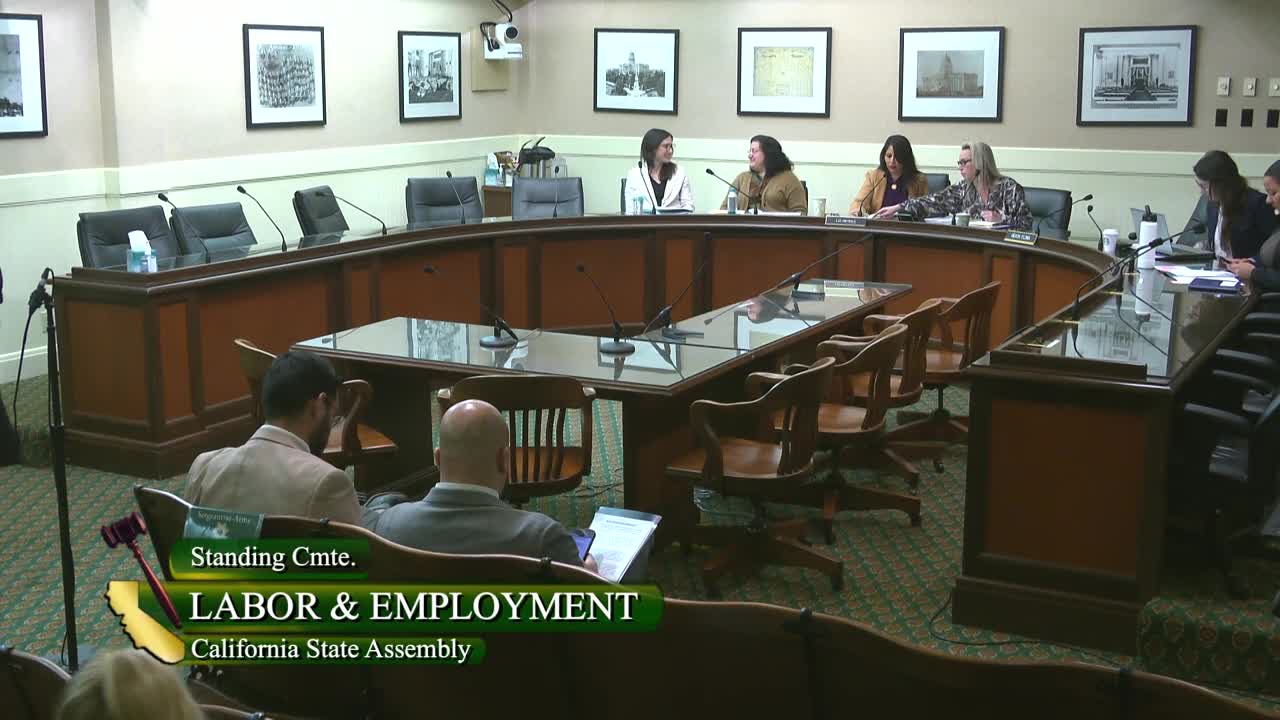
Bill Author

Bill Co-Author(s):