AB 1219: Personal income tax: rate.
- Session Year: 2025-2026
- House: Assembly
- Latest Version Date: 2025-04-03
Current Status:
Failed
(2025-06-05: From committee: Without further action pursuant to Joint Rule 62(a).)
Introduced
In Committee
Awaiting First Chamber Vote
Passed First Chamber
In Committee
Awaiting Second Chamber Vote
Passed Second Chamber
Enacted
The Personal Income Tax Law, in modified conformity with federal income tax law, imposes taxes on taxable income, as provided.
This bill, for taxable years beginning on or after January 1, 2025, and before January 1, 2030, would revise the income tax rates and taxable income brackets by imposing an income tax rate of 1%, 3%, 5%, or 7%, instead of 2%, 4%, 6%, or 8%, as applicable, on specified taxable income.
This bill would take effect immediately as a tax levy.
The Personal Income Tax Law, in modified conformity with federal income tax law, imposes taxes on taxable income, as provided.This bill, for taxable years beginning on or after January 1, 2025, would revise the income tax rates and taxable income brackets by imposing an income tax rate of 3% instead of 4%, increasing as applicable, on specified taxable income.This bill would take effect immediately as a tax levy.The Personal Income Tax Law, in modified conformity with federal income tax law, imposes taxes on taxable income, as provided.
This bill, for taxable years beginning on or after January 1, 2025, would revise the income tax rates and taxable income brackets by imposing an income tax rate of 3% instead of 4%, increasing as applicable, on specified taxable income.
This bill would take effect immediately as a tax levy.
(a)(1)There shall be imposed for each taxable year upon the entire taxable income of every resident of this state who is not a part-year resident, except the head of a household household, as defined in Section 17042, taxes in the following amounts and at the following rates upon the amount of taxable income computed for the taxable year as if the resident were a resident of this state for the entire taxable year and for all prior taxable years for any carryover items, deferred income, suspended losses, or suspended deductions:
If the taxable income is: | The tax is: |
Not over $3,650 | 1% of the taxable income |
Over $3,650 but not over $8,650 |
|
Over $8,650 but not over $13,650 |
|
Over $13,650 but not over $18,950 |
|
Over $18,950 but not over $23,950 |
|
Over $23,950 | $1,054.50 plus 9.3% of the excess |
(2)For taxable years beginning on or after January 1, 2009, and before January 1, 2011, the percentages specified in the table in paragraph (1) shall be increased by adding 0.25 percent to each percentage.
(3)For taxable years beginning on or after January 1, 2025, and before January 1, 2030, the income tax brackets and rates set forth in paragraph (1) shall be replaced with the following:
If the taxable income is: | The tax is: |
Not over $25,499 | 1% of the taxable income |
Over $25,499 but not over $40,245 |
|
Over $40,245 but not over $55,866 |
|
Over $55,866 but not over $70,606 |
|
Over $70, 606 | $2,510.22 plus 9.3% of the excess |
(b)(1)There shall be imposed for each taxable year upon the taxable income of every nonresident or part-year resident, except the head of a household as defined in Section 17042, a tax as calculated in paragraph (2).
(2)The tax imposed under paragraph (1) shall be calculated by multiplying the taxable income of a nonresident or part-year resident, as defined in subdivision (i), by a rate (expressed as a percentage) equal to the tax computed under subdivision (a) on the entire taxable income of the nonresident or part-year resident as if the nonresident or part-year resident were a resident of this state for the taxable year and as if the nonresident or part-year resident were a resident of this state for all prior taxable years for any carryover items, deferred income, suspended losses, or suspended deductions, divided by the amount of that income.
(c)(1)There shall be imposed for each taxable year upon the entire taxable income of every resident of this state who is not a part-year resident for that taxable year, when the resident is the head of a household, as defined in Section 17042, taxes in the following amounts and at the following rates upon the amount of taxable income computed for the taxable year as if the resident were a resident of the state for the entire taxable year and for all prior taxable years for carryover items, deferred income, suspended losses, or suspended deductions:
If the taxable income is: | The tax is: |
Not over $7,300 | 1% of the taxable income |
Over $7,300 but not over $17,300 |
|
Over $17,300 but not over $22,300 |
|
Over $22,300 but not over $27,600 |
|
Over $27,600 but not over $32,600 |
|
Over $32,600 | $1,191 plus 9.3% of the excess |
(2)For taxable years beginning on or after January 1, 2009, and before January 1, 2011, the percentages specified in the table in paragraph (1) shall be increased by adding 0.25 percent to each percentage.
(3)For taxable years beginning on or after January 1, 2025, and before January 1, 2030, the income tax brackets and rates set forth in paragraph (1) shall be replaced with the following:
If the taxable income is: | The tax is: |
Not over $51,000 | 1% of the taxable income |
Over $51,000 but not over $65,744 |
|
Over $65,744 but not over $81,364 |
|
Over $81,364 but not over $96,107 |
|
Over $96,107 | $2,765.33 plus 9.3% of the excess |
(d)(1)There shall be imposed for each taxable year upon the taxable income of every nonresident or part-year resident when the nonresident or part-year resident is the head of a household, as defined in Section 17042, a tax as calculated in paragraph (2).
(2)The tax imposed under paragraph (1) shall be calculated by multiplying the taxable income of a nonresident or part-year resident, as defined in subdivision (i), by a rate (expressed as a percentage) equal to the tax computed under subdivision (c) on the entire taxable income of the nonresident or part-year resident as if the nonresident or part-year resident were a resident of this state for the taxable year and as if the nonresident or part-year resident were a resident of this state for all prior taxable years for any carryover items, deferred income, suspended losses, or suspended deductions, divided by the amount of that income.
(e)There shall be imposed for each taxable year upon the taxable income of every estate, trust, or common trust fund taxes equal to the amount computed under subdivision (a) for an individual having the same amount of taxable income.
(f)The tax imposed by this part is not a surtax.
(g)(1)Section 1(g) of the Internal Revenue Code, relating to certain unearned income of children taxed as if parents income, shall apply, except as otherwise provided.
(2)Section 1(g)(7)(B)(ii)(II) of the Internal Revenue Code is modified, for purposes of this part, by substituting 1 percent for 10 percent.
(h)(1) For each taxable year beginning on or after January 1, 1988, the Franchise Tax Board shall recompute the income tax brackets prescribed in subdivisions (a) and (c). That computation shall be made as follows:
(1)(A)The California Department of Industrial Relations shall transmit annually to the Franchise Tax Board the percentage change in the California Consumer Price Index for all items from June of the prior calendar year to June of the current calendar year, no later than August 1 of the current calendar year.
(2)(B)The Franchise Tax Board shall do both of the following:
(A)(i)Compute an inflation adjustment factor by adding 100 percent to the percentage change figure that is furnished pursuant to paragraph (1) subparagraph (A) and dividing the result by 100.
(B)(ii)Multiply the preceding taxable year income tax brackets by the inflation adjustment factor determined in subparagraph (A) clause (i) and round off the resulting products to the nearest one dollar ($1).
(2)This subdivision shall not apply to taxable years beginning on or after January 1, 2025, and before January 1, 2026.
(3)For taxable years beginning on or after January 1, 2030, and before January 1, 2031, the proceeding taxable year income tax brackets for purposes of clause (ii) of subparagraph (B) of paragraph (1) shall be what the income tax bracket would have been in that taxable year, including the computation required under this subdivision, if not for the revised brackets specified in paragraph (3) of subdivision (a) or paragraph (3) of subdivision (c), as applicable.
(i)(1)For purposes of this part, the term taxable income of a nonresident or part-year resident includes each of the following:
(A)For any part of the taxable year during which the taxpayer was a resident of this state (as state, as defined by Section 17014), 17014, all items of gross income and all deductions, regardless of source.
(B)For any part of the taxable year during which the taxpayer was not a resident of this state, gross income and deductions derived from sources within this state, determined in accordance with Article 9 of Chapter 3 (commencing with Section 17301) and Chapter 11 (commencing with Section 17951).
(2)For purposes of computing taxable income of a nonresident or part-year resident under paragraph (1), the amount of any net operating loss sustained in any taxable year during any part of which the taxpayer was not a resident of this state shall be limited to the sum of the following:
(A)The amount of the loss attributable to the part of the taxable year in which the taxpayer was a resident.
(B)The amount of the loss which, during the part of the taxable year the taxpayer is not a resident, is attributable to California source income and deductions allowable in arriving at taxable income of a nonresident or part-year resident.
(3)For purposes of computing taxable income of a nonresident or part-year resident under paragraph (1), any carryover items, deferred income, suspended losses, or suspended deductions shall only be includable or allowable to the extent that the carryover item, deferred income, suspended loss, or suspended deduction was derived from sources within this state, calculated as if the nonresident or part-year resident, for the portion of the year he or she they were was a nonresident, had been a nonresident for all prior years.
(j)It is the intent of the Legislature to comply with Section 41.
SEC. 2.This act provides for a tax levy within the meaning of Article IV of the California Constitution and shall go into immediate effect.
SECTION 1.Section 17041 of the Revenue and Taxation Code is amended to read:17041.(a)(1)There shall be imposed for each taxable year upon the entire taxable income of every resident of this state who is not a part-year resident, except the head of a household, as defined in Section 17042, taxes in the following amounts and at the following rates upon the amount of taxable income computed for the taxable year as if the resident were a resident of this state for the entire taxable year and for all prior taxable years for any carryover items, deferred income, suspended losses, or suspended deductions:If the taxable income is:The tax is:Not over $3,6501% of the taxable incomeOver $3,650 but notover $8,650$36.50 plus 2% of the excessover $3,650Over $8,650 but notover $13,650$136.50 plus 4% of the excessover $8,650Over $13,650 but notover $18,950$336.50 plus 6% of the excessover $13,650Over $18,950 but notover $23,950$654.50 plus 8% of the excessover $18,950Over $23,950$1,054.50 plus 9.3% of the excessover $23,950(2)For taxable years beginning on or after January 1, 2009, and before January 1, 2011, the percentages specified in the table in paragraph (1) shall be increased by adding 0.25 percent to each percentage.(3)For taxable years beginning on or after January 1, 2025, the income tax brackets and rates set forth in paragraph (1) shall be replaced with the following:If the taxable income is:The tax is:Not over $8,6501% of the taxable incomeOver $8,650 but notover $13,650$86.50 plus 3% of the excessover $8,650Over $13,650 but notover $18,950$236.50 plus 5% of the excessover $13,650Over $18,950 but notover $23,950$501.50 plus 7% of the excessover $18,950Over $23,950$851.50 plus 8.3% of the excessover $23,950(b)(1)There shall be imposed for each taxable year upon the taxable income of every nonresident or part-year resident, except the head of a household as defined in Section 17042, a tax as calculated in paragraph (2).(2)The tax imposed under paragraph (1) shall be calculated by multiplying the taxable income of a nonresident or part-year resident, as defined in subdivision (i), by a rate (expressed as a percentage) equal to the tax computed under subdivision (a) on the entire taxable income of the nonresident or part-year resident as if the nonresident or part-year resident were a resident of this state for the taxable year and as if the nonresident or part-year resident were a resident of this state for all prior taxable years for any carryover items, deferred income, suspended losses, or suspended deductions, divided by the amount of that income.(c)(1)There shall be imposed for each taxable year upon the entire taxable income of every resident of this state who is not a part-year resident for that taxable year, when the resident is the head of a household, as defined in Section 17042, taxes in the following amounts and at the following rates upon the amount of taxable income computed for the taxable year as if the resident were a resident of the state for the entire taxable year and for all prior taxable years for carryover items, deferred income, suspended losses, or suspended deductions:If the taxable income is:The tax is:Not over $7,3001% of the taxable incomeOver $7,300 but notover $17,300$73 plus 2% of the excessover $7,300Over $17,300 but notover $22,300$273 plus 4% of the excessover $17,300Over $22,300 but notover $27,600$473 plus 6% of the excessover $22,300Over $27,600 but notover $32,600$791 plus 8% of the excessover $27,600Over $32,600$1,191 plus 9.3% of the excessover $32,600(2)For taxable years beginning on or after January 1, 2009, and before January 1, 2011, the percentages specified in the table in paragraph (1) shall be increased by adding 0.25 percent to each percentage.(3)For taxable years beginning on or after January 1, 2025, the income tax brackets and rates set forth in paragraph (1) shall be replaced with the following:If the taxable income is:The tax is:Not over $17,3001% of the taxable incomeOver $17,300 but notover $22,300$173 plus 3% of the excessover $17,300Over $22,300 but notover $27,600$323 plus 5% of the excessover $22,300Over $27,600 but notover $32,600$588 plus 7% of the excessover $27,600Over $32,600$938 plus 8.3% of the excessover $32,600(d)(1)There shall be imposed for each taxable year upon the taxable income of every nonresident or part-year resident when the nonresident or part-year resident is the head of a household, as defined in Section 17042, a tax as calculated in paragraph (2).(2)The tax imposed under paragraph (1) shall be calculated by multiplying the taxable income of a nonresident or part-year resident, as defined in subdivision (i), by a rate (expressed as a percentage) equal to the tax computed under subdivision (c) on the entire taxable income of the nonresident or part-year resident as if the nonresident or part-year resident were a resident of this state for the taxable year and as if the nonresident or part-year resident were a resident of this state for all prior taxable years for any carryover items, deferred income, suspended losses, or suspended deductions, divided by the amount of that income.(e)There shall be imposed for each taxable year upon the taxable income of every estate, trust, or common trust fund taxes equal to the amount computed under subdivision (a) for an individual having the same amount of taxable income.(f)The tax imposed by this part is not a surtax.(g)(1)Section 1(g) of the Internal Revenue Code, relating to certain unearned income of children taxed as if parents income, shall apply, except as otherwise provided.(2)Section 1(g)(7)(B)(ii)(II) of the Internal Revenue Code is modified, for purposes of this part, by substituting 1 percent for 10 percent.(h)(1)For each taxable year beginning on or after January 1, 1988, the Franchise Tax Board shall recompute the income tax brackets prescribed in subdivisions (a) and (c). That computation shall be made as follows:(A)The Department of Industrial Relations shall transmit annually to the Franchise Tax Board the percentage change in the California Consumer Price Index for all items from June of the prior calendar year to June of the current calendar year, no later than August 1 of the current calendar year.(B)The Franchise Tax Board shall do both of the following:(i)Compute an inflation adjustment factor by adding 100 percent to the percentage change figure that is furnished pursuant to subparagraph (A) and dividing the result by 100.(ii)Multiply the preceding taxable year income tax brackets by the inflation adjustment factor determined in clause (i) and round off the resulting products to the nearest one dollar ($1).(2)This subdivision shall not apply to taxable years beginning on or after January 1, 2025, and before January 1, 2026. (i)(1)For purposes of this part, the term taxable income of a nonresident or part-year resident includes each of the following:(A)For any part of the taxable year during which the taxpayer was a resident of this state, as defined by Section 17014, all items of gross income and all deductions, regardless of source.(B)For any part of the taxable year during which the taxpayer was not a resident of this state, gross income and deductions derived from sources within this state, determined in accordance with Article 9 of Chapter 3 (commencing with Section 17301) and Chapter 11 (commencing with Section 17951).(2)For purposes of computing taxable income of a nonresident or part-year resident under paragraph (1), the amount of any net operating loss sustained in any taxable year during any part of which the taxpayer was not a resident of this state shall be limited to the sum of the following:(A)The amount of the loss attributable to the part of the taxable year in which the taxpayer was a resident.(B)The amount of the loss which, during the part of the taxable year the taxpayer is not a resident, is attributable to California source income and deductions allowable in arriving at taxable income of a nonresident or part-year resident.(3)For purposes of computing taxable income of a nonresident or part-year resident under paragraph (1), any carryover items, deferred income, suspended losses, or suspended deductions shall only be includable or allowable to the extent that the carryover item, deferred income, suspended loss, or suspended deduction was derived from sources within this state, calculated as if the nonresident or part-year resident, for the portion of the year they were was a nonresident, had been a nonresident for all prior years.(j)It is the intent of the Legislature to comply with Section 41.SEC. 2.This act provides for a tax levy within the meaning of Article IV of the California Constitution and shall go into immediate effect.(a)(1)There shall be imposed for each taxable year upon the entire taxable income of every resident of this state who is not a part-year resident, except the head of a household household, as defined in Section 17042, taxes in the following amounts and at the following rates upon the amount of taxable income computed for the taxable year as if the resident were a resident of this state for the entire taxable year and for all prior taxable years for any carryover items, deferred income, suspended losses, or suspended deductions:
If the taxable income is: | The tax is: |
Not over $3,650 | 1% of the taxable income |
Over $3,650 but not over $8,650 |
|
Over $8,650 but not over $13,650 |
|
Over $13,650 but not over $18,950 |
|
Over $18,950 but not over $23,950 |
|
Over $23,950 | $1,054.50 plus 9.3% of the excess |
(2)For taxable years beginning on or after January 1, 2009, and before January 1, 2011, the percentages specified in the table in paragraph (1) shall be increased by adding 0.25 percent to each percentage.
(3)For taxable years beginning on or after January 1, 2025, the income tax brackets and rates set forth in paragraph (1) shall be replaced with the following:
If the taxable income is: | The tax is: |
Not over $8,650 | 1% of the taxable income |
Over $8,650 but not over $13,650 |
|
Over $13,650 but not over $18,950 |
|
Over $18,950 but not over $23,950 |
|
Over $23,950 | $851.50 plus 8.3% of the excess |
(b)(1)There shall be imposed for each taxable year upon the taxable income of every nonresident or part-year resident, except the head of a household as defined in Section 17042, a tax as calculated in paragraph (2).
(2)The tax imposed under paragraph (1) shall be calculated by multiplying the taxable income of a nonresident or part-year resident, as defined in subdivision (i), by a rate (expressed as a percentage) equal to the tax computed under subdivision (a) on the entire taxable income of the nonresident or part-year resident as if the nonresident or part-year resident were a resident of this state for the taxable year and as if the nonresident or part-year resident were a resident of this state for all prior taxable years for any carryover items, deferred income, suspended losses, or suspended deductions, divided by the amount of that income.
(c)(1)There shall be imposed for each taxable year upon the entire taxable income of every resident of this state who is not a part-year resident for that taxable year, when the resident is the head of a household, as defined in Section 17042, taxes in the following amounts and at the following rates upon the amount of taxable income computed for the taxable year as if the resident were a resident of the state for the entire taxable year and for all prior taxable years for carryover items, deferred income, suspended losses, or suspended deductions:
If the taxable income is: | The tax is: |
Not over $7,300 | 1% of the taxable income |
Over $7,300 but not over $17,300 |
|
Over $17,300 but not over $22,300 |
|
Over $22,300 but not over $27,600 |
|
Over $27,600 but not over $32,600 |
|
Over $32,600 | $1,191 plus 9.3% of the excess |
(2)For taxable years beginning on or after January 1, 2009, and before January 1, 2011, the percentages specified in the table in paragraph (1) shall be increased by adding 0.25 percent to each percentage.
(3)For taxable years beginning on or after January 1, 2025, the income tax brackets and rates set forth in paragraph (1) shall be replaced with the following:
If the taxable income is: | The tax is: |
Not over $17,300 | 1% of the taxable income |
Over $17,300 but not over $22,300 |
|
Over $22,300 but not over $27,600 |
|
Over $27,600 but not over $32,600 |
|
Over $32,600 | $938 plus 8.3% of the excess |
(d)(1)There shall be imposed for each taxable year upon the taxable income of every nonresident or part-year resident when the nonresident or part-year resident is the head of a household, as defined in Section 17042, a tax as calculated in paragraph (2).
(2)The tax imposed under paragraph (1) shall be calculated by multiplying the taxable income of a nonresident or part-year resident, as defined in subdivision (i), by a rate (expressed as a percentage) equal to the tax computed under subdivision (c) on the entire taxable income of the nonresident or part-year resident as if the nonresident or part-year resident were a resident of this state for the taxable year and as if the nonresident or part-year resident were a resident of this state for all prior taxable years for any carryover items, deferred income, suspended losses, or suspended deductions, divided by the amount of that income.
(e)There shall be imposed for each taxable year upon the taxable income of every estate, trust, or common trust fund taxes equal to the amount computed under subdivision (a) for an individual having the same amount of taxable income.
(f)The tax imposed by this part is not a surtax.
(g)(1)Section 1(g) of the Internal Revenue Code, relating to certain unearned income of children taxed as if parents income, shall apply, except as otherwise provided.
(2)Section 1(g)(7)(B)(ii)(II) of the Internal Revenue Code is modified, for purposes of this part, by substituting 1 percent for 10 percent.
(h)(1)For each taxable year beginning on or after January 1, 1988, the Franchise Tax Board shall recompute the income tax brackets prescribed in subdivisions (a) and (c). That computation shall be made as follows:
(1)(A)The California Department of Industrial Relations shall transmit annually to the Franchise Tax Board the percentage change in the California Consumer Price Index for all items from June of the prior calendar year to June of the current calendar year, no later than August 1 of the current calendar year.
(2)(B)The Franchise Tax Board shall do both of the following:
(A)(i)Compute an inflation adjustment factor by adding 100 percent to the percentage change figure that is furnished pursuant to paragraph (1) subparagraph (A) and dividing the result by 100.
(B)(ii)Multiply the preceding taxable year income tax brackets by the inflation adjustment factor determined in subparagraph (A) clause (i) and round off the resulting products to the nearest one dollar ($1).
(2)This subdivision shall not apply to taxable years beginning on or after January 1, 2025, and before January 1, 2026.
(i)(1)For purposes of this part, the term taxable income of a nonresident or part-year resident includes each of the following:
(A)For any part of the taxable year during which the taxpayer was a resident of this state (as state, as defined by Section 17014), 17014, all items of gross income and all deductions, regardless of source.
(B)For any part of the taxable year during which the taxpayer was not a resident of this state, gross income and deductions derived from sources within this state, determined in accordance with Article 9 of Chapter 3 (commencing with Section 17301) and Chapter 11 (commencing with Section 17951).
(2)For purposes of computing taxable income of a nonresident or part-year resident under paragraph (1), the amount of any net operating loss sustained in any taxable year during any part of which the taxpayer was not a resident of this state shall be limited to the sum of the following:
(A)The amount of the loss attributable to the part of the taxable year in which the taxpayer was a resident.
(B)The amount of the loss which, during the part of the taxable year the taxpayer is not a resident, is attributable to California source income and deductions allowable in arriving at taxable income of a nonresident or part-year resident.
(3)For purposes of computing taxable income of a nonresident or part-year resident under paragraph (1), any carryover items, deferred income, suspended losses, or suspended deductions shall only be includable or allowable to the extent that the carryover item, deferred income, suspended loss, or suspended deduction was derived from sources within this state, calculated as if the nonresident or part-year resident, for the portion of the year he or she they were was a nonresident, had been a nonresident for all prior years.
(j)It is the intent of the Legislature to comply with Section 41.
SEC. 2.This act provides for a tax levy within the meaning of Article IV of the California Constitution and shall go into immediate effect.
|
Date
|
Status
|
|---|---|
| Jun 5, 2025 | From committee: Without further action pursuant to Joint Rule 62(a). |
| May 5, 2025 | In committee: Held under submission. |
| Apr 21, 2025 | In committee: Set, final hearing. Referred to suspense file. |
| Apr 7, 2025 | In committee: Set, second hearing. Hearing canceled at the request of author. |
| Apr 7, 2025 | Re-referred to Com. on REV. & TAX. |
| Apr 3, 2025 | From committee chair, with author's amendments: Amend, and re-refer to Com. on REV. & TAX. Read second time and amended. |
| Mar 24, 2025 | In committee: Set, first hearing. Hearing canceled at the request of author. |
| Mar 10, 2025 | Referred to Com. on REV. & TAX. |
| Feb 24, 2025 | Read first time. |
| Feb 22, 2025 | From printer. May be heard in committee March 24. |
| Feb 21, 2025 | Introduced. To print. |
This list shows positions taken on this bill by organizations on the date displayed, which is linked to the original source.
Positions by individuals are not included.
|
Organization
|
Position
|
Date
|
|---|---|---|
| California Federation Of Teachers | ** Against | |
| California Tax Reform Association | ** Against | |
| California Teachers Association | ** Against | |
| the greater coachella valley chamber of commerce | ** Support |
Date of Hearing: May 5, 2025
ASSEMBLY COMMITTEE ON REVENUE AND TAXATION
Mike Gipson, Chair
ABPCA Bill Id:AB 1219 (
Author:Wallis) – As Amended Ver:April 3, 2025
SUSPENSE
Majority vote. Tax levy. Fiscal committee.
SUBJECT: Personal income tax: rate
SUMMARY: Decreases statutorily prescribed income tax rates, and adjusts the income thresholds of certain tax brackets. Specifically, this bill:
- Establishes the following brackets and rates based on the following filing statuses under the Personal Income Tax (PIT) Law, for taxable years beginning on or after January 1, 2025, and before January 1, 2030:
- For single filers or married or registered domestic partners filing separately:
- 1% of the taxable income not over $25,499;
- $254.99 plus 3% of the taxable income over $25,499, but not over $40,245;
- $697.37 plus 5% of the taxable income over $40,245, but not over $55,866;
- $1,478.42 plus 7% of the taxable income over $55,866, but not over $70,606; and,
- $2510.22 plus 9.3% of the taxable income over $70,606.
- For heads of household:
- 1% of the taxable income not over $51,000;
- $510 plus 3% of the taxable income over $51,000, but not over $65,744;
- $952.32 plus 5% of the taxable income over $65,744, but not over $81,364;
- $1,733.32 plus 7% of the taxable income over $81,364, but not over $96,107; and,
- $2,765.33 plus 9.3% of the taxable income over $96,107.
- For single filers or married or registered domestic partners filing separately:
- Provides that the taxable incomes prescribed for single filers, or married or registered domestic partners filing separately, are doubled for married or registered domestic partners filing jointly, or a qualifying surviving spouse or registered domestic partner, pursuant to existing law.
- Suspends the existing inflation adjustment of PIT Law tax bracket thresholds for the 2025 taxable year.
- Reauthorizes existing income tax rates, and income tax bracket thresholds that would otherwise be operative absent this bill, for taxable years beginning on or after January 1, 2030.
- States this bill's intent to comply with Revenue and Taxation Code (R&TC) Section 41.
- Takes immediate effect as a tax levy.
EXISTING LAW provides that all income is taxable, from whatever source derived, unless specifically excluded. California imposes six different statutory PIT rates from 1% to 9.3%, with each applying to a different range of income, known as a "tax bracket." The Franchise Tax Board (FTB) is required to recalculate the tax brackets each year based on the change in the California Consumer Price Index. (R&TC Section 17001 et seq.).
FISCAL EFFECT: The FTB estimates a General Fund revenue loss of $11.1 billion in the 2025-26 fiscal year (FY), $7.4 billion in FY 2026-27, and $7.7 billion in FY 2027-28.
COMMENTS:
- The Greater Coachella Valley Chamber of Commerce, writing in support of this bill, states, in part;
AB 1219 updates California's personal income tax brackets by reducing rates and broadening the income ranges. This change will allow families and individuals to keep more of their hard-earned money while maintaining a fair and progressive tax system.
By putting more dollars back into the hands of consumers, this bill helps boost household spending and stimulate local economies. Reducing tax burdens for working families also enhances affordability and quality of life — two essential factors for keeping California competitive.
We encourage support for AB 1219 to reduce the tax burden on working families and support economic growth across California.
- The California Federation of Teachers (CFT), writing in opposition to this bill, states, in part:
CFT — A Union of Educators & Classified Professionals, AFT, AFL-CIO, opposes AB 1219 (Wallis), which would, for taxable years beginning on or after January 1, 2025, would revise the income tax rates and taxable income brackets by imposing an income tax rate of 3% instead of 4%, increasing as applicable, on specified taxable income.
California voters secured funding for public education via Proposition 98, which provides funding to our TK – 12 schools and Community Colleges from revenues of the General Fund. Specifically public education is funded mainly by the income tax, corporate income tax, sales and use tax, and property taxes. Tax credits, exemptions, and other expenditures however, remove funding from public education. For every dollar that is provided in tax expenditures, approximately 40 cents of each dollar comes out of California's classrooms.
- Committee Staff Comments:
- California's progressive tax structure: Historically, California's Legislature and governors have imposed progressive tax brackets on the highest income earners. Beginning with Governor Ronald Reagan, a 10% tax bracket was enacted in 1967 and raised shortly thereafter to 11% in 1971. In the 1990's, as California faced a severe recession resulting in significant shortfalls in the state budget, the state acted to increase revenues with Governor Pete Wilson signing into law an increase in the PIT rates.
The predominant critique of a progressive tax system is similar to one outlined by Austrian economist and author, Eugen Von Bohm-Bawerk. In his work Karl Marx and the Close of His System, Von Bohm-Bawerk applies the theory of diminishing returns and postulates that as incomes rise, individuals will use a smaller portion of that income to consume goods and, by extension, spend a larger amount on capital investments. These capital investments increase income, which may then be invested back into capital, generally decreasing the cost of production and increasing the standard of living. Opponents of a progressive taxation system hold that imposing a higher rate on higher income individuals reduces the amount of available income for capital improvements, thereby reducing the standard of living.
Von Bohm-Bawerk's supposition does not account, however, for the increasing gap between those individuals with significant capital investments creating greater amounts of income and those who must proportionally spend a larger share of their income on the necessities of life, such as low-income earners. Von Bohm-Bawerk's argument also fails to address the decline in jobs from increased capital improvements. For instance, if a company were to purchase a machine that could produce widgets at the same rate as 10 workers, the company would become more efficient by reducing its labor costs.
Adam Smith, writing in his seminal work An Inquiry into the Nature and Causes of the Wealth of Nations, described the difficulties of society's lower-income individuals, emphasizing the necessities of life. Recognizing the higher percentage of income that lower-income earners must spend on the necessities of life, and the disproportionate impact this has on those earners, Smith contended "it is not very unreasonable that the rich should contribute to the public expense, not only in proportion to their revenue, but something more than in that proportion." In other words, Adam Smith noted the value of a progressive system of taxation.
The economic impact of this bill to households is unclear. On the one hand, this bill condenses the existing 2% income tax bracket into the existing 1% income tax bracket, thereby decreasing progressivity and increasing proportionality of California's personal income tax system. On the other hand, this bill reduces income tax rates by 1% for the existing 4%, 6%, and 8% rates for corresponding income tax brackets, thereby increasing progressivity and decreasing proportionality.
- Proposition 98: In 1988, California voters approved Proposition 98 (Prop. 98), which guarantees a certain level of educational funding for schools and community colleges based on certain calculations that vary with General Fund revenues and changes in per capita personal income. Three types of calculations, or tests, are stipulated in the law, and these tests impact the overall amount of revenue reserved for schools in any given year. In Test 1 years, the amount guaranteed under Prop. 98 is approximately 40% of General Fund revenues. Thus, any $1 of General Fund revenue lost corresponds to a $0.40 decrease in the Prop. 98 guarantee[1]. According to the Legislative Analyst's Office in its presentation to the Senate Budget and Fiscal Review Subcommittee on Education on February 27, 2025, Test 1 remains operative for the 2025-26 FY.
- This bill: As currently drafted, this bill would condense the existing 2% income tax bracket into the 1% income tax bracket, and reduce by 1% the rates imposed on the remaining income tax brackets, except the highest statutorily set income tax bracket. Thus, this bill lowers personal income tax rates for most single filing taxpayers with income below $70,606. Those single filers making more than $70,606 and less than $10,756 would not receive a tax rate decrease.
- Drafting error: On Page 6, Lines 8 and 9, when reapplying the existing inflation adjusted income bracket threshold amounts, this bill refers to the phrase "proceeding taxable year income tax brackets," whereas that section of the law describes an inflation adjustment to the "preceding taxable year income tax brackets". Additionally on Page 7, Line 4, the term "was" should be deleted. This bill should be amended to address these drafting errors.
- Technical considerations: Certain existing statute governing personal income tax rates and brackets related to taxable years beginning on or after January 1, 2009, and before January 1, 2011, is obsolete. These obsolete references contained in existing R&TC Sections 17041(a)(2) and (c)(2) should be deleted, and the remaining code sections renumbered accordingly.
Additionally, the R&TC contains several references to R&TC Section 17041(h). These references would require updating due to the renumbering of this subdivision if this bill is enacted.
- What is a "tax expenditure"? Existing law provides various credits, deductions, exclusions, and exemptions for particular taxpayer groups. In the late 1960s, U.S. Treasury officials began arguing that these features of the tax law should be referred to as "expenditures" since they are generally enacted to accomplish some governmental purpose and there is a determinable cost associated with each (in the form of foregone revenues).
As the Department of Finance notes in its annual Tax Expenditure Report, there are several key differences between tax expenditures and direct expenditures. First, tax expenditures are typically reviewed less frequently than direct expenditures. Second, there is generally no control over the amount of revenue losses associated with any given tax expenditure. Finally, it should also be noted that, once enacted, it takes a two-thirds vote to rescind an existing tax expenditure absent a sunset date. This effectively results in a "one-way ratchet" whereby tax expenditures can be conferred by majority vote, but cannot be rescinded, irrespective of their efficacy or cost, without a supermajority vote. This bill reduces PIT rates, thereby constituting a tax expenditure.
- Committee's tax expenditure policy: SB 1335 (Leno), Chapter 845, Statutes of 2014, added R&TC Section 41, which recognized that the Legislature should apply the same level of review used for government spending programs to tax credits introduced on or after January 1, 2015. AB 263 (Burke), Chapter 743, Statutes of 2019, extended the requirements in R&TC Section 41 to all tax expenditure measures under the PIT Law, the Corporation Tax (CT) Law, and the Sales and Use Tax Law introduced on or after January 1, 2020. A tax expenditure proposal must outline specific goals, purposes, and objectives that the tax expenditure will achieve, along with detailed performance indicators for the Legislature to use when measuring whether the tax expenditure meets those stated goals, purposes, and objectives. In addition to the R&TC Section 41 requirements, this Committee's policy also requires that all tax expenditure proposals contain an appropriate sunset provision to be eligible for a vote[2]. Sunsets are required because eliminating a tax expenditure generally requires a 2/3 vote. These requirements must be satisfied before a bill can receive a vote in this Committee. This bill does contain an appropriate five-year sunset, but does not comply with the requirements of R&TC Section 41, thereby making it ineligible for a vote in this Committee.
- Related legislation: AB 1428 (Muratsuchi) would impose a tax, under the PIT Law and the CT Law, at a rate of 0.5% on that portion of income over $10 million. Revenues attributable to this tax would be deposited in Affordable Childcare Reimbursement Fund, which AB 1428 establishes in the State Treasury as a continuous appropriation, for the purposes of awarding grants to certain childcare facilities. AB 1428 is scheduled for a hearing in this Committee on April 21st.
- Previous legislation: AB 17 (Alanis), of the 2023-24 Legislative Session, would have lowered personal income tax rates, and consolidated certain income tax brackets. AB 17 was never heard by this Committee.
REGISTERED SUPPORT / OPPOSITION:
Support
The Greater Coachella Valley Chamber of Commerce
Opposition
California Federation of Teachers
California Tax Reform Association
California Teachers Association
Analysis Prepared by: Harrison Bowlby / REV. & TAX. / (916) 319-2098
Proposition 98 and K-12 Education, The 2024-25 Budget, LAO (February 15, 2024). https://lao.ca.gov/Publications/Report/4839#:~:text=Proposition%2098%20(1988)%20sets%20aside,23%20through%202024%E2%80%9125%20period, accessed March 2025. ↑
An "appropriate sunset provision" shall mean five years, except in the case of a tax expenditure measure providing relief to California veterans, in which case "appropriate sunset provision" shall mean 10 years. ↑
Date of Hearing: April 21, 2025
ASSEMBLY COMMITTEE ON REVENUE AND TAXATION
Mike Gipson, Chair
ABPCA Bill Id:AB 1219 (
Author:Wallis) – As Amended Ver:April 3, 2025
Majority vote. Tax levy. Fiscal committee.
SUBJECT: Personal income tax: rate
SUMMARY: Decreases statutorily prescribed income tax rates, and adjusts the income thresholds of certain tax brackets. Specifically, this bill:
- Establishes the following brackets and rates based on the following filing statuses under the Personal Income Tax (PIT) Law, for taxable years beginning on or after January 1, 2025, and before January 1, 2030:
- For single filers or married or registered domestic partners filing separately:
- 1% of the taxable income not over $25,499;
- $254.99 plus 3% of the taxable income over $25,499, but not over $40,245;
- $697.37 plus 5% of the taxable income over $40,245, but not over $55,866;
- $1,478.42 plus 7% of the taxable income over $55,866, but not over $70,606; and,
- $2510.22 plus 9.3% of the taxable income over $70,606.
- For heads of household:
- 1% of the taxable income not over $51,000;
- $510 plus 3% of the taxable income over $51,000, but not over $65,744;
- $952.32 plus 5% of the taxable income over $65,744, but not over $81,364;
- $1,733.32 plus 7% of the taxable income over $81,364, but not over $96,107; and,
- $2,765.33 plus 9.3% of the taxable income over $96,107.
- For single filers or married or registered domestic partners filing separately:
- Provides that the taxable incomes prescribed for single filers, or married or registered domestic partners filing separately, are doubled for married or registered domestic partners filing jointly, or a qualifying surviving spouse or registered domestic partner, pursuant to existing law.
- Suspends the existing inflation adjustment of PIT Law tax bracket thresholds for the 2025 taxable year.
- Reauthorizes existing income tax rates, and income tax bracket thresholds that would otherwise be operative absent this bill, for taxable years beginning on or after January 1, 2030.
- States this bill's intent to comply with Revenue and Taxation Code (R&TC) Section 41.
- Takes immediate effect as a tax levy.
EXISTING LAW provides that all income is taxable, from whatever source derived, unless specifically excluded. California imposes six different statutory PIT rates from 1% to 9.3%, with each applying to a different range of income, known as a "tax bracket." The Franchise Tax Board (FTB) is required to recalculate the tax brackets each year based on the change in the California Consumer Price Index. (R&TC Section 17001 et seq.).
FISCAL EFFECT: The FTB estimates a General Fund revenue loss of $11.1 billion in the 2025-26 fiscal year (FY), $7.4 billion in FY 2026-27, and $7.7 billion in FY 2027-28.
COMMENTS:
- The Greater Coachella Valley Chamber of Commerce, writing in support of this bill, states, in part;
AB 1219 updates California's personal income tax brackets by reducing rates and broadening the income ranges. This change will allow families and individuals to keep more of their hard-earned money while maintaining a fair and progressive tax system.
By putting more dollars back into the hands of consumers, this bill helps boost household spending and stimulate local economies. Reducing tax burdens for working families also enhances affordability and quality of life — two essential factors for keeping California competitive.
We encourage support for AB 1219 to reduce the tax burden on working families and support economic growth across California.
- The California Federation of Teachers (CFT), writing in opposition to this bill, states, in part:
CFT — A Union of Educators & Classified Professionals, AFT, AFL-CIO, opposes AB 1219 (Wallis), which would, for taxable years beginning on or after January 1, 2025, would revise the income tax rates and taxable income brackets by imposing an income tax rate of 3% instead of 4%, increasing as applicable, on specified taxable income.
California voters secured funding for public education via Proposition 98, which provides funding to our TK – 12 schools and Community Colleges from revenues of the General Fund. Specifically public education is funded mainly by the income tax, corporate income tax, sales and use tax, and property taxes. Tax credits, exemptions, and other expenditures however, remove funding from public education. For every dollar that is provided in tax expenditures, approximately 40 cents of each dollar comes out of California's classrooms.
- Committee Staff Comments:
- California's progressive tax structure: Historically, California's Legislature and governors have imposed progressive tax brackets on the highest income earners. Beginning with Governor Ronald Reagan, a 10% tax bracket was enacted in 1967 and raised shortly thereafter to 11% in 1971. In the 1990's, as California faced a severe recession resulting in significant shortfalls in the state budget, the state acted to increase revenues with Governor Pete Wilson signing into law an increase in the PIT rates.
The predominant critique of a progressive tax system is similar to one outlined by Austrian economist and author, Eugen Von Bohm-Bawerk. In his work Karl Marx and the Close of His System, Von Bohm-Bawerk applies the theory of diminishing returns and postulates that as incomes rise, individuals will use a smaller portion of that income to consume goods and, by extension, spend a larger amount on capital investments. These capital investments increase income, which may then be invested back into capital, generally decreasing the cost of production and increasing the standard of living. Opponents of a progressive taxation system hold that imposing a higher rate on higher income individuals reduces the amount of available income for capital improvements, thereby reducing the standard of living.
Von Bohm-Bawerk's supposition does not account, however, for the increasing gap between those individuals with significant capital investments creating greater amounts of income and those who must proportionally spend a larger share of their income on the necessities of life, such as low-income earners. Von Bohm-Bawerk's argument also fails to address the decline in jobs from increased capital improvements. For instance, if a company were to purchase a machine that could produce widgets at the same rate as 10 workers, the company would become more efficient by reducing its labor costs.
Adam Smith, writing in his seminal work An Inquiry into the Nature and Causes of the Wealth of Nations, described the difficulties of society's lower-income individuals, emphasizing the necessities of life. Recognizing the higher percentage of income that lower-income earners must spend on the necessities of life, and the disproportionate impact this has on those earners, Smith contended "it is not very unreasonable that the rich should contribute to the public expense, not only in proportion to their revenue, but something more than in that proportion." In other words, Adam Smith noted the value of a progressive system of taxation.
The economic impact of this bill to households is unclear. On the one hand, this bill condenses the existing 2% income tax bracket into the existing 1% income tax bracket, thereby decreasing progressivity and increasing proportionality of California's personal income tax system. On the other hand, this bill reduces income tax rates by 1% for the existing 4%, 6%, and 8% rates for corresponding income tax brackets, thereby increasing progressivity and decreasing proportionality.
- Proposition 98: In 1988, California voters approved Proposition 98 (Prop. 98), which guarantees a certain level of educational funding for schools and community colleges based on certain calculations that vary with General Fund revenues and changes in per capita personal income. Three types of calculations, or tests, are stipulated in the law, and these tests impact the overall amount of revenue reserved for schools in any given year. In Test 1 years, the amount guaranteed under Prop. 98 is approximately 40% of General Fund revenues. Thus, any $1 of General Fund revenue lost corresponds to a $0.40 decrease in the Prop. 98 guarantee[1]. According to the Legislative Analyst's Office in its presentation to the Senate Budget and Fiscal Review Subcommittee on Education on February 27, 2025, Test 1 remains operative for the 2025-26 FY.
- This bill: As currently drafted, this bill would condense the existing 2% income tax bracket into the 1% income tax bracket, and reduce by 1% the rates imposed on the remaining income tax brackets, except the highest statutorily set income tax bracket. Thus, this bill lowers personal income tax rates for most single filing taxpayers with income below $70,606. Those single filers making more than $70,606 and less than $10,756 would not receive a tax rate decrease.
- Drafting error: On Page 6, Lines 8 and 9, when reapplying the existing inflation adjusted income bracket threshold amounts, this bill refers to the phrase "proceeding taxable year income tax brackets," whereas that section of the law describes an inflation adjustment to the "preceding taxable year income tax brackets". Additionally on Page 7, Line 4, the term "was" should be deleted. This bill should be amended to address these drafting errors.
- Technical considerations: Certain existing statute governing personal income tax rates and brackets related to taxable years beginning on or after January 1, 2009, and before January 1, 2011, is obsolete. These obsolete references contained in existing R&TC Sections 17041(a)(2) and (c)(2) should be deleted, and the remaining code sections renumbered accordingly.
Additionally, the R&TC contains several references to R&TC Section 17041(h). These references would require updating due to the renumbering of this subdivision if this bill is enacted.
- What is a "tax expenditure"? Existing law provides various credits, deductions, exclusions, and exemptions for particular taxpayer groups. In the late 1960s, U.S. Treasury officials began arguing that these features of the tax law should be referred to as "expenditures" since they are generally enacted to accomplish some governmental purpose and there is a determinable cost associated with each (in the form of foregone revenues).
As the Department of Finance notes in its annual Tax Expenditure Report, there are several key differences between tax expenditures and direct expenditures. First, tax expenditures are typically reviewed less frequently than direct expenditures. Second, there is generally no control over the amount of revenue losses associated with any given tax expenditure. Finally, it should also be noted that, once enacted, it takes a two-thirds vote to rescind an existing tax expenditure absent a sunset date. This effectively results in a "one-way ratchet" whereby tax expenditures can be conferred by majority vote, but cannot be rescinded, irrespective of their efficacy or cost, without a supermajority vote. This bill reduces PIT rates, thereby constituting a tax expenditure.
- Committee's tax expenditure policy: SB 1335 (Leno), Chapter 845, Statutes of 2014, added R&TC Section 41, which recognized that the Legislature should apply the same level of review used for government spending programs to tax credits introduced on or after January 1, 2015. AB 263 (Burke), Chapter 743, Statutes of 2019, extended the requirements in R&TC Section 41 to all tax expenditure measures under the PIT Law, the Corporation Tax (CT) Law, and the Sales and Use Tax Law introduced on or after January 1, 2020. A tax expenditure proposal must outline specific goals, purposes, and objectives that the tax expenditure will achieve, along with detailed performance indicators for the Legislature to use when measuring whether the tax expenditure meets those stated goals, purposes, and objectives. In addition to the R&TC Section 41 requirements, this Committee's policy also requires that all tax expenditure proposals contain an appropriate sunset provision to be eligible for a vote[2]. Sunsets are required because eliminating a tax expenditure generally requires a 2/3 vote. These requirements must be satisfied before a bill can receive a vote in this Committee. This bill does contain an appropriate five-year sunset, but does not comply with the requirements of R&TC Section 41, thereby making it ineligible for a vote in this Committee.
- Related legislation: AB 1428 (Muratsuchi) would impose a tax, under the PIT Law and the CT Law, at a rate of 0.5% on that portion of income over $10 million. Revenues attributable to this tax would be deposited in Affordable Childcare Reimbursement Fund, which AB 1428 establishes in the State Treasury as a continuous appropriation, for the purposes of awarding grants to certain childcare facilities. AB 1428 is scheduled for a hearing in this Committee on April 21st.
- Previous legislation: AB 17 (Alanis), of the 2023-24 Legislative Session, would have lowered personal income tax rates, and consolidated certain income tax brackets. AB 17 was never heard by this Committee.
REGISTERED SUPPORT / OPPOSITION:
Support
The Greater Coachella Valley Chamber of Commerce
Opposition
California Federation of Teachers
California Tax Reform Association
California Teachers Association
Analysis Prepared by: Harrison Bowlby / REV. & TAX. / (916) 319-2098
Proposition 98 and K-12 Education, The 2024-25 Budget, LAO (February 15, 2024). https://lao.ca.gov/Publications/Report/4839#:~:text=Proposition%2098%20(1988)%20sets%20aside,23%20through%202024%E2%80%9125%20period, accessed March 2025. ↑
An "appropriate sunset provision" shall mean five years, except in the case of a tax expenditure measure providing relief to California veterans, in which case "appropriate sunset provision" shall mean 10 years. ↑
Discussed in Hearing
 4MIN
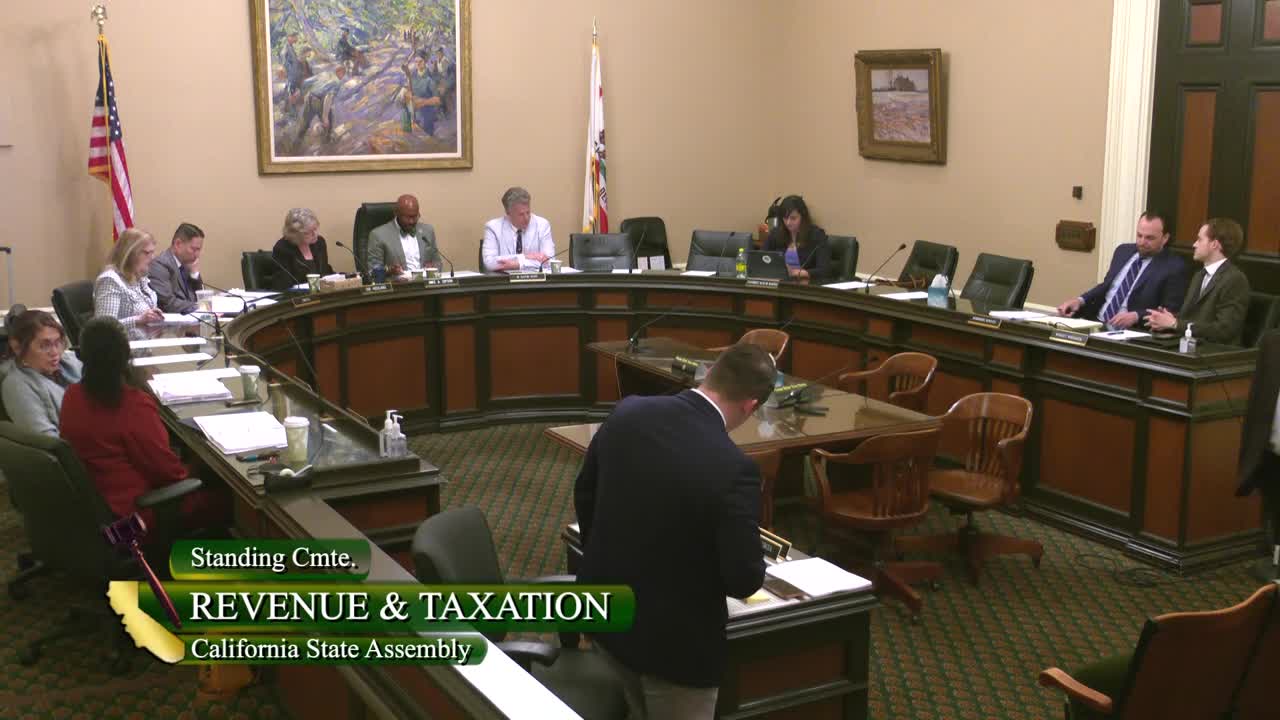
Assembly Standing Committee on Revenue and Taxation
Bill Author

Bill Co-Author(s):