AB 1241: Student financial aid: Pay it Forward, Pay it Back Pilot Program: study.
- Session Year: 2025-2026
- House: Assembly
- Latest Version Date: 2026-01-05
Current Status:
Failed
(2026-02-02: From committee: Filed with the Chief Clerk pursuant to Joint Rule 56.)
Introduced
In Committee
Awaiting First Chamber Vote
Passed First Chamber
In Committee
Awaiting Second Chamber Vote
Passed Second Chamber
Enacted
Existing law establishes the University of California, under the administration of the Regents of the University of California, and the California State University, under the administration of the Trustees of the California State University, the California Community Colleges, under the administration of the Board of Governors of the California Community Colleges, and independent institutions of higher education, as 2 of the 4 segments of public postsecondary education in the state. Existing law establishes the Student Aid Commission as the primary state agency for the administration of state-authorized student financial aid programs available to students attending all segments of postsecondary education.
This bill would require the commission, in consultation with the California State University and the University of California, Legislative Analysts Office, to establish a Pay-It-Forward Financial Aid Program conduct a study of the effects of enacting, in future legislation, a Pay it Forward, Pay it Back Pilot Program that allows would allow students to enroll at a California State University or University of California campus without paying upfront tuition, fees, or room and board, and instead requiring would require participating students to pay, upon graduation or disenrollment and employment, a percentage of their annual adjusted gross income to the state for a number of years, as determined by the commission. The bill would require those collected payments to be deposited into the Pay-It-Forward Financial Aid Fund, which the bill would establish. The bill would require moneys in the fund, upon appropriation by the Legislature, to pay the tuition, fees, and room and board expenses of future participating students. The bill would require, commencing with the 202829 academic year, each California State University and University of California campus to offer the program to their students, and would require, commencing with the 203031 academic year, the California State University and the University of California to ensure that at least 10,000 students per year participate in the program. specified. The bill would require the commission to submit a report on the study of the pilot program to the Assembly Committee on Higher Education and the Senate Committee on Education on or before September 30, 2027. The bill would make these provisions inoperative on September 30, 2030, and would repeal them as of January 1, 2031.
Existing law establishes the University of California, under the administration of the Regents of the University of California, and the California State University, under the administration of the Trustees of the California State University, as 2 of the segments of public postsecondary education in the state. Existing law establishes the Student Aid Commission as the primary state agency for the administration of state-authorized student financial aid programs available to students attending all segments of postsecondary education.
This bill would require the State Department of Education, in consultation with the commission, in consultation with the California State University, University and the University of California, to establish a Pay-It-Forward Financial Aid Program that allows students to enroll at a California State University or University of California campus without paying upfront tuition, fees, or room and board, and instead requiring participating students to pay, upon graduation or disenrollment and employment, a percentage of their annual adjusted gross income to the state for a number of years, as determined by the department. commission. The bill would require those collected payments to be deposited into the Pay-It-Forward Financial Aid Fund, which the bill would establish. The bill would require moneys in the fund, upon appropriation by the Legislature, to pay the tuition, fees, and room and board expenses of future participating students. The bill would require, commencing with the 202829 academic year, each California State University and University of California campus to offer the program to their students, and would require, commencing with the 203031 academic year, the California State University and the University of California to ensure that at least 10,000 students per year participate in the program.
Existing law establishes the University of California, under the administration of the Regents of the University of California, and the California State University, under the administration of the Trustees of the California State University, as 2 of the segments of public postsecondary education in the state. Existing law establishes the Student Aid Commission as the primary state agency for the administration of state-authorized student financial aid programs available to students attending all segments of postsecondary education.
This bill would require the State Department of Education, in consultation with the commission, the California State University, and the University of California, to establish a Pay-It-Forward Financial Aid Program that allows students to enroll at a California State University or University of California campus without paying upfront tuition, fees, or room and board, and instead requiring participating students to pay, upon graduation or disenrollment and employment, a percentage of their annual adjusted gross income to the state for a number of years, as determined by the department. The bill would require those collected payments to be deposited into the Pay-It-Forward Financial Aid Fund, which the bill would establish. The bill would require moneys in the fund, upon appropriation by the Legislature, to pay the tuition, fees, and room and board expenses of future participating students. The bill would require, commencing with the 202829 academic year, each California State University and University of California campus to offer the program to their students, and would require, commencing with the 203031 academic year, the California State University and the University of California to ensure that at least 10,000 students per year participate in the program.
Existing law requires the State Department of Education to encourage school districts offering instruction in kindergarten and any of grades 1 to 12, inclusive, to (1) provide quality physical education that develops the knowledge, attitudes, skills, behavior, and motivation needed to be physically active for life, (2) provide daily recess periods for elementary school pupils, featuring time for unstructured but supervised play, (3) provide extracurricular physical activity programs and clubs, and (4) encourage the use of school facilities for physical activity and fitness programs offered by the school, public park and recreation districts, or community-based organizations outside of school hours.This bill would require the department to instead make those encouragements to school districts offering instruction in prekindergarten, kindergarten, and any of grades 1 to 12, inclusive. The bill also would make nonsubstantive changes.Existing law requires the State Department of Education to encourage school districts offering instruction in kindergarten and any of grades 1 to 12, inclusive, to (1) provide quality physical education that develops the knowledge, attitudes, skills, behavior, and motivation needed to be physically active for life, (2) provide daily recess periods for elementary school pupils, featuring time for unstructured but supervised play, (3) provide extracurricular physical activity programs and clubs, and (4) encourage the use of school facilities for physical activity and fitness programs offered by the school, public park and recreation districts, or community-based organizations outside of school hours.
This bill would require the department to instead make those encouragements to school districts offering instruction in prekindergarten, kindergarten, and any of grades 1 to 12, inclusive. The bill also would make nonsubstantive changes.
(a)The Legislature finds and declares all of the following:
(1)The cost of attending the University of California and the California State University remains a barrier to accessing postsecondary education, with average annual tuition and campus fees of $16,634 and $8,508 at the University of California and the California State University, respectively.
(2)Due to postsecondary education becoming increasingly unaffordable, many students are forced to borrow money to finance their postsecondary education.
(3)On average, students graduating with a baccalaureate degree in California borrow $21,125 to finance their undergraduate education.
(4)As of 2020, Californians collectively owed over $142,000,000,000 in student loan debt, with federal loans making up the majority of that debt.
(b)Therefore, it is the intent of the Legislature to provide students an additional financing option that does not burden them with interest-accruing debt.(b)It is the intent of the Legislature that revenue received from a Pay it Forward, Pay it Back Pilot Program is managed by the state.
(c)It is further the intent of the Legislature that a Pay it Forward, Pay it Back Pilot Program does not replace existing forms of financial aid, including grants, scholarships, and loans, but would instead serve as an additional option for students to finance their education.
SEC. 2.Section 69505.3 is added to the Education Code, to read:69505.3.(a)For purposes of this section, campus means a California State University or University of California campus.(b)The commission shall, in consultation with the California State University and the University of California, establish a Pay-It-Forward Financial Aid Program that does all of the following:(1)Allows a student who is admitted to a campus to enroll at the campus without paying upfront tuition, fees, or room and board.(2)Requires, in lieu of paying upfront tuition, fees, or room and board, a student described in paragraph (1) to sign a contract to, upon graduation or disenrollment from a campus and employment, pay a percentage of their annual adjusted gross income to the state for a number of years, as determined by the commission.(3)Does not allow participating students to pay more than the amount they received under the program.(4)Deposits moneys collected pursuant to paragraph (2) into the Pay-It-Forward Financial Aid Fund, which is hereby established. Moneys in the fund shall be made available by the commission, upon appropriation by the Legislature, to pay for the tuition, fees, and room and board expenses of future participating students. The commission may accept gifts, grants, awards, and appropriations from individuals, businesses, state and local governmental entities, and third-party sources for the program. Accepted funds shall be deposited into the fund.(c)Moneys received by a participating student shall supplement, but not supplant, any form of financial aid, including grants, scholarships, and loans, provided to the participating student.(d)Commencing with the 202829 academic year, each campus shall offer the program to students.(e)Commencing with the 203031 fiscal year, the California State University and the University of California shall ensure that at least 10,000 students per year participate in the program.(f)The commission shall adopt rules and regulations reasonably necessary to effectively administer this section.SEC. 2.Section 69505.3 is added to the Education Code, to read:69505.3.(a)For purposes of this section, the following definitions apply:
(1)Campus means a University of California, California State University, or California Community College campus, or an independent institution of higher education.
(2)Social impact bond means an agreement between a nongovernmental entity and a campus under which a students cost of attendance is paid for by the nongovernmental entity in exchange for a security interest in the payments made by the student, as specified in the contract described in subparagraph (C) of paragraph (2) of subdivision (b).
(b)(1)The commission, in consultation with the Legislative Analysts Office, shall conduct a study of the effects of enacting, in future legislation, a Pay it Forward, Pay it Back Pilot Program.
(2)The study shall evaluate a pilot program described in paragraph (1) that does all of the following:
(A)Is designed to provide an additional option for students to finance the costs of their education, including the costs of upfront tuition, fees, and room and board, for enrollment at a campus.
(B)Allows a student who is admitted to a campus and is a California resident, as determined by the campus, to enroll at the campus without paying upfront tuition, fees, or room and board.
(C)Requires, in lieu of paying upfront tuition, fees, or room and board, a student described in subparagraph (B) to sign a contract to pay, upon graduation, 2 to 4 percent, inclusive, of the students annual adjusted gross income to the state for a specified number of years, as determined in paragraph (2) of subdivision (d).
(c)The pilot program described in paragraph (1) of subdivision (b) may vary by campus in regard to each of the following:
(1)The total cost of attendance at the campus to be reimbursed by a student.
(2)The portion of the total cost of attendance to be paid by the state.
(3)The number of years that a student would be required to make payments, as specified in the contract described in subparagraph (C) of paragraph (2) of subdivision (b).
(4)The percentage of annual adjusted gross income that would be required to be paid by a student, as specified in the contract described in subparagraph (C) of paragraph (2) of subdivision (b).
(d)The study of the pilot program shall do all of the following:
(1)Identify at least one campus of the University of California, one campus of the California State University, one campus of the California Community Colleges, and one independent institution of higher education, as defined in Section 66010, to participate in the pilot program. The campuses identified pursuant to this paragraph shall be regionally diverse.
(2)Based on current research, and projections of state subsidies, specify the number of years that a student would be required to make payments and the percentage of a students annual adjusted gross income to be paid, upon graduation, under a contract described in subparagraph (C) of paragraph (2) of subdivision (b) at each participating campus.
(3)Identify an immediate source of funding for the first 15 to 20 years, inclusive, of the pilot program, which would include establishment of a revolving fund for the deposit of payments made by students under the pilot program, and consider the possibility of using social impact bonds as an immediate funding source.
(e)(1)The commission shall submit a report on the study of the pilot program to the Assembly Committee on Higher Education and the Senate Committee on Education on or before September 30, 2027.
(2)A report submitted pursuant to paragraph (2) shall be submitted in compliance with Section 9795 of the Government Code.
(3)Pursuant to Section 10231.5 of the Government Code, this section shall become inoperative on September 30, 2030, and, as of January 1, 2031, is repealed.
(a)The Legislature finds and declares all of the following:
(1)The cost of attending the University of California and the California State University remains a barrier to accessing postsecondary education, with average annual tuition and campus fees of $16,634 and $8,508 at the University of California and the California State University, respectively.
(2)Due to postsecondary education becoming increasingly unaffordable, many students are forced to borrow money to finance their postsecondary education.
(3)On average, students graduating with a baccalaureate degree in California borrow $21,125 to finance their undergraduate education.
(4)As of 2020, Californians collectively owed over $142 billion $142,000,000,000 in student loan debt, with federal loans making up the majority of that debt.
(b)Therefore, it is the intent of the Legislature to provide students an additional financing option that does not burden them with interest-accruing debt.
SEC. 2.Section 69505.3 is added to the Education Code, to read:69505.3.(a)For purposes of this section, campus means a California State University or University of California campus.
(b)The department commission shall, in consultation with the commission, the California State University, University and the University of California, establish a Pay-It-Forward Financial Aid Program that does all of the following:
(1)Allows a student who is admitted to a campus to enroll at the campus without paying upfront tuition, fees, or room and board.
(2)Requires, in lieu of paying upfront tuition, fees, or room and board, a student described in paragraph (1) to sign a contract to, upon graduation or disenrollment from a campus and employment, pay a percentage of their annual adjusted gross income to the state for a number of years, as determined by the department. commission.
(3)Does not allow participating students to pay more than the amount they received under the program.
(4)Deposits moneys collected pursuant to paragraph (2) into the Pay-It-Forward Financial Aid Fund, which is hereby established. Moneys in the fund shall be made available by the department, commission, upon appropriation by the Legislature, to pay for the tuition, fees, and room and board expenses of future participating students. The department commission may accept gifts, grants, awards, and appropriations from individuals, businesses, state and local governmental entities, and third-party sources for the program. Accepted funds shall be deposited into the fund.
(c)Moneys received by a participating student shall supplement, but not supplant, any form of financial aid, including grants, scholarships, and loans, provided to the participating student.
(d)Commencing with the 202829 academic year, each campus shall offer the program to students.
(e)Commencing with the 203031 fiscal year, the California State University and the University of California shall ensure that at least 10,000 students per year participate in the program.
(f)The department commission shall adopt rules and regulations reasonably necessary to effectively administer this section.
(a)The Legislature finds and declares all of the following:
(1)The cost of attending the University of California and the California State University remains a barrier to accessing postsecondary education, with average annual tuition and campus fees of $16,634 and $8,508 at the University of California and the California State University, respectively.
(2)Due to postsecondary education becoming increasingly unaffordable, many students are forced to borrow money to finance their postsecondary education.
(3)On average, students graduating with a baccalaureate degree in California borrow $21,125 to finance their undergraduate education.
(4)As of 2020, Californians collectively owed over $142 billion in student loan debt, with federal loans making up the majority of that debt.
(b)Therefore, it is the intent of the Legislature to provide students an additional financing option that does not burden them with interest-accruing debt.
SEC. 2.Section 69505.3 is added to the Education Code, to read:69505.3.(a)For purposes of this section, campus means a California State University or University of California campus.
(b)The department shall, in consultation with the commission, the California State University, and the University of California, establish a Pay-It-Forward Financial Aid Program that does all of the following:
(1)Allows a student who is admitted to a campus to enroll at the campus without paying upfront tuition, fees, or room and board.
(2)Requires, in lieu of paying upfront tuition, fees, or room and board, a student described in paragraph (1) to sign a contract to, upon graduation or disenrollment from a campus and employment, pay a percentage of their annual adjusted gross income to the state for a number of years, as determined by the department.
(3)Does not allow participating students to pay more than the amount they received under the program.
(4)Deposits moneys collected pursuant to paragraph (2) into the Pay-It-Forward Financial Aid Fund, which is hereby established. Moneys in the fund shall be made available by the department, upon appropriation by the Legislature, to pay for the tuition, fees, and room and board expenses of future participating students. The department may accept gifts, grants, awards, and appropriations from individuals, businesses, state and local governmental entities, and third-party sources for the program. Accepted funds shall be deposited into the fund.
(c)Moneys received by a participating student shall supplement, but not supplant, any form of financial aid, including grants, scholarships, and loans, provided to the participating student.
(d)Commencing with the 202829 academic year, each campus shall offer the program to students.
(e)Commencing with the 203031 fiscal year, the California State University and the University of California shall ensure that at least 10,000 students per year participate in the program.
(f)The department shall adopt rules and regulations reasonably necessary to effectively administer this section.
SECTION 1.Section 33350 of the Education Code is amended to read:33350.The department shall do all of the following:(a)Adopt rules and regulations that it deems necessary and proper to secure the establishment of courses in physical education in the elementary and secondary schools.(b)Compile or cause to be compiled and printed a manual in physical education for distribution to teachers in the public schools of the state.(c)Encourage school districts offering instruction in prekindergarten, kindergarten, and any of grades 1 to 12, inclusive, to the extent that resources are available, to do all of the following: (1)Provide quality physical education that develops the knowledge, attitudes, skills, behavior, and motivation needed to be physically active and fit for life.(2)Provide daily recess periods for elementary school pupils, featuring time for unstructured but supervised play.(3)Provide extracurricular physical activity and fitness programs and physical activity and fitness clubs.(4)Encourage the use of school facilities for physical activity and fitness programs offered by the school, public park and recreation districts, or community-based organizations outside of school hours.The State Department of Education department shall do all of the following:
(a)Adopt rules and regulations that it deems necessary and proper to secure the establishment of courses in physical education in the elementary and secondary schools.
(b)Compile or cause to be compiled and printed a manual in physical education for distribution to teachers in the public schools of the state.
(c)Encourage school districts offering instruction in kindergarten prekindergarten, kindergarten, and any of grades 1 to 12, inclusive, to the extent that resources are available, to provide do all of the following:
(1)Provide quality physical education that develops the knowledge, attitudes, skills, behavior, and motivation needed to be physically active and fit for life; to provide life.
(2)Provide daily recess periods for elementary school pupils, featuring time for unstructured but supervised play; to provide play.
(3)Provide extracurricular physical activity and fitness programs and physical activity and fitness clubs; and to encourage clubs.
(4)Encourage the use of school facilities for physical activity and fitness programs offered by the school, public park and recreation districts, or community-based organizations outside of school hours.
|
Date
|
Status
|
|---|---|
| Feb 2, 2026 | From committee: Filed with the Chief Clerk pursuant to Joint Rule 56. |
| Jan 31, 2026 | Died pursuant to Art. IV, Sec. 10(c) of the Constitution. |
| Jan 22, 2026 | In committee: Held under submission. |
| Jan 22, 2026 | In committee: Set, first hearing. Referred to suspense file. |
| Jan 14, 2026 | From committee: Do pass and re-refer to Com. on APPR. (Ayes 8. Noes 2.) (January 13). Re-referred to Com. on APPR. |
| Jan 6, 2026 | Re-referred to Com. on HIGHER ED. |
| Jan 5, 2026 | From committee chair, with author's amendments: Amend, and re-refer to Com. on HIGHER ED. Read second time and amended. |
| Apr 7, 2025 | Re-referred to Com. on HIGHER ED. pursuant to Assembly Rule 96. |
| Apr 3, 2025 | Re-referred to Com. on ED. |
| Apr 2, 2025 | From committee chair, with author's amendments: Amend, and re-refer to Com. on ED. Read second time and amended. |
| Mar 13, 2025 | Re-referred to Com. on ED. |
| Mar 12, 2025 | From committee chair, with author's amendments: Amend, and re-refer to Com. on ED. Read second time and amended. |
| Mar 10, 2025 | Referred to Com. on ED. |
| Feb 24, 2025 | Read first time. |
| Feb 22, 2025 | From printer. May be heard in committee March 24. |
| Feb 21, 2025 | Introduced. To print. |
|
Date
|
Description
|
Location
|
Votes
|
|
|---|---|---|---|---|
| Jan 13, 2026 | Do pass and be re-referred to the Committee on [Appropriations] | Assembly Standing Committee on Higher Education |
Passed |
This list shows positions taken on this bill by organizations on the date displayed, which is linked to the original source.
Positions by individuals are not included.
|
Organization
|
Position
|
Date
|
|---|---|---|
| Tony Thurmond | ** Support |
Date of Hearing: January 22, 2026
ASSEMBLY COMMITTEE ON APPROPRIATIONS
Buffy Wicks, Chair
ABPCA Bill Id:AB 1241
Author:(Schiavo) – As Amended Ver:January 5, 2026
Policy Committee: | Higher Education | Vote: | 8 - 2 |
|
| ||
|
|
Urgency: No State Mandated Local Program: No Reimbursable: No
SUMMARY:
This bill requires the California Student Aid Commission (CSAC) to conduct a study, in consultation with the Legislative Analyst’s Office (LAO), regarding the effects of enacting a Pay it Forward, Pay it Back Pilot Program (PIFPIB) for submission to the Legislature on or before September 30, 2027.
FISCAL EFFECT:
Potential one-time costs of an unknown but potentially significant amount, possibly in the low hundreds of thousands of dollars General fund, for the CSAC to conduct the study required by this bill.
Regardless, because the primary purpose of the bill is to conduct a study, the bill is a candidate for the committee’s suspense file, consistent with the committee’s rules.
COMMENTS:
- Purpose. According to the author:
With ever increasing costs of receiving a higher education we must explore all additional avenues that will alleviate the burden of debt for future students. The Pay-It-Forward financial aid model allows students to attend college without paying upfront tuition. This model must be studied further to determine whether it will help our future workforce secure higher paying jobs without the burden of extreme debt.
- Background. PIFPIB refers to a model of financial aid wherein participating institutions of higher education (IHEs) cover all or a portion of a student’s education costs up front, and the student pledges to pay a percentage of their adjusted gross income for a specified number of years after earning their degree (or leaving the IHE without a degree) and entering the workforce. The appeal from a policymaking perspective is that this model typically assumes the system becomes self-sustaining once enough students are paying money back into it, without further state or IHE investment required to backfill foregone tuition payments from participating students. The PIFPIB model can function with or without interest. While the PIFPIB has garnered significant interest from policymakers throughout the country, with at least 24 states proposing some form of PIFPIB legislation in recent years, no state has implemented PIFPIB. It is also unclear how PIFPIB would interact with existing state financial aid programs such as Cal Grant.
Analysis Prepared by: Aaron Heredia / APPR. / (916) 319-2081
Date of Hearing: January 13, 2026
ASSEMBLY COMMITTEE ON HIGHER EDUCATION
Mike Fong, Chair
ABPCA Bill Id:AB 1241 (
Author:Schiavo) – As Amended Ver:January 5, 2026
SUBJECT: Student financial aid: Pay it Forward, Pay it Back Pilot Program: study.
SUMMARY: Requires the California Student Aid Commission (CSAC), in consultation with the Legislative Analyst’s Office (LAO), to conduct a study of the effects of enacting, in future legislation, a Pay it Forward, Pay it Back Pilot (PIFPIB) Program that would allow students to enroll at a California State University (CSU) or University of California (UC) campus without paying upfront tuition, fees, or room and board, and instead would require participating students to pay, upon graduation or disenrollment and employment, a percentage of their annual adjusted gross income to the state for a number of years, as specified. Specifically, this bill:
- Finds and declares, in part, the following, by the Legislature:
- The cost of attending the UC and the CSU remains a barrier to accessing postsecondary education, with average annual tuition and campus fees of $16,634 and $8,508 at the UC and the CSU, respectively;
- Due to postsecondary education becoming increasingly unaffordable, many students are forced to borrow money to finance their postsecondary education; and,
- On average, students graduating with a baccalaureate degree in California borrow $21,125 to finance their undergraduate education.
- States the following intent of the Legislature:
- That revenue received from a PIFPIB Pilot Program is managed by the state; and,
- A PIFPIB Pilot Program does not replace existing forms of financial aid, including grants, scholarships, and loans, but would instead serve as an additional option for students to finance their education.
- Requires CSAC, in consultation with the LAO, to conduct a study of the effects of enacting, in future legislation, a PIFPIB Pilot Program.
- Requires the study, pursuant to (3) above, to evaluate a PIFPIB Pilot Program that must do all of the following:
- Is designed to provide an additional option for students to finance the costs of their education, including the costs of upfront tuition, fees, and room and board, for enrollment at a campus;
- Allows a student who is admitted to a campus and is a California resident, as determined by the campus, to enroll at the campus without paying upfront tuition, fees, or room and board;
- Requires, in lieu of paying upfront tuition, fees, or room and board, a student participating in the PIFPIB Pilot Program to sign a contract to pay, upon graduation, 2% - 4% inclusive, of the student’s annual adjusted gross income to the state for a specified number of years, as specified.
- Clarifies that the PIFPIB Pilot Program may vary by campus in regard to each of the following:
- The total cost of attendance at the campus to be reimbursed by a student;
- The portion of the total cost of attendance to be paid by the state;
- The number of years that a student would be required to make payments, as specified in the contract, pursuant to (4)(c) above; and,
- The percentage of annual adjusted gross income that would be required to be paid by a student, as specified in the contract, pursuant to (4)(c) above.
- Requires the study of the PIFPIB Pilot Program to do all of the following:
- Identify at least one campus of the UC, one campus of the CSU, one campus of the CCC, and one independent institution of higher education, to participate. The campuses identified pursuant to this paragraph shall be regionally diverse;
- Based on current research, and projections of state subsidies, specify the number of years that a student would be required to make payments and the percentage of a student’s annual adjusted gross income to be paid, upon graduation, under a contract, pursuant to (4)(c) above, at each participating campus;
- Identify an immediate source of funding for the first 15 to 20 years, inclusive, of the PIFPIB Pilot Program, which would include establishment of a revolving fund for the deposit of payments made by students under the PIFPIB Pilot Program, and consider the possibility of using social impact bonds as an immediate funding source.
- Requires CSAC to submit a report on the study of the PIFPIB Pilot Program to the Assembly Committee on Higher Education and the Senate Committee on Education on or before September 30, 2027.
- Defines the following terms for purposes of this measure:
- “Campus” to mean a UC, CSU, California Community College (CCC), or an independent institution of higher education; and,
- “Social impact bond” to mean an agreement between a nongovernmental entity and a campus under which a student’s cost of attendance is paid for by the nongovernmental entity in exchange for a security interest in the payments made by the student, as specified.
- Makes the provisions of this measure inoperative on September 30, 2030, and repeals the provisions of this measure on January 1, 2031.
EXISTING LAW:
- Establishes CSAC as the state agency charged with administering state financial aid programs to qualifying students enrolled in qualifying institutions of higher education throughout the State. Existing law requires CSAC to prescribe the use of standardized student financial aid applications for California (Education Code (EC) Section 69433 and Section 69510, et seq.).
- Establishes the Donahoe Higher Education Act, setting forth the mission of the UC, CSU, and CCC; and, defines "independent institutions of higher education" as nonpublic higher education institutions that grant undergraduate degrees, graduate degrees, or both, and that are formed as nonprofit corporations in California and are accredited by an agency recognized by the United States Department of Education (Education Code (EC) Section 66010, et seq.).
- Establishes a policy governing student fees at the CCC and establishes, effective summer 2012, a $46 per unit fee (EC Section 76300).
- Establishes the CSU administered by the Board of Trustees, and provides that the Trustees shall have the full power over the construction and development of any CSU campus and any buildings or other facilities or improvements (EC Section 89030, et seq.).
- Grants the UC Regents regulatory authority over the UC (EC Section 92440, et seq.).
- Establishes the Cal Grant program, administered by the CSAC, to provide grants to financially needy students to attend a college or university. The Cal Grant programs include both the entitlement and the competitive Cal Grant awards. The program consists of the Cal Grant A, Cal Grant B, and Cal Grant C programs, and eligibility is based upon financial need, grade point average (GPA), California residency, and other criteria. Maximum award amounts for CSU and UC are established in the annual Budget Act and have traditionally covered all systemwide tuition and fees. Supplemental Cal Grant awards programs are available to students with dependent child(ren) and former and current foster youth attending CSU, UC, or a CCC to assist with non-tuition costs, such as living expenses (EC Sections 69430 – 69433 and Sections 69465 - 69470).
- Establishes the Cal Grant Reform Act commencing in the 2024 – 2025 fiscal year, if General Fund dollars over the multiyear forecasts are available to support ongoing augmentations and actions, and if funding is provided in the annual Budget Act. Under the Act, the Cal Grant 2 and Cal Grant 4 programs are created. The Cal Grant 2 is for community college students, and provides non-tuition support that grows annually with inflation. The Cal Grant 4 program is for students at the UC, CSU, and other institutions. The Act also states legislative intent that UC and CSU use institutional aid to cover non-tuition costs for their students (EC Sections 69424, 69425, and 69428).
- Establishes the Middle Class Scholarship (MCS) Program to offset a portion of tuition costs for students attending the UC and the CSU. Students with family income and assets up to $201,000 may be eligible. Starting in the 2022-23 academic year, MCS awards may be used to cover the total cost of attendance at UC and CSU (EC Section 70020, et seq.).
- Establishes the Community Colleges Student Success Completion Grant, which
supplements the Cal Grant B access award by up to $1,298 annually for students enrolled in 12, 13, or 14 units per semester, and up to $4,000 annually for students taking 15 or more units per semester (EC Section 88930.).
FISCAL EFFECT: Unknown
COMMENTS: Purpose of this measure. According to the author, “the costs of student attendance at a University of California or California State University continue to be a barrier to higher education, with the average annual cost of tuition and campus fees now at $16,634 for UCs and $8,508 for CSUs. Even after receiving existing financial aid awards, such as the Cal Grant, students are often forced to take out loans, which in turn generate interest while students are still attending college.”
The author contends that, “with ever increasing costs of receiving a higher education we must explore all additional avenues that will alleviate the burden of debt for future students. The Pay-It-Forward financial aid model allows students to attend college without paying upfront tuition. This model must be studied further to determine whether it will help our future workforce secure higher paying jobs without the burden of extreme debt.”
Lastly, the author states that, “this bill would study the impact of a Pay-It -Forward model that would eliminate up-front costs for students who utilized the program. Underrepresented students academically qualified, but unable to attend an institution due to expense constraints would now be able to afford attendance at a higher education institution.”
Background on PIFPIB. The term, “PIFPIB” describes a model of college financing that has yet to be used in the United States on any large scale. However, since 2014, the PIFPIB has garnered a great deal of interest from policymakers and the public alike.
In PIFPIB models, the state or the participating institution of higher education (IHE) initially covers all or a portion of the student’s education costs (which could include, for example, only tuition and mandatory fees), and the student pledges to pay a percentage of their adjusted gross income for a number of years after either earning their degree or separating from the IHE (without a degree) and entering into the workforce.
Most PIFPIB models assume that, after a period of many years, enough students would be paying back enough money that the system would become self-sustaining and no longer require additional support from the state or participating IHEs to make up for the forgone tuition payments.
Committee Staff understands that there are two main PIFPIB programs. Income Driven Repayment (IDR) or Income Based Repayment (IBR) Loan Programs are basically loans where the borrower’s payments are based on post-graduation income (or, if the student leaves school prior to graduation, the student’s income after leaving school). Some IDR/IBR programs are structured with payments for a fixed number of years and include loan forgiveness; others require repayment until the loan is paid off. Interest rates can vary from no interest (other than some sort of fee) to market rates. With these programs the payment risk (ability to pay) is minimized, but the number of years of payment is usually uncertain.
The other model for a PIFPIB program is a Human Capital Contract (HCC) or Income Share Agreement (ISA). HCC/ISAs are not loans, so there is no “principal” and no interest. Rather, with these types of programs, students pay a certain percentage of their income for a fixed period of years. There is no potential for a ballooning balance due to penalty and interest charges and little possibility that a student’s monthly payment will outstrip their ability to pay. While the total amount to be paid is uncertain, because it varies with the student’s income over the fixed time period, payment risk is minimized because it will always be a fixed percentage of their income.
In over a decade, at least 24 states have proposed some form of PIFPIB legislation. Some of the policy measures would create new statewide college financing models, some would establish smaller pilot programs, and some, like this measure, would instruct an agency or group to analyze the idea and report back to the state legislature with findings.
Most of these bills, even those that required only a study of the concept, have not been advanced to become laws.
To date, no state has implemented PIFPIB, even as a pilot program.
Committee comments. While this measure creates the structure to study if a PIFPIB pilot would be feasible in this State, with the CCC, CSU, UC, and independent IHEs (segments) facing unprecedented challenges, both fiscal and from the federal government, the author and this Committee may wish to examine whether or not it is prudent at this time, to consider placing what could be a huge fiscal burden on the segments.
Further, it is presently unclear, even as a pilot study, how this measure may challenge the authority given to the CCC Board of Governors (BOG), governing boards of the independent IHEs, CSU Trustees, and UC Regents, who have the authority in determining tuition and fees.
In November 2025, the UC Regents voted to approve an extension the UC’s Multi-Year Tuition Stability Plan. (Each cohort of incoming students pays the same tuition, but what they pay is more than the previous year’s cohort, and less than what the next cohort will pay.) According to the UC, “under the approved Plan, for any year in which the increase to a student charge would exceed five percent, the increase is capped at five percent unless the Regents take action to approve a different amount. The Regents’ approval of the Plan included a requirement that it be reviewed and reauthorized prior to the 2027-28 academic year.” The chart below, from the UC, reflects cohort tuition predictability for UC students for five years:

On September 13, 2023, the CSU Trustees approved a multi-year revenue sustainability plan for systemwide tuition, nonresident tuition and the graduate business professional program fee. According to the CSU, “the plan benefits current and prospective students in three important ways: 1) provide the necessary resources for each university to further the CSU’s core values of equitable excellence and access; 2) provide tuition stability and predictability for students and parents; and 3) enhance financial aid and affordability for those students with the greatest financial need. The increase takes effect in the 2024-25 academic year, starting with the fall 2024 term.
The table below from the CSU shows the full-time and part-time current and proposed tuition rates for undergraduate, credential, and graduate programs. Summer rates increased beginning with the summer 2025 term:
 While it appears that the goal of this measure is to combat the costs of attending an IHE and earning a college degree in this State, it is unclear if the State and the IHEs are in a financial position to endeavor to pursue a PIFPIB program and, as stated above, if such a program could usurp the authority of the entities who establish tuition and fees at IHEs.
Lastly, while this measure states that the intent of the Legislature is not for this measure to replace existing forms of financial aid, it is unclear how a PIFPIB program in this State would interact with the State’s Cal Grant program.
Overall cost of education. Proponents of PIFPIB argue the model increases access to college by providing an alternative to up-front payments and loan-financed education that will ultimately result in predictable, stable and manageable post-graduation contribution requirements. However, critics have expressed concern that PIFPIB models may result in students paying more over their lifetime versus other alternative payment structures.
For example, critics note that if PIFPIB covers only tuition and fees, many students would still need to take out loans to cover their total cost of attendance (like books, food, housing [while this proposal indicates that room and board fees would be included, that would only be the case for students who live in campus housing], and transportation). That means they would be paying both PIFPIB and loan payments upon graduation or separation from their IHE.
Share of cost equation. Critics of PIFPIB have expressed concerns that the models reinforce the concept of higher education as an individual transaction rather than a public good and reduces the burden on states to sustain/increase funding of higher education. Critics point to the Australian contribution model, which they argue resulted in costs shifting from the government to the students themselves.
Proponents of PIFPIB argue the model is a social insurance plan in which graduates share of the cost will ultimately be more favorable than under the current tuition structures.
Arguments in support. According to the sponsor of this measure, State Superintendent of Public Instruction (SPI), Tony Thurmond, “the rising cost of higher education continues to be a significant financial pressure for students and families – particularly those form low-income and first-generation college attendance backgrounds. California has made important investments in need-based financial aid, but many students still rely on loans that accrue interest and contribute to long-term debt, especially to cover essentials such as housing. Exploring alternative financial models that reduce upfront costs while ensuring that students are not tied to unaffordable repayment obligations is an important policy conversation for the state.”
Prior legislation. AB 1970 (Jones-Sawyer), of the 2019-2020 Legislative Session, which was not set for a hearing in this Committee, sought to establish a working group consisting of entities from the California Department of Education, the CCC BOG, CSU Trustees, and the UC Regents, to consider the creation of a pilot program, as specified, that would provide free postsecondary education in the state by replacing the system of charging students tuition and fees for enrollment at a public postsecondary institution.
The measure required the working group to submit a report to the Legislature on the pilot program.
AB 1456 (Jones-Sawyer), of the 2013-2014 Legislative Session, which was held in Senate Rules, was similar to this measure.
REGISTERED SUPPORT / OPPOSITION:
Support
State Superintendent of Public Instruction, Tony Thurmond (Sponsor)
Opposition
None on file.
Analysis Prepared by: Jeanice Warden / HIGHER ED. / (916) 319-3960
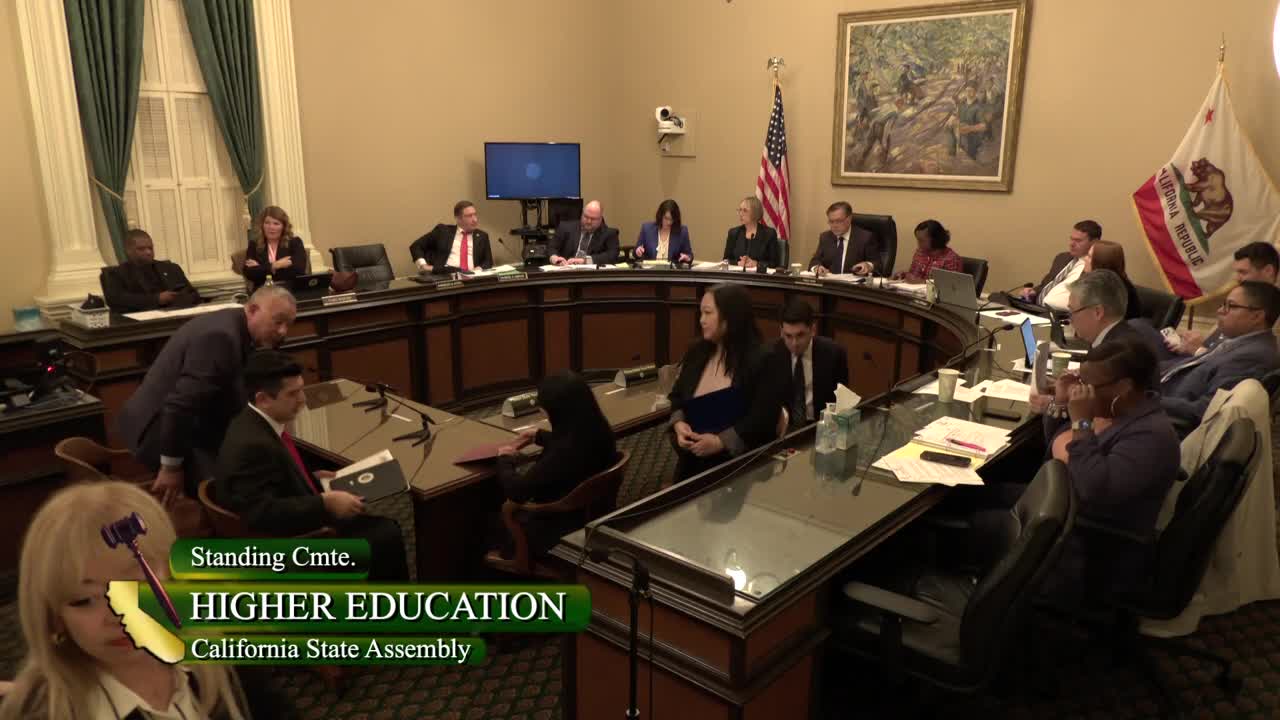
Discussed in Hearing
 19MIN
Assembly Standing Committee on Higher Education
Bill Author

Bill Co-Author(s):