AB 1246: Alcoholic beverages: distilled spirits.
- Session Year: 2025-2026
- House: Assembly
- Latest Version Date: 2025-10-03
Current Status:
Passed
(2025-10-03: Chaptered by Secretary of State - Chapter 295, Statutes of 2025.)
Introduced
In Committee
Awaiting First Chamber Vote
Passed First Chamber
In Committee
Awaiting Second Chamber Vote
Passed Second Chamber
Enacted
(1)Existing law, the Alcoholic Beverage Control Act, requires the Department of Alcoholic Beverage Control to administer the act and perform various duties relating to the issuance of alcoholic beverage licenses. Existing law provides for the licensure and regulation of winegrowers and craft distillers and establishes the privileges that a winegrower or craft distiller may exercise. Existing law authorizes a winegrower, among other things, to sell wine and brandy to any person holding a license authorizing the sale of wine or brandy. Existing law provides that a violation of the act for which another penalty or punishment is not specifically provided for in the act, is a crime, as specified.
This bill would additionally authorize a winegrower to possess and transport brandy for the purpose of storing the brandy to age on the winegrowers premises. The bill would authorize a craft distiller to transport brandy to and from the premises of a licensed winegrower for the purpose of storing the brandy to age on the winegrowers premises.
(2)Existing law authorizes a licensed craft distiller to manufacture and produce distilled spirits, subject to specified conditions, including that the licensee manufacture no more than 150,000 gallons of distilled spirits per fiscal year and sell no more than 2.25 liters of prepackaged containers of the licensees spirits per day per consumer at its premises.
This bill would authorize a licensed craft distiller to sell up to 4.5 liters of prepackaged containers of the licensees spirits per day per consumer at its premises.
(3)Existing law, until January 1, 2026, authorizes a licensed craft distiller to directly ship distilled spirits manufactured or produced by the licensee at its premises to a consumer if they comply with certain requirements, including not shipping more than 2.25 liters in any combination of prepackaged containers per day per consumer.
This bill would authorize a qualifying out-of-state distiller, as defined, whose license is not suspended to directly ship distilled spirits manufactured or produced by the qualifying out-of-state distiller at its premises to a consumer if they comply with the above-described requirements. The bill would, in addition to the requirements described above, require a licensed craft distiller, or qualifying out-of-state distiller, to hold a current distilled spirits direct shipper permit issued by the department. The bill would require, in order to obtain and maintain a distilled spirits direct shipper permit, a licensed craft distiller, or qualifying out-of-state distiller, to, among other things, file an application for the permit with the department and pay specified fees. The bill would authorize the department to enforce the above-described provisions related to direct shipping through administrative proceedings, as provided. The bill would make the sale and shipment of distilled spirits directly to consumers without a permit a crime, as specified. By expanding the scope of a crime, the bill would impose a state-mandated local program. The bill would extend the operation of the above-described direct shipping provisions until January 1, 2027.
(4)The California Constitution requires the state to reimburse local agencies and school districts for certain costs mandated by the state. Statutory provisions establish procedures for making that reimbursement.
This bill would provide that no reimbursement is required by this act for a specified reason.
(1)Existing law, the Alcoholic Beverage Control Act, requires the Department of Alcoholic Beverage Control to administer the act and perform various duties relating to the issuance of alcoholic beverage licenses. Existing law provides for the licensure and regulation of winegrowers and craft distillers and establishes the privileges that a winegrower or craft distiller may exercise. Existing law authorizes a winegrower, among other things, to sell wine and brandy to any person holding a license authorizing the sale of wine or brandy.
This bill would additionally authorize a winegrower to possess and transport brandy for the purpose of storing the brandy to age on the winegrowers premises. The bill would authorize a craft distiller to transport brandy to and from the premises of a licensed winegrower for the purpose of storing the brandy to age on the winegrowers premises.
Existing(2)Existing law authorizes a licensed craft distiller to manufacture and produce distilled spirits, subject to specified conditions, including that the licensee manufacture no more than 150,000 gallons of distilled spirits per fiscal year and sell no more than 2.25 liters of prepackaged containers of the licensees spirits per day per consumer at its premises.
This bill would authorize a licensed craft distiller to sell up to 4.5 liters of prepackaged containers of the licensees spirits per day per consumer at its premises.
(3)Existing law, until January 1, 2026, authorizes a licensed craft distiller to directly ship distilled spirits manufactured or produced by the licensee at its premises to a consumer if they comply with certain requirements, including not shipping more than 2.25 liters in any combination of prepackaged containers per day per consumer.
This bill would extend the operation of the above-described direct shipping provisions until January 1, 2027.
Existing law, the Alcoholic Beverage Control Act, requires the Department of Alcoholic Beverage Control to administer the act and perform various duties relating to the issuance of alcoholic beverage licenses. Existing law provides for the licensure and regulation of winegrowers and craft distillers and establishes the privileges that a winegrower or craft distiller may exercise. Existing law authorizes a winegrower, among other things, to sell wine and brandy to any person holding a license authorizing the sale of wine or brandy.
This bill would additionally authorize a winegrower to possess and transport brandy for the purpose of storing the brandy to age on the winegrowers premises. The bill would authorize a craft distiller to transport brandy to the premises of a licensed winegrower for the purpose of storing the brandy to age on the winegrowers premises.
The Alcoholic Beverage Control Act also provides for the licensure and regulation of distilled spirits manufacturers. ExistingExisting law authorizes a licensed craft distiller to manufacture and produce distilled spirits, subject to specified conditions, including that the licensee manufacture no more than 150,000 gallons of distilled spirits per fiscal year and sell no more than 2.25 liters of prepackaged containers of the licensees spirits per day per consumer at its premises.
This bill would authorize a licensed craft distiller to sell and deliver to a consumer at its premises up to 4.5 liters of prepackaged containers of the licensees spirits per day per consumer. consumer at its premises.
Existing law, the Alcoholic Beverage Control Act, requires the Department of Alcoholic Beverage Control to administer the act and perform various duties relating to the issuance of alcoholic beverage licences. Existing law requires applications for licenses for the retail sale of alcoholic beverages for premises which are to be constructed or which are in the process of construction to contain specified information to assist the department in determining if the proposed premises will qualify for a license. licenses. Existing law provides for the licensure and regulation of winegrowers and establishes the privileges that a winegrower may exercise. Existing law authorizes a winegrower, among other things, to sell wine and brandy to any person holding a license authorizing the sale of wine or brandy.
This bill would make a nonsubstantive change to that provision.This bill would additionally authorize a winegrower to possess and transport brandy for the purpose of storing the brandy to age on the winegrowers premises.
The Alcoholic Beverage Control Act also provides for the licensure and regulation of distilled spirits manufacturers. Existing law authorizes a licensed craft distiller to manufacture and produce distilled spirits, subject to specified conditions, including that the licensee manufacture no more than 150,000 gallons of distilled spirits per fiscal year and sell no more than 2.25 liters of prepackaged containers of the licensees spirits per day per consumer at its premises.
This bill would authorize a licensed craft distiller to sell and deliver to a consumer at its premises up to 4.5 liters of prepackaged containers of the licensees spirits per day per consumer.
Existing law, the Alcoholic Beverage Control Act, requires the Department of Alcoholic Beverage Control to administer the act and perform various duties relating to the issuance of alcoholic beverage licences. Existing law requires applications for licenses for the retail sale of alcoholic beverages for premises which are to be constructed or which are in the process of construction to contain specified information to assist the department in determining if the proposed premises will qualify for a license.
This bill would make a nonsubstantive change to that provision.
(a)Licensed winegrowers, notwithstanding any other provisions of this division, may also exercise the following privileges:
(1)Sell wine and brandy to any person holding a license authorizing the sale of wine or brandy.
(2)Sell wine and brandy to consumers for consumption off the premises where sold.
(3)Sell wine to consumers for consumption on the premises.
(4)Sell all beers, wines, and brandies, regardless of source, to consumers for consumption on the premises in a bona fide eating place as defined in Section 23038, which is located on the licensed premises or on premises owned by the licensee that are contiguous to the licensed premises and which is operated by and for the licensee. At such a bona fide public eating place, beer, wine, and brandy may be used in the preparation of food and beverages to be consumed on the premises.
(5)(A)Permit consumers to leave the premises with open containers of alcoholic beverages for consumption off the premises within an entertainment zone if all of the following conditions are satisfied:
(i)The premises is located within the entertainment zone.
(ii)Consumption of that type of alcoholic beverage is authorized by the ordinance creating the entertainment zone.
(iii)Open alcohol containers only leave the premises during the hours allowed by the ordinance establishing the entertainment zone.
(iv)Patrons with open containers exit the premises directly into an entertainment zone.
(v)All alcoholic beverages in the entertainment zone are purchased only at a licensed premises located within the entertainment zone.
(vi)The premises expressly prohibits open containers or closed containers of alcoholic beverages acquired outside their premises.
(vii)Delivery of alcoholic beverages to consumers within the entertainment zone by the licensee or by any third-party delivery service is expressly prohibited unless the delivery is to a residential building or private business that is not a licensee.
(viii)No alcoholic beverages purchased at the licensed premises may leave the premises in an open glass or metal container for consumption in an entertainment zone.
(ix)The licensee annually submits their notice of intent to participate in an open container entertainment zone to the department.
(B)This paragraph does not require a licensee to sell any alcoholic beverage for consumption off the premises within an entertainment zone.
(C)Licensees whose privileges are restricted due to operating conditions or other statutory restrictions may be prohibited from exercising entertainment zone privileges that are contrary to their operating conditions. For purposes of this paragraph, any restrictions on the exercise of off-sale privileges shall not apply to the removal of open alcoholic beverages from the licensed premises for consumption in the entertainment zone.
(6)Produce spirits of wine and blend those spirits of wine into wine produced by the winegrower or sell those spirits of wine to an industrial alcohol dealer or any person holding a license authorizing the manufacture or rectification of distilled spirits.
(7)Possess and transport brandy for the purpose of storing the brandy to age on the winegrowers premises.
(b)A winegrower may also have upon the premises all beers, wines, and brandies, regardless of source, for sale or service only to guests during private events or private functions not open to the general public. Alcoholic beverage products sold at the premises that are not produced and bottled by, or produced and packaged for, the winegrower shall be purchased by the winegrower only from a licensed wholesaler.
(c)A winegrower shall actually produce on the winegrowers licensed premises by conversion of grapes, berries, or other fruit, into wine, not less than 50 percent of all wines sold to consumers on the winegrowers licensed premises and any licensed branch premises.
(d)The department may, if it shall determine for good cause that the granting of any such privilege would be contrary to public welfare or morals, deny the right to exercise any on-sale privilege authorized by this section in either a bona fide eating place the main entrance to which is within 200 feet of a school or church, or on the licensed winery premises, or both.
(e)Nothing in this section or in Section 23390 is intended to alter, diminish, replace, or eliminate the authority of a county, city, or city and county from exercising land use regulatory authority by law to the extent the authority may restrict, but not eliminate, privileges afforded by these sections.
SEC. 2.Section 23502 of the Business and Professions Code is amended to read:23502.(a)The department may issue a craft distillers license to a person that has facilities and equipment for the purposes of, and is engaged in, the commercial manufacture of distilled spirits. The craft distillers license authorizes the licensee to do all of the following:
(1)Manufacture distilled spirits. For purposes of this article, manufacture means the actual distillation of distilled spirits from naturally fermented materials or the redistillation of distilled spirits obtained from another manufacturer of distilled spirits.
(2)Produce distilled spirits. For purposes of this article, produce means to mix, color, flavor, or blend distilled spirits, whether manufactured by the licensee or by another manufacturer of distilled spirits, including spirits of wine produced by a winegrower pursuant to paragraph (6) of subdivision (a) of Section 23358.
(3)Only sell distilled spirits that are manufactured or produced by the licensee solely to a wholesaler, manufacturer, winegrower, manufacturers agent, or rectifier that holds a license authorizing the sale of distilled spirits or to persons that take delivery of those distilled spirits within this state for delivery or use without the state.
(4)Deal in warehouse receipts.
(5)Manufacture or produce up to 150,000 gallons of distilled spirits per fiscal year (July 1 through June 30), excluding brandy the craft distiller manufactures or has manufactured for it pursuant to a brandy manufacturer license, as reported to the department in the manner prescribed by the department for the fiscal year prior to the date of submitting an application for the license. At least 65 percent of the total volume of distilled spirits manufactured or produced shall be actually manufactured by the licensee. The volume of distilled spirits authorized by this paragraph shall be calculated by adding the volume of distilled spirits, less waste, drawn off the still with the volume of distilled spirits obtained by the licensee from any other source that is not redistilled by the licensee. For purposes of this paragraph, volume means the liquid volume and shall not be based on proof gallons or packaged goods.
(6)Transport brandy to or from the premises of any licensed winegrower for the purpose of storing the brandy to age on the winegrowers premises.
(b)A craft distillers license shall not be issued to any person, any officer, director, employee, or agent of such person, or any person who is affiliated with, directly or indirectly, a person that manufactures or has manufactured for them more than 150,000 gallons of distilled spirits per year within or without the state, excluding brandy it manufactures or has manufactured for them pursuant to a brandy manufacturer license, or to any person that is affiliated with, directly or indirectly, a wholesaler.
(c)A licensed craft distiller shall report to the department, at the time of renewal in the manner prescribed by the department, the amount of distilled spirits manufactured or produced by the licensee specifying, as applicable, the respective amounts of distilled spirits the licensed craft distiller has manufactured itself, obtained from another manufacturer of distilled spirits, and imported, excluding brandy manufactured by or for the licensee pursuant to a brandy manufacturer license, during the previous fiscal year. If the report to the department establishes that the licensee no longer qualifies to hold a craft distillers license because the licensee has either exceeded the 150,000 gallon manufacture or production limitation as specified in paragraph (5) of subdivision (a) or actually manufactured less than 65 percent of the total volume of distilled spirits as specified in paragraph (5) of subdivision (a), the department shall renew the license as a distilled spirits manufacturers license.
SEC. 3.Section 23504 of the Business and Professions Code is amended to read:23504.Notwithstanding any other provision, a licensed craft distiller may sell up to the equivalent of 4.5 liters in any combination of prepackaged containers per day per consumer of distilled spirits manufactured or produced by the licensee at its premises to a consumer.
SEC. 4.Section 23504.5 of the Business and Professions Code is amended to read:23504.5.(a)Notwithstanding any other provision of this division to the contrary, a licensed craft distiller, or a qualifying out-of-state distiller whose license is not suspended, may directly ship distilled spirits manufactured or produced by the licensee at its premises to a consumer only if they comply with all of the following requirements:
(1)The amount shipped shall not exceed the equivalent of 2.25 liters in any combination of prepackaged containers per day per consumer and shall be solely for the consumers personal use and not for resale.
(2)The licensed craft distiller, or qualifying out-of-state distiller, shall maintain adequate records of the shipments and provide those records to the department upon request.
(3)The licensed craft distiller, or qualifying out-of-state distiller, shall require the common carrier to obtain the signature of any individual 21 years of age or older before delivering any distilled spirits shipped to an individual in this state.
(4)The containers in which the distilled spirits are shipped shall be conspicuously labeled with the words: CONTAINS ALCOHOL: SIGNATURE OF PERSON AGE 21 YEARS OR OLDER REQUIRED FOR DELIVERY.
(5)The licensed craft distiller, or qualifying out-of-state distiller, shall hold a current distilled spirits direct shipper permit issued by the department.
(b)To obtain and maintain a distilled spirits direct shipper permit from the department, the craft distiller, or qualifying out-of-state distiller, shall do all of the following:
(1)File an application for a distilled spirits direct shipper permit with the department.
(2)Pay the same fees that apply to a direct shipper permit (Type 82).
(3)Provide the department with the craft distillers California alcoholic beverage license number or a true copy of their current alcoholic beverage distiller license issued by another state, as applicable.
(4)If the permitholder is located outside of this state, report to the department no later than January 1, 2027, the total amount of distilled spirits shipped into the state during the preceding calendar year under the distilled spirits direct shipper permit.
(5)If the permitholder is located within this state, provide to the department any necessary additional information not currently provided to ensure compliance with this section.
(6)Permit the department to perform an audit of the distilled spirits direct shipper permitholders records upon request.
(7)Be deemed to have consented to the jurisdiction of the department or any other state agency and California courts concerning enforcement of this section and any related laws, rules, or regulations.
(c)The department may enforce the requirements of this section by administrative proceedings to suspend or revoke the distilled spirits direct shipper permit, and the department may accept payment of an offer in compromise in lieu of suspension as provided by this division. Any hearing held pursuant to Chapter 5 (commencing with Section 11500) of Part 1 of Division 3 of Title 2 of the Government Code against a permitholder outside of California shall be held in the City of Sacramento.
(d)A person shall not sell and ship distilled spirits directly to consumers in California without possessing a current distilled spirits direct shipper permit issued by the department. A person who knowingly makes, participates in, transports, imports, or receives a shipment from a person who does not possess a current distilled spirits direct shipper permit issued by the department pursuant to this section is guilty of a misdemeanor pursuant to Section 25617.
(e)For purposes of this section, qualifying out-of-state distiller means a distiller licensed in any other state that satisfies the conditions necessary for a craft distiller license under the laws of this state.
(f)This section shall remain in effect only until January 1, 2027, and as of that date is repealed.
SEC. 5.No reimbursement is required by this act pursuant to Section 6 of Article XIIIB of the California Constitution because the only costs that may be incurred by a local agency or school district will be incurred because this act creates a new crime or infraction, eliminates a crime or infraction, or changes the penalty for a crime or infraction, within the meaning of Section 17556 of the Government Code, or changes the definition of a crime within the meaning of Section 6 of Article XIIIB of the California Constitution.
(a)Licensed winegrowers, notwithstanding any other provisions of this division, may also exercise the following privileges:
(1)Sell wine and brandy to any person holding a license authorizing the sale of wine or brandy.
(2)Sell wine and brandy to consumers for consumption off the premises where sold.
(3)Sell wine to consumers for consumption on the premises.
(4)Sell all beers, wines, and brandies, regardless of source, to consumers for consumption on the premises in a bona fide eating place as defined in Section 23038, which is located on the licensed premises or on premises owned by the licensee that are contiguous to the licensed premises and which is operated by and for the licensee. At such a bona fide public eating place, beer, wine, and brandy may be used in the preparation of food and beverages to be consumed on the premises.
(5)(A)Permit consumers to leave the premises with open containers of alcoholic beverages for consumption off the premises within an entertainment zone if all of the following conditions are satisfied:
(i)The premises is located within the entertainment zone.
(ii)Consumption of that type of alcoholic beverage is authorized by the ordinance creating the entertainment zone.
(iii)Open alcohol containers only leave the premises during the hours allowed by the ordinance establishing the entertainment zone.
(iv)Patrons with open containers exit the premises directly into an entertainment zone.
(v)All alcoholic beverages in the entertainment zone are purchased only at a licensed premises located within the entertainment zone.
(vi)The premises expressly prohibits open containers or closed containers of alcoholic beverages acquired outside their premises.
(vii)Delivery of alcoholic beverages to consumers within the entertainment zone by the licensee or by any third-party delivery service is expressly prohibited unless the delivery is to a residential building or private business that is not a licensee.
(viii)No alcoholic beverages purchased at the licensed premises may leave the premises in an open glass or metal container for consumption in an entertainment zone.
(ix)The licensee annually submits their notice of intent to participate in an open container entertainment zone to the department.
(B)This paragraph does not require a licensee to sell any alcoholic beverage for consumption off the premises within an entertainment zone.
(C)Licensees whose privileges are restricted due to operating conditions or other statutory restrictions may be prohibited from exercising entertainment zone privileges that are contrary to their operating conditions. For purposes of this paragraph, any restrictions on the exercise of off-sale privileges shall not apply to the removal of open alcoholic beverages from the licensed premises for consumption in the entertainment zone.
(6)Produce spirits of wine and blend those spirits of wine into wine produced by the winegrower or sell those spirits of wine to an industrial alcohol dealer or any person holding a license authorizing the manufacture or rectification of distilled spirits.
(7)Possess and transport brandy for the purpose of storing the brandy to age on the winegrowers premises.
(b)A winegrower may also have upon the premises all beers, wines, and brandies, regardless of source, for sale or service only to guests during private events or private functions not open to the general public. Alcoholic beverage products sold at the premises that are not produced and bottled by, or produced and packaged for, the winegrower shall be purchased by the winegrower only from a licensed wholesaler.
(c)A winegrower shall actually produce on the winegrowers licensed premises by conversion of grapes, berries, or other fruit, into wine, not less than 50 percent of all wines sold to consumers on the winegrowers licensed premises and any licensed branch premises.
(d)The department may, if it shall determine for good cause that the granting of any such privilege would be contrary to public welfare or morals, deny the right to exercise any on-sale privilege authorized by this section in either a bona fide eating place the main entrance to which is within 200 feet of a school or church, or on the licensed winery premises, or both.
(e)Nothing in this section or in Section 23390 is intended to alter, diminish, replace, or eliminate the authority of a county, city, or city and county from exercising land use regulatory authority by law to the extent the authority may restrict, but not eliminate, privileges afforded by these sections.
SEC. 2.Section 23502 of the Business and Professions Code is amended to read:23502.(a)The department may issue a craft distillers license to a person that has facilities and equipment for the purposes of, and is engaged in, the commercial manufacture of distilled spirits. The craft distillers license authorizes the licensee to do all of the following:
(1)Manufacture distilled spirits. For purposes of this article, manufacture means the actual distillation of distilled spirits from naturally fermented materials or the redistillation of distilled spirits obtained from another manufacturer of distilled spirits.
(2)Produce distilled spirits. For purposes of this article, produce means to mix, color, flavor, or blend distilled spirits, whether manufactured by the licensee or by another manufacturer of distilled spirits, including spirits of wine produced by a winegrower pursuant to paragraph (6) of subdivision (a) of Section 23358.
(3)Only sell distilled spirits that are manufactured or produced by the licensee solely to a wholesaler, manufacturer, winegrower, manufacturers agent, or rectifier that holds a license authorizing the sale of distilled spirits or to persons that take delivery of those distilled spirits within this state for delivery or use without the state.
(4)Deal in warehouse receipts.
(5)Manufacture or produce up to 150,000 gallons of distilled spirits per fiscal year (July 1 through June 30), excluding brandy the craft distiller manufactures or has manufactured for it pursuant to a brandy manufacturer license, as reported to the department in the manner prescribed by the department for the fiscal year prior to the date of submitting an application for the license. At least 65 percent of the total volume of distilled spirits manufactured or produced shall be actually manufactured by the licensee. The volume of distilled spirits authorized by this paragraph shall be calculated by adding the volume of distilled spirits, less waste, drawn off the still with the volume of distilled spirits obtained by the licensee from any other source that is not redistilled by the licensee. For purposes of this paragraph, volume means the liquid volume and shall not be based on proof gallons or packaged goods.
(6)Transport brandy to or from the premises of any licensed winegrower for the purpose of storing the brandy to age on the winegrowers premises.
(b)A craft distillers license shall not be issued to any person, any officer, director, employee, or agent of such person, or any person who is affiliated with, directly or indirectly, a person that manufactures or has manufactured for them more than 150,000 gallons of distilled spirits per year within or without the state, excluding brandy it manufactures or has manufactured for them pursuant to a brandy manufacturer license, or to any person that is affiliated with, directly or indirectly, a wholesaler.
(c)A licensed craft distiller shall report to the department, at the time of renewal in the manner prescribed by the department, the amount of distilled spirits manufactured or produced by the licensee specifying, as applicable, the respective amounts of distilled spirits the licensed craft distiller has manufactured itself, obtained from another manufacturer of distilled spirits, and imported, excluding brandy manufactured by or for the licensee pursuant to a brandy manufacturer license, during the previous fiscal year. If the report to the department establishes that the licensee no longer qualifies to hold a craft distillers license because the licensee has either exceeded the 150,000 gallon manufacture or production limitation as specified in paragraph (5) of subdivision (a) or actually manufactured less than 65 percent of the total volume of distilled spirits as specified in paragraph (5) of subdivision (a), the department shall renew the license as a distilled spirits manufacturers license.
SEC. 3.Section 23504 of the Business and Professions Code is amended to read:23504.Notwithstanding any other provision, a licensed craft distiller may sell up to the equivalent of 4.5 liters in any combination of prepackaged containers per day per consumer of distilled spirits manufactured or produced by the licensee at its premises to a consumer.
SEC. 4.Section 23504.5 of the Business and Professions Code is amended to read:23504.5.(a)Notwithstanding any other provision of this division to the contrary, a licensed craft distiller distiller, or a qualifying out-of-state distiller whose license is not suspended, may directly ship distilled spirits manufactured or produced by the licensee at its premises to a consumer only if they comply with all of the following requirements:
(1)The amount shipped shall not exceed the equivalent of 2.25 liters in any combination of prepackaged containers per day per consumer and shall be solely for the consumers personal use and not for resale.
(2)The licensed craft distiller distiller, or qualifying out-of-state distiller, shall maintain adequate records of the shipments and provide those records to the department upon request.
(3)The licensed craft distiller distiller, or qualifying out-of-state distiller, shall require the common carrier to obtain the signature of any individual 21 years of age or older before delivering any distilled spirits shipped to an individual in this state.
(4)The containers in which the distilled spirits are shipped shall be conspicuously labeled with the words: CONTAINS ALCOHOL: SIGNATURE OF PERSON AGE 21 YEARS OR OLDER REQUIRED FOR DELIVERY.
(5)The licensed craft distiller, or qualifying out-of-state distiller, shall hold a current distilled spirits direct shipper permit issued by the department.
(b)To obtain and maintain a distilled spirits direct shipper permit from the department, the craft distiller, or qualifying out-of-state distiller, shall do all of the following:
(1)File an application for a distilled spirits direct shipper permit with the department.
(2)Pay the same fees that apply to a direct shipper permit (Type 82).
(3)Provide the department with the craft distillers California alcoholic beverage license number or a true copy of their current alcoholic beverage distiller license issued by another state, as applicable.
(4)If the permitholder is located outside of this state, report to the department no later than January 1, 2027, the total amount of distilled spirits shipped into the state during the preceding calendar year under the distilled spirits direct shipper permit.
(5)If the permitholder is located within this state, provide to the department any necessary additional information not currently provided to ensure compliance with this section.
(6)Permit the department to perform an audit of the distilled spirits direct shipper permitholders records upon request.
(7)Be deemed to have consented to the jurisdiction of the department or any other state agency and California courts concerning enforcement of this section and any related laws, rules, or regulations.
(c)The department may enforce the requirements of this section by administrative proceedings to suspend or revoke the distilled spirits direct shipper permit, and the department may accept payment of an offer in compromise in lieu of suspension as provided by this division. Any hearing held pursuant to Chapter 5 (commencing with Section 11500) of Part 1 of Division 3 of Title 2 of the Government Code against a permitholder outside of California shall be held in the City of Sacramento.
(d)A person shall not sell and ship distilled spirits directly to consumers in California without possessing a current distilled spirits direct shipper permit issued by the department. A person who knowingly makes, participates in, transports, imports, or receives a shipment from a person who does not possess a current distilled spirits direct shipper permit issued by the department pursuant to this section is guilty of a misdemeanor pursuant to Section 25617.
(e)For purposes of this section, qualifying out-of-state distiller means a distiller licensed in any other state that satisfies the conditions necessary for a craft distiller license under the laws of this state.
(b)(f)This section shall remain in effect only until January 1, 2027, and as of that date is repealed.
SEC. 5.No reimbursement is required by this act pursuant to Section 6 of Article XIIIB of the California Constitution because the only costs that may be incurred by a local agency or school district will be incurred because this act creates a new crime or infraction, eliminates a crime or infraction, or changes the penalty for a crime or infraction, within the meaning of Section 17556 of the Government Code, or changes the definition of a crime within the meaning of Section 6 of Article XIIIB of the California Constitution.
(a)Licensed winegrowers, notwithstanding any other provisions of this division, may also exercise the following privileges:
(1)Sell wine and brandy to any person holding a license authorizing the sale of wine or brandy.
(2)Sell wine and brandy to consumers for consumption off the premises where sold.
(3)Sell wine to consumers for consumption on the premises.
(4)Sell all beers, wines, and brandies, regardless of source, to consumers for consumption on the premises in a bona fide eating place as defined in Section 23038, which is located on the licensed premises or on premises owned by the licensee that are contiguous to the licensed premises and which is operated by and for the licensee. At such a bona fide public eating place, beer, wine, and brandy may be used in the preparation of food and beverages to be consumed on the premises.
(5)(A)Permit consumers to leave the premises with open containers of alcoholic beverages for consumption off the premises within an entertainment zone if all of the following conditions are satisfied:
(i)The premises is located within the entertainment zone.
(ii)Consumption of that type of alcoholic beverage is authorized by the ordinance creating the entertainment zone.
(iii)Open alcohol containers only leave the premises during the hours allowed by the ordinance establishing the entertainment zone.
(iv)Patrons with open containers exit the premises directly into an entertainment zone.
(v)All alcoholic beverages in the entertainment zone are purchased only at a licensed premises located within the entertainment zone.
(vi)The premises expressly prohibits open containers or closed containers of alcoholic beverages acquired outside their premises.
(vii)Delivery of alcoholic beverages to consumers within the entertainment zone by the licensee or by any third-party delivery service is expressly prohibited unless the delivery is to a residential building or private business that is not a licensee.
(viii)No alcoholic beverages purchased at the licensed premises may leave the premises in an open glass or metal container for consumption in an entertainment zone.
(ix)The licensee annually submits their notice of intent to participate in an open container entertainment zone to the department.
(B)This paragraph does not require a licensee to sell any alcoholic beverage for consumption off the premises within an entertainment zone.
(C)Licensees whose privileges are restricted due to operating conditions or other statutory restrictions may be prohibited from exercising entertainment zone privileges that are contrary to their operating conditions. For purposes of this paragraph, any restrictions on the exercise of off-sale privileges shall not apply to the removal of open alcoholic beverages from the licensed premises for consumption in the entertainment zone.
(6)Produce spirits of wine and blend those spirits of wine into wine produced by the winegrower or sell those spirits of wine to an industrial alcohol dealer or any person holding a license authorizing the manufacture or rectification of distilled spirits.
(7)Possess and transport brandy for the purpose of storing the brandy to age on the winegrowers premises.
(b)A winegrower may also have upon the premises all beers, wines, and brandies, regardless of source, for sale or service only to guests during private events or private functions not open to the general public. Alcoholic beverage products sold at the premises that are not produced and bottled by, or produced and packaged for, the winegrower shall be purchased by the winegrower only from a licensed wholesaler.
(c)A winegrower shall actually produce on the winegrowers licensed premises by conversion of grapes, berries, or other fruit, into wine, not less than 50 percent of all wines sold to consumers on the winegrowers licensed premises and any licensed branch premises.
(d)The department may, if it shall determine for good cause that the granting of any such privilege would be contrary to public welfare or morals, deny the right to exercise any on-sale privilege authorized by this section in either a bona fide eating place the main entrance to which is within 200 feet of a school or church, or on the licensed winery premises, or both.
(e)Nothing in this section or in Section 23390 is intended to alter, diminish, replace, or eliminate the authority of a county, city, or city and county from exercising land use regulatory authority by law to the extent the authority may restrict, but not eliminate, privileges afforded by these sections.
SEC. 2.Section 23502 of the Business and Professions Code is amended to read:23502.(a)The department may issue a craft distillers license to a person that has facilities and equipment for the purposes of, and is engaged in, the commercial manufacture of distilled spirits. The craft distillers license authorizes the licensee to do all of the following:
(1)Manufacture distilled spirits. For purposes of this article, manufacture means the actual distillation of distilled spirits from naturally fermented materials or the redistillation of distilled spirits obtained from another manufacturer of distilled spirits.
(2)Produce distilled spirits. For purposes of this article, produce means to mix, color, flavor, or blend distilled spirits, whether manufactured by the licensee or by another manufacturer of distilled spirits, including spirits of wine produced by a winegrower pursuant to paragraph (6) of subdivision (a) of Section 23358.
(3)Only sell distilled spirits that are manufactured or produced by the licensee solely to a wholesaler, manufacturer, winegrower, manufacturers agent, or rectifier that holds a license authorizing the sale of distilled spirits or to persons that take delivery of those distilled spirits within this state for delivery or use without the state.
(4)Deal in warehouse receipts.
(5)Manufacture or produce up to 150,000 gallons of distilled spirits per fiscal year (July 1 through June 30), excluding brandy the craft distiller manufactures or has manufactured for it pursuant to a brandy manufacturer license, as reported to the department in the manner prescribed by the department for the fiscal year prior to the date of submitting an application for the license. At least 65 percent of the total volume of distilled spirits manufactured or produced shall be actually manufactured by the licensee. The volume of distilled spirits authorized by this paragraph shall be calculated by adding the volume of distilled spirits, less waste, drawn off the still with the volume of distilled spirits obtained by the licensee from any other source that is not redistilled by the licensee. For purposes of this paragraph, volume means the liquid volume and shall not be based on proof gallons or packaged goods.
(6)Transport brandy to or from the premises of any licensed winegrower for the purpose of storing the brandy to age on the winegrowers premises.
(b)A craft distillers license shall not be issued to any person, any officer, director, employee, or agent of such person, or any person who is affiliated with, directly or indirectly, a person that manufactures or has manufactured for them more than 150,000 gallons of distilled spirits per year within or without the state, excluding brandy it manufactures or has manufactured for them pursuant to a brandy manufacturer license, or to any person that is affiliated with, directly or indirectly, a wholesaler.
(c)A licensed craft distiller shall report to the department, at the time of renewal in the manner prescribed by the department, the amount of distilled spirits manufactured or produced by the licensee specifying, as applicable, the respective amounts of distilled spirits the licensed craft distiller has manufactured itself, obtained from another manufacturer of distilled spirits, and imported, excluding brandy manufactured by or for the licensee pursuant to a brandy manufacturer license, during the previous fiscal year. If the report to the department establishes that the licensee no longer qualifies to hold a craft distillers license because the licensee has either exceeded the 150,000 gallon manufacture or production limitation as specified in paragraph (5) of subdivision (a) or actually manufactured less than 65 percent of the total volume of distilled spirits as specified in paragraph (5) of subdivision (a), the department shall renew the license as a distilled spirits manufacturers license.
SEC. 3.Section 23504 of the Business and Professions Code is amended to read:23504.Notwithstanding any other provision, a licensed craft distiller may sell up to the equivalent of 4.5 liters in any combination of prepackaged containers per day per consumer of distilled spirits manufactured or produced by the licensee at its premises to a consumer.
SEC. 4.Section 23504.5 of the Business and Professions Code is amended to read:23504.5.(a)Notwithstanding any other provision of this division to the contrary, a licensed craft distiller may directly ship distilled spirits manufactured or produced by the licensee at its premises to a consumer only if they comply with all of the following requirements:
(1)The amount shipped shall not exceed the equivalent of 2.25 liters in any combination of prepackaged containers per day per consumer and shall be solely for the consumers personal use and not for resale.
(2)The licensed craft distiller shall maintain adequate records of the shipments and provide those records to the department upon request.
(3)The licensed craft distiller shall require the common carrier to obtain the signature of any individual 21 years of age or older before delivering any distilled spirits shipped to an individual in this state.
(4)The containers in which the distilled spirits are shipped shall be conspicuously labeled with the words: CONTAINS ALCOHOL: SIGNATURE OF PERSON AGE 21 YEARS OR OLDER REQUIRED FOR DELIVERY.
(b)This section shall remain in effect only until January 1, 2026, 2027, and as of that date is repealed.
(a)Licensed winegrowers, notwithstanding any other provisions of this division, may also exercise the following privileges:
(1)Sell wine and brandy to any person holding a license authorizing the sale of wine or brandy.
(2)Sell wine and brandy to consumers for consumption off the premises where sold.
(3)Sell wine to consumers for consumption on the premises.
(4)Sell all beers, wines, and brandies, regardless of source, to consumers for consumption on the premises in a bona fide eating place as defined in Section 23038, which is located on the licensed premises or on premises owned by the licensee that are contiguous to the licensed premises and which is operated by and for the licensee. At such a bona fide public eating place, beer, wine, and brandy may be used in the preparation of food and beverages to be consumed on the premises.
(5)(A)Permit consumers to leave the premises with open containers of alcoholic beverages for consumption off the premises within an entertainment zone if all of the following conditions are satisfied:
(i)The premises is located within the entertainment zone.
(ii)Consumption of that type of alcoholic beverage is authorized by the ordinance creating the entertainment zone.
(iii)Open alcohol containers only leave the premises during the hours allowed by the ordinance establishing the entertainment zone.
(iv)Patrons with open containers exit the premises directly into an entertainment zone.
(v)All alcoholic beverages in the entertainment zone are purchased only at a licensed premises located within the entertainment zone.
(vi)The premises expressly prohibits open containers or closed containers of alcoholic beverages acquired outside their premises.
(vii)Delivery of alcoholic beverages to consumers within the entertainment zone by the licensee or by any third-party delivery service is expressly prohibited unless the delivery is to a residential building or private business that is not a licensee.
(viii)No alcoholic beverages purchased at the licensed premises may leave the premises in an open glass or metal container for consumption in an entertainment zone.
(ix)The licensee annually submits their notice of intent to participate in an open container entertainment zone to the department.
(B)This paragraph does not require a licensee to sell any alcoholic beverage for consumption off the premises within an entertainment zone.
(C)Licensees whose privileges are restricted due to operating conditions or other statutory restrictions may be prohibited from exercising entertainment zone privileges that are contrary to their operating conditions. For purposes of this paragraph, any restrictions on the exercise of off-sale privileges shall not apply to the removal of open alcoholic beverages from the licensed premises for consumption in the entertainment zone.
(6)Produce spirits of wine and blend those spirits of wine into wine produced by the winegrower or sell those spirits of wine to an industrial alcohol dealer or any person holding a license authorizing the manufacture or rectification of distilled spirits.
(7)Possess and transport brandy for the purpose of storing the brandy to age on the winegrowers premises.
(b)A winegrower may also have upon the premises all beers, wines, and brandies, regardless of source, for sale or service only to guests during private events or private functions not open to the general public. Alcoholic beverage products sold at the premises that are not produced and bottled by, or produced and packaged for, the winegrower shall be purchased by the winegrower only from a licensed wholesaler.
(c)A winegrower shall actually produce on the winegrowers licensed premises by conversion of grapes, berries, or other fruit, into wine, not less than 50 percent of all wines sold to consumers on the winegrowers licensed premises and any licensed branch premises.
(d)The department may, if it shall determine for good cause that the granting of any such privilege would be contrary to public welfare or morals, deny the right to exercise any on-sale privilege authorized by this section in either a bona fide eating place the main entrance to which is within 200 feet of a school or church, or on the licensed winery premises, or both.
(e)Nothing in this section or in Section 23390 is intended to alter, diminish, replace, or eliminate the authority of a county, city, or city and county from exercising land use regulatory authority by law to the extent the authority may restrict, but not eliminate, privileges afforded by these sections.
SEC. 2.Section 23502 of the Business and Professions Code is amended to read:23502.(a)The department may issue a craft distillers license to a person that has facilities and equipment for the purposes of, and is engaged in, the commercial manufacture of distilled spirits. The craft distillers license authorizes the licensee to do all of the following:
(1)Manufacture distilled spirits. For purposes of this article, manufacture means the actual distillation of distilled spirits from naturally fermented materials or the redistillation of distilled spirits obtained from another manufacturer of distilled spirits.
(2)Produce distilled spirits. For purposes of this article, produce means to mix, color, flavor, or blend distilled spirits, whether manufactured by the licensee or by another manufacturer of distilled spirits, including spirits of wine produced by a winegrower pursuant to paragraph (6) of subdivision (a) of Section 23358.
(3)Only sell distilled spirits that are manufactured or produced by the licensee solely to a wholesaler, manufacturer, winegrower, manufacturers agent, or rectifier that holds a license authorizing the sale of distilled spirits or to persons that take delivery of those distilled spirits within this state for delivery or use without the state.
(4)Deal in warehouse receipts.
(5)Manufacture or produce up to 150,000 gallons of distilled spirits per fiscal year (July 1 through June 30), excluding brandy the craft distiller manufactures or has manufactured for it pursuant to a brandy manufacturer license, as reported to the department in the manner prescribed by the department for the fiscal year prior to the date of submitting an application for the license. At least 65 percent of the total volume of distilled spirits manufactured or produced shall be actually manufactured by the licensee. The volume of distilled spirits authorized by this paragraph shall be calculated by adding the volume of distilled spirits, less waste, drawn off the still with the volume of distilled spirits obtained by the licensee from any other source that is not redistilled by the licensee. For purposes of this paragraph, volume means the liquid volume and shall not be based on proof gallons or packaged goods.
(6)Transport brandy to or from the premises of any licensed winegrower for the purpose of storing the brandy to age on the winegrowers premises.
(b)A craft distillers license shall not be issued to any person, any officer, director, employee, or agent of such person, or any person who is affiliated with, directly or indirectly, a person that manufactures or has manufactured for them more than 150,000 gallons of distilled spirits per year within or without the state, excluding brandy it manufactures or has manufactured for them pursuant to a brandy manufacturer license, or to any person that is affiliated with, directly or indirectly, a wholesaler.
(c)A licensed craft distiller shall report to the department, at the time of renewal in the manner prescribed by the department, the amount of distilled spirits manufactured or produced by the licensee specifying, as applicable, the respective amounts of distilled spirits the licensed craft distiller has manufactured itself, obtained from another manufacturer of distilled spirits, and imported, excluding brandy manufactured by or for the licensee pursuant to a brandy manufacturer license, during the previous fiscal year. If the report to the department establishes that the licensee no longer qualifies to hold a craft distillers license because the licensee has either exceeded the 150,000 gallon manufacture or production limitation as specified in paragraph (5) of subdivision (a) or actually manufactured less than 65 percent of the total volume of distilled spirits as specified in paragraph (5) of subdivision (a), the department shall renew the license as a distilled spirits manufacturers license.
SEC. 2.SEC. 3.Section 23504 of the Business and Professions Code is amended to read:23504.Notwithstanding any other provision, a licensed craft distiller may sell and deliver to a consumer at its premises up to the equivalent of 4.5 liters in any combination of prepackaged containers per day per consumer of distilled spirits manufactured or produced by the licensee at its premises. premises to a consumer.
(a)Licensed winegrowers, notwithstanding any other provisions of this division, may also exercise the following privileges:
(1)Sell wine and brandy to any person holding a license authorizing the sale of wine or brandy.
(2)Sell wine and brandy to consumers for consumption off the premises where sold.
(3)Sell wine to consumers for consumption on the premises.
(4)Sell all beers, wines, and brandies, regardless of source, to consumers for consumption on the premises in a bona fide eating place as defined in Section 23038, which is located on the licensed premises or on premises owned by the licensee that are contiguous to the licensed premises and which is operated by and for the licensee. At such a bona fide public eating place, beer, wine, and brandy may be used in the preparation of food and beverages to be consumed on the premises.
(5)(A)Permit consumers to leave the premises with open containers of alcoholic beverages for consumption off the premises within an entertainment zone if all of the following conditions are satisfied:
(i)The premises is located within the entertainment zone.
(ii)Consumption of that type of alcoholic beverage is authorized by the ordinance creating the entertainment zone.
(iii)Open alcohol containers only leave the premises during the hours allowed by the ordinance establishing the entertainment zone.
(iv)Patrons with open containers exit the premises directly into an entertainment zone.
(v)All alcoholic beverages in the entertainment zone are purchased only at a licensed premises located within the entertainment zone.
(vi)The premises expressly prohibits open containers or closed containers of alcoholic beverages acquired outside their premises.
(vii)Delivery of alcoholic beverages to consumers within the entertainment zone by the licensee or by any third-party delivery service is expressly prohibited unless the delivery is to a residential building or private business that is not a licensee.
(viii)No alcoholic beverages purchased at the licensed premises may leave the premises in an open glass or metal container for consumption in an entertainment zone.
(ix)The licensee annually submits their notice of intent to participate in an open container entertainment zone to the department.
(B)This paragraph does not require a licensee to sell any alcoholic beverage for consumption off the premises within an entertainment zone.
(C)Licensees whose privileges are restricted due to operating conditions or other statutory restrictions may be prohibited from exercising entertainment zone privileges that are contrary to their operating conditions. For purposes of this paragraph, any restrictions on the exercise of off-sale privileges shall not apply to the removal of open alcoholic beverages from the licensed premises for consumption in the entertainment zone.
(6)Produce spirits of wine and blend those spirits of wine into wine produced by the winegrower or sell those spirits of wine to an industrial alcohol dealer or any person holding a license authorizing the manufacture or rectification of distilled spirits.
(7)Possess and transport brandy for the purpose of storing the brandy to age on the winegrowers premises.
(b)A winegrower may also have upon the premises all beers, wines, and brandies, regardless of source, for sale or service only to guests during private events or private functions not open to the general public. Alcoholic beverage products sold at the premises that are not produced and bottled by, or produced and packaged for, the winegrower shall be purchased by the winegrower only from a licensed wholesaler.
(c)A winegrower shall actually produce on the winegrowers licensed premises by conversion of grapes, berries, or other fruit, into wine, not less than 50 percent of all wines sold to consumers on the winegrowers licensed premises and any licensed branch premises.
(d)The department may, if it shall determine for good cause that the granting of any such privilege would be contrary to public welfare or morals, deny the right to exercise any on-sale privilege authorized by this section in either a bona fide eating place the main entrance to which is within 200 feet of a school or church, or on the licensed winery premises, or both.
(e)Nothing in this section or in Section 23390 is intended to alter, diminish, replace, or eliminate the authority of a county, city, or city and county from exercising land use regulatory authority by law to the extent the authority may restrict, but not eliminate, privileges afforded by these sections.
SEC. 2.Section 23504 of the Business and Professions Code is amended to read:23504.Notwithstanding any other provision, a licensed craft distiller may sell and deliver to a consumer at its premises up to the equivalent of 2.25 4.5 liters in any combination of prepackaged containers per day per consumer of distilled spirits manufactured or produced by the licensee at its premises to a consumer. premises.
SECTION 1.Section 23957 of the Business and Professions Code is amended to read:23957.Applications for licenses for the retail sale of alcoholic beverages for premises which are to be constructed or which are in the process of construction shall contain the information required by this article and other information concerning the proposed premises as the department may require to assist it in determining whether the proposed premises will qualify for a license.Applications for licenses for the retail sale of alcoholic beverages for premises which are to be constructed or which are in the process of construction shall contain the information required by this article and such other information concerning the proposed premises as the department may require to assist it in determining whether the proposed premises will qualify for a license.
|
Date
|
Status
|
|---|---|
| Oct 3, 2025 | Chaptered by Secretary of State - Chapter 295, Statutes of 2025. |
| Oct 3, 2025 | Approved by the Governor. |
| Sep 24, 2025 | Enrolled and presented to the Governor at 3 p.m. |
| Sep 13, 2025 | Senate amendments concurred in. To Engrossing and Enrolling. (Ayes 73. Noes 1. Page 3499.). |
| Sep 13, 2025 | Joint Rules 61(a)(14) and 51(a)(4) suspended. (Ayes 59. Noes 20. Page 3413.) |
| Sep 12, 2025 | From committee: That the Senate amendments be concurred in. (Ayes 17. Noes 0.) (September 12). |
| Sep 12, 2025 | Joint Rule 62(a), file notice suspended. (Page 3356.) |
| Sep 12, 2025 | Re-referred to Com. on G.O. pursuant to Assembly Rule 77.2. |
| Sep 12, 2025 | In Assembly. Concurrence in Senate amendments pending. |
| Sep 11, 2025 | Read third time. Passed. Ordered to the Assembly. (Ayes 40. Noes 0. Page 2926.). |
| Sep 10, 2025 | From special consent calendar. |
| Sep 10, 2025 | Ordered to third reading. |
| Sep 9, 2025 | Ordered to special consent calendar. |
| Sep 2, 2025 | Read second time. Ordered to third reading. |
| Aug 29, 2025 | Read second time and amended. Ordered returned to second reading. |
| Aug 29, 2025 | From committee: Amend, and do pass as amended. (Ayes 7. Noes 0.) (August 29). |
| Aug 18, 2025 | In committee: Referred to suspense file. |
| Jul 8, 2025 | From committee: Do pass and re-refer to Com. on APPR. (Ayes 15. Noes 0.) (July 8). Re-referred to Com. on APPR. |
| Jun 30, 2025 | From committee chair, with author's amendments: Amend, and re-refer to committee. Read second time, amended, and re-referred to Com. on G.O. |
| May 21, 2025 | Referred to Com. on G.O. |
| May 13, 2025 | In Senate. Read first time. To Com. on RLS. for assignment. |
| May 12, 2025 | Read third time. Passed. Ordered to the Senate. (Ayes 76. Noes 0. Page 1519.) |
| May 8, 2025 | Read second time. Ordered to third reading. |
| May 7, 2025 | From committee: Do pass. (Ayes 15. Noes 0.) (May 7). |
| Apr 24, 2025 | From committee: Do pass and re-refer to Com. on APPR. (Ayes 22. Noes 0.) (April 23). Re-referred to Com. on APPR. |
| Apr 7, 2025 | Re-referred to Com. on G.O. |
| Apr 3, 2025 | From committee chair, with author's amendments: Amend, and re-refer to Com. on G.O. Read second time and amended. |
| Mar 18, 2025 | Re-referred to Com. on G.O. |
| Mar 17, 2025 | From committee chair, with author's amendments: Amend, and re-refer to Com. on G.O. Read second time and amended. |
| Mar 17, 2025 | Referred to Com. on G.O. |
| Feb 24, 2025 | Read first time. |
| Feb 22, 2025 | From printer. May be heard in committee March 24. |
| Feb 21, 2025 | Introduced. To print. |
|
Date
|
Description
|
Location
|
Votes
|
|
|---|---|---|---|---|
| Sep 13, 2025 | AB 1246 Hoover Concurrence in Senate Amendments | Assembly Floor |
Passed |
|
| Sep 12, 2025 | With recommendation: That Senate amendments be concurred in. | Assembly Standing Committee on Governmental Organization |
Passed |
|
| Sep 11, 2025 | Assembly 3rd Reading AB1246 Hoover By Valladares | Senate Floor |
Passed |
|
| Aug 29, 2025 | Do pass as amended | Senate Standing Committee on Appropriations |
Passed |
|
| Aug 18, 2025 | Placed on suspense file | Senate Standing Committee on Appropriations |
Passed |
|
| Jul 8, 2025 | Do pass, but first be re-referred to the Committee on [Appropriations] | Senate Standing Committee on Governmental Organization |
Passed |
|
| May 12, 2025 | AB 1246 Hoover Assembly Third Reading | Assembly Floor |
Passed |
|
| May 7, 2025 | Do pass. | Assembly Standing Committee on Appropriations |
Passed |
|
| Apr 23, 2025 | Do pass and be re-referred to the Committee on [Appropriations] | Assembly Standing Committee on Governmental Organization |
Passed |
This list shows positions taken on this bill by organizations on the date displayed, which is linked to the original source.
Positions by individuals are not included.
|
Organization
|
Position
|
Date
|
|---|---|---|
| American Craft Spirits Association | ** Support | |
| California Distillers Association | ** Support | |
| Craft Distillers Association | ** Support | |
| UPS | ** Support |
CONCURRENCE IN SENATE AMENDMENTS
CSA2 Bill Id:AB 1246
Author:(Hoover)
As Amended Ver:August 29, 2025
Majority vote
SUMMARY
Original Committee of Reference: AGO
This bill allows, until January 1, 2027, a licensed craft distiller, or a qualifying out-of-state distiller to directly ship distilled spirits manufactured by the licensee to a consumers in California, as specified. Additionally, this bill allows California's craft distillers to increase the number of liters that can be sold at their tasting rooms from 2.25 to 4.5 liters per day per consumer. Finally, this bill authorizes a craft distiller to transport brandy to the premises of a licensed winegrower for the purpose of storing the brandy to age on the winegrower's premises.
Senate Amendments
Current Committee Recommendation: Concur
- Extends a current exemption in law that allows a licensed craft distiller to directly ship distilled spirits manufactured by the licensee to a consumer in California from January 1, 2026, to January 1, 2027.
- Until January 1, 2027, adds a "qualifying out-of-state" distiller, to provisions in current law that allow craft distillers to directly ship distilled spirits manufactured by the licensee to a consumer in California.
- Defines "qualifying out-of-state distiller" to mean a distilled licensed in any other state that satisfies the conditions necessary for a craft distiller license under the laws of this state.
- Requires craft distillers and qualifying out-of-state distillers, to hold a current distilled spirits direct shipper permit issued by the Department of Alcoholic Beverage Control (ABC), as specified, and provide the department with specified information to ensure compliance with the provisions of this bill.
COMMENTS
Background.
California's Tied-house law prevents the vertical integration of the alcohol industry by keeping the manufacturer, wholesaler and retailer separated. Generally, one type of license holder is not permitted to do business as another type of licensee, absent an exemption to tied-house law.
AB 1295 (Levine), Chapter 640, Statutes of 2015, created the craft distillers license (Type 74), which allowed a licensee to manufacture and sell specified amounts of distilled spirits per year directly to a consumer attending an on-premises tasting. Although a consumer is no longer required to participate in a tasting prior to making a purchase, existing law specifies the sale must be made directly to a consumer at the licensed premises, thus prohibiting a licensee from shipping distilled spirits to the consumer.
According to the sponsor, each craft distiller typically makes a variety of products (in some cases over 30). Customers purchasing gifts after a tasting room visit want to purchase more than 2.25 liters. The current limit has the real-world impact of reducing sales at distilleries which hurts these small struggling businesses. AB 1246 simply allows California craft distillers to sell 4.5 liters per customer instead of the current limit of 2.25 liters. This will help California craft distillers make more sales and generate more revenue for state and local governments.
The sponsor further states that due to consolidation among distributors, the ability of craft distillers to get their products into stores has declined since off-sale privileges were first granted. This highlights the importance of increasing the number of bottles they can sell directly to visitors. Moreover, the future of direct-to-consumer shipping for craft distillers remains uncertain, as it is set to sunset on January 1, 2026. Without this option, California craft distillers would face significant revenue loss. AB 1246 aims to support craft distilleries—small businesses—by increasing the number of liters they can sell to each customer at their tasting rooms. This measure would help offset their lost revenue and ensure their continued success.
The sponsor believes that "AB 1246 presents on an opportunity for craft distillers to navigate a turbulent marketplace and look forward to its timely implementation, especially for out-of-state distillers."
Current in-state shipping exemption. After efforts to enact a comprehensive legislative solution fell short, the California Legislature passed AB 920 (Aguiar-Curry, Chapter 729, Statutes of 2022), which was signed into law by the Governor in 2022. The measure temporarily authorized craft distillers to ship distilled spirits directly to consumers off-site, with the provision in effect until January 1, 2024. Under the bill, the shipment could not exceed 2.25 liters and only be for the consumer's personal use. The licensee is required to maintain adequate records and provide those records to the ABC upon request. The licensee must require the common carrier to obtain the signature of an individual who is 21 years of age or older and the package must be properly labeled as containing alcohol. This authorization was again extended for one year by AB 1088 (B. Rubio, Chapter 829, Statutes of 2023). In 2024, AB 3203 (Aguiar-Curry, Chapter 318, Statutes of 2024) extended the existing provision that permits craft distillers in California to directly ship distilled spirits, pushing the expiration date to January 1, 2026. This bill now further extends that shipping privilege by an additional year, through January 1, 2027.
Legality, legislative action, and a pending lawsuit. In 2005, the Supreme Court of the United States issued its decision in Granholm v. Heald, striking down laws in New York and Michigan that permitted in-state wineries to ship wine directly to consumers while prohibiting out-of-state wineries from doing the same. The Court held that such discriminatory practices violated the Commerce Clause of the U.S. Constitution. It further concluded that the 21st Amendment, which ended Prohibition, did not justify or shield these laws from constitutional scrutiny.
Following the Granholm decision, the California Legislature enacted SB 118 (Chesbro, Chapter 157, Statutes of 2005), which was subsequently signed into law by the Governor. This legislation established the wine direct shipper permit, authorizing licensed winegrowers to sell and ship wine directly to consumers. The permit is available to both in-state and out-of-state winegrowers, ensuring California's compliance with the Granholm ruling.
On December 26, 2024, the East Tennessee Distillery brought forth a lawsuit against the State of California in a U.S. District Court arguing that California's one year extension that allows in-state craft distillers to ship distilled spirits directly to consumers in California is a violation of the Commerce Clause of the United States since it does not reciprocally allow out of state distillers to ship distilled spirits to consumers in California. This argument is nearly identical to the initial argument put forth in the Granholm decision. Since the complaint was filed there's been no substantive progress. The case is still awaiting formal responsive filings from California's Attorney General or the ABC.
AB 1246 was recently amended in the Senate to include Granholm-compliant language, allowing qualifying out-of-state distillers—who would otherwise meet the definition of craft distillers under California law—to ship distilled spirits directly to consumers in California. Both in-state and out-of-state distillers would be required to obtain a direct shipper permit from the ABC, maintain appropriate records, and make those records available for audit upon request to ensure compliance with the bill's provisions. The bill would authorize the direct shipping privileges through January 1, 2027.
One more change to existing law. Existing law requires the aging process for brandy manufacturing to occur at a distillery. However, craft distillers often do not have enough on-premises space to store the barrels in which brandy ages. AB 1246 allows a distiller to transport brandy to a winery for the purpose of storing aging brandy at the winery.
According to the Author
According to the author's office, "California leads the nation with nearly 200 craft distilleries, which are family-owned small businesses that contribute to job growth in local agriculture, restaurants, and tourism. However, these distilleries face challenges in reaching consumers outside of their facilities and need more flexibility to meet visitor demand. This bill simply extends the ability of craft distilleries across the state to ship directly to consumers for one more year. Additionally, AB 1246 allows California craft distillers to sell up to 4.5 liters per customer, compared to the current limit of 2.25 liters. This change will help craft distillers generate more revenue, ultimately creating jobs and supporting the growth of small businesses in our communities."
Arguments in Support
According to the Craft Distillers Association, "AB 1246 increases the daily sales limit for craft distillers from 2.25 liters to 4.5 liters of prepackaged containers per consumer who visits their premises. Many craft distillers are unable to secure distribution to retail markets, and sales from their tasting rooms offer a critical lifeline. Given overall market trends and the reality that it may be many months between a customer's visits to a craft distillery, this expansion offers an essential revenue stream for these small businesses. Additionally, AB 1246 will extend direct shipping privileges for California craft distillers as well as allowing craft distillers from other states to obtain a permit to ship directly to California consumers. Direct-to-consumer shipping will help distillers who are having trouble securing distribution."
Arguments in Opposition
None on file
FISCAL COMMENTS
According to the Senate Committee on Appropriations analysis, "unknown, likely absorbable costs to the Department of ABC for administrative and enforcement workload related to the new distilled spirits direct shipper permit (Alcohol Beverage Control Fund). ABC's administrative costs will be offset to some extent by fee revenue.
Additionally, unknown, likely absorbable workload to the ABC for increased enforcement related investigations as a result of doubling the cap on the amount of spirits craft distillers may sell per day per consumer."
VOTES
ASM GOVERNMENTAL ORGANIZATION: 22-0-0
YES: Blanca Rubio, Davies, Alvarez, Berman, Bryan, Carrillo, Dixon, Fong, Gabriel, Gipson, Macedo, McKinnor, Nguyen, Pacheco, Ramos, Michelle Rodriguez, Sanchez, Solache, Soria, Ta, Valencia, Wallis
ASM APPROPRIATIONS: 15-0-0
YES: Wicks, Sanchez, Arambula, Calderon, Caloza, Dixon, Elhawary, Fong, Mark González, Hart, Pacheco, Pellerin, Solache, Ta, Tangipa
ASSEMBLY FLOOR: 76-0-3
YES: Addis, Aguiar-Curry, Ahrens, Alanis, Alvarez, Arambula, Ávila Farías, Bains, Bauer-Kahan, Bennett, Berman, Boerner, Bonta, Bryan, Calderon, Caloza, Carrillo, Castillo, Chen, Connolly, Davies, DeMaio, Dixon, Elhawary, Ellis, Flora, Fong, Gabriel, Gallagher, Garcia, Gipson, Jeff Gonzalez, Mark González, Hadwick, Haney, Harabedian, Hart, Hoover, Irwin, Jackson, Kalra, Krell, Lackey, Macedo, McKinnor, Muratsuchi, Nguyen, Ortega, Pacheco, Papan, Patel, Patterson, Pellerin, Petrie-Norris, Quirk-Silva, Ramos, Ransom, Celeste Rodriguez, Michelle Rodriguez, Rogers, Blanca Rubio, Sanchez, Schiavo, Schultz, Sharp-Collins, Solache, Soria, Ta, Tangipa, Valencia, Wallis, Ward, Wicks, Wilson, Zbur, Rivas
ABS, ABST OR NV: Lee, Lowenthal, Stefani
SENATE FLOOR: 40-0-0
YES: Allen, Alvarado-Gil, Archuleta, Arreguín, Ashby, Becker, Blakespear, Cabaldon, Caballero, Cervantes, Choi, Cortese, Dahle, Durazo, Gonzalez, Grayson, Grove, Hurtado, Jones, Laird, Limón, McGuire, McNerney, Menjivar, Niello, Ochoa Bogh, Padilla, Pérez, Reyes, Richardson, Rubio, Seyarto, Smallwood-Cuevas, Stern, Strickland, Umberg, Valladares, Wahab, Weber Pierson, Wiener
ASM GOVERNMENTAL ORGANIZATION: 17-0-5
YES: Blanca Rubio, Davies, Berman, Carrillo, Dixon, Fong, Gipson, Macedo, Pacheco, Ramos, Michelle Rodriguez, Sanchez, Solache, Soria, Ta, Valencia, Wallis
ABS, ABST OR NV: Alvarez, Bryan, Gabriel, McKinnor, Nguyen
UPDATED
VERSION: August 29, 2025
CONSULTANT: Eric Johnson / G.O. / (916) 319-2531 FN: 0002110
SENATE RULES COMMITTEE Office of Senate Floor Analyses (916) 651-1520 Fax: (916) 327-4478 | AB 1246 |
THIRD READING
Bill No: AB 1246
Author: Hoover (R)
Amended: 8/29/25 in Senate
Vote: 21
SENATE GOVERNMENTAL ORG. COMMITTEE: 15-0, 7/8/25
AYES: Padilla, Valladares, Archuleta, Ashby, Blakespear, Cervantes, Dahle, Hurtado, Jones, Ochoa Bogh, Richardson, Rubio, Smallwood-Cuevas, Wahab, Weber Pierson
SENATE APPROPRIATIONS COMMITTEE: 7-0, 8/29/25
AYES: Caballero, Seyarto, Cabaldon, Dahle, Grayson, Richardson, Wahab
ASSEMBLY FLOOR: 76-0, 5/12/25 - See last page for vote
SUBJECT: Alcoholic beverages: distilled spirits
SOURCE: California Distillers Association
DIGEST: This bill allows, until January 1, 2027, a licensed craft distiller, or a qualifying out-of-state distiller to directly ship distilled spirits manufactured by the licensee to a consumers in California. Additionally, this bill allows California’s craft distillers to increase the number of liters that can be sold at their tasting rooms from 2.25 to 4.5 liters per day per consumer. Finally, this bill authorizes a craft distiller to transport brandy to the premises of a licensed winegrower for the purpose of storing the brandy to age on the winegrower’s premises.
ANALYSIS:
Existing law:
- Establishes the Department of Alcoholic Beverage Control (ABC) and grants it exclusive authority to administer the provisions of the ABC Act in accordance with laws enacted by the Legislature. This involves licensing individuals and businesses associated with the manufacture, importation, and sale of alcoholic beverages and the collection of license fees for this purpose.
- Provides, under the ABC Act, for the issuance of various alcoholic beverage licenses, including the imposition of fees, conditions, and restrictions in connection with the issuance of those licenses.
- Separates the alcoholic beverage industry into three separate component parts, or tiers, of the manufacturer (including, breweries, and distilleries), wholesaler/distributor, and retailer. This is referred to as the “tied-house” law or “three-tier” system.
- Authorizes a person licensed in California or any other state as a winegrower who obtains a wine direct shipper permit to sell and ship wine directly to a resident of California, who is 21 years of age or older, for the resident’s personal use and not for resale, as specified. Current law does not limit the amount of wine that a holder of a wine direct shipper permit can ship to consumers.
- Authorizes an individual or retail licensee in a state that affords California retail licensees or individuals an equal reciprocal shipping privilege, to ship, for personal use, no more than two cases (no more than nine liters each case) per month to any adult resident in this state. Winegrowers are not considered a “retail licensee” therefore, the two cases per month to any adult resident does not apply to a holder of a wine direct shipper permit.
- Creates the craft distillers license, which among other things, authorizes the licensee to produce up to 150,000 gallons of distilled spirts per year and sell up to 2.25 gallons of distilled spirits directly to a consumer at the licensee’s licensed premises.
- Creates the distilled spirits manufacturer’s license, which allows a licensee to manufacture, produce, package, mix, flavor, color, label, and export distilled spirits.
- Authorizes, until January 1, 2026, a licensed craft distiller to directly ship distilled spirits manufactured or produced by the licensee at its premises to a consumer only if they comply with the following requirements:
- The amount shipped does not exceed the equivalent of 2.25 liters and is solely for the consumer’s personal use.
- The licensee maintains adequate records of the shipments and provides those records to the Department of ABC upon request.
- The licensee requires the common carrier to obtain the signature of any individual 21 years of age or older before delivering any distilled spirits shipped to an individual in this state.
- The container in which the distilled spirits are shipped be conspicuously labeled with the words: “CONTAINS ALCOHOL: SIGNATURE OF PERSONS AGE 21 YEARS OR OLDER REQUIRED FOR DELIVERY
This bill:
- Extends a current exemption that allows a licensed craft distiller to directly ship distilled spirits manufactured by the licensee to a consumer from January 1, 2026, to January 1, 2027.
- Adds a “qualifying out-of-state” distiller, to provisions in current law that allow craft distillers to directly ship distilled spirits manufactured by the licensee to a consumer in California until January.
- Defines “qualifying out-of-state distiller” to mean a distilled licensed in any other state that satisfies the conditions necessary for a craft distiller license under the laws of this state.
- Requires craft distillers and qualifying out-of-state distillers, to hold a current distilled spirits direct shipper permit issued by the Department of ABC, as specified, and provide the department with specified information to ensure compliance with the provisions of this bill.
- Allows California’s craft distillers to increase the number of liters that can be sold at their tasting rooms from 2.25 to 4.5 liters per day per consumer.
- Authorizes a craft distiller to transport brandy to the premises of a licensed winegrower for the purpose of storing the brandy to age on the winegrower’s premises.
Background
Author Statement. According to the author’s office, “California leads the nation with nearly 200 craft distilleries, which are family-owned small businesses that contribute to job growth in local agriculture, restaurants, and tourism. However, these distilleries face challenges in reaching consumers outside of their facilities and need more flexibility to meet visitor demand. AB 1246 simply extends the ability of craft distilleries across the state to ship directly to consumers for one more year. Additionally, AB 1246 allows California craft distillers to sell up to 4.5 liters per customer, compared to the current limit of 2.25 liters. This change will help craft distillers generate more revenue, ultimately creating jobs and supporting the growth of small businesses in our communities.”
California’s Craft Distillers. Prior to the creation of the craft distillers license in 2015, no distilled spirits manufacturer had the privilege of selling distilled spirits directly to a consumer. In 2015, AB 1295 (Levine, Chapter 640, Statutes of 2015) created the craft distillers license which, among other things, allowed a licensee to manufacturer up to 100,000 gallons of distilled spirits per year and sell 2.25 liters directly to a consumer, if that consumer attended a tasting at the licensed premises. For reference, normally a bottle of distilled spirits is 0.75 liters, meaning a consumer can purchase three bottles of distilled spirits per day directly from a craft distiller at their licensed premises.
Subsequent legislation, AB 1164 (Skinner, Chapter 695, Statutes of 2018), increased the maximum production to 150,000 gallons and removed the requirement that a consumer needed to attend a tasting before being able to purchase distilled spirits directly from a licensee. Other than the exemption under AB 920, current law is clear that the sale of distilled spirits directly to a consumer must occur at the craft distiller’s licensed premises.
Supporters of the bill argue that craft distillers cannot meet consumer demand for visitors to their premises because they are limited to the equivalent of three bottles per person. The restrictions on craft distillers are unlike the ability manufacturers of other alcoholic beverages to sell unlimited amounts to visitors, such as wineries or craft breweries, or for grocery stores to sell unlimited quantities of distilled spirits. Due to consolidation among distributors, opportunities for craft distillers to get their product in stores has diminished in recent years. Additionally, there is uncertainty with the future of direct-to-consumer shipping for craft distillers, which is currently set to sunset on January 1, 2026. Supporters argue that this would mark a major decline in revenue for craft distillers.
According to the sponsor, each craft distiller typically makes a variety of products, in some cases over 30. Customers purchasing gifts after a tasting room visit want to purchase more than 2.25 liters. AB 1246 allows California craft distillers to sell 4.5 liters per customer instead of the current limit of 2.25 liters. This bill also addresses a technical issue related to brandy storage. Currently, the aging has to take place at the distillery but craft distillers sometimes don’t have enough room to store these additional barrels. This bill allows the storage to take place at the winery –a technical issue so the barrels can sit at a winery for years instead of at the distillery. When the barrels are ready, the bottling will eventually happen at the distillery.
Tied-House Laws. The "tied-house” or "three-tier" system, separates the alcoholic beverage industry into three component parts of the manufacturer (the first tier), wholesaler (the second tier), and retailer (the third tier). In its simplest of forms, this set of laws is designed to separate manufacturers, distributors, and retailers of alcoholic beverages.
The original policy rationale for this body of law was to: (1) promote the state's interest in an orderly market; (2) prohibit the vertical integration and dominance by a single producer in the marketplace; (3) prohibit commercial bribery and protect the public from predatory marketing practices; and, (4) discourage and/or prevent the intemperate use of alcoholic beverages.
Thus, under a strict “three-tier” system, manufacturers would have no privilege to sell alcoholic beverages directly to consumers. Over the years however, the Legislature has expanded the privileges of manufacturers to include, among other things, the ability to sell alcoholic beverages directly to consumers. Some, like winegrowers enjoy not only the ability to sell alcoholic beverages directly to consumers at their licensed premises, but also the ability to ship directly to consumers. Though a one-year exemption currently exists to this prohibition, craft distillers are currently only statutorily allowed to sell directly to consumers at their licensed premises.
Current Exemption. After a comprehensive solution failed to materialize, in 2022 the legislature passed and the Governor signed AB 920, which, until January 1, 2024, allowed craft distillers in California to ship distilled spirits directly to consumers away from their licensed premises. Under the bill, the shipment could not exceed 2.25 liters and only be for the consumer’s personal use. The licensee is required to maintain adequate records and provide those records to the Department of ABC upon request by the department. The licensee must require the common carrier to obtain the signature of an individual who is 21 years of age or older and the package must be properly labeled as containing alcohol. This authorization was again extended for one year by AB 1088 (Blanca Rubio, Chapter 829, Statutes of 2023). In 2024, AB 3203 (Aguiar-Curry, Chapter 318, Statutes of 2024) again extended the existing provision, allowing craft distillers in California to directly ship distilled spirits.
These provisions are set to expire on January 1, 2026. This bill will again extend those provisions by one year to January 1, 2027.
Granholm v Heald, 544 U.S. 460 (2005) and Pending Lawsuit. In the 2005 Granholm v Heald case, the Supreme Court of the United States ruled that laws in New York and Michigan that permitted in-state wineries to ship wine directly to consumers but prohibited out-of-state wineries from doing so were unconstitutional. The court case, which was a consolidation of two separate lawsuits against Michigan and New York, pitted the Dormant Commerce Clause against the 21st Amendment.
Michigan and New York alcohol laws allowed in-state wineries to directly ship alcohol to consumers but prohibited such activity from out-of-state wineries. Plaintiffs argued that these laws violated the U.S. Constitution’s Dormant Commerce Clause, which over the years has been interpreted to mean that states are prohibited from passing laws favoring in-state businesses over out-of-state businesses. On the other hand, the defendants argued that their laws were a valid exercise of state power under the 21st Amendment, which ended federal prohibition and allowed states to regulate alcohol importation. One of the state’s justifications was that by regulating out-of-state wineries, the state might be able to hinder the shipment of alcohol to underage minors, which they believe served a valid state purpose.
After making its way through the courts, the two separate cases were ultimately decided by the U.S. Supreme Court. In a 5-4 opinion delivered by Justice Anthony Kennedy, the Court opined that both state’s laws violated the commerce clause by favoring in-state wineries at the expense of out-of-state wineries. In essence, the case held that states have the burden to show that restrictions on out-of-state businesses that do not also apply to in-state businesses, need to be supported by a justifiable need to advance public health and safety, or for some other legitimate, non-discriminatory, reason. Prior to this decision, it was widely assumed that in-state manufacturers could be given more privileges compared to out-of-state manufacturers. Following the Granholm v Heald case, out-of-state manufacturers must generally be given the same privileges as in-state manufacturers.
On December 26, 2024, the East Tennessee Distillery brought forth a lawsuit against the State of California in a U.S. District Court arguing that California’s one year extension that allows in-state craft distillers to ship distilled spirits directly to consumers in California is a violation of the Commerce Clause of the United States since it does not reciprocally allow out of state distillers to ship distilled spirits to consumers in California. This argument is nearly identical to the initial argument put forth in the Granholm case.
Since the complaint was filed there’s been no substantive progress. The case is still awaiting formal responsive filings from California’s Attorney General or the Department of ABC. The bill was recently amended to include Granholm-compliant language, permitting out-of-state distillers—who would otherwise qualify as craft distillers in California—to ship distilled spirits directly to California consumers. Both in-state and out-of-state distillers would be required to obtain a permit from the Department of ABC, maintain adequate records, and allow the Department to audit those records upon request to ensure compliance with the provisions of the bill.
Direct to Consumer Shipping in California – Distilled Spirits. While a craft distiller does not have statutory authority to ship directly to consumers, at the beginning of the COVID-19 Pandemic, the Department of ABC, as part of the Governor’s First Notice of Regulatory Relief, temporarily allowed craft distillers to ship up to 2.25 liters per day to consumers. On June 3, 2020, the temporary privilege was extended as part of the Governor’s Eighth Notice of Regulatory Relief to December 31, 2021. On December 30, 2021, as part of the Governor’s Ninth Notice of Regulatory Relief, the temporary privilege was once again extended to March 31, 2022. There was no additional extension past the March 31, 2022 date. As such, the Legislature passed AB 920 as an urgency bill to allow for a one year extension of the regulatory relief until January 1, 2024. The following year, AB 1088 (Blanca Rubio, Chapter 829, Statutes of 2023) extended the sunset to January 1, 2025. Last year, the Legislature again passed a bill to extend the current exemption that allows a licensed craft distiller to directly ship distilled spirits manufactured by the licensee to a consumer from January 1, 2025, to January 1, 2026. This bill would once again extend the current exception to allow a licensed craft distiller to directly ship distilled spirits manufactured by the licensee to a consumer from January 1, 2025, to January 1, 2026.
If a craft distiller does not qualify to hold a craft distiller license, the licensee must obtain a distilled spirits manufacturer license, which does not have any off-sale privilege. As with beer, there is no statutory authority for out-of-state distilled spirits manufacturers to sell, ship, or deliver distilled spirits directly to consumers in California.
DTC Shipping in California - Wine. As exceptions to the “three-tier” system have been enacted and laws have evolved to allow for additional direct to consumer privileges, differences between wine, beer, and distilled spirits have been created. For California wineries, the ability to sell and ship wine bottles directly to consumers has been a privilege that has been enjoyed for a number of years.
Even prior to the Granholm decision in 2005, California law made it clear that California wineries had the authority to sell fully sealed bottles to consumers at their licensed premises. While the law did not specifically authorize California wineries to ship directly to consumers, the privilege to sell directly to consumers was understood to also allow California wineries to deliver wine produced by that winery to consumers in California away from their licensed premises.
In 2005, following the Granholm decision, the Legislature passed, and the Governor signed SB 118 (Chesbro, Chapter 157, Statutes of 2005) which created the wine direct shipper permit, allowing a licensed winegrower to sell and ship wine directly to consumers. The wine direct shipper permit allows both in-state and out-of-state winegrowers to obtain the newly created permit. This was done to ensure compliance with the Granholm decision.
Under SB 118, the package must be clearly labeled as containing alcohol and the delivery company must obtain a physical signature of a person over the age 21 who accepts the package. In addition, out-of-state wineries must pay all applicable California taxes, including excise taxes. Wineries are required to contact the California Department of Tax and Fee Administration (CDTFA) for tax payment instructions.
According to testimony provided to the Senate Governmental Organization during the committee’s November 30, 2021 informational hearing on this topic, the Wine Institute testified that wine delivered to consumers represents approximately two-percent of wine sold to consumers.
This bill does not alter in any way any of the provisions related to the current authority of wineries to ship directly to consumers.
Prior/Related Legislation
AB 3203 (Aguiar-Curry, Chapter 318, Statutes of 2024) extends a current exemption that allows a licensed craft distiller to directly ship distilled spirits manufactured by the licensee to a consumer from January 1, 2024, to January 1, 2025.
AB 1088 (Blanca Rubio, Chapter 829, Statutes of 2023) extended a current exemption that allows a licensed craft distiller to directly ship distilled spirits manufactured by the licensee to a consumer from January 1, 2024, to January 1, 2025.
SB 1198 (McGuire, 2022) would have created the beer direct shipper permit which would authorize beer manufacturers to sell and ship beer directly to a resident of California, who is 21 years of age or older, for the resident’s personal use and not for resale. (Never Heard in the Assembly Governmental Organization Committee)
AB 920 (Aguiar-Curry, Chapter 729, Statutes of 2022) authorized, until January 1, 2024, a licensed craft distiller to directly ship distilled spirits manufactured and produced by the licensee at its premises to a consumer, as specified.
SB 517 (McGuire, 2021) would have created the beer direct shipper permit which would authorize beer manufacturers, regardless of specific type of license, who obtain a beer direct shipper permit, to sell and ship beer directly to a resident of California, who is 21 years of age or older, for the resident’s personal use and not for resale. (Never Heard in the Senate Governmental Organization Committee)
SB 620 (Allen, 2021) would have authorized craft distillers, who obtain a distilled spirits direct shipper permit, to sell and ship specified amounts of distilled spirits directly to a resident of California, who is 21 years of age or older, for the resident’s personal use and not for resale, as specified. (Never Heard in the Assembly Governmental Organization Committee)
SB 1198 (McGuire, 2022) would have created the beer direct shipper permit which would authorize beer manufacturers to sell and ship beer directly to a resident of California, who is 21 years of age or older, for the resident’s personal use and not for resale. (Never Heard in the Assembly Governmental Organization Committee)
SB 1164 (Skinner, Chapter 695, Statutes of 2018) made various changes to the craft distiller’s license, including eliminating the requirement that a person must attend a tasting before being able to purchase prepackaged containers of the licensee’s spirits directly from the craft distiller and increasing the maximum amount of distilled spirits that a craft distiller is permitted to manufacture from 100,000 gallons to 150,000 gallons.
AB 1295 (Levine, Chapter 640, Statutes of 2015) created the craft distiller’s license which, among other things, allow a licensee to manufacture up to 100,000 gallons of distilled spirts annually. Additionally, the licensee is authorized to sell to a consumer participating in a distilled spirits tasting, on the distiller’s licensed premises, up to 2.25 liters of distilled spirits in any combination of prepackaged containers per day.
FISCAL EFFECT: Appropriation: No Fiscal Com.: Yes Local: Yes
According to the Senate Appropriations Committee, unknown, likely absorbable costs to the Department of ABC for administrative and enforcement workload related to the new distilled spirits direct shipper permit (Alcohol Beverage Control Fund). The Department of ABC’s administrative costs will be offset to some extent by fee revenue.
Additionally, unknown, likely absorbable workload to the Department of ABC for increased enforcement related investigations as a result of doubling the cap on the amount of spirits craft distillers may sell per day per consumer.
SUPPORT: (Verified 9/10/25)
California Distillers Association (Source)
American Craft Spirits Association
UPS
OPPOSITION: (Verified 9/10/25)
None received
ARGUMENTS IN SUPPORT: According to the Craft Distillers Association, “AB 1246 increases the daily sales limit for craft distillers from 2.25 liters to 4.5 liters of prepackaged containers per consumer who visits their premises. Many craft distillers are unable to secure distribution to retail markets, and sales from their tasting rooms offer a critical lifeline. Given overall market trends and the reality that it may be many months between a customer’s visits to a craft distillery, this expansion offers an essential revenue stream for these small businesses. This is a modest expansion, especially recognizing other alcohol manufacturers have unlimited off-sale privileges to visitors at their tasting rooms. This change will help meet consumer demand and supports job preservation and growth. Additionally, the bill would also allow winegrowers to possess and transport brandy for aging on their premises, reducing costs and offering new revenue streams. This provision advances the longstanding tradition of brandy production in partnership with the wine industry, and it offers efficiencies and economic opportunities for licensed winegrowers and their distilling partners.”
ASSEMBLY FLOOR: 76-0, 5/12/25
AYES: Addis, Aguiar-Curry, Ahrens, Alanis, Alvarez, Arambula, Ávila Farías, Bains, Bauer-Kahan, Bennett, Berman, Boerner, Bonta, Bryan, Calderon, Caloza, Carrillo, Castillo, Chen, Connolly, Davies, DeMaio, Dixon, Elhawary, Ellis, Flora, Fong, Gabriel, Gallagher, Garcia, Gipson, Jeff Gonzalez, Mark González, Hadwick, Haney, Harabedian, Hart, Hoover, Irwin, Jackson, Kalra, Krell, Lackey, Macedo, McKinnor, Muratsuchi, Nguyen, Ortega, Pacheco, Papan, Patel, Patterson, Pellerin, Petrie-Norris, Quirk-Silva, Ramos, Ransom, Celeste Rodriguez, Michelle Rodriguez, Rogers, Blanca Rubio, Sanchez, Schiavo, Schultz, Sharp-Collins, Solache, Soria, Ta, Tangipa, Valencia, Wallis, Ward, Wicks, Wilson, Zbur, Rivas
NO VOTE RECORDED: Lee, Lowenthal, Stefani
Prepared by: Felipe Lopez / G.O. / (916) 651-1530
9/10/25 10:29:49
**** END ****
SENATE RULES COMMITTEE Office of Senate Floor Analyses (916) 651-1520 Fax: (916) 327-4478 | AB 1246 |
THIRD READING
Bill No: AB 1246
Author: Hoover (R)
Amended: 8/29/25 in Senate
Vote: 21
SENATE GOVERNMENTAL ORG. COMMITTEE: 15-0, 7/8/25
AYES: Padilla, Valladares, Archuleta, Ashby, Blakespear, Cervantes, Dahle, Hurtado, Jones, Ochoa Bogh, Richardson, Rubio, Smallwood-Cuevas, Wahab, Weber Pierson
SENATE APPROPRIATIONS COMMITTEE: 7-0, 8/29/25
AYES: Caballero, Seyarto, Cabaldon, Dahle, Grayson, Richardson, Wahab
ASSEMBLY FLOOR: 76-0, 5/12/25 - See last page for vote
SUBJECT: Alcoholic beverages: distilled spirits
SOURCE: California Distillers Association
DIGEST: This bill allows, until January 1, 2027, a licensed craft distiller, or a qualifying out-of-state distiller to directly ship distilled spirits manufactured by the licensee to a consumers in California. Additionally, this bill allows California’s craft distillers to increase the number of liters that can be sold at their tasting rooms from 2.25 to 4.5 liters per day per consumer. Finally, this bill authorizes a craft distiller to transport brandy to the premises of a licensed winegrower for the purpose of storing the brandy to age on the winegrower’s premises.
ANALYSIS:
Existing law:
- Establishes the Department of Alcoholic Beverage Control (ABC) and grants it exclusive authority to administer the provisions of the ABC Act in accordance with laws enacted by the Legislature. This involves licensing individuals and businesses associated with the manufacture, importation, and sale of alcoholic beverages and the collection of license fees for this purpose.
- Provides, under the ABC Act, for the issuance of various alcoholic beverage licenses, including the imposition of fees, conditions, and restrictions in connection with the issuance of those licenses.
- Separates the alcoholic beverage industry into three separate component parts, or tiers, of the manufacturer (including, breweries, and distilleries), wholesaler/distributor, and retailer. This is referred to as the “tied-house” law or “three-tier” system.
- Authorizes a person licensed in California or any other state as a winegrower who obtains a wine direct shipper permit to sell and ship wine directly to a resident of California, who is 21 years of age or older, for the resident’s personal use and not for resale, as specified. Current law does not limit the amount of wine that a holder of a wine direct shipper permit can ship to consumers.
- Authorizes an individual or retail licensee in a state that affords California retail licensees or individuals an equal reciprocal shipping privilege, to ship, for personal use, no more than two cases (no more than nine liters each case) per month to any adult resident in this state. Winegrowers are not considered a “retail licensee” therefore, the two cases per month to any adult resident does not apply to a holder of a wine direct shipper permit.
- Creates the craft distillers license, which among other things, authorizes the licensee to produce up to 150,000 gallons of distilled spirts per year and sell up to 2.25 gallons of distilled spirits directly to a consumer at the licensee’s licensed premises.
- Creates the distilled spirits manufacturer’s license, which allows a licensee to manufacture, produce, package, mix, flavor, color, label, and export distilled spirits.
- Authorizes, until January 1, 2026, a licensed craft distiller to directly ship distilled spirits manufactured or produced by the licensee at its premises to a consumer only if they comply with the following requirements:
- The amount shipped does not exceed the equivalent of 2.25 liters and is solely for the consumer’s personal use.
- The licensee maintains adequate records of the shipments and provides those records to the Department of ABC upon request.
- The licensee requires the common carrier to obtain the signature of any individual 21 years of age or older before delivering any distilled spirits shipped to an individual in this state.
- The container in which the distilled spirits are shipped be conspicuously labeled with the words: “CONTAINS ALCOHOL: SIGNATURE OF PERSONS AGE 21 YEARS OR OLDER REQUIRED FOR DELIVERY
This bill:
- Extends a current exemption that allows a licensed craft distiller to directly ship distilled spirits manufactured by the licensee to a consumer from January 1, 2026, to January 1, 2027.
- Adds a “qualifying out-of-state” distiller, to provisions in current law that allow craft distillers to directly ship distilled spirits manufactured by the licensee to a consumer in California until January.
- Defines “qualifying out-of-state distiller” to mean a distilled licensed in any other state that satisfies the conditions necessary for a craft distiller license under the laws of this state.
- Requires craft distillers and qualifying out-of-state distillers, to hold a current distilled spirits direct shipper permit issued by the Department of ABC, as specified, and provide the department with specified information to ensure compliance with the provisions of this bill.
- Allows California’s craft distillers to increase the number of liters that can be sold at their tasting rooms from 2.25 to 4.5 liters per day per consumer.
- Authorizes a craft distiller to transport brandy to the premises of a licensed winegrower for the purpose of storing the brandy to age on the winegrower’s premises.
Background
Author Statement. According to the author’s office, “California leads the nation with nearly 200 craft distilleries, which are family-owned small businesses that contribute to job growth in local agriculture, restaurants, and tourism. However, these distilleries face challenges in reaching consumers outside of their facilities and need more flexibility to meet visitor demand. AB 1246 simply extends the ability of craft distilleries across the state to ship directly to consumers for one more year. Additionally, AB 1246 allows California craft distillers to sell up to 4.5 liters per customer, compared to the current limit of 2.25 liters. This change will help craft distillers generate more revenue, ultimately creating jobs and supporting the growth of small businesses in our communities.”
California’s Craft Distillers. Prior to the creation of the craft distillers license in 2015, no distilled spirits manufacturer had the privilege of selling distilled spirits directly to a consumer. In 2015, AB 1295 (Levine, Chapter 640, Statutes of 2015) created the craft distillers license which, among other things, allowed a licensee to manufacturer up to 100,000 gallons of distilled spirits per year and sell 2.25 liters directly to a consumer, if that consumer attended a tasting at the licensed premises. For reference, normally a bottle of distilled spirits is 0.75 liters, meaning a consumer can purchase three bottles of distilled spirits per day directly from a craft distiller at their licensed premises.
Subsequent legislation, AB 1164 (Skinner, Chapter 695, Statutes of 2018), increased the maximum production to 150,000 gallons and removed the requirement that a consumer needed to attend a tasting before being able to purchase distilled spirits directly from a licensee. Other than the exemption under AB 920, current law is clear that the sale of distilled spirits directly to a consumer must occur at the craft distiller’s licensed premises.
Supporters of the bill argue that craft distillers cannot meet consumer demand for visitors to their premises because they are limited to the equivalent of three bottles per person. The restrictions on craft distillers are unlike the ability manufacturers of other alcoholic beverages to sell unlimited amounts to visitors, such as wineries or craft breweries, or for grocery stores to sell unlimited quantities of distilled spirits. Due to consolidation among distributors, opportunities for craft distillers to get their product in stores has diminished in recent years. Additionally, there is uncertainty with the future of direct-to-consumer shipping for craft distillers, which is currently set to sunset on January 1, 2026. Supporters argue that this would mark a major decline in revenue for craft distillers.
According to the sponsor, each craft distiller typically makes a variety of products, in some cases over 30. Customers purchasing gifts after a tasting room visit want to purchase more than 2.25 liters. AB 1246 allows California craft distillers to sell 4.5 liters per customer instead of the current limit of 2.25 liters. This bill also addresses a technical issue related to brandy storage. Currently, the aging has to take place at the distillery but craft distillers sometimes don’t have enough room to store these additional barrels. This bill allows the storage to take place at the winery –a technical issue so the barrels can sit at a winery for years instead of at the distillery. When the barrels are ready, the bottling will eventually happen at the distillery.
Tied-House Laws. The "tied-house” or "three-tier" system, separates the alcoholic beverage industry into three component parts of the manufacturer (the first tier), wholesaler (the second tier), and retailer (the third tier). In its simplest of forms, this set of laws is designed to separate manufacturers, distributors, and retailers of alcoholic beverages.
The original policy rationale for this body of law was to: (1) promote the state's interest in an orderly market; (2) prohibit the vertical integration and dominance by a single producer in the marketplace; (3) prohibit commercial bribery and protect the public from predatory marketing practices; and, (4) discourage and/or prevent the intemperate use of alcoholic beverages.
Thus, under a strict “three-tier” system, manufacturers would have no privilege to sell alcoholic beverages directly to consumers. Over the years however, the Legislature has expanded the privileges of manufacturers to include, among other things, the ability to sell alcoholic beverages directly to consumers. Some, like winegrowers enjoy not only the ability to sell alcoholic beverages directly to consumers at their licensed premises, but also the ability to ship directly to consumers. Though a one-year exemption currently exists to this prohibition, craft distillers are currently only statutorily allowed to sell directly to consumers at their licensed premises.
Current Exemption. After a comprehensive solution failed to materialize, in 2022 the legislature passed and the Governor signed AB 920, which, until January 1, 2024, allowed craft distillers in California to ship distilled spirits directly to consumers away from their licensed premises. Under the bill, the shipment could not exceed 2.25 liters and only be for the consumer’s personal use. The licensee is required to maintain adequate records and provide those records to the Department of ABC upon request by the department. The licensee must require the common carrier to obtain the signature of an individual who is 21 years of age or older and the package must be properly labeled as containing alcohol. This authorization was again extended for one year by AB 1088 (Blanca Rubio, Chapter 829, Statutes of 2023). In 2024, AB 3203 (Aguiar-Curry, Chapter 318, Statutes of 2024) again extended the existing provision, allowing craft distillers in California to directly ship distilled spirits.
These provisions are set to expire on January 1, 2026. This bill will again extend those provisions by one year to January 1, 2027.
Granholm v Heald, 544 U.S. 460 (2005) and Pending Lawsuit. In the 2005 Granholm v Heald case, the Supreme Court of the United States ruled that laws in New York and Michigan that permitted in-state wineries to ship wine directly to consumers but prohibited out-of-state wineries from doing so were unconstitutional. The court case, which was a consolidation of two separate lawsuits against Michigan and New York, pitted the Dormant Commerce Clause against the 21st Amendment.
Michigan and New York alcohol laws allowed in-state wineries to directly ship alcohol to consumers but prohibited such activity from out-of-state wineries. Plaintiffs argued that these laws violated the U.S. Constitution’s Dormant Commerce Clause, which over the years has been interpreted to mean that states are prohibited from passing laws favoring in-state businesses over out-of-state businesses. On the other hand, the defendants argued that their laws were a valid exercise of state power under the 21st Amendment, which ended federal prohibition and allowed states to regulate alcohol importation. One of the state’s justifications was that by regulating out-of-state wineries, the state might be able to hinder the shipment of alcohol to underage minors, which they believe served a valid state purpose.
After making its way through the courts, the two separate cases were ultimately decided by the U.S. Supreme Court. In a 5-4 opinion delivered by Justice Anthony Kennedy, the Court opined that both state’s laws violated the commerce clause by favoring in-state wineries at the expense of out-of-state wineries. In essence, the case held that states have the burden to show that restrictions on out-of-state businesses that do not also apply to in-state businesses, need to be supported by a justifiable need to advance public health and safety, or for some other legitimate, non-discriminatory, reason. Prior to this decision, it was widely assumed that in-state manufacturers could be given more privileges compared to out-of-state manufacturers. Following the Granholm v Heald case, out-of-state manufacturers must generally be given the same privileges as in-state manufacturers.
On December 26, 2024, the East Tennessee Distillery brought forth a lawsuit against the State of California in a U.S. District Court arguing that California’s one year extension that allows in-state craft distillers to ship distilled spirits directly to consumers in California is a violation of the Commerce Clause of the United States since it does not reciprocally allow out of state distillers to ship distilled spirits to consumers in California. This argument is nearly identical to the initial argument put forth in the Granholm case.
Since the complaint was filed there’s been no substantive progress. The case is still awaiting formal responsive filings from California’s Attorney General or the Department of ABC. The bill was recently amended to include Granholm-compliant language, permitting out-of-state distillers—who would otherwise qualify as craft distillers in California—to ship distilled spirits directly to California consumers. Both in-state and out-of-state distillers would be required to obtain a permit from the Department of ABC, maintain adequate records, and allow the Department to audit those records upon request to ensure compliance with the provisions of the bill.
Direct to Consumer Shipping in California – Distilled Spirits. While a craft distiller does not have statutory authority to ship directly to consumers, at the beginning of the COVID-19 Pandemic, the Department of ABC, as part of the Governor’s First Notice of Regulatory Relief, temporarily allowed craft distillers to ship up to 2.25 liters per day to consumers. On June 3, 2020, the temporary privilege was extended as part of the Governor’s Eighth Notice of Regulatory Relief to December 31, 2021. On December 30, 2021, as part of the Governor’s Ninth Notice of Regulatory Relief, the temporary privilege was once again extended to March 31, 2022. There was no additional extension past the March 31, 2022 date. As such, the Legislature passed AB 920 as an urgency bill to allow for a one year extension of the regulatory relief until January 1, 2024. The following year, AB 1088 (Blanca Rubio, Chapter 829, Statutes of 2023) extended the sunset to January 1, 2025. Last year, the Legislature again passed a bill to extend the current exemption that allows a licensed craft distiller to directly ship distilled spirits manufactured by the licensee to a consumer from January 1, 2025, to January 1, 2026. This bill would once again extend the current exception to allow a licensed craft distiller to directly ship distilled spirits manufactured by the licensee to a consumer from January 1, 2025, to January 1, 2026.
If a craft distiller does not qualify to hold a craft distiller license, the licensee must obtain a distilled spirits manufacturer license, which does not have any off-sale privilege. As with beer, there is no statutory authority for out-of-state distilled spirits manufacturers to sell, ship, or deliver distilled spirits directly to consumers in California.
DTC Shipping in California - Wine. As exceptions to the “three-tier” system have been enacted and laws have evolved to allow for additional direct to consumer privileges, differences between wine, beer, and distilled spirits have been created. For California wineries, the ability to sell and ship wine bottles directly to consumers has been a privilege that has been enjoyed for a number of years.
Even prior to the Granholm decision in 2005, California law made it clear that California wineries had the authority to sell fully sealed bottles to consumers at their licensed premises. While the law did not specifically authorize California wineries to ship directly to consumers, the privilege to sell directly to consumers was understood to also allow California wineries to deliver wine produced by that winery to consumers in California away from their licensed premises.
In 2005, following the Granholm decision, the Legislature passed, and the Governor signed SB 118 (Chesbro, Chapter 157, Statutes of 2005) which created the wine direct shipper permit, allowing a licensed winegrower to sell and ship wine directly to consumers. The wine direct shipper permit allows both in-state and out-of-state winegrowers to obtain the newly created permit. This was done to ensure compliance with the Granholm decision.
Under SB 118, the package must be clearly labeled as containing alcohol and the delivery company must obtain a physical signature of a person over the age 21 who accepts the package. In addition, out-of-state wineries must pay all applicable California taxes, including excise taxes. Wineries are required to contact the California Department of Tax and Fee Administration (CDTFA) for tax payment instructions.
According to testimony provided to the Senate Governmental Organization during the committee’s November 30, 2021 informational hearing on this topic, the Wine Institute testified that wine delivered to consumers represents approximately two-percent of wine sold to consumers.
This bill does not alter in any way any of the provisions related to the current authority of wineries to ship directly to consumers.
Prior/Related Legislation
AB 3203 (Aguiar-Curry, Chapter 318, Statutes of 2024) extends a current exemption that allows a licensed craft distiller to directly ship distilled spirits manufactured by the licensee to a consumer from January 1, 2024, to January 1, 2025.
AB 1088 (Blanca Rubio, Chapter 829, Statutes of 2023) extended a current exemption that allows a licensed craft distiller to directly ship distilled spirits manufactured by the licensee to a consumer from January 1, 2024, to January 1, 2025.
SB 1198 (McGuire, 2022) would have created the beer direct shipper permit which would authorize beer manufacturers to sell and ship beer directly to a resident of California, who is 21 years of age or older, for the resident’s personal use and not for resale. (Never Heard in the Assembly Governmental Organization Committee)
AB 920 (Aguiar-Curry, Chapter 729, Statutes of 2022) authorized, until January 1, 2024, a licensed craft distiller to directly ship distilled spirits manufactured and produced by the licensee at its premises to a consumer, as specified.
SB 517 (McGuire, 2021) would have created the beer direct shipper permit which would authorize beer manufacturers, regardless of specific type of license, who obtain a beer direct shipper permit, to sell and ship beer directly to a resident of California, who is 21 years of age or older, for the resident’s personal use and not for resale. (Never Heard in the Senate Governmental Organization Committee)
SB 620 (Allen, 2021) would have authorized craft distillers, who obtain a distilled spirits direct shipper permit, to sell and ship specified amounts of distilled spirits directly to a resident of California, who is 21 years of age or older, for the resident’s personal use and not for resale, as specified. (Never Heard in the Assembly Governmental Organization Committee)
SB 1198 (McGuire, 2022) would have created the beer direct shipper permit which would authorize beer manufacturers to sell and ship beer directly to a resident of California, who is 21 years of age or older, for the resident’s personal use and not for resale. (Never Heard in the Assembly Governmental Organization Committee)
SB 1164 (Skinner, Chapter 695, Statutes of 2018) made various changes to the craft distiller’s license, including eliminating the requirement that a person must attend a tasting before being able to purchase prepackaged containers of the licensee’s spirits directly from the craft distiller and increasing the maximum amount of distilled spirits that a craft distiller is permitted to manufacture from 100,000 gallons to 150,000 gallons.
AB 1295 (Levine, Chapter 640, Statutes of 2015) created the craft distiller’s license which, among other things, allow a licensee to manufacture up to 100,000 gallons of distilled spirts annually. Additionally, the licensee is authorized to sell to a consumer participating in a distilled spirits tasting, on the distiller’s licensed premises, up to 2.25 liters of distilled spirits in any combination of prepackaged containers per day.
FISCAL EFFECT: Appropriation: No Fiscal Com.: Yes Local: Yes
According to the Senate Appropriations Committee, unknown, likely absorbable costs to the Department of ABC for administrative and enforcement workload related to the new distilled spirits direct shipper permit (Alcohol Beverage Control Fund). The Department of ABC’s administrative costs will be offset to some extent by fee revenue.
Additionally, unknown, likely absorbable workload to the Department of ABC for increased enforcement related investigations as a result of doubling the cap on the amount of spirits craft distillers may sell per day per consumer.
SUPPORT: (Verified 8/29/25)
California Distillers Association (Source)
American Craft Spirits Association
OPPOSITION: (Verified 8/29/25)
None received
ARGUMENTS IN SUPPORT: According to the Craft Distillers Association, “AB 1246 increases the daily sales limit for craft distillers from 2.25 liters to 4.5 liters of prepackaged containers per consumer who visits their premises. Many craft distillers are unable to secure distribution to retail markets, and sales from their tasting rooms offer a critical lifeline. Given overall market trends and the reality that it may be many months between a customer’s visits to a craft distillery, this expansion offers an essential revenue stream for these small businesses. This is a modest expansion, especially recognizing other alcohol manufacturers have unlimited off-sale privileges to visitors at their tasting rooms. This change will help meet consumer demand and supports job preservation and growth. Additionally, the bill would also allow winegrowers to possess and transport brandy for aging on their premises, reducing costs and offering new revenue streams. This provision advances the longstanding tradition of brandy production in partnership with the wine industry, and it offers efficiencies and economic opportunities for licensed winegrowers and their distilling partners.”
ASSEMBLY FLOOR: 76-0, 5/12/25
AYES: Addis, Aguiar-Curry, Ahrens, Alanis, Alvarez, Arambula, Ávila Farías, Bains, Bauer-Kahan, Bennett, Berman, Boerner, Bonta, Bryan, Calderon, Caloza, Carrillo, Castillo, Chen, Connolly, Davies, DeMaio, Dixon, Elhawary, Ellis, Flora, Fong, Gabriel, Gallagher, Garcia, Gipson, Jeff Gonzalez, Mark González, Hadwick, Haney, Harabedian, Hart, Hoover, Irwin, Jackson, Kalra, Krell, Lackey, Macedo, McKinnor, Muratsuchi, Nguyen, Ortega, Pacheco, Papan, Patel, Patterson, Pellerin, Petrie-Norris, Quirk-Silva, Ramos, Ransom, Celeste Rodriguez, Michelle Rodriguez, Rogers, Blanca Rubio, Sanchez, Schiavo, Schultz, Sharp-Collins, Solache, Soria, Ta, Tangipa, Valencia, Wallis, Ward, Wicks, Wilson, Zbur, Rivas
NO VOTE RECORDED: Lee, Lowenthal, Stefani
Prepared by: Felipe Lopez / G.O. / (916) 651-1530
9/2/25 18:19:12
**** END ****
SENATE COMMITTEE ON
Senator Anna Caballero, Chair
2025 - 2026 Regular Session
AB 1246 (Hoover) - Alcoholic beverages: distilled spirits
Version: | Policy Vote: |
Urgency: | Mandate: |
Hearing Date: | Consultant: |
Bill Summary:
AB 1246 authorizes craft distillers and winegrowers to possess and transport brandy for storing and aging on a winegrower’s premises and increases, from 2.25 liters to 4.5 liters, the cap on the amount of distilled spirits that a craft distiller can sell per day per consumer at their premises. AB 1246 also extends, from January 1, 2026 to January 1, 2027, the sunset date for the authorization for craft distillers to ship spirits directly to consumers from their licensed premises.
*********** ANALYSIS ADDENDUM – SUSPENSE FILE ***********
The following information is revised to reflect amendments
adopted by the committee on August 29, 2025
Fiscal Impact:
- Unknown, likely absorbable costs to the Department of Alcoholic Beverage Control (ABC) for administrative and enforcement workload related to the new distilled spirits direct shipper permit (Alcohol Beverage Control Fund). The Department of ABC’s administrative costs will be offset to some extent by fee revenue.
- Unknown, likely absorbable workload to the Department of ABC for increased enforcement related investigations as a result of doubling the cap on the amount of spirits craft distillers may sell per day per consumer.
Author Amendments:
- Establish a distilled spirits direct shipper permit, which authorizes licensed craft distillers and qualifying out-of-state distillers whose license is not suspended to directly ship distilled spirits manufactured or produced by the licensee to a consumer in California if the licensee does all of the following:
- File an application for the permit with the department.
- Pay the same fees that apply to a Type 82 direct shipper permit for winegrowers.
- Provide the department with the craft distiller’s California alcoholic beverage license number or a true copy of their current alcoholic beverage distiller license issued by another state, as applicable.
- For permitholders located outside of California, report to the department, by January 1, 2027, the total amount of distilled spirits shipped into California during the preceding calendar year under the permit.
- For permitholders located within California, provide the department with any necessary additional information not currently provided.
- Permit the department to perform an audit of the permitholder’s records upon request.
- Be deemed to have consented to the jurisdiction of the department or any other state agency and California courts concerning enforcement of the permit and any related laws, rules, or regulations.
- Authorize the department to enforce requirements related to the distilled spirits direct shipper permit by administrative proceedings to suspense or revoke the permit, and authorize the department to accept payment of an offer in compromise in lieu of suspense.
- Prohibit a person from selling and shipping distilled spirits directly to consumers in California without possessing a current distilled spirits direct shipper permit.
- Provides that a person who knowingly makes, participates in, transports, imports, or receives a shipment from a person who does not possess a current distilled spirits direct shipper permit is guilty of a misdemeanor.
- Defines “qualifying out-of-state distiller” as a distiller licensed in any other state that satisfies the same conditions for a California craft distiller license.
- Make other technical and conforming changes.
-- END --
SENATE COMMITTEE ON
Senator Anna Caballero, Chair
2025 - 2026 Regular Session
AB 1246 (Hoover) - Alcoholic beverages: distilled spirits
Version: | Policy Vote: |
Urgency: | Mandate: |
Hearing Date: | Consultant: |
Bill Summary:
AB 1246 authorizes craft distillers and winegrowers to possess and transport brandy for storing and aging on a winegrower’s premises and increases, from 2.25 liters to 4.5 liters, the cap on the amount of distilled spirits that a craft distiller can sell per day per consumer at their premises. AB 1246 also extends, from January 1, 2026 to January 1, 2027, the sunset date for the authorization for craft distillers to ship spirits directly to consumers from their licensed premises.
Fiscal Impact:
The Department of Alcoholic Beverage Control (ABC) reports:
- Unknown administrative and legal costs, likely ranging in the hundreds of thousands of dollars, to address litigation related to the extension of the craft distiller direct-to-consumer shipping law (Alcohol Beverage Control Fund). The department notes it is currently being sued over this section of law.
- Unknown, likely absorbable workload for increased enforcement related investigations as a result of doubling the cap on the amount of spirits craft distillers may sell per day per consumer.
Background:
Granholm v Heald, 544 U.S. 460 (2005) and Pending Lawsuit. In the 2005 Granholm v Heald case, the Supreme Court of the United States ruled that laws in New York and Michigan that permitted in-state wineries to ship wine directly to consumers but prohibited out-of-state wineries from doing so were unconstitutional. The court case, which was a consolidation of two separate lawsuits against Michigan and New York, pitted the Dormant Commerce Clause against the 21st Amendment.
Michigan and New York alcohol laws allowed in-state wineries to directly ship alcohol to consumers but prohibited such activity from out-of-state wineries. Plaintiffs argued that these laws violated the U.S. Constitution’s Dormant Commerce Clause, which over the years has been interpreted to mean that states are prohibited from passing laws favoring in-state businesses over out-of-state businesses. On the other hand, the defendants argued that their laws were a valid exercise of state power under the 21st Amendment, which ended federal prohibition and allowed states to regulate alcohol importation. One of the state’s justifications was that by regulating out-of-state wineries, the state might be able to hinder the shipment of alcohol to underage minors, which they believe served a valid state purpose.
After making its way through the courts, the two separate cases were ultimately decided by the U.S. Supreme Court. In a 5-4 opinion delivered by Justice Anthony Kennedy, the Court opined that both state’s laws violated the commerce clause by favoring in-state wineries at the expense of out-of-state wineries. In essence, the case held that states have the burden to show that restrictions on out-of-state businesses that do not also apply to in-state businesses, need to be supported by a justifiable need to advance public health and safety, or for some other legitimate, non-discriminatory, reason. Prior to this decision, it was widely assumed that in-state manufacturers could be given more privileges compared to out-of-state manufacturers. Following the Granholm v Heald case, out-of-state manufacturers must generally be given the same privileges as in-state manufacturers.
On December 26, 2024, the East Tennessee Distillery brought forth a lawsuit against the State of California in a U.S. District Court arguing that California’s one year extension that allows in-state craft distillers to ship distilled spirits directly to consumers in California is a violation of the Commerce Clause of the United States since it does not reciprocally allow out of state distillers to ship distilled spirits to consumers in California. This argument is nearly identical to the initial argument put forth in the Granholm case.
Since the complaint was filed there’s been no substantive progress. The case is still awaiting formal responsive filings from California’s Attorney General or the Department of ABC.
Proposed Law:
- Authorizes a craft distiller to transport brandy to or from the premises of a licensed winegrower for the purpose of storing the brandy to age on the winegrower’s premises. Clarifies a winegrower is authorized to possess and transport brandy for the purpose of storing the brandy to age on the winegrower’s premises.
- Increases, from 2.25 liters to 4.5 liters, the cap on the amount of distilled spirits that a craft distiller can sell per day per consumer at their premises.
- Extends, from January 1, 2026 to January 1, 2027, the sunset date on the authorization for craft distillers to directly ship distilled spirits manufactured or produced by that licensee at its premises directly to a consumer.
-- END --
ASSEMBLY THIRD READING
ATR Bill Id:AB 1246
Author:(Hoover)
As Amended Ver:April 3, 2025
Majority vote
SUMMARY
This bill increases the quantity of pre-packaged spirits a licensed craft distiller may sell at the licensee's premises and authorizes the transport of brandy under certain circumstances.
Major Provisions
- Authorizes a licensed craft distiller to sell up to 4.5 liters (currently 2.25 liters) of prepackaged containers of the licensee's spirits per day per consumer at its premises, as specified.
- Authorizes a winegrower to possess and transport brandy for the purpose of storing the brandy to age on the winegrower's premises.
- Authorizes a craft distiller to transport brandy to the premises of a licensed winegrower for the purpose of storing the brandy to age on the winegrower's premises.
COMMENTS
Background.
California's tied-house law prevents the vertical integration of the alcohol industry by keeping the manufacturer, wholesaler and retailer separated. Generally, one type of license holder is not permitted to do business as another type of licensee, absent an exemption to tied-house law.
AB 1295 (Levine), Chapter 640, Statutes of 2015, created the craft distillers license (Type 74), which allowed a licensee to manufacture and sell specified amounts of distilled spirits per year directly to a consumer attending an on-premises tasting. Although a consumer is no longer required to participate in a tasting prior to making a purchase, existing law specifies the sale must be made directly to a consumer at the licensed premises, thus prohibiting a licensee from shipping distilled spirits to the consumer.
According to the sponsor, each craft distiller typically makes a variety of products (in some cases over 30). Customers purchasing gifts after a tasting room visit want to purchase more than 2.25 liters. The current limit has the real-world impact of reducing sales at distilleries which hurts these small struggling businesses. AB 1246 simply allows California craft distillers to sell 4.5 liters per customer instead of the current limit of 2.25 liters. This will help California craft distillers make more sales and generate more revenue for state and local governments.
Due to consolidation among distributors, the ability of craft distillers to get their products into stores has declined since off-sale privileges were first granted. This highlights the importance of increasing the number of bottles they can sell directly to visitors. Moreover, the future of direct-to-consumer shipping for craft distillers remains uncertain, as it is set to sunset on January 1, 2026. Without this option, California craft distillers would face significant revenue loss. AB 1246 aims to support craft distilleries—small businesses—by increasing the number of liters they can sell to each customer at their tasting rooms. This measure would help offset their lost revenue and ensure their continued success.
Existing law requires the aging process for brandy manufacturing to occur at a distillery. However, craft distillers often do not have enough on-premises space to store the barrels in which brandy ages. This bill allows a distiller to transport brandy to a winery for the purpose of storing aging brandy at the winery.
According to the Author
According to the author's office, "California leads the nation with nearly 200 craft distilleries. These are family-owned small businesses that contribute to job growth in local agriculture, restaurants, and tourism. Given that distilleries face constraints in their opportunities to reach consumers outside of their facilities, they need more flexibility to meet the demand of their visitors. AB 1246 allows California craft distillers to sell 4.5 liters per customer instead of the current limit of 2.25 liters. This will help California craft distillers generate more revenue, and as a result create jobs and thrive as small businesses in our communities."
Arguments in Support
The California Distillers Association writes, "Many craft distillers are unable to secure distribution to retail markets, and sales from their tasting rooms offer a critical lifeline. Given overall market trends and the reality that it may be many months between a customer's visits to a craft distillery, this expansion offers an essential revenue stream for these small businesses. This is a modest expansion, especially recognizing other alcohol manufacturers have unlimited off-sale privileges to visitors at their tasting rooms. This change will help meet consumer demand and supports job preservation and growth. Additionally, the bill would also allow winegrowers to possess and transport brandy for aging on their premises, reducing costs and offering new revenue streams."
Arguments in Opposition
None on file.
FISCAL COMMENTS
According to the Assembly Committee on Appropriations analysis, "Absorbable costs to the ABC to provide enforcement over increased on-premises sales by craft distillers. ABC notes that doubling the amount of authorized sales may increase the hours required to review records or ledgers during an investigation.
This committee sees a wide array of bills that propose to modify the scope of alcohol laws. Generally, the majority of proposals do not generate significant new workload for ABC, but taken together, these proposals could lead to significant new costs and future budget requests. In this case, however, the proposed expansion of licensee privileges are relatively minor in scope, as there were approximately 200 craft distiller licenses in fiscal year 2023-24."
VOTES
ASM GOVERNMENTAL ORGANIZATION: 22-0-0
YES: Blanca Rubio, Davies, Alvarez, Berman, Bryan, Carrillo, Dixon, Fong, Gabriel, Gipson, Macedo, McKinnor, Nguyen, Pacheco, Ramos, Michelle Rodriguez, Sanchez, Solache, Soria, Ta, Valencia, Wallis
ASM APPROPRIATIONS: 15-0-0
YES: Wicks, Sanchez, Arambula, Calderon, Caloza, Dixon, Elhawary, Fong, Mark González, Hart, Pacheco, Pellerin, Solache, Ta, Tangipa
UPDATED
VERSION: April 3, 2025
CONSULTANT: Eric Johnson / G.O. / (916) 319-2531 FN: 0000365
Date of Hearing: May 7, 2025
ASSEMBLY COMMITTEE ON APPROPRIATIONS
Buffy Wicks, Chair
ABPCA Bill Id:AB 1246
Author:(Hoover) – As Amended Ver:April 3, 2025
Policy Committee: | Governmental Organization | Vote: | 22 - 0 |
|
| ||
|
|
Urgency: No State Mandated Local Program: No Reimbursable: No
SUMMARY:
This bill increases the quantity of pre-packaged spirits a licensed craft distiller may sell at the licensee’s premises and authorizes the transport of brandy under certain circumstances.
Specifically, this bill:
- Increases, from 2.25 liters to 4.5 liters, the quantity of pre-packaged containers of the licensee’s spirits a licensed craft distiller may sell on its premises per day, per consumer.
- Authorizes a licensed craft distiller to transport brandy to or from the premises of a licensed winegrower for the purpose of storing brandy to age on the winegrower’s premises, and authorizes a licensed winegrower to possess and transport brandy for the same purpose.
FISCAL EFFECT:
Absorbable costs to the Department of Alcoholic Beverage Control (ABC) to provide enforcement over increased on-premises sales by craft distillers. ABC notes that doubling the amount of authorized sales may increase the hours required to review records or ledgers during an investigation.
This committee sees a wide array of bills that propose to modify the scope of alcohol laws. Generally, the majority of proposals do not generate significant new workload for ABC, but taken together, these proposals could lead to significant new costs and future budget requests. In this case, however, the proposed expansion of licensee privileges are relatively minor in scope, as there were approximately 200 craft distiller licenses in fiscal year 2023-24.
COMMENTS:
- Purpose. According to the author:
Given that distilleries face constraints in their opportunities to reach consumers outside of their facilities, they need more flexibility to meet the demand of their visitors. AB 1246 allows California craft distillers to sell 4.5 liters per customer instead of the current limit of 2.25 liters. This will help California craft distillers generate more revenue, and as a result create jobs and thrive as small businesses in our communities.
This bill is sponsored by the California Distillers Association and supported by another craft distillers association.
- Background.
Tied-house Law. California’s tied-house law prevents the vertical integration of the alcohol industry by keeping the manufacturer, wholesaler and retailer separated. Generally, one type of license holder is not permitted to do business as another type of licensee, absent an exemption to tied-house law.
Craft Distillers. AB 1295 (Levine), Chapter 640, Statutes of 2015, created the craft distillers license (Type 74), which allowed a licensee to manufacture and sell specified amounts of distilled spirits per year directly to a consumer attending an on-premises tasting. Although a consumer is no longer required to participate in a tasting prior to making a purchase, existing law specifies the sale must be made directly to a consumer at the licensed premises, thus prohibiting a licensee from shipping distilled spirits to the consumer.
After the Governor issued a statewide stay-at-home order during the COVID-19 pandemic, ABC issued the first of many regulatory relief notices to help the food and beverage industry. Amongst other provisions, the first notice temporarily allowed a craft distiller to ship up to 2.25 liters of spirits per day to consumers. The temporary relief was subsequently extended numerous times, until finally expiring on March 31, 2022. As a result, AB 920 (Aguiar-Curry), Chapter 729, Statutes of 2022, codified the direct shipping privilege, subject to certain requirements, through January 1, 2024, and AB 1088 (Rubio), Chapter 829, Statutes of 2023, extended the authorization by one year. AB 3203 (Aguiar-Curry), Chapter 318, Statutes of 2024, further extended the authorization by another year to January 1, 2026. Instead of continuing to extend the authorization as a sales mechanism, this bill doubles the quantity of pre-packaged spirits a licensed craft distiller may sell at the licensee’s premises.
Transport of Brandy. Existing law requires the aging process for brandy manufacturing to occur at a distillery. However, craft distillers often do not have enough on-premises space to store the barrels in which brandy ages. This bill allows a distiller to transport brandy to a winery for the purpose of storing aging brandy at the winery.
Analysis Prepared by: Irene Ho / APPR. / (916) 319-2081
Date of Hearing: April 23, 2025
ASSEMBLY COMMITTEE ON GOVERNMENTAL ORGANIZATION
Blanca Rubio, Chair
ABPCA Bill Id:AB 1246 (
Author:Hoover) – As Amended Ver:April 3, 2025
SUBJECT: Alcoholic beverages: distilled spirits
SUMMARY: This bill would allow California’s Craft Distillers to increase the number of liters that can be sold at their tasting rooms from 2.25 to 4.5 liters per day. The bill also makes a technical change allowing brandy barrels to be stored at a winery during the craft distillers' aging process. Specifically, this bill:
1) Authorizes a licensed craft distiller to sell up to 4.5 liters (currently 2.25 liters) of prepackaged containers of the licensee’s spirits per day per consumer at its premises, as specified.
2) Authorizes a winegrower to possess and transport brandy for the purpose of storing the brandy to age on the winegrower’s premises.
3) Authorizes a craft distiller to transport brandy to the premises of a licensed winegrower for the purpose of storing the brandy to age on the winegrower’s premises.
EXISTING LAW:
- Establishes the Department of Alcoholic Beverage Control (ABC) and grants it exclusive authority to administer the provisions of the Act in accordance with laws enacted by the Legislature. This involves licensing individuals and businesses associated with the manufacture, importation, and sale of alcoholic beverages and the collection of license fees for this purpose.
- Provides, under the Alcoholic Beverage Control Act (Act), for the issuance of various alcoholic beverage licenses, including the imposition of fees, conditions, and restrictions in connection with the issuance of those licenses.
- Separates the alcoholic beverage industry into three separate component parts, or tiers, of the manufacturer (including breweries and distilleries), wholesaler/distributor, and retailer. This is referred to as the “tied-house” law or “three-tier” system.
- Creates the craft distillers license, which, among other things, authorizes the licensee to produce up to 150,000 gallons of distilled spirits per year and sell up to 2.25 gallons of distilled spirits directly to a consumer at the licensee’s licensed premises.
- Creates the distilled spirits manufacturer’s license, which allows a licensee to manufacture, produce, package, mix, flavor, color, label, and export distilled spirits.
- Authorizes, until January 1, 2026, a licensed craft distiller to directly ship distilled spirits manufactured or produced by the licensee at its premises to a consumer only if they comply with the following requirements:
- The amount shipped does not exceed the equivalent of 2.25 liters and is solely for the consumer’s personal use.
- The licensee maintains adequate records of the shipments and provides those records to the ABC upon request.
- The licensee requires the common carrier to obtain the signature of any individual 21 years of age or older before delivering any distilled spirits shipped to an individual in this state.
- The container in which the distilled spirits are shipped be conspicuously labeled with the words: “CONTAINS ALCOHOL: SIGNATURE OF PERSONS AGE 21 YEARS OR OLDER REQUIRED FOR DELIVERY.”
FISCAL EFFECT: This bill is keyed fiscal by Legislative Counsel.
COMMENTS:
Purpose of the bill. According to the author’s office, “California leads the nation with nearly 200 craft distilleries. These are family-owned small businesses that contribute to job growth in local agriculture, restaurants, and tourism. Given that distilleries face constraints in their opportunities to reach consumers outside of their facilities, they need more flexibility to meet the demand of their visitors. AB 1246 allows California craft distillers to sell 4.5 liters per customer instead of the current limit of 2.25 liters. This will help California craft distillers generate more revenue, and as a result create jobs and thrive as small businesses in our communities.”
What problem does this bill solve? According to information from the author's office, craft distillers are currently unable to meet consumer demand for on-premises purchases due to a restriction limiting visitors to the equivalent of three bottles per person. Many visitors, including those from out of the area may wish to purchase additional bottles as gifts or for special events. These restrictions stand in contrast to the unrestricted purchasing limits consumers enjoy at wineries, craft breweries, or retail establishments such as grocery stores, where distilled spirits can be sold in unlimited quantities AB 1246 proposes a modest adjustment to address market demand and provide greater flexibility for craft distillers.
Due to consolidation among distributors, the ability of craft distillers to get their products into stores has declined since off-sale privileges were first granted. This highlights the importance of increasing the number of bottles they can sell directly to visitors. Moreover, the future of direct-to-consumer shipping for craft distillers remains uncertain, as it is set to sunset on January 1, 2026. Without this option, California craft distillers would face significant revenue loss. AB 1246 aims to support craft distilleries—small businesses—by increasing the number of liters they can sell to each customer at their tasting rooms. This measure would help offset their lost revenue and ensure their continued success.
This bill also addresses a technical issue related to brandy barrel storage. Currently, the aging process has to take place at the distillery, but craft distillers may not have enough space to store additional barrels. AB 1246 will allow distiller’s brandy barrels to store for aging purposes to take place at any winery. These barrels will then be returned to the distillery to be bottled and sold.
Background.
In 2015, California enacted AB 1295 (Levine), Chapter 640, establishing the Type 74 Craft Distiller License. A decade later, the state leads the nation with nearly 200 craft distilleries, collectively generating an estimated $26 million annually in sales tax and over $8 million in excise tax. California’s craft distilleries have been successful in fostering strong community connections by partnering with local farmers, restaurants, and tourism ventures, contributing to economic growth across the state.
Currently, craft distillers cannot meet consumer demand for visitors to their premises because they are limited to the equivalent of three bottles per person. The restrictions on craft distillers are unlike the ability manufacturers of other alcoholic beverages to sell unlimited amounts to visitors, such as wineries or craft breweries, or for grocery stores to sell unlimited quantities of distilled spirits. Due to consolidation among distributors, opportunities for craft distillers to get their product in stores has diminished in recent years. Additionally, there is uncertainty with the future of direct-to-consumer shipping for craft distillers, which is currently set to sunset on January 1, 2026, and would mark a major decline in revenue for craft distillers.
According to the sponsor, each craft distiller typically makes a variety of products (in some cases over 30). Customers purchasing gifts after a tasting room visit want to purchase more than 2.25 liters. The current limit has the real-world impact of reducing sales at distilleries which hurts these small struggling businesses. AB 1246 simply allows California craft distillers to sell 4.5 liters per customer instead of the current limit of 2.25 liters. This will help California craft distillers make more sales and generate more revenue for state and local governments. This proposal is especially important since each craft distiller will be losing about 30% of their revenue starting Jan 1, 2026, when they lose their ability to sell online and ship directly to consumers.
The bill also addresses a technical issue related to brandy storage. Currently, the aging has to take place at the distillery but craft distillers typically don’t have enough room to store these additional barrels. The bill would allow the storage to take place at the winery – just a technical issue so the barrels can sit at a winery for years instead of at the distillery. When the barrels are ready, the bottling will eventually happen at the distillery.
Tied-House Laws. State and federal laws generally prohibit certain relationships among those who produce, distribute, and sell alcoholic beverages. The term "tied-house" is derived from a common practice in England whereby a bar or public house was "tied"—by ownership, contractual obligations, or other influences—to a specific manufacturer. In some instances, that model encouraged intemperance in alcohol consumption. This was because retailers would offer manufacturers generous favors, such as expensive business meals and gifts. In order to recoup these costs, aggressive product promotion was needed. Manufacturers sometimes used their influence to force tied houses to sell their products and exclude products from other manufacturers.
As a result, after the repeal of prohibition in 1933, California’s current “three-tier” system was introduced. This body of law was initially created to: a) promote the state’s interest in an orderly market; b) prohibit vertical integration and dominance by a single producer in the market place; c) stop commercial bribery and safeguard the public from predatory marketing techniques; d) discourage and/or prevent intemperate drinking.
DTC Shipping in California – Distilled Spirits. Today, California is home to over 160 craft distilleries (Type 74) licensed under the Act, making it the state with the highest number of distilleries in the country. However, before the introduction of the Type 74 craft distiller license in 2015, no distilled spirits manufacturer had the authority to sell directly to consumers.
In 2015, AB 1295 (Levine), Chapter 640, Statutes of 2015, created the craft distiller license which, among other things, allowed a licensee to manufacture up to 100,000 gallons of distilled spirits per year and sell 2.25 liters directly to a consumer, if that consumer attended a tasting at the licensed premises. For reference, a typical bottle of distilled spirits is 0.75 liters. Therefore, a consumer could purchase three bottles of distilled spirits per day directly from a craft distiller at their licensed premises. If a craft distiller does not qualify to hold a craft distiller license, the licensee must obtain a distilled spirits manufacturer license, which does not have any off-sale privilege.
Subsequent legislation, AB 1164 (Skinner), Chapter 695, Statutes of 2018, increased the maximum production limit to 150,000 gallons and eliminated the requirement for consumers to attend a tasting before purchasing distilled spirits directly from a licensee. Current law specifies that the sale of distilled spirits directly to consumers must take place at the craft distiller's licensed premises. Therefore, California law explicitly prohibits licensed craft distillers from shipping distilled spirits directly to consumers.
While a craft distiller did not have statutory authority to ship directly to consumers, at the beginning of the COVID-19 pandemic, ABC, as part of the Governor's First Notice of Regulatory Relief, temporarily allowed craft distillers to ship up to 2.25 liters per day to consumers. On June 3, 2020, the temporary privilege was extended as part of the Governor's Eighth Notice of Regulatory Relief to December 31, 2021. On December 30, 2021, as part of the Governor's Ninth Notice of Regulatory Relief, the temporary privilege was once again extended to March 31, 2022. There was no additional extension past the March 31, 2022 date. Therefore, licensed craft distillers no longer had the authority to ship directly to consumers.
In 2022, AB 920 (Aguiar-Curry) was signed into law. Although similar to some of the prior regulatory relief that was temporarily available through March 2022 because of the COVID-19 pandemic, the bill contained key differences that would expire on January 1, 2024. The bill allowed a holder of a craft distillers license (Type 74) to directly ship distilled spirits manufactured or produced by the licensee at its premises to California consumers. The amount shipped must not exceed the equivalent of 2.25 liters in any combination of prepackaged containers per day per consumer. This quantity shall be solely for the consumer’s personal use and not for resale. Additionally, the craft distiller must require the common carrier to get the signature of an individual 21 years of age or older.
In 2023, AB 1088 (B. Rubio) extended the previous exemption by another year (January 1, 2024, to January 1, 2025). The measure made no changes to the aforementioned exemption in relation to Type 74 license holders' existing authorization to ship directly to customers.
In 2024, AB 3203 (Aguiar-Curry) extended the existing provision, allowing licensed craft distillers in California to directly ship distilled spirits—manufactured and produced on their premises—directly to consumers until January 1, 2026. However, the bill did not grant a similar privilege to manufacturers whose spirits are distilled outside of California.
Granholm v Heald, 544 U.S. 460 (2005). In the 2005 Granholm v Heald case, the Supreme Court of the United States ruled that laws in New York and Michigan that permitted in-state wineries to ship wine directly to consumers but prohibited out-of-state wineries from doing so were unconstitutional. The court case, which was a consolidation of two separate lawsuits against Michigan and New York, pitted the Dormant Commerce Clause against the 21st Amendment. Prior to this decision, it was widely assumed that in-state manufacturers could be given more privileges compared to out-of-state manufacturers. Following the Granholm v Heald case, out-of-state manufacturers must generally be given the same privileges as in-state manufacturers.
In support. The California Distillers Association writes, “Many craft distillers are unable to secure distribution to retail markets, and sales from their tasting rooms offer a critical lifeline. Given overall market trends and the reality that it may be many months between a customer’s visits to a craft distillery, this expansion offers an essential revenue stream for these small businesses. This is a modest expansion, especially recognizing other alcohol manufacturers have unlimited off-sale privileges to visitors at their tasting rooms. This change will help meet consumer demand and supports job preservation and growth. Additionally, the bill would also allow winegrowers to possess and transport brandy for aging on their premises, reducing costs and offering new revenue streams.”
Prior legislation. AB 3203 (Aguiar-Curry), Chapter 318, Statutes of 2024. Extended a current exemption that allows a licensed craft distiller to directly ship distilled spirits manufactured by the licensee to a consumer from January 1, 2025, to January 1, 2026.
AB 1088 (B. Rubio), Chapter 829, Statutes of 2023. Extended a current exemption that allows a licensed craft distiller to directly ship distilled spirits manufactured by the licensee to a consumer from January 1, 2024, to January 1, 2025.
SB 1198 (McGuire) of 2022. Would have created the beer direct shipper permit which would authorize beer manufacturers to sell and ship beer directly to a resident of California, who is 21 years of age or older, for the resident’s personal use and not for resale. (Never Heard in the Assembly Governmental Organization Committee)
AB 920 (Aguiar-Curry), Chapter 729, Statutes of 2022. Authorized, until January 1, 2024, a licensed craft distiller to directly ship distilled spirits manufactured and produced by the licensee at its premises to a consumer, as specified.
SB 517 (McGuire) of 2021. Would have created the beer direct shipper permit which would authorize beer manufacturers, regardless of specific type of license, who obtain a beer direct shipper permit, to sell and ship beer directly to a resident of California, who is 21 years of age or older, for the resident’s personal use and not for resale. (Never Heard in the Senate Governmental Organization Committee)
SB 620 (Allen) of 2021. Would have authorized craft distillers, who obtain a distilled spirits direct shipper permit, to sell and ship specified amounts of distilled spirits directly to a resident of California, who is 21 years of age or older, for the resident’s personal use and not for resale, as specified. (Never Heard in the Assembly Governmental Organization Committee)
SB 1198 (McGuire) of 2022. Would have created the beer direct shipper permit which would authorize beer manufacturers to sell and ship beer directly to a resident of California, who is 21 years of age or older, for the resident’s personal use and not for resale. (Never Heard in the Assembly Governmental Organization Committee)
SB 1164 (Skinner), Chapter 695, Statutes of 2018. Made various changes to the craft distiller’s license, including eliminating the requirement that a person must attend a tasting before being able to purchase prepackaged containers of the licensee’s spirits directly from the craft distiller and increasing the maximum amount of distilled spirits that a craft distiller is permitted to manufacture from 100,000 gallons to 150,000 gallons.
AB 1295 (Levine), Chapter 640, Statutes of 2015. Created the craft distiller’s license which, among other things, allow a licensee to manufacture up to 100,000 gallons of distilled spirts annually. Additionally, the licensee is authorized to sell to a consumer participating in a distilled spirits tasting, on the distiller’s licensed premises, up to 2.25 liters of distilled spirits in any combination of prepackaged containers per day.
REGISTERED SUPPORT / OPPOSITION:
Support
American Craft Spirits Association
California Distillers Association
Opposition
None on file
Analysis Prepared by: Eric Johnson / G.O. / (916) 319-2531
Discussed in Hearing
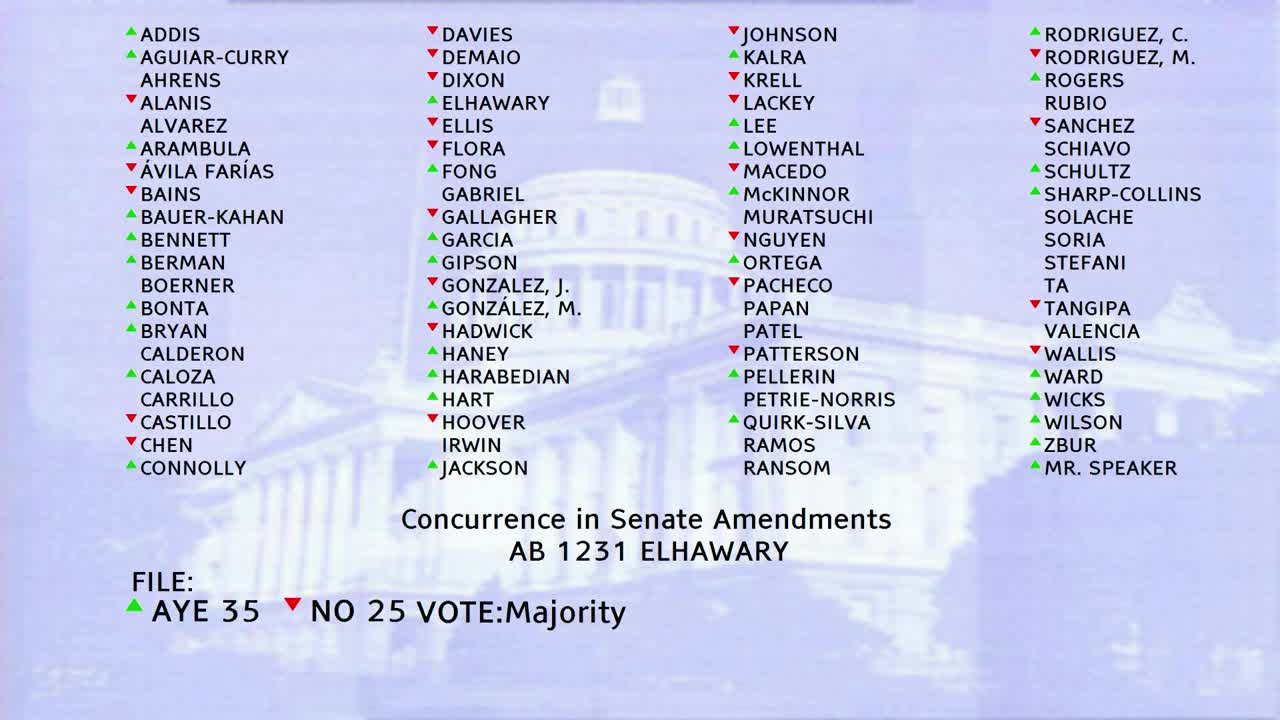 46SEC
Assembly Floor
 12MIN
Assembly Standing Committee on Governmental Organization
 2MIN
Senate Floor
 4MIN
Senate Standing Committee on Governmental Organization
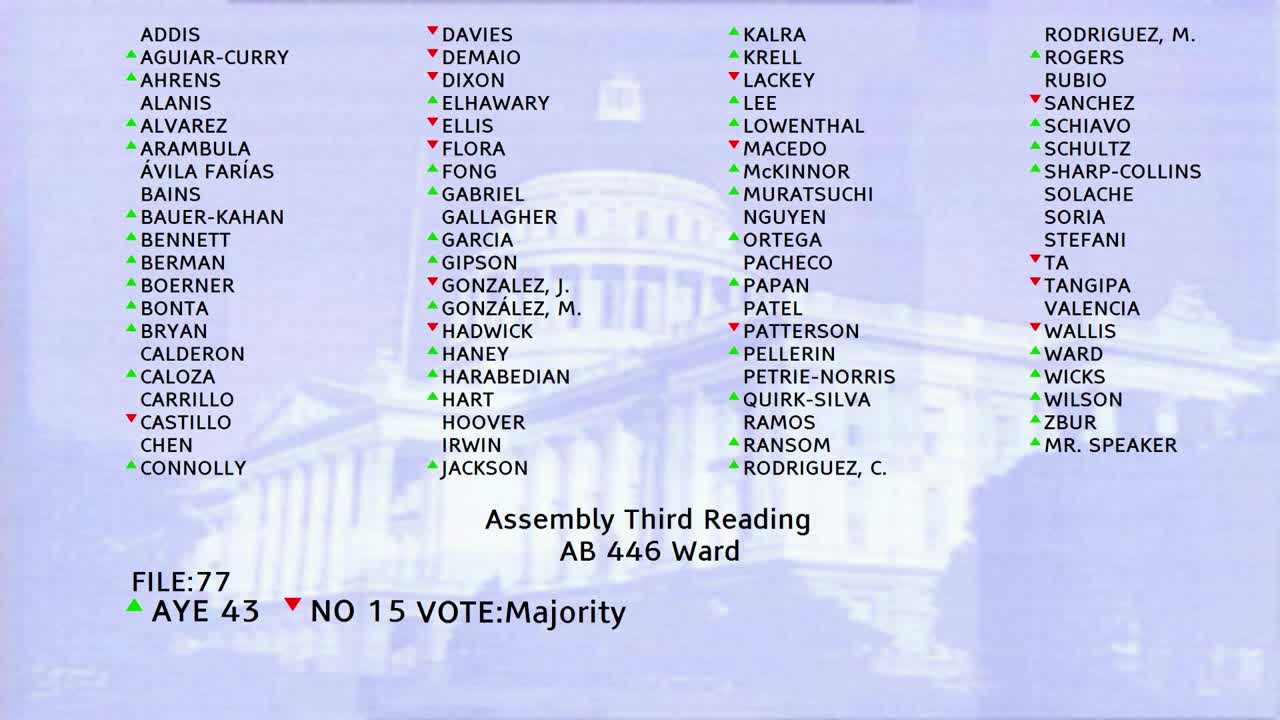 1MIN
Assembly Floor
 4MIN
Assembly Standing Committee on Governmental Organization
Bill Author

Bill Co-Author(s):