AB 1250: Transit operators: paratransit: recertification of eligibility.
- Session Year: 2025-2026
- House: Assembly
- Latest Version Date: 2025-10-13
Current Status:
Passed
(2025-10-13: Chaptered by Secretary of State - Chapter 725, Statutes of 2025.)
Introduced
In Committee
Awaiting First Chamber Vote
Passed First Chamber
In Committee
Awaiting Second Chamber Vote
Passed Second Chamber
Enacted
Under the Mills-Alquist-Deddeh Act, also known as the Transportation Development Act, revenues from a 1/4 percent sales tax in each county are, among other things, available for allocation by the transportation planning agency to transit operators and for community transit services. Existing law requires a transit operator that receives funds through the Mills-Alquist-Deddeh Act and that provides dial-a-ride or paratransit service to provide those services consistent with certain requirements.
This bill would require, on or before January 1, 2027, transit operators, as defined, to establish a streamlined recertification process for eligible persons, as specified. The bill would require, on and after June 1, 2027, transit operators to only use the streamlined recertification process for eligible persons unless certain conditions apply. The bill would define eligible persons as persons who receive, or who are eligible to receive, paratransit services based on a disability and whose disability cannot reasonably be expected to improve over time, as determined by the persons qualified licensed medical professional, and whose ability to access the fixed route system cannot reasonably be expected to improve over time, as determined by the transit operator. To the extent the bill would impose additional duties on a local agency, it would impose a state-mandated local program.
The California Constitution requires the state to reimburse local agencies and school districts for certain costs mandated by the state. Statutory provisions establish procedures for making that reimbursement.
This bill would provide that, if the Commission on State Mandates determines that the bill contains costs mandated by the state, reimbursement for those costs shall be made pursuant to the statutory provisions noted above.
Under the Mills-Alquist-Deddeh Act, also known as the Transportation Development Act, revenues from a 1/4 percent sales tax in each county are, among other things, available for allocation by the transportation planning agency to transit operators and for community transit services. Existing law requires a transit operator that receives funds through the Mills-Alquist-Deddeh Act and that provides dial-a-ride or paratransit service to provide those services consistent with certain requirements.
This bill would require, on or before January 1, 2027, transit operators, as defined, to establish a streamlined recertification process for eligible persons, as specified. The bill would require, by on and after June 1, 2027, transit operators to only use the streamlined recertification process for eligible persons unless certain conditions apply. The bill would define eligible persons as persons who receive, or who are eligible to receive, paratransit services based on a disability and whose disability cannot reasonably be expected to improve over time, as determined by the persons qualified licensed medical professional, and whose ability to access the fixed route system cannot reasonably be expected to improve over time, as determined by the transit operator. To the extent the bill would impose additional duties on a local agency, it would impose a state-mandated local program.
The California Constitution requires the state to reimburse local agencies and school districts for certain costs mandated by the state. Statutory provisions establish procedures for making that reimbursement.
This bill would provide that, if the Commission on State Mandates determines that the bill contains costs mandated by the state, reimbursement for those costs shall be made pursuant to the statutory provisions noted above.
Under the Mills-Alquist-Deddeh Act, also known as the Transportation Development Act, revenues from a 1/4 percent sales tax in each county are, among other things, available for allocation by the transportation planning agency to transit operators and for community transit services. Existing law requires a transit operator that receives funds through the Mills-Alquist-Deddeh Act and that provides dial-a-ride or paratransit service to provide those services consistent with certain requirements.
This bill would prohibit, require, on and after or before January 1, 2027, those transit operators from requiring a person who receives, or is transit operators, as defined, to establish a streamlined recertification process for eligible persons, as specified. The bill would require, by June 1, 2027, transit operators to only use the streamlined recertification process for eligible persons unless certain conditions apply. The bill would define eligible persons as persons who receive, or who are eligible to receive, paratransit services based on a disability or medical condition, and whose condition and whose disability cannot reasonably be expected to improve, to recertify their eligibility, unless the person has a temporary eligibility or there is a review to broaden the persons eligibility, as specified. The bill would require a temporary eligibility to be valid for 180 days or until the date indicated by the persons medical professional, as specified. The bill would prohibit renewal of temporary eligibility more than 6 consecutive times. improve over time, as determined by the persons qualified licensed medical professional, and whose ability to access the fixed route system cannot reasonably be expected to improve over time, as determined by the transit operator. To the extent the bill would impose additional duties on a local agency, it would impose a state-mandated local program.
The California Constitution requires the state to reimburse local agencies and school districts for certain costs mandated by the state. Statutory provisions establish procedures for making that reimbursement.
This bill would provide that, if the Commission on State Mandates determines that the bill contains costs mandated by the state, reimbursement for those costs shall be made pursuant to the statutory provisions noted above.
Under the Mills-Alquist-Deddeh Act, also known as the Transportation Development Act, revenues from a 1/4 percent sales tax in each county are, among other things, available for allocation by the transportation planning agency to transit operators and for community transit services. Existing law requires a transit operator that receives funds through the Mills-Alquist-Deddeh Act and that provides dial-a-ride or paratransit service to provide those services consistent with certain requirements.
This bill would prohibit, on and after January 1, 2027, those transit operators from requiring a person who receives, or is eligible to receive, paratransit services based on a disability or medical condition, and whose condition cannot reasonably be expected to improve, to recertify their eligibility, unless the person has a temporary eligibility or there is a review to broaden the persons eligibility, as specified. The bill would require a temporary eligibility to be valid for 180 days or until the date indicated by the persons medical professional, as specified. The bill would prohibit renewal of temporary eligibility more than 6 consecutive times. To the extent the bill would impose additional duties on a local agency, it would impose a state-mandated local program.
The California Constitution requires the state to reimburse local agencies and school districts for certain costs mandated by the state. Statutory provisions establish procedures for making that reimbursement.
This bill would provide that, if the Commission on State Mandates determines that the bill contains costs mandated by the state, reimbursement for those costs shall be made pursuant to the statutory provisions noted above.
Existing law requires the State Air Resources Board to adopt rules and regulations that will achieve ambient air quality standards required by the federal Clean Air Act, as specified. Existing law requires the state board to, following a noticed public hearing, adopt airborne toxic control measures to reduce emissions of toxic air contaminants from nonvehicular sources. Pursuant to this authority, the state board has adopted the Airborne Toxic Control Measure for Fuel Sulfur and Other Operational Requirements for Ocean-Going Vessels within California Waters and 24 Nautical Miles of the California Baseline regulation to require the use of low sulfur marine distillate fuels in order to reduce emissions of particulate matter, diesel particulate matter, nitrogen oxides, and sulfur oxides from the use of auxiliary diesel and diesel-electric engines, main propulsion diesel engines, and auxiliary boilers on ocean-going vessels.This bill would, for purposes of any application, interpretation, or enforcement of any regulation adopted by the state board with respect to the use of auxiliary engines, main engines, and auxiliary boilers on an ocean-going vessel, declare that specified alternative fuels are presumed to meet or exceed the performance specifications for the use of marine diesel oil or marine gas oil, or any other petroleum-based fuel, as specified, and that an alternative fuel is presumed to consist of a mixture that only contains an alternative fuel, as provided.Existing law requires the State Air Resources Board to adopt rules and regulations that will achieve ambient air quality standards required by the federal Clean Air Act, as specified. Existing law requires the state board to, following a noticed public hearing, adopt airborne toxic control measures to reduce emissions of toxic air contaminants from nonvehicular sources. Pursuant to this authority, the state board has adopted the Airborne Toxic Control Measure for Fuel Sulfur and Other Operational Requirements for Ocean-Going Vessels within California Waters and 24 Nautical Miles of the California Baseline regulation to require the use of low sulfur marine distillate fuels in order to reduce emissions of particulate matter, diesel particulate matter, nitrogen oxides, and sulfur oxides from the use of auxiliary diesel and diesel-electric engines, main propulsion diesel engines, and auxiliary boilers on ocean-going vessels.
This bill would, for purposes of any application, interpretation, or enforcement of any regulation adopted by the state board with respect to the use of auxiliary engines, main engines, and auxiliary boilers on an ocean-going vessel, declare that specified alternative fuels are presumed to meet or exceed the performance specifications for the use of marine diesel oil or marine gas oil, or any other petroleum-based fuel, as specified, and that an alternative fuel is presumed to consist of a mixture that only contains an alternative fuel, as provided.
(a)For purposes of this section, the following definitions apply:
(1)Eligible persons means persons who receive, or who are eligible to receive, paratransit services based on a disability and whose disability cannot reasonably be expected to improve over time, as determined by the persons qualified licensed medical professional, and whose ability to access the fixed route system cannot reasonably be expected to improve over time, as determined by the transit operator.
(2)Recertification process means the process by which a transit operator may require persons who have previously been determined eligible for the federal Americans with Disabilities Act of 1990 (42 U.S.C. Sec. 12101 et seq.) complementary paratransit service to have their eligibility reviewed again.
(3)Transit operator means a transit district, municipal operator, county transportation commission, transportation authority, joint powers authority, or other public transit operator that provides, or contracts for the provision of, paratransit service for individuals with disabilities and that receives public funding pursuant to the Mills-Alquist-Deddeh Act (Chapter 4 (commencing with Section 99200)).
(b)(1)On or before January 1, 2027, a transit operator shall establish a streamlined recertification process for eligible persons.
(2)The streamlined recertification process established by a transit operator pursuant to paragraph (1) shall use a telephone interview, mail-in form, teleconference, or online survey and collect for the purposes of verification only the following information:
(A)Physical address.
(B)Mailing address, if different from physical address.
(C)Emergency contact.
(D)Telephone number.
(E)Updated mobility devices.
(F)Status of disability, with identification of any worsening of the persons disability, any additional disability, any changes to the persons functional abilities, and any changes to the persons use of an assistive device.
(G)First and last name.
(H)Date of birth.
(3)A transit operator may also request, as part of the streamlined recertification process, an updated photo of the eligible person if the transit operator requires a photo for its initial eligibility determination.
(4)(A)A transit operator shall require eligible persons to complete the streamlined recertification process established pursuant to this subdivision once every five years.
(B)An eligible person may request recertification at any time and shall complete the recertification every five years thereafter.
(c)On and after June 1, 2027, a transit operator shall only use the streamlined recertification process described in subdivision (b) for eligible persons unless one of the following conditions applies:
(1)There is a review to broaden the persons eligibility for paratransit services based on either the persons disability worsening or the person having an additional disability.
(2)The person is temporarily eligible for paratransit services.
(3)The transit operator has implemented service changes or improvements that may impact the persons eligibility for paratransit services.
(4)The eligible person has moved to a new physical address and the change of physical address is reasonably expected to modify their eligibility for paratransit services.
(d)This section does not prohibit a transit operator from establishing and using a different recertification process for persons who do not meet the definition of paragraph (1) of subdivision (a).
(e)This section shall not prevent a transit operator from contracting the eligibility recertification process for paratransit services, so long as the final decision regarding an eligible persons eligibility to be recertified for paratransit services is made by the transit operator.
SEC. 2.If the Commission on State Mandates determines that this act contains costs mandated by the state, reimbursement to local agencies and school districts for those costs shall be made pursuant to Part 7 (commencing with Section 17500) of Division 4 of Title 2 of the Government Code.
(a)For the purposes of this section, the following definitions apply:
(1)Eligible persons means persons who receive, or who are eligible to receive, paratransit services based on a disability and whose disability cannot reasonably be expected to improve over time, as determined by the persons qualified licensed medical professional, and whose ability to access the fixed route system cannot reasonably be expected to improve over time, as determined by the transit operator.
(2)Recertification process means the process by which a transit operator may require persons who have previously been determined eligible for the federal Americans with Disabilities Act of 1990 (42 U.S.C. Sec. 12101 et seq.) complementary paratransit service to have their eligibility reviewed again.
(1)(3)Transit operator means a transit district, municipal operator, county transportation commission, transportation authority, joint powers authority, or other public transit operator that provides, or contracts for the provision of, paratransit service for individuals with disabilities and that receives public funding pursuant to the Mills-Alquist-Deddeh Act (Chapter 4 (commencing with Section 99200)).
(2)Recertification process means the process by which a transit operator may require persons who have previously been determined eligible for Americans with Disabilities Act complementary paratransit service to have their eligibility reviewed again.(3)Eligible persons means persons who receive, or who are eligible to receive, paratransit services based on a disability and whose disability cannot reasonably be expected to improve over time, as determined by the persons qualified licensed medical professional, and whose ability to access the fixed route system cannot reasonably be expected to improve over time, as determined by the transit operator.(b)(1)By On or before January 1, 2027, a transit operator shall establish a streamlined recertification process for eligible persons.
(2)The streamlined recertification process established by a transit operator pursuant to paragraph (1) shall utilize use a telephone interview, mail-in form, or online survey and collect for the purposes of verification only the following information:
(A)Physical address.
(B)Mailing address, if different from physical address.
(C)Emergency contact.
(D)Phone Telephone number.
(E)Updated mobility devices.
(F)Status of disability, with identification of any worsening of the persons disability, any additional disability, any changes to the persons functional abilities, and any changes to the persons use of an assistive device.
(G)First and last name.
(H)Date of birth.
(3)A transit operator may also request, as part of the streamlined recertification process, an updated photo of the eligible person if the transit operator requires a photo for its initial eligibility determination.
(4)(A)A transit operator shall require eligible persons to complete the streamlined recertification process established pursuant to this subdivision once every five years.
(B)An eligible person may request recertification at any time and shall complete the recertification every five years thereafter.
(c)By On and after June 1, 2027, a transit operator shall only utilize use the streamlined recertification process described in subdivision (b) for eligible persons unless one of the following conditions applies:
(1)There is a review to broaden the persons eligibility for paratransit services based on either the persons disability worsening or the person having an additional disability.
(2)The person is temporarily eligible for paratransit services.
(3)The transit operator has implemented service changes or improvements that may impact the persons eligibility for paratransit services.
(4)The eligible person has moved to a new physical address. address and the change of physical address is reasonably expected to modify their eligibility for paratransit services.
(d)Nothing in this section prohibits This section does not prohibit a transit operator from establishing and utilizing using a different recertification process for persons who do not meet the definition of paragraph (3) (1) of subdivision (a).
(e)This section shall not prevent a transit operator from contracting the eligibility process for paratransit services, so long as the final decision regarding an eligible persons eligibility for paratransit services is made by the transit operator.
SEC. 2.If the Commission on State Mandates determines that this act contains costs mandated by the state, reimbursement to local agencies and school districts for those costs shall be made pursuant to Part 7 (commencing with Section 17500) of Division 4 of Title 2 of the Government Code.
(a)For the purposes of this section, the following definitions apply:
(1)Transit operator means a transit district, municipal operator, county transportation commission, transportation authority, joint powers authority, or other public transit operator that provides, or contracts for the provision of, paratransit service for individuals with disabilities and that receives public funding pursuant to the Mills-Alquist-Deddeh Act (Chapter 4 (commencing with Section 99200)) for that service shall not require a person who receives, or is eligible 99200)).
(2)Recertification process means the process by which a transit operator may require persons who have previously been determined eligible for Americans with Disabilities Act complementary paratransit service to have their eligibility reviewed again.
(3)Eligible persons means persons who receive, or who are eligible to receive, paratransit services based on a disability or medical condition, and whose condition disability cannot reasonably be expected to improve, to recertify their eligibility unless one of the following applies: improve over time, as determined by the persons qualified licensed medical professional, and whose ability to access the fixed route system cannot reasonably be expected to improve over time, as determined by the transit operator.
(b)(1)By January 1, 2027, a transit operator shall establish a streamlined recertification process for eligible persons.
(2)The streamlined recertification process established by a transit operator pursuant to paragraph (1) shall utilize a telephone interview, mail-in form, or online survey and collect for the purposes of verification only the following information:
(A)Physical address.
(B)Mailing address, if different from physical address.
(C)Emergency contact.
(D)Phone number.
(E)Updated mobility devices.
(F)Status of disability, with identification of any worsening of the persons disability, any additional disability, any changes to the persons functional abilities, and any changes to the persons use of an assistive device.
(3)A transit operator may also request, as part of the streamlined recertification process, an updated photo of the eligible person if the transit operator requires a photo for its initial eligibility determination.
(4)(A)A transit operator shall require eligible persons to complete the streamlined recertification process established pursuant to this subdivision once every five years.
(B)An eligible person may request recertification at any time and shall complete the recertification every five years thereafter.
(c)By June 1, 2027, a transit operator shall only utilize the streamlined recertification process described in subdivision (b) for eligible persons unless one of the following conditions applies:
(a)(1)There is a review to broaden the persons eligibility for paratransit services based on either the persons medical condition disability worsening or the person having an additional disability or medical condition. disability.
(b)(2)The person is temporarily eligible for paratransit services. If a person is temporarily eligible for paratransit services, their temporary eligibility shall be valid for 180 days or until the date indicated by the persons qualified licensed medical professional on the persons application for paratransit services, whichever is sooner. Temporary eligibility for paratransit services shall not be renewed more than six consecutive times.
(3)The transit operator has implemented service changes or improvements that may impact the persons eligibility for paratransit services.
(4)The eligible person has moved to a new physical address.
(d)Nothing in this section prohibits a transit operator from establishing and utilizing a different recertification process for persons who do not meet the definition of paragraph (3) of subdivision (a).
SEC. 2.If the Commission on State Mandates determines that this act contains costs mandated by the state, reimbursement to local agencies and school districts for those costs shall be made pursuant to Part 7 (commencing with Section 17500) of Division 4 of Title 2 of the Government Code.
On and after January 1, 2027, a transit operator that provides, or contracts for the provision of, paratransit service for individuals with disabilities and that receives public funding pursuant to the Mills-Alquist-Deddeh Act (Chapter 4 (commencing with Section 99200)) for that service shall not require a person who receives, or is eligible to receive, paratransit services based on a disability or medical condition, and whose condition cannot reasonably be expected to improve, to recertify their eligibility unless one of the following applies:
(a)There is a review to broaden the persons eligibility for paratransit services based on either the persons medical condition worsening or the person having an additional disability or medical condition.
(b)The person is temporarily eligible for paratransit services. If a person is temporarily eligible for paratransit services, their temporary eligibility shall be valid for 180 days or until the date indicated by the persons qualified licensed medical professional on the persons application for paratransit services, whichever is sooner. Temporary eligibility for paratransit services shall not be renewed more than six consecutive times.
SEC. 2.If the Commission on State Mandates determines that this act contains costs mandated by the state, reimbursement to local agencies and school districts for those costs shall be made pursuant to Part 7 (commencing with Section 17500) of Division 4 of Title 2 of the Government Code.
SECTION 1.(a)The Legislature finds and declares all of the following:(1)It is in the best interest of the State of California and the public health of the citizens of California, and furthers the policy goals of the State of California, to encourage, incentivize, and create a regulatory regime that encourages innovation in cleaner fuel use. Accordingly, the definitions of alternative fuel and alternative fuels usage should be interpreted as broadly as possible within the confines of existing regulations and rules, and discourage narrow, exclusive interpretations of the definitions of distillate fuels within the confines of existing regulations. This is necessary in order to ensure that the facilitation of the introduction of alternative fuels for ocean-going vessels is not hampered because they were adopted with the express purpose of reducing greenhouse gas (GHG) emissions.(2)In 2008, the State Air Resources Board adopted the Airborne Toxic Control Measure for Fuel Sulfur and Other Operational Requirements for Ocean-Going Vessels within California Waters and 24 Nautical Miles of the California Baseline regulation (17 Cal. Code Regs. 93118.2), also known as the OGV fuel rule. The intent of the regulation is to reduce emissions of particulate matter, nitrogen oxides (NOx), and sulfur oxides (SOx) from ocean-going vessels, and the regulation specifically intends to incentivize the use of alternative fuels.(3)In 2010, the International Maritime Organization (IMO) adopted the North American Emission Control Area for Marine Vessels at the behest of the United States, Canada, and France to limit engine emissions of SOx and NOx. The United States Environmental Protection Agency also enacted increasingly stringent emission standards for ship engines while operating in the NOx emission control area. Additionally, the State Air Resources Board made an update to the OGV fuel rule that limits the type of fuel that may be used to those meeting the specifications of Table I of International Organization for Standardization standard 8217, as revised in 2005, or as revised on June 15, 2010.(4)While increasingly stringent SOx and NOx emissions standards have been enacted, GHG reduction efforts are also underway. California has been a leader in this effort, setting ambitious targets to reduce GHG emissions 40 percent below 1990 levels by 2030 and 80 percent below 1990 levels by 2050. In 2020, Governor Newsom issued Executive Order No. N-79-20 to support the decarbonization of transportation but did not prescribe a zero-emission fuel. These regulations have been very effective; by 2023, the San Pedro Bay Ports have seen reductions in NOx by 72 percent, SOx by 98 percent, diesel particulate matter (DPM) by 91 percent, and GHG by 20 percent since 2005. By 2020, the Port of Oakland saw an 86-percent reduction in DPM, NOx reduced by 40 percent, and GHG reduced by 8 percent. These reductions continue to grow.(5)In 2023, the IMO produced a Strategy on Reduction of GHG Emissions from Ships with the goal of reaching net-zero GHG emissions by 2050. In response to the implementation of these rules, the State Air Resources Board reiterated in Marine Notice 2020-2 Notification of Requirements to Owners and Operators of Ocean Going Vessels for Complying with the California Ocean-Going Vessel Fuel Regulation that only fuels that met the specifications of low sulfur marine distillate grade fuel could be used by ocean-going vessels in California.(6)The maritime industry is deploying alternative fueled vessels at an increasing rate. According to the Det Norske Veritas Maritime Forecast to 2050, the number of ships capable of using alternative fuels as of May 2024 was nearly 1,000 with close to 600 more on order.(7)The State Air Resources Board has maintained an interpretation that the 2010 fuel specification requirements prohibit the use of alternative fuels or that only the fuels listed in the regulation may be used as opposed to fuels that meet the specifications of the regulation. Any interpretation that limits the use of alternative fuels is contrary to the intent of the state and inconsistent with climate goals established after the adoption of the OGV fuel rule to facilitate further reduction of GHG emissions and carbon from the use of internal combustion engines.(b)It is the intent of the Legislature that ocean-going vessel fuel regulations be broadly interpreted to promote the inclusion of alternative fuels that promote cleaner air and accelerate reductions of carbon and GHG emissions from ocean-going vessels.(c)It is further the intent of the Legislature that ocean-going fuel regulations be narrowly interpreted with respect to the specifications of marine distillates and marine fuel oils that are incorporated by reference based on tables adopted in 2010 so that the regulations favor an interpretation in which alternative fuels that meet or exceed the specifications will be determined to result in accelerated cleaner air and reductions of carbon and GHG emissions from ocean-going vessels.SEC. 2.Section 39633 is added to the Health and Safety Code, immediately following Section 39632, to read:39633.For purposes of the application, interpretation, or enforcement of any regulation adopted by the state board pursuant to this part with respect to the use of auxiliary engines, main engines, and auxiliary boilers on an ocean-going vessel, as defined in paragraph (24) of subdivision (d) of Section 93118.2 of Title 17 of the California Code of Regulations, both of the following apply:(a)The use of any alternative fuel that has a lower carbon intensity than any marine diesel oil or marine gas oil, or any other petroleum-based fuel that meets all of the specifications of fuel grades as defined in Table 1 of the International Organization for Standardizations (ISO) standard 8217, as revised on June 15, 2010, shall be presumed as a matter of law to meet or exceed the performance specifications for the use of marine diesel oil or marine gas oil, or any other petroleum-based fuel that meets all of the specifications of fuel grades as defined in Table 1 of ISO standard 8217, as revised on June 15, 2010.(b)An alternative fuel, as described in subdivision (a), shall be presumed as a matter of law to consist of a mixture that only contains an alternative fuel notwithstanding any application or use of a pilot fuel in an engine, so long as the use of the pilot fuel is only used when necessary in order to facilitate the use of an alternative fuel. If a pilot fuel is used in any standalone manner whereby it is a primary engine fuel source and not as a pilot fuel, then it shall be regulated directly as if it were not a pilot fuel source, and not considered as a component of the use of an alternative fuel.(a)The Legislature finds and declares all of the following:
(1)It is in the best interest of the State of California and the public health of the citizens of California, and furthers the policy goals of the State of California, to encourage, incentivize, and create a regulatory regime that encourages innovation in cleaner fuel use. Accordingly, the definitions of alternative fuel and alternative fuels usage should be interpreted as broadly as possible within the confines of existing regulations and rules, and discourage narrow, exclusive interpretations of the definitions of distillate fuels within the confines of existing regulations. This is necessary in order to ensure that the facilitation of the introduction of alternative fuels for ocean-going vessels is not hampered because they were adopted with the express purpose of reducing greenhouse gas (GHG) emissions.
(2)In 2008, the State Air Resources Board adopted the Airborne Toxic Control Measure for Fuel Sulfur and Other Operational Requirements for Ocean-Going Vessels within California Waters and 24 Nautical Miles of the California Baseline regulation (17 Cal. Code Regs. 93118.2), also known as the OGV fuel rule. The intent of the regulation is to reduce emissions of particulate matter, nitrogen oxides (NOx), and sulfur oxides (SOx) from ocean-going vessels, and the regulation specifically intends to incentivize the use of alternative fuels.
(3)In 2010, the International Maritime Organization (IMO) adopted the North American Emission Control Area for Marine Vessels at the behest of the United States, Canada, and France to limit engine emissions of SOx and NOx. The United States Environmental Protection Agency also enacted increasingly stringent emission standards for ship engines while operating in the NOx emission control area. Additionally, the State Air Resources Board made an update to the OGV fuel rule that limits the type of fuel that may be used to those meeting the specifications of Table I of International Organization for Standardization standard 8217, as revised in 2005, or as revised on June 15, 2010.
(4)While increasingly stringent SOx and NOx emissions standards have been enacted, GHG reduction efforts are also underway. California has been a leader in this effort, setting ambitious targets to reduce GHG emissions 40 percent below 1990 levels by 2030 and 80 percent below 1990 levels by 2050. In 2020, Governor Newsom issued Executive Order No. N-79-20 to support the decarbonization of transportation but did not prescribe a zero-emission fuel. These regulations have been very effective; by 2023, the San Pedro Bay Ports have seen reductions in NOx by 72 percent, SOx by 98 percent, diesel particulate matter (DPM) by 91 percent, and GHG by 20 percent since 2005. By 2020, the Port of Oakland saw an 86-percent reduction in DPM, NOx reduced by 40 percent, and GHG reduced by 8 percent. These reductions continue to grow.
(5)In 2023, the IMO produced a Strategy on Reduction of GHG Emissions from Ships with the goal of reaching net-zero GHG emissions by 2050. In response to the implementation of these rules, the State Air Resources Board reiterated in Marine Notice 2020-2 Notification of Requirements to Owners and Operators of Ocean Going Vessels for Complying with the California Ocean-Going Vessel Fuel Regulation that only fuels that met the specifications of low sulfur marine distillate grade fuel could be used by ocean-going vessels in California.
(6)The maritime industry is deploying alternative fueled vessels at an increasing rate. According to the Det Norske Veritas Maritime Forecast to 2050, the number of ships capable of using alternative fuels as of May 2024 was nearly 1,000 with close to 600 more on order.
(7)The State Air Resources Board has maintained an interpretation that the 2010 fuel specification requirements prohibit the use of alternative fuels or that only the fuels listed in the regulation may be used as opposed to fuels that meet the specifications of the regulation. Any interpretation that limits the use of alternative fuels is contrary to the intent of the state and inconsistent with climate goals established after the adoption of the OGV fuel rule to facilitate further reduction of GHG emissions and carbon from the use of internal combustion engines.
(b)It is the intent of the Legislature that ocean-going vessel fuel regulations be broadly interpreted to promote the inclusion of alternative fuels that promote cleaner air and accelerate reductions of carbon and GHG emissions from ocean-going vessels.
(c)It is further the intent of the Legislature that ocean-going fuel regulations be narrowly interpreted with respect to the specifications of marine distillates and marine fuel oils that are incorporated by reference based on tables adopted in 2010 so that the regulations favor an interpretation in which alternative fuels that meet or exceed the specifications will be determined to result in accelerated cleaner air and reductions of carbon and GHG emissions from ocean-going vessels.
SEC. 2.Section 39633 is added to the Health and Safety Code, immediately following Section 39632, to read:39633.For purposes of the application, interpretation, or enforcement of any regulation adopted by the state board pursuant to this part with respect to the use of auxiliary engines, main engines, and auxiliary boilers on an ocean-going vessel, as defined in paragraph (24) of subdivision (d) of Section 93118.2 of Title 17 of the California Code of Regulations, both of the following apply:
(a)The use of any alternative fuel that has a lower carbon intensity than any marine diesel oil or marine gas oil, or any other petroleum-based fuel that meets all of the specifications of fuel grades as defined in Table 1 of the International Organization for Standardizations (ISO) standard 8217, as revised on June 15, 2010, shall be presumed as a matter of law to meet or exceed the performance specifications for the use of marine diesel oil or marine gas oil, or any other petroleum-based fuel that meets all of the specifications of fuel grades as defined in Table 1 of ISO standard 8217, as revised on June 15, 2010.
(b)An alternative fuel, as described in subdivision (a), shall be presumed as a matter of law to consist of a mixture that only contains an alternative fuel notwithstanding any application or use of a pilot fuel in an engine, so long as the use of the pilot fuel is only used when necessary in order to facilitate the use of an alternative fuel. If a pilot fuel is used in any standalone manner whereby it is a primary engine fuel source and not as a pilot fuel, then it shall be regulated directly as if it were not a pilot fuel source, and not considered as a component of the use of an alternative fuel.
|
Date
|
Status
|
|---|---|
| Oct 13, 2025 | Chaptered by Secretary of State - Chapter 725, Statutes of 2025. |
| Oct 13, 2025 | Approved by the Governor. |
| Sep 22, 2025 | Enrolled and presented to the Governor at 3 p.m. |
| Sep 10, 2025 | Senate amendments concurred in. To Engrossing and Enrolling. (Ayes 79. Noes 0. Page 3248.). |
| Sep 9, 2025 | In Assembly. Concurrence in Senate amendments pending. |
| Sep 9, 2025 | Read third time. Passed. Ordered to the Assembly. (Ayes 40. Noes 0. Page 2662.). |
| Sep 4, 2025 | Read second time. Ordered to third reading. |
| Sep 3, 2025 | Read third time and amended. Ordered to second reading. |
| Sep 3, 2025 | Ordered to third reading. |
| Sep 3, 2025 | Action rescinded whereby the bill was read third time, passed, and to Assembly. |
| Sep 3, 2025 | Read third time. Passed. Ordered to the Assembly. (Ayes 40. Noes 0. Page 2452.). |
| Aug 27, 2025 | Read second time. Ordered to third reading. |
| Aug 26, 2025 | Read third time and amended. Ordered to second reading. |
| Aug 20, 2025 | Read second time. Ordered to third reading. |
| Aug 19, 2025 | From committee: Be ordered to second reading pursuant to Senate Rule 28.8. |
| Jul 9, 2025 | From committee: Do pass and re-refer to Com. on APPR. (Ayes 15. Noes 0.) (July 8). Re-referred to Com. on APPR. |
| Jun 30, 2025 | From committee chair, with author's amendments: Amend, and re-refer to committee. Read second time, amended, and re-referred to Com. on TRANS. |
| Jun 4, 2025 | Referred to Com. on TRANS. |
| May 23, 2025 | In Senate. Read first time. To Com. on RLS. for assignment. |
| May 23, 2025 | Read third time. Passed. Ordered to the Senate. (Ayes 71. Noes 0. Page 1664.) |
| May 15, 2025 | Read second time. Ordered to Consent Calendar. |
| May 14, 2025 | From committee: Do pass. To Consent Calendar. (Ayes 15. Noes 0.) (May 14). |
| Apr 29, 2025 | From committee: Do pass and re-refer to Com. on APPR. with recommendation: To Consent Calendar. (Ayes 16. Noes 0.) (April 28). Re-referred to Com. on APPR. |
| Apr 21, 2025 | Re-referred to Com. on TRANS. |
| Apr 10, 2025 | From committee chair, with author's amendments: Amend, and re-refer to Com. on TRANS. Read second time and amended. |
| Mar 17, 2025 | Referred to Com. on TRANS. |
| Feb 24, 2025 | Read first time. |
| Feb 22, 2025 | From printer. May be heard in committee March 24. |
| Feb 21, 2025 | Introduced. To print. |
|
Date
|
Description
|
Location
|
Votes
|
|
|---|---|---|---|---|
| Sep 10, 2025 | AB 1250 Papan Concurrence in Senate Amendments | Assembly Floor |
Passed |
|
| Sep 9, 2025 | Assembly 3rd Reading AB1250 Papan By Strickland | Senate Floor |
Passed |
|
| Sep 3, 2025 | Assembly 3rd Reading AB1250 Papan By Strickland | Senate Floor |
Passed |
|
| Jul 8, 2025 | Do pass, but first be re-referred to the Committee on [Appropriations] | Senate Standing Committee on Transportation |
Passed |
|
| May 23, 2025 | AB 1250 Papan Consent Calendar Second Day Regular Session | Assembly Floor |
Passed |
|
| May 14, 2025 | Do pass. To Consent Calendar. | Assembly Standing Committee on Appropriations |
Passed |
|
| Apr 28, 2025 | Do pass and be re-referred to the Committee on [Appropriations] with recommendation: To Consent Calendar | Assembly Standing Committee on Transportation |
Passed |
This list shows positions taken on this bill by organizations on the date displayed, which is linked to the original source.
Positions by individuals are not included.
|
Organization
|
Position
|
Date
|
|---|---|---|
| California Alliance For Retired Americans | ** Support | |
| California Council Of The Blind | ** Support | |
| Californians for SSI | ** Support | |
| California Transit Association | ** Support | |
| Coelho Center for Disability Law, Policy and Innovation | ** Support | |
| Disability Rights California | ** Support | |
| Educate. Advocate. | ** Support | |
| lighthouse for the blind and visually impaired | ** Support | |
| San Francisco Senior and Disability Action | ** Support | |
| San Mateo County Transit District | ** Support | |
| Seamless Bay Area | ** Support |
CONCURRENCE IN SENATE AMENDMENTS
CSA1 Bill Id:AB 1250
Author:(Papan)
As Amended Ver:September 03, 2025
Majority vote
SUMMARY
Requires a transit operator that provides or contracts for the provision of paratransit services to establish a streamlined recertification process by January 1, 2027 for persons who receive or are eligible to receive paratransit services.
Senate Amendments
- Requires transit operators on or before January 1, 2027 to establish a streamlined recertification process for eligible persons.
- Specifies that a streamlined recertification process shall use a phone interview, mail-in form, or online survey to collect the following information for the purposes of verification:
- Physical address.
- Mailing address, if different from physical address.
- Emergency contact.
- Telephone number.
- Updated mobility devices.
- Status of disability, with identification of any worsening of the person's disability, any additional disability, any changes to the person's functional abilities, and any changes to the person's use of an assistive device.
- First and last name.
- Date of birth.
- Allows a transit operator to request an updated photo of the eligible person if they required a photo for their initial determination.
- Requires a transit operator to have eligible persons to complete the recertification process once every five years.
- Allows an eligible person to request recertification at any time and requires them to complete the process every five years thereafter.
- Requires transit operators on or after January 1, 2027 to use the streamlined recertification process unless one of the following conditions applies:
- There is a review to broaden the person's eligibility for paratransit services based on either the person's disability worsening or the person having an additional disability.
- The person is temporarily eligible for paratransit services.
- The transit operator has implemented service changes or improvements that may impact the person's eligibility for paratransit services.
- The eligible person has moved to a new physical address and the change of physical address is reasonably expected to modify their eligibility for paratransit services.
- States that this does not prohibit a transit operator from establishing and using a different recertification process for persons who are not defined as eligible persons.
- States that this does not prevent a transit operator from contracting the eligibility process for paratransit services, so long as the final decision regarding an eligible person's eligibility for paratransit services is made by the transit operator.
- Defines "eligible persons" as persons who receive, or who are eligible to receive, paratransit services based on a disability and whose disability cannot reasonably be expected to improve over time, as determined by the person's qualified licensed medical professional, and whose ability to access the fixed route system cannot reasonably be expected to improve over time, as determined by the transit operator.
- Defines "recertification process" as the process by which a transit operator may require persons who have previously been determined eligible for the federal Americans with Disabilities Act of 1990 (42 U.S.C. Sec. 12101 et seq.) complementary paratransit service to have their eligibility reviewed again.
COMMENTS
Paratransit is a specialized, demand-responsive transportation service for individuals who, due to disability, are unable to use regular fixed-route public transit. These services are typically operated by local transit agencies and may be provided directly or through contracts with private companies.
Federal and state law. Under the Americans with Disabilities Act of 1990 (ADA), public transit agencies operating fixed-route systems must provide complementary paratransit services that mirror the fixed-route system in terms of service area, hours, and fares. ADA paratransit eligibility is defined in three categories:
- Category 1: Individuals who cannot independently use the fixed-route system due to a physical or cognitive disability.
- Category 2: Individuals who can use fixed-route transit but no accessible vehicle is available on the route they need.
- Category 3: Individuals with a specific impairment-related condition that prevents them from getting to or from a bus or rail stop.
Disability alone does not determine paratransit eligibility. The decision is based on the applicant's functional ability to use the fixed route bus and is not a medical decision. The Department of Transportation (DOT) ADA regulations in Appendix D to 49 United States Code Section 37.125 specifies: "The substantive eligibility process is not aimed at making a medical or diagnostic determination. While evaluation by a physician (or professionals in rehabilitation or other relevant fields) may be used as part of the process, a diagnosis of a disability is not dispositive. What is needed is a determination of whether, as a practical matter, the individual can use fixed route transit in his or her own circumstances." Transit agencies, with input from the communities they serve, devise the specifics of their individual eligibility processes. The DOT ADA regulations in Section 37.125 set only broad requirements that all agencies must incorporate, such as written notification of eligibility decisions and an opportunity for an appeal.
While "ADA paratransit" under federal law refers to specific transportation services for individuals meeting certain eligibility criteria, California law uses the terms "paratransit" and "dial-a-ride" more broadly to include a wider range of services for people with disabilities.
Transit providers that receive public funding under the Mills Act must not deny paratransit service based on:
- Whether the person has access to a household vehicle.
- Whether the person lives outside the service area—as long as they are within the area at the time of service and meet eligibility criteria.
Providers may still offer subscription-based services and are not required to lower rates charged to other agencies. Additionally, providers are not required to operate outside their service areas (unless mandated by the ADA) and cannot require ID as a condition of service unless otherwise permitted. Transit providers must accept valid disability ID cards issued by other providers. Complaints about non-compliance may be filed with a transportation planning agency or county transportation commission, and individuals may request the Attorney General's involvement for resolution.
Disability recertification. Federal law, when referring to public entities required to provide complementary paratransit service, states that, "The entity may require recertification of the eligibility of ADA paratransit eligible individuals at reasonable intervals" (49 United States Code 37.125). In California, individuals with permanent disabilities are required to recertify their paratransit eligibility every two to five years, despite their condition remaining stable. The application presents barriers, including:
- Long, not easily accessible forms (especially for screen reader users).
- The need for medical certification, which typically incurs a cost.
- Difficulty getting to a doctor's appointment if the individual is not already paratransit-eligible.
Inconsistencies across the state. Transit agencies across the state may apply eligibility rules and processes differently, creating an additional barrier for individuals who utilize paratransit services across different parts of the state. Inconsistencies in statewide process are highlighted in the report Caltrans prepared pursuant to AB 1351 (Lackey), Chapter 627, Statutes of 2019, which found that most transit agencies do not accept online applications, fare payment options vary, and the majority of agencies do not advertise cross-eligibility of services with other California paratransit agencies. Caltrans recommends the following actions:
- Opportunities for outreach and training could be sought to promote compliance with current state and federal laws which could proceed prior to and in conjunction with the release of statewide guidelines.
- Identify and maintain a list of each operator's paratransit contact person.
- Each service provider could clearly post information about their paratransit services in an easy-to-find location on their website.
- Establish a digital statewide eligibility verification service that is ADA-accessible and easy to use.
- Require transit operators that receive Mills Act funding to honor eligibility from a centralized service alongside their existing processes.
- Publish use of a verification system per agency.
- Publish Mills Act agency compliance.
- Develop eligibility verification guidelines for agency websites.
According to the Author
"AB 1250 will ensure that individuals with permanent disabilities are not required to recertify their eligibility for paratransit services, except in clearly defined circumstances. Paratransit is a critical service that helps Californians with disabilities stay mobile, independent, and engaged in their communities.
Currently, many transit providers require recertification every 2 to 5 years—even when a person's condition is lifelong and unlikely to change. The application process can be lengthy, difficult to navigate for individuals using assistive technology, and requires medical certification. For many, the cost and logistical challenge of reaching a doctor's appointment—especially without reliable transportation—pose significant barriers.
AB 1250 is about dignity and inclusion. This bill acknowledges that for many riders, their disability status is permanent. By allowing for a lasting eligibility determination in these cases, the bill reduces unnecessary burdens on individuals and improves efficiency for transit agencies, freeing up resources to focus on service delivery.
California has a strong record of advancing equity in transportation. AB 1250 builds on that foundation by making the paratransit system more accessible, practical, and respectful of the needs of those it serves."
Arguments in Support
The California Council of the Blind writes, "Although federal regulations do not require transit districts to redetermine eligibility for someone whose disability is not expected to improve, many districts require recertification of all paratransit riders at prescribed intervals. In addition, applications for recertifying paratransit service eligibility often require certification by a physician. In order to meet this requirement riders, many of whom are on fixed incomes, must often bear the expense of obtaining a physician's certification.
A number of people determined eligible for Para Transit services have a disability or medical condition that cannot reasonably be expected to improve. Not only would such Para Transit riders benefit from a system that could deem their disability or medical condition as stable, but staff time and money could be saved on the part of Para Transit service providers, eliminating the need for periodic redetermination applications through such designation. It is likely that more than 250,000 persons with disabilities use paratransit services in California. If 80% of these individuals did not require recertification, savings could run to several million dollars annually."
Arguments in Opposition
No opposition on file.
FISCAL COMMENTS
Unknown.
VOTES:
ASM TRANSPORTATION: 16-0-0
YES: Wilson, Davies, Aguiar-Curry, Ahrens, Carrillo, Harabedian, Hart, Hoover, Jackson, Lackey, Lowenthal, Macedo, Papan, Ransom, Rogers, Ward
ASM APPROPRIATIONS: 15-0-0
YES: Wicks, Sanchez, Arambula, Calderon, Caloza, Dixon, Elhawary, Fong, Mark González, Hart, Pacheco, Pellerin, Solache, Ta, Tangipa
ASSEMBLY FLOOR: 71-0-8
YES: Addis, Aguiar-Curry, Ahrens, Alanis, Alvarez, Arambula, Ávila Farías, Bains, Bauer-Kahan, Bennett, Berman, Boerner, Bonta, Calderon, Caloza, Carrillo, Castillo, Connolly, Davies, DeMaio, Dixon, Elhawary, Flora, Fong, Gabriel, Gallagher, Garcia, Gipson, Jeff Gonzalez, Mark González, Hadwick, Haney, Harabedian, Hart, Hoover, Irwin, Jackson, Kalra, Krell, Lackey, Lee, Lowenthal, Macedo, McKinnor, Muratsuchi, Ortega, Pacheco, Papan, Patel, Patterson, Pellerin, Petrie-Norris, Quirk-Silva, Ramos, Ransom, Celeste Rodriguez, Michelle Rodriguez, Rogers, Blanca Rubio, Schiavo, Solache, Soria, Stefani, Ta, Tangipa, Valencia, Wallis, Ward, Wilson, Zbur, Rivas
ABS, ABST OR NV: Bryan, Chen, Ellis, Nguyen, Sanchez, Schultz, Sharp-Collins, Wicks
SENATE FLOOR: 40-0-0
YES: Allen, Alvarado-Gil, Archuleta, Arreguín, Ashby, Becker, Blakespear, Cabaldon, Caballero, Cervantes, Choi, Cortese, Dahle, Durazo, Gonzalez, Grayson, Grove, Hurtado, Jones, Laird, Limón, McGuire, McNerney, Menjivar, Niello, Ochoa Bogh, Padilla, Pérez, Reyes, Richardson, Rubio, Seyarto, Smallwood-Cuevas, Stern, Strickland, Umberg, Valladares, Wahab, Weber Pierson, Wiener
UPDATED
VERSION: September 03, 2025
CONSULTANT: Aaron Kurz / TRANS. / (916) 319-2093 FN: 0001613
SENATE RULES COMMITTEE Office of Senate Floor Analyses (916) 651-1520 Fax: (916) 327-4478 | AB 1250 |
THIRD READING
Bill No: AB 1250
Author: Papan (D)
Amended: 8/26/25 in Senate
Vote: 21
SENATE TRANSPORTATION COMMITTEE: 15-0, 7/8/25
AYES: Cortese, Strickland, Archuleta, Arreguín, Blakespear, Cervantes, Dahle, Gonzalez, Grayson, Limón, Menjivar, Richardson, Seyarto, Umberg, Valladares
SENATE APPROPRIATIONS COMMITTEE: Senate Rule 28.8
ASSEMBLY FLOOR: 71-0, 5/23/25 (Consent) - See last page for vote
SUBJECT: Transit operators: paratransit: recertification of eligibility
SOURCE: California Council of the Blind
DIGEST:
This bill requires transit operators, on or before June 1, 2027, to use a streamlined recertification process, as specified, for persons who have previously been determined to be eligible for paratransit service to have their eligibility reviewed.
Senate Floor Amendments of 9/2/25 are technical and clarifying.
Senate Floor Amendments of 8/26/25 (1) make technical changes to the definitions in the bill; (2) clarify information authorized to be used as part of the verification process; (3) clarify that an eligible person’s move to a new physical address must also reasonably modify their eligibility for paratransit services; and (4) clarify the bill does not prevent a transit operator from contracting the eligibility process for paratransit services, so long as the final decision regarding an eligible person’s, as defined in the bill, eligibility for paratransit services is made by the transit operator.
ANALYSIS:
Existing Federal law:
- Requires, pursuant to the Americans with Disabilities Act of 1990 (ADA, P. L. 101-336), public transit agencies operating fixed-route systems must also provide complementary paratransit services that mirror the fixed-route system in terms of service area, hours, and fares.
- Defines “ADA paratransit” eligibility in three categories:
- Category 1: Individuals who cannot independently use the fixed-route system due to a physical or cognitive disability.
- Category 2: Individuals who can use fixed-route transit but no accessible vehicle is available on the route they need.
- Category 3: Individuals with a specific impairment-related condition that prevents them from getting to or from a bus or rail stop.
Existing State law:
- Defines “disabled person” to mean any individual who by reason of illness, injury, age, congenital malfunction, or other permanent or temporary incapacity or disability, including, but not limited to, any individual confined to a wheelchair, is unable, without special facilities or special planning or design, to utilize public transportation facilities and services as effectively as a person who is not so affected.
- Defines “temporary incapacity or disability” to mean an incapacity or a disability which lasts more than 90 days.
- States that the Legislature intends that dial-a-ride and paratransit services be accessible to disabled persons and that transportation service be provided for employment, education, medical, and personal reasons, allowing for these persons to fully participate in our society.
- Requires each transit operator, that provides for the provision of dial-a-ride or paratransit service for individuals with disabilities and receives public funding pursuant the Transportation Development Act (TDA) for that service shall provide the service without regard to either of the following:
- Whether the person is a member of a household which owns a motor vehicle; and,
- Whether the place of residence of the person who requests transportation service is within the service area of the provided. To the extent that they are eligible for the specified service requested, all persons requesting transportation service in the service area of the provider shall be provided service on the same terms and at the same price that service is provided to other persons residing within the service area of the provider.
- Stipulates that no transit operator is required to make paratransit services available outside the operator’s established operating service area, or the presentation of identification a condition to using the service.
- Requires a transit operator to honor any current valid identification card for the type of transportation service or discount requested and that has been issued to an individual with disabilities by another transit operator. Authorizes a person who believes a transit operator is in violation to file a report with the transportation planning agency or county transportation commission, and may request the Attorney General to resolve any dispute.
This bill:
- Defines “eligible persons” to mean persons who receive, or who are eligible to receive, paratransit services based on a disability, and whose disability cannot reasonably be expected to improve over time, as determined by the person’s qualified licensed medical professional, and whose ability to access the fixed route system cannot reasonably be expected to improve over time, as determined by the transit operator.
- Defines “recertification process” to mean the process by which a transit operator may require persons who have previously been determined eligible for ADA complementary paratransit service to have their eligibility reviewed again.
- Defines “transit operator” to mean a transit district, municipal operator, county transportation commission, transportation authority, joint powers authority, or other public transit operator that provides, or contracts for the provision of paratransit service for individuals with disabilities and that receives public funding pursuant TDA.
- Requires transit operators, on or before January 1, 2027, to establish a streamlined recertification process for eligible persons.
- Requires the streamlined recertification process to use a telephone interview, mail-in form, or online survey and collect for the purposes of verification only the following information: physical address; mailing address, if different from physical address; emergency contact; telephone number; updated mobility devices; first and last name, date of birth, and status of disability, with identification of any worsening of the person’s disability, any additional disability, any changes to the person’s functional abilities, and any changes to the person’s use of an assistive device.
- Authorizes a transit operator to also request an updated photo of the eligible person if the transit operator requires a photo for its initial eligibility determination.
- Requires a transit operator to require eligible persons to complete the streamlined recertification process established pursuant this bill once every five years.
- Allows an eligible person to request recertification at any time and shall complete the recertification every five years thereafter.
- Requires transit operators, on or before June 1, 2027, to only utilize the streamlined recertification process, as specified, for eligible persons unless one of the following conditions applies:
- There is a review to broaden the person’s eligibility for paratransit services based on either the person’s disability worsening or the person having an additional disability.
- The person is temporarily eligible for paratransit services, as specified.
- The transit operator has implemented service changes or improvements that may impact the person’s eligibility for paratransit services.
- The eligible person has moved to a new physical address and the change of physical address is reasonably expected to modify their eligibility for paratransit services.
- Declares that this bill does not prohibit a transit operator from establishing and utilizing a different recertification process for persons eligible for the streamlined process. Declares that this bill does not prevent a transit operator from contracting the eligibility recertification process for paratransit services, so long as the final decision regarding an eligible person’s, as defined, eligibility to be recertified for paratransit services is made by the transit operator. Declares that this bill could contain a state mandate.
Comments
- Purpose of this bill. According to the author, “AB 1250 creates a streamlined eligibility recertification process for paratransit riders with permanent disabilities. Paratransit is a vital service that enables Californians with disabilities to remain mobile, independent, and connected to their communities. Currently, many transit providers require a full recertification every 2 to 5 years, even when a person’s condition is lifelong and unchanging. The recertification process is lengthy, difficult to navigate, and requires medical certification. In addition to the burdens placed on riders, the current system requires transit operators to conduct duplicative and unnecessary administrative reviews. In response, AB 1250 acknowledges that for many riders, disability status does not change. By allowing for a streamlined recertification process in these cases, the bill reduces unnecessary hurdles for riders and improves efficiency for transit agencies, freeing up resources to focus on service delivery. California has a strong record of advancing equity in transportation. AB 1250 builds on that foundation by making the paratransit system more accessible, practical, and respectful of those it serves.”
- What is paratransit? The ADA requires public transit operators that provide fixed-route service to provide “complementary paratransit” service to people with disabilities who cannot use the fixed-route bus or rail service because of a disability. ADA regulations specifically define a population of customers who are entitled to this service as a civil right. The regulations also define minimum service characteristics that must be met for this service to be considered equivalent to the fixed-route service it is intended to complement.
In general, ADA complementary paratransit service must be provided within 3/4 of a mile of a bus route or rail station, at the same hours and days, for no more than twice the regular fixed route fare. While the transit operator is required to provide paratransit for trips with origins and destinations within 3/4 of a mile of a route/station, paratransit eligible customers who are outside the service area could still use the service if they are able to get themselves into the service area. ADA further requires that paratransit rides be provided to all eligible riders if requested any time the previous day. ADA allows providers to negotiate trip times with the customer, but no more than an hour before or an hour after the requested time.
- California goes further than the ADA. Many transit operators offer more service than the ADA required service, such as for the elderly. In fact, California law clarifies that the terms “paratransit” and “dial-a-ride,” as used in California apply to a broader range of transportation services, and that not all individuals with disabilities under the state law are eligible for “ADA paratransit” under the federal law.
In California, public transit operators and other providers fund paratransit and other specialized services with federal, state, and local funds. Many transit operators in California contract with paratransit providers to provide ADA and other paratransit services in their area.
- How do we determine who is eligible for paratransit services? The eligibility determination process for ADA complementary paratransit is developed by the transit operator in consultation with the local community. To qualify for this service, it is usually necessary to submit an application, and may also require supporting medical documentation, an in-person interview and/or an in-person assessment of the applicant’s ability to use fixed route service. Some transit operators have more rigorous processes and strictly limit eligibility to those people who are functionally unable to ride fixed route service. Other transit operators have less restrictive eligibility, or may use ADA paratransit application process to determine eligibility for other kinds of demand-responsive services.
Some transit operators require a photo of the applicant as part of the determination process. Transit operators will often take a photo of the applicant at their in-person interview and create a transit ID for the rider. This photo ID allows the rider to not only access paratransit services, but also access regular fixed-route service as well, many times for free or at a discounted rate. Additionally, it is used as a security measure for both riders and transit drivers by making sure they are picking up the right person and can identify the person in case of an emergency.
- How do riders get recertified for continued use? After a person’s initial eligibility determination is made, federal law allows transit operators to require recertification of their eligibility at “reasonable intervals.” In California, individuals disabilities that are not consider temporary are required to recertify their paratransit eligibility every two to five years, despite if their condition remains stable. The recertification process can be cumbersome, with some agencies utilizing the same forms as the initial determination. However, some transit operators, like those in the Bay Area, have implemented a streamlined process with a recertification “short form.” Essentially, the agencies are trying to identify if the person’s disability has changed and any additional mobility aids that are being used.
- AB 1250 aims to streamline and standardize the recertification process. This bill provides relief for individuals who receive paratransit services and whose medical condition or disability cannot reasonably be expected to improve. Specifically, this bill requires transit operators to establish and, by June 1, 2027, utilize, a streamlined recertification process for all eligible persons to complete every five years.
The streamlined process must utilize a telephone interview, mail-in form, or online survey to collect the required information including, physical address, mailing address, emergency contact, phone number, updated mobility devices, and status of their disability. The status should detail and identify any worsening of the person’s disability, any additional disability, any changes to the person’s functional abilities, and any changes to the person’s use of an assistive device. As described above, this is similar to the information required by Bay Area transit operators. Finally, a transit operator can request an updated photo if a photo is required as part of the initial determination process. As noted, the streamlined process only has to be complete every five years; however, an eligible person may request recertification at any time if needed due to a chance in circumstances.
Finally, this bill does not require the streamlined recertification process if there is a review to broaden the person’s eligibility for services; the person’s only temporality eligible for paratransit services; the person has moved to a new address; or the transit operator has implemented service changes or improvements that may impact the person’s eligibility, such as a closer bus stop or new equipment that make it easier to board and ride.
FISCAL EFFECT: Appropriation: No Fiscal Com.: Yes Local: Yes
SUPPORT: (Verified 9/2/25)
California Council of the Blind (Source)
California Alliance for Retired Americans
Californians for SSI
California Transit Association
Disability Rights California
Educate. Advocate.
Lighthouse for the Blind and Visually Impaired
San Francisco Senior and Disability Action
San Mateo County Transit District
Seamless Bay Area
OPPOSITION: (Verified 9/2/25)
None received
ARGUMENTS IN SUPPORT: Writing as the sponsors of this bill, the California Council for the Blind state, “Paratransit is an essential service for many Californians with disabilities, offering vital access to healthcare, employment, education, and community life. Currently, many transit providers require riders to recertify their eligibility every 2 to 5 years—even when the individual’s condition is lifelong and not expected to improve.
“Medical verification is an important part of establishing eligibility for paratransit services. However, once a disability or medical condition has been determined to be permanent, requiring individuals to undergo the same process over and over again adds little value and creates disproportionate hardship. That hardship includes financial costs, time lost navigating bureaucracy that is not always accessible to those with disabilities, and the stress and frustration of having to justify a disability that is already well documented and understood. A different approach is both reasonable and necessary for these cases.”
ASSEMBLY FLOOR: 71-0, 5/23/25
AYES: Addis, Aguiar-Curry, Ahrens, Alanis, Alvarez, Arambula, Ávila Farías, Bains, Bauer-Kahan, Bennett, Berman, Boerner, Bonta, Calderon, Caloza, Carrillo, Castillo, Connolly, Davies, DeMaio, Dixon, Elhawary, Flora, Fong, Gabriel, Gallagher, Garcia, Gipson, Jeff Gonzalez, Mark González, Hadwick, Haney, Harabedian, Hart, Hoover, Irwin, Jackson, Kalra, Krell, Lackey, Lee, Lowenthal, Macedo, McKinnor, Muratsuchi, Ortega, Pacheco, Papan, Patel, Patterson, Pellerin, Petrie-Norris, Quirk-Silva, Ramos, Ransom, Celeste Rodriguez, Michelle Rodriguez, Rogers, Blanca Rubio, Schiavo, Solache, Soria, Stefani, Ta, Tangipa, Valencia, Wallis, Ward, Wilson, Zbur, Rivas
NO VOTE RECORDED: Bryan, Chen, Ellis, Nguyen, Sanchez, Schultz, Sharp-Collins, Wicks
Prepared by: Melissa White / TRANS. / (916) 651-4121
9/6/25 10:36:37
SENATE RULES COMMITTEE Office of Senate Floor Analyses (916) 651-1520 Fax: (916) 327-4478 | AB 1250 |
THIRD READING
Bill No: AB 1250
Author: Papan (D)
Amended: 8/26/25 in Senate
Vote: 21
SENATE TRANSPORTATION COMMITTEE: 15-0, 7/8/25
AYES: Cortese, Strickland, Archuleta, Arreguín, Blakespear, Cervantes, Dahle, Gonzalez, Grayson, Limón, Menjivar, Richardson, Seyarto, Umberg, Valladares
SENATE APPROPRIATIONS COMMITTEE: Senate Rule 28.8
ASSEMBLY FLOOR: 71-0, 5/23/25 (Consent) - See last page for vote
SUBJECT: Transit operators: paratransit: recertification of eligibility
SOURCE: California Council of the Blind
DIGEST:
This bill requires transit operators, on or before June 1, 2027, to use a streamlined recertification process, as specified, for persons who have previously been determined to be eligible for paratransit service to have their eligibility reviewed.
Senate Floor Amendments of 8/26/25 (1) make technical changes to the definitions in the bill; (2) clarify information authorized to be used as part of the verification process; (3) clarify that an eligible person’s move to a new physical address must also reasonably modify their eligibility for paratransit services; and (4) clarify the bill does not prevent a transit operator from contracting the eligibility process for paratransit services, so long as the final decision regarding an eligible person’s, as defined in the bill, eligibility for paratransit services is made by the transit operator.
ANALYSIS:
Existing Federal law:
- Requires, pursuant to the Americans with Disabilities Act of 1990 (ADA, P. L. 101-336), public transit agencies operating fixed-route systems must also provide complementary paratransit services that mirror the fixed-route system in terms of service area, hours, and fares.
- Defines “ADA paratransit” eligibility in three categories:
- Category 1: Individuals who cannot independently use the fixed-route system due to a physical or cognitive disability.
- Category 2: Individuals who can use fixed-route transit but no accessible vehicle is available on the route they need.
- Category 3: Individuals with a specific impairment-related condition that prevents them from getting to or from a bus or rail stop.
Existing State law:
- Defines “disabled person” to mean any individual who by reason of illness, injury, age, congenital malfunction, or other permanent or temporary incapacity or disability, including, but not limited to, any individual confined to a wheelchair, is unable, without special facilities or special planning or design, to utilize public transportation facilities and services as effectively as a person who is not so affected.
- Defines “temporary incapacity or disability” to mean an incapacity or a disability which lasts more than 90 days.
- States that the Legislature intends that dial-a-ride and paratransit services be accessible to disabled persons and that transportation service be provided for employment, education, medical, and personal reasons, allowing for these persons to fully participate in our society.
- Requires each transit operator, that provides for the provision of dial-a-ride or paratransit service for individuals with disabilities and receives public funding pursuant the Transportation Development Act (TDA) for that service shall provide the service without regard to either of the following:
- Whether the person is a member of a household which owns a motor vehicle; and,
- Whether the place of residence of the person who requests transportation service is within the service area of the provided. To the extent that they are eligible for the specified service requested, all persons requesting transportation service in the service area of the provider shall be provided service on the same terms and at the same price that service is provided to other persons residing within the service area of the provider.
- Stipulates that no transit operator is required to make paratransit services available outside the operator’s established operating service area, or the presentation of identification a condition to using the service.
- Requires a transit operator to honor any current valid identification card for the type of transportation service or discount requested and that has been issued to an individual with disabilities by another transit operator. Authorizes a person who believes a transit operator is in violation to file a report with the transportation planning agency or county transportation commission, and may request the Attorney General to resolve any dispute.
This bill:
- Defines “eligible persons” to mean persons who receive, or who are eligible to receive, paratransit services based on a disability, and whose disability cannot reasonably be expected to improve over time, as determined by the person’s qualified licensed medical professional, and whose ability to access the fixed route system cannot reasonably be expected to improve over time, as determined by the transit operator.
- Defines “recertification process” to mean the process by which a transit operator may require persons who have previously been determined eligible for ADA complementary paratransit service to have their eligibility reviewed again.
- Defines “transit operator” to mean a transit district, municipal operator, county transportation commission, transportation authority, joint powers authority, or other public transit operator that provides, or contracts for the provision of paratransit service for individuals with disabilities and that receives public funding pursuant TDA.
- Requires transit operators, on or before January 1, 2027, to establish a streamlined recertification process for eligible persons.
- Requires the streamlined recertification process to use a telephone interview, mail-in form, or online survey and collect for the purposes of verification only the following information: physical address; mailing address, if different from physical address; emergency contact; telephone number; updated mobility devices; first and last name, date of birth, and status of disability, with identification of any worsening of the person’s disability, any additional disability, any changes to the person’s functional abilities, and any changes to the person’s use of an assistive device.
- Authorizes a transit operator to also request an updated photo of the eligible person if the transit operator requires a photo for its initial eligibility determination.
- Requires a transit operator to require eligible persons to complete the streamlined recertification process established pursuant this bill once every five years.
- Allows an eligible person to request recertification at any time and shall complete the recertification every five years thereafter.
- Requires transit operators, on or before June 1, 2027, to only utilize the streamlined recertification process, as specified, for eligible persons unless one of the following conditions applies:
- There is a review to broaden the person’s eligibility for paratransit services based on either the person’s disability worsening or the person having an additional disability.
- The person is temporarily eligible for paratransit services, as specified.
- The transit operator has implemented service changes or improvements that may impact the person’s eligibility for paratransit services.
- The eligible person has moved to a new physical address and the change of physical address is reasonably expected to modify their eligibility for paratransit services.
- Declares that this bill does not prohibit a transit operator from establishing and utilizing a different recertification process for persons eligible for the streamlined process. Declares that this bill does not prevent a transit operator from contracting the eligibility process for paratransit services, so long as the final decision regarding an eligible person’s, as defined, eligibility for paratransit services is made by the transit operator. Declares that this bill could contain a state mandate
Comments
Purpose of this bill. According to the author, “AB 1250 creates a streamlined eligibility recertification process for paratransit riders with permanent disabilities. Paratransit is a vital service that enables Californians with disabilities to remain mobile, independent, and connected to their communities. Currently, many transit providers require a full recertification every 2 to 5 years, even when a person’s condition is lifelong and unchanging. The recertification process is lengthy, difficult to navigate, and requires medical certification. In addition to the burdens placed on riders, the current system requires transit operators to conduct duplicative and unnecessary administrative reviews. In response, AB 1250 acknowledges that for many riders, disability status does not change. By allowing for a streamlined recertification process in these cases, the bill reduces unnecessary hurdles for riders and improves efficiency for transit agencies, freeing up resources to focus on service delivery. California has a strong record of advancing equity in transportation. AB 1250 builds on that foundation by making the paratransit system more accessible, practical, and respectful of those it serves.”
What is paratransit? The ADA requires public transit operators that provide fixed-route service to provide “complementary paratransit” service to people with disabilities who cannot use the fixed-route bus or rail service because of a disability. ADA regulations specifically define a population of customers who are entitled to this service as a civil right. The regulations also define minimum service characteristics that must be met for this service to be considered equivalent to the fixed-route service it is intended to complement.
In general, ADA complementary paratransit service must be provided within 3/4 of a mile of a bus route or rail station, at the same hours and days, for no more than twice the regular fixed route fare. While the transit operator is required to provide paratransit for trips with origins and destinations within 3/4 of a mile of a route/station, paratransit eligible customers who are outside the service area could still use the service if they are able to get themselves into the service area. ADA further requires that paratransit rides be provided to all eligible riders if requested any time the previous day. ADA allows providers to negotiate trip times with the customer, but no more than an hour before or an hour after the requested time.
California goes further than the ADA. Many transit operators offer more service than the ADA required service, such as for the elderly. In fact, California law clarifies that the terms “paratransit” and “dial-a-ride,” as used in California apply to a broader range of transportation services, and that not all individuals with disabilities under the state law are eligible for “ADA paratransit” under the federal law.
In California, public transit operators and other providers fund paratransit and other specialized services with federal, state, and local funds. Many transit operators in California contract with paratransit providers to provide ADA and other paratransit services in their area.
How do we determine who is eligible for paratransit services? The eligibility determination process for ADA complementary paratransit is developed by the transit operator in consultation with the local community. To qualify for this service, it is usually necessary to submit an application, and may also require supporting medical documentation, an in-person interview and/or an in-person assessment of the applicant’s ability to use fixed route service. Some transit operators have more rigorous processes and strictly limit eligibility to those people who are functionally unable to ride fixed route service. Other transit operators have less restrictive eligibility, or may use ADA paratransit application process to determine eligibility for other kinds of demand-responsive services.
Some transit operators require a photo of the applicant as part of the determination process. Transit operators will often take a photo of the applicant at their in-person interview and create a transit ID for the rider. This photo ID allows the rider to not only access paratransit services, but also access regular fixed-route service as well, many times for free or at a discounted rate. Additionally, it is used as a security measure for both riders and transit drivers by making sure they are picking up the right person and can identify the person in case of an emergency.
How do riders get recertified for continued use? After a person’s initial eligibility determination is made, federal law allows transit operators to require recertification of their eligibility at “reasonable intervals.” In California, individuals disabilities that are not consider temporary are required to recertify their paratransit eligibility every two to five years, despite if their condition remains stable.
The recertification process can be cumbersome, with some agencies utilizing the same forms as the initial determination. However, some transit operators, like those in the Bay Area, have implemented a streamlined process with a recertification “short form.” Essentially, the agencies are trying to identify if the person’s disability has changed and any additional mobility aids that are being used.
AB 1250 aims to streamline and standardize the recertification process. This bill provides relief for individuals who receive paratransit services and whose medical condition or disability cannot reasonably be expected to improve. Specifically, this bill requires transit operators to establish and, by June 1, 2027, utilize, a streamlined recertification process for all eligible persons to complete every five years.
The streamlined process must utilize a telephone interview, mail-in form, or online survey to collect the required information including, physical address, mailing address, emergency contact, phone number, updated mobility devices, and status of their disability. The status should detail and identify any worsening of the person’s disability, any additional disability, any changes to the person’s functional abilities, and any changes to the person’s use of an assistive device. As described above, this is similar to the information required by Bay Area transit operators. Finally, a transit operator can request an updated photo if a photo is required as part of the initial determination process.
As noted, the streamlined process only has to be complete every five years; however, an eligible person may request recertification at any time if needed due to a chance in circumstances.
Finally, this bill does not require the streamlined recertification process if there is a review to broaden the person’s eligibility for services; the person’s only temporality eligible for paratransit services; the person has moved to a new address; or the transit operator has implemented service changes or improvements that may impact the person’s eligibility, such as a closer bus stop or new equipment that make it easier to board and ride.
FISCAL EFFECT: Appropriation: No Fiscal Com.: Yes Local: Yes
SUPPORT: (Verified 8/25/25)
California Council of the Blind (Source)
California Alliance for Retired Americans
Californians for SSI
California Transit Association
Disability Rights California
Educate. Advocate.
Lighthouse for the Blind and Visually Impaired
San Francisco Senior and Disability Action
San Mateo County Transit District
Seamless Bay Area
OPPOSITION: (Verified 8/25/25)
None received
ARGUMENTS IN SUPPORT: Writing as the sponsors of this bill, the California Council for the Blind state, “Paratransit is an essential service for many Californians with disabilities, offering vital access to healthcare, employment, education, and community life. Currently, many transit providers require riders to recertify their eligibility every 2 to 5 years—even when the individual’s condition is lifelong and not expected to improve.
“Medical verification is an important part of establishing eligibility for paratransit services. However, once a disability or medical condition has been determined to be permanent, requiring individuals to undergo the same process over and over again adds little value and creates disproportionate hardship. That hardship includes financial costs, time lost navigating bureaucracy that is not always accessible to those with disabilities, and the stress and frustration of having to justify a disability that is already well documented and understood. A different approach is both reasonable and necessary for these cases.”
ASSEMBLY FLOOR: 71-0, 5/23/25
AYES: Addis, Aguiar-Curry, Ahrens, Alanis, Alvarez, Arambula, Ávila Farías, Bains, Bauer-Kahan, Bennett, Berman, Boerner, Bonta, Calderon, Caloza, Carrillo, Castillo, Connolly, Davies, DeMaio, Dixon, Elhawary, Flora, Fong, Gabriel, Gallagher, Garcia, Gipson, Jeff Gonzalez, Mark González, Hadwick, Haney, Harabedian, Hart, Hoover, Irwin, Jackson, Kalra, Krell, Lackey, Lee, Lowenthal, Macedo, McKinnor, Muratsuchi, Ortega, Pacheco, Papan, Patel, Patterson, Pellerin, Petrie-Norris, Quirk-Silva, Ramos, Ransom, Celeste Rodriguez, Michelle Rodriguez, Rogers, Blanca Rubio, Schiavo, Solache, Soria, Stefani, Ta, Tangipa, Valencia, Wallis, Ward, Wilson, Zbur, Rivas
NO VOTE RECORDED: Bryan, Chen, Ellis, Nguyen, Sanchez, Schultz, Sharp-Collins, Wicks
Prepared by: Melissa White / TRANS. / (916) 651-4121
8/27/25 16:25:39
SENATE RULES COMMITTEE Office of Senate Floor Analyses (916) 651-1520 Fax: (916) 327-4478 | AB 1250 |
THIRD READING
Bill No: AB 1250
Author: Papan (D)
Amended: 6/30/25 in Senate
Vote: 21
SENATE TRANSPORTATION COMMITTEE: 15-0, 7/8/25
AYES: Cortese, Strickland, Archuleta, Arreguín, Blakespear, Cervantes, Dahle, Gonzalez, Grayson, Limón, Menjivar, Richardson, Seyarto, Umberg, Valladares
SENATE APPROPRIATIONS COMMITTEE: Senate Rule 28.8
ASSEMBLY FLOOR: 71-0, 5/23/25 (Consent) - See last page for vote
SUBJECT: Transit operators: paratransit: recertification of eligibility
SOURCE: California Council of the Blind
DIGEST:
This bill requires transit operators, by June 1, 2027, to use a streamlined recertification process, as specified, for persons who have previously been determined to be eligible for paratransit service to have their eligibility reviewed.
ANALYSIS:
Existing Federal law:
- Requires, pursuant to the Americans with Disabilities Act of 1990 (ADA, P. L. 101-336), public transit agencies operating fixed-route systems must also provide complementary paratransit services that mirror the fixed-route system in terms of service area, hours, and fares.
- Defines “ADA paratransit” eligibility in three categories:
- Category 1: Individuals who cannot independently use the fixed-route system due to a physical or cognitive disability.
- Category 2: Individuals who can use fixed-route transit but no accessible vehicle is available on the route they need.
- Category 3: Individuals with a specific impairment-related condition that prevents them from getting to or from a bus or rail stop.
Existing State law:
- Defines “disabled person” to mean any individual who by reason of illness, injury, age, congenital malfunction, or other permanent or temporary incapacity or disability, including, but not limited to, any individual confined to a wheelchair, is unable, without special facilities or special planning or design, to utilize public transportation facilities and services as effectively as a person who is not so affected.
- Defines “temporary incapacity or disability” to mean an incapacity or a disability which lasts more than 90 days.
- States that the Legislature intends that dial-a-ride and paratransit services be accessible to disabled persons and that transportation service be provided for employment, education, medical, and personal reasons, allowing for these persons to fully participate in our society.
- Requires each transit operator, that provides for the provision of dial-a-ride or paratransit service for individuals with disabilities and receives public funding pursuant the Transportation Development Act (TDA) for that service shall provide the service without regard to either of the following:
- Whether the person is a member of a household which owns a motor vehicle; and,
- Whether the place of residence of the person who requests transportation service is within the service area of the provided. To the extent that they are eligible for the specified service requested, all persons requesting transportation service in the service area of the provider shall be provided service on the same terms and at the same price that service is provided to other persons residing within the service area of the provider.
- Stipulates that no transit operator is required to make paratransit services available outside the operator’s established operating service area, or the presentation of identification a condition to using the service.
- Requires a transit operator to honor any current valid identification card for the type of transportation service or discount requested and that has been issued to an individual with disabilities by another transit operator. Authorizes a person who believes a transit operator is in violation to file a report with the transportation planning agency or county transportation commission, and may request the Attorney General to resolve any dispute.
This bill:
- Defines “transit operator” to mean a transit district, municipal operator, county transportation commission, transportation authority, joint powers authority, or other public transit operator that provides, or contracts for the provision of paratransit service for individuals with disabilities and that receives public funding pursuant TDA.
- Defines “recertification process” to mean the process by which a transit operator may require persons who have previously been determined eligible for ADA complementary paratransit service to have their eligibility reviewed again.
- Defines “eligible persons” to mean persons who receive, or who are eligible to receive, paratransit services based on a disability, and whose disability cannot reasonably be expected to improve over time, as determined by the person’s qualified licensed medical professional, and whose ability to access the fixed route system cannot reasonably be expected to improve over time, as determined by the transit operator.
- Requires transit operators, by January 1, 2027, to establish a streamlined recertification process for eligible persons.
- Requires the streamlined recertification process to utilize a telephone interview, mail-in form, or online survey and collect for the purposes of verification only the following information: physical address; mailing address, if different from physical address; emergency contact; phone number; updated mobility devices; and status of disability, with identification of any worsening of the person’s disability, any additional disability, any changes to the person’s functional abilities, and any changes to the person’s use of an assistive device.
- Authorizes a transit operator to also request an updated photo of the eligible person if the transit operator requires a photo for its initial eligibility determination.
- Requires a transit operator to require eligible persons to complete the streamlined recertification process established pursuant this bill once every five years.
- Allows an eligible person to request recertification at any time and shall complete the recertification every five years thereafter.
- Requires transit operators, by June 1, 2027, to only utilize the streamlined recertification process, as specified, for eligible persons unless one of the following conditions applies:
- There is a review to broaden the person’s eligibility for paratransit services based on either the person’s disability worsening or the person having an additional disability.
- The person is temporarily eligible for paratransit services, as specified.
- The transit operator has implemented service changes or improvements that may impact the person’s eligibility for paratransit services.
- The eligible person has moved to a new physical address.
- Declares that nothing in this bill prohibits a transit operator from establishing and utilizing a different recertification process for persons eligible for the streamlined process. Declares that this bill could contain a state mandate.
Comments
- Purpose of this bill. According to the author, “AB 1250 creates a streamlined eligibility recertification process for paratransit riders with permanent disabilities. Paratransit is a vital service that enables Californians with disabilities to remain mobile, independent, and connected to their communities. Currently, many transit providers require a full recertification every 2 to 5 years, even when a person’s condition is lifelong and unchanging. The recertification process is lengthy, difficult to navigate, and requires medical certification. In addition to the burdens placed on riders, the current system requires transit operators to conduct duplicative and unnecessary administrative reviews. In response, AB 1250 acknowledges that for many riders, disability status does not change. By allowing for a streamlined recertification process in these cases, this bill reduces unnecessary hurdles for riders and improves efficiency for transit agencies, freeing up resources to focus on service delivery. California has a strong record of advancing equity in transportation. AB 1250 builds on that foundation by making the paratransit system more accessible, practical, and respectful of those it serves.”
- What is paratransit? The ADA requires public transit operators that provide fixed-route service to provide “complementary paratransit” service to people with disabilities who cannot use the fixed-route bus or rail service because of a disability. ADA regulations specifically define a population of customers who are entitled to this service as a civil right. The regulations also define minimum service characteristics that must be met for this service to be considered equivalent to the fixed-route service it is intended to complement.
In general, ADA complementary paratransit service must be provided within 3/4 of a mile of a bus route or rail station, at the same hours and days, for no more than twice the regular fixed route fare. While the transit operator is required to provide paratransit for trips with origins and destinations within 3/4 of a mile of a route/station, paratransit eligible customers who are outside the service area could still use the service if they are able to get themselves into the service area. ADA further requires that paratransit rides be provided to all eligible riders if requested any time the previous day. ADA allows providers to negotiate trip times with the customer, but no more than an hour before or an hour after the requested time.
- California goes further than the ADA. Many transit operators offer more service than the ADA required service, such as for the elderly. In fact, California law clarifies that the terms “paratransit” and “dial-a-ride,” as used in California apply to a broader range of transportation services, and that not all individuals with disabilities under the state law are eligible for “ADA paratransit” under the federal law.
In California, public transit operators and other providers fund paratransit and other specialized services with federal, state, and local funds. Many transit operators in California contract with paratransit providers to provide ADA and other paratransit services in their area.
- How do we determine who is eligible for paratransit services? The eligibility determination process for ADA complementary paratransit is developed by the transit operator in consultation with the local community. To qualify for this service, it is usually necessary to submit an application, and may also require supporting medical documentation, an in-person interview and/or an in-person assessment of the applicant’s ability to use fixed route service. Some transit operators have more rigorous processes and strictly limit eligibility to those people who are functionally unable to ride fixed route service. Other transit operators have less restrictive eligibility, or may use ADA paratransit application process to determine eligibility for other kinds of demand-responsive services.
Some transit operators require a photo of the applicant as part of the determination process. Transit operators will often take a photo of the applicant at their in-person interview and create a transit ID for the rider. This photo ID allows the rider to not only access paratransit services, but also access regular fixed-route service as well, many times for free or at a discounted rate. Additionally, it is used as a security measure for both riders and transit drivers by making sure they are picking up the right person and can identify the person in case of an emergency.
- How do riders get recertified for continued use? After a person’s initial eligibility determination is made, federal law allows transit operators to require recertification of their eligibility at “reasonable intervals.” In California, individuals disabilities that are not consider temporary are required to recertify their paratransit eligibility every two to five years, despite if their condition remains stable.
The recertification process can be cumbersome, with some agencies utilizing the same forms as the initial determination. However, some transit operators, like those in the Bay Area, have implemented a streamlined process with a recertification “short form.” Essentially, the agencies are trying to identify if the person’s disability has changed and any additional mobility aids that are being used.
- AB 1250 aims to streamline and standardize the recertification process. AB 1250 would provide relief for individuals who receive paratransit services and whose medical condition or disability cannot reasonably be expected to improve. Specifically, this bill requires transit operators to establish and, by June 1, 2027, utilize, a streamlined recertification process for all eligible persons to complete every five years.
The streamlined process must utilize a telephone interview, mail-in form, or online survey to collect the required information including, physical address, mailing address, emergency contact, phone number, updated mobility devices, and status of their disability. The status should detail and identify any worsening of the person’s disability, any additional disability, any changes to the person’s functional abilities, and any changes to the person’s use of an assistive device. As described above, this is similar to the information required by Bay Area transit operators. Finally, a transit operator can request an updated photo if a photo is required as part of the initial determination process.
As noted, the streamlined process only has to be complete every five years; however, an eligible person may request recertification at any time if needed due to a chance in circumstances.
Finally, AB 1250 does not require the streamlined recertification process if there is a review to broaden the person’s eligibility for services; the person’s only temporality eligible for paratransit services; the person has moved to a new address; or the transit operator has implemented service changes or improvements that may impact the person’s eligibility, such as a closer bus stop or new equipment that make it easier to board and ride.
FISCAL EFFECT: Appropriation: No Fiscal Com.: Yes Local: Yes
SUPPORT: (Verified 8/18/25)
California Council of the Blind (source)
California Alliance for Retired Americans
Californians for SSI
California Transit Association
Disability Rights California
Educate. Advocate.
Lighthouse for the Blind and Visually Impaired
San Francisco Senior and Disability Action
San Mateo County Transit District
Seamless Bay Area
OPPOSITION: (Verified 8/18/25)
None received
ARGUMENTS IN SUPPORT: Writing as the sponsors of AB 1225, the California Council for the Blind state, “Paratransit is an essential service for many Californians with disabilities, offering vital access to healthcare, employment, education, and community life. Currently, many transit providers require riders to recertify their eligibility every 2 to 5 years—even when the individual’s condition is lifelong and not expected to improve.
“Medical verification is an important part of establishing eligibility for paratransit services. However, once a disability or medical condition has been determined to be permanent, requiring individuals to undergo the same process over and over again adds little value and creates disproportionate hardship. That hardship includes financial costs, time lost navigating bureaucracy that is not always accessible to those with disabilities, and the stress and frustration of having to justify a disability that is already well documented and understood. A different approach is both reasonable and necessary for these cases.”
ASSEMBLY FLOOR: 71-0, 5/23/25
AYES: Addis, Aguiar-Curry, Ahrens, Alanis, Alvarez, Arambula, Ávila Farías, Bains, Bauer-Kahan, Bennett, Berman, Boerner, Bonta, Calderon, Caloza, Carrillo, Castillo, Connolly, Davies, DeMaio, Dixon, Elhawary, Flora, Fong, Gabriel, Gallagher, Garcia, Gipson, Jeff Gonzalez, Mark González, Hadwick, Haney, Harabedian, Hart, Hoover, Irwin, Jackson, Kalra, Krell, Lackey, Lee, Lowenthal, Macedo, McKinnor, Muratsuchi, Ortega, Pacheco, Papan, Patel, Patterson, Pellerin, Petrie-Norris, Quirk-Silva, Ramos, Ransom, Celeste Rodriguez, Michelle Rodriguez, Rogers, Blanca Rubio, Schiavo, Solache, Soria, Stefani, Ta, Tangipa, Valencia, Wallis, Ward, Wilson, Zbur, Rivas
NO VOTE RECORDED: Bryan, Chen, Ellis, Nguyen, Sanchez, Schultz, Sharp-Collins, Wicks
Prepared by: Melissa White / TRANS. / (916) 651-4121
8/20/25 23:35:42
**** END ****
Date of Hearing: May 14, 2025
ASSEMBLY COMMITTEE ON APPROPRIATIONS
Buffy Wicks, Chair
ABPCA Bill Id:AB 1250
Author:(Papan) – As Amended Ver:April 10, 2025
Policy Committee: | Transportation | Vote: | 16 - 0 |
|
| ||
|
|
Urgency: No State Mandated Local Program: Yes Reimbursable: Yes
SUMMARY:
This bill generally prohibits a transit operator from requiring a person who is eligible to receive paratransit services from the transit operator to recertify their eligibility for paratransit services.
Specifically, this bill, starting January 1, 2027, prohibits a transit operator that provides, or contracts for the provision of, paratransit service for individuals with disabilities and that receives public funding pursuant to the Mills-Alquist-Deddeh Act from requiring a person who receives, or is eligible to receive, paratransit services based on a disability or medical condition, and whose condition cannot reasonably be expected to improve, to recertify their eligibility unless one of the following applies:
- There is a review to broaden the person’s eligibility for paratransit services based on either the person’s medical condition worsening or the person having an additional disability or medical condition.
- The person is temporarily eligible for paratransit services, in which case their temporary eligibility shall be valid for 180 days or until the date indicated by the person’s qualified licensed medical professional on the person’s application for paratransit services, whichever is sooner.
The bill provides that temporary eligibility for paratransit services shall not be renewed more than six consecutive times.
FISCAL EFFECT:
Negligible direct state costs, if any.
COMMENTS:
The Mills-Alquist-Deddeh Act, known as the Transportation Development Act (TDA) of 1971, provides funding to transit and non-transit related purposes that comply with regional transportation plans. The TDA established two funding sources: the Local Transportation Fund (LTF), and the State Transit Assistance (STA) fund. Counties with a population under 500,000 (according to the 1970 federal census) may use the LTF for local streets and roads, construction and maintenance, whereas local agencies may use the STA funding only for transportation planning and mass transportation purposes.
The Legislature appropriates STA funds to the State Controller’s Office (SCO), which allocates the funding, by formula, to planning agencies and other selected agencies. Statue requires that 50% of STA funds be allocated according to population and 50% be allocated according to transit operator revenues from the prior fiscal year.
This bill addresses local agencies that use STA funding for paratransit services.
Under the Americans with Disabilities Act of 1990, public transit agencies operating fixed-route systems must provide complementary paratransit services that mirror the fixed-route system in terms of service area, hours, and fares. Many public transit agencies in California use their STA funds to provided paratransit services. Federal law allows such a public transit agency to require a person eligible for paratransit service to periodically reverify their eligibility to use the service; however, federal law does not require the agency do so.
According to the author, many public transit agencies, nonetheless, do require periodic reverification of eligibility to use paratransit services. The author asserts such practice “can be lengthy, difficult to navigate for individuals using assistive technology, and requires medical certification.”
Similarly, writing in support of this bill, Seamless California—which describes its mission as supporting a world-class, equitable and accessible public transportation system for the Bay Area and California—contends:
applications for recertifying paratransit service eligibility often require certification by a physician. In order to meet this requirement riders, many of whom are on fixed incomes, must often bear the expense of obtaining a physician’s certification.
A number of people determined eligible for Paratransit services have a disability or medical condition that cannot reasonably be expected to improve. Not only would such Paratransit riders benefit from a system that could deem their disability or medical condition as stable, but staff time and money could be saved on the part of Paratransit service providers, eliminating the need for periodic redetermination applications through such designation.
The committee is unaware of opposition to this bill.
Analysis Prepared by: Jay Dickenson / APPR. / (916) 319-2081
Date of Hearing: April 28, 2025
ASSEMBLY COMMITTEE ON TRANSPORTATION
Lori D. Wilson, Chair
ABPCA Bill Id:AB 1250 (
Author:Papan) – As Amended Ver:April 10, 2025
SUBJECT: Transit operators: paratransit: recertification of eligibility
SUMMARY: Requires a transit operator that provides or contracts for the provision of paratransit services to not require a person who receives or is eligible to receive paratransit services to recertify their eligibility beginning January 1, 2027. Specifically, this bill:
- Requires a transit operator, beginning January 1, 2027, that provides or contracts for the provision of paratransit services for individuals with disabilities and receives funding pursuant to the Mills-Alquist-Deddeh Act (Mills Act) to not require a person who receives or is eligible to receive paratransit services based on a disability or medical condition, and whose condition cannot reasonably be expected to improve unless one of the following applies:
- There is a review to broaden the person’s eligibility for paratransit services based on either the person’s medical condition worsening or the person having an additional disability or medical condition; and,
- The person is temporarily eligible for paratransit services. Their eligibility shall be valid for 180 days or until the date indicated by the person’s qualified licensed medical professional on the person’s application of paratransit services, whichever is sooner. Temporary eligibility for paratransit services shall not be renewed more than six consecutive times.
EXISTING LAW:
- Defines “disabled person” as any individual who by reason of illness, injury, age, congenital malfunction, or other permanent or temporary incapacity or disability, including, but not limited to, any individual confined to a wheelchair, is unable, without special facilities or special planning or design, to utilize public transportation facilities and services as effectively as a person who is not so affected. (Public Utilities Code (PUC) 99206.5)
- States that the Legislature intends that dial-a-ride and paratransit services be accessible to disabled persons and that transportation service be provided for employment, education, medical, and personal reasons, allowing for these persons to fully participate in our society. (PUC 99155.5(a))
- Requires each transit operator, that provides for the provision of dial-a-ride or paratransit service for individuals with disabilities and receives public funding pursuant to the Mills Act for that service shall provide the service without regard to either of the following: (PUC 99155.5(b))
- Whether the person is a member of a household which owns a motor vehicle; and,
- Whether the place of residence of the person who requests transportation service is within the service area of the provided. To the extent that they are eligible for the specified service requested, all persons requesting transportation service in the service area of the provider shall be provided service on the same terms and at the same price that service is provided to other persons residing within the service area of the provider.
- Except as required by the federal Americans with Disabilities Act of 1990 (42 United States Code 12101) and federal regulations adopted pursuant thereto or by higher standards prescribed by the laws of this state, nothing in Section 99155.5 of the PUC requires any transit operator which provides service to individuals with disabilities in a manner consistent with PUC 99155.5(b) to make those services available outside the operator’s established operating service area, or requires the operator to make the presentation of identification a condition to using the service. (PUC 99155.5(d))
- A transit operator shall honor any current identification card which is valid for the type of transportation service or discount requested and which has been issued to an individual with disabilities by another transit operator. (PUC 99155.5(e))
- Specifies that the Transportation Agency, in consultation with public transit operators, shall conduct an assessment of the procedures public transit operators use to provide dial-a-ride and paratransit services to individuals with disabilities who are visiting their service territories and are certified to use another in-state public transit operator’s similar dial-a-ride and paratransit services, to the extent available. The assessment shall include, but not be limited to, timelines and methods for qualifying individuals to submit certification documents, including by electronic submission, to transit operators. (PUC 99155.6(a))
- On or before July 1, 2021, the Transportation Agency shall publish the assessment on its internet website. (PUC 99155.6(b))
- After conducting and publishing the assessment, the Transportation Agency shall adopt guidelines for the development of a statewide program to enable individuals with disabilities who a public transit operator has certified to use its dial-a-ride and paratransit services to use another in-state public transit operator’s similar dial-a-ride and paratransit services, to the extent available. (PUC 99155.6(c))
FISCAL EFFECT: Unknown
COMMENTS: Paratransit is a specialized, demand-responsive transportation service for individuals who, due to disability, are unable to use regular fixed-route public transit. These services are typically operated by local transit agencies and may be provided directly or through contracts with private companies.
Federal and state law. Under the Americans with Disabilities Act of 1990 (ADA), public transit agencies operating fixed-route systems must provide complementary paratransit services that mirror the fixed-route system in terms of service area, hours, and fares. ADA paratransit eligibility is defined in three categories:
• Category 1: Individuals who cannot independently use the fixed-route system due to a physical or cognitive disability.
• Category 2: Individuals who can use fixed-route transit but no accessible vehicle is available on the route they need.
• Category 3: Individuals with a specific impairment-related condition that prevents them from getting to or from a bus or rail stop.
Disability alone does not determine paratransit eligibility. The decision is based on the applicant’s functional ability to use the fixed route bus and is not a medical decision. The Department of Transportation (DOT) ADA regulations in Appendix D to 49 United States Code Section 37.125 specifies: “The substantive eligibility process is not aimed at making a medical or diagnostic determination. While evaluation by a physician (or professionals in rehabilitation or other relevant fields) may be used as part of the process, a diagnosis of a disability is not dispositive. What is needed is a determination of whether, as a practical matter, the individual can use fixed route transit in his or her own circumstances.” Transit agencies, with input from the communities they serve, devise the specifics of their individual eligibility processes. The DOT ADA regulations in Section 37.125 set only broad requirements that all agencies must incorporate, such as written notification of eligibility decisions and an opportunity for an appeal.
While "ADA paratransit" under federal law refers to specific transportation services for individuals meeting certain eligibility criteria, California law uses the terms "paratransit" and "dial-a-ride" more broadly to include a wider range of services for people with disabilities.
Transit providers that receive public funding under the Mills Act must not deny paratransit service based on:
- Whether the person has access to a household vehicle.
- Whether the person lives outside the service area—as long as they are within the area at the time of service and meet eligibility criteria.
Providers may still offer subscription-based services and are not required to lower rates charged to other agencies. Additionally, providers are not required to operate outside their service areas (unless mandated by the ADA) and cannot require ID as a condition of service unless otherwise permitted. Transit providers must accept valid disability ID cards issued by other providers. Complaints about non-compliance may be filed with a transportation planning agency or county transportation commission, and individuals may request the Attorney General’s involvement for resolution.
Disability recertification. Federal law, when referring to public entities required to provide complementary paratransit service, states that, “The entity may require recertification of the eligibility of ADA paratransit eligible individuals at reasonable intervals” (49 United States Code 37.125). In California, individuals with permanent disabilities are required to recertify their paratransit eligibility every 2-5 years, despite their condition remaining stable. The application presents barriers, including:
- Long, not easily accessible forms (especially for screen reader users).
- The need for medical certification, which typically incurs a cost.
- Difficulty getting to a doctor’s appointment if the individual is not already paratransit-eligible.
Inconsistencies across the state. Transit agencies across the state may apply eligibility rules and processes differently, creating an additional barrier for individuals who utilize paratransit services across different parts of the state. Inconsistencies in statewide process are highlighted in the report Caltrans prepared pursuant to AB 1351 (Lackey), Chapter 627, Statutes of 2019, which found that most transit agencies do not accept online applications, fare payment options vary, and the majority of agencies do not advertise cross-eligibility of services with other California paratransit agencies. Caltrans recommends the following actions:
- Opportunities for outreach and training could be sought to promote compliance with current state and federal laws which could proceed prior to and in conjunction with the release of statewide guidelines.
- Identify and maintain a list of each operator’s paratransit contact person.
- Each service provider could clearly post information about their paratransit services in an easy-to-find location on their website.
- Establish a digital statewide eligibility verification service that is ADA-accessible and easy to use.
- Require transit operators that receive Mills Act funding to honor eligibility from a centralized service alongside their existing processes.
- Publish use of a verification system per agency.
- Publish Mills Act agency compliance.
- Develop eligibility verification guidelines for agency websites.
Committee comments. This bill provides relief for individuals who receive or are eligible to receive paratransit services and whose medical condition or disability cannot reasonably be expected to improve by not requiring them to recertify their paratransit eligibility. The bill provides exceptions to this exemption if there is a review to broaden the individuals eligibility based on their medical condition worsening or having an additional disability or medical condition or the person is eligible for temporary paratransit service. These latter provisions provide guardrails that the exemption for paratransit eligibility recertification is not abused.
According to the author. “AB 1250 will ensure that individuals with permanent disabilities are not required to recertify their eligibility for paratransit services, except in clearly defined circumstances. Paratransit is a critical service that helps Californians with disabilities stay mobile, independent, and engaged in their communities.
Currently, many transit providers require recertification every 2 to 5 years—even when a person’s condition is lifelong and unlikely to change. The application process can be lengthy, difficult to navigate for individuals using assistive technology, and requires medical certification. For many, the cost and logistical challenge of reaching a doctor’s appointment—especially without reliable transportation—pose significant barriers.
AB 1250 is about dignity and inclusion. This bill acknowledges that for many riders, their disability status is permanent. By allowing for a lasting eligibility determination in these cases, the bill reduces unnecessary burdens on individuals and improves efficiency for transit agencies, freeing up resources to focus on service delivery.
California has a strong record of advancing equity in transportation. AB 1250 builds on that foundation by making the paratransit system more accessible, practical, and respectful of the needs of those it serves.”
Arguments in support. The California Council of the Blind writes, “Although federal regulations do not require transit districts to redetermine eligibility for someone whose disability is not expected to improve, many districts require recertification of all paratransit riders at prescribed intervals. In addition, applications for recertifying paratransit service eligibility often require certification by a physician. In order to meet this requirement riders, many of whom are on fixed incomes, must often bear the expense of obtaining a physician’s certification.
A number of people determined eligible for Para Transit services have a disability or medical condition that cannot reasonably be expected to improve. Not only would such Para Transit riders benefit from a system that could deem their disability or medical condition as stable, but staff time and money could be saved on the part of Para Transit service providers, eliminating the need for periodic redetermination applications through such designation. It is likely that more than 250,000 persons with disabilities use paratransit services in California. If 80% of these individuals did not require recertification, savings could run to several million dollars annually.”
Previous and related legislation. AB 1351 (Lackey), Chapter 627 of Statutes of 2019, requires the Transportation Agency to conduct an assessment of the procedures public transit operators use to provide dial-a-ride and paratransit services by July 1, 2021.
AB 2679 (Assembly Committee on Transportation) Chapter 769 of Statutes of 2012, states that the Legislature intends that dial-a-ride and paratransit services be accessible for disabled persons and replaces the term “handicapped” with the term “disabled” throughout the Mills Act, among other provisions.
REGISTERED SUPPORT / OPPOSITION:
Support
California Council of the Blind
Californians for SSI
Coelho Center for Disability Law, Policy and Innovation
Educate.Advocate.
Seamless Bay Area
Opposition
None on file
Analysis Prepared by: Aaron Kurz / TRANS. / (916) 319-2093
Discussed in Hearing
 1MIN
Assembly Floor
 1MIN
Senate Floor
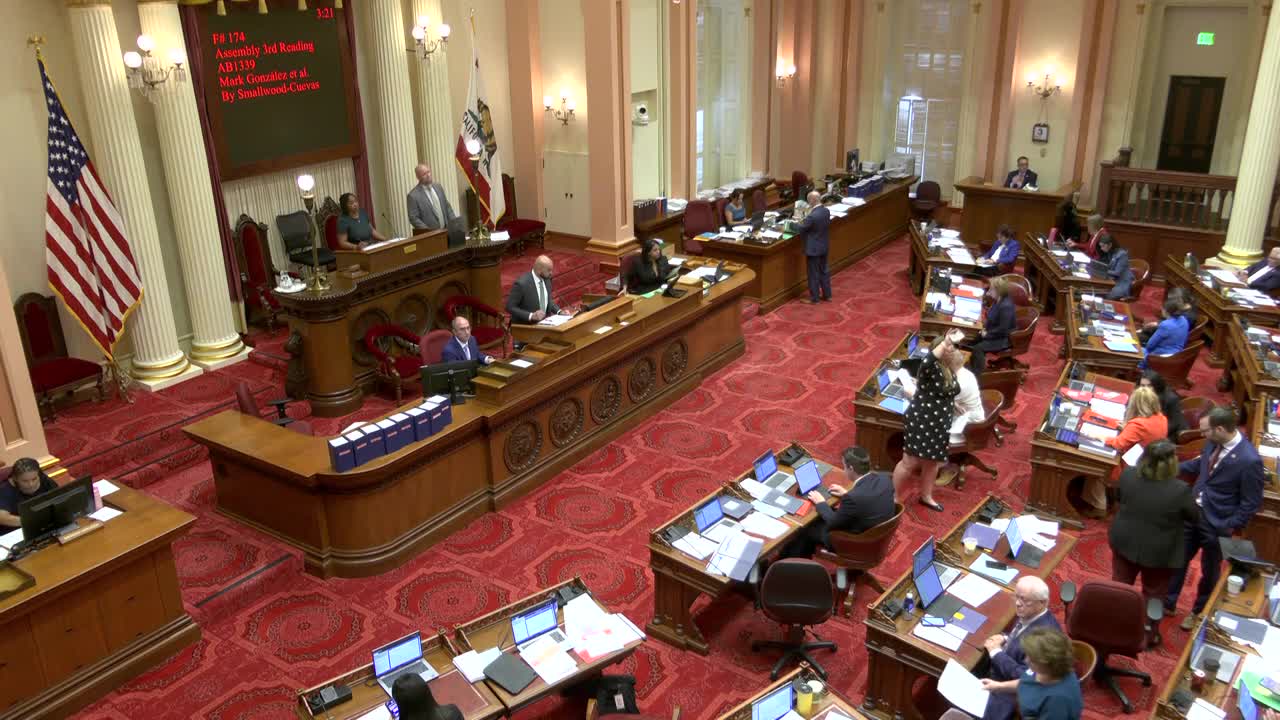 1MIN
Senate Floor
 10MIN
Senate Standing Committee on Transportation
Bill Author

Bill Co-Author(s):