AB 1253: Property taxation: newly constructed property: reconstruction of damaged or destroyed property.
- Session Year: 2025-2026
- House: Assembly
- Latest Version Date: 2025-05-05
Current Status:
Failed
(2026-02-02: From committee: Filed with the Chief Clerk pursuant to Joint Rule 56.)
Introduced
In Committee
Awaiting First Chamber Vote
Passed First Chamber
In Committee
Awaiting Second Chamber Vote
Passed Second Chamber
Enacted
The California Constitution generally limits ad valorem taxes on real property to 1% of the full cash value of that property. For purposes of this limitation, full cash value is defined as the assessors valuation of real property as shown on the 197576 tax bill under full cash value or, thereafter, the appraised value of that real property when purchased, newly constructed, or a change in ownership has occurred. Existing law defines newly constructed and new construction to mean any addition to real property since the last lien date and any alteration of land or of any improvement since the last lien date that constitutes a major rehabilitation thereof or that converts the property to a different use. Existing law, where real property has been damaged or destroyed by misfortune or calamity, excludes from the definition of newly constructed and new construction any timely reconstruction of the real property, or portion thereof, where the property after reconstruction is substantially equivalent to the property prior to damage or destruction.
This bill would authorize an assessor, in the case where state or local government action mandates a suspension or modification of rebuild development standards, and subject to specified law, to align the assessment of substantial equivalence with the requirements and criteria set forth by the government for reconstruction of property damaged by the 2025 fire disasters in Palisades, Eaton, Hurst, Lidia, Sunset, or Woodley, as provided.
The California Constitution generally limits ad valorem taxes on real property to 1% of the full cash value of that property. For purposes of this limitation, full cash value is defined as the assessors valuation of real property as shown on the 197576 tax bill under full cash value or, thereafter, the appraised value of that real property when purchased, newly constructed, or a change in ownership has occurred. Existing law defines newly constructed and new construction to mean any addition to real property since the last lien date and any alteration of land or of any improvement since the last lien date that constitutes a major rehabilitation thereof or that converts the property to a different use. Existing law, where real property has been damaged or destroyed by misfortune or calamity, excludes from the definition of newly constructed and new construction any timely reconstruction of the real property, or portion thereof, where the property after reconstruction is substantially equivalent to the property prior to damage or destruction.
This bill would authorize an assessor, in the case where state or local government action mandates a suspension or modification of rebuild development standards, to align the assessment of substantial equivalence with the requirements and criteria set forth by the government for reconstruction of property damaged by the 2025 fire disasters in Palisades, Eaton, Hurst, Lidia, Sunset, or Woodley, as provided.
Existing law, the Home Furnishings and Thermal Insulation Act, requires the Bureau of Household Goods and Services to exercise specified licensing, regulatory, and disciplinary functions with regard to retailers, wholesalers, importers, manufacturers, renovators, and suppliers of upholstered furniture, bedding, and filling materials sold in California, as specified. Existing law authorizes the bureau to, among other things, fix the annual fee for an insulation manufacturing license in an amount that is not less than $1,850 but not more than $2,500.This bill would, instead, set the maximum amount of the fee to be fixed by the bureau at $2,600.Existing law, the Home Furnishings and Thermal Insulation Act, requires the Bureau of Household Goods and Services to exercise specified licensing, regulatory, and disciplinary functions with regard to retailers, wholesalers, importers, manufacturers, renovators, and suppliers of upholstered furniture, bedding, and filling materials sold in California, as specified. Existing law authorizes the bureau to, among other things, fix the annual fee for an insulation manufacturing license in an amount that is not less than $1,850 but not more than $2,500.
This bill would, instead, set the maximum amount of the fee to be fixed by the bureau at $2,600.
(a)Newly constructed and new construction means:
(1)Any addition to real property, whether land or improvements, including fixtures, since the last lien date; and
(2)Any alteration of land or of any improvement, including fixtures, since the last lien date that constitutes a major rehabilitation thereof or that converts the property to a different use.
(b)Any rehabilitation, renovation, or modernization that converts an improvement or fixture to the substantial equivalent of a new improvement or fixture is a major rehabilitation of that improvement or fixture.
(c)(1)Notwithstanding subdivisions (a) and (b), where real property has been damaged or destroyed by misfortune or calamity, newly constructed and new construction does not mean any timely reconstruction of the real property, or portion thereof, where the property after reconstruction is substantially equivalent to the property prior to damage or destruction. Any reconstruction of real property, or portion thereof, that is not substantially equivalent to the damaged or destroyed property, shall be deemed to be new construction and only that portion that exceeds substantially equivalent reconstruction shall have a new base year value determined pursuant to Section 110.1.
(2)In the case where state or local government action mandates a suspension or modification of rebuild development standards, the assessor may may, subject to the provisions of subdivision (b) of Section 70.5, align the assessment of substantial equivalence with the requirements and criteria set forth by the government for reconstruction, provided that these standards are designed to expedite the rebuilding of property damaged by the 2025 fire disasters in Palisades, Eaton, Hurst, Lidia, Sunset, or Woodley, as proclaimed by the Governor.
(d)(1)Notwithstanding subdivisions (a) and (b), where a tank must be improved, upgraded, or replaced to comply with federal, state, and local regulations on underground storage tanks, newly constructed and new construction does not mean the improvement, upgrade, or replacement of a tank to meet compliance standards, and the improvement, upgrade, or replacement shall be considered to have been performed for the purpose of normal maintenance and repair.
(2)Notwithstanding subdivisions (a) and (b), where a structure, or any portion thereof, was reconstructed, as a consequence of completing work on an underground storage tank to comply with federal, state, and local regulations on these tanks, timely reconstruction of the structure shall be considered to have been performed for the purpose of normal maintenance and repair where the structure, or portion thereof, after reconstruction is substantially equivalent to the prior structure in size, utility, and function.
(a)Newly constructed and new construction means:
(1)Any addition to real property, whether land or improvements, including fixtures, since the last lien date; and
(2)Any alteration of land or of any improvement, including fixtures, since the last lien date that constitutes a major rehabilitation thereof or that converts the property to a different use.
(b)Any rehabilitation, renovation, or modernization that converts an improvement or fixture to the substantial equivalent of a new improvement or fixture is a major rehabilitation of that improvement or fixture.
(c)(1)Notwithstanding subdivisions (a) and (b), where real property has been damaged or destroyed by misfortune or calamity, newly constructed and new construction does not mean any timely reconstruction of the real property, or portion thereof, where the property after reconstruction is substantially equivalent to the property prior to damage or destruction. Any reconstruction of real property, or portion thereof, that is not substantially equivalent to the damaged or destroyed property, shall be deemed to be new construction and only that portion that exceeds substantially equivalent reconstruction shall have a new base year value determined pursuant to Section 110.1.
(2)In the case where state or local government action mandates a suspension or modification of rebuild development standards, the assessor may align the assessment of substantial equivalence with the requirements and criteria set forth by the government for reconstruction, provided that these standards are designed to expedite the rebuilding of property damaged by the 2025 fire disasters in Palisades, Eaton, Hurst, Lidia, Sunset, or Woodley, as proclaimed by the Governor.
(d)(1)Notwithstanding subdivisions (a) and (b), where a tank must be improved, upgraded, or replaced to comply with federal, state, and local regulations on underground storage tanks, newly constructed and new construction does not mean the improvement, upgrade, or replacement of a tank to meet compliance standards, and the improvement, upgrade, or replacement shall be considered to have been performed for the purpose of normal maintenance and repair.
(2)Notwithstanding subdivisions (a) and (b), where a structure, or any portion thereof, was reconstructed, as a consequence of completing work on an underground storage tank to comply with federal, state, and local regulations on these tanks, timely reconstruction of the structure shall be considered to have been performed for the purpose of normal maintenance and repair where the structure, or portion thereof, after reconstruction is substantially equivalent to the prior structure in size, utility, and function.
SECTION 1.Section 19170.3 of the Business and Professions Code is amended to read:19170.3.The annual fee for an insulation manufacturing license shall be fixed by the bureau in an amount not less than one thousand eight hundred fifty dollars ($1,850) but not more than two thousand six hundred dollars ($2,600).The annual fee for an insulation manufacturing license shall be fixed by the bureau in an amount not less than one thousand eight hundred fifty dollars ($1,850) but not more than two thousand five hundred dollars ($2,500). six hundred dollars ($2,600).
|
Date
|
Status
|
|---|---|
| Feb 2, 2026 | From committee: Filed with the Chief Clerk pursuant to Joint Rule 56. |
| Jan 31, 2026 | Died pursuant to Art. IV, Sec. 10(c) of the Constitution. |
| May 23, 2025 | In committee: Held under submission. |
| May 21, 2025 | Joint Rule 62(a), file notice suspended. (Page 1627.) |
| May 21, 2025 | In committee: Set, first hearing. Referred to APPR. suspense file. |
| May 14, 2025 | In committee: Hearing postponed by committee. |
| May 6, 2025 | Re-referred to Com. on APPR. |
| May 5, 2025 | Read second time and amended. |
| May 1, 2025 | From committee: Amend, and do pass as amended and re-refer to Com. on APPR. (Ayes 7. Noes 0.) (April 28). |
| Apr 28, 2025 | In committee: Set, first hearing. Referred to REV. & TAX. suspense file. |
| Apr 21, 2025 | Re-referred to Com. on REV. & TAX. pursuant to Assembly Rule 96. |
| Apr 21, 2025 | From committee chair, with author's amendments: Amend, and re-refer to Com. on B. & P. Read second time and amended. |
| Mar 13, 2025 | Referred to Com. on B. & P. |
| Feb 24, 2025 | Read first time. |
| Feb 22, 2025 | From printer. May be heard in committee March 24. |
| Feb 21, 2025 | Introduced. To print. |
|
Date
|
Description
|
Location
|
Votes
|
|
|---|---|---|---|---|
| Apr 28, 2025 | Do pass as amended and be re-referred to the Committee on [Appropriations] | Assembly Standing Committee on Revenue and Taxation |
Passed |
This list shows positions taken on this bill by organizations on the date displayed, which is linked to the original source.
Positions by individuals are not included.
|
Organization
|
Position
|
Date
|
|---|---|---|
| California Assessors' Association | ** Support |
Date of Hearing: May 21, 2025
ASSEMBLY COMMITTEE ON APPROPRIATIONS
Buffy Wicks, Chair
ABPCA Bill Id:AB 1253
Author:(Schultz) – As Amended Ver:May 5, 2025
Policy Committee: | Revenue and Taxation | Vote: | 7 - 0 |
|
| ||
|
|
Urgency: No State Mandated Local Program: No Reimbursable: No
SUMMARY:
This bill authorizes an assessor to align the “substantial equivalence” standard for purposes of assessing new construction after a property has been damaged or destroyed by misfortune or calamity with the reconstruction rules set by the state or local government to expedite the rebuilding of property damaged by the January 2025 Los Angeles-area wildfire disaster.
FISCAL EFFECT:
- Ongoing property tax revenue loss of an unknown, but likely significant amount, in excess of $300,000, by providing that post-fire new construction built pursuant to a state or local government suspension or modification of rebuild development standards will not have a new base year value for property tax assessment purposes. The amount of revenue loss is unquantifiable because this bill does not define or limit what is considered a “suspension or modification of rebuild development standards,” and new rules may still be promulgated for years to come to facilitate disaster recovery. Although property tax is a local government revenue source, reductions in property tax revenues increase Proposition 98 General Fund spending by up to roughly 50% (the exact amount depends on the specific amount of the annual Proposition 98 guarantee).
- Costs of an unknown amount to the Board of Equalization to revise informational materials, issue guidance, and ensure consistent application of the alignment across counties (GF).
COMMENTS:
- Purpose. According to the author:
Many city, county, and state planning agencies have authorized expedited reconstruction permits, allowing property owners to rebuild up to 110% of their prior structure. These efforts are aimed at accelerating recovery and providing flexibility to homeowners in crisis…Unfortunately, many local agencies and officials – often unknowingly – have misinformed homeowners, suggesting that rebuilding up to 110% or more would not affect their property tax base. As a result, numerous homeowners, acting in good faith, may rebuild beyond allowable limits and face unexpected reassessments and supplemental tax bills. These financial shocks add to the emotional and economic hardship already experienced by those recovering from disaster.
This bill is supported by the California Assessors’ Association, Howard Jarvis Taxpayers Association, and a local elected official.
- Background. Property Tax Relief for Damaged or Destroyed Property. Existing law authorizes two types of relief when property is suddenly damaged or destroyed, without fault of the property owner, and subsequently rebuilt on the same site. First, existing law excludes a property damaged or destroyed by a misfortune or calamity that is timely rebuilt in a “substantially equivalent” manner from the definition of “new construction,” thus excluding the rebuilt property from being reassessed at fair market value. However, existing law and the Assessors’ Handbook do not define “substantially equivalent” nor provide a time frame in which the property must be rebuilt. As a result, an assessor has wide authority in applying this provision of property tax relief.
Second, existing law authorizes a base year value transfer for reconstructed property damaged or destroyed by a Governor-proclaimed disaster. Reconstruction must occur within five years of the damage or destruction, at no more than 120% of the full cash value of the original property. Thus, the reconstructed value of the property exceeding 120% of the full cash value is subject to reassessment as new construction.
Executive Order (EO) N-4-25. In response to the January 2025 Los Angeles-area wildfire disaster, Governor Newsom issued a series of EOs to provide relief to fire victims. EO N-4-25 ordered the suspense of certain laws, including the California Environmental Quality Act and permitting requirements under the California Coastal Act, when a homeowner rebuilds on the same site as property damaged or destroyed in the fire. However, the suspension applies only to property reconstructed within 110% of the footprint and height of the damaged or destroyed property.
This bill authorizes an assessor to align the “substantial equivalence” standard for purposes of assessing new construction after a property has been damaged or destroyed by misfortune or calamity with the reconstruction rules set by the state or local government to expedite the rebuilding of property damaged by the January 2025 Los Angeles-area wildfire disaster. This bill limits the alignment to 120% of the full cash value of the original property. Thus, under this bill, if a property owner reconstructs their home to 110% of the original footprint and height, pursuant to EO N-4-25, the property would not be subject to reassessment if the value of the rebuild is within 120% of the full cash value of the original property. However, this bill applies broadly to any current or future post-fire reconstruction rule set by the state or local government, not just EO N-4-24.
- Related Legislation. AB 245 (Gipson) extends, by three years, the existing five-year deadline to rebuild qualified property damaged or destroyed by the January 2025 Los Angeles-area wildfire disaster while retaining the original property’s base-year value. AB 245 is pending hearing by this committee.
Analysis Prepared by: Irene Ho / APPR. / (916) 319-2081
Date of Hearing: April 28, 2025
ASSEMBLY COMMITTEE ON REVENUE AND TAXATION
Mike Gipson, Chair
ABPCA Bill Id:AB 1253 (
Author:Schultz) – As Amended Ver:April 21, 2025
Majority vote. Fiscal committee.
SUBJECT: Property taxation: newly constructed property: reconstruction of damaged or destroyed property
SUMMARY: Authorizes an assessor to align the assessment of "substantial equivalence" with suspensions or modifications of rebuild development standards, if the modifications or suspensions are designed to expedite the rebuilding of property damaged by the 2025 fire disasters in Palisades, Eaton, Hurst, Lidia, Sunset, or Woodley, as proclaimed by the Governor.
EXISTING LAW:
- Provides that all property is taxable unless otherwise provided by the California Constitution or the laws of the United States. (California Constitution, Article XIII, Section 1.)
- Limits the maximum amount of ad valorem property taxation to 1% of the full cash value of the property. Generally, the Constitution restricts the full cash value of a property to the assessed value upon a change of ownership in, or new construction on, the property. This is referred to as the base year value, which may be adjusted upwards for inflation at no more than 2% annually. (California Constitution, Article XIIIA, Sections 1 and 2.)
- Excludes from the definition of "newly constructed" real property that is reconstructed after a disaster declared by the Governor, where the fair market value of the reconstructed real property is comparable to its fair market value prior to the disaster. (California Constitution, Article XIIIA, Section 2.) Property owners have a five-year period during which they may reconstruct a damaged or destroyed property on the same site and retain the base year value of their property, subject to valuation limitations. (Revenue & Taxation Code Section (R&TC) Section 70.5.) Statutory provisions authorize an exclusion from the definition of "new construction" for property that is damaged or destroyed by misfortune or calamity, if the property is rebuilt in a substantially equivalent manner. (R&TC Section 70.)
FISCAL EFFECT: Pending an estimate by the State Board of Equalization.
COMMENTS:
- The author has submitted the following statement in support of this bill:
In the aftermath of the unprecedented wildfires that have ravaged our state, state and local governments have taken commendable steps to support disaster recovery. Many city, county, and state planning agencies have authorized expedited reconstruction permits, allowing property owners to rebuild up to 110% of their prior structure. These efforts are aimed at accelerating recovery and providing flexibility to homeowners in crisis.
However, while these policies are well-intentioned, they are not aligned with existing property tax assessment practices as established by the California Constitution and the Revenue and Taxation Code. Under current law, for property tax purposes, any reconstruction that exceeds “substantial equivalence” to the original structure is considered new construction and is subject to reassessment.
Unfortunately, many local agencies and officials – often unknowingly – have misinformed homeowners, suggesting that rebuilding up to 110% or more would not affect their property tax base. As a result, numerous homeowners, acting in good faith, may rebuild beyond allowable limits and face unexpected reassessments and supplemental tax bills. These financial shocks add to the emotional and economic hardship already experienced by those recovering from disaster.
AB 1253 addresses this gap by clarifying the distinction between local planning approvals and property tax assessment rules. It seeks to ensure consistent communication to property owners and prevent the unintended consequences of reassessment for those who are simply trying to rebuild their homes and their lives. By aligning recovery policy with assessment law, AB 1253 protects homeowners from further financial harm during one of the most vulnerable times in their lives.
- The California Assessors' Association, writing in support of this bill, states, in part:
For assessment purposes, reconstruction beyond a standard of "substantial equivalence" is considered new construction and subject to reassessment – even if local building codes permit greater allowances. Unfortunately, numerous local agencies and officials have inadvertently misinformed property owners, suggesting that rebuilding up to 110% or more would not affect their property tax base. As a result, many homeowners – acting in good faith – are likely to rebuild beyond allowable assessment thresholds and face unexpected reassessments and supplemental tax bills. Further compounding the financial and emotional toll of disaster recovery.
AB 1253 will resolve this disconnect by temporarily aligning property tax assessment standards with the emergency building allowances granted under state and local government mandate. It will allow Assessors, under clearly defined and limited conditions, to accept rebuilding up to 110% of the original structure without triggering reassessment – bringing much-needed clarity and fairness to impacted property owners.
- Committee Staff Comments:
- 2025 Los Angeles (LA) Fires: Beginning in early January 2025, a series of fires began raging in LA County. Exacerbated by hurricane force gusts and drought conditions, these fires rapidly grew, expanding into outlying residential areas of the LA metropolitan area. As the month progressed, the conditions exacerbating these fires led to serious complications for first responders, and the conflagrations grew without containment. After containment of these fires, however, the true depth of destruction began to become clear. According to the University of California, LA, Anderson Forecast, total property and capital losses could range from $76 billion to $131 billion, with a potential decline in county-level gross domestic product of $4.6 billion. This loss from fire is unprecedented in the state. By comparison, the Camp Fire that destroyed the town of Paradise and was the most destructive fire in the state is estimated to have an associated loss of around $17 billion, an order of magnitude less than the 2025 LA Fires.
- Governor Executive Order (EO) N-4-25: In response to the 2025 LA Fires, the Governor issued a series of EOs to provide relief to victims. Among these orders, the Governor ordered the suspension of certain laws, including the California Environmental Quality Act (Public Resources Code Section 21000 et seq.) and permitting requirements under the California Coastal Act (Public Resources Code Section 30000 et seq.), when rebuilding on the same site property damaged or destroyed by the 2025 LA Fires. To qualify for this suspension, however, the property must not be reconstructed beyond 110% of the footprint and height of the damaged or destroyed property.
- Existing property tax relief when rebuilding damaged or destroyed property: Existing law authorizes two types of relief when property is suddenly damaged or destroyed, without fault by the property owner, and is subsequently rebuilt on the same site. The first type excludes from the definition of "new construction" a property damaged or destroyed by a misfortune or calamity that is timely rebuilt in a substantially equivalent manner as the property prior to the misfortune or calamity. In other words, statutory provisions allow an assessor to not reassess the value of a rebuilt property if it is substantially equivalent to the property before it was damaged or destroyed. Existing law does not define "substantially equivalent", nor does existing law provide a time frame in which the property owner must rebuild their property. Assessors' Handbook (AH) Section 410 emphasizes the statutory requirement that any portion of reconstructed real property that exceeds substantial equivalency to the damaged or destroyed property must be reassessed to its fair market value. The AH, however, does not expand on the scope of substantial equivalence, nor an eligible time frame in which to rebuild. Thus, an assessor has wide authority in applying this provision of property tax relief.
The second type authorizes a base year value transfer for property damaged or destroyed by a Governor-proclaimed disaster. This authorization is narrower than the previous. Here, the property must be damaged by a Governor-proclaimed disaster, rather than a general misfortune or calamity. Reconstruction must occur within five years and at no more than 120% of the full cash value of the property before its damage or destruction. The reconstructed value of the property exceeding 120% is subject to taxation. While the size and value of a property are inexorably linked, assessors are tasked with assessing the fair market value of a property, as specified. Thus, the final metric by which property tax law generally evaluates changes to property is its value.
- The problem: EO N-4-25 has caused confusion as to what extent the order authorized flexibility in rebuilding. Some local agencies responsible for the myriad efforts of recovery misconstrued the order, and advised property owners that they may reconstruct their property pursuant to the order without causing a property tax increase. The LA County Assessor is circulating information to taxpayers to clarify this confusion; however, this information may be difficult for some property owners to receive as they may not be residing, or have access to, the address on file with the Assessor post-disaster. Thus, to address this concern, the LA County Assessor seeks flexibility in aligning assessment practices with building standards and permitting requirements after the 2025 LA Fires.
- Value consideration: As noted previously, property tax law generally relies on the fair market value of a property to derive its base year value. Size is a crucial factor in determining fair market value, but size alone very rarely determines fair market value in its entirety. The damage caused by the 2025 LA Fires was unprecedented in this state, and the goal of providing relief and flexibility to property owners after this catastrophe is laudable. As currently drafted, however, this bill could be overly broad in the flexibility it provides. To ensure savvy and resourced property owners do not leverage this authorization to rebuild within the bounds of EO N-4-25, but well beyond the bounds of the existing value test, the Committee may wish to consider tying relief under this bill to the existing base year value transfer test after a Governor-proclaimed disaster.
REGISTERED SUPPORT / OPPOSITION:
Support
California Assessors' Association
Opposition
None on file
Analysis Prepared by: Harrison Bowlby / REV. & TAX. / (916) 319-2098
Discussed in Hearing
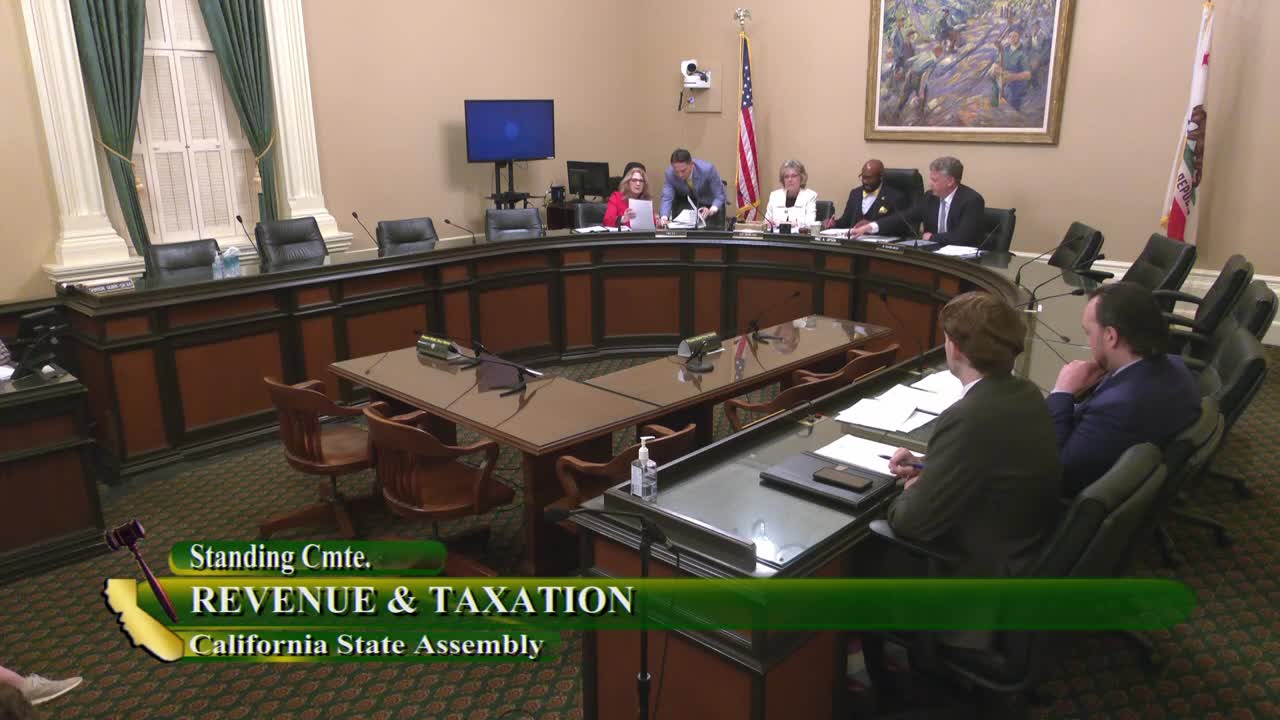 5MIN
Assembly Standing Committee on Revenue and Taxation
Bill Author

Bill Co-Author(s):