AB 13: Public Utilities Commission: membership: reports.
- Session Year: 2025-2026
- House: Assembly
- Latest Version Date: 2025-07-17
Current Status:
In Progress
(2025-08-29: In committee: Held under submission.)
Introduced
In Committee
Awaiting First Chamber Vote
Passed First Chamber
In Committee
Awaiting Second Chamber Vote
Passed Second Chamber
Enacted
The California Constitution establishes the Public Utilities Commission consisting of 5 members appointed by the Governor and approved by the Senate.
This bill would require that 4 members of the commission represent the geographic locations of the 4 State Board of Equalization districts, existing as of January 1, 2026, and one member be an at-large member with expertise in nongovernmental public advocacy or public interest law and with a nongovernmental background, as specified. The bill would require the Governor, in selecting, and the Senate, in confirming, members of the commission to consider regional diversity in the membership of the commission. The bill would require the Governor, in appointing a candidate for membership in the commission, to consider using a candidate pool that comprises persons with permanent residences in certain regions of the state, as specified.
Existing law requires the president of the commission to appear annually before the appropriate policy committees of the Senate and the Assembly to present certain information. Existing law authorizes the commission to fix the rates and charges for public utilities, and requires that those rates and charges be just and reasonable.
This bill would require the president of the commission, at the annual appearance before those committees, to also present information related to rates affordability and ratesetting cases decided by, or pending before, the commission.
Existing law requires the commission to report annually to the Legislature on the timeliness in resolving cases, including the number of orders issued extending the statutory deadline.
This bill would specify that the above information includes the number of cases in which the commission failed to issue a decision within the statutory deadline. The bill would require the commission, within 15 days of adopting a final decision on a ratesetting case, to submit to the Legislature a report containing certain information regarding the ratesetting case.
The California Constitution establishes the Public Utilities Commission consisting of 5 members appointed by the Governor and approved by the Senate. Existing law prohibits an executive of a public utility from serving as a member of the commission within 2 years after leaving the employment of the public utility.
This bill would require that 4 members of the commission represent the geographic locations of the 4 State Board of Equalization districts, existing as of January 1, 2026, and one member be an at-large member with expertise in nongovernmental public advocacy or public interest law and with a nongovernmental background, as specified. The bill would prohibit an elected member of, or an employee of, the Legislature or an employee of the executive branch from serving as a member of the commission within one year after leaving the position as an elected member or employee.
This bill would authorize each house of the Legislature to appoint a liaison officer to appear in proceedings before the commission, as provided.Existing law requires the president of the commission to appear annually before the appropriate policy committees of the Senate and the Assembly to present certain information. Existing law authorizes the commission to fix the rates and charges for public utilities, and requires that those rates and charges be just and reasonable.
This bill would require the president of the commission to appear annually commission, at the annual appearance before those committees to committees, to also present information related to rates affordability and ratesetting cases decided by, or pending before, the commission.
Existing law requires the commission to report annually to the Legislature on the timeliness in resolving cases, including the number of orders issued extending the statutory deadline.
This bill would specify that the above information includes the number of cases in which the commission failed to issue a decision within the statutory deadline. The bill would require the commission, within 15 days of adopting a final decision on a ratesetting case, to submit to the Legislature a report containing certain information regarding the ratesetting case.
The California Constitution establishes the Public Utilities Commission consisting of 5 members appointed by the Governor and approved by the Senate. Existing law prohibits an executive of a public utility from serving as a member of the commission within 2 years after leaving the employment of the public utility.
This bill would require that 4 members of the commission represent the geographic locations of the 4 State Board of Equalization districts, existing as of January 1, 2026, and one member be an at-large member with unspecified qualifications, expertise in nongovernmental public advocacy or public interest law and with a nongovernmental background, as specified. The bill would prohibit an elected member of, or an employee of, the Legislature or an employee of the executive branch from serving as a member of the commission within one year after leaving the position as an elected member or employee.
This bill would authorize each houses house of the Legislature to appoint a liaison officer to appear in proceedings before the commission, as provided.
Existing law requires the president of the commission to appear annually before the appropriate policy committees of the Senate and the Assembly to present certain information. Existing law authorizes the commission to fix the rates and charges for public utilities, and requires that those rates and charges be just and reasonable.
This bill would require the president of the commission to appear annually before those committees to present information related to rates affordability and ratesetting cases decided by, or pending before, the commission.
Existing law requires the commission to report annually to the Legislature on the timeliness in resolving cases, including the number of orders issued extending the statutory deadline.
This bill would specify that the above information includes the number of ratesetting cases in which the commission failed to issue a decision within the statutory deadline. The bill would require the commission, within 15 days of adopting a final decision on a ratesetting case, to submit to the Legislature a report containing certain information regarding the ratesetting case.
The California Constitution establishes the Public Utilities Commission consisting of 5 members appointed by the Governor and approved by the Senate. Existing law prohibits an executive of a public utility from serving as a member of the commission within 2 years after leaving the employment of the public utility.
This bill would require that 4 members of the commission represent the geographic locations of the 4 State Board of Equalization districts, existing as of January 1, 2026, and one member be an at-large member with unspecified qualifications, as specified. The bill would prohibit an elected member of, or an employee of, the Legislature or an employee of the executive branch from serving as a member of the commission within one year after leaving the position as an elected member or employee.
This bill would authorize each houses of the Legislature to appoint a liaison officer to appear in proceedings before the commission, as provided.
Existing law requires the president of the commission to appear annually before the appropriate policy committees of the Senate and the Assembly to present certain information. Existing law authorizes the commission to fix the rates and charges for public utilities, and requires that those rates and charges be just and reasonable.
This bill would require the president of the commission to appear annually before those committees to present information related to rates affordability and ratesetting cases decided by, or pending before, the commission.
Existing law requires the commission to report annually to the Legislature on the timeliness in resolving cases, including the number of orders issued extending the statutory deadline.
This bill would specify that the above information includes the number of ratesetting cases in which the commission failed to issue a decision within the statutory deadline. The bill would require the commission, within 15 days of adopting a final decision on a ratesetting case, to submit to the Legislature a report containing certain information regarding the ratesetting case.
Existing law vests the Public Utilities Commission with regulatory authority over public utilities, including electrical corporations and gas corporations. Existing law requires the commission to annually prepare a written report on the costs of programs and activities conducted by certain electrical corporations and gas corporations. Existing law requires the report to identify specified information, including, among other information, each program mandated by statute or by the commission and its annual cost to ratepayers. Existing law requires the commission to complete the report on an annual basis before April 1 of each year, and to submit the report to the Governor and the Legislature on an annual basis no later than April 1 of each year.This bill would require the commission to instead complete and submit the above-described report on a biannual basis.Existing law vests the Public Utilities Commission with regulatory authority over public utilities, including electrical corporations and gas corporations. Existing law requires the commission to annually prepare a written report on the costs of programs and activities conducted by certain electrical corporations and gas corporations. Existing law requires the report to identify specified information, including, among other information, each program mandated by statute or by the commission and its annual cost to ratepayers. Existing law requires the commission to complete the report on an annual basis before April 1 of each year, and to submit the report to the Governor and the Legislature on an annual basis no later than April 1 of each year.
This bill would require the commission to instead complete and submit the above-described report on a biannual basis.
(a)The membership of the Public Utilities Commission, and the qualifications and tenure of the members of the commission are as provided in Section 1 of Article XII of the California Constitution.
(b)(1)In addition to subdivision (a) and except as provided in paragraph (2), the membership of the commission shall be as follows: include, at minimum, one at-large member who shall have expertise in nongovernmental public advocacy or public interest law and a nongovernmental background in consumer advocacy, consumer protection, or advocating for residents, especially vulnerable groups.
(A)Four members, each of which represents a different geographic location consistent with the geographic locations of the four State Board of Equalization districts existing as of January 1, 2026.(B)One at-large member who shall have expertise in nongovernmental public advocacy or public interest law and a nongovernmental background in consumer advocacy, consumer protection, or advocating for residents, especially vulnerable groups.(2)Notwithstanding paragraph (1), a member of the commission whose term of office has not expired on January 1, 2026, shall remain a member until the term expires or the member resigns.
(3)On and after January 1, 2026, upon the expiration of the term of office of, the resignation of, or the removal of, a member of the commission, the Governor shall appoint a person to the commission consistent with paragraph (1). The Governor shall specify whether the appointment is made to meet the requirement of subparagraph (A) of, or subparagraph (B) of, paragraph (1).
(c)In selecting and confirming members of the commission, the Governor and the Senate shall consider achieving regional diversity in the membership of the commission. In appointing a candidate for membership in the commission, the Governor shall consider using a candidate pool that comprises at least one person with a permanent residence in northern California, at least one person with a permanent residence in the Central Valley, and at least one person with a permanent residence in southern California.
SEC. 2.Section 321.6 of the Public Utilities Code is amended to read:321.6.The president of the commission shall annually appear before the appropriate policy committees of the Senate and Assembly to present on all of the following:
(a)The annual report of the commission required pursuant to Section 910.
(b)Rate affordability.
(c)Decisions on ratesetting cases made since the previous appearance.
(d)Ratesetting cases pending before the commission.
SEC. 3.Section 910.1 of the Public Utilities Code is amended to read:910.1.The commission shall annually submit a report to the Legislature on the commissions timeliness in resolving cases, including the number of cases in which the commission failed to issue a decision within the statutory deadline with each type of case delineated, information on the disposition of applications for rehearings, and the days that commissioners presided in hearings. The report shall include the number of scoping memos issued in each proceeding and the number of orders issued extending the statutory deadlines pursuant to subdivision (e) of Section 1701.2, for all adjudication cases, and pursuant to subdivision (a) of Section 1701.5, for all ratesetting or quasi-legislative cases.
SEC. 4.Section 910.10 is added to the Public Utilities Code, to read:910.10.Within 15 days of the adoption of a final decision in a ratesetting case, the commission shall submit to the Legislature a report that contains all of the following information:
(a)The public utility affected by the decision.
(b)Summaries of the evidence provided by the public utility in justifying any increase in rates.
(c)A summary of the commissions rationale in support of its final decision.
(d)A tally of the number of rate increases approved by the commission for the public utility for the 10 years preceding the date of the final decision.
(a)The membership of the Public Utilities Commission, and the qualifications and tenure of the members of the commission are as provided in Section 1 of Article XII of the California Constitution.
(b)(1)In addition to subdivision (a) and except as provided in paragraph (2), the membership of the commission shall be as follows:
(A)Four members, each of which representing represents a different geographic location consistent with the geographic locations of the four State Board of Equalization districts existing as of January 1, 2026.
(B)One at-large member who shall have expertise in nongovernmental public advocacy or public interest law and with a nongovernmental background in consumer advocacy, consumer protection, or advocating for residents, especially vulnerable groups.
(2)Notwithstanding paragraph (1), a member of the commission whose term of office has not expired on January 1, 2026, shall remain a member until the term expires or the member resigns.
(3)On and after January 1, 2026, upon the expiration of the term of office of, the resignation of, or the removal of, a member of the commission, the Governor shall appoint a person to the commission consistent with paragraph (1). The Governor shall specify whether the appointment is made to meet the requirement of subparagraph (A) of, or subparagraph (B) of, paragraph (1).
SEC. 3.Section 303 of the Public Utilities Code is amended to read:303.(a)A member of the commission shall not hold an official relation to, nor have a financial interest in, a person or corporation subject to regulation by the commission. If a member of the commission acquires a financial interest in a corporation or person subject to regulation by the commission other than voluntarily, the members office shall become vacant unless within a reasonable time the member divests the members interest.(b)(1)An executive of a public utility shall not serve as a member of the commission within two years after leaving the employment of the utility.(2)Except as provided in paragraph (2) of subdivision (b) of Section 301, an elected member or employee of the Legislature or an employee of the executive branch shall not serve as a member of the commission within one year after leaving the position as an elected member or employee of the Legislature or an employee of the executive branch.(c)The commission shall maintain an updated Conflict of Interest Code and Statement of Incompatible Activities in a manner consistent with applicable law.SEC. 4.Section 321.7 is added to the Public Utilities Code, to read:321.7.(a)The president of the commission shall annually appear before the appropriate policy committees of the Senate and the Assembly to present on all of the following:(1)Rate affordability.(2)Decisions on ratesetting cases made within the period preceding the appearance.(3)Pending ratesetting cases before the commission.(b)The appearance required by subdivision (a) shall be in addition to, and separate from, the appearance required by Section 321.6.SEC. 2.Section 321.6 of the Public Utilities Code is amended to read:321.6.The president of the commission shall annually appear before the appropriate policy committees of the Senate and Assembly to present the on all of the following:
(a)The annual report of the commission required pursuant to Section 910.
(b)Rate affordability.
(c)Decisions on ratesetting cases made since the previous appearance.
(d)Ratesetting cases pending before the commission.
SEC. 5.SEC. 3.Section 910.1 of the Public Utilities Code is amended to read:910.1.The commission shall annually submit a report to the Legislature on the commissions timeliness in resolving cases, including the number of cases in which the commission failed to issue a decision within the statutory deadline with each type of case delineated, information on the disposition of applications for rehearings, and the days that commissioners presided in hearings. The report shall include the number of scoping memos issued in each proceeding and the number of orders issued extending the statutory deadlines pursuant to subdivision (e) of Section 1701.2, for all adjudication cases, and pursuant to subdivision (a) of Section 1701.5, for all ratesetting or quasi-legislative cases.
SEC. 6.SEC. 4.Section 910.10 is added to the Public Utilities Code, to read:910.10.Within 15 days of the adoption of a final decision in a ratesetting case, the commission shall submit to the Legislature a report that contains all of the following information:
(a)The public utility affected by the decision.
(b)Summaries of the evidence provided by the public utility in justifying any increase in rates.
(c)A summary of the commissions rationale in support of its final decision.
(d)A tally of the number of rate increases approved by the commission for the public utility for the 10 years preceding the date of the final decision.
(a)Each houses house of the Legislature may appoint a liaison officer to appear in proceedings before the commission.
(b)(1)The liaison office officer for the Assembly shall be appointed by the Speaker of the Assembly.
(2)The liaison officer for the Senate shall be appointed by the Senate Committee on Rules.
SEC. 2.Section 301 of the Public Utilities Code is amended to read:301.(a)The membership of the Public Utilities Commission, and the qualifications and tenure of the members of the commission are as provided in Section 1 of Article XII of the California Constitution.
(b)(1)In addition to subdivision (a) and except as provided in paragraph (2), the membership of the commission shall be as follows:
(A)Four members, each of which representing a different geographic location consistent with the geographic locations of the four State Board of Equalization districts existing as of January 1, 2026.
(B)One at-large member who shall have expertise in ____. nongovernmental public advocacy or public interest law and with a nongovernmental background in consumer advocacy, consumer protection, or advocating for residents, especially vulnerable groups.
(2)Notwithstanding paragraph (1), a member of the commission whose term of office has not expired on January 1, 2026, shall remain a member until the term expires or the member resigns.
(3)On and after January 1, 2026, upon the expiration of the term of office of, the resignation of, or the removal of, a member of the commission, the Governor shall appoint a person to the commission consistent with paragraph (1). The Governor shall specify whether the appointment is made to meet the requirement of subparagraph (A) of, or subparagraph (B) of, paragraph (1).
SEC. 3.Section 303 of the Public Utilities Code is amended to read:303.(a)A member of the commission shall not hold an official relation to, nor have a financial interest in, a person or corporation subject to regulation by the commission. If a member of the commission acquires a financial interest in a corporation or person subject to regulation by the commission other than voluntarily, the members office shall become vacant unless within a reasonable time the member divests the members interest.
(b)(1)An executive of a public utility shall not serve as a member of the commission within two years after leaving the employment of the utility.
(2)Except as provided in subdivision (c) paragraph (2) of subdivision (b) of Section 301, an elected member or employee of the Legislature or an employee of the executive branch shall not serve as a member of the commission within one year after leaving the position as an elected member or employee of the Legislature or an employee of the executive branch.
(c)The commission shall maintain an updated Conflict of Interest Code and Statement of Incompatible Activities in a manner consistent with applicable law.
SEC. 4.Section 321.7 is added to the Public Utilities Code, to read:321.7.(a)The president of the commission shall annually appear before the appropriate policy committees of the Senate and the Assembly to present a briefing on all of the following:
(1)Rate affordability.
(2)Decisions on ratesetting cases made within the 12 months period preceding the appearance.
(3)Pending ratesetting cases before the commission that have a reasonable chance of being completed in the 12-month period subsequent to the appearance. commission.
(b)The appearance required by subdivision (a) shall be in addition to, and separate from, the appearance required by Section 321.6.
SEC. 5.Section 910.1 of the Public Utilities Code is amended to read:910.1.The commission shall annually submit a report to the Legislature on the commissions timeliness in resolving cases, including the number of ratesetting cases in which the commission failed to issue a decision within the statutory deadline, deadline with each type of case delineated, information on the disposition of applications for rehearings, and the days that commissioners presided in hearings. The report shall include the number of scoping memos issued in each proceeding and the number of orders issued extending the statutory deadlines pursuant to subdivision (e) of Section 1701.2, for all adjudication cases, and pursuant to subdivision (a) of Section 1701.5, for all ratesetting or quasi-legislative cases.
SEC. 6.Section 910.9 is added to the Public Utilities Code, to read: 910.9. SEC. 6.Section 910.10 is added to the Public Utilities Code, to read:910.10.Within 15 days of the adoption of a final decision in a ratesetting case, the commission shall submit to the Legislature a report that contains all of the following information:
(a)The public utility affected by the decision.
(b)Summaries of the evidence provided by the public utility in justifying any increase in rates.
(c)A summary of the commissions rationale in support of its final decision.
(d)A tally of the number of rate increases approved by the commission for the public utility for the 10 years preceding the date of the final decision.
(a)Each houses of the Legislature may appoint a liaison officer to appear in proceedings before the commission.
(b)(1)The liaison office for the Assembly shall be appointed by the Speaker of the Assembly.
(2)The liaison officer for the Senate shall be appointed by the Senate Committee on Rules.
SEC. 2.Section 301 of the Public Utilities Code is amended to read:301.(a)The membership of the Public Utilities Commission, and the qualifications and tenure of the members of the commission are as provided in Section 1 of Article XII of the Constitution of this state. California Constitution.
(b)(1)In addition to subdivision (a) and except as provided in paragraph (2), the membership of the commission shall be as follows:
(A)Four members, each of which representing a different geographic location consistent with the geographic locations of the four State Board of Equalization districts existing as of January 1, 2026.
(B)One at-large member who shall have expertise in ____.
(2)Notwithstanding paragraph (1), a member of the commission whose term of office has not expired on January 1, 2026, shall remain a member until the term expires or the member resigns.
(3)On and after January 1, 2026, upon the expiration of the term of office of, the resignation of, or the removal of, a member of the commission, the Governor shall appoint a person to the commission consistent with paragraph (1). The Governor shall specify whether the appointment is made to meet the requirement of subparagraph (A) of, or subparagraph (B) of, paragraph (1).
SEC. 3.Section 303 of the Public Utilities Code is amended to read:303.(a)A public utilities commissioner may member of the commission shall not hold an official relation to, nor have a financial interest in, a person or corporation subject to regulation by the commission. If any commissioner a member of the commission acquires a financial interest in a corporation or person subject to regulation by the commission other than voluntarily, his or her the members office shall become vacant unless within a reasonable time he or she the member divests himself or herself of the members interest.
(b)No (1)An executive of a public utility may shall not serve as commissioner a member of the commission within two years after leaving the employment of the utility.
(2)Except as provided in subdivision (c) of Section 301, an elected member or employee of the Legislature or an employee of the executive branch shall not serve as a member of the commission within one year after leaving the position as an elected member or employee of the Legislature or an employee of the executive branch.
(c)The commission shall maintain an updated Conflict of Interest Code and Statement of Incompatible Activities in a manner consistent with applicable law.
SEC. 4.Section 321.7 is added to the Public Utilities Code, to read:321.7.(a)The president of the commission shall annually appear before the appropriate policy committees of the Senate and the Assembly to present a briefing on all of the following:
(1)Rate affordability.
(2)Decisions on ratesetting cases made within the 12 months preceding the appearance.
(3)Pending ratesetting cases before the commission that have a reasonable chance of being completed in the 12-month period subsequent to the appearance.
(b)The appearance required by subdivision (a) shall be in addition to, and separate from, the appearance required by Section 321.6.
SEC. 5.Section 910.1 of the Public Utilities Code is amended to read:910.1.The commission shall annually submit a report to the Legislature on the commissions timeliness in resolving cases, including the number of ratesetting cases in which the commission failed to issue a decision within the statutory deadline, information on the disposition of applications for rehearings, and the days that commissioners presided in hearings. The report shall include the number of scoping memos issued in each proceeding and the number of orders issued extending the statutory deadlines pursuant to subdivision (e) of Section 1701.2, for all adjudication cases, and pursuant to subdivision (a) of Section 1701.5, for all ratesetting or quasi-legislative cases.
SEC. 6.Section 910.9 is added to the Public Utilities Code, to read:910.9.Within 15 days of the adoption of a final decision in a ratesetting case, the commission shall submit to the Legislature a report that contains all of the following information:
(a)The public utility affected by the decision.
(b)Summaries of the evidence provided by the public utility in justifying any increase in rates.
(c)A summary of the commissions rationale in support of its final decision.
(d)A tally of the number of rate increases approved by the commission for the public utility for the 10 years preceding the date of the final decision.
SECTION 1.Section 913 of the Public Utilities Code is amended to read:913.(a)The reporting requirements of this section apply to electrical corporations with at least 1,000,000 retail customers in California and gas corporations with at least 500,000 retail customers in California.(b)The commission shall prepare a written report on the costs of programs and activities conducted by each electrical corporation and gas corporation that is subject to this section, including activities conducted to comply with their duty to serve. The report shall be completed on a biannual basis and shall identify, clearly and concisely, all of the following:(1)Each program mandated by statute and its annual cost to ratepayers.(2)Each program mandated by the commission and its annual cost to ratepayers.(3)Energy purchase contract costs and bond-related costs incurred pursuant to Division 27 (commencing with Section 80000) of the Water Code.(4)All other aggregated categories of costs currently recovered in retail rates as determined by the commission.(c)The report required by subdivision (b) shall be submitted to the Governor and the Legislature on a biannual basis.(d)The commission shall post the report required by subdivision (b) in a conspicuous area of its internet website.(a)The reporting requirements of this section apply to electrical corporations with at least 1,000,000 retail customers in California and gas corporations with at least 500,000 retail customers in California.
(b)The commission shall prepare a written report on the costs of programs and activities conducted by each electrical corporation and gas corporation that is subject to this section, including activities conducted to comply with their duty to serve. The report shall be completed on an annual basis before April 1 of each year, a biannual basis and shall identify, clearly and concisely, all of the following:
(1)Each program mandated by statute and its annual cost to ratepayers.
(2)Each program mandated by the commission and its annual cost to ratepayers.
(3)Energy purchase contract costs and bond-related costs incurred pursuant to Division 27 (commencing with Section 80000) of the Water Code.
(4)All other aggregated categories of costs currently recovered in retail rates as determined by the commission.
(c)The report required by subdivision (b) shall be submitted to the Governor and the Legislature no later than April 1 of each year. on a biannual basis.
(d)The commission shall post the report required by subdivision (b) in a conspicuous area of its Internet Web site. internet website.
|
Date
|
Status
|
|---|---|
| Aug 29, 2025 | In committee: Held under submission. |
| Aug 18, 2025 | In committee: Referred to suspense file. |
| Jul 17, 2025 | Read second time and amended. Re-referred to Com. on APPR. |
| Jul 17, 2025 | From committee: Amend, and do pass as amended and re-refer to Com. on APPR. (Ayes 16. Noes 0.) (July 15). |
| Jun 18, 2025 | Referred to Com. on E., U & C. |
| Jun 4, 2025 | In Senate. Read first time. To Com. on RLS. for assignment. |
| Jun 3, 2025 | Read third time. Passed. Ordered to the Senate. (Ayes 79. Noes 0. Page 1999.) |
| May 27, 2025 | Read second time. Ordered to third reading. |
| May 23, 2025 | Read second time and amended. Ordered returned to second reading. |
| May 23, 2025 | From committee: Amend, and do pass as amended. (Ayes 11. Noes 0.) (May 23). |
| May 23, 2025 | Assembly Rule 63 suspended. (Ayes 51. Noes 16. Page 1644.) |
| Apr 30, 2025 | In committee: Set, first hearing. Referred to suspense file. |
| Mar 27, 2025 | From committee: Do pass and re-refer to Com. on APPR. (Ayes 18. Noes 0.) (March 26). Re-referred to Com. on APPR. |
| Mar 18, 2025 | Re-referred to Com. on U. & E. |
| Mar 17, 2025 | From committee chair, with author's amendments: Amend, and re-refer to Com. on U. & E. Read second time and amended. |
| Feb 25, 2025 | Re-referred to Com. on U. & E. |
| Feb 24, 2025 | From committee chair, with author's amendments: Amend, and re-refer to Com. on U. & E. Read second time and amended. |
| Feb 3, 2025 | Referred to Com. on U. & E. |
| Dec 3, 2024 | From printer. May be heard in committee January 2. |
| Dec 2, 2024 | Read first time. To print. |
|
Date
|
Description
|
Location
|
Votes
|
|
|---|---|---|---|---|
| Aug 18, 2025 | Placed on suspense file | Senate Standing Committee on Appropriations |
Passed |
|
| Jul 15, 2025 | Do pass as amended, but first amend, and re-refer to the Committee on [Appropriations] | Senate Standing Committee on Energy, Utilities and Communications |
Passed |
|
| Jun 3, 2025 | AB 13 Ransom Assembly Third Reading | Assembly Floor |
Passed |
|
| May 23, 2025 | Do pass as amended. | Assembly Standing Committee on Appropriations |
Passed |
|
| Mar 26, 2025 | Do pass and be re-referred to the Committee on [Appropriations] | Assembly Standing Committee on Utilities and Energy |
Passed |
This list shows positions taken on this bill by organizations on the date displayed, which is linked to the original source.
Positions by individuals are not included.
|
Organization
|
Position
|
Date
|
|---|---|---|
| None Reported | ** Against | |
| San Diego Gas & Electric Company | ** Support | |
| San Joaquin County | ** Support | |
| School Energy Coalition | ** Support |
SENATE COMMITTEE ON
Senator Anna Caballero, Chair
2025 - 2026 Regular Session
AB 13 (Ransom) - Public Utilities Commission: membership: reports
Version: | Policy Vote: |
Urgency: | Mandate: |
Hearing Date: | Consultant: |
Bill Summary:
This bill would make changes to the California Public Utilities Commission (CPUC), including requiring specified geographic representation of commissioners and specified reporting to the Legislature concerning utility rate-setting cases at the CPUC.
Fiscal Impact:
- The CPUC estimates ongoing costs of $673,000 in the first year and $528,000 annually thereafter (ratepayer funds) for staff and technical support to post on its website, within 15 days of adoption, a summary of each decision, resolution, or advice letter that changes rates for any class of customers. This requirement would apply across all industries regulated by CPUC—including electric, gas, water, and telecommunications—and would cover formal decisions, resolutions, and certain advice letters.
Background:
The CPUC began as the California Railroad Commission in the late 1870s, following the completion of the transcontinental railroad. Public backlash against the influence of the railroad on lawmakers, especially the Southern Pacific Railroad, led to reforms of state government as part of the Progressive Movement in the early 1900s. Among the reforms, a reconfigured version of the California Railroad Commission was created in 1911, along with the passage of the Public Utilities Act in 1912, which brought for-profit transportation, water, electricity and gas, and telephone/telegraph service under the jurisdiction of the California Railroad Commission. In 1946, the agency was renamed the California Public Utilities Commission. Today, the CPUC is the largest state utility regulator in the nation. The CPUC regulates critical and essential services, including privately owned communications, electric, natural gas and water companies, as well as, railroad safety, rail transit, and licensing of passenger for-hire transportation carriers (including ride-hailing companies such as Uber and Lyft). The core mission of the CPUC is to ensure Californians access to safe, reliable utility infrastructure and services at just and reasonable rates.
CPUC Commissioners. As noted above, Section 1 of Article XII of the California Constitution establishes that the CPUC has five commissioners appointed by the Governor, and confirmed by the Senate, with each commissioner serving six-year staggered terms. No executive of a public utility may serve as a commissioner within two years of working for a utility. Commissioners meet at monthly (often semi-monthly) business meetings to vote on pending items at the agency. Commissioners serve full-time and receive a salary as civil executive officers. The Governor designates the president of the CPUC, pursuant to Public Utilities Code §305, among the five commissioners. The president presides at meetings and sessions of the CPUC and directs the executive director, the attorney, and other staff of the CPUC. The president of the CPUC is also required to annually appear before the appropriate policy committees of the Senate and Assembly to present the annual report of the agency, required pursuant to Public Utilities Code §910.
Expanding public access of the CPUC across the state. In the aftermath of the September 2010 Pacific Gas & Electric San Bruno natural gas pipeline explosion that killed eight residents, there was increased scrutiny of the gas utility and of the CPUC, as its regulator. Numerous reforms were adopted via legislative and administrative actions to bolster safety, as well as, efforts to increase public access to CPUC processes. Specifically, SB 512 (Hill, Chapter 808, Statutes of 2016) authorized the CPUC to hold its monthly business (voting) meetings outside of San Francisco headquarters and also requires the CPUC to report on the public meetings held outside San Francisco. AB 2903 (Gatto, 2016) attempted to require the CPUC to evaluate and report by March 31, 2017 options to locate its operations and staff outside of the CPUC’s San Francisco headquarters. The bill stalled in the Legislature, but the report proposed in the bill was adopted in a budget trailer bill that year, SB 840 (Committee on Budget and Fiscal Review, Chapter 341, Statutes of 2016). The Senate Bill 840 Report: Location Options for CPUC Operations was published by the agency on March 31, 2017 which explored options for staffing locations in areas that would support better collaboration with other state agencies and promote public accessibility to the agency. The COVID-19 pandemic has also expanded access to many governmental bodies, including the CPUC, which now allow for remote participation of the public via phone calls to provide public comment from any location. Thereby, no longer limiting public access to strictly those attending meetings/hearings in person. In the case of the CPUC, that has allowed residents from throughout California to call into the CPUC voting meetings which may be held in San Francisco or other locations in the state.
Proposed Law:
This bill would:
Relevant to CPUC Commissioners:
- Require the Governor, in selecting, and the Senate, in confirming, members of the commission to consider regional diversity in the membership of the commission. Require the Governor, in appointing a candidate for membership in the commission, to consider using a candidate pool that comprises persons with permanent residences in certain regions of the state, as specified.
- Require the commission to include, at minimum, one at-large member who shall have expertise in nongovernmental public advocacy or public interest law and a nongovernmental background in consumer advocacy, consumer protection, or advocating for residents, especially vulnerable groups.
Relevant to reporting to the Legislature regarding utility rate cases:
- Require the president of the CPUC, at the annual appearance before the relevant policy committees to also present information related to rates affordability and ratesetting cases decided by, or pending before, the CPUC.
- Specify that the information in the CPUC’s annual report to the Legislature includes the number of cases in which the CPUC failed to issue a decision within the statutory deadline.
- Require the CPUC, within 15 days of adopting a final decision on a ratesetting case, to submit to the Legislature a report containing certain information regarding the ratesetting case.
Related Legislation:
AB 705 (Boerner) of 2025, would establish the Independent Office of Audits and Investigations at the CPUC, which would be led by the Inspector General. The new office would be responsible for assessing accounting practices, or any fraud or malfeasance among other responsibilities.
AB 1273 (Patterson) of 2025, would forbid the CPUC from placing applications for a rate increase from electrical corporations onto its consent calendar. The bill would also require at least 30 minutes of public comment at a hearing to consider an application for a rate increase from electrical corporations.
AB 1960 (Villapudua) of 2022, stated regional qualifications the Governor and Senate should consider, beginning January 1, 2024, when selecting a person to serve as a commissioner on the CPUC. Largely similar to AB 1471 without the provisions to authorize the CPUC to consider moving its headquarters out of San Francisco. The bill was vetoed.
AB 1471 (Villapudua) of 2021, stated regional qualifications the Governor and Senate should consider when selecting a person to serve as a commissioner on the CPUC, and authorized the CPUC to consider locating its headquarters in a city other than San Francisco. The bill died in the Senate Appropriations Committee.
AB 979 (Holden, Chapter 316, Statutes of 2020) required publicly held corporations to fill their board seats with a minimum number of directors from underrepresented communities, as specified.
SB 19 (Hill, Chapter 421, Statutes of 2017) mandated a set of reforms for the CPUC including prohibiting public utility executives from serving as CPUC commissioners within two years of employment with a utility.
SB 215 (Leno, Chapter 807, Statutes of 2016) mandated a series of reforms over the rules and operation governing the CPUC. This in particular relates to laws and rules governing ex parte communications and recusal processes for commissioners within proceedings.
SB 840 (Committee on Budget and Fiscal Review, Chapter 341, Statutes of 2016), among its many provisions, required the CPUC to report by March 31, 2017 on options to locate their operations and staff outside of the CPUC’s San Francisco headquarters.
SB 512 (Hill, Chapter 808, Statutes of 2016) proposed a suite of reforms to the operations and governance of the CPUC, including removing the requirement that the CPUC monthly meetings be held in San Francisco; requiring the CPUC to solicit input from customers from diverse regions of the state, process that input into CPUC decision making, and report on the efforts to increase public participation; and requiring the CPUC to list the public meetings held outside San Francisco both for the previous year and anticipated in the coming year; report on timeliness of ratecases.
AB 2903 (Gatto) of 2016, among its many provisions, would have required the CPUC to report by March 31, 2017 on options to locate their operations and staff outside of the CPUC’s San Francisco headquarters. The bill was held in policy committee.
AB 825 (Rendon) of 2015, proposed a suite of reforms to the CPUC to make the agency more accessible and transparent to the public. The bill was vetoed.
AB 1023 (Rendon) of 2015, proposed to codify the summary log requirements currently required at the CPUC for rate-setting proceedings and extend those requirements to quasi-legislative proceedings. The bill was vetoed.
SB 48 (Hill, 2015) proposed a suite of reforms to the governance and operations of the CPUC, including requiring sessions in Sacramento, clarifying and augmenting the information the CPUC must provide the Legislature in its annual reports. The bill was vetoed.
-- END --
SENATE COMMITTEE ON ENERGY, UTILITIES AND COMMUNICATIONS
Senator Josh Becker, Chair
2025 - 2026 Regular
Bill No: AB 13 Hearing Date: 7/15/2025
Author: | Ransom | ||
Version: | 5/23/2025 Amended | ||
Urgency: | No | Fiscal: | Yes |
Consultant: | Nidia Bautista | ||
SUBJECT: Public Utilities Commission: membership: reports
DIGEST: This bill makes changes to the California Public Utilities Commission (CPUC), including requiring specified geographic representation of commissioners and specified reporting to the Legislature concerning utility rate-setting cases at the CPUC.
ANALYSIS:
Existing law:
- Establishes and vests the CPUC with regulatory authority over public utilities. Require the CPUC to consist of members appointed by the Governor and approved by the Senate. (California Constitution §1 of Article XII)
- Requires the president of the CPUC to appear annually before the appropriate policy committees of the Senate and the Assembly to present certain information. (Public Utilities Code §321.6)
- Authorizes the CPUC to fix the rates and charges for public utilities, and requires that those rates and charges be just and reasonable. (Public Utilities Code §451)
- Requires the CPUC to report annually to the Legislature on the timeliness in resolving cases, including the number of orders issued extending the statutory deadline. (Public Utilities Code §910.1 )
This bill:
- Relevant to CPUC Commissioners:
- Requires that four members of the CPUC represent the geographic locations of the four State Board of Equalization (BOE) districts, existing as of January 1, 2026.
- Requires that one member be an at-large member with expertise in nongovernmental public advocacy or public interest law and with a nongovernmental background, particularly consumer protection.
- Provides that a member of the CPUC whose term of office has not expired by January 1, 2026, remains a member until the term expires or the member resigns.
- Requires the Governor, when existing terms expire, to appoint a person to the CPUC consistent with the geographic representations or at-large member requirements of this bill.
- Relevant to reporting to the Legislature regarding utility rate cases:
- Requires the president of the CPUC, at the annual appearance before the relevant policy committees to also present information related to rates affordability and ratesetting cases decided by, or pending before, the CPUC.
- Specifies that the information in the CPUC’s annual report to the Legislature includes the number of cases in which the CPUC failed to issue a decision within the statutory deadline.
- Requires the CPUC, within 15 days of adopting a final decision on a ratesetting case, to submit to the Legislature a report containing certain information regarding the ratesetting case.
Background
About the CPUC. The CPUC began as the California Railroad Commission in the late 1870s, following the completion of the transcontinental railroad. Public backlash against the influence of the railroad on lawmakers, especially the Southern Pacific Railroad, led to reforms of state government as part of the Progressive Movement in the early 1900s. Among the reforms, a reconfigured version of the California Railroad Commission was created in 1911, along with the passage of the Public Utilities Act in 1912, which brought for-profit transportation, water, electricity and gas, and telephone/telegraph service under the jurisdiction of the California Railroad Commission. In 1946, the agency was renamed the California Public Utilities Commission. Today, the CPUC is the largest state utility regulator in the nation. The CPUC regulates critical and essential services, including privately owned communications, electric, natural gas and water companies, as well as, railroad safety, rail transit, and licensing of passenger for-hire transportation carriers (including ride-hailing companies such as Uber and Lyft). The core mission of the CPUC is to ensure Californians access to safe, reliable utility infrastructure and services at just and reasonable rates.
CPUC Commissioners. As noted above, Section 1 of Article XII of the California Constitution establishes that the CPUC has five commissioners appointed by the Governor, and confirmed by the Senate, with each commissioner serving six-year staggered terms. No executive of a public utility may serve as a commissioner within two years of working for a utility. Commissioners meet at monthly (often semi-monthly) business meetings to vote on pending items at the agency. Commissioners serve full-time and receive a salary as civil executive officers. The Governor designates the president of the CPUC, pursuant to Public Utilities Code §305, among the five commissioners. The president presides at meetings and sessions of the CPUC and directs the executive director, the attorney, and other staff of the CPUC. The president of the CPUC is also required to annually appear before the appropriate policy committees of the Senate and Assembly to present the annual report of the agency, required pursuant to Public Utilities Code §910.
Expanding public access of the CPUC across the state. In the aftermath of the September 2010 Pacific Gas & Electric San Bruno natural gas pipeline explosion that killed eight residents, there was increased scrutiny of the gas utility and of the CPUC, as its regulator. Numerous reforms were adopted via legislative and administrative actions to bolster safety, as well as, efforts to increase public access to CPUC processes. Specifically, SB 512 (Hill, Chapter 808, Statutes of 2016) authorized the CPUC to hold its monthly business (voting) meetings outside of San Francisco headquarters and also requires the CPUC to report on the public meetings held outside San Francisco. AB 2903 (Gatto, 2016) attempted to require the CPUC to evaluate and report by March 31, 2017 options to locate its operations and staff outside of the CPUC’s San Francisco headquarters. The bill stalled in the Legislature, but the report proposed in the bill was adopted in a budget trailer bill that year, SB 840 (Committee on Budget and Fiscal Review, Chapter 341, Statutes of 2016). The Senate Bill 840 Report: Location Options for CPUC Operations was published by the agency on March 31, 2017 which explored options for staffing locations in areas that would support better collaboration with other state agencies and promote public accessibility to the agency. The COVID-19 pandemic has also expanded access to many governmental bodies, including the CPUC, which now allow for remote participation of the public via phone calls to provide public comment from any location. Thereby, no longer limiting public access to strictly those attending meetings/hearings in person. In the case of the CPUC, that has allowed residents from throughout California to call into the CPUC voting meetings which may be held in San Francisco or other locations in the state.
Board of Equalization geographic districts. The BOE was created in 1879 by a constitutional amendment, the BOE was initially responsible for ensuring that county property tax assessment practices are equal and uniform throughout California. The BOE administers three tax programs that produce revenue essential to our state. The BOE hears appeals from public utility assessments and serves a significant role in the assessment and administration of property taxes by issuing rules and regulations, establishing the tax values of railroads and certain privately-held public utilities, and overseeing the assessment practices of the state’s 58 County Assessors. The BOE board consists of five members who serve concurrent four-year terms. One member is elected from each of California’s four BOE geographic districts. (The State Controller, elected at large, serves as the BOE’s board fifth member.) Each of the four geographic districts represent approximately 9.5 million residents representing a specific list of counties. Below is a list of the counties encompassed within each of the BOE’s four districts and a corresponding map:
- BOE District 1 – encompasses the counties of Alpine, Amador, Butte, Calaveras, Colusa, El Dorado, Fresno, Glenn, Inyo, Kern, Kings, Lassen, Madera, Mariposa, Merced, Modoc, Mono, Nevada, Placer, Plumas, Sacramento, San Bernardino, San Joaquin, Shasta, Sierra, Siskiyou, Solano, Stanislaus, Sutter, Tehama, Tulare, Tuolumne, Yolo, Yuba
- BOE District 2 – encompasses the counties of Alameda, Contra Costa, Del Norte, Humboldt, Lake, Marin, Mendocino, Monterey, Napa, San Benito, San Francisco, San Luis Obispo, San Mateo, Santa Barbara, Santa Clara, Santa Cruz, Sonoma, Trinity, Ventura
- BOE District 3 – encompasses the county of Los Angeles
- BOE District 4 – encompasses the counties of Imperial, Orange, Riverside, San Bernardino, San Diego
Map of Board of Equalization Districts

Comments
Need for this bill. The author states:
AB 13 reforms the California Public Utilities Commission (CPUC) and demands more accountability to California residents. It is a critical step toward holding the CPUC accountable for the constant utility rate hikes that burden both families and businesses. Californians are already paying some of the highest rates in the nation, and it’s time the CPUC provides transparency and justification for these increases. For years, rate hikes have been approved with little to no explanation, putting public trust in jeopardy. Consumers turn to the Legislature for decisions that are made by an agency with no constituency to respond to. This bill reforms the makeup of the CPUC requiring diverse geographic representation, demands timely and clear reporting on rate changes, ensuring opportunity to challenge/repeal decisions before they go into effect. The CPUC needs to be held accountable to the people they serve, not just private investors. AB 13 will bring much-needed oversight to a system that has failed to prioritize the needs of everyday Californians.
Geographic representation of CPUC commissioners. Similar to recent previous bills which sought regional diversity of CPUC commissioners, such as AB 1960 (Villapadua, 2022), this bill also seeks geographic diversity among the commissioners at the CPUC. The arguments for such requirements and considerations have included similar requirements of other state agencies, including the California Air Resources Board which includes representation of local air districts (among others), and that geographic representation would benefit the CPUC given its mission and the many diverse utilities and service providers it regulates. Supporters of this bill also note the desire to have commissioners live the utility experiences of other regions of the state, including the San Joaquin Valley and Southern California.
The CPUC’s SB 840 Report noted potential benefits for staff residing in different parts of the state, contending “there may well be considerable value in our staff being customers of the utilities, and being a part of the communities where the impacts of those utilities are felt.” In that regard, it would seem reasonable that such benefits could extend to commissioners. However, unlike previous bills that only require consideration of regional diversity for appointment of commissioners, such as AB 1960 (Villapadua, 2022), this bill requires the Governor to appoint commissioners from specified BOE geographic districts. While geographic districts may provide geographic representational benefits, they also have some limitations, not the least of which is the service territories of the many utilities and service providers regulated by the CPUC do not generally align with specified county jurisdictions. In this regard, this bill could hinder appointments that could be beneficial for the agency in other respects, including professional expertise or limit individuals who may have lived in a part of the state but moved to a different region. To the extent members of the committee wish to preserve discretion regarding the commissioners appointed to the CPUC irrespective of BOE geographic districts, the author and committee may wish to amend this bill to remove provisions of this bill that require specified geographic representation of CPUC commissioners, while maintaining the requirement to have a commissioner with expertise on consumer protection.
Reporting to the Legislature concerning rate-setting cases. The other elements of this bill which require specified notifications to the Legislature of final decisions in rate-setting cases adopted by the CPUC, additional reporting of the status of rate-setting proceedings within the annual report to the Legislature, and the annual appearance in front of the Legislature by the President of the CPUC, seem reasonable and consistent with the Legislature’s interest in transparency and a desire for continued vigilance on affordability of utility service.
Prior/Related Legislation
AB 705 (Boerner) of 2025, establishes the Independent Office of Audits and Investigations at the CPUC, which would be led by the Inspector General. The new office would be responsible for assessing accounting practices, or any fraud or malfeasance among other responsibilities. The bill is pending in this committee.
AB 1273 (Patterson) of 2025, forbids the CPUC from placing applications for a rate increase from electrical corporations onto its consent calendar. The bill also requires at least 30 minutes of public comment at a hearing to consider an application for a rate increase from electrical corporations. The bill is pending in this committee.
AB 1960 (Villapudua) of 2022, stated regional qualifications the Governor and Senate should consider, beginning January 1, 2024, when selecting a person to serve as a commissioner on the CPUC. Largely similar to AB 1471 without the provisions to authorize the CPUC to consider moving its headquarters out of San Francisco. The bill was vetoed.
AB 1471 (Villapudua) of 2021, stated regional qualifications the Governor and Senate should consider when selecting a person to serve as a commissioner on the CPUC, and authorized the CPUC to consider locating its headquarters in a city other than San Francisco. The bill died in the Senate Appropriations Committee.
AB 979 (Holden, Chapter 316, Statutes of 2020) required publicly held corporations to fill their board seats with a minimum number of directors from underrepresented communities, as specified.
SB 19 (Hill, Chapter 421, Statutes of 2017) mandated a set of reforms for the CPUC including prohibiting public utility executives from serving as CPUC commissioners within two years of employment with a utility.
SB 215 (Leno, Chapter 807, Statutes of 2016) mandated a series of reforms over the rules and operation governing the CPUC. This in particular relates to laws and rules governing ex parte communications and recusal processes for commissioners within proceedings.
SB 840 (Committee on Budget and Fiscal Review, Chapter 341, Statutes of 2016), among its many provisions, required the CPUC to report by March 31, 2017 on options to locate their operations and staff outside of the CPUC’s San Francisco headquarters.
SB 512 (Hill, Chapter 808, Statutes of 2016) proposed a suite of reforms to the operations and governance of the CPUC, including removing the requirement that the CPUC monthly meetings be held in San Francisco; requiring the CPUC to solicit input from customers from diverse regions of the state, process that input into CPUC decision making, and report on the efforts to increase public participation; and requiring the CPUC to list the public meetings held outside San Francisco both for the previous year and anticipated in the coming year; report on timeliness of ratecases.
AB 2903 (Gatto) of 2016, among its many provisions, would have required the CPUC to report by March 31, 2017 on options to locate their operations and staff outside of the CPUC’s San Francisco headquarters. The bill was held in this committee.
AB 825 (Rendon) of 2015, proposed a suite of reforms to the CPUC to make the agency more accessible and transparent to the public. The bill was vetoed.
AB 1023 (Rendon) of 2015, proposed to codify the summary log requirements currently required at the CPUC for rate-setting proceedings and extend those requirements to quasi-legislative proceedings. The bill was vetoed.
SB 48 (Hill, 2015) proposed a suite of reforms to the governance and operations of the CPUC, including requiring sessions in Sacramento, clarifying and augmenting the information the CPUC must provide the Legislature in its annual reports. The bill was vetoed.
FISCAL EFFECT: Appropriation: No Fiscal Com.: Yes Local: No
SUPPORT:
San Diego Gas & Electric Company
OPPOSITION:
None received
ARGUMENTS IN SUPPORT: According to San Diego Gas & Electric Company (SDG&E):
SDG&E supports AB 13 (Ransom), because it puts transparency, accountability, and regional representation at the heart of how the California Public Utilities Commission (Commission) operate. …Under AB 13, the Commission must report to the Legislature within 15 days of every rate-setting decision, explaining what evidence was provided and why commissioners voted the way they did. AB 13 also requires the Commission report how many cases miss their legal deadlines, creating pressure to resolve rate cases faster instead of letting them drag on for years. No more waiting months or years to understand decisions that affect millions of Californians. California families can't afford to wait for transparency. They need commissioners who understand their communities and regulators who account for their decisions promptly. AB 13 is a common-sense policy that will add transparency to Commission processes, increasing public trust and helping Californians better understand the state’s increasingly complex energy landscape.
-- END --
ASSEMBLY THIRD READING
ATR Bill Id:AB 13
Author:(Ransom)
As Amended Ver:May 23, 2025
Majority vote
SUMMARY
Establishes additional legislative oversight and proposes reform of the California Public Utilities Commission (CPUC), including specific requirements for CPUC commissioner appointees and additional CPUC reporting requirements to the Legislature.
Major Provisions
- Requires the Governor to appoint four of the five CPUC commissioners to represent geographic locations, and one at large member with expertise in public advocacy and with a nongovernmental background.
- Requires CPUC President to present a briefing on rate affordability and any decisions the CPUC has made on ratemaking cases in the last twelve months when the President presents the CPUC annual report to the Legislature.
- Amends the existing annual report that is submitted to the Legislature to include the number of ratemaking cases the CPCU has failed to issue a decision within the existing statutory deadline.
- Requires the CPUC to transmit a report to the Legislature fifteen days after the adoption of a final decision in a ratesetting case.
COMMENTS
The California Public Utilities Commission (CPUC) is responsible for licensing, fixing rates, establishing rules and implementing safety regulations for privately owned telecommunications companies, energy utilities, water utilities, passenger transportation and in-state moving companies. The CPUC has five commissioners appointed by the Governor, and confirmed by the Senate, with each commissioner serving six-year staggered terms. Commissioners cannot have an official relation to or a financial interest in anything regulated by the commission. In addition, no executive of a public utility may serve as a commissioner within two years of working for a utility.
The CPUC and its Commissioners presides over hearings in order to issue decisions and orders. These hearings are open to ratepayers, utilities, consumer advocacy and industry organizations. There are four types of proceedings held before the CPUC with varying deadlines for decisions set forth by statute. However, the CPUC can issue extension orders over its own proceedings and therefore, there are no hard deadlines. This has led to significant concerns about the number of proceedings that remain unresolved over many years.
The president of the CPUC is required to annually appear before the appropriate policy committees of the Senate and Assembly to present an annual report. The CPUC is also responsible for multiple reports due to the Legislature on an annual basis, including those addressing issues regarding telecommunications, energy, and general topics.
With California's electricity prices second highest in the United States, there is growing interest in the details of rate setting, decision making by CPUC Commissioners, and how to increase transparency and oversight of these processes. This bill is an effort to address these concerns by reforming the appointment of commissioners and mandating new interactions between the legislature and the CPUC.
According to the Author
"Over the last several years, Californians have witnessed their utility bills increasing rapidly. The rates of California utilities have not only surpassed the rate of inflation, but have also outpaced the growth in other states. The residential electricity rates in California are, on average, close to double those in the rest of the nation. Addressing rate affordability is vital. However, if the California public doesn't know or understand how the Legislature and CPUC are going about curbing our utility rates, how can everyday Californian's trust the work we are doing? The overwhelming lack of transparency and accessibility into the CPUC's deliberations, processes, and decision making has created an environment where the California public is beyond frustrated with the CPUC as the sole regulators of California utility companies. This lack of transparency and accessibility has demonstrated the need for the California Legislature to reform the CPUC and increase our legislative oversight to ensure the CPUC is accountable to California ratepayers."
Arguments in Support
Supporters, San Joaquin County and the School Energy Coalition, highlight the need for increased transparency at the CPUC in response to the growing cost of rates. San Diego Gas & Electric holds a Support if Amended position, suggesting amendments to consolidate the new reporting requirements into existing reports and maintaining a single appearance of the CPUC President in front of legislative policy committees. Amendments in the Assembly Committee on Appropriations allow the CPUC President to report on rate case delays and affordability during their annual appearance to present the CPUC annual report.
Arguments in Opposition
None on file
FISCAL COMMENTS
According to the Assembly Committee on Appropriations, it is reasonable to expect the CPUC to need additional resources—perhaps, one staff person—to fulfill the bill's requirement. If that is the case, costs to the CPUC would be approximately $200,000 a year (Public Utilities Commission Utility Reimbursement Account (PUCURA)).
However, the CPUC takes a much more expansive view of the work needed to satisfy the bill. According to the CPUC, it would need six new, permanent positions—three governmental analysts and three regulatory analysts—at an annual cost of approximately $1.2 million (PUCURA).
VOTES
ASM UTILITIES AND ENERGY: 18-0-0
YES: Petrie-Norris, Patterson, Boerner, Calderon, Chen, Davies, Mark González, Harabedian, Hart, Irwin, Kalra, Papan, Rogers, Schiavo, Schultz, Ta, Wallis, Zbur
ASM APPROPRIATIONS: 11-0-4
YES: Wicks, Arambula, Calderon, Caloza, Elhawary, Fong, Mark González, Hart, Pacheco, Pellerin, Solache
ABS, ABST OR NV: Sanchez, Dixon, Ta, Tangipa
UPDATED
VERSION: May 23, 2025
CONSULTANT: Kristen Koenig / U. & E. / (916) 319-2083 FN: 0000891
Date of Hearing: April 30, 2025
ASSEMBLY COMMITTEE ON APPROPRIATIONS
Buffy Wicks, Chair
ABPCA Bill Id:AB 13
Author:(Ransom) – As Amended Ver:March 17, 2025
Policy Committee: | Utilities and Energy | Vote: | 18 - 0 |
|
| ||
|
|
Urgency: No State Mandated Local Program: No Reimbursable: No
SUMMARY:
This bill requires the California Public Utilities Commission (CPUC) to present information regarding a CPUC decision affecting utility rates to the Legislature and specifies requirements of and restrictions on the membership of the CPUC.
Specifically, this bill:
- Specifies the membership of the five-member CPUC is to include four members, each representing a different geographic location, and one at-large member with defined expertise.
- Authorizes the Assembly and Senate to each appoint a liaison officer to appear at proceedings before the CPUC.
- Prohibits an elected member or employee of either the legislative branch or executive branch from serving as a member of the CPUC within one year of leaving the elected or employment position.
- Directs the president of the CPUC to appear annually before the appropriate policy committees of the Legislature to present on rate affordability, decisions on ratesetting cases the CPUC made in the year preceding the appearance and pending ratesetting cases.
- Requires the CPUC to submit to the Legislature, within 15 days of adoption of a final decision in a ratesetting case, a report that summarizes (a) the evidence the affected utility used to justify the rate increase and (b) the CPUC’s rationale for its decision, and other information.
- Adds the following item to the information the CPUC must include in a statutorily required report to the Legislature: the number of cases in which the CPUC failed to issue a decision within the statutory deadline.
FISCAL EFFECT:
This bill demands new work of the CPUC. Specifically, the bill, as described above, requires the CPUC, within 15 days of adoption of a final decision in any ratesetting case, to submit to the Legislature a report that summarizes (a) the evidence the affected utility used to justify the rate increase and (b) the CPUC’s rationale for its decision, and other information. This committee assumes the CPUC could satisfy the bill’s requirement with the type of information it regularly includes in a press release following a major rate case, such as a large electrical utility’s general rate case. As the CPUC decides on many cases, large and small, that are “ratesetting,” it is reasonable to expect the CPUC to need additional resources—perhaps, one staff person—to fulfill the bill’s requirement. If that is the case, costs to the CPUC would be approximately $200,000 a year (Public Utilities Commission Utility Reimbursement Account (PUCURA)).
However, the CPUC takes a much more expansive view of the work needed to satisfy the bill. According to the CPUC, it would need six new, permanent positions—three governmental analysts and three regulatory analysts—at an annual cost of approximately $1.2 million (PUCURA). The CPUC describes the work to be performed by these six positions as supporting and coordinating reports to the Legislature, which, the CPUC asserts, would entail thousands of advice letters and dozens of final resolutions.
COMMENTS:
- Purpose. The author intends this bill to reform the CPUC and increase the public’s access to and awareness of the regulatory work of the commission, and implies these actions will reduce utility rate increases and bills. According to the author:
The residential electricity rates in California are, on average, close to double those in the rest of the nation. Addressing rate affordability is vital. However, if the California public doesn’t know or understand how the Legislature and CPUC are going about curbing our utility rates, how can everyday Californian’s trust the work we are doing? The overwhelming lack of transparency and accessibility into the CPUC’s deliberations, processes, and decision making has created an environment where the California public is beyond frustrated with the CPUC as the sole regulators of California utility companies. This lack of transparency and accessibility has demonstrated the need for the California Legislature to reform the CPUC and increase our legislative oversight to ensure the CPUC is accountable to California ratepayers
- Background. State law provides the CPUC a great deal of independence from the Legislature.
The CPUC, like the Legislature, is established by the California Constitution. The constitution assigns the commission the role of regulating the rates and operations of “public utilities” in the state and requires the commission be comprised of “five members appointed by the Governor and approved by the Senate, a majority of the membership concurring, for staggered 6-year terms.” The document makes no other qualification of commissioners.
The constitution provides the Legislature with “plenary power” over the CPUC, so long as the Legislature uses that power consistent with the article of the constitution that establishes the CPUC. And the Legislature has used its plenary power over the decades to create a body of law governing the CPUC and its operations. For example, Public Utilities Code section 306 mandates the CPUC headquarters be located in the City and County of San Francisco, where, it was believed at the time of the statute’s creation, the CPUC would be somewhat removed from the corrupting influence of Sacramento.
More recently, the Legislature has required the president of the CPUC to appear annually before legislative policy committees, authorized the CPUC to meet at locations outside of San Francisco and prescribed the rules around CPUC commissioners’ communication with regulated entities and parties interested in CPUC proceedings. The Legislature also approved legislation that suggested the Governor and Senate “should consider” regional diversity when selecting CPUC commissioners, though the Governor vetoed that legislation.
The Legislature also established an independent office within the CPUC—known over the years by various names, but today called the Public Advocates Office—to work towards the goal of obtaining the lowest possible rate for service consistent with reliable and safe service levels and, in revenue allocation and rate design matters, primarily considering the interests of residential and small commercial customers.
This bill prescribes several changes to CPUC membership and functions. As described above, the author describes the bill’s measures as designed to increase the transparency of CPUC operations and decision-making, and contends that this greater transparency will increase public trust in the workings of the CPUC and, possibly, affect utility rates and utility customer bills.
The rates of the investor-owned utilities the CPUC regulates have increased in recent years. So have their customers’ utility bills. This is especially true of the electrical investor-owned utilities.
There have been several efforts to characterize the drivers of these rate increases, with most analyses identifying as key elements wildfire mitigation efforts and upgrades to the electrical distribution and transmission systems (“poles and wires”). In addition, many analyses conclude subsidies for rooftop solar have shifted substantial costs from the bills of some utility customers on to others, though this conclusion is contested. What’s more, the CPUC itself produces numerous reports on rates and costs, and the CPUC rate decisions themselves provide thorough explanations of the CPUC’s approval or rejection of requests by the investor-owned utilities to increase rates.
It is not obvious that a lack of transparency is the main driver of recent utility rate and bill increases. It is hard to argue, however, against either increased transparency or regional representation, in general. Accordingly, there is no registered opposition to this bill.
Analysis Prepared by: Jay Dickenson / APPR. / (916) 319-2081
Date of Hearing: March 26, 2025
ASSEMBLY COMMITTEE ON UTILITIES AND ENERGY
Cottie Petrie-Norris, Chair
ABPCA Bill Id:AB 13 (
Author:Ransom) – As Amended Ver:March 17, 2025
SUBJECT: Public Utilities Commission: reports
SUMMARY: Establishes additional legislative oversight and proposes reform of the California Public Utilities Commission (CPUC), to include, among other mandates, specific requirements for CPUC commissioner appointees and additional CPUC reporting requirements to the Legislature. Specifically, this bill:
- Requires the Governor to appoint four of the five CPUC commissioners to represent geographic districts consistent with the four Board of Equalization districts beginning January 1, 2026.
- Requires the Governor to appoint one at large member of the CPUC with expertise in nongovernmental public advocacy or public interest law and with a nongovernmental background.
- Creates the option for each house of the Legislature to appoint a liaison officer to the CPUC.
- Establishes a one-year cool-down period for all legislators, employees of the legislative branch, and employees of the executive branch prior to being appointed to the CPUC.
- Requires the CPUC to annually appear before the Legislature to present a briefing on rate affordability and any decisions the CPUC has made on ratemaking cases in the last twelve months.
- Amends the existing annual report that is submitted to the Legislature to include the number of ratemaking cases the CPCU has failed to issue a decision within the existing statutory deadline.
- Requires the CPUC to transmit a report to the Legislature fifteen days after the adoption of a final decision in a ratesetting case.
EXISTING LAW:
- The California Constitution establishes the CPUC with five members appointed by the Governor and confirmed by the Senate, and empowers it to regulate privately owned public utilities in California. (Article XII of the California Constitution; Public Utilities Code § 301 et seq.)
- Mandates that it is the intent of the Legislature that the commission reduce rates for electricity and natural gas to the lowest amount possible. (Public Utilities Code § 747)
- Requires the CPUC to report annually on the status of its proceedings, specifically, on timeliness in resolving cases, information on the disposition of applications for rehearing, and the number of days that commissioners presided in hearings. (Public Utilities Code § 910.1)
- Requires the CPUC to report to the Joint Legislative Budget Committee and appropriate fiscal and policy committees of the Legislature on all sources and amounts of funding and actual and proposed expenditures, both in the two prior fiscal years and for the proposed fiscal year, including any costs to ratepayers. (Public Utilities Code § 910.4)
- Requires the CPUC to submit a report to the Legislature regarding service disconnections for each community choice aggregator and each of the four electrical and gas corporations that have the greatest number of customers. (Public Utilities Code § 910.5)
- Requires the commission to mandate large utilities to report and study cost saving measures to the CPUC. In addition, the commission shall prepare and submit a written report to the Governor and Legislature with recommendations for actions that can be undertaken during the succeeding 12 months to limit utility cost and rate increases. (Public Utilities Code § 913.1)
- Requires the CPUC to report to the Legislature the aggregated costs and cost savings of renewable energy expenditures and contracts for the previous year. (Public Utilities Code § 913.3)
- Outlines the procedures for hearings, investigations and proceedings before the CPUC including rehearing requests, timeliness, and the nature of proceedings. (Public Utilities Code § 1701.1)
FISCAL EFFECT: Unknown. This bill is keyed fiscal and will be referred to the Assembly Committee on Appropriations for its review.
CONSUMER COST IMPACTS: Uncertain. This bill seeks greater transparency and Legislative oversight of utility cost increases. As such, it may impact consumer prices in the long-term but have little impact in the near-term.
BACKGROUND:
CPUC History – In 1911, the California Railroad Commission was established by constitutional amendment. The Commission has since been renamed the Public Utilities Commission and grown its regulatory authority since that time to include privately owned telecommunications, energy, water, passenger transportation and in-state moving companies. The commission is responsible for licensing, fixing rates, establishing rules and implementing safety regulations for these utilities. The CPUC presides over hearings in order to issue decisions and orders. These hearings are open to ratepayers, utilities, consumer advocacy and industry organizations.[1]
The Need for Reform – As the jurisdiction of the CPUC has grown, so has its impact on Californians. This greater responsibility has also led to greater scrutiny. In the last fifteen years, independent audits have identified issues with budgeting functions[2] and revenue collection within the CPUC.[3],[4] Tragedies such as the San Bruno Disaster, where eight people were killed as a result of a natural gas pipeline explosion, and the 2018 Camp Fire, where Pacific Gas & Electric Company was found negligent and guilty of 84 counts of involuntary manslaughter, have focused criticism on the CPUC’s safety mandates and regulatory activities. These events have led to a number of legislative efforts toward CPUC reform (see the Prior Legislation section below). In recent years, a primary concern under the purview of the CPUC is rising electricity prices and ratepayer affordability. With California’s electricity prices second highest in the United States,[5] there is growing interest in the details of rate setting, General Rate Case (GRC) proceedings, decision making by Commissioners, and how to increase transparency and oversight of these processes.
CPUC Commissioners – Pursuant to Section 1 of Article XII of the California Constitution, the CPUC has five commissioners appointed by the Governor, and confirmed by the Senate, with each commissioner serving six-year staggered terms. Commissioners cannot have an official relation to or a financial interest in anything regulated by the commission.[6] In addition, no executive of a public utility may serve as a commissioner within two years of working for a utility. Commissioners meet at monthly (often semi-monthly) business meetings to vote on pending items at the agency. Commissioners serve full-time and receive a salary as civil executive officers. The Governor designates the president of the CPUC, pursuant to Public Utilities Code § 305, among the five commissioners. The president presides at meetings and sessions of the CPUC and directs the executive director, the attorney, and other staff of the CPUC. The president of the CPUC is also required to annually appear before the appropriate policy committees of the Senate and Assembly to present the annual report of the agency, required pursuant to Public Utilities Code § 910.
Qualifications for Other State Agency Appointments – Many state commissions or boards have education or experiential requirements as criteria for appointment as well as attention to geographic representation.
- California Energy Commission: The Governor and Senate must evaluate professional and educational experience as qualifying criteria for appointment.[7]
- California Air Resources Board: The Governor and Senate must assess specific education qualifications or career experience for six member appointments. Six appointments must be members of various regional air districts throughout the state. These regional air districts include the Bay Area Air Quality Management District, San Diego Air Pollution Control District, South Coast Air Quality Management District, an air district from among the five in the greater-Sacramento region, and a member of any air district. Two members are appointed by the Assembly Speaker and Senate President Pro Tem, respectively, to represent underserved and highly impacted communities in the state. The final two members of the board are two Members of the Legislature appointed separately by the Senate Committee on Rules and the Speaker of the Assembly and are ex officio, non-voting members of the Board.[8]
- State Water Resources Control Board: The Governor and Senate must consider both professional background and experience of the five appointees, as well as ensure the board “to the extent possible, be composed of members from different regions of the state.[9]
CPUC Reporting Requirements – The CPUC has multiple reports due to the Legislature on an annual basis, including those addressing issues regarding telecommunications, energy, and general topics. In 2024, the CPUC generated and publically posted fourteen reports for the Legislature and Governor on their “Reports to Legislature” website.[10] Included below is a description of some of the reports written by the CPUC and delivered to the Legislature that cover topics relevant to this committee and related to this bill.
Energy | Code § | Goal of the Report |
Resolution of Proceedings, Disposition of Applications for Rehearing, and Commissioner Presence at Hearings 2024 | PUC § 910.1 | Report annually on the status of its proceedings, on timeliness in resolving cases, information on the disposition of applications for rehearing, and the number of days that commissioners presided in hearings |
Senate Bill 695 Report to the Governor and Legislature on Actions to Limit Utility Cost and Rate Increases Pursuant to Public Utilities Code 912.1 | PUC § 912.1 | Report recommendations to limit cost and rate increases for California’s Investor-Owned Utilities (IOUs) while aligning with the state’s energy and environmental goals. Additionally, the IOUs are mandated to propose measures to control costs and rate increases. |
Report on Residential and Household Utility Service Disconnections Pursuant to Public Utilities Code Section 910.5 | PUC § 910.5 | Report by April 1 of each year the number of residential and household gas and electric service disconnections from community choice aggregator and each of IOUs |
California Electric and Gas Utility Costs Report, AB 67 Annual Report to the Governor and Legislature | PUC § 913 | Submitted to the Governor and the Legislature by April 1st of each year and includes 1. Each program mandated by statute and its annual cost to ratepayers. |
General | Code § | Goal of the Report |
CPUC Annual Report | PUC § 910 | Submitted to the Governor and the Legislature by February 1st of each year and includes 1. A workplan that describes the scheduled proceedings and other decisions that may be considered by the commission during the calendar year. 2. Performance criteria for the commission and the executive director. 3. An accounting of the commission’s proceedings from the prior year. The accounting shall include the activities that the commission has taken, and plans to take, to reduce the costs of, and the rates for, water and energy, including electricity. 4. A description of activities taken and processes instituted to both solicit the input of customers from diverse regions of the state. 5. A list of the public meetings held outside San Francisco the previous year and schedule for next year. 6. A summary of deenergization event trends and the effect of deenergization events. 7. A description of the audits and inspections conducted to ensure compliance with the commission’s backup electricity rules for providers of telecommunications service. |
CPUC Proceedings and Timeliness – There are four types of proceedings held before the CPUC with varying deadlines set forth by statute.[11] Adjudicatory proceedings investigate violations of state law or CPUC orders and must be resolved within twelve months. Rate-setting proceedings, which set or investigate the rates that utilities charge, and quasi-legislative proceedings, which establish policies affecting regulated entities, must be resolved within eighteen months. This timeline can be changed for both rate-setting and quasi-legislative proceedings if the commissioner’s scoping memo or a CPUC order extends the statutory time. Catastrophic wildfire proceedings, which allow utilities to recovery wildfire related costs, must be resolved within twelve months. There remains significant concerns about the number of proceedings that remain unresolved over many years. The CPUC can issue extension orders over its own rate-making and quasi-legislative cases, often some of the most consequential hearings before the CPUC, and as a result, there are no hard deadlines for these cases. Pursuant to Public Utilities Code § 910.1, the CPUC must annually report the status of proceedings and the timeliness in resolving cases. In 2024, 170 out of 173 proceedings were completed within statutory deadlines, either due to resolution within the deadline, or because the Commission extended the deadline. In 2024, 116 extensions were granted in 101 proceedings.
Summary Table
Timeliness of CPUC Proceedings During 2024[12]
Resolved Timely With No Extension Orders | Resolved With Extension Orders | Resolved Late | Currently Active | Total | |
Total | 180 | 45 | 4 | 303 | 532 |
COMMENTS:
- Author’s statement: “Over the last several years, Californians have witnessed their utility bills increasing rapidly. The rates of California utilities have not only surpassed the rate of inflation, but have also outpaced the growth in other states. The residential electricity rates in California are, on average, close to double those in the rest of the nation. Addressing rate affordability is vital. However, if the California public doesn’t know or understand how the Legislature and CPUC are going about curbing our utility rates, how can everyday Californian’s trust the work we are doing? The overwhelming lack of transparency and accessibility into the CPUC’s deliberations, processes, and decision making has created an environment where the California public is beyond frustrated with the CPUC as the sole regulators of California utility companies. This lack of transparency and accessibility has demonstrated the need for the California Legislature to reform the CPUC and increase our legislative oversight to ensure the CPUC is accountable to California ratepayers.”
- Outlining New Guidelines for Appointing CPUC Commissioners.
- Regional Diversity of CPUC Commissioners. This bill requires the Governor and the Senate to consider regional diversity when selecting candidates for CPUC commissioner. Many other Governor-appointed board members and commissioners in the state are required to reflect geographic distribution across California, so this approach is not unprecedented (refer to Background section Qualifications for Other State Agency Appointments found above). In addition, there are distinct regional issues in energy, water, telecommunications, and transportation policy across the state, which supports a need for representation. The CPUC’s SB 840 Report explored options for locating operations and staff outside of the CPUC headquarters in San Francisco.[13] The report identified benefits from having staff reside in different parts of the state, contending that “there may well be considerable value in our staff being customers of the utilities, and being a part of the communities where the impacts of those utilities are felt.” This assertion can reasonably be extended to commissioners.
- Appointing an At-Large Consumer Advocate. The bill requires the appointment of one commissioner with “expertise in nongovernmental public advocacy or public interest law and with a nongovernmental background in consumer advocacy, consumer protection, or advocating for residents, especially vulnerable groups.” Having a consumer advocate as commissioner is laudable at a time when consumer costs are central to the dialogue around electric utilities. However, the specificity of the language may limit the number of candidates that qualify. The California Air Resources Board has narrow requirements for six of its members so such specificity is not exceptional (e.g. “One member shall have training and experience in chemistry, meteorology, or related scientific fields, including agriculture or law”).[14] Such explicit qualifications are likely to lead the potential pool of candidates to have little experience in the energy sector, which may prove difficult when assuming such an appointment.
- Implementing a Legislative Branch and Executive Branch Cooling Off Period. A “cooling off” period is a timeframe restriction that disqualifies someone from participating in specific activities or filling positions of employment as a result of previous activities or employment. An example is found in the Political Reform Act in California, which institutes a one-year ban for public officials from acting as lobbyists. In the Public Utilities Code, there is a two-year restriction for utility executives from being appointed as CPUC commissioners. These types of temporal restrictions are intended to minimize influence across institutions. In this case, this bill is instituting a one-year restriction on elected members or employees of the legislature or executive branch from being appointed CPUC commissioner. The result of this would be to minimize influence of the legislature and executive branch on the CPUC. When surveying the background of current and previous CPUC commissioners, eleven of the last twelve Commissioners (from 2012-2025) were appointed directly from a position in the executive branch. Of the 12 preceding commissioner appointments (2000-2012), only four were appointed directly from the executive branch. No commissioner since 2000 has been appointed from a position in the legislature. The benefits of appointing commissioners from other parts of the state government is the likelihood of expertise. Utility regulation is a complex issue and knowledge of the field is primarily gained through experience in government or working for the utilities. With both these pools of candidates unavailable for direct appointment, there may be an impact on the available talent. However, this bill is proposing a temporary restriction of a year, not an outright ban.
- Redundancy in Hearings and Reports. This bill mandates new interactions between the CPUC and the Legislature in multiple ways. It empowers both houses of the Legislature to appoint a liaison to directly interface with the CPUC. It requires the president of the CPUC to appear before the appropriate policy committees to report on affordability and rate-setting cases, on a separate occasion from the required annual report to the Legislature. This bill also expands on an existing report regarding timeliness of resolving ongoing cases at the CPUC. Finally, the bill mandates a report from the CPUC to the Legislature 15 days after all rate-making decisions, which would include a summary of the decision and other details. Increasing interaction between the Legislature and the CPUC may enable improved oversight of proceedings, and better and broader understanding of the process of ratemaking. However, some of the mechanisms proposed in the bill are redundant with existing processes and may not have the impact that the authors intend. For example, requiring the generation of additional reports for information that is publicly available, like the outcome of rate-making decisions, may dilute the impact of reporting as mechanism for legislative oversight.
- Related Legislation
AB 705 (Boerner, 2025) establishes the Independent Office of Audits and Investigations at the CPUC, which would be led by the Inspector General. The new office would be responsible for assessing accounting practices, or any fraud or malfeasance among other responsibilities.
AB 1273, (Patterson, 2025) forbids the CPUC from placing applications for a rate increase from electrical corporations onto its consent calendar. The bill also requires at least 30 minutes of public comment at a hearing to consider an application for a rate increase from electrical corporations.
SB 593 (Hurtado, 2025) requires, among many provisions, that the CPUC shall submit a report to the Legislature regarding the implementation and effectiveness of power surge notifications and impact of the bill on reducing damages from power surges. This is not directly related to subject matter but does require the generation of an additional report from the CPUC to the Legislature.
- Prior Legislation.
AB 1960 (Villapudua, 2022) stated regional qualifications the Governor and Senate should consider, beginning January 1, 2024, when selecting a person to serve as a commissioner on the CPUC. Largely similar to AB 1471 without the provisions to authorize the CPUC to consider moving its headquarters out of San Francisco. Status: Vetoed by the Governor.
AB 1471 (Villapudua, 2021) stated regional qualifications the Governor and Senate should consider when selecting a person to serve as a commissioner on the CPUC, and authorized the CPUC to consider locating its headquarters in a city other than San Francisco. Status: Held under submission – Senate Appropriations.
AB 979 (Holden) requires publicly held corporations to fill their board seats with a minimum number of directors from underrepresented communities, as specified. Status: Chapter 316, Statutes of 2020.
SB 19 (Hill) or the California Public Utilities Commission Governance, Accountability, Training, and Transportation Oversight Act of 2017 mandates a set of reforms for the CPUC including the addition of staff positions such as an ethics officer, increased internal auditing, and outlining ethical conflicts of interest for commissioners. Status: Chaptered, Statutes of 2017.
SB 215 (Leno) mandates a series of reforms over the rules and operation governing the CPUC. This in particular relates to laws and rules governing ex parte communications and recusal processes for commissioners. Status: Chapter 807, Statutes of 2016.
SB 840 (Committee on Budget and Fiscal Review), among its many provisions, requires the CPUC to report by March 31, 2017 on options to locate their operations and staff outside of the CPUC’s San Francisco headquarters. Status: Chapter 341, Statutes of 2016.
SB 512 (Hill) proposes a suite of reforms to the operations and governance of the CPUC, including removing the requirement that the CPUC monthly meetings be held in San Francisco; requiring the CPUC to solicit input from customers from diverse regions of the state, process that input into CPUC decision making, and report on the efforts to increase public participation; and requiring the CPUC to list the public meetings held outside San Francisco both for the previous year and anticipated in the coming year; report on timeliness of ratecases. Status: Chapter 808, Statutes of 2016.
AB 2903 (Gatto, 2016), among its many provisions, required the CPUC to report by March 31, 2017 on options to locate their operations and staff outside of the CPUC’s San Francisco headquarters. Status: Died – In Committee – Senate Energy, Utilities, and Communications.
AB 825 (Rendon, 2015) proposed a suite of reforms to the CPUC to make the agency more accessible and transparent to the public. Status: Vetoed by the Governor.
AB 1023 (Rendon, 2015) proposed to codify the summary log requirements currently required at the CPUC for ratesetting proceedings and extend those requirements to quasi-legislative proceedings. Status: Vetoed by the Governor.
SB 48 (Hill, 2015) proposed a suite of reforms to the governance and operations of the CPUC, including some of the same reforms in SB 611 (Hill, 2013). Status: Vetoed by the Governor.
SB 660 (Leno and Hueso, 2015) proposed many of the same reforms included in SB 215 of the ex parte communications laws related to ratesetting and quasi-legislative proceedings, addresses the process for disqualifying a commissioner from a proceeding, and other reforms of the CPUC. Status: Vetoed by the Governor.
SB 695 (Kehoe) among many provisions, the bill required the commission to report to the Governor and Legislature recommendations for actions that can be undertaken during the upcoming year to limit utility cost and rate increases. The bill would require the commission to annually require electrical and gas corporations to study and report to the commission on measures that they recommend be undertaken to limit costs and rate increases. Status: Chapter 337, Statutes of 2009.
AB 67 (Levine) requires the president of the CPUC to appear annually before the appropriate policy committees to report on the costs of programs and activities conducted by each electrical corporation and gas corporation. Status: Chapter 562, Statutes of 2005
REGISTERED SUPPORT / OPPOSITION:
Support
School Energy Coalition
San Joaquin County
Opposition
None Reported
Support If Amended
San Diego Gas and Electric Company
Analysis Prepared by: Kristen Koenig / U. & E. / (916) 319-2083
CPUC, 2021, Rules of Practice and Procedure ↑
Department of Finance, Audit and Evaluation Reports, 2013, California Public Utilities Commission Budget Process Performance Audit (138660016BIR). ↑
Department of Finance, Audit and Evaluation Reports, 2021, California Public Utilities Commission Performance Audit (Report No. 21-8660-028), 2021. ↑
https://information.auditor.ca.gov/reports/agency/77, accessed March 21st, 2025. ↑
Legislative Analyst’s Office, 2025. Assessing California’s Climate Policies Residential Electricity Rates in California. ↑
Public Utilities Code § 303. ↑
Public Resources Code § 25201. ↑
Health and Safety Code § 39510. ↑
Water Code § 175. ↑
https://www.cpuc.ca.gov/about-cpuc/divisions/office-of-governmental-affairs/2023-reports-to-the-legislature accessed March 18th, 2025. ↑
PUC § 1701 ↑
California Public Utilities Commission, 2025, Resolution of Proceedings, Disposition of Applications for Rehearing and Commissioner Presence at Hearings, 2024 ↑
“Budget Act of 2018”, Committee on Budget and Fiscal Review, Chapter 341, Statutes of 2016 ↑
Health and Safety Code § 39510. ↑
Discussed in Hearing
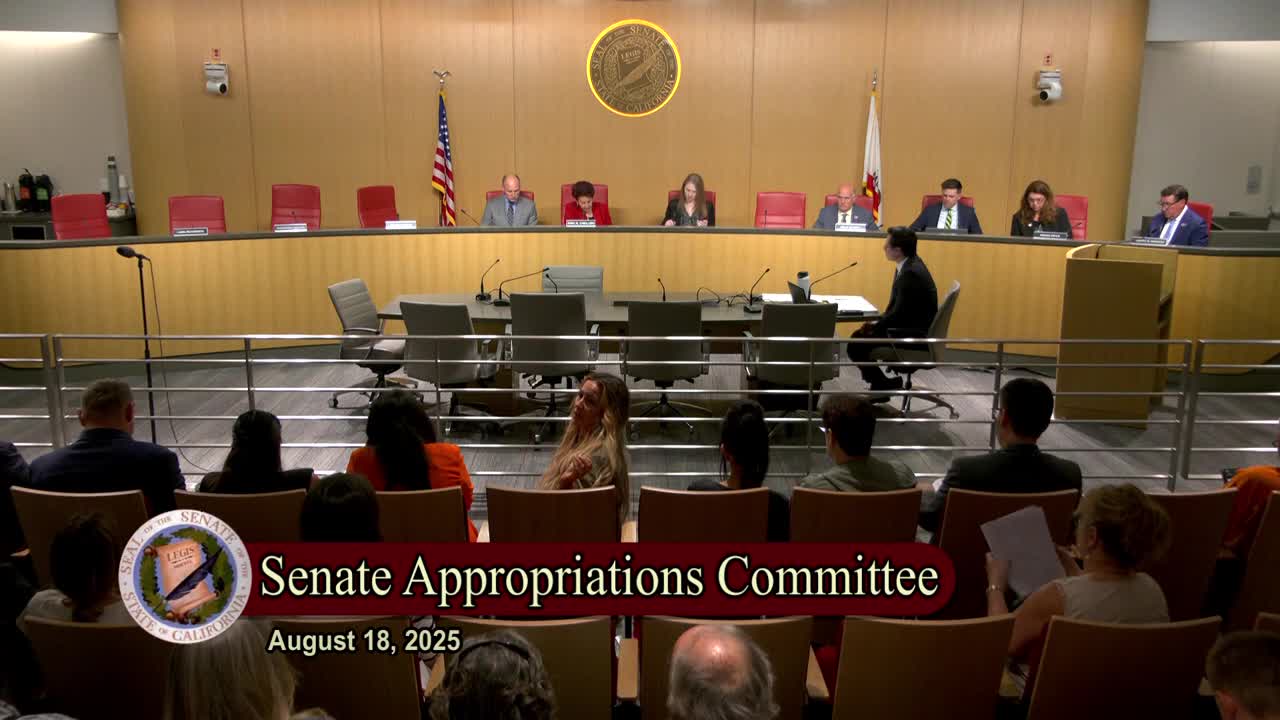 51SEC
Senate Standing Committee on Appropriations
 19MIN
Senate Standing Committee on Energy, Utilities and Communications
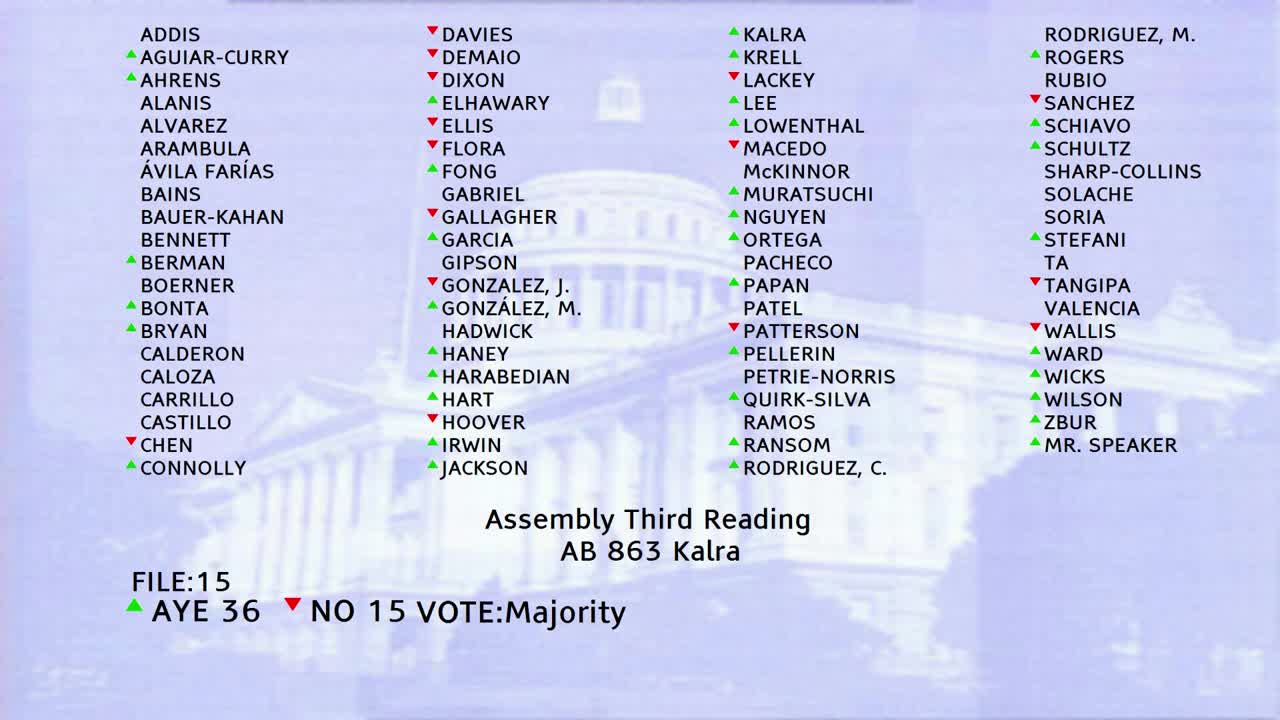 6MIN
Assembly Floor
 21MIN
Assembly Standing Committee on Utilities and Energy
Bill Author