AB 1322: Agricultural commissions and reports.
- Session Year: 2025-2026
- House: Assembly
- Latest Version Date: 2025-10-01
Current Status:
Passed
(2025-10-01: Chaptered by Secretary of State - Chapter 188, Statutes of 2025.)
Introduced
In Committee
Awaiting First Chamber Vote
Passed First Chamber
In Committee
Awaiting Second Chamber Vote
Passed Second Chamber
Enacted
(1)The Clare Berryhill Grape Crush Report Act of 1976 requires every processor who crushes grapes in this state, on or before January 10 of each year, to furnish to the Secretary of Food and Agriculture a report that includes specified information, including the total number of tons of grapes purchased by the processor in California during the preceding crush within each grape-pricing district and the total number of tons of each variety of grape crushed within each grape-pricing district. The act requires the secretary, on or before February 10 of each year, to publish a preliminary summary report on the preceding crush, and, on or before March 10 of each year, to publish a final summary report that contains the data furnished to it by the processors, as specified.
This bill would require those processors to furnish those reports on or before January 31, rather than January 10, of each year. The bill would require the secretary to publish the preliminary summary report on or before March 15, rather than February 10, of each year and, on or before April 30, rather than March 10, of each year to publish the final summary report.
Existing law requires certain assessments to be paid to the department annually by January 10.
This bill would require those assessments to instead be paid to the department annually by January 31, rather than January 10.
Under existing law, a violation of the Food and Agricultural Code is a misdemeanor, except as otherwise specified.
Because the above provisions of this bill would be part of that code, the bill would impose a state-mandated local program.
(2)Existing law specifies the duties of the secretary and county agricultural commissioners with respect to the sale and control of nursery stock, as defined. Existing law requires a person to hold a valid license in order to sell nursery stock.
Existing law establishes the California Grape Rootstock Improvement Commission to maintain and regulate grape rootstock in the state.
This bill would authorize the secretary, after investigation and hearing, to refuse to issue or renew a license, or to suspend or revoke a license, if the secretary determines that the licensee or the applicant has violated specified provisions relating to the California Grape Rootstock Improvement Commission.
(3)Existing law establishes the California Avocado Commission to efficiently develop and manage the marketing of avocados and provides requirements for membership to the commission, including for alternate members, as specified.
The bill would, among other things, expand specified provisions regarding membership to the commission to alternate members, require the assessment established by the commission to be as a fixed rate or percentage of value rather than as solely a fixed rate, and require any remaining assessment funds to be distributed for the benefit of the avocado industry into any state or federal programs in the event of termination or suspension of the commission.
(4)Existing law establishes the California Apple Commission to efficiently develop and manage the marketing of apples, as specified. Existing law authorizes the commission to recommend to the secretary the adoption of maturity standards authorized pursuant to the California Marketing Act of 1937, as specified.
This bill would authorize the California Apple Commission to recommend to the secretary quality standards and product labeling standards, and to engage in any other activity, authorized by California Marketing Act of 1937.
(5)Existing law establishes the Olive Oil Commission of California to efficiently develop and manage the marketing of olive oil, as specified. Existing law defines the terms handler and producer for purposes of these provisions.
This bill would specify that handler and producer include persons that toll process olives for olive oil. The bill would define toll processor for purposes of these provisions, as specified.
(6)The California Constitution requires the state to reimburse local agencies and school districts for certain costs mandated by the state. Statutory provisions establish procedures for making that reimbursement.
This bill would provide that no reimbursement is required by this act for a specified reason.
(1)The Clare Berryhill Grape Crush Report Act of 1976 requires every processor who crushes grapes in this state, on or before January 10 of each year, to furnish to the Secretary of Food and Agriculture a report that includes specified information, including the total number of tons of grapes purchased by the processor in California during the preceding crush within each grape-pricing district and the total number of tons of each variety of grape crushed within each grape-pricing district. The act requires the secretary, on or before February 10 of each year, to publish a preliminary summary report on the preceding crush, and, on or before March 10 of each year, to publish a final summary report that contains the data furnished to it by the processors, as specified.
This bill would require those processors to furnish those reports on or before January 31, rather than January 10, of each year. The bill would require the secretary to publish the preliminary summary report on or before March 15, rather than February 10, of each year and, on or before April 30, rather than March 10, of each year to publish the final summary report.
Existing law requires certain assessments to be paid to the department annually by January 10.
This bill would require those assessments to instead be paid to the department annually by January 31, rather than January 10.
Under existing law, a violation of the Food and Agricultural Code is a misdemeanor, except as otherwise specified.
Because the above provisions of this bill would be part of that code, the bill would impose a state-mandated local program.
(1)(2)Existing law specifies the duties of the Secretary of Food and Agriculture secretary and county agricultural commissioners with respect to the sale and control of nursery stock, as defined. Existing law requires a person to hold a valid license in order to sell nursery stock.
Existing law establishes the California Grape Rootstock Improvement Commission to maintain and regulate grape rootstock in the state.
This bill would authorize the secretary, after investigation and hearing, to refuse to issue or renew a license, or to suspend or revoke a license, if the secretary determines that the licensee or the applicant has violated specified provisions relating to the California Grape Rootstock Improvement Commission.
(2)(3)Existing law establishes the California Avocado Commission to efficiently develop and manage the marketing of avocados and provides requirements for membership to the commission, including for alternate members, as specified.
The bill would, among other things, expand specified provisions regarding membership to the commission to alternate members, require the assessment established by the commission to be as a fixed rate or percentage of value rather than as solely a fixed rate, and require any remaining assessment funds to be distributed for the benefit of the avocado industry into any state or federal programs in the event of termination or suspension of the commission.
(3)(4)Existing law establishes the California Apple Commission to efficiently develop and manage the marketing of apples, as specified. Existing law authorizes the commission to recommend to the secretary the adoption of maturity standards authorized pursuant to the California Marketing Act of 1937, as specified.
This bill would authorize the California Apple Commission to recommend to the secretary quality standards and product labeling standards, and to engage in any other activity, authorized by California Marketing Act of 1937.
(4)(5)Existing law establishes the Olive Oil Commission of California to efficiently develop and manage the marketing of olive oil, as specified. Existing law defines the terms handler and producer for purposes of these provisions.
This bill would specify that handler and producer include persons that toll process olives for olive oil. The bill would define toll processor for purposes of these provisions, as specified.
(6)The California Constitution requires the state to reimburse local agencies and school districts for certain costs mandated by the state. Statutory provisions establish procedures for making that reimbursement.
This bill would provide that no reimbursement is required by this act for a specified reason.
(1)Existing law specifies the duties of the Secretary of Food and Agriculture and county agricultural commissioners with respect to the sale and control of nursery stock, as defined. Existing law requires a person to hold a valid license in order to sell nursery stock.
Existing law establishes the California Grape Rootstock Improvement Commission to maintain and regulate grape rootstock in the state.
This bill would authorize the secretary, after investigation and hearing, to refuse to issue or renew a license, or to suspend or revoke a license, if the secretary determines that the licensee or the applicant has violated specified provisions relating to the California Grape Rootstock Improvement Commission.
(2)Existing law establishes the California Avocado Commission to efficiently develop and manage the marketing of avocados and provides requirements for membership to the commission, including for alternate members, as specified.
The bill would, among other things, expand specified provisions regarding membership to the commission to alternate members, require the assessment established by the commission to be as a fixed rate or percentage of value rather than as solely a fixed rate, and require any remaining assessment funds to be distributed for the benefit of the avocado industry into any state or federal programs in the event of termination or suspension of the commission.
(3)Existing law establishes the California Apple Commission to efficiently develop and manage the marketing of apples, as specified. Existing law authorizes the commission to recommend to the secretary the adoption of maturity standards authorized pursuant to the California Marketing Act of 1937, as specified.
This bill would authorize the California Apple Commission to recommend to the secretary quality standards and product labeling standards, and to engage in any other activity, authorized by California Marketing Act of 1937.
(4)Existing law establishes the Olive Oil Commission of California to efficiently develop and manage the marketing of olive oil, as specified. Existing law defines the terms handler and producer for purposes of these provisions.
This bill would specify that handler and producer include persons that toll process olives for olive oil. The bill would define toll processor for purposes of these provisions, as specified.
(a)All assessments payable under this article shall be remitted to the department no later than January 31 of each year. The department shall deposit the assessments remitted into the Department of Food and Agriculture Fund.
(b)In no event shall any proprietary information specified in Section 6047.13 that is received by the department in collecting assessments be transferred to the board.
(c)Processors shall not charge producers an administrative fee for collecting and remitting assessments.
SEC. 2.Section 6761 of the Food and Agricultural Code is amended to read:6761.The secretary, after investigation and hearing, may refuse to issue or renew a license, or may suspend or revoke a license, if the secretary determines that the licensee or the applicant has done any of the following:
(a)Has willfully refused to comply with the laws and regulations relative to nursery stock, or to any pest that might be carried by nursery stock.
(b)Was intentionally guilty of fraud or deception in the procurement of the license.
(c)Has been guilty of fraud or misrepresentation in the handling or sale of nursery stock.
(d)Has failed to maintain nursery stock produced or sold by the secretary in accordance with the standards of cleanliness that are prescribed by the secretary.
(e)Has failed to comply with a lawful order that is issued by the secretary or commissioner.
(f)Has failed to pay any assessment levied pursuant to this code on nursery stock or products comprising nursery stock.
SEC. 3.Section 55601.5 of the Food and Agricultural Code is amended to read:55601.5.(a)(1)Notwithstanding Section 55461, on or before January 31 of every year, every processor who crushes grapes in this state shall furnish to the secretary, on forms provided by the secretary, a report that includes all of the following:
(A)The total number of tons of grapes purchased by the processor in this state during the preceding crush within each grape-pricing district, broken down by total tons purchased, variety, and price, including any bonuses or allowances, and sugar calculations.
(B)The total number of tons of grapes purchased by the processor in this state in nonrelated purchases during the preceding crush within each grape-pricing district, broken down by total tons purchased, variety, and price, including any bonuses or allowances, and sugar calculations.
(C)The total number of tons of each variety of grape crushed within each grape-pricing district and the average sugar content of each variety within each grape-pricing district.
(D)The total number of tons of grapes purchased and crushed that are expected, as of the date of reporting by the processor, to be marketed as grape concentrate. In reporting tons purchased and crushed that are expected to be marketed as grape concentrate, processors may estimate equivalent tonnage. In estimating the equivalent tonnage, the processor shall include all equivalent tons crushed for the production of grape concentrate for wine and all other purposes marketed outside the state and the equivalent tons crushed for the production of grape concentrate for all purposes other than wine marketed within the state. In determining the estimated equivalent tons, processors shall make their best estimate of the gallons of concentrate per ton of grapes crushed based upon the Brix level of the grapes used in concentrate production.
(2)(A)When reporting price within the category of all tonnage purchased, processors shall include grapes purchased from (i) growers for wine, wine vinegar, juice, concentrate, and beverage brandy, (ii) another processor only if that processor was also the grower of the grapes, (iii) growers that are considered separate entities from the processor operation, or (iv) growers or other processors, but not by the reporting processor; and shall exclude (i) material other than grapes, and defects, or other weight adjustments deducted from the gross-weight ticket, (ii) any raisin-distilling material, (iii) grapes grown by the processor from vineyards that are not considered separate entities, (iv) grapes purchased from other processors that were previously purchased from growers, or (v) grapes crushed to grower accounts or crushed for other wineries. If several varieties were packaged together and purchased for one price, the processor shall report the average price per ton as one mixed lot, and when reporting crush information, shall report individual variety and tonnage information.
(B)When reporting price within the category of nonrelated purchases, processors shall exclude tonnage of grapes purchased from a grower if, during the reporting year (i) the grower or an affiliate of the grower, or both the grower and the affiliate of the grower, owned, directly or indirectly, at least 5 percent of the indicia of ownership or voting authority of the processor, (ii) the processor or an affiliate of the processor, or both the processor and the affiliate of the processor, owned, directly or indirectly, at least 5 percent of the indicia of ownership or voting authority of the grower, or (iii) the processor or an affiliate of the processor, or both the processor and the affiliate of the processor, provided long-term financing to the grower in exchange for rights or options to purchase a significant portion of the growers harvest.
(b)On or before February 25 of every year, each processor who crushes grapes in this state shall furnish to the secretary information concerning the final prices, including any bonuses or allowances, paid by variety and grape-pricing district to all growers holding reference price contracts in effect before January 1, 1977, which payments have not been reported on January 31.
(c)(1)The secretary may not release or otherwise make available any information furnished by an individual processor under this section, except in proceedings brought against the processor by the secretary for the purpose of enforcing this section, or except in the case of a producer who holds any reference price-grape purchase contract, to whom the secretary may furnish, upon request and at a reasonable cost, the information needed to verify the reference price, including any bonuses or allowances, set forth in the contract.
(2)The secretary shall not release or otherwise make available any information furnished by an individual processor under this section to any other division of the department except in accordance with a subpoena issued in accordance with Section 1985.3 of the Code of Civil Procedure.
(3)The secretary shall release only aggregate figures for grapes crushed that are expected to be marketed as grape concentrate and shall not include information by district, types, or variety.
(d)The secretary shall enforce the collection of the information and, on or before March 15 of each year, shall publish a preliminary summary report on the preceding crush. The report shall include all of the following information:
(1)The weighted average price paid on the basis of the prices, including any bonuses or allowances, reported and average sugar content for each grape variety purchased within each grape-pricing district.
(2)The total number of tons of grapes crushed and the average sugar content for each grape variety within each grape-pricing district.
(3)Each price category paid, separated by sugar calculations, if any, and the percentage each represents of the total for each variety within each grape-pricing district.
(4)Commencing with the report for the 1997 crush, in a separate and independent table without affecting or modifying existing tables, by weighted average price only, nonrelated purchases, by variety within each grape-pricing district excluding any bonuses, allowances, sugar calculations, and tonnage.
(e)On or before April 30 of each year, the secretary shall publish a final summary report, which shall contain all of the data furnished by the processors on or before January 31 and on or before February 25 of each year covering purchases under reference price contracts. The secretary may publish an addendum or supplemental report when reasonably necessary to correct any erroneous or misleading information contained in the annual report required by this section.
(f)The forms provided to processors by the secretary pursuant to this section shall provide for the separate reporting of grapes used by a processor (1) as distilling material and (2) for both beverage brandy and other than beverage brandy. A processor shall report all grapes used as distilling material by variety. The secretary, in determining the weighted average price paid for each grape variety purchased within each grape-pricing district, shall not include the prices paid for grapes of any variety used as distilling material for other than beverage brandy in determining the weighted average price. The secretarys report shall include a separate summary regarding grapes used by processors as distilling material.
(g)All grape purchase contracts entered into on or after January 1, 1977, shall provide for a final price, including any bonuses or allowances, to be set on or before the January 31 following delivery of the grapes purchased. Any grape purchase contract entered into in violation of this subdivision is illegal and unenforceable. For the purpose of this section, a grape purchase contract shall not include any existing supply contract between a nonprofit cooperative association and a commercial processor.
(h)(1)If the department reasonably believes that a processor has failed, refused, or neglected to provide the information required by this section, or if the department finds apparent discrepancies in the information reported, the department may audit or investigate in accordance with Article 11 (commencing with Section 55721) or proceed in accordance with Article 5 (commencing with Section 55521), except as specified in paragraph (6). Injunctive relief under Section 55921 shall issue only upon a finding by a court of competent jurisdiction that a processor has done any of the following:
(A)Refused to submit required information after the department provides reasonable notice to the processor of the processors obligations and rights under this chapter.
(B)Misreported a fact, knowing that fact to be false, or in reckless disregard for whether the fact was true.
(2)Both the refusal to submit after the provision of reasonable notice and the misreporting of a fact under the circumstances set forth in this subdivision shall constitute violations of this chapter. Neither a refusal to submit nor a misreporting of a fact under this subdivision shall be prosecuted pursuant to Article 18 (commencing with Section 55901) or subject to civil penalties under Article 19 (commencing with Section 55921).
(3)In the case of misreporting in any action authorized by this section, it shall be a defense for a processor to rely on information provided to the processor by a producer with respect to whether a purchase is a related purchase.
(4)In the case of a refusal to report or misreporting, the department shall not commence an audit or investigation, other than a routine audit based on scientifically proven random sampling methods, without first disclosing to the processor being audited or investigated any and all information that constitutes the departments belief that the processor has not complied, including the identities of all persons providing information on potential violations to the department.
(5)Anonymous complaints, unattributable information, or undocumented information shall not constitute reasonable belief and shall not be the basis for any investigation or audit action brought under this section. The department shall inform the processor of its reasons for auditing.
(6)No action shall be taken pursuant to Article 5 (commencing with Section 55521), Article 18 (commencing with Section 55901), or Article 19 (commencing with Section 55921) based on the reporting of grape concentrate pursuant to subparagraph (D) of paragraph (1) of subdivision (a).
(i)For purposes of this section, the following definitions shall apply:
(1)Affiliate or affiliated with means a person who directly or indirectly, through one or more intermediaries, controls, is controlled by, or is under common control of another person. For purposes of this paragraph, control means the possession, direct or indirect, of the power to direct or cause the direction of the management and policies of a person.
(2)Estimated equivalent tons, when used in the context of reporting tons purchased and crushed that will be marketed as grape concentrate, shall be determined by use of the following formulas:
(A)Gallons of concentrate (approximately 20 degrees Brix) produced divided by 40 equals equivalent tons.
(B)Gallons of concentrate (approximately 68 degrees Brix) divided by 170 equals equivalent tons.
(3)Grape-pricing district means a district used by the federal-state cooperative market news services, as provided in Section 58231.
(4)Long-term financing means financing that by its terms is due over a period of more than one year, or more than 180 days if there is a purchase agreement between a grower and a processor, or if there is a farming agreement where the purchase price is on a per-acre basis.
(5)Person includes an individual, partnership, corporation, limited liability company, firm, company, or other entity.
(6)Purchase means the taking by sale, discount, negotiation, mortgage, pledge, lien, issue or reissue, gift, or any other voluntary transaction creating an interest in property. For purposes of this paragraph, sale means the passing of title from the seller to the buyer for a price.
SEC. 4.Section 55601.6 of the Food and Agricultural Code is amended to read:55601.6.(a)To provide funds to carry out Section 55601.5, each processor who crushes more than 100 tons of grapes in California shall pay to the secretary the amount determined by the secretary to be necessary to cover these costs, but not to exceed ten cents ($0.10) per ton of grapes received for crushing, fresh weight equivalent, during each marketing season beginning July 1 and ending the following June 30. However, five cents ($0.05) per ton of grapes received for crushing, or one-half of the fee if the fee is less than ten cents ($0.10), shall be paid by the processor who crushes grapes and five cents ($0.05) per ton of grapes received for crushing, including any grapes produced by the processor, or one-half of the fee if the fee is less than ten cents ($0.10), shall be paid by the processor who crushes grapes and may be deducted from moneys owed to the producer.
(b)The amount of the fee shall be paid to the secretary on or before January 31 of each year on all grapes received for crushing through December 15. The amount of the fee on grapes received for crushing after December 15 shall be paid to the secretary on or before June 30 of that marketing season.
(c)The secretary may fix the fee at a lesser amount and may adjust the fee from marketing season to marketing season.
(d)A processor who crushes grapes who fails, neglects, or refuses to pay the required fee shall be in violation of this chapter. A processor who crushes grapes shall not be entitled to pass the penalty on to the producer of the grapes.
(e)If the secretary conducts an acreage survey pursuant to Section 55613, the secretary may increase the fee charged pursuant to subdivision (a) by not more than four cents ($0.04) per ton of grapes received for crushing, fresh weight equivalent, to cover costs of the survey. The same ratio of payment between processor and producer shall be maintained if the fee is increased pursuant to this subdivision.
(f)The fee authorized by subdivision (a) for the reports required to be prepared by the secretary pursuant to Section 55601.5 and the increase in that fee authorized by subdivision (e) for the survey authorized by Section 55613 shall be established by the secretary so as to generate only the amount of revenue that the secretary reasonably anticipates will be needed to cover the cost incurred by the secretary in gathering and producing the reports required by Section 55601.5, in conducting the survey authorized by Section 55613, and in conducting related enforcement activities. The funds generated by the fees authorized by this section shall be used only for the purpose of gathering the information and producing the reports required to be prepared by the secretary pursuant to Section 55601.5 and conducting the survey authorized by Section 55613.
(g)All moneys received under this section shall be deposited into the State Treasury to the credit of the Department of Food and Agriculture Fund.
SEC. 5.Section 67026 is added to the Food and Agricultural Code, to read:67026.Ex officio members means nonvoting members of the commission.
SEC. 6.Section 67052 of the Food and Agricultural Code is amended to read:67052.(a)Each district shall have one alternate producer member, to be elected in the same manner as producer members.
(b)The alternate producer member shall, in the absence of a producer member from the same district, serve in place of the absent producer member on the commission and shall have, and be able to exercise, all the rights, privileges, and powers of the producer member when serving on the commission.
SEC. 7.Section 67052.5 of the Food and Agricultural Code is amended to read:67052.5.(a)There shall be one alternate public member who shall be appointed by the secretary from nominees recommended by the commission.
(b)The alternate public member shall, in the absence of the public member, serve in place of the absent public member on the commission and shall have, and be able to exercise, all the rights, privileges, and powers of the public member when serving on the commission.
SEC. 8.Section 67054 of the Food and Agricultural Code is amended to read:67054.(a)Producer members and alternate producer members on the commission shall have a financial interest in producing, or causing to be produced, avocados for market. In order to be elected a member or alternate member, a producer shall, at the time of the election, have a financial interest in the production of avocados within the district in which the producer stands for election.
(b)A producer may stand for election in any district in which the producer has a financial interest in the production of avocados.
(c)Handler members and the alternate handler members shall have a financial interest in handling avocados for markets. To be nominated and elected, a handler or alternate handler shall handle no less than 1 percent of the total industry volume of avocados in the preceding marketing year. A handler elected to the commission pursuant to this section shall be required to maintain their eligibility under this section during their entire term of office.
(d)The public member and alternate member shall not have any financial interest in the avocado industry. Except for the nomination of another public member, the public member and their alternate member on the commission shall have all the powers, rights, and privileges of any other member on the commission.
SEC. 9.Section 67057 of the Food and Agricultural Code is amended to read:67057.The commission may appoint its own officers, including a chair, one or more vice chair, and other officers it deems necessary. The officers shall have the powers and duties as may be delegated to them by the commission.
SEC. 10.Section 67059.5 of the Food and Agricultural Code is amended to read:67059.5.The secretary or the secretarys representatives shall be notified and may attend each meeting of the commission.
SEC. 11.Section 67062 of the Food and Agricultural Code is amended to read:67062.The state is not liable for the acts of the commission or its contracts, except for state-directed supervision of the avocado inspection program, as specified in Chapter 9 (commencing with Section 44971) of Division 17, which is performed under an agreement that specifies that each of the parties shall be responsible and liable for that partys decisions made pursuant to the agreement, and that each of the parties shall not be held liable by the other party for the decisions made pursuant to the agreement. Payment of all claims arising by reason of the administration of this chapter or acts of the commission shall be limited to the funds collected by the commission. A member of the commission or alternate member, or any employee or agent thereof, shall not be personally liable on the contracts of the commission nor shall a member, alternate member, or employee of the commission be responsible individually in any way to a producer or handler or any other person for error in judgment, mistakes, or other acts, either of commission or omission, as principal, agent, or employee, except for their own individual acts of dishonesty or crime. A member or alternate member shall not be held responsible individually for any act or omission of any member of the commission. The liability of the members and alternate members shall be several and not joint, and a member or alternate member shall not be liable for the default of any other members or alternate members.
SEC. 12.Section 67082 of the Food and Agricultural Code is amended to read:67082.Persons to be elected to the commission shall be selected pursuant to nomination and election procedures adopted by the commission and concurred in by the secretary.
SEC. 13.Section 67091 of the Food and Agricultural Code is amended to read:67091.The powers and duties of the commission include, but are not limited to, all of the following:
(a)Adopt and, from time to time, alter, rescind, modify, and amend all proper and necessary procedures to carry out this chapter and in the exercise of its powers and the performance of its duties, including the adoption of procedures to regulate appeals from any action of the commission.
(b)Administer and enforce this chapter, and to do and perform all acts and exercise all powers incidental to or in connection with or deemed reasonably necessary, proper, or advisable to effectuate the purposes of this chapter.
(c)Employ a person, to serve, at the pleasure of the commission, as president and chief executive officer of the commission and other personnel, including legal counsel.
(d)Establish offices, incur expenses, enter into any and all contracts and agreements, and create liabilities and borrow funds in advance of receipt of assessments that may be necessary, at the discretion of the commission, for the proper administration and enforcement of this chapter and the performance of its duties.
(e)Keep accurate books, records, and accounts of all of its dealings, which books, records, and accounts are subject to an annual independent audit by an auditing firm approved by the secretary. The independent audit shall be made a part of an annual report to all producers and handlers of avocados, copies of which shall also be submitted to the Legislature. In addition, the secretary may, as the secretary determines necessary, conduct, or cause to be conducted, a fiscal and compliance audit of the commission.
(f)Promote the sale of avocados by advertising and other promotional means for the purpose of maintaining and expanding present markets and creating new and larger intrastate, interstate, and foreign markets for avocados and to educate and instruct the public with respect to avocados and the uses of the several varieties and the healthful properties and nutritional value of avocados.
(g)Enter into cost-sharing advertising with other products considered, by the commission, to be fair and equitable to both parties.
(h)Educate and instruct the wholesale and retail trade with respect to proper methods of handling and selling avocados; arrange for the performance of dealer service work providing display and other promotional materials; make market and inventory surveys and analyses; present facts to and negotiate with state, federal, and foreign agencies on matters which affect the avocado industry; and undertake any other activities that the commission may determine appropriate for the maintenance and expansion of present markets and the creation of new markets for avocados.
(i)Make, in the name of the commission, contracts to render service in formulating and conducting plans and programs, and any other contracts or agreements that the commission may deem necessary for the promotion of the sale of avocados.
(j)Conduct and contract with others to conduct scientific research, including the study, analysis, dissemination, and accumulation of information obtained from the research or elsewhere respecting the inventory, marketing, and distribution of avocados. The results of any research conducted by or on behalf of the commission may be used by the commission in any way it deems appropriate, and notwithstanding any other law, may be maintained in confidence by the commission and not disseminated to any person not subject to this chapter.
(k)Accept and match contributions of private, local, state, or federal funds and make contributions of commission funds to other persons or to local, state, or federal agencies for purposes of promoting, enhancing, and maintaining the California avocado industry.
(l)Publish and distribute without charge, a bulletin or other communication for dissemination of information relating to inventory, marketing, and other information of value to the commission and the avocado industry to producers, handlers, and the public.
(m)Establish an assessment rate to defray operating costs of the commission.
(n)Establish an annual budget.
(o)Investigate and prosecute civil violations of this chapter and file complaints with appropriate law enforcement agencies or officers for suspected criminal violations of this chapter.
(p)Carry out the requirements prescribed in Chapter 9 (commencing with Section 44971) of Division 17.
(q)To provide to the secretary, on a quarterly basis, a summary of the programs, activities, and costs under review for the next marketing season.
(r)Require producers to provide information as determined by the commission pertaining to the locations at which avocados are produced and the annual volume of avocados produced at each location. The information shall be provided in a time and manner prescribed by the commission and shall be subject to the confidentiality provisions of Section 67104.
(s)Use information provided to the commission for purposes of food safety, communications, reapportionment of districts, the conduct of elections and referenda, and any other matters related to the activities of the commission.
SEC. 14.Section 67101 of the Food and Agricultural Code is amended to read:67101.(a)The commission shall, not later than November 1 of each year, establish the assessment as a fixed rate or percentage of value for the following marketing season beginning November 1, and ending October 31. The assessment shall not exceed 61/2 percent of the gross dollar value of the years sales of avocados by all producers to handlers, or which are sold by handlers on behalf of producers. Expenditures for administrative purposes within the maximum assessment shall not exceed 21/2 percent of the gross dollar value of sales of avocados by all producers to handlers, or which are sold by handlers on behalf of producers. Assessments provided for in this section shall be upon the producer. The handler shall deduct that assessment from either amounts paid to the producer or amounts retained by the handler if the handler is also the producer, and the handler shall be a trustee of those funds until they are paid to the commission at the time and in the manner prescribed by the commission.
(b)The combined assessment of the commission and any state marketing order shall not exceed 61/2 percent of the gross value of the years sales of avocados by all producers to handlers, or which are sold by handlers on behalf of producers.
SEC. 15.Section 67133 of the Food and Agricultural Code is amended to read:67133.After the effective date of suspension of this chapter and of the commission, the operations of the commission shall be wound up, and any asset of the commission shall be liquidated and the proceeds, along with any and all moneys remaining held by the commission, collected by assessment and not required to defray the expenses of winding up and terminating operations of the commission, shall be returned upon a pro rata basis to all persons from whom assessments were collected in the immediately preceding marketing season. However, if the commission finds that the amounts so returnable are so small as to make impractical the computation and remitting of a pro rata refund to those persons, any moneys remaining after payment of all expenses of winding up and terminating operations shall be withdrawn from the approved depository and paid into an appropriate state or federal program or used to fund activities related to the subject matter of this chapter.
SEC. 16.Section 75601 of the Food and Agricultural Code is amended to read:75601.(a)The commission may recommend to the secretary the adoption of maturity and quality standards or product labeling standards, or engage in any other activity authorized pursuant to the California Marketing Act of 1937 (Chapter 1 (commencing with Section 58601) of Part 2 of Division 21) that are in accordance with the procedures specified in that act, unless otherwise specified in this article.
(b)Any standards that are adopted shall be implemented by the secretary at the beginning of the marketing year next succeeding the date on which they were approved by the secretary.
(c)Any standards recommended by the commission and approved by the secretary shall not be operative until approved by the vote specified in Section 75612.
(d)The commission shall serve as the advisory body to the secretary on all matters pertaining to this section.
SEC. 17.Section 79818 of the Food and Agricultural Code is amended to read:79818.(a)Handler means a person who engages, in this state, in the processing or milling of olives into olive oil that the handler has produced, or purchased or acquired from an olive producer, or that toll processes or mills olives on behalf of an olive producer, whether as owner, agent, employee, broker, or otherwise.
(b)When the handler is a corporation or a limited liability company, all of the directors, officers, managers, and members of the corporation or limited liability company in their capacity as individuals shall be included, and any liability for failure to collect or make payment of assessments to which a corporate handler or a handler that is a limited liability company may be subject pursuant to this chapter shall include identical liability upon each individual director, officer, manager, or member of the corporation or limited liability company.
SEC. 18.Section 79821 of the Food and Agricultural Code is amended to read:79821.Producer means a person that produces or causes to be produced olives that are processed or toll processed into olive oil in the amount of 5,000 gallons or more during the marketing season and that shall, upon request of the commission, provide proof of commodity sale.
SEC. 19.Section 79824 is added to the Food and Agricultural Code, to read:79824.Toll processor means to process or mill olives into olive oil on behalf of a producer.
SEC. 20.No reimbursement is required by this act pursuant to Section 6 of Article XIIIB of the California Constitution because the only costs that may be incurred by a local agency or school district will be incurred because this act creates a new crime or infraction, eliminates a crime or infraction, or changes the penalty for a crime or infraction, within the meaning of Section 17556 of the Government Code, or changes the definition of a crime within the meaning of Section 6 of Article XIIIB of the California Constitution.
(a)All assessments payable under this article shall be remitted to the department no later than January 31 of each year. The department shall deposit the assessments remitted into the Department of Food and Agriculture Fund.
(b)In no event shall any proprietary information specified in Section 6047.13 that is received by the department in collecting assessments be transferred to the board.
(c)Processors shall not charge producers an administrative fee for collecting and remitting assessments.
SEC. 2.Section 6761 of the Food and Agricultural Code is amended to read:6761.The secretary, after investigation and hearing, may refuse to issue or renew a license, or may suspend or revoke a license, if the secretary determines that the licensee or the applicant has done any of the following:
(a)Has willfully refused to comply with the laws and regulations relative to nursery stock, or to any pest that might be carried by nursery stock.
(b)Was intentionally guilty of fraud or deception in the procurement of the license.
(c)Has been guilty of fraud or misrepresentation in the handling or sale of nursery stock.
(d)Has failed to maintain nursery stock produced or sold by the secretary in accordance with the standards of cleanliness that are prescribed by the secretary.
(e)Has failed to comply with a lawful order that is issued by the secretary or commissioner.
(f)Has failed to comply with Chapter 12.6 (commencing with Section 74701) of Part 2 of Division 22. pay any assessment levied pursuant to this code on nursery stock or products comprising nursery stock.
SEC. 3.Section 55601.5 of the Food and Agricultural Code is amended to read:55601.5.(a)(1)Notwithstanding Section 55461, on or before January 31 of every year, every processor who crushes grapes in this state shall furnish to the secretary, on forms provided by the secretary, a report that includes all of the following:
(A)The total number of tons of grapes purchased by the processor in this state during the preceding crush within each grape-pricing district, broken down by total tons purchased, variety, and price, including any bonuses or allowances, and sugar calculations.
(B)The total number of tons of grapes purchased by the processor in this state in nonrelated purchases during the preceding crush within each grape-pricing district, broken down by total tons purchased, variety, and price, including any bonuses or allowances, and sugar calculations.
(C)The total number of tons of each variety of grape crushed within each grape-pricing district and the average sugar content of each variety within each grape-pricing district.
(D)The total number of tons of grapes purchased and crushed that are expected, as of the date of reporting by the processor, to be marketed as grape concentrate. In reporting tons purchased and crushed that are expected to be marketed as grape concentrate, processors may estimate equivalent tonnage. In estimating the equivalent tonnage, the processor shall include all equivalent tons crushed for the production of grape concentrate for wine and all other purposes marketed outside the state and the equivalent tons crushed for the production of grape concentrate for all purposes other than wine marketed within the state. In determining the estimated equivalent tons, processors shall make their best estimate of the gallons of concentrate per ton of grapes crushed based upon the Brix level of the grapes used in concentrate production.
(2)(A)When reporting price within the category of all tonnage purchased, processors shall include grapes purchased from (i) growers for wine, wine vinegar, juice, concentrate, and beverage brandy, (ii) another processor only if that processor was also the grower of the grapes, (iii) growers that are considered separate entities from the processor operation, or (iv) growers or other processors, but not by the reporting processor; and shall exclude (i) material other than grapes, and defects, or other weight adjustments deducted from the gross-weight ticket, (ii) any raisin-distilling material, (iii) grapes grown by the processor from vineyards that are not considered separate entities, (iv) grapes purchased from other processors that were previously purchased from growers, or (v) grapes crushed to grower accounts or crushed for other wineries. If several varieties were packaged together and purchased for one price, the processor shall report the average price per ton as one mixed lot, and when reporting crush information, shall report individual variety and tonnage information.
(B)When reporting price within the category of nonrelated purchases, processors shall exclude tonnage of grapes purchased from a grower if, during the reporting year (i) the grower or an affiliate of the grower, or both the grower and the affiliate of the grower, owned, directly or indirectly, at least 5 percent of the indicia of ownership or voting authority of the processor, (ii) the processor or an affiliate of the processor, or both the processor and the affiliate of the processor, owned, directly or indirectly, at least 5 percent of the indicia of ownership or voting authority of the grower, or (iii) the processor or an affiliate of the processor, or both the processor and the affiliate of the processor, provided long-term financing to the grower in exchange for rights or options to purchase a significant portion of the growers harvest.
(b)On or before February 25 of every year, each processor who crushes grapes in this state shall furnish to the secretary information concerning the final prices, including any bonuses or allowances, paid by variety and grape-pricing district to all growers holding reference price contracts in effect before January 1, 1977, which payments have not been reported on January 31.
(c)(1)The secretary may not release or otherwise make available any information furnished by an individual processor under this section, except in proceedings brought against the processor by the secretary for the purpose of enforcing this section, or except in the case of a producer who holds any reference price-grape purchase contract, to whom the secretary may furnish, upon request and at a reasonable cost, the information needed to verify the reference price, including any bonuses or allowances, set forth in the contract.
(2)The secretary shall not release or otherwise make available any information furnished by an individual processor under this section to any other division of the department except in accordance with a subpoena issued in accordance with Section 1985.3 of the Code of Civil Procedure.
(3)The secretary shall release only aggregate figures for grapes crushed that are expected to be marketed as grape concentrate and shall not include information by district, types, or variety.
(d)The secretary shall enforce the collection of the information and, on or before March 15 of each year, shall publish a preliminary summary report on the preceding crush. The report shall include all of the following information:
(1)The weighted average price paid on the basis of the prices, including any bonuses or allowances, reported and average sugar content for each grape variety purchased within each grape-pricing district.
(2)The total number of tons of grapes crushed and the average sugar content for each grape variety within each grape-pricing district.
(3)Each price category paid, separated by sugar calculations, if any, and the percentage each represents of the total for each variety within each grape-pricing district.
(4)Commencing with the report for the 1997 crush, in a separate and independent table without affecting or modifying existing tables, by weighted average price only, nonrelated purchases, by variety within each grape-pricing district excluding any bonuses, allowances, sugar calculations, and tonnage.
(e)On or before April 30 of each year, the secretary shall publish a final summary report, which shall contain all of the data furnished by the processors on or before January 31 and on or before February 25 of each year covering purchases under reference price contracts. The secretary may publish an addendum or supplemental report when reasonably necessary to correct any erroneous or misleading information contained in the annual report required by this section.
(f)The forms provided to processors by the secretary pursuant to this section shall provide for the separate reporting of grapes used by a processor (1) as distilling material and (2) for both beverage brandy and other than beverage brandy. A processor shall report all grapes used as distilling material by variety. The secretary, in determining the weighted average price paid for each grape variety purchased within each grape-pricing district, shall not include the prices paid for grapes of any variety used as distilling material for other than beverage brandy in determining the weighted average price. The secretarys report shall include a separate summary regarding grapes used by processors as distilling material.
(g)All grape purchase contracts entered into on or after January 1, 1977, shall provide for a final price, including any bonuses or allowances, to be set on or before the January 31 following delivery of the grapes purchased. Any grape purchase contract entered into in violation of this subdivision is illegal and unenforceable. For the purpose of this section, a grape purchase contract shall not include any existing supply contract between a nonprofit cooperative association and a commercial processor.
(h)(1)If the department reasonably believes that a processor has failed, refused, or neglected to provide the information required by this section, or if the department finds apparent discrepancies in the information reported, the department may audit or investigate in accordance with Article 11 (commencing with Section 55721) or proceed in accordance with Article 5 (commencing with Section 55521), except as specified in paragraph (6). Injunctive relief under Section 55921 shall issue only upon a finding by a court of competent jurisdiction that a processor has done any of the following:
(A)Refused to submit required information after the department provides reasonable notice to the processor of the processors obligations and rights under this chapter.
(B)Misreported a fact, knowing that fact to be false, or in reckless disregard for whether the fact was true.
(2)Both the refusal to submit after the provision of reasonable notice and the misreporting of a fact under the circumstances set forth in this subdivision shall constitute violations of this chapter. Neither a refusal to submit nor a misreporting of a fact under this subdivision shall be prosecuted pursuant to Article 18 (commencing with Section 55901) or subject to civil penalties under Article 19 (commencing with Section 55921).
(3)In the case of misreporting in any action authorized by this section, it shall be a defense for a processor to rely on information provided to the processor by a producer with respect to whether a purchase is a related purchase.
(4)In the case of a refusal to report or misreporting, the department shall not commence an audit or investigation, other than a routine audit based on scientifically proven random sampling methods, without first disclosing to the processor being audited or investigated any and all information that constitutes the departments belief that the processor has not complied, including the identities of all persons providing information on potential violations to the department.
(5)Anonymous complaints, unattributable information, or undocumented information shall not constitute reasonable belief and shall not be the basis for any investigation or audit action brought under this section. The department shall inform the processor of its reasons for auditing.
(6)No action shall be taken pursuant to Article 5 (commencing with Section 55521), Article 18 (commencing with Section 55901), or Article 19 (commencing with Section 55921) based on the reporting of grape concentrate pursuant to subparagraph (D) of paragraph (1) of subdivision (a).
(i)For purposes of this section, the following definitions shall apply:
(1)Affiliate or affiliated with means a person who directly or indirectly, through one or more intermediaries, controls, is controlled by, or is under common control of another person. For purposes of this paragraph, control means the possession, direct or indirect, of the power to direct or cause the direction of the management and policies of a person.
(2)Estimated equivalent tons, when used in the context of reporting tons purchased and crushed that will be marketed as grape concentrate, shall be determined by use of the following formulas:
(A)Gallons of concentrate (approximately 20 degrees Brix) produced divided by 40 equals equivalent tons.
(B)Gallons of concentrate (approximately 68 degrees Brix) divided by 170 equals equivalent tons.
(3)Grape-pricing district means a district used by the federal-state cooperative market news services, as provided in Section 58231.
(4)Long-term financing means financing that by its terms is due over a period of more than one year, or more than 180 days if there is a purchase agreement between a grower and a processor, or if there is a farming agreement where the purchase price is on a per-acre basis.
(5)Person includes an individual, partnership, corporation, limited liability company, firm, company, or other entity.
(6)Purchase means the taking by sale, discount, negotiation, mortgage, pledge, lien, issue or reissue, gift, or any other voluntary transaction creating an interest in property. For purposes of this paragraph, sale means the passing of title from the seller to the buyer for a price.
SEC. 4.Section 55601.6 of the Food and Agricultural Code is amended to read:55601.6.(a)To provide funds to carry out Section 55601.5, each processor who crushes more than 100 tons of grapes in California shall pay to the secretary the amount determined by the secretary to be necessary to cover these costs, but not to exceed ten cents ($0.10) per ton of grapes received for crushing, fresh weight equivalent, during each marketing season beginning July 1 and ending the following June 30. However, five cents ($0.05) per ton of grapes received for crushing, or one-half of the fee if the fee is less than ten cents ($0.10), shall be paid by the processor who crushes grapes and five cents ($0.05) per ton of grapes received for crushing, including any grapes produced by the processor, or one-half of the fee if the fee is less than ten cents ($0.10), shall be paid by the processor who crushes grapes and may be deducted from moneys owed to the producer.
(b)The amount of the fee shall be paid to the secretary on or before January 31 of each year on all grapes received for crushing through December 15. The amount of the fee on grapes received for crushing after December 15 shall be paid to the secretary on or before June 30 of that marketing season.
(c)The secretary may fix the fee at a lesser amount and may adjust the fee from marketing season to marketing season.
(d)A processor who crushes grapes who fails, neglects, or refuses to pay the required fee shall be in violation of this chapter. A processor who crushes grapes shall not be entitled to pass the penalty on to the producer of the grapes.
(e)If the secretary conducts an acreage survey pursuant to Section 55613, the secretary may increase the fee charged pursuant to subdivision (a) by not more than four cents ($0.04) per ton of grapes received for crushing, fresh weight equivalent, to cover costs of the survey. The same ratio of payment between processor and producer shall be maintained if the fee is increased pursuant to this subdivision.
(f)The fee authorized by subdivision (a) for the reports required to be prepared by the secretary pursuant to Section 55601.5 and the increase in that fee authorized by subdivision (e) for the survey authorized by Section 55613 shall be established by the secretary so as to generate only the amount of revenue that the secretary reasonably anticipates will be needed to cover the cost incurred by the secretary in gathering and producing the reports required by Section 55601.5, in conducting the survey authorized by Section 55613, and in conducting related enforcement activities. The funds generated by the fees authorized by this section shall be used only for the purpose of gathering the information and producing the reports required to be prepared by the secretary pursuant to Section 55601.5 and conducting the survey authorized by Section 55613.
(g)All moneys received under this section shall be deposited into the State Treasury to the credit of the Department of Food and Agriculture Fund.
SEC. 5.Section 67026 is added to the Food and Agricultural Code, to read:67026.Ex officio members means nonvoting members of the commission.
SEC. 6.Section 67052 of the Food and Agricultural Code is amended to read:67052.(a)Each district shall have one alternate producer member, to be elected in the same manner as producer members.
(b)The alternate producer member shall, in the absence of a producer member from the same district, serve in place of the absent producer member on the commission and shall have, and be able to exercise, all the rights, privileges, and powers of the producer member when serving on the commission.
SEC. 7.Section 67052.5 of the Food and Agricultural Code is amended to read:67052.5.(a)There shall be one alternate public member who shall be appointed by the secretary from nominees recommended by the commission.
(b)The alternate public member shall, in the absence of the public member, serve in place of the absent public member on the commission and shall have, and be able to exercise, all the rights, privileges, and powers of the public member when serving on the commission.
SEC. 8.Section 67054 of the Food and Agricultural Code is amended to read:67054.(a)Producer members and alternate producer members on the commission shall have a financial interest in producing, or causing to be produced, avocados for market. In order to be elected a member or alternate member, a producer shall, at the time of the election, have a financial interest in the production of avocados within the district in which the producer stands for election.
(b)A producer may stand for election in any district in which the producer has a financial interest in the production of avocados.
(c)Handler members and the alternate handler members shall have a financial interest in handling avocados for markets. To be nominated and elected, a handler or alternate handler shall handle no less than 1 percent of the total industry volume of avocados in the preceding marketing year. A handler elected to the commission pursuant to this section shall be required to maintain their eligibility under this section during their entire term of office.
(d)The public member and alternate member shall not have any financial interest in the avocado industry. Except for the nomination of another public member, the public member and their alternate member on the commission shall have all the powers, rights, and privileges of any other member on the commission.
SEC. 9.Section 67057 of the Food and Agricultural Code is amended to read:67057.The commission may appoint its own officers, including a chair, one or more vice chair, and other officers it deems necessary. The officers shall have the powers and duties as may be delegated to them by the commission.
SEC. 10.Section 67059.5 of the Food and Agricultural Code is amended to read:67059.5.The secretary or the secretarys representatives shall be notified and may attend each meeting of the commission.
SEC. 11.Section 67062 of the Food and Agricultural Code is amended to read:67062.The state is not liable for the acts of the commission or its contracts, except for state-directed supervision of the avocado inspection program, as specified in Chapter 9 (commencing with Section 44971) of Division 17, which is performed under an agreement that specifies that each of the parties shall be responsible and liable for that partys decisions made pursuant to the agreement, and that each of the parties shall not be held liable by the other party for the decisions made pursuant to the agreement. Payment of all claims arising by reason of the administration of this chapter or acts of the commission shall be limited to the funds collected by the commission. A member of the commission or alternate member, or any employee or agent thereof, shall not be personally liable on the contracts of the commission nor shall a member, alternate member, or employee of the commission be responsible individually in any way to a producer or handler or any other person for error in judgment, mistakes, or other acts, either of commission or omission, as principal, agent, or employee, except for their own individual acts of dishonesty or crime. A member or alternate member shall not be held responsible individually for any act or omission of any member of the commission. The liability of the members and alternate members shall be several and not joint, and a member or alternate member shall not be liable for the default of any other members or alternate members.
SEC. 12.Section 67082 of the Food and Agricultural Code is amended to read:67082.Persons to be elected to the commission shall be selected pursuant to nomination and election procedures adopted by the commission and concurred in by the secretary.
SEC. 13.Section 67091 of the Food and Agricultural Code is amended to read:67091.The powers and duties of the commission include, but are not limited to, all of the following:
(a)Adopt and, from time to time, alter, rescind, modify, and amend all proper and necessary procedures to carry out this chapter and in the exercise of its powers and the performance of its duties, including the adoption of procedures to regulate appeals from any action of the commission.
(b)Administer and enforce this chapter, and to do and perform all acts and exercise all powers incidental to or in connection with or deemed reasonably necessary, proper, or advisable to effectuate the purposes of this chapter.
(c)Employ a person, to serve, at the pleasure of the commission, as president and chief executive officer of the commission and other personnel, including legal counsel.
(d)Establish offices, incur expenses, enter into any and all contracts and agreements, and create liabilities and borrow funds in advance of receipt of assessments that may be necessary, at the discretion of the commission, for the proper administration and enforcement of this chapter and the performance of its duties.
(e)Keep accurate books, records, and accounts of all of its dealings, which books, records, and accounts are subject to an annual independent audit by an auditing firm approved by the secretary. The independent audit shall be made a part of an annual report to all producers and handlers of avocados, copies of which shall also be submitted to the Legislature. In addition, the secretary may, as the secretary determines necessary, conduct, or cause to be conducted, a fiscal and compliance audit of the commission.
(f)Promote the sale of avocados by advertising and other promotional means for the purpose of maintaining and expanding present markets and creating new and larger intrastate, interstate, and foreign markets for avocados and to educate and instruct the public with respect to avocados and the uses of the several varieties and the healthful properties and nutritional value of avocados.
(g)Enter into cost-sharing advertising with other products considered, by the commission, to be fair and equitable to both parties.
(h)Educate and instruct the wholesale and retail trade with respect to proper methods of handling and selling avocados; arrange for the performance of dealer service work providing display and other promotional materials; make market and inventory surveys and analyses; present facts to and negotiate with state, federal, and foreign agencies on matters which affect the avocado industry; and undertake any other activities that the commission may determine appropriate for the maintenance and expansion of present markets and the creation of new markets for avocados.
(i)Make, in the name of the commission, contracts to render service in formulating and conducting plans and programs, and any other contracts or agreements that the commission may deem necessary for the promotion of the sale of avocados.
(j)Conduct and contract with others to conduct scientific research, including the study, analysis, dissemination, and accumulation of information obtained from the research or elsewhere respecting the inventory, marketing, and distribution of avocados. The results of any research conducted by or on behalf of the commission may be used by the commission in any way it deems appropriate, and notwithstanding any other law, may be maintained in confidence by the commission and not disseminated to any person not subject to this chapter.
(k)Accept and match contributions of private, local, state, or federal funds and make contributions of commission funds to other persons or to local, state, or federal agencies for purposes of promoting, enhancing, and maintaining the California avocado industry.
(l)Publish and distribute without charge, a bulletin or other communication for dissemination of information relating to inventory, marketing, and other information of value to the commission and the avocado industry to producers, handlers, and the public.
(m)Establish an assessment rate to defray operating costs of the commission.
(n)Establish an annual budget.
(o)Investigate and prosecute civil violations of this chapter and file complaints with appropriate law enforcement agencies or officers for suspected criminal violations of this chapter.
(p)Carry out the requirements prescribed in Chapter 9 (commencing with Section 44971) of Division 17.
(q)To provide to the secretary, on a quarterly basis, a summary of the programs, activities, and costs under review for the next marketing season.
(r)Require producers to provide information as determined by the commission pertaining to the locations at which avocados are produced and the annual volume of avocados produced at each location. The information shall be provided in a time and manner prescribed by the commission and shall be subject to the confidentiality provisions of Section 67104.
(s)Use information provided to the commission for purposes of food safety, communications, reapportionment of districts, the conduct of elections and referenda, and any other matters related to the activities of the commission.
SEC. 14.Section 67101 of the Food and Agricultural Code is amended to read:67101.(a)The commission shall, not later than November 1 of each year, establish the assessment as a fixed rate or percentage of value for the following marketing season beginning November 1, and ending October 31. The assessment shall not exceed 61/2 percent of the gross dollar value of the years sales of avocados by all producers to handlers, or which are sold by handlers on behalf of producers. Expenditures for administrative purposes within the maximum assessment shall not exceed 21/2 percent of the gross dollar value of sales of avocados by all producers to handlers, or which are sold by handlers on behalf of producers. Assessments provided for in this section shall be upon the producer. The handler shall deduct that assessment from either amounts paid to the producer or amounts retained by the handler if the handler is also the producer, and the handler shall be a trustee of those funds until they are paid to the commission at the time and in the manner prescribed by the commission.
(b)The combined assessment of the commission and any state marketing order shall not exceed 61/2 percent of the gross value of the years sales of avocados by all producers to handlers, or which are sold by handlers on behalf of producers.
SEC. 15.Section 67133 of the Food and Agricultural Code is amended to read:67133.After the effective date of suspension of this chapter and of the commission, the operations of the commission shall be wound up, and any asset of the commission shall be liquidated and the proceeds, along with any and all moneys remaining held by the commission, collected by assessment and not required to defray the expenses of winding up and terminating operations of the commission, shall be returned upon a pro rata basis to all persons from whom assessments were collected in the immediately preceding marketing season. However, if the commission finds that the amounts so returnable are so small as to make impractical the computation and remitting of a pro rata refund to those persons, any moneys remaining after payment of all expenses of winding up and terminating operations shall be withdrawn from the approved depository and paid into an appropriate state or federal program or used to fund activities related to the subject matter of this chapter.
SEC. 16.Section 75601 of the Food and Agricultural Code is amended to read:75601.(a)The commission may recommend to the secretary the adoption of maturity and quality standards or product labeling standards, or engage in any other activity authorized pursuant to the California Marketing Act of 1937 (Chapter 1 (commencing with Section 58601) of Part 2 of Division 21) that are in accordance with the procedures specified in that act, unless otherwise specified in this article.
(b)Any standards that are adopted shall be implemented by the secretary at the beginning of the marketing year next succeeding the date on which they were approved by the secretary.
(c)Any standards recommended by the commission and approved by the secretary shall not be operative until approved by the vote specified in Section 75612.
(d)The commission shall serve as the advisory body to the secretary on all matters pertaining to this section.
SEC. 17.Section 79818 of the Food and Agricultural Code is amended to read:79818.(a)Handler means a person who engages, in this state, in the processing or milling of olives into olive oil that the handler has produced, or purchased or acquired from an olive producer, or that toll processes or mills olives on behalf of an olive producer, whether as owner, agent, employee, broker, or otherwise.
(b)When the handler is a corporation or a limited liability company, all of the directors, officers, managers, and members of the corporation or limited liability company in their capacity as individuals shall be included, and any liability for failure to collect or make payment of assessments to which a corporate handler or a handler that is a limited liability company may be subject pursuant to this chapter shall include identical liability upon each individual director, officer, manager, or member of the corporation or limited liability company.
SEC. 18.Section 79821 of the Food and Agricultural Code is amended to read:79821.Producer means a person that produces or causes to be produced olives that are processed or toll processed into olive oil in the amount of 5,000 gallons or more during the marketing season and that shall, upon request of the commission, provide proof of commodity sale.
SEC. 19.Section 79824 is added to the Food and Agricultural Code, to read:79824.Toll processor means to process or mill olives into olive oil on behalf of a producer.
SEC. 20.No reimbursement is required by this act pursuant to Section 6 of Article XIIIB of the California Constitution because the only costs that may be incurred by a local agency or school district will be incurred because this act creates a new crime or infraction, eliminates a crime or infraction, or changes the penalty for a crime or infraction, within the meaning of Section 17556 of the Government Code, or changes the definition of a crime within the meaning of Section 6 of Article XIIIB of the California Constitution.
(a)All assessments payable under this article shall be remitted to the department no later than January 10 31 of each year. The department shall deposit the assessments remitted in into the Department of Food and Agriculture Fund.
(b)In no event shall any proprietary information specified in Section 6047.13 that is received by the department in collecting assessments be transferred to the board.
(c)Processors shall not charge producers an administrative fee for collecting and remitting assessments.
SECTION 1.SEC. 2.Section 6761 of the Food and Agricultural Code is amended to read:6761.The secretary, after investigation and hearing, may refuse to issue or renew a license, or may suspend or revoke a license, if the secretary determines that the licensee or the applicant has done any of the following:
(a)Has willfully refused to comply with the laws and regulations relative to nursery stock, or to any pest that might be carried by nursery stock.
(b)Was intentionally guilty of fraud or deception in the procurement of the license.
(c)Has been guilty of fraud or misrepresentation in the handling or sale of nursery stock.
(d)Has failed to maintain nursery stock produced or sold by the secretary in accordance with the standards of cleanliness that are prescribed by the secretary.
(e)Has failed to comply with any a lawful order which that is issued by the secretary or commissioner.
(f)Has failed to comply with Chapter 12.6 (commencing with Section 74701) of Part 2 of Division 22.
SEC. 3.Section 55601.5 of the Food and Agricultural Code is amended to read:55601.5.(a)(1)Notwithstanding Section 55461, on or before January 10 31 of every year, every processor who crushes grapes in this state shall furnish to the secretary, on forms provided by the secretary, a report that includes all of the following:
(A)The total number of tons of grapes purchased by the processor in this state during the preceding crush within each grape-pricing district, broken down by total tons purchased, variety, and price, including any bonuses or allowances, and sugar calculations.
(B)The total number of tons of grapes purchased by the processor in this state in nonrelated purchases during the preceding crush within each grape-pricing district, broken down by total tons purchased, variety, and price, including any bonuses or allowances, and sugar calculations.
(C)The total number of tons of each variety of grape crushed within each grape-pricing district and the average sugar content of each variety within each grape-pricing district.
(D)The total number of tons of grapes purchased and crushed that are expected, as of the date of reporting by the processor, to be marketed as grape concentrate. In reporting tons purchased and crushed that are expected to be marketed as grape concentrate, processors may estimate equivalent tonnage. In estimating the equivalent tonnage, the processor shall include all equivalent tons crushed for the production of grape concentrate for wine and all other purposes marketed outside the state and the equivalent tons crushed for the production of grape concentrate for all purposes other than wine marketed within the state. In determining the estimated equivalent tons, processors shall make their best estimate of the gallons of concentrate per ton of grapes crushed based upon the Brix level of the grapes used in concentrate production.
(2)(A)When reporting price within the category of all tonnage purchased, processors shall include grapes purchased from (i) growers for wine, wine vinegar, juice, concentrate, and beverage brandy, (ii) another processor only if that processor was also the grower of the grapes, (iii) growers that are considered separate entities from the processor operation, or (iv) growers or other processors, but not by the reporting processor; and shall exclude (i) material other than grapes, and defects, or other weight adjustments deducted from the gross-weight ticket, (ii) any raisin-distilling material, (iii) grapes grown by the processor from vineyards that are not considered separate entities, (iv) grapes purchased from other processors that were previously purchased from growers, or (v) grapes crushed to grower accounts or crushed for other wineries. If several varieties were packaged together and purchased for one price, the processor shall report the average price per ton as one mixed lot, and when reporting crush information, shall report individual variety and tonnage information.
(B)When reporting price within the category of nonrelated purchases, processors shall exclude tonnage of grapes purchased from a grower if, during the reporting year (i) the grower or an affiliate of the grower, or both the grower and the affiliate of the grower, owned, directly or indirectly, at least 5 percent of the indicia of ownership or voting authority of the processor, (ii) the processor or an affiliate of the processor, or both the processor and the affiliate of the processor, owned, directly or indirectly, at least 5 percent of the indicia of ownership or voting authority of the grower, or (iii) the processor or an affiliate of the processor, or both the processor and the affiliate of the processor, provided long-term financing to the grower in exchange for rights or options to purchase a significant portion of the growers harvest.
(b)On or before February 25 of every year, each processor who crushes grapes in this state shall furnish to the secretary information concerning the final prices, including any bonuses or allowances, paid by variety and grape-pricing district to all growers holding reference price contracts in effect prior to before January 1, 1977, which payments have not been reported on January 10. 31.
(c)(1)The secretary may not release or otherwise make available any information furnished by an individual processor under this section, except in proceedings brought against the processor by the secretary for the purpose of enforcing this section, or except in the case of a producer who holds any reference price-grape purchase contract, to whom the secretary may furnish, upon request and at a reasonable cost, the information needed to verify the reference price, including any bonuses or allowances, set forth in the contract.
(2)The secretary shall not release or otherwise make available any information furnished by an individual processor under this section to any other division of the department except in accordance with a subpoena issued in accordance with Section 1985.3 of the Code of Civil Procedure.
(3)The secretary shall release only aggregate figures for grapes crushed that are expected to be marketed as grape concentrate and shall not include information by district, types, or variety.
(d)The secretary shall enforce the collection of the information and, on or before February 10 March 15 of each year, shall publish a preliminary summary report on the preceding crush. The report shall include all of the following information:
(1)The weighted average price paid on the basis of the prices, including any bonuses or allowances, reported and average sugar content for each grape variety purchased within each grape-pricing district.
(2)The total number of tons of grapes crushed and the average sugar content for each grape variety within each grape-pricing district.
(3)Each price category paid, separated by sugar calculations, if any, and the percentage each represents of the total for each variety within each grape-pricing district.
(4)Commencing with the report for the 1997 crush, in a separate and independent table without affecting or modifying existing tables, by weighted average price only, nonrelated purchases, by variety within each grape-pricing district excluding any bonuses, allowances, sugar calculations, and tonnage.
(e)On or before March 10 April 30 of each year, the secretary shall publish a final summary report, which shall contain all of the data furnished by the processors on or before January 10 31 and on or before February 25 of each year covering purchases under reference price contracts. The secretary may publish an addendum or supplemental report when reasonably necessary to correct any erroneous or misleading information contained in the annual report required by this section.
(f)The forms provided to processors by the secretary pursuant to this section shall provide for the separate reporting of grapes used by a processor (1) as distilling material and (2) for both beverage brandy and other than beverage brandy. A processor shall report all grapes used as distilling material by variety. The secretary, in determining the weighted average price paid for each grape variety purchased within each grape-pricing district, shall not include the prices paid for grapes of any variety used as distilling material for other than beverage brandy in determining the weighted average price. The secretarys report shall include a separate summary regarding grapes used by processors as distilling material.
(g)All grape purchase contracts entered into on or after January 1, 1977, shall provide for a final price, including any bonuses or allowances, to be set on or before the January 10 31 following delivery of the grapes purchased. Any grape purchase contract entered into in violation of this subdivision is illegal and unenforceable. For the purpose of this section, a grape purchase contract shall not include any existing supply contract between a nonprofit cooperative association and a commercial processor.
(h)(1)If the department reasonably believes that a processor has failed, refused, or neglected to provide the information required by this section, or if the department finds apparent discrepancies in the information reported, the department may audit or investigate in accordance with Article 11 (commencing with Section 55721) or proceed in accordance with Article 5 (commencing with Section 55522.5), 55521), except as specified in paragraph (6). Injunctive relief under Section 55921 shall issue only upon a finding by a court of competent jurisdiction that a processor has done any of the following:
(A)Refused to submit required information after the department provides reasonable notice to the processor of the processors obligations and rights under this chapter.
(B)Misreported a fact, knowing that fact to be false, or in reckless disregard for whether the fact was true.
(2)Both the refusal to submit after the provision of reasonable notice and the misreporting of a fact under the circumstances set forth in this subdivision shall constitute violations of this chapter. Neither a refusal to submit nor a misreporting of a fact under this subdivision shall be prosecuted pursuant to Article 18 (commencing with Section 55901) or subject to civil penalties under Article 19 (commencing with Section 55921).
(3)In the case of misreporting in any action authorized by this section, it shall be a defense for a processor to rely on information provided to the processor by a producer with respect to whether a purchase is a related purchase.
(4)In the case of a refusal to report or misreporting, the department shall not commence an audit or investigation, other than a routine audit based on scientifically proven random sampling methods, without first disclosing to the processor being audited or investigated any and all information that constitutes the departments belief that the processor has not complied, including the identities of all persons providing information on potential violations to the department.
(5)Anonymous complaints, unattributable information, or undocumented information shall not constitute reasonable belief and shall not be the basis for any investigation or audit action brought under this section. The department shall inform the processor of its reasons for auditing.
(6)No action shall be taken pursuant to Article 5 (commencing with Section 55522.5), 55521), Article 18 (commencing with Section 55901), or Article 19 (commencing with Section 55921) based on the reporting of grape concentrate pursuant to subparagraph (D) of paragraph (1) of subdivision (a).
(i)For purposes of this section, the following definitions shall apply:
(1)Affiliate or affiliated with means a person who directly or indirectly, through one or more intermediaries, controls, is controlled by, or is under common control of another person. For the purposes of this paragraph, control means the possession, direct or indirect, of the power to direct or cause the direction of the management and policies of any a person.
(2)Estimated equivalent tons, when used in the context of reporting tons purchased and crushed that will be marketed as grape concentrate, shall be determined by use of the following formulas:
(A)Gallons of concentrate (approximately 20 20 degrees Brix) produced divided by 40 equals equivalent tons.
(B)Gallons of concentrate (approximately 68 68 degrees Brix) divided by 170 equals equivalent tons.
(3)Grape-pricing district means a district used by the federal-state cooperative market news services, as provided in Section 58231.
(4)Long-term financing means financing that by its terms is due over a period of more than one year, or more than 180 days if there is a purchase agreement between a grower and a processor, or if there is a farming agreement where the purchase price is on a per-acre basis.
(5)Person includes an individual, partnership, corporation, limited liability company, firm, company, or other entity.
(6)Purchase means the taking by sale, discount, negotiation, mortgage, pledge, lien, issue or reissue, gift, or any other voluntary transaction creating an interest in property. For purposes of this paragraph, sale shall consist of means the passing of title from the seller to the buyer for a price.
SEC. 4.Section 55601.6 of the Food and Agricultural Code is amended to read:55601.6.(a)To provide funds to carry out Section 55601.5, each processor who crushes more than 100 tons of grapes in California shall pay to the secretary the amount determined by the secretary to be necessary to cover these costs, but not to exceed ten cents ($0.10) per ton of grapes received for crushing, fresh weight equivalent, during each marketing season beginning July 1 and ending the following June 30. However, five cents ($0.05) per ton of grapes received for crushing, or one-half of the fee if the fee is less than ten cents ($0.10), shall be paid by the processor who crushes grapes and five cents ($0.05) per ton of grapes received for crushing, including any grapes produced by the processor, or one-half of the fee if the fee is less than ten cents ($0.10), shall be paid by the processor who crushes grapes and may be deducted from moneys owed to the producer.
(b)The amount of the fee shall be paid to the secretary on or before January 10 31 of each year on all grapes received for crushing through December 15. The amount of the fee on any grapes received for crushing after December 15 shall be paid to the secretary on or before June 30 of that marketing season.
(c)The secretary may fix the fee at a lesser amount and may adjust the fee from marketing season to marketing season.
(d)Any A processor who crushes grapes who fails, neglects, or refuses to pay the required fee shall be in violation of this chapter. Any A processor who crushes grapes shall not be entitled to pass the penalty on to the producer of the grapes.
(e)If the secretary conducts an acreage survey pursuant to Section 55613, the secretary may increase the fee charged pursuant to subdivision (a) by not more than four cents ($0.04) per ton of grapes received for crushing, fresh weight equivalent, to cover costs of the survey. The same ratio of payment between processor and producer shall be maintained if the fee is increased pursuant to this subdivision.
(f)The fee authorized by subdivision (a) for the reports required to be prepared by the secretary pursuant to Section 55601.5 and the increase in that fee authorized by subdivision (e) for the survey authorized by Section 55613 shall be established by the secretary so as to generate only the amount of revenue that the secretary reasonably anticipates will be needed to cover the cost incurred by the secretary in gathering and producing the reports required by Section 55601.5, in conducting the survey authorized by Section 55613, and in conducting related enforcement activities. The funds generated by the fees authorized by this section shall be used only for the purpose of gathering the information and producing the reports required to be prepared by the secretary pursuant to Section 55601.5 and conducting the survey authorized by Section 55613.
(g)All moneys received under this section shall be deposited in into the State Treasury to the credit of the Department of Food and Agriculture Fund.
SEC. 2.SEC. 5.Section 67026 is added to the Food and Agricultural Code, to read:67026.Ex officio members means nonvoting members of the commission.
SEC. 3.SEC. 6.Section 67052 of the Food and Agricultural Code is amended to read:67052.(a)Each district shall have one alternate producer member, to be elected in the same manner as producer members.
(b)The alternate producer member shall, in the absence of a producer member from the same district, serve in place of the absent producer member on the commission and shall have, and be able to exercise, all the rights, privileges, and powers of the producer member when serving on the commission.
SEC. 4.SEC. 7.Section 67052.5 of the Food and Agricultural Code is amended to read:67052.5.(a)There shall be one alternate public member who shall be appointed by the secretary from nominees recommended by the commission.
(b)The alternate public member shall, in the absence of the public member, serve in place of the absent public member on the commission and shall have, and be able to exercise, all the rights, privileges, and powers of the public member when serving on the commission.
SEC. 5.SEC. 8.Section 67054 of the Food and Agricultural Code is amended to read:67054.(a)Producer members and alternate producer members on the commission shall have a financial interest in producing, or causing to be produced, avocados for market. In order to be elected a member or alternate member, a producer shall, at the time of the election, have a financial interest in the production of avocados within the district in which the producer stands for election.
(b)A producer may stand for election in any district in which the producer has a financial interest in the production of avocados.
(c)Handler members and the alternate handler members shall have a financial interest in handling avocados for markets. To be nominated and elected, a handler or alternate handler shall handle no less than 1 percent of the total industry volume of avocados in the preceding marketing year. A handler elected to the commission pursuant to this section shall be required to maintain their eligibility under this section during their entire term of office.
(d)The public member and alternate member shall not have any financial interest in the avocado industry. Except for the nomination of another public member, the public member and their alternate member on the commission shall have all the powers, rights, and privileges of any other member on the commission.
SEC. 6.SEC. 9.Section 67057 of the Food and Agricultural Code is amended to read:67057.The commission may appoint its own officers, including a chair, one or more vice chair, and other officers it deems necessary. The officers shall have the powers and duties as may be delegated to them by the commission.
SEC. 7.SEC. 10.Section 67059.5 of the Food and Agricultural Code is amended to read:67059.5.The secretary or the secretarys representatives shall be notified and may attend each meeting of the commission.
SEC. 8.SEC. 11.Section 67062 of the Food and Agricultural Code is amended to read:67062.The state is not liable for the acts of the commission or its contracts, except for state-directed supervision of the avocado inspection program, as specified in Chapter 9 (commencing with Section 44971) of Division 17, which is performed under an agreement that specifies that each of the parties shall be responsible and liable for that partys decisions made pursuant to the agreement, and that each of the parties shall not be held liable by the other party for the decisions made pursuant to the agreement. Payment of all claims arising by reason of the administration of this chapter or acts of the commission shall be limited to the funds collected by the commission. A member of the commission or alternate member, or any employee or agent thereof, shall not be personally liable on the contracts of the commission nor shall a member, alternate member, or employee of the commission be responsible individually in any way to a producer or handler or any other person for error in judgment, mistakes, or other acts, either of commission or omission, as principal, agent, or employee, except for their own individual acts of dishonesty or crime. A member or alternate member shall not be held responsible individually for any act or omission of any member of the commission. The liability of the members and alternate members shall be several and not joint, and a member or alternate member shall not be liable for the default of any other members or alternate members.
SEC. 9.SEC. 12.Section 67082 of the Food and Agricultural Code is amended to read:67082.Persons to be elected to the commission shall be selected pursuant to nomination and election procedures adopted by the commission and concurred in by the secretary.
SEC. 10.SEC. 13.Section 67091 of the Food and Agricultural Code is amended to read:67091.The powers and duties of the commission include, but are not limited to, all of the following:
(a)Adopt and, from time to time, alter, rescind, modify, and amend all proper and necessary procedures to carry out this chapter and in the exercise of its powers and the performance of its duties, including the adoption of procedures to regulate appeals from any action of the commission.
(b)Administer and enforce this chapter, and to do and perform all acts and exercise all powers incidental to or in connection with or deemed reasonably necessary, proper, or advisable to effectuate the purposes of this chapter.
(c)Employ a person, to serve, at the pleasure of the commission, as president and chief executive officer of the commission and other personnel, including legal counsel.
(d)Establish offices, incur expenses, enter into any and all contracts and agreements, and create liabilities and borrow funds in advance of receipt of assessments that may be necessary, at the discretion of the commission, for the proper administration and enforcement of this chapter and the performance of its duties.
(e)Keep accurate books, records, and accounts of all of its dealings, which books, records, and accounts are subject to an annual independent audit by an auditing firm approved by the secretary. The independent audit shall be made a part of an annual report to all producers and handlers of avocados, copies of which shall also be submitted to the Legislature. In addition, the secretary may, as the secretary determines necessary, conduct, or cause to be conducted, a fiscal and compliance audit of the commission.
(f)Promote the sale of avocados by advertising and other promotional means for the purpose of maintaining and expanding present markets and creating new and larger intrastate, interstate, and foreign markets for avocados and to educate and instruct the public with respect to avocados and the uses of the several varieties and the healthful properties and nutritional value of avocados.
(g)Enter into cost-sharing advertising with other products considered, by the commission, to be fair and equitable to both parties.
(h)Educate and instruct the wholesale and retail trade with respect to proper methods of handling and selling avocados; arrange for the performance of dealer service work providing display and other promotional materials; make market and inventory surveys and analyses; present facts to and negotiate with state, federal, and foreign agencies on matters which affect the avocado industry; and undertake any other activities that the commission may determine appropriate for the maintenance and expansion of present markets and the creation of new markets for avocados.
(i)Make, in the name of the commission, contracts to render service in formulating and conducting plans and programs, and any other contracts or agreements that the commission may deem necessary for the promotion of the sale of avocados.
(j)Conduct and contract with others to conduct scientific research, including the study, analysis, dissemination, and accumulation of information obtained from the research or elsewhere respecting the inventory, marketing, and distribution of avocados. The results of any research conducted by or on behalf of the commission may be used by the commission in any way it deems appropriate, and notwithstanding any other law, may be maintained in confidence by the commission and not disseminated to any person not subject to this chapter.
(k)Accept and match contributions of private, local, state, or federal funds and make contributions of commission funds to other persons or to local, state, or federal agencies for purposes of promoting, enhancing, and maintaining the California avocado industry.
(l)Publish and distribute without charge, a bulletin or other communication for dissemination of information relating to inventory, marketing, and other information of value to the commission and the avocado industry to producers, handlers, and the public.
(m)Establish an assessment rate to defray operating costs of the commission.
(n)Establish an annual budget.
(o)Investigate and prosecute civil violations of this chapter and file complaints with appropriate law enforcement agencies or officers for suspected criminal violations of this chapter.
(p)Carry out the requirements prescribed in Chapter 9 (commencing with Section 44971) of Division 17.
(q)To provide to the secretary, on a quarterly basis, a summary of the programs, activities, and costs under review for the next marketing season.
(r)Require producers to provide information as determined by the commission pertaining to the locations at which avocados are produced and the annual volume of avocados produced at each location. The information shall be provided in a time and manner prescribed by the commission and shall be subject to the confidentiality provisions of Section 67104.
(s)Use information provided to the commission for purposes of food safety, communications, reapportionment of districts, the conduct of elections and referenda, and any other matters related to the activities of the commission.
SEC. 11.SEC. 14.Section 67101 of the Food and Agricultural Code is amended to read:67101.(a)The commission shall, not later than November 1 of each year, establish the assessment as a fixed rate or percentage of value for the following marketing season beginning November 1, and ending October 31. The assessment shall not exceed 61/2 percent of the gross dollar value of the years sales of avocados by all producers to handlers, or which are sold by handlers on behalf of producers. Expenditures for administrative purposes within the maximum assessment shall not exceed 21/2 percent of the gross dollar value of sales of avocados by all producers to handlers, or which are sold by handlers on behalf of producers. Assessments provided for in this section shall be upon the producer. The handler shall deduct that assessment from either amounts paid to the producer or amounts retained by the handler if the handler is also the producer, and the handler shall be a trustee of those funds until they are paid to the commission at the time and in the manner prescribed by the commission.
(b)The combined assessment of the commission and any state marketing order shall not exceed 61/2 percent of the gross value of the years sales of avocados by all producers to handlers, or which are sold by handlers on behalf of producers.
SEC. 12.SEC. 15.Section 67133 of the Food and Agricultural Code is amended to read:67133.After the effective date of suspension of this chapter and of the commission, the operations of the commission shall be wound up, and any asset of the commission shall be liquidated and the proceeds, along with any and all moneys remaining held by the commission, collected by assessment and not required to defray the expenses of winding up and terminating operations of the commission, shall be returned upon a pro rata basis to all persons from whom assessments were collected in the immediately preceding marketing season. However, if the commission finds that the amounts so returnable are so small as to make impractical the computation and remitting of a pro rata refund to those persons, any moneys remaining after payment of all expenses of winding up and terminating operations shall be withdrawn from the approved depository and paid into an appropriate state or federal program or used to fund activities related to the subject matter of this chapter.
SEC. 13.SEC. 16.Section 75601 of the Food and Agricultural Code is amended to read:75601.(a)The commission may recommend to the secretary the adoption of maturity and quality standards or product labeling standards, or engage in any other activity authorized pursuant to the California Marketing Act of 1937 (Chapter 1 (commencing with Section 58601) of Part 2 of Division 21) that are in accordance with the procedures specified in that act, unless otherwise specified in this article.
(b)Any standards that are adopted shall be implemented by the secretary at the beginning of the marketing year next succeeding the date on which they were approved by the secretary.
(c)Any standards recommended by the commission and approved by the secretary shall not be operative until approved by the vote specified in Section 75612.
(d)The commission shall serve as the advisory body to the secretary on all matters pertaining to this section.
SEC. 14.SEC. 17.Section 79818 of the Food and Agricultural Code is amended to read:79818.(a)Handler means a person who engages, in this state, in the processing or milling of olives into olive oil that the handler has produced, or purchased or acquired from an olive producer, or that toll processes or mills olives on behalf of an olive producer, whether as owner, agent, employee, broker, or otherwise.
(b)When the handler is a corporation or a limited liability company, all of the directors, officers, managers, and members of the corporation or limited liability company in their capacity as individuals shall be included, and any liability for failure to collect or make payment of assessments to which a corporate handler or a handler that is a limited liability company may be subject pursuant to this chapter shall include identical liability upon each individual director, officer, manager, or member of the corporation or limited liability company.
SEC. 15.SEC. 18.Section 79821 of the Food and Agricultural Code is amended to read:79821.Producer means a person that produces or causes to be produced olives that are processed or toll processed into olive oil in the amount of 5,000 gallons or more during the marketing season and that shall, upon request of the commission, provide proof of commodity sale.
SEC. 16.SEC. 19.Section 79824 is added to the Food and Agricultural Code, to read:79824.Toll processor means to process or mill olives into olive oil on behalf of a producer.
SEC. 20.No reimbursement is required by this act pursuant to Section 6 of Article XIIIB of the California Constitution because the only costs that may be incurred by a local agency or school district will be incurred because this act creates a new crime or infraction, eliminates a crime or infraction, or changes the penalty for a crime or infraction, within the meaning of Section 17556 of the Government Code, or changes the definition of a crime within the meaning of Section 6 of Article XIIIB of the California Constitution.
The director, secretary, after investigation and hearing, may refuse to issue or renew a license, or may suspend or revoke a license, if he the secretary determines that the licensee or the applicant has done any of the following:
(a)Has willfully refused to comply with the laws and regulations relative to nursery stock, or to any pest which that might be carried by nursery stock.
(b)Was intentionally guilty of fraud or deception in the procurement of the license.
(c)Has been guilty of fraud or misrepresentation in the handling or sale of nursery stock.
(d)Has failed to maintain nursery stock produced or sold by him the secretary in accordance with the standards of cleanliness which that are prescribed by the director. secretary.
(e)Has failed to comply with any lawful order which is issued by the director secretary or commissioner.
(f)Has failed to comply with Chapter 12.6 (commencing with Section 74701) of Part 2 of Division 22.
SEC. 2.Section 67026 is added to the Food and Agricultural Code, to read:67026.Ex officio members means nonvoting members of the commission.
SEC. 3.Section 67052 of the Food and Agricultural Code is amended to read:67052.(a)Each district shall have one alternate producer member, to be elected in the same manner as producer members.
(b)The alternate producer member shall, in the absence of a producer member from the same district, sit serve in place of the absent producer member on the commission and shall have, and be able to exercise, all the rights, privileges, and powers of the producer member when sitting serving on the commission.
SEC. 4.Section 67052.5 of the Food and Agricultural Code is amended to read:67052.5.(a)There shall be one alternate public member who shall be appointed by the secretary from nominees recommended by the commission.
(b)The alternate public member shall, in the absence of the public member, sit serve in place of the absent public member on the commission and shall have, and be able to exercise, all the rights, privileges, and powers of the public member when sitting serving on the commission.
SEC. 5.Section 67054 of the Food and Agricultural Code is amended to read:67054.(a)Producer members and alternate producer members on the commission shall have a financial interest in producing, or causing to be produced, avocados for market. In order to be elected a member or alternate member, a producer shall, at the time of the election, have a financial interest in the production of avocados within the district in which the producer stands for election.
(b)A producer may stand for election in any district in which the producer has a financial interest in the production of avocados.
(c)Handler members and the alternate handler members shall have a financial interest in handling avocados for markets. To be nominated and elected, a handler or alternate handler shall handle no less than 1 percent of the total industry volume of avocados in the preceding marketing year. Any A handler elected to the commission pursuant to this section shall be required to maintain his or her their eligibility under this section during his or her their entire term of office.
(d)The public member and alternate member shall not have any financial interest in the avocado industry. Except for the nomination of another public member, the public member and his or her their alternate member on the commission shall have all the powers, rights, and privileges of any other member on the commission.
SEC. 6.Section 67057 of the Food and Agricultural Code is amended to read:67057.The commission may appoint its own officers, including a chairman, chair, one or more vice chairmen, chair, and such other officers as it deems necessary. The officers shall have the powers and duties as may be delegated to them by the commission.
SEC. 7.Section 67059.5 of the Food and Agricultural Code is amended to read:67059.5.The secretary or his or her the secretarys representatives shall be notified and may attend each meeting of the commission.
SEC. 8.Section 67062 of the Food and Agricultural Code is amended to read:67062.The state is not liable for the acts of the commission or its contracts, except for state-directed supervision of the avocado inspection program, as specified in Chapter 9 (commencing with Section 44971) of Division 17, which is performed under an agreement that specifies that each of the parties shall be responsible and liable for that partys decisions made pursuant to the agreement, and that each of the parties shall not be held liable by the other party for the decisions made pursuant to the agreement. Payment of all claims arising by reason of the administration of this chapter or acts of the commission shall be limited to the funds collected by the commission. No A member of the commission or alternate member, or any employee or agent thereof, shall not be personally liable on the contracts of the commission nor shall a member, alternate member, or employee of the commission be responsible individually in any way to any a producer or handler or any other person for error in judgment, mistakes, or other acts, either of commission or omission, as principal, agent, or employee, except for his or her their own individual acts of dishonesty or crime. No A member or alternate member shall not be held responsible individually for any act or omission of any member of the commission. The liability of the members and alternate members shall be several and not joint, and no a member or alternate member shall not be liable for the default of any other members. members or alternate members.
SEC. 9.Section 67082 of the Food and Agricultural Code is amended to read:67082.Subsequent to the first election of members under this chapter, persons Persons to be elected to the commission shall be selected pursuant to nomination and election procedures adopted by the commission and concurred in by the secretary.
SEC. 10.Section 67091 of the Food and Agricultural Code is amended to read:67091.The powers and duties of the commission include, but are not limited to, all of the following:
(a)Adopt and, from time to time, alter, rescind, modify, and amend all proper and necessary rules, procedures, and orders procedures to carry out this chapter and in the exercise of its powers and the performance of its duties, including the adoption of rules procedures to regulate appeals from any rule, procedure, or order action of the commission.
(b)Administer and enforce this chapter, and to do and perform all acts and exercise all powers incidental to or in connection with or deemed reasonably necessary, proper, or advisable to effectuate the purposes of this chapter.
(c)Employ a person, to serve, at the pleasure of the commission, as president and chief executive officer of the commission and other personnel, including legal counsel.
(d)Establish offices, incur expenses, enter into any and all contracts and agreements, and create liabilities and borrow funds in advance of receipt of assessments that may be necessary, at the discretion of the commission, for the proper administration and enforcement of this chapter and the performance of its duties.
(e)Keep accurate books, records, and accounts of all of its dealings, which books, records, and accounts are subject to an annual independent audit by an auditing firm approved by the secretary. The independent audit shall be made a part of an annual report to all producers and handlers of avocados, copies of which shall also be submitted to the Legislature. In addition, the secretary may, as he or she the secretary determines necessary, conduct, or cause to be conducted, a fiscal and compliance audit of the commission.
(f)Promote the sale of avocados by advertising and other promotional means for the purpose of maintaining and expanding present markets and creating new and larger intrastate, interstate, and foreign markets for avocados and to educate and instruct the public with respect to avocados and the uses of the several varieties and the healthful properties and nutritional value of avocados.
(g)Enter into cost-sharing advertising with other products considered, by the commission, to be fair and equitable to both parties.
(h)Educate and instruct the wholesale and retail trade with respect to proper methods of handling and selling avocados; arrange for the performance of dealer service work providing display and other promotional materials; make market and inventory surveys and analyses; present facts to and negotiate with state, federal, and foreign agencies on matters which affect the avocado industry; and undertake any other activities which that the commission may determine appropriate for the maintenance and expansion of present markets and the creation of new markets for avocados.
(i)Make, in the name of the commission, contracts to render service in formulating and conducting plans and programs, and any other contracts or agreements that the commission may deem necessary for the promotion of the sale of avocados.
(j)Conduct and contract with others to conduct scientific research, including the study, analysis, dissemination, and accumulation of information obtained from the research or elsewhere respecting the inventory, marketing, and distribution of avocados. The results of any research conducted by or on behalf of the commission may be used by the commission in any way it deems appropriate, and notwithstanding any other provision of law, may be maintained in confidence by the commission and not disseminated to any person not subject to this chapter.
(k)Accept and match contributions of private, local, state, or federal funds and make contributions of commission funds to other persons or to local, state, or federal agencies for purposes of promoting, enhancing, and maintaining the California avocado industry.
(l)Publish and distribute without charge, a bulletin or other communication for dissemination of information relating to inventory, marketing, and other information of value to the commission and the avocado industry to producers, handlers, and the public.
(m)Establish an assessment rate to defray operating costs of the commission.
(n)Establish an annual budget.
(o)Investigate and prosecute civil violations of this chapter and file complaints with appropriate law enforcement agencies or officers for suspected criminal violations of this chapter.
(p)Carry out the requirements prescribed in Chapter 9 (commencing with Section 44971) of Division 17.
(q)To provide to the secretary, on a quarterly basis, a summary of the programs, activities, and costs under review for the next marketing season.
(r)Require producers to provide information as determined by the commission pertaining to the locations at which avocados are produced and the annual volume of avocados produced at each location. The information shall be provided in a time and manner prescribed by the commission and shall be subject to the confidentiality provisions of Section 67104.
(s)Utilize Use information provided to the commission for the purposes of food safety, communications, reapportionment of districts, and the conduct of elections and referenda. referenda, and any other matters related to the activities of the commission.
SEC. 11.Section 67101 of the Food and Agricultural Code is amended to read:67101.(a)The commission shall, not later than November 1 of each year, establish the assessment as a fixed rate or percentage of value for the following marketing season beginning November 1st 1, and ending October 31st. In no event shall the 31. The assessment shall not exceed 61/2 percent of the gross dollar value of the years sales of avocados by all producers to handlers, or which are sold by handlers on behalf of producers. Expenditures for administrative purposes within the maximum assessment shall not exceed 21/2 percent of the gross dollar value of sales of avocados by all producers to handlers, or which are sold by handlers on behalf of producers. Assessments provided for in this section shall be upon the producer. The handler shall deduct that assessment from either amounts paid by him or her to the producer or amounts retained by him or her the handler if the handler is also the producer, and the handler shall be a trustee of those funds until they are paid to the commission at the time and in the manner prescribed by the commission.
In no event shall the(b)The combined assessment of the commission and any state marketing order shall not exceed 61/2 percent of the gross value of the years sales of avocados by all producers to handlers, or which are sold by handlers on behalf of producers.
SEC. 12.Section 67133 of the Food and Agricultural Code is amended to read:67133.After the effective date of suspension of this chapter and of the commission, the operations of the commission shall be wound up, and any asset of the commission shall be liquidated and the proceeds, along with any and all moneys remaining held by the commission, collected by assessment and not required to defray the expenses of winding up and terminating operations of the commission, shall be returned upon a pro rata basis to all persons from whom assessments were collected in the immediately preceding current marketing season. However, if the commission finds that the amounts so returnable are so small as to make impractical the computation and remitting of a pro rata refund to those persons, any moneys remaining after payment of all expenses of winding up and terminating operations shall be withdrawn from the approved depository and paid to any existing state or federally authorized avocado program. If no program exists, the moneys shall be paid into the State Treasury as unclaimed trust moneys. into an appropriate state or federal program or used to fund activities related to the subject matter of this chapter.
SEC. 13.Section 75601 of the Food and Agricultural Code is amended to read:75601.(a)The commission may recommend to the secretary the adoption of maturity standards and quality standards or product labeling standards, or engage in any other activity authorized pursuant to the California Marketing Act of 1937 (Chapter 1 (commencing with Section 58601) of Part 2 of Division 21) that are in accordance with the procedures specified in that act, unless otherwise specified in this article.
(b)Any standards that are adopted shall be implemented by the secretary at the beginning of the marketing year next succeeding the date in on which they were approved by the secretary.
(c)Any standards recommended by the commission and approved by the secretary shall not be operative until approved by the vote specified in Section 75612.
(d)The commission shall serve as the advisory body to the secretary on all matters pertaining to this section.
SEC. 14.Section 79818 of the Food and Agricultural Code is amended to read:79818.(a)Handler means a person who engages, in this state, in the operation of marketing olive oil processing or milling of olives into olive oil that he or she the handler has produced, or purchased or acquired from an olive producer, or that he or she is marketing toll processes or mills olives on behalf of an olive producer, whether as owner, agent, employee, broker, or otherwise.
(b)When the handler is a corporation or a limited liability company, all of the directors, officers, managers, and members of the corporation or limited liability company in their capacity as individuals shall be included, and any liability for failure to collect or make payment of assessments to which a corporate handler or a handler that is a limited liability company may be subject pursuant to this chapter shall include identical liability upon each individual director, officer, manager, or member of the corporation or limited liability company.
(c)Handler does not include a retailer.SEC. 15.Section 79821 of the Food and Agricultural Code is amended to read:79821.Producer means any a person that produces or causes to be produced olives that are processed or toll processed into olive oil in the amount of 5,000 gallons or more during the marketing season and that shall, upon request of the commission, provide proof of commodity sale.
SEC. 16.Section 79824 is added to the Food and Agricultural Code, to read:79824.Toll processor means to process or mill olives into olive oil on behalf of a producer.
|
Date
|
Status
|
|---|---|
| Oct 1, 2025 | Chaptered by Secretary of State - Chapter 188, Statutes of 2025. |
| Oct 1, 2025 | Approved by the Governor. |
| Sep 15, 2025 | Enrolled and presented to the Governor at 4:30 p.m. |
| Sep 4, 2025 | Senate amendments concurred in. To Engrossing and Enrolling. (Ayes 78. Noes 0. Page 2924.). |
| Sep 3, 2025 | In Assembly. Concurrence in Senate amendments pending. |
| Sep 3, 2025 | Read third time. Passed. Ordered to the Assembly. (Ayes 40. Noes 0. Page 2439.). |
| Aug 28, 2025 | Read second time. Ordered to third reading. |
| Aug 27, 2025 | Read third time and amended. Ordered to second reading. |
| Aug 20, 2025 | Read second time. Ordered to third reading. |
| Aug 19, 2025 | Read third time and amended. Ordered to second reading. |
| Jul 17, 2025 | Ordered to third reading. |
| Jul 17, 2025 | From Consent Calendar. |
| Jul 15, 2025 | Read second time. Ordered to Consent Calendar. |
| Jul 14, 2025 | From committee: Be ordered to second reading file pursuant to Senate Rule 28.8 and ordered to Consent Calendar. |
| Jul 1, 2025 | From committee: Do pass and re-refer to Com. on APPR. with recommendation: To Consent Calendar. (Ayes 5. Noes 0.) (July 1). Re-referred to Com. on APPR. |
| Jun 12, 2025 | In committee: Set, first hearing. Hearing canceled at the request of author. |
| Jun 4, 2025 | Referred to Com. on AGRI. |
| May 23, 2025 | In Senate. Read first time. To Com. on RLS. for assignment. |
| May 23, 2025 | Read third time. Passed. Ordered to the Senate. (Ayes 71. Noes 0. Page 1665.) |
| May 15, 2025 | Read second time. Ordered to Consent Calendar. |
| May 14, 2025 | From committee: Do pass. To Consent Calendar. (Ayes 15. Noes 0.) (May 14). |
| May 1, 2025 | From committee: Do pass and re-refer to Com. on APPR. with recommendation: To Consent Calendar. (Ayes 8. Noes 0.) (April 30). Re-referred to Com. on APPR. |
| Mar 10, 2025 | Referred to Com. on AGRI. |
| Feb 24, 2025 | Read first time. |
| Feb 22, 2025 | From printer. May be heard in committee March 24. |
| Feb 21, 2025 | Introduced. To print. |
|
Date
|
Description
|
Location
|
Votes
|
|
|---|---|---|---|---|
| Sep 4, 2025 | AB 1322 Agriculture Concurrence in Senate Amendments By SORIA | Assembly Floor |
Passed |
|
| Sep 3, 2025 | Assembly 3rd Reading AB1322 AGRI. (Soria) By Caballero | Senate Floor |
Passed |
|
| Jul 1, 2025 | Do pass, but first be re-referred to the Committee on [Appropriations] with the recommendation: To Consent Calendar | Senate Standing Committee on Agriculture |
Passed |
|
| May 23, 2025 | AB 1322 Agriculture Consent Calendar Second Day Regular Session | Assembly Floor |
Passed |
|
| May 14, 2025 | Do pass. To Consent Calendar. | Assembly Standing Committee on Appropriations |
Passed |
|
| Apr 30, 2025 | Do pass and be re-referred to the Committee on [Appropriations] with recommendation: To Consent Calendar | Assembly Standing Committee on Agriculture |
Passed |
This list shows positions taken on this bill by organizations on the date displayed, which is linked to the original source.
Positions by individuals are not included.
|
Organization
|
Position
|
Date
|
|---|---|---|
| California Apple Commission | ** Support | |
| California Avocado Commission | ** Support | |
| California Avocados | ** Support | |
| California Grape Rootstock Improvement Commission | ** Support | |
| Olive Oil Commission of California | ** Support |
CONCURRENCE IN SENATE AMENDMENTS
CSA1 Bill Id:AB 1322
Author:(Committee on Agriculture)
As Amended Ver:August 27, 2025
Majority vote
SUMMARY
This bill makes various changes to the California Grape Rootstock Improvement Commission (CGRIC), the California Avocado Commission, the California Apple Commission, the Olive Oil Commission of California (OOCC), and Grape Crunch annual report dates.
Senate Amendments
- Extends the date assessments are payable to the CGRIC from January 10 of each year to January 31 of each year, move the survey collection enforcement date from February 10 to March 15 and the publishing date of the grape crush report from March 10 to April 30 of each year.
- Clarifies that the secretary of the California Department of Food and Agriculture (CDFA) may refuse to issue, renew or may suspend or revoke a license of an applicant that has failed to pay any assessment levied pursuant to this code on nursery stock or products comprising of nursery stock.
- Clarifies that failure to any CGRIC assessment levied pursuant to this code on nursery stock or products comprising nursery stock, can cause suspension or revocation of a license.
COMMENTS
The purpose of marketing programs is to provide agricultural producers and handlers an organizational structure, operating under government sanction, which allows them to solve production and marketing problems collectively that they could not address individually.
A California agricultural marketing commission is a body, often established by industry producers, that promotes and regulates the marketing of a specific agricultural commodity, such as apples or walnuts. These commissions are typically funded by assessments on producers and can be overseen by California Department of Food and Agriculture (CDFA). Their activities usually include promotion, research, and maintaining quality standards.
Current marketing programs′ activities include commodity promotion, research, and maintenance of quality standards. Commissions provide a structure for solving problems and provide a vehicle for collecting funds to support activities. There are almost 50 commissions in California.
This bill also extends the date assessments are payable to the CGRIC from January 10 of each year to January 31 of each year, move the survey collection enforcement date from February 10 to March 15 and the publishing date of the grape crush report from March 10 to April 30 of each year.
According to the Author
Each year, various private and public groups discover minor problems with state statutes affecting agriculture and policies under the jurisdiction of the California Department of Agriculture. These minor problems do not warrant separate and costly bills. According to the Legislative Analyst, the cost of producing a bill in 2001-02 was $17,890.
Legislators respond by combining several of these minor topics into an annual “omnibus bill.” In 2022, for example, the Assembly Committee on Agriculture (Ag Com) omnibus bill was AB 1959 (Ag Com) which contained noncontroversial statutory changes to three areas of local government law, avoiding approximately $35,780 in legislative costs. Although this practice may violate a strict interpretation of the single-subject and germaneness rules as presented in Californians for an Open Primary v. McPherson (2006), it is an expeditious and relatively inexpensive way to respond to multiple requests.
Arguments in Support
Many of the proposed changes in AB 1322 are non-substantive and technical in nature. Other amendments allow industry to be more competitive. For example, the proposed amendment to the Apple Commission would allow adoption of quality standards and product labeling standards by the secretary of the Department of Food and Agriculture (CDFA), if requested by the commission. This authority is presently available to other commissions and in the case of apples, would increase consumer awareness that California apples are grown using the Nation′s most rigorous environmental and labor standards. AB 1322 also seeks to amend the Grape Rootstock Commission by allowing the CDFA to expedite actions against those not in compliance with the law.
Arguments in Opposition
None on file.
FISCAL COMMENTS
- For provisions related to the CGRC: CDFA reports minor and absorbable costs to the department′s Nursery Services Program and Marketing Branch. Violations of the CGRC law that may lead to refusal, suspension, or revocation of a license to sell nursery stock are infrequent. Any costs related to investigations or hearings would be absorbed by existing staff and program budgets.
- For provisions related to the Avocado Commission, Apple Commission, and OOCC: CDFA reports minor and absorbable costs to the General Fund and CDFA′s budget. The commissions′ operations are funded by a mandatory assessment levied on producers. The commissions reimburse CDFA for all ongoing direct and indirect expenses the department incurs in providing statutory oversight of the commissions.
VOTES:
ASM AGRICULTURE: 8-0-0
YES: Soria, Alanis, Aguiar-Curry, Connolly, Jeff Gonzalez, Hadwick, Irwin, Ransom
ASM APPROPRIATIONS: 15-0-0
YES: Wicks, Sanchez, Arambula, Calderon, Caloza, Dixon, Elhawary, Fong, Mark González, Hart, Pacheco, Pellerin, Solache, Ta, Tangipa
ASSEMBLY FLOOR: 71-0-8
YES: Addis, Aguiar-Curry, Ahrens, Alanis, Alvarez, Arambula, Ávila Farías, Bains, Bauer-Kahan, Bennett, Berman, Boerner, Bonta, Calderon, Caloza, Carrillo, Castillo, Connolly, Davies, DeMaio, Dixon, Elhawary, Flora, Fong, Gabriel, Gallagher, Garcia, Gipson, Jeff Gonzalez, Mark González, Hadwick, Haney, Harabedian, Hart, Hoover, Irwin, Jackson, Kalra, Krell, Lackey, Lee, Lowenthal, Macedo, McKinnor, Muratsuchi, Ortega, Pacheco, Papan, Patel, Patterson, Pellerin, Petrie-Norris, Quirk-Silva, Ramos, Ransom, Celeste Rodriguez, Michelle Rodriguez, Rogers, Blanca Rubio, Schiavo, Solache, Soria, Stefani, Ta, Tangipa, Valencia, Wallis, Ward, Wilson, Zbur, Rivas
ABS, ABST OR NV: Bryan, Chen, Ellis, Nguyen, Sanchez, Schultz, Sharp-Collins, Wicks
SENATE FLOOR: 40-0-0
YES: Allen, Alvarado-Gil, Archuleta, Arreguín, Ashby, Becker, Blakespear, Cabaldon, Caballero, Cervantes, Choi, Cortese, Dahle, Durazo, Gonzalez, Grayson, Grove, Hurtado, Jones, Laird, Limón, McGuire, McNerney, Menjivar, Niello, Ochoa Bogh, Padilla, Pérez, Reyes, Richardson, Rubio, Seyarto, Smallwood-Cuevas, Stern, Strickland, Umberg, Valladares, Wahab, Weber Pierson, Wiener
UPDATED
VERSION: August 27, 2025
CONSULTANT: Victor Francovich / AGRI. / (916) 319-2084 FN: 0001570
SENATE RULES COMMITTEE Office of Senate Floor Analyses (916) 651-1520 Fax: (916) 327-4478 | AB 1322 |
THIRD READING
Bill No: AB 1322
Author: Committee on Agriculture
Amended: 8/27/25 in Senate
Vote: 21
SENATE AGRICULTURE COMMITTEE: 5-0, 7/1/25
AYES: Hurtado, Alvarado-Gil, Cortese, McNerney, Padilla
SENATE APPROPRIATIONS COMMITTEE: Senate Rule 28.8
ASSEMBLY FLOOR: 71-0, 5/23/25 (Consent) - See last page for vote
SUBJECT: Agricultural commissions and reports
SOURCE: Author
DIGEST:
This bill makes various changes to the California Grape Rootstock Improvement Commission (CGRIC), the California Avocado Commission, the California Apple Commission, and the Olive Oil Commission of California (OOCC).
Senate Floor Amendments of 8/18/25 extend the date assessments are payable to the CGRIC from January 10 of each year to January 31 of each year, move the survey collection enforcement date from February 10 to March 15 and the publishing date of the grape crush report from March 10 to April 30 of each year.
Senate Floor Amendments of 8/27/25 clarify that the secretary of the California Department of Food and Agriculture (CDFA) may refuse to issue, renew or may suspend or revoke a license of an applicant that has failed to pay any assessment levied pursuant to this code on nursery stock or products comprising of nursery stock.
ANALYSIS:
Existing law:
- Establishes the CGRIC that funds and supports grape rootstock research for the enhancement of California viticulture and the grape nursery industry. CGRIC acts as an invaluable resource to growers by helping protect the investments made to vineyards. The targeted research funding is critically important to the current and future success of the industry.
- Establishes no one shall engage in the production of, hold for sale, or sell any nursery stock unless they have obtained a license from CDFA.
- Allows the secretary of CDFA to refuse to issue or renew a nursery stock license or suspend or revoke a license of an applicant or licensee if the following has been found:
- They have willfully refused to comply with the laws and regulations relative to nursery stock, or to any pest which might be carried by nursery stock.
- They have been found guilty of fraud or deception in the procurement of the license.
- They have been found guilty of fraud or misrepresentation in the handling or sale of nursery stock.
- They have failed to maintain nursery stock produced or sold in accordance with the standards of cleanliness as prescribed by the secretary.
- They have failed to comply with any lawful order which is issued by the director or commissioner.
- Establishes the California Avocado Commission to be funded by mandatory assessments on all avocados grown in California, which are collected when avocados are sold. The Commission aids in maximizing grower returns by conducting advertising, promotion, and public relations for California avocados and engages in related industry activities that together help create a more profitable market environment.
- Establishes the California Apple Commission to administer the state marketing order program for California apples. This program operates under the California Marketing Act of 1937.
- Establishes the OOCC to support olive oil farmers with research and through purity and quality standards enforcement for California’s olive oil.
This bill:
- Makes changes to the California Grape Rootstock Improvement Commission that:
- Extends the date assessments are payable to the commission from January 10 of each year to January 31 of each year.
- Extends the survey collection enforcement date from February 10 to March 15 of each year.
- Extends the publishing date of the grape crush report from March 10 to April 30 of each year.
- Provides technical amendments to the CGRIC that change “director” to “secretary” in Section 6761 of the Food and Agricultural Code.
- Clarifies the secretary, after an investigation and hearing, may refuse to issue or renew a license, or may suspend or revoke a license of an applicant or licensee to sell or handle nursery stock that has failed to pay any assessment in the Food and Agricultural Code section 6761.
- Makes changes to the California Avocado Commission that:
- Expands specified provisions regarding membership to the commission to alternate members:
- Defines “ex officio members” to mean nonvoting members of the commission.
- Requires the assessment established by the commission to be as a fixed rate or percentage of value rather than solely as a fixed rate.
- Requires any remaining assessment funds to be distributed for the benefit of the avocado industry into any state or federal programs in the event of termination or suspension of the commission.
- Expands specified provisions regarding membership to the commission to alternate members:
- Modifies the California Apple Commission to recommend to the secretary quality standards and product labeling standards, and to engage in any other activity, authorized by the California Marketing Act of 1937.
- Makes changes to the Olive Oil Commission of California that:
- Defines “handler” to mean a person who engages, in this state, in the processing or milling of olives into olive oil that the handler has produced, or purchased or acquired from an olive producer, or that toll processes or mills olives on behalf of an olive producer, whether as owner, agent, employee, broker, or otherwise.
- Defines “producer” to mean a person that produces or causes to be produced olives that are processed or toll processed into olive oil in the amount of 5,000 gallons or more during the marketing season and shall, upon request of the commission, provide proof of commodity sale.
- Defines “toll processor” to mean to process or mill olives into olive oil on behalf of a producer.
FISCAL EFFECT: Appropriation: No Fiscal Com.: Yes Local: Yes
SUPPORT: (Verified 8/27/25)
California Apple Commission
California Avocados
California Grape Rootstock Improvement Commission
Olive Oil Commission of California
OPPOSITION: (Verified 8/27/25)
None received
ARGUMENTS IN SUPPORT: According to the author:
“The purpose of marketing programs is to provide agricultural producers and handlers an organizational structure, operating under government sanction, which allows them to solve production and marketing problems collectively that they could not address individually.
“A California agricultural marketing commission is a body, often established by industry producers, that promotes and regulates the marketing of a specific agricultural commodity, such as apples or walnuts. These commissions are typically funded by assessments on producers and can be overseen by California Department of Food and Agriculture (CDFA). Their activities usually include promotion, research, and maintaining quality standards.
“Current marketing programs’ activities include commodity promotion, research, and maintenance of quality standards. Commissions provide a structure for solving problems and provide a vehicle for collecting funds to support activities. There are almost 50 commissions in California.”
A coalition letter representing the California Grape Rootstock, the Avocado and Apple Commissions, and the Olive Oil Commission of California write in support stating the changes in this bill will allow industry to be more competitive. Specifically, they write:
“Many of the proposed changes in AB 1322 are non-substantive and technical in nature. Other amendments allow industry to be more competitive. For example, the proposed amendment to the Apple Commission would allow adoption of quality standards and product labeling standards by the secretary of the Department of Food and Agriculture (CDFA), if requested by the commission. This authority is presently available to other commissions and in the case of apples, would increase consumer awareness that California apples are grown using the Nation’s most rigorous environmental and labor standards. AB 1322 also seeks to amend the Grape Rootstock Commission by allowing the CDFA to expedite actions against those not in compliance with the law.”
ARGUMENTS IN OPPOSITION:
None received
ASSEMBLY FLOOR: 71-0, 5/23/25
AYES: Addis, Aguiar-Curry, Ahrens, Alanis, Alvarez, Arambula, Ávila Farías, Bains, Bauer-Kahan, Bennett, Berman, Boerner, Bonta, Calderon, Caloza, Carrillo, Castillo, Connolly, Davies, DeMaio, Dixon, Elhawary, Flora, Fong, Gabriel, Gallagher, Garcia, Gipson, Jeff Gonzalez, Mark González, Hadwick, Haney, Harabedian, Hart, Hoover, Irwin, Jackson, Kalra, Krell, Lackey, Lee, Lowenthal, Macedo, McKinnor, Muratsuchi, Ortega, Pacheco, Papan, Patel, Patterson, Pellerin, Petrie-Norris, Quirk-Silva, Ramos, Ransom, Celeste Rodriguez, Michelle Rodriguez, Rogers, Blanca Rubio, Schiavo, Solache, Soria, Stefani, Ta, Tangipa, Valencia, Wallis, Ward, Wilson, Zbur, Rivas
NO VOTE RECORDED: Bryan, Chen, Ellis, Nguyen, Sanchez, Schultz, Sharp-Collins, Wicks
Prepared by: Reichel Everhart / AGRI. / (916) 651-1508
8/28/25 16:49:54
SENATE RULES COMMITTEE Office of Senate Floor Analyses (916) 651-1520 Fax: (916) 327-4478 | AB 1322 |
THIRD READING
Bill No: AB 1322
Author: Committee on Agriculture
Amended: 8/19/25 in Senate
Vote: 21
SENATE AGRICULTURE COMMITTEE: 5-0, 7/1/25
AYES: Hurtado, Alvarado-Gil, Cortese, McNerney, Padilla
SENATE APPROPRIATIONS COMMITTEE: Senate Rule 28.8
ASSEMBLY FLOOR: 71-0, 5/23/25 (Consent) - See last page for vote
SUBJECT: Agricultural commissions and reports
SOURCE: Author
DIGEST:
This bill makes various changes to the California Grape Rootstock Improvement Commission (CGRIC), the California Avocado Commission, the California Apple Commission, and the Olive Oil Commission of California (OOCC).
Senate Floor Amendments of 8/19/25 extend the date assessments are payable to the CGRIC from January 10 of each year to January 31 of each year, move the survey collection enforcement date from February 10 to March 15 and the publishing date of the grape crush report from March 10 to April 30 of each year.
ANALYSIS:
Existing law:
- Establishes the CGRIC that funds and supports grape rootstock research for the enhancement of California viticulture and the grape nursery industry. Established to be an invaluable resource to growers, helping protect the investments made to vineyards. The targeted research funding is critically important to the current and future success of the industry.
- Establishes the California Avocado Commission to be funded by mandatory assessments on all avocados grown in California, which are collected when avocados are sold. The Commission aids in maximizing grower returns by conducting advertising, promotion, and public relations for California avocados and engages in related industry activities that together help create a more profitable market environment.
- Establishes the California Apple Commission to administer the state marketing order program for California apples. This program operates under the California Marketing Act of 1937.
- Establishes the OOCC to support olive oil farmers with research and through purity and quality standards enforcement for California’s olive oil.
This bill:
- Makes changes to the California Grape Rootstock Improvement Commission that:
- Extends the date assessments are payable to the commission from January 10 of each year to January 31 of each year.
- Extends the survey collection enforcement date from February 10 to March 15 of each year.
- Extends the publishing date of the grape crush report from March 10 to April 30 of each year.
- Provides technical amendments to the CGRIC that change “director” to “secretary” in Section 6761 of the Food and Agricultural Code.
- Makes changes to the California Avocado Commission that:
- Expands specified provisions regarding membership to the commission to alternate members:
- Defines “ex officio members” to mean nonvoting members of the commission.
- Requires the assessment established by the commission to be as a fixed rate or percentage of value rather than solely as a fixed rate.
- Requires any remaining assessment funds to be distributed for the benefit of the avocado industry into any state or federal programs in the event of termination or suspension of the commission.
- Expands specified provisions regarding membership to the commission to alternate members:
- Modifies the California Apple Commission to recommend to the secretary quality standards and product labeling standards, and to engage in any other activity, authorized by the California Marketing Act of 1937.
- Makes changes to the OOCC that:
- Define “handler” to mean a person who engages, in this state, in the processing or milling of olives into olive oil that the handler has produced, or purchased or acquired from an olive producer, or that toll processes or mills olives on behalf of an olive producer, whether as owner, agent, employee, broker, or otherwise.
- Define “producer” to mean a person that produces or causes to be produced olives that are processed or toll processed into olive oil in the amount of 5,000 gallons or more during the marketing season and shall, upon request of the commission, provide proof of commodity sale.
- Define “toll processor” to mean to process or mill olives into olive oil on behalf of a producer.
FISCAL EFFECT: Appropriation: No Fiscal Com.: Yes Local: Yes
This bill passed out of the Senate Committee on Appropriations pursuant to Senate Rule 28.8.
SUPPORT: (Verified 8/18/25)
California Apple Commission
California Avocado Commission
California Grape Rootstock Improvement Commission
Olive Oil Commission of California
OPPOSITION: (Verified 8/18/25)
None received
ARGUMENTS IN SUPPORT: According to the author:
“The purpose of marketing programs is to provide agricultural producers and handlers an organizational structure, operating under government sanction, which allows them to solve production and marketing problems collectively that they could not address individually.
“A California agricultural marketing commission is a body, often established by industry producers, that promotes and regulates the marketing of a specific agricultural commodity, such as apples or walnuts. These commissions are typically funded by assessments on producers and can be overseen by California Department of Food and Agriculture (CDFA). Their activities usually include promotion, research, and maintaining quality standards.
“Current marketing programs’ activities include commodity promotion, research, and maintenance of quality standards. Commissions provide a structure for solving problems and provide a vehicle for collecting funds to support activities. There are almost 50 commissions in California.”
A coalition letter representing the California Grape Rootstock, the Avocado and Apple Commissions, and the Olive Oil Commission of California write in support stating the changes in this bill will allow industry to be more competitive. Specifically, they write:
“Many of the proposed changes in AB 1322 are non-substantive and technical in nature. Other amendments allow industry to be more competitive. For example, the proposed amendment to the Apple Commission would allow adoption of quality standards and product labeling standards by the secretary of the Department of Food and Agriculture (CDFA), if requested by the commission. This authority is presently available to other commissions and in the case of apples, would increase consumer awareness that California apples are grown using the Nation’s most rigorous environmental and labor standards. AB 1322 also seeks to amend the Grape Rootstock Commission by allowing the CDFA to expedite actions against those not in compliance with the law.”
ARGUMENTS IN OPPOSITION: None received
ASSEMBLY FLOOR: 71-0, 5/23/25
AYES: Addis, Aguiar-Curry, Ahrens, Alanis, Alvarez, Arambula, Ávila Farías, Bains, Bauer-Kahan, Bennett, Berman, Boerner, Bonta, Calderon, Caloza, Carrillo, Castillo, Connolly, Davies, DeMaio, Dixon, Elhawary, Flora, Fong, Gabriel, Gallagher, Garcia, Gipson, Jeff Gonzalez, Mark González, Hadwick, Haney, Harabedian, Hart, Hoover, Irwin, Jackson, Kalra, Krell, Lackey, Lee, Lowenthal, Macedo, McKinnor, Muratsuchi, Ortega, Pacheco, Papan, Patel, Patterson, Pellerin, Petrie-Norris, Quirk-Silva, Ramos, Ransom, Celeste Rodriguez, Michelle Rodriguez, Rogers, Blanca Rubio, Schiavo, Solache, Soria, Stefani, Ta, Tangipa, Valencia, Wallis, Ward, Wilson, Zbur, Rivas
NO VOTE RECORDED: Bryan, Chen, Ellis, Nguyen, Sanchez, Schultz, Sharp-Collins, Wicks
Prepared by: Reichel Everhart / AGRI. / (916) 651-1508
8/20/25 23:35:44
**** END ****
SENATE RULES COMMITTEE Office of Senate Floor Analyses (916) 651-1520 Fax: (916) 327-4478 | AB 1322 |
THIRD READING
Bill No: AB 1322
Author: Committee on Agriculture
Introduced: 2/21/25
Vote: 21
SENATE AGRICULTURE COMMITTEE: 5-0, 7/1/25
AYES: Hurtado, Alvarado-Gil, Cortese, McNerney, Padilla
ASSEMBLY FLOOR: 71-0, 5/23/25 (Consent) - See last page for vote
SUBJECT: Agricultural commissions
SOURCE: Author
DIGEST:
This bill makes various changes to the California Grape Rootstock Improvement Commission (CGRIC), the California Avocado Commission, the California Apple Commission, and the Olive Oil Commission of California (OOCC).
ANALYSIS:
Existing law:
- Establishes the CGRIC that funds and supports grape rootstock research for the enhancement of California viticulture and the grape nursery industry. Established to be an invaluable resource to growers, helping protect the investments made to vineyards. The targeted research funding is critically important to the current and future success of the industry.
- Establishes the California Avocado Commission to be funded by mandatory assessments on all avocados grown in California, which are collected when avocados are sold. The Commission aids in maximizing grower returns by conducting advertising, promotion, and public relations for California avocados and engages in related industry activities that together help create a more profitable market environment.
- Establishes the California Apple Commission to administer the state marketing order program for California apples. This program operates under the California Marketing Act of 1937.
- Establishes the OOCC to support olive oil farmers with research and through purity and quality standards enforcement for California’s olive oil.
This bill:
- Provides technical amendments to the CGRIC that change “director” to “secretary” in Section 6761 of the Food and Agricultural Code.
- Makes changes to the California Avocado Commission that:
- Expand specified provisions regarding membership to the commission to alternate members:
- Define “ex officio members” to mean nonvoting members of the commission.
- Require the assessment established by the commission to be as a fixed rate or percentage of value rather than solely as a fixed rate.
- Require any remaining assessment funds to be distributed for the benefit of the avocado industry into any state or federal programs in the event of termination or suspension of the commission.
- Modifies the California Apple Commission to recommend to the secretary quality standards and product labeling standards, and to engage in any other activity, authorized by the California Marketing Act of 1937.
- Makes changes to the Olive Oil Commission of California that:
- Define “handler” to mean a person who engages, in this state, in the processing or milling of olives into olive oil that the handler has produced, or purchased or acquired from an olive producer, or that toll processes or mills olives on behalf of an olive producer, whether as owner, agent, employee, broker, or otherwise.
- Define “producer” to mean a person that produces or causes to be produced olives that are processed or toll processed into olive oil in the amount of 5,000 gallons or more during the marketing season and shall, upon request of the commission, provide proof of commodity sale.
- Define “toll processor” to mean to process or mill olives into olive oil on behalf of a producer.
FISCAL EFFECT: Appropriation: No Fiscal Com.: Yes Local: No
This bill passed out of the Senate Committee on Appropriations pursuant to Senate Rule 28.8.
SUPPORT: (Verified 7/14/25)
California Apple Commission
California Avocado Commission
California Grape Rootstock Improvement Commission
Olive Oil Commission of California
OPPOSITION: (Verified 7/14/25)
None received.
ARGUMENTS IN SUPPORT: According to the author:
“The purpose of marketing programs is to provide agricultural producers and handlers an organizational structure, operating under government sanction, which allows them to solve production and marketing problems collectively that they could not address individually.
“A California agricultural marketing commission is a body, often established by industry producers, that promotes and regulates the marketing of a specific agricultural commodity, such as apples or walnuts. These commissions are typically funded by assessments on producers and can be overseen by California Department of Food and Agriculture (CDFA). Their activities usually include promotion, research, and maintaining quality standards.
“Current marketing programs’ activities include commodity promotion, research, and maintenance of quality standards. Commissions provide a structure for solving problems and provide a vehicle for collecting funds to support activities. There are almost 50 commissions in California.”
A coalition letter representing the California Grape Rootstock, the Avocado and Apple Commissions, and the Olive Oil Commission of California write in support stating the changes in this bill will allow industry to be more competitive. Specifically, they write:
“Many of the proposed changes in AB 1322 are non-substantive and technical in nature. Other amendments allow industry to be more competitive. For example, the proposed amendment to the Apple Commission would allow adoption of quality standards and product labeling standards by the secretary of the Department of Food and Agriculture (CDFA), if requested by the commission. This authority is presently available to other commissions and in the case of apples, would increase consumer awareness that California apples are grown using the Nation’s most rigorous environmental and labor standards. AB 1322 also seeks to amend the Grape Rootstock Commission by allowing the CDFA to expedite actions against those not in compliance with the law.”
ARGUMENTS IN OPPOSITION: None received.
ASSEMBLY FLOOR: 71-0, 5/23/25
AYES: Addis, Aguiar-Curry, Ahrens, Alanis, Alvarez, Arambula, Ávila Farías, Bains, Bauer-Kahan, Bennett, Berman, Boerner, Bonta, Calderon, Caloza, Carrillo, Castillo, Connolly, Davies, DeMaio, Dixon, Elhawary, Flora, Fong, Gabriel, Gallagher, Garcia, Gipson, Jeff Gonzalez, Mark González, Hadwick, Haney, Harabedian, Hart, Hoover, Irwin, Jackson, Kalra, Krell, Lackey, Lee, Lowenthal, Macedo, McKinnor, Muratsuchi, Ortega, Pacheco, Papan, Patel, Patterson, Pellerin, Petrie-Norris, Quirk-Silva, Ramos, Ransom, Celeste Rodriguez, Michelle Rodriguez, Rogers, Blanca Rubio, Schiavo, Solache, Soria, Stefani, Ta, Tangipa, Valencia, Wallis, Ward, Wilson, Zbur, Rivas
NO VOTE RECORDED: Bryan, Chen, Ellis, Nguyen, Sanchez, Schultz, Sharp-Collins, Wicks
Prepared by: Reichel Everhart / AGRI. / (916) 651-1508
7/17/25 10:58:21
SENATE RULES COMMITTEE Office of Senate Floor Analyses (916) 651-1520 Fax: (916) 327-4478 | AB 1322 |
CONSENT
Bill No: AB 1322
Author: Committee on Agriculture
Introduced: 2/21/25
Vote: 21
SENATE AGRICULTURE COMMITTEE: 5-0, 7/1/25
AYES: Hurtado, Alvarado-Gil, Cortese, McNerney, Padilla
ASSEMBLY FLOOR: 71-0, 5/23/25 (Consent) - See last page for vote
SUBJECT: Agricultural commissions
SOURCE: Author
DIGEST:
This bill makes various changes to the California Grape Rootstock Improvement Commission (CGRIC), the California Avocado Commission, the California Apple Commission, and the Olive Oil Commission of California (OOCC).
ANALYSIS:
Existing law:
- Establishes the CGRIC that funds and supports grape rootstock research for the enhancement of California viticulture and the grape nursery industry. Established to be an invaluable resource to growers, helping protect the investments made to vineyards. The targeted research funding is critically important to the current and future success of the industry.
- Establishes the California Avocado Commission to be funded by mandatory assessments on all avocados grown in California, which are collected when avocados are sold. The Commission aids in maximizing grower returns by conducting advertising, promotion, and public relations for California avocados and engages in related industry activities that together help create a more profitable market environment.
- Establishes the California Apple Commission to administer the state marketing order program for California apples. This program operates under the California Marketing Act of 1937.
- Establishes the OOCC to support olive oil farmers with research and through purity and quality standards enforcement for California’s olive oil.
This bill:
- Provides technical amendments to the CGRIC that change “director” to “secretary” in Section 6761 of the Food and Agricultural Code.
- Makes changes to the California Avocado Commission that:
- Expand specified provisions regarding membership to the commission to alternate members:
- Define “ex officio members” to mean nonvoting members of the commission.
- Require the assessment established by the commission to be as a fixed rate or percentage of value rather than solely as a fixed rate.
- Require any remaining assessment funds to be distributed for the benefit of the avocado industry into any state or federal programs in the event of termination or suspension of the commission.
- Modifies the California Apple Commission to recommend to the secretary quality standards and product labeling standards, and to engage in any other activity, authorized by the California Marketing Act of 1937.
- Makes changes to the Olive Oil Commission of California that:
- Define “handler” to mean a person who engages, in this state, in the processing or milling of olives into olive oil that the handler has produced, or purchased or acquired from an olive producer, or that toll processes or mills olives on behalf of an olive producer, whether as owner, agent, employee, broker, or otherwise.
- Define “producer” to mean a person that produces or causes to be produced olives that are processed or toll processed into olive oil in the amount of 5,000 gallons or more during the marketing season and shall, upon request of the commission, provide proof of commodity sale.
- Define “toll processor” to mean to process or mill olives into olive oil on behalf of a producer.
FISCAL EFFECT: Appropriation: No Fiscal Com.: Yes Local: No
This bill passed out of the Senate Committee on Appropriations pursuant to Senate Rule 28.8.
SUPPORT: (Verified 7/14/25)
California Apple Commission
California Avocado Commission
California Grape Rootstock Improvement Commission
Olive Oil Commission of California
OPPOSITION: (Verified 7/14/25)
None received.
ARGUMENTS IN SUPPORT: According to the author:
“The purpose of marketing programs is to provide agricultural producers and handlers an organizational structure, operating under government sanction, which allows them to solve production and marketing problems collectively that they could not address individually.
“A California agricultural marketing commission is a body, often established by industry producers, that promotes and regulates the marketing of a specific agricultural commodity, such as apples or walnuts. These commissions are typically funded by assessments on producers and can be overseen by California Department of Food and Agriculture (CDFA). Their activities usually include promotion, research, and maintaining quality standards.
“Current marketing programs’ activities include commodity promotion, research, and maintenance of quality standards. Commissions provide a structure for solving problems and provide a vehicle for collecting funds to support activities. There are almost 50 commissions in California.”
A coalition letter representing the California Grape Rootstock, the Avocado and Apple Commissions, and the Olive Oil Commission of California write in support stating the changes in this bill will allow industry to be more competitive. Specifically, they write:
“Many of the proposed changes in AB 1322 are non-substantive and technical in nature. Other amendments allow industry to be more competitive. For example, the proposed amendment to the Apple Commission would allow adoption of quality standards and product labeling standards by the secretary of the Department of Food and Agriculture (CDFA), if requested by the commission. This authority is presently available to other commissions and in the case of apples, would increase consumer awareness that California apples are grown using the Nation’s most rigorous environmental and labor standards. AB 1322 also seeks to amend the Grape Rootstock Commission by allowing the CDFA to expedite actions against those not in compliance with the law.”
ARGUMENTS IN OPPOSITION: None received.
ASSEMBLY FLOOR: 71-0, 5/23/25
AYES: Addis, Aguiar-Curry, Ahrens, Alanis, Alvarez, Arambula, Ávila Farías, Bains, Bauer-Kahan, Bennett, Berman, Boerner, Bonta, Calderon, Caloza, Carrillo, Castillo, Connolly, Davies, DeMaio, Dixon, Elhawary, Flora, Fong, Gabriel, Gallagher, Garcia, Gipson, Jeff Gonzalez, Mark González, Hadwick, Haney, Harabedian, Hart, Hoover, Irwin, Jackson, Kalra, Krell, Lackey, Lee, Lowenthal, Macedo, McKinnor, Muratsuchi, Ortega, Pacheco, Papan, Patel, Patterson, Pellerin, Petrie-Norris, Quirk-Silva, Ramos, Ransom, Celeste Rodriguez, Michelle Rodriguez, Rogers, Blanca Rubio, Schiavo, Solache, Soria, Stefani, Ta, Tangipa, Valencia, Wallis, Ward, Wilson, Zbur, Rivas
NO VOTE RECORDED: Bryan, Chen, Ellis, Nguyen, Sanchez, Schultz, Sharp-Collins, Wicks
Prepared by: Reichel Everhart / AGRI. / (916) 651-1508
7/16/25 16:22:50
SENATE COMMITTEE ON AGRICULTURE
Senator Melissa Hurtado, Chair
2025 - 2026 Regular
Bill No: AB 1322 Hearing Date: 7/1/25
Author: | Committee on Agriculture | ||
Version: | 2/21/25 | ||
Urgency: | No | Fiscal: | Yes |
Consultant: | Reichel Everhart | ||
Subject: Agricultural commissions
SUMMARY
:
This bill makes changes to the California Grape Rootstock Commission (CGRC), the California Avocado Commission, the California Apple Commission, and the Olive Oil Commission of California (OOCC).
BACKGROUND AND EXISTING LAW
:
Existing Law:
- Establishes the California Grape Rootstock Improvement Commission that funds and supports grape rootstock research for the enhancement of California viticulture and the grape nursery industry. Established to be an invaluable resource to growers, helping protect the investments made to vineyards. The targeted research funding is critically important to the current and future success of the industry.[1]
- Establishes the California Avocado Commission to be funded by mandatory assessments on all avocados grown in California, which are collected when avocados are sold. The Commission aids in maximizing grower returns by conducting advertising, promotion, and public relations for California avocados and engages in related industry activities that together help create a more profitable market environment.[2]
- Establishes the California Apple Commission to administer the state marketing order program for California apples. This program operates under the California Marketing Act of 1937.[3]
- Establishes the Olive Oil Commission of California to support olive oil farmers with research and through purity and quality standards enforcement for California’s olive oil.[4]
PROPOSED LAW
:
This bill would (for specified commissions):
- California Grape Rootstock Improvement Commission:
- Provide technical amendments that changes “director” to “secretary” in Section 6761 of the Food and Agricultural Code.
- Avocado Commission:
- Expand specified provisions regarding membership to the commission to alternate members.
- Define “ex officio members” to mean nonvoting members of the commission.
- Require the assessment established by the commission to be as a fixed rate or percentage of value rather than solely as a fixed rate.
- Require any remaining assessment funds to be distributed for the benefit of the avocado industry into any state or federal programs in the event of termination or suspension of the commission.
- Expand specified provisions regarding membership to the commission to alternate members.
- California Apple Commission:
- Authorize the California Apple Commission to recommend to the secretary quality standards and product labeling standards, and to engage in any other activity, authorized by the California Marketing Act of 1937.
- Olive Oil Commission of California:
- Define “handler” to mean a person who engages, in this state, in the processing or milling of olives into olive oil that the handler has produced, or purchased or acquired from an olive producer, or that toll processes or mills olives on behalf of an olive producer, whether as owner, agent, employee, broker, or otherwise.
- Define “producer” to mean a person that produces or causes to be produced olives that are processed or toll processed into olive oil in the amount of 5,000 gallons or more during the marketing season and that shall, upon request of the commission, provide proof of commodity sale.
- Define “toll processor” to mean to process or mill olives into olive oil on behalf of a producer.
ARGUMENTS IN SUPPORT: According to the author:
“The purpose of marketing programs is to provide agricultural producers and handlers an organizational structure, operating under government sanction, which allows them to solve production and marketing problems collectively that they could not address individually.
“A California agricultural marketing commission is a body, often established by industry producers, that promotes and regulates the marketing of a specific agricultural commodity, such as apples or walnuts. These commissions are typically funded by assessments on producers and can be overseen by California Department of Food and Agriculture (CDFA). Their activities usually include promotion, research, and maintaining quality standards.
“Current marketing programs’ activities include commodity promotion, research, and maintenance of quality standards. Commissions provide a structure for solving problems and provide a vehicle for collecting funds to support activities. There are almost 50 commissions in California.”
A coalition letter representing the California Grape Rootstock, the Avocado and Apple Commissions, and the Olive Oil Commission of California wrote in support stating the changes in this bill will allow industry to be more competitive. Specifically, they write:
“Many of the proposed changes in AB 1322 are non-substantive and technical in nature. Other amendments allow industry to be more competitive. For example, the proposed amendment to the Apple Commission would allow adoption of quality standards and product labeling standards by the secretary of the Department of Food and Agriculture (CDFA), if requested by the commission. This authority is presently available to other commissions and in the case of apples, would increase consumer awareness that California apples are grown using the Nation’s most rigorous environmental and labor standards. AB 1322 also seeks to amend the Grape Rootstock Commission by allowing the CDFA to expedite actions against those not in compliance with the law.”
ARGUMENTS IN OPPOSITION:
None received.
PRIOR ACTIONS
:
Assembly Floor: | 71 - 0 |
Assembly Appropriations Committee: | 15 - 0 |
Assembly Agriculture Committee: | 8 - 0 |
SUPPORT
:
California Apple Commission
California Avocados
California Grape Rootstock Improvement Commission
Olive Oil Commission of California
OPPOSITION
:
None received
-- END --
Date of Hearing: May 14, 2025
ASSEMBLY COMMITTEE ON APPROPRIATIONS
Buffy Wicks, Chair
ABPCA Bill Id:AB 1322
Author:(Committee on Agriculture) – As Introduced Ver:February 21, 2025
Policy Committee: | Agriculture | Vote: | 8 - 0 |
|
| ||
|
|
Urgency: No State Mandated Local Program: No Reimbursable: No
SUMMARY:
This bill make numerous changes to the California Grape Rootstock Commission (CGRC), the California Avocado Commission (Avocado Commission), the California Apple Commission (Apple Commission), and the Olive Oil Commission of California (OOCC).
Specifically, this bill, among other things:
- Authorizes the secretary of the California Department of Food and Agriculture (CDFA), after investigation and hearing, to refuse to issue or renew a license, or to suspend or revoke a license, if the secretary determines that the licensee or the applicant has violated specified provisions relating to the CGRC.
- Expands specified provisions regarding Avocado Commission membership to alternate members; requires the assessment established by the commission to be a fixed rate or percentage of value rather than solely a fixed rate; and requires any remaining assessment funds in the event of termination or suspension of the commission be distributed for the benefit of the avocado industry and paid into an appropriate state or federal program or used for specified activities.
- Authorizes the Apple Commission to recommend to the secretary of CDFA quality standards and product labeling standards, and to engage in any other activity authorized by the California Marketing Act of 1937, as specified.
- Makes changes to various definitions under the OOCC.
FISCAL EFFECT:
1) For provisions related to the CGRC: CDFA reports minor and absorbable costs to the department’s Nursery Services Program and Marketing Branch. Violations of the CGRC law that may lead to refusal, suspension, or revocation of a license to sell nursery stock are infrequent. Any costs related to investigations or hearings would be absorbed by existing staff and program budgets.
2) For provisions related to the Avocado Commission, Apple Commission, and OOCC: CDFA reports minor and absorbable costs to the General Fund and CDFA’s budget. The commissions’ operations are funded by a mandatory assessment levied on producers. The commissions reimburse CDFA for all ongoing direct and indirect expenses the department incurs in providing statutory oversight of the commissions.
COMMENTS:
State law authorizes various crop- or commodity-based commissions or councils within CDFA to help promote and boost the marketing ability of various agricultural products. Commissions are implemented by affirmative votes of assessed growers and processors who fund activities such as promotion, public education, and marketing.
Writing in support of this bill, CRDC, the Avocado Commission, the Apple Commission, and OOCC note that the laws governing commissions are unique to the needs of individual commodities and, as such, require periodic modifications, “Many of the proposed changes in AB 1322 are non-substantive and technical in nature. Other amendments allow industry to be more competitive.”
For example, the bill allows CDFA to adopt quality standards and product labeling standards, if requested by the Apple Commission. The commissions note this authority is currently available to other commissions, “and in the case of apples, would increase consumer awareness that California apples are grown using the Nation’s most rigorous environmental and labor standards.”
Analysis Prepared by: Nikita Koraddi / APPR. / (916) 319-2081
Date of Hearing: April 30, 2025
ASSEMBLY COMMITTEE ON AGRICULTURE
Esmeralda Soria, Chair
ABPCA Bill Id:AB 1322
Author:(Committee on Agriculture) – As Introduced Ver:February 21, 2025
SUBJECT: Agricultural commissions
SUMMARY: This bill make numerous changes to the California Grape Rootstock Commission (CGRC), the California Avocado Commission (Avocado Commission), the California Apple Commission (Apple Commission) and the Olive Oil Commission of California (OOCC) at the request of their respective commission boards. Specifically, this bill:
- Adds violation of laws related to the CGRC to the list of items that can cause the revocation or suspension of a license, as specified.
- Defines, for the Avocado Commission, “Ex officio members” to mean nonvoting members of the commission. (This currently only applies to the public member of the board)
- Clarifies that alternative public member of the Avocado Commission board must not have any financial interest in the avocado industry. (This currently only applies to members of the board)
- Clarifies that alternative member of the Avocado Commission board are not held liable for the defaults of other alternative members. (This currently only applies to members of the board)
- Requires the Avocado commission to change from establishing an assessment each year to establishing the assessment as a fixed rate or percentage of value each year.
- Requires the Avocado Commission assessment to not exceed 61/2 percent of the gross dollar value of the year’s sales of avocado, as specified.
- Requires, for the Avocado Commission, any remaining assessment funds to be distributed for the benefit of the avocado industry into any state or federal programs in the event of termination or suspension of the commission.
- Allows the Apple Commission, along with maturity standard, to make recommendations to CDFA on quality standards and product labeling standards; and to engage in any other activity, authorized by California Marketing Act.
- Adds to the definition of “handler”, under the OOCC, a person who processes or mills olives into olive oil or has a toll process or mills olives on behalf of an olive producer, as specified.
- Adds to the definition of “producer”, under the OOCC, a person that produces olives that toll process into olive oil.
- Defines, under the OOCC, Toll processor to means to process or mill olives into olive oil on behalf of a producer.
- Make numerous technical, conforming and deletions of out dated language changes.
EXISTING LAW:
- Specifies the duties of CDFA and county agricultural commissioners with respect to the sale and control of nursery stock. Food and Agriculture Code (FAC) 6701- 6995
- Requires a person to hold a valid license in order to sell nursery stock. FAC 6721
- Establishes the California Grape Rootstock Improvement Commission to maintain and regulate grape rootstock in the state. FAC 74701 - 74796
- Establishes the California Avocado Commission to efficiently develop and manage the marketing of avocados. FAC 67001 - 67143
- Establishes the California Apple Commission to efficiently develop and manage the marketing of apples. FAC 75501 - 75656
- Establishes the Olive Oil Commission of California to efficiently develop and manage the marketing of olive oil. FAC 79800 - 79902
FISCAL EFFECT: Unknown
COMMENTS:
What is an Agriculture Marketing Commission?
The purpose of marketing programs is to provide agricultural producers and handlers an organizational structure, operating under government sanction, which allows them to solve production and marketing problems collectively that they could not address individually.
A California agricultural marketing commission is a body, often established by industry producers, that promotes and regulates the marketing of a specific agricultural commodity, such as apples or walnuts. These commissions are typically funded by assessments on producers and can be overseen by California Department of Food and Agriculture (CDFA). Their activities usually include promotion, research, and maintaining quality standards.
Current marketing programs’ activities include commodity promotion, research, and maintenance of quality standards. Commissions provide a structure for solving problems and provide a vehicle for collecting funds to support activities. There are almost 50 commissions in California.
Current commissions and marketing orders have been successful in expanding markets, improving product quality, and providing more research for pests and disease prevention. In recent years, one commission was terminated by the industry and another had an audit by the secretary, which revealed potential misuse of funds.
California Grape Rootstock Commission: Changes to the CGRC are to allow for the non-renewal or cancelation of a nursery stock license for violation of CGRC laws.
Under existing law, grape rootstock nurseries/growers must abide by the commercial nursery law (requiring a license and subsequent inspections, etc.) and the Grape Rootstock Commission assessment requirements. If a nursery’s license is no longer valid or revoked, they are no longer eligible to serve on the Commission in any capacity. However, should an entity fail to pay their grape rootstock assessment, thus violating one portion of FAC, the law would maintain that they are in good standing with their nursery license. Some have exploited this perceived loophole. This proposal would reconcile the issue, by specifying that an entity that the secretary, after a hearing, may refuse to renew or revoke a nursery license for a grape rootstock nurseryman who fails to comply with Commission law.
California Avocado Commission: While most of the changes update and clarify duties and responsibilities of alternative board member, there is a change to the assessment. Currently, the assessment is assessed as a fixed rate. This change clarifies a procedure already in place while allowing the board to revise the assessment mechanism to a percentage of a value. There remains a cap on the total assessment on a handler or producer already in code, regardless of the manner in which the assessment is levied.
California Apple Commission: This authority is offered to several other commissions (Sea Urchin, cotton, pistachio, kiwi, blueberry, and seafood). Ultimately, this change merely offers authority for the Apple Commission to recommend action to the secretary and must be for an action specified in the Marketing Act.
Olive Oil Commission of California: The changes:
- Specify that toll processors qualify as handlers under the law,
- Clarify that producer includes not just those that produce, but also those the produce and work with toll processors as a part of the production process. In OOCC law, the assessment is on those who process olive oil. So, if a producer uses a toll processor as an intermediary who then returns the olive oil to the producer, they are not captured as processing the olives and thereby not subject to the assessment when they should be, and,
- Defines those entities whom process or mill olives as intermediaries for producers. Toll processors take olives from producers, mill or process them, and then return them to the producer, and it is an understood industry term.
According the author, agriculture marketing commissions play a crucial role in supporting the state’s thriving agricultural industry. They are codified in state law and implemented by affirmative votes of assessed growers and processors who fund activities such as promotion, public education, and marketing. The laws that govern commissions are unique to the needs of individual commodities and, as such, require periodic modifications.
Supporters state many of the proposed changes in this bill are non-substantive and technical in nature. Other amendments allow industry to be more competitive. For example, the proposed amendment to the Apple Commission would allow adoption of quality standards and product labeling standards by the Secretary of the CDFA, if requested by the Apple Commission. This authority is presently available to other commissions and in the case of apples, would increase consumer awareness that California apples are grown using the Nation’s most rigorous environmental and labor standards. This bill also seeks to amend the Grape Rootstock Commission by allowing the CDFA to expedite actions against those not in compliance with the law.
What is an Omnibus bill?
Each year, various private and public groups discover minor problems with state statutes affecting agriculture and policies under the jurisdiction of the California Department of Agriculture. These minor problems do not warrant separate and costly bills. According to the Legislative Analyst, the cost of producing a bill in 2001-02 was $17,890.
Legislators respond by combining several of these minor topics into an annual “omnibus bill.” In 2022, for example, the Assembly Committee on Agriculture (Ag Com) omnibus bill was AB 1959 (Ag Com) which contained noncontroversial statutory changes to three areas of local government law, avoiding approximately $35,780 in legislative costs. Although this practice may violate a strict interpretation of the single-subject and germaneness rules as presented in Californians for an Open Primary v. McPherson (2006), it is an expeditious and relatively inexpensive way to respond to multiple requests.
REGISTERED SUPPORT / OPPOSITION:
Support
California Apple Commission
California Avocado Commission
California Grape Rootstock Improvement Commission
Olive Oil Commission of California
Opposition
None on file
Analysis Prepared by: Victor Francovich / AGRI. / (916) 319-2084
Discussed in Hearing
View Older Hearings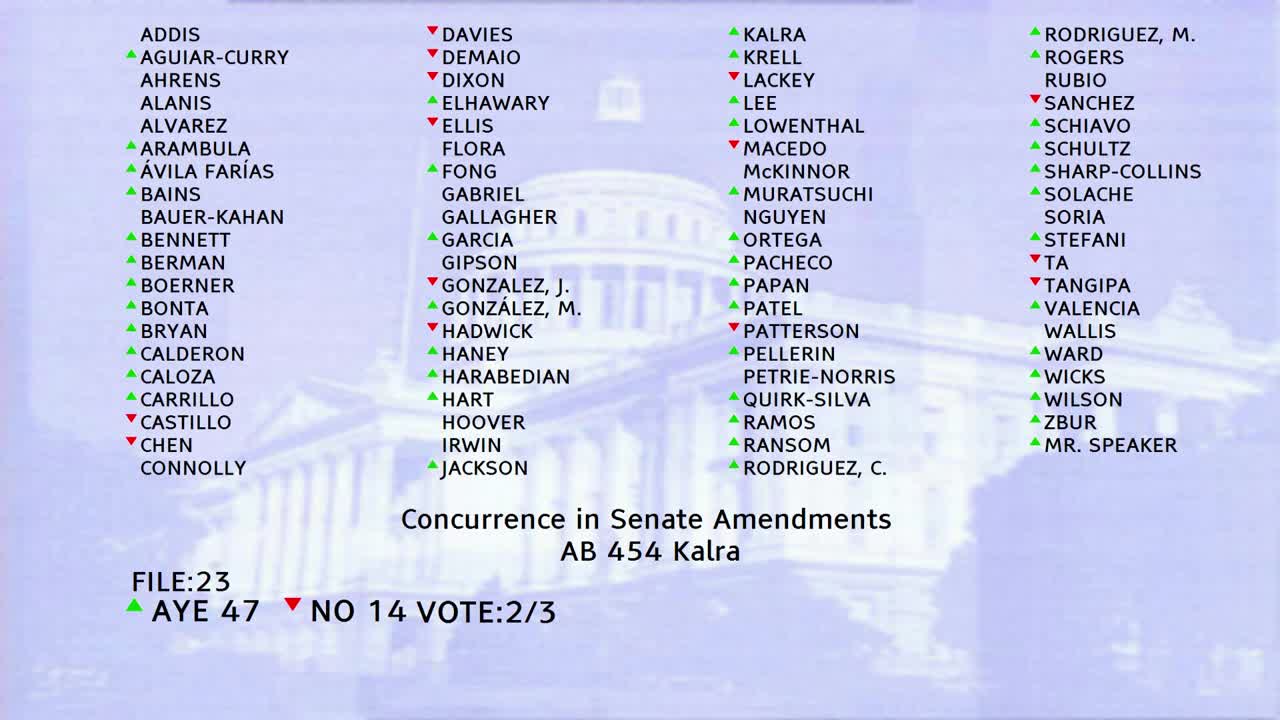
Bill Author
Bill Co-Author(s):