AB 1328: Medi-Cal reimbursements: nonemergency ambulance and other transportation.
- Session Year: 2025-2026
- House: Assembly
- Latest Version Date: 2026-08-26
Current Status:
Failed
(2026-09-20: Vetoed by Governor.)
Introduced
In Committee
Awaiting First Chamber Vote
Passed First Chamber
In Committee
Awaiting Second Chamber Vote
Passed Second Chamber
Enacted
Existing law establishes the Medi-Cal program, which is administered by the State Department of Health Care Services and under which qualified low-income individuals receive health care services, including emergency or nonemergency medical or nonmedical transportation services. The Medi-Cal program is, in part, governed and funded by federal Medicaid program provisions.
Under this bill, commencing on July 1, 2027, and subject to an appropriation, Medi-Cal fee-for-service reimbursement for nonemergency ambulance transportation services, as defined, would be in an amount equal to 80% of the amount set forth in the federal Medicare ambulance fee schedule for the corresponding level of service, adjusted by the Geographic Practice Cost Index, as specified. The bill would require the department to establish a Medi-Cal managed care directed payment program for nonemergency ambulance transportation services, with the reimbursement rates set in an amount equal to at least the amount set forth under fee-for-service reimbursement.
The bill would require the department to maximize federal financial participation in implementing the above-described provisions to the extent allowable. To the extent that federal financial participation is unavailable, the bill would require the department to implement the provisions using state funds, as specified.
Under the bill, whenever the medical necessity of nonemergency ambulance transportation services needs to be certified for purposes of Medi-Cal coverage, either a physician or a nonphysician authorized under certain federal regulations would be permitted to complete that certification, as specified. The bill would require the department to revise and update the Medi-Cal provider manual or any guidance, as applicable, to implement this provision.
Existing Medi-Cal regulations require that records of medical transportation providers include, among other information, odometer readings at each pickup and delivery location.
Under this bill, for purposes of documenting mileage in their records under the Medi-Cal program, medical transportation providers would be authorized to utilize vehicle Global Positioning System (GPS) tracking, digital mapping software or applications, or another reasonable mechanism identified by the department, as specified, in addition to the above-described odometer readings. The bill would require the department to revise and update any corresponding regulations, including the above-described provision.
Existing law establishes the Medi-Cal program, which is administered by the State Department of Health Care Services and under which qualified low-income individuals receive health care services, including emergency or nonemergency medical or nonmedical transportation services. The Medi-Cal program is, in part, governed and funded by federal Medicaid program provisions.
Under this bill, commencing on July 1, 2026, 2027, and subject to an appropriation, Medi-Cal fee-for-service reimbursement for nonemergency ambulance transportation services, as defined, would be in an amount equal to 80% of the amount set forth in the federal Medicare ambulance fee schedule for the corresponding level of service, adjusted by the Geographic Practice Cost Index, as specified. The bill would require the department to establish a Medi-Cal managed care directed payment program for nonemergency ambulance transportation services, with the reimbursement rates set in an amount equal to at least the amount set forth under fee-for-service reimbursement.
The bill would require the department to maximize federal financial participation in implementing the above-described provisions to the extent allowable. To the extent that federal financial participation is unavailable, the bill would require the department to implement the provisions using state funds, as specified.
Under the bill, whenever the medical necessity of nonemergency ambulance transportation services needs to be certified for purposes of Medi-Cal coverage, either a physician or a nonphysician authorized under certain federal regulations would be permitted to complete that certification, as specified. The bill would require the department to revise and update the Medi-Cal provider manual or any guidance, as applicable, to implement this provision.
Existing Medi-Cal regulations require that records of medical transportation providers include, among other information, odometer readings at each pickup and delivery location.
Under this bill, for purposes of documenting mileage in their records under the Medi-Cal program, medical transportation providers would be authorized to utilize vehicle Global Positioning System (GPS) tracking, digital mapping software or applications, or another reasonable mechanism identified by the department, as specified, in addition to the above-described odometer readings. The bill would require the department to revise and update any corresponding regulations, including the above-described provision.
Existing law establishes the Medi-Cal program, which is administered by the State Department of Health Care Services and under which qualified low-income individuals receive health care services, including emergency or nonemergency medical or nonmedical transportation services. The Medi-Cal program is, in part, governed and funded by federal Medicaid program provisions.
Under this bill, commencing on January July 1, 2026, and subject to an appropriation, Medi-Cal fee-for-service reimbursement for nonemergency ambulance transportation services, as defined, would be in an amount equal to 80% of the amount set forth in the federal Medicare ambulance fee schedule for the corresponding level of service, adjusted by the Geographic Practice Cost Index, as specified. The bill would require the department to establish a Medi-Cal managed care directed payment program for Medi-Cal managed care in order to follow a similar treatment to reimbursement rates for nonemergency ambulance transportation services. services, with the reimbursement rates set in an amount equal to at least the amount set forth under fee-for-service reimbursement.
The bill would require the department to maximize federal financial participation in implementing the above-described provisions to the extent allowable. To the extent that federal financial participation is unavailable, the bill would require the department to implement the provisions using state funds, as specified.
Under the bill, whenever the medical necessity of nonemergency ambulance transportation services needs to be certified for purposes of Medi-Cal coverage, either a physician or a nonphysician authorized under certain federal regulations would be permitted to complete that certification, as specified. The bill would require the department to revise and update the Medi-Cal provider manual or any guidance, as applicable, to implement this provision.
Existing Medi-Cal regulations require that records of medical transportation providers include, among other information, odometer readings at each pickup and delivery location.
Under this bill, for purposes of documenting mileage in their records under the Medi-Cal program, medical transportation providers would be authorized to utilize vehicle Global Positioning System (GPS) tracking, digital mapping software or applications, or another reasonable mechanism identified by the department, as specified, in addition to the above-described odometer readings. The bill would require the department to revise and update any corresponding regulations, including the above-described provision.
Existing law establishes the Medi-Cal program, which is administered by the State Department of Health Care Services and under which qualified low-income individuals receive health care services, including emergency or nonemergency medical or nonmedical transportation services. The Medi-Cal program is, in part, governed and funded by federal Medicaid program provisions.
Under this bill, commencing on January 1, 2026, and subject to an appropriation, Medi-Cal fee-for-service reimbursement for nonemergency ambulance transportation services, as defined, would be in an amount equal to 80% of the amount set forth in the federal Medicare ambulance fee schedule for the corresponding level of service, adjusted by the Geographic Practice Cost Index, as specified. The bill would require the department to establish a directed payment program for Medi-Cal managed care in order to follow a similar treatment to reimbursement rates for nonemergency ambulance transportation services.
The bill would require the department to maximize federal financial participation in implementing the above-described provisions to the extent allowable. To the extent that federal financial participation is unavailable, the bill would require the department to implement the provisions using state funds, as specified.
Existing law establishes the Medi-Cal program, which is administered by the State Department of Health Care Services and under which qualified low-income individuals receive health care services, including emergency or nonemergency medical or nonmedical transportation services. The Medi-Cal program is, in part, governed and funded by federal Medicaid program provisions.
Under this bill, commencing on January 1, 2026, and subject to an appropriation, Medi-Cal fee-for-service reimbursement for nonemergency ambulance transportation services, as defined, would be in an amount equal to the amount set forth in the federal Medicare ambulance fee schedule for the corresponding level of service, adjusted by the Geographic Practice Cost Index, as specified. The bill would require the department to establish a directed payment program for Medi-Cal managed care in order to follow a similar treatment to reimbursement rates for nonemergency ambulance transportation services.
The bill would require the department to maximize federal financial participation in implementing the above-described provision provisions to the extent allowable. To the extent that federal financial participation is unavailable, the bill would require the department to implement the provision provisions using state funds, as specified.
Existing law establishes the Medi-Cal program, which is administered by the State Department of Health Care Services and under which qualified low-income individuals receive health care services, including emergency or nonemergency medical or nonmedical transportation services. The Medi-Cal program is, in part, governed and funded by federal Medicaid program provisions.
This bill would require the Medi-Cal fee-for-service reimbursement rates for nonemergency ambulance transports and for interfacility ambulance transports, as defined, to be 100% of the amounts set forth in the federal Medicare ambulance fee schedule for the appropriate level of service billed, as specified.Existing law requires, with exceptions, that Medi-Cal reimbursement to providers of emergency medical transports be increased by application of an add-on to the associated Medi-Cal fee-for-service payment schedule. Under existing law, those increased payments are funded solely from a quality assurance fee (QAF), which emergency medical transport providers are required to pay based on a specified formula, and from federal reimbursement and any other related federal funds.Under this bill, the reimbursement rate for interfacility ambulance transports, in an emergency context, would not affect the calculation of the quality assurance fee rate. Under the bill, the calculation of the quality assurance fee rate would be based on the methodology and reimbursement rate in effect as of January 1, 2025. The bill would make conforming changes to related provisions.Existing law authorizes the Director of Health Care Services to modify or make adjustments to any methodology or fee amount under these provisions to the extent necessary to meet federal requirements or to obtain federal approval.If a modification or adjustment is needed to meet federal requirements, this bill would require the director to recalculate and reduce the add-on amount as necessary, and would prohibit the director from reducing the Medi-Cal fee-for-service reimbursement rates for nonemergency ambulance transports or interfacility ambulance transports.Existing federal Medicare regulations set forth requirements for certification of the medical necessity of ambulance services, as signed by a physician or a nonphysician depending on the circumstance.Under this bill, whenever the medical necessity of an ambulance transport needs to be certified for purposes of Medi-Cal coverage, a nonphysician would be authorized to complete that certification in place of a physician, and the nonphysician would be authorized to do so with a signature in electronic format or any other format, to the extent authorized by the above-described federal regulations or their successor. The bill would require the department to revise and update the Medi-Cal provider manual or any guidance, as applicable, to implement this provision.Existing state Medi-Cal regulations require that records of medical transportation providers include, among other information, odometer readings at each pickup and delivery location.This bill would require the department to revise and update the above-described regulatory provision in order to allow medical transportation providers to document mileage in their records through other mechanisms, including vehicle Global Positioning System (GPS) tracking, digital mapping software, or another reasonable mechanism identified by the department, as specified, in addition to the option of odometer readings.Under this bill, commencing on January 1, 2026, and subject to an appropriation, Medi-Cal fee-for-service reimbursement for nonemergency ambulance transportation services, as defined, would be in an amount equal to the amount set forth in the federal Medicare ambulance fee schedule for the corresponding level of service, adjusted by the Geographic Practice Cost Index, as specified.
The bill would require the department to maximize federal financial participation in implementing the above-described provision to the extent allowable. To the extent that federal financial participation is unavailable, the bill would require the department to implement the provision using state funds, as specified.
Existing law establishes the Medi-Cal program, which is administered by the State Department of Health Care Services and under which qualified low-income individuals receive health care services, including emergency or nonemergency medical or nonmedical transportation services. The Medi-Cal program is, in part, governed and funded by federal Medicaid program provisions.
Existing law sets forth various provisions relating to nonemergency medical or nonmedical transportation with regard to scope, prior authorization, reimbursement rates, and payments, and other provisions relating to transfers between facilities.This bill would state the intent of the Legislature to enact legislation that would, upon appropriation, provide an unspecified amount of additional funding for Medi-Cal reimbursements for nonemergency interfacility transfers.This bill would require the Medi-Cal fee-for-service reimbursement rates for nonemergency ambulance transports and for interfacility ambulance transports, as defined, to be 100% of the amounts set forth in the federal Medicare ambulance fee schedule for the appropriate level of service billed, as specified.
Existing law requires, with exceptions, that Medi-Cal reimbursement to providers of emergency medical transports be increased by application of an add-on to the associated Medi-Cal fee-for-service payment schedule. Under existing law, those increased payments are funded solely from a quality assurance fee (QAF), which emergency medical transport providers are required to pay based on a specified formula, and from federal reimbursement and any other related federal funds.
Under this bill, the reimbursement rate for interfacility ambulance transports, in an emergency context, would not affect the calculation of the quality assurance fee rate. Under the bill, the calculation of the quality assurance fee rate would be based on the methodology and reimbursement rate in effect as of January 1, 2025. The bill would make conforming changes to related provisions.
Existing law authorizes the Director of Health Care Services to modify or make adjustments to any methodology or fee amount under these provisions to the extent necessary to meet federal requirements or to obtain federal approval.
If a modification or adjustment is needed to meet federal requirements, this bill would require the director to recalculate and reduce the add-on amount as necessary, and would prohibit the director from reducing the Medi-Cal fee-for-service reimbursement rates for nonemergency ambulance transports or interfacility ambulance transports.
Existing federal Medicare regulations set forth requirements for certification of the medical necessity of ambulance services, as signed by a physician or a nonphysician depending on the circumstance.
Under this bill, whenever the medical necessity of an ambulance transport needs to be certified for purposes of Medi-Cal coverage, a nonphysician would be authorized to complete that certification in place of a physician, and the nonphysician would be authorized to do so with a signature in electronic format or any other format, to the extent authorized by the above-described federal regulations or their successor. The bill would require the department to revise and update the Medi-Cal provider manual or any guidance, as applicable, to implement this provision.
Existing state Medi-Cal regulations require that records of medical transportation providers include, among other information, odometer readings at each pickup and delivery location.
This bill would require the department to revise and update the above-described regulatory provision in order to allow medical transportation providers to document mileage in their records through other mechanisms, including vehicle Global Positioning System (GPS) tracking, digital mapping software, or another reasonable mechanism identified by the department, as specified, in addition to the option of odometer readings.
Existing law establishes the Medi-Cal program, which is administered by the State Department of Health Care Services and under which qualified low-income individuals receive health care services, including emergency or nonemergency medical or nonmedical transportation services. The Medi-Cal program is, in part, governed and funded by federal Medicaid program provisions.
Existing law sets forth various provisions relating to nonemergency medical or nonmedical transportation with regard to scope, prior authorization, reimbursement rates, and payments, and other provisions relating to transfers between facilities.
This bill would state the intent of the Legislature to enact legislation that would, upon appropriation, provide an unspecified amount of additional funding for Medi-Cal reimbursements for nonemergency interfacility transfers.
(a)(1)Commencing on July 1, 2027, subject to an appropriation made by the Legislature to fund, in whole or in part, the reimbursement rates described in this subdivision, Medi-Cal fee-for-service reimbursement for nonemergency ambulance transportation services shall be in an amount equal to 80 percent of the amount set forth in the federal Medicare ambulance fee schedule established pursuant to Section 1395m of Title 42 of the United States Code, for the corresponding level of service.
(2)The reimbursement described in paragraph (1) shall be adjusted by the Geographic Practice Cost Index under the federal Centers for Medicare and Medicaid Services, specific to the area of California in which the services are provided.
(3)The department shall establish a Medi-Cal managed care directed payment program pursuant to the authority described in Section 438.6(c) of Title 42 of the Federal Code of Regulations to increase the reimbursement rates for nonemergency ambulance transportation services to an amount equal to at least the amount set forth in paragraph (1), for the corresponding level of service. The department shall adjust the directed payment amount annually pursuant to paragraph (2). The directed payments shall commence on July 1, 2027, subject to an appropriation made by the Legislature to fund, in whole or in part, the reimbursement rates described in this paragraph.
(b)(1)The department shall maximize federal financial participation in implementing this section to the extent allowable. For purposes of implementing this section, the department shall claim federal financial participation to the extent that the department determines it is available.
(2)To the extent that federal financial participation is unavailable, the department shall implement this section using state funds, if appropriated as described in subdivision (a).
(3)It is the intent of the Legislature that the appropriation described in subdivision (a) be sufficient to fund the reimbursement levels in whole.
(c)Notwithstanding the rulemaking provisions of Chapter 3.5 (commencing with Section 11340) of Part 1 of Division 3 of Title 2 of the Government Code, the department may implement, interpret, or make specific this section, in whole or in part, by means of plan letters, plan or provider bulletins, or similar instructions without taking any further regulatory action.
(d)For purposes of this section, nonemergency ambulance transportation services means nonemergency medical transportation services, as described in Section 51323 of Title 22 of the California Code of Regulations, that are conducted by ground ambulance. The term nonemergency ambulance transportation services does not include emergency medical transport services, as defined in subdivision (g) of Section 14129.
SEC. 2.Section 14124.152 is added to the Welfare and Institutions Code, immediately following Section 14124.151, to read:14124.152.(a)Whenever the medical necessity of nonemergency ambulance transportation services needs to be certified for purposes of Medi-Cal coverage, either a physician or a nonphysician authorized pursuant to Section 410.40 of Title 42 of the Code of Federal Regulations or its successor may complete that certification. The physician certification statement or nonphysician certification statement used for this purpose shall conform to the definitions and standards set forth in Section 410.40 of Title 42 of the Code of Federal Regulations or its successor.
(b)The department shall revise and update the Medi-Cal provider manual or any guidance, as applicable, to implement subdivision (a).
(c)This section applies to both of the following:
(1)The Medi-Cal fee-for-service delivery system.
(2)A Medi-Cal managed care plan, and its subcontractor or designee as applicable, to the extent that the plan incorporates the certification requirement described in subdivision (a) into the plans coverage of nonemergency ambulance transportation services.
(d)For purposes of this section, nonemergency ambulance transportation services has the same meaning as set forth in Section 14124.151.
SEC. 3.Section 14124.153 is added to the Welfare and Institutions Code, immediately following Section 14124.152, to read:14124.153.(a)For purposes of documenting mileage in their records under the Medi-Cal program, medical transportation providers may utilize any of the following mechanisms:
(1)Odometer readings at each pickup and delivery location.
(2)Vehicle Global Positioning System (GPS) tracking.
(3)Digital mapping software or applications, whether or not installed in the vehicle transporting the patient.
(4)Any other mechanism identified by the department, as deemed reasonable based on ongoing technological updates.
(b)The department shall revise and update any regulations corresponding to mileage documentation, as described in subdivision (a), including Section 51476 of Title 22 of the California Code of Regulations.
(a)(1)Commencing on July 1, 2026, 2027, subject to an appropriation made by the Legislature to fund, in whole or in part, the reimbursement rates described in this subdivision, Medi-Cal fee-for-service reimbursement for nonemergency ambulance transportation services shall be in an amount equal to 80 percent of the amount set forth in the federal Medicare ambulance fee schedule established pursuant to Section 1395m of Title 42 of the United States Code, for the corresponding level of service.
(2)The reimbursement described in paragraph (1) shall be adjusted by the Geographic Practice Cost Index under the federal Centers for Medicare and Medicaid Services, specific to the area of California in which the services are provided.
(3)The department shall establish a Medi-Cal managed care directed payment program pursuant to the authority described in Section 438.6(c) of Title 42 of the Federal Code of Regulations to increase the reimbursement rates for nonemergency ambulance transportation services to an amount equal to at least the amount set forth in paragraph (1), for the corresponding level of service. The department shall adjust the directed payment amount annually pursuant to paragraph (2). The directed payments shall commence on July 1, 2026, 2027, subject to an appropriation made by the Legislature to fund, in whole or in part, the reimbursement rates described in this paragraph.
(b)(1)The department shall maximize federal financial participation in implementing this section to the extent allowable. For purposes of implementing this section, the department shall claim federal financial participation to the extent that the department determines it is available.
(2)To the extent that federal financial participation is unavailable, the department shall implement this section using state funds, if appropriated as described in subdivision (a).
(3)It is the intent of the Legislature that the appropriation described in subdivision (a) be sufficient to fund the reimbursement levels in whole.
(c)Notwithstanding the rulemaking provisions of Chapter 3.5 (commencing with Section 11340) of Part 1 of Division 3 of Title 2 of the Government Code, the department may implement, interpret, or make specific this section, in whole or in part, by means of plan letters, plan or provider bulletins, or similar instructions without taking any further regulatory action.
(d)For purposes of this section, nonemergency ambulance transportation services means nonemergency medical transportation services, as described in Section 51323 of Title 22 of the California Code of Regulations, that are conducted by ground ambulance. The term nonemergency ambulance transportation services does not include emergency medical transport services, as defined in subdivision (g) of Section 14129.
SEC. 2.Section 14124.152 is added to the Welfare and Institutions Code, immediately following Section 14124.151, to read:14124.152.(a)Whenever the medical necessity of nonemergency ambulance transportation services needs to be certified for purposes of Medi-Cal coverage, either a physician or a nonphysician authorized pursuant to Section 410.40 of Title 42 of the Code of Federal Regulations or its successor may complete that certification. The physician certification statement or nonphysician certification statement used for this purpose shall conform to the definitions and standards set forth in Section 410.40 of Title 42 of the Code of Federal Regulations or its successor.
(b)The department shall revise and update the Medi-Cal provider manual or any guidance, as applicable, to implement subdivision (a).
(c)This section applies to both of the following:
(1)The Medi-Cal fee-for-service delivery system.
(2)A Medi-Cal managed care plan, and its subcontractor or designee as applicable, to the extent that the plan incorporates the certification requirement described in subdivision (a) into the plans coverage of nonemergency ambulance transportation services.
(d)For purposes of this section, nonemergency ambulance transportation services has the same meaning as set forth in Section 14124.151.
SEC. 3.Section 14124.153 is added to the Welfare and Institutions Code, immediately following Section 14124.153 14124.152, to read:14124.153.(a)For purposes of documenting mileage in their records under the Medi-Cal program, medical transportation providers may utilize any of the following mechanisms:
(1)Odometer readings at each pickup and delivery location.
(2)Vehicle Global Positioning System (GPS) tracking.
(3)Digital mapping software or applications, whether or not installed in the vehicle transporting the patient.
(4)Any other mechanism identified by the department, as deemed reasonable based on ongoing technological updates.
(b)The department shall revise and update any regulations corresponding to mileage documentation, as described in subdivision (a), including Section 51476 of Title 22 of the California Code of Regulations.
(a)(1)Commencing on January July 1, 2026, subject to an appropriation made by the Legislature to fund, in whole or in part, the reimbursement rates described in this subdivision, Medi-Cal fee-for-service reimbursement for nonemergency ambulance transportation services shall be in an amount equal to 80 percent of the amount set forth in the federal Medicare ambulance fee schedule established pursuant to Section 1395m of Title 42 of the United States Code, for the corresponding level of service.
(2)The reimbursement described in paragraph (1) shall be adjusted by the Geographic Practice Cost Index under the federal Centers for Medicare and Medicaid Services, specific to the area of California in which the services are provided.
(3)The department shall establish a Medi-Cal managed care directed payment program pursuant to the authority described in Section 438.6(c) of Title 42 of the Federal Code of Regulations to increase the reimbursement rates for nonemergency ambulance transportation services in to an amount equal to at least the amount set forth in paragraph (1), for the corresponding level of service. The department shall adjust the directed payment amount annually pursuant to paragraph (2). The directed payments shall commence on January July 1, 2026, subject to an appropriation made by the Legislature to fund, in whole or in part, the reimbursement rates described in this paragraph.
(b)(1)The department shall maximize federal financial participation in implementing this section to the extent allowable. For purposes of implementing this section, the department shall claim federal financial participation to the extent that the department determines it is available.
(2)To the extent that federal financial participation is unavailable, the department shall implement this section using state funds, if appropriated as described in subdivision (a).
(3)It is the intent of the Legislature that the appropriation described in subdivision (a) be sufficient to fund the reimbursement levels in whole.
(c)Notwithstanding the rulemaking provisions of Chapter 3.5 (commencing with Section 11340) of Part 1 of Division 3 of Title 2 of the Government Code, the department may implement, interpret, or make specific this section, in whole or in part, by means of plan letters, plan or provider bulletins, or similar instructions without taking any further regulatory action.
(d)For purposes of this section, nonemergency ambulance transportation services means nonemergency medical transportation services, as described in Section 51323 of Title 22 of the California Code of Regulations, that are conducted by ground ambulance. The term nonemergency ambulance transportation services does not include emergency medical transport services, as defined in subdivision (g) of Section 14129.
SEC. 2.Section 14124.152 is added to the Welfare and Institutions Code, immediately following Section 14124.151, to read:14124.152.(a)Whenever the medical necessity of nonemergency ambulance transportation services needs to be certified for purposes of Medi-Cal coverage, either a physician or a nonphysician authorized pursuant to Section 410.40 of Title 42 of the Code of Federal Regulations or its successor may complete that certification. The physician certification statement or nonphysician certification statement used for this purpose shall conform to the definitions and standards set forth in Section 410.40 of Title 42 of the Code of Federal Regulations or its successor.
(b)The department shall revise and update the Medi-Cal provider manual or any guidance, as applicable, to implement subdivision (a).
(c)This section applies to both of the following:
(1)The Medi-Cal fee-for-service delivery system.
(2)A Medi-Cal managed care plan, and its subcontractor or designee as applicable, to the extent that the plan incorporates the certification requirement described in subdivision (a) into the plans coverage of nonemergency ambulance transportation services.
(d)For purposes of this section, nonemergency ambulance transportation services has the same meaning as set forth in Section 14124.151.
SEC. 3.Section 14124.153 is added to the Welfare and Institutions Code, immediately following Section 14124.153, to read:14124.153.(a)For purposes of documenting mileage in their records under the Medi-Cal program, medical transportation providers may utilize any of the following mechanisms:
(1)Odometer readings at each pickup and delivery location.
(2)Vehicle Global Positioning System (GPS) tracking.
(3)Digital mapping software or applications, whether or not installed in the vehicle transporting the patient.
(4)Any other mechanism identified by the department, as deemed reasonable based on ongoing technological updates.
(b)The department shall revise and update any regulations corresponding to mileage documentation, as described in subdivision (a), including Section 51476 of Title 22 of the California Code of Regulations.
(a)(1)Commencing on January 1, 2026, subject to an appropriation made by the Legislature to fund, in whole or in part, the reimbursement rates described in this subdivision, Medi-Cal fee-for-service reimbursement for nonemergency ambulance transportation services shall be in an amount equal to 80 percent of the amount set forth in the federal Medicare ambulance fee schedule established pursuant to Section 1395m of Title 42 of the United States Code, for the corresponding level of service.
(2)The reimbursement described in paragraph (1) shall be adjusted by the Geographic Practice Cost Index under the federal Centers for Medicare and Medicaid Services, specific to the area of California in which the services are provided.
(3)The department shall establish a Medi-Cal managed care directed payment program pursuant to the authority described in Section 438.6(c) of Title 42 of the Federal Code of Regulations to increase the reimbursement rates for nonemergency ambulance transportation services in an amount equal to the amount set forth in paragraph (1), for the corresponding level of service. The department shall adjust the directed payment amount annually pursuant to paragraph (2). The directed payments shall commence on January 1, 2026, subject to an appropriation made by the Legislature to fund, in whole or in part, the reimbursement rates described in this paragraph.
(b)(1)The department shall maximize federal financial participation in implementing this section to the extent allowable. For purposes of implementing this section, the department shall claim federal financial participation to the extent that the department determines it is available.
(2)To the extent that federal financial participation is unavailable, the department shall implement this section using state funds, if appropriated as described in subdivision (a).
(3)It is the intent of the Legislature that the appropriation described in subdivision (a) be sufficient to fund the reimbursement levels in whole.
(c)Notwithstanding the rulemaking provisions of Chapter 3.5 (commencing with Section 11340) of Part 1 of Division 3 of Title 2 of the Government Code, the department may implement, interpret, or make specific this section, in whole or in part, by means of plan letters, plan or provider bulletins, or similar instructions without taking any further regulatory action.
(d)For purposes of this section, nonemergency ambulance transportation services means nonemergency medical transportation services, as described in Section 51323 of Title 22 of the California Code of Regulations, that are conducted by ground ambulance. The term nonemergency ambulance transportation services does not include emergency medical transport services, as defined in subdivision (g) of Section 14129.
(a)(1)Commencing on January 1, 2026, subject to an appropriation made by the Legislature to fund, in whole or in part, the reimbursement levels rates described in this subdivision, Medi-Cal fee-for-service reimbursement for nonemergency ambulance transportation services shall be in an amount equal to the amount set forth in the federal Medicare ambulance fee schedule established pursuant to Section 1395m of Title 42 of the United States Code, for the corresponding level of service.
(2)The reimbursement described in paragraph (1) shall be adjusted by the Geographic Practice Cost Index under the federal Centers for Medicare and Medicaid Services, specific to the area of California in which the services are provided.
(3)The department shall establish a Medi-Cal managed care directed payment program pursuant to the authority described in Section 438.6(c) of Title 42 of the Federal Code of Regulations to increase the reimbursement rates for nonemergency ambulance transportation services in an amount equal to the amount set forth in paragraph (1), for the corresponding level of service. The department shall adjust the directed payment amount annually pursuant to paragraph (2). The directed payments shall commence on January 1, 2026, subject to an appropriation made by the Legislature to fund, in whole or in part, the reimbursement rates described in this paragraph.
(b)(1)The department shall maximize federal financial participation in implementing this section to the extent allowable. For purposes of implementing this section, the department shall claim federal financial participation to the extent that the department determines it is available.
(2)To the extent that federal financial participation is unavailable, the department shall implement this section using state funds, if appropriated as described in subdivision (a).
(3)It is the intent of the Legislature that the appropriation described in subdivision (a) be sufficient to fund the reimbursement levels in whole.
(c)Notwithstanding the rulemaking provisions of Chapter 3.5 (commencing with Section 11340) of Part 1 of Division 3 of Title 2 of the Government Code, the department may implement, interpret, or make specific this section, in whole or in part, by means of plan letters, plan or provider bulletins, or similar instructions without taking any further regulatory action.
(d)For purposes of this section, nonemergency ambulance transportation services means nonemergency medical transportation services, as described in Section 51323 of Title 22 of the California Code of Regulations, that are conducted by ground ambulance. The term nonemergency ambulance transportation services does not include emergency medical transport services, as defined in subdivision (g) of Section 14129.
(a)(1)Commencing on January 1, 2026, subject to an appropriation made by the Legislature to fund, in whole or in part, the reimbursement levels described in this subdivision, Medi-Cal fee-for-service reimbursement for nonemergency ambulance transportation services shall be in an amount equal to the amount set forth in the federal Medicare ambulance fee schedule established pursuant to Section 1395m of Title 42 of the United States Code, for the corresponding level of service.
(2)The reimbursement described in paragraph (1) shall be adjusted by the Geographic Practice Cost Index under the federal Centers for Medicare and Medicaid Services, specific to the area of California in which the services are provided.
(b)(1)The department shall maximize federal financial participation in implementing this section to the extent allowable. For purposes of implementing this section, the department shall claim federal financial participation to the extent that the department determines it is available.
(2)To the extent that federal financial participation is unavailable, the department shall implement this section using state funds, if appropriated as described in subdivision (a).
(3)It is the intent of the Legislature that the appropriation described in subdivision (a) be sufficient to fund the reimbursement levels in whole.
(c)Notwithstanding the rulemaking provisions of Chapter 3.5 (commencing with Section 11340) of Part 1 of Division 3 of Title 2 of the Government Code, the department may implement, interpret, or make specific this section, in whole or in part, by means of plan letters, plan or provider bulletins, or similar instructions without taking any further regulatory action.
(d)For purposes of this section, nonemergency ambulance transportation services means nonemergency medical transportation services, as described in Section 51323 of Title 22 of the California Code of Regulations, that are conducted by ground ambulance. The term nonemergency ambulance transportation services does not include emergency medical transport services, as defined in subdivision (g) of Section 14129.
SECTION 1.The heading of Article 3.91 (commencing with Section 14129) of Chapter 7 of Part 3 of Division 9 of the Welfare and Institutions Code is amended to read:3.91.Medi-Cal Emergency and Nonemergency Medical Transportation Reimbursement ActSEC. 2.Section 14129 of the Welfare and Institutions Code is amended to read:14129.For purposes of this article, the following definitions apply:(a)Annual quality assurance fee rate means the quality assurance fee assessed on each emergency medical transport during each applicable state fiscal year.(b)Aggregate fee schedule amount means the product of the fee-for-service add-on increase described in Section 14129.3 and the Medi-Cal emergency medical transports, including both fee-for-service transports paid by the department and managed care transports paid by Medi-Cal managed care health plans, utilizing the billing codes for emergency medical transport for the state fiscal year.(c)Available fee amount shall be calculated as the sum of the following:(1)The amount deposited in the Medi-Cal Emergency Medical Transport Fund established under Section 14129.2 during the applicable state fiscal year, less the amounts described in subparagraphs (A) and (B) of paragraph (2) of subdivision (f) of Section 14129.2.(2)Any federal financial participation obtained as a result of the deposit of the amount described in paragraph (1) in the Medi-Cal Emergency Medical Transport Fund, created pursuant to Section 14129.2, for the applicable state fiscal year.(d)Department means the State Department of Health Care Services.(e)Director means the Director of Health Care Services.(f)Effective state medical assistance percentage means a ratio of the aggregate expenditures from state-only sources for the Medi-Cal program divided by the aggregate expenditures from state and federal sources for the Medi-Cal program for a state fiscal year.(g)(1)Emergency medical transport means the act of transporting an individual from any point of origin to the nearest medical facility capable of meeting the emergency medical needs of the patient by an emergency medical transport provider by means of an ambulance licensed, operated, and equipped in accordance with applicable state or local statutes, ordinances, or regulations that are billed with billing codes A0429 BLS Emergency, A0427 ALS Emergency, A0434 Specialty Care Transport, A0225 Neonatal Emergency Transport, and A0433 ALS2, and any equivalent, predecessor, or successor billing codes as may be determined by the director. Emergency medical transport excludes transportation of beneficiaries by passenger car, taxicabs, litter vans, wheelchair vans, other forms of public or private conveyances, and transportation by an air ambulance provider. An emergency medical transport does not occur when, following evaluation of a patient, a transport is not provided.(2)The definition of emergency medical transport set forth in paragraph (1) shall be construed as applying whether or not those transports were initiated through a public safety answering point (PSAP) or traditional 911 dispatch system. This paragraph shall not be construed as amending or otherwise affecting the definition of ground emergency medical transports set forth in Section 14199.128 for purposes of Chapter 7.5 (commencing with Section 14199.100).(h)Gross receipts means gross payments received as patient care revenue for emergency medical transports, determined on a cash basis of accounting. Gross receipts includes all payments received as patient care revenue for emergency medical transports, including payments for billing codes A0429 BLS Emergency, A0427 ALS Emergency, and A0433 ALS2, and any equivalent, predecessor, or successor billing codes as may be determined by the director, and any other ancillary billing codes associated with emergency medical transport as may be determined by the director. Gross receipts excludes supplemental amounts received pursuant to Sections 14105.94 or 14105.945.(i)Emergency medical transport provider means any provider of emergency medical transports, except that during any Medi-Cal managed care rating period for which Section 14105.945 is implemented emergency medical transport provider shall exclude eligible providers as defined in paragraph (1) of subdivision (a) of Section 14105.945 for purposes of this article.(j)Emergency medical transport provider subject to the fee means all emergency medical transport providers who bill and receive patient care revenue from the provision of emergency medical transports, except emergency medical transport providers that are exempt pursuant to subdivision (c) of Section 14129.6.(k)Interfacility ambulance transport means an ambulance transport in which the origin and destination are both a health facility, as defined in Section 1250 of the Health and Safety Code.(l)Medi-Cal managed care health plan means a managed health care plan as that term is defined in subdivision (ab) of Section 14169.51.(m)Nonemergency ambulance transport means an ambulance transport the request for which is made other than through a 911 PSAP, and also means an ambulance transport billed with a Healthcare Common Procedure Coding System (HCPCS) code not associated with an emergency level of ambulance service.SEC. 3.Section 14129.05 is added to the Welfare and Institutions Code, immediately following Section 14129, to read:14129.05.The Medi-Cal fee-for-service reimbursement rates for nonemergency ambulance transports and for interfacility ambulance transports shall be 100 percent of the amounts set forth in the federal Medicare ambulance fee schedule established pursuant to Section 1395m of Title 42 of the United States Code for the appropriate level of service billed.SEC. 4.Section 14129.06 is added to the Welfare and Institutions Code, immediately following Section 14129.05, to read:14129.06.(a)Whenever the medical necessity of an ambulance transport needs to be certified for purposes of Medi-Cal coverage, a nonphysician may complete that certification in place of a physician, and the nonphysician may do so with a signature in electronic format or any other format, to the extent authorized by Section 410.40 of Title 42 of the Code of Federal Regulations or its successor.(b)The department shall revise and update the Medi-Cal provider manual or any guidance, as applicable, to implement subdivision (a).SEC. 5.Section 14129.2 of the Welfare and Institutions Code is amended to read:14129.2.(a)(1)Commencing with the state fiscal quarter beginning on July 1, 2018, and continuing each state fiscal quarter thereafter for which this article is implemented, there shall be imposed a quality assurance fee for each emergency medical transport provided by each emergency medical transport provider subject to the fee in accordance with this section.(2)The director shall ensure that the quality assurance fee per emergency medical transport imposed pursuant to this article is collected.(b)(1)On or before June 15, 2018, and continuing each June 15 thereafter for which this article is implemented, the director shall calculate the annual quality assurance fee rate applicable to the following state fiscal year based on the most recently collected data from emergency medical transport providers pursuant to Section 14129.1. The director may correct any identified material or significant errors in the data collected from emergency medical transport providers pursuant to Section 14129.1 for the purposes of calculating the annual quality assurance fee rate. The directors determination whether to exercise the directors discretion to correct any data pursuant to this paragraph shall not be subject to judicial review, except that an emergency medical transport provider may bring a writ of mandate under Section 1085 of the Code of Civil Procedure to rectify an abuse of discretion by the director in correcting that emergency medical transport providers data when that correction results in a greater fee amount for that provider pursuant to this section.(A)For the state fiscal year beginning on July 1, 2018, the annual quality assurance fee rate shall be calculated by multiplying the projected total annual gross receipts for all emergency medical transport providers subject to the fee by 5.1 percent, which resulting product shall be divided by the projected total annual emergency medical transports by all emergency medical transport providers subject to the fee for the state fiscal year.(B)(i)For state fiscal years beginning July 1, 2019, and continuing each state fiscal year thereafter, the annual quality assurance fee rate shall be calculated by a ratio, the numerator of which shall be the sum of: (i) the product of the projected aggregate fee schedule amount and the effective state medical assistance percentage and (ii) the amount described in subparagraph (A) of paragraph (2) of subdivision (f) for the state fiscal year, and the denominator of which shall be 90 percent of the projected total annual emergency medical transports by all emergency medical transport providers subject to the fee for the state fiscal year.(ii)Notwithstanding clause (i) or any other law, the reimbursement rate for interfacility ambulance transports, as described in Section 14129.05, in an emergency context, shall not affect the calculation of the quality assurance fee rate. Section 14129.05 shall not be construed as affecting that calculation. The calculation of the quality assurance fee rate shall be based on the methodology and reimbursement rate in effect as of January 1, 2025.(2)On or before June 15, 2018, and continuing each June 15 thereafter for which this article is implemented, the director shall publish the annual quality assurance fee rate on its internet website.(3)In no case shall the fees calculated pursuant to this subdivision and collected pursuant to this article exceed the amounts allowable under federal law. If, on or before June 15 of each year, the director makes a determination that the fees collected pursuant to this subdivision exceed the amounts allowable under federal law, the director may reduce the add-on increase to the fee-for-service payment schedule described in Section 14129.3 only to the extent necessary to reflect the amount of fees allowable under federal law in an applicable state fiscal year.(4)If, during a state fiscal year for which this article is operative, the actual or projected available fee amount exceeds or is less than the actual or projected aggregate fee schedule amount by more than 1 percent, the director shall adjust the annual quality assurance fee rate so that the available fee amount for the state fiscal year will approximately equal the aggregate fee schedule amount for the state fiscal year. The available fee amount for a state fiscal year shall be considered to equal the aggregate fee schedule amount for the state fiscal year if the difference between the available fee amount for the state fiscal year and the aggregate fee schedule amount for the state fiscal year constitutes less than 1 percent of the aggregate fee schedule amount for the state fiscal year.(c)(1)Each emergency medical transport provider subject to the fee shall remit to the department an amount equal to the annual quality assurance fee rate for the 201819 state fiscal year multiplied by the number of transports reported or that should have been reported by the emergency medical transport provider pursuant to subdivision (b) of Section 14129.1 in the quarter beginning on April 1, 2018, based on a schedule established by the director. The schedule established by the director for the fee payment described in this paragraph shall require remittance of the fee payment according to the following guidelines:(A)The director shall require an emergency medical transport provider that rendered 35,000 or more Medi-Cal fee-for-service emergency medical transports during the 201617 state fiscal year to remit the fee payment described in this paragraph on or after July 1, 2018.(B)The director shall require an emergency medical transport provider that rendered fewer than 35,000 Medi-Cal fee-for-service emergency medical transports during the 201617 state fiscal year to remit 50 percent or less of the fee payment described in this paragraph on or after August 1, 2018.(C)The director shall require an emergency medical transport provider that rendered fewer than 35,000 Medi-Cal fee-for-service emergency medical transports during the 201617 state fiscal year to remit any remaining fee payment amount described in this paragraph on or after August 15, 2018.(2)Commencing with the state fiscal quarter beginning on October 1, 2018, and continuing each state fiscal quarter thereafter, on or before the first day of each state fiscal quarter, each emergency medical transport provider subject to the fee shall remit to the department an amount equal to the annual quality assurance fee rate for the applicable state fiscal year multiplied by the number of transports reported or that should have been reported by the emergency medical transport provider pursuant to subdivision (b) of Section 14129.1 in the immediately preceding quarter.(d)(1)Interest shall be assessed on quality assurance fees not paid on the date due at the greater of 10 percent per annum or the rate at which the department assesses interest on Medi-Cal program overpayments pursuant to subdivision (h) of Section 14171. Interest shall begin to accrue the day after the date the payment was due and shall be deposited in the Medi-Cal Emergency Medical Transport Fund established in subdivision (f).(2)In the event that any fee payment is more than 60 days overdue, the department may deduct the unpaid fee and interest owed from any Medi-Cal reimbursement payments owed to the emergency medical transport provider until the full amount of the fee, interest, and any penalties assessed under this article are recovered. Any deduction made pursuant to this subdivision shall be made only after the department gives the emergency medical transport provider written notification. Any deduction made pursuant to this subdivision may be deducted over a period of time that takes into account the financial condition of the emergency medical transport provider.(3)In the event that any fee payment is more than 60 days overdue, a penalty equal to the interest charge described in paragraph (1) shall be assessed and due for each month for which the payment is not received after 60 days. Any funds resulting from a penalty imposed pursuant to this paragraph shall be deposited into the Medi-Cal Emergency Medical Transport Fund created pursuant to subdivision (f).(4)The director may waive a portion or all of either the interest or penalties, or both, assessed under this article in the event the director determines, in the directors sole discretion, that the emergency medical transport provider has demonstrated that imposition of the full amount of the quality assurance fee pursuant to the timelines applicable under this article has a high likelihood of creating an undue financial hardship for the provider. Waiver of some or all of the interest or penalties pursuant to this paragraph shall be conditioned on the emergency medical transport providers agreement to make fee payments on an alternative schedule developed by the department.(e)The department shall accept an emergency medical transport providers payment even if the payment is submitted in a rate year subsequent to the rate year in which the fee was assessed.(f)(1)The director shall deposit the quality assurance fees collected pursuant to this section in the Medi-Cal Emergency Medical Transport Fund, which is hereby created in the State Treasury and, notwithstanding Section 13340 of the Government Code, is continuously appropriated without regard to fiscal years to the department for the purposes specified in this article. Notwithstanding Section 16305.7 of the Government Code, the fund shall also include interest and dividends earned on moneys in the fund.(2)The moneys in the Medi-Cal Emergency Medical Transport Fund, including any interest and dividends earned on money in the fund, shall be available exclusively to enhance federal financial participation for ambulance services under the Medi-Cal program and to provide additional reimbursement to, and to support quality improvement efforts of, emergency medical transport providers, and to pay for the states administrative costs and to provide funding for health care coverage for Californians, in the following order of priority:(A)To pay for the departments staffing and administrative costs directly attributable to implementing this article, not to exceed the following amounts:(i)For the 201819 state fiscal year, one million three thousand dollars ($1,003,000), exclusive of any federal matching funds.(ii)For the 201920 state fiscal year and each state fiscal year thereafter, three hundred seventy-four thousand dollars ($374,000), exclusive of any federal matching funds.(B)To pay for the health care coverage in each applicable state fiscal year in the amount of 10 percent of the annual quality assurance fee collection amount, exclusive of any federal matching funds.(C)To make increased payments to emergency medical transport providers pursuant to this article.(g)In the event of a merger, acquisition, or similar transaction involving an emergency medical transport provider that has outstanding quality assurance fee payment obligations pursuant to this article, including any interest and penalty amounts owed, the resultant or successor emergency medical transport provider shall be responsible for paying to the department the full amount of outstanding quality assurance fee payments, including any applicable interest and penalties, attributable to the emergency medical transport provider for which it was assessed, upon the effective date of the transaction. An entity considering a merger, acquisition, or similar transaction involving an emergency medical transport provider may submit a request pursuant to Division 10 (commencing with Section 7920.000) of Title 1 of the Government Code to ascertain the outstanding quality assurance fee payment obligations of the emergency medical transport provider pursuant to this article as of the date of the departments response to that request.SEC. 6.Section 14129.3 of the Welfare and Institutions Code is amended to read:14129.3.(a)Except as provided in subdivision (i) of Section 14105.945, commencing July 1, 2018, and for each state fiscal year thereafter for which this article is operative, reimbursement to emergency medical transport providers for emergency medical transports shall be increased by application of an add-on to the associated Medi-Cal fee-for-service payment schedule. The add-on increase to the fee-for-service payment schedule under this section shall be calculated on or before June 15, 2018, and shall remain the same for later state fiscal years for which this article is operative, to the extent the department determines federal financial participation is available and is not otherwise jeopardized. The add-on increase to the fee-for-service payment schedule under this section shall apply only to those billing codes identified in, or any equivalent, predecessor, or successor billing codes as may be determined by the director pursuant to, subdivision (g) of Section 14129. The department shall calculate the projections required by this subdivision based on the data submitted pursuant to Section 14129.1. The fee-for-service add-on shall be equal to the quotient of the available fee amount projected by the department on or before June 15, 2018, for the 201819 state fiscal year, divided by the total Medi-Cal emergency medical transports, including both fee-for-service transports paid by the department and managed care transports paid by Medi-Cal managed care health plans, utilizing these billing codes projected by the department on or before June 15, 2018, for the 201819 state fiscal year. The resulting fee-for-service payment schedule amounts after the application of this section shall be equal to the sum of the Medi-Cal fee-for-service payment schedule amount for the 201516 state fiscal year, except as described in Section 14129.05, and the add-on increase.(b)(1)Each applicable Medi-Cal managed care health plan shall satisfy its obligation under Section 438.114(c) of Title 42 of the Code of Federal Regulations for emergency medical transports and shall provide payment to noncontract emergency medical transport providers consistent with Section 1396u-2(b)(2)(D) of Title 42 of the United States Code. Effective July 1, 2018, and for each state fiscal year thereafter for which this article is operative, the amounts a noncontract emergency medical transport provider could collect if the beneficiary received medical assistance other than through enrollment in a Medi-Cal managed care health plan pursuant to Section 1396u-2(b)(2)(D) of Title 42 of the United States Code shall be the resulting fee-for-service payment schedule amounts after the application of this section.(2)This subdivision shall not apply to an eligible provider, as defined in paragraph (1) of subdivision (a) of Section 14105.945, who provides noncontract emergency medical transports to an enrollee of a Medi-Cal managed care plan during any Medi-Cal managed care rating period that Section 14105.945 is implemented.(c)The increased payments required by this section shall be funded solely from the following:(1)The quality assurance fee set forth in Section 14129.2, along with any interest or other investment income earned on those funds.(2)Federal reimbursement and any other related federal funds.(d)The proceeds of the quality assurance fee set forth in Section 14129.2, the matching amount provided by the federal government, and any interest earned on those proceeds shall be used to supplement existing funding for emergency medical transports provided by emergency medical transport providers and not to supplant this funding.(e)Notwithstanding this article, the department may seek federal approval to implement any add-on increase to the fee-for-service payment schedule pursuant to this section for any state fiscal year or years, as applicable, on a time-limited basis for a fixed program period, as determined by the department.(f)Notwithstanding this article, the add-on increase to the fee-for-service payment schedule pursuant to this section shall only be required and payable for state fiscal years that a quality assurance fee payment obligation exists for emergency medical transport providers.SEC. 7.Section 14129.6 of the Welfare and Institutions Code is amended to read:14129.6.(a)(1)The department shall request any approval from the federal Centers for Medicare and Medicaid Services it deems necessary for the use of fees pursuant to this article and for the purpose of receiving associated federal matching funds.(2)In making that request, the department may seek, as it deems necessary, a request for waiver of the broad-based requirement, waiver of the uniformity requirement, or both, pursuant to paragraphs (1) and (2) of subdivision (e) of Section 433.68 of Title 42 of the Code of Federal Regulations, or a request for waiver of any other provisions of federal law or regulation necessary to implement this article.(3)This article shall be implemented only to the extent that any necessary federal approvals are obtained and federal financial participation is available and is not otherwise jeopardized.(b)(1)The director may modify or make adjustments to any methodology, fee amount, or other provision specified in this article to the extent necessary to meet the requirements of federal law or regulations or to obtain federal approval. If the director, after consulting with affected emergency medical transport providers, determines that a modification is needed, the director shall execute a declaration stating that this determination has been made and that the actual or projected available fee amount for a state fiscal year remains approximately equal to the actual or projected aggregate fee schedule amount for each applicable state fiscal year, as defined by paragraph (4) of subdivision (b) of Section 14129.2. The director shall retain the declaration and provide a copy, within five working days of the execution of the declaration, to the fiscal and appropriate policy committees of the Legislature.(2)If a modification or adjustment is needed to meet the requirements of federal law or regulations or to obtain federal approval, the director shall recalculate and reduce the add-on amount described in Section 14129.2, as necessary, and shall not reduce the Medi-Cal fee-for-service reimbursement rates for nonemergency ambulance transports or interfacility ambulance transports, as described in Section 14129.05.(c)The director may add categories of exempt emergency medical transport providers or apply a nonuniform fee per transport to emergency medical transport providers that are subject to the fee in order to meet requirements of federal law or regulations. The director may exempt categories of emergency medical transport providers from the fee if necessary to obtain federal approval.(d)If, before June 1 preceding the start of an applicable state fiscal year, the director finds that the implementation of this article is likely no longer a benefit to the General Fund for the applicable state fiscal year, the director may decide to not implement this article for that state fiscal year. The director shall notify the appropriate fiscal and policy committees of the Legislature, and emergency medical transport providers individually and via the departments internet website of its finding pursuant to this subdivision.SEC. 8.For purposes of the Medi-Cal program, the State Department of Health Care Services shall revise and update paragraph (2) of subdivision (e) of Section 51476 of Title 22 of the California Code of Regulations in order to allow medical transportation providers to document mileage in their records through any of the following mechanisms:(a)Odometer readings at each pickup and delivery location.(b)Vehicle Global Positioning System (GPS) tracking.(c)Digital mapping software.(d)Any other mechanism identified by the department, as deemed reasonable based on ongoing technological updates.For purposes of this article, the following definitions apply:
(a)Annual quality assurance fee rate means the quality assurance fee assessed on each emergency medical transport during each applicable state fiscal year.
(b)Aggregate fee schedule amount means the product of the fee-for-service add-on increase described in Section 14129.3 and the Medi-Cal emergency medical transports, including both fee-for-service transports paid by the department and managed care transports paid by Medi-Cal managed care health plans, utilizing the billing codes for emergency medical transport for the state fiscal year.
(c)Available fee amount shall be calculated as the sum of the following:
(1)The amount deposited in the Medi-Cal Emergency Medical Transport Fund established under Section 14129.2 during the applicable state fiscal year, less the amounts described in subparagraphs (A) and (B) of paragraph (2) of subdivision (f) of Section 14129.2.
(2)Any federal financial participation obtained as a result of the deposit of the amount described in paragraph (1) in the Medi-Cal Emergency Medical Transport Fund, created pursuant to Section 14129.2, for the applicable state fiscal year.
(d)Department means the State Department of Health Care Services.
(e)Director means the Director of Health Care Services.
(f)Effective state medical assistance percentage means a ratio of the aggregate expenditures from state-only sources for the Medi-Cal program divided by the aggregate expenditures from state and federal sources for the Medi-Cal program for a state fiscal year.
(g)(1)Emergency medical transport means the act of transporting an individual from any point of origin to the nearest medical facility capable of meeting the emergency medical needs of the patient by an emergency medical transport provider by means of an ambulance licensed, operated, and equipped in accordance with applicable state or local statutes, ordinances, or regulations that are billed with billing codes A0429 BLS Emergency, A0427 ALS Emergency, A0434 Specialty Care Transport, A0225 Neonatal Emergency Transport, and A0433 ALS2, and any equivalent, predecessor, or successor billing codes as may be determined by the director. Emergency medical transport excludes transportation of beneficiaries by passenger car, taxicabs, litter vans, wheelchair vans, other forms of public or private conveyances, and transportation by an air ambulance provider. An emergency medical transport does not occur when, following evaluation of a patient, a transport is not provided.
(2)The definition of emergency medical transport set forth in paragraph (1) shall be construed as applying whether or not those transports were initiated through a public safety answering point (PSAP) or traditional 911 dispatch system. This paragraph shall not be construed as amending or otherwise affecting the definition of ground emergency medical transports set forth in Section 14199.128 for purposes of Chapter 7.5 (commencing with Section 14199.100).
(h)Gross receipts means gross payments received as patient care revenue for emergency medical transports, determined on a cash basis of accounting. Gross receipts includes all payments received as patient care revenue for emergency medical transports, including payments for billing codes A0429 BLS Emergency, A0427 ALS Emergency, and A0433 ALS2, and any equivalent, predecessor, or successor billing codes as may be determined by the director, and any other ancillary billing codes associated with emergency medical transport as may be determined by the director. Gross receipts excludes supplemental amounts received pursuant to Sections 14105.94 or 14105.945.
(i)Emergency medical transport provider means any provider of emergency medical transports, except that during any Medi-Cal managed care rating period for which Section 14105.945 is implemented emergency medical transport provider shall exclude eligible providers as defined in paragraph (1) of subdivision (a) of Section 14105.945 for purposes of this article.
(j)Emergency medical transport provider subject to the fee means all emergency medical transport providers who bill and receive patient care revenue from the provision of emergency medical transports, except emergency medical transport providers that are exempt pursuant to subdivision (c) of Section 14129.6.
(k)Interfacility ambulance transport means an ambulance transport in which the origin and destination are both a health facility, as defined in Section 1250 of the Health and Safety Code.
(k)(l)Medi-Cal managed care health plan means a managed health care plan as that term is defined in subdivision (ab) of Section 14169.51.
(m)Nonemergency ambulance transport means an ambulance transport the request for which is made other than through a 911 PSAP, and also means an ambulance transport billed with a Healthcare Common Procedure Coding System (HCPCS) code not associated with an emergency level of ambulance service.
SEC. 3.Section 14129.05 is added to the Welfare and Institutions Code, immediately following Section 14129, to read:14129.05.The Medi-Cal fee-for-service reimbursement rates for nonemergency ambulance transports and for interfacility ambulance transports shall be 100 percent of the amounts set forth in the federal Medicare ambulance fee schedule established pursuant to Section 1395m of Title 42 of the United States Code for the appropriate level of service billed.
SEC. 4.Section 14129.06 is added to the Welfare and Institutions Code, immediately following Section 14129.05, to read:14129.06.(a)Whenever the medical necessity of an ambulance transport needs to be certified for purposes of Medi-Cal coverage, a nonphysician may complete that certification in place of a physician, and the nonphysician may do so with a signature in electronic format or any other format, to the extent authorized by Section 410.40 of Title 42 of the Code of Federal Regulations or its successor.
(b)The department shall revise and update the Medi-Cal provider manual or any guidance, as applicable, to implement subdivision (a).
SEC. 5.Section 14129.2 of the Welfare and Institutions Code is amended to read:14129.2.(a)(1)Commencing with the state fiscal quarter beginning on July 1, 2018, and continuing each state fiscal quarter thereafter for which this article is implemented, there shall be imposed a quality assurance fee for each emergency medical transport provided by each emergency medical transport provider subject to the fee in accordance with this section.
(2)The director shall ensure that the quality assurance fee per emergency medical transport imposed pursuant to this article is collected.
(b)(1)On or before June 15, 2018, and continuing each June 15 thereafter for which this article is implemented, the director shall calculate the annual quality assurance fee rate applicable to the following state fiscal year based on the most recently collected data from emergency medical transport providers pursuant to Section 14129.1. The director may correct any identified material or significant errors in the data collected from emergency medical transport providers pursuant to Section 14129.1 for the purposes of calculating the annual quality assurance fee rate. The directors determination whether to exercise the directors discretion to correct any data pursuant to this paragraph shall not be subject to judicial review, except that an emergency medical transport provider may bring a writ of mandate under Section 1085 of the Code of Civil Procedure to rectify an abuse of discretion by the director in correcting that emergency medical transport providers data when that correction results in a greater fee amount for that provider pursuant to this section.
(A)For the state fiscal year beginning on July 1, 2018, the annual quality assurance fee rate shall be calculated by multiplying the projected total annual gross receipts for all emergency medical transport providers subject to the fee by 5.1 percent, which resulting product shall be divided by the projected total annual emergency medical transports by all emergency medical transport providers subject to the fee for the state fiscal year.
(B)(i)For state fiscal years beginning July 1, 2019, and continuing each state fiscal year thereafter, the annual quality assurance fee rate shall be calculated by a ratio, the numerator of which shall be the sum of: (i) the product of the projected aggregate fee schedule amount and the effective state medical assistance percentage and (ii) the amount described in subparagraph (A) of paragraph (2) of subdivision (f) for the state fiscal year, and the denominator of which shall be 90 percent of the projected total annual emergency medical transports by all emergency medical transport providers subject to the fee for the state fiscal year.
(ii)Notwithstanding clause (i) or any other law, the reimbursement rate for interfacility ambulance transports, as described in Section 14129.05, in an emergency context, shall not affect the calculation of the quality assurance fee rate. Section 14129.05 shall not be construed as affecting that calculation. The calculation of the quality assurance fee rate shall be based on the methodology and reimbursement rate in effect as of January 1, 2025.
(2)On or before June 15, 2018, and continuing each June 15 thereafter for which this article is implemented, the director shall publish the annual quality assurance fee rate on its internet website.
(3)In no case shall the fees calculated pursuant to this subdivision and collected pursuant to this article exceed the amounts allowable under federal law. If, on or before June 15 of each year, the director makes a determination that the fees collected pursuant to this subdivision exceed the amounts allowable under federal law, the director may reduce the add-on increase to the fee-for-service payment schedule described in Section 14129.3 only to the extent necessary to reflect the amount of fees allowable under federal law in an applicable state fiscal year.
(4)If, during a state fiscal year for which this article is operative, the actual or projected available fee amount exceeds or is less than the actual or projected aggregate fee schedule amount by more than 1 percent, the director shall adjust the annual quality assurance fee rate so that the available fee amount for the state fiscal year will approximately equal the aggregate fee schedule amount for the state fiscal year. The available fee amount for a state fiscal year shall be considered to equal the aggregate fee schedule amount for the state fiscal year if the difference between the available fee amount for the state fiscal year and the aggregate fee schedule amount for the state fiscal year constitutes less than 1 percent of the aggregate fee schedule amount for the state fiscal year.
(c)(1)Each emergency medical transport provider subject to the fee shall remit to the department an amount equal to the annual quality assurance fee rate for the 201819 state fiscal year multiplied by the number of transports reported or that should have been reported by the emergency medical transport provider pursuant to subdivision (b) of Section 14129.1 in the quarter beginning on April 1, 2018, based on a schedule established by the director. The schedule established by the director for the fee payment described in this paragraph shall require remittance of the fee payment according to the following guidelines:
(A)The director shall require an emergency medical transport provider that rendered 35,000 or more Medi-Cal fee-for-service emergency medical transports during the 201617 state fiscal year to remit the fee payment described in this paragraph on or after July 1, 2018.
(B)The director shall require an emergency medical transport provider that rendered fewer than 35,000 Medi-Cal fee-for-service emergency medical transports during the 201617 state fiscal year to remit 50 percent or less of the fee payment described in this paragraph on or after August 1, 2018.
(C)The director shall require an emergency medical transport provider that rendered fewer than 35,000 Medi-Cal fee-for-service emergency medical transports during the 201617 state fiscal year to remit any remaining fee payment amount described in this paragraph on or after August 15, 2018.
(2)Commencing with the state fiscal quarter beginning on October 1, 2018, and continuing each state fiscal quarter thereafter, on or before the first day of each state fiscal quarter, each emergency medical transport provider subject to the fee shall remit to the department an amount equal to the annual quality assurance fee rate for the applicable state fiscal year multiplied by the number of transports reported or that should have been reported by the emergency medical transport provider pursuant to subdivision (b) of Section 14129.1 in the immediately preceding quarter.
(d)(1)Interest shall be assessed on quality assurance fees not paid on the date due at the greater of 10 percent per annum or the rate at which the department assesses interest on Medi-Cal program overpayments pursuant to subdivision (h) of Section 14171. Interest shall begin to accrue the day after the date the payment was due and shall be deposited in the Medi-Cal Emergency Medical Transport Fund established in subdivision (f).
(2)In the event that any fee payment is more than 60 days overdue, the department may deduct the unpaid fee and interest owed from any Medi-Cal reimbursement payments owed to the emergency medical transport provider until the full amount of the fee, interest, and any penalties assessed under this article are recovered. Any deduction made pursuant to this subdivision shall be made only after the department gives the emergency medical transport provider written notification. Any deduction made pursuant to this subdivision may be deducted over a period of time that takes into account the financial condition of the emergency medical transport provider.
(3)In the event that any fee payment is more than 60 days overdue, a penalty equal to the interest charge described in paragraph (1) shall be assessed and due for each month for which the payment is not received after 60 days. Any funds resulting from a penalty imposed pursuant to this paragraph shall be deposited into the Medi-Cal Emergency Medical Transport Fund created pursuant to subdivision (f).
(4)The director may waive a portion or all of either the interest or penalties, or both, assessed under this article in the event the director determines, in the directors sole discretion, that the emergency medical transport provider has demonstrated that imposition of the full amount of the quality assurance fee pursuant to the timelines applicable under this article has a high likelihood of creating an undue financial hardship for the provider. Waiver of some or all of the interest or penalties pursuant to this paragraph shall be conditioned on the emergency medical transport providers agreement to make fee payments on an alternative schedule developed by the department.
(e)The department shall accept an emergency medical transport providers payment even if the payment is submitted in a rate year subsequent to the rate year in which the fee was assessed.
(f)(1)The director shall deposit the quality assurance fees collected pursuant to this section in the Medi-Cal Emergency Medical Transport Fund, which is hereby created in the State Treasury and, notwithstanding Section 13340 of the Government Code, is continuously appropriated without regard to fiscal years to the department for the purposes specified in this article. Notwithstanding Section 16305.7 of the Government Code, the fund shall also include interest and dividends earned on moneys in the fund.
(2)The moneys in the Medi-Cal Emergency Medical Transport Fund, including any interest and dividends earned on money in the fund, shall be available exclusively to enhance federal financial participation for ambulance services under the Medi-Cal program and to provide additional reimbursement to, and to support quality improvement efforts of, emergency medical transport providers, and to pay for the states administrative costs and to provide funding for health care coverage for Californians, in the following order of priority:
(A)To pay for the departments staffing and administrative costs directly attributable to implementing this article, not to exceed the following amounts:
(i)For the 201819 state fiscal year, one million three thousand dollars ($1,003,000), exclusive of any federal matching funds.
(ii)For the 201920 state fiscal year and each state fiscal year thereafter, three hundred seventy-four thousand dollars ($374,000), exclusive of any federal matching funds.
(B)To pay for the health care coverage in each applicable state fiscal year in the amount of 10 percent of the annual quality assurance fee collection amount, exclusive of any federal matching funds.
(C)To make increased payments to emergency medical transport providers pursuant to this article.
(g)In the event of a merger, acquisition, or similar transaction involving an emergency medical transport provider that has outstanding quality assurance fee payment obligations pursuant to this article, including any interest and penalty amounts owed, the resultant or successor emergency medical transport provider shall be responsible for paying to the department the full amount of outstanding quality assurance fee payments, including any applicable interest and penalties, attributable to the emergency medical transport provider for which it was assessed, upon the effective date of the transaction. An entity considering a merger, acquisition, or similar transaction involving an emergency medical transport provider may submit a request pursuant to Division 10 (commencing with Section 7920.000) of Title 1 of the Government Code to ascertain the outstanding quality assurance fee payment obligations of the emergency medical transport provider pursuant to this article as of the date of the departments response to that request.
SEC. 6.Section 14129.3 of the Welfare and Institutions Code is amended to read:14129.3.(a)Except as provided in subdivision (i) of Section 14105.945, commencing July 1, 2018, and for each state fiscal year thereafter for which this article is operative, reimbursement to emergency medical transport providers for emergency medical transports shall be increased by application of an add-on to the associated Medi-Cal fee-for-service payment schedule. The add-on increase to the fee-for-service payment schedule under this section shall be calculated on or before June 15, 2018, and shall remain the same for later state fiscal years for which this article is operative, to the extent the department determines federal financial participation is available and is not otherwise jeopardized. The add-on increase to the fee-for-service payment schedule under this section shall apply only to those billing codes identified in, or any equivalent, predecessor, or successor billing codes as may be determined by the director pursuant to, subdivision (g) of Section 14129. The department shall calculate the projections required by this subdivision based on the data submitted pursuant to Section 14129.1. The fee-for-service add-on shall be equal to the quotient of the available fee amount projected by the department on or before June 15, 2018, for the 201819 state fiscal year, divided by the total Medi-Cal emergency medical transports, including both fee-for-service transports paid by the department and managed care transports paid by Medi-Cal managed care health plans, utilizing these billing codes projected by the department on or before June 15, 2018, for the 201819 state fiscal year. The resulting fee-for-service payment schedule amounts after the application of this section shall be equal to the sum of the Medi-Cal fee-for-service payment schedule amount for the 201516 state fiscal year year, except as described in Section 14129.05, and the add-on increase.
(b)(1)Each applicable Medi-Cal managed care health plan shall satisfy its obligation under Section 438.114(c) of Title 42 of the Code of Federal Regulations for emergency medical transports and shall provide payment to noncontract emergency medical transport providers consistent with Section 1396u-2(b)(2)(D) of Title 42 of the United States Code. Effective July 1, 2018, and for each state fiscal year thereafter for which this article is operative, the amounts a noncontract emergency medical transport provider could collect if the beneficiary received medical assistance other than through enrollment in a Medi-Cal managed care health plan pursuant to Section 1396u-2(b)(2)(D) of Title 42 of the United States Code shall be the resulting fee-for-service payment schedule amounts after the application of this section.
(2)This subdivision shall not apply to an eligible provider, as defined in paragraph (1) of subdivision (a) of Section 14105.945, who provides noncontract emergency medical transports to an enrollee of a Medi-Cal managed care plan during any Medi-Cal managed care rating period that Section 14105.945 is implemented.
(c)The increased payments required by this section shall be funded solely from the following:
(1)The quality assurance fee set forth in Section 14129.2, along with any interest or other investment income earned on those funds.
(2)Federal reimbursement and any other related federal funds.
(d)The proceeds of the quality assurance fee set forth in Section 14129.2, the matching amount provided by the federal government, and any interest earned on those proceeds shall be used to supplement existing funding for emergency medical transports provided by emergency medical transport providers and not to supplant this funding.
(e)Notwithstanding this article, the department may seek federal approval to implement any add-on increase to the fee-for-service payment schedule pursuant to this section for any state fiscal year or years, as applicable, on a time-limited basis for a fixed program period, as determined by the department.
(f)Notwithstanding this article, the add-on increase to the fee-for-service payment schedule pursuant to this section shall only be required and payable for state fiscal years that a quality assurance fee payment obligation exists for emergency medical transport providers.
SEC. 7.Section 14129.6 of the Welfare and Institutions Code is amended to read:14129.6.(a)(1)The department shall request any approval from the federal Centers for Medicare and Medicaid Services it deems necessary for the use of fees pursuant to this article and for the purpose of receiving associated federal matching funds.
(2)In making that request, the department may seek, as it deems necessary, a request for waiver of the broad-based requirement, waiver of the uniformity requirement, or both, pursuant to paragraphs (1) and (2) of subdivision (e) of Section 433.68 of Title 42 of the Code of Federal Regulations, or a request for waiver of any other provisions of federal law or regulation necessary to implement this article.
(3)This article shall be implemented only to the extent that any necessary federal approvals are obtained and federal financial participation is available and is not otherwise jeopardized.
(b)(1)The director may modify or make adjustments to any methodology, fee amount, or other provision specified in this article to the extent necessary to meet the requirements of federal law or regulations or to obtain federal approval. If the director, after consulting with affected emergency medical transport providers, determines that a modification is needed, the director shall execute a declaration stating that this determination has been made and that the actual or projected available fee amount for a state fiscal year remains approximately equal to the actual or projected aggregate fee schedule amount for each applicable state fiscal year, as defined by paragraph (4) of subdivision (b) of Section 14129.2. The director shall retain the declaration and provide a copy, within five working days of the execution of the declaration, to the fiscal and appropriate policy committees of the Legislature.
(2)If a modification or adjustment is needed to meet the requirements of federal law or regulations or to obtain federal approval, the director shall recalculate and reduce the add-on amount described in Section 14129.2, as necessary, and shall not reduce the Medi-Cal fee-for-service reimbursement rates for nonemergency ambulance transports or interfacility ambulance transports, as described in Section 14129.05.
(c)The director may add categories of exempt emergency medical transport providers or apply a nonuniform fee per transport to emergency medical transport providers that are subject to the fee in order to meet requirements of federal law or regulations. The director may exempt categories of emergency medical transport providers from the fee if necessary to obtain federal approval.
(d)If, before June 1 preceding the start of an applicable state fiscal year, the director finds that the implementation of this article is likely no longer a benefit to the General Fund for the applicable state fiscal year, the director may decide to not implement this article for that state fiscal year. The director shall notify the appropriate fiscal and policy committees of the Legislature, and emergency medical transport providers individually and via the departments Internet Web site internet website of its finding pursuant to this subdivision.
SEC. 8.For purposes of the Medi-Cal program, the State Department of Health Care Services shall revise and update paragraph (2) of subdivision (e) of Section 51476 of Title 22 of the California Code of Regulations in order to allow medical transportation providers to document mileage in their records through any of the following mechanisms:
(a)Odometer readings at each pickup and delivery location.
(b)Vehicle Global Positioning System (GPS) tracking.
(c)Digital mapping software.
(d)Any other mechanism identified by the department, as deemed reasonable based on ongoing technological updates.
SECTION 1.It is the intent of the Legislature to enact legislation that would, upon appropriation from the Legislature, provide an unspecified amount of additional funding for Medi-Cal reimbursements for nonemergency interfacility transfers.It is the intent of the Legislature to enact legislation that would, upon appropriation from the Legislature, provide an unspecified amount of additional funding for Medi-Cal reimbursements for nonemergency interfacility transfers.
|
Date
|
Status
|
|---|---|
| Sep 20, 2026 | Vetoed by Governor. |
| Aug 28, 2026 | Enrolled and presented to the Governor at 3:30 p.m. |
| Aug 24, 2026 | Senate amendments concurred in. To Engrossing and Enrolling. (Ayes 78. Noes 0. Page 6399.). |
| Aug 24, 2026 | Senate amendments concurred in. To Engrossing and Enrolling. (Ayes 78. Noes 0.). |
| Aug 24, 2026 | Senate amendments concurred in. To Engrossing and Enrolling. |
| Aug 20, 2026 | In Assembly. Concurrence in Senate amendments pending. |
| Aug 20, 2026 | Read third time. Passed. Ordered to the Assembly. (Ayes 39. Noes 0. Page 5588.). |
| Aug 20, 2026 | Read third time. Passed. Ordered to the Assembly. (Ayes 39. Noes 0.). |
| Aug 18, 2026 | Ordered to special consent calendar. |
| Aug 13, 2026 | Read second time. Ordered to third reading. |
| Aug 13, 2026 | From committee: Do pass. (Ayes 7. Noes 0.) (August 13). |
| Aug 29, 2025 | In committee: Held under submission. |
| Aug 18, 2025 | In committee: Referred to suspense file. |
| Jul 17, 2025 | Read second time and amended. Re-referred to Com. on APPR. |
| Jul 17, 2025 | From committee: Amend, and do pass as amended and re-refer to Com. on APPR. with recommendation: To Consent Calendar. (Ayes 10. Noes 0.) . |
| Jul 9, 2025 | From committee chair, with author's amendments: Amend, and re-refer to committee. Read second time, amended, and re-referred to Com. on HEALTH. |
| Jun 11, 2025 | Referred to Com. on HEALTH. |
| Jun 3, 2025 | In Senate. Read first time. To Com. on RLS. for assignment. |
| Jun 2, 2025 | Read third time. Passed. Ordered to the Senate. (Ayes 78. Noes 0. Page 1921.) |
| May 27, 2025 | Read second time. Ordered to third reading. |
| May 23, 2025 | Read second time and amended. Ordered returned to second reading. |
| May 23, 2025 | From committee: Amend, and do pass as amended. (Ayes 11. Noes 0.) (May 23). |
| May 23, 2025 | Assembly Rule 63 suspended. (Ayes 51. Noes 16. Page 1644.) |
| May 14, 2025 | In committee: Set, first hearing. Referred to APPR. suspense file. |
| Apr 29, 2025 | Re-referred to Com. on APPR. |
| Apr 28, 2025 | Read second time and amended. |
| Apr 24, 2025 | From committee: Amend, and do pass as amended and re-refer to Com. on APPR. (Ayes 16. Noes 0.) (April 22). |
| Apr 21, 2025 | Re-referred to Com. on HEALTH. |
| Apr 10, 2025 | From committee chair, with author's amendments: Amend, and re-refer to Com. on HEALTH. Read second time and amended. |
| Mar 25, 2025 | Re-referred to Com. on HEALTH. |
| Mar 24, 2025 | From committee chair, with author's amendments: Amend, and re-refer to Com. on HEALTH. Read second time and amended. |
| Mar 24, 2025 | Referred to Com. on HEALTH. |
| Feb 24, 2025 | Read first time. |
| Feb 22, 2025 | From printer. May be heard in committee March 24. |
| Feb 21, 2025 | Introduced. To print. |
|
Date
|
Description
|
Location
|
Votes
|
|
|---|---|---|---|---|
| Aug 24, 2026 | AB 1328 Michelle Rodriguez Concurrence in Senate Amendments | Assembly Floor |
Passed |
|
| Aug 20, 2026 | Special Consent AB1328 Michelle Rodriguez | Senate Floor |
Passed |
|
| Aug 13, 2026 | Do pass | Senate Standing Committee on Appropriations |
Passed |
|
| Aug 18, 2025 | Placed on suspense file | Senate Standing Committee on Appropriations |
Passed |
|
| Jul 16, 2025 | Do pass as amended, but first amend, and re-refer to the Committee on [Appropriations] with the recommendation: To Consent Calendar | Senate Standing Committee on Health |
Passed |
|
| Jun 2, 2025 | AB 1328 Michelle Rodriguez Assembly Third Reading | Assembly Floor |
Passed |
|
| May 23, 2025 | Do pass as amended. | Assembly Standing Committee on Appropriations |
Passed |
|
| Apr 22, 2025 | Do pass as amended and be re-referred to the Committee on [Appropriations] | Assembly Standing Committee on Health |
Passed |
This list shows positions taken on this bill by organizations on the date displayed, which is linked to the original source.
Positions by individuals are not included.
|
Organization
|
Position
|
Date
|
|---|---|---|
| Alphaone Ambulance Medical Services | ** Support | |
| AmbuServe | ** Support | |
| AMWEST Ambulance | ** Support | |
| California Ambulance Association (CAA) | ** Support | |
| California Behavioral Health Planning Council | ** Support | |
| California Chapter of the American College of Emergency Physicians (Cal-ACEP) | ** Support | |
| county of sacramento | ** Support | |
| Department Of Finance | ** Against | |
| Emergency Ambulance Service | ** Support | |
| Guardian Ambulance Service | ** Support | |
| International Association of EMTs and Paramedics | ** Support | |
| LifeWest Ambulance | ** Support | |
| MedReach Ambulance Service | ** Support | |
| MedResponse | ** Support | |
| National Association of EMS Physicians | ** Support | |
| Norcal Ambulance | ** Support | |
| Prn Ambulance | ** Support | |
| Protransport-1 Ambulance | ** Support | |
| Pro Transport-1 Ambulance | ** Support | |
| Riggs Ambulance | ** Support | |
| RSI/Medic Ambulance | ** Support | |
| San Diego Ambulance Service | ** Support | |
| San Gabriel Valley Economic Partnership | ** Support | |
| San Luis Ambulance | ** Support |
GOVERNOR'S VETO
GV Bill Id:AB 1328
Author:(Michelle Rodriguez)
As Enrolled Ver:August 26, 2026
2/3 vote
SUMMARY
Requires Medi-Cal fee-for-service (FFS) reimbursement for nonemergency ambulance transportation services to be in an amount equal to 80% of the amount set forth in the federal Medicare ambulance fee for the corresponding level of service, beginning on July 1, 2027. Requires the Department of Health Care Services (DHCS) to establish a Medi-Cal managed care directed payment program to increase the reimbursement rates for nonemergency ambulance transportation services in an amount at least equal to the FFS amounts for the corresponding level of service, commencing on July 1, 2027. Makes the rate increase and directed payment program subject to an appropriation by the Legislature.
Senate Amendments
- Clarify which health care professionals may certify medical necessity of nonemergency ambulance transportation services for purposes of Medi-Cal coverage.
- Specify which mechanisms drivers may use to document mileage in their records under the Medi-Cal program, including any mechanism identified by the department, as deemed reasonable based on ongoing technological updates.
- Require DHCS to revise guidance, as applicable, to implement 1) and 2) above.
Governor's Veto Message
While I appreciate the author's intent to support Medi-Cal members' access to nonemergency transportation services, mandating rate increases for ground ambulance services could create inappropriate incentives to utilize ambulance transport over other more appropriate and available modes of nonemergency transportation. Additionally, the rate increases required by this bill would have an annual General Fund impact in the tens of millions of dollars.
In partnership with the Legislature this year, my administration has enacted a balanced budget that recognizes the challenging fiscal landscape our state faces while maintaining our commitment to working families and our most vulnerable communities. With significant fiscal pressures and the federal government's hostile economic policies, it is vital that we remain disciplined when considering bills with significant fiscal implications that are not included in the budget, such as this measure.
COMMENTS
Background. Non-emergency medical transportation (NEMT) is transportation by ambulance, wheelchair van, or litter van for beneficiaries who cannot use public or private transportation to get to and from covered Medi-Cal services, and who need assistance to ambulate. This bill applies to rates for NEMT via ambulance transport. NEMT is available to all beneficiaries when their medical and physical condition does not allow them to travel by bus, passenger car, taxicab, or another form of public or private transportation. Services must be prescribed by a health care provider.
American Ambulance Association Survey, Medicare, and Medi-Cal Rates. According to the American Ambulance Association's (AAA) 2025 State Medicaid Rate Survey, the national average Medicaid reimbursement for ambulance transport is $259.91. California's average rate is $111.07, a difference of $148.84 per transport (AAA 2025 Survey).
Medi-Cal base ambulance rates (including nonemergency ambulance transportation rates) were reduced in 2008 and again in 2013 (by 10%) pursuant to AB 97 (Committee on Budget), Chapter 3, Statutes of 2011. The 10% reduction took effect for ground nonemergency ambulance providers for dates of service on or after September 5, 2013 but was not applied retroactively back to June 2011. The AB 97 rate reduction for non-emergency medical transportation providers was repealed by SB 184 (Committee on Budget), Chapter 47, Statutes of 2022, the 2022 health budget trailer bill.
Medicare and Medi-Cal rates differ substantially in the dollar amount of base rates, with Medicare paying much higher base rates. Unlike Medicare, Medi-Cal pays augmentations that Medicare does not, such as an additional payment amount for services at night, for wait times, the use of electrocardiogram (EKG or ECG) or oxygen, or for an extra attendant and for a patient needing a wheelchair.
According to the Author
This bill is critical because it will help ensure that Medi-Cal patients can receive the transports they often desperately need. This bill accomplishes this important goal by raising the reimbursement rate for an industry that has been hurting for two decades. Without an increase, ambulance services will continue to degrade in rural and impoverished communities. The author concludes that this would leave a significant gap in the healthcare system and negatively affect the patients and communities who need the transports the most.
Arguments in Support
This bill is sponsored by the California Ambulance Association (CAA), which represents the interests of emergency and non-emergency ambulance service providers. CAA states SB 159 (Committee on Budget), Chapter 40, Statutes of 2024, the health budget trailer bill provided funding through the MCO tax to fund inter-facility transports, aiming to address long-standing gaps in Medi-Cal reimbursement. However, later in 2024, Proposition 35 altered the distribution of funds and effectively nullified those changes and allocations. CAA states this reversal exposed a critical flaw in current law: the Medi-Cal reimbursement rate for non-emergency and inter-facility ambulance transports has not been updated since 1999. CAA states that, for over two decades, providers have operated under a stagnant rate structure that no longer reflects the true cost of care, which jeopardizes timely patient transfers, straining hospital systems, and placing vulnerable patients at risk. CAA states the erosion of inter-facility transport services is already being felt across California. In many of the state's most vulnerable and rural communities, inter-facility providers have ceased operations altogether. Even in urban areas, access is shrinking, resulting in dangerous gaps in care. Without a reliable transport network, patients are losing access to life-sustaining treatment, while ambulance offload delays and emergency system strain continue to escalate.
CAA argues that, if this trend continues, the consequences will be far-reaching. Non-emergency ambulance transportation is a vital link in California's continuum of care, especially for seniors, people with disabilities, and low-income patients who rely on timely transport for dialysis, chemotherapy, rehabilitation, and safe transfers between hospitals and skilled nursing facilities. Delays or disruptions in these services lead to avoidable hospital readmissions, worsened health outcomes, longer patient offload delays, and increased reliance on emergency departments already stretched thin. This growing gap in access threatens the equity and quality of California's health care delivery system and directly undermines the state's broader Medi-Cal transformation and public health goals. CAA states this bill is a critical step toward reversing this trend by raising the Medi-Cal reimbursement rate for inter-facility transports, which will bring long-overdue relief to an industry that has gone two decades without an update.
The California Chapter of the American College of Emergency Physicians (Cal-ACEP) states that it is common for a patient to seek care in an emergency department (ED) and, after a medical screening exam and initial care by an emergency physician, need specialty care not available in that hospital. In these instances, the emergency physician will transfer the patient to another facility with the necessary specialist, but the timeliness of the transfer is partially dependent on the availability of appropriate transportation. Ambulance services are not bound to the federal Emergency Medical Treatment and Active Labor Act for the purposes of inter-facility transport and can decline to provide transportation if there is not a guarantee of payment. Emergency physicians across California see the effects of delayed transfers on the patients they treat. Patients' conditions can deteriorate while ED physicians are working to coordinate a transfer to an appropriate facility.
Arguments in Opposition
The Department of Finance is opposed to this bill because it would result in ongoing General Fund costs.
FISCAL COMMENTS
According to the Senate Appropriations Committee:
- Unknown ongoing costs, likely low hundreds of thousands, for DHCS to seek federal approvals and update policies and guidances (General Fund and federal funds).
- Unknown ongoing costs, potentially low tens of millions, to fund the reimbursement rates (General Fund and federal funds).
VOTES
ASM HEALTH: 16-0-0
YES: Bonta, Chen, Addis, Aguiar-Curry, Rogers, Carrillo, Flora, Mark González, Krell, Patel, Patterson, Celeste Rodriguez, Sanchez, Schiavo, Sharp-Collins, Stefani
ASM APPROPRIATIONS: 11-0-4
YES: Wicks, Arambula, Calderon, Caloza, Elhawary, Fong, Mark González, Hart, Pacheco, Pellerin, Solache
ABS, ABST OR NV: Sanchez, Dixon, Ta, Tangipa
ASSEMBLY FLOOR: 78-0-1
YES: Addis, Aguiar-Curry, Ahrens, Alanis, Alvarez, Arambula, Ávila Farías, Bains, Bauer-Kahan, Bennett, Berman, Boerner, Bonta, Bryan, Calderon, Caloza, Carrillo, Castillo, Chen, Connolly, Davies, DeMaio, Dixon, Elhawary, Ellis, Flora, Fong, Gabriel, Gallagher, Garcia, Gipson, Jeff Gonzalez, Mark González, Hadwick, Haney, Harabedian, Hart, Hoover, Irwin, Jackson, Kalra, Krell, Lackey, Lee, Lowenthal, Macedo, McKinnor, Muratsuchi, Nguyen, Ortega, Pacheco, Papan, Patel, Patterson, Pellerin, Petrie-Norris, Quirk-Silva, Ramos, Ransom, Celeste Rodriguez, Michelle Rodriguez, Rogers, Blanca Rubio, Sanchez, Schiavo, Schultz, Sharp-Collins, Solache, Soria, Stefani, Ta, Valencia, Wallis, Ward, Wicks, Wilson, Zbur, Rivas
ABS, ABST OR NV: Tangipa
SENATE FLOOR: 39-0-1
YES: Allen, Alvarado-Gil, Archuleta, Arreguín, Ashby, Becker, Blakespear, Cabaldon, Caballero, Cervantes, Choi, Cortese, Dahle, Durazo, Gonzalez, Grayson, Grove, Hurtado, Jones, Laird, Limón, McGuire, McNerney, Menjivar, Niello, Ochoa Bogh, Padilla, Pérez, Richardson, Rubio, Seyarto, Smallwood-Cuevas, Stern, Strickland, Umberg, Valladares, Wahab, Weber Pierson, Wiener
ABS, ABST OR NV: Reyes
ASSEMBLY FLOOR: 78-0-1
YES: Addis, Aguiar-Curry, Ahrens, Alanis, Alvarez, Arambula, Ávila Farías, Bains, Bauer-Kahan, Bennett, Berman, Boerner, Bonta, Bryan, Calderon, Caloza, Carrillo, Castillo, Chen, Connolly, Davies, DeMaio, Dixon, Elhawary, Ellis, Flora, Fong, Gabriel, Garcia, Gipson, Jeff Gonzalez, Mark González, Hadwick, Haney, Harabedian, Hart, Hoover, Irwin, Jackson, Johnson, Kalra, Krell, Lackey, Lee, Lowenthal, Macedo, Muratsuchi, Nguyen, Ortega, Pacheco, Papan, Patel, Patterson, Pellerin, Petrie-Norris, Quirk-Silva, Ramos, Ransom, Celeste Rodriguez, Michelle Rodriguez, Rogers, Blanca Rubio, Sanchez, Schiavo, Schultz, Sharp-Collins, Solache, Soria, Stefani, Ta, Tangipa, Valencia, Wallis, Ward, Wicks, Wilson, Zbur, Rivas
ABS, ABST OR NV: McKinnor
UPDATED
VERSION: August 26, 2026
CONSULTANT: Lisa Murawski / HEALTH / (916) 319-2097 FN: 0004607
CONCURRENCE IN SENATE AMENDMENTS
CSA1 Bill Id:AB 1328
Author:(Michelle Rodriguez)
As Amended Ver:July 17, 2025
Majority vote
SUMMARY
Requires Medi-Cal fee-for-service (FFS) reimbursement for nonemergency ambulance transportation services to be in an amount equal to 80% of the amount set forth in the federal Medicare ambulance fee for the corresponding level of service, beginning on July 1, 2027. Requires the Department of Health Care Services (DHCS) to establish a Medi-Cal managed care directed payment program to increase the reimbursement rates for nonemergency ambulance transportation services in an amount at least equal to the FFS amounts for the corresponding level of service, commencing on July 1, 2027. Makes the rate increase and directed payment program subject to an appropriation by the Legislature.
Senate Amendments
- Clarify which health care professionals may certify medical necessity of nonemergency ambulance transportation services for purposes of Medi-Cal coverage.
- Specify which mechanisms drivers may use to document mileage in their records under the Medi-Cal program, including any mechanism identified by the department, as deemed reasonable based on ongoing technological updates.
- Require DHCS to revise guidance, as applicable, to implement 1) and 2) above.
COMMENTS
Background. Non-emergency medical transportation (NEMT) is transportation by ambulance, wheelchair van, or litter van for beneficiaries who cannot use public or private transportation to get to and from covered Medi-Cal services, and who need assistance to ambulate. This bill applies to rates for NEMT via ambulance transport. NEMT is available to all beneficiaries when their medical and physical condition does not allow them to travel by bus, passenger car, taxicab, or another form of public or private transportation. Services must be prescribed by a health care provider.
American Ambulance Association Survey, Medicare, and Medi-Cal Rates. According to the American Ambulance Association′s (AAA) 2025 State Medicaid Rate Survey, the national average Medicaid reimbursement for ambulance transport is $259.91. California′s average rate is $111.07, a difference of $148.84 per transport (AAA 2025 Survey).
Medi-Cal base ambulance rates (including nonemergency ambulance transportation rates) were reduced in 2008 and again in 2013 (by 10%) pursuant to AB 97 (Committee on Budget), Chapter 3, Statutes of 2011. The 10% reduction took effect for ground nonemergency ambulance providers for dates of service on or after September 5, 2013 but was not applied retroactively back to June 2011. The AB 97 rate reduction for non-emergency medical transportation providers was repealed by SB 184 (Committee on Budget), Chapter 47, Statutes of 2022, the 2022 health budget trailer bill.
Medicare and Medi-Cal rates differ substantially in the dollar amount of base rates, with Medicare paying much higher base rates. Unlike Medicare, Medi-Cal pays augmentations that Medicare does not, such as an additional payment amount for services at night, for wait times, the use of electrocardiogram (EKG or ECG) or oxygen, or for an extra attendant and for a patient needing a wheelchair.
According to the Author
This bill is critical because it will help ensure that Medi-Cal patients can receive the transports they often desperately need. This bill accomplishes this important goal by raising the reimbursement rate for an industry that has been hurting for two decades. Without an increase, ambulance services will continue to degrade in rural and impoverished communities. The author concludes that this would leave a significant gap in the healthcare system and negatively affect the patients and communities who need the transports the most.
Arguments in Support
This bill is sponsored by the California Ambulance Association (CAA), which represents the interests of emergency and non-emergency ambulance service providers. CAA states SB 159 (Committee on Budget), Chapter 40, Statutes of 2024, the health budget trailer bill provided funding through the MCO tax to fund inter-facility transports, aiming to address long-standing gaps in Medi-Cal reimbursement. However, later in 2024, Proposition 35 altered the distribution of funds and effectively nullified those changes and allocations. CAA states this reversal exposed a critical flaw in current law: the Medi-Cal reimbursement rate for non-emergency and inter-facility ambulance transports has not been updated since 1999. CAA states that, for over two decades, providers have operated under a stagnant rate structure that no longer reflects the true cost of care, which jeopardizes timely patient transfers, straining hospital systems, and placing vulnerable patients at risk. CAA states the erosion of inter-facility transport services is already being felt across California. In many of the state′s most vulnerable and rural communities, inter-facility providers have ceased operations altogether. Even in urban areas, access is shrinking, resulting in dangerous gaps in care. Without a reliable transport network, patients are losing access to life-sustaining treatment, while ambulance offload delays and emergency system strain continue to escalate.
CAA argues that, if this trend continues, the consequences will be far-reaching. Non-emergency ambulance transportation is a vital link in California′s continuum of care, especially for seniors, people with disabilities, and low-income patients who rely on timely transport for dialysis, chemotherapy, rehabilitation, and safe transfers between hospitals and skilled nursing facilities. Delays or disruptions in these services lead to avoidable hospital readmissions, worsened health outcomes, longer patient offload delays, and increased reliance on emergency departments already stretched thin. This growing gap in access threatens the equity and quality of California′s health care delivery system and directly undermines the state′s broader Medi-Cal transformation and public health goals. CAA states this bill is a critical step toward reversing this trend by raising the Medi-Cal reimbursement rate for inter-facility transports, which will bring long-overdue relief to an industry that has gone two decades without an update.
The California Chapter of the American College of Emergency Physicians (Cal-ACEP) states that it is common for a patient to seek care in an emergency department (ED) and, after a medical screening exam and initial care by an emergency physician, need specialty care not available in that hospital. In these instances, the emergency physician will transfer the patient to another facility with the necessary specialist, but the timeliness of the transfer is partially dependent on the availability of appropriate transportation. Ambulance services are not bound to the federal Emergency Medical Treatment and Active Labor Act for the purposes of inter-facility transport and can decline to provide transportation if there is not a guarantee of payment. Emergency physicians across California see the effects of delayed transfers on the patients they treat. Patients′ conditions can deteriorate while ED physicians are working to coordinate a transfer to an appropriate facility.
Arguments in Opposition
The Department of Finance is opposed to this bill because it would result in ongoing General Fund costs.
FISCAL COMMENTS
According to the Senate Appropriations Committee:
- Unknown ongoing costs, likely low hundreds of thousands, for DHCS to seek federal approvals and update policies and guidances (General Fund and federal funds).
- Unknown ongoing costs, potentially low tens of millions, to fund the reimbursement rates (General Fund and federal funds).
VOTES:
ASM HEALTH: 16-0-0
YES: Bonta, Chen, Addis, Aguiar-Curry, Rogers, Carrillo, Flora, Mark González, Krell, Patel, Patterson, Celeste Rodriguez, Sanchez, Schiavo, Sharp-Collins, Stefani
ASM APPROPRIATIONS: 11-0-4
YES: Wicks, Arambula, Calderon, Caloza, Elhawary, Fong, Mark González, Hart, Pacheco, Pellerin, Solache
ABS, ABST OR NV: Sanchez, Dixon, Ta, Tangipa
ASSEMBLY FLOOR: 78-0-1
YES: Addis, Aguiar-Curry, Ahrens, Alanis, Alvarez, Arambula, Ávila Farías, Bains, Bauer-Kahan, Bennett, Berman, Boerner, Bonta, Bryan, Calderon, Caloza, Carrillo, Castillo, Chen, Connolly, Davies, DeMaio, Dixon, Elhawary, Ellis, Flora, Fong, Gabriel, Gallagher, Garcia, Gipson, Jeff Gonzalez, Mark González, Hadwick, Haney, Harabedian, Hart, Hoover, Irwin, Jackson, Kalra, Krell, Lackey, Lee, Lowenthal, Macedo, McKinnor, Muratsuchi, Nguyen, Ortega, Pacheco, Papan, Patel, Patterson, Pellerin, Petrie-Norris, Quirk-Silva, Ramos, Ransom, Celeste Rodriguez, Michelle Rodriguez, Rogers, Blanca Rubio, Sanchez, Schiavo, Schultz, Sharp-Collins, Solache, Soria, Stefani, Ta, Valencia, Wallis, Ward, Wicks, Wilson, Zbur, Rivas
ABS, ABST OR NV: Tangipa
SENATE FLOOR: 39-0-1
YES: Allen, Alvarado-Gil, Archuleta, Arreguín, Ashby, Becker, Blakespear, Cabaldon, Caballero, Cervantes, Choi, Cortese, Dahle, Durazo, Gonzalez, Grayson, Grove, Hurtado, Jones, Laird, Limón, McGuire, McNerney, Menjivar, Niello, Ochoa Bogh, Padilla, Pérez, Richardson, Rubio, Seyarto, Smallwood-Cuevas, Stern, Strickland, Umberg, Valladares, Wahab, Weber Pierson, Wiener
ABS, ABST OR NV: Reyes
UPDATED
VERSION: July 17, 2025
CONSULTANT: Lisa Murawski / HEALTH / (916) 319-2097 FN: 0003957
SENATE RULES COMMITTEE Office of Senate Floor Analyses (916) 651-1520 Fax: (916) 327-4478 | AB 1328 |
THIRD READING
Bill No: AB 1328
Author: Michelle Rodriguez (D)
Amended: 7/17/25 in Senate
Vote: 21
SENATE HEALTH COMMITTEE: 10-0, 7/16/25
AYES: Menjivar, Valladares, Durazo, Gonzalez, Limón, Padilla, Richardson, Rubio, Weber Pierson, Wiener
NO VOTE RECORDED: Grove
SENATE APPROPRIATIONS COMMITTEE: 7-0, 8/13/26
AYES: Cervantes, Seyarto, Cabaldon, Dahle, Grayson, Richardson, Wahab
ASSEMBLY FLOOR: 78-0, 6/2/25 - See last page for vote
SUBJECT: Medi-Cal reimbursements: nonemergency ambulance and other transportation
SOURCE: California Ambulance Association
DIGEST:
This bill (1) requires the Medi-Cal reimbursement for nonemergency ambulance transportation services to be 80% of the Medicare ambulance fee schedule for the corresponding level of service; (2) makes additional adjustments to how Medi-Cal certifies medical necessity for nonemergency ambulance transportation services or how mileage for these services can be documented.
ANALYSIS:
Existing law:
- Establishes the Medi-Cal program, administered by the Department of Health Care Services (DHCS), under which low-income individuals are eligible for medical coverage. [Welfare & Institutions Code (WIC) §14000, et seq.]
- Establishes a schedule of benefits under the Medi-Cal program, which includes benefits required under federal law and benefits provided at state option but for which federal financial participation through Medicaid is available. The schedule of benefits includes non-emergency medical transportation for a recipient to obtain covered Medi-Cal services, subject to utilization controls. [WIC §14132]
- Requires all nonemergency medical transportation to be prescribed by a physician, dentist, or podiatrist and be subject to prior authorization except when transferring a patient from an acute care hospital as an inpatient to a skilled nursing or immediate care facility. [22 California Code of Regulations (CCR) §51323]
- Requires medical transportation providers to document mileage via odometer readings at pickup and delivery location, among other documentation requirements. [22 CCR §51476]
- Requires, in most cases, for a physician to provide a signed and dated statement certifying the medical necessity of nonemergency ambulance services for purposes of Medicare coverage, except allows other specified individuals to provide certification for unscheduled or non-repetitive nonemergency ambulance services when the ambulance provider is unable to obtain the certification statement from the physician. [42 Code of Federal Regulations (CFR) §410.40]
This bill:
- Defines “nonemergency ambulance transportation services” to mean nonemergency medical transportation services, as described in a specified provision of Medi-Cal regulations, which are conducted by ground ambulance, excluding emergency medical transport services.
- Starting January 1, 2027 and subject to an appropriation, requires Medi-Cal fee-for-service reimbursement for nonemergency ambulance transportation services to be 80% of the Medicare ambulance fee schedule for the corresponding level of service. Requires DHCS to establish a Medi-Cal managed care directed payment program pursuant to existing federal regulations to align the managed care reimbursement amount.
- Requires the reimbursement to be adjusted by the Geographic Practice Cost Index under the federal Centers for Medicare and Medicaid Services, specific to the area of California in which the services are provided.
- Requires DHCS to maximize federal financial participation in implementing the reimbursement increase. Requires DHCS to implement this bill using only state funds if federal financial participation is not available and an appropriation has been made by the Legislature for this purpose.
- Allows DHCS to implement the reimbursement increase via guidance without taking any further regulatory action.
- Aligns nonemergency ambulance transportation services physician certification rules with existing Medicare regulations so that nonphysicians can certify the need for unscheduled, nonrepetitive, nonemergency ambulance transportation when the physician certification is not available. Requires DHCS to update the provider manual or guidance as necessary to implement this change.
- Allows medical transportation providers to document their mileage through any of the following mechanisms: odometer readings at pickup and delivery location, vehicle GPS tracking, digital mapping software or applications, or any other mechanism identified by DHCS as deemed reasonable based on current technology. Requires DHCS to revise and update existing regulations regarding mileage documentation.
Background
According to the author of this bill:
This bill is critical because it will help ensure that Medi-Cal patients can receive the transports they often desperately need. This bill accomplishes this important goal by raising the reimbursement rate for an industry that has been hurting for two decades. Without an increase, ambulance services will continue to degrade in rural and impoverished communities. This would leave a significant gap in the healthcare system and negatively affect the patients and communities who need the transports the most.
Non-emergency medical transportation. The non-emergency medical transportation services Medi-Cal benefit is transportation by ambulance, litter van, wheelchair van, or air to get to and from covered Medi-Cal services. These services are provided only in situations when the enrollee cannot utilize ordinary means of public or private transportation (such as bus, passenger car, or taxicab) due to their medical, mental health, or physical condition. This is distinct from another Medi-Cal benefit, non-medical transportation that is provided to Medi-Cal recipients who have no means of getting to their medical appointments, but do not have medical conditions preventing them from using ordinary public or private transportation. Non-emergency medical transportation services are subject to prior written authorization by a licensed practitioner. The provider must submit a treatment authorization request that includes: a) the purpose of the transportation; b) the frequency of medical visits/trips or the inclusive dates of the requested transportation; and, c) the medical, mental health, or physical condition that makes normal public or private transportation inadvisable. Once requests are approved, Medi-Cal plans are required to authorize the lowest cost type of transportation that is adequate for the member’s medical or mental health needs. This bill pertains to the ambulance rate in particular for this benefit, which is most often used to transfer patients from one medical facility to another.
Medi-Cal non-emergency ambulance rates. Medi-Cal non-emergency ambulance rates are low, both as compared to other state Medicaid programs and as compared to Medicare rates. For example, according to the most recent Medi-Cal provider manual, the Medi-Cal daytime rate for non-emergency ambulance requiring advanced life support is $107.16. According to the American Ambulance Association 2025 Medicaid Rate Survey, the average state Medicaid rate for the same service is $292.68. For that same service alone in Medicare, the rate would be $380.24. The Medi-Cal rate does have some small add-ons that do not exist in Medicare such as a $9.98 oxygen rate and a $19.76 waiting time rate, but overall, the rates are still far lower. This would increase the Medi-Cal rate to 80% of the Medicare rate ($304.19) and adjust the rate annually as Medicare rates are currently adjusted.
Managed Care Organization (MCO) tax and non-emergency medical transportation. Federal Medicaid regulations allow states to impose taxes on health care service providers to use as the non-federal share of spending for health care services in a state’s Medicaid program, which allows the state to draw down additional federal funding for those services. State Medicaid programs may receive federal financial participation for expenditures using health care-related taxes, as long as the taxes are broad-based, uniformly imposed, and contain no hold-harmless provisions. AB 119 (Committee on Budget, Chapter 13, Statutes of 2023) reauthorized a tax on MCOs licensed by the Department of Managed Health Care or contracted with the Medi-Cal program to generate funds for the Medi-Cal program, including to increase provider rates. This tax was increased the following year by SB 136 (Committee on Budget and Fiscal Review, Chapter 6, Statutes of 2024). As part of 2024’s budget discussions, a number of provider rate increases were included in the health trailer bill, SB 159 (Committee on Budget and Fiscal Review, Chapter 40, Statutes of 2024). According to the Senate Budget Committee agenda that gave detail on the agreement, among those rate increases was $13 million starting in January 2026 for non-emergency medical transportation. SB 159 also contained trigger language repealing a number of the rate increases, including the increase for non-emergency medical transportation, if the voters approved Proposition 35 that November, which they did. Proposition 35 made the MCO permanent under state law and created new rules around how to spend the resulting MCO tax revenue. Funding for non-emergency medical transportation has not been included in the latest spending plan under Proposition 35 and is not likely to be included given the funding parameters in the proposition.
Related/Prior Legislation
Related legislation. SB 339 (Cabaldon) changes the formula for the determination of laboratory service rates for services related to the diagnosis and treatment of sexually transmitted infections to increase the rates. SB 339 was held on the Senate Appropriations Committee suspense file.
Prior legislation. SB 159 (Committee on Budget and Fiscal Review, Chapter 40, Statutes of 2024), the health trailer bill, contained a provision to augment nonemergency medical transportation, contingent upon Proposition 35 not passing.
FISCAL EFFECT: Appropriation: No Fiscal Com.: Yes Local: No
According to the Senate Appropriations Committee, this bill would have unknown ongoing costs, likely low hundreds of thousands, for DHCS to seek federal approvals and update policies and guidances (General Fund and federal funds) and unknown ongoing costs, potentially low tens of millions, to fund the reimbursement rates (General Fund and federal funds).
SUPPORT: (Verified 8/13/26)
California Ambulance Association (source)
Alphaone Ambulance Medical Services
AmbuServe
Amwest Ambulance
California Behavioral Health Planning Council
California Chapter of the American College of Emergency Physicians
County of Sacramento
Emergency Ambulance Service
Guardian Ambulance Service
International Association of EMTs and Paramedics
LIFEwest Ambulance
MedReach Ambulance Service
MedResponse
National Association of EMS Physicians
NorCal Ambulance
PRN Ambulance
Pro Transport-1 Ambulance
Riggs Ambulance
RSI/Medic Ambulance
San Diego Ambulance Service
San Gabriel Valley Economic Partnership
San Luis Ambulance
Southern California Ambulance Association
OPPOSITION: (Verified 8/13/26)
None received
ARGUMENTS IN SUPPORT: Sponsor, California Ambulance Association writes that the Medi-Cal reimbursement rate for non-emergency and interfacility ambulance transports has not been updated since 1999. For over two decades, providers have operated under a stagnant rate structure that no longer reflects the true cost of care. They state that the erosion of interfacility transport services is already being felt across California. In many of the state’s most vulnerable and rural communities, providers have ceased operations altogether. Even in urban areas, access is shrinking. This decline is creating dangerous gaps in care—delaying or preventing patient transfers from rural hospitals to specialty centers for stroke, cardiac, psychiatric crises, and other time-sensitive conditions. Non-emergency ambulance transportation is a vital link in California’s continuum of care, especially for seniors, people with disabilities, and low-income patients who rely on timely transport for dialysis, chemotherapy, rehabilitation, and safe transfers between hospitals and skilled nursing facilities. Delays or disruptions in these services lead to avoidable hospital readmissions, worsened health outcomes, longer patient offload delays, and increased reliance on emergency departments already stretched thin.
ASSEMBLY FLOOR: 78-0, 6/2/25
AYES: Addis, Aguiar-Curry, Ahrens, Alanis, Alvarez, Arambula, Ávila Farías, Bains, Bauer-Kahan, Bennett, Berman, Boerner, Bonta, Bryan, Calderon, Caloza, Carrillo, Castillo, Chen, Connolly, Davies, DeMaio, Dixon, Elhawary, Ellis, Flora, Fong, Gabriel, Gallagher, Garcia, Gipson, Jeff Gonzalez, Mark González, Hadwick, Haney, Harabedian, Hart, Hoover, Irwin, Jackson, Kalra, Krell, Lackey, Lee, Lowenthal, Macedo, McKinnor, Muratsuchi, Nguyen, Ortega, Pacheco, Papan, Patel, Patterson, Pellerin, Petrie-Norris, Quirk-Silva, Ramos, Ransom, Celeste Rodriguez, Michelle Rodriguez, Rogers, Blanca Rubio, Sanchez, Schiavo, Schultz, Sharp-Collins, Solache, Soria, Stefani, Ta, Valencia, Wallis, Ward, Wicks, Wilson, Zbur, Rivas
NO VOTE RECORDED: Tangipa
Prepared by: Hunter Flynn / SFA / (916) 651-1520
8/14/26 9:43:50
**** END ****
SENATE COMMITTEE ON APPROPRIATIONS
Senator Anna Caballero, Chair
2025 - 2026 Regular Session
AB 1328 (Michelle Rodriguez) - Medi-Cal reimbursements: nonemergency ambulance and other transportation
Version: July 17, 2025 | Policy Vote: HEALTH 10 - 0 |
Urgency: No | Mandate: No |
Hearing Date: August 18, 2025 | Consultant: Agnes Lee |
Bill Summary:
AB 1328 would require the reimbursement rates for Medi-Cal nonemergency ambulance transportation services to be in an amount equal to 80 percent of the amount set forth in the federal Medicare ambulance fee schedule, as specified.
Fiscal Impact:
- Unknown ongoing costs, likely low hundreds of thousands, for the Department of Health Care Services (DHCS) to seek federal approvals and update policies and guidances (General Fund and federal funds).
- Unknown ongoing costs, potentially low tens of millions, to fund the reimbursement rates (General Fund and federal funds).
Background:
The non-emergency medical transportation services Medi-Cal benefit is transportation by ambulance, litter van, wheelchair van, or air to get to and from covered Medi-Cal services. These services are provided only in situations when the enrollee cannot utilize ordinary means of public or private transportation (such as bus, passenger car, or taxicab) due to their medical, mental health, or physical condition. Non-emergency medical transportation services are subject to prior written authorization by a licensed practitioner. The provider must submit a treatment authorization request that includes: a) the purpose of the transportation; b) the frequency of medical visits/trips or the inclusive dates of the requested transportation; and, c) the medical, mental health, or physical condition that makes normal public or private transportation inadvisable. Once requests are approved, Medi-Cal plans are required to authorize the lowest cost type of transportation that is adequate for the member’s medical or mental health needs.
Proposed Law:
Specific provisions of the bill would:
- Require, subject to an appropriation made by the Legislature to fund, in whole or in part, the reimbursement rates for Medi-Cal nonemergency ambulance transportation services to be in an amount equal to 80 percent of the amount set forth in the federal Medicare ambulance fee schedule, as specified.
- Provide that, whenever the medical necessity of nonemergency ambulance transportation services needs to be certified for purposes of Medi-Cal coverage, either a physician or a nonphysician authorized pursuant to federal regulations, as specified, may complete that certification.
- Provide that, for purposes of documenting mileage in their records under the Medi-Cal program, medical transportation providers may utilize any of the following mechanisms:
- Odometer readings at each pickup and delivery location.
- Vehicle Global Positioning System (GPS) tracking.
- Digital mapping software or applications, whether or not installed in the vehicle transporting the patient.
- Any other mechanism identified by DHCS, as deemed reasonable based on ongoing technological updates.
-- END --
SENATE COMMITTEE ON HEALTH
Senator Caroline Menjivar, Chair
BILL NO: AB 1328
AUTHOR: | Michelle Rodriguez | ||
VERSION: | July 9, 2025 | ||
HEARING DATE: | July 16, 2025 | ||
CONSULTANT: | Jen Flory | ||
SUBJECT: Medi-Cal reimbursements: nonemergency ambulance and other transportation
SUMMARY:
Requires the Medi-Cal reimbursement for nonemergency ambulance transportation services to be 80% of the Medicare ambulance fee schedule for the corresponding level of service. Makes additional adjustments to how Medi-Cal certifies medical necessity for nonemergency ambulance transportation services or how mileage for these services can be documented.
Existing law:
- Establishes the Medi-Cal program, administered by the Department of Health Care Services (DHCS), under which low-income individuals are eligible for medical coverage. [WIC §14000, et seq.]
- Establishes a schedule of benefits under the Medi-Cal program, which includes benefits required under federal law and benefits provided at state option but for which federal financial participation through Medicaid is available. The schedule of benefits includes non-emergency medical transportation for a recipient to obtain covered Medi-Cal services, subject to utilization controls. [WIC §14132]
- Requires all nonemergency medical transportation to be prescribed by a physician, dentist, or podiatrist and be subject to prior authorization except when transferring a patient from an acute care hospital as an inpatient to a skilled nursing or immediate care facility. [22 CCR §51323]
- Requires medical transportation providers to document mileage via odometer readings at pickup and delivery location, among other documentation requirements. [22 CCR §51476]
- Requires, in most cases, for a physician to provide a signed and dated statement certifying the medical necessity of nonemergency ambulance services for purposes of Medicare coverage, except allows other specified individuals to provide certification for unscheduled or non-repetitive nonemergency ambulance services when the ambulance provider is unable to obtain the certification statement from the physician. [42 CFR §410.40]
This bill:
- Defines “nonemergency ambulance transportation services” to mean nonemergency medical transportation services, as described in a specified provision of Medi-Cal regulations, which are conducted by ground ambulance, excluding emergency medical transport services.
- Starting January 1, 2026 and subject to an appropriation, requires Medi-Cal fee-for-service reimbursement for nonemergency ambulance transportation services to be 80% of the Medicare ambulance fee schedule for the corresponding level of service. Requires DHCS to establish a Medi-Cal managed care directed payment program pursuant to existing federal regulations to align the managed care reimbursement amount.
- Requires the reimbursement to be adjusted by the Geographic Practice Cost Index under the federal Centers for Medicare and Medicaid Services, specific to the area of California in which the services are provided.
- Requires DHCS to maximize federal financial participation in implementing the reimbursement increase. Requires DHCS to implement this bill using only state funds if federal financial participation is not available and an appropriation has been made by the Legislature for this purpose.
- Allows DHCS to implement the reimbursement increase via guidance without taking any further regulatory action.
- Aligns nonemergency ambulance transportation services physician certification rules with existing Medicare regulations so that nonphysicians can certify the need for unscheduled, nonrepetitive, nonemergency ambulance transportation when the physician certification is not available. Requires DHCS to update the provider manual or guidance as necessary to implement this change.
- Allows medical transportation providers to document their mileage through any of the following mechanisms: odometer readings at pickup and delivery location, vehicle GPS tracking, digital mapping software or applications, or any other mechanism identified by DHCS as deemed reasonable based on current technology. Requires DHCS to revise and update existing regulations regarding mileage documentation.
FISCAL EFFECT:
According to the Assembly Appropriations Committee, annual costs of an unknown amount, potentially in the tens of millions of dollars, or more, to the Medi-Cal program (General Fund and federal funds).
PRIOR VOTES:
Assembly Floor: | 78 - 0 |
Assembly Appropriations Committee: | 11 - 1 |
Assembly Health Committee: | 16 - 0 |
COMMENTS:
- Author’s statement. According to the author, this bill is critical because it will help ensure that Medi-Cal patients can receive the transports they often desperately need. This bill accomplishes this important goal by raising the reimbursement rate for an industry that has been hurting for two decades. Without an increase, ambulance services will continue to degrade in rural and impoverished communities. This would leave a significant gap in the healthcare system and negatively affect the patients and communities who need the transports the most.
- Non-emergency medical transportation. The non-emergency medical transportation services Medi-Cal benefit is transportation by ambulance, litter van, wheelchair van, or air to get to and from covered Medi-Cal services. These services are provided only in situations when the enrollee cannot utilize ordinary means of public or private transportation (such as bus, passenger car, or taxicab) due to their medical, mental health, or physical condition. This is distinct from another Medi-Cal benefit, non-medical transportation that is provided to Medi-Cal recipients who have no means of getting to their medical appointments, but do not have medical conditions preventing them from using ordinary public or private transportation. Non-emergency medical transportation services are subject to prior written authorization by a licensed practitioner. The provider must submit a treatment authorization request that includes: a) the purpose of the transportation; b) the frequency of medical visits/trips or the inclusive dates of the requested transportation; and, c) the medical, mental health, or physical condition that makes normal public or private transportation inadvisable. Once requests are approved, Medi-Cal plans are required to authorize the lowest cost type of transportation that is adequate for the member’s medical or mental health needs. This bill pertains to the ambulance rate in particular for this benefit, which is most often used to transfer patients from one medical facility to another.
- Medi-Cal non-emergency ambulance rates. Medi-Cal non-emergency ambulance rates are low, both as compared to other state Medicaid programs and as compared to Medicare rates. For example, according to the most recent Medi-Cal provider manual, the Medi-Cal daytime rate for non-emergency ambulance requiring advanced life support is $107.16. According to the American Ambulance Association 2025 Medicaid Rate Survey, the average state Medicaid rate for the same service is $292.68. For that same service alone in Medicare, the rate would be $380.24. The Medi-Cal rate does have some small add-ons that do not exist in Medicare such as a $9.98 oxygen rate and a $19.76 waiting time rate, but overall, the rates are still far lower. This would increase the Medi-Cal rate to 80% of the Medicare rate ($304.19) and adjust the rate annually as Medicare rates are currently adjusted.
- Managed Care Organization (MCO) tax and non-emergency medical transportation. Federal Medicaid regulations allow states to impose taxes on health care service providers to use as the non-federal share of spending for health care services in a state’s Medicaid program, which allows the state to draw down additional federal funding for those services. State Medicaid programs may receive federal financial participation for expenditures using health care-related taxes, as long as the taxes are broad-based, uniformly imposed, and contain no hold-harmless provisions. AB 119 (Committee on Budget, Chapter 13, Statutes of 2023) reauthorized a tax on MCOs licensed by the Department of Managed Health Care or contracted with the Medi-Cal program to generate funds for the Medi-Cal program, including to increase provider rates. This tax was increased the following year by SB 136 (Committee on Budget and Fiscal Review, Chapter 6, Statutes of 2024). As part of 2024’s budget discussions, a number of provider rate increases were included in the health trailer bill, SB 159 (Committee on Budget and Fiscal Review, Chapter 40, Statutes of 2024). According to the Senate Budget Committee agenda that gave detail on the agreement, among those rate increases was $13 million starting in January 2026 for non-emergency medical transportation. SB 159 also contained trigger language repealing a number of the rate increases, including the increase for non-emergency medical transportation, if the voters approved Proposition 35 that November, which they did. Proposition 35 made the MCO permanent under state law and created new rules around how to spend the resulting MCO tax revenue. Funding for non-emergency medical transportation has not been included in the latest spending plan under Proposition 35 and is not likely to be included given the funding parameters in the proposition.
- Related legislation. SB 339 (Cabaldon) changes the formula for the determination of laboratory service rates for services related to the diagnosis and treatment of sexually transmitted infections to increase the rates. SB 339 was held on the Senate Appropriations Committee suspense file.
- Prior legislation. SB 159 (Committee on Budget and Fiscal Review, Chapter 40, Statutes of 2024), the health trailer bill, contained a provision to augment nonemergency medical transportation, contingent upon Proposition 35 not passing.
AB 55 (Rodriguez of 2023) would have established a supplemental Medi-Cal payment for emergency and non-emergency ambulance services, to establish overall payment for ambulance services at 80% of the lowest maximum allowance established by the federal Medicare Program for the applicable base rate and mileage rate for the transportation service provided by private medical transportation providers who raise wages for several classes of employees. AB 55 would have specified the new payments are in addition to base Medi-Cal payments and “add-on” payments made through an existing supplemental payment program. AB 55 was held on the Assembly Appropriations suspense file.
AB 2436 (Mathis) would have required DHCS to establish payment rates for Medi-Cal ground ambulance services based on changes in the Consumer Price Index-Urban. AB 2436 was held on the Assembly Appropriations Committee suspense file.
- Support. Sponsor, California Ambulance Association writes that the Medi-Cal reimbursement rate for non-emergency and interfacility ambulance transports has not been updated since 1999. For over two decades, providers have operated under a stagnant rate structure that no longer reflects the true cost of care. They state that the erosion of interfacility transport services is already being felt across California. In many of the state’s most vulnerable and rural communities, providers have ceased operations altogether. Even in urban areas, access is shrinking. This decline is creating dangerous gaps in care—delaying or preventing patient transfers from rural hospitals to specialty centers for stroke, cardiac, psychiatric crises, and other time-sensitive conditions. Non-emergency ambulance transportation is a vital link in California’s continuum of care, especially for seniors, people with disabilities, and low-income patients who rely on timely transport for dialysis, chemotherapy, rehabilitation, and safe transfers between hospitals and skilled nursing facilities. Delays or disruptions in these services lead to avoidable hospital readmissions, worsened health outcomes, longer patient offload delays, and increased reliance on emergency departments already stretched thin.
- Policy comment. While a rate increase for nonemergency medical transportation services is long overdue, the timing of this bill is difficult. Medi-Cal eligibility for seniors and services for immigrants will be cut beginning January 2026, as a result of actions taken as part of the Budget Act of 2025. At the federal level, H.R. 1, which includes several cuts to the Medicaid program with some starting as soon as October, was signed into law on July 4, 2025. The author may want to consider a delay in the implementation of this bill.
- Amendments. The author and committee have agreed to an amendment changing the effective date of the rate increase for both the fee-for-service and managed care reimbursement from July 1, 2026 to July 1, 2027:
14124.151. (a) (1) Commencing on July 1, 2026 2027, subject to an appropriation made by the Legislature to fund, in whole or in part, the reimbursement rates described in this subdivision, Medi-Cal fee-for-service reimbursement for nonemergency ambulance transportation services shall be in an amount equal to 80 percent of the amount set forth in the federal Medicare ambulance fee schedule established pursuant to Section 1395m of Title 42 of the United States Code, for the corresponding level of service.
. . .
(3) The department shall establish a Medi-Cal managed care directed payment program . . . The directed payments shall commence on July 1, 2026 2027, subject to an appropriation made by the Legislature to fund, in whole or in part, the reimbursement rates described in this paragraph.
SUPPORT AND OPPOSITION:
Support: California Ambulance Association (sponsor)
Alphaone Ambulance Medical Services
AmbuServe
Amwest Ambulance
California Chapter of the American College of Emergency Physicians
County of Sacramento
Emergency Ambulance Service
Guardian Ambulance Service
International Association of EMTs and Paramedics
LIFEwest Ambulance
MedReach Ambulance Service
MedResponse
NorCal Ambulance
PRN Ambulance
Pro Transport-1 Ambulance
Riggs Ambulance
RSI/Medic Ambulance
San Diego Ambulance Service
San Gabriel Valley Economic Partnership
San Luis Ambulance
Southern California Ambulance Association
Oppose: None received.
-- END --
ASSEMBLY THIRD READING
ATR Bill Id:AB 1328
Author:(Michelle Rodriguez)
As Amended Ver:May 23, 2025
Majority vote
SUMMARY
Requires Medi-Cal fee-for-service (FFS) reimbursement for nonemergency ambulance transportation services to be in an amount equal to 80% of the amount set forth in the federal Medicare ambulance fee for the corresponding level of service, beginning on January 1, 2026. Requires the Department of Health Care Services (DHCS) to establish a Medi-Cal managed care directed payment program to increase the reimbursement rates for nonemergency ambulance transportation services in an amount equal to the FFS amounts for the corresponding level of service, commencing on January 1, 2026. Makes the rate increase and directed payment program subject to an appropriation by the Legislature.
Major Provisions
COMMENTS
Background. Non-emergency medical transportation (NEMT) is transportation by ambulance, wheelchair van, or litter van for beneficiaries who cannot use public or private transportation to get to and from covered Medi-Cal services, and who need assistance to ambulate. This bill applies to rates for NEMT via ambulance transport. NEMT is available to all beneficiaries when their medical and physical condition does not allow them to travel by bus, passenger car, taxicab, or another form of public or private transportation. Services must be prescribed by a health care provider.
American Ambulance Association Survey, Medicare, and Medi-Cal Rates. According to the American Ambulance Association's (AAA) 2025 State Medicaid Rate Survey, the national average Medicaid reimbursement for ambulance transport is $259.91. California's average rate is $111.07, a difference of $148.84 per transport (AAA 2025 Survey).
Medi-Cal base ambulance rates (including nonemergency ambulance transportation rates) were reduced in 2008 and again in 2013 (by 10%) pursuant to AB 97 (Committee on Budget), Chapter 3, Statutes of 2011. The 10% reduction took effect for ground nonemergency ambulance providers for dates of service on or after September 5, 2013 but was not applied retroactively back to June 2011. The AB 97 rate reduction for non-emergency medical transportation providers was repealed by SB 184 (Committee on Budget), Chapter 47, Statutes of 2022, the 2022 health budget trailer bill.
Medicare and Medi-Cal rates differ substantially in the dollar amount of base rates, with Medicare paying much higher base rates. Unlike Medicare, Medi-Cal pays augmentations that Medicare does not, such as an additional payment amount for services at night, for wait times, the use of electrocardiogram (EKG or ECG) or oxygen, or for an extra attendant and for a patient needing a wheelchair.
According to the Author
This bill is critical because it will help ensure that Medi-Cal patients can receive the transports they often desperately need. This bill accomplishes this important goal by raising the reimbursement rate for an industry that has been hurting for two decades. Without an increase, ambulance services will continue to degrade in rural and impoverished communities. The author concludes that this would leave a significant gap in the healthcare system and negatively affect the patients and communities who need the transports the most.
Arguments in Support
This bill is sponsored by the California Ambulance Association (CAA), which represents the interests of emergency and non-emergency ambulance service providers. CAA states SB 159 (Committee on Budget), Chapter 40, Statutes of 2024, the health budget trailer bill provided funding through the MCO tax to fund inter-facility transports, aiming to address long-standing gaps in Medi-Cal reimbursement. However, later in 2024, Proposition 35 altered the distribution of funds and effectively nullified those changes and allocations. CAA states this reversal exposed a critical flaw in current law: the Medi-Cal reimbursement rate for non-emergency and inter-facility ambulance transports has not been updated since 1999. CAA states that, for over two decades, providers have operated under a stagnant rate structure that no longer reflects the true cost of care, which jeopardizes timely patient transfers, straining hospital systems, and placing vulnerable patients at risk. CAA states the erosion of inter-facility transport services is already being felt across California. In many of the state's most vulnerable and rural communities, inter-facility providers have ceased operations altogether. Even in urban areas, access is shrinking, resulting in dangerous gaps in care. Without a reliable transport network, patients are losing access to life-sustaining treatment, while ambulance offload delays and emergency system strain continue to escalate.
CAA argues that, if this trend continues, the consequences will be far-reaching. Non-emergency ambulance transportation is a vital link in California's continuum of care, especially for seniors, people with disabilities, and low-income patients who rely on timely transport for dialysis, chemotherapy, rehabilitation, and safe transfers between hospitals and skilled nursing facilities. Delays or disruptions in these services lead to avoidable hospital readmissions, worsened health outcomes, longer patient offload delays, and increased reliance on emergency departments already stretched thin. This growing gap in access threatens the equity and quality of California's health care delivery system and directly undermines the state's broader Medi-Cal transformation and public health goals. CAA states this bill is a critical step toward reversing this trend by raising the Medi-Cal reimbursement rate for inter-facility transports, which will bring long-overdue relief to an industry that has gone two decades without an update.
The California Chapter of the American College of Emergency Physicians (Cal-ACEP) states that it is common for a patient to seek care in an emergency department (ED) and, after a medical screening exam and initial care by an emergency physician, need specialty care not available in that hospital. In these instances, the emergency physician will transfer the patient to another facility with the necessary specialist, but the timeliness of the transfer is partially dependent on the availability of appropriate transportation. Ambulance services are not bound to the federal Emergency Medical Treatment and Active Labor Act for the purposes of inter-facility transport and can decline to provide transportation if there is not a guarantee of payment. Emergency physicians across California see the effects of delayed transfers on the patients they treat. Patients' conditions can deteriorate while ED physicians are working to coordinate a transfer to an appropriate facility.
Arguments in Opposition
None.
FISCAL COMMENTS
According to the Assembly Appropriations Committee, annual costs of an unknown amount, potentially in the tens of millions of dollars, or more, to the Medi-Cal program (General Fund and federal funds).
VOTES
ASM HEALTH: 16-0-0
YES: Bonta, Chen, Addis, Aguiar-Curry, Rogers, Carrillo, Flora, Mark González, Krell, Patel, Patterson, Celeste Rodriguez, Sanchez, Schiavo, Sharp-Collins, Stefani
ASM APPROPRIATIONS: 11-0-4
YES: Wicks, Arambula, Calderon, Caloza, Elhawary, Fong, Mark González, Hart, Pacheco, Pellerin, Solache
ABS, ABST OR NV: Sanchez, Dixon, Ta, Tangipa
UPDATED
VERSION: May 23, 2025
CONSULTANT: Scott Bain / HEALTH / (916) 319-2097 FN: 0000865
Date of Hearing: May 14, 2025
ASSEMBLY COMMITTEE ON APPROPRIATIONS
Buffy Wicks, Chair
ABPCA Bill Id:AB 1328
Author:(Michelle Rodriguez) – As Amended Ver:April 28, 2025
Policy Committee: | Health | Vote: | 16 - 0 |
|
| ||
|
|
Urgency: No State Mandated Local Program: No Reimbursable: No
SUMMARY:
This bill, subject to an appropriation by the Legislature, requires the Medi-Cal fee-for-service (FFS) reimbursements for nonemergency ambulance transportation to equal the federal Medicare ambulance fee schedule, as specified. The bill also requires the Department of Health Care Services (DHCS) to establish a directed payment program for Medi-Cal managed care to reimburse nonemergency ambulance transportation in a manner similar to that for FFS Medi-Cal. The bill requires DHCS to maximize federal financial participation (FFP) to the extent allowable, and to use state funds to the extent FFP is not available.
FISCAL EFFECT:
Annual costs of an unknown amount, potentially in the tens of millions of dollars, or more, to the Medi-Cal program (General Fund and federal funds). When this analysis was prepared, DHCS had not provided a cost estimate.
COMMENTS:
- Purpose. This bill is sponsored by the California Ambulance Association (CAA). According to the author:
AB 1328 is critical because it will help ensure that Medi-Cal patients can receive the transports they often desperately need. AB 1328 accomplishes this important goal by raising the reimbursement rate for an industry that has been hurting for two decades. Without an increase, ambulance services will continue to degrade in rural and impoverished communities. This would leave a significant gap in the healthcare system and negatively affect the patients and communities who need the transports the most.
- Background. Non-emergency medical transportation (NEMT) is transportation by ambulance, wheelchair van, or litter van for a beneficiary who cannot use public or private transportation to get to and from covered Medi-Cal services, and who needs assistance to ambulate. This bill applies to rates for NEMT via ambulance transport. NEMT is available when prescribed by a health care provider to a beneficiary when the beneficiary’s medical and physical condition does not allow them to travel by bus, passenger car, taxicab, or another form of public or private transportation.
According to the American Ambulance Association’s 2025 State Medicaid Rate Survey, the national average Medicaid reimbursement for ambulance transport is $259.91. California’s average rate is $111.07, a difference of $148.84 per transport. CAA states the Medi-Cal reimbursement rate for non-emergency and inter-facility ambulance transports has not been updated since 1999.
The Legislature reduced Medi-Cal base ambulance rates (including NEMT rates) in 2008 and again in 2013 pursuant to AB 97 (Committee on Budget), Chapter 3, Statutes of 2011. The AB 97 reduction of 10% took effect for ground NEMT providers for dates of service on or after September 5, 2013. SB 184 (Committee on Budget), Chapter 47, Statutes of 2022, the 2022 health budget trailer bill, repealed the AB 97 rate reduction for NEMT providers.
SB 159 (Committee on Budget), Chapter 40, Statutes of 2024, the health budget trailer bill, provided funding through the Managed Care Organization (MCO) tax to fund inter-facility transports. However, later in 2024, Proposition 35 altered the distribution of funds and effectively nullified the SB 159 changes and allocations.
- Prior Legislation. AB 55 (Rodriguez), of the 2023-24 Legislative Session, would have established a “workforce adjustment” supplemental Medi-Cal payment for emergency and non-emergency ambulance services, to establish overall payment for ambulance services at the Medicare rate, for ambulance services provided by private medical transportation providers who raise wages for several classes of employees. AB 55 was held on suspense in this committee.
Analysis Prepared by: Allegra Kim / APPR. / (916) 319-2081
Date of Hearing: April 22, 2025
ASSEMBLY COMMITTEE ON HEALTH
Mia Bonta, Chair
ABPCA Bill Id:AB 1328
Author:(Michelle Rodriguez) – As Amended Ver:April 10, 2025
SUBJECT: Medi-Cal reimbursements: nonemergency ambulance transportation.
SUMMARY: Requires Medi-Cal fee-for-service (FFS) reimbursement for nonemergency ambulance transportation services to be in an amount equal to the amount set forth in the federal Medicare ambulance fee for the corresponding level of service, beginning on January 1, 2026. Makes the rate increase subject to an appropriation by the Legislature. Specifically, this bill:
- Requires Medi-Cal FFS reimbursement for nonemergency ambulance transportation services to be in an amount equal to the amount set forth in the federal Medicare ambulance fee schedule established pursuant to a specified provision of federal law, for the corresponding level of service.
- Requires this Medi-Cal reimbursement increase to begin on January 1, 2026, and to be subject to an appropriation made by the Legislature to fund, in whole or in part, the reimbursement levels.
- Requires the nonemergency ambulance transportation services reimbursement to be adjusted by the Geographic Practice Cost Index under the federal Centers for Medicare and Medicaid Services, specific to the area of California in which the services are provided.
- Requires Department of Health Care Services (DHCS) to maximize federal financial participation (FFP) in implementing this bill to the extent allowable, and requires DHCS to claim FFP to the extent that DHCS determines it is available.
- Requires DHCS, to the extent that FFP is unavailable, to implement this bill using state funds, if appropriated.
- States legislative intent that the appropriation described above be sufficient to fund the reimbursement levels in whole.
- Permits DHCS to implement, interpret, or make specific this bill, in whole or in part, by means of plan letters, plan or provider bulletins, or similar instructions without taking any further regulatory action pursuant to the Administrative Procedures Act.
- Defines “nonemergency ambulance transportation services” to mean nonemergency medical transportation services, as described in a specified provision of Medi-Cal regulations, which are conducted by ground ambulance. Excludes from the definition of “nonemergency ambulance transportation services” emergency medical transport services, as defined in a specified provision of existing law.
EXISTING LAW:
- Establishes the Medi-Cal program, administered by DHCS, under which health care services are provided to qualified low-income persons. [Welfare & Institutions Code (WIC) § 14000, et seq.]
- Establishes a schedule of benefits under the Medi-Cal program, which includes emergency and non-emergency medical transportation. [WIC § 14132]
- Requires, pursuant to state Medi-Cal regulation, all nonemergency medical transportation, necessary to obtain program covered services, requires a physician’s, dentist's or podiatrist’s prescription and prior authorization except as provided in 6) below [Title 42, California Code of Regulations § 51326].
- Permits, when the service needed is of such an urgent nature that written authorization could not have reasonably been submitted beforehand, the medical transportation provider to request prior authorization by telephone, and requires such telephone authorization to be valid only if confirmed by a written request for authorization. [Ibid.]
- Requires transportation to be authorized only to the nearest facility capable of meeting the patient’s medical needs. [Ibid.]
- Exempts nonemergency transportation services from prior authorization when provided to a patient being transferred from an acute care hospital immediately following a stay as an inpatient at the acute level of care to a skilled nursing facility or an intermediate care facility. [Ibid.]
FISCAL EFFECT: Unknown. This bill has not yet been analyzed by a fiscal committee.
COMMENTS:
- PURPOSE OF THIS BILL. According to the author, this bill is critical because it will help ensure that Medi-Cal patients can receive the transports they often desperately need. This bill accomplishes this important goal by raising the reimbursement rate for an industry that has been hurting for two decades. Without an increase, ambulance services will continue to degrade in rural and impoverished communities. The author concludes that this would leave a significant gap in the healthcare system and negatively affect the patients and communities who need the transports the most.
- BACKGROUND. Non-emergency medical transportation (NEMT) is transportation by ambulance, wheelchair van, or litter van for beneficiaries who cannot use public or private transportation to get to and from covered Medi-Cal services, and who need assistance to ambulate. This bill applies to rates for NEMT via ambulance transport. NEMT is available to all beneficiaries when their medical and physical condition does not allow them to travel by bus, passenger car, taxicab, or another form of public or private transportation. Services must be prescribed by a health care provider.
- AMERICAN AMBULANCE ASSOCIATION SURVEY, MEDICARE, AND MEDI-CAL RATES. According to the American Ambulance Association’s (AAA) 2025 State Medicaid Rate Survey, the national average Medicaid reimbursement for ambulance transport is $259.91. California’s average rate is $111.07, a difference of $148.84 per transport (AAA 2025 Survey).
Medi-Cal base ambulance rates (including nonemergency ambulance transportation rates) were reduced in 2008 and again in 2013 (by 10%) pursuant to AB 97 (Committee on Budget), Chapter 3, Statutes of 2011. The 10% reduction took effect for ground nonemergency ambulance providers for dates of service on or after September 5, 2013 but was not applied retroactively back to June 2011. The AB 97 rate reduction for non-emergency medical transportation providers was repealed by SB 184 (Committee on Budget), Chapter 47, Statutes of 2022, the 2022 health budget trailer bill.
As shown in the chart below, Medicare and Medi-Cal rates differ substantially in the dollar amount of base rates, with Medicare paying much higher base rates. Unlike Medicare, Medi-Cal pays augmentations that Medicare does not, such as an additional payment amount for services at night, for wait times, the use of electrocardiogram (EKG or ECG) or oxygen, or for an extra attendant and for a patient needing a wheelchair.
Medicare and Medi-Cal Rates |
|
|
|
|
Service Provided | Reimbursement Code | Medicare Rate | Medi-Cal Rate | Percentage Increase to Medi-Cal Rates |
Basic Life Support (BLS) Non-Emergency Response | A0428 | $ 318.87 | $ 107.16 | 198% |
Advance Life Support (ALS) Non-Emergency Response | A0426 | $ 380.24 | $ 107.16 | 255% |
Mileage | A0425 | $ 8.97 | $ 3.55 | 153% |
- MANAGED CARE ORGANIZATION TAX AND PROPOSITION 35. The Legislative Analyst’s Office (LAO) February 26, 2025 publication titled “The 2025-26 Budget – MCO Tax and Proposition 35” describes the state’s Managed Care Organization (MCO) tax, the legislatively adopted spending plan, and the voter-approved MCO spending plan changes made by Proposition 35. The LAO states the MCO tax currently generates more than $12 billion in gross revenue annually, but less than $8 billion in net revenue is available to the state to spend. This is because of a state arrangement that covers each health plan’s cost of paying the tax on Medi-Cal enrollment. The Legislature most recently renewed the MCO tax in the 2023-24 budget, extending it through the end of 2026. As part of this renewal, the Legislature notably increased the size of the tax. As a result, the increase reflected substantially more federal funding to the state. With a much larger tax in place, the Legislature also changed how it used the MCO tax. The legislative plan still primarily focused on the Medi-Cal program, but with two key uses:
- Supporting Existing Medi-Cal Program (Offsetting General Fund Spending). A portion of MCO tax revenue was to support existing service levels in the Medi-Cal program—the historic use of the MCO tax. This use would continue freeing up General Fund spending for other purposes.
- Supporting Augmentations. The remaining portion of MCO tax revenue was to support health program augmentations—a new use of MCO tax funds. Most were increases for Medi-Cal provider rates, such as rates for physician and hospital services, and also including non-emergency medical transportation. Beginning January 1, 2026, rate increases were authorized for non-emergency medical transportation in an amount expected to be $13 million in 2025-26 and $25 million in 2026-27 and annually thereafter, to support these rate increases. A few augmentations also supported certain health programs outside of Medi-Cal, such as workforce initiatives at the University of California (UC) and the Department of Health Care Access and Information (HCAI).
When the Legislature adopted its revised MCO tax spending plan in 2024-25, the trailer bill included trigger language ending the planned augmentations in the event voters approved Proposition 35. Voters subsequently approved Proposition 35 in November 2024, ending the state’s previous spending plan and discontinued several legislative augmentations made using MCO funds. Proposition 35 made the MCO permanent under state law and created new rules around how to spend the resulting MCO tax revenue.
- SUPPORT. This bill is sponsored by the California Ambulance Association (CAA), which represents the interests of emergency and non-emergency ambulance service providers. CAA states SB 159 (Committee on Budget), Chapter 40, Statutes of 2024, the health budget trailer bill provided funding through the MCO tax to fund inter-facility transports, aiming to address long-standing gaps in Medi-Cal reimbursement. However, later in 2024, Proposition 35 altered the distribution of funds and effectively nullified those changes and allocations. CAA states this reversal exposed a critical flaw in current law: the Medi-Cal reimbursement rate for non-emergency and inter-facility ambulance transports has not been updated since 1999. CAA states that, for over two decades, providers have operated under a stagnant rate structure that no longer reflects the true cost of care, which jeopardizes timely patient transfers, straining hospital systems, and placing vulnerable patients at risk. CAA states the erosion of inter-facility transport services is already being felt across California. In many of the state’s most vulnerable and rural communities, inter-facility providers have ceased operations altogether. Even in urban areas, access is shrinking, resulting in dangerous gaps in care. Without a reliable transport network, patients are losing access to life-sustaining treatment, while ambulance offload delays and emergency system strain continue to escalate.
CAA argues that, if this trend continues, the consequences will be far-reaching. Non-emergency ambulance transportation is a vital link in California’s continuum of care, especially for seniors, people with disabilities, and low-income patients who rely on timely transport for dialysis, chemotherapy, rehabilitation, and safe transfers between hospitals and skilled nursing facilities. Delays or disruptions in these services lead to avoidable hospital readmissions, worsened health outcomes, longer patient offload delays, and increased reliance on emergency departments already stretched thin. This growing gap in access threatens the equity and quality of California’s health care delivery system and directly undermines the state’s broader Medi-Cal transformation and public health goals. CAA states this bill is a critical step toward reversing this trend by raising the Medi-Cal reimbursement rate for inter-facility transports, which will bring long-overdue relief to an industry that has gone two decades without an update.
The California Chapter of the American College of Emergency Physicians (Cal-ACEP) writes that emergency departments (EDs) are not staffed with all specialists on site 24 hours a day seven days a week. Cal-ACEP states that it is common for a patient to seek care in an ED and, after a medical screening exam and initial care by an emergency physician, need specialty care not available in that hospital. In these instances, the emergency physician will transfer the patient to another facility with the necessary specialist, but the timeliness of the transfer is partially dependent on the availability of appropriate transportation. Ambulance services are not bound to the federal Emergency Medical Treatment and Active Labor Act for the purposes of inter-facility transport and can decline to provide transportation if there is not a guarantee of payment. Emergency physicians across California see the effects of delayed transfers on the patients they treat. Patients’ conditions can deteriorate while ED physicians are working to coordinate a transfer to an appropriate facility. Cal-ACEP states this bill is an important step towards increasing access to transfers for California’s most vulnerable by ensuring that inter-facility transfers are appropriately reimbursed.
- PREVIOUS LEGISLATION.
- AB 55 (Rodriguez) of 2023 would have established a “workforce adjustment” supplemental Medi-Cal payment for emergency and non-emergency ambulance services, to establish overall payment for ambulance services at 80% of the lowest maximum allowance established by the federal Medicare Program for the applicable base rate and mileage rate for the transportation service in the ZIP Code of the point of pickup for ambulance services provided by private medical transportation providers who raise wages for several classes of employees. Specified the new payments are in addition to base Medi-Cal payments and “add-on” payments made through an existing supplemental payment program. AB 55 was held on the Assembly Appropriations suspense file.
- AB 2436 (Mathis) would have required DHCS to establish payment rates for Medi-Cal ground ambulance services based on changes in the Consumer Price Index-Urban. AB 2436 was held on the Assembly Appropriations Committee suspense file.
- POLICY COMMENTS.
- Budget Issue. The Committee should consider whether imposing new ongoing GF costs for nonemergency ambulance transportation services is a priority in an uncertain budget time, and whether this should be considered through the budget process.
- Reimbursement Level. This bill proposes the Medi-Cal reimbursement be at 100% of the Medicare level. As drafted, it is unclear whether the existing add-ons that Medi-Cal reimburses (such as electrocardiograms, oxygen and others) would continue to apply on top of the new rates that are tied to Medicare. In addition, the increases to existing Medi-Cal base rate amounts would be significant, increasing the current Advance Life Support and Basic Life Support Medi-Cal rates by 198% and 255% respectively, and increasing the mileage rate by 153%. In addition, tying the Medi-Cal rate to 100% of Medicare is out of step with most other Medi-Cal payments. For instance, according to Kaiser Family Foundation’s 2019 Medicaid-to-Medicare Fee Index for physician services, California’s physician rates were at about 73% of Medicare’s rates.
Last session, AB 55 (Rodriguez) was amended in the Assembly Health Committee to establish overall payment for ambulance services at 80% of the lowest maximum allowance established by the federal Medicare Program for the applicable base rate and mileage rate for the transportation service in the ZIP Code of the point of pickup. The author may wish to consider increasing the reimbursement rate in this bill to 80% of the applicable Medicare rate.
- Amendment to Apply Rate Increase to Medi-Cal managed care (MCMC) plans. As drafted, this bill increases FFS Medi-Cal rates. However, over 95% of Medi-Cal enrollment is enrolled in MCMC plans. Following discussions, the author is proposing to apply the Medi-Cal FFS rate increase to MCMC plans.
REGISTERED SUPPORT / OPPOSITION:
Support
California Ambulance Association (sponsor)
California Chapter of the American College of Emergency Physicians
County of Sacramento
Opposition
None on file
Analysis Prepared by: Scott Bain / HEALTH / (916) 319-2097
Discussed in Hearing
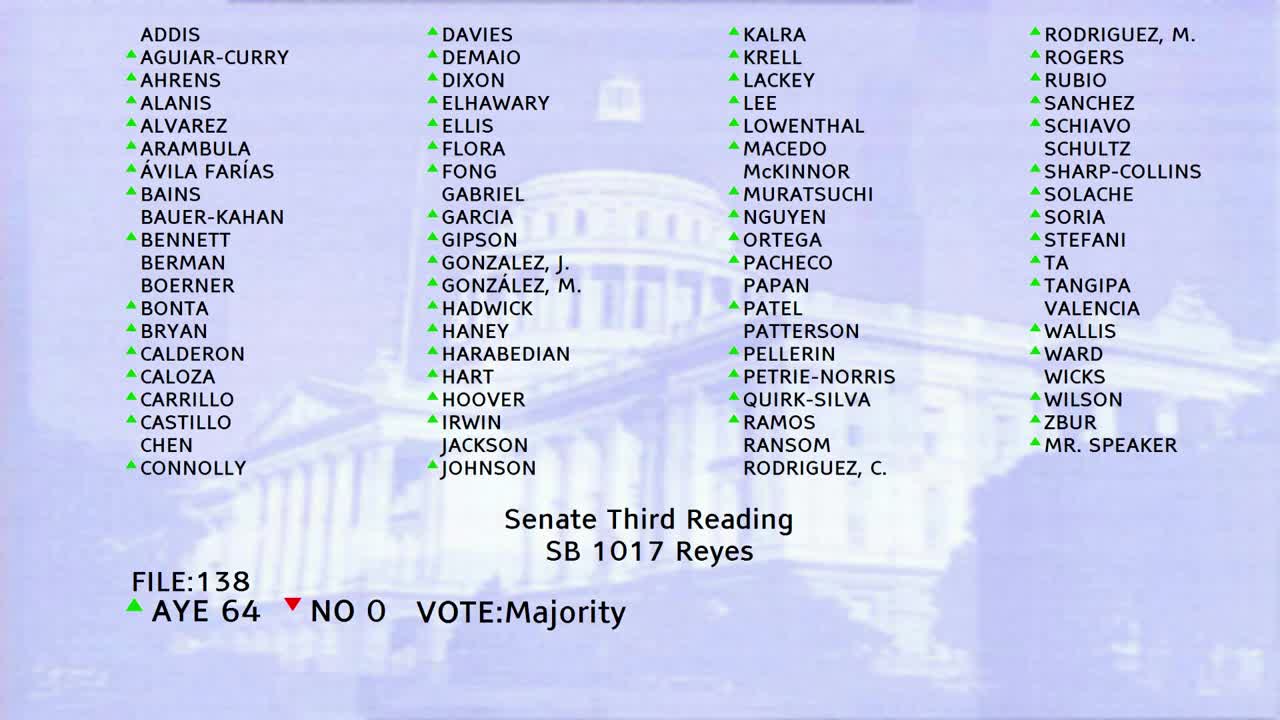 40SEC
Assembly Floor
 35SEC
Senate Standing Committee on Appropriations
 1MIN
Assembly Floor
 8MIN
Assembly Standing Committee on Health
Bill Author

Bill Co-Author(s):