AB 1336: Farmworkers: benefits.
- Session Year: 2025-2026
- House: Assembly
- Latest Version Date: 2025-09-15
Current Status:
Failed
(2026-01-22: Consideration of Governor's veto stricken from file.)
Introduced
In Committee
Awaiting First Chamber Vote
Passed First Chamber
In Committee
Awaiting Second Chamber Vote
Passed Second Chamber
Enacted
Existing law establishes a workers compensation system to compensate employees for injuries sustained in the course of their employment. Existing law creates a disputable presumption that specified injuries sustained in the course of employment of a specified member of law enforcement or a specified first responder arose out of and in the course of employment. Existing law authorizes the Department of Industrial Relations to expend moneys that have been appropriated for the administration and enforcement of laws under its jurisdiction, as well as for the maintenance of any commission or office of the department, as specified.
Existing law establishes the Workers Compensation Administration Revolving Fund within the State Treasury. Existing law requires the director to levy a surcharge upon employers in order to fund, among other things, the Workers Compensation Administration Revolving Fund. Upon appropriation by the Legislature, existing law authorizes funds to be expended for, among other things, the Return-to-Work Program and the enforcement of the insurance coverage program.
Existing law establishes a Workers Compensation Appeals Board and sets forth various proceedings that are required to be brought forth before the board. Existing law provides that the appeals board is vested with full power, authority, and jurisdiction to try and determine finally all the matters specified in those proceedings subject only to the review by the courts, as specified.
This bill would, until January 1, 2031, create a disputable presumption that a heat-related injury that develops within a specified timeframe after working outdoors for an employer in the agriculture industry that fails to comply with heat illness prevention standards, as defined, arose out of and came in the course of employment. The bill would require the appeals board to find in favor of the employee if the employer fails to rebut the presumption. The bill would specify that compensation awarded for heat-related injury to farmworkers is to include, among other things, medical treatment and disability. The bill would prohibit a determination by the appeals board from having any effect in certain investigations and would prohibit that determination from being admissible in proceedings before the Occupational Safety and Health Appeals Board. The bill would establish the Farmworker Climate Change Heat Injury and Death Fund that would consist of a one-time transfer of $5,000,000 derived from nongeneral funds of the Workers Compensation Administration Revolving Fund for the purpose of administrative costs associated with this presumption. The bill would make related findings and declarations.
Existing law establishes a workers compensation system to compensate employees for injuries sustained in the course of their employment. Existing law creates a disputable presumption that specified injuries sustained in the course of employment of a specified member of law enforcement or a specified first responder arose out of and in the course of employment. Existing law authorizes the Department of Industrial Relations to expend moneys that have been appropriated for the administration and enforcement of laws under its jurisdiction, as well as for the maintenance of any commission or office of the department, as specified.
Existing law establishes the Workers Compensation Administration Revolving Fund within the State Treasury. Existing law requires the director to levy a surcharge upon employers in order to fund, among other things, the Workers Compensation Administration Revolving Fund. Upon appropriation by the Legislature, existing law authorizes funds to be expended for, among other things, the Return-to-Work Program and the enforcement of the insurance coverage program.
Existing law establishes a Workers Compensation Appeals Board and sets forth various proceedings that are required to be brought forth before the board. Existing law provides that the appeals board is vested with full power, authority, and jurisdiction to try and determine finally all the matters specified in those proceedings subject only to the review by the courts, as specified.
This bill would would, until January 1, 2031, create a disputable presumption that a heat-related injury that develops within a specified timeframe after working outdoors for an employer in the agriculture industry that fails to comply with heat illness prevention standards, as defined, arose out of and came in the course of employment. The bill would require the appeals board to find in favor of the employee if the employer fails to rebut the presumption. The bill would specify that compensation awarded for heat-related injury to farmworkers is to include, among other things, medical treatment and disability. The bill would prohibit a determination by the appeals board from having any effect in certain investigations and would prohibit that determination from being admissible in proceedings before the Occupational Safety and Health Appeals Board. The bill would establish the Farmworker Climate Change Heat Injury and Death Fund that would consist of a one-time transfer of $5,000,000 derived from nongeneral funds of the Workers Compensation Administration Revolving Fund for the purpose of administrative costs associated with this presumption. The bill would make related findings and declarations.
Existing law establishes a workers compensation system to compensate employees for injuries sustained in the course of their employment. Existing law creates a disputable presumption that specified injuries sustained in the course of employment of a specified member of law enforcement or a specified first responder arose out of and in the course of employment. Existing law authorizes the Department of Industrial Relations to expend moneys that have been appropriated for the administration and enforcement of laws under its jurisdiction, as well as for the maintenance of any commission or office of the department, as specified.
Existing law establishes the Workers Compensation Administration Revolving Fund within the State Treasury. Existing law requires the director to levy a surcharge upon employers in order to fund, among other things, the Workers Compensation Administration Revolving Fund. Upon appropriation by the Legislature, existing law authorizes funds to be expended for, among other things, the Return-to-Work Program and the enforcement of the insurance coverage program.
This bill would create a disputable presumption that a heat-related injury that develops within a specified timeframe after working outdoors for an employer in the agriculture industry that fails to comply with heat illness prevention standards, as defined, arose out of and came in the course of employment. The bill would require the appeals board to find in favor of the employee if the employer fails to rebut the presumption. The bill would specify that compensation awarded for heat-related injury to farmworkers is to include, among other things, medical treatment and disability. The bill would establish the Farmworker Climate Change Heat Injury and Death Fund that would consist of a one-time transfer of $5,000,000 derived from nongeneral funds of the Workers Compensation Administration Revolving Fund for the purpose of administrative costs associated with this presumption. The bill would make related findings and declarations.
The Legislature finds and declares all of the following:
(a)The intent and purpose of this act is to prevent increasing farmworker heat-related injury, illness, and death, as climate change raises temperatures. It is the intent of the Legislature that all agricultural employers consider the climate change heat-related needs of farmworkers and do whatever is necessary to prevent injury, illness, and death, consistent with existing laws and regulations. It is not the intent of this act to change any existing heat-related regulation.
(b)Farmworkers are facing climate change in a climate of fear as heat-related injuries, illnesses, and deaths increase.
(c)The largest agricultural counties in California are experiencing record-breaking heat waves. In 2022, the City of King City in the County of Monterey broke its hottest temperature ever recorded at 116 degrees Fahrenheit. The City of Fresno recorded an all-time high at 114 degrees Fahrenheit. The City of Stockton in the County of San Joaquin shattered its 1988 record of 106 degrees Fahrenheit by reaching 112 degrees Fahrenheit. The City of Napa set a record at 114 degrees Fahrenheit. The City of Modesto in the County of Stanislaus topped its prior record at 106 degrees Fahrenheit. In 2023, the City of Paso Robles reached an all-time high of 112 degrees Fahrenheit, breaking the old record of 108 degrees Fahrenheit set in 2010.
(d)According to the United States Department of Labor, approximately 77 percent of farmworkers were born outside the United States and many do not speak English. Fear of retaliation and being fired for work-related injuries strongly discourages farmworkers from reporting heat-related injuries or violations by their employers.
(e)From 2018 to 2019, the number of suspected and confirmed farmworker heat-related deaths increased approximately 130 percent. In 2022, the office of the Governor noted that Extreme heat ranks amongst the deadliest of all climate change hazards, with structural inequities playing a significant role in the capacity of individuals, workers, and communities to protect and adapt to its effects.
SEC. 2.Section 62.5 of the Labor Code is amended to read:62.5.(a)(1)The Workers Compensation Administration Revolving Fund is hereby created as a special account in the State Treasury. Money in the fund may be expended by the department, upon appropriation by the Legislature, for all of the following purposes, and may not be used or borrowed for any other purpose:
(A)For the administration of the workers compensation program set forth in this division and Division 4 (commencing with Section 3200), other than the activities financed pursuant to paragraph (2) of subdivision (a) of Section 3702.5.
(B)For the Return-to-Work Program set forth in Section 139.48.
(C)For the enforcement of the insurance coverage program established and maintained by the Labor Commissioner pursuant to Section 90.3.
(D)For the Farmworker Climate Change Heat Injury and Death Fund, which is hereby created for the purpose of paying any administrative costs related to Section 3212.81. The fund shall consist of a one-time transfer of five million dollars ($5,000,000) derived from nongeneral funds of the Workers Compensation Administration Revolving Fund.
(2)The fund shall consist of surcharges made pursuant to paragraph (1) of subdivision (f).
(b)(1)The Uninsured Employers Benefits Trust Fund is hereby created as a special trust fund account in the State Treasury, of which the director is trustee, and its sources of funds are as provided in paragraph (1) of subdivision (f). Notwithstanding Section 13340 of the Government Code, the fund is continuously appropriated for the payment of nonadministrative expenses of the workers compensation program for workers injured while employed by uninsured employers in accordance with Article 2 (commencing with Section 3710) of Chapter 4 of Part 1 of Division 4, and shall not be used for any other purpose. All moneys collected shall be retained in the trust fund until paid as benefits to workers injured while employed by uninsured employers. Nonadministrative expenses include audits and reports of services prepared pursuant to subdivision (b) of Section 3716.1. The surcharge amount for this fund shall be stated separately.
(2)Notwithstanding any other provision of law, all references to the Uninsured Employers Fund shall mean the Uninsured Employers Benefits Trust Fund.
(3)Notwithstanding paragraph (1), in the event that budgetary restrictions or impasse prevent the timely payment of administrative expenses from the Workers Compensation Administration Revolving Fund, those expenses shall be advanced from the Uninsured Employers Benefits Trust Fund. Expense advances made pursuant to this paragraph shall be reimbursed in full to the Uninsured Employers Benefits Trust Fund upon enactment of the annual Budget Act.
(4)Any moneys from penalties collected pursuant to Section 3722 as a result of the insurance coverage program established under Section 90.3 shall be deposited into the State Treasury to the credit of the Workers Compensation Administration Revolving Fund created under this section, to cover expenses incurred by the director under the insurance coverage program. The amount of any penalties in excess of payment of administrative expenses incurred by the director for the insurance coverage program established under Section 90.3 shall be deposited into the State Treasury to the credit of the Uninsured Employers Benefits Trust Fund for nonadministrative expenses, as prescribed in paragraph (1), and, notwithstanding paragraph (1), shall only be available upon appropriation by the Legislature.
(c)(1)The Subsequent Injuries Benefits Trust Fund is hereby created as a special trust fund account in the State Treasury, of which the director is trustee, and its sources of funds are as provided in paragraph (1) of subdivision (f). Notwithstanding Section 13340 of the Government Code, the fund is continuously appropriated for the nonadministrative expenses of the workers compensation program for workers who have suffered serious injury and who are suffering from previous and serious permanent disabilities or physical impairments, in accordance with Article 5 (commencing with Section 4751) of Chapter 2 of Part 2 of Division 4, and Section 4 of Article XIV of the California Constitution, and shall not be used for any other purpose. All moneys collected shall be retained in the trust fund until paid as benefits to workers who have suffered serious injury and who are suffering from previous and serious permanent disabilities or physical impairments. Nonadministrative expenses include audits and reports of services pursuant to subdivision (c) of Section 4755. The surcharge amount for this fund shall be stated separately.
(2)Notwithstanding any other law, all references to the Subsequent Injuries Fund shall mean the Subsequent Injuries Benefits Trust Fund.
(3)Notwithstanding paragraph (1), in the event that budgetary restrictions or impasse prevent the timely payment of administrative expenses from the Workers Compensation Administration Revolving Fund, those expenses shall be advanced from the Subsequent Injuries Benefits Trust Fund. Expense advances made pursuant to this paragraph shall be reimbursed in full to the Subsequent Injuries Benefits Trust Fund upon enactment of the annual Budget Act.
(d)(1)The Occupational Safety and Health Fund is hereby created as a special account in the State Treasury. Moneys in the account may be expended by the department, upon appropriation by the Legislature, for support of the Division of Occupational Safety and Health, the Occupational Safety and Health Standards Board, and the Occupational Safety and Health Appeals Board, and the activities these entities perform as set forth in this division, and Division 5 (commencing with Section 6300).
(2)On and after the effective date of the act amending this section to add this paragraph in the 201314 Regular Session of the Legislature, any moneys in the Cal-OSHA Targeted Inspection and Consultation Fund and any assets, liabilities, revenues, expenditures, and encumbrances of that fund, less five million dollars ($5,000,000), shall be transferred to the Occupational Safety and Health Fund. On June 30, 2014, the remaining five million dollars ($5,000,000) in the Cal-OSHA Targeted Inspection and Consultation Fund, or any remaining balance in that fund, shall be transferred to, and become part of, the Occupational Safety and Health Fund.
(e)The Labor Enforcement and Compliance Fund is hereby created as a special account in the State Treasury. Moneys in the fund may be expended by the department, upon appropriation by the Legislature, for the support of the activities that the Division of Labor Standards Enforcement performs pursuant to this division and Division 2 (commencing with Section 200), Division 3 (commencing with Section 2700), and Division 4 (commencing with Section 3200). The fund shall consist of surcharges imposed pursuant to paragraph (3) of subdivision (f).
(f)(1)(A) Separate surcharges shall be levied by the director upon all employers, as defined in Section 3300, for purposes of deposit into the Workers Compensation Administration Revolving Fund, the Uninsured Employers Benefits Trust Fund, the Subsequent Injuries Benefits Trust Fund, and the Occupational Safety and Health Fund. The total amount of the surcharges shall be allocated between self-insured employers and insured employers in proportion to payroll respectively paid in the most recent year for which payroll information is available. The director shall adopt reasonable regulations governing the manner of collection of the surcharges. The regulations shall require the surcharges to be paid by self-insurers to be expressed as a percentage of indemnity paid during the most recent year for which information is available, and the surcharges to be paid by insured employers to be expressed as a percentage of premium. In no event shall the surcharges paid by insured employers be considered a premium for computation of a gross premium tax or agents commission. In no event shall the total amount of the surcharges paid by insured and self-insured employers exceed the amounts reasonably necessary to carry out the purposes of this section.
(B)Assessments shall be levied by the director upon all employers, as defined in Section 3300, as necessary, to collect the aggregate amount determined by the Fraud Assessment Commission pursuant to Section 1872.83 of the Insurance Code. Revenues derived from the assessments shall be deposited into the Workers Compensation Fraud Account in the Insurance Fund and shall only be expended, upon appropriation by the Legislature, for the investigation and prosecution of workers compensation fraud and the willful failure to secure payment of workers compensation, as prescribed by Section 1872.83 of the Insurance Code. The total amount of the assessment shall be allocated between self-insured employers and insured employers in proportion to payroll respectively paid in the most recent year for which payroll information is available. The director shall promulgate reasonable rules and regulations governing the manner of collection of the assessment. The rules and regulations shall require the assessment to be paid by self-insurers to be expressed as a percentage of indemnity paid during the most recent year for which information is available, and the assessment to be paid by insured employers to be expressed as a percentage of premium. In no event shall the assessment paid by insured employers be considered a premium for computation of a gross premium tax or agents commission.
(2)The surcharge levied by the director for the Occupational Safety and Health Fund, pursuant to paragraph (1), shall not generate revenues in excess of fifty-seven million dollars ($57,000,000) on and after the 201314 fiscal year, adjusted for each fiscal year as appropriate to fund any increases in the appropriation as approved by the Legislature, and to reconcile any over or under assessments from previous fiscal years pursuant to Sections 15606 and 15609 of Title 8 of the California Code of Regulations. For the 201314 fiscal year only, the revenue cap established in this paragraph shall be reduced by an amount equivalent to the balance transferred from the Cal-OSHA Targeted Inspection and Consultation Fund established in Section 62.7, less any amount of that balance loaned to the State Public Works Enforcement Fund, to the Occupational Safety and Health Fund pursuant to subdivision (d).
(3)A separate surcharge shall be levied by the director upon all employers, as defined in Section 3300, for purposes of deposit into the Labor Enforcement and Compliance Fund. The total amount of the surcharges shall be allocated between employers in proportion to payroll respectively paid in the most recent year for which payroll information is available. The director shall adopt reasonable regulations governing the manner of collection of the surcharges. In no event shall the total amount of the surcharges paid by employers exceed the amounts reasonably necessary to carry out the purposes of this section.
(4)The surcharge levied by the director for the Labor Enforcement and Compliance Fund shall not exceed forty-six million dollars ($46,000,000) in the 201314 fiscal year, adjusted as appropriate to fund any increases in the appropriation as approved by the Legislature, and to reconcile any over or under assessments from previous fiscal years pursuant to Sections 15606 and 15609 of Title 8 of the California Code of Regulations.
(5)The regulations adopted pursuant to paragraph (1) to (4), inclusive, shall be exempt from the rulemaking provisions of the Administrative Procedure Act (Chapter 3.5 (commencing with Section 11340) of Part 1 of Division 3 of Title 2 of the Government Code).
(g)This section shall remain in effect only until January 1, 2031, and as of that date is repealed.
SEC. 3.Section 62.5 is added to the Labor Code, to read:62.5.(a)(1)The Workers Compensation Administration Revolving Fund is hereby created as a special account in the State Treasury. Money in the fund may be expended by the department, upon appropriation by the Legislature, for all of the following purposes, and may not be used or borrowed for any other purpose:
(A)For the administration of the workers compensation program set forth in this division and Division 4 (commencing with Section 3200), other than the activities financed pursuant to paragraph (2) of subdivision (a) of Section 3702.5.
(B)For the return-to-work program set forth in Section 139.48.
(C)For the enforcement of the insurance coverage program established and maintained by the Labor Commissioner pursuant to Section 90.3.
(2)The fund shall consist of surcharges made pursuant to subparagraph (A) of paragraph (1) of subdivision (f).
(b)(1)The Uninsured Employers Benefits Trust Fund is hereby created as a special trust fund account in the State Treasury, of which the director is trustee, and its sources of funds are as provided in subparagraph (A) of paragraph (1) of subdivision (f). Notwithstanding Section 13340 of the Government Code, the fund is continuously appropriated for the payment of nonadministrative expenses of the workers compensation program for workers injured while employed by uninsured employers in accordance with Article 2 (commencing with Section 3710) of Chapter 4 of Part 1 of Division 4, and shall not be used for any other purpose. All moneys collected shall be retained in the trust fund until paid as benefits to workers injured while employed by uninsured employers. Nonadministrative expenses include audits and reports of services prepared pursuant to subdivision (b) of Section 3716.1. The surcharge amount for this fund shall be stated separately.
(2)Notwithstanding any other provision of law, all references to the Uninsured Employers Fund shall mean the Uninsured Employers Benefits Trust Fund.
(3)Notwithstanding paragraph (1), in the event that budgetary restrictions or impasse prevent the timely payment of administrative expenses from the Workers Compensation Administration Revolving Fund, those expenses shall be advanced from the Uninsured Employers Benefits Trust Fund. Expense advances made pursuant to this paragraph shall be reimbursed in full to the Uninsured Employers Benefits Trust Fund upon enactment of the annual Budget Act.
(4)Any moneys from penalties collected pursuant to Section 3722 as a result of the insurance coverage program established under Section 90.3 shall be deposited into the State Treasury to the credit of the Workers Compensation Administration Revolving Fund created under this section to cover expenses incurred by the director under the insurance coverage program. The amount of any penalties in excess of payment of administrative expenses incurred by the director for the insurance coverage program established under Section 90.3 shall be deposited into the State Treasury to the credit of the Uninsured Employers Benefits Trust Fund for nonadministrative expenses, as prescribed in paragraph (1), and, notwithstanding paragraph (1), shall only be available upon appropriation by the Legislature.
(c)(1)The Subsequent Injuries Benefits Trust Fund is hereby created as a special trust fund account in the State Treasury, of which the director is trustee, and its sources of funds are as provided in subparagraph (A) of paragraph (1) of subdivision (f). Notwithstanding Section 13340 of the Government Code, the fund is continuously appropriated for the nonadministrative expenses of the workers compensation program for workers who have suffered serious injury and who are suffering from previous and serious permanent disabilities or physical impairments, in accordance with Article 5 (commencing with Section 4751) of Chapter 2 of Part 2 of Division 4, and Section 4 of Article XIV of the California Constitution, and shall not be used for any other purpose. All moneys collected shall be retained in the trust fund until paid as benefits to workers who have suffered serious injury and who are suffering from previous and serious permanent disabilities or physical impairments. Nonadministrative expenses include audits and reports of services pursuant to subdivision (c) of Section 4755. The surcharge amount for this fund shall be stated separately.
(2)Notwithstanding any other law, all references to the Subsequent Injuries Fund shall mean the Subsequent Injuries Benefits Trust Fund.
(3)Notwithstanding paragraph (1), in the event that budgetary restrictions or impasse prevent the timely payment of administrative expenses from the Workers Compensation Administration Revolving Fund, those expenses shall be advanced from the Subsequent Injuries Benefits Trust Fund. Expense advances made pursuant to this paragraph shall be reimbursed in full to the Subsequent Injuries Benefits Trust Fund upon enactment of the annual Budget Act.
(d)(1)The Occupational Safety and Health Fund is hereby created as a special account in the State Treasury. Moneys in the account may be expended by the department, upon appropriation by the Legislature, for support of the Division of Occupational Safety and Health, the Occupational Safety and Health Standards Board, and the Occupational Safety and Health Appeals Board, and the activities these entities perform as set forth in this division and Division 5 (commencing with Section 6300).
(2)On and after the effective date of the act amending this section to add this paragraph in the 201314 Regular Session of the Legislature, any moneys in the Cal-OSHA Targeted Inspection and Consultation Fund and any assets, liabilities, revenues, expenditures, and encumbrances of that fund, less five million dollars ($5,000,000), shall be transferred to the Occupational Safety and Health Fund. On June 30, 2014, the remaining five million dollars ($5,000,000) in the Cal-OSHA Targeted Inspection and Consultation Fund, or any remaining balance in that fund, shall be transferred to, and become part of, the Occupational Safety and Health Fund.
(e)The Labor Enforcement and Compliance Fund is hereby created as a special account in the State Treasury. Moneys in the fund may be expended by the department, upon appropriation by the Legislature, for the support of the activities that the Division of Labor Standards Enforcement performs pursuant to this division and Division 2 (commencing with Section 200), Division 3 (commencing with Section 2700), and Division 4 (commencing with Section 3200).
(f)(1)(A)Separate surcharges shall be levied by the director upon all employers, as defined in Section 3300, for purposes of deposit into the Workers Compensation Administration Revolving Fund, the Uninsured Employers Benefits Trust Fund, the Subsequent Injuries Benefits Trust Fund, and the Occupational Safety and Health Fund. The total amount of the surcharges shall be allocated between self-insured employers and insured employers in proportion to payroll respectively paid in the most recent year for which payroll information is available. The director shall adopt reasonable regulations governing the manner of collection of the surcharges. The regulations shall require the surcharges to be paid by self-insurers to be expressed as a percentage of indemnity paid during the most recent year for which information is available, and the surcharges to be paid by insured employers to be expressed as a percentage of premium. In no event shall the surcharges paid by insured employers be considered a premium for computation of a gross premium tax or agents commission. In no event shall the total amount of the surcharges paid by insured and self-insured employers exceed the amounts reasonably necessary to carry out the purposes of this section.
(B)Assessments shall be levied by the director upon all employers, as defined in Section 3300, as necessary, to collect the aggregate amount determined by the Fraud Assessment Commission pursuant to Section 1872.83 of the Insurance Code. Revenues derived from the assessments shall be deposited into the Workers Compensation Fraud Account in the Insurance Fund and shall only be expended, upon appropriation by the Legislature, for the investigation and prosecution of workers compensation fraud and the willful failure to secure payment of workers compensation, as prescribed by Section 1872.83 of the Insurance Code. The total amount of the assessment shall be allocated between self-insured employers and insured employers in proportion to payroll respectively paid in the most recent year for which payroll information is available. The director shall promulgate reasonable rules and regulations governing the manner of collection of the assessment. The rules and regulations shall require the assessment to be paid by self-insurers to be expressed as a percentage of indemnity paid during the most recent year for which information is available, and the assessment to be paid by insured employers to be expressed as a percentage of premium. In no event shall the assessment paid by insured employers be considered a premium for computation of a gross premium tax or agents commission.
(2)The surcharge levied by the director for the Occupational Safety and Health Fund, pursuant to subparagraph (A) of paragraph (1), shall not generate revenues in excess of fifty-seven million dollars ($57,000,000) on and after the 201314 fiscal year, adjusted for each fiscal year as appropriate to fund any increases in the appropriation as approved by the Legislature, and to reconcile any over or under assessments from previous fiscal years pursuant to Sections 15606 and 15609 of Title 8 of the California Code of Regulations. For the 201314 fiscal year only, the revenue cap established in this paragraph shall be reduced by an amount equivalent to the balance transferred from the Cal-OSHA Targeted Inspection and Consultation Fund established in Section 62.7, less any amount of that balance loaned to the State Public Works Enforcement Fund, to the Occupational Safety and Health Fund pursuant to subdivision (d).
(3)A separate surcharge shall be levied by the director upon all employers, as defined in Section 3300, for purposes of deposit into the Labor Enforcement and Compliance Fund. The total amount of the surcharges shall be allocated between employers in proportion to payroll respectively paid in the most recent year for which payroll information is available. The director shall adopt reasonable regulations governing the manner of collection of the surcharges. In no event shall the total amount of the surcharges paid by employers exceed the amounts reasonably necessary to carry out the purposes of this section.
(4)The surcharge levied by the director for the Labor Enforcement and Compliance Fund shall not exceed forty-six million dollars ($46,000,000) in the 201314 fiscal year, adjusted as appropriate to fund any increases in the appropriation as approved by the Legislature, and to reconcile any over or under assessments from previous fiscal years pursuant to Sections 15606 and 15609 of Title 8 of the California Code of Regulations.
(5)The regulations adopted pursuant to paragraph (1) to (4), inclusive, shall be exempt from the rulemaking provisions of the Administrative Procedure Act (Chapter 3.5 (commencing with Section 11340) of Part 1 of Division 3 of Title 2 of the Government Code).
(g)This section shall become operative on January 1, 2031.
SEC. 4.Section 3212.81 is added to the Labor Code, to read:3212.81.(a)If an employer, as defined in Section 3300 and in the agriculture industry listed and covered in Section 3395 of Title 8 of the California Code of Regulations, fails to comply with the heat illness prevention standards set forth in Section 6721 and in Section 3395 of Title 8 of the California Code of Regulations, any resulting heat-related injury to the employee shall be presumed to arise out of and in the course of employment. This presumption is disputable and may be controverted by other evidence, but, unless so controverted, the appeals board shall find in accordance with it. Heat illness prevention standards include, but are not limited to, the following:
(1)Establishing, implementing, and maintaining an effective Heat Illness Prevention Plan and making it available at the worksite in English and the language understood by a majority of employees and providing effective heat illness prevention.
(2)Recognition and response training as required by Section 3395 of Title 8 of the California Code of Regulations.
(3)Providing access to shade and water and a cooldown rest period as required by Section 3395 of Title 8 of the California Code of Regulations.
(b)Injury as used in this section includes any heat-related injury, illness, or death that develops or manifests after the employee was working outdoors during or within the pay period in which an employee suffers any heat-related illness, injury, or death.
(c)The compensation that is awarded for injury pursuant to this section shall include full hospital, surgical, medical treatment, disability indemnity, and death benefits, as provided by this division.
(d)A determination by the appeals board pursuant to subdivision (a) shall have no effect in an investigation brought against an employer by Cal-OSHA, nor shall any determination by the appeals board pursuant to subdivision (a) be admissible in proceedings before the Occupational Safety and Health Appeals Board.
(e)This section shall remain in effect only until January 1, 2031, and as of that date is repealed.
The Legislature finds and declares all of the following:
(a)The intent and purpose of this act is to prevent increasing farmworker heat-related injury, illness, and death, as climate change raises temperatures. It is the intent of the Legislature that all agricultural employers consider the climate change heat-related needs of farmworkers and do whatever is necessary to prevent injury, illness, and death, consistent with existing laws and regulations. It is not the intent of this act to change any existing heat-related regulation.
(b)Farmworkers are facing climate change in a climate of fear as heat-related injury, illness, injuries, illnesses, and death increases. deaths increase.
(c)The largest agricultural counties in California are experiencing record-breaking heat waves. In 2022, the City of King City in the County of Monterey broke its hottest temperature ever recorded at 116 degrees. degrees Fahrenheit. The City of Fresno recorded an all-time high at 114 degrees. degrees Fahrenheit. The City of Stockton in the County of San Joaquin shattered its 1988 record of 106 degrees Fahrenheit by reaching 112 degrees. degrees Fahrenheit. The City of Napa set a record at 114 degrees. degrees Fahrenheit. The City of Modesto in the County of Stanislaus topped its prior record at 106 degrees. degrees Fahrenheit. In 2023, the City of Paso Robles reached an all-time high of 112 degrees, degrees Fahrenheit, breaking the old record of 108 degrees Fahrenheit set in 2010.
(d)According to the United States Department of Labor, approximately 77 percent of farmworkers were born outside the United States and many do not speak English. Fear of retaliation and being fired for work-related injuries strongly discourages farmworkers from reporting heat-related injuries or violations by their employers.
(e)From 2018 to 2019, the number of suspected and confirmed farmworker heat-related deaths increased approximately 130 percent. In 2022, the office of the Governor noted that Extreme heat ranks amongst the deadliest of all climate change hazards, with structural inequities playing a significant role in the capacity of individuals, workers, and communities to protect and adapt to its effects.
SEC. 2.Section 62.5 of the Labor Code is amended to read:62.5.(a)(1)The Workers Compensation Administration Revolving Fund is hereby created as a special account in the State Treasury. Money in the fund may be expended by the department, upon appropriation by the Legislature, for all of the following purposes, and may not be used or borrowed for any other purpose:(A)For the administration of the workers compensation program set forth in this division and Division 4 (commencing with Section 3200), other than the activities financed pursuant to paragraph (2) of subdivision (a) of Section 3702.5.(B)For the Return-to-Work Program set forth in Section 139.48.(C)For the enforcement of the insurance coverage program established and maintained by the Labor Commissioner pursuant to Section 90.3.(D)For the Farmworker Climate Change Heat Injury and Death Fund, which is hereby created, for the purpose of paying any administrative costs related to Section 3212.81. The fund shall consist of a one-time transfer of five million dollars ($5,000,000) derived from nongeneral funds of the Workers Compensation Administration Revolving Fund.(2)The fund shall consist of surcharges made pursuant to paragraph (1) of subdivision (f).(b)(1)The Uninsured Employers Benefits Trust Fund is hereby created as a special trust fund account in the State Treasury, of which the director is trustee, and its sources of funds are as provided in paragraph (1) of subdivision (f). Notwithstanding Section 13340 of the Government Code, the fund is continuously appropriated for the payment of nonadministrative expenses of the workers compensation program for workers injured while employed by uninsured employers in accordance with Article 2 (commencing with Section 3710) of Chapter 4 of Part 1 of Division 4, and shall not be used for any other purpose. All moneys collected shall be retained in the trust fund until paid as benefits to workers injured while employed by uninsured employers. Nonadministrative expenses include audits and reports of services prepared pursuant to subdivision (b) of Section 3716.1. The surcharge amount for this fund shall be stated separately.(2)Notwithstanding any other provision of law, all references to the Uninsured Employers Fund shall mean the Uninsured Employers Benefits Trust Fund.(3)Notwithstanding paragraph (1), in the event that budgetary restrictions or impasse prevent the timely payment of administrative expenses from the Workers Compensation Administration Revolving Fund, those expenses shall be advanced from the Uninsured Employers Benefits Trust Fund. Expense advances made pursuant to this paragraph shall be reimbursed in full to the Uninsured Employers Benefits Trust Fund upon enactment of the annual Budget Act.(4)Any moneys from penalties collected pursuant to Section 3722 as a result of the insurance coverage program established under Section 90.3 shall be deposited in the State Treasury to the credit of the Workers Compensation Administration Revolving Fund created under this section, to cover expenses incurred by the director under the insurance coverage program. The amount of any penalties in excess of payment of administrative expenses incurred by the director for the insurance coverage program established under Section 90.3 shall be deposited in the State Treasury to the credit of the Uninsured Employers Benefits Trust Fund for nonadministrative expenses, as prescribed in paragraph (1), and notwithstanding paragraph (1), shall only be available upon appropriation by the Legislature.(c)(1)The Subsequent Injuries Benefits Trust Fund is hereby created as a special trust fund account in the State Treasury, of which the director is trustee, and its sources of funds are as provided in paragraph (1) of subdivision (f). Notwithstanding Section 13340 of the Government Code, the fund is continuously appropriated for the nonadministrative expenses of the workers compensation program for workers who have suffered serious injury and who are suffering from previous and serious permanent disabilities or physical impairments, in accordance with Article 5 (commencing with Section 4751) of Chapter 2 of Part 2 of Division 4, and Section 4 of Article XIV of the California Constitution, and shall not be used for any other purpose. All moneys collected shall be retained in the trust fund until paid as benefits to workers who have suffered serious injury and who are suffering from previous and serious permanent disabilities or physical impairments. Nonadministrative expenses include audits and reports of services pursuant to subdivision (c) of Section 4755. The surcharge amount for this fund shall be stated separately.(2)Notwithstanding any other law, all references to the Subsequent Injuries Fund shall mean the Subsequent Injuries Benefits Trust Fund.(3)Notwithstanding paragraph (1), in the event that budgetary restrictions or impasse prevent the timely payment of administrative expenses from the Workers Compensation Administration Revolving Fund, those expenses shall be advanced from the Subsequent Injuries Benefits Trust Fund. Expense advances made pursuant to this paragraph shall be reimbursed in full to the Subsequent Injuries Benefits Trust Fund upon enactment of the annual Budget Act.(d)(1)The Occupational Safety and Health Fund is hereby created as a special account in the State Treasury. Moneys in the account may be expended by the department, upon appropriation by the Legislature, for support of the Division of Occupational Safety and Health, the Occupational Safety and Health Standards Board, and the Occupational Safety and Health Appeals Board, and the activities these entities perform as set forth in this division, and Division 5 (commencing with Section 6300).(2)On and after the effective date of the act amending this section to add this paragraph in the 201314 Regular Session of the Legislature, any moneys in the Cal-OSHA Targeted Inspection and Consultation Fund and any assets, liabilities, revenues, expenditures, and encumbrances of that fund, less five million dollars ($5,000,000), shall be transferred to the Occupational Safety and Health Fund. On June 30, 2014, the remaining five million dollars ($5,000,000) in the Cal-OSHA Targeted Inspection and Consultation Fund, or any remaining balance in that fund, shall be transferred to, and become part of, the Occupational Safety and Health Fund.(e)The Labor Enforcement and Compliance Fund is hereby created as a special account in the State Treasury. Moneys in the fund may be expended by the department, upon appropriation by the Legislature, for the support of the activities that the Division of Labor Standards Enforcement performs pursuant to this division and Division 2 (commencing with Section 200), Division 3 (commencing with Section 2700), and Division 4 (commencing with Section 3200). The fund shall consist of surcharges imposed pursuant to paragraph (3) of subdivision (f).(f)(1)Separate surcharges shall be levied by the director upon all employers, as defined in Section 3300, for purposes of deposit in the Workers Compensation Administration Revolving Fund, the Uninsured Employers Benefits Trust Fund, the Subsequent Injuries Benefits Trust Fund, and the Occupational Safety and Health Fund. The total amount of the surcharges shall be allocated between self-insured employers and insured employers in proportion to payroll respectively paid in the most recent year for which payroll information is available. The director shall adopt reasonable regulations governing the manner of collection of the surcharges. The regulations shall require the surcharges to be paid by self-insurers to be expressed as a percentage of indemnity paid during the most recent year for which information is available, and the surcharges to be paid by insured employers to be expressed as a percentage of premium. In no event shall the surcharges paid by insured employers be considered a premium for computation of a gross premium tax or agents commission. In no event shall the total amount of the surcharges paid by insured and self-insured employers exceed the amounts reasonably necessary to carry out the purposes of this section.(2)The surcharge levied by the director for the Occupational Safety and Health Fund, pursuant to paragraph (1), shall not generate revenues in excess of fifty-seven million dollars ($57,000,000) on and after the 201314 fiscal year, adjusted for each fiscal year as appropriate to fund any increases in the appropriation as approved by the Legislature, and to reconcile any over/under assessments from previous fiscal years pursuant to Sections 15606 and 15609 of Title 8 of the California Code of Regulations. For the 201314 fiscal year only, the revenue cap established in this paragraph shall be reduced by an amount equivalent to the balance transferred from the Cal-OSHA Targeted Inspection and Consultation Fund established in Section 62.7, less any amount of that balance loaned to the State Public Works Enforcement Fund, to the Occupational Safety and Health Fund pursuant to subdivision (d).(3)A separate surcharge shall be levied by the director upon all employers, as defined in Section 3300, for purposes of deposit in the Labor Enforcement and Compliance Fund. The total amount of the surcharges shall be allocated between employers in proportion to payroll respectively paid in the most recent year for which payroll information is available. The director shall adopt reasonable regulations governing the manner of collection of the surcharges. In no event shall the total amount of the surcharges paid by employers exceed the amounts reasonably necessary to carry out the purposes of this section.(4)The surcharge levied by the director for the Labor Enforcement and Compliance Fund shall not exceed forty-six million dollars ($46,000,000) in the 201314 fiscal year, adjusted as appropriate to fund any increases in the appropriation as approved by the Legislature, and to reconcile any over/under assessments from previous fiscal years pursuant to Sections 15606 and 15609 of Title 8 of the California Code of Regulations.(5)The regulations adopted pursuant to paragraph (1) to (4), inclusive, shall be exempt from the rulemaking provisions of the Administrative Procedure Act (Chapter 3.5 (commencing with Section 11340) of Part 1 of Division 3 of Title 2 of the Government Code).SEC. 2.Section 62.5 of the Labor Code is amended to read:62.5.(a)(1)The Workers Compensation Administration Revolving Fund is hereby created as a special account in the State Treasury. Money in the fund may be expended by the department, upon appropriation by the Legislature, for all of the following purposes, and may not be used or borrowed for any other purpose:
(A)For the administration of the workers compensation program set forth in this division and Division 4 (commencing with Section 3200), other than the activities financed pursuant to paragraph (2) of subdivision (a) of Section 3702.5.
(B)For the Return-to-Work Program set forth in Section 139.48.
(C)For the enforcement of the insurance coverage program established and maintained by the Labor Commissioner pursuant to Section 90.3.
(D)For the Farmworker Climate Change Heat Injury and Death Fund, which is hereby created for the purpose of paying any administrative costs related to Section 3212.81. The fund shall consist of a one-time transfer of five million dollars ($5,000,000) derived from nongeneral funds of the Workers Compensation Administration Revolving Fund.
(2)The fund shall consist of surcharges made pursuant to subparagraph (A) of paragraph (1) of subdivision (f).
(b)(1)The Uninsured Employers Benefits Trust Fund is hereby created as a special trust fund account in the State Treasury, of which the director is trustee, and its sources of funds are as provided in subparagraph (A) of paragraph (1) of subdivision (f). Notwithstanding Section 13340 of the Government Code, the fund is continuously appropriated for the payment of nonadministrative expenses of the workers compensation program for workers injured while employed by uninsured employers in accordance with Article 2 (commencing with Section 3710) of Chapter 4 of Part 1 of Division 4, and shall not be used for any other purpose. All moneys collected shall be retained in the trust fund until paid as benefits to workers injured while employed by uninsured employers. Nonadministrative expenses include audits and reports of services prepared pursuant to subdivision (b) of Section 3716.1. The surcharge amount for this fund shall be stated separately.
(2)Notwithstanding any other provision of law, all references to the Uninsured Employers Fund shall mean the Uninsured Employers Benefits Trust Fund.
(3)Notwithstanding paragraph (1), in the event that budgetary restrictions or impasse prevent the timely payment of administrative expenses from the Workers Compensation Administration Revolving Fund, those expenses shall be advanced from the Uninsured Employers Benefits Trust Fund. Expense advances made pursuant to this paragraph shall be reimbursed in full to the Uninsured Employers Benefits Trust Fund upon enactment of the annual Budget Act.
(4)Any moneys from penalties collected pursuant to Section 3722 as a result of the insurance coverage program established under Section 90.3 shall be deposited in into the State Treasury to the credit of the Workers Compensation Administration Revolving Fund created under this section, to cover expenses incurred by the director under the insurance coverage program. The amount of any penalties in excess of payment of administrative expenses incurred by the director for the insurance coverage program established under Section 90.3 shall be deposited in into the State Treasury to the credit of the Uninsured Employers Benefits Trust Fund for nonadministrative expenses, as prescribed in paragraph (1), and and, notwithstanding paragraph (1), shall only be available upon appropriation by the Legislature.
(c)(1)The Subsequent Injuries Benefits Trust Fund is hereby created as a special trust fund account in the State Treasury, of which the director is trustee, and its sources of funds are as provided in subparagraph (A) of paragraph (1) of subdivision (f). Notwithstanding Section 13340 of the Government Code, the fund is continuously appropriated for the nonadministrative expenses of the workers compensation program for workers who have suffered serious injury and who are suffering from previous and serious permanent disabilities or physical impairments, in accordance with Article 5 (commencing with Section 4751) of Chapter 2 of Part 2 of Division 4, and Section 4 of Article XIV of the California Constitution, and shall not be used for any other purpose. All moneys collected shall be retained in the trust fund until paid as benefits to workers who have suffered serious injury and who are suffering from previous and serious permanent disabilities or physical impairments. Nonadministrative expenses include audits and reports of services pursuant to subdivision (c) of Section 4755. The surcharge amount for this fund shall be stated separately.
(2)Notwithstanding any other law, all references to the Subsequent Injuries Fund shall mean the Subsequent Injuries Benefits Trust Fund.
(3)Notwithstanding paragraph (1), in the event that budgetary restrictions or impasse prevent the timely payment of administrative expenses from the Workers Compensation Administration Revolving Fund, those expenses shall be advanced from the Subsequent Injuries Benefits Trust Fund. Expense advances made pursuant to this paragraph shall be reimbursed in full to the Subsequent Injuries Benefits Trust Fund upon enactment of the annual Budget Act.
(d)(1)The Occupational Safety and Health Fund is hereby created as a special account in the State Treasury. Moneys in the account may be expended by the department, upon appropriation by the Legislature, for support of the Division of Occupational Safety and Health, the Occupational Safety and Health Standards Board, and the Occupational Safety and Health Appeals Board, and the activities these entities perform as set forth in this division, and Division 5 (commencing with Section 6300).
(2)On and after the effective date of the act amending this section to add this paragraph in the 201314 Regular Session of the Legislature, any moneys in the Cal-OSHA Targeted Inspection and Consultation Fund and any assets, liabilities, revenues, expenditures, and encumbrances of that fund, less five million dollars ($5,000,000), shall be transferred to the Occupational Safety and Health Fund. On June 30, 2014, the remaining five million dollars ($5,000,000) in the Cal-OSHA Targeted Inspection and Consultation Fund, or any remaining balance in that fund, shall be transferred to, and become part of, the Occupational Safety and Health Fund.
(e)The Labor Enforcement and Compliance Fund is hereby created as a special account in the State Treasury. Moneys in the fund may be expended by the department, upon appropriation by the Legislature, for the support of the activities that the Division of Labor Standards Enforcement performs pursuant to this division and Division 2 (commencing with Section 200), Division 3 (commencing with Section 2700), and Division 4 (commencing with Section 3200). The fund shall consist of surcharges imposed pursuant to paragraph (3) of subdivision (f).
(f)(1)(A) Separate surcharges shall be levied by the director upon all employers, as defined in Section 3300, for purposes of deposit in into the Workers Compensation Administration Revolving Fund, the Uninsured Employers Benefits Trust Fund, the Subsequent Injuries Benefits Trust Fund, and the Occupational Safety and Health Fund. The total amount of the surcharges shall be allocated between self-insured employers and insured employers in proportion to payroll respectively paid in the most recent year for which payroll information is available. The director shall adopt reasonable regulations governing the manner of collection of the surcharges. The regulations shall require the surcharges to be paid by self-insurers to be expressed as a percentage of indemnity paid during the most recent year for which information is available, and the surcharges to be paid by insured employers to be expressed as a percentage of premium. In no event shall the surcharges paid by insured employers be considered a premium for computation of a gross premium tax or agents commission. In no event shall the total amount of the surcharges paid by insured and self-insured employers exceed the amounts reasonably necessary to carry out the purposes of this section.
(B)Assessments shall be levied by the director upon all employers, as defined in Section 3300, as necessary, to collect the aggregate amount determined by the Fraud Assessment Commission pursuant to Section 1872.83 of the Insurance Code. Revenues derived from the assessments shall be deposited in into the Workers Compensation Fraud Account in the Insurance Fund and shall only be expended, upon appropriation by the Legislature, for the investigation and prosecution of workers compensation fraud and the willful failure to secure payment of workers compensation, as prescribed by Section 1872.83 of the Insurance Code. The total amount of the assessment shall be allocated between self-insured employers and insured employers in proportion to payroll respectively paid in the most recent year for which payroll information is available. The director shall promulgate reasonable rules and regulations governing the manner of collection of the assessment. The rules and regulations shall require the assessment to be paid by self-insurers to be expressed as a percentage of indemnity paid during the most recent year for which information is available, and the assessment to be paid by insured employers to be expressed as a percentage of premium. In no event shall the assessment paid by insured employers be considered a premium for computation of a gross premium tax or agents commission.
(2)The surcharge levied by the director for the Occupational Safety and Health Fund, pursuant to subparagraph (A) of paragraph (1), shall not generate revenues in excess of fifty-seven million dollars ($57,000,000) on and after the 201314 fiscal year, adjusted for each fiscal year as appropriate to fund any increases in the appropriation as approved by the Legislature, and to reconcile any over/under over or under assessments from previous fiscal years pursuant to Sections 15606 and 15609 of Title 8 of the California Code of Regulations. For the 201314 fiscal year only, the revenue cap established in this paragraph shall be reduced by an amount equivalent to the balance transferred from the Cal-OSHA Targeted Inspection and Consultation Fund established in Section 62.7, less any amount of that balance loaned to the State Public Works Enforcement Fund, to the Occupational Safety and Health Fund pursuant to subdivision (d).
(3)A separate surcharge shall be levied by the director upon all employers, as defined in Section 3300, for purposes of deposit in into the Labor Enforcement and Compliance Fund. The total amount of the surcharges shall be allocated between employers in proportion to payroll respectively paid in the most recent year for which payroll information is available. The director shall adopt reasonable regulations governing the manner of collection of the surcharges. In no event shall the total amount of the surcharges paid by employers exceed the amounts reasonably necessary to carry out the purposes of this section.
(4)The surcharge levied by the director for the Labor Enforcement and Compliance Fund shall not exceed forty-six million dollars ($46,000,000) in the 201314 fiscal year, adjusted as appropriate to fund any increases in the appropriation as approved by the Legislature, and to reconcile any over/under over or under assessments from previous fiscal years pursuant to Sections 15606 and 15609 of Title 8 of the California Code of Regulations.
(5)The regulations adopted pursuant to paragraph (1) to (4), inclusive, shall be exempt from the rulemaking provisions of the Administrative Procedure Act (Chapter 3.5 (commencing with Section 11340) of Part 1 of Division 3 of Title 2 of the Government Code).
(g)This section shall remain in effect only until January 1, 2031, and as of that date is repealed.
SEC. 3.Section 62.5 is added to the Labor Code, to read:62.5.(a)(1)The Workers Compensation Administration Revolving Fund is hereby created as a special account in the State Treasury. Money in the fund may be expended by the department, upon appropriation by the Legislature, for all of the following purposes, and may not be used or borrowed for any other purpose:
(A)For the administration of the workers compensation program set forth in this division and Division 4 (commencing with Section 3200), other than the activities financed pursuant to paragraph (2) of subdivision (a) of Section 3702.5.
(B)For the return-to-work program set forth in Section 139.48.
(C)For the enforcement of the insurance coverage program established and maintained by the Labor Commissioner pursuant to Section 90.3.
(2)The fund shall consist of surcharges made pursuant to subparagraph (A) of paragraph (1) of subdivision (f).
(b)(1)The Uninsured Employers Benefits Trust Fund is hereby created as a special trust fund account in the State Treasury, of which the director is trustee, and its sources of funds are as provided in subparagraph (A) of paragraph (1) of subdivision (f). Notwithstanding Section 13340 of the Government Code, the fund is continuously appropriated for the payment of nonadministrative expenses of the workers compensation program for workers injured while employed by uninsured employers in accordance with Article 2 (commencing with Section 3710) of Chapter 4 of Part 1 of Division 4, and shall not be used for any other purpose. All moneys collected shall be retained in the trust fund until paid as benefits to workers injured while employed by uninsured employers. Nonadministrative expenses include audits and reports of services prepared pursuant to subdivision (b) of Section 3716.1. The surcharge amount for this fund shall be stated separately.
(2)Notwithstanding any other provision of law, all references to the Uninsured Employers Fund shall mean the Uninsured Employers Benefits Trust Fund.
(3)Notwithstanding paragraph (1), in the event that budgetary restrictions or impasse prevent the timely payment of administrative expenses from the Workers Compensation Administration Revolving Fund, those expenses shall be advanced from the Uninsured Employers Benefits Trust Fund. Expense advances made pursuant to this paragraph shall be reimbursed in full to the Uninsured Employers Benefits Trust Fund upon enactment of the annual Budget Act.
(4)Any moneys from penalties collected pursuant to Section 3722 as a result of the insurance coverage program established under Section 90.3 shall be deposited into the State Treasury to the credit of the Workers Compensation Administration Revolving Fund created under this section to cover expenses incurred by the director under the insurance coverage program. The amount of any penalties in excess of payment of administrative expenses incurred by the director for the insurance coverage program established under Section 90.3 shall be deposited into the State Treasury to the credit of the Uninsured Employers Benefits Trust Fund for nonadministrative expenses, as prescribed in paragraph (1), and, notwithstanding paragraph (1), shall only be available upon appropriation by the Legislature.
(c)(1)The Subsequent Injuries Benefits Trust Fund is hereby created as a special trust fund account in the State Treasury, of which the director is trustee, and its sources of funds are as provided in subparagraph (A) of paragraph (1) of subdivision (f). Notwithstanding Section 13340 of the Government Code, the fund is continuously appropriated for the nonadministrative expenses of the workers compensation program for workers who have suffered serious injury and who are suffering from previous and serious permanent disabilities or physical impairments, in accordance with Article 5 (commencing with Section 4751) of Chapter 2 of Part 2 of Division 4, and Section 4 of Article XIV of the California Constitution, and shall not be used for any other purpose. All moneys collected shall be retained in the trust fund until paid as benefits to workers who have suffered serious injury and who are suffering from previous and serious permanent disabilities or physical impairments. Nonadministrative expenses include audits and reports of services pursuant to subdivision (c) of Section 4755. The surcharge amount for this fund shall be stated separately.
(2)Notwithstanding any other law, all references to the Subsequent Injuries Fund shall mean the Subsequent Injuries Benefits Trust Fund.
(3)Notwithstanding paragraph (1), in the event that budgetary restrictions or impasse prevent the timely payment of administrative expenses from the Workers Compensation Administration Revolving Fund, those expenses shall be advanced from the Subsequent Injuries Benefits Trust Fund. Expense advances made pursuant to this paragraph shall be reimbursed in full to the Subsequent Injuries Benefits Trust Fund upon enactment of the annual Budget Act.
(d)(1)The Occupational Safety and Health Fund is hereby created as a special account in the State Treasury. Moneys in the account may be expended by the department, upon appropriation by the Legislature, for support of the Division of Occupational Safety and Health, the Occupational Safety and Health Standards Board, and the Occupational Safety and Health Appeals Board, and the activities these entities perform as set forth in this division and Division 5 (commencing with Section 6300).
(2)On and after the effective date of the act amending this section to add this paragraph in the 201314 Regular Session of the Legislature, any moneys in the Cal-OSHA Targeted Inspection and Consultation Fund and any assets, liabilities, revenues, expenditures, and encumbrances of that fund, less five million dollars ($5,000,000), shall be transferred to the Occupational Safety and Health Fund. On June 30, 2014, the remaining five million dollars ($5,000,000) in the Cal-OSHA Targeted Inspection and Consultation Fund, or any remaining balance in that fund, shall be transferred to, and become part of, the Occupational Safety and Health Fund.
(e)The Labor Enforcement and Compliance Fund is hereby created as a special account in the State Treasury. Moneys in the fund may be expended by the department, upon appropriation by the Legislature, for the support of the activities that the Division of Labor Standards Enforcement performs pursuant to this division and Division 2 (commencing with Section 200), Division 3 (commencing with Section 2700), and Division 4 (commencing with Section 3200).
(f)(1)(A)Separate surcharges shall be levied by the director upon all employers, as defined in Section 3300, for purposes of deposit into the Workers Compensation Administration Revolving Fund, the Uninsured Employers Benefits Trust Fund, the Subsequent Injuries Benefits Trust Fund, and the Occupational Safety and Health Fund. The total amount of the surcharges shall be allocated between self-insured employers and insured employers in proportion to payroll respectively paid in the most recent year for which payroll information is available. The director shall adopt reasonable regulations governing the manner of collection of the surcharges. The regulations shall require the surcharges to be paid by self-insurers to be expressed as a percentage of indemnity paid during the most recent year for which information is available, and the surcharges to be paid by insured employers to be expressed as a percentage of premium. In no event shall the surcharges paid by insured employers be considered a premium for computation of a gross premium tax or agents commission. In no event shall the total amount of the surcharges paid by insured and self-insured employers exceed the amounts reasonably necessary to carry out the purposes of this section.
(B)Assessments shall be levied by the director upon all employers, as defined in Section 3300, as necessary, to collect the aggregate amount determined by the Fraud Assessment Commission pursuant to Section 1872.83 of the Insurance Code. Revenues derived from the assessments shall be deposited into the Workers Compensation Fraud Account in the Insurance Fund and shall only be expended, upon appropriation by the Legislature, for the investigation and prosecution of workers compensation fraud and the willful failure to secure payment of workers compensation, as prescribed by Section 1872.83 of the Insurance Code. The total amount of the assessment shall be allocated between self-insured employers and insured employers in proportion to payroll respectively paid in the most recent year for which payroll information is available. The director shall promulgate reasonable rules and regulations governing the manner of collection of the assessment. The rules and regulations shall require the assessment to be paid by self-insurers to be expressed as a percentage of indemnity paid during the most recent year for which information is available, and the assessment to be paid by insured employers to be expressed as a percentage of premium. In no event shall the assessment paid by insured employers be considered a premium for computation of a gross premium tax or agents commission.
(2)The surcharge levied by the director for the Occupational Safety and Health Fund, pursuant to subparagraph (A) of paragraph (1), shall not generate revenues in excess of fifty-seven million dollars ($57,000,000) on and after the 201314 fiscal year, adjusted for each fiscal year as appropriate to fund any increases in the appropriation as approved by the Legislature, and to reconcile any over or under assessments from previous fiscal years pursuant to Sections 15606 and 15609 of Title 8 of the California Code of Regulations. For the 201314 fiscal year only, the revenue cap established in this paragraph shall be reduced by an amount equivalent to the balance transferred from the Cal-OSHA Targeted Inspection and Consultation Fund established in Section 62.7, less any amount of that balance loaned to the State Public Works Enforcement Fund, to the Occupational Safety and Health Fund pursuant to subdivision (d).
(3)A separate surcharge shall be levied by the director upon all employers, as defined in Section 3300, for purposes of deposit into the Labor Enforcement and Compliance Fund. The total amount of the surcharges shall be allocated between employers in proportion to payroll respectively paid in the most recent year for which payroll information is available. The director shall adopt reasonable regulations governing the manner of collection of the surcharges. In no event shall the total amount of the surcharges paid by employers exceed the amounts reasonably necessary to carry out the purposes of this section.
(4)The surcharge levied by the director for the Labor Enforcement and Compliance Fund shall not exceed forty-six million dollars ($46,000,000) in the 201314 fiscal year, adjusted as appropriate to fund any increases in the appropriation as approved by the Legislature, and to reconcile any over or under assessments from previous fiscal years pursuant to Sections 15606 and 15609 of Title 8 of the California Code of Regulations.
(5)The regulations adopted pursuant to paragraph (1) to (4), inclusive, shall be exempt from the rulemaking provisions of the Administrative Procedure Act (Chapter 3.5 (commencing with Section 11340) of Part 1 of Division 3 of Title 2 of the Government Code).
(g)This section shall become operative on January 1, 2031.
SEC. 3.SEC. 4.Section 3212.81 is added to the Labor Code, to read:3212.81.(a)If an employer, as defined in Section 3300 and in the agriculture industry listed and covered in Section 3395 of Title 8 of the California Code of Regulations, fails to comply with the heat illness prevention standards set forth in Section 6721 and in Section 3395 of Title 8 of the California Code of Regulations, any resulting heat-related injury to the employee shall be presumed to arise out of and in the course of employment. This presumption is disputable and may be controverted by other evidence, but but, unless so controverted, the appeals board shall find in accordance with it. Heat illness prevention standards include, but are not limited to, the following:
(1)Establishing, implementing, and maintaining an effective Heat Illness Prevention Plan and making it available at the worksite in English and the language understood by a majority of employees and providing effective heat illness prevention.
(2)Recognition and response training as required by Section 3395 of Title 8 of the California Code of Regulations.
(3)Providing access to shade and water and a cooldown rest period as required by Section 3395 of Title 8 of the California Code of Regulations.
(b)Injury as used in this section includes any heat-related injury, illness, or death that develops or manifests after the employee was working outdoors during or within the pay period in which an employee suffers any heat-related illness, injury, or death.
(c)The compensation that is awarded for injury pursuant to this section shall include full hospital, surgical, medical treatment, disability indemnity, and death benefits, as provided by this division.
(d)A determination by the appeals board pursuant to subdivision (a) shall have no effect in an investigation brought against an employer by Cal-OSHA, nor shall any determination by the appeals board pursuant to subdivision (a) be admissible in proceedings before the Occupational Safety and Health Appeals Board.
(e)This section shall remain in effect only until January 1, 2031, and as of that date is repealed.
The Legislature finds and declares all of the following:
(a)The intent and purpose of this act is to prevent increasing farmworker heat-related injury, illness, and death, as climate change raises temperatures. It is the intent of the Legislature that all agricultural employers consider the climate change heat-related needs of farmworkers and do whatever is necessary to prevent injury, illness, and death, consistent with existing laws and regulations. It is not the intent of this act to change any existing heat-related regulation.
(b)Farmworkers are facing climate change in a climate of fear as heat-related injury, illness, and death increases.
(c)The largest agricultural counties in California are experiencing record-breaking heat waves. In 2022, the City of King City in the County of Monterey broke its hottest temperature ever recorded at 116 degrees. The City of Fresno recorded an all-time high at 114 degrees. The City of Stockton in the County of San Joaquin shattered its 1988 record of 106 degrees by reaching 112 degrees. The City of Napa set a record at 114 degrees. The City of Modesto in the County of Stanislaus topped its prior record at 106 degrees. In 2023, the City of Paso Robles reached an all-time high of 112 degrees, breaking the old record of 108 degrees set in 2010.
(d)According to the United States Department of Labor, approximately 77 percent of farmworkers were born outside the United States and many do not speak English. Fear of retaliation and being fired for work-related injuries strongly discourages farmworkers from reporting heat-related injuries or violations by their employers.
(e)From 2018 to 2019, the number of suspected and confirmed farmworker heat-related deaths increased approximately 130 percent. In 2022, the office of the Governor noted that Extreme heat ranks amongst the deadliest of all climate change hazards, with structural inequities playing a significant role in the capacity of individuals, workers, and communities to protect and adapt to its effects.
SEC. 2.Section 62.5 of the Labor Code is amended to read:62.5.(a)(1)The Workers Compensation Administration Revolving Fund is hereby created as a special account in the State Treasury. Money in the fund may be expended by the department, upon appropriation by the Legislature, for all of the following purposes, and may not be used or borrowed for any other purpose:
(A)For the administration of the workers compensation program set forth in this division and Division 4 (commencing with Section 3200), other than the activities financed pursuant to paragraph (2) of subdivision (a) of Section 3702.5.
(B)For the Return-to-Work Program set forth in Section 139.48.
(C)For the enforcement of the insurance coverage program established and maintained by the Labor Commissioner pursuant to Section 90.3.
(D)For the Farmworker Climate Change Heat Injury and Death Fund, which is hereby created, for the purpose of paying any administrative costs related to Section 3212.81. The fund shall consist of a one-time transfer of five million dollars ($5,000,000) derived from nongeneral funds of the Workers Compensation Administration Revolving Fund.
(2)The fund shall consist of surcharges made pursuant to paragraph (1) of subdivision (f).
(b)(1)The Uninsured Employers Benefits Trust Fund is hereby created as a special trust fund account in the State Treasury, of which the director is trustee, and its sources of funds are as provided in paragraph (1) of subdivision (f). Notwithstanding Section 13340 of the Government Code, the fund is continuously appropriated for the payment of nonadministrative expenses of the workers compensation program for workers injured while employed by uninsured employers in accordance with Article 2 (commencing with Section 3710) of Chapter 4 of Part 1 of Division 4, and shall not be used for any other purpose. All moneys collected shall be retained in the trust fund until paid as benefits to workers injured while employed by uninsured employers. Nonadministrative expenses include audits and reports of services prepared pursuant to subdivision (b) of Section 3716.1. The surcharge amount for this fund shall be stated separately.
(2)Notwithstanding any other provision of law, all references to the Uninsured Employers Fund shall mean the Uninsured Employers Benefits Trust Fund.
(3)Notwithstanding paragraph (1), in the event that budgetary restrictions or impasse prevent the timely payment of administrative expenses from the Workers Compensation Administration Revolving Fund, those expenses shall be advanced from the Uninsured Employers Benefits Trust Fund. Expense advances made pursuant to this paragraph shall be reimbursed in full to the Uninsured Employers Benefits Trust Fund upon enactment of the annual Budget Act.
(4)Any moneys from penalties collected pursuant to Section 3722 as a result of the insurance coverage program established under Section 90.3 shall be deposited in the State Treasury to the credit of the Workers Compensation Administration Revolving Fund created under this section, to cover expenses incurred by the director under the insurance coverage program. The amount of any penalties in excess of payment of administrative expenses incurred by the director for the insurance coverage program established under Section 90.3 shall be deposited in the State Treasury to the credit of the Uninsured Employers Benefits Trust Fund for nonadministrative expenses, as prescribed in paragraph (1), and notwithstanding paragraph (1), shall only be available upon appropriation by the Legislature.
(c)(1)The Subsequent Injuries Benefits Trust Fund is hereby created as a special trust fund account in the State Treasury, of which the director is trustee, and its sources of funds are as provided in paragraph (1) of subdivision (f). Notwithstanding Section 13340 of the Government Code, the fund is continuously appropriated for the nonadministrative expenses of the workers compensation program for workers who have suffered serious injury and who are suffering from previous and serious permanent disabilities or physical impairments, in accordance with Article 5 (commencing with Section 4751) of Chapter 2 of Part 2 of Division 4, and Section 4 of Article XIV of the California Constitution, and shall not be used for any other purpose. All moneys collected shall be retained in the trust fund until paid as benefits to workers who have suffered serious injury and who are suffering from previous and serious permanent disabilities or physical impairments. Nonadministrative expenses include audits and reports of services pursuant to subdivision (c) of Section 4755. The surcharge amount for this fund shall be stated separately.
(2)Notwithstanding any other law, all references to the Subsequent Injuries Fund shall mean the Subsequent Injuries Benefits Trust Fund.
(3)Notwithstanding paragraph (1), in the event that budgetary restrictions or impasse prevent the timely payment of administrative expenses from the Workers Compensation Administration Revolving Fund, those expenses shall be advanced from the Subsequent Injuries Benefits Trust Fund. Expense advances made pursuant to this paragraph shall be reimbursed in full to the Subsequent Injuries Benefits Trust Fund upon enactment of the annual Budget Act.
(d)(1)The Occupational Safety and Health Fund is hereby created as a special account in the State Treasury. Moneys in the account may be expended by the department, upon appropriation by the Legislature, for support of the Division of Occupational Safety and Health, the Occupational Safety and Health Standards Board, and the Occupational Safety and Health Appeals Board, and the activities these entities perform as set forth in this division, and Division 5 (commencing with Section 6300).
(2)On and after the effective date of the act amending this section to add this paragraph in the 201314 Regular Session of the Legislature, any moneys in the Cal-OSHA Targeted Inspection and Consultation Fund and any assets, liabilities, revenues, expenditures, and encumbrances of that fund, less five million dollars ($5,000,000), shall be transferred to the Occupational Safety and Health Fund. On June 30, 2014, the remaining five million dollars ($5,000,000) in the Cal-OSHA Targeted Inspection and Consultation Fund, or any remaining balance in that fund, shall be transferred to, and become part of, the Occupational Safety and Health Fund.
(e)The Labor Enforcement and Compliance Fund is hereby created as a special account in the State Treasury. Moneys in the fund may be expended by the department, upon appropriation by the Legislature, for the support of the activities that the Division of Labor Standards Enforcement performs pursuant to this division and Division 2 (commencing with Section 200), Division 3 (commencing with Section 2700), and Division 4 (commencing with Section 3200). The fund shall consist of surcharges imposed pursuant to paragraph (3) of subdivision (f).
(f)(1)Separate surcharges shall be levied by the director upon all employers, as defined in Section 3300, for purposes of deposit in the Workers Compensation Administration Revolving Fund, the Uninsured Employers Benefits Trust Fund, the Subsequent Injuries Benefits Trust Fund, and the Occupational Safety and Health Fund. The total amount of the surcharges shall be allocated between self-insured employers and insured employers in proportion to payroll respectively paid in the most recent year for which payroll information is available. The director shall adopt reasonable regulations governing the manner of collection of the surcharges. The regulations shall require the surcharges to be paid by self-insurers to be expressed as a percentage of indemnity paid during the most recent year for which information is available, and the surcharges to be paid by insured employers to be expressed as a percentage of premium. In no event shall the surcharges paid by insured employers be considered a premium for computation of a gross premium tax or agents commission. In no event shall the total amount of the surcharges paid by insured and self-insured employers exceed the amounts reasonably necessary to carry out the purposes of this section.
(2)The surcharge levied by the director for the Occupational Safety and Health Fund, pursuant to paragraph (1), shall not generate revenues in excess of fifty-seven million dollars ($57,000,000) on and after the 201314 fiscal year, adjusted for each fiscal year as appropriate to fund any increases in the appropriation as approved by the Legislature, and to reconcile any over/under assessments from previous fiscal years pursuant to Sections 15606 and 15609 of Title 8 of the California Code of Regulations. For the 201314 fiscal year only, the revenue cap established in this paragraph shall be reduced by an amount equivalent to the balance transferred from the Cal-OSHA Targeted Inspection and Consultation Fund established in Section 62.7, less any amount of that balance loaned to the State Public Works Enforcement Fund, to the Occupational Safety and Health Fund pursuant to subdivision (d).
(3)A separate surcharge shall be levied by the director upon all employers, as defined in Section 3300, for purposes of deposit in the Labor Enforcement and Compliance Fund. The total amount of the surcharges shall be allocated between employers in proportion to payroll respectively paid in the most recent year for which payroll information is available. The director shall adopt reasonable regulations governing the manner of collection of the surcharges. In no event shall the total amount of the surcharges paid by employers exceed the amounts reasonably necessary to carry out the purposes of this section.
(4)The surcharge levied by the director for the Labor Enforcement and Compliance Fund shall not exceed forty-six million dollars ($46,000,000) in the 201314 fiscal year, adjusted as appropriate to fund any increases in the appropriation as approved by the Legislature, and to reconcile any over/under assessments from previous fiscal years pursuant to Sections 15606 and 15609 of Title 8 of the California Code of Regulations.
(5)The regulations adopted pursuant to paragraph (1) to (4), inclusive, shall be exempt from the rulemaking provisions of the Administrative Procedure Act (Chapter 3.5 (commencing with Section 11340) of Part 1 of Division 3 of Title 2 of the Government Code).
SEC. 3.Section 3212.81 is added to the Labor Code, to read:3212.81.(a)If an employer, as defined in Section 3300 and in the agriculture industry listed and covered in Section 3395 of Title 8 of the California Code of Regulations, fails to comply with the heat illness prevention standards set forth in Section 6721 and in Section 3395 of Title 8 of the California Code of Regulations, any resulting heat-related injury to the employee shall be presumed to arise out of and in the course of employment. This presumption is disputable and may be controverted by other evidence, but unless so controverted, the appeals board shall find in accordance with it. Heat illness prevention standards include, but are not limited to, the following:
(1)Establishing, implementing, and maintaining an effective Heat Illness Prevention Plan and making it available at the worksite in English and the language understood by a majority of employees and providing effective heat illness prevention.
(2)Recognition and response training as required by Section 3395 of Title 8 of the California Code of Regulations.
(3)Providing access to shade and water and a cooldown rest period as required by Section 3395 of Title 8 of the California Code of Regulations.
(b)Injury as used in this section includes any heat-related injury, illness, or death that develops or manifests after the employee was working outdoors during or within the pay period in which an employee suffers any heat-related illness, injury, or death.
(c)The compensation that is awarded for injury pursuant to this section shall include full hospital, surgical, medical treatment, disability indemnity, and death benefits, as provided by this division.
|
Date
|
Status
|
|---|---|
| Jan 22, 2026 | Consideration of Governor's veto stricken from file. |
| Oct 13, 2025 | Consideration of Governor's veto pending. |
| Oct 13, 2025 | Vetoed by Governor. |
| Sep 23, 2025 | Enrolled and presented to the Governor at 4 p.m. |
| Sep 11, 2025 | Senate amendments concurred in. To Engrossing and Enrolling. (Ayes 61. Noes 17. Page 3285.). |
| Sep 9, 2025 | In Assembly. Concurrence in Senate amendments pending. |
| Sep 9, 2025 | Read third time. Passed. Ordered to the Assembly. (Ayes 30. Noes 10. Page 2666.). |
| Sep 9, 2025 | Read third time. Passed. Ordered to the Assembly. (Ayes 30. Noes 10.). |
| Sep 2, 2025 | Read second time. Ordered to third reading. |
| Aug 29, 2025 | Read second time and amended. Ordered returned to second reading. |
| Aug 29, 2025 | From committee: Amend, and do pass as amended. (Ayes 5. Noes 2.) (August 29). |
| Jul 7, 2025 | In committee: Referred to APPR. suspense file. |
| Jun 25, 2025 | From committee: Do pass and re-refer to Com. on APPR. (Ayes 4. Noes 1.) (June 25). Re-referred to Com. on APPR. |
| Jun 18, 2025 | Referred to Com. on L., P.E. & R. |
| Jun 4, 2025 | In Senate. Read first time. To Com. on RLS. for assignment. |
| Jun 3, 2025 | Read third time. Passed. Ordered to the Senate. (Ayes 61. Noes 16. Page 2026.) |
| May 27, 2025 | Read second time. Ordered to third reading. |
| May 23, 2025 | From committee: Do pass. (Ayes 11. Noes 3.) (May 23). |
| May 14, 2025 | In committee: Set, first hearing. Referred to APPR. suspense file. |
| Apr 23, 2025 | From committee: Do pass and re-refer to Com. on APPR. (Ayes 12. Noes 4.) (April 23). Re-referred to Com. on APPR. |
| Mar 17, 2025 | Referred to Com. on INS. |
| Feb 24, 2025 | Read first time. |
| Feb 22, 2025 | From printer. May be heard in committee March 24. |
| Feb 21, 2025 | Introduced. To print. |
|
Date
|
Description
|
Location
|
Votes
|
|
|---|---|---|---|---|
| Sep 11, 2025 | AB 1336 Addis Concurrence in Senate Amendments | Assembly Floor |
Passed |
|
| Sep 9, 2025 | Assembly 3rd Reading AB1336 Addis By Durazo | Senate Floor |
Passed |
|
| Aug 29, 2025 | Do pass as amended | Senate Standing Committee on Appropriations |
Passed |
|
| Jul 7, 2025 | Placed on suspense file | Senate Standing Committee on Appropriations |
Passed |
|
| Jun 25, 2025 | Do pass, but first be re-referred to the Committee on [Appropriations] | Senate Standing Committee on Labor, Public Employment and Retirement |
Passed |
|
| Jun 3, 2025 | AB 1336 Addis Assembly Third Reading | Assembly Floor |
Passed |
|
| May 23, 2025 | Do pass. | Assembly Standing Committee on Appropriations |
Passed |
|
| Apr 23, 2025 | Do pass and be re-referred to the Committee on [Appropriations] | Assembly Standing Committee on Insurance |
Passed |
This list shows positions taken on this bill by organizations on the date displayed, which is linked to the original source.
Positions by individuals are not included.
|
Organization
|
Position
|
Date
|
|---|---|---|
| African American Farmers of California | ** Against | |
| Agricultural Council Of California | ** Against | |
| American Property Casualty Insurance Association | ** Against | |
| Associated Equipment Distributors | ** Against | |
| Association Of California Egg Farmers | ** Against | |
| Attorney General Rob Bonta | ** Support | |
| Brea Chamber of Commerce | ** Against | |
| Building Owners and Managers Association | ** Against | |
| California Association Of Joint Powers Authorities | ** Against | |
| California Association Of Wheat Growers | ** Against | |
| California Association Of Winegrape Growers | ** Against | |
| California Bean Shippers Association | ** Against | |
| California Business Properties Association | ** Against | |
| California Chamber Of Commerce | ** Against | |
| California Citrus Mutual | ** Against | |
| California Coalition On Workers Compensation | ** Against | |
| California Cotton Ginners and Growers Association | ** Against | |
| California Environmental Voters (formerly Clcv) | ** Support | |
| California Farm Bureau | ** Against | |
| California Farmworker Coalition | ** Support | |
| California Federation of Labor Unions | ** Support | |
| California Federation Of Teachers | ** Support | |
| California Food and Farming Network | ** Support | |
| California Fresh Fruit Association | ** Against | |
| California Grain and Feed Association | ** Against | |
| California Hispanic Chambers Of Commerce | ** Against | |
| California League of Food Producers | ** Against | |
| California Medical Association | ** Support | |
| California Pear Growers Association | ** Against | |
| California Restaurant Association | ** Against | |
| California Seed Association | ** Against | |
| California State Floral Association | ** Against | |
| California Strawberry Commission | ** Against | |
| California Walnut Commission | ** Against | |
| California Workers' Compensation Institute (CWCI) | ** Against | |
| Carlsbad Chamber of Commerce | ** Against | |
| Central California Environmental Justice Network | ** Support | |
| Central Coast Alliance United for a Sustainable Economy | ** Support | |
| centro binacional para el desarrollo indigena oaxaqueno | ** Support | |
| Chino Valley Chamber of Commerce | ** Against | |
| cleanearth4kids.org | ** Support | |
| Corona Chamber of Commerce | ** Against | |
| CPCA Advocates, Subsidiary of The California Primary Care Association | ** Support | |
| Cupertino Chamber of Commerce | ** Against | |
| Danville Area Chamber of Commerce | ** Against | |
| Family Business Association of California | ** Against | |
| Family Winemakers Of California | ** Against | |
| Farm2people | ** Support | |
| Fontana Chamber of Commerce | ** Against | |
| Garden Grove Chamber Of Commerce | ** Against | |
| Gateway Chambers Alliance | ** Against | |
| Greater Coachella Valley Chamber of Commerce | ** Against | |
| Greater Conejo Valley Chamber of Commerce | ** Against | |
| Greater High Desert Chamber of Commerce | ** Against | |
| Huntington Beach Chamber of Commerce | ** Against | |
| Imperial Valley Regional Chamber of Commerce | ** Against | |
| LA Canada Flintridge Chamber of Commerce | ** Against | |
| livermore valley chamber of commerce | ** Against | |
| lodi district chamber of commerce | ** Against | |
| Long Beach Area Chamber of Commerce | ** Against | |
| Mixteco/Indigena Community Organizing Project | ** Support | |
| Modesto Chamber of Commerce | ** Against | |
| Murrieta Wildomar Chamber of Commerce | ** Against | |
| Naiop California | ** Against | |
| National Federation Of Independent Business | ** Against | |
| Newport Beach Chamber of Commerce | ** Against | |
| Nisei Farmers League | ** Against | |
| Norwalk Chamber Of Commerce | ** Against | |
| Oceanside Chamber of Commerce | ** Against | |
| Orange County Business Council | ** Against | |
| Pacific Egg and Poultry Association | ** Against | |
| Pacific Egg & Poultry Association | ** Against | |
| Paso Robles and Templeton Chamber of Commerce | ** Against | |
| Paso Robles & Templeton Chamber of Commerce | ** Against | |
| Porterville Chamber of Commerce | ** Against | |
| Rancho Cordova Area Chamber of Commerce | ** Against | |
| Rancho Mirage Chamber of Commerce | ** Against | |
| Redondo Beach Chamber of Commerce | ** Against | |
| Roseville Area Chamber Of Commerce | ** Against | |
| San Pedro Chamber of Commerce | ** Against | |
| Santa Barbara South Coast Chamber of Commerce | ** Against | |
| Santa Maria Valley Chamber of Commerce | ** Against | |
| Santee Chamber of Commerce | ** Against | |
| Sierra Harvest | ** Support | |
| Simi Valley Chamber of Commerce | ** Against | |
| South Bay Association of Chambers of Commerce | ** Against | |
| Southwest California Legislative Council | ** Against | |
| Tri County Chamber Alliance | ** Against | |
| Tulare Chamber of Commerce | ** Against | |
| United Farm Workers | ** Support | |
| Western Growers Association | ** Against | |
| Western Tree Nut Association | ** Against | |
| West Ventura County Business Alliance | ** Against | |
| Wine Institute | ** Against |
GOVERNOR'S VETO
GV Bill Id:AB 1336
Author:(Addis)
As Enrolled Ver:September 15, 2025
2/3 vote
SUMMARY
Creates a rebuttable presumption that a heat-related injury arose out of the course of employment where an employer in the agriculture industry, as defined, failed to comply with existing heat illness prevention standards.
Senate Amendments
- Clarify that a Workers’ Compensation Appeals Board (WCAB) determination concerning applicability of the presumption does not affect the investigation brought against the employer by Cal/OSHA, and is not admissible in proceedings before the Occupational Safety and Health Appeals Board.
- Sunset the provisions of the bill on January 1, 2031.
Governor’s Veto Message
This bill would establish a presumption, for purposes of a workers' compensation claim, that a worker's heat-related injury arose out of their employment if their employer failed to comply with the Division of Occupational Safety and Health (Cal/OSHA)'s heat illness prevention standards.
Last year, I vetoed a nearly identical bill, stating that creating a presumption in the workers' compensation system is not an effective way to protect California farmworkers from the risk of heat-related illnesses. Current laws establishing, regulating, and enforcing heat illness prevention standards fall under the jurisdiction of Cal/OSHA, not the Division of Workers' Compensation. The workers' compensation system is not equipped to make determinations about employers' compliance with Cal/OSHA standards. This tension will lead to excessive delays and dilute the bill's potential benefits to workers.
I share the author's goal of protecting workers from the dangers of excessive heat. Cal/OSHA recently established a dedicated Agricultural Enforcement Task Force and Outreach Unit, which has opened more than 250 proactive inspections. Moreover, Cal/OSHA's Consultation Services Unit, which provides free assistance to employers to help them comply with health and safety standards, has addressed heat illness at 395 worksites since May 2025. I remain committed to working with the Legislature, workers, and worker advocates to explore how to bolster and complement Cal/OSHA's ongoing efforts to improve working conditions for agricultural workers.
COMMENTS
- Workers' compensation and presumptions: At its core, the workers' compensation system relies on a so-called "grand bargain." If a worker is injured on the job, the employer must pay for the worker's medical treatment, including monetary benefits if the injury is permanent. In exchange for receiving the guarantee of such treatment, the worker surrenders the right to sue the employer for monetary damages in civil court. To receive such care and/or benefits, the worker must be able to demonstrate that it is more likely than not that the injury arose "out of and in the course of employment."
Occupational injury presumptions (henceforth, "presumptions") reverse this burden of proof. In other words, presumptions shift the dynamic of a claim from a worker having the burden of proving that their injury is work-related to an employer having the burden to prove that the injury is not work-related. Presumptions have never been intended to imply or create work-related injuries when the injuries in question are not work-related. As a matter of law, employers have the opportunity to rebut the presumption by establishing that the injury or condition was not the result of employment. As a practical matter, however, presumptions are rarely rebutted.
With few exceptions, all existing presumptions for workers' compensation claims apply exclusively to peace officers or firefighters, and are limited to a subset of injuries common in those professions, such as hernias, cancer, and heart disease. This means any additional costs resulting from potentially fraudulent claims made under these presumptions are borne by the state, rather than a private employer.
This bill would create a new presumption applicable to heat-related injuries suffered by agricultural workers only if their employer was determined to be out of compliance with heat-illness prevention standards promulgated by Cal/OSHA at the time of the injury. In many ways, this presumption would represent a considerable departure from the scope and structure of existing presumptions.
- Cal/OSHA enforcement of heat illness standards: The author of this bill asserts that farmworkers continue to suffer from heat-related illnesses and death in part due to failure by agricultural employers to sufficiently comply with Cal/OSHA heat illness prevention standards.
In 2019, Cal/OSHA conducted more than 4,000 heat-related inspections, and cited employers for noncompliance with the heat illness prevention standards in 47% of the inspections. However, persistent issues with staffing and funding at Cal/OSHA have limited the state's ability to conduct inspections in order to adequately enforce the standards. According to reporting by Capital & Main, from 2017 to 2023, the number of field inspections conducted by Cal/OSHA dropped by nearly 30%, and the number of violations issued to employers fell by more than 40%.
- A novel presumption with little precedent: This bill takes a novel approach to presumptions in that it only requires the presumption to apply if the agricultural employer has violated Cal/OSHA heat illness prevention standards. Presumptions, to the extent they have been deemed appropriate, are typically intended to ensure treatment and/or compensation are received when the causal link between a particular employment and resulting injury can be difficult to demonstrate, but robust evidence supports that the injury is generally related to that employment. Staff notes that presumptions have never before been used to incentivize behavior or to punish noncompliance with other labor laws or standards.
Under existing presumptions, it is also not necessary for WCAB to make a determination of fact before the presumption applies – the presumption applies as soon as the injury occurs at which time the employer can attempt to rebut it. In this case, however, the presumption is only applicable under the limited circumstances in which a violation of the heat illness prevention standards has occurred, meaning such a determination must be made by WCAB before the presumption can take effect.
Finally, this bill would, uniquely, expand presumptions to the private sector. With very narrow exceptions for privately employed firefighters for public facilities, presumptions of compensability have been granted only to public safety officers – fire and peace officer employees. Thus, the costs of presumptions are borne only by state and local government, and only for the narrow class of employees, broadly referred to as public safety employees, whose jobs regularly require them to confront unabated hazards. To date, the only conditions under which presumptions have been expanded to the private sector have been under the narrow and temporary circumstances of the COVID-19 presumption, which sunset on January 1, 2024.
- Farmworker heat illness claims are denied at similar rates to other claims: In a report evaluating the potential impacts of SB 1299, the California Workers' Compensation Institute (CWCI), a "nonprofit organization of insurers licensed to write workers' compensation in California, as well as public and private self-insured employers," analyzed the prevalence of farmworker heat illness claims and their relative rates of claim denial.
CWCI identified a total of 659 workers' compensation claims filed by agricultural workers from 2019 to 2023, which constituted 0.65% of all workers’ compensation claims from agricultural workers. According to the report, this "is comparable to other industries covered by the Cal/OSHA high-heat procedures, such as landscaping (0.65%), construction (0.67%), and mining, oil and gas extraction (0.56%)." For these claims, agricultural workers faced a claim denial rate of 11.0%, which is marginally lower than the claim denial rates of approximately 13% for other outdoor occupations covered by the Cal/OSHA high-heat standards, and of 14.7% for all workers’ compensation claims.
In other words, data from 2019 to 2023 seem to indicate a relatively small number of workers' compensation claims based on heat illness or injury among farmworkers, comprising a fairly typical percentage of overall claims from outdoor industries, and subject to more or less average rates of claim denial.
- Language of presumption may limit potential utility: In a footnote in their letter of opposition, a coalition of groups representing business interests including the California Chamber of Commerce, the Agricultural Council of California, and the California Restaurant Association, points out that a semantic detail of this language could limit the potential utility a presumption of this nature could provide:
Proposed section 3212.81 provides that any injury "resulting" from an employer's failure to comply with applicable heat standards would fall under the presumption. If the worker has demonstrated that an injury "resulted" from their job, they have already met their burden of proof under the workers' compensation system and that injury would be covered without the need for a presumption.
Demonstrating that an injury resulted from a violation of workplace safety standards seems to, by definition, necessitate demonstration that the injury was work-related to begin with. If the WCAB finds that a violation of the heat illness prevention standards occurred and that the injury resulted from that violation, it would not be necessary to rely on the presumption since the evidence would already support a compensable claim. As such, this language may significantly limit the applicability of the presumption.
According to the Author
"California farmworkers are indispensable to our food supply chain, our state's economy, and the communities they call home. AB 1336 protects them from the growing dangers of extreme heat and ensures that when workers suffer heat-related injuries, they are not only compensated, but receive the necessary medical care and support that they deserve."
Arguments in Support
The United Farm Workers (UFW), who sponsor the bill, argue:
This bill […] would promote employer compliance with existing state outdoor heat illness prevention standards by creating a rebuttable presumption – if a farm worker’s heat-related injury or death occurs in the same time frame as their agricultural employer is found to be noncompliant with the state heat illness prevention standards, the injury or death is presumed to have occurred in the course of employment. […]
Nothing in AB 1336 changes workers compensation from a no-fault system. Nothing in the bill prevents Cal/OSHA from continuing with their responsibilities. Nothing in the bill changes the existing outdoor heat regulation – ensuring farm workers have access to water, shade and breaks. Nothing in the bill changes the worker compensation benefit levels for farm workers.
Rather, this bill is a market based approach to compliance that serves to supplement inadequate state efforts.
Arguments in Opposition
A coalition of groups representing business interests including the California Chamber of Commerce, the Agricultural Council of California, and the California Restaurant Association, argue:
The bill does not include mechanics as far as how establishing applicability of the presumption would work. The bill does not specify how it would be determined that an employer did in fact violate the applicable provisions of the heat illness prevention standard. If the bill contemplates that determination being made by the Workers' Compensation Appeals Board (WCAB), we have strong concerns with imparting that responsibility on an entity that specializes in workers' compensation claims, not workplace safety.
FISCAL COMMENTS
According to the Senate Appropriations Committee, "a one-time transfer of $5 million from the Workers' Compensation Administration Revolving Fund to the Farmworker Climate Change Heat Injury and Death Fund, which this bill would create, to pay administrative costs that would result from the bill [and] the Department of Industrial Relations (DIR) indicates that it would incur administrative costs in the millions of dollars annually to implement the provisions of the bill […].”
VOTES
ASM INSURANCE: 12-4-1
YES: Calderon, Addis, Alvarez, Ávila Farías, Berman, Gipson, Harabedian, Krell, Nguyen, Ortega, Michelle Rodriguez, Valencia
NO: Wallis, Chen, Ellis, Hadwick
ABS, ABST OR NV: Petrie-Norris
ASM APPROPRIATIONS: 11-3-1
YES: Wicks, Arambula, Calderon, Caloza, Elhawary, Fong, Mark González, Hart, Pacheco, Pellerin, Solache
NO: Dixon, Ta, Tangipa
ABS, ABST OR NV: Sanchez
ASSEMBLY FLOOR: 61-16-2
YES: Addis, Aguiar-Curry, Ahrens, Alvarez, Arambula, Ávila Farías, Bains, Bauer-Kahan, Bennett, Berman, Boerner, Bonta, Bryan, Calderon, Caloza, Carrillo, Connolly, Elhawary, Fong, Gabriel, Garcia, Gipson, Jeff Gonzalez, Mark González, Haney, Harabedian, Hart, Irwin, Jackson, Kalra, Krell, Lee, Lowenthal, McKinnor, Muratsuchi, Nguyen, Ortega, Pacheco, Papan, Patel, Pellerin, Petrie-Norris, Quirk-Silva, Ramos, Ransom, Celeste Rodriguez, Michelle Rodriguez, Rogers, Blanca Rubio, Schiavo, Schultz, Sharp-Collins, Solache, Soria, Stefani, Valencia, Ward, Wicks, Wilson, Zbur, Rivas
NO: Alanis, Castillo, Chen, Davies, DeMaio, Dixon, Ellis, Flora, Gallagher, Hadwick, Hoover, Patterson, Sanchez, Ta, Tangipa, Wallis
ABS, ABST OR NV: Lackey, Macedo
SENATE FLOOR: 30-10-0
YES: Allen, Archuleta, Arreguín, Ashby, Becker, Blakespear, Cabaldon, Caballero, Cervantes, Cortese, Durazo, Gonzalez, Grayson, Hurtado, Laird, Limón, McGuire, McNerney, Menjivar, Padilla, Pérez, Reyes, Richardson, Rubio, Smallwood-Cuevas, Stern, Umberg, Wahab, Weber Pierson, Wiener
NO: Alvarado-Gil, Choi, Dahle, Grove, Jones, Niello, Ochoa Bogh, Seyarto, Strickland, Valladares
ASSEMBLY FLOOR: 61-17-2
YES: Addis, Aguiar-Curry, Ahrens, Alvarez, Arambula, Ávila Farías, Bains, Bauer-Kahan, Bennett, Berman, Boerner, Bonta, Bryan, Calderon, Caloza, Carrillo, Connolly, Elhawary, Fong, Gabriel, Garcia, Gipson, Jeff Gonzalez, Mark González, Haney, Harabedian, Hart, Irwin, Jackson, Kalra, Krell, Lee, Lowenthal, McKinnor, Muratsuchi, Nguyen, Ortega, Pacheco, Papan, Patel, Pellerin, Petrie-Norris, Quirk-Silva, Ramos, Ransom, Celeste Rodriguez, Michelle Rodriguez, Rogers, Blanca Rubio, Schiavo, Schultz, Sharp-Collins, Solache, Soria, Stefani, Valencia, Ward, Wicks, Wilson, Zbur, Rivas
NO: Alanis, Chen, Davies, DeMaio, Dixon, Ellis, Flora, Gallagher, Hadwick, Hoover, Johnson, Macedo, Patterson, Sanchez, Ta, Tangipa, Wallis
ABS, ABST OR NV: Castillo, Lackey
UPDATED
VERSION: September 15, 2025
CONSULTANT: Landon Klein / INS. / (916) 319-2086 FN: 0002179
CONCURRENCE IN SENATE AMENDMENTS
CSA1 Bill Id:AB 1336
Author:(Addis)
As Amended Ver:August 29, 2025
Majority vote
SUMMARY
Creates a rebuttable presumption that a heat-related injury arose out of the course of employment where an employer in the agriculture industry, as defined, failed to comply with existing heat illness prevention standards.
Senate Amendments
- Clarify that a Workers' Compensation Appeals Board (WCAB) determination concerning applicability of the presumption does not affect the investigation brought against the employer by Cal/OSHA, and is not admissible in proceedings before the Occupational Safety and Health Appeals Board.
- Sunset the provisions of the bill on January 1, 2031.
COMMENTS
- Workers' compensation and presumptions: At its core, the workers' compensation system relies on a so-called "grand bargain." If a worker is injured on the job, the employer must pay for the worker's medical treatment, including monetary benefits if the injury is permanent. In exchange for receiving the guarantee of such treatment, the worker surrenders the right to sue the employer for monetary damages in civil court. To receive such care and/or benefits, the worker must be able to demonstrate that it is more likely than not that the injury arose “out of and in the course of employment."
Occupational injury presumptions (henceforth, "presumptions") reverse this burden of proof. In other words, presumptions shift the dynamic of a claim from a worker having the burden of proving that their injury is work-related to an employer having the burden to prove that the injury is not work-related. Presumptions have never been intended to imply or create work-related injuries when the injuries in question are not work-related. As a matter of law, employers have the opportunity to rebut the presumption by establishing that the injury or condition was not the result of employment. As a practical matter, however, presumptions are rarely rebutted.
With few exceptions, all existing presumptions for workers' compensation claims apply exclusively to peace officers or firefighters, and are limited to a subset of injuries common in those professions, such as hernias, cancer, and heart disease. This means any additional costs resulting from potentially fraudulent claims made under these presumptions are borne by the state, rather than a private employer.
This bill would create a new presumption applicable to heat-related injuries suffered by agricultural workers only if their employer was determined to be out of compliance with heat-illness prevention standards promulgated by Cal/OSHA at the time of the injury. In many ways, this presumption would represent a considerable departure from the scope and structure of existing presumptions.
- Cal/OSHA enforcement of heat illness standards: The author of this bill asserts that farmworkers continue to suffer from heat-related illnesses and death in part due to failure by agricultural employers to sufficiently comply with Cal/OSHA heat illness prevention standards.
In 2019, Cal/OSHA conducted more than 4,000 heat-related inspections, and cited employers for noncompliance with the heat illness prevention standards in 47% of the inspections. However, persistent issues with staffing and funding at Cal/OSHA have limited the state’s ability to conduct inspections in order to adequately enforce the standards. According to reporting by Capital & Main, from 2017 to 2023, the number of field inspections conducted by Cal/OSHA dropped by nearly 30%, and the number of violations issued to employers fell by more than 40%.
- SB 1299 and Governor's Veto Message: This bill is virtually identical to SB 1299 (Cortese, 2024), which passed out of both houses of the Legislature before being vetoed by the Governor. In his veto message, the Governor expressed incredulity that the creation of a heat-illness presumption in the workers' compensation would be an effective means of protecting California farmworkers against the risks of heat-related illness, arguing:
Current laws establishing, regulating, and enforcing heat illness prevention standards fall under the jurisdiction of Cal/OSHA, not the Division of Workers' Compensation, and the workers' compensation system is not equipped to make determinations about employers' compliance with Cal/OSHA standards. […] [C]onditioning a workers' compensation presumption on compliance with standards set and enforced by another regulatory division is not an effective way to improve working conditions.
For these reasons, I cannot sign this bill.
- A novel presumption with little precedent: This bill takes a novel approach to presumptions in that it only requires the presumption to apply if the agricultural employer has violated Cal/OSHA heat illness prevention standards. Presumptions, to the extent they have been deemed appropriate, are typically intended to ensure treatment and/or compensation are received when the causal link between a particular employment and resulting injury can be difficult to demonstrate, but robust evidence supports that the injury is generally related to that employment. Staff notes that presumptions have never before been used to incentivize behavior or to punish noncompliance with other labor laws or standards.
Under existing presumptions, it is also not necessary for WCAB to make a determination of fact before the presumption applies – the presumption applies as soon as the injury occurs at which time the employer can attempt to rebut it. In this case, however, the presumption is only applicable under the limited circumstances in which a violation of the heat illness prevention standards has occurred, meaning such a determination must be made by WCAB before the presumption can take effect.
Finally, this bill would, uniquely, expand presumptions to the private sector. With very narrow exceptions for privately employed firefighters for public facilities, presumptions of compensability have been granted only to public safety officers – fire and peace officer employees. Thus, the costs of presumptions are borne only by state and local government, and only for the narrow class of employees, broadly referred to as public safety employees, whose jobs regularly require them to confront unabated hazards. To date, the only conditions under which presumptions have been expanded to the private sector have been under the narrow and temporary circumstances of the COVID-19 presumption, which sunset on January 1, 2024.
- Farmworker heat illness claims are denied at similar rates to other claims: In a report evaluating the potential impacts of SB 1299, the California Workers' Compensation Institute (CWCI), a "nonprofit organization of insurers licensed to write workers’ compensation in California, as well as public and private self-insured employers," analyzed the prevalence of farmworker heat illness claims and their relative rates of claim denial.
CWCI identified a total of 659 workers' compensation claims filed by agricultural workers from 2019 to 2023, which constituted 0.65% of all workers' compensation claims from agricultural workers. According to the report, this "is comparable to other industries covered by the Cal/OSHA high-heat procedures, such as landscaping (0.65%), construction (0.67%), and mining, oil and gas extraction (0.56%)." For these claims, agricultural workers faced a claim denial rate of 11.0%, which is marginally lower than the claim denial rates of approximately 13% for other outdoor occupations covered by the Cal/OSHA high-heat standards, and of 14.7% for all workers’ compensation claims.
In other words, data from 2019 to 2023 seem to indicate a relatively small number of workers' compensation claims based on heat illness or injury among farmworkers, comprising a fairly typical percentage of overall claims from outdoor industries, and subject to more or less average rates of claim denial.
- Language of presumption may limit potential utility: In a footnote in their letter of opposition, a coalition of groups representing business interests including the California Chamber of Commerce, the Agricultural Council of California, and the California Restaurant Association, points out that a semantic detail of this language could limit the potential utility a presumption of this nature could provide:
Proposed section 3212.81 provides that any injury "resulting" from an employer's failure to comply with applicable heat standards would fall under the presumption. If the worker has demonstrated that an injury "resulted" from their job, they have already met their burden of proof under the workers' compensation system and that injury would be covered without the need for a presumption.
Demonstrating that an injury resulted from a violation of workplace safety standards seems to, by definition, necessitate demonstration that the injury was work-related to begin with. If the WCAB finds that a violation of the heat illness prevention standards occurred and that the injury resulted from that violation, it would not be necessary to rely on the presumption since the evidence would already support a compensable claim. As such, this language may significantly limit the applicability of the presumption.
According to the Author
"California farmworkers are indispensable to our food supply chain, our state's economy, and the communities they call home. AB 1336 protects them from the growing dangers of extreme heat and ensures that when workers suffer heat-related injuries, they are not only compensated, but receive the necessary medical care and support that they deserve."
Arguments in Support
The United Farm Workers (UFW), who sponsor the bill, argue:
This bill […] would promote employer compliance with existing state outdoor heat illness prevention standards by creating a rebuttable presumption – if a farm worker’s heat-related injury or death occurs in the same time frame as their agricultural employer is found to be noncompliant with the state heat illness prevention standards, the injury or death is presumed to have occurred in the course of employment. […]
Nothing in AB 1336 changes workers compensation from a no-fault system. Nothing in the bill prevents Cal/OSHA from continuing with their responsibilities. Nothing in the bill changes the existing outdoor heat regulation – ensuring farm workers have access to water, shade and breaks. Nothing in the bill changes the worker compensation benefit levels for farm workers.
Rather, this bill is a market based approach to compliance that serves to supplement inadequate state efforts.
Arguments in Opposition
A coalition of groups representing business interests including the California Chamber of Commerce, the Agricultural Council of California, and the California Restaurant Association, argue:
The bill does not include mechanics as far as how establishing applicability of the presumption would work. The bill does not specify how it would be determined that an employer did in fact violate the applicable provisions of the heat illness prevention standard. If the bill contemplates that determination being made by the Workers' Compensation Appeals Board (WCAB), we have strong concerns with imparting that responsibility on an entity that specializes in workers' compensation claims, not workplace safety.
FISCAL COMMENTS
According to the Senate Appropriations Committee, "a one-time transfer of $5 million from the Workers' Compensation Administration Revolving Fund to the Farmworker Climate Change Heat Injury and Death Fund, which this bill would create, to pay administrative costs that would result from the bill [and] the Department of Industrial Relations (DIR) indicates that it would incur administrative costs in the millions of dollars annually to implement the provisions of the bill […]."
VOTES:
ASM INSURANCE: 12-4-1
YES: Calderon, Addis, Alvarez, Ávila Farías, Berman, Gipson, Harabedian, Krell, Nguyen, Ortega, Michelle Rodriguez, Valencia
NO: Wallis, Chen, Ellis, Hadwick
ABS, ABST OR NV: Petrie-Norris
ASM APPROPRIATIONS: 11-3-1
YES: Wicks, Arambula, Calderon, Caloza, Elhawary, Fong, Mark González, Hart, Pacheco, Pellerin, Solache
NO: Dixon, Ta, Tangipa
ABS, ABST OR NV: Sanchez
ASSEMBLY FLOOR: 61-16-2
YES: Addis, Aguiar-Curry, Ahrens, Alvarez, Arambula, Ávila Farías, Bains, Bauer-Kahan, Bennett, Berman, Boerner, Bonta, Bryan, Calderon, Caloza, Carrillo, Connolly, Elhawary, Fong, Gabriel, Garcia, Gipson, Jeff Gonzalez, Mark González, Haney, Harabedian, Hart, Irwin, Jackson, Kalra, Krell, Lee, Lowenthal, McKinnor, Muratsuchi, Nguyen, Ortega, Pacheco, Papan, Patel, Pellerin, Petrie-Norris, Quirk-Silva, Ramos, Ransom, Celeste Rodriguez, Michelle Rodriguez, Rogers, Blanca Rubio, Schiavo, Schultz, Sharp-Collins, Solache, Soria, Stefani, Valencia, Ward, Wicks, Wilson, Zbur, Rivas
NO: Alanis, Castillo, Chen, Davies, DeMaio, Dixon, Ellis, Flora, Gallagher, Hadwick, Hoover, Patterson, Sanchez, Ta, Tangipa, Wallis
ABS, ABST OR NV: Lackey, Macedo
UPDATED
VERSION: August 29, 2025
CONSULTANT: Landon Klein / INS. / (916) 319-2086 FN: 0001875
SENATE RULES COMMITTEE Office of Senate Floor Analyses (916) 651-1520 Fax: (916) 327-4478 | AB 1336 |
THIRD READING
Bill No: AB 1336
Author: Addis (D)
Amended: 8/29/25 in Senate
Vote: 21
SENATE LABOR, PUB. EMP. & RET. COMMITTEE: 4-1, 6/25/25
AYES: Smallwood-Cuevas, Cortese, Durazo, Laird
NOES: Strickland
SENATE APPROPRIATIONS COMMITTEE: 5-2, 8/29/25
AYES: Caballero, Cabaldon, Grayson, Richardson, Wahab
NOES: Seyarto, Dahle
ASSEMBLY FLOOR: 61-16, 6/3/25 - See last page for vote
SUBJECT: Farmworkers: benefits
SOURCE: Attorney General Rob Bonta
United Farm Workers
DIGEST:
This bill, until January 1, 2031, creates a rebuttable presumption that a heat-related injury arose out of the course of employment if the employer in the agriculture industry, as defined, fails to comply with existing heat illness prevention standards and establishes the Farmworker Climate Change Heat Injury and Death Fund consisting of a one-time transfer of $5 million from the Workers’ Compensation Administration Revolving Fund for the purpose of administrative costs relative to the provisions of this bill, as specified.
ANALYSIS:
Existing law:
- Establishes a comprehensive system of workers’ compensation that provides a range of benefits for an employee who suffers from an injury or illness that arises out of and in the course of employment, regardless of fault. This system requires all employers to insure payment of benefits by either securing the consent of the Department of Industrial Relations (DIR) to self-insure or by obtaining insurance from a company authorized by the state. (Labor Code §§3200-6002)
- Establishes the Division of Workers’ Compensation (DWC) and Workers’ Compensation Appeal Board (WCAB) within DIR and charges them with monitoring the administration of workers’ compensation claims and providing administrative and judicial services to assist in resolving disputes that arise in connection with claims for workers’ compensation benefits. (Labor Code §3200)
- Creates a series of rebuttable presumptions of an occupational injury for peace and safety officers for the purpose of the workers’ compensation system. These presumptions include: heart disease, hernias, pneumonia, cancer, tuberculosis, blood-borne infectious disease or methicillin-resistant Staphylococcus aureus skin infection (MRSA), bio-chemical illness, and meningitis. The compensation awarded for these injuries must include full hospital, surgical, medical treatment, disability indemnity, and death benefits, as provided by workers’ compensation law. (Labor Code §§3212-3213.2)
- Specifies that the presumptions listed above are rebuttable and may be controverted by evidence. However, unless controverted, the WCAB must find in accordance with the presumption. (Labor Code §3212 et seq.)
- Specifies that the compensation awarded for these injuries must include full hospital, surgical, medical treatment, disability indemnity, and death benefits, as provided by workers’ compensation law. Specifies that these presumptions tend to run for 5 to 10 years commencing on the last day of employment, depending on the injury and the peace office classification involved. Further specifies that peace officers whose principal duties are clerical, such as stenographers, telephone operators, and other office workers are excluded from these presumptions. (Labor Code §3212 et seq.)
- Creates the Workers’ Compensation Administration Revolving Fund as a special account in the State Treasury, upon appropriation by the Legislature, for the administration of the workers’ compensation program, the Return-to-Work Program, and the enforcement of the insurance coverage program established and maintained by the Labor Commissioner. (Labor Code §62.5)
- Requires the director to levy a surcharge upon all employers, as defined in Labor Code Section 3300, in order to fund, among other things, the Workers’ Compensation Administrative Revolving Fund. (Labor Code §62.5(a), 62.5(f))
- Defines an “employer” as:
- The State and every State agency,
- Each county, city, district, and all public and quasi-public corporations and public agencies therein,
- Every person including any public service corporation, which has any natural person in service, or
- The legal representative of any deceased employer. (Labor Code §3300)
- Establishes the Division of Occupational Safety and Health (Cal/OSHA) within DIR requires the division to enforce all occupational safety and health standards, as specified. (Labor Code §6300 et seq.)
- Requires Cal/OSHA to investigate the employment or place of employment, with or without notice or hearings, if it learns or has reason to believe that an employment or place of employment is unsafe to the welfare of an employee. If Cal/OSHA receives a complaint from an employee or an employee’s representative that their employment or place of employment is not safe, requires Cal/OSHA, with or without notice or hearing, to summarily investigate the complaint of serious violation within three working days. (Labor Code §6309)
- Establishes heat illness prevention standards applicable to the following agriculture, construction, landscaping, oil and gas extraction, and transportation or delivery of agricultural products, as specified, including requiring all of the following:
- Provision of free, cool, potable water as close as practicable to areas where employees work;
- Access to shade, with ventilation or cooling, when temperatures exceed 80 degrees Fahrenheit (°F);
- Implementation of high-heat procedures when temperatures equal or exceed 95°F;
- For employees employed in agriculture, assurance of a ten minute per two hour cool down break when temperatures exceed 94°F, which may be taken with a meal break or rest period;
- Implementation of emergency response procedures and effective communication by voice, observation, or electronic means to ensure employees can contact a supervisor;
- Observation of employees during temperatures of 80°F and above to monitor acclimatization;
- Employee and supervisor training on heat illness detection, prevention, and occurrence; and
- Establish, implement, and maintain a heat illness prevention plan, either as part of the employer’s written Injury and Illness Program or maintained in a separate document. (Labor Code §6721, 8 CCR Section 3395)
- Requires the Labor and Workforce Development Agency (LWDA), on or before July 1, 2023, to establish an advisory committee to study and evaluate the effects of heat on California’s workers, businesses, and the economy, and to submit a report of its findings to the Legislature by January 1, 2026. (Government Code §15562.5)
This bill:
- Creates, until January 1, 2031, a rebuttable presumption that a heat-related injury arose out of the course of employment if the employer in the agriculture industry, as defined, fails to comply with existing heat illness prevention standards.
- Specifies that heat illness prevention standards include, but are not limited to, the following:
- Establishing, implementing, and maintaining an effective Heat Illness Prevention Plan and making it available at the worksite in English and the language understood by a majority of employees and providing effective health illness prevention.
- Recognition and response training, as specified.
- Providing access to shade and water and a cool down rest period, as specified.
- Defines “injury” to include any heat-related injury, illness, or death that develops or manifests after the employee was working outdoors during or within the pay period in which an employee suffers any heat-related illness, injury, or death.
- Specifies that this presumption is disputable and may be controverted by other evidence, but unless it’s controverted, the WCAB shall find in accordance with it.
- Requires compensation awarded under the provisions of this bill to include full hospital, surgical, medical treatment, disability indemnity, and death benefits, as provided by workers’ compensation law.
- Specifies that a determination by the WCAB, as specified, does not have any effect in an investigation brought against an employer by Cal/OSHA.
- Specifies that any determination by the WCAB, as specified, is not admissible in proceedings before the Occupational Safety and Health Appeals Board.
- Specifies that heat illness prevention standards include, but are not limited to, the following:
- Establishes the Farmworker Climate Change Heat Injury and Death Fund that would consist of a one-time transfer of $5 million from the Workers’ Compensation Administration Revolving Fund for the purpose of administrative costs relative to the provisions of this bill, as specified.
- Makes a series of legislative findings and declarations related to the working conditions of farmworkers in relation to climate change.
Background
Workers’ Compensation Presumptions. Under the California workers’ compensation system, if a worker is injured on a job, the employer must pay for the worker’s medical treatment, and provide monetary benefits if the injury is permanent. In return for receiving free medical treatment, the worker surrenders the right to sue the employer for monetary damages in civil court.
The Legislature has created disputable or rebuttable presumptions within the workers’ compensation system, which shifts the burden of proof in an injury claim from the employee to the employer. If an injury is covered by a presumption, the employer carries the burden to prove the injury is not related to work. Presumptions reflect unique circumstances where injuries or illnesses appear to logically be work-related, but it is difficult for the injured worker to prove them as such. For certain occupations, such as firefighters and peace officers, where workers are exposed to more types of injuries than in other occupations, the law presumes certain injuries and illnesses (i.e. heart disease, hernias, pneumonia, cancer, post-traumatic stress disorder injuries, tuberculosis, blood-borne infectious diseases, bio-chemical illness, and meningitis) are occupational injuries for purposes of workers’ compensation coverage.
This bill, AB 1336, proposes to create a new presumption applicable to heat-related injuries for agricultural workers only if it is determined that their employer failed to comply with existing heat illness prevention standards at the time of the injury. In several ways, this presumption differs from the existing scope and the structure of workers’ compensation presumptions.
Cal/OSHA Heat Standards. Cal/OSHA has jurisdiction over health and safety complaints, including the heat illness prevention standards[1] which apply to all outdoor places of employment such as those in the agriculture, construction, and landscaping industries. For outdoor workplaces, employers must take steps to protect workers from heat illness. Some of the requirements include providing water, shade, rest, and training.
Farmworker Heat-Related Illnesses. California is a global leader in agriculture, with over 830,000 workers throughout the course of any given year. Unfortunately, many of these farmworkers face arduous labor, low wages, and deplorable working conditions. As climate change worsens, droughts, wildfires, extreme heat, and flooding only exacerbate the challenges to farmworkers at their workplace. In addition, fear of retaliation or deportation prevents many farmworkers from filing complaints for any workplace violations.
It is no surprise that farmworkers are especially vulnerable to the impacts of extreme heat and heat-related illnesses or injuries. As the author notes, “[f]armworkers are at a particularly high risk of heat-related illness, especially given the strenuous nature of their work and the fact that it primarily takes place outdoors. Mortality from heat-related illness is 20 times higher for farmworkers in the U.S. than private industry and non-federal government workers. The average U.S. agricultural worker is currently exposed to 21 working days in the summer growing season that are unsafe due to heat. The farmworker community also faces unique circumstances that make them more susceptible to heat-related complications, including low wages, social and cultural isolation, barriers to medical care, substandard housing, and inadequate regulatory standards. [Additionally,] the risks to farmworkers are only expected to grow due to climate change.”
The author shared data from Cal/OSHA inspection reports from January 1, 2020 until September 28, 2022 that reveals continued heath illnesses and death. They argue that this “demonstrates that employers are still failing to comply with health illness preventions in the state.” If employers don’t comply with heat illness prevention standards or if their workers do not know they are required to have access to drinking water, shade, and training, then this leads to unsafe working conditions. In fact, the Farmworker Health Study survey, funded by California’s Department of Public Health to examine dynamic challenges facing farmworker health, found that nearly half of farmworkers reported never being informed of a heat illness prevention plan as mandated under the law.[2]
A Heat-Related Presumption. This bill, AB 1336, proposes to create a presumption for agricultural employees who suffered heat-related injury if their employer failed to comply with the heat illness prevention standards.
According to the sponsors, the United Farm Workers (UFW):
“The bill would […] promote employer compliance with existing state outdoor heat illness prevention standards by creating a rebuttable presumption – if a farm worker’s heat-related injury or death occurs in the same time frame as their agricultural employer is found to be noncompliant with the state heat illness prevention standards, the injury or death is presumed to have occurred in the course of employment.
This rebuttable presumption is unlike any other rebuttable presumption in existing law, whether in the public sector or private sector. And it is unlike any other worker's compensation bill approved by the Legislature.
Under AB 1336, no rebuttable presumption is triggered unless a heat-injured employee can show that their employer was out of compliance with the existing outdoor heat regulation.
This burden of demonstrating noncompliance is on the injured farm worker, not the employer. And even in that circumstance, the employer retains their right to rebut the presumption. […]
Nothing in AB 1336 changes workers compensation from a no-fault system. Nothing in the bill prevents Cal/OSHA from continuing with their responsibilities. Nothing in the bill changes the existing outdoor heat regulation – ensuring farm workers have access to water, shade and breaks. Nothing in the bill changes the worker compensation benefit levels for farm workers.
Rather, this bill is a market-based approach to compliance that serves to supplement inadequate state efforts.”
The workers’ compensation system was established to ensure that injured workers during the course of their employment receive the medical treatment and compensation they need in order to return back to gainful employment, or be compensated when they can no longer return to work. Typically, presumptions are deemed necessary when the links between an injury and employment are difficult to demonstrate, but there is evidence to support the worker’s claims. Normally, presumptions have not been used to incentivize compliance with other labor laws or standards.
WCAB v. Cal/OSHA on Heat Illness Prevention Standards. The main function of the WCAB is to be the administrative law court of appeals for workers’ compensation claims in the State. WCAB only hears claims that are appealed after a decision by a DWC administrative law judge. It is not typically WCAB’s role to determine if any Cal/OSHA standards were violated. As mentioned earlier, Cal/OSHA has jurisdiction over health and safety complaints and the heat illness prevention standards.
Under existing presumptions, it is not necessary for WCAB to make a determination of fact before the presumption applies. Instead, the presumption applies as soon as the injury occurs and the employer has the opportunity to rebut it.
In this bill, the presumption would only apply under the limited circumstances where a violation of the heat illness prevention standards has occurred. Although the bill does not specifically state who will make that determination, a determination that an agricultural employer failed to comply with the heat illness prevention standards would be necessary for this presumption to apply. This means that WCAB would likely have to determine whether there was a violation.
Recent amendments specify that this bill would prohibit a determination by the WCAB from having any effect in certain investigations and would prohibit that determination from being admissible in proceedings before the Occupational Safety and Health Appeals Board.
Expanding Workers’ Compensation Presumptions to Private Sector Employees. As mentioned earlier, there is a long history of workers’ compensation presumptions for public safety employees, such as peace officers and firefighters, who have unique occupational hazards including fires, accidents, and exposure to carcinogens and other toxic or hazardous material.
However, there has been no presumption applied to private sector employees besides a temporary presumption granted during the COVID-19 pandemic. In 2020, SB 1159 (Hill, Chapter 85), established a rebuttable presumption that specified employees who contracted COVID-19 in their workplace were covered under workers’ compensation. The COVID-19 presumption was limited in scope and only in effect from late 2020 until January 1, 2024.
By limiting existing presumptions to public safety officers, the costs associated with presumptions are only incurred by state and local government employers, and only for those narrow class of employees.
Prior Attempts to Create a Heat-Related Presumption for Agricultural Workers. This bill is identical to SB 1299 (Cortese, 2024) which was approved by the Legislature but vetoed by Governor Newsom. In his veto message, the Governor outlined several steps his administration has taken to protect Californians from extreme heat, and agreed that farmworkers need strong protections from the risk of heat-related illness. He further stated:
“However, the creation of a heat-illness presumption in the workers' compensation system is not an effective way to accomplish this goal. Current laws establishing, regulating, and enforcing heat illness prevention standards fall under the jurisdiction of Cal/OSHA, not the Division of Workers' Compensation, and the workers' compensation system is not equipped to make determinations about employers' compliance with Cal/OSHA standards.”
Proposed Farmworker Climate Change Heat Injury and Death Fund. This bill, AB 1336, also seeks to establish a Farmworker Climate Change Heat Injury and Death Fund for the purpose of paying any administrative costs related to this proposed presumption. This new fund is proposed under the Workers’ Compensation Administration Revolving Fund, which is a special account in the State Treasury for the administration of the workers’ compensation program, the Return-to-Work Program, and the enforcement of the insurance coverage program established and maintained by the Labor Commissioner. All employers, including public entities, pay into the Workers’ Compensation Administrative Revolving Fund.
Opponents claim, “It is also unclear whether the fund would help with any of [the] costs. While we appreciate the intent behind the proposed Farmworker Climate Change Heat Injury and Death Fund is to assist workers who suffer occupational injuries, the bill does not say what the fund would cover. The language provides that it will fund “paying any administrative costs related to Section 3212.81”. It is unclear if that is the workers’ costs or if it is the state’s administrative costs. Further, the fund is coming from the Workers’ Compensation Administration Revolving Fund. The Workers’ Compensation Administration Revolving Fund is funded through workers’ compensation assessments paid by all employers, including public entities. Generally, other industry-specific funds are funded by that industry alone.”
According to the author and sponsors, the intent of this fund is to cover the state’s administrative costs related to the provisions of this bill.
Related/Prior Legislation
SB 1299 (Cortese, 2024, Vetoed) was virtually identical to this bill, and would have created a rebuttable presumption that a heat-related injury for an employer in the agriculture industry that fails to comply with heat illness prevention standards, as defined, arose out of and came in the course of employment. The bill would have established the Farmworker Climate Change Heat Injury and Death Fund that would consist of a one-time transfer of $5,000,000 derived from nongeneral funds of the Workers’ Compensation Administration Revolving Fund for the purpose of administrative costs associated with this presumption. This bill was vetoed.
SB 1105 (Padilla, Chapter 525, Statutes of 2024) authorized the use of accrued paid sick leave for outdoor agricultural workers to avoid smoke, heat, or flooding conditions created by a local or state emergency.
AB 2264 (Arambula, 2024) would have required an employee to obtain and maintain a heat illness prevention training certification from Cal/OSHA within 30 days after the date of hire and require an employer to reimburse the employee for training time. This bill was held in the Assembly Committee on Labor and Employment.
AB 1156 (Bonta, 2023) would have established workers’ compensation rebuttable presumptions that specified diagnoses are occupational for a hospital employee who provides direct patient care in an acute care hospital. These diagnoses included infectious diseases, cancer, musculoskeletal injuries, post-traumatic stress disorder, and respiratory diseases. The bill would also have included the 2019 novel coronavirus disease (COVID-19) from SARS-CoV-2 and its variants, among other conditions, in the definitions of infectious and respiratory diseases. The bill would have further extended these presumptions for specified time periods after the hospital employee’s termination of employment. This bill was held in the Assembly Committee on Insurance.
AB 597 (Rodriguez, 2023) would have, for injuries occurring on or after January 1, 2025, created a rebuttable presumption for emergency medical technicians and paramedics that PTSI is an occupational injury and covered under workers’ compensation. This bill was held in the Assembly Committee on Insurance.
AB 699 (Weber, 2023, Vetoed) would have extended rebuttable presumptions for hernia, pneumonia, heart trouble, cancer, tuberculosis, blood-borne infectious disease, methicillin-resistant Staphylococcus aureus skin infection, and meningitis-related illnesses and injuries to a lifeguard employed on a year-round, full-time basis in the Boating Safety Unit by the City of San Diego Fire-Rescue Department, as specified. It would also have expanded the presumptions for post-traumatic stress disorder or exposure to biochemical substances, as defined, to a lifeguard employed in the Boating Safety Unit by the City of San Diego Fire-Rescue Department. This bill was vetoed.
AB 1145 (Maienschein, 2023, Vetoed) would have provided, until January 1, 2030, that for specified state nurses, psychiatric technicians, and various medical and social services specialists, the term “injury” also included post-traumatic stress that develops or manifests itself during a period in which the injured person is in the service of the department or unit. The bill would have applied to injuries occurring on or after January 1, 2024. The bill would have prohibited compensation from being paid for a claim of injury unless the member performed services for the department or unit for at least 6 months, unless the injury is caused by a sudden and extraordinary employment condition. This bill was vetoed.
SB 623 (Laird, Chapter 621, Statutes of 2023) extended the sunset until January 1, 2029 for a rebuttable presumption that a diagnosis of post-traumatic stress disorder injuries for specified peace officers and firefighters is an occupational injury, and required the Commission on Health and Safety and Workers’ Compensation to submit both reports to the Legislature analyzing the effectiveness of the presumption and a review of claims filed by specified types of employees not included in the presumption, such as public safety dispatchers, as defined.
AB 1643 (R. Rivas, Chapter 263, Statutes of 2022) required, on or before July 1, 2023, the Labor and Workforce Development Agency to establish an advisory committee of specified representatives to evaluate and recommend the scope of a study on the effects of heat on California’s workers, businesses, and the economy.
SB 213 (Cortese, 2021) would have created a series of rebuttable presumptions that infectious disease, COVID-19, cancer, musculoskeletal injury, post-traumatic stress disorder, or respiratory disease are occupational injuries for a direct patient care worker employed in an acute care hospital, as defined. This bill was held in the Assembly Committee on Insurance.
SB 1159 (Hill, Chapter 85, Statutes of 2020) created a rebuttable presumption for specified employees, including active firefighting members of a fire department that provides fire protection to a commercial airport, as defined, that illness or death resulting from COVID-19 under specified circumstances, and until January 1, 2023, is an occupational injury and therefore covered by workers’ compensation.
SB 416 (Hueso, 2019) would have expanded the presumption that certain defined injuries and illnesses are occupational injuries and therefore covered by workers’ compensation for all peace officers, as specified. This bill was held at the Assembly Desk.
AB 2676 (Calderon, 2012, Vetoed) would have made it a misdemeanor, punishable by jail time and fines, to fail to provide water and shade, as specified, to employees. This bill was vetoed.
AB 2346 (Butler, 2012, Vetoed) would have, among other things, made growers and the farm labor contractors they hire jointly liable for failure to supply farm workers with shade and water. This bill was vetoed.
FISCAL EFFECT: Appropriation: No Fiscal Com.: Yes Local: No
According to the Senate Appropriations Committee:
- This bill would result in a one-time transfer of $5 million from the Workers’ Compensation Administration Revolving Fund to the Farmworker Climate Change Heat Injury and Death Fund, which this bill would create, to pay administrative costs that would result from the bill.
- The Department of Industrial Relations (DIR) indicates that it would incur administrative costs in the millions of dollars annually to implement the provisions of the bill (Farmworker Climate Change Heat Injury and Death Fund).
SUPPORT: (Verified 8/29/25)
Attorney General Rob Bonta (Source)
United Farm Workers (Source)
California Environmental Voters (formerly CLCV)
California Farmworker Coalition
California Federation of Labor Unions
California Federation of Teachers
California Food and Farming Network
California Medical Association
Central California Environmental Justice Network
Central Coast Alliance United for a Sustainable Economy
Centro Binacional Para El Desarrollo Indígena Oaxaqueno
Cleanearth4kids.org
CPCA Advocates, Subsidiary of the California Primary Care Association
Farm2people
Mixteco/indigena Community Organizing Project
Sierra Harvest
OPPOSITION: (Verified 8/29/25)
African American Farmers of California
Agricultural Council of California
American Property Casualty Insurance Association
Associated Equipment Distributors
Association of California Egg Farmers
Brea Chamber of Commerce
Building Owners and Managers Association
California Association of Joint Powers Authorities
California Association of Joint Powers Authorities
California Association of Wheat Growers
California Association of Winegrape Growers
California Bean Shippers Association
California Business Properties Association
California Chamber of Commerce
California Citrus Mutual
California Coalition on Workers Compensation
California Cotton Ginners and Growers Association
California Farm Bureau
California Fresh Fruit Association
California Grain and Feed Association
California Hispanic Chambers of Commerce
California League of Food Producers
California Pear Growers Association
California Restaurant Association
California Seed Association
California State Floral Association
California Strawberry Commission
California Walnut Commission
Carlsbad Chamber of Commerce
Chino Valley Chamber of Commerce
Corona Chamber of Commerce
Cupertino Chamber of Commerce
Danville Area Chamber of Commerce
Family Business Association of California
Family Winemakers of California
Fontana Chamber of Commerce
Garden Grove Chamber of Commerce
Gateway Chambers Alliance
Greater Coachella Valley Chamber of Commerce
Greater Conejo Valley Chamber of Commerce
Greater High Desert Chamber of Commerce
Huntington Beach Chamber of Commerce
Imperial Valley Regional Chamber of Commerce
LA Canada Flintridge Chamber of Commerce
Livermore Valley Chamber of Commerce
Lodi District Chamber of Commerce
Long Beach Area Chamber of Commerce
Modesto Chamber of Commerce
Murrieta Wildomar Chamber of Commerce
Naiop California
National Federation of Independent Business
Newport Beach Chamber of Commerce
Nisei Farmers League
Norwalk Chamber of Commerce
Oceanside Chamber of Commerce
Orange County Business Council
Pacific Egg & Poultry Association
Pacific Egg and Poultry Association
Paso Robles and Templeton Chamber of Commerce
Paso Robles Templeton Chamber of Commerce
Porterville Chamber of Commerce
Rancho Cordova Area Chamber of Commerce
Rancho Mirage Chamber of Commerce
Redondo Beach Chamber of Commerce
Roseville Area Chamber of Commerce
San Pedro Chamber of Commerce
Santa Barbara South Coast Chamber of Commerce
Santa Maria Valley Chamber of Commerce
Santee Chamber of Commerce
Simi Valley Chamber of Commerce
South Bay Association of Chambers of Commerce
Southwest California Legislative Council
Tri County Chamber Alliance
Tulare Chamber of Commerce
West Ventura County Business Alliance
Western Growers Association
Western Tree Nut Association
Wine Institute
ARGUMENTS IN SUPPORT:
According to the co-sponsor, Attorney General Rob Bonta: “AB 1336’s disputable presumption that an agricultural worker’s heat-related injury that develops within a specified timeframe after working outdoors for an employer that fails to comply with heat illness prevention standards arose out of and came in the course of employment, may be controverted by other evidence. However, this mechanism for providing relief to farm workers should incentivize farm labor employers to proactively comply with Cal-OSHA’s outdoor heat illness regulations. AB 1336 does not create a new cause of action.
California’s farm workers harvest a majority of the nation’s production of fruits, nuts, and vegetables, in the face of increasing exposure to extreme weather events brought on by climate change, including extreme heat. The United Farm Workers (UFW) cite that California’s agricultural regions regularly breach 100 degrees during the summer due to climate change, and that from 2018-19, the number of suspected and confirmed farmworker heat-related deaths increased by approximately 130%. Additionally, the federal Occupational Safety and Health Administration cites that almost half of all heat-related deaths among workers occur on their first day on the job, and more than 70% occur within the first week, with the human body requiring days to adapt to hotter temperatures. Specifically, the National Institutes of Health found that agricultural workers are 35 times more likely to die from heat-related stress than workers in other industries.”
ARGUMENTS IN OPPOSITION:
According to opponents, including a large coalition of business groups and the California Chamber of Commerce: “AB 1336 would create a presumption that a heat-related illness or injury is occupational if the employer fails to comply with any one of the dozens of heat illness prevention standard provisions in Sections 6721 or 3395 of Title 8 of the California Code of Regulations. […] Proposed section 3212.81 provides that any injury ‘resulting’ from an employer’s failure to comply with applicable heat standards would fall under the presumption. If the worker has demonstrated that an injury ‘resulted’ from their job, they have already met their burden of proof under the workers’ compensation system and that injury would be covered without the need for a presumption. […] It applies regardless of any causal link to the claim at issue and regardless of whether a citation was issued.
We are unaware of any data demonstrating that there is a need for a presumption for agricultural workers for heat-related illnesses and injuries. Indeed, a recent CWCI study of an identical bill last year (SB 1299 (Cortese)) shows that agriculture claims are accepted at a rate of 89% - which is higher than other industries, including other outdoor industries.”
ASSEMBLY FLOOR: 61-16, 6/3/25
AYES: Addis, Aguiar-Curry, Ahrens, Alvarez, Arambula, Ávila Farías, Bains, Bauer-Kahan, Bennett, Berman, Boerner, Bonta, Bryan, Calderon, Caloza, Carrillo, Connolly, Elhawary, Fong, Gabriel, Garcia, Gipson, Jeff Gonzalez, Mark González, Haney, Harabedian, Hart, Irwin, Jackson, Kalra, Krell, Lee, Lowenthal, McKinnor, Muratsuchi, Nguyen, Ortega, Pacheco, Papan, Patel, Pellerin, Petrie-Norris, Quirk-Silva, Ramos, Ransom, Celeste Rodriguez, Michelle Rodriguez, Rogers, Blanca Rubio, Schiavo, Schultz, Sharp-Collins, Solache, Soria, Stefani, Valencia, Ward, Wicks, Wilson, Zbur, Rivas
NOES: Alanis, Castillo, Chen, Davies, DeMaio, Dixon, Ellis, Flora, Gallagher, Hadwick, Hoover, Patterson, Sanchez, Ta, Tangipa, Wallis
NO VOTE RECORDED: Lackey, Macedo
Prepared by: Jazmin Marroquin / L., P.E. & R. / (916) 651-1556
9/2/25 18:19:19
**** END ****
For more information on Cal/OSHA Heat Illness Prevention Guidance and resources, visit: https://www.dir.ca.gov/dosh/HeatIllnessInfo.html. For more information on the Title 8, California Code of Regulations 3395: https://www.dir.ca.gov/title8/3395.html ↑
Brown, Paul et al (2022), Farmworker Health in California: Health in Time of Contagion, Drought, and Climate Change, UC Merced Community and Labor Center, https://clc.ucmerced.edu/sites/clc.ucmerced.edu/files/page/documents/fwhs_report_2.2.2383.pdf ↑
SENATE COMMITTEE ON
Senator Anna Caballero, Chair
2025 - 2026 Regular Session
AB 1336 (Addis) - Farmworkers: benefits
Version: | Policy Vote: |
Urgency: | Mandate: |
Hearing Date: | Consultant: |
Bill Summary:
AB 1336 would create a rebuttable presumption that a heat-related injury meeting certain conditions arose out of the course of employment when an agricultural employer failed to comply with existing heat standards.
*********** ANALYSIS ADDENDUM – SUSPENSE FILE ***********
The following information is revised to reflect amendments
adopted by the committee on August 29, 2025
Fiscal Impact:
- This bill would result in a one-time transfer of $5 million from the Workers’ Compensation Administration Revolving Fund to the Farmworker Climate Change Heat Injury and Death Fund, which this bill would create, to pay administrative costs that would result from the bill.
- The Department of Industrial Relations (DIR) indicates that it would incur administrative costs in the millions of dollars annually to implement the provisions of the bill (Farmworker Climate Change Heat Injury and Death Fund).
Author Amendments:
- Add a sunset of January 1, 20312.
- Clarify that any determination by the appeals board under this bill would have no effect in any investigation brought against an employer by Cal/OSHA, and will nor be admissible in proceedings before the Occupational Safety & Health Appeals Board.
-- END --
SENATE COMMITTEE ON LABOR, PUBLIC EMPLOYMENT AND RETIREMENT
Senator Lola Smallwood-Cuevas, Chair
2025 - 2026 Regular
Bill No: AB 1336 Hearing Date: June 25, 2025
Author: | Addis | ||
Version: | February 21, 2025 | ||
Urgency: | No | Fiscal: | Yes |
Consultant: | Jazmin Marroquin | ||
SUBJECT: Farmworkers: benefits
KEY ISSUE
This bill 1) creates a rebuttable presumption that a heat-related injury arose out of the course of employment if the employer in the agriculture industry, as defined, fails to comply with existing heat illness prevention standards and 2) establishes the Farmworker Climate Change Heat Injury and Death Fund consisting of a one-time transfer of $5 million from the Workers’ Compensation Administration Revolving Fund for the purpose of administrative costs relative to the provisions of this bill.
ANALYSIS
Existing law:
- Establishes a comprehensive system of workers’ compensation that provides a range of benefits for an employee who suffers from an injury or illness that arises out of and in the course of employment, regardless of fault. This system requires all employers to insure payment of benefits by either securing the consent of the Department of Industrial Relations (DIR) to self-insure or by obtaining insurance from a company authorized by the state. (Labor Code §§3200-6002)
- Establishes the Division of Workers’ Compensation (DWC) and Workers’ Compensation Appeal Board (WCAB) within DIR and charges them with monitoring the administration of workers’ compensation claims and providing administrative and judicial services to assist in resolving disputes that arise in connection with claims for workers’ compensation benefits. (Labor Code §3200)
- Creates a series of rebuttable presumptions of an occupational injury for peace and safety officers for the purpose of the workers’ compensation system. These presumptions include: heart disease, hernias, pneumonia, cancer, tuberculosis, blood-borne infectious disease or methicillin-resistant Staphylococcus aureus skin infection (MRSA), bio-chemical illness, and meningitis. The compensation awarded for these injuries must include full hospital, surgical, medical treatment, disability indemnity, and death benefits, as provided by workers’ compensation law. (Labor Code §§3212-3213.2)
- Specifies that the presumptions listed above are rebuttable and may be controverted by evidence. However, unless controverted, the WCAB must find in accordance with the presumption. (Labor Code §3212 et seq.)
- Specifies that the compensation awarded for these injuries must include full hospital, surgical, medical treatment, disability indemnity, and death benefits, as provided by workers’ compensation law. Specifies that these presumptions tend to run for 5 to 10 years commencing on the last day of employment, depending on the injury and the peace office classification involved. Further specifies that peace officers whose principal duties are clerical, such as stenographers, telephone operators, and other office workers are excluded from these presumptions. (Labor Code §3212 et seq.)
- Creates the Workers’ Compensation Administration Revolving Fund as a special account in the State Treasury, upon appropriation by the Legislature, for the administration of the workers’ compensation program, the Return-to-Work Program, and the enforcement of the insurance coverage program established and maintained by the Labor Commissioner. (Labor Code §62.5)
- Requires the director to levy a surcharge upon all employers, as defined in Labor Code Section 3300, in order to fund, among other things, the Workers’ Compensation Administrative Revolving Fund. (Labor Code §62.5(a), 62.5(f))
- Defines an “employer” as:
- The State and every State agency,
- Each county, city, district, and all public and quasi-public corporations and public agencies therein,
- Every person including any public service corporation, which has any natural person in service, or
- The legal representative of any deceased employer. (Labor Code §3300)
- Establishes the Division of Occupational Safety and Health (Cal/OSHA) within DIR requires the division to enforce all occupational safety and health standards, as specified. (Labor Code §6300 et seq.)
- Requires Cal/OSHA to investigate the employment or place of employment, with or without notice or hearings, if it learns or has reason to believe that an employment or place of employment is unsafe to the welfare of an employee. If Cal/OSHA receives a complaint from an employee or an employee’s representative that their employment or place of employment is not safe, requires Cal/OSHA, with or without notice or hearing, to summarily investigate the complaint of serious violation within three working days. (Labor Code §6309)
- Establishes heat illness prevention standards applicable to the following agriculture, construction, landscaping, oil and gas extraction, and transportation or delivery of agricultural products, as specified, including requiring all of the following:
- Provision of free, cool, potable water as close as practicable to areas where employees work;
- Access to shade, with ventilation or cooling, when temperatures exceed 80 degrees Fahrenheit (°F);
- Implementation of high-heat procedures when temperatures equal or exceed 95°F;
- For employees employed in agriculture, assurance of a ten minute per two hour cool down break when temperatures exceed 94°F, which may be taken with a meal break or rest period;
- Implementation of emergency response procedures and effective communication by voice, observation, or electronic means to ensure employees can contact a supervisor;
- Observation of employees during temperatures of 80°F and above to monitor acclimatization;
- Employee and supervisor training on heat illness detection, prevention, and occurrence; and
- Establish, implement, and maintain a heat illness prevention plan, either as part of the employer’s written Injury and Illness Program or maintained in a separate document. (Labor Code §6721, 8 CCR Section 3395)
- Requires the Labor and Workforce Development Agency (LWDA), on or before July 1, 2023, to establish an advisory committee to study and evaluate the effects of heat on California’s workers, businesses, and the economy, and to submit a report of its findings to the Legislature by January 1, 2026. (Government Code §15562.5)
This bill:
- Creates a rebuttable presumption that a heat-related injury arose out of the course of employment if the employer in the agriculture industry, as defined, fails to comply with existing heat illness prevention standards.
- Defines “injury” to include any heat-related injury, illness, or death that develops or manifests after the employee was working outdoors during or within the pay period in which an employee suffers any heat-related illness, injury, or death.
- Specifies that this presumption is disputable and may be controverted by other evidence, but unless it’s controverted, the WCAB shall find in accordance with it.
- Requires compensation awarded under the provisions of this bill to include full hospital, surgical, medical treatment, disability indemnity, and death benefits, as provided by workers’ compensation law.
- Establishes the Farmworker Climate Change Heat Injury and Death Fund that would consist of a one-time transfer of $5 million from the Workers’ Compensation Administration Revolving Fund for the purpose of administrative costs relative to the provisions of this bill.
- Makes a series of legislative findings and declarations related to the working conditions of farmworkers in relation to climate change.
COMMENTS
1. Background:
Workers’ Compensation Presumptions
Under the California workers’ compensation system, if a worker is injured on a job, the employer must pay for the worker’s medical treatment, and provide monetary benefits if the injury is permanent. In return for receiving free medical treatment, the worker surrenders the right to sue the employer for monetary damages in civil court. This simple premise is sometimes referred to as the “grand bargain.”
The Legislature has created disputable or rebuttable presumptions within the workers’ compensation system, which shifts the burden of proof in an injury claim from the employee to the employer. If an injury is covered by a presumption, the employer carries the burden to prove the injury is not related to work. Presumptions reflect unique circumstances where injuries or illnesses appear to logically be work-related, but it is difficult for the injured worker to prove them as such. For certain occupations, such as firefighters and peace officers, where workers are exposed to more types of injuries than in other occupations, the law presumes certain injuries and illnesses (i.e. heart disease, hernias, pneumonia, cancer, post-traumatic stress disorder injuries, tuberculosis, blood-borne infectious diseases, bio-chemical illness, and meningitis) are occupational injuries for purposes of workers’ compensation coverage.
This bill, AB 1336, proposes to create a new presumption applicable to heat-related injuries for agricultural workers only if it is determined that their employer failed to comply with existing heat illness prevention standards at the time of the injury. In several ways, this presumption differs from the existing scope and the structure of workers’ compensation presumptions.
Cal/OSHA Heat Standards
Cal/OSHA has jurisdiction over health and safety complaints, including the heat illness prevention standards[1] which apply to all outdoor places of employment such as those in the agriculture, construction, and landscaping industries. For outdoor workplaces, employers must take steps to protect workers from heat illness. Some of the requirements include providing water, shade, rest, and training.
Farmworker Heat-Related Illnesses
California is a global leader in agriculture, with over 830,000 workers throughout the course of any given year. Unfortunately, many of these farmworkers face arduous labor, low wages, and deplorable working conditions. As climate change worsens, droughts, wildfires, extreme heat, and flooding only exacerbate the challenges to farmworkers at their workplace. In addition, fear of retaliation or deportation prevents many farmworkers from filing complaints for any workplace violations.
It is no surprise that farmworkers are especially vulnerable to the impacts of extreme heat and heat-related illnesses or injuries. As the author notes, “[f]armworkers are at a particularly high risk of heat-related illness, especially given the strenuous nature of their work and the fact that it primarily takes place outdoors. Mortality from heat-related illness is 20 times higher for farmworkers in the U.S. than private industry and non-federal government workers. The average U.S. agricultural worker is currently exposed to 21 working days in the summer growing season that are unsafe due to heat. The farmworker community also faces unique circumstances that make them more susceptible to heat-related complications, including low wages, social and cultural isolation, barriers to medical care, substandard housing, and inadequate regulatory standards. [Additionally,] the risks to farmworkers are only expected to grow due to climate change.”
The author shared data from Cal/OSHA inspection reports from January 1, 2020 until September 28, 2022 that reveals continued heath illnesses and death. They argue that this “demonstrates that employers are still failing to comply with health illness preventions in the state.” If employers don’t comply with heat illness prevention standards or if their workers do not know they are required to have access to drinking water, shade, and training, then this leads to unsafe working conditions. In fact, the Farmworker Health Study survey, funded by California’s Department of Public Health to examine dynamic challenges facing farmworker health, found that nearly half of farmworkers reported never being informed of a heat illness prevention plan as mandated under the law.[2]
A Heat-Related Presumption
This bill, AB 1336, proposes to create a presumption for agricultural employees who suffered heat-related injury if their employer failed to comply with the heat illness prevention standards.
According to the sponsors, the United Farm Workers (UFW):
“The bill would […] promote employer compliance with existing state outdoor heat illness prevention standards by creating a rebuttable presumption – if a farm worker’s heat-related injury or death occurs in the same time frame as their agricultural employer is found to be noncompliant with the state heat illness prevention standards, the injury or death is presumed to have occurred in the course of employment.
This rebuttable presumption is unlike any other rebuttable presumption in existing law, whether in the public sector or private sector. And it is unlike any other worker's compensation bill approved by the Legislature.
Under AB 1336, no rebuttable presumption is triggered unless a heat-injured employee can show that their employer was out of compliance with the existing outdoor heat regulation.
This burden of demonstrating noncompliance is on the injured farm worker, not the employer. And even in that circumstance, the employer retains their right to rebut the presumption. […]
Nothing in AB 1336 changes workers compensation from a no-fault system. Nothing in the bill prevents Cal/OSHA from continuing with their responsibilities. Nothing in the bill changes the existing outdoor heat regulation – ensuring farm workers have access to water, shade and breaks. Nothing in the bill changes the worker compensation benefit levels for farm workers.
Rather, this bill is a market-based approach to compliance that serves to supplement inadequate state efforts.”
The workers’ compensation system was established to ensure that injured workers during the course of their employment receive the medical treatment and compensation they need in order to return back to gainful employment, or be compensated when they can no longer return to work. Typically, presumptions are deemed necessary when the links between an injury and employment are difficult to demonstrate, but there is evidence to support the worker’s claims. Normally, presumptions have not been used to incentivize compliance with other labor laws or standards.
WCAB v. Cal/OSHA on Heat Illness Prevention Standards
The main function of the WCAB is to be the administrative law court of appeals for workers’ compensation claims in the State. WCAB only hears claims that are appealed after a decision by a DWC administrative law judge. It is not typically WCAB’s role to determine if any Cal/OSHA standards were violated. As mentioned earlier, Cal/OSHA has jurisdiction over health and safety complaints and the heat illness prevention standards.
Under existing presumptions, it is not necessary for WCAB to make a determination of fact before the presumption applies. Instead, the presumption applies as soon as the injury occurs and the employer has the opportunity to rebut it.
In this bill, the presumption would only apply under the limited circumstances where a violation of the heat illness prevention standards has occurred. Although the bill does not specifically state who will make that determination, a determination that an agricultural employer failed to comply with the heat illness prevention standards would be necessary for this presumption to apply. This means that WCAB would likely have to determine whether there was a violation.
The opponents, a coalition of business groups, explain:
“The bill does not include mechanics as far as how establishing applicability of the presumption would work. The bill does not specify how it would be determined that an employer did in fact violate the applicable provisions of heat illness prevention standard. If the bill contemplates that determination being made by the Workers Compensation Appeals Board (WCAB), we have strong concerns with imparting that responsibility on an entity that specializes in workers’ compensation claims, not workplace safety.”
If it is WCAB, it is unclear whether WCAB’s role in making that determination would conflict with Cal/OSHA’s own investigation and determinations on whether the agricultural employer is or is not complying with the heat illness prevention standards. It is also unclear what would happen if WCAB makes a determination of a violation, but Cal/OSHA is also investigating and makes a different determination.
The author and sponsors point to existing Labor Code Section 4551 and 4553.1, which they argue supports a precedent where the WCAB does have to make a determination that a Cal/OSHA provision or safety order was violated in the context of determining whether an employee’s injury was caused by the serious and willful misconduct of an employer:
“Where the injury is caused by the serious and willful misconduct of the injured employee, the compensation otherwise recoverable therefor shall be reduced one-half, except […] (c) Where the injury is caused by the failure of the employer to comply with any provision of law, or any safety order of the Division of Occupational Safety and Health, with reference to the safety of places of employment. (Labor Code Section 4551)
“In order to support a holding of serious and willful misconduct by an employer based upon violation of a safety order, the appeals board must specifically find all of the following:
(1) The specific manner in which the order was violated.
(2) That the violation of the safety order did proximately cause the injury or death, and the specific manner in which the violation constituted the proximate cause.
(3) That the safety order, and the conditions making the safety order applicable, were known to, and violated by, a particular named person, either the employer, or a representative designated by Section 4553, or that the condition making the safety order applicable was obvious, created a probability of serious injury, and that the failure of the employer, or a representative designated by Section 4553, to correct the condition constituted a reckless disregard for the probable consequences.” (Labor Code Section 4553.1)
The author and sponsors further claim that there would not be a conflict if the WCAB determines, separate from Cal/OSHA, that an employer violated the heath illness prevention standards. They argue this is because WCAB “routinely handles ‘serious and willful violations’ that lead to injuries. The WCAB makes these determinations by considering evidence that OSHA safety violations were not adhered to [and t]his bill’s provisions are aligned with the current WCAB duty.” The author also argues that a finding by WCAB “that an applicable heat safety standard has been violated has no bearing on any Cal-OSHA proceeding. A finding by a workers’ compensation judge that a heat safety standard was violated only means that a worker who suffers a heat-related injury is entitled to the heat-injury presumption.”
Expanding Workers’ Compensation Presumptions to Private Sector Employees
As mentioned earlier, there is a long history of workers’ compensation presumptions for public safety employees, such as peace officers and firefighters, who have unique occupational hazards including fires, accidents, and exposure to carcinogens and other toxic or hazardous material.
However, there has been no presumption applied to private sector employees besides a temporary presumption granted during the COVID-19 pandemic. In 2020, SB 1159 (Hill, Chapter 85), established a rebuttable presumption that specified employees who contracted COVID-19 in their workplace were covered under workers’ compensation. The COVID-19 presumption was limited in scope and only in effect from late 2020 until January 1, 2024.
By limiting existing presumptions to public safety officers, the costs associated with presumptions are only incurred by state and local government employers, and only for those narrow class of employees.
Prior Attempts to Create a Heat-Related Presumption for Agricultural Workers
This bill is identical to SB 1299 (Cortese, 2024) which was approved by the Legislature but vetoed by Governor Newsom. In his veto message, the Governor outlined several steps his administration has taken to protect Californians from extreme heat, and agreed that farmworkers need strong protections from the risk of heat-related illness. He further stated:
“However, the creation of a heat-illness presumption in the workers' compensation system is not an effective way to accomplish this goal. Current laws establishing, regulating, and enforcing heat illness prevention standards fall under the jurisdiction of Cal/OSHA, not the Division of Workers' Compensation, and the workers' compensation system is not equipped to make determinations about employers' compliance with Cal/OSHA standards.”
Proposed Farmworker Climate Change Heat Injury and Death Fund
This bill, AB 1336, also seeks to establish a Farmworker Climate Change Heat Injury and Death Fund for the purpose of paying any administrative costs related to this proposed presumption. This new fund is proposed under the Workers’ Compensation Administration Revolving Fund, which is a special account in the State Treasury for the administration of the workers’ compensation program, the Return-to-Work Program, and the enforcement of the insurance coverage program established and maintained by the Labor Commissioner. All employers, including public entities, pay into the Workers’ Compensation Administrative Revolving Fund.
Opponents claim, “It is also unclear whether the fund would help with any of [the] costs. While we appreciate the intent behind the proposed Farmworker Climate Change Heat Injury and Death Fund is to assist workers who suffer occupational injuries, the bill does not say what the fund would cover. The language provides that it will fund “paying any administrative costs related to Section 3212.81”. It is unclear if that is the workers’ costs
or if it is the state’s administrative costs. Further, the fund is coming from the Workers’ Compensation Administration Revolving Fund. The Workers’ Compensation Administration Revolving Fund is funded through workers’ compensation assessments paid by all employers, including public entities. Generally, other industry-specific funds are funded by that industry alone.”
According to the author and sponsors, the intent of this fund is to cover the state’s administrative costs related to the provisions of this bill.
2. Need for this bill?
According to the author:
“In California, employers must take steps to protect workers from heat illness in outdoor workplaces under California Code of Regulations Title 8, Section 3395. An employer must: (1) provide access to potable drinking water; (2) provide access to shade and preventative cool-down rests; (3) as a high-heat procedure, observe employees for alertness and heat illness symptoms and remind employees of related rights; (4) establish emergency response procedures; (5) closely observe employees during a heat wave; (6) provide related training for supervisory and non-supervisory employees; and (7) develop an in-language heat illness prevention plan available to employees upon request.
Troublingly, many agricultural employers remain out of compliance. For example, in 2019, Cal/OSHA conducted more than 4,000 heat-related inspections and cited employers for noncompliance with the heat illness prevention standards in 47 percent of the inspections. However, with over 63,000 farms in the state, and given our current budget situation, it would be impossible for Cal/OSHA to enforce the state’s heat regulation on every farm. It’s worth noting that, from 2018 to 2019, the number of suspected and confirmed farm worker heat-related deaths increased approximately 130 percent.
Employers are subject to penalties for violations; however, given the prevalence of violations, these penalties are not deterring agricultural employers from violating heat illness standards. […]
Farmworkers are at a particularly high risk of heat-related illness, especially given the strenuous nature of their work and the fact that it primarily takes place outdoors. Mortality from heat-related illness is 20 times higher for farmworkers in the US than private industry and non-federal government workers. The average U.S. agricultural worker is currently exposed to 21 working days in the summer growing season that are unsafe due to heat. The farmworker community also faces unique circumstances that make them more susceptible to heat-related complications, including low wages, social and cultural isolation, barriers to medical care, substandard housing, and inadequate regulatory standards. As outlined above, the risks to farmworkers are only expected to grow due to climate change.
Farmworkers also face a climate of fear when it comes to reporting workplace violations or injuries, particularly given the rhetoric and actions of the new federal administration. According to the US Department of Labor, approximately 77 percent of farm workers were born outside the US and many do not speak English. It is estimated that around 75% of California’s farmworkers are undocumented. Fear of retaliation or losing their jobs due to reporting work-related injuries or violations strongly discourages farmworkers from making reports.”
3. Proponent Arguments
According to the sponsors, the United Farm Workers (UFW):
“The United States Department of Labor estimates approximately 77 percent of farm workers are born outside the United States and many do not speak English. Fear of retaliation and being fired for work-related injuries strongly discourages farm workers from reporting heat-related injuries or violations by their employers.
If fact, what happened to the six Yolo County farm workers who complained of heat illness at a non-compliant farm and then got fired, the data in a CalMatters article, and the recent Sacramento Bee article chart in the article’s subtitled section “On-site Cal-OSHA inspections dwindle while inspection-by-letter soar” are among the compelling reasons for AB 1336.
The 2022 UC Merced ‘Farmworker Health Study,’ funded by the California Department of Public Health, found that 43% of farm workers reported they had ‘never’ worked at an employer that provided a heat illness prevention plan, 15% of farm workers reported they had ‘never’ worked for an employer that provided sufficient shade, and 22% of farm workers reported they had ‘never’ worked for an employer that monitored their workforce for heat illness.
Nothing in AB 1336 changes workers compensation from a no-fault system. Nothing in the bill prevents Cal/OSHA from continuing with their responsibilities. Nothing in the bill changes the existing outdoor heat regulation – ensuring farm workers have access to water, shade and breaks. Nothing in the bill changes the worker compensation benefit levels for farm workers.
Rather, this bill is a market-based approach to compliance that serves to supplement inadequate state efforts.
While much has been done to prevent outdoor heat illness, no amount of public personnel or public resources are able to ensure the thousands of agricultural employers, who remain out of compliance with state law, are keeping farm workers safe from the deadly danger of climate change. AB 1336 recognizes these facts and offers a modest step toward improvement.”
4. Opponent Arguments:
According to opponents, including a large coalition of business groups and the California Chamber of Commerce:
“AB 1336 would create a presumption that a heat-related illness or injury is occupational if the employer fails to comply with any one of the dozens of heat illness prevention standard provisions in Sections 6721 or 3395 of Title 8 of the California Code of Regulations. […]
Proposed section 3212.81 provides that any injury ‘resulting’ from an employer’s failure to comply with applicable heat standards would fall under the presumption. If the worker has demonstrated that an injury ‘resulted’ from their job, they have already met their burden of proof under the workers’ compensation system and that injury would be
covered without the need for a presumption. […]
It applies regardless of any causal link to the claim at issue and regardless of whether a citation was issued.
We are unaware of any data demonstrating that there is a need for a presumption for agricultural workers for heat-related illnesses and injuries. Indeed, a recent CWCI study of an identical bill last year (SB 1299 (Cortese)) shows that agriculture claims are accepted at a rate of 89% - which is higher than other industries, including other outdoor industries.”
5. Prior Legislation:
SB 1299 (Cortese, 2024, Vetoed) was virtually identical to this bill, and would have created a rebuttable presumption that a heat-related injury for an employer in the agriculture industry that fails to comply with heat illness prevention standards, as defined, arose out of and came in the course of employment. The bill would have established the Farmworker Climate Change Heat Injury and Death Fund that would consist of a one-time transfer of $5,000,000 derived from nongeneral funds of the Workers’ Compensation Administration Revolving Fund for the purpose of administrative costs associated with this presumption. This bill was vetoed.
SB 1105 (Padilla, Chapter 525, Statutes of 2024) authorized the use of accrued paid sick leave for outdoor agricultural workers to avoid smoke, heat, or flooding conditions created by a local or state emergency.
AB 2264 (Arambula, 2024) would have required an employee to obtain and maintain a heat illness prevention training certification from Cal/OSHA within 30 days after the date of hire and require an employer to reimburse the employee for training time. This bill was held in the Assembly Committee on Labor and Employment.
AB 1156 (Bonta, 2023) would have established workers’ compensation rebuttable presumptions that specified diagnoses are occupational for a hospital employee who provides direct patient care in an acute care hospital. These diagnoses included infectious diseases, cancer, musculoskeletal injuries, post-traumatic stress disorder, and respiratory diseases. The bill would also have included the 2019 novel coronavirus disease (COVID-19) from SARS-CoV-2 and its variants, among other conditions, in the definitions of infectious and respiratory diseases. The bill would have further extended these presumptions for specified time periods after the hospital employee’s termination of employment. This bill was held in the Assembly Committee on Insurance.
AB 597 (Rodriguez, 2023) would have, for injuries occurring on or after January 1, 2025, created a rebuttable presumption for emergency medical technicians and paramedics that PTSI is an occupational injury and covered under workers’ compensation. This bill was held in the Assembly Committee on Insurance.
AB 699 (Weber, 2023, Vetoed) would have extended rebuttable presumptions for hernia, pneumonia, heart trouble, cancer, tuberculosis, blood-borne infectious disease, methicillin-resistant Staphylococcus aureus skin infection, and meningitis-related illnesses and injuries to a lifeguard employed on a year-round, full-time basis in the Boating Safety Unit by the City of San Diego Fire-Rescue Department, as specified. It would also have expanded the presumptions for post-traumatic stress disorder or exposure to biochemical substances, as defined, to a lifeguard employed in the Boating Safety Unit by the City of San Diego Fire-Rescue Department. This bill was vetoed.
AB 1145 (Maienschein, 2023, Vetoed) would have provided, until January 1, 2030, that for specified state nurses, psychiatric technicians, and various medical and social services specialists, the term “injury” also included post-traumatic stress that develops or manifests itself during a period in which the injured person is in the service of the department or unit. The bill would have applied to injuries occurring on or after January 1, 2024. The bill would have prohibited compensation from being paid for a claim of injury unless the member performed services for the department or unit for at least 6 months, unless the injury is caused by a sudden and extraordinary employment condition. This bill was vetoed.
SB 623 (Laird, Chapter 621, Statutes of 2023) extended the sunset until January 1, 2029 for a rebuttable presumption that a diagnosis of post-traumatic stress disorder injuries for specified peace officers and firefighters is an occupational injury, and required the Commission on Health and Safety and Workers’ Compensation to submit both reports to the Legislature analyzing the effectiveness of the presumption and a review of claims filed by specified types of employees not included in the presumption, such as public safety dispatchers, as defined.
AB 1643 (R. Rivas, Chapter 263, Statutes of 2022) required, on or before July 1, 2023, the Labor and Workforce Development Agency to establish an advisory committee of specified representatives to evaluate and recommend the scope of a study on the effects of heat on California’s workers, businesses, and the economy.
SB 213 (Cortese, 2021) would have created a series of rebuttable presumptions that infectious disease, COVID-19, cancer, musculoskeletal injury, post-traumatic stress disorder, or respiratory disease are occupational injuries for a direct patient care worker employed in an acute care hospital, as defined. This bill was held in the Assembly Committee on Insurance.
SB 1159 (Hill, Chapter 85, Statutes of 2020) created a rebuttable presumption for specified employees, including active firefighting members of a fire department that provides fire protection to a commercial airport, as defined, that illness or death resulting from COVID-19 under specified circumstances, and until January 1, 2023, is an occupational injury and therefore covered by workers’ compensation.
SB 416 (Hueso, 2019) would have expanded the presumption that certain defined injuries and illnesses are occupational injuries and therefore covered by workers’ compensation for all peace officers, as specified. This bill was held at the Assembly Desk.
AB 2676 (Calderon, 2012, Vetoed) would have made it a misdemeanor, punishable by jail time and fines, to fail to provide water and shade, as specified, to employees. This bill was vetoed.
AB 2346 (Butler, 2012, Vetoed) would have, among other things, made growers and the farm labor contractors they hire jointly liable for failure to supply farm workers with shade and water. This bill was vetoed.
SUPPORT
United Farm Workers (Sponsor)
California Environmental Voters (formerly Clcv)
California Farmworker Coalition
California Federation of Labor Unions, Afl-cio
California Food and Farming Network
California Medical Association (CMA)
Central California Environmental Justice Network
Central Coast Alliance United for a Sustainable Economy
Centro Binacional Para El Desarrollo Indígena Oaxaqueno
Cft- a Union of Educators & Classified Professionals, Aft, Afl-cio
Cpca Advocates, Subsidiary of the California Primary Care Association
Farm2people
Mixteco/indigena Community Organizing Project (MICOP)
Sierra Harvest
OPPOSITION
African American Farmers of California
Agricultural Council of California
American Property Casualty Insurance Association
Associated Equipment Distributors
Association of California Egg Farmers
Brea Chamber of Commerce
Building Owners and Managers Association
California Association of Joint Powers Authorities
California Association of Wheat Growers
California Association of Winegrape Growers
California Bean Shippers Association
California Business Properties Association
California Chamber of Commerce
California Citrus Mutual
California Coalition on Workers Compensation
California Cotton Ginners and Growers Association
California Farm Bureau
California Fresh Fruit Association
California Grain and Feed Association
California Hispanic Chambers of Commerce
California League of Food Producers
California Pear Growers Association
California Restaurant Association
California Seed Association
California State Floral Association
California Strawberry Commission
California Walnut Commission
Carlsbad Chamber of Commerce
Chino Valley Chamber of Commerce
Corona Chamber of Commerce
Cupertino Chamber of Commerce
Danville Area Chamber of Commerce
Family Business Association of California
Family Winemakers of California
Fontana Chamber of Commerce
Garden Grove Chamber of Commerce
Gateway Chambers Alliance
Greater Coachella Valley Chamber of Commerce
Greater Conejo Valley Chamber of Commerce
Greater High Desert Chamber of Commerce
Huntington Beach Chamber of Commerce
Imperial Valley Regional Chamber of Commerce
LA Canada Flintridge Chamber of Commerce
Livermore Valley Chamber of Commerce
Lodi District Chamber of Commerce
Long Beach Area Chamber of Commerce
Modesto Chamber of Commerce
Murrieta Wildomar Chamber of Commerce
Naiop California
National Federation of Independent Business (NFIB)
Newport Beach Chamber of Commerce
Nisei Farmers League
Norwalk Chamber of Commerce
Oceanside Chamber of Commerce
Orange County Business Council
Pacific Egg and Poultry Association
Paso Robles Templeton Chamber of Commerce
Porterville Chamber of Commerce
Rancho Cordova Area Chamber of Commerce
Rancho Mirage Chamber of Commerce
Redondo Beach Chamber of Commerce
Roseville Area Chamber of Commerce
San Pedro Chamber of Commerce
Santa Barbara South Coast Chamber of Commerce
Santa Maria Valley Chamber of Commerce
Santee Chamber of Commerce
Simi Valley Chamber of Commerce
South Bay Association of Chambers of Commerce
Southwest California Legislative Council
Tri County Chamber Alliance
Tulare Chamber of Commerce
West Ventura County Business Alliance
Western Growers Association
Western Tree Nut Association
Wine Institute
-- END --
For more information on Cal/OSHA Heat Illness Prevention Guidance and resources, visit: https://www.dir.ca.gov/dosh/HeatIllnessInfo.html. For more information on the Title 8, California Code of Regulations 3395: https://www.dir.ca.gov/title8/3395.html ↑
Brown, Paul et al (2022), Farmworker Health in California: Health in Time of Contagion, Drought, and Climate Change, UC Merced Community and Labor Center, https://clc.ucmerced.edu/sites/clc.ucmerced.edu/files/page/documents/fwhs_report_2.2.2383.pdf ↑
ASSEMBLY THIRD READING
ATR Bill Id:AB 1336
Author:(Addis)
As Introduced Ver:February 21, 2025
Majority vote
SUMMARY
Creates a rebuttable presumption that a heat-related injury arose out of the course of employment where an employer in the agriculture industry, as defined, failed to comply with existing heat illness prevention standards.
Major Provisions
- Provides that an employee's heat-related injury, illness, or death shall be presumed to arise out of and in the course of employment if the employer fails to comply with heat illness prevention standards, as provided.
- Requires the Workers' Compensation Appeals Board (WCAB) to find in accordance with the presumption unless controverted by other evidence.
- Provides that these provisions apply to an employer, as defined in Section 3300, and in the agriculture industry listed and covered in Section 3395 of Title 8 of the California Code of Regulations (CCR).
- Defines "injury" to include any heat-related injury, illness, or death that develops or manifests after the employee was working outdoors during or within the pay period in which an employee suffers any heat-related illness, injury, or death.
- Establishes the Farmworker Climate Change Heat Injury and Death Fund that would consist of a one-time transfer of $5 million from the Workers' Compensation Administration Revolving Fund for the purpose of administrative costs relative to the provisions of this bill.
COMMENTS
- Workers' compensation and presumptions: At its core, the workers' compensation system relies on a so-called "grand bargain." If a worker is injured on the job, the employer must pay for the worker's medical treatment, including monetary benefits if the injury is permanent. In exchange for receiving the guarantee of such treatment, the worker surrenders the right to sue the employer for monetary damages in civil court. To receive such care and/or benefits, the worker must be able to demonstrate that it is more likely than not that the injury arose "out of and in the course of employment."
Occupational injury presumptions (henceforth, "presumptions") reverse this burden of proof. In other words, presumptions shift the dynamic of a claim from a worker having the burden of proving that their injury is work-related to an employer having the burden to prove that the injury is not work-related. Presumptions have never been intended to imply or create work-related injuries when the injuries in question are not work-related. As a matter of law, employers have the opportunity to rebut the presumption by establishing that the injury or condition was not the result of employment. As a practical matter, however, presumptions are rarely rebutted.
With few exceptions, all existing presumptions for workers' compensation claims apply exclusively to peace officers or firefighters, and are limited to a subset of injuries common in those professions, such as hernias, cancer, and heart disease. This means any additional costs resulting from potentially fraudulent claims made under these presumptions are borne by the state, rather than a private employer.
This bill would create a new presumption applicable to heat-related injuries suffered by agricultural workers only if their employer was determined to be out of compliance with heat-illness prevention standards promulgated by Cal/OSHA at the time of the injury. In many ways, this presumption would represent a considerable departure from the scope and structure of existing presumptions.
- Cal/OSHA enforcement of heat illness standards: The author of this bill asserts that farmworkers continue to suffer from heat-related illnesses and death in part due to failure by agricultural employers to sufficiently comply with Cal/OSHA heat illness prevention standards.
In 2019, Cal/OSHA conducted more than 4,000 heat-related inspections, and cited employers for noncompliance with the heat illness prevention standards in 47% of the inspections. However, persistent issues with staffing and funding at Cal/OSHA have limited the state's ability to conduct inspections in order to adequately enforce the standards. According to reporting by Capital & Main, from 2017 to 2023, the number of field inspections conducted by Cal/OSHA dropped by nearly 30%, and the number of violations issued to employers fell by more than 40%.
- SB 1299 and Governor's Veto Message: This bill is virtually identical to SB 1299 (Cortese, 2024), which passed out of both houses of the Legislature before being vetoed by the Governor. In his veto message, the Governor expressed incredulity that the creation of a heat-illness presumption in the workers’ compensation would be an effective means of protecting California farmworkers against the risks of heat-related illness, arguing:
Current laws establishing, regulating, and enforcing heat illness prevention standards fall under the jurisdiction of Cal/OSHA, not the Division of Workers' Compensation, and the workers' compensation system is not equipped to make determinations about employers’ compliance with Cal/OSHA standards. […] [C]onditioning a workers' compensation presumption on compliance with standards set and enforced by another regulatory division is not an effective way to improve working conditions.
For these reasons, I cannot sign this bill.
- A novel presumption with little precedent: This bill takes a novel approach to presumptions in that it only requires the presumption to apply if the agricultural employer has violated Cal/OSHA heat illness prevention standards. Presumptions, to the extent they have been deemed appropriate, are typically intended to ensure treatment and/or compensation are received when the causal link between a particular employment and resulting injury can be difficult to demonstrate, but robust evidence supports that the injury is generally related to that employment. Staff notes that presumptions have never before been used to incentivize behavior or to punish noncompliance with other labor laws or standards.
Under existing presumptions, it is also not necessary for WCAB to make a determination of fact before the presumption applies – the presumption applies as soon as the injury occurs at which time the employer can attempt to rebut it. In this case, however, the presumption is only applicable under the limited circumstances in which a violation of the heat illness prevention standards has occurred, meaning such a determination must be made by WCAB before the presumption can take effect. It is unclear whether WCAB's role in making the determination required under this bill would cause potential conflicts with Cal/OSHA's own investigation and determination related to whether heat illness standard were violated.
Finally, this bill would, uniquely, indefinitely expand presumptions to the private sector. With very narrow exceptions for privately employed firefighters for public facilities, presumptions of compensability have been granted only to public safety officers – fire and peace officer employees. Thus, the costs of presumptions are borne only by state and local government employers, and only for the narrow class of employees, broadly referred to as public safety employees, whose jobs regularly require them to confront unabated hazards. To date, the only conditions under which presumptions have been expanded to the private sector have been under the narrow and temporary circumstances of the COVID-19 presumption, which sunset on January 1, 2024.
- Farmworker heat illness claims are denied at similar rates to other claims: In a report evaluating the potential impacts of SB 1299, the California Workers' Compensation Institute (CWCI), a "nonprofit organization of insurers licensed to write workers' compensation in California, as well as public and private self-insured employers," analyzed the prevalence of farmworker heat illness claims and their relative rates of claim denial.
CWCI identified a total of 659 workers' compensation claims filed by agricultural workers from 2019 to 2023, which constituted 0.65% of all workers’ compensation claims from agricultural workers. According to the report, this "is comparable to other industries covered by the Cal/OSHA high-heat procedures, such as landscaping (0.65%), construction (0.67%), and mining, oil and gas extraction (0.56%)." For these claims, agricultural workers faced a claim denial rate of 11.0%, which is marginally lower than the claim denial rates of approximately 13% for other outdoor occupations covered by the Cal/OSHA high-heat standards, and of 14.7% for all workers’ compensation claims.
In other words, data from 2019 to 2023 seem to indicate a relatively small number of workers' compensation claims based on heat illness or injury among farmworkers, comprising a fairly typical percentage of overall claims from outdoor industries, and subject to more or less average rates of claim denial.
- Language of presumption may limit potential utility: In a footnote in their letter of opposition, a coalition of groups representing business interests including the California Chamber of Commerce, the Agricultural Council of California, and the California Restaurant Association, points out that a semantic detail of this language could limit the potential utility a presumption of this nature could provide:
Proposed section 3212.81 provides that any injury "resulting" from an employer's failure to comply with applicable heat standards would fall under the presumption. If the worker has demonstrated that an injury "resulted" from their job, they have already met their burden of proof under the workers' compensation system and that injury would be covered without the need for a presumption.
Demonstrating that an injury resulted from a violation of workplace safety standards seems to, by definition, necessitate demonstration that the injury was work-related to begin with. If the WCAB finds that a violation of the heat illness prevention standards occurred and that the injury resulted from that violation, it would not be necessary to rely on the presumption since the evidence would already support a compensable claim. As such, this language may significantly limit the applicability of the presumption.
According to the Author
"California farmworkers are indispensable to our food supply chain, our state's economy, and the communities they call home. AB 1336 protects them from the growing dangers of extreme heat and ensures that when workers suffer heat-related injuries, they are not only compensated, but receive the necessary medical care and support that they deserve."
Arguments in Support
The United Farm Workers (UFW), who sponsor the bill, argue:
This bill […] would promote employer compliance with existing state outdoor heat illness prevention standards by creating a rebuttable presumption – if a farm worker's heat-related injury or death occurs in the same time frame as their agricultural employer is found to be noncompliant with the state heat illness prevention standards, the injury or death is presumed to have occurred in the course of employment. […]
Nothing in AB 1336 changes workers compensation from a no-fault system. Nothing in the bill prevents Cal/OSHA from continuing with their responsibilities. Nothing in the bill changes the existing outdoor heat regulation – ensuring farm workers have access to water, shade and breaks. Nothing in the bill changes the worker compensation benefit levels for farm workers.
Rather, this bill is a market based approach to compliance that serves to supplement inadequate state efforts.
Arguments in Opposition
A coalition of groups representing business interests including the California Chamber of Commerce, the Agricultural Council of California, and the California Restaurant Association, argue:
The bill does not include mechanics as far as how establishing applicability of the presumption would work. The bill does not specify how it would be determined that an employer did in fact violate the applicable provisions of the heat illness prevention standard. If the bill contemplates that determination being made by the Workers' Compensation Appeals Board (WCAB), we have strong concerns with imparting that responsibility on an entity that specializes in workers' compensation claims, not workplace safety.
FISCAL COMMENTS
According to the Assembly Appropriations Committee, "One-time cost pressures of $5 million to transfer monies to the [Farmworker Climate Change Heat Injury and Death] Fund [and] annual costs in the millions of dollars to the Division of Workers' Compensation (DWC) and WCAB to administer the presumption[…]."
VOTES
ASM INSURANCE: 12-4-1
YES: Calderon, Addis, Alvarez, Ávila Farías, Berman, Gipson, Harabedian, Krell, Nguyen, Ortega, Michelle Rodriguez, Valencia
NO: Wallis, Chen, Ellis, Hadwick
ABS, ABST OR NV: Petrie-Norris
ASM APPROPRIATIONS: 11-3-1
YES: Wicks, Arambula, Calderon, Caloza, Elhawary, Fong, Mark González, Hart, Pacheco, Pellerin, Solache
NO: Dixon, Ta, Tangipa
ABS, ABST OR NV: Sanchez
UPDATED
VERSION: February 21, 2025
CONSULTANT: Landon Klein / INS. / (916) 319-2086 FN: 0000756
Date of Hearing: May 14, 2025
ASSEMBLY COMMITTEE ON APPROPRIATIONS
Buffy Wicks, Chair
ABPCA Bill Id:AB 1336
Author:(Addis) – As Introduced Ver:February 21, 2025
Policy Committee: | Insurance | Vote: | 12 - 4 |
|
| ||
|
|
Urgency: No State Mandated Local Program: No Reimbursable: No
SUMMARY:
This bill creates a rebuttable presumption that a heat-related injury meeting certain conditions arose out of the course of employment when an agricultural employer failed to comply with existing heat standards.
Specifically, this bill:
- Provides that if an employer in the agriculture industry fails to comply with the Division of Occupational Safety and Health’s (Cal/OSHA’s) outdoor heat illness prevention standard, any resulting heat-related injury to the employee is presumed to arise out of the course of employment. The Workers’ Compensation Appeals Board (WCAB) must find in favor of the employee if the employer fails to rebut the presumption.
- Establishes the Farmworker Climate Change Heat Injury and Death Fund (Fund) to pay costs related to administering the heat injury presumption and requires the Fund to consist of a one-time transfer of $5 million from non-general funds of the Workers’ Compensation Administration Revolving Fund (WCARF).
FISCAL EFFECT:
- One-time cost pressures of $5 million to transfer monies to the Fund (WCARF).
- Annual costs in the millions of dollars to the Division of Workers’ Compensation (DWC) and WCAB to administer the presumption (Fund and WCARF). This bill proposes the transfer of $5 million to pay administrative costs, but the amount would not be sufficient to support ongoing costs. Although data shows presumptions are rarely rebutted, the presumption created by this bill is unique, as the presumption applies only if the agricultural employer has violated existing heat standards. Accordingly, an employer may be more likely to offer a rebuttal and WCAB would need to determine whether a violation occurred, resulting in significant new workload. Cal/OSHA may also incur ongoing costs to advise DWC and WCAB on heat standards.
COMMENTS:
- Purpose. According to the author, this bill “protects [California farmworkers] from the growing dangers of extreme heat and ensures that when workers suffer heat-related injuries, they are not only compensated, but receive the necessary medical care and support that they deserve.”
- Background. Heat Standards. Existing Cal/OSHA regulations establish a heat illness standard that applies to all outdoor places of employment, with “high-heat procedures” (when the temperature exceeds 95 degrees) applicable to the agriculture, construction, landscaping, oil and gas extraction, and hauling industries. An employer must: (a) provide access to potable drinking water; (b) provide access to shade and preventative cool-down rests; (c) as a high-heat procedure, observe employees for alertness and heat illness symptoms and remind employees of related rights; (d) establish emergency response procedures; (e) closely observe employees during a heat wave; (f) provide related training for supervisory and non-supervisory employees; and (g) develop an in-language heat illness prevention plan available to employees upon request.
Rebuttable Presumption. A presumption of compensability in the workers’ compensation system reflects unique circumstances when an injury or illness appears to logically be work-related, but is difficult for the injured worker to prove the condition is work-related. The absence of a presumption does not mean an employee does not qualify for benefits, but that the employee must prove the injury is work-related to qualify.
This bill creates a rebuttable presumption that a heat-related injury meeting certain conditions arose out of the course of employment when an agricultural employer failed to comply with Cal/OSHA heat standards. Thus, a finding of whether an employer violated heat rules would need to be determined for WCAB to fully adjudicate a claim. As noted in the Assembly Insurance Committee’s analysis of this bill, “this presumption would represent a considerable departure from the scope and structure of existing presumptions” and “it is unclear whether WCAB’s role in making the determination required under this bill would cause potential conflicts with Cal/OSHA’s own investigation and determination related to whether heat illness standard were violated.”
- Support and Opposition. This bill is sponsored by the United Farm Workers, arguing “this bill is a market-based approach to compliance that serves to supplement inadequate state efforts” to prevent outdoor heat illness, “keeping farm workers safe from the deadly danger of climate change.” This bill is also supported by another labor organization and an environmental group.
This bill is opposed by a large coalition of business groups, led by the California Chamber of Commerce, which argues, “the presumption would apply even in situations where any link between the employer’s conduct and a heat-related illness or injury is tangential, at best, and appears to mandate that WCAB evaluate employer compliance with regulations created by a different state agency.”
- Prior Legislation. SB 1299 (Cortese), of the 2023-24 Legislative Session, was identical to this bill. SB 1299 was vetoed by Governor Newsom, who stated:
There is no doubt that climate change is causing an increase in extreme temperatures and that California farmworkers need strong protections from the risk of heat-related illness. However, the creation of a heat-illness presumption in the workers’ compensation system is not an effective way to accomplish this goal. Current laws establishing, regulating and enforcing heat illness prevention standards fall under the jurisdiction of Cal/OSHA, not [DWC], and the workers’ compensation system is not equipped to make determinations about employers’ compliance with Cal/OSHA standards.
Analysis Prepared by: Irene Ho / APPR. / (916) 319-2081
Date of Hearing: April 23, 2025
ASSEMBLY COMMITTEE ON INSURANCE
Lisa Calderon, Chair
ABPCA Bill Id:AB 1336 (
Author:Addis) – As Introduced Ver:February 21, 2025
SUBJECT: Farmworkers: benefits
SUMMARY: Creates a rebuttable presumption that a heat-related injury arose out of the course of employment where an employer in the agriculture industry, as defined, failed to comply with existing heat illness prevention standards. Specifically, this bill:
- Provides that an employee’s heat-related injury, illness, or death shall be presumed to arise out of and in the course of employment if the employer fails to comply with heat illness prevention standards, as provided.
- Requires the Workers’ Compensation Appeals Board (WCAB) to find in accordance with the presumption unless controverted by other evidence.
- Provides that these provisions apply to an employer, as defined in Section 3300, and in the agriculture industry listed and covered in Section 3395 of Title 8 of the California Code of Regulations (CCR).
- Defines “injury” to include any heat-related injury, illness, or death that develops or manifests after the employee was working outdoors during or within the pay period in which an employee suffers any heat-related illness, injury, or death.
- Requires compensation awarded under the provisions of this bill to include full hospital, surgical, medical treatment, disability indemnity, and death benefits, as provided by workers compensation law.
- Establishes the Farmworker Climate Change Heat Injury and Death Fund that would consist of a one-time transfer of $5 million from the Workers’ Compensation Administration Revolving Fund for the purpose of administrative costs relative to the provisions of this bill.
- Makes various findings and declarations related to the intent of this bill and the conditions faced by farmworkers in relation to climate change.
EXISTING LAW:
- Establishes a workers’ compensation system that provides benefits to an employee who suffers from an injury or illness that arises out of, and in the course of, employment, irrespective of fault. (California Constitution Article XIV, Section 4)
- Establishes presumptions that certain injuries or conditions arose out of employment for specified public safety officers, including:
- Heart trouble, pneumonia, or hernia; (Lab. Code Sections 3212, et seq.)
- Cancer; (Lab. Code Section 3212.1)
- Tuberculosis; (Lab. Code Section 3212.6)
- Post-traumatic Stress Disorder; (Lab. Code Section 3212.15)
- Blood-borne infectious disease or methicillin-resistant Staphylococcus aureus skin infection; (Lab. Code Sections 3212.8)
- Exposure to a biochemical substance; (Lab. Code Section 3212.85)
- Meningitis. (Lab. Code Sections 3212.9)
- Provides that the presumptions listed above are rebuttable and may be controverted by evidence. However, unless controverted, WCAB must find in accordance with the presumption. (Lab. Code Sections 3212, et seq.)
- Provides that the compensation awarded for these injuries must include full hospital, surgical, medical treatment, disability indemnity, and death benefits, as provided by workers compensation law. Specifies that these presumptions tend to run for 5 to 10 years commencing on the last day of employment, depending on the injury and the peace officer classification involved. Peace officers whose principal duties are clerical, such as stenographers, telephone operators, and other office workers are excluded from these presumptions. (Lab. Code Sections 3212, et seq.)
- Defines an “employer” as:
- The State and every State agency;
- Each county, city, district, and all public and quasi-public corporations and public agencies therein;
- Every person including any public service corporation, which has any natural person in service; or
- The legal representative of any deceased employer. (Lab. Code Section 3300)
- Provides that an employer in the agriculture industry is subject to the provisions of the heat illness standards. (8 CCR Section 3395)
- Establishes the Division of Workers’ Compensation (DWC) and WCAB within the Department of Industrial Relations (DIR) and charges it with monitoring the administration of workers’ compensation claims and providing administrative and judicial services to assist in resolving disputes that arise in connection with claims for workers’ compensation benefits. (Lab. Code Section 3200)
- Creates the Workers’ Compensation Administration Revolving Fund for the administration of the workers’ compensation program, the Return-to-Work Program, and the enforcement of the insurance coverage program established by the Labor Commissioner. (Lab. Code Section 62.5)
- Requires every employer to carry workers’ compensation insurance through an insurer or by self-insuring with the consent of DIR. (Lab. Code Section 3700)
- Specifies that upon knowledge of an injury, the employer or their agent shall provide a workers’ compensation claim form to the injured employee and within one working day of the claim filing, shall authorize medical treatment up to $10,000 for 90 days or until the claim is rejected. (Lab. Code Sections 5401 and 5402)
- Establishes the Division of Occupational Safety and Health (Cal/OSHA) within DIR to, among other things, propose, administer, and enforce occupational safety and health standards. (Lab. Code Sections 6300, et seq.)
- Requires Cal/OSHA to investigate the employment or place of employment, with or without notice or hearings, if it learns or has reason to believe that an employment or place of employment is unsafe or injurious to the welfare of an employee. If Cal/OSHA receives a complaint from an employee or an employee’s representative that their employment or place of employment is not safe, requires Cal/OSHA, with or without notice or hearing, to summarily investigate the complaint of serious violation within three working days. (Lab. Code Section 6309)
- Establishes heat illness prevention standards applicable to agriculture and the transportation or delivery of agricultural products, as specified, including requiring all of the following:
- Provision of free, cool, potable water as close as practicable to areas where employees work;
- Access to shade, with ventilation or cooling, when temperatures exceed 80 degrees Fahrenheit (℉);
- Implementation of high-heat procedures when temperatures equal or exceed 95℉;
- Assurance of a ten minute per two hour cool down break when temperatures exceed 95℉, which may be taken with a meal break or rest period;
- Implementation of emergency response procedures and effective communication by voice, observation, or electronic means to ensure employees can contact a supervisor when necessary;
- Observation of employees during temperatures of 80℉ and above to monitor acclimatization;
- Employee and supervisor training on heat illness detection, prevention, and occurrence; and
- Establishment, implementation, and maintenance of a heat illness prevention plan, either as part of the employer’s written Injury and Illness Program or maintained in a separate document. (8 CCR Section 3395; Lab. Code Section 6721)
- Requires the Labor and Workforce Development Agency, on or before July 1, 2023, to establish an advisory committee to study and evaluate the effects of heat on California’s workers, businesses, and the economy, and to submit a report of its findings to the Legislature by January 1, 2026. (Government Code Section 15562.5)
FISCAL EFFECT: Unknown.
COMMENTS:
- Purpose: According to the Author, “California farmworkers are indispensable to our food supply chain, our state’s economy, and the communities they call home. AB 1336 protects them from the growing dangers of extreme heat and ensures that when workers suffer heat-related injuries, they are not only compensated, but receive the necessary medical care and support that they deserve.” This bill is sponsored by the United Farm Workers.
- Workers’ compensation and presumptions: At its core, the workers’ compensation system relies on a so-called “grand bargain.” If a worker is injured on the job, the employer must pay for the worker’s medical treatment, including monetary benefits if the injury is permanent. In exchange for receiving the guarantee of such treatment, the worker surrenders the right to sue the employer for monetary damages in civil court. To receive such care and/or benefits, the worker must be able to demonstrate that it is more likely than not that the injury arose “out of and in the course of employment.” According to recent research by the California Workers’ Compensation Institute (CWCI) and RAND, more than 90% of all workers’ compensation claims and requests for medical treatment are approved.
Occupational injury presumptions (henceforth, “presumptions”) reverse this burden of proof. In other words, presumptions shift the dynamic of a claim from a worker having the burden of proving that their injury is work-related to an employer having the burden to prove that the injury is not work-related. Presumptions have never been intended to imply or create work-related injuries when the injuries in question are not work-related. Rather, presumptions of compensability have been adopted, some many decades ago, to reflect unique circumstances where injuries or illnesses appear to logically be work-related, but it is difficult for the injured worker to prove them as such. As a matter of law, employers have the opportunity to rebut the presumption by establishing that the injury or condition was not the result of employment. As a practical matter, however, presumptions are rarely rebutted.
Presumptions benefit the worker by removing a potential hurdle to treatment and minimizing the delay between a worker’s injury and their ability to receive care. Historically, presumptions have also been useful for occupational injuries where causes could be difficult to precisely pinpoint. For instance, this was the case with presumptions for cancer in firefighters, who may have been exposed to carcinogens from any number of burning or crumbling buildings.
There is essentially no difference in care and benefits between an employee who successfully accesses workers’ compensation with a presumption and an employee that accesses workers’ compensation without one. A presumption alone does not increase the quality or nature of care that is received. Accordingly, within industries with a low rate of rejected workers’ compensation claims, the positive impact of a presumption is limited. The standard medical verification process, which is subverted in the case of presumptions, is intended to minimize fraudulent claims that can drain the resources of the workers’ compensation system, maintaining the solvency of the workers’ compensation system and ensuring its capacity to cover legitimate claims for injuries in the workplace. As a result, adoption of presumptions where they are not demonstrably necessary has the potential to provide little benefit, while threatening the delicate equilibrium underlying a functional workers’ compensation system.
With few exceptions, all existing presumptions for workers’ compensation claims apply exclusively to peace officers or firefighters, and are limited to a subset of injuries common in those professions, such as hernias, cancer, and heart disease. This means any additional costs resulting from potentially fraudulent claims made under these presumptions are borne by the state, rather than a private employer. As policy rationales for these presumptions, the Legislature has generally relied on three main characteristics that distinguish these professions and associated injury claims from other workers’ compensation claims:
- Peace officers and firefighters take steps to reduce occupational hazards, but it is not possible to effectively abate all occupational hazards in these professions. Peace officers and firefighters are instead responsible for directly confronting occupational hazards such as fires, panic, civil unrest, and violent confrontations.
- Peace officers and firefighters face higher relative injury rates compared to other similarly situated workers.
- Prior to adopting these presumptions, peace officers and firefighters faced high claim denial rates for the specified injuries, largely due to the difficulty in proving the injury was work-related.
This bill would create a new presumption applicable to heat-related injuries suffered by agricultural workers only if their employer was determined to be out of compliance with heat-illness prevention standards promulgated by Cal/OSHA at the time of the injury. In many ways, this presumption would represent a considerable departure from the scope and structure of existing presumptions.
- SB 1299 and Governor’s Veto Message: This bill is virtually identical to SB 1299 (Cortese, 2024), which passed out of this committee 12-3 and out of both houses of the Legislature before being vetoed by the Governor. In his veto message, the Governor expressed incredulity that the creation of a heat-illness presumption in the workers’ compensation would be an effective means of protecting California farmworkers against the risks of heat-related illness, arguing:
Current laws establishing, regulating, and enforcing heat illness prevention standards fall under the jurisdiction of Cal/OSHA, not the Division of Workers’ Compensation, and the workers’ compensation system is not equipped to make determinations about employers’ compliance with Cal/OSHA standards.
The message outlined several other steps this administration has taken to “[protect] Californians from the perils of extreme heat,” including: developing the Extreme Heat Action Plan, “a comprehensive multi-year strategy to strengthen community resiliency through partnerships and investments in equitable solutions to protect all Californians – especially vulnerable populations such as farmworkers and other outdoor workers”; establishing a new Agricultural Unit within Cal/OSHA “that specializes in worker protections and hazards found at agricultural worksites”; continuing outreach by Cal/OSHA and the Labor and Workforce Development Agency to “increase public awareness to ensure that workers, especially farmworkers, have access to critical and timely information on how to protect themselves from heat illness”; partnering with “community-based organizations to inform workers of their rights under California labor laws”; and, through the Rural Strategic Engagement Program, “creating spaces in farmworker communities where agricultural workers will be able to obtain information about their rights, file claims or complaints, and get access to legal assistance.”
The message also identified two bills signed by the Governor intended to address heat-illness risks to farmworkers: AB 1643 (R. Rivas, Ch. 263, Stats. 2022), which created an advisory committee “comprised of labor, business, academic, and government stakeholders to study the effects of heat on California’s workers, businesses, and the economy”; and SB 1105 (Padilla, Ch. 525, Stats. 2024), which provides for the “use of accrued paid sick leave for outdoor agricultural workers to avoid smoke, heat, or flooding conditions created by a local or state emergency.”
The veto message closed by reiterating:
I stand firmly committed to continuing to work with the Legislature, and with worker advocates, on strengthening safety and health enforcement strategies to ensure aggrieved workers can come forward without fear of retaliation.
However, conditioning a workers’ compensation presumption on compliance with standards set and enforced by another regulatory division is not an effective way to improve working conditions.
For these reasons, I cannot sign this bill.
- A novel presumption with little precedent: This bill takes a novel approach to presumptions in that it only requires the presumption to apply if the agricultural employer has violated Cal/OSHA heat illness prevention standards. The United Farm Workers (UFW), who sponsor the bill, explain:
This bill […] would promote employer compliance with existing state outdoor heat illness prevention standards by creating a rebuttable presumption – if a farm worker’s heat-related injury or death occurs in the same time frame as their agricultural employer is found to be noncompliant with the state heat illness prevention standards, the injury or death is presumed to have occurred in the course of employment.
This rebuttable presumption is unlike any other rebuttable presumption in existing law, whether in the public sector or private sector. And, it is unlike any other workers’ compensation bill approved by the Legislature. Under AB 1336, no rebuttable presumption is triggered unless a heat-injured employee can show that their employer was out of compliance with the existing outdoor heat regulation. […]
Nothing in AB 1336 changes workers compensation from a no-fault system. Nothing in the bill prevents Cal/OSHA from continuing with their responsibilities. Nothing in the bill changes the existing outdoor heat regulation – ensuring farm workers have access to water, shade and breaks. Nothing in the bill changes the worker compensation benefit levels for farm workers.
Rather, this bill is a market based approach to compliance that serves to supplement inadequate state efforts.
The function of the workers’ compensation system is to ensure that workers injured in the course of employment receive the treatment and compensation they need to allow them to return to gainful employment, or to be compensated when such return is not possible. Presumptions, to the extent they have been deemed appropriate, are typically intended to better serve this function by ensuring treatment and/or compensation are received when the causal link between a particular employment and resulting injury can be difficult to demonstrate, but robust evidence supports that the injury is generally related to that employment. Staff notes that, as UFW allude, presumptions have never before been used to incentivize behavior or to punish noncompliance with other labor laws or standards.
Under existing presumptions, it is also not necessary for WCAB to make a determination of fact before the presumption applies – the presumption applies as soon as the injury occurs at which time the employer can attempt to rebut it. In this case, however, the presumption is only applicable under the limited circumstances in which a violation of the heat illness prevention standards has occurred, meaning such a determination must be made by WCAB before the presumption can take effect. As further discussed below, it is unclear whether WCAB’s role in making the determination required under this bill would cause potential conflicts with Cal/OSHA’s own investigation and determination related to whether heat illness standard were violated.
Finally, this bill would, uniquely, indefinitely expand presumptions to the private sector. With very narrow exceptions for privately employed firefighters for public facilities, presumptions of compensability have been granted only to public safety officers – fire and peace officer employees. Thus, the costs of presumptions are borne only by state and local government employers, and only for the narrow class of employees, broadly referred to as public safety employees, whose jobs regularly require them to confront unabated hazards. To date, the only conditions under which presumptions have been expanded to the private sector has been under the narrow and temporary circumstances of the COVID-19 presumption, which sunset on January 1, 2024. (SB 1159 (Hill, Ch. 18, Stats. 2020); AB 1751 (Daly, Ch. 758, Stats. of 2022))
- Farmworker heat illness claims are denied at similar rates to other claims: In a report evaluating the potential impacts of SB 1299, the California Workers’ Compensation Institute (CWCI), a “nonprofit organization of insurers licensed to write workers’ compensation in California, as well as public and private self-insured employers,” analyzed the prevalence of farmworker heat illness claims and their relative rates of claim denial.
CWCI identified a total of 659 workers’ compensation claims filed by agricultural workers from 2019 to 2023, which constituted 0.65% of all workers’ compensation claims from agricultural workers. According to the report, this “is comparable to other industries covered by the Cal/OSHA high-heat procedures, such as landscaping (0.65%), construction (0.67%), and mining, oil and gas extraction (0.56%).” For these claims, agricultural workers faced a claim denial rate of 11.0%, which is marginally lower than the claim denial rates of approximately 13% for other outdoor occupations covered by the Cal/OSHA high-heat standards, and of 14.7% for all workers’ compensation claims.
In other words, data from 2019 to 2023 seem to indicate a relatively small number of workers’ compensation claims based on heat illness or injury among farmworkers, comprising a fairly typical percentage of overall claims from outdoor industries, and subject to more or less average rates of claim denial.
- Cal/OSHA enforcement of heat illness standards: The author, sponsors, and supporters of this bill do not dispute that Cal/OSHA heat illness prevention standards have likely reduced the occurrence of occupational heat illnesses since the standards were first implemented in 2005. Nonetheless, the author asserts that farmworkers continue to suffer from heat-related illnesses and death in part due to failure by agricultural employers to sufficiently comply with the standards.
In 2019, Cal/OSHA conducted more than 4,000 heat-related inspections, and cited employers for noncompliance with the heat illness prevention standards in 47% of the inspections. However, persistent issues with staffing and funding at Cal/OSHA have limited the state’s ability to conduct inspections in order to adequately enforce the standards. According to reporting by Capital & Main, from 2017 to 2023, the number of field inspections conducted by Cal/OSHA dropped by nearly 30%, and the number of violations issued to employers fell by more than 40%.
On January 1, 2024, Cal/OSHA increased penalties for certain violations. According to DIR, for citations issued on or after January 1, 2024, the maximum penalties for violations classified as Regulatory, General, Willful, or Repeat are as follows:
- The maximum penalty for General and Regulatory violations, including Posting and Recordkeeping violations is $15,873.
- The maximum penalty for Willful and Repeat violations is $158,727.
- The minimum penalty for Willful violations is $11,337.
It is unclear to what extent these penalties are levied and collected, and, considering many employers remain out of compliance with heat illness prevention standards, it is also unclear whether existing penalties are serving as an effective deterrent.
In 2015, two lawsuits brought by UFW against Cal/OSHA, alleging that the state had failed to adequately protect the safety of farmworkers and ensure compliance with its heat regulations, were settled. In the settlement, Cal/OSHA agreed to revise its policies and procedures to complete inspections more quickly and to take action against repeat violators. Cal/OSHA also agreed to allow the UFW and the UFW Foundation, through a memorandum of understanding with the state, to report and refer potential violations to Cal/OSHA, conduct confidential internal audits of Cal/OSHA, take farmworker testimony in the field during heat inspections, and focus on outdoor workplaces during periods of high heat, among other commitments. As a result of this settlement, Cal/OSHA has since updated its heat illness prevention standards. Still, since these lawsuits were settled, the state continues to experience record-breaking heat due to climate change, and farmworker heat injuries and deaths have continued to occur.
- WCAB as arbiter of compliance with Cal/OSHA standards: The coalition of business groups also raises concerns with how a determination will be made as to whether an employer is in violation of applicable heat illness prevention standards, and therefore whether the presumption is in fact available. As previously discussed, existing presumptions do not require a determination of fact to apply, and therefore do not present this problem. As a coalition of groups representing business interests including the California Chamber of Commerce, the Agricultural Council of California, and the California Restaurant Association explain in their letter of opposition:
The bill does not include mechanics as far as how establishing applicability of the presumption would work. The bill does not specify how it would be determined that an employer did in fact violate the applicable provisions of the heat illness prevention standard. If the bill contemplates that determination being made by the Workers’ Compensation Appeals Board (WCAB), we have strong concerns with imparting that responsibility on an entity that specializes in workers’ compensation claims, not workplace safety.
Indeed, while it is not explicitly specified in the bill, this bill would require some authority, presumably WCAB, to make a factual determination of whether Cal/OSHA heat illness standards have been violated before the presumption would apply. This could present particular complications if, for instance, WCAB makes a determination of a violation while the Cal/OSHA board is actively considering a potential violation, particularly if the WCAB’s determination ultimately conflicts with the determination made by Cal/OSHA.
The principal function of WCAB is to serve as the statewide administrative law court of appeal for workers’ compensation claims – WCAB only hears those claims that are appealed following a decision by a DWC administrative law judge. It is generally not the role of WCAB to determine if a violation of Cal/OSHA standards has occurred. Accordingly, this bill would grant additional authority and responsibilities to WCAB.
It should also be noted that WCAB is currently facing a heightened workload that has resulted in a substantial backlog of cases. In 2024, WCAB submitted a budget change proposal (BCP) requesting additional staff positions to deal with the current backlog. According to the BCP, as of June 30, 2023, the WCAB’s backlog totaled 745 cases. In light of this backlog, the impact of the additional workload this bill would require of WCAB is unclear. In order to continue efforts to reduce the existing backlog, this bill could necessitate additional positions beyond those accounted for in the 2024 budget, as the BCP only requested enough additional positions to enable WCAB to manage the existing workload and reduce the size and average age of the existing case backlog.
- Language of presumption may limit potential utility: In the case of the presumption this bill would create, WCAB would be required to find in favor of compensability for heat-related injuries, unless controverted by sufficient evidence, but only if the presumption is first determined to be applicable. In other words, in order for WCAB to rely on the presumption in its decision, it must first find that the employer was in violation of Cal/OSHA heat illness prevention standards at the time of the injury, and that the injury resulted from that violation. The specific language of the presumption reads that “[i]f an employer [in the agriculture industry subject to the Cal/OSHA heat illness prevention standards] fails to comply with the heat illness prevention standards […], any resulting heat-related injury to the employee shall be presumed to arise out of and in the course of employment.” [Emphasis added]
In a footnote in their letter of opposition, a coalition of groups representing business interests including the California Chamber of Commerce, the Agricultural Council of California, and the California Restaurant Association, points out that a semantic detail of this language could limit the potential utility a presumption of this nature could provide:
Proposed section 3212.81 provides that any injury “resulting” from an employer’s failure to comply with applicable heat standards would fall under the presumption. If the worker has demonstrated that an injury “resulted” from their job, they have already met their burden of proof under the workers’ compensation system and that injury would be covered without the need for a presumption.
Demonstrating that an injury resulted from a violation of workplace safety standards seems to, by definition, necessitate demonstration that the injury was work-related to begin with. If the WCAB finds that a violation of the heat illness prevention standards occurred and that the injury resulted from that violation, it would not be necessary to rely on the presumption since the evidence would already support a compensable claim. As such, this language may significantly limit the applicability of the presumption.
- Pending and Prior Legislation:
SB 230 (Laird, 2025) would grant active firefighting members of a fire department that serves a United States Department of Defense installation, a National Aeronautics and Space Administration (NASA) installation, or that provides fire protection to a commercial airport regulated by the Federal Aviation Administration (FAA), as specified, the same workers’ compensation presumptive coverages currently afforded to firefighters and public safety officers. This bill is currently in the Assembly Rules Committee pending referral.
SB 632 (Arreguin, 2025) would grant an industrial injury rebuttable presumption for infectious disease, COVID-19, cancer, musculoskeletal injury, post-traumatic stress disorder, or respiratory disease to certain hospital employees that provide direct patient care. This bill is currently awaiting hearing in the Senate Appropriations Committee.
AB 1125 (Nguyen, 2025) would expand an existing industrial injury rebuttable presumption for heart trouble in security officers at Atascadero State Hospital to include any peace officer employed by the Department of State Hospitals. This bill is currently awaiting hearing the Assembly Insurance Committee.
SB 1105 (Padilla, Ch. 525, Stats. 2024) authorizes the use of accrued paid sick leave for outdoor agricultural workers to avoid smoke, heat, or flooding conditions created by a local or state emergency.
SB 1299 (Cortese, 2024) was virtually identical to this bill (see Comment 2). This bill was vetoed by the Governor.
AB 2264 (Arambula, 2024) would have required an employee to obtain and maintain a heat illness prevention training certification from Cal/OSHA within 30 days after the date of hire and require an employer to reimburse the employee for training time. This bill was held in the Assembly Committee on Labor and Employment.
SB 391 (Blakespear, 2023) would have granted an industrial injury rebuttable presumption for skin cancer to certain peace officers of the Department of Fish and Wildlife and the Department of Parks and Recreation. This bill was vetoed by the Governor.
SB 623 (Laird, Ch. 621, Stats. 2023) extends, until January 1, 2029, an existing industrial injury rebuttable presumption for a diagnosis of post-traumatic stress disorder for specified firefighters and public safety officers, and requires the Commission on Health and Safety and Workers’ Compensation to submit reports to the Legislature that review the effectiveness of this presumption and workers’ compensation claims by public safety dispatchers.
AB 699 (Weber, 2023) would have granted year-round, full-time lifeguards employed by the City of San Diego in the Boating Safety Unit the same workers’ compensation presumptive coverages currently afforded to firefighters and public safety officers. This bill was vetoed by the Governor.
AB 1145 (Maienschein, 2023) would have extended, for injuries occurring on or after January 1, 2024, an industrial injury rebuttable presumption for a diagnosis of post-traumatic stress disorder to certain nurses, psychiatric technicians, and various medical social services specialists who work in state prisons, state veteran’s homes, state developmental centers, and state hospitals, and would have remained in effect until January 1, 2030. This bill was vetoed by the Governor.
AB 1751 (Daly, Ch. 758, Stats. 2022) extended the January 1, 2023, sunset date for the existing COVID-19 workers' compensation presumptions until January 1, 2024.
AB 1643 (R. Rivas, Ch. 263, Stats. 2022) required, on or before July 1, 2023, the Labor and Workforce Development Agency to establish an advisory committee of specified representatives to evaluate and recommend the scope of a study on the effects of heat on California’s workers, businesses, and the economy.
AB 2676 (Calderon, 2012) would have made it a misdemeanor, punishable by jail time and fines, to fail to provide water and shade, as specified, to employees. This bill was vetoed by the Governor.
AB 2346 (Butler, 2012) would have, among other things, made growers and the farm labor contractors they hire jointly liable for failure to supply farm workers with shade and water. This bill was vetoed by the Governor.
REGISTERED SUPPORT / OPPOSITION:
Support
California Environmental Voters (formerly Clcv)
California Federation of Labor Unions, Afl-cio
United Farm Workers
Oppose
African American Farmers of California
Agricultural Council of California
American Property Casualty Insurance Association
Associated Equipment Distributors
Association of California Egg Farmers
Brea Chamber of Commerce
Building Owners and Managers Association
California Association of Joint Powers Authorities
California Association of Wheat Growers
California Association of Winegrape Growers
California Bean Shippers Association
California Business Properties Association
California Chamber of Commerce
California Citrus Mutual
California Coalition on Workers Compensation
California Cotton Ginners and Growers Association
California Farm Bureau
California Fresh Fruit Association
California Grain and Feed Association
California Hispanic Chambers of Commerce
California League of Food Producers
California Pear Growers Association
California Restaurant Association
California Seed Association
California State Floral Association
California Strawberry Commission
California Walnut Commission
Carlsbad Chamber of Commerce
Chino Valley Chamber of Commerce
Corona Chamber of Commerce
Cupertino Chamber of Commerce
Danville Area Chamber of Commerce
Family Business Association of California
Family Winemakers of California
Fontana Chamber of Commerce
Garden Grove Chamber of Commerce
Gateway Chambers Alliance
Greater Coachella Valley Chamber of Commerce
Greater Conejo Valley Chamber of Commerce
Greater High Desert Chamber of Commerce
Huntington Beach Chamber of Commerce
Imperial Valley Regional Chamber of Commerce
LA Canada Flintridge Chamber of Commerce
Livermore Valley Chamber of Commerce
Lodi District Chamber of Commerce
Long Beach Area Chamber of Commerce
Modesto Chamber of Commerce
Murrieta Wildomar Chamber of Commerce
Naiop California
National Federation of Independent Business (NFIB)
Newport Beach Chamber of Commerce
Nisei Farmers League
Norwalk Chamber of Commerce
Oceanside Chamber of Commerce
Orange County Business Council
Pacific Egg and Poultry Association
Paso Robles Templeton Chamber of Commerce
Porterville Chamber of Commerce
Rancho Cordova Area Chamber of Commerce
Rancho Mirage Chamber of Commerce
Redondo Beach Chamber of Commerce
Roseville Area Chamber of Commerce
San Pedro Chamber of Commerce
Santa Barbara South Coast Chamber of Commerce
Santa Maria Valley Chamber of Commerce
Santee Chamber of Commerce
Simi Valley Chamber of Commerce
South Bay Association of Chambers of Commerce
Southwest California Legislative Council
Tri County Chamber Alliance
Tulare Chamber of Commerce
West Ventura County Business Alliance
Western Growers Association
Western Tree Nut Association
Wine Institute
Analysis Prepared by: Landon Klein / INS. / (916) 319-2086
Discussed in Hearing
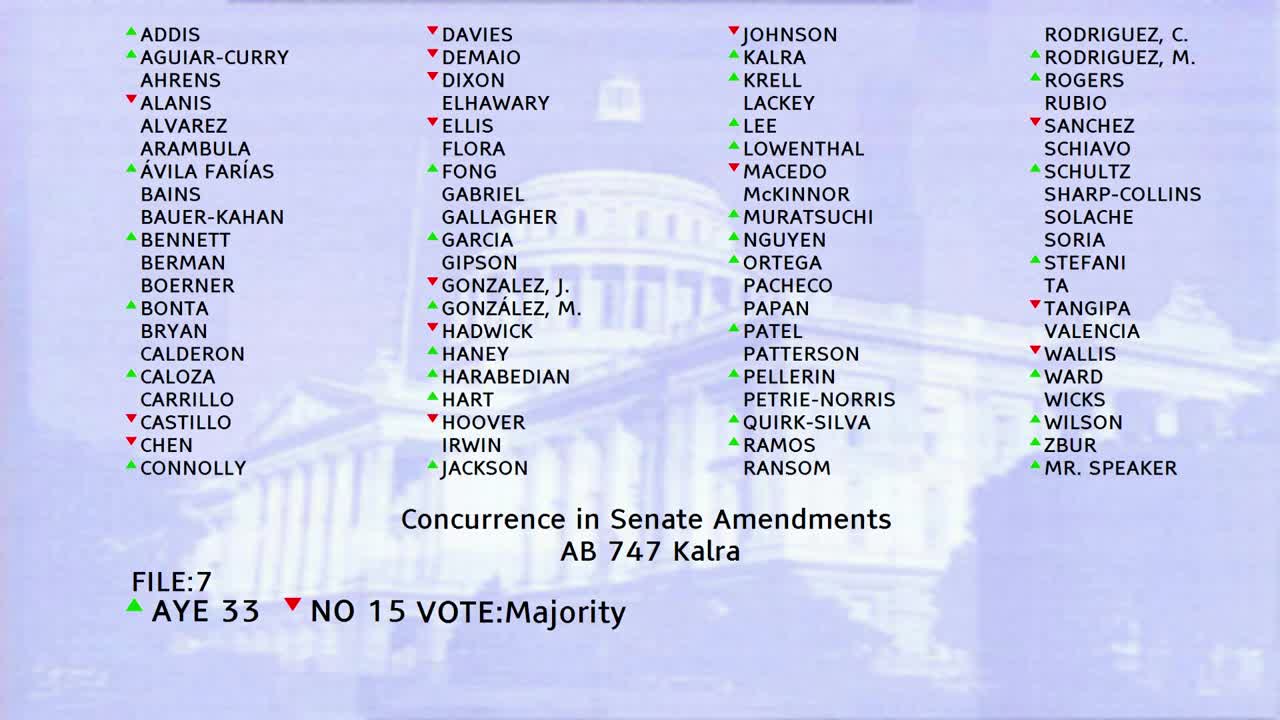 1MIN
Assembly Floor
 4MIN
Senate Floor
 1MIN
Senate Standing Committee on Appropriations
 8MIN
Senate Standing Committee on Labor, Public Employment and Retirement
 1MIN
Assembly Floor
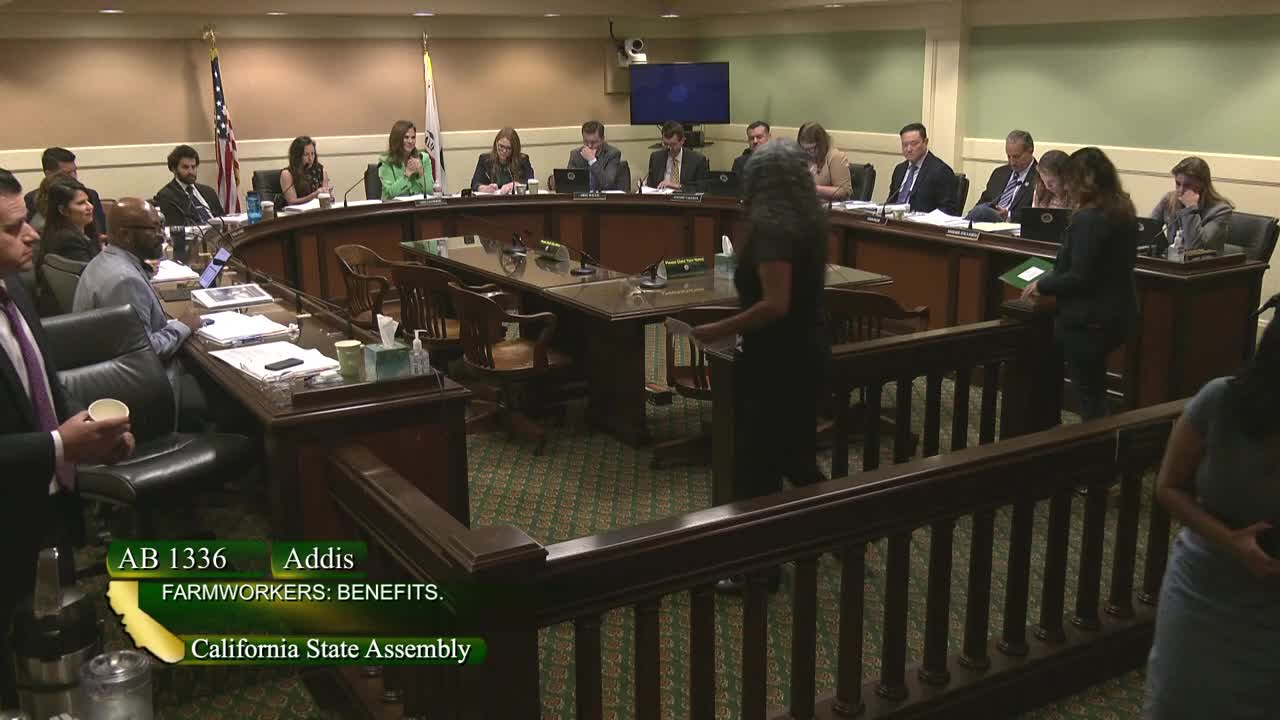 21MIN
Assembly Standing Committee on Insurance
Bill Author

Bill Co-Author(s):