AB 1340: Transportation network company drivers: labor relations.
- Session Year: 2025-2026
- House: Assembly
- Latest Version Date: 2025-10-03
Current Status:
Passed
(2025-10-03: Chaptered by Secretary of State - Chapter 335, Statutes of 2025.)
Introduced
In Committee
Awaiting First Chamber Vote
Passed First Chamber
In Committee
Awaiting Second Chamber Vote
Passed Second Chamber
Enacted
Existing law declares the public policy of the state regarding labor organization, including, among other things, that it is necessary for a worker to have full freedom of association, self-organization, and designation of representatives of their own choosing, to negotiate the terms and conditions of their employment, and to be free from the interference, restraint, or coercion of employers of labor, or their agents, in the designation of such representatives or in self-organization or in other concerted activities for the purpose of collective bargaining or other mutual aid or protection.
Existing law, the Protect App-Based Drivers and Services Act, added by Proposition 22, as approved by the voters at the November 3, 2020, statewide general election (the initiative), categorizes app-based drivers for network companies, as defined, as independent contractors if certain conditions are met. Existing law requires, among other things, that the network company provide a health care subsidy to qualifying app-based drivers, provide a minimum level of compensation for app-based drivers, and not restrict app-based drivers from working in any other lawful occupation or business. Existing case law holds that specified provisions of the initiative are invalid on separation of powers grounds; however, the court severed the unconstitutional provisions, allowing the rest of the initiative to remain in effect.
Existing law also establishes the Public Employment Relations Board (board) in state government as a means of resolving disputes and enforcing the statutory duties and rights of specified public employers and employees under various acts regulating collective bargaining. Existing law vests the board with jurisdiction to enforce certain provisions over charges of unfair practices for represented employees.
This bill, the Transportation Network Company Drivers Labor Relations Act (act), would establish that transportation network company (TNC) drivers have the right to form, join, and participate in the activities of TNC driver organizations, to bargain through representatives of their own choosing, to engage in concerted activities for the purpose of bargaining or other mutual aid or protection, and to refrain from such activities. The bill would require the board to enforce these provisions.
This bill would require all TNCs to submit certain information every quarter, including information identifying and related personal work information about TNC drivers to the board in a list format, as prescribed. The bill would establish various procedures governing the certification and decertification of TNC driver organizations for purposes of representing drivers in the collective bargaining process. In this connection, the bill would require the board to determine if an entity is a TNC driver organization, as prescribed, and make certain determinations as to whether a specific organization has been designated as the bargaining representative for TNC drivers pursuant to an election process. The bill would establish various notice requirements, conditions, and timelines governing the representation of TNC drivers. The bill would, among other things, require TNCs and certified driver bargaining organizations to negotiate in good faith pursuant to the act, as described, and would set forth procedures for mediation and arbitration for purposes of reaching a sectoral agreement. The bill would set forth procedures and guidelines for the board to approve or disapprove sectoral agreements. The bill would require a TNC that was not a covered TNC when a sectoral agreement took effect but subsequently became a covered TNC to be bound by all terms of the sectoral agreement, as specified.
This bill would make it an unfair practice for a TNC, an agent of a TNC, or a multicompany committee, as defined, to fail or refuse to negotiate in good faith with a certified driver bargaining organization, among other things. The bill would also make it an unfair practice for a certified driver bargaining organization or its agents to fail to negotiate in good faith with a TNC or multicompany committee, among other things. The bill would set forth unfair practice charge procedures and remedies for those practices. The bill would define terms for purposes of the act, make the provisions of the act severable, and make related legislative policy statements.
Existing law, the Bagley-Keene Open Meeting Act, generally requires all meetings of a state body to be open and public.
This bill would exempt any meeting of a mediator or arbitrator with any party or group to the negotiations process and the mediation and arbitration processes in the act from the Bagley-Keene Open Meeting act.
Existing law, the California Public Records Act, requires state and local agencies to make their records available for public inspection, unless an exemption from disclosure applies.
This bill would exclude from public disclosure information regarding TNC drivers that is submitted to the board pursuant to the act, except as specified.
Existing constitutional provisions require that a statute that limits the right of access to the meetings of public bodies or the writings of public officials and agencies be adopted with findings demonstrating the interest protected by the limitation and the need for protecting that interest.
This bill would make legislative findings to that effect.
Existing law declares the public policy of the state regarding labor organization, including, among other things, that it is necessary for a worker to have full freedom of association, self-organization, and designation of representatives of their own choosing, to negotiate the terms and conditions of their employment, and to be free from the interference, restraint, or coercion of employers of labor, or their agents, in the designation of such representatives or in self-organization or in other concerted activities for the purpose of collective bargaining or other mutual aid or protection.
Existing law, the Protect App-Based Drivers and Services Act, added by Proposition 22, as approved by the voters at the November 3, 2020, statewide general election (the initiative), categorizes app-based drivers for network companies, as defined, as independent contractors if certain conditions are met. Existing law requires, among other things, that the network company provide a health care subsidy to qualifying app-based drivers, provide a minimum level of compensation for app-based drivers, and not restrict app-based drivers from working in any other lawful occupation or business. Existing case law holds that specified provisions of the initiative are invalid on separation of powers grounds; however, the court severed the unconstitutional provisions, allowing the rest of the initiative to remain in effect.
Existing law also establishes the Public Employment Relations Board (board) in state government as a means of resolving disputes and enforcing the statutory duties and rights of specified public employers and employees under various acts regulating collective bargaining. Existing law vests the board with jurisdiction to enforce certain provisions over charges of unfair practices for represented employees.
This bill, the Transportation Network Company Drivers Labor Relations Act (act), would establish that transportation network company (TNC) drivers have the right to form, join, and participate in the activities of TNC driver organizations organizations, to bargain through representatives of their own choosing choosing, to engage in other concerted activities for the purpose of collective bargaining or other mutual aid or protection. The bill would provide that TNC drivers also have the right to refuse to join or participate in the activities of TNC driver organizations. protection, and to refrain from such activities. The bill would require the board to enforce these provisions.
This bill would require all TNCs, commencing on January 1, 2026, and every 3 months thereafter, TNCs to submit certain information every quarter, including information identifying and related personal work information about TNC drivers to the board in a list format, as prescribed. The bill would establish various procedures governing the certification and decertification of TNC driver organizations for purposes of representing drivers in the collective bargaining process. In this connection, the bill would require the board to compile driver list information determine if an entity is a TNC driver organization, as prescribed, and make certain determinations as to whether a specific organization has been designated as the bargaining representative for TNC drivers pursuant to an election process. The bill would establish various notice requirements, conditions, and timelines governing the representation of TNC drivers. The bill would would, among other things, require TNCs and certified driver bargaining organizations to negotiate in good faith pursuant to the act, as described, and would set forth procedures for mediation and arbitration for purposes of reaching a bargaining sectoral agreement. The bill would set forth procedures and guidelines for the board to approve or disapprove sectoral agreements. The bill would require a TNC that was not a covered TNC when a sectoral agreement took effect but subsequently became a covered TNC to be bound by all terms of the sectoral agreement, as specified.
This bill would make it an unfair labor practice for a TNC, an agent of a TNC, or a multicompany committee, as defined, to fail or refuse to negotiate in good faith with a certified driver bargaining organization, among other things. The bill would also make it an unfair labor practice for a certified driver bargaining organization or its agents to fail to negotiate in good faith with a TNC or multicompany committee, among other things. The bill would set forth unfair labor practice charge procedures and remedies for those practices. The bill would also define terms for purposes of the act and would act, make the provisions of the act severable, and make related legislative policy statements.
Existing law, the Bagley-Keene Open Meeting Act, generally requires all meetings of a state body to be open and public.
This bill would exempt any meeting of a mediator or arbitrator with any party or group to the negotiations process and the mediation and arbitration processes in the act from the Bagley-Keene Open Meeting act.
Existing law, the California Public Records Act, requires state and local agencies to make their records available for public inspection, unless an exemption from disclosure applies.
This bill would exclude from public disclosure information regarding TNC drivers that is submitted to the board pursuant to the act, except as specified.
Existing constitutional provisions require that a statute that limits the right of access to the meetings of public bodies or the writings of public officials and agencies be adopted with findings demonstrating the interest protected by the limitation and the need for protecting that interest.
This bill would make legislative findings to that effect.
Existing law declares the public policy of the state regarding labor organization, including, among other things, that it is necessary for a worker to have full freedom of association, self-organization, and designation of representatives of their own choosing, to negotiate the terms and conditions of their employment, and to be free from the interference, restraint, or coercion of employers of labor, or their agents, in the designation of such representatives or in self-organization or in other concerted activities for the purpose of collective bargaining or other mutual aid or protection.
Existing law, the Protect App-Based Drivers and Services Act, added by Proposition 22, as approved by the voters at the November 3, 2020, statewide general election (the initiative), categorizes app-based drivers for network companies, as defined, as independent contractors if certain conditions are met. Existing law requires, among other things, that the network company provide a health care subsidy to qualifying app-based drivers, provide a minimum level of compensation for app-based drivers, and not restrict app-based drivers from working in any other lawful occupation or business. Existing case law holds that specified provisions of the initiative are invalid on separation of powers grounds; however, the court severed the unconstitutional provisions, allowing the rest of the initiative to remain in effect.
Existing law also establishes the Public Employment Relations Board in state government as a means of resolving disputes and enforcing the statutory duties and rights of specified public employers and employees under various acts regulating collective bargaining. Existing law vests the board with jurisdiction to enforce certain provisions over charges of unfair practices for represented employees.
This bill, the Transportation Network Company Drivers Labor Relations Act, Act (act), would establish that transportation network company (TNC) drivers have the right to form, join, and participate in the activities of TNC driver organizations of their own choosing to engage in other concerted activities for the purpose of collective bargaining or other mutual aid or protection. The bill would provide that TNC drivers also have the right to refuse to join or participate in the activities of TNC driver organizations. The bill would require the board to enforce these provisions.
TheThis bill would require all TNCs, commencing on January 1, 2026, and every 3 months thereafter, to submit certain identifying and related personal work information about TNC drivers to the board in a list format, as prescribed. The bill would establish various procedures governing the certification and decertification of TNC driver organizations for purposes of representing drivers in the collective bargaining process. In this connection, the bill would require the board to compile driver list information and make certain determinations as to whether a specific organization has been designated as the bargaining representative for TNC drivers pursuant to an election process. The bill would establish various notice requirements, conditions, and timelines governing the representation of TNC drivers. The bill would require TNCs and certified driver bargaining organizations to negotiate in good faith pursuant to the act, as described, and would set forth procedures for mediation and arbitration for purposes of reaching a bargaining agreement.
This bill would make it an unfair labor practice for a TNC, an agent of a TNC, or a multicompany committee, as defined, to fail or refuse to negotiate in good faith with a certified driver bargaining organization, among other things. The bill would also make it an unfair labor practice for a certified driver bargaining organization or its agents to fail to negotiate in good faith with a TNC or multicompany committee, among other things. The bill would set forth unfair labor practice charge procedures and remedies for those practices. The bill would also define terms for purposes of the act and would make related legislative policy statements.
Existing law, the California Public Records Act, requires state and local agencies to make their records available for public inspection, unless an exemption from disclosure applies.
This bill would exclude from public disclosure information regarding TNC drivers that is submitted to the board pursuant to the act, except as specified.
Existing constitutional provisions require that a statute that limits the right of access to the meetings of public bodies or the writings of public officials and agencies be adopted with findings demonstrating the interest protected by the limitation and the need for protecting that interest.
This bill would make legislative findings to that effect.
Existing law declares the public policy of the state regarding labor organization, including, among other things, that it is necessary for a worker to have full freedom of association, self-organization, and designation of representatives of their own choosing, to negotiate the terms and conditions of their employment, and to be free from the interference, restraint, or coercion of employers of labor, or their agents, in the designation of such representatives or in self-organization or in other concerted activities for the purpose of collective bargaining or other mutual aid or protection.
Existing law, the Protect App-Based Drivers and Services Act, added by Proposition 22, as approved by the voters at the November 3, 2020, statewide general election (the initiative), categorizes app-based drivers for network companies, as defined, as independent contractors if certain conditions are met. Existing law requires, among other things, that the network company provide a health care subsidy to qualifying app-based drivers, provide a minimum level of compensation for app-based drivers, and not restrict app-based drivers from working in any other lawful occupation or business. Existing case law holds that specified provisions of the initiative are invalid on separation of powers grounds; however, the court severed the unconstitutional provisions, allowing the rest of the initiative to remain in effect.
Existing law also establishes the Labor and Workforce Development Agency in state government under the supervision of the Secretary of Labor and Workforce Development, and charges the agency with oversight of specified departments, boards, and panels. Public Employment Relations Board in state government as a means of resolving disputes and enforcing the statutory duties and rights of specified public employers and employees under various acts regulating collective bargaining. Existing law vests the board with jurisdiction to enforce certain provisions over charges of unfair practices for represented employees.
This bill, the Transportation Network Company Drivers Labor Relations Act, would establish that transportation network company (TNC) drivers have the right to form, join, and participate in the activities of TNC driver organizations of their own choosing to engage in other concerted activities for the purpose of collective bargaining or other mutual aid or protection. The bill would provide that TNC drivers also have the right to refuse to join or participate in the activities of TNC driver organizations. The bill would require the Labor and Workforce Development Agency board to enforce these provisions. The bill would define various terms for purposes of the act and would make related legislative policy statements.
The bill would require all TNCs, commencing on January 1, 2026, and every 3 months thereafter, to submit certain identifying and related personal work information about TNC drivers to the board in a list format, as prescribed. The bill would establish various procedures governing the certification and decertification of TNC driver organizations for purposes of representing drivers in the collective bargaining process. In this connection, the bill would require the board to compile driver list information and make certain determinations as to whether a specific organization has been designated as the bargaining representative for TNC drivers pursuant to an election process. The bill would establish various notice requirements, conditions, and timelines governing the representation of TNC drivers. The bill would also define terms for purposes of the act and would make related legislative policy statements.
Existing constitutional provisions require that a statute that limits the right of access to the meetings of public bodies or the writings of public officials and agencies be adopted with findings demonstrating the interest protected by the limitation and the need for protecting that interest.
This bill would make legislative findings to that effect.
Existing law declares the public policy of the state regarding labor organization, including, among other things, that it is necessary for a worker to have full freedom of association, self-organization, and designation of representatives of their own choosing, to negotiate the terms and conditions of their employment, and to be free from the interference, restraint, or coercion of employers of labor, or their agents, in the designation of such representatives or in self-organization or in other concerted activities for the purpose of collective bargaining or other mutual aid or protection.
Existing law, the Protect App-Based Drivers and Services Act, added by Proposition 22, as approved by the voters at the November 3, 2020, statewide general election (the initiative), categorizes app-based drivers for network companies, as defined, as independent contractors if certain conditions are met. Existing law requires, among other things, that the network company provide a health care subsidy to qualifying app-based drivers, provide a minimum level of compensation for app-based drivers, and not restrict app-based drivers from working in any other lawful occupation or business. Existing case law holds that specified provisions of the initiative are invalid on separation of powers grounds; however, the court severed the unconstitutional provisions, allowing the rest of the initiative to remain in effect.
Existing law also establishes the Labor and Workforce Development Agency in state government under the supervision of the Secretary of Labor and Workforce Development, and charges the agency with oversight of specified departments, boards, and panels.
This bill, the Transportation Network Company Drivers Labor Relations Act, would establish that transportation network company (TNC) drivers have the right to form, join, and participate in the activities of TNC driver organizations of their own choosing to engage in other concerted activities for the purpose of collective bargaining or other mutual aid or protection. The bill would provide that TNC drivers also have the right to refuse to join or participate in the activities of TNC driver organizations. The bill would require the Labor and Workforce Development Agency to enforce these provisions. The bill would define various terms for purposes of the act and would make related legislative policy statements.
The Metropolitan Transportation Commission Act establishes the Metropolitan Transportation Commission to provide comprehensive regional transportation planning for the San Francisco Bay area, as provided. Existing law requires the commission to establish a regional transit coordinating council to better coordinate routes, schedules, fares, and transfers among the San Francisco Bay area transit operators and to explore potential advantages of joint ventures in certain areas. The act authorizes the commission, in consultation with the regional transit coordinating council, to identify functions performed by individual public transit systems that could be consolidated to improve the efficiency of regional transit service, and recommend that those functions be consolidated and performed through inter-operator agreements or as services contracted to a single entity.This bill would require the commission to consult with the general manager from each transit operator, instead of the regional transit coordinating council, when identifying functions that could be consolidated and recommending their consolidation, as described above. To the extent that this bill would impose additional duties on transit operators, it would impose a state-mandated local program.The California Constitution requires the state to reimburse local agencies and school districts for certain costs mandated by the state. Statutory provisions establish procedures for making that reimbursement.This bill would provide that, if the Commission on State Mandates determines that the bill contains costs mandated by the state, reimbursement for those costs shall be made pursuant to the statutory provisions noted above.The Metropolitan Transportation Commission Act establishes the Metropolitan Transportation Commission to provide comprehensive regional transportation planning for the San Francisco Bay area, as provided. Existing law requires the commission to establish a regional transit coordinating council to better coordinate routes, schedules, fares, and transfers among the San Francisco Bay area transit operators and to explore potential advantages of joint ventures in certain areas. The act authorizes the commission, in consultation with the regional transit coordinating council, to identify functions performed by individual public transit systems that could be consolidated to improve the efficiency of regional transit service, and recommend that those functions be consolidated and performed through inter-operator agreements or as services contracted to a single entity.
This bill would require the commission to consult with the general manager from each transit operator, instead of the regional transit coordinating council, when identifying functions that could be consolidated and recommending their consolidation, as described above. To the extent that this bill would impose additional duties on transit operators, it would impose a state-mandated local program.
The California Constitution requires the state to reimburse local agencies and school districts for certain costs mandated by the state. Statutory provisions establish procedures for making that reimbursement.
This bill would provide that, if the Commission on State Mandates determines that the bill contains costs mandated by the state, reimbursement for those costs shall be made pursuant to the statutory provisions noted above.
This chapter shall be known, and may be cited as, the Transportation Network Company Drivers Labor Relations Act.
7470.1.(a)It is the policy of the State of California to encourage and protect the right of transportation network company drivers to full freedom of association, self-organization, and designation of representatives of their own choosing to negotiate the compensation that they receive as well as other terms and conditions of their agreements with transportation network companies.
(b)The benefit to the states economy from negotiated agreements between transportation network company drivers and the transportation network companies, including where those agreements are multiparty, sectoral agreements, outweighs the anticompetitive effect of those agreements. It is the states intent that the state action antitrust exemption to the application of federal and state antitrust laws shall apply to the activities of transportation network company drivers, transportation network company driver organizations, bargaining representatives for transportation network company drivers, and transportation network companies when they are participating in negotiations and other activities as authorized or regulated by this chapter.
(c)The purposes of this chapter are to provide transportation network company drivers the opportunity to self-organize and designate representatives of their own choosing in order to bargain with transportation network companies, to facilitate the prevention or prompt resolution of disputes between transportation network companies and transportation network company drivers, and to improve the working conditions of transportation network company drivers and therefore the services provided to the general public.
(d)It is the policy of the state to establish various notice requirements, conditions, and timelines governing the representation of transportation network company drivers. It is the policy of the state to require transportation network companies and certified driver bargaining organizations to negotiate in good faith pursuant to the act and to set forth procedures for mediation and arbitration for purposes of reaching a bargaining agreement.
(e)In November 2020, the California voters approved Proposition 22, the Protect App-Based Drivers and Services Act, which has been codified in Chapter 10.5 (commencing with Section 7448). That measure establishes certain minimum standards for app-based drivers, while allowing, as the California courts have held, the state to create a system for negotiations between transportation network company drivers and transportation network companies, including, by agreement, to voluntarily increase the standards that were established by Proposition 22. This chapter establishes a robust system to authorize those negotiations, while accommodating Proposition 22, which limits the states ability to impose certain terms through the binding interest arbitration process that applies if the parties are otherwise unable to reach an agreement but does not otherwise impose limits on that process.
(f)Because of the nature of the industry, many individuals who perform work as transportation network company drivers have only a short-term or highly intermittent relationship with the industry. For both logistical and policy reasons, this chapter establishes a threshold for eligibility to participate in the selection of a union representative so the choice can be made by those drivers who have more than a casual or short-term relationship with the industry and, therefore, have a more significant interest in making that choice.
7470.2.For purposes of this chapter, the following definitions apply:
(a)Active TNC driver means a transportation network company (TNC) driver who has driven at least the minimum number of rides during the past six months with a covered TNCs platform in the State of California, as determined by the board pursuant to Section 7470.6.
(b)Board means the Public Employment Relations Board established pursuant to Section 3541 of the Government Code.
(c)Certified driver bargaining organization means an organization that has been certified by the board as the representative of all TNC drivers in the state for purposes of bargaining pursuant to this chapter.
(d)(1)Company union means any committee, worker representation plan, or association of TNC drivers or others that exists for the purpose, in whole or in part, of dealing with TNCs concerning grievances or terms and conditions of work for TNC drivers, for which either or both of the following is true:
(A)A TNC has initiated or created the union, proposed its initiation or creation, participated in the formulation of its governing rules or policies, or participated in or supervised its management, operations, or elections.
(B)A TNC has maintained, financed, controlled, dominated, or assisted in maintaining or financing the union, unless required to do so by this chapter or any regulations implementing this chapter, whether by compensating anyone for services performed on its behalf or by donating free services, equipment, materials, office or meeting space, or anything else of value, or by any other means.
(2)A TNC driver organization shall not be deemed a company union solely because any of the following are true:
(A)It has negotiated or been granted the right to designate TNC drivers to be released with pay for the purpose of providing representational services in labor-management affairs on behalf of TNC drivers represented by the TNC driver organization.
(B)In the course of providing representational services to workers for whom it is the certified driver bargaining organization, a TNC has allowed agents of the TNC driver organization to meet with drivers at the TNCs premises.
(C)It has received from a TNC the voluntary membership dues deductions of TNC drivers or the TNC has processed or transmitted membership dues pursuant to subdivision (d) of Section 7470.9.
(D)It has received funds from a TNC for the administration of benefits and services to TNC drivers pursuant to a bargaining agreement in its capacity as the certified driver bargaining organization.
(e)Covered TNC means a TNC that is a covered TNC based on ride-share volume, as determined pursuant to Section 7470.5.
(f)Multicompany committee means a committee formed by multiple TNCs for purposes of bargaining pursuant to this act.
(g)Scope of representation has the same meaning as set forth in Section 7470.11.
(h)Sectoral agreement means an agreement between covered TNCs and the certified driver bargaining organization that meets the requirements of Section 7470.13 and that, if approved by the board, will apply to all covered TNCs.
(i)Transportation network company or TNC is a person or company that falls under the definition set forth in subdivision (c) of Section 5431 of the Public Utilities Code. A TNC is covered by this chapter only if it provides prearranged transportation services in the state and connects passengers with TNC drivers and only with respect to those TNC drivers.
(j)Transportation network company driver or TNC driver means any person who uses a personal vehicle in connection with a TNCs online-enabled application or platform to connect with passengers in the state pursuant to the TNC license of the TNC. However, this term does not include any individual, who, with respect to the provision of services through a TNCs online-enabled application or platform, is determined by a final order of a court of competent jurisdiction or the National Labor Relations Board, or declared by a TNC to be a person who is an employee within the meaning of Section 152(3) of Title 29 of the United States Code or within the meaning of Section 31.3121(d)-1 or Section 31.3401(c)-1 of Title 26 of the Code of Federal Regulations.
(k)Transportation network company driver organization or TNC driver organization means an organization that has all of the following characteristics:
(1)The organization has engaged in advocacy for drivers who transport passengers in California, or is affiliated with an organization that has engaged in advocacy for drivers who transport passengers in California, for a minimum of five years.
(2)The organization has experience, or is affiliated with an organization that has experience, in negotiating collective bargaining agreements and representing workers under those agreements, including the representation of workers in filing unfair labor practice charges and in grievance proceedings.
(3)The organization has as one of its main purposes the representation of workers in their labor relations.
(4)The organizations bylaws or other internal governing documents will give TNC drivers the right to be members of the organization and to participate in the democratic control of the organization if the bargaining unit chooses to be represented by the organization.
(5)The organization is not sponsored by, dominated by, or controlled by a transportation network company.
(6)The organization is not a company union.
7470.3.(a)TNC drivers have the right to form, join, and participate in the activities of TNC driver organizations, to bargain through representatives of their own choosing, to engage in concerted activities for the purpose of bargaining or other mutual aid or protection, and to refrain from such activities.
(b)This chapter shall not be interpreted to prohibit TNC drivers from exercising the right to confer with TNCs at any time, provided that during any conference there is no attempt by the TNC, directly or indirectly, to interfere with, restrain, or coerce workers in the exercise of the rights guaranteed by this section.
7470.4.(a)The board shall enforce this chapter.
(b)The powers and duties of the board, as described in Section 3541.3 of the Government Code, shall also apply to the boards administration and enforcement of this chapter.
(c)The board may adopt rules and regulations as necessary to implement this chapter.
(d)The board may, where necessary and consistent with the purpose of this act, construe any provision in Section 3541.3 of the Government Code, or a related statute or implementing regulation applicable to the board, referring to employee or employees to include a transportation network company driver, as defined in Section 7470.2, referring to employee organization to include a transportation network company driver organization, as defined in Section 7470.2, referring to exclusive representative to include a certified driver bargaining organization, as defined in Section 7470.2, and referring to employer to include a transportation network company, as defined in Section 7470.2.
7470.5.(a)(1)In addition to the TNC driver lists required by Section 7470.6 and 7470.9, within two weeks after the end of each calendar quarter, commencing on January 1, 2026, and at the completion of every three months thereafter, each TNC shall electronically submit to the board a single statewide total of the rides performed during the prior quarter by TNC drivers, as defined in Section 7470.2, on its online-enabled application or platform.
(2)The information required by paragraph (1) shall be produced in a manipulable electronic format, such as a spreadsheet program consisting of cells organized by lettered columns and numbered rows with each data point in a separate cell that allows users to sort and perform calculations and analysis. The board may require that the information be provided in a specified software program.
(b)(1)Within 14 days after the deadline in subdivision (a), the board shall total all rides reported pursuant to that subdivision.
(2)The board shall rank all TNCs by rideshare volume in descending order. The board shall begin with the highest ranked TNC and continue down the list until the board has identified the TNCs whose rides collectively equal or exceed 95 percent of the statewide total for the preceding quarter. These TNCs shall be deemed covered TNCs for purposes of this chapter.
(3)For purposes of this subdivision, all TNCs under common ownership or control shall be considered to be a single TNC. The board shall publish the list of covered and noncovered TNCs and rideshare volume information on its internet website. The board shall notify each TNC as to whether the TNC is a covered TNC.
(c)(1)If a TNC willfully fails to submit the list required by this section, the board shall promptly issue a complaint charging the TNC with an unfair practice and petition a court of competent jurisdiction for temporary relief to compel production of the list.
(2)In addition to any other remedy provided by law, a TNC found to have committed an unfair practice by failing to submit the list required by this section shall be subject to a civil penalty, payable to the General Fund, not to exceed ten thousand dollars ($10,000) per day for each day after the deadline that the list was not provided. The amount of the penalty shall be determined by the board through application of the following criteria:
(A)The size of the TNC.
(B)The severity of the violation.
(C)Any prior history of violations by the TNC.
(3)In addition to any other remedy provided by law, a TNC found to have committed an unfair practice by failing to submit the list required by this section shall be required by the board to pay the boards attorneys fees and costs for any court proceeding initiated by the board to compel production of the list.
(4)The failure of a TNC to submit the list required by this section shall not prevent the board from providing a list of covered and noncovered TNCs to the extent the board concludes that the missing information cannot reasonably be expected to change whether those TNCs are covered or noncovered TNCs.
7470.6.(a)(1)Within two weeks after the end of each calendar quarter, commencing with the quarter ending on March 31, 2026, each covered TNC shall submit to the board the name, drivers license number, and, to the extent known by a TNC, the most recent email address, local residence and mailing addresses, cellular telephone number, as well as the TNC drivers first date joining the platform and the number of rides the TNC driver completed in the previous six months for each TNC driver who has completed at least 20 rides within the State of California within the prior six months.
(2)The list required by paragraph (1) shall be produced in a manipulable electronic format, such as a spreadsheet program consisting of cells organized by lettered columns and numbered rows with each data point in a separate cell that allows users to sort and perform calculations and analysis. The board may require that the list be provided in a specified software program.
(b)Within 14 days of the deadline for submission of the information set forth in subdivision (a) and until a TNC driver organization has been certified as the certified driver bargaining organization, the board shall combine the data provided by covered TNCs and calculate the median number of rides provided by all TNC drivers whose information has been submitted under subdivision (a) and shall prepare a list of all TNC drivers who have completed the median number of rides or more in the past six months. Any TNC driver who completed the median number of rides or more shall be deemed an active TNC driver. The list shall include the information set forth in subdivision (a) and shall designate the covered TNC or covered TNCs the TNC driver has driven for during the prior six months. The board shall take appropriate steps to ensure that TNC drivers who drive for multiple covered TNCs are not listed multiple times but are listed a single time with the relevant covered TNCs designated. An individual covered TNCs failure to submit the required information shall not relieve the board of its responsibility to timely provide the list required by this subdivision. These records shall not be considered public records under any applicable law.
7470.7.(a)For purposes of this chapter, the board shall determine if an entity is a TNC driver organization within the meaning set forth in Section 7470.2, as follows:
(1)The board shall designate a 10-day period to occur on or after January 1, 2026, and every three months thereafter, during which an entity must apply to the board in order to be designated as a TNC driver organization or to have its designation renewed.
(2)The general counsel of the board shall have the authority to determine if an entity is a TNC driver organization upon application by that entity. The general counsel shall issue that determination within 10 days of receiving the application.
(3)If the general counsel determines an entity is not a TNC driver organization, the general counsel shall state the reasons for this determination. An applicant determined not to be a TNC may appeal this adverse determination to the board within 30 days of the determination.
(b)Once an entity has been determined to be a TNC driver organization, this determination shall remain valid for two years unless it is determined that the entity no longer meets the definition of a TNC driver organization.
(c)The certified driver bargaining organization shall be presumed to continue to meet the definition of a TNC driver organization without the need to apply for renewal of that determination every two years.
7470.8.The certification and decertification process for TNC driver organizations shall follow the procedures set forth in this section.
(a)(1)(A)A TNC driver organization may, at any time after May 1, 2026, present to the board proof sufficient to show that at least 10 percent of active TNC drivers have authorized the TNC driver organization to act as their bargaining representative.
(B)Within 30 days of a TNC driver organization request for a board determination under subparagraph (A), the board shall determine whether the organization has been authorized to act as bargaining representative by at least 10 percent of active TNC drivers.
(2)Within 30 days of the boards determination that a TNC driver organization has presented sufficient proof to satisfy subparagraph (A) of paragraph (1), and on every January 31, April 30, July 31, and October 31 thereafter, the board shall provide the TNC driver organization with the list described in subdivision (b) of Section 7470.6. A TNC driver organization may use the information in the list only for the purposes authorized by this chapter, and shall not provide the information to any third party unless that party is acting as the TNC driver organizations agent for purposes authorized by this chapter. A covered TNC shall not be liable for any damages caused by the TNC driver organizations or the boards failure to safeguard the list described in Section 7470.6 from a data or security breach.
(3)Within 30 days of the boards determination that a TNC driver organization has presented sufficient proof to satisfy subparagraph (A) of paragraph (1), each covered TNC shall send a notice from the board to its TNC drivers who were on the most recent list submitted by that TNC to the board pursuant to Section 7470.6, in a form determined by the board, that the TNC driver organization is seeking to represent TNC drivers for the purpose of initiating a bargaining process in order to establish terms and conditions for TNC drivers in the industry. The boards notice shall advise TNC drivers of the threshold for status as an active driver eligible to execute a proof of support. The boards notice shall be neutral as to whether TNC drivers should support a TNC driver organization.
(4)For six months from the date of the boards determination that a TNC driver organization has been authorized to act as the bargaining representative by at least ten percent of active TNC drivers, no other TNC driver organization shall be certified as the certified driver bargaining organization of those workers without an election.
(b)(1)(A)A TNC driver organization may, at any time after May 1, 2026, present to the board proof sufficient to show at least 30 percent of active TNC drivers have authorized the TNC driver organization to act as their bargaining representative.
(B)Within 30 days of a TNC driver organization request for a board determination under subparagraph (A), the board shall make a determination as to whether the organization has presented sufficient proof to satisfy subparagraph (A), and if it has, shall certify the TNC organization as the certified driver bargaining organization, subject to paragraph (2).
(2)(A)If a TNC driver organization seeking certification as the certified driver bargaining organization under this subdivision provides evidence that at least 30 percent but less than a majority of active TNC drivers have designated the TNC driver organization to act as their bargaining representative, the board shall wait 30 days before certifying the TNC driver organization as the certified driver bargaining organization. If, during those 30 days, another TNC driver organization provides evidence that at least 30 percent of active TNC drivers have authorized it to act as their bargaining representative, or a TNC driver provides evidence that at least 30 percent of active TNC drivers do not wish to be represented by any TNC driver organization, then the board shall within 60 days hold a representation election among all active TNC drivers.
(B)The election shall be conducted using a remote electronic voting system that must allow both electronic voting from remote site personal computers via the internet and electronic voting from personal or cellular telephones. The system shall not include voting machines used for casting votes at polling sites or electronic tabulation systems where votes are cast nonelectronically but counted electronically, such as punch card voting or optical scanning systems.
(3)If the TNC driver organization provides evidence that a majority of active TNC drivers have designated the TNC driver organization to act as their bargaining representative, then the board shall not wait 30 days nor shall it hold an election before certifying the TNC driver organization as the certified driver bargaining organization.
(c)(1)A TNC driver organization may submit proof of support to the board to demonstrate that TNC drivers have authorized a TNC driver organization to act as their bargaining representative under subdivision (a) or (b). A TNC driver organization may submit any proof of support that complies with Section 32700 of Title 8 of the California Code of Regulations. Valid proof of support shall have been executed by the TNC driver within the two years prior to the date that the TNC driver organization requested the board determination. The fact that the proof of support was executed by the TNC driver before the effective date of this chapter shall not affect its validity.
(2)For purposes of evaluating a TNC driver organizations proof of support under subdivision (a) or (b), the board shall use the list of active TNC drivers that was most recently issued pursuant to Section 7470.6 at the time the TNC driver organization requested a board determination.
(3)A TNC driver organization may submit proof that active TNC drivers have authorized the TNC driver organization to act as their bargaining representative under subdivision (a) or (b) on a rolling basis, over any time period that the TNC driver organization elects. If the TNC driver organization does so, the board may evaluate the proof on a rolling basis, subject to confirmation that the TNC driver is still on the relevant list of active TNC drivers when the TNC driver organization requests a board determination. The deadline for the board to determine whether the TNC driver organization has presented proof that a sufficient number of active TNC drivers wish to be represented by the TNC driver organization shall begin to run when the TNC driver organization notifies the board that it believes it has presented sufficient proof and is requesting a board determination.
(d)A TNC driver organization may, at any time within one year of the boards determination that the organization has been authorized to act as the bargaining representative by at least 10 percent of active TNC drivers, petition the board to conduct a representation election.
(1)Upon the receipt of such a petition, the board shall schedule a representation election to take place within 45 days and shall announce that election date on its internet website. The eligible voters shall be those individuals who are on the list of active TNC drivers that was most recently issued pursuant to Section 7470.6 at the time the TNC driver organization petitioned the board to conduct an election.
(A)The election shall be conducted using a remote electronic voting system that must allow both electronic voting from remote site personal computers via the internet and electronic voting from personal or cellular telephones. The system shall not include voting machines used for casting votes at polling sites or electronic tabulation systems where votes are cast nonelectronically but counted electronically, such as punch card voting or optical scanning systems.
(B)If, within seven days of the announcement of the election date, any other TNC driver organization submits evidence that it has been authorized to act as the bargaining representative by at least 10 percent of active TNC drivers, that TNC driver organization shall also appear on the ballot.
(C)Thirty days prior to the representation election, the board shall provide TNCs with an election notice that informs TNC drivers of the election date, how to vote, and what the effect of the representation election will be if the TNC driver organization receives a majority of valid votes cast. The board shall provide translated versions of the notice in all languages that the board determines are likely spoken by 5 percent or more of TNC drivers. Within seven days of the boards provision of the notice, each covered TNC shall send the notice, by email, by text, and through the method it ordinarily uses to communicate with TNC drivers, to all of the TNC drivers who appeared on the most recent list submitted by that TNC to the board pursuant to Section 7470.6. The boards notice shall advise TNC drivers of the threshold for status as an active driver eligible to cast a vote. The board may provide different versions of the notice that are appropriate for different means of communication.
(2)If the TNC driver organization receives a majority of valid votes cast by active TNC drivers, it shall be certified as the certified driver bargaining organization of all TNC drivers in the bargaining unit.
(3)When two or more TNC driver organizations are on the ballot and none of the listed choices receive a majority of the valid votes cast, there shall be a runoff election between the two choices receiving the highest number of votes cast and second highest number of votes cast. The election shall be held within 30 days of the determination that no choice received a majority of valid votes. The provisions for notice set forth in subparagraph (C) of paragraph (1) shall apply.
(A)The TNC drivers eligible to vote in the runoff election shall be the same TNC drivers who were eligible to vote in the original election. A TNC driver organization receiving a majority of the valid votes cast in the runoff shall be certified as the certified driver bargaining organization of all TNC drivers in the bargaining unit.
(B)If a majority of the valid votes cast are for no driver organization, then the board shall not certify any TNC driver organization as the certified driver bargaining organization.
(e)(1)A TNC driver organization certified as the certified driver bargaining organization shall have the authority to represent all TNC drivers in the bargaining unit, without challenge by another TNC driver organization, for one year following certification and during the time that a bargaining agreement is in effect, provided that this period shall not be longer than three years following the date of the approval of a bargaining agreement, except during a 30-day window period that shall begin 90 days before, and end 60 days before, the bargaining agreement expires.
(2)During the times when the certified driver bargaining organization is subject to challenge, TNC drivers may file for a decertification election upon a showing that at least 30 percent of active TNC drivers have demonstrated support for decertification. The board will determine the list of active TNC drivers pursuant to Section 7470.6. The board will then schedule an election within 30 days to determine the TNC driver organizations status as the certified driver bargaining organization. The TNC driver organization shall retain its status as the certified driver bargaining organization if it receives a majority of valid votes cast by active TNC drivers.
(f)The only appropriate bargaining unit of TNC drivers for purposes of this chapter is a statewide unit of all TNC drivers who drive for covered TNCs.
7470.9.(a)The certified driver bargaining organization shall have the right to represent all TNC drivers in the bargaining unit with respect to matters within the TNC driver organizations role as representative for purposes of this chapter. No other TNC driver organization shall be entitled to engage in bargaining with the covered TNCs concerning matters within the scope of representation.
(b)The certified driver bargaining organization shall represent each TNC driver in the represented unit fairly with respect to matters within the scope of representation of the bargaining unit for purposes of this chapter, without discrimination and without regard to whether the TNC driver is a member of the TNC driver organization.
(c)The certified driver bargaining organization shall be entitled to receive from the board, on a quarterly basis, within three weeks after the end of each calendar quarter, the lists of TNC drivers provided by the covered TNC to the board pursuant to Section 7470.6. The covered TNCs and the certified driver bargaining organization may, by mutual agreement, change the specification of the data that must be included on the list. The specification of the data that will be included on the list shall be within the scope of bargaining. The certified driver bargaining organization may use the information in the list only for the sole purpose of representing TNC drivers as authorized by this chapter and may not provide the information to any third party unless that party is acting as the organizations agent for purposes authorized by this chapter or administering benefits to drivers pursuant to a bargaining agreement. No other TNC driver organization shall be entitled to receive such a list from the board. Before receiving the list, the certified driver bargaining organization shall certify to the satisfaction of the board that the organization has implemented sufficient data security protection procedures in compliance with applicable data privacy laws, strictly limiting the use of data to what is permitted under this chapter, and establishing clear protocols for data breach notifications. A covered TNC shall not be liable for any damages caused by the certified driver bargaining organizations or the boards failure to safeguard the list described in this section from a data or security breach.
(d)The certified driver bargaining organization shall have a right to voluntary membership dues deduction upon presentation of dues deduction authorizations signed by individual TNC drivers, which may be in an electronic format or through the covered transportation network companys online-enabled application.
(1)A covered TNC shall commence making deductions as soon as practicable, but no later than 30 days after receiving proof of a signed dues deduction authorization, and dues shall be submitted to the certified driver bargaining organization within 30 days of the deduction.
(2)The right to the membership dues deduction shall remain in full force and effect until an individual revokes authorization for deductions in writing in accordance with the terms of the signed authorization.
(e)(1)Within 30 days after certification of the certified driver bargaining organization, the board shall develop a notice of TNC driver rights that notifies TNC drivers of their rights under this chapter and other applicable law, explains that TNC drivers are represented by the certified driver bargaining organization, provides the internet website and contact information of the certified driver bargaining organization, and informs TNC drivers of the procedure for filing an unfair practice charge. The board shall also post a copy of this notice on its internet website, may provide different versions of the notice that are appropriate for different means of communication, shall translate versions of the notice into all languages that the board determines are likely spoken by 5 percent or more of TNC drivers, and may modify this notice from time to time upon request of the certified driver bargaining organization.
(2)Within 30 days of the boards development of the notice described in paragraph (1), and at least once per month thereafter, each covered TNC shall send the notice to all TNC drivers who have provided rides within the State of California within the prior six months by text, email, and through the method that the covered TNC ordinarily uses to communicate with TNC drivers, provided that a covered TNC may petition to the board to be exempted from this requirement if it would impose an undue cost upon the covered TNC.
(3)Each covered TNC shall provide newly activated TNC drivers a notice, via electronic communication on its digital network, that they are represented by the certified driver bargaining organization upon the TNC drivers activation and that, if the driver performs 20 or more rides during a six-month period, their contact information will be provided to the certified driver bargaining organization on the next quarterly list. The notice shall be in a form approved by the certified driver bargaining organization and shall provide contact information for the certified driver bargaining organization.
(4)A covered TNC shall, within five days of receiving a request from the certified driver bargaining organization, confirm whether an individual has completed rides through the TNCs platform.
7470.10.Once the board determines that a TNC driver organization is the certified driver bargaining organization for the bargaining unit, the board shall notify all covered TNCs, and all covered TNCs as defined in subdivision (e) of Section 7470.2 shall be required to bargain with the certified driver bargaining organization concerning matters within the scope of representation.
7470.11.For purposes of this chapter, the term scope of representation shall mean TNC driver earnings, benefits, and other terms and conditions of work, including deactivations, which shall be mandatory subjects of bargaining.
7470.12.Each individual covered TNC shall retain exclusive control over the development, maintenance, design, pricing, and implementation of its product and product features, software, contract terms, algorithm, and operations and areas of service.
7470.13.(a)A sectoral agreement submitted to the board for approval shall address, at minimum, the following subjects, each of which must be set forth separately in the sectoral agreement, unless a subject is expressly waived by mutual agreement of the certified driver bargaining organization and the covered TNCs:
(1)Appeals process for deactivations.
(2)Representation of TNC drivers in deactivation appeals.
(3)Paid leave.
(4)Information disclosed to TNC drivers about trips on per-trip, weekly, and monthly earnings receipts and summaries, and on initial ride offers.
(5)Grievance and arbitration procedures to resolve disputes arising under the sectoral agreement.
(6)Grievance and arbitration procedures to resolve disputes about whether a TNC driver has received the mandatory compensation or benefits required by Chapter 10.5 (commencing with Section 7448).
(7)Safety mandates imposed by the covered TNCs that require TNC drivers to purchase safety equipment or purchase safety software, and safety features or protocols proposed by the certified driver bargaining organization that have a demonstrable purpose of reducing the risk of physical assault or injury to TNC drivers. For the purposes of this paragraph, purchase includes an automatic withdrawal from TNC driver earnings.
(8)Labor-TNC partnerships.
(9)Reasonable access by the certified driver bargaining organization to covered TNC-TNC driver communication systems.
(10)Deduction of voluntary fees and dues from payments to TNC drivers.
(11)Contributions or fees for a separate fund for the administration of benefits and services to TNC drivers including for TNC driver representation in deactivation appeals and other related activities.
(12)Duration of the sectoral agreement, which shall be between three and five years.
(b)A sectoral agreement, including an agreement recommended by an arbitrator pursuant to Section 7470.14, may address subjects beyond the required subjects set forth in subdivision (a), including provisions for earnings and benefits above the minimums guaranteed to TNC drivers by Chapter 10.5 (commencing with Section 7448). These additional subjects shall be addressed in separate provisions of the sectoral agreement and are subject to nonbinding recommendations as set forth in Section 7470.14.
(c)A sectoral agreement, including an agreement recommended by an arbitrator pursuant to Section 7470.14, shall not contain a provision that does any of the following:
(1)Reduces the minimum guarantees provided to TNC drivers by Chapter 10.5 (commencing with Section 7448).
(2)Restrains TNC drivers flexibility to choose work opportunities as protected by Section 7451.
(3)Alters or purports to alter the legal status of TNC drivers as independent contractors as established by Section 7451.
(4)Prevents an individual covered TNC from exercising its autonomy pursuant to Section 7470.12.
7470.14.(a)After the board notifies the covered TNCs of the boards determination that a specified TNC driver organization is the certified driver bargaining organization for the bargaining unit, that TNC driver organization or those covered TNCs may request to begin negotiations.
(b)(1)All TNCs that are covered TNCs pursuant to Section 7470.5, their agents or representatives, and the certified driver bargaining organization shall have an obligation to negotiate in good faith to reach a sectoral agreement that will apply to all covered TNCs pursuant to this chapter.
(2)Covered TNCs may form a multicompany committee for purposes of collective bargaining. If covered TNCs do not form a multicompany committee pursuant to this paragraph, then the certified driver bargaining organization may require all covered TNCs to bargain within the certified driver bargaining organization together, and an individual covered TNC shall not object to such a requirement to bargain in concert with other covered TNCs.
(3)A sectoral agreement shall be approved by covered TNCs that includes at least 80 percent of the industry measured by rideshare volume on the most recent quarterly report filed with the board and that includes at least the two largest covered TNCs.
(4)For purposes of this subdivision, to negotiate in good faith means the performance of the mutual obligation of the covered transportation network companies or their agents or representatives and the certified driver bargaining organization to meet at reasonable times and negotiate in good faith with respect to subjects within the scope of representation and to execute a written contract incorporating any agreement reached if requested by either party. However, this mutual obligation does not compel either party to agree to a proposal or require the making of a concession.
(c)If the certified driver bargaining organization and covered TNCs reach a recommended sectoral agreement for the bargaining unit, the recommended agreement shall be ratified pursuant to the certified driver bargaining organizations procedures. The recommended agreement shall then be submitted to the board for review and approval or disapproval. If the recommended agreement is not ratified according to the certified driver bargaining organizations procedures, the certified driver bargaining organization and covered TNCs shall resume bargaining.
(d)(1)If there has been no prior sectoral agreement under this chapter, covered TNCs or the certified driver bargaining organization may file with the board, at any time following 210 days after an initial request to bargain, a petition requesting that the board issue an order referring the parties to mediation of their issues. The parties may also jointly file a petition requesting referral to mediation at any time after the commencement of bargaining. Upon receipt of a petition, the board shall promptly refer the parties to mediation.
(2)If the parties have not agreed upon a mediator, the board shall, within seven days of receiving the petition, obtain from the California State Mediation and Conciliation Service (CSMCS) a list of nine qualified, disinterested mediators who have experience in labor mediation and submit it to the parties. A representative of the covered TNCs and a representative of the certified driver bargaining organization shall alternately strike from the list one of the names. The order of striking shall be determined by lot until one name remains. The remaining person shall be designated as the mediator. In the event the parties are unable to select the mediator within 15 days following receipt of the list from the board because a party refuses to strike names, the board shall appoint the mediator from the list provided by CSMCS.
(3)The parties shall have a duty to participate in good faith in mediation.
(4)If the certified driver bargaining organization and the covered TNCs reach a recommended sectoral agreement for the industry through mediation, the approval process described in subdivision (c) shall apply.
(5)Communications and documents exchanged pursuant to mediation shall be inadmissible in any official, regulatory, or judicial proceeding, consistent with Chapter 2 (commencing with Section 1115) of Division 9 of the Evidence Code.
(e)(1)Within 30 days after a dispute has been referred to mediation, the parties shall select a prospective arbitrator to resolve the dispute if mediation is unsuccessful. If the parties have not agreed upon an arbitrator within 30 days, the covered TNCs and the certified driver bargaining organization each shall propose three arbitrators to the board and the board shall propose three arbitrators from the American Arbitration Association roster who have at least 10 years of experience conducting labor arbitrations in California, have interest arbitration experience, and are members of the National Academy of Arbitrators. The certified driver bargaining organization and the covered TNCs shall select an arbitrator within seven days of receipt of the combined list from the board. The parties may mutually select an arbitrator who is not on the list. If the parties cannot agree on an arbitrator, each side shall alternatively strike from the list one of the names until an arbitrator is chosen by process of elimination. The board shall determine by lot which side shall strike first. If either side refuses to propose arbitrators for the list or to participate in selecting an arbitrator within 15 days following receipt of the list from the board, the board shall appoint the arbitrator from the original list proposed by the board.
(2)If the mediator is unable to achieve agreement between the parties concerning an appropriate resolution within 75 days of appointment of the mediator or within 60 days after the first meeting of the parties with the mediator, whichever occurs first, either the certified driver bargaining organization or the covered TNCs may petition the board to refer the dispute for resolution through arbitration. The parties may also jointly file a petition requesting referral of the dispute to arbitration at any time after the commencement of bargaining. Upon a filing of such a petition, the board shall refer the dispute to the arbitrator for resolution.
(3)(A)The arbitrator shall hold hearings on all matters related to the dispute. The parties may be heard and represented by counsel or by other representatives, as the parties may designate. The arbitrator shall determine the order of presentation by the parties and shall have discretion and authority to decide all procedural issues that may be raised. At the mutual request of the parties, the arbitrator may meet directly with the parties to attempt to mediate the dispute.
(B)The TNCs and the certified driver bargaining organization shall each be responsible for 50 percent of the cost of the arbitrator or mediator. The board shall have the authority to apportion costs among TNCs based on market share if the TNCs cannot agree to apportion costs among themselves.
(C)The parties may present, either orally or in writing, or both, statements of fact, supporting witnesses and other evidence, and arguments of their respective positions.
(D)The arbitrator shall have the authority to require the production of additional oral or written evidence from the parties. The arbitrator shall provide, at the request of either party, that a full and complete record be kept of any hearings, with the cost of the record borne by the requesting party. If such a record is created, it shall be shared with all parties, regardless of the party that paid for it.
(E)Within 90 days of the first meeting of the parties with the arbitrator or 105 days after appointment of the arbitrator, whichever occurs first, the arbitrator shall make a just and reasonable determination of the matters in dispute, and shall issue a recommended sectoral agreement that resolves all disputed issues. The time period for the arbitration proceedings may be extended by the arbitrator upon good cause shown, or by agreement, by the parties.
(F)In issuing a recommended sectoral agreement, the arbitrator shall specify the basis for their findings, taking into consideration the following factors:
(i)The positions of the parties.
(ii)The conditions of similar workers.
(iii)Whether the terms of the recommended agreement achieve the policy goals set forth in Section 7470.1, including, but not limited to, the improvement of working conditions and the improvement or provision for the prompt resolution of disputes between covered TNCs and TNC drivers.
(iv)If the covered TNCs claim an inability to pay for the certified driver bargaining organizations demands, the financial ability of the covered TNCs to pay for the requirements set forth in the recommended agreement.
(v)The impact of the recommended agreement on the delivery of services provided by TNCs.
(vi)Whether the recommended agreement would have a discriminatory impact on smaller TNCs or new entrants to the industry.
(vii)Any other factors recommended by the parties that the arbitrator finds to be consistent with this chapter.
(G)The sectoral agreement recommended by the arbitrator shall contain all of the following:
(i)Terms on which the parties have mutually agreed.
(ii)Binding recommendations on all minimum subjects set forth in subdivision (a) of Section 7470.13 that have not been waived.
(iii)Nonbinding recommendations on all other matters submitted for dispute resolution within the scope of representation.
(H)After receipt of the recommended sectoral agreement, the covered TNCs shall have 10 days to notify the certified driver bargaining organization as to whether the covered TNCs accept the recommended sectoral agreement in its entirety, including the nonbinding recommendations. If the covered TNCs accept the recommended sectoral agreement in its entirety, the recommended sectoral agreement shall be submitted to the board for review and approval or disapproval.
(I)The certified driver bargaining organization and the covered TNCs may also mutually agree to modify the recommended sectoral agreement and submit a modified sectoral agreement, in whole, to the board for review and approval or disapproval within 15 days after receiving the recommended sectoral agreement.
(J)(i)If, within 10 days of receiving the recommended sectoral agreement, the covered TNCs have not accepted the recommended sectoral agreement, and within 15 days of receiving the sectoral agreement the parties have not agreed upon a modified sectoral agreement, the certified driver bargaining organization may, within 20 days of receiving the recommended sectoral agreement, submit the proposed sectoral agreement without the nonbinding recommendations to the board for review and approval. Notwithstanding the submission of the modified sectoral agreement for approval, or the approval of the modified sectoral agreement, the parties shall have a duty to continue to bargain in good faith to reach agreement on the subjects addressed by the nonbinding recommendations.
(ii)If the certified driver bargaining organization does not elect to submit a proposed sectoral agreement to the board pursuant to clause (i), the parties shall have a duty to continue to bargain in good faith over the items in dispute to reach agreement on a new sectoral agreement for submission to the board.
(iii)The certified driver bargaining organization and the covered TNCs may, at any time, mutually submit a new proposed sectoral agreement to the board for review and approval or disapproval, and such an agreement may include modifications to any of the terms of the binding recommendations.
(K)The time periods set forth in this section may be extended by mutual agreement of the certified driver bargaining organization and the covered TNCs.
(L)For purposes of this section, any decision or action by the covered TNCs means a decision or action approved by covered TNCs that includes at least 80 percent of the industry measured by rideshare volume on the most recent quarterly report filed with the board and that includes at least the two largest covered TNCs.
(f)Following an initial sectoral agreement, all subsequent negotiations for all subsequent agreements shall begin at least 180 days before the current agreement expires. For all subsequent agreements, either the covered TNCs or the certified driver bargaining organization may, at any time after 180 days after the commencement of negotiations, petition the board to refer the parties to mediation. Except as provided in this subdivision, the timelines and procedures for mediation and arbitration for subsequent agreements shall be as provided in this section. The terms of a sectoral agreement shall remain in effect, including, but not limited to, any grievance and arbitration provisions and any provisions governing the deduction and transmittal of membership dues, until a new agreement is approved by the board.
(g)For purposes of this section, any decision is binding on all covered TNCs if approved by covered TNCs that include at least 80 percent of the industry, as measured by rideshare volume on the most recent quarterly report filed with the board, and that include at least the two largest covered TNCs.
7470.15.(a)A TNC that was not a covered TNC when a sectoral agreement took effect but whose rideshare volume in a later quarter brings it within the 95-percent threshold identified in Section 7470.5 shall become a covered TNC, and therefore bound by all terms of the sectoral agreement immediately, unless exempted pursuant to subdivision (c).
(b)A TNC that becomes a covered TNC pursuant to this section shall remain a covered TNC for the remaining term of the sectoral agreement.
(c)(1)If a TNC that would otherwise become a covered TNC under subdivision (a) obtains a preliminary injunction, final court order, or other legal or regulatory order that exempts such covered TNC from any provision of the sectoral agreement, that TNC shall not be bound by the enjoined provision, pending final resolution of the litigation, or the resolution of emergency negotiations as provided in this section, whichever is earlier. All other provisions of the agreement shall continue to apply to all covered TNCs.
(2)Within three business days of receiving notice of such injunction or order, the board shall convene the certified driver bargaining organization and all covered TNCs for emergency negotiations aimed solely at revising the provision or provisions deemed unlawful as applied to the objecting TNC. Emergency negotiations under this subdivision shall neither reopen nor impair any agreement terms not directly related to the provision or provisions held unlawful.
(3)Any agreement reached under this subdivision must be approved by covered TNCs that include at least 80 percent of the industry measured by rideshare volume on the most recent quarterly report filed with the board and that include at least the two largest covered TNCs, unless the 80-percent requirement is itself adjudged unlawful as to any covered TNC, in which case the revised provision shall require the unanimous agreement of all covered TNCs.
(4)Any agreement resulting from emergency negotiations must be reviewed and approved or disapproved by the board, in accordance with the requirements of Section 7470.17, within 14 calendar days after the end of emergency negotiations.
(5)If emergency negotiations do not produce an agreement approved by the necessary parties for submission to the board within 30 days, either the certified driver bargaining organization or any nonobjecting TNC may rescind the sectoral agreement by notifying the board within 10 days of the expiration of the 30-day period. Upon rescission of the sectoral agreement, the certified driver bargaining organization and all covered TNCs shall have a duty to bargain in good faith for a new sectoral agreement pursuant to Section 7470.10. If neither the certified driver bargaining organization nor any nonobjecting TNC rescinds the sectoral agreement, the sectoral agreement shall remain in effect except for any provision or provisions deemed unlawful as applied to the objecting TNC.
(6)If a sectoral agreement is rescinded pursuant to paragraph (5), the certified driver bargaining organization and any covered TNC or group of covered TNCs may enter into an agreement consistent with Section 7470.13 that shall be effective until a new sectoral agreement is approved. That agreement shall be submitted to the board for approval or disapproval pursuant to Section 7470.17 but, upon approval by the board, such an agreement shall only be effective as to the TNCs that have approved the agreement.
7470.16.(a)When a sectoral agreement is in effect, any TNC that is not a covered TNC for purposes of Section 7470.5 may choose to become bound to the sectoral agreement by providing written notice to the board, the certified driver bargaining organization, and the covered TNCs. A TNC that chooses to become bound to a sectoral agreement pursuant to this section shall be bound for the remaining term of the agreement. Such a TNC shall not, on account of its exercise of the option provided by this section, become a covered TNC for purposes of negotiation of subsequent sectoral agreements or coverage by subsequent sectoral agreements.
(b)It shall be unlawful for any TNC that is not a covered TNC nor voluntarily bound by the terms of the sectoral agreement as provided by this section to make any statement, advertisement, or imply in any official communication that such TNC is bound by the terms of the sectoral agreement.
(c)During the time that a noncovered TNC is bound by the terms of the sectoral agreement pursuant to this section, the certified driver bargaining organization shall represent the TNC drivers who drive for the noncovered TNC for purposes of this chapter. The noncovered TNC shall have the same obligations as a covered TNC to provide information to the board necessary to administer this chapter and to provide information to the certified driver bargaining organization necessary for representation of the TNC drivers.
7470.17.(a)After a sectoral agreement has been approved by the parties or recommended by an arbitrator, the agreement shall be submitted to the board for approval or disapproval.
(b)The general counsel of the board shall review the proposed agreement to determine whether:
(1)The agreement addresses the mandatory subjects established in subdivision (a) of Section 7470.13 that were not mutually waived.
(2)The agreement does not contain any terms prohibited by subdivision (c) of Section 7470.13.
(3)The agreement advances the public policy goals stated in Section 7470.1.
(4)The agreement will not have anticompetitive effects on the industry beyond those contemplated by this act.
(5)The agreement was the product of fair, arms-length negotiation or arbitration under the procedures of this chapter.
(c)The general counsel has the right to gather and consider any necessary additional evidence, including by requesting additional information from the certified driver bargaining organization and the covered TNC, to review the proposed agreement.
(d)The general counsel shall issue a recommended determination as to whether the agreement should be approved or disapproved. If the general counsel recommends that the agreement be disapproved, the general counsel shall provide reasons for the disapproval and identify any provisions that the general counsel determined were not consistent with the standards in subdivision (b). If the general counsel recommends approval of the agreement, the general counsel shall provide a written opinion identifying the reasons for the approval. Absent good cause, the general counsel shall issue the determination within 60 days of receipt of the recommended agreement.
(e)The general counsels recommendation shall be served on the board and the parties to the agreement. Within 21 days of the general counsels recommendation, the board shall issue a final order that approves or disapproves the agreement.
(f)If a final order of the board disapproves of the proposed sectoral agreement, the certified driver bargaining organization and covered TNCs shall bargain in good faith to reach agreement on a revised sectoral agreement for submission to the board. If the proposed sectoral agreement was recommended by an arbitrator or modified by the parties after an arbitrator recommended a sectoral agreement, either the certified driver bargaining organization or the covered TNCs may request that the board remand the matter to the arbitrator for resolution of any disputes and the issuance of a revised recommended sectoral agreement for submission to the board. A revised agreement shall be submitted to the board for review pursuant to this section.
(g)(1)If the proposed sectoral agreement includes binding terms that were recommended by an arbitrator and not mutually accepted by the certified driver bargaining organization and covered TNCs, the general counsel shall recommend disapproval of the proposed agreement if a party demonstrates that the arbitrators recommendations were procured by corruption, fraud, or other undue means, there was corruption by the arbitrator, the rights of the party were substantially prejudiced by the misconduct of the arbitrator, or the arbitrators recommendation was arbitrary or capricious in light of the record. Absent good cause, the general counsel shall issue the determination within 60 days of receipt of the recommended agreement.
(2)The general counsels recommendation pursuant to this subdivision shall be served on the board and the parties to the agreement. Within 21 days of the general counsels recommendation, the board shall issue a final order that approves or disapproves the agreement.
(3)If a final order of the board disapproves a proposed agreement pursuant to this subdivision, the parties shall bargain in good faith to reach agreement on a sectoral agreement for submission to the board. Either side may request that the board conduct a new process to select a new arbitrator and refer the parties to arbitration pursuant to Section 7470.14.
(h)Upon approval of a sectoral agreement by the final order of the board, the agreement shall be final and binding on the certified driver bargaining organization and the TNC drivers it represents and on all covered TNCs. The terms of the agreement shall thereby become enforceable commitments for each covered TNC to implement with respect to TNC drivers. Each covered TNC shall adhere to the terms as minimum standards for all TNC drivers using its platform in the state for the duration of the agreement. In the event of any conflict between an approved sectoral agreement and a term of service or contract between an individual TNC driver and a covered TNC, the sectoral agreement shall prevail for covered matters, except that nothing in the sectoral agreement shall reduce rights or benefits already secured by law or individual contract.
(i)During the term of a sectoral agreement, the agreement may be reopened, amended, or modified by mutual agreement of the certified driver bargaining organization and the covered TNCs. Any such amendments or modifications must be submitted to the board for approval or disapproval pursuant to this section and shall become effective only upon approval of the board.
(j)For purposes of this section, any decision or action by the covered TNCs means a decision or action approved by covered TNCs that includes at least 80 percent of the industry measured by rideshare volume on the most recent quarterly report filed with the board and that includes at least the two largest covered TNCs.
7470.18.(a)It shall be an unfair practice for a TNC, an agent of a TNC, or a multicompany committee to do any of the following:
(1)Fail or refuse to provide the board with a list containing the information required by subdivision (a) of Section 7470.6 or subdivision (c) of Section 7470.9 or any other information required by this act, or knowingly provide an inaccurate list or inaccurate information.
(2)Fail or refuse to negotiate in good faith with a certified driver bargaining organization, as required by this act.
(3)Fail or refuse to provide a certified driver bargaining organization with information required by the organization that is relevant and necessary in discharging its representational duties or in exercising its right to represent TNC drivers regarding terms and conditions of work within the scope of representation, as established in this act.
(4)Dominate or interfere with the formation, existence, or administration of any TNC driver organization, or contribute financial or other support to any such organization, whether directly or indirectly, unless required by this act or other law, by any regulations implementing this act or other law, or as a result of a sectoral agreement approved by the board, including, but not limited to, by doing any of the following:
(A)Participating or assisting in, supervising, or controlling the initiation or creation of any such organization or the meetings, management, operation, elections, or formulation or amendment of the organizations constitution, rules, or policies.
(B)Offering incentives to TNC drivers to join any such organization.
(C)Donating free services, equipment, materials, offices, meeting space, or anything else of value for use by any such organization, unless those items have been negotiated as a benefit or service for TNC drivers in a sectoral agreement approved by the board. However, a covered TNC may permit TNC drivers to perform representational work protected under this act during working hours without loss of time or may allow agents of a certified driver bargaining organization to meet with drivers on its premises or communicate with TNC drivers using the covered TNCs platform.
(5)Require a TNC driver to join any company union or TNC driver organization or requiring a TNC driver to refrain from forming, joining, or assisting a TNC driver organization of their choice.
(6)Encourage or discourage membership in any company union or in any TNC driver organization by discriminating with regard to any term or condition of work.
(7)Discharge, deactivate, or otherwise discriminate with regard to the ability of a TNC driver to obtain rides, or otherwise discriminate against a TNC driver, because they have signed or filed any affidavit, petition, or complaint under this chapter, have given any information or testimony under this chapter, have participated or declined to participate in a TNC driver organization, or have exercised any rights under this chapter.
(8)Distribute or circulate any blacklist of individuals exercising any right created or confirmed by this chapter or of members of a TNC driver organization, or inform any person of the exercise by any individual of that right or of the membership of any individual of a TNC driver organization for the purpose of preventing those blacklisted or named individuals from obtaining or retaining opportunities for remuneration.
(9)Interfere with, restrain, or coerce TNC drivers in the exercise of rights guaranteed by Section 7470.3 or in any other way violate this chapter.
(b)It shall be an unfair practice for a TNC driver organization or its agents to do any of the following:
(1)Restrain or coerce either of the following:
(A)TNC drivers in the exercise of rights guaranteed in Section 7470.3. This subparagraph shall not impair the right of a TNC driver organization or certified driver bargaining organization to prescribe its own rules with respect to the acquisition or retention of membership therein or with respect to TNC drivers financial contributions to a TNC driver organization or a certified driver bargaining organization.
(B)A covered TNC or multicompany committee in its selection of representatives for purposes of bargaining or the adjustment of grievances.
(2)Cause or attempt to cause a TNC or its agent or representative to violate subdivision (a).
(3)Fail or refuse to negotiate in good faith with a covered TNC or multicompany committee as required by this chapter, provided it is the certified driver bargaining organization.
(4)Fail or refuse to provide information requested by a covered TNC or its representative that is relevant and necessary for purposes of bargaining regarding terms and conditions of work within the scope of representation, as established by this chapter, provided that it is the certified driver bargaining organization.
(5)Fail or refuse to fulfill its duty of fair representation toward TNC drivers where it is the certified driver bargaining organization by acts or omissions that are arbitrary, discriminatory, or in bad faith.
(c)The unfair practice procedures in Chapter 1 (commencing with Section 31001) of Division 3 of Title 8 of the California Code of Regulations shall apply for purposes of this chapter, except to the extent that the board has adopted procedures specific to this act.
(d)A party filing an unfair practice charge under this section may petition the board to seek injunctive relief on behalf of the charging party, pending a decision on the merits of the charge by the board. The board may also petition the appropriate superior court for that relief in accordance with Section 3563 of the Government Code or any regulation adopted thereunder.
7470.19.Any meeting of a mediator or arbitrator with any party or group or both parties or groups to the negotiations process and the mediation and arbitration processes set forth in Section 7470.14 is exempt from the Bagley-Keene Open Meeting Act (Article 9 (commencing with Section 11120) of Chapter 1 of Part 1 of Division 3 of Title 2 of the Government Code).
7470.20.The provisions of this chapter are severable. If any portion, section, subdivision, paragraph, clause, sentence, phrase, word, or application of this chapter is for any reason held to be invalid by a decision of any court of competent jurisdiction, that decision shall not affect the validity of the remaining portions of this chapter. The people of the State of California hereby declare that they would have adopted this chapter and each and every portion, section, subdivision, paragraph, clause, sentence, phrase, word, and application not declared invalid or unconstitutional without regard to whether any other portion of this chapter or application thereof would be subsequently declared invalid.
7470.21.The board may also adopt, amend, or repeal all rules and regulations necessary to carry out this chapter as emergency regulations in accordance with the rulemaking provisions of the Administrative Procedure Act (Chapter 3.5 (commencing with Section 11340) of Part 1 of Division 3 of Title 2 of the Government Code). The adoption, amendment, or repeal of regulations pursuant to this chapter shall be deemed necessary for the immediate preservation of the public peace, health, safety, or general welfare within the meaning of Section 11346.1 of the Government Code.
SEC. 2.Section 7927.710 is added to the Government Code, immediately following Section 7927.705, to read:7927.710.(a)Notwithstanding any other provision of this division to the contrary, information regarding transportation network company drivers, as defined by Section 7470.2 of the Business and Professions Code, that is submitted to the Public Employment Relations Board pursuant to the Transportation Network Company Driver Labor Relations Act (Chapter 10.7 (commencing with Section 7470) of Division 3 of the Business and Professions Code), is not subject to public disclosure pursuant to this division and shall not be disclosed by public officials except as provided by other state or federal law.
(b)This section does not prohibit or limit the disclosure of information otherwise required to be disclosed under the Transportation Network Company Driver Labor Relations Act (Chapter 10.7 (commencing with Section 7470) of Division 3 of the Business and Professions Code) to an officer or employee of a public agency when necessary for the performance of the officers or employees official duties.
SEC. 3.The Legislature finds and declares that Sections 1 and 2 of this act, which add Chapter 10.7 (commencing with Section 7470) to Division 3 of the Business and Professions Code and Section 7927.710 to the Government Code, respectively, impose a limitation on the publics right of access to the meetings of public bodies or the writings of public officials and agencies within the meaning of Section 3 of Article I of the California Constitution. Pursuant to that constitutional provision, the Legislature makes the following findings to demonstrate the interest protected by this limitation and the need for protecting that interest:
This act strikes a balance between disclosing relevant information to the public while protecting the privacy interests of individual transportation company network drivers subject to the act.
This chapter shall be known, and may be cited as, the Transportation Network Company Drivers Labor Relations Act.
7470.1.(a)It is the policy of the State of California to encourage and protect the right of transportation network company drivers to full freedom of association, self-organization, and designation of representatives of their own choosing to negotiate the compensation that they receive as well as other terms and conditions of their agreements with transportation network companies.
(b)The benefit to the states economy from negotiated compensation agreements between transportation network company drivers and the transportation network companies, including where those agreements are multiparty, sectoral agreements, outweighs the anticompetitive effect of those agreements. It is the states intent that the state action antitrust exemption to the application of federal and state antitrust laws shall apply to the activities of transportation network company drivers, transportation network company driver organizations, bargaining representatives for transportation network company drivers, and transportation network companies when they are participating in collective negotiations and other activities as authorized or regulated by this chapter.
(c)The purposes of this chapter are to provide transportation network company drivers the opportunity to self-organize and designate representatives of their own choosing in order to bargain collectively with transportation network companies, to facilitate the prevention or prompt resolution of disputes between transportation network companies and transportation network company drivers, and to improve the working conditions of transportation network company drivers and therefore the services provided to the general public.
(d)It is the policy of the state to establish various notice requirements, conditions, and timelines governing the representation of transportation network company drivers. It is the policy of the state to require transportation network companies and certified driver bargaining organizations to negotiate in good faith pursuant to the act and to set forth procedures for mediation and arbitration for purposes of reaching a bargaining agreement.
(d)(e)In November 2020, the California voters approved Proposition 22, the Protect App-Based Drivers and Services Act, which has been codified in Chapter 10.5 (commencing with Section 7448). That measure establishes certain minimum standards for app-based drivers, while allowing, as the California courts have held, the state to create a system for negotiations between transportation network company drivers and transportation network companies, including, by agreement, to voluntarily increase the standards that were established by Proposition 22. This chapter establishes a robust system to authorize those negotiations, while accommodating Proposition 22, which limits the states ability to impose certain terms through the binding interest arbitration process that applies if the parties are otherwise unable to reach an agreement but does not otherwise impose limits on that process.
(f)Because of the nature of the industry, many individuals who perform work as transportation network company drivers have only a short-term or highly intermittent relationship with the industry. For both logistical and policy reasons, this chapter establishes a threshold for eligibility to participate in the selection of a union representative so the choice can be made by those drivers who have more than a casual or short-term relationship with the industry and, therefore, have a more significant interest in making that choice.
7470.2.For purposes of this chapter, the following definitions apply:
(a)Active TNC driver means a transportation network company (TNC) driver who has driven at least the median number of rides during the past six months of all TNC drivers who have completed at least 20 rides during that time period minimum number of rides during the past six months with a covered TNCs platform in the State of California, as determined by the board pursuant to Section 7470.5. 7470.6.
(b)Board means the Public Employment Relations Board established pursuant to Section 3541 of the Government Code.
(c)Certified driver bargaining organization means an organization that the board certifies has submitted authorizations from 30 percent of active TNC drivers or, if a representation election is held, has received a majority of the valid votes cast in that election by active TNC drivers, and has been certified by the board as the representative of all TNC drivers in the state for purposes of collective bargaining. bargaining pursuant to this chapter.
(d)(1)Company union means any committee, employee worker representation plan, or association of TNC drivers or others that exists for the purpose, in whole or in part, of dealing with TNCs concerning grievances or terms and conditions of work for TNC drivers, for which either or both of the following is true:
(A)A TNC has initiated or created the union, proposed its initiation or creation, participated in the formulation of its governing rules or policies, or participated in or supervised its management, operations, or elections.
(B)A TNC has maintained, financed, controlled, dominated, or assisted in maintaining or financing the union, unless required to do so by this chapter or any regulations implementing this chapter, whether by compensating anyone for services performed on its behalf or by donating free services, equipment, materials, office or meeting space, or anything else of value, or by any other means.
(2)A TNC driver organization shall not be deemed a company union solely because any of the following are true:
(A)It has negotiated or been granted the right to designate TNC drivers to be released with pay for the purpose of providing representational services in labor-management affairs on behalf of TNC drivers represented by the TNC driver organization.
(B)In the course of providing representational services to workers for whom it is the certified driver bargaining organization, a TNC has allowed agents of the TNC driver organization to meet with drivers at the TNCs premises.
(C)It has received from a TNC the voluntary membership dues deductions of TNC drivers or the TNC has processed or transmitted membership dues pursuant to subdivision (d) of Section 7470.7. 7470.9.
(D)It has received funds from a TNC for the provision administration of benefits and services to TNC drivers pursuant to a collective bargaining agreement. agreement in its capacity as the certified driver bargaining organization.
(e)Covered TNC means a TNC that is a covered TNC based on ride-share volume, as determined pursuant to Section 7470.5.
(e)(f)Multicompany committee means a committee formed by multiple TNCs for purposes of bargaining pursuant to this act.
(f)Secretary means the Secretary of Labor and Workforce Development.(g)Scope of representation has the same meaning as set forth in Section 7470.11.
(h)Sectoral agreement means an agreement between covered TNCs and the certified driver bargaining organization that meets the requirements of Section 7470.13 and that, if approved by the board, will apply to all covered TNCs.
(g)(i)Transportation network company or TNC is a person or company that falls under the definition set forth in subdivision (c) of Section 5431 of the Public Utilities Code. A TNC is covered by this chapter only if it provides prearranged transportation services in the state and connects passengers with TNC drivers and only with respect to those TNC drivers.
(h)(j)Transportation network company driver or TNC driver means any person who uses a personal vehicle in connection with a TNCs online-enabled application or platform to connect with passengers in the state pursuant to the TNC license of the TNC. However, this term does not include any individual, who, with respect to the provision of services through a TNCs online-enabled application or platform, is determined by a final order of a court of competent jurisdiction or the National Labor Relations Board, or declared by a TNC to be a person who is an employee within the meaning of Section 152(3) of Title 29 of the United States Code or within the meaning of Section 31.3121(d)-1 or Section 31.3401(c)-1 of Title 26 of the Code of Federal Regulations.
(k)Transportation network company driver organization or TNC driver organization means an organization that has all of the following characteristics:
(1)The organization has engaged in advocacy for drivers who transport passengers in California, or is affiliated with an organization that has engaged in advocacy for drivers who transport passengers in California, for a minimum of five years.
(2)The organization has experience, or is affiliated with an organization that has experience, in negotiating collective bargaining agreements and representing workers under those agreements, including the representation of workers in filing unfair labor practice charges and in grievance proceedings.
(3)The organization has as one of its main purposes the representation of workers in their labor relations.
(4)The organizations bylaws or other internal governing documents will give TNC drivers the right to be members of the organization and to participate in the democratic control of the organization if the bargaining unit chooses to be represented by the organization.
(5)The organization is not sponsored by, dominated by, or controlled by a transportation network company.
(6)The organization is not a company union.
7470.3.(a)TNC drivers have the right to form, join, and participate in the activities of TNC driver organizations organizations, to bargain through representatives of their own choosing choosing, to engage in other concerted activities for the purpose of collective bargaining or other mutual aid or protection. protection, and to refrain from such activities.
(b)TNC drivers also have the right to refuse to join or participate in the activities of TNC driver organizations.(c)(b)This chapter shall not be interpreted to prohibit TNC drivers from exercising the right to confer with TNCs at any time, provided that during any conference there is no attempt by the TNC, directly or indirectly, to interfere with, restrain, or coerce workers in the exercise of the rights guaranteed by this section.
7470.4.(a)The board shall enforce this chapter.
(b)The powers and duties of the board, as described in Section 3541.3 of the Government Code, shall also apply to the boards administration and enforcement of this chapter. Further, the implementing regulations applicable to the board shall apply, as appropriate, to the extent they are not inconsistent with the procedures specified in this chapter.
(c)If a provision of this chapter is the same or substantially the same as that contained in the statutory provisions governing the board, the provision shall be interpreted and applied in a manner that is consistent with the administrative and judicial interpretations of the provision in those statutes.(d)(c)The board may adopt rules and regulations as necessary to implement this chapter.
(e)Except in any instance that results in an inconsistency with other provisions of this chapter or other applicable law, any reference in(d)The board may, where necessary and consistent with the purpose of this act, construe any provision in Section 3541.3 of the Government Code, or a related statute or implementing regulation applicable to the board, referring to employee or employees shall be deemed to refer to include a transportation network company driver, as defined in Section 7470.2, any reference to an referring to employee organization may be deemed by the board to refer to to include a transportation network company driver organization, as defined in Section 7470.2, any reference referring to exclusive representative may be deemed by the board to refer to to include a certified driver bargaining organization, as defined in Section 7470.2, and any reference referring to employer may be deemed by the board to refer solely to to include a transportation network company, as defined in Section 7470.2.
7470.5.(a)(1)In addition to the TNC driver lists required by Section 7470.6 and 7470.9, within two weeks after the end of each calendar quarter, commencing on January 1, 2026, and at the completion of every three months thereafter, each TNC shall electronically submit to the board a single statewide total of the rides performed during the prior quarter by TNC drivers, as defined in Section 7470.2, on its online-enabled application or platform.
(2)The information required by paragraph (1) shall be produced in a manipulable electronic format, such as a spreadsheet program consisting of cells organized by lettered columns and numbered rows with each data point in a separate cell that allows users to sort and perform calculations and analysis. The board may require that the information be provided in a specified software program.
(b)(1)Within 14 days after the deadline in subdivision (a), the board shall total all rides reported pursuant to that subdivision.
(2)The board shall rank all TNCs by rideshare volume in descending order. The board shall begin with the highest ranked TNC and continue down the list until the board has identified the TNCs whose rides collectively equal or exceed 95 percent of the statewide total for the preceding quarter. These TNCs shall be deemed covered TNCs for purposes of this chapter.
(3)For purposes of this subdivision, all TNCs under common ownership or control shall be considered to be a single TNC. The board shall publish the list of covered and noncovered TNCs and rideshare volume information on its internet website. The board shall notify each TNC as to whether the TNC is a covered TNC.
(c)(1)If a TNC willfully fails to submit the list required by this section, the board shall promptly issue a complaint charging the TNC with an unfair practice and petition a court of competent jurisdiction for temporary relief to compel production of the list.
(2)In addition to any other remedy provided by law, a TNC found to have committed an unfair practice by failing to submit the list required by this section shall be subject to a civil penalty, payable to the General Fund, not to exceed ten thousand dollars ($10,000) per day for each day after the deadline that the list was not provided. The amount of the penalty shall be determined by the board through application of the following criteria:
(A)The size of the TNC.
(B)The severity of the violation.
(C)Any prior history of violations by the TNC.
(3)In addition to any other remedy provided by law, a TNC found to have committed an unfair practice by failing to submit the list required by this section shall be required by the board to pay the boards attorneys fees and costs for any court proceeding initiated by the board to compel production of the list.
(4)The failure of a TNC to submit the list required by this section shall not prevent the board from providing a list of covered and noncovered TNCs to the extent the board concludes that the missing information cannot reasonably be expected to change whether those TNCs are covered or noncovered TNCs.
7470.5.7470.6.(a)On January 1, 2026, and at the completion of every three months thereafter, (1)Within two weeks after the end of each calendar quarter, commencing with the quarter ending on March 31, 2026, each covered TNC shall submit to the board the name, drivers license number, and, to the extent known by a TNC, the most recent email address, local residence and mailing addresses, cellular telephone number, as well as the TNC drivers first date joining the platform and the number of rides the TNC driver completed in the previous six months for each TNC driver who has provided completed at least 20 rides within the State of California within the prior six months. Each TNC shall provide this information within two weeks after the end of each calendar quarter, as follows: March 31, June 30, September 30, and December 31. The
(2)The list required by paragraph (1) shall be produced in a manipulable electronic format, such as a spreadsheet program consisting of cells organized by lettered columns and numbered rows with each data point in a separate cell that allows users to sort and perform calculations and analysis. The board may require that the list be provided in a specified software program.
(b)Within 14 days of the deadline for submission of the information set forth in subdivision (a) and until a TNC driver organization has been certified as the certified driver bargaining organization, the board shall combine the data provided by covered TNCs and calculate the median number of rides provided by all TNC drivers whose information has been submitted under subdivision (a) and shall prepare a list of all TNC drivers who have completed the median number of rides or more in the past six months. Any TNC driver who completed the median number of rides or more shall be deemed an active TNC driver. The list shall include the information set forth in subdivision (a) and shall designate the covered TNC or covered TNCs the TNC driver has driven for during the prior six months. The board shall take appropriate steps to ensure that TNC drivers who drive for multiple covered TNCs are not listed multiple times but are listed a single time with the relevant covered TNCs designated. An individual covered TNCs failure to submit the required information shall not relieve the board of its responsibility to timely provide the list required by this subdivision. These records shall not be considered public records under any applicable California law.
7470.7.(a)For purposes of this chapter, the board shall determine if an entity is a TNC driver organization within the meaning set forth in Section 7470.2, as follows:
(1)The board shall designate a 10-day period to occur on or after January 1, 2026, and every three months thereafter, during which an entity must apply to the board in order to be designated as a TNC driver organization or to have its designation renewed.
(2)The general counsel of the board shall have the authority to determine if an entity is a TNC driver organization upon application by that entity. The general counsel shall issue that determination within 10 days of receiving the application.
(3)If the general counsel determines an entity is not a TNC driver organization, the general counsel shall state the reasons for this determination. An applicant determined not to be a TNC may appeal this adverse determination to the board within 30 days of the determination.
(b)Once an entity has been determined to be a TNC driver organization, this determination shall remain valid for two years unless it is determined that the entity no longer meets the definition of a TNC driver organization.
(c)The certified driver bargaining organization shall be presumed to continue to meet the definition of a TNC driver organization without the need to apply for renewal of that determination every two years.
7470.6.7470.8.The certification and decertification process for TNC driver organizations shall follow the procedures set forth in this section.
(a)(1)(A)A TNC driver organization may, at any time, time after May 1, 2026, present to the board proof sufficient to show that at least 10 percent of active TNC drivers have authorized the TNC driver organization to act as their bargaining representative.
(B)Within 30 days of a TNC driver organization request for a board determination under subparagraph (A), the board shall make a determination as to determine whether the organization has been authorized to act as bargaining representative by at least 10 percent of active TNC drivers.
(2)Within 30 days of the boards determination that a TNC driver organization has been authorized to act as the bargaining representative by at least 10 percent of active TNC drivers, presented sufficient proof to satisfy subparagraph (A) of paragraph (1), and on every January 15, 31, April 15, 30, July 15, 31, and October 15 31 thereafter, the board shall provide the TNC driver organization with the list described in subdivision (b) of Section 7470.5. 7470.6. A TNC driver organization may use the information in the list only for the purposes authorized by this chapter, and shall not provide the information to any third party unless that party is acting as the TNC driver organizations agent for purposes authorized by this chapter. A covered TNC shall not be liable for any damages caused by the TNC driver organizations or the boards failure to safeguard the list described in Section 7470.5 7470.6 from a data or security breach.
(3)Within 30 days of the boards determination that a TNC driver organization has been authorized to act as the bargaining representative by at least 10 percent of active TNC drivers, presented sufficient proof to satisfy subparagraph (A) of paragraph (1), each covered TNC shall send a notice from the board to its active TNC drivers, TNC drivers who were on the most recent list submitted by that TNC to the board pursuant to Section 7470.6, in a form determined by the board, that the TNC driver organization is seeking to represent TNC drivers for the purpose of initiating a bargaining process in order to establish terms and conditions for TNC drivers in the industry. The boards notice shall advise TNC drivers of the threshold for status as an active driver eligible to execute a proof of support. The boards notice shall be neutral as to whether TNC drivers should support a TNC driver organization.
(4)For six months from the date of the boards determination that a TNC driver organization has been authorized to act as the bargaining representative by at least ten percent of active TNC drivers, no other TNC driver organization shall be certified as the certified driver bargaining organization of those workers without an election.
(b)(1)(A)A TNC driver organization may, at any time, time after May 1, 2026, present to the board proof sufficient to show at least 30 percent of active TNC drivers have authorized the TNC driver organization to act as their bargaining representative.
(B)Within 30 days of a TNC driver organization request for a board determination under subparagraph (A), the board shall make a determination as to whether the organization has been designated as bargaining representative by at least 30 percent of active TNC drivers, presented sufficient proof to satisfy subparagraph (A), and if it has, shall certify the TNC organization as the certified driver bargaining organization, subject to paragraph (2).
(2)(A)If a TNC driver organization seeking certification as the certified driver bargaining organization under this subdivision provides evidence that at least 30 percent but less than a majority of active TNC drivers have designated the TNC driver organization to act as their bargaining representative, the board shall wait 20 30 days before certifying the TNC driver organization as the certified driver bargaining organization. If, during those 20 30 days, another TNC driver organization provides evidence that at least 30 percent of active TNC drivers have authorized it to act as their bargaining representative, or a TNC driver provides evidence that at least 30 percent of active TNC drivers do not wish to be represented by any TNC driver organization, then the board shall within 60 days hold a representation election among all active TNC drivers.
(B)The election shall be conducted using a remote electronic voting system that must allow both electronic voting from remote site personal computers via the internet and electronic voting from remote site personal or cellular telephones. The system shall not include voting machines used for casting votes at polling sites or electronic tabulation systems where votes are cast nonelectronically but counted electronically, such as punch card voting or optical scanning systems.
(3)If the TNC driver organization provides evidence that a majority of active TNC drivers have designated the TNC driver organization to act as their bargaining representative, then the board shall not wait 20 30 days nor shall it hold an election before certifying the TNC driver organization as the certified driver bargaining organization.
(c)(1)For purposes of demonstrating that A TNC driver organization may submit proof of support to the board to demonstrate that TNC drivers have authorized a TNC driver organization to act as their bargaining representative under subdivision (a) or (b), a (b). A TNC driver organization may submit any proof of support that complies with Section 32700 of Title 8 of the California Code of Regulations. To be valid, the demonstration Valid proof of support shall have been executed by the TNC driver within the two years prior to the date that the TNC driver organization requested the board determination. The fact that the demonstration proof of support was executed by the TNC driver before the effective date of this chapter shall not affect its validity.
(2)For purposes of evaluating a TNC driver organizations demonstration proof of support under subdivision (a) or (b), the board shall use the list of active TNC drivers that was most recently issued pursuant to Section 7470.5 7470.6 at the time the TNC driver organization requested a board determination.
(3)A TNC driver organization may submit proof that active TNC drivers have authorized the TNC driver organization to act as their bargaining representative under subdivision (a) or (b) on a rolling basis, over any time period that the TNC driver organization elects. If the TNC driver organization does so, the board may evaluate the proof on a rolling basis, subject to confirmation that the TNC driver is still on the relevant list of active TNC drivers when the TNC driver organization requests a board determination. The deadline for the board to determine whether the TNC driver organization has presented proof that a sufficient number of active TNC drivers wish to be represented by the TNC driver organization shall begin to run when the TNC driver organization notifies the board that it believes it has presented sufficient proof and is requesting a board determination.
(d)A TNC driver organization may, at any time within one year of the boards determination that the organization has been authorized to act as the bargaining representative by at least 10 percent of active TNC drivers, petition the board to conduct a representation election.
(1)Upon the receipt of such a petition, the board shall schedule a representation election to take place within 60 45 days and shall announce that election date on its internet website. The eligible voters shall be those individuals who are on the list of active TNC drivers that was most recently issued pursuant to Section 7470.5 7470.6 at the time the TNC driver organization petitioned the board to conduct an election.
(A)The election shall be conducted using a remote electronic voting system that must allow both electronic voting from remote site personal computers via the internet and electronic voting from remote site personal or cellular telephones. The system shall not include voting machines used for casting votes at polling sites or electronic tabulation systems where votes are cast nonelectronically but counted electronically, such as punch card voting or optical scanning systems.
(B)If, within seven days of the announcement of the election date, any other TNC driver organization submits evidence that it has been authorized to act as the bargaining representative by at least 10 percent of active TNC drivers, that TNC driver organization shall also appear on the ballot.
(C)Thirty days prior to the representation election, the board shall provide TNCs with an election notice that informs TNC drivers of the election date, how to vote, and what the effect of the representation election will be if the TNC driver organization receives a majority of valid votes cast. The board shall provide translated versions of the notice in all languages that the board determines are likely spoken by 5 percent or more of TNC drivers. Within seven days of the boards provision of the notice, each covered TNC shall send the notice, by email, by text, and through the method it ordinarily uses to communicate with TNC drivers, to all of the active TNC drivers who appear on the list of eligible voters provided to it pursuant to subparagraph (B). appeared on the most recent list submitted by that TNC to the board pursuant to Section 7470.6. The boards notice shall advise TNC drivers of the threshold for status as an active driver eligible to cast a vote. The board may provide different versions of the notice that are appropriate for different means of communication.
(2)If the TNC driver organization receives a majority of valid votes cast by active TNC drivers, it shall be certified as the certified driver bargaining organization of all TNC drivers in the bargaining unit.
(3)When two or more TNC driver organizations are on the ballot and none of the listed choices receive a majority of the valid votes cast, there shall be a runoff election between the two choices receiving the highest number of votes cast and second highest number of votes cast. The election shall be held within 45 30 days of the determination that no choice received a majority of valid votes. The provisions for notice set forth in subparagraph (C) of paragraph (1) shall apply.
(A)The TNC drivers eligible to vote in the runoff election shall be the same TNC drivers who were eligible to vote in the original election. A TNC driver organization receiving a majority of the valid votes cast in the runoff shall be certified as the certified driver bargaining organization of all TNC drivers in the bargaining unit.
(B)If a majority of the valid votes cast are for no driver organization, then the board shall not certify any TNC driver organization as the certified driver bargaining organization.
(e)(1)A TNC driver organization certified as the certified driver bargaining organization shall have the authority to represent all TNC drivers in the bargaining unit, without challenge by another TNC driver organization, for one year following certification and during the time that a collective bargaining agreement is in effect, provided that this period shall not be longer than three years following the date of the approval of a collective bargaining agreement, except during a 30-day window period that shall begin 90 days before, and end 60 days before, the collective bargaining agreement expires.
(2)During the times when the certified driver bargaining organization is subject to challenge, TNC drivers may file for a decertification election upon a showing that at least 30 percent of active TNC drivers have demonstrated support for decertification. The board will determine the list of active TNC drivers pursuant to Section 7470.5. 7470.6. The board will then schedule an election within 30 days to determine the TNC driver organizations status as the certified driver bargaining organization. The TNC driver organization shall retain its status as the certified driver bargaining organization if it receives a majority of valid votes cast by active TNC drivers.
(f)The only appropriate bargaining unit of TNC drivers for purposes of this chapter is a statewide unit of all TNC drivers. drivers who drive for covered TNCs.
7470.7.7470.9.(a)The certified driver bargaining organization shall have the right to represent all TNC drivers in the bargaining unit with respect to matters within the TNC driver organizations role as representative for purposes of this chapter. No other TNC driver organization shall be entitled to engage in bargaining with the covered TNCs concerning earnings, benefits, and terms and conditions of work of the TNC drivers. matters within the scope of representation.
(b)The certified driver bargaining organization shall represent each TNC driver in the represented unit fairly with respect to matters within the scope of the bargaining representatives role as representative representation of the bargaining unit for purposes of this chapter, without discrimination and without regard to whether the TNC driver is a member of the TNC driver organization.
(c)A TNC shall provide to the board, and the The certified driver bargaining organization shall be entitled to receive from the board, on a quarterly basis, a list of all TNC drivers in the state, together with drivers license numbers, and, to the extent known by a TNC, the cellular telephone numbers, local residential and mailing addresses, and most recent email address, as well as the drivers first date joining the platform and the number of rides the driver completed in the previous six months. The list shall be produced in a manipulable electronic format such as a spreadsheet program consisting of cells organized by lettered columns and numbered rows with each data point in a separate cell that allows users to sort and perform calculations and analysis. The board has the authority to require the list be provided in a specified software program. within three weeks after the end of each calendar quarter, the lists of TNC drivers provided by the covered TNC to the board pursuant to Section 7470.6. The covered TNCs and the certified driver bargaining organization may, by mutual agreement, change the specification of the data that must be included on the list. The specification of the data that will be included on the list shall be within the scope of bargaining. The certified driver bargaining organization may use the information in the list only for the sole purpose of representing TNC drivers as authorized by this chapter and may not provide the information to any third party unless that party is acting as the organizations agent for purposes authorized by this chapter. chapter or administering benefits to drivers pursuant to a bargaining agreement. No other TNC driver organization shall be entitled to receive such a list from the board. Before receiving the list, the certified driver bargaining organization shall certify to the satisfaction of the board that the organization has implemented sufficient data security protection procedures in compliance with applicable data privacy laws, strictly limiting the use of data to what is permitted under this chapter, and establishing clear protocols for data breach notifications. A covered TNC shall not be liable for any damages caused by the certified driver bargaining organizations or the boards failure to safeguard the list described in this section from a data or security breach.
(d)The certified driver bargaining organization shall have a right to voluntary membership dues deduction upon presentation of dues deduction authorizations signed by individual TNC drivers, which may be in an electronic format or through the covered transportation network companys online-enabled application.
(1)A covered TNC shall commence making deductions as soon as practicable, but no later than 30 days after receiving proof of a signed dues deduction authorization, and dues shall be submitted to the certified driver bargaining organization within 30 days of the deduction.
(2)The right to the membership dues deduction shall remain in full force and effect until an individual revokes authorization for deductions in writing in accordance with the terms of the signed authorization.
(e)(1)Within 30 days after certification of the certified driver bargaining organization, the board shall develop a notice of TNC driver rights that notifies TNC drivers of their rights under this chapter and other applicable law, explains that TNC drivers are represented by the certified driver bargaining organization, provides the internet website and contact information of the certified driver bargaining organization, and informs TNC drivers of the procedure for filing an unfair labor practice charge. The board shall also post a copy of this notice on its internet website, may provide different versions of the notice that are appropriate for different means of communication, shall translate versions of the notice into all languages that the board determines are likely spoken by 5 percent or more of TNC drivers, and may modify this notice from time to time upon request of the certified driver bargaining organization.
(2)Within 30 days of the boards development of the notice described in paragraph (1), and at least once per month thereafter, each covered TNC shall send the notice to all TNC drivers who have provided rides within the State of California within the prior six months by text, email, and through the method that the covered TNC ordinarily uses to communicate with TNC drivers, provided that a covered TNC may petition to the board to be exempted from this requirement if it would impose an undue cost upon the covered TNC.
(3)Each covered TNC shall provide newly activated TNC drivers a notice, via electronic communication on its digital network, that they are represented by the certified driver bargaining organization upon the TNC drivers activation and that, if the driver performs 20 or more rides during a six-month period, their contact information will be provided to the certified driver bargaining organization on the next quarterly list. The notice shall be in a form approved by the certified driver bargaining organization and shall provide contact information for the certified driver bargaining organization.
(4)A covered TNC shall, within five days of receiving a request from the certified driver bargaining organization, confirm whether an individual has completed rides through the TNCs platform.
7470.8.7470.10.Once the board determines that a TNC driver organization is the certified driver bargaining organization for the bargaining unit, the board shall notify all covered TNCs, and all covered TNCs as defined in subdivision (e) of Section 7470.2 shall be required to bargain with the certified driver bargaining organization concerning earnings, benefits, and other terms and conditions of work, including deactivations. matters within the scope of representation.
7470.11.For purposes of this chapter, the term scope of representation shall mean TNC driver earnings, benefits, and other terms and conditions of work, including deactivations, which shall be mandatory subjects of bargaining.
7470.12.Each individual covered TNC shall retain exclusive control over the development, maintenance, design, pricing, and implementation of its product and product features, software, contract terms, algorithm, and operations and areas of service.
7470.13.(a)A sectoral agreement submitted to the board for approval shall address, at minimum, the following subjects, each of which must be set forth separately in the sectoral agreement, unless a subject is expressly waived by mutual agreement of the certified driver bargaining organization and the covered TNCs:
(1)Appeals process for deactivations.
(2)Representation of TNC drivers in deactivation appeals.
(3)Paid leave.
(4)Information disclosed to TNC drivers about trips on per-trip, weekly, and monthly earnings receipts and summaries, and on initial ride offers.
(5)Grievance and arbitration procedures to resolve disputes arising under the sectoral agreement.
(6)Grievance and arbitration procedures to resolve disputes about whether a TNC driver has received the mandatory compensation or benefits required by Chapter 10.5 (commencing with Section 7448).
(7)Safety mandates imposed by the covered TNCs that require TNC drivers to purchase safety equipment or purchase safety software, and safety features or protocols proposed by the certified driver bargaining organization that have a demonstrable purpose of reducing the risk of physical assault or injury to TNC drivers. For the purposes of this paragraph, purchase includes an automatic withdrawal from TNC driver earnings.
(8)Labor-TNC partnerships.
(9)Reasonable access by the certified driver bargaining organization to covered TNC-TNC driver communication systems.
(10)Deduction of voluntary fees and dues from payments to TNC drivers.
(11)Contributions or fees for a separate fund for the administration of benefits and services to TNC drivers including for TNC driver representation in deactivation appeals and other related activities.
(12)Duration of the sectoral agreement, which shall be between three and five years.
(b)A sectoral agreement, including an agreement recommended by an arbitrator pursuant to Section 7470.14, may address subjects beyond the required subjects set forth in subdivision (a), including provisions for earnings and benefits above the minimums guaranteed to TNC drivers by Chapter 10.5 (commencing with Section 7448). These additional subjects shall be addressed in separate provisions of the sectoral agreement and are subject to nonbinding recommendations as set forth in Section 7470.14.
(c)A sectoral agreement, including an agreement recommended by an arbitrator pursuant to Section 7470.14, shall not contain a provision that does any of the following:
(1)Reduces the minimum guarantees provided to TNC drivers by Chapter 10.5 (commencing with Section 7448).
(2)Restrains TNC drivers flexibility to choose work opportunities as protected by Section 7451.
(3)Alters or purports to alter the legal status of TNC drivers as independent contractors as established by Section 7451.
(4)Prevents an individual covered TNC from exercising its autonomy pursuant to Section 7470.12.
7470.9.7470.14.(a)After the board notifies the covered TNCs of the boards determination that a specified TNC driver organization is the certified driver bargaining organization for the bargaining unit, that TNC driver organization or those covered TNCs may request to begin negotiations.
(b)(1)Transportation network companies, All TNCs that are covered TNCs pursuant to Section 7470.5, their agents or representatives, and the certified driver bargaining organization shall have an obligation to negotiate in good faith to reach a sectoral agreement that will apply to all covered TNCs pursuant to this chapter.
(2)Covered TNCs may form a multicompany committee for purposes of collective bargaining. If covered TNCs do not form a multicompany committee pursuant to this paragraph, then the certified driver bargaining organization may require all covered TNCs to bargain within the certified driver bargaining organization together, and an individual covered TNC shall not object to such a requirement to bargain in concert with other covered TNCs.
(3)A sectoral agreement shall be approved by covered TNCs that includes at least 80 percent of the industry measured by rideshare volume on the most recent quarterly report filed with the board and that includes at least the two largest covered TNCs.
(2)(4)For purposes of this subdivision, to negotiate in good faith means the performance of the mutual obligation of the covered transportation network companies or their agents or representatives and the certified driver bargaining organization to meet at reasonable times and negotiate in good faith with respect to subjects within the scope of bargaining representation and to execute a written contract incorporating any agreement reached if requested by either party. However, this mutual obligation does not compel either party to agree to a proposal or require the making of a concession.
(c)If the certified driver bargaining organization and covered TNCs reach a recommended bargaining sectoral agreement for the bargaining unit, the recommended agreement shall be ratified pursuant to the certified driver bargaining organizations procedures. The recommended agreement shall then be submitted to the Secretary board for review and approval or disapproval. If the recommended agreement is not ratified according to the certified driver bargaining organizations procedures, the certified driver bargaining organization and covered TNCs shall resume bargaining.
(d)(1)If there has been no prior bargaining sectoral agreement under this chapter, covered TNCs or the certified driver bargaining organization may file with the board, at any time following 210 days after an initial request to bargain, a petition requesting that the board issue an order referring the parties to mediation of their issues. The parties may also jointly file a petition requesting referral to mediation at any time after the commencement of bargaining. Upon receipt of a petition, the board shall promptly refer the parties to mediation.
(2)If the parties have not agreed upon a mediator, the board shall, within seven days of receiving the petition, submit to the parties a list of qualified, disinterested persons to serve as the mediator. obtain from the California State Mediation and Conciliation Service (CSMCS) a list of nine qualified, disinterested mediators who have experience in labor mediation and submit it to the parties. A representative of the covered TNCs and a representative of the certified driver bargaining organization shall alternately strike from the list one of the names. The order of striking shall be determined by lot until one name remains. The remaining person shall be designated as the mediator. In the event the parties are unable to select the mediator within 15 days following receipt of the list from the board because a party refuses to strike names, the board shall appoint the mediator. mediator from the list provided by CSMCS.
(3)The parties shall have a duty to participate in good faith in mediation.
(4)The two parties shall share equally the cost of the mediator. The board shall have the authority to apportion costs based on market share if the covered TNCs cannot agree to apportion costs among themselves.(5)(4)If the certified driver bargaining organization and the covered TNCs reach a recommended bargaining sectoral agreement for the industry through mediation, the approval process described in subdivision (c) shall apply.
(6)(5)Communications and documents exchanged pursuant to mediation shall be inadmissible in any official, regulatory, or judicial proceeding, consistent with Section 1115 et seq. Chapter 2 (commencing with Section 1115) of Division 9 of the Evidence Code.
(e)(1)(A)Within 30 days after a dispute has been referred to mediation, the parties shall select a prospective arbitrator to resolve the dispute if mediation is unsuccessful. If the parties have not agreed upon an arbitrator within 30 days, the board shall submit to the parties within 7 days a list of qualified, disinterested persons to serve as the arbitrator. A representative of the TNCs and a representative of the certified driver bargaining organization shall alternately strike from the list one of the names. The order of striking shall be determined by lot until one name remains. The remaining person shall be designated as the arbitrator. If the parties are unable to select the arbitrator within 15 days following receipt of the list from the board because a party refuses to strike names, the board shall appoint the arbitrator. the covered TNCs and the certified driver bargaining organization each shall propose three arbitrators to the board and the board shall propose three arbitrators from the American Arbitration Association roster who have at least 10 years of experience conducting labor arbitrations in California, have interest arbitration experience, and are members of the National Academy of Arbitrators. The certified driver bargaining organization and the covered TNCs shall select an arbitrator within seven days of receipt of the combined list from the board. The parties may mutually select an arbitrator who is not on the list. If the parties cannot agree on an arbitrator, each side shall alternatively strike from the list one of the names until an arbitrator is chosen by process of elimination. The board shall determine by lot which side shall strike first. If either side refuses to propose arbitrators for the list or to participate in selecting an arbitrator within 15 days following receipt of the list from the board, the board shall appoint the arbitrator from the original list proposed by the board.
(B)The two parties shall share equally the cost of the mediator. The board shall have the authority to apportion costs based on market share if the covered TNCs cannot agree to apportion costs among themselves.(2)If the mediator is unable to achieve agreement between the parties concerning an appropriate resolution within 60 days after the board has appointed a mediator, within 75 days of appointment of the mediator or within 60 days after the first meeting of the parties with the mediator, whichever occurs first, either the certified driver bargaining organization or the covered TNCs may petition the board to refer the dispute for resolution through arbitration. The parties may also jointly file a petition requesting referral of the dispute to arbitration at any time after the commencement of bargaining. Upon a filing of such a petition, the board shall refer the dispute to the arbitrator for resolution.
(3)(A)The arbitrator shall hold hearings on all matters related to the dispute. The parties may be heard and represented by counsel or by other representatives, as the parties may designate. The arbitrator shall determine the order of presentation by the parties and shall have discretion and authority to decide all procedural issues that may be raised. At the mutual request of the parties, the arbitrator may meet privately directly with the parties to attempt to mediate the dispute.
(B)The TNCs and the certified driver bargaining organization shall each be responsible for 50 percent of the cost of the arbitrator or mediator. The board shall have the authority to apportion costs among TNCs based on market share if the TNCs cannot agree to apportion costs among themselves.
(B)(C)The parties may present, either orally or in writing, or both, statements of fact, supporting witnesses and other evidence, and arguments of their respective positions.
(C)(D)The arbitrator shall have the authority to require the production of additional oral or written evidence from the parties. The arbitrator shall provide, at the request of either party, that a full and complete record be kept of any hearings, with the cost of the record borne by the requesting party. If such a record is created, it shall be shared with all parties, regardless of the party that paid for it.
(D)(E)Within 90 days of the arbitrators appointment, unless the parties agree to an extension, first meeting of the parties with the arbitrator or 105 days after appointment of the arbitrator, whichever occurs first, the arbitrator shall make a just and reasonable determination of the matters in dispute, and shall issue a recommended bargaining sectoral agreement that resolves all disputed issues. The time period for the arbitrators determination arbitration proceedings may be extended by the arbitrator upon good cause shown, or by agreement, by the parties.
(E)(F)In issuing a recommended bargaining sectoral agreement, the arbitrator shall specify the basis for their findings, taking into consideration the following factors:
(i)The positions of the parties.
(ii)The conditions of similar workers.
(iii)Whether the terms of the recommended agreement achieve the policy goals set forth in Section 7470.1, including, but not limited to, the improvement of working conditions and the improvement or provision for the prompt resolution of disputes between covered TNCs and TNC drivers.
(iv)If the covered TNCs claim an inability to pay for the certified driver bargaining organizations demands, the financial ability of the covered TNCs to pay for the requirements set forth in the recommended agreement.
(v)The impact of the recommended agreement on the delivery of services provided by TNCs.
(vi)Whether the recommended agreement would have a discriminatory impact on smaller TNCs or new entrants to the industry.
(vii)Any other factors recommended by the parties that the arbitrator finds to be consistent with this chapter.
(F)After receipt of the recommended bargaining agreement, the parties shall have 15 days to agree to modify the recommended agreement before it is submitted to the Secretary for review and approval or disapproval. After 15 days have lapsed, the recommended agreement shall be submitted to the Secretary for review and approval or disapproval.(G)The sectoral agreement recommended by the arbitrator shall contain all of the following:
(i)Terms on which the parties have mutually agreed.
(ii)Binding recommendations on all minimum subjects set forth in subdivision (a) of Section 7470.13 that have not been waived.
(iii)Nonbinding recommendations on all other matters submitted for dispute resolution within the scope of representation.
(H)After receipt of the recommended sectoral agreement, the covered TNCs shall have 10 days to notify the certified driver bargaining organization as to whether the covered TNCs accept the recommended sectoral agreement in its entirety, including the nonbinding recommendations. If the covered TNCs accept the recommended sectoral agreement in its entirety, the recommended sectoral agreement shall be submitted to the board for review and approval or disapproval.
(I)The certified driver bargaining organization and the covered TNCs may also mutually agree to modify the recommended sectoral agreement and submit a modified sectoral agreement, in whole, to the board for review and approval or disapproval within 15 days after receiving the recommended sectoral agreement.
(J)(i)If, within 10 days of receiving the recommended sectoral agreement, the covered TNCs have not accepted the recommended sectoral agreement, and within 15 days of receiving the sectoral agreement the parties have not agreed upon a modified sectoral agreement, the certified driver bargaining organization may, within 20 days of receiving the recommended sectoral agreement, submit the proposed sectoral agreement without the nonbinding recommendations to the board for review and approval. Notwithstanding the submission of the modified sectoral agreement for approval, or the approval of the modified sectoral agreement, the parties shall have a duty to continue to bargain in good faith to reach agreement on the subjects addressed by the nonbinding recommendations.
(ii)If the certified driver bargaining organization does not elect to submit a proposed sectoral agreement to the board pursuant to clause (i), the parties shall have a duty to continue to bargain in good faith over the items in dispute to reach agreement on a new sectoral agreement for submission to the board.
(iii)The certified driver bargaining organization and the covered TNCs may, at any time, mutually submit a new proposed sectoral agreement to the board for review and approval or disapproval, and such an agreement may include modifications to any of the terms of the binding recommendations.
(K)The time periods set forth in this section may be extended by mutual agreement of the certified driver bargaining organization and the covered TNCs.
(L)For purposes of this section, any decision or action by the covered TNCs means a decision or action approved by covered TNCs that includes at least 80 percent of the industry measured by rideshare volume on the most recent quarterly report filed with the board and that includes at least the two largest covered TNCs.
(f)Following an initial bargaining sectoral agreement, all subsequent negotiations for all subsequent agreements shall begin at least 180 days before the current agreement expires. For all subsequent agreements, either the covered TNCs or the certified driver bargaining organization may, at any time after 180 days after the commencement of negotiations, petition the board to refer the parties to mediation. Except as provided in this subdivision, the timelines and procedures for mediation and arbitration for subsequent agreements shall be as provided in this section. The terms of a bargaining sectoral agreement shall remain in effect, including, but not limited to, any grievance and arbitration provisions and any provisions governing the deduction and transmittal of membership dues, until a new agreement is approved by the Secretary. board.
(g)For purposes of this section, any decision is binding on all covered TNCs if approved by covered TNCs that include at least 80 percent of the industry, as measured by rideshare volume on the most recent quarterly report filed with the board, and that include at least the two largest covered TNCs.
7470.15.(a)A TNC that was not a covered TNC when a sectoral agreement took effect but whose rideshare volume in a later quarter brings it within the 95-percent threshold identified in Section 7470.5 shall become a covered TNC, and therefore bound by all terms of the sectoral agreement immediately, unless exempted pursuant to subdivision (c).
(b)A TNC that becomes a covered TNC pursuant to this section shall remain a covered TNC for the remaining term of the sectoral agreement.
(c)(1)If a TNC that would otherwise become a covered TNC under subdivision (a) obtains a preliminary injunction, final court order, or other legal or regulatory order that exempts such covered TNC from any provision of the sectoral agreement, that TNC shall not be bound by the enjoined provision, pending final resolution of the litigation, or the resolution of emergency negotiations as provided in this section, whichever is earlier. All other provisions of the agreement shall continue to apply to all covered TNCs.
(2)Within three business days of receiving notice of such injunction or order, the board shall convene the certified driver bargaining organization and all covered TNCs for emergency negotiations aimed solely at revising the provision or provisions deemed unlawful as applied to the objecting TNC. Emergency negotiations under this subdivision shall neither reopen nor impair any agreement terms not directly related to the provision or provisions held unlawful.
(3)Any agreement reached under this subdivision must be approved by covered TNCs that include at least 80 percent of the industry measured by rideshare volume on the most recent quarterly report filed with the board and that include at least the two largest covered TNCs, unless the 80-percent requirement is itself adjudged unlawful as to any covered TNC, in which case the revised provision shall require the unanimous agreement of all covered TNCs.
(4)Any agreement resulting from emergency negotiations must be reviewed and approved or disapproved by the board, in accordance with the requirements of Section 7470.17, within 14 calendar days after the end of emergency negotiations.
(5)If emergency negotiations do not produce an agreement approved by the necessary parties for submission to the board within 30 days, either the certified driver bargaining organization or any nonobjecting TNC may rescind the sectoral agreement by notifying the board within 10 days of the expiration of the 30-day period. Upon rescission of the sectoral agreement, the certified driver bargaining organization and all covered TNCs shall have a duty to bargain in good faith for a new sectoral agreement pursuant to Section 7470.10. If neither the certified driver bargaining organization nor any nonobjecting TNC rescinds the sectoral agreement, the sectoral agreement shall remain in effect except for any provision or provisions deemed unlawful as applied to the objecting TNC.
(6)If a sectoral agreement is rescinded pursuant to paragraph (5), the certified driver bargaining organization and any covered TNC or group of covered TNCs may enter into an agreement consistent with Section 7470.13 that shall be effective until a new sectoral agreement is approved. That agreement shall be submitted to the board for approval or disapproval pursuant to Section 7470.17 but, upon approval by the board, such an agreement shall only be effective as to the TNCs that have approved the agreement.
7470.16.(a)When a sectoral agreement is in effect, any TNC that is not a covered TNC for purposes of Section 7470.5 may choose to become bound to the sectoral agreement by providing written notice to the board, the certified driver bargaining organization, and the covered TNCs. A TNC that chooses to become bound to a sectoral agreement pursuant to this section shall be bound for the remaining term of the agreement. Such a TNC shall not, on account of its exercise of the option provided by this section, become a covered TNC for purposes of negotiation of subsequent sectoral agreements or coverage by subsequent sectoral agreements.
(b)It shall be unlawful for any TNC that is not a covered TNC nor voluntarily bound by the terms of the sectoral agreement as provided by this section to make any statement, advertisement, or imply in any official communication that such TNC is bound by the terms of the sectoral agreement.
(c)During the time that a noncovered TNC is bound by the terms of the sectoral agreement pursuant to this section, the certified driver bargaining organization shall represent the TNC drivers who drive for the noncovered TNC for purposes of this chapter. The noncovered TNC shall have the same obligations as a covered TNC to provide information to the board necessary to administer this chapter and to provide information to the certified driver bargaining organization necessary for representation of the TNC drivers.
7470.17.(a)After a sectoral agreement has been approved by the parties or recommended by an arbitrator, the agreement shall be submitted to the board for approval or disapproval.
(b)The general counsel of the board shall review the proposed agreement to determine whether:
(1)The agreement addresses the mandatory subjects established in subdivision (a) of Section 7470.13 that were not mutually waived.
(2)The agreement does not contain any terms prohibited by subdivision (c) of Section 7470.13.
(3)The agreement advances the public policy goals stated in Section 7470.1.
(4)The agreement will not have anticompetitive effects on the industry beyond those contemplated by this act.
(5)The agreement was the product of fair, arms-length negotiation or arbitration under the procedures of this chapter.
(c)The general counsel has the right to gather and consider any necessary additional evidence, including by requesting additional information from the certified driver bargaining organization and the covered TNC, to review the proposed agreement.
(d)The general counsel shall issue a recommended determination as to whether the agreement should be approved or disapproved. If the general counsel recommends that the agreement be disapproved, the general counsel shall provide reasons for the disapproval and identify any provisions that the general counsel determined were not consistent with the standards in subdivision (b). If the general counsel recommends approval of the agreement, the general counsel shall provide a written opinion identifying the reasons for the approval. Absent good cause, the general counsel shall issue the determination within 60 days of receipt of the recommended agreement.
(e)The general counsels recommendation shall be served on the board and the parties to the agreement. Within 21 days of the general counsels recommendation, the board shall issue a final order that approves or disapproves the agreement.
(f)If a final order of the board disapproves of the proposed sectoral agreement, the certified driver bargaining organization and covered TNCs shall bargain in good faith to reach agreement on a revised sectoral agreement for submission to the board. If the proposed sectoral agreement was recommended by an arbitrator or modified by the parties after an arbitrator recommended a sectoral agreement, either the certified driver bargaining organization or the covered TNCs may request that the board remand the matter to the arbitrator for resolution of any disputes and the issuance of a revised recommended sectoral agreement for submission to the board. A revised agreement shall be submitted to the board for review pursuant to this section.
(g)(1)If the proposed sectoral agreement includes binding terms that were recommended by an arbitrator and not mutually accepted by the certified driver bargaining organization and covered TNCs, the general counsel shall recommend disapproval of the proposed agreement if a party demonstrates that the arbitrators recommendations were procured by corruption, fraud, or other undue means, there was corruption by the arbitrator, the rights of the party were substantially prejudiced by the misconduct of the arbitrator, or the arbitrators recommendation was arbitrary or capricious in light of the record. Absent good cause, the general counsel shall issue the determination within 60 days of receipt of the recommended agreement.
(2)The general counsels recommendation pursuant to this subdivision shall be served on the board and the parties to the agreement. Within 21 days of the general counsels recommendation, the board shall issue a final order that approves or disapproves the agreement.
(3)If a final order of the board disapproves a proposed agreement pursuant to this subdivision, the parties shall bargain in good faith to reach agreement on a sectoral agreement for submission to the board. Either side may request that the board conduct a new process to select a new arbitrator and refer the parties to arbitration pursuant to Section 7470.14.
(h)Upon approval of a sectoral agreement by the final order of the board, the agreement shall be final and binding on the certified driver bargaining organization and the TNC drivers it represents and on all covered TNCs. The terms of the agreement shall thereby become enforceable commitments for each covered TNC to implement with respect to TNC drivers. Each covered TNC shall adhere to the terms as minimum standards for all TNC drivers using its platform in the state for the duration of the agreement. In the event of any conflict between an approved sectoral agreement and a term of service or contract between an individual TNC driver and a covered TNC, the sectoral agreement shall prevail for covered matters, except that nothing in the sectoral agreement shall reduce rights or benefits already secured by law or individual contract.
(i)During the term of a sectoral agreement, the agreement may be reopened, amended, or modified by mutual agreement of the certified driver bargaining organization and the covered TNCs. Any such amendments or modifications must be submitted to the board for approval or disapproval pursuant to this section and shall become effective only upon approval of the board.
(j)For purposes of this section, any decision or action by the covered TNCs means a decision or action approved by covered TNCs that includes at least 80 percent of the industry measured by rideshare volume on the most recent quarterly report filed with the board and that includes at least the two largest covered TNCs.
7470.10.7470.18.(a)It shall be an unfair labor practice for a TNC, an agent of a TNC, or a multicompany committee to do any of the following:
(1)Fail or refuse to provide the board with a list containing the information required by subdivision (a) of Section 7470.5 7470.6 or subdivision (c) of Section 7470.7 7470.9 or any other information required by this act, or knowingly provide an inaccurate list or inaccurate information.
(2)Fail or refuse to negotiate in good faith with a certified driver bargaining organization, as required by this act.
(3)Fail or refuse to provide a certified driver bargaining organization with information required by the organization that is relevant and necessary in discharging its representational duties or in exercising its right to represent TNC drivers regarding terms and conditions of work within the scope of representation, as established in this act.
(4)Dominate or interfere with the formation, existence, or administration of any TNC driver organization, or contribute financial or other support to any such organization, whether directly or indirectly, unless required by this act, act or other law, by any regulations implementing this act, act or other law, or as a result of a bargaining sectoral agreement approved by the state, board, including, but not limited to, by doing any of the following:
(A)Participating or assisting in, supervising, or controlling the initiation or creation of any such organization or the meetings, management, operation, elections, or formulation or amendment of the organizations constitution, rules, or policies.
(B)Offering incentives to TNC drivers to join any such organization.
(C)Donating free services, equipment, materials, offices, meeting space, or anything else of value for use by any such organization, unless those items have been negotiated as a benefit or service for TNC drivers in a bargaining sectoral agreement approved by the state. board. However, a covered TNC may permit TNC drivers to perform representational work protected under this act during working hours without loss of time or may allow agents of a certified driver bargaining organization to meet with drivers on its premises or communicate with TNC drivers using the covered TNCs platform.
(5)Require a TNC driver to join any company union or TNC driver organization or requiring a TNC driver to refrain from forming, joining, or assisting a TNC driver organization of their choice.
(6)Encourage or discourage membership in any company union or in any TNC driver organization by discriminating with regard to any term or condition of work.
(7)Discharge, deactivate, or otherwise discriminate with regard to the ability of a TNC driver to obtain rides, or otherwise discriminate against a TNC driver, because they have signed or filed any affidavit, petition, or complaint under this chapter, have given any information or testimony under this chapter, have participated or declined to participate in a TNC driver organization, or have exercised any rights under this chapter.
(8)Distribute or circulate any blacklist of individuals exercising any right created or confirmed by this chapter or of members of a TNC driver organization, or inform any person of the exercise by any individual of that right or of the membership of any individual of a TNC driver organization for the purpose of preventing those blacklisted or named individuals from obtaining or retaining opportunities for remuneration.
(9)Interfere with, restrain, or coerce TNC drivers in the exercise of rights guaranteed by Section 7470.3. 7470.3 or in any other way violate this chapter.
(b)It shall be an unfair labor practice contrary to public policy and enforceable under Section 95 of the Labor Code for a TNC driver organization or its agents to do any of the following:
(1)Restrain or coerce either of the following:
(A)TNC drivers in the exercise of rights guaranteed in Section 7470.3. This subparagraph shall not impair the right of a TNC driver organization or certified driver bargaining organization to prescribe its own rules with respect to the acquisition or retention of membership therein. therein or with respect to TNC drivers financial contributions to a TNC driver organization or a certified driver bargaining organization.
(B)A covered TNC or multicompany committee in its selection of representatives for purposes of bargaining or the adjustment of grievances.
(2)Cause or attempt to cause a TNC or its agent or representative to violate subdivision (a).
(3)Fail or refuse to negotiate in good faith with a covered TNC or multicompany committee as required by this chapter, provided it is the certified driver bargaining organization.
(4)Fail or refuse to provide information requested by a covered TNC or its representative that is relevant and necessary for purposes of bargaining regarding terms and conditions of work within the scope of representation, as established by this chapter, provided that it is the certified driver bargaining organization.
(5)Fail or refuse to fulfill its duty of fair representation toward TNC drivers where it is the certified driver bargaining organization by acts or omissions that are arbitrary, discriminatory, or in bad faith.
(c)The unfair labor practice procedures in Chapter 1 (commencing with Section 31001) of Division 3 of Title 8 of the California Code of Regulations shall apply, apply for purposes of this chapter, except to the extent that the board has adopted procedures specific to this act.
(d)A party filing an unfair labor practice charge under this section may petition the board to seek injunctive relief on behalf of the charging party, pending a decision on the merits of the charge by the board. The board may also petition the appropriate superior court for that relief in accordance with Section 3573 3563 of the Government Code or any regulation adopted thereunder.
7470.19.Any meeting of a mediator or arbitrator with any party or group or both parties or groups to the negotiations process and the mediation and arbitration processes set forth in Section 7470.14 is exempt from the Bagley-Keene Open Meeting Act (Article 9 (commencing with Section 11120) of Chapter 1 of Part 1 of Division 3 of Title 2 of the Government Code).
7470.20.The provisions of this chapter are severable. If any portion, section, subdivision, paragraph, clause, sentence, phrase, word, or application of this chapter is for any reason held to be invalid by a decision of any court of competent jurisdiction, that decision shall not affect the validity of the remaining portions of this chapter. The people of the State of California hereby declare that they would have adopted this chapter and each and every portion, section, subdivision, paragraph, clause, sentence, phrase, word, and application not declared invalid or unconstitutional without regard to whether any other portion of this chapter or application thereof would be subsequently declared invalid.
7470.21.The board may also adopt, amend, or repeal all rules and regulations necessary to carry out this chapter as emergency regulations in accordance with the rulemaking provisions of the Administrative Procedure Act (Chapter 3.5 (commencing with Section 11340) of Part 1 of Division 3 of Title 2 of the Government Code). The adoption, amendment, or repeal of regulations pursuant to this chapter shall be deemed necessary for the immediate preservation of the public peace, health, safety, or general welfare within the meaning of Section 11346.1 of the Government Code.
SEC. 2.Section 7927.710 is added to the Government Code, immediately following Section 7927.705, to read:7927.710.(a)Notwithstanding any other provision of this division to the contrary, information regarding transportation network company drivers, as defined by Section 7470.2 of the Business and Professions Code, that is submitted to the Public Employment Relations Board pursuant to the Transportation Network Company Driver Labor Relations Act (Chapter 10.7 (commencing with Section 7470) of Division 3 of the Business and Professions Code), is not subject to public disclosure pursuant to this division and shall not be disclosed by public officials except as provided by other state or federal law.
(b)This section does not prohibit or limit the disclosure of information otherwise required to be disclosed under the Transportation Network Company Driver Labor Relations Act (Chapter 10.7 (commencing with Section 7470) of Division 3 of the Business and Professions Code) to an officer or employee of a public agency when necessary for the performance of the officers or employees official duties.
SEC. 3.The Legislature finds and declares that Sections 1 and 2 of this act, which add Chapter 10.7 (commencing with Section 7470) to Division 3 of the Business and Professions Code and Section 7927.710 to the Government Code, respectively, impose a limitation on the publics right of access to the meetings of public bodies or the writings of public officials and agencies within the meaning of Section 3 of Article I of the California Constitution. Pursuant to that constitutional provision, the Legislature makes the following findings to demonstrate the interest protected by this limitation and the need for protecting that interest:
This act strikes a balance between disclosing relevant information to the public while protecting the privacy interests of individual transportation company network drivers subject to the act.
This chapter shall be known, and may be cited as, the Transportation Network Company Drivers Labor Relations Act.
7470.1.(a)It is the policy of the State of California to encourage and protect the right of transportation network drivers to full freedom of association, self-organization, and designation of representatives of their own choosing to negotiate the compensation that they receive as well as other terms and conditions of their agreements with transportation network companies.
(b)The benefit to the states economy from negotiated compensation agreements between drivers and the transportation network companies, including where those agreements are multiparty, sectoral agreements, outweighs the anticompetitive effect of those agreements. It is the states intent that the state action antitrust exemption to the application of federal and state antitrust laws shall apply to the activities of transportation network company drivers, transportation network company driver organizations, bargaining representatives for transportation network company drivers, and transportation network companies when they are participating in collective negotiations and other activities as authorized or regulated by this chapter.
(c)The purposes of this chapter are to provide transportation network drivers the opportunity to self-organize and designate representatives of their own choosing in order to bargain collectively with transportation network companies, to facilitate the prevention or prompt resolution of disputes between transportation network companies and drivers, and to improve the working conditions of transportation network drivers and therefore the services provided to the general public.
(d)In November 2020, the California voters approved Proposition 22, the Protect App-Based Drivers and Services Act, which has been codified at in Chapter 10.5 (commencing with Section 7448). That measure establishes certain minimum standards for app-based drivers, while allowing, as the California courts have held, the state to create a system for negotiations between transportation network drivers and transportation network companies, including, by agreement, to voluntarily increase the standards that were established by Proposition 22. This chapter establishes a robust system to authorize those negotiations, while accommodating Proposition 22, which limits the states ability to impose certain terms through the binding interest arbitration process that applies if the parties are otherwise unable to reach an agreement but does not otherwise impose limits on that process.
7470.2.For purposes of this chapter, the following definitions apply:
(a)Active TNC driver means a transportation network company (TNC) driver who has driven at least the median number of rides during the past six months of all TNC drivers who have completed at least 20 rides during that time period in the State of California, as determined by the board pursuant to Section 7470.5.
(b)Board means the Public Employment Relations Board established pursuant to Section 3541 of the Government Code.
(c)Certified driver bargaining organization means an organization that the board certifies has submitted authorizations from 30 percent of active TNC drivers or, if a representation election is held, has received a majority of the valid votes cast in that election by active TNC drivers, and has been certified by the board as the representative of all TNC drivers in the state for purposes of collective bargaining.
(d)(1)Company union means any committee, employee representation plan, or association of TNC drivers or others that exists for the purpose, in whole or in part, of dealing with TNCs concerning grievances or terms and conditions of work for TNC drivers, for which either or both of the following is true:
(A)A TNC has initiated or created the union, proposed its initiation or creation, participated in the formulation of its governing rules or policies, or participated in or supervised its management, operations, or elections.
(B)A TNC has maintained, financed, controlled, dominated, or assisted in maintaining or financing the union, unless required to do so by this chapter or any regulations implementing this chapter, whether by compensating anyone for services performed on its behalf or by donating free services, equipment, materials, office or meeting space, or anything else of value, or by any other means.
(2)A TNC driver organization shall not be deemed a company union solely because any of the following are true:
(A)It has negotiated or been granted the right to designate TNC drivers to be released with pay for the purpose of providing representational services in labor-management affairs on behalf of TNC drivers represented by the TNC driver organization.
(B)In the course of providing representational services to workers for whom it is the certified driver bargaining organization, a TNC has allowed agents of the TNC driver organization to meet with drivers at the TNCs premises.
(C)It has received from a TNC the voluntary membership dues deductions of TNC drivers or the TNC has processed or transmitted membership dues pursuant to subdivision (d) of Section 7470.7.
(D)It has received funds from a TNC for the provision of benefits and services to TNC drivers pursuant to a collective bargaining agreement.
(e)Multicompany committee means a committee formed by multiple TNCs for purposes of bargaining pursuant to this act.
(f)Secretary means the Secretary of Labor and Workforce Development.
(e)(g)Transportation network company or TNC is a person or company that falls under the definition set forth in subdivision (c) of Section 5431 of the Public Utilities Code. A TNC is covered by this chapter only if it provides prearranged transportation services in the state and connects passengers with TNC drivers and only with respect to those TNC drivers.
(f)(h)Transportation network company driver or TNC driver means any person who uses a personal vehicle in connection with a TNCs online-enabled application or platform to connect with passengers. passengers in the state pursuant to the TNC license of the TNC. However, this term does not include any individual, who, with respect to the provision of services through a TNCs online-enabled application or platform, is determined by a final order of a court of competent jurisdiction or the National Labor Relations Board, or declared by a TNC to be a person who is an employee within the meaning of Section 152(3) of Title 29 of the United States Code or within the meaning of Section 31.3121(d)-1 or Section 31.3401(c)-1 of Title 26 of the Code of Federal Regulations.
7470.3.(a)TNC drivers have the right to form, join, and participate in the activities of TNC driver organizations of their own choosing to engage in other concerted activities for the purpose of collective bargaining or other mutual aid or protection.
(b)TNC drivers also have the right to refuse to join or participate in the activities of TNC driver organizations.
(c)This chapter shall not be interpreted to prohibit TNC drivers from exercising the right to confer with TNCs at any time, provided that during any conference there is no attempt by the TNC, directly or indirectly, to interfere with, restrain, or coerce workers in the exercise of the rights guaranteed by this section.
7470.4.(a)The board shall enforce this chapter.
(b)The powers and duties of the board, as described in Section 3541.3 of the Government Code, shall also apply to the boards administration and enforcement of this chapter. Further, the implementing regulations applicable to the board shall apply, as appropriate, to the extent they are not inconsistent with the procedures specified in this chapter.
(c)If a provision of this chapter is the same or substantially the same as that contained in the statutory provisions governing the board, the provision shall be interpreted and applied in a manner that is consistent with the administrative and judicial interpretations of the provision in those statutes.
(d)The board may adopt rules and regulations as necessary to implement this chapter.
(d)For purposes of this chapter,(e)Except in any instance that results in an inconsistency with other provisions of this chapter or other applicable law, any reference in Section 3541.3 of the Government Code, or a related statute or implementing regulation applicable to the board, to employee or employees shall be deemed to refer to a transportation network company driver, as defined in Section 7470.2, any reference to an employee organization shall may be deemed by the board to refer to a company union, transportation network company driver organization, as defined in Section 7470.2, any reference to exclusive representative shall may be deemed by the board to refer to certified driver bargaining organization, as defined in Section 7470.2, and any reference to employer shall may be deemed by the board to refer solely to a transportation network company, as defined in Section 7470.2.
7470.5.(a)On January 1, 2026, and at the completion of every three months thereafter, each TNC shall submit to the board the name, drivers license number, and, to the extent known by a TNC, the most recent email address, local residence and mailing addresses, cellular telephone number, as well as the drivers first date joining the platform and the number of rides the driver completed in the previous six months for each TNC driver who has provided at least 20 rides within the State of California within the prior six months. Each TNC shall provide this information within two weeks after the end of each calendar quarter, as follows: March 31, June 30, September 30, and December 31. The list shall be produced in a manipulable electronic format, such as a spreadsheet program consisting of cells organized by lettered columns and numbered rows with each data point in a separate cell that allows users to sort and perform calculations and analysis. The board may require that the list be provided in a specified software program.
(b)Within 14 days of the deadline for submission of the information set forth in subdivision (a) and until a TNC driver organization has been certified as the certified driver bargaining organization, the board shall combine the data provided by TNCs and calculate the median number of rides provided by all TNC drivers whose information has been submitted under subdivision (a) and shall prepare a list of all drivers who have completed the median number of rides or more in the past six months. Any driver who completed the median number of rides or more shall be deemed an active TNC driver. The list shall include the information set forth in subdivision (a) and shall designate the TNC or TNCs the driver has driven for during the prior six months. The board shall take appropriate steps to ensure that drivers who drive for multiple TNCs are not listed multiple times but are listed a single time with the relevant TNCs designated. An individual TNCs failure to submit the required information shall not relieve the board of its responsibility to timely provide the list required by this subdivision. These records shall not be considered public records under any applicable California law.
7470.6.The certification and decertification process for driver organizations shall follow the procedures set forth in this section.
(a)(1)(A)A TNC driver organization may, at any time, present to the board proof sufficient to show that at least 10 percent of active TNC drivers have authorized the TNC driver organization to act as their bargaining representative.
(B)Within 30 days of a submission of proof by a TNC driver organization TNC driver organization request for a board determination under subparagraph (A), the board shall make a determination as to whether the organization has been authorized to act as bargaining representative by at least 10 percent of active TNC drivers.
(2)Within 30 days of the boards determination that a TNC driver organization has been authorized to act as the bargaining representative by at least 10 percent of active TNC drivers, and on every January 15, April 15, July 15, and October 15 thereafter, the board shall provide the TNC driver organization with the list described in subdivision (b) of Section 7470.5. A TNC driver organization may use the information in the list only for the purposes authorized by this chapter, and shall not provide the information to any third party unless that party is acting as the TNC driver organizations agent for purposes authorized by this chapter. A TNC shall not be liable for any damages caused by the TNC driver organizations or the boards failure to safeguard the list described in Section 7470.5 from a data or security breach.
(3)Within 30 days of the boards determination that a TNC driver organization has been authorized to act as the bargaining representative by at least 10 percent of active TNC drivers, each TNC shall send a notice from the board to its active TNC drivers, in a form determined by the board, that the TNC driver organization is seeking to represent TNC drivers for the purpose of initiating a bargaining process in order to establish terms and conditions for TNC drivers in the industry. The boards notice shall be neutral as to whether TNC drivers should support a TNC driver organization.
(4)For six months from the date of the boards determination that a TNC driver organization has been authorized to act as the bargaining representative by at least ten percent of active TNC drivers, no other TNC driver organization shall be certified as the certified driver bargaining organization of those workers without an election.
(b)(1)(A)A TNC driver organization may, at any time, present to the board proof sufficient to show at least 30 percent of active TNC drivers have authorized the TNC driver organization to act as their bargaining representative.
(B)Within 30 days of a submission of proof by a TNC driver organization TNC driver organization request for a board determination under subparagraph (A), the board shall make a determination as to whether the organization has been designated as bargaining representative by at least 30 percent of active TNC drivers, and if it has, shall certify the TNC organization as the certified driver bargaining organization, subject to paragraph (2).
(2)(A)If a TNC driver organization seeking certification as the certified driver bargaining organization under this subdivision provides evidence that at least 30 percent but less than a majority of active TNC drivers have designated the TNC driver organization to act as their bargaining representative, the board shall wait 20 days before certifying the TNC driver organization as the certified driver bargaining organization. If, during those 20 days, another TNC driver organization provides evidence that at least 30 percent of active TNC drivers have authorized it to act as their bargaining representative, or a TNC driver provides evidence that at least 30 percent of active TNC drivers do not wish to be represented by any TNC driver organization, then the board shall within 60 days hold a representation election among all active TNC drivers.
(B)The election shall be conducted using a remote electronic voting system that must allow both electronic voting from remote site personal computers via the internet and electronic voting from remote site telephones. The system shall not include voting machines used for casting votes at polling sites or electronic tabulation systems where votes are cast non-electronically nonelectronically but counted electronically, such as punch card voting or optical scanning systems.
(3)If the TNC driver organization provides evidence that a majority of active TNC drivers have designated the TNC driver organization to act as their bargaining representative, then the board shall not wait 20 days nor shall it hold an election before certifying the TNC driver organization as the certified driver bargaining organization.
(c)(1)For purposes of demonstrating that TNC drivers have authorized a TNC driver organization to act as their bargaining representative under subdivision (a) or (b), a driver organization may submit any proof of support that complies with Section 32700 of Title 8 of the California Code of Regulations. To be valid, the demonstration of support shall have been executed by the driver within the two years of prior to the date that the TNC driver organization requested the board determination. The fact that the demonstration of support was executed by the driver before the effective date of this chapter shall not affect its validity.
(2)For purposes of evaluating a TNC driver organizations demonstration of support under subdivision (a) or (b), the board shall use the list of active TNC drivers that was most recently issued pursuant to Section 7470.5 at the time the TNC driver organization presented its evidence of authorization. requested a board determination.
(3)A TNC driver organization may submit proof that active TNC drivers have authorized the TNC driver organization to act as their bargaining representative under subdivision (a) or (b) on a rolling basis, over any time period that the TNC driver organization elects. If the TNC driver organization does so, the board may evaluate the proof on a rolling basis, and the subject to confirmation that the driver is still on the relevant list of active TNC drivers when the TNC driver organization requests a board determination. The deadline for the board to determine whether the TNC driver organization has presented proof that a sufficient number of TNC drivers or active TNC drivers wish to be represented by the TNC driver organization shall begin to run when the TNC driver organization notifies the board that it believes it has presented sufficient proof and is requesting a board determination.
(d)A TNC driver organization may, at any time within one year of the boards determination that the organization has been authorized to act as the bargaining representative by at least 10 percent of active TNC drivers, petition the board to conduct a representation election.
(1)Upon the receipt of such a petition, the board shall schedule a representation election to take place within 60 days and shall announce that election date on its internet website. The eligible voters shall be those individuals who are on the list of active TNC drivers that was most recently issued pursuant to Section 7470.5 at the time the TNC driver organization petitioned the board to conduct an election.
(A)The election shall be conducted using a remote electronic voting system that must allow both electronic voting from remote site personal computers via the internet and electronic voting from remote site telephones. The system shall not include voting machines used for casting votes at polling sites or electronic tabulation systems where votes are cast nonelectronically but counted electronically, such as punch card voting or optical scanning systems.
(B)If, within seven days of the announcement of the election date, any other TNC organization submits evidence that it has been authorized to act as the bargaining representative by at least 10 percent of active TNC drivers, that TNC organization shall also appear on the ballot.
(C)Thirty days prior to the representation election, the board shall provide TNCs with an election notice that informs drivers of the election date, how to vote, and what the effect of the representation election will be if the TNC organization receives a majority of valid votes cast. The board shall provide translated versions of the notice in all languages that the board determines are likely spoken by 5 percent or more of TNC drivers. Within seven days of the boards provision of the notice, each TNC shall send the notice, by email, by text, and through the method it ordinarily uses to communicate with drivers, to all of the active TNC drivers who appear on the list of eligible voters provided to it pursuant to subparagraph (B). The board may provide different versions of the notice that are appropriate for different means of communication.
(2)If the TNC driver organization receives a majority of valid votes cast by active TNC drivers, it shall be certified as the certified driver bargaining organization of all TNC drivers in the bargaining unit.
(3)When two or more TNC driver organizations are on the ballot and none of the listed choices receive a majority of the valid votes cast, there shall be a runoff election between the two choices receiving the highest number of votes cast and second highest number of votes cast. The election shall be held within 45 days of the determination that no choice received a majority of valid votes. The provisions for notice set forth in subparagraph (C) of paragraph (1) shall apply.
(A)The drivers eligible to vote in the runoff election shall be the same drivers who were eligible to vote in the original election. A TNC driver organization receiving a majority of the valid votes cast in the runoff shall be certified as the certified driver bargaining organization of all TNC drivers in the bargaining unit.
(B)If a majority of the valid votes cast are for no driver organization, then the board shall not certify any TNC driver organization as the certified driver bargaining organization.
(e)(1)A TNC driver organization certified as the certified driver bargaining organization shall have the authority to represent all TNC drivers in the bargaining unit, without challenge by another TNC driver organization, for one year following certification and during the time that an a collective bargaining agreement is in effect, provided that this period shall not be longer than three years following the date of the approval, approval of a collective bargaining agreement, except during a 30-day window period that shall begin 90 days before, and end 60 days before, the collective bargaining agreement expires.
(2)During the times when the certified driver bargaining organization is subject to challenge, TNC drivers may file for a decertification election upon a showing that at least 30 percent of active TNC drivers have demonstrated support for decertification. The board will determine the list of active TNC drivers pursuant to Section 7470.5. The board will then schedule an election to determine the TNC driver organizations status as the certified driver bargaining organization. The TNC driver organization shall retain its status as the certified driver bargaining organization if it receives a majority of valid votes cast by active TNC drivers.
(f)The only appropriate bargaining unit of TNC drivers for purposes of this chapter is a statewide unit of all TNC drivers.
7470.7.(a)The certified driver bargaining organization shall have the right to represent all TNC drivers in the bargaining unit with respect to matters within the TNC driver organizations role as representative for purposes of this chapter. No other TNC driver organization shall be entitled to engage in bargaining with the TNCs concerning earnings, benefits, and terms and conditions of work of the TNC drivers.
(b)The certified driver bargaining organization shall represent each TNC driver in the represented unit fairly with respect to matters within the scope of the bargaining representatives role as representative of the bargaining unit for purposes of this chapter, without discrimination and without regard to whether the TNC driver is a member of the TNC driver organization.
(c)A TNC shall provide to the board board, and the certified driver bargaining organization shall be entitled to receive from the board, on a quarterly basis, a list of all TNC drivers in the state, together with drivers license numbers, and, to the extent known by a TNC, the cellular telephone numbers, local residential and mailing addresses, and most recent email address, as well as the drivers first date joining the platform and the number of rides the driver completed in the previous six months. The list shall be produced in a manipulable electronic format such as a spreadsheet program consisting of cells organized by lettered columns and numbered rows with each data point in a separate cell that allows users to sort and perform calculations and analysis. The board has the authority to require the list be provided in a specified software program. The certified driver bargaining organization may use the information in the list only for the purposes sole purpose of representing TNC drivers as authorized by this chapter and may not provide the information to any third party unless that party is acting as the organizations agent for purposes authorized by this chapter. No other TNC driver organization shall be entitled to receive such a list from the board. A TNC shall not be liable for any damages caused by the certified driver organizations or the boards failure to safeguard the list described in this section from a data or security breach.
(d)The certified driver bargaining organization shall have a right to voluntary membership dues deduction upon presentation of dues deduction authorizations signed by individual TNC drivers, which may be in an electronic form format or through the transportation network companys online-enabled application.
(1)A TNC shall commence making deductions as soon as practicable, but no later than 30 days after receiving proof of a signed dues deduction authorization, and dues shall be submitted to the certified driver bargaining organization within 30 days of the deduction.
(2)The right to the membership dues deduction shall remain in full force and effect until an individual revokes authorization for deductions in writing in accordance with the terms of the signed authorization.
(e)(1)Within 30 days after certification of the certified driver bargaining organization, the board shall develop a notice of TNC driver rights that notifies TNC drivers of their rights under this chapter and other applicable law, explains that TNC drivers are represented by the certified driver bargaining organization, provides the internet website and contact information of the certified driver bargaining organization, and informs TNC drivers of the procedure for filing an unfair labor practice charge. The board shall also post a copy of this notice on its internet website, may provide different versions of the notice that are appropriate for different means of communication, shall translate versions of the notice into all languages that the board determines are likely spoken by 5 percent or more of TNC drivers, and may modify this notice from time to time upon request of the certified driver bargaining organization.
(2)Within 30 days of the boards development of the notice described in paragraph (1), and at least once per month thereafter, each TNC shall send the notice to all drivers who have provided rides within the State of California within the prior six months by text, email, and through the method that the TNC ordinarily uses to communicate with drivers, provided that a TNC may petition to the board to be exempted from this requirement if it would impose an undue cost upon the TNC.
7470.8.Once the board determines that a TNC driver organization is the certified driver bargaining organization for the bargaining unit, the board shall notify all TNCs, and all TNCs as defined in subdivision (e) of Section 7470.2 shall be required to bargain with the certified driver bargaining organization concerning earnings, benefits, and other terms and conditions of work, including deactivations.
7470.9.(a)After the board notifies the covered TNCs of the boards determination that a specified TNC driver organization is the certified driver bargaining organization for the bargaining unit, that TNC driver organization or those covered TNCs may request to begin negotiations.
(b)(1)Transportation network companies, their agents or representatives, and the certified driver bargaining organization shall have an obligation to negotiate in good faith pursuant to this chapter.
(2)For purposes of this subdivision, to negotiate in good faith means the performance of the mutual obligation of the transportation network companies or their agents or representatives and the certified driver bargaining organization to meet at reasonable times and negotiate in good faith with respect to subjects within the scope of bargaining and to execute a written contract incorporating any agreement reached if requested by either party. However, this mutual obligation does not compel either party to agree to a proposal or require the making of a concession.
(c)If the certified driver bargaining organization and covered TNCs reach a recommended bargaining agreement for the bargaining unit, the recommended agreement shall be ratified pursuant to the certified driver bargaining organizations procedures. The recommended agreement shall then be submitted to the Secretary for review and approval or disapproval. If the recommended agreement is not ratified according to the certified driver bargaining organizations procedures, the certified driver bargaining organization and covered TNCs shall resume bargaining.
(d)(1)If there has been no prior bargaining agreement under this chapter, covered TNCs or the certified driver bargaining organization may file with the board, at any time following 210 days after an initial request to bargain, a petition requesting that the board issue an order referring the parties to mediation of their issues. The parties may also jointly file a petition requesting referral to mediation at any time after the commencement of bargaining. Upon receipt of a petition, the board shall promptly refer the parties to mediation.
(2)If the parties have not agreed upon a mediator, the board shall, within seven days of receiving the petition, submit to the parties a list of qualified, disinterested persons to serve as the mediator. A representative of the TNCs and a representative of the certified driver bargaining organization shall alternately strike from the list one of the names. The order of striking shall be determined by lot until one name remains. The remaining person shall be designated as the mediator. In the event the parties are unable to select the mediator within 15 days following receipt of the list from the board because a party refuses to strike names, the board shall appoint the mediator.
(3)The parties shall have a duty to participate in good faith in mediation.
(4)The two parties shall share equally the cost of the mediator. The board shall have the authority to apportion costs based on market share if the covered TNCs cannot agree to apportion costs among themselves.
(5)If the certified driver bargaining organization and the covered TNCs reach a recommended bargaining agreement for the industry through mediation, the approval process described in subdivision (c) shall apply.
(6)Communications and documents exchanged pursuant to mediation shall be inadmissible in any official, regulatory, or judicial proceeding, consistent with Section 1115 et seq. of the Evidence Code.
(e)(1)(A)Within 30 days after a dispute has been referred to mediation, the parties shall select a prospective arbitrator to resolve the dispute if mediation is unsuccessful. If the parties have not agreed upon an arbitrator within 30 days, the board shall submit to the parties within 7 days a list of qualified, disinterested persons to serve as the arbitrator. A representative of the TNCs and a representative of the certified driver bargaining organization shall alternately strike from the list one of the names. The order of striking shall be determined by lot until one name remains. The remaining person shall be designated as the arbitrator. If the parties are unable to select the arbitrator within 15 days following receipt of the list from the board because a party refuses to strike names, the board shall appoint the arbitrator.
(B)The two parties shall share equally the cost of the mediator. The board shall have the authority to apportion costs based on market share if the covered TNCs cannot agree to apportion costs among themselves.
(2)If the mediator is unable to achieve agreement between the parties concerning an appropriate resolution within 60 days after the board has appointed a mediator, either the certified driver bargaining organization or the covered TNCs may petition the board to refer the dispute for resolution through arbitration. The parties may also jointly file a petition requesting referral of the dispute to arbitration at any time after the commencement of bargaining. Upon a filing of such a petition, the board shall refer the dispute to the arbitrator for resolution.
(3)(A)The arbitrator shall hold hearings on all matters related to the dispute. The parties may be heard and represented by counsel or by other representatives, as the parties may designate. The arbitrator shall determine the order of presentation by the parties and shall have discretion and authority to decide all procedural issues that may be raised. At the request of the parties, the arbitrator may meet privately with the parties to attempt to mediate the dispute.
(B)The parties may present, either orally or in writing, or both, statements of fact, supporting witnesses and other evidence, and arguments of their respective positions.
(C)The arbitrator shall have the authority to require the production of additional oral or written evidence from the parties. The arbitrator shall provide, at the request of either party, that a full and complete record be kept of any hearings, with the cost of the record borne by the requesting party. If such a record is created, it shall be shared with all parties, regardless of the party that paid for it.
(D)Within 90 days of the arbitrators appointment, unless the parties agree to an extension, the arbitrator shall make a just and reasonable determination of the matters in dispute, and shall issue a recommended bargaining agreement that resolves all disputed issues. The time period for the arbitrators determination may be extended by the arbitrator upon good cause shown, or by agreement, by the parties.
(E)In issuing a recommended bargaining agreement, the arbitrator shall specify the basis for their findings, taking into consideration the following factors:
(i)The positions of the parties.
(ii)The conditions of similar workers.
(iii)Whether the terms of the recommended agreement achieve the policy goals set forth in Section 7470.1, including, but not limited to, the improvement of working conditions and the improvement or provision for the prompt resolution of disputes between covered TNCs and TNC drivers.
(iv)If the covered TNCs claim an inability to pay for the certified driver bargaining organizations demands, the financial ability of the covered TNCs to pay for the requirements set forth in the recommended agreement.
(v)The impact of the recommended agreement on the delivery of services provided by TNCs.
(vi)Whether the recommended agreement would have a discriminatory impact on smaller TNCs or new entrants to the industry.
(vii)Any other factors recommended by the parties that the arbitrator finds to be consistent with this chapter.
(F)After receipt of the recommended bargaining agreement, the parties shall have 15 days to agree to modify the recommended agreement before it is submitted to the Secretary for review and approval or disapproval. After 15 days have lapsed, the recommended agreement shall be submitted to the Secretary for review and approval or disapproval.
(f)Following an initial bargaining agreement, all subsequent negotiations for all subsequent agreements shall begin at least 180 days before the current agreement expires. For all subsequent agreements, either the covered TNCs or the certified driver bargaining organization may, at any time after 180 days after the commencement of negotiations, petition the board to refer the parties to mediation. Except as provided in this subdivision, the timelines and procedures for mediation and arbitration for subsequent agreements shall be as provided in this section. The terms of a bargaining agreement shall remain in effect, including, but not limited to, any grievance and arbitration provisions and any provisions governing the deduction and transmittal of membership dues, until a new agreement is approved by the Secretary.
(g)For purposes of this section, any decision is binding on all covered TNCs if approved by covered TNCs that include at least 80 percent of the industry, as measured by rideshare volume on the most recent quarterly report filed with the board, and that include at least the two largest covered TNCs.
7470.10.(a)It shall be an unfair labor practice for a TNC, an agent of a TNC, or a multicompany committee to do any of the following:
(1)Fail or refuse to provide the board with a list containing the information required by subdivision (a) of Section 7470.5 or subdivision (c) of Section 7470.7 or any other information required by this act, or knowingly provide an inaccurate list or inaccurate information.
(2)Fail or refuse to negotiate in good faith with a certified driver bargaining organization, as required by this act.
(3)Fail or refuse to provide a certified driver bargaining organization with information required by the organization that is relevant and necessary in discharging its representational duties or in exercising its right to represent TNC drivers regarding terms and conditions of work within the scope of representation, as established in this act.
(4)Dominate or interfere with the formation, existence, or administration of any TNC driver organization, or contribute financial or other support to any such organization, whether directly or indirectly, unless required by this act, by any regulations implementing this act, or as a result of a bargaining agreement approved by the state, including, but not limited to, by doing any of the following:
(A)Participating or assisting in, supervising, or controlling the initiation or creation of any such organization or the meetings, management, operation, elections, or formulation or amendment of the organizations constitution, rules, or policies.
(B)Offering incentives to TNC drivers to join any such organization.
(C)Donating free services, equipment, materials, offices, meeting space, or anything else of value for use by any such organization, unless those items have been negotiated as a benefit or service for TNC drivers in a bargaining agreement approved by the state. However, a TNC may permit TNC drivers to perform representational work protected under this act during working hours without loss of time or may allow agents of a certified driver bargaining organization to meet with drivers on its premises or communicate with TNC drivers using the TNCs platform.
(5)Require a TNC driver to join any company union or TNC driver organization or requiring a TNC driver to refrain from forming, joining, or assisting a TNC driver organization of their choice.
(6)Encourage or discourage membership in any company union or in any TNC driver organization by discriminating with regard to any term or condition of work.
(7)Discharge, deactivate, or otherwise discriminate with regard to the ability of a TNC driver to obtain rides, or otherwise discriminate against a TNC driver, because they have signed or filed any affidavit, petition, or complaint under this chapter, have given any information or testimony under this chapter, have participated or declined to participate in a TNC driver organization, or have exercised any rights under this chapter.
(8)Distribute or circulate any blacklist of individuals exercising any right created or confirmed by this chapter or of members of a TNC driver organization, or inform any person of the exercise by any individual of that right or of the membership of any individual of a TNC driver organization for the purpose of preventing those blacklisted or named individuals from obtaining or retaining opportunities for remuneration.
(9)Interfere with, restrain, or coerce TNC drivers in the exercise of rights guaranteed by Section 7470.3.
(b)It shall be an unfair labor practice contrary to public policy and enforceable under Section 95 of the Labor Code for a TNC driver organization or its agents to do any of the following:
(1)Restrain or coerce either of the following:
(A)TNC drivers in the exercise of rights guaranteed in Section 7470.3. This subparagraph shall not impair the right of a TNC driver organization to prescribe its own rules with respect to the acquisition or retention of membership therein.
(B)A TNC or multicompany committee in its selection of representatives for purposes of bargaining or the adjustment of grievances.
(2)Cause or attempt to cause a TNC or its agent or representative to violate subdivision (a).
(3)Fail or refuse to negotiate in good faith with a TNC or multicompany committee as required by this chapter, provided it is the certified driver bargaining organization.
(4)Fail or refuse to provide information requested by a TNC or its representative that is relevant and necessary for purposes of bargaining regarding terms and conditions of work within the scope of representation, as established by this chapter, provided that it is the certified driver bargaining organization.
(5)Fail or refuse to fulfill its duty of fair representation toward TNC drivers where it is the certified driver bargaining organization by acts or omissions that are arbitrary, discriminatory, or in bad faith.
(c)The unfair labor practice procedures in Chapter 1 (commencing with Section 31001) of Division 3 of Title 8 of the California Code of Regulations shall apply, except to the extent that the board has adopted procedures specific to this act.
(d)A party filing an unfair labor practice charge under this section may petition the board to seek injunctive relief on behalf of the charging party, pending a decision on the merits of the charge by the board. The board may also petition the appropriate superior court for that relief in accordance with Section 3573 of the Government Code or any regulation adopted thereunder.
SEC. 2.Section 7927.710 is added to the Government Code, immediately following Section 7927.705, to read:7927.710.(a)Notwithstanding any other provision of this division to the contrary, information regarding transportation network company drivers, as defined by Section 7470.2 of the Business and Professions Code, that is submitted to the Public Employment Relations Board pursuant to the Transportation Network Company Driver Labor Relations Act (Chapter 10.7 (commencing with Section 7470) of Division 3 of the Business and Professions Code), is not subject to public disclosure pursuant to this division and shall not be disclosed by public officials except as provided by other state or federal law.
(b)This section does not prohibit or limit the disclosure of information otherwise required to be disclosed under the Transportation Network Company Driver Labor Relations Act (Chapter 10.7 (commencing with Section 7470) of Division 3 of the Business and Professions Code) to an officer or employee of a public agency when necessary for the performance of the officers or employees official duties.
SEC. 2.SEC. 3.The Legislature finds and declares that Section 1 Sections 1 and 2 of this act, which adds add Chapter 10.7 (commencing with Section 7470) to Division 3 of the Business and Professions Code, imposes Code and Section 7927.710 to the Government Code, respectively, impose a limitation on the publics right of access to the meetings of public bodies or the writings of public officials and agencies within the meaning of Section 3 of Article I of the California Constitution. Pursuant to that constitutional provision, the Legislature makes the following findings to demonstrate the interest protected by this limitation and the need for protecting that interest:
This act strikes a balance between disclosing relevant information to the public while protecting the privacy interests of individual transportation company network drivers subject to the act.
This chapter shall be known, and may be cited as, the Transportation Network Company Drivers Labor Relations Act.
7470.1.(a)It is the policy of the State of California to encourage and protect the right of transportation network drivers to full freedom of association, self-organization, and designation of representatives of their own choosing to negotiate the compensation that they receive as well as other terms and conditions of their agreements with transportation network companies.
(b)The benefit to the states economy from negotiated compensation agreements between drivers and the transportation network companies, including where those agreements are multiparty, sectoral agreements, outweighs the anticompetitive effect of those agreements. It is the states intent that the state action antitrust exemption to the application of federal and state antitrust laws shall apply to the activities of transportation network company drivers, transportation network company driver organizations, bargaining representatives for transportation network company drivers, and transportation network companies when they are participating in collective negotiations and other activities as authorized or regulated by this chapter.
(c)The purposes of this chapter are to provide transportation network drivers the opportunity to self-organize and designate representatives of their own choosing in order to bargain collectively with transportation network companies, to facilitate the prevention or prompt resolution of disputes between transportation network companies and drivers, and to improve the working conditions of transportation network drivers and therefore the services provided to the general public.
(d)In November 2020, the California voters approved Proposition 22, the Protect App-Based Drivers and Services Act, which has been codified at Chapter 10.5 (commencing with Section 7448). That measure establishes certain minimum standards for app-based drivers, while allowing, as the California courts have held, the state to create a system for negotiations between transportation network drivers and transportation network companies, including, by agreement, to voluntarily increase the standards that were established by Proposition 22. This chapter establishes a robust system to authorize those negotiations, while accommodating Proposition 22, which limits the states ability to impose certain terms through the binding interest arbitration process that applies if the parties are otherwise unable to reach an agreement but does not otherwise impose limits on that process.
7470.2.For purposes of this chapter, the following definitions apply:
(a)Active TNC driver means a transportation network company (TNC) driver who has driven at least the median number of rides during the past six months of all TNC drivers who have completed at least ____ rides during that time period. 20 rides during that time period in the State of California, as determined by the board pursuant to Section 7470.5.
(b)Agency means the Labor and Workforce Development Agency.(b)Board means the Public Employment Relations Board established pursuant to Section 3541 of the Government Code.
(c)Certified driver bargaining organization means an organization that the board certifies has submitted authorizations from ____ 30 percent of active TNC drivers or, if a representation election is held, has received a majority of the valid votes cast in that election by active TNC drivers, and has been certified as the representative of TNC drivers. by the board as the representative of all TNC drivers in the state for purposes of collective bargaining.
(d)(1)Company union means any committee, employee representation plan, or association of TNC drivers or others that exists for the purpose, in whole or in part, of dealing with TNCs concerning grievances or terms and conditions of work for TNC drivers, for which either or both of the following is true:
(A)A TNC has initiated or created the union, or proposed its initiation or creation, or participated in the formulation of its governing rules or policies, or participated in or supervised its management, operations, or elections.
(B)A TNC has maintained, financed, controlled, dominated, or assisted in maintaining or financing the union, unless required to do so by this chapter or any regulations implementing this chapter, whether by compensating anyone for services performed in on its behalf or by donating free services, equipment, materials, office or meeting space, or anything else of value, or by any other means.
(2)A TNC driver organization shall not be deemed a company union solely because any of the following are true:
(A)It has negotiated or been granted the right to designate TNC drivers to be released with pay for the purpose of providing representational services in labor-management affairs on behalf of TNC drivers represented by the TNC driver organization.
(B)In the course of providing representational services to workers for whom it is the certified driver bargaining organization, a TNC has allowed agents of the TNC driver organization to meet with drivers at the TNCs premises.
(C)It has received from a TNC the voluntary membership dues deductions of TNC drivers. drivers or the TNC has processed or transmitted membership dues pursuant to subdivision (d) of Section 7470.7.
(e)Secretary means the Secretary of Labor and Workforce Development.(f)(e)Transportation network company or TNC is a person or company that falls under the definition set forth in subdivision (c) of Section 5431 of the Public Utilities Code. A TNC is covered by this chapter only if it provides more than ____ rides per year of prearranged transportation services in the state and connects passengers with TNC drivers and only with respect to those TNC drivers.
(g)(f)Transportation network company driver or TNC driver means any person who uses a vehicle in connection with a transportation network companys TNCs online-enabled application or platform to connect with passengers. However, this term does not include any individual, who, with respect to the provision of services through a TNCs online-enabled application or platform, is determined by a final order of a court of competent jurisdiction or the National Labor Relations Board, or declared by a TNC to be a person who is an employee within the meaning of 29 U.S.C. Sec. 152(3). Section 152(3) of Title 29 of the United States Code or within the meaning of Section 31.3121(d)-1 or Section 31.3401(c)-1 of Title 26 of the Code of Federal Regulations.
7470.3.(a)TNC drivers have the right to form, join, and participate in the activities of TNC driver organizations of their own choosing to engage in other concerted activities for the purpose of collective bargaining or other mutual aid or protection.
(b)TNC drivers also have the right to refuse to join or participate in the activities of TNC driver organizations.
(c)This chapter shall not be interpreted to prohibit TNC drivers from exercising the right to confer with TNCs at any time, provided that during any conference there is no attempt by the TNC, directly or indirectly, to interfere with, restrain, or coerce workers in the exercise of the rights guaranteed by this section.
(d)The agency shall enforce this chapter.7470.4.(a)The board shall enforce this chapter.
(b)The powers and duties of the board, as described in Section 3541.3 of the Government Code, shall also apply to the boards administration and enforcement of this chapter. Further, the implementing regulations applicable to the board shall apply, as appropriate, to the extent they are not inconsistent with the procedures specified in this chapter.
(c)If a provision of this chapter is the same or substantially the same as that contained in the statutory provisions governing the board, the provision shall be interpreted and applied in a manner that is consistent with the administrative and judicial interpretations of the provision in those statutes.
(d)For purposes of this chapter, any reference in Section 3541.3 of the Government Code, or a related statute or implementing regulation applicable to the board, to employee or employees shall be deemed to refer to a transportation network company driver, as defined in Section 7470.2, any reference to an employee organization shall be deemed to refer to a company union, as defined in Section 7470.2, any reference to exclusive representative shall be deemed to refer to certified driver bargaining organization, as defined in Section 7470.2, and any reference to employer shall be deemed to refer solely to a transportation network company, as defined in Section 7470.2.
7470.5.(a)On January 1, 2026, and at the completion of every three months thereafter, each TNC shall submit to the board the name, drivers license number, and, to the extent known by a TNC, the most recent email address, local residence and mailing addresses, cellular telephone number, as well as the drivers first date joining the platform and the number of rides the driver completed in the previous six months for each TNC driver who has provided at least 20 rides within the prior six months. Each TNC shall provide this information within two weeks after the end of each calendar quarter, as follows: March 31, June 30, September 30, and December 31. The list shall be produced in a manipulable electronic format, such as a spreadsheet program consisting of cells organized by lettered columns and numbered rows with each data point in a separate cell that allows users to sort and perform calculations and analysis. The board may require that the list be provided in a specified software program.
(b)Within 14 days of the deadline for submission of the information set forth in subdivision (a) and until a TNC driver organization has been certified as the certified driver bargaining organization, the board shall combine the data provided by TNCs and calculate the median number of rides provided by all TNC drivers whose information has been submitted under subdivision (a) and shall prepare a list of all drivers who have completed the median number of rides or more in the past six months. Any driver who completed the median number of rides or more shall be deemed an active TNC driver. The list shall include the information set forth in subdivision (a) and shall designate the TNC or TNCs the driver has driven for during the prior six months. The board shall take appropriate steps to ensure that drivers who drive for multiple TNCs are not listed multiple times but are listed a single time with the relevant TNCs designated. An individual TNCs failure to submit the required information shall not relieve the board of its responsibility to timely provide the list required by this subdivision. These records shall not be considered public records under any applicable California law.
7470.6.The certification and decertification process for driver organizations shall follow the procedures set forth in this section.
(a)(1)(A)A TNC driver organization may, at any time, present to the board proof sufficient to show that at least 10 percent of active TNC drivers have authorized the TNC driver organization to act as their bargaining representative.
(B)Within 30 days of a submission of proof by a TNC driver organization under subparagraph (A), the board shall make a determination as to whether the organization has been authorized to act as bargaining representative by at least 10 percent of active TNC drivers.
(2)Within 30 days of the boards determination that a TNC driver organization has been authorized to act as the bargaining representative by at least 10 percent of active TNC drivers, and on every January 15, April 15, July 15, and October 15 thereafter, the board shall provide the TNC driver organization with the list described in subdivision (b) of Section 7470.5. A TNC driver organization may use the information in the list only for the purposes authorized by this chapter, and shall not provide the information to any third party unless that party is acting as the TNC driver organizations agent for purposes authorized by this chapter. A TNC shall not be liable for any damages caused by the TNC driver organizations failure to safeguard the list described in Section 7470.5 from a data or security breach.
(3)Within 30 days of the boards determination that a TNC driver organization has been authorized to act as the bargaining representative by at least 10 percent of active TNC drivers, each TNC shall send a notice from the board to its active TNC drivers, in a form determined by the board, that the TNC driver organization is seeking to represent TNC drivers for the purpose of initiating a bargaining process in order to establish terms and conditions for TNC drivers in the industry. The boards notice shall be neutral as to whether TNC drivers should support a TNC driver organization.
(b)(1)(A)A TNC driver organization may, at any time, present to the board proof sufficient to show at least 30 percent of active TNC drivers have authorized the TNC driver organization to act as their bargaining representative.
(B)Within 30 days of a submission of proof by a TNC driver organization under subparagraph (A), the board shall make a determination as to whether the organization has been designated as bargaining representative by at least 30 percent of active TNC drivers, and if it has, shall certify the TNC organization as the certified driver bargaining organization, subject to paragraph (2).
(2)(A)If a TNC driver organization seeking certification as the certified driver bargaining organization under this subdivision provides evidence that at least 30 percent but less than a majority of active TNC drivers have designated the TNC driver organization to act as their bargaining representative, the board shall wait 20 days before certifying the TNC driver organization as the certified driver bargaining organization. If, during those 20 days, another TNC driver organization provides evidence that at least 30 percent of active TNC drivers have authorized it to act as their bargaining representative, or a TNC driver provides evidence that at least 30 percent of active TNC drivers do not wish to be represented by any TNC driver organization, then the board shall within 60 days hold a representation election among all active TNC drivers.
(B)The election shall be conducted using a remote electronic voting system that must allow both electronic voting from remote site personal computers via the internet and electronic voting from remote site telephones. The system shall not include voting machines used for casting votes at polling sites or electronic tabulation systems where votes are cast non-electronically but counted electronically, such as punch card voting or optical scanning systems.
(3)If the TNC driver organization provides evidence that a majority of active TNC drivers have designated the TNC driver organization to act as their bargaining representative, then the board shall not wait 20 days nor shall it hold an election before certifying the TNC driver organization as the certified driver bargaining organization.
(c)(1)For purposes of demonstrating that TNC drivers have authorized a TNC driver organization to act as their bargaining representative under subdivision (a) or (b), a driver organization may submit any proof of support that complies with Section 32700 of Title 8 of the California Code of Regulations. To be valid, the demonstration of support shall have been executed by the driver within two years of the date that the TNC driver organization requested the board determination. The fact that the demonstration of support was executed by the driver before the effective date of this chapter shall not affect its validity.
(2)For purposes of evaluating a TNC driver organizations demonstration of support under subdivision (a) or (b), the board shall use the list of active TNC drivers that was most recently issued pursuant to Section 7470.5 at the time the TNC driver organization presented its evidence of authorization.
(3)A TNC driver organization may submit proof that TNC drivers have authorized the TNC driver organization to act as their bargaining representative on a rolling basis, over any time period that the TNC driver organization elects. If the TNC driver organization does so, the board may evaluate the proof on a rolling basis, and the deadline for the board to determine whether the TNC driver organization has presented proof that a sufficient number of TNC drivers or active TNC drivers wish to be represented by the TNC driver organization shall begin to run when the TNC driver organization notifies the board that it believes it has presented sufficient proof and is requesting a board determination.
(d)A TNC driver organization may, at any time within one year of the boards determination that the organization has been authorized to act as the bargaining representative by at least 10 percent of active TNC drivers, petition the board to conduct a representation election.
(1)Upon the receipt of such a petition, the board shall schedule a representation election to take place within 60 days and shall announce that election date on its internet website. The eligible voters shall be those individuals who are on the list of active TNC drivers that was most recently issued pursuant to Section 7470.5 at the time the TNC driver organization petitioned the board to conduct an election.
(A)The election shall be conducted using a remote electronic voting system that must allow both electronic voting from remote site personal computers via the internet and electronic voting from remote site telephones. The system shall not include voting machines used for casting votes at polling sites or electronic tabulation systems where votes are cast nonelectronically but counted electronically, such as punch card voting or optical scanning systems.
(B)If, within seven days of the announcement of the election date, any other TNC organization submits evidence that it has been authorized to act as the bargaining representative by at least 10 percent of active TNC drivers, that TNC organization shall also appear on the ballot.
(C)Thirty days prior to the representation election, the board shall provide TNCs with an election notice that informs drivers of the election date, how to vote, and what the effect of the representation election will be if the TNC organization receives a majority of valid votes cast. The board shall provide translated versions of the notice in all languages that the board determines are likely spoken by 5 percent or more of TNC drivers. Within seven days of the boards provision of the notice, each TNC shall send the notice, by email, by text, and through the method it ordinarily uses to communicate with drivers, to all of the active TNC drivers who appear on the list of eligible voters provided to it pursuant to subparagraph (B). The board may provide different versions of the notice that are appropriate for different means of communication.
(2)If the TNC driver organization receives a majority of valid votes cast by active TNC drivers, it shall be certified as the certified driver bargaining organization of all TNC drivers in the bargaining unit.
(3)When two or more TNC driver organizations are on the ballot and none of the listed choices receive a majority of the valid votes cast, there shall be a runoff election between the two choices receiving the highest number of votes cast and second highest number of votes cast. The election shall be held within 45 days of the determination that no choice received a majority of valid votes. The provisions for notice set forth in subparagraph (C) of paragraph (1) shall apply.
(A)The drivers eligible to vote in the runoff election shall be the same drivers who were eligible to vote in the original election. A TNC driver organization receiving a majority of the valid votes cast in the runoff shall be certified as the certified driver bargaining organization of all TNC drivers in the bargaining unit.
(B)If a majority of the valid votes cast are for no driver organization, then the board shall not certify any TNC driver organization as the certified driver bargaining organization.
(e)(1)A TNC driver organization certified as the certified driver bargaining organization shall have the authority to represent all TNC drivers in the bargaining unit, without challenge by another TNC driver organization, for one year following certification and during the time that an agreement is in effect, provided that this period shall not be longer than three years following the date of the approval, except during a 30-day window period that shall begin 90 days before, and end 60 days before, the agreement expires.
(2)During the times when the certified driver bargaining organization is subject to challenge, TNC drivers may file for a decertification election upon a showing that at least 30 percent of active TNC drivers have demonstrated support for decertification. The board will determine the list of active TNC drivers pursuant to Section 7470.5. The board will then schedule an election to determine the TNC driver organizations status as the certified driver bargaining organization. The TNC driver organization shall retain its status as the certified driver bargaining organization if it receives a majority of valid votes cast by active TNC drivers.
(f)The only appropriate bargaining unit of TNC drivers for purposes of this chapter is a statewide unit of all TNC drivers.
7470.7.(a)The certified driver bargaining organization shall have the right to represent all TNC drivers in the bargaining unit with respect to matters within the TNC driver organizations role as representative for purposes of this chapter. No other TNC driver organization shall be entitled to engage in bargaining with the TNCs concerning earnings, benefits, and terms and conditions of work of the TNC drivers.
(b)The certified driver bargaining organization shall represent each TNC driver in the represented unit fairly with respect to matters within the scope of the bargaining representatives role as representative of the bargaining unit for purposes of this chapter, without discrimination and without regard to whether the TNC driver is a member of the TNC driver organization.
(c)A TNC shall provide to the board and the certified driver bargaining organization shall be entitled to receive from the board, on a quarterly basis, a list of all TNC drivers in the state, together with drivers license numbers, and, to the extent known by a TNC, the cellular telephone numbers, local residential and mailing addresses, and most recent email address, as well as the drivers first date joining the platform and the number of rides the driver completed in the previous six months. The list shall be produced in a manipulable electronic format such as a spreadsheet program consisting of cells organized by lettered columns and numbered rows with each data point in a separate cell that allows users to sort and perform calculations and analysis. The board has the authority to require the list be provided in a specified software program. The certified driver bargaining organization may use the information in the list only for the purposes of representing TNC drivers as authorized by this chapter and may not provide the information to any third party unless that party is acting as the organizations agent for purposes authorized by this chapter. No other TNC driver organization shall be entitled to receive such a list from the board. A TNC shall not be liable for any damages caused by the certified driver organizations failure to safeguard the list described in this section from a data or security breach.
(d)The certified driver bargaining organization shall have a right to voluntary membership dues deduction upon presentation of dues deduction authorizations signed by individual TNC drivers, which may be in electronic form or through the transportation network companys online-enabled application.
(1)A TNC shall commence making deductions as soon as practicable, but no later than 30 days after receiving proof of a signed dues deduction authorization, and dues shall be submitted to the certified driver bargaining organization within 30 days of the deduction.
(2)The right to the membership dues deduction shall remain in full force and effect until an individual revokes authorization for deductions in writing in accordance with the terms of the signed authorization.
(e)(1)Within 30 days after certification of the certified driver bargaining organization, the board shall develop a notice of TNC driver rights that notifies TNC drivers of their rights under this chapter and other applicable law, explains that TNC drivers are represented by the certified driver bargaining organization, provides the internet website and contact information of the certified driver bargaining organization, and informs TNC drivers of the procedure for filing an unfair labor practice charge. The board shall also post a copy of this notice on its internet website, may provide different versions of the notice that are appropriate for different means of communication, shall translate versions of the notice into all languages that the board determines are likely spoken by 5 percent or more of TNC drivers, and may modify this notice from time to time upon request of the certified driver bargaining organization.
(2)Within 30 days of the boards development of the notice described in paragraph (1), and at least once per month thereafter, each TNC shall send the notice to all drivers who have provided rides within the prior six months by text, email, and through the method that the TNC ordinarily uses to communicate with drivers, provided that a TNC may petition to the board to be exempted from this requirement if it would impose an undue cost upon the TNC.
7470.8.Once the board determines that a TNC driver organization is the certified driver bargaining organization for the bargaining unit, the board shall notify all TNCs, and all TNCs as defined in subdivision (e) of Section 7470.2 shall be required to bargain with the certified driver bargaining organization concerning earnings, benefits, and other terms and conditions of work, including deactivations.
SEC. 2.The Legislature finds and declares that Section 1 of this act, which adds Chapter 10.7 (commencing with Section 7470) to Division 3 of the Business and Professions Code, imposes a limitation on the publics right of access to the meetings of public bodies or the writings of public officials and agencies within the meaning of Section 3 of Article I of the California Constitution. Pursuant to that constitutional provision, the Legislature makes the following findings to demonstrate the interest protected by this limitation and the need for protecting that interest:
This act strikes a balance between disclosing relevant information to the public while protecting the privacy interests of individual transportation company network drivers subject to the act.
This chapter shall be known, and may be cited as, the Transportation Network Company Drivers Labor Relations Act.
7470.1.(a)It is the policy of the State of California to encourage and protect the right of transportation network drivers to full freedom of association, self-organization, and designation of representatives of their own choosing to negotiate the compensation that they receive as well as other terms and conditions of their agreements with transportation network companies.
(b)The benefit to the states economy from negotiated compensation agreements between drivers and the transportation network companies, including where those agreements are multiparty, sectoral agreements, outweighs the anticompetitive effect of those agreements. It is the states intent that the state action antitrust exemption to the application of federal and state antitrust laws shall apply to the activities of transportation network company drivers, transportation network company driver organizations, bargaining representatives for transportation network company drivers, and transportation network companies when they are participating in collective negotiations and other activities as authorized or regulated by this chapter.
(c)The purposes of this chapter are to provide transportation network drivers the opportunity to self-organize and designate representatives of their own choosing in order to bargain collectively with transportation network companies, to facilitate the prevention or prompt resolution of disputes between transportation network companies and drivers, and to improve the working conditions of transportation network drivers and therefore the services provided to the general public.
7470.2.For purposes of this chapter, the following definitions apply:
(a)Active TNC driver means a transportation network company (TNC) driver who has driven at least the median number of rides during the past six months of all TNC drivers who have completed at least ____ rides during that time period.
(b)Agency means the Labor and Workforce Development Agency.
(c)Certified driver bargaining organization means an organization that has submitted authorizations from ____ percent of active TNC drivers or, if a representation election is held, has received a majority of the valid votes cast in that election by active TNC drivers, and has been certified as the representative of TNC drivers.
(d)(1)Company union means any committee, employee representation plan, or association of TNC drivers or others that exists for the purpose, in whole or in part, of dealing with TNCs concerning grievances or terms and conditions of work for TNC drivers, for which either or both of the following is true:
(A)A TNC has initiated or created the union, or proposed its initiation or creation, or participated in the formulation of its governing rules or policies, or participated in or supervised its management, operations, or elections.
(B)A TNC has maintained, financed, controlled, dominated, or assisted in maintaining or financing the union, unless required to do so by this chapter or any regulations implementing this chapter, whether by compensating anyone for services performed in its behalf or by donating free services, equipment, materials, office or meeting space, or anything else of value, or by any other means.
(2)A TNC driver organization shall not be deemed a company union solely because any of the following are true:
(A)It has negotiated or been granted the right to designate TNC drivers to be released with pay for the purpose of providing representational services in labor-management affairs on behalf of TNC drivers represented by the TNC driver organization.
(B)In the course of providing representational services to workers for whom it is the certified driver bargaining organization, a TNC has allowed agents of the TNC driver organization to meet with drivers at the TNCs premises.
(C)It has received from a TNC the voluntary membership dues deductions of TNC drivers.
(e)Secretary means the Secretary of Labor and Workforce Development.
(f)Transportation network company or TNC is a person or company that falls under the definition set forth in subdivision (c) of Section 5431 of the Public Utilities Code. A TNC is covered by this chapter only if it provides more than ____ rides per year of prearranged transportation services in the state and connects passengers with TNC drivers and only with respect to those TNC drivers.
(g)Transportation network company driver or TNC driver means any person who uses a vehicle in connection with a transportation network companys online-enabled application or platform to connect with passengers. However, this term does not include any person who is an employee within the meaning of 29 U.S.C. Sec. 152(3).
7470.3.(a)TNC drivers have the right to form, join, and participate in the activities of TNC driver organizations of their own choosing to engage in other concerted activities for the purpose of collective bargaining or other mutual aid or protection.
(b)TNC drivers also have the right to refuse to join or participate in the activities of TNC driver organizations.
(c)This chapter shall not be interpreted to prohibit TNC drivers from exercising the right to confer with TNCs at any time, provided that during any conference there is no attempt by the TNC, directly or indirectly, to interfere with, restrain, or coerce workers in the exercise of the rights guaranteed by this section.
(d)The agency shall enforce this chapter.
SECTION 1.Section 66516.5 of the Government Code is amended to read:66516.5.The commission may do the following:(a)In consultation with the general manager from each transit operator, identify those functions performed by individual public transit systems that could be consolidated to improve the efficiency of regional transit service, and recommend that those functions be consolidated and performed through inter-operator agreements or as services contracted to a single entity.(b)Improve service coordination and effectiveness in those transit corridors identified as transit corridors of regional significance by the commission in consultation with the regional transit coordinating council by recommending improvements in those corridors, including, but not limited to, reduction of duplicative service and institution of coordinated service across public transit system boundaries.SEC. 2.If the Commission on State Mandates determines that this act contains costs mandated by the state, reimbursement to local agencies and school districts for those costs shall be made pursuant to Part 7 (commencing with Section 17500) of Division 4 of Title 2 of the Government Code.The commission may do the following:
(a)In consultation with the regional transit coordinating council, the general manager from each transit operator, identify those functions performed by individual public transit systems that could be consolidated to improve the efficiency of regional transit service, and recommend that those functions be consolidated and performed through inter-operator agreements or as services contracted to a single entity.
(b)Improve service coordination and effectiveness in those transit corridors identified as transit corridors of regional significance by the commission in consultation with the regional transit coordinating council by recommending improvements in those corridors, including, but not limited to, reduction of duplicative service and institution of coordinated service across public transit system boundaries.
SEC. 2.If the Commission on State Mandates determines that this act contains costs mandated by the state, reimbursement to local agencies and school districts for those costs shall be made pursuant to Part 7 (commencing with Section 17500) of Division 4 of Title 2 of the Government Code.
|
Date
|
Status
|
|---|---|
| Oct 3, 2025 | Chaptered by Secretary of State - Chapter 335, Statutes of 2025. |
| Oct 3, 2025 | Approved by the Governor. |
| Sep 9, 2025 | Enrolled and presented to the Governor at 4 p.m. |
| Sep 9, 2025 | Senate amendments concurred in. To Engrossing and Enrolling. (Ayes 60. Noes 15. Page 3095.). |
| Sep 8, 2025 | In Assembly. Concurrence in Senate amendments pending. |
| Sep 8, 2025 | Read third time. Passed. Ordered to the Assembly. (Ayes 29. Noes 10. Page 2594.). |
| Sep 3, 2025 | From committee: That the measure be returned to Senate Floor for consideration. (Ayes 4. Noes 1.) (September 3) |
| Sep 2, 2025 | (Ayes 5. Noes 0. Page 2402.) |
| Sep 2, 2025 | Re-referred to Com. on L., P.E. & R. pursuant to Senate Rule 29.10(b). |
| Sep 2, 2025 | Re-referred to Com. on RLS. pursuant to Senate Rule 29.10(b). |
| Sep 2, 2025 | Read third time and amended. Ordered to second reading. |
| Aug 29, 2025 | Read second time. Ordered to third reading. |
| Aug 29, 2025 | From committee: Do pass. (Ayes 5. Noes 2.) (August 29). |
| Aug 18, 2025 | In committee: Referred to suspense file. |
| Jul 9, 2025 | From committee: Do pass and re-refer to Com. on APPR. (Ayes 11. Noes 4.) (July 8). Re-referred to Com. on APPR. |
| Jun 25, 2025 | From committee: Do pass and re-refer to Com. on TRANS. (Ayes 4. Noes 1.) (June 25). Re-referred to Com. on TRANS. |
| Jun 19, 2025 | From committee chair, with author's amendments: Amend, and re-refer to committee. Read second time, amended, and re-referred to Com. on L., P.E. & R. |
| Jun 18, 2025 | Referred to Coms. on L., P.E. & R. and TRANS. |
| Jun 5, 2025 | In Senate. Read first time. To Com. on RLS. for assignment. |
| Jun 4, 2025 | Read third time. Passed. Ordered to the Senate. (Ayes 54. Noes 15. Page 2081.) |
| May 28, 2025 | Read second time. Ordered to third reading. |
| May 27, 2025 | Read second time and amended. Ordered returned to second reading. |
| May 27, 2025 | From committee: Amend, and do pass as amended. (Ayes 11. Noes 3.) (May 23). |
| May 27, 2025 | Assembly Rule 63 suspended. (Ayes 51. Noes 16. Page 1644.) |
| May 7, 2025 | In committee: Set, first hearing. Referred to APPR. suspense file. |
| Apr 24, 2025 | From committee: Do pass and re-refer to Com. on APPR. (Ayes 5. Noes 0.) (April 23). Re-referred to Com. on APPR. |
| Apr 10, 2025 | Re-referred to Com. on L. & E. pursuant to Assembly Rule 96. |
| Apr 9, 2025 | Re-referred to Com. on TRANS. |
| Apr 8, 2025 | From committee chair, with author's amendments: Amend, and re-refer to Com. on TRANS. Read second time and amended. |
| Mar 13, 2025 | Referred to Com. on TRANS. |
| Feb 24, 2025 | Read first time. |
| Feb 22, 2025 | From printer. May be heard in committee March 24. |
| Feb 21, 2025 | Introduced. To print. |
|
Date
|
Description
|
Location
|
Votes
|
|
|---|---|---|---|---|
| Sep 9, 2025 | AB 1340 Wicks Concurrence in Senate Amendments | Assembly Floor |
Passed |
|
| Sep 8, 2025 | Assembly 3rd Reading AB1340 Wicks et al. By Cortese | Senate Floor |
Passed |
|
| Sep 3, 2025 | That the measure be returned to Senate Floor for consideration. Ordered to third reading. | Senate Standing Committee on Labor, Public Employment and Retirement |
Passed |
|
| Aug 29, 2025 | Do pass | Senate Standing Committee on Appropriations |
Passed |
|
| Aug 18, 2025 | Placed on suspense file | Senate Standing Committee on Appropriations |
Passed |
|
| Jul 8, 2025 | Do pass, but first be re-referred to the Committee on [Appropriations] | Senate Standing Committee on Transportation |
Passed |
|
| Jun 25, 2025 | Do pass, but first be re-referred to the Committee on [Transportation] | Senate Standing Committee on Labor, Public Employment and Retirement |
Passed |
|
| Jun 4, 2025 | AB 1340 Wicks Assembly Third Reading | Assembly Floor |
Passed |
|
| May 23, 2025 | Do pass as amended. | Assembly Standing Committee on Appropriations |
Passed |
|
| Apr 23, 2025 | Do pass and be re-referred to the Committee on [Appropriations] | Assembly Standing Committee on Labor and Employment |
Passed |
This list shows positions taken on this bill by organizations on the date displayed, which is linked to the original source.
Positions by individuals are not included.
|
Organization
|
Position
|
Date
|
|---|---|---|
| Alliance Of Californians For Community Empowerment | ** Support | |
| American Federation of State, County and Municipal Employees | ** Support | |
| Asian Americans Advancing Justice Asian Law Caucus | ** Support | |
| Asian Pacific Environmental Network | ** Support | |
| Bay Area Council | ** Against | |
| BAY RISING ACTION | ** Support | |
| California Asian Pacific Chamber Of Commerce | ** Against | |
| California Black Chamber of Commerce & Foundation | ** Against | |
| California Chamber Of Commerce | ** Against | |
| California Coalition For Worker Power | ** Support | |
| California Domestic Workers Coalition | ** Support | |
| California Federation of Labor Unions | ** Support | |
| California Hispanic Chambers Of Commerce | ** Against | |
| California Immigrant Policy Center | ** Support | |
| California Lulac State Organization | ** Support | |
| California Pacific Asian Chamber of Commerce | ** Against | |
| California School Employees Association | ** Support | |
| California Taxpayers Association | ** Against | |
| California Working Families Party | ** Support | |
| Central City Association Of Los Angeles | ** Against | |
| Chamber Of Progress | ** Against | |
| Chinese Progressive Association | ** Support | |
| Chispa, a Project of Tides Advocacy | ** Support | |
| Coalition of California Welfare Rights Organizations | ** Support | |
| Consumer Choice Center | ** Against | |
| County of Alameda Supervisor Nikki Fortunato Bas | ** Support | |
| County of Sonoma Supervisor Lynda Hopkins | ** Support | |
| Courage California | ** Support | |
| Crime Survivors Resource Center | ** Against | |
| East Bay Alliance for a Sustainable Economy | ** Support | |
| End Poverty in California | ** Support | |
| Family Business Association of California | ** Against | |
| Gateway Chambers Alliance | ** Against | |
| Grace Institute - End Child Poverty in Ca | ** Support | |
| Hispanic Chambers Of Commerce Of San Francisco | ** Against | |
| InnerCity Struggle | ** Support | |
| Jobs with Justice San Francisco | ** Support | |
| Koreatown Immigrant Workers Alliance | ** Support | |
| Latino Restaurant Association | ** Against | |
| Long Beach Area Chamber of Commerce | ** Against | |
| Long Beach Chamber of Commerce | ** Against | |
| Los Angeles Alliance for a New Economy | ** Support | |
| Los Angeles County Business Federation | ** Against | |
| Lyft | ** Against | |
| National Action Network Sacramento Chapter | ** Against | |
| National Action Network Western Region | ** Against | |
| National Day Laborer Organizing Network | ** Support | |
| National Diversity Coalition | ** Against | |
| National Union Of Healthcare Workers | ** Support | |
| North Bay Jobs with Justice | ** Support | |
| Orange County Business Council | ** Against | |
| Parent Voices Oakland | ** Support | |
| Power CA Action | ** Support | |
| Protect App-Based Drivers and Services | ** Against | |
| Protect App-based Drivers & Services Coalition | ** Against | |
| Rideshare Drivers United | ** Against | |
| San Diego Regional Chamber Of Commerce | ** Against | |
| San Francisco Senior and Disability Action | ** Support | |
| SEIU California | ** Support | |
| Sonoma County Conservation Action | ** Support | |
| southern christian leadership conference of southern california | ** Support | |
| St. John's Community Health | ** Support | |
| Supervisor Lynda Hopkins, County of Sonoma Fifth District | ** Support | |
| Technet | ** Against | |
| The Translatin@ Coalition | ** Support | |
| Trabajadores Unidos Workers United | ** Support | |
| Uber Technologies | ** Against | |
| United Teachers Los Angeles | ** Support | |
| Western Center on Law & Poverty, INC. | ** Support |
CONCURRENCE IN SENATE AMENDMENTS
CSA1 Bill Id:AB 1340
Author:(Wicks and Berman)
As Amended Ver:September 2, 2025
Majority vote
SUMMARY
Establishes the Transportation Network Company Drivers Labor Relations Act (act) which provides that Transportation Network Company (TNC) drivers have the right to form, join, and participate in the activities of TNC driver organizations, to bargain through representatives of their own choosing, and to engage in concerted activities for the purpose of bargaining or other mutual aid or protection. Provides that the Public Employment Relations Board (PERB) shall administer the act, including overseeing a driver organization election process, sectoral bargaining, and the determination of unfair practices.
Senate Amendments
- Make clarifying and technical changes.
Definitions
- Amend the definition of "active TNC driver" to mean a driver who has driven at least the minimum number of rides during the past six months with a covered TNC platform in California as determined by PERB.
- Define "sectoral agreement" to mean an agreement between covered TNCs and the certified driver organization that meets specified requirements and that, if approved by PERB, will apply to all covered TNCs.
- Define "transportation network company driver organization" to mean an organization that has specified characteristics, including having engaged in advocacy for drivers, having experience or being affiliated with an organization that has experience in negotiating collective bargaining agreements, and is an organization not sponsored by, dominated, or controlled by a TNC.
A Sectoral Agreement
- Require a sectoral agreement submitted to PERB for approval to address, at a minimum, with limited exception, subjects such as an appeals process for deactivations, representation of TNC drivers in deactivation appeals, paid leave, safety mandates, as specified, grievance and arbitration procedures, and deduction of voluntary fees and dues.
- Prohibit a sectoral agreement, including an agreement recommended by an arbitrator, from containing a provision that does the following:
- Reduces the minimum guarantees provided to TNC drivers.
- Restrains TNC drivers' flexibility to choose work opportunities.
- Alters or purports to alter the legal status of TNC drivers as independent contractors.
- Prevents an individual covered TNC from exercising its autonomy, as specified.
Bargaining
- Define "scope of representation" to mean TNC driver earnings, benefits, and other terms and conditions of work, including deactivations, which shall be mandatory subjects of bargaining.
- State that TNCs, their agents or representatives, and the certified driver bargaining organization have an obligation to negotiate in good faith, as defined.
- Provide a process for a recommended agreement reached between the parties to be ratified and submitted to PERB for review and approval or disapproval.
- Permit, either by joint request at any time after the commencement of bargaining or if there has been no prior sectoral agreement under this chapter, covered TNCs or the certified driver bargaining organization to file with PERB, at any time following 210 days after an initial request to bargain, a petition requesting that PERB issue an order referring the parties to mediation of their issues.
- Provide a process, for when the parties have not agreed upon a mediator, to have the parties strike names from a list provided by the State Mediation and Conciliation Service (CSMCS) of qualified and disinterested persons to serve as the mediator until one name remains. The remaining person shall be designated as the mediator.
- Provide a process for the parties, within 30 days after a dispute has been referred to mediation, to select a prospective arbitrator to resolve the dispute if mediation is unsuccessful.
- Authorize, if the mediator is unable to achieve agreement between the parties concerning an appropriate resolution within 75 days after PERB has appointed a mediator, either party to petition PERB to refer the dispute for resolution through arbitration.
- Require, within 105 days of the arbitrator's appointment, unless the parties agree to an extension, the arbitrator to make a just and reasonable determination of the matters in dispute, taking into consideration specified factors, and to issue a recommended sectoral agreement that resolves all disputed issues.
- Require the recommended sectoral agreement to include the following:
- Terms on which the parties have mutually agreed.
- Binding recommendations on all minimum subjects set forth in 5) above that have not been waived.
- Nonbinding recommendations on all other matters submitted for dispute resolution within the scope of representation.
- Provide that the covered TNCs shall have 10 days to notify the certified driver bargaining organization as to whether the covered TNCs accept the recommended sectoral agreement in its entirety, including the nonbinding recommendations. If the covered TNCs accept the recommended sectoral agreement in its entirety, the recommended sectoral agreement shall be submitted to PERB for review and approval or disapproval.
- Authorize, if, within 10 days of receiving the recommended sectoral agreement, the covered TNCs have not accepted the agreement, and within 15 days of receiving the sectoral agreement the parties have not agreed upon a modified sectoral agreement, the certified driver bargaining organization to, within 20 days of receiving the recommended sectoral agreement, submit the proposed sectoral agreement without the nonbinding recommendations to PERB for review and approval.
- Authorize a certified driver bargaining organization and the covered TNCs to, at any time, mutually submit a new proposed sectoral agreement to PERB for review and approval or disapproval, and such an agreement may include modifications to any of the terms of the binding recommendations.
- State that a decision or an action by covered TNCs means a decision or action approved by covered TNCs that includes at least 80% of the industry measured by rideshare volume on the most recent quarterly report filed with PERB and that includes at least the two largest covered TNCs.
- Provide a process for a TNC to become a "covered TNC" by virtue of its’ rideshare volume in a later quarter bringing it within the 95% threshold and therefore be bound by all terms of the sectoral agreement immediately, unless exempted or in litigation over the scope of such coverage. Emergency negotiations may be commenced if a provision of the agreement is deemed unlawful.
- Require, during the time that a noncovered TNC is bound by the terms of the sectoral agreement, the certified driver bargaining organization to represent the TNC drivers who drive for the noncovered TNC.
PERB’s approval of the agreement
- Require, after a sectoral agreement has been approved by the parties or recommended by an arbitrator, the agreement to be submitted to PERB for approval or disapproval. The general counsel of PERB shall review the proposed agreement to determine a number of things, including but not limited to, whether:
- The agreement addresses the mandatory subjects provided in 5) above that were not mutually waived.
- The agreement does not contain any of the prohibited terms as described in 6) above.
- The agreement will not have anticompetitive effects on the industry beyond those contemplated by this act.
- Require the general counsel to issue a recommended determination as to whether the agreement should be approved or disapproved. If the general counsel recommends that the agreement be disapproved, the general counsel shall provide reasons for the disapproval, as specified. If the general counsel recommends approval of the agreement, the general counsel shall provide a written opinion identifying the reasons for the approval.
- Require the general counsel’s recommendation to be served on PERB and the parties to the agreement. Within 21 days of the general counsel’s recommendation, PERB shall issue a final order that approves or disapproves the agreement.
- Provide a process for the parties to bargain to reach an agreement on a revised sectoral agreement if a final order of PERB disapproves of the proposed sectoral agreement. A revised agreement shall be submitted to PERB for review pursuant to this section.
- Require the general counsel to recommend disapproval of a proposed agreement if an arbitrator’s recommendations were procured under certain circumstances, including, but not limited to, corruption, fraud, and other undue means.
- Require, if a final order of PERB disapproves a proposed agreement pursuant to 26) above, the parties to bargain in good faith to reach agreement on a sectoral agreement for submission to PERB.
- Require, upon approval of a sectoral agreement by the final order of PERB, the agreement to be final and binding on the certified driver bargaining organization and the TNC drivers it represents and on all covered TNCs. In the event of any conflict between an approved sectoral agreement and a term of service or contract between an individual TNC driver and a covered TNC, the sectoral agreement shall prevail for covered matters, except that nothing in the sectoral agreement shall reduce rights or benefits already secured by law or individual contract.
- Permit, during the term of a sectoral agreement, the agreement to be reopened, amended, or modified by mutual agreement of the certified driver bargaining organization and the covered TNCs. Any such amendments or modifications must be submitted to PERB for approval or disapproval and shall become effective only upon approval of PERB.
- Require all negotiations for all subsequent agreements to begin at least 180 days before the current agreement expires. The terms of a bargaining agreement shall remain in effect, including, but not limited to, any grievance and arbitration provisions and any provisions governing the deduction and transmittal of membership dues, until a new agreement is approved by PERB.
- Require any decision to be binding on all covered TNCs if approved by covered TNCs that include at least 80 percent of the industry, as measured by rideshare volume on the most recent quarterly report filed with PERB, and that include at least the two largest covered TNCs.
Unfair practices
- Provide that certain practices by a TNC, agent for a TNC, or a multicompany committee, such as failing or refusing to negotiate in good faith with a certified driver bargaining organization or dominating or interfering with the formation, existence, or administration of any TNC driver organization, constitute unfair practices.
- Provide that certain practices by a TNC driver organization or its agents, such as failing or refusing to fulfill its duty of fair representation toward TNC drivers where it is the certified driver bargaining organization by acts or omissions that are arbitrary, discriminatory, or in bad faith, constitute unfair practices.
- Provide that PERB’s unfair practice procedures apply to 32) and 33) above, except to the extent that PERB has adopted procedures specific to this act.
- Authorize a party filing an unfair practice charge to petition PERB to seek injunctive relief on behalf of the charging party, pending a decision on the merits of the charge by PERB. PERB may also petition the appropriate superior court for that relief, as specified.
Miscellaneous
- Require, commencing January 1, 2026, and at the completion of every three months thereafter, each TNC to electronically submit to PERB a single statewide total of rides performed during the prior quarter by TNC drivers. Through a specified process, PERB shall identify the TNCs whose rides constitute 95% of the total for the preceding quarter and deem them the "covered TNCs."
- A TNC that willfully fails to submit the list shall be charged with an unfair practice and may be subject to a civil penalty.
- Provide that the election notice shall include an advisement to TNC drivers of the threshold for status as an active driver eligible to cast a vote.
- Add a severability clause.
COMMENTS
See the Policy Committee Analysis.
According to the Author
According to the author, "All work has dignity, and every worker deserves a voice — especially in these uncertain times. AB 1340 empowers drivers with the choice to join a union and negotiate for better wages, benefits, and protections. When workers stand together, they are one of the most powerful forces for justice in California.
With this legislation, California is putting power in the hands of hundreds of thousands of workers to raise the bar in their industry and create a model for an equitable and innovative partnership in the tech sector. This is only right, as gig drivers are literally driving this part of our economy. With the strength of a union, workers can build a fair and sustainable rideshare economy that works for everyone."
Arguments in Support
SEIU California, sponsor of the bill, states, "Driving for Uber and Lyft is precarious work in that rideshare drivers face uncertainty and instability in their incomes, and corporations that profit from their work give them little recourse to challenge suspensions or deactivations. A survey led by Asian Americans Advancing Justice – Asian Law Caucus found that two-thirds of all surveyed drivers have experienced deactivation, with drivers of color and immigrant drivers facing higher deactivation rates than white drivers. Drivers report receiving minimal information
regarding the reasons for their deactivation and are often provided with limited opportunities to contest the decision or reinstate their source of income.
A national poll has shown that 70% of Americans, regardless of party, are supportive of rideshare drivers having greater workplace rights and protections. The same poll found that 65% of Americans believe a union for rideshare drivers provides for better worker protection and maintains flexibility.
Having a union has shown to be the best way for workers to raise wages and improve working conditions. On their own, individual workers have little power to negotiate with employers. By coming together to have a voice on the job, unionized workers typically earn higher wages and have greater access to health care and retirement benefits than their non-union counterparts, and this difference is even more notable for workers of color. Workers covered by a union contract in California earn an average of 12.9% more than similar nonunion workers. This benefits all Californians–with higher incomes and greater access to benefits, union families are less likely to need to rely on public safety net and health insurance programs to meet their basic needs."
Arguments in Opposition
Protect App-Based Drivers and Services is opposed and states, "AB 1340 poses a direct challenge to Prop 22 and threatens to erode the independence that app-based rideshare drivers overwhelmingly demand. For many rideshare drivers, the ability to choose when, where, and how they work is a necessity. This bill threatens to force drivers into an untenable structure that doesn’t reflect the realities or needs of the evolving app-based economy. This bill would ultimately lead to the elimination of flexible earning opportunities for hundreds of thousands of Californians.
Furthermore, by increasing costs and introducing new barriers, AB 1340 threatens the availability of app-based rideshare services and could make these services significantly more expensive. This comes as many Californians are struggling with the high cost of living."
FISCAL COMMENTS
According to the Senate Appropriations Committee:
The Public Employment Relations Board (PERB) indicates that it would incur one-time costs of $1.35 million, and $2 million ongoing to implement the provisions of the bill (General Fund).
VOTES:
ASM LABOR AND EMPLOYMENT: 5-0-2
YES: Ortega, Elhawary, Kalra, Lee, Ward
ABS, ABST OR NV: Flora, Chen
ASM APPROPRIATIONS: 11-3-1
YES: Wicks, Arambula, Calderon, Caloza, Elhawary, Fong, Mark González, Hart, Pacheco, Pellerin, Solache
NO: Dixon, Ta, Tangipa
ABS, ABST OR NV: Sanchez
ASSEMBLY FLOOR: 54-15-10
YES: Addis, Aguiar-Curry, Ahrens, Alvarez, Arambula, Ávila Farías, Bains, Bauer-Kahan, Bennett, Berman, Boerner, Bonta, Bryan, Calderon, Caloza, Connolly, Elhawary, Fong, Gabriel, Garcia, Gipson, Mark González, Haney, Harabedian, Hart, Irwin, Jackson, Kalra, Krell, Lee, Lowenthal, McKinnor, Muratsuchi, Ortega, Papan, Patel, Pellerin, Petrie-Norris, Quirk-Silva, Ransom, Celeste Rodriguez, Rogers, Schiavo, Schultz, Sharp-Collins, Solache, Soria, Stefani, Valencia, Ward, Wicks, Wilson, Zbur, Rivas
NO: Alanis, Davies, DeMaio, Dixon, Ellis, Gallagher, Jeff Gonzalez, Hadwick, Hoover, Macedo, Patterson, Sanchez, Ta, Tangipa, Wallis
ABS, ABST OR NV: Carrillo, Castillo, Chen, Flora, Lackey, Nguyen, Pacheco, Ramos, Michelle Rodriguez, Blanca Rubio
UPDATED
VERSION: September 2, 2025
CONSULTANT: Megan Lane / L. & E. / (916) 319-2091 FN: 0001899
SENATE RULES COMMITTEE Office of Senate Floor Analyses (916) 651-1520 Fax: (916) 327-4478 | AB 1340 |
THIRD READING
Bill No: AB 1340
Author: Wicks (D) and Berman (D), et al.
Amended: 9/2/25 in Senate
Vote: 21
SENATE LABOR, PUB. EMP. & RET. COMMITTEE: 4-1, 6/25/25
AYES: Smallwood-Cuevas, Cortese, Durazo, Laird
NOES: Strickland
SENATE TRANSPORTATION COMMITTEE: 11-4, 7/8/25
AYES: Cortese, Archuleta, Arreguín, Blakespear, Cervantes, Gonzalez, Grayson, Limón, Menjivar, Richardson, Umberg
NOES: Strickland, Dahle, Seyarto, Valladares
SENATE APPROPRIATIONS COMMITTEE: 5-2, 8/29/25
AYES: Caballero, Cabaldon, Grayson, Richardson, Wahab
NOES: Seyarto, Dahle
SENATE LABOR, PUB. EMP. & RET. COMMITTEE: 4-1, 9/3/25
AYES: Smallwood-Cuevas, Cortese, Durazo, Laird
NOES: Strickland
ASSEMBLY FLOOR: 54-15, 6/4/25 - See last page for vote
SUBJECT: Transportation network company drivers: labor relations
SOURCE: Service Employees International Union, California
DIGEST:
This bill would establish the Transportation Network Company (TNC) Drivers Labor Relations Act to require bargaining for a sectoral agreement between TNCs and TNC Driver organizations. This bill would require the Public Employment Relations Board (PERB) to administer its provisions.
ANALYSIS:
Existing law:
- Governs collective bargaining in the private sector under the federal National Labor Relations Act (NLRA), but leaves it to the states to regulate collective bargaining in their respective public sectors. While the NLRA and the decisions of its National Labor Relations Board (NLRB) often provide persuasive precedent in interpreting state collective bargaining law, public employees have no collective bargaining rights absent specific statutory authority establishing those rights. (29 United States Code §§151 et seq.)
- Provides under the U.S. Constitution that federal law preempts state law when the two conflict. (U. S. Const., Art. VI, cl. 2.)
- Requires under U.S. Supreme Court jurisprudence that “[w]hen an activity is arguably subject to §7 or §8 of the [NLRA], the States as well as the federal courts must defer to the exclusive competence of the National Labor Relations Board”. (San Diego Building Trades Council v. Garmon, 359 U. S. 236, 245 (1959)) [1]
- Provides several statutory frameworks under California law to provide public employees collective bargaining rights, govern public employer-employee relations, and limit labor strife and economic disruption in the public sector through a reasonable method of resolving disputes regarding wages, hours and other terms and conditions of employment between public employers and recognized public employee organizations or their exclusive representatives. (See e.g., the Meyers-Milias-Brown Act (MMBA) which governs employer-employee relations for local public employers and their employees.) (Government Code §§3500 et seq.)
- Establishes the Public Employment Relations Board (PERB), a quasi-judicial administrative agency charged with administering certain statutory frameworks governing California state and local public employer-employee relations, resolving disputes, and enforcing the statutory duties and rights of public agency employers, employees, and employee organizations. (Government Code §3541 et seq.)
- States that an app-based driver is an independent contractor and not an employee or agent with respect to the app-based driver’s relationship with a network company if the following conditions are met:
- The network company does not unilaterally prescribe specific dates, times of day, or a minimum number of hours during which the app-based driver must be logged into the network company’s online-enabled application or platform.
- The network company does not require the app-based driver to accept any specific rideshare service or delivery service request as a condition of maintaining access to the network company’s online-enabled application or platform.
- The network company does not restrict the app-based driver from performing rideshare services or delivery services through other network companies except during engaged time.
- The network company does not restrict the app-based driver from working in any other lawful occupation or business. (Business and Professions Code (B&P) §7451)[2]
- Defines an app-based driver as a Delivery Network Company courier, TNC driver, or Transportation Charter Party driver or permit holder that meets specified conditions. (B&P Code §7463(a))
- Requires a network company to ensure that for each earnings period, the company compensates an app-based driver not less than a specified net earnings floor. The net earnings floor establishes a guaranteed minimum level of compensation for app-based drivers. (B&P Code §7453(a))
- Requires a network company, consistent with the average contributions required under the Affordable Care Act, to provide a quarterly health care subsidy to qualifying app-based drivers, as described. (B&P Code §7454(a))
- Provides by initiative, approved by the voters in Proposition 22 (2020) and upheld by the California Supreme Court, that TNC drivers are independent contractors not employees pursuant to AB 5. (Proposition 22, The Protect App-Based Drivers and Services Act, November 3, 2020, codified as Cal. Bus. & Prof. Code § 7448-7467 (West 2020); Castellanos v. State of California, 89 Cal. App. 5th 131, 2023; AB 5 (Gonzalez, Chapter 296, Statutes of 2019))
- Establishes the Agricultural Labor Relations Act through which the Legislature provides collective bargaining rights to agricultural workers whom the NLRA excludes from its provisions. (Labor Code §1140 et seq.)
This bill:
- Establishes the Transportation Network Company Drivers Labor Relations Act (“the Act”) in the Business and Professions Code to provide transportation network company (TNC) drivers the opportunity to self-organize and designate representatives of their own choosing. [For a detailed analysis of this bill’s provisions, please see the Senate Labor, Public Employment and Retirement Committee’s policy analyses of this bill, which are incorporated by reference herein. The following summarizes some of this bill’s key provisions.]
- Makes several declarations of state policy related to the Act’s necessity, including a declaration that state policy includes establishing various notice requirements, conditions, and timelines governing the representation of TNC drivers; to require TNCs and certified unions to negotiate in good faith; and to set forth procedures for mediation and arbitration for purposes of reaching a bargaining agreement.
- Defines several key terms included in the Act, including, but not limited to, the following:
- “Active TNC driver” means a TNC driver who has driven at least the minimum number of rides (20 completed rides within the prior six months) with a covered TNC’s platform in the State of California, as determined by PERB.
- “Covered TNC” means a TNC that is a covered TNC based on ride-share volume calculation, as specified, whereby TNCs that collectively form on a quarterly basis 95% of the rideshare market, are covered TNCs.
- “Sectoral agreement” means an agreement between covered TNCs and the certified driver union that meets the Act’s requirements and that applies to all covered TNCs, as specified.
- “Transportation network company driver organization” or “TNC driver organization” means an organization that has all of the following characteristics:
- The organization has engaged in advocacy for drivers who transport passengers in California, or is affiliated with an organization that has engaged in advocacy for drivers who transport passengers in California, for a minimum of five years.
- The organization has experience, or is affiliated with an organization that has experience, in negotiating collective bargaining agreements and representing workers under those agreements, including the representation of workers in filing unfair labor practice charges and in grievance proceedings.
- The organization has as one of its main purposes the representation of workers in their labor relations.
- The organization’s bylaws or other internal governing documents will give TNC drivers the right to be members of the organization and to participate in the democratic control of the organization if the bargaining unit chooses to be represented by the organization.
- The organization is not sponsored by, dominated by, or controlled by a transportation network company.
- The organization is not a company union.
- Provides that TNC drivers have the right to form, join, and participate in the activities of TNC driver organizations, to bargain through representatives of their own choosing, to engage in concerted activities for the purpose of bargaining or other mutual aid or protection, and to refrain from such activities.
- Assigns jurisdiction to PERB to administer and enforce the Act, as specified.
- Obligates TNCs to provide PERB with data, as specified, necessary to administer the Act.
- Sets forth procedures for PERB to determine and certify a TNC drivers union to represent all eligible TNC drivers, as specified, in the state.
- Provides procedures for PERB to administer TNC union elections, certification, and decertification petitions.
- Grants the certified union the right to represent all TNC drivers with respect to bargaining rights provided by the Act and sets forth the union’s rights and duties, as specified.
- Imposes notification requirements on the parties, as specified, including requirement for TNCs to provide a PERB-developed notice to all TNC drivers notice describing the union’s representation and the drivers’ rights under the Act.
- Requires all covered TNC companies to bargain with the certified union concerning matters within the scope of representation.
- Defines “scope of representation” to mean TNC driver earnings, benefits, and other terms and conditions of work, including deactivations, which shall be mandatory subjects of bargaining.
- Lists minimum mandatory subjects that a sectoral agreement between the parties must include unless waived by mutual agreement
- Requires the parties to negotiate in good faith.
- Requires covered TNC drivers to ratify the recommended sectoral agreement.
- Provides for mediation and arbitration procedures to resolve disputes among the parties.
- Exempts parties in mediation or arbitration from the Bagley-Keene Open Meeting Act.
- Defines unfair practices under the Act.
- Sets out PERB’s obligations and timelines to review and approve or disapprove the sectoral agreement.
- Provides PERB authority to adopt regulations as emergency regulations.
- Provides procedures if court orders enjoin the sectoral agreement.
- Contains a severability clause.
- Includes other provisions to implement the Act.
BACKGROUND:
Need for this bill?
According to the author:
“AB 1340 provides a statutory path for rideshare drivers to organize and have a voice on the job. Because of the 2021[sic] gig industry-backed ballot measure Prop 22, rideshare drivers are considered independent contractors under California law and do not have access to worker protections such as workers’ compensation, sick leave or overtime. Furthermore, as independent contractors, rideshare drivers are not covered by the National Labor Relations Act (ACT), and therefore, have no right to organize or collectively bargain with rideshare companies under federal law. Drivers do not have the ability to negotiate their routes, their wages, or their benefits. Yet they must take on all of the expenses of fuel and maintaining their vehicles, in addition to any costs that may arise from getting into roadside accidents. California’s more than 800,000 gig rideshare drivers deserve the right to have a seat at the table and bargain for better pay, meaningful benefits, job security, as well as safety measures for themselves and their passengers.”
Related/Prior Legislation
AB 283 (Haney, 2025) would establish the In-Home Supportive Services (IHSS) Employer-Employee Relations Act to shift collective bargaining with IHSS providers from the county or public authority to the state and would also provide PERB jurisdiction of labor relations between the state and IHSS workers. This bill is currently pending on the Senate Floor.
AB 672 (Caloza, 2025) would grant PERB the right, upon timely application, to intervene in a civil action arising from a labor dispute involving public employee strike actions that PERB claims implicates the constitutionality, interpretation, or enforcement of a statute administered by PERB. This bill was ordered to the Senate Inactive File at the request of the author.
SCA 7 (Umberg, 2023) would have established a broad-based constitutional right for any person in California to form or join a union and for that union to represent the person in collective bargaining with the person’s respective employer. This measure died in the Senate Elections and Constitutional Amendments Committee.
Proposition 22, The Protect App-Based Drivers and Services Act, November 3, 2020, General Election, codified as Cal. Bus. & Prof. Code § 7448-7467 (West 2020), provided that, notwithstanding any other provision of law, including, but not limited to, the Labor Code, the Unemployment Insurance Code, and any orders, regulations, or opinions of the Department of Industrial Relations or any board, division, or commission within the Department of Industrial Relations, an app-based driver is an independent contractor and not an employee or agent with respect to the app-based driver’s relationship with a network company if they meet specified conditions.
AB 5 (Gonzalez, Chapter 296, Statutes of 2019) codified the decision of the California Supreme Court in Dynamex Operations West, Inc. v. Superior Court of Los Angeles (2018) that presumes a worker is an employee unless a hiring entity satisfies a three-factor test, and exempts from the test certain professions and business-to-business relationships.
AB 378 (Limón, Chapter 385, Statutes of 2019) established the Building a Better Early Care and Education System Act to provide licensed and unlicensed childcare providers the right to form a single, statewide childcare provider organization to negotiate collectively with the state and required PERB to regulate those collective bargaining rights, as specified.
FISCAL EFFECT: Appropriation: No Fiscal Com.: Yes Local: No
According to the Senate Appropriations Committee:
The Public Employment Relations Board (PERB) indicates that it would incur one-time costs of $1.35 million, and $2 million ongoing to implement the provisions of the bill (General Fund).
SUPPORT: (Verified 9/4/25)
Service Employees International Union, California (Source)
Alliance of Californians for Community Empowerment
American Federation of State, County and Municipal Employees
Asian Pacific Environmental Network
Bay Rising Action
California Coalition for Worker Power
California Domestic Workers Coalition
California Federation of Labor Unions
California Immigrant Policy Center
California LULAC State Organization
California School Employees Association
California Working Families Party
Chinese Progressive Association
Chispa, a Project of Tides Advocacy
Coalition of California Welfare Rights Organizations
County of Alameda Supervisor Nikki Fortunato Bas
County of Sonoma Supervisor Lynda Hopkins
Courage California
East Bay Alliance for a Sustainable Economy
End Poverty in California
Grace Institute - End Child Poverty in CA
Innercity Struggle
Jobs With Justice San Francisco
Koreatown Immigrant Workers Alliance
Los Angeles Alliance for a New Economy
National Day Laborer Organizing Network
National Union of Healthcare Workers
North Bay Jobs With Justice
Parent Voices Oakland
Power CA Action
San Francisco Senior and Disability Action
Sonoma County Conservation Action
Southern Christian Leadership Conference Southern California
St. John's Community Health
The TransLatin@ Coalition
Trabajadores Unidos Workers United
United Teachers Los Angeles
Western Center on Law & Poverty, INC.
OPPOSITION: (Verified 9/4/25)
Bay Area Council
California Asian Pacific Chamber of Commerce
California Black Chamber of Commerce & Foundation
California Chamber of Commerce
California Hispanic Chambers of Commerce
California Pacific Asian Chamber of Commerce
California Taxpayers Association
Central City Association of Los Angeles
Chamber of Progress
Consumer Choice Center
Crime Survivors Resource Center
Family Business Association of California
Gateway Chambers Alliance
Hispanic Chambers of Commerce of San Francisco
Latino Restaurant Association
Long Beach Area Chamber of Commerce
Long Beach Chamber of Commerce
Los Angeles County Business Federation
National Action Network - Sacramento Chapter
National Action Network Western Region
National Diversity Coalition
Orange County Business Council
Protect App-based Drivers & Services Coalition
Rideshare Drivers United
San Diego Regional Chamber of Commerce
TechNet
ARGUMENTS IN SUPPORT:
According to the Service Employees International Union, California:
“Since independent contractors are excluded from coverage under the National Labor Relations Act, AB 1340 provides the needed state legislation and authorization for rideshare drivers to exercise the right to organize and collectively bargain that other workers enjoy under federal labor law. AB 1340 ensures that drivers can exercise this right without the fear of antitrust liability.
AB 1340 is historic in that it would empower more than 800,000 workers to have a voice on the job, giving more workers the right to unionize than any other legislation in recent California history. Not since the California Agricultural Labor Relations Act of 1975 extended the right to organize and collectively bargain to farmworkers has our state extended the right to unionize to workers at this scale.”
ARGUMENTS IN OPPOSITION:
According to Rideshare Drivers United:
“We are not aware of any precedent in state or federal law where private-sector workers have been forced into a representational relationship without being granted the basic right to decide for themselves whether, and how, to unionize. These amendments break from the most fundamental principles of labor rights…
California has a historic opportunity to lead the nation by creating a genuine framework for gig workers to win fair pay and collective bargaining rights. But if AB 1340 moves forward in its current form, it will do the opposite: locking workers out of decision-making, legitimizing company-controlled representation, and entrenching the very corporate power it claims to challenge.”
Additionally, according to a coalition of organizations representing community and business leaders, including the National Action Network and the Bay Area Council:
“In addition to undermining voter-approved Proposition 221, AB 1340 is opposed by the vast majority of app-based drivers. This bill is costly, undemocratic and dangerous. AB 1340 would negatively impact the millions of Californians who earn necessary income with app-based rideshare work as it:
- Threatens drivers’ personal information and privacy. AB 1340 mandates companies share sensitive personal information of all “active” drivers – including names, driver’s licenses, home addresses, phone numbers - with outside third-parties. This could subject drivers to unwanted calls, texts and even home visits. This is a dangerous violation of driver privacy.
- Allows a small minority to dictate decisions for all. Under AB 1340, a union only needs signatures from 10% of “active” California drivers to access the private information of all drivers in the state. If a union gathers signatures from 30% of California drivers, it is automatically appointed to represent 100% of drivers. This would occur without a vote, and the union can begin collecting hundreds of dollars in dues. AB 1340 is blatantly undemocratic, and this provision directly contradicts the bill’s purported intent.
- Threatens the independence drivers overwhelmingly prefer and need. Surveys consistently confirm the vast majority of drivers choose app-based work because of the flexibility it provides, as most drive on a part-time, supplemental basis. AB 1340 threatens the independence of app-based rideshare work and the flexibility that drivers need.
- Jeopardizes rideshare work for hundreds of thousands of Californians. Drivers are earning an average of $37 per hour (including tips and bonuses) under Prop 22. By threatening independent app-based models, the bill puts the earnings of hundreds of thousands of Californians at risk at the worst possible time.
- Disadvantages consumers, threatening the availability and affordability of rideshare. AB 1340 could lead to increased prices and reduced rideshare service availability, especially for disadvantaged and under-resourced communities.”
ASSEMBLY FLOOR: 54-15, 6/4/25
AYES: Addis, Aguiar-Curry, Ahrens, Alvarez, Arambula, Ávila Farías, Bains, Bauer-Kahan, Bennett, Berman, Boerner, Bonta, Bryan, Calderon, Caloza, Connolly, Elhawary, Fong, Gabriel, Garcia, Gipson, Mark González, Haney, Harabedian, Hart, Irwin, Jackson, Kalra, Krell, Lee, Lowenthal, McKinnor, Muratsuchi, Ortega, Papan, Patel, Pellerin, Petrie-Norris, Quirk-Silva, Ransom, Celeste Rodriguez, Rogers, Schiavo, Schultz, Sharp-Collins, Solache, Soria, Stefani, Valencia, Ward, Wicks, Wilson, Zbur, Rivas
NOES: Alanis, Davies, DeMaio, Dixon, Ellis, Gallagher, Jeff Gonzalez, Hadwick, Hoover, Macedo, Patterson, Sanchez, Ta, Tangipa, Wallis
NO VOTE RECORDED: Carrillo, Castillo, Chen, Flora, Lackey, Nguyen, Pacheco, Ramos, Michelle Rodriguez, Blanca Rubio
Prepared by: Glenn Miles / L., P.E. & R. / (916) 651-1556
9/6/25 10:36:39
**** END ****
As restated by Justice Barret in Glacier Northwest, Inc. v. International Brotherhood of Teamsters Local Union No. 174, 598 U.S. 771 (2023), “Preemption under the NLRA is unusual, though, because our precedent maintains that the NLRA preempts state law even when the two only arguably conflict. San Diego Building Trades Council v. Garmon, 359 U. S. 236, 245 (1959) (‘When an activity is arguably subject to §7 or §8 of the [NLRA], the States as well as the federal courts must defer to the exclusive competence of the National Labor Relations Board’). This doctrine—named Garmon preemption after the case that originated it—thus goes beyond the usual preemption rule. Under Garmon, States cannot regulate conduct ‘that the NLRA protects, prohibits, or arguably protects or prohibits.’ Wisconsin Dept. of Industry v. Gould Inc., 475 U. S. 282, 286 (1986).” ↑
California voters enacted these provisions by approving Proposition 22, The Protect App-Based Drivers and Services Act, in the November 3, 2020, statewide general election. ↑
SENATE COMMITTEE ON LABOR, PUBLIC EMPLOYMENT AND RETIREMENT
Senator Lola Smallwood-Cuevas, Chair
2025 - 2026 Regular
Bill No: AB 1340 Hearing Date: September 3, 2025
Author: | Wicks | ||
Version: | September 2, 2025 | ||
Urgency: | No | Fiscal: | Yes |
Consultant: | Glenn Miles | ||
SUBJECT: Transportation network company drivers: labor relations
KEY ISSUE
This bill would establish the Transportation Network Company (TNC) Drivers Labor Relations Act to require bargaining for a sectoral agreement between TNCs and TNC Driver organizations. The bill would require the Public Employment Relations Board (PERB) to administer its provisions.
ANALYSIS
Existing law:
- Governs collective bargaining in the private sector under the federal National Labor Relations Act (NLRA), but leaves it to the states to regulate collective bargaining in their respective public sectors. While the NLRA and the decisions of its National Labor Relations Board (NLRB) often provide persuasive precedent in interpreting state collective bargaining law, public employees have no collective bargaining rights absent specific statutory authority establishing those rights. (29 United States Code §§151 et seq.)
- Provides under the U.S. Constitution that federal law preempts state law when the two conflict. (U. S. Const., Art. VI, cl. 2.)
- Requires under U.S. Supreme Court jurisprudence that “[w]hen an activity is arguably subject to §7 or §8 of the [NLRA], the States as well as the federal courts must defer to the exclusive competence of the National Labor Relations Board”. (San Diego Building Trades Council v. Garmon, 359 U. S. 236, 245 (1959)) [1]
- Provides several statutory frameworks under California law to provide public employees collective bargaining rights, govern public employer-employee relations, and limit labor strife and economic disruption in the public sector through a reasonable method of resolving disputes regarding wages, hours and other terms and conditions of employment between public employers and recognized public employee organizations or their exclusive representatives. (See e.g., the Meyers-Milias-Brown Act (MMBA) which governs employer-employee relations for local public employers and their employees.) (Government Code §§ 3500 et seq.)
- Establishes the Public Employment Relations Board (PERB), a quasi-judicial administrative agency charged with administering certain statutory frameworks governing California state and local public employer-employee relations, resolving disputes, and enforcing the statutory duties and rights of public agency employers, employees, and employee organizations. (Government Code §3541 et seq.)
- States that an app-based driver is an independent contractor and not an employee or agent with respect to the app-based driver’s relationship with a network company if the following conditions are met:
- The network company does not unilaterally prescribe specific dates, times of day, or a minimum number of hours during which the app-based driver must be logged into the network company’s online-enabled application or platform.
- The network company does not require the app-based driver to accept any specific rideshare service or delivery service request as a condition of maintaining access to the network company’s online-enabled application or platform.
- The network company does not restrict the app-based driver from performing rideshare services or delivery services through other network companies except during engaged time.
- The network company does not restrict the app-based driver from working in any other lawful occupation or business. (Business and Professions Code (B&P) §7451)[2]
- Defines an app-based driver as a Delivery Network Company courier, TNC driver, or Transportation Charter Party driver or permit holder that meets specified conditions. (B&P Code §7463(a))
- Requires a network company to ensure that for each earnings period, the company compensates an app-based driver not less than a specified net earnings floor. The net earnings floor establishes a guaranteed minimum level of compensation for app-based drivers. (B&P Code §7453(a))
- Requires a network company, consistent with the average contributions required under the Affordable Care Act, to provide a quarterly health care subsidy to qualifying app-based drivers, as described. (B&P Code §7454(a))
- Provides by initiative, approved by the voters in Proposition 22 (2020) and upheld by the California Supreme Court, that TNC drivers are independent contractors not employees pursuant to AB 5. (Proposition 22, The Protect App-Based Drivers and Services Act, November 3, 2020, codified as Cal. Bus. & Prof. Code § 7448-7467 (West 2020); Castellanos v. State of California, 89 Cal. App. 5th 131, 2023; AB 5 (Gonzalez, Chapter 296, Statutes of 2019))
- Establishes the Agricultural Labor Relations Act through which the Legislature provides collective bargaining rights to agricultural workers whom the NLRA excludes from its provisions. (Labor Code §1140 et seq.)
This bill:
Title, Declarations, and Policy
- Establishes the Transportation Network Company Drivers Labor Relations Act (“the Act”) in the Business and Professions Code to provide transportation network company (TNC) drivers the opportunity to self-organize and designate representatives of their own choosing.
- Declares state policy to promote bargaining rights for transportation network drivers and states intent that the state action antitrust exemption apply to TNC drivers and their representatives.
- Declares state policy to establish various notice requirements, conditions, and timelines governing the representation of TNC drivers; to require TNCs and certified unions to negotiate in good faith; and to set forth procedures for mediation and arbitration for purposes of reaching a bargaining agreement.
- Establishes a robust system to authorize negotiations between TNC drivers and TNCs, while accommodating Proposition 22, the “Protect App-Based Drivers and Services Act,” which California voters approved in November 2020.
- Declares that for both logistical and policy reasons, the Act establishes a threshold for eligibility to participate in the selection of a union representative so the choice can be made by those drivers who have more than a casual or short-term relationship with the industry and, therefore, have a more significant interest in making that choice.
Definition of Terms
- Defines the following terms:
- “Active TNC driver” means a TNC driver who has driven at least the minimum number of rides (20 completed rides within the prior six months) with a covered TNC’s platform in the State of California, as determined by PERB.
- “Board” means the Public Employment Relations Board (PERB).
- “Certified driver bargaining organization” means an organization PERB has certified as the representative of all California TNC drivers for bargaining purposes.
- “Company union” means any committee, worker representation plan, or association of TNC drivers, as specified, that meets either of the following conditions:
- A TNC has initiated or created the union, proposed its initiation or creation, participated in the formulation of its governing rules or policies, or participated in or supervised its management, operations, or elections.
- A TNC has maintained, financed, controlled, dominated, or assisted in maintaining or financing the union, unless required to do so by this bill’s provisions or any regulations implementing those provisions, whether by compensating anyone for services performed on its behalf or by donating free services, equipment, materials, office or meeting space, or anything else of value, or by any other means.
However, the bill clarifies that no one shall deem a TNC driver organization a “company union” solely because it engaged in specified activities, including:
- Negotiating or receiving the right to designate released-with-pay TNC drivers to provide TNC drivers labor-management representation.
- Receiving permission from a TNC to meet with TNC drivers at the TNC’s premises.
- Receiving voluntary TNC driver membership dues, as specified.
- Receiving TNC funds for the administration of TNC drivers’ benefits and services, as specified.
- “Covered TNC” means a TNC that is a covered TNC based on ride-share volume calculation, as specified, whereby TNCs that collectively form on a quarterly basis 95 percent of the rideshare market, are covered TNCs.
- “Multicompany committee” means a committee formed by multiple TNCs for purposes of bargaining pursuant to this Act.
- “Scope of representation” has the same meaning as set forth in a later provision which defines the term to mean TNC driver earnings, benefits, and other terms and conditions of work, including deactivations, which shall be mandatory subjects of bargaining.
- “Sectoral agreement” means an agreement between covered TNCs and the certified driver union that meets the Act’s requirements and that applies to all covered TNCs, as specified.
- “Transportation network company” or “TNC” is a person or company that falls under the definition set forth in subdivision (c) of Section 5431 of the Public Utilities Code. This bill’s provisions cover a TNC only if it provides prearranged transportation services in the state and connects passengers with TNC drivers and only with respect to those TNC drivers.
- “Transportation network company driver” or “TNC driver” means any person who uses a personal vehicle in connection with a TNC’s online-enabled application or platform to connect with passengers in the state pursuant to the TNC license of the TNC. However, this term does not include any individual who is a TNC employee, as specified.
- “Transportation network company driver organization” or “TNC driver organization” means an organization that has all of the following characteristics:
- The organization has engaged in advocacy for drivers who transport passengers in California, or is affiliated with an organization that has engaged in advocacy for drivers who transport passengers in California, for a minimum of five years.
- The organization has experience, or is affiliated with an organization that has experience, in negotiating collective bargaining agreements and representing workers under those agreements, including the representation of workers in filing unfair labor practice charges and in grievance proceedings.
- The organization has as one of its main purposes the representation of workers in their labor relations.
- The organization’s bylaws or other internal governing documents will give TNC drivers the right to be members of the organization and to participate in the democratic control of the organization if the bargaining unit chooses to be represented by the organization.
- The organization is not sponsored by, dominated by, or controlled by a transportation network company.
- The organization is not a company union.
Drivers’ Bargaining Rights, PERB’s Authority, and TNCs’ Obligations
- Provides that TNC drivers have the right to form, join, and participate in the activities of TNC driver organizations, to bargain through representatives of their own choosing, to engage in concerted activities for the purpose of bargaining or other mutual aid or protection, and to refrain from such activities.
- Forbids PERB from interpreting the Act to prohibit TNC drivers from exercising the right to confer with TNCs at any time, provided that during any conference there is no attempt by the TNC, directly or indirectly, to interfere with, restrain, or coerce workers in the exercise of the rights guaranteed by this Act.
- Requires PERB to apply its administrative and regulatory powers as provided in the Educational Employment Relations Act (EERA) to the enforcement of the Act.
- Authorizes PERB to adopt rules and regulations as necessary to implement the Act.
- Permits PERB to construe, where necessary and consistent with the purpose of the Act, any provision of EERA or related PERB statutes or regulations referring to “employee” or “employees”; “employee organization”; exclusive representative”; or “employer”; respectively to “transportation network company driver”; “transportation network company driver organization”; “certified driver bargaining organization”; or “transportation network company” as defined in the Act.
- Requires each TNC to electronically submit to PERB, as specified, quarterly application rideshare data totals, in addition to TNC driver lists as required by the Act, within two weeks after the end of each calendar quarter, commencing on January 1, 2026, and at the completion of every three months thereafter.
- Requires PERB to total all rides reported by the TNCs within 14 days after the TNCs’ deadline to report the data and rank the rideshare volume date, as specified, to identify TNCs whose rides collectively equal or exceed 95 percent of the statewide total for the preceding quarter. These TNCs shall be deemed “covered TNCs” for purposes of this Act.
- Requires PERB to publish the list of covered and noncovered TNCs and rideshare volume information on its internet website and notify each TNC as to whether the TNC is a covered TNC.
- Requires PERB to promptly issue an unfair practice complaint against a TNC that willfully fails to submit the required list and petition a court to compel the TNC to produce the list.
- Authorizes PERB to assess a civil penalty, pursuant to a weighted scale, on a non-compliant TNC in addition to any other remedy provided by law plus PERB’s related attorney fees and costs. The penalty shall be payable to the General Fund and shall not exceed $10,000 per day for each day after the deadline that the TNC fails to provide the list.
- Authorizes PERB to provide a list of covered and noncovered TNCs, as specified, notwithstanding a TNC’s failure to submit the required list.
- Requires each covered TNC to submit within two weeks after the end of each calendar quarter, commencing with the quarter ending on March 31, 2026, the name, driver’s license number, and, to the extent known by the TNC, the most recent email address, local residence and mailing addresses, cellular telephone number, as well as the TNC driver’s first date joining the platform and the number of rides the TNC driver completed in the previous six months for each TNC driver who has completed at least 20 rides within the State of California within the prior six months.
- Requires each TNC to produce the required list in a manipulable electronic format, such as a spreadsheet program consisting of cells organized by lettered columns and numbered rows with each data point in a separate cell, that allows users to sort and perform calculations and analysis.
- Authorizes PERB to require that the TNCs provide the list in a specified software program.
- Requires PERB to do the following until a TNC driver union has been certified as the certified drivers’ bargaining organization:
- Combine the data provided by covered TNCs within 14 days of its submission deadline.
- Calculate the median number of rides provided by all covered TNC drivers.
- Prepare a list of all TNC drivers who have completed the median number of rides or more in the past six months and deem any driver who completed the median number of rides an active TNC driver.
- Ensure the list includes all information required from the covered TNCs.
- Designate the covered TNC or covered TNCs for which the TNC driver has driven during the prior six months.
- Ensure that PERB does not list TNC drivers multiple times if they drive for multiple covered TNCs but only a single time with the relevant covered TNCs.
- Does not relieve PERB of the responsibility to timely provide the list if an individual covered TNC fails to submit the required information.
- Prohibits anyone from considering the list records as public records under any applicable law.
PERB’s Union Determination, Certification, Decertification, and Pre-certification Election Procedures
- Requires PERB to do the following to determine if an entity is a TNC driver organization:
- Designate a 10-day period to occur on or after January 1, 2026, and every three months thereafter, during which an entity must apply for designation as a TNC driver organization or to have its designation renewed.
- Determine, through the PERB general counsel, if an entity is a TNC driver organization upon application by that entity. The general counsel shall issue that determination within 10 days of receiving the application.
- The PERB general counsel shall state the reasons for a determination that an entity is not a TNC driver organization and the applicant may appeal the adverse determination to PERB within 30 days of the general counsel’s determination.
- PERB’s determination that an entity is a TNC driver organization remains valid for two years unless PERB determines that the entity no longer meets the definition of a TNC driver organization.
- PERB shall presume that the certified union continues to meet the definition of a TNC driver organization without the need to apply for renewal of that determination every two years.
- Requires PERB to adhere to specified procedures to certify and decertify a TNC drivers’ union as follows:
- Authorizes a TNC union, at any time after May 1, 2026, to present to PERB proof sufficient to show that at least 10 percent of active TNC drivers have authorized the union to act as their bargaining representative.
- Requires PERB, with 30 days of a request, to determine whether at least 10 percent of active TNC drivers have authorized the union to act as the TNC drivers’ bargaining representative.
- Requires PERB to provide the TNC drivers’ list to the union within 30 days, and quarterly thereafter on the last day of the quarter, of PERB’s determination that the union presented sufficient proof it represents at least 10 percent of the active TNC drivers.
- Permits the union to use the list information only for authorized purposes.
- Prohibits the union from providing the list information to any third party unless they are the union’s agent and are using the information for authorized purposes.
- Shields a covered TNC from liability for any damages caused by the union’s or PERB’s failure to safeguard the list from a data or security breach.
- Requires each covered TNC to send a PERB-drafted notice, as specified, to its TNC drivers who were on the most recent list submitted by that TNC to PERB that the union is seeking to represent them to initiate a bargaining process to establish terms and conditions for TNC drivers in the industry.
- Requires PERB’s notice to advise TNC drivers of the threshold for status as an active driver eligible to execute a proof of support.
- Requires PERB’s notice to be neutral as to whether TNC drivers should support a TNC union.
- Prohibits PERB from certifying without an election any other union for six months from PERB’s determination that ten percent of active TNC drivers have authorized a union as their bargaining representative.
- Permits a union at any time after May 1, 2026, to submit sufficient proof to PERB that 30 percent of TNC drivers have authorized the union to act as their bargaining representative and for PERB to make a determination that the union is the authorized representative.
- Requires PERB to certify the union within 30 days of the union’s request for determination if PERB determines that the union presented sufficient proof that it represents 30 percent of TNC drivers, except as follows:
- The union has less than a majority, in which case PERB must wait 30 days before certification, as specified.
- An alternative TNC union provides evidence within those 30 days that the alternative union has 30 percent of TNC drivers that authorize it to represent them, or a TNC driver provides evidence that 30 percent of TNC drivers desire not to be represented by a union, in which case PERB must hold a representation election among all active TNC drivers within 60 days. In either case, the bill:
- Requires PERB to conduct the election, if required, using a remote electronic voting system that must allow both electronic voting from remote site personal computers via the internet and electronic voting from personal or cellular telephones.
- Prohibits PERB from using a system that includes voting machines used for casting votes at polling sites or electronic tabulation systems where votes are cast non-electronically but counted electronically, such as punch card voting or optical scanning systems.
- Requires PERB not to wait the 30 days nor hold an election before certifying the union if the original TNC union provides evidence that a majority of active TNC drivers have designated the union to act as their bargaining representative.
- Defines the type of proof of support a union may offer and PERB may accept for determining the union has the required authorized support, as specified.
Procedures for Elections Post-Union Certification
- Permits a union at any time within one year of PERB’s determination that the union is authorized to act as the bargaining representative to petition PERB to conduct a representation election.
- Requires PERB to schedule a representation election upon receipt of an election petition to take place within 45 days and to announce the election date on its internet website.
- Defines the eligible voters for the election as those individuals who are on the list of active TNC drivers that PERB most recently issued, as specified.
- Requires PERB to conduct the election, if required, using a remote electronic voting system that must allow both electronic voting from remote site personal computers via the internet and electronic voting from personal or cellular telephones.
- Prohibits PERB from using a system that includes voting machines used for casting votes at polling sites or electronic tabulation systems where votes are cast non-electronically but counted electronically, such as punch card voting or optical scanning systems.
- Requires PERB to include any other union on the ballot if, within seven days of the election date announcement, that union submits evidence that it has been authorized to act as the bargaining representative by at least 10 percent of active TNC drivers.
- Requires PERB to provide the companies, 30 days prior to the election, a notice that informs TNC drivers of the election date, how to vote, and what the election’s effect will be if the TNC union receives a majority of valid votes cast.
- Requires PERB to provide the notice in all languages it determines are likely spoken by 5 percent or more of TNC drivers.
- Requires each covered TNC to send the notice - within seven days of PERB’s provision of the notice - by email, by text, and through the method it ordinarily uses to communicate with drivers, to all of the TNC drivers who appeared on the most recent list submitted to PERB, as specified.
- Requires PERB’s notice to advise TNC drivers of the threshold for status as an active driver eligible to cast a vote.
- Authorizes PERB to provide different versions of the notice that are appropriate for different means of communication.
- Requires PERB to certify the union if it receives a majority of valid votes cast.
- Requires a runoff election between the two choices receiving the highest number of votes cast and second highest number of votes cast when two or more TNC unions are on the ballot and none receive a majority.
- Requires the runoff election be held within 30 days of PERB’s determination that no union received a majority of valid votes cast. Requires PERB to provide notice of the runoff election per the regular election notice requirements.
- Provides that the same TNC drivers who were eligible to vote in the original election shall be the TNC drivers eligible to vote in the runoff election.
- Requires PERB to certify the TNC union receiving a majority of the valid votes cast as the certified union of all TNC drivers in the bargaining unit.
- Provides that PERB may not certify any TNC union as the certified union if none receive a majority of valid votes cast.
Exclusive Representation
- Grants the union certified by PERB authority to represent all TNC bargaining unit drivers without challenge by another union for one year following certification and during the time that a bargaining agreement is in effect.
- The exclusive period shall not be longer than three years following the date of the bargaining agreement approval, except during a 30-day window period that shall begin 90 days before, and end 60 days before, the bargaining agreement expires.
- Permits TNC drivers during the times when the certified union is subject to challenge to file for a decertification election upon a showing that at least 30 percent of active TNC drivers support decertification, as specified.
- Requires PERB to schedule an election within 30 days to determine the TNC union’s status as the certified union. The TNC union shall retain its status as the certified union if it receives a majority of valid votes cast by active TNC drivers.
One Statewide Bargaining Unit for All
- Declares that for the Act’s purposes the only appropriate bargaining unit of TNC drivers is a statewide unit of all TNC drivers who drive for covered TNCs.
The Union’s Rights and Duties
- Grants the certified union the right to represent all TNC drivers with respect to bargaining rights provided by the Act.
- Denies any other TNC union the right to engage in bargaining with the TNCs concerning matters within the scope of representation.
- Requires the certified union to represent each TNC driver fairly with respect to matters within the scope of representation, without discrimination, and without regard to whether the TNC driver is the union’s member.
- Entitles the union to receive the list of drivers and related information provided by the companies to PERB, and to use the list’s information for the sole purpose of representing TNC drivers, as specified.
- Permits the covered TNCs and the certified TNC union, by mutual agreement, to change the specification of the data that must be included on the list. Requires that the specification of the data to be included shall be within the scope of bargaining.
- Prohibits any other TNC driver organization from receiving the list.
- Requires the certified TNC union to certify to PERB’s satisfaction that it has implemented sufficient data security protection procedures in compliance with applicable data privacy laws, strictly limiting the use of data to what is permitted under this Act, and establishing clear protocols for data breach notifications.
- Shields a covered TNC from liability from damages caused by a data or security breach by the TNC union or PERB.
Union Dues/Deductions
- Grants the certified union a right to voluntary membership dues deduction upon presentation of dues deduction authorizations signed by individual TNC drivers, as specified.
- Requires covered TNCs to begin making deductions as soon as practicable, but no later than 30 days after receiving proof of a signed dues deduction authorization.
- Requires companies to submit dues to the union within 30 days of the deduction. Requires the union’s dues deduction rights to remain in full force and effect until an individual revokes authorization for deductions in writing in accordance with the terms of the signed authorization
PERB Notification to Drivers of Union’s Representation and Drivers’ Rights
- Requires PERB to develop and promulgate a notice describing the union’s representation and the drivers’ rights, as specified, within 30 days after certifying the union.
- Requires covered TNCs to send the notice to all designated drivers within 30 days of PERB developing the notice.
- Requires covered TNCs to send the PERB-developed notice at least once per month thereafter to designated TNC drivers.
- Permits a covered TNC to petition PERB for exemption from the requirement to send the notice to its drivers if it would impose an undue cost upon the covered TNC.
- Requires each covered TNC to provide newly activated TNC drivers a notice, via electronic communication on its digital network, that they are represented by the certified driver union upon the TNC driver’s activation and that, if the driver performs 20 or more rides during a six-month period, their contact information will be provided to the certified driver union on the next quarterly list. The notice shall be in a form approved by the certified driver union and shall provide contact information for the certified driver union.
- Requires a covered TNC confirm whether an individual has completed rides through the TNC’s platform within five days of receiving a request from the certified driver union.
Mandate on Companies to Bargain with the Union, Scope of Representation, Sectoral Agreement
- Requires PERB to notify all covered TNC companies once it determines and certifies the union.
- Requires all covered TNC companies to bargain with the certified union concerning matters within the scope of representation.
- Defines “scope of representation” to mean TNC driver earnings, benefits, and other terms and conditions of work, including deactivations, which shall be mandatory subjects of bargaining.
- Provides that each individual covered TNC shall retain exclusive control over the development, maintenance, design, pricing, and implementation of its product and product features, software, contract terms, algorithm, and operations and areas of service.
- Requires a sectoral agreement to address, at minimum, the following subjects, each of which must be set forth separately in the sectoral agreement, unless a subject is expressly waived by mutual agreement of the certified union and the covered TNCs:
- Appeals process for deactivations.
- Representation of TNC drivers in deactivation appeals.
- Paid leave.
- Information disclosed to TNC drivers about trips on per-trip, weekly, and monthly earnings receipts and summaries, and on initial ride offers.
- Grievance and arbitration procedures to resolve disputes arising under the sectoral agreement.
- Grievance and arbitration procedures to resolve disputes about whether a TNC driver has received the mandatory compensation or benefits required by Chapter 10.5 (commencing with Section 7448).
- Safety mandates imposed by the covered TNCs that require TNC drivers to purchase safety equipment or purchase safety software, and safety features or protocols proposed by the certified union that have a demonstrable purpose of reducing the risk of physical assault or injury to TNC drivers. For the purposes of this paragraph, “purchase” includes an automatic withdrawal from TNC driver earnings.
- Labor-TNC partnerships.
- Reasonable access by the certified union to covered TNC driver communication systems.
- Deduction of voluntary fees and dues from payments to TNC drivers.
- Contributions or fees for a separate fund for the administration of benefits and services to TNC drivers including for TNC driver representation in deactivation appeals and other related activities.
- Duration of the sectoral agreement, which shall be between three and five years.
- Permits a sectoral agreement, including an agreement recommended by an arbitrator, to address subjects beyond the required subjects, including provisions for earnings and benefits above the minimums guaranteed to TNC drivers. The parties shall address these additional subjects in separate provisions of the sectoral agreement and are subject to nonbinding recommendations, as specified
- Prohibits a sectoral agreement, including an agreement recommended by an arbitrator, from containing a provision that does any of the following:
- Reduces the minimum guarantees provided to TNC drivers.
- Restrains TNC drivers’ flexibility to choose protected work opportunities.
- Alters or purports to alter the legal status of TNC drivers as independent contractors, as specified.
- Prevents an individual covered TNC from exercising its autonomy.
- Authorizes the union or covered companies to request to begin negotiations after PERB notifies the covered companies that the union is the certified bargaining organization for the TNC drivers’ bargaining unit.
Good Faith Bargaining Requirement
- Requires all covered TNCs, their agents or representatives, and the TNC union, to negotiate in good faith to reach a sectoral agreement that will apply to all covered TNCs.
- Authorizes covered TNCs to form a multicompany committee for purposes of collective bargaining.
- Permits the certified TNC union to require all covered TNCs to bargain within the certified TNC union together if covered TNCs do not form a multicompany committee, and prohibits an individual covered TNC from objecting to such a requirement to bargain in concert with other covered TNCs.
- Requires covered TNCs to approve a sectoral agreement that includes at least 80 percent of the industry measured by rideshare volume on the most recent quarterly report filed with PERB and that includes at least the two largest covered TNCs.
- Defines “to negotiate in good faith” to mean the performance of the covered TNCs’ and the union’s mutual obligation to meet at reasonable times and negotiate in good faith with respect to subjects within the scope of representation and to execute a written contract incorporating any agreement reached if requested by either party.
- Provides that the mutual obligation to negotiate in good faith does not compel either party to agree to a proposal or require the making of a concession.
Sectoral Agreement Ratification
- Requires drivers to ratify the recommended sectoral agreement pursuant to the union’s procedures if the union and the covered TNCs reach a recommended sectoral agreement.
- Requires the parties, after ratification, to submit the recommended sectoral agreement to PERB for review and approval or disapproval.
- Requires the union and the TNCs to resume bargaining if the drivers do not ratify the recommended agreement.
First Contract Negotiation – Mediation
- Allows, prior to the parties’ first sectoral agreement, the TNCs or the union to petition PERB at any time following 210 days after an initial request to bargain, for an order referring the parties to mediation.
- Allows the parties to jointly file a petition requesting referral to mediation at any time after the commencement of bargaining.
- Requires PERB to promptly refer the parties to mediation upon receipt of their mediation petition.
- Requires PERB to obtain from the California State Mediation and Conciliation Service (CSMCS) a list of nine qualified, disinterested mediators who have experience in labor mediation and submit to the parties, if the parties have not already agreed upon a mediator.
- Requires the TNCs’ and the union’s respective representatives to alternately strike from the list one of the names.
- Requires the parties to determine the order of striking by lot until one name remains and to designate the remaining person as the mediator.
- Requires PERB to appoint the mediator from the list provided by CSMCS if the parties are unable to select the mediator within 15 days following receipt of the list from PERB because a party refuses to strike names.
- Creates a duty on the parties to participate in good faith in mediation.
- Requires the drivers to ratify any recommended sectoral agreement reached through mediation in the same manner as one reached directly between the parties.
- Makes communications and documents exchanged pursuant to mediation inadmissible in any official, regulatory, or judicial proceeding, consistent with Chapter 2 (commencing with Section 1115) of Division 9 of the Evidence Code.
First Contract Negotiation – Arbitration
- Requires the parties, within 30 days after referral to mediation, to select a prospective arbitrator to resolve the dispute if mediation is unsuccessful.
- Requires the covered TNCs and the certified union to each propose three arbitrators to PERB which will also propose three arbitrators from the American Arbitration Association roster who have at least 10 years of experience conducting labor arbitrations in California, have interest arbitration experience, and are members of the National Academy of Arbitrators.
- Requires the certified union and the covered TNCs to select an arbitrator within seven days of receipt of the combined list from PERB.
- Allows the parties to mutually select an arbitrator who is not on the list.
- Requires, if the parties cannot agree on an arbitrator, each side to alternatively strike from the list one of the names until an arbitrator is chosen by process of elimination.
- Requires PERB to determine by lot which side shall strike first.
- Requires PERB to appoint the arbitrator from the original list it proposed by if either side refuses to propose arbitrators for the list or to participate in selecting an arbitrator within 15 days following receipt of the list from PERB.
- Permits either party to petition PERB to refer the dispute to arbitration if the mediator is unable to achieve agreement between the parties within 75 days after PERB has appointed a mediator or within 60 days after the first meeting of the parties with the mediator, whichever occurs first.
- Permits the parties to also jointly petition PERB to refer the dispute to arbitration any time after the commencement of bargaining.
- Requires PERB to refer the dispute to the arbitrator upon petition by the parties.
- Requires the arbitrator to hold hearings on all matters related to the dispute and sets forth the procedure for arbitration, as specified.
- Requires the TNCs and the certified union to each be responsible for 50 percent of the cost of the arbitrator or mediator.
- Authorizes PERB to apportion costs among TNCs based on market share if the TNCs cannot agree to apportion costs among themselves.
- Requires the arbitrator’s recommended sectoral agreement to contain the parties’ mutually agreed terms, binding recommendations that the parties have not waived, and nonbinding recommendations on all other matters submitted for dispute resolution within the scope of representation.
- Provides the covered TNCs 10 days after receipt of the recommended sectoral agreement to notify the certified union as to whether the covered TNCs accept the recommended sectoral agreement in its entirety, including the nonbinding recommendations.
- The parties shall submit the recommended sectoral agreement to PERB for review and approval or disapproval if the covered TNCs accept the agreement in its entirety.
- Allows the certified union and the covered TNCs to also mutually agree to modify the recommended sectoral agreement and submit a modified sectoral agreement, in whole, to PERB for review and approval or disapproval within 15 days after receiving the agreement.
- Allows the certified union to submit within 20 days of receiving the recommended sectoral agreement, the proposed agreement without the nonbinding recommendations to PERB for review and approval if, within 10 days of receiving the recommended sectoral agreement, the covered TNCs have not accepted it, and within 15 days of receiving it the parties have not agreed upon a modified sectoral agreement.
- Imposes on the parties a duty to continue to bargain in good faith to reach agreement on the subjects addressed by the nonbinding recommendations notwithstanding the submission of the modified sectoral agreement for approval, or the approval of the modified sectoral agreement.
- Imposes on the parties a duty to continue to bargain in good faith over the items in dispute to reach agreement on a new sectoral agreement for submission to PERB if the certified union does not elect to submit a proposed sectoral agreement to PERB.
- Authorizes the parties at any time, to mutually submit a new proposed sectoral agreement to PERB for review and approval or disapproval, and such an agreement may include modifications to any of the terms of the binding recommendations.
- Permits the parties to mutually agree to extend the time periods for purposes of reaching a sectoral agreement, as specified.
- Deems any decision or action by the covered TNCs, for purposes of reaching a sectoral agreement, to mean a decision or action approved by covered TNCs that includes at least 80 percent of the industry measured by rideshare volume on the most recent quarterly report filed with PERB and that includes at least the two largest covered TNCs.
Sectoral Agreements Subsequent to Initial Contract
- Requires all subsequent negotiations for all subsequent agreements to begin at least 180 days before the current sectoral agreement expires.
- Allows the parties to, at any time after 180 days after the commencement of negotiations, petition PERB to refer the parties to mediation.
- Provides that the timelines and procedures for mediation and arbitration for subsequent sectoral agreements generally follow those of the initial agreement except as specified.
- Requires a sectoral agreement’s terms to remain in effect, including, but not limited to, any grievance and arbitration provisions and any provisions governing the deduction and transmittal of membership dues, until PERB approves a new agreement.
Binding Application of Sectoral Agreement on TNC Industry
- Makes any decision approved by covered TNCs constituting at least 80 percent of the industry, as specified, binding on all covered TNCs.
- Requires a TNC that was not a covered TNC when a sectoral agreement took effect but whose rideshare volume in a later quarter brings it within the 95-percent threshold to become a covered TNC, and be bound by all terms of the sectoral agreement immediately, unless exempted as specified. Such a TNC shall remain a covered TNC for the remaining term of the sectoral agreement.
Preliminary Injunction, Final Court Order, or Other Legal or Regulatory Order Exempting a TNC from a Sectoral Agreement; Rescinded Sectoral Agreements, and Emergency Negotiations
- Provides that an otherwise covered TNC shall not be bound by any provision of the sectoral agreement if the TNC obtains a preliminary injunction, final court order, or other legal or regulatory order that exempts the TNC from the enjoined provision, pending final resolution of the litigation, or the resolution of emergency negotiations as provided below, whichever is earlier. However, all other provisions of the agreement shall continue to apply to all covered TNCs.
- Requires PERB, within three business days of receiving notice of such injunction or order, to convene the certified union and all covered TNCs for emergency negotiations aimed solely at revising the provision or provisions deemed unlawful as applied to the objecting TNC.
- Provides that emergency negotiations shall neither reopen nor impair any agreement terms not directly related to the provision or provisions held unlawful.
- Requires any agreement reached through emergency negotiations to be approved by covered TNCs that include at least 80 percent of the industry measured by rideshare volume on the most recent quarterly report filed with PERB and include at least the two largest covered TNCs, unless the 80-percent requirement is itself adjudged unlawful as to any covered TNC, in which case the revised provision shall require the unanimous agreement of all covered TNCs.
- Requires PERB to review and approve or disapprove any agreement resulting from emergency negotiations within 14 calendar days after the end of emergency negotiations.
- Allows either the certified union or any nonobjecting TNC to rescind the sectoral agreement if emergency negotiations do not produce an approved agreement by the necessary parties for submission to PERB within 30 days by notifying PERB within 10 days of the expiration of the 30-day period.
- Imposes on the certified union and all covered TNCs a duty to bargain in good faith for a new sectoral agreement upon rescission of the sectoral agreement.
- Provides that the sectoral agreement shall remain in effect, except for any provision or provisions deemed unlawful as applied to the objecting TNC, if neither the certified union nor any nonobjecting TNC rescinds the agreement.
- Authorizes the certified union and any covered TNC or group of covered TNCs to enter into an agreement, as specified, that shall be effective until PERB approves a new sectoral agreement.
- Requires the parties to submit a rescinded sectoral agreement to PERB for approval or disapproval but upon approval by PERB, such an agreement shall only be effective as to the TNCs that have approved the agreement.
Noncovered TNC’s Choice to be Covered by Sectoral Agreement
- Permits, when a sectoral agreement is in effect, any TNC that is not a covered TNC to choose to become bound to the sectoral agreement by providing written notice to PERB, the certified union, and the covered TNCs.
- Requires a TNC that chooses to become bound to a sectoral agreement to be bound for the remaining term of the agreement.
- Provides that a noncovered TNC that elects to become bound to the agreement shall not, on account of its exercise of the option, become a covered TNC for purposes of negotiation of subsequent sectoral agreements or coverage by subsequent sectoral agreements.
- Makes it unlawful for any TNC that is not a covered TNC nor voluntarily bound by the terms of the sectoral agreement to make any statement, advertisement, or imply in any official communication that such TNC is bound by the terms of the sectoral agreement.
- Requires the certified union to represent the TNC drivers who drive for the noncovered TNC during the time that a noncovered TNC is bound by the terms of the sectoral agreement.
- Requires the noncovered TNC to have the same obligations as a covered TNC to provide information to PERB necessary to administer this bill’s provisions and to provide information to the certified union necessary for representation of the TNC drivers.
PERB Approval or Disapproval of Sectoral Agreement
- Requires the parties who have approved a sectoral agreement, or agreed to one recommended by an arbitrator, to submit the agreement to PERB for approval or disapproval.
- Requires the PERB general counsel to review the proposed agreement to determine whether the agreement does the following:
- Addresses mandatory subjects that the parties did not mutually waive.
- Does not contain any prohibited terms.
- Advances the Act’s stated public policy goals.
- Will not have anticompetitive effects on the industry beyond those contemplated by the Act.
- Was the product of fair, arm’s-length negotiation or arbitration under the Act’s procedures.
- Grants the PERB general counsel the right to gather and consider any necessary additional evidence, including by requesting additional information from the certified union and the covered TNC, to review the proposed agreement.
- Requires the PERB general counsel to issue a recommended determination as to whether PERB should approve or disapprove the agreement. If the general counsel recommends that PERB disapprove the agreement, the general counsel shall provide reasons for the disapproval and identify any provisions that the general counsel determined were not consistent with specified standards. If the general counsel recommends approval of the agreement, the general counsel shall provide a written opinion identifying the reasons for the approval. Absent good cause, the general counsel shall issue the determination within 60 days of receipt of the recommended agreement.
- Requires the PERB general counsel to serve the recommendation on PERB and the parties to the agreement. Within 21 days of the general counsel’s recommendation, PERB shall issue a final order that approves or disapproves the agreement.
- Requires the certified union and covered TNCs to bargain in good faith to reach agreement on a revised sectoral agreement for submission to PERB if a final order PERB disapproves of the proposed sectoral agreement.
- Allows either of the parties, if an arbitrator recommended the proposed sectoral agreement or the parties modified the agreement after an arbitrator recommended it, to request that PERB remand the matter to the arbitrator for resolution of any disputes and the issuance of a revised agreement for submission to PERB. Requires the parties to submit a revised agreement to PERB for review.
- Requires, if the agreement includes binding terms recommended by an arbitrator and not mutually accepted by the parties, the PERB general counsel to recommend disapproval of the proposed agreement if a party demonstrates that corruption, fraud, or other undue means procured the arbitrator’s recommendations, there was corruption by the arbitrator, the arbitrator’s misconduct substantially prejudiced the rights of the party, or the arbitrator’s recommendation was arbitrary or capricious in light of the record.
- Requires the PERB general counsel, absent good cause, to issue the determination within 60 days of receipt of the recommended agreement.
- Requires the PERB general counsel to serve the recommendation on PERB and the parties to the agreement.
- Requires PERB to issue a final order that approves or disapproves the agreement within 21 days of the general counsel’s recommendation.
- Requires the parties to bargain in good faith to reach agreement on a sectoral agreement for submission to PERB if a final PERB order disapproves a proposed agreement.
- Allows either side to request that PERB conduct a new process to select a new arbitrator and refer the parties to arbitration.
- Requires the agreement to be final and binding on the parties and the covered TNC drivers upon approval of a sectoral agreement by PERB’s final order.
- Mandates that the terms of the agreement become enforceable commitments for each covered TNC to implement with respect to TNC drivers.
- Requires each covered TNC to adhere to the terms as minimum standards for all TNC drivers using its platform in the state for the duration of the agreement.
- Requires the sectoral agreement shall prevail for covered matters in the event of any conflict between an approved sectoral agreement and a term of service or contract between an individual TNC driver and a covered TNC, except that nothing in the sectoral agreement shall reduce rights or benefits already secured by law or individual contract.
- Permits the parties by mutual agreement to reopen, amend, or modify the agreement during the term of a sectoral agreement. Requires the parties to submit any such amendments or modifications to PERB for approval or disapproval and provide that they shall become effective only upon PERB’s approval.
- For purposes of this section, any decision or action by the covered TNCs means a decision or action approved by covered TNCs that includes at least 80 percent of the industry measured by rideshare volume on the most recent quarterly report filed with PERB and that includes at least the two largest covered TNCs.
Unfair Practices by a TNC, TNC Agent, or Multicompany Committee
- Makes the following conduct by a TNC, its agent, or a multicompany committee an unfair practice:
- Failing or refusing to provide PERB the list containing the drivers’ information or any other required information, or knowingly providing an inaccurate list or inaccurate information.
- Failing or refusing to negotiate in good faith with a certified union.
- Failing or refusing to provide a certified union with information required by the union that is relevant and necessary in discharging its representational duties or in exercising its right to represent TNC drivers regarding terms and conditions of work within the scope of representation.
- Dominating or interfering with the formation, existence, or administration of any TNC driver union, or contributing financial or other support to any such organization, whether directly or indirectly, unless required by this act or other law, by any regulations implementing this act or other law, or as a result of a sectoral agreement approved by PERB, including, but not limited to, by doing any of the following:
- Participating or assisting in, supervising, or controlling the initiation or creation of any such organization or the meetings, management, operation, elections, or formulation or amendment of the organization’s constitution, rules, or policies.
- Offering incentives to TNC drivers to join any such organization.
- Donating free services, equipment, materials, offices, meeting space, or anything else of value for use by any such organization, unless the parties have negotiated those items as a benefit or service for TNC drivers in a sectoral agreement approved by the PERB. However, a covered TNC may permit TNC drivers to perform representational work protected under this act during working hours without loss of time or may allow agents of a certified driver union to meet with drivers on its premises or communicate with TNC drivers using the covered TNC’s platform.
- Requiring a TNC driver to join any company union or TNC driver organization or requiring a TNC driver to refrain from forming, joining, or assisting a TNC driver organization of their choice.
- Encouraging or discouraging membership in any company union or in any TNC driver organization by discriminating with regard to any term or condition of work.
- Discharging, deactivating, or otherwise discriminating with regard to the ability of a TNC driver to obtain rides, or otherwise discriminating against a TNC driver, because they have signed or filed any affidavit, petition, or complaint under this Act, have given any information or testimony under this Act, have participated or declined to participate in a TNC driver organization, or have exercised any rights under this Act.
- Distributing or circulating any blacklist of individuals exercising any right created or confirmed by this Act or of members of a TNC driver organization, or informing any person of the exercise by any individual of that right or of the membership of any individual of a TNC driver organization for the purpose of preventing those blacklisted or named individuals from obtaining or retaining opportunities for remuneration.
- Interfering with, restraining, or coercing TNC drivers in the exercise of their rights under this Act.
Unfair Practices by TNC Driver Union
- Makes the following conduct by a TNC driver organization or its agents an unfair practice:
- Restraining or coercing either of the following:
- TNC drivers in the exercise of their rights under the Act, except that this prohibition shall not impair a TNC driver organization’s or a certified union’s right to prescribe its own rules with respect to the acquisition or retention of membership or with respect to TNC drivers’ financial contributions to a TNC driver organization or a certified union.
- A covered TNC or multicompany committee in its selection of representatives for purposes of bargaining or the adjustment of grievances.
- Causing or attempting to cause a TNC employer to commit a prescribed unfair practice.
- Failing or refusing to negotiate in good faith with a covered TNC employer, as specified.
- Failing or refusing to provide information requested by a covered TNC or its representative that is relevant and necessary for purposes of bargaining regarding terms and conditions of work within the scope of representation, as specified.
- Failing or refusing to fulfill its duty of fair representation toward TNC drivers by acts or omissions that are arbitrary, discriminatory, or in bad faith.
Application of PERB’s Regulations on Unfair Practices
- Requires PERB to apply its administrative rules on unfair practice procedures, as specified, except to the extent that it has adopted procedures specific to this Act.
Injunctive Relief
- Authorizes a party filing an unfair practice charge to petition PERB to seek injunctive relief on behalf of the charging party, pending a PERB decision on the merits of the charge.
- Allows PERB to petition the appropriate superior court for that relief, as specified.
Exemption from Bagley-Keene Open Meeting Act
- Exempts any meeting of a mediator or arbitrator with any party or group or both parties or groups to the negotiations process and the mediation and arbitration processes set forth in the Act from the Bagley-Keene Open Meeting Act (Article 9 (commencing with Section 11120) of Chapter 1 of Part 1 of Division 3 of Title 2 of the Government Code).
Severability Clause
- Declares the provisions of this Act are severable and makes necessary findings thereto.
PERB Authority for Emergency Regulations
- Authorizes PERB to adopt, amend, or repeal all rules and regulations necessary to carry out the Act as emergency regulations in accordance with the rulemaking provisions of the Administrative Procedure Act (Chapter 3.5 (commencing with Section 11340) of Part 1 of Division 3 of Title 2 of the Government Code) and makes necessary finding thereto.
Exemption from Public Disclosure
- Exempts TNC drivers’ information submitted to PERB from specified public disclosure laws and prohibits public officials from disclosing the information except as provided by other state or federal law.
- Does not prohibit the disclosure of the information to public agency officials when necessary for the performance of their official duties.
- Makes legislative findings and declarations that the bill’s limitation on the public’s right of access to the meetings of public bodies or the writings of public officials is necessary to strike a balance between disclosing relevant information to the public while protecting the privacy interests of individual TNC drivers subject to the act.
COMMENTS
- Summary of September 2, 2025, Amendments
Recent amendments establish criteria and procedures to determine covered TNCs and TNC driver organizations for purposes of bargaining for a sectoral agreement to apply to all TNCs, as specified. They also define bargaining procedures and dispute resolution procedures. The amendments principally do the following:
- Define criteria for qualifying as a covered TNC and a TNC union under the Act.
- Define the scope of representation for bargaining under the Act.
- Detail required data TNCs must submit to the PERB.
- Define notices TNCs must provide to individual TNC drivers regarding union representation.
- Define mandatory subjects, and authorize permissive subjects, of bargaining.
- Clarify bargaining process and dispute resolution processes through mediation and arbitration.
- Provide procedures if court orders enjoin the sectoral agreement.
- Set out PERB’s general counsel and board’s obligations and timelines to review and approve or disapprove sectoral agreement.
- Exempt parties in mediation or arbitration from the Bagley-Keene Open Meeting Act.
- Add a severability clause.
- Provide PERB authority to adopt regulations as emergency regulations.
- Need for this bill?
According to the author:
“AB 1340 provides a statutory path for rideshare drivers to organize and have a voice on the job. Because of the 2021[sic] gig industry-backed ballot measure Prop 22, rideshare drivers are considered independent contractors under California law and do not have access to worker protections such as workers’ compensation, sick leave or overtime. Furthermore, as independent contractors, rideshare drivers are not covered by the National Labor Relations Act (ACT), and therefore, have no right to organize or collectively bargain with rideshare companies under federal law. Drivers do not have the ability to negotiate their routes, their wages, or their benefits. Yet they must take on all of the expenses of fuel and maintaining their vehicles, in addition to any costs that may arise from getting into roadside accidents. California’s more than 800,000 gig rideshare drivers deserve the right to have a seat at the table and bargain for better pay, meaningful benefits, job security, as well as safety measures for themselves and their passengers.”
3. Proponent Arguments
According to the Service Employees International Union, California:
“Since independent contractors are excluded from coverage under the National Labor Relations Act, AB 1340 provides the needed state legislation and authorization for rideshare drivers to exercise the right to organize and collectively bargain that other workers enjoy under federal labor law. AB 1340 ensures that drivers can exercise this right without the fear of antitrust liability.
AB 1340 is historic in that it would empower more than 800,000 workers to have a voice on the job, giving more workers the right to unionize than any other legislation in recent California history. Not since the California Agricultural Labor Relations Act of 1975 extended the right to organize and collectively bargain to farmworkers has our state extended the right to unionize to workers at this scale.”
4. Opponent Arguments:
According to Rideshare Drivers United:
“We are not aware of any precedent in state or federal law where private-sector workers have been forced into a representational relationship without being granted the basic right to decide for themselves whether, and how, to unionize. These amendments break from the most fundamental principles of labor rights…
California has a historic opportunity to lead the nation by creating a genuine framework for gig workers to win fair pay and collective bargaining rights. But if AB 1340 moves forward in its current form, it will do the opposite: locking workers out of decision-making, legitimizing company-controlled representation, and entrenching the very corporate power it claims to challenge.”
Additionally, according to a coalition of organizations representing community and business leaders, including the National Action Network and the Bay Area Council:
“In addition to undermining voter-approved Proposition 221, AB 1340 is opposed by the vast majority of app-based drivers. This bill is costly, undemocratic and dangerous. AB 1340 would negatively impact the millions of Californians who earn necessary income with app-based rideshare work as it:
- Threatens drivers’ personal information and privacy. AB 1340 mandates companies share sensitive personal information of all “active” drivers – including names, driver’s licenses, home addresses, phone numbers - with outside third-parties. This could subject drivers to unwanted calls, texts and even home visits. This is a dangerous violation of driver privacy.
- Allows a small minority to dictate decisions for all. Under AB 1340, a union only needs signatures from 10% of “active” California drivers to access the private information of all drivers in the state. If a union gathers signatures from 30% of California drivers, it is automatically appointed to represent 100% of drivers. This would occur without a vote, and the union can begin collecting hundreds of dollars in dues. AB 1340 is blatantly undemocratic, and this provision directly contradicts the bill’s purported intent.
- Threatens the independence drivers overwhelmingly prefer and need. Surveys consistently confirm the vast majority of drivers choose app-based work because of the flexibility it provides, as most drive on a part-time, supplemental basis. AB 1340 threatens the independence of app-based rideshare work and the flexibility that drivers need.
- Jeopardizes rideshare work for hundreds of thousands of Californians. Drivers are earning an average of $37 per hour (including tips and bonuses) under Prop 22. By threatening independent app-based models, the bill puts the earnings of hundreds of thousands of Californians at risk at the worst possible time.
- Disadvantages consumers, threatening the availability and affordability of rideshare. AB 1340 could lead to increased prices and reduced rideshare service availability, especially for disadvantaged and under-resourced communities.”
5. Prior / Related Legislation:
AB 283 (Haney, 2025) would establish the In-Home Supportive Services (IHSS) Employer-Employee Relations Act to shift collective bargaining with IHSS providers from the county or public authority to the state and would also provide PERB jurisdiction of labor relations between the state and IHSS workers. This bill is currently pending on the Senate Floor.
AB 672 (Caloza, 2025) would grant PERB the right, upon timely application, to intervene in a civil action arising from a labor dispute involving public employee strike actions that PERB claims implicates the constitutionality, interpretation, or enforcement of a statute administered by PERB. This bill was ordered to the Senate Inactive File at the request of the author.
SCA 7 (Umberg, 2023) would have established a broad-based constitutional right for any person in California to form or join a union and for that union to represent the person in collective bargaining with the person’s respective employer. This measure died in the Senate Elections and Constitutional Amendments Committee.
Proposition 22, The Protect App-Based Drivers and Services Act, November 3, 2020, General Election, codified as Cal. Bus. & Prof. Code § 7448-7467 (West 2020), provided that, notwithstanding any other provision of law, including, but not limited to, the Labor Code, the Unemployment Insurance Code, and any orders, regulations, or opinions of the Department of Industrial Relations or any board, division, or commission within the Department of Industrial Relations, an app-based driver is an independent contractor and not an employee or agent with respect to the app-based driver’s relationship with a network company if they meet specified conditions.
AB 5 (Gonzalez, Chapter 296, Statutes of 2019) codified the decision of the California Supreme Court in Dynamex Operations West, Inc. v. Superior Court of Los Angeles (2018) that presumes a worker is an employee unless a hiring entity satisfies a three-factor test, and exempts from the test certain professions and business-to-business relationships.
AB 378 (Limón, Chapter 385, Statutes of 2019) established the Building a Better Early Care and Education System Act to provide licensed and unlicensed childcare providers the right to form a single, statewide childcare provider organization to negotiate collectively with the state and also required PERB to regulate those collective bargaining rights, as specified.
SUPPORT
Service Employees International Union, California (Sponsor)
Alliance of Californians for Community Empowerment
American Federation of State, County and Municipal Employees
Asian Pacific Environmental Network
Bay Rising Action
California Coalition for Worker Power
California Domestic Workers Coalition
California Federation of Labor Unions
California Immigrant Policy Center
California LULAC State Organization
California School Employees Association
California Working Families Party
Chinese Progressive Association
Chispa, a Project of Tides Advocacy
Coalition of California Welfare Rights Organizations
County of Alameda Supervisor Nikki Fortunato Bas
County of Sonoma Supervisor Lynda Hopkins
Courage California
East Bay Alliance for a Sustainable Economy
End Poverty in California
Grace Institute - End Child Poverty in CA
Innercity Struggle
Jobs With Justice San Francisco
Koreatown Immigrant Workers Alliance
Los Angeles Alliance for a New Economy
National Day Laborer Organizing Network
National Union of Healthcare Workers
North Bay Jobs With Justice
Parent Voices Oakland
Power CA Action
San Francisco Senior and Disability Action
Sonoma County Conservation Action
Southern Christian Leadership Conference Southern California
St. John's Community Health
The TransLatin@ Coalition
Trabajadores Unidos Workers United
United Teachers Los Angeles
Western Center on Law & Poverty, INC.
OPPOSITION
Bay Area Council
California Asian Pacific Chamber of Commerce
California Black Chamber of Commerce & Foundation
California Chamber of Commerce
California Hispanic Chambers of Commerce
California Pacific Asian Chamber of Commerce
California Taxpayers Association
Central City Association of Los Angeles
Chamber of Progress
Consumer Choice Center
Crime Survivors Resource Center
Family Business Association of California
Gateway Chambers Alliance
Hispanic Chambers of Commerce of San Francisco
Latino Restaurant Association
Long Beach Area Chamber of Commerce
Long Beach Chamber of Commerce
Los Angeles County Business Federation
National Action Network - Sacramento Chapter
National Action Network Western Region
National Diversity Coalition
Orange County Business Council
Protect App-based Drivers & Services Coalition
Rideshare Drivers United
San Diego Regional Chamber of Commerce
TechNet
-- END --
As restated by Justice Barret in Glacier Northwest, Inc. v. International Brotherhood of Teamsters Local Union No. 174, 598 U.S. 771 (2023), “Preemption under the NLRA is unusual, though, because our precedent maintains that the NLRA preempts state law even when the two only arguably conflict. San Diego Building Trades Council v. Garmon, 359 U. S. 236, 245 (1959) (‘When an activity is arguably subject to §7 or §8 of the [NLRA], the States as well as the federal courts must defer to the exclusive competence of the National Labor Relations Board’). This doctrine—named Garmon preemption after the case that originated it—thus goes beyond the usual preemption rule. Under Garmon, States cannot regulate conduct ‘that the NLRA protects, prohibits, or arguably protects or prohibits.’ Wisconsin Dept. of Industry v. Gould Inc., 475 U. S. 282, 286 (1986).” ↑
California voters enacted these provisions by approving Proposition 22, The Protect App-Based Drivers and Services Act, in the November 3, 2020, statewide general election. ↑
SENATE RULES COMMITTEE Office of Senate Floor Analyses (916) 651-1520 Fax: (916) 327-4478 | AB 1340 |
THIRD READING
Bill No: AB 1340
Author: Wicks (D) and Berman (D), et al.
Amended: 6/19/25 in Senate
Vote: 21
SENATE LABOR, PUB. EMP. & RET. COMMITTEE: 4-1, 6/25/25
AYES: Smallwood-Cuevas, Cortese, Durazo, Laird
NOES: Strickland
SENATE TRANSPORTATION COMMITTEE: 11-4, 7/8/25
AYES: Cortese, Archuleta, Arreguín, Blakespear, Cervantes, Gonzalez, Grayson, Limón, Menjivar, Richardson, Umberg
NOES: Strickland, Dahle, Seyarto, Valladares
SENATE APPROPRIATIONS COMMITTEE: 5-2, 8/29/25
AYES: Caballero, Cabaldon, Grayson, Richardson, Wahab
NOES: Seyarto, Dahle
ASSEMBLY FLOOR: 54-15, 6/4/25 - See last page for vote
SUBJECT: Transportation network company drivers: labor relations
SOURCE: Service Employees International Union, California
DIGEST:
This bill establishes the Transportation Network Company (TNC) Drivers Labor Relations Act and require the Public Employment Relations Board (PERB) to protect TNC drivers’ collective bargaining rights under the Act
ANALYSIS:
Existing law:
- Governs collective bargaining in the private sector under the federal National Labor Relations Act (NLRA), but leaves it to the states to regulate collective bargaining in their respective public sectors. While the NLRA and the decisions of its National Labor Relations Board (NLRB) often provide persuasive precedent in interpreting state collective bargaining law, public employees have no collective bargaining rights absent specific statutory authority establishing those rights. (29 United States Code §§151 et seq.)
- Provides under the U.S. Constitution (Const.) that federal law preempts state law when the two conflict. (U.S. Const., Art. VI, cl. 2.)
- Requires under U.S. Supreme Court jurisprudence that “[w]hen an activity is arguably subject to §7 or §8 of the [NLRA], the States as well as the federal courts must defer to the exclusive competence of the National Labor Relations Board”. (San Diego Building Trades Council v. Garmon, 359 U. S. 236, 245 (1959)) [1]
- Provides several statutory frameworks under California law to provide public employees collective bargaining rights, govern public employer-employee relations, and limit labor strife and economic disruption in the public sector through a reasonable method of resolving disputes regarding wages, hours and other terms and conditions of employment between public employers and recognized public employee organizations or their exclusive representatives. (See e.g., the Meyers-Milias-Brown Act (MMBA) which governs employer-employee relations for local public employers and their employees.) (Government Code §§ 3500 et seq.)
- Establishes the Public Employment Relations Board (PERB), a quasi-judicial administrative agency charged with administering certain statutory frameworks governing California state and local public employer-employee relations, resolving disputes, and enforcing the statutory duties and rights of public agency employers, employees, and employee organizations. (Government Code §3541 et seq.)
- States that an app-based driver is an independent contractor and not an employee or agent with respect to the app-based driver’s relationship with a network company if the following conditions are met:
- The network company does not unilaterally prescribe specific dates, times of day, or a minimum number of hours during which the app-based driver must be logged into the network company’s online-enabled application or platform.
- The network company does not require the app-based driver to accept any specific rideshare service or delivery service request as a condition of maintaining access to the network company’s online-enabled application or platform.
- The network company does not restrict the app-based driver from performing rideshare services or delivery services through other network companies except during engaged time.
- The network company does not restrict the app-based driver from working in any other lawful occupation or business. (Business and Professions Code (B&P) §7451)[2]
- Defines an app-based driver as a Delivery Network Company courier, TNC driver, or Transportation Charter Party driver or permit holder that meets specified conditions. (B&P Code §7463(a))
- Requires a network company to ensure that for each earnings period, the company compensates an app-based driver not less than a specified net earnings floor. The net earnings floor establishes a guaranteed minimum level of compensation for app-based drivers. (B&P Code §7453(a))
- Requires a network company, consistent with the average contributions required under the Affordable Care Act, to provide a quarterly health care subsidy to qualifying app-based drivers, as described. (B&P Code §7454(a))
- Provides by initiative, approved by the voters in Proposition 22 (2020) and upheld by the California Supreme Court, that TNC drivers are independent contractors not employees pursuant to AB 5. (Proposition 22, The Protect App-Based Drivers and Services Act, November 3, 2020, codified as Cal. Bus. & Prof. Code § 7448-7467 (West 2020); Castellanos v. State of California, 89 Cal. App. 5th 131, 2023; AB 5 (Gonzalez, Chapter 296, Statutes of 2019))
- Establishes the Agricultural Labor Relations Act through which the Legislature provides collective bargaining rights to agricultural workers whom the NLRA excludes from its provisions. (Labor Code §1140 et seq.)
This bill:
1) Relating to the bill’s Title, Declarations, and Policy,
- Establishes the Transportation Network Company Drivers Labor Relations Act (TNCDLRA) in the Business and Professions Code to provide transportation network company (TNC) drivers the opportunity to self-organize and designate representatives of their own choosing.
- Declares state policy to promote collective bargaining rights for transportation network drivers and state intent that the state action antitrust exemption apply to TNC drivers and their representatives.
- Provides that TNCDLRA establish a robust system to authorize negotiations between transportation network drivers and transportation network companies, while accommodating Proposition 22, the “Protect App-Based Drivers and Services Act,” which California voters approved in November 2020.
2) Defines the following terms,
- “Active TNC driver” means a TNC driver who has driven at least the median number of rides during the past six months of all TNC drivers who have completed at least 20 rides in California.
- “Board” means the PERB.
- “Certified driver bargaining organization” means an organization that PERB certifies has submitted authorizations from 30 percent of active TNC drivers or, if a representation election is held, has received a majority of the valid votes cast in that election by active TNC drivers, and that PERB has certified as the representative of all California TNC drivers for collective bargaining purposes.
- (i.)“Company union” means any committee, employee representation plan, or association of TNC drivers as specified that meets either of the following conditions:
- A TNC has initiated or created the union, proposed its initiation or creation, participated in the formulation of its governing rules or policies, or participated in or supervised its management, operations, or elections.
- A TNC has maintained, financed, controlled, dominated, or assisted in maintaining or financing the union, unless required to do so by this bill’s provisions or any regulations implementing those provisions, whether by compensating anyone for services performed on its behalf or by donating free services, equipment, materials, office or meeting space, or anything else of value, or by any other means.
(ii.) However, this bill clarifies that no one shall deem a TNC driver organization a “company union” solely because it engaged in specified activities, including:
- Negotiating or receiving the right to designate released-with-pay TNC drivers to provide TNC drivers labor-management representation.
- Receiving permission from a TNC to meet with TNC drivers at the TNC’s premises.
- Receiving voluntary TNC driver membership dues, as specified.
- Receiving TNC funds for TNC drivers’ benefits and services, as specified.
- “Multicompany committee” means a committee formed by multiple TNCs for purposes of bargaining pursuant to this act.
- “Secretary” means the Secretary of Labor and Workforce Development.
- “Transportation network company” or “TNC” is a person or company that falls under the definition set forth in subdivision (c) of Section 5431 of the Public Utilities Code. This bill’s provisions cover a TNC only if it provides prearranged transportation services in the state and connects passengers with TNC drivers and only with respect to those TNC drivers.
- “Transportation network company driver” or “TNC driver” means any person who uses a personal vehicle in connection with a TNC’s online-enabled application or platform to connect with passengers in the state pursuant to the TNC license of the TNC. However, this term does not include any individual who is a TNC employee, as specified.
3) Relating to Drivers’ Collective Bargaining Rights, PERB’s Authority, and TNC’s Obligations,
- Provides that TNC drivers have the right to do the following:
- Form, join, and participate in the activities of TNC driver organizations of their own choosing to engage in other concerted activities for the purpose of collective bargaining or other mutual aid or protection.
- Refuse to join or participate in the activities of TNC driver organizations.
- Forbids PERB from interpreting TNCDLRA to prohibit TNC drivers from exercising the right to confer with TNCs at any time, provided that during any conference there is no attempt by the TNC, directly or indirectly, to interfere with, restrain, or coerce workers in the exercise of the rights guaranteed by this section.
- Requires PERB to enforce TNCDLRA and to apply its administrative and regulatory powers as provided in the Educational Employment Relations Act (EERA) to the extent they are not inconsistent with TNCDLRA’s provisions.
- Requires PERB to interpret and apply TNCDLRA’s provisions in a manner that is consistent with PERB’s administrative and judicial interpretations of PERB’s governing statutes if a TNCDLRA provision is the same or substantially the same as that contained in PERB’ governing statutes.
- Authorizes PERB to adopt rules and regulations as necessary to implement TNCDLRA.
- Deems that any references to “employee”/ “employees”, “employee organization”, exclusive representative”, or “employer” in existing PERB-related statutory or regulatory law refers respectively to “transportation network company driver,” “transportation network company driver organization,” “certified driver bargaining organization,” “transportation network company,” as defined in TNCDLRA.
- Requires TNCs to submit to PERB on January 1, 2026, and every three months thereafter, the name, driver’s license number, and, to the extent known by the TNC, the most recent email address, local residence and mailing addresses, cellular telephone number, as well as the driver’s first date joining the platform and the number of rides the driver completed in the previous six months for each TNC driver who has provided at least 20 rides within the State of California within the prior six months.
- Requires each TNC to provide the above information within two weeks after the end of each calendar quarter, as follows: March 31, June 30, September 30, and December 31.
- Requires each TNC to produce the list in a manipulable electronic format, such as a spreadsheet program consisting of cells organized by lettered columns and numbered rows with each data point in a separate cell, that allows users to sort and perform calculations and analysis.
- Authorizes PERB to require that the TNCs provide the list in a specified software program.
- Requires PERB to do the following until a TNC driver union has been certified as the certified drivers’ bargaining organization:
- Combine the TNC-provided data within 14 days of its submission deadline.
- Calculate the median number of rides provided by all TNC drivers.
- Prepare a list of all drivers who have completed the median number of rides or more in the past six months and deem any driver who completed the median number of rides an active TNC driver.
- Ensure the list includes all information required from the TNCs.
- Designate the TNC or TNCs for which the driver has driven during the prior six months.
- Ensure that PERB does not list drivers multiple times if they drive for multiple TNCs but only a single time with the relevant TNCs.
- Does not relieve PERB of the responsibility to timely provide the list if individual TNCs fail to submit the required information.
- Prohibits anyone from considering the list records as public records under any applicable California law.
4) Relating to Certification and Decertification Procedures, Including Pre-certification Election Procedures,
- Requires PERB to adhere to specified procedures to certify and decertify a TNC drivers’ union as follows:
- Authorizes a TNC union, at any time, to present to PERB proof sufficient to show that at least 10 percent of active TNC drivers have authorized the union to act as their bargaining representative.
- Requires PERB, with 30 days of a request, to make a determination as to whether at least 10 percent of active TNC drivers have authorized the union to act as the TNC drivers’ bargaining representative.
- Requires PERB to provide the TNC drivers’ list to the union within 30 days of PERB’s determination that the union is authorized to represent the drivers and quarterly thereafter, as specified.
- Permits the union to use the list information only for authorized purposes.
- Prohibits the union from providing the list information to any third party unless they are the union’s agent and are using the information for authorized purposes.
- Shields a TNC from liability for any damages caused by the union’s or PERB’s failure to safeguard the list from a data or security breach.
- Requires each TNC to send a PERB-drafted notice, as specified, to their active TNC drivers that the union is seeking to represent them to initiate a bargaining process to establish terms and conditions for TNC drivers in the industry.
- Requires PERB’s notice to be neutral as to whether TNC drivers should support a TNC union.
- Prohibits PERB from certifying without an election any other union for six months from its determination that ten percent of drivers have authorized a union as their bargaining representative.
- Permits a union at any time to submit proof to PERB that 30 percent of drivers have authorized the union to act as their bargaining representative and for PERB to make a determination that the union is the authorized representative.
- Requires PERB to certify the union within 30 days of the union’s request for determination if PERB determines that 30 percent of drivers have authorized a union, except as follows:
- The union has less than a majority, in which case PERB must wait 20 days before certification as specified.
- Another union or a driver provides evidence within those 20 days that the union has 30 percent of drivers that authorize it to represent them, or the driver has evidence that 30 percent of drivers desire not to be represented by a union, in which case PERB must hold a representation election among all active TNC drivers within 60 days.
- Requires PERB to conduct the election, if required, using a remote electronic voting system that must allow both electronic voting from remote site personal computers via the internet and electronic voting from remote site telephones.
- Prohibits PERB from using a system that includes voting machines used for casting votes at polling sites or electronic tabulation systems where votes are cast non-electronically but counted electronically, such as punch card voting or optical scanning systems.
- Requires PERB not to wait the 20 days nor hold an election before certifying the union if the union provides evidence that a majority of active TNC drivers have designated the union to act as their bargaining representative.
- Defines the type of proof a union may offer and PERB may accept for determining the union has the required authorized support as specified.
5) Relating to Post-certification Election Procedures,
- Permits a union at any time within one year of PERB’s determination that the union is authorized to act as the bargaining representative to petition PERB to conduct a representation election.
- Requires PERB to schedule a representation election upon receipt an election petition to take place within 60 days and to announce the election date on its internet website.
- Defines the eligible voters for the election as those individuals who are on the list of active TNC drivers that PERB most recently issued, as specified.
- Requires PERB to conduct the election, if required, using a remote electronic voting system that must allow both electronic voting from remote site personal computers via the internet and electronic voting from remote site telephones.
- Prohibits PERB from using a system that includes voting machines used for casting votes at polling sites or electronic tabulation systems where votes are cast non-electronically but counted electronically, such as punch card voting or optical scanning systems.
- Requires PERB to include any other union on the ballot if, within seven days of the election date announcement, that union submits evidence that it has been authorized to act as the bargaining representative by at least 10 percent of active TNC drivers.
- Requires PERB to provide the companies, 30 days prior to the election, a notice that informs drivers of the election date, how to vote, and what the election’s effect will be if the union receives a majority of valid votes cast.
- Requires PERB to provide the notice in all languages it determines are likely spoken by 5 percent or more of TNC drivers.
- Requires each company to send the notice - within seven days of PERB’s provision of the notice - by email, by text, and through the method it ordinarily uses to communicate with drivers, to all of the active TNC drivers who appear on the list of eligible voters provided by PERB.
- Authorizes PERB to provide different versions of the notice that are appropriate for different means of communication.
- Requires PERB to certify the union if it receives a majority of valid votes cast.
- Requires a runoff election, as specified, when two or more unions are on the ballot and none receive a majority.
6) Relating to Exclusive Representation by One Union,
- Grants the PERB-certified union certified authority to represent all TNC bargaining unit drivers without challenge by another union for one year following certification and during the time that a collective bargaining agreement is in effect.
- The exclusive period shall not be longer than three years following the date of the collective bargaining agreement approval, except during a 30-day window period that shall begin 90 days before, and end 60 days before, the collective bargaining agreement expires.
- Permits TNC drivers during the times when the certified union is subject to challenge to file for a decertification election upon a showing that at least 30 percent of active TNC drivers support decertification, as specified.
7) Regarding One Statewide Bargaining Unit for All TNC Drivers,
- Declares that the only appropriate bargaining unit of TNC drivers is a statewide unit of all TNC drivers.
8) Regarding the Union’s Rights and Duties,
- Grants the certified union the right to represent all TNC drivers with respect to collective bargaining rights provided by TNCDLRA.
- Denies any other TNC union the right to engage in bargaining with the TNCs concerning TNC drivers’ earnings, benefits, and terms and conditions.
- Requires the certified union to represent each TNC driver fairly, without discrimination, and without regard to whether the TNC driver is the union’s member.
- Entitles the union to receive the list of drivers and related information provided by the companies to PERB, and to use the list’s information for the sole purpose of representing TNC drivers as specified.
9) Regarding Union Dues/Deductions,
- Grants the certified union a right to voluntary membership dues deduction upon presentation of dues deduction authorizations signed by individual TNC drivers, as specified.
- Requires companies to begin making deductions as soon as practicable, but no later than 30 days after receiving proof of a signed dues deduction authorization.
- Requires companies to submit dues to the union within 30 days of the deduction.
- Requires the union’s dues deduction rights to remain in full force and effect until an individual revokes authorization for deductions in writing in accordance with the terms of the signed authorization.
10) Regarding PERB Notification to Drivers of Unions Representation and Drivers’ Rights,
- Requires PERB to develop and promulgate a notice describing the union’s representation and the drivers’ rights, as specified, within 30 days after certifying the union.
- Requires the companies to send the notice to all designated drivers within 30 days of PERB’s developing the notice.
- Requires companies to send the PERB-developed notice at least once per month thereafter to designated drivers.
- Permits a company to petition PERB for exemption from the requirement to send the notice to its drivers if it would impose an undue cost upon the company.
11) Regarding the Mandate on Companies to Bargain with the Union,
- Requires PERB to notify all TNC companies once it determines and certifies the union.
- Requires all TNC companies to bargain with the certified union concerning earnings, benefits, and other terms and conditions of work, including deactivations.
- Authorizes the union or covered companies to request to begin negotiations after PERB notifies the covered companies that the union is the certified bargaining organization for the TNC drivers’ bargaining unit.
12) Regarding a Good Faith Bargaining Requirement,
- Requires the companies, the union, and their respective agents to negotiate in good faith.
- Defines “to negotiate in good faith” to mean the performance of the companies and the union’s mutual obligation to meet at reasonable times and negotiate in good faith with respect to subjects within the scope of bargaining and to execute a written contract incorporating any agreement reached if requested by either party.
- Provides that the mutual obligation to negotiate in good faith does not compel either party to agree to a proposal or require the making of a concession.
13) Regarding Collective Bargaining Agreement (CBA) Ratification,
- Requires drivers to ratify the CBA pursuant to the unions’ procedures if the union and the companies reach a recommended CBA.
- Requires the parties, after ratification, to submit the recommended CBA to the Secretary of Labor and Workforce Development for review and approval or disapproval.
- Requires the union and the companies to resume bargaining if the drivers do not ratify the recommended agreement.
14) Regarding the First Contract Negotiation and Mediation Requirements,
- Allows, prior to the parties’ first CBA, the companies or the union to petition PERB at any time following 210 days after an initial request to bargain, for an order referring the parties to mediation.
- Allows the parties to jointly file a petition requesting referral to mediation at any time after the commencement of bargaining.
- Requires PERB to promptly refer the parties to mediation upon receipt of their mediation petition.
- Requires PERB to submit to the parties, within seven days of receiving the petition, a list of qualified, disinterested persons to serve as the mediator if the parties have not already agreed upon a mediator.
- Requires the companies’ and the union’s respective representatives to alternately strike from the list one of the names.
- Requires the parties to determine the order of striking by lot until one name remains and to designate the remaining person as the mediator.
- Requires PERB to appoint the mediator if the parties are unable to select the mediator within 15 days following receipt of the list from PERB because a party refuses to strike names.
- Creates a duty on the parties to participate in good faith in mediation.
- Requires the two parties to share equally the cost of the mediator.
- Authorizes PERB to apportion costs based on market share if the covered TNCs cannot agree to apportion costs among themselves.
- Requires the drivers to ratify any recommended CBA reached through mediation in the same manner as one reached directly between the parties.
- Makes communications and documents exchanged pursuant to mediation inadmissible in any official, regulatory, or judicial proceeding, consistent with Section 1115 et seq. of the Evidence Code.
15) Regarding the First Contract Negotiation and Arbitration requirements,
- Requires the parties, within 30 days after referral to mediation, to select a prospective arbitrator to resolve the dispute if mediation is unsuccessful and provides a similar process to selecting an arbitrator as that for selecting a mediator.
- Requires the two parties to share equally the cost of the mediator and grants PERB authority to apportion costs based on market share if the covered TNCs cannot agree to apportion costs among themselves.[3]
- Permits either party to petition PERB to refer the dispute to arbitration if the mediator is unable to achieve agreement between the parties within 60 days after PERB has appointed a mediator.
- Permits the parties to also jointly petition PERB to refer the dispute to arbitration any time after the commencement of bargaining.
- Requires PERB to refer the dispute to the arbitrator upon petition by the parties.
- Requires the arbitrator to hold hearings on all matters related to the dispute and sets forth the procedure for arbitration, as specified.
- Provides the parties 15 days to agree to modify the recommended agreement before it is submitted to the Secretary of Labor and Workforce Development for review and approval or disapproval.
- Requires PERB to submit the recommended agreement to the Secretary of Labor and Workforce Development for review and approval or disapproval after 15 days have lapsed since receipt by the parties of the recommended agreement.
16) Regarding Bargaining Subsequent to an Initial Contract,
- Requires all subsequent negotiations for all subsequent agreements to begin at least 180 days before the current CBA expires.
- Allows the parties at any time after 180 days after the commencement of negotiations petition PERB to refer the parties to mediation.
- Provides that the timelines and procedures for mediation and arbitration for subsequent CBAs generally follow those of the initial contract except as specified.
- Requires a CBA’s terms to remain in effect, including, but not limited to, any grievance and arbitration provisions and any provisions governing the deduction and transmittal of membership dues, until the Secretary of Labor and Workforce Development approves a new CBA.
17) Regarding Binding Application of CBAs on TNC Industry,
- Makes any CBA decision approved by covered companies constituting at least 80 percent of the industry, as specified, binding on all covered companies.
18) Regarding TNC Employer Unfair Labor Practices,
- Makes the following unfair labor practices by the employer:
- Failing or refusing to provide PERB the list containing the drivers’ information or any other required information, or knowingly providing an inaccurate list or inaccurate information.
- Failing or refusing to negotiate in good faith with a certified union.
- Failing or refusing to provide a certified union with information required by the union that is relevant and necessary in discharging its representational duties or in exercising its right to represent TNC drivers regarding terms and conditions of work within the scope of representation.
- Dominating or interfering with the formation, existence, or administration of any TNC driver union, or contributing financial or other support to any such organization, whether directly or indirectly, unless required by this act, by any regulations implementing this act, or as a result of a CAB approved by the state, including, but not limited to, by doing any of the following:
- Participating or assisting in, supervising, or controlling the initiation or creation of any such organization or the meetings, management, operation, elections, or formulation or amendment of the organization’s constitution, rules, or policies.
- Offering incentives to TNC drivers to join any such organization.
- Donating free services, equipment, materials, offices, meeting space, or anything else of value for use by any such organization, unless those items have been negotiated as a benefit or service for TNC drivers in a bargaining agreement approved by the state. However, a TNC may permit TNC drivers to perform representational work protected under this act during working hours without loss of time or may allow agents of a certified driver union to meet with drivers on its premises or communicate with TNC drivers using the TNC’s platform.
- Requiring a TNC driver to join any company union or TNC driver organization or requiring a TNC driver to refrain from forming, joining, or assisting a TNC driver organization of their choice.
- Encouraging discouraging membership in any company union or in any TNC driver organization by discriminating with regard to any term or condition of work.
- Discharging, deactivating, or otherwise discriminating with regard to the ability of a TNC driver to obtain rides, or otherwise discriminating against a TNC driver, because they have signed or filed any affidavit, petition, or complaint under this chapter, have given any information or testimony under this chapter, have participated or declined to participate in a TNC driver organization, or have exercised any rights under this chapter.
- Distributing or circulating any blacklist of individuals exercising any right created or confirmed by this chapter or of members of a TNC driver organization, or informing any person of the exercise by any individual of that right or of the membership of any individual of a TNC driver organization for the purpose of preventing those blacklisted or named individuals from obtaining or retaining opportunities for remuneration.
- Interfering with, restraining, or coercing TNC drivers in the exercise of collective bargaining rights as specified.
- Regarding TNC Driver Union Unfair Labor Practices,
- Makes the following unfair labor practices by the TNC Driver Union:
- Restraining or coercing either of the following:
- TNC drivers in the exercise of collective bargaining rights as specified, except that this prohibition shall not impair the union’s right to prescribe its own rules with respect to the acquisition or retention of union membership.
- A TNC or multicompany committee in its selection of representatives for purposes of bargaining or the adjustment of grievances.
- Causing or attempting to cause a TNC employer to commit a prescribed unfair labor practice.
- Failing or refusing to negotiate in good faith with a TNC employer, as specified.
- Failing or refusing to provide information requested by a TNC employer that is relevant and necessary for purposes of bargaining regarding terms and conditions of work within the scope of representation, as specified.
- Failing or refusing to fulfill its duty of fair representation toward TNC drivers where it is the certified union by acts or omissions that are arbitrary, discriminatory, or in bad faith.
- Relating to the Application of PERB’s Regulations to Unfair Labor Practices,
- Requires PERB to apply its administrative rules on unfair labor practice procedures, as specified, except to the extent that it has adopted procedures specific to this act.
- Relating to Injunctive Relief,
- Authorizes a party filing an unfair labor practice charge to petition PERB to seek injunctive relief on behalf of the charging party, pending a PERB decision on the merits of the charge.
- Allows PERB to petition the appropriate superior court for that relief, as specified.
- Relating to an Exemption from Public Disclosure,
- Exempts TNC drivers’ information submitted to PERB from specified public disclosure laws and prohibits public officials from disclosing the information except as provided by other state or federal law.
- Does not prohibit the disclosure of the information to public agency officials when necessary for the performance of their official duties.
- Makes legislative findings and declarations that the bill’s limitation on the public’s right of access to the meetings of public bodies or the writings of public officials is necessary to strike a balance between disclosing relevant information to the public while protecting the privacy interests of individual TNC drivers subject to the act.
Background:
According to the author:
“AB 1340 provides a statutory path for rideshare drivers to organize and have a voice on the job. Because of the 2021[sic] gig industry-backed ballot measure Prop 22, rideshare drivers are considered independent contractors under California law and do not have access to worker protections such as workers’ compensation, sick leave or overtime. Furthermore, as independent contractors, rideshare drivers are not covered by the National Labor Relations Act (ACT), and therefore, have no right to organize or collectively bargain with rideshare companies under federal law. Drivers do not have the ability to negotiate their routes, their wages, or their benefits. Yet they must take on all of the expenses of fuel and maintaining their vehicles, in addition to any costs that may arise from getting into roadside accidents. California’s more than 800,000 gig rideshare drivers deserve the right to have a seat at the table and bargain for better pay, meaningful benefits, job security, as well as safety measures for themselves and their passengers.”
Related/Prior Legislation
AB 283 (Haney, 2025) would establish the In-Home Supportive Services (IHSS) Employer-Employee Relations Act to shift collective bargaining with IHSS providers from the county or public authority to the state and would also provide PERB jurisdiction of labor relations between the state and IHSS workers. This is currently pending on the Senate Floor.
AB 288 (McKinnor, 2025) would create state jurisdiction for the Public Employment Relations Board over unfair labor practice charges by private sector employees regulated by the National Relations Labor Act, as specified. This is currently pending on the Senate Floor.
AB 672 (Caloza, 2025) would grant PERB the right, upon timely application, to intervene in a civil action arising from a labor dispute involving public employee strike actions that PERB claims implicates the constitutionality, interpretation, or enforcement of a statute administered by PERB. This bill was ordered to the Senate Inactive File at the request of the author.
SCA 7 (Umberg, 2023) would have established a broad-based constitutional right for any person in California to form or join a union and for that union to represent the person in collective bargaining with the person’s respective employer. This measure died in the Senate Elections and Constitutional Amendments Committee.
AB 1776 (Assembly Committee on Labor and Employment, Chapter 133, Statutes of 2023), inter alia, updated an obsolete cross-reference defining an employee in the provision that requires employers to secure the payment of workers’ compensation for injuries incurred by employees from Labor Code §2750.3 to Labor Code §2775.
Proposition 22, The Protect App-Based Drivers and Services Act, November 3, 2020, General Election, codified as Cal. Bus. & Prof. Code § 7448-7467 (West 2020), provided that, notwithstanding any other provision of law, including, but not limited to, the Labor Code, the Unemployment Insurance Code, and any orders, regulations, or opinions of the Department of Industrial Relations or any board, division, or commission within the Department of Industrial Relations, an app-based driver is an independent contractor and not an employee or agent with respect to the app-based driver’s relationship with a network company if they meet specified conditions.
AB 5 (Gonzalez, Chapter 296, Statutes of 2019) codified the decision of the California Supreme Court in Dynamex Operations West, Inc. v. Superior Court of Los Angeles (2018) that presumes a worker is an employee unless a hiring entity satisfies a three-factor test, and exempts from the test certain professions and business-to-business relationships.
AB 378 (Limón, Chapter 385, Statutes of 2019) established the Building a Better Early Care and Education System Act to provide licensed and unlicensed childcare providers the right to form a single, statewide childcare provider organization to negotiate collectively with the state and also required PERB to regulate those collective bargaining rights, as specified.
FISCAL EFFECT: Appropriation: No Fiscal Com.: Yes Local: No
According to the Senate Appropriations Committee:
“The Public Employment Relations Board (PERB) indicates that it would incur one-time costs of $1.35 million, and $2 million ongoing to implement the provisions of the bill (General Fund).”
SUPPORT: (Verified 8/29/25)
Service Employees International Union, California (Source)
Alliance of Californians for Community Empowerment
American Federation of State, County and Municipal Employees
Asian Pacific Environmental Network
Bay Rising Action
California Domestic Workers Coalition
California Federation of Labor Unions
California LULAC State Organization
California School Employees Association
California Working Families Party
Chinese Progressive Association
Chispa, a Project of Tides Advocacy
Coalition of California Welfare Rights Organizations
County of Alameda Supervisor Nikki Fortunato Bas
Courage California
East Bay Alliance for a Sustainable Economy
End Poverty in California
Grace Institute - End Child Poverty in CA
Innercity Struggle
Jobs With Justice San Francisco
Los Angeles Alliance for a New Economy
National Union of Healthcare Workers
North Bay Jobs With Justice
Parent Voices Oakland
Power CA Action
San Francisco Senior and Disability Action
Sonoma County Conservation Action
Southern Christian Leadership Conference Southern California
Supervisor Lynda Hopkins, County of Sonoma Fifth District
The TransLatin@ Coalition
Trabajadores Unidos Workers United
United Teachers Los Angeles
Western Center on Law & Poverty, INC.
OPPOSITION: (Verified 8/29/25)
Bay Area Council
California Asian Pacific Chamber of Commerce
California Black Chamber of Commerce & Foundation
California Chamber of Commerce
California Hispanic Chambers of Commerce
California Taxpayers Association
Central City Association of Los Angeles
Chamber of Progress
Consumer Choice Center
Crime Survivors Resource Center
Family Business Association of California
Gateway Chambers Alliance
Hispanic Chambers of Commerce of San Francisco
Latino Restaurant Association
Long Beach Area Chamber of Commerce
Los Angeles County Business Federation
Lyft
National Action Network - Sacramento Chapter
National Action Network Western Region
National Diversity Coalition
Orange County Business Council
Protect App-based Drivers & Services Coalition
San Diego Regional Chamber of Commerce
TechNet
Uber Technologies
ARGUMENTS IN SUPPORT:
According to the Service Employees International Union, California:
“Since independent contractors are excluded from coverage under the National Labor Relations Act, AB 1340 provides the needed state legislation and authorization for rideshare drivers to exercise the right to organize and collectively bargain that other workers enjoy under federal labor law. AB 1340 ensures that drivers can exercise this right without the fear of antitrust liability.
AB 1340 is historic in that it would empower more than 800,000 workers to have a voice on the job, giving more workers the right to unionize than any other legislation in recent California history. Not since the California Agricultural Labor Relations Act of 1975 extended the right to organize and collectively bargain to farmworkers has our state extended the right to unionize to workers at this scale.”
ARGUMENTS IN OPPOSITION:
According to TechNet and the California Chamber of Commerce:
“Proposition 22 was approved California voters in the 2020 statewide election. It codified app-based drivers as independent contractors and established a tailored system of minimum earnings guarantees, health-care stipends, and insurance protections in lieu of collective bargaining. Proposition 22 was also upheld unanimously by the California Supreme Court in Castellanos vs State of California in 2024, where the decision reaffirmed voter’s intent to protect driver independence.
AB 1340 would upend that framework by granting ride-share drivers a state-sanctioned path to unionize and negotiate sector-wide compensation agreements, effectively re-imposing an employment-style relationship and bargaining process that Prop 22 was designed to avoid. AB 1340 could destabilize a transportation service that Californians rely on every day.”
ASSEMBLY FLOOR: 54-15, 6/4/25
AYES: Addis, Aguiar-Curry, Ahrens, Alvarez, Arambula, Ávila Farías, Bains, Bauer-Kahan, Bennett, Berman, Boerner, Bonta, Bryan, Calderon, Caloza, Connolly, Elhawary, Fong, Gabriel, Garcia, Gipson, Mark González, Haney, Harabedian, Hart, Irwin, Jackson, Kalra, Krell, Lee, Lowenthal, McKinnor, Muratsuchi, Ortega, Papan, Patel, Pellerin, Petrie-Norris, Quirk-Silva, Ransom, Celeste Rodriguez, Rogers, Schiavo, Schultz, Sharp-Collins, Solache, Soria, Stefani, Valencia, Ward, Wicks, Wilson, Zbur, Rivas
NOES: Alanis, Davies, DeMaio, Dixon, Ellis, Gallagher, Jeff Gonzalez, Hadwick, Hoover, Macedo, Patterson, Sanchez, Ta, Tangipa, Wallis
NO VOTE RECORDED: Carrillo, Castillo, Chen, Flora, Lackey, Nguyen, Pacheco, Ramos, Michelle Rodriguez, Blanca Rubio
Prepared by: Glenn Miles / L., P.E. & R. / (916) 651-1556
8/30/25 17:23:48
**** END ****
As restated by Justice Barret in Glacier Northwest, Inc. v. International Brotherhood of Teamsters Local Union No. 174, 598 U.S. 771 (2023), “Preemption under the NLRA is unusual, though, because our precedent maintains that the NLRA preempts state law even when the two only arguably conflict. San Diego Building Trades Council v. Garmon, 359 U. S. 236, 245 (1959) (‘When an activity is arguably subject to §7 or §8 of the [NLRA], the States as well as the federal courts must defer to the exclusive competence of the National Labor Relations Board’). This doctrine—named Garmon preemption after the case that originated it—thus goes beyond the usual preemption rule. Under Garmon, States cannot regulate conduct ‘that the NLRA protects, prohibits, or arguably protects or prohibits.’ Wisconsin Dept. of Industry v. Gould Inc., 475 U. S. 282, 286 (1986).” ↑
California voters enacted these provisions by approving Proposition 22, The Protect App-Based Drivers and Services Act, in the November 3, 2020, statewide general election. ↑
It is unclear but since this provision repeats an earlier provision regarding the apportionment of costs for the mediator, the committee believes that the author intended to refer to apportioning the cost of the arbitrator in this provision. ↑
SENATE COMMITTEE ON APPROPRIATIONS
Senator Anna Caballero, Chair
2025 - 2026 Regular Session
AB 1340 (Wicks) - Transportation network company drivers: labor relations
Version: June 19, 2025 | Policy Vote: L., P.E. & R. 4 - 1, TRANS. 11 - 4 |
Urgency: No | Mandate: No |
Hearing Date: August 18, 2025 | Consultant: Robert Ingenito |
Bill Summary:
AB 1340 would establish the Transportation Network Company (TNC) Drivers Labor Relations Act, as specified.
Fiscal Impact:
The Public Employment Relations Board (PERB) indicates that it would incur one-time costs of $1.35 million, and $2 million ongoing to implement the provisions of the bill (General Fund).
Background:
AB 5 (Gonzalez, 2019) codified a three-part test stemming from a California Supreme Court ruling to determine whether a worker is classified as an employee or independent contractor. The National Labor Relations Act, (NLRA) guarantees employees’ collective bargaining rights; additionally, employers incur greater costs from hiring employees as opposed to independent contractors (e.g., payroll contributions such as Social Security and Medicare, potential health benefit contributions, etc.). Consequently, employers have an incentive to misclassify employees as independent contractors. AB 5 sought to address misclassification by categorizing most workers as employees but provided exclusions for specified workers. AB 5 initially classified TNC drivers as employees, which would have brought them under the NRLA’s provisions and would have guaranteed them the right to organize and collectively bargain with TNCs, such as Uber and Lyft.
In 2020, TNCs and other app-based delivery companies supported Proposition 22, which exempted drivers from AB 5 and classified them as independent contractors. Proposition 22 also authorized the Legislature to amend the measure’s provisions with a seven-eighths vote and specified topics that would be considered an “amendment” to the measure, such as a statute authorizing an organization to represent the interests of app-based drivers in connection with a driver’s contractual relationship with a TNC, compensation, benefits, or working conditions. In 2023, an appellate court ruled the section of the measure deeming legislation on specified topics to be an “amendment” to the measure unconstitutionally impeded the Legislature’s authority.
Proposed Law:
This bill, the Transportation Network Company Drivers Labor Relations Act, among other things, would do the following:
- Establish that TNC drivers have the right to form, join, and participate in the activities of TNC driver organizations of their own choosing to engage in other concerted activities for the purpose of collective bargaining or other mutual aid or protection. Provide that TNC drivers also have the right to refuse to join or participate in the activities of TNC driver organizations. Require PERB to enforce these provisions.
- Require all TNCs, commencing on January 1, 2026, and every 3 months thereafter, to submit certain identifying and related personal work information about TNC drivers to PERB in a list format, as prescribed.
- Establish various procedures governing the certification and decertification of TNC driver organizations for purposes of representing drivers in the collective bargaining process. Require PERB to compile driver list information and make certain determinations as to whether a specific organization has been designated as the bargaining representative for TNC drivers pursuant to an election process.
- Establish various notice requirements, conditions, and timelines governing the representation of TNC drivers.
- Require TNCs and certified driver bargaining organizations to negotiate in good faith pursuant to the Act, as described, and set forth procedures for mediation and arbitration for purposes of reaching a bargaining agreement.
- Make it an unfair labor practice for a TNC, an agent of a TNC, or a multicompany committee, as defined, to fail or refuse to negotiate in good faith with a certified driver bargaining organization, among other things.
- Make it an unfair labor practice for a certified driver bargaining organization or its agents to fail to negotiate in good faith with a TNC or multicompany committee, among other things.
- Set forth unfair labor practice charge procedures and remedies for those practices.
- Exclude from public disclosure information regarding TNC drivers that is submitted to PERB pursuant to the Act, with specified exceptions.
Related Legislation:
- AB 283 (Haney) would establish the In-Home Supportive Services (IHSS) Employer-Employee Relations Act to shift collective bargaining with IHSS providers from the county or public authority to the state and would also provide PERB jurisdiction of labor relations between the state and IHSS workers. This is currently pending in this Committee.
- AB 672 (Caloza, 2025) would grant PERB the right, upon timely application, to intervene in a civil action arising from a labor dispute involving public employee strike actions that PERB claims implicates the constitutionality, interpretation, or enforcement of a statute administered by PERB. This bill is currently pending before the Senate Judiciary Committee.
- SCA 7 (Umberg, 2023) would have established a broad-based constitutional right for any person in California to form or join a union and for that union to represent the person in collective bargaining with the person’s respective employer. This measure died in the Senate Elections and Constitutional Amendments Committee.
- AB 1776 (Assembly Committee on Labor and Employment, Chapter 133, Statutes of 2023), inter alia, updated an obsolete cross-reference defining an employee in the provision that requires employers to secure the payment of workers’ compensation for injuries incurred by employees from Labor Code §2750.3 to Labor Code §2775.
- Proposition 22, The Protect App-Based Drivers and Services Act, November 3, 2020, General Election, codified as Cal. Bus. & Prof. Code § 7448-7467 (West 2020), provided that, notwithstanding any other provision of law, including, but not limited to, the Labor Code, the Unemployment Insurance Code, and any orders, regulations, or opinions of the Department of Industrial Relations or any board, division, or commission within the Department of Industrial Relations, an app-based driver is an independent contractor and not an employee or agent with respect to the app-based driver’s relationship with a network company if they meet specified conditions.
- AB 5 (Gonzalez, Chapter 296, Statutes of 2019) codified the decision of the California Supreme Court in Dynamex Operations West, Inc. v. Superior Court of Los Angeles (2018) that presumes a worker is an employee unless a hiring entity satisfies a three-factor test, and exempts from the test certain professions and business-to-business relationships.
- AB 378 (Limón, Chapter 385, Statutes of 2019) established the Building a Better Early Care and Education System Act to provide licensed and unlicensed childcare providers the right to form a single, statewide childcare provider organization to negotiate collectively with the state and also required PERB to regulate those collective bargaining rights, as specified.
-- END --
SENATE COMMITTEE ON
Senator Anna Caballero, Chair
2025 - 2026 Regular Session
AB 1340 (Wicks) - Transportation network company drivers: labor relations
Version: | Policy Vote: |
Urgency: | Mandate: |
Hearing Date: | Consultant: |
Bill Summary:
AB 1340 would establish the Transportation Network Company (TNC) Drivers Labor Relations Act, as specified.
Fiscal Impact:
Costs to the Public Employment Relations Board (PERB) have yet to be identified, but would likely be, at a minimum, in the millions of dollars annually (General Fund).
Background:
AB 5 (Gonzalez, 2019) codified a three-part test stemming from a California Supreme Court ruling to determine whether a worker is classified as an employee or independent contractor. The National Labor Relations Act, (NLRA) guarantees employees’ collective bargaining rights; additionally, employers incur greater costs from hiring employees as opposed to independent contractors (e.g., payroll contributions such as Social Security and Medicare, potential health benefit contributions, etc.). Consequently, employers have an incentive to misclassify employees as independent contractors. AB 5 sought to address misclassification by categorizing most workers as employees but provided exclusions for specified workers. AB 5 initially classified TNC drivers as employees, which would have brought them under the NRLA’s provisions and would have guaranteed them the right to organize and collectively bargain with TNCs, such as Uber and Lyft.
In 2020, TNCs and other app-based delivery companies supported Proposition 22, which exempted drivers from AB 5 and classified them as independent contractors. Proposition 22 also authorized the Legislature to amend the measure’s provisions with a seven-eighths vote and specified topics that would be considered an “amendment” to the measure, such as a statute authorizing an organization to represent the interests of app-based drivers in connection with a driver’s contractual relationship with a TNC, compensation, benefits, or working conditions. In 2023, an appellate court ruled the section of the measure deeming legislation on specified topics to be an “amendment” to the measure unconstitutionally impeded the Legislature’s authority.
Proposed Law:
This bill, the Transportation Network Company Drivers Labor Relations Act, among other things, would do the following:
- Establish that TNC drivers have the right to form, join, and participate in the activities of TNC driver organizations of their own choosing to engage in other concerted activities for the purpose of collective bargaining or other mutual aid or protection. Provide that TNC drivers also have the right to refuse to join or participate in the activities of TNC driver organizations. Require PERB to enforce these provisions.
- Require all TNCs, commencing on January 1, 2026, and every 3 months thereafter, to submit certain identifying and related personal work information about TNC drivers to PERB in a list format, as prescribed.
- Establish various procedures governing the certification and decertification of TNC driver organizations for purposes of representing drivers in the collective bargaining process. Require PERB to compile driver list information and make certain determinations as to whether a specific organization has been designated as the bargaining representative for TNC drivers pursuant to an election process.
- Establish various notice requirements, conditions, and timelines governing the representation of TNC drivers.
- Require TNCs and certified driver bargaining organizations to negotiate in good faith pursuant to the Act, as described, and set forth procedures for mediation and arbitration for purposes of reaching a bargaining agreement.
- Make it an unfair labor practice for a TNC, an agent of a TNC, or a multicompany committee, as defined, to fail or refuse to negotiate in good faith with a certified driver bargaining organization, among other things.
- Make it an unfair labor practice for a certified driver bargaining organization or its agents to fail to negotiate in good faith with a TNC or multicompany committee, among other things.
- Set forth unfair labor practice charge procedures and remedies for those practices.
- Exclude from public disclosure information regarding TNC drivers that is submitted to PERB pursuant to the Act, with specified exceptions.
Related Legislation:
- AB 283 (Haney) would establish the In-Home Supportive Services (IHSS) Employer-Employee Relations Act to shift collective bargaining with IHSS providers from the county or public authority to the state and would also provide PERB jurisdiction of labor relations between the state and IHSS workers. This is currently pending in thie Committee.
- AB 672 (Caloza, 2025) would grant PERB the right, upon timely application, to intervene in a civil action arising from a labor dispute involving public employee strike actions that PERB claims implicates the constitutionality, interpretation, or enforcement of a statute administered by PERB. This bill is currently pending before the Senate Judiciary Committee.
- SCA 7 (Umberg, 2023) would have established a broad-based constitutional right for any person in California to form or join a union and for that union to represent the person in collective bargaining with the person’s respective employer. This measure died in the Senate Elections and Constitutional Amendments Committee.
- AB 1776 (Assembly Committee on Labor and Employment, Chapter 133, Statutes of 2023), inter alia, updated an obsolete cross-reference defining an employee in the provision that requires employers to secure the payment of workers’ compensation for injuries incurred by employees from Labor Code §2750.3 to Labor Code §2775.
- Proposition 22, The Protect App-Based Drivers and Services Act, November 3, 2020, General Election, codified as Cal. Bus. & Prof. Code § 7448-7467 (West 2020), provided that, notwithstanding any other provision of law, including, but not limited to, the Labor Code, the Unemployment Insurance Code, and any orders, regulations, or opinions of the Department of Industrial Relations or any board, division, or commission within the Department of Industrial Relations, an app-based driver is an independent contractor and not an employee or agent with respect to the app-based driver’s relationship with a network company if they meet specified conditions.
- AB 5 (Gonzalez, Chapter 296, Statutes of 2019) codified the decision of the California Supreme Court in Dynamex Operations West, Inc. v. Superior Court of Los Angeles (2018) that presumes a worker is an employee unless a hiring entity satisfies a three-factor test, and exempts from the test certain professions and business-to-business relationships.
- AB 378 (Limón, Chapter 385, Statutes of 2019) established the Building a Better Early Care and Education System Act to provide licensed and unlicensed childcare providers the right to form a single, statewide childcare provider organization to negotiate collectively with the state and also required PERB to regulate those collective bargaining rights, as specified.
-- END --
SENATE COMMITTEE ON LABOR, PUBLIC EMPLOYMENT AND RETIREMENT
Senator Lola Smallwood-Cuevas, Chair
2025 - 2026 Regular
Bill No: AB 1340 Hearing Date: June 25, 2025
Author: | Wicks | ||
Version: | June 19, 2025 | ||
Urgency: | No | Fiscal: | Yes |
Consultant: | Glenn Miles | ||
SUBJECT: Transportation network company drivers: labor relations
KEY ISSUE
This bill would establish the Transportation Network Company (TNC) Drivers Labor Relations Act and require the Public Employment Relations Board (PERB) to protect TNC drivers’ collective bargaining rights under the Act.
ANALYSIS
Existing law:
- Governs collective bargaining in the private sector under the federal National Labor Relations Act (NLRA), but leaves it to the states to regulate collective bargaining in their respective public sectors. While the NLRA and the decisions of its National Labor Relations Board (NLRB) often provide persuasive precedent in interpreting state collective bargaining law, public employees have no collective bargaining rights absent specific statutory authority establishing those rights. (29 United States Code §§151 et seq.)
- Provides under the U.S. Constitution that federal law preempts state law when the two conflict. (U. S. Const., Art. VI, cl. 2.)
- Requires under U.S. Supreme Court jurisprudence that “[w]hen an activity is arguably subject to §7 or §8 of the [NLRA], the States as well as the federal courts must defer to the exclusive competence of the National Labor Relations Board”. (San Diego Building Trades Council v. Garmon, 359 U. S. 236, 245 (1959)) [1]
- Provides several statutory frameworks under California law to provide public employees collective bargaining rights, govern public employer-employee relations, and limit labor strife and economic disruption in the public sector through a reasonable method of resolving disputes regarding wages, hours and other terms and conditions of employment between public employers and recognized public employee organizations or their exclusive representatives. (See e.g., the Meyers-Milias-Brown Act (MMBA) which governs employer-employee relations for local public employers and their employees.) (Government Code §§ 3500 et seq.)
- Establishes the Public Employment Relations Board (PERB), a quasi-judicial administrative agency charged with administering certain statutory frameworks governing California state and local public employer-employee relations, resolving disputes, and enforcing the statutory duties and rights of public agency employers, employees, and employee organizations. (Government Code §3541 et seq.)
- States that an app-based driver is an independent contractor and not an employee or agent with respect to the app-based driver’s relationship with a network company if the following conditions are met:
- The network company does not unilaterally prescribe specific dates, times of day, or a minimum number of hours during which the app-based driver must be logged into the network company’s online-enabled application or platform.
- The network company does not require the app-based driver to accept any specific rideshare service or delivery service request as a condition of maintaining access to the network company’s online-enabled application or platform.
- The network company does not restrict the app-based driver from performing rideshare services or delivery services through other network companies except during engaged time.
- The network company does not restrict the app-based driver from working in any other lawful occupation or business. (Business and Professions Code (B&P) §7451)[2]
- Defines an app-based driver as a Delivery Network Company courier, TNC driver, or Transportation Charter Party driver or permit holder that meets specified conditions. (B&P Code §7463(a))
- Requires a network company to ensure that for each earnings period, the company compensates an app-based driver not less than a specified net earnings floor. The net earnings floor establishes a guaranteed minimum level of compensation for app-based drivers. (B&P Code §7453(a))
- Requires a network company, consistent with the average contributions required under the Affordable Care Act, to provide a quarterly health care subsidy to qualifying app-based drivers, as described. (B&P Code §7454(a))
- Provides by initiative, approved by the voters in Proposition 22 (2020) and upheld by the California Supreme Court, that TNC drivers are independent contractors not employees pursuant to AB 5. (Proposition 22, The Protect App-Based Drivers and Services Act, November 3, 2020, codified as Cal. Bus. & Prof. Code § 7448-7467 (West 2020); Castellanos v. State of California, 89 Cal. App. 5th 131, 2023; AB 5 (Gonzalez, Chapter 296, Statutes of 2019))
- Establishes the Agricultural Labor Relations Act through which the Legislature provides collective bargaining rights to agricultural workers whom the NLRA excludes from its provisions. (Labor Code §1140 et seq.)
This bill:
Title, Declarations, and Policy
- Establishes the Transportation Network Company Drivers Labor Relations Act (TNCDLRA) in the Business and Professions Code to provide transportation network company (TNC) drivers the opportunity to self-organize and designate representatives of their own choosing.
- Declares state policy to promote collective bargaining rights for transportation network drivers and state intent that the state action antitrust exemption apply to TNC drivers and their representatives.
- Provides that TNCDLRA establish a robust system to authorize negotiations between transportation network drivers and transportation network companies, while accommodating Proposition 22, the “Protect App-Based Drivers and Services Act,” which California voters approved in November 2020.
Definition of Terms
- Defines the following terms:
- “Active TNC driver” means a TNC driver who has driven at least the median number of rides during the past six months of all TNC drivers who have completed at least 20 rides in California.
- “Board” means the Public Employment Relations Board (PERB).
- “Certified driver bargaining organization” means an organization that PERB certifies has submitted authorizations from 30 percent of active TNC drivers or, if a representation election is held, has received a majority of the valid votes cast in that election by active TNC drivers, and that PERB has certified as the representative of all California TNC drivers for collective bargaining purposes.
- “Company union” means any committee, employee representation plan, or association of TNC drivers as specified that meets either of the following conditions:
- A TNC has initiated or created the union, proposed its initiation or creation, participated in the formulation of its governing rules or policies, or participated in or supervised its management, operations, or elections.
- A TNC has maintained, financed, controlled, dominated, or assisted in maintaining or financing the union, unless required to do so by this bill’s provisions or any regulations implementing those provisions, whether by compensating anyone for services performed on its behalf or by donating free services, equipment, materials, office or meeting space, or anything else of value, or by any other means.
However, the bill clarifies that no one shall deem a TNC driver organization a “company union” solely because it engaged in specified activities, including:
- Negotiating or receiving the right to designate released-with-pay TNC drivers to provide TNC drivers labor-management representation.
- Receiving permission from a TNC to meet with TNC drivers at the TNC’s premises.
- Receiving voluntary TNC driver membership dues, as specified.
- Receiving TNC funds for TNC drivers’ benefits and services, as specified.
- “Multicompany committee” means a committee formed by multiple TNCs for purposes of bargaining pursuant to this act.
- “Secretary” means the Secretary of Labor and Workforce Development.
- “Transportation network company” or “TNC” is a person or company that falls under the definition set forth in subdivision (c) of Section 5431 of the Public Utilities Code. This bill’s provisions cover a TNC only if it provides prearranged transportation services in the state and connects passengers with TNC drivers and only with respect to those TNC drivers.
- “Transportation network company driver” or “TNC driver” means any person who uses a personal vehicle in connection with a TNC’s online-enabled application or platform to connect with passengers in the state pursuant to the TNC license of the TNC. However, this term does not include any individual who is a TNC employee, as specified.
Drivers’ Collective Bargaining Rights, PERB’s Authority, and TNC’s Obligations
- Provides that TNC drivers have the right to do the following:
- Form, join, and participate in the activities of TNC driver organizations of their own choosing to engage in other concerted activities for the purpose of collective bargaining or other mutual aid or protection.
- Refuse to join or participate in the activities of TNC driver organizations.
- Forbids PERB from interpreting TNCDLRA to prohibit TNC drivers from exercising the right to confer with TNCs at any time, provided that during any conference there is no attempt by the TNC, directly or indirectly, to interfere with, restrain, or coerce workers in the exercise of the rights guaranteed by this section.
- Requires PERB to enforce TNCDLRA and to apply its administrative and regulatory powers as provided in the Educational Employment Relations Act (EERA) to the extent they are not inconsistent with TNCDLRA’s provisions.
- Requires PERB to interpret and apply TNCDLRA’s provisions in a manner that is consistent with PERB’s administrative and judicial interpretations of PERB’s governing statutes if a TNCDLRA provision is the same or substantially the same as that contained in PERB’ governing statutes.
- Authorizes PERB to adopt rules and regulations as necessary to implement TNCDLRA.
- Deems that any references to “employee”/ “employees”, “employee organization”, exclusive representative”, or “employer” in existing PERB-related statutory or regulatory law refers respectively to “transportation network company driver,” “transportation network company driver organization,” “certified driver bargaining organization,” “transportation network company,” as defined in TNCDLRA.
- Requires TNCs to submit to PERB on January 1, 2026, and every three months thereafter, the name, driver’s license number, and, to the extent known by the TNC, the most recent email address, local residence and mailing addresses, cellular telephone number, as well as the driver’s first date joining the platform and the number of rides the driver completed in the previous six months for each TNC driver who has provided at least 20 rides within the State of California within the prior six months.
- Requires each TNC to provide the above information within two weeks after the end of each calendar quarter, as follows: March 31, June 30, September 30, and December 31.
- Requires each TNC to produce the list in a manipulable electronic format, such as a spreadsheet program consisting of cells organized by lettered columns and numbered rows with each data point in a separate cell, that allows users to sort and perform calculations and analysis.
- Authorizes PERB to require that the TNCs provide the list in a specified software program.
- Requires PERB to do the following until a TNC driver union has been certified as the certified drivers’ bargaining organization:
- Combine the TNC-provided data within 14 days of its submission deadline.
- Calculate the median number of rides provided by all TNC drivers.
- Prepare a list of all drivers who have completed the median number of rides or more in the past six months and deem any driver who completed the median number of rides an active TNC driver.
- Ensure the list includes all information required from the TNCs.
- Designate the TNC or TNCs for which the driver has driven during the prior six months.
- Ensure that PERB does not list drivers multiple times if they drive for multiple TNCs but only a single time with the relevant TNCs.
- Does not relieve PERB of the responsibility to timely provide the list if individual TNCs fail to submit the required information.
- Prohibits anyone from considering the list records as public records under any applicable California law.
Certification and Decertification Procedures, Including Pre-certification Election Procedures
- Requires PERB to adhere to specified procedures to certify and decertify a TNC drivers’ union as follows:
- Authorizes a TNC union, at any time, to present to PERB proof sufficient to show that at least 10 percent of active TNC drivers have authorized the union to act as their bargaining representative.
- Requires PERB, with 30 days of a request, to make a determination as to whether at least 10 percent of active TNC drivers have authorized the union to act as the TNC drivers’ bargaining representative.
- Requires PERB to provide the TNC drivers’ list to the union within 30 days of PERB’s determination that the union is authorized to represent the drivers and quarterly thereafter, as specified.
- Permits the union to use the list information only for authorized purposes.
- Prohibits the union from providing the list information to any third party unless they are the union’s agent and are using the information for authorized purposes.
- Shields a TNC from liability for any damages caused by the union’s or PERB’s failure to safeguard the list from a data or security breach.
- Requires each TNC to send a PERB-drafted notice, as specified, to their active TNC drivers that the union is seeking to represent them to initiate a bargaining process to establish terms and conditions for TNC drivers in the industry.
- Requires PERB’s notice to be neutral as to whether TNC drivers should support a TNC union.
- Prohibits PERB from certifying without an election any other union for six months from its determination that ten percent of drivers have authorized a union as their bargaining representative.
- Permits a union at any time to submit proof to PERB that 30 percent of drivers have authorized the union to act as their bargaining representative and for PERB to make a determination that the union is the authorized representative.
- Requires PERB to certify the union within 30 days of the union’s request for determination if PERB determines that 30 percent of drivers have authorized a union, except as follows:
- The union has less than a majority, in which case PERB must wait 20 days before certification as specified.
- Another union or a driver provides evidence within those 20 days that the union has 30 percent of drivers that authorize it to represent them, or the driver has evidence that 30 percent of drivers desire not to be represented by a union, in which case PERB must hold a representation election among all active TNC drivers within 60 days.
- Requires PERB to conduct the election, if required, using a remote electronic voting system that must allow both electronic voting from remote site personal computers via the internet and electronic voting from remote site telephones.
- Prohibits PERB from using a system that includes voting machines used for casting votes at polling sites or electronic tabulation systems where votes are cast non-electronically but counted electronically, such as punch card voting or optical scanning systems.
- Requires PERB not to wait the 20 days nor hold an election before certifying the union if the union provides evidence that a majority of active TNC drivers have designated the union to act as their bargaining representative.
- Defines the type of proof a union may offer and PERB may accept for determining the union has the required authorized support as specified.
Post-certification Election Procedures
- Permits a union at any time within one year of PERB’s determination that the union is authorized to act as the bargaining representative to petition PERB to conduct a representation election.
- Requires PERB to schedule a representation election upon receipt an election petition to take place within 60 days and to announce the election date on its internet website.
- Defines the eligible voters for the election as those individuals who are on the list of active TNC drivers that PERB most recently issued, as specified.
- Requires PERB to conduct the election, if required, using a remote electronic voting system that must allow both electronic voting from remote site personal computers via the internet and electronic voting from remote site telephones.
- Prohibits PERB from using a system that includes voting machines used for casting votes at polling sites or electronic tabulation systems where votes are cast non-electronically but counted electronically, such as punch card voting or optical scanning systems.
- Requires PERB to include any other union on the ballot if, within seven days of the election date announcement, that union submits evidence that it has been authorized to act as the bargaining representative by at least 10 percent of active TNC drivers.
- Requires PERB to provide the companies, 30 days prior to the election, a notice that informs drivers of the election date, how to vote, and what the election’s effect will be if the union receives a majority of valid votes cast.
- Requires PERB to provide the notice in all languages it determines are likely spoken by 5 percent or more of TNC drivers.
- Requires each company to send the notice - within seven days of PERB’s provision of the notice - by email, by text, and through the method it ordinarily uses to communicate with drivers, to all of the active TNC drivers who appear on the list of eligible voters provided by PERB.
- Authorizes PERB to provide different versions of the notice that are appropriate for different means of communication.
- Requires PERB to certify the union if it receives a majority of valid votes cast.
- Requires a runoff election, as specified, when two or more unions are on the ballot and none receive a majority.
Exclusive Representation
- Grants the union certified by PERB authority to represent all TNC bargaining unit drivers without challenge by another union for one year following certification and during the time that a collective bargaining agreement is in effect.
- The exclusive period shall not be longer than three years following the date of the collective bargaining agreement approval, except during a 30-day window period that shall begin 90 days before, and end 60 days before, the collective bargaining agreement expires.
- Permits TNC drivers during the times when the certified union is subject to challenge to file for a decertification election upon a showing that at least 30 percent of active TNC drivers support decertification, as specified.
One Statewide Bargaining Unit for All
- Declares that for TNCDLRA’s purposes the only appropriate bargaining unit of TNC drivers is a statewide unit of all TNC drivers.
The Union’s Rights and Duties
- Grants the certified union the right to represent all TNC drivers with respect to collective bargaining rights provided by TNCDLRA.
- Denies any other TNC union the right to engage in bargaining with the TNCs concerning TNC drivers’ earnings, benefits, and terms and conditions.
- Requires the certified union to represent each TNC driver fairly, without discrimination, and without regard to whether the TNC driver is the union’s member.
- Entitles the union to receive the list of drivers and related information provided by the companies to PERB, and to use the list’s information for the sole purpose of representing TNC drivers as specified.
Union Dues/Deductions
- Grants the certified union a right to voluntary membership dues deduction upon presentation of dues deduction authorizations signed by individual TNC drivers, as specified.
- Requires companies to begin making deductions as soon as practicable, but no later than 30 days after receiving proof of a signed dues deduction authorization.
- Requires companies to submit dues to the union within 30 days of the deduction.
- Requires the union’s dues deduction rights to remain in full force and effect until an individual revokes authorization for deductions in writing in accordance with the terms of the signed authorization.
PERB Notification to Drivers of Unions Representation and Drivers’ Rights
- Requires PERB to develop and promulgate a notice describing the union’s representation and the drivers’ rights, as specified, within 30 days after certifying the union.
- Requires the companies to send the notice to all designated drivers within 30 days of PERB’s developing the notice.
- Requires companies to send the PERB-developed notice at least once per month thereafter to designated drivers.
- Permits a company to petition PERB for exemption from the requirement to send the notice to its drivers if it would impose an undue cost upon the company.
Mandate on Companies to Bargain with the Union
- Requires PERB to notify all TNC companies once it determines and certifies the union.
- Requires all TNC companies to bargain with the certified union concerning earnings, benefits, and other terms and conditions of work, including deactivations.
- Authorizes the union or covered companies to request to begin negotiations after PERB notifies the covered companies that the union is the certified bargaining organization for the TNC drivers’ bargaining unit.
Good Faith Bargaining Requirement
- Requires the companies, the union, and their respective agents to negotiate in good faith.
- Defines “to negotiate in good faith” to mean the performance of the companies and the union’s mutual obligation to meet at reasonable times and negotiate in good faith with respect to subjects within the scope of bargaining and to execute a written contract incorporating any agreement reached if requested by either party.
- Provides that the mutual obligation to negotiate in good faith does not compel either party to agree to a proposal or require the making of a concession.
Collective Bargaining Agreement (CBA) Ratification
- Requires drivers to ratify the CBA pursuant to the unions’ procedures if the union and the companies reach a recommended CBA.
- Requires the parties, after ratification, to submit the recommended CBA to the Secretary of Labor and Workforce Development for review and approval or disapproval.
- Requires the union and the companies to resume bargaining if the drivers do not ratify the recommended agreement.
First Contract Negotiation – Mediation
- Allows, prior to the parties’ first CBA, the companies or the union to petition PERB at any time following 210 days after an initial request to bargain, for an order referring the parties to mediation.
- Allows the parties to jointly file a petition requesting referral to mediation at any time after the commencement of bargaining.
- Requires PERB to promptly refer the parties to mediation upon receipt of their mediation petition.
- Requires PERB to submit to the parties, within seven days of receiving the petition, a list of qualified, disinterested persons to serve as the mediator if the parties have not already agreed upon a mediator.
- Requires the companies’ and the union’s respective representatives to alternately strike from the list one of the names.
- Requires the parties to determine the order of striking by lot until one name remains and to designate the remaining person as the mediator.
- Requires PERB to appoint the mediator if the parties are unable to select the mediator within 15 days following receipt of the list from PERB because a party refuses to strike names.
- Creates a duty on the parties to participate in good faith in mediation.
- Requires the two parties to share equally the cost of the mediator.
- Authorizes PERB to apportion costs based on market share if the covered TNCs cannot agree to apportion costs among themselves.
- Requires the drivers to ratify any recommended CBA reached through mediation in the same manner as one reached directly between the parties.
- Makes communications and documents exchanged pursuant to mediation inadmissible in any official, regulatory, or judicial proceeding, consistent with Section 1115 et seq. of the Evidence Code.
First Contract Negotiation – Arbitration
- Requires the parties, within 30 days after referral to mediation, to select a prospective arbitrator to resolve the dispute if mediation is unsuccessful and provides a similar process to selecting an arbitrator as that for selecting a mediator.
- Requires the two parties to share equally the cost of the mediator and grants PERB authority to apportion costs based on market share if the covered TNCs cannot agree to apportion costs among themselves.[3]
- Permits either party to petition PERB to refer the dispute to arbitration if the mediator is unable to achieve agreement between the parties within 60 days after PERB has appointed a mediator.
- Permits the parties to also jointly petition PERB to refer the dispute to arbitration any time after the commencement of bargaining.
- Requires PERB to refer the dispute to the arbitrator upon petition by the parties.
- Requires the arbitrator to hold hearings on all matters related to the dispute and sets forth the procedure for arbitration, as specified.
- Provides the parties 15 days to agree to modify the recommended agreement before it is submitted to the Secretary of Labor and Workforce Development for review and approval or disapproval.
- Requires PERB to submit the recommended agreement to the Secretary of Labor and Workforce Development for review and approval or disapproval after 15 days have lapsed since receipt by the parties of the recommended agreement.
Bargaining Subsequent to Initial Contract
- Requires all subsequent negotiations for all subsequent agreements to begin at least 180 days before the current CBA expires.
- Allows the parties at any time after 180 days after the commencement of negotiations petition PERB to refer the parties to mediation.
- Provides that the timelines and procedures for mediation and arbitration for subsequent CBAs generally follow those of the initial contract except as specified.
- Requires a CBA’s terms to remain in effect, including, but not limited to, any grievance and arbitration provisions and any provisions governing the deduction and transmittal of membership dues, until the Secretary of Labor and Workforce Development approves a new CBA.
Binding Application of CBAs on TNC Industry
- Makes any CBA decision approved by covered companies constituting at least 80 percent of the industry, as specified, binding on all covered companies.
TNC Employer Unfair Labor Practices
- Makes the following unfair labor practices by the employer:
- Failing or refusing to provide PERB the list containing the drivers’ information or any other required information, or knowingly providing an inaccurate list or inaccurate information.
- Failing or refusing to negotiate in good faith with a certified union.
- Failing or refusing to provide a certified union with information required by the union that is relevant and necessary in discharging its representational duties or in exercising its right to represent TNC drivers regarding terms and conditions of work within the scope of representation.
- Dominating or interfering with the formation, existence, or administration of any TNC driver union, or contributing financial or other support to any such organization, whether directly or indirectly, unless required by this act, by any regulations implementing this act, or as a result of a CAB approved by the state, including, but not limited to, by doing any of the following:
- Participating or assisting in, supervising, or controlling the initiation or creation of any such organization or the meetings, management, operation, elections, or formulation or amendment of the organization’s constitution, rules, or policies.
- Offering incentives to TNC drivers to join any such organization.
- Donating free services, equipment, materials, offices, meeting space, or anything else of value for use by any such organization, unless those items have been negotiated as a benefit or service for TNC drivers in a bargaining agreement approved by the state. However, a TNC may permit TNC drivers to perform representational work protected under this act during working hours without loss of time or may allow agents of a certified driver union to meet with drivers on its premises or communicate with TNC drivers using the TNC’s platform.
- Requiring a TNC driver to join any company union or TNC driver organization or requiring a TNC driver to refrain from forming, joining, or assisting a TNC driver organization of their choice.
- Encouraging discouraging membership in any company union or in any TNC driver organization by discriminating with regard to any term or condition of work.
- Discharging, deactivating, or otherwise discriminating with regard to the ability of a TNC driver to obtain rides, or otherwise discriminating against a TNC driver, because they have signed or filed any affidavit, petition, or complaint under this chapter, have given any information or testimony under this chapter, have participated or declined to participate in a TNC driver organization, or have exercised any rights under this chapter.
- Distributing or circulating any blacklist of individuals exercising any right created or confirmed by this chapter or of members of a TNC driver organization, or informing any person of the exercise by any individual of that right or of the membership of any individual of a TNC driver organization for the purpose of preventing those blacklisted or named individuals from obtaining or retaining opportunities for remuneration.
- Interfering with, restraining, or coercing TNC drivers in the exercise of collective bargaining rights as specified.
TNC Driver Union Unfair Labor Practices
- Makes the following unfair labor practices by the TNC Driver Union
- Restraining or coercing either of the following:
- TNC drivers in the exercise of collective bargaining rights as specified, except that this prohibition shall not impair the union’s right to prescribe its own rules with respect to the acquisition or retention of union membership.
- A TNC or multicompany committee in its selection of representatives for purposes of bargaining or the adjustment of grievances.
- Causing or attempting to cause a TNC employer to commit a prescribed unfair labor practice.
- Failing or refusing to negotiate in good faith with a TNC employer, as specified.
- Failing or refusing to provide information requested by a TNC employer that is relevant and necessary for purposes of bargaining regarding terms and conditions of work within the scope of representation, as specified.
- Failing or refusing to fulfill its duty of fair representation toward TNC drivers where it is the certified union by acts or omissions that are arbitrary, discriminatory, or in bad faith.
Application of PERB’s Regulations on Unfair Labor Practices
- Requires PERB to apply its administrative rules on unfair labor practice procedures, as specified, except to the extent that it has adopted procedures specific to this act.
Injunctive Relief
- Authorizes a party filing an unfair labor practice charge to petition PERB to seek injunctive relief on behalf of the charging party, pending a PERB decision on the merits of the charge.
- Allows PERB to petition the appropriate superior court for that relief, as specified.
Exemption from Public Disclosure
- Exempts TNC drivers’ information submitted to PERB from specified public disclosure laws and prohibits public officials from disclosing the information except as provided by other state or federal law.
- Does not prohibit the disclosure of the information to public agency officials when necessary for the performance of their official duties.
- Makes legislative findings and declarations that the bill’s limitation on the public’s right of access to the meetings of public bodies or the writings of public officials is necessary to strike a balance between disclosing relevant information to the public while protecting the privacy interests of individual TNC drivers subject to the act.
COMMENTS
1. Summary
This bill would give independent contractor TNC drivers collective bargaining rights under state law where federal law does not. It has its origins in a long, complicated, and ongoing struggle to provide these workers collective bargaining rights when both federal and state labor law pivot with every change in federal and state administrations, regulatory agencies, new legislative mandates, and evolving federal and state jurisprudence.
In short, California voters approved Proposition 22 in 2020, which cemented the independent contractor status of TNC drivers in state law after case law (Dynamex) and state legislation (AB 5) designated those workers as TNC employees.
As employees, the drivers would have had the right to organize and force the TNCs to bargain with their representatives under the National Relations Labor Act (NLRA) and the NLRA would preempt any state efforts to impair or improve upon those rights.
Ironically, since the NLRA excludes independent contractors from its provisions, normal federal preemption doctrines restricting state regulation of private sector labor relations do not apply here. Thus, the state is presumably free to enact legislation to provide the drivers their labor rights under state law. This situation is most similar to the Legislature’s action in establishing the Agricultural Labor Relations Act to provide collective bargaining rights to agricultural workers whom the NLRA also excludes from its coverage. The Legislature enacted that bill in the 1970s and it still holds today.
Like other current bills advocating for the defense of workers’ labor rights, this bill raises similar concerns that its mandates on PERB may distract PERB from its primary mission of resolving public sector labor relations and that litigation and enforcement actions may drain state and PERB resources. Moreover, some may see this bill as overturning the voters’ intent that Proposition 22 exclusively regulate the TNC sector’s labor relations. Still, others may feel the bill does not go far or fast enough to ensure TNC drivers receive the rights to collective action.
Federal administrative and constitutional law may shift again and transform the legal landscape regulating this field. It is impossible to say that this bill will be the last word on the status of TNC workers. Nevertheless, it conforms to the committee’s understanding of current law and reflects this Legislature’s interest in recognizing and protecting these workers’ labor rights.
2. Background
Anti-Trust Laws and the National Relations Labor Act (NLRA)
Anti-trust laws attempt to prevent collusion of market participants in order to ensure free, competitive markets. Those laws, intended to check corporate power during the Industrial Revolution, later targeted workers engaged in collective action against their employers to better their working conditions. Responding to worker discontent and the economic tensions in the early 20th century, Congress exempted certain collective bargaining actions from the anti-trust prohibitions and established a federal regime through the NLRA for regulating collecting bargaining in the private sector. Congress excluded some workers from this regime, including public-sector employees, agricultural and domestic workers, independent contractors, workers employed by a parent or spouse, employees of air and rail carriers covered by the Railway Labor Act, and supervisors.[4]
AB 5 (2019) Makes TNC Drivers Employees
The Legislature enacted AB 5 (Gonzalez, Chapter 296, Statues of 2019) to codify a California Supreme Court case setting forth the standards to determine whether a worker is an employee or an independent contractor.[5] Since the NLRA guarantees employees’ collective bargaining rights and because employers incur greater costs associated with employees than independent contractors (e.g., payroll contributions such as Social Security and Medicare, potential health benefit contributions, etc.), employers have a strong economic incentive to misclassify employees as independent contractors. AB 5 sought to address misclassification abuse by categorizing most workers as employees but provided exclusions for specified workers. [6]AB 5 initially classified TNC drivers as employees, which would have brought them under the NRLA’s provisions and would have guaranteed them the right to organize and collectively bargain with TNCs like Uber and Lyft.
Proposition 22 (2020) Makes TNC Drivers Independent Contractors Again
In response to AB 5’s enactment, the Protect App-Based Drivers and Services Coalition, together with Uber and Door Dash officials, Davis White and Keith Yandell, placed Proposition 22 on the November 2020 General Election ballot. The initiative classified TNC drivers as independent contractors; provided certain compensation and benefits to drivers; and made it difficult for the Legislature to reverse that classification by requiring a 7/8 vote of each house to make changes to Proposition 22’s provisions. The proposition’s supporters argued, among other things, that AB 5 threatened the viability of TNC services and that Proposition 22 was a better method of providing increased pay and benefits to TNC drivers. The voters passed the initiative, thereby once again making TNC drivers independent contractors.
The California Supreme Court Sustains Proposition 22 – Castellanos
After Proposition 22 passed, Hector Castellanos, an Uber driver and leader of the California Gig Workers Union, filed a lawsuit along with other plaintiffs arguing, among other things, that Proposition 22 was unconstitutional because it conflicted with the Legislature’s constitutional power to provide a comprehensive workers’ compensation system.[7] The case went to the California Supreme Court, which upheld Proposition 22’s system of classifying TNC drivers as independent contractors and providing specified compensation increases and benefits to qualifying TNC drivers. The court cited the great weight it must give to laws enacted when the people express their voice through the initiative process, rejected arguments that the Legislature held exclusive power to modify the workers’ compensation system, and harmonized Proposition 22’s provisions with the Legislature’s constitutional power to implement a comprehensive workers’ compensation system to avoid a constitutional conflict.[8]
Federal Pre-emption of Employee Collective Bargaining Rights
U.S. Supreme Court jurisprudence under San Diego Building Trades Council v. Garmon [9] and its progeny prevents states from legislating on collective bargaining rights that the federal government regulates through the NLRA.[10] As employees under AB 5’s classification system, Garmon would preempt the Legislature from regulating the TNC drivers’ labor rights. However, as independent contractors under Proposition 22’s classification system, this bill’s supporters have a good case that California may provide collective bargaining rights to this group of workers because the NLRA excludes independent contractors from its provisions.[11]
Rideshare Drivers United (RDU) Concerns
RDU, an organization representing many TNC drivers is active in the fight to recognize those workers’ right to organize, and expressed several concerns to the committee about the bill. In summary, RDU argues that the bill should include provision to:
- Provide mandatory recognition and bargaining.
- Avoid incentives for misclassification of employees as independent contractors.
- Ensure statutory protections for CBAs if future law converts drivers into employees.
- Make collective bargaining rights even stronger than those provided by the NLRA.
- Provide PERB appropriate resources.
- Ban company unions.
Recent author amendments may have addressed many of RDU’s concerns.
Unintended Consequences to PERB and Public Sector Collective Bargaining Rights
Litigation over this bill could haul PERB and California’s public sector labor laws before federal courts, including the U.S. Supreme Court, and provide the federal judiciary an opportunity to revisit past precedents that support public sector collective bargaining. At a minimum, future litigation could seriously distract PERB from its primary mission of resolving disputes among public employers and their employees and could deplete the resources PERB sorely needs to carry out that mission.
Conclusion
This bill conforms to the committee’s understanding of existing constitutional parameters and addresses the Legislature’s consistent priority of providing and protecting TNC workers’ rights to organize and bargain collectively with TNCs.
3. Need for this bill?
According to the author:
“AB 1340 provides a statutory path for rideshare drivers to organize and have a voice on the job. Because of the 2021[sic] gig industry-backed ballot measure Prop 22, rideshare drivers are considered independent contractors under California law and do not have access to worker protections such as workers’ compensation, sick leave or overtime. Furthermore, as independent contractors, rideshare drivers are not covered by the National Labor Relations Act (ACT), and therefore, have no right to organize or collectively bargain with rideshare companies under federal law. Drivers do not have the ability to negotiate their routes, their wages, or their benefits. Yet they must take on all of the expenses of fuel and maintaining their vehicles, in addition to any costs that may arise from getting into roadside accidents. California’s more than 800,000 gig rideshare drivers deserve the right to have a seat at the table and bargain for better pay, meaningful benefits, job security, as well as safety measures for themselves and their passengers.”
4. Proponent Arguments
According to the Service Employees International Union, California:
“Since independent contractors are excluded from coverage under the National Labor Relations Act, AB 1340 provides the needed state legislation and authorization for rideshare drivers to exercise the right to organize and collectively bargain that other workers enjoy under federal labor law. AB 1340 ensures that drivers can exercise this right without the fear of antitrust liability.
AB 1340 is historic in that it would empower more than 800,000 workers to have a voice on the job, giving more workers the right to unionize than any other legislation in recent California history. Not since the California Agricultural Labor Relations Act of 1975 extended the right to organize and collectively bargain to farmworkers has our state extended the right to unionize to workers at this scale.”
According to the California Federation of Unions:
“AB 1340 will give rideshare drivers the opportunity to unionize and collectively bargain with TNC companies. Given the restrictions of Proposition 22, it is even more important that these workers have the ability to join a union and advocate together for better, safer working conditions. A union is also the best hope for these workers to win back the rights that were unjustly taken away from this workforce and to battle the threat from autonomous vehicles that is rapidly displacing drivers.”
5. Opponent Arguments:
According to Uber:
“As written, this bill would override the will of California voters, undermine the independence of tens of thousands of app-based drivers, and raise costs for millions of Californians.
AB 1340 proposes several changes that are in direct conflict with Proposition 22, which was passed overwhelmingly by California voters in 2020 with nearly 60% of the vote, and was recently upheld by the California Supreme Court in Castellanos vs State of California in 2024. That decision reaffirmed voters' intent to protect driver independence — a model drivers overwhelmingly support.
If passed as written, AB 1340 would fundamentally alter the way platforms such as Uber operate. By targeting a single segment of the broader gig economy, AB 1340 risks destabilizing a service Californians rely on every day. It will drive up costs in a state already struggling with affordability, disproportionately hurt low-income communities, and ultimately reduce driver earnings as demand falls.”
According to TechNet and the California Chamber of Commerce:
“Proposition 22 was approved California voters in the 2020 statewide election. It codified app-based drivers as independent contractors and established a tailored system of minimum earnings guarantees, health-care stipends, and insurance protections in lieu of collective bargaining. Proposition 22 was also upheld unanimously by the California Supreme Court in Castellanos vs State of California in 2024, where the decision reaffirmed voter’s intent to protect driver independence.
AB 1340 would upend that framework by granting ride-share drivers a state-sanctioned path to unionize and negotiate sector-wide compensation agreements, effectively re-imposing an employment-style relationship and bargaining process that Prop 22 was designed to avoid. AB 1340 could destabilize a transportation service that Californians rely on every day.”
5. Dual Referral
The Senate Rules Committee referred this bill to the Senate Public Employment and Retirement Committee and the Senate Transportation Committee.
7. Related Legislation/ Initiatives:
AB 283 (Haney, 2025) would establish the In-Home Supportive Services (IHSS) Employer-Employee Relations Act to shift collective bargaining with IHSS providers from the county or public authority to the state and would also provide PERB jurisdiction of labor relations between the state and IHSS workers. This is currently pending before the Senate Judiciary Committee.
AB 672 (Caloza, 2025) would grant PERB the right, upon timely application, to intervene in a civil action arising from a labor dispute involving public employee strike actions that PERB claims implicates the constitutionality, interpretation, or enforcement of a statute administered by PERB. This bill is currently pending before the Senate Labor, Public Employment and Retirement Committee.
SCA 7 (Umberg, 2023) would have established a broad-based constitutional right for any person in California to form or join a union and for that union to represent the person in collective bargaining with the person’s respective employer. This measure died in the Senate Elections and Constitutional Amendments Committee.
AB 1776 (Assembly Committee on Labor and Employment, Chapter 133, Statutes of 2023), inter alia, updated an obsolete cross-reference defining an employee in the provision that requires employers to secure the payment of workers’ compensation for injuries incurred by employees from Labor Code §2750.3 to Labor Code §2775.
Proposition 22, The Protect App-Based Drivers and Services Act, November 3, 2020, General Election, codified as Cal. Bus. & Prof. Code § 7448-7467 (West 2020), provided that, notwithstanding any other provision of law, including, but not limited to, the Labor Code, the Unemployment Insurance Code, and any orders, regulations, or opinions of the Department of Industrial Relations or any board, division, or commission within the Department of Industrial Relations, an app-based driver is an independent contractor and not an employee or agent with respect to the app-based driver’s relationship with a network company if they meet specified conditions.
AB 5 (Gonzalez, Chapter 296, Statutes of 2019) codified the decision of the California Supreme Court in Dynamex Operations West, Inc. v. Superior Court of Los Angeles (2018) that presumes a worker is an employee unless a hiring entity satisfies a three-factor test, and exempts from the test certain professions and business-to-business relationships.
AB 378 (Limón, Chapter 385, Statutes of 2019) established the Building a Better Early Care and Education System Act to provide licensed and unlicensed childcare providers the right to form a single, statewide childcare provider organization to negotiate collectively with the state and also required PERB to regulate those collective bargaining rights, as specified.
SUPPORT
Service Employees International Union, California (Sponsor)
American Federation of State, County and Municipal Employees
California Federation of Labor Unions
California School Employees Association
Coalition of California Welfare Rights Organizations
Grace Institute-End Poverty in California
Southern Christian Leadership Conference Southern California
The Translatin@ Coalition
Western Center on Law & Poverty, INC.
OPPOSITION
California Chamber of Commerce
Lyft, INC.
Protect App-based Drivers & Services Coalition
TechNet
Uber Technologies, INC.
-- END --
As restated by Justice Barret in Glacier Northwest, Inc. v. International Brotherhood of Teamsters Local Union No. 174, 598 U.S. 771 (2023), “Preemption under the NLRA is unusual, though, because our precedent maintains that the NLRA preempts state law even when the two only arguably conflict. San Diego Building Trades Council v. Garmon, 359 U. S. 236, 245 (1959) (‘When an activity is arguably subject to §7 or §8 of the [NLRA], the States as well as the federal courts must defer to the exclusive competence of the National Labor Relations Board’). This doctrine—named Garmon preemption after the case that originated it—thus goes beyond the usual preemption rule. Under Garmon, States cannot regulate conduct ‘that the NLRA protects, prohibits, or arguably protects or prohibits.’ Wisconsin Dept. of Industry v. Gould Inc., 475 U. S. 282, 286 (1986).” ↑
California voters enacted these provisions by approving Proposition 22, The Protect App-Based Drivers and Services Act, in the November 3, 2020, statewide general election. ↑
It is unclear but since this provision repeats an earlier provision regarding the apportionment of costs for the mediator, the committee believes that the author intended to refer to apportioning the cost of the arbitrator in this provision. ↑
National Labor Relations Act, 29 USC 152 §§ 2-3 ↑
Dynamex Operations West v. Superior Court (2018) 4 Cal. 5th 903 ↑
See, California Senate Floor Analysis of AB 5 (Gonzalez, Chapter 296, Statutes of 2019), https://leginfo.legislature.ca.gov/faces/billNavClient.xhtml?bill_id=201920200AB5 ↑
The fate of the anti-worker Proposition 22 goes to California Supreme Court, July 10, 2023, SEIU Local 1021 website article, https://www.seiu1021.org/article/fate-anti-worker-proposition-22-goes-california-supreme-court ↑
The court demurred to deciding the issue absent a case where a legislative statute directly implicated the conflict between Proposition 22’s requirement that the Legislature can only amend the proposition’s provisions with a 7/8 vote of both chambers and the Legislature’s power to establish a comprehensive workers’ compensation program. Castellanos v. State of California, 89 Cal. App. 5th 131, 2023. ↑
359 U. S. 236, 245 (1959) ↑
Supra, FN 1 ↑
The argument supporting California legislation in this field is reinforced by a similar move in the 1970s to provide agricultural workers, otherwise excluded by the NLRA, collective bargaining rights through the establishment of the Agricultural Labor Relations Act. ↑
ASSEMBLY THIRD READING
ATR Bill Id:AB 1340
Author:(Wicks and Berman)
As Amended Ver:May 27, 2025
Majority vote
SUMMARY
Grants Transportation Network Company (TNC) drivers the right to form, join, and participate in the activities of TNC driver organizations of their own choosing so to engage in concerted activities such as collective bargaining. Requires the Public Employment Relations Board (PERB) to oversee the certification, representation and bargaining process for TNC driver organizations.
Major Provisions
- Defines "TNC" as a person or company, including, but not limited to, a corporation, limited liability company, partnership, sole proprietor, or any other entity, operating in California that provides prearranged transportation services for compensation using an online-enabled application or platform to connect passengers with drivers using a personal vehicle. A TNC is covered by this bill only if it provides prearranged transportation services in the state and connects passengers with TNC drivers and only with respect to those TNC drivers.
- Defines "TNC driver" to mean any person who uses a vehicle in connection with a TNC's online-enabled application or platform to connect with passengers. However, this term does not include any individual, who with respect to the provision of services through a TNC's online enabled-application or platform, is determined by a final order of a court of competent jurisdiction or the National Labor Relations Board, or declared by a TNC to be a person who is an employee within the meaning of the federal National Labor Relations Act or within the meaning of employee under the Internal Revenue Code.
- Defines "active TNC driver" to mean a TNC driver who has driven at least the median number of rides during the past six months of all TNC drivers who have completed at least 20 rides during that time period in the state of California, as specified.
- Defines "certified driver bargaining organization" to mean an organization that PERB certifies has submitted authorizations from thirty percent of active TNC drivers or, if a representation election is held, has received a majority of the valid votes cast in that election by active TNC drivers, and has been certified by PERB as the representative of all TNC drivers in the state for purposes of collective bargaining.
- States that PERB shall enforce the below provisions and the powers and duties of it shall also apply to PERB's administration and enforcement of these provisions.
List of active TNC drivers
- Requires, on January 1, 2026, and at the completion of every three months thereafter, all TNCs to submit to PERB the name, driver’s license number, and, to the extent known by a TNC, the most recent electronic mail address, local residence and mailing addresses, cellular telephone number, as well as the driver’s first date joining the platform, and the number of rides the driver completed in the previous six months for each TNC driver who has provided at least 20 rides within the prior six months.
Certification process for driver organizations
- Authorizes a TNC driver organization to at any time present to PERB proof sufficient to show that at least ten percent of active TNC drivers have authorized the TNC driver organization to act as their bargaining representative. PERB shall make a determination whether such organization has been authorized to act as their bargaining representative within thirty days.
- Requires, within thirty days of PERB’s determination that a TNC driver organization has been authorized to act as the bargaining representative by at least ten percent of active TNC drivers, all of the following:
- PERB to provide the TNC driver organization with the list described in 6) above, and on every January 15, April 15, July 15 and October 15 thereafter.
- Each TNC to send a notice from PERB to its active TNC drivers, in a form determined by PERB, that the TNC driver organization is seeking to represent TNC drivers for the purpose of initiating a bargaining process.
- Requires PERB to, within thirty days of the TNC organization’s submission of evidence, make a determination as to whether such organization has been designated as bargaining representative by at least thirty percent of active TNC drivers.
- Requires PERB, if a TNC driver organization seeking certification provides evidence that at least thirty percent but less than a majority of active TNC drivers have designated the TNC driver organization to act as their bargaining representative, to wait twenty days before certifying the TNC driver organization as the certified driver bargaining organization.
- Requires PERB, if, during those twenty days, another TNC driver organization provides evidence that at least thirty percent of active TNC drivers have authorized it to act as their bargaining representative, or a TNC driver provides evidence that at least thirty percent of active TNC drivers do not wish to be represented by any TNC driver organization, to, within sixty days hold a representation election.
- Requires the election to be conducted using a remote electronic voting system, which must allow both electronic voting from remote site personal computers via the internet and electronic voting from remote site telephones.
Demonstration of support
- Permits, for purposes of demonstrating that a driver has authorized a TNC driver organization to act as their bargaining representative, a driver organization to submit any proof of support that complies with PERB's regulations. To be valid, such demonstration of support must have been executed by the driver within two years of the date the TNC driver organization has requested a PERB determination.
- Authorizes a TNC driver organization to, at any time within one year of PERB's determination that the organization has been authorized to act as bargaining representative by at least 10% of active TNC drivers, petition PERB to conduct a representation election.
- Requires PERB, upon the receipt of a petition described in 14) above to schedule a representation election to take place within sixty days and shall announce that election date on its website.
- Requires the election to be conducted using a remote electronic voting system, which must allow both electronic voting from remote site personal computers via the internet and electronic voting from remote site telephones.
- Provides that if, within seven days of the announcement of the election date, any other TNC organization submits evidence that it has been authorized to act as the bargaining representative by at least ten percent of active TNC drivers, that TNC organization shall also appear on the ballot.
- Requires PERB, thirty days prior to the representation election, to provide TNCs with an election notice that informs drivers of the election date, how to vote, and what the effect of the representation election will be if the TNC organization receives a majority of valid votes cast. Within seven days of PERB’s provision of such notice, each TNC shall send the notice, by email, by text, and through the method it ordinarily uses to communicate with drivers, to all of the active TNC drivers who appear on the list of eligible voters provided to it.
- States that if the TNC driver organization receives a majority of valid votes cast by active TNC drivers, it shall be certified as the certified driver bargaining organization of all TNC drivers in the bargaining unit.
- Establishes a specified process for a run-off election when there are multiple organizations on the ballot and no organization receives a majority of the valid votes cast.
Decertification
- States that a TNC driver organization certified as the certified driver bargaining organization shall have the authority to represent all TNC drivers in the bargaining unit, without challenge by another TNC driver organization, for one year following certification and during the time that an agreement is in effect, except as specified.
- Authorizes TNC drivers, during the times when a certified driver bargaining organization is subject to challenge, to file for a decertification election upon a showing that at least thirty percent of active TNC drivers have demonstrated support for decertification. PERB will then schedule an election to determine whether the TNC driver organization has retained its status as certified driver bargaining organization.
Representation by a certified driver organization
- Requires a certified driver bargaining organization to represent each TNC driver in the represented unit fairly with respect to matters within the scope of the bargaining representative’s role as representative of the bargaining unit for purposes of this bill, without discrimination and without regard to whether the TNC driver is a member of the TNC driver organization.
- Requires a TNC to provide to PERB and entitles a certified driver bargaining organization to receive from PERB, on a quarterly basis, a list of all TNC drivers in the state, together with driver’s license numbers, and, to the extent known by a TNC, the cellular telephone numbers, local residential and mailing addresses, and most recent electronic mail address, as well as the driver’s first date joining the platform and the number of rides the driver completed in the previous six months.
- States that a certified driver bargaining organization shall have a right to voluntary membership dues deduction upon presentation of dues deduction authorizations signed by individual TNC drivers, which may be in electronic form or through the transportation network company's online-enabled application.
- Requires a TNC to commence making dues deductions as soon as practicable, but no later than thirty days after receiving proof of a signed dues deduction authorization, and such dues shall be submitted to the certified driver bargaining organization within thirty days of the deduction. The right to such membership dues deduction shall remain in full force and effect until an individual revokes authorization for deductions in writing, as specified.
Bargaining
- Requires, once PERB determines that a TNC driver organization is the certified driver bargaining organization for the bargaining unit, all TNCs to bargain with the certified driver bargaining organization concerning earnings, benefits, and other terms and conditions of work, including deactivations.
COMMENTS
In 2019, Assembly Bill 5 (Gonzalez) codified the 3-part test for employment status from the historic Dynamex[1] decision, making it harder to misclassify employees as independent contractors. The following year, app-based companies such as Uber, Lyft, and Doordash, sought to permanently exempt their drivers from AB 5, and therefore employee status, by running a multi-million dollar initiative, known as Proposition 22. The initiative would cement drivers’ status as independent contractors while providing inferior benefits to those enjoyed by employees, including "guaranteed pay" at 120% of the state minimum wage and a health care stipend that few drivers could qualify for.[2] The proposition also set a nearly insurmountable threshold of a 7/8th vote of the state legislature to amend it.
Ultimately, the initiative was challenged in state court. It eventually went all the way to the State Supreme Court, but at the appellate level, the court found that the provision stating that any legislation authorizing collective bargaining for the drivers was an amendment, and therefore required a 7/8th vote of the legislature, was unconstitutional and severed it from the law.
According to the Author
According to the author, "All work has dignity, and every worker deserves a voice — especially in these uncertain times. AB 1340 empowers drivers with the choice to join a union and negotiate for better wages, benefits, and protections. When workers stand together, they are one of the most powerful forces for justice in California.
With this legislation, California is putting power in the hands of hundreds of thousands of workers to raise the bar in their industry and create a model for an equitable and innovative partnership in the tech sector. This is only right, as gig drivers are literally driving this part of our economy. With the strength of a union, workers can build a fair and sustainable rideshare economy that works for everyone."
Arguments in Support
SEIU California, sponsor of the bill, states, "Driving for Uber and Lyft is precarious work in that rideshare drivers face uncertainty and instability in their incomes, and corporations that profit from their work give them little recourse to challenge suspensions or deactivations. A survey led by Asian Americans Advancing Justice – Asian Law Caucus found that two-thirds of all surveyed drivers have experienced deactivation, with drivers of color and immigrant drivers facing higher deactivation rates than white drivers. Drivers report receiving minimal information regarding the reasons for their deactivation and are often provided with limited opportunities to contest the decision or reinstate their source of income.
A national poll has shown that 70% of Americans, regardless of party, are supportive of rideshare drivers having greater workplace rights and protections. The same poll found that 65% of Americans believe a union for rideshare drivers provides for better worker protection and maintains flexibility.
Having a union has shown to be the best way for workers to raise wages and improve working conditions. On their own, individual workers have little power to negotiate with employers. By coming together to have a voice on the job, unionized workers typically earn higher wages and have greater access to health care and retirement benefits than their non-union counterparts, and this difference is even more notable for workers of color. Workers covered by a union contract in California earn an average of 12.9 percent more than similar nonunion workers. This benefits all Californians–with higher incomes and greater access to benefits, union families are less likely to need to rely on public safety net and health insurance programs to meet their basic needs.”
Arguments in Opposition
Lyft is in opposition to the bill and states, "Lyft respectfully opposes Assembly Bill 1340 (Wicks), on the ground that this bill directly contradicts the will of 10 million California voters who, through the passage of Proposition 22, affirmed the importance of maintaining independent contractor flexibility while simultaneously providing enhanced benefits to tens of thousands of drivers operating in the state.
Lyft supports policy proposals that guarantee driver independence and flexibility, along with benefits. This was, and remains, the goal of Prop 22. Lyft believes it is important to pursue these goals in an objective manner based on market realities that maintain rider affordability and driver earning opportunities. We have collaborated with drivers and bipartisan legislators around the country to support legislation that achieves this balance.
In our latest Economic Impact Report we found that 89% of California drivers supported a policy in which they would remain independent contractors and keep their current flexibility, while also receiving some employee benefits. 90% of the drivers indicated that a flexible schedule was very or extremely important to them."
FISCAL COMMENTS
According to the Assembly Appropriations Committee,
Costs of an unknown, but likely significant amount, in excess of $150,000, to PERB to enforce the right enacted by this bill (General Fund or special fund). The magnitude of costs will depend on the number of drivers who seek to organize and the volume of complaints, among other factors.
VOTES
ASM LABOR AND EMPLOYMENT: 5-0-2
YES: Ortega, Elhawary, Kalra, Lee, Ward
ABS, ABST OR NV: Flora, Chen
ASM APPROPRIATIONS: 11-3-1
YES: Wicks, Arambula, Calderon, Caloza, Elhawary, Fong, Mark González, Hart, Pacheco, Pellerin, Solache
NO: Dixon, Ta, Tangipa
ABS, ABST OR NV: Sanchez
UPDATED
VERSION: May 27, 2025
CONSULTANT: Megan Lane / L. & E. / (916) 319-2091 FN: 0000900
Date of Hearing: May 7, 2025
ASSEMBLY COMMITTEE ON APPROPRIATIONS
Buffy Wicks, Chair
ABPCA Bill Id:AB 1340
Author:(Wicks) – As Amended Ver:April 8, 2025
Policy Committee: | Labor and Employment | Vote: | 5 - 0 |
|
| ||
|
|
Urgency: No State Mandated Local Program: No Reimbursable: No
SUMMARY:
This bill establishes the Transportation Network Company (TNC) Drivers Labor Relations Act.
Specifically, this bill:
- Provides that a TNC driver has the right to form, join, and participate in the activities of a TNC driver organization to engage in collective bargaining or other mutual aid or protection. A driver also has the right to refuse to join or participate in such an organization.
- Requires the Labor and Workforce Development Agency (LWDA) to enforce this right.
FISCAL EFFECT:
Costs of an unknown, but likely significant amount, in excess of $150,000, to the LWDA to enforce the right enacted by this bill (General Fund or special fund). The magnitude of costs will depend on the number of drivers who seek to organize, the union election process, the volume of complaints, and the types of remedies or penalties available to the LWDA, among other factors.
COMMENTS:
- Purpose. According to the author:
With this legislation, California is putting power in the hands of hundreds of thousands of workers to raise the bar in their industry and create a model for an equitable and innovative partnership in the tech sector. This is only right, as gig drivers are literally driving this part of our economy. With the strength of a union, workers can build a fair and sustainable rideshare economy that works for everyone.
- Proposition 22 (2020). AB 5 (Gonzalez), Chapter 296, Statutes of 2019, codified a three-part test stemming from a California Supreme Court ruling to determine when a worker is classified as an employee or independent contractor. In 2020, TNCs and other app-based delivery companies, such as Doordash, supported Proposition 22, which exempted drivers from AB 5 and classified drivers as independent contractors. Proposition 22 also authorized the Legislature to amend the measure’s provisions with a seven-eighths vote and specified topics that would be considered an “amendment” to the measure, such as a statute authorizing an organization to represent the interests of app-based drivers in connection with a driver’s contractual relationship with a TNC, compensation, benefits, or working conditions.
In 2023, an appellate court ruled the section of the measure deeming legislation on specified topics to be an “amendment” to the measure unconstitutionally impeded the legislature’s authority. This bill establishes the right of a TNC driver to organize and collectively bargain their terms and conditions of work. As noted in the Assembly Labor and Employment Committee’s analysis of this bill:
Other than having the Public Employment Relations Board under its purview, there is little nexus between [the LWDA] and oversight of labor relations. Similarly, it is unclear how the LWDA would receive and investigate worker complaints alleging a violation of the right to freedom of association, self-organization, and representation. Finally, the bill does not specify what remedies or penalties the LWDA could pursue if a TNC is found in violation of the rights enumerated under the Act. As this measure moves through the legislative process, more clarity on these issues is needed.
- Support and Opposition. This bill is sponsored by SEIU California, which argues “independent contractors are excluded from coverage under the National Labor Relations Act,” so this bill “provides the needed state legislation and authorization for rideshare drivers to exercise the right to organize and collectively bargain that other workers enjoy under federal labor law.” This bill is also supported by another labor organization and anti-poverty groups.
This bill is opposed by TNCs and business associations, with Uber arguing “this bill would override the will of California voters, undermine the independence of tens of thousands of app-based drivers, and raise costs for millions of Californians.”
Analysis Prepared by: Irene Ho / APPR. / (916) 319-2081
Date of Hearing: April 23, 2025
ASSEMBLY COMMITTEE ON LABOR AND EMPLOYMENT
Liz Ortega, Chair
ABPCA Bill Id:AB 1340 (
Author:Wicks) – As Amended Ver:April 8, 2025
SUBJECT: Transportation network company drivers: labor relations
SUMMARY: Grants Transportation Network Company (TNC) drivers the right to form, join, and participate in the activities of TNC driver organizations of their own choosing to engage in other concerted activities for the purpose of collective bargaining or other mutual aid or protection. Specifically, this bill:
- States that it is the policy of the state to encourage and protect the right of TNC drivers to full freedom of association, self-organization, and designation of representatives of their own choosing to negotiate the compensation that they receive as well as other terms and conditions of their agreements with TNCs.
- States that the benefit to the state’s economy from negotiated compensation agreements between drivers and the TNCs, including where those agreements are multiparty, sectoral agreements, outweighs the anticompetitive effect of those agreements.
- Defines “TNC” as a person or company, including, but not limited to, a corporation, limited liability company, partnership, sole proprietor, or any other entity, operating in California that provides prearranged transportation services for compensation using an online-enabled application or platform to connect passengers with drivers using a personal vehicle. A TNC is covered by this bill only if it provides more than an unspecified number of rides per year of prearranged transportation services in the state and connects passengers with TNC drivers and only with respect to those TNC drivers.
- Defines “TNC driver” to mean any person who uses a vehicle in connection with a transportation network company’s online-enabled application or platform to connect with passengers. However, this term does not include any person who is an employee within the meaning of the federal National Labor Relations Act.
- Defines “active TNC driver” to mean a TNC driver who has driven at least the median number of rides during the past six months of all TNC drivers who have completed at least an unspecified number of rides during that time period.
- Defines a “certified driver bargaining organization” to mean an organization that has submitted authorizations from an unspecified percent of active TNC drivers or, if a representation election is held, has received a majority of the valid votes cast in that election by active TNC drivers, and has been certified as the representative of TNC drivers.
- Defines “company union” to mean any committee, employee representation plan, or association of TNC drivers or others that exists for the purpose, in whole or in part, of dealing with TNCs concerning grievances or terms and conditions of work for TNC drivers, for which either or both of the following is true:
- A TNC has initiated or created the union, or proposed its initiation or creation, or participated in the formulation of its governing rules or policies, or participated in or supervised its management, operations, or elections.
- A TNC has maintained, financed, controlled, dominated, or assisted in maintaining or financing the union, unless required to do so by this chapter or any regulations implementing this chapter, whether by compensating anyone for services performed in its behalf or by donating free services, equipment, materials, office or meeting space, or anything else of value, or by any other means.
- Provides that a TNC driver organization shall not be deemed a company union solely because any of the following are true:
- It has negotiated or been granted the right to designate TNC drivers to be released with pay for the purpose of providing representational services in labor-management affairs, as specified.
- In the course of providing representational services to workers for whom it is the certified driver bargaining organization, a TNC has allowed agents of the TNC driver organization to meet with drivers at the TNC’s premises.
- It has received from a TNC the voluntary membership dues deductions of TNC drivers.
- Provides that TNC drivers have the right to form, join, and participate in the activities of TNC driver organizations of their own choosing to engage in other concerted activities for the purpose of collective bargaining or other mutual aid or protection. TNC drivers also have the right to refuse to join or participate in the activities of TNC driver organizations.
- States that the above provisions shall not be interpreted to prohibit TNC drivers from exercising the right to confer with TNCs at any time, provided that during any conference there is no attempt by the TNC, directly or indirectly, to interfere with, restrain, or coerce workers in the exercise of the rights as enumerated above.
- Requires the Labor and Workforce Development Agency (LWDA) to enforce the above provisions.
EXISTING LAW:
- Establishes the LWDA which consists of the Office of the Secretary of Labor and Workforce Development, the Agricultural Labor Relations Board, the California Workforce Development Board, and the Department of Industrial Relations. Gov. Code §12813.
- States that an app-based driver is an independent contractor and not an employee or agent with respect to the app-based driver’s relationship with a network company if the following conditions are met:
- The network company does not unilaterally prescribe specific dates, times of day, or a minimum number of hours during which the app-based driver must be logged into the network company’s online-enabled application or platform.
- The network company does not require the app-based driver to accept any specific rideshare service or delivery service request as a condition of maintaining access to the network company’s online-enabled application or platform.
- The network company does not restrict the app-based driver from performing rideshare services or delivery services through other network companies except during engaged time.
- The network company does not restrict the app-based driver from working in any other lawful occupation or business. B&P Code §7451. (Derived from Proposition 22, “The Protect App-Based Drivers and Services Act,” passed by the voters in the November 3, 2020, statewide general election).
- Defines an app-based driver as an individual who is a Delivery Network Company courier, TNC driver, or Transportation Charter Party driver or permit holder that satisfies specified conditions. B&P Code §7463(a).
- Requires a network company to ensure that for each earnings period, an app-based driver is compensated at not less than a specified net earnings floor. The net earnings floor establishes a guaranteed minimum level of compensation for app-based drivers that cannot be reduced. B&P Code §7453(a).
- Requires a network company, consistent with the average contributions required under the Affordable Care Act, to provide a quarterly health care subsidy to qualifying app-based drivers, as described. B&P Code §7454(a).
- Holds that the provision of Proposition 22 stating that legislation authorizing collective bargaining is an amendment of the proposition that can be passed only with a 7/8 vote is a violation of the separation of powers. This provision, however, is severable. Castellanos v. State of California, 89 Cal. App. 5th 131, 2023.
FISCAL EFFECT: Unknown
COMMENTS: In 2019, Assembly Bill 5 (Gonzalez) codified the 3-part test for employment status from the historic Dynamex[1] decision, making it harder to misclassify employees as independent contractors. The State Supreme Court had ruled in Dynamex the year before that certain package delivery drivers were misclassified as independent contractors under a California wage order specific to the transportation industry. In explaining the basis for its decision, the court focused on the relationship between Dynamex, a same-day courier and delivery service company, and its drivers who worked “on-demand.”
In 2020, app-based companies such as Uber, Lyft, and Doordash, sought to permanently exempt their drivers from AB 5, and therefore employee status, by running a multi-million dollar initiative, known as Proposition 22. The initiative would cement drivers’ status as independent contractors while providing inferior benefits to those enjoyed by employees, including “guaranteed pay” at 120% of the state minimum wage and a health care stipend that few drivers could qualify for.[2] The proposition also set a nearly insurmountable threshold of a 7/8th vote of the state legislature to amend it.
Soon after its passage, the initiative was challenged in state court. It ultimately went all the way to the State Supreme Court, but at the appellate level, the court found that the provision stating that any legislation authorizing collective bargaining for the drivers was an amendment, and therefore required a 7/8th vote of the legislature, was unconstitutional and severed it from the law.
According to the author, “All work has dignity, and every worker deserves a voice — especially in these uncertain times. AB 1340 empowers drivers with the choice to join a union and negotiate for better wages, benefits, and protections. When workers stand together, they are one of the most powerful forces for justice in California.
With this legislation, California is putting power in the hands of hundreds of thousands of workers to raise the bar in their industry and create a model for an equitable and innovative partnership in the tech sector. This is only right, as gig drivers are literally driving this part of our economy. With the strength of a union, workers can build a fair and sustainable rideshare economy that works for everyone.”
The author further states that, “Rideshare drivers are disproportionately immigrants and people of color. Most often they are from historically marginalized communities and driving for gig rideshare companies like Uber and Lyft is their primary source of income.
More than half a million rideshare drivers in California lack the ability to negotiate with the companies that profit from their labor and investment in vehicles. Driving for a rideshare company can be precarious work, with drivers facing uncertainty and instability in their incomes and lacking legal protections or access to social safety nets that other workers benefit from. For example, in the event a rideshare driver gets hurt on the job, they have no right to workers compensation or other related state law protections.
Historically, immigrants and workers of color have been written out of laws that protect working people. California has made progress in empowering child care workers and farmworkers, and in passing some of the nation’s strongest workplace protections. AB 1340 is the next step in making sure workers in the rideshare economy have a voice.”
Committee Comments
While the goal of AB 1340—to allow TNC drivers to organize and bargain collectively—is clear, a number of important questions remain regarding its implementation and enforcement.
First, in terms of the union election process, the bill does not address what would constitute a showing of interest, lacks certain timelines, and is silent on the method(s) of voting in an election. Further, the bill assigns enforcement of essentially an organizing/collective bargaining statute to the LWDA. Other than having the Public Employment Relations Board under its purview, there is little nexus between this state entity and oversight of labor relations. Similarly, it is unclear how the LWDA would receive and investigate worker complaints alleging a violation of the right to freedom of association, self-organization, and representation. Finally, the bill does not specify what remedies or penalties the LWDA could pursue if a TNC is found in violation of the rights enumerated under the Act. As this measure moves through the legislative process, more clarity on these issues is needed.
Arguments in Support
SEIU California, sponsor of the bill, states, “Driving for Uber and Lyft is precarious work in that rideshare drivers face uncertainty and instability in their incomes, and corporations that profit from their work give them little recourse to challenge suspensions or deactivations. A survey led by Asian Americans Advancing Justice – Asian Law Caucus found that two-thirds of all surveyed drivers have experienced deactivation, with drivers of color and immigrant drivers facing higher deactivation rates than white drivers. Drivers report receiving minimal information
regarding the reasons for their deactivation and are often provided with limited opportunities to contest the decision or reinstate their source of income.
A national poll has shown that 70% of Americans, regardless of party, are supportive of
rideshare drivers having greater workplace rights and protections. The same poll found
that 65% of Americans believe a union for rideshare drivers provides for better worker
protection and maintains flexibility.
Having a union has shown to be the best way for workers to raise wages and improve
working conditions. On their own, individual workers have little power to negotiate with
employers. By coming together to have a voice on the job, unionized workers typically
earn higher wages and have greater access to health care and retirement benefits
than their non-union counterparts, and this difference is even more notable for workers
of color. Workers covered by a union contract in California earn an average of 12.9
percent more than similar nonunion workers. This benefits all Californians–with higher
incomes and greater access to benefits, union families are less likely to need to rely on
public safety net and health insurance programs to meet their basic needs.”
Arguments in Opposition
“Lyft is in opposition to the bill and states, “Lyft respectfully opposes Assembly Bill 1340 (Wicks), on the ground that this bill directly contradicts the will of 10 million California voters who, through the passage of Proposition 22, affirmed the importance of maintaining independent contractor flexibility while simultaneously providing enhanced benefits to tens of thousands of drivers operating in the state.
Lyft supports policy proposals that guarantee driver independence and flexibility, along with benefits. This was, and remains, the goal of Prop 22. Lyft believes it is important to pursue these goals in an objective manner based on market realities that maintain rider affordability and driver earning opportunities. We have collaborated with drivers and bipartisan legislators around the country to support legislation that achieves this balance.
In our latest Economic Impact Report we found that 89% of California drivers supported a policy in which they would remain independent contractors and keep their current flexibility, while also receiving some employee benefits. 90% of the drivers indicated that a flexible schedule was very or extremely important to them.”
Prior Legislation
AB 378 (Limon) Chapter 385, Statutes of 2019, authorized family childcare providers to form, join, and participate in the activities of provider organizations, as defined, and to seek the certification of a provider organization to act as the representative for family childcare providers on matters related to childcare subsidy programs pursuant to a petition and election process overseen by the Public Employment Relations Board or a neutral 3rd party designated by the board.
REGISTERED SUPPORT / OPPOSITION:
Support
SEIU California (Sponsor)
Grace Institute - End Child Poverty in CA
Oppose
California Chamber of Commerce
Lyft, Inc.
Protect App-based Drivers & Services Coalition
Technet-Technology Network
Uber Technologies, Inc.
Analysis Prepared by: Megan Lane / L. & E. /
Discussed in Hearing
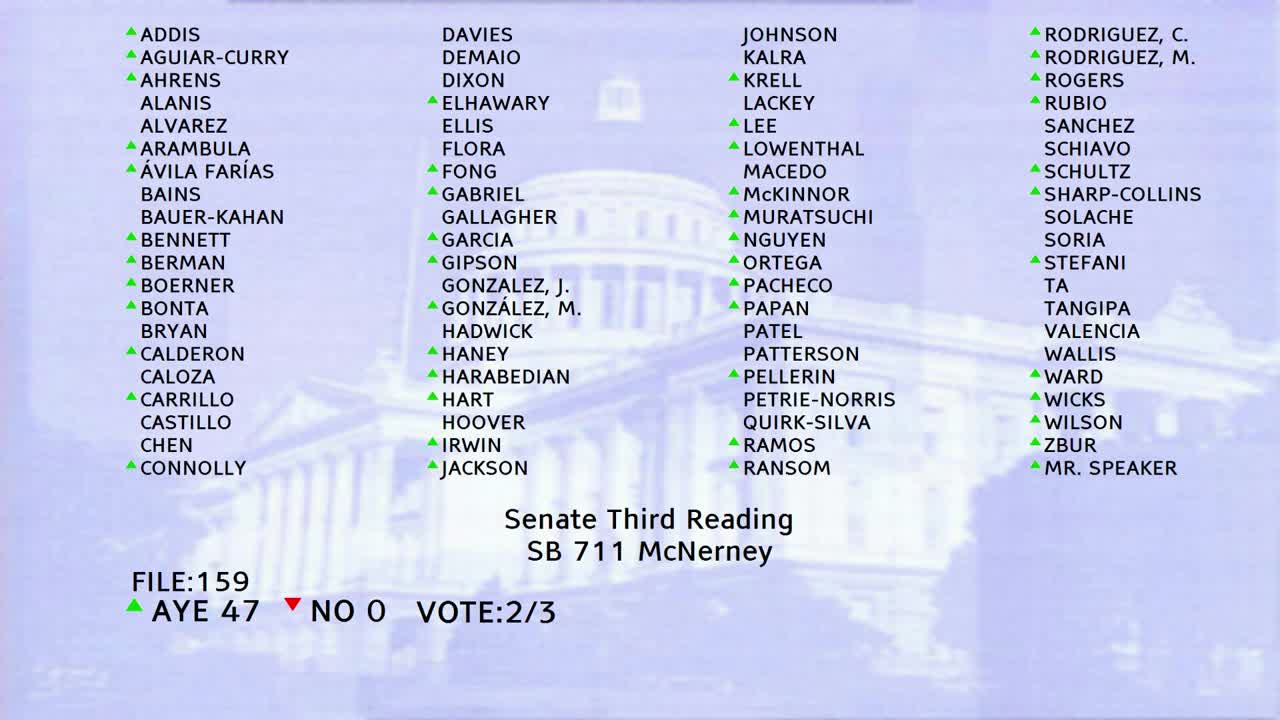 16MIN
Assembly Floor
 12MIN
Senate Floor
 16MIN
Senate Standing Committee on Labor, Public Employment and Retirement
 24MIN
Senate Standing Committee on Transportation
 31MIN
Senate Standing Committee on Labor, Public Employment and Retirement
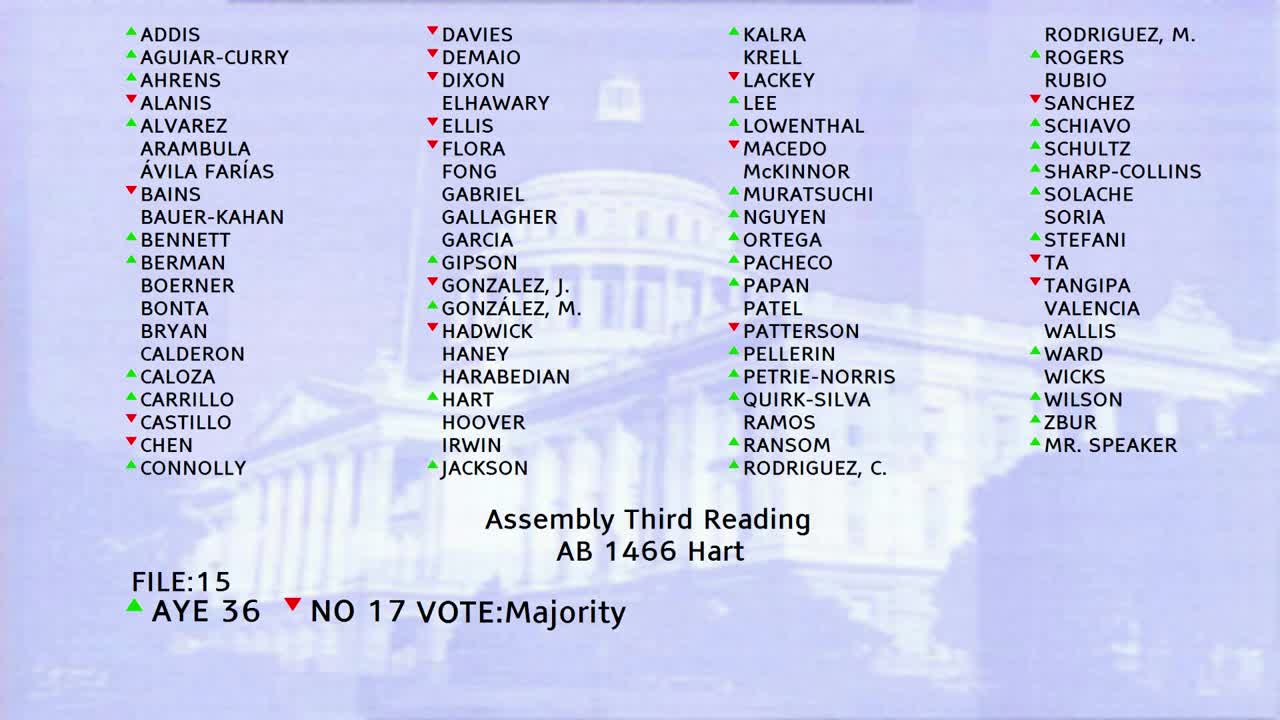 2MIN
Assembly Floor
 34MIN
Assembly Standing Committee on Labor and Employment


Bill Co-Author(s):