AB 1346: Public postsecondary education: residency: dependents of members of the Armed Forces: reenrollments.
- Session Year: 2025-2026
- House: Assembly
- Latest Version Date: 2026-09-28
Current Status:
Passed
(2026-09-28: Chaptered by Secretary of State - Chapter 731, Statutes of 2026.)
Introduced
In Committee
Awaiting First Chamber Vote
Passed First Chamber
In Committee
Awaiting Second Chamber Vote
Passed Second Chamber
Enacted
Existing law requires the California State University, and requests the University of California, to require each campus in their respective systems to grant students the right to reenroll in their baccalaureate degree program after withdrawing or stopping out, if the student was in good academic standing with the university.
Existing law establishes uniform student residency requirements for purposes of ascertaining the amount of tuition and fees to be paid by students of public postsecondary educational institutions. Existing law entitles a student to resident classification for the purpose of determining tuition and fees if the student is a member, or a natural or adopted child, stepchild, or spouse who is a dependent of a member, of the Armed Forces of the United States stationed in the state on active duty, except as specified.
Existing law prohibits a student who is attending, or has been admitted to, a public postsecondary educational institution from losing their resident classification if they are continuously enrolled at that institution and a dependent of a member of the Armed Forces of the United States, even if that member is (1) thereafter transferred on military orders to a place outside this state where the member continues to serve in the Armed Forces of the United States, or (2) thereafter retired as an active member of the Armed Forces of the United States.
This bill would extend the prohibition against losing resident classification to those same student dependents of a member of the Armed Forces of the United States who are granted the right to reenroll even if the member of the Armed Forces has been transferred out of state or has retired from active duty.
(a)A student who is a natural or adopted child, stepchild, or spouse who is a dependent of a member of the Armed Forces of the United States stationed in this state on active duty is entitled to resident classification only for the purpose of determining the amount of tuition and fees.
(b)If that member of the Armed Forces of the United States, whose dependent natural or adopted child, stepchild, or spouse is in attendance at, or has been admitted to, a public postsecondary institution, (1) is thereafter transferred on military orders to a place outside this state where the member continues to serve in the Armed Forces of the United States, or (2) is thereafter retired as an active member of the Armed Forces of the United States, the student dependent shall not lose their resident classification so long as the student remains continuously enrolled at that institution or is granted to reenrollment pursuant to Section 66208.
(a)A student who is a natural or adopted child, stepchild, or spouse who is a dependent of a member of the Armed Forces of the United States stationed in this state on active duty is entitled to resident classification only for the purpose of determining the amount of tuition and fees.
(b)If that member of the Armed Forces of the United States, whose dependent natural or adopted child, stepchild, or spouse is in attendance at, or has been admitted to, a public postsecondary institution, (1) is thereafter transferred on military orders to a place outside this state where the member continues to serve in the Armed Forces of the United States, or (2) is thereafter retired as an active member of the Armed Forces of the United States, the student dependent shall not lose his or her their resident classification so long as he or she the student remains continuously enrolled at that institution. institution or is granted to reenrollment pursuant to Section 66208.
|
Date
|
Status
|
|---|---|
| Sep 28, 2026 | Chaptered by Secretary of State - Chapter 731, Statutes of 2026. |
| Sep 28, 2026 | Approved by the Governor. |
| Sep 8, 2026 | Enrolled and presented to the Governor at 3:30 p.m. |
| Aug 28, 2026 | In Assembly. Ordered to Engrossing and Enrolling. |
| Aug 27, 2026 | Read third time. Passed. Ordered to the Assembly. (Ayes 40. Noes 0. Page 6031.). |
| Aug 27, 2026 | Read third time. Passed. Ordered to the Assembly. (Ayes 39. Noes 0.). |
| Aug 13, 2026 | Read second time. Ordered to third reading. |
| Aug 13, 2026 | From committee: Do pass. (Ayes 7. Noes 0.) (August 13). |
| Aug 3, 2026 | In committee: Referred to APPR. suspense file. |
| Jun 23, 2026 | From committee: Do pass and re-refer to Com. on APPR. with recommendation: To Consent Calendar. (Ayes 4. Noes 0.) (June 22). Re-referred to Com. on APPR. |
| Jun 4, 2026 | From committee: Do pass and re-refer to Com. on M. & V.A. with recommendation: To Consent Calendar. (Ayes 7. Noes 0.) (June 3). Re-referred to Com. on M. & V.A. |
| Jun 5, 2025 | In committee: Set, first hearing. Hearing canceled at the request of author. |
| Jun 4, 2025 | Referred to Coms. on ED. and M. & V.A. |
| May 23, 2025 | In Senate. Read first time. To Com. on RLS. for assignment. |
| May 23, 2025 | Read third time. Passed. Ordered to the Senate. (Ayes 71. Noes 0. Page 1665.) |
| May 15, 2025 | Read second time. Ordered to Consent Calendar. |
| May 14, 2025 | From committee: Do pass. To Consent Calendar. (Ayes 15. Noes 0.) (May 14). |
| Apr 30, 2025 | From committee: Do pass and re-refer to Com. on APPR. with recommendation: To Consent Calendar. (Ayes 8. Noes 0.) (April 29). Re-referred to Com. on APPR. |
| Apr 9, 2025 | From committee: Do pass and re-refer to Com. on M. & V.A. (Ayes 9. Noes 0.) (April 8). Re-referred to Com. on M. & V.A. |
| Mar 13, 2025 | Referred to Coms. on HIGHER ED. and M. & V.A. |
| Feb 24, 2025 | Read first time. |
| Feb 22, 2025 | From printer. May be heard in committee March 24. |
| Feb 21, 2025 | Introduced. To print. |
|
Date
|
Description
|
Location
|
Votes
|
|
|---|---|---|---|---|
| Aug 27, 2026 | Assembly 3rd Reading AB1346 DeMaio By Grove | Senate Floor |
Passed |
|
| Aug 13, 2026 | Do pass | Senate Standing Committee on Appropriations |
Passed |
|
| Aug 3, 2026 | Placed on suspense file | Senate Standing Committee on Appropriations |
Passed |
|
| Jun 22, 2026 | Do pass, but first be re-referred to the Committee on [Appropriations] with the recommendation: To Consent Calendar | Senate Standing Committee on Military and Veterans Affairs |
Passed |
|
| Jun 3, 2026 | Do pass, but first be re-referred to the Committee on [Military and Veterans Affairs] with the recommendation: To Consent Calendar | Senate Standing Committee on Education |
Passed |
|
| May 23, 2025 | AB 1346 DeMaio Consent Calendar Second Day Regular Session | Assembly Floor |
Passed |
|
| May 14, 2025 | Do pass. To Consent Calendar. | Assembly Standing Committee on Appropriations |
Passed |
|
| Apr 29, 2025 | Do pass and be re-referred to the Committee on [Appropriations] with recommendation: To Consent Calendar | Assembly Standing Committee on Military and Veterans Affairs |
Passed |
|
| Apr 29, 2025 | Do pass and be re-referred to the Committee on [Appropriations] | Assembly Standing Committee on Military and Veterans Affairs |
Passed |
|
| Apr 8, 2025 | Do pass and be re-referred to the Committee on [Military and Veterans Affairs] | Assembly Standing Committee on Higher Education |
Passed |
This list shows positions taken on this bill by organizations on the date displayed, which is linked to the original source.
Positions by individuals are not included.
|
Organization
|
Position
|
Date
|
|---|---|---|
| California Association Of County Veterans Service Officers | ** Support | |
| California State Commanders Veterans Council | ** Support | |
| California State University | ** Support | |
| California State University, Office Of The Chancellor | ** Support | |
| Military Officers Association Of America, California Council Of Chapters | ** Support | |
| Vietnam Veterans Of America, California State Council | ** Support |
SENATE RULES COMMITTEE Office of Senate Floor Analyses (916) 651-4171 | AB 1346 |
THIRD READING
Bill No: AB 1346
Author: DeMaio (R)
Introduced: 2/21/25
Vote: 21
SENATE EDUCATION COMMITTEE: 7-0, 6/3/26
AYES: Pérez, Ochoa Bogh, Cabaldon, Choi, Cortese, Gonzalez, Reyes
SENATE MILITARY & VETERANS COMMITTEE: 4-0, 6/22/26
AYES: Archuleta, McNerney, Menjivar, Umberg
NO VOTE RECORDED: Grove
SENATE APPROPRIATIONS COMMITTEE: 7-0, 8/13/26
AYES: Cervantes, Seyarto, Cabaldon, Dahle, Grayson, Richardson, Wahab
ASSEMBLY FLOOR: 71-0, 5/23/25 (Consent) - See last page for vote
SUBJECT: Public postsecondary education: residency: dependents of members of the Armed Forces: reenrollments
SOURCE: Author
DIGEST:
This bill extends eligibility for retaining resident classification for purposes of paying tuition at a public higher education institution to a dependent of an Armed Forces member who is granted reenrollment by the university, even if the Armed Forces member has been transferred out of state on military orders or has retired from active duty.
ANALYSIS:
Existing law:
- Generally known as the Uniform Residency Law, establishes a variety of residency requirements for students attending the California Community Colleges (CCC) or the California State University (CSU). The determination of such residency status is required in order to assess either resident or nonresident fees and tuition. The Regents of the University of California (UC) may, by resolution, make these provisions of law applicable to the UC (and historically have done so). (Education Code (EC) § 68000-68134)
- Defines a “nonresident” as a student who does not have residence in the state for more than one year immediately preceding the residence determination date. (EC § 68018)
- Establishes uniform residency requirements for purposes of ascertaining the amount of fees to be paid by students at CSU and CCC and establishes various exceptions to these residency requirements, including many for current and former members of the Armed Forces. (EC § 68074 and 68075)
- Requires the CSU, and requests the UC, to require each campus in their respective systems to grant students the right to reenroll in their baccalaureate degree program after withdrawing or stopping out, if the student was in good academic standing with the university. (EC § 66208)
- Prohibits a student who is attending, or has been admitted to, a public postsecondary educational institution from losing their resident classification if they are continuously enrolled at that institution and a dependent of a member of the Armed Forces of the United States, even if that member is (1) thereafter transferred on military orders to a place outside this state where the member continues to serve in the Armed Forces of the United States, or (2) thereafter retired as an active member of the Armed Forces of the United States. (EC § 68074 (b))
This bill extends eligibility for retaining resident classification for purposes of paying tuition at a public higher education institution to a dependent of an Armed Forces member who is granted reenrollment by the university after withdrawing from a baccalaureate degree program, even if the Armed Forces member has been transferred out of state on military orders or has retired from active duty.
Comments
Need for the bill. According to the author, “AB 1346 is a powerful tool to help our military dependents unlock their educational opportunities. This proposal will support students who faced setbacks but are determined to continue their education. By enabling them to return to school and still benefit from resident tuition rates, this legislation recognizes California’s commitment to second chances and personal growth.”
Tuition rates and residency classification. California public higher education institutions are publicly subsidized. As a result, students classified as California residents pay lower tuition rates than nonresident students. Students classified as nonresidents may pay several times more than those charged the resident rate, making eligibility for in-state tuition a significant financial benefit for students.
Current law extends in-state residency classification to a dependent of an Armed Forces member stationed in this state on active duty. If the Armed Forces member is transferred out of state or has retired, current law further provides that the in-state residency classification of a student who is the dependent of an Armed Forces member may be retained, but is contingent upon continuous enrollment at the institution. This bill would additionally authorize the retention of in-state residency classification when the student is granted reenrollment. Under current law, reenrollment rights into a CSU or UC baccalaureate degree program may be granted to students who withdrew or “stopped out” from the program.
FISCAL EFFECT: Appropriation: No Fiscal Com.: Yes Local: No
According to the Senate Appropriations analysis, this bill would have the following fiscal impact:
- The University of California estimates between $37,600 and $75,200 in lost revenues each year as a result of the bill.
- The California State University indicates that any administrative costs associated with verifying students’ nonresident classification would be minor, while the Chancellor’s Office estimates no costs to community colleges.
SUPPORT: (Verified 8/14/26)
California State University, Office of the Chancellor
OPPOSITION: (Verified 8/14/26)
None received
ASSEMBLY FLOOR: 71-0, 5/23/25
AYES: Addis, Aguiar-Curry, Ahrens, Alanis, Alvarez, Arambula, Ávila Farías, Bains, Bauer-Kahan, Bennett, Berman, Boerner, Bonta, Calderon, Caloza, Carrillo, Castillo, Connolly, Davies, DeMaio, Dixon, Elhawary, Flora, Fong, Gabriel, Gallagher, Garcia, Gipson, Jeff Gonzalez, Mark González, Hadwick, Haney, Harabedian, Hart, Hoover, Irwin, Jackson, Kalra, Krell, Lackey, Lee, Lowenthal, Macedo, McKinnor, Muratsuchi, Ortega, Pacheco, Papan, Patel, Patterson, Pellerin, Petrie-Norris, Quirk-Silva, Ramos, Ransom, Celeste Rodriguez, Michelle Rodriguez, Rogers, Blanca Rubio, Schiavo, Solache, Soria, Stefani, Ta, Tangipa, Valencia, Wallis, Ward, Wilson, Zbur, Rivas
NO VOTE RECORDED: Bryan, Chen, Ellis, Nguyen, Sanchez, Schultz, Sharp-Collins, Wicks
Prepared by: Olgalilia Ramirez / ED. / (916) 651-4105
8/15/26 12:42:00
**** END ****
SENATE COMMITTEE ON
Senator Sabrina Cervantes, Chair
2025 - 2026 Regular Session
AB 1346 (DeMaio) - Public postsecondary education: residency: dependents of members of the Armed Forces: reenrollments
Version: | Policy Vote: |
Urgency: | Mandate: |
Hearing Date: | Consultant: |
Bill Summary:
This bill extends eligibility for retaining resident classification for purposes of paying tuition at a public higher education institution to a dependent of an Armed Forces member who is granted reenrollment by the university, even if the Armed Forces member has been transferred out of state on military orders or has retired from active duty.
Fiscal Impact:
- The University of California estimates between $37,600 and $75,200 in lost revenues each year as a result of the bill.
- The California State University indicates that any administrative costs associated with verifying students’ nonresident classification would be minor, while the Chancellor’s Office estimates no costs to community colleges.
Background:
Existing law defines a “nonresident” as a student who does not have residence in the state for more than one year immediately preceding the residence determination date.
Existing law establishes uniform residency requirements for purposes of ascertaining the amount of fees to be paid by students at CSU and CCC and establishes various exceptions to these residency requirements, including many for current and former members of the Armed Forces.
Existing law requires the CSU, and requests the UC, to require each campus in their respective systems to grant students the right to reenroll in their baccalaureate degree program after withdrawing or stopping out, if the student was in good academic standing with the university.
Existing law prohibits a student who is attending, or has been admitted to, a public postsecondary educational institution from losing their resident classification if they are continuously enrolled at that institution and a dependent of a member of the Armed Forces of the United States, even if that member is thereafter transferred on military orders to a place outside this state where the member continues to serve in the Armed Forces of the United States, or thereafter retired as an active member of the Armed Forces of the United States.
Proposed Law:
This bill extends eligibility for retaining resident classification for purposes of paying tuition at a public higher education institution to a dependent of an Armed Forces member who is granted reenrollment by the university after withdrawing from a baccalaureate degree program, even if the Armed Forces member has been transferred out of state on military orders or has retired from active duty.
Staff Comments:
Current law extends in-state residency classification to a dependent of an Armed Forces member stationed in the state on active duty. If the member is transferred out of state or has retired, current law provides that the in-state residency classification of a student who is the dependent of that Armed Forces member may be retained but is contingent upon continuous enrollment at the institution. This bill would authorize the retention of in-state residency classification when the student is granted reenrollment. According to the author, “AB 1346 is a powerful tool to help our military dependents unlock their educational opportunities. This proposal will support students who faced setbacks but are determined to continue their education. By enabling them to return to school and still benefit from resident tuition rates, this legislation recognizes California’s commitment to second chances and personal growth.”
-- END --
SENATE COMMITTEE ON MILITARY AND VETERANS AFFAIRS
Senator Bob Archuleta, Chair
2025 - 2026 Regular
Bill No: AB 1346 Hearing Date: 6/22/26
Author: | DeMaio | ||
Version: | 2/21/25 | ||
Urgency: | No | Fiscal: | Yes |
Consultant: | Diego Nelson | ||
Subject: Public postsecondary education: residency: dependents of members of the Armed Forces: reenrollments
DESCRIPTION
Summary:
Extends eligibility for resident classification for tuition and fee purposes at the California State University and the University of California to certain dependents of members of the United States Armed Forces who withdraw or stop out of a baccalaureate degree program and later reenroll, even if the Armed Forces member has been transferred out of state on military orders or has retired from active duty.
Existing law:
- Establishes uniform residency requirements for students attending public postsecondary educational institutions in California for purposes of determining whether a student pays resident or nonresident tuition and fees. (Education Code §§ 68000–68134)
- Defines a “nonresident student” as a student who has not had residence in California for more than one year immediately preceding the residence determination date. (Education Code § 68018)
- Provides that a student who is a member of the United States Armed Forces stationed in California on active duty, or a natural or adopted child, stepchild, or spouse who is a dependent of that member, is entitled to resident classification for tuition and fee purposes, as specified. (Education Code §§ 68074–68075)
- Prohibits a student who is attending, or has been admitted to, a public postsecondary educational institution from losing resident classification if the student is continuously enrolled at that institution and is a dependent of a member of the United States Armed Forces, even if that member is later transferred on military orders to a place outside California or retires from active duty. (Education Code § 68074(b))
- Requires the California State University, and requests the University of California, to require each campus in their respective systems to grant students the right to reenroll in their baccalaureate degree program after withdrawing or stopping out, if the student was in good academic standing with the university. (Education Code § 66208)
- Establishes the Donahoe Higher Education Act, which sets forth the missions and functions of California’s public higher education segments, including the University of California and the California State University. (Education Code § 66010 et seq.)
- Provides that provisions of the Donahoe Higher Education Act do not apply to the University of California unless the Regents of the University of California act by resolution to make those provisions applicable. (Education Code § 67400)
- Establishes the California State University system and grants the Trustees of the California State University authority over the management, administration, and control of the CSU. (Education Code §§ 66606, 89030 et seq.)
This bill:
- Allows a dependent of a member of the United States Armed Forces to retain California resident classification for tuition and fee purposes after reenrolling in a baccalaureate degree program, even if the Armed Forces member has been transferred out of state on military orders or has retired from active duty.
- This protection would apply to students who are granted reenrollment after withdrawing or stopping out, provided the student otherwise meets the reenrollment requirements under current law.
BACKGROUND
California’s student residency framework is governed by the Uniform Student Residency Requirements, which were established as part of the state’s general postsecondary education laws. This law determines whether a student attending a public postsecondary institution is classified as a resident or nonresident for tuition and fee purposes. This distinction is significant because nonresident students generally pay substantially higher tuition than students classified as California residents.
California has long recognized that military families present unique residency considerations because their presence in, or absence from, the state is often determined by military orders rather than personal choice. Since 1980, California has provided resident tuition protections for certain military dependents by allowing the dependent children, stepchildren, adopted children, or spouses of an active-duty Armed Forces member stationed in California to receive resident classification for tuition and fee purposes.
That protection has been amended over time to respond to gaps affecting military families. AB 172 (Chavez, 2017), expanded the law by clarifying that eligible dependents who were attending, or had been admitted to, a public postsecondary institution could retain resident classification if the service member was later transferred out of state on military orders or retired from active duty. AB 172 responded to situations where a military dependent could be admitted to a California public college or university, qualify for resident tuition, and then risk losing that benefit before or during enrollment because the service member’s orders changed.
However, the student must remain continuously enrolled at the institution in order to keep resident classification after the service member is transferred or retires. As a result, current law protects military-dependent students who remain continuously enrolled, but it does not fully account for students who need to temporarily withdraw or stop out. For military families, continuous enrollment may not always be possible. Dependents may face sudden moves, deployments, family caregiving responsibilities, health issues, financial hardship, or other disruptions connected to military life. A student may need to pause their education even while remaining committed to completing their degree.
In 2022, California separately recognized the need for students to have a pathway back to school through AB 1796 (Choi). That law required the California State University, and requested the University of California, to allow students in good academic standing to reenroll in their baccalaureate degree program after withdrawing or stopping out. This policy acknowledged that students may leave college for a period of time and later return to complete their degrees.
COMMENT
According to the author: "AB 1346 is a powerful tool to help our military dependents unlock their educational opportunities. This proposal will support students who faced setbacks but are determined to continue their education. By enabling them to return to school and still benefit from resident tuition rates, this legislation recognizes California’s commitment to second chances and personal growth."
Under existing law, a military-dependent student who remains continuously enrolled may keep resident tuition classification after the service member is transferred out of state or retires. This bill extends that same protection to an eligible student who is granted reenrollment after withdrawing or stopping out. For example, if a student is attending a CSU or UC campus while their parent is stationed in California and the parent is later transferred to another state, the student is protected under current law if they stay continuously enrolled. AB 1346 does not change that situation.
The bill instead applies to situations where a student’s education is interrupted. For example, if a student is attending UC Davis while their spouse is stationed in California and the spouse is later transferred out of state, the student may need to withdraw for a year because of family responsibilities related to the move. Under current law, that student may lose resident tuition protection because they were not continuously enrolled. This bill would allow the student to retain resident classification if they are granted reenrollment.
Current law already recognizes that students in good academic standing may need to step away from college and later return. This bill ensures that this reenrollment pathway remains open for eligible military-dependent students by preventing a sudden change from resident to nonresident tuition when they come back. For example, if a student leaves CSU Long Beach in good academic standing after their parent retires from active duty and later reenrolls in the same baccalaureate degree program, this bill would allow that student to keep resident classification for tuition and fee purposes even though the student was not continuously enrolled.
This bill does not create a new right to reenroll. A student would still need to qualify for reenrollment under the existing CSU or UC process. If a student is not granted reenrollment, the bill would not independently require the university to readmit the student or provide resident tuition classification. In this way, the bill is limited to students who already meet the requirements to return to their baccalaureate degree program. Its primary function is to ensure that eligible military dependents are not priced out of completing their degree because military-related circumstances caused a break in enrollment.
Previous Legislation
AB 1796 (Choi, 2022), Required the California State University, and requested the University of California, to allow students in good academic standing to reenroll in their baccalaureate degree program after withdrawing or stopping out.
AB 172 (Chavez, 2017) Extended resident classification protections for designated dependents of transferred and retired United States Armed Forces members to those dependents who had been admitted to a public postsecondary institution before the transfer or retirement.
POSITIONS
Sponsor: Author.
Support: California Association of County Veterans Service Officers
California State Commanders Veterans Council
California State University, Office of the Chancellor
Military Officers Association of America, California Council of Chapters
Vietnam Veterans of America, California State Council
Oppose: None received
-- END --
SENATE COMMITTEE ON EDUCATION
Senator Sasha Renée Pérez, Chair
2025 - 2026 Regular
Bill No: Hearing Date: June 3, 2026
Author: | |||
Version: |
| ||
Urgency: | Fiscal: | ||
Consultant: | |||
Subject: .
Note: This bill has been referred to the Committees on Education and Military and Veterans Affairs. A “do pass” motion should include referral to the Committee on Military and Veterans Affairs.
SUMMARY
This bill extends eligibility for retaining resident classification for purposes of paying tuition at a public higher education institution to a dependent of an Armed Forces member who is granted reenrollment by the university, even if the Armed Forces member has been transferred out of state on military orders or has retired from active duty.
BACKGROUND
Existing law:
- Generally known as the Uniform Residency Law, establishes a variety of residency requirements for students attending the California Community Colleges (CCC) or the California State University (CSU). The determination of such residency status is required in order to assess either resident or nonresident fees and tuition. The Regents of the University of California (UC) may, by resolution, make these provisions of law applicable to the UC (and historically have done so). (Education Code (EC) § 68000-68134)
- Defines a “nonresident” as a student who does not have residence in the state
for more than one year immediately preceding the residence determination date. (EC § 68018)
- Establishes uniform residency requirements for purposes of ascertaining the
amount of fees to be paid by students at CSU and CCC and establishes various exceptions to these residency requirements, including many for current and former members of the Armed Forces. (EC § 68074 and 68075)
- Requires the CSU, and requests the UC, to require each campus in their
respective systems to grant students the right to reenroll in their baccalaureate degree program after withdrawing or stopping out, if the student was in good academic standing with the university. (EC § 66208)
- Prohibits a student who is attending, or has been admitted to, a public postsecondary educational institution from losing their resident classification if they are continuously enrolled at that institution and a dependent of a member of the Armed Forces of the United States, even if that member is (1) thereafter transferred on military orders to a place outside this state where the member continues to serve in the Armed Forces of the United States, or (2) thereafter retired as an active member of the Armed Forces of the United States. (EC § 68074 (b))
ANALYSIS
This bill extends eligibility for retaining resident classification for purposes of paying tuition at a public higher education institution to a dependent of an Armed Forces member who is granted reenrollment by the university after withdrawing from a baccalaureate degree program, even if the Armed Forces member has been transferred out of state on military orders or has retired from active duty.
STAFF COMMENTS
- Need for the bill. According to the author, “AB 1346 is a powerful tool to help our military dependents unlock their educational opportunities. This proposal will support students who faced setbacks but are determined to continue their education. By enabling them to return to school and still benefit from resident tuition rates, this legislation recognizes California’s commitment to second chances and personal growth.”
- Tuition rates and residency classification. California public higher education institutions are publicly subsidized. As a result, students classified as California residents pay lower tuition rates than nonresident students. Students classified as nonresidents may pay several times more than those charged the resident rate, making eligibility for in-state tuition a significant financial benefit for students.
Current law extends in-state residency classification to a dependent of an Armed Forces member stationed in this state on active duty. If the Armed Forces member is transferred out of state or has retired, current law further provides that the in-state residency classification of a student who is the dependent of an Armed Forces member may be retained, but is contingent upon continuous enrollment at the institution. This bill would additionally authorize the retention of in-state residency classification when the student is granted reenrollment. Under current law, reenrollment rights into a CSU or UC baccalaureate degree program may be granted to students who withdrew or “stopped out” from the program.
- Related legislation.
AB 2203 (Tangipa, 2026) would require, beginning with the 2028-29 academic year, each campus of the CSU and the CCC, and requests each campus of the UC, that administers a priority enrollment system, to provide priority enrollment to a student who receives a California Department of Veterans Affairs (CalVet) fee waiver or who is using any federal GI Bill benefits. AB 2203 has been referred to this Committee.
AB 2794 (Committee on Higher Education, 2026) would make technical and conforming changes to the EC regarding Montgomery GI Bill-Selected Reserve program federal education benefits and eligibility for in-state resident tuition. AB 2794 has been referred to this committee.
SUPPORT
California State University
OPPOSITION
None received
-- END --
Date of Hearing: May 14, 2025
ASSEMBLY COMMITTEE ON APPROPRIATIONS
Buffy Wicks, Chair
ABPCA Bill Id:AB 1346
Author:(DeMaio) – As Introduced Ver:February 21, 2025
Policy Committee: | Higher Education | Vote: | 9 - 0 |
Military and Veterans Affairs | 8 - 0 | ||
|
|
Urgency: No State Mandated Local Program: No Reimbursable: No
SUMMARY:
This bill allows a California State University (CSU) or University of California (UC) military-dependent student to retain California resident status for tuition and fee purposes after relocating outside of California due to military transfer orders, regardless of whether they remained continuously enrolled.
FISCAL EFFECT:
Minor ongoing General Fund costs, possibly in the high tens of thousands of dollars, for the UC and CSU to verify student classification for non-resident status and receive reduced tuition and fee revenue from any student qualifying under the provisions of this bill.
COMMENTS:
- Purpose. According to the California Association of County Veterans Service Officers:
While current law rightly ensures that dependents of active duty servicemembers retain in-state tuition when their parent or spouse is transferred or retires, that protection only applies if the student remains continuously enrolled. Life does not always work that way, military families often face sudden moves, health emergencies, deployments, and caregiving responsibilities that force students to stop out of school.
- Background. The UC, CSU, and the California Community Colleges (CCC) each assess mandatory systemwide student tuition and fees. According to the LAO, student tuition revenue is the largest nonstate core fund source for UC and CSU. Current tuition policies within the CSU and UC systems generally raise tuition charges moderately each year. UC began raising its tuition charges in 2022‑23, with the CSU following in 2024‑25. Before having these policies, CSU and UC had held their resident undergraduate and graduate tuition charges flat for an extended period, with these charges raised only once since 2011‑12.
Current law allows a student who is a natural or adopted child, stepchild, or spouse who is a dependent of a member of the Armed Forces of the United States at the UC or CSU to retain California resident status for determining tuition and fees so long as the student remains continuously enrolled. This bill removes the continuous enrollment requirement so long as the student was in good academic standing prior to disenrollment.
Analysis Prepared by: Aaron Heredia / APPR. / (916) 319-2081
Date of Hearing: April 29, 2025
ASSEMBLY COMMITTEE ON MILITARY AND VETERANS AFFAIRS
Pilar Schiavo, Chair
ABPCA Bill Id:AB 1346 (
Author:DeMaio) – As Introduced Ver:February 21, 2025
SUBJECT: Public postsecondary education: residency: dependents of members of the Armed Forces: reenrollments.
SUMMARY: Extends the prohibition against losing resident classification at the California State University (CSU) and the University of California (UC) to include student dependents of United States (U.S.) Armed Forces members who can reenroll in their baccalaureate degree program after withdrawing or dropping out, even if the U.S. Armed Forces member has been transferred out of state or retired.
EXISTING LAW:
- Establishes the UC as a public trust to be administered by the Regents and grants the Regents full powers of organization and governance subject only to legislative control as necessary to ensure the security of funds, compliance with terms of its endowments, and the statutory requirements around competitive bidding and contracts, sales of property, and the purchase of materials, goods, and services. (Article IX, § (9) (a) of the California Constitution)
- Establishes the Donahoe Higher Education Act and assigns the mission of the UC and the CSU. (Education Code (EDC) § 66010, et seq.)
- Stipulates that no Donahue Higher Education Act provision can apply to the UC unless the UC Regents adopts the provision. (EDC § 67400)
- Establishes the CSU system, made of 23 campuses, and bestows upon the CSU Trustees, through the Board of Trustees, the power, duties, and functions with respect to the management, administration, and control of the CSU system. (EDC § 66606 and 89030 et seq.)
- Requires the CSU, and requests the UC, to require each campus in their respective systems to grant students the right to reenroll in their baccalaureate degree program after withdrawing or stopping out, if the student was in good academic standing with the university. (EDC § 66208)
- Establishes uniform student residency requirements for purposes of ascertaining the amount of tuition and fees to be paid by students of public postsecondary educational institutions. (EDC § 68000, et seq.)
- Entitles a student to resident classification for the purpose of determining tuition and fees if the student is a member, or a natural or adopted child, stepchild, or spouse who is a dependent of a member, of the U.S. Armed Forces stationed in the state on active duty, except as specified. (EDC § 68074-68075)
- Prohibits a student who is attending, or has been admitted to, a public postsecondary educational institution from losing their resident classification if they are continuously enrolled at that institution and a dependent of a member of the U.S. Armed Forces, even if that member is: a) thereafter transferred on military orders to a place outside this state where the member continues to serve in the U.S. Armed Forces; or, b) thereafter retired as an active member of the U.S. Armed Forces. (EDC § 68074 (b))
FISCAL EFFECT: This bill has not been analyzed by a fiscal committee.
COMMENTS:
- PURPOSE OF THIS BILL. According to the author, this bill is a powerful tool to help our military dependents unlock their educational opportunities. This bill will support students who have faced setbacks but are determined to continue their education by enabling them to return to school and still benefit from resident tuition rates. The author concludes, this bill recognizes California’s commitment to second chances and personal growth.
- BACKGROUND. AB 1796 (Choi), Chapter 323, Statutes of 2022, required each CSU campus and requested that each UC campus grant students the right to reenroll after withdrawing or dropping out if the student was in good academic standing at the university. This policy was crafted, in part, as a response to the COVID-19 pandemic, when California campuses experienced both declines in enrollment and persistence.
As noted in the Legislative Analyst’s Office (LAO) Higher Education Overview published in February of 2025, “the 2024-25 Budget Act specified that CSU was to grow resident undergraduates by approximately 6,300 full-time equivalent (FTE) students in 2024-25 and about 10,200 FTE students in 2025-26. The 2024-25 Budget Act specified that UC was to grow resident undergraduates by approximately 3,000 FTE students each year from 2024-25 through 2026-27. As of January 2025, both segments report exceeded their growth targets in 2024-25, leaving less growth needed to meet their 2025-26 targets. (The annual targets for UC include the expected replacement of 902 FTE nonresident students with resident undergraduates across three high-demand campuses. UC reports exceeding this expectation too in 2024-25.)”
The UC, CSU, and the California Community Colleges (CCC) each assess mandatory systemwide student tuition and fees that, as noted above, are waived for recipients of the College Fee Wavier for Veteran Dependents. According to the LAO, student tuition revenue is the largest nonstate core fund source for UC and CSU. Current tuition policies within CSU’s and UC’s generally raise tuition charges moderately each year. UC’s began raising its tuition charges in 2022‑23, with CSU’s following in 2024‑25. Before having these policies, CSU and UC had held their resident undergraduate and graduate tuition charges flat for an extended period, with these charges raised only once since 2011‑12. (In 2017‑18, CSU and UC raised resident tuition charges by 5% and 2.7%, respectively. In a few other years, UC also assessed small increases to its Student Services Fee.)
Beyond tuition increases, tuition revenue also grows as enrollment increases. Total tuition revenue is estimated to rise $188 million (5.4%) at CSU and $241 million (4.4%) at UC in 2025‑26. - SUPPORT. The Military Officers Association of America-California Council of Chapters write in support of this bill stating that service members' dependents encounter distinct challenges, such as frequent moves, disrupted education, struggles with social integration, and adapting to different academic standards and support resources. The student’s college benefits should remain intact despite the qualifying parent's transfer, as these college-aged individuals cannot afford unexpected tuition expenses. This bill allows the people of California to acknowledge their appreciation of those who served our country by providing continued educational benefits for their dependents.
- DOUBLE REFERRED. This bill is double referred, it passed the Assembly Committee on Higher Education by a vote of 9-0 on April 8, 2025.
- RELATED LEGISLATION.
- AB 264 (Carrillo) eliminates the prohibition on a child of a veteran, an unmarried surviving spouse of a veteran, or spouse of a disabled veteran, as defined, from receiving a tuition waiver from the state while also accessing other state or federal educational benefits. AB 264 passed the Assembly Committee on Military and Veterans Affairs by a vote of 7-0 on April 8, 2025, and is now pending hearing in the Assembly Committee on Appropriations.
- AB 556 (Patterson) adds mandatory campus-based fees to the fees a campus of the UC, the CSU, or the CCC is prohibited from charging an eligible dependent of a veteran. AB 226 passed the Assembly Committee on Military and Veterans Affairs by a vote of 6-0 on April 8, 2025, and is now pending hearing in the Assembly Committee on Appropriations.
- AB 1433 (Sharp-Collins) Requires the California Community College (CCC) Board of Governors (BOG) to allocate base funding to noncredit colleges, as defined, and noncredit centers, as defined, that meet specified criteria for designated categorical programs. Specifies eligible categorical programs for base funding allocations, include, but are not limited to, disabled student programs and services, mental health services, and veteran resource centers. Requires the CCC BOG, in consultation with the Office of the Chancellor of the California Community Colleges, to determine the methodology for allocating the base funding. AB 1433 passed the Assembly Committee on Higher Education by a vote of 9-0 on April 8, 2025, and is now pending hearing in the Assembly Committee on Military and Veterans Affairs.
- PREVIOUS LEGISLATION.
- AB 1796 requires the CSU, and requests that the UC, require each campus in their respective systems to grant students the right to reenroll in their baccalaureate degree program after withdrawing or stopping out, if the student was in good academic standing with the university.
- AB 172 (Chavez), Chapter 165, Statutes of 2017, extends resident classification for designated dependents of transferred and retired U.S. Armed Forces members to those dependents who have been admitted to a public postsecondary institution before the transfer or retirement.
- AB 1796 requires the CSU, and requests that the UC, require each campus in their respective systems to grant students the right to reenroll in their baccalaureate degree program after withdrawing or stopping out, if the student was in good academic standing with the university.
REGISTERED SUPPORT / OPPOSITION:
Support
California State Commanders Veterans Council
Military Officers Association of America, California Council of Chapters
Vietnam Veterans of America, California State Council
Opposition
None on file.
Analysis Prepared by: Patty Patten / M. & V.A. / (916) 319-3550
Date of Hearing: April 8, 2025
ASSEMBLY COMMITTEE ON HIGHER EDUCATION
Mike Fong, Chair
ABPCA Bill Id:AB 1346 (
Author:DeMaio) – As Introduced Ver:February 21, 2025
[Note: This bill is double-referred to the Assembly Committee on Military and Veterans Affairs and will be heard by that Committee as it relates to issues under its jurisdiction.]
SUBJECT: Public postsecondary education: residency: dependents of members of the Armed Forces: reenrollments
SUMMARY: Extends an existing prohibition against losing resident classification to student dependents of a member of the Armed Forces of the United States who are granted the right to reenroll in a public institution of higher education, even if the member of the Armed Forces has been transferred out of state or has retired from active duty. Specifically, this bill:
- Specifies that if a member of the Armed Forces of the United States, whose dependent natural or adopted child, stepchild, or spouse is in attendance at, or has been admitted to, a public postsecondary institution, is thereafter transferred on military orders to a place outside this state where the member continues to serve in the Armed Forces of the United States, or is thereafter retired as an active member of the Armed Forces of the United States, the student dependent shall not lose their resident classification so long as the student is granted to reenrollment, as specified.
EXISTING LAW:
- Establishes the University of California (UC) as a public trust to be administered by the Regents and grants the Regents full powers of organization and governance subject only to legislative control as necessary to ensure the security of funds, compliance with terms of its endowments, and the statutory requirements around competitive bidding and contracts, sales of property, and the purchase of materials, goods, and services (Article IX, Section (9) (a) of the California Constitution).
- Establishes the Donahoe Higher Education Act and assigns the mission of the UC and the California State University (CSU) (Education Code (EDC) Section 66010, et seq.).
- Stipulates no provision of the Donahue Higher Education Act shall apply to the UC unless the UC Regents adopts the provision (EDC Section 67400).
- Establishes the CSU system, made of 23 campuses, and bestows upon the CSU Trustees, through the Board of Trustees, the power, duties, and functions with respect to the management, administration, and control of the CSU system (EDC Section 66606 and 89030 et seq.).
- Requires the CSU, and requests the UC, to require each campus in their respective systems to grant students the right to reenroll in their baccalaureate degree program after withdrawing or stopping out, if the student was in good academic standing with the university. (Education Code (EDC) Section 66208)
- Establishes uniform student residency requirements for purposes of ascertaining the amount of tuition and fees to be paid by students of public postsecondary educational institutions. (EDC Section 68000, et seq.)
- Existing law entitles a student to resident classification for the purpose of determining tuition and fees if the student is a member, or a natural or adopted child, stepchild, or spouse who is a dependent of a member, of the Armed Forces of the United States stationed in the state on active duty, except as specified. (EDC Sections 68074-68075)
- Existing law prohibits a student who is attending, or has been admitted to, a public postsecondary educational institution from losing their resident classification if they are continuously enrolled at that institution and a dependent of a member of the Armed Forces of the United States, even if that member is (1) thereafter transferred on military orders to a place outside this state where the member continues to serve in the Armed Forces of the United States, or (2) thereafter retired as an active member of the Armed Forces of the United States. (EDC Section 68074 (b))
FISCAL EFFECT: Unknown
COMMENTS: Purpose. According to the author, “AB 1346 is a powerful tool to help our military dependents unlock their educational opportunities. This proposal will support students who faced setbacks but are determined to continue their education. By enabling them to return to school and still benefit from resident tuition rates, this legislation recognizes California’s commitment to second chances and personal growth."
Background. AB 1796 (Choi), Chapter 323, Statutes of 2022, required each CSU campus – and requested that each UC campus, grant students the right to reenroll after withdrawing or stopping out, if the student was in good academic standing at the university. This policy was crafted, in part, as a response to the COVID-19 pandemic, when California campuses experienced both declines in enrollment and persistence.
As noted in the Legislative Analyst’s Office (LAO) Higher Education Overview published in February of 2025, “the 2024-25 Budget Act specified that CSU was to grow resident undergraduates by approximately 6,300 full-time equivalent (FTE) students in 2024-25 and about 10,200 FTE students in 2025-26. The 2024-25 Budget Act specified that UC was to grow resident undergraduates by approximately 3,000 FTE students each year from 2024-25 through 2026-27. As of January 2025, both segments report exceeding their growth targets in 2024-25, leaving less growth needed to meet their 2025-26 targets. (The annual targets for UC include the expected replacement of 902 FTE nonresident students with resident undergraduates across three high-demand campuses. UC reports exceeding this expectation too in 2024-25.)”
Systemwide tuition. The UC, CSU, and CCC each assess mandatory systemwide student tuition and fees that, as noted above, are waived for recipients of the College Fee Wavier for Veteran Dependents. According to the LAO, the largest nonstate core fund source for UC and CSU is student tuition revenue. CSU and UC currently have tuition policies in place that generally raise tuition charges moderately each year. UC began raising its tuition charges in 2022‑23, with CSU following in 2024‑25. Prior to having these policies, CSU and UC had held their resident undergraduate and graduate tuition charges flat for an extended period, with these charges raised once only since 2011‑12. (In 2017‑18, CSU and UC raised resident tuition charges by 5% and 2.7%, respectively. In a few other years, UC also assessed small increases to its Student Services Fee.)
Beyond tuition increases, tuition revenue also grows as enrollment increases. Total tuition revenue (accounting for increases in tuition charges and enrollment) is estimated to rise $188 million (5.4 percent) at CSU and $241 million (4.4 percent) at UC in 2025‑26.
Military dependents. Existing law entitles dependents of members of the Armed Forces of the United States stationed in California on active duty to in-state tuition. That entitlement stays with the dependent even in the event that the member of the armed forces is later stationed outside of California or retires from the armed forces – provided the dependent is continuously enrolled in their institution of higher education.
AB 1346 seeks to conform this entitlement with the reenrollment policy codified by AB 1796 (Choi), Chapter 323, Statutes of 2022 – ensuring that dependents of members of the armed forces are allowed to retain their in-state tuition provided they are granted reenrollment.
Arguments in support. The Military Officers Association of America-California Council of Chapters wrote in support, stating that, “dependents of service members can face unique challenges including frequent relocations, interrupted learning, social integration difficulties, and navigating varying academic standards and support systems. Because the qualifying parent was transferred or moved, that should not disqualify the student’s college benefit. These students, because they are college-aged and in the middle of their education, are not in a good position to incur unforeseen tuition costs. The people of California want to acknowledge their appreciation of military service by granting servicemember’s dependents special considerations regarding higher education. AB 1346 acknowledges that commitment by fixing a minor gap in previous legislation.”
Prior legislation. AB 1796 (Choi) Chapter 323, Statutes of 2022, required the CSU, and requested that the UC, require each campus in their respective systems to grant students the right to reenroll in their baccalaureate degree program after withdrawing or stopping out, if the student was in good academic standing with the university.
AB 172 (Chavez), Chapter 165, Statutes of 2017, extended resident classification for designated dependents of transferred and retired members of the Armed Forces of the United States to those dependents who have been admitted to a public postsecondary institution before the transfer or retirement.
REGISTERED SUPPORT / OPPOSITION:
Support
Military Officers Association of America-California Council of Chapters
Opposition
None on file.
Analysis Prepared by: Kevin J. Powers / HIGHER ED. / (916) 319-3960
Discussed in Hearing
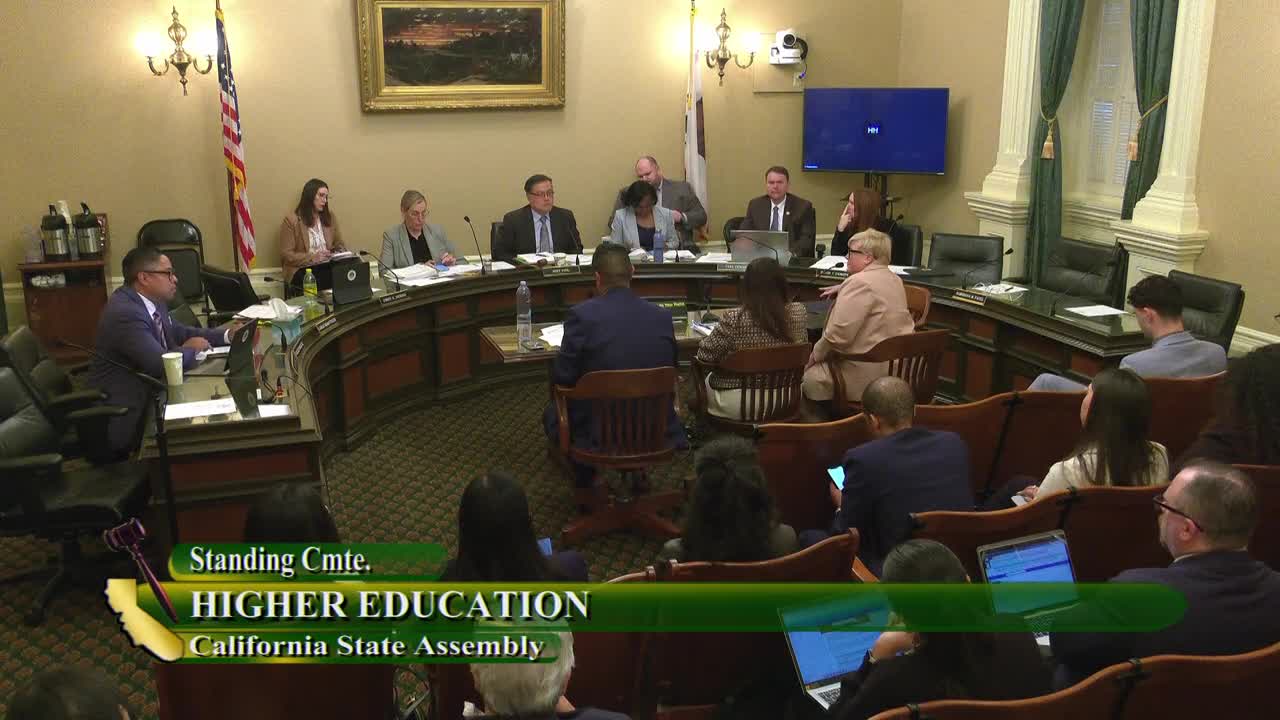 2MIN
Assembly Standing Committee on Higher Education
Bill Author

Bill Co-Author(s):