AB 1358: Santa Ana River Conservancy Program: lower Santa Ana River region.
- Session Year: 2025-2026
- House: Assembly
- Latest Version Date: 2025-03-13
Current Status:
Failed
(2026-02-02: From committee: Filed with the Chief Clerk pursuant to Joint Rule 56.)
Introduced
In Committee
Awaiting First Chamber Vote
Passed First Chamber
In Committee
Awaiting Second Chamber Vote
Passed Second Chamber
Enacted
Existing law establishes the Santa Ana River Conservancy Program to be administered by the State Coastal Conservancy. Existing law requires the conservancy, for purposes of carrying out the program, to use the services of the California Conservation Corps and Community Conservation Corps, as provided. Existing law authorizes the conservancy to, among other things, undertake or fund projects for several purposes, including to implement site improvements, upgrade deteriorating facilities or construct new facilities for outdoor recreation, public access, nature appreciation and interpretation, and historic and cultural preservation.
This bill would require at least 60% of the funds allocated to fund or undertake the above-described projects to be for projects in heavily urbanized areas, as defined, of the lower Santa Ana River region, as defined, to benefit disadvantaged communities, severely disadvantaged communities, or vulnerable populations. The bill would define various terms for this purpose.
This bill would make a nonsubstantive change to the above law relating to the conservancys use of the corps programs.Existing law establishes the Santa Ana River Conservancy Program to be administered by the State Coastal Conservancy. Existing law requires the conservancy, for purposes of carrying out the program, to use the services of the California Conservation Corps and Community Conservation Corps, as provided.
This bill would make a nonsubstantive change to the above law relating to the conservancys use of the corps programs.
For purposes of this chapter, the following terms have the following meanings:
(a)Disadvantaged community means a community with a median household income of less than 80 percent of the area average or less than 80 percent of statewide median household income.
(b)Heavily urbanized area means a city with a population of 300,000 or more.
(c)Lower Santa Ana River region means those lands west of the Santa Ana Mountains that are located within one-half mile on either side of the riverbed of the Santa Ana River, or any of its tributaries, and adjacent watersheds and lands as described in paragraph (2) of subdivision (a) of Section 31175 that are west of the Santa Ana Mountains.
(a)(d)Program means the Santa Ana River Conservancy Program.
(b)(e)Program lands means interests in real property acquired, managed, or subject to a project under this chapter.
(c)(f)Santa Ana River region means those lands that are located within one-half mile on either side of the riverbed of the Santa Ana River, or any of its tributaries, from its headwaters near the San Gorgonio Wilderness Area to the Pacific Ocean at the Santa Ana River Mouth Beach in Huntington Beach and adjacent watersheds and lands as described in paragraph (2) of subdivision (a) of Section 31175.
(g)Severely disadvantaged community means a community with a median household income of less than 60 percent of the area average or less than 60 percent of statewide median household income.
(h)Vulnerable population means a subgroup of population within a region or community that faces a disproportionately heightened risk or increased sensitivity to impacts of climate change and that lacks adequate resources to cope with, adapt to, or recover from such impacts.
SEC. 2.Section 31175 of the Public Resources Code is amended to read:31175.In carrying out the purposes of this chapter, and without limiting the express or implied powers of the conservancy in implementing other provisions of this division, the conservancy shall have, and may exercise, all necessary rights and powers, expressed or implied, except as otherwise provided in this chapter. Without limitation, the conservancy may do all of the following:
(a)(1)Acquire interests and options in real property and make acquisition grants for these purposes.
(2)With respect to real property acquisitions by the conservancy of watersheds and lands that are within the Santa Ana River region but not within one-half mile on either side of the riverbed of the Santa Ana River, the conservancy shall provide to the city or county with geographic jurisdiction over the affected real property 30 days written notice of the conservancys intent, unless the city or county agrees to accept less notice in a given case.
(b)Exercise a right of first refusal, to the extent not in conflict with another law, for surplus public agency property located within the Santa Ana River region, consistent with the Santa Ana River Parkway and Open Space Plan, adopted pursuant to subdivision (b) of Section 31174.
(c)Lease, rent, sell, exchange, or transfer interests in real property.
(d)(1)Undertake or fund projects to implement site improvements, upgrade deteriorating facilities or construct new facilities for outdoor recreation, public access, nature appreciation and interpretation; historic and cultural preservation; or protection, restoration, or enhancement of natural resources and habitat.
(2)If the conservancy intends to undertake a project directly, the conservancy shall provide 30 days written notice to the city or county with geographic jurisdiction over the affected real property, unless the city or county agrees to accept less notice in a given case.
(3)At least 60 percent of the funds allocated to undertake or fund projects pursuant to paragraph (1) of subdivision (d) shall be for projects in heavily urbanized areas of the lower Santa Ana River region to benefit disadvantaged communities, severely disadvantaged communities, or vulnerable populations.
(e)Provide for the management of program lands.
(f)Fix and collect fees for the use of any land owned or controlled, or for any service provided, by the conservancy. The amount of the fees shall not exceed the reasonable cost of maintaining and operating the land or providing the services rendered by the conservancy.
(g)The conservancy may apply for and accept grants, gifts, donations of money and property, subventions, rents, royalties, and other assistance from public and private sources. These funds shall be deposited in the Santa Ana River Conservancy Program Account, as specified in Section 31179, for use in furthering the program.
(h)Recruit and coordinate volunteers and experts to conduct interpretive and recreational programs, and assist with construction projects and the maintenance of facilities.
(i)Enter into contracts and joint powers agreements.
(j)Sue and be sued.
SECTION 1.Section 31178 of the Public Resources Code is amended to read:31178.To the extent feasible, in carrying out the purposes of this chapter, the conservancy shall use the services of the California Conservation Corps and Community Conservation Corps, as defined in Section 14507.5.To the extent feasible, in carrying out the purposes of this chapter, the conservancy shall utilize use the services of the California Conservation Corps and Community Conservation Corps, as defined in Section 14507.5.
|
Date
|
Status
|
|---|---|
| Feb 2, 2026 | From committee: Filed with the Chief Clerk pursuant to Joint Rule 56. |
| Jan 31, 2026 | Died pursuant to Art. IV, Sec. 10(c) of the Constitution. |
| May 23, 2025 | In committee: Held under submission. |
| Apr 23, 2025 | In committee: Set, first hearing. Referred to suspense file. |
| Apr 8, 2025 | From committee: Do pass and re-refer to Com. on APPR. (Ayes 9. Noes 4.) (April 7). Re-referred to Com. on APPR. |
| Mar 17, 2025 | Re-referred to Com. on NAT. RES. |
| Mar 13, 2025 | From committee chair, with author's amendments: Amend, and re-refer to Com. on NAT. RES. Read second time and amended. |
| Mar 13, 2025 | Referred to Com. on NAT. RES. |
| Feb 24, 2025 | Read first time. |
| Feb 22, 2025 | From printer. May be heard in committee March 24. |
| Feb 21, 2025 | Introduced. To print. |
|
Date
|
Description
|
Location
|
Votes
|
|
|---|---|---|---|---|
| Apr 7, 2025 | Do pass and be re-referred to the Committee on [Appropriations] | Assembly Standing Committee on Natural Resources |
Passed |
This list shows positions taken on this bill by organizations on the date displayed, which is linked to the original source.
Positions by individuals are not included.
|
Organization
|
Position
|
Date
|
|---|---|---|
| City of Riverside | ** Against | |
| City of Santa Ana | ** Support |
Date of Hearing: April 23, 2025
ASSEMBLY COMMITTEE ON APPROPRIATIONS
Buffy Wicks, Chair
ABPCA Bill Id:AB 1358
Author:(Valencia) – As Amended Ver:March 13, 2025
Policy Committee: | Natural Resources | Vote: | 9 - 4 |
|
| ||
|
|
Urgency: No State Mandated Local Program: No Reimbursable: No
SUMMARY:
This bill requires the Santa Ana River Conservancy (SARCON) to provide at least 60% of the funds allocated for specifies purposes to projects in heavily urbanized areas of the lower Santa Ana River region to benefit disadvantaged communities (DACs), severely disadvantaged communities (SDACs), or vulnerable populations, as defined. Those specified purposes are to implement site improvements, upgrade deteriorating facilities or construct new facilities for outdoor recreation, public access, nature appreciation and interpretation; historic and cultural preservation; or, protection, restoration, or enhancement of natural resources and habitat.
FISCAL EFFECT:
Cost pressure of an unknown but potentially significant amount, possibly in the low to tens of millions of dollars (General Fund, special fund, or bond funds) to provide additional funding to jurisdictions that would receive a lower percentage of funds from SARCON as a result of the 60% set-aside in the bill. For example, the Santa Ana River Trail is nearly complete in Orange County, with about three miles remaining. Conversely, there are 10 miles and 8 miles left to complete in Riverside and San Bernardino counties, respectively. By requiring 60% of Proposition 4 and other funds allocated to SARCON to be invested in heavily urbanized areas of the lower Santa Ana River region to benefit DACs, SDACs, or vulnerable populations, this bill arguably results in less funding for projects in regions such as Riverside and San Bernardino.
COMMENTS:
1) Purpose. According to the author:
The Santa Ana River is an extraordinary resource we are privileged to have in southern California. Over the years, the river has undergone intense usage and development, particularly in the highly urbanized areas. Therefore, the river and is in need of restoration and conversation. AB 1358 will uplift the needs of both disadvantaged and severely disadvantaged communities who are located alongside it…With voters approving Proposition 4, California has the opportunity to fund projects that will mitigate the effects of climate change, strengthen our infrastructure, create green and accessible spaces, and more. AB 1358 strives to ensure our communities with the greatest needs are prioritized and not left behind.
2) Background.
SARCON. In 2014, the Legislature enacted SB 1390 (Correa), Chapter 562, Statutes of 2014, to create SARCON within the State Coastal Conservancy. The program addresses the resource and recreational goals of the Santa Ana River region, including open space, trails, wildlife habitat, agricultural land protection, water quality protection, educational use, and public access. AB 1390 required SARCON to create an advisory group and develop a Santa Ana River Parkway and Open Space Plan to guide the future development and management of the Santa Ana River Parkway. Since its creation, SARCON has supported access and enhancement projects in the Santa Ana River watershed, including through the ongoing development of the Santa Ana River Trail and the Santa Ana River Parkway.
In the enacting legislation, the Legislature acknowledged that not all Orange County residents have equal access to green space. The communities with the least access to parks lie along the river in north Orange County, with low-income levels and high concentrations of people of color. Further, the statute states that, despite vast areas of parkland in the region, many communities in San Bernardino and Riverside Counties are park poor, with less than three acres of green space per 1,000 residents.
Funding. To date, SARCON has issued grants totaling $60.3 million – approximately $23.3 million from the General Fund, $13.4 million from Proposition 68, $23.4 million from Proposition 84, and $265,000 from Environmental License Plate Fund. SARCON has spent more than half of this funding on projects benefitting a DAC, in a DAC, or both – $11.5 million in Orange County, $20.6 million in Riverside County, $30,000 in San Bernardino County, and $185,000 spread across all three counties. SARCON has approximately $690,000 in Proposition 68 funding that it plans to provide via grants in the coming years.
The Proposition 4 cliamte bond, approved by voters in 2024, authorizes $25 million for SARCON. Proposition 4 requires at least 40% of this allocation to benefit DACs, SDACs, or vulnerable populations. This bill require at least 60% of Proposition 4, as well as other funding received by SARCON for specified purposes, be used for projects in heavily urbanized areas of the lower Santa Ana River region to benefit DACs, SDACs, or vulnerable populations, as those terms are defined in the bill.
SARCON expects to rely on its Santa Ana River Parkway and Open Space Plan to guide its expenditure of Proposition 4 funds. Projects are funded as they become ready and available, based on this plan and stakeholder input from members of the policy advisory group. SARCON notes that the advisory group is comprised of members of the environmental community, local and regional government agencies, and nonprofit organization representatives. The advisory group makes recommendations to SARCON on project needs, funding priorities, and implementation of the program. All three counties (Orange, Riverside, and San Bernardino) are represented on the advisory group and work together to identify the most efficient and effective way to direct funding toward projects based on the project’s impact, community benefits, and readiness. SARCON contends that this process has resulted in a fair allocation of funding between the counties and a clear, shared vision of how to proceed.
It is unclear how the bill’s required set-aside will interact with this current process, the vision of the Santa Ana River Parkway and Open Space Plan, and the ongoing collaboration via the multijurisdictional advisory group.
3) Support and Opposition. Writing in support, the City of Santa Ana writes:
Over the years, the river has undergone intense usage and development, particularly in the highly urbanized areas and is in need of restoration and conversation. At the same time, disadvantaged and severely disadvantaged communities who are located alongside the river are disproportionately impacted by climate change…Unfortunately, when efforts are funded to help reduce the harmful impacts caused by climate change, communities with the greatest need are not always prioritized… By prioritizing disadvantaged communities, the bill ensures historically underserved populations gain greater access to green spaces, recreation, and environmental education.
The bill is opposed by the City of Corona, the City and the County of Riverside, and the City and the County of San Bernardino. Riverside Mayor Patricia Lock Dawson writes:
A broad bi-partisan coalition of cities and counties along the river worked to support the bill and place the proposition on the ballot. The voters of the State of California directed the Coastal Conservancy to administer these funds in a competitive grant process along the length of the river. Assemblymember Valencia is now proposing that 60% of the $25 million be spent on projects in his district. This does not align with the intent of the voters, nor does it uphold the authority of the Coastal Conservancy to equitably distribute these funds as projects are ready to be funded.
The San Bernardino County Board of Supervisors writes:
Several gaps in San Bernardino and Riverside counties must be completed to ensure the Santa Ana River Trail extends seamlessly from the Pacific coast to the San Bernardino National Forest. Reallocating funds now would jeopardize this progress and undermine the long-standing vision of a fully connected, regional trail system. This bill reverses years of coordinated planning and shifts focus away from equitable, needs-based investment. It prioritizes one county at the expense of others still working to deliver on voter-supported goals.
Analysis Prepared by: Nikita Koraddi / APPR. / (916) 319-2081
Date of Hearing: April 7, 2025
ASSEMBLY COMMITTEE ON NATURAL RESOURCES
Isaac G. Bryan, Chair
ABPCA Bill Id:AB 1358 (
Author:Valencia) – As Amended Ver:March 13, 2025
SUBJECT: Santa Ana River Conservancy Program: lower Santa Ana River region
SUMMARY: Requires the Santa Ana River Conservancy (SARCON) to invest at least 60% of the funds allocated to undertake or fund specified projects to be for projects in heavily urbanized areas of the lower Santa Ana River region to benefit disadvantaged communities (DAC), severely disadvantaged communities (SDAC), or vulnerable populations.
EXISTING LAW, pursuant to Santa Ana River Conservancy Program (Public Resources Code 311750-31180):
- Establishes the SARCON Program.
- Requires SARCON to have, and authorizes it to exercise, all necessary rights and powers, expressed or implied, except as otherwise provided.
- Without limitation, authorizes SARCON to do all of the following:
- Acquire interests and options in real property and make acquisition grants for these purposes;
- With respect to real property acquisitions by the conservancy of watersheds and lands that are within the Santa Ana River region but not within one-half mile on either side of the riverbed of the Santa Ana River, requires SARCON to provide to the city or county with geographic jurisdiction over the affected real property 30 days’ written notice of the conservancy’s intent, unless the city or county agrees to accept less notice in a given case;
- Exercise a right of first refusal, to the extent not in conflict with another law, for surplus public agency property located within the Santa Ana River region, consistent with the Santa Ana River Parkway and Open Space Plan (Plan);
- Undertake or fund projects to implement site improvements, upgrade deteriorating facilities or construct new facilities for outdoor recreation, public access, nature appreciation and interpretation; historic and cultural preservation; or protection, restoration, or enhancement of natural resources and habitat; and,
- Prepare a Plan that shall, at minimum, do all of the following: 1) determine the policies and priorities for conserving the Santa Ana River and its watershed; 2) identify underused, existing public open spaces and recommend ways to provide better public use and enjoyment in those areas; and, 3) identify and prioritize additional low-impact recreational and open-space needs, including additional or upgraded facilities and parks that may be necessary or desirable.
THIS BILL:
- Defines the following terms:
- “Disadvantaged community” as a community with a median household income of less than 80% of the area average or less than 80% of statewide median household income;
- “Heavily urbanized area” as a city with a population of 300,000 or more;
- “Lower Santa Ana River region” as those lands west of the Santa Ana Mountains that are located within one-half mile on either side of the riverbed of the Santa Ana River, or any of its tributaries, and adjacent watersheds and lands that are west of the Santa Ana Mountains;
- “Severely disadvantaged community” as a community with a median household income of less than 60% of the area average or less than 60% of statewide median household income; and,
- “Vulnerable population” as a subgroup of population within a region or community that faces a disproportionately heightened risk or increased sensitivity to impacts of climate change and that lacks adequate resources to cope with, adapt to, or recover from such impacts.
- Requires at least 60% of the funds allocated to undertake or fund projects to implement site improvements, upgrade deteriorating facilities or construct new facilities for outdoor recreation, public access, nature appreciation and interpretation; historic and cultural preservation; or, protection, restoration, or enhancement of natural resources and habitat be for projects in heavily urbanized areas of the lower Santa Ana River region to benefit DACs, SDACs, or vulnerable populations.
FISCAL EFFECT: Unknown
COMMENTS:
- Author’s statement:
The Santa Ana River is an extraordinary resource we are privileged to have in southern California. Over the years, the river has undergone intense usage and development, particularly in the highly urbanized areas. Therefore, the river and is in need of restoration and conversation. AB 1358 will uplift the needs of both disadvantaged and severely disadvantaged communities who are located alongside it. These disproportionately affected communities are bearing the brunt of extreme heat, air pollution, wildfires, and more because of the effects of climate change. These effects will continue to get worse and worse in future years. Unfortunately, when efforts are funded to help reduce the harmful impacts caused by climate change, these communities with the greatest need are not always prioritized. With voters approving Proposition 4, California has the opportunity to fund projects that will mitigate the effects of climate change, strengthen our infrastructure, create green and accessible spaces, and more. AB 1358 strives to ensure our communities with the greatest needs are prioritized and not left behind.
- Santa Ana River Conservancy. Flowing nearly 100 miles from its northernmost reaches at the crest of the San Bernardino Mountains out to the coast at Huntington Beach, the Santa Ana River is the largest watershed in Southern California. The Santa Ana River watershed drains approximately 3,200 square miles, and includes portions of San Bernardino, Riverside, and Orange counties. According to 2016 census data, the population of Riverside County, San Bernardino County and Orange County combined is 7.7 million – roughly 20% of the state’s population lives in these three counties.
In 2014, the Legislature enacted SB 1390 (Correa), Chapter 562, Statutes of 2014, to create the SARCON Program within the State Coastal Conservancy (SCC). The Program addresses the resource and recreational goals of the Santa Ana River region including open space, trails, wildlife habitat, agricultural land protection, water quality protection, educational use, and public access.
In the enacting legislation, the Legislature acknowledged that not all Orange County residents have equal access to green space. The communities with the worst access to parks lie along the river in north Orange County, with low-income levels and high concentrations of people of color. Further, the statute states that despite vast areas of parkland in the region, many communities in San Bernardino and Riverside Counties are park poor, with less than three acres of green space per 1,000 residents. As more working class families moved to the area in search of jobs, the population in these older neighborhoods swelled but public resources for parks and recreation were not invested proportionally to the growth.
Since its creation, SARCON has supported access and enhancement projects in the Santa Ana River watershed, particularly within the coastal watersheds of Orange County. SARCON began actively working on development of the Trail and the Parkway since passage of the Safe Drinking Water, Water Quality and Supply, Flood Control, River and Coastal Protection Bond Act of 2006 (Proposition 84), which made $45 million available for projects developed in consultation with local government agencies to expand and improve the Parkway.
- Santa Ana River Parkway and Open Space Plan. The 2018 Plan is a vision document that describes goals and objectives for the Santa Ana River region, and identifies potential priority projects for the SARCON Program, and is approved by SCC. Current law requires SARCON prepare the Plan to, among other things, identify underused, existing public open spaces and recommend ways to provide better public use and enjoyment in those areas. The three key functions of the Plan are to define a shared vision for the Parkway as a state, regional, and local asset; create a depository for a list of ideas for potential and existing Parkway projects; and, identify tools for prioritizing, evaluating, developing, and implementing projects through proactive collaboration. As such, the Plan functions as a resource for individual agencies and organizations, as well as a document that provides a framework for SARCON and interested government agencies for collaborating and coordinating efforts in the Parkway.
- DAC investments. To date, the total grants issued under the SARCON program is $60.3 million. Of that amount, the total spent on projects benefitting DACs, in a DAC, or both is more than half of SARCON’s total grants issued: $32.3 million. That is spread across Orange County ($11,509,700); Riverside County ($20,574,000); and, San Bernardino County ($30,000), plus $185,000 spread across all three counties.
Examples of projects include grants to facilitate and enhance the public’s opportunities to explore the Santa Ana River under SARCON’s Explore the River grant program, such as no-cost field trips for youth from Title 1 schools and community youth groups throughout San Bernardino and Riverside Counties to visit the Santa Ana River. Investments in the Santa Ana River Trail and Parkway to extend a trail more than 100 miles from the San Bernardino Mountains westward to the coast are ongoing.
The Parkway and the Trail will connect more than 50 parks, historic sites, picnic areas, education facilities, forests, wilderness areas, hiking trails, campgrounds, nature preserves, and equestrian centers along the Santa Ana River. It is being designed to serve user groups with a wide range of interests and abilities ranging from casual pedestrian and family audiences to racing cyclists, commuters, equestrians, and hikers

- This bill. AB 1358 will require a minimum of 60% of the funds allocated to undertake or fund projects to implement site improvements, upgrade deteriorating facilities or construct new facilities for outdoor recreation, public access, nature appreciation and interpretation; historic and cultural preservation; or protection, restoration, or enhancement of natural resources and habitat to be for projects in heavily urbanized areas of the lower Santa Ana River region to benefit DACs, severely DACs, or vulnerable populations.
- Climate bond. The Safe Drinking Water, Wildfire Prevention, Drought Preparedness, and Clean Air Bond Act of 2024 (Proposition 4) authorizes $25 million for SARCON. PRC 91032 makes various funding amounts available to the state’s conservancies, and specifies that the funds, “At least 40 percent of the allocation made pursuant to this section shall benefit disadvantaged communities, severely disadvantaged communities, or vulnerable populations.”
It is unclear if 60% of SARCON’s proposed projects would be in those specified communities. The author may wish to work with the Assembly Budget Committee on SARCON’s proposed appropriations to verify the voter’s intent of Proposition 4 is upheld with the author’s intent with this bill.
REGISTERED SUPPORT / OPPOSITION:
Support
City of Santa Ana
Opposition
City of Riverside
Analysis Prepared by: Paige Brokaw / NAT. RES. /
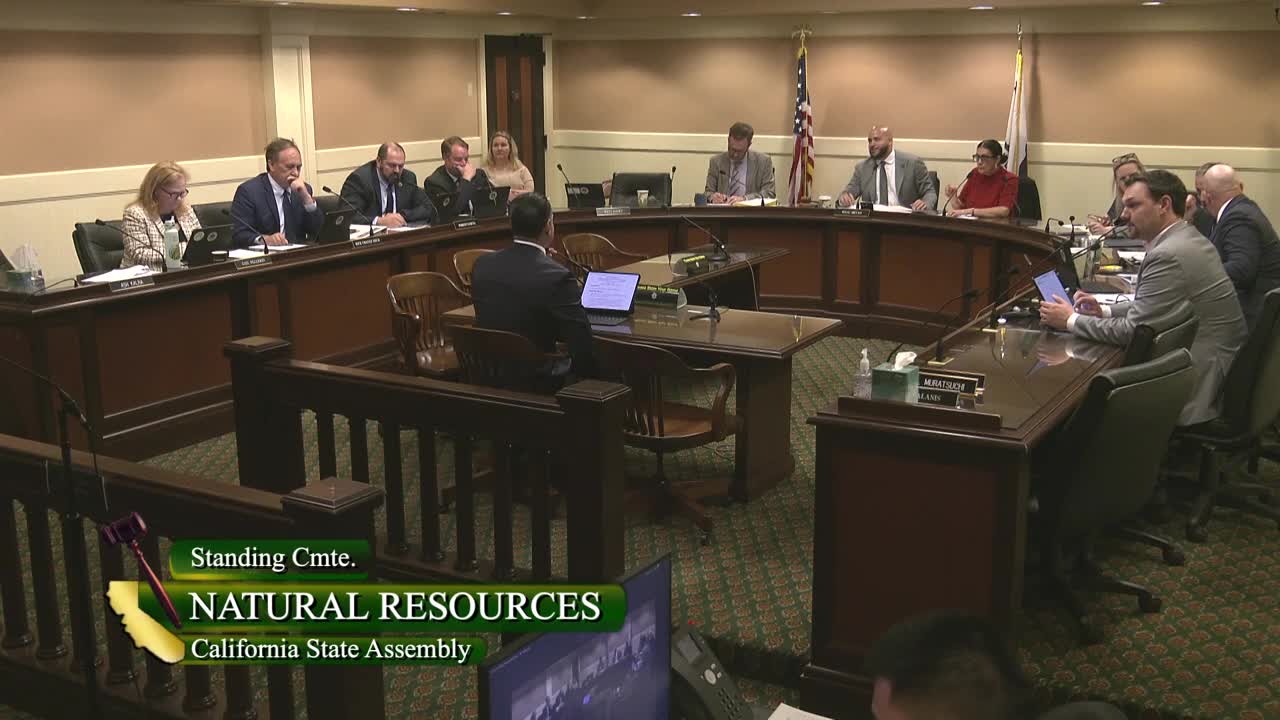
Discussed in Hearing
 10MIN
Assembly Standing Committee on Natural Resources
Bill Author

Bill Co-Author(s):