AB 1365: CalAccount Program.
- Session Year: 2025-2026
- House: Assembly
- Latest Version Date: 2025-04-28
Current Status:
Failed
(2026-02-02: From committee: Filed with the Chief Clerk pursuant to Joint Rule 56.)
Introduced
In Committee
Awaiting First Chamber Vote
Passed First Chamber
In Committee
Awaiting Second Chamber Vote
Passed Second Chamber
Enacted
Existing law requires the Treasurer to convene the CalAccount Blue Ribbon Commission and requires the commission, on or before July 1, 2024, to conduct a market analysis to determine if it is feasible to implement a CalAccount Program, which, if implemented, would have certain characteristics, including offering Californians access to a voluntary, zero-fee, zero-penalty, federally insured transaction account known as a CalAccount, and related payment services at no cost to accountholders.
This bill would repeal those provisions and would establish the CalAccount Program, which would provide every Californian with access to a voluntary, zero-fee, zero-penalty, federally insured transaction account and related payment services at no cost to accountholders. The bill would require the CalAccount Commission, which would continue in existence the former CalAccount Blue Ribbon Commission, to administer the program. The bill would require the commission to, among other things, enter into contracts with financial institutions to ensure access to ATM networkers and locations where accountholders can deposit funds. The bill would require the commission to solicit proposals for and select a financial services network administrator and establish their duties and functions, and establish a mechanism by which an accountholder may deposit funds into or withdraw funds from a CalAccount account. The bill would allow for participation in the program by providers of in-home supportive services, subject to specified requirements. The bill would establish the CalAccount Fund in the State Treasury, and would make moneys in the fund available upon appropriation by the Legislature. The bill would require all employers and hiring entities to maintain a payroll direct deposit arrangement that enables voluntary worker participation in the program, and would require all employers and hiring entities to take specified actions in that regard, including coordinating their payroll process with the CalAccount Program to facilitate payment by direct deposit. The bill would require the commission to submit an annual report by August 1 to the Governor and the Legislature, among other entities, that contains specified information relating to the CalAccount Program. The bill would require the commission to market the program to the residents of the state if funds are available. The bill would require the Labor Commissioner to investigate complaints of employers or hiring entities failing to allow workers to participate in the CalAccount Program, and would impose a civil penalty for a violation. The bill would require those civil penalties to be deposited into the CalAccount Fund. The bill would require the commissioner to reimburse the Labor Commissioner for the costs of enforcement.
Existing law provides that if the state or a county makes or provides for a direct payment to a provider chosen by a recipient or to the recipient for the purchase of in-home supportive services, the department is required to perform or ensure the performance of all rights, duties, and obligations of the recipient related to those services as required for, among other things, unemployment compensation, workers compensation, and retirement savings accounts.
This bill would also require the department under those circumstances to ensure the performance of all rights, duties, and obligations of the recipients related to those services required for payroll direct deposit arrangements offered pursuant to the CalAccount Program.
Existing law regulates the hiring of real property and imposes various requirements on landlords relating to the leasing of residential real property. Existing law requires a landlord or their agent to allow a tenant to pay rent and a security deposit by at least one form of payment that is neither cash nor an electronic funds transfer.
This bill would also require a landlord to allow a tenant to pay rent and a security deposit by an electronic funds transfer from a CalAccount.
Existing law requires the Treasurer to convene the CalAccount Blue Ribbon Commission and requires the commission, on or before July 1, 2024, to conduct a market analysis to determine if it is feasible to implement a CalAccount Program, which, if implemented, would have certain characteristics, including offering Californians access to a voluntary, zero-fee, zero-penalty, federally insured transaction account known as a CalAccount, and related payment services at no cost to accountholders.
This bill would repeal those provisions and would establish the CalAccount Program, which would provide every Californian with access to a voluntary, zero-fee, zero-penalty, federally insured transaction account and related payment services at no cost to accountholders. The bill would require the CalAccount Commission, which would continue in existence the former CalAccount Blue Ribbon Commission, to administer the program. The bill would require the commission to, among other things, enter into contracts with financial institutions to ensure access to ATM networkers and locations where accountholders can deposit funds. The bill would require the commission to solicit proposals for and select a financial services network administrator and establish their duties and functions, and establish a mechanism by which an accountholder may deposit funds into or withdraw funds from a CalAccount account. The bill would allow for participation in the program by providers of in-home supportive services, subject to specified requirements. The bill would establish the CalAccount Fund in the State Treasury, and would make moneys in the fund available upon appropriation by the Legislature. The bill would require all employers and hiring entities to maintain a payroll direct deposit arrangement that enables voluntary worker participation in the program, and would require all employers and hiring entities to take specified actions in that regard, including coordinating their payroll process with the CalAccount Program to facilitate payment by direct deposit. The bill would require the commission to submit an annual report by August 1 to the Governor and the Legislature, among other entities, that contains specified information relating to the CalAccount Program. The bill would require the commission to market the program to the residents of the state if funds are available. The bill would require the Labor Commissioner to investigate complaints of employers or hiring entities failing to allow workers to participate in the CalAccount Program, and would impose a civil penalty for a violation. The bill would require those civil penalties to be deposited into the CalAccount Fund. The bill would require the commissioner to reimburse the Labor Commissioner for the costs of enforcement.
Existing law provides that if the state or a county makes or provides for a direct payment to a provider chosen by a recipient or to the recipient for the purchase of in-home supportive services, the department is required to perform or ensure the performance of all rights, duties, and obligations of the recipient related to those services as required for, among other things, unemployment compensation, workers compensation, and retirement savings accounts.
This bill would also require the department under those circumstances to ensure the performance of all rights, duties, and obligations of the recipients related to those services required for payroll direct deposit arrangements offered pursuant to the CalAccount Program.
Existing law regulates the hiring of real property and imposes various requirements on landlords relating to the leasing of residential real property. Existing law requires a landlord or their agent to allow a tenant to pay rent and a security deposit by at least one form of payment that is neither cash nor an electronic funds transfer.
This bill would also require a landlord to allow a tenant to pay rent and a security deposit by an electronic funds transfer from a CalAccount.
(a)According The Legislature finds and declares as follows:
(1)According to the Federal Deposit Insurance Corporation, nearly one out of five California households is unbanked or underbanked. Millions of people are locked out of the banking system and unable to secure a bank account. Millions more also still have to pay hundreds of dollars annually in check cashing fees and money order fees for the simple right to use their own money. Underbanked households are defined as those that have a bank account, but have used alternative financial services for transactions, including check cashing and money orders, and for credit, including payday loans.
(b)(2)Households without full access to affordable financial services are headed disproportionately by women; Black, Latina, and Asian and Pacific Islander households combined make up just over one-half of Californias households, but are nearly 75 percent of Californias unbanked or underbanked households. Nearly one in three Black California households is unbanked or underbanked, as are more than one in four Latina-Latino households. The share of Black California households without a bank account has jumped dramatically in the two years since the data was last collected. More than 10 percent of Black California households are unbanked. That compares to 6.4 percent as of the last survey in 2021.
(c)(3)A significant portion of Californians, including individuals who are experiencing homelessness or housing instability, certain immigrant communities, and those who have been or are being subjected to domestic violence, sexual assault, human trafficking, or stalking, also have unique banking needs that have not been adequately met by traditional financial services providers. These Californians are often unbanked or underbanked, and face unique barriers to financial access.
(d)(4)The households most likely to be unbanked or underbanked are also those that can least afford it. Households earning $30,000 per year or less comprise nearly three in four unbanked households in California, though representing less than 20 percent of all households.
(e)(5)The banking situation has deteriorated for young Californians. The share of underbanked households headed by individuals 25 to 34 years of age rose to nearly 18 percent, up from just over 13 percent in 2021.
(f)(6)Lacking access to traditional banking means not only that these Californians pay more for basic financial services, but that they are less able to save and to build credit.
(g)(7)The CalAccount Blue Ribbon Commission, convened by the State Treasurers Office, recently published a market study that found that a no-fee and no-minimum balance account option is rare in California, with 95 percent of banks charging overdraft fees.
(h)(8)As the Legislature responds to increasingly frequent and severe public health and climate-related disasters, there is a pressing need to ensure that adequate financial infrastructure is in place to reliably deliver financial assistance to every Californian, regardless of banking status.
(i)(b)It is the intent of the Legislature to establish the CalAccount Program in the State Treasurers Office, which will build on successful state financial services programs to partner with a commercial bank that will offer all Californians the option for a fee-free, zero-penalty debit account and debit card account that will offer new opportunities for depositing earnings and income and will endeavor to meet the unique needs of Californians most often left out of the banking system.
SEC. 2.Section 1947.3 of the Civil Code is amended to read:1947.3.(a)(1)(A)Except as provided in paragraph (2), a landlord or a landlords agent shall allow a tenant to pay rent and deposit of security by at least one form of payment that is neither cash nor an electronic funds transfer and shall also allow a tenant to pay rent and deposit of security by an electronic funds transfer from a CalAccount, as defined in Section 100100 of the Government Code.
(B)A landlords or landlords agents receipt of payment from a CalAccount pursuant to this section shall not be considered a waiver of any right the landlord or landlords agent may otherwise have to establish the base rent on, or to raise rent for, the rental unit.
(2)A landlord or a landlords agent may demand or require cash as the exclusive form of payment of rent or deposit of security if the tenant has previously attempted to pay the landlord or landlords agent with a check drawn on insufficient funds or the tenant has instructed the drawee to stop payment on a check, draft, or order for the payment of money. The landlord may demand or require cash as the exclusive form of payment only for a period not exceeding three months following an attempt to pay with a check on insufficient funds or following a tenants instruction to stop payment. If the landlord chooses to demand or require cash payment under these circumstances, the landlord shall give the tenant a written notice stating that the payment instrument was dishonored and informing the tenant that the tenant shall pay in cash for a period determined by the landlord, not to exceed three months, and attach a copy of the dishonored instrument to the notice. The notice shall comply with Section 827 if demanding or requiring payment in cash constitutes a change in the terms of the lease.
(3)Subject to the limitations below, a landlord or a landlords agent shall allow a tenant to pay rent through a third party.
(A)A landlord or landlords agent is not required to accept the rent payment tendered by a third party unless the third party has provided to the landlord or landlords agent a signed acknowledgment stating that they are not currently a tenant of the premises for which the rent payment is being made and that acceptance of the rent payment does not create a new tenancy with the third party.
(B)Failure by a third party to provide the signed acknowledgment to the landlord or landlords agent shall void the obligation of a landlord or landlords agent to accept a tenants rent tendered by a third party.
(C)The landlord or landlords agent may, but is not required to, provide a form acknowledgment to be used by third parties, as provided for in subparagraph (A), provided however that a landlord shall accept as sufficient for compliance with subparagraph (A) an acknowledgment in substantially the following form:
I, [insert name of third party], state as follows:
I am not currently a tenant of the premises located at [insert address of premises].
I acknowledge that acceptance of the rent payment I am offering for the premises does not create a new tenancy.
(signature of third party) | (date) |
(D)A landlord or landlords agent may require a signed acknowledgment for each rent payment made by the third party. A landlord or landlords agent and the third party may agree that one acknowledgment shall be sufficient for when the third party makes more than one rent payment during a period of time.
(E)Nothing in this paragraph shall be construed to require a landlord or landlords agent to enter into a contract in connection with a federal, state, or local housing assistance program, including, but not limited to, the federal housing assistance voucher programs under Section 8 of the United States Housing Act of 1937 (42 U.S.C. Sec. 1437f).
(4)Paragraphs (2) and (3) do not enlarge or diminish a landlords or landlords agents legal right to terminate a tenancy. Nothing in paragraph (3) is intended to extend the due date for any rent payment or require a landlord or landlords agent to accept tender of rent beyond the expiration of the period stated in paragraph (2) of Section 1161 of the Code of Civil Procedure.
(b)A landlord or its agent shall not charge a tenant any fee for payment by check for rent or security deposit as described in this section.
(c)For the purposes of this section, the issuance of a money order or a cashiers check is direct evidence only that the instrument was issued.
(d)For purposes of this section, electronic funds transfer means any transfer of funds, other than a transaction originated by check, draft, or similar paper instrument, that is initiated through an electronic terminal, telephonic instrument, computer, or magnetic tape so as to order, instruct, or authorize a financial institution to debit or credit an account. Electronic funds transfer includes, but is not limited to, point-of-sale transfers, direct deposits or withdrawals of funds, transfers initiated by telephone, transfers via an automated clearinghouse, transfers initiated electronically that deliver a paper instrument, and transfers authorized in advance to recur at substantially regular intervals.
(e)Nothing in this section shall be construed to prohibit the tenant and landlord or agent to mutually agree that rent payments may be made in cash or by electronic funds transfer, so long as another form of payment is also authorized, subject to the requirements of subdivision (a).
(f)A waiver of the provisions of this section is contrary to public policy, and is void and unenforceable.
SEC. 3.Title 21.1 (commencing with Section 100100) of the Government Code is repealed.SEC. 4.Title 21.1 (commencing with Section 100100) is added to the Government Code, to read:21.1.CalAccount Program100100.As used in this title:
(a)Accountholder means an individual who has a CalAccount account.
(b)CalAccount means a federally insured transaction account held as part of the program.
(c)CalAccount Program or program means the program established pursuant to this title through which an individual may open a no-fee, no-penalty transaction account with an associated debit card.
(d)Commission means the CalAccount Commission established pursuant to Section 100102.
(e)Domestic violence has the same meaning as defined in Section 6211 of the Family Code.
(f)Electronic fund transfer has the same meaning as defined in Section 1693a of Title 15 of the United States Code.
(g)Employee means an individual who is employed by an employer. Employee does not include an employee covered under the federal Railway Labor Act (45 U.S.C. Sec. 151) or an employee engaged in interstate commerce so as not to be subject to the legislative powers of the state, except insofar as application of this title is authorized under the United States Constitution or laws of the United States.
(h)(1)Employer means a person engaged in a business, industry, profession, trade, or other enterprise in the state, whether or not for profit, excluding the federal government, that has more than 10 employees. For the purposes of this provision, all employees of either of the following shall be counted:
(A)Any employers that are affiliated with one another within the definition of Section 150 of the Corporations Code.
(B)Any franchisee associated with a franchise of the same franchisor, with those terms having the same meaning as the definitions in Article 1 (commencing with Section 20000) of Chapter 5.5 of Division 8 of the Business and Professions Code.
(2)Upon a positive determination pursuant to subdivision (a) of Section 100113, employer includes an employer of a provider of in-home supportive services regulated by Article 7 (commencing with Section 12300) of Chapter 3 of Part 3 of Division 9 of the Welfare and Institutions Code.
(i)Federally insured means insured by the Federal Deposit Insurance Corporation or the National Credit Union Administration.
(j)Hiring entity means a person engaged in a business, industry, profession, trade, or other enterprise in the state, whether or not for profit, excluding the federal government, that has contracted with more than 25 independent contractors to perform the same or similar labor or service.
(k)Independent contractor means an individual who renders labor or service to a hiring entity for a specified recompense for a specified result who is not an employee of that hiring entity.
(l)In-network partner means a participating retail or financial institution offering an ATM, bank, or credit union branch through which accountholders can load or withdraw funds from their CalAccount using a CalAccount debit card for no fee.
(m)Local financial institution has the same meaning as defined in Section 57600.
(n)Participating depository financial institution means a qualifying bank, credit union, or other financial institution, as determined by the commission pursuant to subparagraph (C) of paragraph (1) of subdivision (a) of Section 100106, participating in the CalAccount Program by providing CalAccounts to accountholders in concert with the financial services network administrator, as described in subparagraph (A) of paragraph (2) of subdivision (a) of Section 100106.
(o)Payroll direct deposit arrangement means an arrangement by which a worker may authorize payment of wages or other moneys due the worker by an employer or hiring entity, or any portion thereof, to be directly deposited by electronic fund transfer into the workers CalAccount.
(p)Person means an individual, sole proprietorship, partnership, joint venture, association, trust, estate, business trust, corporation, joint stock company, limited liability company, unincorporated association, state or local government or agency, instrumentality, or political subdivision thereof, or any similar entity or organization.
(q)Preauthorized electronic fund transfer means an electronic fund transfer authorized in advance to recur at substantially regular intervals.
(r)Program fund means the CalAccount Fund established pursuant to Section 100108.
(s)Registered payee means a person who has registered with the program to accept receipt of preauthorized electronic fund transfers from accountholders by agreeing to specific conditions to be established by the commission.
(t)Stalking has the same meaning as defined in Section 646.9 of the Penal Code.
(u)Transaction account means a demand deposit account, share draft account, or similar account.
(v)Worker means an employee or an independent contractor.
(w)Worker participant means a worker who is an accountholder.
100102.(a)The CalAccount Blue Ribbon Commission established pursuant to Chapter 451 of the Statutes of 2021 shall continue in existence as the CalAccount Commission and shall do the following:
(1)Assume the responsibility and duty to meet the requirements of this title and all applicable state and federal laws and regulations.
(2)Establish, oversee, and manage the CalAccount Program.
(3)Serve the interests of program accountholders and those seeking to access financial services and debt management tools through the program.
(4)Serve the public interest and pursue partnerships and credit unions and other local financial institutions.
(5)Ensure the operational well-being and fiscal solvency of the program.
(b)The commission shall be composed of all of the following members:
(1)The Treasurer or the Treasurers designee.
(2)The Commissioner of the Department of Financial Protection and Innovation or that persons designee.
(3)An individual with banking expertise, particularly expertise in transaction accounts and debit cards, appointed by the Senate Committee on Rules.
(4)A public banking advocate appointed by the Senate Committee on Rules.
(5)An individual with expertise in economic and racial justice and cultural competence appointed by the Speaker of the Assembly.
(6)A consumer representative or advocate with expertise in banking access and financial empowerment, including within historically unbanked and underbanked communities, appointed by the Speaker of the Assembly.
(7)An employee representative appointed by the Governor.
(8)An individual with expertise in banking or consumer financial services affiliated with an academic institution appointed by the Governor.
(9)An individual, appointed by the Governor, with banking expertise.
(c)The members of the commission shall serve at the pleasure of their appointing authority.
(d)The Treasurer shall serve as the chair of the commission.
(e)In making appointments to the commission, the appointing authorities shall take into consideration the cultural, ethnic, and geographic diversity of the state so that the commissions composition reflects the communities of California.
(f)(1)Except as provided in paragraph (2), members of the commission shall serve without compensation.
(2)Members of the commission shall be reimbursed for necessary travel expenses incurred in connection with their commission duties.
(g)(1)Except for the members described in paragraphs (3) and (9) of subdivision (a), (b), a commission member, or Treasurers staff working with the commission, while serving in that capacity shall not have a direct or indirect investment or ownership interest in or be employed by, a consultant to, a member of the board of directors of, affiliated with, or otherwise a representative of a private bank or financial services institution unless that position is an unpaid volunteer position.
(2)The restrictions in paragraph (1) do not include ownership of a share of a diversified mutual fund or exchange-traded fund that holds shares of a private bank or financial services institution.
100103.(a)The CalAccount Program is hereby established, to be administered by the commission, for the purpose of increasing access to traditional banking services, as specified in Section 100104.
(b)The program shall be designed to protect consumers who lack access to traditional banking services from predatory, discriminatory, and costly alternatives, and shall do both the following:
(1)Provide every Californian with access to a voluntary, zero-fee, zero-penalty, federally insured transaction account and related payment services, at no cost to accountholders, including robust and geographically diverse mechanisms for accessing account funds and account management tools that facilitate the automation of basic financial transactions designed to serve the needs of individuals with low or fluctuating income.
(2)Require employers to facilitate program sign up for employees, utilize CalAccount mechanisms for communication between employers and the program, and respect and comply with employees direct deposit elections with respect to CalAccount.
(c)The commission shall establish a set of program goals. The commission and State Treasurers Office shall balance any tensions between the core policy goals of the program as set forth in paragraph (1) of subdivision (b) with practical considerations as they arise. Program goals shall include:
(1)Providing accountholders maximum access to funds, including robust and geographically diverse mechanisms for accessing account funds.
(2)Maximizing accessibility of the program by facilitating the opening of a CalAccount by individuals, including those with the following characteristics:
(A)Are under 18 years of age, including individuals who are at least 14 years of age without a cosigner or guarantor on the account, consistent with all applicable laws.
(B)Are unhoused or otherwise do not have permanent housing.
(C)Lack federal or state government-issued photographic identification, but have other documents, including, but not limited to, a foreign or domestic passport with photograph, consular identification, student identification, municipal identification, a work authorization card, government-issued correspondence, utility bills, digital identification, or biometric identification, provided that those documents are sufficient to satisfy federal Know Your Customer requirements.
(D)Have been, or are currently being, subjected to domestic violence, sexual assault, human trafficking, or stalking.
(3)Minimizing unfair account denials and providing an accessible process to appeal rejections.
(4)Minimizing costs to merchants accepting CalAccount for payments.
(5)Maximizing consumer protections for automated payments and automatic disbursement rules.
(6)Effective marketing and outreach to maximize program signups.
(7)Incorporating best practices to protect the safety, privacy, and assets of, and ensure access to, the program for individuals who have been subjected to or are currently being subjected to domestic violence and sexual assault, stalking, and human trafficking from financial abuse, including coercive control.
(d)The commission and State Treasurers Office may design and implement optional program components throughout the life of the program that may include the following:
(1)International remittances.
(2)Program facilitation of the voluntary sharing of financial transaction information such as voluntary credit reporting to assist accountholders in building credit or otherwise establish a record of reliable financial transaction history.
(3)Referrals of accountholders to responsible banking services not provided through CalAccount, such as consumer lending. In identifying responsible banking services, the commission shall give priority to local financial institutions and public banks as defined in Section 57600. Referrals shall meet the standards set forth by the commission pursuant to paragraph (15) of subdivision (a) of Section 100106, and shall ensure that participating financial service providers meet any participation requirements set forth by the commission and are in compliance with federal and state law. Requirements set forth by the commission may include participation in a no-fee ATM network for accountholders.
(4)Programs and processes to provide additional support for accountholders who may be at high risk of financial abuse, including to support accountholders subjected to domestic violence, sexual assault, stalking, and human trafficking. Those programs or processes may include training for in-network partners, participating depository financial institutions, and any other financial services vendors program staff regarding financial abuse.
(e)The program shall be designed as a viable option for the payment of public benefits to individuals and shall meet the following requirements:
(1)Have the capacity to issue payment cards that are linked to funds redeemable through the program, such as a reloadable debit card that meets the no fees and no penalties requirements of this program.
(2)Work with governmental agencies to accommodate direct deposits from public payers.
(3)Be able to answer requests for proposals issued by public agencies for the payment of public benefits, and answer those requests for proposals that it is well situated to fulfill.
(4)Where possible, coordinate with agencies to provide necessary, fee-free financial services, such as facilitating unemployment insurance payments made through the Employment Development Department.
(f)Implementation of the program shall take place in two stages: the startup and administration phase and the implementation phase.
(g)Decisions of the commission shall be made by a majority vote.
100104.(a)The commission shall design and implement the CalAccount Program as set forth in Sections 100105 and 100106.
(b)The commission shall oversee the CalAccount Program and have the authority to elect to delegate some oversight duties to the State Treasurers Office as appropriate.
(c)The commission shall balance any tensions between the core policy goals of the program with practical considerations as they arise.
(d)In addition to the powers and authority granted pursuant to this section, the commission shall have the powers and authority to do all of the following:
(1)Make and enter into contracts necessary for the administration of the CalAccount Program and engage personnel, including consultants, actuaries, managers, counsel, and auditors, as necessary for the purpose of rendering professional, managerial, and technical assistance and advice.
(2)Adopt a corporate seal and change and amend it from time to time.
(3)Accept, for deposit to the program fund, any grant, gift, legislative appropriation, or other moneys from the state, a unit of federal, state, or local government, or any other person, firm, partnership, or corporation.
(4)Make provisions for the payment of costs of administration and operation of the program.
(5)Employ staff.
(6)Retain and contract with other public agencies, financial institutions, with priority given to local financial institutions, as defined in Section 57600, other financial and service providers, consultants, actuaries, counsel, auditors, third-party administrators, and other professionals as necessary.
(7)Procure insurance indemnifying each member of the commission from personal loss or liability resulting from a members action or inaction as a member of the commission.
(8)Collaborate and cooperate with other public entities, financial institutions, service providers, labor unions, and business, financial, trade, community-based, advocacy, and other organizations to the extent necessary or desirable for the effective and efficient design, implementation, and administration of the program and to maximize outreach to potential accountholders and support for accountholder literacy and empowerment. empowerment, consistent with federal and state privacy and security laws.
(9)Cause expenses incurred to initiate, implement, maintain, and administer the program to be paid from the program fund or arrangements established under the program.
(10)Facilitate compliance by the program or arrangements established under the program with all applicable requirements for the program under federal and state law.
(11)Engage in outreach to potential accountholders.
(12)Exercise any and all other powers as appropriate for the effectuation of the purposes, objectives, and provisions of this title. 100105.(a)The startup and administration phase shall include all steps necessary to lay the groundwork for successful implementation of the CalAccount Program.
(b)During the startup and administration phase, the commission shall do all of the following:
(1)Determine the key steps necessary for successful implementation of the program.
(2)(A)Appoint an executive director, who shall not be a member of the commission and who shall serve at the pleasure of the commission, as well as appropriate staff within the State Treasurers Office who, along with the executive director, shall administer the CalAccount Program.
(B)Determine the duties and powers of the executive director, including the processes by which the executive director may enter into contracts on behalf of the commission or conduct business necessary for the efficient operation of the commission, and, as appropriate, the duties of other staff.
(C)Set the executive directors compensation.
(3)Work with the State Treasurers Office to provide oversight to the executive director and staff as the executive director and staff determine the necessary steps for successful implementation of the CalAccount Program.
(c)The commission may develop committees of the commission to collaborate with staff and the executive director to facilitate communication between the commission and executive director and ensure commission oversight over the executive director.
(d)Steps that shall be taken by the executive director and staff during this phase, in consultation with and with the approval of the commission, include, but are not limited to, the following:
(1)Completing any technical and legal work related to program rollout.
(2)Answering program design and timing questions.
(3)Arranging for the development of any technical support needed prior to contracting with a financial services network administrator.
(4)Developing requests for proposals for a financial services network administrator and any additional partners whose services are deemed necessary for the implementation of the CalAccount Program.
(5)Developing a scoring rubric approved by the commission for evaluating responses to requests for proposals that ensures that the responses ability to achieve program goals is weighed heavily among selection criteria and that gives priority to responses that will contribute to the building of financial literacy and the availability and provision of responsible banking services, including by local financial institutions as defined in Section 57600.
(6)Hiring, contracting, or preparing to contract for any and all technical support services necessary for the ultimate rollout of the program.
(7)Developing plans for outreach and marketing, including the development of marketing materials.
(8)Entering into contractual relationships with public, nonprofit, and labor organizations, and any appropriate for-profit corporations, to facilitate marketing and sign up.
(9) Entering into contractual relationships with financial institutions to ensure access to ATM networks and locations where accountholders can deposit funds.
(10)Collaborating and cooperating with other California agencies and programs, including local governments and agencies at their discretion, private financial institutions, service providers, and business, financial, trade, membership, and other organizations to the extent necessary or desirable for the effective and efficient design, implementation, and administration of the program and to maximize outreach to potential accountholders and employers.
(11)Determining the feasibility and timing of implementation of additional optional program features, including setting a timeline for periodic review and reevaluation of program features following general program implementation.
(e)In the case of any disagreements between the commission and the executive director or staff regarding appropriate steps or timing, the commission shall be the final decisionmaker.
(f)The executive director and staff shall ensure that the commission and the public have adequate and meaningful opportunities to provide input throughout this phase.
(g)The executive director, in consultation with the commission, may create a working group or groups of stakeholders to provide input and advice during this startup and administration phase and the following implementation phase of the CalAccount Program.
(h)Work initiated during this phase may continue as needed during the implementation phase and thereafter in order to develop an effective program.
100106.(a)The CalAccount Commission shall implement the CalAccount Program. Steps the commission shall take during this phase include, but are not limited to, the following:
(1)Solicit proposals for and select a financial services network administrator.
(A)The contract selection process shall prioritize the selection of a proposal that is best able to meet the goals of the program set forth in Section 100103, not simply the lowest cost option.
(B)The financial services network administrator and any banking partners who are parties to the financial services network administrators proposal shall be reviewed by the commission for their history of responsible banking practices, with input requested from the Department of Financial Protection and Innovation.
(C)The commission shall consider whether the financial services network administrator and any banking partners who are parties to the network administrators proposal have the following characteristics:
(i)Have an established record of ethical and responsible banking practices and adherence to all applicable local, state, and federal laws and regulations, including safety and soundness standards, responsible practices with respect to racial equity, and a history of serving low-income, racially diverse, and multilingual communities.
(ii)Meet all technical requirements of the financial services network administrator.
(iii)Agree to comply with all applicable laws and regulations, including all regulations, policies, and directives issued by the commission governing the program, and any contractual requirements established by the commission.
(D)The request for proposals and contract for the network administrator shall specify that additions or other changes to any banking partners shall be subject to approval by the commission.
(E)The request for proposals shall be issued by January 1, 2027.
(2)Establish the duties and functions of the financial services network administrator, which shall be in furtherance of the program goals established by the commission pursuant to subdivision (c) of Section 100103, shall be consistent with the program elements set forth in Section 100103, and may include any of the following:
(A)Contract with, manage, and coordinate the financial services vendors for the program, which shall provide accountholders access to their CalAccount account and services provided in concert with at least one qualifying participating depository financial institution that has the characteristics identified in subparagraph (C) of paragraph (1).
(B)Add additional participating depository financial institutions with the characteristics identified in subparagraph (C) of paragraph (1), subject to the commissions approval, especially including qualifying credit unions and other local financial institutions, as program scope and scale permits, in accordance with the commissions specifications as set forth in the contract between the commission and the financial services network administrator.
(C)Issue to each accountholder a secure debit card, or other secure means of access to their CalAccount account that uses security and antifraud technology consistent with industry standards and best practices. The commission shall also ensure that access is facilitated for those with unstable housing situations or who face barriers to financial access, such as individuals who lack stable housing, lack federal or state-issued photographic identification, and those who are currently being subjected to or have been subjected to domestic violence, sexual assault, human trafficking, or stalking. Standards that may be employed to protect security and facilitate access may include a mechanism via which accountholders may deactivate their current debit card and obtain a replacement debit card for no fee.
(D)Provide a robust and geographically expansive financial services network of partners through which accountholders can load or withdraw funds from their CalAccount account using a CalAccount debit card, or other secure means of access to their CalAccount account, including ATMs, bank or credit union branches, and other in-network partners, at no cost to accountholders.
(E)Provide the necessary technical and regulatory redundancies to minimize disruption of service.
(F)Coordinate data exchange with the executive director and staff and implement all account management elections, including receipt of direct deposit payments, preauthorized electronic fund transfers to registered payees, and automatic disbursement rule elections, made by accountholders through the programs online web portal or mobile application.
(3)Establish processes to ensure that any change impacting the ability of a participating depository financial institution or other program vendor to participate in the program does not disrupt existing accountholders access to CalAccount accounts or account management elections.
(4)Create and manage an internet website that shall serve as a primary source of information about the program, the financial services offered through the program, and the program network through which accountholders can load or withdraw funds from their CalAccount account using a CalAccount debit card for no fee, and is available in multiple languages reflecting the states diverse population.
(5)Provide a secure web-based portal and mobile application through which individuals can enroll in the program and entities can become registered payees and through which accountholders can access and manage their CalAccounts, CalAccount accounts, including their direct deposit, preauthorized electronic fund transfers to registered payees, and automatic disbursement rule elections. The web-based portal and mobile application shall be available in multiple languages reflecting the states diverse population.
(6)Establish the mechanisms by which an accountholder may deposit funds into or withdraw funds from a CalAccount account pursuant to all of the following:
(A)The mechanisms for deposit of funds shall include, but not be limited to, electronic fund transfers arranged through an employers or hiring entitys payroll direct deposit arrangement and cash loading through in-network partners to be established by the financial services network administrator.
(B)The mechanisms for withdrawal of funds shall include, but not be limited to, withdrawals through point-of-sale purchases using a CalAccount debit card and through cash withdrawals at a robust and geographically expansive network, the scope of which the commission shall seek to maximize, of participating ATMs, bank or credit union branches, and other in-network partners of designated financial institution partners to be established by the financial services network administrator.
(C)The commission shall ensure that the executive director, the financial services network administrator, and participating depository financial institutions do not charge or collect any fees from an accountholder related to the use of a CalAccount debit card or the establishment and maintenance of a CalAccount account, including for the deposit and withdrawal services set forth in subparagraphs (A) and (B).
(D)The executive director, at the commissions direction, may negotiate with the financial services network administrator and other financial services partners for additional financial capabilities of a CalAccount account relating to deposit or withdrawal of funds, including, but not limited to, mobile check deposit, cash loading through out-of-network partners, electronic fund transfers from linked or nonlinked accounts, and cash withdrawal from out-of-network ATMs and bank or credit union branches and international remittances, provided that the financial services network administrator and other financial services partners may not impose any fees upon accountholders for those services.
(E)The executive director, at the commissions direction, shall seek to minimize or eliminate any fees imposed on accountholders by out-of-network entities for services to CalAccount accountholders, and shall ensure that any such fee is reasonable and actually incurred by the entity imposing the fee.
(7)Establish the process through which an accountholder may elect to have a portion, up to the entirety, of their paycheck or earnings due for labor or services performed directly deposited by electronic fund transfer into their CalAccount account utilizing an operational model that limits interaction between an employer and an employee and between a hiring entity and an independent contractor to the extent feasible.
(8)Establish the process through which employers and hiring entities shall be required to remit through a payroll direct deposit arrangement each workers elected payroll contribution to the workers CalAccount account in accordance with the workers election.
(9)Establish a process, available to all accountholders for no fee, through which an accountholder may arrange for payment to a registered payee using a preauthorized electronic fund transfer from a CalAccount account.
(10)Establish enhanced security and privacy measures that are available on an opt-in basis for all accounts, but that may not be suitable for every accountholder. In particular, these measures shall be designed to account for the unique privacy and accessibility needs of vulnerable communities, including those with unstable housing or those who have been subjected to or are currently being subjected to domestic violence, sexual assault, stalking, and human trafficking, or otherwise face barriers to consistent and unimpeded access to their accounts, and establish best practices to meet those unique needs. Those practices may include the following:
(A)A convenient mechanism for an accountholder to review and, if necessary, update the accountholders contact information and preferred contact method. Any such mechanism, if implemented, shall be designed to minimize fraud risk and maintain the security and accessibility of each accountholders account.
(B)A secure and formal process to designate a verified third-party address as a mailing address, including, but not limited to, the address of a trusted and verified individual identified by the accountholder, a vetted address confidentiality program, or a vetted community-based assistance program. Any process developed pursuant to this subdivision shall consider both the privacy and security needs of users, and the need to prevent fraud and the exploitation of vulnerable accountholders.
(C)Additional geolocational protections against fraudulent account activity, including the option for the accountholder to flag regions from which transactions shall be denied or other protections utilizing geolocation data, provided, however, that the collection and use of that geolocation data shall only take place with the express consent of the accountholder.
(11)Establish the process and terms and conditions for becoming a registered payee pursuant to both of the following:
(A)Before becoming a registered payee, the payee shall be required to agree to specified terms and conditions to be established by the commission in exchange for the benefits of transparency and accountability afforded by participation in an automated payment system.
(B)The commission shall establish the terms and conditions to which registered payees shall agree, which may vary depending on the type of payee, and which shall be designed to incentivize accountholders preauthorized electronic fund transfers to registered payees and application of voluntary automatic disbursement rules by limiting the late payment fees and penalties that registered payees may impose on accountholders who pay them using preauthorized electronic fund transfers from their CalAccount account.
(12)Establish voluntary automatic disbursement rules to assist accountholders in managing automated payments to registered payees based on the availability of funds in the accountholders account, which accountholders may voluntarily elect to apply or to stop applying to their CalAccount account at any time. The voluntary automatic disbursement rules shall be designed to maximize consumer protection and may include, but not be limited to, rules governing the prioritization and timing of payments, rules limiting payments to a percentage of funds available in the CalAccount account, and rules limiting disbursement to designated registered payees only upon satisfaction of specified conditions of the CalAccount account.
(13)Take all appropriate steps to manage the relationship between the CalAccount Program and other state and local government programs, including, but not limited to, measures to accomplish the following:
(A)Enable accountholders to transfer funds between CalAccount and other state or locally managed accounts for the receipt of public benefits.
(B)Collaborate and cooperate with the State Department of Social Services, Office of Systems Integration, Employment Development Department, and other governmental agencies, including, but not limited to, agencies responsible for the distribution of emergency relief payments, to improve and streamline operations for the distribution of local, state, and federal benefit and public assistance payments and other disbursements by enabling accountholders to authorize payments to be directly deposited by electronic fund transfer into their CalAccount account, as applicable, to the extent permitted by law.
(C)Collaborate and cooperate with the CalSavers Retirement Savings Board, the Scholarshare Investment Board, the California ABLE Act Board, and the board of any other state program administering a program providing for financial accounts for individuals in the state, to the extent necessary or desirable for the effective and efficient design, implementation, and administration of these programs and to maximize the purposes of these programs and the ability of participants in these programs to benefit therefrom.
(14)Facilitate and manage data exchange with the financial services network administrator, ensuring that account management elections, including direct deposit, request for payment inquiries, preauthorized electronic fund transfers to registered payees, and automatic disbursement rule elections made by accountholders through the programs online web portal or mobile application are communicated to and executed by the financial services network administrator.
(15)Establish standards to ensure that any commercial product marketed to CalAccount accountholders is affordable, secure, and financially responsible, and to ensure that the executive director and financial services network administrator satisfactorily perform all duties and functions and do not market commercial products to CalAccount accountholders absent the commissions prior express, written authorization pursuant to those standards. These standards may include participation in a no-fee ATM network for accountholders
(b)Work performed during this phase may continue as needed for the life of the program to ensure program elements can be updated and that the program will remain effective.
100107.In addition to the powers and duties set forth in Sections 100104 to 110106, inclusive, the commission shall do the following:
(a)Allow for participation in the program by providers of in-home supportive services, as regulated by Article 7 (commencing with Section 12300) of Chapter 3 of Part 3 of Division 9 of the Welfare and Institutions Code, if the commission determines, and the Director of Social Services and the Director of Finance certify, in writing, all of the following:
(1)The participation meets all state and federal legal requirements.
(2)The appropriate employer of record has been identified for the purpose of satisfying all of the programs employer requirements.
(3)The payroll deduction described in Section 12302.2 of the Welfare and Institutions Code can be implemented at reasonable costs.
(4)The participation does not create a financial liability for the state or employer of record.
(b)Determine necessary costs associated with outreach, customer service, enforcement, staffing and consultant costs, and all other costs necessary to administer the program.
(c)Implement outreach and customer service supports for the program, as well as any other program supports the commission deems necessary to administer the program.
(d)Consult with employer representatives and employee representatives to create an administrative structure that facilitates employee participation while addressing employer needs, including, but not limited to, clearly defining employers duties pursuant to Section 100109.
(e)Ensure the inclusion of comprehensive worker education and outreach in the program, including through collaboration with state and local governmental agencies, community-based and nonprofit organizations, foundations, vendors, and other entities deemed appropriate to develop and secure ongoing resources for education and outreach that reflect the cultures and languages of the states diverse workforce population. In selecting entities for that collaboration, the commission shall prioritize entities with experience providing services in multiple languages and demonstrating prior effectiveness in outreach to racially diverse populations.
(f)Ensure the inclusion in the program of comprehensive employer education and outreach developed in consultation with employer representatives and employee representatives.
(g)Structure the program so as to ensure the state is prohibited from incurring liabilities associated with administering the program and that the state has no liability for the program or for the actions of any program contractor or subcontractor.
(h)Prior to opening the California CalAccount Program for public participation, if the Department of Finance determines there are sufficient funds available, or if an annual Budget Act appropriation is made in amounts sufficient to allow the board commission to implement, or both, the board commission shall establish either or both of the following:
(1)A process to determine geographic limitations and other obstacles to accountholders using only in-network ATMs, and a proposal for the CalAccount Program to cover reasonable out-of-network ATM fees in collaboration with the Legislature that includes funding those costs.
(2)A process to minimize the cost of international remittances for accountholders that includes fiscal participation from the State of California and other interested governmental and nongovernmental entities.
100108.(a)The CalAccount Fund is hereby created in the State Treasury. Moneys
(b)Moneys in the fund shall be available upon appropriation by the Legislature for purposes of this title.
(c)Prior to the execution of a contract with financial institutions, moneys in the fund shall be available upon appropriation by the Legislature after the Treasurer has confirmed, in a letter to the Joint Legislative Budget Committee, that the commission demonstrates the feasibility of achieving the goals in Section 100102.
100109.(a)Employers and hiring entities shall maintain a payroll direct deposit arrangement that enables voluntary worker participation in the program.
(b)All wages and other payments due a worker that a worker has authorized to be directly deposited by electronic fund transfer into the workers CalAccount account shall be deposited accordingly.
(c)Employers and hiring entities shall, consistent with all applicable regulations issued by the commission, do all of the following:
(1)Coordinate their payroll process with the CalAccount Program to facilitate accurate and seamless payment by direct deposit in accordance with the authorization of each worker participant using the tools provided by the program.
(2)Cooperate with the commission in providing all requested information available to the employer or hiring entity necessary for the opening and administration of a workers CalAccount account.
(3)Upon request of the administrator, provide additional forms or notifications to a worker within seven calendar days.
(d)Employers and hiring entities shall not discharge, discipline, threaten to discharge or discipline, or in any other manner retaliate or take an adverse action against a worker or applicant because of the individuals participation or manner of participation in the CalAccount Program.
(e)A person that is not subject to the requirements of this title may voluntarily maintain a payroll direct deposit arrangement to allow worker participation in the program.
(f)Either to the extent that program funds are available or to the extent that If the Department of Finance determines that there are sufficient funds available in the CalAccount Fund or if an annual Budget Act appropriation is made in amounts sufficient to allow the board commission to implement, or both, the board commission shall develop a process for small employers to request financial and administrative implementation assistance. Small employers for the purposes of this provision only are defined as businesses with less than or equal to 100 employees.
100110.(a)The commission shall refer to the Labor Commissioner for enforcement pursuant to Section 90.4 of the Labor Code a complaint it makes or receives that an employer or hiring entity has failed to allow its workers to participate in the CalAccount Program pursuant to this title or otherwise violated its duties under Section 100108.
(b)The commission shall reimburse the Labor Commissioner for the costs incurred by the Labor Commissioner in enforcing this title.
100111.This title does not preclude or reduce a judgment debtors right to an exemption from enforcement of a money judgment provided by state or federal law. Moneys exempt from enforcement of a money judgment remain exempt if they have been deposited into the individuals CalAccount account.
100112.(a)Notwithstanding Section 10231.5, the commission shall submit an annual report by August 1 to the Governor, the Controller, the California State Auditor, and the Legislature, pursuant to Section 9795.
(b)The report required by this section shall include, but not be limited to, all of the following information in a deidentified and aggregated form:
(1)The number of accounts opened and closed in the program during the reporting period, by city and county.
(2)The number of employers and hiring entities with workers who received payment to their CalAccount account through the employer or hiring entitys payroll direct deposit arrangement during the reporting period, by industry, city, and county.
(3)Aggregate accountholder demographics, including, but not limited to, county, gender, age, race, ethnicity, primary language, annual income, and job industry.
(4)A statement regarding risk management and oversight of the program.
(5)Any other information the commission determines to be relevant to an assessment of the program.
100113.(a)The commission shall market the program to the residents of the state to the extent funds are available for this purpose.
(b)The commission may include the following in its marketing efforts:
(1)Information designed to include financial literacy education and resources and to educate citizens about the benefits of financial management and planning.
(2)Information designed to include education regarding financial abuse and to educate citizens about the resources available to victims of financial abuse, which may include resources created by governmental agencies, nonprofit organizations, and community groups.
100114.(a)The commission shall adopt regulations as it deems necessary to implement this title.
(b)The commission may adopt regulations to implement this title as emergency regulations in accordance with the rulemaking provisions of the Administrative Procedure Act (Chapter 3.5 (commencing with Section 11340) of Part 1 of Division 3 of Title 2). The adoption of the regulations shall be deemed to be an emergency and necessary for the immediate preservation of the public peace, health and safety, or general welfare, notwithstanding subdivision (e) of Section 11346.1 of the Government Code. Any regulation adopted pursuant to this section shall not remain in effect more than 180 days unless the commission complies with rulemaking provisions of the Administrative Procedure Act (Chapter 3.5 (commencing with Section 11340) of Part 1 of Division 3 of Title 2), as required by subdivision (e) of Section 11346.1 of the Government Code.SEC. 5.Section 90.4 is added to the Labor Code, to read:90.4.(a)For purposes of this section:
(1)CalAccount Commission means the CalAccount Commission, as defined in Section 100100 of the Government Code.
(2)CalAccount Program has the same meaning as defined in Section 100100 of the Government Code.
(3)Employer has the same meaning as defined in Section 100100 of the Government Code.
(4)Hiring entity has the same meaning as defined in Section 100100 of the Government Code.
(5)Worker has the same meaning as defined in Section 100100 of the Government Code.
(b)The Labor Commissioner shall have the power and duties necessary to administer the enforcement of employer and hiring entity compliance with Title 21.1 (commencing with Section 100100) of the Government Code.
(c)(1)Upon receipt of a complaint or referral from the CalAccount Commission, the Labor Commissioner shall investigate and determine whether an employer or hiring entity has failed to allow its workers to participate in the CalAccount Program or otherwise violated Section 100109 of the Government Code.
(2)(A)An employer or hiring entity who violates a provision of paragraph (2) of subdivision (b) of Section 100103, Section 100109 of the Government Code, or any rules or regulations established by the commission pursuant to those provisions shall be subject to a civil penalty of two hundred fifty dollars ($250) per worker per violation in an initial citation and one thousand dollars ($1,000) per worker for each violation in a subsequent citation for a violation of Section 100109 of the Government Code.
(B)The civil penalties provided for in this paragraph are in addition to any other penalty provided by law.
(3)If, upon investigation, the Labor Commissioner determines that an employer or hiring entity has violated a provision of Section 100109 of the Government Code, the Labor Commissioner may issue a citation to the employer or hiring entity in violation. The citation may be served personally, in the same manner as provided for service of a summons, as described in Chapter 4 (commencing with Section 413.10) of Title 5 of Part 2 of the Code of Civil Procedure, by certified mail with return receipt requested, or by registered mail in accordance with subdivision (c) of Section 11505 of the Government Code. Each citation shall be in writing and shall describe the nature of the violation, including reference to the statutory provision alleged to have been violated, and shall advise the employer or hiring entity of its right to request a hearing pursuant to Section 226.5.
(4)Section 226.5 shall apply to a citation or the proposed assessment of a civil penalty issued by the Labor Commissioner pursuant to this section.
(d)In enforcing this section, the Labor Commissioner shall take into consideration whether the violation was inadvertent. The Labor Commissioner may decide, at that persons discretion, not to penalize an employer or hiring entity for a first violation if that violation was due to a clerical error or inadvertent mistake.
(e)Civil penalties collected pursuant to this section shall be deposited into the CalAccount Fund established by Section 100108 of the Government Code.
SEC. 6.Section 12302.2 of the Welfare and Institutions Code is amended to read:12302.2.(a)(1)If the state or a county makes or provides for direct payment to a provider chosen by a recipient or to the recipient for the purchase of in-home supportive services, the department shall perform or ensure the performance of all rights, duties, and obligations of the recipient relating to those services as required for purposes of payroll direct deposit arrangements offered pursuant to the CalAccount Program (Title 21.1 (commencing with Section 100100) of the Government Code), unemployment compensation, unemployment compensation disability benefits, workers compensation, retirement savings accounts, including payroll deduction IRA arrangements offered pursuant to the CalSavers Retirement Savings Program (Title 21 (commencing with Section 100000) of the Government Code), federal and state income tax, and federal old-age, survivors, and disability insurance benefits. Those rights, duties, and obligations include, but are not limited to, registration and obtaining employer account numbers, providing information, notices, and reports, making applications and returns, and withholding in trust from the payments made to or on behalf of a recipient amounts to be withheld from the wages of the provider by the recipient as an employer, including the sales tax extended to support services by Article 4 (commencing with Section 6150) of Chapter 2 of Part 1 of Division 2 of the Revenue and Taxation Code, and transmitting those amounts along with amounts required for all contributions, premiums, and taxes payable by the recipient as the employer to the appropriate person or state or federal agency. The department may ensure the performance of any or all of these rights, duties, and obligations by contract with any person, or any public or private agency.
(2)Contributions, premiums, and taxes shall be paid or transmitted on the recipients behalf as the employer for any period commencing on or after January 1, 1978, except that contributions, premiums, and taxes for federal and state income taxes and federal old-age, survivors, and disability insurance contributions shall be paid or transmitted pursuant to this section commencing with the first full month that begins 90 days after the effective date of this section.
(3)Contributions, premiums, and taxes paid or transmitted on the recipients behalf for unemployment compensation, workers compensation, and the employers share of federal old-age, survivors, and disability insurance benefits shall be payable in addition to the maximum monthly amount established pursuant to Section 12303.5 or subdivision (a) of Section 12304 or other amount payable to or on behalf of a recipient. Contributions, premiums, or taxes resulting from liability incurred by the recipient as employer for unemployment compensation, workers compensation, and federal old-age, survivors, and disability insurance benefits with respect to any period commencing on or after January 1, 1978, and ending on or before the effective date of this section shall also be payable in addition to the maximum monthly amount established pursuant to Section 12303.5 or subdivision (a) of Section 12304 or other amount payable to or on behalf of the recipient. Nothing in this section shall be construed to permit any interference with the recipients right to select the provider of services or to authorize a charge for administrative costs against any amount payable to or on behalf of a recipient.
(b)If the state makes or provides for direct payment to a provider chosen by a recipient, the Controller shall make any deductions from the wages of in-home supportive services personnel that are authorized by Sections 1152 and 1153 of the Government Code, as limited by Section 3515.6 of the Government Code, and for the sales tax extended to support services by Article 4 (commencing with Section 6150) of Chapter 2 of Part 1 of Division 2 of the Revenue and Taxation Code.
(c)Funding for the costs of administering this section and for contributions, premiums, and taxes paid or transmitted on the recipients behalf as an employer pursuant to this section shall qualify, where possible, for the maximum federal reimbursement. To the extent that federal funds are inadequate, notwithstanding Section 12306, the state shall provide funding for the purposes of this section.
(a)According to the Federal Deposit Insurance Corporation, nearly one out of five California households is unbanked or underbanked. Millions of people are locked out of the banking system and unable to secure a bank account. Millions more also still have to pay hundreds of dollars annually in check cashing fees and money order fees for the simple right to use their own money. Underbanked households are defined as those that have a bank account, but have used alternative financial services for transactions, including check cashing and money orders, and for credit, including payday loans.
(b)Households without full access to affordable financial services are headed disproportionately by women; Black, Latina, and Asian and Pacific Islander households combined make up just over one-half of Californias households, but are nearly 75 percent of Californias unbanked or underbanked households. Nearly one in three Black California households is unbanked or underbanked, as are more than one in four Latina-Latino households. The share of Black California households without a bank account has jumped dramatically in the two years since the data was last collected. More than 10 percent of Black California households are unbanked. That compares to 6.4 percent as of the last survey in 2021.
(c)A significant portion of Californians, including individuals who are experiencing homelessness or housing instability, certain immigrant communities, and those who have been or are being subjected to domestic violence, sexual assault, human trafficking, or stalking, also have unique banking needs that have not been adequately met by traditional financial services providers. These Californians are often unbanked or underbanked, and face unique barriers to financial access.
(d)The households most likely to be unbanked or underbanked are also those that can least afford it. Households earning $30,000 per year or less comprise nearly three in four unbanked households in California, though representing less than 20 percent of all households.
(e)The banking situation has deteriorated for young Californians. The share of underbanked households headed by individuals 25 to 34 years of age rose to nearly 18 percent, up from just over 13 percent in 2021.
(f)Lacking access to traditional banking means not only that these Californians pay more for basic financial services, but that they are less able to save and to build credit.
(g)The CalAccount Blue Ribbon Commission, convened by the State Treasurers Office, recently published a market study that found that a no-fee and no-minimum balance account option is rare in California, with 95 percent of banks charging overdraft fees.
(h)As the Legislature responds to increasingly frequent and severe public health and climate-related disasters, there is a pressing need to ensure that adequate financial infrastructure is in place to reliably deliver financial assistance to every Californian, regardless of banking status.
(i)It is the intent of the Legislature to establish the CalAccount Program in the State Treasurers Office, which will build on successful state financial services programs to partner with a commercial bank that will offer all Californians the option for a fee-free, zero-penalty debit account and debit card account that will offer new opportunities for depositing earnings and income and will endeavor to meet the unique needs of Californians most often left out of the banking system.
SEC. 2.Section 1947.3 of the Civil Code is amended to read:1947.3.(a)(1)(A)Except as provided in paragraph (2), a landlord or a landlords agent shall allow a tenant to pay rent and deposit of security by at least one form of payment that is neither cash nor an electronic funds transfer. transfer and shall also allow a tenant to pay rent and deposit of security by an electronic funds transfer from a CalAccount, as defined in Section 100100 of the Government Code.
(B)A landlords or landlords agents receipt of payment from a CalAccount pursuant to this section shall not be considered a waiver of any right the landlord or landlords agent may otherwise have to establish the base rent on, or to raise rent for, the rental unit.
(2)A landlord or a landlords agent may demand or require cash as the exclusive form of payment of rent or deposit of security if the tenant has previously attempted to pay the landlord or landlords agent with a check drawn on insufficient funds or the tenant has instructed the drawee to stop payment on a check, draft, or order for the payment of money. The landlord may demand or require cash as the exclusive form of payment only for a period not exceeding three months following an attempt to pay with a check on insufficient funds or following a tenants instruction to stop payment. If the landlord chooses to demand or require cash payment under these circumstances, the landlord shall give the tenant a written notice stating that the payment instrument was dishonored and informing the tenant that the tenant shall pay in cash for a period determined by the landlord, not to exceed three months, and attach a copy of the dishonored instrument to the notice. The notice shall comply with Section 827 if demanding or requiring payment in cash constitutes a change in the terms of the lease.
(3)Subject to the limitations below, a landlord or a landlords agent shall allow a tenant to pay rent through a third party.
(A)A landlord or landlords agent is not required to accept the rent payment tendered by a third party unless the third party has provided to the landlord or landlords agent a signed acknowledgment stating that they are not currently a tenant of the premises for which the rent payment is being made and that acceptance of the rent payment does not create a new tenancy with the third party.
(B)Failure by a third party to provide the signed acknowledgment to the landlord or landlords agent shall void the obligation of a landlord or landlords agent to accept a tenants rent tendered by a third party.
(C)The landlord or landlords agent may, but is not required to, provide a form acknowledgment to be used by third parties, as provided for in subparagraph (A), provided however that a landlord shall accept as sufficient for compliance with subparagraph (A) an acknowledgment in substantially the following form:
I, [insert name of third party], state as follows:
I am not currently a tenant of the premises located at [insert address of premises].
I acknowledge that acceptance of the rent payment I am offering for the premises does not create a new tenancy.
(signature of third party) | (date) |
(D)A landlord or landlords agent may require a signed acknowledgment for each rent payment made by the third party. A landlord or landlords agent and the third party may agree that one acknowledgment shall be sufficient for when the third party makes more than one rent payment during a period of time.
(E)Nothing in this paragraph shall be construed to require a landlord or landlords agent to enter into a contract in connection with a federal, state, or local housing assistance program, including, but not limited to, the federal housing assistance voucher programs under Section 8 of the United States Housing Act of 1937 (42 U.S.C. Sec. 1437f).
(4)Paragraphs (2) and (3) do not enlarge or diminish a landlords or landlords agents legal right to terminate a tenancy. Nothing in paragraph (3) is intended to extend the due date for any rent payment or require a landlord or landlords agent to accept tender of rent beyond the expiration of the period stated in paragraph (2) of Section 1161 of the Code of Civil Procedure.
(b)A landlord or its agent shall not charge a tenant any fee for payment by check for rent or security deposit as described in this section.
(c)For the purposes of this section, the issuance of a money order or a cashiers check is direct evidence only that the instrument was issued.
(d)For purposes of this section, electronic funds transfer means any transfer of funds, other than a transaction originated by check, draft, or similar paper instrument, that is initiated through an electronic terminal, telephonic instrument, computer, or magnetic tape so as to order, instruct, or authorize a financial institution to debit or credit an account. Electronic funds transfer includes, but is not limited to, point-of-sale transfers, direct deposits or withdrawals of funds, transfers initiated by telephone, transfers via an automated clearinghouse, transfers initiated electronically that deliver a paper instrument, and transfers authorized in advance to recur at substantially regular intervals.
(e)Nothing in this section shall be construed to prohibit the tenant and landlord or agent to mutually agree that rent payments may be made in cash or by electronic funds transfer, so long as another form of payment is also authorized, subject to the requirements of subdivision (a).
(f)A waiver of the provisions of this section is contrary to public policy, and is void and unenforceable.
SEC. 3.Title 21.1 (commencing with Section 100100) of the Government Code is repealed.SEC. 4.Title 21.1 (commencing with Section 100100) is added to the Government Code, to read:21.1.CalAccount Program100100.As used in this title:
(a)Accountholder means an individual who has a CalAccount account.
(b)CalAccount means a federally insured transaction account held as part of the program.
(c)CalAccount Program or program means the program established pursuant to this title through which an individual may open a no-fee, no-penalty transaction account with an associated debit card.
(d)Commission means the CalAccount Commission established pursuant to Section 100102.
(e)Domestic violence has the same meaning as defined in Section 6211 of the Family Code.
(f)Electronic fund transfer has the same meaning as defined in Section 1693a of Title 15 of the United States Code.
(g)Employee means an individual who is employed by an employer. Employee does not include an employee covered under the federal Railway Labor Act (45 U.S.C. Sec. 151) or an employee engaged in interstate commerce so as not to be subject to the legislative powers of the state, except insofar as application of this title is authorized under the United States Constitution or laws of the United States.
(h)(1)Employer means a person engaged in a business, industry, profession, trade, or other enterprise in the state, whether or not for profit, excluding the federal government, that has more than 10 employees. For the purposes of this provision, all employees of either of the following shall be counted:
(A)Any employers that are affiliated with one another within the definition of Section 150 of the Corporations Code.
(B)Any franchisee associated with a franchise of the same franchisor, with those terms having the same meaning as the definitions in Article 1 (commencing with Section 20000) of Chapter 5.5 of Division 8 of the Business and Professions Code.
(2)Upon a positive determination pursuant to subdivision (a) of Section 100113, employer includes an employer of a provider of in-home supportive services regulated by Article 7 (commencing with Section 12300) of Chapter 3 of Part 3 of Division 9 of the Welfare and Institutions Code.
(i)Federally insured means insured by the Federal Deposit Insurance Corporation or the National Credit Union Administration.
(j)Hiring entity means a person engaged in a business, industry, profession, trade, or other enterprise in the state, whether or not for profit, excluding the federal government, that has contracted with more than 25 independent contractors to perform the same or similar labor or service.
(k)Independent contractor means an individual who renders labor or service to a hiring entity for a specified recompense for a specified result who is not an employee of that hiring entity.
(l)In-network partner means a participating retail or financial institution offering an ATM, bank, or credit union branch through which accountholders can load or withdraw funds from their CalAccount using a CalAccount debit card for no fee.
(m)Local financial institution has the same meaning as defined in Section 57600.
(n)Participating depository financial institution means a qualifying bank, credit union, or other financial institution, as determined by the commission pursuant to subparagraph (C) of paragraph (1) of subdivision (a) of Section 100106, participating in the CalAccount Program by providing CalAccounts to accountholders in concert with the financial services network administrator, as described in subparagraph (A) of paragraph (2) of subdivision (a) of Section 100106.
(o)Payroll direct deposit arrangement means an arrangement by which a worker may authorize payment of wages or other moneys due the worker by an employer or hiring entity, or any portion thereof, to be directly deposited by electronic fund transfer into the workers CalAccount.
(p)Person means an individual, sole proprietorship, partnership, joint venture, association, trust, estate, business trust, corporation, joint stock company, limited liability company, unincorporated association, state or local government or agency, instrumentality, or political subdivision thereof, or any similar entity or organization.
(q)Preauthorized electronic fund transfer means an electronic fund transfer authorized in advance to recur at substantially regular intervals.
(r)Program fund means the CalAccount Fund established pursuant to Section 100108.
(s)Registered payee means a person who has registered with the program to accept receipt of preauthorized electronic fund transfers from accountholders by agreeing to specific conditions to be established by the commission.
(t)Stalking has the same meaning as defined in Section 646.9 of the Penal Code.
(u)Transaction account means a demand deposit account, share draft account, or similar account.
(v)Worker means an employee or an independent contractor.
(w)Worker participant means a worker who is an accountholder.
100102.(a)The CalAccount Blue Ribbon Commission established pursuant to Chapter 451 of the Statutes of 2021 shall continue in existence as the CalAccount Commission and shall do the following:
(1)Assume the responsibility and duty to meet the requirements of this title and all applicable state and federal laws and regulations.
(2)Establish, oversee, and manage the CalAccount Program.
(3)Serve the interests of program accountholders and those seeking to access financial services and debt management tools through the program.
(4)Serve the public interest and pursue partnerships and credit unions and other local financial institutions.
(5)Ensure the operational well-being and fiscal solvency of the program.
(b)The commission shall be composed of all of the following members:
(1)The Treasurer or the Treasurers designee.
(2)The Commissioner of the Department of Financial Protection and Innovation or that persons designee.
(3)An individual with banking expertise, particularly expertise in transaction accounts and debit cards, appointed by the Senate Committee on Rules.
(4)A public banking advocate appointed by the Senate Committee on Rules.
(5)An individual with expertise in economic and racial justice and cultural competence appointed by the Speaker of the Assembly.
(6)A consumer representative or advocate with expertise in banking access and financial empowerment, including within historically unbanked and underbanked communities, appointed by the Speaker of the Assembly.
(7)An employee representative appointed by the Governor.
(8)An individual with expertise in banking or consumer financial services affiliated with an academic institution appointed by the Governor.
(9)An individual, appointed by the Governor, with banking expertise.
(c)The members of the commission shall serve at the pleasure of their appointing authority.
(d)The Treasurer shall serve as the chair of the commission.
(e)In making appointments to the commission, the appointing authorities shall take into consideration the cultural, ethnic, and geographic diversity of the state so that the commissions composition reflects the communities of California.
(f)(1)Except as provided in paragraph (2), members of the commission shall serve without compensation.
(2)Members of the commission shall be reimbursed for necessary travel expenses incurred in connection with their commission duties.
(g)(1)Except for the members described in paragraphs (3) and (9) of subdivision (a), a commission member, or Treasurers staff working with the commission, while serving in that capacity shall not have a direct or indirect investment or ownership interest in or be employed by, a consultant to, a member of the board of directors of, affiliated with, or otherwise a representative of a private bank or financial services institution unless that position is an unpaid volunteer position.
(2)The restrictions in paragraph (1) do not include ownership of a share of a diversified mutual fund or exchange-traded fund that holds shares of a private bank or financial services institution.
100103.(a)The CalAccount Program is hereby established, to be administered by the commission, for the purpose of increasing access to traditional banking services, as specified in Section 100104.
(b)The program shall be designed to protect consumers who lack access to traditional banking services from predatory, discriminatory, and costly alternatives, and shall do both the following:
(1)Provide every Californian with access to a voluntary, zero-fee, zero-penalty, federally insured transaction account and related payment services, at no cost to accountholders, including robust and geographically diverse mechanisms for accessing account funds and account management tools that facilitate the automation of basic financial transactions designed to serve the needs of individuals with low or fluctuating income.
(2)Require employers to facilitate program sign up for employees, utilize CalAccount mechanisms for communication between employers and the program, and respect and comply with employees direct deposit elections with respect to CalAccount.
(c)The commission shall establish a set of program goals. The commission and State Treasurers Office shall balance any tensions between the core policy goals of the program as set forth in paragraph (1) of subdivision (b) with practical considerations as they arise. Program goals shall include:
(1)Providing accountholders maximum access to funds, including robust and geographically diverse mechanisms for accessing account funds.
(2)Maximizing accessibility of the program by facilitating the opening of a CalAccount by individuals, including those with the following characteristics:
(A)Are under 18 years of age, including individuals who are at least 14 years of age without a cosigner or guarantor on the account, consistent with all applicable laws.
(B)Are unhoused or otherwise do not have permanent housing.
(C)Lack federal or state government-issued photographic identification, but have other documents, including, but not limited to, a foreign or domestic passport with photograph, consular identification, student identification, municipal identification, a work authorization card, government-issued correspondence, utility bills, digital identification, or biometric identification, provided that those documents are sufficient to satisfy federal Know Your Customer requirements.
(D)Have been, or are currently being, subjected to domestic violence, sexual assault, human trafficking, or stalking.
(3)Minimizing unfair account denials and providing an accessible process to appeal rejections.
(4)Minimizing costs to merchants accepting CalAccount for payments.
(5)Maximizing consumer protections for automated payments and automatic disbursement rules.
(6)Effective marketing and outreach to maximize program signups.
(7)Incorporating best practices to protect the safety, privacy, and assets of, and ensure access to, the program for individuals who have been subjected to or are currently being subjected to domestic violence and sexual assault, stalking, and human trafficking from financial abuse, including coercive control.
(d)The commission and State Treasurers Office may design and implement optional program components throughout the life of the program that may include the following:
(1)International remittances.
(2)Program facilitation of the voluntary sharing of financial transaction information such as voluntary credit reporting to assist accountholders in building credit or otherwise establish a record of reliable financial transaction history.
(3)Referrals of accountholders to responsible banking services not provided through CalAccount, such as consumer lending. In identifying responsible banking services, the commission shall give priority to local financial institutions and public banks as defined in Section 57600. Referrals shall meet the standards set forth by the commission pursuant to paragraph (15) of subdivision (a) of Section 100106, and shall ensure that participating financial service providers meet any participation requirements set forth by the commission and are in compliance with federal and state law. Requirements set forth by the commission may include participation in a no-fee ATM network for accountholders.
(4)Programs and processes to provide additional support for accountholders who may be at high risk of financial abuse, including to support accountholders subjected to domestic violence, sexual assault, stalking, and human trafficking. Those programs or processes may include training for in-network partners, participating depository financial institutions, and any other financial services vendors program staff regarding financial abuse.
(e)The program shall be designed as a viable option for the payment of public benefits to individuals and shall meet the following requirements:
(1)Have the capacity to issue payment cards that are linked to funds redeemable through the program, such as a reloadable debit card that meets the no fees and no penalties requirements of this program.
(2)Work with governmental agencies to accommodate direct deposits from public payers.
(3)Be able to answer requests for proposals issued by public agencies for the payment of public benefits, and answer those requests for proposals that it is well situated to fulfill.
(4)Where possible, coordinate with agencies to provide necessary, fee-free financial services, such as facilitating unemployment insurance payments made through the Employment Development Department.
(f)Implementation of the program shall take place in two stages: the startup and administration phase and the implementation phase.
(g)Decisions of the commission shall be made by a majority vote.
100104.(a)The commission shall design and implement the CalAccount Program as set forth in Sections 100105 and 100106.
(b)The commission shall oversee the CalAccount Program and have the authority to elect to delegate some oversight duties to the State Treasurers Office as appropriate.
(c)The commission shall balance any tensions between the core policy goals of the program with practical considerations as they arise.
(d)In addition to the powers and authority granted pursuant to this section, the commission shall have the powers and authority to do all of the following:
(1)Make and enter into contracts necessary for the administration of the CalAccount Program and engage personnel, including consultants, actuaries, managers, counsel, and auditors, as necessary for the purpose of rendering professional, managerial, and technical assistance and advice.
(2)Adopt a corporate seal and change and amend it from time to time.
(3)Accept, for deposit to the program fund, any grant, gift, legislative appropriation, or other moneys from the state, a unit of federal, state, or local government, or any other person, firm, partnership, or corporation.
(4)Make provisions for the payment of costs of administration and operation of the program.
(5)Employ staff.
(6)Retain and contract with other public agencies, financial institutions, with priority given to local financial institutions, as defined in Section 57600, other financial and service providers, consultants, actuaries, counsel, auditors, third-party administrators, and other professionals as necessary.
(7)Procure insurance indemnifying each member of the commission from personal loss or liability resulting from a members action or inaction as a member of the commission.
(8)Collaborate and cooperate with other public entities, financial institutions, service providers, labor unions, and business, financial, trade, community-based, advocacy, and other organizations to the extent necessary or desirable for the effective and efficient design, implementation, and administration of the program and to maximize outreach to potential accountholders and support for accountholder literacy and empowerment.
(9)Cause expenses incurred to initiate, implement, maintain, and administer the program to be paid from the program fund or arrangements established under the program.
(10)Facilitate compliance by the program or arrangements established under the program with all applicable requirements for the program under federal and state law.
(11)Engage in outreach to potential accountholders.
(12)Exercise any and all other powers as appropriate for the effectuation of the purposes, objectives, and provisions of this title.
100105.(a)The startup and administration phase shall include all steps necessary to lay the groundwork for successful implementation of the CalAccount Program.
(b)During the startup and administration phase, the commission shall do all of the following:
(1)Determine the key steps necessary for successful implementation of the program.
(2)(A)Appoint an executive director, who shall not be a member of the commission and who shall serve at the pleasure of the commission, as well as appropriate staff within the State Treasurers Office who, along with the executive director, shall administer the CalAccount Program.
(B)Determine the duties and powers of the executive director, including the processes by which the executive director may enter into contracts on behalf of the commission or conduct business necessary for the efficient operation of the commission, and, as appropriate, the duties of other staff.
(C)Set the executive directors compensation.
(3)Work with the State Treasurers Office to provide oversight to the executive director and staff as the executive director and staff determine the necessary steps for successful implementation of the CalAccount Program.
(c)The commission may develop committees of the commission to collaborate with staff and the executive director to facilitate communication between the commission and executive director and ensure commission oversight over the executive director.
(d)Steps that shall be taken by the executive director and staff during this phase, in consultation with and with the approval of the commission, include, but are not limited to, the following:
(1)Completing any technical and legal work related to program rollout.
(2)Answering program design and timing questions.
(3)Arranging for the development of any technical support needed prior to contracting with a financial services network administrator.
(4)Developing requests for proposals for a financial services network administrator and any additional partners whose services are deemed necessary for the implementation of the CalAccount Program.
(5)Developing a scoring rubric approved by the commission for evaluating responses to requests for proposals that ensures that the responses ability to achieve program goals is weighed heavily among selection criteria and that gives priority to responses that will contribute to the building of financial literacy and the availability and provision of responsible banking services, including by local financial institutions as defined in Section 57600.
(6)Hiring, contracting, or preparing to contract for any and all technical support services necessary for the ultimate rollout of the program.
(7)Developing plans for outreach and marketing, including the development of marketing materials.
(8)Entering into contractual relationships with public, nonprofit, and labor organizations, and any appropriate for-profit corporations, to facilitate marketing and sign up.
(9) Entering into contractual relationships with financial institutions to ensure access to ATM networks and locations where accountholders can deposit funds.
(10)Collaborating and cooperating with other California agencies and programs, including local governments and agencies at their discretion, private financial institutions, service providers, and business, financial, trade, membership, and other organizations to the extent necessary or desirable for the effective and efficient design, implementation, and administration of the program and to maximize outreach to potential accountholders and employers.
(11)Determining the feasibility and timing of implementation of additional optional program features, including setting a timeline for periodic review and reevaluation of program features following general program implementation.
(e)In the case of any disagreements between the commission and the executive director or staff regarding appropriate steps or timing, the commission shall be the final decisionmaker.
(f)The executive director and staff shall ensure that the commission and the public have adequate and meaningful opportunities to provide input throughout this phase.
(g)The executive director, in consultation with the commission, may create a working group or groups of stakeholders to provide input and advice during this startup and administration phase and the following implementation phase of the CalAccount Program.
(h)Work initiated during this phase may continue as needed during the implementation phase and thereafter in order to develop an effective program.
100106.(a)The CalAccount Commission shall implement the CalAccount Program. Steps the commission shall take during this phase include, but are not limited to, the following:
(1)Solicit proposals for and select a financial services network administrator.
(A)The contract selection process shall prioritize the selection of a proposal that is best able to meet the goals of the program set forth in Section 100103, not simply the lowest cost option.
(B)The financial services network administrator and any banking partners who are parties to the financial services network administrators proposal shall be reviewed by the commission for their history of responsible banking practices, with input requested from the Department of Financial Protection and Innovation.
(C)The commission shall consider whether the financial services network administrator and any banking partners who are parties to the network administrators proposal have the following characteristics:
(i)Have an established record of ethical and responsible banking practices and adherence to all applicable local, state, and federal laws and regulations, including safety and soundness standards, responsible practices with respect to racial equity, and a history of serving low-income, racially diverse, and multilingual communities.
(ii)Meet all technical requirements of the financial services network administrator.
(iii)Agree to comply with all applicable laws and regulations, including all regulations, policies, and directives issued by the commission governing the program, and any contractual requirements established by the commission.
(D)The request for proposals and contract for the network administrator shall specify that additions or other changes to any banking partners shall be subject to approval by the commission.
(E)The request for proposals shall be issued by January 1, 2027.
(2)Establish the duties and functions of the financial services network administrator, which shall be in furtherance of the program goals established by the commission pursuant to subdivision (c) of Section 100103, shall be consistent with the program elements set forth in Section 100103, and may include any of the following:
(A)Contract with, manage, and coordinate the financial services vendors for the program, which shall provide accountholders access to their CalAccount account and services provided in concert with at least one qualifying participating depository financial institution that has the characteristics identified in subparagraph (C) of paragraph (1).
(B)Add additional participating depository financial institutions with the characteristics identified in subparagraph (C) of paragraph (1), subject to the commissions approval, especially including qualifying credit unions and other local financial institutions, as program scope and scale permits, in accordance with the commissions specifications as set forth in the contract between the commission and the financial services network administrator.
(C)Issue to each accountholder a secure debit card, or other secure means of access to their CalAccount account that uses security and antifraud technology consistent with industry standards and best practices. The commission shall also ensure that access is facilitated for those with unstable housing situations or who face barriers to financial access, such as individuals who lack stable housing, lack federal or state-issued photographic identification, and those who are currently being subjected to or have been subjected to domestic violence, sexual assault, human trafficking, or stalking. Standards that may be employed to protect security and facilitate access may include a mechanism via which accountholders may deactivate their current debit card and obtain a replacement debit card for no fee.
(D)Provide a robust and geographically expansive financial services network of partners through which accountholders can load or withdraw funds from their CalAccount account using a CalAccount debit card, or other secure means of access to their CalAccount account, including ATMs, bank or credit union branches, and other in-network partners, at no cost to accountholders.
(E)Provide the necessary technical and regulatory redundancies to minimize disruption of service.
(F)Coordinate data exchange with the executive director and staff and implement all account management elections, including receipt of direct deposit payments, preauthorized electronic fund transfers to registered payees, and automatic disbursement rule elections, made by accountholders through the programs online web portal or mobile application.
(3)Establish processes to ensure that any change impacting the ability of a participating depository financial institution or other program vendor to participate in the program does not disrupt existing accountholders access to CalAccount accounts or account management elections.
(4)Create and manage an internet website that shall serve as a primary source of information about the program, the financial services offered through the program, and the program network through which accountholders can load or withdraw funds from their CalAccount account using a CalAccount debit card for no fee, and is available in multiple languages reflecting the states diverse population.
(5)Provide a secure web-based portal and mobile application through which individuals can enroll in the program and entities can become registered payees and through which accountholders can access and manage their CalAccounts, including their direct deposit, preauthorized electronic fund transfers to registered payees, and automatic disbursement rule elections. The web-based portal and mobile application shall be available in multiple languages reflecting the states diverse population.
(6)Establish the mechanisms by which an accountholder may deposit funds into or withdraw funds from a CalAccount account pursuant to all of the following:
(A)The mechanisms for deposit of funds shall include, but not be limited to, electronic fund transfers arranged through an employers or hiring entitys payroll direct deposit arrangement and cash loading through in-network partners to be established by the financial services network administrator.
(B)The mechanisms for withdrawal of funds shall include, but not be limited to, withdrawals through point-of-sale purchases using a CalAccount debit card and through cash withdrawals at a robust and geographically expansive network, the scope of which the commission shall seek to maximize, of participating ATMs, bank or credit union branches, and other in-network partners of designated financial institution partners to be established by the financial services network administrator.
(C)The commission shall ensure that the executive director, the financial services network administrator, and participating depository financial institutions do not charge or collect any fees from an accountholder related to the use of a CalAccount debit card or the establishment and maintenance of a CalAccount account, including for the deposit and withdrawal services set forth in subparagraphs (A) and (B).
(D)The executive director, at the commissions direction, may negotiate with the financial services network administrator and other financial services partners for additional financial capabilities of a CalAccount account relating to deposit or withdrawal of funds, including, but not limited to, mobile check deposit, cash loading through out-of-network partners, electronic fund transfers from linked or nonlinked accounts, and cash withdrawal from out-of-network ATMs and bank or credit union branches and international remittances, provided that the financial services network administrator and other financial services partners may not impose any fees upon accountholders for those services.
(E)The executive director, at the commissions direction, shall seek to minimize or eliminate any fees imposed on accountholders by out-of-network entities for services to CalAccount accountholders, and shall ensure that any such fee is reasonable and actually incurred by the entity imposing the fee.
(7)Establish the process through which an accountholder may elect to have a portion, up to the entirety, of their paycheck or earnings due for labor or services performed directly deposited by electronic fund transfer into their CalAccount account utilizing an operational model that limits interaction between an employer and an employee and between a hiring entity and an independent contractor to the extent feasible.
(8)Establish the process through which employers and hiring entities shall be required to remit through a payroll direct deposit arrangement each workers elected payroll contribution to the workers CalAccount account in accordance with the workers election.
(9)Establish a process, available to all accountholders for no fee, through which an accountholder may arrange for payment to a registered payee using a preauthorized electronic fund transfer from a CalAccount account.
(10)Establish enhanced security and privacy measures that are available on an opt-in basis for all accounts, but that may not be suitable for every accountholder. In particular, these measures shall be designed to account for the unique privacy and accessibility needs of vulnerable communities, including those with unstable housing or those who have been subjected to or are currently being subjected to domestic violence, sexual assault, stalking, and human trafficking, or otherwise face barriers to consistent and unimpeded access to their accounts, and establish best practices to meet those unique needs. Those practices may include the following:
(A)A convenient mechanism for an accountholder to review and, if necessary, update the accountholders contact information and preferred contact method. Any such mechanism, if implemented, shall be designed to minimize fraud risk and maintain the security and accessibility of each accountholders account.
(B)A secure and formal process to designate a verified third-party address as a mailing address, including, but not limited to, the address of a trusted and verified individual identified by the accountholder, a vetted address confidentiality program, or a vetted community-based assistance program. Any process developed pursuant to this subdivision shall consider both the privacy and security needs of users, and the need to prevent fraud and the exploitation of vulnerable accountholders.
(C)Additional geolocational protections against fraudulent account activity, including the option for the accountholder to flag regions from which transactions shall be denied or other protections utilizing geolocation data, provided, however, that the collection and use of that geolocation data shall only take place with the express consent of the accountholder.
(11)Establish the process and terms and conditions for becoming a registered payee pursuant to both of the following:
(A)Before becoming a registered payee, the payee shall be required to agree to specified terms and conditions to be established by the commission in exchange for the benefits of transparency and accountability afforded by participation in an automated payment system.
(B)The commission shall establish the terms and conditions to which registered payees shall agree, which may vary depending on the type of payee, and which shall be designed to incentivize accountholders preauthorized electronic fund transfers to registered payees and application of voluntary automatic disbursement rules by limiting the late payment fees and penalties that registered payees may impose on accountholders who pay them using preauthorized electronic fund transfers from their CalAccount account.
(12)Establish voluntary automatic disbursement rules to assist accountholders in managing automated payments to registered payees based on the availability of funds in the accountholders account, which accountholders may voluntarily elect to apply or to stop applying to their CalAccount account at any time. The voluntary automatic disbursement rules shall be designed to maximize consumer protection and may include, but not be limited to, rules governing the prioritization and timing of payments, rules limiting payments to a percentage of funds available in the CalAccount account, and rules limiting disbursement to designated registered payees only upon satisfaction of specified conditions of the CalAccount account.
(13)Take all appropriate steps to manage the relationship between the CalAccount Program and other state and local government programs, including, but not limited to, measures to accomplish the following:
(A)Enable accountholders to transfer funds between CalAccount and other state or locally managed accounts for the receipt of public benefits.
(B)Collaborate and cooperate with the State Department of Social Services, Office of Systems Integration, Employment Development Department, and other governmental agencies, including, but not limited to, agencies responsible for the distribution of emergency relief payments, to improve and streamline operations for the distribution of local, state, and federal benefit and public assistance payments and other disbursements by enabling accountholders to authorize payments to be directly deposited by electronic fund transfer into their CalAccount account, as applicable, to the extent permitted by law.
(C)Collaborate and cooperate with the CalSavers Retirement Savings Board, the Scholarshare Investment Board, the California ABLE Act Board, and the board of any other state program administering a program providing for financial accounts for individuals in the state, to the extent necessary or desirable for the effective and efficient design, implementation, and administration of these programs and to maximize the purposes of these programs and the ability of participants in these programs to benefit therefrom.
(14)Facilitate and manage data exchange with the financial services network administrator, ensuring that account management elections, including direct deposit, request for payment inquiries, preauthorized electronic fund transfers to registered payees, and automatic disbursement rule elections made by accountholders through the programs online web portal or mobile application are communicated to and executed by the financial services network administrator.
(15)Establish standards to ensure that any commercial product marketed to CalAccount accountholders is affordable, secure, and financially responsible, and to ensure that the executive director and financial services network administrator satisfactorily perform all duties and functions and do not market commercial products to CalAccount accountholders absent the commissions prior express, written authorization pursuant to those standards. These standards may include participation in a no-fee ATM network for accountholders
(b)Work performed during this phase may continue as needed for the life of the program to ensure program elements can be updated and that the program will remain effective.
100107.In addition to the powers and duties set forth in Sections 100104 to 110106, inclusive, the commission shall do the following:
(a)Allow for participation in the program by providers of in-home supportive services, as regulated by Article 7 (commencing with Section 12300) of Chapter 3 of Part 3 of Division 9 of the Welfare and Institutions Code, if the commission determines, and the Director of Social Services and the Director of Finance certify, in writing, all of the following:
(1)The participation meets all state and federal legal requirements.
(2)The appropriate employer of record has been identified for the purpose of satisfying all of the programs employer requirements.
(3)The payroll deduction described in Section 12302.2 of the Welfare and Institutions Code can be implemented at reasonable costs.
(4)The participation does not create a financial liability for the state or employer of record.
(b)Determine necessary costs associated with outreach, customer service, enforcement, staffing and consultant costs, and all other costs necessary to administer the program.
(c)Implement outreach and customer service supports for the program, as well as any other program supports the commission deems necessary to administer the program.
(d)Consult with employer representatives and employee representatives to create an administrative structure that facilitates employee participation while addressing employer needs, including, but not limited to, clearly defining employers duties pursuant to Section 100109.
(e)Ensure the inclusion of comprehensive worker education and outreach in the program, including through collaboration with state and local governmental agencies, community-based and nonprofit organizations, foundations, vendors, and other entities deemed appropriate to develop and secure ongoing resources for education and outreach that reflect the cultures and languages of the states diverse workforce population. In selecting entities for that collaboration, the commission shall prioritize entities with experience providing services in multiple languages and demonstrating prior effectiveness in outreach to racially diverse populations.
(f)Ensure the inclusion in the program of comprehensive employer education and outreach developed in consultation with employer representatives and employee representatives.
(g)Structure the program so as to ensure the state is prohibited from incurring liabilities associated with administering the program and that the state has no liability for the program or for the actions of any program contractor or subcontractor.
(h)Prior to opening the California CalAccount Program for public participation, if there are sufficient funds available, or if an annual Budget Act appropriation is made in amounts sufficient to allow the board to implement, or both, the board shall establish either or both of the following:
(1)A process to determine geographic limitations and other obstacles to accountholders using only in-network ATMs, and a proposal for the CalAccount Program to cover reasonable out-of-network ATM fees in collaboration with the Legislature that includes funding those costs.
(2)A process to minimize the cost of international remittances for accountholders that includes fiscal participation from the State of California and other interested governmental and nongovernmental entities.
100108.The CalAccount Fund is hereby created in the State Treasury. Moneys the fund shall be available upon appropriation by the Legislature for purposes of this title.
100109.(a)Employers and hiring entities shall maintain a payroll direct deposit arrangement that enables voluntary worker participation in the program.
(b)All wages and other payments due a worker that a worker has authorized to be directly deposited by electronic fund transfer into the workers CalAccount account shall be deposited accordingly.
(c)Employers and hiring entities shall, consistent with all applicable regulations issued by the commission, do all of the following:
(1)Coordinate their payroll process with the CalAccount Program to facilitate accurate and seamless payment by direct deposit in accordance with the authorization of each worker participant using the tools provided by the program.
(2)Cooperate with the commission in providing all requested information available to the employer or hiring entity necessary for the opening and administration of a workers CalAccount account.
(3)Upon request of the administrator, provide additional forms or notifications to a worker within seven calendar days.
(d)Employers and hiring entities shall not discharge, discipline, threaten to discharge or discipline, or in any other manner retaliate or take an adverse action against a worker or applicant because of the individuals participation or manner of participation in the CalAccount Program.
(e)A person that is not subject to the requirements of this title may voluntarily maintain a payroll direct deposit arrangement to allow worker participation in the program.
(f)Either to the extent that program funds are available or to the extent that if an annual Budget Act appropriation is made in amounts sufficient to allow the board to implement, or both, the board shall develop a process for small employers to request financial and administrative implementation assistance. Small employers for the purposes of this provision only are defined as businesses with less than or equal to 100 employees.
100110.(a)The commission shall refer to the Labor Commissioner for enforcement pursuant to Section 90.4 of the Labor Code a complaint it makes or receives that an employer or hiring entity has failed to allow its workers to participate in the CalAccount Program pursuant to this title or otherwise violated its duties under Section 100108.
(b)The commission shall reimburse the Labor Commissioner for the costs incurred by the Labor Commissioner in enforcing this title.
100111.This title does not preclude or reduce a judgment debtors right to an exemption from enforcement of a money judgment provided by state or federal law. Moneys exempt from enforcement of a money judgment remain exempt if they have been deposited into the individuals CalAccount account.
100112.(a)Notwithstanding Section 10231.5, the commission shall submit an annual report by August 1 to the Governor, the Controller, the California State Auditor, and the Legislature, pursuant to Section 9795.
(b)The report required by this section shall include, but not be limited to, all of the following information in a deidentified and aggregated form:
(1)The number of accounts opened and closed in the program during the reporting period, by city and county.
(2)The number of employers and hiring entities with workers who received payment to their CalAccount account through the employer or hiring entitys payroll direct deposit arrangement during the reporting period, by industry, city, and county.
(3)Aggregate accountholder demographics, including, but not limited to, county, gender, age, race, ethnicity, primary language, annual income, and job industry.
(4)A statement regarding risk management and oversight of the program.
(5)Any other information the commission determines to be relevant to an assessment of the program.
100113.(a)The commission shall market the program to the residents of the state to the extent funds are available for this purpose.
(b)The commission may include the following in its marketing efforts:
(1)Information designed to include financial literacy education and resources and to educate citizens about the benefits of financial management and planning.
(2)Information designed to include education regarding financial abuse and to educate citizens about the resources available to victims of financial abuse, which may include resources created by governmental agencies, nonprofit organizations, and community groups.
100114.(a)The commission shall adopt regulations as it deems necessary to implement this title.
(b)The commission may adopt regulations to implement this title as emergency regulations in accordance with the rulemaking provisions of the Administrative Procedure Act (Chapter 3.5 (commencing with Section 11340) of Part 1 of Division 3 of Title 2). The adoption of the regulations shall be deemed to be an emergency and necessary for the immediate preservation of the public peace, health and safety, or general welfare, notwithstanding subdivision (e) of Section 11346.1 of the Government Code. Any regulation adopted pursuant to this section shall not remain in effect more than 180 days unless the commission complies with rulemaking provisions of the Administrative Procedure Act (Chapter 3.5 (commencing with Section 11340) of Part 1 of Division 3 of Title 2), as required by subdivision (e) of Section 11346.1 of the Government Code.
SEC. 5.Section 90.4 is added to the Labor Code, to read:90.4.(a)For purposes of this section:
(1)CalAccount Commission means the CalAccount Commission, as defined in Section 100100 of the Government Code.
(2)CalAccount Program has the same meaning as defined in Section 100100 of the Government Code.
(3)Employer has the same meaning as defined in Section 100100 of the Government Code.
(4)Hiring entity has the same meaning as defined in Section 100100 of the Government Code.
(5)Worker has the same meaning as defined in Section 100100 of the Government Code.
(b)The Labor Commissioner shall have the power and duties necessary to administer the enforcement of employer and hiring entity compliance with Title 21.1 (commencing with Section 100100) of the Government Code.
(c)(1)Upon receipt of a complaint or referral from the CalAccount Commission, the Labor Commissioner shall investigate and determine whether an employer or hiring entity has failed to allow its workers to participate in the CalAccount Program or otherwise violated Section 100109 of the Government Code.
(2)(A)An employer or hiring entity who violates a provision of paragraph (2) of subdivision (b) of Section 100103, Section 100109 of the Government Code, or any rules or regulations established by the commission pursuant to those provisions shall be subject to a civil penalty of two hundred fifty dollars ($250) per worker per violation in an initial citation and one thousand dollars ($1,000) per worker for each violation in a subsequent citation for a violation of Section 100109 of the Government Code.
(B)The civil penalties provided for in this paragraph are in addition to any other penalty provided by law.
(3)If, upon investigation, the Labor Commissioner determines that an employer or hiring entity has violated a provision of Section 100109 of the Government Code, the Labor Commissioner may issue a citation to the employer or hiring entity in violation. The citation may be served personally, in the same manner as provided for service of a summons, as described in Chapter 4 (commencing with Section 413.10) of Title 5 of Part 2 of the Code of Civil Procedure, by certified mail with return receipt requested, or by registered mail in accordance with subdivision (c) of Section 11505 of the Government Code. Each citation shall be in writing and shall describe the nature of the violation, including reference to the statutory provision alleged to have been violated, and shall advise the employer or hiring entity of its right to request a hearing pursuant to Section 226.5.
(4)Section 226.5 shall apply to a citation or the proposed assessment of a civil penalty issued by the Labor Commissioner pursuant to this section.
(d)In enforcing this section, the Labor Commissioner shall take into consideration whether the violation was inadvertent. The Labor Commissioner may decide, at that persons discretion, not to penalize an employer or hiring entity for a first violation if that violation was due to a clerical error or inadvertent mistake.
(e)Civil penalties collected pursuant to this section shall be deposited into the CalAccount Fund established by Section 100108 of the Government Code.
SEC. 6.Section 12302.2 of the Welfare and Institutions Code is amended to read:12302.2.(a)(1)If the state or a county makes or provides for direct payment to a provider chosen by a recipient or to the recipient for the purchase of in-home supportive services, the department shall perform or ensure the performance of all rights, duties, and obligations of the recipient relating to those services as required for purposes of payroll direct deposit arrangements offered pursuant to the CalAccount Program (Title 21.1 (commencing with Section 100100) of the Government Code), unemployment compensation, unemployment compensation disability benefits, workers compensation, retirement savings accounts, including payroll deduction IRA arrangements offered pursuant to the CalSavers Retirement Savings Program (Title 21 (commencing with Section 100000) of the Government Code), federal and state income tax, and federal old-age, survivors, and disability insurance benefits. Those rights, duties, and obligations include, but are not limited to, registration and obtaining employer account numbers, providing information, notices, and reports, making applications and returns, and withholding in trust from the payments made to or on behalf of a recipient amounts to be withheld from the wages of the provider by the recipient as an employer, including the sales tax extended to support services by Article 4 (commencing with Section 6150) of Chapter 2 of Part 1 of Division 2 of the Revenue and Taxation Code, and transmitting those amounts along with amounts required for all contributions, premiums, and taxes payable by the recipient as the employer to the appropriate person or state or federal agency. The department may ensure the performance of any or all of these rights, duties, and obligations by contract with any person, or any public or private agency.
(2)Contributions, premiums, and taxes shall be paid or transmitted on the recipients behalf as the employer for any period commencing on or after January 1, 1978, except that contributions, premiums, and taxes for federal and state income taxes and federal old-age, survivors, and disability insurance contributions shall be paid or transmitted pursuant to this section commencing with the first full month that begins 90 days after the effective date of this section.
(3)Contributions, premiums, and taxes paid or transmitted on the recipients behalf for unemployment compensation, workers compensation, and the employers share of federal old-age, survivors, and disability insurance benefits shall be payable in addition to the maximum monthly amount established pursuant to Section 12303.5 or subdivision (a) of Section 12304 or other amount payable to or on behalf of a recipient. Contributions, premiums, or taxes resulting from liability incurred by the recipient as employer for unemployment compensation, workers compensation, and federal old-age, survivors, and disability insurance benefits with respect to any period commencing on or after January 1, 1978, and ending on or before the effective date of this section shall also be payable in addition to the maximum monthly amount established pursuant to Section 12303.5 or subdivision (a) of Section 12304 or other amount payable to or on behalf of the recipient. Nothing in this section shall be construed to permit any interference with the recipients right to select the provider of services or to authorize a charge for administrative costs against any amount payable to or on behalf of a recipient.
(b)If the state makes or provides for direct payment to a provider chosen by a recipient, the Controller shall make any deductions from the wages of in-home supportive services personnel that are authorized by Sections 1152 and 1153 of the Government Code, as limited by Section 3515.6 of the Government Code, and for the sales tax extended to support services by Article 4 (commencing with Section 6150) of Chapter 2 of Part 1 of Division 2 of the Revenue and Taxation Code.
(c)Funding for the costs of administering this section and for contributions, premiums, and taxes paid or transmitted on the recipients behalf as an employer pursuant to this section shall qualify, where possible, for the maximum federal reimbursement. To the extent that federal funds are inadequate, notwithstanding Section 12306, the state shall provide funding for the purposes of this section.
|
Date
|
Status
|
|---|---|
| Feb 2, 2026 | From committee: Filed with the Chief Clerk pursuant to Joint Rule 56. |
| Jan 31, 2026 | Died pursuant to Art. IV, Sec. 10(c) of the Constitution. |
| May 23, 2025 | In committee: Held under submission. |
| May 14, 2025 | In committee: Set, first hearing. Referred to APPR. suspense file. |
| Apr 29, 2025 | Re-referred to Com. on APPR. |
| Apr 28, 2025 | Read second time and amended. |
| Apr 24, 2025 | From committee: Amend, and do pass as amended and re-refer to Com. on APPR. (Ayes 5. Noes 1.) (April 23). |
| Apr 22, 2025 | From committee: Do pass and re-refer to Com. on L. & E. (Ayes 7. Noes 2.) (April 21). Re-referred to Com. on L. & E. |
| Apr 21, 2025 | (Pending re-refer to Com. on L. & E.). |
| Apr 21, 2025 | Assembly Rule 56 suspended. (Page 1163.) |
| Apr 21, 2025 | Joint Rule 62(a) suspended. (Page 1163.) |
| Mar 17, 2025 | Referred to Coms. on B.&F. and L. & E. |
| Feb 24, 2025 | Read first time. |
| Feb 22, 2025 | From printer. May be heard in committee March 24. |
| Feb 21, 2025 | Introduced. To print. |
|
Date
|
Description
|
Location
|
Votes
|
|
|---|---|---|---|---|
| Apr 23, 2025 | Do pass as amended and be re-referred to the Committee on [Appropriations] | Assembly Standing Committee on Labor and Employment |
Passed |
|
| Apr 21, 2025 | Do pass and be re-referred to the Committee on [Labor and Employment] | Assembly Standing Committee on Banking and Finance |
Passed |
This list shows positions taken on this bill by organizations on the date displayed, which is linked to the original source.
Positions by individuals are not included.
|
Organization
|
Position
|
Date
|
|---|---|---|
| ASiAN, Inc. | ** Support | |
| Bay Area-System Change Not Climate Change | ** Support | |
| California Apartment Association | ** Against | |
| California Bankers Association | ** Against | |
| California Community Banking Network | ** Against | |
| California Credit Union League | ** Against | |
| California Public Banking Alliance | ** Support | |
| Card Coalition | ** Against | |
| Clear Beliefs Institute | ** Support | |
| Community Financial Resources | ** Support | |
| Congregations Organized for Prophetic Engagement | ** Support | |
| Consumer Federation Of California | ** Support | |
| Economic Security California Action | ** Support | |
| End Poverty in California | ** Support | |
| End Poverty In California Action Aka Epic Action A Project Of Tides Advocacy | ** Support | |
| Freefrom | ** Support | |
| Friends of the Earth U.S. | ** Support | |
| Golden State Opportunity | ** Support | |
| human agenda | ** Support | |
| Inclusive Action for the City | ** Support | |
| Individuals | ** Support | |
| Indivisible Ca Statestrong | ** Support | |
| Inland Empire Prism Collective | ** Support | |
| Media Alliance | ** Support | |
| MicroEnterprise Collaborative of Inland Southern California | ** Support | |
| National Consumer Law Center | ** Support | |
| National Employment Law Project | ** Support | |
| Rise Economy | ** Support | |
| SEIU California | ** Support | |
| Sonoma County Climate Activist Network | ** Support | |
| Thai Community Development Center | ** Support | |
| The Academy of Financial Education | ** Support |
Date of Hearing: May 14, 2025
ASSEMBLY COMMITTEE ON APPROPRIATIONS
Buffy Wicks, Chair
ABPCA Bill Id:AB 1365
Author:(Garcia) – As Amended Ver:April 28, 2025
Policy Committee: | Banking and Finance | Vote: | 7 - 2 |
Labor and Employment | 5 - 1 | ||
|
|
Urgency: No State Mandated Local Program: Yes Reimbursable: Yes
SUMMARY:
This bill establishes the CalAccount Program to increase access to traditional banking services.
Specifically, this bill:
- Continues the existing CalAccount Blue Ribbon Commission (Blue Ribbon Commission) as the CalAccount Commission (Commission) to administer the CalAccount Program. The program must: (a) provide every Californian with access to a voluntary, no-cost, zero-fee, zero-penalty, federally insured transaction account and related payment services, and (b) require employers to facilitate program sign-up for employees and comply with employees’ direct deposit elections.
- Details how the Commission must implement the CalAccount Program, including requiring the Commission issue a request for proposals for a financial services network administrator by January 1, 2027; managing the relationship between the CalAccount Program and other state and local government programs to facilitate the direct transfer of public assistance payments; and ensuring comprehensive employer and worker education and outreach about the program. The Commission must adopt regulations necessary for implementation.
- Establishes the CalAccount Fund in the State Treasury, with fund moneys available upon appropriation. The State Treasurer must confirm to the Joint Legislative Budget Committee that the Commission demonstrates the feasibility of achieving program goals prior to funds being available for the execution of a contract with a financial institution. The Commission must also take on additional duties related to the CalAccount Program, such as marketing the program to residents and providing small employers with financial and administrative implementation assistance, to the extent funds are available for those purposes.
- Requires an employer or hiring entity to maintain a payroll direct deposit arrangement that enables voluntary worker participation in the CalAccount Program, including participation by an in-home supportive services (IHSS) provider pursuant to certification and oversight by the Department of Social Services (DSS). An employer is prohibited from discharging, disciplining, or retaliating against a worker because of the worker’s CalAccount participation.
- Requires the Commission to refer complaints to the Labor Commissioner (LC) regarding an employer or hiring entity’s failure to allow a worker to participate in CalAccount or follow related requirements. An employer or hiring entity in violation is subject to a civil penalty of $250 per worker, per violation for an initial citation, and $1,000 per worker, per violation for a subsequent citation. Penalty revenue must be deposited into the CalAccount Fund and the Commission must reimburse the LC’s enforcement costs.
- Requires a landlord to allow a tenant to pay rent by a CalAccount electronic funds transfer.
- Requires the Commission to annually submit a report to the Governor, State Controller, State Auditor, and Legislature with specified program information.
FISCAL EFFECT:
- Costs of an unknown, but definitely significant amount, in the hundreds of millions of dollars, to the Commission to establish the CalAccount Program (CalAccount Fund, backfilled by the General Fund (GF) in the initial years). According to the study contracted by the Blue Ribbon Commission, a CalAccount Program that utilizes mobile banking and the existing brick-and-mortar financial network would result in costs of $120.1 million in the first year and $171.4 million in the second year, with benefits eventually exceeding costs in the third year and the program becoming revenue-neutral with regard to operating costs within five to 10 years. These initial costs reflect developing a website, mobile application, new banking policies and procedures, enrollment, and outreach.
It is unclear whether the costs of supporting the nine-member Commission and staff are included in the study’s cost estimate. The Budget Act of 2022 allocated $2.7 million in fiscal year (FY) 2022-23, $709,000 in FY 2023-24, and $609,000 in FY 2024-225 to the State Treasurer’s Office (STO) for three positions and operational costs for the Blue Ribbon Commission.
The author is requesting $2.0 million in the first year, $2.4 million in the second year, and $3.5 million in the third year to support the startup and implementation of the CalAccount Program, an amount proponents believe is sufficient to launch the program, in stark contrast with the study’s estimate of costs for the first three years. However, this bill requires the Commission to only issue a request for proposals for a financial services network administrator by the beginning of the second year (January 1, 2027), so the discrepancy between the author’s and study’s cost projections is likely due to the author anticipating a much longer implementation timeline than the study.
Finally, this bill would result in GF cost pressures of an unknown amount by requiring the Commission to undertake extra marketing and other duties if sufficient funds are available in the CalAccount Fund or appropriated in the state budget.
- Costs of an unknown, but potentially significant amount, to the Department of Financial Protection and Innovation (DFPI), as the DFPI commissioner serves as a Commission member and DFPI staff have the expertise needed to help establish the CalAccount Program. However, DFPI will likely not incur costs related to CalAccount consumer protection or enforcement of laws applicable to state-licensed banks. Although this bill does not explicitly specify that the Commission is responsible for enforcement, this bill provides that the Commission must determine the necessary costs associated with enforcement, along with other responsibilities more clearly in the purview of the Commission. Thus, it is likely the Commission or the STO will be responsible for enforcement activities.
- Costs of an unknown, but likely significant amount, to the LC to provide enforcement against an employer in violation of this bill’s direct deposit requirement (Labor Enforcement and Compliance Fund). The LC’s primary mission is enforcement of the state’s wage and hour laws and protecting workers from related retaliation. Additionally, the LC does not currently provide enforcement over the relationship between a hiring entity and an independent contractor. Thus, the LC would likely need to establish different investigation processes to provide the type of enforcement specified by this bill.
- Costs of an unknown, but likely significant amount, across state employers and local employers (nearly 5,000 cities, counties, special districts, and school districts) to comply with this bill’s direct deposit requirements (General Fund or special fund). For local public employers, if the Commission on State Mandates determines this bill’s requirements to be a reimbursable state mandate, the state would need to reimburse these costs to local agencies.
COMMENTS:
- Purpose. According to the author:
Lacking access to traditional banking not only means that you pay more for basic financial service, but that you are also less able to save, build credit, receive fee-free government assistance and exit poverty. AB 1365 removes banking barriers by establishing the CalAccount Program – offering a zero-fee, zero-penalty, and no-minimum debit account, ensuring that everyone has access to a bank account, while maximizing their income and savings.
- Background. CalAccount Blue Ribbon Commission. AB 1177 (Santiago), Chapter 451, Statutes of 2021, established the Blue Ribbon Commission, with State Treasurer Fiona Ma as chair, to conduct a market analysis to evaluate the feasibility of the CalAccount Program. AB 1177 designed CalAccount to offer Californian accountholders free access to a voluntary, zero-fee, zero-penalty, federally insured transaction account and related payment services, including robust and geographically diverse mechanisms for accessing account funds and account management tools that facilitate the automation of basic financial transactions designed to serve the needs of individuals with low or fluctuating income.
On July 1, 2024, the Rand Corporation released the CalAccount Market Study and Feasibility Assessment, which concluded:
Our findings suggest that the success of CalAccount hinges most on enrollment. If CalAccount does not reach a sufficient level of uptake, costs are likely to outweigh benefits. If it does, benefits are likely to outweigh costs, including meaningful savings for customers and significant reductions in unbanked disparities.
We estimate that the societal benefits from CalAccount could outweigh its costs over a decade if enrollment is adequate. The program mainly benefits unbanked and underbanked households in California through savings from avoided fees. However, nonmonetary might include improvements in financial inclusion, literacy, stability, and innovation. While participating banks and the state could also benefit from new deposits and revenue-sharing, the program’s operational costs might be too high to incentivize bank participation without subsidy.
The study offers four recommendations to support a sustainable CalAccount Program, including consideration of an implementation study, as “Our study points to several key areas in need of additional analysis, including developing a better understanding of trust concerns, considering how to best integrate community partners, and refining potential options for CalAccount’s structure.”
Next Steps for the CalAccount Program. Since the study found that the CalAccount Program is generally feasible, with some caveats, this bill reestablishes the Blue Ribbon Commission as the Commission to establish, oversee, and manage the CalAccount Program. This bill prescribes how the Commission must implement the program and requires the STO to confirm in a letter to the Joint Legislative Budget Committee that program goals are feasible prior to the appropriation of funds to execute a contract with a financial institution to begin account services. However, this bill does not specify the criteria the STO must consider when determining feasibility.
In addition to providing services for unbanked or underbanked households, this bill also requires the Commission to ensure the inclusion of comprehensive worker education and outreach about the program and create an administrative structure that facilitates employee participation while addressing employer needs. An employer and hiring entity must maintain a payroll direct deposit arrangement that enables voluntary worker participation in the CalAccount Program and is prohibited from taking an adverse employment action against an employee who elects into the program. An employer in violation of these provisions is subject to enforcement by the LC.
- Support and Opposition. This bill is supported by the CalAccount Community Coalition, led by SEIU California, which argues this bill “will offer new opportunities for depositing earnings and income and will endeavor to meet the unique needs of Californians who are unbanked or underbanked by the current banking system.” This bill is also supported by State Treasurer Fiona Ma and by anti-poverty, consumer, and workers’ rights groups.
This bill is opposed by a coalition of banking industry groups, led by the California Bankers Association, which argues, “utilizing existing market solutions is a more fiscally sound, and less risky approach, to solving the unbanked problem.”
Analysis Prepared by: Irene Ho / APPR. / (916) 319-2081
Date of Hearing: April 23, 2025
ASSEMBLY COMMITTEE ON LABOR AND EMPLOYMENT
Liz Ortega, Chair
ABPCA Bill Id:AB 1365 (
Author:Garcia) – As Introduced Ver:February 21, 2025
SUBJECT: CalAccount Program
Note: Because this bill was also analyzed by the Assembly Banking and Finance Committee, this analysis will focus on the labor provisions of the bill.
As proposed to be amended
SUMMARY: Establishes the CalAccount Program (program) for the purpose of increasing access to traditional banking services and requires employers and hiring entities to maintain a payroll direct deposit arrangement that enables voluntary worker participation in the program. Specifically, this bill:
- Defines “employee” to mean an individual who is employed by an employer. “Employee” does not include an employee covered under the federal Railway Labor Act (45 U.S.C. Sec. 151) or an employee engaged in interstate commerce so as not to be subject to the legislative powers of the state, except insofar as application of this title is authorized under the United States Constitution or laws of the United States.
- Defines “employer” to mean a person engaged in a business, industry, profession, trade, or other enterprise in the state, whether or not for profit, excluding the federal government, that has more than 10 employees, and as specified.
- Defines “hiring entity” to mean a person engaged in a business, industry, profession, trade, or other enterprise in the state, whether or not for profit, excluding the federal government, that has contracted with more than 25 independent contractors to perform the same or similar labor or service.
- Establishes the program, to be administered by the CalAccount Blue Ribbon Commission (commission), for the purpose of increasing access to traditional banking services.
- Requires employers to facilitate program sign up for employees and respect and comply with employees’ direct deposit elections with respect to the program.
- Requires the commission to allow for participation in the program by providers of in-home supportive services (IHSS), if the commission determines, and the Director of Social Services and the Director of Finance certify, in writing, all of the following:
- The participation meets all state and federal legal requirements.
- The appropriate employer of record has been identified for the purpose of satisfying all of the program’s employer requirements.
- The payroll deduction, as described, can be implemented at reasonable costs.
- The participation does not create a financial liability for the state or employer of record.
- States that the Department of Social Services shall ensure the performance of all rights, duties, and obligations of the IHSS recipient relating to IHSS services as required for purposes of payroll direct deposit arrangements offered pursuant to the program.
- Requires the commission to consult with employer representatives and employee representatives to create an administrative structure that facilitates employee participation while addressing employer needs, including, but not limited to, clearly defining employers’ duties pursuant to 10)-12) below.
- Requires the commission to meet the following education-related objectives:
- Ensure the inclusion of comprehensive worker education and outreach in the program, including through collaboration with state and local governmental agencies, community-based and nonprofit organizations, foundations, vendors, and other entities deemed appropriate to develop and secure ongoing resources for education and outreach that reflect the cultures and languages of the state’s diverse workforce population.
- Ensure the inclusion in the program of comprehensive employer education and outreach developed in consultation with employer representatives and employee representatives.
- Requires employers and hiring entities to maintain a payroll direct deposit arrangement that enables voluntary worker participation in the program.
- Requires employers and hiring entities to, consistent with all applicable regulations issued by the commission, do all of the following:
- Coordinate their payroll process with the program to facilitate accurate and seamless payment by direct deposit in accordance with the authorization of each worker participant using the tools provided by the program.
- Cooperate with the commission in providing all requested information available to the employer or hiring entity necessary for the opening and administration of a worker’s CalAccount account.
- Upon request of the administrator, provide additional forms or notifications to a worker within seven calendar days.
- Prohibits employers and hiring entities from discharging, disciplining, threatening to discharge or discipline, or in any other manner retaliating or taking an adverse action against a worker or applicant because of the individual’s participation or manner of participation in the program.
- Requires, if the Department of Finance determines there are sufficient funds available in the CalAccount Fund, or if an annual Budget Act appropriation is made in amounts sufficient to allow the commission to implement, or both, the commission to develop a process for small employers to request financial and administrative implementation assistance. Small employers for the purposes of this provision only are defined as businesses with less than or equal to 100 employees.
- Requires the commission to refer to the Labor Commissioner (LC) for enforcement a complaint it makes or receives pursuant to 15) below that an employer or hiring entity has failed to allow its workers to participate in the program, as specified.
- Requires, upon receipt of a complaint or referral from the commission, the LC to investigate and determine whether an employer or hiring entity has failed to allow its workers to participate in the program or otherwise violated the employer obligations in 10)-12) above.
- Provides that an employer or hiring entity who violates 5) or 10)-12) above, or any rules or regulations established by the commission pursuant to those provisions shall be subject to a civil penalty of two hundred fifty dollars ($250) per worker per violation in an initial citation and one thousand dollars ($1,000) per worker for each violation in a subsequent citation for a violation of 10)-12) above. These penalties are in addition to any other penalty provided by law.
- The LC shall take into consideration whether the violation was inadvertent. The LC may decide not to penalize an employer or hiring entity for a first violation if that violation was due to a clerical error or inadvertent mistake.
- Permits the LC to issue a citation if the LC determines that an employer or hiring entity violated 10)-12) above. Each citation shall be in writing and shall describe the nature of the violation, including reference to the statutory provision alleged to have been violated, and shall advise the employer or hiring entity of its right to request a hearing.
- States that an employer or hiring entity may contest a citation or a proposed assessment of a civil penalty by requesting an informal hearing with the LC.
- Requires civil penalties collected pursuant to 16) above to be deposited into the CalAccount Fund.
EXISTING LAW:
- Establishes the Division of Labor Standards Enforcement (DLSE), under the direction of the LC, within the Department of Industrial Relations (DIR) and sets forth its powers and duties regarding the enforcement of labor laws. Labor Code § 79 et seq.
- Requires, on or before September 1, 2022, the Treasurer to convene the commission. The Treasurer shall serve as the chair of the commission. Gov. Code §100102 (a) and (c).
- Requires, on or before July 1, 2024, the commission to conduct and deliver a market analysis to determine if it is feasible to implement a “CalAccount Program,” which, if implemented, would have, among other things, the following characteristics:
- Would be a program established by the state for the purpose of protecting consumers who lack access to traditional banking services from predatory, discriminatory, and costly alternatives, which offers Californians access to a voluntary, zero-fee, zero-penalty, federally insured transaction account, known as a CalAccount, and related payment services at no cost to accountholders.
- Would require the board of the CalAccount Program (board) to establish the mechanisms by which an accountholder may deposit funds into a CalAccount for no fee, which mechanisms shall include, but not be limited to, electronic fund transfers arranged through an employer’s or hiring entity’s payroll direct deposit arrangement and cash loading through in-network partners.
- Would require the board to establish the process through which an accountholder may elect to have a portion, up to the entirety, of the accountholder’s paycheck or earnings due for labor or services performed directly deposited by electronic fund transfer into the accountholder’s CalAccount.
- Would require the board to establish the process through which employers and hiring entities shall be required to remit through a payroll direct deposit arrangement each worker’s elected payroll contribution to the worker’s CalAccount in accordance with the worker’s election.
- Would require an employer with more than 25 employees and a hiring entity with more than 25 independent contractors performing the same or similar labor or service, excluding the federal government, to do all of the following:
- Have and maintain a payroll direct deposit arrangement that enables voluntary worker participation in the program.
- Deposit all wages and other payments due a worker that the worker has authorized to be directly deposited by electronic fund transfer into the worker’s CalAccount in accordance with the worker’s authorization.
- Coordinate its payroll process with the program administrator’s application program interface to facilitate accurate and seamless payment by direct deposit in accordance with the authorization of each worker participant.
- Cooperate with the program administrator in providing all requested information available to the employer or hiring entity necessary for the opening and administration of a worker’s CalAccount.
- Upon request of the administrator, provide additional forms or notifications to a worker.
- Refrain from discharging, disciplining, threatening to discharge or discipline, or in any other manner retaliating or taking an adverse action against a worker or applicant because of the individual’s participation or manner of participation in the program. Gov. Code §100104 (a)(1)-(a)(1)(A),(D-F),(O).
FISCAL EFFECT: Unknown
COMMENTS: The exclusionary practices and lack of affordability associated with traditional banking are well studied. On a national level, the “current banking system bars the most vulnerable Americans from full economic participation and penalizes poverty for those who do manage to participate. Some 15 million families have little formal access to banking, and 5 percent of American households are unbanked entirely… In many cases, families simply can’t afford to open and maintain accounts. Non-sufficient funds (NSF) and overdraft fees tend to affect users with the lowest balances and thereby target the individuals least likely to be able to pay them, if not prevent them from banking entirely.[1]” Additionally, numerous reports have shown a disturbing correlation between race and access to banking services. According to a 2014 study[2] by the Pew Charitable Trusts on overdraft fees, “traditional banks operating in predominantly Black neighborhoods tend to have higher initial opening deposits and minimum balances, adding a layer of racialized discrimination to the exclusionary practices of contemporary financial institutions.” AB 1365 would take aim at these fees and inequitable practices by offering free bank accounts to thousands of unbanked and underbanked individuals.
The establishment of no-fee bank accounts could be particularly helpful to the over 500,000 IHSS workers who care for the low-income elderly population and persons with disabilities. Starting in 2022, this workforce was mandated to be paid by direct deposit or a pay card. For those who had to open a traditional bank account, having the CalAccount option would be a significant improvement.
According to the author, “With the cost of living skyrocketing and Californians struggling to afford basic groceries, every dollar a family can save counts. Sixty percent of households earn less than $30,000 a year and do not have access to a bank account, due to pricey overdraft fees and minimum balance requirements. Lacking access to traditional banking not only means that you pay more for basic financial service, but that you are also less able to save, build credit, receive fee-free government assistance and exit poverty. AB 1365 removes banking barriers by establishing the CalAccount Program – offering a zero-fee, zero-penalty, and no-minimum debit account, ensuring that everyone has access to a bank account, while maximizing their income and savings.”
The author further states that, “60% of households in California earn $30,000 a year or less. More than 30% of Black and Latino households struggle to receive minimal banking services or have been locked out completely. More than 40% of Californians with a disability have reported to struggle to secure minimal banking services. Households without full access to affordable financial services are disproportionately headed by women. AB 1365 provides these households with access to an affordable bank account, that doesn’t have any fees or penalties, ensuring everyone has the opportunity to maximize their savings.”
Arguments in Support
Indivisible California Statestrong is in support and states, “Currently, 1 out of 6 California households, representing over 6 million people, remain unbanked or underbanked, resorting to expensive, risky alternatives such as check-cashing, money orders, and prepaid cards. These communities spend billions annually on these services, exacerbating financial instability, particularly among marginalized groups.
RAND’s 2024 market analysis shows this crisis: 95% of banks charge overdraft fees, with monthly fees averaging $8 and overdraft fees frequently exceeding $25. RAND further notes severe racial and socioeconomic disparities, with Black, Latina, Asian, and Pacific Islander households comprising nearly 75% of California's unbanked and underbanked, despite representing just over half of the state's households. Immigrant communities and survivors of gender-based violence also face significant barriers accessing safe and affordable financial services. Households earning less than $30,000 annually represent three-quarters of California's unbanked population.
AB 1365 directly tackles these inequities by establishing zero-fee, federally insured transaction accounts featuring debit cards, direct deposit, automatic bill pay, and credit-building tools. RAND estimates the CalAccount Program could save underbanked households upwards of $1,000 annually and generate an economic stimulus impact of approximately $45 million in its first year alone.”
Arguments in Opposition
The California Bankers Association, the California Apartment Association, the California Credit Union League, the California Community Banking Network, and the Card Coalition, are opposed to the bill and state, “AB 1365 places new mandates on nearly every employer, business and landlord. Under AB 1365 every employer with more than 10 employees would be required to offer direct deposit to a CalAccount. Every “hiring entity” with more than 25 independent contractors must offer payment through a CalAccount. And every landlord regardless of size must accept rent payments from a CalAccount. These new mandates affect nearly every business and landlord in California.
[The] feasibility study relies on hundreds of thousands of already banked consumers moving to CalAccounts. Only 30 percent of the expected CalAccount consumers would be unbanked. (Annex II, page 14). Buried deep in Annex II, the enrollment estimates rely on CalAccount enrolling both “unbanked” households and “underbanked” households. “Underbanked” households already have a bank account but also rely on alternative financial services. In short, the entire financial premise of the feasibility study would require moving 467,000 to 631,000 households out of their existing credit union or bank and into CalAccount to generate sufficient enrollment.”
Prior Legislation
AB 1177 (Santiago) Chapter 451, Statutes of 2021 requires the Treasurer to convene, on or before September 1, 2022, the commission to be composed of certain members, including the Treasurer or the Treasurer’s designee. The bill also requires the commission to, on or before July 1, 2024, conduct, by contracting with one or more entities with appropriate expertise, and deliver, as prescribed, a market analysis to determine if it is feasible to implement a “CalAccount Program.”
REGISTERED SUPPORT / OPPOSITION:
Support
Asian, Inc.
Bay Area-system Change Not Climate Change
California Public Banking Alliance
Clear Beliefs Institute
Community Financial Resources
Congregations Organized for Prophetic Engagement
Consumer Federation of California
Economic Security California Action
End Poverty in California
End Poverty in California Action Aka Epic Action, a Project of Tides Advocacy
Freefrom
Friends of the Earth U.S.
Golden State Opportunity
Human Agenda
Inclusive Action for the City
Individuals
Indivisible CA Statestrong
Inland Empire Prism Collective
Media Alliance
Microenterprise Collaborative of Inland Southern California
National Consumer Law Center
National Employment Law Project
Rise Economy
SEIU California
Sonoma County Climate Activist Network
Thai Community Development Center
The Academy of Financial Education
Oppose
California Apartment Assocation
California Bankers Association
California Community Banking Network
California Credit Union League
Card Coalition
Analysis Prepared by: Megan Lane / L. & E. /
Stoller, Sarah and Chavez, Raul, “Eliminating Barriers to Bank Accounts: How CalAccount Can Ensure Financial Inclusion and Serve as a Model for Public Banking,” Roosevelt Institute, March 11, 2025, citing Divito, Emily, “The Business of Bank Fees: How Public Alternatives Can Ensure Equitable Economic Participation,” Roosevelt Institute, June 5, 2024.
https://www.pewtrusts.org/-/media/assets/2014/06/26/safe_checking_overdraft_survey_report.pdf. ↑
Date of Hearing: April 21, 2025
ASSEMBLY COMMITTEE ON BANKING AND FINANCE
Avelino Valencia, Chair
ABPCA Bill Id:AB 1365 (
Author:Garcia) – As Introduced Ver:February 21, 2025
SUBJECT: CalAccount Program
SUMMARY: Establishes the CalAccount Program in the State Treasurer’s Office, which will partner with a commercial bank to offer a federally insured no-fee and no-penalty debit account with a debit card.
Specifically, this bill:
- Requires a landlord or a landlord’s agent to allow a tenant to pay rent and deposit of security by an electronic funds transfer from a CalAccount.
- Repeals the CalAccount Blue Ribbon Commission and establishes the CalAccount Program.
- Defines terms.
- Changes the CalAccount Blue Ribbon Commission to the CalAccount Commission (Commission) with the following responsibilities, powers and authorities:
- Assume the responsibility and duty to meet the requirements of this title and all applicable state and federal laws and regulations.
- Establish, oversee, and manage the CalAccount Program,
- Serve the interests of program accountholders and those seeking to access financial services and debt management tools through the program.
- Serve the public interest and pursue partnerships and credit unions and other local financial institutions.
- Ensure the operational well-being and fiscal solvency of the program.
- Assume the responsibility and duty to meet the requirements of this title and all applicable state and federal laws and regulations.
- Additional powers and authority includes:
- Elect to delegate some oversight duties to the State Treasurer’s Office as appropriate. (100104 (b))
- Balance any tensions between the core policy goals of the program with practical considerations as they arise.(100104 (c))
- Make and enter into contracts and engage personnel as needed to administer the CalAccount Program. (100104 (d) (1))
- Accept deposits to the program fund from any public or private source.
- Procure indemnification insurance
- Collaborate with partners to effectively implement the program and expand outreach, literacy, and empowerment.
- Employ staff and pay program expenses from the fund or arrangements established under the program.
- Engage in outreach to potential accountholders.
- Exercise any and all other powers as appropriate for the effectuation of the purposes, objectives, and provisions of this title.
- Requires the Commission to be composed of nine members, serving at the pleasure of their appointing authority, and the Treasurer serving as Chair of the Commission.
- Members shall be reimbursed for travel expenses in connection with their commission duties
- Includes conflict of interest prohibitions for members and Treasurer’s staff working with the commission.
- Decisions of the commission shall be made by a majority vote. (100103 (g))
- Establishes the CalAccount Program, administered by the Commission, to increase access and designed to protect consumers who lack access to traditional banking services from predatory, discriminatory, and costly alternatives.
- Achieve the policy goal to provide every California resident with voluntary access to a zero-fee, zero-penalty, federally insured transaction account, including tools for fund access and automated financial transactions tailored to low- and variable-income users.
- Requires employers to facilitate employee enrollment, integrate payroll systems with CalAccount, and honor employee direct deposit elections without restriction.
- Directs the Commission to establish a set of program goals which shall include:
- Providing accountholders maximum access to funds, including robust and geographically diverse mechanisms for accessing account funds.
- Maximizing accessibility of the program by facilitating the opening of a CalAccount by individuals, including those with the following characteristics:
- Are under 18 years of age, including individuals who are at least 14 years of age without a cosigner or guarantor on the account, consistent with all applicable laws.
- Are unhoused or otherwise do not have permanent housing.
- Lack government-issued photo ID but possess alternative documents sufficient to meet federal Know Your Customer requirements.
- Have been, or are currently being, subjected to domestic violence, sexual assault, human trafficking, or stalking.
- Minimizing unfair account denials and providing an accessible process to appeal rejections.
- Minimizing costs to merchants accepting CalAccount for payments.
- Maximizing consumer protections for automated payments and automatic disbursement rules.
- Effective marketing and outreach to maximize program signups.
- Incorporating best practices to protect the safety, privacy, and assets of, and ensure for individuals facing financial abuse, including survivors of violence and trafficking.
- Authorizes the Commission and State Treasurer’s Office to design and implement optional program components throughout the life of the program, including:
- International remittance.
- Facilitating the voluntary sharing of financial transaction information such as voluntary credit reporting to assist accountholders in building credit or to establish a record of reliable financial transaction history.
- Referrals of accountholders to responsible banking services not provided through CalAccount, such as consumer lending, as specified.
- Programs and processes, as specified, to provide additional support for accountholders who may be at high risk of financial abuse, including accountholders subjected to domestic violence, sexual assault, stalking, and human trafficking.
- Design the program to be a viable option for public benefit payments to individuals by meeting the following requirements:
- Issue reloadable debit cards redeemable under the program, consistent with its no-fee, no-penalty requirements.
- Work with governmental agencies to accommodate direct deposits from public payers.
- Respond to public benefit payment requests for proposals (RFP) it is well suited to fulfill.
- Where possible, coordinate with agencies to provide fee-free services, including unemployment payments.
- Implementation of the program shall take place in two stages: the startup and administration phase and the implementation phase.
- During the startup and administration phase, the commission shall appoint an executive director and specify the steps to be taken by the executive director and staff during this phase, in consultation with and with the approval of the commission, including the following:
- Developing RFPs for a financial services network administrator and any additional partners to implement the CalAccount Program.
- Developing a scoring rubric for evaluating responses to RFPs that ensures that the response’s ability to achieve program goals is weighed heavily among selection criteria and that gives priority to responses that will contribute to the building of financial literacy and the availability and provision of responsible banking services, including by local financial institutions as defined in Section 57600.
- Hiring, contracting, or preparing to contract for any and all technical support services necessary for the ultimate rollout of the program.
- Entering into contractual relationships with public, nonprofit, and labor organizations, and any appropriate for-profit corporations, to facilitate marketing and sign up.
- Entering into contractual relationships with financial institutions to ensure access to ATM networks and locations where accountholders can deposit funds.
- Ensure that the commission and the public have adequate and meaningful opportunities to provide input throughout this phase.
- Create a working group or groups of stakeholders to provide input and advice during this startup and administration phase and the following implementation phase of the CalAccount Program.
- Allows work initiated during this phase may continue as needed during the implementation phase and thereafter.
- During the implementation phase, the Commission shall do the following:
- Solicit proposals for and select a financial services network administrator.
- Establish the duties and functions of the financial services network administrator, as specified, which shall be in furtherance of the program goals.
- Establish processes to ensure changes to vendor participation don’t disrupt accountholder access or services.
- Create and manage an internet website that shall serve as a primary source of information about the program, the financial services offered through the program, and the program network through which accountholders can load or withdraw funds from their CalAccount account using a CalAccount debit card for no fee, and is available in multiple languages reflecting the state’s diverse population.
- Provide a secure web-based portal and mobile application through which individuals can enroll in the program and entities can become registered payees and through which accountholders can access and manage their CalAccounts. The web-based portal and mobile application shall be available in multiple languages reflecting the state’s diverse population.
- Establish the mechanisms by which an accountholder may deposit funds into or withdraw funds from a CalAccount account, as specified, including
- Establish no-fee processes for: (1) accountholders to elect direct deposit of wages; (2) employers and hiring entities to remit those deposits per worker election; and (3) accountholders to make payments to registered payees via preauthorized electronic transfers, with minimal employer-employee interaction.
- Establish enhanced security and privacy measures, as specified, on an opt-in basis tailored to the needs of vulnerable accountholders, including those facing housing instability or abuse.
- Establish the process and terms and conditions for becoming a registered payee, as well as, the voluntary automatic disbursement rules to help accountholders manage payments based on available funds, as specified.
- Take all appropriate steps to manage the relationship between the CalAccount Program and other state and local government programs, as specified.
- Facilitate and manage data exchange with the financial services network administrator to ensure execution of account elections—such as direct deposit, payment inquiries, preauthorized transfers, and disbursement rules—made by accountholders via the program’s web portal or mobile app.
- Establish standards to ensure that any commercial product marketed to CalAccount accountholders is affordable, secure, and financially responsible, and to ensure that the executive director and financial services network administrator satisfactorily perform all duties and functions and do not market commercial products to CalAccount accountholders absent the commission’s prior express, written authorization pursuant to those standards. These standards may include participation in a no-fee ATM network for accountholders
- Work performed during this phase may continue as needed for the life of the program to ensure program elements can be updated and that the program will remain effective.
- Additional powers and duties include:
- Allow for participation in the program by providers of in-home supportive services.
- Determine and implement necessary costs and supports for outreach, customer service, staffing, enforcement, and program administration.
- Consult with employers and employees to design an administrative structure that supports participation and clarifies employer duties.
- Prior to opening the California CalAccount Program for public participation, if there are sufficient funds available, or if an annual Budget Act appropriation is made in amounts sufficient to allow the board to implement, or both, the board shall establish either or both (1) assess ATM access gaps and propose covering reasonable out-of-network fees, and (2) reduce international remittance costs through state and partner support.
- Establishes the CalAccount Fund in the State Treasury. Moneys in the fund shall be available upon appropriation by the Legislature for purposes of this title.
- Employers and hiring entities shall maintain a payroll direct deposit arrangement that enables voluntary worker participation in CalAccount.
- Complaints that an employer or hiring entity has failed to allow its workers to participate in the CalAccount Program will be referred by the Commission to the Labor Commissioner. The Commission shall reimburse the Labor Commissioner for enforcement costs.
- Violators shall be subject to a civil penalty of two hundred fifty dollars ($250) per worker per violation in an initial citation and one thousand dollars ($1,000) per worker for each violation in a subsequent citation for a violation of Section 100109 of the Government Code.
- The commission shall submit an annual report by August 1 to the Governor, the Controller, the California State Auditor, and the Legislature which includes the following deidentified and aggregated information:
- The number of accounts opened and closed in the program during the reporting period, by city and county.
- The number of employers and hiring entities with workers who received payment to their CalAccount account through the employer or hiring entity’s payroll direct deposit arrangement during the reporting period, by industry, city, and county.
- Aggregate accountholder demographics, including, but not limited to, county, gender, age, race, ethnicity, primary language, annual income, and job industry.
- A statement regarding risk management and oversight of the program.
- Any other information the commission determines to be relevant to an assessment of the program.
- The commission shall market the program to the residents of the state to the extent funds are available for this purpose.
- The commission shall adopt regulations and may adopt emergency regulations, as it deems necessary to implement this title.
EXISTING LAW:
- Prohibits a person from transacting business in a way or manner as to lead the public to believe that its business is that of a bank without actual authority to engage in such business. (Financial Code § 561)
- Establishes the CalAccount Blue Ribbon Commission. (Government Code § 100100 et seq.)
FISCAL EFFECT: Unknown. This bill is keyed fiscal by the Legislative Counsel.
COMMENTS:
- Purpose. According to the author:
With the cost of living skyrocketing and Californians struggling to afford basic groceries, every dollar a family can save counts. Sixty percent of households earn less than $30,000 a year and do not have access to a bank account, due to pricey overdraft fees and minimum balance requirements. Lacking access to traditional banking not only means that you pay more for basic financial service, but that you are also less able to save, build credit, receive fee-free government assistance and exit poverty. AB 1365 removes banking barriers by establishing the CalAccount Program – offering a zero-fee, zero-penalty, and no-minimum debit account, ensuring that everyone has access to a bank account, while maximizing their income and savings. - CalAccount Blue Ribbon Commission. AB 1177 (Santiago, 2021) established the CalAccount Blue Ribbon Commission to conduct a market analysis to evaluate the feasibility of the proposed CalAccount Program.
CalAccount is designed to protect consumers who lack access to traditional banking services from predatory, discriminatory, and costly alternatives, which offers Californians access to a voluntary, zero-fee, zero-penalty, federally insured transaction account and related payment services at no cost to accountholders, including robust and geographically diverse mechanisms for accessing account funds and account management tools that facilitate the automation of basic financial transactions designed to serve the needs of individuals with low or fluctuating income. - Banking the Unbanked: CalAccount Market Study and Feasibility Assessment. On July 1, 2024, Rand Corporation released their report. [1] The report highlights the following:
- The expected benefits of CalAccount—particularly savings among Californians in marginalized groups gained by avoiding fees associated with banking and the use of alternative financial services—marginally outweigh the expected costs of CalAccount.
- The CalAccount Program is generally feasible, with two important caveats: Banks may have little incentive to participate in and promote the program, and lack of interest among California's unbanked and underbanked populations may pose a significant challenge to achieving sufficient enrollment in the program.
- Recommendations:
- Implement CalAccount with instant payments: Mandating faster check-clearing times, which would provide account holders faster access to their funds, may reduce reliance on check-cashing services.
- Leverage low-cost options for in-person services, including enrollment: Implementing CalAccount as a mobile banking–only program, without the use of physical locations, is unlikely to garner sufficient uptake for benefits to balance costs.
- To achieve sufficient enrollment in CalAccount, maximize outreach using community partners, including community organizations, faith-based organizations, and stakeholder groups.
- Consider an implementation study that would explore challenges for CalAccount enrollment, especially lack of trust in banks and the government; consider how to enlist community partners in maximizing CalAccount enrollment; and provide more details about how the CalAccount Program would be structured.
- Implement CalAccount with instant payments: Mandating faster check-clearing times, which would provide account holders faster access to their funds, may reduce reliance on check-cashing services.
- Unbanked/Underbanked. [2] Approximately 1 in 6 California households lack full access to traditional banking services. This equates to roughly 2.5 million households across the state. Specifically, about 5.1% of households are considered unbanked, meaning no one in the household has a checking or savings account at a bank or credit union, and 13.9% of households are underbanked, meaning someone in the household has a checking or a savings account at a bank or credit union, but one a member has also used an alternative financial service (money orders, check cashing, etc.) in the past 12 months. The data also shows disparities between unbanked and underbanked by race, ethnicity, and education.
Alternative financial services include check cashing, money orders, and prepaid debit cards, which can carry high fees. Check cashing fees can vary based on the check amount. A study by Rand found the fee to cash a $100 check ranges from $1 to $10, with a median fee of $2.25. Money order fees range from $0.60 to $4.00, with limits between $500 and $1,000. Prepaid cards often incur multiple fees, including monthly transactions, automatic teller machine (ATM) withdrawals, and reloading fees. The report estimates that unbanked and underbanked households with a CalAccount will save fees for financial services totaling $70 to $150 per year. CalAccount may decrease reliance on these services.
The report notes the top three reasons for not having a traditional bank account, which include not having enough money for a minimum balance, not having enough money to need a bank account, and preferring to handle transactions with cash. The two features most likely to increase the likelihood of the unbanked and underbanked opening an account were a lack of minimum balance and a physical location at a bank. CalAccount can address the minimum balance to open an account.
- Enrollment. “The success of CalAccount hinges on enrollment.” The report notes that the expected enrollment for CalAccount is high. Total enrollment in the first year is anticipated to be 353,496, and 710,424 in the second year. (Table 5.2, page 59). As noted by the opponents, Annex II page 14 shows enrollment comprised of banked and underbanked. This means enrollment into CalAccount would come from existing financial institutions. It is unclear if the underbanked making the switch to CalAccount are comprised of those with alternative accounts as described in #5 or traditional accounts.
- Alternatives to CalAccount exist but are underutilized. Presented here is an overview of two programs and their major features.
- Bank On. In 2015, the Cities for Financial Empowerment Fund established national Bank On standards for affordable checking accounts, inspired by the FDIC's Safe Accounts Template (e.g., no overdraft fees, robust debit card, and online bill pay capabilities).
As of December 2023, more than 11 million Bank On-certified accounts are open nationwide.[3] In California, there are four regional programs with 65 participating banks.[4] DFPI took over the statewide program in 2016. However, by 2021, DFPI reported the program had largely gone dormant due to limited funding and collaboration between financial institutions. - MoCaFI. In April 2020, Los Angeles launched Angeleno Connect to distribute relief funds and expand banking access for unbanked residents. Partnering with MoCaFi, the city issued fee-free debit cards, enabling deposits and benefits access. By 2022, over 38,000 cards were distributed, benefiting 105,000 people. The program, supported by Mastercard, IGNITE Cities, and Wells Fargo, seeks new funding and partners.[5]
- Utilization. Despite demand from unbanked and underbanked populations, these programs are not utilized at higher rates. A 2024 article in the Yale Journal on Regulation postulated that Bank On accounts' lack of profitability incentivized banks to offer these accounts on a small scale. [6] Traditional banks make money from fees (overdrafts, minimum balance charges, etc.). Low-income customers often generate lower profit margins and may be considered higher risk. Offering no-cost accounts with full services doesn't align with banks' incentive models unless subsidized or mandated. CalAccount fills this gap if subsidized by the state.
- Bank On. In 2015, the Cities for Financial Empowerment Fund established national Bank On standards for affordable checking accounts, inspired by the FDIC's Safe Accounts Template (e.g., no overdraft fees, robust debit card, and online bill pay capabilities).
- Paying for CalAccount.[7] AB 1365 proposes a federally insured no-fee and no-penalty debit account with a debit card. The report estimates that the costs for the implementation phase of Years 1 and 2 will be approximately $291.5 million. This amount reflects the costs of developing a website, mobile app, new banking policies and procedures, enrollment, and outreach.*
The report breaks this cost down further and cites industry sources stating the average cost to maintain a customer checking account is between $175 and $400 per year. One scenario shows a CalAccount customer costs the program approximately $290 per year. Interchange fees may make up to $45 per customer account. The remaining $245 is the gap between account revenue and costs that may be covered by other sources, including the state.
The report does not identify the funding source for CalAccount startup and administration costs, which include, but are not limited to, supporting a nine-member commission, staff, reimbursing members for travel expenses in connection with their commission duties; regulations, indemnification insurance, connectivity to a state and local programs; and reimbursement of costs for Labor Commissioner enforcement actions.
- Budget Request. Supporters of CalAccount have submitted a budget request for three years of funding. Supporters are requesting $1.95 million in year 1, $2.4 million in year 2, and $3.5 million in year 3, which they believe is enough to support the startup and implementation of the CalAccount program. The report did not analyze Phase 1 and 2 startup and administration cost.
The requested amount does not reflect the costs for the implementation phase of Years 1 and 2 - approximately $291.5 million. A separate budget request will be needed to address those costs. - Amendments.
- Findings and Declaration. Amend Section 1 as “Findings and Declarations.”
On page 3, in line 1, strike out “According” and insert:
- Findings and Declaration. Amend Section 1 as “Findings and Declarations.”
The Legislature finds and declares as follows:
(1) According
- Incorrect Cross Reference. On page 10, lines 35-36, (g) (1) of Section 100102 relates to conflict of interest. It includes a reference to paragraphs (3) and (9) of subdivision (a) but there is no (9) under subdivision (a). It is likely intended to reference (b) as it includes paragraphs (3) and (9).
On page 10, line 36:
Strike (a) and insert (b)
- Maximizing Outreach. On page 14, lines 23-29 refer to collaborating and cooperating with various entities to implement, administer, and maximize outreach and support for accountholder literacy and empowerment. This goal is well intended and data should be shared consistent with federal and state privacy and security laws to protect accountholder information.
On page 14, line 29, after “empowerment,” please add “consistent with federal and state privacy and security laws.” - Powers. Page 14, lines 37-38, “(12).”This language provides broad authority to Commission Members without any justification. It is premature. The Legislature could re-visit the need for this authority after completion of Phase 1.
On page 14, please delete lines 37-38. - Board vs Commission. On page 24, line 35 and page 25, line 40, the bill grants authority to the “board” but was likely meant to reference the “commission.”
On page 24, line 35 and page 25, line 40:
Delete “board” and insert “commission” - Available Funds.
On page 24, lines 32-36, revise the language as follows:
(h) Prior to opening the California CalAccount Program for public participation, if the Department of Finance determines there are sufficient funds available in the CalAccount Fund, or if an annual Budget Act appropriation is made in amounts sufficient to allow the board commission to implement, or both, theboardcommission shall establish either or bothof the following:
- Maximizing Outreach. On page 14, lines 23-29 refer to collaborating and cooperating with various entities to implement, administer, and maximize outreach and support for accountholder literacy and empowerment. This goal is well intended and data should be shared consistent with federal and state privacy and security laws to protect accountholder information.
On page 25, beginning on line 38 , please revise as follows:
(f) If the Department of Finance determines there are sufficient funds available in the CalAccount Fund, Either to the extent that program funds are available or to the extent that if an annual Budget Act appropriation is made in amounts sufficient to allow the board commission to implement, or both, the board commission shall develop a process for small employers to request financial and administrative implementation assistance. Small employers for the purposes of this provision only are defined as businesses with less than or equal to 100 employees.
- Budget Act. On page 25, lines 7-9, revise to reflect that implementation of the bill as follows:
(a) The CalAccount Fund is hereby created in the State Treasury.Moneys the fund shall be available upon appropriation by the Legislature for purposes of this title.
- Budget Act. On page 25, lines 7-9, revise to reflect that implementation of the bill as follows:
(b) Moneys in the fund shall be available upon appropriation by the Legislature for purposes of this title.
(c) Prior to the execution of a contract with financial institutions, moneys in the fund shall be available upon appropriation by the Legislature after the Treasurer has confirmed, in a letter to the Joint Legislative Budget Committee (JLBC) that the Commission demonstrates the feasibility of achieving the goals in Section 100102.
- Emergency Regulation Authority. On page 29, lines 16-29. The bill authorizes the Commission to adopt regulations and emergency regulations. The use of emergency regulation authority to implement the title does not provide for the “immediate preservation of the public peace, health and safety, or general welfare.” Providing broad emergency rulemaking authority is unnecessary and sets a bad precedent. As written, there is no time limit and any change can be made using emergency regulations, which severely limit public notice and input. Emergency regulations adopted as part of the regular rulemaking process are deemed by the Office of Administrative Law to be de facto approved, meaning if the public or Legislature has concerns, the Commission is not required to respond or make changes.
On page 29, delete lines 16-29.
- Emergency Regulation Authority. On page 29, lines 16-29. The bill authorizes the Commission to adopt regulations and emergency regulations. The use of emergency regulation authority to implement the title does not provide for the “immediate preservation of the public peace, health and safety, or general welfare.” Providing broad emergency rulemaking authority is unnecessary and sets a bad precedent. As written, there is no time limit and any change can be made using emergency regulations, which severely limit public notice and input. Emergency regulations adopted as part of the regular rulemaking process are deemed by the Office of Administrative Law to be de facto approved, meaning if the public or Legislature has concerns, the Commission is not required to respond or make changes.
- REGISTERED SUPPORT / OPPOSITION:
Support
California Public Banking Alliance (Sponsor)
Asian, INC.
Bay Area-system Change Not Climate Change
Clear Beliefs Institute
Community Financial Resources
Congregations Organized for Prophetic Engagement
Consumer Federation of California
Economic Security California Action
End Poverty in California (EPIC)
Freefrom
Friends of the Earth U.s.
Golden State Opportunity
Inclusive Action for the City
Indivisible CA Statestrong
Inland Empire Prism Collective
Media Alliance
Microenterprise Collaborative of Inland Southern California
National Consumer Law Center
National Employment Law Project
Rise Economy
SEIU California
Sonoma County Climate Activist Network (SOCOCAN!)
The Academy of Financial Education
Opposition
California Apartment Assocation
California Bankers Association
California Community Banking Network
California Credit Union League
Card Coalition
Analysis Prepared by: Darci Sears / B. & F. / (916) 319-3081
https://www.rand.org/pubs/research_reports/RRA3117-1.html ↑
https://www.rand.org/pubs/research_reports/RRA3117-1.html ↑
https://www.stlouisfed.org/community-development/bank-on-national-data-hub/bank-on-report-2023 ↑
https://joinbankon.org/accounts/ ↑
https://www.rand.org/pubs/research_reports/RRA3117-1.html ↑
A 2024 article in the Yale Journal on Regulation postulated that Bank On accounts’ lack of profitability has incentivized banks to offer these accounts on only a small scale. ↑
https://www.rand.org/pubs/research_reports/RRA3117-1.html (pg. 45) ↑
Discussed in Hearing
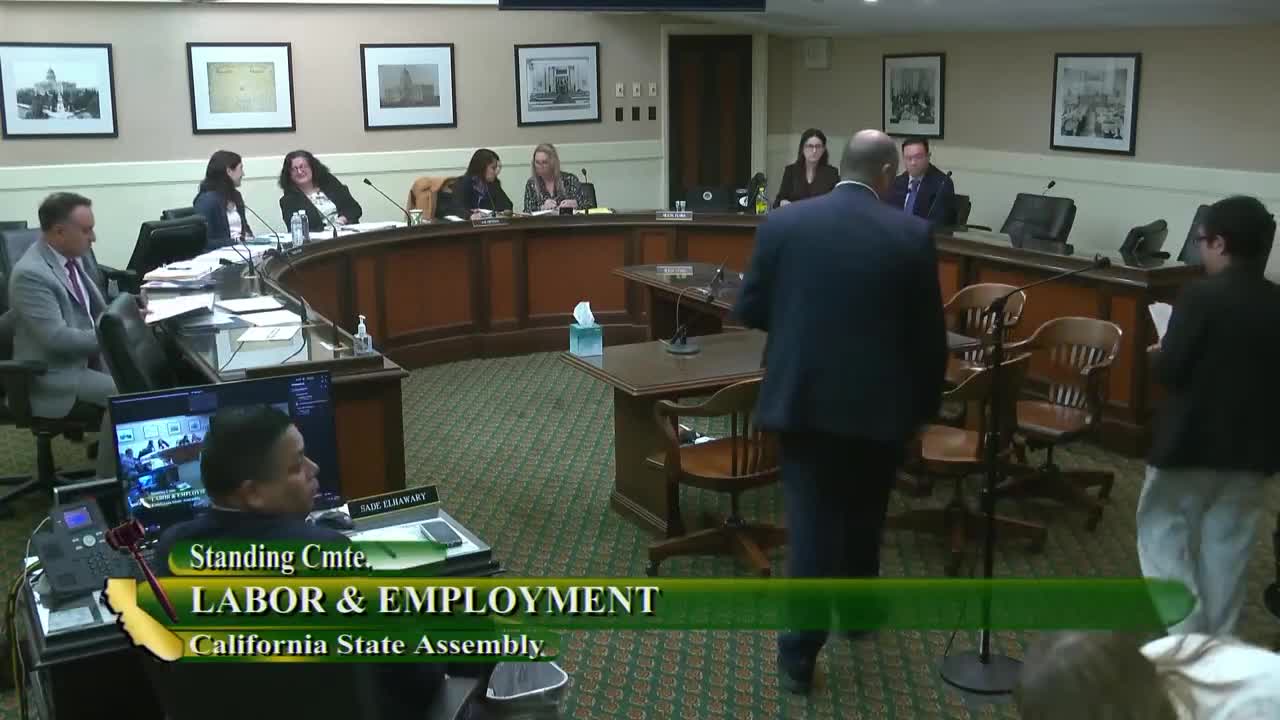 16MIN
Assembly Standing Committee on Labor and Employment
 38MIN
Assembly Standing Committee on Banking and Finance
Bill Author

Bill Co-Author(s):