AB 1384: Summary proceedings for obtaining possession of real property: procedural requirements.
- Session Year: 2025-2026
- House: Assembly
- Latest Version Date: 2025-10-03
Current Status:
Passed
(2025-10-03: Chaptered by Secretary of State - Chapter 299, Statutes of 2025.)
Introduced
In Committee
Awaiting First Chamber Vote
Passed First Chamber
In Committee
Awaiting Second Chamber Vote
Passed Second Chamber
Enacted
Existing law establishes procedures relating to an action for unlawful detainer, and sets timelines regarding the filing of a complaint and the defendants response, including a demurrer or motion to strike, as specified. The hearing on such a motion is required to occur within 5 to 7 court days after its filing, unless good cause is shown, in which case the hearing may occur on a later date on notice prescribed by the court.
This bill would instead limit the courts authority to set a later hearing for a noticed motion. The bill would permit the court to order the hearing held on a later date upon the written stipulation of the parties or upon good cause shown in the case of a residential or commercial tenancy, not to exceed 10 court days after the first date set for a hearing on the motion in the case of a commercial tenancy.
Existing law establishes procedures relating to an action for unlawful detainer, and sets timelines regarding the filing of a complaint and the defendants response, including a demurrer or motion to strike, as specified. The hearing on such a motion is required to occur within 5 to 7 court days after its filing, unless good cause is shown, in which case the hearing may occur on a later date on notice prescribed by the court.
This bill would instead limit the courts authority to set a later hearing for a noticed motion as described above to cases involving a residential tenancy. motion. The bill would permit the court to order the hearing held on a later date upon the written stipulation of the parties or upon good cause shown in the case of a residential or commercial tenancy, not to exceed 10 court days after the first date set for a hearing on the motion in the case of a commercial tenancy.
Existing law establishes procedures relating to an action for unlawful detainer, and sets timelines regarding the filing of a complaint and the defendants response, including a demurrer or motion to strike, as specified. The hearing on such a motion is required to occur within 5 to 7 court days after its filing, unless good cause is shown, in which case the hearing may occur on a later date on notice prescribed by the court.
This bill would instead limit the courts authority to set a later hearing for a noticed motion as described above to cases involving a residential tenancy.
(a)On or before the day fixed for their appearance, the defendant may appear and answer, demur, or move to strike any portion of the complaint.
(b)(1)Notwithstanding any other law, in any action under this chapter in which the defendant demurs or moves to strike the complaint or any portion thereof, the hearing on the motion shall be not less than five court days nor more than seven court days after the filing of the notice of motion. All moving and supporting papers shall accompany the notice of the motion and shall be served in compliance with this section and Section 1010.6 or 1013.
(2)Notwithstanding paragraph (1), the court may order the hearing held on a later date upon the written stipulation of the parties. In the case of a residential tenancy, the court, for good cause shown, may order the hearing held on a later date on notice prescribed by the court. In the case of a commercial tenancy, the court, for good cause shown, may order the hearing held on a later date not to exceed 10 court days after the first date set for a hearing on the motion.
(c)An opposition and reply to an opposition may be made orally at the time of the hearing. If a party seeks to have a written opposition considered in advance of the hearing, the written opposition shall be filed and served on or before the court day before the hearing. Service shall be by personal delivery, electronic service, fax transmission, express mail, or other means consistent with Sections 1010, 1010.6, 1011, 1012, and 1013, and reasonably calculated to ensure delivery to the other party or parties no later than the close of business on the court day before the hearing. The court, in its discretion, may consider written opposition filed later.
(a)On or before the day fixed for their appearance, the defendant may appear and answer, demur, or move to strike any portion of the complaint.
(b)(1)Notwithstanding any other law, in any action under this chapter in which the defendant demurs or moves to strike the complaint or any portion thereof, the hearing on the motion shall be not less than five court days nor more than seven court days after the filing of the notice of motion. For good cause shown, and only in the case of a residential tenancy, the court may order the hearing held on a later date on notice prescribed by the court. All moving and supporting papers shall accompany the notice of the motion and shall be served in compliance with this section and Section 1010.6 or 1013.
(2)Notwithstanding paragraph (1), the court may order the hearing held on a later date upon the written stipulation of the parties. In the case of a residential tenancy, the court, for good cause shown, may order the hearing held on a later date on notice prescribed by the court. In the case of a commercial tenancy, the court, for good cause shown, may order the hearing held on a later date not to exceed 10 court days after the first date set for a hearing on the motion.
(2)(c)An opposition and reply to an opposition may be made orally at the time of the hearing. If a party seeks to have a written opposition considered in advance of the hearing, the written opposition shall be filed and served on or before the court day before the hearing. Service shall be by personal delivery, electronic service, fax transmission, express mail, or other means consistent with Sections 1010, 1010.6, 1011, 1012, and 1013, and reasonably calculated to ensure delivery to the other party or parties no later than the close of business on the court day before the hearing. The court, in its discretion, may consider written opposition filed later.
(a)On or before the day fixed for their appearance, the defendant may appear and answer, demur, or move to strike any portion of the complaint.
(b)(1)Notwithstanding any other law, in any action under this chapter in which the defendant demurs or moves to strike the complaint or any portion thereof, the hearing on the motion shall be not less than five court days nor more than seven court days after the filing of the notice of motion. For good cause shown shown, and only in the case of a residential tenancy, the court may order the hearing held on a later date on notice prescribed by the court. All moving and supporting papers shall accompany the notice of the motion and shall be served in compliance with this section and Section 1010.6 or 1013.
(2)An opposition and reply to an opposition may be made orally at the time of the hearing. If a party seeks to have a written opposition considered in advance of the hearing, the written opposition shall be filed and served on or before the court day before the hearing. Service shall be by personal delivery, electronic service, fax transmission, express mail, or other means consistent with Sections 1010, 1010.6, 1011, 1012, and 1013, and reasonably calculated to ensure delivery to the other party or parties no later than the close of business on the court day before the hearing. The court, in its discretion, may consider written opposition filed later.
|
Date
|
Status
|
|---|---|
| Oct 3, 2025 | Chaptered by Secretary of State - Chapter 299, Statutes of 2025. |
| Oct 3, 2025 | Approved by the Governor. |
| Sep 16, 2025 | Enrolled and presented to the Governor at 2 p.m. |
| Sep 9, 2025 | Senate amendments concurred in. To Engrossing and Enrolling. (Ayes 80. Noes 0. Page 3096.). |
| Sep 3, 2025 | In Assembly. Concurrence in Senate amendments pending. |
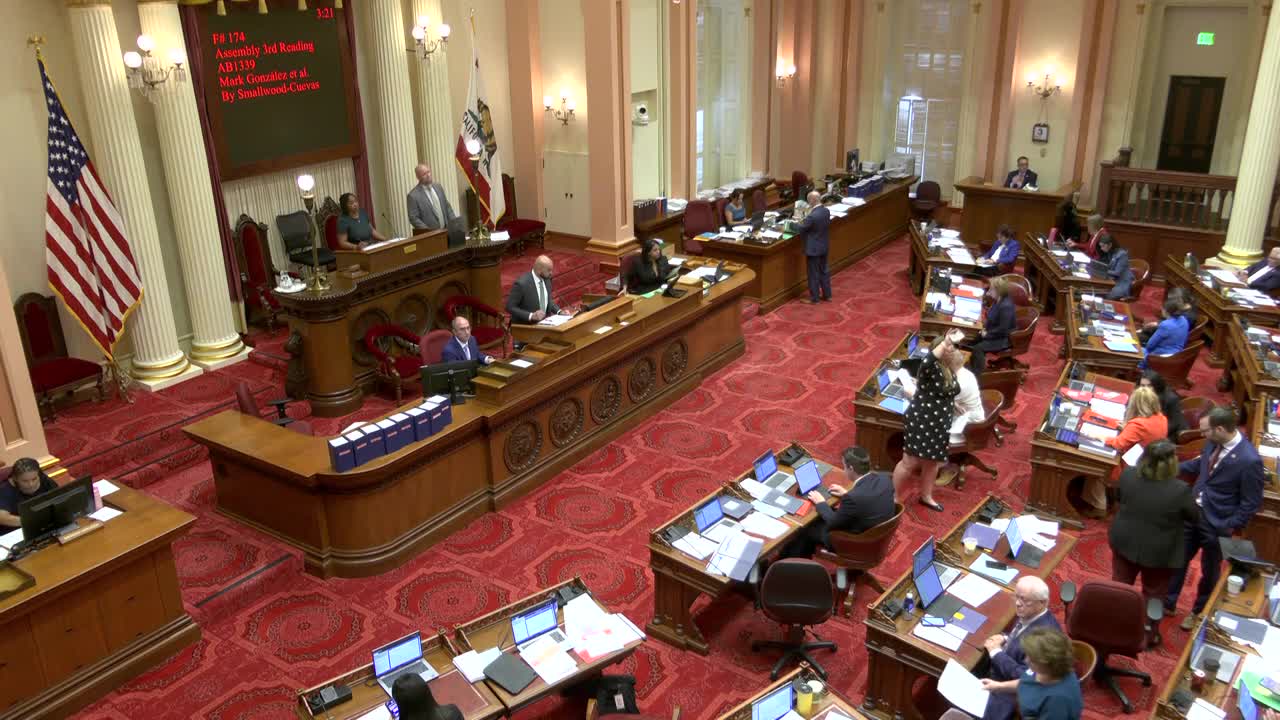
| Sep 3, 2025 | Read third time. Passed. Ordered to the Assembly. (Ayes 40. Noes 0. Page 2448.). |
| Aug 28, 2025 | Read second time. Ordered to third reading. |
| Aug 27, 2025 | Read third time and amended. Ordered to second reading. |
| Jun 26, 2025 | Read second time. Ordered to third reading. |
| Jun 25, 2025 | From committee: Do pass. (Ayes 10. Noes 0.) (June 24). |
| May 7, 2025 | Referred to Com. on JUD. |
| Apr 21, 2025 | In Senate. Read first time. To Com. on RLS. for assignment. |
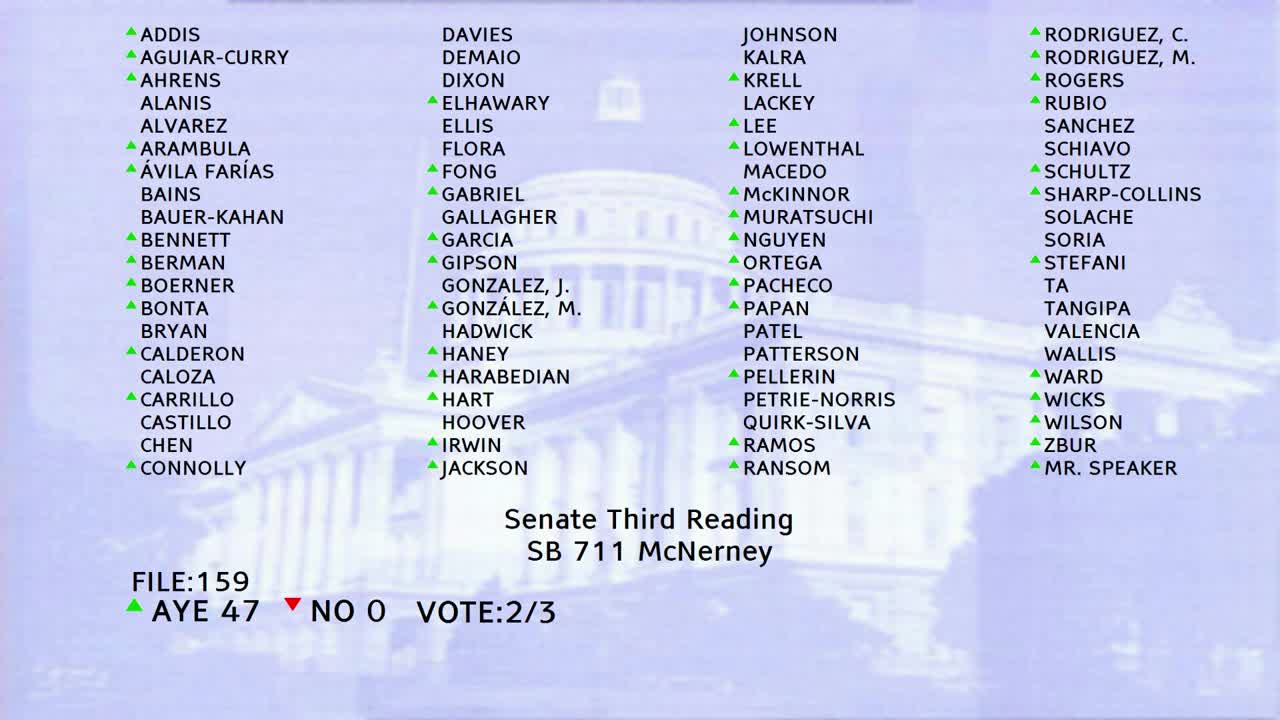
| Apr 21, 2025 | Read third time. Passed. Ordered to the Senate. (Ayes 73. Noes 0. Page 1176.) |
| Apr 9, 2025 | Read second time. Ordered to Consent Calendar. |
| Apr 8, 2025 | From committee: Do pass. To Consent Calendar. (Ayes 12. Noes 0.) (April 8). |
| Mar 13, 2025 | Referred to Com. on JUD. |
| Feb 24, 2025 | Read first time. |
| Feb 22, 2025 | From printer. May be heard in committee March 24. |
| Feb 21, 2025 | Introduced. To print. |
|
Date
|
Description
|
Location
|
Votes
|
|
|---|---|---|---|---|
| Sep 9, 2025 | AB 1384 Nguyen Concurrence in Senate Amendments | Assembly Floor |
Passed |
|
| Sep 3, 2025 | Assembly 3rd Reading AB1384 Nguyen et al. By Richardson | Senate Floor |
Passed |
|
| Jun 24, 2025 | Do pass | Senate Standing Committee on Judiciary |
Passed |
|
| Apr 21, 2025 | AB 1384 Nguyen Consent Calendar Second Day Regular Session | Assembly Floor |
Passed |
|
| Apr 8, 2025 | Do pass. To Consent Calendar. | Assembly Standing Committee on Judiciary |
Passed |
This list shows positions taken on this bill by organizations on the date displayed, which is linked to the original source.
Positions by individuals are not included.
|
Organization
|
Position
|
Date
|
|---|---|---|
| California Business Properties Association (CBPA) | ** Support | |
| Judicial Council | ** Against |
CONCURRENCE IN SENATE AMENDMENTS
CSA1 Bill Id:AB 1384
Author:(Nguyen)
As Amended Ver:August 27, 2025
Majority vote
SUMMARY
Modifies the court's authority to set a hearing date later than the one prescribed by law.
Major Provisions
Permits the court to order the hearing held on a later date upon the written stipulation of the parties or upon good cause shown in the case of a residential or commercial tenancy, not to exceed 10 court days after the first date set for a hearing on the motion in the case of a commercial tenancy.
Senate Amendments
Recast the process by which a court may set a hearing date later than the one prescribed by law, so as to permit the court to order the hearing held on a later date upon the written stipulation of the parties or upon good cause shown in the case of a residential or commercial tenancy, not to exceed 10 court days after the first date set for a hearing on the motion in the case of a commercial tenancy.
COMMENTS
Unlawful Detainer in Residential and Commercial Contexts. When a tenant has been served with a proper eviction notice and then fails to vacate the rental property by the time prescribed in the notice, the owner of the property may bring what is known as an unlawful detainer (UD) action. The UD action is considered a "summary" proceeding, meaning that timelines for filing and responding to the UD complaint, and filing or responding to motions, are greatly accelerated. Most relevant to this bill, existing law requires any hearing on a demurrer or motion to strike to be held within five to seven court days after its filing, unless, for good cause shown, the court sets a later date. Existing law applies these rules to any unlawful detainer action, whether brought to recover a residential or commercial property, notwithstanding the substantially different stakes for a residential versus a commercial tenant.
This bill, which seeks to expedite UD actions brought against commercial tenants, modifies the court's authority to set a hearing date later than the one prescribed by law. Specifically, the bill would permit the court to order the hearing held on a later date upon the written stipulation of the parties or upon good cause shown in the case of a residential or commercial tenancy, not to exceed 10 court days after the first date set for a hearing on the motion in the case of a commercial tenancy.
According to the Author
According to the author, the "current law allows courts to postpone [unlawful detainer] hearings for good cause, without distinguishing between residential and commercial cases." The author believes that while "flexibility is appropriate and necessary in residential tenancy cases to protect tenants, this discretion has led to unintended delays in commercial unlawful detainer cases. These delays result in prolonged vacancies, higher legal fees, and financial strain—particularly harming small, under-resourced, or family-owned businesses and property owners, including many minority-owned enterprises, who often lack the resources to manage extended litigation timelines. These setbacks create barriers to resolving disputes quickly and returning commercial spaces to productive use."
Arguments in Support
The California Business Properties Association (CBPA) supports this "narrowly tailored bill that provides a clarifying technical fix to AB 2347 (Kalra, 2023) regarding hearing timelines in unlawful detainer (UD) proceedings. AB 2347 was enacted to help ensure swift resolution in UD cases by creating standardized timelines for hearings on motions such as demurrers and motions to strike. However, the bill did not distinguish between residential and commercial cases. In the commercial context, where delayed proceedings can result in prolonged vacancies, stalled lease negotiations, and operational uncertainty, timely resolution is essential." This bill, CBPA believes, makes an appropriate distinction.
Arguments in Opposition
The Judicial Council opposes this bill because it "limits the court's authority to set a later hearing for a noticed motion in an action for unlawful detainer cases involving a commercial tenancy. Our courts already have heavily impacted calendars which have only been compounded by a bevy of legislatively mandated accelerated calendaring requirements." The Judicial Council opposes this bill because it limits the court's discretion to calendar cases.
FISCAL COMMENTS
None
VOTES:
ASM JUDICIARY: 12-0-0
YES: Kalra, Dixon, Wicks, Bryan, Connolly, Harabedian, Pacheco, Papan, Sanchez, Stefani, Zbur, Tangipa
ASSEMBLY FLOOR: 73-0-6
YES: Addis, Aguiar-Curry, Ahrens, Alanis, Alvarez, Arambula, Ávila Farías, Bains, Bauer-Kahan, Bennett, Berman, Boerner, Bonta, Bryan, Calderon, Caloza, Carrillo, Castillo, Chen, Connolly, Davies, DeMaio, Dixon, Elhawary, Ellis, Flora, Fong, Gabriel, Garcia, Gipson, Jeff Gonzalez, Mark González, Hadwick, Haney, Harabedian, Hart, Hoover, Irwin, Jackson, Kalra, Krell, Lackey, Lee, Lowenthal, Macedo, McKinnor, Muratsuchi, Nguyen, Ortega, Pacheco, Patel, Patterson, Pellerin, Petrie-Norris, Quirk-Silva, Ransom, Celeste Rodriguez, Michelle Rodriguez, Rogers, Blanca Rubio, Sanchez, Schiavo, Solache, Soria, Stefani, Ta, Tangipa, Wallis, Ward, Wicks, Wilson, Zbur, Rivas
ABS, ABST OR NV: Gallagher, Papan, Ramos, Schultz, Sharp-Collins, Valencia
SENATE FLOOR: 40-0-0
YES: Allen, Alvarado-Gil, Archuleta, Arreguín, Ashby, Becker, Blakespear, Cabaldon, Caballero, Cervantes, Choi, Cortese, Dahle, Durazo, Gonzalez, Grayson, Grove, Hurtado, Jones, Laird, Limón, McGuire, McNerney, Menjivar, Niello, Ochoa Bogh, Padilla, Pérez, Reyes, Richardson, Rubio, Seyarto, Smallwood-Cuevas, Stern, Strickland, Umberg, Valladares, Wahab, Weber Pierson, Wiener
UPDATED
VERSION: August 27, 2025
CONSULTANT: Tom Clark / JUD. / (916) 319-2334 FN: 0001540
SENATE RULES COMMITTEE Office of Senate Floor Analyses (916) 651-1520 Fax: (916) 327-4478 | AB 1384 |
THIRD READING
Bill No: AB 1384
Author: Nguyen (D), et al.
Amended: 8/27/25 in Senate
Vote: 21
SENATE JUDICIARY COMMITTEE: 10-0, 6/24/25
AYES: Umberg, Niello, Allen, Arreguín, Ashby, Durazo, Laird, Stern, Weber Pierson, Wiener
NO VOTE RECORDED: Caballero, Valladares, Wahab
ASSEMBLY FLOOR: 73-0, 4/21/25 (Consent) - See last page for vote
SUBJECT: Summary proceedings for obtaining possession of real property: procedural requirements
SOURCE: California Business Properties Association
DIGEST:
This bill specifies that a hearing on a motion to demur or strike in an unlawful detainer action may be held at a later date beyond seven court days from the filing of the notice of the motion upon the written stipulation of the parties, and permits the court, in the case of an unlawful detainer of a commercial tenancy, to hold the hearing, upon good cause shown, on a later date not to exceed 10 court days after the original hearing date.
Senate Floor Amendments of 8/27/25 remove its previous provisions that exempted commercial tenancies from provisions that permit the court to delay a hearing on a motion to demur or strike for good cause shown, and instead insert provisions that permit the court to order a hearing on a motion to demur or strike be held on a later date than the time required by statute upon written stipulation of the parties, and that permit the court, in the case of a commercial tenancy, to hold the hearing, upon good cause shown, on a later date not to exceed 10 court days after the original hearing date.
ANALYSIS:
Existing law:
- Establishes summary civil proceedings by which landlords may seek a court order for the eviction of tenants from their rental property, for specified reasons. (Code of Civil Procedure (Code Civ. Proc.) §§ 1159 et seq.)
- Requires that a defendant’s response in a summary proceeding to obtain real property must be filed within ten days, excluding Saturdays and Sundays and other judicial holidays, after the complaint is served upon the defendant. (Code Civ. Proc. § 1167(a).)
- Provides that, if a defendant in an unlawful detainer proceeding appears, and a request to set the case for trial is made, the trial of the proceeding must be held within 20 days of the date of the request for a hearing. Provides that the judge may extend the period for trial upon the agreement of all of the parties. (Code Civ. Proc. § 1170.5.)
- Specifies that a motion for summary judgment may be made at any time after the answer is filed, upon giving five days’ notice. Summary judgment shall be granted or denied on the same basis as a motion under Code of Civil Procedure Section 437. (Code Civ. Proc. § 1170.7.)
- Provides that all moving and supporting papers shall be served and filed at least 16 court days before a hearing, and that the moving and supporting papers served shall be a copy of the papers filed or to be filed with the court. (Code Civ. Proc. § 1005 (b).)
- Provides that a tenant has committed unlawful detainer when they continue in possession of the property without the landlord's permission after:
- The tenant remains in possession of the premises after the expiration of the term of the tenancy without permission of the landlord or otherwise not permitted by law;
- The tenant's nonpayment of rent and service of a 3-day notice to pay or quit, stating the amount that is due;
- The tenant has breached a covenant of the lease or failed to perform other conditions under the lease, and after service of a 3-day notice requiring performance of such covenants or conditions;
- The tenant has breached a covenant of the lease prohibiting subletting, assignment, or waste; has committed or permitted a nuisance on the premises; or used the premises for an unlawful purpose; or
- the tenant gives written notice of the tenant’s intention to terminate the tenancy, but fails to deliver possession of the premises to the landlord at the specified time. (Code Civ. Proc. § 1161.)
- Provides that, on or before the day fixed for their appearance, a defendant in an unlawful detainer action may appear and answer, demur, or move to strike any portion of the complaint. (Code Civ. Proc. § 1170.)
- Specifies that, in any unlawful detainer action in which the defendant demurs or moves to strike the complaint or any portion of it, the hearing on the demurrer or motion must be held no less than five court days or more than seven court days after the filing of the notice of motion. Specifies that, for good cause shown, the court may order the hearing to be held on a later date, as specified. (Code Civ. Proc. § 1170(b)(1).)
This bill:
- Permits the court to order a hearing on a motion to demur or strike be held on a later date upon the written stipulation of the parties.
- Permits, in the case of an unlawful detainer of a commercial tenancy, the court to order the hearing be held on a later date, for good cause shown, not later than 10 court days after the first date set for the hearing on the motion.
Comments
The unlawful detainer process for residential and commercial tenants. In order to ensure that a tenant’s rights are respected and they have an opportunity to be heard before being forced out of the property that they rent, California law closely prescribes when a landlord may evict a tenant and the process that must be followed to do so. Almost all forced evictions in the residential and commercial context must take place through a judicial process, called an unlawful detainer. A tenant is guilty of an unlawful detainer and subject to eviction if they: remain on the property beyond the expiration of the lease without the landlord’s permission; default on rent and fail to pay what they owe within three days of receiving notice from the landlord; violate a term of the rental agreement without correcting the violation within three days of notice; commit waste or a nuisance on the property; or remain on the property after they terminate the lease or surrender the lease. (Code Civ. Proc. § 1161.)
In order to evict a tenant, a landlord must file an unlawful detainer action and request a judicial order that the tenant be evicted. An unlawful detainer proceeding is very similar to standard civil proceedings, though with significantly shortened timelines. A defendant must file a response to the unlawful detainer complaint within 10 court days of being served with the complaint, for example, while in standard civil proceedings, the defendant is provided 30 days to respond to a complaint. (Code Civ. Proc. §§ 1167 and 1167.3; 412.20; 430.40; 471.5.) Generally, a defendant may either answer the complaint by conceding or contesting the allegations in the complaint, or they can demur. (Code Civ. Proc. § 1170.) A demurrer alleges that the complaint is legally deficient, such as by failing to state a cognizable claim, rather than challenging the factual allegations in the complaint. A demurrer may be sustained with leave to amend, such that the plaintiff can re-file their complaint stating sufficient facts to state a claim, or it may be sustained without leave to amend, in which case the case is dismissed. If a defendant answers the landlord’s complaint, and requests a trial, the trial must be held within 20 days of the request for a trial, unless extended by agreement of the parties. (Code Civ. Proc. § 1170.5.) Parties in unlawful detainer proceedings may also file motions for summary judgement, make motions for discovery, file a motion to strike portions of the complaint, and conduct depositions. (Code Civ. Proc. §§ 1170, 1170.7, 1170.8.) In each of these contexts, the timelines for notice are also shortened.
If the judge or the jury rules for the landlord, the court will issue a writ of possession, and the sheriff will notify the tenant that they have five days to vacate the premises before being forcibly removed. If the tenant wins the case, they will be allowed to remain in the premises, and may even be owed money from the landlord.
Previous attempts to create a statutory timeline for hearings on motions to demur or strike in an unlawful detainer case. Prior to this year, state law provided no specific timeline for a court to hold a hearing regarding motions to demur or strike that are filed in response to an unlawful detainer case. Instead, the California Rules of Court provided that demurrers must be set for a hearing within 35 days of the filing of the demurrer, or on the first date available to the court thereafter. (Cal. Rules of Court 3.1320(d).) That rule also provided that, for good cause shown, the court may order the hearing on the demurrer to be held either earlier or later than the date set for the hearing.
Last year, the author of this bill authored a similar bill, AB 3196 (Nguyen, 2024). That bill would have required, for commercial unlawful detainer cases, a hearing on a motion to demur be held within 20 court days of the filing of the motion. It would not have permitted this hearing to be delayed beyond that 20-day timeline in any circumstance, unlike the rule contained in the Rules of Court. Similar to this bill, the author for AB 3196 cited examples of commercial unlawful detainer cases where hearings on the motion to demur were not scheduled for two, four, five, or seven months after the filing of the motion to demur as reason for why the change was needed. AB 3196 was held in the Senate Appropriations Committee.
However, another bill from last year that did create a statutory timeline for demurrer motions was enacted into law. That bill was AB 2347 (Lee, Chapter 512, Statutes of 2024), though its primary purpose was to extend the period of time a tenant has to respond to the unlawful detainer complaint from five to ten days. In addition to this change, AB 2347 also specified that a hearing on a motion to demur or strike must be held within five to seven court days of the filing of notice of the motion. (Code Civ. Proc. § 1170). This timeline is significantly shorter than the timeline required by the Rules of Court, though it also included an exception to allow for delays for good cause. The changes made by AB 2347 have only been law since the beginning of this year.
FISCAL EFFECT: Appropriation: No Fiscal Com.: No Local: No
SUPPORT: (Verified 8/27/25)
California Business Properties Association (Source)
OPPOSITION: (Verified 8/27/25)
Judicial Council of California
ARGUMENTS IN SUPPORT:
According to the California Business Properties Association, which is the sponsor of AB 1384:
AB 2347 was enacted to help ensure swift resolution in UD cases by creating standardized timelines for hearings on motions such as demurrers and motions to strike. However, the bill did not distinguish between residential and commercial cases. In the commercial context, where delayed proceedings can result in prolonged vacancies, stalled lease negotiations, and operational uncertainty, timely resolution is essential.
AB 1384 simply clarifies that the “good cause” delay provision established in AB 2347 applies only to residential UD cases. Commercial cases would continue to follow the 5-to-7 court day hearing window. Courts still retain full authority to manage their calendars under Code of Civil Procedure Section 128(a)(8), and we are amenable to language allowing continuances where both parties submit a written stipulation.
This is a straightforward technical fix to ensure AB 2347 is implemented as intended. That’s why AB 1384 passed both the Assembly Floor and Assembly Judiciary Committee on consent, with bipartisan support.
ARGUMENTS IN OPPOSITION:
According to the Judicial Council, which is opposed to AB 1384:
The Judicial Council opposes Assembly Bill 1384 because it limits the court’s authority to set a later hearing for a noticed motion in an action for unlawful detainer cases involving a commercial tenancy. Our courts already have heavily impacted calendars which have only been compounded by a bevy of legislatively mandated accelerated calendaring requirements. Because this bill would entirely eliminate the court’s discretion to set a later hearing in these cases, even for good cause shown, the Judicial Council is opposed to AB 1284.
ASSEMBLY FLOOR: 73-0, 4/21/25
AYES: Addis, Aguiar-Curry, Ahrens, Alanis, Alvarez, Arambula, Ávila Farías, Bains, Bauer-Kahan, Bennett, Berman, Boerner, Bonta, Bryan, Calderon, Caloza, Carrillo, Castillo, Chen, Connolly, Davies, DeMaio, Dixon, Elhawary, Ellis, Flora, Fong, Gabriel, Garcia, Gipson, Jeff Gonzalez, Mark González, Hadwick, Haney, Harabedian, Hart, Hoover, Irwin, Jackson, Kalra, Krell, Lackey, Lee, Lowenthal, Macedo, McKinnor, Muratsuchi, Nguyen, Ortega, Pacheco, Patel, Patterson, Pellerin, Petrie-Norris, Quirk-Silva, Ransom, Celeste Rodriguez, Michelle Rodriguez, Rogers, Blanca Rubio, Sanchez, Schiavo, Solache, Soria, Stefani, Ta, Tangipa, Wallis, Ward, Wicks, Wilson, Zbur, Rivas
NO VOTE RECORDED: Gallagher, Papan, Ramos, Schultz, Sharp-Collins, Valencia
Prepared by: Ian Dougherty / JUD. / (916) 651-4113
8/28/25 16:49:55
**** END ****
SENATE RULES COMMITTEE Office of Senate Floor Analyses (916) 651-1520 Fax: (916) 327-4478 | AB 1384 |
THIRD READING
Bill No: AB 1384
Author: Nguyen (D), et al.
Introduced: 2/21/25
Vote: 21
SENATE JUDICIARY COMMITTEE: 10-0, 6/24/25
AYES: Umberg, Niello, Allen, Arreguín, Ashby, Durazo, Laird, Stern, Weber Pierson, Wiener
NO VOTE RECORDED: Caballero, Valladares, Wahab
ASSEMBLY FLOOR: 73-0, 4/21/25 (Consent) - See last page for vote
SUBJECT: Summary proceedings for obtaining possession of real property: procedural requirements
SOURCE: California Business Properties Association
DIGEST:
This bill specifies that a hearing on a motion to demur or strike in an unlawful detainer action may only be delayed beyond seven court days from the filing of the notice of motion for good cause in an unlawful detainer action involving a commercial tenancy.
ANALYSIS:
Existing law:
- Establishes summary civil proceedings by which landlords may seek a court order for the eviction of tenants from their rental property, for specified reasons. (Code Civil (Civ.) Procedure (Proc.) §§ 1159 et seq.)
- Requires that a defendant’s response in a summary proceeding to obtain real property must be filed within ten days, excluding Saturdays and Sundays and other judicial holidays, after the complaint is served upon the defendant. (Code Civ. Proc. § 1167(a).)
- Provides that, if a defendant in an unlawful detainer proceeding appears, and a request to set the case for trial is made, the trial of the proceeding must be held within 20 days of the date of the request for a hearing. Provides that the judge may extend the period for trial upon the agreement of all of the parties. (Code Civ. Proc. § 1170.5.)
- Specifies that a motion for summary judgment may be made at any time after the answer is filed, upon giving five days’ notice. Summary judgment shall be granted or denied on the same basis as a motion under Code of Civil Procedure Section 437. (Code Civ. Proc. § 1170.7.)
- Provides that all moving and supporting papers shall be served and filed at least 16 court days before a hearing, and that the moving and supporting papers served shall be a copy of the papers filed or to be filed with the court. (Code Civ. Proc. § 1005 (b).)
- Provides that a tenant has committed unlawful detainer when they continue in possession of the property without the landlord's permission after:
- The tenant remains in possession of the premises after the expiration of the term of the tenancy without permission of the landlord or otherwise not permitted by law;
- The tenant's nonpayment of rent and service of a 3-day notice to pay or quit, stating the amount that is due;
- The tenant has breached a covenant of the lease or failed to perform other conditions under the lease, and after service of a 3-day notice requiring performance of such covenants or conditions;
- The tenant has breached a covenant of the lease prohibiting subletting, assignment, or waste; has committed or permitted a nuisance on the premises; or used the premises for an unlawful purpose; or
- The tenant gives written notice of the tenant’s intention to terminate the tenancy, but fails to deliver possession of the premises to the landlord at the specified time. (Code Civ. Proc. § 1161.)
- Provides that, on or before the day fixed for their appearance, a defendant in an unlawful detainer action may appear and answer, demur, or move to strike any portion of the complaint. (Code Civ. Proc. § 1170.)
- Specifies that, in any unlawful detainer action in which the defendant demurs or moves to strike the complaint or any portion of it, the hearing on the demurrer or motion must be held no less than five court days or more than seven court days after the filing of the notice of motion. Specifies that, for good cause shown, the court may order the hearing to be held on a later date, as specified. (Code Civ. Proc. § 1170(b)(1).)
COMMENTS:
The unlawful detainer process for residential and commercial tenants. This bill specifies that the provision in 8), above, for the delay of a hearing on a motion to demur or strike for good cause shown, only applies in an unlawful detainer action involving a residential tenancy.
In order to ensure that a tenant’s rights are respected and they have an opportunity to be heard before being forced out of the property that they rent, California law closely prescribes when a landlord may evict a tenant and the process that must be followed to do so. Almost all forced evictions in the residential and commercial context must take place through a judicial process, called an unlawful detainer. A tenant is guilty of an unlawful detainer and subject to eviction if they: remain on the property beyond the expiration of the lease without the landlord’s permission; default on rent and fail to pay what they owe within three days of receiving notice from the landlord; violate a term of the rental agreement without correcting the violation within three days of notice; commit waste or a nuisance on the property; or remain on the property after they terminate the lease or surrender the lease. (Code Civ. Proc. § 1161.)
The unlawful detainer process is governed by Code of Civil Procedure Sections 1159 to 1179. These sets of laws and procedures recognize the importance to tenants of their rented property, whether they are renting it as their residence or for their business, and the significant disruption that eviction poses to both residential and commercial tenants. When a residential tenant is evicted, the consequences can be dire, as they can become homeless and have to expend significant financial resources for any temporary housing, to move their possessions, and to find new housing. For commercial tenants, eviction can mean a significant interruption to their business operations at the least, and the shuttering of their business in the worst instances. When a local small business closes, the impacts are also felt throughout the community, and it can contribute to the gentrification and displacement that many working-class communities of color have experienced in recent decades. However, to balance these interests with the interests of landlords to be able to promptly re-rent their properties if the current tenant is not paying rent or subject to eviction, the unlawful detainer process is also a summary proceeding, meaning that it is a streamlined, fast-tracked judicial proceeding that is given priority among superior courts’ civil cases. In fact, unlawful detainers are meant to take precedence in courts’ civil dockets so that all unlawful detainer actions are quickly heard and determined. (Code Civ. Proc. § 1179a.)
In order to evict a tenant, a landlord must file an unlawful detainer action and request a judicial order that the tenant be evicted. An unlawful detainer proceeding is very similar to standard civil proceedings, though with significantly shortened timelines. A defendant must file a response to the unlawful detainer complaint within 10 court days of being served with the complaint, for example, while in standard civil proceedings, the defendant is provided 30 days to respond to a complaint. (Code Civ. Proc. §§ 1167 and 1167.3; 412.20; 430.40; 471.5.) Generally, a defendant may either answer the complaint by conceding or contesting the allegations in the complaint, or they can demur. (Code Civ. Proc. § 1170.) A demurrer alleges that the complaint is legally deficient, such as by failing to state a cognizable claim, rather than challenging the factual allegations in the complaint. A demurrer may be sustained with leave to amend, such that the plaintiff can re-file their complaint stating sufficient facts to state a claim, or it may be sustained without leave to amend, in which case the case is dismissed. If a defendant answers the landlord’s complaint, and requests a trial, the trial must be held within 20 days of the request for a trial, unless extended by agreement of the parties. (Code Civ. Proc. § 1170.5.) Parties in unlawful detainer proceedings may also file motions for summary judgement, make motions for discovery, file a motion to strike portions of the complaint, and conduct depositions. (Code Civ. Proc. §§ 1170, 1170.7, 1170.8.) In each of these contexts, the timelines for notice are also shortened.
If the judge or the jury rules for the landlord, the court will issue a writ of possession, and the sheriff will notify the tenant that they have five days to vacate the premises before being forcibly removed. If the tenant wins the case, they will be allowed to remain in the premises, and may even be owed money from the landlord.
Previous attempts to create a statutory timeline for hearings on motions to demur or strike in an unlawful detainer case. Prior to this year, state law provided no specific timeline for a court to hold a hearing regarding motions to demur or strike that are filed in response to an unlawful detainer case. Instead, the California Rules of Court provided that demurrers must be set for a hearing within 35 days of the filing of the demurrer, or on the first date available to the court thereafter. (Cal. Rules of Court 3.1320(d).) That rule also provided that, for good cause shown, the court may order the hearing on the demurrer to be held either earlier or later than the date set for the hearing.
Last year, the author of this bill authored a similar bill, AB 3196 (Nguyen, 2024). That bill would have required, for commercial unlawful detainer cases, a hearing on a motion to demur be held within 20 court days of the filing of the motion. It would not have permitted this hearing to be delayed beyond that 20-day timeline in any circumstance, unlike the rule contained in the Rules of Court. Similar to this bill, the author for AB 3196 cited examples of commercial unlawful detainer cases where hearings on the motion to demur were not scheduled for two, four, five, or seven months after the filing of the motion to demur as reason for why the change was needed. While AB 3196 passed this Committee, it was held in the Senate Appropriations Committee.
However, another bill from last year that did create a statutory timeline for demurrer motions was enacted into law. That bill was AB 2347 (Lee, Chapter 512, Statutes of 2024), though its primary purpose was to extend the period of time a tenant has to respond to the unlawful detainer complaint from five to ten days. In addition to this change, AB 2347 also specified that a hearing on a motion to demur or strike must be held within five to seven court days of the filing of notice of the motion. (Code Civ. Proc. § 1170). This timeline is significantly shorter than the timeline required by the Rules of Court, though it also included an exception to allow for delays for good cause. The changes made by AB 2347 have only been law since the beginning of this year.
FISCAL EFFECT: Appropriation: No Fiscal Com.: No Local: No
SUPPORT: (Verified 6/26/25)
California Business Properties Association (source)
OPPOSITION: (Verified 6/26/25)
Judicial Council of California
ARGUMENTS IN SUPPORT:
According to the California Business Properties Association, which is the sponsor of AB 1384:
AB 2347 was enacted to help ensure swift resolution in UD cases by creating standardized timelines for hearings on motions such as demurrers and motions to strike. However, the bill did not distinguish between residential and commercial cases. In the commercial context, where delayed proceedings can result in prolonged vacancies, stalled lease negotiations, and operational uncertainty, timely resolution is essential.
AB 1384 simply clarifies that the “good cause” delay provision established in AB 2347 applies only to residential UD cases. Commercial cases would continue to follow the 5-to-7 court day hearing window. Courts still retain full authority to manage their calendars under Code of Civil Procedure Section 128(a)(8), and we are amenable to language allowing continuances where both parties submit a written stipulation.
This is a straightforward technical fix to ensure AB 2347 is implemented as intended. That’s why AB 1384 passed both the Assembly Floor and Assembly Judiciary Committee on consent, with bipartisan support.
ARGUMENTS IN OPPOSITION:
According to the Judicial Council, which is opposed to AB 1384:
The Judicial Council opposes Assembly Bill 1384 because it limits the court’s authority to set a later hearing for a noticed motion in an action for unlawful detainer cases involving a commercial tenancy. Our courts already have heavily impacted calendars which have only been compounded by a bevy of legislatively mandated accelerated calendaring requirements. Because this bill would entirely eliminate the court’s discretion to set a later hearing in these cases, even for good cause shown, the Judicial Council is opposed to AB 1384.
ASSEMBLY FLOOR: 73-0, 4/21/25
AYES: Addis, Aguiar-Curry, Ahrens, Alanis, Alvarez, Arambula, Ávila Farías, Bains, Bauer-Kahan, Bennett, Berman, Boerner, Bonta, Bryan, Calderon, Caloza, Carrillo, Castillo, Chen, Connolly, Davies, DeMaio, Dixon, Elhawary, Ellis, Flora, Fong, Gabriel, Garcia, Gipson, Jeff Gonzalez, Mark González, Hadwick, Haney, Harabedian, Hart, Hoover, Irwin, Jackson, Kalra, Krell, Lackey, Lee, Lowenthal, Macedo, McKinnor, Muratsuchi, Nguyen, Ortega, Pacheco, Patel, Patterson, Pellerin, Petrie-Norris, Quirk-Silva, Ransom, Celeste Rodriguez, Michelle Rodriguez, Rogers, Blanca Rubio, Sanchez, Schiavo, Solache, Soria, Stefani, Ta, Tangipa, Wallis, Ward, Wicks, Wilson, Zbur, Rivas
NO VOTE RECORDED: Gallagher, Papan, Ramos, Schultz, Sharp-Collins, Valencia
Prepared by: Ian Dougherty / JUD. / (916) 651-4113
7/8/25 9:12:59
**** END ****
SENATE RULES COMMITTEE Office of Senate Floor Analyses (916) 651-1520 Fax: (916) 327-4478 | AB 1384 |
THIRD READING
Bill No: AB 1384
Author: Nguyen (D), et al.
Introduced: 2/21/25
Vote: 21
SENATE JUDICIARY COMMITTEE: 10-0, 6/24/25
AYES: Umberg, Niello, Allen, Arreguín, Ashby, Durazo, Laird, Stern, Weber Pierson, Wiener
NO VOTE RECORDED: Caballero, Valladares, Wahab
ASSEMBLY FLOOR: 73-0, 4/21/25 (Consent) - See last page for vote
SUBJECT: Summary proceedings for obtaining possession of real property: procedural requirements
SOURCE: California Business Properties Association
DIGEST:
This bill specifies that a hearing on a motion to demur or strike in an unlawful detainer action may only be delayed beyond seven court days from the filing of the notice of motion for good cause in an unlawful detainer action involving a commercial tenancy.
ANALYSIS:
Existing law:
- Establishes summary civil proceedings by which landlords may seek a court order for the eviction of tenants from their rental property, for specified reasons. (Code Civil (Civ.) Procedure (Proc.) §§ 1159 et seq.)
- Requires that a defendant’s response in a summary proceeding to obtain real property must be filed within ten days, excluding Saturdays and Sundays and other judicial holidays, after the complaint is served upon the defendant. (Code Civ. Proc. § 1167(a).)
- Provides that, if a defendant in an unlawful detainer proceeding appears, and a request to set the case for trial is made, the trial of the proceeding must be held within 20 days of the date of the request for a hearing. Provides that the judge may extend the period for trial upon the agreement of all of the parties. (Code Civ. Proc. § 1170.5.)
- Specifies that a motion for summary judgment may be made at any time after the answer is filed, upon giving five days’ notice. Summary judgment shall be granted or denied on the same basis as a motion under Code of Civil Procedure Section 437. (Code Civ. Proc. § 1170.7.)
- Provides that all moving and supporting papers shall be served and filed at least 16 court days before a hearing, and that the moving and supporting papers served shall be a copy of the papers filed or to be filed with the court. (Code Civ. Proc. § 1005 (b).)
- Provides that a tenant has committed unlawful detainer when they continue in possession of the property without the landlord's permission after:
- The tenant remains in possession of the premises after the expiration of the term of the tenancy without permission of the landlord or otherwise not permitted by law;
- The tenant's nonpayment of rent and service of a 3-day notice to pay or quit, stating the amount that is due;
- The tenant has breached a covenant of the lease or failed to perform other conditions under the lease, and after service of a 3-day notice requiring performance of such covenants or conditions;
- The tenant has breached a covenant of the lease prohibiting subletting, assignment, or waste; has committed or permitted a nuisance on the premises; or used the premises for an unlawful purpose; or
- The tenant gives written notice of the tenant’s intention to terminate the tenancy, but fails to deliver possession of the premises to the landlord at the specified time. (Code Civ. Proc. § 1161.)
- Provides that, on or before the day fixed for their appearance, a defendant in an unlawful detainer action may appear and answer, demur, or move to strike any portion of the complaint. (Code Civ. Proc. § 1170.)
- Specifies that, in any unlawful detainer action in which the defendant demurs or moves to strike the complaint or any portion of it, the hearing on the demurrer or motion must be held no less than five court days or more than seven court days after the filing of the notice of motion. Specifies that, for good cause shown, the court may order the hearing to be held on a later date, as specified. (Code Civ. Proc. § 1170(b)(1).)
COMMENTS:
The unlawful detainer process for residential and commercial tenants. This bill specifies that the provision in 8), above, for the delay of a hearing on a motion to demur or strike for good cause shown, only applies in an unlawful detainer action involving a residential tenancy.
In order to ensure that a tenant’s rights are respected and they have an opportunity to be heard before being forced out of the property that they rent, California law closely prescribes when a landlord may evict a tenant and the process that must be followed to do so. Almost all forced evictions in the residential and commercial context must take place through a judicial process, called an unlawful detainer. A tenant is guilty of an unlawful detainer and subject to eviction if they: remain on the property beyond the expiration of the lease without the landlord’s permission; default on rent and fail to pay what they owe within three days of receiving notice from the landlord; violate a term of the rental agreement without correcting the violation within three days of notice; commit waste or a nuisance on the property; or remain on the property after they terminate the lease or surrender the lease. (Code Civ. Proc. § 1161.)
The unlawful detainer process is governed by Code of Civil Procedure Sections 1159 to 1179. These sets of laws and procedures recognize the importance to tenants of their rented property, whether they are renting it as their residence or for their business, and the significant disruption that eviction poses to both residential and commercial tenants. When a residential tenant is evicted, the consequences can be dire, as they can become homeless and have to expend significant financial resources for any temporary housing, to move their possessions, and to find new housing. For commercial tenants, eviction can mean a significant interruption to their business operations at the least, and the shuttering of their business in the worst instances. When a local small business closes, the impacts are also felt throughout the community, and it can contribute to the gentrification and displacement that many working-class communities of color have experienced in recent decades. However, to balance these interests with the interests of landlords to be able to promptly re-rent their properties if the current tenant is not paying rent or subject to eviction, the unlawful detainer process is also a summary proceeding, meaning that it is a streamlined, fast-tracked judicial proceeding that is given priority among superior courts’ civil cases. In fact, unlawful detainers are meant to take precedence in courts’ civil dockets so that all unlawful detainer actions are quickly heard and determined. (Code Civ. Proc. § 1179a.)
In order to evict a tenant, a landlord must file an unlawful detainer action and request a judicial order that the tenant be evicted. An unlawful detainer proceeding is very similar to standard civil proceedings, though with significantly shortened timelines. A defendant must file a response to the unlawful detainer complaint within 10 court days of being served with the complaint, for example, while in standard civil proceedings, the defendant is provided 30 days to respond to a complaint. (Code Civ. Proc. §§ 1167 and 1167.3; 412.20; 430.40; 471.5.) Generally, a defendant may either answer the complaint by conceding or contesting the allegations in the complaint, or they can demur. (Code Civ. Proc. § 1170.) A demurrer alleges that the complaint is legally deficient, such as by failing to state a cognizable claim, rather than challenging the factual allegations in the complaint. A demurrer may be sustained with leave to amend, such that the plaintiff can re-file their complaint stating sufficient facts to state a claim, or it may be sustained without leave to amend, in which case the case is dismissed. If a defendant answers the landlord’s complaint, and requests a trial, the trial must be held within 20 days of the request for a trial, unless extended by agreement of the parties. (Code Civ. Proc. § 1170.5.) Parties in unlawful detainer proceedings may also file motions for summary judgement, make motions for discovery, file a motion to strike portions of the complaint, and conduct depositions. (Code Civ. Proc. §§ 1170, 1170.7, 1170.8.) In each of these contexts, the timelines for notice are also shortened.
If the judge or the jury rules for the landlord, the court will issue a writ of possession, and the sheriff will notify the tenant that they have five days to vacate the premises before being forcibly removed. If the tenant wins the case, they will be allowed to remain in the premises, and may even be owed money from the landlord.
Previous attempts to create a statutory timeline for hearings on motions to demur or strike in an unlawful detainer case. Prior to this year, state law provided no specific timeline for a court to hold a hearing regarding motions to demur or strike that are filed in response to an unlawful detainer case. Instead, the California Rules of Court provided that demurrers must be set for a hearing within 35 days of the filing of the demurrer, or on the first date available to the court thereafter. (Cal. Rules of Court 3.1320(d).) That rule also provided that, for good cause shown, the court may order the hearing on the demurrer to be held either earlier or later than the date set for the hearing.
Last year, the author of this bill authored a similar bill, AB 3196 (Nguyen, 2024). That bill would have required, for commercial unlawful detainer cases, a hearing on a motion to demur be held within 20 court days of the filing of the motion. It would not have permitted this hearing to be delayed beyond that 20-day timeline in any circumstance, unlike the rule contained in the Rules of Court. Similar to this bill, the author for AB 3196 cited examples of commercial unlawful detainer cases where hearings on the motion to demur were not scheduled for two, four, five, or seven months after the filing of the motion to demur as reason for why the change was needed. While AB 3196 passed this Committee, it was held in the Senate Appropriations Committee.
However, another bill from last year that did create a statutory timeline for demurrer motions was enacted into law. That bill was AB 2347 (Lee, Chapter 512, Statutes of 2024), though its primary purpose was to extend the period of time a tenant has to respond to the unlawful detainer complaint from five to ten days. In addition to this change, AB 2347 also specified that a hearing on a motion to demur or strike must be held within five to seven court days of the filing of notice of the motion. (Code Civ. Proc. § 1170). This timeline is significantly shorter than the timeline required by the Rules of Court, though it also included an exception to allow for delays for good cause. The changes made by AB 2347 have only been law since the beginning of this year.
FISCAL EFFECT: Appropriation: No Fiscal Com.: No Local: No
SUPPORT: (Verified 6/26/25)
California Business Properties Association (source)
OPPOSITION: (Verified 6/26/25)
Judicial Council of California
ARGUMENTS IN SUPPORT:
According to the California Business Properties Association, which is the sponsor of AB 1384:
AB 2347 was enacted to help ensure swift resolution in UD cases by creating standardized timelines for hearings on motions such as demurrers and motions to strike. However, the bill did not distinguish between residential and commercial cases. In the commercial context, where delayed proceedings can result in prolonged vacancies, stalled lease negotiations, and operational uncertainty, timely resolution is essential.
AB 1384 simply clarifies that the “good cause” delay provision established in AB 2347 applies only to residential UD cases. Commercial cases would continue to follow the 5-to-7 court day hearing window. Courts still retain full authority to manage their calendars under Code of Civil Procedure Section 128(a)(8), and we are amenable to language allowing continuances where both parties submit a written stipulation.
This is a straightforward technical fix to ensure AB 2347 is implemented as intended. That’s why AB 1384 passed both the Assembly Floor and Assembly Judiciary Committee on consent, with bipartisan support.
ARGUMENTS IN OPPOSITION:
According to the Judicial Council, which is opposed to AB 1384:
The Judicial Council opposes Assembly Bill 1384 because it limits the court’s authority to set a later hearing for a noticed motion in an action for unlawful detainer cases involving a commercial tenancy. Our courts already have heavily impacted calendars which have only been compounded by a bevy of legislatively mandated accelerated calendaring requirements. Because this bill would entirely eliminate the court’s discretion to set a later hearing in these cases, even for good cause shown, the Judicial Council is opposed to AB 1284.
ASSEMBLY FLOOR: 73-0, 4/21/25
AYES: Addis, Aguiar-Curry, Ahrens, Alanis, Alvarez, Arambula, Ávila Farías, Bains, Bauer-Kahan, Bennett, Berman, Boerner, Bonta, Bryan, Calderon, Caloza, Carrillo, Castillo, Chen, Connolly, Davies, DeMaio, Dixon, Elhawary, Ellis, Flora, Fong, Gabriel, Garcia, Gipson, Jeff Gonzalez, Mark González, Hadwick, Haney, Harabedian, Hart, Hoover, Irwin, Jackson, Kalra, Krell, Lackey, Lee, Lowenthal, Macedo, McKinnor, Muratsuchi, Nguyen, Ortega, Pacheco, Patel, Patterson, Pellerin, Petrie-Norris, Quirk-Silva, Ransom, Celeste Rodriguez, Michelle Rodriguez, Rogers, Blanca Rubio, Sanchez, Schiavo, Solache, Soria, Stefani, Ta, Tangipa, Wallis, Ward, Wicks, Wilson, Zbur, Rivas
NO VOTE RECORDED: Gallagher, Papan, Ramos, Schultz, Sharp-Collins, Valencia
Prepared by: Ian Dougherty / JUD. / (916) 651-4113
6/26/25 16:11:42
**** END ****
Senator Thomas Umberg, Chair
2025-2026 Regular Session
Bill No: AB 1384 (Author:Nguyen)
Version: February 21, 2025
Hearing Date: June 24, 2025
Fiscal: No
Urgency: No
Consultant: ID
SUBJECT
Summary proceedings for obtaining possession of real property: procedural requirements
DIGEST
This bill specifies that a hearing on a motion to demur or strike in an unlawful detainer action may only be delayed beyond seven court days from the filing of the notice of motion for good cause in an unlawful detainer action involving a commercial tenancy.
EXECUTIVE SUMMARY
Unlawful detainer proceedings are streamlined, summary proceedings meant to balance a tenant’s rights and ability to be heard before being evicted with a landlord’s interests in promptly resolving the dispute and regaining possession of the property. Current law prescribes a specific process for an unlawful detainer proceeding that utilizes expedited timelines, including that a hearing on an unlawful detainer complaint must be held within 20 days of a request for a trial. When a defendant tenant demurs to the unlawful detainer complaint, in which they challenge the legal sufficiency of the complaint, or when they make a motion to strike all or any portion of the unlawful detainer complaint, current law requires the hearing on that motion be held no earlier than five court days and no later than seven court days from the filing of the notice of motion. However, current law allows such a hearing to be delayed beyond those timelines for good cause shown. Due to concerns with delays in commercial unlawful detainer cases, AB 1384 proposes to specify that the provision allowing delay for good cause any unlawful detainer action is only available in an unlawful detainer action involving a residential tenancy. AB 1384 is sponsored by the California Business Properties Association. It is opposed by the Judicial Council of California, which is concerned that the bill would provide judges no discretion to set a later hearing.
PROPOSED CHANGES TO THE LAW
Existing law:
- Establishes summary civil proceedings by which landlords may seek a court order for the eviction of tenants from their rental property, for specified reasons. (Code Civ. Proc. §§ 1159 et seq.)
- Requires that a defendant’s response in a summary proceeding to obtain real property must be filed within ten days, excluding Saturdays and Sundays and other judicial holidays, after the complaint is served upon the defendant. (Code Civ. Proc. § 1167(a).)
- Provides that, if a defendant in an unlawful detainer proceeding appears, and a request to set the case for trial is made, the trial of the proceeding must be held within 20 days of the date of the request for a hearing. Provides that the judge may extend the period for trial upon the agreement of all of the parties. (Code Civ. Proc. § 1170.5.)
- Specifies that a motion for summary judgment may be made at any time after the answer is filed, upon giving five days’ notice. Summary judgment shall be granted or denied on the same basis as a motion under Code of Civil Procedure Section 437. (Code Civ. Proc. § 1170.7.)
- Provides that all moving and supporting papers shall be served and filed at least 16 court days before a hearing, and that the moving and supporting papers served shall be a copy of the papers filed or to be filed with the court. (Code Civ. Proc. § 1005 (b).)
- Provides that a tenant has committed unlawful detainer when they continue in possession of the property without the landlord's permission after:
- the tenant remains in possession of the premises after the expiration of the term of the tenancy without permission of the landlord or otherwise not permitted by law;
- the tenant's nonpayment of rent and service of a 3-day notice to pay or quit, stating the amount that is due;
- the tenant has breached a covenant of the lease or failed to perform other conditions under the lease, and after service of a 3-day notice requiring performance of such covenants or conditions;
- the tenant has breached a covenant of the lease prohibiting subletting, assignment, or waste; has committed or permitted a nuisance on the premises; or used the premises for an unlawful purpose; or
- the tenant gives written notice of the tenant’s intention to terminate the tenancy, but fails to deliver possession of the premises to the landlord at the specified time. (Code Civ. Proc. § 1161.)
- Provides that, on or before the day fixed for their appearance, a defendant in an unlawful detainer action may appear and answer, demur, or move to strike any portion of the complaint. (Code Civ. Proc. § 1170.)
- Specifies that, in any unlawful detainer action in which the defendant demurs or moves to strike the complaint or any portion of it, the hearing on the demurrer or motion must be held no less than five court days or more than seven court days after the filing of the notice of motion. Specifies that, for good cause shown, the court may order the hearing to be held on a later date, as specified. (Code Civ. Proc. § 1170(b)(1).)
This bill specifies that the provision in (8), above, for the delay of a hearing on a motion to demur or strike for good cause shown, only applies in an unlawful detainer action involving a residential tenancy.
COMMENTS
- Author’s statement
According to the author:
AB 1384 makes a narrow but important clarification to ensure that the “good cause” delay provision established under AB 2347 (Kalra, 2023) applies only to residential unlawful detainer cases—not commercial ones. This change preserves vital tenant protections while ensuring that commercial eviction proceedings can continue in a timely and efficient manner.
AB 2347 was designed to protect tenants from abrupt displacement by allowing courts to delay initial hearings for good cause. However, applying this same provision to commercial unlawful detainer actions has created unintended consequences. Commercial leases are negotiated business-to-business, often with legal representation, and extended legal delays in these cases can result in significant financial harm—particularly to small property owners and commercial tenants.
AB 1384 ensures that judicial discretion remains in residential cases, where housing stability is at stake, but reaffirms that commercial cases must follow the existing 5- to 7-court-day hearing timeline. This protects timely resolution of lease disputes and avoids unnecessary disruptions in the commercial sector.
Small, family- and minority-owned property owners and businesses are the backbone of the economy in my district. California’s 10th Assembly District is more than 65% minority, with vibrant Hispanic, Asian, and African-American communities. In the heart of AD 10 lies Little Saigon, where many immigrant-owned commercial properties are struggling with a range of challenges—including ongoing economic recovery, public safety issues, and the impacts of homeless encampments. These small property owners are doing their best to maintain their buildings, support their tenants, and contribute to the local economy, but they simply don’t have the financial resources to weather long legal delays.
When commercial unlawful detainer cases are delayed unnecessarily, it can mean weeks or even months of unpaid rent, unresolved property access, and mounting uncertainty. These are burdens that small immigrant- and minority-owned property owners and businesses cannot afford to carry. Without timely resolution, these challenges can compound and threaten the stability of entire business corridors—especially in underserved and working-class communities.
AB 1384 makes an important clarification following the passage of AB 2347 to ensure that the original intent of that bill is preserved and that we do not unintentionally create new hardships for small, mom-and-pop, minority-owned property owners and businesses who are already under tremendous economic pressure.
- The unlawful detainer process for residential and commercial tenants
In order to ensure that a tenant’s rights are respected and they have an opportunity to be heard before being forced out of the property that they rent, California law closely prescribes when a landlord may evict a tenant and the process that must be followed to do so. Almost all forced evictions in the residential and commercial context must take place through a judicial process, called an unlawful detainer. A tenant is guilty of an unlawful detainer and subject to eviction if they: remain on the property beyond the expiration of the lease without the landlord’s permission; default on rent and fail to pay what they owe within three days of receiving notice from the landlord; violate a term of the rental agreement without correcting the violation within three days of notice; commit waste or a nuisance on the property; or remain on the property after they terminate the lease or surrender the lease. (Code Civ. Proc. § 1161.)
The unlawful detainer process is governed by Code of Civil Procedure Sections 1159 to 1179. These sets of laws and procedures recognize the importance to tenants of their rented property, whether they are renting it as their residence or for their business, and the significant disruption that eviction poses to both residential and commercial tenants. When a residential tenant is evicted, the consequences can be dire, as they can become homeless and have to expend significant financial resources for any temporary housing, to move their possessions, and to find new housing. For commercial tenants, eviction can mean a significant interruption to their business operations at the least, and the shuttering of their business in the worst instances. When a local small business closes, the impacts are also felt throughout the community, and it can contribute to the gentrification and displacement that many working-class communities of color have experienced in recent decades. However, to balance these interests with the interests of landlords to be able to promptly re-rent their properties if the current tenant is not paying rent or subject to eviction, the unlawful detainer process is also a summary proceeding, meaning that it is a streamlined, fast-tracked judicial proceeding that is given priority among superior courts’ civil cases. In fact, unlawful detainers are meant to take precedence in courts’ civil dockets so that all unlawful detainer actions are quickly heard and determined. (Code Civ. Proc. § 1179a.)
In order to evict a tenant, a landlord must file an unlawful detainer action and request a judicial order that the tenant be evicted. An unlawful detainer proceeding is very similar to standard civil proceedings, though with significantly shortened timelines. A defendant must file a response to the unlawful detainer complaint within 10 court days of being served with the complaint, for example, while in standard civil proceedings, the defendant is provided 30 days to respond to a complaint. (Code Civ. Proc. §§ 1167 and 1167.3; 412.20; 430.40; 471.5.) Generally, a defendant may either answer the complaint by conceding or contesting the allegations in the complaint, or they can demur. (Code Civ. Proc. § 1170.) A demurrer alleges that the complaint is legally deficient, such as by failing to state a cognizable claim, rather than challenging the factual allegations in the complaint. A demurrer may be sustained with leave to amend, such that the plaintiff can re-file their complaint stating sufficient facts to state a claim, or it may be sustained without leave to amend, in which case the case is dismissed. If a defendant answers the landlord’s complaint, and requests a trial, the trial must be held within 20 days of the request for a trial, unless extended by agreement of the parties. (Code Civ. Proc. § 1170.5.) Parties in unlawful detainer proceedings may also file motions for summary judgement, make motions for discovery, file a motion to strike portions of the complaint, and conduct depositions. (Code Civ. Proc. §§ 1170, 1170.7, 1170.8.) In each of these contexts, the timelines for notice are also shortened.
If the judge or the jury rules for the landlord, the court will issue a writ of possession, and the sheriff will notify the tenant that they have five days to vacate the premises before being forcibly removed. If the tenant wins the case, they will be allowed to remain in the premises, and may even be owed money from the landlord.
- Previous attempts to create a statutory timeline for hearings on motions to demur or strike in an unlawful detainer case
Prior to this year, state law provided no specific timeline for a court to hold a hearing regarding motions to demur or strike that are filed in response to an unlawful detainer case. Instead, the California Rules of Court provided that demurrers must be set for a hearing within 35 days of the filing of the demurrer, or on the first date available to the court thereafter. (Cal. Rules of Court 3.1320(d).) That rule also provided that, for good cause shown, the court may order the hearing on the demurrer to be held either earlier or later than the date set for the hearing.
Last year, the author of this bill authored a similar bill, AB 3196 (Nguyen, 2024). That bill would have required, for commercial unlawful detainer cases, a hearing on a motion to demur be held within 20 court days of the filing of the motion. It would not have permitted this hearing to be delayed beyond that 20-day timeline in any circumstance, unlike the rule contained in the Rules of Court. Similar to this bill, the author for AB 3196 cited examples of commercial unlawful detainer cases where hearings on the motion to demur were not scheduled for two, four, five, or seven months after the filing of the motion to demur as reason for why the change was needed. While AB 3196 passed this Committee, it was held in the Senate Appropriations Committee.
However, another bill from last year that did create a statutory timeline for demurrer motions was enacted into law. That bill was AB 2347 (Lee, Ch. 512, Stats. 2024), though its primary purpose was to extend the period of time a tenant has to respond to the unlawful detainer complaint from five to ten days. In addition to this change, AB 2347 also specified that a hearing on a motion to demur or strike must be held within five to seven court days of the filing of notice of the motion. (Code Civ. Proc. § 1170). This timeline is significantly shorter than the timeline required by the Rules of Court, though it also included an exception to allow for delays for good cause. The changes made by AB 2347 have only been law since the beginning of this year.
- AB 1384 would require courts to hear motions to demur or strike in commercial unlawful detainers within five to seven court days, in all instances
AB 1384 proposes to remove this “good cause” option for a commercial unlawful detainer case. The author asserts that this is necessary to ensure the timely resolution of commercial unlawful detainer cases, and points to the same examples of commercial unlawful detainer cases that have experienced months of delay waiting for a hearing on the motion to demur as were the justification for AB 3196. They assert that delays in commercial unlawful detainer cases result in unpaid rent, unresolved property access, and mounting uncertainty for the landlord.
The Judicial Council has raised concerns that AB 1384’s strict timeline limits the court’s authority to set a later hearing on a motion to demur or strike if needed. They cite to the fact that courts already have heavily impacted calendars, which are even more impacted by mandated accelerated calendaring requirements.
AB 2347 already created a significantly accelerated timeline for motions to demur or strike, yet struck a balance with courts’ need to manage their calendars, and the needs of the parties, by permitting delay when there is good cause. The effects of this law are only beginning to be seen. By eliminating the good cause option for commercial unlawful detainer cases, AB 1384 would require hearings on motions to demur or strike be held within the five to seven day timeline in all circumstances, regardless of whether the parties agree, or the court needs a delay. While judges have inherent authority under statute and the Constitution to control the processes of their court, they may not do so in a manner that is inconsistent with or contravenes statute. (Traveler’s Casualty & Surety Co. v. Superior Court (2005) 126 Cal. Ap. 4th 1131, 1144.) Thus, judges would be required to comply with AB 1384’s timeline, regardless of any limitations or impracticalities faced by the court. AB 1384 also would give commercial unlawful detainer cases, when a motion to demur or strike is filed, significant precedence on a court’s calendar over other matters that do not have such statutory mandates.
- Arguments in support
According to the California Business Properties Association, which is the sponsor of AB 1384:
AB 2347 was enacted to help ensure swift resolution in UD cases by creating standardized timelines for hearings on motions such as demurrers and motions to strike. However, the bill did not distinguish between residential and commercial cases. In the commercial context, where delayed proceedings can result in prolonged vacancies, stalled lease negotiations, and operational uncertainty, timely resolution is essential.
AB 1384 simply clarifies that the “good cause” delay provision established in AB 2347 applies only to residential UD cases. Commercial cases would continue to follow the 5-to-7 court day hearing window. Courts still retain full authority to manage their calendars under Code of Civil Procedure Section 128(a)(8), and we are amenable to language allowing continuances where both parties submit a written stipulation.
This is a straightforward technical fix to ensure AB 2347 is implemented as intended. That’s why AB 1384 passed both the Assembly Floor and Assembly Judiciary Committee on consent, with bipartisan support.
- Arguments in opposition
According to the Judicial Council, which is opposed to AB 1384:
The Judicial Council opposes Assembly Bill 1384 because it limits the court’s authority to set a later hearing for a noticed motion in an action for unlawful detainer cases involving a commercial tenancy. Our courts already have heavily impacted calendars which have only been compounded by a bevy of legislatively mandated accelerated calendaring requirements. Because this bill would entirely eliminate the court’s discretion to set a later hearing in these cases, even for good cause shown, the Judicial Council is opposed to AB 1284.
SUPPORT
California Business Properties Association (sponsor)
OPPOSITION
Judicial Council of California
RELATED LEGISLATION
Pending Legislation:
SB 610 (Wahab, 2025) extends the notice periods and deadlines for various notices related to the termination of a tenancy or an unlawful detainer action, as specified, in any county in which a state of emergency is declared, and makes a number of other changes to landlord-tenant and mobilehome law in the context of disasters. SB 610 is currently pending before the Assembly Housing and Community Development Committee.
SB 436 (Wahab, 2025) extends the “pay or quit” notice period required to be given by a landlord to a tenant for the nonpayment of rent before the landlord may bring an unlawful detainer action from three to fourteen days. AB 436 is currently pending before the Assembly Judiciary Committee.
AB 1521 (Assembly Committee on the Judiciary, 2025) changes various timelines for specified discovery in unlawful detainer actions to 10 days after the service of the summon on or appearance by the party from which discovery is requested. AB 1521 is currently pending before this Committee.
Prior Legislation:
SB 1103 (Menjivar, Ch. 1015, Stats. 2024) applied various tenant protections for residential tenants to commercial, small business tenants, as defined, and created transparency requirements for operating costs fees charged to such tenants.
AB 3196 (Nguyen, 2024) would have required motions to demur in unlawful detainer proceedings relating to commercial property to be heard within 20 court days of the filing of the demurrer. AB 3196 died in the Senate Appropriations Committee. See Comment 3.
AB 2347 (Lee, Ch. 512, Stats. 2024) expanded the time that a tenant has to file an answer to an unlawful detainer from five days to ten days, specified that a hearing on a demurrer or motion to strike must be held within five to seven court days from the filing of the notice of motion, and clarified that all moving and supporting papers must accompany the notice of the motion. See Comment 3.
PRIOR VOTES:
Assembly Floor (Ayes 73, Noes 0)
Assembly Judiciary Committee (Ayes 12, Noes 0)
**************
Discussed in Hearing
 45SEC
Assembly Floor
 1MIN
Senate Floor
 2MIN
Senate Standing Committee on Judiciary
Bill Author


