AB 14: Coastal resources: Protecting Blue Whales and Blue Skies Program.
- Session Year: 2025-2026
- House: Assembly
- Latest Version Date: 2025-10-11
Current Status:
Passed
(2025-10-11: Chaptered by Secretary of State - Chapter 606, Statutes of 2025.)
Introduced
In Committee
Awaiting First Chamber Vote
Passed First Chamber
In Committee
Awaiting Second Chamber Vote
Passed Second Chamber
Enacted
Existing law establishes the Ocean Protection Council in state government to, among other things, establish policies to coordinate the collection, evaluation, and sharing of scientific data related to coastal and ocean resources among agencies. Existing law requires the council to develop and implement a voluntary sustainable seafood promotion program for the state, to consist of specified components, including a competitive grant and loan program for eligible entities, including, but not limited to, fishery groups and associations, for the purpose of assisting California fisheries in qualifying for certification to internationally accepted standards for sustainable seafood.
This bill would, subject to the availability of funding, require the council to participate, as a stakeholder and in an advisory capacity, in the Protecting Blue Whales and Blue Skies Program with air pollution control districts and air quality management districts along the coast and other stakeholders to support, in an advisory capacity, coastal air districts in their efforts to implement a statewide voluntary vessel speed reduction and sustainable shipping program for the California coast in order to reduce air pollution, the risk of fatal vessel strikes on whales, and harmful underwater acoustic impacts. The bill would authorize the expansion of the existing Protecting Blue Whales and Blue Skies Program to include specified components, including incentives to program participants based on a percentage of distance traveled by a participating vessel at a reduced speed, as provided. The bill would limit application of the program to vessels that are 300 gross tons or greater. The bill would require the participating air pollution control districts and air quality management districts, on or before December 31, 2029, to submit a report to the Legislature regarding the implementation of the program.
Existing law establishes the Ocean Protection Council in state government to, among other things, establish policies to coordinate the collection, evaluation, and sharing of scientific data related to coastal and ocean resources among agencies. Existing law requires the council to develop and implement a voluntary sustainable seafood promotion program for the state, to consist of specified components, including a competitive grant and loan program for eligible entities, including, but not limited to, fishery groups and associations, for the purpose of assisting California fisheries in qualifying for certification to internationally accepted standards for sustainable seafood.
This bill would, subject to the availability of funding, require the council to participate as a stakeholder, participate, as a stakeholder and in an advisory capacity, to in the Protecting Blue Whales and Blue Skies Program with air pollution control districts and air quality management districts along the coast and other stakeholders to support, in an advisory capacity, coastal air districts in their efforts to implement a statewide voluntary vessel speed reduction and sustainable shipping program for the California coast in order to reduce air pollution, the risk of fatal vessel strikes on whales, and harmful underwater acoustic impacts. The bill would authorize the expansion of the existing Protecting Blue Whales and Blue Skies Program to include specified components, including incentives to program participants based on a percentage of distance traveled by a participating vessel at a reduced speed, as provided. The bill would limit application of the program to vessels that are 300 gross tons or greater. The bill would require the participating air pollution control districts and air quality management districts, on or before December 31, 2029, to submit a report to the Legislature regarding the implementation of the program.
Existing law establishes the Ocean Protection Council in state government to, among other things, establish policies to coordinate the collection, evaluation, and sharing of scientific data related to coastal and ocean resources among agencies. Existing law requires the council to develop and implement a voluntary sustainable seafood promotion program for the state, to consist of specified components, including a competitive grant and loan program for eligible entities, including, but not limited to, fishery groups and associations, for the purpose of assisting California fisheries in qualifying for certification to internationally accepted standards for sustainable seafood.
This bill would, subject to the availability of funding, require the council to participate as a stakeholder, and in an advisory capacity, to the Protecting Blue Whales and Blue Skies Program with air pollution control districts and air quality management districts along the coast and other stakeholders to support, in an advisory capacity, coastal air districts in their efforts to implement a statewide voluntary vessel speed reduction and sustainable shipping program for the California coast in order to reduce air pollution, the risk of fatal vessel strikes on whales, and harmful underwater acoustic impacts. The bill would authorize the expansion of the existing Protecting Blue Whales and Blue Skies Program to include specified components, including incentives to program participants based on a percentage of distance traveled by a participating vessel at a reduced speed, as provided. The bill would limit application of the program to vessels that are 300 gross tons or greater. The bill would require the participating air pollution control districts and air quality management districts, on or before December 31, 2029, to submit a report to the Legislature regarding the implementation of the program.
The Legislature finds and declares all of the following:
(a)Californias seaports are North Americas primary intermodal gateway to Asia and Transpacific trade. Maritime industry activities at Californias public seaports are responsible for employing more than 500,000 people in the state. Nationwide, more than 2,000,000 jobs are linked to maritime industry business conducted at Californias public seaports, contributing to California having the largest state economy in the United States.
(b)Every year, the oceangoing vessels make thousands of transits along the California coast, with an estimated 162 tons per day of nitrogen oxides, an ozone precursor, being emitted along the coast. These emissions negatively affect the public health of coastal communities and contribute to causing some areas of the coast to be in nonattainment with the national ambient air quality standards for ozone and particulate matter.
(c)Since 2014, the Santa Barbara County Air Pollution Control District, the Ventura County Air Pollution Control District, the Bay Area Air Quality Management District, the Monterey Bay Air Resources District, and the San Luis Obispo County Air Pollution Control District, with the federal Office of National Marine Sanctuaries, marine sanctuary foundations, and environmental groups, have administered and promoted the Protecting Blue Whales and Blue Skies Program, a voluntary vessel speed reduction program off the San Francisco Bay, central coast, and south coast to encourage transit speeds of 10 knots or less to reduce air pollution, the risk of harmful whale strikes, and the level of ocean noise.
(d)Since its inception through 2024, the Protecting Blue Whales and Blue Skies Program has provided small incentives and publicity to program participants and has achieved 1,596,008 slow speed miles, a reduction of 5,903 tons of nitrogen oxides, a reduction of 204,661 metric tons of regional greenhouse gas emissions, a reduction of more than 35 tons of toxic diesel particulate matter, and an estimated 50 percent decreased risk of whale strikes during prime migration season in the affected coastal areas.
(e)This highly cost-effective voluntary pollution reduction program benefits public health, protects the marine ecosystem, and showcases the beneficial partnership between shipping companies, public health agencies, marine sanctuaries, and environmental organizations.
(f)Expansion of the vessel speed reduction program to other areas of the California coast, including the San Diego coast and the North Coast, would yield additional public health and ecosystem benefits.
35641.(a)The Legislature finds and declares that expansion of the Protecting Blue Whales and Blue Skies Program by local air pollution control districts and air quality management districts and stakeholders is a critical strategy in advancing protection of marine mammals through partnerships that also support the maritime industry and local public health.
(b)Subject to the availability of funding, the council shall participate, as a stakeholder and in an advisory capacity, in the Protecting Blue Whales and Blue Skies Program with air pollution control districts and air quality management districts along the coast and other stakeholders, including the federal Office of National Marine Sanctuaries, the United States Environmental Protection Agency, the United States Navy, the United States Coast Guard, and the maritime industry, to support, in an advisory capacity, coastal air districts in their efforts to implement a statewide voluntary vessel speed reduction and sustainable shipping program for the California coast in order to reduce air pollution, the risk of fatal vessel strikes on whales, and harmful underwater acoustic impacts.
(c)Expansion of the existing Protecting Blue Whales and Blue Skies Program by local air pollution control districts and air quality management districts shall be a single unified program, and may include all of the following components developed in a manner that is consistent with how the program components were developed for the Protecting Blue Whales and Blue Skies Program:
(1)A marketing program to engage cargo owners and other commercial interests to promote voluntary vessel speed reduction and sustainable shipping, and an acknowledgment of the programs participants.
(2)Data collection on ship speeds along the California coast in order to analyze the program for future refinement, expansion, or both.
(3)Data collection on underwater acoustic impacts or fatal vessel strikes on whales, to the extent data is available.
(4)Data collection on the regional air quality impacts on the coast and impacts to air quality in coastal disadvantaged communities from oceangoing vessel traffic, as collected and provided by the regional air pollution control districts and air quality management districts.
(5)Incentives to program participants based on a percentage of distance traveled by a participating vessel at a reduced speed, including speed zones at 10 knots or less, to the extent that local or federal funding is available.
(6)Development of vessel speed reduction zones along the coast that take into account navigational safety, protected marine mammal migration and breeding seasons, federal marine sanctuaries and state marine protected areas, shipping lanes, and any other relevant variables.
(7)Seasonality of the program.
(8)Description of covered vessels.
(d)The program shall supplement, work in conjunction with, and not preclude any other existing port-related vessel speed reduction programs.
(e)The program shall only apply to vessels that are 300 gross tons or greater.
(f)(1)On or before December 31, 2029, the participating air pollution control districts and air quality management districts shall submit a report to the Legislature regarding the implementation of the program.
(2)The report required in paragraph (1) shall be submitted in compliance with Section 9795 of the Government Code.
(3)Pursuant to Section 10231.5 of the Government Code, the requirement for submitting a report imposed by paragraph (1) is inoperative on December 31, 2033.
(g)The program and each component of the program are based upon voluntary actions initiated by entities pursuant to this section and are not regulations as defined in Section 11342.600 of the Government Code, and shall not be implemented in a way that conflicts with federal law and regulations.
The Legislature finds and declares all of the following:
(a)Californias seaports are North Americas primary intermodal gateway to Asia and Transpacific trade. Maritime industry activities at Californias public seaports are responsible for employing more than 500,000 people in the state. Nationwide, more than 2,000,000 jobs are linked to maritime industry business conducted at Californias public seaports, contributing to California having the largest state economy in the United States.
(b)Every year, the oceangoing vessels make thousands of transits along the California coast, with an estimated 162 tons per day of nitrogen oxides, an ozone precursor, being emitted along the coast. These emissions negatively affect the public health of coastal communities and contribute to causing some areas of the coast to be in nonattainment with the national ambient air quality standards for ozone and particulate matter.
(c)Since 2014, the Santa Barbara County Air Pollution Control District, the Ventura County Air Pollution Control District, the Bay Area Air Quality Management District, the Monterey Bay Air Resources District, and the San Luis Obispo County Air Pollution Control District, with the federal Office of National Marine Sanctuaries, marine sanctuary foundations, and environmental groups, have administered and promoted the Protecting Blue Whales and Blue Skies Program, a voluntary vessel speed reduction program off the San Francisco Bay, central coast, and south coast to encourage transit speeds of 10 knots or less to reduce air pollution, the risk of harmful whale strikes, and the level of ocean noise.
(d)Since its inception through 2024, the Protecting Blue Whales and Blue Skies Program has provided small incentives and publicity to program participants and has achieved 1,596,008 slow speed miles, a reduction of 5,903 tons of nitrogen oxides, a reduction of 204,661 metric tons of regional greenhouse gas emissions, a reduction of more than 35 tons of toxic diesel particulate matter, and an estimated 50 percent decreased risk of whale strikes during prime migration season in the affected coastal areas.
(e)This highly cost-effective voluntary pollution reduction program benefits public health, protects the marine ecosystem, and showcases the beneficial partnership between shipping companies, public health agencies, marine sanctuaries, and environmental organizations.
(f)Expansion of the vessel speed reduction program to other areas of the California coast, including the San Diego coast and the North Coast, would yield additional public health and ecosystem benefits.
35641.(a)The Legislature finds and declares that expansion of the Protecting Blue Whales and Blue Skies Program by local air pollution control districts and air quality management districts and stakeholders is a critical strategy in advancing protection of marine mammals through partnerships that also support the maritime industry and local public health.
(b)Subject to the availability of funding, the council shall participate, as a stakeholder and in an advisory capacity, in the Protecting Blue Whales and Blue Skies Program with air pollution control districts and air quality management districts along the coast and other stakeholders, including the federal Office of National Marine Sanctuaries, the United States Environmental Protection Agency, the United States Navy, the United States Coast Guard, and the maritime industry, to support, in an advisory capacity, coastal air districts in their efforts to implement a statewide voluntary vessel speed reduction and sustainable shipping program for the California coast in order to reduce air pollution, the risk of fatal vessel strikes on whales, and harmful underwater acoustic impacts.
(c)Expansion of the existing Protecting Blue Whales and Blue Skies Program by local air pollution control districts and air quality management districts shall be a single unified program, and may include all of the following components developed in a manner that is consistent with how the program components were developed for the Protecting Blue Whales and Blue Skies Program:
(1)A marketing program to engage cargo owners and other commercial interests to promote voluntary vessel speed reduction and sustainable shipping, and an acknowledgment of the programs participants.
(2)Data collection on ship speeds along the California coast in order to analyze the program for future refinement, expansion, or both.
(3)Data collection on underwater acoustic impacts or fatal vessel strikes on whales, to the extent data is available.
(4)Data collection on the regional air quality impacts on the coast and impacts to air quality in coastal disadvantaged communities from oceangoing vessel traffic, as collected and provided by the regional air pollution control districts and air quality management districts.
(5)Incentives to program participants based on a percentage of distance traveled by a participating vessel at a reduced speed, including speed zones at 10 knots or less, to the extent that local or federal funding is available.
(6)Development of vessel speed reduction zones along the coast that take into account navigational safety, protected marine mammal migration and breeding seasons, federal marine sanctuaries and state marine protected areas, shipping lanes, and any other relevant variables.
(7)Seasonality of the program.
(8)Description of covered vessels.
(d)The program shall supplement, and work in conjunction with, and not preclude any other existing port-related vessel speed reduction programs. If any conflicting requirements emerge that cannot be resolved through a memorandum of understanding, the Protecting Blue Whales and Blues Skies Program shall exclude the ocean territory within 40 nautical miles of the affected port.
(e)The program shall only apply to vessels that are 300 gross tons or greater.
(f)(1)On or before December 31, 2029, the participating air pollution control districts and air quality management districts shall submit a report to the Legislature regarding the implementation of the program.
(2)The report required in paragraph (1) shall be submitted in compliance with Section 9795 of the Government Code.
(3)Pursuant to Section 10231.5 of the Government Code, the requirement for submitting a report imposed by paragraph (1) is inoperative on December 31, 2033.
(g)The program and each component of the program are based upon voluntary actions initiated by entities pursuant to this section and are not regulations as defined in Section 11342.600 of the Government Code, and shall not be implemented in a way that conflicts with federal law and regulations.
The Legislature finds and declares all of the following:
(a)Californias seaports are North Americas primary intermodal gateway to Asia and Transpacific trade. Maritime industry activities at Californias public seaports are responsible for employing more than 500,000 people in the state. Nationwide, more than 2,000,000 jobs are linked to maritime industry business conducted at Californias public seaports, contributing to California having the largest state economy in the United States.
(b)Every year, the oceangoing vessels make thousands of transits along the California coast, with an estimated 162 tons per day of nitrogen oxides, an ozone precursor, being emitted along the coast. These emissions negatively affect the public health of coastal communities and contribute to causing some areas of the coast to be in nonattainment with the national ambient air quality standards for ozone and particulate matter.
(c)Since 2014, the Santa Barbara County Air Pollution Control District, the Ventura County Air Pollution Control District, the Bay Area Air Quality Management District, the Monterey Bay Air Resources District, and the San Luis Obispo County Air Pollution Control District, with the federal Office of National Marine Sanctuaries, marine sanctuary foundations, and environmental groups, have administered and promoted the Protecting Blue Whales and Blue Skies Program, a voluntary vessel speed reduction program off the San Francisco Bay, central coast, and south coast to encourage transit speeds of 10 knots or less to reduce air pollution, the risk of harmful whale strikes, and the level of ocean noise.
(d)Since its inception through 2024, the Protecting Blue Whales and Blue Skies Program has provided small incentives and publicity to program participants and has achieved 1,596,008 slow speed miles, a reduction of 5,903 tons of nitrogen oxides, a reduction of 204,661 metric tons of regional greenhouse gas emissions, a reduction of more than 35 tons of toxic diesel particulate matter, and an estimated 50 percent decreased risk of whale strikes during prime migration season in the affected coastal areas.
(e)This highly cost-effective voluntary pollution reduction program benefits public health, protects the marine ecosystem, and showcases the beneficial partnership between shipping companies, public health agencies, marine sanctuaries, and environmental organizations.
(f)Expansion of the vessel speed reduction program to other areas of the California coast, including the San Diego coast and the North Coast, would yield additional public health and ecosystem benefits.
35641.(a)The Legislature finds and declares that expansion of the Protecting Blue Whales and Blue Skies Program by local air pollution control districts and air quality management districts and stakeholders is a critical strategy in advancing protection of marine mammals through partnerships that also support the maritime industry and local public health.
(b)Subject to the availability of funding, the council shall participate as a stakeholder, participate, as a stakeholder and in an advisory capacity, to in the Protecting Blue Whales and Blue Skies Program with air pollution control districts and air quality management districts along the coast and other stakeholders, including the federal Office of National Marine Sanctuaries, the United States Environmental Protection Agency, the United States Navy, the United States Coast Guard, and the maritime industry, to support, in an advisory capacity, coastal air districts in their efforts to implement a statewide voluntary vessel speed reduction and sustainable shipping program for the California coast in order to reduce air pollution, the risk of fatal vessel strikes on whales, and harmful underwater acoustic impacts.
(c)Expansion of the existing Protecting Blue Whales and Blue Skies Program by local air pollution control districts and air quality management districts shall be a single unified program, and may include all of the following components developed in a manner that is consistent with how the program components were developed for the Protecting Blue Whales and Blue Skies Program:
(1)A marketing program to engage cargo owners and other commercial interests to promote voluntary vessel speed reduction and sustainable shipping, and an acknowledgment of the programs participants.
(2)Data collection on ship speeds along the California coast in order to analyze the program for future refinement, expansion, or both.
(3)Data collection on underwater acoustic impacts or fatal vessel strikes on whales, to the extent data is available.
(4)Data collection on the regional air quality impacts on the coast and impacts to air quality in coastal disadvantaged communities from oceangoing vessel traffic, as collected and provided by the regional air pollution control districts and air quality management districts.
(5)Incentives to program participants based on a percentage of distance traveled by a participating vessel at a reduced speed, including speed zones at 10 knots or less, to the extent that local or federal funding is available.
(6)Development of vessel speed reduction zones along the coast that take into account navigational safety, protected marine mammal migration and breeding seasons, federal marine sanctuaries and state marine protected areas, shipping lanes, and any other relevant variables.
(7)Seasonality of the program.
(8)Description of covered vessels.
(d)The program shall exclude any ocean territories that are covered by any supplement, and work in conjunction with, any other existing port-related vessel speed reduction program other than the Protecting Blue Whales and Blue Skies Program or a memorandum of understanding entered into before January 1, 2026. programs. If any conflicting requirements emerge that cannot be resolved through a memorandum of understanding, the Protecting Blue Whales and Blues Skies Program shall exclude the ocean territory within 40 nautical miles of the affected port.
(e)The program shall only apply to vessels that are 300 gross tons or greater.
(f)(1)On or before December 31, 2029, the participating air pollution control districts and air quality management districts shall submit a report to the Legislature regarding the implementation of the program.
(2)The report required in paragraph (1) shall be submitted in compliance with Section 9795 of the Government Code.
(3)Pursuant to Section 10231.5 of the Government Code, the requirement for submitting a report imposed by paragraph (1) is inoperative on December 31, 2033.
(g)The program and each component of the program are based upon voluntary actions initiated by entities pursuant to this section and are not regulations as defined in Section 11342.600 of the Government Code, and shall not be implemented in a way that conflicts with federal law and regulations.
The Legislature finds and declares all of the following:
(a)Californias seaports are North Americas primary intermodal gateway to Asia and Transpacific trade. Maritime industry activities at Californias public seaports are responsible for employing more than 500,000 people in the state. Nationwide, more than 2,000,000 jobs are linked to maritime industry business conducted at Californias public seaports, contributing to California having the largest state economy in the United States.
(b)Every year, the oceangoing vessels make thousands of transits along the California coast, with an estimated 185 162 tons per day of nitrogen oxides, an ozone precursor, being emitted along the coast. These emissions negatively affect the public health of coastal communities and contribute to causing some areas of the coast to be in nonattainment with the national ambient air quality standards for ozone and particulate matter.
(c)Since 2014, the Santa Barbara County Air Pollution Control District, the Ventura County Air Pollution Control District, the Bay Area Air Quality Management District, the Monterey Bay Air Resources District, and the San Luis Obispo County Air Pollution Control District, with the federal Office of National Marine Sanctuaries, marine sanctuary foundations, and environmental groups, have administered and promoted the Protecting Blue Whales and Blue Skies Program, a voluntary vessel speed reduction program off the Santa Barbara, Ventura, and Bay Area coasts San Francisco Bay, central coast, and south coast to encourage transit speeds of 10 knots or less to reduce air pollution, the risk of harmful whale strikes, and the level of ocean noise.
(d)Since its inception through 2024, the Protecting Blue Whales and Blue Skies Program has provided small incentives and publicity to program participants and has achieved over 1,167,000 1,596,008 slow speed miles, a reduction of more than 4,500 5,903 tons of nitrogen oxides, a reduction of over 153,000 204,661 metric tons of regional greenhouse gas emissions, a reduction of more than 35 tons of toxic diesel particulate matter, and an estimated 58 50 percent decreased risk of whale strikes during prime migration season in the affected coastal areas.
(e)This highly cost-effective voluntary pollution reduction program benefits public health, protects the marine ecosystem, and showcases the beneficial partnership between shipping companies, public health agencies, marine sanctuaries, and environmental organizations.
(f)Expansion of the vessel speed reduction program to other areas of the California coast, including the San Diego coast and the North Coast, would yield additional public health and ecosystem benefits.
35641.(a)The Legislature finds and declares that expansion of the Protecting Blue Whales and Blue Skies Program by local air pollution control districts and air quality management districts and stakeholders is a critical strategy in advancing protection of marine mammals through partnerships that also support the maritime industry and local public health.
(b)Subject to the availability of funding, the council shall participate as a stakeholder, and in an advisory capacity, to the Protecting Blue Whales and Blue Skies Program with air pollution control districts and air quality management districts along the coast and other stakeholders, including the federal Office of National Marine Sanctuaries, the United States Environmental Protection Agency, the United States Navy, the United States Coast Guard, and the maritime industry, to support, in an advisory capacity, coastal air districts in their efforts to implement a statewide voluntary vessel speed reduction and sustainable shipping program for the California coast in order to reduce air pollution, the risk of fatal vessel strikes on whales, and harmful underwater acoustic impacts.
(c)Expansion of the existing Protecting Blue Whales and Blue Skies Program by local air pollution control districts and air quality management districts shall be a single unified program, and may include all of the following components developed in a manner that is consistent with how the program components were developed for the Protecting Blue Whales and Blue Skies Program:
(1)A marketing program to engage cargo owners and other commercial interests to promote voluntary vessel speed reduction and sustainable shipping, and an acknowledgment of the programs participants.
(2)Data collection on ship speeds along the California coast in order to analyze the program for future refinement, expansion, or both.
(3)Data collection on underwater acoustic impacts or fatal vessel strikes on whales, to the extent data is available.
(4)Data collection on the regional air quality impacts on the coast and impacts to air quality in coastal disadvantaged communities from oceangoing vessel traffic, as collected and provided by the regional air pollution control districts and air quality management districts.
(5)Incentives to program participants based on a percentage of distance traveled by a participating vessel at a reduced speed, including speed zones at 10 knots or less, to the extent that local or federal funding is available.
(6)Development of vessel speed reduction zones along the coast that take into account navigational safety, protected marine mammal migration and breeding seasons, federal marine sanctuaries and state marine protected areas, shipping lanes, and any other relevant variables.
(7)Seasonality of the program.
(8)Description of covered vessels.
(d)The program shall exclude any ocean territories that are covered by any vessel speed reduction program other than the Protecting Blue Whales and Blue Skies Program or a memorandum of understanding entered into before January 1, 2026.
(e)The program shall only apply to vessels that are 300 gross tons or greater.
(f)(1)On or before December 31, 2029, the participating air pollution control districts and air quality management districts shall submit a report to the Legislature regarding the implementation of the program.
(2)The report required in paragraph (1) shall be submitted in compliance with Section 9795 of the Government Code.
(3)Pursuant to Section 10231.5 of the Government Code, the requirement for submitting a report imposed by paragraph (1) is inoperative on December 31, 2033.
(g)The program and each component of the program are based upon voluntary actions initiated by entities pursuant to this section and are not regulations as defined in Section 11342.600 of the Government Code, and shall not be implemented in a way that conflicts with federal law and regulations.
The Legislature finds and declares all of the following:
(a)Californias seaports are North Americas primary intermodal gateway to Asia and Transpacific trade. Maritime industry activities at Californias public seaports are responsible for employing more than 500,000 people in the state. Nationwide, more than 2,000,000 jobs are linked to maritime industry business conducted at Californias public seaports, contributing to California having the largest state economy in the United States.
(b)Every year, the oceangoing vessels make thousands of transits along the California coast, with an estimated 185 tons per day of nitrogen oxides, an ozone precursor, being emitted along the coast. These emissions negatively affect the public health of coastal communities and contribute to causing some areas of the coast to be in nonattainment with the national ambient air quality standards for ozone and particulate matter.
(c)Since 2014, the Santa Barbara County Air Pollution Control District, the Ventura County Air Pollution Control District, the Bay Area Air Quality Management District, the Monterey Bay Air Resources District, and the San Luis Obispo County Air Pollution Control District, with the federal Office of National Marine Sanctuaries, marine sanctuary foundations, and environmental groups, have administered and promoted the Protecting Blue Whales and Blue Skies Program, a voluntary vessel speed reduction program off the Santa Barbara, Ventura, and Bay Area coasts to encourage transit speeds of 10 knots or less to reduce air pollution, the risk of harmful whale strikes, and the level of ocean noise.
(d)Since its inception through 2024, the Protecting Blue Whales and Blue Skies Program has provided small incentives and publicity to program participants and has achieved over 1,167,000 slow speed miles, a reduction of more than 4,500 tons of nitrogen oxides, a reduction of over 153,000 metric tons of regional greenhouse gas emissions, and an estimated 58 percent decreased risk of whale strikes during prime migration season in the affected coastal areas.
(e)This highly cost-effective voluntary pollution reduction program benefits public health, protects the marine ecosystem, and showcases the beneficial partnership between shipping companies, public health agencies, marine sanctuaries, and environmental organizations.
(f)Expansion of the vessel speed reduction program to other areas of the California coast, including the San Diego coast and the North Coast, would yield additional public health and ecosystem benefits.
35641.(a)The Legislature finds and declares that expansion of the Protecting Blue Whales and Blue Skies Program by local air pollution control districts and air quality management districts and stakeholders is a critical strategy in advancing protection of marine mammals through partnerships that also support the maritime industry and local public health.
(b)Subject to the availability of funding, the council shall participate as a stakeholder, and in an advisory capacity, to the Protecting Blue Whales and Blue Skies Program with air pollution control districts and air quality management districts along the coast and other stakeholders, including the federal Office of National Marine Sanctuaries, the United States Environmental Protection Agency, the United States Navy, the United States Coast Guard, and the maritime industry, to support, in an advisory capacity, coastal air districts in their efforts to implement a statewide voluntary vessel speed reduction and sustainable shipping program for the California coast in order to reduce air pollution, the risk of fatal vessel strikes on whales, and harmful underwater acoustic impacts.
(c)Expansion of the existing Protecting Blue Whales and Blue Skies Program by local air pollution control districts and air quality management districts shall be a single unified program, and may include all of the following components developed in a manner that is consistent with how the program components were developed for the Protecting Blue Whales and Blue Skies Program:
(1)A marketing program to engage cargo owners and other commercial interests to promote voluntary vessel speed reduction and sustainable shipping, and an acknowledgment of the programs participants.
(2)Data collection on ship speeds along the California coast in order to analyze the program for future refinement, expansion, or both.
(3)Data collection on underwater acoustic impacts or fatal vessel strikes on whales, to the extent data is available.
(4)Data collection on the regional air quality impacts on the coast and impacts to air quality in coastal disadvantaged communities from oceangoing vessel traffic, as collected and provided by the regional air pollution control districts and air quality management districts.
(5)Incentives to program participants based on a percentage of distance traveled by a participating vessel at a reduced speed, including speed zones at 10 knots or less, to the extent that local or federal funding is available.
(6)Development of vessel speed reduction zones along the coast that take into account navigational safety, protected marine mammal migration and breeding seasons, federal marine sanctuaries and state marine protected areas, shipping lanes, and any other relevant variables.
(7)Seasonality of the program.
(8)Description of covered vessels.
(d)The program shall exclude any ocean territories that are covered by any vessel speed reduction program other than the Protecting Blue Whales and Blue Skies Program or a memorandum of understanding entered into before January 1, 2026.
(e)The program shall only apply to vessels that are 300 gross tons or greater.
(f)(1)On or before December 31, 2029, the participating air pollution control districts and air quality management districts shall submit a report to the Legislature regarding the implementation of the program.
(2)The report required in paragraph (1) shall be submitted in compliance with Section 9795 of the Government Code.
(3)Pursuant to Section 10231.5 of the Government Code, the requirement for submitting a report imposed by paragraph (1) is inoperative on December 31, 2033.
(g)The program and each component of the program are based upon voluntary actions initiated by entities pursuant to this section and are not regulations as defined in Section 11342.600 of the Government Code, and shall not be implemented in a way that conflicts with federal law and regulations.
|
Date
|
Status
|
|---|---|
| Oct 11, 2025 | Chaptered by Secretary of State - Chapter 606, Statutes of 2025. |
| Oct 11, 2025 | Approved by the Governor. |
| Sep 22, 2025 | Enrolled and presented to the Governor at 3 p.m. |
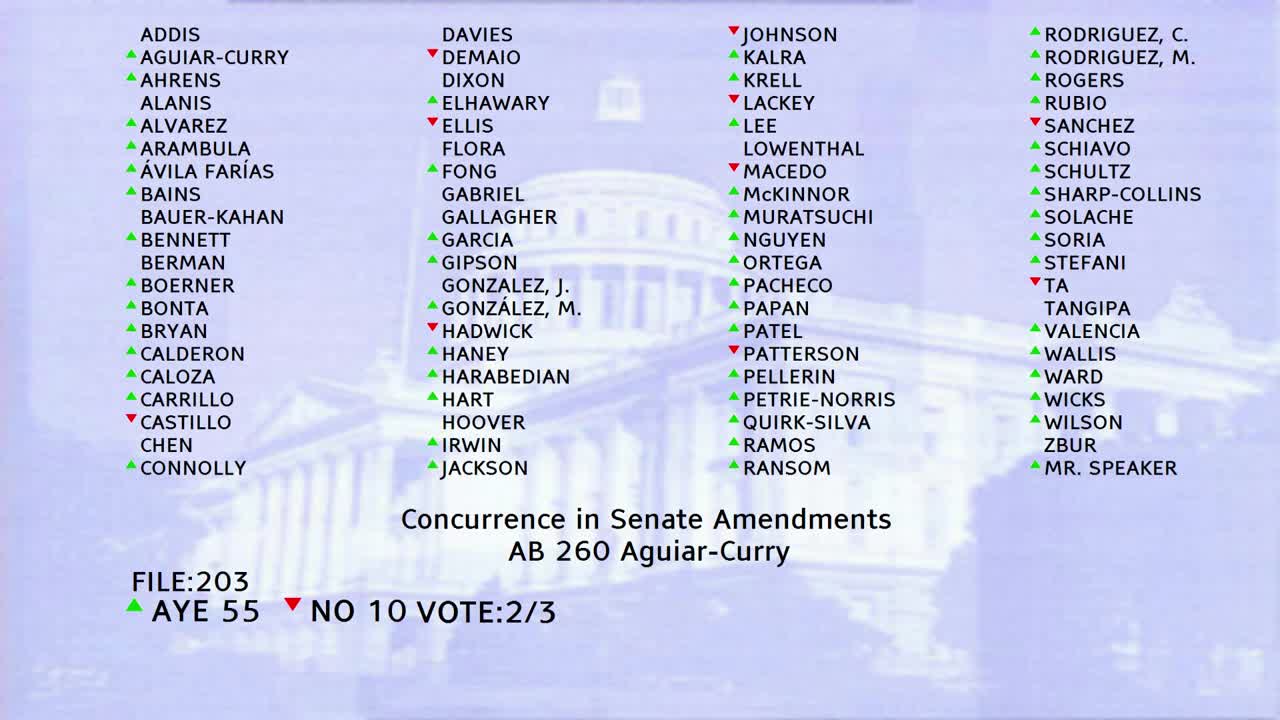
| Sep 10, 2025 | Senate amendments concurred in. To Engrossing and Enrolling. (Ayes 79. Noes 0. Page 3210.). |
| Sep 9, 2025 | In Assembly. Concurrence in Senate amendments pending. |
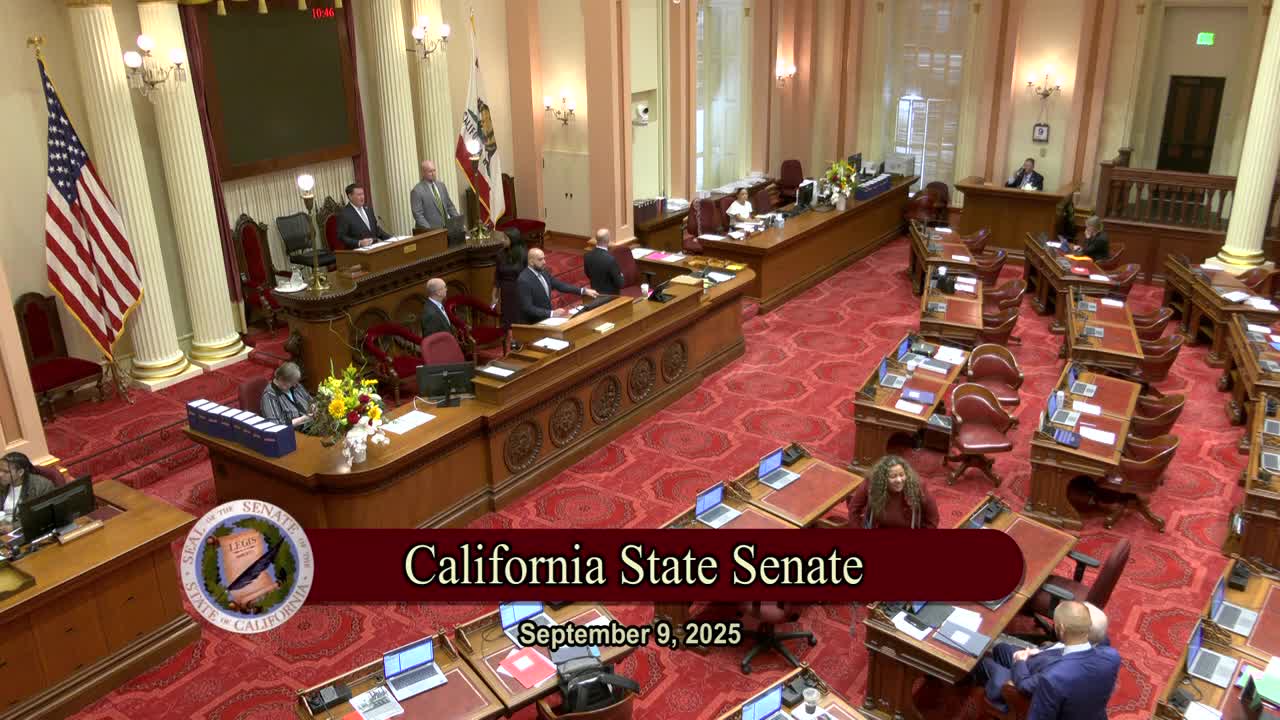
| Sep 9, 2025 | Read third time. Passed. Ordered to the Assembly. (Ayes 40. Noes 0. Page 2661.). |
| Sep 2, 2025 | Read second time. Ordered to third reading. |
| Aug 29, 2025 | Read third time and amended. Ordered to second reading. |
| Aug 29, 2025 | Action rescinded whereby the bill was read third time, passed, and to Assembly. |
| Aug 29, 2025 | Ordered to third reading. |
| Aug 25, 2025 | In Senate. Held at Desk. |
| Aug 25, 2025 | Ordered to the Senate. |
| Jul 17, 2025 | In Assembly. Concurrence in Senate amendments pending. |
| Jul 17, 2025 | Read third time. Passed. Ordered to the Assembly. (Ayes 35. Noes 0. Page 2137.). |
| Jul 15, 2025 | Read second time. Ordered to Consent Calendar. |
| Jul 14, 2025 | From committee: Be ordered to second reading file pursuant to Senate Rule 28.8 and ordered to Consent Calendar. |
| Jul 2, 2025 | From committee: Do pass and re-refer to Com. on APPR. with recommendation: To Consent Calendar. (Ayes 8. Noes 0.) (July 2). Re-referred to Com. on APPR. |
| Jun 10, 2025 | From committee: Do pass and re-refer to Com. on E.Q. with recommendation: To Consent Calendar. (Ayes 7. Noes 0.) (June 10). Re-referred to Com. on E.Q. |
| May 23, 2025 | From committee chair, with author's amendments: Amend, and re-refer to committee. Read second time, amended, and re-referred to Com. on N.R. & W. |
| May 14, 2025 | Referred to Coms. on N.R. & W. and E.Q. |
| May 1, 2025 | In Senate. Read first time. To Com. on RLS. for assignment. |
| May 1, 2025 | Read third time. Passed. Ordered to the Senate. (Ayes 76. Noes 0. Page 1385.) |
| Apr 24, 2025 | Read second time. Ordered to Consent Calendar. |
| Apr 23, 2025 | From committee: Do pass. To Consent Calendar. (Ayes 15. Noes 0.) (April 23). |
| Apr 8, 2025 | From committee: Do pass and re-refer to Com. on APPR. with recommendation: To Consent Calendar. (Ayes 14. Noes 0.) (April 7). Re-referred to Com. on APPR. |
| Mar 25, 2025 | From committee: Do pass and re-refer to Com. on NAT. RES. with recommendation: To Consent Calendar. (Ayes 13. Noes 0.) (March 25). Re-referred to Com. on NAT. RES. |
| Mar 17, 2025 | Re-referred to Com. on W. P., & W. |
| Mar 13, 2025 | From committee chair, with author's amendments: Amend, and re-refer to Com. on W. P., & W. Read second time and amended. |
| Feb 3, 2025 | Referred to Coms. on W. P., & W. and NAT. RES. |
| Dec 3, 2024 | From printer. May be heard in committee January 2. |
| Dec 2, 2024 | Read first time. To print. |
|
Date
|
Description
|
Location
|
Votes
|
|
|---|---|---|---|---|
| Sep 10, 2025 | AB 14 Hart Concurrence in Senate Amendments | Assembly Floor |
Passed |
|
| Sep 9, 2025 | Assembly 3rd Reading AB14 Hart et al. By Limón | Senate Floor |
Passed |
|
| Jul 17, 2025 | Consent Calendar 2nd AB14 Hart et al. | Senate Floor |
Passed |
|
| Jul 2, 2025 | Do pass, but first be re-referred to the Committee on [Appropriations] with the recommendation: To Consent Calendar | Senate Standing Committee on Environmental Quality |
Passed |
|
| Jun 10, 2025 | Do pass, but first be re-referred to the Committee on [Environmental Quality] with the recommendation: To Consent Calendar | Senate Standing Committee on Natural Resources and Water |
Passed |
|
| May 1, 2025 | AB 14 Hart Consent Calendar Second Day Regular Session | Assembly Floor |
Passed |
|
| Apr 23, 2025 | Do pass. To Consent Calendar. | Assembly Standing Committee on Appropriations |
Passed |
|
| Apr 7, 2025 | Do pass and be re-referred to the Committee on [Appropriations] with recommendation: To Consent Calendar | Assembly Standing Committee on Natural Resources |
Passed |
|
| Mar 25, 2025 | Do pass and be re-referred to the Committee on [Natural Resources] with recommendation: To Consent Calendar | Assembly Standing Committee on Water, Parks, and Wildlife |
Passed |
This list shows positions taken on this bill by organizations on the date displayed, which is linked to the original source.
Positions by individuals are not included.
|
Organization
|
Position
|
Date
|
|---|---|---|
| Bay Area Air District (co-sponsor) | ** Support | |
| Bay Area AQMD | ** Support | |
| Breathe California | ** Support | |
| Breathe California of The Bay Area, Golden Gate, and Central Coast | ** Support | |
| Cabrillo Marine Aquarium | ** Support | |
| California Air Pollution Control Officers Association | ** Support | |
| California Association Of Zoos And Aquariums | ** Support | |
| California Environmental Voters | ** Support | |
| California Marine Sanctuary Foundation | ** Support | |
| Central Coast Clean Cities Coalition | ** Support | |
| Central Coast Climate Collaborative | ** Support | |
| City of Goleta | ** Support | |
| County of Santa Barbara | ** Support | |
| Environmental Defense Center | ** Support | |
| Fresno Chaffee Zoo | ** Support | |
| Green Policy Initiative | ** Support | |
| Jas Worldwide Management | ** Support | |
| Monterey Bay Air Resources District | ** Support | |
| Monterey Bay Aquarium | ** Support | |
| Office of National Marine Sanctuaries West Coast Region | ** Support | |
| Pacific Merchant Shipping Association | ** Support | |
| Port of Hueneme | ** Support | |
| San Diego County Air Pollution Control District | ** Support | |
| San Luis Obispo County Air Pollution Control District | ** Support | |
| Santa Barbara County Air Pollution Control District (co-sponsor) | ** Support | |
| Santa Barbara County APCD | ** Support | |
| Santa Barbara County Green Business Program | ** Support | |
| Sierra Club California | ** Support | |
| Sustainable Rossmoor | ** Support | |
| Svario, INC. | ** Support | |
| The Block Logistics, INC. | ** Support | |
| The Nature Conservancy | ** Support | |
| Ventura County Air Pollution Control District (co-sponsor) | ** Support | |
| Ventura County APCD | ** Support | |
| Ventura County Regional Energy Alliance | ** Support | |
| West Coast Regional Office, Office of National Marine Sanctuaries, National Oceanic and Atmospheric Administration | ** Support |
CONCURRENCE IN SENATE AMENDMENTS
CSA1 Bill Id:AB 14
Author:(Hart, et al.)
As Amended Ver:August 29, 2025
Majority vote
SUMMARY
Codifies and allows for the expansion and implementation of the Protecting Blue Whales and Blue Skies (PBWBS) Program, a voluntary vessel speed reduction (VSR) and sustainable shipping program off the California coast designed to reduce whale strikes and air pollution.
Senate Amendments
Strike a provision that required that if any conflicts with existing port-related vessel speed reduction programs cannot be resolved, the PBWBS Program shall exclude the ocean territory within 40 nautical miles of the affected port.
COMMENTS
The main transport mode for global trade is ocean shipping: around 90% of traded goods are carried by oceangoing ships. As demand for global freight increases, maritime trade volumes are expected to triple by 2050. According to the Organisation for Economic Co-operation and Development, shipping represents 2.9% of total greenhouse gas emissions and is responsible for approximately 30% of total global nitrogen oxide (NOx) emissions. NOx are a family of poisonous, highly reactive gases that form when fuel is burned at high temperatures. NOx are air pollutants by themselves, and NOx react in the atmosphere to produce acid rain and smog.
The PBWBS program is a voluntary VSR program along the coast of California that incentivizes companies to incorporate sustainable shipping practices across their global supply chain. The existing PBWBS Program, formed by the Santa Barbara Air Pollution Control District (Santa Barbara County APCD) and Ventura County Air Pollution Control District (Ventura County APCD), has been operating in Southern California since 2014, expanded to the San Francisco Bay area in 2017, and now includes coordination between the Bay Area Air Quality Management District (Bay Area AQMD), Monterey Bay Air Resources District, the San Luis Obispo County Air Pollution Control District, the California Marine Sanctuary Foundation, the National Marine Sanctuary Foundation, NOAA, and Benioff Ocean Science Laboratory. By creating seasonal and predictable slow speed zones, this program is intended to protect endangered whales, reduce fuel use and regional greenhouse gas emissions, and improve air quality and human health outcomes.
Since 2014, the existing PBWBS Program has avoided emissions of over 200,000 metric tons of regional greenhouse gas emissions, about 5,900 tons of NOx emissions, about 35 tons of toxic diesel particulate matter emissions, and resulted in an estimated 50% decrease in whale strikes in the affected areas.
The Ocean Protection Council (OPC), in its 2020–2025 Strategic Plan, identified developing a statewide whale and sea turtle protection plan by 2022 with a target of zero mortality as a priority. To accomplish this goal, the OPC notes the following under Objective 3.3, Target 3.3.5: "With [the California Air Resources Board], coastal air districts, ports, and the National Marine Sanctuary Program, develop a permanent, statewide, Vessel Speed Reduction Program that incentivizes the shipping industry to prevent whale strikes, reduce coastal air pollution, and minimize marine noise pollution."
This bill effectively codifies this element of the OPC strategic plan, but without the engagement of the CARB or necessarily the engagement of OPC. OPC recently released a draft of the 2026–2030 Strategic Plan which includes Target 4.3.2, "By 2026, identify priority actions to reduce whale vulnerability to ship strikes, including expansion of existing vessel speed reduction programs." This bill will help accomplish that new target.
According to the Author
"The Santa Barbara voluntary vessel speed reduction program [existing program] is a prime example of what happens when we prioritize public health, protect the marine ecosystem, and showcase the beneficial partnership between shipping companies, public health agencies, marine sanctuaries, and environmental organizations. [This bill] provides participating companies with the official endorsement of the State of California for their efforts to reduce emissions and protect whales. This invaluable state-level recognition will increase visibility, interest and support for conservation efforts along the California coast."
Arguments in Support
A varied collection of organizations write in support of this bill citing the benefits from the existing program for both marine mammals and air quality for coastal communities. This bill is sponsored by Bay Area AQMD, Santa Barbara County APCD, and Ventura County APCD, which all write in support and indicate their commitment to reducing air pollution. Ventura County APCD writes, "These emissions negatively affect the public health of coastal communities and contribute to ground-level ozone or smog formation in Ventura County, which is classified as a serious nonattainment area for the 2015 National Ambient Air Quality Standard for ozone and does not meet California's health-based ozone standard. Because ocean-going vessels are not subject to any state or federal engine requirements that can guarantee emission reductions, voluntary vessel speed reduction is a simple act that can yield public health and marine ecosystem benefits."
Arguments in Opposition
None on file.
FISCAL COMMENTS
According to the Assembly Appropriations Committee, the version that passed the Assembly would have resulted in the following fiscal impact:
1) Minor and absorbable costs to OPC for participating as a stakeholder and in an advisory capacity to the PBWBS Program, which is a partnership between federal and local government agencies, foundations, and nonprofits.
2) The provisions related to local air districts do not constitute a state-mandated local program. The bill language explicitly states that "the program and each component of the [PBWBS] Program are based upon voluntary actions initiated by entities pursuant to this section."
The Senate Appropriations Committee did not hear this bill and, instead, reported it to the Senate Floor pursuant to Senate Rule 28.8; indicating this bill does not appropriate money, does not result in significant state costs or require the appropriation of funds, and will cause no significant reduction in revenues.
VOTES:
ASM WATER, PARKS, AND WILDLIFE: 13-0-0
YES: Papan, Jeff Gonzalez, Alvarez, Ávila Farías, Bains, Bennett, Boerner, Caloza, Hart, Macedo, Celeste Rodriguez, Rogers, Tangipa
ASM NATURAL RESOURCES: 14-0-0
YES: Bryan, Alanis, Connolly, Ellis, Flora, Garcia, Haney, Hoover, Kalra, Muratsuchi, Pellerin, Schultz, Wicks, Zbur
ASM APPROPRIATIONS: 15-0-0
YES: Wicks, Sanchez, Arambula, Calderon, Caloza, Dixon, Elhawary, Fong, Mark González, Hart, Pacheco, Pellerin, Solache, Ta, Tangipa
ASSEMBLY FLOOR: 76-0-3
YES: Addis, Aguiar-Curry, Ahrens, Alanis, Alvarez, Arambula, Ávila Farías, Bains, Bauer-Kahan, Bennett, Berman, Boerner, Bonta, Bryan, Calderon, Caloza, Carrillo, Castillo, Connolly, Davies, DeMaio, Dixon, Elhawary, Ellis, Flora, Fong, Gabriel, Gallagher, Garcia, Gipson, Jeff Gonzalez, Mark González, Hadwick, Haney, Harabedian, Hart, Hoover, Irwin, Jackson, Kalra, Krell, Lackey, Lee, Lowenthal, Macedo, Muratsuchi, Nguyen, Ortega, Pacheco, Patel, Patterson, Pellerin, Petrie-Norris, Quirk-Silva, Ramos, Ransom, Celeste Rodriguez, Michelle Rodriguez, Rogers, Blanca Rubio, Sanchez, Schiavo, Schultz, Sharp-Collins, Solache, Soria, Stefani, Ta, Tangipa, Valencia, Wallis, Ward, Wicks, Wilson, Zbur, Rivas
ABS, ABST OR NV: Chen, McKinnor, Papan
SENATE FLOOR: 35-0-5
YES: Allen, Archuleta, Arreguín, Ashby, Blakespear, Cabaldon, Caballero, Cervantes, Choi, Cortese, Dahle, Durazo, Gonzalez, Grayson, Grove, Hurtado, Jones, Laird, Limón, McGuire, McNerney, Menjivar, Niello, Ochoa Bogh, Pérez, Richardson, Rubio, Seyarto, Smallwood-Cuevas, Stern, Strickland, Valladares, Wahab, Weber Pierson, Wiener
ABS, ABST OR NV: Alvarado-Gil, Becker, Padilla, Reyes, Umberg
UPDATED
VERSION: August 29, 2025
CONSULTANT: Stephanie Mitchell / W., P., & W. / (916) 319-2096 FN: 0001970
SENATE RULES COMMITTEE Office of Senate Floor Analyses (916) 651-1520 Fax: (916) 327-4478 | AB 14 |
THIRD READING
Bill No: AB 14
Author: Hart (D), Bennett (D) and Connolly (D), et al.
Amended: 8/29/25 in Senate
Vote: 21
SENATE NATURAL RES. & WATER COMMITTEE: 7-0, 6/10/25
AYES: Limón, Seyarto, Allen, Grove, Hurtado, Laird, Stern
SENATE ENVIRONMENTAL QUALITY COMMITTEE: 8-0, 7/2/25
AYES: Blakespear, Valladares, Dahle, Gonzalez, Hurtado, Menjivar, Padilla, Pérez
SENATE APPROPRIATIONS COMMITTEE: Senate Rule 28.8
SENATE FLOOR: 35-0, 7/17/25 (Consent)
AYES: Allen, Archuleta, Arreguín, Ashby, Blakespear, Cabaldon, Caballero, Cervantes, Choi, Cortese, Dahle, Durazo, Gonzalez, Grayson, Grove, Hurtado, Jones, Laird, Limón, McGuire, McNerney, Menjivar, Niello, Ochoa Bogh, Pérez, Richardson, Rubio, Seyarto, Smallwood-Cuevas, Stern, Strickland, Valladares, Wahab, Weber Pierson, Wiener
NO VOTE RECORDED: Alvarado-Gil, Becker, Padilla, Reyes, Umberg
ASSEMBLY FLOOR: 76-0, 5/1/25 (Consent) - See last page for vote
SUBJECT: Coastal resources: Protecting Blue Whales and Blue Skies Program
SOURCE: Bay Area Air District
Santa Barbara County Air Pollution Control District
Ventura County Air Pollution Control District
DIGEST:
This bill codifies and provides for the expansion and implementation of a seasonal voluntary vessel speed reduction and sustainable shipping program off the California coast to reduce whale strikes and air pollution, as specified.
Senate Floor Amendments of 8/29/25 clarify that the expansion will not preclude other existing seasonal voluntary vessel speed reduction and sustainable shipping programs, and remove language directing conflict resolution between the expansion and other existing programs.
ANALYSIS:
Existing federal law:
- Establishes protections, pursuant to the Endangered Species Act, for fish, wildlife, and plants that are listed as threatened or endangered. Lists blue, fin, and humpback whales as endangered species. (16 United States Code (USC) §§1538 et seq.)
- Establishes the Marine Mammal Protection Act of 1972 to prevent marine mammal species and population stocks from declining beyond the point where they cease to be significant functioning elements of the ecosystems of which they are a part. Prohibits the “take” of marine mammals—including harassment, hunting, capturing, collecting, or killing—in waters of the United States (US) and by US citizens on the high seas. (16 USC §§1361 et seq.)
- Establishes the National Marine Sanctuaries Act and authorizes the Secretary of Commerce to designate and protect areas of the marine environment with special national significance due to their conservation, recreational, ecological, historical, scientific, cultural, archeological, educational, or esthetic qualities as national marine sanctuaries. (16 USC §§1431 et seq.)
Existing state law:
- Establishes the Ocean Protection Council (council), a cabinet-level entity chaired by the Secretary of the California Natural Resources Agency that is mandated to, among other things:
- Coordinate activities of ocean-related state agencies to improve the effectiveness of state efforts to protect ocean resources; and
- Establish policies to coordinate the collection and sharing of scientific data related to coast and ocean resources between agencies. (Public Resources Code §35600, §35615)
- Makes it unlawful to take any marine mammal except in accordance with certain federal laws. (Fish and Game Code §4500)
- Establishes the State Air Resources Board (ARB) and air pollution control and air quality management districts with the primary responsibility for the control of air pollution from all sources other than vehicular sources. (Health and Safety Code §§39500 et seq., §§40000 et seq.)
- Requires, per ARB’s At Berth Regulations, a certain percentage of a fleet’s vessels to plug into shore power while at berth to reduce emissions from ocean-going vessels to improve air quality at California ports. (Title 17, California Code of Regulations §§93130-93130.22)
This bill:
- Requires the council, subject to the availability of funding, to participate, as a stakeholder and in an advisory capacity, in the Protecting Blue Whales and Blue Skies Program with air pollution control districts and air quality management districts along the coast and other stakeholders, as specified, to support in an advisory capacity, coastal air districts in their efforts to implement a statewide voluntary vessel speed reduction and sustainable shipping program in order to reduce air pollution, the risk of fatal vessel strikes on whales, and harmful underwater acoustic impacts.
- Authorizes the expansion of the existing Protecting Blue Whales and Blue Skies Program (program), as provided.
- Authorizes the program to include the following components:
- A marketing program to promote voluntary vessel speed reduction (VSR) and sustainable shipping, and an acknowledgment of the program’s participants;
- Data collection on ship speeds along the California coast in order to analyze the program for future refinement, expansion, or both;
- Data collection on underwater acoustic impacts or fatal vessel strikes on whales, to the extent data is available;
- Data collection of the regional air quality impacts on the coast and air quality to coastal disadvantaged communities from oceangoing vessel traffic, as specified;
- Incentives to program participants based on a percentage of distance traveled by a participating vessel at reduced speeds – including speed zones at 10 knots or less - to the extent that local or federal funding is made available;
- Development of VSR zones along the coast that take into account navigational safety, protected marine mammal migration and breeding seasons, federal marine sanctuaries and state marine protected areas, shipping lanes, and any other relevant variables;
- Program seasonality; and
- Description of covered vessels.
- Requires the program to supplement and work in conjunction with, and not preclude, any other existing port-related VSR programs.
- Limits the program to vessels that are 300 gross tons or greater (i.e. commercial ocean-going vessels).
- Requires the participating air pollution control districts and air quality management districts to submit a report to the Legislature regarding the implementation of the program on or before December 31, 2029, as specified.
- Provides that the program and its components are based upon voluntary actions and are not regulations, and requires that their implementation not conflict with federal law and regulations.
- Makes findings and declarations related to shipping, air quality, and that the expansion of the existing voluntary program is a critical strategy in advancing protection of marine mammals.
[NOTE: See the Senate Natural Resources and Water, and Environmental Quality Committees’ analyses for detailed background of this bill.]
FISCAL EFFECT: Appropriation: No Fiscal Com.: Yes Local: No
SUPPORT: (Verified 8/29/25)
Bay Area Air District (co-sponsor)
Santa Barbara County Air Pollution Control District (co-sponsor)
Ventura County Air Pollution Control District (co-sponsor)
Breathe California
Breathe California of the Bay Area, Golden Gate, and Central Coast
Cabrillo Marine Aquarium
California Air Pollution Control Officers Association
California Association of Zoos and Aquariums
California Environmental Voters
California Marine Sanctuary Foundation
Central Coast Clean Cities Coalition
City of Goleta
County of Santa Barbara
Environmental Defense Center
Fresno Chaffee Zoo
Green Policy Initiative
JAS Worldwide Management
Monterey Bay Air Resources District
Monterey Bay Aquarium
Pacific Merchant Shipping Association
Port of Hueneme
San Diego County Air Pollution Control District
San Luis Obispo County Air Pollution Control District
Santa Barbara County Green Business Program
Sierra Club California
Sustainable Rossmoor
Svario, Inc.
The Block Logistics, Inc.
The Nature Conservancy
Ventura County Regional Energy Alliance
West Coast Regional Office, Office of National Marine Sanctuaries, National Oceanic and Atmospheric Administration
OPPOSITION: (Verified 8/29/25)
None received
ARGUMENTS IN SUPPORT: According to the author, “The Santa Barbara voluntary vessel speed reduction program is a prime example of what happens when we prioritize public health, protect the marine ecosystem, and showcase the beneficial partnership between shipping companies, public health agencies, marine sanctuaries, and environmental organizations. Assembly Bill 14 provides participating companies with the official endorsement of the State of California for their efforts to reduce emissions and protect whales. This invaluable state-level recognition will increase visibility, interest and support for conservation efforts along the California coast.”
ASSEMBLY FLOOR: 76-0, 5/1/25
AYES: Addis, Aguiar-Curry, Ahrens, Alanis, Alvarez, Arambula, Ávila Farías, Bains, Bauer-Kahan, Bennett, Berman, Boerner, Bonta, Bryan, Calderon, Caloza, Carrillo, Castillo, Connolly, Davies, DeMaio, Dixon, Elhawary, Ellis, Flora, Fong, Gabriel, Gallagher, Garcia, Gipson, Jeff Gonzalez, Mark González, Hadwick, Haney, Harabedian, Hart, Hoover, Irwin, Jackson, Kalra, Krell, Lackey, Lee, Lowenthal, Macedo, Muratsuchi, Nguyen, Ortega, Pacheco, Patel, Patterson, Pellerin, Petrie-Norris, Quirk-Silva, Ramos, Ransom, Celeste Rodriguez, Michelle Rodriguez, Rogers, Blanca Rubio, Sanchez, Schiavo, Schultz, Sharp-Collins, Solache, Soria, Stefani, Ta, Tangipa, Valencia, Wallis, Ward, Wicks, Wilson, Zbur, Rivas
NO VOTE RECORDED: Chen, McKinnor, Papan
Prepared by: Katharine Moore / N.R. & W. / (916) 651-4116
9/2/25 17:49:54
**** END ****
CONCURRENCE IN SENATE AMENDMENTS
CSA1 Bill Id:AB 14
Author:(Hart, et al.)
As Amended Ver:May 23, 2025
Majority vote
SUMMARY
Codifies and allows for the expansion and implementation of the Protecting Blue Whales and Blue Skies (PBWBS) Program, a voluntary vessel speed reduction (VSR) and sustainable shipping program off the California coast to reduce whale strikes and air pollution.
Senate Amendments
Clarify that the PBWBS Program shall supplement, and work in conjunction with, any other existing port-related VSR program and provides that if any conflicts cannot be resolved, the PBWBS Program shall exclude the ocean territory within 40 nautical miles of the affected port.
COMMENTS
The main transport mode for global trade is ocean shipping: around 90% of traded goods are carried by oceangoing ships. As demand for global freight increases, maritime trade volumes are set to triple by 2050. According to the Organisation for Economic Co-operation and Development, shipping represents 2.9% of total greenhouse gas emissions and is responsible for approximately 30% of total global nitrogen oxide (NOx) emissions. NOx are a family of poisonous, highly reactive gases that form when fuel is burned at high temperatures. NOx are air pollutants by themselves, and NOx react in the atmosphere to produce acid rain and smog.
The PBWBS program is a voluntary VSR program along the coast of California that incentivizes companies to incorporate sustainable shipping practices across their global supply chain. The existing PBWBS Program, formed by the Santa Barbara Air Pollution Control District (Santa Barbara County APCD) and Ventura County Air Pollution Control District (Ventura County APCD), has been operating in Southern California since 2014, expanded to the San Francisco Bay area in 2017, and now includes coordination between the Bay Area Air Quality Management District (Bay Area AQMD), Monterey Bay Air Resources District, the San Luis Obispo County Air Pollution Control District, the California Marine Sanctuary Foundation, the National Marine Sanctuary Foundation, NOAA, and Benioff Ocean Science Laboratory. By creating seasonal and predictable slow speed zones, this program is intended to protect endangered whales, reduce fuel use and regional greenhouse gas emissions, and improve air quality and human health outcomes.
Since 2014, the existing PBWBS Program has avoided emissions of over 200,000 metric tons of regional greenhouse gas emissions, about 5,900 tons of NOx emissions, about 35 tons of toxic diesel particulate matter emissions, and resulted in an estimated 50% decrease in whale strikes in the affected areas.
The Ocean Protection Council (OPC), in its 2020–2025 Strategic Plan, identified developing a statewide whale and sea turtle protection plan by 2022 with a target of zero mortality as a priority. To accomplish this goal, the OPC notes the following under Objective 3.3, Target 3.3.5: "With [the California Air Resources Board], coastal air districts, ports, and the National Marine Sanctuary Program, develop a permanent, statewide, Vessel Speed Reduction Program that incentivizes the shipping industry to prevent whale strikes, reduce coastal air pollution, and minimize marine noise pollution." This bill effectively codifies this element of the OPC strategic plan, but without the engagement of the CARB or necessarily the engagement of OPC. OPC recently released a draft of the 2026–2030 Strategic Plan which includes Target 4.3.2, "By 2026, identify priority actions to reduce whale vulnerability to ship strikes, including expansion of existing vessel speed reduction programs." This bill will help accomplish that new target.
According to the Author
"The Santa Barbara voluntary vessel speed reduction program [existing program] is a prime example of what happens when we prioritize public health, protect the marine ecosystem, and showcase the beneficial partnership between shipping companies, public health agencies, marine sanctuaries, and environmental organizations. [This bill] provides participating companies with the official endorsement of the State of California for their efforts to reduce emissions and protect whales. This invaluable state-level recognition will increase visibility, interest and support for conservation efforts along the California coast."
Arguments in Support
A varied collection of organizations write in support of this bill citing the benefits from the existing program for both marine mammals and air quality for coastal communities. This bill is sponsored by Bay Area AQMD, Santa Barbara County APCD, and Ventura County APCD, which all write in support and indicate their commitment to reducing air pollution. Ventura County APCD writes, "These emissions negatively affect the public health of coastal communities and contribute to ground-level ozone or smog formation in Ventura County, which is classified as a serious nonattainment area for the 2015 National Ambient Air Quality Standard for ozone and does not meet California's health-based ozone standard. Because ocean-going vessels are not subject to any state or federal engine requirements that can guarantee emission reductions, voluntary vessel speed reduction is a simple act that can yield public health and marine ecosystem benefits."
Arguments in Opposition
None on file
FISCAL COMMENTS
According to the Assembly Appropriations Committee, this bill will have the following fiscal impact:
1) Minor and absorbable costs to OPC for participating as a stakeholder and in an advisory capacity to the PBWBS Program, which is a partnership between federal and local government agencies, foundations, and nonprofits.
2) The provisions related to local air districts do not constitute a state-mandated local program. The bill language explicitly states that "the program and each component of the [PBWBS ] Program are based upon voluntary actions initiated by entities pursuant to this section."
VOTES:
ASM WATER, PARKS, AND WILDLIFE: 13-0-0
YES: Papan, Jeff Gonzalez, Alvarez, Ávila Farías, Bains, Bennett, Boerner, Caloza, Hart, Macedo, Celeste Rodriguez, Rogers, Tangipa
ASM NATURAL RESOURCES: 14-0-0
YES: Bryan, Alanis, Connolly, Ellis, Flora, Garcia, Haney, Hoover, Kalra, Muratsuchi, Pellerin, Schultz, Wicks, Zbur
ASM APPROPRIATIONS: 15-0-0
YES: Wicks, Sanchez, Arambula, Calderon, Caloza, Dixon, Elhawary, Fong, Mark González, Hart, Pacheco, Pellerin, Solache, Ta, Tangipa
ASSEMBLY FLOOR: 76-0-3
YES: Addis, Aguiar-Curry, Ahrens, Alanis, Alvarez, Arambula, Ávila Farías, Bains, Bauer‑Kahan, Bennett, Berman, Boerner, Bonta, Bryan, Calderon, Caloza, Carrillo, Castillo, Connolly, Davies, DeMaio, Dixon, Elhawary, Ellis, Flora, Fong, Gabriel, Gallagher, Garcia, Gipson, Jeff Gonzalez, Mark González, Hadwick, Haney, Harabedian, Hart, Hoover, Irwin, Jackson, Kalra, Krell, Lackey, Lee, Lowenthal, Macedo, Muratsuchi, Nguyen, Ortega, Pacheco, Patel, Patterson, Pellerin, Petrie-Norris, Quirk-Silva, Ramos, Ransom, Celeste Rodriguez, Michelle Rodriguez, Rogers, Blanca Rubio, Sanchez, Schiavo, Schultz, Sharp-Collins, Solache, Soria, Stefani, Ta, Tangipa, Valencia, Wallis, Ward, Wicks, Wilson, Zbur, Rivas
ABS, ABST OR NV: Chen, McKinnor, Papan
SENATE FLOOR: 35-0-5
YES: Allen, Archuleta, Arreguín, Ashby, Blakespear, Cabaldon, Caballero, Cervantes, Choi, Cortese, Dahle, Durazo, Gonzalez, Grayson, Grove, Hurtado, Jones, Laird, Limón, McGuire, McNerney, Menjivar, Niello, Ochoa Bogh, Pérez, Richardson, Rubio, Seyarto, Smallwood‑Cuevas, Stern, Strickland, Valladares, Wahab, Weber Pierson, Wiener
ABS, ABST OR NV: Alvarado-Gil, Becker, Padilla, Reyes, Umberg
UPDATED
VERSION: May 23, 2025
CONSULTANT: Stephanie Mitchell / W., P., & W. / (916) 319-2096 FN: 0001156
SENATE RULES COMMITTEE Office of Senate Floor Analyses (916) 651-1520 Fax: (916) 327-4478 | AB 14 |
CONSENT
Bill No: AB 14
Author: Hart (D), Bennett (D) and Connolly (D), et al.
Amended: 5/23/25 in Senate
Vote: 21
SENATE NATURAL RES. & WATER COMMITTEE: 7-0, 6/10/25
AYES: Limón, Seyarto, Allen, Grove, Hurtado, Laird, Stern
SENATE ENVIRONMENTAL QUALITY COMMITTEE: 8-0, 7/2/25
AYES: Blakespear, Valladares, Dahle, Gonzalez, Hurtado, Menjivar, Padilla, Pérez
SENATE APPROPRIATIONS COMMITTEE: Senate Rule 28.8
ASSEMBLY FLOOR: 76-0, 5/1/25 (Consent) - See last page for vote
SUBJECT: Coastal resources: Protecting Blue Whales and Blue Skies Program
SOURCE: Bay Area Air District
Santa Barbara County Air Pollution Control District
Ventura County Air Pollution Control District
DIGEST:
This bill codifies and provides for the expansion and implementation of a seasonal voluntary vessel speed reduction and sustainable shipping program off the California coast to reduce whale strikes and air pollution, as specified.
ANALYSIS:
Existing federal law:
- Establishes protections, pursuant to the Endangered Species Act, for fish, wildlife, and plants that are listed as threatened or endangered. Lists blue, fin, and humpback whales as endangered species. (16 United States Code (USC) §§1538 et seq.)
- Establishes the Marine Mammal Protection Act of 1972 to prevent marine mammal species and population stocks from declining beyond the point where they cease to be significant functioning elements of the ecosystems of which they are a part. Prohibits the “take” of marine mammals—including harassment, hunting, capturing, collecting, or killing—in waters of the United States (US) and by US citizens on the high seas. (16 USC §§1361 et seq.)
- Establishes the National Marine Sanctuaries Act and authorizes the Secretary of Commerce to designate and protect areas of the marine environment with special national significance due to their conservation, recreational, ecological, historical, scientific, cultural, archeological, educational, or esthetic qualities as national marine sanctuaries. (16 USC §§1431 et seq.)
Existing state law:
- Establishes the Ocean Protection Council (council), a cabinet-level entity chaired by the Secretary of the California Natural Resources Agency that is mandated to:
- Coordinate activities of ocean-related state agencies to improve the effectiveness of state efforts to protect ocean resources;
- Establish policies to coordinate the collection and sharing of scientific data related to coast and ocean resources between agencies; and
- Identify and recommend changes in law to both the Legislature and the Governor. (Public Resources Code §35600, §35615)
- Makes it unlawful to take any marine mammal except in accordance with certain federal laws. (Fish and Game Code §4500)
- Establishes the State Air Resources Board (ARB) and air pollution control and air quality management districts with the primary responsibility for the control of air pollution from all sources other than vehicular sources. (Health and Safety Code §§39500 et seq., §§40000 et seq.)
- Requires, per ARB’s At Berth Regulations, a certain percentage of a fleet’s vessels to plug into shore power while at berth to reduce emissions from ocean-going vessels to improve air quality at California ports. (Title 17, California Code of Regulations §§93130-93130.22)
This bill:
- Requires the council, subject to the availability of funding, to participate, as a stakeholder and in an advisory capacity, in the Protecting Blue Whales and Blue Skies Program with air pollution control districts and air quality management districts along the coast and other stakeholders, as specified, to support in an advisory capacity, coastal air districts in their efforts to implement a statewide voluntary vessel speed reduction and sustainable shipping program in order to reduce air pollution, the risk of fatal vessel strikes on whales, and harmful underwater acoustic impacts.
- Authorizes the expansion of the existing Protecting Blue Whales and Blue Skies Program (program), as provided.
- Authorizes the program to include the following components:
- A marketing program to promote voluntary vessel speed reduction (VSR) and sustainable shipping, and an acknowledgment of the program’s participants;
- Data collection on ship speeds along the California coast in order to analyze the program for future refinement, expansion, or both;
- Data collection on underwater acoustic impacts or fatal vessel strikes on whales, to the extent data is available;
- Data collection of the regional air quality impacts on the coast and air quality to coastal disadvantaged communities from oceangoing vessel traffic, as specified;
- Incentives to program participants based on a percentage of distance traveled by a participating vessel at reduced speeds – including speed zones at 10 knots or less - to the extent that local or federal funding is made available;
- Development of VSR zones along the coast that take into account navigational safety, protected marine mammal migration and breeding seasons, federal marine sanctuaries and state marine protected areas, shipping lanes, and any other relevant variables;
- Program seasonality; and
- Description of covered vessels.
- Requires the program to supplement and work in conjunction with any other existing port-related VSR programs. Provide that in the event of conflicting requirements that cannot be resolved that the program exclude the ocean territory within 40 nautical miles of the affected port.
- Limits the program to vessels that are 300 gross tons or greater (i.e. commercial ocean-going vessels).
- Requires the participating air pollution control districts and air quality management districts to submit a report to the Legislature regarding the implementation of the program on or before December 31, 2029, as specified.
- Provides that the program and its components are based upon voluntary actions and are not regulations, and requires that their implementation not conflict with federal law and regulations.
- Makes findings and declarations related to shipping, air quality, and that the expansion of the existing voluntary program is a critical strategy in advancing protection of marine mammals.
[NOTE: See the Senate Natural Resources and Water, and Environmental Quality Committees’ analyses for detailed background of this bill.]
FISCAL EFFECT: Appropriation: No Fiscal Com.: Yes Local: No
SUPPORT: (Verified 7/14/25)
Bay Area Air District (co-sponsor)
Santa Barbara County Air Pollution Control District (co-sponsor)
Ventura County Air Pollution Control District (co-sponsor)
Breathe California
Breathe California of the Bay Area, Golden Gate, and Central Coast
Cabrillo Marine Aquarium
California Air Pollution Control Officers Association
California Association of Zoos and Aquariums
California Environmental Voters
California Marine Sanctuary Foundation
Central Coast Clean Cities Coalition
City of Goleta
County of Santa Barbara
Environmental Defense Center
Fresno Chaffee Zoo
Green Policy Initiative
JAS Worldwide Management
Monterey Bay Air Resources District
Monterey Bay Aquarium
Pacific Merchant Shipping Association
Port of Hueneme
San Diego County Air Pollution Control District
San Luis Obispo County Air Pollution Control District
Santa Barbara County Green Business Program
Sierra Club California
Sustainable Rossmoor
Svario, Inc.
The Block Logistics, Inc.
The Nature Conservancy
Ventura County Regional Energy Alliance
West Coast Regional Office, Office of National Marine Sanctuaries, National Oceanic and Atmospheric Administration
OPPOSITION: (Verified 7/14/25)
None received
ARGUMENTS IN SUPPORT: According to the author, “The Santa Barbara voluntary vessel speed reduction program is a prime example of what happens when we prioritize public health, protect the marine ecosystem, and showcase the beneficial partnership between shipping companies, public health agencies, marine sanctuaries, and environmental organizations. Assembly Bill 14 provides participating companies with the official endorsement of the State of California for their efforts to reduce emissions and protect whales. This invaluable state-level recognition will increase visibility, interest and support for conservation efforts along the California coast.”
ASSEMBLY FLOOR: 76-0, 5/1/25
AYES: Addis, Aguiar-Curry, Ahrens, Alanis, Alvarez, Arambula, Ávila Farías, Bains, Bauer-Kahan, Bennett, Berman, Boerner, Bonta, Bryan, Calderon, Caloza, Carrillo, Castillo, Connolly, Davies, DeMaio, Dixon, Elhawary, Ellis, Flora, Fong, Gabriel, Gallagher, Garcia, Gipson, Jeff Gonzalez, Mark González, Hadwick, Haney, Harabedian, Hart, Hoover, Irwin, Jackson, Kalra, Krell, Lackey, Lee, Lowenthal, Macedo, Muratsuchi, Nguyen, Ortega, Pacheco, Patel, Patterson, Pellerin, Petrie-Norris, Quirk-Silva, Ramos, Ransom, Celeste Rodriguez, Michelle Rodriguez, Rogers, Blanca Rubio, Sanchez, Schiavo, Schultz, Sharp-Collins, Solache, Soria, Stefani, Ta, Tangipa, Valencia, Wallis, Ward, Wicks, Wilson, Zbur, Rivas
NO VOTE RECORDED: Chen, McKinnor, Papan
Prepared by: Katharine Moore / N.R. & W. / (916) 651-4116
7/16/25 16:22:36
**** END ****
Date of Hearing: April 23, 2025
ASSEMBLY COMMITTEE ON APPROPRIATIONS
Buffy Wicks, Chair
ABPCA Bill Id:AB 14
Author:(Hart) – As Amended Ver:March 13, 2025
Policy Committee: | Water, Parks and Wildlife | Vote: | 13 - 0 |
Natural Resources | 14 - 0 | ||
|
|
Urgency: No State Mandated Local Program: No Reimbursable: No
SUMMARY:
This bill requires the Ocean Protection Council (OPC) to participate as an advisory stakeholder to the Protecting Blue Whales and Blue Skies Program (Program) to implement a statewide voluntary vessel speed reduction (VSR) and sustainable shipping program.
Specifically, this bill, among other things:
- Requires OPC, subject to the availability of funding, to participate as a stakeholder, and in an advisory capacity, to the Program with air pollution control districts and air quality management districts along the coast and other specified stakeholders to support, in an advisory capacity, coastal air districts in their efforts to implement a statewide VSR and sustainable shipping program for the California coast to reduce air pollution, the risk of fatal vessel strikes on whales, and harmful underwater acoustic impacts.
- Requires expansion of the existing Program by local air pollution control districts and air quality management districts to be a single unified program, and authorizes the unified program to include numerous specified components developed in a manner consistent with how the program components were developed for the existing Program.
- Requires the Program to exclude any ocean territories covered by any VSR program other than the Program or a memorandum of understanding entered into before January 1, 2026.
- Provides that the Program only applies to vessels that are 300 gross tons or greater.
- Requires, on or before December 31, 2029, the participating air pollution control districts and air quality management districts to submit a report to the Legislature regarding implementation of the Program. Sunsets the reporting requirement on December 31, 2033.
- Provides that the Program and each component of the Program are based upon voluntary actions initiated by entities pursuant to this bill and are not regulations as defined in Section 11342.600 of the Government Code, and shall not be implemented in a way that conflicts with federal law and regulations.
FISCAL EFFECT:
1) Minor and absorbable costs to OPC for participating as a stakeholder and in an advisory capacity to the Program, which is a partnership between federal and local government agencies, foundations, and nonprofits.
2) The provisions related to local air districts do not constitute a state-mandated local program. The bill language explicitly states that “the program and each component of the Program are based upon voluntary actions initiated by entities pursuant to this section.”
COMMENTS:
1) Purpose. According to the author:
The Santa Barbara voluntary vessel speed reduction program is a prime example of what happens when we prioritize public health, protect the marine ecosystem, and showcase the beneficial partnership between shipping companies, public health agencies, marine sanctuaries, and environmental organizations. Assembly Bill 14 provides participating companies with the official endorsement of the State of California for their efforts to reduce emissions and protect whales. This invaluable state-level recognition will increase visibility, interest and support for conservation efforts along the California coast.
2) Background. Every year, the world’s largest container ships and auto carriers make thousands of trips along the California coast, emitting an estimated 120 tons of nitrogen dioxides, an ozone precursor, within 100 nautical miles of the coast every day. In addition, according to the National Oceanic and Atmospheric Administration (NOAA), the collision of vessels into whales has been identified as a significant source of human-caused mortality for whale populations in the U.S. and around the world, threatening the recovery of depleted whale populations. NOAA also estimates that hundreds to thousands of sea turtles are struck by vessels in the U.S. every year, and many of them are killed. Collisions involving larger marine animals and small- or medium-sized boats can damage vessels and cause serious, sometimes fatal, injuries to people, especially when the vessels are operating at high speeds.
The Program, which was established in 2014, is a voluntary VSR verification and recognition program. Shipping participants help reduce ship strike risk to endangered whales, underwater noise, regional greenhouse gas emissions, and air pollution by voluntarily transiting at 10 knots or less in the VSR zones and season timeframe set by NOAA. The Program independently verifies participants' cooperation rates, quantifies the environmental benefits of participation, and provides recognition to encourage further adoption of responsible shipping practices that help support and protect marine biodiversity, air quality, and coastal communities.
The Program is a partnership between federal and local government agencies, foundations, and environmental nonprofits, including the California Marine Sanctuary Foundation; Channel Islands, Monterey Bay, Greater Farallones and Cordell Bank National Marine Sanctuaries; Benioff Ocean Science Laboratory; the Bay Area Air Quality Management District; Santa Barbara County, Ventura County, and San Luis Obispo County Air Pollution Control Districts; and the Monterey Bay Air Resources District.
Earlier efforts to create a VSR program include AB 953 (Connolly) and AB 2298 (Hart), of the 2023-24 Legislative Session, which would have required OPC, in coordination with specified entities such as the Air Resources Board, to implement a statewide VSR and sustainable shipping program. Both AB 953 and AB 2998 were held on the Senate Appropriations Committee’s suspense file. This bill simply requires OPC to participate as a stakeholder and in an advisory capacity to the existing Program, and to support, in an advisory capacity, coastal air districts in their efforts to implement a statewide voluntary VSR and sustainable shipping program for the California coast – should they choose to do so.
Analysis Prepared by: Nikita Koraddi / APPR. / (916) 319-2081
Date of Hearing: April 7, 2025
ASSEMBLY COMMITTEE ON NATURAL RESOURCES
Bryan, Chair
ABPCA Bill Id:AB 14 (
Author:Hart) – As Amended Ver:March 13, 2024
SUBJECT: Coastal resources: Protecting Blue Whales and Blue Skies Program
SUMMARY: Requires the Ocean Protection Council (OPC) to participate as an advisory stakeholder to the Protecting Blue Whales and Blue Skies Program to implement a statewide voluntary vessel speed reduction and sustainable shipping program for the California coast
EXISTING LAW:
Under federal law:
- Establishes protections, pursuant to the Endangered Species Act (ESA), for fish, wildlife, and plants that are listed as threatened or endangered. Lists blue, fin, and humpback whales as endangered species. (16 United States Code (U.S.C.) 1538 et seq.)
- Establishes the Marine Mammal Protection Act (MMPA) to prevent marine mammal species and population stocks from declining beyond the point where they cease to be significant functioning elements of the ecosystems of which they are a part. Prohibits the “take” of marine mammals—including harassment, hunting, capturing, collecting, or killing—in U.S. waters and by United States citizens on the high seas. (16 U.S.C. 1361 et seq.)
- Establishes the National Marine Sanctuaries Act and authorizes the Secretary of Commerce to designate and protect areas of the marine environment with special national significance due to their conservation, recreational, ecological, historical, scientific, cultural, archeological, educational or esthetic qualities as national marine sanctuaries. (16 U.S.C. 1431 et seq.)
Under state law:
- Establishes the OPC to coordinate activities of state agencies that are related to the protection and conservation of coastal waters and ocean ecosystems to improve the effectiveness of state efforts to protect ocean resources within existing fiscal limitations. (Public Resources Code 35615 (a)(1))
- Establishes the California Air Resources Board (ARB) to regulate emissions from mobile sources. (Health & Safety Code 39500 et seq.)
- Requires, per ARB’s At Berth Regulations, a certain percentage of a fleet’s vessels to plug into shore power while at berth to reduce emissions from ocean-going vessels to improve air quality at California ports. (Title 17 California Code of Regulations 93130-93130.22)
THIS BILL:
- Requires, subject to the availability of funding, the OPC to participate as a stakeholder, and in an advisory capacity, to the Program with air pollution control districts and air quality management districts along the coast and other stakeholders, including the federal Office of National Marine Sanctuaries, the United States Environmental Protection Agency (US EPA), the United States Navy, the United States Coast Guard (USCG), and the maritime industry, to support, in an advisory capacity, coastal air districts in their efforts to implement a statewide voluntary vessel speed reduction and sustainable shipping program for the California coast in order to reduce air pollution, the risk of fatal vessel strikes on whales, and harmful underwater acoustic impacts.
- Requires expansion of the existing Program by local air pollution control districts and air quality management districts to be a single unified program, and may include all of the following components developed in a manner that is consistent with how the program components were developed for the Program:
- A marketing program to engage cargo owners and other commercial interests to promote voluntary vessel speed reduction and sustainable shipping, and an acknowledgment of the program’s participants;
- Data collection on ship speeds along the California coast in order to analyze the program for future refinement, expansion, or both;
- Data collection on underwater acoustic impacts or fatal vessel strikes on whales, to the extent data is available;
- Data collection on the regional air quality impacts on the coast and impacts to air quality in coastal disadvantaged communities from oceangoing vessel traffic, as collected and provided by the regional air pollution control districts and air quality management districts;
- Incentives to program participants based on a percentage of distance traveled by a participating vessel at a reduced speed, including speed zones at 10 knots or less, to the extent that local or federal funding is available;
- Development of vessel speed reduction zones along the coast that take into account navigational safety, protected marine mammal migration and breeding seasons, federal marine sanctuaries and state marine protected areas, shipping lanes, and any other relevant variables;
- Seasonality of the program; and
- Description of covered vessels.
- Requires the Program to exclude any ocean territories that are covered by any vessel speed reduction program other than the Protecting Blue Whales and Blue Skies Program or a memorandum of understanding entered into before January 1, 2026.
- Provides that the Program only applies to vessels that are 300 gross tons or greater.
- Requires, on or before December 31, 2029, the participating air pollution control districts and air quality management districts to submit a report to the Legislature regarding the implementation of the Program. Sunsets the reporting requirement on December 31, 2033.
- Provides that the Program and each component of the program are based upon voluntary actions initiated by entities pursuant to this section and are not regulations as defined in Section 11342.600 of the Government Code, and shall not be implemented in a way that conflicts with federal law and regulations.
FISCAL EFFECT: Unknown
COMMENTS:
- Author’s statement:
The Santa Barbara voluntary vessel speed reduction program is a prime example of what happens when we prioritize public health, protect the marine ecosystem, and showcase the beneficial partnership between shipping companies, public health agencies, marine sanctuaries, and environmental organizations. Assembly Bill 14 provides participating companies with the official endorsement of the State of California for their efforts to reduce emissions and protect whales. This invaluable state-level recognition will increase visibility, interest and support for conservation efforts along the California coast.
- Vessel traffic on California coast. California’s seaports are North America’s primary intermodal gateway to Asia and Transpacific trade. Every year, the world’s largest container ships and auto carriers make thousands of transits along the California coast, with an estimated 120 tons per day of nitrogen dioxides (NOx), an ozone precursor, being emitted within 100 nautical miles (Nm) of the coast. These emissions negatively affect the public health of coastal communities and cause some areas of the coast to be in nonattainment with the national ambient air quality standards for ozone and particulate matter (PM).
Ocean-going vessel speed reductions offer the possibility for significant reductions in emissions of NOx, oxides of sulfur (SOx), diesel PM and carbon dioxide (CO2). The reduction of 3-10 knots per ship eliminates an entire ton of smog-forming emissions each day.
- Marine mammal impacts. Widespread hunting of whales during the nineteen and twentieth centuries left many whale populations severely depleted. In the U.S., marine mammals have legal protection under the federal Marine Mammal Protection Act, making the take of those marine mammals illegal. Nonetheless, human-caused mortality of whales still occurs in U.S. waters, in some cases threatening the recovery of depleted populations.
Strikes of blue (Balaenoptera musculus), humpback (Megaptera novaeangliae), and fin (Balaenoptera physalus) whales are major causes of death for those species. Blue, humpback, and fin whales migrate seasonally along the West Coast of the U.S., where they overlap with significant shipping activity. Important feeding hotspots for blue and humpback whales occur in waters near the Ports of Los Angeles/Long Beach/ (POLA/POLB) and Oakland where they intersect with vessel traffic lanes. All three whales are listed as endangered under the ESA with associated legal protections.
A 2017 study, High mortality of blue, humpback and fin whales from modeling of vessel collisions on the U.S. West Coast suggests population impacts and insufficient protection (R. Cotton Rockwood, et al), found the majority of strike mortality occurs in waters off California, from near and south of Bodega Bay and tends to be concentrated in a band approximately 24 Nm offshore and in designated shipping lanes leading to and from major ports.
Marine animals are challenging for vessel operators to see as they spend most or all of their time underwater and generally have a low profile when surfacing to breathe. Many marine animals may not be able to detect a vessel, or move out of the way of an approaching vessel quickly enough.
Whales are not the only collateral damage. Sea turtles, and protected fish like sturgeon and giant manta rays, are some of the species struck by vessels and often injured or killed. Sea turtles are found throughout U.S. waters from very close to shore to open ocean. They are at risk of being struck by vessels as they surface to breathe or as they rest, bask, or feed near the surface or in shallow water. There are six species of sea turtles listed as endangered or threatened under the ESA.
According to the National Oceanic and Atmospheric Administration (NOAA), it is estimated that hundreds to thousands of sea turtles are struck by vessels in the U.S. every year, and many of them are killed. Vessel strikes are one of the most common causes of sea turtles stranding in the U.S.
Collisions involving larger marine animals and small or medium sized boats can damage vessels and cause serious, sometimes fatal, injuries to people, especially when the vessels are operating at high speeds.
Just over the last few months of 2024, the coast off Orange County had an increase in humpback whales. Newport Coastal, a local whale watching company, maintains a sighting log that has tracked humpbacks in droves, including 18 on October 19, 16 on October 26, and 17 on November 1. A dozen more were seen in a three-hour window on December 4. In addition, hundreds — and in some cases, thousands — of dolphins that share space with the whales.
- Vessel speed reduction for ocean-going vessels. In May 2001, an MOU between the POLA/POLB, US EPA, ARB, the South Coast Air Quality Management District, the Pacific Merchants Shipping Association, and the Marine Exchange of Southern California was signed that specifically requested ocean-going vessels to voluntarily reduce their speed to 12 knots at a distance of 20 nautical miles (Nm) from the POLA/POLB. Both ports continue to operate this voluntary program.
POLA provides financial incentives to vessel operators who go 12 knots over the entire distance for which they wish to receive an incentive reimbursement. (The distance is determined by the Marine Exchange.)
POLB’s Green Flag Program rewards vessel operators for slowing down to 12 knots or less within 40 Nm of Point Fermin (near the entrance to the Harbor). More than 90% of vessels coming into POLB participate in the program. Participating vessel operators can earn dockage rate reductions.
Furthermore, the Superintendent of the Monterey Bay National Marine Sanctuary announced last March that they will implement voluntary VSR in that entire Sanctuary, making all four California national marine sanctuaries with a VSR zone starting May 1, 2023.
- Protecting Blue Whales and Blue Skies Program. Established in 2014, the goal of the Program is to reduce the environmental impacts of shipping along California’s coast line. It is a voluntary VSR program off the Santa Barbara, Ventura, and Bay Area coast to encourage transit speeds of 10 knots or less to reduce air pollution, the risk of harmful whale strikes, and the level of ocean noise. The 10-knot target complements NOAA’s and USCG’s requests for all vessels (300 gross tons or larger) to reduce speeds during the months of peak endangered blue, humpback, and fin whale abundance to protect these whales from ship strikes.
The Program is a partnership between the Santa Barbara Air Pollution Control District, Ventura County Air Pollution Control District, and the Bay Area Air Quality Management District, with the federal Office of National Marine Sanctuaries, marine sanctuary foundations, and various nonprofits and federal agencies.
The Program partners monitor the speeds of hundreds of vessels that pass through the VSR zones each year. Using a fleet-based approach, they assign a recognition level to each of their shipping company participants based on the percentage of their vessels that travel at a speed of 10 knots or less.
The Program runs each year from mid-May to mid-November to coincide with peak ozone and whale feeding and migration. The current Program participation rate is about 60%.
Since its inception, through 2023, the Program has provided small incentives and publicity to participants and has achieved more than 1.1 million slow speed miles, resulting in a reduction of more than 4,400 tons of NOx, a reduction of over 150,000 metric tons of regional greenhouse gas emissions, and an estimated 50% decreased risk of whale strikes during prime migration season in the affected coastal areas.
The 2017 study on whale strike mortalities stated that while risk is highest in the shipping lanes off San Francisco and Long Beach, only a fraction of total estimated mortality occurs in these proportionally small areas, making any conservation efforts exclusively within these areas insufficient to address overall strike mortality.
- State oversight. The OPC, in its Strategic Plan, identified the task to develop a statewide whale and sea turtle protection plan by 2022 with a target of zero mortality. To accomplish this goal, the OPC notes the following action:
With ARB, coastal air districts, ports, and the National Marine Sanctuary Program, develop a permanent, statewide, Vessel Speed Reduction Program that incentivizes the shipping industry to prevent whale strikes, reduce coastal air pollution, and minimize marine noise pollution.
The OPC is mandated with coordinating activities of state agencies that are related to the protection and conservation of coastal waters and ocean ecosystems to improve the effectiveness of state efforts to protect ocean resources. This bill would task the OPC with implementing this program, helping to move the needle on the OPC’s Strategic Plan goal for zero marine mammal mortality.
- 30x30. In October 2020, Governor Newsom issued Executive Order N-82-20, which establishes a state goal of conserving 30% of California’s lands and coastal waters by 2030 – known as 30x30. The 30x30 goal was codified by SB 337 (Min), Chapter 392, Statutes of 2023.
A group of scientists recently published findings that whales store such massive amounts of carbon that protecting them provides a significant assist in our global effort to sequester carbon. Twelve great whale species — including blue, humpback, and fin — hold an estimated two million metric tons of carbon in their bodies. That’s roughly equivalent to the amount of carbon released from burning 225 million gallons of gasoline. Another 62,000 metric tons of carbon — the equivalent of 7 million gallons of gas — is trapped every year in the form of whale falls, the bodies of dead whales that sink to the seafloor and support an ecosystem of scavengers.
Protecting whales (and other marine species) is consistent with our state 30x30 goals to protect biodiversity and meet our carbon neutrality goals.
The California Natural Resources Agency (NRA) report, Pathways to 30x30: Accelerating Conservation of California’s Nature, prioritizes strengthening partnerships with federal resource managers and California Native American tribes to improve conservation within coastal waters. It states:
Explore possible new measures and initiatives to address threats to biodiversity within National Marine Sanctuaries in partnership with California Native American tribes, scientists, federal resource managers, and key stakeholder groups, such as strengthening water quality and invasive species protections, exploring mandatory vessel speed reductions to protect whales, and enhancing the durability of existing restrictions on fishing gear and methods.
- This bill. This bill would require the OPC to participate as a stakeholder, and in an advisory capacity, to the Program with air pollution control districts and air quality management districts along the coast, federal stakeholders, and the maritime industry to support, in an advisory capacity, coastal air districts in their efforts to implement a statewide voluntary vessel speed reduction and sustainable shipping program for the California coast in order to reduce air pollution, the risk of fatal vessel strikes on whales, and harmful underwater acoustic impacts. Expansion of the existing Program would be a single unified program.
- Double referral. This bill was heard in the Assembly Water, Parks & Wildlife Committee on March 25 and approved 13-0.
- Related legislation:
AB 2298 (Hart) 2024 required the OPC to implement a statewide voluntary VSR sustainable shipping program for the California coast in order to reduce air pollution, the risk of fatal vessel strikes on whales, and harmful underwater acoustic impacts. This bill was held in the Senate Appropriations Committee.
AB 953 (Connolly) 2023 was identical to the introduced version of AB 2298. It was held in the Senate Appropriations Committee.
SB 69 (Weiner) 2019 would have directed ARB to develop a similar voluntary VSR program in coordination with affected air districts and the national marine sanctuaries. The bill contained a multitude of other, unrelated proposed policies, and was held in the Assembly Appropriations Committee
REGISTERED SUPPORT / OPPOSITION:
Support
Bay Area Air Quality Management District
Breathe California of The Bay Area, Golden Gate, and Central Coast
California Air Pollution Control Officers Association
California Environmental Voters
California Marine Sanctuary Foundation
Central Coast Clean Cities Coalition
Central Coast Climate Collaborative
City of Goleta
County of Santa Barbara
Environmental Defense Center
Jas Worldwide Management
Monterey Bay Air Resources District
Office of National Marine Sanctuaries West Coast Region
Pacific Merchant Shipping Association
Port of Hueneme
San Diego County Air Pollution Control District
San Luis Obispo County Air Pollution Control District
Santa Barbara County Air Pollution Control District
Santa Barbara County Green Business Program
Sierra Club
Sustainable Rossmoor
Svario, INC.
The Block Logistics, INC.
Ventura County Air Pollution Control District
Ventura County Regional Energy Alliance
Opposition
None on file
Analysis Prepared by: Paige Brokaw / NAT. RES. /
Date of Hearing: March 25, 2025
ASSEMBLY COMMITTEE ON WATER, PARKS, AND WILDLIFE
Diane Papan, Chair
ABPCA Bill Id:AB 14 (
Author:Hart) – As Amended Ver:March 13, 2025
SUBJECT: Coastal resources: Protecting Blue Whales and Blue Skies Program
SUMMARY: Codifies and allows for the expansion and implementation the Protecting Blue Whales and Blue Skies (PBWBS) Program, a voluntary vessel speed reduction (VSR) and sustainable shipping program off the California coast to reduce whale strikes and air pollution. Specifically, this bill:
- Makes findings and declarations regarding California’s seaports, coasts, and existing VSR program.
- Directs the Ocean Protection Counsel (OPC) to, subject to the availability of funding, participate as a stakeholder and in an advisory capacity to the PBWBS Program.
- Directs other specified stakeholders (the federal Office of National Marine Sanctuaries, the United States Environmental Protection Agency, the United States Navy, the United States Coast Guard, and the maritime industry) to support, in an advisory capacity, coastal air districts in their efforts to implement a statewide voluntary VSR program.
- Specifies components a statewide PBWBS program could have, including marketing, data collection, incentives, development of zones, seasonality, and description of covered vessels.
- Excludes from the statewide PBWBS program any ocean territories covered by another VSR program or a memorandum of understanding as of January 1, 2028.
- Stipulates that the program may only apply to vessels 300 gross tons or greater.
- Directs participating air districts to report to the Legislature on or before December 31, 2029, on the implementation of the PBWBS Program.
EXISTING LAW:
- Establishes OPC, a cabinet-level entity chaired by the Secretary of the California Natural Resources Agency that is mandated to:
- Coordinate activities of ocean-related state agencies to improve the effectiveness of state efforts to protect ocean resources;
- Establish policies to coordinate the collection and sharing of scientific data related to coast and ocean resources between agencies; and
- Identify and recommend changes in law to both the Legislature and the Governor (Public Resources Code § 35600).
- Establishes the California Air Resources Board (CARB) and air pollution control and air quality management districts with the primary responsibility for the control of air pollution from all sources other than vehicular sources (Health and Safety Code § 39500 et seq., § 40000 et seq.).
- Establishes the Marine Mammal Protection Act (MMPA) to prevent marine mammal species and population stocks from declining beyond the point where they cease to be significant functioning elements of the ecosystems of which they are a part. Prohibits the “take” of marine mammals—including harassment, hunting, capturing, collecting, or killing—in waters of the U.S. and by U.S. citizens on the high seas [16 United States Code (U.S.C.) §§ 1361 et seq.].
- Establishes the National Marine Sanctuaries Act and authorizes the Secretary of Commerce to designate and protect areas of the marine environment with special national significance due to their conservation, recreational, ecological, historical, scientific, cultural, archeological, educational, or esthetic qualities as national marine sanctuaries (16 U.S.C. 1431 et seq.).
FISCAL EFFECT: Unknown. This bill is keyed fiscal.
COMMENTS:
- Purpose of this bill. This bill codifies and expands an existing voluntary VSR program. According to the author, “The Santa Barbara voluntary vessel speed reduction program [existing program] is a prime example of what happens when we prioritize public health, protect the marine ecosystem, and showcase the beneficial partnership between shipping companies, public health agencies, marine sanctuaries, and environmental organizations. [This bill] provides participating companies with the official endorsement of the State of California for their efforts to reduce emissions and protect whales. This invaluable state-level recognition will increase visibility, interest and support for conservation efforts along the California coast.”
- Background. The main transport mode for global trade is ocean shipping: around 90% of traded goods are carried by oceangoing ships. As demand for global freight increases, maritime trade volumes are set to triple by 2050. According to the Organisation for Economic Co-operation and Development (OECD), shipping represents 2.9% of total greenhouse emissions and is responsible for approximately 30% of total global nitrogen oxide (NOx) emissions.[1] NOx are a family of poisonous, highly reactive gases that form when fuel is burned at high temperatures. NOx are air pollutants by themselves, and NOx react in the atmosphere to produce acid rain and smog.[2]
According to data from 2019 compiled by the World Shipping Council, the ports of Los Angeles (ranked #17 in the world) and Long Beach (#22) are some of the largest container ports in the world by total number of containers in twenty-foot equivalent units transported through the ports.[3] Combined, the two ports would rank as #9 in the world.
Whales. The cold, productive ocean waters off the coast of California are host to many ocean species, including several whale species. Though some types of whales are spotted year round, most populations of large whales typically gather in large numbers from May through November to feed on krill and small crustaceans.
The Eastern North Pacific stock of blue whales (Balaenoptera musculus) ranges from the Gulf of Alaska to the eastern tropical Pacific, with the West Coast as one of the most important feeding areas during summer and fall. Estimates of blue whale abundance in the eastern North Pacific have been stable in recent years. Along the U.S. West Coast, one humpback (Megaptera novaeangliae) stock is currently recognized as having distinct feeding areas in California/Oregon and northern Washington/British Columbia. Humpback abundance in both these areas has increased steadily through the 1990s and 2000s. Humpbacks also face significant mortality from entanglement with fishing gear. Fin whale (Balaenoptera physalus) population levels are less understood. Fin whales appear to be recovering, though current estimates are still well below 1974 estimates and even more significantly depleted from pre-whaling levels.[4]
All three whale species are listed as endangered under the federal Endangered Species Act with associated take protections. Additionally, marine mammals have legal protection under MMPA, making the take of marine mammals illegal. These three whale species are not listed under California’s Endangered Species Act.
Impacts to marine species. One of the most significant human effects on whales is collisions with vessels. Vessel collisions, also known as ship strikes, are relatively rare occurrences with low probability of detection, yet the resulting mortalities are problematic for long-lived, low fecundity whale populations.[5] On the West Coast, ship strikes of blue, humpback, and fin whales are estimated to cause more than 80 mortalities per year, with ship strike mortality thought to be the number one killer of blue and fin whales and the second greatest cause of death for humpback whales along the West Coast.[6]
The human-caused mortality limit (also known as Potential Biological Removal) for U.S. waters is set by the NOAA National Marine Fisheries Service (Fisheries) at 4.1, 29.4, and 80 for blue, humpback, and fin whales, respectively, as detailed in Marine Mammal Stock Assessment Reports from 2021.[7] The most conservative model in a 2017 study estimated ship strike mortality to be 17.94 individuals, 22 individuals, and 43.2 individuals per year for blue, humpback, and fin whales, respectively.[8]
The study also revealed that the majority of West Coast strike mortality occurs in California waters from Bodega Bay south and tends to be concentrated in a band approximately 24 nautical miles offshore and in designated shipping lanes leading to and from major ports. Risk is highest in the shipping lanes off San Francisco and Long Beach, but only a fraction of total estimated mortality occurs in these proportionally small areas. As a result, solely focusing conservation efforts within these areas is likely insufficient to address overall strike mortality. The authors of the study recommend combining shipping lane modifications and re-locations, ship speed reductions, and creation of ‘Areas to be Avoided’ by vessels in ecologically important locations to address this significant source of whale mortality.
The OPC, in its 2020–2025 Strategic Plan, identified developing a statewide whale and sea turtle protection plan by 2022 with a target of zero mortality as a priority. To accomplish this goal, the OPC notes the following under Objective 3.3, Target 3.3.5: “With [CARB], coastal air districts, ports, and the National Marine Sanctuary Program, develop a permanent, statewide, Vessel Speed Reduction Program that incentivizes the shipping industry to prevent whale strikes, reduce coastal air pollution, and minimize marine noise pollution.” This bill effectively codifies this element of the OPC strategic plan, but without the engagement of the CARB or necessarily the engagement of OPC.
Existing Program. Ship speed reductions allow whales and other marine mammals additional time to maneuver to avoid approaching ships. The PBWBS program is a voluntary VSR program along the coast of California which incentivizes companies to incorporate sustainable shipping practices across their global supply chain.[9] The Existing Program, formed by the Santa Barbara Air Pollution Control District (Santa Barbara County APCD) and Ventura County Air Pollution Control District (Ventura County APCD), has been operating in Southern California since 2014, expanded to the San Francisco Bay area in 2017, and now includes coordination between the Bay Area Air Quality Management District (Bay Area AQMD), Monterey Bair Air Resources District, the San Luis Obispo County Air Pollution Control District, the California Marine Sanctuary Foundation, the National Marine Sanctuary Foundation, NOAA, and Benioff Ocean Science Laboratory. By creating seasonal and predictable slow speed zones, this program is intended to protect endangered whales, reduce fuel use and regional greenhouse gas emissions, and improve air quality and human health outcomes. Reduction of marine noise impacts is an additional factor that is less well-studied.[10]
The Existing Program runs each year from mid-May to mid-November to coincide with peak air pollution levels and whale feeding and migration. The program covers two geographic regions, one along the Southern California coast and one outside the San Francisco Bay Area. The PBWBS team independently verifies cooperation rates, quantifies the benefits of participation, and provides financial incentives and positive public recognition of program participants. Enrolled companies whose vessels traveled at least 50% of their total distance within the VSR zones at 10 knots or less received financial awards, which ranged from $1,500 to $50,000 depending on fleet size and were scaled to higher levels of cooperation. Incentive-based programs have been shown to be more successful at achieving voluntary cooperation with slow speed requests than voluntary requests without incentives.[11]
Since 2014, the Existing Program has achieved over 1.1 million slow speed miles and has seen increased cooperation from its participants every year. In 2021, over two-thirds of participants’ transits within the VSR zones were at the requested 10 knots or less and cooperation continues to grow. Eighteen global shipping companies and 559 ships participated. In 2022, 23 companies participated, which represented 90% of all cargo traffic passing through the VSR zones. The program estimates a 44% reduction in ship strikes, which represent the proportional decreases in risk from participating vessels and not absolute estimates of mortality avoided.
Regulatory versus voluntary approach. There are limits to the state’s ability to regulate ship speeds in coastal waters. The Department of Fish and Wildlife does not regulate shipping vessels. Along certain zones of the East Coast of the United States, the federal government requires ships to reduce speeds to 10 knots or less during seasonal periods within designated endangered species areas, such as for North Atlantic right whales.[12] NOAA rejected a petition to do the same in California waters in April 2022.[13]
However, some incentive-based VSR efforts have been successful in achieving high levels of cooperation with slow speed requests. For example, the Ports of Los Angeles and Long Beach, which administer emissions focused, year-round incentive-based VSR efforts within 40 nautical miles of the ports, have sustained funding and record cooperation rates of about 90% each year with their 12 knots or less speed reduction requests. These port-based incentive programs achieve the same or higher levels of compliance shown to be accomplished by mandatory VSR regulations implemented on the East Coast.[14]
A December 2022 court decision in the U.S. District Court, Northern District of California, requires NOAA Fisheries and the U.S. Coast Guard to conduct a new endangered species consultation that accounts for the impacts of shipping lane designations to California ports on ship strikes (Center for Biological Diversity v. NOAA Fisheries). The agencies also must consider measures proven to reduce those impacts.
- Arguments in support. A varied collection of organizations write in support of this bill citing the benefits from the existing program for both marine mammals and air quality for coastal communities. This bill is sponsored by Bay Area AQMD, Santa Barbara County APCD, and Ventura County APCD, which all write in support and indicate their commitment to reducing air pollution. Ventura County APCD writes “These emissions negatively affect the public health of coastal communities and contribute to ground-level ozone or smog formation in Ventura County, which is classified as a serious nonattainment area for the 2015 National Ambient Air Quality Standard for ozone and does not meet California’s health-based ozone standard. Because ocean-going vessels are not subject to any state or federal engine requirements that can guarantee emission reductions, voluntary vessel speed reduction is a simple act that can yield public health and marine ecosystem benefits.”
- Double referral. This bill is also referred to the Assembly Natural Resources Committee.
- Related legislation. AB 2298 (Hart) of 2024, was substantially similar to this bill and would have implemented a statewide voluntary VSR and sustainable shipping program. AB 2298 was held in the Senate Appropriations Committee.
AB 953 (Connolly) of 2023, was similar to this bill and would have implemented a statewide voluntary VSR and sustainable shipping program. AB 953 was held in the Senate Appropriations Committee.
SB 69 (Wiener) of 2019, among other provisions, would have required CARB, in coordination with affected local air districts along the coast and in consultation with the federal Office of National Marine Sanctuaries and the U.S. Navy, to develop and implement a voluntary vessel speed reduction incentive program for the Santa Barbara Channel and San Francisco Bay area regions to reduce air pollution, the risk of fatal vessel strikes on whales, and harmful underwater acoustic impacts, as specified, with a report due by December 31, 2022. SB 69 was held in the Assembly Appropriations Committee.
REGISTERED SUPPORT / OPPOSITION:
Support
Bay Area Air Quality Management District (Co-Sponsor)
Santa Barbara County Air Pollution Control District (Co-Sponsor)
Ventura County Air Pollution Control District (Co-Sponsor)
California Air Pollution Control Officers Association
California Marine Sanctuary Foundation
Central Coast Clean Cities Coalition
Central Coast Climate Collaborative
Monterey Bay Air Resources District
Pacific Merchant Shipping Association
Port of Hueneme
San Luis Obispo County Air Pollution Control District
Santa Barbara County Green Business Program
Sustainable Rossmoor
Svario, INC.
The Block Logistics, INC.
Ventura County Regional Energy Alliance
Opposition
None on file
Analysis Prepared by: Stephanie Mitchell / W., P., & W. / (916) 319-2096
OECD. (n.d.). Ocean Shipping and Shipbuilding. www.oecd.org/ocean/topics/ocean-shipping/ ↑
U.S. EPA. (1999). Nitrogen Oxides (NOx): Why and How They Are Controlled. www3.epa.gov/ttncatc1/dir1/fnoxdoc.pdf ↑
World Shipping Council. (n.d.). The Top 50 Container Ports. www.worldshipping.org/top-50-ports ↑
Rockwood, R.C.; Calambokidis, J.; and Jahncke, J. (2017). High mortality of blue, humpback and fin whales from modeling of vessel collisions on the U.S. West Coast suggests population impacts and insufficient protection. PLoS One. www.ncbi.nlm.nih.gov/pmc/articles/PMC5565115/. ↑
Ibid. ↑
Carretta, J.V.; Muto, M.M.; Wilkin, S.; Greenman, J.; Wilkinson, K., et al. (2015). Sources of human-related injury and mortality for U.S. Pacific west coast marine mammal stock assessments, 2009–2013. https://repository.library.noaa.gov/view/noaa/5015 ↑
NOAA Fisheries. (n.d.). Marine Mammal Stock Assessment Reports by Species/Stock. www.fisheries.noaa.gov/national/marine-mammal-protection/marine-mammal-stock-assessment-reports-species-stock ↑
Ibid. ↑
California Marine Sanctuaries Foundation. (2022). Protecting Blue Whales and Blue Skies VSR. www.bluewhalesblueskies.org/ ↑
Sanctuary Advisory Council Report to the Farallones and Cordell Bank National Marine Sanctuaries. (2012). Vessel Strikes and Acoustic Impacts. from https://nmssanctuaries.blob.core.windows.net/sanctuaries-prod/media/archive/protect/shipstrike/pdfs/strikes_acoustic.pdf ↑
Morten, J.; Freedman, R.; Adams, J.D. et al. (2022). Evaluating Adherence with Voluntary Slow Speed Initiatives to Protect Endangered Whales. Frontiers in Marine Science. https://www.frontiersin.org/articles/10.3389/fmars.2022.833206/full ↑
NOAA Fisheries. (n.d.). Reducing Vessel Strikes to North Atlantic Right Whales. www.fisheries.noaa.gov/national/endangered-species-conservation/reducing-vessel-strikes-north-atlantic-right-whales ↑
Coit, J. (April 2022). NOAA Fisheries response to Center for Biological Diversity petition. https://www.biologicaldiversity.org/campaigns/boat_strikes/pdfs/CA-whales-ship-speed-petition-denial-2022-04-07.pdf ↑
Morten, J.; Freedman, R.; Adams, J.D. et al. (2022). ↑
Discussed in Hearing
View Older Hearings