AB 1408: Electricity: interconnections.
- Session Year: 2025-2026
- House: Assembly
- Latest Version Date: 2025-09-08
Current Status:
Failed
(2026-01-22: Consideration of Governor's veto stricken from file.)
Introduced
In Committee
Awaiting First Chamber Vote
Passed First Chamber
In Committee
Awaiting Second Chamber Vote
Passed Second Chamber
Enacted
Existing law establishes the Independent System Operator (ISO) as a nonprofit, public benefit corporation and requires the ISO, among other duties, to ensure the efficient use and reliable operation of the transmission grid consistent with the achievement of planning and operating reserve criteria, as provided.
This bill would require the ISO to integrate surplus interconnection service considerations into its long-term transmission planning and enhance transparency around surplus interconnection service opportunities, as specified.
Existing law vests the Public Utilities Commission with regulatory authority over public utilities, including electrical corporations, while local publicly owned electric utilities are under the direction of their governing boards.
Existing law requires the commission to adopt a process for each load-serving entity to file an integrated resource plan, adopt a schedule for periodic updates to the plan, and ensure each load-serving entity take specified actions, as specified. Existing law also requires the governing board of each local publicly owned electric utility with an annual electrical demand exceeding 700 gigawatthours to adopt an integrated resource plan and a process for updating the plan at least once every 5 years to ensure the utility achieves certain goals, as specified.
This bill would require each electrical corporation, and each local publicly owned utility with an annual electrical demand exceeding 700 gigawatthours, to require the evaluation of surplus interconnection service options and to consider surplus interconnection service options, for purposes of its integrated resource plan.
This bill would also require each electrical corporation or local publicly owned electric utility to use available grid infrastructure through surplus interconnection service to use any available interconnection capacity, as specified.
Under existing law, a violation of the Public Utilities Act or any order, decision, rule, direction, demand, or requirement of the commission is a crime.
Because certain provisions of this bill would be part of the act and a violation of a commission action implementing the bills requirements would be a crime, the bill would impose a state-mandated local program.
Additionally, by imposing new duties on local publicly owned electric utilities, the bill would impose a state-mandated local program.
The California Constitution requires the state to reimburse local agencies and school districts for certain costs mandated by the state. Statutory provisions establish procedures for making that reimbursement.
This bill would provide that no reimbursement is required by this act for specified reasons.
Existing law establishes the Independent System Operator (ISO) as a nonprofit, public benefit corporation and requires the ISO, among other duties, to ensure the efficient use and reliable operation of the transmission grid consistent with the achievement of planning and operating reserve criteria, as provided.
This bill would require the ISO to integrate surplus interconnection considerations into its long-term transmission planning and enhance transparency around surplus interconnection opportunities. opportunities, as specified.
Existing law vests the Public Utilities Commission with regulatory authority over public utilities, including electrical corporations, while local publicly owned electric utilities are under the direction of their governing boards.
Existing law requires the commission to adopt a process for each load-serving entity to file an integrated resource plan, adopt a schedule for periodic updates to the plan, and ensure each load-serving entity take specified actions, as specified. Existing law also requires the governing board of each local publicly owned electric utility with an annual electrical demand exceeding 700 gigawatthours to adopt an integrated resource plan and a process for updating the plan at least once every 5 years to ensure the utility achieves certain goals, as specified.
This bill would require each electrical corporation, and each local publicly owned utility with an annual electrical demand exceeding 700 gigawatthours, to require the evaluation of surplus interconnection options and to consider surplus interconnection options, for purposes of its integrated resource plan.
This bill would also require each electrical corporation or local publicly owned electric utility to use available grid infrastructure through surplus interconnection to use any available interconnection capacity, as specified.
Under existing law, a violation of the Public Utilities Act or any order, decision, rule, direction, demand, or requirement of the commission is a crime.
Because certain provisions of this bill would be part of the act and a violation of a commission action implementing the bills requirements would be a crime, the bill would impose a state-mandated local program.
Additionally, by imposing new duties on local publicly owned electric utilities, the bill would impose a state-mandated local program.
The California Constitution requires the state to reimburse local agencies and school districts for certain costs mandated by the state. Statutory provisions establish procedures for making that reimbursement.
This bill would provide that no reimbursement is required by this act for specified reasons.
Existing law establishes the Independent System Operator (ISO) as a nonprofit, public benefit corporation and requires the ISO, among other duties, to ensure the efficient use and reliable operation of the transmission grid consistent with the achievement of planning and operating reserve criteria, as provided.
This bill would require the ISO to integrate surplus interconnection considerations into its long-term transmission planning and enhance transparency around surplus interconnection opportunities.
Existing law vests the Public Utilities Commission with regulatory authority over public utilities, including electrical corporations, while local publicly owned electric utilities are under the direction of their governing boards.
Existing law requires the commission, in consultation with the ISO, to establish resource adequacy requirements for all load-serving entities, as defined. Existing law requires each load-serving entity to, at a minimum, meet certain minimum planning reserve and reliability criteria, as specified.This bill would require each load-serving entity to prioritize available capacity for renewable energy development.Existing law requires the commission to adopt a process for each load-serving entity to file an integrated resource plan, adopt a schedule for periodic updates to the plan, and ensure each load-serving entity take specified actions, as specified. Existing law also requires the governing board of each local publicly owned electric utility with an annual electrical demand exceeding 700 gigawatthours to adopt an integrated resource plan and a process for updating the plan at least once every 5 years to ensure the utility achieves certain goals, as specified.
This bill would require each electrical corporation, and each local publicly owned utility with an annual electrical demand exceeding 700 gigawatthours, to require the evaluation of surplus interconnection options and to consider surplus interconnection options, for purposes of its integrated resource plan.
This bill would also require each electrical corporation or local publicly owned electric utility to use available grid infrastructure through surplus interconnection to use any available interconnection capacity, as specified.
Under existing law, a violation of the Public Utilities Act or any order, decision, rule, direction, demand, or requirement of the commission is a crime.
Because certain provisions of this bill would be part of the act and a violation of a commission action implementing the bills requirements would be a crime, the bill would impose a state-mandated local program.
Additionally, by imposing new duties on local publicly owned electric utilities, the bill would impose a state-mandated local program.
The California Constitution requires the state to reimburse local agencies and school districts for certain costs mandated by the state. Statutory provisions establish procedures for making that reimbursement.
This bill would provide that no reimbursement is required by this act for specified reasons.
Existing law establishes the Independent System Operator (ISO) as a nonprofit, public benefit corporation and requires the ISO, among other duties, to ensure the efficient use and reliable operation of the transmission grid consistent with the achievement of planning and operating reserve criteria, as provided.
This bill would require the ISO to integrate surplus interconnection considerations into its long-term transmission planning and enhance transparency around surplus interconnection opportunities.
Existing law vests the Public Utilities Commission with regulatory authority over public utilities, including electrical corporations. Existing law authorizes the commission to fix the rates and charges for every public utility, and requires that those rates and charges be just and reasonable. Existing law authorizes the commission to require or authorize an electrical corporation to employ default time-of-use rates to residential customers, subject to specified limitations and conditions. Existing law prohibits a residential customer from being subject to a default time-of-use rate schedule unless that residential customer has been provided with not less than one year of interval usage data from an advanced meter and associated customer education and, following the passage of this period, is provided with no less than one year of bill protection during which the total amount paid by the residential customer for electric service shall not exceed the amount that would have been payable by the residential customer under that customers previous rate schedule. corporations, while local publicly owned electric utilities are under the direction of their governing boards.
This bill would require that the customer be provided with no less than 2 years, instead of one year, of bill protection during which the total amount paid by the residential customer for electric service is prohibited from exceeding the amount that would have been payable by the residential customer under that customers previous rate schedule.Existing law requires the commission, in consultation with the ISO, to establish resource adequacy requirements for all load-serving entities, as defined. Existing law requires each load-serving entity to, at a minimum, meet certain minimum planning reserve and reliability criteria, as specified.
This bill would require each load-serving entity to prioritize available capacity for renewable energy development.
Existing law requires the commission to adopt a process for each load-serving entity to file an integrated resource plan, adopt a schedule for periodic updates to the plan, and ensure each load-serving entity take specified actions, as specified. Existing law also requires the governing board of each local publicly owned electric utility with an annual electrical demand exceeding 700 gigawatthours to adopt an integrated resource plan and a process for updating the plan at least once every 5 years to ensure the utility achieves certain goals, as specified.
This bill would require each electrical corporation, and each local publicly owned utility with an annual electrical demand exceeding 700 gigawatthours, to require the evaluation of surplus interconnection options and to consider surplus interconnection options, for purposes of its integrated resource plan.
This bill would also require each electrical corporation or local publicly owned electric utility to use available grid infrastructure through surplus interconnection to use any available interconnection capacity, as specified.
Under existing law, a violation of the Public Utilities Act or any order, decision, rule, direction, demand, or requirement of the commission is a crime.
Because certain provisions of this bill would be part of the act and a violation of a commission action implementing the bills requirements would be a crime, the bill would impose a state-mandated local program.
Additionally, by imposing new duties on local publicly owned electric utilities, the bill would impose a state-mandated local program.
The California Constitution requires the state to reimburse local agencies and school districts for certain costs mandated by the state. Statutory provisions establish procedures for making that reimbursement.
This bill would provide that no reimbursement is required by this act for specified reasons.
Existing law vests the Public Utilities Commission with regulatory authority over public utilities, including electrical corporations. Existing law authorizes the commission to fix the rates and charges for every public utility, and requires that those rates and charges be just and reasonable. Existing law authorizes the commission to require or authorize an electrical corporation to employ default time-of-use rates to residential customers, subject to specified limitations and conditions. Existing law prohibits a residential customer from being subject to a default time-of-use rate schedule unless that residential customer has been provided with not less than one year of interval usage data from an advanced meter and associated customer education and, following the passage of this period, is provided with no less than one year of bill protection during which the total amount paid by the residential customer for electric service shall not exceed the amount that would have been payable by the residential customer under that customers previous rate schedule.
This bill would require that the customer be provided with no less than 2 years, instead of one year, of bill protection during which the total amount paid by the residential customer for electric service is prohibited from exceeding the amount that would have been payable by the residential customer under that customers previous rate schedule.
(a)The Independent System Operator, as a nonprofit, public benefit corporation, shall conduct its operations consistent with applicable state and federal laws and consistent with the interests of the people of the state.
(b)To ensure the reliability of electric service and the health and safety of the public, the Independent System Operator shall manage the transmission grid and related energy markets in a manner that is consistent with all of the following:
(1)Making the most efficient use of available energy resources. For purposes of this section, available energy resources include energy, capacity, ancillary services, and demand bid into markets administered by the Independent System Operator. Available energy resources do not include a schedule submitted to the Independent System Operator by an electrical corporation or a local publicly owned electric utility to meet its own customer load.
(2)Reducing, to the extent possible, overall economic cost to the states consumers.
(3)Applicable state law intended to protect the publics health and the environment.
(4)Maximizing availability of existing electric generation resources necessary to meet the needs of the states electricity consumers.
(5)Conducting internal operations in a manner that minimizes cost impact on ratepayers to the extent practicable and consistent with this chapter.
(6)Communicating with all balancing area authorities in California in a manner that supports electrical reliability.
(c)The Independent System Operator shall do all of the following:
(1)Consult and coordinate with appropriate state and local agencies to ensure that the Independent System Operator operates in furtherance of state law regarding consumer and environmental protection.
(2)Ensure that the purposes and functions of the Independent System Operator are consistent with the purposes and functions of nonprofit, public benefit corporations in the state, including duties of care and conflict-of-interest standards for officers and directors of a corporation.
(3)Maintain open meeting standards and meeting notice requirements consistent with the general policies of the Bagley-Keene Open Meeting Act (Article 9 (commencing with Section 11120) of Chapter 1 of Part 1 of Division 3 of Title 2 of the Government Code) and affording the public the greatest possible access, consistent with other duties of the corporation. The Independent System Operators Open Meeting Policy, as adopted on April 23, 1998, and in effect as of May 1, 2002, meets the requirements of this paragraph. The Independent System Operator shall maintain a policy that is no less consistent with the Bagley-Keene Open Meeting Act than its policy in effect as of May 1, 2002.
(4)Provide public access to corporate records consistent with the general policies of the California Public Records Act (Division 10 (commencing with Section 7920.000) of Title 1 of the Government Code) and affording the public the greatest possible access, consistent with the other duties of the corporation. The Independent System Operators Information Availability Policy, as adopted on October 22, 1998, and in effect as of May 1, 2002, meets the requirements of this paragraph. The Independent System Operator shall maintain a policy that is no less consistent with the California Public Records Act than its policy in effect as of May 1, 2002.
(5)(A)Integrate surplus interconnection service considerations into its long-term transmission planning and enhance transparency around surplus interconnection service opportunities, including to maximize the adoption of the federal investment tax credit and the federal production tax credit.
(B)For purposes of this section, surplus interconnection service means any unneeded portion of interconnection service capacity established in a large generator interconnection agreement such that if surplus interconnection service is used the total amount of interconnection service capacity at the point of interconnection would remain the same.
SEC. 2.Section 454.52 of the Public Utilities Code is amended to read:454.52.(a)(1)Beginning in 2017, and to be updated regularly thereafter, the commission shall adopt a process for each load-serving entity to file an integrated resource plan, and a schedule for periodic updates to the plan, and shall ensure that load-serving entities do all of the following:
(A)Meet the greenhouse gas emissions reduction targets established by the State Air Resources Board, in coordination with the commission and the Energy Commission, for the electricity sector and each load-serving entity that reflect the electricity sectors percentage in achieving the economywide greenhouse gas emissions reductions pursuant to Section 38566 of the Health and Safety Code.
(B)Procure at least 60 percent eligible renewable energy resources by December 31, 2030, consistent with the state policy specified in Section 454.53 and Article 16 (commencing with Section 399.11) of Chapter 2.3.
(C)Enable each electrical corporation to fulfill its obligation to serve its customers at just and reasonable rates.
(D)Minimize impacts on ratepayers bills.
(E)(i)Ensure system and local reliability on a short-term, midterm, and long-term basis, including meeting the short-term and forecast long-term resource adequacy requirements of Section 380, and require sufficient, predictable resource procurement and development to avoid unplanned energy supply shortfalls by taking into account impacts due to climate change, forecasted levels of building and transportation electrification, and other factors that can result in those shortfalls.
(ii)In furtherance of avoiding unplanned energy supply shortfalls or expensive emergency procurement and ensuring a more accurate understanding of electrical grid operational needs, the commission shall aggregate reported short-term and midterm resource procurement from all load-serving entities conducted under Section 380 or this section and assess midterm resource sufficiency, and annually provide anonymized reports to the Independent System Operator. The commission shall report forward resource procurement using counting conventions that provide the data to the Independent System Operator to be used in its grid planning.
(iii)To accomplish clause (i), the commission shall, as part of the integrated planning process, assess short-term, midterm, and long-term reliability by conducting probabilistic reliability modeling, including if there is sufficient capacity available for procurement in the short term and midterm by all load-serving entities to meet their procurement requirements. The commission shall review the results of that reliability modeling in a public proceeding at the same frequency as the forecast conducted in accordance with this section. When modeling short-term and midterm reliability, the commission shall model all procurement consistent with clause (ii) and may rely upon or incorporate probabilistic reliability modeling conducted by the Energy Commission into the commissions public process. The commission shall also report the modeling results in the joint Reliability Planning Assessments conducted under Section 25233 of the Public Resources Code.
(F)Comply with paragraph (1) of subdivision (b) of Section 399.13.
(G)Strengthen the diversity, sustainability, and resilience of the bulk transmission and distribution systems, and local communities.
(H)Enhance distribution systems and demand-side energy management.
(I)Minimize localized air pollutants and other greenhouse gas emissions, with early priority on disadvantaged communities identified pursuant to Section 39711 of the Health and Safety Code.
(J)Maintain a diverse portfolio of energy resources, which may include eligible energy resources procured by the Department of Water Resources.
(2)(A)The commission may authorize all source procurement for load-serving entities that includes various resource types including demand-side resources, supply-side resources, and resources that may be either demand-side resources or supply-side resources, taking into account the differing load-serving entities geographic service areas, to ensure that each load-serving entity meets the goals set forth in paragraph (1).
(B)The commission may approve procurement of resource types that will reduce the overall emissions of greenhouse gases from the electricity sector and meet the other goals specified in paragraph (1), but due to the nature of the technology or fuel source may not compete favorably in price against other resources over the time period of the integrated resource plan.
(3)In furtherance of the requirements of paragraph (1), the commission shall consider the role of existing renewable generation, grid operational efficiencies, energy storage, and distributed energy resources, including energy efficiency, in helping to ensure each load-serving entity meets energy needs and reliability needs in hours to encompass the hour of peak demand of electricity, excluding demand met by variable renewable generation directly connected to a California balancing authority, as defined in Section 399.12, while reducing the need for new electricity generation resources and new transmission resources in achieving the states energy goals at the least cost to ratepayers.
(4)(A)On or before September 1, 2024, and consistent with the process and schedule adopted pursuant to paragraph (1), the commission, in consultation with the Energy Commission and the Independent System Operator, shall determine if there is a need for the procurement of eligible energy resources based on a review of the integrated resource plans submitted by load-serving entities in compliance with the requirements of this section and Section 454.53 and the progress towards meeting the portfolio of resources identified pursuant to subdivision (a) of Section 454.51.
(B)If the commission determines that there is a need for the procurement of eligible energy resources, the commission shall specify the eligible energy resources that should be procured to meet that need.
(C)Within six months of determining that there is a need for the procurement of eligible energy resources, the commission may request the Department of Water Resources to exercise its central procurement function to procure those eligible energy resources specified pursuant to subparagraph (B) that meet the portfolio of resources identified in subdivision (a) of Section 454.51.
(D)(i)Upon receiving a request pursuant to subparagraph (C), the Department of Water Resources, before January 1, 2035, may exercise its central procurement function to conduct one or more competitive solicitations and enter into contracts to procure eligible energy resources in order to achieve the policy of the state specified in Section 454.53.
(ii)Any contract entered into by the Department of Water Resources pursuant to clause (i) and approved by the commission pursuant to Section 80821 of the Water Code before January 1, 2035, shall remain in force for the duration of the contract.
(E)The Department of Water Resources exercising of its central procurement function to procure eligible energy resources pursuant to this paragraph shall be conducted in accordance with Division 29.5 (commencing with Section 80800) of the Water Code.
(b)(1)Each load-serving entity shall prepare and file an integrated resource plan consistent with paragraph (2) of subdivision (a) on a time schedule directed by the commission and subject to commission review.
(2)(A)Each electrical corporations plan shall follow Section 454.5.
(B)Each electrical corporation shall do both of the following for purposes of its integrated resource plan:
(i)Require evaluation of surplus interconnection service options.
(ii)Consider surplus interconnection service options.
(3)The plan of a community choice aggregator shall be submitted to its governing board for approval and provided to the commission for certification, consistent with paragraph (5) of subdivision (a) of Section 366.2, and shall achieve all of the following:
(A)Economic, reliability, environmental, security, and other benefits and performance characteristics that are consistent with the goals set forth in paragraph (1) of subdivision (a).
(B)A diversified procurement portfolio consisting of short-term, midterm, and long-term electricity, electricity-related, and demand reduction products.
(C)The resource adequacy requirements established pursuant to Section 380.
(4)The plan of an electric service provider shall achieve the goals set forth in paragraph (1) of subdivision (a) through a diversified portfolio consisting of short-term, midterm, and long-term electricity, electricity-related, and demand reduction products.
(c)To the extent that additional procurement is authorized for the electrical corporation in the integrated resource plan or the procurement process authorized pursuant to Section 454.5, the commission shall ensure that the costs are allocated in a fair and equitable manner to all customers consistent with Section 454.51, that there is no cost shifting among customers of load-serving entities, and that community choice aggregators may self-provide renewable integration resources consistent with Section 454.51. The commission may order the procurement of resources with specific attributes by load-serving entities as a result of the integrated resource planning process and shall enforce any resource procurement requirements on a nondiscriminatory basis. Enforcement may include the assessment of penalties for noncompliance.
(d)To eliminate redundancy and increase efficiency, the process adopted pursuant to subdivision (a) shall incorporate, and not duplicate, any other planning processes of the commission.
(e)This section applies to an electrical cooperative, as defined in Section 2776, only if the electrical cooperative has an annual electrical demand exceeding 700 gigawatthours, as determined based on a three-year average commencing with January 1, 2013.
(f)(1)The commission shall not include the energy, capacity, or any attribute from Diablo Canyon Unit 1 beyond November 1, 2024, or Unit 2 beyond August 26, 2025, in the adopted integrated resource plan portfolios, resource stacks, or preferred system plans.
(2)The commission shall disallow a load-serving entity from including in their adopted integrated resource plan any energy, capacity, or any attribute from the Diablo Canyon Unit 1 beyond November 1, 2024, or Unit 2 beyond August 26, 2025.
(g)For a thermal powerplant that uses nuclear fission technology not constructed in the 21st century, all resource attributes shall be retired on January 1, 2031, and shall be reported as a separate, line item resource for purposes of complying with Section 398.4.
(h)(1)Only a new energy resource that meets all of the following requirements is eligible to be procured by the Department of Water Resources pursuant to this section:
(A)The resource directly supports attainment of the goals specified in Section 454.53 without increasing the states dependence on any fossil fuel-based resources.
(B)The resource is determined by the commission to not be under contract at sufficient levels as shown in load-serving entities most recent individual integrated resource plans submitted to and reviewed by the commission pursuant to this section to achieve the goals specified in Section 454.53.
(C)The resource has a construction and development lead time of at least five years.
(D)The resource does not generate electricity using fossil fuels or fuels derived from fossil fuels.
(E)The resource does not use combustion to generate electricity, unless that combustion use is ancillary and necessary to facilitate geothermal electricity generation.
(2)Resources from a pump hydroelectric facility may be procured by the Department of Water Resources pursuant to this section if the pump hydroelectric facility does not exceed 500 megawatts and has been directly appropriated funding by the state before January 1, 2023.
(i)For purposes of this section, the following definitions apply:
(1)Load-serving entity has the same meaning as defined in Section 380.
(2)Long term means a time period that includes five or more years in the future.
(3)Midterm means a time period between two and five years in the future.
(4)Short term means a time period between the present and two years in the future.
(5)Surplus interconnection service means any unneeded portion of interconnection service capacity established in a large generator interconnection agreement such that if surplus interconnection service is used the total amount of interconnection service capacity at the point of interconnection would remain the same.
SEC. 3.Chapter 11 (commencing with Section 8420) is added to Division 4.1 of the Public Utilities Code, to read:11.Interconnection Capacity and Sharing8420.For purposes of this chapter, all of the following definitions apply:
(a)Electrical corporation has the same meaning as defined in Section 218.
(b)Local publicly owned electric utility has the same meaning as defined in Section 224.3.
(c)Surplus interconnection service means any unneeded portion of interconnection service capacity established in a large generator interconnection agreement such that if surplus interconnection service is used the total amount of interconnection service capacity at the point of interconnection would remain the same.
8421.Each electrical corporation or local publicly owned electric utility shall use available grid infrastructure through surplus interconnection service, such as the addition of renewable energy resources or battery storage at or near fossil plants, to use any available interconnection capacity, if feasible.
SEC. 4.Section 9621 of the Public Utilities Code is amended to read:9621.(a)This section shall apply to a local publicly owned electric utility with an annual electrical demand exceeding 700 gigawatthours, as determined on a three-year average commencing January 1, 2013.
(b)On or before January 1, 2019, the governing board of a local publicly owned electric utility shall adopt an integrated resource plan and a process for updating the plan at least once every five years to ensure the utility achieves all of the following:
(1)Meets the greenhouse gas emissions reduction targets established by the State Air Resources Board, in coordination with the commission and the Energy Commission, for the electricity sector and each local publicly owned electric utility that reflect the electricity sectors percentage in achieving the economywide greenhouse gas emissions reductions of 40 percent from 1990 levels by 2030.
(2)Ensures procurement of at least 50 percent eligible renewable energy resources by 2030 consistent with Article 16 (commencing with Section 399.11) of Chapter 2.3 of Part 1 of Division 1.
(3)Meets the goals specified in subparagraphs (D) to (H), inclusive, of paragraph (1) of subdivision (a) of Section 454.52, and the goal specified in subparagraph (C) of paragraph (1) of subdivision (a) of Section 454.52, as that goal is applicable to each local publicly owned electric utility. A local publicly owned electric utility shall not, solely by reason of this paragraph, be subject to requirements otherwise imposed on electrical corporations.
(4)In furtherance of the carbon neutrality goals set forth in Executive Order B-55-18 To Achieve Carbon Neutrality (September 10, 2018), each updated integrated resource plan shall include, as applicable, details of the utilitys electrical service rate design that support transportation electrification, and existing or planned incentives to support transportation electrification, including rebates. The rate design shall include details for all applicable transportation sectors, including, but not limited to, on-road and off-road vehicles in the light-, medium-, and heavy-duty sectors. Each integrated resource plan shall also include information about the utilitys customer education and outreach efforts being implemented to inform utility customers of available incentives and decisionmaking tools, such as cost calculators or cost estimates that can assist customers in predicting the cost of paying for electricity for these vehicles.
(c)In furtherance of the requirements of subdivision (b), the governing board of a local publicly owned electric utility shall consider the role of existing renewable generation, grid operational efficiencies, energy storage, and distributed energy resources, including energy efficiency, in helping to ensure each utility meets energy needs and reliability needs in hours to encompass the hour of peak demand of electricity, excluding demand met by variable renewable generation directly connected to a California balancing authority, as defined in Section 399.12, while reducing the need for new electricity generation resources and new transmission resources in achieving the states energy goals at the least cost to ratepayers.
(d)(1)The integrated resource plan shall address procurement for the following:
(A)Energy efficiency and demand response resources pursuant to Section 9615.
(B)Energy storage requirements pursuant to Chapter 7.7 (commencing with Section 2835) of Part 2 of Division 1.
(C)Transportation electrification.
(D)A diversified procurement portfolio consisting of both short-term and long-term electricity, electricity-related, and demand response products.
(E)The resource adequacy requirements established pursuant to Section 9620.
(2)(A)The governing board of the local publicly owned electric utility may authorize all source procurement that includes various resource types, including demand-side resources, supply side resources, and resources that may be either demand-side resources or supply side resources, to ensure that the local publicly owned electric utility procures the optimum resource mix that meets the objectives of subdivision (b).
(B)The governing board may authorize procurement of resource types that will reduce overall greenhouse gas emissions from the electricity sector and meet the other goals specified in subdivision (b), but due to the nature of the technology or fuel source may not compete favorably in price against other resources over the time period of the integrated resource plan.
(e)The governing board of a local publicly owned electric utility shall do both of the following for purposes of its integrated resource plan:
(1)Require evaluation of surplus interconnection service options.
(2)Consider surplus interconnection service options.
(f)A local publicly owned electric utility shall satisfy the notice and public disclosure requirements of subdivision (f) of Section 399.30 with respect to any integrated resource plan or plan update it considers.
(g)For purposes of this section, surplus interconnection service means any unneeded portion of interconnection service capacity established in a large generator interconnection agreement such that if surplus interconnection service is used the total amount of interconnection service capacity at the point of interconnection would remain the same.
SEC. 5.No reimbursement is required by this act pursuant to Section 6 of Article XIIIB of the California Constitution because a local agency or school district has the authority to levy service charges, fees, or assessments sufficient to pay for the program or level of service mandated by this act or because costs that may be incurred by a local agency or school district will be incurred because this act creates a new crime or infraction, eliminates a crime or infraction, or changes the penalty for a crime or infraction, within the meaning of Section 17556 of the Government Code, or changes the definition of a crime within the meaning of Section 6 of Article XIIIB of the California Constitution.
(a)The Independent System Operator, as a nonprofit, public benefit corporation, shall conduct its operations consistent with applicable state and federal laws and consistent with the interests of the people of the state.
(b)To ensure the reliability of electric service and the health and safety of the public, the Independent System Operator shall manage the transmission grid and related energy markets in a manner that is consistent with all of the following:
(1)Making the most efficient use of available energy resources. For purposes of this section, available energy resources include energy, capacity, ancillary services, and demand bid into markets administered by the Independent System Operator. Available energy resources do not include a schedule submitted to the Independent System Operator by an electrical corporation or a local publicly owned electric utility to meet its own customer load.
(2)Reducing, to the extent possible, overall economic cost to the states consumers.
(3)Applicable state law intended to protect the publics health and the environment.
(4)Maximizing availability of existing electric generation resources necessary to meet the needs of the states electricity consumers.
(5)Conducting internal operations in a manner that minimizes cost impact on ratepayers to the extent practicable and consistent with this chapter.
(6)Communicating with all balancing area authorities in California in a manner that supports electrical reliability.
(c)The Independent System Operator shall do all of the following:
(1)Consult and coordinate with appropriate state and local agencies to ensure that the Independent System Operator operates in furtherance of state law regarding consumer and environmental protection.
(2)Ensure that the purposes and functions of the Independent System Operator are consistent with the purposes and functions of nonprofit, public benefit corporations in the state, including duties of care and conflict-of-interest standards for officers and directors of a corporation.
(3)Maintain open meeting standards and meeting notice requirements consistent with the general policies of the Bagley-Keene Open Meeting Act (Article 9 (commencing with Section 11120) of Chapter 1 of Part 1 of Division 3 of Title 2 of the Government Code) and affording the public the greatest possible access, consistent with other duties of the corporation. The Independent System Operators Open Meeting Policy, as adopted on April 23, 1998, and in effect as of May 1, 2002, meets the requirements of this paragraph. The Independent System Operator shall maintain a policy that is no less consistent with the Bagley-Keene Open Meeting Act than its policy in effect as of May 1, 2002.
(4)Provide public access to corporate records consistent with the general policies of the California Public Records Act (Division 10 (commencing with Section 7920.000) of Title 1 of the Government Code) and affording the public the greatest possible access, consistent with the other duties of the corporation. The Independent System Operators Information Availability Policy, as adopted on October 22, 1998, and in effect as of May 1, 2002, meets the requirements of this paragraph. The Independent System Operator shall maintain a policy that is no less consistent with the California Public Records Act than its policy in effect as of May 1, 2002.
(5)(A)Integrate surplus interconnection service considerations into its long-term transmission planning and enhance transparency around surplus interconnection service opportunities in order opportunities, including to maximize the adoption of the federal investment tax credit and the federal production tax credit.
(B)For purposes of this section, surplus interconnection service means any unneeded portion of interconnection service capacity established in a large generator interconnection agreement such that if surplus interconnection service is used the total amount of interconnection service capacity at the point of interconnection would remain the same.
SEC. 2.Section 454.52 of the Public Utilities Code is amended to read:454.52.(a)(1)Beginning in 2017, and to be updated regularly thereafter, the commission shall adopt a process for each load-serving entity to file an integrated resource plan, and a schedule for periodic updates to the plan, and shall ensure that load-serving entities do all of the following:
(A)Meet the greenhouse gas emissions reduction targets established by the State Air Resources Board, in coordination with the commission and the Energy Commission, for the electricity sector and each load-serving entity that reflect the electricity sectors percentage in achieving the economywide greenhouse gas emissions reductions pursuant to Section 38566 of the Health and Safety Code.
(B)Procure at least 60 percent eligible renewable energy resources by December 31, 2030, consistent with the state policy specified in Section 454.53 and Article 16 (commencing with Section 399.11) of Chapter 2.3.
(C)Enable each electrical corporation to fulfill its obligation to serve its customers at just and reasonable rates.
(D)Minimize impacts on ratepayers bills.
(E)(i)Ensure system and local reliability on a short-term, midterm, and long-term basis, including meeting the short-term and forecast long-term resource adequacy requirements of Section 380, and require sufficient, predictable resource procurement and development to avoid unplanned energy supply shortfalls by taking into account impacts due to climate change, forecasted levels of building and transportation electrification, and other factors that can result in those shortfalls.
(ii)In furtherance of avoiding unplanned energy supply shortfalls or expensive emergency procurement and ensuring a more accurate understanding of electrical grid operational needs, the commission shall aggregate reported short-term and midterm resource procurement from all load-serving entities conducted under Section 380 or this section and assess midterm resource sufficiency, and annually provide anonymized reports to the Independent System Operator. The commission shall report forward resource procurement using counting conventions that provide the data to the Independent System Operator to be used in its grid planning.
(iii)To accomplish clause (i), the commission shall, as part of the integrated planning process, assess short-term, midterm, and long-term reliability by conducting probabilistic reliability modeling, including if there is sufficient capacity available for procurement in the short term and midterm by all load-serving entities to meet their procurement requirements. The commission shall review the results of that reliability modeling in a public proceeding at the same frequency as the forecast conducted in accordance with this section. When modeling short-term and midterm reliability, the commission shall model all procurement consistent with clause (ii) and may rely upon or incorporate probabilistic reliability modeling conducted by the Energy Commission into the commissions public process. The commission shall also report the modeling results in the joint Reliability Planning Assessments conducted under Section 25233 of the Public Resources Code.
(F)Comply with paragraph (1) of subdivision (b) of Section 399.13.
(G)Strengthen the diversity, sustainability, and resilience of the bulk transmission and distribution systems, and local communities.
(H)Enhance distribution systems and demand-side energy management.
(I)Minimize localized air pollutants and other greenhouse gas emissions, with early priority on disadvantaged communities identified pursuant to Section 39711 of the Health and Safety Code.
(J)Maintain a diverse portfolio of energy resources, which may include eligible energy resources procured by the Department of Water Resources.
(2)(A)The commission may authorize all source procurement for load-serving entities that includes various resource types including demand-side resources, supply-side resources, and resources that may be either demand-side resources or supply-side resources, taking into account the differing load-serving entities geographic service areas, to ensure that each load-serving entity meets the goals set forth in paragraph (1).
(B)The commission may approve procurement of resource types that will reduce the overall emissions of greenhouse gases from the electricity sector and meet the other goals specified in paragraph (1), but due to the nature of the technology or fuel source may not compete favorably in price against other resources over the time period of the integrated resource plan.
(3)In furtherance of the requirements of paragraph (1), the commission shall consider the role of existing renewable generation, grid operational efficiencies, energy storage, and distributed energy resources, including energy efficiency, in helping to ensure each load-serving entity meets energy needs and reliability needs in hours to encompass the hour of peak demand of electricity, excluding demand met by variable renewable generation directly connected to a California balancing authority, as defined in Section 399.12, while reducing the need for new electricity generation resources and new transmission resources in achieving the states energy goals at the least cost to ratepayers.
(4)(A)On or before September 1, 2024, and consistent with the process and schedule adopted pursuant to paragraph (1), the commission, in consultation with the Energy Commission and the Independent System Operator, shall determine if there is a need for the procurement of eligible energy resources based on a review of the integrated resource plans submitted by load-serving entities in compliance with the requirements of this section and Section 454.53 and the progress towards meeting the portfolio of resources identified pursuant to subdivision (a) of Section 454.51.
(B)If the commission determines that there is a need for the procurement of eligible energy resources, the commission shall specify the eligible energy resources that should be procured to meet that need.
(C)Within six months of determining that there is a need for the procurement of eligible energy resources, the commission may request the Department of Water Resources to exercise its central procurement function to procure those eligible energy resources specified pursuant to subparagraph (B) that meet the portfolio of resources identified in subdivision (a) of Section 454.51.
(D)(i)Upon receiving a request pursuant to subparagraph (C), the Department of Water Resources, before January 1, 2035, may exercise its central procurement function to conduct one or more competitive solicitations and enter into contracts to procure eligible energy resources in order to achieve the policy of the state specified in Section 454.53.
(ii)Any contract entered into by the Department of Water Resources pursuant to clause (i) and approved by the commission pursuant to Section 80821 of the Water Code before January 1, 2035, shall remain in force for the duration of the contract.
(E)The Department of Water Resources exercising of its central procurement function to procure eligible energy resources pursuant to this paragraph shall be conducted in accordance with Division 29.5 (commencing with Section 80800) of the Water Code.
(b)(1)Each load-serving entity shall prepare and file an integrated resource plan consistent with paragraph (2) of subdivision (a) on a time schedule directed by the commission and subject to commission review.
(2)(A)Each electrical corporations plan shall follow Section 454.5.
(B)Each electrical corporation shall do both of the following for purposes of its integrated resource plan:
(i)Require evaluation of surplus interconnection service options.
(ii)Consider surplus interconnection service options.
(3)The plan of a community choice aggregator shall be submitted to its governing board for approval and provided to the commission for certification, consistent with paragraph (5) of subdivision (a) of Section 366.2, and shall achieve all of the following:
(A)Economic, reliability, environmental, security, and other benefits and performance characteristics that are consistent with the goals set forth in paragraph (1) of subdivision (a).
(B)A diversified procurement portfolio consisting of short-term, midterm, and long-term electricity, electricity-related, and demand reduction products.
(C)The resource adequacy requirements established pursuant to Section 380.
(4)The plan of an electric service provider shall achieve the goals set forth in paragraph (1) of subdivision (a) through a diversified portfolio consisting of short-term, midterm, and long-term electricity, electricity-related, and demand reduction products.
(c)To the extent that additional procurement is authorized for the electrical corporation in the integrated resource plan or the procurement process authorized pursuant to Section 454.5, the commission shall ensure that the costs are allocated in a fair and equitable manner to all customers consistent with Section 454.51, that there is no cost shifting among customers of load-serving entities, and that community choice aggregators may self-provide renewable integration resources consistent with Section 454.51. The commission may order the procurement of resources with specific attributes by load-serving entities as a result of the integrated resource planning process and shall enforce any resource procurement requirements on a nondiscriminatory basis. Enforcement may include the assessment of penalties for noncompliance.
(d)To eliminate redundancy and increase efficiency, the process adopted pursuant to subdivision (a) shall incorporate, and not duplicate, any other planning processes of the commission.
(e)This section applies to an electrical cooperative, as defined in Section 2776, only if the electrical cooperative has an annual electrical demand exceeding 700 gigawatthours, as determined based on a three-year average commencing with January 1, 2013.
(f)(1)The commission shall not include the energy, capacity, or any attribute from Diablo Canyon Unit 1 beyond November 1, 2024, or Unit 2 beyond August 26, 2025, in the adopted integrated resource plan portfolios, resource stacks, or preferred system plans.
(2)The commission shall disallow a load-serving entity from including in their adopted integrated resource plan any energy, capacity, or any attribute from the Diablo Canyon Unit 1 beyond November 1, 2024, or Unit 2 beyond August 26, 2025.
(g)For a thermal powerplant that uses nuclear fission technology not constructed in the 21st century, all resource attributes shall be retired on January 1, 2031, and shall be reported as a separate, line item resource for purposes of complying with Section 398.4.
(h)(1)Only a new energy resource that meets all of the following requirements is eligible to be procured by the Department of Water Resources pursuant to this section:
(A)The resource directly supports attainment of the goals specified in Section 454.53 without increasing the states dependence on any fossil fuel-based resources.
(B)The resource is determined by the commission to not be under contract at sufficient levels as shown in load-serving entities most recent individual integrated resource plans submitted to and reviewed by the commission pursuant to this section to achieve the goals specified in Section 454.53.
(C)The resource has a construction and development lead time of at least five years.
(D)The resource does not generate electricity using fossil fuels or fuels derived from fossil fuels.
(E)The resource does not use combustion to generate electricity, unless that combustion use is ancillary and necessary to facilitate geothermal electricity generation.
(2)Resources from a pump hydroelectric facility may be procured by the Department of Water Resources pursuant to this section if the pump hydroelectric facility does not exceed 500 megawatts and has been directly appropriated funding by the state before January 1, 2023.
(i)For purposes of this section, the following definitions apply:
(1)Load-serving entity has the same meaning as defined in Section 380.
(2)Long term means a time period that includes five or more years in the future.
(3)Midterm means a time period between two and five years in the future.
(4)Short term means a time period between the present and two years in the future.
(5)Surplus interconnection service means any unneeded portion of interconnection service capacity established in a large generator interconnection agreement such that if surplus interconnection service is used the total amount of interconnection service capacity at the point of interconnection would remain the same.
SEC. 3.Chapter 11 (commencing with Section 8420) is added to Division 4.1 of the Public Utilities Code, to read:11.Interconnection Capacity and Sharing8420.For purposes of this chapter, all of the following definitions apply:
(a)Electrical corporation has the same meaning as defined in Section 218.
(b)Local publicly owned electric utility has the same meaning as defined in Section 224.3.
(c)Surplus interconnection service means any unneeded portion of interconnection service capacity established in a large generator interconnection agreement such that if surplus interconnection service is used the total amount of interconnection service capacity at the point of interconnection would remain the same.
8421.Each electrical corporation or local publicly owned electric utility shall use available grid infrastructure through surplus interconnection service, such as the addition of renewable energy resources or battery storage at or near fossil plants, to use any available interconnection capacity. capacity, if feasible.
SEC. 4.Section 9621 of the Public Utilities Code is amended to read:9621.(a)This section shall apply to a local publicly owned electric utility with an annual electrical demand exceeding 700 gigawatthours, as determined on a three-year average commencing January 1, 2013.
(b)On or before January 1, 2019, the governing board of a local publicly owned electric utility shall adopt an integrated resource plan and a process for updating the plan at least once every five years to ensure the utility achieves all of the following:
(1)Meets the greenhouse gas emissions reduction targets established by the State Air Resources Board, in coordination with the commission and the Energy Commission, for the electricity sector and each local publicly owned electric utility that reflect the electricity sectors percentage in achieving the economywide greenhouse gas emissions reductions of 40 percent from 1990 levels by 2030.
(2)Ensures procurement of at least 50 percent eligible renewable energy resources by 2030 consistent with Article 16 (commencing with Section 399.11) of Chapter 2.3 of Part 1 of Division 1.
(3)Meets the goals specified in subparagraphs (D) to (H), inclusive, of paragraph (1) of subdivision (a) of Section 454.52, and the goal specified in subparagraph (C) of paragraph (1) of subdivision (a) of Section 454.52, as that goal is applicable to each local publicly owned electric utility. A local publicly owned electric utility shall not, solely by reason of this paragraph, be subject to requirements otherwise imposed on electrical corporations.
(4)In furtherance of the carbon neutrality goals set forth in Executive Order B-55-18 To Achieve Carbon Neutrality (September 10, 2018), each updated integrated resource plan shall include, as applicable, details of the utilitys electrical service rate design that support transportation electrification, and existing or planned incentives to support transportation electrification, including rebates. The rate design shall include details for all applicable transportation sectors, including, but not limited to, on-road and off-road vehicles in the light-, medium-, and heavy-duty sectors. Each integrated resource plan shall also include information about the utilitys customer education and outreach efforts being implemented to inform utility customers of available incentives and decisionmaking tools, such as cost calculators or cost estimates that can assist customers in predicting the cost of paying for electricity for these vehicles.
(c)In furtherance of the requirements of subdivision (b), the governing board of a local publicly owned electric utility shall consider the role of existing renewable generation, grid operational efficiencies, energy storage, and distributed energy resources, including energy efficiency, in helping to ensure each utility meets energy needs and reliability needs in hours to encompass the hour of peak demand of electricity, excluding demand met by variable renewable generation directly connected to a California balancing authority, as defined in Section 399.12, while reducing the need for new electricity generation resources and new transmission resources in achieving the states energy goals at the least cost to ratepayers.
(d)(1)The integrated resource plan shall address procurement for the following:
(A)Energy efficiency and demand response resources pursuant to Section 9615.
(B)Energy storage requirements pursuant to Chapter 7.7 (commencing with Section 2835) of Part 2 of Division 1.
(C)Transportation electrification.
(D)A diversified procurement portfolio consisting of both short-term and long-term electricity, electricity-related, and demand response products.
(E)The resource adequacy requirements established pursuant to Section 9620.
(2)(A)The governing board of the local publicly owned electric utility may authorize all source procurement that includes various resource types, including demand-side resources, supply side resources, and resources that may be either demand-side resources or supply side resources, to ensure that the local publicly owned electric utility procures the optimum resource mix that meets the objectives of subdivision (b).
(B)The governing board may authorize procurement of resource types that will reduce overall greenhouse gas emissions from the electricity sector and meet the other goals specified in subdivision (b), but due to the nature of the technology or fuel source may not compete favorably in price against other resources over the time period of the integrated resource plan.
(e)The governing board of a local publicly owned electric utility shall do both of the following for purposes of its integrated resource plan:
(i)(1)Require evaluation of surplus interconnection service options.
(ii)(2)Consider surplus interconnection service options.
(f)A local publicly owned electric utility shall satisfy the notice and public disclosure requirements of subdivision (f) of Section 399.30 with respect to any integrated resource plan or plan update it considers.
(g)For purposes of this section, surplus interconnection service means any unneeded portion of interconnection service capacity established in a large generator interconnection agreement such that if surplus interconnection service is used the total amount of interconnection service capacity at the point of interconnection would remain the same.
SEC. 5.No reimbursement is required by this act pursuant to Section 6 of Article XIIIB of the California Constitution because a local agency or school district has the authority to levy service charges, fees, or assessments sufficient to pay for the program or level of service mandated by this act or because costs that may be incurred by a local agency or school district will be incurred because this act creates a new crime or infraction, eliminates a crime or infraction, or changes the penalty for a crime or infraction, within the meaning of Section 17556 of the Government Code, or changes the definition of a crime within the meaning of Section 6 of Article XIIIB of the California Constitution.
(a)The Independent System Operator, as a nonprofit, public benefit corporation, shall conduct its operations consistent with applicable state and federal laws and consistent with the interests of the people of the state.
(b)To ensure the reliability of electric service and the health and safety of the public, the Independent System Operator shall manage the transmission grid and related energy markets in a manner that is consistent with all of the following:
(1)Making the most efficient use of available energy resources. For purposes of this section, available energy resources include energy, capacity, ancillary services, and demand bid into markets administered by the Independent System Operator. Available energy resources do not include a schedule submitted to the Independent System Operator by an electrical corporation or a local publicly owned electric utility to meet its own customer load.
(2)Reducing, to the extent possible, overall economic cost to the states consumers.
(3)Applicable state law intended to protect the publics health and the environment.
(4)Maximizing availability of existing electric generation resources necessary to meet the needs of the states electricity consumers.
(5)Conducting internal operations in a manner that minimizes cost impact on ratepayers to the extent practicable and consistent with this chapter.
(6)Communicating with all balancing area authorities in California in a manner that supports electrical reliability.
(c)The Independent System Operator shall do all of the following:
(1)Consult and coordinate with appropriate state and local agencies to ensure that the Independent System Operator operates in furtherance of state law regarding consumer and environmental protection.
(2)Ensure that the purposes and functions of the Independent System Operator are consistent with the purposes and functions of nonprofit, public benefit corporations in the state, including duties of care and conflict-of-interest standards for officers and directors of a corporation.
(3)Maintain open meeting standards and meeting notice requirements consistent with the general policies of the Bagley-Keene Open Meeting Act (Article 9 (commencing with Section 11120) of Chapter 1 of Part 1 of Division 3 of Title 2 of the Government Code) and affording the public the greatest possible access, consistent with other duties of the corporation. The Independent System Operators Open Meeting Policy, as adopted on April 23, 1998, and in effect as of May 1, 2002, meets the requirements of this paragraph. The Independent System Operator shall maintain a policy that is no less consistent with the Bagley-Keene Open Meeting Act than its policy in effect as of May 1, 2002.
(4)Provide public access to corporate records consistent with the general policies of the California Public Records Act (Division 10 (commencing with Section 7920.000) of Title 1 of the Government Code) and affording the public the greatest possible access, consistent with the other duties of the corporation. The Independent System Operators Information Availability Policy, as adopted on October 22, 1998, and in effect as of May 1, 2002, meets the requirements of this paragraph. The Independent System Operator shall maintain a policy that is no less consistent with the California Public Records Act than its policy in effect as of May 1, 2002.
(5)(A)Integrate surplus interconnection service considerations into its long-term transmission planning and enhance transparency around surplus interconnection service opportunities in order to maximize the adoption of the federal investment tax credit and the federal production tax credit.
(B)For purposes of this section, surplus interconnection service means any unneeded portion of interconnection service capacity established in a large generator interconnection agreement such that if surplus interconnection service is used the total amount of interconnection service capacity at the point of interconnection would remain the same.
SEC. 2.Section 454.52 of the Public Utilities Code is amended to read:454.52.(a)(1)Beginning in 2017, and to be updated regularly thereafter, the commission shall adopt a process for each load-serving entity to file an integrated resource plan, and a schedule for periodic updates to the plan, and shall ensure that load-serving entities do all of the following:
(A)Meet the greenhouse gas emissions reduction targets established by the State Air Resources Board, in coordination with the commission and the Energy Commission, for the electricity sector and each load-serving entity that reflect the electricity sectors percentage in achieving the economywide greenhouse gas emissions reductions pursuant to Section 38566 of the Health and Safety Code.
(B)Procure at least 60 percent eligible renewable energy resources by December 31, 2030, consistent with the state policy specified in Section 454.53 and Article 16 (commencing with Section 399.11) of Chapter 2.3.
(C)Enable each electrical corporation to fulfill its obligation to serve its customers at just and reasonable rates.
(D)Minimize impacts on ratepayers bills.
(E)(i)Ensure system and local reliability on a short-term, midterm, and long-term basis, including meeting the short-term and forecast long-term resource adequacy requirements of Section 380, and require sufficient, predictable resource procurement and development to avoid unplanned energy supply shortfalls by taking into account impacts due to climate change, forecasted levels of building and transportation electrification, and other factors that can result in those shortfalls.
(ii)In furtherance of avoiding unplanned energy supply shortfalls or expensive emergency procurement and ensuring a more accurate understanding of electrical grid operational needs, the commission shall aggregate reported short-term and midterm resource procurement from all load-serving entities conducted under Section 380 or this section and assess midterm resource sufficiency, and annually provide anonymized reports to the Independent System Operator. The commission shall report forward resource procurement using counting conventions that provide the data to the Independent System Operator to be used in its grid planning.
(iii)To accomplish clause (i), the commission shall, as part of the integrated planning process, assess short-term, midterm, and long-term reliability by conducting probabilistic reliability modeling, including if there is sufficient capacity available for procurement in the short term and midterm by all load-serving entities to meet their procurement requirements. The commission shall review the results of that reliability modeling in a public proceeding at the same frequency as the forecast conducted in accordance with this section. When modeling short-term and midterm reliability, the commission shall model all procurement consistent with clause (ii) and may rely upon or incorporate probabilistic reliability modeling conducted by the Energy Commission into the commissions public process. The commission shall also report the modeling results in the joint Reliability Planning Assessments conducted under Section 25233 of the Public Resources Code.
(F)Comply with paragraph (1) of subdivision (b) of Section 399.13.
(G)Strengthen the diversity, sustainability, and resilience of the bulk transmission and distribution systems, and local communities.
(H)Enhance distribution systems and demand-side energy management.
(I)Minimize localized air pollutants and other greenhouse gas emissions, with early priority on disadvantaged communities identified pursuant to Section 39711 of the Health and Safety Code.
(J)Maintain a diverse portfolio of energy resources, which may include eligible energy resources procured by the Department of Water Resources.
(2)(A)The commission may authorize all source procurement for load-serving entities that includes various resource types including demand-side resources, supply-side resources, and resources that may be either demand-side resources or supply-side resources, taking into account the differing load-serving entities geographic service areas, to ensure that each load-serving entity meets the goals set forth in paragraph (1).
(B)The commission may approve procurement of resource types that will reduce the overall emissions of greenhouse gases from the electricity sector and meet the other goals specified in paragraph (1), but due to the nature of the technology or fuel source may not compete favorably in price against other resources over the time period of the integrated resource plan.
(3)In furtherance of the requirements of paragraph (1), the commission shall consider the role of existing renewable generation, grid operational efficiencies, energy storage, and distributed energy resources, including energy efficiency, in helping to ensure each load-serving entity meets energy needs and reliability needs in hours to encompass the hour of peak demand of electricity, excluding demand met by variable renewable generation directly connected to a California balancing authority, as defined in Section 399.12, while reducing the need for new electricity generation resources and new transmission resources in achieving the states energy goals at the least cost to ratepayers.
(4)(A)On or before September 1, 2024, and consistent with the process and schedule adopted pursuant to paragraph (1), the commission, in consultation with the Energy Commission and the Independent System Operator, shall determine if there is a need for the procurement of eligible energy resources based on a review of the integrated resource plans submitted by load-serving entities in compliance with the requirements of this section and Section 454.53 and the progress towards meeting the portfolio of resources identified pursuant to subdivision (a) of Section 454.51.
(B)If the commission determines that there is a need for the procurement of eligible energy resources, the commission shall specify the eligible energy resources that should be procured to meet that need.
(C)Within six months of determining that there is a need for the procurement of eligible energy resources, the commission may request the Department of Water Resources to exercise its central procurement function to procure those eligible energy resources specified pursuant to subparagraph (B) that meet the portfolio of resources identified in subdivision (a) of Section 454.51.
(D)(i)Upon receiving a request pursuant to subparagraph (C), the Department of Water Resources, before January 1, 2035, may exercise its central procurement function to conduct one or more competitive solicitations and enter into contracts to procure eligible energy resources in order to achieve the policy of the state specified in Section 454.53.
(ii)Any contract entered into by the Department of Water Resources pursuant to clause (i) and approved by the commission pursuant to Section 80821 of the Water Code before January 1, 2035, shall remain in force for the duration of the contract.
(E)The Department of Water Resources exercising of its central procurement function to procure eligible energy resources pursuant to this paragraph shall be conducted in accordance with Division 29.5 (commencing with Section 80800) of the Water Code.
(b)(1)Each load-serving entity shall prepare and file an integrated resource plan consistent with paragraph (2) of subdivision (a) on a time schedule directed by the commission and subject to commission review.
(2)(A)Each electrical corporations plan shall follow Section 454.5.
(B)Each electrical corporation shall do both of the following for purposes of its integrated resource plan:
(i)Require evaluation of surplus interconnection service options.
(ii)Consider surplus interconnection service options.
(3)The plan of a community choice aggregator shall be submitted to its governing board for approval and provided to the commission for certification, consistent with paragraph (5) of subdivision (a) of Section 366.2, and shall achieve all of the following:
(A)Economic, reliability, environmental, security, and other benefits and performance characteristics that are consistent with the goals set forth in paragraph (1) of subdivision (a).
(B)A diversified procurement portfolio consisting of short-term, midterm, and long-term electricity, electricity-related, and demand reduction products.
(C)The resource adequacy requirements established pursuant to Section 380.
(4)The plan of an electric service provider shall achieve the goals set forth in paragraph (1) of subdivision (a) through a diversified portfolio consisting of short-term, midterm, and long-term electricity, electricity-related, and demand reduction products.
(c)To the extent that additional procurement is authorized for the electrical corporation in the integrated resource plan or the procurement process authorized pursuant to Section 454.5, the commission shall ensure that the costs are allocated in a fair and equitable manner to all customers consistent with Section 454.51, that there is no cost shifting among customers of load-serving entities, and that community choice aggregators may self-provide renewable integration resources consistent with Section 454.51. The commission may order the procurement of resources with specific attributes by load-serving entities as a result of the integrated resource planning process and shall enforce any resource procurement requirements on a nondiscriminatory basis. Enforcement may include the assessment of penalties for noncompliance.
(d)To eliminate redundancy and increase efficiency, the process adopted pursuant to subdivision (a) shall incorporate, and not duplicate, any other planning processes of the commission.
(e)This section applies to an electrical cooperative, as defined in Section 2776, only if the electrical cooperative has an annual electrical demand exceeding 700 gigawatthours, as determined based on a three-year average commencing with January 1, 2013.
(f)(1)The commission shall not include the energy, capacity, or any attribute from Diablo Canyon Unit 1 beyond November 1, 2024, or Unit 2 beyond August 26, 2025, in the adopted integrated resource plan portfolios, resource stacks, or preferred system plans.
(2)The commission shall disallow a load-serving entity from including in their adopted integrated resource plan any energy, capacity, or any attribute from the Diablo Canyon Unit 1 beyond November 1, 2024, or Unit 2 beyond August 26, 2025.
(g)For a thermal powerplant that uses nuclear fission technology not constructed in the 21st century, all resource attributes shall be retired on January 1, 2031, and shall be reported as a separate, line item resource for purposes of complying with Section 398.4.
(h)(1)Only a new energy resource that meets all of the following requirements is eligible to be procured by the Department of Water Resources pursuant to this section:
(A)The resource directly supports attainment of the goals specified in Section 454.53 without increasing the states dependence on any fossil fuel-based resources.
(B)The resource is determined by the commission to not be under contract at sufficient levels as shown in load-serving entities most recent individual integrated resource plans submitted to and reviewed by the commission pursuant to this section to achieve the goals specified in Section 454.53.
(C)The resource has a construction and development lead time of at least five years.
(D)The resource does not generate electricity using fossil fuels or fuels derived from fossil fuels.
(E)The resource does not use combustion to generate electricity, unless that combustion use is ancillary and necessary to facilitate geothermal electricity generation.
(2)Resources from a pump hydroelectric facility may be procured by the Department of Water Resources pursuant to this section if the pump hydroelectric facility does not exceed 500 megawatts and has been directly appropriated funding by the state before January 1, 2023.
(i)For purposes of this section, the following definitions apply:
(1)Load-serving entity has the same meaning as defined in Section 380.
(2)Long term means a time period that includes five or more years in the future.
(3)Midterm means a time period between two and five years in the future.
(4)Short term means a time period between the present and two years in the future.
(5)Surplus interconnection service means any unneeded portion of interconnection service capacity established in a large generator interconnection agreement such that if surplus interconnection service is used the total amount of interconnection service capacity at the point of interconnection would remain the same.
SEC. 3.Chapter 11 (commencing with Section 8420) is added to Division 4.1 of the Public Utilities Code, to read:11.Interconnection Capacity and Sharing8420.For purposes of this chapter, both all of the following definitions apply:
(a)Electrical corporation has the same meaning as defined in Section 218.
(b)Local publicly owned electric utility has the same meaning as defined in Section 224.3.
(c)Surplus interconnection service means any unneeded portion of interconnection service capacity established in a large generator interconnection agreement such that if surplus interconnection service is used the total amount of interconnection service capacity at the point of interconnection would remain the same.
8421.Each electrical corporation or local publicly owned electric utility shall use available grid infrastructure through surplus interconnection, interconnection service, such as the addition of renewable energy resources or battery storage at or near fossil plants, to use any available interconnection capacity.
SEC. 4.Section 9621 of the Public Utilities Code is amended to read:9621.(a)This section shall apply to a local publicly owned electric utility with an annual electrical demand exceeding 700 gigawatthours, as determined on a three-year average commencing January 1, 2013.
(b)On or before January 1, 2019, the governing board of a local publicly owned electric utility shall adopt an integrated resource plan and a process for updating the plan at least once every five years to ensure the utility achieves all of the following:
(1)Meets the greenhouse gas emissions reduction targets established by the State Air Resources Board, in coordination with the commission and the Energy Commission, for the electricity sector and each local publicly owned electric utility that reflect the electricity sectors percentage in achieving the economywide greenhouse gas emissions reductions of 40 percent from 1990 levels by 2030.
(2)Ensures procurement of at least 50 percent eligible renewable energy resources by 2030 consistent with Article 16 (commencing with Section 399.11) of Chapter 2.3 of Part 1 of Division 1.
(3)Meets the goals specified in subparagraphs (D) to (H), inclusive, of paragraph (1) of subdivision (a) of Section 454.52, and the goal specified in subparagraph (C) of paragraph (1) of subdivision (a) of Section 454.52, as that goal is applicable to each local publicly owned electric utility. A local publicly owned electric utility shall not, solely by reason of this paragraph, be subject to requirements otherwise imposed on electrical corporations.
(4)In furtherance of the carbon neutrality goals set forth in Executive Order B-55-18 To Achieve Carbon Neutrality (September 10, 2018), each updated integrated resource plan shall include, as applicable, details of the utilitys electrical service rate design that support transportation electrification, and existing or planned incentives to support transportation electrification, including rebates. The rate design shall include details for all applicable transportation sectors, including, but not limited to, on-road and off-road vehicles in the light-, medium-, and heavy-duty sectors. Each integrated resource plan shall also include information about the utilitys customer education and outreach efforts being implemented to inform utility customers of available incentives and decisionmaking tools, such as cost calculators or cost estimates that can assist customers in predicting the cost of paying for electricity for these vehicles.
(c)In furtherance of the requirements of subdivision (b), the governing board of a local publicly owned electric utility shall consider the role of existing renewable generation, grid operational efficiencies, energy storage, and distributed energy resources, including energy efficiency, in helping to ensure each utility meets energy needs and reliability needs in hours to encompass the hour of peak demand of electricity, excluding demand met by variable renewable generation directly connected to a California balancing authority, as defined in Section 399.12, while reducing the need for new electricity generation resources and new transmission resources in achieving the states energy goals at the least cost to ratepayers.
(d)(1)The integrated resource plan shall address procurement for the following:
(A)Energy efficiency and demand response resources pursuant to Section 9615.
(B)Energy storage requirements pursuant to Chapter 7.7 (commencing with Section 2835) of Part 2 of Division 1.
(C)Transportation electrification.
(D)A diversified procurement portfolio consisting of both short-term and long-term electricity, electricity-related, and demand response products.
(E)The resource adequacy requirements established pursuant to Section 9620.
(2)(A)The governing board of the local publicly owned electric utility may authorize all source procurement that includes various resource types, including demand-side resources, supply side resources, and resources that may be either demand-side resources or supply side resources, to ensure that the local publicly owned electric utility procures the optimum resource mix that meets the objectives of subdivision (b).
(B)The governing board may authorize procurement of resource types that will reduce overall greenhouse gas emissions from the electricity sector and meet the other goals specified in subdivision (b), but due to the nature of the technology or fuel source may not compete favorably in price against other resources over the time period of the integrated resource plan.
(e)The governing board of a local publicly owned electric utility shall do both of the following for purposes of its integrated resource plan:
(i)Require evaluation of surplus interconnection service options.
(ii)Consider surplus interconnection service options.
(f)A local publicly owned electric utility shall satisfy the notice and public disclosure requirements of subdivision (f) of Section 399.30 with respect to any integrated resource plan or plan update it considers.
(g)For purposes of this section, surplus interconnection service means any unneeded portion of interconnection service capacity established in a large generator interconnection agreement such that if surplus interconnection service is used the total amount of interconnection service capacity at the point of interconnection would remain the same.
SEC. 5.No reimbursement is required by this act pursuant to Section 6 of Article XIIIB of the California Constitution because a local agency or school district has the authority to levy service charges, fees, or assessments sufficient to pay for the program or level of service mandated by this act or because costs that may be incurred by a local agency or school district will be incurred because this act creates a new crime or infraction, eliminates a crime or infraction, or changes the penalty for a crime or infraction, within the meaning of Section 17556 of the Government Code, or changes the definition of a crime within the meaning of Section 6 of Article XIIIB of the California Constitution.
(a)The Independent System Operator, as a nonprofit, public benefit corporation, shall conduct its operations consistent with applicable state and federal laws and consistent with the interests of the people of the state.
(b)To ensure the reliability of electric service and the health and safety of the public, the Independent System Operator shall manage the transmission grid and related energy markets in a manner that is consistent with all of the following:
(1)Making the most efficient use of available energy resources. For purposes of this section, available energy resources include energy, capacity, ancillary services, and demand bid into markets administered by the Independent System Operator. Available energy resources do not include a schedule submitted to the Independent System Operator by an electrical corporation or a local publicly owned electric utility to meet its own customer load.
(2)Reducing, to the extent possible, overall economic cost to the states consumers.
(3)Applicable state law intended to protect the publics health and the environment.
(4)Maximizing availability of existing electric generation resources necessary to meet the needs of the states electricity consumers.
(5)Conducting internal operations in a manner that minimizes cost impact on ratepayers to the extent practicable and consistent with this chapter.
(6)Communicating with all balancing area authorities in California in a manner that supports electrical reliability.
(c)The Independent System Operator shall do all of the following:
(1)Consult and coordinate with appropriate state and local agencies to ensure that the Independent System Operator operates in furtherance of state law regarding consumer and environmental protection.
(2)Ensure that the purposes and functions of the Independent System Operator are consistent with the purposes and functions of nonprofit, public benefit corporations in the state, including duties of care and conflict-of-interest standards for officers and directors of a corporation.
(3)Maintain open meeting standards and meeting notice requirements consistent with the general policies of the Bagley-Keene Open Meeting Act (Article 9 (commencing with Section 11120) of Chapter 1 of Part 1 of Division 3 of Title 2 of the Government Code) and affording the public the greatest possible access, consistent with other duties of the corporation. The Independent System Operators Open Meeting Policy, as adopted on April 23, 1998, and in effect as of May 1, 2002, meets the requirements of this paragraph. The Independent System Operator shall maintain a policy that is no less consistent with the Bagley-Keene Open Meeting Act than its policy in effect as of May 1, 2002.
(4)Provide public access to corporate records consistent with the general policies of the California Public Records Act (Division 10 (commencing with Section 7920.000) of Title 1 of the Government Code) and affording the public the greatest possible access, consistent with the other duties of the corporation. The Independent System Operators Information Availability Policy, as adopted on October 22, 1998, and in effect as of May 1, 2002, meets the requirements of this paragraph. The Independent System Operator shall maintain a policy that is no less consistent with the California Public Records Act than its policy in effect as of May 1, 2002.
(5)Integrate surplus interconnection considerations into its long-term transmission planning and enhance transparency around surplus interconnection opportunities. opportunities in order to maximize the adoption of the federal investment tax credit and the federal production tax credit.
SEC. 2.Section 454.52 of the Public Utilities Code is amended to read:454.52.(a)(1)Beginning in 2017, and to be updated regularly thereafter, the commission shall adopt a process for each load-serving entity to file an integrated resource plan, and a schedule for periodic updates to the plan, and shall ensure that load-serving entities do all of the following:
(A)Meet the greenhouse gas emissions reduction targets established by the State Air Resources Board, in coordination with the commission and the Energy Commission, for the electricity sector and each load-serving entity that reflect the electricity sectors percentage in achieving the economywide greenhouse gas emissions reductions pursuant to Section 38566 of the Health and Safety Code.
(B)Procure at least 60 percent eligible renewable energy resources by December 31, 2030, consistent with the state policy specified in Section 454.53 and Article 16 (commencing with Section 399.11) of Chapter 2.3.
(C)Enable each electrical corporation to fulfill its obligation to serve its customers at just and reasonable rates.
(D)Minimize impacts on ratepayers bills.
(E)(i)Ensure system and local reliability on a short-term, midterm, and long-term basis, including meeting the short-term and forecast long-term resource adequacy requirements of Section 380, and require sufficient, predictable resource procurement and development to avoid unplanned energy supply shortfalls by taking into account impacts due to climate change, forecasted levels of building and transportation electrification, and other factors that can result in those shortfalls.
(ii)In furtherance of avoiding unplanned energy supply shortfalls or expensive emergency procurement and ensuring a more accurate understanding of electrical grid operational needs, the commission shall aggregate reported short-term and midterm resource procurement from all load-serving entities conducted under Section 380 or this section and assess midterm resource sufficiency, and annually provide anonymized reports to the Independent System Operator. The commission shall report forward resource procurement using counting conventions that provide the data to the Independent System Operator to be used in its grid planning.
(iii)To accomplish clause (i), the commission shall, as part of the integrated planning process, assess short-term, midterm, and long-term reliability by conducting probabilistic reliability modeling, including if there is sufficient capacity available for procurement in the short term and midterm by all load-serving entities to meet their procurement requirements. The commission shall review the results of that reliability modeling in a public proceeding at the same frequency as the forecast conducted in accordance with this section. When modeling short-term and midterm reliability, the commission shall model all procurement consistent with clause (ii) and may rely upon or incorporate probabilistic reliability modeling conducted by the Energy Commission into the commissions public process. The commission shall also report the modeling results in the joint Reliability Planning Assessments conducted under Section 25233 of the Public Resources Code.
(F)Comply with paragraph (1) of subdivision (b) of Section 399.13.
(G)Strengthen the diversity, sustainability, and resilience of the bulk transmission and distribution systems, and local communities.
(H)Enhance distribution systems and demand-side energy management.
(I)Minimize localized air pollutants and other greenhouse gas emissions, with early priority on disadvantaged communities identified pursuant to Section 39711 of the Health and Safety Code.
(J)Maintain a diverse portfolio of energy resources, which may include eligible energy resources procured by the Department of Water Resources.
(2)(A)The commission may authorize all source procurement for load-serving entities that includes various resource types including demand-side resources, supply-side resources, and resources that may be either demand-side resources or supply-side resources, taking into account the differing load-serving entities geographic service areas, to ensure that each load-serving entity meets the goals set forth in paragraph (1).
(B)The commission may approve procurement of resource types that will reduce the overall emissions of greenhouse gases from the electricity sector and meet the other goals specified in paragraph (1), but due to the nature of the technology or fuel source may not compete favorably in price against other resources over the time period of the integrated resource plan.
(3)In furtherance of the requirements of paragraph (1), the commission shall consider the role of existing renewable generation, grid operational efficiencies, energy storage, and distributed energy resources, including energy efficiency, in helping to ensure each load-serving entity meets energy needs and reliability needs in hours to encompass the hour of peak demand of electricity, excluding demand met by variable renewable generation directly connected to a California balancing authority, as defined in Section 399.12, while reducing the need for new electricity generation resources and new transmission resources in achieving the states energy goals at the least cost to ratepayers.
(4)(A)On or before September 1, 2024, and consistent with the process and schedule adopted pursuant to paragraph (1), the commission, in consultation with the Energy Commission and the Independent System Operator, shall determine if there is a need for the procurement of eligible energy resources based on a review of the integrated resource plans submitted by load-serving entities in compliance with the requirements of this section and Section 454.53 and the progress towards meeting the portfolio of resources identified pursuant to subdivision (a) of Section 454.51.
(B)If the commission determines that there is a need for the procurement of eligible energy resources, the commission shall specify the eligible energy resources that should be procured to meet that need.
(C)Within six months of determining that there is a need for the procurement of eligible energy resources, the commission may request the Department of Water Resources to exercise its central procurement function to procure those eligible energy resources specified pursuant to subparagraph (B) that meet the portfolio of resources identified in subdivision (a) of Section 454.51.
(D)(i)Upon receiving a request pursuant to subparagraph (C), the Department of Water Resources, before January 1, 2035, may exercise its central procurement function to conduct one or more competitive solicitations and enter into contracts to procure eligible energy resources in order to achieve the policy of the state specified in Section 454.53.
(ii)Any contract entered into by the Department of Water Resources pursuant to clause (i) and approved by the commission pursuant to Section 80821 of the Water Code before January 1, 2035, shall remain in force for the duration of the contract.
(E)The Department of Water Resources exercising of its central procurement function to procure eligible energy resources pursuant to this paragraph shall be conducted in accordance with Division 29.5 (commencing with Section 80800) of the Water Code.
(b)(1)Each load-serving entity shall prepare and file an integrated resource plan consistent with paragraph (2) of subdivision (a) on a time schedule directed by the commission and subject to commission review.
(2)(A)Each electrical corporations plan shall follow Section 454.5.
(B)Each electrical corporation shall do both of the following for purposes of its integrated resource plan:
(i)Require evaluation of surplus interconnection options.
(ii)Consider surplus interconnection options.
(3)The plan of a community choice aggregator shall be submitted to its governing board for approval and provided to the commission for certification, consistent with paragraph (5) of subdivision (a) of Section 366.2, and shall achieve all of the following:
(A)Economic, reliability, environmental, security, and other benefits and performance characteristics that are consistent with the goals set forth in paragraph (1) of subdivision (a).
(B)A diversified procurement portfolio consisting of short-term, midterm, and long-term electricity, electricity-related, and demand reduction products.
(C)The resource adequacy requirements established pursuant to Section 380.
(4)The plan of an electric service provider shall achieve the goals set forth in paragraph (1) of subdivision (a) through a diversified portfolio consisting of short-term, midterm, and long-term electricity, electricity-related, and demand reduction products.
(c)To the extent that additional procurement is authorized for the electrical corporation in the integrated resource plan or the procurement process authorized pursuant to Section 454.5, the commission shall ensure that the costs are allocated in a fair and equitable manner to all customers consistent with Section 454.51, that there is no cost shifting among customers of load-serving entities, and that community choice aggregators may self-provide renewable integration resources consistent with Section 454.51. The commission may order the procurement of resources with specific attributes by load-serving entities as a result of the integrated resource planning process and shall enforce any resource procurement requirements on a nondiscriminatory basis. Enforcement may include the assessment of penalties for noncompliance.
(d)To eliminate redundancy and increase efficiency, the process adopted pursuant to subdivision (a) shall incorporate, and not duplicate, any other planning processes of the commission.
(e)This section applies to an electrical cooperative, as defined in Section 2776, only if the electrical cooperative has an annual electrical demand exceeding 700 gigawatthours, as determined based on a three-year average commencing with January 1, 2013.
(f)(1)The commission shall not include the energy, capacity, or any attribute from Diablo Canyon Unit 1 beyond November 1, 2024, or Unit 2 beyond August 26, 2025, in the adopted integrated resource plan portfolios, resource stacks, or preferred system plans.
(2)The commission shall disallow a load-serving entity from including in their adopted integrated resource plan any energy, capacity, or any attribute from the Diablo Canyon Unit 1 beyond November 1, 2024, or Unit 2 beyond August 26, 2025.
(g)For a thermal powerplant that uses nuclear fission technology not constructed in the 21st century, all resource attributes shall be retired on January 1, 2031, and shall be reported as a separate, line item resource for purposes of complying with Section 398.4.
(h)(1)Only a new energy resource that meets all of the following requirements is eligible to be procured by the Department of Water Resources pursuant to this section:
(A)The resource directly supports attainment of the goals specified in Section 454.53 without increasing the states dependence on any fossil fuel-based resources.
(B)The resource is determined by the commission to not be under contract at sufficient levels as shown in load-serving entities most recent individual integrated resource plans submitted to and reviewed by the commission pursuant to this section to achieve the goals specified in Section 454.53.
(C)The resource has a construction and development lead time of at least five years.
(D)The resource does not generate electricity using fossil fuels or fuels derived from fossil fuels.
(E)The resource does not use combustion to generate electricity, unless that combustion use is ancillary and necessary to facilitate geothermal electricity generation.
(2)Resources from a pump hydroelectric facility may be procured by the Department of Water Resources pursuant to this section if the pump hydroelectric facility does not exceed 500 megawatts and has been directly appropriated funding by the state before January 1, 2023.
(i)For purposes of this section, the following definitions apply:
(1)Load-serving entity has the same meaning as defined in Section 380.
(2)Long term means a time period that includes five or more years in the future.
(3)Midterm means a time period between two and five years in the future.
(4)Short term means a time period between the present and two years in the future.
SEC. 3.Chapter 11 (commencing with Section 8420) is added to Division 4.1 of the Public Utilities Code, to read:11.Interconnection Capacity and Sharing8420.For purposes of this chapter, both of the following definitions apply:
(a)Electrical corporation has the same meaning as defined in Section 218.
(b)Local publicly owned electric utility has the same meaning as defined in Section 224.3.
8421.Each electrical corporation or local publicly owned electric utility shall use available grid infrastructure through surplus interconnection, such as the addition of renewable energy resources or battery storage at or near fossil plants, to use any available interconnection capacity.
SEC. 4.Section 9621 of the Public Utilities Code is amended to read:9621.(a)This section shall apply to a local publicly owned electric utility with an annual electrical demand exceeding 700 gigawatthours, as determined on a three-year average commencing January 1, 2013.
(b)On or before January 1, 2019, the governing board of a local publicly owned electric utility shall adopt an integrated resource plan and a process for updating the plan at least once every five years to ensure the utility achieves all of the following:
(1)Meets the greenhouse gas emissions reduction targets established by the State Air Resources Board, in coordination with the commission and the Energy Commission, for the electricity sector and each local publicly owned electric utility that reflect the electricity sectors percentage in achieving the economywide greenhouse gas emissions reductions of 40 percent from 1990 levels by 2030.
(2)Ensures procurement of at least 50 percent eligible renewable energy resources by 2030 consistent with Article 16 (commencing with Section 399.11) of Chapter 2.3 of Part 1 of Division 1.
(3)Meets the goals specified in subparagraphs (D) to (H), inclusive, of paragraph (1) of subdivision (a) of Section 454.52, and the goal specified in subparagraph (C) of paragraph (1) of subdivision (a) of Section 454.52, as that goal is applicable to each local publicly owned electric utility. A local publicly owned electric utility shall not, solely by reason of this paragraph, be subject to requirements otherwise imposed on electrical corporations.
(4)In furtherance of the carbon neutrality goals set forth in Executive Order B-55-18 To Achieve Carbon Neutrality (September 10, 2018), each updated integrated resource plan shall include, as applicable, details of the utilitys electrical service rate design that support transportation electrification, and existing or planned incentives to support transportation electrification, including rebates. The rate design shall include details for all applicable transportation sectors, including, but not limited to, on-road and off-road vehicles in the light-, medium-, and heavy-duty sectors. Each integrated resource plan shall also include information about the utilitys customer education and outreach efforts being implemented to inform utility customers of available incentives and decisionmaking tools, such as cost calculators or cost estimates that can assist customers in predicting the cost of paying for electricity for these vehicles.
(c)In furtherance of the requirements of subdivision (b), the governing board of a local publicly owned electric utility shall consider the role of existing renewable generation, grid operational efficiencies, energy storage, and distributed energy resources, including energy efficiency, in helping to ensure each utility meets energy needs and reliability needs in hours to encompass the hour of peak demand of electricity, excluding demand met by variable renewable generation directly connected to a California balancing authority, as defined in Section 399.12, while reducing the need for new electricity generation resources and new transmission resources in achieving the states energy goals at the least cost to ratepayers.
(d)(1)The integrated resource plan shall address procurement for the following:
(A)Energy efficiency and demand response resources pursuant to Section 9615.
(B)Energy storage requirements pursuant to Chapter 7.7 (commencing with Section 2835) of Part 2 of Division 1.
(C)Transportation electrification.
(D)A diversified procurement portfolio consisting of both short-term and long-term electricity, electricity-related, and demand response products.
(E)The resource adequacy requirements established pursuant to Section 9620.
(2)(A)The governing board of the local publicly owned electric utility may authorize all source procurement that includes various resource types, including demand-side resources, supply side resources, and resources that may be either demand-side resources or supply side resources, to ensure that the local publicly owned electric utility procures the optimum resource mix that meets the objectives of subdivision (b).
(B)The governing board may authorize procurement of resource types that will reduce overall greenhouse gas emissions from the electricity sector and meet the other goals specified in subdivision (b), but due to the nature of the technology or fuel source may not compete favorably in price against other resources over the time period of the integrated resource plan.
(e)The governing board of a local publicly owned electric utility shall do both of the following for purposes of its integrated resource plan:
(i)Require evaluation of surplus interconnection options.
(ii)Consider surplus interconnection options.
(f)A local publicly owned electric utility shall satisfy the notice and public disclosure requirements of subdivision (f) of Section 399.30 with respect to any integrated resource plan or plan update it considers.
SEC. 5.No reimbursement is required by this act pursuant to Section 6 of Article XIIIB of the California Constitution because a local agency or school district has the authority to levy service charges, fees, or assessments sufficient to pay for the program or level of service mandated by this act or because costs that may be incurred by a local agency or school district will be incurred because this act creates a new crime or infraction, eliminates a crime or infraction, or changes the penalty for a crime or infraction, within the meaning of Section 17556 of the Government Code, or changes the definition of a crime within the meaning of Section 6 of Article XIIIB of the California Constitution.
(a)The Independent System Operator, as a nonprofit, public benefit corporation, shall conduct its operations consistent with applicable state and federal laws and consistent with the interests of the people of the state.
(b)To ensure the reliability of electric service and the health and safety of the public, the Independent System Operator shall manage the transmission grid and related energy markets in a manner that is consistent with all of the following:
(1)Making the most efficient use of available energy resources. For purposes of this section, available energy resources include energy, capacity, ancillary services, and demand bid into markets administered by the Independent System Operator. Available energy resources do not include a schedule submitted to the Independent System Operator by an electrical corporation or a local publicly owned electric utility to meet its own customer load.
(2)Reducing, to the extent possible, overall economic cost to the states consumers.
(3)Applicable state law intended to protect the publics health and the environment.
(4)Maximizing availability of existing electric generation resources necessary to meet the needs of the states electricity consumers.
(5)Conducting internal operations in a manner that minimizes cost impact on ratepayers to the extent practicable and consistent with this chapter.
(6)Communicating with all balancing area authorities in California in a manner that supports electrical reliability.
(c)The Independent System Operator shall do all of the following:
(1)Consult and coordinate with appropriate state and local agencies to ensure that the Independent System Operator operates in furtherance of state law regarding consumer and environmental protection.
(2)Ensure that the purposes and functions of the Independent System Operator are consistent with the purposes and functions of nonprofit, public benefit corporations in the state, including duties of care and conflict-of-interest standards for officers and directors of a corporation.
(3)Maintain open meeting standards and meeting notice requirements consistent with the general policies of the Bagley-Keene Open Meeting Act (Article 9 (commencing with Section 11120) of Chapter 1 of Part 1 of Division 3 of Title 2 of the Government Code) and affording the public the greatest possible access, consistent with other duties of the corporation. The Independent System Operators Open Meeting Policy, as adopted on April 23, 1998, and in effect as of May 1, 2002, meets the requirements of this paragraph. The Independent System Operator shall maintain a policy that is no less consistent with the Bagley-Keene Open Meeting Act than its policy in effect as of May 1, 2002.
(4)Provide public access to corporate records consistent with the general policies of the California Public Records Act (Division 10 (commencing with Section 7920.000) of Title 1 of the Government Code) and affording the public the greatest possible access, consistent with the other duties of the corporation. The Independent System Operators Information Availability Policy, as adopted on October 22, 1998, and in effect as of May 1, 2002, meets the requirements of this paragraph. The Independent System Operator shall maintain a policy that is no less consistent with the California Public Records Act than its policy in effect as of May 1, 2002.
(5)Integrate surplus interconnection considerations into its long-term transmission planning and enhance transparency around surplus interconnection opportunities.
SEC. 2.Section 380 of the Public Utilities Code is amended to read:380.(a)The commission, in consultation with the Independent System Operator, shall establish resource adequacy requirements for all load-serving entities.(b)In establishing resource adequacy requirements, the commission shall ensure the reliability of electrical service in California while advancing, to the extent possible, the states goals for clean energy, reducing air pollution, and reducing emissions of greenhouse gases. The resource adequacy program shall achieve all of the following objectives:(1)Facilitate the development of new generating, nongenerating, and hybrid capacity and the retention of existing generating, nongenerating, and hybrid capacity that is economical and needed for reliability and to achieve the state policy specified in Section 454.53.(2)Establish new, or maintain existing, demand response products and tariffs that facilitate the economical dispatch and use of demand response that can either meet or reduce an electrical corporations resource adequacy requirements, as determined by the commission.(3)Equitably allocate the cost of generating capacity and demand response in a manner that prevents the shifting of costs between customer classes.(4)Minimize enforcement requirements and costs.(5)Consideration of mitigation measures, if the commission determines they are needed, to reduce costs to ratepayers.(6)Maximize the ability of community choice aggregators to determine the generation resources used to serve their customers.(c)Each load-serving entity shall maintain physical generating capacity and electrical demand response adequate to meet its load requirements, including, but not limited to, peak demand and planning and operating reserves. The generating capacity or electrical demand response shall be deliverable to locations and at times as may be necessary to maintain electrical service system reliability, local area reliability, and flexibility.(d)(1)Each load-serving entity shall, at a minimum, meet the most recent minimum planning reserve and reliability criteria approved by the board of directors of the Western Systems Coordinating Council or the Western Electricity Coordinating Council.(2)Each load-serving entity shall prioritize available capacity for renewable energy development.(e)The commission shall implement and enforce the resource adequacy requirements established in accordance with this section in a nondiscriminatory manner. Each load-serving entity shall be subject to the same requirements for resource adequacy, the renewables portfolio standard program, and the integrated resource planning process pursuant to Section 454.52 that apply to electrical corporations pursuant to this section, or are otherwise required by law or by order or decision of the commission. The commission shall exercise its enforcement powers to ensure compliance by all load-serving entities.(f)(1)The commission shall require sufficient information, including, but not limited to, anticipated load, actual load, and measures undertaken by a load-serving entity to ensure resource adequacy, to be reported to enable the commission to determine compliance with the resource adequacy requirements established by the commission.(2)The commission shall calculate and publish annually on its internet website, in a new report or as part of another report, the percentage of each load-serving entitys local and system resource adequacy requirements from the previous calendar year that was met with capacity from eligible renewable energy resources pursuant to the California Renewables Portfolio Standard Program (Article 16 (commencing with Section 399.11)), other zero-carbon resources, including large hydroelectric and nuclear resources, or energy storage resources. In determining the percentage of each load-serving entitys resource adequacy requirements, the commission shall include all directly owned or contracted resources and each load-serving entitys allocation of any centrally procured resources or allocation of resources pursuant to any other mechanism that involves an assignment or allocation of resources purchased or owned by a single buyer, and shall exclude any share of a load-serving entitys resources that were allocated to another load-serving entity.(g)An electrical corporations costs of meeting or reducing resource adequacy requirements, including, but not limited to, the costs associated with system reliability, local area reliability, or flexible resource adequacy, that are determined to be reasonable by the commission, or are otherwise recoverable under a procurement plan approved by the commission pursuant to Section 454.5, shall be fully recoverable from those customers on whose behalf the costs are incurred, as determined by the commission, at the time the commitment to incur the cost is made, on a fully nonbypassable basis, as determined by the commission. The commission shall exclude any amounts authorized to be recovered pursuant to Section 366.2 when authorizing the amount of costs to be recovered from customers of a community choice aggregator or from customers that purchase electricity through a direct transaction pursuant to this subdivision.(h)The commission shall determine and authorize the most efficient and equitable means for achieving all of the following:(1)Meeting the objectives of this section.(2)Ensuring that investment is made in new generating capacity.(3)Ensuring that existing generating capacity that is economical is retained to ensure reliability.(4)Ensuring that the resource adequacy program can reasonably maintain a standard measure of reliability, such as a one-day-in-10-year loss-of-load expectation or a similarly robust reliability metric adopted by the commission, and use it for planning purposes.(5)Ensuring that the cost of generating capacity and demand response is allocated equitably.(6)Ensuring that community choice aggregators can determine the generation resources used to serve their customers.(7)Ensuring that investments are made in new and existing demand response resources that are cost effective and help to achieve electrical grid reliability and the states goals for reducing emissions of greenhouse gases.(8)Minimizing the need for backstop procurement by the Independent System Operator.(i)In making the determination pursuant to subdivision (h), the commission may consider a centralized resource adequacy mechanism among other options.(j)The commission shall ensure appropriate valuation of both supply and load modifying demand response resources. The commission, in an existing or new proceeding, shall establish a mechanism to value load modifying demand response resources, including, but not limited to, the ability of demand response resources to help meet distribution needs and transmission system needs and to help reduce a load-serving entitys resource adequacy obligation pursuant to this section. In determining this value, the commission shall consider how these resources further the states electrical grid reliability and the states goals for reducing emissions of greenhouse gases. The commission, Energy Commission, and Independent System Operator shall coordinate to jointly ensure that changes in demand caused by load modifying demand response are expeditiously and comprehensively reflected in the Energy Commissions Integrated Energy Policy Report forecast and in planning proceedings and associated analyses, and shall encourage reflection of these changes in demand in the operation of the grid.(k)For purposes of this section, load-serving entity means an electrical corporation, electric service provider, or community choice aggregator. Load-serving entity does not include any of the following:(1)A local publicly owned electric utility.(2)The State Water Resources Development System commonly known as the State Water Project.(3)Customer generation located on the customers site or providing electric service through arrangements authorized by Section 218, if the customer generation, or the load it serves, meets one of the following criteria:(A)It takes standby service from the electrical corporation on a commission-approved rate schedule that provides for adequate backup planning and operating reserves for the standby customer class.(B)It is not physically interconnected to the electrical transmission or distribution grid, so that, if the customer generation fails, backup electricity is not supplied from the electrical grid.(C)There is physical assurance that the load served by the customer generation will be curtailed concurrently and commensurately with an outage of the customer generation.SEC. 3.SEC. 2.Section 454.52 of the Public Utilities Code is amended to read:454.52.(a)(1)Beginning in 2017, and to be updated regularly thereafter, the commission shall adopt a process for each load-serving entity to file an integrated resource plan, and a schedule for periodic updates to the plan, and shall ensure that load-serving entities do all of the following:
(A)Meet the greenhouse gas emissions reduction targets established by the State Air Resources Board, in coordination with the commission and the Energy Commission, for the electricity sector and each load-serving entity that reflect the electricity sectors percentage in achieving the economywide greenhouse gas emissions reductions pursuant to Section 38566 of the Health and Safety Code.
(B)Procure at least 60 percent eligible renewable energy resources by December 31, 2030, consistent with the state policy specified in Section 454.53 and Article 16 (commencing with Section 399.11) of Chapter 2.3.
(C)Enable each electrical corporation to fulfill its obligation to serve its customers at just and reasonable rates.
(D)Minimize impacts on ratepayers bills.
(E)(i)Ensure system and local reliability on a short-term, midterm, and long-term basis, including meeting the short-term and forecast long-term resource adequacy requirements of Section 380, and require sufficient, predictable resource procurement and development to avoid unplanned energy supply shortfalls by taking into account impacts due to climate change, forecasted levels of building and transportation electrification, and other factors that can result in those shortfalls.
(ii)In furtherance of avoiding unplanned energy supply shortfalls or expensive emergency procurement and ensuring a more accurate understanding of electrical grid operational needs, the commission shall aggregate reported short-term and midterm resource procurement from all load-serving entities conducted under Section 380 or this section and assess midterm resource sufficiency, and annually provide anonymized reports to the Independent System Operator. The commission shall report forward resource procurement using counting conventions that provide the data to the Independent System Operator to be used in its grid planning.
(iii)To accomplish clause (i), the commission shall, as part of the integrated planning process, assess short-term, midterm, and long-term reliability by conducting probabilistic reliability modeling, including if there is sufficient capacity available for procurement in the short term and midterm by all load-serving entities to meet their procurement requirements. The commission shall review the results of that reliability modeling in a public proceeding at the same frequency as the forecast conducted in accordance with this section. When modeling short-term and midterm reliability, the commission shall model all procurement consistent with clause (ii) and may rely upon or incorporate probabilistic reliability modeling conducted by the Energy Commission into the commissions public process. The commission shall also report the modeling results in the joint Reliability Planning Assessments conducted under Section 25233 of the Public Resources Code.
(F)Comply with paragraph (1) of subdivision (b) of Section 399.13.
(G)Strengthen the diversity, sustainability, and resilience of the bulk transmission and distribution systems, and local communities.
(H)Enhance distribution systems and demand-side energy management.
(I)Minimize localized air pollutants and other greenhouse gas emissions, with early priority on disadvantaged communities identified pursuant to Section 39711 of the Health and Safety Code.
(J)Maintain a diverse portfolio of energy resources, which may include eligible energy resources procured by the Department of Water Resources.
(2)(A)The commission may authorize all source procurement for load-serving entities that includes various resource types including demand-side resources, supply-side resources, and resources that may be either demand-side resources or supply-side resources, taking into account the differing load-serving entities geographic service areas, to ensure that each load-serving entity meets the goals set forth in paragraph (1).
(B)The commission may approve procurement of resource types that will reduce the overall emissions of greenhouse gases from the electricity sector and meet the other goals specified in paragraph (1), but due to the nature of the technology or fuel source may not compete favorably in price against other resources over the time period of the integrated resource plan.
(3)In furtherance of the requirements of paragraph (1), the commission shall consider the role of existing renewable generation, grid operational efficiencies, energy storage, and distributed energy resources, including energy efficiency, in helping to ensure each load-serving entity meets energy needs and reliability needs in hours to encompass the hour of peak demand of electricity, excluding demand met by variable renewable generation directly connected to a California balancing authority, as defined in Section 399.12, while reducing the need for new electricity generation resources and new transmission resources in achieving the states energy goals at the least cost to ratepayers.
(4)(A)On or before September 1, 2024, and consistent with the process and schedule adopted pursuant to paragraph (1), the commission, in consultation with the Energy Commission and the Independent System Operator, shall determine if there is a need for the procurement of eligible energy resources based on a review of the integrated resource plans submitted by load-serving entities in compliance with the requirements of this section and Section 454.53 and the progress towards meeting the portfolio of resources identified pursuant to subdivision (a) of Section 454.51.
(B)If the commission determines that there is a need for the procurement of eligible energy resources, the commission shall specify the eligible energy resources that should be procured to meet that need.
(C)Within six months of determining that there is a need for the procurement of eligible energy resources, the commission may request the Department of Water Resources to exercise its central procurement function to procure those eligible energy resources specified pursuant to subparagraph (B) that meet the portfolio of resources identified in subdivision (a) of Section 454.51.
(D)(i)Upon receiving a request pursuant to subparagraph (C), the Department of Water Resources, before January 1, 2035, may exercise its central procurement function to conduct one or more competitive solicitations and enter into contracts to procure eligible energy resources in order to achieve the policy of the state specified in Section 454.53.
(ii)Any contract entered into by the Department of Water Resources pursuant to clause (i) and approved by the commission pursuant to Section 80821 of the Water Code before January 1, 2035, shall remain in force for the duration of the contract.
(E)The Department of Water Resources exercising of its central procurement function to procure eligible energy resources pursuant to this paragraph shall be conducted in accordance with Division 29.5 (commencing with Section 80800) of the Water Code.
(b)(1)Each load-serving entity shall prepare and file an integrated resource plan consistent with paragraph (2) of subdivision (a) on a time schedule directed by the commission and subject to commission review.
(2)(A)Each electrical corporations plan shall follow Section 454.5.
(B)Each electrical corporation shall do both of the following for purposes of its integrated resource plan:
(i)Require evaluation of surplus interconnection options.
(ii)Consider surplus interconnection options.
(3)The plan of a community choice aggregator shall be submitted to its governing board for approval and provided to the commission for certification, consistent with paragraph (5) of subdivision (a) of Section 366.2, and shall achieve all of the following:
(A)Economic, reliability, environmental, security, and other benefits and performance characteristics that are consistent with the goals set forth in paragraph (1) of subdivision (a).
(B)A diversified procurement portfolio consisting of short-term, midterm, and long-term electricity, electricity-related, and demand reduction products.
(C)The resource adequacy requirements established pursuant to Section 380.
(4)The plan of an electric service provider shall achieve the goals set forth in paragraph (1) of subdivision (a) through a diversified portfolio consisting of short-term, midterm, and long-term electricity, electricity-related, and demand reduction products.
(c)To the extent that additional procurement is authorized for the electrical corporation in the integrated resource plan or the procurement process authorized pursuant to Section 454.5, the commission shall ensure that the costs are allocated in a fair and equitable manner to all customers consistent with Section 454.51, that there is no cost shifting among customers of load-serving entities, and that community choice aggregators may self-provide renewable integration resources consistent with Section 454.51. The commission may order the procurement of resources with specific attributes by load-serving entities as a result of the integrated resource planning process and shall enforce any resource procurement requirements on a nondiscriminatory basis. Enforcement may include the assessment of penalties for noncompliance.
(d)To eliminate redundancy and increase efficiency, the process adopted pursuant to subdivision (a) shall incorporate, and not duplicate, any other planning processes of the commission.
(e)This section applies to an electrical cooperative, as defined in Section 2776, only if the electrical cooperative has an annual electrical demand exceeding 700 gigawatthours, as determined based on a three-year average commencing with January 1, 2013.
(f)(1)The commission shall not include the energy, capacity, or any attribute from Diablo Canyon Unit 1 beyond November 1, 2024, or Unit 2 beyond August 26, 2025, in the adopted integrated resource plan portfolios, resource stacks, or preferred system plans.
(2)The commission shall disallow a load-serving entity from including in their adopted integrated resource plan any energy, capacity, or any attribute from the Diablo Canyon Unit 1 beyond November 1, 2024, or Unit 2 beyond August 26, 2025.
(g)For a thermal powerplant that uses nuclear fission technology not constructed in the twenty-first 21st century, all resource attributes shall be retired on January 1, 2031, and shall be reported as a separate, line item resource for purposes of complying with Section 398.4.
(h)(1)Only a new energy resource that meets all of the following requirements is eligible to be procured by the Department of Water Resources pursuant to this section:
(A)The resource directly supports attainment of the goals specified in Section 454.53 without increasing the states dependence on any fossil fuel-based resources.
(B)The resource is determined by the commission to not be under contract at sufficient levels as shown in load-serving entities most recent individual integrated resource plans submitted to and reviewed by the commission pursuant to this section to achieve the goals specified in Section 454.53.
(C)The resource has a construction and development lead time of at least five years.
(D)The resource does not generate electricity using fossil fuels or fuels derived from fossil fuels.
(E)The resource does not use combustion to generate electricity, unless that combustion use is ancillary and necessary to facilitate geothermal electricity generation.
(2)Resources from a pump hydroelectric facility may be procured by the Department of Water Resources pursuant to this section if the pump hydroelectric facility does not exceed 500 megawatts and has been directly appropriated funding by the state before January 1, 2023.
(i)For purposes of this section, the following definitions apply:
(1)Load-serving entity has the same meaning as defined in Section 380.
(2)Long term means a time period that includes five or more years in the future.
(3)Midterm means a time period between two and five years in the future.
(4)Short term means a time period between the present and two years in the future.
SEC. 4.SEC. 3.Chapter 11 (commencing with Section 8420) is added to Division 4.1 of the Public Utilities Code, to read:11.Interconnection Capacity and Sharing8420.For purposes of this chapter, both of the following definitions apply:
(a)Electrical corporation has the same meaning as defined in Section 218.
(b)Local publicly owned electric utility has the same meaning as defined in Section 224.3.
8421.Each electrical corporation or local publicly owned electric utility shall use available grid infrastructure through surplus interconnection, such as the addition of renewable energy resources or battery storage at or near fossil plants, to use any available interconnection capacity.
SEC. 5.SEC. 4.Section 9621 of the Public Utilities Code is amended to read:9621.(a)This section shall apply to a local publicly owned electric utility with an annual electrical demand exceeding 700 gigawatthours, as determined on a three-year average commencing January 1, 2013.
(b)On or before January 1, 2019, the governing board of a local publicly owned electric utility shall adopt an integrated resource plan and a process for updating the plan at least once every five years to ensure the utility achieves all of the following:
(1)Meets the greenhouse gas emissions reduction targets established by the State Air Resources Board, in coordination with the commission and the Energy Commission, for the electricity sector and each local publicly owned electric utility that reflect the electricity sectors percentage in achieving the economywide greenhouse gas emissions reductions of 40 percent from 1990 levels by 2030.
(2)Ensures procurement of at least 50 percent eligible renewable energy resources by 2030 consistent with Article 16 (commencing with Section 399.11) of Chapter 2.3 of Part 1 of Division 1.
(3)Meets the goals specified in subparagraphs (D) to (H), inclusive, of paragraph (1) of subdivision (a) of Section 454.52, and the goal specified in subparagraph (C) of paragraph (1) of subdivision (a) of Section 454.52, as that goal is applicable to each local publicly owned electric utility. A local publicly owned electric utility shall not, solely by reason of this paragraph, be subject to requirements otherwise imposed on electrical corporations.
(4)In furtherance of the carbon neutrality goals set forth in Executive Order B-55-18 To Achieve Carbon Neutrality (September 10, 2018), each updated integrated resource plan shall include, as applicable, details of the utilitys electrical service rate design that support transportation electrification, and existing or planned incentives to support transportation electrification, including rebates. The rate design shall include details for all applicable transportation sectors, including, but not limited to, on-road and off-road vehicles in the light-, medium-, and heavy-duty sectors. Each integrated resource plan shall also include information about the utilitys customer education and outreach efforts being implemented to inform utility customers of available incentives and decisionmaking tools, such as cost calculators or cost estimates that can assist customers in predicting the cost of paying for electricity for these vehicles.
(c)In furtherance of the requirements of subdivision (b), the governing board of a local publicly owned electric utility shall consider the role of existing renewable generation, grid operational efficiencies, energy storage, and distributed energy resources, including energy efficiency, in helping to ensure each utility meets energy needs and reliability needs in hours to encompass the hour of peak demand of electricity, excluding demand met by variable renewable generation directly connected to a California balancing authority, as defined in Section 399.12, while reducing the need for new electricity generation resources and new transmission resources in achieving the states energy goals at the least cost to ratepayers.
(d)(1)The integrated resource plan shall address procurement for the following:
(A)Energy efficiency and demand response resources pursuant to Section 9615.
(B)Energy storage requirements pursuant to Chapter 7.7 (commencing with Section 2835) of Part 2 of Division 1.
(C)Transportation electrification.
(D)A diversified procurement portfolio consisting of both short-term and long-term electricity, electricity-related, and demand response products.
(E)The resource adequacy requirements established pursuant to Section 9620.
(2)(A)The governing board of the local publicly owned electric utility may authorize all source procurement that includes various resource types, including demand-side resources, supply side resources, and resources that may be either demand-side resources or supply side resources, to ensure that the local publicly owned electric utility procures the optimum resource mix that meets the objectives of subdivision (b).
(B)The governing board may authorize procurement of resource types that will reduce overall greenhouse gas emissions from the electricity sector and meet the other goals specified in subdivision (b), but due to the nature of the technology or fuel source may not compete favorably in price against other resources over the time period of the integrated resource plan.
(e)The governing board of a local publicly owned electric utility shall do both of the following for purposes of its integrated resource plan:
(i)Require evaluation of surplus interconnection options.
(ii)Consider surplus interconnection options.
(f)A local publicly owned electric utility shall satisfy the notice and public disclosure requirements of subdivision (f) of Section 399.30 with respect to any integrated resource plan or plan update it considers.
SEC. 6.SEC. 5.No reimbursement is required by this act pursuant to Section 6 of Article XIIIB of the California Constitution because a local agency or school district has the authority to levy service charges, fees, or assessments sufficient to pay for the program or level of service mandated by this act or because costs that may be incurred by a local agency or school district will be incurred because this act creates a new crime or infraction, eliminates a crime or infraction, or changes the penalty for a crime or infraction, within the meaning of Section 17556 of the Government Code, or changes the definition of a crime within the meaning of Section 6 of Article XIIIB of the California Constitution.
(a)The Independent System Operator, as a nonprofit, public benefit corporation, shall conduct its operations consistent with applicable state and federal laws and consistent with the interests of the people of the state.
(b)To ensure the reliability of electric service and the health and safety of the public, the Independent System Operator shall manage the transmission grid and related energy markets in a manner that is consistent with all of the following:
(1)Making the most efficient use of available energy resources. For purposes of this section, available energy resources include energy, capacity, ancillary services, and demand bid into markets administered by the Independent System Operator. Available energy resources do not include a schedule submitted to the Independent System Operator by an electrical corporation or a local publicly owned electric utility to meet its own customer load.
(2)Reducing, to the extent possible, overall economic cost to the states consumers.
(3)Applicable state law intended to protect the publics health and the environment.
(4)Maximizing availability of existing electric generation resources necessary to meet the needs of the states electricity consumers.
(5)Conducting internal operations in a manner that minimizes cost impact on ratepayers to the extent practicable and consistent with the provisions of this chapter.
(6)Communicating with all balancing area authorities in California in a manner that supports electrical reliability.
(c)The Independent System Operator shall do all of the following:
(1)Consult and coordinate with appropriate state and local agencies to ensure that the Independent System Operator operates in furtherance of state law regarding consumer and environmental protection.
(2)Ensure that the purposes and functions of the Independent System Operator are consistent with the purposes and functions of nonprofit, public benefit corporations in the state, including duties of care and conflict-of-interest standards for officers and directors of a corporation.
(3)Maintain open meeting standards and meeting notice requirements consistent with the general policies of the Bagley-Keene Open Meeting Act (Article 9 (commencing with Section 11120) of Chapter 1 of Part 1 of Division 3 of Title 2 of the Government Code) and affording the public the greatest possible access, consistent with other duties of the corporation. The Independent System Operators Open Meeting Policy, as adopted on April 23, 1998, and in effect as of May 1, 2002, meets the requirements of this paragraph. The Independent System Operator shall maintain a policy that is no less consistent with the Bagley-Keene Open Meeting Act than its policy in effect as of May 1, 2002.
(4)Provide public access to corporate records consistent with the general policies of the California Public Records Act (Division 10 (commencing with Section 7920.000) of Title 1 of the Government Code) and affording the public the greatest possible access, consistent with the other duties of the corporation. The Independent System Operators Information Availability Policy, as adopted on October 22, 1998, and in effect as of May 1, 2002, meets the requirements of this paragraph. The Independent System Operator shall maintain a policy that is no less consistent with the California Public Records Act than its policy in effect as of May 1, 2002.
(5)Integrate surplus interconnection considerations into its long-term transmission planning and enhance transparency around surplus interconnection opportunities.
SEC. 2.Section 380 of the Public Utilities Code is amended to read:380.(a)The commission, in consultation with the Independent System Operator, shall establish resource adequacy requirements for all load-serving entities.
(b)In establishing resource adequacy requirements, the commission shall ensure the reliability of electrical service in California while advancing, to the extent possible, the states goals for clean energy, reducing air pollution, and reducing emissions of greenhouse gases. The resource adequacy program shall achieve all of the following objectives:
(1)Facilitate the development of new generating, nongenerating, and hybrid capacity and the retention of existing generating, nongenerating, and hybrid capacity that is economical and needed for reliability and to achieve the state policy specified in Section 454.53.
(2)Establish new, or maintain existing, demand response products and tariffs that facilitate the economical dispatch and use of demand response that can either meet or reduce an electrical corporations resource adequacy requirements, as determined by the commission.
(3)Equitably allocate the cost of generating capacity and demand response in a manner that prevents the shifting of costs between customer classes.
(4)Minimize enforcement requirements and costs.
(5)Consideration of mitigation measures, if the commission determines they are needed, to reduce costs to ratepayers.
(6)Maximize the ability of community choice aggregators to determine the generation resources used to serve their customers.
(c)Each load-serving entity shall maintain physical generating capacity and electrical demand response adequate to meet its load requirements, including, but not limited to, peak demand and planning and operating reserves. The generating capacity or electrical demand response shall be deliverable to locations and at times as may be necessary to maintain electrical service system reliability, local area reliability, and flexibility.
(d)(1)Each load-serving entity shall, at a minimum, meet the most recent minimum planning reserve and reliability criteria approved by the board of directors of the Western Systems Coordinating Council or the Western Electricity Coordinating Council.
(2)Each load-serving entity shall prioritize available capacity for renewable energy development.
(e)The commission shall implement and enforce the resource adequacy requirements established in accordance with this section in a nondiscriminatory manner. Each load-serving entity shall be subject to the same requirements for resource adequacy, the renewables portfolio standard program, and the integrated resource planning process pursuant to Section 454.52 that apply to electrical corporations pursuant to this section, or are otherwise required by law or by order or decision of the commission. The commission shall exercise its enforcement powers to ensure compliance by all load-serving entities.
(f)(1)The commission shall require sufficient information, including, but not limited to, anticipated load, actual load, and measures undertaken by a load-serving entity to ensure resource adequacy, to be reported to enable the commission to determine compliance with the resource adequacy requirements established by the commission.
(2)The commission shall calculate and publish annually on its internet website, in a new report or as part of another report, the percentage of each load-serving entitys local and system resource adequacy requirements from the previous calendar year that was met with capacity from eligible renewable energy resources pursuant to the California Renewables Portfolio Standard Program (Article 16 (commencing with Section 399.11)), other zero-carbon resources, including large hydroelectric and nuclear resources, or energy storage resources. In determining the percentage of each load-serving entitys resource adequacy requirements, the commission shall include all directly owned or contracted resources and each load-serving entitys allocation of any centrally procured resources or allocation of resources pursuant to any other mechanism that involves an assignment or allocation of resources purchased or owned by a single buyer, and shall exclude any share of a load-serving entitys resources that were allocated to another load-serving entity.
(g)An electrical corporations costs of meeting or reducing resource adequacy requirements, including, but not limited to, the costs associated with system reliability, local area reliability, or flexible resource adequacy, that are determined to be reasonable by the commission, or are otherwise recoverable under a procurement plan approved by the commission pursuant to Section 454.5, shall be fully recoverable from those customers on whose behalf the costs are incurred, as determined by the commission, at the time the commitment to incur the cost is made, on a fully nonbypassable basis, as determined by the commission. The commission shall exclude any amounts authorized to be recovered pursuant to Section 366.2 when authorizing the amount of costs to be recovered from customers of a community choice aggregator or from customers that purchase electricity through a direct transaction pursuant to this subdivision.
(h)The commission shall determine and authorize the most efficient and equitable means for achieving all of the following:
(1)Meeting the objectives of this section.
(2)Ensuring that investment is made in new generating capacity.
(3)Ensuring that existing generating capacity that is economical is retained to ensure reliability.
(4)Ensuring that the resource adequacy program can reasonably maintain a standard measure of reliability, such as a one-day-in-10-year loss-of-load expectation or a similarly robust reliability metric adopted by the commission, and use it for planning purposes.
(5)Ensuring that the cost of generating capacity and demand response is allocated equitably.
(6)Ensuring that community choice aggregators can determine the generation resources used to serve their customers.
(7)Ensuring that investments are made in new and existing demand response resources that are cost effective and help to achieve electrical grid reliability and the states goals for reducing emissions of greenhouse gases.
(8)Minimizing the need for backstop procurement by the Independent System Operator.
(i)In making the determination pursuant to subdivision (h), the commission may consider a centralized resource adequacy mechanism among other options.
(j)The commission shall ensure appropriate valuation of both supply and load modifying demand response resources. The commission, in an existing or new proceeding, shall establish a mechanism to value load modifying demand response resources, including, but not limited to, the ability of demand response resources to help meet distribution needs and transmission system needs and to help reduce a load-serving entitys resource adequacy obligation pursuant to this section. In determining this value, the commission shall consider how these resources further the states electrical grid reliability and the states goals for reducing emissions of greenhouse gases. The commission, Energy Commission, and Independent System Operator shall coordinate to jointly ensure that changes in demand caused by load modifying demand response are expeditiously and comprehensively reflected in the Energy Commissions Integrated Energy Policy Report forecast and in planning proceedings and associated analyses, and shall encourage reflection of these changes in demand in the operation of the grid.
(k)For purposes of this section, load-serving entity means an electrical corporation, electric service provider, or community choice aggregator. Load-serving entity does not include any of the following:
(1)A local publicly owned electric utility.
(2)The State Water Resources Development System commonly known as the State Water Project.
(3)Customer generation located on the customers site or providing electric service through arrangements authorized by Section 218, if the customer generation, or the load it serves, meets one of the following criteria:
(A)It takes standby service from the electrical corporation on a commission-approved rate schedule that provides for adequate backup planning and operating reserves for the standby customer class.
(B)It is not physically interconnected to the electrical transmission or distribution grid, so that, if the customer generation fails, backup electricity is not supplied from the electrical grid.
(C)There is physical assurance that the load served by the customer generation will be curtailed concurrently and commensurately with an outage of the customer generation.
SEC. 3.Section 454.52 of the Public Utilities Code is amended to read:454.52.(a)(1)Beginning in 2017, and to be updated regularly thereafter, the commission shall adopt a process for each load-serving entity to file an integrated resource plan, and a schedule for periodic updates to the plan, and shall ensure that load-serving entities do all of the following:
(A)Meet the greenhouse gas emissions reduction targets established by the State Air Resources Board, in coordination with the commission and the Energy Commission, for the electricity sector and each load-serving entity that reflect the electricity sectors percentage in achieving the economywide greenhouse gas emissions reductions pursuant to Section 38566 of the Health and Safety Code.
(B)Procure at least 60 percent eligible renewable energy resources by December 31, 2030, consistent with the state policy specified in Section 454.53 and Article 16 (commencing with Section 399.11) of Chapter 2.3.
(C)Enable each electrical corporation to fulfill its obligation to serve its customers at just and reasonable rates.
(D)Minimize impacts on ratepayers bills.
(E)(i)Ensure system and local reliability on a short-term, midterm, and long-term basis, including meeting the short-term and forecast long-term resource adequacy requirements of Section 380, and require sufficient, predictable resource procurement and development to avoid unplanned energy supply shortfalls by taking into account impacts due to climate change, forecasted levels of building and transportation electrification, and other factors that can result in those shortfalls.
(ii)In furtherance of avoiding unplanned energy supply shortfalls or expensive emergency procurement and ensuring a more accurate understanding of electrical grid operational needs, the commission shall aggregate reported short-term and midterm resource procurement from all load-serving entities conducted under Section 380 or this section and assess midterm resource sufficiency, and annually provide anonymized reports to the Independent System Operator. The commission shall report forward resource procurement using counting conventions that provide the data to the Independent System Operator to be used in its grid planning.
(iii)To accomplish clause (i), the commission shall, as part of the integrated planning process, assess short-term, midterm, and long-term reliability by conducting probabilistic reliability modeling, including if there is sufficient capacity available for procurement in the short term and midterm by all load-serving entities to meet their procurement requirements. The commission shall review the results of that reliability modeling in a public proceeding at the same frequency as the forecast conducted in accordance with this section. When modeling short-term and midterm reliability, the commission shall model all procurement consistent with clause (ii) and may rely upon or incorporate probabilistic reliability modeling conducted by the Energy Commission into the commissions public process. The commission shall also report the modeling results in the joint Reliability Planning Assessments conducted under Section 25233 of the Public Resources Code.
(F)Comply with paragraph (1) of subdivision (b) of Section 399.13.
(G)Strengthen the diversity, sustainability, and resilience of the bulk transmission and distribution systems, and local communities.
(H)Enhance distribution systems and demand-side energy management.
(I)Minimize localized air pollutants and other greenhouse gas emissions, with early priority on disadvantaged communities identified pursuant to Section 39711 of the Health and Safety Code.
(J)Maintain a diverse portfolio of energy resources, which may include eligible energy resources procured by the Department of Water Resources.
(2)(A)The commission may authorize all source procurement for load-serving entities that includes various resource types including demand-side resources, supply-side resources, and resources that may be either demand-side resources or supply-side resources, taking into account the differing load-serving entities geographic service areas, to ensure that each load-serving entity meets the goals set forth in paragraph (1).
(B)The commission may approve procurement of resource types that will reduce the overall emissions of greenhouse gases from the electricity sector and meet the other goals specified in paragraph (1), but due to the nature of the technology or fuel source may not compete favorably in price against other resources over the time period of the integrated resource plan.
(3)In furtherance of the requirements of paragraph (1), the commission shall consider the role of existing renewable generation, grid operational efficiencies, energy storage, and distributed energy resources, including energy efficiency, in helping to ensure each load-serving entity meets energy needs and reliability needs in hours to encompass the hour of peak demand of electricity, excluding demand met by variable renewable generation directly connected to a California balancing authority, as defined in Section 399.12, while reducing the need for new electricity generation resources and new transmission resources in achieving the states energy goals at the least cost to ratepayers.
(4)(A)On or before September 1, 2024, and consistent with the process and schedule adopted pursuant to paragraph (1), the commission, in consultation with the Energy Commission and the Independent System Operator, shall determine if there is a need for the procurement of eligible energy resources based on a review of the integrated resource plans submitted by load-serving entities in compliance with the requirements of this section and Section 454.53 and the progress towards meeting the portfolio of resources identified pursuant to subdivision (a) of Section 454.51.
(B)If the commission determines that there is a need for the procurement of eligible energy resources, the commission shall specify the eligible energy resources that should be procured to meet that need.
(C)Within six months of determining that there is a need for the procurement of eligible energy resources, the commission may request the Department of Water Resources to exercise its central procurement function to procure those eligible energy resources specified pursuant to subparagraph (B) that meet the portfolio of resources identified in subdivision (a) of Section 454.51.
(D)(i)Upon receiving a request pursuant to subparagraph (C), the Department of Water Resources, before January 1, 2035, may exercise its central procurement function to conduct one or more competitive solicitations and enter into contracts to procure eligible energy resources in order to achieve the policy of the state specified in Section 454.53.
(ii)Any contract entered into by the Department of Water Resources pursuant to clause (i) and approved by the commission pursuant to Section 80821 of the Water Code before January 1, 2035, shall remain in force for the duration of the contract.
(E)The Department of Water Resources exercising of its central procurement function to procure eligible energy resources pursuant to this paragraph shall be conducted in accordance with Division 29.5 (commencing with Section 80800) of the Water Code.
(b)(1)Each load-serving entity shall prepare and file an integrated resource plan consistent with paragraph (2) of subdivision (a) on a time schedule directed by the commission and subject to commission review.
(2)(A)Each electrical corporations plan shall follow Section 454.5.
(B)Each electrical corporation shall do both of the following for purposes of its integrated resource plan:
(i)Require evaluation of surplus interconnection options.
(ii)Consider surplus interconnection options.
(3)The plan of a community choice aggregator shall be submitted to its governing board for approval and provided to the commission for certification, consistent with paragraph (5) of subdivision (a) of Section 366.2, and shall achieve all of the following:
(A)Economic, reliability, environmental, security, and other benefits and performance characteristics that are consistent with the goals set forth in paragraph (1) of subdivision (a).
(B)A diversified procurement portfolio consisting of short-term, midterm, and long-term electricity, electricity-related, and demand reduction products.
(C)The resource adequacy requirements established pursuant to Section 380.
(4)The plan of an electric service provider shall achieve the goals set forth in paragraph (1) of subdivision (a) through a diversified portfolio consisting of short-term, midterm, and long-term electricity, electricity-related, and demand reduction products.
(c)To the extent that additional procurement is authorized for the electrical corporation in the integrated resource plan or the procurement process authorized pursuant to Section 454.5, the commission shall ensure that the costs are allocated in a fair and equitable manner to all customers consistent with Section 454.51, that there is no cost shifting among customers of load-serving entities, and that community choice aggregators may self-provide renewable integration resources consistent with Section 454.51. The commission may order the procurement of resources with specific attributes by load-serving entities as a result of the integrated resource planning process and shall enforce any resource procurement requirements on a nondiscriminatory basis. Enforcement may include the assessment of penalties for noncompliance.
(d)To eliminate redundancy and increase efficiency, the process adopted pursuant to subdivision (a) shall incorporate, and not duplicate, any other planning processes of the commission.
(e)This section applies to an electrical cooperative, as defined in Section 2776, only if the electrical cooperative has an annual electrical demand exceeding 700 gigawatthours, as determined based on a three-year average commencing with January 1, 2013.
(f)(1)The commission shall not include the energy, capacity, or any attribute from Diablo Canyon Unit 1 beyond November 1, 2024, or Unit 2 beyond August 26, 2025, in the adopted integrated resource plan portfolios, resource stacks, or preferred system plans.
(2)The commission shall disallow a load-serving entity from including in their adopted integrated resource plan any energy, capacity, or any attribute from the Diablo Canyon Unit 1 beyond November 1, 2024, or Unit 2 beyond August 26, 2025.
(g)For a thermal powerplant that uses nuclear fission technology not constructed in the twenty-first century, all resource attributes shall be retired on January 1, 2031, and shall be reported as a separate, line item resource for purposes of complying with Section 398.4.
(h)(1)Only a new energy resource that meets all of the following requirements is eligible to be procured by the Department of Water Resources pursuant to this section:
(A)The resource directly supports attainment of the goals specified in Section 454.53 without increasing the states dependence on any fossil fuel-based resources.
(B)The resource is determined by the commission to not be under contract at sufficient levels as shown in load-serving entities most recent individual integrated resource plans submitted to and reviewed by the commission pursuant to this section to achieve the goals specified in Section 454.53.
(C)The resource has a construction and development lead time of at least five years.
(D)The resource does not generate electricity using fossil fuels or fuels derived from fossil fuels.
(E)The resource does not use combustion to generate electricity, unless that combustion use is ancillary and necessary to facilitate geothermal electricity generation.
(2)Resources from a pump hydroelectric facility may be procured by the Department of Water Resources pursuant to this section if the pump hydroelectric facility does not exceed 500 megawatts and has been directly appropriated funding by the state before January 1, 2023.
(i)For purposes of this section, the following definitions apply:
(1)Load-serving entity has the same meaning as defined in Section 380.
(2)Long term means a time period that includes five or more years in the future.
(3)Midterm means a time period between two and five years in the future.
(4)Short term means a time period between the present and two years in the future.
SEC. 4.Chapter 11 (commencing with Section 8420) is added to Division 4.1 of the Public Utilities Code, to read:11.Interconnection Capacity and Sharing8420.For purposes of this chapter, both of the following definitions apply:
(a)Electrical corporation has the same meaning as defined in Section 218.
(b)Local publicly owned electric utility has the same meaning as defined in Section 224.3.
8421.Each electrical corporation or local publicly owned electric utility shall use available grid infrastructure through surplus interconnection, such as the addition of renewable energy resources or battery storage at or near fossil plants, to use any available interconnection capacity.
SEC. 5.Section 9621 of the Public Utilities Code is amended to read:9621.(a)This section shall apply to a local publicly owned electric utility with an annual electrical demand exceeding 700 gigawatthours, as determined on a three-year average commencing January 1, 2013.
(b)On or before January 1, 2019, the governing board of a local publicly owned electric utility shall adopt an integrated resource plan and a process for updating the plan at least once every five years to ensure the utility achieves all of the following:
(1)Meets the greenhouse gas emissions reduction targets established by the State Air Resources Board, in coordination with the commission and the Energy Commission, for the electricity sector and each local publicly owned electric utility that reflect the electricity sectors percentage in achieving the economywide greenhouse gas emissions reductions of 40 percent from 1990 levels by 2030.
(2)Ensures procurement of at least 50 percent eligible renewable energy resources by 2030 consistent with Article 16 (commencing with Section 399.11) of Chapter 2.3 of Part 1 of Division 1.
(3)Meets the goals specified in subparagraphs (D) to (H), inclusive, of paragraph (1) of subdivision (a) of Section 454.52, and the goal specified in subparagraph (C) of paragraph (1) of subdivision (a) of Section 454.52, as that goal is applicable to each local publicly owned electric utility. A local publicly owned electric utility shall not, solely by reason of this paragraph, be subject to requirements otherwise imposed on electrical corporations.
(4)In furtherance of the carbon neutrality goals set forth in Executive Order B-55-18 To Achieve Carbon Neutrality (September 10, 2018), each updated integrated resource plan shall include, as applicable, details of the utilitys electrical service rate design that support transportation electrification, and existing or planned incentives to support transportation electrification, including rebates. The rate design shall include details for all applicable transportation sectors, including, but not limited to, on-road and off-road vehicles in the light-, medium-, and heavy-duty sectors. Each integrated resource plan shall also include information about the utilitys customer education and outreach efforts being implemented to inform utility customers of available incentives and decisionmaking tools, such as cost calculators or cost estimates that can assist customers in predicting the cost of paying for electricity for these vehicles.
(c)In furtherance of the requirements of subdivision (b), the governing board of a local publicly owned electric utility shall consider the role of existing renewable generation, grid operational efficiencies, energy storage, and distributed energy resources, including energy efficiency, in helping to ensure each utility meets energy needs and reliability needs in hours to encompass the hour of peak demand of electricity, excluding demand met by variable renewable generation directly connected to a California balancing authority, as defined in Section 399.12, while reducing the need for new electricity generation resources and new transmission resources in achieving the states energy goals at the least cost to ratepayers.
(d)(1)The integrated resource plan shall address procurement for the following:
(A)Energy efficiency and demand response resources pursuant to Section 9615.
(B)Energy storage requirements pursuant to Chapter 7.7 (commencing with Section 2835) of Part 2 of Division 1.
(C)Transportation electrification.
(D)A diversified procurement portfolio consisting of both short-term and long-term electricity, electricity-related, and demand response products.
(E)The resource adequacy requirements established pursuant to Section 9620.
(2)(A)The governing board of the local publicly owned electric utility may authorize all source procurement that includes various resource types, including demand-side resources, supply side resources, and resources that may be either demand-side resources or supply side resources, to ensure that the local publicly owned electric utility procures the optimum resource mix that meets the objectives of subdivision (b).
(B)The governing board may authorize procurement of resource types that will reduce overall greenhouse gas emissions from the electricity sector and meet the other goals specified in subdivision (b), but due to the nature of the technology or fuel source may not compete favorably in price against other resources over the time period of the integrated resource plan.
(e)The governing board of a local publicly owned electric utility shall do both of the following for purposes of its integrated resource plan:
(i)Require evaluation of surplus interconnection options.
(ii)Consider surplus interconnection options.
(e)(f)A local publicly owned electric utility shall satisfy the notice and public disclosure requirements of subdivision (f) of Section 399.30 with respect to any integrated resource plan or plan update it considers.
SEC. 6.No reimbursement is required by this act pursuant to Section 6 of Article XIIIB of the California Constitution because a local agency or school district has the authority to levy service charges, fees, or assessments sufficient to pay for the program or level of service mandated by this act or because costs that may be incurred by a local agency or school district will be incurred because this act creates a new crime or infraction, eliminates a crime or infraction, or changes the penalty for a crime or infraction, within the meaning of Section 17556 of the Government Code, or changes the definition of a crime within the meaning of Section 6 of Article XIIIB of the California Constitution.
SECTION 1.Section 745 of the Public Utilities Code is amended to read:745.(a)For purposes of this section, time-variant pricing includes time-of-use rates, critical peak pricing, and real-time pricing, but does not include programs that provide customers with discounts from standard tariff rates as an incentive to reduce consumption at certain times, including peak time rebates.(b)The commission may authorize an electrical corporation to offer residential customers the option of receiving service pursuant to time-variant pricing and to participate in other demand response programs. The commission shall not establish a mandatory or default time-variant pricing tariff for any residential customer except as authorized in subdivision (c).(c)Beginning January 1, 2018, and subject to the commission making the findings required by subdivision (d), the commission may require or authorize an electrical corporation to employ default time-of-use rates for residential customers subject to all of the following:(1)Residential customers receiving a medical baseline allowance pursuant to subdivision (c) of Section 739, customers requesting third-party notification pursuant to subdivision (c) of Section 779.1, customers who the commission has ordered cannot be disconnected from service without an in-person visit from a utility representative (Decision 12-03-054 (March 22, 2012), Decision on Phase II Issues: Adoption of Practices to Reduce the Number of Gas and Electric Service Disconnections, Order 2 (b) at page 55), and other customers designated by the commission in its discretion shall not be subject to default time-of-use rates without their affirmative consent.(2)The commission shall ensure that any time-of-use rate schedule does not cause unreasonable hardship for senior citizens or economically vulnerable customers in hot climate zones.(3)The commission shall strive for time-of-use rate schedules that utilize time periods that are appropriate for at least the following five years.(4)A residential customer shall not be subject to a default time-of-use rate schedule unless that residential customer has been provided with not less than one year of interval usage data from an advanced meter and associated customer education and, following the passage of this period, is provided with no less than two years of bill protection during which the total amount paid by the residential customer for electric service shall not exceed the amount that would have been payable by the residential customer under that customers previous rate schedule.(5)Each electrical corporation shall provide each residential customer, not less than once per year, using a reasonable delivery method of the customers choosing, a summary of available tariff options with a calculation of expected annual bill impacts under each available tariff. The summary shall not be provided to customers who notify the utility that they choose not to receive the summary. The reasonable costs of providing this service shall be recovered in rates.(6)Residential customers have the option to not receive service pursuant to a time-of-use rate schedule and incur no additional charges as a result of the exercise of that option. Prohibited charges include, but are not limited to, administrative fees for switching away from time-of-use rates, hedging premiums that exceed any actual costs of hedging, and more than a proportional share of any discounts or other incentives paid to customers to increase participation in time-of-use rates. This prohibition on additional charges is not intended to ensure that a customer will necessarily experience a lower total bill as a result of the exercise of the option to not receive service pursuant to a time-of-use rate schedule.(d)The commission shall not require or authorize an electrical corporation to employ default time-of-use rates for residential customers unless it has first explicitly considered evidence addressing the extent to which hardship will be caused on either of the following:(1)Customers located in hot, inland areas, assuming no changes in overall usage by those customers during peak periods.(2)Residential customers living in areas with hot summer weather, as a result of seasonal bill volatility, assuming no change in summertime usage or in usage during peak periods.(a)For purposes of this section, time-variant pricing includes time-of-use rates, critical peak pricing, and real-time pricing, but does not include programs that provide customers with discounts from standard tariff rates as an incentive to reduce consumption at certain times, including peak time rebates.
(b)The commission may authorize an electrical corporation to offer residential customers the option of receiving service pursuant to time-variant pricing and to participate in other demand response programs. The commission shall not establish a mandatory or default time-variant pricing tariff for any residential customer except as authorized in subdivision (c).
(c)Beginning January 1, 2018, and subject to the commission making the findings required by subdivision (d), the commission may require or authorize an electrical corporation to employ default time-of-use rates for residential customers subject to all of the following:
(1)Residential customers receiving a medical baseline allowance pursuant to subdivision (c) of Section 739, customers requesting third-party notification pursuant to subdivision (c) of Section 779.1, customers who the commission has ordered cannot be disconnected from service without an in-person visit from a utility representative (Decision 12-03-054 (March 22, 2012), Decision on Phase II Issues: Adoption of Practices to Reduce the Number of Gas and Electric Service Disconnections, Order 2 (b) at page 55), and other customers designated by the commission in its discretion shall not be subject to default time-of-use rates without their affirmative consent.
(2)The commission shall ensure that any time-of-use rate schedule does not cause unreasonable hardship for senior citizens or economically vulnerable customers in hot climate zones.
(3)The commission shall strive for time-of-use rate schedules that utilize time periods that are appropriate for at least the following five years.
(4)A residential customer shall not be subject to a default time-of-use rate schedule unless that residential customer has been provided with not less than one year of interval usage data from an advanced meter and associated customer education and, following the passage of this period, is provided with no less than one year two years of bill protection during which the total amount paid by the residential customer for electric service shall not exceed the amount that would have been payable by the residential customer under that customers previous rate schedule.
(5)Each electrical corporation shall provide each residential customer, not less than once per year, using a reasonable delivery method of the customers choosing, a summary of available tariff options with a calculation of expected annual bill impacts under each available tariff. The summary shall not be provided to customers who notify the utility that they choose not to receive the summary. The reasonable costs of providing this service shall be recovered in rates.
(6)Residential customers have the option to not receive service pursuant to a time-of-use rate schedule and incur no additional charges as a result of the exercise of that option. Prohibited charges include, but are not limited to, administrative fees for switching away from time-of-use rates, hedging premiums that exceed any actual costs of hedging, and more than a proportional share of any discounts or other incentives paid to customers to increase participation in time-of-use rates. This prohibition on additional charges is not intended to ensure that a customer will necessarily experience a lower total bill as a result of the exercise of the option to not receive service pursuant to a time-of-use rate schedule.
(d)The commission shall not require or authorize an electrical corporation to employ default time-of-use rates for residential customers unless it has first explicitly considered evidence addressing the extent to which hardship will be caused on either of the following:
(1)Customers located in hot, inland areas, assuming no changes in overall usage by those customers during peak periods.
(2)Residential customers living in areas with hot summer weather, as a result of seasonal bill volatility, assuming no change in summertime usage or in usage during peak periods.
|
Date
|
Status
|
|---|---|
| Jan 22, 2026 | Consideration of Governor's veto stricken from file. |
| Oct 3, 2025 | Consideration of Governor's veto pending. |
| Oct 3, 2025 | Vetoed by Governor. |
| Sep 15, 2025 | Enrolled and presented to the Governor at 4:30 p.m. |
| Sep 4, 2025 | Senate amendments concurred in. To Engrossing and Enrolling. (Ayes 78. Noes 0. Page 2926.). |
| Sep 3, 2025 | In Assembly. Concurrence in Senate amendments pending. |
| Sep 3, 2025 | Read third time. Passed. Ordered to the Assembly. (Ayes 40. Noes 0. Page 2467.). |
| Sep 2, 2025 | Read second time. Ordered to third reading. |
| Aug 29, 2025 | Read third time and amended. Ordered to second reading. |
| Aug 26, 2025 | Read second time. Ordered to third reading. |
| Aug 25, 2025 | From committee: Be ordered to second reading pursuant to Senate Rule 28.8. |
| Aug 13, 2025 | In committee: Hearing postponed by committee. |
| Jul 18, 2025 | Read second time and amended. Re-referred to Com. on APPR. |
| Jul 18, 2025 | From committee: Amend, and do pass as amended and re-refer to Com. on APPR. (Ayes 16. Noes 0.) (July 15). |
| Jun 19, 2025 | From committee chair, with author's amendments: Amend, and re-refer to committee. Read second time, amended, and re-referred to Com. on E., U & C. |
| Jun 11, 2025 | Referred to Com. on E., U & C. |
| Jun 3, 2025 | In Senate. Read first time. To Com. on RLS. for assignment. |
| Jun 2, 2025 | Read third time. Passed. Ordered to the Senate. (Ayes 79. Noes 0. Page 1891.) |
| May 27, 2025 | Read second time. Ordered to third reading. |
| May 23, 2025 | From committee: Do pass. (Ayes 14. Noes 0.) (May 23). |
| May 14, 2025 | In committee: Set, first hearing. Referred to APPR. suspense file. |
| May 6, 2025 | Re-referred to Com. on APPR. |
| May 5, 2025 | Read second time and amended. |
| May 1, 2025 | From committee: Amend, and do pass as amended and re-refer to Com. on APPR. with recommendation: To Consent Calendar. (Ayes 18. Noes 0.) (April 30). |
| Apr 23, 2025 | In committee: Set, first hearing. Hearing canceled at the request of author. |
| Apr 22, 2025 | Re-referred to Com. on U. & E. |
| Apr 21, 2025 | From committee chair, with author's amendments: Amend, and re-refer to Com. on U. & E. Read second time and amended. |
| Mar 13, 2025 | Referred to Com. on U. & E. |
| Feb 24, 2025 | Read first time. |
| Feb 22, 2025 | From printer. May be heard in committee March 24. |
| Feb 21, 2025 | Introduced. To print. |
|
Date
|
Description
|
Location
|
Votes
|
|
|---|---|---|---|---|
| Sep 4, 2025 | AB 1408 Irwin Concurrence in Senate Amendments | Assembly Floor |
Passed |
|
| Sep 3, 2025 | Assembly 3rd Reading AB1408 Irwin et al. By Padilla | Senate Floor |
Passed |
|
| Jul 15, 2025 | Do pass as amended, but first amend, and re-refer to the Committee on [Appropriations] | Senate Standing Committee on Energy, Utilities and Communications |
Passed |
|
| Jun 2, 2025 | AB 1408 Irwin Assembly Third Reading | Assembly Floor |
Passed |
|
| May 23, 2025 | Do pass. | Assembly Standing Committee on Appropriations |
Passed |
|
| Apr 30, 2025 | Do pass as amended, and be re-referred to the Committee on [Appropriations] with recommendation: To Consent Calendar | Assembly Standing Committee on Utilities and Energy |
Passed |
This list shows positions taken on this bill by organizations on the date displayed, which is linked to the original source.
Positions by individuals are not included.
|
Organization
|
Position
|
Date
|
|---|---|---|
| Advanced Energy United | ** Support | |
| Environment California | ** Support | |
| Independent Energy Producers Association | ** Support | |
| Natural Resources Defense Council | ** Support | |
| Union Of Concerned Scientists | ** Support |
GOVERNOR′S VETO
GV Bill Id:AB 1408
Author:(Irwin)
As Enrolled Ver:September 8, 2025
2/3 vote
SUMMARY
Requires electric utilities and the California Independent System Operator (CAISO) to evaluate, consider, and integrate surplus interconnection service (SIS) as part of various transmission and distribution planning and related processes.
Senate Amendments
- Provide a definition of ″surplus interconnection service″ to be the unused portion of the assigned capacity in a large generator interconnection agreement, provided the total capacity at the interconnection point does not increase.
- Clarify that the inclusion of SIS within the transmission plan is not exclusively for maximizing federal tax credits.
- Afford electric investor-owned utilities (IOUs) and local publicly owned electric utilities (POUs) some flexibility concerning the requirement to use available interconnection capacity for SIS by adding the caveat ″if feasible.″
Governor′s Veto Message
This bill would require the CAISO to integrate ″surplus interconnection″ considerations into long-term transmission planning and enhance transparency around related opportunities. The bill further requires electric investor-owned utilities and local publicly owned electric utilities to evaluate and consider surplus interconnection options in their integrated resource plans, and to use available electric grid infrastructure through surplus interconnection service to maximize interconnection capacity.
Over the last several decades, the CAISO, the California Energy Commission (CEC), and the California Public Utilities Commission (CPUC) have designed a highly technical structure of processes within and between each organization to thoughtfully plan the development, expansion, and upgrade of our state′s electric grid. This complex planning system is constantly refined and updated to align with the dynamic and growing demands placed on our electric grid. This is especially true as we rely more on the electric grid to electrify everyday end-uses and power the fourth-largest economy in the world with clean electricity, which, as of the end of 2023, accounts for 67% of the state′s total electric retail sales.
While I support existing efforts to maximize the existing electric grid to interconnect new and expanded energy resources, this bill risks constraining energy resource procurement and interconnection options, likely increasing customer electric costs and undermining electric grid reliability.
COMMENTS
Very generally, surplus interconnection capacity refers to the unused portion of interconnection capacity at an existing electricity generator′s point of interconnection. For example, an older natural-gas fired electrical powerplant may be connected to the larger electrical grid by an electrical line and supporting infrastructure that is capable of transmitting a greater amount of electricity than the powerplant generates; therefore, there is said to be ″excess″ capacity on the line to accommodate other electricity sources, like a solar array, wind farm, or battery. Surplus Interconnection Service (SIS) allows new generating facilities to connect to the grid using the existing infrastructure, provided that the combined output does not exceed the originally approved interconnection capacity.
Perhaps the main advantage of using surplus capacity is that it allows a facility to connect to the grid relatively quickly, and cheaply, by avoiding lengthy studies that would be required of a new interconnection to the grid. However, SIS is typically limited to scenarios where no new network upgrades are required, and its availability is contingent upon the continued operation of the original generating facility.
Federal Energy Regulatory Commission Orders 2003, 845, and 2023 created a method to expedite interconnection requests by allowing customers to use existing transmission capacity to connect renewable energy projects to the grid. Order 845 specifically requires transmission providers to create a process for interconnection customers to use SIS at existing points of interconnection. CAISO has established the framework for SIS in compliance with FERC Order No. 845, allowing existing interconnection customers to transfer unused interconnection capacity to new generating facilities. This process is designed to optimize the use of existing infrastructure and facilitate the integration of additional renewable energy resources without necessitating new interconnection requests or extensive network upgrades. However, specific information regarding the number of projects that have utilized SIS within CAISO′s jurisdiction are currently unknown.
A recent Working Paper by researchers at the University of California at Berkeley have examined the potential for SIS in California, finding 15.7 gigawatts of California′s 34 gigawatts of thermal capacity operates below 15% capacity factor, indicating severe underutilization of their interconnections. Similarly solar (25.6%) and wind (25.8%) utilize only a fraction of their available grid connections. The paper recommends many of the policies found in this bill, namely requiring SIS consideration within the statewide system planning.
According to the Author
According to the author: ″California′s ambitious electrification goals will require the addition of a myriad of clean energy resources to serve load by 2035. The CPUC estimates that California will need to add 56 gigawatts (GW) of clean power to serve load by 2035. Those clean energy projects must be connected to the grid after undergoing rigorous studies and impact reports. Only after an average 4-year study timeline for interconnection, these projects are added to a lengthening interconnection queue. The FERC and the U.S. Department of Energy have identified SIS as a savvy, medium-term solution to delays in the interconnection process. SIS allows for clean energy projects to be sited near or at existing fossil power plants and share power grid access. Many fossil power plants do not utilize their allotted operating capacity, allowing for other energy users to connect to the grid using the existing interconnection at the fossil power plant. This method expedites clean energy projects, and saves ratepayers money from the reduction in necessary transmission and distribution infrastructure.″
Arguments in Support
According to Environment California, the sponsor of this bill: ″Leveraging existing interconnection infrastructure offers a significant opportunity to rapidly expand our clean energy and storage capacity. By enabling new renewable generation and storage at sites already connected to the grid, we can bypass the often lengthy and complex process of developing new transmission infrastructure, leading to faster deployment of crucial clean energy resources. Furthermore, supporting surplus interconnection maximizes our ability to capture the expiring federal Investment Tax Credit (ITC) and Production Tax Credit (PTC). These federal incentives are essential for making renewable energy projects economically viable. The ability to quickly build and connect new clean energy and storage at existing sites will help project developers meet deadlines and fully utilize these credits, ensuring California benefits from substantial federal investment in our clean energy infrastructure.″
Arguments in Opposition
None on file.
FISCAL COMMENTS
According to the Senate Committee on Appropriations, this bill will not require additional state costs to implement and was thus recommended to the floor pursuant to Senate Rule 28.8.
VOTES
ASM UTILITIES AND ENERGY: 18-0-0
YES: Petrie-Norris, Patterson, Boerner, Calderon, Chen, Davies, Fong, Mark González, Harabedian, Hart, Irwin, Papan, Rogers, Schiavo, Solache, Ta, Wallis, Zbur
ASM APPROPRIATIONS: 14-0-1
YES: Wicks, Arambula, Calderon, Caloza, Dixon, Elhawary, Fong, Mark González, Hart, Pacheco, Pellerin, Solache, Ta, Tangipa
ABS, ABST OR NV: Sanchez
ASSEMBLY FLOOR: 79-0-0
YES: Addis, Aguiar-Curry, Ahrens, Alanis, Alvarez, Arambula, Ávila Farías, Bains, Bauer-Kahan, Bennett, Berman, Boerner, Bonta, Bryan, Calderon, Caloza, Carrillo, Castillo, Chen, Connolly, Davies, DeMaio, Dixon, Elhawary, Ellis, Flora, Fong, Gabriel, Gallagher, Garcia, Gipson, Jeff Gonzalez, Mark González, Hadwick, Haney, Harabedian, Hart, Hoover, Irwin, Jackson, Kalra, Krell, Lackey, Lee, Lowenthal, Macedo, McKinnor, Muratsuchi, Nguyen, Ortega, Pacheco, Papan, Patel, Patterson, Pellerin, Petrie-Norris, Quirk-Silva, Ramos, Ransom, Celeste Rodriguez, Michelle Rodriguez, Rogers, Blanca Rubio, Sanchez, Schiavo, Schultz, Sharp-Collins, Solache, Soria, Stefani, Ta, Tangipa, Valencia, Wallis, Ward, Wicks, Wilson, Zbur, Rivas
SENATE FLOOR: 40-0-0
YES: Allen, Alvarado-Gil, Archuleta, Arreguín, Ashby, Becker, Blakespear, Cabaldon, Caballero, Cervantes, Choi, Cortese, Dahle, Durazo, Gonzalez, Grayson, Grove, Hurtado, Jones, Laird, Limón, McGuire, McNerney, Menjivar, Niello, Ochoa Bogh, Padilla, Pérez, Reyes, Richardson, Rubio, Seyarto, Smallwood-Cuevas, Stern, Strickland, Umberg, Valladares, Wahab, Weber Pierson, Wiener
ASSEMBLY FLOOR: 78-0-1
YES: Addis, Aguiar-Curry, Alanis, Alvarez, Arambula, Ávila Farías, Bains, Bauer-Kahan, Bennett, Berman, Boerner, Bonta, Bryan, Calderon, Caloza, Carrillo, Castillo, Chen, Connolly, Davies, DeMaio, Dixon, Elhawary, Ellis, Flora, Fong, Gabriel, Gallagher, Garcia, Gipson, Jeff Gonzalez, Mark González, Hadwick, Haney, Harabedian, Hart, Hoover, Irwin, Jackson, Kalra, Krell, Lackey, Lee, Lowenthal, Macedo, McKinnor, Muratsuchi, Nguyen, Ortega, Pacheco, Papan, Patel, Patterson, Pellerin, Petrie-Norris, Quirk-Silva, Ramos, Ransom, Celeste Rodriguez, Michelle Rodriguez, Rogers, Blanca Rubio, Sanchez, Schiavo, Schultz, Sharp-Collins, Solache, Soria, Stefani, Ta, Tangipa, Valencia, Wallis, Ward, Wicks, Wilson, Zbur, Rivas
ABS, ABST OR NV: Ahrens
UPDATED
VERSION: September 8, 2025
CONSULTANT: Laura Shybut / U. & E. / (916) 319-2083 FN: 0002158
CONCURRENCE IN SENATE AMENDMENTS
CSA1 Bill Id:AB 1408
Author:(Irwin)
As Amended Ver:August 29, 2025
Majority vote
SUMMARY
Requires electric utilities and the California Independent System Operator (CAISO) to evaluate, consider, and integrate surplus interconnection service (SIS) as part of various transmission and distribution planning and related processes.
Senate Amendments
- Provide a definition of "surplus interconnection service" to be the unused portion of the assigned capacity in a large generator interconnection agreement, provided the total capacity at the interconnection point does not increase.
- Clarify that the inclusion of SIS within the transmission plan is not exclusively for maximizing federal tax credits.
- Afford electric investor-owned utilities (IOUs) and local publicly owned electric utilities (POUs) some flexibility concerning the requirement to use available interconnection capacity for SIS by adding the caveat "if feasible."
COMMENTS
Very generally, surplus interconnection capacity refers to the unused portion of interconnection capacity at an existing electricity generator's point of interconnection. For example, an older natural-gas fired electrical powerplant may be connected to the larger electrical grid by an electrical line and supporting infrastructure that is capable of transmitting a greater amount of electricity than the powerplant generates; therefore, there is said to be "excess" capacity on the line to accommodate other electricity sources, like a solar array, wind farm, or battery. Surplus Interconnection Service (SIS) allows new generating facilities to connect to the grid using the existing infrastructure, provided that the combined output does not exceed the originally approved interconnection capacity.
Perhaps the main advantage of using surplus capacity is that it allows a facility to connect to the grid relatively quickly, and cheaply, by avoiding lengthy studies that would be required of a new interconnection to the grid. However, SIS is typically limited to scenarios where no new network upgrades are required, and its availability is contingent upon the continued operation of the original generating facility.
Federal Energy Regulatory Commission Orders 2003, 845, and 2023 created a method to expedite interconnection requests by allowing customers to use existing transmission capacity to connect renewable energy projects to the grid. Order 845 specifically requires transmission providers to create a process for interconnection customers to use SIS at existing points of interconnection. CAISO has established the framework for SIS in compliance with FERC Order No. 845, allowing existing interconnection customers to transfer unused interconnection capacity to new generating facilities. This process is designed to optimize the use of existing infrastructure and facilitate the integration of additional renewable energy resources without necessitating new interconnection requests or extensive network upgrades. However, specific information regarding the number of projects that have utilized SIS within CAISO's jurisdiction are currently unknown.
A recent Working Paper by researchers at the University of California at Berkeley have examined the potential for SIS in California, finding 15.7 gigawatts of California's 34 gigawatts of thermal capacity operates below 15% capacity factor, indicating severe underutilization of their interconnections. Similarly solar (25.6%) and wind (25.8%) utilize only a fraction of their available grid connections. The paper recommends many of the policies found in this bill, namely requiring SIS consideration within the statewide system planning.
According to the Author
According to the author: "California's ambitious electrification goals will require the addition of a myriad of clean energy resources to serve load by 2035. The CPUC estimates that California will need to add 56 gigawatts (GW) of clean power to serve load by 2035. Those clean energy projects must be connected to the grid after undergoing rigorous studies and impact reports. Only after an average four year study timeline for interconnection, these projects are added to a lengthening interconnection queue. The FERC and the U.S. Department of Energy have identified SIS as a savvy, medium-term solution to delays in the interconnection process. SIS allows for clean energy projects to be sited near or at existing fossil power plants and share power grid access. Many fossil power plants do not utilize their allotted operating capacity, allowing for other energy users to connect to the grid using the existing interconnection at the fossil power plant. This method expedites clean energy projects, and saves ratepayers money from the reduction in necessary transmission and distribution infrastructure."
Arguments in Support
According to Environment California, the sponsor of this bill: "Leveraging existing interconnection infrastructure offers a significant opportunity to rapidly expand our clean energy and storage capacity. By enabling new renewable generation and storage at sites already connected to the grid, we can bypass the often lengthy and complex process of developing new transmission infrastructure, leading to faster deployment of crucial clean energy resources. Furthermore, supporting surplus interconnection maximizes our ability to capture the expiring federal Investment Tax Credit (ITC) and Production Tax Credit (PTC). These federal incentives are essential for making renewable energy projects economically viable. The ability to quickly build and connect new clean energy and storage at existing sites will help project developers meet deadlines and fully utilize these credits, ensuring California benefits from substantial federal investment in our clean energy infrastructure."
Arguments in Opposition
None on file.
FISCAL COMMENTS
According to the Senate Committee on Appropriations, this bill will not require additional state costs to implement and was thus recommended to the floor pursuant to Senate Rule 28.8.
VOTES:
ASM UTILITIES AND ENERGY: 18-0-0
YES: Petrie-Norris, Patterson, Boerner, Calderon, Chen, Davies, Fong, Mark González, Harabedian, Hart, Irwin, Papan, Rogers, Schiavo, Solache, Ta, Wallis, Zbur
ASM APPROPRIATIONS: 14-0-1
YES: Wicks, Arambula, Calderon, Caloza, Dixon, Elhawary, Fong, Mark González, Hart, Pacheco, Pellerin, Solache, Ta, Tangipa
ABS, ABST OR NV: Sanchez
ASSEMBLY FLOOR: 79-0-0
YES: Addis, Aguiar-Curry, Ahrens, Alanis, Alvarez, Arambula, Ávila Farías, Bains, Bauer-Kahan, Bennett, Berman, Boerner, Bonta, Bryan, Calderon, Caloza, Carrillo, Castillo, Chen, Connolly, Davies, DeMaio, Dixon, Elhawary, Ellis, Flora, Fong, Gabriel, Gallagher, Garcia, Gipson, Jeff Gonzalez, Mark González, Hadwick, Haney, Harabedian, Hart, Hoover, Irwin, Jackson, Kalra, Krell, Lackey, Lee, Lowenthal, Macedo, McKinnor, Muratsuchi, Nguyen, Ortega, Pacheco, Papan, Patel, Patterson, Pellerin, Petrie-Norris, Quirk-Silva, Ramos, Ransom, Celeste Rodriguez, Michelle Rodriguez, Rogers, Blanca Rubio, Sanchez, Schiavo, Schultz, Sharp-Collins, Solache, Soria, Stefani, Ta, Tangipa, Valencia, Wallis, Ward, Wicks, Wilson, Zbur, Rivas
SENATE FLOOR: 40-0-0
YES: Allen, Alvarado-Gil, Archuleta, Arreguín, Ashby, Becker, Blakespear, Cabaldon, Caballero, Cervantes, Choi, Cortese, Dahle, Durazo, Gonzalez, Grayson, Grove, Hurtado, Jones, Laird, Limón, McGuire, McNerney, Menjivar, Niello, Ochoa Bogh, Padilla, Pérez, Reyes, Richardson, Rubio, Seyarto, Smallwood-Cuevas, Stern, Strickland, Umberg, Valladares, Wahab, Weber Pierson, Wiener
UPDATED
VERSION: August 29, 2025
CONSULTANT: Laura Shybut / U. & E. / (916) 319-2083 FN: 0001618
SENATE RULES COMMITTEE Office of Senate Floor Analyses (916) 651-1520 Fax: (916) 327-4478 | AB 1408 |
THIRD READING
Bill No: AB 1408
Author: Irwin (D), et al.
Amended: 8/29/25 in Senate
Vote: 21
SENATE ENERGY, U. & C. COMMITTEE: 16-0, 7/15/25
AYES: Becker, Ochoa Bogh, Allen, Archuleta, Arreguín, Caballero, Dahle, Gonzalez, Grove, Hurtado, Limón, McNerney, Rubio, Stern, Strickland, Wahab
NO VOTE RECORDED: Ashby
SENATE APPROPRIATIONS COMMITTEE: Senate Rule 28.8
ASSEMBLY FLOOR: 79-0, 6/2/25 - See last page for vote
SUBJECT: Electricity: interconnections
SOURCE: Environment California
DIGEST:
This bill requires specified actions of electrical corporations, local publicly owned electric utilities (POUs), and the California Independent System Operator (CAISO) to evaluate, consider, and integrate surplus interconnection service (SIS), generally understood as additional available capacity where an existing generating resource interconnects on the transmission system.
Senate Floor Amendments of 8/29/25 afford electric investor-owned utilities (IOUs) and POUs some flexibility concerning the requirement to use available interconnection capacity for SIS by adding the caveat if feasible. Additional amendments clarify that the inclusion of SIS within the transmission plan is not exclusively for maximizing federal tax credits.
ANALYSIS:
Existing law:
- Establishes the Federal Energy Regulatory Commission (FERC) has exclusive jurisdiction over the transmission of electricity in interstate commerce and over all facilities for the transmission or sale of electricity in interstate commerce. (Federal Power Act §§§201, 205, 206 (16 United States Code 824, 824d, 824e))
- Establishes and vests the California Public Utilities Commission (CPUC) with regulatory authority over public utilities, including electrical corporations. (California Constitution, Article XII)
- Establishes the CAISO as a nonprofit, public benefit corporation and requires the CAISO, among other duties, to ensure the efficient use and reliable operation of the transmission grid consistent with the achievement of planning and operating reserve criteria, as provided. (Public Utilities Code §345.5)
- Requires the CPUC to adopt a process for each load-serving entity (LSE) to file an integrated resource plan (IRP), adopt a schedule for periodic updates to the IRP, and ensure each LSE take specified actions, as specified. (Public Utilities Code §454.52)
- Requires the governing board of each local POU with an annual electrical demand exceeding 700 gigawatt hours (GWh) to adopt an IRP and a process for updating the plan at least once every five years to ensure the utility achieves certain goals, as specified. (Public Utilities Code §9621)
- Establishes the policy of the state that eligible renewable energy resources and zero-carbon resources supply 90% of all retail sales of electricity to California end-use customers by December 31, 2035, 95% of all retail sales of electricity to California end-use customers by December 31, 2040, 100% of all retail sales of electricity to California end-use customers by December 31, 2045, and 100% of electricity procured to serve all state agencies by December 31, 2035, as provided. (Public Utilities Code § 454.53)
This bill:
- Requires the CAISO to integrate surplus interconnection service considerations into its long-term transmission planning and enhance transparency around surplus interconnection service opportunities, including to maximize opportunities for federal investment and production tax credits.
- Requires each electrical corporation, and each local POU with an annual electrical demand exceeding 700 GWh, to require the evaluation of surplus interconnection service options and to consider surplus interconnection service options for purposes of its IRP.
- Requires each electrical corporation or local POU to use available grid infrastructure through surplus interconnection service to use any available interconnection capacity, such as the addition of renewable energy resources or battery energy storage, if feasible.
Background
SIS. SIS refers to the unused portion of energy capacity authorized at an existing electric generator’s point of interconnection to the transmission system. SIS allows new generating facilities – such as solar arrays, wind turbines, or battery storage systems – to co-locate to an existing generating resource and connect to the electric grid using the existing infrastructure. Under a SIS arrangement the new generating asset connects to the transmission system by utilizing the existing point of interconnection for an existing generating resource, provided that the combined output between the new resource and the existing generating resource does not exceed the originally approved transmission interconnection capacity. The primary advantage of SIS is that it enables additional resources to bypass the often lengthy and complex standard transmission interconnection queue, facilitating faster deployment of clean energy projects.
Transmission interconnection queue stymied by growing backlog. The standard transmission interconnection queue has experienced growing backlogs (across the country) in recent years as the development of new generating resources have significantly increased, especially as state policies require renewable and zero-carbon resources. Standard transmission interconnection queue can take four-five years within the CAISO footprint before a generating asset connects to the transmission system. With a growing need for significant increase in new renewable and zero-carbon resources, there are growing efforts to help streamline and address the transmission interconnection backlog both at the federal level and at the CAISO.
Efforts to modernize transmission interconnection. FERC Orders 2003, 845, and 2023 created a method to expedite interconnection requests by allowing customers to use existing transmission capacity to connect renewable energy projects to the grid. FERC Order 845 (issued in 2018) included several reforms of the interconnection process and specifically requires transmission providers to create a process for interconnection customers to use SIS at existing points of interconnection. A co-located resource using SIS can be connected within months, or under a year. However, SIS is typically limited to scenarios where no new transmission network upgrades are required, and its availability is contingent upon the continued operation of the original generating facility. The SIS approach not only optimizes the use of existing grid infrastructure but also supports the integration of renewable energy sources by reducing interconnection delays and associated costs to connect these resources.
CAISO offers SIS in alignment with FERC Order No. 845. Under CAISO’s Generator Interconnection and Deliverability Allocation Procedures, the original interconnection customer can transfer surplus capacity to another entity. The assignee must submit an interconnection request through the Independent Study Process, during which CAISO and the Participating Transmission Owner (TO) assess the proposal to ensure system reliability and identify any necessary upgrades. Importantly, the aggregate interconnection service capacity of both the original and new facilities cannot exceed the capacity specified in the original agreement. Additionally, unless the assignee secures its own Transmission Plan Deliverability allocation, the transferred capacity is designated as Energy-Only, meaning it does not contribute to resource adequacy (RA) requirements.
Comments
Need for this bill. According to the author: “California’s ambitious electrification goals will require the addition of a myriad of clean energy resources to serve load by 2035. The CPUC estimates that California will need to add 56 gigawatts (GW) of clean power to serve load by 2035. Those clean energy projects must be connected to the grid after undergoing rigorous studies and impact reports. Only after an average 4-year study timeline for interconnection, these projects are added to a lengthening interconnection queue. The FERC and the U.S. Department of Energy have identified SIS as a savvy, medium-term solution to delays in the interconnection process. SIS allows for clean energy projects to be sited near or at existing fossil power plants and share power grid access. Many fossil power plants do not utilize their allotted operating capacity, allowing for other energy users to connect to the grid using the existing interconnection at the fossil power plant. This method expedites clean energy projects, and saves ratepayers money from the reduction in necessary transmission and distribution infrastructure.”
Report suggests SIS is promising solution to accelerate deployment of needed clean energy. A February report by GridLab noted the national potential of SIS capacity. The report noted that 1,500 GW of solar and wind and over 1,000 GW battery storage remain stalled in interconnection transmission queues, with median wait times increasing from less than two years in 2000-2007 to five year for projects built in 2023. These bottlenecks are further compounded by extended lead times for critical grid equipment (including transformers and breakers). The GridLab report suggests that a promising solution is leveraging existing grid infrastructure through interconnection sharing, specifically the addition of renewable energy or battery storage capacity at, or near, existing fossil fuel plants to utilize their existing interconnection transmission capacity. The report noted a number of potential benefits to this approach, including alignment with a least-cost power system in many states, the potential for $85 billion in interconnection costs compared to developing projects at new points of interconnection, and immediate opportunities to with underutilized assets (such as natural gas combustion turbine peaker plants that operate infrequently). The report includes several recommendations to realize the opportunity with the grid access sharing strategy, including many that relate to this bill. These include: recommending public utility commissions should require evaluation of SIS options in integrated resource planning, state legislators should mandate consideration of SIS in IRP, and LSEs should prioritize existing points of interconnection for renewable development.
A recent (2025) Working Paper by researchers at the University of California at Berkeley examined the potential for SIS in California and found that California can add 76 GW of clean energy capacity through SIS, including 36 GW solar, 17 GW wind, and 23 GW storage at existing plants. The study found 15.7 GWs of California’s 34 GWs of thermal capacity operates below 15% capacity factor, indicating severe underutilization of their interconnections. The paper makes recommendations similar to those in the GridLab report, but specific to California, including: requiring SIS consideration within the CPUC’s IRP and the CAISO’s transmission planning process. The paper goes further to also recommend streamlining projects that share grid access via SIS. The paper notes such policy changes could save “Californians $7 billion in interconnection costs while dramatically accelerating renewable deployment timelines from 5 years to 1-2 years.”
Chasing federal tax credits. This bill requireS the CAISO to integrate SIS capacity within the long-term transmission planning, including to maximize federal production and investment tax credits for clean energy. These tax credits were extended and enhanced under the Inflation Reduction Act adopted under the Biden administration to support clean and renewable energy, including solar, wind, and battery energy storage. Under these tax credits, these energy projects benefit from tax credits of 30% of the cost the project for certain projects meeting specified work and wage requirements and nearly three cents per kilowatt hour of a production tax credit. However, as part of the recently adopted Budget Reconciliation Act under the Trump administration, known as the One Big Beautiful Bill Act (OBBBA), these tax credits for solar and wind projects have been limited to requiring construction to begin within a year of the bill being signed – by July 4, 2026. Just days after the July 4, 2025 signing of the bill, President Trump issued an Executive Order 14315 on July 7th directing the U.S. Treasury to place additional limits to ensure these projects do not circumvent the requirement that construction must begin within a year and to restrict the use of broad safe harbors unless a substantial portion of an applicable wind or solar facility has been built. U.S. Treasury guidance, Notice 2025-42, was issued on August 15th and further limits the eligibility of wind and solar projects for purposes of the tax credits, including removing the Five Percent Safe Harbor previously authorized, which allowed a project to incur five percent or more of the cost of the project to demonstrate beginning of construction requirement, for solar and wind projects. Instead the Treasure guidance requires wind and solar projects must meet the Physical Work Test which requires “work of a significant nature” (both on-site and off-site) to be eligible for the tax credits and does not include preliminary work (including planning or securing financing). However, low-output solar projects, those with output of 1.5 MW or less can continue to use a Five Percent Safe Harbor provision. In the case of battery storage, the tax credits are available for a longer time horizon (a couple of additional years) with limitations based on the OBBBA provisions to limit foreign entity restrictions, including from companies and manufacturing from China. It’s unclear whether there are enough current projects to satisfy these requirements which would also be eligible for SIS and could be included within the limited timeframe for the transmission planning process. However, the author and supporters intend to help realize the value of the tax credit savings by requiring the CAISO to fold this effort into the transmission plans, but also include SIS beyond the efforts to maximize the use of the tax credits.
Clarifies requirement on electric utilities to use SIS at available grid infrastructure, if feasible. Recent author floor amendments intend to afford electric IOUs and POUs some flexibility to only include SIS if feasible. In this regard, the language of the bill would provide these electric utilities with the ability to not include SIS capacity where it is not physically, financially, or other limitation that would make it not able to utilize the existing interconnection capacity.
Related/Prior Legislation
AB 2779 (Petrie-Norris, Chapter 741, Statutes of 2024) required the CAISO to report to the CPUC and to relevant policy committees in the Legislature any new use of any grid-enhancing technologies (GETs) and their associated cost and efficiency savings.
SB 1006 (Padilla, Chapter 597, Statutes of 2024) required electrical transmission utilities, by January 1, 2026, to develop studies on the feasibility of using GETs and advanced reconductors, and specifies the content and cadence of those studies.
FISCAL EFFECT: Appropriation: No Fiscal Com.: Yes Local: Yes
SUPPORT: (Verified 8/29/25)
Environment California (Source)
Advanced Energy United
Independent Energy Producers Association
Natural Resources Defense Council
Union of Concerned Scientists
OPPOSITION: (Verified 8/29/25)
None received
ARGUMENTS IN SUPPORT: According to Environment California, the sponsor of this bill: “Leveraging existing interconnection infrastructure offers a significant opportunity to rapidly expand our clean energy and storage capacity. By enabling new renewable generation and storage at sites already connected to the grid, we can bypass the often lengthy and complex process of developing new transmission infrastructure, leading to faster deployment of crucial clean energy resources. Furthermore, supporting surplus interconnection maximizes our ability to capture the expiring federal Investment Tax Credit (ITC) and Production Tax Credit (PTC). These federal incentives are essential for making renewable energy projects economically viable. The ability to quickly build and connect new clean energy and storage at existing sites will help project developers meet deadlines and fully utilize these credits, ensuring California benefits from substantial federal investment in our clean energy infrastructure.”
ASSEMBLY FLOOR: 79-0, 6/2/25
AYES: Addis, Aguiar-Curry, Ahrens, Alanis, Alvarez, Arambula, Ávila Farías, Bains, Bauer-Kahan, Bennett, Berman, Boerner, Bonta, Bryan, Calderon, Caloza, Carrillo, Castillo, Chen, Connolly, Davies, DeMaio, Dixon, Elhawary, Ellis, Flora, Fong, Gabriel, Gallagher, Garcia, Gipson, Jeff Gonzalez, Mark González, Hadwick, Haney, Harabedian, Hart, Hoover, Irwin, Jackson, Kalra, Krell, Lackey, Lee, Lowenthal, Macedo, McKinnor, Muratsuchi, Nguyen, Ortega, Pacheco, Papan, Patel, Patterson, Pellerin, Petrie-Norris, Quirk-Silva, Ramos, Ransom, Celeste Rodriguez, Michelle Rodriguez, Rogers, Blanca Rubio, Sanchez, Schiavo, Schultz, Sharp-Collins, Solache, Soria, Stefani, Ta, Tangipa, Valencia, Wallis, Ward, Wicks, Wilson, Zbur, Rivas
Prepared by: Nidia Bautista / E., U. & C. / (916) 651-4107
9/2/25 18:27:25
**** END ****
SENATE RULES COMMITTEE Office of Senate Floor Analyses (916) 651-1520 Fax: (916) 327-4478 | AB 1408 |
THIRD READING
Bill No: AB 1408
Author: Irwin (D), et al.
Amended: 7/18/25 in Senate
Vote: 21
SENATE ENERGY, U. & C. COMMITTEE: 16-0, 7/15/25
AYES: Becker, Ochoa Bogh, Allen, Archuleta, Arreguín, Caballero, Dahle, Gonzalez, Grove, Hurtado, Limón, McNerney, Rubio, Stern, Strickland, Wahab
NO VOTE RECORDED: Ashby
SENATE APPROPRIATIONS COMMITTEE: Senate Rule 28.8
ASSEMBLY FLOOR: 79-0, 6/2/25 - See last page for vote
SUBJECT: Electricity: interconnections
SOURCE: Environment California
DIGEST:
This bill requires specified actions of electrical corporations, local publicly owned electric utilities (POUs), and the California Independent System Operator (CAISO) to evaluate, consider, and integrate surplus interconnection service (SIS), generally understood as additional available capacity where an existing generating resource interconnects on the transmission system.
ANALYSIS:
Existing law:
- Establishes the Federal Energy Regulatory Commission (FERC) has exclusive jurisdiction over the transmission of electricity in interstate commerce and over all facilities for the transmission or sale of electricity in interstate commerce. (Federal Power Act §§§201, 205, 206 (16 United States Code 824, 824d, 824e))
- Establishes and vests the California Public Utilities Commission (CPUC) with regulatory authority over public utilities, including electrical corporations. (California Constitution, Article XII)
- Establishes the CAISO as a nonprofit, public benefit corporation and requires the CAISO, among other duties, to ensure the efficient use and reliable operation of the transmission grid consistent with the achievement of planning and operating reserve criteria, as provided. (Public Utilities Code §345.5)
- Requires the CPUC to adopt a process for each load-serving entity (LSE) to file an integrated resource plan (IRP), adopt a schedule for periodic updates to the IRP, and ensure each LSE take specified actions, as specified. (Public Utilities Code §454.52)
- Requires the governing board of each local publicly owned electric utility (POU) with an annual electrical demand exceeding 700 gigawatt hours (GWh) to adopt an IRP and a process for updating the plan at least once every five years to ensure the utility achieves certain goals, as specified. (Public Utilities Code §9621)
- Establishes the policy of the state that eligible renewable energy resources and zero-carbon resources supply 90% of all retail sales of electricity to California end-use customers by December 31, 2035, 95% of all retail sales of electricity to California end-use customers by December 31, 2040, 100% of all retail sales of electricity to California end-use customers by December 31, 2045, and 100% of electricity procured to serve all state agencies by December 31, 2035, as provided. (Public Utilities Code § 454.53)
This bill:
- Requires the CAISO to integrate surplus interconnection service considerations into its long-term transmission planning and enhance transparency around surplus interconnection service opportunities in order to maximize opportunities for federal investment and production tax credits.
- Requires each electrical corporation, and each local POU with an annual electrical demand exceeding 700 GWh, to require the evaluation of surplus interconnection service options and to consider surplus interconnection service options, for purposes of its IRP.
- Requires each electrical corporation or local POU to use available grid infrastructure through surplus interconnection service to use any available interconnection capacity, such as the addition of renewable energy resources or battery energy storage.
Background
Surplus Interconnection Service (SIS). SIS refers to the unused portion of energy capacity authorized at an existing electric generator’s point of interconnection to the transmission system. SIS allows new generating facilities – such as solar arrays, wind turbines, or battery storage systems – to co-locate to an existing generating resource and connect to the electric grid using the existing infrastructure. Under a SIS arrangement the new generating asset connects to the transmission system by utilizing the existing point of interconnection for an existing generating resource, provided that the combined output between the new resource and the existing generating resource does not exceed the originally approved transmission interconnection capacity. The primary advantage of SIS is that it enables additional resources to bypass the often lengthy and complex standard transmission interconnection queue, facilitating faster deployment of clean energy projects.
Transmission interconnection queue stymied by growing backlog. The standard transmission interconnection queue has experienced growing backlogs (across the country) in recent years as the development of new generating resources have significantly increased, especially as state policies require renewable and zero-carbon resources. Standard transmission interconnection queue can take four-five years within the CAISO footprint before a generating asset connects to the transmission system. With a growing need for significant increase in new renewable and zero-carbon resources, there are growing efforts to help streamline and address the transmission interconnection backlog both at the federal level and at the CAISO.
Efforts to modernize transmission interconnection. FERC Orders 2003, 845, and 2023 created a method to expedite interconnection requests by allowing customers to use existing transmission capacity to connect renewable energy projects to the grid. FERC Order 845 (issued in 2018) included several reforms of the interconnection process and specifically requires transmission providers to create a process for interconnection customers to use SIS at existing points of interconnection. A co-located resource using SIS can be connected within months, or under a year. However, SIS is typically limited to scenarios where no new transmission network upgrades are required, and its availability is contingent upon the continued operation of the original generating facility. The SIS approach not only optimizes the use of existing grid infrastructure but also supports the integration of renewable energy sources by reducing interconnection delays and associated costs to connect these resources.
CAISO offers SIS in alignment with FERC Order No. 845. Under CAISO’s Generator Interconnection and Deliverability Allocation Procedures, the original interconnection customer can transfer surplus capacity to another entity. The assignee must submit an interconnection request through the Independent Study Process, during which CAISO and the Participating Transmission Owner (TO) assess the proposal to ensure system reliability and identify any necessary upgrades. Importantly, the aggregate interconnection service capacity of both the original and new facilities cannot exceed the capacity specified in the original agreement. Additionally, unless the assignee secures its own Transmission Plan Deliverability allocation, the transferred capacity is designated as Energy-Only, meaning it does not contribute to resource adequacy (RA) requirements.
Comments
Need for this bill. According to the author: “California’s ambitious electrification goals will require the addition of a myriad of clean energy resources to serve load by 2035. The CPUC estimates that California will need to add 56 gigawatts (GW) of clean power to serve load by 2035. Those clean energy projects must be connected to the grid after undergoing rigorous studies and impact reports. Only after an average 4-year study timeline for interconnection, these projects are added to a lengthening interconnection queue. The FERC and the U.S. Department of Energy have identified SIS as a savvy, medium-term solution to delays in the interconnection process. SIS allows for clean energy projects to be sited near or at existing fossil power plants and share power grid access. Many fossil power plants do not utilize their allotted operating capacity, allowing for other energy users to connect to the grid using the existing interconnection at the fossil power plant. This method expedites clean energy projects, and saves ratepayers money from the reduction in necessary transmission and distribution infrastructure.”
Report suggests SIS is promising solution to accelerate deployment of needed clean energy. A February report by GridLab noted the national potential of SIS capacity. The report noted that 1,500 GW of solar and wind and over 1,000 GW battery storage remain stalled in interconnection transmission queues, with median wait times increasing from less than two years in 2000-2007 to five year for projects built in 2023. These bottlenecks are further compounded by extended lead times for critical grid equipment (including transformers and breakers). The GridLab report suggests that a promising solution is leveraging existing grid infrastructure through interconnection sharing, specifically the addition of renewable energy or battery storage capacity at, or near, existing fossil fuel plants to utilize their existing interconnection transmission capacity. The report noted a number of potential benefits to this approach, including alignment with a least-cost power system in many states, the potential for $85 billion in interconnection costs compared to developing projects at new points of interconnection, and immediate opportunities to with underutilized assets (such as natural gas combustion turbine peaker plants that operate infrequently). The report includes several recommendations to realize the opportunity with the grid access sharing strategy, including many that relate to this bill. These include: recommending public utility commissions should require evaluation of SIS options in integrated resource planning, state legislators should mandate consideration of SIS in IRP, and LSEs should prioritize existing points of interconnection for renewable development.
A recent (2025) Working Paper by researchers at the University of California at Berkeley examined the potential for SIS in California and found that California can add 76 GW of clean energy capacity through SIS, including 36 GW solar, 17 GW wind, and 23 GW storage at existing plants. The study found 15.7 GWs of California’s 34 GWs of thermal capacity operates below 15% capacity factor, indicating severe underutilization of their interconnections. The paper makes recommendations similar to those in the GridLab report, but specific to California, including: requiring SIS consideration within the CPUC’s IRP and the CAISO’s transmission planning process. The paper goes further to also recommend streamlining projects that share grid access via SIS. The paper notes such policy changes could save “Californians $7 billion in interconnection costs while dramatically accelerating renewable deployment timelines from 5 years to 1-2 years.”
Chasing federal tax credits. This bill would require the CAISO to integrate SIS capacity within the long-term transmission planning in order to maximize federal production and investment tax credits for clean energy. These tax credits were extended and enhanced under the Inflation Reduction Act adopted under the Biden administration to support clean and renewable energy, including solar, wind, and battery energy storage. Under these tax credits, these energy projects benefit from tax credits of 30% of the cost the project for certain projects meeting specified work and wage requirements and nearly three cents per kilowatt hour of a production tax credit. However, as part of the recently adopted Budget Reconciliation Act under the Trump administration, known as the One Big Beautiful Bill Act (OBBBA), these tax credits for solar and wind projects have been limited to requiring construction to begin within a year of the bill being signed – by July 4, 2026. Just days after the July 4, 2025 signing of the bill, President Trump issued an Executive Order 14315 on July 7th directing the U.S. Treasury to place additional limits to ensure these projects do not circumvent the requirement that construction must begin within a year and to restrict the use of broad safe harbors unless a substantial portion of an applicable wind or solar facility has been built. U.S. Treasury guidance, Notice 2025-42, was issued on August 15th and further limits the eligibility of wind and solar projects for purposes of the tax credits, including removing the Five Percent Safe Harbor previously authorized, which allowed a project to incur five percent or more of the cost of the project to demonstrate beginning of construction requirement, for solar and wind projects. Instead the Treasure guidance requires wind and solar projects must meet the Physical Work Test which requires “work of a significant nature” (both on-site and off-site) to be eligible for the tax credits and does not include preliminary work (including planning or securing financing). However, low-output solar projects, those with output of 1.5 MW or less can continue to use a Five Percent Safe Harbor provision. In the case of battery storage, the tax credits are available for a longer time horizon (a couple of additional years) with limitations based on the OBBBA provisions to limit foreign entity restrictions, including from companies and manufacturing from China. It’s unclear whether there are enough current projects to satisfy these requirements which would also be eligible for SIS and could be included within the limited timeframe for the transmission planning process. However, the author and supporters intend to help realize the value of the tax credit savings by requiring the CAISO to fold this effort into the transmission plans.
Related/Prior Legislation
AB 2779 (Petrie-Norris, Chapter 741, Statutes of 2024) required the CAISO to report to the CPUC and to relevant policy committees in the Legislature any new use of any grid-enhancing technologies (GETs) and their associated cost and efficiency savings.
SB 1006 (Padilla, Chapter 597, Statutes of 2024) required electrical transmission utilities, by January 1, 2026, to develop studies on the feasibility of using GETs and advanced reconductors, and specifies the content and cadence of those studies.
FISCAL EFFECT: Appropriation: No Fiscal Com.: Yes Local: Yes
SUPPORT: (Verified 8/25/25)
Environment California (Source)
Advanced Energy United
Independent Energy Producers Association
Natural Resources Defense Council
Union of Concerned Scientists
OPPOSITION: (Verified 8/25/25)
None received
ARGUMENTS IN SUPPORT: According to Environment California, the sponsor of this bill: “Leveraging existing interconnection infrastructure offers a significant opportunity to rapidly expand our clean energy and storage capacity. By enabling new renewable generation and storage at sites already connected to the grid, we can bypass the often lengthy and complex process of developing new transmission infrastructure, leading to faster deployment of crucial clean energy resources. Furthermore, supporting surplus interconnection maximizes our ability to capture the expiring federal Investment Tax Credit (ITC) and Production Tax Credit (PTC). These federal incentives are essential for making renewable energy projects economically viable. The ability to quickly build and connect new clean energy and storage at existing sites will help project developers meet deadlines and fully utilize these credits, ensuring California benefits from substantial federal investment in our clean energy infrastructure.”
ASSEMBLY FLOOR: 79-0, 6/2/25
AYES: Addis, Aguiar-Curry, Ahrens, Alanis, Alvarez, Arambula, Ávila Farías, Bains, Bauer-Kahan, Bennett, Berman, Boerner, Bonta, Bryan, Calderon, Caloza, Carrillo, Castillo, Chen, Connolly, Davies, DeMaio, Dixon, Elhawary, Ellis, Flora, Fong, Gabriel, Gallagher, Garcia, Gipson, Jeff Gonzalez, Mark González, Hadwick, Haney, Harabedian, Hart, Hoover, Irwin, Jackson, Kalra, Krell, Lackey, Lee, Lowenthal, Macedo, McKinnor, Muratsuchi, Nguyen, Ortega, Pacheco, Papan, Patel, Patterson, Pellerin, Petrie-Norris, Quirk-Silva, Ramos, Ransom, Celeste Rodriguez, Michelle Rodriguez, Rogers, Blanca Rubio, Sanchez, Schiavo, Schultz, Sharp-Collins, Solache, Soria, Stefani, Ta, Tangipa, Valencia, Wallis, Ward, Wicks, Wilson, Zbur, Rivas
Prepared by: Nidia Bautista / E., U. & C. / (916) 651-4107
8/26/25 16:22:46
**** END ****
SENATE COMMITTEE ON ENERGY, UTILITIES AND COMMUNICATIONS
Senator Josh Becker, Chair
2025 - 2026 Regular
Bill No: Hearing Date: 7/15/2025
Author: | |||
Version: | Amended | ||
Urgency: | Fiscal: | ||
Consultant: | |||
SUBJECT:
DIGEST: This bill requires specified actions of electrical corporations, local publicly owned electric utilities, and the California Independent System Operator (CAISO) to evaluate, consider, and integrate surplus interconnection, generally understood as additional available capacity on the transmission system.
ANALYSIS:
Existing law:
- Establishes and vests the California Public Utilities Commission (CPUC) with regulatory authority over public utilities, including electrical corporations. (California Constitution, Article XII)
- Establishes the CAISO as a nonprofit, public benefit corporation and requires the CAISO, among other duties, to ensure the efficient use and reliable operation of the transmission grid consistent with the achievement of planning and operating reserve criteria, as provided. (Public Utilities Code §345.5)
- Requires the CPUC to adopt a process for each load-serving entity (LSE) to file an integrated resource plan (IRP), adopt a schedule for periodic updates to the IRP, and ensure each LSE take specified actions, as specified. (Public Utilities Code §454.52)
- Requires the governing board of each local publicly owned electric utility (POU) with an annual electrical demand exceeding 700 gigawatt hours (GWh) to adopt an IRP and a process for updating the plan at least once every five years to ensure the utility achieves certain goals, as specified. (Public Utilities Code §9621)
This bill:
- Requires the CAISO to integrate surplus interconnection considerations into its long-term transmission planning and enhance transparency around surplus interconnection opportunities in order to maximize opportunities for federal tax credits.
- Requires each electrical corporation, and each local POU with an annual electrical demand exceeding 700 GWh, to require the evaluation of surplus interconnection options and to consider surplus interconnection options, for purposes of its IRP.
- Requires each electrical corporation or local POU to use available grid infrastructure through surplus interconnection to use any available interconnection capacity, such as the addition of renewable energy resources or battery energy storage.
Background
Federal Policies to Modernize the Transmission Grid. Federal Energy Regulatory Commission (FERC) Order No. 845 (issued in 2018) reformed the federal rules governing how large energy projects (20 megawatts (MW) and above) connect to the transmission grid. It modernized the generator interconnection process to improve transparency, reduce costs, and accommodate the rapid growth of renewable energy resources like wind and solar. Key reforms included requiring transmission providers to publicly post available interconnection capacity, allowing flexible interconnection options (such as energy-only service without firm transmission rights), enabling multiple projects to share a single interconnection point (surplus interconnection), and improving the process for project withdrawal without financial penalties. These reforms were driven by mounting concerns over long study backlogs, high costs, and the barriers facing clean energy development. FERC issued Order No. 845 following a multi-year stakeholder engagement process.
FERC Order No. 845 laid the foundation for the broader reforms in FERC Order No. 2023, issued in 2023. Order 2023 builds directly on the principles established in Order 845, further addressing persistent interconnection backlogs by mandating cluster studies (instead of project-by-project reviews), stricter study deadlines, standardized technical requirements, and more efficient cost allocation frameworks. Where Order 845 focused on improving fairness and transparency, Order 2023 streamlined the entire process to prevent delays and support federal goals for clean energy deployment. Together, these orders reflect a federal regulatory shift toward modernizing the nation’s grid infrastructure to accommodate a massive expansion of renewable and storage technologies.
Surplus Interconnection. Surplus Interconnection Service (SIS), as established by FERC in Order No. 845, refers to the unused portion of interconnection capacity at an existing generator’s point of interconnection. This service allows new generating facilities – such as solar arrays, wind turbines, or battery storage systems – to connect to the grid using the existing infrastructure, provided that the combined output does not exceed the originally approved interconnection capacity. The primary advantage of SIS is that it enables these additional resources to bypass the often lengthy and complex standard interconnection queue, facilitating faster deployment of clean energy projects. However, SIS is typically limited to scenarios where no new network upgrades are required, and its availability is contingent upon the continued operation of the original generating facility. The SIS approach not only optimizes the use of existing grid infrastructure but also supports the integration of renewable energy sources by reducing interconnection delays and associated costs.
Comments
Need for this bill. According to the author:
California’s ambitious electrification goals will require the addition of a myriad of clean energy resources to serve load by 2035. The CPUC estimates that California will need to add 56 GW of clean power to serve load by 2035. Those clean energy projects must be connected to the grid after undergoing rigorous studies and impact reports. Only after an average 4-year study timeline for interconnection, these projects are added to a lengthening interconnection queue. The Federal Energy Regulatory Commission and the U.S. Department of Energy have identified Surplus Interconnection Service as a savvy, medium-term solution to delays in the interconnection process. Surplus Interconnection Service allows for clean energy projects to be sited near or at existing fossil power plants and share power grid access. Many fossil power plants do not utilize their allotted operating capacity, allowing for other energy users to connect to the grid using the existing interconnection at the fossil power plant. This method expedites clean energy projects, and saves ratepayers money from the reduction in necessary transmission and distribution infrastructure.
Potential but further study of opportunities needed. A February report by GridLab noted the national potential of surplus interconnection capacity. The report noted that 1,500 gigawatts (GW) of solar and wind and over 1,000 GW battery storage remain stalled in interconnection transmission queues, with median wait times increasing from less than two years in 2000-2007 to five year for projects built in 2023. These bottlenecks are further compounded by extended lead times for critical grid equipment (including transformers and breakers). The GridLab report suggests that a promising solution is leveraging existing grid infrastructure through interconnection sharing, specifically the addition of renewable energy or battery storage capacity at or near fossil fuel plants to utilize their existing capacity. The report noted a number of potential benefits to this approach, including alignment with a least-cost power system in many states and included several recommendations. This bill encompasses some of the recommendations.
Chasing federal tax credits. This bill would require surplus interconnection capacity in order to maximize federal production and investment tax credits for clean energy. These tax credits are largely from the Inflation Reduction Act (IRA) adopted under the Biden administration which have been slashed in the recently adopted Budget Reconciliation Act under the Trump administration. These tax credits for solar and wind have been limited to requiring construction to begin within a year of the bill being signed in order to benefit from the tax credits. More recently, President Trump issued an executive order directing the U.S. Treasury to place additional limits to ensure these projects do not circumvent the requirement that construction must begin within a year. There’s concern that treasury guidance could further limit the timing of the start of construction. In the case of battery storage, the tax credits seem to be available for a longer time horizon (a couple of additional years).
Amendments needed. The author and committee may wish to amend this bill to incorporate the CAISO definition for surplus interconnection capacity.
Prior/Related Legislation
AB 2779 (Petrie-Norris, Chapter 741, Statutes of 2024) required the CAISO to report to the CPUC and to relevant policy committees in the Legislature any new use of any grid-enhancing technologies (GETs) and their associated cost and efficiency savings.
SB 1006 (Padilla, Chapter 597, Statutes of 2024) required electrical transmission utilities, by January 1, 2026, to develop studies on the feasibility of using GETs and advanced reconductors, and specifies the content and cadence of those studies.
FISCAL EFFECT: Appropriation: Fiscal Com.: Local:
SUPPORT:
Environment California (Sponsor)
Advanced Energy United
Independent Energy Producers Association
OPPOSITION:
None received
ARGUMENTS IN SUPPORT: According to Environment California, the sponsor of this bill:
Leveraging existing interconnection infrastructure offers a significant opportunity to rapidly expand our clean energy and storage capacity. By enabling new renewable generation and storage at sites already connected to the grid, we can bypass the often lengthy and complex process of developing new transmission infrastructure, leading to faster deployment of crucial clean energy resources. Furthermore, supporting surplus interconnection maximizes our ability to capture the expiring federal Investment Tax Credit (ITC) and Production Tax Credit (PTC). These federal incentives are essential for making renewable energy projects economically viable. The ability to quickly build and connect new clean energy and storage at existing sites will help project developers meet deadlines and fully utilize these credits, ensuring California benefits from substantial federal investment in our clean energy infrastructure.
-- END --
ASSEMBLY THIRD READING
ATR Bill Id:AB 1408
Author:(Irwin)
As Amended Ver:May 5, 2025
Majority vote
SUMMARY
Requires electric utilities and the California Independent System Operator (CAISO) to consider "surplus interconnection" as part of various transmission and distribution planning and related processes.
Major Provisions
COMMENTS
Very generally, surplus interconnection capacity refers to the unused portion of interconnection capacity at an existing electricity generator's point of interconnection. For example, an older natural-gas fired electrical powerplant may be connected to the larger electrical grid by an electrical line and supporting infrastructure that is capable of transmitting a greater amount of electricity than the powerplant generates; therefore, there is said to be "excess" capacity on the line to accommodate other electricity sources, like a solar array, wind farm, or battery. Surplus Interconnection Service (SIS) allows new generating facilities to connect to the grid using the existing infrastructure, provided that the combined output does not exceed the originally approved interconnection capacity.
Perhaps the main advantage of using surplus capacity is that it allows a facility to connect to the grid relatively quickly, and cheaply, by avoiding lengthy studies that would be required of a new interconnection to the grid. However, SIS is typically limited to scenarios where no new network upgrades are required, and its availability is contingent upon the continued operation of the original generating facility.
Federal Energy Regulatory Commission Orders 2003, 845, and 2023 created a method to expedite interconnection requests by allowing customers to use existing transmission capacity to connect renewable energy projects to the grid. Order 845 specifically requires transmission providers to create a process for interconnection customers to use SIS at existing points of interconnection. CAISO has established the framework for SIS in compliance with FERC Order No. 845, allowing existing interconnection customers to transfer unused interconnection capacity to new generating facilities. This process is designed to optimize the use of existing infrastructure and facilitate the integration of additional renewable energy resources without necessitating new interconnection requests or extensive network upgrades. However, specific information regarding the number of projects that have utilized SIS within CAISO's jurisdiction are currently unknown.
A recent Working Paper by researchers at the University of California at Berkeley have examined the potential for SIS in California, finding 15.7 gigawatts of California's 34 gigawatts of thermal capacity operates below 15% capacity factor, indicating severe underutilization of their interconnections. Similarly solar (25.6%) and wind (25.8%) utilize only a fraction of their available grid connections. The paper recommends many of the policies found in this bill, namely requiring SIS consideration within the statewide system planning.
According to the Author
"California's ambitious electrification goals will require the addition of a myriad of clean energy resources to serve load by 2035. The CPUC estimates that California will need to add 56 GW of clean power to serve load by 2035. Those clean energy projects must be connected to the grid after undergoing rigorous studies and impact reports. But after an average 4-year study timeline for interconnection, these projects are added to a lengthening interconnection queue. The Federal Energy Regulatory Commission and the U.S. Department of Energy have identified Surplus Interconnection Service as a savvy, medium-term solution to delays in the interconnection process. Surplus Interconnection Service allows for clean energy projects to be sited near or at existing fossil power plants and share power grid access. Many fossil power plants do not utilize their allotted operating capacity, allowing for other energy users to connect to the grid using the existing interconnection at the fossil power plant. This method expedites clean energy projects, and saves ratepayers money from the reduction in necessary transmission and distribution infrastructure. In order to meet clean electrification goals, California must use every tool in the toolbox."
Arguments in Support
Advanced Energy United write in support of the AB 1408. They argue that there is significantly underutilized grid capacity that could fast track the addition of renewable resources without new transmission and long delays. They reference a UC Berkeley analysis that over "75 gigawatts of clean capacity could be added this way, delivering $7 billion in savings."
Arguments in Opposition
No opposition on file.
FISCAL COMMENTS
According to the Assembly Committee on Appropriations, this bill would require the CPUC to conduct new analytical work. The CPUC estimates this work will create an annual cost of $220,000.
VOTES
ASM UTILITIES AND ENERGY: 18-0-0
YES: Petrie-Norris, Patterson, Boerner, Calderon, Chen, Davies, Fong, Mark González, Harabedian, Hart, Irwin, Papan, Rogers, Schiavo, Solache, Ta, Wallis, Zbur
ASM APPROPRIATIONS: 14-0-1
YES: Wicks, Arambula, Calderon, Caloza, Dixon, Elhawary, Fong, Mark González, Hart, Pacheco, Pellerin, Solache, Ta, Tangipa
ABS, ABST OR NV: Sanchez
UPDATED
VERSION: May 5, 2025
CONSULTANT: Laura Shybut / U. & E. / (916) 319-2083 FN: 0000806
Date of Hearing: May 14, 2025
ASSEMBLY COMMITTEE ON APPROPRIATIONS
Buffy Wicks, Chair
ABPCA Bill Id:AB 1408
Author:(Irwin) – As Amended Ver:May 5, 2025
Policy Committee: | Utilities and Energy | Vote: | 18 - 0 |
|
| ||
|
|
Urgency: No State Mandated Local Program: Yes Reimbursable: No
SUMMARY:
This bill requires electric utilities and the California Independent System Operator (CAISO) to consider “surplus interconnection” as part of various transmission and distribution planning and related processes.
FISCAL EFFECT:
The bill would require the CPUC to conduct new analytical work as part of its evaluation of planned resource procurement. The CPUC estimates this work will require a new analyst position, at an annual cost of $220,000 (Public Utilities Commission Utility Reimbursement Account), to update filing requirements and templates for integrated resource plans, to assess surplus interconnection data in relation to procurement feasibility, resource adequacy and long-term planning and to coordinate with CAISO and the California Energy Commission (CEC) to ensure consistent implementation across processes.
COMMENTS:
Very generally, surplus interconnection capacity refers to the unused portion of interconnection capacity at an existing electricity generator’s point of interconnection. For example, an older natural-gas fired electrical powerplant may be connected to the larger electrical grid by an electrical line and supporting infrastructure that is capable of transmitting a greater amount of electricity than the powerplant generates; therefore, there is said to be “excess” capacity on the line to accommodate other electricity sources, like solar array, a wind farm or a battery.
Perhaps the main advantage of using surplus capacity is that it allows a facility to connect to the grid relatively quickly, and cheaply, by avoiding lengthy studies that would be required of a new interconnection to the grid. As the author puts it:
The CPUC estimates that California will need to add 56 GW of clean power to serve load by 2035. Those clean energy projects must be connected to the grid after undergoing rigorous studies and impact reports. But after an average 4-year study timeline for interconnection, these projects are added to a lengthening interconnection queue. The Federal Energy Regulatory Commission and the U.S. Department of Energy have identified Surplus Interconnection Service as a savvy, medium-term solution to delays in the interconnection process. Surplus Interconnection Service allows for clean energy projects to be sited near or at existing fossil power plants and share power grid access. Many fossil power plants do not utilize their allotted operating capacity, allowing for other energy users to connect to the grid using the existing interconnection at the fossil power plant. This method expedites clean energy projects, and saves ratepayers money from the reduction in necessary transmission and distribution infrastructure. In order to meet clean electrification goals, California must use every tool in the toolbox.
Analysis Prepared by: Jay Dickenson / APPR. / (916) 319-2081
Date of Hearing: April 30, 2025
ASSEMBLY COMMITTEE ON UTILITIES AND ENERGY
Cottie Petrie-Norris, Chair
ABPCA Bill Id:AB 1408 (
Author:Irwin) – As Amended Ver:April 21, 2025
SUBJECT: Electricity: interconnections
SUMMARY: Incorporates consideration of “surplus interconnection” within the integrated resource plans (IRPs) and resource adequacy (RA) requirements of the electric utilities, as well as the transmission planning process (TPP) conducted by the California Independent System Operator (CAISO).
EXISTING LAW:
- Revises interconnection rules and protocols for any generator greater than 20 megawatts (MWs). Additionally, established “Surplus Interconnection Service” as a form of interconnection offering that allows a new interconnection customer to use excess or unused interconnection service capacity associated with an existing resource. (U.S. 18 Code of Federal Regulations Part 37, Federal Energy Regulatory Commission (FERC) Order 845)
- Defines “load-serving entities” as investor-owned utilities (IOUs), electric service providers (ESPs), and community choice aggregators (CCAs). (Public Utilities Code § 380 (k))
- Requires the California Public Utilities Commission (CPUC) to work with the CAISO to establish resource adequacy (RA) requirements for LSEs. Existing law specifies the criteria the CPUC must consider when establishing RA requirements and specifies that an electrical corporation’s reasonable costs for meeting RA are recoverable from customers through non-bypassable charges. (Public Utilities Code § 380)
- Requires the CPUC to adopt a process for each load-serving entity (LSE) and local publicly owned electric utility (POU) serving end-use customers in the state, to file an integrated resource plan (IRP) and schedule periodic updates to the plan to ensure that LSEs accomplish specified objectives. Requires each LSE to prepare and file an IRP consistent with those objectives on a time schedule as directed. (Public Utilities Code § 454.52 and § 9621)
- Establishes a state policy that eligible renewable energy resources and zero-carbon resources supply 90% of all retail sales of electricity to California end-use customers by December 31, 2035, 95% of all retail sales of electricity to California end-use customers by December 31, 2040, 100% of all retail sales of electricity to California end-use customers by December 31, 2045, and 100% of electricity procured to serve all state agencies by December 31, 2035, as provided. (Public Utilities Code § 454.53)
- Requires that the IRP of each LSE contribute to a diverse and balanced portfolio of resources needed to ensure a reliable electricity supply that provides optimal integration of renewable energy resources in a cost-effective manner, meets the emissions reduction targets for GHG emissions established by CARB for the electricity sector, and prevents cost-shifting among LSEs. (Public Utilities Code § 454.54)
FISCAL EFFECT: Unknown. This bill is keyed fiscal, and will be referred to the Assembly Committee on Appropriations for its review.
CONSUMER COST IMPACTS: Unknown. This bill seeks greater efficiency and permit processing time reduction for clean energy projects. Should any of these values materialize, this bill may reduce overall customer costs. A recent analysis put forward “implementing these policies [in this measure] could save California $7 billion in interconnection, transmission, and generation costs.”[1]
BACKGROUND:
Current Statewide Resource Planning – California has a complicated but robust electric planning and procurement regime spread across the CPUC, California Energy Commission (CEC), and CAISO. Much of this regime focuses on resource procurement needed to meet our clean energy goals, however, the direct downstream effect of the procurement planning is planning for the transmission needed to accommodate the new generation. As shown in Figure 1, the main elements of the regime are the Scoping Plan at CARB, the Integrated Energy Policy Report (IEPR) at the CEC, the Integrated Resource Plans (IRP) and Resource Adequacy (RA) process at the CPUC, and finally the Transmission Planning Process (TPP) at the CAISO.
 Figure 1: Statewide energy planning across the energy agencies. Source: CPUC.[2]
Briefly:
- The Scoping Plan establishes a target range for the electricity sector’s greenhouse gas (GHG) emission reductions;
- The IEPR, among other considerations and actions, provides a demand forecast to anticipate statewide load in the next decade or longer;
- The IRP forecasts system generation resource needs to meet the customer demand forecast by the IEPR 10 years in the future;
- The RA identifies resources needed to meet customer demand and ensure reliability today; and
- The TPP identifies the transmission needs to interconnect and balance the system supply provided by the IRP with the customer demand provided by the IEPR.
CAISO’s TPP is updated annually and culminates in a CAISO Board of Governors approved transmission plan that identifies the needed transmission solutions and authorizes cost recovery through CAISO transmission rates, subject to federal regulatory approval. Following the CAISO Board’s approval of a TPP, new projects that are identified as necessary go through a competitive solicitation process. Transmission developers apply for the project solicitation and those applications are evaluated on a number of qualifying criteria, including cost. The most recent IRP analysis identified almost 56 GW of new resources needed by 2035,[3] arising from a mix of geothermal, biomass, land-based wind, offshore wind, solar, battery storage, pumped storage, and long duration storage.[4] This portfolio represents a more than 66% increase in 10 years of the current nameplate capacity on the system; an enormous goal. The most recent TPP incorporating these IRP numbers,[5] identified 26 projects – at an estimated $6.1 billion – needed for reliability and to meet state policy goals; two of these projects are expected to be eligible for competitive solicitation.
Federal Policies to Modernize the Transmission Grid – FERC Order No. 845 (issued in 2018) reformed the federal rules governing how large energy projects (20 MWs and above) connect to the transmission grid. It modernized the generator interconnection process to improve transparency, reduce costs, and accommodate the rapid growth of renewable energy resources like wind and solar. Key reforms included requiring transmission providers to publicly post available interconnection capacity, allowing flexible interconnection options (such as energy-only service without firm transmission rights), enabling multiple projects to share a single interconnection point (surplus interconnection), and improving the process for project withdrawal without financial penalties. These reforms were driven by mounting concerns over long study backlogs, high costs, and the barriers facing clean energy development. FERC issued Order No. 845 following a multi-year stakeholder engagement process.[6]
FERC Order No. 845 laid the foundation for the broader reforms in FERC Order No. 2023, issued in 2023. Order 2023 builds directly on the principles established in Order 845, further addressing persistent interconnection backlogs by mandating cluster studies (instead of project-by-project reviews), stricter study deadlines, standardized technical requirements, and more efficient cost allocation frameworks. Where Order 845 focused on improving fairness and transparency, Order 2023 streamlined the entire process to prevent delays and support federal goals for clean energy deployment. Together, these orders reflect a federal regulatory shift toward modernizing the nation’s grid infrastructure to accommodate a massive expansion of renewable and storage technologies.[7]
Surplus Interconnection – Surplus Interconnection Service (SIS), as established by FERC in Order No. 845 (2018), refers to the unused portion of interconnection capacity at an existing generator’s point of interconnection. This service allows new generating facilities – such as solar arrays, wind turbines, or battery storage systems – to connect to the grid using the existing infrastructure, provided that the combined output does not exceed the originally approved interconnection capacity. The primary advantage of SIS is that it enables these additional resources to bypass the often lengthy and complex standard interconnection queue, facilitating faster deployment of clean energy projects. However, SIS is typically limited to scenarios where no new network upgrades are required, and its availability is contingent upon the continued operation of the original generating facility. This is a unique arrangement from existing co-located renewable + former powerplant sites, like the Moss Landing Battery Storage Project[8] and the proposed Morro Bay Energy Storage Facility.[9] The SIS approach not only optimizes the use of existing grid infrastructure but also supports the integration of renewable energy sources by reducing interconnection delays and associated costs.
Figure 2: SIS potential in California.[10]

CAISO offers SIS in alignment with FERC Order No. 845. Under CAISO’s Generator Interconnection and Deliverability Allocation Procedures, the original interconnection customer can transfer surplus capacity to another entity.[11] The assignee must submit an interconnection request through the Independent Study Process, during which CAISO and the Participating Transmission Owner (TO) assess the proposal to ensure system reliability and identify any necessary upgrades. Importantly, the aggregate interconnection service capacity of both the original and new facilities cannot exceed the capacity specified in the original agreement.[12] Additionally, unless the assignee secures its own Transmission Plan Deliverability allocation, the transferred capacity is designated as Energy-Only, meaning it does not contribute to RA requirements.
COMMENTS:
- Author’s Statement. According to the author, “California’s ambitious electrification goals will require the addition of a myriad of clean energy resources to serve load by 2035. The CPUC estimates that California will need to add 56 GW of clean power to serve load by 2035. Those clean energy projects must be connected to the grid after undergoing rigorous studies and impact reports. But after an average 4-year study timeline for interconnection, these projects are added to a lengthening interconnection queue. The Federal Energy Regulatory Commission and the U.S. Department of Energy have identified Surplus Interconnection Service as a savvy, medium-term solution to delays in the interconnection process. Surplus Interconnection Service allows for clean energy projects to be sited near or at existing fossil power plants and share power grid access. Many fossil power plants do not utilize their allotted operating capacity, allowing for other energy users to connect to the grid using the existing interconnection at the fossil power plant. This method expedites clean energy projects, and saves ratepayers money from the reduction in necessary transmission and distribution infrastructure. In order to meet clean electrification goals, California must use every tool in the toolbox.”
- Potential Savings and Streamlining from SIS. As mentioned above, the CPUC’s IRP calls for over 56 GW of new clean energy resources to serve load by 2035. There are opportunities at existing generation facilities, specifically fossil plants, to co-locate renewable energy projects in order to reduce infrastructure buildout while connecting renewable energy projects to the grid. This bill requires SIS to be incorporated into the CAISO’s TPP, the LSEs’ and POUs’ IRPs, and would require LSEs and POUs to prioritize existing points of interconnection for renewable development.
FERC Orders 2003, 845, and 2023 created a method to expedite interconnection requests by allowing customers to use existing transmission capacity to connect renewable energy projects to the grid. Order 845 specifically requires transmission providers to create a process for interconnection customers to use SIS at existing points of interconnection. CAISO has established the framework for SIS in compliance with FERC Order No. 845, allowing existing interconnection customers to transfer unused interconnection capacity to new generating facilities. This process is designed to optimize the use of existing infrastructure and facilitate the integration of additional renewable energy resources without necessitating new interconnection requests or extensive network upgrades. However, specific information regarding the number of projects that have utilized SIS within CAISO’s jurisdiction are currently unknown to the committee. While CAISO’s tariff provisions and interconnection procedures outline the mechanisms for implementing SIS, detailed data on actual project applications or approvals under this service do not seem to have been disclosed publicly.
According to a report by GridLab assessing SIS and interconnection on a national scale, “nearly 1,500 GW of solar and wind and over 1,000 GW of battery storage remain stalled in interconnection queues, with median wait times increasing from less than two years in 2000–2007 to five years for projects built in 2023.[13] This bottleneck, combined with extended lead times for critical grid equipment such as transformers and breakers, is preventing the U.S. from capitalizing on renewable energy as a low-cost electricity supply option.”[14]
A report by Synapse Energy Economics shows that SIS study timelines are expected to take roughly 8 months, while standard interconnection studies have a 4-year average duration.[15] Several states in the MISO territory have begun utilizing the surplus interconnection framework to connect renewable energy projects requiring little to no transmission network upgrades. A comparison between two interconnection projects in Kansas, one using the standard interconnection method, and the other using surplus interconnection, showed cost savings of $34,479,191 and a wait time reduction of 6 years.[16]
- California Dreaming. A recent Working Paper by researchers at the University of California at Berkeley have examined the potential for SIS in California.[17] The study found 15.7 GWs of California’s 34 GWs of thermal capacity operates below 15% capacity factor, indicating severe underutilization of their interconnections. Similarly solar (25.6%) and wind (25.8%) utilize only a fraction of their available grid connections. The report goes on to note “California can add 76 GW of clean energy capacity through surplus interconnection, including 36 GW solar, 17GW wind, and 23 GW storage at exiting plants.”[18] The paper recommends many of the policies found in this bill, namely requiring SIS consideration within the CPUC’s IRP and the CAISO’s TPP. The paper goes further to also recommend streamlining projects that share grid access via SIS. The paper notes such policy changes could save “Californians $7 billion in interconnection costs while dramatically accelerating renewable deployment timelines from 5 years to 1-2 years.”[19]
While the majority of this bill is aligned with these recommendations, one provision which requires LSEs, as part of RA compliance, to “prioritize available capacity for renewable development” seems out of place. While ensuring the full value of the resources that utilize SIS is critical – including receiving their deliverability value from CAISO – there is already an existing process in place. As noted above, those resources undertaking SIS arrangements must secure Transmission Plan Deliverability allocations, otherwise the transferred capacity is designated as Energy-Only. The directive in this bill requiring LSEs, not the SIS resource, to “prioritize available capacity” seems misaligned with this process. As such, the committee recommends striking this provision (Section 2) of the bill.
- Prior Legislation.
AB 2779 (Petrie-Norris) requires the CAISO to report to the CPUC and to relevant policy committees in the Legislature any new use of any grid-enhancing technology (GET) and its associated cost and efficiency savings. Status: Chapter 741, Statutes of 2024.
SB 1006 (Padilla) requires electrical transmission utilities, by January 1, 2026, to develop studies on the feasibility of using grid-enhancing technologies and advanced reconductors, and specifies the content and cadence of those studies. Status: Chapter 597, Statutes of 2024.
REGISTERED SUPPORT / OPPOSITION:
Support
None on file.
Opposition
None on file.
Analysis Prepared by: Laura Shybut / U. & E. / (916) 319-2083
Umed Paliwal and Amol Phadke; “Existing power plants sharing grid access with new resources can lower costs and double California’s generation capacity;” Working Paper, Center for Environmental Public Policy, Goldman School, U.C. Berkeley. ↑
Slide 6, CPUC, “Overview of the CPUC’s IRP Cycle” February 2025; https://www.cpuc.ca.gov/-/media/cpuc-website/divisions/energy-division/documents/integrated-resource-plan-and-long-term-procurement-plan-irp-ltpp/2024-2026-irp-cycle-events-and-materials/overview-of-the-cpucs-current-irp-cycle-20242026.pdf ↑
25 MMT scenario resource stack; CPUC, Decision Adopting 2023 Preferred System Plan and Related Matters, and Addressing Two Petitions for Modification, D. 24-02-047; https://docs.cpuc.ca.gov/PublishedDocs/Published/G000/M525/K918/525918033.PDF ↑
Table 4, pg. 68; CPUC, D. 24-02-047; Ibid. ↑
CAISO; 2023-2024 Transmission Plan Draft; April 2024. ↑
FERC Order No. 845, 163 FERC ¶ 61,043 (2018); https://www.ferc.gov/legal/maj-ord-reg/land-docs/order845.pdf ↑
FERC Order No. 2023, “Improvements to Generator Interconnection Procedures and Agreements,” 184 FERC ¶ 61,054 (2023). https://www.wrightlaw.com/wp-content/uploads/2024/01/Order-No-2023-Improvements-to-Generator-Interconnection-Procedures-and-Agreements.pdf ↑
“Moss Landing Battery Storage Project;” NS Energy; September 28, 2021; https://www.nsenergybusiness.com/projects/moss-landing/?cf-view ↑
Vistra; “Morro Bay Energy Storage Facility Update;” May 2022. https://www.morrobayca.gov/DocumentCenter/View/16632/Vistra-Morro-Bay-Energy-Storage-Facility-Update-Morro-Bay-City-Council-51022 ↑
Pg. 11; Umed Paliwal and Amol Phadke; “Existing power plants sharing grid access with new resources can lower costs and double California’s generation capacity;” Working Paper, Center for Environmental Public Policy, Goldman School, U.C. Berkeley. ↑
CAISO Appendix DD; “Generator Interconnection and Deliverability Allocation Procedures;” February 11, 2023; https://www.caiso.com/Documents/AppendixDD-GeneratorInterconnectionDeliverabilityAllocationProcedures-asof-Feb11-2023.pdf ↑
CAISO Appendix A and Appendix DD; https://www.caiso.com/Documents/RevisedDraftTariffLanguage-FERCOrderNo845Compliance.pdf ↑
Paliwall, et al.; Existing power plants sharing grid access with renewables can owner costs and double U.S. generation capacity; GridLAB; February 21, 2025. https://gridlab.org/wp-content/uploads/2025/01/GridLab_Surplus-Interconnection.pdf ↑
Pg. 2; GridLab. 2025; Ibid. ↑
Mattioda, C., et al.; No-Regrets Solutions for Accelerating Grid Interconnection; Synapse Energy Economics; August 19, 2024. https://www.synapse-energy.com/sites/default/files/No-Regrets%20Solutions%20for%20Accelerating%20Grid%20Interconnection_Final%20Synapse%20Report%208.19.24%2023-132.pdf ↑
Pg. 6, Synapse Report, 2024; Ibid. ↑
Umed Paliwal and Amol Phadke; “Existing power plants sharing grid access with new resources can lower costs and double California’s generation capacity;” Working Paper, Center for Environmental Public Policy, Goldman School, U.C. Berkeley. ↑
Pg. 2; Paliwal Working Paper, Ibid. ↑
Pg. 2; Paliwal Working Paper, Ibid. ↑
Discussed in Hearing
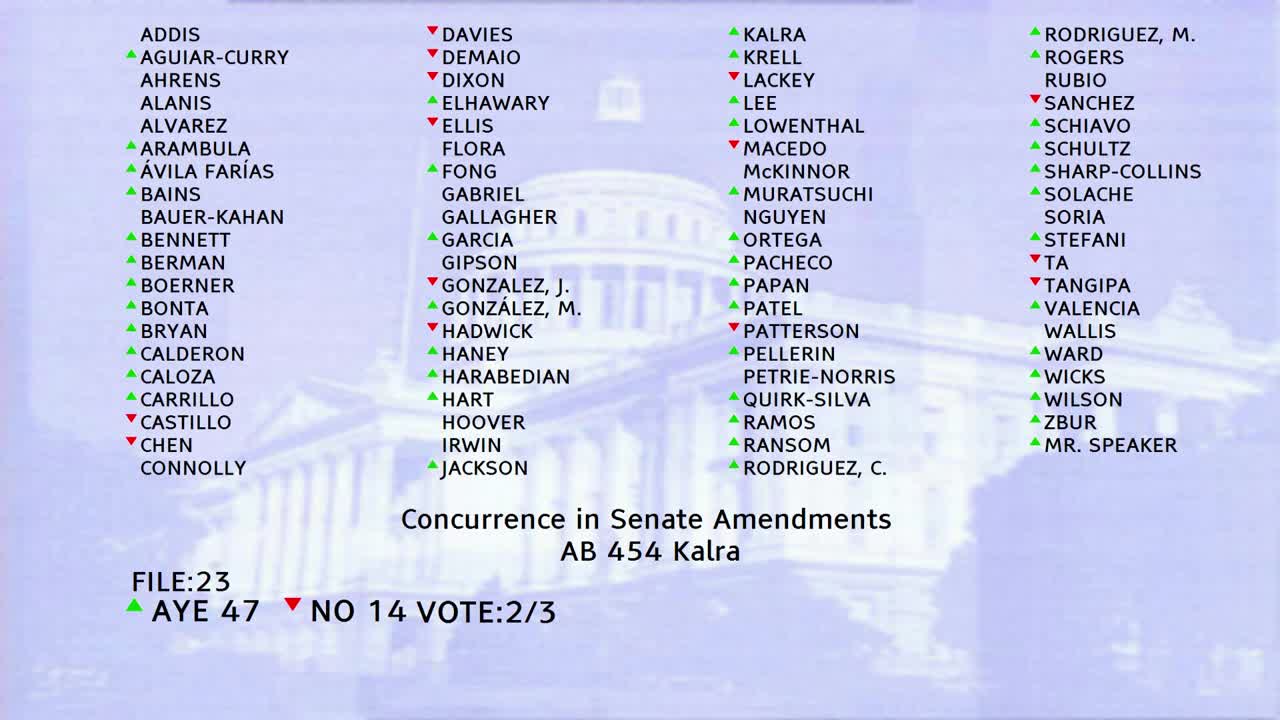 1MIN
Assembly Floor
 2MIN
Senate Floor
 7MIN
Senate Standing Committee on Energy, Utilities and Communications
 50SEC
Assembly Floor
Bill Author


