AB 1430: County recorders: fees.
- Session Year: 2025-2026
- House: Assembly
- Latest Version Date: 2025-09-12
Current Status:
Failed
(2026-01-22: Consideration of Governor's veto stricken from file.)
Introduced
In Committee
Awaiting First Chamber Vote
Passed First Chamber
In Committee
Awaiting Second Chamber Vote
Passed Second Chamber
Enacted
Existing law establishes the office of county recorder and requires the county recorder to accept for recordation any instrument, paper, or notice that is authorized or required to be recorded, subject to the collection of specified fees. Existing law prohibits the fee for recording and indexing an instrument, paper, or notice from exceeding $10 for recording the first page and $3 for each additional page, which charges are to reimburse the county for the costs of services rendered. Existing law requires $1 of each $3 fee for each additional page to be deposited in the county general fund.
This bill would set the fee for recording and indexing at $15 for recording the first page and $4 for each additional page, but would prohibit the fees from exceeding the reasonable costs of the county recorders office for providing these services. The bill would provide that these funds are to be dedicated to, and solely utilized for, the county recorders office, as specified. The bill would delete the provision requiring $1 of each $3 fee for each additional page to be deposited in the county general fund.
Existing law specifies that $1 for recording the first page and $1 for each additional page shall be available solely to support, maintain, improve, and provide for the full operation for modernized creation, retention, and retrieval of information in each countys system of recorded documents.
This bill would increase the $1 amount for each additional page to $3.
Existing law authorizes the county board of supervisors to provide for an additional fee of $1 for each instrument, paper, or notice of record to order to defray the cost of converting the county recorders document storage system to micrographics. Existing law, until January 1, 2026, authorizes the $1 fee to also be used for restoration and preservation of the county recorders permanent archival microfilm, to implement and fund a county recorder archive program, or to implement and maintain or utilize a trusted system for the permanent preservation of recorded document images.
This bill would delete the January 1, 2026, repeal date, thereby making these provisions operative indefinitely. The bill would replace a reference to archival microfilm with archival mediums and would repeal related provisions. The bill would include related legislative findings concerning county recorder fees.
By imposing new duties on counties relative to recording fees, the bill would impose a state-mandated local program.
The California Constitution requires the state to reimburse local agencies and school districts for certain costs mandated by the state. Statutory provisions establish procedures for making that reimbursement.
This bill would provide that no reimbursement is required by this act for a specified reason.
Existing law establishes the Department of Transportation and the California Transportation Commission and provides that the department has full possession and control of all state highways and all property and rights in property acquired for state highway purposes and authorizes and directs the department to lay out and construct all state highways between the termini designated by law and on the locations as determined by the commission.This bill would make nonsubstantive changes to these provisions.Existing law establishes the Department of Transportation and the California Transportation Commission and provides that the department has full possession and control of all state highways and all property and rights in property acquired for state highway purposes and authorizes and directs the department to lay out and construct all state highways between the termini designated by law and on the locations as determined by the commission.
This bill would make nonsubstantive changes to these provisions.
(a)The Legislature finds and declares all of the following:
(1)The fee for recording and indexing every instrument, paper, or notice required or permitted by law at the county recorders office was last adjusted in 2010.
(2)The county recorder is a fee-for-service department where fees charged are intended to cover the cost of services provided to the public at no additional expense to a countys net county cost.
(3)Recording fees have not been aligned to inflationary factors or the states minimum wage increases, creating significant budget challenges for counties. Absent an adjustment, the ability to provide services to the public at the usual standard and to maintain standards for timeliness and quality are at risk.
(b)It is the intent of the Legislature to ensure the most effective and efficient process related to Californias land title system both for the public and for county recorders by adjusting the base recording first and second page fees in alignment with inflationary factors to ensure effective and expeditious processing for real property records.
SEC. 2.Section 27361 of the Government Code is amended to read:27361.(a)(1)The fee for recording and indexing every instrument, paper, or notice required or permitted by law to be recorded shall be fifteen dollars ($15) for recording the first page and four dollars ($4) for each additional page, to reimburse the county for the costs of services rendered pursuant to this subdivision.
(2)Notwithstanding paragraph (1), the fees imposed by paragraph (1) shall not exceed the reasonable costs of the county recorders office for providing these services.
(b)In addition to the fees imposed by subdivision (a), the recorder may charge additional fees as follows:
(1)If the printing on printed forms is spaced more than nine lines per vertical inch or more than 22 characters and spaces per inch measured horizontally for not less than three inches in one sentence, the recorder shall charge one dollar ($1) extra for each page or sheet on which printing appears, except, however, the extra charge shall not apply to printed words that are directive or explanatory in nature for completion of the form or on vital statistics forms. Fees collected under this paragraph are not subject to subdivision (c).
(2)If a page or sheet does not conform to the dimensions described in subdivision (a) of Section 27361.5, the recorder shall charge three dollars ($3) extra per page or sheet of the document. The funds generated by the extra charge authorized under this paragraph shall be available solely to support, maintain, improve, and provide for the full operation for modernized creation, retention, and retrieval of information in each countys system of recorded documents. Fees collected under this paragraph are not subject to subdivision (c).
(c)Notwithstanding Section 68085, one dollar ($1) for recording the first page and three dollars ($3) for each additional page shall be available solely to support, maintain, improve, and provide for the full operation for modernized creation, retention, and retrieval of information in each countys system of recorded documents.
(d)(1)In addition to all other fees authorized by this section, a county recorder may charge a fee of one dollar ($1) for recording the first page of every instrument, paper, or notice required or permitted by law to be recorded, as authorized by each countys board of supervisors. The funds generated by this fee shall be used only by the county recorder collecting the fee for the purpose of implementing a social security number truncation program pursuant to Article 3.5 (commencing with Section 27300).
(2)A county recorder shall not charge the fee described in paragraph (1) after December 31, 2017, unless the county recorder has received reauthorization by the countys board of supervisors. A county recorder shall not seek reauthorization of the fee by the board before June 1, 2017, or after December 31, 2017. In determining the additional period of authorization, the board shall consider the review described in paragraph (4).
(3)Notwithstanding paragraph (2), a county recorder who, pursuant to subdivision (c) of Section 27304, secures a revenue anticipation loan, or other outside source of funding, for the implementation of a social security number truncation program, may be authorized to charge the fee described in paragraph (1) for a period not to exceed the term of repayment of the loan or other outside source of funding.
(4)A county board of supervisors that authorizes the fee described in this subdivision shall require the county auditor to conduct two reviews to verify that the funds generated by this fee are used only for the purpose of the program, as described in Article 3.5 (commencing with Section 27300) and for conducting these reviews. The reviews shall state the progress of the county recorder in truncating recorded documents pursuant to subdivision (a) of Section 27301, and shall estimate any ongoing costs to the county recorder of complying with subdivisions (a) and (b) of Section 27301. The board shall require that the first review be completed not before June 1, 2012, or after December 31, 2013, and that the second review be completed not before June 1, 2017, or after December 31, 2017. The reviews shall adhere to generally accepted accounting standards, and the review results shall be made available to the public.
(e)Except as provided in subdivision (g) of Section 6103.8, the fee authorized by this section shall not be charged to those entities exempted from the payment of recording fees under Section 6103 or 27383.
(f)Unless otherwise specified, all fees collected pursuant to this section shall be dedicated to, and solely utilized for, the recorders office.
SEC. 3.Section 27361.4 of the Government Code, as amended by Section 16 of Chapter 77 of the Statutes of 2021, is amended to read:27361.4.(a)The board of supervisors of any county may provide for an additional fee of one dollar ($1) for filing every instrument, paper, or notice for record for any of the following purposes:
(1)To defray the cost of converting the county recorders document storage system to micrographics and for restoration and preservation of the county recorders permanent archival mediums.
(2)To implement and fund a county recorder archive program as determined by the county recorder.
(3)To implement and maintain or utilize a trusted system, as defined by Section 12168.7, for the permanent preservation of recorded document images.
(b)The board of supervisors of any county may provide for an additional fee, other than the fees authorized in subdivisions (a) and (c), of one dollar ($1) for filing every instrument, paper, or notice for record provided that the resolution providing for the additional fee establishes the days of operation of the county recorders offices as every business day except for legal holidays and those holidays designated as judicial holidays pursuant to Section 135 of the Code of Civil Procedure.
(c)The board of supervisors of any county may provide for an additional fee, other than the fees authorized in subdivisions (a) and (b), of one dollar ($1) for filing every instrument, paper, or notice for record provided that the resolution providing for the additional fee requires that the instrument, paper, or notice be indexed within two business days after the date of recordation.
(d)Except as provided in subdivision (g) of Section 6103.8, the fees authorized by this section shall not be charged to those entities exempted from the payment of recording fees under Section 6103 or 27383.
SEC. 4.Section 27361.4 of the Government Code, as amended by Section 17 of Chapter 77 of the Statutes of 2021, is repealed.SEC. 5.No reimbursement is required by this act pursuant to Section 6 of Article XIIIB of the California Constitution because a local agency or school district has the authority to levy service charges, fees, or assessments sufficient to pay for the program or level of service mandated by this act, within the meaning of Section 17556 of the Government Code.
(a)The Legislature finds and declares all of the following:
(1)The fee for recording and indexing every instrument, paper, or notice required or permitted by law at the county recorders office was last adjusted in 2010.
(2)The county recorder is a fee-for-service department where fees charged are intended to cover the cost of services provided to the public at no additional expense to a countys net county cost.
(3)Recording fees have not been aligned to inflationary factors or the states minimum wage increases, creating significant budget challenges for counties. Absent an adjustment, the ability to provide services to the public at the usual standard and to maintain standards for timeliness and quality are at risk.
(b)It is the intent of the Legislature to ensure the most effective and efficient process related to Californias land title system both for the public and for county recorders by adjusting the base recording first and second page fees in alignment with inflationary factors to ensure effective and expeditious processing for real property records.
SEC. 2.Section 27361 of the Government Code is amended to read:27361.(a)(1)The fee for recording and indexing every instrument, paper, or notice required or permitted by law to be recorded shall not exceed ten dollars ($10) be fifteen dollars ($15) for recording the first page and three dollars ($3) four dollars ($4) for each additional page, to reimburse the county for the costs of services rendered pursuant to this subdivision, except the recorder may charge additional fees as follows: subdivision.
(2)Notwithstanding paragraph (1), the fees imposed by paragraph (1) shall not exceed the reasonable costs of the county recorders office for providing these services.
(b)In addition to the fees imposed by subdivision (a), the recorder may charge additional fees as follows:
(1)If the printing on printed forms is spaced more than nine lines per vertical inch or more than 22 characters and spaces per inch measured horizontally for not less than three inches in one sentence, the recorder shall charge one dollar ($1) extra for each page or sheet on which printing appears, except, however, the extra charge shall not apply to printed words that are directive or explanatory in nature for completion of the form or on vital statistics forms. Fees collected under this paragraph are not subject to subdivision (b) or (c).
(2)If a page or sheet does not conform to the dimensions described in subdivision (a) of Section 27361.5, the recorder shall charge three dollars ($3) extra per page or sheet of the document. The funds generated by the extra charge authorized under this paragraph shall be available solely to support, maintain, improve, and provide for the full operation for modernized creation, retention, and retrieval of information in each countys system of recorded documents. Fees collected under this paragraph are not subject to subdivision (b) or (c).
(b)One dollar ($1) of each three dollar ($3) fee for each additional page shall be deposited in the county general fund.(c)Notwithstanding Section 68085, one dollar ($1) for recording the first page and one dollar ($1) three dollars ($3) for each additional page shall be available solely to support, maintain, improve, and provide for the full operation for modernized creation, retention, and retrieval of information in each countys system of recorded documents.
(d)(1)In addition to all other fees authorized by this section, a county recorder may charge a fee of one dollar ($1) for recording the first page of every instrument, paper, or notice required or permitted by law to be recorded, as authorized by each countys board of supervisors. The funds generated by this fee shall be used only by the county recorder collecting the fee for the purpose of implementing a social security number truncation program pursuant to Article 3.5 (commencing with Section 27300).
(2)A county recorder shall not charge the fee described in paragraph (1) after December 31, 2017, unless the county recorder has received reauthorization by the countys board of supervisors. A county recorder shall not seek reauthorization of the fee by the board before June 1, 2017, or after December 31, 2017. In determining the additional period of authorization, the board shall consider the review described in paragraph (4).
(3)Notwithstanding paragraph (2), a county recorder who, pursuant to subdivision (c) of Section 27304, secures a revenue anticipation loan, or other outside source of funding, for the implementation of a social security number truncation program, may be authorized to charge the fee described in paragraph (1) for a period not to exceed the term of repayment of the loan or other outside source of funding.
(4)A county board of supervisors that authorizes the fee described in this subdivision shall require the county auditor to conduct two reviews to verify that the funds generated by this fee are used only for the purpose of the program, as described in Article 3.5 (commencing with Section 27300) and for conducting these reviews. The reviews shall state the progress of the county recorder in truncating recorded documents pursuant to subdivision (a) of Section 27301, and shall estimate any ongoing costs to the county recorder of complying with subdivisions (a) and (b) of Section 27301. The board shall require that the first review be completed not before June 1, 2012, or after December 31, 2013, and that the second review be completed not before June 1, 2017, or after December 31, 2017. The reviews shall adhere to generally accepted accounting standards, and the review results shall be made available to the public.
(e)Except as provided in subdivision (g) of Section 6103.8, the fee authorized by this section shall not be charged to those entities exempted from the payment of recording fees under Section 6103 or 27383.
(f)Unless otherwise specified, all fees collected pursuant to this section shall be dedicated to, and solely utilized for, the recorders office.
SEC. 3.Section 27361.4 of the Government Code, as amended by Section 16 of Chapter 77 of the Statutes of 2021, is amended to read:27361.4.(a)The board of supervisors of any county may provide for an additional fee of one dollar ($1) for filing every instrument, paper, or notice for record for any of the following purposes:
(1)To defray the cost of converting the county recorders document storage system to micrographics and for restoration and preservation of the county recorders permanent archival microfilm. mediums.
(2)To implement and fund a county recorder archive program as determined by the county recorder.
(3)To implement and maintain or utilize a trusted system, as defined by Section 12168.7, for the permanent preservation of recorded document images.
(b)The board of supervisors of any county may provide for an additional fee, other than the fees authorized in subdivisions (a) and (c), of one dollar ($1) for filing every instrument, paper, or notice for record provided that the resolution providing for the additional fee establishes the days of operation of the county recorders offices as every business day except for legal holidays and those holidays designated as judicial holidays pursuant to Section 135 of the Code of Civil Procedure.
(c)The board of supervisors of any county may provide for an additional fee, other than the fees authorized in subdivisions (a) and (b), of one dollar ($1) for filing every instrument, paper, or notice for record provided that the resolution providing for the additional fee requires that the instrument, paper, or notice be indexed within two business days after the date of recordation.
(d)Except as provided in subdivision (g) of Section 6103.8, the fees authorized by this section shall not be charged to those entities exempted from the payment of recording fees under Section 6103 or 27383.
(e)This section shall remain in effect only until January 1, 2026, and as of that date is repealed.SEC. 4.Section 27361.4 of the Government Code, as amended by Section 17 of Chapter 77 of the Statutes of 2021, is repealed.27361.4.(a)The board of supervisors of any county may provide for an additional fee of one dollar ($1) for filing every instrument, paper, or notice for record, in order to defray the cost of converting the county recorders document storage system to micrographics. Upon completion of the conversion and payment of the costs therefor, this additional fee shall no longer be imposed.(b)The board of supervisors of any county may provide for an additional fee, other than the fees authorized in subdivisions (a) and (c), of one dollar ($1) for filing every instrument, paper, or notice for record provided that the resolution providing for the additional fee establishes the days of operation of the county recorders offices as every business day except for legal holidays and those holidays designated as judicial holidays pursuant to Section 135 of the Code of Civil Procedure.(c)The board of supervisors of any county may provide for an additional fee, other than the fees authorized in subdivisions (a) and (b), of one dollar ($1) for filing every instrument, paper, or notice for record provided that the resolution providing for the additional fee requires that the instrument, paper, or notice be indexed within two business days after the date of recordation.(d)Except as provided in subdivision (g) of Section 6103.8, the fees authorized by this section shall not be charged to those entities exempted from the payment of recording fees under Section 6103 or 27383.(e)This section shall become operative on January 1, 2026.SEC. 5.No reimbursement is required by this act pursuant to Section 6 of Article XIIIB of the California Constitution because a local agency or school district has the authority to levy service charges, fees, or assessments sufficient to pay for the program or level of service mandated by this act, within the meaning of Section 17556 of the Government Code.
SECTION 1.Section 90 of the Streets and Highways Code is amended to read:90.The Department of Transportation shall have full possession and control of all state highways and all property and rights in property acquired for state highway purposes. The department is authorized and directed to lay out and construct all state highways between the termini designated by law and on the locations as determined by the California Transportation Commission.The department Department of Transportation shall have full possession and control of all state highways and all property and rights in property acquired for state highway purposes. The department is authorized and directed to lay out and construct all state highways between the termini designated by law and on the locations as determined by the commission. California Transportation Commission.
|
Date
|
Status
|
|---|---|
| Jan 22, 2026 | Consideration of Governor's veto stricken from file. |
| Oct 6, 2025 | Consideration of Governor's veto pending. |
| Oct 6, 2025 | Vetoed by Governor. |
| Sep 22, 2025 | Enrolled and presented to the Governor at 3 p.m. |
| Sep 10, 2025 | In Assembly. Ordered to Engrossing and Enrolling. |
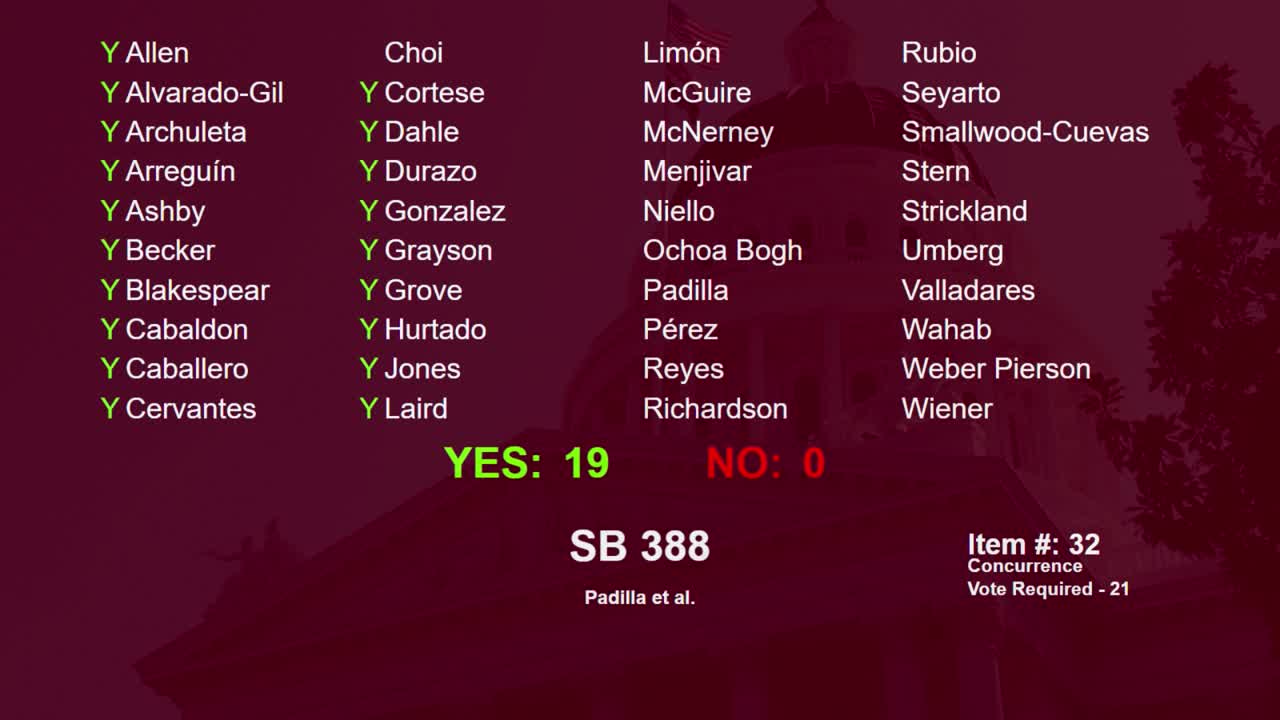
| Sep 10, 2025 | Read third time. Passed. Ordered to the Assembly. (Ayes 35. Noes 0. Page 2806.). |
| Jul 1, 2025 | Read second time. Ordered to third reading. |
| Jun 30, 2025 | From committee: Be ordered to second reading pursuant to Senate Rule 28.8. |
| Jun 18, 2025 | From committee: Do pass and re-refer to Com. on APPR. (Ayes 6. Noes 0.) (June 18). Re-referred to Com. on APPR. |
| Jun 4, 2025 | Referred to Com. on L. GOV. |
| May 23, 2025 | In Senate. Read first time. To Com. on RLS. for assignment. |
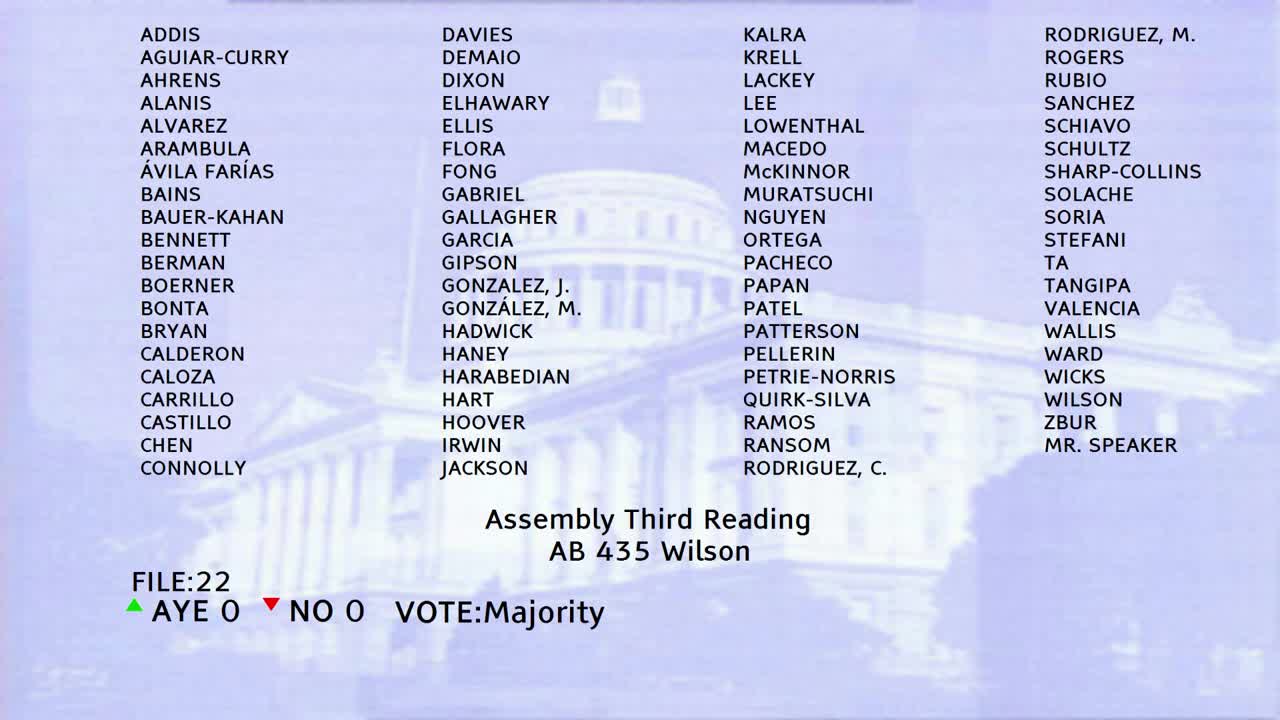
| May 23, 2025 | Read third time. Passed. Ordered to the Senate. (Ayes 64. Noes 1. Page 1658.) |
| May 15, 2025 | Read second time. Ordered to third reading. |
| May 14, 2025 | From committee: Do pass. (Ayes 12. Noes 1.) (May 14). |
| May 1, 2025 | From committee: Do pass and re-refer to Com. on APPR. (Ayes 8. Noes 0.) (April 30). Re-referred to Com. on APPR. |
| Mar 18, 2025 | Re-referred to Com. on L. GOV. |
| Mar 17, 2025 | From committee chair, with author's amendments: Amend, and re-refer to Com. on L. GOV. Read second time and amended. |
| Mar 17, 2025 | Referred to Com. on L. GOV. |
| Feb 24, 2025 | Read first time. |
| Feb 22, 2025 | From printer. May be heard in committee March 24. |
| Feb 21, 2025 | Introduced. To print. |
|
Date
|
Description
|
Location
|
Votes
|
|
|---|---|---|---|---|
| Sep 10, 2025 | Assembly 3rd Reading AB1430 Bennett By Durazo | Senate Floor |
Passed |
|
| Jun 18, 2025 | Do pass, but first be re-referred to the Committee on [Appropriations] | Senate Standing Committee on Local Government |
Passed |
|
| May 23, 2025 | AB 1430 Bennett Assembly Third Reading | Assembly Floor |
Passed |
|
| May 14, 2025 | Do pass. | Assembly Standing Committee on Appropriations |
Passed |
|
| Apr 30, 2025 | Do pass and be re-referred to the Committee on [Appropriations] | Assembly Standing Committee on Local Government |
Passed |
This list shows positions taken on this bill by organizations on the date displayed, which is linked to the original source.
Positions by individuals are not included.
|
Organization
|
Position
|
Date
|
|---|---|---|
| California State Association Of Counties | ** Support | |
| California State Council of Service Employees International Union | ** Support | |
| County of Colusa | ** Support | |
| County of El Dorado | ** Support | |
| County of Los Angeles Board of Supervisors | ** Support | |
| County of Riverside Board of Supervisors | ** Support | |
| County of Santa Barbara | ** Support | |
| County of Solano | ** Support | |
| County of Sonoma | ** Support | |
| County Recorder's Association of California | ** Support | |
| Rural County Representatives of California | ** Support | |
| Urban Counties of California | ** Support |
GOVERNOR'S VETO
GV Bill Id:AB 1430
Author:(Bennett)
As Enrolled Ver:September 12, 2025
2/3 vote
SUMMARY
Increases the recording and indexing fee to $15 for recording the first page and $4 for recording each additional page at the county recorder's office, and makes additional changes to various recording fees for specified purposes.
Major Provisions
- Requires the fee for recording and indexing every instrument, paper, or notice required or permitted by law to be recorded to be $15 for recording the first page and $4 for each additional page, to reimburse the county for the costs of services rendered, as specified.
- Prohibits the fee required pursuant to 1), above, from exceeding the reasonable costs of the county recorder's office for providing these services.
- Deletes a provision requiring $1 of the recording fee for each additional page to be deposited in the county general fund.
- Increases the portion of the fee for recording the first page that shall be available solely to support, maintain, improve, and provide for the full operation for modernized creation, retention, and retrieval of information in each county's system of recorded documents, from $1 to $3.
- Provides that all fees collected pursuant to 1) through 4) and existing law governing additional specified recording fees are to be dedicated to, and solely utilized for, the recorder's office.
- Removes the sunset date of January 1, 2026, in existing law that allows the board of supervisors of any county to provide for an additional fee of $1 for filing every instrument, paper, or notice for record for the following purposes:
- For restoration and preservation of the county recorder's permanent archival mediums (instead of microfilm).
- To implement and fund a county recorder archive program as determined by the county recorder.
- To implement and maintain or utilize a trusted system, as specified, for the permanent preservation of recorded document images.
- Allows the board of supervisors of any county to provide for an additional fee of $1 for filing every instrument, paper, or notice for record, in order to defray the cost of converting the county recorder's document storage system to micrographics indefinitely, by removing language specifying that this additional fee shall no longer be imposed upon completion of the conversion and payment of the costs therefor.
Governor's Veto Message
This bill would increase county recording base fees and make various changes to the allocation of these fees. Specifically, this bill would increase the record and indexing fee to $15 for the first page, and $4 for each additional page. For documents dealing with the ownership of land in counties – including payments of taxes and or fees, deeds, mortgage documents, easements – and any documents that affect the ownership of any given property, this bill would increase the recorder fee from $1 to $3 for each additional page.
Californians realizing the dream of property ownership rely on recorder offices to handle important documents with care, making these offices critical points of interaction between residents and their government. I appreciate the author's intent to improve the efficiency of California's land title system, for both the public and county recorders, to ensure expeditious processing of real property records. However, raising these fees on Californians will disincentivize efforts to think innovatively about how to deliver recording services at a lower cost, faster, and with better customer service. I encourage the author and counties to consider ways to achieve that goal without solely relying on fee increases.
COMMENTS
County recorders serve as the custodian of vital records, recorded land documents and other legal documents that support the integrity of property ownership and legal transactions. Documents that are commonly recorded include payments of taxes or fees, filings of fictitious business names, deeds, mortgage documents, easements, power of attorney documents, liens, and any documents that affect the ownership of any given property. Other documents include deeds of trust, court decrees, and many other documents affecting title to real property; commercial code filings; subdivision maps; vital statistics such as births, deaths, and marriages; and other items.
County recorders are a fee-for-service operation with fees structured to allow for cost recovery. Existing law requires the county recorder to accept for recordation any instrument, paper, or notice that is authorized or required to be recorded, subject to the collection of specified fees. Existing law prohibits the base fee for recording and indexing an instrument, paper, or notice from exceeding $10 for recording the first page and $3 for each additional page. Existing law requires $1 of each $3 fee for each additional page to be deposited in the county general fund. Existing law allows the county recorder to charge several additional fees sufficient to defray county recorders' costs for specified purposes. Not all counties charge the maximum fees allowed. Currently, 34 of the 58 county recorders have requested or rely on county general fund dollars to maintain services.
The most recent county recorder's fee increase was enacted via SB 676 (Wolk), Chapter 606, Statutes of 2009. SB 676 increased the maximum charge for the recording of the first page from $4 to $10, and maintained the maximum charge of $3 for each additional page, with the ability to charge additional fees as specified. According to the sponsor, without an inflationary adjustment, county recorders have increased difficulty in providing services to the public at the usual time and quality standards that county recorders hold. The sponsor argues that adjusting the base recording first and additional page fees to align with inflationary factors will aid in the effective and efficient processing of county recording documents.
According to the California Consumer Price Index (CPI), there has been a 38% inflation increase from 2011 to 2024. In other regions of the state, such as San Francisco, the CPI increased by 49% during that time. The fee increases in this bill are generally consistent with an inflationary adjustment.
According to the Author
California Recorder's Offices are supposed to be funded via fees on recorded documents. However, their fees have not been increased since 2011, resulting in growing budget shortages. AB 1430 addresses the fact that it is time for recorder's fees to catch up to the rising costs that recorders' offices face, and clarifies that any dollars raised by their fees must be used to fund the services they provide.
Arguments in Support
The County Recorder's Association of California, sponsor of this bill, writes, "County Recorders are a fee-for-service office. Their office plays a fundamental role throughout the State as they serve as the custodian of vital records, recorded land documents, and other legal documents that support the integrity of property ownership, and legal transactions. These documents, and the efficiency of County Recorder operations, is critical to the real estate industry.
"Legislative statutes govern Recorder offices structures and fees associated with cost recovery to allow fiscal stability. Currently, Government Code 27361 authorizes County Recorders to charge a fee maximum of $10 for the first page of a recording, and $3 for every additional page - a fee that was codified in 2009 and implemented 15 years ago in January 2010 despite rising costs for Counties and a decline in real estate transactions. Provided that our Recorder offices are foundationally a fee-for-service department, the Recorder is to only charge for the services provided, with fees structured not to collect more than the cost of providing the service to the public. However, many Recorders for the past few years have been forced to request funds from their county general fund to supplant their costs and maintain operations. While these are practical approaches, it points out the fact that the statues that were created for Recorders to maintain sustainability are outdated and now require counties to divert financial resources away from other vital county departments such as law enforcement, healthcare, and infrastructure. Additionally, County Recorder offices are vulnerable to unpredictable fluctuations in workload directly tied to market changes. Currently, if the market shifted resulting in a rapid increase in recordings or transactions, Recorders would face a further financial burden and strain on its current resources.
"AB 1430 updates the fee a County Recorder may charge for recording the first page of a document from $10 to $15 and additional pages from $3 to $4. These adjustments are in alignment with the Consumer Price Index and requires fees collected to be dedicated to, and solely utilized for, the county recorder's office, and prohibits the fees from exceeding the reasonable costs of the document recording function. The current funding situation poses a significant threat to Recorder operations. Without an adequate and updated fee, disruption will be imminent to California constituents."
Arguments in Opposition
None on file.
FISCAL COMMENTS
No state costs. One-time local costs, likely minor, to each county recorder to implement the fee changes authorized by this bill. These costs are not reimbursable by the state because a local agency has general authority to charge and adjust fees to offset increased costs associated with the provisions of this bill.
VOTES
ASM LOCAL GOVERNMENT: 8-0-2
YES: Carrillo, Pacheco, Ramos, Ransom, Blanca Rubio, Stefani, Ward, Wilson
ABS, ABST OR NV: Ta, Hoover
ASM APPROPRIATIONS: 12-1-2
YES: Wicks, Arambula, Calderon, Caloza, Dixon, Elhawary, Fong, Mark González, Hart, Pacheco, Pellerin, Solache
NO: Sanchez
ABS, ABST OR NV: Ta, Tangipa
ASSEMBLY FLOOR: 64-1-14
YES: Addis, Aguiar-Curry, Ahrens, Alanis, Alvarez, Arambula, Ávila Farías, Bains, Bauer‑Kahan, Bennett, Berman, Boerner, Bonta, Calderon, Caloza, Carrillo, Connolly, Davies, Dixon, Elhawary, Flora, Fong, Gabriel, Garcia, Gipson, Jeff Gonzalez, Mark González, Hadwick, Haney, Harabedian, Hart, Irwin, Jackson, Kalra, Krell, Lee, Lowenthal, McKinnor, Muratsuchi, Ortega, Pacheco, Papan, Patel, Patterson, Pellerin, Petrie-Norris, Quirk-Silva, Ramos, Ransom, Celeste Rodriguez, Michelle Rodriguez, Rogers, Blanca Rubio, Schiavo, Schultz, Solache, Soria, Stefani, Valencia, Wallis, Ward, Wilson, Zbur, Rivas
NO: DeMaio
ABS, ABST OR NV: Bryan, Castillo, Chen, Ellis, Gallagher, Hoover, Lackey, Macedo, Nguyen, Sanchez, Sharp-Collins, Ta, Tangipa, Wicks
SENATE FLOOR: 35-0-5
YES: Allen, Alvarado-Gil, Archuleta, Arreguín, Ashby, Becker, Blakespear, Cabaldon, Caballero, Choi, Cortese, Dahle, Durazo, Gonzalez, Grayson, Grove, Hurtado, Laird, Limón, McGuire, McNerney, Menjivar, Padilla, Pérez, Reyes, Richardson, Rubio, Smallwood-Cuevas, Stern, Strickland, Umberg, Valladares, Wahab, Weber Pierson, Wiener
ABS, ABST OR NV: Cervantes, Jones, Niello, Ochoa Bogh, Seyarto
UPDATED
VERSION: September 12, 2025
CONSULTANT: Angela Mapp / L. GOV. / (916) 319-3958 FN: 0002192
SENATE COMMITTEE ON LOCAL GOVERNMENT
Senator María Elena Durazo, Chair
2025 - 2026 Regular
Bill No: | AB 1430 | Hearing Date: | 6/18/25 |
Author: | Bennett | Fiscal: | Yes |
Version: | 3/17/25 | Consultant: | Peterson |
County recorders: fees
Increases county recording fees and makes various changes to the allocation of these fees.
Background
County boards of supervisors can levy authorized fees or charges in amounts reasonably necessary to recover the costs of providing products or services or the cost of enforcing regulations. (AB 151, Hannigan, 1983). The fees or charges may reflect the average cost of providing products or services or enforcing regulations, plus limited indirect costs.
County recorders are responsible for examining and recording all documents dealing with the ownership of land in counties. These documents include payments of taxes or fees, filings of fictitious business names, deeds, mortgage documents, easements, power of attorney documents, liens, and any documents that affect the ownership of any given property. Other documents include deeds of trust, court decrees, and many other documents affecting title to real property; commercial code filings; subdivision maps; vital statistics such as births, deaths, and marriages; and other items.
Existing law allows county recorders to charge a filing fee for recording and indexing every instrument, paper, or notice required or permitted by law to be recorded. From 1985 (SB 2277, McCorquodale, 1984) to 2009, the maximum charge is $4 for the recording of the first page and $3 for each additional page. In 2009, SB 676 (Wolk) increased the maximum charge for the recording of the first page of a document from $4 to $10, where it remains today. One dollar of each $3 dollar fee for an additional page must go into the county general fund. In addition, recorders can also collect a $1 fee on the first and each additional page if they use it solely to support, maintain, improve, and provide for the full operation for modernized creation, retention, and retrieval of information in each county’s system of recorded documents.
Since 1980, recorders have been able to charge an additional $1 fee for filing every instrument, paper, or notice for record in order to defray the cost of converting the recorder’s document storage system to microfilm (AB 3332, Filante, 1980). All 58 counties currently impose the $1 fee. In 2019, AB 212 (Bonta) expanded the uses of that fee to over county recorder archive programs and the preservation of recorded documents in electronic media or in a cloud computing storage service. AB 212’s provisions sunset on January 1, 2026.
According to the County Recorders’ Association of California, 34 of the 58 county recorders rely on county general funds to for their operations. They want to increase recording fees to alleviate their reliance on county general funds.
Proposed Law
Assembly Bill 1430 increases the recording and indexing fee to $15 for recording the first page and $4 for recording each additional page at the county recorder’s office. It also increases the recorder fee that goes solely to support, maintain, improve, and provide for the full operation for modernized creation, retention, and retrieval of information in each county’s system of recorded documents, from $1 to $3 for each additional page.
AB 1430 prohibits fee amounts from exceeding the reasonable costs of the county recorder’s office for providing these services. The measure removes the requirement that one dollar of each $3 dollar fee for an additional page must go into the county general fund, and instead requires county recorder fees be dedicated to, and solely utilized for, the recorder’s office.
The measure also repeals the January 1, 2026 sunset on AB 212’s provisions.
Comments
1. Purpose of the bill. According to the author, “California Recorder’s Offices are supposed to be funded via fees on recorded documents. However, their fees have not been increased since 2011, resulting in growing budget shortages. AB 1430 addresses the fact that it is time for recorder's fees to catch up to the rising costs that recorders' offices face, and clarifies that any dollars raised by their fees must be used to fund the services they provide.”
2. Raise the roof! AB 1430 increases the fees that county recorders can charge when someone must file a document. While the measure prohibits fee amounts from exceeding the reasonable costs of the county recorder’s office for providing these services, fees could increase by at least 50% as a result of the base recording fee increasing from $10 to $15. The supporters of this measure, like the County Recorders’ Association of California, argue this is justified to account for inflation since the last increase in 2009, and to decrease their reliance on county general funds to backfill their offices. This will come as little solace to individuals who seek to record a document and find costs significantly higher than they were the year before. However, since the county recorder will not have to rely on general fund resources for as much support, the county may have additional resources to devote to core programs and services. Does AB 1430 adequately balance increased fees for recorders and impacts on their residents?
3. Mandate. The California Constitution requires the state to reimburse local governments for the costs of new or expanded state mandated local programs. Because AB 1430 adds to the duties of local officials, Legislative Counsel says the bill imposes a new state mandate. AB 1430 disclaims the state’s responsibility for providing reimbursement by citing local governments’ authority to charge for the costs of implementing the bill’s provisions.
Assembly Actions
Assembly Local Government Committee: 8-0
Assembly Appropriations Committee: 12-1
Assembly Floor: 64-1
Support and Opposition
(6/13/2025)
Support: County Recorders Association of California (Sponsor)
California State Association of Counties (CSAC)
California State Council of Service Employees International Union (SEIU California)
County of Colusa
County of El Dorado
County of Los Angeles Board of Supervisors
County of Riverside Board of Supervisors
County of Santa Barbara
County of Solano
County of Sonoma
Rural County Representatives of California (RCRC)
Urban Counties of California (UCC)
Opposition: None Submitted
-- END --
ASSEMBLY THIRD READING
ATR Bill Id:AB 1430
Author:(Bennett)
As Amended Ver:March 17, 2025
Majority vote
SUMMARY
Increases the recording and indexing fee to $15 for recording the first page and $4 for recording each additional page at the county recorder's office, and makes additional changes to various recording fees for specified purposes.
Major Provisions
- Requires the fee for recording and indexing every instrument, paper, or notice required or permitted by law to be recorded to be $15 for recording the first page and $4 for each additional page, to reimburse the county for the costs of services rendered, as specified.
- Prohibits the fee required pursuant to 1), above, from exceeding the reasonable costs of the county recorder's office for providing these services.
- Deletes a provision requiring $1 of the recording fee for each additional page to be deposited in the county general fund.
- Increases the portion of the fee for recording the first page that shall be available solely to support, maintain, improve, and provide for the full operation for modernized creation, retention, and retrieval of information in each county's system of recorded documents, from $1 to $3.
- Provides that all fees collected pursuant to 1) through 4) and existing law governing additional specified recording fees are to be dedicated to, and solely utilized for, the recorder's office.
- Removes the sunset date of January 1, 2026, in existing law that allows the board of supervisors of any county to provide for an additional fee of $1 for filing every instrument, paper, or notice for record for the following purposes:
- For restoration and preservation of the county recorder's permanent archival mediums (instead of microfilm).
- To implement and fund a county recorder archive program as determined by the county recorder.
- To implement and maintain or utilize a trusted system, as specified, for the permanent preservation of recorded document images.
- Allows the board of supervisors of any county to provide for an additional fee of $1 for filing every instrument, paper, or notice for record, in order to defray the cost of converting the county recorder's document storage system to micrographics indefinitely, by removing language specifying that this additional fee shall no longer be imposed upon completion of the conversion and payment of the costs therefor.
COMMENTS
County recorders serve as the custodian of vital records, recorded land documents and other legal documents that support the integrity of property ownership and legal transactions. Documents that are commonly recorded include payments of taxes or fees, filings of fictitious business names, deeds, mortgage documents, easements, power of attorney documents, liens, and any documents that affect the ownership of any given property. Other documents include deeds of trust, court decrees, and many other documents affecting title to real property; commercial code filings; subdivision maps; vital statistics such as births, deaths, and marriages; and other items.
County recorders are a fee-for-service operation with fees structured to allow for cost recovery. Existing law requires the county recorder to accept for recordation any instrument, paper, or notice that is authorized or required to be recorded, subject to the collection of specified fees. Existing law prohibits the base fee for recording and indexing an instrument, paper, or notice from exceeding $10 for recording the first page and $3 for each additional page. Existing law requires $1 of each $3 fee for each additional page to be deposited in the county general fund. Existing law allows the county recorder to charge several additional fees sufficient to defray county recorders' costs for specified purposes. Not all counties charge the maximum fees allowed. Currently, 34 of the 58 county recorders have requested or rely on county general fund dollars to maintain services.
The most recent county recorder's fee increase was enacted via SB 676 (Wolk), Chapter 606, Statutes of 2009. SB 676 increased the maximum charge for the recording of the first page from $4 to $10, and maintained the maximum charge of $3 for each additional page, with the ability to charge additional fees as specified. According to the sponsor, without an inflationary adjustment, county recorders have increased difficulty in providing services to the public at the usual time and quality standards that county recorders hold. The sponsor argues that adjusting the base recording first and additional page fees to align with inflationary factors will aid in the effective and efficient processing of county recording documents.
According to the California Consumer Price Index (CPI), there has been a 38% inflation increase from 2011 to 2024. In other regions of the state, such as San Francisco, the CPI increased by 49% during that time. The fee increases in this bill are generally consistent with an inflationary adjustment.
According to the Author
According to the author, "California Recorder's Offices are supposed to be funded via fees on recorded documents. However, their fees have not been increased since 2011, resulting in growing budget shortages. AB 1430 addresses the fact that it is time for recorder's fees to catch up to the rising costs that recorders' offices face, and clarifies that any dollars raised by their fees must be used to fund the services they provide."
Arguments in Support
The County Recorder's Association of California, sponsor of this bill, writes, "County Recorders are a fee-for-service office. Their office plays a fundamental role throughout the State as they serve as the custodian of vital records, recorded land documents, and other legal documents that support the integrity of property ownership, and legal transactions. These documents, and the efficiency of County Recorder operations, is critical to the real estate industry.
"Legislative statutes govern Recorder offices structures and fees associated with cost recovery to allow fiscal stability. Currently, Government Code 27361 authorizes County Recorders to charge a fee maximum of $10 for the first page of a recording, and $3 for every additional page - a fee that was codified in 2009 and implemented 15 years ago in January 2010 despite rising costs for Counties and a decline in real estate transactions. Provided that our Recorder offices are foundationally a fee-for-service department, the Recorder is to only charge for the services provided, with fees structured not to collect more than the cost of providing the service to the public. However, many Recorders for the past few years have been forced to request funds from their county general fund to supplant their costs and maintain operations. While these are practical approaches, it points out the fact that the statues that were created for Recorders to maintain sustainability are outdated and now require counties to divert financial resources away from other vital county departments such as law enforcement, healthcare, and infrastructure. Additionally, County Recorder offices are vulnerable to unpredictable fluctuations in workload directly tied to market changes. Currently, if the market shifted resulting in a rapid increase in recordings or transactions, Recorders would face a further financial burden and strain on its current resources.
"AB 1430 updates the fee a County Recorder may charge for recording the first page of a document from $10 to $15 and additional pages from $3 to $4. These adjustments are in alignment with the Consumer Price Index and requires fees collected to be dedicated to, and solely utilized for, the county recorder's office, and prohibits the fees from exceeding the reasonable costs of the document recording function. The current funding situation poses a significant threat to Recorder operations. Without an adequate and updated fee, disruption will be imminent to California constituents."
Arguments in Opposition.
None on file.
FISCAL COMMENTS
No state costs. One-time local costs, likely minor, to each county recorder to implement the fee changes authorized by this bill. These costs are not reimbursable by the state because a local agency has general authority to charge and adjust fees to offset increased costs associated with the provisions of this bill.
VOTES
ASM LOCAL GOVERNMENT: 8-0-2
YES: Carrillo, Pacheco, Ramos, Ransom, Blanca Rubio, Stefani, Ward, Wilson
ABS, ABST OR NV: Ta, Hoover
ASM APPROPRIATIONS: 12-1-2
YES: Wicks, Arambula, Calderon, Caloza, Dixon, Elhawary, Fong, Mark González, Hart, Pacheco, Pellerin, Solache
NO: Sanchez
ABS, ABST OR NV: Ta, Tangipa
UPDATED
VERSION: March 17, 2025
CONSULTANT: Ruby Arceo / Angela Mapp / L. GOV. / (916) 319-3958 FN: 0000446
Date of Hearing: May 14, 2025
ASSEMBLY COMMITTEE ON APPROPRIATIONS
Buffy Wicks, Chair
ABPCA Bill Id:AB 1430
Author:(Bennett) – As Amended Ver:March 17, 2025
Policy Committee: | Local Government | Vote: | 8 - 0 |
|
| ||
|
|
Urgency: No State Mandated Local Program: Yes Reimbursable: No
SUMMARY:
This bill increases the base recording and indexing fee a county recorder may charge from $10 to $15 for recording the first page, and from $3 to $4 for recording each additional page at the county recorder’s office, and makes additional changes to various recording fees for specified purposes.
Specifically, this bill:
- Increases the fee for recording and indexing every instrument, paper, or notice required or permitted by law to be recorded from $10 to $15 for recording the first page and from $3 to $4 for each additional page, to reimburse the county for the costs of services rendered, as specified.
- Prohibits the fee required pursuant to item 1, above, from exceeding the reasonable costs of the county recorder’s office for providing these services.
- Deletes a provision requiring $1 of the recording fee for each additional page to be deposited in the county general fund.
- Increases the fee for recording the first page that shall be available solely to support, maintain, improve, and provide for the full operation for modernized creation, retention, and retrieval of information in each county’s system of recorded documents, from $1 to $3.
- Requires all fees collected pursuant to items 1 through 4, above, and existing law governing additional specified recording fees be dedicated to, and solely utilized for, the recorder’s office.
- Deletes the sunset date of January 1, 2026, thus making permanent, existing law allowing any county to charge an additional fee of $1 for filing every instrument, paper, or notice for record to (a) restore and preserve the county recorder’s permanent archival mediums (instead of microfilm), (b) implement and fund a county recorder archive program, and (c) implement and maintain or utilize a trusted system, as specified, for the permanent preservation of recorded document images.
FISCAL EFFECT:
No state costs. One-time local costs, likely minor, to each county recorder to implement the fee changes authorized by this bill. These costs are not reimbursable by the state because a local agency has general authority to charge and adjust fees to offset increased costs associated with the provisions of this bill.
COMMENTS:
- Purpose. According to the author:
California Recorder’s Offices are supposed to be funded via fees on recorded documents. However, their fees have not been increased since 2011, resulting in growing budget shortages. [This bill] addresses the fact that it is time for recorder's fees to catch up to the rising costs that recorders' offices face, and clarifies that any dollars raised by their fees must be used to fund the services they provide.
This bill is sponsored by the County Recorders’ Association of California and is supported by numerous counties and county representative organizations.
- Background. County recorders serve as the custodian of vital records, recorded land documents and other legal documents that support the integrity of property ownership, and legal transactions. Count recorders are a fee-for-service operation with fees structured to allow for cost recovery.
Existing law requires the county recorder to accept for recordation any instrument, paper, or notice that is authorized or required to be recorded, subject to the collection of specified fees. Existing law prohibits the base fee for recording and indexing an instrument, paper, or notice from exceeding $10 for recording the first page and $3 for each additional page. Existing law requires $1 of each $3 fee for each additional page to be deposited in the county general fund. Existing law allows the county recorder to charge several additional fees sufficient to defray county recorders’ costs for specified purposes. Not all counties charge the maximum fees allowed.
The base county recorder fee has not been increased since 2010, when it was raised from $4 to $10. According to the sponsor, the current funding situation poses a significant threat to recorder operations, and without an inflation adjustment, county recorders will have increasing difficulty in providing quality services to the public. Currently, 34 of the 58 county recorders have requested or rely on county general fund dollars to maintain services.
This bill updates the base fee a county recorder may charge for recording the first page of a document from $10 to $15 and additional pages from $3 to $4, and makes other modernizing updates. These adjustments are in alignment with the Consumer Price Index and require fees collected to be dedicated to, and solely utilized for, the county recorder’s office. The bill prohibits the fees from exceeding the reasonable costs of the document recording function.
Analysis Prepared by: Jennifer Swenson / APPR. / (916) 319-2081
Date of Hearing: April 30, 2025
ASSEMBLY COMMITTEE ON LOCAL GOVERNMENT
Juan Carrillo, Chair
ABPCA Bill Id:AB 1430 (
Author:Bennett) – As Amended Ver:March 17, 2025
SUBJECT: County recorders: fees.
SUMMARY: Increases the recording and indexing fee to $15 for recording the first page and $4 for recording each additional page at the county recorder’s office, and makes additional changes to various recording fees for specified purposes. Specifically, this bill:
- Requires the fee for recording and indexing every instrument, paper, or notice required or permitted by law to be recorded to be $15 for recording the first page and $4 for each additional page, to reimburse the county for the costs of services rendered, as specified.
- Prohibits the fee required pursuant to 1), above, from exceeding the reasonable costs of the county recorder’s office for providing these services.
- Deletes a provision requiring $1 of the recording fee for each additional page to be deposited in the county general fund.
- Increases the fee for recording the first page that shall be available solely to support, maintain, improve, and provide for the full operation for modernized creation, retention, and retrieval of information in each county’s system of recorded documents, from $1 to $3.
- Provides that all fees collected pursuant to 1) through 4) and existing law governing additional specified recording fees are to be dedicated to, and solely utilized for, the recorder’s office.
- Removes the sunset date of January 1, 2026, in existing law that allows the board of supervisors of any county to provide for an additional fee of $1 for filing every instrument, paper, or notice for record for the following purposes:
- For restoration and preservation of the county recorder’s permanent archival mediums (instead of microfilm).
- To implement and fund a county recorder archive program as determined by the county recorder.
- To implement and maintain or utilize a trusted system, as specified, for the permanent preservation of recorded document images.
- Allows the board of supervisors of any county to provide for an additional fee of $1 for filing every instrument, paper, or notice for record, in order to defray the cost of converting the county recorder’s document storage system to micrographics indefinitely, by removing language specifying that this additional fee shall no longer be imposed upon completion of the conversion and payment of the costs therefor.
- Contains a number of findings and declarations regarding its purpose.
- Provides that no reimbursement is required by this bill pursuant to Section 6 of Article XIII B of the California Constitution because a local agency or school district has the authority to levy service charges, fees, or assessments sufficient to pay for the program or level of service mandated by this bill, as specified.
EXISTING LAW:
- Prohibits the fee for recording and indexing an instrument, paper, or notice from exceeding $10 for recording the first page and $3 fee for each additional page, to reimburse the county for the costs of services rendered, as specified. [Government Code (GOV) § 27361]
- Requires $1 of each $3 fee for each additional page to be deposited in the county general fund. (GOV § 27361)
- Requires $1 for recording the first page and $1 for each additional page to be available solely to support, maintain, improve, and provide for the full operation for modernized creation, retention, and retrieval of information in each county’s system of recorded documents. (GOV § 27361)
- Authorizes the county board of supervisors to provide for an additional fee of $1 for filing each instrument, paper, or notice of record for any of the following purposes:
- To defray the cost of converting the county recorder’s document storage system to micrographics. Upon completion of the conversion and payment of the costs therefor, this additional fee shall no longer be imposed.
- Until January 1, 2026, to defray the cost for restoration and preservation of the county recorder’s permanent archival microfilm.
- Until January 1, 2026, to implement and fund a county recorder archive program as determined by the county recorder.
- Until January 1, 2026, to implement and maintain or utilize a trusted system, as specified, for the permanent preservation of recorded document images. (GOV § 27361.4)
FISCAL EFFECT: This bill is keyed fiscal and contains a state-mandated local program.
COMMENTS:
- Bill Summary. This bill makes a number of changes to various recording fees, as follows:
- Requires the fee for recording to be $15 (instead of up to $10 under current law) for recording the first page and $4 (instead of up to $3 under current law) for each additional page, and prohibits these fees from exceeding the reasonable costs for providing these services.
- Deletes a provision requiring $1 of the recording fee for each additional page to be deposited in the county general fund.
- Increases, from $1 to $3, the fee for recording the first page that shall be available solely to support, maintain, improve, and provide for the full operation for modernized creation, retention, and retrieval of information in each county’s system of recorded documents.
- Provides that all fees specified above are to be dedicated to, and solely utilized for, the recorder’s office.
- Removes the sunset date of January 1, 2026, in existing law that allows the board of supervisors of any county to provide for an additional recording fee of $1 for the following purposes:
- For restoration and preservation of the county recorder’s permanent archival mediums (instead of microfilm).
- To implement and fund a county recorder archive program as determined by the county recorder.
- To implement and maintain or utilize a trusted system, as specified, for the permanent preservation of recorded document images.
- Allows the board of supervisors of any county to provide for an additional fee of $1 for filing every instrument, paper, or notice for record, in order to defray the cost of converting the county recorder’s document storage system to micrographics indefinitely, by removing language specifying that this additional fee shall no longer be imposed upon completion of the conversion and payment of the costs for doing so.
This bill is sponsored by the County Recorders’ Association of California.
- Author’s Statement. According to the author, “California Recorder’s Offices are supposed to be funded via fees on recorded documents. However, their fees have not been increased since 2011, resulting in growing budget shortages. AB 1430 addresses the fact that it is time for recorder's fees to catch up to the rising costs that recorders' offices face, and clarifies that any dollars raised by their fees must be used to fund the services they provide.”
- County Recorders. County recorders are responsible for examining and recording all documents dealing with the ownership of land in counties. Documents that are commonly recorded include payments of taxes or fees, filings of fictitious business names, deeds, mortgage documents, easements, power of attorney documents, liens, and any documents that affect the ownership of any given property. Other documents include deeds of trust, court decrees, and many other documents affecting title to real property; commercial code filings; subdivision maps; vital statistics such as births, deaths, and marriages; and other items.
- Need for Increased Fees. The most recent county recorder’s fee increase was in 2009 with the implementation of SB 676 (Wolk), which increased the maximum charge for the recording of the first page from $4 to $10, and maintained the maximum charge of $3 for each additional page, with the ability to charge additional fees as specified. According to the sponsor, without an inflation adjustment, county recorders have increased difficulty in providing services to the public at the usual time and quality standards that county recorders hold. The sponsor argues that adjusting the base recording first and additional page fees to align with inflationary factors will aid in the effective and efficient processing of county recording documents.
Several counties in California have increased the recording fees for their Clerk-Recorder-Elections offices to adjust to the costs of services and be financially sustainable without relying heavily on general fund allocations. In 2024, Mono County increased recording fees to be $14 for the first-page recording fee and $3 for each additional page. Legal-sized documents increased to $17 for the first-page recording fee and $6 additional page.
Contra Costa County’s Board of Supervisors evaluated a fee evaluation report from the Clerk-Recorder-Elections Office, revealing that only 62% of the department’s costs were covered through existing fees. The county worked with NBS Government Finance Group in 2023 to provide fee analyses and fee schedules related to services rendered. This provided an opportunity for the Board of Supervisors to re-align fee amounts to account for increased costs and inflation. Beginning 2025, Orange County increased its first-page recording fee from $7 to $12, and the government rate recording fee from $10 to $18, to align with the current costs of providing county recording services.
According to the author’s office, several counties conducted a fee increase study, with at least five of them finding that the fee did not fully cover the cost of service, even with the county recorder fee increase in 2010. Across the state, 34 of the 58 county recorders are relying on general fund dollars to maintain services and supplant operational costs, leading to impacts in their hours available to the public, staff reductions, and the consideration of the closure of satellite offices. This may lead to impacts in recording delays and processing a real estate transaction. The author’s office notes that document recordings are essential to having a functional home buying and selling process.
California’s recorder offices are processing documents at one of the lowest costs for residents. Illinois increased the initial page fee to $14, and increased the real estate-related documents from $9 to $18. Other states, like Arizona, Washington DC, and Michigan, have implemented a $30 fee.
According to the California Consumer Price Index (CPI), there has been a 38% inflation increase from 2011 to 2024. In other regions of the state, such as San Francisco, the CPI increased by 49% during that time. With the increase in inflation, the author’s office states that this measure is necessary by ensuring that fees maintained by the county recorders office help relieve budgetary imbalances.
- Previous Legislation. AB 212 (Bonta) Chapter 41, Statutes of 2019, allowed county recorders to use a $1 fee collected pursuant to existing law for additional purposes.
AB 22 (Bonta) Chapter 834, Statutes of 2017, authorized state and local agencies to store documents through the use of a cloud computing storage service.
AB 794 (Gallagher) Chapter 349, Statutes of 2017, allowed specified persons to request that information in the recorder’s index of record be corrected upon providing sufficient evidence, and clarified that a recorder may correct indexing errors.
AB 1974 (Gallagher) Chapter 406, Statutes of 2016, required a document presented to a county recorder for re-recording to be executed and acknowledged, or verified as a new document.
AB 661 (Mathis) Chapter 76, Statutes of 2015, clarified an exemption in current law from fees that counties may place on certain recorded real estate documents to fund real estate fraud prevention and enforcement.
AB 679 (Allen) Chapter 778, Statutes of 2015, required any document presented for county recording to state the number of pages to be recorded.
SB 676 (Wolk) Chapter 606, Statutes of 2009, increased or eliminated the statutory limits on 11 fees, including county recorder fees. This bill increased the maximum charge for the recording of the first page from $4 to $10, and maintained the maximum charge of $3 for each additional page, with the ability to charge additional fees, as specified.
SB 521 (Torlakson) of 2005 would have allowed Contra Costa County to increase real estate document recording fees to fund affordable housing development. SB 521 was placed on the inactive file.
- Arguments in Support. The County Recorder's Association of California, sponsor of this bill, writes, “County Recorders are a fee-for-service office. Their office plays a fundamental role throughout the State as they serve as the custodian of vital records, recorded land documents, and other legal documents that support the integrity of property ownership, and legal transactions. These documents, and the efficiency of County Recorder operations, is critical to the real estate industry.
“Legislative statutes govern Recorder offices structures and fees associated with cost recovery to allow fiscal stability. Currently, Government Code 27361 authorizes County Recorders to charge a fee maximum of $10 for the first page of a recording, and $3 for every additional page - a fee that was codified in 2009 and implemented 15 years ago in January 2010 despite rising costs for Counties and a decline in real estate transactions. Provided that our Recorder offices are foundationally a fee-for-service department, the Recorder is to only charge for the services provided, with fees structured not to collect more than the cost of providing the service to the public. However, many Recorders for the past few years have been forced to request funds from their county general fund to supplant their costs and maintain operations. While these are practical approaches, it points out the fact that the statues that were created for Recorders to maintain sustainability are outdated and now require counties to divert financial resources away from other vital county departments such as law enforcement, healthcare, and infrastructure. Additionally, County Recorder offices are vulnerable to unpredictable fluctuations in workload directly tied to market changes. Currently, if the market shifted resulting in a rapid increase in recordings or transactions, Recorders would face a further financial burden and strain on its current resources.
“AB 1430 updates the fee a County Recorder may charge for recording the first page of a document from $10 to $15 and additional pages from $3 to $4. These adjustments are in alignment with the Consumer Price Index and requires fees collected to be dedicated to, and solely utilized for, the county recorder's office, and prohibits the fees from exceeding the reasonable costs of the document recording function. The current funding situation poses a significant threat to Recorder operations. Without an adequate and updated fee, disruption will be imminent to California constituents.”
- Arguments in Opposition. None on file.
REGISTERED SUPPORT / OPPOSITION:
Support
County Recorders Association of California [SPONSOR]
California State Association of Counties (CSAC)
County of Los Angeles Board of Supervisors
Rural County Representatives of California (RCRC)
Urban Counties of California (UCC)
Opposition
None on file
Analysis Prepared by: Ruby Arceo / L. GOV. / (916) 319-3958, Angela Mapp / L.GOV. / (916) 319-3958
Bill Author

Bill Co-Author(s):