AB 1431: Personal income taxes: credit: medical services: rural areas.
- Session Year: 2025-2026
- House: Assembly
- Latest Version Date: 2025-04-28
Current Status:
Failed
(2026-02-02: From committee: Filed with the Chief Clerk pursuant to Joint Rule 56.)
Introduced
In Committee
Awaiting First Chamber Vote
Passed First Chamber
In Committee
Awaiting Second Chamber Vote
Passed Second Chamber
Enacted
The Personal Income Tax Law allows various credits against the taxes imposed by that law.
This bill, for taxable years beginning on or after January 1, 2025, 2026, and before January 1, 2032, 2031, would allow a credit against the taxes imposed by that law to a qualified taxpayer in an amount equal to the qualified income earned by the qualified taxpayer for medical services services, as defined, performed in a rural area in the state, not to exceed $5,000 per taxable year, as specified.
Existing law requires any bill authorizing a new tax expenditure to contain, among other things, specific goals, purposes, and objectives that the tax expenditure will achieve, detailed performance indicators, and data collection requirements.
This bill would include additional information required for any bill authorizing a new tax expenditure.
This bill would take effect immediately as a tax levy.
The Personal Income Tax Law allows various credits against the taxes imposed by that law.
This bill, for taxable years beginning on or after January 1, 2025, and before January 1, 2032, would allow a credit against the taxes imposed by that law to a qualified taxpayer in an amount equal to the qualified income earned by the qualified taxpayer for medical services performed in a rural area in the state, not to exceed $5,000 per taxable year, as specified.
Existing law requires any bill authorizing a new tax expenditure to contain, among other things, specific goals, purposes, and objectives that the tax expenditure will achieve, detailed performance indicators, and data collection requirements.
This bill would include additional information required for any bill authorizing a new tax expenditure.
This bill would take effect immediately as a tax levy.
(a)For each taxable year beginning on or after January 1, 2025, 2026, and before January 1, 2032, 2031, there shall be allowed to a qualified taxpayer a credit against the net tax, as defined in Section 17039, in an amount equal to the taxpayers qualified income, not to exceed five thousand dollars ($5,000) per taxable year.
(b)For purposes of this section, the following definitions apply:
(1)(A)Medical services means the diagnosis, treatment, and prevention of illness, injury, or other physical or mental conditions performed by a qualified taxpayer who is physically present while providing those services. Medical services includes, but is not limited to, doctor visits, hospital care, surgeries, mental health therapy, and rehabilitative treatments.
(B)Medical services does not include either of the following:
(i)Elective cosmetic procedures.
(ii)Telehealth services.
(1)
(2)Qualified income means moneys paid by an employer monetary compensation paid to a qualified taxpayer for medical services performed in a rural area in the state by the qualified taxpayer and authorized under the qualified taxpayers license.
(2)
(3)Qualified taxpayer means an individual licensed in the state as any of the following:
(A)A dental hygienist licensed pursuant to Article 9 (commencing with Section 1900) of Chapter 4 of Division 2 of the Business and Professions Code.
(B)A certified nurse-midwife licensed pursuant to Article 2.5 (commencing with Section 2746) of Chapter 6 of Division 2 of the Business and Professions Code.
(C)A chiropractor licensed pursuant to Chapter 2 (commencing with Section 1000) of Division 2 of the Business and Professions Code.
(D)A dentist, including a dentist that performs oral and maxillofacial surgery, licensed pursuant to Chapter 4 (commencing with Section 1600) of Division 2 of the Business and Professions Code.
(E)A doctor of podiatric medicine licensed pursuant to Article 22 (commencing with Section 2460) of Chapter 5 of Division 2 of the Business and Professions Code.
(F)An optometrist licensed pursuant to Chapter 7 (commencing with Section 3000) of Division 2 of the Business and Professions Code.
(G)An osteopathic physician and surgeon licensed pursuant to Article 4.5 (commencing with Section 2099.5) of Chapter 5 of Division 2 of the Business and Professions Code.
(H)A physical therapist licensed pursuant to Chapter 5.7 (commencing with Section 2600) of Division 2 of the Business and Professions Code.
(I)A physician and surgeon licensed pursuant to Chapter 5 (commencing with Section 2000) of Division 2 of the Business and Professions Code.
(J)A physician assistant licensed pursuant to Chapter 7.7 (commencing with Section 3500) of Division 2 of the Business and Professions Code.
(K)A psychologist licensed pursuant to Chapter 6.6 (commencing with Section 2900) of Division 2 of the Business and Professions Code.
(L)A registered nurse or nurse practitioner licensed pursuant to Chapter 6 (commencing with Section 2700) of Division 2 of the Business and Professions Code.
(M)A speech-language pathologist or audiologist licensed pursuant to Chapter 5.3 (commencing with Section 2530) of Division 2 of the Business and Professions Code.
(3)
(4)Rural area has the same meaning as in Section 50199.21 of the Health and Safety Code.
(c)Any deduction or credit otherwise allowed under this part for any amount of qualified income upon which the credit is based shall be reduced by the amount of the credit allowed under this section.
(d)In the case where the credit allowed by this section exceeds the net tax, the excess may be carried over to reduce the net tax in the following year, and for the seven succeeding years if necessary, until the credit has been exhausted.
(e)A qualified taxpayer shall report to the Franchise Tax Board, at the boards Franchise Tax Boards request and in the form and manner specified by the board, Franchise Tax Board, any information regarding the credit allowed under this section deemed necessary by the Franchise Tax Board for administration of this section.
(f)(1)For the purposes of complying with Section 41, the Legislature finds and declares that the both of the following:
(A)The purpose and specific goal of this credit is to encourage urban medical providers to offer care in underserved rural areas, which would improve access to essential health care services.
(B)Detailed performance indicators for the Legislature to use in determining whether the credits meet that goal are as follows:
(i)The total dollar amount of tax credit allowed pursuant to this section.
(ii)The number of taxpayers that were allowed a tax credit pursuant to this section.
(2)(A)On or before January 1, 2030, the Franchise Tax Board shall submit a report to the Legislature, in compliance with Section 9795 of the Government Code, detailing the total dollar amount of tax credits allowed pursuant to this section and the number of taxpayers allowed a credit pursuant to this section.
(B)The disclosure requirements of this paragraph shall be treated as an exception to Section 19542.
(g)This section shall remain in effect only until December 1, 2032, 2031, and as of that date is repealed.This section shall remain in effect only until December 1, 2032, and as of that date is repealed.
SEC. 2.This act provides for a tax levy within the meaning of Article IV of the California Constitution and shall go into immediate effect.
(a)For each taxable year beginning on or after January 1, 2025, and before January 1, 2032, there shall be allowed to a qualified taxpayer a credit against the net tax, as defined in Section 17039, in an amount equal to the taxpayers qualified income, not to exceed five thousand dollars ($5,000) per taxable year.
(b)For purposes of this section, the following definitions apply:
(1)Qualified income means moneys paid by an employer to a qualified taxpayer for medical services performed in a rural area in the state by the qualified taxpayer and authorized under the qualified taxpayers license.
(2)Qualified taxpayer means an individual licensed in the state as any of the following:
(A)A dental hygienist licensed pursuant to Article 9 (commencing with Section 1900) of Chapter 4 of Division 2 of the Business and Professions Code.
(B)A certified nurse-midwife licensed pursuant to Article 2.5 (commencing with Section 2746) of Chapter 6 of Division 2 of the Business and Professions Code.
(C)A chiropractor licensed pursuant to Chapter 2 (commencing with Section 1000) of Division 2 of the Business and Professions Code.
(D)A dentist, including a dentist that performs oral and maxillofacial surgery, licensed pursuant to Chapter 4 (commencing with Section 1600) of Division 2 of the Business and Professions Code.
(E)A doctor of podiatric medicine licensed pursuant to Article 22 (commencing with Section 2460) of Chapter 5 of Division 2 of the Business and Professions Code.
(F)An optometrist licensed pursuant to Chapter 7 (commencing with Section 3000) of Division 2 of the Business and Professions Code.
(G)An osteopathic physician and surgeon licensed pursuant to Article 4.5 (commencing with Section 2099.5) of Chapter 5 of Division 2 of the Business and Professions Code.
(H)A physical therapist licensed pursuant to Chapter 5.7 (commencing with Section 2600) of Division 2 of the Business and Professions Code.
(I)A physician and surgeon pursuant to Chapter 5 (commencing with Section 2000) of Division 2 of the Business and Professions Code.
(J)A physician assistant licensed pursuant to Chapter 7.7 (commencing with Section 3500) of Division 2 of the Business and Professions Code.
(K)A psychologist licensed pursuant to Chapter 6.6 (commencing with Section 2900) of Division 2 of the Business and Professions Code.
(L)A registered nurse or nurse practitioner licensed pursuant to Chapter 6 (commencing with Section 2700) of Division 2 of the Business and Professions Code.
(M)A speech-language pathologist or audiologist licensed pursuant to Chapter 5.3 (commencing with Section 2530) of Division 2 of the Business and Professions Code.
(3)Rural area has the same meaning as in Section 50199.21 of the Health and Safety Code.
(c)Any deduction or credit otherwise allowed under this part for any amount of qualified income upon which the credit is based shall be reduced by the amount of the credit allowed under this section.
(d)In the case where the credit allowed by this section exceeds the net tax, the excess may be carried over to reduce the net tax in the following year, and for the seven succeeding years if necessary, until the credit has been exhausted.
(e)A qualified taxpayer shall report to the Franchise Tax Board, at the boards request and in the form and manner specified by the board, any information regarding the credit allowed under this section deemed necessary by the Franchise Tax Board for administration of this section.
(f)For the purposes of complying with Section 41, the Legislature finds and declares that the purpose of this credit is to encourage urban medical providers to offer care in underserved rural areas, which would improve access to essential health care services.
(g)This section shall remain in effect only until December 1, 2032, and as of that date is repealed.This section shall remain in effect only until December 1, 2032, and as of that date is repealed.
SEC. 2.This act provides for a tax levy within the meaning of Article IV of the California Constitution and shall go into immediate effect.
|
Date
|
Status
|
|---|---|
| Feb 2, 2026 | From committee: Filed with the Chief Clerk pursuant to Joint Rule 56. |
| Jan 31, 2026 | Died pursuant to Art. IV, Sec. 10(c) of the Constitution. |
| May 5, 2025 | In committee: Set, second hearing. Held under submission. |
| Apr 29, 2025 | Re-referred to Com. on REV. & TAX. |
| Apr 28, 2025 | From committee chair, with author's amendments: Amend, and re-refer to Com. on REV. & TAX. Read second time and amended. |
| Apr 7, 2025 | In committee: Set, first hearing. Referred to REV. & TAX. suspense file. |
| Mar 13, 2025 | Referred to Com. on REV. & TAX. |
| Feb 24, 2025 | Read first time. |
| Feb 22, 2025 | From printer. May be heard in committee March 24. |
| Feb 21, 2025 | Introduced. To print. |
This list shows positions taken on this bill by organizations on the date displayed, which is linked to the original source.
Positions by individuals are not included.
|
Organization
|
Position
|
Date
|
|---|---|---|
| California Association Of Medical Product Suppliers | ** Support | |
| California Medical Association | ** Support | |
| California Podiatric Medical Association | ** Support | |
| California Radiological Society | ** Support | |
| California Teachers Association | ** Against | |
| Children's Choice Pediatric Dental Care | ** Support | |
| Pediatric Day Health Care Coalition | ** Support |
Date of Hearing: May 5, 2025
ASSEMBLY COMMITTEE ON REVENUE AND TAXATION
Mike Gipson, Chair
ABPCA Bill Id:AB 1431 (
Author:Tangipa) – As Amended Ver:April 28, 2025
SUSPENSE
Majority vote. Tax levy. Fiscal committee.
SUBJECT: Personal income taxes: credit: medical services: rural areas
SUMMARY: Allows a credit under the Personal Income Tax (PIT) Law for certain health care providers who perform services in a rural area of the state. Specifically, this bill:
- Allows a credit to a "qualified taxpayer" equal to the taxpayer's "qualified income", not to exceed $5,000 per taxable year.
- Defines a "qualified taxpayer" as an individual licensed in the state as any of the following:
- A dental hygienist licensed pursuant to Business and Professions Code (B&PC) Section 1900 et seq.;
- A certified nurse-midwife licensed pursuant to B&PC Section 2746 et seq.;
- A chiropractor licensed pursuant to B&PC Section 1000 et seq.;
- A dentist, including a dentist that performs oral and maxillofacial surgery, licensed pursuant to B&PC Section 1600 et seq.;
- A doctor of podiatric medicine licensed pursuant to B&PC Section 2460 et seq.;
- An optometrist licensed pursuant to B&PC Section 3000 et seq.;
- An osteopathic physician and surgeon licensed pursuant to B&PC Section 2099.5 et seq.;
- A physical therapist licensed pursuant to B&PC Section 2600 et seq.;
- A physician and surgeon licensed pursuant to B&PC Section 2000 et seq.;
- A physician assistant licensed pursuant to B&PC Section 3500 et seq.;
- A psychologist licensed pursuant to B&PC Section 2900 et seq.;
- A registered nurse or nurse practitioner licensed pursuant to B&PC Section 2700 et seq.; or,
- A speech-language pathologist or audiologist licensed pursuant to B&PC Section 2530 et seq.
- A dental hygienist licensed pursuant to Business and Professions Code (B&PC) Section 1900 et seq.;
- Defines "qualified income" as monetary compensation paid to a qualified taxpayer for medical services performed in a "rural area" in the state by the qualified taxpayer and authorized under the qualified taxpayer's license.
- Defines a "rural area" by cross-reference to Health and Safety Code (H&SC) Section 50199.21.
- Defines "medical services" to mean the diagnosis, treatment, and prevention of illness, injury, or other physical or mental conditions performed by a qualified taxpayer who is physically present while providing those services. The term specifically includes, without limitation, doctor visits, hospital care, surgeries, mental health therapy, and rehabilitative treatments.
- Provides that the term "medical services" does not include either of the following:
- Elective cosmetic procedures; or,
- Telehealth services.
- Provides that any deduction or credit otherwise allowed under the PIT Law for any amount of qualified income upon which the credit is based shall be reduced by the amount of the credit allowed by this bill.
- Provides that, in cases where the credit amount exceeds the taxpayer's tax liability, the excess credit amount may be carried over to reduce the taxpayer's tax liability in the succeeding eight years if necessary, until the credit is exhausted.
- Requires a qualified taxpayer to report to the Franchise Tax Board (FTB), at the FTB's request and in the form and manner specified by the FTB, any information regarding the credit deemed necessary by the FTB to administer this credit.
- Provides that, for purposes of complying with Revenue and Taxation Code (R&TC) Section 41, the Legislature finds and declares that:
- The purpose and specific goal of this credit is to encourage urban medical providers to offer care in underserved rural areas, which would improve access to essential health care services; and,
- Detailed performance indicators for the Legislature to use in determining whether the credits meet the goal are as follows:
- The total dollar amount of tax credit allowed pursuant to this bill; and,
- The number of taxpayers that were allowed a tax credit pursuant to this bill.
- Provides that on or before January 1, 2030, the FTB shall submit a report to the Legislature, in compliance with Government Code Section 9795, detailing the total dollar amount of tax credits allowed pursuant to this bill and the number of taxpayers allowed a credit.
- Allows the credit for taxable years beginning on or after January 1, 2026, and before January 1, 2031.
- Take immediate effect as a tax levy.
- Sunsets the credit's statutory provisions on December 1, 2031.
EXISTING LAW:
- Allows various tax credits under the PIT Law. These credits are generally designed to encourage socially beneficial behavior or to provide relief to taxpayers who incur specified expenses. (R&TC Section 17001 et seq.)
- Defines a "rural area" as an area that on January 1 of any calendar year satisfies any of the following criteria:
- The area is eligible for financing under a multifamily housing program pursuant to Section 3560.1(a)(1) of Title 7 of the Code of Federal Regulations as it read on January 1, 2023, or successor program, of the United States Department of Agriculture Rural Development;
- The area is located in a nonmetropolitan area, as defined; or,
- The area is any of the following:
- An incorporated city having a population of 40,000 or fewer as identified in the most recent Report E-1 published by the Demographic Research Unit of the Department of Finance, provided the area is not located within a census block designated as an urban area by the United States Census Bureau in the most recent decennial census;
- An unincorporated area that adjoins a city having a population of 40,000 or fewer, provided that the adjoining unincorporated area is not located within a census block designated as an urban area by the United States Census Bureau in the most recent decennial census; or,
- An unincorporated area that does not adjoin a city and is not located within a census block designated as an urban area by the United States Census Bureau in the most recent decennial census. (H&SC Section 50199.21.)
- An incorporated city having a population of 40,000 or fewer as identified in the most recent Report E-1 published by the Demographic Research Unit of the Department of Finance, provided the area is not located within a census block designated as an urban area by the United States Census Bureau in the most recent decennial census;
- The area is eligible for financing under a multifamily housing program pursuant to Section 3560.1(a)(1) of Title 7 of the Code of Federal Regulations as it read on January 1, 2023, or successor program, of the United States Department of Agriculture Rural Development;
- Requires any bill that authorizes a tax expenditure to contain all of the following:
- Specific goals, purposes, and objectives that the tax expenditure will achieve;
- Detailed performance indicators for the Legislature to use when measuring whether the tax expenditure meets the goals, purposes, and objectives stated in the bill; and,
- Specified data collection requirements to enable the Legislature to determine whether the tax expenditure is meeting, failing to meet, or exceeding those specific goals, purposes, and objectives. (R&TC Section 41.)
- Specific goals, purposes, and objectives that the tax expenditure will achieve;
FISCAL EFFECT: Pending. The FTB estimated that the introduced version of this bill would reduce General Fund revenues by $180 million in fiscal year (FY) 2025-26, $120 million in FY 2026-27, and by $120 million in FY 2027-28.
COMMENTS:
- The author has provided the following statement in support of this bill:
Rural communities in California have long faced significant challenges in attracting and retaining qualified medical professionals, leaving residents without essential healthcare services. This bill provides a crucial incentive by offering a tax credit to healthcare providers who choose to work part-time or full-time in these regions. By incentivizing medical professionals to practice in rural areas, AB 1431 ensures that more Californians have access to primary and specialty care, which will improve health outcomes, reduce emergency care reliance, and promote economic stability in these communities. This is a vital step towards supporting low-income, elderly, and rural populations. AB 1431 is not just a policy change, it's an investment in the health and future of California's most vulnerable communities.
- This bill is supported by the California Association of Medical Product Suppliers, which notes the following:
Rural areas have been faced with shortages of medical providers for decades which has resulted in the closure of several of our member companies. Contributing to the shortage of medical professionals in rural areas is the reality that more people are living longer thereby increasing the demand for healthcare services and professionals statewide and across the nation. California has not been able to keep up with the need for additional investments in training to ensure an adequate number of slots for students in medical schools, nursing schools and other medical education programs. And it's important to recognize that many communities are still feeling the affects from the COVID-19 pandemic when many healthcare workers left the profession due to physical and emotional exhaustion and worries about transmitting the virus to loved ones at home.
- This bill is opposed by the California Teachers Association, which notes the following:
According to the Department of Finance, the state provided over $91.5 billion in General Fund tax expenditures in 2024-25 (including income, sales and use, corporate and other taxes). This number continues to grow each year. This revenue would have otherwise gone to the General Fund, of which, approximately 39 percent would have gone toward Proposition 98 for K-14 education. Due to existing tax expenditures, approximately $35 billion is redirected away from schools and community colleges each year.
While we understand these bills are well intended, CTA does not support this approach, as it would reduce overall funding for education. CTA believes Proposition 98 should be protected from reductions through the creation of new or expanding existing tax expenditures.
- Committee Staff Comments:
- What is a "tax expenditure"? Existing law provides various credits, deductions, exclusions, and exemptions for particular taxpayer groups. In the late 1960s, U.S. Treasury officials began arguing that these features of the tax law should be referred to as "expenditures" since they are generally enacted to accomplish some governmental purpose and there is a determinable cost associated with each (in the form of foregone revenues).
As the Department of Finance notes in its annual Tax Expenditure Report, there are several key differences between tax expenditures and direct expenditures. First, tax expenditures are typically reviewed less frequently than direct expenditures. Second, there is generally no control over the amount of revenue losses associated with any given tax expenditure. Finally, it should also be noted that, once enacted, it takes a two-thirds vote to rescind an existing tax expenditure absent a sunset date. This effectively results in a "one-way ratchet" whereby tax expenditures can be conferred by majority vote, but cannot be rescinded, irrespective of their efficacy or cost, without a supermajority vote.
- What would this bill do? This bill would establish a new tax expenditure program, in the form of a PIT credit, available to a wide range of licensed healthcare providers. The credit amount would equal the provider's "qualified income", not to exceed $5,000 per taxable year. This bill defines "qualified income", in turn, as monetary compensation paid to a qualified taxpayer for medical services performed in a rural area, as defined. According to the bill's findings and declarations, this credit is designed to encourage urban medical providers to offer care in underserved rural areas. To this end, the author's office notes:
Rural communities in California face significant challenges in accessing adequate health care due to a shortage of medical providers, long travel distances to the nearest facilities, and limited specialty care options. Many rural areas struggle to attract and retain doctors, leaving residents with fewer primary care options and even fewer specialists. Emergency services are often strained, forcing patients to endure long wait times or travel hours for urgent care. This lack of accessibility disproportionately affects low-income and elderly populations, who may not have the means to travel for medical attention.
- An incentive or a reward? While this bill states that the credit is designed to encourage urban medical providers to offer care in underserved rural areas, there are no provisions that actually require a health care provider to move from an urban area to a rural one, either on a temporary or permanent basis. For example, doctors with a longstanding rural practice would benefit from this bill's credit, provided they meet the credit's other qualifications. Committee staff also question whether a $5,000 credit would provide a sufficient incentive for a health care provider to relocate their practice in the state. It might, however, provide an inducement for health care providers to travel to rural areas of the state for limited periods to avail themselves of the credit.
- Rural does not always mean underserved: There can be little doubt that certain rural areas of the state face a shortage of qualified health care providers, but this is not always the case. This is especially so when one considers the broad definition of "rural area" included in this bill. While this bill would likely apply to a doctor working in the Inland Empire, it might also apply to a doctor providing services in a small and wealthy resort community.
- Committee's tax expenditure policy: Both R&TC Section 41 and Committee policy require any tax expenditure bill to outline specific goals, purposes, and objectives that the tax expenditure will achieve, along with detailed performance indicators for the Legislature to use when measuring whether the tax expenditure meets those stated goals, purposes, and objectives. A tax expenditure bill will not be eligible for a Committee vote unless it has complied with these requirements. In its current form, this bill states that the credit is designed to encourage urban medical providers to offer care in underserved rural areas.
In addition to the R&TC Section 41 requirements, this Committee's policy also requires that all tax expenditure proposals contain an appropriate sunset provision to be eligible for a vote. According to this policy, an "appropriate sunset provision" means five years, except in the case of a tax expenditure measure providing relief to California veterans, in which case "appropriate sunset provision" means ten years. This bill, as currently drafted, complies with the Committee's policy on sunset dates.
REGISTERED SUPPORT / OPPOSITION:
Support
California Association of Medical Product Suppliers
Opposition
California Teachers Association
Analysis Prepared by: M. David Ruff / REV. & TAX. / (916) 319-2098
Date of Hearing: April 7, 2025
ASSEMBLY COMMITTEE ON REVENUE AND TAXATION
Mike Gipson, Chair
ABPCA Bill Id:AB 1431 (
Author:Tangipa) – As Introduced Ver:February 21, 2025
Majority vote. Tax levy. Fiscal committee.
SUBJECT: Personal income taxes: credit: medical services: rural areas
SUMMARY: Allows a credit under the Personal Income Tax (PIT) Law for certain health care providers who perform services in a rural area of the state. Specifically, this bill:
- Allows a credit to a "qualified taxpayer" equal to the taxpayer's "qualified income", not to exceed $5,000 per taxable year.
- Defines a "qualified taxpayer" as an individual licensed in the state as any of the following:
- A dental hygienist licensed pursuant to Business and Professions Code (B&PC) Section 1900 et seq.;
- A certified nurse-midwife licensed pursuant to B&PC Section 2746 et seq.;
- A chiropractor licensed pursuant to B&PC Section 1000 et seq.;
- A dentist, including a dentist that performs oral and maxillofacial surgery, licensed pursuant to B&PC Section 1600 et seq.;
- A doctor of podiatric medicine licensed pursuant to B&PC Section 2460 et seq.;
- An optometrist licensed pursuant to B&PC Section 3000 et seq.;
- An osteopathic physician and surgeon licensed pursuant to B&PC Section 2099.5 et seq.;
- A physical therapist licensed pursuant to B&PC Section 2600 et seq.;
- A physician and surgeon pursuant to B&PC Section 2000 et seq.;
- A physician assistant licensed pursuant to B&PC Section 3500 et seq.;
- A psychologist licensed pursuant to B&PC Section 2900 et seq.;
- A registered nurse or nurse practitioner licensed pursuant to B&PC Section 2700 et seq.; or,
- A speech-language pathologist or audiologist licensed pursuant to B&PC Section 2530 et seq.
- A dental hygienist licensed pursuant to Business and Professions Code (B&PC) Section 1900 et seq.;
- Defines "qualified income" as moneys paid by an employer to a qualified taxpayer for medical services performed in a "rural area" in the state by the qualified taxpayer and authorized under the qualified taxpayer's license.
- Defines a "rural area" by cross-reference to Health and Safety Code (H&SC) Section 50199.21.
- Provides that any deduction or credit otherwise allowed under the PIT Law for any amount of qualified income upon which the credit is based shall be reduced by the amount of the credit allowed by this bill.
- Provides that, in cases where the credit amount exceeds the taxpayer's tax liability, the excess credit amount may be carried over to reduce the taxpayer's tax liability in the succeeding eight years if necessary, until the credit is exhausted.
- Requires a qualified taxpayer to report to the Franchise Tax Board (FTB), at the FTB's request and in the form and manner specified by the FTB, any information regarding the credit deemed necessary by the FTB to administer this credit.
- Provides that, for purposes of complying with Revenue and Taxation Code (R&TC) Section 41, the Legislature finds and declares that the purpose of this credit is to encourage urban medical providers to offer care in underserved rural areas, which would improve access to essential health care services.
- Allows the credit for taxable years beginning on or after January 1, 2025, and before January 1, 2032.
- Take immediate effect as a tax levy.
- Sunsets the credit's statutory provisions on December 1, 2032.
EXISTING LAW:
- Allows various tax credits under the PIT Law. These credits are generally designed to encourage socially beneficial behavior or to provide relief to taxpayers who incur specified expenses. (R&TC Section 17001 et seq.)
- Defines a "rural area" as an area that on January 1 of any calendar year satisfies any of the following criteria:
- The area is eligible for financing under a multifamily housing program pursuant to Section 3560.1(a)(1) of Title 7 of the Code of Federal Regulations as it read on January 1, 2023, or successor program, of the United States Department of Agriculture Rural Development;
- The area is located in a nonmetropolitan area, as defined; or,
- The area is any of the following:
- An incorporated city having a population of 40,000 or fewer as identified in the most recent Report E-1 published by the Demographic Research Unit of the Department of Finance, provided the area is not located within a census block designated as an urban area by the United States Census Bureau in the most recent decennial census;
- An unincorporated area that adjoins a city having a population of 40,000 or fewer, provided that the adjoining unincorporated area is not located within a census block designated as an urban area by the United States Census Bureau in the most recent decennial census; or,
- An unincorporated area that does not adjoin a city and is not located within a census block designated as an urban area by the United States Census Bureau in the most recent decennial census. (H&SC Section 50199.21.)
- An incorporated city having a population of 40,000 or fewer as identified in the most recent Report E-1 published by the Demographic Research Unit of the Department of Finance, provided the area is not located within a census block designated as an urban area by the United States Census Bureau in the most recent decennial census;
- The area is eligible for financing under a multifamily housing program pursuant to Section 3560.1(a)(1) of Title 7 of the Code of Federal Regulations as it read on January 1, 2023, or successor program, of the United States Department of Agriculture Rural Development;
- Requires any bill that authorizes a tax expenditure to contain all of the following:
- Specific goals, purposes, and objectives that the tax expenditure will achieve;
- Detailed performance indicators for the Legislature to use when measuring whether the tax expenditure meets the goals, purposes, and objectives stated in the bill; and,
- Specified data collection requirements to enable the Legislature to determine whether the tax expenditure is meeting, failing to meet, or exceeding those specific goals, purposes, and objectives. (R&TC Section 41.)
- Specific goals, purposes, and objectives that the tax expenditure will achieve;
FISCAL EFFECT: The FTB estimates that this bill would reduce General Fund revenues by $180 million in fiscal year (FY) 2025-26, $120 million in FY 2026-27, and by $120 million in FY 2027-28.
COMMENTS:
- The author has provided the following statement in support of this bill:
Rural communities in California have long faced significant challenges in attracting and retaining qualified medical professionals, leaving residents without essential healthcare services. This bill provides a crucial incentive by offering a tax credit to healthcare providers who choose to work part-time or full-time in these regions. By incentivizing medical professionals to practice in rural areas, AB 1431 ensures that more Californians have access to primary and specialty care, which will improve health outcomes, reduce emergency care reliance, and promote economic stability in these communities. This is a vital step towards supporting low-income, elderly, and rural populations. AB 1431 is not just a policy change, it's an investment in the health and future of California's most vulnerable communities.
- This bill is supported by the Pediatric Day Health Care (PDHC) Coalition, which notes the following:
Several PDHCs are located in rural areas. It is often difficult to recruit and retain licensed healthcare professionals due to the overall workforce shortages.
- The children we serve thrive in our centers, and feel more comfortable with consistent assignment of staff.
- The costs of training new staffs can be significant.
- PDHCs are expected to maintain specific staffing levels. If staffing is not available, we must limit the numbers of children we can care for in any given day.
- Committee Staff Comments:
- What is a "tax expenditure"? Existing law provides various credits, deductions, exclusions, and exemptions for particular taxpayer groups. In the late 1960s, U.S. Treasury officials began arguing that these features of the tax law should be referred to as "expenditures" since they are generally enacted to accomplish some governmental purpose and there is a determinable cost associated with each (in the form of foregone revenues).
As the Department of Finance notes in its annual Tax Expenditure Report, there are several key differences between tax expenditures and direct expenditures. First, tax expenditures are typically reviewed less frequently than direct expenditures. Second, there is generally no control over the amount of revenue losses associated with any given tax expenditure. Finally, it should also be noted that, once enacted, it takes a two-thirds vote to rescind an existing tax expenditure absent a sunset date. This effectively results in a "one-way ratchet" whereby tax expenditures can be conferred by majority vote, but cannot be rescinded, irrespective of their efficacy or cost, without a supermajority vote.
- What would this bill do? This bill would establish a new tax expenditure program, in the form of a PIT credit, available to a wide range of licensed healthcare providers. The credit amount would equal the provider's "qualified income", not to exceed $5,000 per taxable year. This bill defines "qualified income", in turn, as amounts paid by an employer for medical services performed in a rural area, as defined. According to the bill's findings and declarations, this credit is designed to encourage urban medical providers to offer care in underserved rural areas. To this end, the author's office notes:
Rural communities in California face significant challenges in accessing adequate health care due to a shortage of medical providers, long travel distances to the nearest facilities, and limited specialty care options. Many rural areas struggle to attract and retain doctors, leaving residents with fewer primary care options and even fewer specialists. Emergency services are often strained, forcing patients to endure long wait times or travel hours for urgent care. This lack of accessibility disproportionately affects low-income and elderly populations, who may not have the means to travel for medical attention.
- An incentive or a reward? Typically, tax credits are provided as a matter of legislative grace to encourage taxpayers to behave in ways they might not absent a financial incentive. This credit, in turn, is meant to encourage urban medical providers to offer care in underserved rural areas. As currently drafted, this bill provides the credit for taxable years beginning on or after January 1, 2025, meaning that taxpayers would benefit for actions taken without any knowledge of this bill's provisions. The author may wish to consider amending this bill to allow the credit prospectively, for taxable years beginning on or after January 1, 2026.
Additionally, while this bill states that the credit is designed to encourage urban medical providers to offer care in underserved rural areas, there are no provisions that actually require a health care provider to move from an urban area to a rural one, either on a temporary or permanent basis. For example, doctors with a longstanding rural practice would benefit from this bill's credit, provided they meet the credit's other qualifications. Committee staff also question whether a $5,000 credit would provide a sufficient incentive for a health care provider to relocate their practice in the state. It might, however, provide an inducement for health care providers to travel to rural areas of the state for limited periods to avail themselves of the credit.
- Rural does not always mean underserved: There can be little doubt that certain rural areas of the state face a shortage of qualified health care providers, but this is not always the case. This is especially so when one considers the broad definition of "rural area" included in this bill. While this bill would likely apply to a doctor working in the Inland Empire, it might also apply to a doctor providing services in a small and wealthy resort community. Additionally, because this bill does not define the term "medical services", such services could ostensibly include elective cosmetic procedures, Botox administration, and other services generally targeted to wealthier consumers.
- Additional open questions: Committee staff has identified a number of open questions regarding this bill and stands willing to work with the author to resolve these and any other issues identified as this bill progresses through the legislative process. For example, this bill does not currently define what it means for a health care provider to "perform" medical services in a rural area. Would this require the provider to be physically present? Alternatively, would a remote telehealth appointment with a patient in a rural area constitute performance in a rural area? In addition, this bill is currently limited to health care providers who receive income from an employer. If it is not the author's intent to deny this credit to self-employed health care providers, clarifying amendments should be taken.
- Committee's tax expenditure policy: Both R&TC Section 41 and Committee policy require any tax expenditure bill to outline specific goals, purposes, and objectives that the tax expenditure will achieve, along with detailed performance indicators for the Legislature to use when measuring whether the tax expenditure meets those stated goals, purposes, and objectives. A tax expenditure bill will not be eligible for a Committee vote unless it has complied with these requirements. In its current form, this bill states that the credit is designed to encourage urban medical providers to offer care in underserved rural areas. The bill, however, provides no performance indicators for measuring this goal.
In addition to the R&TC Section 41 requirements, this Committee's policy also requires that all tax expenditure proposals contain an appropriate sunset provision to be eligible for a vote. According to this policy, an "appropriate sunset provision" means five years, except in the case of a tax expenditure measure providing relief to California veterans, in which case "appropriate sunset provision" means ten years. This bill, as currently drafted, allows a credit for seven years, in violation of this policy.
Because this bill does not comply with R&TC Section 41 and does not contain a five-year sunset, amendments will be needed before this bill is eligible for a vote in Committee.
REGISTERED SUPPORT / OPPOSITION:
Support
California Medical Association
California Podiatric Medical Association
California Radiological Society
Children's Choice Pediatric Dental Care
Pediatric Day Health Care Coalition
Opposition
None on file
Analysis Prepared by: M. David Ruff / REV. & TAX. / (916) 319-2098
Discussed in Hearing
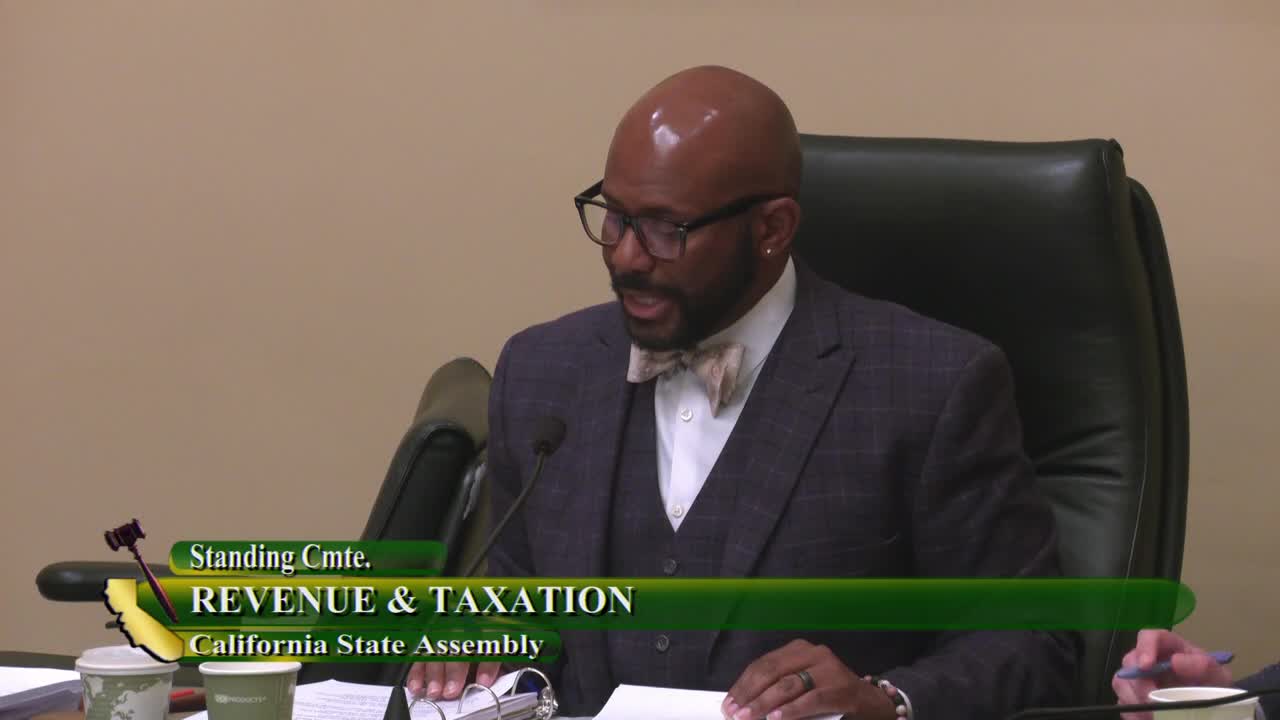 8MIN
Assembly Standing Committee on Revenue and Taxation
Bill Author
Bill Co-Author(s):