AB 1453: Public postsecondary education: student health: contraception and emergency contraception information.
- Session Year: 2025-2026
- House: Assembly
- Latest Version Date: 2025-02-21
Current Status:
Failed
(2026-02-02: From committee: Filed with the Chief Clerk pursuant to Joint Rule 56.)
Introduced
In Committee
Awaiting First Chamber Vote
Passed First Chamber
In Committee
Awaiting Second Chamber Vote
Passed Second Chamber
Enacted
Existing law establishes the University of California, under the administration of the Regents of the University of California, and the California State University, under the administration of the Trustees of the California State University, as 2 of the segments of public postsecondary education in this state.
Existing law requires, on and after January 1, 2023, each student health center on a California State University or University of California campus to offer abortion by medication techniques, as specified.
This bill would require a California State University campus, and would request a University of California campus, to provide adoption information to students in each location on campus where contraception and emergency contraception information is available, including when birth control and levonorgestrel are provided to students through the campuss student health center or pharmacy, as specified.
(a)A campus of the California State University shall, and a campus of the University of California is requested to, provide adoption information to students in each location on campus where contraception and emergency contraception information is available, including when birth control and levonorgestrel are provided to students through the campuss student health center or pharmacy.
(b)The information provided pursuant to subdivision (a) shall include a comprehensive explanation of adoption and information on the different types of adoption, the rights of a placing birth parent, and specific local adoption resources and support services.
|
Date
|
Status
|
|---|---|
| Feb 2, 2026 | From committee: Filed with the Chief Clerk pursuant to Joint Rule 56. |
| Jan 31, 2026 | Died pursuant to Art. IV, Sec. 10(c) of the Constitution. |
| Apr 22, 2025 | In committee: Set, first hearing. Failed passage. Reconsideration granted. |
| Apr 8, 2025 | In committee: Hearing postponed by committee. |
| Mar 13, 2025 | Referred to Com. on HIGHER ED. |
| Feb 24, 2025 | Read first time. |
| Feb 22, 2025 | From printer. May be heard in committee March 24. |
| Feb 21, 2025 | Introduced. To print. |
|
Date
|
Description
|
Location
|
Votes
|
|
|---|---|---|---|---|
| Apr 22, 2025 | Do pass as amended and be re-referred to the Committee on [Appropriations] | Assembly Standing Committee on Higher Education |
Failed |
This list shows positions taken on this bill by organizations on the date displayed, which is linked to the original source.
Positions by individuals are not included.
|
Organization
|
Position
|
Date
|
|---|---|---|
| American College Of Obstetricians Gynecologists District Ix | ** Against | |
| California Baptist for Biblical Values | ** Support | |
| California Catholic Conference | ** Support | |
| California Family Council | ** Support | |
| California Medical Association | ** Against | |
| Individual | ** Support | |
| Planned Parenthood Affiliates Of California | ** Against | |
| University of California | ** Against |
Date of Hearing: April 22, 2025
ASSEMBLY COMMITTEE ON HIGHER EDUCATION
Mike Fong, Chair
ABPCA Bill Id:AB 1453 (
Author:Tangipa) – As Introduced Ver:February 21, 2025
SUBJECT: Public postsecondary education: student health: contraception and emergency contraception information
SUMMARY: Requires that California State University (CSU), as well as requests that the University of California (UC) provide adoption information in the Student Health Centers (SHC) located on campus. Specifically, this bill:
- Requires that adoption information is provided to students in each location on campus where contraception and emergency contraception information is available, including when birth control and levonorgestrel are provided to students through the SHC or pharmacy; and,
- Requires that the adoption information must include a comprehensive explanation of adoption and information on the different types of adoption, the rights of a placing parent, and specific local adoption resources and support services.
EXISTING LAW:
- Establishes the CSU system, made of 23 campuses, and bestows upon the CSU Trustees, through the Board of Trustees, the power, duties, and functions with respect to the management, administration, and control of the CSU system (Education Code (EDC) Sections 66606 and 89030, et seq.).
- Establishes the UC, a public trust to be administered by the Regents of the UC and grants the Regents full powers of organization and government, subject only to such legislative control as may be necessary to insure security of its funds, compliance with the terms of its endowments, statutory requirements around competitive bidding and contracts, sales of property and the purchase of materials, goods and services (Article IX, Section (9)(a) of the California Constitution).
- Requires each public SHC, on and after January 1, 2023, to offer abortion by medication techniques onsite. This service may be performed by providers on staff at the student health center, through telehealth services, or by providers associated with a contracted external agency.
- Notwithstanding Section 13340 of the Government Code, the moneys in the fund are continuously appropriated to the commission for allocation for purposes of this subdivision; and,
- The commission shall administer the College Student Health Center Sexual and Reproductive Health Preparation Fund, which is established by this chapter for the purposes of providing private moneys in the form of direct allocations to the University of California and the California State University to support medication abortion readiness at each public university student health center. Notwithstanding any other law, the commission is authorized to receive moneys from nonstate entities, including, but not necessarily limited to, private sector entities and local and federal government agencies, specifically to support the fund, and deposit these moneys into the fund.
- The commission must use fund moneys to do all of the following:
- Allocate two hundred thousand dollars ($200,000) per campus to the University of California and the California State University. Of these funds, each university system shall provide two hundred thousand dollars ($200,000) to each public university student health center to pay for the cost, both direct and indirect, of medication abortion readiness. Allowable expenses payable from these allocations may include, but are not limited to, any of the following:
- Purchase of equipment used in the provision of abortion by medication techniques;
- Facility and security upgrades;
- Costs associated with enabling the campus health center to deliver telehealth services;
- Costs associated with training staff in the provision of abortion by medication techniques; and,
- Staff cost reimbursement and clinical revenue offset while staff are in trainings (Education Code (EDC) Section 99251).
- Allocate two hundred thousand dollars ($200,000) per campus to the University of California and the California State University. Of these funds, each university system shall provide two hundred thousand dollars ($200,000) to each public university student health center to pay for the cost, both direct and indirect, of medication abortion readiness. Allowable expenses payable from these allocations may include, but are not limited to, any of the following:
- The commission must use fund moneys to do all of the following:
FISCAL EFFECT: Unknown
COMMENTS: Purpose of the measure. According to the author, “AB 1453 ensures that all California public university students have access to adoption materials at campus health centers. Many students facing unplanned pregnancies may not be fully informed about adoption as an option. This bill closes that gap by making adoption information readily available alongside other reproductive health resources. By providing clear, reliable, and accessible information, AB 1453 empowers students to make fully informed decisions about their reproductive choices, ensuring they understand all possible options when planning for their future.”
What the CSU and UC are currently offering at the SHC’s. Currently, as conveyed to Committee Staff, both the CSU as well as the UC verbally offer abortion as an option to a pregnant student during an in-person appointment or consultation with a medical professional at the campus’ SHC.
CSU. California State Los Angeles’ website highlights what their SHC provides during an appointment with a student, “These confidential sessions help students assess their pregnancy risk (getting pregnant or getting someone else pregnant) and review contraceptive options available to them at the SHC or local family planning providers. Health and Physical Education Council (HPEC) provides counseling on the full range of contraceptive options including: the pill, the patch, the ring, the shot, the implant, IUDs, condoms, natural family planning, and abstinence. Education is provided in a confidential and non-judgmental atmosphere where students can feel comfortable asking questions and receive unbiased information about all the contraceptive options available, how to correctly use them, pros and cons, and how to access them.”[1]
UC. University of Davis has a large section on their SHC page on the campus’ website devoted to the specific types and details of adoption options noting that, “Considering the possibilities of placing a child for adoption can bring many complex emotions. Adoption is the process where a birth parent gives legal rights to their child to another person or couple. There are wide varieties of options if adoption is the best choice for you. Here, we’ll briefly cover open adoptions, semi-open, and confidential/closed adoptions.”[2] The site goes on to give an in depth explanation of each type of adoption as well as provide links to local outside adoption resources.
Local adoption resources for variety of campus locations. The geography that encompasses the CSU’s and UC’s across the state of California is vast. Local adoption agencies and resources vary greatly county by county. A majority are non-profit organizations that depend on funding resources that may not be consistent year to year. Below is a functioning map provided by the California Association of Adoption Agencies where a user is able to click on the county that they are seeking adoption services and once clicked, a list of local adoption agencies is generated.

California Department of Social Services. The California Department Services (CDSS) offers information on the many types of adoptions that take place in California as well as being tasked with licensing the private adoption agencies in the State. The website states that, “the Adoption Services Branch oversees Agency, Independent, and Intercountry Adoption services throughout the state. Additionally, the CDSS Adoption Regional Offices provide Independent Adoption services in 55 counties and Agency Adoption services to counties that do not have their own public adoption services. Within the Adoption Services Branch, the Adoptions Policy and Support Bureau provides administrative oversight of, and support and services to, all public and licensed private adoption agencies, certifies adoptions, maintains the adoption database including adoption files for agencies that have closed, provides administrative oversight and application of the Adoption Assistance Program (AAP), and provides oversight of the Adoption Service Provider program.”[4]
Committee comments. The author may want to consider limiting adoption information to in-person appointment or consultation at the SHC when the student first learns of pregnancy or is being seen to terminate the pregnancy.
Having adoption information next to contraception such as birth control and levonorgestrel (Plan B medication) may be an overreach as it would appear that the student is attempting to prevent pregnancy while utilizing those items. If the contraception fails and the student does in fact become pregnant, adoption information would be provided at the appointment mentioned above therefore covering students’ different needs.
To align the bill provisions with the intentions of the author, the Committee has suggested and the author has agreed to the following amendments:
SECTION 1. Section 66027.31 is added to the Education Code, to read:
66027.31. (a) A campus of the California State University shall, and a campus of the University of California is requested to, on or before July 1, 2027, provide adoption information to students in each location on campus when a pregnant student completes an appointment or consultation to confirm and/or terminate the pregnancy, or both where contraception and emergency contraception information is available, including when birth control and levonorgestrel are provided to students through the campus’s student health center or pharmacy.
(b) The information provided pursuant to subdivision (a) shall include a comprehensive explanation of adoption and information on the different types of adoption, the rights of a placing birth parent, and specific local adoption resources and support services., as determined by the California Department of Social Services’ applicable website and independent adoption agencies.
Arguments in support. The California Family Council writes in support stating, “AB 1453 fills an essential void in student health services by requiring the distribution of adoption-related resources alongside existing reproductive healthcare materials. While CSU and UC campuses currently provide students with information about contraception and abortion services, many students remain unaware of adoption as a viable option. Without comprehensive information on adoption, students facing unplanned pregnancies may make decisions without knowing the full spectrum of choices available to them. AB 1453 is a balanced and reasonable solution that ensures students are presented with all their options when navigating challenging reproductive decisions. By equipping students with information about adoption, this bill empowers women with knowledge that could lead to hope, stability, and life-affirming choices. The inclusion of adoption materials in campus health centers is a simple yet powerful step toward equipping students with vital information. AB 1453 will ensure that students who may be seeking guidance during a difficult time can consider adoption as a life-giving and affirming option.”
Arguments in opposition. California Medical Association (CMA) writes that, “CMA supports access to comprehensive reproductive information, including at campus health centers and pharmacies. However, when students visit campus health centers for contraception or emergency contraception, they are looking for solutions to prevent unintended pregnancies. A requirement that adoption information be shared along with this medication overrides the clinical judgment of treating providers, who know the unique reproductive needs of their patients best. Furthermore, a mandate to share adoption information to non-pregnant students seeking medication to prevent pregnancy could be confusing and undermine efforts to provide students with the reproductive health care they need.”
REGISTERED SUPPORT / OPPOSITION:
Support
California Baptist for Biblical Values
California Catholic Conference
California Family Council
Individual (2)
Opposition
American College of Obstetricians & Gynecologists - District IX
California Medical Association (CMA)
Planned Parenthood Affiliates of California
University of California
Analysis Prepared by: Kiersten Wall / HIGHER ED. / (916) 319-3960
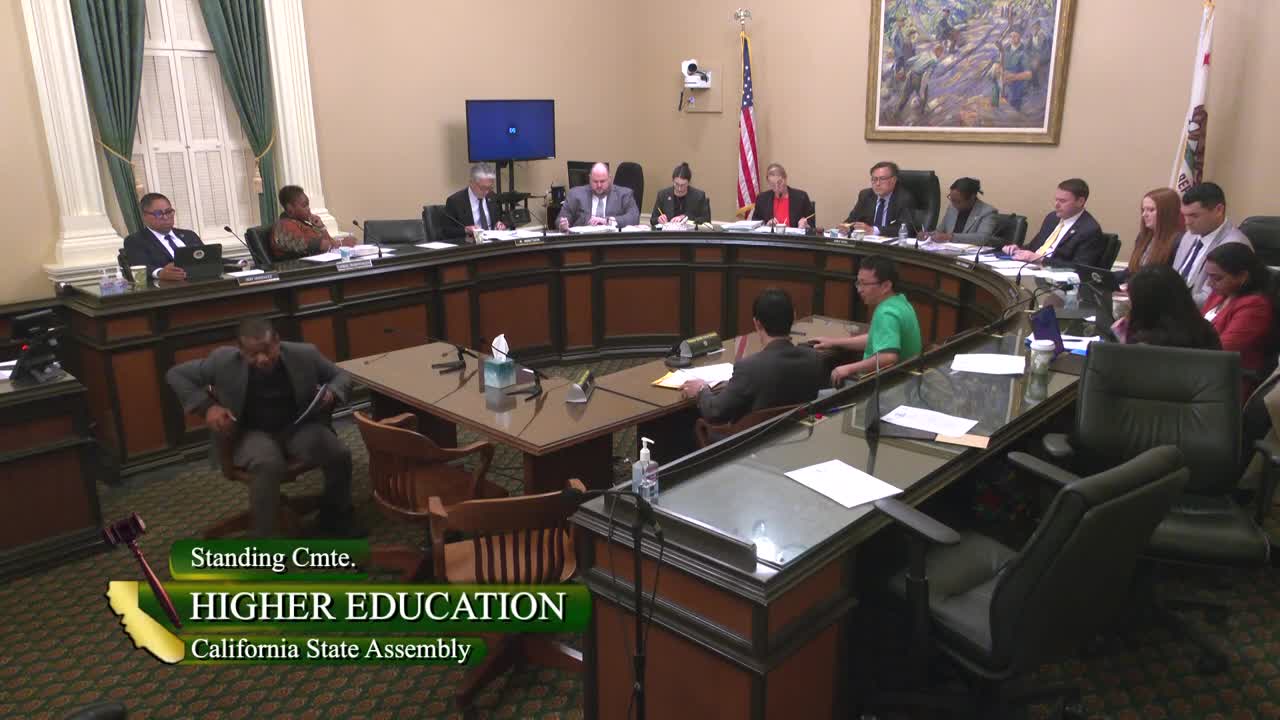
Discussed in Hearing
 24MIN
Assembly Standing Committee on Higher Education
Bill Author
Bill Co-Author(s):