AB 1482: Bowie’s Law: animals: adoption, shelter overcrowding, and breeding.
- Session Year: 2025-2026
- House: Assembly
- Latest Version Date: 2025-04-30
Current Status:
Failed
(2026-02-02: From committee: Filed with the Chief Clerk pursuant to Joint Rule 56.)
Introduced
In Committee
Awaiting First Chamber Vote
Passed First Chamber
In Committee
Awaiting Second Chamber Vote
Passed Second Chamber
Enacted
(1)Existing law declares that it is the policy of the state that no adoptable animal should be euthanized if it can be adopted into a suitable home. Existing law also declares that it is the policy of the state that no treatable animal should be euthanized.
This bill, Bowies Law, would require an animal shelter, as defined, to provide in a conspicuous location on its internet website or a third-party internet website a list of all animals that are available for adoption or that are being held pursuant to specified laws, except as provided. The bill would also require the Department of Food and Agriculture to conduct a study on certain topics, including, among other topics, the overcrowding of Californias animal shelters, and, on or before January 1, 2028, to submit a report on that study to the Legislature, as provided. The bill would repeal these study and reporting requirements on January 1, 2032.
To the extent that this bill would impose a new program or higher level of service on local public animal control agencies or shelters, the bill would impose a state-mandated local program.
(2)The existing Polanco-Lockyer Pet Breeder Warranty Act requires every breeder of dogs to meet certain requirements relating to housing and maintaining dogs and to disclose specified information. The act defines dog breeder and breeder to mean a person, firm, partnership, corporation, or other association that has sold, transferred, or given away all or part of 3 or more litters or 20 or more dogs during the preceding 12 months that were bred and reared on the premises of the person, firm, partnership, corporation, or other association.
This bill would change that definition to a person, firm, partnership, corporation, or other association that has sold, transferred, or given away all or part of 2 or more litters or 10 or more dogs during the preceding 12 months, as specified. The bill would additionally require a breeder, before a dog reaches eight weeks of age, to have a microchip device implanted in the dog that identifies the breeder, except as provided. The bill would require the breeder, upon the sale or transfer of the dog, to register the identity of the new owner with the microchip registry company as the primary owner on the microchip device and would require the breeder to provide certain information to the new owner regarding the microchip. The bill would prohibit a dog from being sold or otherwise transferred by a breeder, whether for compensation or otherwise, until it has been immunized against common diseases diseases, in accordance with veterinary recommendations for the age and breed of the dog, and has a documented health check from a licensed California-licensed veterinarian.
(3)The California Constitution requires the state to reimburse local agencies and school districts for certain costs mandated by the state. Statutory provisions establish procedures for making that reimbursement.
This bill would provide that, if the Commission on State Mandates determines that the bill contains costs mandated by the state, reimbursement for those costs shall be made pursuant to the statutory provisions noted above.
(1)Existing law declares that it is the policy of the state that no adoptable animal should be euthanized if it can be adopted into a suitable home. Existing law also declares that it is the policy of the state that no treatable animal should be euthanized.
This bill, Bowies Law, would require an animal shelter, as defined, to provide in a conspicuous location on its internet website or a third-party internet website a list of all animals that are available for adoption or that are being held pursuant to specified laws, except as provided. The bill would also require the Department of Food and Agriculture to conduct a study on certain topics, including, among other topics, the overcrowding of Californias animal shelters, and, on or before January 1, 2028, to submit a report on that study to the Legislature, as provided. The bill would repeal these study and reporting requirements on January 1, 2032.
To the extent that this bill would impose a new program or higher level of service on local public animal control agencies or shelters, the bill would impose a state-mandated local program.
(2)The existing Polanco-Lockyer Pet Breeder Warranty Act requires every breeder of dogs to meet certain requirements relating to housing and maintaining dogs and to disclose specified information. The act defines dog breeder and breeder to mean a person, firm, partnership, corporation, or other association that has sold, transferred, or given away all or part of 3 or more litters or 20 or more dogs during the preceding 12 months that were bred and reared on the premises of the person, firm, partnership, corporation, or other association.
This bill would change that definition to a person, firm, partnership, corporation, or other association that has sold, transferred, or given away all or part of 2 or more litters or 10 or more dogs during the preceding 12 months, as specified. The bill would additionally require a breeder, before a dog reaches eight weeks of age, to have a microchip device implanted in the dog that identifies the breeder, except as provided. The bill would require the breeder, upon the sale or transfer of the dog, to register the identity of the new owner with the microchip registry company as the primary owner on the microchip device and would require the breeder to provide certain information to the new owner regarding the microchip. The bill would prohibit a dog from being sold or otherwise transferred by a breeder, whether for compensation or otherwise, until it has been immunized against common diseases and has a documented health check from a licensed veterinarian.
(3)The California Constitution requires the state to reimburse local agencies and school districts for certain costs mandated by the state. Statutory provisions establish procedures for making that reimbursement.
This bill would provide that, if the Commission on State Mandates determines that the bill contains costs mandated by the state, reimbursement for those costs shall be made pursuant to the statutory provisions noted above.
This act shall be known, and may be cited, as Bowies Law.
SEC. 2.Section 32005 is added to the Food and Agricultural Code, to read:32005.(a)Except for an animal irremediably suffering from a serious illness or severe injury pursuant to Section 17006, newborn animals that need maternal care and have been impounded without their mothers pursuant to Section 17006, and dogs with a history of vicious or dangerous behavior documented by the agency charged with enforcing state and local animal laws pursuant to subdivision (b) of Section 31108.5, an animal shelter shall provide in a conspicuous location on its internet website or a third-party internet website a list of all animals that are available for adoption or that are being held pursuant to Section 31108, 31752, or 31753.
(b)As used in this section, animal shelter means a public animal control agency or shelter, society for the prevention of cruelty to animals shelter, or humane society shelter.
(c)Section 9 does not apply to this section.
SEC. 3.Section 32006 is added to the Food and Agricultural Code, to read:32006.(a)As used in this section, animal shelter means a public animal control agency or shelter, society for the prevention of cruelty to animals shelter, or humane society shelter.
(b)The department shall conduct a study on all of the following topics:
(1)The overcrowding of Californias animal shelters.
(2)The ways in which the state might address animal shelter overcrowding.
(3)The feasibility of a statewide database of dogs and cats that provides public notice and information at the statewide level in a manner consistent with Section 32005, including, but not limited to, by pursuing a public-private partnership.
(c)On or before January 1, 2028, the department shall submit a report on its study conducted pursuant to subdivision (b) to the Legislature.
(d)(1)A report to be submitted pursuant to subdivision (c) shall be submitted in compliance with Section 9795 of the Government Code.
(2)Pursuant to Section 10231.5 of the Government Code, this section is repealed on January 1, 2032.
SEC. 4.Section 122045 of the Health and Safety Code is amended to read:122045.(a)This article shall be known and may be cited as the Polanco-Lockyer Pet Breeder Warranty Act.
(b)Every breeder of dogs shall comply with this article. As used in this article, dog breeder, or breeder means a person, firm, partnership, corporation, or other association that has sold, transferred, or given away all or part of two or more litters or 10 or more dogs during the preceding 12 months that were bred and reared on the premises of the person, firm, partnership, corporation, or other association.
(c)For purposes of this article, purchaser means any person who purchases a dog from a breeder.
(d)This article does not apply to pet dealers regulated under the Lockyer-Polanco-Farr Pet Protection Act (Article 2 (commencing with Section 122125)), or to publicly operated animal shelters, humane societies, or privately operated rescue organizations.
SEC. 5.Section 122055 of the Health and Safety Code is amended to read:122055.(a)(1)A breeder shall maintain a written record on the health, status, and disposition of each dog for a period of not less than one year after disposition of the dog. The record shall also include all of the information that the breeder is required to disclose pursuant to Section 122050.
(2)A breeder shall, before a dog reaches eight weeks of age, have a microchip device implanted in the dog that identifies the breeder unless a licensed veterinarian determines the dog is medically unfit for the microchipping procedure because the animal has a physical condition that would be substantially aggravated by the procedure. Upon the sale or transfer of the dog, the breeder shall register the identity of the new owner with the microchip registry company as the primary owner on the microchip device.
(3)The breeder shall provide information on the transference of ownership, including the microchip company information, the microchip number and any other relevant identifiers, and any other information necessary for a new owner to subsequently update the microchip registration as necessary.
(b)A dog shall not be sold or otherwise transferred by a breeder, whether for compensation or otherwise, until it has been immunized against common diseases diseases, in accordance with veterinary recommendations for the age and breed of the dog, and has a documented health check from a licensed California-licensed veterinarian.
SEC. 6.Section 122111 is added to the Health and Safety Code, to read:122111.This article does not prohibit a city or county from adopting or enforcing a more restrictive breed-specific ordinance pursuant to Section 122331.
SEC. 7.If the Commission on State Mandates determines that this act contains costs mandated by the state, reimbursement to local agencies and school districts for those costs shall be made pursuant to Part 7 (commencing with Section 17500) of Division 4 of Title 2 of the Government Code.
This act shall be known, and may be cited, as Bowies Law.
SEC. 2.Section 32004 is added to the Food and Agricultural Code, to read:32004.SEC. 2.Section 32005 is added to the Food and Agricultural Code, to read:32005.(a)Except for an animal irremediably suffering from a serious illness or severe injury pursuant to Section 17006, newborn animals that need maternal care and have been impounded without their mothers pursuant to Section 17006, and dogs with a history of vicious or dangerous behavior documented by the agency charged with enforcing state and local animal laws pursuant to subdivision (b) of Section 31108.5, an animal shelter shall provide in a conspicuous location on its internet website or a third-party internet website a list of all animals that are available for adoption or that are being held pursuant to Section 31108, 31752, or 31753.
(b)As used in this section, animal shelter means a public animal control agency or shelter, society for the prevention of cruelty to animals shelter, or humane society shelter.
(c)Section 9 does not apply to this section.
SEC. 3.Section 32005 is added to the Food and Agricultural Code, to read:32005.SEC. 3.Section 32006 is added to the Food and Agricultural Code, to read:32006.(a)As used in this section, animal shelter means a public animal control agency or shelter, society for the prevention of cruelty to animals shelter, or humane society shelter.
(b)The department shall conduct a study on all of the following topics:
(1)The overcrowding of Californias animal shelters.
(2)The ways in which the state might address animal shelter overcrowding.
(3)The feasibility of a statewide database of dogs and cats that provides public notice and information at the statewide level in a manner consistent with Section 32004, 32005, including, but not limited to, by pursuing a public-private partnership.
(c)On or before January 1, 2028, the department shall submit a report on its study conducted pursuant to subdivision (b) to the Legislature.
(d)(1)A report to be submitted pursuant to subdivision (c) shall be submitted in compliance with Section 9795 of the Government Code.
(2)Pursuant to Section 10231.5 of the Government Code, this section is repealed on January 1, 2032.
SEC. 4.Section 122045 of the Health and Safety Code is amended to read:122045.(a)This article shall be known and may be cited as the Polanco-Lockyer Pet Breeder Warranty Act.
(b)Every breeder of dogs shall comply with this article. As used in this article, dog breeder, or breeder means a person, firm, partnership, corporation, or other association that has sold, transferred, or given away all or part of two or more litters or 10 or more dogs during the preceding 12 months that were bred and reared on the premises of the person, firm, partnership, corporation, or other association.
(c)For purposes of this article, purchaser means any person who purchases a dog from a breeder.
(d)This article does not apply to pet dealers regulated under the Lockyer-Polanco-Farr Pet Protection Act (Article 2 (commencing with Section 122125)), or to publicly operated animal shelters, humane societies, or privately operated rescue organizations.
SEC. 5.Section 122055 of the Health and Safety Code is amended to read:122055.(a)(1)A breeder shall maintain a written record on the health, status, and disposition of each dog for a period of not less than one year after disposition of the dog. The record shall also include all of the information that the breeder is required to disclose pursuant to Section 122050.
(2)A breeder shall, before a dog reaches eight weeks of age, have a microchip device implanted in the dog that identifies the breeder unless a licensed veterinarian determines the dog is medically unfit for the microchipping procedure because the animal has a physical condition that would be substantially aggravated by the procedure. Upon the sale or transfer of the dog, the breeder shall register the identity of the new owner with the microchip registry company as the primary owner on the microchip device.
(3)The breeder shall provide information on the transference of ownership, including the microchip company information, the microchip number and any other relevant identifiers, and any other information necessary for a new owner to subsequently update the microchip registration as necessary.
(b)A dog shall not be sold or otherwise transferred by a breeder, whether for compensation or otherwise, until it has been immunized against common diseases and has a documented health check from a licensed veterinarian.
SEC. 6.Section 122111 is added to the Health and Safety Code, to read:122111.This article does not prohibit a city or county from adopting or enforcing a more restrictive breed-specific ordinance pursuant to Section 122331.
SEC. 7.If the Commission on State Mandates determines that this act contains costs mandated by the state, reimbursement to local agencies and school districts for those costs shall be made pursuant to Part 7 (commencing with Section 17500) of Division 4 of Title 2 of the Government Code.
This act shall be known, and may be cited, as Bowies Law.
SEC. 2.Section 32004 is added to the Food and Agricultural Code, to read:32004.(a)Except for an animal irremediably suffering from a serious illness or severe injury pursuant to Section 17006, newborn animals that need maternal care and have been impounded without their mothers pursuant to Section 17006, and dogs with a history of vicious or dangerous behavior documented by the agency charged with enforcing state and local animal laws pursuant to subdivision (b) of Section 31108.5, an animal shelter shall provide in a conspicuous location on its internet website or a third-party internet website a list of all animals that are available for adoption or that are being held pursuant to Section 31108, 31752, or 31753.
(b)As used in this section, animal shelter means a public animal control agency or shelter, society for the prevention of cruelty to animals shelter, or humane society shelter.
(c)Section 9 does not apply to this section.
SEC. 3.Section 32005 is added to the Food and Agricultural Code, to read:32005.(a)As used in this section, animal shelter means a public animal control agency or shelter, society for the prevention of cruelty to animals shelter, or humane society shelter.
(b)The department shall conduct a study on all of the following topics:
(1)The overcrowding of Californias animal shelters.
(2)The ways in which the state might address animal shelter overcrowding.
(3)The feasibility of a statewide database of dogs and cats that provides public notice and information at the statewide level in a manner consistent with Section 32004, including, but not limited to, by pursuing a public-private partnership.
(c)On or before January 1, 2028, the department shall submit a report on its study conducted pursuant to subdivision (b) to the Legislature.
(d)(1)A report to be submitted pursuant to subdivision (c) shall be submitted in compliance with Section 9795 of the Government Code.
(2)Pursuant to Section 10231.5 of the Government Code, this section is repealed on January 1, 2032.
SEC. 4.Section 122045 of the Health and Safety Code is amended to read:122045.(a)This article shall be known and may be cited as the Polanco-Lockyer Pet Breeder Warranty Act.
(b)Every breeder of dogs shall comply with this article. As used in this article, dog breeder, or breeder means a person, firm, partnership, corporation, or other association that has sold, transferred, or given away all or part of three two or more litters or 20 10 or more dogs during the preceding 12 months that were bred and reared on the premises of the person, firm, partnership, corporation, or other association.
(c)For the purposes of this article, purchaser means any person who purchases a dog from a breeder.
(d)This article shall does not apply to pet dealers regulated under Article the Lockyer-Polanco-Farr Pet Protection Act (Article 2 (commencing with Section 122125), 122125)), or to publicly operated animal shelters, humane societies, or privately operated rescue organizations.
SEC. 5.Section 122055 of the Health and Safety Code is amended to read:122055.(a)(1)A breeder shall maintain a written record on the health, status, and disposition of each dog for a period of not less than one year after disposition of the dog. The record shall also include all of the information that the breeder is required to disclose pursuant to Section 122050.
(2)A breeder shall, before a dog reaches eight weeks of age, have a microchip device implanted in the dog that identifies the breeder unless a licensed veterinarian determines the dog is medically unfit for the microchipping procedure because the animal has a physical condition that would be substantially aggravated by the procedure. Upon the sale or transfer of the dog, the breeder shall register the identity of the new owner with the microchip registry company as the primary owner on the microchip device.
(3)The breeder shall provide information on the transference of ownership, including the microchip company information, the microchip number and any other relevant identifiers, and any other information necessary for a new owner to subsequently update the microchip registration as necessary.
(b)A dog shall not be sold or otherwise transferred by a breeder, whether for compensation or otherwise, until it has been immunized against common diseases and has a documented health check from a licensed veterinarian.
SEC. 6.Section 122111 is added to the Health and Safety Code, to read:122111.This article does not prohibit a city or county from adopting or enforcing a more restrictive breed-specific ordinance pursuant to Section 122331.
SEC. 7.If the Commission on State Mandates determines that this act contains costs mandated by the state, reimbursement to local agencies and school districts for those costs shall be made pursuant to Part 7 (commencing with Section 17500) of Division 4 of Title 2 of the Government Code.
|
Date
|
Status
|
|---|---|
| Feb 2, 2026 | From committee: Filed with the Chief Clerk pursuant to Joint Rule 56. |
| Jan 31, 2026 | Died pursuant to Art. IV, Sec. 10(c) of the Constitution. |
| May 23, 2025 | In committee: Held under submission. |
| May 21, 2025 | Joint Rule 62(a), file notice suspended. (Page 1627.) |
| May 21, 2025 | In committee: Set, first hearing. Referred to APPR. suspense file. |
| May 14, 2025 | In committee: Hearing postponed by committee. |
| May 1, 2025 | Re-referred to Com. on APPR. |
| Apr 30, 2025 | Read second time and amended. |
| Apr 29, 2025 | From committee: Amend, and do pass as amended and re-refer to Com. on APPR. (Ayes 17. Noes 0.) (April 29). |
| Apr 23, 2025 | Re-referred to Com. on B. & P. |
| Apr 22, 2025 | From committee chair, with author's amendments: Amend, and re-refer to Com. on B. & P. Read second time and amended. |
| Apr 22, 2025 | Assembly Rule 47.1 invoked. (Castillo). |
| Mar 13, 2025 | Referred to Com. on B. & P. |
| Feb 24, 2025 | Read first time. |
| Feb 22, 2025 | From printer. May be heard in committee March 24. |
| Feb 21, 2025 | Introduced. To print. |
|
Date
|
Description
|
Location
|
Votes
|
|
|---|---|---|---|---|
| Apr 29, 2025 | Do pass as amended and be re-referred to the Committee on [Appropriations] | Assembly Standing Committee on Business and Professions |
Passed |
This list shows positions taken on this bill by organizations on the date displayed, which is linked to the original source.
Positions by individuals are not included.
|
Organization
|
Position
|
Date
|
|---|---|---|
| Angel's Furry Friends | ** Support | |
| Animal Rescue Mission | ** Support | |
| Animal Rescues for Change | ** Support | |
| ANIMAL WELLNESS ACTION | ** Support | |
| Berkeley Animal Rights Center | ** Support | |
| Better Together Forever | ** Support | |
| Born Again Animal Rescue and Adoption | ** Support | |
| Compassionate Bay | ** Support | |
| Concerned Citizens Animal Rescue | ** Support | |
| Feline Lucky Adventures | ** Support | |
| Giantmecha | ** Support | |
| Greater Los Angeles Animals Spay Neuter Collaborative | ** Support | |
| Latino Alliance for Animal Care Foundation | ** Support | |
| Leaders for Ethics, Animals, and The Planet | ** Support | |
| Los Angeles Democrats for the Protection of Animals | ** Support | |
| Michelson Center For Public Policy | ** Support | |
| NY 4 Whales | ** Support | |
| Pibbles N Kibbles Animal Rescue | ** Support | |
| Plant-based Advocates | ** Support | |
| Project Minnie | ** Support | |
| Real Good Rescue | ** Support | |
| San Diego Humane Society And Spca | ** Support | |
| San Francisco Spca | ** Support | |
| Seeds 4 Change Now Animal Rescue | ** Support | |
| Seniors Citizens for Humane Education and Legislation | ** Support | |
| Social Compassion In Legislation | ** Support | |
| START Rescue | ** Support | |
| Students Against Animal Cruelty Club - Hueneme High School | ** Support | |
| The Canine Condition | ** Support | |
| The Pet Loss Support Group | ** Support | |
| The Spayce Project | ** Support | |
| Underdog Heroes, INC. | ** Support | |
| Women United for Animal Welfare | ** Support | |
| World Animal Protection | ** Support |
Date of Hearing: May 21, 2025
ASSEMBLY COMMITTEE ON APPROPRIATIONS
Buffy Wicks, Chair
ABPCA Bill Id:AB 1482
Author:(Castillo) – As Amended Ver:April 30, 2025
Policy Committee: | Business and Professions | Vote: | 17 - 0 |
|
| ||
|
|
Urgency: No State Mandated Local Program: Yes Reimbursable: Yes
SUMMARY:
This bill requires an animal shelter provide on its internet website or a third-party website a list of all animals that are available for adoption or being held by the animal shelter. This bill also requires the Department of Food and Agriculture (CDFA) to conduct a study on animal shelter overcrowding and the feasibility of a statewide database of dogs and cats. The bill expands the definition of a dog breeder, and places additional requirements on sales or transfers of dogs by breeders.
Specifically, this bill:
- Requires an animal shelter to provide in a conspicuous location on its internet website or a third-party internet website a list of all animals that are available for adoption or that are being held after impoundment.
- Exempts from the public notice requirement in item 1, above, an animal that is irremediably suffering from a serious illness or severe injury, newborn animals that need maternal care and have been impounded without their mothers, and dogs with a documented history of vicious or dangerous behavior.
- Provides that violations of the bill’s requirements shall not constitute a misdemeanor.
- Requires CDFA to conduct a study on the overcrowding of California’s animal shelters, how the state might address animal shelter overcrowding, and the feasibility of a statewide database of dogs and cats that provides public notice and information at the statewide level about animals available for adoption, including by pursuing a public-private partnership.
- Requires CDFA to submit a report on its study findings on or before January 1, 2028.
- Expands the definition of a “dog breeder” or “breeder” for purposes of the Polanco-Lockyer Pet Breeder Warranty Act from a person or entity that sells, transfers, or gives away all or part of three or more litters or 20 or more dogs during the preceding 12 months, to a person or entity that sells, transfers, or gives away all or part of two or more litters or 10 or more dogs during the preceding 12 months.
- Requires a breeder to have implanted in a dog before the dog reaches eight weeks of age a microchip device that identifies the breeder. Requires, upon sale or transfer of the dog, the breeder to register the identity of the new owner with the microchip registry company.
- Exempts from the bill’s microchipping requirements a dog determined to be medically unfit for the microchipping procedure by a licensed veterinarian because the animal has a physical condition that would be substantially aggravated by the procedure.
- Requires breeders to provide information on the transfer of ownership, including the microchip company information, the microchip number and any other relevant identifiers, and any other information necessary for a new owner to subsequently update the microchip registration as necessary.
- Prohibits a dog from being sold or otherwise transferred by a breeder until it has been immunized against common diseases and has a documented health check by a licensed veterinarian.
FISCAL EFFECT:
CDFA estimates General Fund (GF) costs of approximately $1.08 million in the first year and $226,000 annually thereafter until the provisions sunset in 2032 to carry out a comprehensive study to evaluate overcrowding in California’s animal shelters.
CDFA states it will need to engage in a year-long evaluation process that would include conducting a statewide survey of animal shelters, performing data and stakeholder impact analyses, assessing solution feasibility, and undertaking related activities to determine the viability of a real-time, integrated statewide database that provides public notices and euthanasia data in coordination with individual shelters. CDFA notes that, given the scope of the technical evaluation and required approval processes, the current deadline in the bill may need to be extended by one year to ensure successful implementation.
COMMENTS:
Purpose. This bill is sponsored by Social Compassion in Legislation. According to the author:
I’m deeply honored to author AB 1482, Bowie’s Law — an urgent response to the silent tragedy happening in our shelters every day. This bill will strengthen oversight of dog breeders, ensure every shelter has a publicly accessible database of adoptable animals, and launch a comprehensive study to address the root causes of overcrowding. It’s named after Bowie, a sweet puppy who was euthanized just hours before he was to be rescued — something that should never have happened. With AB 1482, we’re saying loud and clear: no healthy, adoptable animal in California should ever be denied a second chance simply because of a lack of space or coordination. We can and must do better.
Related Legislation. AB 631 (Lee) requires animal shelters, as defined, to post on the internet the number of animals taken in, the source of intake, and the outcomes for all animals, as specified, and update this information at least quarterly. AB 631 is pending in the Senate Committee on Business, Professions, and Economic Development.
Analysis Prepared by: Allegra Kim / APPR. / (916) 319-2081
Date of Hearing: April 29, 2025
ASSEMBLY COMMITTEE ON BUSINESS AND PROFESSIONS
Marc Berman, Chair
ABPCA Bill Id:AB 1482
Author:(Castillo) – As Amended Ver:April 22, 2025
SUBJECT: Bowie’s Law: animals: adoption, shelter overcrowding, and breeding.
SUMMARY: Requires animal shelters to provide public notice on the internet that contains a list of all animals that are available for adoption or being held by the animal shelter, requires the Department of Food and Agriculture (CDFA) to conduct a study on animal shelter overcrowding and the feasibility of a statewide database of dogs and cats, expands the definition of “breeder,” and places additional requirements on sales or transfers of dogs by breeders.
EXISTING LAW:
- Governs the operation of animal shelters by, among other requirements, setting a minimum holding period for stray dogs, cats, and other animals, and requiring animal shelters to ensure that those animals, if adopted, are spayed or neutered and, with exceptions, microchipped. (Food and Agricultural Code (FAC) §§ 30501 et seq.; §§ 31101 et seq.; §§ 31751 et seq.;
§§ 32000 et seq.)[1]* - Requires that a shelter must hold a stray dog for a specified period prior to adoption or euthanasia of a dog, must scan the dog for a microchip that identifies the owner of that dog, and must make reasonable efforts to contact the owner and notify them that their dog is impounded and is available for redemption. (FAC § 31108)
- Requires that a shelter must hold a stray cat for a specified period prior to adoption or euthanasia of a cat, must scan the cat for a microchip that identifies the owner of that cat, and must make reasonable efforts to contact the owner and notify them that their cat is impounded and is available for redemption. (FAC § 31752)
- Requires that a rabbit, guinea pig, hamster, potbellied pig, bird, lizard, snake, turtle, or tortoise that is impounded in a shelter must be held for the same period of time, under the same requirements of care, and with the same opportunities for redemption and adoption, as cats and dog. (FAC § 31753)
- Requires all public animal shelters, shelters operated by societies for the prevention of cruelty to animals, and humane shelters that perform public animal control services, to provide the owners of lost animals and those who find lost animals with all of the following:
- Ability to list the animals they have lost or found on “Lost and Found” lists maintained by the animal shelter.
- Referrals to animals listed that may be the animals the owners or finders have lost or found.
- The telephone numbers and addresses of other animal shelters in the same vicinity.
- Advice as to means of publishing and disseminating information regarding lost animals.
- The telephone numbers and addresses of volunteer groups that may be of assistance in locating lost animals.
- (FAC § 32001)
- Requires all public and private animal shelters to keep accurate records on each animal taken up, medically treated, or impounded, which shall include all of the following information and any other information required by the Veterinary Medical Board of California:
- The date the animal was taken up, medically treated, euthanized, or impounded.
- The circumstances under which the animal was taken up, medically treated, euthanized, or impounded.
- The names of the personnel who took up, medically treated, euthanized, or impounded the animal.
- A description of any medical treatment provided to the animal and the name of the veterinarian of record.
- The final disposition of the animal, including the name of the person who euthanized the animal or the name and address of the adopting party. These records shall be maintained for three years after the date on which the animal’s impoundment ends.
- (FAC § 32003)
- Provides that it is the policy of the state that no adoptable animal should be euthanized if it can be adopted into a suitable home. (Penal Code § 599d; Civil Code § 1834.4)
- Establishes the Polanco-Lockyer Pet Breeder Warranty Act, which regulates the sale dogs by dog breeders. (Health and Safety Code (HSC) §§ 122045 et seq.)
- Requires every dog breeder to deliver to each purchaser of a dog a specified written disclosure and record of veterinary treatment. (HSC § 122050)
- Requires dog breeders to maintain a written record on the health, status, and disposition of each dog for a period of not less than one year after disposition of the dog. (HSC § 122055)
- Prohibits a dog breeder from knowingly selling a dog that is diseased, ill or has a condition, which requires hospitalization or nonelective surgical procedures. (HSC § 122060)
- Requires every breeder who sells a dog to provide the purchaser at the time of sale, and a prospective purchaser upon request, with a written notice of rights, including conditions to return a dog and be eligible to receive a refund for an animal or reimbursement for veterinarian fees. (HSC § 122100)
- Authorizes cities and counties to enact dog breed-specific ordinances pertaining only to mandatory spay or neuter programs and breeding requirements, provided that no specific dog breed, or mixed dog breed, shall be declared potentially dangerous or vicious under those ordinances; directs any cities or counties enacting such ordinances to measure the effect of those programs by compiling specified statistical information on dog bites, and report the information to the State Public Health Veterinarian. (HSC § 122331)
THIS BILL:
- Defines “animal shelter” as a public animal control agency or shelter, society for the prevention of cruelty to animals shelter, or humane society shelter.
- Requires an animal shelter to publicly notice in a conspicuous location on its internet website or a third-party internet website that contains a list of all animals that are available for adoption or that are being held.
- Exempts from the public notice requirement an animal that is irremediably suffering from a serious illness or severe injury, newborn animals that need maternal care and have been impounded without their mothers, and dogs with a documented history of vicious or dangerous behavior.
- Provides that violations of the bill’s requirements shall not constitute a misdemeanor.
- Requires the CDFA to conduct a study on the overcrowding of California’s animal shelters, the ways in which the state might address animal shelter overcrowding, and the feasibility of a statewide database of dogs and cats that provides public notice and information at the statewide level about animals available for adoption, including, but not limited to, by pursuing a public-private partnership.
- Requires the CDFA to submit a report on its study findings on or before January 1, 2028.
- Expands the definition of a “dog breeder” or “breeder” for purposes of the Polanco-Lockyer Pet Breeder Warranty Act from persons or entities that sell, transfer, or give away all or part of three or more litters or 20 or more dogs during the preceding 12 months to persons or entities that sell, transfer, or give away all or part of two or more litters or 10 or more dogs during the preceding 12 months.
- Requires breeders to have a microchip device implanted in the dog, before that dog reaches eight weeks of age, that identifies the breeder, and requires the breeder to register the identity of the new owner with the microchip registry company as the primary owner on the microchip device upon sale or transfer of the dog.
- Exempts from the bill’s microchipping requirements a dog determined to be medically unfit for the microchipping procedure by a licensed veterinarian because the animal has a physical condition that would be substantially aggravated by the procedure.
- Requires breeders to provide information on the transference of ownership, including the microchip company information, the microchip number and any other relevant identifiers, and any other information necessary for a new owner to subsequently update the microchip registration as necessary.
- Prohibits a dog from being sold or otherwise transferred by a breeder, whether for compensation or otherwise, until it has been immunized against common diseases and has a documented health check from a licensed veterinarian.
- Expressly states that the Polanco-Lockyer Pet Breeder Warranty Act does not prohibit a city or county from adopting or enforcing a more restrictive breed-specific ordinance.
- Provides that the act establishing the provisions in this bill shall be known as Bowie’s Law.
FISCAL EFFECT: Unknown; this bill is keyed fiscal by the Legislative Counsel.
COMMENTS:
Purpose. This bill is sponsored by Social Compassion in Legislation. According to the author:
I’m deeply honored to author AB 1482, Bowie’s Law — an urgent response to the silent tragedy happening in our shelters every day. This bill will strengthen oversight of dog breeders, ensure every shelter has a publicly accessible database of adoptable animals, and launch a comprehensive study to address the root causes of overcrowding. It’s named after Bowie, a sweet puppy who was euthanized just hours before he was to be rescued — something that should never have happened. With AB 1482, we’re saying loud and clear: no healthy, adoptable animal in California should ever be denied a second chance simply because of a lack of space or coordination. We can and must do better.
Background.
Efforts to Reduce Euthanasia at California Animal Shelters. The California State Assembly declared in 2015 that the official State Pet is the shelter pet. According to information provided by the ASCPA in 2019, approximately 6.5 million companion animals enter animal shelters in the United States every year. While animal shelters play a critical role in caring for homeless pets, the number of animals entering shelters each year often exceeds the available resources and capacity to care for them, resulting in overcrowding. One of the options that shelters may consider is euthanasia as a means of managing the number of animals in their care.
In 1998, the Legislature enacted Senate Bill 1785 by Senator Tom Hayden, which formally established that the State of California’s policy is “that no adoptable animal should be euthanized if it can be adopted into a suitable home” and “that no treatable animal should be euthanized.” The Hayden Law required shelters to hold animals for a minimum of four to six days before euthanizing them, giving owners a chance to reclaim their pets or allowing animals to be adopted. Key provisions in the Hayden Law to support that policy included requirements that animal shelters do all of the following:
- Work to increase the number of animals reunited with owners by increasing the holding period for sheltered animals.
- Establish minimum holding periods for all owner-relinquished animals.
- Postpone euthanasia for any animal until after the expiration of the minimum holding period, with exceptions only for injured or very sick.
- Release animals slated for euthanasia to rescue groups upon request.
- Provide prompt and necessary veterinary care, nutrition, and shelter.
- Maintain a system of record keeping essential for reuniting lost animals with owners, managing housing, and documenting holding times and medical care.
Much of the Hayden Law has not been implemented or enforced due to fiscal challenges. In 2000, local governments successfully obtained a decision from the Commission on State Mandates that costs incurred by cities and counties in complying with the law must be reimbursed by the state. Subsequently beginning with the Budget Act of 2009, the state has not provided funding for this reimbursement. While a proposal by Governor Jerry Brown to repeal portions of the Hayden Law in 2012 was rejected by the Legislature, animal welfare advocates have argued that the bill was effectively annulled through its lack of funding.
Since the enactment of the Hayden Law, euthanasia rates in California animal shelters have remained high. According to data from the California Department of Public Health, 158,191 dogs and cats were euthanized in 2016. While it should be noted that this number is meaningfully lower than in previous years, there has been a call for action to further reduce euthanasia rates in California.
Language enacted as part of the Budget Act of 2021 established the Animal Shelter Assistance Act. This legislation provided $50 million in competitive grants for outreach, regional conferences and resources on best practices for improving animal health and care in animal shelters, and in person assessments and training for local animal control agencies or shelters, societies for prevention of cruelty to animals, and humane societies. The Budget Act also required the University of California to submit a report by March 31, 2023 on the use of funds, activities supported, a list of grantees, and analysis of the programs impact.
In February of 2022, the California for All Animals program was launched to advance marketing and outreach efforts designed to engage shelters in every region of the state that met the goals outlined in the Animal Shelter Assistance Act. $15.5 million in grant awards has since been awarded, along with $12.5 million for in-person visits, trainings, outreach, and program expenses. Grant funding is prioritized for programs to increase low-cost and free spay/neuter services, access to low cost and free veterinary care to prevent owner relinquishment to animal shelters, and programs that reunite lost pets with their owners and incentivize making adoption accessible for all communities.
In its report to the Legislature dated March 22, 2023, the University of California provided an overview of the state’s efforts to reduce euthanasia within animal shelters. The report noted that “over 180,000 animals still lost their lives in animal shelters two decades after SB 1785 was enacted and this trend has recently accelerated.” The University of California further explained:
Prior to the COVID-19 pandemic, programs were in place to help keep pets out of shelters, which included free and low-cost veterinary care, spay/neuter services, and supplies to keep pets in homes; however, the COVID-19 pandemic drastically reduced the availability of affordable and accessible spay/neuter services and growing economic hardship has led to an increase in animals brought to shelters. In particular, animal shelters are taking in puppies and large dogs at a rate that has not been seen in many years.
Bowie. In December of 2022, the Los Angeles Times reported that a terrier puppy named Bowie had been euthanized at an animal shelter in Baldwin Park, California. The article reported that Bowie had been at the shelter for more than three weeks, during which time he “exhibited extreme fear and fearful aggression.” While Bowie was featured on the agency’s website as available for rescue, the notice did not specifically mention that he would be euthanized if no one adopted him.
According to the Times article, a rescue group called Underdog Heroes reached out to the agency inquiring about adopting Bowie, but somehow the communication was not received or relayed to the appropriate individuals at the agency. Bowie was put down shortly thereafter, reportedly at the decision of one employee. This led to outcry among animal advocates, who believed that Bowie was unnecessarily euthanized due to inadequate efforts by the agency to find him a home.
Several weeks later, the Los Angeles County Board of Supervisors voted to order the agency to investigate the dog’s death “in collaboration with rescue partners and animal welfare stakeholders.” In addition, the Board of Supervisors approved a motion directing the Los Angeles County Department of Animal Care and Control Services to provide a five-year plan to reduce the number and percentage of animals who are euthanized.
In 2023, the former author of this measure, Assemblymember Bill Essayli, introduced Assembly Bill 595 in direct response to the incident that occurred in Los Angeles County, and formally titled the legislation “Bowie’s Law.” That bill would have required all animal shelters to provide public notice on their internet websites at least 72 hours before euthanizing any animal. That public notice would have been required to include information that includes, but is not limited to, the date that an animal is scheduled to be euthanized. The bill would also have required the CDFA to conduct a study on topics relating to the overcrowding of California’s animal shelters and ways that the state might address animal shelter overcrowding. The bill specifically directed the CDFA to consider the feasibility of a statewide database of dogs and cats that provides public notice and information at the statewide level in the same manner that the bill would require at each individual animal shelter. AB 595 was held on the Assembly Appropriations Committee’s suspense file.
This bill, also formally titled Bowie’s Law, would similarly require animal shelters to provide public notice about animals available for adoption. However, there is no longer a 72 hour requirement in the bill, nor is there specific reference to an animal being subject to euthanasia. Instead, the bill would more simply require that notice be posted in a conspicuous location on the shelter’s internet website or a third-party internet website that contains a list of all animals that are available for adoption or that are being held by the shelter.
Animal Breeding. California regulates the sale of dogs by dog breeders through the Polanco-Lockyer Pet Breeder Warranty Act. Under the Warranty Act, “dog breeders” are defined as a person, firm, partnership, corporation, or other association that has sold, transferred, or given away all or part of three or more litters or 20 or more dogs during the preceding 12 months that were bred and reared on the premises of the person, firm, partnership, corporation, or other association. Broadly, the Warranty Act allows a consumer to receive a refund or reimbursement should they purchase a sick pet, or a pet that is found to have a hereditary or congenital condition requiring surgery or hospitalization. The Warranty Act further regulates California dog breeders by requiring breeders to provide specific written disclosures, including the breeder’s name, address, information on the dog, and signed statements that the dog has no known diseases or illnesses, as well as a notice of the purchaser’s rights to obtain a refund or reimbursement.
Professional breeders are generally recognized as responsible breeding operations who adhere to strict animal health, safety, and breeding standards; maintain active membership in their kennel clubs, and conduct extensive research on breed lineage, health risks, and canine or feline obstetrics. Professional breeders comply with all existing state laws when selling an animal, and ensure that contracts meet existing requirements on health guarantees such as the ones outlined in the Polanco-Lockyer Pet Breeder Warranty Act.
Commercial breeders—sometimes referred to “puppy mills” or “kitten factories”—generally refer to commercial, high-volume breeding facilities that mass produce animals for retail sale. Although commercial breeders are required to abide by the federal Animal Welfare Act (AWA), with some operations even licensed under the United States Department of Agriculture, there is limited oversight and enforcement of the requirements. According to several animal welfare groups, mills often rear animals in squalid and inhumane conditions, with certain facilities having long and documented histories of repeated violations of the AWA. Over the years, public scrutiny and subsequent legislative action has been placed curbing the sale of animals coming from large-scale commercial operations. AB 485 (O’Donnell) was enacted in 2017 to prohibit pet store operators from selling a live cat, dog, or rabbit unless the animal is offered through a public animal control agency or shelter, specified nonprofit, or animal rescue or adoption organization. That bill attempted to address both overcrowding in California animal shelters and reduce sales from out-of-state puppy mills.
“Backyard breeder” is an informal catch-all term referring to breeders with little experience or knowledge in the practice of animal breeding. While such breeders are not necessarily unethical, breeding without the training, knowledge, or even support of a kennel club can lead to genetic issues and put the health and safety of the animal and their offspring at risk. Untrained breeders may have various reasons for breeding an animal, from making extra income, or having extra puppies or kittens for their own family. Over the years, local jurisdictions have reported untrained breeders selling sick or injured animals who were raised in inhumane conditions, though it is unclear to what extent these individuals are responsible for other issues relating to animal overcrowding and welfare.
This bill would amend the Polanco-Lockyer Pet Breeder Warranty Act to expand the definition of “breeder” or “dog breeder” to encompass more individuals and entities who would be required to comply with that act. The bill would lower the threshold for the number of dog litters sold, transferred, or given away per 12 month period from three litters to two litters. Similarly, it would lower the threshold of individual dogs sold, transferred, or given away per 12-month period from 20 dogs to 10 dogs. Those newly captured breeders—many of whom may be hobbyist or incidental breeders—would then have to comply with new requirements under the Warranty Act.
Additionally, this bill would add to the requirements for all breeders under the Warranty Act. First, this bill would require breeders to have a microchip device implanted in each dog they sell or transfer that identifies the breeder, unless a licensed veterinarian determines the dog is medically unfit for the microchipping procedure. Breeders would then be required to register the identity of the new owner of the dog once the animal is sold or otherwise transferred, and would be required to provide information on the transference of ownership, including the microchip company information, the microchip number and any other relevant identifiers, and any other information necessary for a new owner to subsequently update the microchip registration as necessary.
Second, this bill would prohibit a breeder from selling or otherwise transferring a dog, whether for compensation or otherwise, unless the dog has been immunized against common diseases and has a documented health check from a licensed veterinarian. Currently, animal shelters are similarly required to vaccinate and microchip dogs prior to adopting them out. The author believes that these same requirements should be applied to breeders.
Current Related Legislation. AB 631 (Lee) would require animal shelters, as defined, to post on the internet the number of animals taken in, the source of intake, and the outcomes for all animals, as specified, and update this information at least quarterly. This bill passed by this committee with a 17-0-1 vote. It is currently under consideration in the Assembly Appropriations Committee.
Prior Related Legislation. AB 2425 (Essayli) of 2024 was identical to this bill, aside from the report date to accommodate the prior year. This bill was held in this committee without recommendation.
AB 595 (Essayli) of 2023 would have required animal shelters to provide 72 hours public notice before euthanizing any dog, cat, or rabbit with information that includes information about the animal and that it is subject to euthanasia, and would have required the CDFA to conduct a study on animal shelter overcrowding and the feasibility of a statewide database for animals scheduled to be euthanized. This bill was held on suspense in the Assembly Committee on Appropriations.
AB 1881 (Santiago) of 2022 would have required every public animal control agency, shelter, or rescue group to conspicuously post or provide a copy of a Dog and Cat Bill of Rights. This bill died on the Senate Floor.
AB 2723 (Holden, Chapter 549, Statutes of 2022) established additional requirements on various types of public animal shelters related to microchip registration and the release of dogs and cats.
AB 702 (Santiago) of 2021 would have required local jurisdictions, animal control agencies, or the entities responsible for enforcing animal-related laws, to establish permit programs regulating the breeding of cats and dogs. This bill died in this committee.
AB 588 (Chen, Chapter 430, Statutes of 2019) required any shelter or rescue group in California to disclose that a dog has a bite history, if any, when it is being adopted out.
ACR 153 (Santiago, Chapter 72, 2018) urged communities in California to implement policies that support the adoption of healthy cats and dogs from shelters by 2025.
AB 2791 (Muratsuchi, Chapter 194, Statutes of 2018) permitted a puppy or kitten that is reasonably believed to be unowned and is impounded in a shelter to be immediately made available for release to a nonprofit animal rescue or adoption organization before euthanasia.
SB 1785 (Hayden, Chapter 752, Statutes of 1998) established that the State of California’s policy is that no adoptable animal should be euthanized if it can be adopted into a suitable home.
ARGUMENTS IN SUPPORT:
This bill is sponsored by Social Compassion in Legislation, who write: “By ensuring that all animal shelters are posting their adoptable animals online, we can ensure that those looking to add a pet to their family are able to see the many wonderful pets available without having to necessarily travel to the shelter first. The easier it is for potential adopters to find the animal right for their family, the more animals will be adopted. Additionally, posting online helps animal rescues know who is available and where their help is needed most.”
POLICY ISSUE(S) FOR CONSIDERATION:
Immunization requirements on breeders. This bill places new requirements on breeders who intend to sell or transfer a dog under the Polanco-Lockyer Pet Breeder Warranty Act, including new mandates regarding microchipping and immunization against diseases. However, concerns have been raised that as written, mandates under this bill could conflict with other established laws and best practices in veterinary medicine. While some immunizations, such as parvovirus, are recommended for puppies as early as six weeks of age, others, such as rabies, are often not given until three months, with their final round of vaccines typically administered around four months. In fact, current law under the Health and Safety Code mandates that owners can only obtain a license for their dog after they are four months of age. In addition, there may be certain breed-specific limitations or additional care. The author should amend this bill to ensure that all required immunizations are in accordance with veterinary recommendations for the age and breed of the dog being sold or transferred.
AMENDMENTS:
To ensure that immunizations administered to dogs being sold or otherwise transferred by a breeder are consistent with laws and best practices in veterinary medicine, and consistent with recommendations made by the Committee in a prior iteration of the bill, amend the bill as follows:
On page 5, after line 3:
(b) A dog shall not be sold or otherwise transferred by a breeder, whether for compensation or otherwise, until it has been immunized against common diseases in accordance with veterinary recommendations for the age and breed of the dog and has a documented health check from a California-licensed veterinarian.
REGISTERED SUPPORT:
Social Compassion in Legislation (Co-Sponsor)
Angel's Furry Friends
Animal Rescue Mission
Animal Rescuers for Change
Animal Wellness Action
Berkeley Animal Rights Center
Better Together Forever
Born Again Animal Rescue and Adoption
Compassionate Bay
Concerned Citizens Animal Rescue
Feline Lucky Adventures
Giantmecha
Greater Los Angeles Animal Spay Neuter Collaborative
Latino Alliance for Animal Care Foundation
Leaders for Ethics, Animals, and the Planet (LEAP)
Los Angeles Democrats for the Protection of Animals
Michelson Center for Public Policy
NY 4 Whales
Pibbles N Kibbles Animal Rescue
Plant-based Advocates
Project Minnie
Real Good Rescue
San Diego Humane Society and SPCA
Seeds 4 Change Now Animal Rescue
Seniors Citizens for Humane Education and Legislation
San Francisco SPCA
Start Rescue
Students Against Animal Cruelty Club - Hueneme High School
The Canine Condition
The Pet Loss Support Group
The Spayce Project
Underdog Heroes, INC.
Women United for Animal Welfare (WUFAW)
World Animal Protection
566 Individuals in Support
REGISTERED OPPOSITION:
None on file
Analysis Prepared by: Edward Franco / B. & P. / (916) 319-3301
* Note: Enforcement of a number of these provisions is suspended due to reimbursable state mandates on local government remaining unfunded. ↑
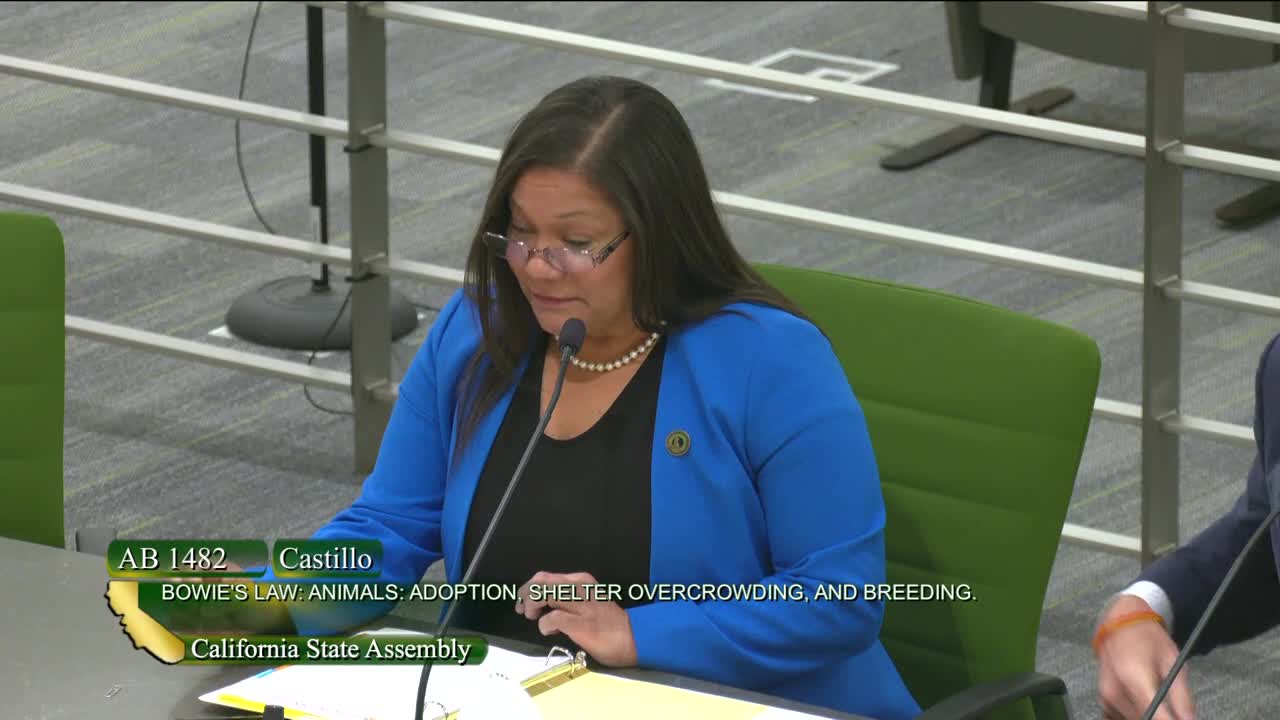
Discussed in Hearing
 6MIN
Assembly Standing Committee on Business and Professions

Bill Co-Author(s):