AB 1483: Supervision: violations.
- Session Year: 2025-2026
- House: Assembly
- Latest Version Date: 2025-04-28
Current Status:
Failed
(2026-02-02: From committee: Filed with the Chief Clerk pursuant to Joint Rule 56.)
Introduced
In Committee
Awaiting First Chamber Vote
Passed First Chamber
In Committee
Awaiting Second Chamber Vote
Passed Second Chamber
Enacted
Existing law requires prisoners sentenced to imprisonment in the state prison to serve time on parole or community supervision after their release from prison. Existing law authorizes courts to suspend the imposition or execution of punishments in specified criminal cases and instead enforce terms of probation or mandatory supervision. Existing law allows agencies responsible for supervision to determine appropriate responses to alleged violations, which can include, among other things, a one to 10 consecutive day period of flash incarceration.
This bill would prohibit a person on any of those forms of supervision from being arrested, detained, or incarcerated for a technical violation of supervision, as defined, unless the person on supervision has had their supervision revoked by a judge after a revocation petition has been filed, except as specified. The bill would define a technical violation as any conduct in violation of a persons conditions of supervision that is not a new misdemeanor or felony. The bill would require a supervision agent to provide a person accused of a technical violation with a written summary of the technical violations alleged against them. The bill would prohibit the use of flash incarceration, and would make conforming changes. The bill would prohibit confinement pursuant to a revocation of supervision for a technical violation for a first or 2nd violation, and limit it limit confinement pursuant to a revocation of supervision for a technical violation to no more than 7 days for the 3rd first revocation, 15 days for the 4th 2nd revocation, and 30 days for the 5th 3rd or subsequent revocation. By increasing duties on local supervision agents, this bill would impose a state-mandated local program.
The California Constitution requires the state to reimburse local agencies and school districts for certain costs mandated by the state. Statutory provisions establish procedures for making that reimbursement.
This bill would provide that, if the Commission on State Mandates determines that the bill contains costs mandated by the state, reimbursement for those costs shall be made pursuant to the statutory provisions noted above.
Existing law requires prisoners sentenced to imprisonment in the state prison to serve time on parole or community supervision after their release from prison. Existing law authorizes courts to suspend the imposition or execution of punishments in specified criminal cases and instead enforce terms of probation or mandatory supervision. Existing law allows agencies responsible for supervision to determine appropriate responses to alleged violations, which can include, among other things, a one to 10 consecutive day period of flash incarceration.
This bill would prohibit a person on any of those forms of supervision from being arrested, detained, or incarcerated for a technical violation of supervision, as defined, unless the person on supervision has had their supervision revoked by a judge after a revocation petition has been filed, except as specified. The bill would define a technical violation as any conduct in violation of a persons conditions of supervision that is not a new misdemeanor or felony. The bill would require a supervision agent to provide a person accused of a technical violation with a written summary of the technical violations alleged against them. The bill would prohibit the use of flash incarceration, and would make conforming changes. The bill would prohibit confinement pursuant to a revocation of supervision for a technical violation for a first or 2nd violation, and limit it to no more than 7 days for the 3rd revocation, 15 days for the 4th revocation, and 30 days for the 5th or subsequent revocation. By increasing duties on local supervision agents, this bill would impose a state-mandated local program.
The California Constitution requires the state to reimburse local agencies and school districts for certain costs mandated by the state. Statutory provisions establish procedures for making that reimbursement.
This bill would provide that, if the Commission on State Mandates determines that the bill contains costs mandated by the state, reimbursement for those costs shall be made pursuant to the statutory provisions noted above.
Under existing law, a person sentenced to imprisonment in a state prison may during that period of confinement be deprived of only those rights as is reasonably related to legitimate penological interests.This bill would make a technical, nonsubstantive change to this provision.Under existing law, a person sentenced to imprisonment in a state prison may during that period of confinement be deprived of only those rights as is reasonably related to legitimate penological interests.
This bill would make a technical, nonsubstantive change to this provision.
(a)The Legislature finds and declares all of the following:
(1)The Legislature reaffirms its commitment to reducing recidivism among criminal offenders.
(2)Despite the dramatic increase in corrections spending over the past two decades, national reincarceration rates for people released from prison remain unchanged or have worsened. National data show that about 40 percent of released individuals are reincarcerated within three years. In California, the recidivism rate for persons who have served time in prison is even greater than the national average.
(3)Criminal justice policies that rely on building and operating more prisons to address community safety concerns are not sustainable, and will not result in improved public safety.
(4)California must reinvest its criminal justice resources to support community-based corrections programs and evidence-based practices that will achieve improved public safety returns on this states substantial investment in its criminal justice system.
(5)Realigning low-level felony offenders who do not have prior convictions for serious, violent, or sex offenses to locally run community-based corrections programs, which are strengthened through community-based punishment, evidence-based practices, improved supervision strategies, and enhanced secured capacity, will improve public safety outcomes among adult felons and facilitate their reintegration back into society.
(6)Community-based corrections programs require a partnership between local public safety entities and the county to provide and expand the use of community-based punishment for low-level offender populations. Each countys Local Community Corrections Partnership, as established in paragraph (2) of subdivision (b) of Section 1230, should play a critical role in developing programs and ensuring appropriate outcomes for low-level offenders.
(7)Fiscal policy and correctional practices should align to promote a justice reinvestment strategy that fits each county. Justice reinvestment is a data-driven approach to reduce corrections and related criminal justice spending and reinvest savings in strategies designed to increase public safety. The purpose of justice reinvestment is to manage and allocate criminal justice populations more cost-effectively, generating savings that can be reinvested in evidence-based strategies that increase public safety while holding offenders accountable.
(8)Community-based punishment means correctional sanctions and programming encompassing a range of custodial and noncustodial responses to criminal or noncompliant offender activity. Community-based punishment may be provided by local public safety entities directly or through community-based public or private correctional service providers, and include, but are not limited to, the following:
(A)Intensive community supervision.
(B)Home detention with electronic monitoring or GPS monitoring.
(C)Mandatory community service.
(D)Restorative justice programs such as mandatory victim restitution and victim-offender reconciliation.
(E)Work, training, or education in a furlough program pursuant to Section 1208.
(F)Work, in lieu of confinement, in a work release program pursuant to Section 4024.2.
(G)Day reporting.
(H)Mandatory residential or nonresidential substance abuse treatment programs.
(I)Mandatory random drug testing.
(J)Mother-infant care programs.
(K)Community-based residential programs offering structure, supervision, drug treatment, alcohol treatment, literacy programming, employment counseling, psychological counseling, mental health treatment, or any combination of these and other interventions.
(9)Evidence-based practices refers to supervision policies, procedures, programs, and practices demonstrated by scientific research to reduce recidivism among individuals under probation, parole, or postrelease supervision.
(b)The provisions of this act are not intended to alleviate state prison overcrowding.
SEC. 2.Section 1203 of the Penal Code is amended to read:1203.(a)As used in this code, probation means the suspension of the imposition or execution of a sentence and the order of conditional and revocable release in the community under the supervision of a probation officer. As used in this code, conditional sentence means the suspension of the imposition or execution of a sentence and the order of revocable release in the community subject to conditions established by the court without the supervision of a probation officer. It is the intent of the Legislature that both conditional sentence and probation are authorized whenever probation is authorized in any code as a sentencing option for infractions or misdemeanors.
(b)(1)Except as provided in subdivision (j), if a person is convicted of a felony and is eligible for probation, before judgment is pronounced, the court shall immediately refer the matter to a probation officer to investigate and report to the court, at a specified time, upon the circumstances surrounding the crime and the prior history and record of the person, which may be considered either in aggravation or mitigation of the punishment.
(2)(A)The probation officer shall immediately investigate and make a written report to the court containing findings and recommendations, including recommendations as to the granting or denying of probation and the conditions of probation, if granted.
(B)Pursuant to Section 828 of the Welfare and Institutions Code, the probation officer shall include in the report any information gathered by a law enforcement agency relating to the taking of the defendant into custody as a minor, which shall be considered for purposes of determining whether adjudications of commissions of crimes as a juvenile warrant a finding that there are circumstances in aggravation pursuant to Section 1170 or to deny probation.
(C)If the person was convicted of an offense that requires that person to register as a sex offender pursuant to Sections 290 to 290.023, inclusive, or if the probation report recommends that registration be ordered at sentencing pursuant to Section 290.006, the probation officers report shall include the results of the State-Authorized Risk Assessment Tool for Sex Offenders (SARATSO) administered pursuant to Sections 290.04 to 290.06, inclusive, if applicable.
(D)The probation officer may also include in the report recommendations for both of the following:
(i)The amount the defendant should be required to pay as a restitution fine pursuant to subdivision (b) of Section 1202.4.
(ii)Whether the court shall require, as a condition of probation, restitution to the victim or to the Restitution Fund and the amount thereof.
(E)The report shall be made available to the court and the prosecuting and defense attorneys at least five days, or upon request of the defendant or prosecuting attorney nine days, prior to the time fixed by the court for the hearing and determination of the report, and shall be filed with the clerk of the court as a record in the case at the time of the hearing. The time within which the report shall be made available and filed may be waived by written stipulation of the prosecuting and defense attorneys that is filed with the court or an oral stipulation in open court that is made and entered upon the minutes of the court.
(3)At a time fixed by the court, the court shall hear and determine the application, if one has been made, or, in any case, the suitability of probation in the particular case. At the hearing, the court shall consider any report of the probation officer, including the results of the SARATSO, if applicable, and shall make a statement that it has considered the report, which shall be filed with the clerk of the court as a record in the case. If the court determines that there are circumstances in mitigation of the punishment prescribed by law or that the ends of justice would be served by granting probation to the person, it may place the person on probation. If probation is denied, the clerk of the court shall immediately send a copy of the report to the Department of Corrections and Rehabilitation at the prison or other institution to which the person is delivered.
(4)The preparation of the report or the consideration of the report by the court may be waived only by a written stipulation of the prosecuting and defense attorneys that is filed with the court or an oral stipulation in open court that is made and entered upon the minutes of the court, except that a waiver shall not be allowed unless the court consents thereto. However, if the defendant is ultimately sentenced and committed to the state prison, a probation report shall be completed pursuant to Section 1203c.
(c)If a defendant is not represented by an attorney, the court shall order the probation officer who makes the probation report to discuss its contents with the defendant.
(d)If a person is convicted of a misdemeanor, the court may either refer the matter to the probation officer for an investigation and a report or summarily pronounce a conditional sentence. If the person was convicted of an offense that requires that person to register as a sex offender pursuant to Sections 290 to 290.023, inclusive, or if the probation officer recommends that the court, at sentencing, order the offender to register as a sex offender pursuant to Section 290.006, the court shall refer the matter to the probation officer for the purpose of obtaining a report on the results of the State-Authorized Risk Assessment Tool for Sex Offenders administered pursuant to Sections 290.04 to 290.06, inclusive, if applicable, which the court shall consider. If the case is not referred to the probation officer, in sentencing the person, the court may consider any information concerning the person that could have been included in a probation report. The court shall inform the person of the information to be considered and permit the person to answer or controvert the information. For this purpose, upon the request of the person, the court shall grant a continuance before the judgment is pronounced.
(e)Except in unusual cases in which the interests of justice would best be served if the person is granted probation, probation shall not be granted to any of the following persons:
(1)Unless the person had a lawful right to carry a deadly weapon, other than a firearm, at the time of the perpetration of the crime or the persons arrest, any person who has been convicted of arson, robbery, carjacking, burglary, burglary with explosives, rape with force or violence, torture, aggravated mayhem, murder, attempt to commit murder, trainwrecking, kidnapping, escape from the state prison, or a conspiracy to commit one or more of those crimes and who was armed with the weapon at either of those times.
(2)Any person who used, or attempted to use, a deadly weapon upon a human being in connection with the perpetration of the crime of which that person has been convicted.
(3)Any person who willfully inflicted great bodily injury or torture in the perpetration of the crime of which that person has been convicted.
(4)Any person who has been previously convicted twice in this state of a felony or in any other place of a public offense which, if committed in this state, would have been punishable as a felony.
(5)Unless the person has never been previously convicted once in this state of a felony or in any other place of a public offense which, if committed in this state, would have been punishable as a felony, any person who has been convicted of burglary with explosives, rape with force or violence, torture, aggravated mayhem, murder, attempt to commit murder, trainwrecking, extortion, kidnapping, escape from the state prison, a violation of Section 286, 287, 288, or 288.5, or of former Section 288a, or a conspiracy to commit one or more of those crimes.
(6)Any person who has been previously convicted once in this state of a felony or in any other place of a public offense which, if committed in this state, would have been punishable as a felony, if that person committed any of the following acts:
(A)Unless the person had a lawful right to carry a deadly weapon at the time of the perpetration of the previous crime or the persons arrest for the previous crime, the person was armed with a weapon at either of those times.
(B)The person used, or attempted to use, a deadly weapon upon a human being in connection with the perpetration of the previous crime.
(C)The person willfully inflicted great bodily injury or torture in the perpetration of the previous crime.
(7)Any public official or peace officer of this state or any city, county, or other political subdivision who, in the discharge of the duties of public office or employment, accepted or gave or offered to accept or give any bribe, embezzled public money, or was guilty of extortion.
(8)Any person who knowingly furnishes or gives away phencyclidine.
(9)Any person who intentionally inflicted great bodily injury in the commission of arson under subdivision (a) of Section 451 or who intentionally set fire to, burned, or caused the burning of, an inhabited structure or inhabited property in violation of subdivision (b) of Section 451.
(10)Any person who, in the commission of a felony, inflicts great bodily injury or causes the death of a human being by the discharge of a firearm from or at an occupied motor vehicle proceeding on a public street or highway.
(11)Any person who possesses a short-barreled rifle or a short-barreled shotgun under Section 33215, a machinegun under Section 32625, or a silencer under Section 33410.
(12)Any person who is convicted of violating Section 8101 of the Welfare and Institutions Code.
(13)Any person who is described in subdivision (b) or (c) of Section 27590.
(f)When probation is granted in a case which comes within subdivision (e), the court shall specify on the record and shall enter on the minutes the circumstances indicating that the interests of justice would best be served by that disposition.
(g)If a person is not eligible for probation, the judge shall refer the matter to the probation officer for an investigation of the facts relevant to determination of the amount of a restitution fine pursuant to subdivision (b) of Section 1202.4 in all cases in which the determination is applicable. The judge, in their discretion, may direct the probation officer to investigate all facts relevant to the sentencing of the person. Upon that referral, the probation officer shall immediately investigate the circumstances surrounding the crime and the prior record and history of the person and make a written report to the court containing findings. The findings shall include a recommendation of the amount of the restitution fine as provided in subdivision (b) of Section 1202.4.
(h)If a defendant is convicted of a felony and a probation report is prepared pursuant to subdivision (b) or (g), the probation officer may obtain and include in the report a statement of the comments of the victim concerning the offense. The court may direct the probation officer not to obtain a statement if the victim has in fact testified at any of the court proceedings concerning the offense.
(i)A probationer shall not be released to enter another state unless the case has been referred to the Administrator of the Interstate Probation and Parole Compacts, pursuant to the Uniform Act for Out-of-State Probationer or Parolee Supervision (Article 3 (commencing with Section 11175) of Chapter 2 of Title 1 of Part 4).
(j)In any court in which a county financial evaluation officer is available, in addition to referring the matter to the probation officer, the court may order the defendant to appear before the county financial evaluation officer for a financial evaluation of the defendants ability to pay restitution, in which case the county financial evaluation officer shall report the findings regarding restitution and other court-related costs to the probation officer on the question of the defendants ability to pay those costs.
Any order made pursuant to this subdivision may be enforced as a violation of the terms and conditions of probation upon willful failure to pay and at the discretion of the court, may be enforced in the same manner as a judgment in a civil action, if any balance remains unpaid at the end of the defendants probationary period.
(k)Probation shall not be granted to, nor shall the execution of, or imposition of sentence be suspended for, any person who is convicted of a violent felony, as defined in subdivision (c) of Section 667.5, or a serious felony, as defined in subdivision (c) of Section 1192.7, and who was on probation for a felony offense at the time of the commission of the new felony offense.
(l)A person who is granted probation is subject to search or seizure as part of their terms and conditions only by a probation officer or other peace officer.
SEC. 3.Section 1203.2 of the Penal Code is amended to read:1203.2.(a)At any time during the period of supervision of a person (1) released on probation under the care of a probation officer pursuant to this chapter, (2) released on conditional sentence or summary probation not under the care of a probation officer, (3) placed on mandatory supervision pursuant to subparagraph (B) of paragraph (5) of subdivision (h) of Section 1170, (4) subject to revocation of postrelease community supervision pursuant to Section 3455, or (5) subject to revocation of parole supervision pursuant to Section 3000.08, if any probation officer, parole officer, or peace officer has probable cause to believe that the supervised person is violating any term or condition of the persons supervision, the officer may, without warrant or other process and at any time until the final disposition of the case, rearrest the supervised person and bring them before the court, except as provided in Section 3057.5, or the court may, in its discretion, issue a warrant for their rearrest, except as provided in Section 3057.5. Whenever a person on probation who is subject to this section is arrested, with or without a warrant or the filing of a petition for revocation as described in subdivision (b), the court shall consider the release of a person on probation from custody in accordance with Section 1203.25. Notwithstanding Section 3056, whenever any supervised person who is subject to this section and who is not on probation is arrested, with or without a warrant or the filing of a petition for revocation as described in subdivision (b), the court may order the release of the supervised person from custody under any terms and conditions the court deems appropriate. Upon rearrest, or upon the issuance of a warrant for rearrest, the court may revoke and terminate the supervision of the person if the interests of justice so require and the court, in its judgment, has reason to believe from the report of the probation or parole officer or otherwise that the person has violated any of the conditions of their supervision, or has subsequently committed other offenses, regardless of whether the person has been prosecuted for those offenses. However, the court shall not terminate parole pursuant to this section. Supervision shall not be revoked solely for failure of a person to make restitution, or to pay fines, fees, or assessments, imposed as a condition of supervision unless the court determines that the defendant has willfully failed to pay and has the ability to pay. Restitution shall be consistent with a persons ability to pay. The revocation, summary or otherwise, shall serve to toll the running of the period of supervision.
(b)(1)Upon its own motion or upon the petition of the supervised person, the probation or parole officer, or the district attorney, the court may modify, revoke, or terminate supervision of the person pursuant to this subdivision, except that the court shall not terminate parole pursuant to this section. The court in the county in which the person is supervised has jurisdiction to hear the motion or petition, or for those on parole, either the court in the county of supervision or the court in the county in which the alleged violation of supervision occurred. A person supervised on parole or postrelease community supervision pursuant to Section 3455 may not petition the court pursuant to this section for early release from supervision, and a petition under this section shall not be filed solely for the purpose of modifying parole. This section does not prohibit the court in the county in which the person is supervised or in which the alleged violation of supervision occurred from modifying a persons parole when acting on the courts own motion or a petition to revoke parole. The court shall give notice of its motion, and the probation or parole officer or the district attorney shall give notice of their petition to the supervised person, the supervised persons attorney of record, and the district attorney or the probation or parole officer, as the case may be. The supervised person shall give notice of their petition to the probation or parole officer and notice of any motion or petition shall be given to the district attorney in all cases. The court shall refer its motion or the petition to the probation or parole officer. After the receipt of a written report from the probation or parole officer, the court shall read and consider the report and either its motion or the petition and may modify, revoke, or terminate the supervision of the supervised person upon the grounds set forth in subdivision (a) if the interests of justice so require.
(2)The notice required by this subdivision may be given to the supervised person upon their first court appearance in the proceeding. Upon the agreement by the supervised person in writing to the specific terms of a modification or termination of a specific term of supervision, any requirement that the supervised person make a personal appearance in court for the purpose of a modification or termination shall be waived. Prior to the modification or termination and waiver of appearance, the supervised person shall be informed of their right to consult with counsel, and if indigent the right to secure court-appointed counsel. If the supervised person waives their right to counsel a written waiver shall be required. If the supervised person consults with counsel and thereafter agrees to a modification, revocation, or termination of the term of supervision and waiver of personal appearance, the agreement shall be signed by counsel showing approval for the modification or termination and waiver.
(c)Upon any revocation and termination of probation the court may, if the sentence has been suspended, pronounce judgment for any time within the longest period for which the person might have been sentenced. However, if the judgment has been pronounced and the execution thereof has been suspended, the court may revoke the suspension and order that the judgment shall be in full force and effect. In either case, the person shall be delivered over to the proper officer to serve their sentence, less any credits herein provided for.
(d)In any case of revocation and termination of probation, including, but not limited to, cases in which the judgment has been pronounced and the execution thereof has been suspended, upon the revocation and termination, the court may, in lieu of any other sentence, commit the person to the Department of Corrections and Rehabilitation, Division of Juvenile Facilities if the person is otherwise eligible for that commitment.
(e)If probation has been revoked before the judgment has been pronounced, the order revoking probation may be set aside for good cause upon motion made before pronouncement of judgment. If probation has been revoked after the judgment has been pronounced, the judgment and the order which revoked the probation may be set aside for good cause within 30 days after the court has notice that the execution of the sentence has commenced. If an order setting aside the judgment, the revocation of probation, or both is made after the expiration of the probationary period, the court may again place the person on probation for that period and with those terms and conditions as it could have done immediately following conviction.
(f)As used in this section, the following definitions shall apply:
(1)Court means a judge, magistrate, or revocation hearing officer described in Section 71622.5 of the Government Code.
(2)Probation officer means a probation officer as described in Section 1203 or an officer of the agency designated by the board of supervisors of a county to implement postrelease community supervision pursuant to Section 3451.
(3)Supervised person means a person who satisfies any of the following:
(A)The person is released on probation subject to the supervision of a probation officer.
(B)The person is released on conditional sentence or summary probation not under the care of a probation officer.
(C)The person is subject to mandatory supervision pursuant to subparagraph (B) of paragraph (5) of subdivision (h) of Section 1170.
(D)The person is subject to revocation of postrelease community supervision pursuant to Section 3455.
(E)The person is subject to revocation of parole pursuant to Section 3000.08.
(g)This section does not affect the authority of the supervising agency to impose intermediate sanctions to persons supervised on parole pursuant to Section 3000.8 or postrelease community supervision pursuant to Title 2.05 (commencing with Section 3450) of Part 3.
SEC. 4.Section 1203.35 of the Penal Code is repealed.SEC. 5.Section 1231 of the Penal Code is amended to read:1231.(a)Community corrections programs funded pursuant to this chapter shall identify and track specific outcome-based measures consistent with the goals of this act.
(b)The Judicial Council, in consultation with the Chief Probation Officers of California, shall specify and define minimum required outcome-based measures, which shall include, but not be limited to, all of the following:
(1)The percentage of persons subject to local supervision who are being supervised in accordance with evidence-based practices.
(2)The percentage of state moneys expended for programs that are evidence based, and a descriptive list of all programs that are evidence based.
(3)Specification of supervision policies, procedures, programs, and practices that were eliminated.
(4)The percentage of persons subject to local supervision who successfully complete the period of supervision.
(c)Each CPO receiving funding pursuant to Sections 1233 to 1233.6, inclusive, shall provide an annual written report to the Judicial Council, evaluating the effectiveness of the community corrections program, including, but not limited to, the data described in subdivision (b).
(d)The Judicial Council, shall, in consultation with the CPO of each county and the Department of Corrections and Rehabilitation, provide a quarterly statistical report to the Department of Finance including, but not limited to, the following statistical information for each county:
(1)The number of felony filings.
(2)The number of felony convictions.
(3)The number of felony convictions in which the defendant was sentenced to the state prison.
(4)The number of felony convictions in which the defendant was granted probation.
(5)The adult felon probation population.
(6)The number of adult felony probationers who had their probation terminated and revoked and were sent to state prison for that revocation.
(7)The number of adult felony probationers sent to state prison for a conviction of a new felony offense, including when probation was revoked or terminated.
(8)The number of adult felony probationers who had their probation revoked and were sent to county jail for that revocation.
(9)The number of adult felony probationers sent to county jail for a conviction of a new felony offense, including when probation was revoked or terminated.
(10)The number of felons placed on postrelease community supervision, commencing January 1, 2012.
(11)The number of felons placed on mandatory supervision, commencing January 1, 2012.
(12)The mandatory supervision population, commencing January 1, 2012.
(13)The postrelease community supervision population, commencing January 1, 2012.
(14)The number of felons on postrelease community supervision sentenced to state prison for a conviction of a new felony offense, commencing January 1, 2012.
(15)The number of felons on mandatory supervision sentenced to state prison for a conviction of a new felony offense, commencing January 1, 2012.
(16)The number of felons who had their postrelease community supervision revoked and were sent to county jail for that revocation, commencing January 1, 2012.
(17)The number of felons on postrelease community supervision sentenced to county jail for a conviction of a new felony offense, including when postrelease community supervision was revoked or terminated, commencing January 1, 2012.
(18)The number of felons who had their mandatory supervision revoked and were sentenced to county jail for that revocation, commencing January 1, 2012.
(19)The number of felons on mandatory supervision sentenced to county jail for a conviction of a new felony offense, including when mandatory supervision was revoked or terminated, commencing January 1, 2012.
SEC. 6.Section 3000.08 of the Penal Code is amended to read:3000.08.(a)A person released from state prison prior to or on or after July 1, 2013, after serving a prison term, or whose sentence has been deemed served pursuant to Section 2900.5, for any of the following crimes is subject to parole supervision by the Department of Corrections and Rehabilitation and the jurisdiction of the court in the county in which the parolee is released, resides, or in which an alleged violation of supervision has occurred, for the purpose of hearing petitions to revoke parole and impose a term of custody:
(1)A serious felony as described in subdivision (c) of Section 1192.7.
(2)A violent felony as described in subdivision (c) of Section 667.5.
(3)A crime for which the person was sentenced pursuant to paragraph (2) of subdivision (e) of Section 667 or paragraph (2) of subdivision (c) of Section 1170.12.
(4)Any crime for which the person is classified as a high-risk sex offender.
(5)Any crime for which the person is required, as a condition of parole, to undergo treatment by the State Department of State Hospitals pursuant to Section 2962.
(b)Notwithstanding any other law, all other offenders released from prison shall be placed on postrelease supervision pursuant to Title 2.05 (commencing with Section 3450).
(c)At any time during the period of parole of a person subject to this section, if any parole agent or peace officer has probable cause to believe that the parolee is violating any term or condition of their parole, the agent or officer may, without warrant or other process and at any time until the final disposition of the case, arrest the person and bring them before the court, except as provided in Section 3057.5, or the court may, in its discretion, issue a warrant for that persons arrest pursuant to Section 1203.2, except as provided in Section 3057.5. Notwithstanding Section 3056, whenever a supervised person who is subject to this section is arrested, with or without a warrant or the filing of a petition for revocation as described in subdivision (f), the court may order the release of the parolee from custody under any terms and conditions the court deems appropriate.
(d)Upon review of the alleged violation and a finding of good cause that the parolee has committed a violation of law or violated their conditions of parole, the supervising parole agency may impose additional and appropriate conditions of supervision, including rehabilitation and treatment services and appropriate incentives for compliance, and impose immediate, structured, and intermediate sanctions for parole violations. This section does not preclude referrals to a reentry court pursuant to Section 3015.
(e)If the supervising parole agency has determined, following application of its assessment processes, that intermediate sanctions are not appropriate, the supervising parole agency shall, pursuant to Section 1203.2, petition either the court in the county in which the parolee is being supervised or the court in the county in which the alleged violation of supervision occurred, to revoke parole. At any point during the process initiated pursuant to this section, a parolee may waive, in writing, their right to counsel, admit the parole violation, waive a court hearing, and accept the proposed parole modification or revocation. The petition shall include a written report that contains additional information regarding the petition, including the relevant terms and conditions of parole, the circumstances of the alleged underlying violation, the history and background of the parolee, and any recommendations. The Judicial Council shall adopt forms and rules of court to establish uniform statewide procedures to implement this subdivision, including the minimum contents of supervision agency reports. Upon a finding that the person has violated the conditions of parole, the court shall have authority to do any of the following:
(1)Return the person to parole supervision with modifications of conditions, if appropriate, including a period of incarceration in a county jail, except as provided in Section 3057.5.
(2)Revoke parole and order the person to confinement in a county jail, except as provided in Section 3057.5.
(3)Refer the person to a reentry court pursuant to Section 3015 or other evidence-based program in the courts discretion.
(f)Confinement pursuant to paragraphs (1) and (2) of subdivision (f) shall be (e) shall not exceed a period of 180 days in a county jail, subject to the limitation in Section 3057.5.
(g)Notwithstanding any other law, if Section 3000.1 or paragraph (4) of subdivision (b) of Section 3000 applies to a person who is on parole and the court determines that the person has committed a violation of law or violated their conditions of parole, the person on parole shall be remanded to the custody of the Department of Corrections and Rehabilitation and the jurisdiction of the Board of Parole Hearings for the purpose of future parole consideration.
(h)Notwithstanding subdivision (a), any of the following persons released from state prison shall be subject to the jurisdiction of, and parole supervision by, the Department of Corrections and Rehabilitation for a period of parole up to three years or the parole term the person was subject to at the time of the commission of the offense, whichever is greater:
(1)The person is required to register as a sex offender pursuant to Chapter 5.5 (commencing with Section 290) of Title 9 of Part 1, and was subject to a period of parole exceeding three years at the time they committed a felony for which they were convicted and subsequently sentenced to state prison.
(2)The person was subject to parole for life pursuant to Section 3000.1 at the time of the commission of the offense that resulted in a conviction and state prison sentence.
(i)Parolees subject to this section who have a pending adjudication for a parole violation on July 1, 2013, are subject to the jurisdiction of the Board of Parole Hearings. Parole revocation proceedings conducted by the Board of Parole Hearings prior to July 1, 2013, if reopened on or after July 1, 2013, are subject to the jurisdiction of the Board of Parole Hearings.
(j)Except as described in subdivision (c), any person who is convicted of a felony that requires community supervision and who still has a period of state parole to serve shall discharge from state parole at the time of release to community supervision.
(k)Any person released to parole supervision pursuant to subdivision (a) shall, regardless of any subsequent determination that the person should have been released pursuant to subdivision (b), remain subject to subdivision (a) after having served 60 days under supervision pursuant to subdivision (a).
SEC. 7.Section 3056 of the Penal Code is amended to read:3056.(a)Prisoners on parole shall remain under the supervision of the department but shall not be returned to prison except as provided in subdivision (b) or as provided by subdivision (c) of Section 3000.09. A parolee awaiting a parole revocation hearing may be housed in a county jail while awaiting revocation proceedings, except as provided in Section 3057.5. If a parolee is housed in a county jail, they shall be housed in the county in which they were arrested or the county in which a petition to revoke parole has been filed or, if there is no county jail in that county, in the housing facility with which that county has contracted to house jail inmates. Additionally, except as provided by subdivision (c) of Section 3000.09, upon revocation of parole, a parolee may be housed in a county jail, jail for a maximum of 180 days per revocation, subject to the limitations in Section 3057.5. When housed in county facilities, parolees shall be under the sole legal custody and jurisdiction of local county facilities. A parolee shall remain under the sole legal custody and jurisdiction of the local county or local correctional administrator, even if placed in an alternative custody program in lieu of incarceration, including, but not limited to, work furlough and electronic home detention. When a parolee is under the legal custody and jurisdiction of a county facility awaiting parole revocation proceedings or upon revocation, the parolee shall not be under the parole supervision or jurisdiction of the department. Whenever a parolee who is subject to this section has been arrested, with or without a warrant or the filing of a petition for revocation with the court, the court may order the release of the parolee from custody under any terms and conditions the court deems appropriate. When released from the county facility or county alternative custody program following a period of custody for revocation of parole or because no violation of parole is found, the parolee shall be returned to the parole supervision of the department for the duration of parole.
(b)Inmates paroled pursuant to Section 3000.1 may be returned to prison following the revocation of parole by the Board of Parole Hearings until July 1, 2013, and thereafter by a court pursuant to Section 3000.08.
(c)Until July 1, 2021, a parolee who is subject to subdivision (a), but who is under 18 years of age, may be housed in a facility of the Division of Juvenile Justice, Department of Corrections and Rehabilitation.
SEC. 8.Section 3057 of the Penal Code is amended to read:3057.(a)Confinement pursuant to a revocation of parole in the absence of a new conviction and commitment to prison under other provisions of law, shall not exceed 12 months, except as provided in subdivision (c) and Section 3057.5.
(b)Upon completion of confinement pursuant to parole revocation without a new commitment to prison, the inmate shall be released on parole for a period that shall not extend beyond that portion of the maximum statutory period of parole specified by Section 3000 which was unexpired at the time of each revocation.
(c)Notwithstanding the limitations in subdivision (a) and in Section 3060.5 upon confinement pursuant to a parole revocation, the parole authority may extend the confinement pursuant to parole revocation for a maximum of an additional 12 months for subsequent acts of misconduct committed by the parolee while confined pursuant to that parole revocation, except as provided in Section 3057.5. Upon a finding of good cause to believe that a parolee has committed a subsequent act of misconduct and utilizing procedures governing parole revocation proceedings, the parole authority may extend the period of confinement pursuant to parole revocation as follows: (1) not more than 180 days for an act punishable as a felony, whether or not prosecution is undertaken, (2) not more than 90 days for an act punishable as a misdemeanor, whether or not prosecution is undertaken, and (3) not more than 30 days for an act defined as a serious disciplinary offense pursuant to subdivision (a) of Section 2932, except as provided in Section 3057.5.
(d)(1)Except for parolees specified in paragraph (2), any revocation period imposed under subdivision (a) may be reduced in the same manner and to the same extent as a term of imprisonment may be reduced by worktime credits under Section 2933. Worktime credit shall be earned and may be forfeited pursuant to the provisions of Section 2932.
Worktime credit forfeited shall not be restored.
(2)The following parolees shall not be eligible for credit under this subdivision:
(A)Parolees who are sentenced under Section 1168 with a maximum term of life imprisonment.
(B)Parolees who violated a condition of parole relating to association with specified persons, entering prohibited areas, attendance at parole outpatient clinics, or psychiatric attention.
(C)Parolees who were revoked for conduct described in, or that could be prosecuted under any of the following sections, whether or not prosecution is undertaken: Section 189, Section 191.5, subdivision (a) of Section 192, subdivision (a) of Section 192.5, Section 203, 207, 211, 215, 217.1, or 220, subdivision (b) of Section 241, Section 244, paragraph (1) or (2) of subdivision (a) of Section 245, paragraph (2) or (6) of subdivision (a) of Section 261, paragraph (1) or (4) of subdivision (a) of former Section 262, Section 264.1, subdivision (c) or (d) of Section 286, subdivision (c) or (d) of Section 287 or of former Section 288a, Section 288, subdivision (a) of Section 289, 347, or 404, subdivision (a) of Section 451, Section 12022, 12022.5, 12022.53, 12022.7, 12022.8, or 25400, Chapter 2 (commencing with Section 29800) of Division 9 of Title 4 of Part 6, any provision listed in Section 16590, or Section 664 for any attempt to engage in conduct described in or that could be prosecuted under any of the above-mentioned sections.
(D)Parolees who were revoked for any reason if they had been granted parole after conviction of any of the offenses specified in subparagraph (C).
(E)Parolees who the parole authority finds at a revocation hearing to be unsuitable for reduction of the period of confinement because of the circumstances and gravity of the parole violation, or because of prior criminal history.
(e)Commencing October 1, 2011, this section shall only apply to inmates sentenced to a term of life imprisonment or parolees that on or before September 30, 2011, are pending a final adjudication of a parole revocation charge and subject to subdivision (c) of Section 3000.09.
SEC. 9.Section 3057.5 is added to the Penal Code, to read:3057.5.(a)The Legislature finds and declares that incarcerating people for technical violations undermines rehabilitation and public safety and should only be employed where no less restrictive means are available.
(b)A person shall not be detained, arrested, or incarcerated for a technical violation of supervision, unless the person on supervision has had their supervision revoked by a judge after a revocation petition has been filed.
(c)There is a presumption against confinement for technical violations of supervision unless the court finds by a preponderance of the evidence that the defendant cannot be safely diverted from confinement through less restrictive means.
(c)(d)If a person is accused of a technical violation of supervision, the persons supervision agent shall provide the person with a written summary and explanation of the facts related to the technical violations alleged against them.
(d)(1)If a person is accused of a technical violation of supervision, the persons supervision agent may mandate that the person on supervision appear in a supervision office to adjudicate the technical violation informally. This adjudication shall include a reasonable opportunity for the person on supervision to respond to the alleged violation. If the supervision agent determines that a preponderance of the evidence available establishes a violation, the agent may impose an intermediate sanction. Agents may also conduct this adjudication remotely, or in the community. This adjudication shall occur outside of the person on supervisions regular work hours.(2)If a person commits a technical violation of supervision and a hearing is to occur for that violation, supervision agents may issue a summons for the person on supervision to appear in court for the hearing.(e)A person who absconds while on supervision or fails to appear at a hearing relating to their technical violation may be arrested and detained. In such circumstances, the person must shall have a recognizance hearing within 48 72 hours of being arrested. At the recognizance hearing, the court shall consider all available evidence regarding the individuals employment, family, and community ties.
(f)Confinement pursuant to a revocation of supervision for a technical violation is not permitted for the first or second revocation, and it is limited to a maximum of 7 days for the third first revocation, 15 days for the fourth second revocation, and 30 days for the fifth third revocation and any thereafter. For purposes of this section, multiple technical violations stemming from the same continuous course of conduct shall not constitute separate technical violations.
(g)There is a presumption against confinement for technical violations of supervision. The court may impose a sentence of confinement upon revocation for a technical violation only if the court finds by a preponderance of the evidence that the defendant committed a technical violation that involves an identifiable threat to public safety and the defendant cannot be safely diverted from total confinement through less restrictive means.(h)(g)If a court imposes a sentence of confinement following a revocation, the basis of which is for one or more technical violations, the court shall consider the employment status of the defendant. There is a presumption that courts shall The court shall, whenever practicable, allow the term of confinement for a technical violation to be served on weekends or other nonwork days for people on supervision who are employed, unless there is a preponderance of evidence that incarceration on days of employment is necessary to protect public safety. employed.
(i)(h)It is the intent of the Legislature that supervision agents respond to technical violations with supportive services and intermediate sanctions in the community, rather than a petition for revocation, except where supportive services and intermediate sanctions will be inadequate to prevent criminal activity.
(j)(i)For the purposes of this section, the following terms have the following meanings:
(1)Supervision means probation supervision, informal probation, mandatory supervision, postrelease community supervision, or parole supervision, or any other kind of supervision. Supervision does not include incarceration in a county jail or state prison.
(2)Technical violation means any conduct that is a violation of a persons conditions of supervision that does not meet all of the elements of a new misdemeanor or felony.
SEC. 10.Section 3450 of the Penal Code is amended to read:3450.(a)This act shall be known and may be cited as the Postrelease Community Supervision Act of 2011.
(b)The Legislature finds and declares all of the following:
(1)The Legislature reaffirms its commitment to reducing recidivism among criminal offenders.
(2)Despite the dramatic increase in corrections spending over the past two decades, national reincarceration rates for people released from prison remain unchanged or have worsened. National data show that about 40 percent of released individuals are reincarcerated within three years. In California, the recidivism rate for persons who have served time in prison is even greater than the national average.
(3)Criminal justice policies that rely on the reincarceration of parolees for technical violations do not result in improved public safety.
(4)California must reinvest its criminal justice resources to support community corrections programs and evidence-based practices that will achieve improved public safety returns on this states substantial investment in its criminal justice system.
(5)Realigning the postrelease supervision of certain felons reentering the community after serving a prison term to local community corrections programs, which are strengthened through community-based punishment, evidence-based practices, and improved supervision strategies, will improve public safety outcomes among adult felon parolees and will facilitate their successful reintegration back into society.
(6)Community corrections programs require a partnership between local public safety entities and the county to provide and expand the use of community-based punishment for offenders paroled from state prison. Each countys local Community Corrections Partnership, as established in paragraph (2) of subdivision (b) of Section 1230, should play a critical role in developing programs and ensuring appropriate outcomes for persons subject to postrelease community supervision.
(7)Fiscal policy and correctional practices should align to promote a justice reinvestment strategy that fits each county. Justice reinvestment is a data-driven approach to reduce corrections and related criminal justice spending and reinvest savings in strategies designed to increase public safety. The purpose of justice reinvestment is to manage and allocate criminal justice populations more cost effectively, generating savings that can be reinvested in evidence-based strategies that increase public safety while holding offenders accountable.
(8)Community-based punishment means evidence-based correctional sanctions and programming encompassing a range of custodial and noncustodial responses to criminal or noncompliant offender activity. Intermediate sanctions may be provided by local public safety entities directly or through public or private correctional service providers and include, but are not limited to, the following:
(A)Intensive community supervision.
(B)Home detention with electronic monitoring or GPS monitoring.
(C)Mandatory community service.
(D)Restorative justice programs, such as mandatory victim restitution and victim-offender reconciliation.
(E)Work, training, or education in a furlough program pursuant to Section 1208.
(F)Work, in lieu of confinement, in a work release program pursuant to Section 4024.2.
(G)Day reporting.
(H)Mandatory residential or nonresidential substance abuse treatment programs.
(I)Mandatory random drug testing.
(J)Mother-infant care programs.
(K)Community-based residential programs offering structure, supervision, drug treatment, alcohol treatment, literacy programming, employment counseling, psychological counseling, mental health treatment, or any combination of these and other interventions.
(9)Evidence-based practices refers to supervision policies, procedures, programs, and practices demonstrated by scientific research to reduce recidivism among individuals under probation, parole, or postrelease supervision.
SEC. 11.Section 3453 of the Penal Code is amended to read:3453.Postrelease community supervision shall include the following conditions:
(a)The person shall be informed of the conditions of release.
(b)The person shall obey all laws.
(c)The person shall report to the supervising county agency within two working days of release from custody.
(d)The person shall follow the directives and instructions of the supervising county agency.
(e)The person shall report to the supervising county agency as directed by that agency.
(f)The person, and their residence and possessions, shall be subject to search at any time of the day or night, with or without a warrant, by an agent of the supervising county agency or by a peace officer.
(g)The person shall waive extradition if found outside the state.
(h)(1)The person shall inform the supervising county agency of the persons place of residence and shall notify the supervising county agency of any change in residence, or the establishment of a new residence if the person was previously transient, within five working days of the change.
(2)For purposes of this section, residence means one or more locations at which a person regularly resides, regardless of the number of days or nights spent there, such as a shelter or structure that can be located by a street address, including, but not limited to, a house, apartment building, motel, hotel, homeless shelter, and recreational or other vehicle. If the person has no residence, they shall inform the supervising county agency that they are transient.
(i)(1)The person shall inform the supervising county agency of the persons place of employment, education, or training. The person shall inform the supervising agency of any pending or anticipated change in employment, education, or training.
(2)If the person enters into new employment, they shall inform the supervising county agency of the new employment within three business days of that entry.
(j)The person shall immediately inform the supervising county agency if they are arrested or receive a citation.
(k)The person shall obtain the permission of the supervising county agency to travel more than 50 miles from the persons place of residence.
(l)The person shall obtain a travel pass from the supervising county agency before they may leave the county or state for more than two days.
(m)The person shall not be in the presence of a firearm or ammunition, or any item that appears to be a firearm or ammunition.
(n)The person shall not possess, use, or have access to any weapon listed in Section 16140, subdivision (c) of Section 16170, Section 16220, 16260, 16320, 16330, or 16340, subdivision (b) of Section 16460, Section 16470, subdivision (f) of Section 16520, or Section 16570, 16740, 16760, 16830, 16920, 16930, 16940, 17090, 17125, 17160, 17170, 17180, 17190, 17200, 17270, 17280, 17330, 17350, 17360, 17700, 17705, 17710, 17715, 17720, 17725, 17730, 17735, 17740, 17745, 19100, 19200, 19205, 20200, 20310, 20410, 20510, 20610, 20611, 20710, 20910, 21110, 21310, 21810, 22210, 22215, 22410, 24310, 24410, 24510, 24610, 24680, 24710, 30210, 30215, 31500, 32310, 32400, 32405, 32410, 32415, 32420, 32425, 32430 32435, 32440, 32445, 32450, 32900, 33215, 33220, 33225, or 33600.
(o)(1)Except as provided in paragraph (2) and subdivision (p), the person shall not possess a knife with a blade longer than two inches.
(2)The person may possess a kitchen knife with a blade longer than two inches if the knife is used and kept only in the kitchen of the persons residence.
(p)The person may use a knife with a blade longer than two inches, if the use is required for that persons employment, the use has been approved in a document issued by the supervising county agency, and the person possesses the document of approval at all times and makes it available for inspection.
(q)The person shall participate in rehabilitation programming as recommended by the supervising county agency.
(r)The person shall be subject to arrest with or without a warrant by a peace officer employed by the supervising county agency or, at the direction of the supervising county agency, by any peace officer when there is probable cause to believe the person has violated the terms and conditions of release, except as provided in Section 3057.5.
(s)The person shall pay court-ordered restitution and restitution fines in the same manner as a person placed on probation.
SEC. 12.Section 3454 of the Penal Code is amended to read:3454.(a)Each supervising county agency, as established by the county board of supervisors pursuant to subdivision (a) of Section 3451, shall establish a review process for assessing and refining a persons program of postrelease supervision. Any additional postrelease supervision conditions shall be reasonably related to the underlying offense for which the offender spent time in prison, or to the offenders risk of recidivism, and the offenders criminal history, and be otherwise consistent with law.
(b)Each county agency responsible for postrelease supervision, as established by the county board of supervisors pursuant to subdivision (a) of Section 3451, may determine additional appropriate conditions of supervision listed in Section 3453 consistent with public safety, including the use of continuous electronic monitoring as defined in Section 1210.7, order the provision of appropriate rehabilitation and treatment services, determine appropriate incentives, and determine and order appropriate responses to alleged violations, which can include, but shall not be limited to, immediate, structured, and intermediate sanctions up to and including referral to a reentry court pursuant to Section 3015.
SEC. 13.Section 3455 of the Penal Code is amended to read:3455.(a)If the supervising county agency has determined, following application of its assessment processes, that intermediate sanctions as authorized in subdivision (b) of Section 3454 are not appropriate, the supervising county agency shall petition the court pursuant to Section 1203.2 to revoke, modify, or terminate postrelease community supervision. At any point during the process initiated pursuant to this section, a person may waive, in writing, their right to counsel, admit the violation of their postrelease community supervision, waive a court hearing, and accept the proposed modification of their postrelease community supervision. The petition shall include a written report that contains additional information regarding the petition, including the relevant terms and conditions of postrelease community supervision, the circumstances of the alleged underlying violation, the history and background of the violator, and any recommendations. The Judicial Council shall adopt forms and rules of court to establish uniform statewide procedures to implement this subdivision, including the minimum contents of supervision agency reports. Upon a finding that the person has violated the conditions of postrelease community supervision, the revocation hearing officer shall have authority to do all of the following:
(1)Return the person to postrelease community supervision with modifications of conditions, if appropriate, including a period of incarceration in a county jail.
(2)Revoke and terminate postrelease community supervision and order the person to confinement in a county jail.
(3)Refer the person to a reentry court pursuant to Section 3015 or other evidence-based program in the courts discretion.
(b)(1)At any time during the period of postrelease community supervision, if a peace officer has probable cause to believe a person subject to postrelease community supervision is violating any term or condition of their release, the officer may, without a warrant or other process, arrest the person and bring them before the supervising county agency established by the county board of supervisors pursuant to subdivision (a) of Section 3451, except as provided in Section 3057.5. Additionally, an officer employed by the supervising county agency may seek a warrant and a court or its designated hearing officer appointed pursuant to Section 71622.5 of the Government Code shall have the authority to issue a warrant for that persons arrest.
(2)The court or its designated hearing officer shall have the authority to issue a warrant for a person who is the subject of a petition filed under this section who has failed to appear for a hearing on the petition or for any reason in the interests of justice, or to remand to custody a person who does appear at a hearing on the petition for any reason in the interests of justice.
(3)Whenever a person who is subject to this section is arrested, with or without a warrant or the filing of a petition for revocation, the court may order the release of the person under supervision from custody under any terms and conditions the court deems appropriate.
(c)The revocation hearing shall be held within a reasonable time after the filing of the revocation petition. Except as provided in paragraph (3) of subdivision (b), based upon a showing of a preponderance of the evidence that a person under supervision poses an unreasonable risk to public safety, or that the person may not appear if released from custody, or for any reason in the interests of justice, the supervising county agency shall have the authority to make a determination whether the person should remain in custody pending the first court appearance on a petition to revoke postrelease community supervision, and upon that determination, may order the person confined pending their first court appearance.
(d)Except as provided in Section 3057.5, confinement pursuant to paragraphs (1) and (2) of subdivision (a) shall not exceed a period of 180 days in a county jail for each custodial sanction.
(e)A person shall not remain under supervision or in custody pursuant to this title on or after three years from the date of the persons initial entry onto postrelease community supervision, except when their supervision is tolled pursuant to Section 1203.2 or subdivision (b) of Section 3456.
SEC. 14.Section 4019 of the Penal Code, as amended by Section 3 of Chapter 685 of the Statutes of 2023, is repealed.SEC. 15.Section 4019 of the Penal Code, as amended by Section 4 of Chapter 685 of the Statutes of 2023, is amended to read:4019.(a)This section applies in all of the following cases:
(1)When a prisoner is confined in or committed to a county jail, industrial farm, or road camp or a city jail, industrial farm, or road camp, including all days of custody from the date of arrest to the date when the sentence commences, under a judgment of imprisonment or of a fine and imprisonment until the fine is paid in a criminal action or proceeding.
(2)When a prisoner is confined in or committed to a county jail, industrial farm, or road camp or a city jail, industrial farm, or road camp as a condition of probation after suspension of imposition of a sentence or suspension of execution of sentence in a criminal action or proceeding.
(3)When a prisoner is confined in or committed to a county jail, industrial farm, or road camp or a city jail, industrial farm, or road camp for a definite period of time for contempt pursuant to a proceeding other than a criminal action or proceeding.
(4)When a prisoner is confined in a county jail, industrial farm, or road camp or a city jail, industrial farm, or road camp following arrest and prior to the imposition of sentence for a felony conviction.
(5)When a prisoner is confined in a county jail, industrial farm, or road camp or a city jail, industrial farm, or road camp as part of custodial sanction imposed following a violation of postrelease community supervision or parole.
(6)When a prisoner is confined in a county jail, industrial farm, or road camp or a city jail, industrial farm, or road camp as a result of a sentence imposed pursuant to subdivision (h) of Section 1170.
(7)When a prisoner participates in a program pursuant to Section 1203.016 or Section 4024.2. Except for prisoners who have already been deemed eligible to receive credits for participation in a program pursuant to Section 1203.016 prior to January 1, 2015, this paragraph shall apply prospectively.
(8)When a prisoner is confined in or committed to a state hospital or other mental health treatment facility, or to a county jail treatment facility.
(9)When a prisoner participates in a treatment program pursuant to Section 1203.44.
(b)Subject to subdivision (d), for each four-day period in which a prisoner is confined in or committed to a facility as specified in this section, one day shall be deducted from the prisoners period of confinement unless it appears by the record that the prisoner has refused to satisfactorily perform labor as assigned by the sheriff, chief of police, or superintendent of an industrial farm or road camp.
(c)For each four-day period in which a prisoner is confined in or committed to a facility as specified in this section, one day shall be deducted from the prisoners period of confinement unless it appears by the record that the prisoner has not satisfactorily complied with the reasonable rules and regulations established by the sheriff, chief of police, or superintendent of an industrial farm or road camp.
(d)This section does not require the sheriff, chief of police, or superintendent of an industrial farm or road camp to assign labor to a prisoner if it appears from the record that the prisoner has refused to satisfactorily perform labor as assigned or that the prisoner has not satisfactorily complied with the reasonable rules and regulations of the sheriff, chief of police, or superintendent of an industrial farm or road camp.
(e)A deduction shall not be made under this section unless the person is committed for a period of four days or longer.
(f)It is the intent of the Legislature that if all days are earned under this section, a term of four days will be deemed to have been served for every two days spent in actual custody.
(g)The changes in this section as enacted by the act that added this subdivision shall apply to prisoners who are confined to a county jail, city jail, industrial farm, or road camp for a crime committed on or after the effective date of that act.
(h)The changes to this section enacted by the act that added this subdivision shall apply prospectively and shall apply to prisoners who are confined to a county jail, city jail, industrial farm, or road camp for a crime committed on or after October 1, 2011. Any days earned by a prisoner prior to October 1, 2011, shall be calculated at the rate required by the prior law.
SEC. 16.If the Commission on State Mandates determines that this act contains costs mandated by the state, reimbursement to local agencies and school districts for those costs shall be made pursuant to Part 7 (commencing with Section 17500) of Division 4 of Title 2 of the Government Code.
(a)The Legislature finds and declares all of the following:
(1)The Legislature reaffirms its commitment to reducing recidivism among criminal offenders.
(2)Despite the dramatic increase in corrections spending over the past two decades, national reincarceration rates for people released from prison remain unchanged or have worsened. National data show that about 40 percent of released individuals are reincarcerated within three years. In California, the recidivism rate for persons who have served time in prison is even greater than the national average.
(3)Criminal justice policies that rely on building and operating more prisons to address community safety concerns are not sustainable, and will not result in improved public safety.
(4)California must reinvest its criminal justice resources to support community-based corrections programs and evidence-based practices that will achieve improved public safety returns on this states substantial investment in its criminal justice system.
(5)Realigning low-level felony offenders who do not have prior convictions for serious, violent, or sex offenses to locally run community-based corrections programs, which are strengthened through community-based punishment, evidence-based practices, improved supervision strategies, and enhanced secured capacity, will improve public safety outcomes among adult felons and facilitate their reintegration back into society.
(6)Community-based corrections programs require a partnership between local public safety entities and the county to provide and expand the use of community-based punishment for low-level offender populations. Each countys Local Community Corrections Partnership, as established in paragraph (2) of subdivision (b) of Section 1230, should play a critical role in developing programs and ensuring appropriate outcomes for low-level offenders.
(7)Fiscal policy and correctional practices should align to promote a justice reinvestment strategy that fits each county. Justice reinvestment is a data-driven approach to reduce corrections and related criminal justice spending and reinvest savings in strategies designed to increase public safety. The purpose of justice reinvestment is to manage and allocate criminal justice populations more cost-effectively, generating savings that can be reinvested in evidence-based strategies that increase public safety while holding offenders accountable.
(8)Community-based punishment means correctional sanctions and programming encompassing a range of custodial and noncustodial responses to criminal or noncompliant offender activity. Community-based punishment may be provided by local public safety entities directly or through community-based public or private correctional service providers, and include, but are not limited to, the following:
(A)Short-term flash incarceration in jail for a period of not more than 10 days. (B)(A)Intensive community supervision.
(C)(B)Home detention with electronic monitoring or GPS monitoring.
(D)(C)Mandatory community service.
(E)(D)Restorative justice programs such as mandatory victim restitution and victim-offender reconciliation.
(F)(E)Work, training, or education in a furlough program pursuant to Section 1208.
(G)(F)Work, in lieu of confinement, in a work release program pursuant to Section 4024.2.
(H)(G)Day reporting.
(I)(H)Mandatory residential or nonresidential substance abuse treatment programs.
(J)(I)Mandatory random drug testing.
(K)(J)Mother-infant care programs.
(L)(K)Community-based residential programs offering structure, supervision, drug treatment, alcohol treatment, literacy programming, employment counseling, psychological counseling, mental health treatment, or any combination of these and other interventions.
(9)Evidence-based practices refers to supervision policies, procedures, programs, and practices demonstrated by scientific research to reduce recidivism among individuals under probation, parole, or post release postrelease supervision.
(b)The provisions of this act are not intended to alleviate state prison overcrowding.
SEC. 2.Section 1203 of the Penal Code is amended to read:1203.(a)As used in this code, probation means the suspension of the imposition or execution of a sentence and the order of conditional and revocable release in the community under the supervision of a probation officer. As used in this code, conditional sentence means the suspension of the imposition or execution of a sentence and the order of revocable release in the community subject to conditions established by the court without the supervision of a probation officer. It is the intent of the Legislature that both conditional sentence and probation are authorized whenever probation is authorized in any code as a sentencing option for infractions or misdemeanors.
(b)(1)Except as provided in subdivision (j), if a person is convicted of a felony and is eligible for probation, before judgment is pronounced, the court shall immediately refer the matter to a probation officer to investigate and report to the court, at a specified time, upon the circumstances surrounding the crime and the prior history and record of the person, which may be considered either in aggravation or mitigation of the punishment.
(2)(A)The probation officer shall immediately investigate and make a written report to the court containing findings and recommendations, including recommendations as to the granting or denying of probation and the conditions of probation, if granted.
(B)Pursuant to Section 828 of the Welfare and Institutions Code, the probation officer shall include in the report any information gathered by a law enforcement agency relating to the taking of the defendant into custody as a minor, which shall be considered for purposes of determining whether adjudications of commissions of crimes as a juvenile warrant a finding that there are circumstances in aggravation pursuant to Section 1170 or to deny probation.
(C)If the person was convicted of an offense that requires that person to register as a sex offender pursuant to Sections 290 to 290.023, inclusive, or if the probation report recommends that registration be ordered at sentencing pursuant to Section 290.006, the probation officers report shall include the results of the State-Authorized Risk Assessment Tool for Sex Offenders (SARATSO) administered pursuant to Sections 290.04 to 290.06, inclusive, if applicable.
(D)The probation officer may also include in the report recommendations for both of the following:
(i)The amount the defendant should be required to pay as a restitution fine pursuant to subdivision (b) of Section 1202.4.
(ii)Whether the court shall require, as a condition of probation, restitution to the victim or to the Restitution Fund and the amount thereof.
(E)The report shall be made available to the court and the prosecuting and defense attorneys at least five days, or upon request of the defendant or prosecuting attorney nine days, prior to the time fixed by the court for the hearing and determination of the report, and shall be filed with the clerk of the court as a record in the case at the time of the hearing. The time within which the report shall be made available and filed may be waived by written stipulation of the prosecuting and defense attorneys that is filed with the court or an oral stipulation in open court that is made and entered upon the minutes of the court.
(3)At a time fixed by the court, the court shall hear and determine the application, if one has been made, or, in any case, the suitability of probation in the particular case. At the hearing, the court shall consider any report of the probation officer, including the results of the SARATSO, if applicable, and shall make a statement that it has considered the report, which shall be filed with the clerk of the court as a record in the case. If the court determines that there are circumstances in mitigation of the punishment prescribed by law or that the ends of justice would be served by granting probation to the person, it may place the person on probation. If probation is denied, the clerk of the court shall immediately send a copy of the report to the Department of Corrections and Rehabilitation at the prison or other institution to which the person is delivered.
(4)The preparation of the report or the consideration of the report by the court may be waived only by a written stipulation of the prosecuting and defense attorneys that is filed with the court or an oral stipulation in open court that is made and entered upon the minutes of the court, except that a waiver shall not be allowed unless the court consents thereto. However, if the defendant is ultimately sentenced and committed to the state prison, a probation report shall be completed pursuant to Section 1203c.
(c)If a defendant is not represented by an attorney, the court shall order the probation officer who makes the probation report to discuss its contents with the defendant.
(d)If a person is convicted of a misdemeanor, the court may either refer the matter to the probation officer for an investigation and a report or summarily pronounce a conditional sentence. If the person was convicted of an offense that requires that person to register as a sex offender pursuant to Sections 290 to 290.023, inclusive, or if the probation officer recommends that the court, at sentencing, order the offender to register as a sex offender pursuant to Section 290.006, the court shall refer the matter to the probation officer for the purpose of obtaining a report on the results of the State-Authorized Risk Assessment Tool for Sex Offenders administered pursuant to Sections 290.04 to 290.06, inclusive, if applicable, which the court shall consider. If the case is not referred to the probation officer, in sentencing the person, the court may consider any information concerning the person that could have been included in a probation report. The court shall inform the person of the information to be considered and permit the person to answer or controvert the information. For this purpose, upon the request of the person, the court shall grant a continuance before the judgment is pronounced.
(e)Except in unusual cases in which the interests of justice would best be served if the person is granted probation, probation shall not be granted to any of the following persons:
(1)Unless the person had a lawful right to carry a deadly weapon, other than a firearm, at the time of the perpetration of the crime or the persons arrest, any person who has been convicted of arson, robbery, carjacking, burglary, burglary with explosives, rape with force or violence, torture, aggravated mayhem, murder, attempt to commit murder, trainwrecking, kidnapping, escape from the state prison, or a conspiracy to commit one or more of those crimes and who was armed with the weapon at either of those times.
(2)Any person who used, or attempted to use, a deadly weapon upon a human being in connection with the perpetration of the crime of which that person has been convicted.
(3)Any person who willfully inflicted great bodily injury or torture in the perpetration of the crime of which that person has been convicted.
(4)Any person who has been previously convicted twice in this state of a felony or in any other place of a public offense which, if committed in this state, would have been punishable as a felony.
(5)Unless the person has never been previously convicted once in this state of a felony or in any other place of a public offense which, if committed in this state, would have been punishable as a felony, any person who has been convicted of burglary with explosives, rape with force or violence, torture, aggravated mayhem, murder, attempt to commit murder, trainwrecking, extortion, kidnapping, escape from the state prison, a violation of Section 286, 287, 288, or 288.5, or of former Section 288a, or a conspiracy to commit one or more of those crimes.
(6)Any person who has been previously convicted once in this state of a felony or in any other place of a public offense which, if committed in this state, would have been punishable as a felony, if that person committed any of the following acts:
(A)Unless the person had a lawful right to carry a deadly weapon at the time of the perpetration of the previous crime or the persons arrest for the previous crime, the person was armed with a weapon at either of those times.
(B)The person used, or attempted to use, a deadly weapon upon a human being in connection with the perpetration of the previous crime.
(C)The person willfully inflicted great bodily injury or torture in the perpetration of the previous crime.
(7)Any public official or peace officer of this state or any city, county, or other political subdivision who, in the discharge of the duties of public office or employment, accepted or gave or offered to accept or give any bribe, embezzled public money, or was guilty of extortion.
(8)Any person who knowingly furnishes or gives away phencyclidine.
(9)Any person who intentionally inflicted great bodily injury in the commission of arson under subdivision (a) of Section 451 or who intentionally set fire to, burned, or caused the burning of, an inhabited structure or inhabited property in violation of subdivision (b) of Section 451.
(10)Any person who, in the commission of a felony, inflicts great bodily injury or causes the death of a human being by the discharge of a firearm from or at an occupied motor vehicle proceeding on a public street or highway.
(11)Any person who possesses a short-barreled rifle or a short-barreled shotgun under Section 33215, a machinegun under Section 32625, or a silencer under Section 33410.
(12)Any person who is convicted of violating Section 8101 of the Welfare and Institutions Code.
(13)Any person who is described in subdivision (b) or (c) of Section 27590.
(f)When probation is granted in a case which comes within subdivision (e), the court shall specify on the record and shall enter on the minutes the circumstances indicating that the interests of justice would best be served by that disposition.
(g)If a person is not eligible for probation, the judge shall refer the matter to the probation officer for an investigation of the facts relevant to determination of the amount of a restitution fine pursuant to subdivision (b) of Section 1202.4 in all cases in which the determination is applicable. The judge, in their discretion, may direct the probation officer to investigate all facts relevant to the sentencing of the person. Upon that referral, the probation officer shall immediately investigate the circumstances surrounding the crime and the prior record and history of the person and make a written report to the court containing findings. The findings shall include a recommendation of the amount of the restitution fine as provided in subdivision (b) of Section 1202.4.
(h)If a defendant is convicted of a felony and a probation report is prepared pursuant to subdivision (b) or (g), the probation officer may obtain and include in the report a statement of the comments of the victim concerning the offense. The court may direct the probation officer not to obtain a statement if the victim has in fact testified at any of the court proceedings concerning the offense.
(i)A probationer shall not be released to enter another state unless the case has been referred to the Administrator of the Interstate Probation and Parole Compacts, pursuant to the Uniform Act for Out-of-State Probationer or Parolee Supervision (Article 3 (commencing with Section 11175) of Chapter 2 of Title 1 of Part 4).
(j)In any court in which a county financial evaluation officer is available, in addition to referring the matter to the probation officer, the court may order the defendant to appear before the county financial evaluation officer for a financial evaluation of the defendants ability to pay restitution, in which case the county financial evaluation officer shall report the findings regarding restitution and other court-related costs to the probation officer on the question of the defendants ability to pay those costs.
Any order made pursuant to this subdivision may be enforced as a violation of the terms and conditions of probation upon willful failure to pay and at the discretion of the court, may be enforced in the same manner as a judgment in a civil action, if any balance remains unpaid at the end of the defendants probationary period.
(k)Probation shall not be granted to, nor shall the execution of, or imposition of sentence be suspended for, any person who is convicted of a violent felony, as defined in subdivision (c) of Section 667.5, or a serious felony, as defined in subdivision (c) of Section 1192.7, and who was on probation for a felony offense at the time of the commission of the new felony offense.
(l)For any person granted probation prior to January 1, 2028, at the time the court imposes probation, the court may take a waiver from the defendant permitting flash incarceration by the probation officer, pursuant to Section 1203.35. (m)(l)A person who is granted probation is subject to search or seizure as part of their terms and conditions only by a probation officer or other peace officer.
SEC. 3.Section 1203.2 of the Penal Code is amended to read:1203.2.(a)At any time during the period of supervision of a person (1) released on probation under the care of a probation officer pursuant to this chapter, (2) released on conditional sentence or summary probation not under the care of a probation officer, (3) placed on mandatory supervision pursuant to subparagraph (B) of paragraph (5) of subdivision (h) of Section 1170, (4) subject to revocation of postrelease community supervision pursuant to Section 3455, or (5) subject to revocation of parole supervision pursuant to Section 3000.08, if any probation officer, parole officer, or peace officer has probable cause to believe that the supervised person is violating any term or condition of the persons supervision, the officer may, without warrant or other process and at any time until the final disposition of the case, rearrest the supervised person and bring them before the court court, except as provided in Section 3057.5, or the court may, in its discretion, issue a warrant for their rearrest. Unless the person on probation is otherwise serving rearrest, except as provided in Section 3057.5. Whenever a period of flash incarceration, whenever a person on probation who is subject to this section is arrested, with or without a warrant or the filing of a petition for revocation as described in subdivision (b), the court shall consider the release of a person on probation from custody in accordance with Section 1203.25. Notwithstanding Section 3056, and unless the supervised person is otherwise serving a period of flash incarceration, whenever any supervised person who is subject to this section and who is not on probation is arrested, with or without a warrant or the filing of a petition for revocation as described in subdivision (b), the court may order the release of the supervised person from custody under any terms and conditions the court deems appropriate. Upon rearrest, or upon the issuance of a warrant for rearrest, the court may revoke and terminate the supervision of the person if the interests of justice so require and the court, in its judgment, has reason to believe from the report of the probation or parole officer or otherwise that the person has violated any of the conditions of their supervision, or has subsequently committed other offenses, regardless of whether the person has been prosecuted for those offenses. However, the court shall not terminate parole pursuant to this section. Supervision shall not be revoked solely for failure of a person to make restitution, or to pay fines, fees, or assessments, imposed as a condition of supervision unless the court determines that the defendant has willfully failed to pay and has the ability to pay. Restitution shall be consistent with a persons ability to pay. The revocation, summary or otherwise, shall serve to toll the running of the period of supervision.
(b)(1)Upon its own motion or upon the petition of the supervised person, the probation or parole officer, or the district attorney, the court may modify, revoke, or terminate supervision of the person pursuant to this subdivision, except that the court shall not terminate parole pursuant to this section. The court in the county in which the person is supervised has jurisdiction to hear the motion or petition, or for those on parole, either the court in the county of supervision or the court in the county in which the alleged violation of supervision occurred. A person supervised on parole or postrelease community supervision pursuant to Section 3455 may not petition the court pursuant to this section for early release from supervision, and a petition under this section shall not be filed solely for the purpose of modifying parole. This section does not prohibit the court in the county in which the person is supervised or in which the alleged violation of supervision occurred from modifying a persons parole when acting on the courts own motion or a petition to revoke parole. The court shall give notice of its motion, and the probation or parole officer or the district attorney shall give notice of their petition to the supervised person, the supervised persons attorney of record, and the district attorney or the probation or parole officer, as the case may be. The supervised person shall give notice of their petition to the probation or parole officer and notice of any motion or petition shall be given to the district attorney in all cases. The court shall refer its motion or the petition to the probation or parole officer. After the receipt of a written report from the probation or parole officer, the court shall read and consider the report and either its motion or the petition and may modify, revoke, or terminate the supervision of the supervised person upon the grounds set forth in subdivision (a) if the interests of justice so require.
(2)The notice required by this subdivision may be given to the supervised person upon their first court appearance in the proceeding. Upon the agreement by the supervised person in writing to the specific terms of a modification or termination of a specific term of supervision, any requirement that the supervised person make a personal appearance in court for the purpose of a modification or termination shall be waived. Prior to the modification or termination and waiver of appearance, the supervised person shall be informed of their right to consult with counsel, and if indigent the right to secure court-appointed counsel. If the supervised person waives their right to counsel a written waiver shall be required. If the supervised person consults with counsel and thereafter agrees to a modification, revocation, or termination of the term of supervision and waiver of personal appearance, the agreement shall be signed by counsel showing approval for the modification or termination and waiver.
(c)Upon any revocation and termination of probation the court may, if the sentence has been suspended, pronounce judgment for any time within the longest period for which the person might have been sentenced. However, if the judgment has been pronounced and the execution thereof has been suspended, the court may revoke the suspension and order that the judgment shall be in full force and effect. In either case, the person shall be delivered over to the proper officer to serve their sentence, less any credits herein provided for.
(d)In any case of revocation and termination of probation, including, but not limited to, cases in which the judgment has been pronounced and the execution thereof has been suspended, upon the revocation and termination, the court may, in lieu of any other sentence, commit the person to the Department of Corrections and Rehabilitation, Division of Juvenile Facilities if the person is otherwise eligible for that commitment.
(e)If probation has been revoked before the judgment has been pronounced, the order revoking probation may be set aside for good cause upon motion made before pronouncement of judgment. If probation has been revoked after the judgment has been pronounced, the judgment and the order which revoked the probation may be set aside for good cause within 30 days after the court has notice that the execution of the sentence has commenced. If an order setting aside the judgment, the revocation of probation, or both is made after the expiration of the probationary period, the court may again place the person on probation for that period and with those terms and conditions as it could have done immediately following conviction.
(f)As used in this section, the following definitions shall apply:
(1)Court means a judge, magistrate, or revocation hearing officer described in Section 71622.5 of the Government Code.
(2)Probation officer means a probation officer as described in Section 1203 or an officer of the agency designated by the board of supervisors of a county to implement postrelease community supervision pursuant to Section 3451.
(3)Supervised person means a person who satisfies any of the following:
(A)The person is released on probation subject to the supervision of a probation officer.
(B)The person is released on conditional sentence or summary probation not under the care of a probation officer.
(C)The person is subject to mandatory supervision pursuant to subparagraph (B) of paragraph (5) of subdivision (h) of Section 1170.
(D)The person is subject to revocation of postrelease community supervision pursuant to Section 3455.
(E)The person is subject to revocation of parole pursuant to Section 3000.08.
(g)This section does not affect the authority of the supervising agency to impose intermediate sanctions, including flash incarceration, sanctions to persons supervised on parole pursuant to Section 3000.8 or postrelease community supervision pursuant to Title 2.05 (commencing with Section 3450) of Part 3.
SEC. 4.Section 1203.35 of the Penal Code is repealed.1203.35.(a)(1)In any case in which the court grants probation or imposes a sentence that includes mandatory supervision, the county probation department is authorized to use flash incarceration for any violation of the conditions of probation or mandatory supervision if, at the time of granting probation or ordering mandatory supervision, the court obtains from the defendant a waiver to a court hearing prior to the imposition of a period of flash incarceration. Probation shall not be denied for refusal to sign the waiver.(2)Each county probation department shall develop a response matrix that establishes protocols for the imposition of graduated sanctions for violations of the conditions of probation to determine appropriate interventions to include the use of flash incarceration.(3)A supervisor shall approve the term of flash incarceration prior to the imposition of flash incarceration.(4)Upon a decision to impose a period of flash incarceration, the probation department shall notify the court, public defender, district attorney, and sheriff of each imposition of flash incarceration.(5)If the person on probation or mandatory supervision does not agree to accept a recommended period of flash incarceration, upon a determination that there has been a violation, the probation officer is authorized to address the alleged violation by filing a declaration or revocation request with the court.(b)For purposes of this section, flash incarceration is a period of detention in a county jail due to a violation of an offenders conditions of probation or mandatory supervision. The length of the detention period may range between 1 and 10 consecutive days. Shorter, but if necessary more frequent, periods of detention for violations of an offenders conditions of probation or mandatory supervision shall appropriately punish an offender while preventing the disruption in a work or home establishment that typically arises from longer periods of detention. In cases in which there are multiple violations in a single incident, only one flash incarceration booking is authorized and may range between 1 and 10 consecutive days.(c)This section shall not apply to any defendant sentenced pursuant to Section 1210.1.(d)This section shall remain in effect only until January 1, 2028, and as of that date is repealed, unless a later enacted statute, that is enacted before January 1, 2028, deletes or extends that date.SEC. 5.Section 1231 of the Penal Code is amended to read:1231.(a)Community corrections programs funded pursuant to this chapter shall identify and track specific outcome-based measures consistent with the goals of this act.
(b)The Judicial Council, in consultation with the Chief Probation Officers of California, shall specify and define minimum required outcome-based measures, which shall include, but not be limited to, all of the following:
(1)The percentage of persons subject to local supervision who are being supervised in accordance with evidence-based practices.
(2)The percentage of state moneys expended for programs that are evidence based, and a descriptive list of all programs that are evidence based.
(3)Specification of supervision policies, procedures, programs, and practices that were eliminated.
(4)The percentage of persons subject to local supervision who successfully complete the period of supervision.
(c)Each CPO receiving funding pursuant to Sections 1233 to 1233.6, inclusive, shall provide an annual written report to the Judicial Council, evaluating the effectiveness of the community corrections program, including, but not limited to, the data described in subdivision (b).
(d)The Judicial Council, shall, in consultation with the CPO of each county and the Department of Corrections and Rehabilitation, provide a quarterly statistical report to the Department of Finance including, but not limited to, the following statistical information for each county:
(1)The number of felony filings.
(2)The number of felony convictions.
(3)The number of felony convictions in which the defendant was sentenced to the state prison.
(4)The number of felony convictions in which the defendant was granted probation.
(5)The adult felon probation population.
(6)The number of adult felony probationers who had their probation terminated and revoked and were sent to state prison for that revocation.
(7)The number of adult felony probationers sent to state prison for a conviction of a new felony offense, including when probation was revoked or terminated.
(8)The number of adult felony probationers who had their probation revoked and were sent to county jail for that revocation.
(9)The number of adult felony probationers sent to county jail for a conviction of a new felony offense, including when probation was revoked or terminated.
(10)The number of felons placed on postrelease community supervision, commencing January 1, 2012.
(11)The number of felons placed on mandatory supervision, commencing January 1, 2012.
(12)The mandatory supervision population, commencing January 1, 2012.
(13)The postrelease community supervision population, commencing January 1, 2012.
(14)The number of felons on postrelease community supervision sentenced to state prison for a conviction of a new felony offense, commencing January 1, 2012.
(15)The number of felons on mandatory supervision sentenced to state prison for a conviction of a new felony offense, commencing January 1, 2012.
(16)The number of felons who had their postrelease community supervision revoked and were sent to county jail for that revocation, commencing January 1, 2012. This number shall not include felons on postrelease community supervision who are subject to flash incarceration pursuant to Section 3453.
(17)The number of felons on postrelease community supervision sentenced to county jail for a conviction of a new felony offense, including when postrelease community supervision was revoked or terminated, commencing January 1, 2012.
(18)The number of felons who had their mandatory supervision revoked and were sentenced to county jail for that revocation, commencing January 1, 2012.
(19)The number of felons on mandatory supervision sentenced to county jail for a conviction of a new felony offense, including when mandatory supervision was revoked or terminated, commencing January 1, 2012.
SEC. 6.Section 3000.08 of the Penal Code is amended to read:3000.08.(a)A person released from state prison prior to or on or after July 1, 2013, after serving a prison term, or whose sentence has been deemed served pursuant to Section 2900.5, for any of the following crimes is subject to parole supervision by the Department of Corrections and Rehabilitation and the jurisdiction of the court in the county in which the parolee is released, resides, or in which an alleged violation of supervision has occurred, for the purpose of hearing petitions to revoke parole and impose a term of custody:
(1)A serious felony as described in subdivision (c) of Section 1192.7.
(2)A violent felony as described in subdivision (c) of Section 667.5.
(3)A crime for which the person was sentenced pursuant to paragraph (2) of subdivision (e) of Section 667 or paragraph (2) of subdivision (c) of Section 1170.12.
(4)Any crime for which the person is classified as a high-risk sex offender.
(5)Any crime for which the person is required, as a condition of parole, to undergo treatment by the State Department of State Hospitals pursuant to Section 2962.
(b)Notwithstanding any other law, all other offenders released from prison shall be placed on postrelease supervision pursuant to Title 2.05 (commencing with Section 3450).
(c)At any time during the period of parole of a person subject to this section, if any parole agent or peace officer has probable cause to believe that the parolee is violating any term or condition of his or her their parole, the agent or officer may, without warrant or other process and at any time until the final disposition of the case, arrest the person and bring him or her them before the court, except as provided in Section 3057.5, or the court may, in its discretion, issue a warrant for that persons arrest pursuant to Section 1203.2. Notwithstanding Section 3056, and unless the parolee is otherwise serving a period of flash incarceration, 1203.2, except as provided in Section 3057.5. Notwithstanding Section 3056, whenever a supervised person who is subject to this section is arrested, with or without a warrant or the filing of a petition for revocation as described in subdivision (f), the court may order the release of the parolee from custody under any terms and conditions the court deems appropriate.
(d)Upon review of the alleged violation and a finding of good cause that the parolee has committed a violation of law or violated his or her their conditions of parole, the supervising parole agency may impose additional and appropriate conditions of supervision, including rehabilitation and treatment services and appropriate incentives for compliance, and impose immediate, structured, and intermediate sanctions for parole violations, including flash incarceration in a city or a county jail. Periods of flash incarceration, as defined in subdivision (e) are encouraged as one method of punishment for violations of a parolees conditions of parole. violations. This section does not preclude referrals to a reentry court pursuant to Section 3015.
(e)Flash incarceration is a period of detention in a city or a county jail due to a violation of a parolees conditions of parole. The length of the detention period can range between one and 10 consecutive days. Shorter, but if necessary more frequent, periods of detention for violations of a parolees conditions of parole shall appropriately punish a parolee while preventing the disruption in a work or home establishment that typically arises from longer periods of detention. (f)(e)If the supervising parole agency has determined, following application of its assessment processes, that intermediate sanctions up to and including flash incarceration are not appropriate, the supervising parole agency shall, pursuant to Section 1203.2, petition either the court in the county in which the parolee is being supervised or the court in the county in which the alleged violation of supervision occurred, to revoke parole. At any point during the process initiated pursuant to this section, a parolee may waive, in writing, his or her their right to counsel, admit the parole violation, waive a court hearing, and accept the proposed parole modification or revocation. The petition shall include a written report that contains additional information regarding the petition, including the relevant terms and conditions of parole, the circumstances of the alleged underlying violation, the history and background of the parolee, and any recommendations. The Judicial Council shall adopt forms and rules of court to establish uniform statewide procedures to implement this subdivision, including the minimum contents of supervision agency reports. Upon a finding that the person has violated the conditions of parole, the court shall have authority to do any of the following:
(1)Return the person to parole supervision with modifications of conditions, if appropriate, including a period of incarceration in a county jail. jail, except as provided in Section 3057.5.
(2)Revoke parole and order the person to confinement in a county jail. jail, except as provided in Section 3057.5.
(3)Refer the person to a reentry court pursuant to Section 3015 or other evidence-based program in the courts discretion.
(g)(f)Confinement pursuant to paragraphs (1) and (2) of subdivision (f) shall not exceed a period of 180 days in a county jail. be subject to the limitation in Section 3057.5.
(h)(g)Notwithstanding any other law, if Section 3000.1 or paragraph (4) of subdivision (b) of Section 3000 applies to a person who is on parole and the court determines that the person has committed a violation of law or violated his or her their conditions of parole, the person on parole shall be remanded to the custody of the Department of Corrections and Rehabilitation and the jurisdiction of the Board of Parole Hearings for the purpose of future parole consideration.
(i)(h)Notwithstanding subdivision (a), any of the following persons released from state prison shall be subject to the jurisdiction of, and parole supervision by, the Department of Corrections and Rehabilitation for a period of parole up to three years or the parole term the person was subject to at the time of the commission of the offense, whichever is greater:
(1)The person is required to register as a sex offender pursuant to Chapter 5.5 (commencing with Section 290) of Title 9 of Part 1, and was subject to a period of parole exceeding three years at the time he or she they committed a felony for which they were convicted and subsequently sentenced to state prison.
(2)The person was subject to parole for life pursuant to Section 3000.1 at the time of the commission of the offense that resulted in a conviction and state prison sentence.
(j)(i)Parolees subject to this section who have a pending adjudication for a parole violation on July 1, 2013, are subject to the jurisdiction of the Board of Parole Hearings. Parole revocation proceedings conducted by the Board of Parole Hearings prior to July 1, 2013, if reopened on or after July 1, 2013, are subject to the jurisdiction of the Board of Parole Hearings.
(k)(j)Except as described in subdivision (c), any person who is convicted of a felony that requires community supervision and who still has a period of state parole to serve shall discharge from state parole at the time of release to community supervision.
(l)(k)Any person released to parole supervision pursuant to subdivision (a) shall, regardless of any subsequent determination that the person should have been released pursuant to subdivision (b), remain subject to subdivision (a) after having served 60 days under supervision pursuant to subdivision (a).
SEC. 7.Section 3056 of the Penal Code is amended to read:3056.(a)Prisoners on parole shall remain under the supervision of the department but shall not be returned to prison except as provided in subdivision (b) or as provided by subdivision (c) of Section 3000.09. A parolee awaiting a parole revocation hearing may be housed in a county jail while awaiting revocation proceedings. proceedings, except as provided in Section 3057.5. If a parolee is housed in a county jail, they shall be housed in the county in which they were arrested or the county in which a petition to revoke parole has been filed or, if there is no county jail in that county, in the housing facility with which that county has contracted to house jail inmates. Additionally, except as provided by subdivision (c) of Section 3000.09, upon revocation of parole, a parolee may be housed in a county jail for a maximum of 180 days per revocation. jail, subject to the limitations in Section 3057.5. When housed in county facilities, parolees shall be under the sole legal custody and jurisdiction of local county facilities. A parolee shall remain under the sole legal custody and jurisdiction of the local county or local correctional administrator, even if placed in an alternative custody program in lieu of incarceration, including, but not limited to, work furlough and electronic home detention. When a parolee is under the legal custody and jurisdiction of a county facility awaiting parole revocation proceedings or upon revocation, the parolee shall not be under the parole supervision or jurisdiction of the department. Unless otherwise serving a period of flash incarceration, whenever a Whenever a parolee who is subject to this section has been arrested, with or without a warrant or the filing of a petition for revocation with the court, the court may order the release of the parolee from custody under any terms and conditions the court deems appropriate. When released from the county facility or county alternative custody program following a period of custody for revocation of parole or because no violation of parole is found, the parolee shall be returned to the parole supervision of the department for the duration of parole.
(b)Inmates paroled pursuant to Section 3000.1 may be returned to prison following the revocation of parole by the Board of Parole Hearings until July 1, 2013, and thereafter by a court pursuant to Section 3000.08.
(c)Until July 1, 2021, a parolee who is subject to subdivision (a), but who is under 18 years of age, may be housed in a facility of the Division of Juvenile Justice, Department of Corrections and Rehabilitation.
SEC. 8.Section 3057 of the Penal Code is amended to read:3057.(a)Confinement pursuant to a revocation of parole in the absence of a new conviction and commitment to prison under other provisions of law, shall not exceed 12 months, except as provided in subdivision (c). (c) and Section 3057.5.
(b)Upon completion of confinement pursuant to parole revocation without a new commitment to prison, the inmate shall be released on parole for a period that shall not extend beyond that portion of the maximum statutory period of parole specified by Section 3000 which was unexpired at the time of each revocation.
(c)Notwithstanding the limitations in subdivision (a) and in Section 3060.5 upon confinement pursuant to a parole revocation, the parole authority may extend the confinement pursuant to parole revocation for a maximum of an additional 12 months for subsequent acts of misconduct committed by the parolee while confined pursuant to that parole revocation. revocation, except as provided in Section 3057.5. Upon a finding of good cause to believe that a parolee has committed a subsequent act of misconduct and utilizing procedures governing parole revocation proceedings, the parole authority may extend the period of confinement pursuant to parole revocation as follows: (1) not more than 180 days for an act punishable as a felony, whether or not prosecution is undertaken, (2) not more than 90 days for an act punishable as a misdemeanor, whether or not prosecution is undertaken, and (3) not more than 30 days for an act defined as a serious disciplinary offense pursuant to subdivision (a) of Section 2932. 2932, except as provided in Section 3057.5.
(d)(1)Except for parolees specified in paragraph (2), any revocation period imposed under subdivision (a) may be reduced in the same manner and to the same extent as a term of imprisonment may be reduced by worktime credits under Section 2933. Worktime credit shall be earned and may be forfeited pursuant to the provisions of Section 2932.
Worktime credit forfeited shall not be restored.
(2)The following parolees shall not be eligible for credit under this subdivision:
(A)Parolees who are sentenced under Section 1168 with a maximum term of life imprisonment.
(B)Parolees who violated a condition of parole relating to association with specified persons, entering prohibited areas, attendance at parole outpatient clinics, or psychiatric attention.
(C)Parolees who were revoked for conduct described in, or that could be prosecuted under any of the following sections, whether or not prosecution is undertaken: Section 189, Section 191.5, subdivision (a) of Section 192, subdivision (a) of Section 192.5, Section 203, 207, 211, 215, 217.1, or 220, subdivision (b) of Section 241, Section 244, paragraph (1) or (2) of subdivision (a) of Section 245, paragraph (2) or (6) of subdivision (a) of Section 261, paragraph (1) or (4) of subdivision (a) of former Section 262, Section 264.1, subdivision (c) or (d) of Section 286, subdivision (c) or (d) of Section 287 or of former Section 288a, Section 288, subdivision (a) of Section 289, 347, or 404, subdivision (a) of Section 451, Section 12022, 12022.5, 12022.53, 12022.7, 12022.8, or 25400, Chapter 2 (commencing with Section 29800) of Division 9 of Title 4 of Part 6, any provision listed in Section 16590, or Section 664 for any attempt to engage in conduct described in or that could be prosecuted under any of the above-mentioned sections.
(D)Parolees who were revoked for any reason if they had been granted parole after conviction of any of the offenses specified in subparagraph (C).
(E)Parolees who the parole authority finds at a revocation hearing to be unsuitable for reduction of the period of confinement because of the circumstances and gravity of the parole violation, or because of prior criminal history.
(e)Commencing October 1, 2011, this section shall only apply to inmates sentenced to a term of life imprisonment or parolees that on or before September 30, 2011, are pending a final adjudication of a parole revocation charge and subject to subdivision (c) of Section 3000.09.
SEC. 9.Section 3057.5 is added to the Penal Code, to read:3057.5.(a)The Legislature finds and declares that incarcerating people for technical violations undermines rehabilitation and public safety and should only be employed where no less restrictive means are available.
(b)A person shall not be detained, arrested, or incarcerated for a technical violation of supervision, unless the person on supervision has had their supervision revoked by a judge after a revocation petition has been filed.
(c)If a person is accused of a technical violation of supervision, the persons supervision agent shall provide the person with a written summary and explanation of the facts related to the technical violations alleged against them.
(d)(1)If a person is accused of a technical violation of supervision, the persons supervision agent may mandate that the person on supervision appear in a supervision office to adjudicate the technical violation informally. This adjudication shall include a reasonable opportunity for the person on supervision to respond to the alleged violation. If the supervision agent determines that a preponderance of the evidence available establishes a violation, the agent may impose an intermediate sanction. Agents may also conduct this adjudication remotely, or in the community. This adjudication shall occur outside of the person on supervisions regular work hours.
(2)If a person commits a technical violation of supervision and a hearing is to occur for that violation, supervision agents may issue a summons for the person on supervision to appear in court for the hearing.
(e)A person who absconds while on supervision or fails to appear at a hearing relating to their technical violation may be arrested and detained. In such circumstances, the person must have a recognizance hearing within 48 hours of being arrested.
(f)Confinement pursuant to a revocation of supervision for a technical violation is not permitted for the first or second revocation, and it is limited to a maximum of 7 days for the third revocation, 15 days for the fourth revocation, and 30 days for the fifth revocation and any thereafter. For purposes of this section, multiple technical violations stemming from the same continuous course of conduct shall not constitute separate technical violations.
(g)There is a presumption against confinement for technical violations of supervision. The court may impose a sentence of confinement upon revocation for a technical violation only if the court finds by a preponderance of the evidence that the defendant committed a technical violation that involves an identifiable threat to public safety and the defendant cannot be safely diverted from total confinement through less restrictive means.
(h)If a court imposes a sentence of confinement following a revocation, the basis of which is for one or more technical violations, the court shall consider the employment status of the defendant. There is a presumption that courts shall allow the term of confinement for a technical violation to be served on weekends or other nonwork days for people on supervision who are employed, unless there is a preponderance of evidence that incarceration on days of employment is necessary to protect public safety.
(i)It is the intent of the Legislature that supervision agents respond to technical violations with supportive services and intermediate sanctions in the community, rather than a petition for revocation, except where supportive services and intermediate sanctions will be inadequate to prevent criminal activity.
(j)For the purposes of this section, the following terms have the following meanings:
(1)Supervision means probation supervision, informal probation, mandatory supervision, postrelease community supervision, or parole supervision, or any other kind of supervision. Supervision does not include incarceration in a county jail or state prison.
(2)Technical violation means any conduct that is a violation of a persons conditions of supervision that does not meet all of the elements of a new misdemeanor or felony.
SEC. 10.Section 3450 of the Penal Code is amended to read:3450.(a)This act shall be known and may be cited as the Postrelease Community Supervision Act of 2011.
(b)The Legislature finds and declares all of the following:
(1)The Legislature reaffirms its commitment to reducing recidivism among criminal offenders.
(2)Despite the dramatic increase in corrections spending over the past two decades, national reincarceration rates for people released from prison remain unchanged or have worsened. National data show that about 40 percent of released individuals are reincarcerated within three years. In California, the recidivism rate for persons who have served time in prison is even greater than the national average.
(3)Criminal justice policies that rely on the reincarceration of parolees for technical violations do not result in improved public safety.
(4)California must reinvest its criminal justice resources to support community corrections programs and evidence-based practices that will achieve improved public safety returns on this states substantial investment in its criminal justice system.
(5)Realigning the postrelease supervision of certain felons reentering the community after serving a prison term to local community corrections programs, which are strengthened through community-based punishment, evidence-based practices, and improved supervision strategies, will improve public safety outcomes among adult felon parolees and will facilitate their successful reintegration back into society.
(6)Community corrections programs require a partnership between local public safety entities and the county to provide and expand the use of community-based punishment for offenders paroled from state prison. Each countys local Community Corrections Partnership, as established in paragraph (2) of subdivision (b) of Section 1230, should play a critical role in developing programs and ensuring appropriate outcomes for persons subject to postrelease community supervision.
(7)Fiscal policy and correctional practices should align to promote a justice reinvestment strategy that fits each county. Justice reinvestment is a data-driven approach to reduce corrections and related criminal justice spending and reinvest savings in strategies designed to increase public safety. The purpose of justice reinvestment is to manage and allocate criminal justice populations more cost effectively, generating savings that can be reinvested in evidence-based strategies that increase public safety while holding offenders accountable.
(8)Community-based punishment means evidence-based correctional sanctions and programming encompassing a range of custodial and noncustodial responses to criminal or noncompliant offender activity. Intermediate sanctions may be provided by local public safety entities directly or through public or private correctional service providers and include, but are not limited to, the following:
(A)Short-term flash incarceration in jail for a period of not more than 10 days. (B)(A)Intensive community supervision.
(C)(B)Home detention with electronic monitoring or GPS monitoring.
(D)(C)Mandatory community service.
(E)(D)Restorative justice programs, such as mandatory victim restitution and victim-offender reconciliation.
(F)(E)Work, training, or education in a furlough program pursuant to Section 1208.
(G)(F)Work, in lieu of confinement, in a work release program pursuant to Section 4024.2.
(H)(G)Day reporting.
(I)(H)Mandatory residential or nonresidential substance abuse treatment programs.
(J)(I)Mandatory random drug testing.
(K)(J)Mother-infant care programs.
(L)(K)Community-based residential programs offering structure, supervision, drug treatment, alcohol treatment, literacy programming, employment counseling, psychological counseling, mental health treatment, or any combination of these and other interventions.
(9)Evidence-based practices refers to supervision policies, procedures, programs, and practices demonstrated by scientific research to reduce recidivism among individuals under probation, parole, or postrelease supervision.
SEC. 11.Section 3453 of the Penal Code is amended to read:3453.Postrelease community supervision shall include the following conditions:
(a)The person shall be informed of the conditions of release.
(b)The person shall obey all laws.
(c)The person shall report to the supervising county agency within two working days of release from custody.
(d)The person shall follow the directives and instructions of the supervising county agency.
(e)The person shall report to the supervising county agency as directed by that agency.
(f)The person, and their residence and possessions, shall be subject to search at any time of the day or night, with or without a warrant, by an agent of the supervising county agency or by a peace officer.
(g)The person shall waive extradition if found outside the state.
(h)(1)The person shall inform the supervising county agency of the persons place of residence and shall notify the supervising county agency of any change in residence, or the establishment of a new residence if the person was previously transient, within five working days of the change.
(2)For purposes of this section, residence means one or more locations at which a person regularly resides, regardless of the number of days or nights spent there, such as a shelter or structure that can be located by a street address, including, but not limited to, a house, apartment building, motel, hotel, homeless shelter, and recreational or other vehicle. If the person has no residence, they shall inform the supervising county agency that they are transient.
(i)(1)The person shall inform the supervising county agency of the persons place of employment, education, or training. The person shall inform the supervising agency of any pending or anticipated change in employment, education, or training.
(2)If the person enters into new employment, they shall inform the supervising county agency of the new employment within three business days of that entry.
(j)The person shall immediately inform the supervising county agency if they are arrested or receive a citation.
(k)The person shall obtain the permission of the supervising county agency to travel more than 50 miles from the persons place of residence.
(l)The person shall obtain a travel pass from the supervising county agency before they may leave the county or state for more than two days.
(m)The person shall not be in the presence of a firearm or ammunition, or any item that appears to be a firearm or ammunition.
(n)The person shall not possess, use, or have access to any weapon listed in Section 16140, subdivision (c) of Section 16170, Section 16220, 16260, 16320, 16330, or 16340, subdivision (b) of Section 16460, Section 16470, subdivision (f) of Section 16520, or Section 16570, 16740, 16760, 16830, 16920, 16930, 16940, 17090, 17125, 17160, 17170, 17180, 17190, 17200, 17270, 17280, 17330, 17350, 17360, 17700, 17705, 17710, 17715, 17720, 17725, 17730, 17735, 17740, 17745, 19100, 19200, 19205, 20200, 20310, 20410, 20510, 20610, 20611, 20710, 20910, 21110, 21310, 21810, 22210, 22215, 22410, 24310, 24410, 24510, 24610, 24680, 24710, 30210, 30215, 31500, 32310, 32400, 32405, 32410, 32415, 32420, 32425, 32430 32435, 32440, 32445, 32450, 32900, 33215, 33220, 33225, or 33600.
(o)(1)Except as provided in paragraph (2) and subdivision (p), the person shall not possess a knife with a blade longer than two inches.
(2)The person may possess a kitchen knife with a blade longer than two inches if the knife is used and kept only in the kitchen of the persons residence.
(p)The person may use a knife with a blade longer than two inches, if the use is required for that persons employment, the use has been approved in a document issued by the supervising county agency, and the person possesses the document of approval at all times and makes it available for inspection.
(q)The person shall waive any right to a court hearing prior to the imposition of a period of flash incarceration in a city or county jail of not more than 10 consecutive days for any violation of their postrelease supervision conditions. (r)(q)The person shall participate in rehabilitation programming as recommended by the supervising county agency.
(s)(r)The person shall be subject to arrest with or without a warrant by a peace officer employed by the supervising county agency or, at the direction of the supervising county agency, by any peace officer when there is probable cause to believe the person has violated the terms and conditions of release. release, except as provided in Section 3057.5.
(t)(s)The person shall pay court-ordered restitution and restitution fines in the same manner as a person placed on probation.
SEC. 12.Section 3454 of the Penal Code is amended to read:3454.(a)Each supervising county agency, as established by the county board of supervisors pursuant to subdivision (a) of Section 3451, shall establish a review process for assessing and refining a persons program of postrelease supervision. Any additional postrelease supervision conditions shall be reasonably related to the underlying offense for which the offender spent time in prison, or to the offenders risk of recidivism, and the offenders criminal history, and be otherwise consistent with law.
(b)Each county agency responsible for postrelease supervision, as established by the county board of supervisors pursuant to subdivision (a) of Section 3451, may determine additional appropriate conditions of supervision listed in Section 3453 consistent with public safety, including the use of continuous electronic monitoring as defined in Section 1210.7, order the provision of appropriate rehabilitation and treatment services, determine appropriate incentives, and determine and order appropriate responses to alleged violations, which can include, but shall not be limited to, immediate, structured, and intermediate sanctions up to and including referral to a reentry court pursuant to Section 3015, or flash incarceration in a city or county jail. Periods of flash incarceration are encouraged as one method of punishment for violations of an offenders condition of postrelease supervision. 3015.
(c)As used in this title, flash incarceration is a period of detention in a city or county jail due to a violation of an offenders conditions of postrelease supervision. The length of the detention period can range between one and 10 consecutive days. Flash incarceration is a tool that may be used by each county agency responsible for postrelease supervision. Shorter, but if necessary more frequent, periods of detention for violations of an offenders postrelease supervision conditions shall appropriately punish an offender while preventing the disruption in a work or home establishment that typically arises from longer term revocations. SEC. 13.Section 3455 of the Penal Code is amended to read:3455.(a)If the supervising county agency has determined, following application of its assessment processes, that intermediate sanctions as authorized in subdivision (b) of Section 3454 are not appropriate, the supervising county agency shall petition the court pursuant to Section 1203.2 to revoke, modify, or terminate postrelease community supervision. At any point during the process initiated pursuant to this section, a person may waive, in writing, his or her their right to counsel, admit the violation of his or her their postrelease community supervision, waive a court hearing, and accept the proposed modification of his or her their postrelease community supervision. The petition shall include a written report that contains additional information regarding the petition, including the relevant terms and conditions of postrelease community supervision, the circumstances of the alleged underlying violation, the history and background of the violator, and any recommendations. The Judicial Council shall adopt forms and rules of court to establish uniform statewide procedures to implement this subdivision, including the minimum contents of supervision agency reports. Upon a finding that the person has violated the conditions of postrelease community supervision, the revocation hearing officer shall have authority to do all of the following:
(1)Return the person to postrelease community supervision with modifications of conditions, if appropriate, including a period of incarceration in a county jail.
(2)Revoke and terminate postrelease community supervision and order the person to confinement in a county jail.
(3)Refer the person to a reentry court pursuant to Section 3015 or other evidence-based program in the courts discretion.
(b)(1)At any time during the period of postrelease community supervision, if a peace officer has probable cause to believe a person subject to postrelease community supervision is violating any term or condition of his or her their release, the officer may, without a warrant or other process, arrest the person and bring him or her them before the supervising county agency established by the county board of supervisors pursuant to subdivision (a) of Section 3451. 3451, except as provided in Section 3057.5. Additionally, an officer employed by the supervising county agency may seek a warrant and a court or its designated hearing officer appointed pursuant to Section 71622.5 of the Government Code shall have the authority to issue a warrant for that persons arrest.
(2)The court or its designated hearing officer shall have the authority to issue a warrant for a person who is the subject of a petition filed under this section who has failed to appear for a hearing on the petition or for any reason in the interests of justice, or to remand to custody a person who does appear at a hearing on the petition for any reason in the interests of justice.
(3)Unless Whenever a person subject to postrelease community supervision is otherwise serving a period of flash incarceration, whenever a person who is subject to this section is arrested, with or without a warrant or the filing of a petition for revocation, the court may order the release of the person under supervision from custody under any terms and conditions the court deems appropriate.
(c)The revocation hearing shall be held within a reasonable time after the filing of the revocation petition. Except as provided in paragraph (3) of subdivision (b), based upon a showing of a preponderance of the evidence that a person under supervision poses an unreasonable risk to public safety, or that the person may not appear if released from custody, or for any reason in the interests of justice, the supervising county agency shall have the authority to make a determination whether the person should remain in custody pending the first court appearance on a petition to revoke postrelease community supervision, and upon that determination, may order the person confined pending his or her their first court appearance.
(d)Confinement Except as provided in Section 3057.5, confinement pursuant to paragraphs (1) and (2) of subdivision (a) shall not exceed a period of 180 days in a county jail for each custodial sanction.
(e)A person shall not remain under supervision or in custody pursuant to this title on or after three years from the date of the persons initial entry onto postrelease community supervision, except when his or her their supervision is tolled pursuant to Section 1203.2 or subdivision (b) of Section 3456.
SEC. 14.Section 4019 of the Penal Code, as amended by Section 3 of Chapter 685 of the Statutes of 2023, is repealed.4019.(a)This section applies in all of the following cases:(1)When a prisoner is confined in or committed to a county jail, industrial farm, or road camp or a city jail, industrial farm, or road camp, including all days of custody from the date of arrest to the date when the sentence commences, under a judgment of imprisonment or of a fine and imprisonment until the fine is paid in a criminal action or proceeding.(2)When a prisoner is confined in or committed to a county jail, industrial farm, or road camp or a city jail, industrial farm, or road camp as a condition of probation after suspension of imposition of a sentence or suspension of execution of sentence in a criminal action or proceeding.(3)When a prisoner is confined in or committed to a county jail, industrial farm, or road camp or a city jail, industrial farm, or road camp for a definite period of time for contempt pursuant to a proceeding other than a criminal action or proceeding.(4)When a prisoner is confined in a county jail, industrial farm, or road camp or a city jail, industrial farm, or road camp following arrest and prior to the imposition of sentence for a felony conviction.(5)When a prisoner is confined in a county jail, industrial farm, or road camp or a city jail, industrial farm, or road camp as part of custodial sanction imposed following a violation of postrelease community supervision or parole.(6)When a prisoner is confined in a county jail, industrial farm, or road camp or a city jail, industrial farm, or road camp as a result of a sentence imposed pursuant to subdivision (h) of Section 1170.(7)When a prisoner participates in a program pursuant to Section 1203.016 or Section 4024.2. Except for prisoners who have already been deemed eligible to receive credits for participation in a program pursuant to Section 1203.016 prior to January 1, 2015, this paragraph shall apply prospectively.(8)When a prisoner is confined in or committed to a state hospital or other mental health treatment facility, or to a county jail treatment facility in proceedings pursuant to Chapter 6 (commencing with Section 1367) of Title 10 of Part 2.(9)When a prisoner participates in a treatment program pursuant to Section 1203.44.(b)Subject to subdivision (d), for each four-day period in which a prisoner is confined in or committed to a facility as specified in this section, one day shall be deducted from the prisoners period of confinement unless it appears by the record that the prisoner has refused to satisfactorily perform labor as assigned by the sheriff, chief of police, or superintendent of an industrial farm or road camp.(c)For each four-day period in which a prisoner is confined in or committed to a facility as specified in this section, one day shall be deducted from the prisoners period of confinement unless it appears by the record that the prisoner has not satisfactorily complied with the reasonable rules and regulations established by the sheriff, chief of police, or superintendent of an industrial farm or road camp.(d)This section does not require the sheriff, chief of police, or superintendent of an industrial farm or road camp to assign labor to a prisoner if it appears from the record that the prisoner has refused to satisfactorily perform labor as assigned or that the prisoner has not satisfactorily complied with the reasonable rules and regulations of the sheriff, chief of police, or superintendent of an industrial farm or road camp.(e)A deduction shall not be made under this section unless the person is committed for a period of four days or longer.(f)It is the intent of the Legislature that if all days are earned under this section, a term of four days will be deemed to have been served for every two days spent in actual custody.(g)The changes in this section as enacted by the act that added this subdivision shall apply to prisoners who are confined to a county jail, city jail, industrial farm, or road camp for a crime committed on or after the effective date of that act.(h)The changes to this section enacted by the act that added this subdivision shall apply prospectively and shall apply to prisoners who are confined to a county jail, city jail, industrial farm, or road camp for a crime committed on or after October 1, 2011. Any days earned by a prisoner prior to October 1, 2011, shall be calculated at the rate required by the prior law.(i)(1)This section shall not apply, and no credits may be earned, for periods of flash incarceration imposed pursuant to Section 3000.08 or 3454.(2)Credits earned pursuant to this section for a period of flash incarceration pursuant to Section 1203.35 shall, if the persons probation or mandatory supervision is revoked, count towards the term to be served.(j)This section shall remain in effect only until January 1, 2028, and as of that date is repealed, unless a later enacted statute, that is enacted before January 1, 2028, deletes or extends that date.SEC. 15.Section 4019 of the Penal Code, as amended by Section 4 of Chapter 685 of the Statutes of 2023, is amended to read:4019.(a)This section applies in all of the following cases:
(1)When a prisoner is confined in or committed to a county jail, industrial farm, or road camp or a city jail, industrial farm, or road camp, including all days of custody from the date of arrest to the date when the sentence commences, under a judgment of imprisonment or of a fine and imprisonment until the fine is paid in a criminal action or proceeding.
(2)When a prisoner is confined in or committed to a county jail, industrial farm, or road camp or a city jail, industrial farm, or road camp as a condition of probation after suspension of imposition of a sentence or suspension of execution of sentence in a criminal action or proceeding.
(3)When a prisoner is confined in or committed to a county jail, industrial farm, or road camp or a city jail, industrial farm, or road camp for a definite period of time for contempt pursuant to a proceeding other than a criminal action or proceeding.
(4)When a prisoner is confined in a county jail, industrial farm, or road camp or a city jail, industrial farm, or road camp following arrest and prior to the imposition of sentence for a felony conviction.
(5)When a prisoner is confined in a county jail, industrial farm, or road camp or a city jail, industrial farm, or road camp as part of custodial sanction imposed following a violation of postrelease community supervision or parole.
(6)When a prisoner is confined in a county jail, industrial farm, or road camp or a city jail, industrial farm, or road camp as a result of a sentence imposed pursuant to subdivision (h) of Section 1170.
(7)When a prisoner participates in a program pursuant to Section 1203.016 or Section 4024.2. Except for prisoners who have already been deemed eligible to receive credits for participation in a program pursuant to Section 1203.016 prior to January 1, 2015, this paragraph shall apply prospectively.
(8)When a prisoner is confined in or committed to a state hospital or other mental health treatment facility, or to a county jail treatment facility.
(9)When a prisoner participates in a treatment program pursuant to Section 1203.44.
(b)Subject to subdivision (d), for each four-day period in which a prisoner is confined in or committed to a facility as specified in this section, one day shall be deducted from the prisoners period of confinement unless it appears by the record that the prisoner has refused to satisfactorily perform labor as assigned by the sheriff, chief of police, or superintendent of an industrial farm or road camp.
(c)For each four-day period in which a prisoner is confined in or committed to a facility as specified in this section, one day shall be deducted from the prisoners period of confinement unless it appears by the record that the prisoner has not satisfactorily complied with the reasonable rules and regulations established by the sheriff, chief of police, or superintendent of an industrial farm or road camp.
(d)This section does not require the sheriff, chief of police, or superintendent of an industrial farm or road camp to assign labor to a prisoner if it appears from the record that the prisoner has refused to satisfactorily perform labor as assigned or that the prisoner has not satisfactorily complied with the reasonable rules and regulations of the sheriff, chief of police, or superintendent of an industrial farm or road camp.
(e)A deduction shall not be made under this section unless the person is committed for a period of four days or longer.
(f)It is the intent of the Legislature that if all days are earned under this section, a term of four days will be deemed to have been served for every two days spent in actual custody.
(g)The changes in this section as enacted by the act that added this subdivision shall apply to prisoners who are confined to a county jail, city jail, industrial farm, or road camp for a crime committed on or after the effective date of that act.
(h)The changes to this section enacted by the act that added this subdivision shall apply prospectively and shall apply to prisoners who are confined to a county jail, city jail, industrial farm, or road camp for a crime committed on or after October 1, 2011. Any days earned by a prisoner prior to October 1, 2011, shall be calculated at the rate required by the prior law.
(i)This section shall not apply, and no credits may be earned, for periods of flash incarceration imposed pursuant to Section 3000.08 or 3454. (j)This section shall become operative on January 1, 2028. SEC. 16.If the Commission on State Mandates determines that this act contains costs mandated by the state, reimbursement to local agencies and school districts for those costs shall be made pursuant to Part 7 (commencing with Section 17500) of Division 4 of Title 2 of the Government Code.
SECTION 1.Section 2600 of the Penal Code is amended to read:2600.(a)A person sentenced to imprisonment in a state prison or to imprisonment pursuant to subdivision (h) of Section 1170 may during that period of confinement be deprived of such rights, and only such rights, as is reasonably related to legitimate penological interests.(b)This section does not overturn the decision in Thor v. Superior Court, 5 Cal. 4th 725.(a)A person sentenced to imprisonment in a state prison or to imprisonment pursuant to subdivision (h) of Section 1170 may during that period of confinement be deprived of such rights, and only such rights, as is reasonably related to legitimate penological interests.
(b)Nothing in this section shall be construed to This section does not overturn the decision in Thor v. Superior Court, 5 Cal. 4th 725.
|
Date
|
Status
|
|---|---|
| Feb 2, 2026 | From committee: Filed with the Chief Clerk pursuant to Joint Rule 56. |
| Jan 31, 2026 | Died pursuant to Art. IV, Sec. 10(c) of the Constitution. |
| May 23, 2025 | In committee: Held under submission. |
| May 7, 2025 | In committee: Set, first hearing. Referred to APPR. suspense file. |
| Apr 29, 2025 | Re-referred to Com. on APPR. |
| Apr 28, 2025 | Read second time and amended. |
| Apr 24, 2025 | From committee: Amend, and do pass as amended and re-refer to Com. on APPR. (Ayes 6. Noes 2.) (April 22). |
| Mar 25, 2025 | Re-referred to Com. on PUB. S. |
| Mar 24, 2025 | From committee chair, with author's amendments: Amend, and re-refer to Com. on PUB. S. Read second time and amended. |
| Mar 24, 2025 | Referred to Com. on PUB. S. |
| Feb 24, 2025 | Read first time. |
| Feb 22, 2025 | From printer. May be heard in committee March 24. |
| Feb 21, 2025 | Introduced. To print. |
|
Date
|
Description
|
Location
|
Votes
|
|
|---|---|---|---|---|
| Apr 22, 2025 | Do pass as amended and be re-referred to the Committee on [Appropriations] | Assembly Standing Committee on Public Safety |
Passed |
This list shows positions taken on this bill by organizations on the date displayed, which is linked to the original source.
Positions by individuals are not included.
|
Organization
|
Position
|
Date
|
|---|---|---|
| Aclu California Action | ** Support | |
| Alliance for Boys and Men of Color | ** Support | |
| Berkeley Underground Scholars | ** Support | |
| California Alliance for Youth and Community Justice | ** Support | |
| California Coalition for Women Prisoners | ** Support | |
| Californians for Safety and Justice | ** Support | |
| Californians United for a Responsible Budget | ** Support | |
| California Public Defenders Association | ** Support | |
| Center for Employment Opportunities | ** Support | |
| Chief Probation Officers Of California | ** Against | |
| Communities United for Restorative Youth Justice | ** Support | |
| Community Interventions | ** Support | |
| Courage California | ** Support | |
| Ella Baker Center For Human Rights | ** Support | |
| Essie Justice Group | ** Support | |
| Fresh Lifelines for Youth | ** Support | |
| Initiate Justice | ** Support | |
| Initiate Justice Action | ** Support | |
| Justice2jobs Coalition | ** Support | |
| LA Defensa | ** Support | |
| Local 148 La County Public Defenders Union | ** Support | |
| Milpa Collective | ** Support | |
| National Center for Youth Law | ** Support | |
| Reform Alliance | ** Support | |
| Rubicon Programs | ** Support | |
| San Francisco Public Defender | ** Support | |
| Silicon Valley De-Bug | ** Support | |
| Smart Justice California, a project of Tides Advocacy | ** Support | |
| Sustainable Economies Law Center | ** Support | |
| The W. Haywood Burns Institute | ** Support | |
| Uncommon Law | ** Support | |
| Underground Scholars Initiative At the University of California, Irvine | ** Support | |
| Underground Scholars Initiative, University of California, Los Angeles | ** Support | |
| Vera Institute Of Justice | ** Support |
Date of Hearing: May 7, 2025
ASSEMBLY COMMITTEE ON APPROPRIATIONS
Buffy Wicks, Chair
ABPCA Bill Id:AB 1483
Author:(Haney) – As Amended Ver:April 28, 2025
Policy Committee: | Public Safety | Vote: | 6 - 2 |
|
| ||
|
|
Urgency: No State Mandated Local Program: Yes Reimbursable: Yes
SUMMARY:
This bill eliminates existing authorization for the use of flash incarceration for technical violations of probation, postrelease community supervision (PRCS), parole, and mandatory supervision, and changes the way technical violations of supervision must be treated by the courts and supervising authorities.
Specifically, this bill includes the following provisions, among others, affecting a person under supervision on probation, PRCS, parole, or mandatory supervision:
- Defines “technical violation” as any conduct that is a violation of a person’s conditions of supervision that does not meet all of the elements of a new misdemeanor or felony.
- Prohibits detention, arrest, and incarceration if a person commits a technical violation of supervision, unless the person has had their supervision revoked by a judge after a revocation petition has been filed.
- Requires a supervision agent to provide a person is accused of a technical violation of supervision with a written summary and explanation of the facts related to the technical violation allegation.
- Requires the court to provide a recognizance hearing if a person on supervision is arrested and detained after absconding, and requires hearing take place within 72 hours of the arrest.
- Establishes factors the court must consider when determining whether to impose a sentence of confinement following a revocation.
- Limits the allowable period of confinement for a revocation of supervision for a technical violation to a maximum of 7 days for the first revocation, 15 days for the second revocation, and 30 days for the third revocation and any thereafter.
FISCAL EFFECT:
- Cost pressures (Trial Court Trust Fund, General Fund) of an unknown but potentially significant amount to the courts to provide recognizance hearings as required by the bill. Actual costs will depend on the number of people under supervision arrested for absconding. It generally costs approximately $1,000 to operate a courtroom for one hour, so if this bill generates more than 150 hours of court time for recognizance hearings, the resulting costs would exceed the committee’s suspense threshold. In addition to the volume of additional hearings, the bill’s requirement to hold a hearing within 72 hours of each arrest for absconding may have a significant impact on court calendars. Although courts are not funded on the basis of workload, increased pressure on the Trial Court Trust Fund may create a demand for increased funding for courts from the General Fund. The fiscal year 2024-25 state budget provides $37.3 million ongoing General Fund to backfill declining revenue to the Trial Court Trust Fund.
- Costs (General Fund) of an unknown but potentially significant amount to the California Department of Corrections and Rehabilitation (CDCR) to provide written notices for each technical violation of parole and to appear at recognizance hearings. Actual workload costs will depend on the number of technical violations and recognizance hearings for people under CDCR’s parole supervision.
- Costs to county probation departments to provide written notices for each technical violation of supervision and to appear at recognizance hearings. It is not clear whether county costs for these duties may be subject to General Fund reimbursement as a state mandate or whether they may be subject to Proposition 30 (2012). Proposition 30 provides that legislation enacted after September 30, 2012, that has an overall effect of increasing the costs already borne by a local agency for levels of service mandated by realignment apply to local agencies only to the extent that the state provides annual funding for the cost increase. Realignment shifted supervision of some people released from state prison to the counties through PRCS, PRCS costs resulting from this bill may be subject to Proposition 30.
COMMENTS:
There are four types of supervision affected by this bill: court-ordered probation in lieu of a term of incarceration, court-ordered mandatory supervision in the community for the remainder of a person’s county jail term, PRCS supervision by the county for people with lesser convictions who are released from prison, and parole supervision by CDCR for people with the most serious convictions who are released from prison.
For all of these types of supervision, the conditions of supervision a person must abide by and the duration of supervision generally correspond to the seriousness of the offense of which the person was convicted. A person who violates supervision by committing a new crime may be arrested, charged, and face criminal proceedings. If a person violates their conditions of supervision but the violation is not a crime, CDCR or the county supervising authority may impose immediate sanctions, and the court may revoke the person’s supervised release, incarcerating them. According to the author of this bill:
Technical violations [of supervision] are not new crimes. Instead they are minor infractions such as missing curfew because a bus was late, or having low battery on a GPS monitor. These violations are often beyond an individual’s control. In California, people on parole, probation or post-release community supervision (PRCS) are frequently arrested and jailed for technical violations for up to 180 days, and they’re sometimes jailed without the benefit of a lawyer or a fair hearing.
According to the Legislative Analyst’s Office, in 2023, at the county level, there were 152,800 people on probation, 36,500 people on PRCS, and 7,900 people under mandatory supervision. For the same period, there were 36,200 people under state parole supervision.
Analysis Prepared by: Annika Carlson / APPR. / (916) 319-2081
Date of Hearing:
Chief Counsel: Andrew Ironside
ASSEMBLY COMMITTEE ON PUBLIC SAFETY
Nick Schultz, Chair
ABPCA Bill Id:AB 1483
Author:(Haney) – As Amended Ver:March 24, 2025
As Proposed to be Amended in Committee
SUMMARY:
Prohibits the detention, arrest, or incarceration of a person on supervised release for a technical violation without a revocation order, and eliminates the use of flash incarceration for technical violations of supervised release. Specifically, this bill:
- Provides that a person shall not be detained, arrested, or incarcerated for a technical violation of supervision, unless the person on supervision has had their supervision revoked by a judge after a revocation petition has been filed.
- Provides that there is a presumption against confinement for technical violations of supervision unless the court finds by a preponderance of the evidence that the defendant cannot be safely be diverted from confinement through less restrictive means.
- Provides that if a person is accused of a technical violation of supervision, the person’s supervision agent shall provide the person with a written summary and explanation of the facts related to the technical violations alleged against them.
- Provides that a person who absconds while on supervision may be arrested and detained, but the person must have a recognizance hearing within 72 hours of being arrested.
- Provides that, at the recognizance hearing, the court must consider all available evidence regarding the individual’s employment, family, and community ties.
- Provides that confinement pursuant to a revocation of supervision for a technical violation is limited to a maximum of 7 days for the first revocation, 15 days for the second revocation, and 30 days for the third revocation and any thereafter.
- Requires a court, if a court imposes a sentence of confinement following a revocation, the basis of which is for one or more technical violations, to consider the employment status of the defendant.
- Requires a court, whenever practicable, to allow the term of confinement for a technical violation to be served on weekends or other nonwork days for people on supervision who are employed.
- Defines “supervision” as probation supervision, informal probation, mandatory supervision, postrelease community supervision (PRCS), or parole supervision, or any other kind of supervision. “Supervision” does not include incarceration in a county jail or state prison.
- Defines “technical violation” as any conduct that is a violation of a person’s conditions of supervision that does not meet all of the elements of a new misdemeanor or felony.
- Eliminates the authorization for the use of flash incarceration for technical violations of probation, PRCS, parole, and mandatory supervision.
EXISTING LAW:
Supervised Release
- Defines “probation” as the suspension of the imposition or execution of a sentence and the order of conditional and revocable release in the community under the supervision of a probation officer. (Pen. Code, § 1203, subd. (a).)
- Defines “conditional sentence” as the suspension of the imposition or execution of a sentence and the order of revocable release in the community subject to conditions established by the court without the supervision of a probation officer. (Pen. Code, § 1203, subd. (a).)
- Authorizes the court, or judge thereof, in the order granting probation, to suspend the imposition or the execution of the sentence and to direct that the suspension may continue for a period of time not exceeding two years, and upon those terms and conditions determined by the court. (Pen. Code, § 1203.1, subd. (a).)
- Authorizes the court, or judge thereof, in the order granting probation and as a condition thereof, to imprison the defendant in a county jail for a period not exceeding the maximum time fixed by law in the case. (Pen. Code, § 1203.1, subd. (a).)
- Authorizes the court to impose and require any or all of the terms of imprisonment, fine, and conditions specified, and other reasonable conditions, as it may determine are fitting and proper to the end that justice may be done, that amends may be made to society for the breach of the law, for any injury done to any person resulting from that breach, and generally and specifically for the reformation and rehabilitation of the probationer, and that should the probationer violate any of the terms or conditions imposed by the court in the matter, it shall have authority to modify and change any and all the terms and conditions and to reimprison the probationer in the county jail within the limitations of the penalty of the public offense involved. (Pen. Code, § 1203.1, subd. (j).)
- Requires the court, upon the defendant being released from the county jail under the terms of probation as originally granted or any modification subsequently made, and in all cases where confinement in a county jail has not been a condition of the grant of probation, to place the defendant or probationer in and under the charge of the probation officer of the court, for the period or term fixed for probation. (Pen. Code, § 1203.1, subd. (j).)
- Provides that, unless court finds, in the interest of justice, that it is not appropriate in a particular case, the court, when imposing a sentence, as specified, shall suspend the execution of a concluding portion of the term for a period selected at the court’s discretion, the suspended portion of which is known as mandatory supervision. (Pen. Code, § 1170, subd. (h)(5)(A) & (B).)
- Provides that, during the period of mandatory supervision, the defendant shall be supervised by the county probation officer in accordance with the terms, conditions, and procedures generally applicable to persons placed on probation for the remaining unserved portion of the sentence imposed by the court. (Pen. Code, § 1170, subd. (h)(5)(B).)
- Provides that a person released from prison shall, upon release from prison and for a period up to three years immediately following release, be subject to PRCS by the county probation department in the county to which the person is released. (Pen. Code, § 3451, subd. (a).)
- Requires PRCS to be implemented by the county probation department according to a postrelease strategy designated by each county’s board of supervisors. (Pen. Code, § 3451, subd. (c)(1).)
- Provides that persons convicted of the following crimes are not eligible for PRCS and are subject to parole supervision by the Department of Corrections and Rehabilitation (CDCR):
- A “serious” or “violent” felony, as defined;
- A crime for which the person suffered an increased sentence for having two or more prior “serious” or “violent” felony convictions, as specified;
- A crime for which the person is classified as a high-risk sex offender; or,
- A crime for which the person is required, as a condition of parole, to undergo treatment by the State Department of State Hospitals (DSH), as specified. (Pen. Code, § 3451, subd. (b)(1)-(5); Pen. Code, § 3000.8, subd. (a)(1)-(5).)
- A “serious” or “violent” felony, as defined;
- Provides that an incarcerated person sentenced to a determinate term shall be released on parole for a period of two years. (Pen. Code, § 3000.01, subd. (b)(1).)
- Provides that an incarcerated person sentenced to an indeterminate term shall be released on parole for a period of three years. (Pen. Code, § 3000.01, subd. (b)(2).)
Revocation of Supervised Release
- Provides that the period of mandatory supervision may not be earlier terminated, except by court order, and that any proceedings to revoke or modify mandatory supervision shall be the same as for probation. (Pen. Code, § 1170, subd. (h)(5)(B).)
- Provides that, at any time during the period of supervision of a person released on probation under the care of a probation officer, released on conditional sentence or summary probation not under the care of a probation officer, placed on mandatory supervision, as specified, subject to revocation forks , or subject to revocation of parole supervision, if any probation officer, parole officer, or peace officer has probable cause to believe that the supervised person is violating any term or condition of the person’s supervision, the officer may, without warrant or other process and at any time until the final disposition of the case, rearrest the supervised person and bring them before the court or the court may, in its discretion, issue a warrant for their rearrest. (Pen. Code, §§ 1203.2, subd. (a); 3000.08, subd. (c).)
- Provides that, unless the person on probation is otherwise serving a period of flash incarceration, whenever a person on probation who is arrested, with or without a warrant or the filing of a petition for revocation, as specified, the court shall consider the release of a person on probation from custody. (Pen. Code, § 1203.2, subd. (a).)
- Provides that, unless the supervised person is otherwise serving a period of flash incarceration, whenever any supervised person who is not on probation is arrested, with or without a warrant or the filing of a petition for revocation, as specified, the court may order the release of the supervised person from custody under any terms and conditions the court deems appropriate. (Pen. Code, § 1203.2, subd. (a).)
- Authorizes the court, upon rearrest, or upon the issuance of a warrant for rearrest, to revoke the supervision of the person if the interests of justice so require and the court, in its judgment, has reason to believe from the report of the probation or parole officer or otherwise that the person has violated any of the conditions of their supervision, or has subsequently committed other offenses, regardless of whether the person has been prosecuted for those offenses. (Pen. Code, § 1203.2, subd. (a).)
- Prohibits the revocation of supervision solely for failure of a person to make restitution, or to pay fines, fees, or assessments, imposed as a condition of supervision unless the court determines that the defendant has willfully failed to pay and has the ability to pay. (Pen. Code, § 1203.2, subd. (a).)
- Provides that, upon its own motion or upon the petition of the supervised person, the probation or parole officer, or the district attorney, the court may modify or revoke supervision of the person. (Pen. Code, § 1203.2, subd. (b)(1).)
- Authorizes the court, upon any revocation and termination of probation, if the sentence has been suspended, to pronounce judgment for any time within the longest period for which the person might have been sentenced. However, if the judgment has been pronounced and the execution thereof has been suspended, the court may revoke the suspension and order that the judgment shall be in full force and effect. (Pen. Code, § 1203.2, subd. (c).)
- All persons released by a court at or after the initial hearing and prior to a formal probation violation hearing, as specified, shall be released on their own recognizance unless the court finds, by clear and convincing evidence, that the particular circumstances of the case require the imposition of an order to provide reasonable protection to the public and reasonable assurance of the person’s future appearance in court. (Pen. Code, § 1203.25, subd. (a).)
- Prohibits the court from denying release for a person on probation for misdemeanor conduct before the court holds a formal probation revocation hearing, unless the person fails to comply with an order of the court, including an order to appear in court in the underlying case. (Pen. Code, § 1203.25, subd. (d).)
- Prohibits the court from denying release for a person on probation for felony conduct before the court holds a formal probation revocation hearing unless the court finds by clear and convincing evidence that there are no means reasonably available to provide reasonable protection of the public and reasonable assurance of the person’s future appearance in court. (Pen. Code, § 1203.25, subd. (e).)
- Provides that, if the supervising county agency has determined, following application of its assessment processes, that intermediate sanctions are not appropriate, the supervising county agency shall petition the court to revoke, modify, or terminate PRCS . (Pen. Code, § 3455, subd. (a).)
- Provides that, upon a finding that the person has violated the conditions of PRCS or parole, the revocation hearing officer or court has authority to do all of the following:
- Return the person to PRCS or parole with modifications of conditions, if appropriate, including a period of incarceration in a county jail;
- Revoke PRCS or parole and order the person to confinement in a county jail; or,
- Refer the person to a reentry court, as specified, or other evidence-based program in the court’s discretion. (Pen. Code, §§ 3455, subd. (a)(1)-(3); 3000.08, subd. (f)(1)-(3).)
- Return the person to PRCS or parole with modifications of conditions, if appropriate, including a period of incarceration in a county jail;
Flash Incarceration for Violations of Supervised Release
- Authorizes the use of flash incarceration for violations of conditions of probation, mandatory supervision, PRCS , and parole. (Pen. Code, §§ 1203.35, subd. (a)(1); 3000.8, subd. (d); 3454, subd. (b).)
- Defines “flash incarceration” as a period of detention in a county jail due to a violation of an offender’s conditions of probation, mandatory supervision, PRCS, or parole, ranging from between one and 10 consecutive days. (Pen. Code, §§ 1203.35, subd. (c); 3000.8, subd. (e); 3454, subd. (c).)
- Provides that shorter, but if necessary more frequent, periods of detention for violations of an offender’s conditions of probation or mandatory supervision shall appropriately punish an offender while preventing the disruption in a work or home establishment that typically arises from longer periods of detention. (Pen. Code, §§ 1203.35, subd. (c); 3000.8, subd. (e); 3454, subd. (c).)
- In cases in which there are multiple violations of the terms of probation or mandatory supervision in a single incident, only one flash incarceration booking is authorized and may range between one and 10 consecutive days. (Pen. Code, § 1203.35, subd. (c).)
- Provides that, in any case in which the court grants probation or imposes mandatory supervision, the county probation department is authorized to use flash incarceration for any violation of the conditions of probation or mandatory supervision if, at the time of granting probation, or ordering mandatory supervision or PRCS, the court obtains from the defendant a waiver to a court hearing prior to the imposition of a period of flash incarceration. (Pen. Code, § 1203.35, subd. (a)(1); 3453, subd. (q).)
- Requires each county probation department to develop a response matrix that establishes protocols for the imposition of graduated sanctions for violations of the conditions of probation to determine appropriate interventions to include the use of flash incarceration. (Pen. Code, § 1203.35, subd. (a)(2).)
FISCAL EFFECT:
Unknown
COMMENTS:
- Author's Statement: According to the author, “Technical violations are not new crimes. Instead they are minor infractions such as missing curfew because a bus was late, or having low battery on a GPS monitor. These violations are often beyond an individual’s control. In California, people on parole, probation or post-release community supervision (PRCS) are frequently arrested and jailed for technical violations for up to 180 days, and they’re sometimes jailed without the benefit of a lawyer or a fair hearing. AB 1483 matches California technical violations standards to other states like New York by ensuring that individuals aren’t jailed for technical violations without a fair hearing and establishes that people aren’t unnecessarily jailed for extended periods.”
- Supervised Release: There are four types of supervised release in California: probation, mandatory supervision, PRCS, and parole. Probation is the suspension of a custodial sentence and a conditional release of a defendant into the community. Defendants convicted of misdemeanors and most felonies are eligible for probation in the discretion of the court. (Pen. Code, §§ 1203, 1203a.) A defendant granted “formal” probation is under the direction and supervision of a probation officer; a defendant granted “informal” probation is not supervised by a probation officer but instead reports to the court. (Pen. Code, §§ 1203, subd. (a).) “Probation is generally reserved for convicted criminals whose conditional release into society poses minimal risk to public safety and promotes habitation.” (People v. Carbajal (1995) 10 Cal.4th 1114, 1120.) The level of probation supervision general is linked to the level of risk the probationer presents to the community.
Mandatory supervision is when the court suspends the execution of a concluding portion of a person’s felony county jail sentence the remained of which is served in the community under the supervision of a county probation department. (Pen. Code, § 1170, subd. (h)(5)(A) & (B).) Generally, a term of mandatory supervision is treated similarly as a term of probation. (See e.g. Pen. Code, § 1170, subd. (h)(5)(B) [revocation]; People v. Relkin (2016) 6 Cal.5th 1188, 1193 [conditions of mandatory supervision].)
Parole and PRCS apply only to person upon release from state prison upon completion of a determinate term or upon a finding by the Board of Parole Hearings that person sentenced to an indeterminate term is suitable for parole. (See Pen. Code, §§ 3041, subd. (b)(1), 3451, subd. (a).) Historically, individuals released from prison were placed on parole and supervised in the community by parole agents of CDCR. AB 109 (Committee on Budget), Chapter 15, Statutes of 2011, enacted Criminal Justice Realignment which, among other things, limited which felons could be sent to state prison, required that more felons serve their sentences in county jails, and affected parole supervision after release from custody. (See Pen. Code, § 17.5, subd. (a)(5).) Realignment shifted the supervision of some individuals released from prison from CDCR parole agents to local probation departments. Now, every person released from state prison is placed on PRCS except those whose terms were for a serious or violent felony; were serving a Three-Strikes sentence; are classified as high-risk sex offenders; who are required to undergo treatment as mentally disordered offenders; or who, while on parole, commit new offenses. (Pen. Code, §§ 3000.08, subds. (a), (b) & (c), and 3451, subd. (a) & (b).)
Courts may impose any “reasonable” conditions necessary to secure justice and assist the rehabilitation of the probationer. Under existing law, a judge can impose a condition of probation that a defendant spend a certain amount of time in a residential mental health facility in conjunction with a jail sentence, or as an alternative to a jail sentence. In imposing probation conditions related to mental health, the court is not limited to ordering residential mental health treatment. The court can order outpatient mental health treatment, or other mental health directives the court finds appropriate. When a defendant is placed on probation the court retains jurisdiction over the case to ensure the defendant complies with probation. The court has the power to impose further punishment if the defendant violates the conditions of probation or commits further criminal acts. - Revocation of Supervised Release: All persons on supervised release are required to abide by reasonable conditions set by the court of supervising authority. Existing law provides that the court may impose any reasonable conditions of probation or mandatory supervision that the court determines are fitting and proper to fulfill the ends of justice, make amends to society, for any injury to a victim, and for rehabilitation of the offender. (Pen. Code, § 1203.1, subd. (j).) Courts have broad general discretion to fashion and impose additional conditions that are particularized to the defendants. (People v. Smith (2007) 152. Cal.App.4th 1245, 1249.) Terms need only be reasonably related to the offense. (People v. Lent (1975) 15 Cal.3d 481.) BPH can require any conditions of parole that it deems proper. (Pen. Code, § 3052.) CDCR and a supervising county agency determined by the county board of supervisors in the county to which a persons is released determine the conditions of release for a person on PRCS. (Pen. Code, §§ 3453, subd. (a), 3454 (b).) A person violates their release when they fail to comply with set-out terms and conditions, or if they commit a new crime.
Failure to comply with the terms and conditions of release may result in intermediate sanctions or revocation of supervised release. (See Pen. Code, § 1203.2.) Revocation of supervision is usually initiated by an arrest or a petition to revoke the supervision filed by a prosecutor or probation officer. (Pen. Code, §§ 1203.2, subd. (a), 3000.08, subd. (c), 3455, subd. (a); see Pen. Code, § 1170, subd. (h)(5)(B).) Existing law authorizes the court, upon rearrest, or upon the issuance of a warrant for rearrest, to revoke the supervision of the person if the interests of justice so require and the court, in its judgment, has reason to believe from the report of the probation or parole officer or otherwise that the person has violated any of the conditions of their supervision, or has subsequently committed other offenses, regardless of whether the person has been prosecuted for those offenses. (Pen. Code, § 1203.2, subd. (a).) Generally, a court will preliminarily revoke supervision upon a finding of probable cause that a violation has occurred, pending a formal revocation hearing.
At the hearing, a court must find that the evidence demonstrates the alleged violation by a preponderance of the evidence. (People v. Rodriguez (1990) 51 Cal.3d 437.) However, a court is prohibited from revoking supervision solely for failure of a person to make restitution, or to pay fines, fees, or assessments, imposed as a condition of supervision unless the court determines that the defendant has willfully failed to pay and has the ability to pay. (Pen. Code, § 1203.2, subd. (a).) Upon a finding that the defendant violated supervised release, a court can restore supervision, restore and modify supervision with additional terms or imprisonment, or terminate the supervision (and likely impose a term of imprisonment). (Pen. Code, §§ 1203.2, subd. (b), 3000.08, subd. (f)(1)-(3), 3455, subd. (a)(1)-(3).)
Existing law provides that, if probation or mandatory supervision is revoked, a court may pronounce judgment for any time within the longest period for which the person might have been sentenced, if the sentence has been suspended; or, if the judgement has been pronounced and the execution of the sentence has been suspended, revoke the suspension and order the judgment to be in full force and effect. (Pen. Code, § 1203.2, subd. (c).) Revocation of PRCS and parole can result in re-incarceration of the defendant for up to 180 days, typically in county jail. (Pen. Code, §§ 3056, subd. (a), 3455, subd. (d).) - Effect of the Bill: Existing law provides for the revocation of supervised release for any violation of the terms and conditions of release, authorizes the arrest and detention of persons for which probable cause exists that they violated those terms. This bill would prohibit
- the detention, arrest, or incarceration of a person on supervised release for a technical violation without a revocation order, unless the person absconds. It defines “technical violation” as any conduct that is a violation of a person’s conditions of supervision that does not meet all of the elements of a new misdemeanor or felony. If supervised release is revoked, this bill provides for maximum terms of confinement of 7 days for the first revocation, 15 days for the second revocation, and 30 days for the third revocation and any thereafter. It provides for a presumption against confinement for technical violations of supervision unless the court finds by a preponderance of the evidence that the defendant cannot be safely diverted from confinement through less restrictive means.
It also requires a court, if a court imposes a sentence of confinement following a revocation, the basis of which is for one or more technical violations, to consider the employment status of the defendant; and requires a court, whenever practicable, to allow the term of confinement for a technical violation to be served on weekends or other nonwork days for people on supervision who are employed.
This bill does not limit existing authority to revoke, modify, or terminate supervised release for people found by a preponderance of the evidence to have committed a non-technical violation. - Flash Incarceration: Flash incarceration is an intermediate sanction for a violation of the terms and conditions of release. It is defined as a period of detention in a county jail due to a violation of an offender’s conditions of parole, PRCS, probation, or mandatory supervision that may range between one and 10 consecutive days. (Pen. Code, §§ 3000.08, subd. (e), 1203.35, subd. (b), 3455, subd. (c).)
The Legislative Analyst’s Office explained the context and reasoning behind flash incarceration as part of realignment:
[T]he realignment legislation provided counties with some additional options for how to manage the realigned offenders. . . . [T]he legislation allows county probation officers to return offenders who violate the terms of their community supervision to jail for up to ten days, which is commonly referred to as “flash incarceration.” The rationale for using flash incarceration is that short terms of incarceration when applied soon after the offense is identified can be more effective at deterring subsequent violations than the threat of longer terms following what can be lengthy criminal proceedings.[1]
The intent of intermediate sanctions, such as flash incarceration, is to hold offenders accountable for violating the conditions of supervision while creating shorter disruptions from work, home, or programming that often result from longer term revocations. After flash incarceration had been used successfully by probation departments on the PRCS population, SB 266 (Block), Chapter 706, Statutes of 2016, extended the use of flash incarceration to individuals granted probation or placed on mandatory supervision. At the time of its enactment, SB 266 drew opposition based on concerns that there would be a lack of due process afforded to individuals on probation or mandatory supervision with respect to the use of flash incarceration. Proponents of the bill argued that the sanction is less punitive than initiating a formal revocation proceeding which takes weeks or months, and during which time the probationer or supervisee is incarcerated in jail.
SB 266 sought to address the due process concerns in several ways. First, an offender has to agree to the use of flash incarceration as a condition of probation or mandatory supervision at the time probation is granted or mandatory supervision is ordered. Additionally, a defendant may refuse the imposition of flash incarceration at the time a condition of release is violated, and instead request a revocation hearing in front of a judge. Finally, SB 266 specifically stated that a refusal to sign a waiver cannot be used as a reason to deny probation.
The existing code section that authorizes the use of flash incarceration for individuals on probation or mandatory supervision sunsets on January 1, 2028. (Pen. Code, § 1203.35, subd. (d).) This bill would eliminate the flash incarceration for violations of probation, parole, PRCS, and mandatory supervision.
- Argument in Support: According to the Ella Baker Center for Human Rights, “The Ella Baker Center for Human Rights supports AB 1483 because it will limit the use of incarceration for these non-criminal violations and require CDCR to adopt evidence-based, community-centered responses. This bill is a critical step toward ending the revolving door of incarceration, keeping people connected to their communities, and advancing true public safety rooted in care, not punishment.
“Put simply, a technical violation is any violation of probation or parole that is not a new criminal offense. AB 1483 defines a technical violation as any violation of a person’s probation or parole conditions that does not meet the elements of a new misdemeanor or felony. Some common examples of technical violations include missing appointments, being late to curfew because a bus was late, or having low battery on one’s GPS battery. 27,266 people on parole were incarcerated for technical violations in 2023, amounting to 72% of the entire parole population. Notably, this data does not include incarcerations for technical violations for people on probation, who likely amount to a significant number of incarcerations.
“People on supervision are routinely arrested and jailed for technical violations, without the benefit of a lawyer or a fair hearing. When there is probable cause that a technical violation has occurred, law enforcement can arrest someone on supervision and detain them in jail, without being appointed a lawyer, regardless of how minor the violation was. If a supervision authority has “good cause” that a technical violations has occurred, they can also jail the person on supervision through a “flash incarceration," which is a period of detention of up to 10 days in a county jail, imposed without the benefit of a lawyer or a hearing. If a supervision authority believes the violations are serious or habitual enough, the authority may, at its discretion, file a formal petition to revoke supervision. Once a revocation petition is filed, the person on supervision is appointed a public defender. After a revocation hearing before a judge, the judge may return the person to jail for a period of up to six months.
“AB 1483 would limit incarceration for non-criminal technical violations of probation and parole. In particular it would:
- Prohibit detention or incarceration for non-criminal technical violations of probation or parole unless someone has had their supervision revoked by a judge at a formal revocation hearing
- Require that parole agents attempt to resolve technical violations with supportive services in the community before filing for a revocation hearing
- Limit the amount of time someone can be incarcerated under a formal revocation for a technical violation to 0 days (first and second revocation); 7 days (third revocation); 15 days (fourth revocation); and 30 days (fifth revocation and any thereafter).
- Create a presumption against confinement for technical violations of supervision
- Require that a judge find that incarceration for the technical violation is necessary to protect public safety and no less restrictive means are feasible before sentencing someone to incarceration
“Importantly, this bill would not affect situations where someone is accused of a new crime.
“Incarcerations for technical violations harm people and their families—and impose significant direct and indirect costs on the state—without any public safety benefit. Rather than helping people address the underlying reason for a technical violation, which usually stems from inadequate resources, incarcerations for technical violations ensure that people remain entangled with the criminal legal system. Studies find that such incarcerations, regardless of how short, can cause someone to lose their job or their home; they prevent parents from caring for their children; and they impose enormous financial and emotional strain, increasing risk of recidivism.
“Technical violations also contribute to unnecessary jail and prison overcrowding at a time when prison and jail populations are projected to increase significantly due to Proposition 36. The estimated annual costs of incarcerating people in California prison (not jail) for technical violations is $149,210,102 for people on probation and $7,375,679 for people on parole. Importantly, this data does not include incarcerations for technical violations that result in jail, which likely account for the majority of incarcerations for technical violations. Therefore, this data is underinclusive.
“Furthermore, people of color are disproportionately incarcerated because of technical violations, nationally and in California. In California, Black people are 6.7 times more like to be admitted to prison for a revocation than white people. Latine people are 2.1 times more likely to be admitted to prison for a parole revocation than white people. Therefore, reducing punishment for technical violations is likely to alleviate racial disparities in incarceration.
“Research shows that incarceration is no more effective than community-based alternatives at reducing recidivism, and rather, it can deepen illegal involvement for some people, inducing the negative behaviors it is intended to punish. A comprehensive meta-analysis found that, compared with community-based alternatives, incarceration either has no impact on reducing re-arrests or actually increases criminal behavior. Studies also show that technical violations do NOT correlate with future criminal behavior.
“Technical violations punish non-criminal conduct that harms no one. Needlessly incarcerating people for non-criminal conduct is not only unjust—it is bad public policy that leads to worse supervision and public safety outcomes.”
- Argument in Opposition: According to >
- Related Legislation:
- AB 946 (Bryan), would require, in a county with a population of at least 3,500,000 people, the chief probation officer (CPO), or a designee who is appointed by the county board of supervisors and who has jurisdiction over youth development, to perform duties and discharge obligations normally within the jurisdiction of the CPO. AB 946 is scheduled for hearing today in this committee.
- AB 1376 (Bonta), would provide that a ward may not remain on probation for a period that exceeds 6 months, except that a court may extend the probation period upon proof by a preponderance of the evidence that it is in the ward’s best interest to extend probation for a period not to exceed 6 months. AB 1376 is schedule for hearing today in this committee.
- SB 537 (Archuleta), would exclude a person sentenced to first- or second-degree murder with a maximum term of life imprisonment from the required 3-year parole period applicable to any person released from state prison on or after July 1, 2020. SB 537 is scheduled for hearing today in the Senate Public Safety Committee.
- SB 759 (Archuleta), would require a county probation department to petition a court to revoke, modify, or terminate PRCS if a supervised person violates the terms of their release for a third time and has committed a new felony or misdemeanor. SB 759 is scheduled for hearing today in the Senate Public Safety Committee.
- AB 946 (Bryan), would require, in a county with a population of at least 3,500,000 people, the chief probation officer (CPO), or a designee who is appointed by the county board of supervisors and who has jurisdiction over youth development, to perform duties and discharge obligations normally within the jurisdiction of the CPO. AB 946 is scheduled for hearing today in this committee.
- Prior Legislation:
- AB 61 (Bryan), of the 2023-2024 Legislative Session, would have requires that a person must be taken before a court without unnecessary delay, and, at the most, within 48 hours of their arrest. AB 61 died in the Assembly Floor on the inactive file.
- SB 1133 (Becker), of the 2023-2024 Legislative Session, would have specified that at an automatic bail review hearing, the court shall determine whether there remains clear and convincing evidence of a risk to public safety or the victim, or a risk of flight, and that no less restrictive alternative can reasonably protect against that risk. SB 1133 was vetoed by the Governor.
- AB 1636 (Bonta), of the 2019-2020 Legislative Session, would have require the court, at the time a defendant appears for arraignment on a felony complaint, to make a determination as to whether there is probable cause for each felony charged in the complaint. AB 1636 was held in the Assembly Appropriations Committee.
- AB 61 (Bryan), of the 2023-2024 Legislative Session, would have requires that a person must be taken before a court without unnecessary delay, and, at the most, within 48 hours of their arrest. AB 61 died in the Assembly Floor on the inactive file.
REGISTERED SUPPORT / OPPOSITION:
Support
ACLU California Action
Alliance for Boys and Men of Color
Berkeley Underground Scholars
California Alliance for Youth and Community Justice
California Coalition for Women Prisoners
California Public Defenders Association (CPDA)
Californians for Safety and Justice (CSJ)
Californians United for a Responsible Budget
Center for Employment Opportunities
Communities United for Restorative Youth Justice (CURYJ)
Community Interventions
Courage California
Ella Baker Center for Human Rights
Essie Justice Group
Fresh Lifelines for Youth
Initiate Justice
Initiate Justice Action
Justice2jobs Coalition
LA Defensa
Local 148 LA County Public Defenders Union
Milpa Collective
National Center for Youth Law (NCYL)
Reform Alliance
Rubicon Programs
San Francisco Public Defender
Silicon Valley De-bug
Smart Justice California, a Project of Tides Advocacy
Sustainable Economies Law Center
The W. Haywood Burns Institute
Uncommon Law
Underground Scholars Initiative At the University of California, Irvine
Underground Scholars Initiative, University of California Los Angeles
Vera Institute of Justice
Oppose
Chief Probation Officers' of California (CPOC)
Analysis Prepared by:
Andrew Ironside / PUB. S. / (916) 319-3744
Legislative Analyst’s Office, The 2012-13 Budget: The 2011 Realignment of Adult Offenders—An Update (Feb. 22, 2012) <https://lao.ca.gov/analysis/2012/crim_justice/2011-realignment-of-adult-offenders-022212.aspx > at pp. 8-9. [last visited Apr. 15, 2025]. ↑
Discussed in Hearing
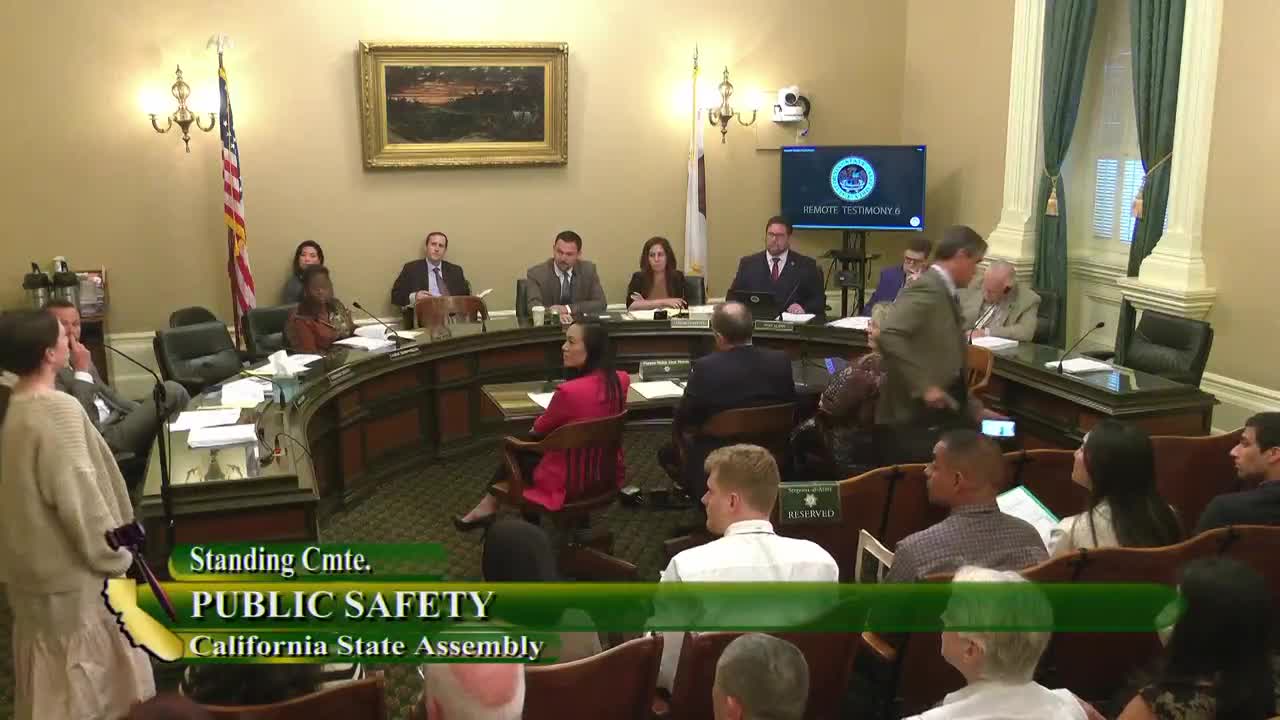 22MIN
Assembly Standing Committee on Public Safety
Bill Author

Bill Co-Author(s):