ACA 1: Legislative procedure.
- Session Year: 2015-2016
- House: Assembly
- Latest Version Date: 2014-12-01
The California Constitution prohibits a bill other than the Budget Bill from being heard or acted on by a committee or either house of the Legislature until the 31st day after the bill is introduced, unless the house dispenses with this requirement by rollcall vote entered in the journal, 3/4 of the membership concurring.
This measure would add an additional exception to this 31-day waiting period by authorizing a committee to hear or act on a bill if the bill, in the form to be considered by the committee, has been in print and published on the Internet for at least 15 days.
Existing provisions of the California Constitution prohibit either house of the Legislature from passing a bill until the bill with amendments has been printed and distributed to the Members.
This measure would also prohibit either house of the Legislature from passing a bill until the bill, in the form to be voted on, has been made available to the public, in print and published on the Internet, for at least 72 hours preceding the vote. This requirement would not apply to specified urgency bills upon the submission by the Governor to the Legislature of a written statement that it is necessary to dispense with the requirement to address a state of emergency declared by the Governor.
Resolved by the Assembly, the Senate concurring, That the Legislature of the State of California at its 201516 Regular Session commencing on the first day of December 2014, two-thirds of the membership of each house concurring, hereby proposes to the people of the State of California that the Constitution of the State be amended as follows:
(a)At regular sessions, no bill other than the budget bill may be heard or acted on by a committee or either house until the 31st day after the bill is introduced unless the, except in either of the following circumstances:
(1)A committee or either house may hear or act on a bill if the house dispenses with this requirement by rollcall vote entered in the journal, three fourths three-fourths of the membership concurring.
(2)A committee may hear or act on a bill if the bill, in the form to be considered by the committee, has been in print and published on the Internet for at least 15 days.
(b)(1)The Legislature may make no law except by statute and may enact no statute except by bill. No bill may be passed unless it is read by title on 3 three days in each house except that the a house may dispense with this requirement by rollcall vote entered in the journal, two thirds two-thirds of the membership concurring. No bill may be passed until the bill with amendments has been printed and distributed to the members. No bill may be passed unless, by rollcall vote entered in the journal, a majority of the membership of each house concurs.
(2)(A)No bill may be passed in either house until the bill, in the form to be voted on, has been made available to the public, in print and published on the Internet, for at least 72 hours before the vote.
(B)This paragraph does not apply to a bill that contains an urgency clause if the Governor submits to the Legislature a written statement, for that bill, that dispensing with the requirement in subparagraph (A) is necessary to address a state of emergency declared by the Governor. Emergency, for the purposes of this paragraph, has the same meaning as in paragraph (2) of subdivision (c) of Section 3 of Article XIIIB and does not include a fiscal emergency declared pursuant to Section 10 of this article.
(c)(1)Except as provided in paragraphs (2) and (3) of this subdivision, a statute enacted at a regular session shall go into effect on January 1 next following a 90-day period from the date of enactment of the statute and a statute enacted at a special session shall go into effect on the 91st day after adjournment of the special session at which the bill was passed.
(2)A statute, other than a statute establishing or changing boundaries of any legislative, congressional, or other election district, enacted by a bill passed by the Legislature on or before the date the Legislature adjourns for a joint recess to reconvene in the second calendar year of the biennium of the legislative session, and in the possession of the Governor after that date, shall go into effect on January 1 next following the enactment date of the statute unless, before January 1, a copy of a referendum petition affecting the statute is submitted to the Attorney General pursuant to subdivision (d) of Section 10 of Article II, in which event the statute shall go into effect on the 91st day after the enactment date unless the petition has been presented to the Secretary of State pursuant to subdivision (b) of Section 9 of Article II.
(3)Statutes calling elections, statutes providing for tax levies or appropriations for the usual current expenses of the State, and urgency statutes shall go into effect immediately upon their enactment.
(d)Urgency statutes are those necessary for immediate preservation of the public peace, health, or safety. A statement of facts constituting the necessity shall be set forth in one section of the bill. In each house the section and the bill shall be passed separately, each by rollcall vote entered in the journal, two thirds two-thirds of the membership concurring. An urgency statute may not create or abolish any office or change the salary, term, or duties of any office, or grant any franchise or special privilege, or create any vested right or interest.
|
Date
|
Status
|
|---|---|
| Mar 2, 2015 | Referred to Coms. on BUDGET, RLS. and APPR. |
| Dec 2, 2014 | From printer. May be heard in committee January 1. |
| Dec 1, 2014 | Read first time. To print. |
This list shows positions taken on this bill by organizations on the date displayed, which is linked to the original source.
Positions by individuals are not included.
ACA 1
Page 3
Date of Hearing: May 7, 2015
ASSEMBLY COMMITTEE ON BUDGET
Shirley Weber, Chair
ACA 1 (
Olsen) – As Introduced December 1, 2014
SUBJECT: Legislative procedure.
SUMMARY: Imposes a requirement in the State Constitution to require bills to be in print for 72 hours prior to adoption by either house. Specifically, this bill:
Prohibits either house from passing a bill unless it has been made available in print and on the internet for 72 hours prior to the vote.
Provides an exception for urgency bills related to a declared emergency, as specified in the Constitution.
Allows bills to be heard by committees after the contents of the bill have been available on the internet for 15 days.
EXISTING LAW: Prohibits any bill (other than the budget bill) from being heard or acted on by a committee or off the floor in either house until the 31st day after being introduced unless the house dispenses with this requirement by a roll call vote with three fourths of the members concurring.
FISCAL EFFECT:
Possible impacts of the measure are discussed below.
COMMENTS: The stated goal of this measure is to enhance transparency by requiring all final legislation to be in print for 72 hours prior to floor action in either house of the Legislature. According to the author, "…the citizens of California deserve a transparent government and legislative body. They should be given the opportunity to review all bills for at least 72 hours before they are voted on. And legislators should be given adequate time to analyze a bill before a vote in order to make a sound decision."
Most bills considered by the Legislature are, under current law, in print for at least 72 hours prior a vote. This measure would impose a strict no-exceptions policy that would require all bills to be in print for this time period, except during a declared disaster. This more rigid policy, if adopted, would meet part of the author's stated goal, while it may severely limit the flexibility of the Legislature to craft difficult compromises, take amendments to respond to citizens, or make technical fixes such as adopting chaptering amendments or striking an urgency clause from a bill.
Bills considered by the Legislature that are in print in final form for less than 72 hours are conventionally driven by three scenarios: the bill is part of a hard fought, complicated compromise; the bill is part of the budget package or; the bill has technical problems and needs to be amended prior to final floor action.
One example of the need for flexibility is the difficult bipartisan political compromise necessary to tackle California's profound drought. AB 1471, which created Proposition 1, the 2014 Water Package required weeks of negotiation to develop and was adopted on the last possible day for the measure to be included on the November 2014 ballot. As a result, the bill was amended in the Senate, concurred by the Assembly, and signed by the Governor all on the same day. Thus, the bill language was only been in print for a few hours prior to adoption. Proposition 1 was adopted by 67.1 percent of voters and is the centerpiece of the State's response to the drought.
The urgent need to act regarding the drought continued in the recent effort to appropriate funds authorized by Proposition 1. In order to get needed projects underway, the Legislature adopted the 2015 water package in two bills, AB 91 and AB 92 in March of this year. Both of these bills were amended two days prior to the vote, which in turn means that the bill was in print for only one day.
Another example was the February 2009 budget package, which was recognized as an example of historic, courageous action that saved the state from fiscal insolvency. That budget agreement was being updated and technically corrected up through the final hours prior to the vote, including, the insertion of SCA 4 (Maldonado), which created the Open Primary. This agreement was not in print for 72 hours, but it was credited with saving the state from insolvency and earned the four Legislative Leaders the prestigious Profiles in Courage Award by the John F Kennedy Library Foundation in 2010.
This measure would also make the small technical changes at the end of session more difficult to accommodate. These include a common practice of eliminating an urgency clause from a measure, to allow a measure to be adopted with only a majority vote. In addition, bills often amend the same sections of code and technical changes are necessary so that the measures don’t chapter out the provisions of a different bill. Under the provision of this measure, either of these changes would trigger a 72-hour in-print requirement, which will mean it will add complexity to the final days of each legislative session.
This measure would also severely narrow and hamstring the annual budget process. The passage of Proposition 25 in November of 2010 sent a clear signal to the Legislature that the passage of a budget on time is a top budget priority for the public; the measure even included financial penalties for members of the Legislature if the budget was not passed by the deadline. California's Constitution requires that the Legislature adopt the budget on or before June 15th of each year, giving the Legislature slightly more than four weeks from when it receives the May Revision on May 14th to when it must enact the budget. This bill would require about ten percent of that time-period to be set aside for the bills to be in print on the floor at the end of the process.
How would the Legislature accommodate this loss of time? Because the current May -June process is already compacted, it is difficult to envision how the process would accommodate this requirement. Should the time to analyze and hear the May Revision proposals be shortened by three days, reducing the chance for the public to participate in crafting of the budget and requiring members to vote on provisions with less information? Or should the Senate and the Assembly have three less days to reconcile their respective budgets into one unified version of a budget package? Perhaps the drafting process could be shortened for the trailer bills and the over 800-page budget bill, but that would further tax the hundreds of staff in Department of Finance, Legislative Counsel, as well as the Legislature and the Administration that develop the final budget package, potentially resulting in significant errors in their work product.
Because the budget process is based on a finite schedule, there is not room to accommodate this print requirement without undermining the quality of the process and the budget legislation. Therefore, these costs should be considered when weighing the merits of this bill.
California’s legislative work is more transparent now than at any point in history. This year marks the twentieth anniversary of AB 1624 (Bowen), which required any legislative bill, analysis, history, and voters to be made available via the internet. Prior to the enactment of this bill, this information was only available through the Capitol Bill Room and various small publications that charged a fee to provide this information. Today anyone with access to the internet can see the latest version of a bill, for free, at any time in a system that is updated daily.
Therefore, while this measure has the admirable goal of increasing transparency, California has a relatively transparent legislative process and a long history of important agreements that were quickly passed. Moreover, adding new time requirements may actually strengthen special interests ability to upset legislative agreements and harm the already condensed budget process.
The provisions contained in this measure were also contained in Proposition 31 of November 2012, which was rejected by voters with 39.5 percentage of the electorate voting in favor of the measure.
REGISTERED SUPPORT / OPPOSITION:
Support
California Newspaper Publishers Association
California Tax Payers Association
Howard Jarvis Taxpayers Association
League of California Cities
Opposition
None on File
Analysis Prepared by: Christian Griffith/ Budget/ 916-319-2099
Discussed in Hearing
 21MIN
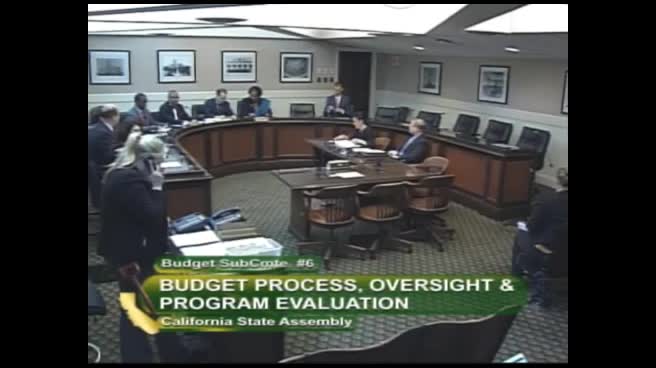
Assembly Budget Subcommittee No. 6 on Budget Process Oversight and Program Evaluation
Bill Author