AB 1539: Presidential elections: qualifications for office.
- Session Year: 2025-2026
- House: Assembly
- Latest Version Date: 2026-09-30
Current Status:
Passed
(2026-09-30: Chaptered by Secretary of State - Chapter 880, Statutes of 2026.)
Introduced
In Committee
Awaiting First Chamber Vote
Passed First Chamber
In Committee
Awaiting Second Chamber Vote
Passed Second Chamber
Enacted
The Twenty-Second Amendment to the United States Constitution prohibits the election of any person to the office of the President more than twice. Under existing state law, each qualified political party is required to notify the Secretary of State of the names of the partys nominees for President and Vice President on or before the 75th day before a presidential general election. Existing law requires the Secretary of State to cause the names of each partys nominees for President and Vice President to be placed upon the ballot for the election.
This bill would require a representative of each qualified political party, and a representative of each independent presidential candidate or write-in presidential candidate, to certify to the Secretary of State, under penalty of perjury, that their nominees for President and Vice President are both qualified to be elected President under the Twenty-Second Amendment. If that certification is not made by the 75th day before the general election for the candidate of each qualified political party and an independent candidate, or by the 14th day before the general election for a write-in candidate, the bill would prohibit placing the names of those nominees for President and Vice President upon the ballot for the election. By expanding the crime of perjury, the bill would impose a state-mandated local program.
The California Constitution requires the state to reimburse local agencies and school districts for certain costs mandated by the state. Statutory provisions establish procedures for making that reimbursement.
This bill would provide that no reimbursement is required by this act for a specified reason.
The Twenty-Second Amendment to the United States Constitution prohibits the election of any person to the office of the President more than twice. Under existing state law, each qualified political party is required to notify the Secretary of State of the names of the partys nominees for President and Vice President on or before the 75th day before a presidential general election. Existing law requires the Secretary of State to cause the names of each partys nominees for President and Vice President to be placed upon the ballot for the election.
This bill would require a representative of each qualified political party, and a representative of each independent presidential candidate or write-in presidential candidate, to certify to the Secretary of State, under penalty of perjury, that their nominees for President and Vice President are both qualified to be elected President under the Twenty-Second Amendment. If that certification is not made, made by the 75th day before the general election for the candidate of each qualified political party and an independent candidate, or by the 14th day before the general election for a write-in candidate, the bill would prohibit placing the names of those nominees for President and Vice President upon the ballot for the ensuing general election. By expanding the crime of perjury, the bill would impose a state-mandated local program.
The California Constitution requires the state to reimburse local agencies and school districts for certain costs mandated by the state. Statutory provisions establish procedures for making that reimbursement.
This bill would provide that no reimbursement is required by this act for a specified reason.
The Twenty-Second Amendment to the United States Constitution prohibits the election of any person to the office of the President more than twice. Under existing state law, each qualified political party is required to notify the Secretary of State of the names of the partys nominees for President and Vice President on or before the 75th day before a presidential general election. Existing law requires the Secretary of State to cause the names of each partys nominees for President and Vice President to be placed upon the ballot for the election.
This bill would require a representative of each qualified political party to certify, party, and a representative of each independent presidential candidate, to certify to the Secretary of State, under penalty of perjury, that the partys their nominees for President and Vice President are both qualified to be elected President under the Twenty-Second Amendment. If that certification is not made, the bill would prohibit placing the names of the partys those nominees for President and Vice President upon the ballot for the ensuing general election. By expanding the crime of perjury, the bill would impose a state-mandated local program.
The California Constitution requires the state to reimburse local agencies and school districts for certain costs mandated by the state. Statutory provisions establish procedures for making that reimbursement.
This bill would provide that no reimbursement is required by this act for a specified reason.
The Twenty-Second Amendment to the United States Constitution prohibits the election of any person to the office of the President more than twice. Under existing state law, each qualified political party is required to notify the Secretary of State of the names of the partys nominees for President and Vice President on or before the 75th day before a presidential general election. Existing law requires the Secretary of State to cause the names of each partys nominees for President and Vice President to be placed upon the ballot for the election.
This bill would require a representative of each qualified political party to certify, under penalty of perjury, that the partys nominees for President and Vice President are both qualified to be elected President under the Twenty-Second Amendment. If that certification is not made, the bill would prohibit placing the names of the partys nominees for President and Vice President upon the ballot for the ensuing general election. By expanding the crime of perjury, the bill would impose a state-mandated local program.
The California Constitution requires the state to reimburse local agencies and school districts for certain costs mandated by the state. Statutory provisions establish procedures for making that reimbursement.
This bill would provide that no reimbursement is required by this act for a specified reason.
(a)By 5 p.m. on the 75th day before an election when electors for the President and Vice President of the United States will be chosen, each political party qualified to participate in the election shall notify the Secretary of State of the names of that partys nominees for the offices of President and Vice President of the United States. If a qualified political party has not held its national convention by 5 p.m. on the 75th day before the election, the party shall notify the Secretary of State of the names of the partys apparent nominees for the offices of President and Vice President of the United States.
(b)(1)By 5 p.m. on the 75th day before an election when electors for the President and Vice President of the United States will be chosen, a representative of each political party qualified to participate in the election shall certify to the Secretary of State in writing, under penalty of perjury, that the partys nominee or apparent nominee for the office of President of the United States is qualified to be elected to that office under the Twenty-Second Amendment to the United States Constitution. By 5 p.m. on the 75th day before the election, a representative of each qualified political party shall also certify to the Secretary of State in writing, under penalty of perjury, that the partys nominee or apparent nominee for the office of Vice President of the United States is qualified to be elected to the office of President of the United States under the Twenty-Second Amendment to the United States Constitution.
(2)Each political party shall include the written certifications required by paragraph (1) in the notification that is submitted to the Secretary of State in accordance with subdivision (a).
(3)Notwithstanding Section 6901 or any other law, if either certification required by paragraph (1) is not made, the names of a partys nominees for the offices of President and Vice President of the United States shall not be placed upon the ballot for the ensuing general election.
SEC. 2.Section 8304 of the Elections Code is amended to read:8304.(a)When a group of candidates for presidential electors designates the presidential and vice presidential candidates for whom all of the group pledge themselves to vote, by 5 p.m. on the 75th day before the election, a representative of the group shall certify to the Secretary of State in writing, under penalty of perjury, that the designated presidential candidate is qualified to be elected to that office under the Twenty-Second Amendment to the United States Constitution. By 5 p.m. on the 75th day before the election, a representative of the group shall also certify to the Secretary of State in writing, under penalty of perjury, that the designated vice presidential candidate is qualified to be elected to the office of President of the United States under the Twenty-Second Amendment to the United States Constitution.
(b)If the group of candidates for presidential electors complies with the requirement of subdivision (a), the names of the presidential candidate and vice presidential candidate designated by that group shall be printed on the ballot pursuant to Chapter 2 (commencing with Section 13100) of Division 13.
SEC. 3.Section 8650 of the Elections Code is amended to read:8650.(a)Any group of individuals, equal in number to the number of presidential electors to which this state is entitled, who desire to be write-in candidates for presidential electors pledged to a particular candidate for President and Vice President of the United States shall file a declaration of write-in candidacy.
(b)When a group of write-in candidates for presidential electors designates the presidential and vice presidential candidates for whom all of the group pledge themselves to vote, by 5 p.m. on the 14th day before the election, a representative of the group shall certify to the Secretary of State in writing, under penalty of perjury, that the designated presidential candidate is qualified to be elected to that office under the Twenty-Second Amendment to the United States Constitution. By 5 p.m. on the 14th day before the election, a representative of the group shall also certify to the Secretary of State in writing, under penalty of perjury, that the designated vice presidential candidate is qualified to be elected to the office of President of the United States under the Twenty-Second Amendment to the United States Constitution.
(c)If a group of write-in candidates for presidential electors complies with the requirements of subdivisions (a) and (b), the names of the presidential write-in candidate and vice presidential write-in candidate designated by the group shall appear on the certified list of presidential write-in candidates prepared by the Secretary of State.
SEC. 4.No reimbursement is required by this act pursuant to Section 6 of Article XIIIB of the California Constitution because the only costs that may be incurred by a local agency or school district will be incurred because this act creates a new crime or infraction, eliminates a crime or infraction, or changes the penalty for a crime or infraction, within the meaning of Section 17556 of the Government Code, or changes the definition of a crime within the meaning of Section 6 of Article XIIIB of the California Constitution.
(a)By 5 p.m. on the 75th day before an election when electors for the President and Vice President of the United States will be chosen, each political party qualified to participate in the election shall notify the Secretary of State of the names of that partys nominees for the offices of President and Vice President of the United States. If a qualified political party has not held its national convention by 5 p.m. on the 75th day before the election, the party shall notify the Secretary of State of the names of the partys apparent nominees for the offices of President and Vice President of the United States.
(b)(1)By 5 p.m. on the 75th day before an election when electors for the President and Vice President of the United States will be chosen, a representative of each political party qualified to participate in the election shall certify to the Secretary of State in writing, under penalty of perjury, that the partys nominee or apparent nominee for the office of President of the United States is qualified to be elected to that office under the Twenty-Second Amendment to the United States Constitution. By 5 p.m. on the 75th day before the election, a representative of each qualified political party shall also certify to the Secretary of State in writing, under penalty of perjury, that the partys nominee or apparent nominee for the office of Vice President of the United States is qualified to be elected to the office of President of the United States under the Twenty-Second Amendment to the United States Constitution.
(2)Each political party shall include the written certifications required by paragraph (1) in the notification that is submitted to the Secretary of State in accordance with subdivision (a).
(3)Notwithstanding Section 6901 or any other law, if either of the certifications certification required by paragraph (1) is not made, the names of a partys nominees for the offices of President and Vice President of the United States shall not be placed upon the ballot for the ensuing general election.
SEC. 2.Section 8304 of the Elections Code is amended to read:8304.(a)When a group of candidates for presidential electors designates the presidential and vice presidential candidates for whom all of the group pledge themselves to vote, by 5 p.m. on the 75th day before the election, a representative of the group shall certify to the Secretary of State in writing, under penalty of perjury, that the designated presidential candidate is qualified to be elected to that office under the Twenty-Second Amendment to the United States Constitution. By 5 p.m. on the 75th day before the election, a representative of the group shall also certify to the Secretary of State in writing, under penalty of perjury, that the designated vice presidential candidate is qualified to be elected to the office of President of the United States under the Twenty-Second Amendment to the United States Constitution.
(b)If the group of candidates for presidential electors complies with the requirement of subdivision (a), the names of the presidential candidate and vice presidential candidate designated by that group shall be printed on the ballot pursuant to Chapter 2 (commencing with Section 13100) of Division 13.
SEC. 3.Section 8650 of the Elections Code is amended to read:8650.(a)Any group of individuals, equal in number to the number of presidential electors to which this state is entitled, who desire to be write-in candidates for presidential electors pledged to a particular candidate for President and Vice President of the United States shall file a declaration of write-in candidacy.
(b)When a group of write-in candidates for presidential electors designates the presidential and vice presidential candidates for whom all of the group pledge themselves to vote, by 5 p.m. on the 14th day before the election, a representative of the group shall certify to the Secretary of State in writing, under penalty of perjury, that the designated presidential candidate is qualified to be elected to that office under the Twenty-Second Amendment to the United States Constitution. By 5 p.m. on the 14th day before the election, a representative of the group shall also certify to the Secretary of State in writing, under penalty of perjury, that the designated vice presidential candidate is qualified to be elected to the office of President of the United States under the Twenty-Second Amendment to the United States Constitution.
(c)If a group of write-in candidates for presidential electors complies with the requirements of subdivisions (a) and (b), the names of the presidential write-in candidate and vice presidential write-in candidate designated by the group shall appear on the certified list of presidential write-in candidates prepared by the Secretary of State.
SEC. 4.No reimbursement is required by this act pursuant to Section 6 of Article XIIIB of the California Constitution because the only costs that may be incurred by a local agency or school district will be incurred because this act creates a new crime or infraction, eliminates a crime or infraction, or changes the penalty for a crime or infraction, within the meaning of Section 17556 of the Government Code, or changes the definition of a crime within the meaning of Section 6 of Article XIIIB of the California Constitution.
(a)By 5 p.m. on the 75th day before an election when electors for the President and Vice President of the United States will be chosen, each political party qualified to participate in the election shall notify the Secretary of State of the names of that partys nominees for the offices of President and Vice President of the United States. If a qualified political party has not held its national convention by 5 p.m. on the 75th day before the election, the party shall notify the Secretary of State of the names of the partys apparent nominees for the offices of President and Vice President of the United States.
(b)(1)By 5 p.m. on the 75th day before an election when electors for the President and Vice President of the United States will be chosen, a representative of each political party qualified to participate in the election shall certify to the Secretary of State in writing, under penalty of perjury, that the partys nominee or apparent nominee for the office of President of the United States is qualified to be elected to that office under the Twenty-Second Amendment to the United States Constitution. By 5 p.m. on the 75th day before the election, a representative of each qualified political party shall also certify to the Secretary of State in writing, under penalty of perjury, that the partys nominee or apparent nominee for the office of Vice President of the United States is qualified to be elected to the office of President of the United States under the Twenty-Second Amendment to the United States Constitution and therefore is constitutionally eligible for the office of Vice President of the United States under the Twelfth Amendment to the United States Constitution.
(2)Each political party shall include the written certifications required by paragraph (1) in the notification that is submitted to the Secretary of State in accordance with subdivision (a).
(3)Notwithstanding Section 6901 or any other law, if either of the certifications required by paragraph (1) is not made, the names of a partys nominees for the offices of President and Vice President of the United States shall not be placed upon the ballot for the ensuing general election.
SEC. 2.Section 8304 of the Elections Code is amended to read:8304.(a)When a group of candidates for presidential electors designates the presidential and vice presidential candidates for whom all of the group pledge themselves to vote, by 5 p.m. on the 75th day before the election, a representative of the group shall certify to the Secretary of State in writing, under penalty of perjury, that the designated presidential candidate is qualified to be elected to that office under the Twenty-Second Amendment to the United States Constitution. By 5 p.m. on the 75th day before the election, a representative of the group shall also certify to the Secretary of State in writing, under penalty of perjury, that the designated vice presidential candidate is qualified to be elected to the office of President of the United States under the Twenty-Second Amendment to the United States Constitution and therefore is constitutionally eligible for the office of Vice President of the United States under the Twelfth Amendment to the United States Constitution.
(b)If the group of candidates for presidential electors complies with the requirement of subdivision (a), the names of the presidential candidate and vice presidential candidate designated by that group shall be printed on the ballot pursuant to Chapter 2 (commencing with Section 13100) of Division 13.
SEC. 3.Section 8650 of the Elections Code is amended to read:8650.(a)Any group of individuals, equal in number to the number of presidential electors to which this state is entitled, who desire to be write-in candidates for presidential electors pledged to a particular candidate for President and Vice President of the United States shall file a declaration of write-in candidacy.
(b)When a group of write-in candidates for presidential electors designates the presidential and vice presidential candidates for whom all of the group pledge themselves to vote, by 5 p.m. on the 14th day before the election, a representative of the group shall certify to the Secretary of State in writing, under penalty of perjury, that the designated presidential candidate is qualified to be elected to that office under the Twenty-Second Amendment to the United States Constitution. By 5 p.m. on the 14th day before the election, a representative of the group shall also certify to the Secretary of State in writing, under penalty of perjury, that the designated vice presidential candidate is qualified to be elected to the office of President of the United States under the Twenty-Second Amendment to the United States Constitution and therefore is constitutionally eligible for the office of Vice President of the United States under the Twelfth Amendment to the United States Constitution.
(c)If a group of write-in candidates for presidential electors complies with the requirements of subdivisions (a) and (b), the names of the presidential write-in candidate and vice presidential write-in candidate designated by the group shall appear on the certified list of presidential write-in candidates prepared by the Secretary of State.
SEC. 4.No reimbursement is required by this act pursuant to Section 6 of Article XIIIB of the California Constitution because the only costs that may be incurred by a local agency or school district will be incurred because this act creates a new crime or infraction, eliminates a crime or infraction, or changes the penalty for a crime or infraction, within the meaning of Section 17556 of the Government Code, or changes the definition of a crime within the meaning of Section 6 of Article XIIIB of the California Constitution.
(a)On or before By 5 p.m. on the 75th day before an election when electors for the President and Vice President of the United States will be chosen, each political party qualified to participate in the election shall notify the Secretary of State of the names of that partys nominees for the offices of President and Vice President of the United States. If a qualified political party has not held its national convention by 5 p.m. on the 75th day before the election, the party shall notify the Secretary of State of the names of the partys apparent nominees for the offices of President and Vice President of the United States.
(b)(1)A By 5 p.m. on the 75th day before an election when electors for the President and Vice President of the United States will be chosen, a representative of each political party qualified to participate in an election when electors for the President and Vice President of the United States will be chosen the election shall certify to the Secretary of State in writing, under penalty of perjury, that the partys nominee or apparent nominee for the office of President of the United States is qualified to be elected to that office under the Twenty-Second Amendment to the United States Constitution. A By 5 p.m. on the 75th day before the election, a representative of each qualified political party shall also certify to the Secretary of State in writing, under penalty of perjury, that the partys nominee or apparent nominee for the office of Vice President of the United States is qualified to be elected to the office of President of the United States under the Twenty-Second Amendment to the United States Constitution and therefore is constitutionally eligible for the office of Vice President of the United States under the Twelfth Amendment to the United States Constitution.
(2)Each political party shall include the written certifications required by paragraph (1) in the notification that is submitted to the Secretary of State in accordance with subdivision (a).
(3)Notwithstanding Section 6901 or any other law, if either of the certifications required by paragraph (1) is not made, the names of a partys nominees for the offices of President and Vice President of the United States shall not be placed upon the ballot for the ensuing general election.
SEC. 2.Section 8304 of the Elections Code is amended to read:8304.(a)When a group of candidates for presidential electors designates the presidential and vice presidential candidates for whom all of the group pledge themselves to vote, by 5 p.m. on the 75th day before the election, a representative of the group shall certify to the Secretary of State in writing, under penalty of perjury, that the designated presidential candidate is qualified to be elected to that office under the Twenty-Second Amendment to the United States Constitution. A By 5 p.m. on the 75th day before the election, a representative of the group shall also certify to the Secretary of State in writing, under penalty of perjury, that the designated vice presidential candidate is qualified to be elected to the office of President of the United States under the Twenty-Second Amendment to the United States Constitution and therefore is constitutionally eligible for the office of Vice President of the United States under the Twelfth Amendment to the United States Constitution.
(b)If the group of candidates for presidential electors complies with the requirement of subdivision (a), the names of the presidential candidate and vice presidential candidate designated by that group shall be printed on the ballot pursuant to Chapter 2 (commencing with Section 13100) of Division 13.
SEC. 3.Section 8650 of the Elections Code is amended to read:8650.(a)Any group of individuals, equal in number to the number of presidential electors to which this state is entitled, who desire to be write-in candidates for presidential electors pledged to a particular candidate for President and Vice President of the United States shall file a declaration of write-in candidacy.
(b)When a group of write-in candidates for presidential electors designates the presidential and vice presidential candidates for whom all of the group pledge themselves to vote, by 5 p.m. on the 14th day before the election, a representative of the group shall certify to the Secretary of State in writing, under penalty of perjury, that the designated presidential candidate is qualified to be elected to that office under the Twenty-Second Amendment to the United States Constitution. By 5 p.m. on the 14th day before the election, a representative of the group shall also certify to the Secretary of State in writing, under penalty of perjury, that the designated vice presidential candidate is qualified to be elected to the office of President of the United States under the Twenty-Second Amendment to the United States Constitution and therefore is constitutionally eligible for the office of Vice President of the United States under the Twelfth Amendment to the United States Constitution.
(c)If a group of write-in candidates for presidential electors complies with the requirements of subdivisions (a) and (b), the names of the presidential write-in candidate and vice presidential write-in candidate designated by the group shall appear on the certified list of presidential write-in candidates prepared by the Secretary of State.
SEC. 3.SEC. 4.No reimbursement is required by this act pursuant to Section 6 of Article XIIIB of the California Constitution because the only costs that may be incurred by a local agency or school district will be incurred because this act creates a new crime or infraction, eliminates a crime or infraction, or changes the penalty for a crime or infraction, within the meaning of Section 17556 of the Government Code, or changes the definition of a crime within the meaning of Section 6 of Article XIIIB of the California Constitution.
(a)On or before the 75th day before an election when electors for the President and Vice President of the United States will be chosen, each political party qualified to participate in the election shall notify the Secretary of State of the names of that partys nominees for the offices of President and Vice President of the United States. If a qualified political party has not held its national convention by the 75th day before the election, the party shall notify the Secretary of State of the names of the partys apparent nominees for the offices of President and Vice President of the United States.
(b)(1)A representative of each political party qualified to participate in an election when electors for the President and Vice President of the United States will be chosen shall certify, certify to the Secretary of State in writing, under penalty of perjury, that the partys nominee or apparent nominee for the office of President of the United States is qualified to be elected to that office under the Twenty-Second Amendment to the United States Constitution. A representative of each qualified political party shall also certify, certify to the Secretary of State in writing, under penalty of perjury, that the partys nominee or apparent nominee for the office of Vice President of the United States is qualified to be elected to the office of President of the United States under the Twenty-Second Amendment to the United States Constitution and therefore is constitutionally eligible for the office of Vice President of the United States under the Twelfth Amendment to the United States Constitution.
(2)Each political party shall include the written certifications required by paragraph (1) in the notification that is submitted to the Secretary of State in accordance with subdivision (a).
(2)(3)Notwithstanding Section 6901 or any other law, if either of the certifications required by paragraph (1) is not made, the names of a partys nominees for the offices of President and Vice President of the United States shall not be placed upon the ballot for the ensuing general election.
SEC. 2.Section 8304 of the Elections Code is amended to read:8304.(a)When a group of candidates for presidential electors designates the presidential and vice presidential candidates for whom all of the group pledge themselves to vote, the a representative of the group shall certify to the Secretary of State in writing, under penalty of perjury, that the designated presidential candidate is qualified to be elected to that office under the Twenty-Second Amendment to the United States Constitution. A representative of the group shall also certify to the Secretary of State in writing, under penalty of perjury, that the designated vice presidential candidate is qualified to be elected to the office of President of the United States under the Twenty-Second Amendment to the United States Constitution and therefore is constitutionally eligible for the office of Vice President of the United States under the Twelfth Amendment to the United States Constitution.
(b)If the group of candidates for presidential electors complies with the requirement of subdivision (a), the names of the presidential candidate and vice presidential candidate designated by that group shall be printed on the ballot pursuant to Chapter 2 (commencing with Section 13100) of Division 13.
SEC. 2.SEC. 3.No reimbursement is required by this act pursuant to Section 6 of Article XIIIB of the California Constitution because the only costs that may be incurred by a local agency or school district will be incurred because this act creates a new crime or infraction, eliminates a crime or infraction, or changes the penalty for a crime or infraction, within the meaning of Section 17556 of the Government Code, or changes the definition of a crime within the meaning of Section 6 of Article XIIIB of the California Constitution.
(a)On or before the 75th day before an election when electors for the President and Vice President of the United States will be chosen, each political party qualified to participate in the election shall notify the Secretary of State of the names of that partys nominees for the offices of President and Vice President of the United States. If a qualified political party has not held its national convention by the 75th day before the election, the party shall notify the Secretary of State of the names of the partys apparent nominees for the offices of President and Vice President of the United States.
(b)(1)A representative of each political party qualified to participate in an election when electors for the President and Vice President of the United States will be chosen shall certify, under penalty of perjury, that the partys nominee for the office of President of the United States is qualified to be elected to that office under the Twenty-Second Amendment to the United States Constitution. A representative of each qualified political party shall also certify, under penalty of perjury, that the partys nominee for the office of Vice President is qualified to be elected to the office of President under the Twenty-Second Amendment to the United States Constitution and therefore is constitutionally eligible for the office of Vice President under the Twelfth Amendment to the United States Constitution.
(2)Notwithstanding Section 6901 or any other law, if either of the certifications required by paragraph (1) is not made, the names of a partys nominees for the offices of President and Vice President of the United States shall not be placed upon the ballot for the ensuing general election.
SEC. 2.No reimbursement is required by this act pursuant to Section 6 of Article XIIIB of the California Constitution because the only costs that may be incurred by a local agency or school district will be incurred because this act creates a new crime or infraction, eliminates a crime or infraction, or changes the penalty for a crime or infraction, within the meaning of Section 17556 of the Government Code, or changes the definition of a crime within the meaning of Section 6 of Article XIIIB of the California Constitution.
|
Date
|
Status
|
|---|---|
| Sep 30, 2026 | Chaptered by Secretary of State - Chapter 880, Statutes of 2026. |
| Sep 30, 2026 | Approved by the Governor. |
| Sep 3, 2026 | Enrolled and presented to the Governor at 4 p.m. |
| Aug 26, 2026 | Senate amendments concurred in. To Engrossing and Enrolling. (Ayes 77. Noes 0. Page 6566.). |
| Aug 26, 2026 | Senate amendments concurred in. To Engrossing and Enrolling. (Ayes 77. Noes 0.). |
| Aug 25, 2026 | In Assembly. Concurrence in Senate amendments pending. |
| Aug 25, 2026 | Read third time. Passed. Ordered to the Assembly. (Ayes 30. Noes 9. Page 5768.). |
| Aug 25, 2026 | Read third time. Passed. Ordered to the Assembly. (Ayes 30. Noes 8.). |
| Aug 18, 2026 | Read second time. Ordered to third reading. |
| Aug 17, 2026 | Read third time and amended. Ordered to second reading. |
| Aug 13, 2026 | Read second time. Ordered to third reading. |
| Aug 13, 2026 | From committee: Do pass. (Ayes 5. Noes 2.) (August 13). |
| Aug 10, 2026 | In committee: Referred to APPR. suspense file. |
| Jul 29, 2026 | In committee: Hearing postponed by committee. |
| Jul 1, 2026 | From committee: Do pass and re-refer to Com. on APPR. (Ayes 5. Noes 1.) (June 30). Re-referred to Com. on APPR. |
| Jun 17, 2026 | From committee chair, with author's amendments: Amend, and re-refer to committee. Read second time, amended, and re-referred to Com. on PUB. S. |
| Jun 16, 2026 | From committee: Do pass and re-refer to Com. on PUB. S. (Ayes 4. Noes 1.) (June 16). Re-referred to Com. on PUB. S. |
| Jun 3, 2026 | Referred to Coms. on E. & C.A. and PUB. S. |
| May 27, 2026 | In Senate. Read first time. To Com. on RLS. for assignment. |
| May 26, 2026 | Read third time. Passed. Ordered to the Senate. (Ayes 75. Noes 0. Page 5393.) |
| May 26, 2026 | Read third time. Passed. Ordered to the Senate. (Ayes 75. Noes 0.) |
| May 26, 2026 | Read third time. Passed. Ordered to the Senate. |
| May 19, 2026 | Read third time and amended. Ordered to third reading. (Page 5152.) |
| May 19, 2026 | Read third time and amended. Ordered to third reading. |
| May 18, 2026 | Read second time. Ordered to third reading. |
| May 14, 2026 | From committee: Do pass. (Ayes 14. Noes 0.) (May 14). |
| Apr 15, 2026 | In committee: Set, first hearing. Referred to APPR. suspense file. |
| Apr 6, 2026 | Re-referred to Com. on APPR. |
| Mar 26, 2026 | Read second time and amended. |
| Mar 25, 2026 | From committee: Amend, and do pass as amended and re-refer to Com. on APPR. (Ayes 7. Noes 0.) (March 25). |
| Feb 2, 2026 | Referred to Com. on ELECTIONS. |
| Jan 6, 2026 | From printer. May be heard in committee February 5. |
| Jan 5, 2026 | Read first time. To print. |
|
Date
|
Description
|
Location
|
Votes
|
|
|---|---|---|---|---|
| Aug 26, 2026 | AB 1539 Addis Concurrence in Senate Amendments | Assembly Floor |
Passed |
|
| Aug 25, 2026 | Assembly 3rd Reading AB1539 Addis et al. By Umberg | Senate Floor |
Passed |
|
| Aug 13, 2026 | Do pass | Senate Standing Committee on Appropriations |
Passed |
|
| Aug 10, 2026 | Placed on suspense file | Senate Standing Committee on Appropriations |
Passed |
|
| Jun 30, 2026 | Do pass, but first be re-referred to the Committee on [Appropriations] | Senate Standing Committee on Public Safety |
Passed |
|
| Jun 16, 2026 | Do pass, but first be re-referred to the Committee on [Public Safety] | Senate Standing Committee on Elections and Constitutional Amendments |
Passed |
|
| May 26, 2026 | AB 1539 Addis Assembly Third Reading | Assembly Floor |
Passed |
|
| May 14, 2026 | Do pass. | Assembly Standing Committee on Appropriations |
Passed |
|
| Mar 25, 2026 | Do pass as amended and be re-referred to the Committee on [Appropriations] | Assembly Standing Committee on Elections |
Passed |
This list shows positions taken on this bill by organizations on the date displayed, which is linked to the original source.
Positions by individuals are not included.
|
Organization
|
Position
|
Date
|
|---|---|---|
| AFL-CIO | ** Support | |
| CFT – a Union of Educators & Classified Professionals, AFT, AFL-CIO | ** Support | |
| Lieutenant Governor Eleni Kounalakis | ** Support | |
| San Luis Obispo County Democratic Party Central Committee | ** Support | |
| Santa Cruz County Board of Supervisors | ** Support |
CONCURRENCE IN SENATE AMENDMENTS
CSA1 Bill Id:AB 1539
Author:(Addis)
As Amended Ver:August 17, 2026
Majority vote
SUMMARY
Requires a representative from each political party, a representative of each independent presidential ticket, and a representative of each write-in presidential ticket, to certify under penalty of perjury that their nominees for President and Vice President of the United States (US) are not barred by federal term limits from being elected to the office of President.
Senate Amendments
Make technical changes and add a co-author.
COMMENTS
The 22nd Amendment to the United States Constitution provides that no one ″shall be elected to the office of the President more than twice, and no person who has held the office of President, or acted as President, for more than two years of a term to which some other person was elected President shall be elected to the office of the President more than once.″ Donald Trump was elected to his first term as President in 2016 and again was elected President in 2024. Notwithstanding the fact that the plain language of the 22nd Amendment bars him from being elected to the office of President again, President Trump and his allies nonetheless have floated the idea that he could run again for a third term in 2028. In March 2025, for example, the Associated Press quoted President Trump as saying that he wasn′t joking about trying to serve a third term, and that ″there are methods which you could do it.″ In October, President Trump told reporters that he hasn′t really thought about running for a third term, but also refused to rule out running again in 2028. Furthermore, media outlets have reported that the official Trump store is selling Trump 2028 hats, and President Trump has displayed those hats in the Oval Office. At other times, the press has reported that President Trump has publicly downplayed the prospect of running for a third term.
It is unclear whether President Trump is serious about seeking to serve another term as President. Absent a repeal of or an amendment to the 22nd Amendment, however, there is no obvious legal path for him to run for a third term. By requiring political parties to certify that their nominees for President and Vice President are not barred by federal term limits from being elected to the office of President, this bill seeks to ensure that candidates who clearly are constitutionally ineligible to be elected as President or Vice President do not appear on the ballot in California.
The Senate amendments make technical changes to the bill. This bill, as amended in the Senate, is consistent with prior Assembly actions.
Please see the policy committee analysis for a full discussion of this bill.
According to the Author
"The current federal administration has repeatedly tested constitutional guardrails and openly floated the idea of seeking a third term. AB 1539 stops these abuses of power before they reach our ballot and protects Californians from bad faith attempts to game the Constitution and undermine our democracy.”
Arguments in Support
The sponsor of this bill, Lieutenant Governor Eleni Kounalakis, writes in support, ″The Twenty-Second Amendment limits any individual from being elected President more than twice, and the Twelfth Amendment bars anyone ineligible to serve as President from serving as Vice President. However, current law does not provide clear consequences if a political party attempts to place a constitutionally ineligible candidate on the ballot. AB 1539 addresses this gap by requiring a representative of each political party to certify, under penalty of perjury, that their nominees for President and Vice President are qualified to serve under the Twenty-Second Amendment. By establishing a clear legal consequence for knowingly attempting to place an ineligible candidate on the ballot, this bill reinforces respect for constitutional limits and helps safeguard the integrity of our elections.”
Arguments in Opposition
None received.
FISCAL COMMENTS
According to the Senate Appropriations Committee:
- The Secretary of State (SOS) would incur minor and absorbable costs resulting from the bill’s certification requirements. However, the bill also could result in future litigation costs of an unknown, but potentially significant, amount to SOS (General Fund). Based on SOS’s prior experience implementing laws that imposed additional requirements or preconditions for presidential and vice presidential candidates to qualify for the ballot, this bill could subject SOS to constitutional and other legal challenges, resulting in potentially significant litigation costs.
- The Department of Justice notes that the bill would not have a fiscal impact.
VOTES:
ASM ELECTIONS: 7-0-1
YES: Pellerin, Addis, Berman, Elhawary, Johnson, Solache, Stefani
ABS, ABST OR NV: Gallagher
ASM APPROPRIATIONS: 14-0-1
YES: Wicks, Hoover, Aguiar-Curry, Calderon, Caloza, Fong, Mark González, Krell, Pacheco, Pellerin, Sharp-Collins, Solache, Ta, Tangipa
ABS, ABST OR NV: Dixon
ASSEMBLY FLOOR: 75-0-5
YES: Addis, Aguiar-Curry, Ahrens, Alanis, Alvarez, Arambula, Ávila Farías, Bains, Bauer-Kahan, Bennett, Berman, Boerner, Bonta, Bryan, Calderon, Caloza, Carrillo, Castillo, Chen, Connolly, Davies, DeMaio, Elhawary, Flora, Fong, Gallagher, Garcia, Gipson, Jeff Gonzalez, Mark González, Hadwick, Haney, Harabedian, Hart, Hoover, Irwin, Jackson, Johnson, Kalra, Krell, Lackey, Lee, Lowenthal, Macedo, McKinnor, Nguyen, Ortega, Pacheco, Papan, Patel, Patterson, Pellerin, Petrie-Norris, Quirk-Silva, Ramos, Ransom, Michelle Rodriguez, Rogers, Blanca Rubio, Sanchez, Schiavo, Schultz, Sharp-Collins, Solache, Soria, Stefani, Ta, Tangipa, Valencia, Wallis, Ward, Wicks, Wilson, Zbur, Rivas
ABS, ABST OR NV: Dixon, Ellis, Gabriel, Muratsuchi, Celeste Rodriguez
UPDATED
VERSION: August 17, 2026
CONSULTANT: Ethan Jones / ELECTIONS / (916) 319-2094 FN: 0003754
SENATE RULES COMMITTEE Office of Senate Floor Analyses (916) 651-4171 | AB 1539 |
THIRD READING
Bill No: AB 1539
Author: Addis (D), et al.
Amended: 8/17/26 in Senate
Vote: 21
SENATE ELECTIONS & C.A. COMMITTEE: 4-1, 6/16/26
AYES: Wiener, Allen, Cervantes, Umberg
NOES: Choi
SENATE PUBLIC SAFETY COMMITTEE: 5-1, 6/30/26
AYES: Arreguín, Caballero, Cortese, Pérez, Wiener
NOES: Seyarto
SENATE APPROPRIATIONS COMMITTEE: 5-2, 8/13/26
AYES: Cervantes, Cabaldon, Grayson, Richardson, Wahab
NOES: Seyarto, Dahle
ASSEMBLY FLOOR: 75-0, 5/26/26 - See last page for vote
SUBJECT: Presidential elections: qualifications for office
SOURCE: Lieutenant Governor Eleni Kounalakis
DIGEST:
This bill requires, before the California Secretary of State (SOS) may place candidates for President and Vice President on the general election ballot, a representative of each political party to certify, under penalty of perjury, that the party’s nominees for those offices are qualified under Amendment XXII to the U.S. Constitution.
Senate Floor Amendments on 8/17/26 add Senator Umberg as a coauthor.
ANALYSIS: Existing law:
- States, pursuant to Amendment XXII to the U.S. Constitution, that “[n]o person shall be elected to the office of the President more than twice, and no person who has held the office of President, or acted as President, for more than two years of a term to which some other person was elected President shall be elected to the office of the President more than once.”
- States, pursuant to Amendment XII to the U.S. Constitution, “no person constitutionally ineligible to the office of President shall be eligible to that of Vice President of the United States.”
- States, pursuant to the U.S. Constitution, that “[t]he executive power shall be vested in a President of the United States of America. He shall… be elected, as follows: Each State shall appoint, in such manner as the legislature thereof may direct, a number of electors, equal to the whole number of Senators and Representatives to which the state may be entitled in the Congress.…”
- Permits, pursuant to the California Constitution, the Legislature to provide for partisan elections for presidential candidates, including a “presidential primary whereby the candidates on the ballot are those found by the Secretary of State to be recognized candidates throughout the nation or throughout California for the office of President of the United States, and those whose names are placed on the ballot by petition, but excluding any candidate who has withdrawn by filing an affidavit of noncandidacy.”
- Provides specific procedures by which the Democratic Party, the Republican Party, the American Independent Party, the Peace and Freedom Party, and the Green Party to participate in a presidential primary election.
- Requires by 5 p.m. on the 75th day before an election at which electors for President and Vice President will be chosen, that each of these parties notify the SOS of the party’s nominee for President and Vice President. If a party has not yet held its national convention, then the party may notify the SOS of its apparent nominee.
- Requires the SOS to place on the general election ballot the names of the candidates for President and Vice President that the political parties have selected.
- Provides a process to nominate candidates for partisan offices by means other than a partisan primary, including the nomination of a group of presidential electors.
- Provides a process for presidential electors to be selected as write-in candidates.
This bill:
- Requires by 5 p.m. on the 75th day before an election at which electors for President and Vice President will be chosen, a representative of each political party certify to the SOS in writing and under penalty of perjury the party’s nominees for President and Vice President are qualified under Amendment XXII to the U.S. Constitution.
- If a party does not make these certifications, then the SOS shall not place the names of the party’s nominees for President and Vice President on the ballot.
- Requires a representative of a group of independent presidential electors that are pledged to vote for a specific candidate for President and Vice President to make this same certification. If this certification is made, then the SOS shall place those candidates’ names on the ballot.
- Requires that a representative of a group of write-in candidates for presidential electors shall by 5 p.m. on the 14th day before the election make this same certification. If this certification is made, then the SOS shall include the group of write-in candidates for presidential electors on the SOS’ certified list of write-in candidates.
Background
Presidential Elections in California. The process of electing the President and Vice President in California is different than electing individuals to other federal and state offices. For the most part, the process is partisan with each political party holding a primary to provide direction for the state party’s delegation at, typically, a national convention.
In California, candidates need to be recognized by the SOS to be on a political party’s presidential primary ballot. Voters, at the statewide primary election, receive a ballot based on their political party preference. Some, but not all, political parties in California allow “crossover” voting, which allow voters who are not affiliated with their political party preference to vote in their primary election.
Following the statewide presidential primary and after every state has their presidential primary or caucus, the delegations from each state convene at their national conventions to select their party’s nominee for President and Vice President. When these conventions conclude and by 5 p.m. on the 75th day before the election, each political party in California notifies the SOS of their nominees and submit a slate of electors for that political party’s nominee.
Voters do not directly elect the President and Vice President. Instead, the U.S. Constitution requires each state to appoint electors who have the responsibility of choosing the President and Vice President. Each state is allocated a number of electors equal to the number of Senators and Representatives the state is entitled to in Congress. The electors from all the states are referred to as the “Electoral College.”
When Californians mark their ballots for President and Vice President, they actually are casting their votes for a slate of presidential elector candidates selected by the political party that nominated that presidential ticket (or, in the case of an independent presidential ticket not affiliated with a political party, for a slate of elector candidates that has pledged to vote for that ticket).
Following the statewide presidential general election, the winning slate of electors meet at the California State Capitol to officially vote for President and Vice President. The results are then submitted to Congress for certification.
Comments
Author’s Statement. The current federal administration has repeatedly tested constitutional guardrails and openly floated the idea of seeking a third term. This bill stops these abuses of power before they reach our ballot and protects Californians from bad faith attempts to game the U.S. Constitution and undermine our democracy.
Related/Prior Legislation
SB 46 (Umberg) prohibits the SOS from placing the name of a candidate for U.S. President or Vice President on a ballot, unless the candidate affirms, under oath, that the candidate meets the requirements for one of the aforementioned offices. This bill was held on the suspense file in the Assembly Committee on Appropriation.
FISCAL EFFECT: Appropriation: No Fiscal Com.: Yes Local: Yes
According to the Senate Committee on Appropriations:
- The SOS would incur minor and absorbable costs resulting from the bill’s certification requirements. However, the bill also could result in future litigation costs of an unknown, but potentially significant, amount to SOS (General Fund). Based on SOS’s prior experience implementing laws that imposed additional requirements or preconditions for presidential and vice presidential candidates to qualify for the ballot, this bill could subject SOS to constitutional and other legal challenges, resulting in potentially significant litigation costs.
- The Department of Justice notes that the bill would not have a fiscal impact.
SUPPORT: (Verified 8/17/26)
Lieutenant Governor Eleni Kounalakis (source)
CFT – A Union of Educators & Classified Professionals, AFT, AFL-CIO
San Luis Obispo County Democratic Party Central Committee
Santa Cruz County Board of Supervisors
OPPOSITION: (Verified 8/17/26)
One individual
ARGUMENTS IN SUPPORT: Lieutenant Governor Eleni Kounalakis, the bill’s sponsor, writes in support saying the bill “strengthens constitutional safeguards by ensuring that candidates placed on the ballot for President and Vice President meet the eligibility requirements set forth in the United States Constitution.” Noting that Amendment XXII limits any individual from being elected President more than twice, and Amendment XII bars anyone ineligible to serve as President from serving as Vice President, she states “current law does not provide clear consequences if a political party attempts to place a constitutionally ineligible candidate on the ballot.” This bill addresses this gap.
ASSEMBLY FLOOR: 75-0, 5/26/26
AYES: Addis, Aguiar-Curry, Ahrens, Alanis, Alvarez, Arambula, Ávila Farías, Bains, Bauer-Kahan, Bennett, Berman, Boerner, Bonta, Bryan, Calderon, Caloza, Carrillo, Castillo, Chen, Connolly, Davies, DeMaio, Elhawary, Flora, Fong, Gallagher, Garcia, Gipson, Jeff Gonzalez, Mark González, Hadwick, Haney, Harabedian, Hart, Hoover, Irwin, Jackson, Johnson, Kalra, Krell, Lackey, Lee, Lowenthal, Macedo, McKinnor, Nguyen, Ortega, Pacheco, Papan, Patel, Patterson, Pellerin, Petrie-Norris, Quirk-Silva, Ramos, Ransom, Michelle Rodriguez, Rogers, Blanca Rubio, Sanchez, Schiavo, Schultz, Sharp-Collins, Solache, Soria, Stefani, Ta, Tangipa, Valencia, Wallis, Ward, Wicks, Wilson, Zbur, Rivas
NO VOTE RECORDED: Dixon, Ellis, Gabriel, Muratsuchi, Celeste Rodriguez
Prepared by: Carrie Cornwell / E. & C.A. / (916) 651-4106
8/18/26 16:11:33
**** END ****
SENATE RULES COMMITTEE Office of Senate Floor Analyses (916) 651-4171 | AB 1539 |
THIRD READING
Bill No: AB 1539
Author: Addis (D), et al.
Amended: 6/17/26 in Senate
Vote: 21
SENATE ELECTIONS & C.A. COMMITTEE: 4-1, 6/16/26
AYES: Wiener, Allen, Cervantes, Umberg
NOES: Choi
SENATE PUBLIC SAFETY COMMITTEE: 5-1, 6/30/26
AYES: Arreguín, Caballero, Cortese, Pérez, Wiener
NOES: Seyarto
SENATE APPROPRIATIONS COMMITTEE: 5-2, 8/13/26
AYES: Cervantes, Cabaldon, Grayson, Richardson, Wahab
NOES: Seyarto, Dahle
ASSEMBLY FLOOR: 75-0, 5/26/26 - See last page for vote
SUBJECT: Presidential elections: qualifications for office
SOURCE: Lieutenant Governor Eleni Kounalakis
DIGEST:
This bill requires, before the California Secretary of State (SOS) may place candidates for President and Vice President on the general election ballot, a representative of each political party to certify, under penalty of perjury, that the party’s nominees for those offices are qualified under Amendment XXII to the U.S. Constitution.
ANALYSIS:
Existing law:
- States, pursuant to Amendment XXII to the U.S. Constitution, that “[n]o person shall be elected to the office of the President more than twice, and no person who has held the office of President, or acted as President, for more than two years of a term to which some other person was elected President shall be elected to the office of the President more than once.”
- States, pursuant to Amendment XII to the U.S. Constitution, “no person constitutionally ineligible to the office of President shall be eligible to that of Vice President of the United States.”
- States, pursuant to the U.S. Constitution, that “[t]he executive power shall be vested in a President of the United States of America. He shall… be elected, as follows: Each State shall appoint, in such manner as the legislature thereof may direct, a number of electors, equal to the whole number of Senators and Representatives to which the state may be entitled in the Congress.…”
- Permits, pursuant to the California Constitution, the Legislature to provide for partisan elections for presidential candidates, including a “presidential primary whereby the candidates on the ballot are those found by the Secretary of State to be recognized candidates throughout the nation or throughout California for the office of President of the United States, and those whose names are placed on the ballot by petition, but excluding any candidate who has withdrawn by filing an affidavit of noncandidacy.”
- Provides specific procedures by which the Democratic Party, the Republican Party, the American Independent Party, the Peace and Freedom Party, and the Green Party to participate in a presidential primary election.
- Requires by 5 p.m. on the 75th day before an election at which electors for President and Vice President will be chosen, that each of these parties notify the SOS of the party’s nominee for President and Vice President. If a party has not yet held its national convention, then the party may notify the SOS of its apparent nominee.
- Requires the SOS to place on the general election ballot the names of the candidates for President and Vice President that the political parties have selected.
- Provides a process to nominate candidates for partisan offices by means other than a partisan primary, including the nomination of a group of presidential electors.
- Provides a process for presidential electors to be selected as write-in candidates.
This bill:
- Requires by 5 p.m. on the 75th day before an election at which electors for President and Vice President will be chosen, a representative of each political party certify to the SOS in writing and under penalty of perjury the party’s nominees for President and Vice President are qualified under Amendment XXII to the U.S. Constitution.
- If a party does not make these certifications, then the SOS shall not place the names of the party’s nominees for President and Vice President on the ballot.
- Requires a representative of a group of independent presidential electors that are pledged to vote for a specific candidate for President and Vice President to make this same certification. If this certification is made, then the SOS shall place those candidates’ names on the ballot.
- Requires that a representative of a group of write-in candidates for presidential electors shall by 5 p.m. on the 14th day before the election make this same certification. If this certification is made, then the SOS shall include the group of write-in candidates for presidential electors on the SOS’ certified list of write-in candidates.
Background
Presidential Elections in California. The process of electing the President and Vice President in California is different than electing individuals to other federal and state offices. For the most part, the process is partisan with each political party holding a primary to provide direction for the state party’s delegation at, typically, a national convention.
In California, candidates need to be recognized by the SOS to be on a political party’s presidential primary ballot. Voters, at the statewide primary election, receive a ballot based on their political party preference. Some, but not all, political parties in California allow “crossover” voting, which allow voters who are not affiliated with their political party preference to vote in their primary election.
Following the statewide presidential primary and after every state has their presidential primary or caucus, the delegations from each state convene at their national conventions to select their party’s nominee for President and Vice President. When these conventions conclude and by 5 p.m. on the 75th day before the election, each political party in California notifies the SOS of their nominees and submit a slate of electors for that political party’s nominee.
Voters do not directly elect the President and Vice President. Instead, the U.S. Constitution requires each state to appoint electors who have the responsibility of choosing the President and Vice President. Each state is allocated a number of electors equal to the number of Senators and Representatives the state is entitled to in Congress. The electors from all the states are referred to as the “Electoral College.”
When Californians mark their ballots for President and Vice President, they actually are casting their votes for a slate of presidential elector candidates selected by the political party that nominated that presidential ticket (or, in the case of an independent presidential ticket not affiliated with a political party, for a slate of elector candidates that has pledged to vote for that ticket).
Following the statewide presidential general election, the winning slate of electors meet at the California State Capitol to officially vote for President and Vice President. The results are then submitted to Congress for certification.
Comments
Author’s Statement. The current federal administration has repeatedly tested constitutional guardrails and openly floated the idea of seeking a third term. This bill stops these abuses of power before they reach our ballot and protects Californians from bad faith attempts to game the U.S. Constitution and undermine our democracy.
Related/Prior Legislation
SB 46 (Umberg) prohibits the SOS from placing the name of a candidate for U.S. President or Vice President on a ballot, unless the candidate affirms, under oath, that the candidate meets the requirements for one of the aforementioned offices. This bill was held on the suspense file in the Assembly Committee on Appropriation.
FISCAL EFFECT: Appropriation: No Fiscal Com.: Yes Local: Yes
According to the Senate Committee on Appropriations:
- The SOS would incur minor and absorbable costs resulting from the bill’s certification requirements. However, the bill also could result in future litigation costs of an unknown, but potentially significant, amount to SOS (General Fund). Based on SOS’s prior experience implementing laws that imposed additional requirements or preconditions for presidential and vice presidential candidates to qualify for the ballot, this bill could subject SOS to constitutional and other legal challenges, resulting in potentially significant litigation costs.
- The Department of Justice notes that the bill would not have a fiscal impact.
SUPPORT: (Verified 8/14/26)
Lieutenant Governor Eleni Kounalakis (source)
CFT – A Union of Educators & Classified Professionals, AFT, AFL-CIO
San Luis Obispo County Democratic Party Central Committee
Santa Cruz County Board of Supervisors
OPPOSITION: (Verified 8/14/26)
One individual
ARGUMENTS IN SUPPORT: Lieutenant Governor Eleni Kounalakis, the bill’s sponsor, writes in support saying the bill “strengthens constitutional safeguards by ensuring that candidates placed on the ballot for President and Vice President meet the eligibility requirements set forth in the United States Constitution.” Noting that Amendment XXII limits any individual from being elected President more than twice, and Amendment XII bars anyone ineligible to serve as President from serving as Vice President, she states “current law does not provide clear consequences if a political party attempts to place a constitutionally ineligible candidate on the ballot.” This bill addresses this gap.
ASSEMBLY FLOOR: 75-0, 5/26/26
AYES: Addis, Aguiar-Curry, Ahrens, Alanis, Alvarez, Arambula, Ávila Farías, Bains, Bauer-Kahan, Bennett, Berman, Boerner, Bonta, Bryan, Calderon, Caloza, Carrillo, Castillo, Chen, Connolly, Davies, DeMaio, Elhawary, Flora, Fong, Gallagher, Garcia, Gipson, Jeff Gonzalez, Mark González, Hadwick, Haney, Harabedian, Hart, Hoover, Irwin, Jackson, Johnson, Kalra, Krell, Lackey, Lee, Lowenthal, Macedo, McKinnor, Nguyen, Ortega, Pacheco, Papan, Patel, Patterson, Pellerin, Petrie-Norris, Quirk-Silva, Ramos, Ransom, Michelle Rodriguez, Rogers, Blanca Rubio, Sanchez, Schiavo, Schultz, Sharp-Collins, Solache, Soria, Stefani, Ta, Tangipa, Valencia, Wallis, Ward, Wicks, Wilson, Zbur, Rivas
NO VOTE RECORDED: Dixon, Ellis, Gabriel, Muratsuchi, Celeste Rodriguez
Prepared by: Carrie Cornwell / E. & C.A. / (916) 651-4106
8/15/26 12:58:48
**** END ****
SENATE COMMITTEE ON
Senator Sabrina Cervantes, Chair
2025 - 2026 Regular Session
AB 1539 (Addis) - Presidential elections: qualifications for office
Version: | Policy Vote: |
Urgency: | Mandate: |
Hearing Date: | Consultant: |
Bill Summary:
AB 1539 would require, before the Secretary of State (SOS) may place candidates for President and Vice President on the general election ballot, a representative of each political party to certify, under penalty of perjury, that the party’s nominees for those offices are qualified under Amendment XXII to the U.S. Constitution.
Fiscal Impact:
- The Secretary of State (SOS) would incur minor and absorbable costs resulting from the bill’s certification requirements. However, the bill also could result in future litigation costs of an unknown, but potentially significant, amount to SOS (General Fund). Based on SOS’s prior experience implementing laws that imposed additional requirements or preconditions for presidential and vice presidential candidates to qualify for the ballot, this bill could subject SOS to constitutional and other legal challenges, resulting in potentially significant litigation costs.
- The Department of Justice notes that the bill would not have a fiscal impact.
Background:
Under existing law, California's process for selecting presidential candidates differs from the process used to elect candidates to other federal and state offices. Each qualified political party conducts a presidential primary election to select delegates who represent the party at its national nominating convention. To appear on a political party's presidential primary ballot in California, a candidate must be recognized by SOS pursuant to existing law. At the statewide presidential primary election, voters receive the ballot associated with their registered political party preference. Certain political parties also permit voters with no party preference to participate in their presidential primary through "crossover" voting.
Following the presidential primary elections and caucuses conducted nationwide, each political party convenes a national convention to formally nominate its candidates for President and Vice President. No later than 5:00 p.m. on the 75th day before the presidential general election, each qualified political party in California must certify its nominees to the SOS and submit a corresponding slate of presidential electors.
Under the United States Constitution, voters do not directly elect the President and Vice President. Instead, each state appoints a slate of presidential electors equal to the state's total representation in Congress. Collectively, these individuals comprise the Electoral College. Accordingly, when California voters cast a ballot for a presidential ticket at the general election, they are voting for the slate of electors pledged to support that ticket.
Following the presidential general election, the slate of electors representing the winning presidential ticket in California convenes at the State Capitol to cast the state's official electoral votes for President and Vice President. The certified electoral votes are then transmitted to Congress for counting and certification in accordance with federal law.
Fiscal Impact:
This bill would do the following:
- Require a representative of each qualified political party, and a representative of each independent presidential candidate or write-in presidential candidate, to certify to SOS, under penalty of perjury, that their nominees for President and Vice President are both qualified to be elected President under the Twenty-Second Amendment.
- Prohibit, if that certification is not made by the 75th day before the general election for the candidate of each qualified political party and an independent candidate, or by the 14th day before the general election for a write-in candidate, placing the names of those nominees for President and Vice President upon the ballot for the election.
Related Legislation:
SB 46 (Umberg) would prohibit SOS from placing the name of a candidate for U.S. President or Vice President on a ballot, unless the candidate affirms, under oath, that the candidate meets the requirements for one of the aforementioned offices and the SOS does not have a reasonable suspicion the candidate is lying. This bill is currently pending in the Assembly Appropriations Committee.
Staff Comments:
Any local government costs resulting from the mandate in this measure are not state-reimbursable because the mandate only involves the definition of a crime or the penalty for conviction of a crime.
-- END --
SENATE COMMITTEE ON PUBLIC SAFETY
Senator Jesse Arreguín, Chair
2025 - 2026 Regular
Bill No: AB 1539 Hearing Date: June 30, 2026
Author: | Addis | ||
Version: | June 17, 2026 | ||
Urgency: | No | Fiscal: | Yes |
Consultant: | NDT | ||
Subject: Presidential elections: qualifications for office
HISTORY
Source: Lieutenant Governor Eleni Kounalakis
Prior Legislation: None
Support: CFT – a Union of Educators & Classified Professionals, AFT, AFL-CIO
Opposition: None known
Assembly Floor Vote: 75 - 0
PURPOSE
The purpose of this bill is to prevent a candidate, who has already served two terms of office or is otherwise unqualified for office under the U.S. Constitution, from being placed on the California ballot as a candidate for President of the United States.
Existing law states, pursuant to the U.S. Constitution, that “[n]o person shall be elected to the office of the President more than twice, and no person who has held the office of President, or acted as President, for more than two years of a term to which some other person was elected President shall be elected to the office of the President more than once.” (U.S. Const., 12th Amend.)
Existing law states, pursuant to the U.S. Constitution, “no person constitutionally ineligible to the office of President shall be eligible to that of Vice President of the United States.” (U.S. Const., 12th Amend.)
Existing law states, pursuant to the U.S. Constitution, that when electors of a state meet and vote “for President and Vice President, one of whom, at least, shall not be an inhabitant of the same state with themselves….” (U.S. Const., 12th Amend.)
Existing law states, pursuant to the U.S. Constitution, that “[t]he executive power shall be vested in a President of the United States of America. He shall… be elected, as follows: Each State shall appoint, in such manner as the legislature thereof may direct, a number of electors, equal to the whole number of Senators and Representatives to which the state may be entitled in the Congress.…” (U.S. Const., art. II.)
Existing law permits, pursuant to the California Constitution, the Legislature to provide for partisan elections for presidential candidates, including a “presidential primary whereby the candidates on the ballot are those found by the Secretary of State to be recognized candidates throughout the nation or throughout California for the office of President of the United States, and those whose names are placed on the ballot by petition, but excluding any candidate who has withdrawn by filing an affidavit of noncandidacy.” (Cal. Const., art. II, § 5, subd. (c).)
Existing law provides specific procedures by which the Democratic Party, the Republican Party, the American Independent Party, the Peace and Freedom Party, and the Green Party to participate in a presidential primary election. (Elec. Code, §§ 6000 et. seq.)
Existing law requires by 5 p.m. on the 75th day before an election at which electors for President and Vice President will be chosen, that each of these parties notify the Secretary of State (SOS) of the party’s nominee for President and Vice President. If a party has not yet held its national convention, then the party may notify the SOS of its apparent nominee. (Elec. Code, § 6901.5.)
Existing law requires the SOS to place on the general election ballot the names of the candidates for President and Vice President that the political parties have selected. (Elec. Code, §§ 13103, 13105.)
Existing law provides a process to nominate candidates for partisan offices by means other than a partisan primary, including the nomination of a group of presidential electors. (Elec. Code, § 6901.)
Existing law provides a process for presidential electors to be selected as write-in candidates. (Elec. Code, § 15340.)
Existing law provides that every person who, having taken an oath that he or she will testify, declare, depose, or certify truly before any competent tribunal, officer, or person, in any of the cases in which the oath may by law of the State of California be administered, willfully and contrary to the oath, states as true any material matter which he or she knows to be false, and every person who testifies, declares, deposes, or certifies under penalty of perjury in any of the cases in which the testimony, declarations, depositions, or certification is permitted by law of the State of California under penalty of perjury and willfully states as true any material matter which he or she knows to be false, is guilty of perjury. (Pen. Code, § 118, subd. (a).)
Existing law provides that any person who, in any affidavit taken before any person authorized to administer oaths, swears, affirms, declares, deposes, or certifies that they will testify, declare, depose, or certify before any competent tribunal, officer, or person, in any case then pending or thereafter to be instituted, in any particular manner, or to any particular fact, and in such affidavit willfully and contrary to such oath states as true any material matter which they know to be false, is guilty of perjury. In any prosecution, the subsequent testimony of such person, in any action involving the matters in such affidavit contained, which is contrary to any of the matters in such affidavit contained, shall be prima facie evidence that the matters in such affidavit were false. (Pen. Code, § 118a.)
Existing law makes perjury a felony, punishable by imprisonment for two, three, or four years. (Pen. Code, § 126.)
This bill requires by 5 p.m. on the 75th day before an election at which electors for President and Vice President will be chosen, a representative of each political party certify to the SOS in writing and under penalty of perjury the following:
- The party’s nominee for President is qualified under Amendment XXII to the U.S. Constitution.
- The party’s nominee for Vice President is qualified under Amendment XXII to the U.S. Constitution and therefore eligible under Amendment XII.
This bill requires that if the party does not make these certifications, then the SOS shall not place the names of the party’s nominees for President and Vice President on the ballot.
This bill requires a representative of a group of independent presidential electors that are pledged to vote for a specific candidate for President and Vice President to make this same certification. If this certification is made, then the SOS shall place those candidates’ names on the ballot.
This bill requires that a representative of a group of write-in candidates for presidential electors shall by 5 p.m. on the 14th day before the election make this same certification. If this certification is made, then the SOS shall include the group of write-in candidates for presidential electors on the SOS's certified list of write-in candidates.
COMMENTS
- The Need for This Bill
According to the author:
The current federal administration has repeatedly tested constitutional guardrails and openly floated the idea of seeking a third term. AB 1539 stops these abuses of power before they reach our ballot and protects Californians from bad faith attempts to game the Constitution and undermine our democracy.
- Perjury
Perjury occurs when a person, having taken an oath that they will speak honestly before a tribunal, officer, or person, states as true any material matter which they know to be false. (Pen. Code, § 118, subd. (a).) Perjury applies not only to the described testimony but also to written sworn affidavits. (Pen. Code, § 118a.) It is a jail felony punishable by two, three, or four years of imprisonment. (Pen. Code, § 126.)
It is not a defense to perjury that the person accused was not competent to give the testimony of which the falsehood is alleged. (Pen. Code, § 122.) It is also not a defense to perjury that the person accused did not know the materiality of the false statement or did not know the effect that the false statement could have. (Pen. Code, § 123.) A person cannot be convicted of perjury if the proof of their perjury rests solely upon the testimony of one other person. (Pen. Code, § 118, subd. (b).)
- Effect of This Bill
This bill makes it a crime for a representative of a political party to attempt to place someone on the ballot for President or Vice President who is unqualified to serve due to term limits. Specifically, it requires a representative of each political party to certify, under penalty of perjury, that the party’s nominees for President and Vice President are qualified under the Twenty-Second Amendment. If that certification is not made, it would prohibit placing the names of the nominees on the ballot for the general election. As written, when the candidate takes the attestation, they will likely know if they are qualified under the Twenty-Second Amendment.
If a voter or election official commits election fraud, they may be convicted of a crime.[1] However, if a candidate defrauds the people, there is no criminal remedy. Therefore, this bill may provide parity. However, research shows that increasing the severity of the punishment does little to deter crime. According to the National Institute of Justice, an agency of the U.S. Department of Justice, “[l]aws and policies designed to deter crime by focusing mainly on increasing the severity of punishment are ineffective partly because criminals know little about the sanctions for specific crimes. More severe punishments do not ‘chasten’ individuals convicted of crimes, and prisons may exacerbate recidivism… Studies show that for most individuals convicted of a crime, short to moderate prison sentences may be a deterrent but longer prison terms produce only a limited deterrent effect. In addition, the crime prevention benefit falls far short of the social and economic costs.”[2] Therefore, this bill could increase incarceration without creating a deterrent effect.
- Similar Legislation
SB 46 (Umberg) prohibits the SOS from placing the name of a candidate for U.S. President or Vice President on a ballot, unless the candidate affirms, under oath, that the candidate meets the requirements for one of the aforementioned offices and the SOS does not have a reasonable suspicion the candidate is lying. This bill passed the Senate in January 2026 but was held at the Assembly Desk.
- Argument in Support
According to CFT – a Union of Educators & Classified Professionals, AFT, AFL-CIO:
Under the Twenty-Second Amendment, which was ratified 75 years ago, the President of the United States is ineligible for more than two, four-year terms. Under current law, however, there are no specific consequences for such attempts to make an end run around the U.S. Constitution.
AB 1539 rectifies this issue by requiring a representative of each political party to certify, under penalty of perjury, that the party's nominees for President and Vice President are qualified under the Twenty-Second Amendment.
This will prevent bad actors from attempting to subvert the Constitution and place a nominee on the ballot who has already completed two terms as President, bolstering safeguards that help to protect California's democratic system.
We commend your leadership in authoring this important legislation and are dedicated to supporting its passage. Ensuring that only candidates who are legally qualified appear on the ballot is a goal we can all support, reinforcing our electoral processes and honoring the principles set forth by our Constitution.
-- END --
SENATE COMMITTEE ON
ELECTIONS AND CONSTITUTIONAL AMENDMENTS
Senator Scott Wiener, Chair
2025 - 2026 Regular
Bill No: Hearing Date: 6/16/26
Author: | |||
Version: |
| ||
Urgency: | Fiscal: | ||
Consultant: | |||
Subject:
DIGEST
This bill requires, before the California Secretary of State (SOS) may place candidates for President and Vice President on the general election ballot, a representative of each political party to certify, under penalty of perjury, that the party’s nominees for those offices are qualified under Amendment XXII to the U.S. Constitution.
ANALYSIS
Existing law:
- States, pursuant to Amendment XXII to the U.S. Constitution, that “[n]o person shall be elected to the office of the President more than twice, and no person who has held the office of President, or acted as President, for more than two years of a term to which some other person was elected President shall be elected to the office of the President more than once.”
- States, pursuant to Amendment XII to the U.S. Constitution, “no person constitutionally ineligible to the office of President shall be eligible to that of Vice President of the United States.”
- States, pursuant to Amendment XII, that when electors of a state meet and vote “for President and Vice President, one of whom, at least, shall not be an inhabitant of the same state with themselves….”
- States, pursuant to the U.S. Constitution, that “[t]he executive power shall be vested in a President of the United States of America. He shall… be elected, as follows: Each State shall appoint, in such manner as the legislature thereof may direct, a number of electors, equal to the whole number of Senators and Representatives to which the state may be entitled in the Congress.…”
- Permits, pursuant to the California Constitution, the Legislature to provide for partisan elections for presidential candidates, including a “presidential primary whereby the candidates on the ballot are those found by the Secretary of State to be recognized candidates throughout the nation or throughout California for the office of President of the United States, and those whose names are placed on the ballot by petition, but excluding any candidate who has withdrawn by filing an affidavit of noncandidacy.”
- Provides specific procedures by which the Democratic Party, the Republican Party, the American Independent Party, the Peace and Freedom Party, and the Green Party to participate in a presidential primary election.
- Requires by 5 p.m. on the 75th day before an election at which electors for President and Vice President will be chosen, that each of these parties notify the SOS of the party’s nominee for President and Vice President. If a party has not yet held its national convention, then the party may notify the SOS of its apparent nominee.
- Requires the SOS to place on the general election ballot the names of the candidates for President and Vice President that the political parties have selected.
- Provides a process to nominate candidates for partisan offices by means other than a partisan primary, including the nomination of a group of presidential electors.
- Provides a process for presidential electors to be selected as write-in candidates.
This bill:
- Requires by 5 p.m. on the 75th day before an election at which electors for President and Vice President will be chosen, a representative of each political party certify to the SOS in writing and under penalty of perjury the following:
- The party’s nominee for President is qualified under Amendment XXII to the U.S. Constitution.
- The party’s nominee for Vice President is qualified under Amendment XXII to the U.S. Constitution and therefore eligible under Amendment XII.
- If a party does not make these certifications, then the SOS shall not place the names of the party’s nominees for President and Vice President on the ballot.
- Requires a representative of a group of independent presidential electors that are pledged to vote for a specific candidate for President and Vice President to make this same certification. If this certification is made, then the SOS shall place those candidates’ names on the ballot.
- Requires that a representative of a group of write-in candidates for presidential electors shall by 5 p.m. on the 14th day before the election make this same certification. If this certification is made, then the SOS shall include the group of write-in candidates for presidential electors on the SOS's certified list of write-in candidates.
BACKGROUND
Presidential Elections in California. The process of electing the President and Vice President in California is different than electing individuals to other federal and state offices. For the most part, the process is partisan with each political party holding a primary to provide direction for the state party’s delegation at, typically, a national convention.
In California, candidates need to be recognized by the SOS to be on a political party’s presidential primary ballot. Voters, at the statewide primary election, receive a ballot based on their political party preference. Some, but not all, political parties in California allow “crossover” voting, which allow voters who are not affiliated with their political party preference to vote in their primary election.
Following the statewide presidential primary and after every state has their presidential primary or caucus, the delegations from each state convene at their national conventions to select their party’s nominee for President and Vice President. When these conventions conclude and by 5 p.m. on the 75th day before the election, each political party in California notifies the SOS of their nominees and submit a slate of electors for that political party’s nominee.
Voters do not directly elect the President and Vice President. Instead, the U.S. Constitution requires each state to appoint electors who have the responsibility of choosing the President and Vice President. Each state is allocated a number of electors equal to the number of Senators and Representatives the state is entitled to in Congress. The electors from all the states are referred to as the “Electoral College.”
When Californians mark their ballots for President and Vice President, they actually are casting their votes for a slate of presidential elector candidates selected by the political party that nominated that presidential ticket (or, in the case of an independent presidential ticket not affiliated with a political party, for a slate of elector candidates that has pledged to vote for that ticket).
Following the statewide presidential general election, the winning slate of electors meet at the California State Capitol to officially vote for President and Vice President. The results are then submitted to Congress for certification.
COMMENTS
- Author’s Statement. The current federal administration has repeatedly tested constitutional guardrails and openly floated the idea of seeking a third term. This bill stops these abuses of power before they reach our ballot and protects Californians from bad faith attempts to game the Constitution and undermine our democracy.
- Arguments in Support. Lieutenant Governor Eleni Kounalakis, the bill’s sponsor, writes in support saying the bill “strengthens constitutional safeguards by ensuring that candidates placed on the ballot for President and Vice President meet the eligibility requirements set forth in the United States Constitution.” Noting that Amendment XXII limits any individual from being elected President more than twice, and Amendment XII bars anyone ineligible to serve as President from serving as Vice President, she states “current law does not provide clear consequences if a political party attempts to place a constitutionally ineligible candidate on the ballot.” This bill addresses this gap.
- Clarifying amendment. The author may wish to amend this bill to clarify that the certification for a Vice Presidential candidate is that they are eligible under Amendment XXII to be President, rather than the general language of Amendment XII, which states, in part, that “no person constitutionally ineligible to the office of President shall be eligible to that of Vice President of the United States.” The U.S. Constitution prescribes other qualifications to be President, including being at least 35 years or age and a natural born citizen of the U.S.
- Double referral. Should this resolution pass this committee, it will next be heard in the Committee on Public Safety.
RELATED/PRIOR LEGISLATION
SB 46 (Umberg) prohibits the SOS from placing the name of a candidate for U.S. President or Vice President on a ballot, unless the candidate affirms, under oath, that the candidate meets the requirements for one of the aforementioned offices and the SOS does not have a reasonable suspicion the candidate is lying. This bill passed the Senate in January but has not been referred to a committee in the Assembly.
PRIOR ACTION
Assembly Floor: | |
Assembly Appropriations Committee: | |
Assembly Committee: |
|
POSITIONS
Sponsor: Lieutenant Governor Eleni Kounalakis
Support: CFT – A Union of Educators & Classified Professionals, AFT, AFL-CIO
San Luis Obispo County Democratic Party Central Committee
Santa Cruz County Board of Supervisors
Oppose: One individual
-- END –
ASSEMBLY THIRD READING
ATR Bill Id:AB 1539
Author:(Addis)
As Amended Ver:March 26, 2026
Majority vote
SUMMARY
Requires a representative from each political party, and a representative of each independent presidential ticket, to certify under penalty of perjury that their nominees for President and Vice President of the United States (US) are not barred by federal term limits from being elected to the office of President.
Major Provisions
- Requires a representative of each political party that is qualified to participate in a presidential general election to certify to the Secretary of State (SOS), under penalty of perjury, that the party′s nominee for US President is qualified to be elected under the 22nd Amendment to the US Constitution, and that the party′s nominee for Vice President is qualified to be elected to the office of President under the 22nd Amendment and therefore is constitutionally eligible for the office of Vice President under the 12th Amendment. Requires a representative of each group of independent presidential electors that are pledged to vote for a specific candidate for President and Vice President to make a similar certification.
- Prohibits nominees for President and Vice President from being placed on the ballot at a general election if the required certifications have not been made.
COMMENTS
The 22nd Amendment to the US Constitution provides that no one ″shall be elected to the office of the President more than twice, and no person who has held the office of President, or acted as President, for more than two years of a term to which some other person was elected President shall be elected to the office of the President more than once.″ Donald Trump was elected to his first term as President in 2016 and again was elected President in 2024. Notwithstanding the fact that the plain language of the 22nd Amendment bars him from being elected to the office of President again, President Trump and his allies nonetheless have floated the idea that he could run again for a third term in 2028. In March 2025, for example, the Associated Press quoted President Trump as saying that he wasn′t joking about trying to serve a third term, and that ″there are methods which you could do it.″ In October, President Trump told reporters that he hadn′t really thought about running for a third term, but also refused to rule out running again in 2028. Furthermore, media outlets have reported that the official Trump store is selling Trump 2028 hats, and President Trump has displayed those hats in the Oval Office. At other times, the press has reported that President Trump has publicly downplayed the prospect of running for a third term.
It is unclear whether President Trump is serious about seeking to serve another term as President. Absent a repeal of or an amendment to the 22nd Amendment, however, there is no obvious legal path for him to run for a third term. By requiring political parties to certify that their nominees for President and Vice President are not barred by federal term limits from being elected to the office of President, this bill seeks to ensure that candidates who clearly are constitutionally ineligible to be elected as President or Vice President do not appear on the ballot in California.
Please see the policy committee analysis for a full discussion of this bill.
According to the Author
″The current federal administration has repeatedly tested constitutional guardrails and openly floated the idea of seeking a third term. AB 1539 stops these abuses of power before they reach our ballot and protects Californians from bad faith attempts to game the Constitution and undermine our democracy.″
Arguments in Support
The sponsor of this bill, Lieutenant Governor Eleni Kounalakis, writes in support, ″The Twenty-Second Amendment limits any individual from being elected President more than twice, and the Twelfth Amendment bars anyone ineligible to serve as President from serving as Vice President. However, current law does not provide clear consequences if a political party attempts to place a constitutionally ineligible candidate on the ballot. AB 1539 addresses this gap by requiring a representative of each political party to certify, under penalty of perjury, that their nominees for President and Vice President are qualified to serve under the Twenty-Second Amendment. By establishing a clear legal consequence for knowingly attempting to place an ineligible candidate on the ballot, this bill reinforces respect for constitutional limits and helps safeguard the integrity of our elections.″
Arguments in Opposition
None received.
FISCAL COMMENTS
According to the Assembly Appropriations Committee, negligible costs to the SOS to accept written certifications regarding a candidate′s qualification for election under the 22nd Amendment.
However, this bill may result in future litigation costs of an unknown, but potentially significant, amount to the SOS (General Fund). Given the SOS′s past experiences implementing state laws that imposed additional requirements or preconditions for presidential and vice presidential candidates to appear on the ballot, the SOS notes that this bill, if enacted, could expose the SOS to constitutional and legal challenges.
The Legislative Analyst′s Office recently warned of General Fund structural deficits of around $35 billion per year in the 2027-28 fiscal year and ongoing.
VOTES
ASM ELECTIONS: 7-0-1
YES: Pellerin, Addis, Berman, Elhawary, Johnson, Solache, Stefani
ABS, ABST OR NV: Gallagher
ASM APPROPRIATIONS: 14-0-1
YES: Wicks, Hoover, Aguiar-Curry, Calderon, Caloza, Fong, Mark González, Krell, Pacheco, Pellerin, Sharp-Collins, Solache, Ta, Tangipa
ABS, ABST OR NV: Dixon
UPDATED
VERSION: March 26, 2026
CONSULTANT: Ethan Jones / ELECTIONS / (916) 319-2094 FN: 0002919
ASSEMBLY THIRD READING
ATR Bill Id:AB 1539
Author:(Addis)
As Amended Ver:May 19, 2026
Majority vote
SUMMARY
Requires a representative from each political party, a representative of each independent presidential ticket, and a representative of each write-in presidential ticket, to certify under penalty of perjury that their nominees for President and Vice President of the United States (US) are not barred by federal term limits from being elected to the office of President.
Major Provisions
- Requires a representative of each political party that is qualified to participate in a presidential general election to certify to the Secretary of State (SOS), under penalty of perjury, that the party′s nominee for US President is qualified to be elected under the 22nd Amendment to the US Constitution, and that the party′s nominee for Vice President is qualified to be elected to the office of President under the 22nd Amendment and therefore is constitutionally eligible for the office of Vice President under the 12th Amendment. Requires a representative of each group of independent or write-in presidential electors that are pledged to vote for a specific candidate for President and Vice President to make a similar certification.
- Prohibits nominees for President and Vice President from being placed on the ballot at a general election, and prohibits a group of write-in candidates for presidential electors from appearing on the SOS's certified list of write-in candidates, if the required certifications have not been made.
COMMENTS
The 22nd Amendment to the US Constitution provides that no one ″shall be elected to the office of the President more than twice, and no person who has held the office of President, or acted as President, for more than two years of a term to which some other person was elected President shall be elected to the office of the President more than once.″ Donald Trump was elected to his first term as President in 2016 and again was elected President in 2024. Notwithstanding the fact that the plain language of the 22nd Amendment bars him from being elected to the office of President again, President Trump and his allies nonetheless have floated the idea that he could run again for a third term in 2028. In March 2025, for example, the Associated Press quoted President Trump as saying that he wasn′t joking about trying to serve a third term, and that ″there are methods which you could do it.″ In October, President Trump told reporters that he hadn′t really thought about running for a third term, but also refused to rule out running again in 2028. Furthermore, media outlets have reported that the official Trump store is selling Trump 2028 hats, and President Trump has displayed those hats in the Oval Office. At other times, the press has reported that President Trump has publicly downplayed the prospect of running for a third term.
It is unclear whether President Trump is serious about seeking to serve another term as President. Absent a repeal of or an amendment to the 22nd Amendment, however, there is no obvious legal path for him to run for a third term. By requiring political parties to certify that their nominees for President and Vice President are not barred by federal term limits from being elected to the office of President, this bill seeks to ensure that candidates who clearly are constitutionally ineligible to be elected as President or Vice President do not appear on the ballot in California.
Please see the policy committee analysis for a full discussion of this bill.
According to the Author
"The current federal administration has repeatedly tested constitutional guardrails and openly floated the idea of seeking a third term. AB 1539 stops these abuses of power before they reach our ballot and protects Californians from bad faith attempts to game the Constitution and undermine our democracy."
Arguments in Support
The sponsor of this bill, Lieutenant Governor Eleni Kounalakis, writes in support, ″The Twenty-Second Amendment limits any individual from being elected President more than twice, and the Twelfth Amendment bars anyone ineligible to serve as President from serving as Vice President. However, current law does not provide clear consequences if a political party attempts to place a constitutionally ineligible candidate on the ballot. AB 1539 addresses this gap by requiring a representative of each political party to certify, under penalty of perjury, that their nominees for President and Vice President are qualified to serve under the Twenty-Second Amendment. By establishing a clear legal consequence for knowingly attempting to place an ineligible candidate on the ballot, this bill reinforces respect for constitutional limits and helps safeguard the integrity of our elections."
Arguments in Opposition
None received.
FISCAL COMMENTS
According to the Assembly Appropriations Committee, negligible costs to the SOS to accept written certifications regarding a candidate′s qualification for election under the 22nd Amendment.
However, this bill may result in future litigation costs of an unknown, but potentially significant, amount to the SOS (General Fund). Given the SOS′s past experiences implementing state laws that imposed additional requirements or preconditions for presidential and vice presidential candidates to appear on the ballot, the SOS notes that this bill, if enacted, could expose the SOS to constitutional and legal challenges.
The Legislative Analyst′s Office recently warned of General Fund structural deficits of around $35 billion per year in the 2027-28 fiscal year and ongoing.
VOTES
ASM ELECTIONS: 7-0-1
YES: Pellerin, Addis, Berman, Elhawary, Johnson, Solache, Stefani
ABS, ABST OR NV: Gallagher
ASM APPROPRIATIONS: 14-0-1
YES: Wicks, Hoover, Aguiar-Curry, Calderon, Caloza, Fong, Mark González, Krell, Pacheco, Pellerin, Sharp-Collins, Solache, Ta, Tangipa
ABS, ABST OR NV: Dixon
UPDATED
VERSION: May 19, 2026
CONSULTANT: Ethan Jones / ELECTIONS / (916) 319-2094 FN: 0003081
Date of Hearing: April 15, 2026
ASSEMBLY COMMITTEE ON APPROPRIATIONS
Buffy Wicks, Chair
ABPCA Bill Id:AB 1539
Author:(Addis) – As Amended Ver:March 26, 2026
Policy Committee: | Elections | Vote: | 7 - 0 |
|
| ||
|
|
Urgency: No State Mandated Local Program: Yes Reimbursable: No
SUMMARY:
This bill requires a representative of each political party to certify to the Secretary of State (SOS) that the party’s nominees for President and Vice President are qualified for that office under the 22nd Amendment of the US Constitution.
If such written certification is not made under penalty of perjury, the names of the party’s nominees must not appear on the ensuing general election ballot. This bill also establishes a similar certification process for independent presidential and vice presidential candidates.
FISCAL EFFECT:
Negligible costs to the SOS to accept written certifications regarding a candidate’s qualification for election under the 22nd Amendment.
However, this bill may result in future litigation costs of an unknown, but potentially significant, amount to the SOS (General Fund). Given the SOS’s past experiences implementing state laws that imposed additional requirements or preconditions for presidential and vice presidential candidates to appear on the ballot, the SOS notes that this bill, if enacted, could expose the SOS to constitutional and legal challenges.
The Legislative Analyst’s Office recently warned of General Fund structural deficits of around $35 billion per year in the 2027-28 fiscal year and ongoing.
COMMENTS:
- Purpose. According to the author:
The current federal administration has repeatedly tested constitutional guardrails and openly floated the idea of seeking a third term. AB 1539 stops these abuses of power before they reach our ballot and protects Californians from bad faith attempts to game the Constitution and undermine our democracy.
This bill is sponsored by Lieutenant Governor Eleni Kounalakis and supported by a labor organization and county board of supervisors.
- 22nd Amendment. The 22nd Amendment of the US Constitution was ratified in 1951 to set a two-term limit for the presidency after the death of President Roosevelt, the only US President who served more than two terms in that office. Although the plain language of the 22nd Amendment bars President Trump from being elected to the presidency again, after being elected to the office in 2016 and 2024, President Trump and his allies have suggested that he could run for a third term. This bill requires a political party to certify that its nominees for President and Vice President are not barred from office by federal term limits and prohibits non-certified nominees from appearing on the ballot in California.
- Related Legislation. SB 46 (Umberg) prohibits the SOS from placing the name of a candidate for President or Vice President on a primary or general election ballot unless the candidate affirms, under oath, that the candidate meets the qualifications for that office. SB 46 also allows the SOS to investigate a presidential or vice presidential candidate’s qualifications and provides how a candidate’s qualifications may be challenged in court. SB 46 is pending referral at the Assembly Desk.
Analysis Prepared by: Irene Ho / APPR. / (916) 319-2081
Date of Hearing: March 25, 2026
ASSEMBLY COMMITTEE ON ELECTIONS
Gail Pellerin, Chair
ABPCA Bill Id:AB 1539 (
Author:Addis) – As Introduced Ver:January 5, 2026
SUBJECT: Presidential elections: qualifications for office.
SUMMARY: Requires a representative from each political party to certify under penalty of perjury that the party’s candidates for President and Vice President of the United States (US) are not barred by federal term limits from being elected to the office of President. Specifically, this bill:
- Requires a representative of each political party that is qualified to participate in a presidential general election to certify, under penalty of perjury, that the party’s nominee for US President is qualified to be elected under the 22nd Amendment to the US Constitution, and that the party’s nominee for Vice President is qualified to be elected to the office of President under the 22nd Amendment and therefore is constitutionally eligible for the office of Vice President under the 12th Amendment.
- Prohibits a political party’s nominees for President and Vice President from being placed on the ballot at a general election if the required certifications have not been made.
EXISTING LAW:
- Requires each political party qualified to participate in the presidential general election to notify the Secretary of State (SOS) of the names of that party’s nominees for the offices of President and Vice President by the 75th day before the election. Permits a party to notify the SOS of the party’s apparent nominees for President and Vice President instead if the party has not held its national convention by the 75th day before the election. (Elections Code §6901.5)
- Requires each political party to submit to the SOS a certified list of its nominated candidates to serve as presidential electors, as specified. Requires the names of the candidates for President and Vice President nominated by each party to be printed on the ballot instead of the names of the political party’s elector nominees. (Elections Code §§6864, 6901, 7100, 7300, 7578, 7843)
- Provides that a presidential elector candidate may be nominated by a means other than a primary election. Provides that a group of candidates for presidential electors, equal in number to the number of presidential electors to which this state is entitled, may file a nomination paper with the SOS that names the candidates for President and Vice President that the group pledges to vote for, as specified. Requires the names of the candidates for President and Vice President that the group pledged to vote for to be printed on the ballot instead of the names of the candidates for presidential elector. (Elections Code §§8300, 8303, 8304)
- Provides that no person shall be elected to the office of the President more than twice, and that no person who has held the office of President, or acted as President, for more than two years of a term to which some other person was elected President shall be elected to the office of the President more than once, as specified. (US Constitution, 22nd Amendment)
- Provides that no person who is constitutionally ineligible to the office of President shall be eligible to that of Vice President. (US Constitution, 12th Amendment)
FISCAL EFFECT: Unknown. State-mandated local program; contains a crimes and infractions disclaimer.
COMMENTS:
- Purpose of the Bill: According to the author, “The current federal administration has repeatedly tested constitutional guardrails and openly floated the idea of seeking a third term. AB 1539 stops these abuses of power before they reach our ballot and protects Californians from bad faith attempts to game the Constitution and undermine our democracy.”
- Presidential Elections in California: Elections in California for President and Vice President differ from the process for electing individuals to other federal offices and to state office. Aside from the fact that the results of these elections depend on votes cast in other states, the process for choosing the candidates who appear on the ballot at the general election also differs from California elections for other offices.
Presidential primary election results do not directly determine the candidates who will appear on the ballot at the general election. Instead, primary election results are used by some political parties to determine the delegates that represent the state at the parties’ national conventions. The delegates to those conventions generally choose each party’s nominee for President, and the nominee for President typically chooses the party’s Vice Presidential nominee.
While the names of a party’s candidates for President and Vice President are printed on the ballot at Presidential general elections, Californians actually are casting their votes for a slate of presidential elector candidates selected by the political party that nominated that presidential ticket (or, in the case of an independent presidential ticket not affiliated with a political party, for a slate of elector candidates that has pledged to vote for that ticket). This is because the voters do not directly elect the President and Vice President; instead, the US Constitution requires each state to appoint electors who have the responsibility of choosing the President and Vice President. Each state is allocated a number of electors equal to the number of Senators and Representatives that the state is entitled to in Congress. As a body, the electors chosen by each state are referred to as the “Electoral College.” - Presidential Term Limits and President Trump: Until Franklin Delano Roosevelt was elected to a third term as US President in 1940, no President had served more than two terms in office. President Roosevelt subsequently was elected to a fourth term in 1944, though he died in office less than three months into that term. After President Roosevelt died, Congress proposed an amendment to the US Constitution enacting a two-term limit for the Presidency. That amendment subsequently was ratified and became the 22nd Amendment to the US Constitution in 1951.
The 22nd Amendment provides that no one “shall be elected to the office of the President more than twice, and no person who has held the office of President, or acted as President, for more than two years of a term to which some other person was elected President shall be elected to the office of the President more than once.”
Donald Trump was elected to his first term as President in 2016 and again was elected President in 2024. Notwithstanding the fact that the plain language of the 22nd Amendment bars him from being elected to the office of President again, President Trump and his allies nonetheless have floated the idea that he could run again for a third term in 2028. In March 2025, for example, the Associated Press quoted President Trump as saying that he wasn’t joking about trying to serve a third term, and that “there are methods which you could do it.” In October, President Trump told reporters that he hadn’t really thought about running for a third term, but also refused to rule out running again in 2028. Furthermore, media outlets have reported that the official Trump store is selling Trump 2028 hats, and President Trump has displayed those hats in the Oval Office. At other times, the press has reported that President Trump has publicly downplayed the prospect of running for a third term.
It is unclear whether President Trump is serious about seeking to serve another term as President, or whether his public musings about doing so are merely an effort to energize supporters and unnerve his political opponents. Absent a repeal of or an amendment to the 22nd Amendment, however, there is no obvious legal path for him to run for a third term. By requiring political parties to certify that their nominees for President and Vice President are not barred by federal term limits from being elected to the office of President, this bill seeks to ensure that candidates who clearly are constitutionally ineligible to be elected as President or Vice President do not appear on the ballot in California.
- Other Presidential Eligibility Criteria: This bill focuses specifically on the possibility of a presidential candidate seeking a third term in office. Although the US Constitution establishes additional eligibility requirements for serving as President or Vice President, nothing in this bill requires political parties to certify that their candidates meet those requirements. Questions about whether the SOS may exclude presidential candidates from the ballot based on eligibility concerns have been litigated frequently in California and across the country in recent years.
For example, in 2008, former presidential candidate Alan Keyes and others sued Secretary of State Debra Bowen, alleging that Barack Obama was not a natural-born citizen and therefore was ineligible to serve as President. The plaintiffs argued that the SOS had a duty to investigate whether presidential candidates meet constitutional qualifications before placing them on the ballot. The California Court of Appeal rejected this claim, holding that the plaintiffs failed to establish any such duty. (Keyes v. Bowen (2010), 189 Cal.App.4th 647.)
In 2012, Peta Lindsay, then 27 years old, sued Secretary Bowen after being excluded from California’s presidential primary election ballot for the Peace and Freedom Party. Lindsay did not meet the Constitution’s minimum age requirement of 35. The US Court of Appeals for the Ninth Circuit upheld the Secretary’s decision, finding that California may refuse to list candidates who are “indisputably ineligible” to serve. The court further held that such exclusions do not violate the First Amendment or the Equal Protection Clause because the burden on political rights is minimal and justified by the state’s interest in maintaining ballot integrity and avoiding voter confusion. (Lindsay v. Bowen (2014), 750 F.3d 1061.)
During the 2024 Presidential campaign, multiple legal disputes arose over whether former President Donald Trump was constitutionally ineligible to run under Section 3 of the Fourteenth Amendment, often referred to as the “insurrection clause.” The most notable dispute arose in Colorado, where the state’s Supreme Court ruled in December 2023 that Trump’s actions related to the January 6, 2021, Capitol attack amounted to engaging in an insurrection, and that he therefore was ineligible to run for President. On appeal, however, the US Supreme Court unanimously reversed that decision, holding that individual states lack authority to enforce Section 3 of the Fourteenth Amendment for federal offices—such as the presidency. (Trump v. Anderson (2024), 601 US 100.)
Each of these cases involved distinct factual circumstances regarding candidate eligibility and raised questions about whether the SOS has the authority—or obligation—to exclude candidates from the ballot on that basis. Of these, Lindsay v. Bowen is most analogous to the issue of presidential term limits, as the case involved no meaningful factual dispute about the candidate’s ineligibility, nor did making a determination of eligibility require extensive investigation and fact finding by the SOS. Just as states may exclude candidates who do not meet the Constitution’s minimum age requirement, excluding candidates who are clearly barred by presidential term limits from appearing on the ballot would similarly serve the state’s interest in protecting the integrity of the electoral process. - Independent Candidates and Proposed Amendments: While this bill requires a representative of each political party to attest under penalty of perjury that the party’s candidates for President and Vice President are not barred by federal term limits from serving as US President, it does not currently impose a similar requirement for candidates who qualify for the ballot as Independent candidates for President and Vice President. Committee staff recommends that this bill be amended to apply its provisions to Independent candidates.
- Notification to Secretary of State and Proposed Technical and Clarifying Amendments: To ensure that this bill can be properly implemented and to avoid potential ambiguity, committee staff recommends amendments to clarify that the certification under penalty of perjury that candidates for President and Vice President are not barred by federal term limits from serving as US President must be submitted to the SOS in writing at the same time that the party notifies the SOS of its nominees. Committee staff additionally recommends amendments to clarify that this bill’s requirements apply to a scenario where a political party notifies the SOS of its apparent nominees for President and Vice President because the party’s national convention has not been held by the deadline for notifying the SOS of the party’s candidates.
- Arguments in Support: The sponsor of this bill, Lieutenant Governor Eleni Kounalakis, writes in support:
The Twenty-Second Amendment limits any individual from being elected President more than twice, and the Twelfth Amendment bars anyone ineligible to serve as President from serving as Vice President. However, current law does not provide clear consequences if a political party attempts to place a constitutionally ineligible candidate on the ballot.
AB 1539 addresses this gap by requiring a representative of each political party to certify, under penalty of perjury, that their nominees for President and Vice President are qualified to serve under the Twenty-Second Amendment. By establishing a clear legal consequence for knowingly attempting to place an ineligible candidate on the ballot, this bill reinforces respect for constitutional limits and helps safeguard the integrity of our elections.
- Related Legislation: SB 46 (Umberg), which is awaiting referral to a policy committee in the Assembly, prohibits the SOS from placing the name of a candidate for President or Vice President on a ballot at a primary or general election unless the candidate affirms, under oath, that the candidate meets the qualifications to be elected and hold the office.
REGISTERED SUPPORT / OPPOSITION:
Support
Lieutenant Governor Eleni Kounalakis (Sponsor)
CFT — A Union of Educators & Classified Professionals, AFT, AFL-CIO
Santa Cruz County Board of Supervisors
Opposition
2 individuals
Analysis Prepared by: Ethan Jones / ELECTIONS / (916) 319-2094
Discussed in Hearing
 1MIN
Assembly Floor
 2MIN
Senate Floor
 41SEC
Senate Standing Committee on Appropriations
 4MIN
Senate Standing Committee on Public Safety
 11MIN
Senate Standing Committee on Elections and Constitutional Amendments
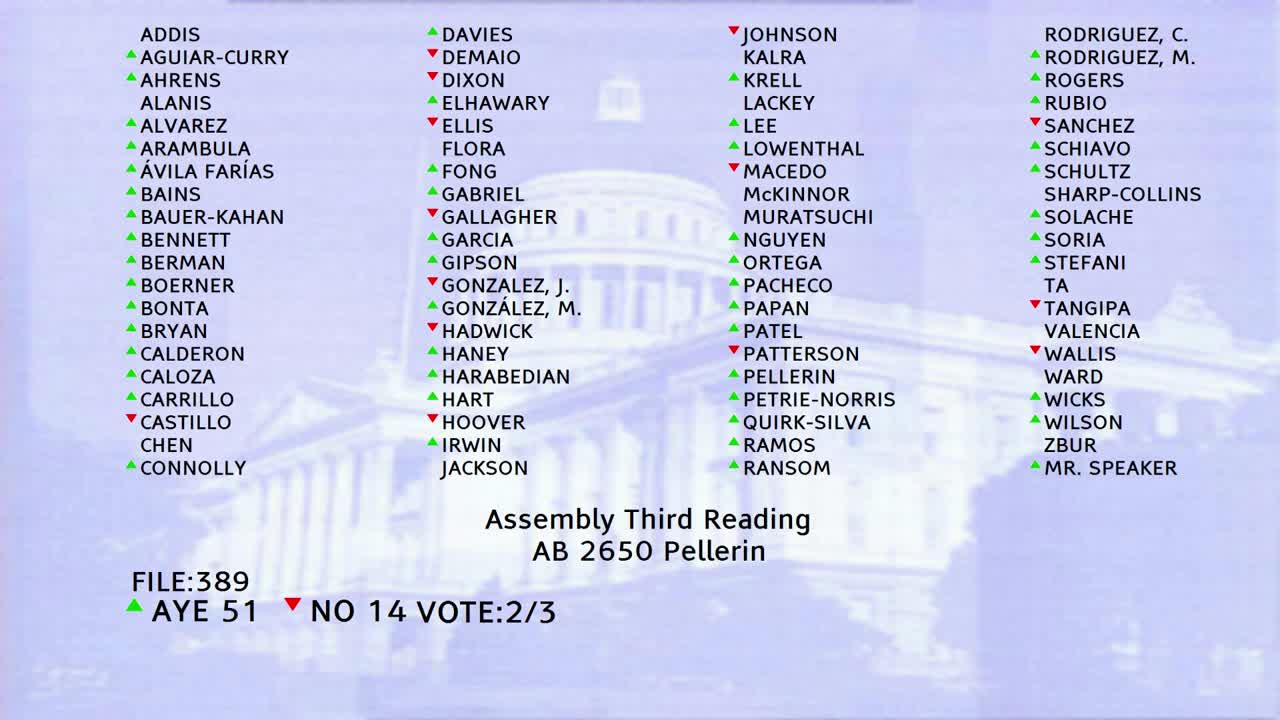 54SEC
Assembly Floor
 8MIN
Assembly Standing Committee on Elections
Bill Author


