AB 1540: 988 Suicide & Crisis Lifeline: LGBTQ+ youth.
- Session Year: 2025-2026
- House: Assembly
- Latest Version Date: 2026-08-27
Current Status:
In Progress
(2026-08-30: In Assembly. Concurrence in Senate amendments pending.)
Introduced
In Committee
Awaiting First Chamber Vote
Passed First Chamber
In Committee
Awaiting Second Chamber Vote
Passed Second Chamber
Enacted
Existing federal law, the National Suicide Hotline Designation Act of 2020, designates the 3-digit telephone number 988 as the universal number within the United States for the purpose of the national suicide prevention and mental health crisis hotline system operating through the 988 Suicide and Crisis Lifeline.
Existing law, the Miles Hall Lifeline and Suicide Prevention Act, requires, among other things, the Office of Emergency Services (OES) to verify that technology that allows for transfers between 988 centers, as well as between 988 centers and 911 public safety answering points, is available to 988 centers and 911 public safety answering points throughout the state, to appoint a 988 system director, and to verify interoperability between and across 911 and 988. Existing law establishes the 988 State Suicide and Behavioral Health Crisis Services Fund and provides that 988 surcharge revenue in the fund is available, upon appropriation by the Legislature, for purposes of the act.
This bill would require the California Health and Human Services Agency (agency) to annually determine whether an adequate specialized LGBTQ+ suicide prevention hotline is activated by the federal government under 988 and would make implementation of this bill contingent on the agencys determination, as specified. 988. When making this determination, the bill would require the agency to consider specified factors, including, among other things, any factor the agency considers relevant to evaluating the adequacy of press 3 operations. The bill would require OES authorize the agency to, no later than 6 months after the agencys its determination, request the federal Substance Abuse and Mental Health Services Administration (SAMHSA) to enable a allow the state to implement the press 3 function at the state level for calls originating in the State of California to California, which would allow callers to dial 988 988 and press 3 to be automatically routed to a specialized call 988 center. The bill would require OES and the agency to, no later than 12 months following the approval by SAMHSA, ensure that the specified press 3 function technologies are available.
This bill would require, no later than 12 months following approval by SAMHSA, the agency to identify and contract with a qualified entity or entities that specialize in LGBTQ+ suicide prevention services. The bill would require the agency to determine the eligibility criteria, establish an application process, and administer funds to the qualified entity, as specified. The bill would require a qualified entity to comply with various requirements, including having a primary objective of reducing suicide rates or addressing mental health crises. The bill would make its implementation subject to an appropriation by the Legislature, as specified.
This bill would declare that it is to take effect immediately as an urgency statute.
Existing federal law, the National Suicide Hotline Designation Act of 2020, designates the 3-digit telephone number 988 as the universal number within the United States for the purpose of the national suicide prevention and mental health crisis hotline system operating through the 988 Suicide and Crisis Lifeline.
Existing law, the Miles Hall Lifeline and Suicide Prevention Act, requires, among other things, the Office of Emergency Services (OES) to verify that technology that allows for transfers between 988 centers, as well as between 988 centers and 911 public safety answering points, is available to 988 centers and 911 public safety answering points throughout the state, to appoint a 988 system director, and to verify interoperability between and across 911 and 988. Existing law establishes the 988 State Suicide and Behavioral Health Crisis Services Fund and provides that 988 surcharge revenue in the fund is available, upon appropriation by the Legislature, for purposes of the act.
This bill would require the California Health and Human Services Agency (agency) to annually determine whether an adequate specialized LGBTQ+ suicide prevention hotline is activated by the federal government under 988 and would make implementation of this bill contingent on the agencys determination, as specified. The bill would require OES to, no later than June 1, 2027, 6 months after the agencys determination, request the federal Substance Abuse and Mental Health Services Administration (SAMHSA) to enable a press 3 function for calls originating in the State of California to allow callers to dial 988 and press 3 to be automatically routed to a specialized call center. The bill would require OES to, no later than 12 months following the approval by SAMHSA, ensure that the specified technologies are available.
This bill would require, no later than 12 months following approval by SAMHSA, the California Health and Human Services Agency agency to identify and contract with a qualified entity or entities that specialize in LGBTQ+ suicide prevention services. The bill would require the agency to determine the eligibility criteria, establish an application process, and administer funds to the qualified entity, as specified. The bill would require a qualified entity to comply with various requirements, including having a primary objective of reducing suicide rates or addressing mental health crises.
This bill would declare that it is to take effect immediately as an urgency statute.
Existing federal law, the National Suicide Hotline Designation Act of 2020, designates the 3-digit telephone number 988 as the universal number within the United States for the purpose of the national suicide prevention and mental health crisis hotline system operating through the 988 Suicide and Crisis Lifeline.
Existing law, the Miles Hall Lifeline and Suicide Prevention Act, requires, among other things, the Office of Emergency Services (OES) to verify that technology that allows for transfers between 988 centers, as well as between 988 centers and 911 public safety answering points, is available to 988 centers and 911 public safety answering points throughout the state, to appoint a 988 system director, and to verify interoperability between and across 911 and 988. Existing law establishes the 988 State Suicide and Behavioral Health Crisis Services Fund and provides that 988 surcharge revenue in the fund is available, upon appropriation by the Legislature, for purposes of the act.
This bill would require OES to, no later than July 1, 2027, ensure that technology enabling transfers between 988 centers and a subnetwork of LGBTQ+ specialized youth suicide prevention service providers is available, as specified, and that callers may dial 988 and press 3 to be automatically routed to an LGBTQ+ suicide prevention specialist. The bill would also require OES to, no later than December 1, 2027, ensure that technologies enabling text or chat contacts between a caller and 988 centers or a specified subnetwork are available. June 1, 2027, request the federal Substance Abuse and Mental Health Services Administration (SAMHSA) to enable a press 3 function for calls originating in the State of California to allow callers to dial 988 and press 3 to be automatically routed to a specialized call center. The bill would require OES to, no later than 12 months following the approval by SAMHSA, ensure that the specified technologies are available.
This bill would require the California Health and Human Services Agency to, no later than July 1, 2027, administer a grant program for qualified entities that specialize in suicide prevention services and provide funding for state 988 call centers to implement specified goals. This bill would require, no later than 12 months following approval by SAMHSA, the California Health and Human Services Agency to identify and contract with a qualified entity or entities that specialize in LGBTQ+ suicide prevention services. The bill would require the agency to determine the eligibility criteria, as prescribed, grant application process, and methodology for the distribution of grants to a qualified entity. The bill would require a qualified entity to annually file an expenditure and outcomes report, as specified, in a form and manner determined by the agency. The bill would specify that moneys in the 988 State Suicide and Behavioral Health Crisis Services Fund are available, upon appropriation by the Legislature, for purposes of these provisions. The bill would provide that a qualified entity selected, contracted, or funded under these provisions is recognized as part of Californias 988 network for all state administrative, operational, and interoperability purposes when receiving or responding to a 988 call, text, or chat routed through 988. establish an application process, and administer funds to the qualified entity, as specified. The bill would require a qualified entity to comply with various requirements, including having a primary objective of reducing suicide rates or addressing mental health crises.
This bill would declare that it is to take effect immediately as an urgency statute.
Existing federal law, the National Suicide Hotline Designation Act of 2020, designates the 3-digit telephone number 988 as the universal number within the United States for the purpose of the national suicide prevention and mental health crisis hotline system operating through the 988 Suicide and Crisis Lifeline.
Existing law, the Miles Hall Lifeline and Suicide Prevention Act, requires, among other things, the Office of Emergency Services (OES) to verify that technology that allows for transfers between 988 centers, as well as between 988 centers and 911 public safety answering points, is available to 988 centers and 911 public safety answering points throughout the state, to appoint a 988 system director, and to verify interoperability between and across 911 and 988. Existing law establishes the 988 State Suicide and Behavioral Health Crisis Services Fund and provides that 988 surcharge revenue in the fund is available, upon appropriation by the Legislature, for purposes of the act.
This bill would require OES to, no later than July 1, 2027, ensure that technology enabling transfers between 988 centers and a subnetwork of LGBTQ+ specialized youth suicide prevention service providers is available, as specified, and that callers may dial 988 and press 3 to be automatically routed to an LGBTQ+ suicide prevention specialist. The bill would also require OES to, no later than December 1, 2027, ensure that technologies enabling text or chat contacts between a caller and 988 centers or a specified subnetwork are available.
This bill would require the California Health and Human Services Agency to, no later than July 1, 2027, administer a grant program for qualified entities that specialize in suicide prevention services and provide funding for state 988 call centers to implement specified goals. The bill would require the agency to determine the eligibility criteria, as prescribed, grant application process, and methodology for the distribution of grants to a qualified entity. The bill would require a qualified entity to annually file an expenditure and outcomes report, as specified, in a form and manner determined by the agency. The bill would establish the Protecting Suicide Prevention Resources for LGBTQ+ Youth Fund, to be administered by the agency, and would appropriate $5,000,000 from the General Fund to the Protecting Suicide Prevention Resources for LGBTQ+ Youth Fund specify that moneys in the 988 State Suicide and Behavioral Health Crisis Services Fund are available, upon appropriation by the Legislature, for purposes of these provisions. The bill would provide that a qualified entity selected, contracted, or funded under these provisions is recognized as part of Californias 988 network for all state administrative, operational, and interoperability purposes when receiving or responding to a 988 call, text, or chat routed through 988.
This bill would declare that it is to take effect immediately as an urgency statute.
Existing federal law, the National Suicide Hotline Designation Act of 2020, designates the 3-digit telephone number 988 as the universal number within the United States for the purpose of the national suicide prevention and mental health crisis hotline system operating through the 988 Suicide and Crisis Lifeline.
Existing law, the Miles Hall Lifeline and Suicide Prevention Act, requires, among other things, the Office of Emergency Services (OES) to verify that technology that allows for transfers between 988 centers, as well as between 988 centers and 911 public safety answering points, is available to 988 centers and 911 public safety answering points throughout the state, to appoint a 988 system director, and to verify interoperability between and across 911 and 988.
This bill would require OES to, no later than July 1, 2027, ensure that technology enabling transfers between 988 centers and a subnetwork of LGBTQ+ specialized youth suicide prevention service providers is available, as specified, and that callers may dial 988 and press 3 to be automatically routed to an LGBTQ+ suicide prevention specialist. The bill would also require OES to, no later than December 1, 2027, ensure that technologies enabling text or chat contacts between a caller and 988 centers or a specified subnetwork are available.
This bill would require the California Health and Human Services Agency to, no later than July 1, 2027, administer a grant program for qualified entities that specialize in suicide prevention services and provide funding for state 988 call centers to implement specified goals. The bill would require the agency to determine the eligibility criteria, as prescribed, grant application process, and methodology for the distribution of grants to a qualified entity. The bill would require a qualified entity to annually file an expenditure and outcomes report, as specified, in a form and manner determined by the agency. The bill would establish the Protecting Suicide Prevention Resources for LGBTQ+ Youth Fund, to be administered by the agency, and would appropriate $5,000,000 from the General Fund to the Protecting Suicide Prevention Resources for LGBTQ+ Youth Fund for purposes of these provisions.
This bill would declare that it is to take effect immediately as an urgency statute.
The Legislature finds and declares all of the following:
(a)All children, regardless of their sexual orientation, gender identity, or gender expression, deserve to live a full and happy life without suffering from bullying and mental health crises.
(b)Attacks on the rights, safety, and dignity of LGBTQ+ youth continue to grow across the country, including in California. These efforts have a measurable impact on the health and well-being of LGBTQ+ youth and have led to a rise in bullying, harassment, and discrimination.
(c)LGBTQ+ youth have increased reported instances of bullying, hate crimes, and harassment than compared to their heterosexual or cisgender peers.
(d)The latest national survey on the mental health of LGBTQ+ youth in California found that 56 percent of LGBTQ+ youth in California experienced discrimination based on their sexual orientation or gender identity in the past year.
(e)(1)A longitudinal study published in 2025 reported that mental health distress among LGBTQ+ youth has been increasing amid a surge of anti-LGBTQ+ legislation, but strong support networks and access to health care were shown to ease symptoms for some.
(2)That study found mental health distress increased substantially throughout the studys first year. LGBTQ+ youth reporting recent anxiety symptoms rose from 57 percent to 68 percent. Those reporting depressive symptoms climbed from 48 percent to 54 percent. Suicidal ideation among LGBTQ+ youth grew from 41 percent to 47 percent.
(f)Another 2025 study found that most LGBTQ+ people, and especially transgender and nonbinary respondents, reported anti-LGBTQ+ laws and rhetoric has negatively impacted their mental health and well-being. Additionally, a majority of LGBTQ+ people and more than 8 in 10 transgender and nonbinary individuals reported they or their families have faced harassment or discrimination since November 2024.
(g)A 2023 study by the federal Centers for Disease Control and Prevention found that lesbian, gay, and bisexual students were more than three times more likely to have attempted suicide than their heterosexual peers: that number jumps to almost four times as likely for transgender high school students. In other words, 20 percent of surveyed students who identified as lesbian, gay, or bisexual reported having attempted suicide compared to 6 percent of their heterosexual peers. This figure jumps to nearly 26 percent for transgender high school students.
(h)Research by The Trevor Project also indicates that LGBTQ+ students often struggle to access competent mental health services tailored to their unique experiences.
(i)The Federal Bureau of Investigation (FBI) reported that schools were the third most commonly known location for hate crimes against LGBTQ+ youth and community members, and that hate crimes more than doubled at elementary and secondary schools and universities from 2018 to 2022, inclusive. The FBI also noted that participation in the collection of the aforementioned data regarding hate crime reports in schools is voluntary for most agencies and is only mandatory for federal agencies; therefore, the figures provided in the FBIs report are likely incomplete and underreported.
(j)Since 2022, 988, the nations official hotline for suicide prevention and crisis counseling, has collaborated with several nonprofit organizations that offer specialized services designed to prevent LGBTQ+ youth suicide. The 988 Suicide & Crisis Lifelines LGBTQ+ Youth Specialized Services program allowed youth who called 988 to press 3 and automatically be routed to a subnetwork of providers.
(k)Since 2022, 1,500,000 contacts were routed to the LGBTQ+ service provider subnetwork.
(l)By order of President Donald Trump on June 17, 2025, all funding for LGBTQ+ youth services Press 3 option was halted. This service officially ended on July 17, 2025.
SEC. 2.Section 53123.7 is added to the Government Code, to read:53123.7.SEC. 2.Section 53123.8 is added to the Government Code, to read:53123.8.(a)It is the intent of the State of California Legislature to continue its long history of advancing policies that support suicide prevention efforts and further the initiative to address our youth mental health crisis. Young LGBTQ+ Californians have benefited from the 988 Suicide & Crisis Lifelines LGBTQ+ Youth Specialized Services program since 2022. It is the intent of the Legislature to reinstate this program in California.
(b)The (1)Notwithstanding subdivision (f), the California Health and Human Services Agency shall annually determine whether an adequate specialized LGBTQ+ suicide prevention hotline is activated by the federal government under 988. The Office of Emergency Services and the California Health and Human Services Agency shall implement the requirements of this section only after the agency has made a determination that an adequate specialized LGBTQ+ suicide prevention hotline has not been activated by the federal government under 988.
(c)Subject to subdivision (b), the Office of Emergency Services shall do both of the following:(2)When determining the adequacy of the federal press 3 option pursuant this subdivision, the agency shall consider all of the following factors:
(A)An individual identifying as LGBTQ+ may access the press 3 option.
(B)Federal guidance does not limit or discourage any individual identifying as LGBTQ+ from accessing the press 3 option.
(C)LGBTQ+ specialized organizations that have historically served, or may serve, LGBTQ+ individuals are not prohibited from operating or supporting the press 3 option.
(D)Any other factor the agency considers relevant to evaluating the adequacy of press 3 operations.
(c)If an adequate specialized LGBTQ+ suicide prevention hotline has not been activated by the federal government, as determined pursuant to subdivision (b), both of the following apply:
(1)No later than 6 months after the California Health and Human Services Agency agency determines that an adequate specialized LGBTQ+ suicide prevention hotline has not been activated by the federal government under 988, the agency may request the federal Substance Abuse and Mental Health Services Administration to enable a allow the state to implement the press 3 function at the state level for calls originating in the State of California. A press 3 function shall allow callers to dial 988 988 and press 3 to be automatically routed to a specialized call 988 center or designated 988 center, as set forth in subdivision (e). The office shall also request authorization to enable text or chat features between a caller and a specialized 988 call center by texting PRIDE to 988. The specialized 988 call center shall be a qualified entity that meets the requirements described in subdivision (e).
(2)No later than 12 months following the approval of the request pursuant to paragraph (1) by the federal Substance Abuse and Mental Health Services Administration or its contracted 988 Suicide & Crisis Lifeline Administrator, the agency and the Office of Emergency Services shall ensure that press 3 function technologies described in paragraph (1) are available.
(d)No later than 12 months following approval of the request submitted pursuant to paragraph (1) of subdivision (c), the California Health and Human Services Agency agency shall identify and contract with a qualified entity or entities, as set forth in subdivision (e), that specialize in LGBTQ+ suicide prevention services. The agency shall determine the eligibility criteria, establish an application process, and administer funds to the qualified entity pursuant to this article. The agency shall also take into consideration whether the applicant is or was previously a part of the 988 Suicide & Crisis Lifeline network. The agency shall prioritize applicants that primarily service LGBTQ+ populations.
(e)A qualified entity shall comply with all of the following:
(1)Become a 988 center as and, by December 31, 2029, a designated 988 center as those terms are defined in Section 53123.1.5. As a 988 center, the qualified entity shall be eligible for funding and until December 31, 2029, and shall be subject to the requirements under this article. A 988 center shall obtain designation from the State Department of Health Care Services by December 31, 2029, pursuant to Section 53123.7.
(2)Maintain policies that comply with the California Confidentiality of Medical Information Act (CMIA) (Part 2.6 (commencing with Section 56) of Division 1 of the Civil Code), the federal Health Insurance Portability and Accountability Act of 1996 (HIPAA) (Public Law 104-191), and all other applicable state laws governing the protection of sensitive personal and medical information.
(3)Have a primary objective of reducing suicide rates or addressing mental health crises.
(4)Demonstrate that its mission includes serving the LGBTQ+ population or that it employs staff or volunteers who have completed extensive training in responding to LGBTQ+ crisis contacts in a culturally competent manner. The qualified entity shall ensure that trained staff or volunteers are available to respond to those contacts through an established routing system.
(f)This section shall only be implemented subject to an appropriation by the Legislature and if both of the following occur:
(1)The Office of Emergency Services obtains and maintains the necessary federal approvals to enable a press 3 function for calls.
(2)The agency, in consultation with the State Department of Health Care Services, determines that other federal funding sources, including grants issued by the federal Substance Abuse and Mental Health Services Administration, are not jeopardized.
SEC. 3.This act is an urgency statute necessary for the immediate preservation of the public peace, health, or safety within the meaning of Article IV of the California Constitution and shall go into immediate effect. The facts constituting the necessity are:
In order to address the urgent LGBTQ+ youth suicide crisis we face in California, it is necessary for this act to take effect immediately.
The Legislature finds and declares all of the following:
(a)All children, regardless of their sexual orientation, gender identity, or gender expression, deserve to live a full and happy life without suffering from bullying and mental health crises.
(b)Attacks on the rights, safety, and dignity of LGBTQ+ youth continue to grow across the country, including in California. These efforts have a measurable impact on the health and well-being of LGBTQ+ youth and have led to a rise in bullying, harassment, and discrimination.
(c)LGBTQ+ youth have increased reported instances of bullying, hate crimes, and harassment than compared to their heterosexual or cisgender peers.
(d)The latest national survey on the mental health of LGBTQ+ youth in California found that 56 percent of LGBTQ+ youth in California experienced discrimination based on their sexual orientation or gender identity in the past year.
(e)(1)A longitudinal study published in 2025 reported that mental health distress among LGBTQ+ youth has been increasing amid a surge of anti-LGBTQ+ legislation, but strong support networks and access to health care were shown to ease symptoms for some.
(2)That study found mental health distress increased substantially throughout the studys first year. LGBTQ+ youth reporting recent anxiety symptoms rose from 57 percent to 68 percent. Those reporting depressive symptoms climbed from 48 percent to 54 percent. Suicidal ideation among LGBTQ+ youth grew from 41 percent to 47 percent.
(f)Another 2025 study found that most LGBTQ+ people, and especially transgender and nonbinary respondents, reported anti-LGBTQ+ laws and rhetoric has negatively impacted their mental health and well-being. Additionally, a majority of LGBTQ+ people and more than 8 in 10 transgender and nonbinary individuals reported they or their families have faced harassment or discrimination since November 2024.
(g)A 2023 study by the federal Centers for Disease Control and Prevention found that lesbian, gay, and bisexual students were more than three times more likely to have attempted suicide than their heterosexual peers: that number jumps to almost four times as likely for transgender high school students. In other words, 20 percent of surveyed students who identified as lesbian, gay, or bisexual reported having attempted suicide compared to 6 percent of their heterosexual peers. This figure jumps to nearly 26 percent for transgender high school students.
(h)Research by The Trevor Project also indicates that LGBTQ+ students often struggle to access competent mental health services tailored to their unique experiences.
(i)The Federal Bureau of Investigation (FBI) reported that schools were the third most commonly known location for hate crimes against LGBTQ+ youth and community members, and that hate crimes more than doubled at elementary and secondary schools and universities from 2018 to 2022, inclusive. The FBI also noted that participation in the collection of the aforementioned data regarding hate crime reports in schools is voluntary for most agencies and is only mandatory for federal agencies; therefore, the figures provided in the FBIs report are likely incomplete and underreported.
(j)Since 2022, 988, the nations official hotline for suicide prevention and crisis counseling, has collaborated with several nonprofit organizations that offer specialized services designed to prevent LGBTQ+ youth suicide. The 988 Suicide & Crisis Lifelines LGBTQ+ Youth Specialized Services program allowed youth who called 988 to press 3 and automatically be routed to a subnetwork of providers.
(k)Since 2022, 1,500,000 contacts were routed to the LGBTQ+ service provider subnetwork.
(l)By order of President Donald Trump on June 17, 2025, all funding for LGBTQ+ youth services Press 3 option was halted. This service officially ended on July 17, 2025. The ending of this service has resulted in a gap of specialized LGBTQ+ mental health services.
SEC. 2.Section 53123.7 is added to the Government Code, to read:53123.7.(a)It is the intent of the State of California to continue its long history of advancing policies that support suicide prevention efforts and further the initiative to address our youth mental health crisis. Young LGBTQ+ Californians have benefited from the 988 Suicide & Crisis Lifelines LGBTQ+ Youth Specialized Services program since 2022. It is the intent of the Legislature to reinstate this program in California.
(b)The California Health and Human Services Agency shall annually determine whether an adequate specialized LGBTQ+ suicide prevention hotline is activated by the federal government under 988. The Office of Emergency Services and the California Health and Human Services Agency shall implement the requirements of this section only after the agency has made a determination that an adequate specialized LGBTQ+ suicide prevention hotline has not been activated by the federal government under 988.
(b)The(c)Subject to subdivision (b), the Office of Emergency Services shall do both of the following:
(1)No later than June 1, 2027, 6 months after the California Health and Human Services Agency determines that an adequate specialized LGBTQ+ suicide prevention hotline has not been activated by the federal government under 988, request the federal Substance Abuse and Mental Health Services Administration to enable a press 3 function for calls originating in the State of California. A press 3 function shall allow callers to dial 988 and press 3 to be automatically routed to a specialized call center, as set forth in subdivision (d). (e). The office shall also request authorization to enable text or chat features between a caller and a specialized 988 call center by texting PRIDE to 988. The specialized 988 call center shall be a qualified entity that meets the requirements described in subdivision (d). (e).
(2)No later than 12 months following the approval by the federal Substance Abuse and Mental Health Services Administration or its contracted 988 Suicide & Crisis Lifeline Administrator, ensure that technologies described in paragraph (1) are available.
(c)(d)No later than 12 months following approval of the request submitted pursuant to paragraph (1) of subdivision (b), (c), the California Health and Human Services Agency shall identify and contract with a qualified entity or entities, as set forth in subdivision (d), (e), that specialize in LGBTQ+ suicide prevention services. The agency shall determine the eligibility criteria, establish an application process, and administer funds to the qualified entity pursuant to this article. The agency shall also take into consideration whether the applicant is or was previously a part of the 988 Suicide & Crisis Lifeline network. The agency shall prioritize applicants that primarily service LGBTQ+ populations.
(d)(e)A qualified entity shall comply with all of the following:
(1)Become a 988 center as defined in Section 53123.1.5. As a 988 center, the qualified entity shall be eligible for funding and subject to the requirements under this article.
(2)Maintain policies that include: comply with the California Confidentiality of Medical Information Act (CMIA) (Part 2.6 (commencing with Section 56) of Division 1 of the Civil Code), the federal Health Insurance Portability and Accountability Act of 1996 (HIPAA) (Public Law 104-191), and all other applicable state laws governing the protection of sensitive personal and medical information.
(A)No requirement for a caller to provide name, age or date of birth, gender, race or ethnicity, citizenship status, or any other identifying information to receive crisis intervention services.(B)A prohibition against sharing identifying information outside of the 988 Suicide & Crisis Lifeline, including with private donors and the federal government, except as required by law.(3)Have a primary objective of reducing suicide rates or addressing mental health crises.
(4)Demonstrate that its mission includes serving the LGBTQ+ population or that it employs staff or volunteers who have completed extensive training in responding to LGBTQ+ crisis contacts in a culturally competent manner. The qualified entity shall ensure that dedicated trained staff or volunteers are available to respond to those contacts through an established routing system.
SEC. 3.This act is an urgency statute necessary for the immediate preservation of the public peace, health, or safety within the meaning of Article IV of the California Constitution and shall go into immediate effect. The facts constituting the necessity are:
In order to address the urgent LGBTQ+ youth suicide crisis we face in California, it is necessary for this act to take effect immediately.
The Legislature finds and declares all of the following:
(a)All children, regardless of their sexual orientation, gender identity, or gender expression, deserve to live a full and happy life without suffering from bullying and mental health crises.
(b)Attacks on the rights, safety, and dignity of LGBTQ+ youth continue to grow across the country, including in California. These efforts have a measurable impact on the health and well-being of LGBTQ+ youth and have led to a rise in bullying, harassment, and discrimination.
(c)LGBTQ+ youth have increased reported instances of bullying, hate crimes, and harassment than compared to their heterosexual or cisgender peers.
(d)The latest national survey on the mental health of LGBTQ+ youth in California found that 56 percent of LGBTQ+ youth in California experienced discrimination based on their sexual orientation or gender identity in the past year.
(e)(1)A longitudinal study published in 2025 reported that mental health distress among LGBTQ+ youth has been increasing amid a surge of anti-LGBTQ+ legislation, but strong support networks and access to health care were shown to ease symptoms for some.
(2)That study found mental health distress increased substantially throughout the studys first year. LGBTQ+ youth reporting recent anxiety symptoms rose from 57 percent to 68 percent. Those reporting depressive symptoms climbed from 48 percent to 54 percent. Suicidal ideation among LGBTQ+ youth grew from 41 percent to 47 percent.
(f)Another 2025 study found that most LGBTQ+ people, and especially transgender and nonbinary respondents, reported anti-LGBTQ+ laws and rhetoric has negatively impacted their mental health and well-being. Additionally, a majority of LGBTQ+ people and more than 8 in 10 transgender and nonbinary individuals reported they or their families have faced harassment or discrimination since November 2024.
(g)A 2023 study by the federal Centers for Disease Control and Prevention found that lesbian, gay, and bisexual students were more than three times more likely to have attempted suicide than their heterosexual peers: that number jumps to almost four times as likely for transgender high school students. In other words, 20 percent of surveyed students who identified as lesbian, gay, or bisexual reported having attempted suicide compared to 6 percent of their heterosexual peers. This figure jumps to nearly 26 percent for transgender high school students.
(h)Research by The Trevor Project also indicates that LGBTQ+ students often struggle to access competent mental health services tailored to their unique experiences.
(i)The Federal Bureau of Investigation (FBI) reported that schools were the third most commonly known location for hate crimes against LGBTQ+ youth and community members, and that hate crimes more than doubled at elementary and secondary schools and universities from 2018 to 2022, inclusive. The FBI also noted that participation in the collection of the aforementioned data regarding hate crime reports in schools is voluntary for most agencies and is only mandatory for federal agencies; therefore, the figures provided in the FBIs report are likely incomplete and underreported.
(j)Since 2022, 988, the nations official hotline for suicide prevention and crisis counseling, has collaborated with several nonprofit organizations that offer specialized services designed to prevent LGBTQ+ youth suicide. The 988 Suicide & Crisis Lifelines LGBTQ+ Youth Specialized Services program allowed youth who called 988 to press 3 and automatically be routed to a subnetwork of providers.
(k)Since 2022, 1,500,000 contacts were routed to the LGBTQ+ service provider subnetwork.
(l)By order of President Donald Trump on June 17, 2025, all funding for LGBTQ+ youth services Press 3 option was halted. This service officially ended on July 17, 2025. The ending of this service has resulted in chaos, with youth in crisis lacking a centralized suicide prevention resource. a gap of specialized LGBTQ+ mental health services.
SEC. 2.Section 53123.7 is added to the Government Code, to read:53123.7.(a)It is the intent of the State of California to continue its long history of advancing policies that support suicide prevention efforts and further the initiative to address our youth mental health crisis. Young LGBTQ+ Californians have benefited from the 988 Suicide & Crisis Lifelines LGBTQ+ Youth Specialized Services program since 2022. It is the intent of the Legislature to reinstate this program in California.
(b)The Office of Emergency Services shall ensure do both of the following:
(1)No later than July 1, 2027, that technology enabling transfers between 988 centers and a subnetwork of LGBTQ+ specialized youth suicide prevention service providers is available to 988 centers and 911 public safety answering points in California. The office shall ensure that callers may dial 988 and press 3 to be automatically routed to an LGBTQ+ suicide prevention specialist. June 1, 2027, request the federal Substance Abuse and Mental Health Services Administration to enable a press 3 function for calls originating in the State of California. A press 3 function shall allow callers to dial 988 and press 3 to be automatically routed to a specialized call center, as set forth in subdivision (d). The office shall also request authorization to enable text or chat features between a caller and a specialized 988 call center by texting PRIDE to 988. The specialized 988 call center shall be a qualified entity that meets the requirements described in subdivision (d).
(2)No later than December 1, 2027, that technologies enabling contact through text or chat features between a caller and 988 centers or a subnetwork for LGBTQ+ specialized youth suicide prevention service providers are available. 12 months following the approval by the federal Substance Abuse and Mental Health Services Administration or its contracted 988 Suicide & Crisis Lifeline Administrator, ensure that technologies described in paragraph (1) are available.
(c)(1)Pursuant to paragraph (4) of subdivision (b) of Section 53123.4, moneys in the 988 State Suicide and Behavioral Health Crisis Services Fund are available, upon appropriation by the Legislature, for the costs of this section.(2)No later than July 1, 2027, the agency shall do both of the following:(A)Administer a grant program for qualified entities, as set forth in subdivision (d), that specialize in suicide prevention services.(B)Provide funding for state 988 call centers to implement the goals of this section, including, but not limited to, the administrative cost of implementation and staffing of statewide and regional 988 centers and the effective routing of contacts, including, but not limited to, calls, texts, and chats.(d)For purposes of subparagraph (A) of paragraph (2) of subdivision (c), a qualified entity for the grant program shall be determined by the agency pursuant to the following:(1)The agency shall determine the eligibility criteria, grant application process, and methodology for the distribution of grants to a qualified entity. The agencys eligibility requirements shall include, but are not limited to:(A)The applicant shall be capable of complying with current minimum application requirements maintained and set forth by the federal Substance Abuse and Mental Health Services Administration (SAMHSA) or the entity contracted by SAMHSA to administer the 988 Suicide & Crisis Lifeline.(c)No later than 12 months following approval of the request submitted pursuant to paragraph (1) of subdivision (b), the California Health and Human Services Agency shall identify and contract with a qualified entity or entities, as set forth in subdivision (d), that specialize in LGBTQ+ suicide prevention services. The agency shall determine the eligibility criteria, establish an application process, and administer funds to the qualified entity pursuant to this article. The agency shall also take into consideration whether the applicant is or was previously a part of the 988 Suicide & Crisis Lifeline network. The agency shall prioritize applicants that primarily service LGBTQ+ populations.
(d)A qualified entity shall comply with all of the following:
(1)Become a 988 center as defined in Section 53123.1.5. As a 988 center, the qualified entity shall be eligible for funding and subject to the requirements under this article.
(B)The applicant maintains(2)Maintain policies that include:
(i)(A)No requirement for a caller to provide name, age or date of birth, gender, race or ethnicity, citizenship status, or any other identifying information to receive crisis intervention services.
(ii)(B)A prohibition against sharing identifying information outside of the 988 Suicide & Crisis Lifeline, including with private donors and the federal government, except as required by law.
(iii)Strict user tenets that comply with Section 56.109 of the Civil Code and Section 819 of the Penal Code.(C)The applicants primary objective is to reduce(3)Have a primary objective of reducing suicide rates or address addressing mental health crises. The agency shall prioritize applicants that primarily service LGBTQ+ populations.
(D)The applicant demonstrates(4)Demonstrate that its mission includes serving the LGBTQ+ population or that it employs staff or volunteers who have completed extensive training in responding to LGBTQ+ crisis contacts in a culturally competent manner. The applicant ensures qualified entity shall ensure that dedicated trained staff or volunteers are available to respond to those contacts through an established routing system.
(E)The applicant has the capability to report metrics, including information about the number of contacts, length of contacts, and any other metric the agency deems appropriate.(2)The agency shall also take into consideration whether the applicant is or was previously a part of the 988 Suicide & Crisis Lifeline network.(3)A qualified entity that is eligible to receive grants pursuant to this section shall include community-based organizations, nonprofits, behavioral health providers, counties, city mental health authorities, tribal entities, local educational agencies, and institutions of higher education. The agency shall prioritize applicants that are based in California and have established connections to law enforcement or California mobile crisis response units.(e)(1)The agency shall require a qualified entity to annually file an expenditure and outcomes report in a form and manner determined by the agency.(2)The expenditure and outcomes report shall include, but is not limited to, the following information:(A)The total budget.(B)Number and job classification of personnel.(C)The number of contacts served.(D)The outcome for individuals served, if known.(E)Beginning July 1, 2027, to the extent feasible, measures of system performance, including capacity, wait times, and the ability to meet demand for services.(f)For purposes of implementing this article, the agency may enter into exclusive or nonexclusive contracts, or amend existing contracts, on a bid or negotiated basis, and may implement changes to existing information technology systems. Notwithstanding any other law, contracts entered into or amended, or changes to existing information technology systems, pursuant to this section shall be exempt from Chapter 6 (commencing with Section 14825) of Part 5.5 of Division 3 of Title 2 of the Government Code, Section 19130 of the Government Code, and Part 2 (commencing with Section 10100) of Division 2 of the Public Contract Code, and shall be exempt from the review or approval of any division of the Department of General Services.(g)For the purposes of 988 system integration, a contact routed to the qualified entity pursuant to this section constitutes a 988 contact for purposes of Californias comprehensive 988 system, as described in Section 53123.3. A qualified entity selected, contracted, or funded pursuant to this section to receive 988 contacts through the LGBTQ+ youth specialized services routing described in subdivision (b) shall be recognized as part of Californias 988 network for all state administrative, operational, and interoperability purposes when receiving or responding to a 988 call, text, or chat routed through 988. The qualified entity may initiate and receive transfers and warm handoffs with 988 centers and county crisis continuum entry points on the same technical and operational basis as other 988 centers, consistent with applicable confidentiality and consent requirements.SEC. 3.This act is an urgency statute necessary for the immediate preservation of the public peace, health, or safety within the meaning of Article IV of the California Constitution and shall go into immediate effect. The facts constituting the necessity are:
In order to address the urgent LGBTQ+ youth suicide crisis we face in California, it is necessary for this act to take effect immediately.
REVISIONS: HeadingLines 5 and 6.The Legislature finds and declares all of the following:
(a)All children, regardless of their sexual orientation, gender identity, or gender expression, deserve to live a full and happy life without suffering from bullying and mental health crises.
(b)Attacks on the rights, safety, and dignity of LGBTQ+ youth continue to grow across the country, including in California. These efforts have a measurable impact on the health and well-being of LGBTQ+ youth and have led to a rise in bullying, harassment, and discrimination.
(c)LGBTQ+ youth have increased reported instances of bullying, hate crimes, and harassment than compared to their heterosexual or cisgender peers.
(d)The latest national survey on the mental health of LGBTQ+ youth in California found that 56 percent of LGBTQ+ youth in California experienced discrimination based on their sexual orientation or gender identity in the past year.
(e)(1)A longitudinal study published in 2025 reported that mental health distress among LGBTQ+ youth has been increasing amid a surge of anti-LGBTQ+ legislation, but strong support networks and access to health care were shown to ease symptoms for some.
(2)That study found mental health distress increased substantially throughout the studys first year. LGBTQ+ youth reporting recent anxiety symptoms rose from 57 percent to 68 percent. Those reporting depressive symptoms climbed from 48 percent to 54 percent. Suicidal ideation among LGBTQ+ youth grew from 41 percent to 47 percent.
(f)Another 2025 study found that most LGBTQ+ people, and especially transgender and nonbinary respondents, reported anti-LGBTQ+ laws and rhetoric has negatively impacted their mental health and well-being. Additionally, a majority of LGBTQ+ people and more than 8 in 10 transgender and nonbinary individuals reported they or their families have faced harassment or discrimination since November 2024.
(g)A 2023 study by the federal Centers for Disease Control and Prevention found that lesbian, gay, and bisexual students were more than three times more likely to have attempted suicide than their heterosexual peers: that number jumps to almost four times as likely for transgender high school students. In other words, 20 percent of surveyed students who identified as lesbian, gay, or bisexual reported having attempted suicide compared to 6 percent of their heterosexual peers. This figure jumps to nearly 26 percent for transgender high school students.
(h)Research by The Trevor Project also indicates that LGBTQ+ students often struggle to access competent mental health services tailored to their unique experiences.
(i)The Federal Bureau of Investigation (FBI) reported that schools were the third most commonly known location for hate crimes against LGBTQ+ youth and community members, and that hate crimes more than doubled at elementary and secondary schools and universities from 2018 to 2022, inclusive. The FBI also noted that participation in the collection of the aforementioned data regarding hate crime reports in schools is voluntary for most agencies and is only mandatory for federal agencies; therefore, the figures provided in the FBIs report are likely incomplete and underreported.
(j)Since 2022, 988, the nations official hotline for suicide prevention and crisis counseling, has collaborated with several nonprofit organizations that offer specialized services designed to prevent LGBTQ+ youth suicide. The 988 Suicide & Crisis Lifelines LGBTQ+ Youth Specialized Services program allowed youth who called 988 to press 3 and automatically be routed to a subnetwork of providers.
(k)Since 2022, 1,500,000 contacts were routed to the LGBTQ+ service provider subnetwork.
(l)By order of President Donald Trump on June 17, 2025, all funding for LGBTQ+ youth services Press 3 option was halted. This service officially ended on July 17, 2025. The ending of this service has resulted in chaos, with youth in crisis lacking a centralized suicide prevention resource.
SEC. 2.Section 53123.7 is added to the Government Code, to read:53123.7.(a)It is the intent of the State of California to continue its long history of advancing policies that support suicide prevention efforts and further the initiative to address our youth mental health crisis. Young LGBTQ+ Californians have benefited from the 988 Suicide & Crisis Lifelines LGBTQ+ Youth Specialized Services program since 2022. It is the intent of the Legislature to reinstate this program in California.
(b)The Office of Emergency Services shall ensure both of the following:
(1)No later than July 1, 2027, that technology enabling transfers between 988 centers and a subnetwork of LGBTQ+ specialized youth suicide prevention service providers is available to 988 centers and 911 public safety answering points in California. The office shall ensure that callers may dial 988 and press 3 to be automatically routed to an LGBTQ+ suicide prevention specialist.
(2)No later than December 1, 2027, that technologies enabling contact through text or chat features between a caller and 988 centers or a subnetwork for LGBTQ+ specialized youth suicide prevention service providers are available.
(c)(1)There is hereby created in the State Treasury the Protecting Suicide Prevention Resources for LGBTQ+ Youth Fund, to be administered by the California Health and Human Services Agency. The sum of five million dollars ($5,000,000) is hereby appropriated from the General Fund to be deposited into the Protecting Suicide Prevention Resources for LGBTQ+ Youth Fund for purposes of this section.(c)(1)Pursuant to paragraph (4) of subdivision (b) of Section 53123.4, moneys in the 988 State Suicide and Behavioral Health Crisis Services Fund are available, upon appropriation by the Legislature, for the costs of this section.
(2)No later than July 1, 2027, the agency shall do both of the following:
(A)Administer a grant program for qualified entities, as set forth in subdivision (d), that specialize in suicide prevention services.
(B)Provide funding for state 988 call centers to implement the goals of this section, including, but not limited to, the administrative cost of implementation and staffing of statewide and regional 988 centers and the effective routing of contacts, including, but not limited to, calls, texts, and chats.
(d)For purposes of subparagraph (A) of paragraph (2) of subdivision (c), a qualified entity for the grant program shall be determined by the agency pursuant to the following:
(1)The agency shall determine the eligibility criteria, grant application process, and methodology for the distribution of grants to a qualified entity. The agencys eligibility requirements shall include, but are not limited to:
(A)The applicant shall be capable of complying with current minimum application requirements maintained and set forth by the federal Substance Abuse and Mental Health Services Administration (SAMHSA) or the entity contracted by SAMHSA to administer the 988 Suicide & Crisis Lifeline.
(B)The applicant maintains policies that include:
(i)No requirement for a caller to provide name, age or date of birth, gender, race or ethnicity, citizenship status, or any other identifying information to receive crisis intervention services.
(ii)A prohibition against sharing identifying information outside of the 988 Suicide & Crisis Lifeline, including with private donors and the federal government, except as required by law.
(iii)Strict user tenets that comply with Section 56.109 of the Civil Code and Section 819 of the Penal Code.
(C)The applicants primary objective is to reduce suicide rates or address mental health crises. The agency shall prioritize applicants that primarily service LGBTQ+ populations.
(D)The applicant demonstrates that its mission includes serving the LGBTQ+ population or that it employs staff or volunteers who have completed extensive training in responding to LGBTQ+ crisis contacts in a culturally competent manner. The applicant ensures that dedicated trained staff or volunteers are available to respond to those contacts through an established routing system.
(E)The applicant has the capability to report metrics, including information about the number of contacts, length of contacts, and any other metric the agency deems appropriate.
(2)The agency shall also take into consideration whether the applicant is or was previously a part of the 988 Suicide & Crisis Lifeline network.
(3)A qualified entity that is eligible to receive grants pursuant to this section shall include community-based organizations, nonprofits, behavioral health providers, counties, city mental health authorities, tribal entities, local educational agencies, and institutions of higher education, community-based organizations, nonprofits, and behavioral health providers. education. The agency shall prioritize applicants that are based in California and have established connections to law enforcement, enforcement or California mobile crisis response units, or the agency. units.
(e)(1)The agency shall require a qualified entity to annually file an expenditure and outcomes report in a form and manner determined by the agency.
(2)The expenditure and outcomes report shall include, but is not limited to, the following information:
(A)The total budget.
(B)Number and job classification of personnel.
(C)The number of contacts served.
(D)The outcome for individuals served, if known.
(E)Beginning July 1, 2027, to the extent feasible, measures of system performance, including capacity, wait times, and the ability to meet demand for services.
(f)For purposes of implementing this article, the agency may enter into exclusive or nonexclusive contracts, or amend existing contracts, on a bid or negotiated basis, and may implement changes to existing information technology systems. Notwithstanding any other law, contracts entered into or amended, or changes to existing information technology systems, pursuant to this section shall be exempt from Chapter 6 (commencing with Section 14825) of Part 5.5 of Division 3 of Title 2 of the Government Code, Section 19130 of the Government Code, and Part 2 (commencing with Section 10100) of Division 2 of the Public Contract Code, and shall be exempt from the review or approval of any division of the Department of General Services.
(g)For the purposes of 988 system integration, a contact routed to the qualified entity pursuant to this section constitutes a 988 contact for purposes of Californias comprehensive 988 system, as described in Section 53123.3. A qualified entity selected, contracted, or funded pursuant to this section to receive 988 contacts through the LGBTQ+ youth specialized services routing described in subdivision (b) shall be recognized as part of Californias 988 network for all state administrative, operational, and interoperability purposes when receiving or responding to a 988 call, text, or chat routed through 988. The qualified entity may initiate and receive transfers and warm handoffs with 988 centers and county crisis continuum entry points on the same technical and operational basis as other 988 centers, consistent with applicable confidentiality and consent requirements.
SEC. 3.This act is an urgency statute necessary for the immediate preservation of the public peace, health, or safety within the meaning of Article IV of the California Constitution and shall go into immediate effect. The facts constituting the necessity are:
In order to address the urgent LGBTQ+ youth suicide crisis we face in California, it is necessary for this act to take effect immediately.
The Legislature finds and declares all of the following:
(a)All children, regardless of their sexual orientation, gender identity, or gender expression, deserve to live a full and happy life without suffering from bullying and mental health crises.
(b)Attacks on the rights, safety, and dignity of LGBTQ+ youth continue to grow across the country, including in California. These efforts have a measurable impact on the health and well-being of LGBTQ+ youth and have led to a rise in bullying, harassment, and discrimination.
(c)LGBTQ+ youth have increased reported instances of bullying, hate crimes, and harassment than compared to their heterosexual or cisgender peers.
(d)The latest national survey on the mental health of LGBTQ+ youth in California found that 56 percent of LGBTQ+ youth in California experienced discrimination based on their sexual orientation or gender identity in the past year.
(e)(1)A longitudinal study published in 2025 reported that mental health distress among LGBTQ+ youth has been increasing amid a surge of anti-LGBTQ+ legislation, but strong support networks and access to health care were shown to ease symptoms for some.
(2)That study found mental health distress increased substantially throughout the studys first year. LGBTQ+ youth reporting recent anxiety symptoms rose from 57 percent to 68 percent. Those reporting depressive symptoms climbed from 48 percent to 54 percent. Suicidal ideation among LGBTQ+ youth grew from 41 percent to 47 percent.
(f)Another 2025 study found that most LGBTQ+ people, and especially transgender and nonbinary respondents, reported anti-LGBTQ+ laws and rhetoric has negatively impacted their mental health and well-being. Additionally, a majority of LGBTQ+ people and more than 8 in 10 transgender and nonbinary individuals reported they or their families have faced harassment or discrimination since November 2024.
(g)A 2023 study by the federal Centers for Disease Control and Prevention found that lesbian, gay, and bisexual students were more than three times more likely to have attempted suicide than their heterosexual peers: that number jumps to almost four times as likely for transgender high school students. In other words, 20 percent of surveyed students who identified as lesbian, gay, or bisexual reported having attempted suicide compared to 6 percent of their heterosexual peers. This figure jumps to nearly 26 percent for transgender high school students.
(h)Research by The Trevor Project also indicates that LGBTQ+ students often struggle to access competent mental health services tailored to their unique experiences.
(i)The Federal Bureau of Investigation (FBI) reported that schools were the third most commonly known location for hate crimes against LGBTQ+ youth and community members, and that hate crimes more than doubled at elementary and secondary schools and universities from 2018 to 2022, inclusive. The FBI also noted that participation in the collection of the aforementioned data regarding hate crime reports in schools is voluntary for most agencies and is only mandatory for federal agencies; therefore, the figures provided in the FBIs report are likely incomplete and underreported.
(j)Since 2022, 988, the nations official hotline for suicide prevention and crisis counseling, has collaborated with several nonprofit organizations that offer specialized services designed to prevent LGBTQ+ youth suicide. The 988 Suicide & Crisis Lifelines LGBTQ+ Youth Specialized Services program allowed youth who called 988 to press 3 and automatically be routed to a subnetwork of providers.
(k)Since 2022, 1,500,000 contacts were routed to the LGBTQ+ service provider subnetwork.
(l)By order of President Donald Trump on June 17, 2025, all funding for LGBTQ+ youth services Press 3 option was halted. This service officially ended on July 17, 2025. The ending of this service has resulted in chaos, with youth in crisis lacking a centralized suicide prevention resource.
SEC. 2.Section 53123.7 is added to the Government Code, to read:53123.7.(a)It is the intent of the State of California to continue its long history of advancing policies that support suicide prevention efforts and further the initiative to address our youth mental health crisis. Young LGBTQ+ Californians have benefited from the 988 Suicide & Crisis Lifelines LGBTQ+ Youth Specialized Services program since 2022. It is the intent of the Legislature to reinstate this program in California.
(b)The Office of Emergency Services shall ensure both of the following:
(1)No later than July 1, 2027, that technology enabling transfers between 988 centers and a subnetwork of LGBTQ+ specialized youth suicide prevention service providers is available to 988 centers and 911 public safety answering points in California. The office shall ensure that callers may dial 988 and press 3 to be automatically routed to an LGBTQ+ suicide prevention specialist.
(2)No later than December 1, 2027, that technologies enabling contact through text or chat features between a caller and 988 centers or a subnetwork for LGBTQ+ specialized youth suicide prevention service providers are available.
(c)(1)There is hereby created in the State Treasury the Protecting Suicide Prevention Resources for LGBTQ+ Youth Fund, to be administered by the California Health and Human Services Agency. The sum of five million dollars ($5,000,000) is hereby appropriated from the General Fund to be deposited into the Protecting Suicide Prevention Resources for LGBTQ+ Youth Fund for purposes of this section.
(2)No later than July 1, 2027, the agency shall do both of the following:
(A)Administer a grant program for qualified entities, as set forth in subdivision (d), that specialize in suicide prevention services.
(B)Provide funding for state 988 call centers to implement the goals of this section, including, but not limited to, the administrative cost of implementation and staffing of statewide and regional 988 centers and the effective routing of contacts, including, but not limited to, calls, texts, and chats.
(d)For purposes of subparagraph (A) of paragraph (2) of subdivision (c), a qualified entity for the grant program shall be determined by the agency pursuant to the following:
(1)The agency shall determine the eligibility criteria, grant application process, and methodology for the distribution of grants to a qualified entity. The agencys eligibility requirements shall include, but are not limited to:
(A)The applicant shall be capable of complying with current minimum application requirements maintained and set forth by the federal Substance Abuse and Mental Health Services Administration (SAMHSA) or the entity contracted by SAMHSA to administer the 988 Suicide & Crisis Lifeline.
(B)The applicant maintains policies that include:
(i)No requirement for a caller to provide name, age or date of birth, gender, race or ethnicity, citizenship status, or any other identifying information to receive crisis intervention services.
(ii)A prohibition against sharing identifying information outside of the 988 Suicide & Crisis Lifeline, including with private donors and the federal government, except as required by law.
(iii)Strict user tenets that comply with Section 56.109 of the Civil Code and Section 819 of the Penal Code.
(C)The applicants primary objective is to reduce suicide rates or address mental health crises. The agency shall prioritize applicants that primarily service LGBTQ+ populations.
(D)The applicant demonstrates that its mission includes serving the LGBTQ+ population or that it employs staff or volunteers who have completed extensive training in responding to LGBTQ+ crisis contacts in a culturally competent manner. The applicant ensures that dedicated trained staff or volunteers are available to respond to those contacts through an established routing system.
(E)The applicant has the capability to report metrics, including information about the number of contacts, length of contacts, and any other metric the agency deems appropriate.
(2)The agency shall also take into consideration whether the applicant is or was previously a part of the 988 Suicide & Crisis Lifeline network.
(3)A qualified entity that is eligible to receive grants pursuant to this section shall include counties, city mental health authorities, tribal entities, local educational agencies, institutions of higher education, community-based organizations, nonprofits, and behavioral health providers. The agency shall prioritize applicants that are based in California and have established connections to law enforcement, mobile crisis response units, or the agency.
(e)(1)The agency shall require a qualified entity to annually file an expenditure and outcomes report in a form and manner determined by the agency.
(2)The expenditure and outcomes report shall include, but is not limited to, the following information:
(A)The total budget.
(B)Number and job classification of personnel.
(C)The number of contacts served.
(D)The outcome for individuals served, if known.
(E)Beginning July 1, 2027, to the extent feasible, measures of system performance, including capacity, wait times, and the ability to meet demand for services.
(f)For purposes of implementing this article, the agency may enter into exclusive or nonexclusive contracts, or amend existing contracts, on a bid or negotiated basis, and may implement changes to existing information technology systems. Notwithstanding any other law, contracts entered into or amended, or changes to existing information technology systems, pursuant to this section shall be exempt from Chapter 6 (commencing with Section 14825) of Part 5.5 of Division 3 of Title 2 of the Government Code, Section 19130 of the Government Code, and Part 2 (commencing with Section 10100) of Division 2 of the Public Contract Code, and shall be exempt from the review or approval of any division of the Department of General Services.
SEC. 3.This act is an urgency statute necessary for the immediate preservation of the public peace, health, or safety within the meaning of Article IV of the California Constitution and shall go into immediate effect. The facts constituting the necessity are:
In order to address the urgent LGBTQ+ youth suicide crisis we face in California, it is necessary for this act to take effect immediately.
|
Date
|
Status
|
|---|---|
| Aug 30, 2026 | In Assembly. Concurrence in Senate amendments pending. |
| Aug 30, 2026 | Ordered to inactive file at the request of Assembly Member Mark González. |
| Aug 30, 2026 | Read third time. Urgency clause adopted. Passed. Ordered to the Assembly. (Ayes 34. Noes 0.). |
| Aug 30, 2026 | Read third time. Passed. Ordered to the Assembly. (Ayes 34. Noes 0.). |
| Aug 28, 2026 | Read second time. Ordered to third reading. |
| Aug 27, 2026 | Read third time and amended. Ordered to second reading. |
| Aug 13, 2026 | Read second time. Ordered to third reading. |
| Aug 13, 2026 | From committee: Do pass. (Ayes 5. Noes 1.) (August 13). |
| Aug 3, 2026 | In committee: Referred to APPR. suspense file. |
| Jul 2, 2026 | From committee: Do pass and re-refer to Com. on APPR. (Ayes 10. Noes 0.) (July 1). Re-referred to Com. on APPR. |
| Jun 24, 2026 | From committee: Do pass and re-refer to Com. on HEALTH. (Ayes 7. Noes 1.) (June 23). Re-referred to Com. on HEALTH. |
| Jun 15, 2026 | From committee chair, with author's amendments: Amend, and re-refer to committee. Read second time, amended, and re-referred to Com. on E.M. |
| Jun 10, 2026 | Referred to Coms. on E.M. and HEALTH. |
| May 28, 2026 | In Senate. Read first time. To Com. on RLS. for assignment. |
| May 27, 2026 | Read third time. Urgency clause adopted. Passed. Ordered to the Senate. (Ayes 64. Noes 8. Page 5443.). |
| May 27, 2026 | Read third time. Urgency clause adopted. Passed. Ordered to the Senate. (Ayes 64. Noes 8.). |
| May 27, 2026 | Read third time. Urgency clause adopted. Passed. Ordered to the Senate. |
| May 18, 2026 | Read second time. Ordered to third reading. |
| May 14, 2026 | From committee: Do pass. (Ayes 11. Noes 1.) (May 14). |
| May 6, 2026 | In committee: Set, first hearing. Referred to APPR. suspense file. |
| Apr 15, 2026 | From committee: Do pass and re-refer to Com. on APPR. (Ayes 7. Noes 0.) (April 15). Re-referred to Com. on APPR. |
| Apr 15, 2026 | Coauthors revised. |
| Mar 23, 2026 | Re-referred to Com. on C. & C. |
| Mar 19, 2026 | Read second time and amended. |
| Mar 18, 2026 | From committee: Amend, and do pass as amended and re-refer to Com. on C. & C. (Ayes 12. Noes 3.) (March 17). |
| Feb 18, 2026 | Re-referred to Com. on HEALTH. |
| Feb 17, 2026 | From committee chair, with author's amendments: Amend, and re-refer to Com. on HEALTH. Read second time and amended. |
| Feb 17, 2026 | Referred to Coms. on HEALTH and C. & C. |
| Jan 6, 2026 | From printer. May be heard in committee February 5. |
| Jan 5, 2026 | Read first time. To print. |
|
Date
|
Description
|
Location
|
Votes
|
|
|---|---|---|---|---|
| Aug 30, 2026 | Assembly 3rd Reading AB1540 Mark González et al. By Menjivar Urgency Clause | Senate Floor |
Passed |
|
| Aug 13, 2026 | Do pass | Senate Standing Committee on Appropriations |
Passed |
|
| Aug 3, 2026 | Placed on suspense file | Senate Standing Committee on Appropriations |
Passed |
|
| Jul 1, 2026 | Do pass, but first be re-referred to the Committee on [Appropriations] | Senate Standing Committee on Health |
Passed |
|
| Jun 23, 2026 | Do pass, but first be re-referred to the Committee on [Health] | Senate Standing Committee on Emergency Management |
Passed |
|
| May 27, 2026 | AB 1540 Mark González Third Reading Urgency | Assembly Floor |
Passed |
|
| May 14, 2026 | Do pass. | Assembly Standing Committee on Appropriations |
Passed |
|
| Apr 15, 2026 | Do pass and be re-referred to the Committee on [Appropriations] | Assembly Standing Committee on Communications and Conveyance |
Passed |
|
| Mar 17, 2026 | Do pass as amended and be re-referred to the Committee on [Communications and Conveyance] | Assembly Standing Committee on Health |
Passed |
This list shows positions taken on this bill by organizations on the date displayed, which is linked to the original source.
Positions by individuals are not included.
|
Organization
|
Position
|
Date
|
|---|---|---|
| 988 California Crisis Center Consortium | ** Support | |
| Advocates for Trans Equality | ** Support | |
| Alameda County Office Of Education | ** Support | |
| All for Kids | ** Support | |
| Alliance College-Ready Public Schools | ** Support | |
| Alliance for Children's Rights | ** Support | |
| Alliance for Transyouth Liberation | ** Support | |
| American Academy Of Pediatrics, California | ** Support | |
| American Foundation for Suicide Prevention | ** Support | |
| Asian Americans Advancing Justice Southern California | ** Support | |
| Behavioral Health Services Oversight and Accountability Commission | ** Support | |
| Beverly Hills Synagogue | ** Support | |
| California Academy of Child and Adolescent Psychiatry | ** Support | |
| California Alliance of Caregivers | ** Support | |
| California Alliance Of Child And Family Services | ** Support | |
| California Association Of Alcohol And Drug Program Executives, Inc. | ** Support | |
| California Association Of Marriage And Family Therapists | ** Support | |
| California Association Of School Psychologists | ** Support | |
| California Association of Social Rehabilitation Agencies | ** Support | |
| California Baptist for Biblical Values | ** Against | |
| California Behavioral Health Planning Council | ** Support | |
| California Commission on the Status of Women and Girls | ** Support | |
| California Democratic Party Rural Caucus | ** Support | |
| California Family Council | ** Against | |
| California Family Resource Association | ** Support | |
| California Federation Of Teachers | ** Support | |
| California Fire Chiefs Association | ** Support | |
| California Latinas for Reproductive Justice | ** Support | |
| California League of United Latin American Citizens | ** Support | |
| California Legislative LGBTQ Caucus | ** Support | |
| California LGBTQ Health and Human Services Network | ** Support | |
| California Medical Association | ** Support | |
| Californians United for Sex-Based Evidence in Policy and Law (CAUSE) | ** Against | |
| California Primary Care Association | ** Support | |
| California Psychological Association | ** Support | |
| California School-Based Health Alliance | ** Support | |
| California State Association of Psychiatrists | ** Support | |
| California Teachers Supporting Gender Non-Conforming Youth | ** Against | |
| California Youth Empowerment Network | ** Support | |
| CalPride Sierras | ** Support | |
| Calpride Stanislaus | ** Support | |
| Calpride Valle Central | ** Support | |
| Cal Voices | ** Support | |
| CAMFT | ** Support | |
| Casa Pacifica Centers for Children and Families | ** Support | |
| Center for the Pacific Asian Family | ** Support | |
| Central Valley Pride | ** Support | |
| Child Abuse Prevention Center | ** Support | |
| Children Now | ** Support | |
| City of Alameda | ** Support | |
| City of West Hollywood | ** Support | |
| County Behavioral Health Directors Association | ** Support | |
| County of Humboldt | ** Support | |
| County of Santa Clara | ** Support | |
| County Welfare Directors Association of California | ** Support | |
| Courage California | ** Support | |
| Culver City Democratic Club | ** Support | |
| Democrats for an Informed Approach to Gender | ** Against | |
| Democrats for Israel Los Angeles | ** Support | |
| Didi Hirsch Mental Health Services | ** Support | |
| Disability Rights California | ** Support | |
| Drug Policy Alliance | ** Support | |
| El/La Para TransLatinas | ** Support | |
| Equality California (EQCA) | ** Support | |
| Family Violence Law Center | ** Support | |
| Fire Districts Association Of California | ** Support | |
| Fred Finch Youth Center | ** Support | |
| Gender Affirming Professionals | ** Support | |
| Hadassah, the Women's Zionist Organization of America, Inc. | ** Support | |
| Hadassah, The Women’s Zionist Organization of America, Inc. | ** Support | |
| Health Officers Association Of California | ** Support | |
| Hillel of San Diego | ** Support | |
| Hmong Innovating Politics | ** Support | |
| Indivisible Ca: Statestrong | ** Support | |
| Interim INC. | ** Support | |
| Interim, INC. | ** Support | |
| International Foundation for Therapeutic and Counselling Choice | ** Against | |
| Jewish California | ** Support | |
| Jewish Center for Justice | ** Support | |
| Jewish Community Center Federation of San Luis Obispo | ** Support | |
| Jewish Community Relations Council Bay Area | ** Support | |
| Jewish Community Relations Council Jewish Long Beach | ** Support | |
| Jewish Community Relations Council Santa Barbara County | ** Support | |
| Jewish Council for Public Affairs | ** Support | |
| Jewish Democratic Club of Marin | ** Support | |
| Jewish Family & Children's Service of Long Beach and Orange County | ** Support | |
| Jewish Family Children's Service of Long Beach and Orange County | ** Support | |
| Jewish Family & Community Services East Bay | ** Support | |
| Jewish Family Service of San Diego | ** Support | |
| Jewish Family Service of the Desert | ** Support | |
| Jewish Family Services of Silicon Valley | ** Support | |
| Jewish Federation Bay Area | ** Support | |
| Jewish Federation of Greater Santa Barbara | ** Support | |
| Jewish Federation of Orange County | ** Support | |
| Jewish Federation of the Desert | ** Support | |
| Jewish Federation of The Greater San Gabriel and Pomona Valleys | ** Support | |
| Jewish Partisan Educational Foundation | ** Support | |
| Jewish Silicon Valley | ** Support | |
| John Burton Advocates for Youth | ** Support | |
| latino equality alliance | ** Support | |
| Legislative Action Committee - Santa Clara County School Boards Association | ** Support | |
| Lesbians Advocating for a Resilient Future | ** Against | |
| LGB Alliance Foundation | ** Against | |
| LGB Alliance USA | ** Against | |
| LGB Alliance USA Foundation | ** Against | |
| LGBTQ+ Inclusivity, Visibility, and Empowerment | ** Support | |
| Lieutenant Governor Eleni Kounalakis | ** Support | |
| Los Angeles County | ** Support | |
| Los Angeles County Moms for Liberty | ** Against | |
| Los Angeles LGBT Center | ** Support | |
| Los Angeles LGBTQ Chamber of Commerce | ** Support | |
| Los Angeles Unified School District | ** Support | |
| Lyon-Martin Community Health Services | ** Support | |
| mental health advocacy services | ** Support | |
| Mental Health America of California | ** Support | |
| Mental Health Association of San Francisco | ** Support | |
| Multi-faith Action Coalition | ** Support | |
| NASW California | ** Support | |
| National Alliance on Mental Illness California | ** Support | |
| National Alliance on Mental Illness – California | ** Support | |
| National Association of Social Workers California | ** Support | |
| National Black Justice Collective | ** Support | |
| National Center for Youth Law | ** Support | |
| National Council Of Jewish Women San Francisco | ** Support | |
| National Health Law Program | ** Support | |
| national lgbtq task force action fund | ** Support | |
| National Women's Law Center Action Fund | ** Support | |
| Our Duty-USA | ** Against | |
| Our Family Coalition | ** Support | |
| Pacific Clinics | ** Support | |
| Parents, Families, and Friends of Lesbians and Gays (PFLAG) Fresno | ** Support | |
| Parents, Families, and Friends of Lesbians and Gays San Jose/Peninsula | ** Support | |
| PERK | ** Against | |
| PFLAG Oakland-East Bay | ** Support | |
| PFLAG Sacramento | ** Support | |
| PFLAG San Diego County | ** Support | |
| Pflag San Gabriel Valley Asian Pacific Islander | ** Support | |
| PFLAG San Jose/Peninsula | ** Support | |
| Pflag Santa Clarita | ** Support | |
| Planned Parenthood Affiliates Of California | ** Support | |
| Prevent Child Abuse California | ** Support | |
| Pride At the Pier | ** Support | |
| Protection of The Educational Rights of Kids | ** Against | |
| Psychiatric Physicians Alliance of California (PPAC) | ** Support | |
| Public Counsel | ** Support | |
| Racial and Ethnic Mental Health Disparities Coalition | ** Support | |
| Rainbow Families Action Bay Area | ** Support | |
| Rainbow Pride Youth Alliance | ** Support | |
| Safe Kids California | ** Support | |
| San Diego LGBT Community Center | ** Support | |
| San Diego Pride | ** Support | |
| San Francisco Aids Foundation | ** Support | |
| Santa Monica Democratic Club | ** Support | |
| Save Glendora Schools | ** Against | |
| Seneca Family of Agencies | ** Support | |
| SFV Alliance | ** Against | |
| Simon Wiesenthal Center | ** Support | |
| St. Anne's Family Services | ** Support | |
| Sycamores | ** Support | |
| The California Alliance of Children and Family Services | ** Support | |
| The California Alliance of Children and Family Services (CA Alliance) | ** Support | |
| The Children's Partnership | ** Support | |
| The Children’s Partnership | ** Support | |
| The Los Angeles Trust for Children’s Health | ** Support | |
| The Translatin@ Coalition | ** Support | |
| TransCanWork | ** Support | |
| Transfamily Support Services | ** Support | |
| Transgender Health and Wellness Center | ** Support | |
| Transgender Health & Wellness Center | ** Support | |
| United Nations Association of California | ** Support | |
| University Of California Student Association | ** Support | |
| Viet Voices | ** Support | |
| Women Are Real | ** Against | |
| World Relief, Sacramento | ** Support | |
| Youth Leadership Institute | ** Support |
CONCURRENCE IN SENATE AMENDMENTS
CSA1 Bill Id:AB 1540
Author:(Mark González)
As Amended Ver:August 27, 2026
2/3 vote. Urgency.
SUMMARY
Requires the California Health and Human Services Agency (CalHHS) to annually determine whether an adequate specialized LGBTQ+ suicide prevention hotline is activated by the federal government. Specifies the factors CalHHS should consider when determining adequacy. Permits, if the federal government has not activated an adequate hotline, CalHHS to request the federal government authorize a function to allow California callers to dial 988 and press ″3″ to be automatically routed to a specialized call center specializing in LGBTQ+ suicide prevention services. Requires the provisions of this bill to be implemented only if the Office of Emergency Services (CalOES) obtains and maintains the necessary federal approvals to enable a press 3 function for calls and CalHHS determines that other federal funding sources are not jeopardized. Requires CalHHS and CalOES, within 12 months of receiving approval from the federal government, to ensure press 3 technologies exist, and requires CalHHS to identify and contract with a qualified entity or entities that meet specified criteria. Contains an urgency clause to ensure that the provisions of this bill go into immediate effect upon enactment.
Senate Amendments
- Replace the requirement for the state to apply to the federal government to enable the press 3 function for calls originating in California with a requirement for CalHHS to annually assess the whether an adequate specialized LGBTQ+ hotline has been activated by the federal government, and permit CalHHS to apply to the federal government to implement a state-level network if an adequate network has not been activated by the federal government.
- Require CalHHS to consider the following factors when assessing whether an adequate specialized network has been activated:
- An individual identifying as LGBTQ+ may access the press 3 option;
- Federal guidance does not limit or discourage any individual identifying as LGBTQ+ from accessing the press 3 option;
- LGBTQ+ specialized organizations that have historically served, or may serve, LGBTQ+ individuals are not prohibited from operating or supporting the press 3 option; and,
- Any other factor the agency considers relevant to evaluating the adequacy of press 3 operations.
- Requires the provisions of this bill to be implemented only if CalOES obtains and maintains the necessary federal approvals to enable a press 3 function for calls and CalHHS determines that other federal funding sources are not jeopardized.
COMMENTS
The 988 Lifeline is made up of a network of over 200 independently owned and operated local centers. There are currently eleven 988 call centers in California, down from 13 when 988 launched in 2022. To be a part of the network in California, an entity must meet both state and federal requirements. Beginning in 2022, under a pilot program, pressing ″3″ would direct a caller to an LGBTQ+ specific crisis line. The federal administration ended support for the ″press 3″ option on July 17, 2025, eliminating the program nationwide. During the April 21, 2026 hearing of the U.S. Senate Appropriations Committee, Secretary of Health and Human Services Robert F. Kennedy, Jr. was asked if he would commit to restoring specialized support for the LGBTQ+ community and he responded, ″We′re working on getting it up now.″
Need for LGBTQ+ Specific Resources. In addition to the data highlighted by the author above, the Trevor Project reports in its 2024 National Survey on the Mental Health of LGBTQ+ Young People that 39% seriously considered attempting suicide in the past year, including 46% of transgender and nonbinary young people. LGBTQ+ youth of color reported higher rates than white peers. More than 1 in 10 (12%) of LGBTQ+ young people attempted suicide in the year prior. LGBTQ+ young people who reported living in very accepting communities attempted suicide at less than half the rate of those who reported living in very unaccepting communities. A 2023 article published in Transgender Health titled ″Association of Gender Identity Acceptance with Fewer Suicide Attempts Among Transgender and Nonbinary Youth″ found that transgender and nonbinary youth report more than four times greater rates of suicide attempts compared with their cisgender peers. Gender identity acceptance from others can reduce the risk for these youth. A 2024 scoping review published in the Journal of Adolescence found that key protective factors for LGBTQ+ suicide prevention include self-affirming strategies, adult/peer support, at-school safety, access to inclusive healthcare, family connectedness, positive coming out experiences, gender-affirming services, and LGBTQ+ inclusive policies and legislation.
Surcharge. 988 fees were capped at $0.08 per access line per month in the first two calendar years of enactment (2023 and 2024); in fiscal year (FY) 2022-2023, the $0.08 surcharge fee generated $44.3 million. Beginning January 1, 2025, the surcharge fee was reduced to $0.05. OES oversees the Fund and the process to calculate the surcharge fee based on appropriations made by the Legislature and access line data from service providers. OES calculates the surcharge rate and communicates the surcharge requirement to California Department of Tax and Fee Administration by October 1st each year.
Single Button Press Options. According to the federal Substance Abuse and Mental Health Services Administration (SAMHSA), after calling 988, a caller can bypass menu options and be immediately connected to a crisis counselor by pressing ″0.″ Pressing ″1″ will direct the caller to the veteran crisis line. Pressing ″2″ will direct the caller to Spanish-speaking counselors. These options predate the establishment of 988 and also directed callers under the legacy 10-digit phone number to reach the crisis hotline. In December 2025, the Los Angeles County Board of Supervisors directed the County′s Department of Mental Health to develop a proposal for a local ″Press 3″ pilot program. In September 2025, bipartisan bills were introduced in both the United States (U.S.) House of Representatives and the U.S. Senate to restore the press 3 option with funding, but neither has moved forward as of March 9, 2026. Washington State operates the Native & Strong Lifeline - the first program of its kind in the nation dedicated to serving American Indian and Alaska Native people. This line is reachable by dialing 988 in Washington and pressing ″4.″ California′s 988 implementation plan highlighted that representatives from Native American communities shared that, for many members of their communities, embedding equity in the 988 system means having dedicated Native-led and operated 988 services. It cites Washington′s dedicated line as a potential blueprint.
Call routing. The network was designed to connect callers with local crisis centers, by using a phone system that routes calls based on the caller′s phone number. If the caller does not press 1 (to be routed to the Veteran′s Crisis Line) or 2 (to be routed to the Spanish sub-network), the phone system will route the call to the closest crisis center in the Lifeline network. According to SAMHSA, when a person calls 988 from a phone using a carrier that has implemented georouting (including the major carriers AT&T, T-Mobile, and Verizon), unless they select one of the specialized services offered through the national network, they will be connected to a nearby crisis call center. Callers who use a wireless carrier for which georouting is not active will be connected to the nearest 988 crisis call center based on the defined location of the first six digits (area code and prefix) of the caller′s phone number, regardless of the actual location of the caller. According to the Federal Communications Commission (FCC), georouting connects cell phone callers to the closest 988 contact center to the caller′s physical location and differs from geolocation in that it does not provide a precise location of the caller, allowing callers to maintain their location privacy. Calls that are not answered locally within a set amount of time get answered by 988′s national back up network. Each crisis center picks their coverage area (which can be defined by zip code, area code, county, or even state), and their hours of operation.
California partnership with the Trevor Project. Following SAMHSA′s announcement ending support and funding for the press 3 option, Governor Newsom announced a partnership with The Trevor Project and the California Health and Human Services Agency (CalHHS) to provide the state′s 988 crisis counselors enhanced competency training from experts, ensuring better attunement to the needs of LGBTQ+ youth, on top of the specific training they already receive. The Governor later announced that more than 1,000 crisis counselors would be offered this new training beginning in December 2025 through March 2026.
Trailer Bill Language (TBL). The Administration previously posted proposed TBL that, according to the Department of Health Care Services (DHCS), would establish a process and standard criteria for entities to apply for approval as ″designated 988 centers.″ Additionally, DHCS proposes language to provide authority for DHCS to establish standards to oversee and govern the performance of designated 988 centers, including staffing requirements, training requirements, clinical and triage protocols for behavioral health services, measures to assess the quality of 988 services, and performance requirements. According to DHCS, without explicit statutory authority, it cannot adequately designate, fund, or oversee designated 988 centers, align with national standards and best practices for ensuring trauma-informed, person-centered, and culturally responsive care, and achieve the goals set forth by the 988 policy advisory group.
The TBL also provides DHCS with the authority to oversee the funding of 988 centers, designated 988 centers, and mobile crisis teams for staffing necessary to provide 988 and mobile crisis services. It would also require OES, in consultation with DHCS, to allocate and distribute funds to 988 centers and designated 988 centers for the acquisition of technology and equipment as appropriated by the Legislature. The TBL was not included in the June Health Trailer Bill.
According to the Author
We have seen decades of hard-fought rights and services rolled back under this federal administration, including access to this proven lifesaving hotline. The author states that we will not stand by as our youth are pushed into crisis, lost to suicide, and forgotten, and with this bill, California affirms its commitment and ensures we will not abandon our young people. It is heartbreaking to see a lifeline that received 1.5 million contacts over three years, and 70,000 contacts per month, ripped away over political talking points. The author notes that, according to the Federal Bureau of Investigation, schools were the third most common location for reported hate crimes against LGBTQ+ youth, with incidents more than doubling between 2018 and 2022. Further, the Centers for Disease Control found that 20% of surveyed students who identified as gay, lesbian, or bisexual reported having attempted suicide, compared to 6% of their heterosexual peers. This rate jumps to nearly 26% for transgender high school students. The author concludes that our youth are in crisis. We are not pushing an agenda; we are trying to save lives.
Arguments in Support
The California Alliance of Children and Family Services (CA Alliance) is a co-sponsor of this bill and states that LGBTQ+ youth experience increased rates of suicidal ideation and death by suicide, in part because they are at a heightened risk for discrimination and harassment due to their queer identity. As a result, LGBTQ+ youth are more than four times likely to attempt suicide compared to their heterosexual peers, with higher rates for LGBTQ+ youth of color. In addition, estimates find that at least one LGBTQ+ youth attempts suicide nationally every 45 seconds. The CA Alliance notes the ″Press 3″ option was a critical subnetwork for LGBTQ+ youth, as illustrated by the fact that it received 73,000 calls from California and represented 9% of all California 988 calls from July 2024 to June 2025. The CA Alliance argues that this bill addresses this crisis by re-establishing the program cut by the federal administration, and it will enable LGBTQ+ youth to access targeted suicide prevention services, saving thousands of lives.
Equality California (EQCA) is also a co-sponsor of this bill and states in support that in the past year, 35% of LGBTQ+ youth seriously considered suicide and 11% attempted suicide, with even higher rates among transgender and nonbinary youth. At the same time, half of LGBTQ+ youth who wanted mental health care were unable to access it, underscoring the urgent need for specialized crisis services. EQCA argues that the elimination of the LGBTQ+ youth subnetwork has left thousands of vulnerable young people without access to counselors trained to support them during moments of crisis. At a time when LGBTQ+ youth are facing unprecedented political attacks and growing mental health challenges, removing affirming support services only deepens the harm.
Arguments in Opposition
SFV Alliance opposes this bill and states that it is another example of LGBTQ+ exceptionalism. SFV Alliance states that this bill allocates a set of money for one group of people for suicide prevention but not anybody else, and it creates a pathway to a sub network of people that are to only serve the LGBTQ+ community. SFV Alliance argues having a special line for LGBTQ+ people, makes it like they are outcast, not like normal people, that they need special treatment for their suicidal thoughts when they are just everyday people with challenges that makes them think suicide is the answer. Counseling somebody who is suicidal is the same no matter what age, race, sex, sexuality or identity as long as you can communicate with the person in an empathetic way that creates a supportive environment for them to be listened to without judgment, to be told that they are worthy and their life is precious and that they deserve to live, to hear that they are struggling, and communicate that it would be devastating to their family and friends if they were gone. SFV Alliance concludes this bill is counterproductive, segregating, and can be harmful by isolating children and adults alike.
Californians United for Sex-Based Evidence in Policy and Law (CAUSE) opposes this bill and states that, because suicide is vitally important, California′s precious and limited resources should be focused on areas proven impactful in preventing suicide. CAUSE argues that The Trevor Project is the only possible applicant under this bill′s criteria that is currently based in California, and lists several of CAUSE′s concerns with the organization. CAUSE states that claims that suicide is ″epidemic″ in any particular group, and that group is essentially destined for suicide, is a form of glorification. CAUSE concludes that it believes all in need deserve effective, safe, professional mental health support, and this bill does not provide for this.
FISCAL COMMENTS
According to the Senate Appropriations Committee:
- Unknown one-time and ongoing General Fund costs, likely high hundreds of thousands, for CalHHS for reporting requirements, advisory group facilitation, and serving as lead for the statewide governance group.
- Unknown ongoing costs, likely low hundreds of thousands, for the Emergency Medical Services Authority for state administration (988 State Suicide and Behavioral Health Crisis Services Fund).
- Unknown ongoing costs, likely low millions, for CalOES to establish and maintain the statewide interoperability platform (988 State Suicide and Behavioral Health Crisis Services Fund).
- Unknown ongoing costs, potentially hundreds of thousands, for DHCS for state administration (988 State Suicide and Behavioral Health Crisis Services Fund).
VOTES:
ASM HEALTH: 12-3-1
YES: Bonta, Addis, Aguiar-Curry, Ahrens, Caloza, Carrillo, Mark González, Patel, Rogers, Schiavo, Sharp-Collins, Stefani
NO: Johnson, Patterson, Sanchez
ABS, ABST OR NV: Chen
ASM COMMUNICATIONS AND CONVEYANCE: 7-0-2
YES: Boerner, Bonta, Caloza, Krell, Lowenthal, Rogers, Blanca Rubio
ABS, ABST OR NV: Hoover, Castillo
ASM APPROPRIATIONS: 11-1-3
YES: Wicks, Aguiar-Curry, Calderon, Caloza, Fong, Mark González, Krell, Pacheco, Pellerin, Sharp-Collins, Solache
NO: Tangipa
ABS, ABST OR NV: Hoover, Dixon, Ta
ASSEMBLY FLOOR: 64-8-8
YES: Addis, Aguiar-Curry, Ahrens, Alanis, Alvarez, Arambula, Ávila Farías, Bains, Bauer-Kahan, Bennett, Berman, Boerner, Bonta, Bryan, Calderon, Caloza, Carrillo, Connolly, Davies, Elhawary, Flora, Fong, Gabriel, Garcia, Gipson, Jeff Gonzalez, Mark González, Haney, Harabedian, Hart, Irwin, Jackson, Kalra, Krell, Lee, Lowenthal, McKinnor, Muratsuchi, Nguyen, Ortega, Pacheco, Papan, Patel, Pellerin, Petrie-Norris, Quirk-Silva, Ramos, Ransom, Michelle Rodriguez, Rogers, Blanca Rubio, Schiavo, Schultz, Sharp-Collins, Solache, Soria, Stefani, Valencia, Wallis, Ward, Wicks, Wilson, Zbur, Rivas
NO: DeMaio, Ellis, Hadwick, Johnson, Macedo, Patterson, Sanchez, Tangipa
ABS, ABST OR NV: Castillo, Chen, Dixon, Gallagher, Hoover, Lackey, Celeste Rodriguez, Ta
UPDATED
VERSION: August 27, 2026
CONSULTANT: Logan Hess / HEALTH / (916) 319-2097 FN: 0004429
SENATE RULES COMMITTEE Office of Senate Floor Analyses (916) 651-4171 | AB 1540 |
THIRD READING
Bill No: AB 1540
Author: Mark González (D), et al.
Amended: 8/27/26 in Senate
Vote: 27 - Urgency
SENATE EMERGENCY MGT. COMMITTEE: 7-1, 6/23/26
AYES: Stern, Allen, Ashby, Blakespear, Grayson, Pérez, Rubio
NOES: Seyarto
NO VOTE RECORDED: Dahle
SENATE HEALTH COMMITTEE: 10-0, 7/1/26
AYES: Weber Pierson, Valladares, Caballero, Durazo, Gonzalez, Grove, Menjivar, Padilla, Pérez, Smallwood-Cuevas
NO VOTE RECORDED: Rubio
SENATE APPROPRIATIONS COMMITTEE: 5-1, 8/13/26
AYES: Cervantes, Cabaldon, Grayson, Richardson, Wahab
NOES: Seyarto
NO VOTE RECORDED: Dahle
ASSEMBLY FLOOR: 64-8, 5/27/26 - See last page for vote
SUBJECT: 988 Suicide & Crisis Lifeline: LGBTQ+ youth
SOURCE: California Alliance of Child and Family Services
Equality California
DIGEST:
This bill directs the California Health and Human Services Agency (CHHSA) to annually determine whether an adequate specialized LGBTQ+ suicide prevention hotline is activated by the federal government under the 988 Suicide and Crisis Lifeline (988) and allows CHHSA to make a request to the federal government for a state-implemented 988 “Press 3” option, as specified.
Senate Floor Amendments of 8/27/26 streamline state entities’ functions in requesting that the federal government allow the state-implemented “Press 3” option, make related technical, clarifying and conforming changes, and require implementation of the bill to be subject to an appropriation by the Legislature and other specified conditions.
ANALYSIS:
Existing federal law establishes the National Suicide Hotline Designation Act, which designates “988” as the universal, three-digit dialing code for the National Suicide Prevention Lifeline (now known as the 988 Suicide and Crisis Lifeline) maintained through the federal Substance Abuse and Mental Health Services Administration (SAMHSA).
Existing state law:
- Designates Governor’s Office Emergency Services (Cal OES) as the lead state agency responsible for addressing natural, technological, or man-made disaster and emergencies, including activities necessary to prevent, respond to, recover from, and mitigate the effects of emergencies and disasters to people and property.
- Establishes, pursuant to AB 988 (Bauer-Kahan, Chapter 747, Statutes of 2022), the Miles Hall Lifeline and Suicide Prevention Act, to implement the national 988 system in California, and creates the 988 State Suicide and Behavioral Health Crisis Services Fund to receive revenue generated by a specified surcharge on telephone access lines.
- Requires Cal OES to implement and oversee the technology infrastructure, coordination, and transfer of calls between 988, 911, and behavioral health crisis services.
This bill:
- Makes numerous legislative findings and declarations for purposes of this bill.
- Requires the CHHSA to annually determine whether an adequate specialized LGBTQ+ suicide prevention hotline is activated by the federal government under 988.
- Specifies the factors CHHSA is required to consider when making the determination in 2) above.
- Authorizes CHHSA to make the request to SAMHSA for a state-implemented “Press 3” option under 988, as specified.
- Provides that CHHSA and Cal OES shall ensure that the “Press 3” technologies are available in the state.
- Specifies dates by which a qualified entity is required to become a “988 center” and a “designated 988 center,” including obtaining designation from the Department of Health Care Services (DHCS), as specified.
- Requires the provisions in this bill to be implemented if all of the following conditions are met:
- The Legislature makes an appropriation,
- Cal OES obtains and maintains federal approvals to enable a “Press 3” option, and,
- CHHSA determines other federal funding sources are not jeopardized.
- Contains an urgency clause.
Background
988. According to SAMHSA, 988 is a phone, chat, and text service that provides free and confidential support to people in suicidal crisis or mental health related distress 24 hours a day, 7 days a week, across the U.S. The network consists of more than 200 local, independent, and state crisis centers staffed with skilled, trained crisis counselors. 988 offers specialized services for Spanish-language speakers and people who are deaf or hard of hearing, and connects veterans, service members, and their families to the Veterans Crisis Line for tailored support. 988 also uses Language Line Solutions to provide interpretation to callers in more than 240 additional languages.
In September 2022, Governor Newsom signed AB 988 to ensure and expand services for Californians experiencing a behavioral health crisis. When Californians dial 988, they are directed to one of 12 crisis call centers. The call is routed based on the caller’s area code. If a local crisis center is unable to take the call, the caller is automatically routed to a national backup crisis center.
The role of Cal OES. Cal OES is required to verify 988 technology allows for transfers between 988 centers as well as between 988 centers and 911 public safety answering points, commonly known as dispatch centers. Cal OES indicates that all 988 centers have the capability to transfer calls to other 988 centers and to and from 911 dispatch centers. Cal OES has validated this interoperability through controlled test calls and successful live transfers. According to Cal OES, these efforts confirm that both the technical capability and functional interoperability required under statute have been established.
Cal OES reports that it does not anticipate any impact on 988 and 911 interoperability related to deployment of the statewide Next Generation (NG) 911 system. According to Cal OES, moving all dispatch centers to NG 911 from the existing legacy 911 system will further improve the ability of dispatchers to transfer and receive calls with 988 centers. Cal OES indicates that it also continues to work with 988 providers on their modernization and technology needs and will ensure any buildout of 988 technology sustains or improves compatibility with NG 911. Ongoing work will continue to focus on strengthening consistency and operational protocols across systems.
Federal Changes. Beginning in 2022, under a pilot program, pressing “3” after dialing 988 directed a caller to an LGBTQ+ specific crisis line. The federal government ended support for the 988 “Press 3” option on July 17, 2025, eliminating the service nationwide. According to a letter dated June 9, 2026, from SAMHSA, the federal 2026 Labor and Health and Human Services Appropriations Act directs SAMHSA to restore $33.1M for Specialized Services for LGBTQ+ Youth, including the 988 “Press 3” option. Specifically, SAMHSA is required to provide specialized services for LGBTQ+ youth, including training for existing counselors in LGBTQ+ youth cultural competency and the establishment and operation of an Integrated Voice Response to transfer LGBTQ+ youth to a specialty organization. SAMHSA notes in the letter that it “is currently assessing the most appropriate approach to implementing this congressional directive for the “Press 3” option….[and] regardless, the 988 Lifeline will continue to serve all callers, providing 24/7 access to skilled, caring, and culturally competent crisis counselors for individuals experiencing suicidal, substance use, or mental health crises.”
This bill establishes a process to provide a state-implemented 988 “Press 3” option, subject to specified conditions and an appropriation by the Legislature.
FISCAL EFFECT: Appropriation: No Fiscal Com.: Yes Local: No
According to the Senate Appropriations Committee:
- Cal OES estimates initial costs of $1.79 million and $791,000 ongoing to support 3.0 permanent positions (988 State Suicide and Behavioral Health Crises Services Fund (988 Fund)). This estimate includes a one-time cost of up to $1 million for telecommunications infrastructure. Total costs will ultimately depend on the number of 988 centers established to meet statewide demand.
- According to CHHSA, the agency intends to delegate the bill’s implementation to the DHCS. DHCS estimates total costs of $6.11 million in Fiscal Year (FY) 2027-28 and $4.00 million annually ongoing (988 Fund), which includes:
- Contracting: $4 million initially and $2 million ongoing to integrate the bill’s requirements into current 988 processes, and to support specialized routing, training, reporting, and performance standards for statewide consistency across 988 crisis centers.
- Personnel: $2.11 million in FY 2027-28 and $2.00 million ongoing for 12.0 permanent personnel years (PYs). DHCS reports that these additional resources are required for an expanded workload that existing staff cannot absorb. These new responsibilities include managing the application, selection, and funding process for qualified entities; providing contract oversight, technical assistance, and stakeholder engagement; integrating the "Press 3" option into the existing 988 framework while ensuring alignment with 911 and mobile crisis services; and conducting the legal analysis required to ensure compliance with federal regulations.
Staff notes that the 2026-27 Budget Act augments funding and provides 8.0 PYs to DHCS to support 988 California and implementation of the Behavioral Health Crisis Continuum (988 Fund). Specifically, it allocates $25.9 million in FY 2026-27, $25.8 million annually from FY 2027-28 through FY 2029-30, and $4.4 million annually ongoing.
SUPPORT: (Verified 8/27/26)
California Alliance of Child and Family Services (co-source)
Equality California (co-source)
Alameda County Office of Education
All for Kids
Alliance College-Ready Public Schools
Alliance for Children's Rights
American Foundation for Suicide Prevention
Behavioral Health Services Oversight and Accountability Commission
Beverly Hills Synagogue
Cal Voices
California Academy of Child and Adolescent Psychiatry
California Association of Marriage and Family Therapists
California Association of School Psychologists
California Association of Social Rehabilitation Agencies
California Commission on the Status of Women and Girls
California Democratic Party Rural Caucus
California Family Resource Association
California Federation of Teachers
California Fire Chiefs Association
California League of United Latin American Citizens
California Primary Care Association
California School-Based Health Alliance
California Youth Empowerment Network
Child Abuse Prevention Center
City of Alameda
County Behavioral Health Directors Association
County of Santa Clara
County Welfare Directors Association of California
Culver City Democratic Club
Democrats for Israel Los Angeles
Didi Hirsch Mental Health Services
Disability Rights California
Drug Policy Alliance
El/La Para TransLatinas
Fire Districts Association of California
Hadassah, The Women's Zionist Organization of America, Inc.
Health Officers Association of California
Hillel of San Diego
Hmong Innovating Politics
Indivisible CA: StateStrong
Jewish California
Jewish Center for Justice
Jewish Community Center Federation of San Luis Obispo
Jewish Community Relations Council Santa Barbara County
Jewish Community Relations Council Bay Area
Jewish Community Relations Council Jewish Long Beach
Jewish Council for Public Affairs
Jewish Democratic Club of Marin
Jewish Family & Community Services East Bay
Jewish Family & Children's Service of Long Beach and Orange County
Jewish Family Service of San Diego
Jewish Family Service of the Desert
Jewish Family Services of Silicon Valley
Jewish Federation Bay Area
Jewish Federation of Greater Santa Barbara
Jewish Federation of Orange County
Jewish Federation of the Desert
Jewish Federation of the Greater San Gabriel and Pomona Valleys
Jewish Partisan Educational Foundation
Jewish Silicon Valley
John Burton Advocates for Youth
LGBTQ+ Inclusivity, Visibility, and Empowerment
Lieutenant Governor Eleni Kounalakis
Los Angeles County
Los Angeles LGBT Center
Los Angeles Unified School District
Lyon-Martin Community Health Services
Mental Health America of California
Multi-Faith ACTION Coalition
National Alliance on Mental Illness California
National Center for Youth Law
National Council of Jewish Women San Francisco
National Health Law Program
Parents, Families, and Friends of Lesbians and Gays San Jose/Peninsula
Planned Parenthood Affiliates of California
Prevent Child Abuse California
Safe Kids California
San Diego LGBT Community Center
San Francisco AIDS Foundation
Santa Monica Democratic Club
Seneca Family of Agencies
Simon Wiesenthal Center
United Nations Association of California
Viet Voices
OPPOSITION: (Verified 8/27/26)
California Family Council
California Teachers Supporting Gender Non-Conforming Youth
Californians United for Sex-Based Evidence in Policy and Law
Democrats for an Informed Approach to Gender
International Foundation for Therapeutic and Counselling Choice
Lesbians Advocating for a Resilient Future
LGB Alliance USA Foundation
Our Duty-USA
Save Glendora Schools
Women Are Real
ARGUMENTS IN SUPPORT: In support of this bill, the co-source, California Alliance of Child and Family Services and Equality California write that, “Given the disproportionate risk of suicide for LGBTQ+ individuals, queer youth need and deserve specialized suicide prevention services. AB 1540 provides a much-needed solution by re-establishing the 988 “Press 3” program that successfully helped many LGBTQ+ individuals before the federal government eliminated the program. AB 1540 also incorporates amendments to ensure that the State will not duplicate efforts, should the federal government restart the “Press 3” line nationally. AB 1540 is a life-saving bill, ensuring that all LGBTQ+ youth in California, once again, have access to critical and lifesaving suicide and crisis intervention.”
ARGUMENTS IN OPPOSITION: In opposition to this bill, Our Duty-USA writes that, “The federal government’s decision to end LGBTQ+-specialized routing reflects a policy judgment that all callers in crisis should receive the same evidence-based crisis intervention services rather than being sorted by identity category. Whether one agrees with that policy or not, California’s response should be to strengthen general 988 infrastructure for all youth in crisis, not to recreate an ideologically directed subnetwork that routes minors to organizations whose primary mission is LGBTQ+ affirmation.”
ASSEMBLY FLOOR: 64-8, 5/27/26
AYES: Addis, Aguiar-Curry, Ahrens, Alanis, Alvarez, Arambula, Ávila Farías, Bains, Bauer-Kahan, Bennett, Berman, Boerner, Bonta, Bryan, Calderon, Caloza, Carrillo, Connolly, Davies, Elhawary, Flora, Fong, Gabriel, Garcia, Gipson, Jeff Gonzalez, Mark González, Haney, Harabedian, Hart, Irwin, Jackson, Kalra, Krell, Lee, Lowenthal, McKinnor, Muratsuchi, Nguyen, Ortega, Pacheco, Papan, Patel, Pellerin, Petrie-Norris, Quirk-Silva, Ramos, Ransom, Michelle Rodriguez, Rogers, Blanca Rubio, Schiavo, Schultz, Sharp-Collins, Solache, Soria, Stefani, Valencia, Wallis, Ward, Wicks, Wilson, Zbur, Rivas
NOES: DeMaio, Ellis, Hadwick, Johnson, Macedo, Patterson, Sanchez, Tangipa
NO VOTE RECORDED: Castillo, Chen, Dixon, Gallagher, Hoover, Lackey, Celeste Rodriguez, Ta
Prepared by: Cassie Royce / E.M. /
8/28/26 11:28:50
**** END ****
SENATE RULES COMMITTEE Office of Senate Floor Analyses (916) 651-4171 | AB 1540 |
THIRD READING
Bill No: AB 1540
Author: Mark González (D), et al.
Amended: 6/15/26 in Senate
Vote: 27 - Urgency
SENATE EMERGENCY MGT. COMMITTEE: 7-1, 6/23/26
AYES: Stern, Allen, Ashby, Blakespear, Grayson, Pérez, Rubio
NOES: Seyarto
NO VOTE RECORDED: Dahle
SENATE HEALTH COMMITTEE: 10-0, 7/1/26
AYES: Weber Pierson, Valladares, Caballero, Durazo, Gonzalez, Grove, Menjivar, Padilla, Pérez, Smallwood-Cuevas
NO VOTE RECORDED: Rubio
SENATE APPROPRIATIONS COMMITTEE: 5-1, 8/13/26
AYES: Cervantes, Cabaldon, Grayson, Richardson, Wahab
NOES: Seyarto
NO VOTE RECORDED: Dahle
ASSEMBLY FLOOR: 64-8, 5/27/26 - See last page for vote
SUBJECT: 988 Suicide & Crisis Lifeline: LGBTQ+ youth
SOURCE: California Alliance of Child and Family Services
Equality California
DIGEST:
This bill directs the California Office of Emergency Services (Cal OES) to establish a dedicated "Press 3" function within the 988 Suicide and Crisis Lifeline (988) to direct a caller to a LGBTQ+ specific crisis line, if the California Health and Human Services Agency (CHHSA) makes an annual determination first, as specified.
ANALYSIS:
Existing federal law establishes the National Suicide Hotline Designation Act, which designates “988” as the universal, three-digit dialing code for the National Suicide Prevention Lifeline (now known as the 988 Suicide and Crisis Lifeline) maintained through the federal Substance Abuse and Mental Health Services Administration (SAMHSA).
Existing state law:
- Designates Cal OES as the lead state agency responsible for addressing natural, technological, or man-made disaster and emergencies, including activities necessary to prevent, respond to, recover from, and mitigate the effects of emergencies and disasters to people and property.
- Establishes, pursuant to AB 988 (Bauer-Kahan, Chapter 747, Statutes of 2022), the Miles Hall Lifeline and Suicide Prevention Act, to implement the national 988 system in California, and creates the 988 State Suicide and Behavioral Health Crisis Services Fund to receive revenue generated by a specified surcharge on telephone access lines.
- Requires Cal OES to implement and oversee the technology infrastructure, coordination, and transfer of calls between 988, 911, and behavioral health crisis services.
This bill:
- Makes numerous legislative findings and declarations for purposes of this bill, including the following legislative intent:
- It is the intent of the State of California to continue its long history of advancing policies that support suicide prevention efforts and further the initiative to address our youth mental health crisis. Young LGBTQ+ Californians have benefited from the 988 Suicide & Crisis Lifeline’s LGBTQ+ Youth Specialized Services program since 2022.
- It is the intent of the Legislature to reinstate this program in California.
- Requires the CHHSA to annually determine whether an adequate specialized LGBTQ+ suicide prevention hotline is activated by the federal government under 988.
- Provides that Cal OES and the CHHSA shall implement the requirements of this bill only after the CHHSA has determined that the specialized hotline in 2) above has not been activated.
- Directs Cal OES, no later than six months after the CHHSA determination in 3) above, to request SAMHSA to enable, for calls originating in California, a “Press 3” function to allow callers to dial 988 and press “3” to be automatically routed to a specialized 988 call center.
- Requires Cal OES to request authorization to enable text or chat features between a caller and a specialized 988 call center, as specified.
- Requires the specialized 988 call center to be a qualified entity that meets specified requirements, including maintaining policies that comply with medical confidentiality laws, as specified.
- Requires Cal OES, no later than 12 months following the approval by SAMHSA or its contracted administrator, to ensure that the required call, text, and chat technologies in 4) and 5) above are available.
- Directs the CHHSA, no later than 12 months following approval from SAMHSA, to identify and contract with a qualified entity or entities that specialize in LGBTQ+ suicide prevention services.
- Contains an urgency clause.
Background
988. According to SAMHSA, 988 is a phone, chat, and text service that provides free and confidential support to people in suicidal crisis or mental health related distress 24 hours a day, 7 days a week, across the U.S. The network consists of more than 200 local, independent, and state crisis centers staffed with skilled, trained crisis counselors. 988 offers specialized services for Spanish-language speakers and people who are deaf or hard of hearing, and connects veterans, service members, and their families to the Veterans Crisis Line for tailored support. 988 also uses Language Line Solutions to provide interpretation to callers in more than 240 additional languages.
In September 2022, Governor Newsom signed AB 988 to ensure and expand services for Californians experiencing a behavioral health crisis. When Californians dial 988, they are directed to one of 12 crisis call centers. The call is routed based on the caller’s area code. If a local crisis center is unable to take the call, the caller is automatically routed to a national backup crisis center.
The role of Cal OES. Cal OES is required to verify 988 technology allows for transfers between 988 centers as well as between 988 centers and 911 public safety answering points, commonly known as dispatch centers. Cal OES indicates that all 988 centers have the capability to transfer calls to other 988 centers and to and from 911 dispatch centers. Cal OES has validated this interoperability through controlled test calls and successful live transfers. According to Cal OES, these efforts confirm that both the technical capability and functional interoperability required under statute have been established.
Cal OES reports that it does not anticipate any impact on 988 and 911 interoperability related to deployment of the statewide Next Generation (NG) 911 system. According to Cal OES, moving all dispatch centers to NG 911 from the existing legacy 911 system will further improve the ability of dispatchers to transfer and receive calls with 988 centers. Cal OES indicates that it also continues to work with 988 providers on their modernization and technology needs and will ensure any buildout of 988 technology sustains or improves compatibility with NG 911. Ongoing work will continue to focus on strengthening consistency and operational protocols across systems.
Federal Changes. Beginning in 2022, under a pilot program, pressing “3” after dialing 988 directed a caller to an LGBTQ+ specific crisis line. The federal government ended support for the 988 “Press 3” option on July 17, 2025, eliminating the service nationwide. According to a letter dated June 9, 2026, from SAMHSA, the federal 2026 Labor and Health and Human Services Appropriations Act directs SAMHSA to restore $33.1M for Specialized Services for LGBTQ+ Youth, including the 988 “Press 3” option. Specifically, SAMHSA is required to provide specialized services for LGBTQ+ youth, including training for existing counselors in LGBTQ+ youth cultural competency and the establishment and operation of an Integrated Voice Response to transfer LGBTQ+ youth to a specialty organization. SAMHSA notes in the letter that it “is currently assessing the most appropriate approach to implementing this congressional directive for the “Press 3” option….[and] regardless, the 988 Lifeline will continue to serve all callers, providing 24/7 access to skilled, caring, and culturally competent crisis counselors for individuals experiencing suicidal, substance use, or mental health crises.”
This bill establishes a process to restore the 988 “Press 3” option in California, contingent upon an annual specified determination by the CHHSA.
FISCAL EFFECT: Appropriation: No Fiscal Com.: Yes Local: No
According to the Senate Appropriations Committee:
- Cal OES estimates initial costs of $1.79 million and $791,000 ongoing to support 3.0 permanent positions (988 State Suicide and Behavioral Health Crises Services Fund (988 Fund)). This estimate includes a one-time cost of up to $1 million for telecommunications infrastructure. Total costs will ultimately depend on the number of 988 centers established to meet statewide demand.
- According to CHHSA, the agency intends to delegate the bill’s implementation to the Department of Health Care Services (DHCS). DHCS estimates total costs of $6.11 million in Fiscal Year (FY) 2027-28 and $4.00 million annually ongoing (988 Fund), which includes:
- Contracting: $4 million initially and $2 million ongoing to integrate the bill’s requirements into current 988 processes, and to support specialized routing, training, reporting, and performance standards for statewide consistency across 988 crisis centers.
- Personnel: $2.11 million in FY 2027-28 and $2.00 million ongoing for 12.0 permanent personnel years (PYs). DHCS reports that these additional resources are required for an expanded workload that existing staff cannot absorb. These new responsibilities include managing the application, selection, and funding process for qualified entities; providing contract oversight, technical assistance, and stakeholder engagement; integrating the "Press 3" option into the existing 988 framework while ensuring alignment with 911 and mobile crisis services; and conducting the legal analysis required to ensure compliance with federal regulations.
Staff notes that the 2026-27 Budget Act augments funding and provides 8.0 PYs to DHCS to support 988 California and implementation of the Behavioral Health Crisis Continuum (988 Fund). Specifically, it allocates $25.9 million in FY 2026-27, $25.8 million annually from FY 2027-28 through FY 2029-30, and $4.4 million annually ongoing
SUPPORT: (Verified 8/13/26)
California Alliance of Child and Family Services (co-sponsor)
Equality California (co-sponsor)
Alameda County Office of Education
All for Kids
Alliance College-Ready Public Schools
Alliance for Children's Rights
American Foundation for Suicide Prevention
Behavioral Health Services Oversight and Accountability Commission
Beverly Hills Synagogue
Cal Voices
California Academy of Child and Adolescent Psychiatry
California Association of Marriage and Family Therapists
California Association of School Psychologists
California Association of Social Rehabilitation Agencies
California Commission on the Status of Women and Girls
California Democratic Party Rural Caucus
California Family Resource Association
California Federation of Teachers
California Fire Chiefs Association
California League of United Latin American Citizens
California Primary Care Association
California School-Based Health Alliance
California Youth Empowerment Network
Child Abuse Prevention Center
City of Alameda
County Behavioral Health Directors Association
County of Santa Clara
County Welfare Directors Association of California
Culver City Democratic Club
Democrats for Israel Los Angeles
Didi Hirsch Mental Health Services
Disability Rights California
Drug Policy Alliance
El/La Para TransLatinas
Fire Districts Association of California
Hadassah, The Women's Zionist Organization of America, Inc.
Health Officers Association of California
Hillel of San Diego
Hmong Innovating Politics
Indivisible CA: StateStrong
Jewish California
Jewish Center for Justice
Jewish Community Center Federation of San Luis Obispo
Jewish Community Relations Council Santa Barbara County
Jewish Community Relations Council Bay Area
Jewish Community Relations Council Jewish Long Beach
Jewish Council for Public Affairs
Jewish Democratic Club of Marin
Jewish Family & Community Services East Bay
Jewish Family & Children's Service of Long Beach and Orange County
Jewish Family Service of San Diego
Jewish Family Service of the Desert
Jewish Family Services of Silicon Valley
Jewish Federation Bay Area
Jewish Federation of Greater Santa Barbara
Jewish Federation of Orange County
Jewish Federation of the Desert
Jewish Federation of the Greater San Gabriel and Pomona Valleys
Jewish Partisan Educational Foundation
Jewish Silicon Valley
John Burton Advocates for Youth
LGBTQ+ Inclusivity, Visibility, and Empowerment
Lieutenant Governor Eleni Kounalakis
Los Angeles County
Los Angeles LGBT Center
Los Angeles Unified School District
Lyon-Martin Community Health Services
Mental Health America of California
Multi-Faith ACTION Coalition
National Alliance on Mental Illness California
National Center for Youth Law
National Council of Jewish Women San Francisco
National Health Law Program
Parents, Families, and Friends of Lesbians and Gays San Jose/Peninsula
Planned Parenthood Affiliates of California
Prevent Child Abuse California
Safe Kids California
San Diego LGBT Community Center
San Francisco AIDS Foundation
Santa Monica Democratic Club
Seneca Family of Agencies
Simon Wiesenthal Center
United Nations Association of California
Viet Voices
OPPOSITION: (Verified 8/13/26)
California Family Council
California Teachers Supporting Gender Non-Conforming Youth
Californians United for Sex-Based Evidence in Policy and Law
Democrats for an Informed Approach to Gender
International Foundation for Therapeutic and Counselling Choice
Lesbians Advocating for a Resilient Future
LGB Alliance USA Foundation
Our Duty-USA
Save Glendora Schools
Women Are Real
ARGUMENTS IN SUPPORT: In support of this bill, the co-sponsors,
California Alliance of Child and Family Services and Equality California write that, “Given the disproportionate risk of suicide for LGBTQ+ individuals, queer youth need and deserve specialized suicide prevention services. AB 1540 provides a much-needed solution by re-establishing the 988 “Press 3” program that successfully helped many LGBTQ+ individuals before the federal government eliminated the program. AB 1540 also incorporates amendments to ensure that the State will not duplicate efforts, should the federal government restart the “Press 3” line nationally. AB 1540 is a life-saving bill, ensuring that all LGBTQ+ youth in California, once again, have access to critical and lifesaving suicide and crisis intervention.”
ARGUMENTS IN OPPOSITION: In opposition to this bill, Our Duty-USA writes that, “The federal government’s decision to end LGBTQ+-specialized routing reflects a policy judgment that all callers in crisis should receive the same evidence-based crisis intervention services rather than being sorted by identity category. Whether one agrees with that policy or not, California’s response should be to strengthen general 988 infrastructure for all youth in crisis, not to recreate an ideologically directed subnetwork that routes minors to organizations whose primary mission is LGBTQ+ affirmation.”
ASSEMBLY FLOOR: 64-8, 5/27/26
AYES: Addis, Aguiar-Curry, Ahrens, Alanis, Alvarez, Arambula, Ávila Farías, Bains, Bauer-Kahan, Bennett, Berman, Boerner, Bonta, Bryan, Calderon, Caloza, Carrillo, Connolly, Davies, Elhawary, Flora, Fong, Gabriel, Garcia, Gipson, Jeff Gonzalez, Mark González, Haney, Harabedian, Hart, Irwin, Jackson, Kalra, Krell, Lee, Lowenthal, McKinnor, Muratsuchi, Nguyen, Ortega, Pacheco, Papan, Patel, Pellerin, Petrie-Norris, Quirk-Silva, Ramos, Ransom, Michelle Rodriguez, Rogers, Blanca Rubio, Schiavo, Schultz, Sharp-Collins, Solache, Soria, Stefani, Valencia, Wallis, Ward, Wicks, Wilson, Zbur, Rivas
NOES: DeMaio, Ellis, Hadwick, Johnson, Macedo, Patterson, Sanchez, Tangipa
NO VOTE RECORDED: Castillo, Chen, Dixon, Gallagher, Hoover, Lackey, Celeste Rodriguez, Ta
Prepared by: Cassie Royce / E.M. /
8/15/26 13:49:15
**** END ****
SENATE COMMITTEE ON
Senator Sabrina Cervantes, Chair
2025 - 2026 Regular Session
AB 1540 (Mark González) - 988 Suicide & Crisis Lifeline: LGBTQ+ youth
Version: | Policy Vote: |
Urgency: | Mandate: |
Hearing Date: | Consultant: |
Bill Summary:
AB 1540 requires the Office of Emergency Services (OES) to establish a dedicated "Press 3" function within the 988 Suicide and Crisis Lifeline (988) to route calls originating in California to an LGBTQ+ crisis line. This requirement applies only if the California Health and Human Services Agency (CHHS) makes an annual determination that the federal government has not activated a similar nationwide 988 function, as specified.
Fiscal Impact:
- OES estimates initial costs of $1.79 million and $791,000 ongoing to support 3.0 permanent positions (988 State Suicide and Behavioral Health Crises Services Fund (988 Fund)). This estimate includes a one-time cost of up to $1 million for telecommunications infrastructure. Total costs will ultimately depend on the number of 988 centers established to meet statewide demand.
- According to CHHS, the agency intends to delegate the bill’s implementation to the Department of Health Care Services (DHCS). DHCS estimates total costs of $6.11 million in Fiscal Year (FY) 2027-28 and $4.00 million annually ongoing (988 Fund), which includes:
- Contracting: $4 million initially and $2 million ongoing to integrate the bill’s requirements into current 988 processes, and to support specialized routing, training, reporting, and performance standards for statewide consistency across 988 crisis centers.
- Personnel: $2.11 million in FY 2027-28 and $2.00 million ongoing for 12.0 permanent personnel years (PYs). DHCS reports that these additional resources are required for an expanded workload that existing staff cannot absorb. These new responsibilities include managing the application, selection, and funding process for qualified entities; providing contract oversight, technical assistance, and stakeholder engagement; integrating the "Press 3" option into the existing 988 framework while ensuring alignment with 911 and mobile crisis services; and conducting the legal analysis required to ensure compliance with federal regulations.
Staff notes that the 2026-27 Budget Act augments funding and provides 8.0 PYs to DHCS to support 988 California and implementation of the Behavioral Health Crisis Continuum (988 Fund). Specifically, it allocates $25.9 million in FY 2026-27, $25.8 million annually from FY 2027-28 through FY 2029-30, and $4.4 million annually ongoing.
Background:
According to the federal Substance Abuse and Mental Health Services Administration (SAMHSA), 988 is a phone, chat, and text service that provides free and confidential support to people in suicidal crisis or mental health related distress 24 hours a day, 7 days a week, across the U.S. The network consists of more than 200 local, independent, and state crisis centers staffed with skilled, trained crisis counselors. 988 offers specialized services for Spanish-language speakers and people who are deaf or hard of hearing, and connects veterans, service members, and their families to the Veterans Crisis Line for tailored support. 988 also uses Language Line Solutions to provide interpretation to callers in more than 240 additional languages.
In September 2022, Governor Newsom signed AB 988 (Bauer-Kahan, Chapter 747, Statutes of 2022) to ensure and expand services for Californians experiencing a behavioral health crisis. When Californians dial 988, they are directed to one of 12 crisis call centers. The call is routed based on the caller’s area code. If a local crisis center is unable to take the call, the caller is automatically routed to a national backup crisis center.
Proposed Law:
- Requires CHHS to annually determine whether the federal government has activated an adequate, specialized LGBTQ+ suicide prevention hotline under the 988 system. If the federal government has not activated such a hotline, requires CHHS and OES to implement one.
- Requires OES to do the following:
- Request that SAMHSA enable a "Press 3" function for calls originating in California, allowing callers to dial 988 and press "3" to be automatically routed to a specialized 988 call center. This request must be made no later than six months after CHHS determines that an adequate, specialized hotline has not been federally activated.
- Ensure that the specified call, text, and chat technologies are available no later than 12 months following approval by SAMHSA or its contracted 988 Suicide & Crisis Lifeline Administrator.
- Requires CHHS to identify and contract with one or more qualified entities specializing in LGBTQ+ suicide prevention services no later than 12 months following approval from SAMHSA.
- Requires CHHS to determine eligibility criteria, establish an application process, and administer funds to these entities, prioritizing applicants that primarily serve LGBTQ+ populations.
- Requires a qualified entity to comply with all of the following:
- Become a “988 center,” as defined.
- Maintain policies that comply with the California Confidentiality of Medical Information Act (CMIA), the federal Health Insurance Portability and Accountability Act of 1996 (HIPAA), and all other applicable state laws governing the protection of sensitive personal and medical information.
- Maintain a primary objective of reducing suicide rates or addressing mental health crises.
- Demonstrate that its mission includes serving the LGBTQ+ population, or that it employs staff or volunteers who have completed extensive training to respond to LGBTQ+ crisis contacts in a culturally competent manner. The entity must also ensure that these trained staff or volunteers are available to respond to such contacts through an established routing system.
- States legislative intent to continue California’s long history of advancing policies that support suicide prevention efforts and further the initiative to address our youth mental health crisis by reinstating the 988 Suicide & Crisis Lifeline’s LGBTQ+ Youth Specialized Services program in California.
- States the measure is an urgency statute necessary to address the urgent LGBTQ+ youth suicide crisis in California.
- States legislative findings and declarations.
-- END --
SENATE COMMITTEE ON HEALTH
Senator Akilah Weber Pierson, Chair
BILL NO: AB 1540
AUTHOR: | Mark González | ||
VERSION: | June 15, 2026 | ||
HEARING DATE: | July 1, 2026 | ||
CONSULTANT: | Reyes Diaz | ||
SUBJECT: 988 Suicide & Crisis Lifeline: LGBTQ+ youth
SUMMARY:
Requires the California Governor’s Office of Emergency Services to request a “press 3” function for 988 calls originating in California if an adequate specialized LGBTQ+ suicide prevention hotline has not been activated by the federal government under 988. Requires the California Health and Human Services Agency to identify and contract with a qualified entity that specializes in LGBTQ+ suicide prevention services to support the press 3 function. Contains an urgency clause that will make this bill effective upon enactment.
Existing law:
- Enacts the Miles Hall Lifeline and Suicide Prevention Act and “988,” which is the three-digit telephone number designated by the Federal Communications Commission for the purpose of connecting individuals experiencing a behavioral health crisis with the national suicide prevention and mental health crisis hotline system in accordance with federal law. [GOV §53123.1 and 53123.1.5(a)]
- Defines “988 center” to mean a center operating on a county or regional basis in California and participating in the National Suicide Prevention Lifeline network to respond to statewide or regional 988 calls. [GOV §53123.1.5(b)]
- Defines “National Suicide Prevention Lifeline” or “988 Suicide & Crisis Lifeline” to mean the national network of local crisis hotline centers that provide free and confidential support to people in suicidal crisis or other behavioral health crisis 24 hours per day, seven days per week via a toll-free telephone hotline number that receives calls made through the 988 system, maintained by the Assistant Secretary for Mental Health and Substance Use. [GOV §53123.1.5(e)]
- Requires the California Governor’s Office of Emergency Services (Cal OES), by July 1, 2024, to verify interoperability between and across 911 and 988, including verifying interoperability of telephone calls, texts, chats, and other similar capabilities consistent with the implementation of Next Generation 911. [GOV §53123.3]
- Requires the California Health and Human Services Agency (CalHHS) to create a set of recommendations to support the five-year implementation plan for the 988 hotline, convene a state 988 advisory group for purposes of advising CalHHS on the set of recommendations to support the five-year implementation plan, and to post regular updates on its website regarding the implementation of 988 until December 31, 2029. Permits CalHHS to disband the advisory group after January 1, 2025. [GOV §53123.3]
This bill:
- Requires CalHHS annually to determine whether an adequate specialized LGBTQ+ suicide prevention hotline is activated by the federal government under 988. Requires Cal OES and CalHHS to implement the requirements of this bill only after CalHHS has made a determination that an adequate specialized LGBTQ+ suicide prevention hotline has not been activated by the federal government under 988.
- Requires Cal OES to:
- Request, no later than six months after CalHHS determines an LGBTQ+ suicide prevention hotline has not been activated, that the federal Substance Abuse and Mental Health Services Administration (SAMHSA) enable a press 3 function for calls originating in California. Requires a press 3 function to allow callers to dial 988 and press “3” to be automatically routed to a specialized call center. Requires Cal OES also to request authorization to enable text or chat features between a caller and a specialized 988 call center by texting “PRIDE” to 988; and,
- Ensure that these technologies are available no later than 12 months following the approval by SAMHSA or its contracted 988 Suicide & Crisis Lifeline Administrator.
- Requires CalHHS, no later than 12 months following SAMHSA approval of a press 3 function, to identify and contract with a qualified entity or entities that specialize in LGBTQ+ suicide prevention services. Requires CalHHS to determine the eligibility criteria, establish an application process, and administer funds to the qualified entity. Requires CalHHS also to take into consideration whether the applicant is or was previously a part of the 988 Suicide & Crisis Lifeline network, and to prioritize applicants that primarily service LGBTQ+ populations.
- Requires a qualified entity to:
- Become a 988 center. Makes the qualified entity eligible for funding and subject to the requirements under this bill;
- Maintain policies that comply with state and federal medical privacy law, particularly the California Confidentiality of Medical Information Act, the federal Health Insurance Portability and Accountability Act of 1996, and all other applicable state laws governing the protection of sensitive personal and medical information;
- Have a primary objective of reducing suicide rates or addressing mental health crises; and,
- Demonstrate that its mission includes serving the LGBTQ+ population or that it employs staff or volunteers who have completed extensive training in responding to LGBTQ+ crisis contacts in a culturally competent manner. Requires the qualified entity to ensure that trained staff or volunteers are available to respond to those contacts through an established routing system.
- Deems this bill an urgency statute necessary for the immediate preservation of the public peace, health, or safety and states that in order to address the urgent LGBTQ+ youth suicide crisis faced in California, it is necessary for this bill to take effect immediately.
- Makes a series of findings and declarations regarding challenges faced by LGBTQ+ youth, such as bullying and the effects on mental health; attacks on rights, safety, and dignity; substantial increase in mental distress, which leads to suicide; and the defunding of the press 3 option by the federal government in July 2025. States the intent of the Legislature to reinstate the press 3 function in the state to continue its commitment to support the LGBTQ+ Californians who have benefited from this option since 2022.
FISCAL EFFECT:
According to the Assembly Appropriations Committee, the author, along with other Assemblymembers, has requested augmentation of the 988 State Suicide and Behavioral Health Crisis Services Fund (988 Fund) for CalHHS and Cal OES to access up to $5 million for fiscal year (FY) 2026-27, and up to $2.6 million per year thereafter, to implement the provisions of this bill. The 988 Fund contains revenues generated by the 988 surcharge on end-user access lines, such as cell phone or home phone lines. Cal OES estimates initial costs of $1.79 million and $791,000 ongoing for three positions. Costs will depend on the number of 988 centers established to meet statewide demand. Cal OES states initial costs would include one-time expenses of up to $1 million for telecommunications infrastructure. These costs would be part of the budget allocation requested by the author.
PRIOR VOTES:
Senate Emergency Management Committee: | 7 - 1 |
Assembly Floor: | 64 - 8 |
Assembly Appropriations Committee: Assembly Communications and Conveyance Committee: | 11 - 1 7 - 0 |
Assembly Health Committee: | 12 - 3 |
COMMENTS:
- Author’s statement. According to the author, we have seen decades of hard-fought rights and services rolled back under this federal administration, including access to this proven lifesaving hotline. We will not stand by as our youth are pushed into crisis, lost to suicide, and forgotten. With this bill, California affirms its commitment and ensures we will not abandon our young people. It is heartbreaking to see a lifeline that received 1.5 million contacts over 3 years, and 70,000 contacts per month, ripped away over political talking points. The Centers for Disease Control and Prevention found that 20% of surveyed students who identified as gay, lesbian, or bisexual reported having attempted suicide, compared to 6% of their heterosexual peers. This rate jumps to nearly 26% for transgender high school students.
- LGBTQ+ youth and suicide. CalHHS’s December 2024 “AB 988 Chart Book: An Inventory of Needs, Services and Gaps of the Behavioral Health Crisis System” notes that in 2022, 4,312 Californians died by suicide and 11,002 died due to drug overdose. In 2022 in California, 44% of LGBTQ+ youth seriously considered suicide in the past year, including 54% of transgender and nonbinary youth; 4% attempted suicide in the past year, including 19% of transgender and nonbinary youth; 62% wanted mental health care in the past year and were unable to get it, including 58% of transgender and nonbinary youth; and, 70% reported that they have experienced discrimination based on their sexual orientation or gender identity. CalHHS states many LGBTQ+ individuals face historic marginalization in the behavioral health crisis system. Focus group participants and workgroup members shared that LGBTQ+ individuals’ negative experiences, such as being misgendered or encountering culturally insensitive care, can lead to long periods of disengagement. Similar experiences and feelings of mistrust were raised by Black/African American focus group participants and is bolstered by national polling data specific to 988 and related crisis services and other research evidence. California, like most other states, has also experienced a significant rise in overdose deaths from the opioid/fentanyl crisis. Across the state in 2021, more than 2.1 million Californian’s visited an emergency department with a behavioral health concern. In 2023, 25% of Californians reported that they or someone close to them needed treatment for a serious mental illness, and 21% indicated that either they or someone close to them needed treatment for substance use or addiction issues.
- The state’s crisis response system to date. On December 31, 2024, CalHHS published its “Building California's Comprehensive 988-Crisis System: A Strategic Blueprint”—a five-year implementation plan (the Plan) presented to the Legislature—which noted that strengthening crisis services in California is critical. According to the Plan, the long-term aim of a comprehensive 988-crisis system, to help address the ongoing issues faced in the state, is to connect individuals who access 988 through a phone call, text, or chat with community-based providers capable of delivering a full spectrum of crisis care services while also providing them with tools and resources to help prevent future crises. Calls to the 911 system are answered by 441 locally governed public safety answering points (PSAPs). CalHHS’s Chart Book also noted that an estimated 240 million calls are made to 911 in the U.S. annually, and in 2022, Californians contacted 911 26.3 million times. In the U.S., 80% of 911 calls are from wireless devices, and in California, 86% are from wireless devices and only 6% are wireline (the remaining contacts are from Voice over Internet Protocol [6%] and “other” [2%]). Studies estimate that 5% to 15% of all calls to 911 are for behavioral health emergencies. A Vera Institute analysis of 911 call data in nine cities estimated that an average of 19% of calls could be answered by unarmed crisis responders. To illustrate this number, the Chart Book states that using the 5% to 15% estimates as a rough proxy for current behavioral health calls to 911 would equate to between 1.35 million and 4 million current behavioral health-related calls being answered by 911 in California. If 10% of these behavioral health calls were instead transferred to 988, that would be an additional 135,000 to 400,000 calls annually (an increase of 35% to 96%) Yet, California is still working toward establishing and verifying interoperability between 911 and 988, as envisioned by AB 988 (Bauer Kahan, Chapter 747, Statutes of 2022). Another barrier is that most Californians said they knew nothing at all about 988 in a poll conducted by the Public Policy Institute of California in August to September 2023. Younger people ages 18 to 34 were more likely to know about 988 than older adults, which is similar to that of national polling.
- Press 3 option. According to SAMHSA, the press 3 option was established as a pilot program in FY 2022 under a government agreement with The Trevor Project. The FY 2023 Omnibus included $29.7 million to fund the press 3 option. Federal funding in FY 2024 for the press 3 services increased to $33 million. As of June 2025, more than $33 million in funds have been spent to support the subnetworks, fully expending the monies allocated for 988 Lifeline LGBTQ+ subnetwork services. On July 17, 2025, the President directed SAMHSA to discontinue all specialized services, including the press 3 option, in order to focus on serving all help seekers, including those previously served through the press 3 option.
On February 11, 2026, a group of bipartisan Congressional members sent a letter to the U.S. Department of Health and Human Services (HHS) requesting that SAMHSA take immediate, concrete steps to restart the press 3 option ensuring they are fully operational no later than February 28, 2026. The members stated the FY 2026 Labor, Health and Human Services, Education, and Related Agencies appropriations bill directs HHS to support the 988 press 3 option at a funding level of $33.1 million. The letter further stated that the funding reflects bipartisan, Congressional recognition that tailored crisis support for populations at higher risk of suicide, including LGBTQ+ youth, is not optional; it is essential.
However, to date, the press 3 option has not been restored.
- California partnership with the Trevor Project. Following SAMHSA’s announcement ending support and funding for the press 3 option, Governor Newsom announced a partnership with The Trevor Project and CalHHS to provide the state’s 988 crisis counselors enhanced competency training from experts, ensuring better attunement to the needs of LGBTQ+ youth, on top of the specific training they already receive. The Governor stated that more than 1,000 crisis counselors would be offered this new training beginning in December 2025 through March 2026. The training session was designed to improve understanding of LGBTQ+ identities, support needs, risk factors, and best practices for compassionate, effective crisis intervention at a time when California has seen a notable rise in LGBTQ+ youth turning to the state’s 988 centers for help. Early data showed significant increases in contact volume after the President directed SAMHSA to terminate the press 3 option.
- Double referral. This bill was heard in the Senate Emergency Management Committee on June 23, 2026, and passed with a 7-1 vote.
- Related legislation. AB 1988 (Pellerin) would require an operator to adopt and make publicly available a policy governing its protocol for identifying and responding to credible crisis expressions and, for each companion chatbot an operator makes available to users in this state, implement a system for monitoring and detecting credible crisis expressions in user conversations with companion chatbots. AB 1988 requires, if the monitoring system detects a credible crisis expression, the operator to take certain actions, including commence a crisis interruption pause. AB 1988 is set for hearing on June 29, 2026, in the Senate Privacy, Digital Technologies, and Consumer Protection Committee.
AB 2093 (Bauer-Kahan) would make various changes to the state’s 988 system, including establishing a single statewide interoperability platform capable of facilitating real-time communication and warm handoffs between 988 centers and 911 PSAPs; requiring the development of protocols governing the transfer of calls and communications from 911 public safety answering points to 988 centers; and, expanding authority for the Department of Health Care Services and removing authority from the Cal OES in administering the 988 system. AB 2093 is set for hearing on June 30, 2026, in the Senate Emergency Management Committee.
- Prior legislation. AB 988 (Mathis, Chapter 460, Statutes of 2023) requires an entity receiving funds from the 988 State Suicide and Behavioral Health Crisis Services Fund to report on the number of individuals served who self-identified as veterans or active military personnel, if known.
AB 118 (Committee on Budget, Chapter 42, Statutes of 2023) makes several changes relevant to 988, such as requires a health care service plan or health insurer that is contacted by a 988 center, mobile crisis team, or other provider of behavioral health crisis services to, within 30 minutes of initial contact, either authorize post-stabilization care or inform the provider that it will arrange for the prompt transfer of the enrollee’s care to another provider; revises the statutory definition of 988; requires CalHHS to create recommendations to support the five-year implementation plan; and, authorizes the Legislature to consider additional uses for 988 revenue based on CalHHS and 988 policy advisory group recommendations.
AB 988 (Bauer Kahan, Chapter 747, Statutes of 2022) establishes the 988 Crisis Hotline Center for the purpose of connecting individuals experiencing a mental health crisis with suicide prevention and mental health services, as specified. AB 988 requires Cal OES to require an entity seeking funds from the 988 Fund to annually file an expenditure and outcomes report.
- Support. The California Alliance for Child and Family Services and Equality California, as co-sponsors, state that since 2022, 988—the nation’s official hotline for suicide prevention and crisis management—has contracted with several non-profit organizations to create a subnetwork of providers offering specialized services designed to prevent LGBTQ+ youth suicide. By calling “988” and pressing “3,” help seekers would be automatically routed to this subnetwork, and since its creation, over 1.5 million contacts have relied on this service. From the State of California, the LGBTQ+ youth line received 73,000 calls from July 2024 to June 2025, representing 9% of all calls to the subnetwork. Additionally, from May 2024 to April 2025, the LGBTQ+ line received 680,127 calls, representing approximately 14% of the 5,153,905 calls that 988 received during that period, reflecting the critical need for this specialized resource. On July 17, 2025, by order of the President, SAMHSA ended all contracts with 988 subnetwork providers, leaving no specialized care services for queer and trans youth. This choice has resulted in even fewer affirming mental health resources for LGBTQ+ youth, a community that already lacks access to inclusive supports. LGBTQ+ youth also experience heightened risk of verbal, physical, and online harassment, which negatively affects their mental health and increases rates of suicidal ideation or death by suicide. Given the disproportionate risk of suicide for LGBTQ+ individuals, queer youth need and deserve specialized suicide prevention services. This bill provides a much-needed solution by re-establishing the 988 “Press 3” program that successfully helped many LGBTQ+ individuals before the federal government eliminated the program. This bill also incorporates amendments to ensure that the State will not duplicate efforts, should the federal government restart the “Press 3” line nationally. This bill is a life-saving bill, ensuring that all LGBTQ+ youth in California, once again, have access to critical and lifesaving suicide and crisis intervention. The host of supporters, largely youth, LGBTQ+, and behavioral health advocates, as well as providers, echo the sentiments of the co-sponsors.
- Opposition. Opponents largely argue that while they strongly support effective suicide prevention services for all young people, including for vulnerable gay, lesbian, and bisexual youth, their concerns are with the structure of this bill and the lack of safeguards surrounding the organizations that may receive state funding and be integrated into California’s 988 system. This bill requires California to establish a dedicated routing option that directs youth callers to LGBTQ+ specific crisis providers selected through a grant program administered by CalHHS. Opponents further state that although the bill does not name a specific provider, the structure closely mirrors the previously operated national “press 3” program, which routed calls to organizations such as The Trevor Project. The Trevor Project operates TrevorSpace, an online social platform marketed to youth ages 13 to 24. In addition, this bill would route minors in acute mental health crises to organizations operating within this broader ecosystem without requiring any independent child-safety review. Opponents believe all Californians deserve equal, individualized crisis care. Creating separate pathways unnecessarily fragments the system, adds complexity, and places additional costs on taxpayers and ratepayers.
SUPPORT AND OPPOSITION:
Support: California Alliance for Child and Family Services (co-sponsor)
Equality California (co-sponsor)
988 California Crisis Center Consortium
Advocates for Trans Equality
Alameda County Office of Education
All for Kids
Alliance College-Ready Public Schools
Alliance for Children’s Rights
Alliance for Transyouth Liberation
American Academy of Pediatrics, California
American Foundation for Suicide Prevention
Asian Americans Advancing Justice Southern California
Behavioral Health Services Oversight and Accountability Commission
Cal Voices
California Academy of Child and Adolescent Psychiatry
California Alliance of Caregivers
California Association of Alcohol and Drug Program Executives, Inc.
California Association of Marriage and Family Therapists
California Association of School Psychologists
California Association of Social Rehabilitation Agencies
California Behavioral Health Planning Council
California Commission on the Status of Women and Girls
California Family Resource Association
California Federation of Teachers
California Fire Chiefs Association
California League of United Latin American Citizens
California Legislative LGBTQ Caucus
California LGBTQ Health and Human Services Network
California Medical Association
California Primary Care Association Advocates
California Psychological Association
California School-Based Health Alliance
California State Association of Psychiatrists
California Youth Empowerment Network
CalPride Valle Central
Casa Pacifica Centers for Children and Families
Central Valley Pride
Child Abuse Prevention Center
Children Now
City of West Hollywood
County Behavioral Health Directors Association
County of Humboldt
County of Los Angeles
County of Santa Clara
County Welfare Directors Association of California
Courage California
Didi Hirsch Mental Health Services
Disability Rights California
Drug Policy Alliance
El/La Para Translatinas
Fire Districts Association of California
Fred Finch Youth Center
Gender Affirming Professionals
Health Officers Association of California
Hmong Innovating Politics
Indivisible CA: StateStrong
Interim, Inc.
Jewish Center for Justice
John Burton Advocates for Youth
Latino Equality Alliance
Legislative Action Committee - Santa Clara County School Boards Association
LGBTQ+ Inclusivity, Visibility, and Empowerment
Lieutenant Governor Eleni Kounalakis
Los Angeles LGBT Center
Los Angeles LGBTQ Chamber of Commerce
Los Angeles Unified School District
Lyon-Martin Community Health Services
Mental Health Advocacy Services
Mental Health America of California
Mental Health Association of San Francisco
Multi-Faith Action Coalition
National Alliance on Mental Illness – California
National Association of Social Workers California
National Center for Youth Law
National Health Law Program
Our Family Coalition
Pacific Clinics
Parents, Families, and Friends of Lesbians and Gays (PFLAG) Fresno
PFLAG Oakland-East Bay
PFLAG Sacramento
PFLAG San Jose/Peninsula
Planned Parenthood Affiliates of California
Pride At the Pier
Public Counsel
Racial and Ethnic Mental Health Disparities Coalition
Rainbow Pride Youth Alliance
San Diego Pride
San Francisco AIDS Foundation
Santa Monica Democratic Club
Seneca Family of Agencies
St. Anne's Family Services
The Children's Partnership
The San Diego LGBT Community Center
The Translatin@ Coalition
Transfamily Support Services
Transgender Health and Wellness Center
University of California Student Association
Viet Voices
Youth Leadership Institute
Oppose: California Baptist for Biblical Values
California Family Council
California Teachers Supporting Gender-nonconforming Youth
Californians United for Sex-based Evidence in Policy and Law
Democrats for an Informed Approach to Gender
Lesbians Advocating for a Resilient Future
LGB Alliance USA
Our Duty-USA
PERK
Save Glendora Schools
SFV Alliance
Women are Real
-- END --
SENATE COMMITTEE ON EMERGENCY MANAGEMENT
Senator Henry Stern
Chair
2025 - 2026 Regular
Bill No: Hearing Date: 6/23/2026
Author: | |||
Version: | Amended | ||
Urgency: | Fiscal: | ||
Consultant: | |||
SUBJECT:
SUMMARY: Directs the California Office of Emergency Services (Cal OES) to establish a dedicated "Press 3" function within the 988 Suicide and Crisis Lifeline (988) to direct a caller to a LGBTQ+ specific crisis line, if the California Health and Human Services Agency (CHHSA) makes an annual determination first, as specified.
ANALYSIS:
Existing federal law establishes the National Suicide Hotline Designation Act, which designates “988” as the universal, three-digit dialing code for the National Suicide Prevention Lifeline (now known as the 988 Suicide and Crisis Lifeline) maintained through the federal Substance Abuse and Mental Health Services Administration (SAMHSA).
Existing state law:
- Designates Cal OES as the lead state agency responsible for addressing natural, technological, or man-made disaster and emergencies, including activities necessary to prevent, respond to, recover from, and mitigate the effects of emergencies and disasters to people and property.
- Establishes, pursuant to AB 988 (Bauer-Kahan), Chapter 747, Statutes of 2022, the Miles Hall Lifeline and Suicide Prevention Act, to implement the national 988 system in California, and creates the 988 State Suicide and Behavioral Health Crisis Services Fund to receive revenue generated by a specified surcharge on telephone access lines.
- Requires Cal OES to implement and oversee the technology infrastructure, coordination, and transfer of calls between 988, 911, and behavioral health crisis services.
This bill:
- Makes numerous legislative findings and declarations for purposes of this bill, including the following legislative intent:
- It is the intent of the State of California to continue its long history of advancing policies that support suicide prevention efforts and further the initiative to address our youth mental health crisis. Young LGBTQ+ Californians have benefited from the 988 Suicide & Crisis Lifeline’s LGBTQ+ Youth Specialized Services program since 2022.
- It is the intent of the Legislature to reinstate this program in California.
- Requires the CHHSA to annually determine whether an adequate specialized LGBTQ+ suicide prevention hotline is activated by the federal government under 988.
- Provides that Cal OES and the CHHSA shall implement the requirements of this bill only after the CHHSA has determined that the specialized hotline in 2) above has not been activated.
- Directs Cal OES, no later than six months after the CHHSA determination in 3) above, to request SAMHSA to enable, for calls originating in California, a “Press 3” function to allow callers to dial 988 and press “3” to be automatically routed to a specialized 988 call center.
- Requires Cal OES to request authorization to enable text or chat features between a caller and a specialized 988 call center, as specified.
- Requires the specialized 988 call center to be a qualified entity that meets specified requirements, including maintaining policies that comply with medical confidentiality laws, as specified.
- Requires Cal OES, no later than 12 months following the approval by SAMHSA or its contracted administrator, to ensure that the required call, text, and chat technologies in 4) and 5) above are available.
- Directs the CHHSA, no later than 12 months following approval from SAMHSA, to identify and contract with a qualified entity or entities that specialize in LGBTQ+ suicide prevention services.
- Contains an urgency clause.
Background
Author’s statement. According to the author, “We have seen decades of hard-fought rights and services rolled back under this federal administration, including access to this proven lifesaving hotline. It is heartbreaking to see a lifeline that received 1.5 million contacts over 3 years, and 70,000 contacts per month, ripped away over political talking points. The Centers for Disease Control found that 20% of surveyed students who identified as gay, lesbian, or bisexual reported having attempted suicide, compared to 6% of their heterosexual peers. This rate jumps to nearly 26% for transgender high school students. We will not stand by as our youth are pushed into crisis, lost to suicide, and forgotten. AB 1540 provides an option for California to restart a program under federal uncertainty. It is a commitment to our community that we will hold the federal government accountable, and if they choose hate, if they choose to divide our community, we will step up. Our youth are in crisis. We are not pushing an agenda; we are trying to save lives.”
988. According to SAMHSA, 988 is a phone, chat, and text service that provides free and confidential support to people in suicidal crisis or mental health related distress 24 hours a day, 7 days a week, across the U.S. The network consists of more than 200 local, independent, and state crisis centers staffed with skilled, trained crisis counselors. 988 offers specialized services for Spanish-language speakers and people who are deaf or hard of hearing, and connects veterans, service members, and their families to the Veterans Crisis Line for tailored support. 988 also uses Language Line Solutions to provide interpretation to callers in more than 240 additional languages.
In September 2022, Governor Newsom signed AB 988 to ensure and expand services for Californians experiencing a behavioral health crisis. When Californians dial 988, they are directed to one of 12 crisis call centers. The call is routed based on the caller’s area code. If a local crisis center is unable to take the call, the caller is automatically routed to a national backup crisis center.
The role of Cal OES. Cal OES is required to verify 988 technology allows for transfers between 988 centers as well as between 988 centers and 911 public safety answering points, commonly known as dispatch centers. Cal OES indicates that all 988 centers have the capability to transfer calls to other 988 centers and to and from 911 dispatch centers. Cal OES has validated this interoperability through controlled test calls and successful live transfers. According to Cal OES, these efforts confirm that both the technical capability and functional interoperability required under statute have been established.
Cal OES reports that it does not anticipate any impact on 988 and 911 interoperability related to deployment of the statewide Next Generation (NG) 911 system. According to Cal OES, moving all dispatch centers to NG 911 from the existing legacy 911 system will further improve the ability of dispatchers to transfer and receive calls with 988 centers. Cal OES indicates that it also continues to work with 988 providers on their modernization and technology needs and will ensure any buildout of 988 technology sustains or improves compatibility with NG 911. Ongoing work will continue to focus on strengthening consistency and operational protocols across systems.
Federal Changes. Beginning in 2022, under a pilot program, pressing “3” after dialing 988 directed a caller to an LGBTQ+ specific crisis line. The federal government ended support for the 988 “Press 3” option on July 17, 2025, eliminating the service nationwide. According to a letter dated June 9, 2026, from SAMHSA, the federal 2026 Labor and Health and Human Services Appropriations Act directs SAMHSA to restore $33.1M for Specialized Services for LGBTQ+ Youth, including the 988 “Press 3” option. Specifically, SAMHSA is required to provide specialized services for LGBTQ+ youth, including training for existing counselors in LGBTQ+ youth cultural competency and the establishment and operation of an Integrated Voice Response to transfer LGBTQ+ youth to a specialty organization. SAMHSA notes in the letter that it “is currently assessing the most appropriate approach to implementing this congressional directive for the “Press 3” option….[and] regardless, the 988 Lifeline will continue to serve all callers, providing 24/7 access to skilled, caring, and culturally competent crisis counselors for individuals experiencing suicidal, substance use, or mental health crises.”
This bill establishes a process to restore the 988 “Press 3” option in California, contingent upon an annual specified determination by the CHHSA.
FISCAL EFFECT: Appropriation: Fiscal Com.: Local:
SUPPORT:
California Alliance of Child and Family Services (co-sponsor)
Equality California (co-sponsor)
Alameda County Office of Education
All for Kids
Alliance for Children's Rights
American Foundation for Suicide Prevention
Behavioral Health Services Oversight and Accountability Commission
Cal Voices
California Academy of Child and Adolescent Psychiatry
California Association of Marriage and Family Therapists
California Association of School Psychologists
California Association of Social Rehabilitation Agencies
California Commission on the Status of Women and Girls
California Family Resource Association
California Fire Chiefs Association
California Primary Care Association
California School-Based Health Alliance
California Youth Empowerment Network
Child Abuse Prevention Center
County Behavioral Health Directors Association
County of Santa Clara
County Welfare Directors Association of California
Didi Hirsch Mental Health Services
Drug Policy Alliance
El/La Para TransLatinas
Fire Districts Association of California
Health Officers Association of California
Hmong Innovating Politics
Indivisible CA: StateStrong
John Burton Advocates for Youth
LGBTQ+ Inclusivity, Visibility, and Empowerment
Lieutenant Governor Eleni Kounalakis
Los Angeles County
Los Angeles LGBT Center
Los Angeles Unified School District
Lyon-Martin Community Health Services
Mental Health America of California
Multi-faith ACTION Coalition
National Alliance on Mental Illness California
National Center for Youth Law
National Health Law Program
Parents, Families, and Friends of Lesbians and Gays San Jose/Peninsula
Planned Parenthood Affiliates of California
Prevent Child Abuse California
Safe Kids California
San Diego LGBT Community Center
San Francisco AIDS Foundation
Santa Monica Democratic Club
Seneca Family of Agencies
Viet Voices
OPPOSITION:
California Teachers Supporting Gender Non-Conforming Youth
Californians United for Sex-Based Evidence in Policy and Law
Democrats for an Informed Approach to Gender
Lesbians Advocating for a Resilient Future
LGB Alliance USA Foundation
Our Duty-USA
Save Glendora Schools
Women Are Real
ARGUMENTS IN SUPPORT: In support of this bill, the co-sponsors,
California Alliance of Child and Family Services and Equality California write that, “Given the disproportionate risk of suicide for LGBTQ+ individuals, queer youth need and deserve specialized suicide prevention services. AB 1540 provides a much-needed solution by re-establishing the 988 “Press 3” program that successfully helped many LGBTQ+ individuals before the federal government eliminated the program. AB 1540 also incorporates amendments to ensure that the State will not duplicate efforts, should the federal government restart the “Press 3” line nationally. AB 1540 is a life-saving bill, ensuring that all LGBTQ+ youth in California, once again, have access to critical and lifesaving suicide and crisis intervention.”
ARGUMENTS IN OPPOSITION: In opposition to this bill, Our Duty-USA writes that, “The federal government’s decision to end LGBTQ+-specialized routing reflects a policy judgment that all callers in crisis should receive the same evidence-based crisis intervention services rather than being sorted by identity category. Whether one agrees with that policy or not, California’s response should be to strengthen general 988 infrastructure for all youth in crisis, not to recreate an ideologically directed subnetwork that routes minors to organizations whose primary mission is LGBTQ+ affirmation.”
DUAL REFERRAL: Senate Emergency Management Committee and Senate Health Committee
ASSEMBLY THIRD READING
ATR Bill Id:AB 1540
Author:(Mark González)
As Amended Ver:March 19, 2026
2/3 vote. Urgency.
SUMMARY
This bill would require the Office of Emergency Services (OES) to request the federal government authorize a function to allow California callers to dial 988 and press "3" to be automatically routed to a specialized call center specializing in LGBTQ+ suicide prevention services. Contains an urgency clause to ensure that the provisions of this bill go into immediate effect upon enactment.
Major Provisions
COMMENTS
The 988 Lifeline is made up of a network of over 200 independently owned and operated local centers. There are currently eleven 988 call centers in California, down from 13 when 988 launched in 2022. To be a part of the network in California, an entity must meet both state and federal requirements. Beginning in 2022, under a pilot program, pressing "3" would direct a caller to an LGBTQ+ specific crisis line. The federal administration ended support for the "press 3" option on July 17, 2025, eliminating the program nationwide. During the April 21, 2026 hearing of the U.S. Senate Appropriations Committee, Secretary of Health and Human Services Robert F. Kennedy, Jr. was asked if he would commit to restoring specialized support for the LGBTQ+ community and he responded, "We're working on getting it up now."
Need for LGBTQ+ Specific Resources. In addition to the data highlighted by the author above, the Trevor Project reports in its 2024 National Survey on the Mental Health of LGBTQ+ Young People that 39% seriously considered attempting suicide in the past year, including 46% of transgender and nonbinary young people. LGBTQ+ youth of color reported higher rates than white peers. More than 1 in 10 (12%) of LGBTQ+ young people attempted suicide in the year prior. LGBTQ+ young people who reported living in very accepting communities attempted suicide at less than half the rate of those who reported living in very unaccepting communities. A 2023 article published in Transgender Health titled "Association of Gender Identity Acceptance with Fewer Suicide Attempts Among Transgender and Nonbinary Youth" found that transgender and nonbinary youth report more than four times greater rates of suicide attempts compared with their cisgender peers. Gender identity acceptance from others can reduce the risk for these youth. A 2024 scoping review published in the Journal of Adolescence found that key protective factors for LGBTQ+ suicide prevention include self-affirming strategies, adult/peer support, at-school safety, access to inclusive healthcare, family connectedness, positive coming out experiences, gender-affirming services, and LGBTQ+ inclusive policies and legislation.
Surcharge. 988 fees were capped at $0.08 per access line per month in the first two calendar years of enactment (2023 and 2024); in fiscal year (FY) 2022-2023, the $0.08 surcharge fee generated $44.3 million. Beginning January 1, 2025, the surcharge fee was reduced to $0.05. OES oversees the Fund and the process to calculate the surcharge fee based on appropriations made by the Legislature and access line data from service providers. OES calculates the surcharge rate and communicates the surcharge requirement to California Department of Tax and Fee Administration by October 1st each year.
Single Button Press Options. According to the federal Substance Abuse and Mental Health Services Administration (SAMHSA), after calling 988, a caller can bypass menu options and be immediately connected to a crisis counselor by pressing "0." Pressing "1" will direct the caller to the veteran crisis line. Pressing "2" will direct the caller to Spanish-speaking counselors. These options predate the establishment of 988 and also directed callers under the legacy 10-digit phone number to reach the crisis hotline. In December 2025, the Los Angeles County Board of Supervisors directed the County's Department of Mental Health to develop a proposal for a local "Press 3" pilot program. In September 2025, bipartisan bills were introduced in both the United States (U.S.) House of Representatives and the U.S. Senate to restore the press 3 option with funding, but neither has moved forward as of March 9, 2026. Washington State operates the Native & Strong Lifeline - the first program of its kind in the nation dedicated to serving American Indian and Alaska Native people. This line is reachable by dialing 988 in Washington and pressing "4." California's 988 implementation plan highlighted that representatives from Native American communities shared that, for many members of their communities, embedding equity in the 988 system means having dedicated Native-led and operated 988 services. It cites Washington's dedicated line as a potential blueprint.
Call routing. The network was designed to connect callers with local crisis centers, by using a phone system that routes calls based on the caller's phone number. If the caller does not press 1 (to be routed to the Veteran's Crisis Line) or 2 (to be routed to the Spanish sub-network), the phone system will route the call to the closest crisis center in the Lifeline network. According to SAMHSA, when a person calls 988 from a phone using a carrier that has implemented georouting (including the major carriers AT&T, T-Mobile, and Verizon), unless they select one of the specialized services offered through the national network, they will be connected to a nearby crisis call center. Callers who use a wireless carrier for which georouting is not active will be connected to the nearest 988 crisis call center based on the defined location of the first six digits (area code and prefix) of the caller's phone number, regardless of the actual location of the caller. According to the Federal Communications Commission (FCC), georouting connects cell phone callers to the closest 988 contact center to the caller's physical location and differs from geolocation in that it does not provide a precise location of the caller, allowing callers to maintain their location privacy. Calls that are not answered locally within a set amount of time get answered by 988's national back up network. Each crisis center picks their coverage area (which can be defined by zip code, area code, county, or even state), and their hours of operation.
California partnership with the Trevor Project. Following SAMHSA's announcement ending support and funding for the press 3 option, Governor Newsom announced a partnership with The Trevor Project and the California Health and Human Services Agency (CalHHS) to provide the state's 988 crisis counselors enhanced competency training from experts, ensuring better attunement to the needs of LGBTQ+ youth, on top of the specific training they already receive. The Governor later announced that more than 1,000 crisis counselors would be offered this new training beginning in December 2025 through March 2026.
Trailer Bill Language (TBL). The Administration has posted proposed TBL that, according to the Department of Health Care Services (DHCS), would establish a process and standard criteria for entities to apply for approval as "designated 988 centers." Additionally, DHCS proposes language to provide authority for DHCS to establish standards to oversee and govern the performance of designated 988 centers, including staffing requirements, training requirements, clinical and triage protocols for behavioral health services, measures to assess the quality of 988 services, and performance requirements. According to DHCS, without explicit statutory authority, it cannot adequately designate, fund, or oversee designated 988 centers, align with national standards and best practices for ensuring trauma-informed, person-centered, and culturally responsive care, and achieve the goals set forth by the 988 policy advisory group.
The TBL also provides DHCS with the authority to oversee the funding of 988 centers, designated 988 centers, and mobile crisis teams for staffing necessary to provide 988 and mobile crisis services. It would also require OES, in consultation with DHCS, to allocate and distribute funds to 988 centers and designated 988 centers for the acquisition of technology and equipment as appropriated by the Legislature.
According to the Author
We have seen decades of hard-fought rights and services rolled back under this federal administration, including access to this proven lifesaving hotline. The author states that we will not stand by as our youth are pushed into crisis, lost to suicide, and forgotten, and with this bill, California affirms its commitment and ensures we will not abandon our young people. It is heartbreaking to see a lifeline that received 1.5 million contacts over 3 years, and 70,000 contacts per month, ripped away over political talking points. The author notes that, according to the Federal Bureau of Investigation, schools were the third most common location for reported hate crimes against LGBTQ+ youth, with incidents more than doubling between 2018 and 2022. Further, the Centers for Disease Control found that 20% of surveyed students who identified as gay, lesbian, or bisexual reported having attempted suicide, compared to 6% of their heterosexual peers. This rate jumps to nearly 26% for transgender high school students. The author concludes that our youth are in crisis. We are not pushing an agenda; we are trying to save lives.
Arguments in Support
The California Alliance of Children and Family Services (CA Alliance) is a co-sponsor of this bill and states that LGBTQ+ youth experience increased rates of suicidal ideation and death by suicide, in part because they are at a heightened risk for discrimination and harassment due to their queer identity. As a result, LGBTQ+ youth are more than four times likely to attempt suicide compared to their heterosexual peers, with higher rates for LGBTQ+ youth of color. In addition, estimates find that at least one LGBTQ+ youth attempts suicide nationally every 45 seconds. The CA Alliance notes the "Press 3" option was a critical subnetwork for LGBTQ+ youth, as illustrated by the fact that it received 73,000 calls from California and represented 9% of all California 988 calls from July 2024 to June 2025. The CA Alliance argues that this bill addresses this crisis by re-establishing the program cut by the federal administration, and it will enable LGBTQ+ youth to access targeted suicide prevention services, saving thousands of lives.
Equality California (EQCA) is also a co-sponsor of this bill and states in support that in the past year, 35% of LGBTQ+ youth seriously considered suicide and 11% attempted suicide, with even higher rates among transgender and nonbinary youth. At the same time, half of LGBTQ+ youth who wanted mental health care were unable to access it, underscoring the urgent need for specialized crisis services. EQCA argues that the elimination of the LGBTQ+ youth subnetwork has left thousands of vulnerable young people without access to counselors trained to support them during moments of crisis. At a time when LGBTQ+ youth are facing unprecedented political attacks and growing mental health challenges, removing affirming support services only deepens the harm.
The California Behavioral Health Planning Council (CBHPC) supports this bill stating that during the 10-month pilot phase and subsequent two-year implementation of the nationally dedicated crisis line to support LGBTQ+ youth and young people by the 988 Suicide and Crisis Lifeline—formerly the National Suicide Prevention Lifeline—nearly 1.6 million calls were made. Service utilization demonstrated consistent growth, with the crisis line averaging 69,000 monthly calls during the final full months of service (March 2025 to June 2025) prior to its mid-July sunset. CBHPC argues that LGBTQ+ youth remain disproportionately at risk for mental health challenges, suicidal thoughts, and suicide attempts.
The California School-Based Health Alliance (CSHA) argues in support of this bill that, in California, the LGBTQ+ youth line received 73,000 calls from July 2024 to June 2025, representing 9% of all calls to the subnetwork. CSHA notes that from May 2024 to April 2025, the LGBTQ+ line received 680,127 calls nationwide, representing approximately 14% of the 5,153,905 calls that 988 received during that period, reflecting the critical need for this specialized resource. While the broader 988 system provides essential support, LGBTQ+ youth face elevated risks of depression, suicide, and crisis due to factors such as family rejection, bullying, discrimination, and social isolation. CSHA states research shows LGBTQ+ youth are more likely to seek help, trust counselors, and remain engaged when connected to trained professionals who understand their experiences and provide culturally competent care.
Arguments in Opposition
Our Duty-USA opposes this bill stating that it is doing exactly what the Federal government has said that it cannot. Our Duty argues that this bill is designed to use federal funds that it receives for the Suicide hotline 998, and silo calls off to the Trevor Project. Our Duty argues that if the goal is truly suicide prevention, there are established suicide hotlines that focus specifically on crisis intervention without incorporating other ideological content. Our Duty opposes what it sees as the sexualization of children through public education.
SFV Alliance also opposes this bill and states that it is another example of LGBTQ+ exceptionalism. SFV Alliance states that this bill allocates a set of money for one group of people for suicide prevention but not anybody else, and it creates a pathway to a sub network of people that are to only serve the LGBTQ+ community. SFV Alliance argues having a special line for LGBTQ+ people, makes it like they are outcast, not like normal people, that they need special treatment for their suicidal thoughts when they are just everyday people with challenges that makes them think suicide is the answer. Counseling somebody who is suicidal is the same no matter what age, race, sex, sexuality or identity as long as you can communicate with the person in an empathetic way that creates a supportive environment for them to be listened to without judgment, to be told that they are worthy and their life is precious and that they deserve to live, to hear that they are struggling, and communicate that it would be devastating to their family and friends if they were gone. SFV Alliance concludes this bill is counterproductive, segregating, and can be harmful by isolating children and adults alike.
Californians United for Sex-Based Evidence in Policy and Law (CAUSE) opposes this bill and states that, because suicide is vitally important, California's precious and limited resources should be focused on areas proven impactful in preventing suicide. CAUSE argues that The Trevor Project is the only possible applicant under this bill's criteria that is currently based in California, and lists several of CAUSE's concerns with the organization. CAUSE states that claims that suicide is "epidemic" in any particular group, and that group is essentially destined for suicide, is a form of glorification. CAUSE concludes that it believes all in need deserve effective, safe, professional mental health support, and this bill does not provide for this.
FISCAL COMMENTS
According to the Assembly Appropriations Committee, the author, along with other Assemblymembers, has requested augmentation of the 988 State Suicide and Behavioral Health Crisis Services Fund (988 Fund) for CalHHS and OES to access up to $5 million for fiscal year (FY) 2026-27, and up to $2.6 million per year thereafter, to implement the provisions of this bill. The 988 Fund contains revenues generated by the 988 surcharge on end-user access lines, such as cell phone or home phone lines.
OES estimates initial costs of $1.79 million and $791,000 ongoing for three positions. Costs will depend on the number of 988 centers established to meet statewide demand. OES states initial costs would include one‑time expenses of up to $1 million for telecommunications infrastructure. These costs would be part of the budget allocation requested by the author.
VOTES
ASM HEALTH: 12-3-1
YES: Bonta, Addis, Aguiar-Curry, Ahrens, Caloza, Carrillo, Mark González, Patel, Rogers, Schiavo, Sharp-Collins, Stefani
NO: Johnson, Patterson, Sanchez
ABS, ABST OR NV: Chen
ASM COMMUNICATIONS AND CONVEYANCE: 7-0-2
YES: Boerner, Bonta, Caloza, Krell, Lowenthal, Rogers, Blanca Rubio
ABS, ABST OR NV: Hoover, Castillo
ASM APPROPRIATIONS: 11-1-3
YES: Wicks, Aguiar-Curry, Calderon, Caloza, Fong, Mark González, Krell, Pacheco, Pellerin, Sharp-Collins, Solache
NO: Tangipa
ABS, ABST OR NV: Hoover, Dixon, Ta
UPDATED
VERSION: March 19, 2026
CONSULTANT: Logan Hess / HEALTH / (916) 319-2097 FN: 0002878
Date of Hearing: May 6, 2026
ASSEMBLY COMMITTEE ON APPROPRIATIONS
Buffy Wicks, Chair
ABPCA Bill Id:AB 1540
Author:(Mark González) – As Amended Ver:March 19, 2026
Policy Committee: | Health | Vote: | 12 - 3 |
Communications and Conveyance | 7 - 0 | ||
|
|
Urgency: Yes State Mandated Local Program: No Reimbursable: No
SUMMARY:
This bill requires the Office of Emergency Services (OES) to request the federal government authorize a function to allow California callers to dial 988 and press “3” to be automatically routed to a call center specializing in LGBTQ+ suicide prevention services, and to enable text or chat features by texting “PRIDE” to 988.
Specifically, this bill:
- Requires OES, no later than June 1, 2027, to request the federal Substance Abuse and Mental Health Services Administration (SAMHSA) to enable, for calls originating in California, a ‘press 3’ function to allow callers to dial 988 and press “3” to be automatically routed to a specialized 988 call center.
- Requires OES to request authorization to enable text or chat features between a caller and a specialized 988 call center by texting “PRIDE” to 988.
- Requires the specialized 988 call center be a qualified entity that meets specified requirements, including having a primary objective of reducing suicide rates or addressing mental health crises, maintaining policies to ensure the privacy of callers, among other requirements.
- Requires OES to, no later than 12 months following the approval by SAMHSA or its contracted administrator, ensure that call, text, and chat technologies in items 1 and 2, above, are available.
- Requires, no later than 12 months following approval from SAMHSA, the California Health and Human Services Agency (CalHHS) to identify and contract with a qualified entity or entities that specialize in LGBTQ+ suicide prevention services.
- Contains an urgency clause.
FISCAL EFFECT:
The author, along with other Assemblymembers, has requested augmentation of the 988 State Suicide and Behavioral Health Crisis Services Fund (988 Fund) for CalHHS and OES to access up to $5 million for fiscal year (FY) 2026-27, and up to $2.6 million per year thereafter, to implement the provisions of this bill. The 988 Fund contains revenues generated by the 988 surcharge on end-user access lines, such as cell phone or home phone lines.
Cal OES estimates initial costs of $1.79 million and $791,000 ongoing for three positions. Costs will depend on the number of 988 centers established to meet statewide demand. OES states initial costs would include one‑time expenses of up to $1 million for telecommunications infrastructure. These costs would be part of the budget allocation requested by the author.
COMMENTS:
- Purpose. This bill is sponsored by Equality California and the California Alliance of Children and Family Services (CA Alliance). According to the author.
We have seen decades of hard-fought rights and services rolled back under this federal administration, including access to this proven lifesaving hotline…that received 1.5 million contacts over 3 years, and 70,000 contacts per month…According to the Federal Bureau of Investigation (FBI), schools were the 3rd most common location for reported hate crimes against LGBTQ+ youth, with incidents more than doubling between 2018 and 2022. Further, the Centers for Disease Control found that 20% of surveyed students who identified as gay, lesbian, or bisexual reported having attempted suicide, compared to 6% of their heterosexual peers. This rate jumps to nearly 26% for transgender high school students. Our youth are in crisis. We are not pushing an agenda; we are trying to save lives.
- Background. The National Suicide Prevention Lifeline or 988 Suicide & Crisis Lifeline is made up of a network of over 200 independently owned and operated local centers. There are eleven 988 call centers in California. Beginning in 2022, under a pilot program, pressing “3” would direct a caller to an LGBTQ+ specific crisis line. The federal government ended support for the “press 3” option on July 17, 2025, eliminating the program nationwide.
AB 988 (Bauer-Kahan), Chapter 747, Statutes of 2022, created a surcharge, beginning January 1, 2023, on each access line for each month for which a service user subscribes with a service supplier. The 988 surcharge for the 2023 and 2024 calendar years was set at $0.08 per access line, and beginning January 1, 2025, at an amount based on a specified formula, not to exceed $0.30 per line. In FY 2022-23, the $0.08 surcharge fee generated $44.3 million. Beginning January 1, 2025, the California Department of Tax and Fee Administration (CDTFA) reduced the surcharge to $0.05. Revenues generated from the surcharge are deposited in the 988 Fund to be used for purposes specified in statute, which requires the funds be prioritized first to fund 988 center operations but also authorizes the funds to be used upon appropriation by the Legislature for purposes outlined in AB 988.
AB 988 requires CalHHS to select entities qualified as 988 centers. OES oversees the 988 Fund and the process to calculate the surcharge fee based on appropriations made by the Legislature and access line data from service providers. OES calculates the surcharge rate and communicates the surcharge requirement to CDTFA by October 1 each year. The surcharge is then assessed on end-user access lines. - Opposition. Our Duty-USA opposes this bill, stating it is doing exactly what the Federal government has said that it cannot. Our Duty argues this bill silos calls off to the Trevor Project, and that if the goal is truly suicide prevention, there are established suicide hotlines that focus specifically on crisis intervention without incorporating other ideological content. Our Duty opposes what it sees as the sexualization of children through public education.
SFV Alliance states this bill is another example of LGBTQ+ exceptionalism and is counterproductive, segregating, and can be harmful by isolating children and adults alike.
- Concerns. The California Behavioral Health Association (CBHA) states California 988 call centers already provide culturally responsive services to LGBTQ+ callers and this bill risks signaling that existing 988 providers lack this capacity, which does not reflect realities across much of the state. CBHA also states that its members expressed concerns that additional mandated routing options may fragment that system, increase call complexity, and create operational inefficiencies during periods of high call volume.
Analysis Prepared by: Allegra Kim / APPR. / (916) 319-2081
Date of Hearing: April 15, 2026
ASSEMBLY COMMITTEE ON COMMUNICATIONS AND CONVEYANCE
Tasha Boerner, Chair
ABPCA Bill Id:AB 1540 (
Author:Mark González) – As Amended Ver:March 19, 2026
SUBJECT: 988 Suicide & Crisis Lifeline: LGBTQ+ youth
SUMMARY: This bill would require the Office of Emergency Services (OES) to request the federal government authorize a function to allow California callers to dial 988 and press “3” to be automatically routed to a specialized call center specializing in LGBTQ+ suicide prevention services.
Specifically, this bill:
- Requires OES, no later than June 1, 2027, to request the federal Substance Abuse and Mental Health Services Administration (SAMHSA) to enable a press 3 function for calls originating in the State of California. A press 3 function shall allow callers to dial 988 and press “3” to be automatically routed to a specialized 988 call center.
- Requires OES to additionally request authorization to enable text or chat features between a caller and a specialized 988 call center by texting “PRIDE” to 988.
- Provides that the specialized 988 call center shall be a qualified entity that meets the requirements set forth in this bill.
- Requires OES to, no later than 12 months following the approval by the federal Substance Abuse and Mental Health Services Administration or its contracted 988 Suicide & Crisis Lifeline Administrator, ensure that technologies are available to meet the requirements of this bill.
- Requires, no later than 12 months following approval of the request submitted SAHMSA, the California Health and Human Services Agency to identify and contract with a qualified entity or entities, as provided, that specialize in LGBTQ+ suicide prevention services.
- Requires a “qualified entity” to meet certain requirements, among which include:
- Becoming a “988 center” as defined in existing law.
- Maintaining specified policies to ensure privacy of callers.
- Having a primary objective of reducing suicide rates or addressing mental health crises.
- Demonstrating that its mission includes serving the LGBTQ+ population or that it employs staff or volunteers who have completed extensive training in responding to LGBTQ+ crisis contacts in a culturally competent manner.
EXISTING LAW:
- Designates the 3-digit telephone number “9-8-8” as the national suicide prevention and mental health crisis hotline pursuant the National Suicide Hotline Designation Act of 2020 (NSHD). (Public Law No: 116-172)
- Defines “988” to mean the three-digit telephone number designated by the Federal Communications Commission for the purpose of connecting individuals experiencing a behavioral health crisis with the national suicide prevention and mental health crisis hotline system in accordance with Section 52.200 of Title 47 of the Code of Federal Regulations. [Government Code (GOV) § 53123.1.5 (a)]
- Defines “988 center” to mean a center operating on a county or regional basis in California and participating in the National Suicide Prevention Lifeline network to respond to statewide or regional 988 calls. [GOV § 53123.1.5 (b)]
- Defines “National Suicide Prevention Lifeline” or “988 Suicide & Crisis Lifeline” to mean the national network of local crisis hotline centers that provide free and confidential support to people in suicidal crisis or other behavioral health crisis 24 hours per day, seven days per week via a toll-free telephone hotline number that receives calls made through the 988 system, maintained by the Assistant Secretary for Mental Health and Substance Use under Section 520E-3 of the Public Health Service Act, Section 290bb-36c of Title 42 of the United States Code. [GOV § 53123.1.5 (e)]
- Requires CHHSA to, no later than December 21, 2024, create a set of recommendations to support the five-year implementation plan for the 988 hotline, and to post regular updates on the CHHSA internet website regarding the implementation of 988 until December 31, 2029. [GOV § 53123.3]
- Establishes the 988 State Suicide and Behavioral Health Crisis Services Fund and deposits funds through a surcharge on telephone access lines, currently set at $0.05 through calendar year 2026 and a maximum of $0.30 per access line thereafter. [GOV § 53123.4 (a), (b)]
- Authorizes OES, in consultation with the State Department of Health Care Services (DHCS), to adopt regulations regarding how 988 funds received shall be disseminated to support the operations of the 988 system and related behavioral health crisis services. [GOV § 53123.4 (c)]
- Requires OES to require an entity seeking moneys available through the 988 fund to annually file an expenditure and outcomes report containing specified information, including, among other things, the number of individuals served, the outcomes for individuals served, if known, and measures of system performance, including capacity, wait times, and the ability to meet demand for services. [GOV § 53123.4 (d)]
- Prohibits a provider of health care, a health care service plan, or a contractor from releasing medical information related to a person seeking or obtaining gender-affirming health care or gender-affirming mental health care in response to a criminal or civil action, including a foreign subpoena, based on another state’s law that interferes with an individual’s right to seek or obtain gender-affirming health care or gender-affirming mental health care. Prohibits a provider of health care, health care service plan, contractor, or employer from cooperating with or providing medical information to an individual, agency, or department from another state or, to the extent permitted by federal law, to a federal law enforcement agency that would identify an individual and that is related to an individual seeking or obtaining gender-affirming health care, as specified. [Civil Code § 56.109]
- States it is the policy of the state that an out-of-state arrest warrant for an individual based on violating another state’s law against providing, receiving, or allowing their child to receive gender-affirming health care or gender-affirming mental health care is the lowest law enforcement priority and limits California law enforcement’s participation in related investigations. [Penal Code § 819]
- Requires the Department of General Services to publish, or cause to be published, the California State Contracts Register, describing the contracts proposed by the state and establishes standards for the use of personal services contracts. [GOV § 14825, GOV §§ 19130-19135]
- Establishes requirements for contracting by State agencies. [Public Contract Code §§ 10100-19150]
- Creates a separate surcharge, beginning January 1, 2023, on each access line for each month for which a service user subscribes with a service supplier. Sets the 988 surcharge for the 2023 and 2024 calendar years at $0.08 per access line per month and, for years beginning January 1, 2025, at an amount based on a specified formula, but no greater than $0.30 per access line per month. Authorizes the 911 and 988 surcharges to be combined into a single-line item. [Revenue and Taxation Code § 41020, et seq.]
FISCAL EFFECT: Unknown. This bill is keyed fiscal by the Legislative Counsel.
COMMENTS:
- Double referral and committee jurisdiction. This bill was first considered in the Assembly Health Committee, which has primary jurisdiction over health care policy and related considerations. Accordingly, this analysis will primarily focus on issues related to Communications & Conveyance Committee jurisdiction such as surcharges imposed on telephone access lines and related considerations.
- Purpose of this bill. According to the author: “We have seen decades of hard-fought rights and services rolled back under this federal administration, including access to this proven lifesaving hotline. We will not stand by as our youth are pushed into crisis, lost to suicide, and forgotten. With AB 1540, California affirms its commitment and ensures we will not abandon our young people. It is heartbreaking to see a lifeline that received 1.5 million contacts over 3 years, and 70,000 contacts per month, ripped away over political talking points. According to the Federal Bureau of Investigation (FBI), schools were the 3rd most common location for reported hate crimes against LGBTQ+ youth, with incidents more than doubling between 2018 and 2022. Further, the Centers for Disease Control found that 20% of surveyed students who identified as gay, lesbian, or bisexual reported having attempted suicide, compared to 6% of their heterosexual peers. This rate jumps to nearly 26% for transgender high school students. Our youth are in crisis. We are not pushing an agenda; we are trying to save lives.”
- 988 Federal Legislative and Administrative History. The National Suicide Hotline Designation Act of 2020 (NSHD) designated 9-8-8 as the new three-digit number for the national suicide prevention and mental health crisis hotline. The NSHD requires the Federal Communications Commission (FCC) to designate 9-8-8 as the universal telephone number for a national suicide prevention and mental health crisis hotline. The NSHD also authorized states to impose a fee on telephone users to fund the 9-8-8 hotlines within the states.
Federally, the 988 system is administered by the Substance Abuse and Mental Health Services Administration (SAMHSA), which operates the backbone of the 988 system through the National Suicide Prevention Lifeline network. In their role, SAMHSA is involved in approving 988 centers across the country that wish to participate in the National Suicide Prevention Lifeline network. Under the call routing and networking architecture, all calls are first routed through the federal network then automatically routed to a local center within California based on geolocation and telephone number information. In that sense, the state 988 system is inherently linked to the federal network.
SAMHSA is also the federal agency that would approve the use and call-routing configurations necessary to implement a specialized helpline within the 988 system. For example, SAHMSA currently approves the administration of a Veterans Crisis Line that is accessed by first dialing 988 then pressing “1” to connect to veteran’s specific resources. This bill proposed a similar network configuration for LGBTQ+ specific resources utilizing a press “3 function. As is discussed in a later section, the Press “3” functionality previously existed but was recently disconnected across the country.
- 988 State Legislative and Administrative History. In California, AB 988 (Bauer-Kahan. Chapter 747, Statute of 2022) – The Miles Hall Lifeline and Suicide Prevention Act - established and implemented the statutory structure for California’s 988 systems and state 988 centers, in compliance with the federal requirements. Under the scheme, OES administers the 988 Fund and the process to calculate the surcharge fee based on appropriations made by the Legislature and access line data from service providers. OES calculates the surcharge rate and communicates the surcharge requirement to California Department of Tax and Fee Administration by October 1st each year. The surcharge is then assessed on end-user access lines, such as a cellphone or home phone line. The California Health and Human Services Agency (HHS) is tasked with the comprehensive implantation of the 988 center, including center oversight
Under existing law, the 988 surcharge was capped at $0.08 per access line per month in the first two calendar years of enactment (2023 and 2024); in Fiscal Years 2022-2023, the $0.08 surcharge fee generated $44.3 million. Beginning January 1, 2025, the surcharge fee was reduced to $0.05. The revenues generated from the surcharge are deposited in the 988 Fund to be used for purposes specified in existing law. Existing law requires that the funds be prioritized first to fund 988 centers operations but also authorizes the funds to be used upon appropriation by the Legislature for purposes outline within the Miles Hall Lifeline and Suicide Prevention Act. Under this bill, an entity selected by the California Health and Human Services Agency (HHS) would need to be qualified as a 988 center under state law. Therefore, this bill does not propose an expansion of allowable uses for the 988 Fund as under existing law the first priority for the 988 Fund is to pay for 988 centers.
- What’s the problem? Since 2022 until recently, SAMHSA had collaborated on the 988 system with several non-profit organizations that offer specialized services designed to prevent LGBTQ+ youth suicide – the largest provider being The Trevor Project. Callers could dial 988 and press “3” to automatically be routed to LGBTQ+ youth crisis support. In June of 2025, President Trump announced that all funding and partnerships would end. Effective July 17, 2025, all national 988 call centers are unable to transfer youth in crisis to these organizations. According to the statement from SAMHS:
“On July 17, the 988 Suicide & Crisis Lifeline will no longer silo LGB+ youth services, also known as the “Press 3 option,” to [instead] focus on serving all help seekers, including those previously served through the Press 3 option.”
According to supporters of this bill, this has led to a massive gap in care and specialized services for a population with an overwhelming need for support. The problems as they see it are: 988 Call Centers in California have limited capacity to send callers to specialized LGBTQ+ suicide prevention providers, there is limited funding for non-profits to offer similar levels of service independently of 988, and ending this service abruptly places tens of thousands of children at risk. This bill attempts to address the problem by requiring OES take the step to enable the replacement of a Press “3” function in California’s 988 system.
If implemented, these additional LGBTQ+ specialized services would, in addition to better serving LGBTQ+ individuals, add more capacity to the 988 system in California as they are required to be 988 centers under this bill. In turn, this bill could actually serve to make 988 service more readily available within the state. As the 988 system currently exists in California, some calls are routed to other states because of a lack of capacity within California to respond to contacts originating within the state. The additional capacity would reduce the strain on existing providers and increase availability for all 988 centers in California to respond to a growing number of calls.
Despite the potential benefits to the system in general, it is unclear whether SAHMSA would be willing to approve a request from California given the recent change in federal policy. This bill does not provide any procedures or sunset language if SAHMSA ultimately decides to deny OES’s request. Going forward, the author may wish to consider including procedures for the possibility this bill is ultimately unimplementable because of cooperation from the federal government.
- Recent/related legislation.
- AB 988 (Mathis), Chapter 460, Statutes of 2023, requires an entity receiving funds from the 988 State Suicide and Behavioral Health Crisis Services Fund to report on the number of individuals served who self-identified as veterans or active military personnel, if known.
- AB 118 (Committee on Budget), Chapter 42, Statutes of 2023, made several changes relevant to 988. Requires a health care service plan or health insurer that is contacted by a 988 center, mobile crisis team, or other provider of behavioral health crisis services to, within 30 minutes of initial contact, either authorize post-stabilization care or inform the provider that it will arrange for the prompt transfer of the enrollee’s care to another provider. Revised the statutory definition of 988, requires CHHSA to create recommendations to support the five-year implementation plan, authorizes the Legislature to consider additional uses for 988 revenue based on CHHSA and 988 PAG recommendations, and more.
- AB 988 (Bauer Kahan), Chapter 747, Statutes of 2022, established the 988 Crisis Hotline Center for the purpose of connecting individuals experiencing a mental health crisis with suicide prevention and mental health services, as specified. Requires OES to require an entity seeking funds from the 988 Fund to annually file an expenditure and outcomes report.
REGISTERED SUPPORT / OPPOSITION:
Support
Alliance for Children's Rights
Alliance for Transyouth Liberation
Asian Americans Advancing Justice-southern California
Behavioral Health Services Oversight and Accountability Commission
California Academy of Child and Adolescent Psychiatry
California Alliance of Caregivers
California Alliance of Child and Family Services
California Association of School Psychologists
California Association of Social Rehabilitation Agencies
California Behavioral Health Planning Council
California Latinas for Reproductive Justice
California Legislative Lgbtq Caucus
California Primary Care Association
California Psychological Association
California School-based Health Alliance
California State Association of Psychiatrists (CSAP)
Center for the Pacific Asian Family
Children Now
County of Santa Clara
Culver City Democratic Club
Didi Hirsch Mental Health Services
El/la Para Translatinas
Equality California
Gender Affirming Professionals
Indivisible CA Statestrong
Indivisible Ca: Statestrong
Interim INC.
Jewish Center for Justice
Latino Equality Alliance
Los Angeles County
Los Angeles Lgbt Center
Multi-faith Action Coalition
Nasw California
National Alliance on Mental Illness (NAMI-CA)
National Center for Youth Law (NCYL)
National Health Law Program
Pacific Clinics
Pflag Oakland-east Bay
Pflag Sacramento
Pflag San Diego County
Pflag San Francisco
Pflag San Gabriel Valley Asian Pacific Islander
Pflag Santa Clarita
Planned Parenthood Affiliates of California
Pride At the Pier
Psychiatric Physicians Alliance of California (PPAC)
Racial and Ethnic Mental Health Disparities Coalition
San Diego Pride
Santa Monica Democratic Club
Seneca Family of Agencies
St Anne's Family Services
The Children's Partnership
The Los Angeles Trust for Children’s Health
The Translatin@ Coalition
Transfamily Support Services
Transgender Health & Wellness Center
Opposition
California Teachers Supporting Gender-nonconforming Youth
Cause: Californians United for Sex-based Evidence in Policy and Law
Democrats for an Informed Approach to Gender
Protection of the Educational Rights of Kids
Save Glendora Schools
Women are Real
Analysis Prepared by: Emilio Perez / C. & C. / (916) 319-2637
Date of Hearing: March 17, 2026
ASSEMBLY COMMITTEE ON HEALTH
Mia Bonta, Chair
ABPCA Bill Id:AB 1540
Author:(Mark González) – As Amended Ver:February 17, 2026
SUBJECT: 988 Suicide & Crisis Lifeline: LGBTQ+ youth.
SUMMARY: Requires the Office of Emergency Services (OES) to, no later than July 1, 2027, enable transfers between 988 centers and a subnetwork of LGBTQ+ specialized youth suicide prevention service providers by pressing “3” to be automatically routed to an LGBTQ+ suicide prevention specialist. Requires the California Health and Human Services Agency (CHHSA) to, no later than July 1, 2027, administer a grant program for qualified entities that specialize in suicide prevention services and provide funding for state 988 call centers to implement specified goals. Specifies that moneys in the 988 State Suicide and Behavioral Health Crisis Services Fund are available, upon appropriation by the Legislature, for purposes of implementing this bill. Contains an urgency clause to ensure that the provisions of this bill go into immediate effect upon enactment. Specifically, this bill:
- States the intent of the State of California to continue its long history of advancing policies that support suicide prevention efforts and further the initiative to address the youth mental health crisis by reinstating the 988 Suicide & Crisis Lifeline’s LGBTQ+ Youth Specialized Services program.
- Requires OES to ensure both of the following:
- No later than July 1, 2027, that technology enabling transfers between 988 centers and a subnetwork of LGBTQ+ specialized youth suicide prevention service providers is available to 988 centers and 911 public safety answering points in California and that callers may dial 988 and press “3” to be automatically routed to an LGBTQ+ suicide prevention specialist; and,
- No later than December 1, 2027, that technologies enabling contact through text or chat features between a caller and 988 centers or a subnetwork for LGBTQ+ specialized youth suicide prevention service providers are available.
- Specifies that moneys in the 988 State Suicide and Behavioral Health Crisis Services Fund are available, upon appropriation by the Legislature, for purposes of implementing this bill.
- Requires CHHSA to, no later than July 1, 2027, do both of the following:
- Administer a grant program for qualified entities, as set forth in 5) below, that specialize in suicide prevention services; and,
- Provide funding for state 988 call centers to implement the goals of this section, including, but not limited to, the administrative cost of implementation and staffing of statewide and regional 988 centers and the effective routing of contacts, including, but not limited to, calls, texts, and chats.
- States that a qualified entity for the grant program shall be determined by CHHSA pursuant to the following:
- Eligibility criteria, grant application process, and methodology for the distribution of grants to a qualified entity, as determined by CHHSA. Requires the eligibility requirements to include, but not be limited to:
- A requirement that the applicant be capable of complying with current minimum application requirements maintained and set forth by the federal Substance Abuse and Mental Health Services Administration (SAMHSA) or the entity contracted by SAMHSA to administer the 988 Suicide & Crisis Lifeline.
- Requirements that the applicant maintain policies that do not require a caller to provide name, age or date of birth, gender, race or ethnicity, citizenship status, or any other identifying information to receive crisis intervention services; prohibit sharing identifying information outside of the 988 Suicide & Crisis Lifeline, including with private donors and the federal government, except as required by law; and, contain strict user tenets that comply with 9) and 10) in Existing Law below.
- Requires the applicant’s primary objective to be to reduce suicide rates or address mental health crises. Requires CHHSA to prioritize applicants that primarily service LGBTQ+ populations.
- Requires the applicant to demonstrate that its mission includes serving the LGBTQ+ population or that it employs staff or volunteers who have completed extensive training in responding to LGBTQ+ crisis contacts in a culturally competent manner, and that the applicant ensures that dedicated trained staff or volunteers are available to respond to contacts through an established routing system.
- Requires the applicant to have the capability to report metrics, including information about the number of contacts, length of contacts, and any other metric the agency deems appropriate.
- Eligibility criteria, grant application process, and methodology for the distribution of grants to a qualified entity, as determined by CHHSA. Requires the eligibility requirements to include, but not be limited to:
- Requires CHHSA to also take into consideration whether an applicant is or was previously a part of the 988 Suicide & Crisis Lifeline network.
- States that a qualified entity that is eligible to receive grants pursuant to this bill includes community-based organizations, nonprofits, behavioral health providers, counties, city mental health authorities, tribal entities, local educational agencies, and institutions of higher education.
- Requires CHHSA to prioritize applicants that are based in California and have established connections to law enforcement or California mobile crisis response units.
- Requires CHHSA to require a qualified entity to annually file an expenditure and outcomes report in a form and manner determined by the agency, including the following information, at a minimum:
- The total budget;
- Number and job classification of personnel;
- The number of contacts served;
- The outcome for individuals served, if known; and,
- Beginning July 1, 2027, to the extent feasible, measures of system performance, including capacity, wait times, and the ability to meet demand for services.
- Permits CHHSA to enter into exclusive or nonexclusive contracts, or amend existing contracts, on a bid or negotiated basis, and to implement changes to existing information technology systems. States that contracts entered into or amended, or changes to existing information technology systems, pursuant to this section are be exempt from 11) and 12) in Existing Law below, and exempt from the review or approval of any division of the Department of General Services.
- States that, for the purposes of 988 system integration, a contact routed to the qualified entity pursuant to this bill constitutes a 988 contact for purposes of California’s comprehensive 988 system. Requires that a qualified entity selected, contracted, or funded pursuant to this bill to receive 988 contacts through the LGBTQ+ youth specialized services routing be recognized as part of California’s 988 network for all state administrative, operational, and interoperability purposes when receiving or responding to a 988 call, text, or chat routed through 988. Permits the qualified entity to initiate and receive transfers and warm handoffs with 988 centers and county crisis continuum entry points on the same technical and operational basis as other 988 centers, consistent with applicable confidentiality and consent requirements.
- States legislative findings and declarations regarding the disproportionate mental health and suicide risks faced by LGBTQ+ people.
EXISTING LAW:
- Designates the 3-digit telephone number “9-8-8” as the national suicide prevention and mental health crisis hotline pursuant the National Suicide Hotline Designation Act of 2020 (NSHD). (Public Law No: 116-172)
- Defines “988” to mean the three-digit telephone number designated by the Federal Communications Commission for the purpose of connecting individuals experiencing a behavioral health crisis with the national suicide prevention and mental health crisis hotline system in accordance with Section 52.200 of Title 47 of the Code of Federal Regulations. [Government Code (GOV) § 53123.1.5 (a)]
- Defines “988 center” to mean a center operating on a county or regional basis in California and participating in the National Suicide Prevention Lifeline network to respond to statewide or regional 988 calls. [GOV § 53123.1.5 (b)]
- Defines “National Suicide Prevention Lifeline” or “988 Suicide & Crisis Lifeline” to mean the national network of local crisis hotline centers that provide free and confidential support to people in suicidal crisis or other behavioral health crisis 24 hours per day, seven days per week via a toll-free telephone hotline number that receives calls made through the 988 system, maintained by the Assistant Secretary for Mental Health and Substance Use under Section 520E-3 of the Public Health Service Act, Section 290bb-36c of Title 42 of the United States Code. [GOV § 53123.1.5 (e)]
- Requires CHHSA to, no later than December 21, 2024, create a set of recommendations to support the five-year implementation plan for the 988 hotline, and to post regular updates on the CHHSA internet website regarding the implementation of 988 until December 31, 2029. [GOV § 53123.3]
- Establishes the 988 State Suicide and Behavioral Health Crisis Services Fund and deposits funds through a surcharge on telephone access lines, currently set at $0.05 through calendar year 2026 and a maximum of $0.30 per access line thereafter. [GOV § 53123.4 (a), (b)]
- Authorizes OES, in consultation with the State Department of Health Care Services (DHCS), to adopt regulations regarding how 988 funds received shall be disseminated to support the operations of the 988 system and related behavioral health crisis services. [GOV § 53123.4 (c)]
- Requires OES to require an entity seeking moneys available through the 988 fund to annually file an expenditure and outcomes report containing specified information, including, among other things, the number of individuals served, the outcomes for individuals served, if known, and measures of system performance, including capacity, wait times, and the ability to meet demand for services. [GOV § 53123.4 (d)]
- Prohibits a provider of health care, a health care service plan, or a contractor from releasing medical information related to a person seeking or obtaining gender-affirming health care or gender-affirming mental health care in response to a criminal or civil action, including a foreign subpoena, based on another state’s law that interferes with an individual’s right to seek or obtain gender-affirming health care or gender-affirming mental health care. Prohibits a provider of health care, health care service plan, contractor, or employer from cooperating with or providing medical information to an individual, agency, or department from another state or, to the extent permitted by federal law, to a federal law enforcement agency that would identify an individual and that is related to an individual seeking or obtaining gender-affirming health care, as specified. [Civil Code § 56.109]
- States it is the policy of the state that an out-of-state arrest warrant for an individual based on violating another state’s law against providing, receiving, or allowing their child to receive gender-affirming health care or gender-affirming mental health care is the lowest law enforcement priority and limits California law enforcement’s participation in related investigations. [Penal Code § 819]
- Requires the Department of General Services to publish, or cause to be published, the California State Contracts Register, describing the contracts proposed by the state and establishes standards for the use of personal services contracts. [GOV § 14825, GOV §§ 19130-19135]
- Establishes requirements for contracting by State agencies. [Public Contract Code §§ 10100-19150]
- Creates a separate surcharge, beginning January 1, 2023, on each access line for each month for which a service user subscribes with a service supplier. Sets the 988 surcharge for the 2023 and 2024 calendar years at $0.08 per access line per month and, for years beginning January 1, 2025, at an amount based on a specified formula, but no greater than $0.30 per access line per month. Authorizes the 911 and 988 surcharges to be combined into a single-line item. [Revenue and Taxation Code § 41020, et seq.]
FISCAL EFFECT: Unknown. This bill has not been analyzed by a fiscal committee.
COMMENTS:
- PURPOSE OF THIS BILL. According to the author, we have seen decades of hard-fought rights and services rolled back under this federal administration, including access to this proven lifesaving hotline. The author states that we will not stand by as our youth are pushed into crisis, lost to suicide, and forgotten, and with this bill, California affirms its commitment and ensures we will not abandon our young people. It is heartbreaking to see a lifeline that received 1.5 million contacts over 3 years, and 70,000 contacts per month, ripped away over political talking points. The author notes that, according to the Federal Bureau of Investigation, schools were the third most common location for reported hate crimes against LGBTQ+ youth, with incidents more than doubling between 2018 and 2022. Further, the Centers for Disease Control found that 20% of surveyed students who identified as gay, lesbian, or bisexual reported having attempted suicide, compared to 6% of their heterosexual peers. This rate jumps to nearly 26% for transgender high school students. The author concludes that our youth are in crisis. We are not pushing an agenda; we are trying to save lives.
- BACKGROUND. The Lifeline is made up of a network of over 200 independently owned and operated local centers. There are currently eleven 988 call centers in California, down from 13 when 988 launched in 2022. To be a part of the network in California, an entity must meet both state and federal requirements. Beginning in 2022, under a pilot program, pressing “3” would direct a caller to an LGBTQ+ specific crisis line. The federal administration ended support for the “press 3” option on July 17, 2025, eliminating the program nationwide.
- Need for LGBTQ+ Specific Resources. In addition to the data highlighted by the author above, the Trevor Project reports in its 2024 National Survey on the Mental Health of LGBTQ+ Young People that 39% seriously considered attempting suicide in the past year, including 46% of transgender and nonbinary young people. LGBTQ+ youth of color reported higher rates than white peers. More than 1 in 10 (12%) of LGBTQ+ young people attempted suicide in the year prior. LGBTQ+ young people who reported living in very accepting communities attempted suicide at less than half the rate of those who reported living in very unaccepting communities. A 2023 article published in Transgender Health titled “Association of Gender Identity Acceptance with Fewer Suicide Attempts Among Transgender and Nonbinary Youth” found that transgender and nonbinary youth report more than four times greater rates of suicide attempts compared with their cisgender peers. Gender identity acceptance from others can reduce the risk for these youth. A 2024 scoping review published in the Journal of Adolescence found that key protective factors for LGBTQ+ suicide prevention include self-affirming strategies, adult/peer support, at-school safety, access to inclusive healthcare, family connectedness, positive coming out experiences, gender-affirming services, and LGBTQ+ inclusive policies and legislation.
- Surcharge. 988 fees were capped at $0.08 per access line per month in the first two calendar years of enactment (2023 and 2024); in FY 2022-2023, the $0.08 surcharge fee generated $44.3 million. Beginning January 1, 2025, the surcharge fee was reduced to $0.05. OES oversees the Fund and the process to calculate the surcharge fee based on appropriations made by the Legislature and access line data from service providers. OES calculates the surcharge rate and communicates the surcharge requirement to California Department of Tax and Fee Administration by October 1st each year.
- Single Button Press Options. According to SAMHSA, after calling 988, a caller can bypass menu options and be immediately connected to a crisis counselor by pressing “0.” Pressing “1” will direct the caller to the veteran crisis line. Pressing “2” will direct the caller to Spanish-speaking counselors. These options predate the establishment of 988 and also directed callers under the legacy 10-digit phone number to reach the crisis hotline. In December 2025, the Los Angeles County Board of Supervisors directed the County’s Department of Mental Health to develop a proposal for a local “Press 3” pilot program. In September 2025, bipartisan bills were introduced in both the United States (U.S.) House of Representatives and the U.S. Senate to restore the press 3 option with funding, but neither has moved forward as of March 9, 2026. Washington State operates the Native & Strong Lifeline - the first program of its kind in the nation dedicated to serving American Indian and Alaska Native people. This line is reachable by dialing 988 in Washington and pressing “4.” California’s 988 implementation plan highlighted that representatives from Native American communities shared that, for many members of their communities, embedding equity in the 988 system means having dedicated Native-led and operated 988 services. It cites Washington’s dedicated line as a potential blueprint.
- Call routing. The network was designed to connect callers with local crisis centers, by using a phone system that routes calls based on the caller’s phone number. If the caller does not press 1 (to be routed to the Veteran’s Crisis Line) or 2 (to be routed to the Spanish sub-network), the phone system will route the call to the closest crisis center in the Lifeline network. According to SAMHSA, when a person calls 988 from a phone using a carrier that has implemented georouting (including the major carriers AT&T, T-Mobile, and Verizon), unless they select one of the specialized services offered through the national network, they will be connected to a nearby crisis call center. Callers who use a wireless carrier for which georouting is not active will be connected to the nearest 988 crisis call center based on the defined location of the first six digits (area code and prefix) of the caller's phone number, regardless of the actual location of the caller. According to the Federal Communications Commission (FCC), georouting connects cell phone callers to the closest 988 contact center to the caller’s physical location and differs from geolocation in that it does not provide a precise location of the caller, allowing callers to maintain their location privacy. Calls that are not answered locally within a set amount of time get answered by 988’s national back up network. Each crisis center picks their coverage area (which can be defined by zip code, area code, county, or even state), and their hours of operation.
- California partnership with the Trevor Project. Following SAMHSA’s announcement ending support and funding for the press 3 option, Governor Newsom announced a partnership with The Trevor Project and CHHSA to provide the state’s 988 crisis counselors enhanced competency training from experts, ensuring better attunement to the needs of LGBTQ youth, on top of the specific training they already receive. The Governor later announced that more than 1,000 crisis counselors would be offered this new training beginning in December 2025 through March 2026.
- Trailer Bill Language (TBL). The Administration has posted proposed TBL that, according to DHCS, would establish a process and standard criteria for entities to apply for approval as “designated 988 centers.” Additionally, DHCS proposes language to provide authority for DHCS to establish standards to oversee and govern the performance of designated 988 centers, including staffing requirements, training requirements, clinical and triage protocols for behavioral health services, measures to assess the quality of 988 services, and performance requirements. According to DHCS, without explicit statutory authority, it cannot adequately designate, fund, or oversee designated 988 centers, align with national standards and best practices for ensuring trauma-informed, person-centered, and culturally responsive care, and achieve the goals set forth by the 988 policy advisory group.
The TBL also provides DHCS with the authority to oversee the funding of 988 centers, designated 988 centers, and mobile crisis teams for staffing necessary to provide 988 and mobile crisis services. It would also require OES, in consultation with DHCS, to allocate and distribute funds to 988 centers and designated 988 centers for the acquisition of technology and equipment as appropriated by the Legislature.
- 988 Oversight. The Assembly Select Committee on California’s Mental Health Crisis met on December 2, 2025, to explore state level implementation of 988, county and local call center coordination, and perspectives from practitioners are the ground. Speakers identified the need for sustainable funding, strengthening the coordination between 911 and 988, and developing a resource directory, among other things. AB 988 (Bauer Kahan), Chapter 747, Statutes of 2022 has also been selected as part of this year’s new Outcomes Review oversight tool. The purpose of the Outcomes Review process is to assess, review, and improve implementation of key enacted legislation to ensure that the laws passed by the Legislature continue to improve the lives of Californians.
- SUPPORT. The California Alliance of Children and Family Services (CA Alliance) is a co-sponsor of this bill and states that LGBTQ+ youth experience increased rates of suicidal ideation and death by suicide, in part because they are at a heightened risk for discrimination and harassment due to their queer identity. As a result, LGBTQ+ youth are more than four times likely to attempt suicide compared to their heterosexual peers, with higher rates for LGBTQ+ youth of color. In addition, estimates find that at least one LGBTQ+ youth attempts suicide nationally every 45 seconds. The CA Alliance notes the “Press 3” option was a critical subnetwork for LGBTQ+ youth, as illustrated by the fact that it received 73,000 calls from California and represented 9% of all California 988 calls from July 2024 to June 2025. The CA Alliance argues that this bill addresses this crisis by re-establishing the program cut by the federal administration, and it will enable LGBTQ+ youth to access targeted suicide prevention services, saving thousands of lives.
Equality California (EQCA) is also a co-sponsor of this bill and states in support that in the past year, 35% of LGBTQ+ youth seriously considered suicide and 11% attempted suicide, with even higher rates among transgender and nonbinary youth. At the same time, half of LGBTQ+ youth who wanted mental health care were unable to access it, underscoring the urgent need for specialized crisis services. EQCA argues that the elimination of the LGBTQ+ youth subnetwork has left thousands of vulnerable young people without access to counselors trained to support them during moments of crisis. At a time when LGBTQ+ youth are facing unprecedented political attacks and growing mental health challenges, removing affirming support services only deepens the harm.
The California Behavioral Health Planning Council (CBHPC) supports this bill stating that during the 10-month pilot phase and subsequent two-year implementation of the nationally dedicated crisis line to support LGBTQ+ youth and young people by the 988 Suicide and Crisis Lifeline—formerly the National Suicide Prevention Lifeline—nearly 1.6 million calls were made. Service utilization demonstrated consistent growth, with the crisis line averaging 69,000 monthly calls during the final full months of service (March 2025 to June 2025) prior to its mid-July sunset. CBHPC argues that LGBTQ+ youth remain disproportionately at risk for mental health challenges, suicidal thoughts, and suicide attempts.
The California School-Based Health Alliance (CSHA) argues in support of this bill that, in California, the LGBTQ+ youth line received 73,000 calls from July 2024 to June 2025, representing 9% of all calls to the subnetwork. CSHA notes that from May 2024 to April 2025, the LGBTQ+ line received 680,127 calls nationwide, representing approximately 14% of the 5,153,905 calls that 988 received during that period, reflecting the critical need for this specialized resource. While the broader 988 system provides essential support, LGBTQ+ youth face elevated risks of depression, suicide, and crisis due to factors such as family rejection, bullying, discrimination, and social isolation. CSHA states research shows LGBTQ+ youth are more likely to seek help, trust counselors, and remain engaged when connected to trained professionals who understand their experiences and provide culturally competent care.
- OPPOSITION. Our Duty-USA opposes this bill stating that it is doing exactly what the Federal government has said that it cannot. Our Duty argues that this bill is designed to use federal funds that it receives for the Suicide hotline 998, and silo calls off to the Trevor Project. Our Duty argues that if the goal is truly suicide prevention, there are established suicide hotlines that focus specifically on crisis intervention without incorporating other ideological content. Our Duty opposes what it sees as the sexualization of children through public education.
SFV Alliance also opposes this bill and states that it is another example of LGBTQ+ exceptionalism. SFV Alliance states that this bill allocates a set of money for one group of people for suicide prevention but not anybody else, and it creates a pathway to a sub network of people that are to only serve the LGBTQ+ community. SFV Alliance argues having a special line for LGBTQ+ people, makes it like they are outcast, not like normal people, that they need special treatment for their suicidal thoughts when they are just everyday people with challenges that makes them think suicide is the answer. Counseling somebody who is suicidal is the same no matter what age, race, sex, sexuality or identity as long as you can communicate with the person in an empathetic way that creates a supportive environment for them to be listened to without judgment, to be told that they are worthy and their life is precious and that they deserve to live, to hear that they are struggling, and communicate that it would be devastating to their family and friends if they were gone. SFV Alliance concludes this bill is counterproductive, segregating, and can be harmful by isolating children and adults alike.
Californians United for Sex-Based Evidence in Policy and Law (CAUSE) opposes this bill and states that, because suicide is vitally important, California’s precious and limited resources should be focused on areas proven impactful in preventing suicide. CAUSE argues that The Trevor Project is the only possible applicant under this bill’s criteria that is currently based in California, and lists several of CAUSE’s concerns with the organization. CAUSE states that claims that suicide is “epidemic” in any particular group, and that group is essentially destined for suicide, is a form of glorification. CAUSE concludes that it believes all in need deserve effective, safe, professional mental health support, and this bill does not provide for this.
- CONCERNS. The California Behavioral Health Association (CBHA) states that California 988 call centers already provide culturally responsive services to LGBTQ+ callers and that providers invest in workforce training, clinical protocols, and quality assurance to ensure counselors are equipped to respond to LGBTQ+ youth in crisis. CBHA argues that this bill risks signaling that existing 988 providers lack this capacity, which does not reflect on the ground realities across much of the state. CBHA also states that its members expressed concerns that additional mandated routing options may fragment that system, increase call complexity, and create operational inefficiencies during periods of high call volume.
- DOUBLE REFERRAL. This bill has been double referred; upon passage in this committee, this bill will be referred to the Assembly Communications and Conveyance Committee.
- RELATED LEGISLATION. AB 1988 (Pellerin) would require a companion chatbot that detects a credible crisis expression to take specified actions, including providing 988 contact information.
- PREVIOUS LEGISLATION.
- AB 726 (Gonzalez), Chapter 483, Statues of 2025, requires, beginning July 1, 2026, public schools that serve pupils in any of grades 7 to 12, inclusive, and public institutions of higher education that issue pupil identification cards, to have printed on the identification cards the telephone number and text line Trevor Project’s LGBTQ+ suicide hotline.
- AB 988 (Mathis), Chapter 460, Statutes of 2023, requires an entity receiving funds from the 988 State Suicide and Behavioral Health Crisis Services Fund to report on the number of individuals served who self-identified as veterans or active military personnel, if known.
- AB 118 (Committee on Budget), Chapter 42, Statutes of 2023, made several changes relevant to 988. Requires a health care service plan or health insurer that is contacted by a 988 center, mobile crisis team, or other provider of behavioral health crisis services to, within 30 minutes of initial contact, either authorize post-stabilization care or inform the provider that it will arrange for the prompt transfer of the enrollee’s care to another provider. Revised the statutory definition of 988, requires CHHSA to create recommendations to support the five-year implementation plan, authorizes the Legislature to consider additional uses for 988 revenue based on CHHSA and 988 PAG recommendations, and more.
- AB 988 (Bauer Kahan), Chapter 747, Statutes of 2022, established the 988 Crisis Hotline Center for the purpose of connecting individuals experiencing a mental health crisis with suicide prevention and mental health services, as specified. Requires OES to require an entity seeking funds from the 988 Fund to annually file an expenditure and outcomes report.
- POLICY COMMENTS.
- It is currently unclear what authority or ability the state has to implement a “press 3” option without federal approval or assistance. Calls are routed through a federal contractor, currently an entity known as Vibrant, and a new contract is expected to begin on May 15, 2026. The federal Notice of Funding Opportunity (NOFO FG-26-001) for the role of 988 Administrator requires the incoming organization to “as directed by SAMHSA, work with states, territories, and Tribes to analyze and implement connections to locally funded, specialized subnetwork services” (emphasis added). Given SAMHSA’s June 17, 2025 statement that it would “no longer silo LGB+ youth services, also known as the ‘Press 3 option,’ to focus on serving all help seekers, including those previously served through the Press 3 option,” a 988 Administrator working at the direction of SAMHSA may not have the ability to collaborate on individual state options for the LGBTQ+ population.
- The proposed TBL defines a new term “designated 988 call center,” and would create a specific process for being designated. Should that TBL become law, the author should identify whether “988 center” or “designated 988 center” is the appropriate term and integrate the language into this bill to ensure that there are not conflicting terms.
- AUTHOR AMENDMENTS. The author has submitted amendments to the committee to:
- Require OES to request SAMHSA to reinstate a press 3 option for calls originating in California;
- Require OES and CHHSA to implement the requirements in this bill within 12 months of SAMHSA approving the request; and,
- Require that a qualified entity under this bill meet the current statutory definition of a “988 center.”
- COMMITTEE AMENDMENTS. The committee may wish to make clarifying amendments to strike redundant reporting requirements in subdivision (e), CHHSA contracting authority in (f), and statement that a qualified entity may receive contacts through 988, since all of these would already apply with the author’s amendment requiring a qualified entity to be a 988 center.
REGISTERED SUPPORT / OPPOSITION:
Support
California Alliance of Child and Family Services (Co-Sponsor)
Equality California (Co-Sponsor)
988 California Crisis Center Consortium
Advocates for Trans Equality
All for Kids
Alliance for Children's Rights
Alliance for Transyouth Liberation
Asian Americans Advancing Justice-Southern California
Cal Voices
California Association of Alcohol and Drug Program Executives, INC.
California Association of School Psychologists
California Association of Social Rehabilitation Agencies
California Behavioral Health Planning Council
California LGBTQ Health and Human Services Network
California Psychological Association
California School-Based Health Alliance
California Youth Empowerment Network
CalPride Sierras
CalPride Stanislaus
CalPride Valle Central
CAMFT
Casa Pacifica Centers for Children and Families
Central Valley Pride
CFT
Children Now
City of West Hollywood
County Behavioral Health Directors Association, (CBHDA)
County of Santa Clara
Courage California
Didi Hirsch Mental Health Services
El/La Para Translatinas
Family Violence Law Center
Fred Finch Youth Center
Gender Affirming Professionals
Hmong Innovating Politics
Interim INC.
Jewish Center for Justice
John Burton Advocates for Youth
LGBTQ+ Inclusivity, Visibility, and Empowerment (LIVE)
Los Angeles LGBTQ Chamber of Commerce
Lyon-Martin Community Health Services
Mental Health Advocacy Services
Mental Health America of California
Mental Health Association of San Francisco
Multi-faith Action Coalition
NASW California
National Black Justice Collective
National Center for Youth Law (NCYL)
National Health Law Program
National LGBTQ Task Force Action Fund
National Women's Law Center Action Fund
Our Family Coalition
Pacific Clinics
PFLAG Fresno
PFLAG Oakland-east Bay
PFLAG Sacramento
Pride At the Pier
Rainbow Families Action Bay Area
Rainbow Pride Youth Alliance
San Diego Pride
San Francisco AIDS Foundation
Santa Monica Democratic Club
Seneca Family of Agencies
Sycamores
The Children's Partnership
The San Diego LGBT Community Center
The Translatin@ Coalition
Transcanwork
Transfamily Support Services
Transgender Health and Wellness Center
University of California Student Association
Viet Voices
World Relief Sacramento
Youth Leadership Institute
Numerous individuals
Opposition
California Family Council
CAUSE: Californians United for Sex-based Evidence in Policy and Law
LGB Alliance Foundation
Los Angeles County Moms for Liberty
Our Duty
SFV Alliance
Women are Real
Two individuals
Analysis Prepared by: Logan Hess / HEALTH / (916) 319-2097
Discussed in Hearing
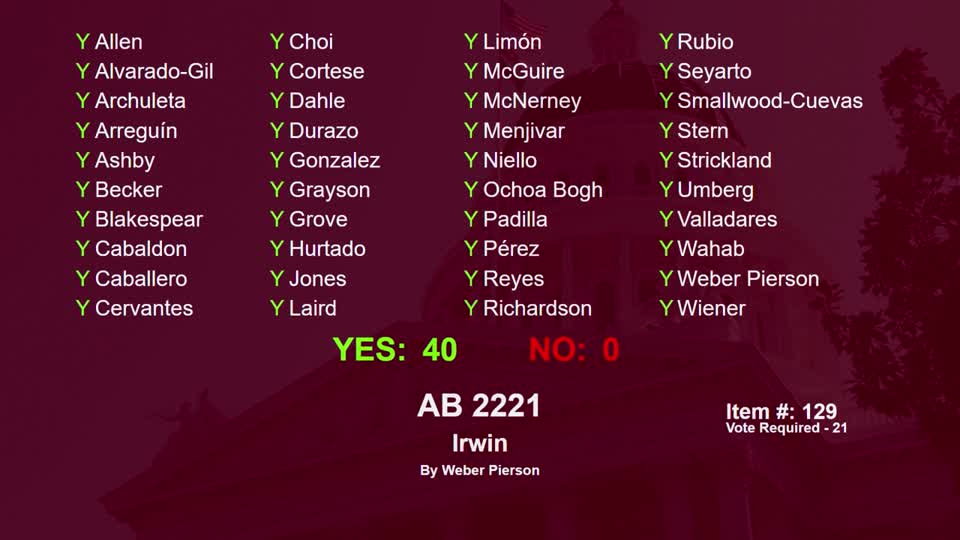 3MIN
Senate Floor
 31MIN
Senate Standing Committee on Health
 15MIN
Senate Standing Committee on Emergency Management
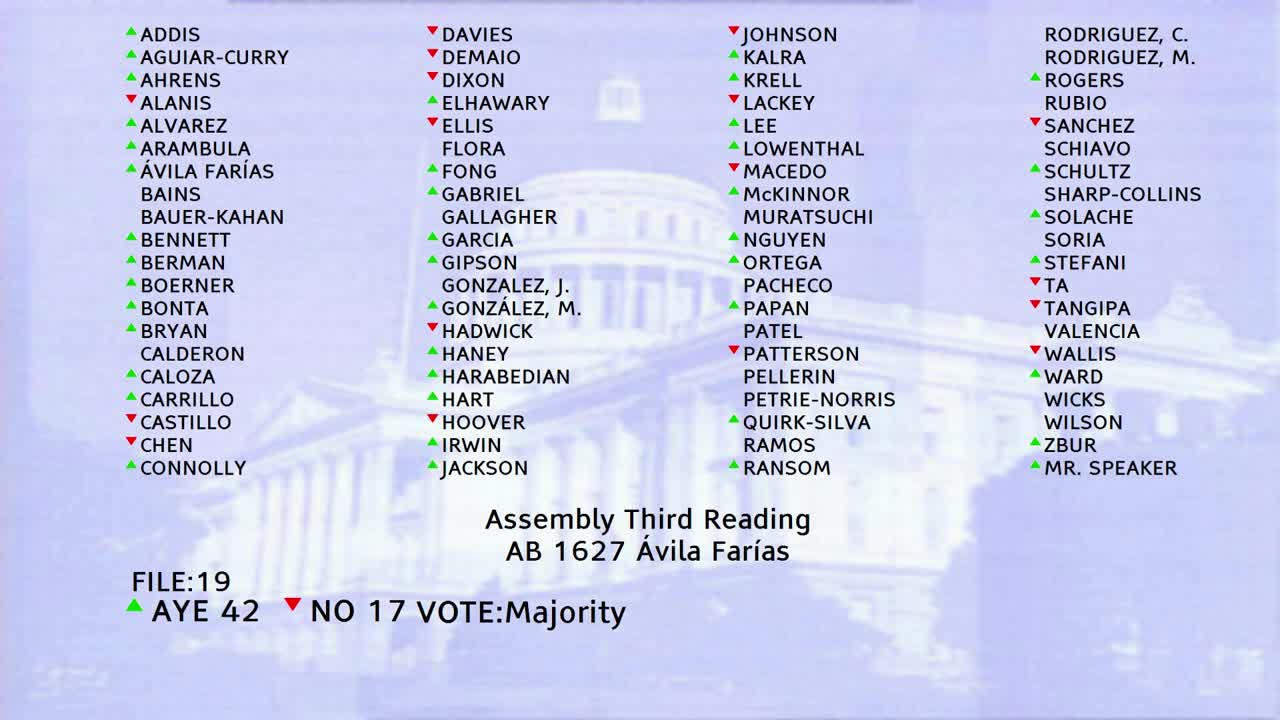 17MIN
Assembly Floor
 24MIN
Assembly Standing Committee on Communications and Conveyance
 25MIN
Assembly Standing Committee on Health
Bill Author
Bill Co-Author(s):