AB 1542: Sensitive personal information.
- Session Year: 2025-2026
- House: Assembly
- Latest Version Date: 2026-09-03
Current Status:
Failed
(2026-09-27: Vetoed by Governor.)
Introduced
In Committee
Awaiting First Chamber Vote
Passed First Chamber
In Committee
Awaiting Second Chamber Vote
Passed Second Chamber
Enacted
The California Consumer Privacy Act of 2018 (CCPA) grants a consumer various rights with respect to personal information, as defined, that is collected or sold by a business, as defined, including the right to direct a business that collects sensitive personal information, as defined, about the consumer to limit its use, as prescribed. The California Privacy Rights Act of 2020, approved by the voters as Proposition 24 at the November 3, 2020, statewide general election, amended, added to, and reenacted the CCPA.
This bill would, under the CCPA, prohibit a business, service provider, or contractor from selling or sharing sensitive personal information to a third party, except as specified.
This bill would declare that its provisions further the purposes and intent of the California Privacy Rights Act of 2020.
The California Consumer Privacy Act of 2018 (CCPA) grants a consumer various rights with respect to personal information, as defined, that is collected or sold by a business, as defined, including the right to direct a business that collects sensitive personal information, as defined, about the consumer to limit its use, as prescribed. The California Privacy Rights Act of 2020, approved by the voters as Proposition 24 at the November 3, 2020, statewide general election, amended, added to, and reenacted the CCPA.
This bill would, under the CCPA, prohibit a business, service provider, or contractor from selling or sharing sensitive personal information to a third party. party, as specified.
This bill would declare that its provisions further the purposes and intent of the California Privacy Rights Act of 2020.
The California Consumer Privacy Act of 2018 (CCPA) grants a consumer various rights with respect to personal information, as defined, that is collected or sold by a business, as defined, including the right to direct a business that collects sensitive personal information, as defined, about the consumer to limit its use, as prescribed. The California Privacy Rights Act of 2020, approved by the voters as Proposition 24 at the November 3, 2020, statewide general election, amended, added to, and reenacted the CCPA.
This bill would, under the CCPA, prohibit a business, service provider, or contractor from selling or sharing sensitive personal information to a third party.
This bill would declare that its provisions further the purposes and intent of the California Privacy Rights Act of 2020.
General Duties of Businesses that Collect Personal Information
(a)A business that controls the collection of a consumers personal information shall, at or before the point of collection, inform consumers of the following:
(1)The categories of personal information to be collected and the purposes for which the categories of personal information are collected or used and whether that information is sold or shared. A business shall not collect additional categories of personal information or use personal information collected for additional purposes that are incompatible with the disclosed purpose for which the personal information was collected without providing the consumer with notice consistent with this section.
(2)If the business collects sensitive personal information, the categories of sensitive personal information to be collected and the purposes for which the categories of sensitive personal information are collected or used. A business shall not collect additional categories of sensitive personal information or use sensitive personal information collected for additional purposes that are incompatible with the disclosed purpose for which the sensitive personal information was collected without providing the consumer with notice consistent with this section.
(3)The length of time the business intends to retain each category of personal information, including sensitive personal information, or if that is not possible, the criteria used to determine that period provided that a business shall not retain a consumers personal information or sensitive personal information for each disclosed purpose for which the personal information was collected for longer than is reasonably necessary for that disclosed purpose.
(b)A business that, acting as a third party, controls the collection of personal information about a consumer may satisfy its obligation under subdivision (a) by providing the required information prominently and conspicuously on the homepage of its internet website. In addition, if a business acting as a third party controls the collection of personal information about a consumer on its premises, including in a vehicle, then the business shall, at or before the point of collection, inform consumers as to the categories of personal information to be collected and the purposes for which the categories of personal information are used, and whether that personal information is sold, in a clear and conspicuous manner at the location.
(c)A business collection, use, retention, and sharing of a consumers personal information shall be reasonably necessary and proportionate to achieve the purposes for which the personal information was collected or processed, or for another disclosed purpose that is compatible with the context in which the personal information was collected, and not further processed in a manner that is incompatible with those purposes.
(d)A business that collects a consumers personal information and that sells that personal information to, or shares it with, a third party or that discloses it to a service provider or contractor for a business purpose shall enter into an agreement with the third party, service provider, or contractor, that:
(1)Specifies that the personal information is sold or disclosed by the business only for limited and specified purposes.
(2)Obligates the third party, service provider, or contractor to comply with applicable obligations under this title and obligate those persons to provide the same level of privacy protection as is required by this title.
(3)Grants the business rights to take reasonable and appropriate steps to help ensure that the third party, service provider, or contractor uses the personal information transferred in a manner consistent with the business obligations under this title.
(4)Requires the third party, service provider, or contractor to notify the business if it makes a determination that it can no longer meet its obligations under this title.
(5)Grants the business the right, upon notice, including under paragraph (4), to take reasonable and appropriate steps to stop and remediate unauthorized use of personal information.
(e)A business that collects a consumers personal information shall implement reasonable security procedures and practices appropriate to the nature of the personal information to protect the personal information from unauthorized or illegal access, destruction, use, modification, or disclosure in accordance with Section 1798.81.5.
(f)Nothing in this section shall require a business to disclose trade secrets, as specified in regulations adopted pursuant to paragraph (3) of subdivision (a) of Section 1798.185.
SEC. 2.Section 1798.121 of the Civil Code is amended to read:1798.121.Consumers Sensitive Personal Information
(a)A consumer shall have the right, at any time, to direct a business that collects sensitive personal information about the consumer to limit its use of the consumers sensitive personal information to that use that is necessary to perform the services or provide the goods reasonably expected by an average consumer who requests those goods or services, to perform the services set forth in paragraphs (2), (4), (5), and (8) of subdivision (e) of Section 1798.140, and as authorized by regulations adopted pursuant to subparagraph (C) of paragraph (18) of subdivision (a) of Section 1798.185. A business that uses or discloses a consumers sensitive personal information for purposes other than those specified in this subdivision shall provide notice to consumers, pursuant to subdivision (a) of Section 1798.135, that this information may be used, or disclosed to a service provider or contractor, for additional, specified purposes and that consumers have the right to limit the use or disclosure of their sensitive personal information.
(b)A business that has received direction from a consumer not to use or disclose the consumers sensitive personal information, except as authorized by subdivision (a), shall not, pursuant to paragraph (4) of subdivision (c) of Section 1798.135, use or disclose the consumers sensitive personal information for any other purpose after its receipt of the consumers direction unless the consumer subsequently provides consent for the use or disclosure of the consumers sensitive personal information for additional purposes.
(c)A service provider or contractor that assists a business in performing the purposes authorized by subdivision (a) shall not use the sensitive personal information after it has received instructions from the business and to the extent it has actual knowledge that the personal information is sensitive personal information for any other purpose. A service provider or contractor is only required to limit its use of sensitive personal information received pursuant to a written contract with the business in response to instructions from the business and only with respect to its relationship with that business.
(d)Sensitive personal information that is collected or processed without the purpose of inferring characteristics about a consumer is not subject to this section, as further defined in regulations adopted pursuant to subparagraph (C) of paragraph (18) of subdivision (a) of Section 1798.185, and shall be treated as personal information for purposes of all other sections of this act, including Section 1798.100.
(e)(1)Subject to subparagraph (A) of paragraph (2) of subdivision (ad) of Section 1798.140, subparagraph (A) of paragraph (2) of subdivision (ah) of Section 1798.140, and paragraph (2), a business, service provider, or contractor shall not sell or share sensitive personal information to a third party.
(2)A commercial credit reporting agency may sell a consumers social security number to the extent the commercial credit reporting agency uses that information solely to identify the relationship of a consumer to a business that the consumer owns.
SEC. 3.The Legislature finds and declares that this act furthers the purposes and intent of the California Privacy Rights Act of 2020.
General Duties of Businesses that Collect Personal Information
(a)A business that controls the collection of a consumers personal information shall, at or before the point of collection, inform consumers of the following:
(1)The categories of personal information to be collected and the purposes for which the categories of personal information are collected or used and whether that information is sold or shared. A business shall not collect additional categories of personal information or use personal information collected for additional purposes that are incompatible with the disclosed purpose for which the personal information was collected without providing the consumer with notice consistent with this section.
(2)If the business collects sensitive personal information, the categories of sensitive personal information to be collected and the purposes for which the categories of sensitive personal information are collected or used. A business shall not collect additional categories of sensitive personal information or use sensitive personal information collected for additional purposes that are incompatible with the disclosed purpose for which the sensitive personal information was collected without providing the consumer with notice consistent with this section.
(3)The length of time the business intends to retain each category of personal information, including sensitive personal information, or if that is not possible, the criteria used to determine that period provided that a business shall not retain a consumers personal information or sensitive personal information for each disclosed purpose for which the personal information was collected for longer than is reasonably necessary for that disclosed purpose.
(b)A business that, acting as a third party, controls the collection of personal information about a consumer may satisfy its obligation under subdivision (a) by providing the required information prominently and conspicuously on the homepage of its internet website. In addition, if a business acting as a third party controls the collection of personal information about a consumer on its premises, including in a vehicle, then the business shall, at or before the point of collection, inform consumers as to the categories of personal information to be collected and the purposes for which the categories of personal information are used, and whether that personal information is sold, in a clear and conspicuous manner at the location.
(c)A business collection, use, retention, and sharing of a consumers personal information shall be reasonably necessary and proportionate to achieve the purposes for which the personal information was collected or processed, or for another disclosed purpose that is compatible with the context in which the personal information was collected, and not further processed in a manner that is incompatible with those purposes.
(d)A business that collects a consumers personal information and that sells that personal information to, or shares it with, a third party or that discloses it to a service provider or contractor for a business purpose shall enter into an agreement with the third party, service provider, or contractor, that:
(1)Specifies that the personal information is sold or disclosed by the business only for limited and specified purposes.
(2)Obligates the third party, service provider, or contractor to comply with applicable obligations under this title and obligate those persons to provide the same level of privacy protection as is required by this title.
(3)Grants the business rights to take reasonable and appropriate steps to help ensure that the third party, service provider, or contractor uses the personal information transferred in a manner consistent with the business obligations under this title.
(4)Requires the third party, service provider, or contractor to notify the business if it makes a determination that it can no longer meet its obligations under this title.
(5)Grants the business the right, upon notice, including under paragraph (4), to take reasonable and appropriate steps to stop and remediate unauthorized use of personal information.
(e)A business that collects a consumers personal information shall implement reasonable security procedures and practices appropriate to the nature of the personal information to protect the personal information from unauthorized or illegal access, destruction, use, modification, or disclosure in accordance with Section 1798.81.5.
(f)Nothing in this section shall require a business to disclose trade secrets, as specified in regulations adopted pursuant to paragraph (3) of subdivision (a) of Section 1798.185.
SEC. 2.Section 1798.121 of the Civil Code is amended to read:1798.121.Consumers Sensitive Personal Information
(a)A consumer shall have the right, at any time, to direct a business that collects sensitive personal information about the consumer to limit its use of the consumers sensitive personal information to that use that is necessary to perform the services or provide the goods reasonably expected by an average consumer who requests those goods or services, to perform the services set forth in paragraphs (2), (4), (5), and (8) of subdivision (e) of Section 1798.140, and as authorized by regulations adopted pursuant to subparagraph (C) of paragraph (18) of subdivision (a) of Section 1798.185. A business that uses or discloses a consumers sensitive personal information for purposes other than those specified in this subdivision shall provide notice to consumers, pursuant to subdivision (a) of Section 1798.135, that this information may be used, or disclosed to a service provider or contractor, for additional, specified purposes and that consumers have the right to limit the use or disclosure of their sensitive personal information.
(b)A business that has received direction from a consumer not to use or disclose the consumers sensitive personal information, except as authorized by subdivision (a), shall not, pursuant to paragraph (4) of subdivision (c) of Section 1798.135, use or disclose the consumers sensitive personal information for any other purpose after its receipt of the consumers direction unless the consumer subsequently provides consent for the use or disclosure of the consumers sensitive personal information for additional purposes.
(c)A service provider or contractor that assists a business in performing the purposes authorized by subdivision (a) shall not use the sensitive personal information after it has received instructions from the business and to the extent it has actual knowledge that the personal information is sensitive personal information for any other purpose. A service provider or contractor is only required to limit its use of sensitive personal information received pursuant to a written contract with the business in response to instructions from the business and only with respect to its relationship with that business.
(d)Sensitive personal information that is collected or processed without the purpose of inferring characteristics about a consumer is not subject to this section, as further defined in regulations adopted pursuant to subparagraph (C) of paragraph (18) of subdivision (a) of Section 1798.185, and shall be treated as personal information for purposes of all other sections of this act, including Section 1798.100.
(e)(1)Subject to subparagraph (A) of paragraph (2) of subdivision (ad) of Section 1798.140 and 1798.140, subparagraph (B) (A) of paragraph (2) of subdivision (ah) of Section 1798.140, and paragraph (2), a business, service provider, or contractor shall not sell or share sensitive personal information to a third party.
(2)A commercial credit reporting agency may sell a consumers social security number to the extent the commercial credit reporting agency uses that information solely to identify the relationship of a consumer to a business that the consumer owns.
SEC. 3.The Legislature finds and declares that this act furthers the purposes and intent of the California Privacy Rights Act of 2020.
General Duties of Businesses that Collect Personal Information
(a)A business that controls the collection of a consumers personal information shall, at or before the point of collection, inform consumers of the following:
(1)The categories of personal information to be collected and the purposes for which the categories of personal information are collected or used and whether that information is sold or shared. A business shall not collect additional categories of personal information or use personal information collected for additional purposes that are incompatible with the disclosed purpose for which the personal information was collected without providing the consumer with notice consistent with this section.
(2)If the business collects sensitive personal information, the categories of sensitive personal information to be collected and the purposes for which the categories of sensitive personal information are collected or used. A business shall not collect additional categories of sensitive personal information or use sensitive personal information collected for additional purposes that are incompatible with the disclosed purpose for which the sensitive personal information was collected without providing the consumer with notice consistent with this section.
(3)The length of time the business intends to retain each category of personal information, including sensitive personal information, or if that is not possible, the criteria used to determine that period provided that a business shall not retain a consumers personal information or sensitive personal information for each disclosed purpose for which the personal information was collected for longer than is reasonably necessary for that disclosed purpose.
(b)A business that, acting as a third party, controls the collection of personal information about a consumer may satisfy its obligation under subdivision (a) by providing the required information prominently and conspicuously on the homepage of its internet website. In addition, if a business acting as a third party controls the collection of personal information about a consumer on its premises, including in a vehicle, then the business shall, at or before the point of collection, inform consumers as to the categories of personal information to be collected and the purposes for which the categories of personal information are used, and whether that personal information is sold, in a clear and conspicuous manner at the location.
(c)A business collection, use, retention, and sharing of a consumers personal information shall be reasonably necessary and proportionate to achieve the purposes for which the personal information was collected or processed, or for another disclosed purpose that is compatible with the context in which the personal information was collected, and not further processed in a manner that is incompatible with those purposes.
(d)A business that collects a consumers personal information and that sells that personal information to, or shares it with, a third party or that discloses it to a service provider or contractor for a business purpose shall enter into an agreement with the third party, service provider, or contractor, that:
(1)Specifies that the personal information is sold or disclosed by the business only for limited and specified purposes.
(2)Obligates the third party, service provider, or contractor to comply with applicable obligations under this title and obligate those persons to provide the same level of privacy protection as is required by this title.
(3)Grants the business rights to take reasonable and appropriate steps to help ensure that the third party, service provider, or contractor uses the personal information transferred in a manner consistent with the business obligations under this title.
(4)Requires the third party, service provider, or contractor to notify the business if it makes a determination that it can no longer meet its obligations under this title.
(5)Grants the business the right, upon notice, including under paragraph (4), to take reasonable and appropriate steps to stop and remediate unauthorized use of personal information.
(e)A business that collects a consumers personal information shall implement reasonable security procedures and practices appropriate to the nature of the personal information to protect the personal information from unauthorized or illegal access, destruction, use, modification, or disclosure in accordance with Section 1798.81.5.
(f)Nothing in this section shall require a business to disclose trade secrets, as specified in regulations adopted pursuant to paragraph (3) of subdivision (a) of Section 1798.185.
SEC. 2.Section 1798.121 of the Civil Code is amended to read:1798.121.Consumers Sensitive Personal Information
(a)A consumer shall have the right, at any time, to direct a business that collects sensitive personal information about the consumer to limit its use of the consumers sensitive personal information to that use that is necessary to perform the services or provide the goods reasonably expected by an average consumer who requests those goods or services, to perform the services set forth in paragraphs (2), (4), (5), and (8) of subdivision (e) of Section 1798.140, and as authorized by regulations adopted pursuant to subparagraph (C) of paragraph (18) of subdivision (a) of Section 1798.185. A business that uses or discloses a consumers sensitive personal information for purposes other than those specified in this subdivision shall provide notice to consumers, pursuant to subdivision (a) of Section 1798.135, that this information may be used, or disclosed to a service provider or contractor, for additional, specified purposes and that consumers have the right to limit the use or disclosure of their sensitive personal information.
(b)A business that has received direction from a consumer not to use or disclose the consumers sensitive personal information, except as authorized by subdivision (a), shall not, pursuant to paragraph (4) of subdivision (c) of Section 1798.135, use or disclose the consumers sensitive personal information for any other purpose after its receipt of the consumers direction unless the consumer subsequently provides consent for the use or disclosure of the consumers sensitive personal information for additional purposes.
(c)A service provider or contractor that assists a business in performing the purposes authorized by subdivision (a) shall not use the sensitive personal information after it has received instructions from the business and to the extent it has actual knowledge that the personal information is sensitive personal information for any other purpose. A service provider or contractor is only required to limit its use of sensitive personal information received pursuant to a written contract with the business in response to instructions from the business and only with respect to its relationship with that business.
(d)Sensitive personal information that is collected or processed without the purpose of inferring characteristics about a consumer is not subject to this section, as further defined in regulations adopted pursuant to subparagraph (C) of paragraph (18) of subdivision (a) of Section 1798.185, and shall be treated as personal information for purposes of all other sections of this act, including Section 1798.100.
(e)A Subject to subparagraph (A) of paragraph (2) of subdivision (ad) of Section 1798.140 and subparagraph (B) of paragraph (2) of subdivision (ah) of Section 1798.140, a business, service provider, or contractor shall not sell or share sensitive personal information to a third party.
SEC. 3.The Legislature finds and declares that this act furthers the purposes and intent of the California Privacy Rights Act of 2020.
General Duties of Businesses that Collect Personal Information
(a)A business that controls the collection of a consumers personal information shall, at or before the point of collection, inform consumers of the following:
(1)The categories of personal information to be collected and the purposes for which the categories of personal information are collected or used and whether that information is sold or shared. A business shall not collect additional categories of personal information or use personal information collected for additional purposes that are incompatible with the disclosed purpose for which the personal information was collected without providing the consumer with notice consistent with this section.
(2)If the business collects sensitive personal information, the categories of sensitive personal information to be collected and the purposes for which the categories of sensitive personal information are collected or used, and whether that information is sold or shared. used. A business shall not collect additional categories of sensitive personal information or use sensitive personal information collected for additional purposes that are incompatible with the disclosed purpose for which the sensitive personal information was collected without providing the consumer with notice consistent with this section.
(3)The length of time the business intends to retain each category of personal information, including sensitive personal information, or if that is not possible, the criteria used to determine that period provided that a business shall not retain a consumers personal information or sensitive personal information for each disclosed purpose for which the personal information was collected for longer than is reasonably necessary for that disclosed purpose.
(b)A business that, acting as a third party, controls the collection of personal information about a consumer may satisfy its obligation under subdivision (a) by providing the required information prominently and conspicuously on the homepage of its internet website. In addition, if a business acting as a third party controls the collection of personal information about a consumer on its premises, including in a vehicle, then the business shall, at or before the point of collection, inform consumers as to the categories of personal information to be collected and the purposes for which the categories of personal information are used, and whether that personal information is sold, in a clear and conspicuous manner at the location.
(c)A business collection, use, retention, and sharing of a consumers personal information shall be reasonably necessary and proportionate to achieve the purposes for which the personal information was collected or processed, or for another disclosed purpose that is compatible with the context in which the personal information was collected, and not further processed in a manner that is incompatible with those purposes.
(d)A business that collects a consumers personal information and that sells that personal information to, or shares it with, a third party or that discloses it to a service provider or contractor for a business purpose shall enter into an agreement with the third party, service provider, or contractor, that:
(1)Specifies that the personal information is sold or disclosed by the business only for limited and specified purposes.
(2)Obligates the third party, service provider, or contractor to comply with applicable obligations under this title and obligate those persons to provide the same level of privacy protection as is required by this title.
(3)Grants the business rights to take reasonable and appropriate steps to help ensure that the third party, service provider, or contractor uses the personal information transferred in a manner consistent with the business obligations under this title.
(4)Requires the third party, service provider, or contractor to notify the business if it makes a determination that it can no longer meet its obligations under this title.
(5)Grants the business the right, upon notice, including under paragraph (4), to take reasonable and appropriate steps to stop and remediate unauthorized use of personal information.
(e)A business that collects a consumers personal information shall implement reasonable security procedures and practices appropriate to the nature of the personal information to protect the personal information from unauthorized or illegal access, destruction, use, modification, or disclosure in accordance with Section 1798.81.5.
(f)Nothing in this section shall require a business to disclose trade secrets, as specified in regulations adopted pursuant to paragraph (3) of subdivision (a) of Section 1798.185.
SEC. 2.Section 1798.121 of the Civil Code is amended to read:1798.121.Consumers Right to Limit Use and Disclosure of Sensitive Personal Information
(a)A consumer shall have the right, at any time, to direct a business that collects sensitive personal information about the consumer to limit its use of the consumers sensitive personal information to that use which that is necessary to perform the services or provide the goods reasonably expected by an average consumer who requests those goods or services, to perform the services set forth in paragraphs (2), (4), (5), and (8) of subdivision (e) of Section 1798.140, and as authorized by regulations adopted pursuant to subparagraph (C) of paragraph (18) of subdivision (a) of Section 1798.185. A business that uses or discloses a consumers sensitive personal information for purposes other than those specified in this subdivision shall provide notice to consumers, pursuant to subdivision (a) of Section 1798.135, that this information may be used, or disclosed to a service provider or contractor, for additional, specified purposes and that consumers have the right to limit the use or disclosure of their sensitive personal information.
(b)A business that has received direction from a consumer not to use or disclose the consumers sensitive personal information, except as authorized by subdivision (a), shall be prohibited, not, pursuant to paragraph (4) of subdivision (c) of Section 1798.135, from using or disclosing use or disclose the consumers sensitive personal information for any other purpose after its receipt of the consumers direction unless the consumer subsequently provides consent for the use or disclosure of the consumers sensitive personal information for additional purposes.
(c)A service provider or contractor that assists a business in performing the purposes authorized by subdivision (a) may shall not use the sensitive personal information after it has received instructions from the business and to the extent it has actual knowledge that the personal information is sensitive personal information for any other purpose. A service provider or contractor is only required to limit its use of sensitive personal information received pursuant to a written contract with the business in response to instructions from the business and only with respect to its relationship with that business.
(d)Sensitive personal information that is collected or processed without the purpose of inferring characteristics about a consumer is not subject to this section, as further defined in regulations adopted pursuant to subparagraph (C) of paragraph (18) of subdivision (a) of Section 1798.185, and shall be treated as personal information for purposes of all other sections of this act, including Section 1798.100.
(e)A business, service provider, or contractor shall not sell or share sensitive personal information to a third party.
SEC. 3.The Legislature finds and declares that this act furthers the purposes and intent of the California Privacy Rights Act of 2020.
|
Date
|
Status
|
|---|---|
| Sep 27, 2026 | Vetoed by Governor. |
| Sep 9, 2026 | Enrolled and presented to the Governor at 1 p.m. |
| Aug 30, 2026 | Senate amendments concurred in. To Engrossing and Enrolling. (Ayes 44. Noes 19. Page 6852.). |
| Aug 30, 2026 | Senate amendments concurred in. To Engrossing and Enrolling. (Ayes 44. Noes 19.). |
| Aug 30, 2026 | Senate amendments concurred in. To Engrossing and Enrolling. |
| Aug 28, 2026 | In Assembly. Concurrence in Senate amendments pending. |
| Aug 28, 2026 | Read third time. Passed. Ordered to the Assembly. (Ayes 31. Noes 4. Page 6085.). |
| Aug 28, 2026 | Read third time. Passed. Ordered to the Assembly. (Ayes 31. Noes 4.). |
| Aug 24, 2026 | Read second time. Ordered to third reading. |
| Aug 21, 2026 | Read third time and amended. Ordered to second reading. |
| Aug 13, 2026 | Read second time. Ordered to third reading. |
| Aug 13, 2026 | From committee: Do pass. (Ayes 5. Noes 2.) (August 13). |
| Aug 3, 2026 | In committee: Referred to APPR. suspense file. |
| Jun 25, 2026 | Read second time and amended. Re-referred to Com. on APPR. |
| Jun 24, 2026 | From committee: Amend, and do pass as amended and re-refer to Com. on APPR. (Ayes 7. Noes 2.) (June 22). |
| Jun 10, 2026 | Referred to Com. on P., D.T., & C.P. |
| May 28, 2026 | In Senate. Read first time. To Com. on RLS. for assignment. |
| May 27, 2026 | Read third time. Passed. Ordered to the Senate. (Ayes 42. Noes 19. Page 5444.) |
| May 27, 2026 | Read third time. Passed. Ordered to the Senate. (Ayes 42. Noes 19.) |
| May 27, 2026 | Read third time. Passed. Ordered to the Senate. |
| May 18, 2026 | Read second time. Ordered to third reading. |
| May 14, 2026 | From committee: Do pass. (Ayes 11. Noes 4.) (May 14). |
| May 6, 2026 | In committee: Set, first hearing. Referred to APPR. suspense file. |
| Apr 20, 2026 | From committee: Do pass and re-refer to Com. on APPR. (Ayes 9. Noes 5.) (April 16). Re-referred to Com. on APPR. |
| Feb 2, 2026 | Referred to Com. on P. & C.P. |
| Jan 6, 2026 | From printer. May be heard in committee February 5. |
| Jan 5, 2026 | Read first time. To print. |
|
Date
|
Description
|
Location
|
Votes
|
|
|---|---|---|---|---|
| Aug 30, 2026 | AB 1542 Ward Concurrence in Senate Amendments | Assembly Floor |
Passed |
|
| Aug 28, 2026 | Assembly 3rd Reading AB1542 Ward By McNerney | Senate Floor |
Passed |
|
| Aug 13, 2026 | Do pass | Senate Standing Committee on Appropriations |
Passed |
|
| Aug 3, 2026 | Placed on suspense file | Senate Standing Committee on Appropriations |
Passed |
|
| Jun 22, 2026 | Do pass as amended, but first amend, and re-refer to the Committee on [Appropriations] | Senate Standing Committee on Privacy, Digital Technologies, and Consumer Protection |
Passed |
|
| May 27, 2026 | AB 1542 Ward Assembly Third Reading | Assembly Floor |
Passed |
|
| May 14, 2026 | Do pass. | Assembly Standing Committee on Appropriations |
Passed |
|
| Apr 16, 2026 | Do pass and be re-referred to the Committee on [Appropriations] | Assembly Standing Committee on Privacy and Consumer Protection |
Passed |
This list shows positions taken on this bill by organizations on the date displayed, which is linked to the original source.
Positions by individuals are not included.
|
Organization
|
Position
|
Date
|
|---|---|---|
| AAPIs for Civic Empowerment | ** Support | |
| Abine, Inc. dba Deleteme | ** Support | |
| Alliance Of Californians For Community Empowerment | ** Support | |
| American Advertising Federation (AAF) | ** Against | |
| American Association of Advertising Agencies (4A's) | ** Against | |
| American Property Casualty Insurance Association | ** Against | |
| Asian Americans Advancing Justice Southern California | ** Support | |
| Asian Americans Advancing Justice Southern California (Co-Sponsor) | ** Support | |
| Association of National Advertisers | ** Against | |
| ATA Action | ** Against | |
| A Voice for Choice Advocacy | ** Support | |
| California Asian Pacific Chamber Of Commerce | ** Against | |
| California Chamber Of Commerce | ** Against | |
| California Coalition For Worker Power | ** Support | |
| California Domestic Workers Coalition | ** Support | |
| California Federation of Labor Unions | ** Support | |
| California Health Coalition Advocacy | ** Support | |
| California Immigrant Policy Center | ** Support | |
| California Initiative for Technology and Democracy | ** Support | |
| California Initiative for Technology and Democracy (CITED) | ** Support | |
| California Initiative for Technology & Democracy, a Project of California Common CAUSE (Co-Sponsor) | ** Support | |
| California National Organization For Women | ** Support | |
| California Privacy Protection Agency | ** Support | |
| California Retailers Association | ** Against | |
| California's Credit Unions | ** Against | |
| California Work & Family Coalition | ** Support | |
| CALPIRG | ** Support | |
| Center for AI and Digital Policy | ** Support | |
| CFT – a Union of Educators & Classified Professionals, AFT, AFL-CIO | ** Support | |
| Chinese Progressive Association | ** Support | |
| Civil Justice Association Of California | ** Against | |
| Coalition for Humane Immigrant Rights | ** Support | |
| Computer & Communications Industry Association | ** Against | |
| Consumer Attorneys Of California | ** Support | |
| Consumer Reports | ** Support | |
| Courage California | ** Support | |
| Digital Advertising Alliance | ** Against | |
| Electronic Frontier Foundation | ** Support | |
| Electronic Privacy Information Center | ** Support | |
| Electronic Privacy Information Center (EPIC) | ** Support | |
| End Child Poverty CA | ** Support | |
| Equality California | ** Support | |
| Equal Rights Advocates | ** Support | |
| Greenlining Institute | ** Support | |
| Indivisible Ca Statestrong | ** Support | |
| Inmarket Media, LLC | ** Against | |
| Insights Association | ** Against | |
| Internet.Works | ** Against | |
| Jewish California | ** Support | |
| Kapor Center Advocacy | ** Support | |
| LGBT Tech | ** Support | |
| NetChoice | ** Against | |
| Network Advertising Initiative | ** Against | |
| NextGen California | ** Support | |
| Oakland Privacy | ** Support | |
| Para Los Ninos | ** Support | |
| Parent Voices California | ** Support | |
| pilipino workers center | ** Support | |
| Privacy Defense Alliance | ** Support | |
| Privacy Rights Clearinghouse | ** Support | |
| PwC | ** Support | |
| Reproductive Freedom for All | ** Support | |
| Secure Justice | ** Support | |
| SEIU California | ** Support | |
| Software Information Industry Association | ** Against | |
| Southeast Asia Resource Action Center | ** Support | |
| Southeast Asia Resource Action Center (SEARAC) | ** Support | |
| Techequity Action | ** Support | |
| Technet | ** Against | |
| Tech Oversight California | ** Support | |
| Ultraviolet Action | ** Support | |
| Warehouse Worker Resource Center | ** Support | |
| western center on law & poverty | ** Support | |
| Women'S Foundation California | ** Support |
GOVERNOR′S VETO
GV Bill Id:AB 1542
Author:(Ward)
As Enrolled Ver:September 3, 2026
2/3 vote
SUMMARY
This bill prohibits businesses that are subject to the California Consumer Privacy Act (CCPA) from selling or sharing a consumer′s sensitive personal information.
Governor′s Veto Message
This bill prohibits businesses that are subject to the California Consumer Privacy Act (CCPA) from selling or sharing a consumer′s sensitive personal information.
While I support the author′s goal of protecting the sensitive personal information of Californians, a categorical ban on sharing that information is a step too far. Under state law, companies are required to provide California consumers with the option to limit the sharing of such information, and I worry there may be unintended consequences if consumers are removed entirely from the decision process.
Further, because this bill would apply to businesses broadly, its implementation and enforcement would result in significant costs not included in the 2026 Budget Act. In partnership with the Legislature this year, my administration has enacted a balanced budget that recognizes the challenging fiscal landscape our state faces while maintaining our commitment to working families and our most vulnerable communities. With significant fiscal pressures and the federal government′s hostile economic policies, it is vital that we remain disciplined when considering bills with significant fiscal implications that are not included in the budget, such as this measure.
COMMENTS
Americans leave a trail of personal data with almost every action they take either in the physical world or online, including every website visited, credit card payment, and browser search. For almost two decades, experts have been warning about the erosion of our private lives. They note that this erosion is happening one small bit at a time, likely without people even noticing. With the advent of the internet and advances in technology, it is no longer easy for people to decide which aspects of their lives should be publicly disclosed.
Surveillance capitalism brings with it a myriad of potential harms. It creates dossiers that can easily reveal a person′s reproductive health needs and choices, a person′s gender and whether they are seeking gender affirming care, and a person′s country of origin and immigration status. In the current political environment, these dossiers can easily cause someone to be imprisoned or killed. This bill intends to limit the circulation of some of the most intimate and sensitive information.
In 2020, California voters passed Proposition 24, the California Privacy Rights Act (CPRA), which amended the California Consumer Privacy Act (CCPA) to provide additional privacy rights for consumers and create a new agency charged with enforcing the CCPA. A significant difference between the CCPA and the CPRA was the concept that some personal information was more sensitive than other personal information and was therefore deserving of additional protection. The list of sensitive information includes precise geolocation, ethnicity, immigration status, and the contents of emails and messages, among others.
While sensitive information was determined by the proponents of the proposition to be important enough to be distinguished from other personal information, the proposition did not include robust additional protections. Consumers are still required to opt out of the selling and sharing of their sensitive information, just as they do for all personal information. The primary distinction between the protection for all personal information and for sensitive information is that consumers can limit a business′s use of sensitive personal information.
According to the Author
With the rapid growth of the data broker industry, tech companies are quietly harvesting and selling detailed information about where people go—from protests and political gatherings to reproductive health clinics, places of worship, and shelters. Recent reports have revealed that federal agencies, including ICE, have purchased this data to conduct surveillance and detain individuals—sidestepping legal safeguards and public accountability.
Californians should not have to worry that their sensitive personal information is being sold to the highest bidder. From precise location data to deeply personal information, AB 1542 draws a clear line—it puts the safety and privacy of everyday Californians first.>
Arguments in Support
The California Privacy Protection Agency writes:
Sensitive personal information can reveal deeply personal insights about individuals and therefore deserves heightened protections. The sale and use of information related to health conditions, race, or immigration status, for example, can lead to discrimination and harassment. Similarly, disclosures of personal identifiers and financial data can cause identity theft and fraud.
These risks are magnified by data brokers that collect, aggregate, and sell highly sensitive data — including health records, financial information, location data, and citizenship data — with minimal oversight or consumer consent. A recent enforcement action by CalPrivacy against a Texas data broker demonstrated how the company sold the names, addresses, phone numbers, and email addresses of millions of people with Alzheimer′s disease and other health conditions. The same company bought and sold lists of people based on their age, perceived race (including ″Hispanic lists″), and political views. This information can be dangerous when placed in the wrong hands.
Limiting both the sale and sharing of sensitive personal information would provide protection against the significant risks of fraud, discrimination, and extortion. Such a prohibition would ensure that everyone′s most personal and sensitive information is automatically protected from widespread circulation, minimizing downstream risks that could arise from sharing, such as risk of data breach and misuse.
Increased protections would also enable California to keep pace with other states. In recent discussions related to federal privacy legislation, California′s protections for sensitive data have been characterized as ″narrow″ in comparison to the opt-in framework used by many other states and some states, like Maryland and New Jersey, already prohibit the sale of sensitive personal information.
California Initiative for Technology and Democracy (CITED), co-sponsors of the bill, write in support:
Privacy is the backbone of a democratic society, enabling people to gather, voice their opinions, and perform lawful action without fear of surveillance or retribution. The state recognized this essential and inalienable right in 1972 when the voters of California inscribed privacy into our State′s Constitution, with the encouragement of the Legislature. In arguing for the proposed constitutional amendment, proponents stated:
″Computerization of records makes it possible to create ′cradle-to-grave′ profiles on every American […] The right of privacy is the right to be left alone. […] It prevents government and business interests from collecting and stockpiling unnecessary information about us and from misusing information gathered for one purpose in order to serve other purposes or to embarrass us.″
The collection of mass amounts of information is not solely a practice of the private sector. Local, state, and federal governments can easily access this information through data brokers and begin to build personal dossiers on individuals, circumventing our Fourth Amendment rights. At a moment when California faces challenges from a punitive federal administration, it is of the utmost importance that our state protect our communities. It has already been well established that data brokers can identify individuals who engage in civil action, such as those who attend protests, raising concerns about how one can move or act freely when the federal government seeks to limit such activities. California cannot allow its data infrastructure to become a tool of federal overreach. AB 1542 is a necessary step toward ensuring that the sensitive personal information of our residents cannot be weaponized against the very communities our state has pledged to protect.
AB 1542 would ban the selling and sharing of sensitive personal information. Sensitive personal information as defined in the California Consumer Privacy Act (CCPA) includes a consumer′s government identifier (Social Security, driver′s license, passport numbers); financial account credentials; precise geolocation; racial or ethnic origin, citizenship or immigration status, religious beliefs, or union membership; the contents of private communications; and genetic, neural, and biometric data. It also includes personal information concerning a consumer′s health, sex life, or sexual orientation.
Currently, the CCPA gives consumers the right to opt out of or limit the use and disclosure of their sensitive personal information. While this is a well-meaning measure, it fails to provide sufficient protection. A 2023 Consumer Reports study found that among 709 participants, each person′s data had been shared by an average of 2,230 companies, with some by over 7,000.4 California′s Delete Act is a meaningful step forward, but it is simply not realistic to expect consumers to track where their information is being collected and shared, let alone control that flow. A true prohibition on the selling and sharing of sensitive personal information is the only way to ensure that protection does not depend on a consumer′s awareness, resources, or ability to navigate an overwhelming and opaque data marketplace.>
Arguments in Opposition
In opposition to the bill, the California Chamber of Commerce along with others in a business coalition argues:
The California Chamber of Commerce and the undersigned respectfully OPPOSE AB 1542 (Ward) as introduced January 5, 2026, because it bans the selling and sharing of sensitive personal information by certain businesses and fails to recognize any legitimate purposes for which an entity covered under the California Consumer Privacy Act (CCPA) should be permitted to disclose sensitive personal information (SPI), even with the consumer′s permission. This could result in a host of unintended consequences, including ones that have serious safety implications, such as prohibiting a business from transmitting precise geolocation data in the event of a car crash, even if a customer would have allowed them to do so if asked. In particular, such a categorical prohibition risks sweeping in routine and lawful data‑sharing practices that underpin modern internet operations, including cloud storage, basic website functionality, security and fraud‑prevention activities, and processing under data‑processing agreements. In doing so, the bill could not only make it more difficult to prevent fraud, but it could also interfere with the ability of businesses to complete transactions.
And because of the range of data included under SPI, AB 1542 can also significantly impede the ability of California businesses in arguably ″sensitive″ sectors to advertise and reach consumers online—the impact of which would be particularly damaging for small and medium businesses, which generally do not have large ad budgets and rely on cost-effective targeted online advertising. For consumers, this means that they would not see as relevant or helpful ads, losing access to the goods and services that they are most likely to find useful or beneficial, including those that they might not otherwise become aware of on their own. Community groups and organizations focused on health and social issues, and political organizations who purchase data from covered businesses may also see a decrease in effectiveness of ads – ultimately interfering with the ability of Californians to connect to the resources they need and political parties from connecting with their voter base.>
FISCAL COMMENTS
According to the Assembly and the Senate Appropriations Committees:
- Enforcement costs of $536,000 in FY 2026-27 and $520,000 ongoing to the California Privacy Protection Agency (CalPrivacy). CalPrivacy estimates that the enforcement division will require one attorney position and one information technology specialist position to investigate and enforce the prohibition on selling and sharing sensitive personal information. Although CalPrivacy currently investigates the data sharing practices of businesses, this prohibition will likely lead to a larger universe of potential targets and an increased need for analysis about data flows. (General Fund)
- Costs to the Department of Justice (DOJ), which shares enforcement authority with CalPrivacy, potentially of a similar amount. Actual costs will depend on the extent to which the Public Rights Division pursues enforcement actions. If DOJ hires staff to handle enforcement actions, DOJ would incur significant workload costs, likely in the low hundreds of thousands of dollars annually. If DOJ does not pursue enforcement as authorized by this bill, it would likely not incur any costs.
- Cost pressure of an unknown but potentially significant amount to the courts to adjudicate any additional filings. While the courts are not funded on a workload basis, an increase in workload could result in delayed court services and would put pressure on the General Fund to fund additional staff and resources. The FY 2026-27 Budget appropriated $70 million General Fund for this purpose. (Trial Court Trust Fund, General Fund)
VOTES
ASM PRIVACY AND CONSUMER PROTECTION: 9-5-1
YES: Bauer-Kahan, Aguiar-Curry, Bryan, Lowenthal, McKinnor, Ortega, Ward, Wicks, Wilson
NO: Macedo, DeMaio, Hoover, Irwin, Patterson
ABS, ABST OR NV: Petrie-Norris
ASM APPROPRIATIONS: 11-4-0
YES: Wicks, Aguiar-Curry, Calderon, Caloza, Fong, Mark González, Krell, Pacheco, Pellerin, Sharp-Collins, Solache
NO: Hoover, Dixon, Ta, Tangipa
ASSEMBLY FLOOR: 42-19-18
YES: Addis, Aguiar-Curry, Ahrens, Alvarez, Arambula, Bains, Bauer-Kahan, Bennett, Berman, Boerner, Bonta, Bryan, Calderon, Caloza, Connolly, Elhawary, Fong, Gabriel, Garcia, Mark González, Haney, Hart, Jackson, Kalra, Lee, Lowenthal, Muratsuchi, Ortega, Patel, Pellerin, Quirk-Silva, Ransom, Rogers, Schiavo, Schultz, Sharp-Collins, Soria, Stefani, Ward, Wicks, Zbur, Rivas
NO: Ávila Farías, Castillo, Chen, Davies, DeMaio, Dixon, Ellis, Flora, Gallagher, Jeff Gonzalez, Hadwick, Hoover, Johnson, Lackey, Macedo, Patterson, Sanchez, Ta, Tangipa
ABS, ABST OR NV: Alanis, Carrillo, Gipson, Harabedian, Irwin, Krell, McKinnor, Nguyen, Pacheco, Papan, Petrie-Norris, Ramos, Celeste Rodriguez, Michelle Rodriguez, Blanca Rubio, Solache, Valencia, Wallis, Wilson
SENATE FLOOR: 31-4-5
YES: Allen, Alvarado-Gil, Archuleta, Arreguín, Ashby, Becker, Blakespear, Cabaldon, Caballero, Cervantes, Cortese, Durazo, Gonzalez, Grayson, Hurtado, Laird, Limón, McGuire, McNerney, Menjivar, Padilla, Pérez, Reyes, Richardson, Rubio, Smallwood-Cuevas, Stern, Umberg, Wahab, Weber Pierson, Wiener
NO: Niello, Ochoa Bogh, Seyarto, Valladares
ABS, ABST OR NV: Choi, Dahle, Grove, Jones, Strickland
ASSEMBLY FLOOR: 44-19-16
YES: Addis, Aguiar-Curry, Ahrens, Alvarez, Arambula, Bauer-Kahan, Bennett, Berman, Boerner, Bonta, Bryan, Caloza, Connolly, Elhawary, Fong, Gabriel, Garcia, Mark González, Haney, Harabedian, Hart, Jackson, Kalra, Lee, Lowenthal, McKinnor, Muratsuchi, Ortega, Patel, Pellerin, Quirk-Silva, Ransom, Celeste Rodriguez, Rogers, Schiavo, Schultz, Sharp-Collins, Soria, Stefani, Ward, Wicks, Wilson, Zbur, Rivas
NO: Ávila Farías, Castillo, Chen, Davies, DeMaio, Dixon, Ellis, Flora, Jeff Gonzalez, Hadwick, Hoover, Irwin, Johnson, Lackey, Macedo, Patterson, Sanchez, Ta, Tangipa
ABS, ABST OR NV: Alanis, Bains, Calderon, Carrillo, Gipson, Krell, Nguyen, Pacheco, Papan, Petrie-Norris, Ramos, Michelle Rodriguez, Blanca Rubio, Solache, Valencia, Wallis
UPDATED
VERSION: September 3, 2026
CONSULTANT: Julie Salley / P. & C.P. / (916) 319-2200 FN: 0004659
CONCURRENCE IN SENATE AMENDMENTS
CSA1 Bill Id:AB 1542
Author:(Ward)
As Amended Ver:August 21, 2026
Majority vote
SUMMARY
This bill prohibits businesses that are subject to the California Consumer Privacy Act (CCPA) from selling or sharing a consumer's sensitive personal information.
Senate Amendments
Allow a commercial credit reporting agency to sell a consumer's social security number to the extent the commercial credit reporting agency uses that information solely to identify the relationship of a consumer to a business that the consumer owns.
COMMENTS
Americans leave a trail of personal data with almost every action they take either in the physical world or online, including every website visited, credit card payment, and browser search. For almost two decades, experts have been warning about the erosion of our private lives. They note that this erosion is happening one small bit at a time, likely without people even noticing. With the advent of the internet and advances in technology, it is no longer easy for people to decide which aspects of their lives should be publicly disclosed.
Surveillance capitalism brings with it a myriad of potential harms. It creates dossiers that can easily reveal a person's reproductive health needs and choices, a person's gender and whether they are seeking gender affirming care, and a person's country of origin and immigration status. In the current political environment, these dossiers can easily cause someone to be imprisoned or killed. This bill intends to limit the circulation of some of the most intimate and sensitive information.
In 2020, California voters passed Proposition 24, the California Privacy Rights Act (CPRA), which amended the California Consumer Privacy Act (CCPA) to provide additional privacy rights for consumers and create a new agency charged with enforcing the CCPA. A significant difference between the CCPA and the CPRA was the concept that some personal information was more sensitive than other personal information and was therefore deserving of additional protection. The list of sensitive information includes precise geolocation, ethnicity, immigration status, and the contents of emails and messages, among others.
While sensitive information was determined by the proponents of the proposition to be important enough to be distinguished from other personal information, the proposition did not include robust additional protection. Consumers are still required to opt out of the selling and sharing of their sensitive information, just as they do for all personal information. The primary distinction between the protection of all personal information and for sensitive information is that consumers can limit a business's use of sensitive personal information.
The bill further amends the CCPA to ban the sale and sharing of sensitive personal information, including but not limited to a consumer's social security number, financial account information, precise geo-location, racial or ethnic origin, religious or philosophical beliefs, union membership, genetic data, biometric information, health information, sexual orientation or citizenship and immigration status.
According to the Author
With the rapid growth of the data broker industry, tech companies are quietly harvesting and selling detailed information about where people go—from protests and political gatherings to reproductive health clinics, places of worship, and shelters. Recent reports have revealed that federal agencies, including ICE, have purchased this data to conduct surveillance and detain individuals—sidestepping legal safeguards and public accountability.
Californians should not have to worry that their sensitive personal information is being sold to the highest bidder. From precise location data to deeply personal information, AB 1542 draws a clear line—it puts the safety and privacy of everyday Californians first.
Arguments in Support
The California Privacy Protection Agency writes:
Sensitive personal information can reveal deeply personal insights about individuals and therefore deserves heightened protections. The sale and use of information related to health conditions, race, or immigration status, for example, can lead to discrimination and harassment. Similarly, disclosures of personal identifiers and financial data can cause identity theft and fraud.
These risks are magnified by data brokers that collect, aggregate, and sell highly sensitive data — including health records, financial information, location data, and citizenship data — with minimal oversight or consumer consent. A recent enforcement action by CalPrivacy against a Texas data broker demonstrated how the company sold the names, addresses, phone numbers, and email addresses of millions of people with Alzheimer's disease and other health conditions. The same company bought and sold lists of people based on their age, perceived race (including "Hispanic lists"), and political views. This information can be dangerous when placed in the wrong hands.
Limiting both the sale and sharing of sensitive personal information would provide protection against the significant risks of fraud, discrimination, and extortion. Such a prohibition would ensure that everyone's most personal and sensitive information is automatically protected from widespread circulation, minimizing downstream risks that could arise from sharing, such as risk of data breach and misuse.
Increased protections would also enable California to keep pace with other states. In recent discussions related to federal privacy legislation, California's protections for sensitive data have been characterized as "narrow" in comparison to the opt-in framework used by many other states and some states, like Maryland and New Jersey, already prohibit the sale of sensitive personal information.
California Initiative for Technology and Democracy (CITED), co-sponsors of the bill, write in support:
Privacy is the backbone of a democratic society, enabling people to gather, voice their opinions, and perform lawful action without fear of surveillance or retribution. The state recognized this essential and inalienable right in 1972 when the voters of California inscribed privacy into our State's Constitution, with the encouragement of the Legislature. In arguing for the proposed constitutional amendment, proponents stated:
"Computerization of records makes it possible to create 'cradle-to-grave' profiles on every American […] The right of privacy is the right to be left alone. […] It prevents government and business interests from collecting and stockpiling unnecessary information about us and from misusing information gathered for one purpose in order to serve other purposes or to embarrass us."
The collection of mass amounts of information is not solely a practice of the private sector. Local, state, and federal governments can easily access this information through data brokers and begin to build personal dossiers on individuals, circumventing our Fourth Amendment rights. At a moment when California faces challenges from a punitive federal administration, it is of the utmost importance that our state protect our communities. It has already been well established that data brokers can identify individuals who engage in civil action, such as those who attend protests, raising concerns about how one can move or act freely when the federal government seeks to limit such activities. California cannot allow its data infrastructure to become a tool of federal overreach. AB 1542 is a necessary step toward ensuring that the sensitive personal information of our residents cannot be weaponized against the very communities our state has pledged to protect.
AB 1542 would ban the selling and sharing of sensitive personal information. Sensitive personal information as defined in the California Consumer Privacy Act (CCPA) includes a consumer's government identifier (Social Security, driver's license, passport numbers); financial account credentials; precise geolocation; racial or ethnic origin, citizenship or immigration status, religious beliefs, or union membership; the contents of private communications; and genetic, neural, and biometric data. It also includes personal information concerning a consumer's health, sex life, or sexual orientation.
Currently, the CCPA gives consumers the right to opt out of or limit the use and disclosure of their sensitive personal information. While this is a well-meaning measure, it fails to provide sufficient protection. A 2023 Consumer Reports study found that among 709 participants, each person's data had been shared by an average of 2,230 companies, with some by over 7,000.4 California's Delete Act is a meaningful step forward, but it is simply not realistic to expect consumers to track where their information is being collected and shared, let alone control that flow. A true prohibition on the selling and sharing of sensitive personal information is the only way to ensure that protection does not depend on a consumer's awareness, resources, or ability to navigate an overwhelming and opaque data marketplace.
Arguments in Opposition
In opposition to the bill, the California Chamber of Commerce along with others in a business coalition argues:
The California Chamber of Commerce and the undersigned respectfully OPPOSE AB 1542 (Ward) as introduced January 5, 2026, because it bans the selling and sharing of sensitive personal information by certain businesses and fails to recognize any legitimate purposes for which an entity covered under the California Consumer Privacy Act (CCPA) should be permitted to disclose sensitive personal information (SPI), even with the consumer's permission. This could result in a host of unintended consequences, including ones that have serious safety implications, such as prohibiting a business from transmitting precise geolocation data in the event of a car crash, even if a customer would have allowed them to do so if asked. In particular, such a categorical prohibition risks sweeping in routine and lawful data‑sharing practices that underpin modern internet operations, including cloud storage, basic website functionality, security and fraud‑prevention activities, and processing under data‑processing agreements. In doing so, the bill could not only make it more difficult to prevent fraud, but it could also interfere with the ability of businesses to complete transactions.
And because of the range of data included under SPI, AB 1542 can also significantly impede the ability of California businesses in arguably "sensitive" sectors to advertise and reach consumers online—the impact of which would be particularly damaging for small and medium businesses, which generally do not have large ad budgets and rely on cost-effective targeted online advertising. For consumers, this means that they would not see as relevant or helpful ads, losing access to the goods and services that they are most likely to find useful or beneficial, including those that they might not otherwise become aware of on their own. Community groups and organizations focused on health and social issues, and political organizations who purchase data from covered businesses may also see a decrease in effectiveness of ads – ultimately interfering with the ability of Californians to connect to the resources they need and political parties from connecting with their voter base.>
FISCAL COMMENTS
According to the Senate Appropriations Committee:
- Enforcement costs of $536,000 in FY 2026-27 and $520,000 ongoing to the California Privacy Protection Agency (CalPrivacy). CalPrivacy estimates that the enforcement division will require one attorney position and one information technology specialist position to investigate and enforce the prohibition on selling and sharing sensitive personal information. Although CalPrivacy currently investigates the data sharing practices of businesses, this prohibition will likely lead to a larger universe of potential targets and an increased need for analysis about data flows. (General Fund)
- Costs to the Department of Justice (DOJ), which shares enforcement authority with CalPrivacy, potentially of a similar amount. Actual costs will depend on the extent to which the Public Rights Division pursues enforcement actions. If DOJ hires staff to handle enforcement actions, DOJ would incur significant workload costs, likely in the low hundreds of thousands of dollars annually. If DOJ does not pursue enforcement as authorized by this bill, it would likely not incur any costs.
- Cost pressure of an unknown but potentially significant amount to the courts to adjudicate any additional filings. While the courts are not funded on a workload basis, an increase in workload could result in delayed court services and would put pressure on the General Fund to fund additional staff and resources. The FY 2026-27 Budget appropriated $70 million General Fund for this purpose. (Trial Court Trust Fund, General Fund)
VOTES:
ASM PRIVACY AND CONSUMER PROTECTION: 9-5-1
YES: Bauer-Kahan, Aguiar-Curry, Bryan, Lowenthal, McKinnor, Ortega, Ward, Wicks, Wilson
NO: Macedo, DeMaio, Hoover, Irwin, Patterson
ABS, ABST OR NV: Petrie-Norris
ASM APPROPRIATIONS: 11-4-0
YES: Wicks, Aguiar-Curry, Calderon, Caloza, Fong, Mark González, Krell, Pacheco, Pellerin, Sharp-Collins, Solache
NO: Hoover, Dixon, Ta, Tangipa
ASSEMBLY FLOOR: 42-19-19
YES: Addis, Aguiar-Curry, Ahrens, Alvarez, Arambula, Bains, Bauer-Kahan, Bennett, Berman, Boerner, Bonta, Bryan, Calderon, Caloza, Connolly, Elhawary, Fong, Gabriel, Garcia, Mark González, Haney, Hart, Jackson, Kalra, Lee, Lowenthal, Muratsuchi, Ortega, Patel, Pellerin, Quirk-Silva, Ransom, Rogers, Schiavo, Schultz, Sharp-Collins, Soria, Stefani, Ward, Wicks, Zbur, Rivas
NO: Ávila Farías, Castillo, Chen, Davies, DeMaio, Dixon, Ellis, Flora, Gallagher, Jeff Gonzalez, Hadwick, Hoover, Johnson, Lackey, Macedo, Patterson, Sanchez, Ta, Tangipa
ABS, ABST OR NV: Alanis, Carrillo, Gipson, Harabedian, Irwin, Krell, McKinnor, Nguyen, Pacheco, Papan, Petrie-Norris, Ramos, Celeste Rodriguez, Michelle Rodriguez, Blanca Rubio, Solache, Valencia, Wallis, Wilson
SENATE FLOOR: 31-4-5
YES: Allen, Alvarado-Gil, Archuleta, Arreguín, Ashby, Becker, Blakespear, Cabaldon, Caballero, Cervantes, Cortese, Durazo, Gonzalez, Grayson, Hurtado, Laird, Limón, McGuire, McNerney, Menjivar, Padilla, Pérez, Reyes, Richardson, Rubio, Smallwood-Cuevas, Stern, Umberg, Wahab, Weber Pierson, Wiener
NO: Niello, Ochoa Bogh, Seyarto, Valladares
ABS, ABST OR NV: Choi, Dahle, Grove, Jones, Strickland
UPDATED
VERSION: August 21, 2026
CONSULTANT: Julie Salley / P. & C.P. / (916) 319-2200 FN: 0004451
SENATE RULES COMMITTEE Office of Senate Floor Analyses (916) 651-4171 | AB 1542 |
THIRD READING
Bill No: AB 1542
Author: Ward (D)
Amended: 8/21/26 in Senate
Vote: 21
SENATE PRIV., DIGITAL TECH. & CONS. PROT. COMMITTEE: 7-2, 6/22/26
AYES: Cabaldon, Gonzalez, McNerney, Padilla, Reyes, Umberg, Wiener
NOES: Jones, Ochoa Bogh
SENATE APPROPRIATIONS COMMITTEE: 5-2, 8/13/26
AYES: Cervantes, Cabaldon, Grayson, Richardson, Wahab
NOES: Seyarto, Dahle
ASSEMBLY FLOOR: 42-19, 5/27/26 - See last page for vote
SUBJECT: Sensitive personal information
SOURCE: Consumer Reports
California Initiative for Technology & Democracy
DIGEST:
This bill prohibits the selling or sharing of “sensitive personal information”, as specified, pursuant to the California Consumer Privacy Act (CCPA).
Senate Floor amendments of 8/21/26 allow commercial credit reporting agencies to sell a consumer’s social security number, as provided.
ANALYSIS:
Existing law:
- Establishes the CCPA, which grants consumers certain rights with regard to their personal information, including notice, access, and disclosure; the right to deletion; the right to restrict the sale or sharing of information; and protection from discrimination for exercising these rights. It places attendant obligations on businesses to respect those rights. (Civil (Civ.) Code § 1798.100 et seq.)
- Provides a consumer the right, at any time, to direct a business that sells or shares personal information about the consumer to third parties not to sell or share the consumer’s personal information (Civ. Code § 1798.120.)
- Defines “personal information” as information that identifies, relates to, describes, is reasonably capable of being associated with, or could reasonably be linked, directly or indirectly, with a particular consumer or household. (Civ. Code § 1798.140(v).) The CCPA defines and provides additional protections for sensitive personal information, as defined, that reveals specified personal information about consumers, including precise geolocation, genetic data, and immigration status. (Civ. Code § 1798.140(ae).)
- Requires businesses that collect consumers’ sensitive personal information to inform consumers of the categories of sensitive personal information to be collected and the purposes for which the categories of sensitive personal information are collected or used, and whether that information is sold or shared. (Civ. Code § 1798.100(a)(2).)
- Affords consumers the right, at any time, to direct a business that collects sensitive personal information about the consumer to limit its use of the consumer’s sensitive personal information, as specified. A business that has received such direction shall be prohibited from using or disclosing the consumer’s sensitive personal information for any other purpose after its receipt of the consumer’s direction unless the consumer subsequently provides consent for the use or disclosure of the consumer’s sensitive personal information for additional purposes. Sensitive personal information that is collected or processed without the purpose of inferring characteristics about a consumer is not subject hereto and shall be treated as personal information for purposes of all other sections of the CCPA. (Civ. Code § 1798.121.)
- Establishes the California Privacy Rights Act of 2020 (CPRA), which amends the CCPA and creates the California Privacy Protection Agency (CalPrivacy), which is charged with implementing these privacy laws, promulgating regulations, and carrying out enforcement actions. (Civ. Code § 798.100 et seq.; Proposition 24 (2020).) Permits amendment of the CPRA by a majority vote of each house of the Legislature and the signature of the Governor, provided such amendments are consistent with and further the purpose and intent of this act as set forth therein. (Proposition 24 § 25 (2020).)
- Provides that a business need not comply with the CCPA to the extent it restricts the business’s ability to carry out certain conduct, including to cooperate with law enforcement. (Civ. Code § 1798.145(a).)
- Provides that a business does not sell or share personal information when a consumer uses or directs the business to intentionally disclose personal information or interact with one or more third parties. (Civ. Code § 1798.140.)
This bill prohibits a business, service provider, or contractor from selling or sharing the sensitive personal information of a consumer to a third party, except that a commercial credit reporting agency may sell a consumer’s social security number to the extent the agency uses that information solely to identify the relationship of a consumer to a business that the consumer owns.
Background
The CCPA grants consumers certain rights with regard to their personal information, including the right to restrict the sale of information. It places attendant obligations on businesses to respect those rights. The CPRA created a new category of “sensitive personal information” and afforded consumers enhanced rights with respect to that information, including the ability to restrict businesses’ use and disclosure of that information. This category includes data such as precise geolocation information and immigration status.
Given the heightened sensitivity of this information and the widespread weaponization and commodification of it, this bill prohibits the selling or sharing of sensitive information by a business, service provider, or contractor to a third party, subject to relevant provisions of the CCPA, except as provided.
This bill is sponsored by Consumer Reports and the California Initiative for Technology & Democracy (CITED). This bill is supported by many privacy, consumer, labor, and other advocacy organizations, including Equality California and the California Federation of Labor Unions. This bill is opposed by industry associations, including the Association of National Advertisers and ATA Action. For a more thorough analysis, please see the Senate Privacy, Digital Technologies, and Consumer Protection Committee analysis of this bill.
Comments
The mass collection of consumer data as an asset is not new, but has rapidly expanded beyond just targeted advertising. This commodification of personal information has been dubbed “surveillance capitalism” by social psychologist, Shoshana Zuboff:
As we move into the third decade of the 21st century, surveillance capitalism is the dominant economic institution of our time. In the absence of countervailing law, this system successfully mediates nearly every aspect of human engagement with digital information. The promise of the surveillance dividend now draws surveillance economics into the “normal” economy, from insurance, retail, banking and finance to agriculture, automobiles, education, health care and more.[1]
Companies gather data through multiple channels, including purchase history, browsing behavior, location tracking, demographic information, social media activity, and even biometric data. This information gets fed into sophisticated algorithms that create detailed consumer profiles. With the rise of data brokers, the concerns are only further exacerbated:
Data brokers operate within a multibillion-dollar industry built on the collection and sale of detailed personal information—often without individuals’ knowledge or consent. These companies create extensive profiles on nearly every American, including highly sensitive data such as precise location history, political affiliations, and religious beliefs. This information is frequently resold for purposes ranging from marketing to law enforcement surveillance.
Many people are unaware that data brokers even exist, let alone that their personal information is being traded.[2]
This bill responds to the privacy concerns raised by outright prohibiting the selling or sharing of sensitive personal information, as provided.
According to the author:
With the rapid growth of the data broker industry, tech companies are quietly harvesting and selling detailed information about where people go—from protests and political gatherings to reproductive health clinics, places of worship, and shelters. Recent reports have revealed that federal agencies, including ICE, have purchased this data to conduct surveillance and detain individuals—sidestepping legal safeguards and public accountability.
Californians should not have to worry that their sensitive personal information is being sold to the highest bidder. From precise location data to deeply personal information, AB 1542 draws a clear line—it puts the safety and privacy of everyday Californians first.
FISCAL EFFECT: Appropriation: No Fiscal Com.: Yes Local: No
According to the Senate Appropriations Committee:
Enforcement costs of $536,000 in FY 2026-27 and $520,000 ongoing to the California Privacy Protection Agency (CalPrivacy). CalPrivacy estimates that the enforcement division will require one attorney position and one information technology specialist position to investigate and enforce the prohibition on selling and sharing sensitive personal information. Although CalPrivacy currently investigates the data sharing practices of businesses, this prohibition will likely lead to a larger universe of potential targets and an increased need for analysis about data flows. (General Fund)
Costs to the Department of Justice (DOJ), which shares enforcement authority with CalPrivacy, potentially of a similar amount. Actual costs will depend on the extent to which the Public Rights Division pursues enforcement actions. If DOJ hires staff to handle enforcement actions, DOJ would incur significant workload costs, likely in the low hundreds of thousands of dollars annually. If DOJ does not pursue enforcement as authorized by this bill, it would likely not incur any costs.
Cost pressure of an unknown but potentially significant amount to the courts to adjudicate any additional filings. While the courts are not funded on a workload basis, an increase in workload could result in delayed court services and would put pressure on the General Fund to fund additional staff and resources. The FY 2026-27 Budget appropriated $70 million General Fund for this purpose. (Trial Court Trust Fund, General Fund)
SUPPORT: (Verified 8/23/26)
California Initiative for Technology & Democracy, a Project of California Common CAUSE (Source)
Consumer Reports (Source)
AAPIS for Civic Empowerment
ABINE, INC. Dba Deleteme
Alliance of Californians for Community Empowerment
Asian Americans Advancing Justice Southern California
California Coalition for Worker Power
California Domestic Workers Coalition
California Federation of Labor Unions
California Health Coalition Advocacy
California Immigrant Policy Center
California National Organization for Women
California Privacy Protection Agency
California Work & Family Coalition
CALPIRG
Center for AI and Digital Policy
CFT – a Union of Educators & Classified Professionals, AFT, AFL-CIO
Chinese Progressive Association
Coalition for Humane Immigrant Rights
Consumer Attorneys of California
Courage California
Electronic Frontier Foundation
Electronic Privacy Information Center
End Child Poverty CA
Equal Rights Advocates
Equality California
Greenlining Institute
Greenlining Institute; the
Indivisible CA Statestrong
Jewish California
LGBT Tech
Nextgen California
Oakland Privacy
Para Los Ninos
Parent Voices California
Pilipino Workers Center
Privacy Defense Alliance
Privacy Rights Clearinghouse
PWC
Reproductive Freedom for All
Secure Justice
SEIU California
Southeast Asia Resource Action Center
Tech Oversight California
TechEquity Action
Ultraviolet Action
Warehouse Worker Resource Center
Western Center on Law & Poverty
Women's Foundation California
OPPOSITION: (Verified 8/23/26)
American Property Casualty Insurance Association
Association of National Advertisers
Ata Action
California Chamber of Commerce
California Retailers Association
California's Credit Unions
Civil Justice Association of California
Computer & Communications Industry Association
Inmarket Media, LLC
Insights Association
Internet.works
Netchoice
Network Advertising Initiative
Software Information Industry Association
Technet
ARGUMENTS IN SUPPORT: A coalition of organizations, including Techequity Action, writes:
Sensitive personal information reveals the most intimate parts of ourselves, including our immigration status, sexual orientation, location, political activities, genetic and health information, and even the contents of our communications. This type of data has been used by scammers to facilitate financial fraud, by retailers to generate predatory pricing schemes, and even by our own federal government to surveil individuals exercising their constitutional rights. It is imperative we protect the privacy rights of our communities, especially with increased attacks on immigrants, Black and Brown community members, LGBTQ people, and individuals seeking reproductive health care. California must take bold action to ensure individuals are protected and their sensitive personal information is kept private. AB 1542 answers this call.
ARGUMENTS IN OPPOSITION: A coalition of industry associations, including the California Chamber of Commerce, writes:
While AB 1542 would continue to permit certain disclosure of sensitive PI to service providers and contractors for permitted business purposes, when it comes to all other persons and entities – “third parties,” – the bill would change the law from a “right to limit” model to a categorical prohibition. Again, under the CCPA, a third party is any “person” who is not the business with whom the consumer intentionally interacts and that collects PI (including SPI) from the consumer as a result of that current interaction with the business; a service provider to the business, or a contractor. In turn, a “person” is any individual, company, organization, or “group of persons acting in concert”. Thus, in practice, AB 1542’s ban on selling or sharing sensitive PI with third parties would significantly alter, if not constrain, several common and lawful business operations and even beneficial uses by other third parties—from business to nonprofits, to researchers, to political organizations, and government entities.
ASSEMBLY FLOOR: 42-19, 5/27/26
AYES: Addis, Aguiar-Curry, Ahrens, Alvarez, Arambula, Bains, Bauer-Kahan, Bennett, Berman, Boerner, Bonta, Bryan, Calderon, Caloza, Connolly, Elhawary, Fong, Gabriel, Garcia, Mark González, Haney, Hart, Jackson, Kalra, Lee, Lowenthal, Muratsuchi, Ortega, Patel, Pellerin, Quirk-Silva, Ransom, Rogers, Schiavo, Schultz, Sharp-Collins, Soria, Stefani, Ward, Wicks, Zbur, Rivas
NOES: Ávila Farías, Castillo, Chen, Davies, DeMaio, Dixon, Ellis, Flora, Gallagher, Jeff Gonzalez, Hadwick, Hoover, Johnson, Lackey, Macedo, Patterson, Sanchez, Ta, Tangipa
NO VOTE RECORDED: Alanis, Carrillo, Gipson, Harabedian, Irwin, Krell, McKinnor, Nguyen, Pacheco, Papan, Petrie-Norris, Ramos, Celeste Rodriguez, Michelle Rodriguez, Blanca Rubio, Solache, Valencia, Wallis, Wilson
Prepared by: Christian Kurpiewski / P., D.T., & C.P. / (916) 651-1548
8/24/26 11:58:24
**** END ****
Zuboff, Shoshana, You Are the Object of a Secret Extraction Operation (November 12, 2021) The New York Times, https://www.nytimes.com/2021/11/12/opinion/facebook-privacy.html. All internet citations are current as of August 11, 2026. ↑
Dell Cameron & Dhruv Mehrotra, CFPB Quietly Kills Rule to Shield Americans From Data Brokers (May 14, 2025) Wired, https://www.wired.com/story/cfpb-quietly-kills-rule-to-shield-americans-from-data-brokers/. ↑
SENATE RULES COMMITTEE Office of Senate Floor Analyses (916) 651-4171 | AB 1542 |
THIRD READING
Bill No: AB 1542
Author: Ward (D)
Amended: 6/25/26 in Senate
Vote: 21
SENATE PRIV., DIGITAL TECH. & CONS. PROT. COMMITTEE: 7-2, 6/22/26
AYES: Cabaldon, Gonzalez, McNerney, Padilla, Reyes, Umberg, Wiener
NOES: Jones, Ochoa Bogh
SENATE APPROPRIATIONS COMMITTEE: 5-2, 8/13/26
AYES: Cervantes, Cabaldon, Grayson, Richardson, Wahab
NOES: Seyarto, Dahle
ASSEMBLY FLOOR: 42-19, 5/27/26 - See last page for vote
SUBJECT: Sensitive personal information
SOURCE: Consumer Reports
California Initiative for Technology & Democracy
DIGEST:
This bill prohibits the selling or sharing of “sensitive personal information”, as specified, pursuant to the California Consumer Privacy Act (CCPA).
ANALYSIS:
Existing law:
- Establishes the CCPA, which grants consumers certain rights with regard to their personal information, including enhanced notice, access, and disclosure; the right to deletion; the right to restrict the sale or sharing of information; and protection from discrimination for exercising these rights. It places attendant obligations on businesses to respect those rights. (Civil (Civ.) Code § 1798.100 et seq.)
- Grants a consumer the right to request that a business that collects personal information about the consumer disclose to the consumer specified information, including the business or commercial purpose for collecting, sharing, or selling personal information and the categories of third parties with whom the business discloses personal information. (Civ. Code § 1798.110.)
- Provides a consumer the right, at any time, to direct a business that sells or shares personal information about the consumer to third parties not to sell or share the consumer’s personal information. It requires such a business to provide notice to consumers, as specified, that this information may be sold or shared and that consumers have the right to opt out of the sale or sharing of their personal information. (Civ. Code § 1798.120.)
- Defines “personal information” as information that identifies, relates to, describes, is reasonably capable of being associated with, or could reasonably be linked, directly or indirectly, with a particular consumer or household. The CCPA provides a nonexclusive series of categories of information deemed to be personal information, including identifiers, biometric information, and geolocation data. (Civ. Code § 1798.140(v).) The CCPA defines and provides additional protections for sensitive personal information, as defined, that reveals specified personal information about consumers, including precise geolocation, genetic data, and immigration status. (Civ. Code § 1798.140(ae).)
- Requires businesses that collect consumers’ sensitive personal information to inform consumers of the categories of sensitive personal information to be collected and the purposes for which the categories of sensitive personal information are collected or used, and whether that information is sold or shared. (Civ. Code § 1798.100(a)(2).)
- Affords consumers the right, at any time, to direct a business that collects sensitive personal information about the consumer to limit its use of the consumer’s sensitive personal information, as specified. A business that has received such direction shall be prohibited from using or disclosing the consumer’s sensitive personal information for any other purpose after its receipt of the consumer’s direction unless the consumer subsequently provides consent for the use or disclosure of the consumer’s sensitive personal information for additional purposes. Sensitive personal information that is collected or processed without the purpose of inferring characteristics about a consumer is not subject hereto and shall be treated as personal information for purposes of all other sections of the CCPA. (Civ. Code § 1798.121.)
- Establishes the California Privacy Rights Act of 2020 (CPRA), which amends the CCPA and creates CalPrivacy, which is charged with implementing these privacy laws, promulgating regulations, and carrying out enforcement actions. (Civ. Code § 798.100 et seq.; Proposition 24 (2020).)
- Permits amendment of the CPRA by a majority vote of each house of the Legislature and the signature of the Governor, provided such amendments are consistent with and further the purpose and intent of this act as set forth therein. (Proposition 24 § 25 (2020).)
- Provides that a business need not comply with the CCPA to the extent it restricts the business’s ability to carry out certain conduct, including complying with federal, state, or local laws or to cooperate with law enforcement. (Civ. Code § 1798.145(a).)
- Provides that a business does not sell or share personal information when a consumer uses or directs the business to intentionally disclose personal information or interact with one or more third parties. (Civ. Code § 1798.140 et seq.)
This bill prohibits a business, service provider, or contractor from selling or sharing the sensitive personal information of a consumer to a third party.
Background
The CCPA grants consumers certain rights with regard to their personal information, including enhanced notice, access, and disclosure; the right to deletion; the right to restrict the sale of information; and protection from discrimination for exercising these rights. (Civ. Code § 1798.100 et seq.) It places attendant obligations on businesses to respect those rights. Through Proposition 24, California established the CPRA. The CPRA amends the CCPA, limits further amendment, and creates the California Privacy Protection Agency (CalPrivacy). The CPRA also created a new category of “sensitive personal information” and afforded consumers enhanced rights with respect to that information, including the ability to restrict businesses’ use and disclosure of that information. This category includes data such as precise geolocation information and immigration status.
Given the heightened sensitivity of this information and the widespread weaponization and commodification of it, this bill prohibits the selling or sharing of sensitive information by a business, service provider, or contractor to a third party, subject to relevant provisions of the CCPA.
This bill is sponsored by Consumer Reports and the California Initiative for Technology & Democracy (CITED). This bill is supported by many privacy, consumer, labor, and other advocacy organizations, including Equality California and the California Federation of Labor Unions. This bill is opposed by industry associations, including the Association of National Advertisers and ATA Action. For a more thorough analysis, please see the Senate Privacy, Digital Technologies, and Consumer Protection Committee analysis of this bill.
Comments
The mass collection of consumer data as an asset is not new, but has rapidly expanded beyond just targeted advertising. This commodification of personal information has been dubbed “surveillance capitalism” by social psychologist, Shoshana Zuboff:
As we move into the third decade of the 21st century, surveillance capitalism is the dominant economic institution of our time. In the absence of countervailing law, this system successfully mediates nearly every aspect of human engagement with digital information. The promise of the surveillance dividend now draws surveillance economics into the “normal” economy, from insurance, retail, banking and finance to agriculture, automobiles, education, health care and more.[1]
Companies gather data through multiple channels, including purchase history, browsing behavior, location tracking, demographic information, social media activity, and even biometric data. This information gets fed into sophisticated algorithms that create detailed consumer profiles. With the rise of data brokers, the concerns are only further exacerbated:
Data brokers operate within a multibillion-dollar industry built on the collection and sale of detailed personal information—often without individuals’ knowledge or consent. These companies create extensive profiles on nearly every American, including highly sensitive data such as precise location history, political affiliations, and religious beliefs. This information is frequently resold for purposes ranging from marketing to law enforcement surveillance.
Many people are unaware that data brokers even exist, let alone that their personal information is being traded.[2]
This bill responds to the privacy concerns raised by outright prohibiting the selling or sharing of sensitive personal information, as provided.
According to the author:
With the rapid growth of the data broker industry, tech companies are quietly harvesting and selling detailed information about where people go—from protests and political gatherings to reproductive health clinics, places of worship, and shelters. Recent reports have revealed that federal agencies, including ICE, have purchased this data to conduct surveillance and detain individuals—sidestepping legal safeguards and public accountability.
Californians should not have to worry that their sensitive personal information is being sold to the highest bidder. From precise location data to deeply personal information, AB 1542 draws a clear line—it puts the safety and privacy of everyday Californians first.
FISCAL EFFECT: Appropriation: No Fiscal Com.: Yes Local: No
According to the Senate Appropriations Committee:
Enforcement costs of $536,000 in FY 2026-27 and $520,000 ongoing to the California Privacy Protection Agency (CalPrivacy). CalPrivacy estimates that the enforcement division will require one attorney position and one information technology specialist position to investigate and enforce the prohibition on selling and sharing sensitive personal information. Although CalPrivacy currently investigates the data sharing practices of businesses, this prohibition will likely lead to a larger universe of potential targets and an increased need for analysis about data flows. (General Fund)
Costs to the Department of Justice (DOJ), which shares enforcement authority with CalPrivacy, potentially of a similar amount. Actual costs will depend on the extent to which the Public Rights Division pursues enforcement actions. If DOJ hires staff to handle enforcement actions, DOJ would incur significant workload costs, likely in the low hundreds of thousands of dollars annually. If DOJ does not pursue enforcement as authorized by this bill, it would likely not incur any costs.
Cost pressure of an unknown but potentially significant amount to the courts to adjudicate any additional filings. While the courts are not funded on a workload basis, an increase in workload could result in delayed court services and would put pressure on the General Fund to fund additional staff and resources. The FY 2026-27 Budget appropriated $70 million General Fund for this purpose. (Trial Court Trust Fund, General Fund)
SUPPORT: (Verified 8/11/26)
California Initiative for Technology & Democracy, a Project of California Common CAUSE (Source)
Consumer Reports (Source)
AAPIS for Civic Empowerment
ABINE, INC. Dba Deleteme
Alliance of Californians for Community Empowerment
Asian Americans Advancing Justice Southern California
California Coalition for Worker Power
California Domestic Workers Coalition
California Federation of Labor Unions
California Health Coalition Advocacy
California Immigrant Policy Center
California National Organization for Women
California Privacy Protection Agency
California Work & Family Coalition
CALPIRG
Center for AI and Digital Policy
CFT – a Union of Educators & Classified Professionals, AFT, AFL-CIO
Chinese Progressive Association
Coalition for Humane Immigrant Rights
Consumer Attorneys of California
Courage California
Electronic Frontier Foundation
Electronic Privacy Information Center
End Child Poverty CA
Equal Rights Advocates
Equality California
Greenlining Institute
Greenlining Institute; the
Indivisible CA Statestrong
Jewish California
LGBT Tech
Nextgen California
Oakland Privacy
Para Los Ninos
Parent Voices California
Pilipino Workers Center
Privacy Defense Alliance
Privacy Rights Clearinghouse
PWC
Reproductive Freedom for All
Secure Justice
SEIU California
Southeast Asia Resource Action Center
Tech Oversight California
TechEquity Action
Ultraviolet Action
Warehouse Worker Resource Center
Western Center on Law & Poverty
Women's Foundation California
OPPOSITION: (Verified 8/11/26)
American Property Casualty Insurance Association
Association of National Advertisers
Ata Action
California Chamber of Commerce
California Retailers Association
California's Credit Unions
Civil Justice Association of California
Computer & Communications Industry Association
Inmarket Media, LLC
Insights Association
Internet.works
Netchoice
Network Advertising Initiative
Software Information Industry Association
Technet
ARGUMENTS IN SUPPORT: A coalition of organizations, including Techequity Action, writes:
Sensitive personal information reveals the most intimate parts of ourselves, including our immigration status, sexual orientation, location, political activities, genetic and health information, and even the contents of our communications. This type of data has been used by scammers to facilitate financial fraud, by retailers to generate predatory pricing schemes, and even by our own federal government to surveil individuals exercising their constitutional rights. It is imperative we protect the privacy rights of our communities, especially with increased attacks on immigrants, Black and Brown community members, LGBTQ people, and individuals seeking reproductive health care. California must take bold action to ensure individuals are protected and their sensitive personal information is kept private. AB 1542 answers this call.
ARGUMENTS IN OPPOSITION: A coalition of industry associations, including the California Chamber of Commerce, writes:
While AB 1542 would continue to permit certain disclosure of sensitive PI to service providers and contractors for permitted business purposes, when it comes to all other persons and entities – “third parties,” – the bill would change the law from a “right to limit” model to a categorical prohibition. Again, under the CCPA, a third party is any “person” who is not the business with whom the consumer intentionally interacts and that collects PI (including SPI) from the consumer as a result of that current interaction with the business; a service provider to the business, or a contractor. In turn, a “person” is any individual, company, organization, or “group of persons acting in concert”. Thus, in practice, AB 1542’s ban on selling or sharing sensitive PI with third parties would significantly alter, if not constrain, several common and lawful business operations and even beneficial uses by other third parties—from business to nonprofits, to researchers, to political organizations, and government entities.
ASSEMBLY FLOOR: 42-19, 5/27/26
AYES: Addis, Aguiar-Curry, Ahrens, Alvarez, Arambula, Bains, Bauer-Kahan, Bennett, Berman, Boerner, Bonta, Bryan, Calderon, Caloza, Connolly, Elhawary, Fong, Gabriel, Garcia, Mark González, Haney, Hart, Jackson, Kalra, Lee, Lowenthal, Muratsuchi, Ortega, Patel, Pellerin, Quirk-Silva, Ransom, Rogers, Schiavo, Schultz, Sharp-Collins, Soria, Stefani, Ward, Wicks, Zbur, Rivas
NOES: Ávila Farías, Castillo, Chen, Davies, DeMaio, Dixon, Ellis, Flora, Gallagher, Jeff Gonzalez, Hadwick, Hoover, Johnson, Lackey, Macedo, Patterson, Sanchez, Ta, Tangipa
NO VOTE RECORDED: Alanis, Carrillo, Gipson, Harabedian, Irwin, Krell, McKinnor, Nguyen, Pacheco, Papan, Petrie-Norris, Ramos, Celeste Rodriguez, Michelle Rodriguez, Blanca Rubio, Solache, Valencia, Wallis, Wilson
Prepared by: Christian Kurpiewski / P., D.T., & C.P. / (916) 651-1548
8/14/26 10:05:14
**** END ****
Zuboff, Shoshana, You Are the Object of a Secret Extraction Operation (November 12, 2021) The New York Times, https://www.nytimes.com/2021/11/12/opinion/facebook-privacy.html. All internet citations are current as of August 11, 2026. ↑
Dell Cameron & Dhruv Mehrotra, CFPB Quietly Kills Rule to Shield Americans From Data Brokers (May 14, 2025) Wired, https://www.wired.com/story/cfpb-quietly-kills-rule-to-shield-americans-from-data-brokers/. ↑
SENATE COMMITTEE ON
Senator Sabrina Cervantes, Chair
2025 - 2026 Regular Session
AB 1542 (Ward) - Sensitive personal information
Version: | Policy Vote: |
Urgency: | Mandate: |
Hearing Date: | Consultant: |
Bill Summary:
AB 1542 would prohibit the selling or sharing of sensitive personal information to a third party pursuant to the California Consumer Privacy Act (CCPA).
Fiscal Impact:
Enforcement costs of $536,000 in FY 2026-27 and $520,000 ongoing to the California Privacy Protection Agency (CalPrivacy). CalPrivacy estimates that the enforcement division will require one attorney position and one information technology specialist position to investigate and enforce the prohibition on selling and sharing sensitive personal information. Although CalPrivacy currently investigates the data sharing practices of businesses, this prohibition will likely lead to a larger universe of potential targets and an increased need for analysis about data flows. (General Fund)
Costs to the Department of Justice (DOJ), which shares enforcement authority with CalPrivacy, potentially of a similar amount. Actual costs will depend on the extent to which the Public Rights Division pursues enforcement actions. If DOJ hires staff to handle enforcement actions, DOJ would incur significant workload costs, likely in the low hundreds of thousands of dollars annually. If DOJ does not pursue enforcement as authorized by this bill, it would likely not incur any costs.
Cost pressure of an unknown but potentially significant amount to the courts to adjudicate any additional filings. While the courts are not funded on a workload basis, an increase in workload could result in delayed court services and would put pressure on the General Fund to fund additional staff and resources. The FY 2026-27 Budget appropriated $70 million General Fund for this purpose. (Trial Court Trust Fund, General Fund)
Background:
The CCPA grants consumers certain rights with regard to their personal information, including enhanced notice, access, and disclosure; the right to deletion; the right to restrict the sale of information; and protection from discrimination for exercising these rights. It places attendant obligations on businesses to respect those rights. The CPRA also created a new category of “sensitive personal information” and afforded consumers enhanced rights with respect to that information, including the ability to restrict businesses’ use and disclosure of that information. This category includes data such as precise geolocation information and immigration status.
Staff Comments:
This bill amends Civil Code 1798.100 et seq in the CCPA so that CalPrivacy and DOJ would both share enforcement with CalPrivacy through administrative enforcement per Civil Code 1798.199.55 and DOJ through civil enforcement per Civil Code 1798.199.90.
SENATE PRIVACY, DIGITAL TECHNOLOGIES, AND CONSUMER PROTECTION COMMITTEE
Senator Christopher Cabaldon, Chair
2025-2026 Regular Session
Bill No: AB 1542 (Author:Ward)
Version: January 5, 2026
Hearing Date: June 22, 2026
Fiscal: Yes
Urgency: No
Consultant: CK
SUBJECT
Sensitive personal information
DIGEST
This bill prohibits the selling or sharing of “sensitive personal information” pursuant to the California Consumer Privacy Act (CCPA).
EXECUTIVE SUMMARY
The CCPA grants consumers certain rights with regard to their personal information, including enhanced notice, access, and disclosure; the right to deletion; the right to restrict the sale of information; and protection from discrimination for exercising these rights. (Civ. Code § 1798.100 et seq.) It places attendant obligations on businesses to respect those rights. Through Proposition 24, California established the California Privacy Rights Act of 2020 (CPRA). The CPRA amends the CCPA, limits further amendment, and creates the California Privacy Protection Agency (CalPrivacy).
The CPRA also created a new category of “sensitive personal information” and afforded consumers enhanced rights with respect to that information, including the ability to restrict businesses’ use and disclosure of that information. This category includes data such as precise geolocation information and immigration status.
Given the heightened sensitivity of this information and the widespread weaponization and commodification of it, this bill prohibits the selling or sharing of sensitive information by a business, service provider, or contractor to a third party.
The bill is sponsored by Consumer Reports and the California Initiative for Technology & Democracy (CITED). The bill is supported by many privacy, consumer, labor, and other advocacy organizations, including Equality California and the California Federation of Labor Unions. The bill is opposed by industry associations, including the Association of National Advertisers and ATA Action.
PROPOSED CHANGES TO THE LAW
Existing law:
- Establishes the CCPA, which grants consumers certain rights with regard to their personal information, including enhanced notice, access, and disclosure; the right to deletion; the right to restrict the sale or sharing of information; and protection from discrimination for exercising these rights. It places attendant obligations on businesses to respect those rights. (Civ. Code § 1798.100 et seq.)
- Grants a consumer the right to request that a business that collects personal information about the consumer disclose to the consumer specified information, including the business or commercial purpose for collecting, sharing, or selling personal information and the categories of third parties with whom the business discloses personal information. (Civ. Code § 1798.110.)
- Provides a consumer the right, at any time, to direct a business that sells or shares personal information about the consumer to third parties not to sell or share the consumer’s personal information. It requires such a business to provide notice to consumers, as specified, that this information may be sold or shared and that consumers have the right to opt out of the sale or sharing of their personal information. (Civ. Code § 1798.120.)
- Defines “personal information” as information that identifies, relates to, describes, is reasonably capable of being associated with, or could reasonably be linked, directly or indirectly, with a particular consumer or household. The CCPA provides a nonexclusive series of categories of information deemed to be personal information, including identifiers, biometric information, and geolocation data. (Civ. Code § 1798.140(v).) The CCPA defines and provides additional protections for sensitive personal information, as defined, that reveals specified personal information about consumers, including precise geolocation, genetic data, and immigration status. (Civ. Code § 1798.140(ae).)
- Requires businesses that collect consumers’ sensitive personal information to inform consumers of the categories of sensitive personal information to be collected and the purposes for which the categories of sensitive personal information are collected or used, and whether that information is sold or shared. (Civ. Code § 1798.100(a)(2).)
- Affords consumers the right, at any time, to direct a business that collects sensitive personal information about the consumer to limit its use of the consumer’s sensitive personal information, as specified. A business that has received such direction shall be prohibited from using or disclosing the consumer’s sensitive personal information for any other purpose after its receipt of the consumer’s direction unless the consumer subsequently provides consent for the use or disclosure of the consumer’s sensitive personal information for additional purposes. Sensitive personal information that is collected or processed without the purpose of inferring characteristics about a consumer is not subject hereto and shall be treated as personal information for purposes of all other sections of the CCPA. (Civ. Code § 1798.121.)
- Establishes the CPRA, which amends the CCPA and creates CalPrivacy, which is charged with implementing these privacy laws, promulgating regulations, and carrying out enforcement actions. (Civ. Code § 798.100 et seq.; Proposition 24 (2020).)
- Permits amendment of the CPRA by a majority vote of each house of the Legislature and the signature of the Governor, provided such amendments are consistent with and further the purpose and intent of this act as set forth therein. (Proposition 24 § 25 (2020).)
- Provides that a business need not comply with the CCPA to the extent it restricts the business’s ability to carry out certain conduct, including complying with federal, state, or local laws or to cooperate with law enforcement. (Civ. Code § 1798.145(a).)
This bill prohibits a business, service provider, or contractor from selling or sharing the sensitive personal information of a consumer to a third party.
COMMENTS
- California’s landmark privacy protection law
As stated, the CCPA grants consumers certain rights with regard to their personal information, as defined. With passage of the CPRA in 2020, the CCPA got an overhaul. Consumers are afforded the right to receive notice from businesses at the point of collection of personal information and the right to access that information at any time. The CCPA also grants a consumer the right to request that a business delete any personal information about the consumer the business has collected from the consumer. However, a business is not required to comply with such a request to delete if it is necessary for the business to maintain the consumer’s personal information in order to carry out certain obligations or other conduct. (Civ. Code § 1798.105(d).)
The CCPA provides adult consumers the right, at any time, “to direct a business that sells personal information about the consumer to third parties not to sell the consumer’s personal information. This right may be referred to as the right to opt-out.” Changes made by the CPRA extend this to opting out of the “sharing” of the personal information as well. A business is thereafter prohibited from selling (or sharing) that information unless consent is subsequently provided. A business that sells personal information to third parties is required to notify consumers that this information may be sold and that they have the right to opt out of such sales. (Civ. Code § 1798.120(a).) The CPRA also added a new category of information, sensitive personal information, which includes information that reveals certain data, such as precise geolocation and genetic information. Consumers are additionally empowered to limit businesses’ use of such information.
- Putting our most intimate data up for sale
The mass collection of consumer data as an asset is not new, but has rapidly expanded beyond just targeted advertising. This commodification of personal information has been dubbed “surveillance capitalism” by social psychologist, Shoshana Zuboff:
As we move into the third decade of the 21st century, surveillance capitalism is the dominant economic institution of our time. In the absence of countervailing law, this system successfully mediates nearly every aspect of human engagement with digital information. The promise of the surveillance dividend now draws surveillance economics into the “normal” economy, from insurance, retail, banking and finance to agriculture, automobiles, education, health care and more. . . .
An economic order founded on the secret massive-scale extraction of human data assumes the destruction of privacy as a nonnegotiable condition of its business operations. With privacy out of the way, ill-gotten human data are concentrated within private corporations, where they are claimed as corporate assets to be deployed at will.[1]
Companies gather data through multiple channels, including purchase history, browsing behavior, location tracking, demographic information, social media activity, and even biometric data. This information gets fed into sophisticated algorithms that create detailed consumer profiles. With the rise of data brokers, the concerns are only further exacerbated:
Data brokers operate within a multibillion-dollar industry built on the collection and sale of detailed personal information—often without individuals’ knowledge or consent. These companies create extensive profiles on nearly every American, including highly sensitive data such as precise location history, political affiliations, and religious beliefs. This information is frequently resold for purposes ranging from marketing to law enforcement surveillance.
Many people are unaware that data brokers even exist, let alone that their personal information is being traded.[2]
These concerns are heightened when the underlying information is incredibly sensitive, including information about consumers’ exact location, their immigration status, and personal information collected and analyzed concerning a consumer’s health, sex life, or sexual orientation. These are all considered “sensitive personal information” under the CCPA, but the law does not prevent the selling or sharing of such data. Proponents of the bill point out that, especially given the hostile climate at the federal level and in other states for certain communities, more protections are due.
One recent investigation by Consumer Reports (CR) highlighted the collection and sharing of sensitive health data by private companies, including pregnancy status:
A recent CR investigation shows that companies providing on-demand workout and fitness services tend to give themselves permission to collect lots of information about you, including potentially sensitive health data. This might include your heart rate or your weight and how it changes over time. It might even include information about your reproductive health.
The smart-home gym company Tonal, for example, says it may collect data about your pregnancy status. Peloton offers workouts specifically for pregnancy and collects information about any workouts you participate in. (Surveillance of pregnant people has become a concern for many Americans in the wake of state and proposed national measures to restrict abortion access.)
In short, when you use a connected exercise machine or app, the company behind it could be collecting and sharing a lot more than just the length and intensity of your workouts. And because of broad privacy policies, it’s hard to know where your data will end up and how it will be used.
…
In most cases, your data could be shared with a very extensive group of companies. It includes fraud protection companies, IT and technical support providers, payment processors, analytics providers, advertisers, marketing and database management firms, law enforcement, and government regulators.
A few privacy policies outline specific reasons why certain outside companies might receive your data. Tempo, for example, partners with a company called Prism Labs, which calculates body composition based on head-to-toe 3D body scans.
In all cases, the privacy policies allow the companies to share your information with at least some other organizations. As the privacy policies of BowFlex and several other companies point out, in certain situations this may be legally considered “selling” your data under the California Consumer Privacy Act or other state privacy laws.[3]
Even car manufacturers have been reported to be collecting and sharing information about consumers’ sexual activity:
Car manufacturers are collecting troves of data on drivers and passengers — some even tracking drivers' sexual activity — according to a new report.
In a review of 25 car brands and 15 car companies published by Mozilla Foundation on Wednesday, researchers found that Japanese car manufacturer Nissan said it could sell information about drivers and passengers’ sexual activity, intelligence and health diagnosis to data brokers, law enforcement agencies and other companies. German manufacturer Volkswagen said it could record drivers’ voices to profile them for targeted ads.
“The amount of data that these car companies blatantly said that they could collect was shocking,” said Jen Caltrider, lead researcher at Mozilla Foundation, the nonprofit owner of the company running the Firefox Browser. “It's like nobody's ever challenged them or asked them questions about privacy, and so they just include everything.”[4]
One “nightmare scenario” reveals how the broader selling and sharing of this information also further exposes the sensitive information from falling into the wrong hands:
Hackers claim to have compromised Gravy Analytics, the parent company of Venntel which has sold masses of smartphone location data to the U.S. government. The hackers said they have stolen a massive amount of data, including customer lists, information on the broader industry, and even location data harvested from smartphones which show peoples’ precise movements, and they are threatening to publish the data publicly.
The news is a crystalizing moment for the location data industry. For years, companies have harvested location information from smartphones, either through ordinary apps or the advertising ecosystem, and then built products based on that data or sold it to others. In many cases, those customers include the U.S. government, with arms of the military, DHS, the IRS, and FBI using it for various purposes. But collecting that data presents an attractive target to hackers.
“A location data broker like Gravy Analytics getting hacked is the nightmare scenario all privacy advocates have feared and warned about. The potential harms for individuals is haunting, and if all the bulk location data of Americans ends up being sold on underground markets, this will create countless deanonymization risks and tracking concerns for high risk individuals and organizations,” Zach Edwards, senior threat analyst at cybersecurity firm Silent Push, and who has followed the location data industry closely, told 404 Media. “This may be the first major breach of a bulk location data provider, but it won't be the last.”[5]
These concerns even prompted the Consumer Financial Protection Bureau (CFPB) in 2024 to propose a rule to limit the ability of data brokers to sell sensitive information about Americans, including financial data, credit history, and Social Security numbers.[6] The rule, entitled Protecting Americans from Harmful Data Broker Practices, was proposed under former CFPB director (and current Secretary of California’s newly formed Business and Consumer Services Agency) Rohit Chopra, who argued the rule was “necessary to combat commercial surveillance practices that ‘threaten our personal safety and undermine America’s national security.’” However, the proposal was withdrawn under President Trump’s director of the CFPB.
However, the issue has not been partisan. Texas Attorney General, and United States Senate candidate, Ken Paxton, has established a privacy enforcement team that has been active in holding private entities accountable for improperly collecting and selling sensitive consumer information, including actions taken against car manufacturers for selling driving data and social media companies for capturing biometric data.[7]
Recently, Maryland passed the Maryland Online Data Privacy Act, which completely prohibits controllers from selling sensitive data. It goes further and, except where the collection or processing is strictly necessary to provide or maintain a specific product or service requested by the consumer to whom the personal data pertains, a controller is prohibited from collecting, processing, or sharing sensitive data concerning a consumer.
- Protecting consumers’ most sensitive information
This bill responds to the privacy concerns raised by outright prohibiting the selling or sharing of sensitive personal information. According to the author:
With the rapid growth of the data broker industry, tech companies are quietly harvesting and selling detailed information about where people go—from protests and political gatherings to reproductive health clinics, places of worship, and shelters. Recent reports have revealed that federal agencies, including ICE, have purchased this data to conduct surveillance and detain individuals—sidestepping legal safeguards and public accountability.
Californians should not have to worry that their sensitive personal information is being sold to the highest bidder. From precise location data to deeply personal information, AB 1542 draws a clear line—it puts the safety and privacy of everyday Californians first.
- Stakeholder positions
A coalition of advertising associations in opposition, including the Digital Advertising Alliance, argues:
AB 1542 would add a new clause to the California Civil Code, Section 1798.121, prohibiting businesses, service providers, or contractors from selling or sharing sensitive personal information to third parties. This approach would go well beyond what is necessary to protect consumers and abandon the approach taken by CCPA, as approved by California voters via ballot initiative. The CCPA already requires transparency and consumer choice: businesses must provide consumers with a notice at collection describing the categories of sensitive personal information collected and the purposes for its use, must disclose consumers’ rights in privacy policies, and must give consumers a right to limit the use and disclosure of sensitive personal information when it is used beyond narrow statutorily defined purposes. Current law gives consumers the right to decide whether data can be used and allows them to choose whether to receive the benefits that come from its use. AB 1542 would take that choice away from consumers.
Rather than preserving the CCPA’s framework of data use limitations, informational disclosures, and consumer controls, AB 1542 would impose a one-size-fits-all prohibition that would limit beneficial practices even where consumers have been fully informed and afforded meaningful choice.
Several industry associations, including the California Chamber of Commerce, similarly focus on consumer choice:
An opt-in mechanism for selling or sharing to third parties, unlike a ban, would allow businesses to seek express consent from the consumer, while prohibiting them from selling or sharing to third parties unless the consumer consents, leaving control in the hands of the consumer. Many consumers are already familiar and comfortable with this process for precise geolocation, for example -- turning off location services in their phone and setting it to “unless shared” for certain apps, and deciding yes/no when prompted by the app for certain uses. On the apps they have chosen “never”, on occasion they may ask for something and get reminded they cannot have a certain functionality or service because of that choice and can easily go back and change their setting to “unless shared” if they wish. This process provides some balance between consumer privacy with business needs.
It should be noted that within the definitions of the CCPA, the law explicitly states that a business does not sell personal information when a consumer uses or directs the business to intentionally disclose personal information or interact with one or more third parties.[8] Furthermore, a business does not share personal information when a consumer uses or directs the business to intentionally disclose personal information or intentionally interact with one or more third parties.[9] Therefore, should the prohibition in the bill go into effect, consumers still retain the ability to direct the business to disclose their personal information to third parties and not violate the prohibition of this bill as it would not be considered selling or sharing the information. To make this clear, the author has agreed to an amendment that cross-references that section of the law.
A broad coalition of organizations, including Equal Rights Advocates, the Electronic Frontier Foundation, and SEIU California, write in strong support:
Sensitive personal information reveals the most intimate parts of ourselves, including our immigration status, sexual orientation, location, political activities, genetic and health information, and even the contents of our communications. This type of data has been used by scammers to facilitate financial fraud, by retailers to generate predatory pricing schemes, and even by our own federal government to surveil individuals exercising their constitutional rights. It is imperative we protect the privacy rights of our communities, especially with increased attacks on immigrants, Black and Brown community members, LGBTQ people, and individuals seeking reproductive health care. California must take bold action to ensure individuals are protected and their sensitive personal information is kept private. AB 1542 answers this call.
Many of our privacy laws revolve around an opt-in/out model. Unfortunately, such consent processes typically do not provide an explanation about who will receive consumers’ sensitive personal information or how it will be used. And often, consumers are forced to opt-in just to access the underlying product or service they want. Ultimately, consumers are inundated with so many consent requests that they have lost their meaning. We need a better way.
While there are plenty of reasons why consumers allow businesses to collect their sensitive data (e.g. to provide turn-by-turn directions or provide personalized health recommendations) this information should never then be sold to third-parties for unrelated purposes. Unfortunately, this is often what happens today, and once our information is shared or sold, it is impossible to claw it back. AB 1542 addresses this problem by ensuring that our sensitive personal information will stay with the business we have initially provided it to and will not be sold to the highest bidder.
- Furthering the purpose and intent of the CPRA
Section 25 of the CPRA requires any amendments thereto to be “consistent with and further the purpose and intent of this act as set forth in Section 3.” Section 3 declares that “it is the purpose and intent of the people of the State of California to further protect consumers’ rights, including the constitutional right of privacy.” It then lays out a series of guiding principles. These include various consumer rights such as:
- consumers should know who is collecting their personal information;
- consumers should have control over how their personal information is used; and
- consumers should benefit from businesses’ use of their personal information.
Section 3 also includes a series of responsibilities that businesses should have. These include:
- businesses should specifically and clearly inform consumers about how they use personal information; and
- businesses should only collect consumers’ personal information for specific, explicit, and legitimate disclosed purposes.
Section 3 also lays out various guiding principles about how the law should be implemented.
This bill provides stronger protections for this incredibly sensitive information. This allows for a fuller realization of the benefits intended by the law. Therefore, as it explicitly states, this bill “furthers the purposes and intent of the California Privacy Rights Act of 2020.”
California Initiative for Technology & Democracy, a Project of California Common CAUSE (co-sponsor)
Consumer Reports (co-sponsor)
AAPIS for Civic Empowerment
Abine, INC. DBA Deleteme
Alliance of Californians for Community Empowerment (ACCE Action)
California Domestic Workers Coalition
California Federation of Labor Unions
California Health Coalition Advocacy
California Immigrant Policy Center
California National Organization for Women
California Privacy Protection Agency
California Work & Family Coalition
CALPIRG
CFT – a Union of Educators & Classified Professionals, Aft, AFL-CIO
Chinese Progressive Association
Consumer Attorneys of California
Courage California
Electronic Frontier Foundation
Electronic Privacy Information Center (EPIC)
End Child Poverty CA
Equal Rights Advocates
Equality California
Greenlining Institute
Indivisible Ca: Statestrong
Jewish California (formerly JPAC)
LGBT Tech
Oakland Privacy
Para Los Ninos
Parent Voices California
Privacy Defense Alliance
Privacy Rights Clearinghouse
PWC
Reproductive Freedom for All
Secure Justice
SEIU California
Southeast Asia Resource Action Center (SEARAC)
Tech Oversight California
TechEqiuty Action
Ultraviolet Action
Warehouse Worker Resource Center
Western Center on Law & Poverty
Women's Foundation California
OPPOSITION
American Property Casualty Insurance Association
Association of National Advertisers
Ata Action
California Chamber of Commerce
California Retailers Association
California's Credit Unions
Civil Justice Association of California (CJAC)
Computer & Communications Industry Association
Inmarket Media, LLC
Insights Association
Internet.works
Network Advertising Initiative
Software Information Industry Association
Technet
RELATED LEGISLATION
AB 2564 (Ward, 2026) prohibits the practice of “surveillance pricing,” defined as offering or setting a customized price for a good for a specific consumer or group of consumers, based, in whole or in part, on personally identifiable information collected through electronic surveillance technology, including personally identifiable information collected through electronic surveillance technology that is gathered, purchased, or otherwise acquired from a third party. It provides exceptions for the offering of discounted pricing, such as through loyalty programs, where certain conditions are met, such as ensuring transparency about the basis for such discounts. AB 2564 is set to be heard in this Committee the same day as this bill.
SB 1223 (Becker, Ch. 887, Stats. 2024) included “neural data,” as defined, within the definition of “sensitive personal information” for purposes of the CCPA.
AB 947 (Gabriel, Ch. 551, Stats. 2023) included personal information that reveals a consumer’s citizenship or immigration status in the definition of “sensitive personal information” for purposes of the CCPA.
AB 1194 (Wendy Carrillo, Ch. 567. Stats. 2023) provides stronger privacy protections pursuant to the CCPA where the consumer information contains information related to accessing, procuring, or searching for services regarding contraception, pregnancy care, and perinatal care, including abortion services.
AB 1546 (Gabriel, 2023) would have extended the statute of limitations for actions brought by the Attorney General to enforce the CCPA to five years after the accrual of the cause of action. AB 1546 was held in the Senate Appropriations Committee.
AB 254 (Bauer-Kahan, Ch. 254, Stats. 2023) includes “reproductive or sexual health application information” in the definition of “medical information” and the businesses that offer reproductive or sexual health digital services to consumers in the definition of a provider of health care for purposes of the Confidentiality of Medical Information Act (CMIA).
AB 2089 (Bauer-Kahan, Ch. 690, Stats. 2022) includes mental health application information in the definition of “medical information” and the businesses that offer mental health digital services to consumers in the definition of a provider of health care for purposes of the CMIA.
AB 694 (Assembly Committee on Privacy and Consumer Protection, Ch. 525, Stats. 2021) made nonsubstantive and conforming changes to the CCPA to clean up the language amended in by the CPRA.
AB 375 (Chau, Ch. 55, Stats. 2018) established the CCPA.
PRIOR VOTES:
Assembly Floor (Ayes 42, Noes 19)
Assembly Appropriations Committee (Ayes 11, Noes 4)
Assembly Privacy and Consumer Protection Committee (Ayes 9, Noes 5)
**************
Zuboff, Shoshana, You Are the Object of a Secret Extraction Operation (November 12, 2021) The New York Times, https://www.nytimes.com/2021/11/12/opinion/facebook-privacy.html. All internet citations are current as of May 31, 2026. ↑
Dell Cameron & Dhruv Mehrotra, CFPB Quietly Kills Rule to Shield Americans From Data Brokers (May 14, 2025) Wired, https://www.wired.com/story/cfpb-quietly-kills-rule-to-shield-americans-from-data-brokers/. ↑
Catherine Roberts, Your Exercise Bike Knows a Lot About You—and It Doesn't Keep Every Secret (January 14, 2025) Consumer Reports, https://www.consumerreports.org/health/health-privacy/exercise-machine-privacy-a3907557984/. ↑
Clothilde Goujard, Your car wants to know about your sex life (September 7, 2023) Politico, https://www.politico.eu/article/car-manufacturer-data-privacy-driver-passenger-sexual-activity-report/. ↑
Joseph Cox, Hackers Claim Massive Breach of Location Data Giant, Threaten to Leak Data (January 7, 2025) 404 Media, https://www.404media.co/hackers-claim-massive-breach-of-location-data-giant-threaten-to-leak-data/. ↑
See fn. 3. ↑
F. Paul Pittman, Texas Attorney General's Landmark Privacy Lawsuit Signals New Era in Data Privacy Enforcement (February 3, 2025) White & Case, https://www.whitecase.com/insight-alert/texas-attorney-generals-landmark-privacy-lawsuit-signals-new-era-data-privacy. ↑
Civ. Code § 1798.140(ad)(2). ↑
Civ. Code § 1798.140(ah)(2). ↑
ASSEMBLY THIRD READING
ATR Bill Id:AB 1542
Author:(Ward)
As Introduced Ver:January 5, 2026
Majority vote
SUMMARY
This bill prohibits businesses that are subject to the California Consumer Privacy Act (CCPA) from selling or sharing a consumer's sensitive personal information.
Major Provisions
States that a business, service provider, or contractor shall not sell or share sensitive personal information to a third party.
COMMENTS
Americans leave a trail of personal data with almost every action they take either in the physical world or online, including every website visited, credit card payment, and browser search. For almost two decades, experts have been warning about the erosion of our private lives. They note that this erosion is happening one small bit at a time, likely without people even noticing. With the advent of the internet and advances in technology, it is no longer easy for people to decide which aspects of their lives should be publicly disclosed.
Surveillance capitalism brings with it a myriad of potential harms. It creates dossiers that can easily reveal a person's reproductive health needs and choices, a person's gender and whether they are seeking gender affirming care, and a person's country of origin and immigration status. In the current political environment, these dossiers can easily cause someone to be imprisoned or killed. This bill intends to limit the circulation of some of the most intimate and sensitive information.
In 2020, California voters passed Proposition 24, the California Privacy Rights Act (CPRA), which amended the California Consumer Privacy Act (CCPA) to provide additional privacy rights for consumers and create a new agency charged with enforcing the CCPA. A significant difference between the CCPA and the CPRA was the concept that some personal information was more sensitive than other personal information and was therefore deserving of additional protection. The list of sensitive information includes precise geolocation, ethnicity, immigration status, and the contents of emails and messages, among others.
While sensitive information was determined by the proponents of the proposition to be important enough to be distinguished from other personal information, the proposition did not include robust additional protections. Consumers are still required to opt out of the selling and sharing of their sensitive information, just as they do for all personal information. The primary distinction between the protection for all personal information and for sensitive information is that consumers can limit a business's use of sensitive personal information.
The bill further amends the CCPA to ban the sale and sharing of sensitive personal information, including but not limited to a consumer's social security number, financial account information, precise geo-location, racial or ethnic origin, religious or philosophical beliefs, union membership, genetic data, biometric information, health information, sexual orientation or citizenship and immigration status.
According to the Author
With the rapid growth of the data broker industry, tech companies are quietly harvesting and selling detailed information about where people go—from protests and political gatherings to reproductive health clinics, places of worship, and shelters. Recent reports have revealed that federal agencies, including ICE, have purchased this data to conduct surveillance and detain individuals—sidestepping legal safeguards and public accountability.
Californians should not have to worry that their sensitive personal information is being sold to the highest bidder. From precise location data to deeply personal information, AB 1542 draws a clear line—it puts the safety and privacy of everyday Californians first.
Arguments in Support
California Initiative for Technology and Democracy (CITED), co-sponsors of the bill, write in support:
Privacy is the backbone of a democratic society, enabling people to gather, voice their opinions, and perform lawful action without fear of surveillance or retribution. The state recognized this essential and inalienable right in 1972 when the voters of California inscribed privacy into our State's Constitution, with the encouragement of the Legislature. In arguing for the proposed constitutional amendment, proponents stated:
"Computerization of records makes it possible to create 'cradle-to-grave' profiles on every American […] The right of privacy is the right to be left alone. […] It prevents government and business interests from collecting and stockpiling unnecessary information about us and from misusing information gathered for one purpose in order to serve other purposes or to embarrass us."
The collection of mass amounts of information is not solely a practice of the private sector. Local, state, and federal governments can easily access this information through data brokers and begin to build personal dossiers on individuals, circumventing our Fourth Amendment rights. At a moment when California faces challenges from a punitive federal administration, it is of the utmost importance that our state protect our communities. It has already been well established that data brokers can identify individuals who engage in civil action, such as those who attend protests, raising concerns about how one can move or act freely when the federal government seeks to limit such activities. California cannot allow its data infrastructure to become a tool of federal overreach. AB 1542 is a necessary step toward ensuring that the sensitive personal information of our residents cannot be weaponized against the very communities our state has pledged to protect.
AB 1542 would ban the selling and sharing of sensitive personal information. Sensitive personal information as defined in the California Consumer Privacy Act (CCPA) includes a consumer's government identifier (Social Security, driver's license, passport numbers); financial account credentials; precise geolocation; racial or ethnic origin, citizenship or immigration status, religious beliefs, or union membership; the contents of private communications; and genetic, neural, and biometric data. It also includes personal information concerning a consumer's health, sex life, or sexual orientation.
Currently, the CCPA gives consumers the right to opt out of or limit the use and disclosure of their sensitive personal information. While this is a well-meaning measure, it fails to provide sufficient protection. A 2023 Consumer Reports study found that among 709 participants, each person's data had been shared by an average of 2,230 companies, with some by over 7,000.4 California's Delete Act is a meaningful step forward, but it is simply not realistic to expect consumers to track where their information is being collected and shared, let alone control that flow. A true prohibition on the selling and sharing of sensitive personal information is the only way to ensure that protection does not depend on a consumer's awareness, resources, or ability to navigate an overwhelming and opaque data marketplace.
In addition, a coalition of privacy rights organizations notes:
Sensitive personal information reveals the most intimate parts of ourselves, including our immigration status, sexual orientation, location, political activities, genetic and health information, and even the contents of our communications. This type of data has been used by scammers to facilitate financial fraud, by retailers to generate predatory pricing schemes, and even by our own federal government to surveil individuals exercising their constitutional rights. It is imperative we protect the privacy rights of our communities, especially with increased attacks on immigrants, Black and Brown community members, LGBTQ people, and individuals seeking reproductive health care. California must take bold action to ensure individuals are protected and their sensitive personal information is kept private. AB 1542 answers this call.
Many of our privacy laws revolve around an opt-in/out model. Unfortunately, such consent processes typically do not provide an explanation about who will receive consumers' sensitive personal information or how it will be used. And often, consumers are forced to opt-in just to access the underlying product or service they want. Ultimately, consumers are inundated with so many consent requests that they have lost their meaning. We need a better way.
While there are plenty of reasons why consumers allow businesses to collect their sensitive data (e.g. to provide turn-by-turn directions or provide personalized health recommendations) this information should never then be sold to third-parties for unrelated purposes. Unfortunately, this is often what happens today, and once our information is shared or sold, it is impossible to claw it back. AB 1542 addresses this problem by ensuring that our sensitive personal information will stay with the business we have initially provided it to and will not be sold to the highest bidder.
Arguments in Opposition
In opposition to the bill, the California Chamber of Commerce along with others in a business coalition argues:
The California Chamber of Commerce and the undersigned respectfully OPPOSE AB 1542 (Ward) as introduced January 5, 2026, because it bans the selling and sharing of sensitive personal information by certain businesses and fails to recognize any legitimate purposes for which an entity covered under the California Consumer Privacy Act (CCPA) should be permitted to disclose sensitive personal information (SPI), even with the consumer's permission. This could result in a host of unintended consequences, including ones that have serious safety implications, such as prohibiting a business from transmitting precise geolocation data in the event of a car crash, even if a customer would have allowed them to do so if asked. In particular, such a categorical prohibition risks sweeping in routine and lawful data‑sharing practices that underpin modern internet operations, including cloud storage, basic website functionality, security and fraud‑prevention activities, and processing under data‑processing agreements. In doing so, the bill could not only make it more difficult to prevent fraud, but it could also interfere with the ability of businesses to complete transactions.
And because of the range of data included under SPI, AB 1542 can also significantly impede the ability of California businesses in arguably "sensitive" sectors to advertise and reach consumers online—the impact of which would be particularly damaging for small and medium businesses, which generally do not have large ad budgets and rely on cost-effective targeted online advertising. For consumers, this means that they would not see as relevant or helpful ads, losing access to the goods and services that they are most likely to find useful or beneficial, including those that they might not otherwise become aware of on their own. Community groups and organizations focused on health and social issues, and political organizations who purchase data from covered businesses may also see a decrease in effectiveness of ads – ultimately interfering with the ability of Californians to connect to the resources they need and political parties from connecting with their voter base.
FISCAL COMMENTS
- Enforcement costs to the California Privacy Protection Agency (CalPrivacy). CalPrivacy estimates that the enforcement division will require one attorney position and one information technology specialist position to investigate and enforce the prohibition on selling and sharing sensitive personal information (General Fund). Although CalPrivacy currently investigates the data sharing practices of businesses, this prohibition will likely lead to a larger universe of potential targets and an increased need for technological analysis about data flows. The total fiscal impact for the two permanent positions is $536,000 in the first year and $520,000 ongoing.
- Possible costs (General Fund, special funds) to the Department of Justice (DOJ), which shares enforcement authority with CalPrivacy, of an unknown amount. Actual costs will depend on whether the Attorney General pursues enforcement actions, and, if so, the level of additional staffing needed by DOJ to handle the related workload. If DOJ hires staff to handle enforcement actions authorized by this bill, DOJ would incur significant workload costs, likely in the low hundreds of thousands of dollars annually at a minimum. If DOJ does not pursue enforcement as authorized by this bill, it would likely not incur any costs.
- Cost pressures (Trial Court Trust Fund, General Fund) of an unknown but potentially significant amount to the courts to adjudicate any additional filings. Actual costs will depend on the number of cases filed and the amount of court time needed to resolve each case. It generally costs approximately $1,000 to operate a courtroom for one hour. Although courts are not funded on the basis of workload, increased pressure on the Trial Court Trust Fund may create a demand for increased funding for courts from the General Fund. The state budget provides annual General Fund backfills to the Trial Court Trust Fund to offset revenue reductions, totaling approximately $117.3 million in 2025-26.
- The Legislative Analyst's Office recently warned of General Fund structural deficits of around $35 billion per year beginning in the 2027-28 fiscal year.
VOTES
ASM PRIVACY AND CONSUMER PROTECTION: 9-5-1
YES: Bauer-Kahan, Aguiar-Curry, Bryan, Lowenthal, McKinnor, Ortega, Ward, Wicks, Wilson
NO: Macedo, DeMaio, Hoover, Irwin, Patterson
ABS, ABST OR NV: Petrie-Norris
ASM APPROPRIATIONS: 11-4-0
YES: Wicks, Aguiar-Curry, Calderon, Caloza, Fong, Mark González, Krell, Pacheco, Pellerin, Sharp-Collins, Solache
NO: Hoover, Dixon, Ta, Tangipa
UPDATED
VERSION: January 5, 2026
CONSULTANT: Julie Salley / P. & C.P. / (916) 319-2200 FN: 0002942
Date of Hearing: May 6, 2026
ASSEMBLY COMMITTEE ON APPROPRIATIONS
Buffy Wicks, Chair
ABPCA Bill Id:AB 1542
Author:(Ward) – As Introduced Ver:January 5, 2026
Policy Committee: | Privacy and Consumer Protection | Vote: | 9 - 5 |
|
| ||
|
|
Urgency: No State Mandated Local Program: No Reimbursable: No
SUMMARY:
This bill amends the California Consumer Privacy Act (CCPA), to prohibit a business from selling or sharing a consumer’s sensitive personal information, regardless of consumer consent.
FISCAL EFFECT:
- Enforcement costs to the California Privacy Protection Agency (CalPrivacy). CalPrivacy estimates that the enforcement division will require one attorney position and one information technology specialist position to investigate and enforce the prohibition on selling and sharing sensitive personal information (General Fund). Although CalPrivacy currently investigates the data sharing practices of businesses, this prohibition will likely lead to a larger universe of potential targets and an increased need for technological analysis about data flows. The total fiscal impact for the two permanent positions is $536,000 in the first year and $520,000 ongoing.
- Possible costs (General Fund, special funds) to the Department of Justice (DOJ), which shares enforcement authority with CalPrivacy, of an unknown amount. Actual costs will depend on whether the Attorney General pursues enforcement actions, and, if so, the level of additional staffing needed by DOJ to handle the related workload. If DOJ hires staff to handle enforcement actions authorized by this bill, DOJ would incur significant workload costs, likely in the low hundreds of thousands of dollars annually at a minimum. If DOJ does not pursue enforcement as authorized by this bill, it would likely not incur any costs.
- Cost pressures (Trial Court Trust Fund, General Fund) of an unknown but potentially significant amount to the courts to adjudicate any additional filings. Actual costs will depend on the number of cases filed and the amount of court time needed to resolve each case. It generally costs approximately $1,000 to operate a courtroom for one hour. Although courts are not funded on the basis of workload, increased pressure on the Trial Court Trust Fund may create a demand for increased funding for courts from the General Fund. The state budget provides annual General Fund backfills to the Trial Court Trust Fund to offset revenue reductions, totaling approximately $117.3 million in 2025-26.
The Legislative Analyst’s Office recently warned of General Fund structural deficits of around $35 billion per year beginning in the 2027-28 fiscal year.
COMMENTS:
- Purpose. According to the author:
Californians should not have to worry that their sensitive personal information is being sold to the highest bidder. From precise location data to deeply personal information, AB 1542 draws a clear line—it puts the safety and privacy of everyday Californians first.
- Background. The CCPA, enacted in 2018 and expanded by voter approval of Proposition 24 (the California Privacy Rights Act) in 2020, gives consumers rights over the collection, use, sale, and sharing of their personal information. Proposition 24 created a category of “sensitive personal information” — including Social Security numbers, financial account credentials, precise geolocation, racial or ethnic origin, immigration status, religious beliefs, union membership, genetic and biometric data, health information, and information about sex life or sexual orientation — and gave consumers the right to limit a business’s use of that information. However, the current framework requires consumers to affirmatively opt out of the sale or sharing of their personal and sensitive personal information. Proponents argue that the opt-out framework places an unrealistic burden on consumers, who must first identify the businesses that have collected their information and then individually exercise their rights. According to the policy analysis, since California enacted the CCPA, 19 additional states have passed comprehensive privacy laws. Sixteen of those states require consumers to opt in to the sale or sharing of sensitive information, and Maryland prohibits the sharing of sensitive information entirely.
- Support and Opposition. The bill is co-sponsored by Consumer Reports, the California Initiative for Technology and Democracy, and Asian Americans Advancing Justice Southern California, and is supported by approximately three dozen privacy, civil rights, labor, and reproductive rights organizations. Supporters argue that sensitive personal information can be used to surveil and target immigrants, LGBTQ individuals, people seeking reproductive health care, and other vulnerable communities, and that the opt-out model has proven inadequate. The bill is opposed by a coalition including the California Chamber of Commerce, four advertising industry associations, TechNet, and other business organizations. Opponents argue that a categorical ban forecloses legitimate data-sharing practices (including some cited fraud-prevention, emergency-response, and location-based services), eliminates consumer choice, and would particularly harm small and medium businesses that rely on targeted advertising. The policy committee analysis notes that the CCPA’s definition of “sharing” is limited to sharing for cross-context behavioral advertising and therefore would not reach many of the operational uses opponents identify.
- Prior Legislation. AB 566 (Lowenthal), Chapter 468, Statutes of 2024, requires browsers to include an opt-out preference signal that allows consumers to opt out of the sale and sharing of their personal information across all websites.
SB 362 (Becker), Chapter 709, Statutes of 2023, the Delete Act, requires data brokers to register with CPPA and establishes a mechanism for consumers to request deletion of their personal information from all registered data brokers through a single request.
Analysis Prepared by: Shiran Zohar / APPR. / (916) 319-2081
Date of Hearing: April 16, 2026
Fiscal:
ASSEMBLY COMMITTEE ON PRIVACY AND CONSUMER PROTECTION
Rebecca Bauer-Kahan, Chair
ABPCA Bill Id:AB 1542 (
Author:Ward) – As Introduced Ver:January 5, 2026
SUBJECT: Sensitive personal information
SYNOPSIS
Americans leave a trail of personal data with almost every action they take either in the physical world or online, including every website visited, credit card payment, and browser search. For almost two decades, experts have been warning about the erosion of our private lives. They note that this erosion is happening one small bit at a time, likely without people even noticing. With the advent of the internet and advances in technology, it is no longer easy for people to decide which aspects of their lives should be publicly disclosed.
Surveillance capitalism brings with it a myriad of potential harms. It creates dossiers that can easily reveal a person’s reproductive health needs and choices, a person’s gender and whether they are seeking gender affirming care, and a person’s country of origin and immigration status. In the current political environment, these dossiers can easily cause someone to be imprisoned or killed. This bill intends to limit the circulation of some of the most intimate and sensitive information.
In 2020, California voters passed Proposition 24, the California Privacy Rights Act (CPRA), which amended the California Consumer Privacy Act (CCPA) to provide additional privacy rights for consumers and create a new agency charged with enforcing the CCPA. A significant difference between the CCPA and the CPRA was the concept that some personal information was more sensitive than other personal information and was therefore deserving of additional protection. The list of sensitive information includes precise geolocation, ethnicity, immigration status, and the contents of emails and messages, among others.
While sensitive information was determined by the proponents of the proposition to be important enough to be distinguished from other personal information, the proposition did not include robust additional protections. Consumers are still required to opt out of the selling and sharing of their sensitive information, just as they do for all personal information. The primary distinction between the protection for all personal information and for sensitive information is that consumers can limit a business’s use of sensitive personal information.
The bill amends further amends the CCPA to ban the sale and sharing of sensitive personal information, including but not limited to a consumer’s social security number, financial account information, precise geo-location, racial or ethnic origin, religious or philosophical beliefs, union membership, genetic data, biometric information, health information, sexual orientation or citizenship and immigration status.
This bill is sponsored by Consumer Reports, the California Initiative for Technology and Democracy (CITED), and Asian Americans Advancing Justice SoCal and enjoys the support of approximately three dozen privacy and social justice organizations. It is opposed by just over a dozen business organizations including a coalition of four advertising associations, the California Chamber of Commerce, and TechNet.
EXISTING LAW:
- Provides, pursuant to the California Constitution, that all people are free and independent by nature and have inalienable rights. Among these is the fundamental right to privacy. (Cal. Const. art. I, § 1.)
- States that the “right to privacy is a personal and fundamental right protected by Section 1 of Article I of the Constitution of California and by the United States Constitution and that all individuals have a right of privacy in information pertaining to them.” Further states these findings of the Legislature:
- The right to privacy is being threatened by the indiscriminate collection, maintenance, and dissemination of personal information and the lack of effective laws and legal remedies.
- The increasing use of computers and other sophisticated information technology has greatly magnified the potential risk to individual privacy that can occur from the maintenance of personal information.
- In order to protect the privacy of individuals, it is necessary that the maintenance and dissemination of personal information be subject to strict limits. (Civ. Code § 1798.1.)
- Establishes the California Consumer Privacy Act (CCPA). (Civ. Code §§ 1798.100-1798.199.100.)
- Defines the following terms under the CCPA:
- “Personal information” means information that identifies, relates to, describes, is reasonably capable of being associated with, or could reasonably be linked, directly or indirectly, with a particular consumer or household. Personal information includes such information as:
- Name, alias, postal address, unique personal identifier, online identifier, IP address, email address, account name, social security number, driver’s license number, passport number, or other identifier.
- Commercial information, including records of personal property, products or services purchased, obtained, or considered, or other purchasing or consuming histories or tendencies.
- Biometric information.
- Internet activity information, including browsing history and search history.
- Geolocation data.
- Audio, electronic, visual, thermal, olfactory, or similar information.
- Professional or employment-related information. (Civ. Code § 1798.140(v).)
- “Publicly available” means:
- Information that is lawfully made available from federal, state, or local government records.
- Information that a business has a reasonable basis to believe is lawfully made available to the general public by the consumer or from widely distributed media.
- Information made available by a person to whom the consumer has disclosed the information if the consumer has not restricted the information to a specific audience.
- “Sell,” “selling,” “sale,” or “sold,’’ means selling, renting, releasing, disclosing, disseminating, making available, transferring, or otherwise communicating orally, in writing, or by electronic or other means, a consumer’s personal information by the business to a third party for monetary or other valuable consideration.
- For purposes of this title, a business does not sell personal information when:
- A consumer uses or directs the business to intentionally:
- Disclose personal information.
- Interact with one or more third parties.
- A consumer uses or directs the business to intentionally:
- For purposes of this title, a business does not sell personal information when:
- “Sensitive personal information” means personal information that reveals a person’s:
- Social security, driver’s license, state identification card, or passport number.
- Account log-in, financial account, debit card, or credit card number in combination with any required security or access code, password, or credentials.
- Precise geolocation.
- Racial or ethnic origin, citizenship or immigration status, religious or philosophical beliefs, or union membership.
- Email, mail and text messages.
- Genetic data.
- Information collected and analyzed relating to health.
- Information concerning sex life or sexual orientation. (Civ. Code § 1798.140(ae).)
- “Share,” “shared,” or “sharing” means sharing, renting, releasing, disclosing, disseminating, making available, transferring, or otherwise communicating orally, in writing, or by electronic or other means, a consumer’s personal information by the business to a third party for cross-context behavioral advertising, whether or not for monetary or other valuable consideration, including transactions between a business and a third party for cross-context behavioral advertising for the benefit of a business in which no money is exchanged.
- For purposes of this CCPA, a business does not share personal information when:
- A consumer uses or directs the business to intentionally disclose personal information or intentionally interact with one or more third parties.
- The business uses or shares an identifier for a consumer who has opted out of the sharing of the consumer’s personal information or limited the use of the consumer’s sensitive personal information for the purpose of alerting a third party that the consumer has opted out of the sharing of the consumer’s personal information or limited the use of the consumer’s sensitive personal information.
- The business transfers to a third party the personal information of a consumer as an asset that is part of a merger, acquisition, bankruptcy, or other transaction in which the third party assumes control of all or part of the business, if information is used or shared consistently with this title, as specified.
- For purposes of this CCPA, a business does not share personal information when:
- “Personal information” means information that identifies, relates to, describes, is reasonably capable of being associated with, or could reasonably be linked, directly or indirectly, with a particular consumer or household. Personal information includes such information as:
- States that biometric information collected by a business about a consumer without the consumer’s knowledge is not considered “publicly available.”.
- Excludes publicly available information from being considered personal information or sensitive personal information.
- Prohibits a business from selling or sharing the personal information of a child that is 16 years of age or younger, if the business has actual knowledge of the child’s age, unless the child, or the child’s parent or guardian in the case of children less than 13 years old has affirmatively authorized the sharing of selling of the personal information. (Civ. Code § 1798.120(c).)
- Provides a consumer, subject to exemptions and qualifications, various rights, including the following:
- The right to know the business or commercial purpose for collecting, selling, or sharing personal information and the categories of persons to whom the business discloses personal information. (Civ. Code § 1798.110.)
- The right to request that a business disclose the specific pieces of information the business has collected about the consumer, and the categories of third parties to whom the personal information was disclosed. (Civ. Code § 1798.110.)
- The right to request deletion of personal information that a business has collected from the consumer. (Civ. Code § 1798.105.)
- The right to opt-out of the sale of the consumer’s personal information if the consumer is over 16 years of age. (Sale of the personal information of a consumer below the age of 16 is barred unless the minor opts-in to its sale.) (Civ. Code § 1798.12.)
- The right to direct a business that collects sensitive personal information about the consumer to limit its use of that information to specified necessary uses. (Civ. Code § 1798.121.)
- The right to equal service and price, despite the consumer’s exercise of any of these rights, unless the difference in price is reasonably related to the value of the customer’s data. (Civ. Code § 1798.125.)
- In the case of sensitive personal information, provides consumers with the additional right to direct a business that collects sensitive personal information about the consumer to limit its use of the consumer’s sensitive personal information to that use which is necessary to perform the services or provide the goods reasonably expected by an average consumer who requests those goods or services. (Civ. Code § 1798.121 (a).)
- Once a business has received direction from a consumer not to use or disclose the consumer’s sensitive personal information, it is prohibited from using or disclosing the consumer’s sensitive personal information for any other purpose after its receipt of the consumer’s direction. (Civ. Code § 1798.121 (b).)
- Sensitive personal information that is collected or processed without the purpose of inferring characteristics about a consumer is not subject to this section and shall be treated as personal information. (Civ. Code § 1798.121 (d).)
- Requires a business to provide clear and conspicuous links on its homepage allowing consumers to opt-out of the sale or sharing of their personal information and use or disclosure of their sensitive personal information. (Civ. Code § 1798.135(a).)
- Establishes the California Privacy Protection Agency (Privacy Agency), vested with full administrative power, authority, and jurisdiction to implement and enforce the CCPA. The Privacy Agency is governed by a five-member board, with the chairperson and one member appointed by the Governor, and the three remaining members are appointed by the Attorney General, the Senate Rules Committee, and the Speaker of the Assembly. (Civ. Code § 1798.199.10.)
THIS BILL: Prohibits a business from selling or sharing a consumer’s sensitive personal information.
COMMENTS:
1) Author’s statement. According to the author:
With the rapid growth of the data broker industry, tech companies are quietly harvesting and selling detailed information about where people go—from protests and political gatherings to reproductive health clinics, places of worship, and shelters. Recent reports have revealed that federal agencies, including ICE, have purchased this data to conduct surveillance and detain individuals—sidestepping legal safeguards and public accountability.
Californians should not have to worry that their sensitive personal information is being sold to the highest bidder. From precise location data to deeply personal information, AB 1542 draws a clear line—it puts the safety and privacy of everyday Californians first.
2) Californians’ right to privacy. In 1972, at the Legislature’s urging, the people of California used the initiative process to add “privacy” to the list of “inalienable rights” in the state constitution.[1] Proponents noted the initiative was specifically designed to preserve Californians’ private lives and fundamental rights in the face of technological advances. They argued: “The right of privacy is the right to be left alone. . . . It prevents government and business interests from collecting and stockpiling unnecessary information about us and from misusing information gathered for one purpose in order to serve other purposes. . . .”[2]
In 2018, the Legislature enacted the California Consumer Privacy Act (CCPA) (AB 375 (Chau, Ch. 55, Stats. 2018)), which gave consumers certain rights regarding their personal information,[3] such as the right to: (1) know what personal categories of information about them are collected and sold; (2) request the deletion of personal information; and (3) opt-out of the sale of their personal information, or opt in, in the case of minors under 16 years of age.
Subsequently, in 2020, California voters passed Proposition 24, the California Privacy Rights Act (CPRA), which expanded privacy rights for Californians and also reduced privacy protection through the expansion of what would be considered “publicly available information”. A significant difference between the CCPA and the CPRA was the concept that some personal information was more sensitive than other personal information and was therefore deserving of additional protection. The list of sensitive information includes precise geolocation, ethnicity, immigration status, and the contents of emails and messages, among others.[4]
While sensitive information was determined by the proponents of the proposition to be important enough to warrant additional layers of privacy, the proposition did not include robust additional protections. Consumers are still required to opt out of the selling and sharing of their sensitive information, just as they do for all personal information. The primary distinction between the protection for all personal information and for sensitive information is that consumers can limit a business’s use of sensitive personal information.[5]
With the passage of the CCPA and the CPRA, California, at the time, had the most comprehensive laws in the country when it came to protecting consumers’ rights to privacy.
3) Other states. Since the passage of the CCPA, 19 additional states have passed comprehensive privacy laws, and 16 additional states currently have active bills in their legislatures. Of the 19 states with laws, 17 have laws that are more privacy protective. 16 states require consumers to “opt in” to the sharing and sale of sensitive information and one state, Maryland, prohibits the sharing of sensitive information entirely.[6] Similarly, in 2025, Oregon passed legislation that prohibits businesses from processing personal data for the purposes of targeted advertising, or selling personal data that accurately identifies within a radius of 1,750 feet a consumer's present or past location or the present or past location of a device that links or is linkable to the consumer.[7]
In the states that have come after California, privacy is the default. The CCPA, on the other hand, relies on consumers actively exercising their rights to “opt out” of the sharing and sale of their personal information and the sharing, sale and use of their sensitive personal information. The challenge is that to exercise those rights, consumers must first find the businesses that have collected their personal information and then find a way to contact the company to exercise those rights. It is likely that the average consumer often does not even realize that their personal information is being harvested, used to micro target them for advertising, and sold as a commodity to other companies.
4) Tracking our every move. Data and personal information are the new extractive commodities of the age. Often compared to oil, data may be a more renewable resource, albeit at a cost to privacy, autonomy, democratic accountability, consumer choice, and indeed, the environment (in the form of massive energy costs for data centers, e-waste, and the mining of rare minerals).[8]
Americans leave a trail of personal data with almost every action they take either in the physical world or online, including every website visited, credit card payment, and browser search.[9] This commodification of personal information has been dubbed “surveillance capitalism” by social psychologist Shoshana Zuboff. Essentially, surveillance capitalism is an economic system built on the secret extraction and manipulation of human data.[10] In an opinion piece for The New York Times, in 2021, Dr. Zuboff warned:
As we move into the third decade of the 21st century, surveillance capitalism is the dominant economic institution of our time. In the absence of countervailing law, this system successfully mediates nearly every aspect of human engagement with digital information. The promise of the surveillance dividend now draws surveillance economics into the “normal” economy, from insurance, retail, banking and finance to agriculture, automobiles, education, health care and more. . . .
An economic order founded on the secret massive-scale extraction of human data assumes the destruction of privacy as a nonnegotiable condition of its business operations. With privacy out of the way, ill-gotten human data are concentrated within private corporations, where they are claimed as corporate assets to be deployed at will.[11]
With the rapid growth in the development of Artificial Intelligence (AI) systems, particularly large-language models, personal information has become increasingly valuable as developers require ever-growing amounts of data to train their foundation models. Going forward, AI development will continue to increase developers’ hunger for training data, fueling an even greater race for data acquisition than we have already seen in past decades.[12]
A 2023 investigation by Consumer Reports on the surveillance economy looked at the companies that share people’s personal information with Facebook. Consumer Reports explains:
One way to understand [the surveillance economy] is as the subset of consumer marketing in which the data being used is obtained from the surveillance, or covert observation, of ordinary consumer activities such as visiting websites, buying goods or services from an online or physical retailer, using one’s credit card, and consuming entertainment content.
The surveillance economy is “cross-contextual,” meaning that it uses information about individuals that’s been collected in one context—such as a website visit, an action taken in an app, or a visit to a physical location—and applies it to another context to affect how you are advertised to, what prices you see, and how you are otherwise treated.[13]
The study’s findings reveal that 709 of their participants had their personal information shared by a total of 186,892 companies. On average, each participant was represented in data shared by 2,230 different companies and some were represented in data shared by over 7,000 companies.[14]
These data points will likely be copied millions of times by various algorithms designed to send advertisements and then added to huge databases that enable marketers to create differing scenarios and outcomes to predict your behavior and your interests. Staggeringly, 2.5 quintillion bytes of data are generated every day (that’s 18 zeros). That number will continue to grow. Search engines alone log around 6.4 billion searches per day.[15]
Surveillance capitalism brings with it a myriad of potential harms. It creates dossiers that can reveal a person’s reproductive health needs and choices, a person’s gender and whether they are seeking gender affirming care, and a person’s country of origin and immigration status. In the current political environment, these dossiers can easily cause someone to be imprisoned or killed. Sensitive personal information and the inferences that can be made using the information can also have profound and dire consequences for those women who find themselves in an abusive relationship.
During a recent Committee informational hearing on mass surveillance, Professor Ari Ezra Waldman detailed the dangers of this mass data extraction and the extensive dossiers:
The harms of this kind of data extraction may seem obvious, but allow me to highlight a few of them nonetheless. Data extraction driven by a pathological demand for engagement strips us of our autonomy. It treats us as merely means to someone else’s end. It reduces us to numbers and metrics that see humans as merely fitting into categories like Romance Novel Reading Urbanites or Christian Serial Daters or Susceptible to Splurge Purchases, all of which are real categories. These harms metastasize for the most marginalized among us, who are already told by society that they are less than or less deserving of protection. We see it everyday: the deaths by suicide, the harassment, the microtargeting, the misinformation, and other real social harms.
Some people, often those more technically inclined or those who trust technology to solve social problems for us, may tell you that the answer to the harms of data collection is actually to collect more data. To stop discrimination and harm, companies need more information about who we are and what is happening to us. In the AI context, computer scientists call this “fairness through awareness”. The best way to stop disparate impact from AI systems is to let the AI take diversity into account.
Don’t be fooled by this argument. It is a smokescreen to continue rampant, unregulated data collection on the backs of those who, sometimes, don’t want the information collected in the first place. Why would those most susceptible to the harms of surveillance want private or public entities to surveil them more to make their products more accurate at surveillance? It just doesn’t make sense.
5) Notice and consent. Opponents of the bill, a coalition of organizations representing the advertising industry, argue that “The CCPA already requires transparency and consumer choice: businesses must provide consumers with a notice at collection describing the categories of sensitive personal information collected and the purposes for its use, must disclose consumers’ rights in privacy policies, and must give consumers a right to limit the use and disclosure of sensitive personal information when it is used beyond narrow statutorily defined purposes. Current law gives consumers the right to decide whether data can be used and allows them to choose whether to receive the benefits that come from its use. AB 1542 would take that choice away from consumers.”
In addition, a coalition of business organizations including the California Chamber of Commerce, asserts:
Recognizing the vast amount of personal information in the hands of businesses, the CCPA was intentionally designed to give consumers greater control over their data, applying broadly to online companies, brick and mortar stores, the tech industry or any number of other industries. It was further designed to apply to some businesses based on their annual gross revenue, and others based on their data practices. Across all of these, consumers were to be given the same rights over all their personal information—whether that information was a drivers’ license number, their name, their purchase history, their location data, or account info, or other forms of data. Balancing was done over when notices should be given, when there should be an opt-out versus an opt-in, with considerations over things like notice/consent fatigue, but always the point was to put power in the hands of the consumer. Even for teenagers, it was recognized that it was their data, and not the data of their parents and so at certain ages, the decisions belonged to them to make on their own behalf, consistent with other California laws recognizing rights of minors, such as in the medical privacy space.
[. . .]
This bill would for the first time since 2018 take away that control from consumers, abandoning any opt-out or opt-in rights altogether in favor of a complete ban on selling or sharing data with third parties, cutting off access to certain information to businesses and consumers entirely.
The opposition is correct: the general framework for California’s privacy laws focus on the rights of the individual and the idea that personal information can be collected, used, sold and shared if the person grants informed consent – either by opting out of the sharing or opting into the sharing. This presumes that visitors to a website will read the policies and determine whether they are comfortable with the way that their personal information will be used and collected. It also presumes that they will be able to determine which businesses have their data in order exercise their rights under the CCPA.
On this issue of the notice and consent model, Professor Waldman notes, “Legislators in the United States believe they have found the perfect recipe for privacy law: individual rights of control.”[16] In most states that have privacy laws, policymakers are proposing and enacting privacy laws that give us some combination of the right to access the information companies have on us, delete it if we want, correct it if there are mistakes, and move it to another company. California is especially prone to this model of privacy protection.
Nicole Ozer, in her paper Putting People Power into US Privacy Law summarizes the general thinking on the value of notice and consent this way:
It is recognized that “consent in privacy is beyond broken, it is a complete fiction.” The notice and consent regime is plagued with challenges and invites “unwitting and coerced consent.” People care about protecting their privacy but can often be “nudged and manipulated by powerful companies against their actual interests,” with consent “deployed in ways and in contexts to do more harm than good, and in ways that have masked the effects of largely unchecked (and sometimes unconscionable) power.”[17] [Citations omitted]
During this Committee’s recent informational hearing on mass surveillance, Professor Dierdre Mulligan framed it this way:
Existing privacy laws built around notice and consent, assume individuals are aware of and have a say over the collection of their personal data. The infrastructuring of physical spaces has pushed data collection behind the scenes and often outside of individuals’ control. A person's presence in a physical space–a workplace, a public street, a commercial store–routinely subjects them to surveillance often without their knowledge and almost always without meaningful consent. In personal homes and on public streets, the Internet of Other people’s things extract data from individuals based on other people’s preferences. Surveillance has become the background condition of everyday life rather than an episodic event brought to an individual’s attention and over which they might be afforded some control.
Existing privacy laws, built around notice and consent at the moment of data collection, assume individuals understand the risks posed by disclosing different kinds of personal information because they understand what it reveals about them–i.e. they assume individuals understand the meaning of their data. In other words, privacy laws in the United States generally assume that the semantics of data are relatively fixed and knowable at the time of disclosure. But armed with sophisticated and powerful machine learning algorithms, companies (and governments) can draw powerful and compromising inferences from seemingly benign data making it increasingly difficult for individuals to understand the meaning, let alone the risks of disclosing any piece of their data. In this asymmetric environment, individuals' ability to control who knows what about them cannot be fully protected by notice and consent mechanisms focused on data collection.[18]
6) Analysis. One could argue that the State’s current consumer privacy laws fall short of the protections envisioned by the Legislature and the voters in 1972. The proponents argued for a much more stringent level of protection – the right to be left alone. The authors of the proposition promised that adding a right to privacy would ensure the protection of “our homes, our families, thoughts, our emotions, our expressions, our personalities, our freedom of communion, and our freedom to associate with the people we choose.”[19] In 2026, a person would be hard-pressed to find that level of privacy in their homes, much less outside of those formerly private spheres.
As discussed previously, while the proponents of Proposition 24 decided that certain personal information should be distinguished as sensitive information and provided with additional protections, unfortunately they failed to provide robust protection. Fortunately, the proponents of the CPRA and the voters in 2020 understood that the Legislature may need to move beyond the CCPA to continue to protect Californian’s right to privacy. They understood that the CCPA was a floor and not a ceiling. This bill is in keeping with that premise by strictly prohibiting the sharing and sale of data that has been designated as sensitive because of its potential to reveal our most sensitive and intimate information.
Concern raised by the opposition. The coalition of business interests, including the California Chamber of Commerce and TechNet, argue that this bill could have unintended consequences by prohibiting the sharing of sensitive information. Among the consequences they cite are the following:
- Fraud prevention tools often rely on signals observed across multiple merchants to detect coordinated attacks and prevent account takeovers.
- Location-based services depend on third party data inputs to provide accurate, real-time navigation.
- Emergency or disaster-response efforts may rely on aggregated mobility data to allocate resources efficiently.
- Organizations responding to disasters or coordinating relief efforts often rely on sensitive PI, such as geolocation or household data to allocate resources efficiently and reach those in need.
However, the definition of “sharing” in the CCPA[20] narrowly applies to the provision of personal information to a third party for cross-context behavioral advertising, whether or not for monetary or other valuable consideration, including transactions between a business and a third party for cross-context behavioral advertising for the benefit of a business in which no money is exchanged. The restrictions in the bill, therefore, apply only to the sharing of sensitive information in order to target users with personalized ads based on their activity across multiple websites, apps, or services. Consequently, the information-sharing purposes outlined by the opposition would be unaffected by this bill.
More work to be done. Oakland Privacy, writing in general support of this bill, raises the following concerns about the constraints of the CCPA and the work that remains to be done:
[T]he two-tiered consent structure [related to personal information and sensitive personal information] has certainly proven to be a bit clunky. Users have reported significant difficulty understanding complex cookie menus. And follow-up legislation including AB 566 (Browser Global Opt Out) and SB 362 (Delete Act) have followed the CPRA to try to make it easier for Californians to actually control private sector use of their personal information. What this tells us is that privacy controls are continuing to evolve as data marketplaces grow ever more complicated and convoluted. In other words, we aren’t done yet.
AB 1542 generally posits that data marketplaces, of all kinds, should not traffic in sensitive personal information. Its guiding principle is that consumers disclose this information to companies only for first-hand and direct purposes and with only narrow exemptions, not for general circulation or collateral profit-making activities. Oakland Privacy believes this is consistent with the wishes of the majority of Californians, whether or not they have the time, willingness or technical aptitude for negotiating those complex cookie menus. Numerous polls and surveys back up this belief.
So AB 1542 prohibits the sale or sharing of any Californians sensitive personal information to any third party, regardless of a consumer consenting or not consenting. This forcibly limits the data broker marketplace to selling information obtainable from public records or non-sensitive personal information. This restricts the behavioral advertising ecosystem to using only non-sensitive data (i.e. one’s taste in hats or airlines, not one’s sexual orientation or precise location). This will significantly reduce the identity theft scourge by reducing the commercial circulation of social security numbers, drivers’ licenses and log-in credentials. These are all objectively well-aligned with the privacy concerns that Californians most frequently express.
It’s important to recognize that AB 1542 operates within the context of California’s existing CCPA/CPRA comprehensive privacy laws. Covered entities under the law would remain the same: companies with tens of millions in revenue or more, or companies that handle large quantities of personal information. The exemptions in CPRA, which are somewhat extensive, would also apply under AB 1542. These include exemptions for law enforcement and regulatory investigations, court orders and subpoenas, immediate risk of serious injury, medical research, job application and benefits processing, and credit marketplaces. Direct service providers and contractors to a business are also exempt from the definition of a third party to continue to facilitate loyalty programs and other discount programs.
ARGUMENTS IN SUPPORT: California Initiative for Technology and Democracy (CITED), co-sponsors of the bill, write in support:
Privacy is the backbone of a democratic society, enabling people to gather, voice their opinions, and perform lawful action without fear of surveillance or retribution. The state recognized this essential and inalienable right in 1972 when the voters of California inscribed privacy into our State's Constitution, with the encouragement of the Legislature. In arguing for the proposed constitutional amendment, proponents stated:
“Computerization of records makes it possible to create ‘cradle-to-grave’ profiles on every American […] The right of privacy is the right to be left alone. […] It prevents government and business interests from collecting and stockpiling unnecessary information about us and from misusing information gathered for one purpose in order to serve other purposes or to embarrass us.”
The collection of mass amounts of information is not solely a practice of the private sector. Local, state, and federal governments can easily access this information through data brokers and begin to build personal dossiers on individuals, circumventing our Fourth Amendment rights. At a moment when California faces challenges from a punitive federal administration, it is of the utmost importance that our state protect our communities. It has already been well established that data brokers can identify individuals who engage in civil action, such as those who attend protests, raising concerns about how one can move or act freely when the federal government seeks to limit such activities. California cannot allow its data infrastructure to become a tool of federal overreach. AB 1542 is a necessary step toward ensuring that the sensitive personal information of our residents cannot be weaponized against the very communities our state has pledged to protect.
AB 1542 would ban the selling and sharing of sensitive personal information. Sensitive personal information as defined in the California Consumer Privacy Act (CCPA) includes a consumer’s government identifier (Social Security, driver’s license, passport numbers); financial account credentials; precise geolocation; racial or ethnic origin, citizenship or immigration status, religious beliefs, or union membership; the contents of private communications; and genetic, neural, and biometric data. It also includes personal information concerning a consumer's health, sex life, or sexual orientation.
Currently, the CCPA gives consumers the right to opt out of or limit the use and disclosure of their sensitive personal information. While this is a well-meaning measure, it fails to provide sufficient protection. A 2023 Consumer Reports study found that among 709 participants, each person's data had been shared by an average of 2,230 companies, with some by over 7,000.4 California's Delete Act is a meaningful step forward, but it is simply not realistic to expect consumers to track where their information is being collected and shared, let alone control that flow. A true prohibition on the selling and sharing of sensitive personal information is the only way to ensure that protection does not depend on a consumer's awareness, resources, or ability to navigate an overwhelming and opaque data marketplace.
In addition, a coalition of privacy rights organizations notes:
Sensitive personal information reveals the most intimate parts of ourselves, including our immigration status, sexual orientation, location, political activities, genetic and health information, and even the contents of our communications. This type of data has been used by scammers to facilitate financial fraud, by retailers to generate predatory pricing schemes, and even by our own federal government to surveil individuals exercising their constitutional rights. It is imperative we protect the privacy rights of our communities, especially with increased attacks on immigrants, Black and Brown community members, LGBTQ people, and individuals seeking reproductive health care. California must take bold action to ensure individuals are protected and their sensitive personal information is kept private. AB 1542 answers this call.
Many of our privacy laws revolve around an opt-in/out model. Unfortunately, such consent processes typically do not provide an explanation about who will receive consumers’ sensitive personal information or how it will be used. And often, consumers are forced to opt-in just to access the underlying product or service they want. Ultimately, consumers are inundated with so many consent requests that they have lost their meaning. We need a better way.
While there are plenty of reasons why consumers allow businesses to collect their sensitive data (e.g. to provide turn-by-turn directions or provide personalized health recommendations) this information should never then be sold to third-parties for unrelated purposes. Unfortunately, this is often what happens today, and once our information is shared or sold, it is impossible to claw it back. AB 1542 addresses this problem by ensuring that our sensitive personal information will stay with the business we have initially provided it to and will not be sold to the highest bidder.
ARGUMENTS IN OPPOSITION: In opposition to the bill, the California Chamber of Commerce along with others in a business coalition argues:
The California Chamber of Commerce and the undersigned respectfully OPPOSE AB 1542 (Ward) as introduced January 5, 2026, because it bans the selling and sharing of sensitive personal information by certain businesses and fails to recognize any legitimate purposes for which an entity covered under the California Consumer Privacy Act (CCPA) should be permitted to disclose sensitive personal information (SPI), even with the consumer’s permission. This could result in a host of unintended consequences, including ones that have serious safety implications, such as prohibiting a business from transmitting precise geolocation data in the event of a car crash, even if a customer would have allowed them to do so if asked. In particular, such a categorical prohibition risks sweeping in routine and lawful data‑sharing practices that underpin modern internet operations, including cloud storage, basic website functionality, security and fraud‑prevention activities, and processing under data‑processing agreements. In doing so, the bill could not only make it more difficult to prevent fraud, but it could also interfere with the ability of businesses to complete transactions.
And because of the range of data included under SPI, AB 1542 can also significantly impede the ability of California businesses in arguably “sensitive” sectors to advertise and reach consumers online—the impact of which would be particularly damaging for small and medium businesses, which generally do not have large ad budgets and rely on cost-effective targeted online advertising. For consumers, this means that they would not see as relevant or helpful ads, losing access to the goods and services that they are most likely to find useful or beneficial, including those that they might not otherwise become aware of on their own. Community groups and organizations focused on health and social issues, and political organizations who purchase data from covered businesses may also see a decrease in effectiveness of ads – ultimately interfering with the ability of Californians to connect to the resources they need and political parties from connecting with their voter base.
REGISTERED SUPPORT / OPPOSITION:
Support
Asian Americans Advancing Justice Southern California (Co-Sponsor)
California Initiative for Technology & Democracy, a Project of California Common CAUSE (Co-Sponsor)
Consumer Reports (Co-Sponsor)
A Voice for Choice Advocacy
Aapis for Civic Empowerment
California Coalition for Worker Power
California Domestic Workers Coalition
California Federation of Labor Unions
California Health Coalition Advocacy
California Immigrant Policy Center
California Work & Family Coalition
Calpirg, California Public Interest Research Group
Chinese Progressive Association
Consumer Attorneys of California
Courage California
Electronic Frontier Foundation
Electronic Privacy Information Center (EPIC)
End Child Poverty California Powered by Grace
Equal Rights Advocates
Equality California
Indivisible Ca: Statestrong
Kapor Center Advocacy
Lgbt Tech
Oakland Privacy
Pilipino Workers Center
Privacy Defense Alliance
Privacy Rights Clearinghouse
Reproductive Freedom for All
Secure Justice
Seiu California
Southeast Asia Resource Action Center (SEARAC)
Techequity Action
Ultraviolet Action
Warehouse Worker Resource Center
Western Center on Law & Poverty
Women's Foundation California
Opposition
American Advertising Federation (AAF)
American Association of Advertising Agencies (4A's)
American Property Casualty Insurance Association
Association of National Advertisers
California Chamber of Commerce
California Retailers Association
California's Credit Unions
Civil Justice Association of California (CJAC)
Computer and Communications Industry Association
Digital Advertising Alliance
Insights Association
Internet.works
Software Information Industry Association
Technet
Oppose Unless Amended
Ata Action
California Asian Pacific Chamber of Commerce
Inmarket Media, LLC
Network Advertising Initiative
Analysis Prepared by: Julie Salley / P. & C.P. / (916) 319-2200
California Proposition 11 (1972), “Constitutional Right to Privacy Amendment.” ↑
Right of Privacy California Proposition 11, UC L. SF SCHOLARSHIP REPOSITORY (1972), pp. 26–27, https://repository.uclawsf.edu/cgi/viewcontent.cgi?article=1761&context=ca_ballot_props. ↑
Civ. Code § 1798.140(v). See EXISTING LAW #10(a) for definition. ↑
See EXISTING LAW section (4)(c) ↑
Civ. Code § 1798.140(ae). ↑
US State Privacy Legislation Tracker 2026: Comprehensive Consumer Privacy Bills, International Association of Privacy Professionals (last updated Mar. 23, 2026). https://assets.contentstack.io/v3/assets/bltd4dd5b2d705252bc/blt76d030a1054f612a/us_state_privacy_legislation_tracker.pdf ↑
Oregon House Bill 2008 (2025). https://olis.oregonlegislature.gov/liz/2025R1/Measures/Overview/HB2008. ↑
https://irisnrc.wisc.edu/wp-content/uploads/sites/1577/2021/06/Privacy-under-Surveillance-Capitalism.pdf. ↑
Emile Ayoub and Elizabeth Goitein. Closing the Data Broker Loophole, The Brennan Center for Justice (Feb. 13, 2024). ↑
Zuboff, Shoshana, “You are the Object of a Secret Extraction Operation,” New York Times (Nov. 12, 2021). https://www.nytimes.com/2021/11/12/opinion/facebook-privacy.html. ↑
Ibid. ↑
King, Jennifer and Meinhardt, Caroline. Rethinking Privacy in the AI Era. Human-Cantered Artificial Intelligence at Stanford University (Feb. 2024) https://hai-production.s3.amazonaws.com/files/2024-02/White-Paper-Rethinking-Privacy-AI-Era.pdf. ↑
Don Marti, et al. “Who Shares Your Information with Facebook? Sampling the Surveillance Economy 2023,” Consumer Reports (Jan. 2024) https://advocacy.consumerreports.org/research/report-who-shares-your-information-with-facebook/ ↑
Ibid. ↑
Ebsworth, Jonathan, et al. Surveillance capitalism: the hidden costs of the digital revolution (2021). ↑
Ari Ezra Waldman, Privacy’s Rights Trap, Northwestern University of Law Review (2022). ↑
Nicole A. Ozer, Putting People Power into US Privacy Law: Learning from the Past to Light the Path to True Privacy Protection to Advance Rights and Democracy in the Age of Artificial Intelligence, Harvard Kennedy School’s Carr-Ryan Center for Human Rights (Fall 2025). ↑
Testimony of UC Berkeley Professor Deirdre Mulligan Before the California Assembly Committee on Privacy and Consumer Protection (Mar. 3, 2026) https://apcp.assembly.ca.gov/system/files/2026-03/deirdre-mulligan-surveillance-capitalism-testimony-03-03-2026.pdf. ↑
Right of Privacy California Proposition 11, UC L. SF SCHOLARSHIP REPOSITORY (1972), pp. 26–27, https://repository.uclawsf.edu/cgi/viewcontent.cgi?article=1761&context=ca_ballot_props.. ↑
See EXISTING LAW 4) e). ↑
Discussed in Hearing
 4MIN
Assembly Floor
 3MIN
Senate Floor
 1MIN
Senate Standing Committee on Appropriations
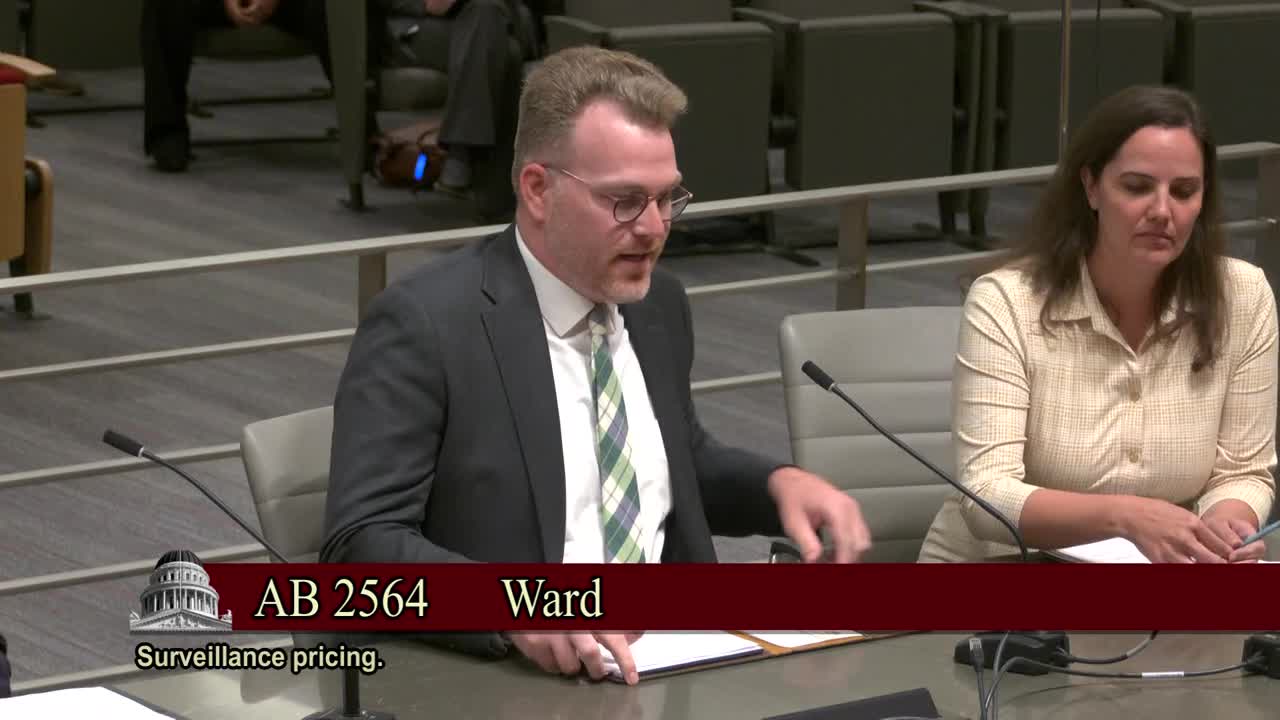 19MIN
Senate Standing Committee on Privacy, Digital Technologies, and Consumer Protection
 5MIN
Assembly Floor
 29MIN
Assembly Standing Committee on Privacy and Consumer Protection
Bill Author

Bill Co-Author(s):