AB 1546: Vehicles: driving under the influence.
- Session Year: 2025-2026
- House: Assembly
- Latest Version Date: 2026-09-25
Current Status:
Passed
(2026-09-25: Chaptered by Secretary of State - Chapter 444, Statutes of 2026.)
Introduced
In Committee
Awaiting First Chamber Vote
Passed First Chamber
In Committee
Awaiting Second Chamber Vote
Passed Second Chamber
Enacted
Under existing law, if a person is convicted of either driving under the influence (DUI) of any alcoholic beverage or drug, or under the combined influence of any alcoholic beverage and drug or driving while having 0.08% or more, by weight, of alcohol in the persons blood within 10 years of 2 separate violations of specified DUI offenses, or any combination thereof, that resulted in convictions, that person has committed an offense punishable by imprisonment in the county jail for not less than 120 days nor more than one year and by a fine, as specified.
This bill would, instead, make the above DUI conviction punishable as a wobbler by imprisonment in the county jail for not less than 120 days nor more than one year and by a fine, as specified, or by imprisonment in the county jail for 16 months or 2 or 3 years and a fine, as specified. By increasing the punishment of a crime, this bill would impose a state-mandated local program.
Under existing law, if a person is convicted of DUI and the offense occurred within 10 years of 3 or more separate violations for driving under the influence that resulted in specified convictions, that person has committed an offense punishable as either a misdemeanor or a felony.
This bill would, instead, make the above DUI conviction punishable as a wobbler if the offense occurred within 10 years of 3 separate violations for driving under the influence that resulted in specified convictions, and punishable as a felony by imprisonment in the county jail for 16 months or 2 or 3 years and a fine, as specified, if the offense occurred within 10 years of 4 or more separate violations for driving under the influence that resulted in specified convictions. By increasing the punishment of a crime, this bill would impose a state-mandated local program.
This bill would make conforming changes.
This bill would incorporate additional changes to Sections 23546, 23550, and 23550.5 of the Vehicle Code proposed by AB 1830 to be operative only if this bill and AB 1830 are enacted and this bill is enacted last.
The California Constitution requires the state to reimburse local agencies and school districts for certain costs mandated by the state. Statutory provisions establish procedures for making that reimbursement.
This bill would provide that no reimbursement is required by this act for a specified reason.
Under existing law, if a person is convicted of either driving under the influence (DUI) of any alcoholic beverage or drug, or under the combined influence of any alcoholic beverage and drug or driving while having 0.08% or more, by weight, of alcohol in the persons blood within 10 years of 2 separate violations of specified DUI offenses, or any combination thereof, that resulted in convictions, that person has committed an offense punishable by imprisonment in the county jail for not less than 120 days nor more than one year and by a fine, as specified.
This bill would, instead, make the above DUI conviction punishable as a wobbler by imprisonment in the county jail for not less than 120 days nor more than one year and by a fine, as specified, or by imprisonment in the county jail for 16 months or 2 or 3 years and a fine, as specified. By increasing the punishment of a crime, this bill would impose a state-mandated local program.
Under existing law, if a person is convicted of DUI and the offense occurred within 10 years of 3 or more separate violations for driving under the influence that resulted in specified convictions, that person has committed an offense punishable as either a misdemeanor or a felony, and the person shall have their privilege to drive revoked for a period of 4 years, as specified. felony.
This bill would, instead, make the above DUI conviction punishable as a wobbler if the offense occurred within 10 years of 3 separate violations for driving under the influence that resulted in specified convictions, and punishable as a felony by imprisonment in the county jail for 16 months or 2 or 3 years and a fine, as specified, if the offense occurred within 10 years of 4 or more separate violations for driving under the influence that resulted in specified convictions. By increasing the punishment of a crime, this bill would impose a state-mandated local program. The bill would revoke the persons privilege to drive for a period of 4 years if the offense occurred within 10 years of 3 separate violations for driving under the influence that resulted in specified convictions, and for 5 years if the offense occurred within 10 years of 4 or more separate violations for driving under the influence that resulted in specified convictions.
Existing law, until January 1, 2033, requires a person, upon a criminal conviction for driving under the influence with a prior conviction for DUI, to install a functioning, certified ignition interlock device (IID) for a specified period of time. Under existing law, if a person is convicted of DUI within 10 years of 3 or more specified prior DUI violations, the person is required to install the IID for a mandatory term of 36 months.This bill would require the person to install the IID for a mandatory term of 36 months if the conviction occurred within 10 years of 3 specified prior DUI violations. If the conviction occurred within 10 years of 4 or more specified prior DUI violations, the bill would require the person to install the IID for a mandatory term of 48 months.This bill would make conforming changes.
This bill would incorporate additional changes to Sections 23546, 23550, and 23550.5 of the Vehicle Code proposed by AB 1830 to be operative only if this bill and AB 1830 are enacted and this bill is enacted last.
The California Constitution requires the state to reimburse local agencies and school districts for certain costs mandated by the state. Statutory provisions establish procedures for making that reimbursement.
This bill would provide that no reimbursement is required by this act for a specified reason.
Under existing law, if a person is convicted of either driving under the influence (DUI) of any alcoholic beverage or drug, or under the combined influence of any alcoholic beverage and drug or driving while having 0.08% or more, by weight, of alcohol in the persons blood within 10 years of 2 separate violations of specified DUI offenses, or any combination thereof, that resulted in convictions, that person has committed an offense punishable by imprisonment in the county jail for not less than 120 days nor more than one year and by a fine, as specified.
This bill would, instead, make the above DUI conviction punishable as a wobbler by imprisonment in the county jail for not less than 120 days nor more than one year and by a fine, as specified, or by imprisonment in the county jail for 16 months or 2 or 3 years and a fine, as specified. By increasing the punishment of a crime, this bill would impose a state-mandated local program.
Under existing law, if a person is convicted of DUI and the offense occurred within 10 years of 3 or more separate violations for driving under the influence that resulted in specified convictions, that person has committed an offense punishable as either a misdemeanor or a felony, and the person shall have their privilege to drive revoked for a period of 4 years, as specified.
This bill would, instead, make the above DUI conviction punishable as a wobbler if the offense occurred within 10 years of 3 separate violations for driving under the influence that resulted in specified convictions, and punishable as a felony by imprisonment in the county jail for 16 months or 2 or 3 years and a fine, as specified, if the offense occurred within 10 years of 4 or more separate violations for driving under the influence that resulted in specified convictions. By increasing the punishment of a crime, this bill would impose a state-mandated local program. The bill would revoke the persons privilege to drive for a period of 4 years if the offense occurred within 10 years of 3 separate violations for driving under the influence that resulted in specified convictions, and for 5 years if the offense occurred within 10 years of 4 or more separate violations for driving under the influence that resulted in specified convictions.
Existing law, until January 1, 2033, requires a person, upon a criminal conviction for driving under the influence with a prior conviction for DUI, to install a functioning, certified ignition interlock device (IID) for a specified period of time. Under existing law, if a person is convicted of DUI within 10 years of 3 or more specified prior DUI violations, the person is required to install the IID for a mandatory term of 36 months.
This bill would require the person to install the IID for a mandatory term of 36 months if the conviction occurred within 10 years of 3 specified prior DUI violations. If the conviction occurred within 10 years of 4 or more specified prior DUI violations, the bill would require the person to install the IID for a mandatory term of 48 months.
This bill would make conforming changes.
The California Constitution requires the state to reimburse local agencies and school districts for certain costs mandated by the state. Statutory provisions establish procedures for making that reimbursement.
This bill would provide that no reimbursement is required by this act for a specified reason.
A person is qualified to purchase a Good Driver Discount policy if the person meets all of the following criteria:
(a)The person has been licensed to drive a motor vehicle for the previous three years.
(b)During the previous three years, the person has not done any of the following:
(1)Had more than one violation point count determined as provided by subdivision (a), (b), (c), (d), (f), or (j) of, or paragraph (1) of subdivision (i) of, Section 12810 of the Vehicle Code, but subject to the following modifications:
(A)For the purposes of this section, the driver of a motor vehicle involved in an accident for which the driver was principally at fault that resulted only in damage to property shall receive one violation point count, in addition to any other violation points that may be imposed for this accident.
(B)If, under Section 488 or 488.5, an insurer is prohibited from increasing the premium on a policy on account of a violation, that violation shall not be included in determining the point count of the person.
(C)If a violation is required to be reported under Section 1816 of the Vehicle Code, or under Section 784 of the Welfare and Institutions Code, or any other provision requiring the reporting of a violation by a minor, the violation shall be included for the purposes of this section in determining the point count in the same manner as is applicable to adult violations.
(2)Had more than one dismissal pursuant to Section 1803.5 of the Vehicle Code that was not made confidential pursuant to Section 1808.7 of the Vehicle Code, in the 36-month period for violations that would have resulted in the imposition of more than one violation point count under paragraph (1) if the complaint had not been dismissed.
(3)Was the driver of a motor vehicle involved in an accident that resulted in bodily injury or in the death of any person and was principally at fault. The commissioner shall adopt regulations setting guidelines to be used by insurers for the determination of fault for the purposes of this paragraph and paragraph (1).
(c)During the period commencing on January 1, 1999, or the date 10 years prior to the date of application for the issuance or renewal of the Good Driver Discount policy, whichever is later, and ending on the date of the application for the issuance or renewal of the Good Driver Discount policy, the person has not been convicted of a violation of Section 23140, 23152, or 23153 of the Vehicle Code, a felony violation of Section 23546, 23550, or 23566, or former Section 23175 or, as those sections read on January 1, 1999, of the Vehicle Code, or a violation of Section 191.5 or subdivision (a) of Section 192.5 of the Penal Code.
(d)Any person who claims that the person meets the criteria of subdivisions (a), (b), and (c) based entirely or partially on a drivers license and driving experience acquired anywhere other than in the United States or Canada is rebuttably presumed to be qualified to purchase a Good Driver Discount policy if the person has been licensed to drive in the United States or Canada for at least the previous 18 months and meets the criteria of subdivisions (a), (b), and (c) for that period.
SEC. 2.Section 14601.2 of the Vehicle Code is amended to read:14601.2.(a)A person shall not drive a motor vehicle at any time when that persons driving privilege is suspended or revoked for a conviction of a violation of Section 23152 or 23153 if the person so driving has knowledge of the suspension or revocation.
(b)Except in full compliance with the restriction, a person shall not drive a motor vehicle at any time when that persons driving privilege is restricted if the person so driving has knowledge of the restriction.
(c)Knowledge of the suspension or revocation of the driving privilege shall be conclusively presumed if mailed notice has been given by the department to the person pursuant to Section 13106. Knowledge of the restriction of the driving privilege shall be presumed if notice has been given by the court to the person. The presumption established by this subdivision is a presumption affecting the burden of proof.
(d)A person convicted of a violation of this section shall be punished as follows:
(1)Upon a first conviction, by imprisonment in the county jail for not less than 10 days or more than six months and by a fine of not less than three hundred dollars ($300) or more than one thousand dollars ($1,000), unless the person has been designated a habitual traffic offender under subdivision (b) of Section 23546, subdivision (c) of Section 23550, or subdivision (d) of Section 23550.5, in which case the person, in addition, shall be sentenced as provided in paragraph (3) of subdivision (e) of Section 14601.3.
(2)If the offense occurred within five years of a prior offense that resulted in a conviction of a violation of this section or Section 14601, 14601.1, or 14601.5, by imprisonment in the county jail for not less than 30 days or more than one year and by a fine of not less than five hundred dollars ($500) or more than two thousand dollars ($2,000), unless the person has been designated a habitual traffic offender under subdivision (b) of Section 23546, subdivision (c) of Section 23550, or subdivision (d) of Section 23550.5, in which case the person, in addition, shall be sentenced as provided in paragraph (3) of subdivision (e) of Section 14601.3.
(e)If a person is convicted of a first offense under this section and is granted probation, the court shall impose as a condition of probation that the person be confined in the county jail for at least 10 days.
(f)If the offense occurred within five years of a prior offense that resulted in a conviction of a violation of this section or Section 14601, 14601.1, or 14601.5 and is granted probation, the court shall impose as a condition of probation that the person be confined in the county jail for at least 30 days.
(g)If a person is convicted of a second or subsequent offense that results in a conviction of this section within seven years, but over five years, of a prior offense that resulted in a conviction of a violation of this section or Section 14601, 14601.1, or 14601.5 and is granted probation, the court shall impose as a condition of probation that the person be confined in the county jail for at least 10 days.
(h)Pursuant to Section 23575, the court shall require a person convicted of a violation of this section to install a certified ignition interlock device on a vehicle the person owns or operates. Upon receipt of the abstract of a conviction under this section, the department shall not reinstate the privilege to operate a motor vehicle until the department receives proof of either the Verification of Installation form as described in paragraph (2) of subdivision (h) of Section 13386 or the Judicial Council Form I.D. 100.
(i)This section does not prohibit a person who is participating in, or has completed, an alcohol or drug rehabilitation program from driving a motor vehicle that is owned or utilized by the persons employer, during the course of employment on private property that is owned or utilized by the employer, except an offstreet parking facility, as defined in subdivision (c) of Section 12500.
(j)This section also applies to the operation of an off-highway motor vehicle on those lands that the Chappie-Zberg Off-Highway Motor Vehicle Law of 1971 (Division 16.5 (commencing with Section 38000)) applies as to off-highway motor vehicles, as described in Section 38001.
(k)If Section 23573 is applicable, then subdivision (h) is not applicable.
SEC. 3.Section 14601.3 of the Vehicle Code is amended to read:14601.3.(a)It is unlawful for a person whose driving privilege has been suspended or revoked to accumulate a driving record history which results from driving during the period of suspension or revocation. A person who violates this subdivision is designated an habitual traffic offender.
For purposes of this section, a driving record history means any of the following, if the driving occurred during any period of suspension or revocation:
(1)Two or more convictions within a 12-month period of an offense given a violation point count of two pursuant to Section 12810.
(2)Three or more convictions within a 12-month period of an offense given a violation point count of one pursuant to Section 12810.
(3)Three or more accidents within a 12-month period that are subject to the reporting requirements of Section 16000.
(4)Any combination of convictions or accidents, as specified in paragraphs (1) to (3), inclusive, which results during any 12-month period in a violation point count of three or more pursuant to Section 12810.
(b)Knowledge of suspension or revocation of the driving privilege shall be conclusively presumed if mailed notice has been given by the department to the person pursuant to Section 13106. The presumption established by this subdivision is a presumption affecting the burden of proof.
(c)The department, within 30 days of receipt of a duly certified abstract of the record of any court or accident report which results in a person being designated an habitual traffic offender, may execute and transmit by mail a notice of that designation to the office of the district attorney having jurisdiction over the location of the persons last known address as contained in the departments records.
(d)(1)The district attorney, within 30 days of receiving the notice required in subdivision (c), shall inform the department of whether or not the person will be prosecuted for being an habitual traffic offender.
(2)Notwithstanding any other provision of this section, any habitual traffic offender designated under subdivision (b) of Section 23546, subdivision (c) of Section 23550, or subdivision (b) of Section 23550.5, who is convicted of violating Section 14601.2 shall be sentenced as provided in paragraph (3) of subdivision (e).
(e)Any person convicted under this section of being an habitual traffic offender shall be punished as follows:
(1)Upon a first conviction, by imprisonment in the county jail for 30 days and by a fine of one thousand dollars ($1,000).
(2)Upon a second or any subsequent offense within seven years of a prior conviction under this section, by imprisonment in the county jail for 180 days and by a fine of two thousand dollars ($2,000).
(3)Any habitual traffic offender designated under Section 193.7 of the Penal Code or under subdivision (b) of Section 23546, subdivision (c) of Section 23550, subdivision (b) of Section 23550.5, or subdivision (d) of Section 23566 who is convicted of a violation of Section 14601.2 shall be punished by imprisonment in the county jail for 180 days and by a fine of two thousand dollars ($2,000). The penalty in this paragraph shall be consecutive to that imposed for the violation of any other law.
(f)This section also applies to the operation of an off-highway motor vehicle on those lands to which the Chappie-Zberg Off-Highway Motor Vehicle Law of 1971 (Division 16.5 (commencing with Section 38000)) applies as to off-highway motor vehicles, as described in Section 38001.
SEC. 4.Section 23546 of the Vehicle Code is amended to read:23546.(a)If a person is convicted of a violation of Section 23152 and the offense occurred within 10 years of two separate violations of Section 23103, as specified in Section 23103.5, 23152, or 23153, or any combination thereof, that resulted in convictions, that person shall be punished by imprisonment pursuant to subdivision (h) of Section 1170 of the Penal Code, or imprisonment in the county jail for not less than 120 days nor more than one year, and by a fine of not less than three hundred ninety dollars ($390) nor more than one thousand dollars ($1,000). The persons privilege to operate a motor vehicle shall be revoked by the Department of Motor Vehicles as required in paragraph (5) of subdivision (a) of Section 13352. The court shall require the person to surrender their drivers license to the court in accordance with Section 13550.
(b)A person convicted of a violation of Section 23152 punishable under this section shall be designated as a habitual traffic offender for a period of three years, subsequent to the conviction. The person shall be advised of this designation pursuant to subdivision (b) of Section 13350.
SEC. 4.1.Section 23546 of the Vehicle Code is amended to read:23546.(a)If a person is convicted of a violation of Section 23152 and the offense occurred within 10 years of two separate violations of Section 23103, as specified in Section 23103.5, 23152, or 23153, or any combination thereof, that resulted in convictions, that person shall be punished by imprisonment pursuant to subdivision (h) of Section 1170 of the Penal Code, or imprisonment in the county jail for not less than 120 days nor more than one year, and by a fine of not less than three hundred ninety dollars ($390) nor more than one thousand dollars ($1,000). The persons privilege to operate a motor vehicle shall be revoked by the Department of Motor Vehicles as required in paragraph (5) of subdivision (a) of Section 13352. The court shall require the person to surrender their drivers license to the court in accordance with Section 13550.
(b)A person convicted of a violation of Section 23152 punishable under this section shall be designated as a habitual traffic offender for a period of three years, subsequent to the conviction. The person shall be advised of this designation pursuant to subdivision (b) of Section 13350.
(c)This section shall remain in effect only until January 1, 2031, and as of that date is repealed.
SEC. 4.2.Section 23546 is added to the Vehicle Code, to read:23546.(a)If a person is convicted of a violation of Section 23152 and the offense occurred within 10 years of two separate violations of Section 23103, as specified in Section 23103.5, 23152, or 23153, or any combination thereof, that resulted in convictions, that person shall be punished by imprisonment pursuant to subdivision (h) of Section 1170 of the Penal Code, or imprisonment in the county jail for not less than 120 days nor more than one year, and by a fine of not less than three hundred ninety dollars ($390) nor more than one thousand dollars ($1,000). The persons privilege to operate a motor vehicle shall be suspended by the Department of Motor Vehicles as required in paragraph (5) of subdivision (a) of Section 13352 or paragraph (5) of subdivision (a) of Section 13354. The court shall require the person to surrender their drivers license to the court in accordance with Section 13550.
(b)A person convicted of a violation of Section 23152 punishable under this section shall be designated as a habitual traffic offender for a period of three years, subsequent to the conviction. The person shall be advised of this designation pursuant to subdivision (b) of Section 13350.
(c)Whenever, in considering the circumstances taken as a whole, the court determines that the person punished under this section would present a traffic safety or public safety risk if authorized to operate a motor vehicle during the period of suspension imposed under paragraph (5) of subdivision (a) of Section 13354, the court may disallow the issuance of a restricted drivers license authorized under Section 13354.4.
(d)This section shall become operative on January 1, 2031.
SEC. 5.Section 23550 of the Vehicle Code is amended to read:23550.(a)If a person is convicted of a violation of Section 23152 and the offense occurred within 10 years of three separate violations of Section 23103, as specified in Section 23103.5, or Section 23152 or 23153, or any combination thereof, that resulted in convictions, that person shall be punished by imprisonment pursuant to subdivision (h) of Section 1170 of the Penal Code, or in a county jail for not less than 180 days nor more than one year, and by a fine of not less than three hundred ninety dollars ($390) nor more than one thousand dollars ($1,000). The persons privilege to operate a motor vehicle shall be revoked by the Department of Motor Vehicles pursuant to paragraph (7) of subdivision (a) of Section 13352. The court shall require the person to surrender the drivers license to the court in accordance with Section 13550.
(b)If a person is convicted of a violation of Section 23152 and the offense occurred within 10 years of four or more separate violations of Section 23103, as specified in Section 23103.5, or Section 23152 or 23153, or any combination thereof, that resulted in convictions, that person shall be punished by imprisonment pursuant to subdivision (h) of Section 1170 of the Penal Code, and by a fine of not less than three hundred ninety dollars ($390) nor more than one thousand dollars ($1,000). The persons privilege to operate a motor vehicle shall be revoked by the Department of Motor Vehicles pursuant to paragraph (7) of subdivision (a) of Section 13352. The court shall require the person to surrender the drivers license to the court in accordance with Section 13550.
(c)A person convicted of a violation of Section 23152 punishable under this section shall be designated as a habitual traffic offender for a period of three years, subsequent to the conviction. The person shall be advised of this designation pursuant to subdivision (b) of Section 13350.
SEC. 5.1.Section 23550 of the Vehicle Code is amended to read:23550.(a)If a person is convicted of a violation of Section 23152 and the offense occurred within 10 years of three separate violations of Section 23103, as specified in Section 23103.5, or Section 23152 or 23153, or any combination thereof, that resulted in convictions, that person shall be punished by imprisonment pursuant to subdivision (h) of Section 1170 of the Penal Code, or in a county jail for not less than 180 days nor more than one year, and by a fine of not less than three hundred ninety dollars ($390) nor more than one thousand dollars ($1,000). The persons privilege to operate a motor vehicle shall be revoked by the Department of Motor Vehicles pursuant to paragraph (7) of subdivision (a) of Section 13352. The court shall require the person to surrender the drivers license to the court in accordance with Section 13550.
(b)If a person is convicted of a violation of Section 23152 and the offense occurred within 10 years of four or more separate violations of Section 23103, as specified in Section 23103.5, or Section 23152 or 23153, or any combination thereof, that resulted in convictions, that person shall be punished by imprisonment pursuant to subdivision (h) of Section 1170 of the Penal Code, and by a fine of not less than three hundred ninety dollars ($390) nor more than one thousand dollars ($1,000). The persons privilege to operate a motor vehicle shall be revoked by the Department of Motor Vehicles pursuant to paragraph (7) of subdivision (a) of Section 13352. The court shall require the person to surrender the drivers license to the court in accordance with Section 13550.
(c)A person convicted of a violation of Section 23152 punishable under this section shall be designated as a habitual traffic offender for a period of three years, subsequent to the conviction. The person shall be advised of this designation pursuant to subdivision (b) of Section 13350.
(d)This section shall remain in effect only until January 1, 2031, and as of that date is repealed.
SEC. 5.2.Section 23550 is added to the Vehicle Code, to read:23550.(a)If a person is convicted of a violation of Section 23152 and the offense occurred within 10 years of three separate violations of Section 23103, as specified in Section 23103.5, or Section 23152 or 23153, or any combination thereof, that resulted in convictions, that person shall be punished by imprisonment pursuant to subdivision (h) of Section 1170 of the Penal Code, or in a county jail for not less than 180 days nor more than one year, and by a fine of not less than three hundred ninety dollars ($390) nor more than one thousand dollars ($1,000).
(b)If a person is convicted of a violation of Section 23152 and the offense occurred within 10 years of four or more separate violations of Section 23103, as specified in Section 23103.5, or Section 23152 or 23153, or any combination thereof, that resulted in convictions, that person shall be punished by imprisonment pursuant to subdivision (h) of Section 1170 of the Penal Code, and by a fine of not less than three hundred ninety dollars ($390) nor more than one thousand dollars ($1,000). The persons privilege to operate a motor vehicle shall be revoked by the Department of Motor Vehicles pursuant to paragraph (7) of subdivision (a) of Section 13352. The court shall require the person to surrender the drivers license to the court in accordance with Section 13550.
(c)A person convicted of a violation of Section 23152 punishable under this section shall be designated as a habitual traffic offender for a period of three years, subsequent to the conviction. The person shall be advised of this designation pursuant to subdivision (b) of Section 13350.
(d)Whenever, in considering the circumstances taken as a whole, the court determines that the person punished under this section would present a traffic safety or public safety risk if authorized to operate a motor vehicle during the period of suspension imposed under paragraph (7) of subdivision (a) of Section 13354, the court may disallow the issuance of a restricted drivers license authorized under Section 13354.4.
(e)This section shall become operative on January 1, 2031.
SEC. 6.Section 23550.5 of the Vehicle Code is amended to read:23550.5.(a)A person is guilty of a public offense, punishable by imprisonment in the state prison or confinement in a county jail for not more than one year and by a fine of not less than three hundred ninety dollars ($390) nor more than one thousand dollars ($1,000) if that person is convicted of a violation of Section 23152 or 23153, and the offense occurred within 10 years of any of the following:
(1)A separate violation of Section 23152 that was punished as a felony under Section 23546, 23550, or this section, or both, or under former Section 23175 or former Section 23175.5, or both.
(2)A separate violation of Section 23153 that was punished as a felony.
(3)A separate violation of paragraph (1) of subdivision (c) of Section 192 of the Penal Code that was punished as a felony.
(b)Each person who, having previously been convicted of a violation of subdivision (a) of Section 191.5 of the Penal Code, a felony violation of subdivision (b) of Section 191.5 of the Penal Code, or a violation of subdivision (a) of Section 192.5 of the Penal Code, is subsequently convicted of a violation of Section 23152 or 23153 is guilty of a public offense punishable by imprisonment in the state prison or confinement in a county jail for not more than one year and by a fine of not less than three hundred ninety dollars ($390) nor more than one thousand dollars ($1,000).
(c)The privilege to operate a motor vehicle of a person convicted of a violation that is punishable under subdivision (a) or (b) shall be revoked by the department pursuant to paragraph (7) of subdivision (a) of Section 13352, unless paragraph (6) of subdivision (a) of Section 13352 is also applicable, in which case the privilege shall be revoked under that provision. The court shall require the person to surrender the drivers license to the court in accordance with Section 13550.
(d)A person convicted of a violation of Section 23152 or 23153 that is punishable under this section shall be designated as a habitual traffic offender for a period of three years, subsequent to the conviction. The person shall be advised of this designation under subdivision (b) of Section 13350.
SEC. 6.1.Section 23550.5 of the Vehicle Code is amended to read:23550.5.(a)A person is guilty of a public offense, punishable by imprisonment in the state prison or confinement in a county jail for not more than one year and by a fine of not less than three hundred ninety dollars ($390) nor more than one thousand dollars ($1,000) if that person is convicted of a violation of Section 23152 or 23153, and the offense occurred within 10 years of any of the following:
(1)A separate violation of Section 23152 that was punished as a felony under Section 23546, 23550, or this section, or both, or under former Section 23175 or former Section 23175.5, or both.
(2)A separate violation of Section 23153 that was punished as a felony.
(3)A separate violation of paragraph (1) of subdivision (c) of Section 192 of the Penal Code that was punished as a felony.
(b)Each person who, having previously been convicted of a violation of subdivision (a) of Section 191.5 of the Penal Code, a felony violation of subdivision (b) of Section 191.5 of the Penal Code, or a violation of subdivision (a) of Section 192.5 of the Penal Code, is subsequently convicted of a violation of Section 23152 or 23153 is guilty of a public offense punishable by imprisonment in the state prison or confinement in a county jail for not more than one year and by a fine of not less than three hundred ninety dollars ($390) nor more than one thousand dollars ($1,000).
(c)The privilege to operate a motor vehicle of a person convicted of a violation that is punishable under subdivision (a) or (b) shall be revoked by the department pursuant to paragraph (7) of subdivision (a) of Section 13352, unless paragraph (6) of subdivision (a) of Section 13352 is also applicable, in which case the privilege shall be revoked under that provision. The court shall require the person to surrender the drivers license to the court in accordance with Section 13550.
(d)A person convicted of a violation of Section 23152 or 23153 that is punishable under this section shall be designated as a habitual traffic offender for a period of three years, subsequent to the conviction. The person shall be advised of this designation under subdivision (b) of Section 13350.
(e)This section shall remain in effect only until January 1, 2031, and as of that date is repealed.
SEC. 6.2.Section 23550.5 is added to the Vehicle Code, to read:23550.5.(a)A person is guilty of a public offense, punishable by imprisonment in the state prison or confinement in a county jail for not more than one year and by a fine of not less than three hundred ninety dollars ($390) nor more than one thousand dollars ($1,000) if that person is convicted of a violation of Section 23152 or 23153, and the offense occurred within 10 years of any of the following:
(1)A separate violation of Section 23152 that was punished as a felony under Section 23546, 23550, or this section, or both, or under former Section 23175 or former Section 23175.5, or both.
(2)A separate violation of Section 23153 that was punished as a felony.
(3)A separate violation of paragraph (1) of subdivision (c) of Section 192 of the Penal Code that was punished as a felony.
(b)Each person who, having previously been convicted of a violation of subdivision (a) of Section 191.5 of the Penal Code, a felony violation of subdivision (b) of Section 191.5 of the Penal Code, or a violation of subdivision (a) of Section 192.5 of the Penal Code, is subsequently convicted of a violation of Section 23152 or 23153 is guilty of a public offense punishable by imprisonment in the state prison or confinement in a county jail for not more than one year and by a fine of not less than three hundred ninety dollars ($390) nor more than one thousand dollars ($1,000).
(c)A person convicted of a violation of Section 23152 or 23153 that is punishable under this section shall be designated as a habitual traffic offender for a period of three years, subsequent to the conviction. The person shall be advised of this designation under subdivision (b) of Section 13350.
(d)Whenever, in considering the circumstances taken as a whole, the court determines that the person punished under this section would present a traffic safety or public safety risk if authorized to operate a motor vehicle during the period of suspension imposed under paragraph (7) of subdivision (a) of Section 13354, unless paragraph (6) of subdivision (a) of Section 13354 is also applicable, the court may disallow the issuance of a restricted drivers license authorized under Section 13354.4.
(e)This section shall become operative on January 1, 2031.
SEC. 7.Section 23572 of the Vehicle Code is amended to read:23572.(a)If any person is convicted of a violation of Section 23152 and a minor under 14 years of age was a passenger in the vehicle at the time of the offense, the court shall impose the following penalties in addition to any other penalty prescribed:
(1)If the person is convicted of a violation of Section 23152 punishable under Section 23536, the punishment shall be enhanced by an imprisonment of 48 continuous hours in the county jail, whether or not probation is granted, no part of which shall be stayed.
(2)If a person is convicted of a violation of Section 23152 punishable under Section 23540, the punishment shall be enhanced by an imprisonment of 10 days in the county jail, whether or not probation is granted, no part of which may be stayed.
(3)If a person is convicted of a violation of Section 23152 that is punished as a misdemeanor under Section 23546, the punishment shall be enhanced by an imprisonment of 30 days in the county jail, whether or not probation is granted, no part of which may be stayed.
(4)If a person is convicted of a violation of Section 23152 which is punished as a misdemeanor under Section 23550, the punishment shall be enhanced by an imprisonment of 90 days in the county jail, whether or not probation is granted, no part of which may be stayed.
(b)The driving of a vehicle in which a minor under 14 years of age was a passenger shall be pled and proven.
(c)No punishment enhancement shall be imposed pursuant to this section if the person is also convicted of a violation of Section 273a of the Penal Code arising out of the same facts and incident.
SEC. 8.Sections 4.1 and 4.2 of this bill incorporate amendments to Section 23546 of the Vehicle Code proposed by this bill and Assembly Bill 1830. Those sections of this bill shall only become operative if (1) both bills are enacted and become effective on or before January 1, 2027, (2) each bill amends Section 23546 of the Vehicle Code, and (3) this bill is enacted after Assembly Bill 1830, in which case Section 23546 of the Vehicle Code, as amended by Assembly Bill 1830, shall remain operative only until the operative date of this bill, at which time Sections 4.1 and 4.2 of this bill shall become operative, and Section 4 of this bill shall not become operative.
SEC. 9.Sections 5.1 and 5.2 of this bill incorporate amendments to Section 23550 of the Vehicle Code proposed by this bill and Assembly Bill 1830. Those sections of this bill shall only become operative if (1) both bills are enacted and become effective on or before January 1, 2027, (2) each bill amends Section 23550 of the Vehicle Code, and (3) this bill is enacted after Assembly Bill 1830, in which case Section 23550 of the Vehicle Code, as amended by Assembly Bill 1830, shall remain operative only until the operative date of this bill, at which time Sections 5.1 and 5.2 of this bill shall become operative, and Section 5 of this bill shall not become operative.
SEC. 10.Sections 6.1 and 6.2 of this bill incorporate amendments to Section 23550.5 of the Vehicle Code proposed by this bill and Assembly Bill 1830. Those sections of this bill shall only become operative if (1) both bills are enacted and become effective on or before January 1, 2027, (2) each bill amends Section 23550.5 of the Vehicle Code, and (3) this bill is enacted after Assembly Bill 1830, in which case Section 23550.5 of the Vehicle Code, as amended by Assembly Bill 1830, shall remain operative only until the operative date of this bill, at which time Sections 6.1 and 6.2 of this bill shall become operative, and Section 6 of this bill shall not become operative.
SEC. 11.No reimbursement is required by this act pursuant to Section 6 of Article XIIIB of the California Constitution because the only costs that may be incurred by a local agency or school district will be incurred because this act creates a new crime or infraction, eliminates a crime or infraction, or changes the penalty for a crime or infraction, within the meaning of Section 17556 of the Government Code, or changes the definition of a crime within the meaning of Section 6 of Article XIIIB of the California Constitution.
A person is qualified to purchase a Good Driver Discount policy if the person meets all of the following criteria:
(a)The person has been licensed to drive a motor vehicle for the previous three years.
(b)During the previous three years, the person has not done any of the following:
(1)Had more than one violation point count determined as provided by subdivision (a), (b), (c), (d), (f), or (j) of, or paragraph (1) of subdivision (i) of, Section 12810 of the Vehicle Code, but subject to the following modifications:
(A)For the purposes of this section, the driver of a motor vehicle involved in an accident for which the driver was principally at fault that resulted only in damage to property shall receive one violation point count, in addition to any other violation points that may be imposed for this accident.
(B)If, under Section 488 or 488.5, an insurer is prohibited from increasing the premium on a policy on account of a violation, that violation shall not be included in determining the point count of the person.
(C)If a violation is required to be reported under Section 1816 of the Vehicle Code, or under Section 784 of the Welfare and Institutions Code, or any other provision requiring the reporting of a violation by a minor, the violation shall be included for the purposes of this section in determining the point count in the same manner as is applicable to adult violations.
(2)Had more than one dismissal pursuant to Section 1803.5 of the Vehicle Code that was not made confidential pursuant to Section 1808.7 of the Vehicle Code, in the 36-month period for violations that would have resulted in the imposition of more than one violation point count under paragraph (1) if the complaint had not been dismissed.
(3)Was the driver of a motor vehicle involved in an accident that resulted in bodily injury or in the death of any person and was principally at fault. The commissioner shall adopt regulations setting guidelines to be used by insurers for the determination of fault for the purposes of this paragraph and paragraph (1).
(c)During the period commencing on January 1, 1999, or the date 10 years prior to the date of application for the issuance or renewal of the Good Driver Discount policy, whichever is later, and ending on the date of the application for the issuance or renewal of the Good Driver Discount policy, the person has not been convicted of a violation of Section 23140, 23152, or 23153 of the Vehicle Code, a felony violation of Section 23546, 23550, 23550.1, or 23566, or former Section 23175 or, as those sections read on January 1, 1999, of the Vehicle Code, or a violation of Section 191.5 or subdivision (a) of Section 192.5 of the Penal Code.
(d)Any person who claims that the person meets the criteria of subdivisions (a), (b), and (c) based entirely or partially on a drivers license and driving experience acquired anywhere other than in the United States or Canada is rebuttably presumed to be qualified to purchase a Good Driver Discount policy if the person has been licensed to drive in the United States or Canada for at least the previous 18 months and meets the criteria of subdivisions (a), (b), and (c) for that period.
SEC. 6.Section 191.5 of the Penal Code is amended to read:191.5.(a)Gross vehicular manslaughter while intoxicated is the unlawful killing of a human being without malice aforethought, in the driving of a vehicle, where the driving was in violation of Section 23140, 23152, or 23153 of the Vehicle Code, and the killing was either the proximate result of the commission of an unlawful act, not amounting to a felony, and with gross negligence, or the proximate result of the commission of a lawful act that might produce death, in an unlawful manner, and with gross negligence.(b)Vehicular manslaughter while intoxicated is the unlawful killing of a human being without malice aforethought, in the driving of a vehicle, where the driving was in violation of Section 23140, 23152, or 23153 of the Vehicle Code, and the killing was either the proximate result of the commission of an unlawful act, not amounting to a felony, but without gross negligence, or the proximate result of the commission of a lawful act that might produce death, in an unlawful manner, but without gross negligence.(c)(1)Except as provided in subdivision (d), gross vehicular manslaughter while intoxicated in violation of subdivision (a) is punishable by imprisonment in the state prison for 4, 6, or 10 years.(2)Vehicular manslaughter while intoxicated in violation of subdivision (b) is punishable by imprisonment in a county jail for not more than one year or by imprisonment pursuant to subdivision (h) of Section 1170 for 16 months or two or four years.(d)A person convicted of violating subdivision (a) who has one or more prior convictions of this section or of paragraph (1) of subdivision (c) of Section 192, subdivision (a) or (b) of Section 192.5 of this code, or of violating Section 23152 punishable under Sections 23540, 23542, 23546, 23548, 23550, 23550.1, 23552, or 23552.1 of, or convicted of Section 23153 of, the Vehicle Code, shall be punished by imprisonment in the state prison for a term of 15 years to life. Article 2.5 (commencing with Section 2930) of Chapter 7 of Title 1 of Part 3 shall apply to reduce the term imposed pursuant to this subdivision.(e)Notwithstanding Section 1203.1 or 1203a, if a person is convicted of a violation of this section and is granted probation, the period of probation shall be not less than three nor more than five years.(f)This section shall not be construed as prohibiting or precluding a charge of murder under Section 188 upon facts exhibiting wantonness and a conscious disregard for life to support a finding of implied malice, or upon facts showing malice consistent with the holding of the California Supreme Court in People v. Watson, 30 Cal.3d 290.(g)This section shall not be construed as making any homicide in the driving of a vehicle or the operation of a vessel punishable which is not a proximate result of the commission of an unlawful act, not amounting to felony, or of the commission of a lawful act which might produce death, in an unlawful manner.(h)For the penalties in subdivision (d) to apply, the existence of any fact required under subdivision (d) shall be alleged in the information or indictment and either admitted by the defendant in open court or found to be true by the trier of fact.SEC. 7.Section 1203.44 of the Penal Code is amended to read:1203.44.(a)The Counties of Sacramento and Yolo may offer a voluntary secured residential treatment pilot program, known as Hope California, consistent with this section for individuals suffering from substance use disorders (SUDs) who have been convicted of drug-motivated felony crimes that qualify pursuant to the criteria and conditions described in subdivisions (b) and (c). If offered, the pilot programs shall align with the resolutions adopted by the counties in recognition of the goal of ensuring that people with behavioral health conditions receive treatment out of custody wherever possible. The counties may offer the pilot program to eligible individuals if the program meets all of the following conditions:(1)The program facility is licensed by the State Department of Health Care Services as an alcoholism or drug abuse recovery or treatment facility pursuant to Chapter 7.5 (commencing with Section 11834.01) of Part 2 of Division 10.5 of the Health and Safety Code.(2)(A)The program facility is a clinical setting managed and staffed by the countys health and human services agency (HHSA) with oversight provided by the countys probation department.(B)The program facility shall not be a jail, prison, or other correctional setting.(C)The program facility shall be secured but shall not include a lockdown setting.(3)The individual, upon a judge pronouncing a sentence to be served in a county jail or state prison, shall choose and consent to participate in the voluntary program in lieu of incarceration.(4)The program is limited to one facility site per county.(5)The State Department of Health Care Services monitors the program facility to ensure the health, safety, and well-being of program participants.(6)The State Department of Health Care Services has authority to access the program facility to investigate complaints by program participants and to ensure the facility complies with applicable statutes and regulations.(7)The program facility ensures that participants have visitation rights, including through the use of a telephone.(8)The county develops and staffs the program in partnership with relevant community-based organizations and drug treatment service providers to provide support services, including, but not limited to, employment skill assessments, money management, technology education, tutoring, career planning, developing resumes and cover letters, and searching and applying for employment.(9)HHSA ensures that a risk, needs, and biopsychosocial assessment, utilizing the Multidimensional Assessment of the American Society of Addiction Medicine (ASAM), as part of the ASAM Criteria, be performed for each individual identified as a candidate for the program.(10)The participants treatment, in terms of length and intensity, within the program is based on the findings of the risk, needs, and biopsychosocial assessment and the recommendations of treatment providers that may include an addiction medicine physician.(11)The program adopts the Treatment Criteria of ASAM. The program may take into consideration evolving best practices in the SUD treatment community.(12)The program has a comprehensive written curriculum that informs the operations of the program and outlines the treatment and intervention modalities.(13)The program provides an individualized, medically assisted treatment plan for each resident, including, but not limited to, medically assisted treatment options and counseling based on the recommendations of a substance use disorder specialist, which may include a medical doctor or doctor of osteopathy specializing in addiction medicine.(14)A judge determines the length of the treatment program after being informed by, and based on, the risk, needs, and biopsychosocial assessment and recommendations of treatment providers. After leaving the secured residential treatment facility, the participant continues outpatient treatment for a period of time and may also be referred to a step-down residential treatment facility, subject to the time limit described in paragraph (2) of subdivision (c).(15)A judge shall also determine that the program will be carried out in lieu of a jail or prison sentence after making a finding that the defendants decision to choose the alternative treatment program is knowing, intelligent, and voluntary.(16)The program provides, for each participant successfully leaving the program, a comprehensive continuum of care plan that includes recommendations for outpatient care, counseling, housing recommendations, and other vital components of successful recovery.(17)To the extent permitted under federal and state law, treatment provided to a participant during the program is reimbursable under the Medi-Cal program, if the participant is a Medi-Cal beneficiary and the treatment is a covered benefit under the Medi-Cal program. If treatment services provided to a participant during the program are not reimbursable under the Medi-Cal program or through the participants personal health care coverage, funds allocated to the state from the 2021 Multistate Opioid Settlement Agreement, subject to an appropriation by the Legislature, may be used to reimburse those treatment services to the extent consistent with the terms of the Settlement Agreement and the Final Judgment (People v. McKinsey & Co. (Alameda County Superior Court, No. RG21087649, Feb. 4, 2021)).(18)(A)An outcomes assessment of the secured residential treatment pilot program is completed by an independent evaluator and submitted to the Assembly Committee on Health, the Assembly Committee on Public Safety, the Senate Committee on Health, the Senate Committee on Public Safety, and the Legislature by October 1, 2028.(B)The outcomes assessment shall include pilot program data, including overall data and data by county, and shall include, but not be limited to, all of the following:(i)A summary of the pertinent data collected under paragraphs (19) and (20) over the course of the pilot program.(ii)The clinical efficacy of the secured residential treatment pilot program based on the data collected under paragraphs (19) and (20).(iii)The effects of the secured residential treatment pilot program on participant recidivism and sustainable recovery.(iv)A recommendation for the continuation and expansion of the secured residential treatment pilot project model beyond the pilot program.(C)The outcomes assessment shall not be performed or managed by the State Department of Health Care Services but may be performed by a postsecondary institution.(D)The independent evaluator may be provided with criminal offender record information, if necessary for the completion of the outcomes assessment, as provided in Section 13202.(19)The county collects and monitors all of the following data for participants in the program:(A)The participants demographic information, including age, gender, race, ethnicity, marital status, familial status, and employment status.(B)The participants criminal history.(C)The participants risk level, as determined by the risk, needs, and biopsychosocial assessment.(D)The treatment provided to the participant during the program, and if the participant completed that treatment.(E)The participants outcome at the time of program completion, six months after completion, and one year after completion, including subsequent arrests and convictions.(20)The county reports all of the following information annually to the State Department of Health Care Services and, in compliance with Section 9795 of the Government Code, to the Legislature, excluding any personally identifiable information of participants:(A)The risk, needs, and biopsychosocial assessment tool used for the program.(B)The curriculum used by each program.(C)The number of participants with a program length other than one year and the alternative program lengths used.(D)Individual data on the number of participants participating in the program.(E)Individual data for the items described in paragraph (19).(F)A one- and three-year evaluation of the number of subsequent arrests and convictions of the participants.(b)(1)Eligible drug-motivated crimes shall include any felony crime other than the following:(A)Sex crimes listed in subdivision (c) of Section 290.(B)A serious felony as defined in subdivision (c) of Section 1192.7 or in Section 1192.8.(C)A violent felony as defined in subdivision (c) of Section 667.5.(D)Domestic violence as defined in the Domestic Violence Prevention Act (Division 10 (commencing with Section 6200) of the Family Code).(E)Driving under the influence in violation of Section 191.5 of this code or Section 23152, 23153, 23550, 23550.1, or 23550.5 of the Vehicle Code.(2)Notwithstanding paragraph (1), a nonviolent drug possession offense specified in subdivision (a) of Section 1210 may not be diverted pursuant to this program.(c)(1)At the time of sentencing or pronouncement of judgment in which sentencing is imposed, the judge shall offer the defendant voluntary participation in the pilot program, as an alternative to a jail or prison sentence that the judge would otherwise impose, consistent with the other provisions of this section and if all of the following conditions are met:(A)The defendants crime was caused in whole or in part by the defendants SUD.(B)The defendants crime meets the criteria described in subdivision (b).(C)The judge makes their determination based on the recommendations of the treatment providers who conducted the assessment, on a finding by HHSA that the defendants participation in the program would be appropriate, and on the report described in subdivision (d).(2)The amount of time in the secured residential treatment facility shall be determined by the recommendations of the treatment providers who conducted the assessment. The amount of time, combined with any outpatient treatment or step-down residential treatment pursuant to the program, shall not exceed the term of imprisonment to which the defendant would otherwise be sentenced, not including any additional term of imprisonment for enhancements, for the drug-motivated crime. The court shall not place the defendant on probation for the underlying offense. The defendant shall be eligible to receive credits pursuant to Section 4019.(3)During the period that an individual is participating in the pilot program, the individual shall be on supervision with the probation department.(d)To assist the court in making the determination as to whether to offer the defendant placement in the secured residential treatment program pursuant to subdivision (c), a report shall be prepared with input from any of the interested parties, including the district attorney, the attorney for the participant, the probation department, HHSA, and any contracted drug treatment program provider.(e)If, at any time during the individuals participation in the program, it is determined by the treatment providers or program administrators that continued participation in the program would not be in the best interests of the individual, other participants, or the program itself, the treatment providers or program administrators may recommend to the court that the individuals participation be terminated and that the individual be transferred out of the secured residential treatment program.(f)If the court, based on the recommendations of the treatment providers or program administrators, determines that the participant should be transferred out of the secured residential treatment phase of the program prior to the end of the original order, the court shall make that subsequent order, and the participant shall complete the remainder of the original sentence imposed prior to their consent to enter the program.(g)If, at any time during the individuals participation in the program, the individual determines that they no longer wish to participate in the program, the individual may make a request to the court for termination of their participation and be transferred out of the secured residential treatment program to complete the remainder of their originally imposed sentence after accounting for any credits to which the individual is entitled pursuant to Section 4019.(h)If the treatment providers make a recommendation to the court that the participant should be released prior to the end of the original order based on the treatment providers assessment that the participant no longer needs to be in the secured residential treatment program, the court shall make that subsequent order, and paragraph (16) of subdivision (a) shall apply.(i)If the participant successfully completes the court-ordered drug treatment pursuant to this program, the conviction shall be set aside, and the court shall dismiss the accusation or information against the participant. The court shall also have discretion to set aside the conviction and to dismiss the accusation or information of any previous drug possession or drug use crimes on the participants record, including those offenses listed in Sections 11350, 11364, 11377, and 11550 of the Health and Safety Code. A participants successful completion of treatment shall be defined and determined by the treatment providers and not by the court, district attorneys office, or probation department and does not require the participant to complete the duration of the treatment originally ordered by the court.(j)The court shall ensure that the rights of any victim pursuant to Section 28 of Article I of the California Constitution (Marsys Law) are honored before setting aside the conviction and dismissing the accusation or information.(k)This section shall remain in effect only until July 1, 2029, and as of that date is repealed unless a later enacted statute that is enacted before July 1, 2029, deletes or extends that date.SEC. 8.Section 13350 of the Vehicle Code is amended to read:13350.(a)The department immediately shall revoke the privilege of a person to drive a motor vehicle upon receipt of a duly certified abstract of the record of a court showing that the person has been convicted of any of the following crimes or offenses:(1)Failure of the driver of a vehicle involved in an accident resulting in injury or death to a person to stop or otherwise comply with Section 20001.(2)A felony in the commission of which a motor vehicle is used, except as provided in Section 13351, 13352, or 13357.(3)Reckless driving causing bodily injury.(b)If a person is convicted of a violation of Section 23152 punishable under Section 23546, 23550, 23550.1, or 23550.5, or a violation of Section 23153 punishable under Section 23550.5 or 23566, including a violation of subdivision (b) of Section 191.5 of the Penal Code as provided in Section 193.7 of that code, the court shall, at the time of surrender of the drivers license or temporary permit, require the defendant to sign an affidavit in a form provided by the department acknowledging their understanding of the revocation required by paragraph (5), (6), (7), or (8) of subdivision (a) of Section 13352, and an acknowledgment of their designation as a habitual traffic offender. A copy of this affidavit shall be transmitted, with the license or temporary permit, to the department within the prescribed 10 days.(c)The department shall not reinstate the privilege revoked under subdivision (a) until the expiration of one year after the date of revocation and until the person whose privilege was revoked gives proof of financial responsibility as defined in Section 16430.SEC. 9.Section 13352 of the Vehicle Code, as amended by Section 1 of Chapter 689 of the Statutes of 2025, is amended to read:13352.(a)The department shall immediately suspend or revoke the privilege of a person to operate a motor vehicle upon the receipt of an abstract of the record of a court showing that the person has been convicted of a violation of Section 23152 or 23153, subdivision (a) of Section 23109, or Section 23109.1, or upon the receipt of a report of a judge of the juvenile court, a juvenile traffic hearing officer, or a referee of a juvenile court showing that the person has been found to have committed a violation of Section 23152 or 23153, subdivision (a) of Section 23109, or Section 23109.1. If an offense specified in this section occurs in a vehicle defined in Section 15210, the suspension or revocation specified in this subdivision applies also to the noncommercial driving privilege. The commercial driving privilege shall be disqualified as specified in Sections 15300 to 15302, inclusive. For the purposes of this section, suspension or revocation shall be as follows:(1)(A)Except as provided in this subparagraph, or as required under Section 13352.1 or 13352.4, upon a conviction or finding of a violation of Section 23152 punishable under Section 23536, the privilege shall be suspended for a period of six months. The privilege shall not be reinstated until the person gives proof of financial responsibility and gives proof satisfactory to the department of successful completion of a driving-under-the-influence program licensed pursuant to Section 11836 of the Health and Safety Code described in subdivision (b) of Section 23538 of this code. If the court, as authorized under paragraph (3) of subdivision (b) of Section 23646, elects to order a person to enroll in, participate in, and complete either program described in subdivision (b) of Section 23542, the department shall require that program in lieu of the program described in subdivision (b) of Section 23538. For the purposes of this paragraph, enrollment in, participation in, and completion of an approved program shall occur subsequent to the date of the current violation. Credit shall not be given to any program activities completed prior to the date of the current violation. Except when the court has ordered installation of a functioning, certified ignition interlock device pursuant to Section 23575.3, the department shall advise the person that they may apply to the department for a restricted drivers license if the person meets all of the following requirements:(i)The underlying conviction was not only for the use of drugs, as defined in Section 312, at the time of the violation.(ii)The person satisfactorily provides to the department, subsequent to the violation date of the current underlying conviction, enrollment in, or completion of, a driving-under-the-influence program licensed pursuant to Section 11836 of the Health and Safety Code, as described in subdivision (b) of Section 23538 of this code.(iii)The person agrees, as a condition of the restriction, to continue satisfactory participation in the program described in clause (ii).(iv)The person does both of the following:(I)Submits the Verification of Installation form described in paragraph (2) of subdivision (g) of Section 13386.(II)Agrees to maintain the functioning, certified ignition interlock device as required under subdivision (i).(v)The person provides proof of financial responsibility, as defined in Section 16430.(vi)The person pays all reissue fees and any restriction fee required by the department.(vii)The person pays to the department a fee sufficient to cover the reasonable costs of administering the requirements of this paragraph, as determined by the department.(B)The restrictions described in this paragraph shall remain in effect for the period required in subdivision (e).(2)(A)Except as provided in this paragraph, upon a conviction or finding of a violation of Section 23153 punishable under Section 23554, the privilege shall be suspended for a period of one year. The privilege shall not be reinstated until the person gives proof of financial responsibility and gives proof satisfactory to the department of successful completion of a driving-under-the-influence program licensed pursuant to Section 11836 of the Health and Safety Code as described in subdivision (b) of Section 23556 of this code. If the court, as authorized under paragraph (3) of subdivision (b) of Section 23646, elects to order a person to enroll in, participate in, and complete either program described in subdivision (b) of Section 23542, the department shall require that program in lieu of the program described in Section 23556. For the purposes of this paragraph, enrollment in, participation in, and completion of an approved program shall occur subsequent to the date of the current violation. Credit shall not be given to any program activities completed prior to the date of the current violation. The department shall advise the person that they may apply to the department for a restricted drivers license if the person meets all of the following requirements:(i)The underlying conviction was not only for the use of drugs, as defined in Section 312, at the time of the violation.(ii)The person satisfactorily provides, subsequent to the violation date of the current underlying conviction, either of the following:(I)Proof of enrollment in a driving-under-the-influence program licensed pursuant to Section 11836 of the Health and Safety Code, as described in subdivision (b) of Section 23556 of this code.(II)Proof of enrollment in a program described in subdivision (b) of Section 23542, if the court has ordered the person to enroll in, participate in, and complete either program described in that section, in which case the person shall not be required to provide the proof described in subclause (I).(iii)The person agrees, as a condition of the restriction, to continue satisfactory participation in the program described in clause (ii).(iv)The person complies with Section 23575.3.(v)The person does both of the following:(I)Submits the Verification of Installation form described in paragraph (2) of subdivision (g) of Section 13386.(II)Agrees to maintain the functioning, certified ignition interlock device as required under subdivision (i).(vi)The person provides proof of financial responsibility, as defined in Section 16430.(vii)The person pays all reissue fees and any restriction fee required by the department.(viii)The person pays to the department a fee sufficient to cover the reasonable costs of administering the requirements of this paragraph, as determined by the department.(B)The restriction shall remain in effect for the period required in subdivision (e).(3)(A)Except as provided in this paragraph or in Section 13352.5, upon a conviction or finding of a violation of Section 23152 punishable under Section 23540, the privilege shall be suspended for two years. The privilege shall not be reinstated until the person gives proof of financial responsibility and gives proof satisfactory to the department of successful completion of a driving-under-the-influence program licensed pursuant to Section 11836 of the Health and Safety Code as described in subdivision (b) of Section 23542 of this code. For the purposes of this paragraph, enrollment in, participation in, and completion of an approved program shall occur subsequent to the date of the current violation. Credit shall not be given to any program activities completed prior to the date of the current violation. The department shall advise the person that they may apply to the department for a restricted drivers license if the person meets all of the following requirements:(i)Completion of 12 months of the suspension period if the underlying conviction was only for the use of drugs, as defined in Section 312, at the time of the violation.(ii)The person satisfactorily provides, subsequent to the violation date of the current underlying conviction, either of the following:(I)Proof of enrollment in an 18-month driving-under-the-influence program licensed pursuant to Section 11836 of the Health and Safety Code if a 30-month program is unavailable in the persons county of residence or employment.(II)Proof of enrollment in a 30-month driving-under-the-influence program licensed pursuant to Section 11836 of the Health and Safety Code, if available in the county of the persons residence or employment.(iii)The person agrees, as a condition of the restriction, to continue satisfactory participation in the program described in clause (ii).(iv)The person complies with Section 23575.3, if the underlying conviction involved the use of alcohol.(v)The person does both of the following:(I)Submits the Verification of Installation form described in paragraph (2) of subdivision (g) of Section 13386.(II)Agrees to maintain the functioning, certified ignition interlock device as required under subdivision (i).(vi)The person provides proof of financial responsibility, as defined in Section 16430.(vii)The person pays all reissue fees and any restriction fee required by the department.(viii)The person pays to the department a fee sufficient to cover the reasonable costs of administering the requirements of this paragraph, as determined by the department.(B)The restriction shall remain in effect for the period required in subdivision (e).(4)(A)Except as provided in this paragraph, upon a conviction or finding of a violation of Section 23153 punishable under Section 23560, the privilege shall be revoked for a period of three years. The privilege may not be reinstated until the person gives proof of financial responsibility, and the person gives proof satisfactory to the department of successful completion of a driving-under-the-influence program licensed pursuant to Section 11836 of the Health and Safety Code, as described in paragraph (4) of subdivision (b) of Section 23562 of this code. For the purposes of this paragraph, enrollment in, participation in, and completion of an approved program shall occur subsequent to the date of the current violation. Credit shall not be given to any program activities completed prior to the date of the current violation. The department shall advise the person that they may apply to the department for a restricted drivers license if the person meets all of the following requirements:(i)Completion of 12 months of the suspension period if the underlying conviction was only for the use of drugs, as defined in Section 312, at the time of the violation.(ii)The person satisfactorily provides, subsequent to the violation date of the current underlying conviction, either of the following:(I)Proof of enrollment in an 18-month driving-under-the-influence program licensed pursuant to Section 11836 of the Health and Safety Code if a 30-month program is unavailable in the persons county of residence or employment.(II)Proof of enrollment in a 30-month driving-under-the-influence program licensed pursuant to Section 11836 of the Health and Safety Code, if available in the county of the persons residence or employment.(iii)The person agrees, as a condition of the restriction, to continue satisfactory participation in the program described in clause (ii).(iv)The person complies with Section 23575.3, if the underlying conviction involved the use of alcohol.(v)The person does both of the following:(I)Submits the Verification of Installation form described in paragraph (2) of subdivision (g) of Section 13386.(II)Agrees to maintain the functioning, certified ignition interlock device as required under subdivision (i).(vi)The person provides proof of financial responsibility, as defined in Section 16430.(vii)The person pays all applicable reinstatement or reissue fees and any restriction fee required by the department.(viii)The person pays to the department a fee sufficient to cover the reasonable costs of administering the requirements of this paragraph, as determined by the department.(B)The restriction shall remain in effect for the period required in subdivision (e).(5)(A)Except as provided in this paragraph, upon a conviction or finding of a violation of Section 23152 punishable under Section 23546, the privilege shall be revoked for a period of three years. The privilege shall not be reinstated until the person files proof of financial responsibility and gives proof satisfactory to the department of successful completion of an 18-month driving-under-the-influence program licensed pursuant to Section 11836 of the Health and Safety Code, as described in subdivision (b) or (c) of Section 23548 of this code, if a 30-month program is unavailable in the persons county of residence or employment, or, if available in the county of the persons residence or employment, a 30-month driving-under-the-influence program licensed pursuant to Section 11836 of the Health and Safety Code, or a program specified in Section 8001 of the Penal Code. For the purposes of this paragraph, enrollment in, participation in, and completion of an approved program shall occur subsequent to the date of the current violation. Credit shall not be given to any program activities completed prior to the date of the current violation. The department shall advise the person that they may apply to the department for a restricted drivers license if the person meets all of the following requirements:(i)Completion of 12 months of the suspension period if the underlying conviction was only for the use of drugs, as defined in Section 312, at the time of the violation.(ii)The person satisfactorily provides, subsequent to the violation date of the current underlying conviction, either of the following:(I)Proof of enrollment in an 18-month driving-under-the-influence program licensed pursuant to Section 11836 of the Health and Safety Code if a 30-month program is unavailable in the persons county of residence or employment.(II)Proof of enrollment in a 30-month driving-under-the-influence program licensed pursuant to Section 11836 of the Health and Safety Code, if available in the county of the persons residence or employment.(iii)The person agrees, as a condition of the restriction, to continue satisfactory participation in the program described in clause (ii).(iv)The person complies with Section 23575.3, if the underlying conviction involved the use of alcohol.(v)The person does both of the following:(I)Submits the Verification of Installation form described in paragraph (2) of subdivision (g) of Section 13386.(II)Agrees to maintain the functioning, certified ignition interlock device as required under Section 23575.3, if applicable.(vi)The person provides proof of financial responsibility, as defined in Section 16430.(vii)An individual convicted of a violation of Section 23152 punishable under Section 23546 may also, at any time after sentencing, petition the court for referral to an 18-month driving-under-the-influence program licensed pursuant to Section 11836 of the Health and Safety Code, or, if available in the county of the persons residence or employment, a 30-month driving-under-the-influence program licensed pursuant to Section 11836 of the Health and Safety Code. Unless good cause is shown, the court shall order the referral.(viii)The person pays all applicable reinstatement or reissue fees and any restriction fee required by the department.(ix)The person pays to the department a fee sufficient to cover the reasonable costs of administering the requirements of this paragraph, as determined by the department.(B)The restriction shall remain in effect for the period required in subdivision (e).(6)(A)Except as provided in this paragraph, upon a conviction or finding of a violation of Section 23153 punishable under Section 23550.5 or 23566, the privilege shall be revoked for a period of five years. The privilege may not be reinstated until the person gives proof of financial responsibility and gives proof satisfactory to the department of successful completion of a driving-under-the-influence program licensed pursuant to Section 11836 of the Health and Safety Code as described in subdivision (b) of Section 23568 of this code, or if available in the county of the persons residence or employment, a 30-month driving-under-the-influence program licensed pursuant to Section 11836 of the Health and Safety Code, or a program specified in Section 8001 of the Penal Code. For the purposes of this paragraph, enrollment in, participation in, and completion of an approved program shall be subsequent to the date of the current violation. Credit shall not be given to any program activities completed prior to the date of the current violation. The department shall advise the person that they may apply to the department for a restricted drivers license if the person meets all of the following requirements:(i)Completion of 12 months of the suspension period if the underlying conviction was only for the use of drugs, as defined in Section 312, at the time of the violation.(ii)The person satisfactorily provides, subsequent to the violation date of the current underlying conviction, either of the following:(I)Proof of enrollment in a 30-month driving-under-the-influence program licensed pursuant to Section 11836 of the Health and Safety Code, if available in the county of the persons residence or employment.(II)Proof of enrollment in an 18-month driving-under-the-influence program licensed pursuant to Section 11836 of the Health and Safety Code, if a 30-month program is unavailable in the persons county of residence or employment.(iii)The person agrees, as a condition of the restriction, to continue satisfactory participation in the program described in clause (ii).(iv)The person complies with Section 23575.3, if the underlying conviction involved alcohol.(v)The person does both of the following:(I)Submits the Verification of Installation form described in paragraph (2) of subdivision (g) of Section 13386.(II)Agrees to maintain the functioning, certified ignition interlock device as required under subdivision (i).(vi)The person provides proof of financial responsibility, as defined in Section 16430.(vii)An individual convicted of a violation of Section 23153 punishable under Section 23566 may also, at any time after sentencing, petition the court for referral to an 18-month driving-under-the-influence program licensed pursuant to Section 11836 of the Health and Safety Code, or, if available in the county of the persons residence or employment, a 30-month driving-under-the-influence program licensed pursuant to Section 11836 of the Health and Safety Code. Unless good cause is shown, the court shall order the referral.(viii)The person pays all applicable reinstatement or reissue fees and any restriction fee required by the department.(ix)The person pays to the department a fee sufficient to cover the reasonable costs of administering the requirements of this paragraph, as determined by the department.(B)The restriction shall remain in effect for the period required in subdivision (e).(7)(A)Except as provided in this paragraph, upon a conviction or finding of a violation of Section 23152 punishable under Section 23550 or 23550.5, or of a violation of Section 23153 punishable under Section 23550.5, the privilege shall be revoked for a period of four years. The privilege shall not be reinstated until the person files proof of financial responsibility and gives proof satisfactory to the department of successful completion of an 18-month driving-under-the-influence program licensed pursuant to Section 11836 of the Health and Safety Code, if a 30-month program is unavailable in the persons county of residence or employment, or, if available in the county of the persons residence or employment, a 30-month driving-under-the-influence program licensed pursuant to Section 11836 of the Health and Safety Code, or a program specified in Section 8001 of the Penal Code. For the purposes of this paragraph, enrollment in, participation in, and completion of an approved program shall occur subsequent to the date of the current violation. Credit shall not be given to any program activities completed prior to the date of the current violation. The department shall advise the person that they may apply to the department for a restricted drivers license if the person meets all of the following requirements:(i)Completion of 12 months of the suspension period if the underlying conviction was only for the use of drugs, as defined in Section 312, at the time of the violation.(ii)The person satisfactorily provides, subsequent to the violation date of the current underlying conviction, either of the following:(I)Proof of enrollment in an 18-month driving-under-the-influence program licensed pursuant to Section 11836 of the Health and Safety Code, if a 30-month program is unavailable in the persons county of residence or employment.(II)Proof of enrollment in a 30-month driving-under-the-influence program licensed pursuant to Section 11836 of the Health and Safety Code, if available in the county of the persons residence or employment.(iii)The person agrees, as a condition of the restriction, to continue satisfactory participation in the program described in clause (ii).(iv)The person complies with Section 23575.3, if the underlying conviction involved alcohol.(v)The person does both of the following:(I)Submits the Verification of Installation form described in paragraph (2) of subdivision (g) of Section 13386.(II)Agrees to maintain the functioning, certified ignition interlock device as required under subdivision (i).(vi)The person provides proof of financial responsibility, as defined in Section 16430.(vii)An individual convicted of a violation of Section 23152 punishable under Section 23550 may also, at any time after sentencing, petition the court for referral to an 18-month driving-under-the-influence program licensed pursuant to Section 11836 of the Health and Safety Code, or, if available in the county of the persons residence or employment, a 30-month driving-under-the-influence program licensed pursuant to Section 11836 of the Health and Safety Code. Unless good cause is shown, the court shall order the referral.(viii)The person pays all applicable reinstatement or reissue fees and any restriction fee required by the department.(ix)The person pays to the department a fee sufficient to cover the reasonable costs of administering the requirements of this paragraph, as determined by the department.(B)The restriction shall remain in effect for the period required in subdivision (e).(8)(A)Except as provided in this paragraph, upon a conviction or finding of a violation of Section 23152 punishable under Section 23550.1, the privilege shall be revoked for a period of five years. The privilege shall not be reinstated until the person files proof of financial responsibility and gives proof satisfactory to the department of successful completion of an 18-month driving-under-the-influence program licensed pursuant to Section 11836 of the Health and Safety Code, if a 30-month program is unavailable in the persons county of residence or employment, or, if available in the county of the persons residence or employment, a 30-month driving-under-the-influence program licensed pursuant to Section 11836 of the Health and Safety Code, or a program specified in Section 8001 of the Penal Code. For the purposes of this paragraph, enrollment in, participation in, and completion of an approved program shall occur subsequent to the date of the current violation. Credit shall not be given to any program activities completed prior to the date of the current violation. The department shall advise the person that they may apply to the department for a restricted drivers license if the person meets all of the following requirements:(i)Completion of 12 months of the suspension period if the underlying conviction was only for the use of drugs, as defined in Section 312, at the time of the violation.(ii)The person satisfactorily provides, subsequent to the violation date of the current underlying conviction, either of the following:(I)Proof of enrollment in an 18-month driving-under-the-influence program licensed pursuant to Section 11836 of the Health and Safety Code, if a 30-month program is unavailable in the persons county of residence or employment.(II)Proof of enrollment in a 30-month driving-under-the-influence program licensed pursuant to Section 11836 of the Health and Safety Code, if available in the county of the persons residence or employment.(iii)The person agrees, as a condition of the restriction, to continue satisfactory participation in the program described in clause (ii).(iv)The person complies with Section 23575.3, if the underlying conviction involved alcohol.(v)The person does both of the following:(I)Submits the Verification of Installation form described in paragraph (2) of subdivision (g) of Section 13386.(II)Agrees to maintain the functioning, certified ignition interlock device as required under subdivision (i).(vi)The person provides proof of financial responsibility, as defined in Section 16430.(vii)An individual convicted of a violation of Section 23152 punishable under Section 23550.1 may also, at any time after sentencing, petition the court for referral to an 18-month driving-under-the-influence program licensed pursuant to Section 11836 of the Health and Safety Code, or, if available in the county of the persons residence or employment, a 30-month driving-under-the-influence program licensed pursuant to Section 11836 of the Health and Safety Code. Unless good cause is shown, the court shall order the referral.(viii)The person pays all applicable reinstatement or reissue fees and any restriction fee required by the department.(ix)The person pays to the department a fee sufficient to cover the reasonable costs of administering the requirements of this paragraph, as determined by the department.(B)The restriction shall remain in effect for the period required in subdivision (e).(9)(A)Upon a conviction or finding of a violation of subdivision (a) of Section 23109 that is punishable under subdivision (e) of that section or Section 23109.1, the privilege shall be suspended for a period of 90 days to six months, if ordered by the court. The privilege shall not be reinstated until the person gives proof of financial responsibility, as defined in Section 16430.(B)Commencing January 1, 2029, upon a finding of a violation of subdivision (c) of Section 23109 for engaging in a motor vehicle exhibition of speed, as described in paragraph (2) of subdivision (i) of Section 23109, the privilege shall be suspended for a period of 90 days to six months, if ordered by the court. The privilege shall not be reinstated until the person gives proof of financial responsibility, as defined in Section 16430.(10)Upon a conviction or finding of a violation of subdivision (a) of Section 23109 that is punishable under subdivision (f) of that section, the privilege shall be suspended for a period of six months, if ordered by the court. The privilege shall not be reinstated until the person gives proof of financial responsibility, as defined in Section 16430.(b)For the purposes of paragraphs (2) to (10), inclusive, of subdivision (a), the finding of the juvenile court judge, the juvenile hearing officer, or the referee of a juvenile court of a commission of a violation of Section 23152 or 23153, subdivision (a) of Section 23109, or Section 23109.1, as specified in subdivision (a) of this section, is a conviction.(c)A judge of a juvenile court, juvenile hearing officer, or referee of a juvenile court shall immediately report the findings specified in subdivision (a) to the department.(d)A conviction of an offense in a state, territory, or possession of the United States, the District of Columbia, the Commonwealth of Puerto Rico, or Canada that, if committed in this state, would be a violation of Section 23152, is a conviction of Section 23152 for the purposes of this section, and a conviction of an offense that, if committed in this state, would be a violation of Section 23153, is a conviction of Section 23153 for the purposes of this section. The department shall suspend or revoke the privilege to operate a motor vehicle pursuant to this section upon receiving notice of that conviction.(e)(1)The restricted driving privilege shall become effective when the department receives all of the documents and fees required under paragraphs (1) to (8), inclusive, of subdivision (a) and, except as specified in paragraph (2) or (3), shall remain in effect until all reinstatement requirements are satisfied.(2)For the purposes of the restriction conditions specified in paragraphs (1) to (8), inclusive, of subdivision (a), the department shall terminate the restriction imposed pursuant to this section and shall suspend or revoke the persons driving privilege upon receipt of notification from the driving-under-the-influence program that the person has failed to comply with the program requirements. The persons driving privilege shall remain suspended or revoked for the remaining period of the original suspension or revocation imposed under this section and until all reinstatement requirements described in this section are met.(3)The department shall immediately suspend or revoke the privilege to operate a motor vehicle of a person who, with respect to an ignition interlock device installed pursuant to this section attempts to remove, bypass, or tamper with the device, has the device removed prior to the termination date of the restriction, or fails three or more times to comply with any requirement for the maintenance or calibration of the device. The privilege shall remain suspended or revoked for the remaining period of the originating suspension or revocation and until all reinstatement requirements in this section are satisfied, provided, however, that if the person provides proof to the satisfaction of the department that the person is in compliance with the restriction issued pursuant to this section, the department may, in its discretion, restore the privilege to operate a motor vehicle and reimpose the remaining term of the restriction.(f)Notwithstanding the suspension periods specified in paragraphs (1) to (8), inclusive, of subdivision (a) or Section 13352.1, if the person maintains a functioning, certified ignition interlock device for the mandatory term required under Section 23575.3, inclusive of any term credit earned under Section 13353.6 or 13353.75, the department shall reinstate the persons privilege to operate a motor vehicle at the time the other reinstatement requirements are satisfied.(g)For the purposes of this section, completion of a program is the following:(1)Satisfactory completion of all program requirements approved pursuant to program licensure, as evidenced by a certificate of completion issued, under penalty of perjury, by the licensed program.(2)Certification, under penalty of perjury, by the director of a program specified in Section 8001 of the Penal Code, that the person has completed a program specified in Section 8001 of the Penal Code.(h)(1)The holder of a commercial drivers license who was operating a motor vehicle other than a commercial vehicle, or a driver who was operating a commercial vehicle, as defined in Section 15210, at the time of the violation that resulted in the suspension of that persons driving privilege pursuant to this section is not eligible for the restricted drivers license authorized under paragraphs (1) to (8), inclusive, of subdivision (a).(2)Notwithstanding paragraph (1), as authorized under this section, the department shall issue the person a noncommercial drivers license restricted in the same manner and subject to the same conditions and requirements as specified in paragraphs (1) to (8), inclusive, of subdivision (a).(i)A person whose driving privilege is restricted by the Department of Motor Vehicles pursuant to this section shall arrange for each vehicle with a functioning, certified ignition interlock device to be serviced by the installer at least once every 60 days in order for the installer to recalibrate the device and monitor the operation of the device. The installer shall notify the department if the device is removed or indicates that the person has attempted to remove, bypass, or tamper with the device, or if the person fails three or more times to comply with any requirement for the maintenance or calibration of the ignition interlock device.(j)The reinstatement of the driving privilege pursuant to this section does not abrogate a persons continuing duty to comply with any restriction imposed pursuant to Section 23575.3.(k)For purposes of this section, bypass means either of the following:(1)Failure to take any random retest.(2)Failure to pass a random retest with a breath alcohol concentration not exceeding 0.03 percent, by weight of alcohol, in the persons blood.(l)For purposes of this section, random retest means a breath test performed by the driver upon a certified ignition interlock device at random intervals after the initial engine startup breath test and while the vehicles motor is running.(m)The restriction conditions specified in paragraphs (1) to (8), inclusive, of subdivision (a) shall apply only to a person who is convicted for a violation of Section 23152 or 23153 that occurred on or after January 1, 2019.(n)This section shall become operative on January 1, 2019.(o)This section shall remain in effect only until January 1, 2033, and as of that date is repealed, unless a later enacted statute that is enacted before January 1, 2033, deletes or extends that date.SEC. 10.Section 13352 of the Vehicle Code, as amended by Section 2 of Chapter 689 of the Statutes of 2025, is amended to read:13352.(a)The department shall immediately suspend or revoke the privilege of a person to operate a motor vehicle upon the receipt of an abstract of the record of a court showing that the person has been convicted of a violation of Section 23152 or 23153, subdivision (a) of Section 23109, or Section 23109.1, or upon the receipt of a report of a judge of the juvenile court, a juvenile traffic hearing officer, or a referee of a juvenile court showing that the person has been found to have committed a violation of Section 23152 or 23153, subdivision (a) of Section 23109, or Section 23109.1. If an offense specified in this section occurs in a vehicle defined in Section 15210, the suspension or revocation specified in this subdivision also applies to the noncommercial driving privilege. The commercial driving privilege shall be disqualified as specified in Sections 15300 to 15302, inclusive. For the purposes of this section, suspension or revocation shall be as follows:(1)Except as required under Section 13352.1 or 13352.4, upon a conviction or finding of a violation of Section 23152 punishable under Section 23536, the privilege shall be suspended for a period of six months. The privilege shall not be reinstated until the person gives proof of financial responsibility and gives proof satisfactory to the department of successful completion of a driving-under-the-influence program licensed pursuant to Section 11836 of the Health and Safety Code described in subdivision (b) of Section 23538 of this code. If the court, as authorized under paragraph (3) of subdivision (b) of Section 23646, elects to order a person to enroll in, participate in, and complete either program described in subdivision (b) of Section 23542, the department shall require that program in lieu of the program described in subdivision (b) of Section 23538. For the purposes of this paragraph, enrollment in, participation in, and completion of an approved program shall occur subsequent to the date of the current violation. Credit shall not be given to any program activities completed prior to the date of the current violation.(2)Upon a conviction or finding of a violation of Section 23153 punishable under Section 23554, the privilege shall be suspended for a period of one year. The privilege shall not be reinstated until the person gives proof of financial responsibility and gives proof satisfactory to the department of successful completion of a driving-under-the-influence program licensed pursuant to Section 11836 of the Health and Safety Code as described in subdivision (b) of Section 23556 of this code. If the court, as authorized under paragraph (3) of subdivision (b) of Section 23646, elects to order a person to enroll in, participate in, and complete either program described in subdivision (b) of Section 23542, the department shall require that program in lieu of the program described in Section 23556. For the purposes of this paragraph, enrollment, participation, and completion of an approved program shall occur subsequent to the date of the current violation. Credit shall not be given to any program activities completed prior to the date of the current violation.(3)Except as provided in Section 13352.5, upon a conviction or finding of a violation of Section 23152 punishable under Section 23540, the privilege shall be suspended for two years. The privilege shall not be reinstated until the person gives proof of financial responsibility and gives proof satisfactory to the department of successful completion of a driving-under-the-influence program licensed pursuant to Section 11836 of the Health and Safety Code as described in subdivision (b) of Section 23542 of this code. For the purposes of this paragraph, enrollment in, participation in, and completion of an approved program shall be subsequent to the date of the current violation. Credit shall not be given to any program activities completed prior to the date of the current violation. The department shall advise the person that they may apply to the department for a restriction of the driving privilege if the person meets all of the following requirements:(A)Completion of 12 months of the suspension period, or completion of 90 days of the suspension period if the underlying conviction did not include the use of drugs as defined in Section 312 and the person was found to be only under the influence of an alcoholic beverage at the time of the violation.(B)The person satisfactorily provides, subsequent to the violation date of the current underlying conviction, either of the following:(i)Proof of enrollment in an 18-month driving-under-the-influence program licensed pursuant to Section 11836 of the Health and Safety Code if a 30-month program is unavailable in the persons county of residence or employment.(ii)Proof of enrollment in a 30-month driving-under-the-influence program licensed pursuant to Section 11836 of the Health and Safety Code, if available in the county of the persons residence or employment.(C)The person agrees, as a condition of the restriction, to continue satisfactory participation in the program described in subparagraph (B).(D)The person submits the Verification of Installation form described in paragraph (2) of subdivision (g) of Section 13386.(E)The person agrees to maintain the ignition interlock device as required under subdivision (g) of Section 23575.(F)The person provides proof of financial responsibility, as defined in Section 16430.(G)The person pays all reissue fees and any restriction fee required by the department.(H)The person pays to the department a fee sufficient to cover the costs of administration of this paragraph, as determined by the department.(I)The restriction shall remain in effect for the period required in subdivision (f) of Section 23575.(4)Except as provided in this paragraph, upon a conviction or finding of a violation of Section 23153 punishable under Section 23560, the privilege shall be revoked for a period of three years. The privilege may not be reinstated until the person gives proof of financial responsibility, and the person gives proof satisfactory to the department of successful completion of a driving-under-the-influence program licensed pursuant to Section 11836 of the Health and Safety Code, as described in paragraph (4) of subdivision (b) of Section 23562 of this code. For the purposes of this paragraph, enrollment in, participation in, and completion of an approved program shall occur subsequent to the date of the current violation. Credit shall not be given to any program activities completed prior to the date of the current violation. The department shall advise the person that after the completion of 12 months of the revocation period, which may include credit for a suspension period served under subdivision (c) of Section 13353.3, they may apply to the department for a restricted drivers license if the person meets all of the following requirements:(A)The person satisfactorily provides, subsequent to the violation date of the current underlying conviction, either of the following:(i)The initial 12 months of an 18-month driving-under-the-influence program licensed pursuant to Section 11836 of the Health and Safety Code if a 30-month program is unavailable in the persons county of residence or employment.(ii)The initial 12 months of a 30-month driving-under-the-influence program licensed pursuant to Section 11836 of the Health and Safety Code, if available in the county of the persons residence or employment.(B)The person agrees, as a condition of the restriction, to continue satisfactory participation in the program described in subparagraph (A).(C)The person submits the Verification of Installation form described in paragraph (2) of subdivision (g) of Section 13386.(D)The person agrees to maintain the ignition interlock device as required under subdivision (g) of Section 23575.(E)The person provides proof of financial responsibility, as defined in Section 16430.(F)The person pays all applicable reinstatement or reissue fees and any restriction fee required by the department.(G)The restriction shall remain in effect for the period required in subdivision (f) of Section 23575.(5)Except as provided in this paragraph, upon a conviction or finding of a violation of Section 23152 punishable under Section 23546, the privilege shall be revoked for a period of three years. The privilege shall not be reinstated until the person files proof of financial responsibility and gives proof satisfactory to the department of successful completion of an 18-month driving-under-the-influence program licensed pursuant to Section 11836 of the Health and Safety Code, as described in subdivision (b) or (c) of Section 23548 of this code, if a 30-month program is unavailable in the persons county of residence or employment, or, if available in the county of the persons residence or employment, a 30-month driving-under-the-influence program licensed pursuant to Section 11836 of the Health and Safety Code, or a program specified in Section 8001 of the Penal Code. For the purposes of this paragraph, enrollment in, participation in, and completion of an approved program shall occur subsequent to the date of the current violation. Credit shall not be given to any program activities completed prior to the date of the current violation. The department shall advise the person that they may apply to the department for a restricted drivers license, which may include credit for a suspension period served under subdivision (c) of Section 13353.3, if the person meets all of the following requirements:(A)Completion of 12 months of the suspension period, or completion of six months of the suspension period if the underlying conviction did not include the use of drugs as defined in Section 312 and the person was found to be only under the influence of an alcoholic beverage at the time of the violation.(B)The person satisfactorily provides, subsequent to the violation date of the current underlying conviction, either of the following:(i)Proof of enrollment in an 18-month driving-under-the-influence program licensed pursuant to Section 11836 of the Health and Safety Code if a 30-month program is unavailable in the persons county of residence or employment.(ii)Proof of enrollment in a 30-month driving-under-the-influence program licensed pursuant to Section 11836 of the Health and Safety Code, if available in the county of the persons residence or employment.(C)The person agrees, as a condition of the restriction, to continue satisfactory participation in the program described in subparagraph (B).(D)The person submits the Verification of Installation form described in paragraph (2) of subdivision (g) of Section 13386.(E)The person agrees to maintain the ignition interlock device as required under subdivision (g) of Section 23575.(F)The person provides proof of financial responsibility, as defined in Section 16430.(G)An individual convicted of a violation of Section 23152 punishable under Section 23546 may also, at any time after sentencing, petition the court for referral to an 18-month driving-under-the-influence program licensed pursuant to Section 11836 of the Health and Safety Code, or, if available in the county of the persons residence or employment, a 30-month driving-under-the-influence program licensed pursuant to Section 11836 of the Health and Safety Code. Unless good cause is shown, the court shall order the referral.(H)The person pays all applicable reinstatement or reissue fees and any restriction fee required by the department.(I)The person pays to the department a fee sufficient to cover the costs of administration of this paragraph, as determined by the department.(J)The restriction shall remain in effect for the period required in subdivision (f) of Section 23575.(6)Except as provided in this paragraph, upon a conviction or finding of a violation of Section 23153 punishable under Section 23550.5 or 23566, the privilege shall be revoked for a period of five years. The privilege may not be reinstated until the person gives proof of financial responsibility and gives proof satisfactory to the department of successful completion of a driving-under-the-influence program licensed pursuant to Section 11836 of the Health and Safety Code as described in subdivision (b) of Section 23568 of this code, or if available in the county of the persons residence or employment, a 30-month driving-under-the-influence program licensed pursuant to Section 11836 of the Health and Safety Code, or a program specified in Section 8001 of the Penal Code. For the purposes of this paragraph, enrollment in, participation in, and completion of an approved program shall be subsequent to the date of the current violation. Credit shall not be given to any program activities completed prior to the date of the current violation. The department shall advise the person that after completion of 12 months of the revocation period, which may include credit for a suspension period served under subdivision (c) of Section 13353.3, they may apply to the department for a restricted drivers license if the person meets all of the following requirements:(A)The person satisfactorily provides, subsequent to the violation date of the current underlying conviction, either of the following:(i)Completion of the initial 12 months of a 30-month driving-under-the-influence program licensed pursuant to Section 11836 of the Health and Safety Code, if available in the county of the persons residence or employment.(ii)Completion of the initial 12 months of an 18-month driving-under-the-influence program licensed pursuant to Section 11836 of the Health and Safety Code, if a 30-month program is unavailable in the persons county of residence or employment.(B)The person agrees, as a condition of the restriction, to continue satisfactory participation in the program described in subparagraph (A).(C)The person submits the Verification of Installation form described in paragraph (2) of subdivision (g) of Section 13386.(D)The person agrees to maintain the ignition interlock device as required under subdivision (g) of Section 23575.(E)The person provides proof of financial responsibility, as defined in Section 16430.(F)An individual convicted of a violation of Section 23153 punishable under Section 23566 may also, at any time after sentencing, petition the court for referral to an 18-month driving-under-the-influence program licensed pursuant to Section 11836 of the Health and Safety Code, or, if available in the county of the persons residence or employment, a 30-month driving-under-the-influence program licensed pursuant to Section 11836 of the Health and Safety Code. Unless good cause is shown, the court shall order the referral.(G)The person pays all applicable reinstatement or reissue fees and any restriction fee required by the department.(H)The restriction shall remain in effect for the period required in subdivision (f) of Section 23575.(7)Except as provided in this paragraph, upon a conviction or finding of a violation of Section 23152 punishable under Section 23550 or 23550.5, or of a violation of Section 23153 punishable under Section 23550.5, the privilege shall be revoked for a period of four years. The privilege shall not be reinstated until the person files proof of financial responsibility and gives proof satisfactory to the department of successful completion of an 18-month driving-under-the-influence program licensed pursuant to Section 11836 of the Health and Safety Code, if a 30-month program is unavailable in the persons county of residence or employment, or, if available in the county of the persons residence or employment, a 30-month driving-under-the-influence program licensed pursuant to Section 11836 of the Health and Safety Code, or a program specified in Section 8001 of the Penal Code. For the purposes of this paragraph, enrollment in, participation in, and completion of an approved program shall occur subsequent to the date of the current violation. Credit shall not be given to any program activities completed prior to the date of the current violation. The department shall advise the person that after completion of 12 months of the revocation period, which may include credit for a suspension period served under subdivision (c) of Section 13353.3, they may apply to the department for a restricted drivers license if the person meets all of the following requirements:(A)The person satisfactorily provides, subsequent to the violation date of the current underlying conviction, either of the following:(i)The initial 12 months of an 18-month driving-under-the-influence program licensed pursuant to Section 11836 of the Health and Safety Code, if a 30-month program is unavailable in the persons county of residence or employment.(ii)The initial 12 months of a 30-month driving-under-the-influence program licensed pursuant to Section 11836 of the Health and Safety Code, if available in the county of the persons residence or employment.(B)The person agrees, as a condition of the restriction, to continue satisfactory participation in the program described in subparagraph (A).(C)The person submits the Verification of Installation form described in paragraph (2) of subdivision (g) of Section 13386.(D)The person agrees to maintain the ignition interlock device as required under subdivision (g) of Section 23575.(E)The person provides proof of financial responsibility, as defined in Section 16430.(F)An individual convicted of a violation of Section 23152 punishable under Section 23550 may also, at any time after sentencing, petition the court for referral to an 18-month driving-under-the-influence program licensed pursuant to Section 11836 of the Health and Safety Code, or, if available in the county of the persons residence or employment, a 30-month driving-under-the-influence program licensed pursuant to Section 11836 of the Health and Safety Code. Unless good cause is shown, the court shall order the referral.(G)The person pays all applicable reinstatement or reissue fees and any restriction fee required by the department.(H)The restriction shall remain in effect for the period required in subdivision (f) of Section 23575.(8)Except as provided in this paragraph, upon a conviction or finding of a violation of Section 23152 punishable under Section 23550.1, the privilege shall be revoked for a period of five years. The privilege shall not be reinstated until the person files proof of financial responsibility and gives proof satisfactory to the department of successful completion of an 18-month driving-under-the-influence program licensed pursuant to Section 11836 of the Health and Safety Code, if a 30-month program is unavailable in the persons county of residence or employment, or, if available in the county of the persons residence or employment, a 30-month driving-under-the-influence program licensed pursuant to Section 11836 of the Health and Safety Code, or a program specified in Section 8001 of the Penal Code. For the purposes of this paragraph, enrollment in, participation in, and completion of an approved program shall occur subsequent to the date of the current violation. Credit shall not be given to any program activities completed prior to the date of the current violation. The department shall advise the person that after completion of 12 months of the revocation period, which may include credit for a suspension period served under subdivision (c) of Section 13353.3, they may apply to the department for a restricted drivers license if the person meets all of the following requirements:(A)The person satisfactorily provides, subsequent to the violation date of the current underlying conviction, either of the following:(i)The initial 12 months of an 18-month driving-under-the-influence program licensed pursuant to Section 11836 of the Health and Safety Code, if a 30-month program is unavailable in the persons county of residence or employment.(ii)The initial 12 months of a 30-month driving-under-the-influence program licensed pursuant to Section 11836 of the Health and Safety Code, if available in the county of the persons residence or employment.(B)The person agrees, as a condition of the restriction, to continue satisfactory participation in the program described in subparagraph (A).(C)The person submits the Verification of Installation form described in paragraph (2) of subdivision (g) of Section 13386.(D)The person agrees to maintain the ignition interlock device as required under subdivision (g) of Section 23575.(E)The person provides proof of financial responsibility, as defined in Section 16430.(F)An individual convicted of a violation of Section 23152 punishable under Section 23550.1 may also, at any time after sentencing, petition the court for referral to an 18-month driving-under-the-influence program licensed pursuant to Section 11836 of the Health and Safety Code, or, if available in the county of the persons residence or employment, a 30-month driving-under-the-influence program licensed pursuant to Section 11836 of the Health and Safety Code. Unless good cause is shown, the court shall order the referral.(G)The person pays all applicable reinstatement or reissue fees and any restriction fee required by the department.(H)The restriction shall remain in effect for the period required in subdivision (f) of Section 23575.(9)(A)Upon a conviction or finding of a violation of subdivision (a) of Section 23109 that is punishable under subdivision (e) of that section or Section 23109.1, the privilege shall be suspended for a period of 90 days to six months, if ordered by the court. The privilege shall not be reinstated until the person gives proof of financial responsibility, as defined in Section 16430.(B)Commencing January 1, 2029, upon a finding of a violation of subdivision (c) of Section 23109 for engaging in a motor vehicle exhibition of speed, as described in paragraph (2) of subdivision (i) of Section 23109, the privilege shall be suspended for a period of 90 days to six months, if ordered by the court. The privilege shall not be reinstated until the person gives proof of financial responsibility, as defined in Section 16430.(10)Upon a conviction or finding of a violation of subdivision (a) of Section 23109 that is punishable under subdivision (f) of that section, the privilege shall be suspended for a period of six months, if ordered by the court. The privilege shall not be reinstated until the person gives proof of financial responsibility, as defined in Section 16430.(b)For the purpose of paragraphs (2) to (10), inclusive, of subdivision (a), the finding of the juvenile court judge, the juvenile hearing officer, or the referee of a juvenile court of a commission of a violation of Section 23152 or 23153, subdivision (a) of Section 23109, or Section 23109.1, as specified in subdivision (a) of this section, is a conviction.(c)A judge of a juvenile court, juvenile hearing officer, or referee of a juvenile court shall immediately report the findings specified in subdivision (a) to the department.(d)A conviction of an offense in a state, territory, or possession of the United States, the District of Columbia, the Commonwealth of Puerto Rico, or Canada that, if committed in this state, would be a violation of Section 23152, is a conviction of Section 23152 for the purposes of this section, and a conviction of an offense that, if committed in this state, would be a violation of Section 23153, is a conviction of Section 23153 for the purposes of this section. The department shall suspend or revoke the privilege to operate a motor vehicle pursuant to this section upon receiving notice of that conviction.(e)For the purposes of the restriction conditions specified in paragraphs (3) to (8), inclusive, of subdivision (a), the department shall terminate the restriction imposed pursuant to this section and shall suspend or revoke the persons driving privilege upon receipt of notification from the driving-under-the-influence program that the person has failed to comply with the program requirements. The persons driving privilege shall remain suspended or revoked for the remaining period of the original suspension or revocation imposed under this section and until all reinstatement requirements described in this section are met.(f)For the purposes of this section, completion of a program is the following:(1)Satisfactory completion of all program requirements approved pursuant to program licensure, as evidenced by a certificate of completion issued, under penalty of perjury, by the licensed program.(2)Certification, under penalty of perjury, by the director of a program specified in Section 8001 of the Penal Code, that the person has completed a program specified in Section 8001 of the Penal Code.(g)The holder of a commercial drivers license who was operating a commercial motor vehicle, as defined in Section 15210, at the time of a violation that resulted in a suspension or revocation of the persons noncommercial driving privilege under this section is not eligible for the restricted drivers license authorized under paragraphs (3) to (8), inclusive, of subdivision (a).(h)This section shall become operative January 1, 2033.SEC. 11.SEC. 2.Section 14601.2 of the Vehicle Code is amended to read:14601.2.(a)A person shall not drive a motor vehicle at any time when that persons driving privilege is suspended or revoked for a conviction of a violation of Section 23152 or 23153 if the person so driving has knowledge of the suspension or revocation.
(b)Except in full compliance with the restriction, a person shall not drive a motor vehicle at any time when that persons driving privilege is restricted if the person so driving has knowledge of the restriction.
(c)Knowledge of the suspension or revocation of the driving privilege shall be conclusively presumed if mailed notice has been given by the department to the person pursuant to Section 13106. Knowledge of the restriction of the driving privilege shall be presumed if notice has been given by the court to the person. The presumption established by this subdivision is a presumption affecting the burden of proof.
(d)A person convicted of a violation of this section shall be punished as follows:
(1)Upon a first conviction, by imprisonment in the county jail for not less than 10 days or more than six months and by a fine of not less than three hundred dollars ($300) or more than one thousand dollars ($1,000), unless the person has been designated a habitual traffic offender under subdivision (b) of Section 23546, subdivision (b) (c) of Section 23550, subdivision (b) of Section 23550.1, or subdivision (d) of Section 23550.5, in which case the person, in addition, shall be sentenced as provided in paragraph (3) of subdivision (e) of Section 14601.3.
(2)If the offense occurred within five years of a prior offense that resulted in a conviction of a violation of this section or Section 14601, 14601.1, or 14601.5, by imprisonment in the county jail for not less than 30 days or more than one year and by a fine of not less than five hundred dollars ($500) or more than two thousand dollars ($2,000), unless the person has been designated a habitual traffic offender under subdivision (b) of Section 23546, subdivision (b) (c) of Section 23550, subdivision (b) of Section 23550.1, or subdivision (d) of Section 23550.5, in which case the person, in addition, shall be sentenced as provided in paragraph (3) of subdivision (e) of Section 14601.3.
(e)If a person is convicted of a first offense under this section and is granted probation, the court shall impose as a condition of probation that the person be confined in the county jail for at least 10 days.
(f)If the offense occurred within five years of a prior offense that resulted in a conviction of a violation of this section or Section 14601, 14601.1, or 14601.5 and is granted probation, the court shall impose as a condition of probation that the person be confined in the county jail for at least 30 days.
(g)If a person is convicted of a second or subsequent offense that results in a conviction of this section within seven years, but over five years, of a prior offense that resulted in a conviction of a violation of this section or Section 14601, 14601.1, or 14601.5 and is granted probation, the court shall impose as a condition of probation that the person be confined in the county jail for at least 10 days.
(h)Pursuant to Section 23575, the court shall require a person convicted of a violation of this section to install a certified ignition interlock device on a vehicle the person owns or operates. Upon receipt of the abstract of a conviction under this section, the department shall not reinstate the privilege to operate a motor vehicle until the department receives proof of either the Verification of Installation form as described in paragraph (2) of subdivision (h) of Section 13386 or the Judicial Council Form I.D. 100.
(i)This section does not prohibit a person who is participating in, or has completed, an alcohol or drug rehabilitation program from driving a motor vehicle that is owned or utilized by the persons employer, during the course of employment on private property that is owned or utilized by the employer, except an offstreet parking facility, as defined in subdivision (c) of Section 12500.
(j)This section also applies to the operation of an off-highway motor vehicle on those lands that the Chappie-Zberg Off-Highway Motor Vehicle Law of 1971 (Division 16.5 (commencing with Section 38000)) applies as to off-highway motor vehicles, as described in Section 38001.
(k)If Section 23573 is applicable, then subdivision (h) is not applicable.
SEC. 12.SEC. 3.Section 14601.3 of the Vehicle Code is amended to read:14601.3.(a)It is unlawful for a person whose driving privilege has been suspended or revoked to accumulate a driving record history which results from driving during the period of suspension or revocation. A person who violates this subdivision is designated an habitual traffic offender.
For purposes of this section, a driving record history means any of the following, if the driving occurred during any period of suspension or revocation:
(1)Two or more convictions within a 12-month period of an offense given a violation point count of two pursuant to Section 12810.
(2)Three or more convictions within a 12-month period of an offense given a violation point count of one pursuant to Section 12810.
(3)Three or more accidents within a 12-month period that are subject to the reporting requirements of Section 16000.
(4)Any combination of convictions or accidents, as specified in paragraphs (1) to (3), inclusive, which results during any 12-month period in a violation point count of three or more pursuant to Section 12810.
(b)Knowledge of suspension or revocation of the driving privilege shall be conclusively presumed if mailed notice has been given by the department to the person pursuant to Section 13106. The presumption established by this subdivision is a presumption affecting the burden of proof.
(c)The department, within 30 days of receipt of a duly certified abstract of the record of any court or accident report which results in a person being designated an habitual traffic offender, may execute and transmit by mail a notice of that designation to the office of the district attorney having jurisdiction over the location of the persons last known address as contained in the departments records.
(d)(1)The district attorney, within 30 days of receiving the notice required in subdivision (c), shall inform the department of whether or not the person will be prosecuted for being an habitual traffic offender.
(2)Notwithstanding any other provision of this section, any habitual traffic offender designated under subdivision (b) of Section 23546, subdivision (b) (c) of Section 23550, subdivision (b) of Section 23550.1, or subdivision (b) of Section 23550.5, who is convicted of violating Section 14601.2 shall be sentenced as provided in paragraph (3) of subdivision (e).
(e)Any person convicted under this section of being an habitual traffic offender shall be punished as follows:
(1)Upon a first conviction, by imprisonment in the county jail for 30 days and by a fine of one thousand dollars ($1,000).
(2)Upon a second or any subsequent offense within seven years of a prior conviction under this section, by imprisonment in the county jail for 180 days and by a fine of two thousand dollars ($2,000).
(3)Any habitual traffic offender designated under Section 193.7 of the Penal Code or under subdivision (b) of Section 23546, subdivision (b) (c) of Section 23550, subdivision (b) of Section 23550.1, subdivision (b) of Section 23550.5, or subdivision (d) of Section 23566 who is convicted of a violation of Section 14601.2 shall be punished by imprisonment in the county jail for 180 days and by a fine of two thousand dollars ($2,000). The penalty in this paragraph shall be consecutive to that imposed for the violation of any other law.
(f)This section also applies to the operation of an off-highway motor vehicle on those lands to which the Chappie-Zberg Off-Highway Motor Vehicle Law of 1971 (Division 16.5 (commencing with Section 38000)) applies as to off-highway motor vehicles, as described in Section 38001.
SEC. 13.Section 23103.5 of the Vehicle Code, as amended by Section 18 of Chapter 689 of the Statutes of 2025, is amended to read:23103.5.(a)If the prosecution agrees to a plea of guilty or nolo contendere to a charge of a violation of Section 23103 in satisfaction of, or as a substitute for, an original charge of a violation of Section 23152, the prosecution shall state for the record a factual basis for the satisfaction or substitution, including whether or not there had been consumption of an alcoholic beverage or ingestion or administration of a drug, or both, by the defendant in connection with the offense. The statement shall set forth the facts that show whether or not there was a consumption of an alcoholic beverage or the ingestion or administration of a drug by the defendant in connection with the offense.(b)The court shall advise the defendant, prior to the acceptance of the plea offered pursuant to a factual statement pursuant to subdivision (a), of the consequences of a conviction of a violation of Section 23103 as set forth in subdivision (c).(c)If the court accepts the defendants plea of guilty or nolo contendere to a charge of a violation of Section 23103 and the prosecutors statement under subdivision (a) states that there was consumption of an alcoholic beverage or the ingestion or administration of a drug by the defendant in connection with the offense, the resulting conviction shall be a prior offense for the purposes of Section 23540, 23546, 23550, 23550.1, 23560, 23566, or 23622, as specified in those sections.(d)The court shall notify the Department of Motor Vehicles of each conviction of Section 23103 that is required under this section to be a prior offense for purposes of Section 23540, 23546, 23550, 23550.1, 23560, 23566, or 23622.(e)Except as provided in paragraph (1) of subdivision (f), if the court places the defendant on probation for a conviction of Section 23103 that is required under this section to be a prior offense for purposes of Section 23540, 23546, 23550, 23550.1, 23560, 23566, or 23622, the court shall order the defendant to enroll in an alcohol and drug education program licensed under Chapter 9 (commencing with Section 11836) of Part 2 of Division 10.5 of the Health and Safety Code and complete, at a minimum, the educational component of that program, as a condition of probation. If compelling circumstances exist that mitigate against including the education component in the order, the court may make an affirmative finding to that effect. The court shall state the compelling circumstances and the affirmative finding on the record, and may, in these cases, exclude the educational component from the order.(f)(1)If the court places on probation a defendant convicted of a violation of Section 23103 that is required under this section to be a prior offense for purposes of Section 23540, 23546, 23550, 23550.1, 23560, 23566, or 23622, and that offense occurred within 10 years of a separate conviction of a violation of Section 23103, as specified in this section, or within 10 years of a conviction of a violation of Section 23152 or 23153, the court shall order the defendant to participate for nine months or longer, as ordered by the court, in a program licensed under Chapter 9 (commencing with Section 11836) of Part 2 of Division 10.5 of the Health and Safety Code that consists of at least 60 hours of program activities, including education, group counseling, and individual interview sessions.(2)The court shall revoke the persons probation, except for good cause shown, for the failure to enroll in, participate in, or complete a program specified in paragraph (1).(g)Commencing January 1, 2019, the court may require a person convicted on or after January 1, 2019, of a violation of Section 23103, as described in this section, to install a functioning, certified ignition interlock device on any vehicle that the person operates and prohibit that person from operating a motor vehicle unless that vehicle is equipped with a functioning, certified ignition interlock device. If the court orders the ignition interlock device restriction, the term shall be determined by the court for a period of at least three months, but no longer than the term specified in Section 23575.3 that would have applied to the defendant had the defendant instead been convicted of a violation of Section 23152, from the date of conviction. The court shall notify the Department of Motor Vehicles, as specified in subdivision (a) of Section 1803, of the terms of the restrictions in accordance with subdivision (a) of Section 1804. The Department of Motor Vehicles shall place the restriction in the persons records in the Department of Motor Vehicles. A person who is required to install a functioning, certified ignition interlock device pursuant to this subdivision shall submit the Verification of Installation form described in paragraph (2) of subdivision (g) of Section 13386 and maintain the ignition interlock device as required under subdivision (f) of Section 23575.3. The department shall monitor the installation and maintenance of the ignition interlock device installed pursuant to this subdivision.(h)The Department of Motor Vehicles shall include in its annual report to the Legislature under Section 1821 an evaluation of the effectiveness of the programs described in subdivisions (e) and (g) as to treating persons convicted of violating Section 23103.(i)This section shall remain in effect only until January 1, 2033, and as of that date is repealed, unless a later enacted statute, that is enacted before January 1, 2033, deletes or extends that date.SEC. 14.Section 23103.5 of the Vehicle Code, as amended by Section 19 of Chapter 689 of the Statutes of 2025, is amended to read:23103.5.(a)If the prosecution agrees to a plea of guilty or nolo contendere to a charge of a violation of Section 23103 in satisfaction of, or as a substitute for, an original charge of a violation of Section 23152, the prosecution shall state for the record a factual basis for the satisfaction or substitution, including whether or not there had been consumption of an alcoholic beverage or ingestion or administration of a drug, or both, by the defendant in connection with the offense. The statement shall set forth the facts that show whether or not there was a consumption of an alcoholic beverage or the ingestion or administration of a drug by the defendant in connection with the offense.(b)The court shall advise the defendant, prior to the acceptance of the plea offered pursuant to a factual statement pursuant to subdivision (a), of the consequences of a conviction of a violation of Section 23103 as set forth in subdivision (c).(c)If the court accepts the defendants plea of guilty or nolo contendere to a charge of a violation of Section 23103 and the prosecutors statement under subdivision (a) states that there was consumption of an alcoholic beverage or the ingestion or administration of a drug by the defendant in connection with the offense, the resulting conviction shall be a prior offense for the purposes of Section 23540, 23546, 23550, 23550.1, 23560, 23566, or 23622, as specified in those sections.(d)The court shall notify the Department of Motor Vehicles of each conviction of Section 23103 that is required under this section to be a prior offense for purposes of Section 23540, 23546, 23550, 23550.1, 23560, 23566, or 23622.(e)Except as provided in paragraph (1) of subdivision (f), if the court places the defendant on probation for a conviction of Section 23103 that is required under this section to be a prior offense for purposes of Section 23540, 23546, 23550, 23550.1, 23560, 23566, or 23622, the court shall order the defendant to enroll in an alcohol and drug education program licensed under Chapter 9 (commencing with Section 11836) of Part 2 of Division 10.5 of the Health and Safety Code and complete, at a minimum, the educational component of that program, as a condition of probation. If compelling circumstances exist that mitigate against including the education component in the order, the court may make an affirmative finding to that effect. The court shall state the compelling circumstances and the affirmative finding on the record, and may, in these cases, exclude the educational component from the order.(f)(1)If the court places on probation a defendant convicted of a violation of Section 23103 that is required under this section to be a prior offense for purposes of Section 23540, 23546, 23550, 23550.1, 23560, 23566, or 23622, and that offense occurred within 10 years of a separate conviction of a violation of Section 23103, as specified in this section, or within 10 years of a conviction of a violation of Section 23152 or 23153, the court shall order the defendant to participate for nine months or longer, as ordered by the court, in a program licensed under Chapter 9 (commencing with Section 11836) of Part 2 of Division 10.5 of the Health and Safety Code that consists of at least 60 hours of program activities, including education, group counseling, and individual interview sessions.(2)The court shall revoke the persons probation, except for good cause shown, for the failure to enroll in, participate in, or complete a program specified in paragraph (1).(g)The Department of Motor Vehicles shall include in its annual report to the Legislature under Section 1821 an evaluation of the effectiveness of the programs described in subdivisions (e) and (f) as to treating persons convicted of violating Section 23103.(h)This section shall become operative January 1, 2033.SEC. 15.SEC. 4.Section 23546 of the Vehicle Code is amended to read:23546.(a)If a person is convicted of a violation of Section 23152 and the offense occurred within 10 years of two separate violations of Section 23103, as specified in Section 23103.5, 23152, or 23153, or any combination thereof, that resulted in convictions, that person shall be punished by imprisonment pursuant to subdivision (h) of Section 1170 of the Penal Code, or imprisonment in the county jail for not less than 120 days nor more than one year, and by a fine of not less than three hundred ninety dollars ($390) nor more than one thousand dollars ($1,000). The persons privilege to operate a motor vehicle shall be revoked by the Department of Motor Vehicles as required in paragraph (5) of subdivision (a) of Section 13352. The court shall require the person to surrender their drivers license to the court in accordance with Section 13550.
(b)A person convicted of a violation of Section 23152 punishable under this section shall be designated as a habitual traffic offender for a period of three years, subsequent to the conviction. The person shall be advised of this designation pursuant to subdivision (b) of Section 13350.
SEC. 4.1.Section 23546 of the Vehicle Code is amended to read:23546.(a)If a person is convicted of a violation of Section 23152 and the offense occurred within 10 years of two separate violations of Section 23103, as specified in Section 23103.5, 23152, or 23153, or any combination thereof, that resulted in convictions, that person shall be punished by imprisonment pursuant to subdivision (h) of Section 1170 of the Penal Code, or imprisonment in the county jail for not less than 120 days nor more than one year year, and by a fine of not less than three hundred ninety dollars ($390) nor more than one thousand dollars ($1,000). The persons privilege to operate a motor vehicle shall be revoked by the Department of Motor Vehicles as required in paragraph (5) of subdivision (a) of Section 13352. The court shall require the person to surrender his or her their drivers license to the court in accordance with Section 13550.
(b)A person convicted of a violation of Section 23152 punishable under this section shall be designated as a habitual traffic offender for a period of three years, subsequent to the conviction. The person shall be advised of this designation pursuant to subdivision (b) of Section 13350.
(c)This section shall remain in effect only until January 1, 2031, and as of that date is repealed.
SEC. 4.2.Section 23546 is added to the Vehicle Code, to read:23546.(a)If a person is convicted of a violation of Section 23152 and the offense occurred within 10 years of two separate violations of Section 23103, as specified in Section 23103.5, 23152, or 23153, or any combination thereof, that resulted in convictions, that person shall be punished by imprisonment pursuant to subdivision (h) of Section 1170 of the Penal Code, or imprisonment in the county jail for not less than 120 days nor more than one year, and by a fine of not less than three hundred ninety dollars ($390) nor more than one thousand dollars ($1,000). The persons privilege to operate a motor vehicle shall be suspended by the Department of Motor Vehicles as required in paragraph (5) of subdivision (a) of Section 13352 or paragraph (5) of subdivision (a) of Section 13354. The court shall require the person to surrender their drivers license to the court in accordance with Section 13550.
(b)A person convicted of a violation of Section 23152 punishable under this section shall be designated as a habitual traffic offender for a period of three years, subsequent to the conviction. The person shall be advised of this designation pursuant to subdivision (b) of Section 13350.
(c)Whenever, in considering the circumstances taken as a whole, the court determines that the person punished under this section would present a traffic safety or public safety risk if authorized to operate a motor vehicle during the period of suspension imposed under paragraph (5) of subdivision (a) of Section 13354, the court may disallow the issuance of a restricted drivers license authorized under Section 13354.4.
(d)This section shall become operative on January 1, 2031.
SEC. 16.SEC. 5.Section 23550 of the Vehicle Code is amended to read:23550.(a)If a person is convicted of a violation of Section 23152 and the offense occurred within 10 years of three separate violations of Section 23103, as specified in Section 23103.5, or Section 23152 or 23153, or any combination thereof, that resulted in convictions, that person shall be punished by imprisonment pursuant to subdivision (h) of Section 1170 of the Penal Code, or in a county jail for not less than 180 days nor more than one year, and by a fine of not less than three hundred ninety dollars ($390) nor more than one thousand dollars ($1,000). The persons privilege to operate a motor vehicle shall be revoked by the Department of Motor Vehicles pursuant to paragraph (7) of subdivision (a) of Section 13352. The court shall require the person to surrender the drivers license to the court in accordance with Section 13550.
(b)If a person is convicted of a violation of Section 23152 and the offense occurred within 10 years of four or more separate violations of Section 23103, as specified in Section 23103.5, or Section 23152 or 23153, or any combination thereof, that resulted in convictions, that person shall be punished by imprisonment pursuant to subdivision (h) of Section 1170 of the Penal Code, and by a fine of not less than three hundred ninety dollars ($390) nor more than one thousand dollars ($1,000). The persons privilege to operate a motor vehicle shall be revoked by the Department of Motor Vehicles pursuant to paragraph (7) of subdivision (a) of Section 13352. The court shall require the person to surrender the drivers license to the court in accordance with Section 13550.
(b)(c)A person convicted of a violation of Section 23152 punishable under this section shall be designated as a habitual traffic offender for a period of three years, subsequent to the conviction. The person shall be advised of this designation pursuant to subdivision (b) of Section 13350.
SEC. 5.1.Section 23550 of the Vehicle Code is amended to read:23550.(a)If a person is convicted of a violation of Section 23152 and the offense occurred within 10 years of three or more separate violations of Section 23103, as specified in Section 23103.5, or Section 23152 or 23153, or any combination thereof, that resulted in convictions, that person shall be punished by imprisonment pursuant to subdivision (h) of Section 1170 of the Penal Code, or in a county jail for not less than 180 days nor more than one year, and by a fine of not less than three hundred ninety dollars ($390) nor more than one thousand dollars ($1,000). The persons privilege to operate a motor vehicle shall be revoked by the Department of Motor Vehicles pursuant to paragraph (7) of subdivision (a) of Section 13352. The court shall require the person to surrender the drivers license to the court in accordance with Section 13550.
(b)If a person is convicted of a violation of Section 23152 and the offense occurred within 10 years of four or more separate violations of Section 23103, as specified in Section 23103.5, or Section 23152 or 23153, or any combination thereof, that resulted in convictions, that person shall be punished by imprisonment pursuant to subdivision (h) of Section 1170 of the Penal Code, and by a fine of not less than three hundred ninety dollars ($390) nor more than one thousand dollars ($1,000). The persons privilege to operate a motor vehicle shall be revoked by the Department of Motor Vehicles pursuant to paragraph (7) of subdivision (a) of Section 13352. The court shall require the person to surrender the drivers license to the court in accordance with Section 13550.
(b)(c)A person convicted of a violation of Section 23152 punishable under this section shall be designated as a habitual traffic offender for a period of three years, subsequent to the conviction. The person shall be advised of this designation pursuant to subdivision (b) of Section 13350.
(d)This section shall remain in effect only until January 1, 2031, and as of that date is repealed.
SEC. 5.2.Section 23550 is added to the Vehicle Code, to read:23550.(a)If a person is convicted of a violation of Section 23152 and the offense occurred within 10 years of three separate violations of Section 23103, as specified in Section 23103.5, or Section 23152 or 23153, or any combination thereof, that resulted in convictions, that person shall be punished by imprisonment pursuant to subdivision (h) of Section 1170 of the Penal Code, or in a county jail for not less than 180 days nor more than one year, and by a fine of not less than three hundred ninety dollars ($390) nor more than one thousand dollars ($1,000).
(b)If a person is convicted of a violation of Section 23152 and the offense occurred within 10 years of four or more separate violations of Section 23103, as specified in Section 23103.5, or Section 23152 or 23153, or any combination thereof, that resulted in convictions, that person shall be punished by imprisonment pursuant to subdivision (h) of Section 1170 of the Penal Code, and by a fine of not less than three hundred ninety dollars ($390) nor more than one thousand dollars ($1,000). The persons privilege to operate a motor vehicle shall be revoked by the Department of Motor Vehicles pursuant to paragraph (7) of subdivision (a) of Section 13352. The court shall require the person to surrender the drivers license to the court in accordance with Section 13550.
(c)A person convicted of a violation of Section 23152 punishable under this section shall be designated as a habitual traffic offender for a period of three years, subsequent to the conviction. The person shall be advised of this designation pursuant to subdivision (b) of Section 13350.
(d)Whenever, in considering the circumstances taken as a whole, the court determines that the person punished under this section would present a traffic safety or public safety risk if authorized to operate a motor vehicle during the period of suspension imposed under paragraph (7) of subdivision (a) of Section 13354, the court may disallow the issuance of a restricted drivers license authorized under Section 13354.4.
(e)This section shall become operative on January 1, 2031.
SEC. 17.Section 23550.1 is added to the Vehicle Code, to read:23550.1.(a)If a person is convicted of a violation of Section 23152 and the offense occurred within 10 years of four or more separate violations of Section 23103, as specified in Section 23103.5, or Section 23152 or 23153, or any combination thereof, that resulted in convictions, that person shall be punished by imprisonment pursuant to subdivision (h) of Section 1170 of the Penal Code, and by a fine of not less than three hundred ninety dollars ($390) nor more than one thousand dollars ($1,000). The persons privilege to operate a motor vehicle shall be revoked by the Department of Motor Vehicles pursuant to paragraph (8) of subdivision (a) of Section 13352. The court shall require the person to surrender the drivers license to the court in accordance with Section 13550.(b)A person convicted of a violation of Section 23152 punishable under this section shall be designated as a habitual traffic offender for a period of three years, subsequent to the conviction. The person shall be advised of this designation pursuant to subdivision (b) of Section 13350.SEC. 18.SEC. 6.Section 23550.5 of the Vehicle Code is amended to read:23550.5.(a)A person is guilty of a public offense, punishable by imprisonment in the state prison or confinement in a county jail for not more than one year and by a fine of not less than three hundred ninety dollars ($390) nor more than one thousand dollars ($1,000) if that person is convicted of a violation of Section 23152 or 23153, and the offense occurred within 10 years of any of the following:
(1)A separate violation of Section 23152 that was punished as a felony under Section 23546, 23550, 23550.1, or this section, or both, or under former Section 23175 or former Section 23175.5, or both.
(2)A separate violation of Section 23153 that was punished as a felony.
(3)A separate violation of paragraph (1) of subdivision (c) of Section 192 of the Penal Code that was punished as a felony.
(b)Each person who, having previously been convicted of a violation of subdivision (a) of Section 191.5 of the Penal Code, a felony violation of subdivision (b) of Section 191.5, 191.5 of the Penal Code, or a violation of subdivision (a) of Section 192.5 of the Penal Code, is subsequently convicted of a violation of Section 23152 or 23153 is guilty of a public offense punishable by imprisonment in the state prison or confinement in a county jail for not more than one year and by a fine of not less than three hundred ninety dollars ($390) nor more than one thousand dollars ($1,000).
(c)The privilege to operate a motor vehicle of a person convicted of a violation that is punishable under subdivision (a) or (b) shall be revoked by the department pursuant to paragraph (7) of subdivision (a) of Section 13352, unless paragraph (6) of subdivision (a) of Section 13352 is also applicable, in which case the privilege shall be revoked under that provision. The court shall require the person to surrender the drivers license to the court in accordance with Section 13550.
(d)A person convicted of a violation of Section 23152 or 23153 that is punishable under this section shall be designated as a habitual traffic offender for a period of three years, subsequent to the conviction. The person shall be advised of this designation under subdivision (b) of Section 13350.
SEC. 6.1.Section 23550.5 of the Vehicle Code is amended to read:23550.5.(a)A person is guilty of a public offense, punishable by imprisonment in the state prison or confinement in a county jail for not more than one year and by a fine of not less than three hundred ninety dollars ($390) nor more than one thousand dollars ($1,000) if that person is convicted of a violation of Section 23152 or 23153, and the offense occurred within 10 years of any of the following:
(1)A separate violation of Section 23152 that was punished as a felony under Section 23550 23546, 23550, or this section, or both, or under former Section 23175 or former Section 23175.5, or both.
(2)A separate violation of Section 23153 that was punished as a felony.
(3)A separate violation of paragraph (1) of subdivision (c) of Section 192 of the Penal Code that was punished as a felony.
(b)Each person who, having previously been convicted of a violation of subdivision (a) of Section 191.5 of the Penal Code, a felony violation of subdivision (b) of Section 191.5, 191.5 of the Penal Code, or a violation of subdivision (a) of Section 192.5 of the Penal Code, is subsequently convicted of a violation of Section 23152 or 23153 is guilty of a public offense punishable by imprisonment in the state prison or confinement in a county jail for not more than one year and by a fine of not less than three hundred ninety dollars ($390) nor more than one thousand dollars ($1,000).
(c)The privilege to operate a motor vehicle of a person convicted of a violation that is punishable under subdivision (a) or (b) shall be revoked by the department pursuant to paragraph (7) of subdivision (a) of Section 13352, unless paragraph (6) of subdivision (a) of Section 13352 is also applicable, in which case the privilege shall be revoked under that provision. The court shall require the person to surrender the drivers license to the court in accordance with Section 13550.
(d)A person convicted of a violation of Section 23152 or 23153 that is punishable under this section shall be designated as a habitual traffic offender for a period of three years, subsequent to the conviction. The person shall be advised of this designation under subdivision (b) of Section 13350.
(e)This section shall remain in effect only until January 1, 2031, and as of that date is repealed.
SEC. 6.2.Section 23550.5 is added to the Vehicle Code, to read:23550.5.(a)A person is guilty of a public offense, punishable by imprisonment in the state prison or confinement in a county jail for not more than one year and by a fine of not less than three hundred ninety dollars ($390) nor more than one thousand dollars ($1,000) if that person is convicted of a violation of Section 23152 or 23153, and the offense occurred within 10 years of any of the following:
(1)A separate violation of Section 23152 that was punished as a felony under Section 23546, 23550, or this section, or both, or under former Section 23175 or former Section 23175.5, or both.
(2)A separate violation of Section 23153 that was punished as a felony.
(3)A separate violation of paragraph (1) of subdivision (c) of Section 192 of the Penal Code that was punished as a felony.
(b)Each person who, having previously been convicted of a violation of subdivision (a) of Section 191.5 of the Penal Code, a felony violation of subdivision (b) of Section 191.5 of the Penal Code, or a violation of subdivision (a) of Section 192.5 of the Penal Code, is subsequently convicted of a violation of Section 23152 or 23153 is guilty of a public offense punishable by imprisonment in the state prison or confinement in a county jail for not more than one year and by a fine of not less than three hundred ninety dollars ($390) nor more than one thousand dollars ($1,000).
(c)A person convicted of a violation of Section 23152 or 23153 that is punishable under this section shall be designated as a habitual traffic offender for a period of three years, subsequent to the conviction. The person shall be advised of this designation under subdivision (b) of Section 13350.
(d)Whenever, in considering the circumstances taken as a whole, the court determines that the person punished under this section would present a traffic safety or public safety risk if authorized to operate a motor vehicle during the period of suspension imposed under paragraph (7) of subdivision (a) of Section 13354, unless paragraph (6) of subdivision (a) of Section 13354 is also applicable, the court may disallow the issuance of a restricted drivers license authorized under Section 13354.4.
(e)This section shall become operative on January 1, 2031.
SEC. 19.Section 23552.1 is added to the Vehicle Code, to read:23552.1.(a)(1)If the court grants probation to a person punished under Section 23550.1, in addition to the provisions of Section 23600 and any other terms and conditions imposed by the court, the court shall impose as conditions of probation that the person be confined in a county jail for at least 180 days but not more than one year and pay a fine of at least three hundred ninety dollars ($390) but not more than one thousand dollars ($1,000).(2)The persons privilege to operate a motor vehicle shall be revoked by the department under paragraph (8) of subdivision (a) of Section 13352. The court shall require the person to surrender the drivers license to the court in accordance with Section 13550.(b)In addition to subdivision (a), if the court grants probation to any person punished under Section 23550.1, the court may order as a condition of probation that the person participate, for at least 30 months subsequent to the underlying conviction and in a manner satisfactory to the court, in a driving-under-the-influence program licensed pursuant to Section 11836 of the Health and Safety Code. In lieu of the minimum term of imprisonment in subdivision (a), the court shall impose as a condition of probation under this subdivision that the person be confined in the county jail for at least 30 days but not more than one year. The court shall not order the treatment prescribed by this subdivision unless the person makes a specific request and shows good cause for the order, whether or not the person has previously completed a treatment program pursuant to subdivision (b) of Section 23542 or paragraph (4) of subdivision (b) of Section 23562. In order to enable all required persons to participate, each person shall pay the program costs commensurate with the persons ability to pay as determined pursuant to Section 11837.4 of the Health and Safety Code. No condition of probation required pursuant to this subdivision is a basis for reducing any other probation requirement in this section or Section 23600 or for avoiding the mandatory license revocation provisions of paragraph (8) of subdivision (a) of Section 13352.(c)In addition to Section 23600 and subdivision (a), if the court grants probation to any person punished under Section 23550.1 who has not previously completed a treatment program pursuant to subdivision (b) of Section 23542 or paragraph (4) of subdivision (b) of Section 23562 and unless the person is ordered to participate in, and complete, a program under subdivision (b), the court shall impose as a condition of probation that the person, subsequent to the date of the current violation, enroll in and participate, for at least 18 months and in a manner satisfactory to the court, in a driving-under-the-influence program licensed pursuant to Section 11836 of the Health and Safety Code, as designated by the court. The person shall complete the entire program subsequent to, and shall not be given any credit for program activities completed prior to, the date of the current violation. A person who has previously completed a 12-month or 18-month driving-under-the-influence program licensed pursuant to Section 11836 of the Health and Safety Code shall not be eligible for referral pursuant to this subdivision unless a 30-month driving-under-the-influence program licensed pursuant to Section 11836 of the Health and Safety Code is not available for referral in the county of the persons residence or employment. A condition of probation required pursuant to this subdivision is not a basis for reducing any other probation requirement in this section or Section 23600 or for avoiding the mandatory license revocation provisions of paragraph (8) of subdivision (a) of Section 13352.(d)The court shall advise the person at the time of sentencing that the driving privilege may not be restored until the person provides proof satisfactory to the department of successful completion of a driving-under-the-influence program of the length required under this code that is licensed pursuant to Section 11836 of the Health and Safety Code.SEC. 20.SEC. 7.Section 23572 of the Vehicle Code is amended to read:23572.(a)If any person is convicted of a violation of Section 23152 and a minor under 14 years of age was a passenger in the vehicle at the time of the offense, the court shall impose the following penalties in addition to any other penalty prescribed:
(1)If the person is convicted of a violation of Section 23152 punishable under Section 23536, the punishment shall be enhanced by an imprisonment of 48 continuous hours in the county jail, whether or not probation is granted, no part of which shall be stayed.
(2)If a person is convicted of a violation of Section 23152 punishable under Section 23540, the punishment shall be enhanced by an imprisonment of 10 days in the county jail, whether or not probation is granted, no part of which may be stayed.
(3)If a person is convicted of a violation of Section 23152 that is punished as a misdemeanor under Section 23546, the punishment shall be enhanced by an imprisonment of 30 days in the county jail, whether or not probation is granted, no part of which may be stayed.
(4)If a person is convicted of a violation of Section 23152 which is punished as a misdemeanor under Section 23550, the punishment shall be enhanced by an imprisonment of 90 days in the county jail, whether or not probation is granted, no part of which may be stayed.
(b)The driving of a vehicle in which a minor under 14 years of age was a passenger shall be pled and proven.
(c)No punishment enhancement shall be imposed pursuant to this section if the person is also convicted of a violation of Section 273a of the Penal Code arising out of the same facts and incident.
SEC. 21.Section 23575.3 of the Vehicle Code is amended to read:23575.3.(a)In addition to any other requirement imposed by law, a court shall notify a person convicted of a violation listed in subdivision (h) that the person is required to install a functioning, certified ignition interlock device on any vehicle that the person operates and that the person is prohibited from operating a motor vehicle unless that vehicle is equipped with a functioning, certified ignition interlock device in accordance with this section.(b)The Department of Motor Vehicles, upon receipt of the courts abstract of conviction for a violation listed in subdivision (h), shall inform the convicted person of the requirements of this section, including the term for which the person is required to have a certified ignition interlock device installed. The records of the department shall reflect the mandatory use of the device for the term required and the time when the device is required to be installed by this code.(c)The department shall advise the person that installation of a functioning, certified ignition interlock device on a vehicle does not allow the person to drive without a valid drivers license.(d)(1)A person who is notified by the department pursuant to subdivision (b) shall do all of the following:(A)Arrange for each vehicle operated by the person to be equipped with a functioning, certified ignition interlock device by a certified ignition interlock device provider under Section 13386.(B)Provide to the department proof of installation by submitting the Verification of Installation form described in paragraph (2) of subdivision (g) of Section 13386.(C)Pay a fee, determined by the department, that is sufficient to cover the costs of administration of this section.(2)A person who is notified by the department pursuant to subdivision (b), is exempt from the requirements of this subdivision until the time the person purchases or has access to a vehicle if, within 30 days of the notification, the person certifies to the department all of the following:(A)The person does not own a vehicle.(B)The person does not have access to a vehicle at their residence.(C)The person no longer has access to the vehicle they were driving at the time they were arrested for a violation that subsequently resulted in a conviction for a violation listed in subdivision (h).(D)The person acknowledges that they are only allowed to drive a vehicle that is equipped with a functioning, certified ignition interlock device.(E)The person acknowledges that they are required to have a valid drivers license before they can drive.(F)The person acknowledges that they are subject to the requirements of this section when the person purchases or has access to a vehicle.(e)In addition to any other restrictions the department places on the drivers license record of the convicted person when the person is issued a restricted drivers license pursuant to Section 13352 or 13352.4, the department shall place a restriction on the drivers license record of the person that states the driver is restricted to driving only vehicles equipped with a functioning, certified ignition interlock device for the applicable term.(f)(1)A person who is notified by the department pursuant to subdivision (b) shall arrange for each vehicle with a functioning, certified ignition interlock device to be serviced by the installer at least once every 60 days in order for the installer to recalibrate and monitor the operation of the device.(2)The installer shall notify the department if the device is removed or indicates that the person has attempted to remove, bypass, or tamper with the device, or if the person fails three or more times to comply with any requirement for the maintenance or calibration of the ignition interlock device.(g)The department shall monitor the installation and maintenance of the ignition interlock device installed pursuant to subdivision (d).(h)A person is required to install a functioning, certified ignition interlock device pursuant to this section for the applicable term, as follows:(1)A person convicted of a violation of subdivision (a), (b), (d), (e), or (g) of Section 23152 shall be required to do the following, as applicable:(A)Upon a conviction with no priors, punishable under Section 23536, only one of the following may occur:(i)The court may order installation of a functioning, certified ignition interlock device on any vehicle that the person operates and prohibit that person from operating a motor vehicle unless that vehicle is equipped with a functioning, certified ignition interlock device. If the court orders the ignition interlock device restriction, the term shall be determined by the court for a period not to exceed six months from the date of conviction. The court shall notify the department of the conviction as specified in subdivision (a) of Section 1803 or Section 1816, and shall specify the terms of the ignition interlock device restriction in accordance with subdivision (a) of Section 1804. The department shall place the restriction on the drivers license record of the person that states the driver is restricted to driving only vehicles equipped with a functioning, certified ignition interlock device for the applicable term.(ii)The person may apply to the department for a restriction of the driving privilege under Section 13352.4.(iii)The person may apply to the department for a restriction of the driving privilege under paragraph (1) of subdivision (a) of Section 13352 or subdivision (c) of Section 13352.1.(B)Upon a conviction with one prior, punishable under Section 23540, the person shall install a functioning, certified ignition interlock device in the vehicle, as ordered by the court, that is operated by that person for a mandatory term of 12 months.(C)Upon a conviction with two priors, punishable under Section 23546, the person shall install a functioning, certified ignition interlock device in the vehicle, as ordered by the court, that is operated by that person for a mandatory term of 24 months.(D)Upon a conviction with three priors punishable under Section 23550, or a conviction punishable under Section 23550.5, the person shall install a functioning, certified ignition interlock device in the vehicle, as ordered by the court, that is operated by that person for a mandatory term of 36 months.(E)Upon a conviction with four or more priors punishable under Section 23550.1, the person shall install a functioning, certified ignition interlock device in the vehicle, as ordered by the court, that is operated by that person for a mandatory term of 48 months.(2)A person convicted of a violation of subdivision (a), (b), (d), (e), or (g) of Section 23153 shall install a functioning, certified ignition interlock device, as follows:(A)Upon a conviction with no priors, punishable under Section 23554, the person shall install a functioning, certified ignition interlock device in the vehicle, as ordered by the court, that is operated by that person for a mandatory term of 12 months.(B)Upon a conviction with one prior, punishable under Section 23560, the person shall install a functioning, certified ignition interlock device in the vehicle, as ordered by the court, that is operated by that person for a mandatory term of 24 months.(C)Upon a conviction with two priors, punishable under Section 23550 or 23566, the person shall install a functioning, certified ignition interlock device in the vehicle, as ordered by the court, that is operated by that person for a mandatory term of 36 months.(D)Upon a conviction with one prior punishable under Section 23550.5, the person shall install a functioning, certified ignition interlock device in the vehicle, as ordered by the court, that is operated by that person for a mandatory term of 48 months.(3)For the purposes of paragraphs (1) and (2), prior means a conviction for a separate violation of Section 23103, as specified in Section 23103.5, or Section 23152 or 23153, subdivision (a) or (b) of Section 191.5 of, or subdivision (a) of Section 192.5 of, the Penal Code, or subdivision (b), (c), (d), (e), or (f) of Section 655 of the Harbors and Navigation Code, that occurred within 10 years of the current violation.(4)The terms prescribed in this subdivision shall begin once a person has complied with subparagraph (B) of paragraph (1) of subdivision (d) and either upon the reinstatement of the privilege to drive pursuant to Section 13352 or the issuance of a restricted drivers license pursuant to Section 13352. A person shall receive credit for any period in which they had a restricted drivers license issued pursuant to Section 13353.6 or 13353.75.(i)Subdivisions (g), (h), (j), and (k) of Section 23575 apply to this section.(j)If a person fails to comply with any of the requirements regarding ignition interlock devices, the period in which the person was not in compliance shall not be credited towards the mandatory term for which the ignition interlock device is required to be installed.(k)(1)Every manufacturer and manufacturers agent certified by the department to provide ignition interlock devices, under Section 13386, shall adopt the following fee schedule that provides for the payment of the costs of the certified ignition interlock device by offenders subject to this chapter in amounts commensurate with that persons income relative to the federal poverty level, as defined in Section 127400 of the Health and Safety Code:(A)A person with an income at 100 percent of the federal poverty level or below and who provides income verification pursuant to paragraph (2) is responsible for 10 percent of the cost of the manufacturers standard ignition interlock device program costs, and any additional costs accrued by the person for noncompliance with program requirements.(B)A person with an income at 101 to 200 percent of the federal poverty level and who provides income verification pursuant to paragraph (2) is responsible for 25 percent of the cost of the manufacturers standard ignition interlock device program costs, and any additional costs accrued by the person for noncompliance with program requirements.(C)A person with an income at 201 to 300 percent of the federal poverty level and who provides income verification pursuant to paragraph (2) is responsible for 50 percent of the cost of the manufacturers standard ignition interlock device program costs, and any additional costs accrued by the person for noncompliance with program requirements.(D)A person who is receiving CalFresh benefits and who provides proof of those benefits to the manufacturer or manufacturers agent or authorized installer is responsible for 50 percent of the cost of the manufacturers standard ignition interlock device program costs, and any additional costs accrued by the person for noncompliance with program requirements.(E)A person with an income at 301 to 400 percent of the federal poverty level and who provides income verification pursuant to paragraph (2) is responsible for 90 percent of the cost of the manufacturers standard ignition interlock device program costs, and any additional costs accrued by the person for noncompliance with program requirements.(F)All other offenders are responsible for 100 percent of the cost of the ignition interlock device.(G)The manufacturer is responsible for the percentage of costs that the offender is not responsible for pursuant to subparagraphs (A) to (E), inclusive.(2)The ignition interlock device provider shall verify the offenders income to determine the cost of the ignition interlock device pursuant to this subdivision by verifying one of the following documents from the offender:(A)The previous years federal income tax return.(B)The previous three months of weekly or monthly income statements.(C)Employment Development Department verification of unemployment benefits.(l)The Department of Consumer Affairs may impose a civil assessment not to exceed one thousand dollars ($1,000) upon a manufacturer or manufacturers agent certified to provide ignition interlock devices who fails to inform an offender subject to this chapter of the provisions of subdivision (k), or who fails to comply with the provisions of subdivision (k).(m)This section does not permit a person to drive without a valid drivers license.(n)The requirements of this section are in addition to any other requirements of law.(o)For the purposes of this section, the following definitions apply:(1)Bypass means either of the following:(A)Failure to take any random retest.(B)Failure to pass a random retest with a breath alcohol concentration not exceeding 0.03 percent, by weight of alcohol, in the persons blood.(2)Operates includes operating a vehicle that is not owned by the person subject to this section.(3)Owned means solely owned or owned in conjunction with another person or legal entity.(4)Random retest means a breath test performed by the driver upon a certified ignition interlock device at random intervals after the initial engine startup breath test and while the vehicles motor is running.(5)Vehicle does not include a motorcycle until the state certifies an ignition interlock device that can be installed on a motorcycle. A person subject to an ignition interlock device restriction shall not operate a motorcycle for the duration of the ignition interlock device restriction period.(p)The requirements of this section shall apply only to a person who is convicted for a violation of Section 23152 or 23153 that occurred on or after January 1, 2019.(q)This section shall become operative on January 1, 2019.(r)This section shall remain in effect only until January 1, 2033, and as of that date is repealed, unless a later enacted statute, that is enacted before January 1, 2033, deletes or extends that date.SEC. 22.Section 23577 of the Vehicle Code is amended to read:23577.(a)If a person is convicted of a violation of Section 23152 or 23153, and at the time of the arrest leading to that conviction that person willfully refused a peace officers request to submit to, or willfully failed to complete, the breath or urine tests pursuant to Section 23612, the court shall impose the following penalties:(1)If the person is convicted of a first violation of Section 23152, notwithstanding any other provision of subdivision (a) of Section 23538, the terms and conditions of probation shall include the conditions in paragraph (1) of subdivision (a) of Section 23538.(2)If the person is convicted of a first violation of Section 23153, the punishment shall be enhanced by an imprisonment of 48 continuous hours in the county jail, whether or not probation is granted and no part of which may be stayed, unless the person is sentenced to, and incarcerated in, the state prison and the execution of that sentence is not stayed.(3)If the person is convicted of a second violation of Section 23152, punishable under Section 23540, or a second violation of Section 23153, punishable under Section 23560, the punishment shall be enhanced by an imprisonment of 96 hours in the county jail, whether or not probation is granted and no part of which may be stayed, unless the person is sentenced to, and incarcerated in, the state prison and execution of that sentence is not stayed.(4)If the person is convicted of a third violation of Section 23152, punishable under Section 23546, the punishment shall be enhanced by an imprisonment of 10 days in the county jail, whether or not probation is granted and no part of which may be stayed.(5)If the person is convicted of a fourth or subsequent violation of Section 23152, punishable under Section 23550, 23550.1, or 23550.5, the punishment shall be enhanced by imprisonment of 18 days in the county jail, whether or not probation is granted and no part of which may be stayed.(b)The willful refusal or failure to complete the breath or urine test required pursuant to Section 23612 shall be pled and proven.(c)The penalties in this section do not apply to a person who refused to submit to or complete a blood test pursuant to Section 23612. This section does not prohibit imposition of administrative actions involving driving privileges.SEC. 23.Section 23580 of the Vehicle Code is amended to read:23580.(a)If any person is convicted of a violation of Section 23152 or 23153 and the offense was a second or subsequent offense punishable under Section 23540, 23546, 23550, 23550.1, 23550.5, 23560, or 23566, the court shall require that any term of imprisonment that is imposed include at least one period of not less than 48 consecutive hours of imprisonment or, in the alternative and notwithstanding Section 4024.2 of the Penal Code, that the person serve not less than 10 days of community service.(b)Notwithstanding any other provision of law, except Section 2900.5 of the Penal Code, unless the court expressly finds in the circumstances that the punishment inflicted would be cruel or unusual punishment prohibited by Section 17 of Article I of the California Constitution, no court or person to whom a person is remanded for execution of sentence shall release, or permit the release of, a person from the requirements of subdivision (a), including, but not limited to, any work-release program, weekend service of sentence program, diversion or treatment program, or otherwise.(c)For the purposes of this section, imprisonment means confinement in a jail, in a minimum security facility, or in an inpatient rehabilitation facility, as provided in Part 1309 (commencing with Section 1309.1) of Title 23 of the Code of Federal Regulations.SEC. 24.Section 23597 of the Vehicle Code, as amended by Section 29 of Chapter 689 of the Statutes of 2025, is amended to read:23597.(a)Notwithstanding Sections 13202.5, 13203, and 13352, a court may order a 10-year revocation of the drivers license of a person who has been convicted of three or more separate violations of Section 23152 or 23153, the last of which is punishable under Section 23546, 23550, 23550.1, 23550.5, or 23566. When making this order, the court shall consider all of the following:(1)The persons level of remorse for the acts.(2)The period of time that has elapsed since the persons previous convictions.(3)The persons blood-alcohol level at the time of the violation.(4)The persons participation in an alcohol treatment program.(5)The persons risk to traffic or public safety.(6)The persons ability to install a functioning, certified ignition interlock device in each motor vehicle that the person operates.(b)Upon receipt of a duly certified abstract of the record of the court showing the court has ordered a 10-year revocation of a drivers license pursuant to this section, the department shall revoke the persons drivers license for 10 years, except as provided in subdivision (c).(c)(1)Five years from the date of the last conviction of a violation of Section 23152 or 23153, a person whose license was revoked pursuant to subdivision (a) may apply to the department to have their privilege to operate a motor vehicle reinstated, subject to the condition that the person submits the Verification of Installation form described in paragraph (2) of subdivision (g) of Section 13386 and agrees to maintain a functioning, certified ignition interlock device as required under subdivision (f) of Section 23575.3. Notwithstanding Chapter 5 (commencing with Section 23700) or Section 23575.3, the ignition interlock device shall remain on the persons motor vehicle for two years following the reinstatement of the persons driving privilege pursuant to this section.(2)The department shall reinstate the persons license pursuant to paragraph (1), if the person satisfies all of the following conditions:(A)The person was not convicted of any drug- or alcohol-related offenses, under state law, during the drivers license revocation period.(B)The person successfully completed a driving-under-the-influence program, licensed pursuant to Section 11836 of the Health and Safety Code, following the date of the last conviction of a violation of Section 23152 or 23153 of this code.(C)The person was not convicted of violating Section 14601, 14601.1, 14601.2, 14601.4, or 14601.5 during the drivers license revocation period.(3)The department shall immediately revoke the privilege to operate a motor vehicle of a person who attempts to remove, bypass, or tamper with the device, who has the device removed prior to the termination date of the restriction, or who fails three or more times to comply with any requirement for the maintenance or calibration of the ignition interlock device. The privilege shall remain revoked for the remaining period of the original revocation and until all reinstatement requirements are met, provided, however, that if the person provides proof to the satisfaction of the department that the person is in compliance with the restriction issued pursuant to this section, the department may, in its discretion, restore the privilege to operate a motor vehicle and reimpose the remaining term of the restriction.(d)This section shall become operative on January 1, 2019.(e)This section shall remain in effect only until January 1, 2033, and as of that date is repealed, unless a later enacted statute, that is enacted before January 1, 2033, deletes or extends that date.SEC. 25.Section 23597 of the Vehicle Code, as amended by Section 30 of Chapter 689 of the Statutes of 2025, is amended to read:23597.(a)Notwithstanding Sections 13202.5, 13203, and 13352, a court may order a 10-year revocation of the drivers license of a person who has been convicted of three or more separate violations of Section 23152 or 23153, the last of which is punishable under Section 23546, 23550, 23550.1, 23550.5, or 23566. When making this order, the court shall consider all of the following:(1)The persons level of remorse for the acts.(2)The period of time that has elapsed since the persons previous convictions.(3)The persons blood-alcohol level at the time of the violation.(4)The persons participation in an alcohol treatment program.(5)The persons risk to traffic or public safety.(6)The persons ability to install a certified ignition interlock device in each motor vehicle that the person owns or operates.(b)Upon receipt of a duly certified abstract of the record of the court showing the court has ordered a 10-year revocation of a drivers license pursuant to this section, the department shall revoke the persons drivers license for 10 years, except as provided in subdivision (c).(c)(1)Five years from the date of the last conviction of a violation of Section 23152 or 23153, a person whose license was revoked pursuant to subdivision (a) may apply to the department to have their privilege to operate a motor vehicle reinstated, subject to the condition that the person submits the Verification of Installation form described in paragraph (2) of subdivision (g) of Section 13386 and agrees to maintain the ignition interlock device as required under subdivision (g) of Section 23575. Notwithstanding Chapter 5 (commencing with Section 23700) or subdivision (f) of Section 23575, the ignition interlock device shall remain on the persons motor vehicle for two years following the reinstatement of the persons driving privilege pursuant to this section.(2)The department shall reinstate the persons license pursuant to paragraph (1), if the person satisfies all of the following conditions:(A)The person was not convicted of any drug- or alcohol-related offenses, under state law, during the drivers license revocation period.(B)The person successfully completed a driving-under-the-influence program, licensed pursuant to Section 11836 of the Health and Safety Code, following the date of the last conviction of a violation of Section 23152 or 23153.(C)The person was not convicted of violating Section 14601, 14601.1, 14601.2, 14601.4, or 14601.5 during the drivers license revocation period.(3)The department shall immediately terminate the restriction issued pursuant to this section and shall immediately revoke the privilege to operate a motor vehicle of a person who attempts to remove, bypass, or tamper with the device, who has the device removed prior to the termination date of the restriction, or who fails three or more times to comply with any requirement for the maintenance or calibration of the ignition interlock device. The privilege shall remain revoked for the remaining period of the original revocation and until all reinstatement requirements are met.(d)This section shall become operative January 1, 2033.SEC. 26.Section 23598 of the Vehicle Code is amended to read:23598.In lieu of the alcohol or drug education program prescribed by Section 23538, 23542, 23548, 23552, 23552.1, 23556, 23562, or 23568, a court may impose, as a condition of probation, that the person complete, subsequent to the underlying conviction, a program specified in Section 8001 of the Penal Code, if the person consents and has been accepted into that program. Acceptance into that program shall be verified by a certification, under penalty of perjury, by the director of the program.SEC. 27.Section 23655 of the Vehicle Code is amended to read:23655.(a)Upon any conviction of a violation of Section 23152 or 23153, any judge of the court may order a presentence investigation to determine whether a person convicted of the violation would benefit from one or more education, training, or treatment programs, and the court may order suitable education, training, or treatment for the person, in addition to imposing any penalties required by this code.(b)In determining whether to require, as a condition of probation, the participation in a program pursuant to subdivision (b) of Section 23538, subdivision (b) of Section 23542, subdivision (b) of Section 23548, subdivision (b) of Section 23552, subdivision (b) of Section 23552.1, subdivision (b) of Section 23556, subdivision (b) of Section 23562, or subdivision (b) of Section 23568, the court may consider any relevant information about the person made available pursuant to a presentence investigation, which is permitted but not required by subdivision (a), or other screening procedure. That information shall not be furnished to the court by any person who also provides services in a privately operated, approved program or who has any direct interest in a privately operated, approved program. In addition, the court shall obtain from the Department of Motor Vehicles a copy of the persons driving record to determine whether the person is eligible to participate in an approved program.(c)The Judicial Council shall adopt a standard form for use by all courts, defendants, and alcohol or drug education programs in certifying to the court that the person has achieved both of the following:(1)Enrolled within the specified time period.(2)Successfully completed any program required by Section 23538 or 23556.SEC. 28.Section 23665 of the Vehicle Code is amended to read:23665.(a)If a person is convicted of a violation of Section 20001, or of Section 23152 or 23153 and is sentenced to one year in a county jail or more than one year in the state prison under Section 23540, 23542, 23546, 23548, 23550, 23550.1, 23550.5, 23552, 23552.1, 23554, 23556, 23558, 23560, 23562, 23566, or 23568, the court may postpone the revocation or suspension of the persons driving privilege until the term of imprisonment is served.(b)This section shall become operative on September 20, 2005.SEC. 8.Sections 4.1 and 4.2 of this bill incorporate amendments to Section 23546 of the Vehicle Code proposed by this bill and Assembly Bill 1830. Those sections of this bill shall only become operative if (1) both bills are enacted and become effective on or before January 1, 2027, (2) each bill amends Section 23546 of the Vehicle Code, and (3) this bill is enacted after Assembly Bill 1830, in which case Section 23546 of the Vehicle Code, as amended by Assembly Bill 1830, shall remain operative only until the operative date of this bill, at which time Sections 4.1 and 4.2 of this bill shall become operative, and Section 4 of this bill shall not become operative.
SEC. 9.Sections 5.1 and 5.2 of this bill incorporate amendments to Section 23550 of the Vehicle Code proposed by this bill and Assembly Bill 1830. Those sections of this bill shall only become operative if (1) both bills are enacted and become effective on or before January 1, 2027, (2) each bill amends Section 23550 of the Vehicle Code, and (3) this bill is enacted after Assembly Bill 1830, in which case Section 23550 of the Vehicle Code, as amended by Assembly Bill 1830, shall remain operative only until the operative date of this bill, at which time Sections 5.1 and 5.2 of this bill shall become operative, and Section 5 of this bill shall not become operative.
SEC. 10.Sections 6.1 and 6.2 of this bill incorporate amendments to Section 23550.5 of the Vehicle Code proposed by this bill and Assembly Bill 1830. Those sections of this bill shall only become operative if (1) both bills are enacted and become effective on or before January 1, 2027, (2) each bill amends Section 23550.5 of the Vehicle Code, and (3) this bill is enacted after Assembly Bill 1830, in which case Section 23550.5 of the Vehicle Code, as amended by Assembly Bill 1830, shall remain operative only until the operative date of this bill, at which time Sections 6.1 and 6.2 of this bill shall become operative, and Section 6 of this bill shall not become operative.
SEC. 29.SEC. 11.No reimbursement is required by this act pursuant to Section 6 of Article XIIIB of the California Constitution because the only costs that may be incurred by a local agency or school district will be incurred because this act creates a new crime or infraction, eliminates a crime or infraction, or changes the penalty for a crime or infraction, within the meaning of Section 17556 of the Government Code, or changes the definition of a crime within the meaning of Section 6 of Article XIIIB of the California Constitution.
(a)The department shall have the sole authority to issue, deny, suspend, or revoke the license of a driving-under-the-influence program. As used in this chapter, program means any firm, partnership, association, corporation, local governmental entity, agency, or place that has been initially recommended by the county board of supervisors, subject to any limitation imposed pursuant to subdivisions (c) and (d), and that is subsequently licensed by the department to provide alcohol or drug recovery services in that county to any of the following:
(1)A person whose license to drive has been administratively suspended or revoked for, or who is convicted of, a violation of Section 23152 or 23153 of the Vehicle Code, and admitted to a program pursuant to Section 13352, 13352.1, 23538, 23542, 23548, 23552, 23552.1, 23556, 23562, or 23568 of the Vehicle Code.
(2)A person who is convicted of a violation of subdivision (b), (c), (d), or (e) of Section 655 of the Harbors and Navigation Code, or of Section 655.4 of that code, and admitted to the program pursuant to Section 668 of that code.
(3)A person who has pled guilty or nolo contendere to a charge of a violation of Section 23103 of the Vehicle Code, under the conditions set forth in subdivision (c) of Section 23103.5 of the Vehicle Code, and who has been admitted to the program under subdivision (e) or (f) of Section 23103.5 of the Vehicle Code.
(4)A person whose license has been suspended, revoked, or delayed due to a violation of Section 23140, and who has been admitted to a program under Article 2 (commencing with Section 23502) of Chapter 1 of Division 11.5 of the Vehicle Code.
(b)If a firm, partnership, corporation, association, local government entity, agency, or place has, or is applying for, more than one license, the department shall treat each licensed program, or each program seeking licensure, as belonging to a separate firm, partnership, corporation, association, local government entity, agency, or place for the purposes of this chapter.
(c)For purposes of providing recommendations to the department pursuant to subdivision (a), a county board of supervisors may limit its recommendations to those programs that provide services for persons convicted of a first driving-under-the-influence offense, or services to those persons convicted of a second or subsequent driving-under-the-influence offense, or both services. If a county board of supervisors fails to provide recommendations, the department shall determine the program or programs to be licensed in that county.
(d)After determining a need, a county board of supervisors may also place one or more limitations on the services to be provided by a driving-under-the-influence program or the area the program may operate within the county, when it initially recommends a program to the department pursuant to subdivision (a).
(1)For purposes of this subdivision, a board of supervisors may restrict a program for those convicted of a first driving-under-the-influence offense to providing only a three-month program, or may restrict a program to those convicted of a second or subsequent driving-under-the-influence offense to providing only an 18-month program, as a condition of its recommendation.
(2)A board of supervisors may not place restrictions on a program that would violate a statute or regulation.
(3)When recommending a program, if a board of supervisors fails to place any limitation on a program pursuant to this subdivision, the department may license that program to provide any driving-under-the-influence program services that are allowed by law within that county.
(4)This subdivision is intended to apply only to the initial recommendation to the department for licensure of a program by the county. It is not intended to affect a license that has been previously issued by the department or the renewal of a license for a driving-under-the-influence program. In counties where a contract or other written agreement is currently in effect between the county and a licensed driving-under-the-influence program operating in that county, this subdivision is not intended to alter the terms of that relationship or the renewal of that relationship.
(e)(1)Notwithstanding Chapter 3.5 (commencing with Section 11340) of Part 1 of Division 3 of Title 2 of the Government Code and Section 11835, the department, without taking any further regulatory action, shall implement, interpret, or make specific this section for the purpose of alcohol or drug recovery services provided in virtual settings by means of all-county letters, plan letters, information notices, or similar instructions, until regulations are promulgated or amended in accordance with paragraph (2).
(2)On or before January 1, 2026, the department shall promulgate regulations, in accordance with Section 11835, governing the provision of alcohol or drug recovery services pursuant to this section in virtual settings.
SEC. 2.Section 11837 of the Health and Safety Code is amended to read:11837.(a)Pursuant to the provisions of law relating to suspension of a persons privilege to operate a motor vehicle upon conviction for driving while under the influence of any alcoholic beverage or drug, or under the combined influence of any alcoholic beverage and any drug, as set forth in paragraph (3) of subdivision (a) of Section 13352 of the Vehicle Code, the Department of Motor Vehicles shall restrict the driving privilege pursuant to Section 13352.5 of the Vehicle Code, if the person convicted of that offense participates for at least 18 months in a driving-under-the-influence program that is licensed pursuant to this chapter.
(b)In determining whether to refer a person, who is ordered to participate in a program pursuant to Section 668 of the Harbors and Navigation Code, in a licensed alcohol and other drug education and counseling services program pursuant to Section 23538 of the Vehicle Code, or, pursuant to Section 23542, 23548, 23552, 23552.1, 23556, 23562, or 23568 of the Vehicle Code, in a licensed 18-month or 30-month program, the court may consider any relevant information about the person made available pursuant to a presentence investigation, that is permitted but not required under Section 23655 of the Vehicle Code, or other screening procedure. That information shall not be furnished, however, by any person who also provides services in a privately operated, licensed program or who has any direct interest in a privately operated, licensed program. In addition, the court shall obtain from the Department of Motor Vehicles a copy of the persons driving record to determine whether the person is eligible to participate in a licensed 18-month or 30-month program pursuant to this chapter. When preparing a presentence report for the court, the probation department may consider the suitability of placing the defendant in a treatment program that includes the administration of nonscheduled nonaddicting medications to ameliorate an alcohol or controlled substance problem. If the probation department recommends that this type of program is a suitable option for the defendant, the defendant who would like the court to consider this option shall obtain from his or her the defendants physician a prescription for the medication, and a finding that the treatment is medically suitable for the defendant, prior to consideration of this alternative by the court.
(c)(1)The court shall, as a condition of probation pursuant to Section 23538 or 23556 of the Vehicle Code, refer a first offender whose concentration of alcohol in his or her their blood was less than 0.20 percent, by weight, to participate for at least three months or longer, as ordered by the court, in a licensed program that consists of at least 30 hours of program activities, including those education, group counseling, and individual interview sessions described in this chapter.
(2)Notwithstanding any other provision of law, in granting probation to a first offender described in this subdivision whose concentration of alcohol in the persons blood was 0.20 percent or more, by weight, or the person refused to take a chemical test, the court shall order the person to participate, for at least nine months or longer, as ordered by the court, in a licensed program that consists of at least 60 hours of program activities, including those education, group counseling, and individual interview sessions described in this chapter.
(d)(1)The State Department of Health Care Services may specify in regulations the activities required to be provided in the treatment of participants receiving nine months of licensed program services under Section 23538 or 23556 of the Vehicle Code.
(2)Any program licensed pursuant to this chapter may provide treatment services to participants receiving at least six months of licensed program services under Section 23538 or 23556 of the Vehicle Code.
(e)The court may, subject to Section 11837.2, and as a condition of probation, refer a person to a licensed program, even though the persons privilege to operate a motor vehicle is restricted, suspended, or revoked. An 18-month program described in Section 23542 or 23562 of the Vehicle Code or a 30-month program described in Section 23548, 23552, 23552.1, or 23568 of the Vehicle Code may include treatment of family members and significant other persons related to the convicted person with the consent of those family members and others as described in this chapter, if there is no increase in the costs of the program to the convicted person.
(f)The clerk of the court shall indicate the duration of the program in which the judge has ordered the person to participate in the abstract of the record of the court that is forwarded to the department.
SEC. 3.Section 11837.1 of the Health and Safety Code is amended to read:11837.1.(a)In utilizing any program described in Section 11837, the court may require periodic reports concerning the performance of each person referred to and participating in a program. The program shall provide the court, the Department of Motor Vehicles, and the person participating in a program with an immediate report of any failure of the person to comply with the programs rules and policies.
(b)If, at any time after entry into or while participating in a program, a participant who is referred to an 18-month program described in Section 23542 of the Vehicle Code or a 30-month program described in Section 23548, 23552, 23552.1, or 23568 of the Vehicle Code, fails to comply with the rules and policies of the program, and that fact is reported, the Department of Motor Vehicles shall suspend the privilege of that person to operate a motor vehicle for the period prescribed by law in accordance with Section 13352.5 of the Vehicle Code, except as otherwise provided in this section. The Department of Motor Vehicles shall notify the person of its action.
(c)If the department withdraws the license of a program, the department shall immediately notify the Department of Motor Vehicles of those persons who do not commence participation in a licensed program within 21 days from the date of the withdrawal of the license of the program in which the persons were previously participating. The Department of Motor Vehicles shall suspend or revoke, for the period prescribed by law, the privilege to operate a motor vehicle of each of those persons referred to an 18-month program pursuant to Section 23542 or 23562 of the Vehicle Code or to a 30-month program pursuant to Section 23548, 23552, 23552.1, or 23568 of the Vehicle Code.
SEC. 4.Section 11837.4 of the Health and Safety Code is amended to read:11837.4.(a)No program, regardless of how it is funded, may be licensed unless all of the requirements of this chapter and of the regulations adopted pursuant to this chapter have been met.
(b)Each licensed program shall include, but not be limited to, the following:
(1)For the alcohol or drug education and counseling services programs specified in subdivision (b) of Section 11837, each program shall provide for close and regular face-to-face interviews. For the 18-month programs specified in subdivision (a) of Section 11837, each program shall provide for close and regular supervision of the person, including face-to-face interviews at least once every other calendar week, regarding the persons progress in the program for the first 12 months of the program and shall provide only community reentry supervision during the final six months of the program. In the last six months of the 18-month program, the provider shall monitor the participants community reentry activity with self-help groups, employment, family, and other areas of self-improvement. Unless otherwise ordered by the court, the providers monitoring services are limited to not more than six hours. For the 30-month programs specified in subdivision (b) of Section 23548, subdivision (b) of Section 23552, subdivision (b) of Section 23552.1, and subdivision (b) of Section 23568 of the Vehicle Code, each program shall provide for close and regular supervision of the person, including regular, scheduled face-to-face interviews over the course of 30 months regarding the persons progress in the program and recovery from problem drinking, alcoholism, chemical dependency, or polydrug abuse, as prescribed by regulations of the department. The interviews in any of those programs shall be conducted individually with each person being supervised and shall occur at times other than when the person is participating in any group or other activities of the program. No program activity in which the person is participating shall be interrupted in order to conduct the individual interviews.
(2)(A)The department shall approve all fee schedules for the programs and shall require that each program be self-supporting from the participants fees and that each program provide for the payment of the costs of the program by participants at times and in amounts commensurate with their ability to pay in order to enable these persons to participate. Each program shall make provisions for persons who can successfully document current inability to pay the fees. Only the department may establish the criteria and procedures for determining a participants ability to pay. The department shall ensure that the fees are set at amounts that will enable programs to provide adequately for the immediate and long-term continuation of services required pursuant to this chapter. The fees shall be used only for the purposes set forth in this chapter, except that any profit or surplus that does not exceed the maximum level established by the department may be utilized for any purposes allowable under any other provisions of law. In its regulations, the department shall define, for the purposes of this paragraph, taking into account prudent accounting, management, and business practices and procedures, the terms profits and surplus. The department shall fairly construe these provisions so as not to jeopardize fiscal integrity of the programs. The department may not license any program if the department finds that any element of the administration of the program does not assure the fiscal integrity of the program.
(B)Each program licensed by the department under this section may request an increase in the fees. The request for an increase shall initially be sent to the county alcohol and drug program administrator. The county alcohol and drug program administrator shall, within 30 days of receiving the request, forward it to the department with the administrators recommendation that the fee increase be approved or disapproved.
(C)The administrators recommendation shall, among other things, take into account the rationale that the program has provided to the administrator for the increase and whether that increase would exceed the profit or surplus limit established by the department.
(D)If the county alcohol and drug program administrator fails to forward the request to the department within the 30 days, the program may send the request directly to the department. In this instance, the department may act without the administrators recommendation.
(E)The department shall, within 30 days of receiving the request pursuant to subparagraph (B) or (D) approve or disapprove the request. In making its decision, the department shall consider the matters described in subparagraph (C).
(3)The licensed programs described in paragraph (1) shall include a variety of treatment services for problem drinkers, alcoholics, chemical dependents, and polydrug abusers or shall have the capability of referring the persons to, and regularly and closely supervising the persons while in, any appropriate medical, hospital, or licensed residential treatment services or self-help groups for their problem drinking, alcoholism, chemical dependency, or polydrug abuse problem. In addition to the requirements of paragraph (1), the department shall prescribe in its regulations what other services the program shall provide, at a minimum, in the treatment of participants, which services may include lectures, classes, group discussions, group counseling, or individual counseling in addition to the interviews required by paragraph (1), or any combination thereof. However, any group discussion or counseling activity, other than classes or lectures, shall be regularly scheduled to consist of not more than 15 persons, except that they may, on an emergency basis, exceed 15, but not more than 17, persons, at any one meeting. At no time shall there be more than 17 persons in attendance at any one meeting. For the 30-month programs specified in subdivision (b) of Section 23548, subdivision (b) of Section 23552, subdivision (b) of Section 23552.1, and subdivision (b) of Section 23568 of the Vehicle Code, each licensed program shall include a method by which each participant shall maintain a compendium of probative evidence, as prescribed in the regulations of the department, on a trimonthly basis demonstrating a performance of voluntary community service by the participant, including, but not limited to, the prevention of drinking and driving, the promotion of safe driving, and responsible attitudes toward the use of chemicals of any kind, for not less than 120 hours and not more than 300 hours, as determined by the court, with one-half of that time to be served during the initial 18 months of program participation and one-half of that time to be served in the final 12 months. In determining whether or not the participant has met the objectives of the program, the compendium of evidence shall also include, and the court shall consider, the participants demonstration of significant improvement in any of the following areas of personal achievement:
(A)Significant improvement in occupational performance, including efforts to obtain gainful employment.
(B)Significant improvement in physical and mental health.
(C)Significant improvement in family relations, including financial obligations.
(D)Significant improvement in financial affairs and economic stability.
The compendium of evidence shall be maintained by the participant for review by the program, court, probation officer, or other appropriate governmental agency. The program officials, unless prohibited by the referring court, shall make provisions for a participant to voluntarily enter, using the participants own resources, a licensed chemical dependency recovery hospital or residential treatment program which has a valid license issued by the State of California to provide alcohol or drug services, and to receive three weeks of program participation credit for each week of that treatment, not to exceed 12 weeks of program participation credit, but only if the treatment is at least two weeks in duration. The program shall document probative evidence of this hospital or residential care treatment in the participants program file.
(4)In order to assure program effectiveness, the department shall require, whenever appropriate, that the licensed program provides services to ethnic minorities, women, youth, or any other group that has particular needs relating to the program.
(5)The goal of each program shall be to assist persons participating in the program to recognize their chemical dependency and to assist them in their recovery.
(6)Each program shall establish a method by which the court, the Department of Motor Vehicles, and the person are notified in a timely manner of the persons failure to comply with the programs rules and regulations.
(c)No program may be licensed unless the county complies with the requirements of subdivision (b) of Section 11812. The provider of a program that offers an alcohol or drug education and counseling services program, an 18-month program, or a 30-month program or any or all of those programs described in this section shall be required to obtain only one license. The departments regulations shall specify the requirements for the establishment of each program. The license issued by the department shall identify the program or programs licensed to operate.
(d)(1)Departmental approval for the establishment of a 30-month program by a licensed 18-month program is contingent upon approval by the county alcohol and drug program administrator, based upon confirmation that the program applicant is capable of providing the service and that the fiscal integrity of the program applicant will not be jeopardized by the operation of the program.
(2)The court shall refer a person to a 30-month treatment program only if a 30-month program exists or is provided for in the jurisdiction of the court.
(e)A county or program shall not prescribe additional program requirements unless the requirements are specifically approved by the department.
(f)The department may license a program on a provisional basis.
SEC. 5.Section 1861.025 of the Insurance Code is amended to read:1861.025.A person is qualified to purchase a Good Driver Discount policy if he or she the person meets all of the following criteria:
(a)He or she The person has been licensed to drive a motor vehicle for the previous three years.
(b)During the previous three years, he or she the person has not done any of the following:
(1)Had more than one violation point count determined as provided by subdivision (a), (b), (c), (d), (f), or (j) of, or paragraph (1) of subdivision (i) of, Section 12810 of the Vehicle Code, but subject to the following modifications:
(A)For the purposes of this section, the driver of a motor vehicle involved in an accident for which he or she the driver was principally at fault that resulted only in damage to property shall receive one violation point count, in addition to any other violation points that may be imposed for this accident.
(B)If, under Section 488 or 488.5, an insurer is prohibited from increasing the premium on a policy on account of a violation, that violation shall not be included in determining the point count of the person.
(C)If a violation is required to be reported under Section 1816 of the Vehicle Code, or under Section 784 of the Welfare and Institutions Code, or any other provision requiring the reporting of a violation by a minor, the violation shall be included for the purposes of this section in determining the point count in the same manner as is applicable to adult violations.
(2)Had more than one dismissal pursuant to Section 1803.5 of the Vehicle Code that was not made confidential pursuant to Section 1808.7 of the Vehicle Code, in the 36-month period for violations that would have resulted in the imposition of more than one violation point count under paragraph (1) if the complaint had not been dismissed.
(3)Was the driver of a motor vehicle involved in an accident that resulted in bodily injury or in the death of any person and was principally at fault. The commissioner shall adopt regulations setting guidelines to be used by insurers for the determination of fault for the purposes of this paragraph and paragraph (1).
(c)During the period commencing on January 1, 1999, or the date 10 years prior to the date of application for the issuance or renewal of the Good Driver Discount policy, whichever is later, and ending on the date of the application for the issuance or renewal of the Good Driver Discount policy, he or she the person has not been convicted of a violation of Section 23140, 23152, or 23153 of the Vehicle Code, a felony violation of Section 23550 23546, 23550, 23550.1, or 23566, or former Section 23175 or, as those sections read on January 1, 1999, of the Vehicle Code, or a violation of Section 191.5 or subdivision (a) of Section 192.5 of the Penal Code.
(d)Any person who claims that he or she the person meets the criteria of subdivisions (a), (b), and (c) based entirely or partially on a drivers license and driving experience acquired anywhere other than in the United States or Canada is rebuttably presumed to be qualified to purchase a Good Driver Discount policy if he or she the person has been licensed to drive in the United States or Canada for at least the previous 18 months and meets the criteria of subdivisions (a), (b), and (c) for that period.
SEC. 6.Section 191.5 of the Penal Code is amended to read:191.5.(a)Gross vehicular manslaughter while intoxicated is the unlawful killing of a human being without malice aforethought, in the driving of a vehicle, where the driving was in violation of Section 23140, 23152, or 23153 of the Vehicle Code, and the killing was either the proximate result of the commission of an unlawful act, not amounting to a felony, and with gross negligence, or the proximate result of the commission of a lawful act that might produce death, in an unlawful manner, and with gross negligence.
(b)Vehicular manslaughter while intoxicated is the unlawful killing of a human being without malice aforethought, in the driving of a vehicle, where the driving was in violation of Section 23140, 23152, or 23153 of the Vehicle Code, and the killing was either the proximate result of the commission of an unlawful act, not amounting to a felony, but without gross negligence, or the proximate result of the commission of a lawful act that might produce death, in an unlawful manner, but without gross negligence.
(c)(1)Except as provided in subdivision (d), gross vehicular manslaughter while intoxicated in violation of subdivision (a) is punishable by imprisonment in the state prison for 4, 6, or 10 years.
(2)Vehicular manslaughter while intoxicated in violation of subdivision (b) is punishable by imprisonment in a county jail for not more than one year or by imprisonment pursuant to subdivision (h) of Section 1170 for 16 months or two or four years.
(d)A person convicted of violating subdivision (a) who has one or more prior convictions of this section or of paragraph (1) of subdivision (c) of Section 192, subdivision (a) or (b) of Section 192.5 of this code, or of violating Section 23152 punishable under Sections 23540, 23542, 23546, 23548, 23550, or 23552 23550.1, 23552, or 23552.1 of, or convicted of Section 23153 of, the Vehicle Code, shall be punished by imprisonment in the state prison for a term of 15 years to life. Article 2.5 (commencing with Section 2930) of Chapter 7 of Title 1 of Part 3 shall apply to reduce the term imposed pursuant to this subdivision.
(e)Notwithstanding Section 1203.1 or 1203a, if a person is convicted of a violation of this section and is granted probation, the period of probation shall be not less than three nor more than five years.
(f)This section shall not be construed as prohibiting or precluding a charge of murder under Section 188 upon facts exhibiting wantonness and a conscious disregard for life to support a finding of implied malice, or upon facts showing malice consistent with the holding of the California Supreme Court in People v. Watson, 30 Cal.3d 290.
(g)This section shall not be construed as making any homicide in the driving of a vehicle or the operation of a vessel punishable which is not a proximate result of the commission of an unlawful act, not amounting to felony, or of the commission of a lawful act which might produce death, in an unlawful manner.
(h)For the penalties in subdivision (d) to apply, the existence of any fact required under subdivision (d) shall be alleged in the information or indictment and either admitted by the defendant in open court or found to be true by the trier of fact.
SEC. 7.Section 1203.44 of the Penal Code is amended to read:1203.44.(a)The Counties of Sacramento and Yolo may offer a voluntary secured residential treatment pilot program, known as Hope California, consistent with this section for individuals suffering from substance use disorders (SUDs) who have been convicted of drug-motivated felony crimes that qualify pursuant to the criteria and conditions described in subdivisions (b) and (c). If offered, the pilot programs shall align with the resolutions adopted by the counties in recognition of the goal of ensuring that people with behavioral health conditions receive treatment out of custody wherever possible. The counties may offer the pilot program to eligible individuals if the program meets all of the following conditions:
(1)The program facility is licensed by the State Department of Health Care Services as an alcoholism or drug abuse recovery or treatment facility pursuant to Chapter 7.5 (commencing with Section 11834.01) of Part 2 of Division 10.5 of the Health and Safety Code.
(2)(A)The program facility is a clinical setting managed and staffed by the countys health and human services agency (HHSA) with oversight provided by the countys probation department.
(B)The program facility shall not be a jail, prison, or other correctional setting.
(C)The program facility shall be secured but shall not include a lockdown setting.
(3)The individual, upon a judge pronouncing a sentence to be served in a county jail or state prison, shall choose and consent to participate in the voluntary program in lieu of incarceration.
(4)The program is limited to one facility site per county.
(5)The State Department of Health Care Services monitors the program facility to ensure the health, safety, and well-being of program participants.
(6)The State Department of Health Care Services has authority to access the program facility to investigate complaints by program participants and to ensure the facility complies with applicable statutes and regulations.
(7)The program facility ensures that participants have visitation rights, including through the use of a telephone.
(8)The county develops and staffs the program in partnership with relevant community-based organizations and drug treatment service providers to provide support services, including, but not limited to, employment skill assessments, money management, technology education, tutoring, career planning, developing resumes and cover letters, and searching and applying for employment.
(9)HHSA ensures that a risk, needs, and biopsychosocial assessment, utilizing the Multidimensional Assessment of the American Society of Addiction Medicine (ASAM), as part of the ASAM Criteria, be performed for each individual identified as a candidate for the program.
(10)The participants treatment, in terms of length and intensity, within the program is based on the findings of the risk, needs, and biopsychosocial assessment and the recommendations of treatment providers that may include an addiction medicine physician.
(11)The program adopts the Treatment Criteria of ASAM. The program may take into consideration evolving best practices in the SUD treatment community.
(12)The program has a comprehensive written curriculum that informs the operations of the program and outlines the treatment and intervention modalities.
(13)The program provides an individualized, medically assisted treatment plan for each resident, including, but not limited to, medically assisted treatment options and counseling based on the recommendations of a substance use disorder specialist, which may include a medical doctor or doctor of osteopathy specializing in addiction medicine.
(14)A judge determines the length of the treatment program after being informed by, and based on, the risk, needs, and biopsychosocial assessment and recommendations of treatment providers. After leaving the secured residential treatment facility, the participant continues outpatient treatment for a period of time and may also be referred to a step-down residential treatment facility, subject to the time limit described in paragraph (2) of subdivision (c).
(15)A judge shall also determine that the program will be carried out in lieu of a jail or prison sentence after making a finding that the defendants decision to choose the alternative treatment program is knowing, intelligent, and voluntary.
(16)The program provides, for each participant successfully leaving the program, a comprehensive continuum of care plan that includes recommendations for outpatient care, counseling, housing recommendations, and other vital components of successful recovery.
(17)To the extent permitted under federal and state law, treatment provided to a participant during the program is reimbursable under the Medi-Cal program, if the participant is a Medi-Cal beneficiary and the treatment is a covered benefit under the Medi-Cal program. If treatment services provided to a participant during the program are not reimbursable under the Medi-Cal program or through the participants personal health care coverage, funds allocated to the state from the 2021 Multistate Opioid Settlement Agreement, subject to an appropriation by the Legislature, may be used to reimburse those treatment services to the extent consistent with the terms of the Settlement Agreement and the Final Judgment (People v. McKinsey & Co. (Alameda County Superior Court, No. RG21087649, Feb. 4, 2021)).
(18)(A)An outcomes assessment of the secured residential treatment pilot program is completed by an independent evaluator and submitted to the Assembly Committee on Health, the Assembly Committee on Public Safety, the Senate Committee on Health, the Senate Committee on Public Safety, and the Legislature by October 1, 2028.
(B)The outcomes assessment shall include pilot program data, including overall data and data by county, and shall include, but not be limited to, all of the following:
(i)A summary of the pertinent data collected under paragraphs (19) and (20) over the course of the pilot program.
(ii)The clinical efficacy of the secured residential treatment pilot program based on the data collected under paragraphs (19) and (20).
(iii)The effects of the secured residential treatment pilot program on participant recidivism and sustainable recovery.
(iv)A recommendation for the continuation and expansion of the secured residential treatment pilot project model beyond the pilot program.
(C)The outcomes assessment shall not be performed or managed by the State Department of Health Care Services but may be performed by a postsecondary institution.
(D)The independent evaluator may be provided with criminal offender record information, if necessary for the completion of the outcomes assessment, as provided in Section 13202.
(19)The county collects and monitors all of the following data for participants in the program:
(A)The participants demographic information, including age, gender, race, ethnicity, marital status, familial status, and employment status.
(B)The participants criminal history.
(C)The participants risk level, as determined by the risk, needs, and biopsychosocial assessment.
(D)The treatment provided to the participant during the program, and if the participant completed that treatment.
(E)The participants outcome at the time of program completion, six months after completion, and one year after completion, including subsequent arrests and convictions.
(20)The county reports all of the following information annually to the State Department of Health Care Services and, in compliance with Section 9795 of the Government Code, to the Legislature, excluding any personally identifiable information of participants:
(A)The risk, needs, and biopsychosocial assessment tool used for the program.
(B)The curriculum used by each program.
(C)The number of participants with a program length other than one year and the alternative program lengths used.
(D)Individual data on the number of participants participating in the program.
(E)Individual data for the items described in paragraph (19).
(F)A one- and three-year evaluation of the number of subsequent arrests and convictions of the participants.
(b)(1)Eligible drug-motivated crimes shall include any felony crime other than the following:
(A)Sex crimes listed in subdivision (c) of Section 290.
(B)A serious felony as defined in subdivision (c) of Section 1192.7 or in Section 1192.8.
(C)A violent felony as defined in subdivision (c) of Section 667.5.
(D)Domestic violence as defined in the Domestic Violence Prevention Act (Division 10 (commencing with Section 6200) of the Family Code).
(E)Driving under the influence in violation of Section 191.5 of this code or Section 23152, 23153, 23550, 23550.1, or 23550.5 of the Vehicle Code.
(2)Notwithstanding paragraph (1), a nonviolent drug possession offense specified in subdivision (a) of Section 1210 may not be diverted pursuant to this program.
(c)(1)At the time of sentencing or pronouncement of judgment in which sentencing is imposed, the judge shall offer the defendant voluntary participation in the pilot program, as an alternative to a jail or prison sentence that the judge would otherwise impose, consistent with the other provisions of this section and if all of the following conditions are met:
(A)The defendants crime was caused in whole or in part by the defendants SUD.
(B)The defendants crime meets the criteria described in subdivision (b).
(C)The judge makes their determination based on the recommendations of the treatment providers who conducted the assessment, on a finding by HHSA that the defendants participation in the program would be appropriate, and on the report described in subdivision (d).
(2)The amount of time in the secured residential treatment facility shall be determined by the recommendations of the treatment providers who conducted the assessment. The amount of time, combined with any outpatient treatment or step-down residential treatment pursuant to the program, shall not exceed the term of imprisonment to which the defendant would otherwise be sentenced, not including any additional term of imprisonment for enhancements, for the drug-motivated crime. The court shall not place the defendant on probation for the underlying offense. The defendant shall be eligible to receive credits pursuant to Section 4019.
(3)During the period that an individual is participating in the pilot program, the individual shall be on supervision with the probation department.
(d)To assist the court in making the determination as to whether to offer the defendant placement in the secured residential treatment program pursuant to subdivision (c), a report shall be prepared with input from any of the interested parties, including the district attorney, the attorney for the participant, the probation department, HHSA, and any contracted drug treatment program provider.
(e)If, at any time during the individuals participation in the program, it is determined by the treatment providers or program administrators that continued participation in the program would not be in the best interests of the individual, other participants, or the program itself, the treatment providers or program administrators may recommend to the court that the individuals participation be terminated and that the individual be transferred out of the secured residential treatment program.
(f)If the court, based on the recommendations of the treatment providers or program administrators, determines that the participant should be transferred out of the secured residential treatment phase of the program prior to the end of the original order, the court shall make that subsequent order, and the participant shall complete the remainder of the original sentence imposed prior to their consent to enter the program.
(g)If, at any time during the individuals participation in the program, the individual determines that they no longer wish to participate in the program, the individual may make a request to the court for termination of their participation and be transferred out of the secured residential treatment program to complete the remainder of their originally imposed sentence after accounting for any credits to which the individual is entitled pursuant to Section 4019.
(h)If the treatment providers make a recommendation to the court that the participant should be released prior to the end of the original order based on the treatment providers assessment that the participant no longer needs to be in the secured residential treatment program, the court shall make that subsequent order, and paragraph (16) of subdivision (a) shall apply.
(i)If the participant successfully completes the court-ordered drug treatment pursuant to this program, the conviction shall be set aside, and the court shall dismiss the accusation or information against the participant. The court shall also have discretion to set aside the conviction and to dismiss the accusation or information of any previous drug possession or drug use crimes on the participants record, including those offenses listed in Sections 11350, 11364, 11377, and 11550 of the Health and Safety Code. A participants successful completion of treatment shall be defined and determined by the treatment providers and not by the court, district attorneys office, or probation department and does not require the participant to complete the duration of the treatment originally ordered by the court.
(j)The court shall ensure that the rights of any victim pursuant to Section 28 of Article I of the California Constitution (Marsys Law) are honored before setting aside the conviction and dismissing the accusation or information.
(k)This section shall remain in effect only until July 1, 2029, and as of that date is repealed unless a later enacted statute that is enacted before July 1, 2029, deletes or extends that date.
SEC. 8.Section 13350 of the Vehicle Code is amended to read:13350.(a)The department immediately shall revoke the privilege of a person to drive a motor vehicle upon receipt of a duly certified abstract of the record of a court showing that the person has been convicted of any of the following crimes or offenses:
(1)Failure of the driver of a vehicle involved in an accident resulting in injury or death to a person to stop or otherwise comply with Section 20001.
(2)A felony in the commission of which a motor vehicle is used, except as provided in Section 13351, 13352, or 13357.
(3)Reckless driving causing bodily injury.
(b)If a person is convicted of a violation of Section 23152 punishable under Section 23546, 23550, 23550.1, or 23550.5, or a violation of Section 23153 punishable under Section 23550.5 or 23566, including a violation of subdivision (b) of Section 191.5 of the Penal Code as provided in Section 193.7 of that code, the court shall, at the time of surrender of the drivers license or temporary permit, require the defendant to sign an affidavit in a form provided by the department acknowledging his or her their understanding of the revocation required by paragraph (5), (6), or (7) (7), or (8) of subdivision (a) of Section 13352, and an acknowledgment of his or her their designation as a habitual traffic offender. A copy of this affidavit shall be transmitted, with the license or temporary permit, to the department within the prescribed 10 days.
(c)The department shall not reinstate the privilege revoked under subdivision (a) until the expiration of one year after the date of revocation and until the person whose privilege was revoked gives proof of financial responsibility as defined in Section 16430.
SEC. 9.Section 13352 of the Vehicle Code, as amended by Section 1 of Chapter 689 of the Statutes of 2025, is amended to read:13352.(a)The department shall immediately suspend or revoke the privilege of a person to operate a motor vehicle upon the receipt of an abstract of the record of a court showing that the person has been convicted of a violation of Section 23152 or 23153, subdivision (a) of Section 23109, or Section 23109.1, or upon the receipt of a report of a judge of the juvenile court, a juvenile traffic hearing officer, or a referee of a juvenile court showing that the person has been found to have committed a violation of Section 23152 or 23153, subdivision (a) of Section 23109, or Section 23109.1. If an offense specified in this section occurs in a vehicle defined in Section 15210, the suspension or revocation specified in this subdivision applies also to the noncommercial driving privilege. The commercial driving privilege shall be disqualified as specified in Sections 15300 to 15302, inclusive. For the purposes of this section, suspension or revocation shall be as follows:
(1)(A)Except as provided in this subparagraph, or as required under Section 13352.1 or 13352.4, upon a conviction or finding of a violation of Section 23152 punishable under Section 23536, the privilege shall be suspended for a period of six months. The privilege shall not be reinstated until the person gives proof of financial responsibility and gives proof satisfactory to the department of successful completion of a driving-under-the-influence program licensed pursuant to Section 11836 of the Health and Safety Code described in subdivision (b) of Section 23538 of this code. If the court, as authorized under paragraph (3) of subdivision (b) of Section 23646, elects to order a person to enroll in, participate in, and complete either program described in subdivision (b) of Section 23542, the department shall require that program in lieu of the program described in subdivision (b) of Section 23538. For the purposes of this paragraph, enrollment in, participation in, and completion of an approved program shall occur subsequent to the date of the current violation. Credit shall not be given to any program activities completed prior to the date of the current violation. Except when the court has ordered installation of a functioning, certified ignition interlock device pursuant to Section 23575.3, the department shall advise the person that they may apply to the department for a restricted drivers license if the person meets all of the following requirements:
(i)The underlying conviction was not only for the use of drugs, as defined in Section 312, at the time of the violation.
(ii)The person satisfactorily provides to the department, subsequent to the violation date of the current underlying conviction, enrollment in, or completion of, a driving-under-the-influence program licensed pursuant to Section 11836 of the Health and Safety Code, as described in subdivision (b) of Section 23538 of this code.
(iii)The person agrees, as a condition of the restriction, to continue satisfactory participation in the program described in clause (ii).
(iv)The person does both of the following:
(I)Submits the Verification of Installation form described in paragraph (2) of subdivision (g) of Section 13386.
(II)Agrees to maintain the functioning, certified ignition interlock device as required under subdivision (i).
(v)The person provides proof of financial responsibility, as defined in Section 16430.
(vi)The person pays all reissue fees and any restriction fee required by the department.
(vii)The person pays to the department a fee sufficient to cover the reasonable costs of administering the requirements of this paragraph, as determined by the department.
(B)The restrictions described in this paragraph shall remain in effect for the period required in subdivision (e).
(2)(A)Except as provided in this paragraph, upon a conviction or finding of a violation of Section 23153 punishable under Section 23554, the privilege shall be suspended for a period of one year. The privilege shall not be reinstated until the person gives proof of financial responsibility and gives proof satisfactory to the department of successful completion of a driving-under-the-influence program licensed pursuant to Section 11836 of the Health and Safety Code as described in subdivision (b) of Section 23556 of this code. If the court, as authorized under paragraph (3) of subdivision (b) of Section 23646, elects to order a person to enroll in, participate in, and complete either program described in subdivision (b) of Section 23542, the department shall require that program in lieu of the program described in Section 23556. For the purposes of this paragraph, enrollment in, participation in, and completion of an approved program shall occur subsequent to the date of the current violation. Credit shall not be given to any program activities completed prior to the date of the current violation. The department shall advise the person that they may apply to the department for a restricted drivers license if the person meets all of the following requirements:
(i)The underlying conviction was not only for the use of drugs, as defined in Section 312, at the time of the violation.
(ii)The person satisfactorily provides, subsequent to the violation date of the current underlying conviction, either of the following:
(I)Proof of enrollment in a driving-under-the-influence program licensed pursuant to Section 11836 of the Health and Safety Code, as described in subdivision (b) of Section 23556 of this code.
(II)Proof of enrollment in a program described in subdivision (b) of Section 23542, if the court has ordered the person to enroll in, participate in, and complete either program described in that section, in which case the person shall not be required to provide the proof described in subclause (I).
(iii)The person agrees, as a condition of the restriction, to continue satisfactory participation in the program described in clause (ii).
(iv)The person complies with Section 23575.3.
(v)The person does both of the following:
(I)Submits the Verification of Installation form described in paragraph (2) of subdivision (g) of Section 13386.
(II)Agrees to maintain the functioning, certified ignition interlock device as required under subdivision (i).
(vi)The person provides proof of financial responsibility, as defined in Section 16430.
(vii)The person pays all reissue fees and any restriction fee required by the department.
(viii)The person pays to the department a fee sufficient to cover the reasonable costs of administering the requirements of this paragraph, as determined by the department.
(B)The restriction shall remain in effect for the period required in subdivision (e).
(3)(A)Except as provided in this paragraph or in Section 13352.5, upon a conviction or finding of a violation of Section 23152 punishable under Section 23540, the privilege shall be suspended for two years. The privilege shall not be reinstated until the person gives proof of financial responsibility and gives proof satisfactory to the department of successful completion of a driving-under-the-influence program licensed pursuant to Section 11836 of the Health and Safety Code as described in subdivision (b) of Section 23542 of this code. For the purposes of this paragraph, enrollment in, participation in, and completion of an approved program shall occur subsequent to the date of the current violation. Credit shall not be given to any program activities completed prior to the date of the current violation. The department shall advise the person that they may apply to the department for a restricted drivers license if the person meets all of the following requirements:
(i)Completion of 12 months of the suspension period if the underlying conviction was only for the use of drugs, as defined in Section 312, at the time of the violation.
(ii)The person satisfactorily provides, subsequent to the violation date of the current underlying conviction, either of the following:
(I)Proof of enrollment in an 18-month driving-under-the-influence program licensed pursuant to Section 11836 of the Health and Safety Code if a 30-month program is unavailable in the persons county of residence or employment.
(II)Proof of enrollment in a 30-month driving-under-the-influence program licensed pursuant to Section 11836 of the Health and Safety Code, if available in the county of the persons residence or employment.
(iii)The person agrees, as a condition of the restriction, to continue satisfactory participation in the program described in clause (ii).
(iv)The person complies with Section 23575.3, if the underlying conviction involved the use of alcohol.
(v)The person does both of the following:
(I)Submits the Verification of Installation form described in paragraph (2) of subdivision (g) of Section 13386.
(II)Agrees to maintain the functioning, certified ignition interlock device as required under subdivision (i).
(vi)The person provides proof of financial responsibility, as defined in Section 16430.
(vii)The person pays all reissue fees and any restriction fee required by the department.
(viii)The person pays to the department a fee sufficient to cover the reasonable costs of administering the requirements of this paragraph, as determined by the department.
(B)The restriction shall remain in effect for the period required in subdivision (e).
(4)(A)Except as provided in this paragraph, upon a conviction or finding of a violation of Section 23153 punishable under Section 23560, the privilege shall be revoked for a period of three years. The privilege may not be reinstated until the person gives proof of financial responsibility, and the person gives proof satisfactory to the department of successful completion of a driving-under-the-influence program licensed pursuant to Section 11836 of the Health and Safety Code, as described in paragraph (4) of subdivision (b) of Section 23562 of this code. For the purposes of this paragraph, enrollment in, participation in, and completion of an approved program shall occur subsequent to the date of the current violation. Credit shall not be given to any program activities completed prior to the date of the current violation. The department shall advise the person that they may apply to the department for a restricted drivers license if the person meets all of the following requirements:
(i)Completion of 12 months of the suspension period if the underlying conviction was only for the use of drugs, as defined in Section 312, at the time of the violation.
(ii)The person satisfactorily provides, subsequent to the violation date of the current underlying conviction, either of the following:
(I)Proof of enrollment in an 18-month driving-under-the-influence program licensed pursuant to Section 11836 of the Health and Safety Code if a 30-month program is unavailable in the persons county of residence or employment.
(II)Proof of enrollment in a 30-month driving-under-the-influence program licensed pursuant to Section 11836 of the Health and Safety Code, if available in the county of the persons residence or employment.
(iii)The person agrees, as a condition of the restriction, to continue satisfactory participation in the program described in clause (ii).
(iv)The person complies with Section 23575.3, if the underlying conviction involved the use of alcohol.
(v)The person does both of the following:
(I)Submits the Verification of Installation form described in paragraph (2) of subdivision (g) of Section 13386.
(II)Agrees to maintain the functioning, certified ignition interlock device as required under subdivision (i).
(vi)The person provides proof of financial responsibility, as defined in Section 16430.
(vii)The person pays all applicable reinstatement or reissue fees and any restriction fee required by the department.
(viii)The person pays to the department a fee sufficient to cover the reasonable costs of administering the requirements of this paragraph, as determined by the department.
(B)The restriction shall remain in effect for the period required in subdivision (e).
(5)(A)Except as provided in this paragraph, upon a conviction or finding of a violation of Section 23152 punishable under Section 23546, the privilege shall be revoked for a period of three years. The privilege shall not be reinstated until the person files proof of financial responsibility and gives proof satisfactory to the department of successful completion of an 18-month driving-under-the-influence program licensed pursuant to Section 11836 of the Health and Safety Code, as described in subdivision (b) or (c) of Section 23548 of this code, if a 30-month program is unavailable in the persons county of residence or employment, or, if available in the county of the persons residence or employment, a 30-month driving-under-the-influence program licensed pursuant to Section 11836 of the Health and Safety Code, or a program specified in Section 8001 of the Penal Code. For the purposes of this paragraph, enrollment in, participation in, and completion of an approved program shall occur subsequent to the date of the current violation. Credit shall not be given to any program activities completed prior to the date of the current violation. The department shall advise the person that they may apply to the department for a restricted drivers license if the person meets all of the following requirements:
(i)Completion of 12 months of the suspension period if the underlying conviction was only for the use of drugs, as defined in Section 312, at the time of the violation.
(ii)The person satisfactorily provides, subsequent to the violation date of the current underlying conviction, either of the following:
(I)Proof of enrollment in an 18-month driving-under-the-influence program licensed pursuant to Section 11836 of the Health and Safety Code if a 30-month program is unavailable in the persons county of residence or employment.
(II)Proof of enrollment in a 30-month driving-under-the-influence program licensed pursuant to Section 11836 of the Health and Safety Code, if available in the county of the persons residence or employment.
(iii)The person agrees, as a condition of the restriction, to continue satisfactory participation in the program described in clause (ii).
(iv)The person complies with Section 23575.3, if the underlying conviction involved the use of alcohol.
(v)The person does both of the following:
(I)Submits the Verification of Installation form described in paragraph (2) of subdivision (g) of Section 13386.
(II)Agrees to maintain the functioning, certified ignition interlock device as required under Section 23575.3, if applicable.
(vi)The person provides proof of financial responsibility, as defined in Section 16430.
(vii)An individual convicted of a violation of Section 23152 punishable under Section 23546 may also, at any time after sentencing, petition the court for referral to an 18-month driving-under-the-influence program licensed pursuant to Section 11836 of the Health and Safety Code, or, if available in the county of the persons residence or employment, a 30-month driving-under-the-influence program licensed pursuant to Section 11836 of the Health and Safety Code. Unless good cause is shown, the court shall order the referral.
(viii)The person pays all applicable reinstatement or reissue fees and any restriction fee required by the department.
(ix)The person pays to the department a fee sufficient to cover the reasonable costs of administering the requirements of this paragraph, as determined by the department.
(B)The restriction shall remain in effect for the period required in subdivision (e).
(6)(A)Except as provided in this paragraph, upon a conviction or finding of a violation of Section 23153 punishable under Section 23550.5 or 23566, the privilege shall be revoked for a period of five years. The privilege may not be reinstated until the person gives proof of financial responsibility and gives proof satisfactory to the department of successful completion of a driving-under-the-influence program licensed pursuant to Section 11836 of the Health and Safety Code as described in subdivision (b) of Section 23568 of this code, or if available in the county of the persons residence or employment, a 30-month driving-under-the-influence program licensed pursuant to Section 11836 of the Health and Safety Code, or a program specified in Section 8001 of the Penal Code. For the purposes of this paragraph, enrollment in, participation in, and completion of an approved program shall be subsequent to the date of the current violation. Credit shall not be given to any program activities completed prior to the date of the current violation. The department shall advise the person that they may apply to the department for a restricted drivers license if the person meets all of the following requirements:
(i)Completion of 12 months of the suspension period if the underlying conviction was only for the use of drugs, as defined in Section 312, at the time of the violation.
(ii)The person satisfactorily provides, subsequent to the violation date of the current underlying conviction, either of the following:
(I)Proof of enrollment in a 30-month driving-under-the-influence program licensed pursuant to Section 11836 of the Health and Safety Code, if available in the county of the persons residence or employment.
(II)Proof of enrollment in an 18-month driving-under-the-influence program licensed pursuant to Section 11836 of the Health and Safety Code, if a 30-month program is unavailable in the persons county of residence or employment.
(iii)The person agrees, as a condition of the restriction, to continue satisfactory participation in the program described in clause (ii).
(iv)The person complies with Section 23575.3, if the underlying conviction involved alcohol.
(v)The person does both of the following:
(I)Submits the Verification of Installation form described in paragraph (2) of subdivision (g) of Section 13386.
(II)Agrees to maintain the functioning, certified ignition interlock device as required under subdivision (i).
(vi)The person provides proof of financial responsibility, as defined in Section 16430.
(vii)An individual convicted of a violation of Section 23153 punishable under Section 23566 may also, at any time after sentencing, petition the court for referral to an 18-month driving-under-the-influence program licensed pursuant to Section 11836 of the Health and Safety Code, or, if available in the county of the persons residence or employment, a 30-month driving-under-the-influence program licensed pursuant to Section 11836 of the Health and Safety Code. Unless good cause is shown, the court shall order the referral.
(viii)The person pays all applicable reinstatement or reissue fees and any restriction fee required by the department.
(ix)The person pays to the department a fee sufficient to cover the reasonable costs of administering the requirements of this paragraph, as determined by the department.
(B)The restriction shall remain in effect for the period required in subdivision (e).
(7)(A)Except as provided in this paragraph, upon a conviction or finding of a violation of Section 23152 punishable under Section 23550 or 23550.5, or of a violation of Section 23153 punishable under Section 23550.5, the privilege shall be revoked for a period of four years. The privilege shall not be reinstated until the person files proof of financial responsibility and gives proof satisfactory to the department of successful completion of an 18-month driving-under-the-influence program licensed pursuant to Section 11836 of the Health and Safety Code, if a 30-month program is unavailable in the persons county of residence or employment, or, if available in the county of the persons residence or employment, a 30-month driving-under-the-influence program licensed pursuant to Section 11836 of the Health and Safety Code, or a program specified in Section 8001 of the Penal Code. For the purposes of this paragraph, enrollment in, participation in, and completion of an approved program shall occur subsequent to the date of the current violation. Credit shall not be given to any program activities completed prior to the date of the current violation. The department shall advise the person that they may apply to the department for a restricted drivers license if the person meets all of the following requirements:
(i)Completion of 12 months of the suspension period if the underlying conviction was only for the use of drugs, as defined in Section 312, at the time of the violation.
(ii)The person satisfactorily provides, subsequent to the violation date of the current underlying conviction, either of the following:
(I)Proof of enrollment in an 18-month driving-under-the-influence program licensed pursuant to Section 11836 of the Health and Safety Code, if a 30-month program is unavailable in the persons county of residence or employment.
(II)Proof of enrollment in a 30-month driving-under-the-influence program licensed pursuant to Section 11836 of the Health and Safety Code, if available in the county of the persons residence or employment.
(iii)The person agrees, as a condition of the restriction, to continue satisfactory participation in the program described in clause (ii).
(iv)The person complies with Section 23575.3, if the underlying conviction involved alcohol.
(v)The person does both of the following:
(I)Submits the Verification of Installation form described in paragraph (2) of subdivision (g) of Section 13386.
(II)Agrees to maintain the functioning, certified ignition interlock device as required under subdivision (i).
(vi)The person provides proof of financial responsibility, as defined in Section 16430.
(vii)An individual convicted of a violation of Section 23152 punishable under Section 23550 may also, at any time after sentencing, petition the court for referral to an 18-month driving-under-the-influence program licensed pursuant to Section 11836 of the Health and Safety Code, or, if available in the county of the persons residence or employment, a 30-month driving-under-the-influence program licensed pursuant to Section 11836 of the Health and Safety Code. Unless good cause is shown, the court shall order the referral.
(viii)The person pays all applicable reinstatement or reissue fees and any restriction fee required by the department.
(ix)The person pays to the department a fee sufficient to cover the reasonable costs of administering the requirements of this paragraph, as determined by the department.
(B)The restriction shall remain in effect for the period required in subdivision (e).
(8)(A)Except as provided in this paragraph, upon a conviction or finding of a violation of Section 23152 punishable under Section 23550.1, the privilege shall be revoked for a period of five years. The privilege shall not be reinstated until the person files proof of financial responsibility and gives proof satisfactory to the department of successful completion of an 18-month driving-under-the-influence program licensed pursuant to Section 11836 of the Health and Safety Code, if a 30-month program is unavailable in the persons county of residence or employment, or, if available in the county of the persons residence or employment, a 30-month driving-under-the-influence program licensed pursuant to Section 11836 of the Health and Safety Code, or a program specified in Section 8001 of the Penal Code. For the purposes of this paragraph, enrollment in, participation in, and completion of an approved program shall occur subsequent to the date of the current violation. Credit shall not be given to any program activities completed prior to the date of the current violation. The department shall advise the person that they may apply to the department for a restricted drivers license if the person meets all of the following requirements:
(i)Completion of 12 months of the suspension period if the underlying conviction was only for the use of drugs, as defined in Section 312, at the time of the violation.
(ii)The person satisfactorily provides, subsequent to the violation date of the current underlying conviction, either of the following:
(I)Proof of enrollment in an 18-month driving-under-the-influence program licensed pursuant to Section 11836 of the Health and Safety Code, if a 30-month program is unavailable in the persons county of residence or employment.
(II)Proof of enrollment in a 30-month driving-under-the-influence program licensed pursuant to Section 11836 of the Health and Safety Code, if available in the county of the persons residence or employment.
(iii)The person agrees, as a condition of the restriction, to continue satisfactory participation in the program described in clause (ii).
(iv)The person complies with Section 23575.3, if the underlying conviction involved alcohol.
(v)The person does both of the following:
(I)Submits the Verification of Installation form described in paragraph (2) of subdivision (g) of Section 13386.
(II)Agrees to maintain the functioning, certified ignition interlock device as required under subdivision (i).
(vi)The person provides proof of financial responsibility, as defined in Section 16430.
(vii)An individual convicted of a violation of Section 23152 punishable under Section 23550.1 may also, at any time after sentencing, petition the court for referral to an 18-month driving-under-the-influence program licensed pursuant to Section 11836 of the Health and Safety Code, or, if available in the county of the persons residence or employment, a 30-month driving-under-the-influence program licensed pursuant to Section 11836 of the Health and Safety Code. Unless good cause is shown, the court shall order the referral.
(viii)The person pays all applicable reinstatement or reissue fees and any restriction fee required by the department.
(ix)The person pays to the department a fee sufficient to cover the reasonable costs of administering the requirements of this paragraph, as determined by the department.
(B)The restriction shall remain in effect for the period required in subdivision (e).
(8)(9)(A)Upon a conviction or finding of a violation of subdivision (a) of Section 23109 that is punishable under subdivision (e) of that section or Section 23109.1, the privilege shall be suspended for a period of 90 days to six months, if ordered by the court. The privilege shall not be reinstated until the person gives proof of financial responsibility, as defined in Section 16430.
(B)Commencing January 1, 2029, upon a finding of a violation of subdivision (c) of Section 23109 for engaging in a motor vehicle exhibition of speed, as described in paragraph (2) of subdivision (i) of Section 23109, the privilege shall be suspended for a period of 90 days to six months, if ordered by the court. The privilege shall not be reinstated until the person gives proof of financial responsibility, as defined in Section 16430.
(9)(10)Upon a conviction or finding of a violation of subdivision (a) of Section 23109 that is punishable under subdivision (f) of that section, the privilege shall be suspended for a period of six months, if ordered by the court. The privilege shall not be reinstated until the person gives proof of financial responsibility, as defined in Section 16430.
(b)For the purposes of paragraphs (2) to (9), (10), inclusive, of subdivision (a), the finding of the juvenile court judge, the juvenile hearing officer, or the referee of a juvenile court of a commission of a violation of Section 23152 or 23153, subdivision (a) of Section 23109, or Section 23109.1, as specified in subdivision (a) of this section, is a conviction.
(c)A judge of a juvenile court, juvenile hearing officer, or referee of a juvenile court shall immediately report the findings specified in subdivision (a) to the department.
(d)A conviction of an offense in a state, territory, or possession of the United States, the District of Columbia, the Commonwealth of Puerto Rico, or Canada that, if committed in this state, would be a violation of Section 23152, is a conviction of Section 23152 for the purposes of this section, and a conviction of an offense that, if committed in this state, would be a violation of Section 23153, is a conviction of Section 23153 for the purposes of this section. The department shall suspend or revoke the privilege to operate a motor vehicle pursuant to this section upon receiving notice of that conviction.
(e)(1)The restricted driving privilege shall become effective when the department receives all of the documents and fees required under paragraphs (1) to (7), (8), inclusive, of subdivision (a) and, except as specified in paragraph (2) or (3), shall remain in effect until all reinstatement requirements are satisfied.
(2)For the purposes of the restriction conditions specified in paragraphs (1) to (7), (8), inclusive, of subdivision (a), the department shall terminate the restriction imposed pursuant to this section and shall suspend or revoke the persons driving privilege upon receipt of notification from the driving-under-the-influence program that the person has failed to comply with the program requirements. The persons driving privilege shall remain suspended or revoked for the remaining period of the original suspension or revocation imposed under this section and until all reinstatement requirements described in this section are met.
(3)The department shall immediately suspend or revoke the privilege to operate a motor vehicle of a person who, with respect to an ignition interlock device installed pursuant to this section attempts to remove, bypass, or tamper with the device, has the device removed prior to the termination date of the restriction, or fails three or more times to comply with any requirement for the maintenance or calibration of the device. The privilege shall remain suspended or revoked for the remaining period of the originating suspension or revocation and until all reinstatement requirements in this section are satisfied, provided, however, that if the person provides proof to the satisfaction of the department that the person is in compliance with the restriction issued pursuant to this section, the department may, in its discretion, restore the privilege to operate a motor vehicle and reimpose the remaining term of the restriction.
(f)Notwithstanding the suspension periods specified in paragraphs (1) to (7), (8), inclusive, of subdivision (a) or Section 13352.1, if the person maintains a functioning, certified ignition interlock device for the mandatory term required under Section 23575.3, inclusive of any term credit earned under Section 13353.6 or 13353.75, the department shall reinstate the persons privilege to operate a motor vehicle at the time the other reinstatement requirements are satisfied.
(g)For the purposes of this section, completion of a program is the following:
(1)Satisfactory completion of all program requirements approved pursuant to program licensure, as evidenced by a certificate of completion issued, under penalty of perjury, by the licensed program.
(2)Certification, under penalty of perjury, by the director of a program specified in Section 8001 of the Penal Code, that the person has completed a program specified in Section 8001 of the Penal Code.
(h)(1)The holder of a commercial drivers license who was operating a motor vehicle other than a commercial vehicle, or a driver who was operating a commercial vehicle, as defined in Section 15210, at the time of the violation that resulted in the suspension of that persons driving privilege pursuant to this section is not eligible for the restricted drivers license authorized under paragraphs (1) to (7), (8), inclusive, of subdivision (a).
(2)Notwithstanding paragraph (1), as authorized under this section, the department shall issue the person a noncommercial drivers license restricted in the same manner and subject to the same conditions and requirements as specified in paragraphs (1) to (7), (8), inclusive, of subdivision (a).
(i)A person whose driving privilege is restricted by the Department of Motor Vehicles pursuant to this section shall arrange for each vehicle with a functioning, certified ignition interlock device to be serviced by the installer at least once every 60 days in order for the installer to recalibrate the device and monitor the operation of the device. The installer shall notify the department if the device is removed or indicates that the person has attempted to remove, bypass, or tamper with the device, or if the person fails three or more times to comply with any requirement for the maintenance or calibration of the ignition interlock device.
(j)The reinstatement of the driving privilege pursuant to this section does not abrogate a persons continuing duty to comply with any restriction imposed pursuant to Section 23575.3.
(k)For purposes of this section, bypass means either of the following:
(1)Failure to take any random retest.
(2)Failure to pass a random retest with a breath alcohol concentration not exceeding 0.03 percent, by weight of alcohol, in the persons blood.
(l)For purposes of this section, random retest means a breath test performed by the driver upon a certified ignition interlock device at random intervals after the initial engine startup breath test and while the vehicles motor is running.
(m)The restriction conditions specified in paragraphs (1) to (7), (8), inclusive, of subdivision (a) shall apply only to a person who is convicted for a violation of Section 23152 or 23153 that occurred on or after January 1, 2019.
(n)This section shall become operative on January 1, 2019.
(o)This section shall remain in effect only until January 1, 2033, and as of that date is repealed, unless a later enacted statute that is enacted before January 1, 2033, deletes or extends that date.
SEC. 10.Section 13352 of the Vehicle Code, as amended by Section 2 of Chapter 689 of the Statutes of 2025, is amended to read:13352.(a)The department shall immediately suspend or revoke the privilege of a person to operate a motor vehicle upon the receipt of an abstract of the record of a court showing that the person has been convicted of a violation of Section 23152 or 23153, subdivision (a) of Section 23109, or Section 23109.1, or upon the receipt of a report of a judge of the juvenile court, a juvenile traffic hearing officer, or a referee of a juvenile court showing that the person has been found to have committed a violation of Section 23152 or 23153, subdivision (a) of Section 23109, or Section 23109.1. If an offense specified in this section occurs in a vehicle defined in Section 15210, the suspension or revocation specified in this subdivision also applies to the noncommercial driving privilege. The commercial driving privilege shall be disqualified as specified in Sections 15300 to 15302, inclusive. For the purposes of this section, suspension or revocation shall be as follows:
(1)Except as required under Section 13352.1 or 13352.4, upon a conviction or finding of a violation of Section 23152 punishable under Section 23536, the privilege shall be suspended for a period of six months. The privilege shall not be reinstated until the person gives proof of financial responsibility and gives proof satisfactory to the department of successful completion of a driving-under-the-influence program licensed pursuant to Section 11836 of the Health and Safety Code described in subdivision (b) of Section 23538 of this code. If the court, as authorized under paragraph (3) of subdivision (b) of Section 23646, elects to order a person to enroll in, participate in, and complete either program described in subdivision (b) of Section 23542, the department shall require that program in lieu of the program described in subdivision (b) of Section 23538. For the purposes of this paragraph, enrollment in, participation in, and completion of an approved program shall occur subsequent to the date of the current violation. Credit shall not be given to any program activities completed prior to the date of the current violation.
(2)Upon a conviction or finding of a violation of Section 23153 punishable under Section 23554, the privilege shall be suspended for a period of one year. The privilege shall not be reinstated until the person gives proof of financial responsibility and gives proof satisfactory to the department of successful completion of a driving-under-the-influence program licensed pursuant to Section 11836 of the Health and Safety Code as described in subdivision (b) of Section 23556 of this code. If the court, as authorized under paragraph (3) of subdivision (b) of Section 23646, elects to order a person to enroll in, participate in, and complete either program described in subdivision (b) of Section 23542, the department shall require that program in lieu of the program described in Section 23556. For the purposes of this paragraph, enrollment, participation, and completion of an approved program shall occur subsequent to the date of the current violation. Credit shall not be given to any program activities completed prior to the date of the current violation.
(3)Except as provided in Section 13352.5, upon a conviction or finding of a violation of Section 23152 punishable under Section 23540, the privilege shall be suspended for two years. The privilege shall not be reinstated until the person gives proof of financial responsibility and gives proof satisfactory to the department of successful completion of a driving-under-the-influence program licensed pursuant to Section 11836 of the Health and Safety Code as described in subdivision (b) of Section 23542 of this code. For the purposes of this paragraph, enrollment in, participation in, and completion of an approved program shall be subsequent to the date of the current violation. Credit shall not be given to any program activities completed prior to the date of the current violation. The department shall advise the person that they may apply to the department for a restriction of the driving privilege if the person meets all of the following requirements:
(A)Completion of 12 months of the suspension period, or completion of 90 days of the suspension period if the underlying conviction did not include the use of drugs as defined in Section 312 and the person was found to be only under the influence of an alcoholic beverage at the time of the violation.
(B)The person satisfactorily provides, subsequent to the violation date of the current underlying conviction, either of the following:
(i)Proof of enrollment in an 18-month driving-under-the-influence program licensed pursuant to Section 11836 of the Health and Safety Code if a 30-month program is unavailable in the persons county of residence or employment.
(ii)Proof of enrollment in a 30-month driving-under-the-influence program licensed pursuant to Section 11836 of the Health and Safety Code, if available in the county of the persons residence or employment.
(C)The person agrees, as a condition of the restriction, to continue satisfactory participation in the program described in subparagraph (B).
(D)The person submits the Verification of Installation form described in paragraph (2) of subdivision (g) of Section 13386.
(E)The person agrees to maintain the ignition interlock device as required under subdivision (g) of Section 23575.
(F)The person provides proof of financial responsibility, as defined in Section 16430.
(G)The person pays all reissue fees and any restriction fee required by the department.
(H)The person pays to the department a fee sufficient to cover the costs of administration of this paragraph, as determined by the department.
(I)The restriction shall remain in effect for the period required in subdivision (f) of Section 23575.
(4)Except as provided in this paragraph, upon a conviction or finding of a violation of Section 23153 punishable under Section 23560, the privilege shall be revoked for a period of three years. The privilege may not be reinstated until the person gives proof of financial responsibility, and the person gives proof satisfactory to the department of successful completion of a driving-under-the-influence program licensed pursuant to Section 11836 of the Health and Safety Code, as described in paragraph (4) of subdivision (b) of Section 23562 of this code. For the purposes of this paragraph, enrollment in, participation in, and completion of an approved program shall occur subsequent to the date of the current violation. Credit shall not be given to any program activities completed prior to the date of the current violation. The department shall advise the person that after the completion of 12 months of the revocation period, which may include credit for a suspension period served under subdivision (c) of Section 13353.3, they may apply to the department for a restricted drivers license if the person meets all of the following requirements:
(A)The person satisfactorily provides, subsequent to the violation date of the current underlying conviction, either of the following:
(i)The initial 12 months of an 18-month driving-under-the-influence program licensed pursuant to Section 11836 of the Health and Safety Code if a 30-month program is unavailable in the persons county of residence or employment.
(ii)The initial 12 months of a 30-month driving-under-the-influence program licensed pursuant to Section 11836 of the Health and Safety Code, if available in the county of the persons residence or employment.
(B)The person agrees, as a condition of the restriction, to continue satisfactory participation in the program described in subparagraph (A).
(C)The person submits the Verification of Installation form described in paragraph (2) of subdivision (g) of Section 13386.
(D)The person agrees to maintain the ignition interlock device as required under subdivision (g) of Section 23575.
(E)The person provides proof of financial responsibility, as defined in Section 16430.
(F)The person pays all applicable reinstatement or reissue fees and any restriction fee required by the department.
(G)The restriction shall remain in effect for the period required in subdivision (f) of Section 23575.
(5)Except as provided in this paragraph, upon a conviction or finding of a violation of Section 23152 punishable under Section 23546, the privilege shall be revoked for a period of three years. The privilege shall not be reinstated until the person files proof of financial responsibility and gives proof satisfactory to the department of successful completion of an 18-month driving-under-the-influence program licensed pursuant to Section 11836 of the Health and Safety Code, as described in subdivision (b) or (c) of Section 23548 of this code, if a 30-month program is unavailable in the persons county of residence or employment, or, if available in the county of the persons residence or employment, a 30-month driving-under-the-influence program licensed pursuant to Section 11836 of the Health and Safety Code, or a program specified in Section 8001 of the Penal Code. For the purposes of this paragraph, enrollment in, participation in, and completion of an approved program shall occur subsequent to the date of the current violation. Credit shall not be given to any program activities completed prior to the date of the current violation. The department shall advise the person that they may apply to the department for a restricted drivers license, which may include credit for a suspension period served under subdivision (c) of Section 13353.3, if the person meets all of the following requirements:
(A)Completion of 12 months of the suspension period, or completion of six months of the suspension period if the underlying conviction did not include the use of drugs as defined in Section 312 and the person was found to be only under the influence of an alcoholic beverage at the time of the violation.
(B)The person satisfactorily provides, subsequent to the violation date of the current underlying conviction, either of the following:
(i)Proof of enrollment in an 18-month driving-under-the-influence program licensed pursuant to Section 11836 of the Health and Safety Code if a 30-month program is unavailable in the persons county of residence or employment.
(ii)Proof of enrollment in a 30-month driving-under-the-influence program licensed pursuant to Section 11836 of the Health and Safety Code, if available in the county of the persons residence or employment.
(C)The person agrees, as a condition of the restriction, to continue satisfactory participation in the program described in subparagraph (B).
(D)The person submits the Verification of Installation form described in paragraph (2) of subdivision (g) of Section 13386.
(E)The person agrees to maintain the ignition interlock device as required under subdivision (g) of Section 23575.
(F)The person provides proof of financial responsibility, as defined in Section 16430.
(G)An individual convicted of a violation of Section 23152 punishable under Section 23546 may also, at any time after sentencing, petition the court for referral to an 18-month driving-under-the-influence program licensed pursuant to Section 11836 of the Health and Safety Code, or, if available in the county of the persons residence or employment, a 30-month driving-under-the-influence program licensed pursuant to Section 11836 of the Health and Safety Code. Unless good cause is shown, the court shall order the referral.
(H)The person pays all applicable reinstatement or reissue fees and any restriction fee required by the department.
(I)The person pays to the department a fee sufficient to cover the costs of administration of this paragraph, as determined by the department.
(J)The restriction shall remain in effect for the period required in subdivision (f) of Section 23575.
(6)Except as provided in this paragraph, upon a conviction or finding of a violation of Section 23153 punishable under Section 23550.5 or 23566, the privilege shall be revoked for a period of five years. The privilege may not be reinstated until the person gives proof of financial responsibility and gives proof satisfactory to the department of successful completion of a driving-under-the-influence program licensed pursuant to Section 11836 of the Health and Safety Code as described in subdivision (b) of Section 23568 of this code, or if available in the county of the persons residence or employment, a 30-month driving-under-the-influence program licensed pursuant to Section 11836 of the Health and Safety Code, or a program specified in Section 8001 of the Penal Code. For the purposes of this paragraph, enrollment in, participation in, and completion of an approved program shall be subsequent to the date of the current violation. Credit shall not be given to any program activities completed prior to the date of the current violation. The department shall advise the person that after completion of 12 months of the revocation period, which may include credit for a suspension period served under subdivision (c) of Section 13353.3, they may apply to the department for a restricted drivers license if the person meets all of the following requirements:
(A)The person satisfactorily provides, subsequent to the violation date of the current underlying conviction, either of the following:
(i)Completion of the initial 12 months of a 30-month driving-under-the-influence program licensed pursuant to Section 11836 of the Health and Safety Code, if available in the county of the persons residence or employment.
(ii)Completion of the initial 12 months of an 18-month driving-under-the-influence program licensed pursuant to Section 11836 of the Health and Safety Code, if a 30-month program is unavailable in the persons county of residence or employment.
(B)The person agrees, as a condition of the restriction, to continue satisfactory participation in the program described in subparagraph (A).
(C)The person submits the Verification of Installation form described in paragraph (2) of subdivision (g) of Section 13386.
(D)The person agrees to maintain the ignition interlock device as required under subdivision (g) of Section 23575.
(E)The person provides proof of financial responsibility, as defined in Section 16430.
(F)An individual convicted of a violation of Section 23153 punishable under Section 23566 may also, at any time after sentencing, petition the court for referral to an 18-month driving-under-the-influence program licensed pursuant to Section 11836 of the Health and Safety Code, or, if available in the county of the persons residence or employment, a 30-month driving-under-the-influence program licensed pursuant to Section 11836 of the Health and Safety Code. Unless good cause is shown, the court shall order the referral.
(G)The person pays all applicable reinstatement or reissue fees and any restriction fee required by the department.
(H)The restriction shall remain in effect for the period required in subdivision (f) of Section 23575.
(7)Except as provided in this paragraph, upon a conviction or finding of a violation of Section 23152 punishable under Section 23550 or 23550.5, or of a violation of Section 23153 punishable under Section 23550.5, the privilege shall be revoked for a period of four years. The privilege shall not be reinstated until the person files proof of financial responsibility and gives proof satisfactory to the department of successful completion of an 18-month driving-under-the-influence program licensed pursuant to Section 11836 of the Health and Safety Code, if a 30-month program is unavailable in the persons county of residence or employment, or, if available in the county of the persons residence or employment, a 30-month driving-under-the-influence program licensed pursuant to Section 11836 of the Health and Safety Code, or a program specified in Section 8001 of the Penal Code. For the purposes of this paragraph, enrollment in, participation in, and completion of an approved program shall occur subsequent to the date of the current violation. Credit shall not be given to any program activities completed prior to the date of the current violation. The department shall advise the person that after completion of 12 months of the revocation period, which may include credit for a suspension period served under subdivision (c) of Section 13353.3, they may apply to the department for a restricted drivers license if the person meets all of the following requirements:
(A)The person satisfactorily provides, subsequent to the violation date of the current underlying conviction, either of the following:
(i)The initial 12 months of an 18-month driving-under-the-influence program licensed pursuant to Section 11836 of the Health and Safety Code, if a 30-month program is unavailable in the persons county of residence or employment.
(ii)The initial 12 months of a 30-month driving-under-the-influence program licensed pursuant to Section 11836 of the Health and Safety Code, if available in the county of the persons residence or employment.
(B)The person agrees, as a condition of the restriction, to continue satisfactory participation in the program described in subparagraph (A).
(C)The person submits the Verification of Installation form described in paragraph (2) of subdivision (g) of Section 13386.
(D)The person agrees to maintain the ignition interlock device as required under subdivision (g) of Section 23575.
(E)The person provides proof of financial responsibility, as defined in Section 16430.
(F)An individual convicted of a violation of Section 23152 punishable under Section 23550 may also, at any time after sentencing, petition the court for referral to an 18-month driving-under-the-influence program licensed pursuant to Section 11836 of the Health and Safety Code, or, if available in the county of the persons residence or employment, a 30-month driving-under-the-influence program licensed pursuant to Section 11836 of the Health and Safety Code. Unless good cause is shown, the court shall order the referral.
(G)The person pays all applicable reinstatement or reissue fees and any restriction fee required by the department.
(H)The restriction shall remain in effect for the period required in subdivision (f) of Section 23575.
(8)Except as provided in this paragraph, upon a conviction or finding of a violation of Section 23152 punishable under Section 23550.1, the privilege shall be revoked for a period of five years. The privilege shall not be reinstated until the person files proof of financial responsibility and gives proof satisfactory to the department of successful completion of an 18-month driving-under-the-influence program licensed pursuant to Section 11836 of the Health and Safety Code, if a 30-month program is unavailable in the persons county of residence or employment, or, if available in the county of the persons residence or employment, a 30-month driving-under-the-influence program licensed pursuant to Section 11836 of the Health and Safety Code, or a program specified in Section 8001 of the Penal Code. For the purposes of this paragraph, enrollment in, participation in, and completion of an approved program shall occur subsequent to the date of the current violation. Credit shall not be given to any program activities completed prior to the date of the current violation. The department shall advise the person that after completion of 12 months of the revocation period, which may include credit for a suspension period served under subdivision (c) of Section 13353.3, they may apply to the department for a restricted drivers license if the person meets all of the following requirements:
(A)The person satisfactorily provides, subsequent to the violation date of the current underlying conviction, either of the following:
(i)The initial 12 months of an 18-month driving-under-the-influence program licensed pursuant to Section 11836 of the Health and Safety Code, if a 30-month program is unavailable in the persons county of residence or employment.
(ii)The initial 12 months of a 30-month driving-under-the-influence program licensed pursuant to Section 11836 of the Health and Safety Code, if available in the county of the persons residence or employment.
(B)The person agrees, as a condition of the restriction, to continue satisfactory participation in the program described in subparagraph (A).
(C)The person submits the Verification of Installation form described in paragraph (2) of subdivision (g) of Section 13386.
(D)The person agrees to maintain the ignition interlock device as required under subdivision (g) of Section 23575.
(E)The person provides proof of financial responsibility, as defined in Section 16430.
(F)An individual convicted of a violation of Section 23152 punishable under Section 23550.1 may also, at any time after sentencing, petition the court for referral to an 18-month driving-under-the-influence program licensed pursuant to Section 11836 of the Health and Safety Code, or, if available in the county of the persons residence or employment, a 30-month driving-under-the-influence program licensed pursuant to Section 11836 of the Health and Safety Code. Unless good cause is shown, the court shall order the referral.
(G)The person pays all applicable reinstatement or reissue fees and any restriction fee required by the department.
(H)The restriction shall remain in effect for the period required in subdivision (f) of Section 23575.
(8)(9)(A)Upon a conviction or finding of a violation of subdivision (a) of Section 23109 that is punishable under subdivision (e) of that section or Section 23109.1, the privilege shall be suspended for a period of 90 days to six months, if ordered by the court. The privilege shall not be reinstated until the person gives proof of financial responsibility, as defined in Section 16430.
(B)Commencing January 1, 2029, upon a finding of a violation of subdivision (c) of Section 23109 for engaging in a motor vehicle exhibition of speed, as described in paragraph (2) of subdivision (i) of Section 23109, the privilege shall be suspended for a period of 90 days to six months, if ordered by the court. The privilege shall not be reinstated until the person gives proof of financial responsibility, as defined in Section 16430.
(9)(10)Upon a conviction or finding of a violation of subdivision (a) of Section 23109 that is punishable under subdivision (f) of that section, the privilege shall be suspended for a period of six months, if ordered by the court. The privilege shall not be reinstated until the person gives proof of financial responsibility, as defined in Section 16430.
(b)For the purpose of paragraphs (2) to (9), (10), inclusive, of subdivision (a), the finding of the juvenile court judge, the juvenile hearing officer, or the referee of a juvenile court of a commission of a violation of Section 23152 or 23153, subdivision (a) of Section 23109, or Section 23109.1, as specified in subdivision (a) of this section, is a conviction.
(c)A judge of a juvenile court, juvenile hearing officer, or referee of a juvenile court shall immediately report the findings specified in subdivision (a) to the department.
(d)A conviction of an offense in a state, territory, or possession of the United States, the District of Columbia, the Commonwealth of Puerto Rico, or Canada that, if committed in this state, would be a violation of Section 23152, is a conviction of Section 23152 for the purposes of this section, and a conviction of an offense that, if committed in this state, would be a violation of Section 23153, is a conviction of Section 23153 for the purposes of this section. The department shall suspend or revoke the privilege to operate a motor vehicle pursuant to this section upon receiving notice of that conviction.
(e)For the purposes of the restriction conditions specified in paragraphs (3) to (7), (8), inclusive, of subdivision (a), the department shall terminate the restriction imposed pursuant to this section and shall suspend or revoke the persons driving privilege upon receipt of notification from the driving-under-the-influence program that the person has failed to comply with the program requirements. The persons driving privilege shall remain suspended or revoked for the remaining period of the original suspension or revocation imposed under this section and until all reinstatement requirements described in this section are met.
(f)For the purposes of this section, completion of a program is the following:
(1)Satisfactory completion of all program requirements approved pursuant to program licensure, as evidenced by a certificate of completion issued, under penalty of perjury, by the licensed program.
(2)Certification, under penalty of perjury, by the director of a program specified in Section 8001 of the Penal Code, that the person has completed a program specified in Section 8001 of the Penal Code.
(g)The holder of a commercial drivers license who was operating a commercial motor vehicle, as defined in Section 15210, at the time of a violation that resulted in a suspension or revocation of the persons noncommercial driving privilege under this section is not eligible for the restricted drivers license authorized under paragraphs (3) to (7), (8), inclusive, of subdivision (a).
(h)This section shall become operative January 1, 2033.
SEC. 11.Section 14601.2 of the Vehicle Code is amended to read:14601.2.(a)A person shall not drive a motor vehicle at any time when that persons driving privilege is suspended or revoked for a conviction of a violation of Section 23152 or 23153 if the person so driving has knowledge of the suspension or revocation.
(b)Except in full compliance with the restriction, a person shall not drive a motor vehicle at any time when that persons driving privilege is restricted if the person so driving has knowledge of the restriction.
(c)Knowledge of the suspension or revocation of the driving privilege shall be conclusively presumed if mailed notice has been given by the department to the person pursuant to Section 13106. Knowledge of the restriction of the driving privilege shall be presumed if notice has been given by the court to the person. The presumption established by this subdivision is a presumption affecting the burden of proof.
(d)A person convicted of a violation of this section shall be punished as follows:
(1)Upon a first conviction, by imprisonment in the county jail for not less than 10 days or more than six months and by a fine of not less than three hundred dollars ($300) or more than one thousand dollars ($1,000), unless the person has been designated a habitual traffic offender under subdivision (b) of Section 23546, subdivision (b) of Section 23550, subdivision (b) of Section 23550.1, or subdivision (d) of Section 23550.5, in which case the person, in addition, shall be sentenced as provided in paragraph (3) of subdivision (e) of Section 14601.3.
(2)If the offense occurred within five years of a prior offense that resulted in a conviction of a violation of this section or Section 14601, 14601.1, or 14601.5, by imprisonment in the county jail for not less than 30 days or more than one year and by a fine of not less than five hundred dollars ($500) or more than two thousand dollars ($2,000), unless the person has been designated a habitual traffic offender under subdivision (b) of Section 23546, subdivision (b) of Section 23550, subdivision (b) of Section 23550.1, or subdivision (d) of Section 23550.5, in which case the person, in addition, shall be sentenced as provided in paragraph (3) of subdivision (e) of Section 14601.3.
(e)If a person is convicted of a first offense under this section and is granted probation, the court shall impose as a condition of probation that the person be confined in the county jail for at least 10 days.
(f)If the offense occurred within five years of a prior offense that resulted in a conviction of a violation of this section or Section 14601, 14601.1, or 14601.5 and is granted probation, the court shall impose as a condition of probation that the person be confined in the county jail for at least 30 days.
(g)If a person is convicted of a second or subsequent offense that results in a conviction of this section within seven years, but over five years, of a prior offense that resulted in a conviction of a violation of this section or Section 14601, 14601.1, or 14601.5 and is granted probation, the court shall impose as a condition of probation that the person be confined in the county jail for at least 10 days.
(h)Pursuant to Section 23575, the court shall require a person convicted of a violation of this section to install a certified ignition interlock device on a vehicle the person owns or operates. Upon receipt of the abstract of a conviction under this section, the department shall not reinstate the privilege to operate a motor vehicle until the department receives proof of either the Verification of Installation form as described in paragraph (2) of subdivision (h) of Section 13386 or the Judicial Council Form I.D. 100.
(i)This section does not prohibit a person who is participating in, or has completed, an alcohol or drug rehabilitation program from driving a motor vehicle that is owned or utilized by the persons employer, during the course of employment on private property that is owned or utilized by the employer, except an offstreet parking facility, as defined in subdivision (c) of Section 12500.
(j)This section also applies to the operation of an off-highway motor vehicle on those lands that the Chappie-Zberg Off-Highway Motor Vehicle Law of 1971 (Division 16.5 (commencing with Section 38000)) applies as to off-highway motor vehicles, as described in Section 38001.
(k)If Section 23573 is applicable, then subdivision (h) is not applicable.
SEC. 12.Section 14601.3 of the Vehicle Code is amended to read:14601.3.(a)It is unlawful for a person whose driving privilege has been suspended or revoked to accumulate a driving record history which results from driving during the period of suspension or revocation. A person who violates this subdivision is designated an habitual traffic offender.
For purposes of this section, a driving record history means any of the following, if the driving occurred during any period of suspension or revocation:
(1)Two or more convictions within a 12-month period of an offense given a violation point count of two pursuant to Section 12810.
(2)Three or more convictions within a 12-month period of an offense given a violation point count of one pursuant to Section 12810.
(3)Three or more accidents within a 12-month period that are subject to the reporting requirements of Section 16000.
(4)Any combination of convictions or accidents, as specified in paragraphs (1) to (3), inclusive, which results during any 12-month period in a violation point count of three or more pursuant to Section 12810.
(b)Knowledge of suspension or revocation of the driving privilege shall be conclusively presumed if mailed notice has been given by the department to the person pursuant to Section 13106. The presumption established by this subdivision is a presumption affecting the burden of proof.
(c)The department, within 30 days of receipt of a duly certified abstract of the record of any court or accident report which results in a person being designated an habitual traffic offender, may execute and transmit by mail a notice of that designation to the office of the district attorney having jurisdiction over the location of the persons last known address as contained in the departments records.
(d)(1)The district attorney, within 30 days of receiving the notice required in subdivision (c), shall inform the department of whether or not the person will be prosecuted for being an habitual traffic offender.
(2)Notwithstanding any other provision of this section, any habitual traffic offender designated under subdivision (b) of Section 23546, subdivision (b) of Section 23550, subdivision (b) of Section 23550.1, or subdivision (b) of Section 23550.5, who is convicted of violating Section 14601.2 shall be sentenced as provided in paragraph (3) of subdivision (e).
(e)Any person convicted under this section of being an habitual traffic offender shall be punished as follows:
(1)Upon a first conviction, by imprisonment in the county jail for 30 days and by a fine of one thousand dollars ($1,000).
(2)Upon a second or any subsequent offense within seven years of a prior conviction under this section, by imprisonment in the county jail for 180 days and by a fine of two thousand dollars ($2,000).
(3)Any habitual traffic offender designated under Section 193.7 of the Penal Code or under subdivision (b) of Section 23546, subdivision (b) of Section 23550, subdivision (b) of Section 23550.1, subdivision (b) of Section 23550.5, or subdivision (d) of Section 23566 who is convicted of a violation of Section 14601.2 shall be punished by imprisonment in the county jail for 180 days and by a fine of two thousand dollars ($2,000). The penalty in this paragraph shall be consecutive to that imposed for the violation of any other law.
(f)This section also applies to the operation of an off-highway motor vehicle on those lands to which the Chappie-Zberg Off-Highway Motor Vehicle Law of 1971 (Division 16.5 (commencing with Section 38000)) applies as to off-highway motor vehicles, as described in Section 38001.
SEC. 13.Section 23103.5 of the Vehicle Code, as amended by Section 18 of Chapter 689 of the Statutes of 2025, is amended to read:23103.5.(a)If the prosecution agrees to a plea of guilty or nolo contendere to a charge of a violation of Section 23103 in satisfaction of, or as a substitute for, an original charge of a violation of Section 23152, the prosecution shall state for the record a factual basis for the satisfaction or substitution, including whether or not there had been consumption of an alcoholic beverage or ingestion or administration of a drug, or both, by the defendant in connection with the offense. The statement shall set forth the facts that show whether or not there was a consumption of an alcoholic beverage or the ingestion or administration of a drug by the defendant in connection with the offense.
(b)The court shall advise the defendant, prior to the acceptance of the plea offered pursuant to a factual statement pursuant to subdivision (a), of the consequences of a conviction of a violation of Section 23103 as set forth in subdivision (c).
(c)If the court accepts the defendants plea of guilty or nolo contendere to a charge of a violation of Section 23103 and the prosecutors statement under subdivision (a) states that there was consumption of an alcoholic beverage or the ingestion or administration of a drug by the defendant in connection with the offense, the resulting conviction shall be a prior offense for the purposes of Section 23540, 23546, 23550, 23550.1, 23560, 23566, or 23622, as specified in those sections.
(d)The court shall notify the Department of Motor Vehicles of each conviction of Section 23103 that is required under this section to be a prior offense for purposes of Section 23540, 23546, 23550, 23550.1, 23560, 23566, or 23622.
(e)Except as provided in paragraph (1) of subdivision (f), if the court places the defendant on probation for a conviction of Section 23103 that is required under this section to be a prior offense for purposes of Section 23540, 23546, 23550, 23550.1, 23560, 23566, or 23622, the court shall order the defendant to enroll in an alcohol and drug education program licensed under Chapter 9 (commencing with Section 11836) of Part 2 of Division 10.5 of the Health and Safety Code and complete, at a minimum, the educational component of that program, as a condition of probation. If compelling circumstances exist that mitigate against including the education component in the order, the court may make an affirmative finding to that effect. The court shall state the compelling circumstances and the affirmative finding on the record, and may, in these cases, exclude the educational component from the order.
(f)(1)If the court places on probation a defendant convicted of a violation of Section 23103 that is required under this section to be a prior offense for purposes of Section 23540, 23546, 23550, 23550.1, 23560, 23566, or 23622, and that offense occurred within 10 years of a separate conviction of a violation of Section 23103, as specified in this section, or within 10 years of a conviction of a violation of Section 23152 or 23153, the court shall order the defendant to participate for nine months or longer, as ordered by the court, in a program licensed under Chapter 9 (commencing with Section 11836) of Part 2 of Division 10.5 of the Health and Safety Code that consists of at least 60 hours of program activities, including education, group counseling, and individual interview sessions.
(2)The court shall revoke the persons probation, except for good cause shown, for the failure to enroll in, participate in, or complete a program specified in paragraph (1).
(g)Commencing January 1, 2019, the court may require a person convicted on or after January 1, 2019, of a violation of Section 23103, as described in this section, to install a functioning, certified ignition interlock device on any vehicle that the person operates and prohibit that person from operating a motor vehicle unless that vehicle is equipped with a functioning, certified ignition interlock device. If the court orders the ignition interlock device restriction, the term shall be determined by the court for a period of at least three months, but no longer than the term specified in Section 23575.3 that would have applied to the defendant had the defendant instead been convicted of a violation of Section 23152, from the date of conviction. The court shall notify the Department of Motor Vehicles, as specified in subdivision (a) of Section 1803, of the terms of the restrictions in accordance with subdivision (a) of Section 1804. The Department of Motor Vehicles shall place the restriction in the persons records in the Department of Motor Vehicles. A person who is required to install a functioning, certified ignition interlock device pursuant to this subdivision shall submit the Verification of Installation form described in paragraph (2) of subdivision (g) of Section 13386 and maintain the ignition interlock device as required under subdivision (f) of Section 23575.3. The department shall monitor the installation and maintenance of the ignition interlock device installed pursuant to this subdivision.
(h)The Department of Motor Vehicles shall include in its annual report to the Legislature under Section 1821 an evaluation of the effectiveness of the programs described in subdivisions (e) and (g) as to treating persons convicted of violating Section 23103.
(i)This section shall remain in effect only until January 1, 2033, and as of that date is repealed, unless a later enacted statute, that is enacted before January 1, 2033, deletes or extends that date.
SEC. 14.Section 23103.5 of the Vehicle Code, as amended by Section 19 of Chapter 689 of the Statutes of 2025, is amended to read:23103.5.(a)If the prosecution agrees to a plea of guilty or nolo contendere to a charge of a violation of Section 23103 in satisfaction of, or as a substitute for, an original charge of a violation of Section 23152, the prosecution shall state for the record a factual basis for the satisfaction or substitution, including whether or not there had been consumption of an alcoholic beverage or ingestion or administration of a drug, or both, by the defendant in connection with the offense. The statement shall set forth the facts that show whether or not there was a consumption of an alcoholic beverage or the ingestion or administration of a drug by the defendant in connection with the offense.
(b)The court shall advise the defendant, prior to the acceptance of the plea offered pursuant to a factual statement pursuant to subdivision (a), of the consequences of a conviction of a violation of Section 23103 as set forth in subdivision (c).
(c)If the court accepts the defendants plea of guilty or nolo contendere to a charge of a violation of Section 23103 and the prosecutors statement under subdivision (a) states that there was consumption of an alcoholic beverage or the ingestion or administration of a drug by the defendant in connection with the offense, the resulting conviction shall be a prior offense for the purposes of Section 23540, 23546, 23550, 23550.1, 23560, 23566, or 23622, as specified in those sections.
(d)The court shall notify the Department of Motor Vehicles of each conviction of Section 23103 that is required under this section to be a prior offense for purposes of Section 23540, 23546, 23550, 23550.1, 23560, 23566, or 23622.
(e)Except as provided in paragraph (1) of subdivision (f), if the court places the defendant on probation for a conviction of Section 23103 that is required under this section to be a prior offense for purposes of Section 23540, 23546, 23550, 23550.1, 23560, 23566, or 23622, the court shall order the defendant to enroll in an alcohol and drug education program licensed under Chapter 9 (commencing with Section 11836) of Part 2 of Division 10.5 of the Health and Safety Code and complete, at a minimum, the educational component of that program, as a condition of probation. If compelling circumstances exist that mitigate against including the education component in the order, the court may make an affirmative finding to that effect. The court shall state the compelling circumstances and the affirmative finding on the record, and may, in these cases, exclude the educational component from the order.
(f)(1)If the court places on probation a defendant convicted of a violation of Section 23103 that is required under this section to be a prior offense for purposes of Section 23540, 23546, 23550, 23550.1, 23560, 23566, or 23622, and that offense occurred within 10 years of a separate conviction of a violation of Section 23103, as specified in this section, or within 10 years of a conviction of a violation of Section 23152 or 23153, the court shall order the defendant to participate for nine months or longer, as ordered by the court, in a program licensed under Chapter 9 (commencing with Section 11836) of Part 2 of Division 10.5 of the Health and Safety Code that consists of at least 60 hours of program activities, including education, group counseling, and individual interview sessions.
(2)The court shall revoke the persons probation, except for good cause shown, for the failure to enroll in, participate in, or complete a program specified in paragraph (1).
(g)The Department of Motor Vehicles shall include in its annual report to the Legislature under Section 1821 an evaluation of the effectiveness of the programs described in subdivisions (e) and (f) as to treating persons convicted of violating Section 23103.
(h)This section shall become operative January 1, 2033.
SEC. 15.Section 23546 of the Vehicle Code is amended to read:23546.(a)If a person is convicted of a violation of Section 23152 and the offense occurred within 10 years of two separate violations of Section 23103, as specified in Section 23103.5, 23152, or 23153, or any combination thereof, that resulted in convictions, that person shall be punished by imprisonment pursuant to subdivision (h) of Section 1170 of the Penal Code, or imprisonment in the county jail for not less than 120 days nor more than one year year, and by a fine of not less than three hundred ninety dollars ($390) nor more than one thousand dollars ($1,000). The persons privilege to operate a motor vehicle shall be revoked by the Department of Motor Vehicles as required in paragraph (5) of subdivision (a) of Section 13352. The court shall require the person to surrender his or her their drivers license to the court in accordance with Section 13550.
(b)A person convicted of a violation of Section 23152 punishable under this section shall be designated as a habitual traffic offender for a period of three years, subsequent to the conviction. The person shall be advised of this designation pursuant to subdivision (b) of Section 13350.
SEC. 16.Section 23550 of the Vehicle Code is amended to read:23550.(a)If a person is convicted of a violation of Section 23152 and the offense occurred within 10 years of three or more separate violations of Section 23103, as specified in Section 23103.5, or Section 23152 or 23153, or any combination thereof, that resulted in convictions, that person shall be punished by imprisonment pursuant to subdivision (h) of Section 1170 of the Penal Code, or in a county jail for not less than 180 days nor more than one year, and by a fine of not less than three hundred ninety dollars ($390) nor more than one thousand dollars ($1,000). The persons privilege to operate a motor vehicle shall be revoked by the Department of Motor Vehicles pursuant to paragraph (7) of subdivision (a) of Section 13352. The court shall require the person to surrender the drivers license to the court in accordance with Section 13550.
(b)A person convicted of a violation of Section 23152 punishable under this section shall be designated as a habitual traffic offender for a period of three years, subsequent to the conviction. The person shall be advised of this designation pursuant to subdivision (b) of Section 13350.
SEC. 17.Section 23550.1 is added to the Vehicle Code, to read:23550.1.(a)If a person is convicted of a violation of Section 23152 and the offense occurred within 10 years of four or more separate violations of Section 23103, as specified in Section 23103.5, or Section 23152 or 23153, or any combination thereof, that resulted in convictions, that person shall be punished by imprisonment pursuant to subdivision (h) of Section 1170 of the Penal Code, and by a fine of not less than three hundred ninety dollars ($390) nor more than one thousand dollars ($1,000). The persons privilege to operate a motor vehicle shall be revoked by the Department of Motor Vehicles pursuant to paragraph (8) of subdivision (a) of Section 13352. The court shall require the person to surrender the drivers license to the court in accordance with Section 13550.
(b)A person convicted of a violation of Section 23152 punishable under this section shall be designated as a habitual traffic offender for a period of three years, subsequent to the conviction. The person shall be advised of this designation pursuant to subdivision (b) of Section 13350.
SEC. 18.Section 23550.5 of the Vehicle Code is amended to read:23550.5.(a)A person is guilty of a public offense, punishable by imprisonment in the state prison or confinement in a county jail for not more than one year and by a fine of not less than three hundred ninety dollars ($390) nor more than one thousand dollars ($1,000) if that person is convicted of a violation of Section 23152 or 23153, and the offense occurred within 10 years of any of the following:
(1)A separate violation of Section 23152 that was punished as a felony under Section 23550 23546, 23550, 23550.1, or this section, or both, or under former Section 23175 or former Section 23175.5, or both.
(2)A separate violation of Section 23153 that was punished as a felony.
(3)A separate violation of paragraph (1) of subdivision (c) of Section 192 of the Penal Code that was punished as a felony.
(b)Each person who, having previously been convicted of a violation of subdivision (a) of Section 191.5 of the Penal Code, a felony violation of subdivision (b) of Section 191.5, or a violation of subdivision (a) of Section 192.5 of the Penal Code, is subsequently convicted of a violation of Section 23152 or 23153 is guilty of a public offense punishable by imprisonment in the state prison or confinement in a county jail for not more than one year and by a fine of not less than three hundred ninety dollars ($390) nor more than one thousand dollars ($1,000).
(c)The privilege to operate a motor vehicle of a person convicted of a violation that is punishable under subdivision (a) or (b) shall be revoked by the department pursuant to paragraph (7) of subdivision (a) of Section 13352, unless paragraph (6) of subdivision (a) of Section 13352 is also applicable, in which case the privilege shall be revoked under that provision. The court shall require the person to surrender the drivers license to the court in accordance with Section 13550.
(d)A person convicted of a violation of Section 23152 or 23153 that is punishable under this section shall be designated as a habitual traffic offender for a period of three years, subsequent to the conviction. The person shall be advised of this designation under subdivision (b) of Section 13350.
SEC. 19.Section 23552.1 is added to the Vehicle Code, to read:23552.1.(a)(1)If the court grants probation to a person punished under Section 23550.1, in addition to the provisions of Section 23600 and any other terms and conditions imposed by the court, the court shall impose as conditions of probation that the person be confined in a county jail for at least 180 days but not more than one year and pay a fine of at least three hundred ninety dollars ($390) but not more than one thousand dollars ($1,000).
(2)The persons privilege to operate a motor vehicle shall be revoked by the department under paragraph (8) of subdivision (a) of Section 13352. The court shall require the person to surrender the drivers license to the court in accordance with Section 13550.
(b)In addition to subdivision (a), if the court grants probation to any person punished under Section 23550.1, the court may order as a condition of probation that the person participate, for at least 30 months subsequent to the underlying conviction and in a manner satisfactory to the court, in a driving-under-the-influence program licensed pursuant to Section 11836 of the Health and Safety Code. In lieu of the minimum term of imprisonment in subdivision (a), the court shall impose as a condition of probation under this subdivision that the person be confined in the county jail for at least 30 days but not more than one year. The court shall not order the treatment prescribed by this subdivision unless the person makes a specific request and shows good cause for the order, whether or not the person has previously completed a treatment program pursuant to subdivision (b) of Section 23542 or paragraph (4) of subdivision (b) of Section 23562. In order to enable all required persons to participate, each person shall pay the program costs commensurate with the persons ability to pay as determined pursuant to Section 11837.4 of the Health and Safety Code. No condition of probation required pursuant to this subdivision is a basis for reducing any other probation requirement in this section or Section 23600 or for avoiding the mandatory license revocation provisions of paragraph (8) of subdivision (a) of Section 13352.
(c)In addition to Section 23600 and subdivision (a), if the court grants probation to any person punished under Section 23550.1 who has not previously completed a treatment program pursuant to subdivision (b) of Section 23542 or paragraph (4) of subdivision (b) of Section 23562 and unless the person is ordered to participate in, and complete, a program under subdivision (b), the court shall impose as a condition of probation that the person, subsequent to the date of the current violation, enroll in and participate, for at least 18 months and in a manner satisfactory to the court, in a driving-under-the-influence program licensed pursuant to Section 11836 of the Health and Safety Code, as designated by the court. The person shall complete the entire program subsequent to, and shall not be given any credit for program activities completed prior to, the date of the current violation. A person who has previously completed a 12-month or 18-month driving-under-the-influence program licensed pursuant to Section 11836 of the Health and Safety Code shall not be eligible for referral pursuant to this subdivision unless a 30-month driving-under-the-influence program licensed pursuant to Section 11836 of the Health and Safety Code is not available for referral in the county of the persons residence or employment. A condition of probation required pursuant to this subdivision is not a basis for reducing any other probation requirement in this section or Section 23600 or for avoiding the mandatory license revocation provisions of paragraph (8) of subdivision (a) of Section 13352.
(d)The court shall advise the person at the time of sentencing that the driving privilege may not be restored until the person provides proof satisfactory to the department of successful completion of a driving-under-the-influence program of the length required under this code that is licensed pursuant to Section 11836 of the Health and Safety Code.
SEC. 20.Section 23572 of the Vehicle Code is amended to read:23572.(a)If any person is convicted of a violation of Section 23152 and a minor under 14 years of age was a passenger in the vehicle at the time of the offense, the court shall impose the following penalties in addition to any other penalty prescribed:
(1)If the person is convicted of a violation of Section 23152 punishable under Section 23536, the punishment shall be enhanced by an imprisonment of 48 continuous hours in the county jail, whether or not probation is granted, no part of which shall be stayed.
(2)If a person is convicted of a violation of Section 23152 punishable under Section 23540, the punishment shall be enhanced by an imprisonment of 10 days in the county jail, whether or not probation is granted, no part of which may be stayed.
(3)If a person is convicted of a violation of Section 23152 punishable that is punished as a misdemeanor under Section 23546, the punishment shall be enhanced by an imprisonment of 30 days in the county jail, whether or not probation is granted, no part of which may be stayed.
(4)If a person is convicted of a violation of Section 23152 which is punished as a misdemeanor under Section 23550, the punishment shall be enhanced by an imprisonment of 90 days in the county jail, whether or not probation is granted, no part of which may be stayed.
(b)The driving of a vehicle in which a minor under 14 years of age was a passenger shall be pled and proven.
(c)No punishment enhancement shall be imposed pursuant to this section if the person is also convicted of a violation of Section 273a of the Penal Code arising out of the same facts and incident.
SEC. 21.Section 23575.3 of the Vehicle Code is amended to read:23575.3.(a)In addition to any other requirement imposed by law, a court shall notify a person convicted of a violation listed in subdivision (h) that the person is required to install a functioning, certified ignition interlock device on any vehicle that the person operates and that the person is prohibited from operating a motor vehicle unless that vehicle is equipped with a functioning, certified ignition interlock device in accordance with this section.
(b)The Department of Motor Vehicles, upon receipt of the courts abstract of conviction for a violation listed in subdivision (h), shall inform the convicted person of the requirements of this section, including the term for which the person is required to have a certified ignition interlock device installed. The records of the department shall reflect the mandatory use of the device for the term required and the time when the device is required to be installed by this code.
(c)The department shall advise the person that installation of a functioning, certified ignition interlock device on a vehicle does not allow the person to drive without a valid drivers license.
(d)(1)A person who is notified by the department pursuant to subdivision (b) shall do all of the following:
(A)Arrange for each vehicle operated by the person to be equipped with a functioning, certified ignition interlock device by a certified ignition interlock device provider under Section 13386.
(B)Provide to the department proof of installation by submitting the Verification of Installation form described in paragraph (2) of subdivision (g) of Section 13386.
(C)Pay a fee, determined by the department, that is sufficient to cover the costs of administration of this section.
(2)A person who is notified by the department pursuant to subdivision (b), is exempt from the requirements of this subdivision until the time the person purchases or has access to a vehicle if, within 30 days of the notification, the person certifies to the department all of the following:
(A)The person does not own a vehicle.
(B)The person does not have access to a vehicle at their residence.
(C)The person no longer has access to the vehicle they were driving at the time they were arrested for a violation that subsequently resulted in a conviction for a violation listed in subdivision (h).
(D)The person acknowledges that they are only allowed to drive a vehicle that is equipped with a functioning, certified ignition interlock device.
(E)The person acknowledges that they are required to have a valid drivers license before they can drive.
(F)The person acknowledges that they are subject to the requirements of this section when the person purchases or has access to a vehicle.
(e)In addition to any other restrictions the department places on the drivers license record of the convicted person when the person is issued a restricted drivers license pursuant to Section 13352 or 13352.4, the department shall place a restriction on the drivers license record of the person that states the driver is restricted to driving only vehicles equipped with a functioning, certified ignition interlock device for the applicable term.
(f)(1)A person who is notified by the department pursuant to subdivision (b) shall arrange for each vehicle with a functioning, certified ignition interlock device to be serviced by the installer at least once every 60 days in order for the installer to recalibrate and monitor the operation of the device.
(2)The installer shall notify the department if the device is removed or indicates that the person has attempted to remove, bypass, or tamper with the device, or if the person fails three or more times to comply with any requirement for the maintenance or calibration of the ignition interlock device.
(g)The department shall monitor the installation and maintenance of the ignition interlock device installed pursuant to subdivision (d).
(h)A person is required to install a functioning, certified ignition interlock device pursuant to this section for the applicable term, as follows:
(1)A person convicted of a violation of subdivision (a), (b), (d), (e), or (g) of Section 23152 shall be required to do the following, as applicable:
(A)Upon a conviction with no priors, punishable under Section 23536, only one of the following may occur:
(i)The court may order installation of a functioning, certified ignition interlock device on any vehicle that the person operates and prohibit that person from operating a motor vehicle unless that vehicle is equipped with a functioning, certified ignition interlock device. If the court orders the ignition interlock device restriction, the term shall be determined by the court for a period not to exceed six months from the date of conviction. The court shall notify the department of the conviction as specified in subdivision (a) of Section 1803 or Section 1816, and shall specify the terms of the ignition interlock device restriction in accordance with subdivision (a) of Section 1804. The department shall place the restriction on the drivers license record of the person that states the driver is restricted to driving only vehicles equipped with a functioning, certified ignition interlock device for the applicable term.
(ii)The person may apply to the department for a restriction of the driving privilege under Section 13352.4.
(iii)The person may apply to the department for a restriction of the driving privilege under paragraph (1) of subdivision (a) of Section 13352 or subdivision (c) of Section 13352.1.
(B)Upon a conviction with one prior, punishable under Section 23540, the person shall install a functioning, certified ignition interlock device in the vehicle, as ordered by the court, that is operated by that person for a mandatory term of 12 months.
(C)Upon a conviction with two priors, punishable under Section 23546, the person shall install a functioning, certified ignition interlock device in the vehicle, as ordered by the court, that is operated by that person for a mandatory term of 24 months.
(D)Upon a conviction with three or more priors punishable under Section 23550, or a conviction punishable under Section 23550.5, the person shall install a functioning, certified ignition interlock device in the vehicle, as ordered by the court, that is operated by that person for a mandatory term of 36 months.
(E)Upon a conviction with four or more priors punishable under Section 23550.1, the person shall install a functioning, certified ignition interlock device in the vehicle, as ordered by the court, that is operated by that person for a mandatory term of 48 months.
(2)A person convicted of a violation of subdivision (a), (b), (d), (e), or (g) of Section 23153 shall install a functioning, certified ignition interlock device, as follows:
(A)Upon a conviction with no priors, punishable under Section 23554, the person shall install a functioning, certified ignition interlock device in the vehicle, as ordered by the court, that is operated by that person for a mandatory term of 12 months.
(B)Upon a conviction with one prior, punishable under Section 23560, the person shall install a functioning, certified ignition interlock device in the vehicle, as ordered by the court, that is operated by that person for a mandatory term of 24 months.
(C)Upon a conviction with two priors, punishable under Section 23550 or 23566, the person shall install a functioning, certified ignition interlock device in the vehicle, as ordered by the court, that is operated by that person for a mandatory term of 36 months.
(D)Upon a conviction with one prior punishable under Section 23550.5, the person shall install a functioning, certified ignition interlock device in the vehicle, as ordered by the court, that is operated by that person for a mandatory term of 48 months.
(3)For the purposes of paragraphs (1) and (2), prior means a conviction for a separate violation of Section 23103, as specified in Section 23103.5, or Section 23152 or 23153, subdivision (a) or (b) of Section 191.5 of, or subdivision (a) of Section 192.5 of, the Penal Code, or subdivision (b), (c), (d), (e), or (f) of Section 655 of the Harbors and Navigation Code, that occurred within 10 years of the current violation.
(4)The terms prescribed in this subdivision shall begin once a person has complied with subparagraph (B) of paragraph (1) of subdivision (d) and either upon the reinstatement of the privilege to drive pursuant to Section 13352 or the issuance of a restricted drivers license pursuant to Section 13352. A person shall receive credit for any period in which they had a restricted drivers license issued pursuant to Section 13353.6 or 13353.75.
(i)Subdivisions (g), (h), (j), and (k) of Section 23575 apply to this section.
(j)If a person fails to comply with any of the requirements regarding ignition interlock devices, the period in which the person was not in compliance shall not be credited towards the mandatory term for which the ignition interlock device is required to be installed.
(k)(1)Every manufacturer and manufacturers agent certified by the department to provide ignition interlock devices, under Section 13386, shall adopt the following fee schedule that provides for the payment of the costs of the certified ignition interlock device by offenders subject to this chapter in amounts commensurate with that persons income relative to the federal poverty level, as defined in Section 127400 of the Health and Safety Code:
(A)A person with an income at 100 percent of the federal poverty level or below and who provides income verification pursuant to paragraph (2) is responsible for 10 percent of the cost of the manufacturers standard ignition interlock device program costs, and any additional costs accrued by the person for noncompliance with program requirements.
(B)A person with an income at 101 to 200 percent of the federal poverty level and who provides income verification pursuant to paragraph (2) is responsible for 25 percent of the cost of the manufacturers standard ignition interlock device program costs, and any additional costs accrued by the person for noncompliance with program requirements.
(C)A person with an income at 201 to 300 percent of the federal poverty level and who provides income verification pursuant to paragraph (2) is responsible for 50 percent of the cost of the manufacturers standard ignition interlock device program costs, and any additional costs accrued by the person for noncompliance with program requirements.
(D)A person who is receiving CalFresh benefits and who provides proof of those benefits to the manufacturer or manufacturers agent or authorized installer is responsible for 50 percent of the cost of the manufacturers standard ignition interlock device program costs, and any additional costs accrued by the person for noncompliance with program requirements.
(E)A person with an income at 301 to 400 percent of the federal poverty level and who provides income verification pursuant to paragraph (2) is responsible for 90 percent of the cost of the manufacturers standard ignition interlock device program costs, and any additional costs accrued by the person for noncompliance with program requirements.
(F)All other offenders are responsible for 100 percent of the cost of the ignition interlock device.
(G)The manufacturer is responsible for the percentage of costs that the offender is not responsible for pursuant to subparagraphs (A) to (E), inclusive.
(2)The ignition interlock device provider shall verify the offenders income to determine the cost of the ignition interlock device pursuant to this subdivision by verifying one of the following documents from the offender:
(A)The previous years federal income tax return.
(B)The previous three months of weekly or monthly income statements.
(C)Employment Development Department verification of unemployment benefits.
(l)The Department of Consumer Affairs may impose a civil assessment not to exceed one thousand dollars ($1,000) upon a manufacturer or manufacturers agent certified to provide ignition interlock devices who fails to inform an offender subject to this chapter of the provisions of subdivision (k), or who fails to comply with the provisions of subdivision (k).
(m)This section does not permit a person to drive without a valid drivers license.
(n)The requirements of this section are in addition to any other requirements of law.
(o)For the purposes of this section, the following definitions apply:
(1)Bypass means either of the following:
(A)Failure to take any random retest.
(B)Failure to pass a random retest with a breath alcohol concentration not exceeding 0.03 percent, by weight of alcohol, in the persons blood.
(2)Operates includes operating a vehicle that is not owned by the person subject to this section.
(3)Owned means solely owned or owned in conjunction with another person or legal entity.
(4)Random retest means a breath test performed by the driver upon a certified ignition interlock device at random intervals after the initial engine startup breath test and while the vehicles motor is running.
(5)Vehicle does not include a motorcycle until the state certifies an ignition interlock device that can be installed on a motorcycle. A person subject to an ignition interlock device restriction shall not operate a motorcycle for the duration of the ignition interlock device restriction period.
(p)The requirements of this section shall apply only to a person who is convicted for a violation of Section 23152 or 23153 that occurred on or after January 1, 2019.
(q)This section shall become operative on January 1, 2019.
(r)This section shall remain in effect only until January 1, 2033, and as of that date is repealed, unless a later enacted statute, that is enacted before January 1, 2033, deletes or extends that date.
SEC. 22.Section 23577 of the Vehicle Code is amended to read:23577.(a)If a person is convicted of a violation of Section 23152 or 23153, and at the time of the arrest leading to that conviction that person willfully refused a peace officers request to submit to, or willfully failed to complete, the breath or urine tests pursuant to Section 23612, the court shall impose the following penalties:
(1)If the person is convicted of a first violation of Section 23152, notwithstanding any other provision of subdivision (a) of Section 23538, the terms and conditions of probation shall include the conditions in paragraph (1) of subdivision (a) of Section 23538.
(2)If the person is convicted of a first violation of Section 23153, the punishment shall be enhanced by an imprisonment of 48 continuous hours in the county jail, whether or not probation is granted and no part of which may be stayed, unless the person is sentenced to, and incarcerated in, the state prison and the execution of that sentence is not stayed.
(3)If the person is convicted of a second violation of Section 23152, punishable under Section 23540, or a second violation of Section 23153, punishable under Section 23560, the punishment shall be enhanced by an imprisonment of 96 hours in the county jail, whether or not probation is granted and no part of which may be stayed, unless the person is sentenced to, and incarcerated in, the state prison and execution of that sentence is not stayed.
(4)If the person is convicted of a third violation of Section 23152, punishable under Section 23546, the punishment shall be enhanced by an imprisonment of 10 days in the county jail, whether or not probation is granted and no part of which may be stayed.
(5)If the person is convicted of a fourth or subsequent violation of Section 23152, punishable under Section 23550 23550, 23550.1, or 23550.5, the punishment shall be enhanced by imprisonment of 18 days in the county jail, whether or not probation is granted and no part of which may be stayed.
(b)The willful refusal or failure to complete the breath or urine test required pursuant to Section 23612 shall be pled and proven.
(c)The penalties in this section do not apply to a person who refused to submit to or complete a blood test pursuant to Section 23612. This section does not prohibit imposition of administrative actions involving driving privileges.
SEC. 23.Section 23580 of the Vehicle Code is amended to read:23580.(a)If any person is convicted of a violation of Section 23152 or 23153 and the offense was a second or subsequent offense punishable under Section 23540, 23546, 23550, 23550.1, 23550.5, 23560, or 23566, the court shall require that any term of imprisonment that is imposed include at least one period of not less than 48 consecutive hours of imprisonment or, in the alternative and notwithstanding Section 4024.2 of the Penal Code, that the person serve not less than 10 days of community service.
(b)Notwithstanding any other provision of law, except Section 2900.5 of the Penal Code, unless the court expressly finds in the circumstances that the punishment inflicted would be cruel or unusual punishment prohibited by Section 17 of Article I of the California Constitution, no court or person to whom a person is remanded for execution of sentence shall release, or permit the release of, a person from the requirements of subdivision (a), including, but not limited to, any work-release program, weekend service of sentence program, diversion or treatment program, or otherwise.
(c)For the purposes of this section, imprisonment means confinement in a jail, in a minimum security facility, or in an inpatient rehabilitation facility, as provided in Part 1309 (commencing with Section 1309.1) of Title 23 of the Code of Federal Regulations.
SEC. 24.Section 23597 of the Vehicle Code, as amended by Section 29 of Chapter 689 of the Statutes of 2025, is amended to read:23597.(a)Notwithstanding Sections 13202.5, 13203, and 13352, a court may order a 10-year revocation of the drivers license of a person who has been convicted of three or more separate violations of Section 23152 or 23153, the last of which is punishable under Section 23546, 23550, 23550.1, 23550.5, or 23566. When making this order, the court shall consider all of the following:
(1)The persons level of remorse for the acts.
(2)The period of time that has elapsed since the persons previous convictions.
(3)The persons blood-alcohol level at the time of the violation.
(4)The persons participation in an alcohol treatment program.
(5)The persons risk to traffic or public safety.
(6)The persons ability to install a functioning, certified ignition interlock device in each motor vehicle that the person operates.
(b)Upon receipt of a duly certified abstract of the record of the court showing the court has ordered a 10-year revocation of a drivers license pursuant to this section, the department shall revoke the persons drivers license for 10 years, except as provided in subdivision (c).
(c)(1)Five years from the date of the last conviction of a violation of Section 23152 or 23153, a person whose license was revoked pursuant to subdivision (a) may apply to the department to have their privilege to operate a motor vehicle reinstated, subject to the condition that the person submits the Verification of Installation form described in paragraph (2) of subdivision (g) of Section 13386 and agrees to maintain a functioning, certified ignition interlock device as required under subdivision (f) of Section 23575.3. Notwithstanding Chapter 5 (commencing with Section 23700) or Section 23575.3, the ignition interlock device shall remain on the persons motor vehicle for two years following the reinstatement of the persons driving privilege pursuant to this section.
(2)The department shall reinstate the persons license pursuant to paragraph (1), if the person satisfies all of the following conditions:
(A)The person was not convicted of any drug- or alcohol-related offenses, under state law, during the drivers license revocation period.
(B)The person successfully completed a driving-under-the-influence program, licensed pursuant to Section 11836 of the Health and Safety Code, following the date of the last conviction of a violation of Section 23152 or 23153 of this code.
(C)The person was not convicted of violating Section 14601, 14601.1, 14601.2, 14601.4, or 14601.5 during the drivers license revocation period.
(3)The department shall immediately revoke the privilege to operate a motor vehicle of a person who attempts to remove, bypass, or tamper with the device, who has the device removed prior to the termination date of the restriction, or who fails three or more times to comply with any requirement for the maintenance or calibration of the ignition interlock device. The privilege shall remain revoked for the remaining period of the original revocation and until all reinstatement requirements are met, provided, however, that if the person provides proof to the satisfaction of the department that the person is in compliance with the restriction issued pursuant to this section, the department may, in its discretion, restore the privilege to operate a motor vehicle and reimpose the remaining term of the restriction.
(d)This section shall become operative on January 1, 2019.
(e)This section shall remain in effect only until January 1, 2033, and as of that date is repealed, unless a later enacted statute, that is enacted before January 1, 2033, deletes or extends that date.
SEC. 25.Section 23597 of the Vehicle Code, as amended by Section 30 of Chapter 689 of the Statutes of 2025, is amended to read:23597.(a)Notwithstanding Sections 13202.5, 13203, and 13352, a court may order a 10-year revocation of the drivers license of a person who has been convicted of three or more separate violations of Section 23152 or 23153, the last of which is punishable under Section 23546, 23550, 23550.1, 23550.5, or 23566. When making this order, the court shall consider all of the following:
(1)The persons level of remorse for the acts.
(2)The period of time that has elapsed since the persons previous convictions.
(3)The persons blood-alcohol level at the time of the violation.
(4)The persons participation in an alcohol treatment program.
(5)The persons risk to traffic or public safety.
(6)The persons ability to install a certified ignition interlock device in each motor vehicle that the person owns or operates.
(b)Upon receipt of a duly certified abstract of the record of the court showing the court has ordered a 10-year revocation of a drivers license pursuant to this section, the department shall revoke the persons drivers license for 10 years, except as provided in subdivision (c).
(c)(1)Five years from the date of the last conviction of a violation of Section 23152 or 23153, a person whose license was revoked pursuant to subdivision (a) may apply to the department to have their privilege to operate a motor vehicle reinstated, subject to the condition that the person submits the Verification of Installation form described in paragraph (2) of subdivision (g) of Section 13386 and agrees to maintain the ignition interlock device as required under subdivision (g) of Section 23575. Notwithstanding Chapter 5 (commencing with Section 23700) or subdivision (f) of Section 23575, the ignition interlock device shall remain on the persons motor vehicle for two years following the reinstatement of the persons driving privilege pursuant to this section.
(2)The department shall reinstate the persons license pursuant to paragraph (1), if the person satisfies all of the following conditions:
(A)The person was not convicted of any drug- or alcohol-related offenses, under state law, during the drivers license revocation period.
(B)The person successfully completed a driving-under-the-influence program, licensed pursuant to Section 11836 of the Health and Safety Code, following the date of the last conviction of a violation of Section 23152 or 23153.
(C)The person was not convicted of violating Section 14601, 14601.1, 14601.2, 14601.4, or 14601.5 during the drivers license revocation period.
(3)The department shall immediately terminate the restriction issued pursuant to this section and shall immediately revoke the privilege to operate a motor vehicle of a person who attempts to remove, bypass, or tamper with the device, who has the device removed prior to the termination date of the restriction, or who fails three or more times to comply with any requirement for the maintenance or calibration of the ignition interlock device. The privilege shall remain revoked for the remaining period of the original revocation and until all reinstatement requirements are met.
(d)This section shall become operative January 1, 2033.
SEC. 26.Section 23598 of the Vehicle Code is amended to read:23598.In lieu of the alcohol or drug education program prescribed by Section 23538, 23542, 23548, 23552, 23552.1, 23556, 23562, or 23568, a court may impose, as a condition of probation, that the person complete, subsequent to the underlying conviction, a program specified in Section 8001 of the Penal Code, if the person consents and has been accepted into that program. Acceptance into that program shall be verified by a certification, under penalty of perjury, by the director of the program.
SEC. 27.Section 23655 of the Vehicle Code is amended to read:23655.(a)Upon any conviction of a violation of Section 23152 or 23153, any judge of the court may order a presentence investigation to determine whether a person convicted of the violation would benefit from one or more education, training, or treatment programs, and the court may order suitable education, training, or treatment for the person, in addition to imposing any penalties required by this code.
(b)In determining whether to require, as a condition of probation, the participation in a program pursuant to subdivision (b) of Section 23538, subdivision (b) of Section 23542, subdivision (b) of Section 23548, subdivision (b) of Section 23552, subdivision (b) of Section 23552.1, subdivision (b) of Section 23556, subdivision (b) of Section 23562, or subdivision (b) of Section 23568, the court may consider any relevant information about the person made available pursuant to a presentence investigation, which is permitted but not required by subdivision (a), or other screening procedure. That information shall not be furnished to the court by any person who also provides services in a privately operated, approved program or who has any direct interest in a privately operated, approved program. In addition, the court shall obtain from the Department of Motor Vehicles a copy of the persons driving record to determine whether the person is eligible to participate in an approved program.
(c)The Judicial Council shall adopt a standard form for use by all courts, defendants, and alcohol or drug education programs in certifying to the court that the person has achieved both of the following:
(1)Enrolled within the specified time period.
(2)Successfully completed any program required by Section 23538 or 23556.
SEC. 28.Section 23665 of the Vehicle Code is amended to read:23665.(a)If a person is convicted of a violation of Section 20001, or of Section 23152 or 23153 and is sentenced to one year in a county jail or more than one year in the state prison under Section 23540, 23542, 23546, 23548, 23550, 23550.1, 23550.5, 23552, 23552.1, 23554, 23556, 23558, 23560, 23562, 23566, or 23568, the court may postpone the revocation or suspension of the persons driving privilege until the term of imprisonment is served.
(b)This section shall become operative on September 20, 2005.
SEC. 29.No reimbursement is required by this act pursuant to Section 6 of Article XIIIB of the California Constitution because the only costs that may be incurred by a local agency or school district will be incurred because this act creates a new crime or infraction, eliminates a crime or infraction, or changes the penalty for a crime or infraction, within the meaning of Section 17556 of the Government Code, or changes the definition of a crime within the meaning of Section 6 of Article XIIIB of the California Constitution.
REVISIONS: HeadingLines 2 and 3.|
Date
|
Status
|
|---|---|
| Sep 25, 2026 | Chaptered by Secretary of State - Chapter 444, Statutes of 2026. |
| Sep 25, 2026 | Approved by the Governor. |
| Sep 14, 2026 | Enrolled and presented to the Governor at 1:30 p.m. |
| Aug 31, 2026 | Senate amendments concurred in. To Engrossing and Enrolling. |
| Aug 31, 2026 | Assembly Rule 63 suspended. |
| Aug 31, 2026 | Senate amendments concurred in. To Engrossing and Enrolling. (Ayes 79. Noes 0. Page 7053.). |
| Aug 31, 2026 | Assembly Rule 63 suspended. (Page 7053.) |
| Aug 31, 2026 | Senate amendments concurred in. To Engrossing and Enrolling. (Ayes 79. Noes 0.). |
| Aug 31, 2026 | In Assembly. Concurrence in Senate amendments pending. |
| Aug 31, 2026 | Read third time. Passed. Ordered to the Assembly. (Ayes 39. Noes 0.). |
| Aug 30, 2026 | Read second time. Ordered to third reading. |
| Aug 28, 2026 | Read third time and amended. Ordered to second reading. |
| Aug 13, 2026 | Read second time. Ordered to third reading. |
| Aug 13, 2026 | From committee: Do pass. (Ayes 7. Noes 0.) (August 13). |
| Aug 3, 2026 | In committee: Referred to APPR. suspense file. |
| Jun 24, 2026 | From committee: Do pass and re-refer to Com. on APPR. (Ayes 6. Noes 0.) (June 23). Re-referred to Com. on APPR. |
| Jun 3, 2026 | Referred to Com. on PUB. S. |
| May 21, 2026 | In Senate. Read first time. To Com. on RLS. for assignment. |
| May 21, 2026 | Read third time. Passed. Ordered to the Senate. (Ayes 72. Noes 0. Page 5185.) |
| May 21, 2026 | Read third time. Passed. Ordered to the Senate. (Ayes 72. Noes 0.) |
| May 18, 2026 | Read second time. Ordered to third reading. |
| May 14, 2026 | From committee: Do pass. (Ayes 15. Noes 0.) (May 14). |
| May 6, 2026 | In committee: Set, first hearing. Referred to APPR. suspense file. |
| Mar 4, 2026 | From committee: Do pass and re-refer to Com. on APPR. (Ayes 8. Noes 0.) (March 3). Re-referred to Com. on APPR. |
| Mar 4, 2026 | Coauthors revised. |
| Feb 9, 2026 | Referred to Com. on PUB. S. |
| Jan 6, 2026 | From printer. May be heard in committee February 5. |
| Jan 5, 2026 | Read first time. To print. |
|
Date
|
Description
|
Location
|
Votes
|
|
|---|---|---|---|---|
| Aug 31, 2026 | Assembly 3rd Reading AB1546 Schultz et al. By Menjivar | Senate Floor |
Passed |
|
| Aug 31, 2026 | AB 1546 SCHULTZ Concurrence in Senate Amendments | Assembly Floor |
Passed |
|
| Aug 13, 2026 | Do pass | Senate Standing Committee on Appropriations |
Passed |
|
| Aug 3, 2026 | Placed on suspense file | Senate Standing Committee on Appropriations |
Passed |
|
| Jun 23, 2026 | Do pass, but first be re-referred to the Committee on [Appropriations] | Senate Standing Committee on Public Safety |
Passed |
|
| May 21, 2026 | AB 1546 Schultz Assembly Third Reading | Assembly Floor |
Passed |
|
| May 14, 2026 | Do pass. | Assembly Standing Committee on Appropriations |
Passed |
|
| Mar 3, 2026 | Do pass and be re-referred to the Committee on [Appropriations] | Assembly Standing Committee on Public Safety |
Passed |
This list shows positions taken on this bill by organizations on the date displayed, which is linked to the original source.
Positions by individuals are not included.
|
Organization
|
Position
|
Date
|
|---|---|---|
| Aclu California Action | ** Against | |
| Associated General Contractors, California Chapters | ** Support | |
| Burbank Armenian Association | ** Support | |
| California Association Of Highway Patrolmen | ** Support | |
| California Attorneys For Criminal Justice | ** Against | |
| California Consortium of Addiction Programs and Professionals | ** Support | |
| California Contract Cities Association | ** Support | |
| California District Attorneys Association | ** Support | |
| Californians United for a Responsible Budget | ** Against | |
| California Police Chiefs Association | ** Support | |
| California Public Defenders Association | ** Against | |
| California State Sheriffs’ Association | ** Support | |
| City of Norwalk | ** Support | |
| City of Thousand Oaks | ** Support | |
| Debt Free Justice California | ** Against | |
| Initiate Justice | ** Against | |
| Justice2jobs Coalition | ** Against | |
| LA Defensa | ** Against | |
| League Of California Cities | ** Support | |
| Los Angeles County Public Defender’s Union, Local 148 | ** Against | |
| Los Angeles County Sheriff’s Department | ** Support | |
| Peace Officers Research Association Of California | ** Support | |
| Safe California Roads Coalition | ** Support | |
| Safety and Advocacy for Empowerment | ** Support | |
| San Francisco Public Defender | ** Against | |
| Sister Warriors Freedom Coalition | ** Against | |
| Streets for All | ** Support | |
| Western Center on Law & Poverty, INC. | ** Against |
CONCURRENCE IN SENATE AMENDMENTS
CSA1 Bill Id:AB 1546
Author:(Schultz)
As Amended Ver:August 28, 2026
Majority vote
SUMMARY
Increases the punishment for a driving under the influence (DUI) conviction with two priors from a misdemeanor to an alternate felony-misdemeanor and increases the punishment for DUI with four or more priors from an alternate felony-misdemeanor to a straight felony.
Senate Amendments
- Remove provisions of the bill subjecting a person convicted of DUI with four or more priors to a five-year license revocation period and a four-year IID installation mandate, and instead subject a person convicted of this offense to the same license and IID sanctions that apply to a person convicted of DUI with three priors.
- Make technical and conforming changes.
- Double-joint this bill with AB 1830 of the current legislative session to avoid chaptering issues.
COMMENTS
As Passed by the Assembly: This bill increases the punishment for a driving under the influence (DUI) conviction with two priors from a misdemeanor to an alternate felony-misdemeanor and increases the punishment for a DUI with four or more priors from an alternate felony-misdemeanor to a straight felony.
Major Provisions
- Increases the punishment for a person convicted of a DUI[1] with two priors[2] within ten years of the current offense, from a misdemeanor to an alternate felony-misdemeanor, punishable either as a misdemeanor by imprisonment for 120 days to one year in county jail or as a jail-eligible felony by 16 months, or two or three years, and by a fine of $390 to $1,000.
- Increases the punishment and associated criminal sanctions for a person convicted of a DUI with four or more priors within ten years of the current offense, as follows:
- Increases the punishment from an alternate felony-misdemeanor to a straight jail-eligible felony, punishable by 16 months, or two or three years, and by a fine of $390 to $1,000.
- Extends the license revocation period from four years to five years, as specified.
- Extends the IID installation mandate from three years to four years.
- Clarifies that the punishment and associated criminal sanctions that apply to a DUI with three or more priors apply only to a DUI with three priors.
- Makes technical and conforming changes
According to the Author
″Alcohol-related roadway fatalities in our state have surged more than 50% over the past decade — an increase twice as steep as the rest of the country, according to federal estimates. It's time for California to do more to prevent these tragedies."
″That is why I have introduced AB 1546 to combat the prevalence of DUIs in our community. AB 1546 does two critical things. It strengthens the criminal penalties for repeat DUI offenders, and it imposes longer license revocation and ignition interlock device (IID) mandates for these repeat offenders, to deter future drinking and driving incidents.″
Arguments in Support
According to the California Consortium of Addiction Programs and Professionals (CCAPP), ″AB 1546 strengthens California′s response to repeat driving-under-the-influence (DUI) offenses and enhances public safety through a more graduated and accountable penalty structure."
″CCAPP represents the state′s largest network of addiction treatment and recovery professionals. Our members regularly witness the profound risks associated with chronic impaired driving, particularly among individuals with untreated substance use disorders. Repeat DUI offenses signal a high-risk pattern that requires a proportionate response, one that protects the public while encouraging pathways to treatment and recovery."
″AB 1546 modernizes the state′s DUI framework by clarifying wobbler classifications and increasing penalties for individuals with multiple prior DUI convictions within a ten-year period. These changes appropriately distinguish between occasional offenders and those whose repeated behavior presents a significant danger to themselves and others. This graduated structure strengthens accountability while supporting a more consistent statewide approach."
″We also strongly support the bills updates to ignition interlock device (IID) requirements. Extending IID installation to 36 months for individuals with three prior DUI violations, and to 48 months for those with four or more, reflects evidence-based best practices. IIDs are among the most effective tools for preventing repeat impaired driving, and these provisions will help reduce recidivism and save lives."
″By reinforcing proven prevention measures and ensuring that penalties reflect the severity of repeat offenses, AB 1546 advances both public safety and public health.″
Arguments in Opposition
According to Californians United for a Responsible Budget, ″AB 1546 would add yet more and harsher punishments for driving under the influence (DUI) offenses which the evidence has shown do not address the underlying problems… "
″We oppose this bill because it chooses to confront the complicated DUI problem in this state through the narrow traditional lens of ever-increasing punishments. For over fifty years we have seen repeated attempts to get the attention of drunk drivers by imposing more and more serious criminal penalties. It hasn't worked before, and it won't work now. Studies have shown that increased punishment has little or no deterrent effect.
″When ignition interlock devices are implemented in a way that is evidence based, equitable, and narrowly tailored California research shows DUI recidivism rates for first time convictions are relatively low, with a one-year recidivism rate of 3.7 % and only 4.3 % involving a crash. That data shows why a one size fits all mandate is not sound policy. IIDs should be available and encouraged where there are clear indicators of elevated risk, guided by judicial discretion and informed criteria. The state must pair any program with strong oversight of IID installers, transparent complaint processes, safeguards against device malfunctions and dangerous rolling rechecks, and strict privacy limits on data collection, retention, and use. "
″IIDs must also be free for people who cannot afford them. Current programs can cost more than one thousand dollars per year in installation, maintenance, and removal fees. For low-income Californians, even reduced payments can trigger missed bills, food insecurity, and license suspensions tied to nonpayment. A public safety tool should not extract wealth from people in poverty. If the state requires IIDs, it should fully fund the cost, enforce clear vendor standards, and ensure that inability to pay never leads to extended sanctions or loss of driving privileges. "
″Research shows that increasing the severity of criminal penalties often does little to deter individual conduct; instead, more effort should be devoted to structural solutions, including making roads and vehicles safer, and providing alternative transportation options."
″We all want to avoid the danger that drunk driving presents but attempts at deterrence after the fact have largely proven ineffective. ″
FISCAL COMMENTS
According to the Senate Appropriations Committee, "Potentially major costs to the counties to incarcerate if punishment increases from a one year misdemeanor sentence to a wobbler or to a jail felony punishable by 16 months, two years, or three years and by a fine of $390 to $1,000. The average annual cost to incarcerate one person in county jail is approximately $80,000. In 2021 Los Angeles County budgeted $1.3 billion for jail costs with $90,000 per incarcerated person. Actual incarceration costs to counties will depend on the number of convictions and the length of each sentence. Generally, county incarceration costs are not reimbursable state mandates pursuant to Proposition 30 (2012).
"Potentially significant costs to the courts to adjudicate new penalties. An eight-hour court day costs approximately $10,500 based on the hourly rate of court personnel including at minimum the judge, clerk, bailiff, court reporter, jury administrator, administrative staff, and jury per-diems. While the courts are not funded on a workload basis, an increase in workload could result in delayed court services and would increase pressure to fund additional staff and resources. The FY 2026-27 Budget appropriated $70 million General Fund for this purpose (Trial Court Trust Fund, General Fund).
"Implementation will require the Department of Motor Vehicles (DMV) to make modifications to its core legacy information technology systems to create new court suspensions and update driving records accordingly. DMV is undertaking an enterprise modernization project, and resources are fully committed to the project. Coordinating implementation of this bill within the project could delay implementation and/or increase costs by requiring the services needed to be built outside the core legacy system.
"The Motor Vehicle Account (MVA), the primary funding account for the DMV and the California Highway Patrol, is facing insolvency. The LAO has noted that, "Until a plan is put in place to address MVA's structural deficit, we recommend the Legislature set a high bar for considering approval of any proposals that create additional MVA cost pressures and accelerate the risk of insolvency." The proposed Governor's FY 2026-2027 Budget currently projects that the MVA will be insolvent as soon as FY 2028-29."
VOTES:
ASM PUBLIC SAFETY: 8-0-1
YES: Schultz, Alanis, Mark González, Haney, Harabedian, Lackey, Ramos, Wilson
ABS, ABST OR NV: Nguyen
ASM APPROPRIATIONS: 15-0-0
YES: Wicks, Hoover, Aguiar-Curry, Calderon, Caloza, Dixon, Fong, Mark González, Krell, Pacheco, Pellerin, Sharp-Collins, Solache, Ta, Tangipa
ASSEMBLY FLOOR: 72-0-8
YES: Addis, Aguiar-Curry, Ahrens, Alanis, Alvarez, Ávila Farías, Bains, Bauer-Kahan, Bennett, Berman, Boerner, Bonta, Calderon, Caloza, Carrillo, Castillo, Connolly, Davies, DeMaio, Dixon, Ellis, Flora, Fong, Gabriel, Gallagher, Gipson, Jeff Gonzalez, Mark González, Hadwick, Haney, Harabedian, Hart, Hoover, Irwin, Jackson, Johnson, Kalra, Krell, Lee, Lowenthal, Macedo, McKinnor, Muratsuchi, Nguyen, Ortega, Pacheco, Papan, Patel, Patterson, Pellerin, Petrie-Norris, Quirk-Silva, Ransom, Michelle Rodriguez, Rogers, Blanca Rubio, Sanchez, Schiavo, Schultz, Sharp-Collins, Solache, Soria, Stefani, Ta, Tangipa, Valencia, Wallis, Ward, Wicks, Wilson, Zbur, Rivas
ABS, ABST OR NV: Arambula, Bryan, Chen, Elhawary, Garcia, Lackey, Ramos, Celeste Rodriguez
UPDATED
VERSION: August 28, 2026
CONSULTANT: Ilan Zur / PUB. S. / (916) 319-3744 FN: 0004570
For purposes of this analysis, a "DUI" refers to a DUI punishable under Vehicle Code section 23152 that does not cause bodily injury. A DUI causing bodily injury is punished separately under Vehicle Code section 23153. ↑
For purposes of this analysis and unless otherwise specified, a "prior" means a separate DUI conviction under Vehicle Code sections 23152 (DUI), 23153 (DUI causing bodily injury), or a "wet reckless" conviction under 23103.5 (plea to reckless driving in satisfaction of an original DUI charge) that occurred within 10 years of the current violation. ↑
SENATE RULES COMMITTEE Office of Senate Floor Analyses (916) 651-4171 | AB 1546 |
THIRD READING
Bill No: AB 1546
Author: Schultz (D), et al.
Amended: 8/28/26 in Senate
Vote: 21
SENATE PUBLIC SAFETY COMMITTEE: 6-0, 6/23/26
AYES: Arreguín, Seyarto, Caballero, Cortese, Pérez, Wiener
SENATE APPROPRIATIONS COMMITTEE: 7-0, 8/13/26
AYES: Cervantes, Seyarto, Cabaldon, Dahle, Grayson, Richardson, Wahab
ASSEMBLY FLOOR: 72-0, 5/21/26 - See last page for vote
SUBJECT: Vehicles: driving under the influence
SOURCE: Author
DIGEST:
This bill increases the punishment for a driving under the influence (DUI) conviction with two priors from a misdemeanor to a wobbler and increases the punishment for a DUI with four or more priors from a wobbler to a jail felony.
Senate Floor Amendments of 8/27/26 include double jointing language.
ANALYSIS:
Existing law:
- Makes it unlawful for any person who is under the influence of any alcoholic beverage or drug, or under the combined influence of any alcoholic beverage and drug, or who has 0.08% or more, by weight, of alcohol (BAC) in their blood, to drive a vehicle (hereafter, “DUI”). (Vehicle (Veh.) Code, § 23152, subds. (a), (b), (f), & (g).)
- Establishes graduated penalties for a first DUI, DUI with one prior, DUI with two priors, and DUI with three or more priors, including jail time, fines, ignition interlock device (IID) installation, license suspension or revocation, and completion of a DUI program. (Veh. Code, §§ 13352, 13352.1, 23538, 23540, 23542, 23546, 23550, 23552, 23548, 23575.3.)
- Requires a 10-year license revocation if a person has been convicted of three or more DUIs or DUIs causing bodily injury, the last of which was punishable as a DUI or DUI causing bodily injury with two priors, a DUI with three or more priors, or as an alternate-felony misdemeanor because of a prior specified felony. (Veh. Code, § 23597, subd. (a).)
- Makes it unlawful for any person who is under the influence of any alcoholic beverage or drug, or the combined influence of the two, or who has a BAC of .08 or more, to drive a vehicle, and concurrently do any act forbidden by law or neglect any duty imposed by law in driving the vehicle, which proximately causes bodily injury to any person other than the driver (hereafter, “DUI causing bodily injury.”) (Veh. Code, § 23153 subds. (a), (f), & (g).)
- Establishes graduated penalties for a first DUI causing bodily injury, DUI causing bodily injury with one prior, and DUI causing bodily injury with two or more priors, including jail or prison time, fines, IID installation, license suspension or revocation, and completion of a DUI program. (Veh. Code, §§ 13352, 23554, 23556, 23560, 23562, 23566, 23568, 23575.3.)
- Provides that a person who proximately causes bodily injury or death to more than one victim in any one instance that results in a felony conviction of a DUI causing bodily injury, gross vehicular manslaughter while intoxicated, or vehicular manslaughter while intoxicated, shall receive a one-year sentence enhancement in state prison for each additional victim injured (maximum of three). (Veh. Code, § 23558.)
- Punishes a person convicted of a DUI causing bodily injury, where the violation proximately causes great bodily injury to any person other than the driver, and the offense occurred within 10 years of two or more priors, as a felony by imprisonment for two, three, or four years in state prison, a $1,015 to $5,000 fine, and a five-year license revocation (Veh. Code, §§ 23566, subd. (b), 13352 subd. (a)(6).)
- Provides that if a person is convicted of the above offense, and the underlying offense occurred within 10 years of four or more priors, there shall be an additional punishment of three years in state prison, which shall be served in addition and consecutive to the sentence imposed above. (Veh. Code, § 23566, subd. (c).)
- Makes any DUI or DUI causing bodily injury (hereafter, “any DUI”) an alternate felony-misdemeanor if that person has previously been convicted of certain impaired driving crimes:
- Punishes a person convicted of any DUI within 10 years of specified felonies – a DUI with three or more priors, a DUI causing bodily injury, or gross vehicular manslaughter – as an alternate-felony misdemeanor, a $390 to $1,000 fine, a four- or five-year license revocation (including a three-year designation as a habitual traffic offender ), and a three- or four-year IID mandate. (Veh. Code, §§ 13352, subd. (a)(6)-(7); 23550.5, subds. (a), (c) & (d); 23575.3, subd. (h)(1)-(2).)
- Punishes a person convicted of any DUI, who has a prior conviction for felony vehicular manslaughter while intoxicated, as an alternate felony-misdemeanor, a fine of $390 to $1,000, a four- or five-year license revocation, and a three- or four-year IID mandate. (Veh. Code, §§ 13352 subd. (a)(6)-(7); 23550.5, subds. (b), (c) & (d); 23575.3, subd. (h)(1)-(2).)
- Requires the court, if a person is convicted of a DUI or a DUI causing bodily injury, to consider a BAC of .15% or more, or a person’s refusal to take a breath or urine test, as a special factor that may justify enhancing the penalties in sentencing, in determining whether to grant probation, and, if probation is granted, in determining additional or enhanced terms and conditions of probation. (Veh. Code, § 23578.)
- Requires the prosecutor, if the prosecution agrees to a plea of guilty or no contest to reckless driving in satisfaction of, or as a substitute for, an original charge of a DUI—also known as a wet reckless—to state for the record a factual basis for the satisfaction or substitution, including whether or not there had been consumption of an alcoholic beverage or ingestion or administration of a drug, or both, by the defendant in connection with the offense. Provides that a wet reckless is punishable by imprisonment in a county jail for 5 to 90 days, or by a fine of $145-1,000, or both. (Veh. Code, §§ 23103, subd. (c); 23103.5, subd. (a).)
- Requires a court to advise a person convicted of a DUI or a DUI causing bodily injury, or who pleads to a reckless driving conviction in satisfaction of, or as a substitute for an original DUI charge, of the following: “You are hereby advised that being under the influence of alcohol or drugs, or both, impairs your ability to safely operate a motor vehicle. Therefore, it is extremely dangerous to human life to drive while under the influence of alcohol or drugs, or both. If you continue to drive while under the influence of alcohol or drugs, or both, and, as a result of that driving, someone is killed, you can be charged with murder.” (Veh. Code, § 23593, subd. (a).)
- Provides that any person who personally inflicts great bodily injury on any person other than an accomplice in the commission of a felony or attempted felony shall be punished by an additional and consecutive term of imprisonment in the state prison for three years. (Pen. Code, § 12022.7, subd. (a).)
- Defines “great bodily injury,” for purposes of the enhancement statute, as a significant or substantial physical injury. (Pen. Code, § 12022.7, subd. (f)(1).)
- Prohibits the application of the great bodily injury enhancement to murder or manslaughter. Provides that the great bodily injury enhancement shall not apply if infliction of great bodily injury is an element of the offense. (Pen. Code, § 12022.7, subd. (g).)
This bill:
- Increases the punishment for a person convicted of a DUI with two priors within 10 years of the current offense, from a misdemeanor to a wobbler, punishable either as a misdemeanor by imprisonment for 120 days to one year in county jail or as a jail-eligible felony by 16 months, two years, or three years, and by a fine of $390 to $1,000.
- Increases the punishment and associated criminal sanctions for a person convicted of a DUI with four or more priors within 10 years of the current offense, as follows:
- Increases the punishment from a wobbler to a jail felony, punishable by 16 months, two years, or three years, and by a fine of $390 to $1,000.
- Extends the license revocation period from four years to five years, as specified.
- Extends the IID installation mandate from three years to four years.
- Clarifies that the punishment and associated criminal sanctions that apply to a DUI with three or more priors apply only to a DUI with three priors.
Background
According to the most recent annual report on DUIs published by the California Department of Motor Vehicles (DMV), there were 110,017 DUI arrests in 2021. (DMV, 32nd Annual Report of the California DUI Management Information System (Oct. 2025), summary statistics available at <https://www.dmv.ca.gov/portal/file/32nd-annual-report-dui-management-information-system-pdf .) For DUI arrests made in 2020, 74.7% of DUI convictions were for first-time DUIs, 19.2% for second-time DUIs, 4.6% for third-time DUIs, and 1.4% for fourth or subsequent DUIs. (Id. at p. 30.)
Alcohol-Involved Traffic Fatalities. Alcohol- and drug-impaired driving contribute significantly to traffic deaths and injuries in California. According to the California Office of Traffic Safety (OTS), 1,355 people were killed in alcohol-involved traffic crashes in 2023 in the state. (OTS, California’s Annual Report Fiscal Year 2025 (Mar. 2026), p. 8 <https://www.ots.ca.gov/wp-content/uploads/sites/67/2026/03/FY_2025_Annual_Report_Final.pdf ; OTS, California Traffic Safety Quick Stats available at <https://www.ots.ca.gov/ots-and-traffic-safety/score-card/ .) After a decade of increasing alcohol-involved crash fatalities, the latest data suggest this trend may be reversing. Like other fatal crashes, alcohol-involved crash fatalities decreased in California 4.5 percent between 2022 and 2023. (OTS, Annual Report, supra, at p. 8.)
Alcohol- and drug-involved crash fatalities (hereafter, “DUI crash fatalities”), which have historically comprised a significant portion of total crash fatalities, peaked at 2,065 in 2005, before declining to a multi-decade low of 1,416 in 2010. (DMV, DUI Summary Statistics <https://www.dmv.ca.gov/portal/dmv-research-reports/research-development-data-dashboards/dui-management-information-system-dashboards/dui-summary-statistics/ .) While DUI crash fatalities have steadily increased since then, DUI crash fatalities comprise an increasingly smaller proportion of total crash fatalities. In 2013, DUI crash fatalities were responsible for 54.7% of all crash fatalities. (Ibid.) That percentage dropped to 41.7% in 2021—the lowest proportion of total crash fatalities since 2001. (Ibid.)
This bill changes the state’s DUI laws in two ways. First, it increases the punishment for a person convicted of a DUI with two priors from a misdemeanor to wobbler, punishable either as a misdemeanor by imprisonment for 120 days to one year in county jail or as a jail felony by 16 months, two years, or three years, and by a fine of $390 to $1,000. Effectively, this gives prosecutors discretion to charge a person’s third DUI within 10 years as a felony.
Second, it increases the punishment and associated sanctions for a DUI with four or more priors. A DUI with three or more priors may currently be punished as a wobbler. (Veh. Code, §§ 23550, subds. (a), (b).) This means that a person convicted of their fourth, fifth, or sixth DUI in ten years can still be charged with a misdemeanor. This bill makes a DUI with four or more priors a jail felony, punishable by imprisonment for 16 months, two years, or three years, and by a fine of $390 to $1,000. In other words, this change eliminates the misdemeanor option for the most serious category of repeat DUI offenders.
FISCAL EFFECT: Appropriation: No Fiscal Com.: Yes Local: Yes
According to the Senate Appropriations Committee:
Potentially major costs to the counties to incarcerate if punishment increases from a one year misdemeanor sentence to a wobbler or to a jail felony punishable by 16 months, two years, or three years and by a fine of $390 to $1,000. The average annual cost to incarcerate one person in county jail is approximately $80,000. In 2021 Los Angeles County budgeted $1.3 billion for jail costs with $90,000 per incarcerated person. Actual incarceration costs to counties will depend on the number of convictions and the length of each sentence. Generally, county incarceration costs are not reimbursable state mandates pursuant to Proposition 30 (2012).
Potentially significant costs to the courts to adjudicate new penalties. An eight-hour court day costs approximately $10,500 based on the hourly rate of court personnel including at minimum the judge, clerk, bailiff, court reporter, jury administrator, administrative staff, and jury per-diems. While the courts are not funded on a workload basis, an increase in workload could result in delayed court services and would increase pressure to fund additional staff and resources. The FY 2026-27 Budget appropriated $70 million General Fund for this purpose (Trial Court Trust Fund, General Fund).
Implementation will require the Department of Motor Vehicles (DMV) to make modifications to its core legacy information technology systems to create new court suspensions and update driving records accordingly. DMV is undertaking an enterprise modernization project, and resources are fully committed to the project. Coordinating implementation of this bill within the project could delay implementation and/or increase costs by requiring the services needed to be built outside the core legacy system.
The Motor Vehicle Account (MVA), the primary funding account for the DMV and the California Highway Patrol, is facing insolvency. The LAO has noted that, “Until a plan is put in place to address MVA’s structural deficit, we recommend the Legislature set a high bar for considering approval of any proposals that create additional MVA cost pressures and accelerate the risk of insolvency.” The proposed Governor’s FY 2026-2027 Budget currently projects that the MVA will be insolvent as soon as FY 2028-29.
SUPPORT: (Verified 8/27/26)
Associated General Contractors, California Chapters
Burbank Armenian Association
California Association of Highway Patrolmen
California Consortium of Addiction Programs and Professionals
California Contract Cities Association
California District Attorneys Association
California Police Chiefs Association
California State Sheriffs’ Association
City of Norwalk
City of Thousand Oaks
League of California Cities
Los Angeles County Sheriff’s Department
Peace Officers Research Association of California
Safety and Advocacy for Empowerment
Streets for All
OPPOSITION: (Verified 8/27/26)
California Attorneys for Criminal Justice
California Public Defenders Association
Debt Free Justice California
Initiate Justice
Justice2Jobs Coalition
La Defensa
Los Angeles County Public Defender’s Union, Local 148
ASSEMBLY FLOOR: 72-0, 5/21/26
AYES: Addis, Aguiar-Curry, Ahrens, Alanis, Alvarez, Ávila Farías, Bains, Bauer-Kahan, Bennett, Berman, Boerner, Bonta, Calderon, Caloza, Carrillo, Castillo, Connolly, Davies, DeMaio, Dixon, Ellis, Flora, Fong, Gabriel, Gallagher, Gipson, Jeff Gonzalez, Mark González, Hadwick, Haney, Harabedian, Hart, Hoover, Irwin, Jackson, Johnson, Kalra, Krell, Lee, Lowenthal, Macedo, McKinnor, Muratsuchi, Nguyen, Ortega, Pacheco, Papan, Patel, Patterson, Pellerin, Petrie-Norris, Quirk-Silva, Ransom, Michelle Rodriguez, Rogers, Blanca Rubio, Sanchez, Schiavo, Schultz, Sharp-Collins, Solache, Soria, Stefani, Ta, Tangipa, Valencia, Wallis, Ward, Wicks, Wilson, Zbur, Rivas
NO VOTE RECORDED: Arambula, Bryan, Chen, Elhawary, Garcia, Lackey, Ramos, Celeste Rodriguez
Prepared by: Stephanie Jordan / PUB. S. /916-651-4118
8/30/26 15:24:12
**** END ****
SENATE RULES COMMITTEE Office of Senate Floor Analyses (916) 651-4171 | AB 1546 |
THIRD READING
Bill No: AB 1546
Author: Schultz (D), et al.
Introduced: 1/5/26
Vote: 21
SENATE PUBLIC SAFETY COMMITTEE: 6-0, 6/23/26
AYES: Arreguín, Seyarto, Caballero, Cortese, Pérez, Wiener
SENATE APPROPRIATIONS COMMITTEE: 7-0, 8/13/26
AYES: Cervantes, Seyarto, Cabaldon, Dahle, Grayson, Richardson, Wahab
ASSEMBLY FLOOR: 72-0, 5/21/26 - See last page for vote
SUBJECT: Vehicles: driving under the influence
SOURCE: Author
DIGEST:
This bill increases the punishment for a driving under the influence (DUI) conviction with two priors from a misdemeanor to a wobbler and increases the punishment for a DUI with four or more priors from a wobbler to a jail felony.
ANALYSIS:
Existing law:
- Makes it unlawful for any person who is under the influence of any alcoholic beverage or drug, or under the combined influence of any alcoholic beverage and drug, or who has 0.08% or more, by weight, of alcohol (BAC) in their blood, to drive a vehicle (hereafter, “DUI”). (Vehicle (Veh.) Code, § 23152, subds. (a), (b), (f), & (g).)
- Establishes graduated penalties for a first DUI, DUI with one prior, DUI with two priors, and DUI with three or more priors, including jail time, fines, ignition interlock device (IID) installation, license suspension or revocation, and completion of a DUI program. (Veh. Code, §§ 13352, 13352.1, 23538, 23540, 23542, 23546, 23550, 23552, 23548, 23575.3.)
- Requires a 10-year license revocation if a person has been convicted of three or more DUIs or DUIs causing bodily injury, the last of which was punishable as a DUI or DUI causing bodily injury with two priors, a DUI with three or more priors, or as an alternate-felony misdemeanor because of a prior specified felony. (Veh. Code, § 23597, subd. (a).)
- Makes it unlawful for any person who is under the influence of any alcoholic beverage or drug, or the combined influence of the two, or who has a BAC of .08 or more, to drive a vehicle, and concurrently do any act forbidden by law or neglect any duty imposed by law in driving the vehicle, which proximately causes bodily injury to any person other than the driver (hereafter, “DUI causing bodily injury.”) (Veh. Code, § 23153 subds. (a), (f), & (g).)
- Establishes graduated penalties for a first DUI causing bodily injury, DUI causing bodily injury with one prior, and DUI causing bodily injury with two or more priors, including jail or prison time, fines, IID installation, license suspension or revocation, and completion of a DUI program. (Veh. Code, §§ 13352, 23554, 23556, 23560, 23562, 23566, 23568, 23575.3.)
- Provides that a person who proximately causes bodily injury or death to more than one victim in any one instance that results in a felony conviction of a DUI causing bodily injury, gross vehicular manslaughter while intoxicated, or vehicular manslaughter while intoxicated, shall receive a one-year sentence enhancement in state prison for each additional victim injured (maximum of three). (Veh. Code, § 23558.)
- Punishes a person convicted of a DUI causing bodily injury, where the violation proximately causes great bodily injury to any person other than the driver, and the offense occurred within 10 years of two or more priors, as a felony by imprisonment for two, three, or four years in state prison, a $1,015 to $5,000 fine, and a five-year license revocation (Veh. Code, §§ 23566, subd. (b), 13352 subd. (a)(6).)
- Provides that if a person is convicted of the above offense, and the underlying offense occurred within 10 years of four or more priors, there shall be an additional punishment of three years in state prison, which shall be served in addition and consecutive to the sentence imposed above. (Veh. Code, § 23566, subd. (c).)
- Makes any DUI or DUI causing bodily injury (hereafter, “any DUI”) an alternate felony-misdemeanor if that person has previously been convicted of certain impaired driving crimes:
- Punishes a person convicted of any DUI within 10 years of specified felonies – a DUI with three or more priors, a DUI causing bodily injury, or gross vehicular manslaughter – as an alternate-felony misdemeanor, a $390 to $1,000 fine, a four- or five-year license revocation (including a three-year designation as a habitual traffic offender ), and a three- or four-year IID mandate. (Veh. Code, §§ 13352, subd. (a)(6)-(7); 23550.5, subds. (a), (c) & (d); 23575.3, subd. (h)(1)-(2).)
- Punishes a person convicted of any DUI, who has a prior conviction for felony vehicular manslaughter while intoxicated, as an alternate felony-misdemeanor, a fine of $390 to $1,000, a four- or five-year license revocation, and a three- or four-year IID mandate. (Veh. Code, §§ 13352 subd. (a)(6)-(7); 23550.5, subds. (b), (c) & (d); 23575.3, subd. (h)(1)-(2).)
- Requires the court, if a person is convicted of a DUI or a DUI causing bodily injury, to consider a BAC of .15% or more, or a person’s refusal to take a breath or urine test, as a special factor that may justify enhancing the penalties in sentencing, in determining whether to grant probation, and, if probation is granted, in determining additional or enhanced terms and conditions of probation. (Veh. Code, § 23578.)
- Requires the prosecutor, if the prosecution agrees to a plea of guilty or no contest to reckless driving in satisfaction of, or as a substitute for, an original charge of a DUI—also known as a wet reckless—to state for the record a factual basis for the satisfaction or substitution, including whether or not there had been consumption of an alcoholic beverage or ingestion or administration of a drug, or both, by the defendant in connection with the offense. Provides that a wet reckless is punishable by imprisonment in a county jail for 5 to 90 days, or by a fine of $145-1,000, or both. (Veh. Code, §§ 23103, subd. (c); 23103.5, subd. (a).)
- Requires a court to advise a person convicted of a DUI or a DUI causing bodily injury, or who pleads to a reckless driving conviction in satisfaction of, or as a substitute for an original DUI charge, of the following: “You are hereby advised that being under the influence of alcohol or drugs, or both, impairs your ability to safely operate a motor vehicle. Therefore, it is extremely dangerous to human life to drive while under the influence of alcohol or drugs, or both. If you continue to drive while under the influence of alcohol or drugs, or both, and, as a result of that driving, someone is killed, you can be charged with murder.” (Veh. Code, § 23593, subd. (a).)
- Provides that any person who personally inflicts great bodily injury on any person other than an accomplice in the commission of a felony or attempted felony shall be punished by an additional and consecutive term of imprisonment in the state prison for three years. (Pen. Code, § 12022.7, subd. (a).)
- Defines “great bodily injury,” for purposes of the enhancement statute, as a significant or substantial physical injury. (Pen. Code, § 12022.7, subd. (f)(1).)
- Prohibits the application of the great bodily injury enhancement to murder or manslaughter. Provides that the great bodily injury enhancement shall not apply if infliction of great bodily injury is an element of the offense. (Pen. Code, § 12022.7, subd. (g).)
This bill:
- Increases the punishment for a person convicted of a DUI with two priors within 10 years of the current offense, from a misdemeanor to a wobbler, punishable either as a misdemeanor by imprisonment for 120 days to one year in county jail or as a jail-eligible felony by 16 months, two years, or three years, and by a fine of $390 to $1,000.
- Increases the punishment and associated criminal sanctions for a person convicted of a DUI with four or more priors within 10 years of the current offense, as follows:
- Increases the punishment from a wobbler to a jail felony, punishable by 16 months, two years, or three years, and by a fine of $390 to $1,000.
- Extends the license revocation period from four years to five years, as specified.
- Extends the IID installation mandate from three years to four years.
- Clarifies that the punishment and associated criminal sanctions that apply to a DUI with three or more priors apply only to a DUI with three priors.
Background
According to the most recent annual report on DUIs published by the California Department of Motor Vehicles (DMV), there were 110,017 DUI arrests in 2021. (DMV, 32nd Annual Report of the California DUI Management Information System (Oct. 2025), summary statistics available at <https://www.dmv.ca.gov/portal/file/32nd-annual-report-dui-management-information-system-pdf .) For DUI arrests made in 2020, 74.7% of DUI convictions were for first-time DUIs, 19.2% for second-time DUIs, 4.6% for third-time DUIs, and 1.4% for fourth or subsequent DUIs. (Id. at p. 30.)
Alcohol-Involved Traffic Fatalities. Alcohol- and drug-impaired driving contribute significantly to traffic deaths and injuries in California. According to the California Office of Traffic Safety (OTS), 1,355 people were killed in alcohol-involved traffic crashes in 2023 in the state. (OTS, California’s Annual Report Fiscal Year 2025 (Mar. 2026), p. 8 <https://www.ots.ca.gov/wp-content/uploads/sites/67/2026/03/FY_2025_Annual_Report_Final.pdf ; OTS, California Traffic Safety Quick Stats available at <https://www.ots.ca.gov/ots-and-traffic-safety/score-card/ .) After a decade of increasing alcohol-involved crash fatalities, the latest data suggest this trend may be reversing. Like other fatal crashes, alcohol-involved crash fatalities decreased in California 4.5 percent between 2022 and 2023. (OTS, Annual Report, supra, at p. 8.)
Alcohol- and drug-involved crash fatalities (hereafter, “DUI crash fatalities”), which have historically comprised a significant portion of total crash fatalities, peaked at 2,065 in 2005, before declining to a multi-decade low of 1,416 in 2010. (DMV, DUI Summary Statistics <https://www.dmv.ca.gov/portal/dmv-research-reports/research-development-data-dashboards/dui-management-information-system-dashboards/dui-summary-statistics/ .) While DUI crash fatalities have steadily increased since then, DUI crash fatalities comprise an increasingly smaller proportion of total crash fatalities. In 2013, DUI crash fatalities were responsible for 54.7% of all crash fatalities. (Ibid.) That percentage dropped to 41.7% in 2021—the lowest proportion of total crash fatalities since 2001. (Ibid.)
This bill changes the state’s DUI laws in two ways. First, it increases the punishment for a person convicted of a DUI with two priors from a misdemeanor to wobbler, punishable either as a misdemeanor by imprisonment for 120 days to one year in county jail or as a jail felony by 16 months, two years, or three years, and by a fine of $390 to $1,000. Effectively, this gives prosecutors discretion to charge a person’s third DUI within 10 years as a felony.
Second, it increases the punishment and associated sanctions for a DUI with four or more priors. A DUI with three or more priors may currently be punished as a wobbler. (Veh. Code, §§ 23550, subds. (a), (b).) This means that a person convicted of their fourth, fifth, or sixth DUI in ten years can still be charged with a misdemeanor. This bill makes a DUI with four or more priors a jail felony, punishable by imprisonment for 16 months, two years, or three years, and by a fine of $390 to $1,000. In other words, this change eliminates the misdemeanor option for the most serious category of repeat DUI offenders.
Additionally, this bill increases the associated license revocation term and IID installation term for a DUI with four or more priors. As previously noted, a conviction for a DUI with three or more priors results in four-year license revocation and a three-year IID mandate. (Veh. Code, §§ 13352, subd. (a)(7); 23550; 23575.3, subd. (h)(1)(D).) This bill extends the license revocation period for a DUI with four or more priors from four years to five years, as specified, and extends the IID installation mandate for this offense from three years to four years.
FISCAL EFFECT: Appropriation: No Fiscal Com.: Yes Local: Yes
According to the Senate Appropriations Committee:
Potentially major costs to the counties to incarcerate if punishment increases from a one year misdemeanor sentence to a wobbler or to a jail felony punishable by 16 months, two years, or three years and by a fine of $390 to $1,000. The average annual cost to incarcerate one person in county jail is approximately $80,000. In 2021 Los Angeles County budgeted $1.3 billion for jail costs with $90,000 per incarcerated person. Actual incarceration costs to counties will depend on the number of convictions and the length of each sentence. Generally, county incarceration costs are not reimbursable state mandates pursuant to Proposition 30 (2012).
Potentially significant costs to the courts to adjudicate new penalties. An eight-hour court day costs approximately $10,500 based on the hourly rate of court personnel including at minimum the judge, clerk, bailiff, court reporter, jury administrator, administrative staff, and jury per-diems. While the courts are not funded on a workload basis, an increase in workload could result in delayed court services and would increase pressure to fund additional staff and resources. The FY 2026-27 Budget appropriated $70 million General Fund for this purpose (Trial Court Trust Fund, General Fund).
Implementation will require the Department of Motor Vehicles (DMV) to make modifications to its core legacy information technology systems to create new court suspensions and update driving records accordingly. DMV is undertaking an enterprise modernization project, and resources are fully committed to the project. Coordinating implementation of this bill within the project could delay implementation and/or increase costs by requiring the services needed to be built outside the core legacy system.
The Motor Vehicle Account (MVA), the primary funding account for the DMV and the California Highway Patrol, is facing insolvency. The LAO has noted that, “Until a plan is put in place to address MVA’s structural deficit, we recommend the Legislature set a high bar for considering approval of any proposals that create additional MVA cost pressures and accelerate the risk of insolvency.” The proposed Governor’s FY 2026-2027 Budget currently projects that the MVA will be insolvent as soon as FY 2028-29.
SUPPORT: (Verified 8/13/26)
California Association of Highway Patrolmen
California Consortium of Addiction Programs and Professionals
California Contract Cities Association
California District Attorneys Association
California Police Chiefs Association
California State Sheriffs’ Association
City of Norwalk
City of Thousand Oaks
League of California Cities
Los Angeles County Sheriff’s Department
Peace Officers Research Association of California
Safety and Advocacy for Empowerment
Streets for All
OPPOSITION: (Verified 8/13/26)
California Attorneys for Criminal Justice
California Public Defenders Association
Debt Free Justice California
Initiate Justice
Justice2Jobs Coalition
La Defensa
Los Angeles County Public Defender’s Union, Local 148
ASSEMBLY FLOOR: 72-0, 5/21/26
AYES: Addis, Aguiar-Curry, Ahrens, Alanis, Alvarez, Ávila Farías, Bains, Bauer-Kahan, Bennett, Berman, Boerner, Bonta, Calderon, Caloza, Carrillo, Castillo, Connolly, Davies, DeMaio, Dixon, Ellis, Flora, Fong, Gabriel, Gallagher, Gipson, Jeff Gonzalez, Mark González, Hadwick, Haney, Harabedian, Hart, Hoover, Irwin, Jackson, Johnson, Kalra, Krell, Lee, Lowenthal, Macedo, McKinnor, Muratsuchi, Nguyen, Ortega, Pacheco, Papan, Patel, Patterson, Pellerin, Petrie-Norris, Quirk-Silva, Ransom, Michelle Rodriguez, Rogers, Blanca Rubio, Sanchez, Schiavo, Schultz, Sharp-Collins, Solache, Soria, Stefani, Ta, Tangipa, Valencia, Wallis, Ward, Wicks, Wilson, Zbur, Rivas
NO VOTE RECORDED: Arambula, Bryan, Chen, Elhawary, Garcia, Lackey, Ramos, Celeste Rodriguez
Prepared by: Stephanie Jordan / PUB. S. /
8/14/26 10:09:25
**** END ****
SENATE COMMITTEE ON
Senator Sabrina Cervantes, Chair
2025 - 2026 Regular Session
AB 1546 (Schultz) - Vehicles: driving under the influence
Version: | Policy Vote: |
Urgency: | Mandate: |
Hearing Date: | Consultant: |
Bill Summary:
AB 1546 would increase the penalty for a driving under the influence (DUI) conviction with two prior convictions from a misdemeanor to a wobbler and increases the penalty for a DUI with four or more priors from a wobbler to a felony.
Fiscal Impact:
Potentially major costs to the counties to incarcerate if punishment increases from a one year misdemeanor sentence to a wobbler or to a jail felony punishable by 16 months, two years, or three years and by a fine of $390 to $1,000. The average annual cost to incarcerate one person in county jail is approximately $80,000. In 2021 Los Angeles County budgeted $1.3 billion for jail costs with $90,000 per incarcerated person. Actual incarceration costs to counties will depend on the number of convictions and the length of each sentence. Generally, county incarceration costs are not reimbursable state mandates pursuant to Proposition 30 (2012).
Potentially significant costs to the courts to adjudicate new penalties. An eight-hour court day costs approximately $10,500 based on the hourly rate of court personnel including at minimum the judge, clerk, bailiff, court reporter, jury administrator, administrative staff, and jury per-diems. While the courts are not funded on a workload basis, an increase in workload could result in delayed court services and would increase pressure to fund additional staff and resources. The FY 2026-27 Budget appropriated $70 million General Fund for this purpose (Trial Court Trust Fund, General Fund).
Implementation will require the Department of Motor Vehicles (DMV) to make modifications to its core legacy information technology systems to create new court suspensions and update driving records accordingly. DMV is undertaking an enterprise modernization project, and resources are fully committed to the project. Coordinating implementation of this bill within the project could delay implementation and/or increase costs by requiring the services needed to be built outside the core legacy system.
The Motor Vehicle Account (MVA), the primary funding account for the DMV and the California Highway Patrol, is facing insolvency. The LAO has noted that, “Until a plan is put in place to address MVA’s structural deficit, we recommend the Legislature set a high bar for considering approval of any proposals that create additional MVA cost pressures and accelerate the risk of insolvency.” The proposed Governor’s FY 2026-2027 Budget currently projects that the MVA will be insolvent as soon as FY 2028-29.
Proposed Law:
This bill increases the punishment for a person convicted of a DUI with two priors within 10 years of the current offense, from a misdemeanor to a wobbler, punishable either as a misdemeanor by imprisonment for 120 days to one year in county jail or as a jail-eligible felony by 16 months, two years, or three years, and by a fine of $390 to $1,000.
This bill increases the punishment and associated criminal sanctions for a person convicted of a DUI with four or more priors within 10 years of the current offense, as follows:
- Increases the punishment from a wobbler to a jail felony, punishable by 16 months, two years, or three years, and by a fine of $390 to $1,000.
- Extends the license revocation period from four years to five years, as specified.
- Extends the ignition interlock device (IID) installation mandate from three years to four years.
This bill clarifies that the punishment and associated criminal sanctions that apply to a DUI with three or more priors apply only to a DUI with three priors.
Related Legislation:
SB 907 (Archuleta) subjects a person convicted of a specified felony impaired driving crime to a three-year sentence enhancement for each prior specified impaired driving conviction, increases the punishment for fleeing the scene of an accident for a person with a prior specified driving conviction, and expands the circumstances when a court must issue a Watson Advisement. SB 907 is pending in the Assembly Appropriations Committee.
Staff Comments: The bill would require the person to install the IID for a term of 36 months if the conviction occurred within 10 years of three specified prior DUI violations. If the conviction occurred within 10 years of four or more specified prior DUI violations, the person would be required to install the IID for a term of 48 months. The bill would revoke the driver license of specified repeat offenders for five years.
Implementation would require DMV to make modifications to its core legacy systems to create a new permissive license revocation and restricted license program. DMV cannot complete the required programming by January 1, 2027. Any change to, or expansion of, functionality jeopardizes continuity of services, systems, data integrity, and costs. DMV has instituted a containment strategy designed to limit changes to the legacy system or risk catastrophic system failure and is undertaking an Enterprise Modernization Project – the Digital eXperience Platform Project (DXP), and resources are fully committed to the project. Coordinating implementation of this bill within DXP might delay bill implementation and/or increase DXP Platform costs. Most changes to DMVs services will have to be built outside the core legacy system. If the department is required to implement this bill by January 1, 2027, the department will be required to build a temporary solution outside of the core legacy systems. Programming outside the core legacy systems will be costly, redundant, and will require the department to acquire new technology and services. Acquiring new technology and services will require approval and the bill provides no funding for these implementation efforts, which would place additional pressure on the Motor Vehicle Account (MVA), the department's primary funding source, which is projected to become insolvent as early as FY 2028–29.
SENATE COMMITTEE ON PUBLIC SAFETY
Senator Jesse Arreguín, Chair
2025 - 2026 Regular
Bill No: AB 1546 Hearing Date: June 23, 2026
Author: | Schultz | ||
Version: | January 5, 2026 | ||
Urgency: | No | Fiscal: | Yes |
Consultant: | SJ | ||
Subject: Vehicles: driving under the influence
HISTORY
Source: Author
Prior Legislation: AB 366 (Petrie-Norris), Ch. 689, Stats. of 2025
SB 421 (Bradford), held in Senate Appropriations, 2021
AB 401 (Flora), failed passage Assembly Public Safety, 2020
SB 1046 (Hill), Ch. 783, Stats. of 2016
SB 61 (Hill), Ch. 350, Stats. of 2015
AB 2690 (Mullin), Ch. 590, Stats. of 2014
AB 2605 (Bogh), failed passage Assembly Public Safety, 2006
SB 1694 (Torlakson), Ch. 550, Stats. of 2004
Support: California Consortium of Addiction Programs and Professionals; California Contract Cities Association; California District Attorneys Association; California State Sheriffs’ Association; City of Norwalk; League of California Cities; Los Angeles County Sheriff’s Department; Peace Officers Research Association of California; Safety and Advocacy for Empowerment; Streets for All
Opposition: ACLU California Action; California Attorneys for Criminal Justice; California Public Defenders Association; Debt Free Justice California; Justice2Jobs Coalition; La Defensa; Los Angeles County Public Defender’s Union, Local 148
Assembly Floor Vote: 72 - 0
PURPOSE
The purpose of this bill is to increase the punishment for a driving under the influence (DUI) conviction with two priors from a misdemeanor to a wobbler and increases the punishment for a DUI with four or more priors from a wobbler to a jail felony.
Existing law makes it unlawful for any person who is under the influence of any alcoholic beverage or drug, or under the combined influence of any alcoholic beverage and drug, or who has 0.08 percent or more, by weight, of alcohol (BAC) in their blood, to drive a vehicle (hereafter, “DUI”). (Veh. Code, § 23152, subds. (a), (b), (f), & (g).)
Existing law establishes graduated penalties for a first DUI, DUI with one prior, DUI with two priors, and DUI with three or more priors, including jail time, fines, ignition interlock device (IID) installation, license suspension or revocation, and completion of a DUI program. (Veh. Code, §§ 13352, 13352.1, 23538, 23540, 23542, 23546, 23550, 23552, 23548, 23575.3.)
Existing law requires a 10-year license revocation if a person has been convicted of three or more DUIs or DUIs causing bodily injury, the last of which was punishable as a DUI or DUI causing bodily injury with two priors, a DUI with three or more priors, or as an alternate-felony misdemeanor because of a prior specified felony. (Veh. Code, § 23597, subd. (a).)
Existing law makes it unlawful for any person who is under the influence of any alcoholic beverage or drug, or the combined influence of the two, or who has a BAC of .08 or more, to drive a vehicle, and concurrently do any act forbidden by law or neglect any duty imposed by law in driving the vehicle, which proximately causes bodily injury to any person other than the driver (hereafter, “DUI causing bodily injury.”) (Veh. Code, § 23153 subds. (a), (f), & (g).)
Existing law establishes graduated penalties for a first DUI causing bodily injury, DUI causing bodily injury with one prior, and DUI causing bodily injury with two or more priors, including jail or prison time, fines, IID installation, license suspension or revocation, and completion of a DUI program. (Veh. Code, §§ 13352, 23554, 23556, 23560, 23562, 23566, 23568, 23575.3.)
Existing law provides that a person who proximately causes bodily injury or death to more than one victim in any one instance that results in a felony conviction of a DUI causing bodily injury, gross vehicular manslaughter while intoxicated, or vehicular manslaughter while intoxicated, shall receive a one-year sentence enhancement in state prison for each additional victim injured (maximum of three). (Veh. Code, § 23558.)
Existing law punishes a person convicted of a DUI causing bodily injury, where the violation proximately causes great bodily injury to any person other than the driver, and the offense occurred within 10 years of two or more priors, as a felony by imprisonment for two, three, or four years in state prison, a $1,015 to $5,000 fine, and a five-year license revocation (Veh. Code, §§ 23566, subd. (b), 13352 subd. (a)(6).)
Existing law provides that if a person is convicted of the above offense, and the underlying offense occurred within 10 years of four or more priors, there shall be an additional punishment of three years in state prison, which shall be served in addition and consecutive to the sentence imposed above. (Veh. Code, § 23566, subd. (c).)
Existing law makes any DUI or DUI causing bodily injury (hereafter, “any DUI”) an alternate felony-misdemeanor if that person has previously been convicted of certain impaired driving crimes:
- Punishes a person convicted of any DUI within 10 years of specified felonies – a DUI with three or more priors, a DUI causing bodily injury, or gross vehicular manslaughter – as an alternate-felony misdemeanor, a $390 to $1,000 fine, a four- or five-year license revocation (including a three-year designation as a habitual traffic offender ), and a three- or four-year IID mandate.[1] (Veh. Code, §§ 13352, subd. (a)(6)-(7); 23550.5, subds. (a), (c) & (d); 23575.3, subd. (h)(1)-(2).)
- Punishes a person convicted of any DUI, who has a prior conviction for felony vehicular manslaughter while intoxicated, as an alternate felony-misdemeanor, a fine of $390 to $1,000, a four- or five-year license revocation, and a three- or four-year IID mandate. (Veh. Code, §§ 13352 subd. (a)(6)-(7); 23550.5, subds. (b), (c) & (d); 23575.3, subd. (h)(1)-(2).)
Existing law requires the court, if a person is convicted of a DUI or a DUI causing bodily injury, to consider a BAC of .15 percent or more, or a person’s refusal to take a breath or urine test, as a special factor that may justify enhancing the penalties in sentencing, in determining whether to grant probation, and, if probation is granted, in determining additional or enhanced terms and conditions of probation. (Veh. Code, § 23578.)
Existing law requires the prosecutor, if the prosecution agrees to a plea of guilty or no contest to reckless driving in satisfaction of, or as a substitute for, an original charge of a DUI—also known as a wet reckless—to state for the record a factual basis for the satisfaction or substitution, including whether or not there had been consumption of an alcoholic beverage or ingestion or administration of a drug, or both, by the defendant in connection with the offense. Provides that a wet reckless is punishable by imprisonment in a county jail for 5 to 90 days, or by a fine of $145-1,000, or both. (Veh. Code, §§ 23103, subd. (c); 23103.5, subd. (a).)
Existing law requires a court to advise a person convicted of a DUI or a DUI causing bodily injury, or who pleads to a reckless driving conviction in satisfaction of, or as a substitute for an original DUI charge, of the following: “You are hereby advised that being under the influence of alcohol or drugs, or both, impairs your ability to safely operate a motor vehicle. Therefore, it is extremely dangerous to human life to drive while under the influence of alcohol or drugs, or both. If you continue to drive while under the influence of alcohol or drugs, or both, and, as a result of that driving, someone is killed, you can be charged with murder.” (Veh. Code, § 23593, subd. (a).)
Existing law provides that any person who personally inflicts great bodily injury on any person other than an accomplice in the commission of a felony or attempted felony shall be punished by an additional and consecutive term of imprisonment in the state prison for three years. (Pen. Code, § 12022.7, subd. (a).)
Existing law defines “great bodily injury,” for purposes of the enhancement statute, as a significant or substantial physical injury. (Pen. Code, § 12022.7, subd. (f)(1).)
Existing law prohibits the application of the great bodily injury enhancement to murder or manslaughter. Provides that the great bodily injury enhancement shall not apply if infliction of great bodily injury is an element of the offense. (Pen. Code, § 12022.7, subd. (g).)
This bill increases the punishment for a person convicted of a DUI with two priors within 10 years of the current offense, from a misdemeanor to a wobbler, punishable either as a misdemeanor by imprisonment for 120 days to one year in county jail or as a jail-eligible felony by 16 months, two years, or three years, and by a fine of $390 to $1,000.
This bill increases the punishment and associated criminal sanctions for a person convicted of a DUI with four or more priors within 10 years of the current offense, as follows:
- Increases the punishment from a wobbler to a jail felony, punishable by 16 months, two years, or three years, and by a fine of $390 to $1,000.
- Extends the license revocation period from four years to five years, as specified.
- Extends the IID installation mandate from three years to four years.
This bill clarifies that the punishment and associated criminal sanctions that apply to a DUI with three or more priors apply only to a DUI with three priors.
This bill makes technical and conforming changes.
COMMENTS
- Need For This Bill
According to the author:
Alcohol-related roadway fatalities in our state have surged more than 50% over the past decade — an increase twice as steep as the rest of the country, according to federal estimates. It’s time for California to do more to prevent these tragedies.
That is why I have introduced AB 1546 to combat the prevalence of DUIs in our community. AB 1546 does two critical things. It strengthens consequences for repeat DUI offenders, and it imposes longer license revocation and ignition interlock device (IID) mandates for these repeat offenders, to deter future drinking and driving incidents.
- Data on DUIs and Alcohol-Involved Traffic Fatalities
According to the most recent annual report on DUIs published by the California Department of Motor Vehicles (DMV), there were 110,017 DUI arrests in 2021.[2] For DUI arrests made in 2020, 74.7% of DUI convictions were for first-time DUIs, 19.2% for second-time DUIs, 4.6% for third-time DUIs, and 1.4% for fourth or subsequent DUIs.[3]
Alcohol-Involved Traffic Fatalities
Alcohol- and drug-impaired driving contribute significantly to traffic deaths and injuries in California. According to the California Office of Traffic Safety (OTS), 1,355 people were killed in alcohol-involved traffic crashes in 2023 in the state.[4] After a decade of increasing alcohol-involved crash fatalities, the latest data suggest this trend may be reversing. Like other fatal crashes, alcohol-involved crash fatalities decreased in California 4.5 percent between 2022 and 2023.[5]
Alcohol- and drug-involved crash fatalities (hereafter, “DUI crash fatalities”), which have historically comprised a significant portion of total crash fatalities, peaked at 2,065 in 2005, before declining to a multi-decade low of 1,416 in 2010.[6] While DUI crash fatalities have steadily increased since then, DUI crash fatalities comprise an increasingly smaller proportion of total crash fatalities. In 2013, DUI crash fatalities were responsible for 54.7% of all crash fatalities.[7] That percentage dropped to 41.7% in 2021—the lowest proportion of total crash fatalities since 2001.[8]
- Driving Under the Influence Offenses
California has a complex statutory framework for DUI offenses with graduated penalties that are largely tied to the specific offense and the number of prior DUI-related convictions.
DUI with no injury
Vehicle Code section 23152 governs DUIs when there is no injury. This code section includes several subdivisions that cover different types of conduct: driving under the influence of alcohol; driving under the influence of any drug; driving under the influence of alcohol and drugs; driving with a BAC of .08 or higher; driving with a BAC of .04 or higher when driving a commercial vehicle or a passenger for hire is a passenger in the vehicle; and driving a vehicle when addicted to the use of any drug. A first-time DUI with no injury is a misdemeanor punishable by 96 hours to six months in jail, and a fine between $390 and $1,000. (Veh. Code, § 23536.) In addition, a conviction requires a six-month driver license suspension which cannot be reinstated until showing proof of completion of a DUI program as well as applicable fines and penalty assessments. (Veh. Code, § 13352 subd. (a)(1).) A person who is convicted of a first DUI and granted probation is subject to the following additional conditions: a period of probation between three and five years; a requirement that the person not drive a vehicle with any measurable amount of alcohol in their blood; and, a requirement of spending the minimum time of 48 hours in confinement, if any, or of paying the minimum fine imposed by law is imposed. (Veh. Code, §§ 23154, 23538, 23600.)
In general, a DUI without injury cannot be charged as a felony until the fourth DUI in a 10-year period. (Veh. Code, §§ 23550, 23550.5.) Prior convictions that apply include convictions for DUI, DUI with bodily injury, and wet reckless. (Veh. Code, § 23550.) Expunged convictions continue to count as priors. The punishment for felony DUI is imprisonment in county jail for 16 months, 2 years, or 3 years, and by a fine of $390 to $1,000. (Ibid.) The person’s privilege to operate a motor vehicle must be revoked by the DMV, and the person is required to surrender their driver license to the court. (Ibid.)
Notably, a DUI without injury can also be charged as a felony if the defendant has a prior conviction for felony DUI within the prior 10 years. (Veh. Code, § 23550.5.) The punishment under Vehicle Code section 23550.5 is 16 months, 2 years, or 3 years in state prison.
DUI causing bodily injury
Vehicle Code section 23153 governs DUIs when there has been an injury. A first DUI causing bodily injury is a wobbler, punishable by 90 days to one year in county jail, or 16 months, 2 years, or 3 years in state prison, and by a fine of between $390 and $1,000. (Veh. Code, § 23554.) A one-year driver’s license suspension also applies which cannot be reinstated until showing proof of completion of a DUI program. (Veh. Code, § 13352, subd. (a)(2).) A person who is convicted of violating Vehicle Code section 23153 and granted probation is subject to the following conditions: confinement in the county jail for five days to one year; a fine of between $390 and $1,000; successful completion of a drug or alcohol education program, as specified; and a requirement that the person not drive a vehicle with any measurable amount of alcohol in their blood. (Veh. Code, §§ 23154, 23556, 23600.) A first-time offender whose BAC was less than .20 is required to participate in a licensed program that consists of at least 30 hours of program activities, including those education, group counseling, and individual interview sessions, for at least three months. (Veh. Code, § 23556, subd. (b)(3).) If a first-time offender had a BAC of .20 or more, the court must order the person to participate in a licensed program that consists of at least 60 hours of program activities, for at least nine months. (Veh. Code, § 23556, subd. (b)(4).)
Wet reckless
Sometimes a DUI charged under Vehicle Code section 23152 (DUI without injury) is pled down to reckless driving. (Veh. Code, § 23103.5.) This is known as a wet reckless. If the prosecution agrees to a plea of guilty or no contest to reckless driving in satisfaction of, or as a substitute for, an original charge of a violation of Section 23152, the prosecutor must state for the record a factual basis for the satisfaction or substitution, including whether or not there had been consumption of an alcoholic beverage or ingestion or administration of a drug, or both, by the defendant in connection with the offense. (Veh. Code, § 23103.5, subd. (a).) The statement must set forth facts that show whether or not an alcoholic beverage was consumed or a drug was ingested or administered by the defendant in connection with the offense. (Ibid.)
Prior to the acceptance of the plea, the court must advise the defendant of the consequences of a conviction of reckless driving that involved the consumption of an alcoholic beverage or the ingestion or administration of a drug by the defendant in connection with the offense. (Veh. Code, § 23103.5, subd. (b).) As noted above, a conviction for reckless driving involving alcohol or drugs is considered a prior offense in a future DUI prosecution. (Veh. Code, § 23103.5, subd. (c).) A wet reckless is punishable by imprisonment in a county jail for 5 to 90 days, or by a fine of $145-1,000, or both. (Veh. Code, § 23103, subd. (c).)
If the defendant is placed on probation for a conviction of a wet reckless, the court must order the defendant to enroll in an alcohol and drug education program and complete, at a minimum, the educational component of that program, as a condition of probation. (Veh. Code, § 23103.5, subd. (e).) If the defendant is placed on probation for a conviction of a wet reckless which occurred within 10 years of a separate conviction of reckless driving originally charged as DUI, or within 10 years of a conviction of DUI or DUI with bodily injury, the court must order the defendant to participate in a program for nine months or longer that consists of at least 60 hours of program activities, including education, group counseling, and individual interview sessions. (Veh. Code, § 23103.5, subd. (f).)
In addition, the court may require a person convicted of a wet reckless to install an IID on any vehicle that the person operates and prohibit that person from operating a motor vehicle unless that vehicle is equipped with a functioning, certified IID. (Veh. Code, § 23103.5, subd. (g).) An order for the IID restriction must be for at least three months, but no longer than the term that would have applied to the defendant if they had instead been convicted of a DUI. (Ibid.)
- Felony Impaired Driving Offenses
Felony DUI Crimes Due to Specified Priors or Great Bodily Injury
In addition to the crimes of DUI or a DUI causing bodily injury, where the severity of punishment increases in accordance with that person’s number of priors, any DUI can be punished as a felony if that person has previously been convicted of certain impaired driving offenses or if the DUI causes certain types of injury. (Veh. Code, § 23550.5, subds. (a), (c) & (d).)
First, any DUI within 10 years of a conviction for a specified felony—a DUI with three or more priors, a DUI causing bodily injury, or gross vehicular manslaughter while intoxicated—is punishable as a wobbler misdemeanor, a $390 to $1,000 fine, a four- or five-year license revocation (including designation as a habitual traffic offender for three years), and a three- or four-year IID mandate. (Veh. Code, §§ 13352 subd. (a)(6)-(7); 23550.5, subds. (a), (c) & (d); 23575.3, subd. (h)(1)-(2).) Accordingly, a DUI offender who was previously convicted of a felony DUI causing bodily injury can be subject to felony, rather than misdemeanor charges.
Second, a person convicted of any DUI who has previously been convicted of gross vehicular manslaughter while intoxicated or vehicular manslaughter while intoxicated can also face felony charges. This crime is punishable as an alternate felony-misdemeanor, a fine of $390 to $1,000, a four or five-year license revocation, and a three or four-year IID mandate. (Veh. Code, §§ 13352 subd. (a)(6)-(7); 23550.5, subds. (b), (c) & (d); 23575.3, subd. (h)(1)-(2).)
Third, a DUI causing bodily injury, where the violation proximately causes great bodily injury to a person other than the driver, and the offense occurred within 10 years of two or more priors, is punishable as a felony by imprisonment for two, three, or four years in state prison, a $1,015 to $5,000 fine, and a five-year license revocation (Veh. Code, §§ 23566, subd. (b); 13352 subd. (a)(6).)
Impaired Driving Causing Death
When a person is driving under the influence of alcohol, drugs, or both, and causes a death, that conduct can be charged in several ways—vehicular manslaughter while intoxicated, gross vehicular manslaughter while intoxicated, and second-degree murder—depending on the facts. All are felonies or can be charged as a felony.
Vehicular manslaughter while intoxicated is the unlawful killing of a human being without malice aforethought, in the driving of a vehicle, where the driving was in violation of one of several specified DUI laws, and the killing was either the proximate result of the commission of an unlawful act, not amounting to a felony, but without gross negligence, or the proximate result of the commission of a lawful act that might produce death, in an unlawful manner, but without gross negligence. (Pen. Code, § 191.5, subd. (b).) Vehicular manslaughter while intoxicated is a wobbler, and it is punishable by imprisonment in a county jail for not more than one year or by imprisonment in a county jail as a realigned felony for 16 months, two years, or four years. (Pen. Code, § 191.5, subd. (c)(2).)
Gross vehicular manslaughter while intoxicated is the unlawful killing of a human being without malice aforethought, in the driving of a vehicle, where the driving was in violation of Section 23140, 23152, or 23153 of the Vehicle Code (i.e., person under 21 with a BAC between .05-.07, DUI with no injury, or DUI with bodily injury) and the killing was either the proximate result of the commission of an unlawful act, not amounting to a felony, and with gross negligence, or the proximate result of the commission of a lawful act that might produce death, in an unlawful manner, and with gross negligence. (Pen. Code, § 191.5, subd. (a).) Gross vehicular manslaughter while intoxicated is a felony punishable by imprisonment in the state prison for 4, 6, or 10 years. (Pen. Code, § 191.5, subd. (c)(1).) However, if the person has one or more specified prior convictions (i.e., a prior conviction for gross vehicular manslaughter while intoxicated, vehicular manslaughter while intoxicated, gross vehicular manslaughter, or DUI), the punishment is imprisonment in the state prison for a term of 15 years to life.
Finally, a person who kills another while driving under the influence may be charged with second-degree murder. (Pen. Code, §§ 187, 188; Veh. Code, § 23593, subd. (a).)
Sentence Enhancements
Various sentence enhancements apply depending on the conviction. A person who is convicted of a DUI causing bodily injury, which proximately causes bodily injury or death to more than one victim and results in a felony conviction, shall receive a one-year sentence enhancement in state prison for each additional victim injured (maximum of three victims). (Veh. Code, § 23558.) For example, a person who drives impaired and causes a car crash that injures three people in the other car may be charged with a felony DUI causing bodily injury, punishable by up to three years in state prison, and an enhancement of two years for the two additional injured victims. (Veh. Code, §§ 23554; 23558.)
Second, where a person is convicted of the felony crime of a DUI causing bodily injury that proximately causes great bodily injury and that occurred within 10 years of two or more priors, if the underlying offense occurred within 10 years of four or more priors that person shall be subject to an additional three-year prison enhancement, which shall be served in addition to and consecutive to the base term. (Veh. Code, § 23566, subds. (b), (c).) For example, if a person is convicted of a DUI that causes great bodily injury with four or more priors under this sentence enhancement, they may be punished by up to four years in state prison, and an additional three-year sentence enhancement. (Ibid.)
Third, a person convicted of a felony DUI may be subject to an additional three-year sentence enhancement if they personally inflicted great bodily injury in the commission of the felony DUI. (Pen. Code, § 12022.7, subds. (a) & (g).) For example, if a person is convicted of a felony DUI causing bodily injury, and the defendant personally inflicted great bodily injury during the offense, that person can face up to three years for the offense, and an additional three-year enhancement. (Pen. Code, § 23554; See e.g., People v. Wilson (2003) 114 Cal.App.4th 953, 956; People v. Sainz (1999) 74 Cal.App.4th 565, 576.) This does not apply where great bodily injury is an element of the offense and is inapplicable to murder or manslaughter. (Pen. Code, § 12022.7, subds. (a), (g).)
- Effect of This Bill
This bill changes the state’s DUI laws in two ways. First, it increases the punishment for a person convicted of a DUI with two priors from a misdemeanor to wobbler, punishable either as a misdemeanor by imprisonment for 120 days to one year in county jail or as a jail felony by 16 months, two years, or three years, and by a fine of $390 to $1,000. Effectively, this gives prosecutors discretion to charge a person’s third DUI within 10 years as a felony.
Second, it increases the punishment and associated sanctions for a DUI with four or more priors. As previously noted, a DUI with three or more priors currently may be punished as wobbler. (Veh. Code, §§ 23550, subds. (a), (b).) This means that a person convicted of their fourth, fifth, or sixth DUI in ten years can still be charged with a misdemeanor. This bill makes a DUI with four or more priors a jail felony, punishable by imprisonment for 16 months, two years, or three years, and by a fine of $390 to $1,000. In other words, this change eliminates the misdemeanor option for the most serious category of repeat DUI offenders.
Additionally, this bill increases the associated license revocation term and IID installation term for a DUI with four or more priors. As previously noted, a conviction for a DUI with three or more priors results in four-year license revocation and a three-year IID mandate. (Veh. Code, §§ 13352, subd. (a)(7); 23550; 23575.3, subd. (h)(1)(D).) This bill extends the license revocation period for a DUI with four or more priors from four years to five years, as specified, and extends the IID installation mandate for this offense from three years to four years.
- Argument in Support
According to the California District Attorneys Association:
AB 1546, which would increase the punishment for offenders who commit DUI offenses three or more times within 10 years, imposes additional driving suspensions on these offenders and increases the length of time that repeat offenders must install Ignition Interlock Devices.
California has some of the weakest DUI laws in the country, especially as it relates to repeat offenders. California fails to punish repeat non-injury offenders as potential felons until their fourth DUI and never requires felony classification at all. 28 other states mandate felony classification before the fourth non-injury DUI and nearly every state mandates felony classification by the fourth conviction within 10 years. Approximately one-third of all non-injury DUI convictions are by repeat offenders but repeat offenders account for two-third of DUIs causing injuries or deaths.
These repeat DUI offenders are killing innocent California citizens at an increasingly alarming rate. In 2023, 1,355 people were killed in alcohol-involved crashes, a nearly 55% increase from 2014. This increase is more than double the national average over the same time period.
AB 1546 aligns California with the punishment schemes of many other states, and only increases punishments on repeat offenders, those most likely to cause fatal collisions and those who have proven unreceptive to milder forms of deterrence.
- Argument in Opposition
The ACLU California Action writes:
AB 1546 … chooses to confront the complicated DUI problem in this state through the narrow traditional lens of ever-increasing punishments. For over fifty years we have seen repeated attempts to get the attention of drunk drivers by imposing more and more serious criminal penalties. It hasn’t worked before and it won’t work now.
This legislative session there are numerous efforts to reform and update DUI laws in California. We strongly believe that a broader discussion on existing DUI statutes should take place among key legislators and a wide array of stakeholders in order to possibly identify a more comprehensive and balanced approach to the larger policy issue. We encourage this author and others to help bring us together for this convening.
Strong evidence indicates that the application of longer criminal sentences has failed to promote either deterrence or incapacitation. This notion is supported by the federal Department of Justice, which discourages increasing existing punishment, noting that longer sentencing does little to deter crime. Other studies have come to the conclusion that the severity of punishment does not generally have an increased effect on deterrence. Rather, studies have concluded that certainty of punishment – that someone will be punished for a particular crime – has a greater deterrence effect than the severity of the punishment itself.
When ignition interlock devices (IIDs) are implemented in a way that is evidence based, equitable, and narrowly tailored, California research shows DUI recidivism rates for first time convictions are relatively low, with a one year recidivism rate of 3.7 percent and only 4.3 percent involving a crash. That data shows why a one size fits all mandate is not sound policy. IIDs should be available and encouraged where there are clear indicators of elevated risk, guided by judicial discretion and informed criteria. The state must pair any program with strong oversight of IID installers, transparent complaint processes, safeguards against device malfunctions and dangerous rolling rechecks, and strict privacy limits on data collection, retention, and use.
IIDs must also be free for people who cannot afford them. Current programs can cost more than one thousand dollars per year in installation, maintenance, and removal fees. For low-income Californians, even reduced payments can trigger missed bills, food insecurity, and license suspensions tied to nonpayment. A public safety tool should not extract wealth from people in poverty. If the state requires IIDs, it should fully fund the cost, enforce clear vendor standards, and ensure that inability to pay never leads to extended sanctions or loss of driving privileges.
-- END --
If the conviction is for a DUI, it is a three-year IID term. (Veh. Code, §23575.3, subd. (h)(1)(D).) If it is for a DUI causing bodily injury, then it is a four-year IID term. (Veh. Code, §23575.3, subd. (h)(2)(D).) ↑
DMV, 32nd Annual Report of the California DUI Management Information System (Oct. 2025), summary statistics available at <https://www.dmv.ca.gov/portal/file/32nd-annual-report-dui-management-information-system-pdf>. ↑
DMV, 32nd Annual Report of the California DUI Management Information System, supra, p. 30. ↑
OTS, California’s Annual Report Fiscal Year 2025 (Mar. 2026), p. 8 <https://www.ots.ca.gov/wp-content/uploads/sites/67/2026/03/FY_2025_Annual_Report_Final.pdf>; OTS, California Traffic Safety Quick Stats available at <https://www.ots.ca.gov/ots-and-traffic-safety/score-card/>. ↑
OTS, Annual Report, supra, at p. 8. ↑
DMV, DUI Summary Statistics <https://www.dmv.ca.gov/portal/dmv-research-reports/research-development-data-dashboards/dui-management-information-system-dashboards/dui-summary-statistics/>. ↑
Ibid. ↑
Ibid. ↑
ASSEMBLY THIRD READING
ATR Bill Id:AB 1546
Author:(Schultz)
As Introduced Ver:January 5, 2026
Majority vote
SUMMARY
Increases the punishment for a driving under the influence (DUI) conviction with two priors from a misdemeanor to an alternate felony-misdemeanor and increases the punishment for a DUI with four or more priors from an alternate felony-misdemeanor to a straight felony
Major Provisions
- Increases the punishment for a person convicted of a DUI[1] with two priors[2] within ten years of the current offense, from a misdemeanor to an alternate felony-misdemeanor, punishable either as a misdemeanor by imprisonment for 120 days to one year in county jail or as a jail-eligible felony by 16 months, or two or three years, and by a fine of $390 to $1,000.
- Increases the punishment and associated criminal sanctions for a person convicted of a DUI with four or more priors within ten years of the current offense, as follows:
- Increases the punishment from an alternate felony-misdemeanor to a straight jail-eligible felony, punishable by 16 months, or two or three years, and by a fine of $390 to $1,000.
- Extends the license revocation period from four years to five years, as specified.
- Extends the IID installation mandate from three years to four years.
- Clarifies that the punishment and associated criminal sanctions that apply to a DUI with three or more priors apply only to a DUI with three priors.
- Makes technical and conforming changes.
COMMENTS
According to the Author
According to the author, ″Alcohol-related roadway fatalities in our state have surged more than 50% over the past decade — an increase twice as steep as the rest of the country, according to federal estimates. It's time for California to do more to prevent these tragedies."
″That is why I have introduced AB 1546 to combat the prevalence of DUIs in our community. AB 1546 does two critical things. It strengthens the criminal penalties for repeat DUI offenders, and it imposes longer license revocation and ignition interlock device (IID) mandates for these repeat offenders, to deter future drinking and driving incidents.″
Arguments in Support
According to the California Consortium of Addiction Programs and Professionals (CCAPP), ″AB 1546 strengthens California′s response to repeat driving-under-the-influence (DUI) offenses and enhances public safety through a more graduated and accountable penalty structure."
″CCAPP represents the state′s largest network of addiction treatment and recovery professionals. Our members regularly witness the profound risks associated with chronic impaired driving, particularly among individuals with untreated substance use disorders. Repeat DUI offenses signal a high-risk pattern that requires a proportionate response, one that protects the public while encouraging pathways to treatment and recovery."
″AB 1546 modernizes the state′s DUI framework by clarifying wobbler classifications and increasing penalties for individuals with multiple prior DUI convictions within a ten-year period. These changes appropriately distinguish between occasional offenders and those whose repeated behavior presents a significant danger to themselves and others. This graduated structure strengthens accountability while supporting a more consistent statewide approach."
″We also strongly support the bills updates to ignition interlock device (IID) requirements. Extending IID installation to 36 months for individuals with three prior DUI violations, and to 48 months for those with four or more, reflects evidence-based best practices. IIDs are among the most effective tools for preventing repeat impaired driving, and these provisions will help reduce recidivism and save lives."
″By reinforcing proven prevention measures and ensuring that penalties reflect the severity of repeat offenses, AB 1546 advances both public safety and public health.″
Arguments in Opposition
According to Californians United for a Responsible Budget, ″AB 1546 would add yet more and harsher punishments for driving under the influence (DUI) offenses which the evidence has shown do not address the underlying problems… "
″We oppose this bill because it chooses to confront the complicated DUI problem in this state through the narrow traditional lens of ever-increasing punishments. For over fifty years we have seen repeated attempts to get the attention of drunk drivers by imposing more and more serious criminal penalties. It hasn't worked before, and it won't work now. Studies have shown that increased punishment has little or no deterrent effect.
″When ignition interlock devices are implemented in a way that is evidence based, equitable, and narrowly tailored California research shows DUI recidivism rates for first time convictions are relatively low, with a one-year recidivism rate of 3.7 % and only 4.3 % involving a crash. That data shows why a one size fits all mandate is not sound policy. IIDs should be available and encouraged where there are clear indicators of elevated risk, guided by judicial discretion and informed criteria. The state must pair any program with strong oversight of IID installers, transparent complaint processes, safeguards against device malfunctions and dangerous rolling rechecks, and strict privacy limits on data collection, retention, and use. "
″IIDs must also be free for people who cannot afford them. Current programs can cost more than one thousand dollars per year in installation, maintenance, and removal fees. For low-income Californians, even reduced payments can trigger missed bills, food insecurity, and license suspensions tied to nonpayment. A public safety tool should not extract wealth from people in poverty. If the state requires IIDs, it should fully fund the cost, enforce clear vendor standards, and ensure that inability to pay never leads to extended sanctions or loss of driving privileges. "
″Research shows that increasing the severity of criminal penalties often does little to deter individual conduct; instead, more effort should be devoted to structural solutions, including making roads and vehicles safer, and providing alternative transportation options."
″We all want to avoid the danger that drunk driving presents but attempts at deterrence after the fact have largely proven ineffective. ″
FISCAL COMMENTS
According to the Assembly Appropriations Committee:
- Incarceration costs (local funds, General Fund) to counties and the California Department of Corrections and Rehabilitation (CDCR). Actual incarceration costs will depend on the number of convictions, the length of each sentence, and whether each sentence must be served in county jail or state prison. As noted below, based on most recently available data, there were thousands of convictions for drivers with priors who would be affected by this bill. The average annual cost to incarcerate one person in county jail is approximately $29,000, though costs are higher in larger counties. The Legislative Analyst′s Office estimates the average annual cost to incarcerate one person in state prison is $128,000. CDCR estimates the annual cost is $135,921. County incarceration costs are not subject to reimbursement by the state. However, overcrowding in county jails creates cost pressure on the General Fund because the state has historically granted new funding to counties to offset overcrowding resulting from public safety realignment. The state must reimburse these local costs from the General Fund if the Commission on State Mandates determines the duties imposed by this bill constitute a reimbursable state mandate.
- Cost pressures (Trial Court Trust Fund, General Fund) of an unknown but potentially significant amount to the courts for processing felony DUI cases that would previously have been handled as misdemeanors. Actual costs will depend on the number of cases filed and the amount of court time needed to resolve each case. It generally costs approximately $1,000 to operate a courtroom for one hour. Although courts are not funded on the basis of workload, increased pressure on the Trial Court Trust Fund may create a demand for increased funding for courts from the General Fund. The state budget provides annual General Fund backfills to the Trial Court Trust Fund to offset revenue reductions, totaling approximately $117.3 million in 2025-26.
The Legislative Analyst′s Office recently warned of General Fund structural deficits of around $35 billion per year beginning in the 2027-28 fiscal year.
- One-time and ongoing costs to the Department of Motor Vehicles (DMV) (Motor Vehicle Account) of an unknown, but significant amount to make modifications to its core legacy systems to create a new suspension, restriction, and reinstatement requirements for certain DUI offenders. Additionally, the DMV reports that its core systems technology has reached its outer limits.
Any change to, or expansion of, functionality jeopardizes continuity of services, systems, data integrity, and costs. DMV has instituted a containment strategy designed to limit changes to the legacy system or risk catastrophic system failure. The DMV is undertaking an Enterprise Modernization Project — the Digital eXperience Platform Project (DXP), and resources are fully committed to the project. Coordinating implementation of this bill within DXP might delay bill implementation or increase DXP Platform costs. Most changes to DMV′s services will have to be built outside the core legacy system. The DMV reports that if it is required to implement this bill by January 1, 2027, it will be required to build a temporary solution outside of the core legacy systems. According to the DMV, programming outside the core legacy systems will be costly, redundant, and will require the department to acquire new technology and services. Acquiring new technology and services will require Project Approval Lifecycle Information Technology Project approval. The bill contains no cost recovery for implementation efforts. The Motor Vehicle Account (MVA), the primary funding account for the California Highway Patrol and the DMV is facing insolvency. In a report, the LAO noted that, ″Until a plan is put in place to address MVA′s structural deficit, we recommend the Legislature set a high bar for considering approval of any proposals that create additional MVA cost pressures and accelerate the risk of insolvency.″ In the Governor′s proposed 2026-2027 budget, the Governor stated that, ″the Budget currently projects that the MVA will be insolvent as soon as 2028-29. Given the ongoing fiscal constraints in the MVA, the Administration will continue to limit new workload or initiatives, including those with delayed implementation dates that would create additional cost pressures over time.″
VOTES
ASM PUBLIC SAFETY: 8-0-1
YES: Schultz, Alanis, Mark González, Haney, Harabedian, Lackey, Ramos, Wilson
ABS, ABST OR NV: Nguyen
ASM APPROPRIATIONS: 15-0-0
YES: Wicks, Hoover, Aguiar-Curry, Calderon, Caloza, Dixon, Fong, Mark González, Krell, Pacheco, Pellerin, Sharp-Collins, Solache, Ta, Tangipa
UPDATED
VERSION: January 5, 2026
CONSULTANT: Ilan Zur / PUB. S. / (916) 319-3744 FN: 0002797
For purposes of this analysis, a "DUI" refers to a DUI punishable under Vehicle Code section 23152 that does not cause bodily injury. A DUI causing bodily injury is punished separately under Vehicle Code section 23153. ↑
For purposes of this analysis and unless otherwise specified, a "prior" means a separate DUI conviction under Vehicle Code sections 23152 (DUI), 23153 (DUI causing bodily injury), or a "wet reckless" conviction under 23103.5 (plea to reckless driving in satisfaction of an original DUI charge) that occurred within 10 years of the current violation. ↑
Date of Hearing: May 6, 2026
ASSEMBLY COMMITTEE ON APPROPRIATIONS
Buffy Wicks, Chair
ABPCA Bill Id:AB 1546
Author:(Schultz) – As Introduced Ver:January 5, 2026
Policy Committee: | Public Safety | Vote: | 8 - 0 |
|
| ||
|
|
Urgency: No State Mandated Local Program: Yes Reimbursable: No
SUMMARY:
This bill increases the punishment for a driver convicted of driving under the influence (DUI) with two prior DUI convictions within 10 years from a misdemeanor to an alternate felony-misdemeanor, and increases the punishment for a DUI with four or more priors within 10 years from an alternate felony-misdemeanor to a straight jail-eligible felony.
Specifically, this bill:
- For a DUI with two priors, permits the court to impose either a misdemeanor sentence of 120 days to one year in county jail or a jail-eligible felony sentence of 16 months, two, or three years, plus a fine of $390 to $1,000.
- Establishes that a DUI with four or more priors is punishable as a straight jail-eligible felony, with a fine of $390 to $1,000, and designates the person as a habitual traffic offender for three years.
- For a DUI with four or more priors, extends the license revocation period from four years to five years and extends the ignition interlock device (IID) installation mandate from 36 months to 48 months.
FISCAL EFFECT:
- Incarceration costs (local funds, General Fund) to counties and the California Department of Corrections and Rehabilitation (CDCR). Actual incarceration costs will depend on the number of convictions, the length of each sentence, and whether each sentence must be served in county jail or state prison. As noted below, based on most recently-available data, there were thousands of convictions for drivers with priors who would be affected by this bill. The average annual cost to incarcerate one person in county jail is approximately $29,000, though costs are higher in larger counties. The Legislative Analyst’s Office estimates the average annual cost to incarcerate one person in state prison is $128,000. CDCR estimates the annual cost is $135,921. County incarceration costs are not subject to reimbursement by the state. However, overcrowding in county jails creates cost pressure on the General Fund because the state has historically granted new funding to counties to offset overcrowding resulting from public safety realignment. The state must reimburse these local costs from the General Fund if the Commission on State Mandates determines the duties imposed by this bill constitute a reimbursable state mandate.
- Cost pressures (Trial Court Trust Fund, General Fund) of an unknown but potentially significant amount to the courts for processing felony DUI cases that would previously have been handled as misdemeanors. Actual costs will depend on the number of cases filed and the amount of court time needed to resolve each case. It generally costs approximately $1,000 to operate a courtroom for one hour. Although courts are not funded on the basis of workload, increased pressure on the Trial Court Trust Fund may create a demand for increased funding for courts from the General Fund. The state budget provides annual General Fund backfills to the Trial Court Trust Fund to offset revenue reductions, totaling approximately $117.3 million in 2025-26.
The Legislative Analyst’s Office recently warned of General Fund structural deficits of around $35 billion per year beginning in the 2027-28 fiscal year.
- One-time and ongoing costs to the Department of Motor Vehicles (DMV) (Motor Vehicle Account) of an unknown, but significant amount to make modifications to its core legacy systems to create a new suspension, restriction, and reinstatement requirements for certain DUI offenders. Additionally, the DMV reports that its core systems technology has reached its outer limits.
Any change to, or expansion of, functionality jeopardizes continuity of services, systems, data integrity, and costs. DMV has instituted a containment strategy designed to limit changes to the legacy system or risk catastrophic system failure. The DMV is undertaking an Enterprise Modernization Project — the Digital eXperience Platform Project (DXP), and resources are fully committed to the project. Coordinating implementation of this bill within DXP might delay bill implementation or increase DXP Platform costs. Most changes to DMV’s services will have to be built outside the core legacy system. The DMV reports that if it is required to implement this bill by January 1, 2027, it will be required to build a temporary solution outside of the core legacy systems. According to the DMV, programming outside the core legacy systems will be costly, redundant, and will require the department to acquire new technology and services. Acquiring new technology and services will require Project Approval Lifecycle Information Technology Project approval. The bill contains no cost recovery for implementation efforts. The Motor Vehicle Account (MVA), the primary funding account for the California Highway Patrol and the DMV is facing insolvency. In a report, the LAO noted that, “Until a plan is put in place to address MVA’s structural deficit, we recommend the Legislature set a high bar for considering approval of any proposals that create additional MVA cost pressures and accelerate the risk of insolvency.” In the Governor’s proposed 2026-2027 budget, the Governor stated that, “the Budget currently projects that the MVA will be insolvent as soon as 2028-29. Given the ongoing fiscal constraints in the MVA, the Administration will continue to limit new workload or initiatives, including those with delayed implementation dates that would create additional cost pressures over time.”
COMMENTS:
- Purpose. According to the author:
Alcohol-related roadway fatalities in our state have surged more than 50% over the past decade — an increase twice as steep as the rest of the country, according to federal estimates. It’s time for California to do more to prevent these tragedies. That is why I have introduced AB 1546 to combat the prevalence of DUIs in our community. AB 1546 does two critical things. It strengthens the criminal penalties for repeat DUI offenders, and it imposes longer license revocation and ignition interlock device (IID) mandates for these repeat offenders, to deter future drinking and driving incidents.
- Background. California’s DUI framework imposes escalating penalties based on a defendant’s number of prior DUI convictions within the preceding 10 years. Under existing law, a first-time DUI, a DUI with one prior, and a DUI with two priors are all misdemeanors. A DUI with three or more priors is an alternate felony-misdemeanor, punishable as either a misdemeanor or a jail-eligible felony of 16 months, two, or three years. Existing law also provides a range of felony options for DUI offenses involving bodily injury, great bodily injury, or death, and for DUI convictions within 10 years of specified prior felonies. This bill makes a DUI with two priors an alternate felony-misdemeanor, giving prosecutors discretion to seek a felony rather than a misdemeanor conviction. It makes a DUI with four or more priors a straight felony, eliminating the misdemeanor option entirely for this category by creating a new standalone offense. The bill does not alter the sanctions for first-time DUIs, DUIs with one prior, or DUIs with three priors.
The policy committee’s analysis notes that in 2020, third-DUI convictions (corresponding to this bill’s two-priors category) comprised approximately 4.6% of California’s DUI convictions, and fourth-or-subsequent DUI convictions comprised approximately 1.4%. Applied to 2021’s approximately 81,000 DUI convictions statewide, the two-priors population is roughly 3,700 convictions annually; the four-or-more-priors population is a subset of the 1,140 fourth-or-subsequent convictions, because the bill’s new felony category reaches only fifth and later DUI convictions (a fourth DUI, which is three priors, remains a wobbler under existing law and is unaffected). The actual share of two-priors convictions that would be charged as felonies — rather than remaining misdemeanors under prosecutorial discretion — is uncertain.
The bill also extends the mandatory ignition interlock device (IID) installation term for the most serious repeat category. Under existing law, a person convicted of a DUI with three or more priors is required to install a functioning, certified IID for 36 months. This bill extends that term to 48 months for convictions under the new four-or-more-priors felony category. An IID is a breath-alcohol-analyzing device installed on a vehicle’s ignition system; the vehicle will not start unless the driver provides a breath sample below a set alcohol threshold, and the device also requires random retests while the vehicle is operating. The bill also extends the associated license revocation period for four-or-more-prior convictions from four years to five years.
- Support and Opposition. The bill is supported by the California Consortium of Addiction Programs and Professionals, the Peace Officers Research Association of California, and the Safe California Roads Coalition, who argue that repeat DUI offenses signal high-risk patterns requiring a proportionate response and that extended IID mandates reflect evidence-based best practices for reducing recidivism. The bill is opposed by criminal justice reform organizations and public defenders’ offices, who argue that research indicates increased severity of punishment has limited deterrent effect compared to certainty of apprehension, and that IID-related costs impose significant burdens on low-income drivers who cannot afford installation and maintenance fees.
- Related Legislation. AB 1686 (Lackey) makes a DUI with one prior and a DUI with two priors alternate felony-misdemeanors. The bill failed passage in the Assembly Public Safety Committee.
AB 1748 (Sanchez) lengthens suspensions and revocations that apply to a conviction for a DUI or a conviction for a DUI causing bodily injury. The bill also failed passage in Public Safety.
AB 1830 (Petrie-Norris) requires IIDs for first-time DUI offenders. The bill is pending a hearing in this committee.
AB 1687 (Lackey) imposes eight-year license revocations for drivers convicted of three or more specified impaired driving offenses within a ten-year period. The bill is pending a hearing in this committee.
- Prior Legislation. AB 366 (Petrie-Norris), Chapter 689, Statutes of 2025, extended the sunset of the IID pilot program currently in place, from January 1, 2026, to January 1, 2033.
AB 401 (Flora), of the 2019-20 Session, would have made a DUI with four or more priors punishable only as a felony. AB 401 failed passage in Assembly Public Safety.
Analysis Prepared by: Shiran Zohar / APPR. / (916) 319-2081
Date of Hearing:
Counsel: Ilan Zur
ASSEMBLY COMMITTEE ON
Nick Schultz, Chair
ABPCA Bill Id:
Author:() – As Ver:
SUMMARY:
Increases the punishment for a driving under the influence (DUI) conviction with two priors from a misdemeanor to an alternate felony-misdemeanor and increases the punishment for a DUI with four or more priors from an alternate felony-misdemeanor to a straight felony. Specifically, this bill:
- Increases the punishment for a person convicted of a DUI[1] with two priors[2] within ten years of the current offense, from a misdemeanor to an alternate felony-misdemeanor, punishable either as a misdemeanor by imprisonment for 120 days to one year in county jail or as a jail-eligible felony by 16 months, or two or three years, and by a fine of $390 to $1,000.
- Increases the punishment and associated criminal sanctions for a person convicted of a DUI with four or more priors within ten years of the current offense, as follows:
- Increases the punishment from an alternate felony-misdemeanor to a straight jail-eligible felony, punishable by 16 months, or two or three years, and by a fine of $390 to $1,000.
- Extends the license revocation period from four years to five years, as specified.
- Extends the IID installation mandate from three years to four years.
- Clarifies that the punishment and associated criminal sanctions that apply to a DUI with three or more priors apply only to a DUI with three priors.
- Makes technical and conforming changes.
EXISTING LAW:
- Makes it unlawful for any person who is under the influence of any alcoholic beverage or drug, or under the combined influence of any alcoholic beverage and drug, or who has 0.08 percent or more, by weight, of alcohol (BAC) in their blood, to drive a vehicle (hereafter, “DUI”). (Veh. Code, § 23152 subds. (a), (b) (f), & (g).)
- Punishes a DUI as follows:
- First DUI:
- A misdemeanor punishable by imprisonment for four days to six months in county jail (two days must be continuous), or if given probation, possibly two days to six months in jail.
- A fine of $390 to $1,000, plus penalty assessments.
- An order to install a functioning, certified IID on any vehicle that person operates for up to six months (if offense involved alcohol), at the court’s discretion.
- Six-month license suspension or a 10-month suspension if probation is given and a 9-month DUI program is ordered; and
- In counties with approved programs, completion of a three-month (30-hour) DUI program, or a nine-month (60-hour) program if the person’s BAC was .20% or more, or they refused to take a chemical test, if given probation. (Veh. Code, §§ 13352, subd. (a)(1); 13352.1, subd. (a); 23536, subds. (a) & (c); 23538, subds. (a) & (b); 23575.3, subd. (h)(1)(A)(i).)
- DUI with one prior:
- A misdemeanor punishable by imprisonment for three months to one year in county jail, or if given probation, 10 days to one year, or four days to one year, as specified.
- A fine of $390 to $1,000, plus penalty assessments.
- One-year IID installation mandate (if offense involved alcohol).
- Two-year license suspension.
- Completion of an 18-month or 30-month DUI program, as specified, if given probation. (Veh. Code, §§ 13352, subd. (a)(3); 23540, subd. (a); 23542, subds. (a) & (b); 23575.3, subd. (h)(1)(B).)
- DUI with two priors:
- A misdemeanor punishable by imprisonment for four months to one year in county jail, or 30 days to one year if given probation and ordered to complete a 30-month DUI program.
- A fine of $390 to $1,000, plus penalty assessments.
- Two-year IID installation mandate (if offense involved alcohol).
- Three-year license revocation, and 3-year designation as a habitual traffic offender.
- An 18 or 30-month DUI program, as specified, if given probation and at the court's discretion. (Veh. Code, §§ 13352, subd. (a)(5); 23546; 23548, subds. (a) & (b); 23575.3, subd. (h)(1)(C).)
- 10-year license revocation if a person has been convicted of three or more DUIs or DUIs causing bodily injury, the last of which was punishable as a DUI or DUI causing bodily injury with two priors, a DUI with three or more priors, or as an alternate-felony misdemeanor because of a prior specified felony. (Veh. Code, § 23597, subd. (a).)
- DUI with three or more priors:
- An alternate felony-misdemeanor punishable by imprisonment for six months to one year in jail, or as a jail-eligible felony by 16 months, or two or three years, or 30 days to one year if given probation and ordered to complete a 30-month DUI program.
- A fine of $390 to $1,000, plus penalty assessments.
- Three-year IID installation mandate (if the offense involved alcohol).
- Four-year license revocation, and three-year designation as a habitual traffic offender.
- An 18 or 30-month DUI program, as specified, if given probation and at the court’s discretion. (Veh. Code, §§ 13352, subd. (a)(7); 23550; 23552, subds. (a) & (b); 23575.3, subd. (h)(1)(D).)
- First DUI:
- Makes it unlawful for any person who is under the influence of any alcoholic beverage or drug, or the combined influence of the two, or who has a BAC of .08 or more, to drive a vehicle, and concurrently do any act forbidden by law or neglect any duty imposed by law in driving the vehicle, which proximately causes bodily injury to any person other than the driver (hereafter, “DUI causing bodily injury.”) (Veh. Code, § 23153 subds. (a), (f), & (g).)
- Punishes a DUI causing bodily injury, as follows:
- First DUI causing bodily injury,
- An alternate felony-misdemeanor punishable by imprisonment for three months to one year in county jail or 16 months, or two or three years in state prison, or if given probation, five days to one year in county jail.
- A fine of $390 to $1,000, plus penalty assessments.
- One-year IID installation mandate (if offense involved alcohol).
- One-year license suspension.
- In counties with approved programs, completion of a three-month (30-hour) DUI treatment program, or a nine-month (60-hour) program if the person’s BAC was .20% or more or they refused to take a chemical test, if given probation. (Veh. Code, §§ 13352 subd. (a)(2), 23554; 23556, subds. (a) & (b); 23575.3, subd. (h)(2)(A).)
- DUI causing bodily injury with one prior:
- An alternate felony-misdemeanor punishable by imprisonment for four months to one year in county jail or 16 months, or two or three years in state prison, or if given probation, four months in jail, or 30 days to one year in jail.
- A fine of $390 to $5,000 fine, plus penalty assessments, or $390 to $1,000 if given probation as specified.
- Two-year IID installation mandate (if offense involved alcohol).
- Three-year license revocation.
- An 18 or 30-month DUI program, as specified, if given probation and at the court's discretion. (Veh. Code, §§ 13352 subd. (a)(4); 23560; 23562, subds. (a) & (b); 23575.3, subd. (h)(2)(B).)
- DUI causing bodily injury with two or more priors:
- A felony punishable by imprisonment in state prison by two, three, or four years, or if given probation, either a minimum of one year in county jail, or 30 days to one year in county jail if ordered to complete an 18 or 30-month DUI program.
- A fine of $1,015 to $5,000, or $390 to $5,000 if given probation, and a requirement to make restitution or reparation.
- Three-year IID installation mandate (if offense involved alcohol).
- Five-year license revocation, and three-year designation as a habitual traffic offender.
- An 18- or 30-month DUI program, as specified, if given probation. (Veh. Code, §§ 13352 subd. (a)(6); 23566; 23568, subds. (a) & (b); 23575.3, subd. (h)(2)(C.)
- Provides that a person who is convicted of a DUI causing bodily injury, which proximately causes bodily injury or death to more than one victim and results in a felony conviction, shall receive a one-year sentence enhancement in state prison for each additional victim injured (maximum of three). (Veh. Code, § 23558.)
- Punishes a person convicted of a DUI causing bodily injury, where the violation proximately causes great bodily injury (GBI) to any person other than the driver, and the offense occurred within 10 years of two or more priors, as a felony by imprisonment for two, three, or four years in state prison, a $1,015 to $5,000 fine, and a five-year license revocation (Veh. Code, §§ 23566, subd. (b); 13352 subd. (a)(6).)
- Provides that if a person is convicted for the above offense, and the underlying offense occurred within 10 years of four or more priors, there shall be an additional punishment of three years in state prison, which shall be served in addition and consecutive to the sentence imposed above. (Veh. Code, § 23566, subd. (c).)
- First DUI causing bodily injury,
- Makes any DUI or DUI causing bodily injury (hereafter, “any DUI”) an alternate felony-misdemeanor if that person has previously been convicted of certain impaired driving crimes:
- Punishes a person convicted of any DUI within 10 years of specified felonies – a DUI with three or more priors, a DUI causing bodily injury, or gross vehicular manslaughter – as an alternate-felony misdemeanor, a $390 to $1,000 fine, a four- or five-year license revocation (including a three-year designation as a habitual traffic offender ), and a three- or four-year IID mandate.[3] (Veh. Code, §§ 13352 subd. (a)(6)-(7); 23550.5, subds. (a), (c) & (d); 23575.3, subd. (h)(1)-(2).)
- Punishes a person convicted of any DUI, who has a prior conviction for felony intoxicated vehicular manslaughter, as an alternate felony-misdemeanor, a fine of $390 to $1,000, a four- or five-year license revocation, and a three- or four-year IID mandate. (Veh. Code, §§ 13352 subd. (a)(6)-(7); 23550.5, subds. (b), (c) & (d); 23575.3, subd. (h)(1)-(2).)
- Requires a court, if a person is convicted of a DUI or a DUI causing bodily injury, to consider a BAC of .15 percent or more or a person’s refusal to take a breath or urine test as a special factor that may justify enhancing the penalties in sentencing, in determining whether to grant probation, and, if probation is granted, in determining additional or enhanced terms and conditions of probation. (Veh. Code, § 23578.)
- Requires a court to advise a person convicted of a DUI or a DUI causing bodily injury, or who pleads to a reckless driving conviction in satisfaction of, or as a substitute for an original DUI charge, of the following: “You are hereby advised that being under the influence of alcohol or drugs, or both, impairs your ability to safely operate a motor vehicle. Therefore, it is extremely dangerous to human life to drive while under the influence of alcohol or drugs, or both. If you continue to drive while under the influence of alcohol or drugs, or both, and, as a result of that driving, someone is killed, you can be charged with murder.” (Veh. Code, § 23593, subd. (a).)
FISCAL EFFECT:
Unknown
COMMENTS:
- Author's Statement: According to the author, “Alcohol-related roadway fatalities in our state have surged more than 50% over the past decade — an increase twice as steep as the rest of the country, according to federal estimates. It’s time for California to do more to prevent these tragedies.
“That is why I have introduced AB 1546 to combat the prevalence of DUIs in our community. AB 1546 does two critical things. It strengthens the criminal penalties for repeat DUI offenders, and it imposes longer license revocation and ignition interlock device (IID) mandates for these repeat offenders, to deter future drinking and driving incidents.”
- Statewide Increase in Traffic Fatalities, Including DUI Fatalities. There has been a substantial increase in crash fatalities in California in the last decade. Traffic fatalities can result from a variety of factors, including impaired driving, speeding, distracted driving, unsecured passengers, and unhelmeted motorcyclists, among others.[4] According to data published by the California Office of Traffic Safety (OTS), total crash fatalities across the state increased by about 31 percent, from 3,107 to 4,061, from 2013 to 2023.[5] This has been driven by an increase in almost all of the major crash fatality categories. According to OTS data, from 2013 to 2023, there was an approximate 54% increase in alcohol-impaired fatalities,[6] a 51% increase in unrestrained occupant fatalities,[7] a 51% increase in pedestrian fatalities,[8] a 31% increase in speeding-related fatalities,[9] and a 26% increase in motorcycle fatalities.[10] However, the latest data suggests this trend may be reversing. Total traffic fatalities decreased by 1.9% from 2021 to 2022,[11] and again by 11% from 2022 to 2023.[12] Alcohol-impaired driving fatalities similarly decreased by 4.5% from 2022 to 2023.[13]
For context, alcohol and drug-involved crash fatalities (hereafter, “DUI crash fatalities”), which have historically comprised a significant portion of total crash fatalities, peaked at 2,065 in 2005, before declining to a multi-decade low of 1,416 in 2010.[14] DUI crash fatalities have steadily increased since then, reaching 1,644 in 2015 and 1,868 in 2021; an increase of about 32% from 2010 to 2021.[15] While DUI crash fatalities have increased in the last decade, they comprise an increasingly lower proportion of total crash fatalities. In 2013, DUI crash fatalities were responsible for 54.7% of all crash fatalities; in 2021, 41.7%.[16] That is the lowest proportion of total crash fatalities since 2001.[17] Further, non-alcohol-involved crash fatalities increased from 2010 to 2021 by an alarming 88% percent, from 1,667 to 3,133.[18] This indicates that vehicle safety factors, other than alcohol-involved impaired driving, are playing a significant role in driving California’s increase in crash fatalities.
- Reduced Enforcement of DUI Laws: The increase in DUI fatalities has coincided with a significant decline in DUI arrests and convictions. In 2010, when impaired fatalities were at a multi-decade low, there were 195,879 DUI arrests and 148,042 DUI convictions in California.[19] From 2010 to 2015, DUI arrests and convictions both decreased by approximately 28%.[20] Arrests and convictions have continued to steadily decrease since then, reaching 110,017 arrests and 81,248 convictions in 2021.[21] In sum, between 2010 and 2021, DUI arrests and convictions decreased by approximately 44% and 45%, respectively.[22] Unsurprisingly, from 2011 to 2021, the DUI arrest rate per 100,000 licensed drivers decreased from 752 to 401.[23] This decrease in DUI arrests and convictions, considered alongside the significant increase in DUI fatalities, suggests a substantial reduction in the enforcement of California’s DUI laws.
- California’s DUI Framework: Existing law makes it unlawful for any person who is under the influence of any alcoholic beverage or drug, or under the combined influence of any alcoholic beverage and drug, or who has 0.08 percent or more, by weight, of alcohol (BAC) in their blood, to drive a vehicle. (Veh. Code, § 23152 subds. (a), (b) (f), & (g).) This is California’s primary DUI statute that establishes the crime of DUI that does not cause bodily injury. DUIs that cause bodily injury or death are punished separately and more severely. The punishment for a DUI generally depends on the defendant’s number of separate “priors” within 10 years of the current offense. (Veh. Code, § 23540.) Convictions that are considered “priors” are a DUI under Vehicle Code section 23152, a DUI causing bodily injury under Vehicle Code section 23153, and a “wet reckless” conviction under Vehicle Code section 23103.5. (Ibid.) A wet reckless conviction occurs where the prosecution agrees to a plea to a charge of reckless driving under Vehicle Code 23103, in satisfaction of, or as a substitute for, an original DUI charge, as specified. (Veh. Code, § 23103.5.)
A first-time DUI and a DUI with one or two priors within ten years of the current offense are all misdemeanor offenses. (Veh. Code, §§ 23536; 23540; 23546.) However, as noted below, the amount of minimum jail time, license suspension length, and IID installation term all increase with each prior. (Veh. Code, §§ 13352, subd. (a)(1)-(5); 23536; 23540; 23546; 23575.3, subd. (h)(1)(A)-(C).) Currently, only a DUI with three or more priors can be prosecuted as a felony. (Veh. Code, § 23550.)
Specifically, a first-time DUI is punishable by imprisonment for four days to six months in county jail, a fine of $390 to $1,000, a possible six-month IID installation order, a six- to 10-month suspension, and, if given probation, completion of a three- or nine-month DUI program. (Veh. Code, §§ 13352, subd. (a)(1); 13352.1, subd. (a); 23536, subds. (a) & (c); 23538, subds. (a) & (b); 23575.3, subd. (h)(1)(A)(i).) A DUI with one prior is punishable by imprisonment for three months to one year in county jail, a $390 to $1,000 fine, a one-year IID mandate, a two-year license suspension, and, if given probation, completion of an 18 or 30-month DUI program. (Veh. Code, §§ 13352, subd. (a)(3); 23540, subd. (a); 23542, subds. (a) & (b); 23575.3, subd. (h)(1)(B).) A DUI with two priors is punishable by imprisonment for four months to one year in county jail, a $390 to $1,000 fine, a two-year IID mandate, a three-year license revocation, and, if given probation, a possible 18 or 30-month DUI program. (Veh. Code, §§ 13352, subd. (a)(5); 23546; 23548, subds. (a) & (b); 23575.3, subd. (h)(1)(C).) A DUI with three or more priors is an alternate felony-misdemeanor, punishable by imprisonment for six months to one year in county jail, or as a jail-eligible felony by 16 months, or two or three years. (Veh. Code, § 23550.) Additionally, this offense is subject to a $390 to $1,000 fine, a three-year IID mandate, a four-year license revocation, and, if given probation, a possible 18- or 30-month DUI program. (Veh. Code, §§ 13352, subd. (a)(7); 23550; 23552, subds. (a) & (b); 23575.3, subd. (h)(1)(D).)
- Effect of this Bill: This bill is focused on the most serious repeat DUI offenders: DUI offenders with two priors, and DUI offenders with four or more priors. DUI offenders with at least two priors within ten years of the current offense make up a relatively small proportion of total DUI convictions. In 2020, 74.7% of DUI convictions were for first-time DUIs, 19.2% for second-time DUIs, 4.6% for third-time DUIs, and 1.4% for fourth or subsequent DUIs.[24] In 2019, the conviction numbers for a third-time DUI and a fourth or subsequent DUI were similarly 5.3% and 1.7%, respectively.[25] Accordingly, this bill targets a narrow, but meaningful, population of serial DUI offenders.
This bill changes California’s DUI laws in two ways. First, it increases the punishment for a person convicted of a DUI with two priors from a misdemeanor to an alternate felony-misdemeanor, punishable either as a misdemeanor by imprisonment for 120 days to one year in county jail or as a jail-eligible felony by 16 months, or two or three years, and by a fine of $390 to $1,000. Effectively, this gives prosecutors discretion to charge a person’s third DUI within 10 years as a felony.
Second, it increases the punishment and associated sanctions for a DUI with four or more priors. As previously noted, a DUI with three or more priors currently may be punished as an alternate felony-misdemeanor (Veh. Code, §§ 23550, subds. (a) & (b).) This means that a person convicted of their fourth, fifth, or sixth DUI in ten years can still be charged with a misdemeanor. This bill makes a DUI with four or more priors a straight jail-eligible felony, punishable by imprisonment for 16 months, or two or three years, and by a fine of $390 to $1,000. Effectively, this eliminates the misdemeanor option for the most serious category of repeat DUI offenders.
Additionally, it increases the associated license revocation term and IID installation term for a DUI with four or more priors. As previously noted, a conviction for a DUI with three or more priors results in four-year license revocation and a three-year IID mandate. (Veh. Code, §§ 13352, subd. (a)(7); 23550; 23575.3, subd. (h)(1)(D).) This bill extends the license revocation period for a DUI with four or more priors from four years to five years, as specified, and extends the IID installation mandate for this offense from three years to four years.
- Felony Impaired Driving Crimes, Sentence Enhancements, and Other Criminal Sanctions for Impaired Driving: A recent series of reporting by Cal Matters, titled “License to Kill,”[26] highlighted the significant increase in DUI-related fatalities in California. This reporting identified some troubling gaps in California’s DUI framework, such as communication failures between courts and the Department of Motor Vehicles (DMV.)[27] A frequently repeated claim from this reporting series is that “California has some of the weakest DUI laws in the country.”[28] Whether this can be said is unclear. California’s impaired driving criminal laws are extensive and address conduct far beyond the specific crime of a DUI that does not cause injury under Vehicle Code section 23152. In addition to this particular crime, there are numerous criminal penalties, including felony crimes and sentence enhancements, that can be leveraged against impaired drivers. Some of these penalties include the following:
- Felony DUI Causing Bodily Injury
A first-time DUI that causes bodily injury to another can be prosecuted as a felony. Existing law makes it unlawful for any person who is under the influence of any alcoholic beverage or drug, or the combined influence of the two, or who has a BAC of .08 or more, to drive a vehicle, and concurrently do any act forbidden by law or neglect any duty imposed by law in driving the vehicle, which proximately causes bodily injury to any person other than the driver. (Veh. Code, § 23153 subds. (a), (f), & (g).) A first offense is an alternate felony-misdemeanor punishable by imprisonment for 90 days to one year in jail or 16 months, or two or three years in state prison. (Veh. Code, § 23554.) A DUI causing bodily injury with one prior is also a wobbler, while a DUI causing bodily injury with two priors is a straight felony punishable in state prison by imprisonment for two, three, or four years. (Veh. Code, §§ 13352 subd. (a)(6); 23560; 23566; 23568, subds. (a) & (b); 23575.3, subd. (h)(2)(C.)
- Felony DUI Crimes Due to Specified Priors or GBI
In addition to the crimes of a DUI or a DUI causing bodily injury, whereby the severity of punishment increases in accordance with that person's number of priors, any DUI can be punished as a felony if that person has previously been convicted of certain impaired driving offenses or if the DUI causes certain injury. (Veh. Code, § 23550.5, subds. (a), (c) & (d).)
First, any DUI within 10 years of a conviction for a specified felony – a DUI with three or more priors, a DUI causing bodily injury, or gross vehicular manslaughter – is punishable as an alternate-felony misdemeanor, a $390 to $1,000 fine, a four or five year license revocation (including designation as a habitual traffic offender for three years), and a three- or four-year IID mandate. (Veh. Code, §§ 13352 subd. (a)(6)-(7); 23550.5, subds. (a), (c) & (d); 23575.3, subd. (h)(1)-(2).) Accordingly, a DUI offender who was previously convicted of a felony DUI causing bodily injury can be subject to felony, rather than misdemeanor charges.
Second, a person convicted of any DUI who has previously been convicted of felony vehicular manslaughter while intoxicated can also face felony charges. This crime is punishable as an alternate felony-misdemeanor, a fine of $390 to $1,000, a four or five-year license revocation, and a three or four-year IID mandate. (Veh. Code, §§ 13352 subd. (a)(6)-(7); 23550.5, subds. (b), (c) & (d); 23575.3, subd. (h)(1)-(2).) Notably, this offense does not have a 10-year washout period. A person convicted of felony vehicular manslaughter while intoxicated who subsequently is convicted of a DUI 20 years later may be charged with a felony.
Third, a DUI causing bodily injury, where the violation proximately causes GBI to a person other than the driver, and the offense occurred within 10 years of two or more priors, is punishable as a straight felony by imprisonment for two, three, or four years in state prison, a $1,015 to $5,000 fine, and a five-year license revocation (Veh. Code, §§ 23566, subd. (b); 13352 subd. (a)(6).)
- Impaired Driving Involving Death:
A person who kills someone while driving impaired may be subject to several additional felonies.
First, a person who kills someone while impaired by alcohol or drugs can be prosecuted with implied malice, second-degree murder, punishable by 15 years to life in state prison. (Pen. Code, § 187; 190, subd. (a); 1 CALCRIM 520 (2026); People v. Watson (1981) 30 Cal.3d 290, 300.) Notably, a person convicted of a DUI is required to be advised of the dangers of driving under the influence, and that they may be charged with murder if they continue to drink and drive and kill someone as a result. (Veh. Code, § 23593, subd. (a).)
Second, a person who kills someone while driving impaired and with gross negligence may be convicted of the crime of “gross vehicular manslaughter while intoxicated.” This is defined as the unlawful killing of a person without malice while driving a vehicle while intoxicated, and the killing was either a proximate result of an unlawful act, not amounting to a felony, and with gross negligence, or the proximate result of a lawful act that might produce death, in an unlawful manner, and with gross negligence. (Pen. Code, § 191.5, subds. (a) & (c)(1).) Gross vehicular manslaughter while intoxicated is a felony punishable by imprisonment for four, six, or 10 years in state prison. (Pen. Code, § 191.5, subd. (c)(1).) If this offense does not involve gross negligence, the offense becomes “vehicular manslaughter while intoxicated,” which is punishable as an alternate felony misdemeanor with a heightened felony option of imprisonment for 16 months, or two or four years. (Pen. Code, § 191.5, subd. (c)(2).)
Notably, a person who is convicted of gross vehicular manslaughter while intoxicated, who has previously been convicted of any DUI, among other offenses, may be punished by a state prison term of 15 years to life. (Pen. Code, § 191.5, subd. (d).)
- Sentence Enhancements
Impaired drivers may be subject to multiple types of sentence enhancements.
First, a person who is convicted of a DUI causing bodily injury, which proximately causes bodily injury or death to more than one victim and results in a felony conviction, shall receive a one-year sentence enhancement in state prison for each additional victim injured (maximum of three victims). (Veh. Code, § 23558.) Consider a person who drives impaired and causes a car crash that injures three people in the other car. That person may be charged with a felony DUI causing bodily injury, punishable by up to three years in state prison, and an enhancement of two years for the two additional injured victims. (Veh. Code, §§ 23554; 23558.)
Second, where a person is convicted of the felony crime of a DUI causing bodily injury that proximately causes GBI and that occurred within 10 years of two or more priors, if the underlying offense occurred within 10 years of four or more priors that person shall be subject to an additional three-year prison enhancement, which shall be served in addition to and consecutive to the base term. (Veh. Code, § 23566, subds. (b) & (c).) For example, if a person is convicted of a DUI that causes GBI with four or more priors under this sentence enhancement, they may be punished by up to four years in state prison, and an additional three-year sentence enhancement. (Ibid.)
Third, a person convicted of a felony DUI may be subject to an additional three-year sentence enhancement if they personally inflicted GBI in the commission of the felony DUI. (Pen. Code, § 12022.7, subds. (a) & (g).) For example, if a person is convicted of a felony DUI causing bodily injury, and the defendant personally inflicted GBI during the offense, that person can face up to three years for the offense, and an additional three-year enhancement. (Pen. Code, § 23554; See e.g., People v. Wilson (2003) 114 Cal.App.4th 953, 956; People v. Sainz (1999) 74 Cal.App.4th 565, 576.) This does not apply where GBI is an element of the offense and is inapplicable to murder or manslaughter. (Pen. Code, § 12022.7, subds. (a) & (g).)
- Jail Enhancements
A DUI can result in substantial jail time, even when prosecuted as a misdemeanor. A DUI conviction mandates minimum jail time as follows: first DUI (four days); second DUI (three months); third DUI (four months); and fourth or subsequent DUI (six months if prosecuted as a misdemeanor). (Veh. Code, §§ 23536; 23540; 23546; 23550.) Although probation, which is frequently granted, results in less minimum jail time.
In addition, existing law mandates additional jail time under certain circumstances. Generally, these jail enhancements apply regardless of whether probation was granted.
First, existing law mandates additional jail time if the DUI offense involved excessive speeding. Specifically, it requires an additional and consecutive term of two months in county jail if a person, during the commission of a DUI drives 30 miles per hour or more over the speed limit on a freeway, or 20 miles per hour over the posted speed limit on any other street or highway, in a manner that constitutes reckless driving (Veh. Code, § 23582, subd. (a).) Accordingly, a person convicted of a DUI with one prior while driving recklessly over 20 miles per hour over the speed limit on a highway may receive a minimum of five months of jail time; three months for their second DUI, and an additional two months for speeding.
Second, a person convicted of a DUI, where a minor under 14 years old was a passenger at the time of the offense, is subject to additional jail time as follows: first DUI (48 continuous hours); second DUI (10 days); third DUI (30 days); and fourth or subsequent DUI (three months). (Veh. Code, § 23572, subd. (a).)
Third, existing law also requires additional jail time for a person convicted of a DUI who, at the time of arrest, willfully failed to submit to or complete a breath or urine test, regardless of whether probation is granted. Additional jail time is mandated as follows: first DUI (heightened probation conditions); first DUI causing bodily injury (additional 48 continuous hours jail); any DUI with one prior (four days); DUI with two priors (10 days); and a DUI with three priors or a DUI with a prior specified felony (18 days). (Veh. Code, § 23577, subd. (a).)
- Vehicle Impoundment
A person convicted of a DUI may also have their vehicle impounded, and possibly even sold. Currently, courts have discretion to impound a DUI offender’s vehicle for up to 30 days for a first offense, where the vehicle was used in the commission of the offense, or up to 90 days if the offense occurs within five years of two or more prior DUIs. (Veh. Code, § 23594, subds. (a) & (b).) The impoundment must be ordered at the registered owner’s expense, except for unusual cases where the interests of justice would be best served by not ordering impoundment. (Ibid.) Additionally, a court may declare a defendant-owner’s vehicle to be a nuisance and subject the vehicle to sale if the defendant is convicted of any of the following: 1) a DUI within seven years of two or more prior DUI or intoxicated vehicular manslaughter convictions; 2) a DUI causing bodily injury within seven years of a prior DUI or intoxicated vehicular manslaughter conviction; or 3) intoxicated vehicular manslaughter. (Veh. Code, § 23596, subds. (a) & (b).)
Additionally, a court may impound the vehicle of a vehicle-owner for up to six months upon a conviction for driving with a suspended or revoked license and up to one year for a second or subsequent violation for that same offense. (Veh. Code, § 23592, subd. (a).)
- Argument in Support: According to the California Consortium of Addiction Programs and Professionals, “AB 1546 strengthens California’s response to repeat driving-under-the-influence (DUI) offenses and enhances public safety through a more graduated and accountable penalty structure.
“CCAPP represents the state’s largest network of addiction treatment and recovery professionals. Our members regularly witness the profound risks associated with chronic impaired driving, particularly among individuals with untreated substance use disorders. Repeat DUI offenses signal a high-risk pattern that requires a proportionate response, one that protects the public while encouraging pathways to treatment and recovery.
“AB 1546 modernizes the state’s DUI framework by clarifying wobbler classifications and increasing penalties for individuals with multiple prior DUI convictions within a ten-year period. These changes appropriately distinguish between occasional offenders and those whose repeated behavior presents a significant danger to themselves and others. This graduated structure strengthens accountability while supporting a more consistent statewide approach.
“We also strongly support the bill’s updates to ignition interlock device (IID) requirements. Extending IID installation to 36 months for individuals with three prior DUI violations, and to 48 months for those with four or more, reflects evidence-based best practices. IIDs are among the most effective tools for preventing repeat impaired driving, and these provisions will help reduce recidivism and save lives.
“By reinforcing proven prevention measures and ensuring that penalties reflect the severity of repeat offenses, AB 1546 advances both public safety and public health.”
- Argument in Opposition: According to Californians United for a Responsible Budget, “AB 1546 would add yet more and harsher punishments for driving under the influence (DUI) offenses which the evidence has shown do not address the underlying problems…
“We oppose this bill because it chooses to confront the complicated DUI problem in this state through the narrow traditional lens of ever increasing punishments. For over fifty years we have seen repeated attempts to get the attention of drunk drivers by imposing more and more serious criminal penalties. It hasn’t worked before and it won’t work now. Studies have shown that increased punishment has little or no deterrent effect.
“When ignition interlock devices are implemented in a way that is evidence based, equitable, and narrowly tailored California research shows DUI recidivism rates for first time convictions are relatively low, with a one year recidivism rate of 3.7 percent and only 4.3 percent involving a crash. That data shows why a one size fits all mandate is not sound policy. IIDs should be available and encouraged where there are clear indicators of elevated risk, guided by judicial discretion and informed criteria. The state must pair any program with strong oversight of IID installers, transparent complaint processes, safeguards against device malfunctions and dangerous rolling rechecks, and strict privacy limits on data collection, retention, and use.
“IIDs must also be free for people who cannot afford them. Current programs can cost more than one thousand dollars per year in installation, maintenance, and removal fees. For low income Californians, even reduced payments can trigger missed bills, food insecurity, and license suspensions tied to nonpayment. A public safety tool should not extract wealth from people in poverty. If the state requires IIDs, it should fully fund the cost, enforce clear vendor standards, and ensure that inability to pay never leads to extended sanctions or loss of driving privileges.
“Research shows that increasing the severity of criminal penalties often does little to deter individual conduct; instead, more effort should be devoted to structural solutions, including making roads and vehicles safer, and providing alternative transportation options.
“We all want to avoid the danger that drunk driving presents but attempts at deterrence after the fact have largely proven ineffective.”
- Related Legislation:
- SB 907 (Archuleta) adds intoxicated vehicular manslaughter and gross vehicular manslaughter to the violent felonies list and subjects a person convicted of specified vehicle offenses, including a felony DUI, to a three-year sentence enhancement for each prior conviction for specified vehicle offenses, among other changes. SB 907 is pending a hearing in Senate Public Safety.
- AB 1686 (Lackey) increases the punishment for a DUI with one prior, and a DUI with two priors, from a misdemeanor to an alternate felony-misdemeanor. AB 1686 is pending a hearing in this Committee.
- AB 1748 (Sanchez) lengthens the license suspension and revocation periods for first-time and repeat DUI offenders, among other changes. AB 1748 is pending a hearing in this Committee.
- AB 1830 (Petrie-Norris) requires courts to order first-time DUI offenders to install, maintain, and service an IID for up to six months on every vehicle they operate. AB 1830 is pending a hearing in this Committee.
- AB 1687 (Lackey) punishes a person convicted of three or more specified vehicle offenses, including a DUI or a DUI causing bodily injury, among others, with an eight-year license revocation. AB 1687 is pending referral to this Committee.
- AB 1814 (Alanis) requires specified officers assigned to traffic enforcement to complete a course of training on detecting and apprehending impaired drivers within one year of their assignment to traffic enforcement, and every two years thereafter. AB 1814 is pending referral to this Committee.
- Prior Legislation:
- AB 366 (Petrie-Norris), Chapter 689, Statutes of 2025, extended the sunset of the IID pilot program currently in place, from January 1, 2026, to January 1, 2033.
- SB 421 (Bradford) of the 2021-2022 Legislative Session would have established a pretrial diversion scheme with specific conditions for misdemeanor DUI violations. SB 421 was held in Senate Appropriations.
- SB 783 (Bradford) of the 2021-2022 Legislative Session was substantially similar to SB 421. SB 783 was never heard.
- AB 401 (Flora) of the 2019-2020 Legislative Session would have made a DUI conviction that occurs within 10 years after four or more previous specified convictions, only punishable as a felony, among other changes. AB 401 failed passage in this Committee.
- SB 1046 (Hill), Chapter 783, Statutes of 2016, extended the IID pilot program in certain counties and required installation of IIDs for specified DUI offenses.
- SB 61 (Hill), Chapter 350, Statutes of 2015, extended the IID pilot project in Alameda, Los Angeles, Sacramento, and Tulare Counties until July 1, 2017.
- AB 2690 (Mullin) Chapter 590, Statutes of 2014, changed the term "prior violations" to "separate violations" in a statute that authorizes enhanced penalties if the current offense occurred within 10 years of a specified felony DUI offense.
- AB 2605 (Bogh) of the 2005-2006 Legislative Session would have increased the penalty for a person convicted of a third DUI offense within 10 years from a misdemeanor to an alternative misdemeanor/felony, among other changes. AB 2605 failed passage in this Committee.
- SB 1694 (Torlakson), Chapter 550, Statutes of 2004, increased, from seven to 10 years, the "washout" period in which a person convicted of DUI would no longer be subject to increased penalties for having a prior specified DUI.
REGISTERED SUPPORT / OPPOSITION:
Support
California Consortium of Addiction Programs and Professionals
Peace Officers Research Association of California (PORAC)
Safe California Roads Coalition
Opposition
California Attorneys for Criminal Justice
California Public Defenders Association
Californians United for a Responsible Budget
Debt Free Justice California
Initiate Justice
Justice2jobs Coalition
LA Defensa
Local 148 LA County Public Defenders Union
San Francisco Public Defender
Sister Warriors Freedom Coalition
Western Center on Law & Poverty, INC.
Analysis Prepared by:
For purposes of this analysis, a “DUI” refers to a DUI punishable under Vehicle Code section 23152 that does not cause bodily injury. A DUI causing bodily injury is punished separately under Vehicle Code section 23153. ↑
For purposes of this analysis and unless otherwise specified, a “prior” means a separate DUI conviction under Vehicle Code sections 23152 (DUI), 23153 (DUI causing bodily injury), or a “wet reckless” conviction under 23103.5 (plea to reckless driving in satisfaction of an original DUI charge) that occurred within 10 years of the current violation. ↑
If the conviction is for a DUI, it is a three-year IID term. (Veh. Code, §23575.3, subd. (h)(1)D). If it is for a DUI causing bodily injury, then a four-year IID term. (Veh. Code, §23575.3, subd. (h)(2)D). ↑
OTS, California Annual Report: Fiscal Year 2024, p. 30, (2024), available at: https://www.ots.ca.gov/wp-content/uploads/sites/67/2025/09/FY-2024-Annual-Report-Final-7.31-ALT-TEXT.pdf ↑
OTS, California’s Annual Report 2018, p. 11, (2018), available at: https://www.ots.ca.gov/wp-content/uploads/sites/67/2019/06/2018-Annual-Report.pdf; OTS, California Traffic Safety Quick Stats (accessed February 4, 2026), available at: https://www.ots.ca.gov/ots-and-traffic-safety/score-card/ ↑
OTS, California’s Annual Report 2018, at p. 11; OTS, 2025 Traffic Safety Fact Sheet: Alcohol-Impaired and Alcohol-Involved Driving (2025), available at: https://safetrec.berkeley.edu/2025-safetrec-traffic-safety-facts-alcohol-impaired-and-alcohol-involved-driving ↑
OTS, California’s Annual Report 2018, at p. 11; OTS, 2025 Traffic Safety Fact Sheet: Occupant Protection and Child Passenger Safety (2025), https://safetrec.berkeley.edu/2025-safetrec-traffic-safety-facts-occupant-protection-and-child-passenger-safety. ↑
OTS, California’s Annual Report 2018, at p. 11; OTS, 2025 Traffic Safety Fact Sheet: Pedestrian Safety (2025), available at: https://safetrec.berkeley.edu/2025-safetrec-traffic-safety-facts-pedestrian-safety ↑
OTS, California’s Annual Report 2018, at p. 11; OTS, 2025 Traffic Safety Fact Sheet: Speeding-Related and Other Crashes (2025), available at: https://safetrec.berkeley.edu/2025-safetrec-traffic-safety-facts-speeding-related-and-other-crashes ↑
OTS, California’s Annual Report 2018, at p. 11; OTS, 2025 Traffic Safety Fact Sheet: Motorcycle Safety (2025), available at: https://safetrec.berkeley.edu/2025-safetrec-traffic-safety-facts-motorcycle-safety ↑
OTS, California Annual Report: Fiscal Year 2024, at p. 8 ↑
OTS, California Traffic Safety Quick Stats (accessed February 4, 2026), available at: https://www.ots.ca.gov/ots-and-traffic-safety/score-card/ ↑
Ibid. ↑
State of California DMV, DUI Summary Statistics (accessed February 3, 2026), available at: https://www.dmv.ca.gov/portal/dmv-research-reports/research-development-data-dashboards/dui-management-information-system-dashboards/dui-summary-statistics/. ↑
Ibid. ↑
Ibid. ↑
Ibid. ↑
Ibid. ↑
State of California DMV, DUI Summary Statistics (accessed February 3, 2026), available at: https://www.dmv.ca.gov/portal/dmv-research-reports/research-development-data-dashboards/dui-management-information-system-dashboards/dui-summary-statistics/. ↑
Ibid. ↑
Ibid. ↑
Ibid. ↑
DMV, 32nd Annual Report of the California Dui Management Information System (2025), at p. 6, available at: https://www.dmv.ca.gov/portal/uploads/2025/10/32nd-Annual-Report-of-the-California-DUI-Managment-Information-System.pdf ↑
DMV, 32nd Annual Report of the California Dui Management Information System (2025), at p. 30, available at: https://www.dmv.ca.gov/portal/uploads/2025/10/32nd-Annual-Report-of-the-California-DUI-Managment-Information-System.pdf ↑
DMV, 31st Annual Report of the California Dui Management Information System (2023), at p. 29, available at: https://www.dmv.ca.gov/portal/uploads/2023/09/2022-DUI-MIS-Report.pdf ↑
Cal Matters, License to Kill (accessed Feb. 13, 2026), available at: https://calmatters.org/series/license-to-kill/ ↑
Lauren Hepler and Robet Lewis, They were convicted of killing with their cars. No one told the California DMV, Cal Matters (June 25, 2025), available at: https://calmatters.org/investigation/2025/06/california-courts-dmv/?series=license-to-kill ↑
Robert Lewis and Lauren Hepler, 15 DUIs, still driving: California’s failure to take repeat drunk drivers off the road (Oct. 30, 2025), available at: https://calmatters.org/investigation/2025/10/california-dui-failure/?series=license-to-kill; Robert Lewis and Lauren Hepler, 40,000 people died on California roads. State leaders looked away (Dec. 11, 2025), available at: https://calmatters.org/investigation/2025/12/california-roadway-deaths-inaction/?series=license-to-kill ↑
Discussed in Hearing
 1MIN
Senate Floor
 41SEC
Assembly Floor
 1MIN
Senate Standing Committee on Appropriations
 14MIN
Senate Standing Committee on Public Safety
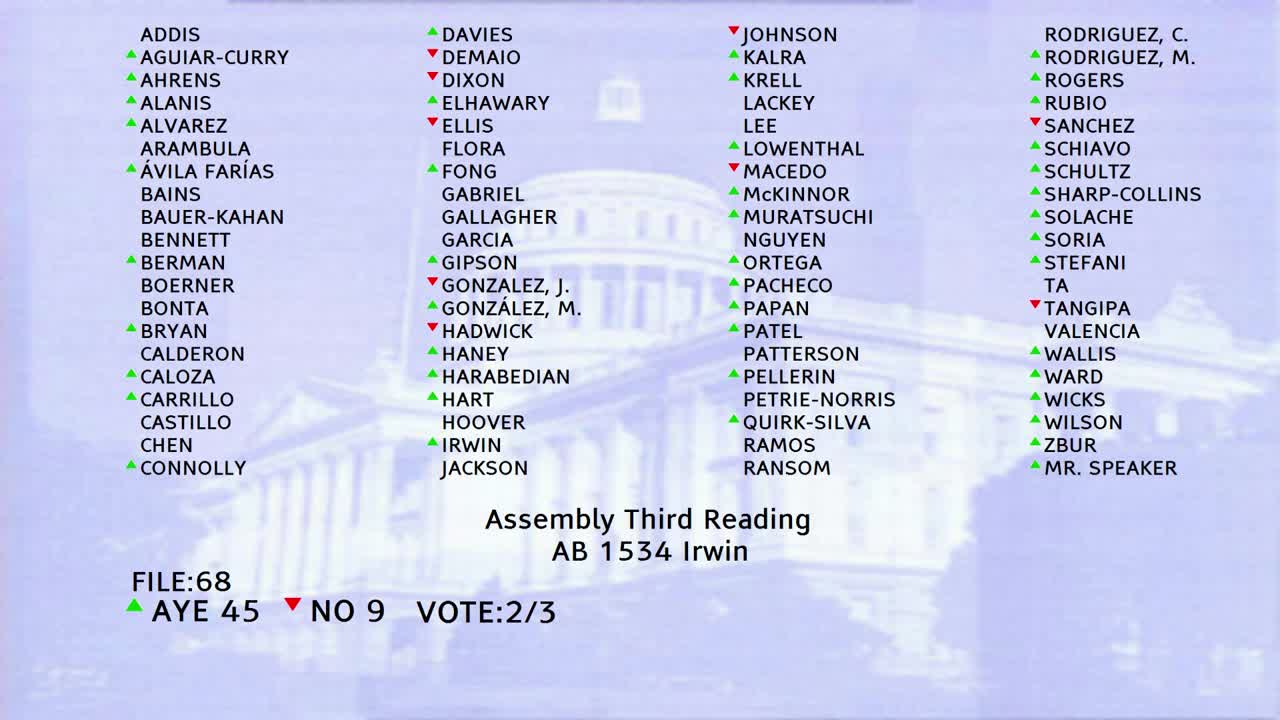 1MIN
Assembly Floor
 20MIN
Assembly Standing Committee on Public Safety
Bill Author