ACA 3: Public employees’ retirement.
- Session Year: 2015-2016
- House: Assembly
- Latest Version Date: 2015-02-26
Existing statutory law establishes various public agency retirement systems, including the Public Employees Retirement System, the State Teachers Retirement System, the Judges Retirement System II, and various county retirement systems pursuant to the County Employees Retirement Law of 1937, among others, and these systems provide defined pension benefits to public employees based on age, service credit, and amount of final compensation. The California Constitution permits a city or county to adopt a charter for purposes of its governance that supersedes general laws of the state in regard to specified subjects, including compensation of city or county employees. The California Constitution establishes the University of California as a public trust with full powers of organization and government, subject only to specified limitations. Under their respective independent constitutional authority, charter cities and counties and the University of California may establish retirement systems. The California Public Employees Pension Reform Act of 2013 (PEPRA) generally requires the retirement systems to which it applies to modify their provisions to conform with its requirements. PEPRA excepts from its provisions retirement systems established by charter cities and counties and the University of California. PEPRA requires that any enhancement to a public employees retirement formula or retirement benefit adopted on or after January 1, 2013, apply only to service performed on or after the operative date of the enhancement and prohibits its application to service performed prior to that date.
This measure would require, with respect to any public retirement systems, that any enhancement to a public employees retirement formula or retirement benefit, adopted on or after the measures effective date, apply only to service performed on and after the operative date of the enhancement and shall not be applied to any service performed prior to the operative date of the change. The measure would specify how changes in membership classification or changes in employment are to be applied in this context. The measure would provide that specified cost-of-living adjustments are not enhancements of retirement benefits.
Resolved by the Assembly, the Senate concurring, That the Legislature of the State of California at its 201516 Regular Session commencing on the first day of December, two-thirds of the membership of each house concurring, hereby proposes to the people of the State of California, that the Constitution of the State be amended as follows:
(h)(i)As used in this section, the term retirement board board shall mean the board of administration, board of trustees, board of directors, or other governing body or board of a public employees pension or retirement system; provided, however, that the term retirement board board shall not be interpreted to mean or include a governing body or board created after July 1, 1991 which does not administer pension or retirement benefits, or the elected legislative body of a jurisdiction which employs participants in a public employees pension or retirement system.
(h)(1)Any enhancement to a public employees retirement formula or retirement benefit, adopted on or after the effective date of this subdivision, shall apply only to service performed on and after the operative date of the enhancement and shall not be applied to any service performed prior to the operative date of the enhancement.
(2)If a change to a members retirement membership classification or a change in employment results in an enhancement in the retirement formula or retirement benefit applicable to that member, that enhancement shall apply only to service performed on or after the operative date of the change and shall not be applied to any service performed prior to the operative date of the change.
(3)For purposes of this subdivision operative date in a collective bargaining agreement means one of the following:
(A)The date that the agreement is signed by the parties.
(B)A date agreed to by the parties that will occur after the date that the agreement is signed by the parties.
(C)A date designated by the parties that occurred prior to the date the agreement was signed if the most recent collective bargaining contract was expired at the time of the agreement and the date designated is not earlier than 12 months prior to the date of the agreement or the day after the last day of the expired bargaining contract, whichever occurred later.
(4)For purposes of this section, an increase to a retirees annual cost-of-living adjustment within existing statutory limits shall not be considered to be an enhancement to a retirement benefit.
|
Date
|
Status
|
|---|---|
| Jun 24, 2015 | In committee: Set, second hearing. Failed passage. Reconsideration granted. |
| May 5, 2015 | In committee: Set, first hearing. Hearing canceled at the request of author. |
| Apr 6, 2015 | Referred to Com. on P.E., R., & S.S. |
| Feb 27, 2015 | From printer. May be heard in committee March 29. |
| Feb 26, 2015 | Read first time. To print. |
|
Date
|
Description
|
Location
|
Votes
|
|
|---|---|---|---|---|
| Jun 24, 2015 | Reconsideration. | Assembly Standing Committee on Public Employees, Retirement, and Social Security |
Passed |
|
| Jun 24, 2015 | Be adopted and re-referred to the Committee on [Appropriations] | Assembly Standing Committee on Public Employees, Retirement, and Social Security |
Failed |
This list shows positions taken on this bill by organizations on the date displayed, which is linked to the original source.
Positions by individuals are not included.
ACA 3
Page 3
Date of Hearing: June 24, 2015
ASSEMBLY COMMITTEE ON PUBLIC EMPLOYEES, RETIREMENT, AND SOCIAL SECURITY
Rob Bonta, Chair
ACA 3
(Gallagher) – As Introduced February 26, 2015
SUBJECT: Public employees’ retirement
SUMMARY:
Places in the Constitution the current statutory prohibition on
applying any enhancement to a benefit formula or retirement benefit
to service performed prior to the operative date of the enhancement.
Specifically, this constitutional amendment:
Specifies that any enhancement to a public employee's retirement formula or retirement benefit only applies to service performed on and after the operative date of the enhancement.
Specifies that if a change in retirement membership classification or employment results in an enhancement in the retirement formula or retirement benefit, that enhancement only applies to service performed on and after the operative date of the change.
Defines "operative date" for purposes of these provisions.
Provides that a retiree's annual cost-of-living increase, within statutory boundaries, is not considered an enhancement to a retirement benefit.
EXISTING LAW:
Creates comprehensive public employee pension reform through enactment of the Public Employees' Pension Reform Act of 2013 (PEPRA) that apply to all public employers and public pension plans on and after January 1, 2013, excluding the University of California and charter cities and counties that do not participate in a retirement system governed by state statute.
Requires, under PEPRA, that any enhancement to a benefit formula or retirement benefit shall only be applicable to service performed after the operative date of the enhancement.
Specifies that if a change in retirement membership classification or employment results in an enhancement in the retirement formula or retirement benefit, that enhancement only applies to service performed on and after the operative date of the change.
Clarifies that a retiree's annual cost-of-living increase, within statutory boundaries, is not considered to be an enhancement to a retirement benefit.
FISCAL EFFECT: Unknown.
COMMENTS:
According to the author, "ACA 3 would put the current
prohibition on retroactive benefit increases for public employee’s
retirement formulas into the State Constitution. This will help
protect taxpayers from undue financial liabilities, as putting this
provision in the Constitution will make it more difficult to overturn
in the future."
The author concludes, "Providing accurate and sufficient benefits to retirees is crucial. Although retroactive benefit enhancements may seem like a good idea in the short-run, the long-term impact on California’s economy would be extremely detrimental, eventually harming those it seeks to help. ACA 3 will assure that future generations are protected from such systems by solidifying the prohibition on retroactive benefit increases through a constitutional amendment.”
Opponents point out that the California Constitution grants a city or county the right to adopt a charter, and said charter supersedes state general laws in relation to the compensation of city or county employees. Opponents state, "ACA 3 will ignore rights granted under the Constitution that have worked for the last 75 or more years and will interject changes in retirement membership classifications or even employment compensation…Amending the Constitution undermines the system's independent tradition and the original rights to supersede the general laws of the state."
Opponents also state, "ACA 3 also circumvents the collective bargaining process, where employees and employers can negotiate and discuss wages, working conditions, and benefits. The collective bargaining process work because improved labor-management relationship result in employee loyalty that reduces turnover, and creates long term stability to the workforce. This benefits employers as much as employees because they can better reap the return on investments in training and experience spent on the employee."
REGISTERED SUPPORT / OPPOSITION:
Support
California Pension Reform
California Republican Taxpayers' Association
Howard Jarvis Taxpayers Association
Kern Citizens for Sustainable Government
Opposition
American Federation of State, County and Municipal Employees
American Federation of State, County and Municipal Employees, Local 685
Association for Los Angeles Deputy Sheriffs
Association of Deputy District Attorneys
California Federation of Teachers
California School
Employees Association
California Professional Firefighters
Glendale City Employees Association
Los Angeles County Probation Officers Union
Los Angeles Police Protective League
Organization of SMUD Employees Association
Riverside Sheriffs Association
San Bernardino Public Employees Association
San Diego County court Employees Association
San Luis Obispo County Employees Association
Analysis Prepared by: Karon Green / P.E.,R., & S.S. / (916) 319-3957
Discussed in Hearing
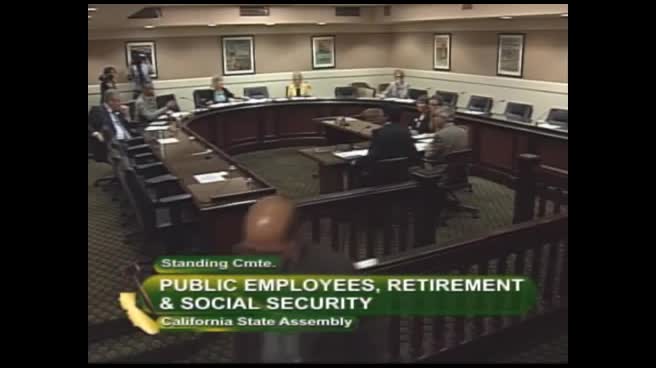 16MIN
Assembly Standing Committee on Public Employees, Retirement, and Social Security
Bill Author

Bill Co-Author(s):