AB 1565: Income and corporation taxes: credits: work opportunity credit.
- Session Year: 2025-2026
- House: Assembly
- Latest Version Date: 2026-01-12
Current Status:
In Progress
(2026-04-27: In committee: Set, second hearing. Held under submission.)
Introduced
In Committee
Awaiting First Chamber Vote
Passed First Chamber
In Committee
Awaiting Second Chamber Vote
Passed Second Chamber
Enacted
The Personal Income Tax Law and the Corporation Tax Law allow various credits against the taxes imposed by those laws.
This bill, for taxable years beginning on or after January 1, 2027, and before January 1, 2032, would allow a credit against those taxes to a qualified taxpayer in an amount equal to 40% of the qualified wages paid or incurred to a qualified employee employed during the taxable year. The bill would define a qualified employee for this purpose to mean an individual that, among other things, has been convicted of a felony, as provided, and has a hiring date not more than one year after the date the individual was convicted or was released from prison.
Existing law requires any bill authorizing a new tax expenditure to contain, among other things, specific goals that the tax expenditure will achieve, detailed performance indicators, and data collection requirements.
This bill would include additional information required for any bill authorizing a new income tax expenditure.
This bill would take effect immediately as a tax levy.
(a)(1)For taxable years beginning on or after January 1, 2027, and before January 1, 2032, there shall be allowed a credit against the net tax, as defined in Section 17039, to a qualified taxpayer in an amount equal to 40 percent of the qualified first-year wages paid or incurred to a qualified employee.
(2)The credit allowed pursuant to this section to a qualified taxpayer based on qualified first-year wages paid to any qualified employee shall not exceed five thousand dollars ($5,000), regardless of taxable year.
(b)For purposes of this section:
(1)Qualified employee means an individual who satisfies all of the following:
(A)Is employed by a qualified taxpayer during the taxable year.
(B)Has worked for the qualified taxpayer for at least six months.
(C)Has been convicted of a felony under any statute of the United States, or of any state.
(D)Is employed by the qualified taxpayer to perform services within the State of California.
(E)Has a hiring date that is not more than one year after the date the individual was convicted or was released from prison.
(2)Qualified taxpayer means a taxpayer with fewer than five employees that pays qualified first-year wages to a qualified employee.
(3)(A)Qualified first-year wages means wages paid or incurred to a qualified employee within the one-year period beginning on the date the qualified employee begins performing services for the qualified taxpayer.
(B)Qualified first-year wages shall not include the following:
(i)Amounts paid or incurred by a qualified taxpayer for any period to an individual for whom the qualified taxpayer receives federally funded payments for on-the-job training of the individual for that period.
(ii)Amounts paid or incurred by the qualified taxpayer to an individual for services which are the same as, or substantially similar to, those services performed by employees participating in, or affected by, a strike or lockout during the period of that strike or lockout.
(iii)In the event that a qualified taxpayer pays or incurs qualified wages to a qualified employee in two separate taxable years, qualified first-year wages shall not include any amount paid or incurred that was used to calculate the amount of any credit allowed in a prior year.
(c)Any deduction that is otherwise allowed to the qualified taxpayer pursuant to this part with respect to wages paid to the qualified employee shall be reduced by the amount of any credit claimed under this section. This credit shall be taken in lieu of any other credit that the qualified taxpayer may otherwise claim pursuant to this part with respect to wages paid to a qualified employee.
(d)(1)For purposes of complying with Section 41, as it relates to the credit allowed pursuant to this section and Section 23621.1, the Legislature finds and declares as follows:
(A)The specific goal, purpose, and objective of the credit is to reduce recidivism rates by reducing unemployment among recently released ex-felons.
(B)The performance indicators for the Legislature to use in determining whether the credit achieves the stated goals shall be the number of taxpayers allowed a credit pursuant to this section or Section 23621.1, and the average dollar value of credits allowed.
(2)(A)No later than December 1, 2029, and each December 1 thereafter, the Franchise Tax Board shall submit a report, in compliance with Section 9795 of the Government Code, to the Legislature detailing the number of taxpayers that receive a credit pursuant to this section or Section 23621.1 and the average dollar value of credits allowed.
(B)The disclosure provisions of this paragraph shall be treated as an exception to Section 19542.
(e)This section shall remain in effect only until December 1, 2032, and as of that date is repealed.
SEC. 2.Section 23621.1 is added to the Revenue and Taxation Code, to read:23621.1.(a)(1)For taxable years beginning on or after January 1, 2027, and before January 1, 2032, there shall be allowed a credit against the tax, as defined in Section 23036, to a qualified taxpayer in an amount equal to 40 percent of the qualified first-year wages paid or incurred to a qualified employee.
(2)The credit allowed pursuant to this section to a qualified taxpayer based on qualified first-year wages paid to any qualified employee shall not exceed five thousand dollars ($5,000), regardless of taxable year.
(b)For purposes of this section:
(1)Qualified employee means an individual who satisfies all of the following:
(A)Is employed by a qualified taxpayer during the taxable year.
(B)Has worked for the qualified taxpayer for at least six months.
(C)Has been convicted of a felony under any statute of the United States, or of any state.
(D)Is employed by the qualified taxpayer to perform services within the State of California.
(E)Has a hiring date that is not more than one year after the date the individual was convicted or was released from prison.
(2)Qualified taxpayer means a taxpayer with fewer than five employees that pays qualified first-year wages to a qualified employee.
(3)(A)Qualified first-year wages means wages paid or incurred to a qualified employee within the one-year period beginning on the date the qualified employee begins performing services for the qualified taxpayer.
(B)Qualified first-year wages shall not include the following:
(i)Amounts paid or incurred by a qualified taxpayer for any period to an individual for whom the qualified taxpayer receives federally funded payments for on-the-job training of the individual for that period.
(ii)Amounts paid or incurred by the qualified taxpayer to an individual for services which are the same as, or substantially similar to, those services performed by employees participating in, or affected by, a strike or lockout during the period of that strike or lockout.
(iii)In the event that a qualified taxpayer pays or incurs qualified wages to a qualified employee in two separate taxable years, qualified first-year wages shall not include any amount paid or incurred that was used to calculate the amount of the credit allowed under this section in a prior year.
(c)Any deduction that is otherwise allowed to the qualified taxpayer pursuant to this part with respect to wages paid to the qualified employee shall be reduced by the amount of any credit claimed under this section. This credit shall be taken in lieu of any other credit that the qualified taxpayer may otherwise claim pursuant to this part with respect to wages paid to a qualified employee.
(d)This section shall remain in effect only until December 1, 2032, and as of that date is repealed.
SEC. 3.This act provides for a tax levy within the meaning of Article IV of the California Constitution and shall go into immediate effect.
|
Date
|
Status
|
|---|---|
| Apr 27, 2026 | In committee: Set, second hearing. Held under submission. |
| Mar 16, 2026 | In committee: Set, first hearing. Referred to REV. & TAX. suspense file. |
| Mar 16, 2026 | In committee: Set, first hearing. Referred to suspense file. |
| Feb 2, 2026 | Referred to Com. on REV. & TAX. |
| Jan 13, 2026 | From printer. May be heard in committee February 12. |
| Jan 12, 2026 | Read first time. To print. |
This list shows positions taken on this bill by organizations on the date displayed, which is linked to the original source.
Positions by individuals are not included.
|
Organization
|
Position
|
Date
|
|---|---|---|
| Asian Americans Advancing Justice-southern California | ** Support | |
| California Asian Pacific Chamber Of Commerce | ** Support | |
| California Chamber Of Commerce | ** Support | |
| California Hispanic Chambers Of Commerce | ** Support | |
| California Tax Reform Association | ** Against | |
| California Teachers Association | ** Against | |
| City of Los Alamitos | ** Support | |
| Families Inspiring Reentry & Reunification 4 Everyone (FIR4E) | ** Support | |
| Initiate Justice | ** Support | |
| National Federation Of Independent Business | ** Support | |
| Orange County United Way | ** Support | |
| Smart Justice California, a Project of Beyond Impact | ** Support |
Date of Hearing: April 27, 2026
ASSEMBLY COMMITTEE ON REVENUE AND TAXATION
Mike Gipson, Chair
ABPCA Bill Id:AB 1565 (
Author:Ta) – As Introduced Ver:January 12, 2026
SUSPENSE
Majority vote. Tax levy. Fiscal committee.
SUBJECT: Income and corporation taxes: credits: work opportunity credit
SUMMARY: Allows businesses with fewer than five employees a credit, under the Personal Income Tax (PIT) Law and the Corporation Tax (CT) Law, equal to 40% of the wages paid to an employee who has previously been convicted of a felony, as specified. Specifically, this bill:
- Allows, for taxable years beginning on or after January 1, 2027, and before January 1, 2032, a credit for "qualified taxpayers", equal to 40% of the "qualified first-year wages" paid or incurred to a "qualified employee", not to exceed $5,000 in any taxable year.
- Defines a "qualified taxpayer" as a taxpayer with fewer than five employees that pays "qualified first-year wages" to a "qualified employee".
- Defines a "qualified employee" as an individual who satisfies all of the following conditions:
- Is employed by the qualified taxpayer during the taxable year;
- Has worked for the qualified taxpayer for at least six months;
- Has been convicted of a felony under Federal or state law;
- Is employed by the qualified taxpayer to perform services within California; and,
- Has a hiring date that is less than one year after the date the individual was convicted or released from prison.
- Defines "qualified first-year wages" as wages paid or incurred to a qualified employee within the one-year period beginning on the date the qualified employee begins performing services for the qualified taxpayer. Specifically:
- Provides that "qualified first-year wages" do not include:
- Amounts paid to an individual for whom the qualified taxpayer receives federally funded payments for on-the-job training; and,
- Amounts paid to an individual for services that are the same as, or substantially similar to, those services performed by employees participating in, or affected by, a strike or lockout during the period of that strike or lockout.
- Provides that any deduction otherwise allowed for wages paid or incurred by the qualified taxpayer to the qualified employee shall be reduced by the amount of the credit allowed.
- Provides that "qualified first-year wages" do not include:
- Finds and declares the following for purposes of satisfying the requirements of Revenue and Taxation Code (R&TC) Section 41:
- The specific goals, purposes, and objectives of this bill are to reduce recidivism rates by reducing unemployment among recently released ex-felons; and,
- To measure whether this bill achieves its intended purpose, the Franchise Tax Board (FTB) is required to submit a written report to the Legislature summarizing the number of taxpayers claiming the credit and the average dollar value of credits allowed by December 1, 2029, and annually thereafter.
- Takes immediate effect as a tax levy.
- Sunsets the credit's statutory provisions on December 1, 2032.
EXISTING FEDERAL LAW provided the Work Opportunity Tax Credit (WOTC), which allowed employers to claim a tax credit for hiring workers that are "members of targeted groups", which included individuals who have been convicted of a felony under state or federal law and were hired within one year of either the individual's conviction or release from prison. The credit amount was calculated as a percentage of the eligible employee's wages during the first year of the eligible employee's employment, up to a statutory maximum, which depended on the worker's specific characteristics. (Internal Revenue Code Section 51(a).)
EXISTING STATE LAW:
- Established the New Employment Credit (NEC), under the PIT Law and CT Law, which allowed a credit for taxable years beginning on or after January 1, 2014, and before January 1, 2026, to a "qualified taxpayer" that did all of the following:
- Hired a "qualified full-time employee";
- Received a credit reservation for that employee;
- Paid "qualified wages" for work performed by that employee in a designated census tract or economic development area, unless otherwise specified; and,
- Reported the credit on a timely filed original return. (R&TC Sections 17053.73 and 23626.)
- Defined a "qualified taxpayer" as a person or entity engaged in a trade or business within a designated census tract or economic development area that, during the taxable year, paid or incurred qualified wages, unless otherwise provided.
- Defined a "qualified full-time employee" as an individual, unless otherwise specified, that met the following requirements:
- Performed at least 50% of their services for the qualified taxpayer during the taxable year in a designated census tract or economic development area;
- Received starting wages that were at least 150% of minimum wage;
- Was paid qualified wages for not less than an average of 35 hours per week or 40 hours per week if they were a salaried employee; and,
- Satisfied at least one of the following conditions at the time of hire:
- Was unemployed for the six months immediately preceding employment with the qualified taxpayer;
- Was a veteran who separated from service in the Armed Forces of the United States within the 12 months preceding commencement of employment with the qualified taxpayer;
- Received the Federal Earned Income Tax Credit (EITC) in the previous taxable year;
- Was an ex-offender previously convicted of a felony; or,
- Was receiving either CalWORKs or county general assistance.
- Defined "qualified wages" as wages that are the portion of wages paid or incurred by the qualified taxpayer during the taxable year to each qualified full-time employee that exceeds 150% of minimum wage but not exceed 350% of minimum wage.
- Defined a "designated census tract" as a census tract within the state that was determined by the Department of Finance to have a civilian unemployment rate within the top 25% of all census tracts within the state and had a poverty rate within the top 25% of all census tracts within the state.
- Defined an "economic development area" as either a former enterprise zone or a local agency military base recovery area, as specified.
- Provided that, unless the taxpayer was a "small business", qualified taxpayers shall not include any of the following:
- Employers that provide temporary help services, as described in Code 561320 of the North American Industry Classification System (NAICS) published by the United States Office of Management and Budget, 2012 edition;
- Employers that provide retail trade services, as described in NAICS Sector 44-45;
- Employers that are primarily engaged in providing food services, as described in NAICS Codes 711110, 722511, 722513, 722514, or 722515; or,
- Employers that are primarily engaged in casino, casino hotel, and alcoholic beverage establishments as described in NAICS Codes 713210, 721120, or 722410.
- Defined a "small business" as a trade or business that had aggregate gross receipts, minus returns and allowances reportable to this state, of less than $2 million during the previous taxable year.
- Prohibited employers engaged in sexually oriented businesses from claiming the NEC.
- Establishes the Homeless Hiring Tax Credit (HHTC), under the PIT Law and CT Law, which allows a credit for taxable years beginning on or after January 1, 2022, and before January 1, 2027, to a qualified taxpayer that hires an "eligible individual", which is a person that meets both of the following criteria:
- The person is homeless or has received supportive services from a homeless services provider, as designated by a local continuum of care or a community-based service provider that is connected to the local coordinated entry system or to a local Homeless Management Information System, on the date of the hire or anytime during the 180-day period immediately before the hire; and,
- The person has been issued a certification by a continuum of care or a community-based service provider that is connected to the local coordinated entry system or to a local Homeless Management Information System and that certificate has not expired. (R&TC Sections 17053.80 and 23629.)
- Prohibits employers with 5 or more employees from asking job applicants about their conviction history before extending a job offer, except in specific instances. (Government Code Section 12952.)
FISCAL EFFECT: The FTB estimates that this bill will result in a revenue loss of approximately $150,000 in fiscal year (FY) 2026-27, $350,000 in FY 2027-28, and $350,000 in FY 2028-29.
COMMENTS:
- The author has provided the following statement in support of this bill:
According to the California Department of Corrections and Rehabilitation (CDCR), more than 60% of individuals released from prison in California will reoffend within three years. Each year of incarceration costs the state approximately $133,000 per person. Employment dramatically changes these outcomes. When a formerly incarcerated person can get a job within one year of release, the likelihood of reoffending drops from 60% to just 16%. Based on data from the CDCR, if 150 formerly incarcerated individuals gain employment through AB 1565, only 24 would be statistically likely to reoffend — compared to 90 who would be expected to reoffend without employment.
With the annual cost of incarceration at $133,000 per person, preventing 66 people from returning to prison because of the jobs created under this bill translates to an estimated $8.8 million in savings. AB 1565 costs the state less than 10% of what it saves, while strengthening families, supporting small businesses, and improving public safety.
This is not just about small businesses and saving the state money—this is about people's livelihoods. Whether you're a small business struggling to get by in a post-COVID economy or a person who has already paid your debt to society, everyone deserves a second chance. AB 1565 is a compassionate bill that helps everyone recover in a way that will save the state millions of dollars and prevent tragedies.
- This bill is supported by Smart Justice California, which notes, in part:
For people reentering society, a job is more than a paycheck—it is a foundation for stability, responsibility, and hope. Yet far too many formerly incarcerated individuals remain unemployed within a year of release, not for lack of effort, but because opportunity is out of reach. AB 1565 responds to this reality by offering a targeted tax credit of up to $5,000 to businesses with fewer than five employees that hire a formerly incarcerated person within one year of release. By investing in opportunity rather than repeated incarceration, AB 1565 strengthens families, improves public safety, helps struggling smaller businesses, and builds healthier communities across California.
- This bill is opposed by the California Tax Reform Association, which notes, in part:
While we appreciate the intent of encouraging the hiring of ex-felons, employment tax credits have never been shown to be effective in reaching social goals they are intended for, with many similar bills having been before this legislature. The cost of an employee is substantial and will only be undertaken if s/he contributes to the productivity and profitability of the employer. The high costs of an employee mean that the employer will hire the best employee, not one with a tax credit, even one as generous as $5,000. The state has many programs to help ex-felons reach employment that are far more targeted and likely to be more effective than a tax credit, which can be enhanced if necessary through the budget.
- Committee Staff Comments:
- Recidivism and reentry in California: While a comprehensive discussion of California's criminal justice system, recidivism trends, and reentry programs are beyond the scope of this analysis, a 2024 Public Policy Institute of California (PPIC) report found the following:
- An average of 36% of people released between FY 2015-16 and 2018-19 were reconvicted in two years. On average, 62% of those released between 2015 and 2019 were rearrested for any crime. However, less than half of released prisoners were rearrested on felony charges and 16% were rearrested on felony charges categorized as violent;
- People released for the first time were less likely to recidivate than people who had previously been imprisoned. Fifty-five percent of first-timers were rearrested and 32% were reconvicted. By contrast, 69% of people with prior prison terms were rearrested and 42% were reconvicted;
- Previously imprisoned people were also less likely than first-timers to participate in most prison programs. Their participation lagged at least 4 and up to 10 percentage points behind first-timers in all education, Transitions, and rehabilitative programs, with the notable exception of substance use disorder treatment; and,
- Participation rates for all employment programs at least tripled between 2015 and 2019 but varied significantly across employment programs. In 2018, computer technology and electronics were the most widely available programs with nearly 3,800 participants.[1]
- Fair Chance Act: AB 1008 (McCarty), Chapter 789, Statutes of 2017, the Fair Chance Act, generally prohibits employers with five or more employees from asking about a job applicant's conviction history before extending a job offer. This type of law is also known as a "Ban the Box" law. California enacted the Fair Chance Act to reduce barriers to employment for individuals with conviction histories because gainful employment is essential to these individuals supporting themselves and their families and to improving their community ties and mental health – all of which reduce recidivism.
- What is a "tax expenditure"? Existing law provides various credits, deductions, exclusions, and exemptions for particular taxpayer groups. In the late 1960s, U.S. Treasury officials began arguing that these features of the tax law should be referred to as "expenditures" since they are generally enacted to accomplish some governmental purpose and there is a determinable cost associated with each (in the form of foregone revenues).
As the Department of Finance notes in its annual Tax Expenditure Report, there are several key differences between tax expenditures and direct expenditures. First, tax expenditures are typically reviewed less frequently than direct expenditures. Second, there is generally no control over the amount of revenue losses associated with any given tax expenditure. Finally, it should also be noted that, once enacted, it takes a two-thirds vote to rescind an existing tax expenditure absent a sunset date. This effectively results in a "one-way ratchet" whereby tax expenditures can be conferred by majority vote, but cannot be rescinded, irrespective of their efficacy or cost, without a supermajority vote. - Federal WOTC overview: The WOTC, which expired in 2025 and has not yet been extended by Congress, provided a federal tax credit to employers that hired workers with certain personal characteristics, including qualified ex-felons, veterans, recipients of certain public benefits, individuals with a disability receiving vocational rehabilitation services, or other specified populations.[2] A qualified ex-felon, for purposes of the WOTC, was an individual who had been convicted of a felony under state or federal law and had a hiring date within one year of either the individual's conviction or release from prison. Employers of all sizes qualified for the WOTC.
The WOTC was designed to incentivize the hiring of employees with certain characteristics by subsidizing a portion of the qualified worker's wage. In an ideal situation, if an employer has a choice between hiring two identical applicants, one of whom is eligible for the WOTC and one of whom is not, the employer may opt to hire the WOTC-eligible applicant because employing that worker will have a lower after-tax cost. The credit was structured to provide an advantage to workers from the WOTC target groups seeking employment; it was not designed to stimulate the creation of new jobs. - WOTC mechanics: An individual's eligibility for the WOTC was determined by state workforce agencies, which also processed WOTC certifications. In California, this entity was the Employment Development Department (EDD). A jobseeker that belonged to one of the eligible groups could obtain a conditional certification form via their local workforce development board or other relevant public agency that provides assistance to jobseekers. Using this conditional certification, the jobseeker could then use their status as a WOTC-eligible employee when applying for jobs, potentially giving them an advantage over other applicants. Alternatively, an employer could complete and submit forms to the state's WOTC coordinator. In either scenario, the IRS Form 8850 must have been submitted within 28 days after the eligible hire began work. Some employers make all new hires complete this form as part of their new hire paperwork so they retain the option to file credit claims later for qualifying employees.
States then verified that an individual was a member of a covered group and notified the employer that the application had been certified. Once a new hire was certified, the employer could claim the WOTC as part of the General Business Credit. If an employer did not have tax liability in the tax year that the WOTC-eligible worker was hired, the credit from the WOTC—as part of the General Business Credit—could be carried back up to one year or carried forward up to 20 years before expiring. For most target groups, the maximum wages that were eligible for the WOTC credit was $6,000. Assuming the eligible employee worked at least 400 hours and the employer claimed the full 40% credit, the maximum credit for most eligible workers was $2,400. - Was the WOTC working? Researchers with the Brookings Institute have summarized decades of research and criticized the WOTC for failing to deliver sustained economic benefits for disadvantaged workers, stating:
- Recidivism and reentry in California: While a comprehensive discussion of California's criminal justice system, recidivism trends, and reentry programs are beyond the scope of this analysis, a 2024 Public Policy Institute of California (PPIC) report found the following:
Employers cannot screen applicants for WOTC eligibility in the hiring process. Employers are typically not allowed or are reluctant to ask applicants about criminal records or benefit receipt, since doing so can expose them to discrimination lawsuits. As a result, the credit does not influence who gets hired.
This points to a puzzle: If the credit has no effect on hiring, why is it so expensive? Who is benefitting from $2 billion per year in tax credits?
The answer is that certain large firms—especially in fast food, retail, and temporary staffing—regularly hire lots of workers for low-wage jobs, and in the process, hire WOTC qualifying workers totally by accident. Enactment of the WOTC credit gave them an incentive to comb through the files of these routine hires, collecting the lucrative subsidy after the fact.
As a result, nearly all WOTC benefits (97%) go to corporations for workers who would have been employed even without the credit. And the benefits are highly concentrated: In Wisconsin, half of all credits went to just 48 large corporations, even though those firms accounted for only a small share of total hiring in the state.
In short, the credit does little to expand opportunity. The average WOTC-certified worker earns about $9 an hour, and the median job lasts less than a year. There is no evidence that the credit improves retention, raises wages, or reduces reliance on public benefits. Meanwhile, a handful of firms receive a tax savings worth millions of dollars.[3]
Tax Year | Number of Returns | Estimated NEC Amounts Claimed | Total Credits Allowed |
2019 | 403 | $3,511,994 | $3,582,380 |
2020 | 380 | $4,231,745 | $4,393,560 |
2021 | 331 | $5,401,737 | $4,887,582 |
2022 | 352 | $3,602,406 | $3,520,759 |
2023 | 232 | $3,494,682 | $3,992,483 |
2024* | 208 | n/a | $4,730,165 |
- California's NEC: In 2013, the Legislature enacted AB 93 (Committee on Budget), Chapter 69, Statutes of 2013, and SB 90 (Galgiani), Chapter 70, Statutes of 2013, which reformed California's economic development policies by eliminating enterprise zones and other geographically targeted economic development areas. Enacted with the abuse of previous tax incentives in mind, the NEC contained much more stringent requirements for taxpayers to qualify.[4] Qualified full-time employees included many of the same categories included under the Enterprise Zone Hiring Credit: previously unemployed persons, veterans, ex-offenders, and low-income families with children.
The table below displays NEC return and credit data:
- California's NEC: In 2013, the Legislature enacted AB 93 (Committee on Budget), Chapter 69, Statutes of 2013, and SB 90 (Galgiani), Chapter 70, Statutes of 2013, which reformed California's economic development policies by eliminating enterprise zones and other geographically targeted economic development areas. Enacted with the abuse of previous tax incentives in mind, the NEC contained much more stringent requirements for taxpayers to qualify.[4] Qualified full-time employees included many of the same categories included under the Enterprise Zone Hiring Credit: previously unemployed persons, veterans, ex-offenders, and low-income families with children.
Source: FTB Annual New Employment Credit Reports, 2021-26.
Eligible employees were required to work at least an average of 35 hours per week and meet other specified requirements. To claim the credit, taxpayers had to receive a tentative credit reservation from the FTB for each qualified full-time employee within 30 days from the date of hire and certify each qualified employee annually. Additionally, state law set the amount of credit at 35% of qualified wages, on wages paid between 150% and 350% of minimum wage, with the top and bottom wage range increasing over time due to increases in the minimum wage rate. However, taxpayers must also have had a net increase in their total number of full-time employees working in California compared to their base year based on annual full-time equivalents to claim the credit.
When the Legislature enacted the NEC in AB 93 and SB 90, revenue estimates projected taxpayers would claim $22 million in NECs in the 2014 taxable year and $69 million in the 2015 taxable year. However, final valid claims were $340,822 in year 2014 (2% of the initial estimate) and $693,323 in 2015 (1% of the initial estimate).4 Over these first two tax years the credit was available, at least 1,829 taxpayers claimed the credit, but the FTB determined that 83% of the claims were invalid.
- Barriers to claiming the NEC: The Legislative Analyst's Office has reported that the low amount of credits claimed suggests that the credit has been challenging or unappealing for businesses to use, and cites the credits' high-wage threshold, small credit amount, complexity, uncertainty, and interaction with other credits as contributing to low participation. Another restriction that may have hindered use is that taxpayers had to demonstrate an overall increase in employment as compared to a base year, meaning that a company must have continually increased their workforce year over year. A new business that is rapidly expanding can easily meet this target, but more established firms are less likely to continuously increase employment. Additionally, the statute required that the employer and employees be located in areas that are designated to have the highest unemployment and poverty levels but only allowed employers to generate credits when paying workers more than 150% of minimum wage. However, census tracts where businesses pay residents high wages are less likely to have high unemployment and poverty rates.
As noted above, the NEC was available for taxable years beginning before January 1, 2025, but it has not been extended and is thus not available for new taxpayers hoping to benefit from the credit in the 2026 taxable year and beyond.
- Homeless Hiring Tax Credit: The HHTC is available for taxable years beginning
January 1, 2022, through December 31, 2026. Employers may receive a tax credit of $2,500 to $10,000 for each eligible employee based on the actual hours worked in the taxable year. Employers may claim up to $30,000 of credit per taxable year. To be eligible, the employee must be certified by a certifying organization. Employers must make a tentative credit reservation with the FTB to claim the credit. A total of $30 million of credit is available annually.
- Homeless Hiring Tax Credit: The HHTC is available for taxable years beginning
According to the FTB's March 2025 HHTC report, just 10 taxpayers applied for reservations in the 2023 taxable year, representing a total of $113,333 in credit reservations. However, the amount of credits actually allowed on 2023 tax year returns cannot be disclosed due to state privacy rules because the number of taxpayers claiming the credit was fewer than 10. The FTB's January 2024 report was also unable to provide any data regarding the number of returns claiming the credit and the amount of credits allowed due to state privacy rules. Thus, fewer than 10 taxpayers have actually claimed the HHTC in each taxable year it has been available.
- Committee's tax expenditure policy: Both R&TC Section 41 and Committee policy require any tax expenditure bill to outline specific goals, purposes, and objectives that the tax expenditure will achieve, along with detailed performance indicators for the Legislature to use when measuring whether the tax expenditure meets those stated goals, purposes, and objectives. A tax expenditure bill will not be eligible for a Committee vote unless it has complied with these requirements. In its current form, this bill states that the credit is designed to reduce recidivism rates by reducing unemployment among recently released ex-felons.
In addition to the R&TC Section 41 requirements, this Committee's policy also requires that all tax expenditure proposals contain an appropriate sunset provision to be eligible for a vote. According to this policy, an "appropriate sunset provision" means five years, except in the case of a tax expenditure measure providing relief to California veterans, in which case "appropriate sunset provision" means ten years. This bill, as currently drafted, complies with the Committee's policy on sunset dates. - Policy considerations:
- Certification: As described above, various hiring credits at both the state and federal level involve some kind of certification process so that the administering tax agency can verify that the employee's wages qualified for the credit. The author may wish to consider similar certification provisions to ensure that the credit is only claimed by eligible businesses that hired eligible workers.
- Coordination with existing reentry programs and services: As noted above, very few HHTCs have been claimed. The author may wish to consider additional provisions that integrate the proposed credit into existing reentry efforts at CDCR to ensure that both employers and job seekers who were recently released from prison are aware of this benefit.
- Implementation considerations:
- In lieu of any other credit: As currently drafted, this bill contains language providing that this credit must be taken in lieu of any other credit that the qualified taxpayer may otherwise claim with respect to wages paid to a qualified employee. This clause would limit the ability of a taxpayer to claim any other work or employment related credit if the employees qualifying for the other credit met the definition of a qualifying employee under this bill. This may lead to the denial of larger employment related credits, which in turn may have the unintended impact of limiting the hiring of qualified employees under this bill.
- Report timeline: This bill would require the FTB to submit a report to the Legislature detailing the number of taxpayers that receive a credit and the average dollar value of credits allowed by December 1, 2029. If the author's intent is to review a report that contains complete information for the 2027 taxable year, the FTB recommends that the reporting due date be extended to July 2030. Corporate filers that file on extension may file as late as October 15, 2029. The FTB needs approximately six months to complete return processing and to compile the needed data to prepare a report.
- Related legislation:
- AB 2205 (Quirk-Silva) would reinstitute the NEC and extend the sunset date so qualifying taxpayers could claim the credit for taxable years beginning before January 1, 2031. This bill is currently pending hearing by this Committee.
- AB 231 (Ta) was substantially similar to this bill. AB 231 was held on the Assembly Appropriations Committee's Suspense File.
- Prior legislation:
- AB 2128 (Ta), of the 2023-24 Legislative Session, was substantially similar to this bill. AB 2128 was held on the Assembly Appropriations Committee's Suspense File.
- AB 2294 (Schiavo), of the 2023-24 Legislative Session, increased the availability of the NEC by repealing various limitations and expanding the definitions of both "qualified wages" and "qualified full-time employee" for the 2024 and 2025 taxable years. AB 2294 was not heard by this Committee.
- SB 553 (Limón), of the 2021-22 Legislative Session, would have allowed a tax credit to certain employers that hire employees who are members of a targeted group. SB 553 was held on the Senate Appropriations Committee's Suspense File.
- AB 1726 (Arambula), of the 2019-20 Legislative Session, was substantially similar to SB 553. AB 1726 was held on the Assembly Appropriations Committee's Suspense File.
- AB 916 (Quirk-Silva and Arambula), of the 2017-18 Legislative Session, was substantially similar to SB 553. AB 916 was held on the Senate Appropriations Committee's Suspense File.
- Committee's tax expenditure policy: Both R&TC Section 41 and Committee policy require any tax expenditure bill to outline specific goals, purposes, and objectives that the tax expenditure will achieve, along with detailed performance indicators for the Legislature to use when measuring whether the tax expenditure meets those stated goals, purposes, and objectives. A tax expenditure bill will not be eligible for a Committee vote unless it has complied with these requirements. In its current form, this bill states that the credit is designed to reduce recidivism rates by reducing unemployment among recently released ex-felons.
REGISTERED SUPPORT / OPPOSITION:
Support
Asian Americans Advancing Justice-Southern California
California Asian Pacific Chamber of Commerce
California Chamber of Commerce
California Hispanic Chambers of Commerce
City of Los Alamitos
Families Inspiring Reentry & Reunification 4 Everyone (FIR4E)
Initiate Justice
National Federation of Independent Business
Orange County United Way
Smart Justice California, a Project of Beyond Impact
Opposition
California Tax Reform Association
California Teachers Association
Analysis Prepared by: Wesley Whitaker / REV. & TAX. / (916) 319-2098
Harris, California Prison Programs and Reentry Pathways, Public Policy Institute of California (PPIC) (June 2024). https://www.ppic.org/publication/california-prison-programs-and-reentry-pathways/. ↑
The Work Opportunity Tax Credit, Congressional Research Service (September 25, 2018). https://sgp.fas.org/crs/misc/R43729.pdf. ↑
Looney, The soon-to-expire Work Opportunity Tax Credit has not been working, Brookings Institute (December 10, 2025). https://www.brookings.edu/articles/the-soon-to-expire-work-opportunity-tax-credit-has-not-been-working/. ↑
Implementation and Effectiveness of California's New Employment Credit, California State Senate Committee on Governance and Finance (March 8, 2023). https://sgf.senate.ca.gov/sites/sgf.senate.ca.gov/files/background_-_final_with_letterhead.pdf.
* Not all timely 2024 tax returns had been processed prior to publishing the most recent report. ↑
Date of Hearing: March 16, 2026
ASSEMBLY COMMITTEE ON REVENUE AND TAXATION
Mike Gipson, Chair
ABPCA Bill Id:AB 1565 (
Author:Ta) – As Introduced Ver:January 12, 2026
Majority vote. Tax levy. Fiscal committee.
SUBJECT: Income and corporation taxes: credits: work opportunity credit
SUMMARY: Allows businesses with fewer than five employees a credit, under the Personal Income Tax (PIT) Law and the Corporation Tax (CT) Law, equal to 40% of the wages paid to an employee who has previously been convicted of a felony, as specified. Specifically, this bill:
- Allows, for taxable years beginning on or after January 1, 2027, and before January 1, 2032, a credit for "qualified taxpayers", equal to 40% of the "qualified first-year wages" paid or incurred to a "qualified employee", not to exceed $5,000 in any taxable year.
- Defines a "qualified taxpayer" as a taxpayer with fewer than five employees that pays "qualified first-year wages" to a "qualified employee".
- Defines a "qualified employee" as an individual who satisfies all of the following conditions:
- Is employed by the qualified taxpayer during the taxable year;
- Has worked for the qualified taxpayer for at least six months;
- Has been convicted of a felony under Federal or state law;
- Is employed by the qualified taxpayer to perform services within California; and,
- Has a hiring date that is less than one year after the date the individual was convicted or released from prison.
- Defines "qualified first-year wages" as wages paid or incurred to a qualified employee within the one-year period beginning on the date the qualified employee begins performing services for the qualified taxpayer. Specifically:
- Provides that "qualified first-year wages" do not include:
- Amounts paid to an individual for whom the qualified taxpayer receives federally funded payments for on-the-job training; and,
- Amounts paid to an individual for services that are the same as, or substantially similar to, those services performed by employees participating in, or affected by, a strike or lockout during the period of that strike or lockout.
- Provides that any deduction otherwise allowed for wages paid or incurred by the qualified taxpayer to the qualified employee shall be reduced by the amount of the credit allowed.
- Provides that "qualified first-year wages" do not include:
- Finds and declares the following for purposes of satisfying the requirements of Revenue and Taxation Code (R&TC) Section 41:
- The specific goals, purposes, and objectives of this bill are to reduce recidivism rates by reducing unemployment among recently released ex-felons; and,
- To measure whether this bill achieves its intended purpose, the Franchise Tax Board (FTB) is required to submit a written report to the Legislature summarizing the number of taxpayers claiming the credit and the average dollar value of credits allowed by December 1, 2029, and annually thereafter.
- Takes immediate effect as a tax levy.
- Sunsets the credit's statutory provisions on December 1, 2032.
EXISTING FEDERAL LAW provided the Work Opportunity Tax Credit (WOTC), which allowed employers to claim a tax credit for hiring workers that are "members of targeted groups", which included individuals who have been convicted of a felony under state or federal law and were hired within one year of either the individual's conviction or release from prison. The credit amount was calculated as a percentage of the eligible employee's wages during the first year of the eligible employee's employment, up to a statutory maximum, which depended on the worker's specific characteristics. (Internal Revenue Code Section 51(a).)
EXISTING STATE LAW:
- Established the New Employment Credit (NEC), under the PIT Law and CT Law, which allowed a credit for taxable years beginning on or after January 1, 2014, and before January 1, 2026, to a "qualified taxpayer" that did all of the following:
- Hired a "qualified full-time employee";
- Received a credit reservation for that employee;
- Paid "qualified wages" for work performed by that employee in a designated census tract or economic development area, unless otherwise specified; and,
- Reported the credit on a timely filed original return. (R&TC Sections 17053.73 and 23626.)
- Defined a "qualified taxpayer" as a person or entity engaged in a trade or business within a designated census tract or economic development area that, during the taxable year, paid or incurred qualified wages, unless otherwise provided.
- Defined a "qualified full-time employee" as an individual, unless otherwise specified, that met the following requirements:
- Performed at least 50% of their services for the qualified taxpayer during the taxable year in a designated census tract or economic development area;
- Received starting wages that were at least 150% of minimum wage;
- Was paid qualified wages for not less than an average of 35 hours per week or 40 hours per week if they were a salaried employee; and,
- Satisfied at least one of the following conditions at the time of hire:
- Was unemployed for the six months immediately preceding employment with the qualified taxpayer;
- Was a veteran who separated from service in the Armed Forces of the United States within the 12 months preceding commencement of employment with the qualified taxpayer;
- Received the Federal Earned Income Tax Credit (EITC) in the previous taxable year;
- Was an ex-offender previously convicted of a felony; or,
- Was receiving either CalWORKs or county general assistance.
- Defined "qualified wages" as wages that are the portion of wages paid or incurred by the qualified taxpayer during the taxable year to each qualified full-time employee that exceeds 150% of minimum wage but not exceed 350% of minimum wage.
- Defined a "designated census tract" as a census tract within the state that was determined by the Department of Finance to have a civilian unemployment rate within the top 25% of all census tracts within the state and had a poverty rate within the top 25% of all census tracts within the state.
- Defined an "economic development area" as either a former enterprise zone or a local agency military base recovery area, as specified.
- Provided that, unless the taxpayer was a "small business", qualified taxpayers shall not include any of the following:
- Employers that provide temporary help services, as described in Code 561320 of the North American Industry Classification System (NAICS) published by the United States Office of Management and Budget, 2012 edition;
- Employers that provide retail trade services, as described in NAICS Sector 44-45;
- Employers that are primarily engaged in providing food services, as described in NAICS Codes 711110, 722511, 722513, 722514, or 722515; or,
- Employers that are primarily engaged in casino, casino hotel, and alcoholic beverage establishments as described in NAICS Codes 713210, 721120, or 722410.
- Defined a "small business" as a trade or business that had aggregate gross receipts, minus returns and allowances reportable to this state, of less than $2 million during the previous taxable year.
- Prohibited employers engaged in sexually oriented businesses from claiming the NEC.
- Establishes the Homeless Hiring Tax Credit (HHTC), under the PIT Law and CT Law, which allows a credit for taxable years beginning on or after January 1, 2022, and before January 1, 2027, to a qualified taxpayer that hires an "eligible individual", which is a person that meets both of the following criteria:
- The person is homeless or has received supportive services from a homeless services provider, as designated by a local continuum of care or a community-based service provider that is connected to the local coordinated entry system or to a local Homeless Management Information System, on the date of the hire or anytime during the 180-day period immediately before the hire; and,
- The person has been issued a certification by a continuum of care or a community-based service provider that is connected to the local coordinated entry system or to a local Homeless Management Information System and that certificate has not expired. (R&TC Sections 17053.80 and 23629.)
- Prohibits employers with 5 or more employees from asking job applicants about their conviction history before extending a job offer, except in specific instances. (Government Code Section 12952.)
FISCAL EFFECT: The FTB estimates that this bill will result in a revenue loss of approximately $150,000 in fiscal year (FY) 2026-27, $350,000 in FY 2027-28, and $350,000 in FY 2028-29.
COMMENTS:
- The author has provided the following statement in support of this bill:
According to the California Department of Corrections and Rehabilitation (CDCR), more than 60% of individuals released from prison in California will reoffend within three years. Each year of incarceration costs the state approximately $133,000 per person. Employment dramatically changes these outcomes. When a formerly incarcerated person can get a job within one year of release, the likelihood of reoffending drops from 60% to just 16%. Based on data from the CDCR, if 150 formerly incarcerated individuals gain employment through AB 1565, only 24 would be statistically likely to reoffend — compared to 90 who would be expected to reoffend without employment.
With the annual cost of incarceration at $133,000 per person, preventing 66 people from returning to prison because of the jobs created under this bill translates to an estimated $8.8 million in savings. AB 1565 costs the state less than 10% of what it saves, while strengthening families, supporting small businesses, and improving public safety.
This is not just about small businesses and saving the state money—this is about people's livelihoods. Whether you're a small business struggling to get by in a post-COVID economy or a person who has already paid your debt to society, everyone deserves a second chance. AB 1565 is a compassionate bill that helps everyone recover in a way that will save the state millions of dollars and prevent tragedies.
- This bill is supported by Smart Justice California, which notes, in part:
For people reentering society, a job is more than a paycheck—it is a foundation for stability, responsibility, and hope. Yet far too many formerly incarcerated individuals remain unemployed within a year of release, not for lack of effort, but because opportunity is out of reach. AB 1565 responds to this reality by offering a targeted tax credit of up to $5,000 to businesses with fewer than five employees that hire a formerly incarcerated person within one year of release. By investing in opportunity rather than repeated incarceration, AB 1565 strengthens families, improves public safety, helps struggling smaller businesses, and builds healthier communities across California.
- This bill is opposed by the California Tax Reform Association, which notes, in part:
While we appreciate the intent of encouraging the hiring of ex-felons, employment tax credits have never been shown to be effective in reaching social goals they are intended for, with many similar bills having been before this legislature. The cost of an employee is substantial and will only be undertaken if s/he contributes to the productivity and profitability of the employer. The high costs of an employee mean that the employer will hire the best employee, not one with a tax credit, even one as generous as $5,000. The state has many programs to help ex-felons reach employment that are far more targeted and likely to be more effective than a tax credit, which can be enhanced if necessary through the budget.
- Committee Staff Comments:
- Recidivism and reentry in California: While a comprehensive discussion of California's criminal justice system, recidivism trends, and reentry programs are beyond the scope of this analysis, a 2024 Public Policy Institute of California (PPIC) report found the following:
- An average of 36% of people released between FY 2015-16 and 2018-19 were reconvicted in two years. On average, 62% of those released between 2015 and 2019 were rearrested for any crime. However, less than half of released prisoners were rearrested on felony charges and 16% were rearrested on felony charges categorized as violent;
- People released for the first time were less likely to recidivate than people who had previously been imprisoned. Fifty-five percent of first-timers were rearrested and 32% were reconvicted. By contrast, 69% of people with prior prison terms were rearrested and 42% were reconvicted;
- Previously imprisoned people were also less likely than first-timers to participate in most prison programs. Their participation lagged at least 4 and up to 10 percentage points behind first-timers in all education, Transitions, and rehabilitative programs, with the notable exception of substance use disorder treatment; and,
- Participation rates for all employment programs at least tripled between 2015 and 2019 but varied significantly across employment programs. In 2018, computer technology and electronics were the most widely available programs with nearly 3,800 participants.[1]
- An average of 36% of people released between FY 2015-16 and 2018-19 were reconvicted in two years. On average, 62% of those released between 2015 and 2019 were rearrested for any crime. However, less than half of released prisoners were rearrested on felony charges and 16% were rearrested on felony charges categorized as violent;
- Fair Chance Act: AB 1008 (McCarty), Chapter 789, Statutes of 2017, the Fair Chance Act, generally prohibits employers with five or more employees from asking about a job applicant's conviction history before extending a job offer. This type of law is also known as a "Ban the Box" law. California enacted the Fair Chance Act to reduce barriers to employment for individuals with conviction histories because gainful employment is essential to these individuals supporting themselves and their families and to improving their community ties and mental health – all of which reduce recidivism.
- What is a "tax expenditure"? Existing law provides various credits, deductions, exclusions, and exemptions for particular taxpayer groups. In the late 1960s, U.S. Treasury officials began arguing that these features of the tax law should be referred to as "expenditures" since they are generally enacted to accomplish some governmental purpose and there is a determinable cost associated with each (in the form of foregone revenues).
As the Department of Finance notes in its annual Tax Expenditure Report, there are several key differences between tax expenditures and direct expenditures. First, tax expenditures are typically reviewed less frequently than direct expenditures. Second, there is generally no control over the amount of revenue losses associated with any given tax expenditure. Finally, it should also be noted that, once enacted, it takes a two-thirds vote to rescind an existing tax expenditure absent a sunset date. This effectively results in a "one-way ratchet" whereby tax expenditures can be conferred by majority vote, but cannot be rescinded, irrespective of their efficacy or cost, without a supermajority vote. - Federal WOTC overview: The WOTC, which expired in 2025 and has not yet been extended by Congress, provided a federal tax credit to employers that hired workers with certain personal characteristics, including qualified ex-felons, veterans, recipients of certain public benefits, individuals with a disability receiving vocational rehabilitation services, or other specified populations.[2] A qualified ex-felon, for purposes of the WOTC, was an individual who had been convicted of a felony under state or federal law and had a hiring date within one year of either the individual's conviction or release from prison. Employers of all sizes qualified for the WOTC.
The WOTC was designed to incentivize the hiring of employees with certain characteristics by subsidizing a portion of the qualified worker's wage. In an ideal situation, if an employer has a choice between hiring two identical applicants, one of whom is eligible for the WOTC and one of whom is not, the employer may opt to hire the WOTC-eligible applicant because employing that worker will have a lower after-tax cost. The credit was structured to provide an advantage to workers from the WOTC target groups seeking employment; it was not designed to stimulate the creation of new jobs. - WOTC mechanics: An individual's eligibility for the WOTC was determined by state workforce agencies, which also processed WOTC certifications. In California, this entity was the Employment Development Department (EDD). A jobseeker that belonged to one of the eligible groups could obtain a conditional certification form via their local workforce development board or other relevant public agency that provides assistance to jobseekers. Using this conditional certification, the jobseeker could then use their status as a WOTC-eligible employee when applying for jobs, potentially giving them an advantage over other applicants. Alternatively, an employer could complete and submit forms to the state's WOTC coordinator. In either scenario, the IRS Form 8850 must have been submitted within 28 days after the eligible hire began work. Some employers make all new hires complete this form as part of their new hire paperwork so they retain the option to file credit claims later for qualifying employees.
States then verified that an individual was a member of a covered group and notified the employer that the application had been certified. Once a new hire was certified, the employer could claim the WOTC as part of the General Business Credit. If an employer did not have tax liability in the tax year that the WOTC-eligible worker was hired, the credit from the WOTC—as part of the General Business Credit—could be carried back up to one year or carried forward up to 20 years before expiring. For most target groups, the maximum wages that were eligible for the WOTC credit was $6,000. Assuming the eligible employee worked at least 400 hours and the employer claimed the full 40% credit, the maximum credit for most eligible workers was $2,400. - Was the WOTC working? Researchers with the Brookings Institute have summarized decades of research and criticized the WOTC for failing to deliver sustained economic benefits for disadvantaged workers, stating:
- Recidivism and reentry in California: While a comprehensive discussion of California's criminal justice system, recidivism trends, and reentry programs are beyond the scope of this analysis, a 2024 Public Policy Institute of California (PPIC) report found the following:
Employers cannot screen applicants for WOTC eligibility in the hiring process. Employers are typically not allowed or are reluctant to ask applicants about criminal records or benefit receipt, since doing so can expose them to discrimination lawsuits. As a result, the credit does not influence who gets hired.
This points to a puzzle: If the credit has no effect on hiring, why is it so expensive? Who is benefitting from $2 billion per year in tax credits?
The answer is that certain large firms—especially in fast food, retail, and temporary staffing—regularly hire lots of workers for low-wage jobs, and in the process, hire WOTC qualifying workers totally by accident. Enactment of the WOTC credit gave them an incentive to comb through the files of these routine hires, collecting the lucrative subsidy after the fact.
As a result, nearly all WOTC benefits (97%) go to corporations for workers who would have been employed even without the credit. And the benefits are highly concentrated: In Wisconsin, half of all credits went to just 48 large corporations, even though those firms accounted for only a small share of total hiring in the state.
In short, the credit does little to expand opportunity. The average WOTC-certified worker earns about $9 an hour, and the median job lasts less than a year. There is no evidence that the credit improves retention, raises wages, or reduces reliance on public benefits. Meanwhile, a handful of firms receive a tax savings worth millions of dollars.[3]
Tax Year | Number of Returns | Estimated NEC Amounts Claimed | Total Credits Allowed |
2019 | 403 | $3,511,994 | $3,582,380 |
2020 | 380 | $4,231,745 | $4,393,560 |
2021 | 331 | $5,401,737 | $4,887,582 |
2022 | 352 | $3,602,406 | $3,520,759 |
2023 | 232 | $3,494,682 | $3,992,483 |
2024* | 208 | n/a | $4,730,165 |
- California's NEC: In 2013, the Legislature enacted AB 93 (Committee on Budget), Chapter 69, Statutes of 2013, and SB 90 (Galgiani), Chapter 70, Statutes of 2013, which reformed California's economic development policies by eliminating enterprise zones and other geographically targeted economic development areas. Enacted with the abuse of previous tax incentives in mind, the NEC contained much more stringent requirements for taxpayers to qualify.[4] Qualified full-time employees included many of the same categories included under the Enterprise Zone Hiring Credit: previously unemployed persons, veterans, ex-offenders, and low-income families with children.
The table below displays NEC return and credit data:
- California's NEC: In 2013, the Legislature enacted AB 93 (Committee on Budget), Chapter 69, Statutes of 2013, and SB 90 (Galgiani), Chapter 70, Statutes of 2013, which reformed California's economic development policies by eliminating enterprise zones and other geographically targeted economic development areas. Enacted with the abuse of previous tax incentives in mind, the NEC contained much more stringent requirements for taxpayers to qualify.[4] Qualified full-time employees included many of the same categories included under the Enterprise Zone Hiring Credit: previously unemployed persons, veterans, ex-offenders, and low-income families with children.
Source: FTB Annual New Employment Credit Reports, 2021-26.
Eligible employees were required to work at least an average of 35 hours per week and meet other specified requirements. To claim the credit, taxpayers had to receive a tentative credit reservation from the FTB for each qualified full-time employee within 30 days from the date of hire and certify each qualified employee annually. Additionally, state law set the amount of credit at 35% of qualified wages, on wages paid between 150% and 350% of minimum wage, with the top and bottom wage range increasing over time due to increases in the minimum wage rate. However, taxpayers must also have had a net increase in their total number of full-time employees working in California compared to their base year based on annual full-time equivalents to claim the credit.
When the Legislature enacted the NEC in AB 93 and SB 90, revenue estimates projected taxpayers would claim $22 million in NECs in the 2014 taxable year and $69 million in the 2015 taxable year. However, final valid claims were $340,822 in year 2014 (2% of the initial estimate) and $693,323 in 2015 (1% of the initial estimate).4 Over these first two tax years the credit was available, at least 1,829 taxpayers claimed the credit, but the FTB determined that 83% of the claims were invalid.
- Barriers to claiming the NEC: The Legislative Analyst's Office has reported that the low amount of credits claimed suggests that the credit has been challenging or unappealing for businesses to use, and cites the credits' high-wage threshold, small credit amount, complexity, uncertainty, and interaction with other credits as contributing to low participation. Another restriction that may have hindered use is that taxpayers had to demonstrate an overall increase in employment as compared to a base year, meaning that a company must have continually increased their workforce year over year. A new business that is rapidly expanding can easily meet this target, but more established firms are less likely to continuously increase employment. Additionally, the statute required that the employer and employees be located in areas that are designated to have the highest unemployment and poverty levels but only allowed employers to generate credits when paying workers more than 150% of minimum wage. However, census tracts where businesses pay residents high wages are less likely to have high unemployment and poverty rates.
As noted above, the NEC was available for taxable years beginning before January 1, 2025, but it has not been extended and is thus not available for new taxpayers hoping to benefit from the credit in the 2026 taxable year and beyond.
- Homeless Hiring Tax Credit: The HHTC is available for taxable years beginning
January 1, 2022, through December 31, 2026. Employers may receive a tax credit of $2,500 to $10,000 for each eligible employee based on the actual hours worked in the taxable year. Employers may claim up to $30,000 of credit per taxable year. To be eligible, the employee must be certified by a certifying organization. Employers must make a tentative credit reservation with the FTB to claim the credit. A total of $30 million of credit is available annually.
- Homeless Hiring Tax Credit: The HHTC is available for taxable years beginning
According to the FTB's March 2025 HHTC report, just 10 taxpayers applied for reservations in the 2023 taxable year, representing a total of $113,333 in credit reservations. However, the amount of credits actually allowed on 2023 tax year returns cannot be disclosed due to state privacy rules because the number of taxpayers claiming the credit was fewer than 10. The FTB's January 2024 report was also unable to provide any data regarding the number of returns claiming the credit and the amount of credits allowed due to state privacy rules. Thus, fewer than 10 taxpayers have actually claimed the HHTC in each taxable year it has been available.
- Committee's tax expenditure policy: Both R&TC Section 41 and Committee policy require any tax expenditure bill to outline specific goals, purposes, and objectives that the tax expenditure will achieve, along with detailed performance indicators for the Legislature to use when measuring whether the tax expenditure meets those stated goals, purposes, and objectives. A tax expenditure bill will not be eligible for a Committee vote unless it has complied with these requirements. In its current form, this bill states that the credit is designed to reduce recidivism rates by reducing unemployment among recently released ex-felons.
In addition to the R&TC Section 41 requirements, this Committee's policy also requires that all tax expenditure proposals contain an appropriate sunset provision to be eligible for a vote. According to this policy, an "appropriate sunset provision" means five years, except in the case of a tax expenditure measure providing relief to California veterans, in which case "appropriate sunset provision" means ten years. This bill, as currently drafted, complies with the Committee's policy on sunset dates. - Policy considerations:
- Certification: As described above, various hiring credits at both the state and federal level involve some kind of certification process so that the administering tax agency can verify that the employee's wages qualified for the credit. The author may wish to consider similar certification provisions to ensure that the credit is only claimed by eligible businesses that hired eligible workers.
- Coordination with existing reentry programs and services: As noted above, very few HHTCs have been claimed. The author may wish to consider additional provisions that integrate the proposed credit into existing reentry efforts at CDCR to ensure that both employers and job seekers who were recently released from prison are aware of this benefit.
- Implementation considerations:
- In lieu of any other credit: As currently drafted, this bill contains language providing that this credit must be taken in lieu of any other credit that the qualified taxpayer may otherwise claim with respect to wages paid to a qualified employee. This clause would limit the ability of a taxpayer to claim any other work or employment related credit if the employees qualifying for the other credit met the definition of a qualifying employee under this bill. This may lead to the denial of larger employment related credits, which in turn may have the unintended impact of limiting the hiring of qualified employees under this bill.
- Report timeline: This bill would require the FTB to submit a report to the Legislature detailing the number of taxpayers that receive a credit and the average dollar value of credits allowed by December 1, 2029. If the author's intent is to review a report that contains complete information for the 2027 taxable year, the FTB recommends that the reporting due date be extended to July 2030. Corporate filers that file on extension may file as late as October 15, 2029. The FTB needs approximately six months to complete return processing and to compile the needed data to prepare a report.
- Related legislation:
- AB 2205 (Quirk-Silva) would reinstitute the NEC and extend the sunset date so qualifying taxpayers could claim the credit for taxable years beginning before January 1, 2031. This bill is currently pending hearing by this Committee.
- AB 231 (Ta) was substantially similar to this bill. AB 231 was held on the Assembly Appropriations Committee's Suspense File.
- Prior legislation:
- AB 2128 (Ta), of the 2023-24 Legislative Session, was substantially similar to this bill. AB 2128 was held on the Assembly Appropriations Committee's Suspense File.
- AB 2294 (Schiavo), of the 2023-24 Legislative Session, increased the availability of the NEC by repealing various limitations and expanding the definitions of both "qualified wages" and "qualified full-time employee" for the 2024 and 2025 taxable years. AB 2294 was not heard by this Committee.
- SB 553 (Limón), of the 2021-22 Legislative Session, would have allowed a tax credit to certain employers that hire employees who are members of a targeted group. SB 553 was held on the Senate Appropriations Committee's Suspense File.
- AB 1726 (Arambula), of the 2019-20 Legislative Session, was substantially similar to SB 553. AB 1726 was held on the Assembly Appropriations Committee's Suspense File.
- AB 916 (Quirk-Silva and Arambula), of the 2017-18 Legislative Session, was substantially similar to SB 553. AB 916 was held on the Senate Appropriations Committee's Suspense File.
- Committee's tax expenditure policy: Both R&TC Section 41 and Committee policy require any tax expenditure bill to outline specific goals, purposes, and objectives that the tax expenditure will achieve, along with detailed performance indicators for the Legislature to use when measuring whether the tax expenditure meets those stated goals, purposes, and objectives. A tax expenditure bill will not be eligible for a Committee vote unless it has complied with these requirements. In its current form, this bill states that the credit is designed to reduce recidivism rates by reducing unemployment among recently released ex-felons.
REGISTERED SUPPORT / OPPOSITION:
Support
Asian Americans Advancing Justice-Southern California
California Chamber of Commerce
California Hispanic Chambers of Commerce
City of Los Alamitos
Families Inspiring Reentry & Reunification 4 Everyone (FIR4E)
Initiate Justice
Smart Justice California, a Project of Beyond Impact
Opposition
California Tax Reform Association
Analysis Prepared by: Wesley Whitaker / REV. & TAX. / (916) 319-2098
Harris, California Prison Programs and Reentry Pathways, Public Policy Institute of California (PPIC) (June 2024). https://www.ppic.org/publication/california-prison-programs-and-reentry-pathways/. ↑
The Work Opportunity Tax Credit, Congressional Research Service (September 25, 2018). https://sgp.fas.org/crs/misc/R43729.pdf. ↑
Looney, The soon-to-expire Work Opportunity Tax Credit has not been working, Brookings Institute (December 10, 2025). https://www.brookings.edu/articles/the-soon-to-expire-work-opportunity-tax-credit-has-not-been-working/. ↑
Implementation and Effectiveness of California's New Employment Credit, California State Senate Committee on Governance and Finance (March 8, 2023). https://sgf.senate.ca.gov/sites/sgf.senate.ca.gov/files/background_-_final_with_letterhead.pdf.
* Not all timely 2024 tax returns had been processed prior to publishing the most recent report. ↑
Discussed in Hearing
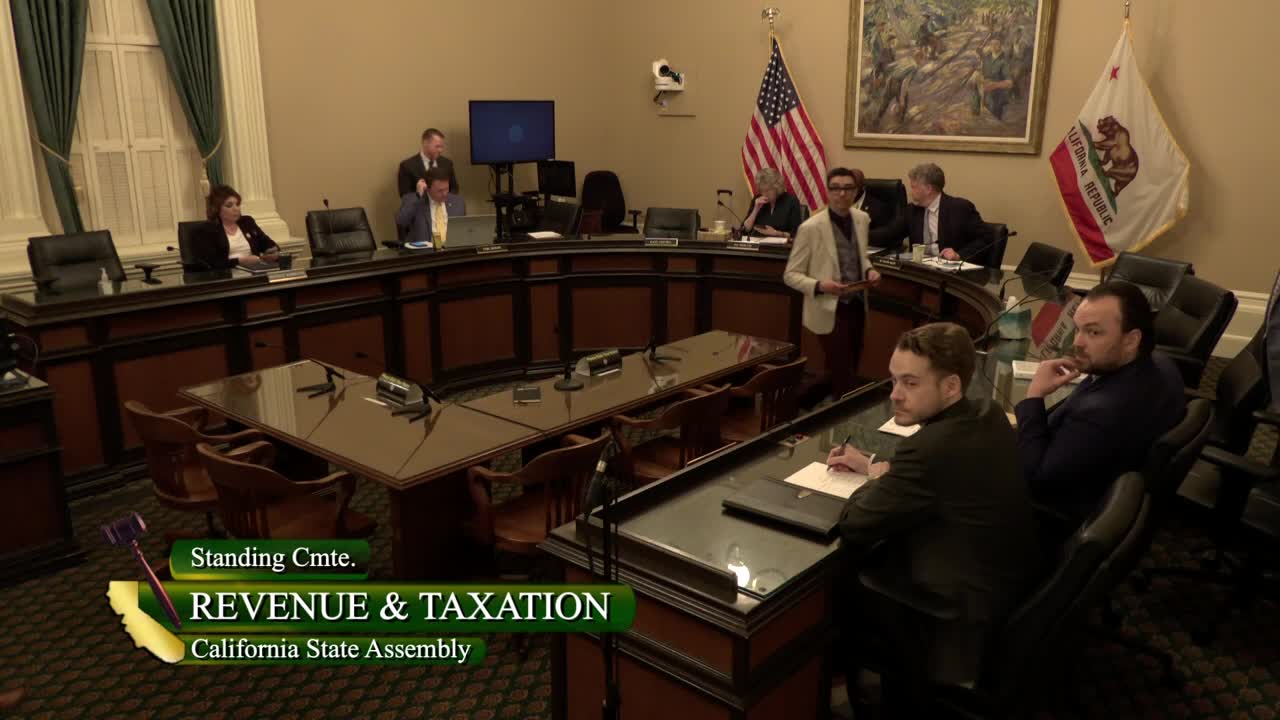 17MIN
Assembly Standing Committee on Revenue and Taxation
Bill Author

Bill Co-Author(s):