AB 1566: Crimes: mandated reporters: severe neglect.
- Session Year: 2025-2026
- House: Assembly
- Latest Version Date: 2026-05-22
Current Status:
In Progress
(2026-05-28: Ordered to inactive file at the request of Assembly Member Jackson.)
Introduced
In Committee
Awaiting First Chamber Vote
Passed First Chamber
In Committee
Awaiting Second Chamber Vote
Passed Second Chamber
Enacted
Existing law, the Child Abuse and Neglect Reporting Act, makes certain persons, including teachers and social workers, mandated reporters. Under existing law, mandated reporters are required to report whenever the mandated reporter, in their professional capacity or within the scope of their employment, has knowledge of or observes a child whom the mandated reporter knows or reasonably suspects has been the victim of child abuse or neglect. Failure by a mandated reporter to report an incident of known or reasonably suspected child abuse or neglect is a misdemeanor. Existing law, for the purposes of the act, defines severe neglect as the negligent failure of a person having the care or custody of a child to protect the child from severe malnutrition or medically diagnosed nonorganic failure to thrive, as well as those situations of neglect where any person having the care or custody of a child willfully causes or permits the person or health of the child to be placed in a situation such that their person or health is endangered as proscribed by specified law, including the intentional failure to provide adequate food, clothing, shelter, or medical care.
Under existing law, prosecution of a misdemeanor must generally be commenced within one year of the commission of the offense, unless otherwise specified. Under existing law, if a mandated reporter intentionally conceals their failure to report an incident known by the mandated reporter to be abuse or severe neglect, it is a continuing offense until discovered by the appropriate law enforcement agency and may be prosecuted within one year of the discovery of the offense, but not later than 4 years after the commission of the offense.
This bill would recast the definition of severe neglect for the purposes described above.
As used in this article, neglect means the negligent treatment or the maltreatment of a child by a person responsible for the childs welfare under circumstances indicating harm or threatened harm to the childs health or welfare. The term includes both acts and omissions on the part of the responsible person.
(a)(1)As used in this article, severe neglect means the negligent failure of a person having the care or custody of a child to protect the child from severe malnutrition or medically diagnosed nonorganic failure to thrive. Severe neglect also means if any person, having the care or custody of a child, willfully causes or permits serious illness or serious injury to the child, willfully causes or permits the death of the child, or causes the child to be placed at imminent risk of serious illness, serious injury, or death, including, but not limited to, the willful failure to provide adequate food, clothing, shelter, or medical care. fails to provide adequate food, clothing, shelter, or medical care to the child that causes or permits serious illness or serious injury to, or the death of, the child or causes or permits the child to be placed at imminent risk of serious illness, serious injury, or death.
(2)The changes made by the act that added this paragraph are not intended to reduce the reporting of actual cases of severe neglect.
(3)The changes made by the act that added this paragraph are not intended to prohibit a peace officer from reporting or to interfere with a peace officers ability to report cases of severe neglect.
(b)As used in this article, general neglect means the negligent failure of a person having the care or custody of a child to provide adequate food, clothing, shelter, medical care, or supervision where no physical injury to the child has occurred but the child is at substantial risk of suffering serious physical harm or illness. General neglect does not include a parents economic disadvantage.
For the purposes of this article, a child receiving treatment by spiritual means as provided in Section 16509.1 of the Welfare and Institutions Code or not receiving specified medical treatment for religious reasons, shall not for that reason alone be considered a neglected child. An informed and appropriate medical decision made by parent or guardian after consultation with a physician who has examined the minor does not constitute neglect.
As used in this article, neglect means the negligent treatment or the maltreatment of a child by a person responsible for the childs welfare under circumstances indicating harm or threatened harm to the childs health or welfare. The term includes both acts and omissions on the part of the responsible person.
(a)Severe As used in this article, severe neglect means the negligent failure of a person having the care or custody of a child to protect the child from severe malnutrition or medically diagnosed nonorganic failure to thrive. Severe neglect also means those situations of neglect where any person having the care or custody of a child willfully causes or permits the person or health of the child to be placed in a situation such that their person or health is endangered as proscribed by Section 11165.3, including the intentional if any person, having the care or custody of a child, willfully causes or permits serious illness or serious injury to the child, willfully causes or permits the death of the child, or causes the child to be placed at imminent risk of serious illness, serious injury, or death, including, but not limited to, the willful failure to provide adequate food, clothing, shelter, or medical care.
(b)General As used in this article, general neglect means the negligent failure of a person having the care or custody of a child to provide adequate food, clothing, shelter, medical care, or supervision where no physical injury to the child has occurred but the child is at substantial risk of suffering serious physical harm or illness. General neglect does not include a parents economic disadvantage.
For the purposes of this chapter, article, a child receiving treatment by spiritual means as provided in Section 16509.1 of the Welfare and Institutions Code or not receiving specified medical treatment for religious reasons, shall not for that reason alone be considered a neglected child. An informed and appropriate medical decision made by parent or guardian after consultation with a physician or physicians who have who has examined the minor does not constitute neglect.
|
Date
|
Status
|
|---|---|
| May 28, 2026 | Ordered to inactive file at the request of Assembly Member Jackson. |
| May 22, 2026 | Read third time and amended. Ordered to third reading. (Page 5270.) |
| May 22, 2026 | Read third time and amended. Ordered to third reading. |
| Mar 5, 2026 | Read second time. Ordered to third reading. |
| Mar 4, 2026 | From committee: Do pass. (Ayes 5. Noes 2.) (March 3). |
| Feb 2, 2026 | Referred to Com. on PUB. S. |
| Jan 13, 2026 | From printer. May be heard in committee February 12. |
| Jan 12, 2026 | Read first time. To print. |
|
Date
|
Description
|
Location
|
Votes
|
|
|---|---|---|---|---|
| Mar 3, 2026 | Do pass. | Assembly Standing Committee on Public Safety |
Passed |
This list shows positions taken on this bill by organizations on the date displayed, which is linked to the original source.
Positions by individuals are not included.
|
Organization
|
Position
|
Date
|
|---|---|---|
| A Child's Dream Altadena, INC | ** Support | |
| Alliance for Children's Rights | ** Support | |
| Arcadia Police Offiers' Association | ** Against | |
| California Family Resource Association | ** Support | |
| California Public Defenders Association | ** Support | |
| Children'S Law Center Of California | ** Support | |
| Outside Voice LLC | ** Support | |
| Prevent Child Abuse California | ** Support | |
| Public Counsel | ** Support | |
| Safe Kids California | ** Support | |
| San Bernardino Teachers Association | ** Support | |
| SHIELDS for Families | ** Support | |
| The Child Abuse Prevention Center | ** Support |
ASSEMBLY THIRD READING
ATR Bill Id:AB 1566
Author:(Jackson)
As Introduced Ver:May 22, 2026
Majority vote
SUMMARY
Redefines severe neglect under the Child Abuse and Neglect Reporting Act (CANRA) to include any person who, having the care or custody of a child, willfully fails to provide adequate food, clothing, shelter, or medical care to the child that causes or permits serious illness or serious injury to, or the death of, the child or causes or permits the child to be placed at imminent risk of serious illness, serious injury, or death.
Major Provisions
- Provides that "severe neglect" also means if any person, having the care or custody of a child, willfully fails to provide adequate food, clothing, shelter, or medical care to the child that causes or permits serious illness or serious injury to, or the death of, the child or causes or permits the child to be placed at imminent risk of serious illness, serious injury, or death.
- Provides that the changes made by the act that added this paragraph are not intended to reduce the reporting of actual cases of severe neglect.
- Provides that the changes made by the act that added this paragraph are not intended to prohibit a peace officer from reporting or to interfere with a peace officer's ability to report cases of severe neglect.
COMMENTS
According to the Author
"The current mandated reporting system has resulted in the over-surveillance of families, most of whose challenges don't rise to the level of true safety concerns and child protection system involvement, and who are disproportionately families of color. The current system compromises safety of the children and families in need of child protections intervention by overwhelming the agency with reports that don't involve child abuse or neglect. This bill came as a recommendation from the California's Mandated Reporting to Community Supporting Task Force. Based on significant data on the occurrence and harm of over-reporting using the general neglect category, the Task Force identified a legislative recommendation to detail and clarify 'severe neglect' so it aligns with the child welfare system's definition rather than becoming a default catch-all reporting category."
Arguments in Support
According to Public Counsel, "We want to express our support for AB 1566 (Jackson), a bill that aims to address the over-reporting and over surveillance of Black/African American and Native American/Indigenous children and families in our Child Welfare System. We thank and applaud Assembly Member Jackson for his leadership in recognizing the critical need for reform of California's Mandated Reporting System and championing policy initiatives to address this need."
"Black/African American and Native American/Indigenous children are significantly more likely to be reported for allegations of abuse and neglect, despite the vast majority of those allegations being unfounded or unsubstantiated. A recent study showed that half of Black children, as well as half of Native American children, experienced an investigation at some point during their childhood, compared to nearly a quarter of white children. California is no exception, a recent report by the Legislative Analyst's Office explains that of children born in 1999 in California, approximately 50% of Black and Indigenous children will have some level of child welfare involvement by the age of 18, and children on Medi-Cal are more than twice as likely to experience child welfare involvement than children with private health insurance."
"In the current system, nearly 90% of all child abuse and neglect allegations are unsubstantiated. In 2023, of the 433,817 children and youth reported to Child Protective Services, 49,463 were determined to need the services. Leaving 384,354 children and youth exposed to the trauma of a report, and possibly an investigation, with the likely result of no additional supports or services that strengthen families."
"Unnecessary reporting is harmful to children, families and communities. It breaks trust, produces feelings of shame and anger, and pushes families away from the help they need instead of inviting them to move toward a community that has support available for them."
"California's system of Mandatory Reporting -at its best, identifies children experiencing true safety concerns- however, at its worst, it begins a journey of systemic harm and intrusion that Black and Tribal Families disproportionately shoulder."
"We believe AB 1566 is a necessary step in transforming the system. AB 1566 amends the definition of Severe Neglect in the Child Abuse and Neglect Reporting Act (CANRA) and aligns it with the definition of Severe Neglect utilized in the California Structured Decision Making (SDM) Tool. As of 2016, all 58 counties in California use SDM to help assess risk and safety to vulnerable children. Under current law, Severe Neglect as defined in CANRA is loosely defined and does not match the more precise and accurate definition used in SDM. This discrepancy is resulting in overreporting of children and families. By aligning the definitions, AB 1566 will minimize the number of unnecessary reports made to the hotline, avoid trauma and stress to children and their families and provide relief to an overburdened Child Protection Hotline System."
Arguments in Opposition
According to the Arcadia Police Offiers' Association, "California's school police and other law enforcement organizations here are strongly opposed to AB 1566 which severely weakens child protection reporting laws by down-grading what currently constitutes "severe negligence."
"Protecting children from abuse and neglect must remain one of our highest priorities. However, effective child protection policy is not furthered by reducing it to allow more child endangerment to occur before reporting is required. Why would anyone want to allow the health and safety of children to be increasingly endangered and yet remain unreported? "
"Current law, Penal Code Section 11165.2 requires mandated reporting of a person who "willfully causes or permits the person or health of the child to be placed in a situation such that their person or health is endangered as proscribed by Section 11165.3 … This is an extremely reasonable child protection standard that should remain intact. "
"If your child was subjected to a person who was willfully causing or allowing the health or safety of your child to be endangered, you would want to be notified, right?"
"What AB 1566 says:
Mandated reporting required where the person in charge of the child's welfare either:
1. Willfully causes or permits serious illness or injury to the child;
2. Willfully causes or permits the death of the child; or
3. Causes imminent risk of serious illness, injury or death of child.
"AB 1566 does not seek to improve child protections against severe neglect. Instead, the bill changes the definition of what constitutes "severe neglect" thereby making it easier for the child abusers to go unreported."
"What AB 1566 does:
- Removes reporting of "severe neglect" based on the actual or potential harm suffered by children;
- Removes infliction of unjustifiable physical pain as basis of mandated reporting;
- Removes infliction of unjustifiable mental suffering as basis for mandated reporting; • Willfully causing injury to child would no longer be a basis for mandated reporting;
- Willfully causing illness to a child would no longer be a basis for mandated reporting;
- "Intentional act" required now (willfully cause or permit child harm) before reporting to police;
- Permitting injury to a child = no mandated reporting (unless serious - undefined)
- No mandatory reporting for permitting "imminent risk of serious illness, injury or death of child;
- Eliminates reference to Penal Code Section 11165.3 which defines the willful harming or injury of a child
"AB 1566 substantially weakens current child protection laws by amending Penal Code Section 11165.2 and eliminating child "endangerment" as the standard for severe negligence determination and replacing it with an "imminent risk," thereby allowing the on-going abuse/endangerment to continue without mandated reporting."
"Willfully permitting the endangerment of a child no longer constitutes 'severe neglect' under AB 1566. If enacted, a person who "permits a child to be placed at imminent risk of serious illness, injury or death" would NOT be subjected to mandated reporting because "permitting" such an act is no longer included in the definition of 'severe neglect' as referenced in Section 11165.3."
"AB 1566 also eliminates the application and cross-referencing of Penal Code Section 11165.3 which defines the willful harming or injury of a child as, '… a situation in which any person willfully causes or permits any child to suffer, or inflicts thereon, unjustifiable physical pain or mental suffering, or having the care or custody of any child, willfully causes or permits the person or health of the child to be placed in a situation in which his or her person or health is endangered.'"
"This bill will allow for the injury and abuse of children to go unreported and continue."
"There have been numerous incidents of mandated reporters - including school principals - who have knowingly failed to protect our children (and comply with existing law) by deciding on their own that the evidence of child abuse presented to them warranted no reporting."
"AB 1566 would allow those incidences to grow exponentially by requiring mandated reporters to make a determination as to whether the child abuser's action were willful and or caused imminent danger to a child before they must report to authorities."
FISCAL COMMENTS
Unknown. This bill is keyed non-fiscal by the Legislative Counsel.
VOTES
ASM PUBLIC SAFETY: 5-2-2
YES: Schultz, Mark González, Haney, Harabedian, Wilson
NO: Alanis, Lackey
ABS, ABST OR NV: Nguyen, Ramos
UPDATED
VERSION: May 22, 2026
CONSULTANT: Dustin Weber / PUB. S. / (916) 319-3744 FN: 0003126
ASSEMBLY THIRD READING
ATR Bill Id:AB 1566
Author:(Jackson)
As Introduced Ver:January 12, 2026
Majority vote
SUMMARY
Redefines severe neglect under the Child Abuse and Neglect Reporting Act (CANRA) to include any person who, having the care or custody of a child, willfully causes or permits serious illness or serious injury to the child, willfully causes or permits the death of the child, or causes the child to be placed at imminent risk of serious illness, serious injury, or death.
Major Provisions
COMMENTS
According to the Author
"The current mandated reporting system has resulted in the over-surveillance of families, most of whose challenges don't rise to the level of true safety concerns and child protection system involvement, and who are disproportionately families of color. The current system compromises safety of the children and families in need of child protections intervention by overwhelming the agency with reports that don't involve child abuse or neglect. This bill came as a recommendation from the California's Mandated Reporting to Community Supporting Task Force. Based on significant data on the occurrence and harm of over-reporting using the general neglect category, the Task Force identified a legislative recommendation to detail and clarify 'severe neglect' so it aligns with the child welfare system's definition rather than becoming a default catch-all reporting category."
Arguments in Support
According to Public Counsel, "We want to express our support for AB 1566 (Jackson), a bill that aims to address the over-reporting and over surveillance of Black/African American and Native American/Indigenous children and families in our Child Welfare System. We thank and applaud Assembly Member Jackson for his leadership in recognizing the critical need for reform of California's Mandated Reporting System and championing policy initiatives to address this need.
"Black/African American and Native American/Indigenous children are significantly more likely to be reported for allegations of abuse and neglect, despite the vast majority of those allegations being unfounded or unsubstantiated. A recent study showed that half of Black children, as well as half of Native American children, experienced an investigation at some point during their childhood, compared to nearly a quarter of white children. California is no exception, a recent report by the Legislative Analyst's Office explains that of children born in 1999 in California, approximately 50% of Black and Indigenous children will have some level of child welfare involvement by the age of 18, and children on Medi-Cal are more than twice as likely to experience child welfare involvement than children with private health insurance.
"In the current system, nearly 90 percent of all child abuse and neglect allegations are unsubstantiated. In 2023, of the 433,817 children and youth reported to Child Protective Services, 49,463 were determined to need the services. Leaving 384,354 children and youth exposed to the trauma of a report, and possibly an investigation, with the likely result of no additional supports or services that strengthen families.
"Unnecessary reporting is harmful to children, families and communities. It breaks trust, produces feelings of shame and anger, and pushes families away from the help they need instead of inviting them to move toward a community that has support available for them.
"California's system of Mandatory Reporting -at its best, identifies children experiencing true safety concerns- however, at its worst, it begins a journey of systemic harm and intrusion that Black and Tribal Families disproportionately shoulder.
"We believe AB 1566 is a necessary step in transforming the system. AB 1566 amends the definition of Severe Neglect in the Child Abuse and Neglect Reporting Act (CANRA) and aligns it with the definition of Severe Neglect utilized in the California Structured Decision Making (SDM) Tool. As of 2016, all 58 counties in California use SDM to help assess risk and safety to vulnerable children. Under current law, Severe Neglect as defined in CANRA is loosely defined and does not match the more precise and accurate definition used in SDM. This discrepancy is resulting in overreporting of children and families. By aligning the definitions, AB 1566 will minimize the number of unnecessary reports made to the hotline, avoid trauma and stress to children and their families and provide relief to an overburdened Child Protection Hotline System."
Arguments in Opposition
According to the Arcadia Police Offiers' Association, "California's school police and other law enforcement organizations here are strongly opposed to AB 1566 which severely weakens child protection reporting laws by down-grading what currently constitutes "severe negligence."
"Protecting children from abuse and neglect must remain one of our highest priorities. However, effective child protection policy is not furthered by reducing it to allow more child endangerment to occur before reporting is required. Why would anyone want to allow the health and safety of children to be increasingly endangered and yet remain unreported?
Current law, Penal Code Section11165.2 requires mandated reporting of a person who "willfully causes or permits the person or health of the child to be placed in a situation such that their person or health is endangered as proscribed by Section 11165.3 … This is an extremely reasonable child protection standard that should remain intact.
"If your child was subjected to a person who was willfully causing or allowing the health or safety of your child to be endangered, you would want to be notified, right?
"What AB 1566 says:
Mandated reporting required where the person in charge of the child's welfare either:
- Willfully causes or permits serious illness or injury to the child;
- Willfully causes or permits the death of the child; or
- Causes imminent risk of serious illness, injury or death of child.
"AB 1566 does not seek to improve child protections against severe neglect. Instead, the bill changes the definition of what constitutes “severe neglect” thereby making it easier for the child abusers to go unreported.
"What AB 1566 does:
- Removes reporting of "severe neglect” based on the actual or potential harm suffered by children;
- Removes infliction of unjustifiable physical pain as basis of mandated reporting;
- Removes infliction of unjustifiable mental suffering as basis for mandated reporting;
- Willfully causing injury to child would no longer be a basis for mandated reporting;
- Willfully causing illness to a child would no longer be a basis for mandated reporting;
- “Intentional act” required now (willfully cause or permit child harm) before reporting to police;
- Permitting injury to a child = no mandated reporting (unless serious - undefined)
- No mandatory reporting for permitting “imminent risk of serious illness, injury or death of child;
- Eliminates reference to Penal Code Section 11165.3 which defines the willful harming or injury of a child
"AB 1566 substantially weakens current child protection laws by amending Penal Code Section 11165.2 and eliminating child "endangerment" as the standard for severe negligence determination and replacing it with an "imminent risk," thereby allowing the on-going abuse/endangerment to continue without mandated reporting.
"Willfully permitting the endangerment of a child no longer constitutes 'severe neglect' under AB 1566. If enacted, a person who "permits a child to be placed at imminent risk of serious illness, injury or death" would NOT be subjected to mandated reporting because "permitting" such an act is no longer included in the definition of 'severe neglect' as referenced in Section 11165.3.
"AB 1566 also eliminates the application and cross-referencing of Penal Code Section 11165.3 which defines the willful harming or injury of a child as, '… a situation in which any person willfully causes or permits any child to suffer, or inflicts thereon, unjustifiable physical pain or mental suffering, or having the care or custody of any child, willfully causes or permits the person or health of the child to be placed in a situation in which his or her person or health is endangered.'"
"This bill will allow for the injury and abuse of children to go unreported and continue.
"There have been numerous incidents of mandated reporters - including school principals - who have knowingly failed to protect our children (and comply with existing law) by deciding on their own that the evidence of child abuse presented to them warranted no reporting.
"AB 1566 would allow those incidences to grow exponentially by requiring mandated reporters to make a determination as to whether the child abuser's action were willful and or caused imminent danger to a child before they must report to authorities."
FISCAL COMMENTS
Unknown. This bill is keyed non-fiscal by the Legislative Counsel.
VOTES
ASM PUBLIC SAFETY: 5-2-2
YES: Schultz, Mark González, Haney, Harabedian, Wilson
NO: Alanis, Lackey
ABS, ABST OR NV: Nguyen, Ramos
UPDATED
VERSION: January 12, 2026
CONSULTANT: Dustin Weber / PUB. S. / (916) 319-3744 FN: 0002294
Date of Hearing:
Counsel: Dustin Weber
ASSEMBLY COMMITTEE ON
Nick Schultz, Chair
ABPCA Bill Id:
Author:() – As Ver:
SUMMARY:
Redefines severe neglect under the Child Abuse and Neglect Reporting Act (CANRA) to include any person who, having the care or custody of a child, willfully causes or permits serious illness or serious injury to the child, willfully causes or permits the death of the child, or causes the child to be placed at imminent risk of serious illness, serious injury, or death.
EXISTING LAW:
- Establishes CANRA with the intent and purpose of protecting children from abuse and neglect. In any investigation of suspected child abuse or neglect, all persons participating in the investigation of the case shall consider the needs of the child victim and shall do whatever is necessary to prevent psychological harm to the child victim. (Pen. Code, § 11164.)
- Provides that reports of suspected child abuse or neglect shall be made by mandated reporters. Any of the reporting agencies shall accept a report of suspected child abuse or neglect whether offered by a mandated reporter or another person, or referred by another agency, even if the agency to whom the report is being made lacks subject matter or geographical jurisdiction to investigate the reported case. Agencies that are required to receive reports of suspected child abuse or neglect may not refuse to accept a report of suspected child abuse or neglect from a mandated reporter or another person unless otherwise authorized, and shall maintain a record of all reports received. (Pen. Code, § 11165.9.)
- States that a mandated reporter shall make a report to an agency, as defined, whenever the mandated reporter, in the mandated reporter’s professional capacity or within the scope of the mandated reporter’s employment, has knowledge of or observes a child whom the mandated reporter knows or reasonably suspects has been the victim of child abuse or neglect. (Pen. Code, § 11166.)
- Requires specified government agencies to forward to the Department of Justice (DOJ) a report of every case of suspected child abuse or neglect that it investigates and determines to be substantiated; and if a previously filed report proves to be not substantiated, the DOJ shall be notified in writing, and shall not retain that report. (Pen. Code, § 11169, subd. (a).)
- Provides that any mandated reporter who fails to report an incident of known or reasonably suspected child abuse or neglect as required is guilty of a misdemeanor punishable by up to six months confinement in a county jail or by a fine of $1,000 or by both. If a mandated reporter intentionally conceals his or her failure to report an incident known by the mandated reporter to be abuse or severe neglect, the failure to report is a continuing offense until a specified agency discovers the offense. (Pen. Code, § 11166, subd. (c).)
- Defines “severe neglect” as the negligent failure of a person having the care or custody of a child to protect the child from severe malnutrition or medically diagnosed nonorganic failure to thrive. Severe neglect also means those situations of neglect where any person having the care or custody of a child willfully causes or permits the person or health of the child to be placed in a situation such that their person or health is endangered, as specified, including the intentional failure to provide adequate food, clothing, shelter, or medical care. (Pen. Code, § 11165.2, subd. (a).)
- Defines “general neglect” as the negligent failure of a person having the care or custody of a child to provide adequate food, clothing, shelter, medical care, or supervision where no physical injury to the child has occurred but the child is at substantial risk of suffering serious physical harm or illness. General neglect does not include a parent’s economic disadvantage. (Pen. Code § 11165.2, subd. (b).)
- Defines “the willful harming or injuring of a child or the endangering of the person or health of a child” as a situation in which any person willfully causes or permits any child to suffer, or inflicts thereon, unjustifiable physical pain or mental suffering, or having the care or custody of any child, willfully causes or permits the person or health of the child to be placed in a situation in which his or her person or health is endangered. (Pen. Code, § 11165.3, subd. (c).)
FISCAL EFFECT:
Unknown
COMMENTS:
- Author's Statement: According to the author, “The current mandated reporting system has resulted in the over-surveillance of families, most of whose challenges don’t rise to the level of true safety concerns and child protection system involvement, and who are disproportionately families of color. The current system compromises safety of the children and families in need of child protections intervention by overwhelming the agency with reports that don't involve child abuse or neglect. This bill came as a recommendation from the California’s Mandated Reporting to Community Supporting Task Force. Based on significant data on the occurrence and harm of over-reporting using the general neglect category, the Task Force identified a legislative recommendation to detail and clarify ‘severe neglect’ so it aligns with the child welfare system’s definition rather than becoming a default catch-all reporting category.”
- Effect of the Bill: This bill reworks the definition of severe neglect that is used by mandated reporters in reporting suspected incidences of child abuse.
The author notes the inspiration for this bill came from a recommendation out of the Mandated Reporting to Community Supporting (MRCS) Task Force.[1] In their 2024 report, the MRCS Task Force recommended “support[ing] the amendment of the Child Abuse
and Neglect Reporting Act (CANRA) to revise and clarify the definition of severe neglect to be aligned with the definition of Severe Neglect utilized in the California Structured Decision
Making (SDM) Tool.”[2] This bill appears to closely reflect the SDM definition.
The change to severe neglect, as written in this bill, could create some inconsistencies and confusion. Willfully is a mens rea term generally used to describe a state of mind that must be plead and proved by prosecutors to secure a conviction. The use of “willfully” in other areas of the sentence but not before the clause stating, “causes the child to be placed at imminent risk of serious illness, serious injury, or death . . .” could create inconsistent outcomes. A willful state of mind, therefore, would need to be plead and proved to secure a conviction for any other conduct in this section of the bill, but would not be required should a person cause a child to be put in “serious risk of illness.” This drafting could lead to outcomes some might consider unjust. For example, a parent who unknowingly lives and raises their child in a home with lead paint, asbestos, or in a community where environmental pollutants cause cancer, arguably could be subject to penalty under this bill.
Redefining severe neglect could additionally create a potential conflict with Penal Code section 11165.3. As an initial matter, by changing the definition of severe neglect to remove the defined language in section 11165.3, the definition potentially becomes superfluous. There, “the willful harming or injuring of a child or endangering the person or health of a child” means “a situation in which any person willfully causes or permits any child to suffer, or inflicts thereon, unjustifiable physical pain or mental suffering, or having the care or custody of any child, willfully causes or permits the person or health of the child to be placed in a situation in which his or her person or health is endangered.” Here, in this bill, severe neglect means “any person, having the care or custody of a child, willfully causes or permits serious illness or serious injury to the child, willfully causes or permits the death of the child, or causes the child to be placed at imminent risk of serious illness, serious injury, or death, including, but not limited to, the willful failure to provide adequate food, clothing, shelter, or medical care.” There appears to be at least some difference in these definitions. Yet, the existence of both sections could create interpretive uncertainty. For example, where a person willfully permits serious illness to a child, has that same person always also willfully caused a child to suffer? If not, this possibility suggests a person’s conduct can be violative of section 11165.3 but not the severe neglect definition in section 11165.2(b), which may not be the author’s intent.
Another consideration in the drafting of this bill is the potential conflict created between a part of the beginning of the severe neglect definition (“. . . the negligent failure of a person having the care or custody of a child to protect the child from severe malnutrition . . .”) and the last part of the definition (“. . . the willful failure to provide adequate food, clothing, shelter, or medical care.”) Negligent failure and willful failure are two different state-of-mind standards. It is unusual in the law for “negligent” conduct to be subject to the same penalties as “willful” conduct. Willful failure requires more intention on the part of the wrongdoer and, thus, is generally considered a more culpable conduct. The potential conflict or confusion here may be magnified by the fact that the definition of general neglect already explicitly includes “negligent failure” in its definition. This conflict, however, exists as part of current law, so this issue ultimately may not create concern.
Additionally, the willful failure clause arguably subsumes the negligent failure clause. It is difficult to imagine a situation where a person who “willfully causes or permits serious illness or serious injury to the child” does not simultaneously also “negligent[ly] fail . . . to protect the child from severe malnutrition or a medically diagnosed nonorganic failure to thrive.” If it is true that the negligent failure part of the severe neglect definition always will be covered by the willful parts of the definition, this could create another problem of surplusage. The rule against surplusage is an interpretive rule employed when interpreting statutory language courts employ to avoid “interpretations that render any language surplusage.” (Brennon B. v. Superior Court (2022) 13 Cal.5th 662, 691.) Courts therefore will try to make a distinction between two clauses and apply them in the case. This could lead to unintentional applications of the law.
An argument can be made, however, that a distinction is possible between the negligent failure clause and willful clauses. For example, the lower standard, negligent failure, applies to an outcome potentially more serious, “severe malnutrition” or “medically diagnosed failure to thrive.” Concomitantly, the higher standard, willful failure, applies to an outcome that is arguably less serious, inadequate nutrition. Nevertheless, with the potential interpretive issues in this bill, it may be worth considering reworking the language to clarify these concerns.
- The Child Abuse and Neglect Reporting Act (CANRA): This bill would clarify the definition of severe neglect under CANRA. CANRA was enacted to address the problem where many instances of child abuse were going unreported. (B.H. v. County of San Bernardino (2015) 62 Cal.4th 168, 190.) Oftentimes, reporting by third parties is the only way the authorities become aware of an incident of child abuse. (Ibid.) The mandatory reporting statute was named the Child Abuse and Neglect Reporting Act (CANRA) in 1987. (Matthews v. Becerra (2019) 8 Cal.5th 756, 763.)
The law imposes duties on mandated reporters to report known or suspected instances of child abuse within defined periods and specifies further details of an individual’s reporting obligations. (B.H., supra, at p. 193.) CANRA categorizes reports of child abuse and neglect into three areas: unfounded, inconclusive, and substantiated. (In re D.P. (2023) 14 Cal.5th 266, 279.) Mandated reporters’ reporting duties are governed by an objective standard. (B.H., supra, at p. 193.) In other words, “the duty to report arises not on the basis of the mandated reporter's personal assessment of the facts known, but on the basis of what a reasonable person would suspect based on those facts.” (Ibid.) The existence of sufficiently suspicious circumstances produces the mandatory duty to report the circumstances to a designated agency. (Ibid.) The agency receiving the report is required to investigate suspected abuse and determine whether abuse occurred. (Ibid.) CANRA also imposes on law enforcement agencies the duty to cross-report reports they receive from other agencies. (Id. at p. 190.)
By changing the definition of severe neglect, this bill may impact the type of conduct that gets reported and the number of reports submitted.
- The Impact of Reporting: Current law provides a comprehensive reporting scheme to identify victims of child abuse. CANRA includes 50 different reporter types that define a mandated reporter to include, among others, a teacher, a public assistance worker, an employee of a childcare institution, a firefighter, a physician, a coroner, a clergy member, an athletic coach, a commercial computer technician, and a human resource employee of a business that employs minors. (Pen. Code, § 11165.7, subd. (a).)
Despite the vast differences in each of these jobs, all mandated reporters share the same legal duty to report known or reasonably suspected child abuse or neglect that they become aware of in the course of their employment. (Pen. Code, § 11166, subd. (a).) Mandated reporters are required to make a report to a designated agency, specifically any police or sheriff's department, county welfare department, or designated county probation departments. (Pen. Code, § 11165.9.) Any of those agencies are required to accept a report of suspected child abuse or neglect whether offered by a mandated reporter or another person. (Ibid.)
According to data from the California Child Welfare Indicators Project (CCWIP), a collaboration between California Department of Social Services (CDSS) and the University of California, Berkeley, allegations of child maltreatment have hovered between 400,000-500,000 per year over the last decade.[3] The most recent data from 2024 shows there was a total of 417,513 allegations of maltreatment and the most frequent allegation type reported was for general neglect with 186,129 instances being reported.[4]
Severe neglect is a greater level of harm than general neglect. General neglect is defined as the negligent failure of a person having the care or custody of a child to provide adequate food, clothing, shelter, medical care, or supervision where no physical injury to the child has occurred, but the child is at substantial risk of suffering serious physical harm or illness. (Pen. Code, § 11165.2, subd. (b).) General neglect does not include a parent’s economic disadvantage. (Ibid.) The language in this bill suggests that negligent failure conduct potentially could qualify as general neglect, severe neglect, or possibly, both. This type of uncertainty could lead to unintended and inconsistent application of the law.
As the author notes, however, overreporting is a significant concern and disproportionately impacts families of color. One factor that contributes to overreporting is that a mandated reporter who fails to report known or suspected neglect can face criminal charges, which can include up to six months confinement in a county jail and/or a fine of up to $1,000. (Pen. Code, § 11166, subd. (c).) Data from CCWIP show that in 2024 only 46,457 (11.1%) reports of abuse were substantiated.[5] Another 108,722 were inconclusive, 100,859 were unfounded, 145,464 had an assessment only/were evaluated out, and 16,011 were categorized as not yet determined.[6] Since nearly 90% of allegations are unsubstantiated, overreporting unnecessarily exposes hundreds of thousands of families to the scrutiny of child protective services (CPS), which can be a traumatic experience for families.
The Legislative Analyst’s Office (LAO) found that California’s child welfare system-involved families are disproportionately Black, Native American, and come from families with low incomes, which is a demographic trend that has persisted for years.[7] Also, the LAO reported:
Given the shorter and longer term negative impacts of experiencing trauma and maltreatment, child welfare system intervention may be necessary to help keep children safe from these potentially harmful situations. At the same time, involvement with the child welfare system also may result in trauma, particularly when a child is removed from their parent(s) or caregiver(s). How best to ensure child safety in a way that minimizes and mitigates trauma and ideally keeps the child with their parent(s)/caregiver(s) is a core challenge inherent to the child welfare system.[8]
Identifying ways to reduce or eliminate the impact of overreporting is critical to ensuring children are not being traumatized by the very process designed to protect their health and wellbeing. Clarifying what conduct is reportable could serve as one way of reducing overreporting. This bill attempts to make this clarification, which may lead to a reduction in unnecessary reports.
- Argument in Support: According to Public Counsel, “We want to express our support for AB 1566 (Jackson), a bill that aims to address the over-reporting and over surveillance of Black/African American and Native American/Indigenous children and families in our Child Welfare System. We thank and applaud Assembly Member Jackson for his leadership in recognizing the critical need for reform of California’s Mandated Reporting System and championing policy initiatives to address this need.
“Black/African American and Native American/Indigenous children are significantly more likely to be reported for allegations of abuse and neglect, despite the vast majority of those allegations being unfounded or unsubstantiated. A recent study showed that half of Black children, as well as half of Native American children, experienced an investigation at some point during their childhood, compared to nearly a quarter of white children. California is no exception, a recent report by the Legislative Analyst’s Office explains that of children born in 1999 in California, approximately 50% of Black and Indigenous children will have some level of child welfare involvement by the age of 18, and children on Medi-Cal are more than twice as likely to experience child welfare involvement than children with private health insurance.
“In the current system, nearly 90 percent of all child abuse and neglect allegations are unsubstantiated. In 2023, of the 433,817 children and youth reported to Child Protective Services, 49,463 were determined to need the services. Leaving 384,354 children and youth exposed to the trauma of a report, and possibly an investigation, with the likely result of no additional supports or services that strengthen families.
“Unnecessary reporting is harmful to children, families and communities. It breaks trust, produces feelings of shame and anger, and pushes families away from the help they need instead of inviting them to move toward a community that has support available for them.
“California’s system of Mandatory Reporting -at its best, identifies children experiencing true safety concerns- however, at its worst, it begins a journey of systemic harm and intrusion that Black and Tribal Families disproportionately shoulder.
“We believe AB 1566 is a necessary step in transforming the system. AB 1566 amends the definition of Severe Neglect in the Child Abuse and Neglect Reporting Act (CANRA) and aligns it with the definition of Severe Neglect utilized in the California Structured Decision Making (SDM) Tool. As of 2016, all 58 counties in California use SDM to help assess risk and safety to vulnerable children. Under current law, Severe Neglect as defined in CANRA is loosely defined and does not match the more precise and accurate definition used in SDM. This discrepancy is resulting in overreporting of children and families. By aligning the definitions, AB 1566 will minimize the number of unnecessary reports made to the hotline, avoid trauma and stress to children and their families and provide relief to an overburdened Child Protection Hotline System.”
- Argument in Opposition: None submitted.
- Related Legislation: AB 1688 (Carrillo) would require an employee of the agencies receiving reports of abuse to send a copy of the report to the attorney who represents a parent or legal guardian of the child, as specified. AB 1688 is pending hearing in the Assembly Public Safety Committee.
- Prior Legislation:
- AB 601 (Jackson) would have, except as provided, required an employer having one or more mandated reporters to ensure completion of the training within the first three months of the mandated reporter’s employment, or on or before March 1, 2030, whichever is later. AB 601 was held in the Senate Appropriations Committee.
- AB 653 (Lackey), Chapter 379, Statutes of 2025, added talent managers, talent coaches, and talent agents to the list of mandated reporters.
- AB 970 (McKinnor) would have authorized a two-year pilot project in Los Angeles County to deploy an online decision-support tool for aiding mandated reporters in their reporting responsibilities. AB 970 died in the Assembly Public Safety Committee.
- AB 2085 (Holden), Chapter 770, Statutes of 2022, redefines general neglect for purposes of CANRA by excluding a person's economic disadvantage.
REGISTERED SUPPORT / OPPOSITION:
Support
A Child's Dream Altadena, INC
Alliance for Children's Rights
California Family Resource Association
California Public Defenders Association
Child Abuse Prevention Center and its Affiliates Safe Kids California, Prevent Child Abuse California and the California Family Resource Association; the
Children's Law Center of California
Outside Voice LLC
Public Counsel
San Bernardino Teachers Association
Shields for Families
The Child Abuse Prevention Center
Opposition
1 individual in opposition
Analysis Prepared by:
Shifting from Reporting Families to Supporting Families (Sep. 2024) Mandated Reporting to Community Supporting Task Force <https://www.caltrin.org/wp-content/uploads/2024/08/MRCS-Task-Force-Report-for-09-04-24.pdf> [as of Feb. 23, 2026]. ↑
California SDM Definitions, at “Severe Neglect” (Nov. 2023) <https://ca.sdmdata.org/Definitions/HT> [as of Feb.23, 2026]. ↑
California Child Population (0-17) and Children with Child Maltreatment Allegations, California Child Welfare Indicators Project (CCWIP) <https://ccwip.berkeley.edu/childwelfare/reports/AllegationRates/MTSG/r/rts/l > [as of Feb. 23, 2026]. ↑
Ibid. ↑
Ibid. ↑
Ibid. ↑
California's Child Welfare System: Addressing Disproportionalities and Disparities (Apr. 2024) Legislative Analyst’s Office <https://lao.ca.gov/Publications/Report/4897> [as of Feb. 23, 2026]. ↑
Ibid. ↑
Discussed in Hearing
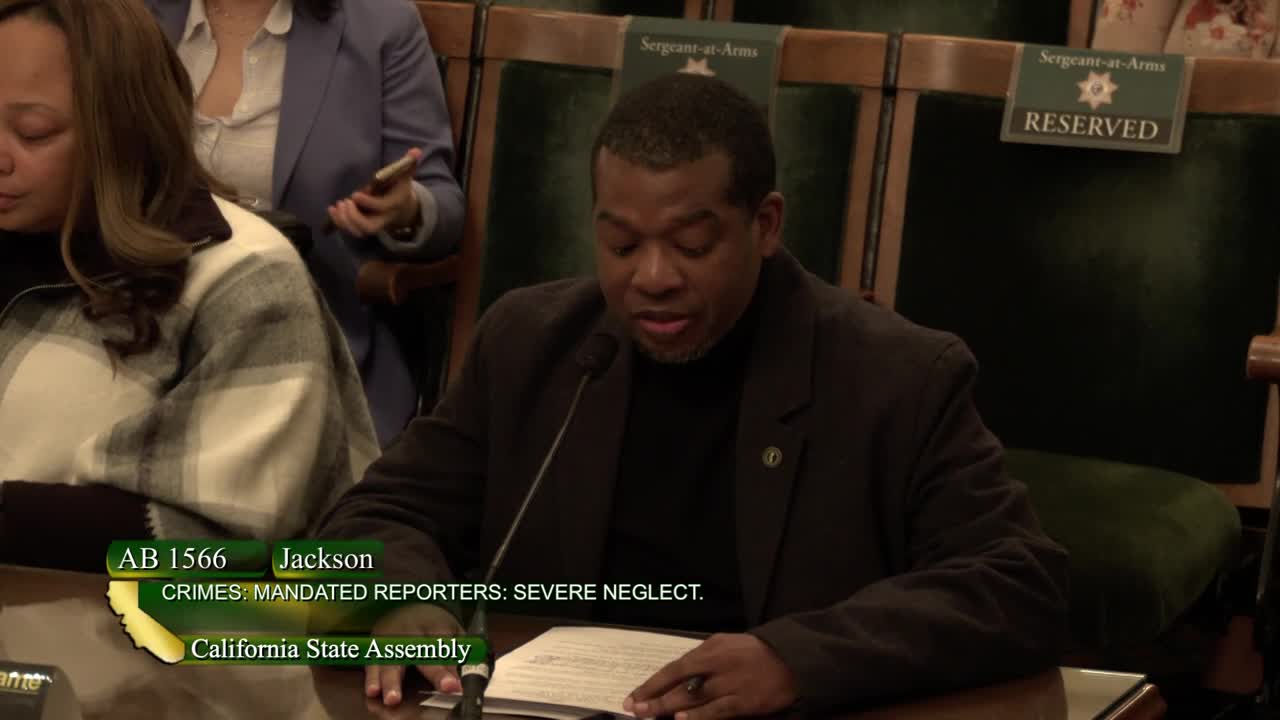 49MIN
Assembly Standing Committee on Public Safety
Bill Author

Bill Co-Author(s):