AB 1567: General plan: annual report: congregate and residential care for the elderly.
- Session Year: 2025-2026
- House: Assembly
- Latest Version Date: 2026-09-04
Current Status:
Failed
(2026-09-27: Vetoed by Governor.)
Introduced
In Committee
Awaiting First Chamber Vote
Passed First Chamber
In Committee
Awaiting Second Chamber Vote
Passed Second Chamber
Enacted
The Planning and Zoning law requires each planning agency to prepare and the legislative body of each county and city to adopt a comprehensive, long-term general plan containing specified elements, including a housing element. Existing law requires the housing element to be revised according to a specific schedule. After the legislative body has adopted all or part of a general plan, existing law requires the planning agency to provide by April 1 of each year an annual report to various entities that includes specified information.
Existing law requires the Department of Housing and Community Development, in consultation with each council of governments, to determine each regions existing and projected housing need, as provided. Existing law requires each council of governments, or the department for cities and counties without a council of governments, to adopt a final regional housing need plan that allocates a share of the regional housing need to each city, county, or city and county and that furthers specified objectives.
This bill would, for the 7th and each subsequent revision of the housing element, authorize a planning agency to include in that report the number of units approved for congregate care for the elderly or residential care facilities for the elderly, as defined, for up to 15% of a jurisdictions regional housing need allocation for any income category, if congregate housing for the elderly or residential care facilities is included in the regional housing need determination, as specified.
Existing law prescribes requirements for the disposal of surplus land by a local agency.
This bill would require a local agency to additionally include in its annual report specified information related to, among other things, the disposal of surplus land.
This bill would incorporate additional changes to Section 65400 of the Government Code proposed by SB 1116 to be operative only if this bill and SB 1116 are enacted and this bill is enacted last.
The Planning and Zoning law requires each planning agency to prepare and the legislative body of each county and city to adopt a comprehensive, long-term general plan containing specified elements, including a housing element. Existing law requires the housing element to be revised according to a specific schedule. After the legislative body has adopted all or part of a general plan, existing law requires the planning agency to provide by April 1 of each year an annual report to various entities that includes specified information.
Existing law requires the Department of Housing and Community Development, in consultation with each council of governments, to determine each regions existing and projected housing need, as provided. Existing law requires each council of governments, or the department for cities and counties without a council of governments, to adopt a final regional housing need plan that allocates a share of the regional housing need to each city, county, or city and county and that furthers specified objectives.
This bill would, for the 7th and each subsequent revision of the housing element, authorize a planning agency to include in that report the number of units approved for congregate care for the elderly or residential care facilities for the elderly, as defined, for up to 15% of a jurisdictions regional housing need allocation for any income category, if congregate housing for the elderly or residential care facilities is included in the regional housing need determination, as specified.
Existing law prescribes requirements for the disposal of surplus land by a local agency.
This bill would require a local agency to additionally include in its annual report specified information related to, among other things, the disposal of surplus land.
The Planning and Zoning law requires each planning agency to prepare and the legislative body of each county and city to adopt a comprehensive, long-term general plan containing specified elements, including a housing element. Existing law requires the housing element to be revised according to a specific schedule. After the legislative body has adopted all or part of a general plan, existing law requires the planning agency to provide by April 1 of each year an annual report to various entities that includes specified information.
Existing law requires the Department of Housing and Community Development, in consultation with each council of governments, to determine each regions existing and projected housing need, as provided. Existing law requires each council of governments, or the department for cities and counties without a council of governments, to adopt a final regional housing need plan that allocates a share of the regional housing need to each city, county, or city and county and that furthers specified objectives.
This bill would, for the 7th and each subsequent revision of the housing element, authorize a planning agency to include in that report the number of units approved for congregate care for the elderly or residential care facilities for the elderly, as defined, for up to 15% of a jurisdictions regional housing need allocation for any income category. category, if congregate housing for the elderly or residential care facilities is included in the regional housing need determination, as specified.
The Planning and Zoning law requires each planning agency to prepare and the legislative body of each county and city to adopt a comprehensive, long-term general plan containing specified elements, including a housing element. Existing law requires the housing element to be revised according to a specific schedule. After the legislative body has adopted all or part of a general plan, existing law requires the planning agency to provide by April 1 of each year an annual report to various entities that includes specified information.
Existing law requires the Department of Housing and Community Development, in consultation with each council of governments, to determine each regions existing and projected housing need, as provided. Existing law requires each council of governments, or the department for cities and counties without a council of governments, to adopt a final regional housing need plan that allocates a share of the regional housing need to each city, county, or city and county and that furthers specified objectives.
This bill would, for the 7th and each subsequent revision of the housing element, authorize a planning agency to include in that report the number of units approved for congregate care for the elderly, elderly or residential care facilities for the elderly, as defined, for up to 15% of a jurisdictions regional housing need allocation for any income category.
The Planning and Zoning law requires each planning agency to prepare and the legislative body of each county and city to adopt a comprehensive, long-term general plan containing specified elements, including a housing element. Existing law requires the housing element to be revised according to a specific schedule. After the legislative body has adopted all or part of a general plan, existing law requires the planning agency to provide by April 1 of each year an annual report to various entities that includes specified information.
Existing law requires the Department of Housing and Community Development, in consultation with each council of governments, to determine each regions existing and projected housing need, as provided. Existing law requires each council of governments, or the department for cities and counties without a council of governments, to adopt a final regional housing need plan that allocates a share of the regional housing need to each city, county, or city and county and that furthers specified objectives.
This bill would, for the 7th and each subsequent revision of the housing element, authorize a planning agency to include in that report the number of units approved for congregate care for the elderly, as defined, for up to 15% of a jurisdictions regional housing need allocation for any income category.
(a)After the legislative body has adopted all or part of a general plan, the planning agency shall do both of the following:
(1)Investigate and make recommendations to the legislative body regarding reasonable and practical means for implementing the general plan or element of the general plan so that it will serve as an effective guide for orderly growth and development, preservation and conservation of open-space land and natural resources, and the efficient expenditure of public funds relating to the subjects addressed in the general plan.
(2)Provide by April 1 of each year an annual report to the legislative body, the Office of Land Use and Climate Innovation, and the Department of Housing and Community Development that includes all of the following:
(A)The status of the plan and progress in its implementation.
(B)(i)(I)The progress in meeting its share of regional housing needs determined pursuant to Section 65584, including the need for extremely low income households, as determined pursuant to Section 65583, and local efforts to remove governmental constraints to the maintenance, improvement, and development of housing pursuant to paragraph (3) of subdivision (c) of Section 65583.
(II)The annual report shall include the progress in meeting the citys or countys progress in meeting its share of regional housing need, as described in subclause (I), for the sixth and previous revisions of the housing element.
(ii)The housing element portion of the annual report, as required by this paragraph, shall be prepared through the use of standards, forms, and definitions adopted by the Department of Housing and Community Development. The department may review, adopt, amend, and repeal the standards, forms, or definitions to implement this article. Any standards, forms, or definitions adopted to implement this article shall not be subject to Chapter 3.5 (commencing with Section 11340) of Part 1 of Division 3 of Title 2. Before and after adoption of the forms, the housing element portion of the annual report shall include a section that describes the actions taken by the local government towards completion of the programs and status of the local governments compliance with the deadlines in its housing element. The report shall be considered at an annual public meeting before the legislative body where members of the public shall be allowed to provide oral testimony and written comments.
(iii)The report may include the number of units that have been completed pursuant to subdivision (c) of Section 65583.1. For purposes of this paragraph, committed assistance may be executed throughout the planning period, and the program under paragraph (1) of subdivision (c) of Section 65583.1 shall not be required. The report shall document how the units meet the standards set forth in that subdivision.
(iv)The planning agency shall include the number of units in a student housing development for lower income students for which the developer of the student housing development was granted a density bonus pursuant to subparagraph (F) of paragraph (1) of subdivision (b) of Section 65915.
(v)The report may include the number of units of existing deed-restricted affordable housing with an average affordability no greater than 45 percent of area median income that are at least 15 years old and have been substantially rehabilitated with at least sixty thousand dollars ($60,000) per unit in funds awarded from the city or, for unincorporated areas, the county, inclusive of forgiveness of principal or interest on existing debt. Any units included in the report pursuant to this clause shall not be considered when determining affordability requirements for purposes of paragraph (4) of subdivision (a) of Section 65913.4.
(vi)For the seventh and each subsequent revision of the housing element, if congregate housing for the elderly, as defined in Section 50062.5 of the Health and Safety Code, or residential care facility for the elderly, as defined in Section 1569.2 of the Health and Safety Code, is included in the regional housing need determination pursuant to Section 65584, the planning agency may include the number of units approved for up to 15 percent of a jurisdictions regional housing need allocation for any income category.
(C)The number of housing development applications received in the prior year, including both of the following, when applicable:
(i)Whether each housing development application is subject to a ministerial or discretionary approval process.
(ii)Beginning with the report due by April 1, 2027, whether each application is subject to a replacement housing or relocation assistance obligation pursuant to local, state, or federal law, including, but not limited to, Section 65583.2, 65915, or 66300.6.
(D)The number of units included in all development applications in the prior year.
(E)(i)The number of units approved and disapproved in the prior year, which shall include all of the following subcategories:
(I)The number of units located within an opportunity area.
(II)For the seventh and each subsequent revision of the housing element, the number of units approved and disapproved for acutely low income households within each opportunity area.
(III)For the seventh and each subsequent revision of the housing element, the number of units approved and disapproved for extremely low income households within each opportunity area.
(IV)The number of units approved and disapproved for very low income households within each opportunity area.
(V)The number of units approved and disapproved for lower income households within each opportunity area.
(VI)The number of units approved and disapproved for moderate-income households within each opportunity area.
(VII)The number of units approved and disapproved for above moderate-income households within each opportunity area.
(ii)For purposes of this subparagraph, opportunity area means a highest, high, moderate, or low resource area pursuant to the most recent CTCAC/HCD Opportunity Map published by the California Tax Credit Allocation Committee and the Department of Housing and Community Development.
(F)The degree to which its approved general plan complies with the guidelines developed and adopted pursuant to Section 65040.2 and the date of the last revision to the general plan.
(G)A listing of sites rezoned to accommodate that portion of the citys or countys share of the regional housing need for each income level that could not be accommodated on sites identified in the inventory required by paragraph (1) of subdivision (c) of Section 65583 and Section 65584.09. The listing of sites shall also include any additional sites that may have been required to be identified by Section 65863.
(H)(i)The number of units of housing demolished and new units of housing, including both rental housing and for-sale housing and any units that the County of Napa or the City of Napa may report pursuant to an agreement entered into pursuant to Section 65584.08, that have been issued a completed entitlement, a building permit, or a certificate of occupancy, thus far in the housing element cycle, and the income category, by area median income category, that each unit of housing satisfies. That production report shall do the following:
(I)For each income category described in this subparagraph, distinguish between the number of rental housing units and the number of for-sale units that satisfy each income category.
(II)For each entitlement, building permit, or certificate of occupancy, include a unique site identifier that must include the assessors parcel number, but may also include street address, or other identifiers.
(III)Beginning with the report due by April 1, 2027, for each entitlement, building permit, or certificate of occupancy, include the total number of replacement housing units by income level required pursuant to local, state, or federal law, including, but not limited to, Section 65583.2, 65915, or 66300.6.
(IV)Beginning with the report due by April 1, 2027, for each entitlement, building permit, or certificate of occupancy, include the number, by income level, of replacement housing units entitled, permitted, or issued a certificate of occupancy.
(ii)For the County of Napa and the City of Napa, the production report may report units identified in the agreement entered into pursuant to Section 65584.08.
(I)The number of applications submitted pursuant to subdivision (a) of Section 65913.4, the location and the total number of developments approved pursuant to subdivision (c) of Section 65913.4, the total number of building permits issued pursuant to subdivision (c) of Section 65913.4, the total number of units including both rental housing and for-sale housing by area median income category constructed using the process provided for in subdivision (c) of Section 65913.4.
(J)If the city or county has received funding pursuant to the Local Government Planning Support Grants Program (Chapter 3.1 (commencing with Section 50515) of Part 2 of Division 31 of the Health and Safety Code), the information required pursuant to subdivision (a) of Section 50515.04 of the Health and Safety Code.
(K)The progress of the city or county in adopting or amending its general plan or local open-space element in compliance with its obligations to consult with California Native American tribes, and to identify and protect, preserve, and mitigate impacts to places, features, and objects described in Sections 5097.9 and 5097.993 of the Public Resources Code, pursuant to Chapter 905 of the Statutes of 2004.
(L)The following information with respect to density bonuses granted in accordance with Section 65915:
(i)The number of density bonus applications received by the city or county.
(ii)The number of density bonus applications approved by the city or county.
(iii)Data from all projects approved to receive a density bonus from the city or county, including, but not limited to, the percentage of density bonus received, the percentage of affordable units in the project, the number of other incentives or concessions granted to the project, and any waiver or reduction of parking standards for the project.
(M)The following information with respect to each application submitted pursuant to Chapter 4.1 (commencing with Section 65912.100):
(i)The location of the project.
(ii)The status of the project, including whether it has been entitled, whether a building permit has been issued, and whether or not it has been completed.
(iii)The number of units in the project.
(iv)The number of units in the project that are rental housing.
(v)The number of units in the project that are for-sale housing.
(vi)The household income category of the units, as determined pursuant to subdivision (f) of Section 65584.
(N)A list of all historic designations listed on the National Register of Historic Places, the California Register of Historical Resources, or a local register of historic places by the city or county in the past year, and the status of any housing development projects proposed for the new historic designations, including all of the following:
(i)Whether the housing development project has been entitled.
(ii)Whether a building permit has been issued for the housing development project.
(iii)The number of units in the housing development project.
(O)The following information with respect to housing development projects under Section 65913.16:
(i)The number of applications submitted under Section 65913.16.
(ii)The location and number of developments approved under Section 65913.16.
(iii)The total number of building permits issued pursuant to Section 65913.16.
(iv)The total number of units constructed under Section 65913.16 and the income category of those units.
(P)Beginning with the report due by April 1, 2027, a report on the demolition of housing units for any purpose, which shall include, but not be limited to, all of the following:
(i)The total number of housing units approved for demolition during the year.
(ii)The total number of housing units demolished during the year.
(iii)For each approved or completed demolition, all of the following:
(I)The location of the approved or completed demolition, using a unique site identifier that shall include the assessors parcel number, and may also include the street address or other identifiers.
(II)The date the demolition was approved.
(III)The total number of rental and ownership units demolished or approved for demolition.
(IV)The number, by income level, of protected units, as defined in subdivision (h) of Section 66300.5, demolished or approved for demolition.
(V)A description of any approved uses on the site.
(VI)A description of any relocation assistance provided as required pursuant to local, state, or federal law, including, but not limited to, the relocation assistance required to be provided to each displaced occupant of any demolished protected unit pursuant to Section 66300.6.
(Q)Beginning with the report due by April 1, 2027, a report on replacement housing units required pursuant to local, state, or federal law, including, but not limited to, Section 66300.6, for approved development projects that are not housing development projects, which shall include, for each applicable development project, all of the following:
(i)The approved or proposed location of the replacement units, using a unique site identifier that shall include the assessors parcel number, and may also include the street address or other identifiers.
(ii)The entity that is developing the replacement units.
(iii)The anticipated completion date of the replacement units.
(R)The status of a development of land disposed pursuant to Section 54222.3.1, including, but not limited to, all of the following information:
(i)The total square footage of the residential and nonresidential development.
(ii)The total square footage of low barrier navigation centers.
(iii)The number of residential units and beds that have been permitted.
(iv)The percentage of the residential units that have been permitted that are restricted for persons and families of low or moderate income, or lower income households, as defined in Section 50079.5 of the Health and Safety Code.
(S)The information each county and city is required to include in its central inventory of surplus land and report to the department pursuant to Section 54230.
(T)Any city or county that identifies sites that contain permanent housing units located on a military base undergoing closure or conversation as a result of action pursuant to the Defense Authorization Amendments and Base Closure and Realignment Act of 1990 (Public Law 101-510), or any subsequent act requiring the closure or conversion of a military base, as an adequate site pursuant to Section 65583.1 shall address progress in meeting that section.
(U)Information related to the adequate sites program alternative as required and pursuant to the scheduled specified in paragraph (7) of subdivision (c) of Section 65583.1.
(V)A listing of sites owned by the city or county included in the inventory prepared pursuant to Section 65583.2 that have been sold, leased, or otherwise disposed of in the prior year. The list shall include the entity to whom each site was transferred and the intended use for the site.
(W)The number of housing units approved within a zone that comply with the criteria in subdivision (c) of Section 65623 during the previous fiscal year.
(X)The number of units constructed pursuant to Section 65852.21.
(Y)The number of sites developed and the number of units constructed pursuant to Section 65852.24.
(Z)The number of applications for parcel maps for urban lot splits pursuant to Section 66411.7.
(b)(1)(A)The department may request corrections to the housing element portion of an annual report submitted pursuant to paragraph (2) of subdivision (a) within 90 days of receipt. A planning agency shall make the requested corrections within 30 days after which the department may reject the report if the report is not in substantial compliance with the requirements of that paragraph.
(B)If the department rejects the housing element portion of an annual report as authorized by subparagraph (A), the department shall provide the reasons the report is inconsistent with paragraph (2) of subdivision (a) to the planning agency in writing.
(2)If a court finds, upon a motion to that effect, that a city, county, or city and county failed to submit, within 60 days of the deadline established in this section, the housing element portion of the report required pursuant to subparagraph (B) of paragraph (2) of subdivision (a) that substantially complies with the requirements of this section, the court shall issue an order or judgment compelling compliance with this section within 60 days. If the city, county, or city and county fails to comply with the courts order within 60 days, the plaintiff or petitioner may move for sanctions, and the court may, upon that motion, grant appropriate sanctions. The court shall retain jurisdiction to ensure that its order or judgment is carried out. If the court determines that its order or judgment is not carried out within 60 days, the court may issue further orders as provided by law to ensure that the purposes and policies of this section are fulfilled. This subdivision applies to proceedings initiated on or after the first day of October following the adoption of forms and definitions by the Department of Housing and Community Development pursuant to paragraph (2) of subdivision (a), but no sooner than six months following that adoption.
(c)The Department of Housing and Community Development shall post a report submitted pursuant to this section on its internet website within a reasonable time of receiving the report.
(d)The remaining portion of the annual report not required by subparagraph (B) of paragraph (2) of subdivision (a), shall be prepared through the use of standards, forms, and definitions adopted by the Office of Land Use and Climate Innovation. The office may review, adopt, amend, and repeal the standards, forms, or definitions to implement this article. Any standards, forms, or definitions adopted to implement this article shall not be subject to Chapter 3.5 (commencing with Section 11340) of Part 1 of Division 3 of Title 2.
SEC. 1.5.Section 65400 of the Government Code is amended to read:65400.(a)After the legislative body has adopted all or part of a general plan, the planning agency shall do both of the following:
(1)Investigate and make recommendations to the legislative body regarding reasonable and practical means for implementing the general plan or element of the general plan so that it will serve as an effective guide for orderly growth and development, preservation and conservation of open-space land and natural resources, and the efficient expenditure of public funds relating to the subjects addressed in the general plan.
(2)Provide by April 1 of each year an annual report to the legislative body, the Office of Land Use and Climate Innovation, and the Department of Housing and Community Development that includes all of the following:
(A)The status of the plan and progress in its implementation.
(B)(i)(I)The progress in meeting its share of regional housing needs determined pursuant to Section 65584, including the need for extremely low income households, as determined pursuant to Section 65583, and local efforts to remove governmental constraints to the maintenance, improvement, and development of housing pursuant to paragraph (3) of subdivision (c) of Section 65583.
(II)The annual report shall include the progress in meeting the citys or countys progress in meeting its share of regional housing need, as described in subclause (I), for the sixth and previous revisions of the housing element.
(ii)The housing element portion of the annual report, as required by this paragraph, shall be prepared through the use of standards, forms, and definitions adopted by the Department of Housing and Community Development. The department may review, adopt, amend, and repeal the standards, forms, or definitions to implement this article. Any standards, forms, or definitions adopted to implement this article shall not be subject to Chapter 3.5 (commencing with Section 11340) of Part 1 of Division 3 of Title 2. Before and after adoption of the forms, the housing element portion of the annual report shall include a section that describes the actions taken by the local government towards completion of the programs and status of the local governments compliance with the deadlines in its housing element. The report shall be considered at an annual public meeting before the legislative body where members of the public shall be allowed to provide oral testimony and written comments.
(iii)The report may include the number of units that have been completed pursuant to subdivision (c) of Section 65583.1. For purposes of this paragraph, committed assistance may be executed throughout the planning period, and the program under paragraph (1) of subdivision (c) of Section 65583.1 shall not be required. The report shall document how the units meet the standards set forth in that subdivision.
(iv)The planning agency shall include the number of units in a student housing development for lower income students for which the developer of the student housing development was granted a density bonus pursuant to subparagraph (F) of paragraph (1) of subdivision (b) of Section 65915.
(v)The report may include the number of units of existing deed-restricted affordable housing with an average affordability no greater than 45 percent of area median income that are at least 15 years old and have been substantially rehabilitated with at least sixty thousand dollars ($60,000) per unit in funds awarded from the city or, for unincorporated areas, the county, inclusive of forgiveness of principal or interest on existing debt. Any units included in the report pursuant to this clause shall not be considered when determining affordability requirements for purposes of paragraph (4) of subdivision (a) of Section 65913.4.
(vi)For the seventh and each subsequent revision of the housing element, if congregate housing for the elderly, as defined in Section 50062.5 of the Health and Safety Code, or residential care facility for the elderly, as defined in Section 1569.2 of the Health and Safety Code, is included in the regional housing need determination pursuant to Section 65584, the planning agency may include the number of units approved for up to 15 percent of a jurisdictions regional housing need allocation for any income category.
(C)The number of housing development applications received in the prior year, including both of the following, when applicable:
(i)Whether each housing development application is subject to a ministerial or discretionary approval process.
(ii)Beginning with the report due by April 1, 2027, whether each application is subject to a replacement housing or relocation assistance obligation pursuant to local, state, or federal law, including, but not limited to, Section 65583.2, 65915, or 66300.6.
(D)The number of units included in all development applications in the prior year.
(E)(i)The number of units approved and disapproved in the prior year, which shall include all of the following subcategories:
(I)The number of units located within an opportunity area.
(II)For the seventh and each subsequent revision of the housing element, the number of units approved and disapproved for acutely low income households within each opportunity area.
(III)For the seventh and each subsequent revision of the housing element, the number of units approved and disapproved for extremely low income households within each opportunity area.
(IV)The number of units approved and disapproved for very low income households within each opportunity area.
(V)The number of units approved and disapproved for lower income households within each opportunity area.
(VI)The number of units approved and disapproved for moderate-income households within each opportunity area.
(VII)The number of units approved and disapproved for above moderate-income households within each opportunity area.
(ii)For purposes of this subparagraph, opportunity area means a highest, high, moderate, or low resource area pursuant to the most recent CTCAC/HCD Opportunity Map published by the California Tax Credit Allocation Committee and the Department of Housing and Community Development.
(F)The degree to which its approved general plan complies with the guidelines developed and adopted pursuant to Section 65040.2 and the date of the last revision to the general plan.
(G)A listing of sites rezoned to accommodate that portion of the citys or countys share of the regional housing need for each income level that could not be accommodated on sites identified in the inventory required by paragraph (1) of subdivision (c) of Section 65583 and Section 65584.09. The listing of sites shall also include any additional sites that may have been required to be identified by Section 65863.
(H)(i)The number of units of housing demolished and new units of housing, including both rental housing and for-sale housing and any units that the County of Napa or the City of Napa may report pursuant to an agreement entered into pursuant to Section 65584.08, that have been issued a completed entitlement, a building permit, or a certificate of occupancy, thus far in the housing element cycle, and the income category, by area median income category, that each unit of housing satisfies. That production report shall do the following:
(I)For each income category described in this subparagraph, distinguish between the number of rental housing units and the number of for-sale units that satisfy each income category.
(II)For each entitlement, building permit, or certificate of occupancy, include a unique site identifier that must include the assessors parcel number, but may also include street address, or other identifiers.
(III)Beginning with the report due by April 1, 2027, for each entitlement, building permit, or certificate of occupancy, include the total number of replacement housing units by income level required pursuant to local, state, or federal law, including, but not limited to, Section 65583.2, 65915, or 66300.6.
(IV)Beginning with the report due by April 1, 2027, for each entitlement, building permit, or certificate of occupancy, include the number, by income level, of replacement housing units entitled, permitted, or issued a certificate of occupancy.
(ii)For the County of Napa and the City of Napa, the production report may report units identified in the agreement entered into pursuant to Section 65584.08.
(I)The number of applications submitted pursuant to subdivision (a) of Section 65913.4, the location and the total number of developments approved pursuant to subdivision (c) of Section 65913.4, the total number of building permits issued pursuant to subdivision (c) of Section 65913.4, the total number of units including both rental housing and for-sale housing by area median income category constructed using the process provided for in subdivision (c) of Section 65913.4.
(J)If the city or county has received funding pursuant to the Local Government Planning Support Grants Program (Chapter 3.1 (commencing with Section 50515) of Part 2 of Division 31 of the Health and Safety Code), the information required pursuant to subdivision (a) of Section 50515.04 of the Health and Safety Code.
(K)The progress of the city or county in adopting or amending its general plan or local open-space element in compliance with its obligations to consult with California Native American tribes, and to identify and protect, preserve, and mitigate impacts to places, features, and objects described in Sections 5097.9 and 5097.993 of the Public Resources Code, pursuant to Chapter 905 of the Statutes of 2004.
(L)The following information with respect to density bonuses granted in accordance with Section 65915:
(i)The number of density bonus applications received by the city or county.
(ii)The number of density bonus applications approved by the city or county.
(iii)Data from all projects approved to receive a density bonus from the city or county, including, but not limited to, the percentage of density bonus received, the percentage of affordable units in the project, the number of other incentives or concessions granted to the project, and any waiver or reduction of parking standards for the project.
(M)The following information with respect to each application submitted pursuant to Chapter 4.1 (commencing with Section 65912.100):
(i)The location of the project.
(ii)The status of the project, including whether it has been entitled, whether a building permit has been issued, and whether or not it has been completed.
(iii)The number of units in the project.
(iv)The number of units in the project that are rental housing.
(v)The number of units in the project that are for-sale housing.
(vi)The household income category of the units, as determined pursuant to subdivision (f) of Section 65584.
(N)A list of all historic designations listed on the National Register of Historic Places, the California Register of Historical Resources, or a local register of historic places by the city or county in the past year, and the status of any housing development projects proposed for the new historic designations, including all of the following:
(i)Whether the housing development project has been entitled.
(ii)Whether a building permit has been issued for the housing development project.
(iii)The number of units in the housing development project.
(O)The following information with respect to housing development projects under Section 65913.16:
(i)The number of applications submitted under Section 65913.16.
(ii)The location and number of developments approved under Section 65913.16.
(iii)The total number of building permits issued pursuant to Section 65913.16.
(iv)The total number of units constructed under Section 65913.16 and the income category of those units.
(P)Beginning with the report due by April 1, 2027, a report on the demolition of housing units for any purpose, which shall include, but not be limited to, all of the following:
(i)The total number of housing units approved for demolition during the year.
(ii)The total number of housing units demolished during the year.
(iii)For each approved or completed demolition, all of the following:
(I)The location of the approved or completed demolition, using a unique site identifier that shall include the assessors parcel number, and may also include the street address or other identifiers.
(II)The date the demolition was approved.
(III)The total number of rental and ownership units demolished or approved for demolition.
(IV)The number, by income level, of protected units, as defined in subdivision (h) of Section 66300.5, demolished or approved for demolition.
(V)A description of any approved uses on the site.
(VI)A description of any relocation assistance provided as required pursuant to local, state, or federal law, including, but not limited to, the relocation assistance required to be provided to each displaced occupant of any demolished protected unit pursuant to Section 66300.6.
(Q)Beginning with the report due by April 1, 2027, a report on replacement housing units required pursuant to local, state, or federal law, including, but not limited to, Section 66300.6, for approved development projects that are not housing development projects, which shall include, for each applicable development project, all of the following:
(i)The approved or proposed location of the replacement units, using a unique site identifier that shall include the assessors parcel number, and may also include the street address or other identifiers.
(ii)The entity that is developing the replacement units.
(iii)The anticipated completion date of the replacement units.
(R)Beginning with the report due by April 1, 2028, the following information with respect to housing development projects under Sections 65852.28 and 66499.41:
(i)The number of applications submitted under Sections 65852.28 and 66499.41.
(ii)The location and number of developments approved or denied under Sections 65852.28 and 66499.41.
(iii)The total number of building permits issued pursuant to Sections 65852.28 and 66499.41.
(iv)The total number of units constructed under Sections 65852.28 and 66499.41 and the income category of those units.
(S)The status of a development of land disposed pursuant to Section 54222.3.1, including, but not limited to, all of the following information:
(i)The total square footage of the residential and nonresidential development.
(ii)The total square footage of low barrier navigation centers.
(iii)The number of residential units and beds that have been permitted.
(iv)The percentage of the residential units that have been permitted that are restricted for persons and families of low or moderate income, or lower income households, as defined in Section 50079.5 of the Health and Safety Code.
(T)The information each county and city is required to include in its central inventory of surplus land and report to the department pursuant to Section 54230.
(U)Any city or county that identifies sites that contain permanent housing units located on a military base undergoing closure or conversation as a result of action pursuant to the Defense Authorization Amendments and Base Closure and Realignment Act of 1990 (Public Law 101-510), or any subsequent act requiring the closure or conversion of a military base, as an adequate site pursuant to Section 65583.1 shall address progress in meeting that section.
(V)Information related to the adequate sites program alternative as required and pursuant to the scheduled specified in paragraph (7) of subdivision (c) of Section 65583.1.
(W)A listing of sites owned by the city or county included in the inventory prepared pursuant to Section 65583.2 that have been sold, leased, or otherwise disposed of in the prior year. The list shall include the entity to whom each site was transferred and the intended use for the site.
(X)The number of housing units approved within a zone that comply with the criteria in subdivision (c) of Section 65623 during the previous fiscal year.
(Y)The number of units constructed pursuant to Section 65852.21.
(Z)The number of sites developed and the number of units constructed pursuant to Section 65852.24.
(AA)The number of applications for parcel maps for urban lot splits pursuant to Section 66411.7.
(b)(1)(A)The department may request corrections to the housing element portion of an annual report submitted pursuant to paragraph (2) of subdivision (a) within 90 days of receipt. A planning agency shall make the requested corrections within 30 days after which the department may reject the report if the report is not in substantial compliance with the requirements of that paragraph.
(B)If the department rejects the housing element portion of an annual report as authorized by subparagraph (A), the department shall provide the reasons the report is inconsistent with paragraph (2) of subdivision (a) to the planning agency in writing.
(2)If a court finds, upon a motion to that effect, that a city, county, or city and county failed to submit, within 60 days of the deadline established in this section, the housing element portion of the report required pursuant to subparagraph (B) of paragraph (2) of subdivision (a) that substantially complies with the requirements of this section, the court shall issue an order or judgment compelling compliance with this section within 60 days. If the city, county, or city and county fails to comply with the courts order within 60 days, the plaintiff or petitioner may move for sanctions, and the court may, upon that motion, grant appropriate sanctions. The court shall retain jurisdiction to ensure that its order or judgment is carried out. If the court determines that its order or judgment is not carried out within 60 days, the court may issue further orders as provided by law to ensure that the purposes and policies of this section are fulfilled. This subdivision applies to proceedings initiated on or after the first day of October following the adoption of forms and definitions by the Department of Housing and Community Development pursuant to paragraph (2) of subdivision (a), but no sooner than six months following that adoption.
(c)The Department of Housing and Community Development shall post a report submitted pursuant to this section on its internet website within a reasonable time of receiving the report.
(d)The remaining portion of the annual report not required by subparagraph (B) of paragraph (2) of subdivision (a), shall be prepared through the use of standards, forms, and definitions adopted by the Office of Land Use and Climate Innovation. The office may review, adopt, amend, and repeal the standards, forms, or definitions to implement this article. Any standards, forms, or definitions adopted to implement this article shall not be subject to Chapter 3.5 (commencing with Section 11340) of Part 1 of Division 3 of Title 2.
SEC. 2.Section 1.5 of this bill incorporates amendments to Section 65400 of the Government Code proposed by both this bill and Senate Bill 1116. That section of this bill shall only become operative if (1) both bills are enacted and become effective on or before January 1, 2027, (2) each bill amends Section 65400 of the Government Code, and (3) this bill is enacted after Senate Bill 1116, in which case Section 1 of this bill shall not become operative.
(a)After the legislative body has adopted all or part of a general plan, the planning agency shall do both of the following:
(1)Investigate and make recommendations to the legislative body regarding reasonable and practical means for implementing the general plan or element of the general plan so that it will serve as an effective guide for orderly growth and development, preservation and conservation of open-space land and natural resources, and the efficient expenditure of public funds relating to the subjects addressed in the general plan.
(2)Provide by April 1 of each year an annual report to the legislative body, the Office of Land Use and Climate Innovation, and the Department of Housing and Community Development that includes all of the following:
(A)The status of the plan and progress in its implementation.
(B)(i)(I)The progress in meeting its share of regional housing needs determined pursuant to Section 65584, including the need for extremely low income households, as determined pursuant to Section 65583, and local efforts to remove governmental constraints to the maintenance, improvement, and development of housing pursuant to paragraph (3) of subdivision (c) of Section 65583.
(II)The annual report shall include the progress in meeting the citys or countys progress in meeting its share of regional housing need, as described in subclause (I), for the sixth and previous revisions of the housing element.
(ii)The housing element portion of the annual report, as required by this paragraph, shall be prepared through the use of standards, forms, and definitions adopted by the Department of Housing and Community Development. The department may review, adopt, amend, and repeal the standards, forms, or definitions to implement this article. Any standards, forms, or definitions adopted to implement this article shall not be subject to Chapter 3.5 (commencing with Section 11340) of Part 1 of Division 3 of Title 2. Before and after adoption of the forms, the housing element portion of the annual report shall include a section that describes the actions taken by the local government towards completion of the programs and status of the local governments compliance with the deadlines in its housing element. The report shall be considered at an annual public meeting before the legislative body where members of the public shall be allowed to provide oral testimony and written comments.
(iii)The report may include the number of units that have been completed pursuant to subdivision (c) of Section 65583.1. For purposes of this paragraph, committed assistance may be executed throughout the planning period, and the program under paragraph (1) of subdivision (c) of Section 65583.1 shall not be required. The report shall document how the units meet the standards set forth in that subdivision.
(iv)The planning agency shall include the number of units in a student housing development for lower income students for which the developer of the student housing development was granted a density bonus pursuant to subparagraph (F) of paragraph (1) of subdivision (b) of Section 65915.
(v)The report may include the number of units of existing deed-restricted affordable housing with an average affordability no greater than 45 percent of area median income that are at least 15 years old and have been substantially rehabilitated with at least sixty thousand dollars ($60,000) per unit in funds awarded from the city or, for unincorporated areas, the county, inclusive of forgiveness of principal or interest on existing debt. Any units included in the report pursuant to this clause shall not be considered when determining affordability requirements for purposes of paragraph (4) of subdivision (a) of Section 65913.4.
(vi)For the seventh and each subsequent revision of the housing element, if congregate housing for the elderly, as defined in Section 50062.5 of the Health and Safety Code, or residential care facility for the elderly, as defined in Section 1569.2 of the Health and Safety Code, is included in the regional housing need determination pursuant to Section 65584, the planning agency may include the number of units approved for up to 15 percent of a jurisdictions regional housing need allocation for any income category.
(C)The number of housing development applications received in the prior year, including both of the following, when applicable:
(i)Whether each housing development application is subject to a ministerial or discretionary approval process.
(ii)Beginning with the report due by April 1, 2027, whether each application is subject to a replacement housing or relocation assistance obligation pursuant to local, state, or federal law, including, but not limited to, Section 65583.2, 65915, or 66300.6.
(D)The number of units included in all development applications in the prior year.
(E)(i)The number of units approved and disapproved in the prior year, which shall include all of the following subcategories:
(I)The number of units located within an opportunity area.
(II)For the seventh and each subsequent revision of the housing element, the number of units approved and disapproved for acutely low income households within each opportunity area.
(III)For the seventh and each subsequent revision of the housing element, the number of units approved and disapproved for extremely low income households within each opportunity area.
(IV)The number of units approved and disapproved for very low income households within each opportunity area.
(V)The number of units approved and disapproved for lower income households within each opportunity area.
(VI)The number of units approved and disapproved for moderate-income households within each opportunity area.
(VII)The number of units approved and disapproved for above moderate-income households within each opportunity area.
(ii)For purposes of this subparagraph, opportunity area means a highest, high, moderate, or low resource area pursuant to the most recent CTCAC/HCD Opportunity Map published by the California Tax Credit Allocation Committee and the Department of Housing and Community Development.
(F)The degree to which its approved general plan complies with the guidelines developed and adopted pursuant to Section 65040.2 and the date of the last revision to the general plan.
(G)A listing of sites rezoned to accommodate that portion of the citys or countys share of the regional housing need for each income level that could not be accommodated on sites identified in the inventory required by paragraph (1) of subdivision (c) of Section 65583 and Section 65584.09. The listing of sites shall also include any additional sites that may have been required to be identified by Section 65863.
(H)(i)The number of units of housing demolished and new units of housing, including both rental housing and for-sale housing and any units that the County of Napa or the City of Napa may report pursuant to an agreement entered into pursuant to Section 65584.08, that have been issued a completed entitlement, a building permit, or a certificate of occupancy, thus far in the housing element cycle, and the income category, by area median income category, that each unit of housing satisfies. That production report shall do the following:
(I)For each income category described in this subparagraph, distinguish between the number of rental housing units and the number of for-sale units that satisfy each income category.
(II)For each entitlement, building permit, or certificate of occupancy, include a unique site identifier that must include the assessors parcel number, but may also include street address, or other identifiers.
(III)Beginning with the report due by April 1, 2027, for each entitlement, building permit, or certificate of occupancy, include the total number of replacement housing units by income level required pursuant to local, state, or federal law, including, but not limited to, Section 65583.2, 65915, or 66300.6.
(IV)Beginning with the report due by April 1, 2027, for each entitlement, building permit, or certificate of occupancy, include the number, by income level, of replacement housing units entitled, permitted, or issued a certificate of occupancy.
(ii)For the County of Napa and the City of Napa, the production report may report units identified in the agreement entered into pursuant to Section 65584.08.
(I)The number of applications submitted pursuant to subdivision (a) of Section 65913.4, the location and the total number of developments approved pursuant to subdivision (c) of Section 65913.4, the total number of building permits issued pursuant to subdivision (c) of Section 65913.4, the total number of units including both rental housing and for-sale housing by area median income category constructed using the process provided for in subdivision (c) of Section 65913.4.
(J)If the city or county has received funding pursuant to the Local Government Planning Support Grants Program (Chapter 3.1 (commencing with Section 50515) of Part 2 of Division 31 of the Health and Safety Code), the information required pursuant to subdivision (a) of Section 50515.04 of the Health and Safety Code.
(K)The progress of the city or county in adopting or amending its general plan or local open-space element in compliance with its obligations to consult with California Native American tribes, and to identify and protect, preserve, and mitigate impacts to places, features, and objects described in Sections 5097.9 and 5097.993 of the Public Resources Code, pursuant to Chapter 905 of the Statutes of 2004.
(L)The following information with respect to density bonuses granted in accordance with Section 65915:
(i)The number of density bonus applications received by the city or county.
(ii)The number of density bonus applications approved by the city or county.
(iii)Data from all projects approved to receive a density bonus from the city or county, including, but not limited to, the percentage of density bonus received, the percentage of affordable units in the project, the number of other incentives or concessions granted to the project, and any waiver or reduction of parking standards for the project.
(M)The following information with respect to each application submitted pursuant to Chapter 4.1 (commencing with Section 65912.100):
(i)The location of the project.
(ii)The status of the project, including whether it has been entitled, whether a building permit has been issued, and whether or not it has been completed.
(iii)The number of units in the project.
(iv)The number of units in the project that are rental housing.
(v)The number of units in the project that are for-sale housing.
(vi)The household income category of the units, as determined pursuant to subdivision (f) of Section 65584.
(N)A list of all historic designations listed on the National Register of Historic Places, the California Register of Historical Resources, or a local register of historic places by the city or county in the past year, and the status of any housing development projects proposed for the new historic designations, including all of the following:
(i)Whether the housing development project has been entitled.
(ii)Whether a building permit has been issued for the housing development project.
(iii)The number of units in the housing development project.
(O)The following information with respect to housing development projects under Section 65913.16:
(i)The number of applications submitted under Section 65913.16.
(ii)The location and number of developments approved under Section 65913.16.
(iii)The total number of building permits issued pursuant to Section 65913.16.
(iv)The total number of units constructed under Section 65913.16 and the income category of those units.
(P)Beginning with the report due by April 1, 2027, a report on the demolition of housing units for any purpose, which shall include, but not be limited to, all of the following:
(i)The total number of housing units approved for demolition during the year.
(ii)The total number of housing units demolished during the year.
(iii)For each approved or completed demolition, all of the following:
(I)The location of the approved or completed demolition, using a unique site identifier that shall include the assessors parcel number, and may also include the street address or other identifiers.
(II)The date the demolition was approved.
(III)The total number of rental and ownership units demolished or approved for demolition.
(IV)The number, by income level, of protected units, as defined in subdivision (h) of Section 66300.5, demolished or approved for demolition.
(V)A description of any approved uses on the site.
(VI)A description of any relocation assistance provided as required pursuant to local, state, or federal law, including, but not limited to, the relocation assistance required to be provided to each displaced occupant of any demolished protected unit pursuant to Section 66300.6.
(Q)Beginning with the report due by April 1, 2027, a report on replacement housing units required pursuant to local, state, or federal law, including, but not limited to, Section 66300.6, for approved development projects that are not housing development projects, which shall include, for each applicable development project, all of the following:
(i)The approved or proposed location of the replacement units, using a unique site identifier that shall include the assessors parcel number, and may also include the street address or other identifiers.
(ii)The entity that is developing the replacement units.
(iii)The anticipated completion date of the replacement units.
(R)The status of a development of land disposed pursuant to Section 54222.3.1, including, but not limited to, all of the following information:
(i)The total square footage of the residential and nonresidential development.
(ii)The total square footage of low barrier navigation centers.
(iii)The number of residential units and beds that have been permitted.
(iv)The percentage of the residential units that have been permitted that are restricted for persons and families of low or moderate income, or lower income households, as defined in Section 50079.5 of the Health and Safety Code.
(S)The information each county and city is required to include in its central inventory of surplus land and report to the department pursuant to Section 54230.
(T)Any city or county that identifies sites that contain permanent housing units located on a military base undergoing closure or conversation as a result of action pursuant to the Defense Authorization Amendments and Base Closure and Realignment Act of 1990 (Public Law 101-510), or any subsequent act requiring the closure or conversion of a military base, as an adequate site pursuant to Section 65583.1 shall address progress in meeting that section.
(U)Information related to the adequate sites program alternative as required and pursuant to the scheduled specified in paragraph (7) of subdivision (c) of Section 65583.1.
(V)A listing of sites owned by the city or county included in the inventory prepared pursuant to Section 65583.2 that have been sold, leased, or otherwise disposed of in the prior year. The list shall include the entity to whom each site was transferred and the intended use for the site.
(W)The number of housing units approved within a zone that comply with the criteria in subdivision (c) of Section 65623 during the previous fiscal year.
(X)The number of units constructed pursuant to Section 65852.21.
(Y)The number of sites developed and the number of units constructed pursuant to Section 65852.24.
(Z)The number of applications for parcel maps for urban lot splits pursuant to Section 66411.7.
(b)(1)(A)The department may request corrections to the housing element portion of an annual report submitted pursuant to paragraph (2) of subdivision (a) within 90 days of receipt. A planning agency shall make the requested corrections within 30 days after which the department may reject the report if the report is not in substantial compliance with the requirements of that paragraph.
(B)If the department rejects the housing element portion of an annual report as authorized by subparagraph (A), the department shall provide the reasons the report is inconsistent with paragraph (2) of subdivision (a) to the planning agency in writing.
(2)If a court finds, upon a motion to that effect, that a city, county, or city and county failed to submit, within 60 days of the deadline established in this section, the housing element portion of the report required pursuant to subparagraph (B) of paragraph (2) of subdivision (a) that substantially complies with the requirements of this section, the court shall issue an order or judgment compelling compliance with this section within 60 days. If the city, county, or city and county fails to comply with the courts order within 60 days, the plaintiff or petitioner may move for sanctions, and the court may, upon that motion, grant appropriate sanctions. The court shall retain jurisdiction to ensure that its order or judgment is carried out. If the court determines that its order or judgment is not carried out within 60 days, the court may issue further orders as provided by law to ensure that the purposes and policies of this section are fulfilled. This subdivision applies to proceedings initiated on or after the first day of October following the adoption of forms and definitions by the Department of Housing and Community Development pursuant to paragraph (2) of subdivision (a), but no sooner than six months following that adoption.
(c)The Department of Housing and Community Development shall post a report submitted pursuant to this section on its internet website within a reasonable time of receiving the report.
(d)The remaining portion of the annual report not required by subparagraph (B) of paragraph (2) of subdivision (a), shall be prepared through the use of standards, forms, and definitions adopted by the Office of Land Use and Climate Innovation. The office may review, adopt, amend, and repeal the standards, forms, or definitions to implement this article. Any standards, forms, or definitions adopted to implement this article shall not be subject to Chapter 3.5 (commencing with Section 11340) of Part 1 of Division 3 of Title 2.
All matter omitted in this version of the bill appears in the bill as amended in the Senate, June 18, 2026. (JR11)(a)After the legislative body has adopted all or part of a general plan, the planning agency shall do both of the following:
(1)Investigate and make recommendations to the legislative body regarding reasonable and practical means for implementing the general plan or element of the general plan so that it will serve as an effective guide for orderly growth and development, preservation and conservation of open-space land and natural resources, and the efficient expenditure of public funds relating to the subjects addressed in the general plan.
(2)Provide by April 1 of each year an annual report to the legislative body, the Office of Land Use and Climate Innovation, and the Department of Housing and Community Development that includes all of the following:
(A)The status of the plan and progress in its implementation.
(B)(i)(I)The progress in meeting its share of regional housing needs determined pursuant to Section 65584, including the need for extremely low income households, as determined pursuant to Section 65583, and local efforts to remove governmental constraints to the maintenance, improvement, and development of housing pursuant to paragraph (3) of subdivision (c) of Section 65583.
(II)The annual report shall include the progress in meeting the citys or countys progress in meeting its share of regional housing need, as described in subclause (I), for the sixth and previous revisions of the housing element.
(ii)The housing element portion of the annual report, as required by this paragraph, shall be prepared through the use of standards, forms, and definitions adopted by the Department of Housing and Community Development. The department may review, adopt, amend, and repeal the standards, forms, or definitions to implement this article. Any standards, forms, or definitions adopted to implement this article shall not be subject to Chapter 3.5 (commencing with Section 11340) of Part 1 of Division 3 of Title 2. Before and after adoption of the forms, the housing element portion of the annual report shall include a section that describes the actions taken by the local government towards completion of the programs and status of the local governments compliance with the deadlines in its housing element. The report shall be considered at an annual public meeting before the legislative body where members of the public shall be allowed to provide oral testimony and written comments.
(iii)The report may include the number of units that have been completed pursuant to subdivision (c) of Section 65583.1. For purposes of this paragraph, committed assistance may be executed throughout the planning period, and the program under paragraph (1) of subdivision (c) of Section 65583.1 shall not be required. The report shall document how the units meet the standards set forth in that subdivision.
(iv)The planning agency shall include the number of units in a student housing development for lower income students for which the developer of the student housing development was granted a density bonus pursuant to subparagraph (F) of paragraph (1) of subdivision (b) of Section 65915.
(v)The report may include the number of units of existing deed-restricted affordable housing with an average affordability no greater than 45 percent of area median income that are at least 15 years old and have been substantially rehabilitated with at least sixty thousand dollars ($60,000) per unit in funds awarded from the city or, for unincorporated areas, the county, inclusive of forgiveness of principal or interest on existing debt. Any units included in the report pursuant to this clause shall not be considered when determining affordability requirements for purposes of paragraph (4) of subdivision (a) of Section 65913.4.
(vi)For the seventh and each subsequent revision of the housing element, the planning agency may include the number of units approved for if congregate housing for the elderly, as defined in Section 50062.5 of the Health and Safety Code, or residential care facility for the elderly, as defined in Section 1569.2 of the Health and Safety Code, is included in the regional housing need determination pursuant to Section 65584, the planning agency may include the number of units approved for up to 15 percent of a jurisdictions regional housing need allocation for any income category.
(C)The number of housing development applications received in the prior year, including both of the following, when applicable:
(i)Whether each housing development application is subject to a ministerial or discretionary approval process.
(ii)Beginning with the report due by April 1, 2027, whether each application is subject to a replacement housing or relocation assistance obligation pursuant to local, state, or federal law, including, but not limited to, Section 65583.2, 65915, or 66300.6.
(D)The number of units included in all development applications in the prior year.
(E)(i)The number of units approved and disapproved in the prior year, which shall include all of the following subcategories:
(I)The number of units located within an opportunity area.
(II)For the seventh and each subsequent revision of the housing element, the number of units approved and disapproved for acutely low income households within each opportunity area.
(III)For the seventh and each subsequent revision of the housing element, the number of units approved and disapproved for extremely low income households within each opportunity area.
(IV)The number of units approved and disapproved for very low income households within each opportunity area.
(V)The number of units approved and disapproved for lower income households within each opportunity area.
(VI)The number of units approved and disapproved for moderate-income households within each opportunity area.
(VII)The number of units approved and disapproved for above moderate-income households within each opportunity area.
(ii)For purposes of this subparagraph, opportunity area means a highest, high, moderate, or low resource area pursuant to the most recent CTCAC/HCD Opportunity Map published by the California Tax Credit Allocation Committee and the Department of Housing and Community Development.
(F)The degree to which its approved general plan complies with the guidelines developed and adopted pursuant to Section 65040.2 and the date of the last revision to the general plan.
(G)A listing of sites rezoned to accommodate that portion of the citys or countys share of the regional housing need for each income level that could not be accommodated on sites identified in the inventory required by paragraph (1) of subdivision (c) of Section 65583 and Section 65584.09. The listing of sites shall also include any additional sites that may have been required to be identified by Section 65863.
(H)(i)The number of units of housing demolished and new units of housing, including both rental housing and for-sale housing and any units that the County of Napa or the City of Napa may report pursuant to an agreement entered into pursuant to Section 65584.08, that have been issued a completed entitlement, a building permit, or a certificate of occupancy, thus far in the housing element cycle, and the income category, by area median income category, that each unit of housing satisfies. That production report shall do the following:
(I)For each income category described in this subparagraph, distinguish between the number of rental housing units and the number of for-sale units that satisfy each income category.
(II)For each entitlement, building permit, or certificate of occupancy, include a unique site identifier that must include the assessors parcel number, but may also include street address, or other identifiers.
(III)Beginning with the report due by April 1, 2027, for each entitlement, building permit, or certificate of occupancy, include the total number of replacement housing units by income level required pursuant to local, state, or federal law, including, but not limited to, Section 65583.2, 65915, or 66300.6.
(IV)Beginning with the report due by April 1, 2027, for each entitlement, building permit, or certificate of occupancy, include the number, by income level, of replacement housing units entitled, permitted, or issued a certificate of occupancy.
(ii)For the County of Napa and the City of Napa, the production report may report units identified in the agreement entered into pursuant to Section 65584.08.
(I)The number of applications submitted pursuant to subdivision (a) of Section 65913.4, the location and the total number of developments approved pursuant to subdivision (c) of Section 65913.4, the total number of building permits issued pursuant to subdivision (c) of Section 65913.4, the total number of units including both rental housing and for-sale housing by area median income category constructed using the process provided for in subdivision (c) of Section 65913.4.
(J)If the city or county has received funding pursuant to the Local Government Planning Support Grants Program (Chapter 3.1 (commencing with Section 50515) of Part 2 of Division 31 of the Health and Safety Code), the information required pursuant to subdivision (a) of Section 50515.04 of the Health and Safety Code.
(K)The progress of the city or county in adopting or amending its general plan or local open-space element in compliance with its obligations to consult with California Native American tribes, and to identify and protect, preserve, and mitigate impacts to places, features, and objects described in Sections 5097.9 and 5097.993 of the Public Resources Code, pursuant to Chapter 905 of the Statutes of 2004.
(L)The following information with respect to density bonuses granted in accordance with Section 65915:
(i)The number of density bonus applications received by the city or county.
(ii)The number of density bonus applications approved by the city or county.
(iii)Data from all projects approved to receive a density bonus from the city or county, including, but not limited to, the percentage of density bonus received, the percentage of affordable units in the project, the number of other incentives or concessions granted to the project, and any waiver or reduction of parking standards for the project.
(M)The following information with respect to each application submitted pursuant to Chapter 4.1 (commencing with Section 65912.100):
(i)The location of the project.
(ii)The status of the project, including whether it has been entitled, whether a building permit has been issued, and whether or not it has been completed.
(iii)The number of units in the project.
(iv)The number of units in the project that are rental housing.
(v)The number of units in the project that are for-sale housing.
(vi)The household income category of the units, as determined pursuant to subdivision (f) of Section 65584.
(N)A list of all historic designations listed on the National Register of Historic Places, the California Register of Historical Resources, or a local register of historic places by the city or county in the past year, and the status of any housing development projects proposed for the new historic designations, including all of the following:
(i)Whether the housing development project has been entitled.
(ii)Whether a building permit has been issued for the housing development project.
(iii)The number of units in the housing development project.
(O)The following information with respect to housing development projects under Section 65913.16:
(i)The number of applications submitted under Section 65913.16.
(ii)The location and number of developments approved under Section 65913.16.
(iii)The total number of building permits issued pursuant to Section 65913.16.
(iv)The total number of units constructed under Section 65913.16 and the income category of those units.
(P)Beginning with the report due by April 1, 2027, a report on the demolition of housing units for any purpose, which shall include, but not be limited to, all of the following:
(i)The total number of housing units approved for demolition during the year.
(ii)The total number of housing units demolished during the year.
(iii)For each approved or completed demolition, all of the following:
(I)The location of the approved or completed demolition, using a unique site identifier that shall include the assessors parcel number, and may also include the street address or other identifiers.
(II)The date the demolition was approved.
(III)The total number of rental and ownership units demolished or approved for demolition.
(IV)The number, by income level, of protected units, as defined in subdivision (h) of Section 66300.5, demolished or approved for demolition.
(V)A description of any approved uses on the site.
(VI)A description of any relocation assistance provided as required pursuant to local, state, or federal law, including, but not limited to, the relocation assistance required to be provided to each displaced occupant of any demolished protected unit pursuant to Section 66300.6.
(Q)Beginning with the report due by April 1, 2027, a report on replacement housing units required pursuant to local, state, or federal law, including, but not limited to, Section 66300.6, for approved development projects that are not housing development projects, which shall include, for each applicable development project, all of the following:
(i)The approved or proposed location of the replacement units, using a unique site identifier that shall include the assessors parcel number, and may also include the street address or other identifiers.
(ii)The entity that is developing the replacement units.
(iii)The anticipated completion date of the replacement units.
(b)(1)(A)The department may request corrections to the housing element portion of an annual report submitted pursuant to paragraph (2) of subdivision (a) within 90 days of receipt. A planning agency shall make the requested corrections within 30 days after which the department may reject the report if the report is not in substantial compliance with the requirements of that paragraph.
(B)If the department rejects the housing element portion of an annual report as authorized by subparagraph (A), the department shall provide the reasons the report is inconsistent with paragraph (2) of subdivision (a) to the planning agency in writing.
(2)If a court finds, upon a motion to that effect, that a city, county, or city and county failed to submit, within 60 days of the deadline established in this section, the housing element portion of the report required pursuant to subparagraph (B) of paragraph (2) of subdivision (a) that substantially complies with the requirements of this section, the court shall issue an order or judgment compelling compliance with this section within 60 days. If the city, county, or city and county fails to comply with the courts order within 60 days, the plaintiff or petitioner may move for sanctions, and the court may, upon that motion, grant appropriate sanctions. The court shall retain jurisdiction to ensure that its order or judgment is carried out. If the court determines that its order or judgment is not carried out within 60 days, the court may issue further orders as provided by law to ensure that the purposes and policies of this section are fulfilled. This subdivision applies to proceedings initiated on or after the first day of October following the adoption of forms and definitions by the Department of Housing and Community Development pursuant to paragraph (2) of subdivision (a), but no sooner than six months following that adoption.
(c)The Department of Housing and Community Development shall post a report submitted pursuant to this section on its internet website within a reasonable time of receiving the report.
(a)After the legislative body has adopted all or part of a general plan, the planning agency shall do both of the following:
(1)Investigate and make recommendations to the legislative body regarding reasonable and practical means for implementing the general plan or element of the general plan so that it will serve as an effective guide for orderly growth and development, preservation and conservation of open-space land and natural resources, and the efficient expenditure of public funds relating to the subjects addressed in the general plan.
(2)Provide by April 1 of each year an annual report to the legislative body, the Office of Land Use and Climate Innovation, and the Department of Housing and Community Development that includes all of the following:
(A)The status of the plan and progress in its implementation.
(B)(i)(I)The progress in meeting its share of regional housing needs determined pursuant to Section 65584, including the need for extremely low income households, as determined pursuant to Section 65583, and local efforts to remove governmental constraints to the maintenance, improvement, and development of housing pursuant to paragraph (3) of subdivision (c) of Section 65583.
(II)The annual report shall include the progress in meeting the citys or countys progress in meeting its share of regional housing need, as described in subclause (I), for the sixth and previous revisions of the housing element.
(ii)The housing element portion of the annual report, as required by this paragraph, shall be prepared through the use of standards, forms, and definitions adopted by the Department of Housing and Community Development. The department may review, adopt, amend, and repeal the standards, forms, or definitions to implement this article. Any standards, forms, or definitions adopted to implement this article shall not be subject to Chapter 3.5 (commencing with Section 11340) of Part 1 of Division 3 of Title 2. Before and after adoption of the forms, the housing element portion of the annual report shall include a section that describes the actions taken by the local government towards completion of the programs and status of the local governments compliance with the deadlines in its housing element. The report shall be considered at an annual public meeting before the legislative body where members of the public shall be allowed to provide oral testimony and written comments.
(iii)The report may include the number of units that have been completed pursuant to subdivision (c) of Section 65583.1. For purposes of this paragraph, committed assistance may be executed throughout the planning period, and the program under paragraph (1) of subdivision (c) of Section 65583.1 shall not be required. The report shall document how the units meet the standards set forth in that subdivision.
(iv)The planning agency shall include the number of units in a student housing development for lower income students for which the developer of the student housing development was granted a density bonus pursuant to subparagraph (F) of paragraph (1) of subdivision (b) of Section 65915.
(v)The report may include the number of units of existing deed-restricted affordable housing with an average affordability no greater than 45 percent of area median income that are at least 15 years old and have been substantially rehabilitated with at least sixty thousand dollars ($60,000) per unit in funds awarded from the city or, for unincorporated areas, the county, inclusive of forgiveness of principal or interest on existing debt. Any units included in the report pursuant to this clause shall not be considered when determining affordability requirements for purposes of paragraph (4) of subdivision (a) of Section 65913.4.
(vi)For the seventh and each subsequent revision of the housing element, the planning agency may include the number of units approved for congregate housing for the elderly, as defined in Section 50062.5 of the Health and Safety Code, or residential care facility for the elderly, as defined in Section 1569.2 of the Health and Safety Code, for up to 15 percent of a jurisdictions regional housing need allocation for any income category.
(C)The number of housing development applications received in the prior year, including both of the following, when applicable:
(i)Whether each housing development application is subject to a ministerial or discretionary approval process.
(ii)Beginning with the report due by April 1, 2027, whether each application is subject to a replacement housing or relocation assistance obligation pursuant to local, state, or federal law, including, but not limited to, Section 65583.2, 65915, or 66300.6.
(D)The number of units included in all development applications in the prior year.
(E)(i)The number of units approved and disapproved in the prior year, which shall include all of the following subcategories:
(I)The number of units located within an opportunity area.
(II)For the seventh and each subsequent revision of the housing element, the number of units approved and disapproved for acutely low income households within each opportunity area.
(III)For the seventh and each subsequent revision of the housing element, the number of units approved and disapproved for extremely low income households within each opportunity area.
(IV)The number of units approved and disapproved for very low income households within each opportunity area.
(V)The number of units approved and disapproved for lower income households within each opportunity area.
(VI)The number of units approved and disapproved for moderate-income households within each opportunity area.
(VII)The number of units approved and disapproved for above moderate-income households within each opportunity area.
(ii)For purposes of this subparagraph, opportunity area means a highest, high, moderate, or low resource area pursuant to the most recent CTCAC/HCD Opportunity Map published by the California Tax Credit Allocation Committee and the Department of Housing and Community Development.
(F)The degree to which its approved general plan complies with the guidelines developed and adopted pursuant to Section 65040.2 and the date of the last revision to the general plan.
(G)A listing of sites rezoned to accommodate that portion of the citys or countys share of the regional housing need for each income level that could not be accommodated on sites identified in the inventory required by paragraph (1) of subdivision (c) of Section 65583 and Section 65584.09. The listing of sites shall also include any additional sites that may have been required to be identified by Section 65863.
(H)(i)The number of units of housing demolished and new units of housing, including both rental housing and for-sale housing and any units that the County of Napa or the City of Napa may report pursuant to an agreement entered into pursuant to Section 65584.08, that have been issued a completed entitlement, a building permit, or a certificate of occupancy, thus far in the housing element cycle, and the income category, by area median income category, that each unit of housing satisfies. That production report shall do the following:
(I)For each income category described in this subparagraph, distinguish between the number of rental housing units and the number of for-sale units that satisfy each income category.
(II)For each entitlement, building permit, or certificate of occupancy, include a unique site identifier that must include the assessors parcel number, but may also include street address, or other identifiers.
(III)Beginning with the report due by April 1, 2027, for each entitlement, building permit, or certificate of occupancy, include the total number of replacement housing units by income level required pursuant to local, state, or federal law, including, but not limited to, Section 65583.2, 65915, or 66300.6.
(IV)Beginning with the report due by April 1, 2027, for each entitlement, building permit, or certificate of occupancy, include the number, by income level, of replacement housing units entitled, permitted, or issued a certificate of occupancy.
(ii)For the County of Napa and the City of Napa, the production report may report units identified in the agreement entered into pursuant to Section 65584.08.
(I)The number of applications submitted pursuant to subdivision (a) of Section 65913.4, the location and the total number of developments approved pursuant to subdivision (c) of Section 65913.4, the total number of building permits issued pursuant to subdivision (c) of Section 65913.4, the total number of units including both rental housing and for-sale housing by area median income category constructed using the process provided for in subdivision (c) of Section 65913.4.
(J)If the city or county has received funding pursuant to the Local Government Planning Support Grants Program (Chapter 3.1 (commencing with Section 50515) of Part 2 of Division 31 of the Health and Safety Code), the information required pursuant to subdivision (a) of Section 50515.04 of the Health and Safety Code.
(K)The progress of the city or county in adopting or amending its general plan or local open-space element in compliance with its obligations to consult with California Native American tribes, and to identify and protect, preserve, and mitigate impacts to places, features, and objects described in Sections 5097.9 and 5097.993 of the Public Resources Code, pursuant to Chapter 905 of the Statutes of 2004.
(L)The following information with respect to density bonuses granted in accordance with Section 65915:
(i)The number of density bonus applications received by the city or county.
(ii)The number of density bonus applications approved by the city or county.
(iii)Data from all projects approved to receive a density bonus from the city or county, including, but not limited to, the percentage of density bonus received, the percentage of affordable units in the project, the number of other incentives or concessions granted to the project, and any waiver or reduction of parking standards for the project.
(M)The following information with respect to each application submitted pursuant to Chapter 4.1 (commencing with Section 65912.100):
(i)The location of the project.
(ii)The status of the project, including whether it has been entitled, whether a building permit has been issued, and whether or not it has been completed.
(iii)The number of units in the project.
(iv)The number of units in the project that are rental housing.
(v)The number of units in the project that are for-sale housing.
(vi)The household income category of the units, as determined pursuant to subdivision (f) of Section 65584.
(N)A list of all historic designations listed on the National Register of Historic Places, the California Register of Historical Resources, or a local register of historic places by the city or county in the past year, and the status of any housing development projects proposed for the new historic designations, including all of the following:
(i)Whether the housing development project has been entitled.
(ii)Whether a building permit has been issued for the housing development project.
(iii)The number of units in the housing development project.
(O)The following information with respect to housing development projects under Section 65913.16:
(i)The number of applications submitted under Section 65913.16.
(ii)The location and number of developments approved under Section 65913.16.
(iii)The total number of building permits issued pursuant to Section 65913.16.
(iv)The total number of units constructed under Section 65913.16 and the income category of those units.
(P)Beginning with the report due by April 1, 2027, a report on the demolition of housing units for any purpose, which shall include, but not be limited to, all of the following:
(i)The total number of housing units approved for demolition during the year.
(ii)The total number of housing units demolished during the year.
(iii)For each approved or completed demolition, all of the following:
(I)The location of the approved or completed demolition, using a unique site identifier that shall include the assessors parcel number, and may also include the street address or other identifiers.
(II)The date the demolition was approved.
(III)The total number of rental and ownership units demolished or approved for demolition.
(IV)The number, by income level, of protected units, as defined in subdivision (h) of Section 66300.5, demolished or approved for demolition.
(V)A description of any approved uses on the site.
(VI)A description of any relocation assistance provided as required pursuant to local, state, or federal law, including, but not limited to, the relocation assistance required to be provided to each displaced occupant of any demolished protected unit pursuant to Section 66300.6.
(Q)Beginning with the report due by April 1, 2027, a report on replacement housing units required pursuant to local, state, or federal law, including, but not limited to, Section 66300.6, for approved development projects that are not housing development projects, which shall include, for each applicable development project, all of the following:
(i)The approved or proposed location of the replacement units, using a unique site identifier that shall include the assessors parcel number, and may also include the street address or other identifiers.
(ii)The entity that is developing the replacement units.
(iii)The anticipated completion date of the replacement units.
(b)(1)(A)The department may request corrections to the housing element portion of an annual report submitted pursuant to paragraph (2) of subdivision (a) within 90 days of receipt. A planning agency shall make the requested corrections within 30 days after which the department may reject the report if the report is not in substantial compliance with the requirements of that paragraph.
(B)If the department rejects the housing element portion of an annual report as authorized by subparagraph (A), the department shall provide the reasons the report is inconsistent with paragraph (2) of subdivision (a) to the planning agency in writing.
(2)If a court finds, upon a motion to that effect, that a city, county, or city and county failed to submit, within 60 days of the deadline established in this section, the housing element portion of the report required pursuant to subparagraph (B) of paragraph (2) of subdivision (a) that substantially complies with the requirements of this section, the court shall issue an order or judgment compelling compliance with this section within 60 days. If the city, county, or city and county fails to comply with the courts order within 60 days, the plaintiff or petitioner may move for sanctions, and the court may, upon that motion, grant appropriate sanctions. The court shall retain jurisdiction to ensure that its order or judgment is carried out. If the court determines that its order or judgment is not carried out within 60 days, the court may issue further orders as provided by law to ensure that the purposes and policies of this section are fulfilled. This subdivision applies to proceedings initiated on or after the first day of October following the adoption of forms and definitions by the Department of Housing and Community Development pursuant to paragraph (2) of subdivision (a), but no sooner than six months following that adoption.
(c)The Department of Housing and Community Development shall post a report submitted pursuant to this section on its internet website within a reasonable time of receiving the report.
(a)After the legislative body has adopted all or part of a general plan, the planning agency shall do both of the following:
(1)Investigate and make recommendations to the legislative body regarding reasonable and practical means for implementing the general plan or element of the general plan so that it will serve as an effective guide for orderly growth and development, preservation and conservation of open-space land and natural resources, and the efficient expenditure of public funds relating to the subjects addressed in the general plan.
(2)Provide by April 1 of each year an annual report to the legislative body, the Office of Land Use and Climate Innovation, and the Department of Housing and Community Development that includes all of the following:
(A)The status of the plan and progress in its implementation.
(B)(i)(I)The progress in meeting its share of regional housing needs determined pursuant to Section 65584, including the need for extremely low income households, as determined pursuant to Section 65583, and local efforts to remove governmental constraints to the maintenance, improvement, and development of housing pursuant to paragraph (3) of subdivision (c) of Section 65583.
(II)The annual report shall include the progress in meeting the citys or countys progress in meeting its share of regional housing need, as described in subclause (I), for the sixth and previous revisions of the housing element.
(ii)The housing element portion of the annual report, as required by this paragraph, shall be prepared through the use of standards, forms, and definitions adopted by the Department of Housing and Community Development. The department may review, adopt, amend, and repeal the standards, forms, or definitions to implement this article. Any standards, forms, or definitions adopted to implement this article shall not be subject to Chapter 3.5 (commencing with Section 11340) of Part 1 of Division 3 of Title 2. Before and after adoption of the forms, the housing element portion of the annual report shall include a section that describes the actions taken by the local government towards completion of the programs and status of the local governments compliance with the deadlines in its housing element. The report shall be considered at an annual public meeting before the legislative body where members of the public shall be allowed to provide oral testimony and written comments.
(iii)The report may include the number of units that have been completed pursuant to subdivision (c) of Section 65583.1. For purposes of this paragraph, committed assistance may be executed throughout the planning period, and the program under paragraph (1) of subdivision (c) of Section 65583.1 shall not be required. The report shall document how the units meet the standards set forth in that subdivision.
(iv)The planning agency shall include the number of units in a student housing development for lower income students for which the developer of the student housing development was granted a density bonus pursuant to subparagraph (F) of paragraph (1) of subdivision (b) of Section 65915.
(v)The report may include the number of units of existing deed-restricted affordable housing with an average affordability no greater than 45 percent of area median income that are at least 15 years old and have been substantially rehabilitated with at least sixty thousand dollars ($60,000) per unit in funds awarded from the city or, for unincorporated areas, the county, inclusive of forgiveness of principal or interest on existing debt. Any units included in the report pursuant to this clause shall not be considered when determining affordability requirements for purposes of paragraph (4) of subdivision (a) of Section 65913.4.
(vi)For the seventh and each subsequent revision of the housing element, the planning agency may include the number of units approved for congregate housing for the elderly, as defined in Section 50062.5 of the Health and Safety Code, for up to 15 percent of a jurisdictions regional housing need allocation for any income category.
(C)The number of housing development applications received in the prior year, including both of the following, when applicable:
(i)Whether each housing development application is subject to a ministerial or discretionary approval process.
(ii)Beginning with the report due by April 1, 2027, whether each application is subject to a replacement housing or relocation assistance obligation pursuant to local, state, or federal law, including, but not limited to, Section 65583.2, 65915, or 66300.6.
(D)The number of units included in all development applications in the prior year.
(E)(i)The number of units approved and disapproved in the prior year, which shall include all of the following subcategories:
(I)The number of units located within an opportunity area.
(II)For the seventh and each subsequent revision of the housing element, the number of units approved and disapproved for acutely low income households within each opportunity area.
(III)For the seventh and each subsequent revision of the housing element, the number of units approved and disapproved for extremely low income households within each opportunity area.
(IV)The number of units approved and disapproved for very low income households within each opportunity area.
(V)The number of units approved and disapproved for lower income households within each opportunity area.
(VI)The number of units approved and disapproved for moderate-income households within each opportunity area.
(VII)The number of units approved and disapproved for above moderate-income households within each opportunity area.
(ii)For purposes of this subparagraph, opportunity area means a highest, high, moderate, or low resource area pursuant to the most recent CTCAC/HCD Opportunity Map published by the California Tax Credit Allocation Committee and the Department of Housing and Community Development.
(F)The degree to which its approved general plan complies with the guidelines developed and adopted pursuant to Section 65040.2 and the date of the last revision to the general plan.
(G)A listing of sites rezoned to accommodate that portion of the citys or countys share of the regional housing need for each income level that could not be accommodated on sites identified in the inventory required by paragraph (1) of subdivision (c) of Section 65583 and Section 65584.09. The listing of sites shall also include any additional sites that may have been required to be identified by Section 65863.
(H)(i)The number of units of housing demolished and new units of housing, including both rental housing and for-sale housing and any units that the County of Napa or the City of Napa may report pursuant to an agreement entered into pursuant to Section 65584.08, that have been issued a completed entitlement, a building permit, or a certificate of occupancy, thus far in the housing element cycle, and the income category, by area median income category, that each unit of housing satisfies. That production report shall do the following:
(I)For each income category described in this subparagraph, distinguish between the number of rental housing units and the number of for-sale units that satisfy each income category.
(II)For each entitlement, building permit, or certificate of occupancy, include a unique site identifier that must include the assessors parcel number, but may also include street address, or other identifiers.
(III)Beginning with the report due by April 1, 2027, for each entitlement, building permit, or certificate of occupancy, include the total number of replacement housing units by income level required pursuant to local, state, or federal law, including, but not limited to, Section 65583.2, 65915, or 66300.6.
(IV)Beginning with the report due by April 1, 2027, for each entitlement, building permit, or certificate of occupancy, include the number, by income level, of replacement housing units entitled, permitted, or issued a certificate of occupancy.
(ii)For the County of Napa and the City of Napa, the production report may report units identified in the agreement entered into pursuant to Section 65584.08.
(I)The number of applications submitted pursuant to subdivision (a) of Section 65913.4, the location and the total number of developments approved pursuant to subdivision (c) of Section 65913.4, the total number of building permits issued pursuant to subdivision (c) of Section 65913.4, the total number of units including both rental housing and for-sale housing by area median income category constructed using the process provided for in subdivision (c) of Section 65913.4.
(J)If the city or county has received funding pursuant to the Local Government Planning Support Grants Program (Chapter 3.1 (commencing with Section 50515) of Part 2 of Division 31 of the Health and Safety Code), the information required pursuant to subdivision (a) of Section 50515.04 of the Health and Safety Code.
(K)The progress of the city or county in adopting or amending its general plan or local open-space element in compliance with its obligations to consult with California Native American tribes, and to identify and protect, preserve, and mitigate impacts to places, features, and objects described in Sections 5097.9 and 5097.993 of the Public Resources Code, pursuant to Chapter 905 of the Statutes of 2004.
(L)The following information with respect to density bonuses granted in accordance with Section 65915:
(i)The number of density bonus applications received by the city or county.
(ii)The number of density bonus applications approved by the city or county.
(iii)Data from all projects approved to receive a density bonus from the city or county, including, but not limited to, the percentage of density bonus received, the percentage of affordable units in the project, the number of other incentives or concessions granted to the project, and any waiver or reduction of parking standards for the project.
(M)The following information with respect to each application submitted pursuant to Chapter 4.1 (commencing with Section 65912.100):
(i)The location of the project.
(ii)The status of the project, including whether it has been entitled, whether a building permit has been issued, and whether or not it has been completed.
(iii)The number of units in the project.
(iv)The number of units in the project that are rental housing.
(v)The number of units in the project that are for-sale housing.
(vi)The household income category of the units, as determined pursuant to subdivision (f) of Section 65584.
(N)A list of all historic designations listed on the National Register of Historic Places, the California Register of Historical Resources, or a local register of historic places by the city or county in the past year, and the status of any housing development projects proposed for the new historic designations, including all of the following:
(i)Whether the housing development project has been entitled.
(ii)Whether a building permit has been issued for the housing development project.
(iii)The number of units in the housing development project.
(O)The following information with respect to housing development projects under Section 65913.16:
(i)The number of applications submitted under Section 65913.16.
(ii)The location and number of developments approved under Section 65913.16.
(iii)The total number of building permits issued pursuant to Section 65913.16.
(iv)The total number of units constructed under Section 65913.16 and the income category of those units.
(P)Beginning with the report due by April 1, 2027, a report on the demolition of housing units for any purpose, which shall include, but not be limited to, all of the following:
(i)The total number of housing units approved for demolition during the year.
(ii)The total number of housing units demolished during the year.
(iii)For each approved or completed demolition, all of the following:
(I)The location of the approved or completed demolition, using a unique site identifier that shall include the assessors parcel number, and may also include the street address or other identifiers.
(II)The date the demolition was approved.
(III)The total number of rental and ownership units demolished or approved for demolition.
(IV)The number, by income level, of protected units, as defined in subdivision (h) of Section 66300.5, demolished or approved for demolition.
(V)A description of any approved uses on the site.
(VI)A description of any relocation assistance provided as required pursuant to local, state, or federal law, including, but not limited to, the relocation assistance required to be provided to each displaced occupant of any demolished protected unit pursuant to Section 66300.6.
(Q)Beginning with the report due by April 1, 2027, a report on replacement housing units required pursuant to local, state, or federal law, including, but not limited to, Section 66300.6, for approved development projects that are not housing development projects, which shall include, for each applicable development project, all of the following:
(i)The approved or proposed location of the replacement units, using a unique site identifier that shall include the assessors parcel number, and may also include the street address or other identifiers.
(ii)The entity that is developing the replacement units.
(iii)The anticipated completion date of the replacement units.
(b)(1)(A)The department may request corrections to the housing element portion of an annual report submitted pursuant to paragraph (2) of subdivision (a) within 90 days of receipt. A planning agency shall make the requested corrections within 30 days after which the department may reject the report if the report is not in substantial compliance with the requirements of that paragraph.
(B)If the department rejects the housing element portion of an annual report as authorized by subparagraph (A), the department shall provide the reasons the report is inconsistent with paragraph (2) of subdivision (a) to the planning agency in writing.
(2)If a court finds, upon a motion to that effect, that a city, county, or city and county failed to submit, within 60 days of the deadline established in this section, the housing element portion of the report required pursuant to subparagraph (B) of paragraph (2) of subdivision (a) that substantially complies with the requirements of this section, the court shall issue an order or judgment compelling compliance with this section within 60 days. If the city, county, or city and county fails to comply with the courts order within 60 days, the plaintiff or petitioner may move for sanctions, and the court may, upon that motion, grant appropriate sanctions. The court shall retain jurisdiction to ensure that its order or judgment is carried out. If the court determines that its order or judgment is not carried out within 60 days, the court may issue further orders as provided by law to ensure that the purposes and policies of this section are fulfilled. This subdivision applies to proceedings initiated on or after the first day of October following the adoption of forms and definitions by the Department of Housing and Community Development pursuant to paragraph (2) of subdivision (a), but no sooner than six months following that adoption.
(c)The Department of Housing and Community Development shall post a report submitted pursuant to this section on its internet website within a reasonable time of receiving the report.
|
Date
|
Status
|
|---|---|
| Sep 27, 2026 | Vetoed by Governor. |
| Sep 14, 2026 | Enrolled and presented to the Governor at 1:30 p.m. |
| Aug 31, 2026 | Senate amendments concurred in. To Engrossing and Enrolling. (Ayes 77. Noes 0. Page 7058.). |
| Aug 31, 2026 | Senate amendments concurred in. To Engrossing and Enrolling. (Ayes 77. Noes 0.). |
| Aug 31, 2026 | Senate amendments concurred in. To Engrossing and Enrolling. |
| Aug 27, 2026 | In Assembly. Concurrence in Senate amendments pending. |
| Aug 27, 2026 | Read third time. Passed. Ordered to the Assembly. (Ayes 40. Noes 0. Page 6005.). |
| Aug 27, 2026 | Read third time. Passed. Ordered to the Assembly. (Ayes 40. Noes 0.). |
| Aug 24, 2026 | Read second time. Ordered to third reading. |
| Aug 21, 2026 | Read third time and amended. Ordered to second reading. |
| Aug 20, 2026 | Read second time. Ordered to third reading. |
| Aug 19, 2026 | Read third time and amended. Ordered to second reading. |
| Aug 13, 2026 | Read second time. Ordered to third reading. |
| Aug 13, 2026 | From committee: Do pass. (Ayes 7. Noes 0.) (August 13). |
| Jun 29, 2026 | In committee: Referred to APPR. suspense file. |
| Jun 18, 2026 | Read second time and amended. Re-referred to Com. on APPR. |
| Jun 17, 2026 | From committee: Amend, and do pass as amended and re-refer to Com. on APPR. with recommendation: To Consent Calendar. (Ayes 10. Noes 0.) (June 16). |
| Jun 3, 2026 | Referred to Com. on HOUSING. |
| May 21, 2026 | In Senate. Read first time. To Com. on RLS. for assignment. |
| May 21, 2026 | Read third time. Passed. Ordered to the Senate. (Ayes 71. Noes 0. Page 5186.) |
| May 21, 2026 | Read third time. Passed. Ordered to the Senate. (Ayes 71. Noes 0.) |
| May 18, 2026 | Read second time. Ordered to third reading. |
| May 14, 2026 | From committee: Do pass. (Ayes 15. Noes 0.) (May 14). |
| May 6, 2026 | In committee: Set, first hearing. Referred to APPR. suspense file. |
| Apr 23, 2026 | From committee: Do pass and re-refer to Com. on APPR. with recommendation: To Consent Calendar. (Ayes 10. Noes 0.) (April 22). Re-referred to Com. on APPR. |
| Mar 25, 2026 | From committee: Do pass and re-refer to Com. on L. GOV. (Ayes 12. Noes 0.) (March 25). Re-referred to Com. on L. GOV. |
| Mar 17, 2026 | Re-referred to Com. on H. & C.D. |
| Mar 16, 2026 | From committee chair, with author's amendments: Amend, and re-refer to Com. on H. & C.D. Read second time and amended. |
| Feb 2, 2026 | Referred to Coms. on H. & C.D. and L. GOV. |
| Jan 13, 2026 | From printer. May be heard in committee February 12. |
| Jan 12, 2026 | Read first time. To print. |
|
Date
|
Description
|
Location
|
Votes
|
|
|---|---|---|---|---|
| Aug 31, 2026 | AB 1567 Ta Concurrence in Senate Amendments | Assembly Floor |
Passed |
|
| Aug 27, 2026 | Assembly 3rd Reading AB1567 Ta By Choi | Senate Floor |
Passed |
|
| Aug 13, 2026 | Do pass | Senate Standing Committee on Appropriations |
Passed |
|
| Jun 29, 2026 | Placed on suspense file | Senate Standing Committee on Appropriations |
Passed |
|
| Jun 16, 2026 | Do pass as amended, but first amend, and re-refer to the Committee on [Appropriations] with the recommendation: To Consent Calendar | Senate Standing Committee on Housing |
Passed |
|
| May 21, 2026 | AB 1567 Ta Assembly Third Reading | Assembly Floor |
Passed |
|
| May 14, 2026 | Do pass. | Assembly Standing Committee on Appropriations |
Passed |
|
| Apr 22, 2026 | Do pass and be re-referred to the Committee on [Appropriations] with recommendation: To Consent Calendar | Assembly Standing Committee on Local Government |
Passed |
|
| Mar 25, 2026 | Do pass and be re-referred to the Committee on [Local Government] | Assembly Standing Committee on Housing and Community Development |
Passed |
This list shows positions taken on this bill by organizations on the date displayed, which is linked to the original source.
Positions by individuals are not included.
|
Organization
|
Position
|
Date
|
|---|---|---|
| ASSOCIATION OF CALIFORNIA CITIES - ORANGE COUNTY (ACC-OC) | ** Support | |
| California Assisted Living Association | ** Support | |
| California Department of Social Services | ** Support | |
| City of Buena Park | ** Support | |
| City of Camarillo | ** Support | |
| City of Los Alamitos | ** Support | |
| City of San Marcos | ** Support | |
| Leadingage California (If Amended) | ** Support | |
| League Of California Cities | ** Support | |
| Master Plan for Aging (MPA) | ** Support | |
| Orange County | ** Support |
GOVERNOR′S VETO
GV Bill Id:AB 1567
Author:(Ta)
As Enrolled Ver:September 4, 2026
2/3 vote
SUMMARY
Authorizes a local planning agency to include the number of units approved for congregate housing for the elderly in its Annual Progress Report (APR). Authorizes, for the 7th and each subsequent revision of the housing element, the planning agency for each county and city to include in its APR the number of units approved for congregate housing for the elderly or residential care facilities for the elderly, for up to 15% of a jurisdiction′s regional housing need allocation (RHNA) for any income category.
Governor′s Veto Message
This bill would allow cities and counties, under specified conditions, to count units approved in congregate housing and residential care facilities for the elderly toward up to 15% of their regional housing needs allocation in any income category.
California needs more housing and supportive living options for older adults. My administration has supported senior housing, including through recent legislation providing development incentives tied to clear affordability standards. However, this bill would allow these facilities to count toward any income category without demonstrating that they serve households at that income level. As a result, local governments could receive credit toward their lower income housing obligations for facilities unaffordable to lower-income residents, thereby overstating their progress in meeting those needs.
The bill also does not establish how beds and units should be counted or how duplicative credit would be prevented. These unresolved questions could allow local governments to use such facilities as a substitute for housing they would otherwise be required to plan for and approve, without demonstrating that the facilities serve the same housing needs.
The Department of Housing and Community Development has identified the treatment of senior housing and group quarters as an issue requiring a consistent statewide approach. Any reform should align the population included in the regional housing need with the housing credited toward meeting it and establish clear standards for affordability, classification, and counting. This bill does not provide that framework.
COMMENTS
RHNA and Housing Elements: The RHNA process is used to determine how many new homes, and the affordability level of those homes, each local government must plan for in its housing element to cover the duration of the next eight-year planning cycle. The state is currently in the sixth housing element cycle, and the seventh cycle will begin for some COGs in 2027. The RHND is assigned at the Councils of government (COG) level, while RHNA is suballocated to subregions of the COG or directly to local governments. RHNA is currently assigned via four income categories: very low-income (0-50% of AMI), low-income (50-80% of AMI), moderate income (80-120% of AMI), and above moderate income (120% or more of AMI). Beginning with the seventh cycle, two new income categories will be incorporated for acutely low-income (0-15% of AMI) and extremely low-income (15-30% of AMI).
The cycle begins with HCD and DOF projecting new RHND numbers every five or eight years, depending on the region. DOF produces population projections, and the COG also develops projections during its Regional Transportation Plan update. Then, 26 months before the housing element due date for the region, Department of Housing and Community Development (HCD) must meet and consult with the COG and share the data assumptions and methodology that they will use to produce the RHND. The COG provides HCD with its own regional data on several criteria, including:
- Anticipated household growth associated with projected population increases;
- Household size data and trends in household size;
- The percentage of households that are overcrowded, as defined, and the overcrowding rate for a comparable housing market, as defined;
- The rate of household formation, or headship rates, based on age, gender, ethnicity, or other established demographic measures;
- The vacancy rates in existing housing stock, and the vacancy rates for healthy housing market functioning and regional mobility, as well as housing replacement needs, as specified;
- Other characteristics of the composition of the projected population;
- The relationship between jobs and housing, including any imbalance between jobs and housing;
- The percentage of households that are cost burdened and the rate of housing cost burden for a healthy housing market, as defined; and
- The loss of units during a declared state of emergency during the planning period immediately preceding the relevant housing element cycle that have yet to be rebuilt or replaced at the time of the data request.
HCD can take this information and use it to modify its own methodology, if it agrees with the data the COG produced, or can reject it if there are other factors or data that HCD feels are better or more accurate. Then, after a consultation with the COG, HCD makes written determinations on the data it is using for each of the factors listed above, and provides that information in writing to the COG. HCD uses that data to produce the final RHND. The COG must then take the RHND and create an allocation methodology that distributes the housing need equitably amongst all the local governments in its region. The RHNA methodology is statutorily obligated to further all of the following objectives:
- Increase the housing supply and mix of housing types, tenure, and affordability in all cities and counties within the regional in an equitable manner, which must result in each jurisdiction receiving an allocation of units for low- and very low-income households;
- Promote infill development, socioeconomic equity, the protection of environmental and agricultural resources, and achievement of regional climate change reduction targets;
- Promote an improved intraregional relationship between jobs and housing, including an improved balance between the number of low-wage jobs and the number of housing units affordable to low-wage workers in each jurisdiction;
- Allocate a lower proportion of housing need to an income category when a jurisdiction already has a disproportionately high share of households in that income category; and
- Affirmatively further fair housing.
Annual Progress Reports: Current law requires all local jurisdictions to provide housing information annually to HCD via the APR, including the following information from the current housing element cycle:
- The number of housing development applications received, and whether those applications are subject to ministerial or discretionary approval;
- The number of units included in all development applications;
- The number of units approved and disapproved;
- For each income category, the number of net (inclusive of demolished) new units of housing, including both rental housing and for-sale housing, that have been issued a completed entitlement, a building permit, or a certificate of occupancy; A unique site identifier (such as APN) for each entitlement, building permit, or certificate of occupancy; and
- The overall progress in meeting its share of RHNA.
It is important to note that APR submission has become a lengthy and involved process for city and county planning staff to undertake each year, and changing components can also prompt the need for HCD to reconfigure its existing APR data collection and visualization tools to account for different categories of information. Adding new components to APRs should be considered carefully in light of the additional workload that will be placed on local planning staff or consultants, as well as HCD.
This bill would create a pathway for local governments to receive APR and RHNA credit for new housing developments providing congregate housing for the elderly or residential care facilities for the elderly, as defined. Congregate care facilities are independent living or assisted living developments in which older adults and people with disabilities are able to live in settings that are designed to maximize the ability for residents to function independently but also receive direct services in group settings like communal meals, transportation services, and other support services, such as in-home assistance or lighter touch forms of nursing care. Because the current Census definition of a ″housing unit″ excludes group quarters, and there is inconsistency in categorizing certain types of housing developments that may blur the line between a housing unit and a group quarter or may have a mixture of both, the RHNA process and APRs do not currently capture all of these developments even though there is a pressing need for more housing options for seniors and people with disabilities. HCD explains the issue further, beginning on page 33 of their 2024 report, California′s Housing Future 2040: The Next RHNA:
″The RHNA process has traditionally been used to plan for the needs of individuals that in housing units rather than group quarters. Accordingly, when HCD determines the regional housing need, the Department subtracts the group quarters population from the total population so as to only count the population living in households. Similarly, HCD only gives credit to newly constructed housing units, rather than group quarters, on the APRs that track a jurisdiction′s progress towards meeting its RHNA.″
HCD continues on page 34:
″Stakeholders encouraged HCD to reconsider the process used to determine what populations are included in the RHND and what types of units are counted towards meeting the RHNA in order to improve consistency and to accurately account for need. For example, DOF staff noted that some housing developments are not straightforward to categorize (such as senior living communities that include both independent senior housing units and skilled nursing care), and that developing a consistent process for deciding what populations are counted in the RHND could help streamline the determination.″
According to the Author
According to the author, ″Cities and counties are unable to count assisted living facilities towards their RHNA numbers; however, AB 1567 would encourage cities and counties to produce more assisted living as defined by Section 50062.5 of the HSC, freeing up more homes to be available on the market for purchase by families. This is first and foremost a definition bill that authorizes the HCD to have a definition for assisted living for meeting RHNA goals for senior housing.
Arguments in Support
According to the League of California Cities, ″According to January 2023 data from the California Department of Social Services, there are over 7,100 residential care facilities serving nearly 210,000 residents in California. Local governments play a key role in siting and zoning for these facilities. Yet, local jurisdictions do not receive credit in their RHNA for these efforts, despite these facilities increasing housing availability across the state. AB 1567 would allow local governments to include these efforts in their RHNA progress while also gathering more data for the state about the availability of these important living facilities. Senior residential living facilities are a vital mechanism for older residents to age comfortably while receiving the necessary services to maintain a higher quality of life.″
Arguments in Opposition
None on file.
FISCAL COMMENTS
According to the Assembly Committee on Appropriations:
- HCD indicates ongoing workload to collect, validate, and store reported data on congregate housing units, and provide technical assistance to local agencies, as well as one-time costs to update the housing element APR form and to update IT systems. HCD notes there are multiple bills moving through the Legislature that impact the APR. If several of these bills passed and were signed, HCD would need additional workload resources to absorb new workload created by all the APR-related bills, including this one. HCD estimates the total General Fund costs to be in the hundreds of thousands of dollars, including additional staff time and one-time costs.However, if this bill is the only APR-related bill, or one of only a couple, that takes effect, costs for this bill would include the one-time costs noted above (approximately $100,000) and a portion of staffing costs, resulting in General Fund costs for this bill in the range of $150,000 to $250,000.
- Local costs to each city and county that opts to report the number of units of congregate housing for the elderly or RCFEs in its annual progress report (APR) to HCD. These costs are not reimbursable by the state.The Legislative Analyst′s Office recently warned of General Fund structural deficits of around $35 billion per year in the 2027-28 fiscal year and ongoing.
VOTES
ASM HOUSING AND COMMUNITY DEVELOPMENT: 12-0-0
YES: Haney, Patterson, Ávila Farías, Caloza, Garcia, Kalra, Lee, Quirk-Silva, Ta, Tangipa, Wicks, Wilson
ASM LOCAL GOVERNMENT: 10-0-0
YES: Carrillo, Ta, Johnson, Pacheco, Ramos, Ransom, Blanca Rubio, Stefani, Ward, Wilson
ASM APPROPRIATIONS: 15-0-0
YES: Wicks, Hoover, Aguiar-Curry, Calderon, Caloza, Dixon, Fong, Mark González, Krell, Pacheco, Pellerin, Sharp-Collins, Solache, Ta, Tangipa
ASSEMBLY FLOOR: 71-0-9
YES: Addis, Aguiar-Curry, Ahrens, Alanis, Alvarez, Ávila Farías, Bains, Bauer-Kahan, Bennett, Berman, Boerner, Bonta, Bryan, Calderon, Caloza, Carrillo, Castillo, Connolly, Davies, DeMaio, Dixon, Ellis, Flora, Fong, Gabriel, Gallagher, Gipson, Jeff Gonzalez, Mark González, Hadwick, Haney, Harabedian, Hart, Hoover, Irwin, Johnson, Kalra, Krell, Lowenthal, Macedo, McKinnor, Muratsuchi, Nguyen, Ortega, Pacheco, Papan, Patel, Patterson, Pellerin, Petrie-Norris, Quirk-Silva, Ransom, Michelle Rodriguez, Rogers, Blanca Rubio, Sanchez, Schiavo, Schultz, Sharp-Collins, Solache, Soria, Stefani, Ta, Tangipa, Valencia, Wallis, Ward, Wicks, Wilson, Zbur, Rivas
ABS, ABST OR NV: Arambula, Chen, Elhawary, Garcia, Jackson, Lackey, Lee, Ramos, Celeste Rodriguez
SENATE FLOOR: 40-0-0
YES: Allen, Alvarado-Gil, Archuleta, Arreguín, Ashby, Becker, Blakespear, Cabaldon, Caballero, Cervantes, Choi, Cortese, Dahle, Durazo, Gonzalez, Grayson, Grove, Hurtado, Jones, Laird, Limón, McGuire, McNerney, Menjivar, Niello, Ochoa Bogh, Padilla, Pérez, Reyes, Richardson, Rubio, Seyarto, Smallwood-Cuevas, Stern, Strickland, Umberg, Valladares, Wahab, Weber Pierson, Wiener
ASSEMBLY FLOOR: 77-0-2
YES: Addis, Aguiar-Curry, Ahrens, Alanis, Alvarez, Arambula, Ávila Farías, Bains, Bauer-Kahan, Bennett, Berman, Boerner, Bonta, Bryan, Calderon, Caloza, Carrillo, Castillo, Chen, Connolly, Davies, DeMaio, Dixon, Elhawary, Ellis, Flora, Fong, Gabriel, Garcia, Gipson, Jeff Gonzalez, Mark González, Hadwick, Haney, Harabedian, Hart, Hoover, Irwin, Johnson, Kalra, Krell, Lackey, Lowenthal, Macedo, McKinnor, Muratsuchi, Nguyen, Ortega, Pacheco, Papan, Patel, Patterson, Pellerin, Petrie-Norris, Quirk-Silva, Ramos, Ransom, Celeste Rodriguez, Michelle Rodriguez, Rogers, Blanca Rubio, Sanchez, Schiavo, Schultz, Sharp-Collins, Solache, Soria, Stefani, Ta, Tangipa, Valencia, Wallis, Ward, Wicks, Wilson, Zbur, Rivas
ABS, ABST OR NV: Jackson, Lee
UPDATED
VERSION: September 4, 2026
CONSULTANT: Lisa Engel / H. & C.D. / (916) 319-2085 FN: 0004620
GOVERNOR′S VETO
GV Bill Id:AB 1567
Author:(Ta)
As Enrolled Ver:September 4, 2026
2/3 vote
SUMMARY
Authorizes a local planning agency to include the number of units approved for congregate housing for the elderly in its Annual Progress Report (APR). Authorizes, for the 7th and each subsequent revision of the housing element, the planning agency for each county and city to include in its APR the number of units approved for congregate housing for the elderly or residential care facilities for the elderly, for up to 15% of a jurisdiction′s regional housing need allocation (RHNA) for any income category.
Governor′s Veto Message
COMMENTS
RHNA and Housing Elements: The RHNA process is used to determine how many new homes, and the affordability level of those homes, each local government must plan for in its housing element to cover the duration of the next eight-year planning cycle. The state is currently in the sixth housing element cycle, and the seventh cycle will begin for some COGs in 2027. The RHND is assigned at the Councils of government (COG) level, while RHNA is suballocated to subregions of the COG or directly to local governments. RHNA is currently assigned via four income categories: very low-income (0-50% of AMI), low-income (50-80% of AMI), moderate income (80-120% of AMI), and above moderate income (120% or more of AMI). Beginning with the seventh cycle, two new income categories will be incorporated for acutely low-income (0-15% of AMI) and extremely low-income (15-30% of AMI).
The cycle begins with HCD and DOF projecting new RHND numbers every five or eight years, depending on the region. DOF produces population projections, and the COG also develops projections during its Regional Transportation Plan update. Then, 26 months before the housing element due date for the region, Department of Housing and Community Development (HCD) must meet and consult with the COG and share the data assumptions and methodology that they will use to produce the RHND. The COG provides HCD with its own regional data on several criteria, including:
- Anticipated household growth associated with projected population increases;
- Household size data and trends in household size;
- The percentage of households that are overcrowded, as defined, and the overcrowding rate for a comparable housing market, as defined;
- The rate of household formation, or headship rates, based on age, gender, ethnicity, or other established demographic measures;
- The vacancy rates in existing housing stock, and the vacancy rates for healthy housing market functioning and regional mobility, as well as housing replacement needs, as specified;
- Other characteristics of the composition of the projected population;
- The relationship between jobs and housing, including any imbalance between jobs and housing;
- The percentage of households that are cost burdened and the rate of housing cost burden for a healthy housing market, as defined; and
- The loss of units during a declared state of emergency during the planning period immediately preceding the relevant housing element cycle that have yet to be rebuilt or replaced at the time of the data request.
HCD can take this information and use it to modify its own methodology, if it agrees with the data the COG produced, or can reject it if there are other factors or data that HCD feels are better or more accurate. Then, after a consultation with the COG, HCD makes written determinations on the data it is using for each of the factors listed above, and provides that information in writing to the COG. HCD uses that data to produce the final RHND. The COG must then take the RHND and create an allocation methodology that distributes the housing need equitably amongst all the local governments in its region. The RHNA methodology is statutorily obligated to further all of the following objectives:
- Increase the housing supply and mix of housing types, tenure, and affordability in all cities and counties within the regional in an equitable manner, which must result in each jurisdiction receiving an allocation of units for low- and very low-income households;
- Promote infill development, socioeconomic equity, the protection of environmental and agricultural resources, and achievement of regional climate change reduction targets;
- Promote an improved intraregional relationship between jobs and housing, including an improved balance between the number of low-wage jobs and the number of housing units affordable to low-wage workers in each jurisdiction;
- Allocate a lower proportion of housing need to an income category when a jurisdiction already has a disproportionately high share of households in that income category; and
- Affirmatively further fair housing.
Annual Progress Reports: Current law requires all local jurisdictions to provide housing information annually to HCD via the APR, including the following information from the current housing element cycle:
- The number of housing development applications received, and whether those applications are subject to ministerial or discretionary approval;
- The number of units included in all development applications;
- The number of units approved and disapproved;
- For each income category, the number of net (inclusive of demolished) new units of housing, including both rental housing and for-sale housing, that have been issued a completed entitlement, a building permit, or a certificate of occupancy; A unique site identifier (such as APN) for each entitlement, building permit, or certificate of occupancy; and
- The overall progress in meeting its share of RHNA.
It is important to note that APR submission has become a lengthy and involved process for city and county planning staff to undertake each year, and changing components can also prompt the need for HCD to reconfigure its existing APR data collection and visualization tools to account for different categories of information. Adding new components to APRs should be considered carefully in light of the additional workload that will be placed on local planning staff or consultants, as well as HCD.
This bill would create a pathway for local governments to receive APR and RHNA credit for new housing developments providing congregate housing for the elderly or residential care facilities for the elderly, as defined. Congregate care facilities are independent living or assisted living developments in which older adults and people with disabilities are able to live in settings that are designed to maximize the ability for residents to function independently but also receive direct services in group settings like communal meals, transportation services, and other support services, such as in-home assistance or lighter touch forms of nursing care. Because the current Census definition of a ″housing unit″ excludes group quarters, and there is inconsistency in categorizing certain types of housing developments that may blur the line between a housing unit and a group quarter or may have a mixture of both, the RHNA process and APRs do not currently capture all of these developments even though there is a pressing need for more housing options for seniors and people with disabilities. HCD explains the issue further, beginning on page 33 of their 2024 report, California′s Housing Future 2040: The Next RHNA:
″The RHNA process has traditionally been used to plan for the needs of individuals that in housing units rather than group quarters. Accordingly, when HCD determines the regional housing need, the Department subtracts the group quarters population from the total population so as to only count the population living in households. Similarly, HCD only gives credit to newly constructed housing units, rather than group quarters, on the APRs that track a jurisdiction′s progress towards meeting its RHNA.″
HCD continues on page 34:
″Stakeholders encouraged HCD to reconsider the process used to determine what populations are included in the RHND and what types of units are counted towards meeting the RHNA in order to improve consistency and to accurately account for need. For example, DOF staff noted that some housing developments are not straightforward to categorize (such as senior living communities that include both independent senior housing units and skilled nursing care), and that developing a consistent process for deciding what populations are counted in the RHND could help streamline the determination.″
According to the Author
According to the author, ″Cities and counties are unable to count assisted living facilities towards their RHNA numbers; however, AB 1567 would encourage cities and counties to produce more assisted living as defined by Section 50062.5 of the HSC, freeing up more homes to be available on the market for purchase by families. This is first and foremost a definition bill that authorizes the HCD to have a definition for assisted living for meeting RHNA goals for senior housing.
Arguments in Support
According to the League of California Cities, ″According to January 2023 data from the California Department of Social Services, there are over 7,100 residential care facilities serving nearly 210,000 residents in California. Local governments play a key role in siting and zoning for these facilities. Yet, local jurisdictions do not receive credit in their RHNA for these efforts, despite these facilities increasing housing availability across the state. AB 1567 would allow local governments to include these efforts in their RHNA progress while also gathering more data for the state about the availability of these important living facilities. Senior residential living facilities are a vital mechanism for older residents to age comfortably while receiving the necessary services to maintain a higher quality of life.″
Arguments in Opposition
None on file.
FISCAL COMMENTS
According to the Assembly Committee on Appropriations:
- HCD indicates ongoing workload to collect, validate, and store reported data on congregate housing units, and provide technical assistance to local agencies, as well as one-time costs to update the housing element APR form and to update IT systems. HCD notes there are multiple bills moving through the Legislature that impact the APR. If several of these bills passed and were signed, HCD would need additional workload resources to absorb new workload created by all the APR-related bills, including this one. HCD estimates the total General Fund costs to be in the hundreds of thousands of dollars, including additional staff time and one-time costs.However, if this bill is the only APR-related bill, or one of only a couple, that takes effect, costs for this bill would include the one-time costs noted above (approximately $100,000) and a portion of staffing costs, resulting in General Fund costs for this bill in the range of $150,000 to $250,000.
- Local costs to each city and county that opts to report the number of units of congregate housing for the elderly or RCFEs in its annual progress report (APR) to HCD. These costs are not reimbursable by the state.The Legislative Analyst′s Office recently warned of General Fund structural deficits of around $35 billion per year in the 2027-28 fiscal year and ongoing.
VOTES
ASM HOUSING AND COMMUNITY DEVELOPMENT: 12-0-0
YES: Haney, Patterson, Ávila Farías, Caloza, Garcia, Kalra, Lee, Quirk-Silva, Ta, Tangipa, Wicks, Wilson
ASM LOCAL GOVERNMENT: 10-0-0
YES: Carrillo, Ta, Johnson, Pacheco, Ramos, Ransom, Blanca Rubio, Stefani, Ward, Wilson
ASM APPROPRIATIONS: 15-0-0
YES: Wicks, Hoover, Aguiar-Curry, Calderon, Caloza, Dixon, Fong, Mark González, Krell, Pacheco, Pellerin, Sharp-Collins, Solache, Ta, Tangipa
ASSEMBLY FLOOR: 71-0-9
YES: Addis, Aguiar-Curry, Ahrens, Alanis, Alvarez, Ávila Farías, Bains, Bauer-Kahan, Bennett, Berman, Boerner, Bonta, Bryan, Calderon, Caloza, Carrillo, Castillo, Connolly, Davies, DeMaio, Dixon, Ellis, Flora, Fong, Gabriel, Gallagher, Gipson, Jeff Gonzalez, Mark González, Hadwick, Haney, Harabedian, Hart, Hoover, Irwin, Johnson, Kalra, Krell, Lowenthal, Macedo, McKinnor, Muratsuchi, Nguyen, Ortega, Pacheco, Papan, Patel, Patterson, Pellerin, Petrie-Norris, Quirk-Silva, Ransom, Michelle Rodriguez, Rogers, Blanca Rubio, Sanchez, Schiavo, Schultz, Sharp-Collins, Solache, Soria, Stefani, Ta, Tangipa, Valencia, Wallis, Ward, Wicks, Wilson, Zbur, Rivas
ABS, ABST OR NV: Arambula, Chen, Elhawary, Garcia, Jackson, Lackey, Lee, Ramos, Celeste Rodriguez
SENATE FLOOR: 40-0-0
YES: Allen, Alvarado-Gil, Archuleta, Arreguín, Ashby, Becker, Blakespear, Cabaldon, Caballero, Cervantes, Choi, Cortese, Dahle, Durazo, Gonzalez, Grayson, Grove, Hurtado, Jones, Laird, Limón, McGuire, McNerney, Menjivar, Niello, Ochoa Bogh, Padilla, Pérez, Reyes, Richardson, Rubio, Seyarto, Smallwood-Cuevas, Stern, Strickland, Umberg, Valladares, Wahab, Weber Pierson, Wiener
ASSEMBLY FLOOR: 77-0-2
YES: Addis, Aguiar-Curry, Ahrens, Alanis, Alvarez, Arambula, Ávila Farías, Bains, Bauer-Kahan, Bennett, Berman, Boerner, Bonta, Bryan, Calderon, Caloza, Carrillo, Castillo, Chen, Connolly, Davies, DeMaio, Dixon, Elhawary, Ellis, Flora, Fong, Gabriel, Garcia, Gipson, Jeff Gonzalez, Mark González, Hadwick, Haney, Harabedian, Hart, Hoover, Irwin, Johnson, Kalra, Krell, Lackey, Lowenthal, Macedo, McKinnor, Muratsuchi, Nguyen, Ortega, Pacheco, Papan, Patel, Patterson, Pellerin, Petrie-Norris, Quirk-Silva, Ramos, Ransom, Celeste Rodriguez, Michelle Rodriguez, Rogers, Blanca Rubio, Sanchez, Schiavo, Schultz, Sharp-Collins, Solache, Soria, Stefani, Ta, Tangipa, Valencia, Wallis, Ward, Wicks, Wilson, Zbur, Rivas
ABS, ABST OR NV: Jackson, Lee
UPDATED
VERSION: September 4, 2026
CONSULTANT: Lisa Engel / H. & C.D. / (916) 319-2085 FN: 0004620
CONCURRENCE IN SENATE AMENDMENTS
CSA1 Bill Id:AB 1567
Author:(Ta)
As Amended Ver:August 21, 2026
Majority vote
SUMMARY
Authorizes a local planning agency to include the number of units approved for congregate housing for the elderly in its Annual Progress Report (APR). Authorizes, for the 7th and each subsequent revision of the housing element, the planning agency for each county and city to include in its APR the number of units approved for congregate housing for the elderly or residential care facilities for the elderly, for up to 15% of a jurisdiction's regional housing need allocation (RHNA) for any income category.
Senate Amendments
Make technical changes.
COMMENTS
RHNA and Housing Elements: The RHNA process is used to determine how many new homes, and the affordability level of those homes, each local government must plan for in its housing element to cover the duration of the next eight-year planning cycle. The state is currently in the sixth housing element cycle, and the seventh cycle will begin for some Councils of government (COGs) in 2027. The RHND is assigned at the COG level, while RHNA is suballocated to subregions of the COG or directly to local governments. RHNA is currently assigned via four income categories: very low-income (0-50% of Area Median Income (AMI)), low-income (50-80% of AMI), moderate income (80-120% of AMI), and above moderate income (120% or more of AMI). Beginning with the seventh cycle, two new income categories will be incorporated for acutely low-income (0-15% of AMI) and extremely low-income (15-30% of AMI).
The cycle begins with Department of Housing and Community Development (HCD) and Department of Finance (DOF) projecting new RHND numbers every five or eight years, depending on the region. DOF produces population projections, and the COG also develops projections during its Regional Transportation Plan update. Then, 26 months before the housing element due date for the region, HCD must meet and consult with the COG and share the data assumptions and methodology that they will use to produce the RHND. The COG provides HCD with its own regional data on several criteria, including:
- Anticipated household growth associated with projected population increases;
- Household size data and trends in household size;
- The percentage of households that are overcrowded, as defined, and the overcrowding rate for a comparable housing market, as defined;
- The rate of household formation, or headship rates, based on age, gender, ethnicity, or other established demographic measures;
- The vacancy rates in existing housing stock, and the vacancy rates for healthy housing market functioning and regional mobility, as well as housing replacement needs, as specified;
- Other characteristics of the composition of the projected population;
- The relationship between jobs and housing, including any imbalance between jobs and housing;
- The percentage of households that are cost burdened and the rate of housing cost burden for a healthy housing market, as defined; and
- The loss of units during a declared state of emergency during the planning period immediately preceding the relevant housing element cycle that have yet to be rebuilt or replaced at the time of the data request.
HCD can take this information and use it to modify its own methodology, if it agrees with the data the COG produced, or can reject it if there are other factors or data that HCD feels are better or more accurate. Then, after a consultation with the COG, HCD makes written determinations on the data it is using for each of the factors listed above, and provides that information in writing to the COG. HCD uses that data to produce the final RHND. The COG must then take the RHND and create an allocation methodology that distributes the housing need equitably amongst all the local governments in its region. The RHNA methodology is statutorily obligated to further all of the following objectives:
- Increase the housing supply and mix of housing types, tenure, and affordability in all cities and counties within the regional in an equitable manner, which must result in each jurisdiction receiving an allocation of units for low- and very low-income households;
- Promote infill development, socioeconomic equity, the protection of environmental and agricultural resources, and achievement of regional climate change reduction targets;
- Promote an improved intraregional relationship between jobs and housing, including an improved balance between the number of low-wage jobs and the number of housing units affordable to low-wage workers in each jurisdiction;
- Allocate a lower proportion of housing need to an income category when a jurisdiction already has a disproportionately high share of households in that income category; and
- Affirmatively further fair housing.
Annual Progress Reports: Current law requires all local jurisdictions to provide housing information annually to HCD via the APR, including the following information from the current housing element cycle:
- The number of housing development applications received, and whether those applications are subject to ministerial or discretionary approval;
- The number of units included in all development applications;
- The number of units approved and disapproved;
- For each income category, the number of net (inclusive of demolished) new units of housing, including both rental housing and for-sale housing, that have been issued a completed entitlement, a building permit, or a certificate of occupancy; A unique site identifier (such as APN) for each entitlement, building permit, or certificate of occupancy; and
- The overall progress in meeting its share of RHNA.
It is important to note that APR submission has become a lengthy and involved process for city and county planning staff to undertake each year, and changing components can also prompt the need for HCD to reconfigure its existing APR data collection and visualization tools to account for different categories of information. Adding new components to APRs should be considered carefully in light of the additional workload that will be placed on local planning staff or consultants, as well as HCD.
This bill would create a pathway for local governments to receive APR and RHNA credit for new housing developments providing congregate housing for the elderly or residential care facilities for the elderly, as defined. Congregate care facilities are independent living or assisted living developments in which older adults and people with disabilities are able to live in settings that are designed to maximize the ability for residents to function independently but also receive direct services in group settings like communal meals, transportation services, and other support services, such as in-home assistance or lighter touch forms of nursing care. Because the current Census definition of a "housing unit" excludes group quarters, and there is inconsistency in categorizing certain types of housing developments that may blur the line between a housing unit and a group quarter or may have a mixture of both, the RHNA process and APRs do not currently capture all of these developments even though there is a pressing need for more housing options for seniors and people with disabilities. HCD explains the issue further, beginning on page 33 of their 2024 report, California's Housing Future 2040: The Next RHNA:
"The RHNA process has traditionally been used to plan for the needs of individuals that in housing units rather than group quarters. Accordingly, when HCD determines the regional housing need, the Department subtracts the group quarters population from the total population so as to only count the population living in households. Similarly, HCD only gives credit to newly constructed housing units, rather than group quarters, on the APRs that track a jurisdiction's progress towards meeting its RHNA."
HCD continues on page 34:
"Stakeholders encouraged HCD to reconsider the process used to determine what populations are included in the RHND and what types of units are counted towards meeting the RHNA in order to improve consistency and to accurately account for need. For example, DOF staff noted that some housing developments are not straightforward to categorize (such as senior living communities that include both independent senior housing units and skilled nursing care), and that developing a consistent process for deciding what populations are counted in the RHND could help streamline the determination."
According to the Author
According to the author, "Cities and counties are unable to count assisted living facilities towards their RHNA numbers; however, AB 1567 would encourage cities and counties to produce more assisted living as defined by Section 50062.5 of the Health and Safety Code (HSC), freeing up more homes to be available on the market for purchase by families. This is first and foremost a definition bill that authorizes the HCD to have a definition for assisted living for meeting RHNA goals for senior housing."
Arguments in Support
According to the League of California Cities, "According to January 2023 data from the California Department of Social Services, there are over 7,100 residential care facilities serving nearly 210,000 residents in California. Local governments play a key role in siting and zoning for these facilities. Yet, local jurisdictions do not receive credit in their RHNA for these efforts, despite these facilities increasing housing availability across the state. AB 1567 would allow local governments to include these efforts in their RHNA progress while also gathering more data for the state about the availability of these important living facilities. Senior residential living facilities are a vital mechanism for older residents to age comfortably while receiving the necessary services to maintain a higher quality of life."
Arguments in Opposition
None on file.
FISCAL COMMENTS
According to the Assembly Committee on Appropriations:
- HCD indicates ongoing workload to collect, validate, and store reported data on congregate housing units, and provide technical assistance to local agencies, as well as one-time costs to update the housing element APR form and to update IT systems. HCD notes there are multiple bills moving through the Legislature that impact the APR. If several of these bills passed and were signed, HCD would need additional workload resources to absorb new workload created by all the APR-related bills, including this one. HCD estimates the total General Fund costs to be in the hundreds of thousands of dollars, including additional staff time and one-time costs.However, if this bill is the only APR-related bill, or one of only a couple, that takes effect, costs for this bill would include the one-time costs noted above (approximately $100,000) and a portion of staffing costs, resulting in General Fund costs for this bill in the range of $150,000 to $250,000.
- Local costs to each city and county that opts to report the number of units of congregate housing for the elderly or RCFEs in its annual progress report (APR) to HCD. These costs are not reimbursable by the state. The Legislative Analyst's Office recently warned of General Fund structural deficits of around $35 billion per year in the 2027-28 fiscal year and ongoing.
VOTES:
ASM HOUSING AND COMMUNITY DEVELOPMENT: 12-0-0
YES: Haney, Patterson, Ávila Farías, Caloza, Garcia, Kalra, Lee, Quirk-Silva, Ta, Tangipa, Wicks, Wilson
ASM LOCAL GOVERNMENT: 10-0-0
YES: Carrillo, Ta, Johnson, Pacheco, Ramos, Ransom, Blanca Rubio, Stefani, Ward, Wilson
ASM APPROPRIATIONS: 15-0-0
YES: Wicks, Hoover, Aguiar-Curry, Calderon, Caloza, Dixon, Fong, Mark González, Krell, Pacheco, Pellerin, Sharp-Collins, Solache, Ta, Tangipa
ASSEMBLY FLOOR: 71-0-9
YES: Addis, Aguiar-Curry, Ahrens, Alanis, Alvarez, Ávila Farías, Bains, Bauer-Kahan, Bennett, Berman, Boerner, Bonta, Bryan, Calderon, Caloza, Carrillo, Castillo, Connolly, Davies, DeMaio, Dixon, Ellis, Flora, Fong, Gabriel, Gallagher, Gipson, Jeff Gonzalez, Mark González, Hadwick, Haney, Harabedian, Hart, Hoover, Irwin, Johnson, Kalra, Krell, Lowenthal, Macedo, McKinnor, Muratsuchi, Nguyen, Ortega, Pacheco, Papan, Patel, Patterson, Pellerin, Petrie-Norris, Quirk-Silva, Ransom, Michelle Rodriguez, Rogers, Blanca Rubio, Sanchez, Schiavo, Schultz, Sharp-Collins, Solache, Soria, Stefani, Ta, Tangipa, Valencia, Wallis, Ward, Wicks, Wilson, Zbur, Rivas
ABS, ABST OR NV: Arambula, Chen, Elhawary, Garcia, Jackson, Lackey, Lee, Ramos, Celeste Rodriguez
UPDATED
VERSION: August 21, 2026
CONSULTANT: Lisa Engel / H. & C.D. / (916) 319-2085 FN: 0003800
SENATE RULES COMMITTEE Office of Senate Floor Analyses (916) 651-4171 | AB 1567 |
THIRD READING
Bill No: AB 1567
Author: Ta (R)
Amended: 8/21/26 in Senate
Vote: 21
SENATE HOUSING COMMITTEE: 10-0, 6/16/26
AYES: Arreguín, Seyarto, Cabaldon, Caballero, Cortese, Durazo, Gonzalez, Grayson, Ochoa Bogh, Padilla
SENATE APPROPRIATIONS COMMITTEE: 7-0, 8/13/26
AYES: Cervantes, Seyarto, Cabaldon, Dahle, Grayson, Richardson, Wahab
ASSEMBLY FLOOR: 71-0, 5/21/26 - See last page for vote
SUBJECT: General plan: annual report: congregate and residential care for the elderly
SOURCE: Author
DIGEST:
This bill allows cities and counties to include congregate housing for the elderly and residential care facilities for the elderly in their annual progress report (APR) and allows those units to count toward a portion of the jurisdiction’s share of the regional housing need.
Senate Floor Amendments of 8/21/26 address chaptering issues with SB 1116 (Caballero).
ANALYSIS:
Existing law:
- Provides that each community’s fair share of housing be determined through the housing element cycle, which is composed of three main stages:
- The Department of Finance and Department of Housing and Community Development (HCD) prepare a regional housing needs determination (RHND).
- Councils of government (COGs) allocate the determined housing needs to local governments within the region through a regional housing needs allocation (RHNA) plan (where a COG does not exist, HCD makes the determinations).
- Cities and counties incorporate their allocations into their housing elements.
- Requires each city and county to adopt a housing element, which must contain specified information, programs, and objectives, including:
- An assessment of housing needs and an inventory of resources and constraints relevant to the meeting of these needs.
- A statement of the community’s goals, quantified objectives, and policies relative to affirmatively furthering fair housing and to the maintenance, preservation, improvement, and development of housing.
A program that sets forth a schedule of actions during the planning period, and timelines for implementation, that the local government is undertaking to implement the policies and achieve the goals and objectives of the housing element.
- Requires each jurisdiction to submit an APR to its legislative body, HCD, and the Governor’s Office of Land use and Climate Innovation (GO-LUCI) by April 1 of each year that includes specified information, including progress in meeting its share of the regional housing need, a list of sites rezoned to accommodate allocation for each income level that could not be accommodated on sites identified in the housing element’s sites inventory, and the number of net new units of housing that have been issued a completed entitlement, building permit, or certificate of occupancy and the income category that each unit satisfied.
This bill allows a city or county, beginning with the 7th housing element cycle, to include the number of units approved for congregate housing for the elderly and residential care facility for the elderly for up to 15% of the jurisdiction’s RHNA for any income category, provided that these units were considered in the RHND applicable to the city or county.
Background
Housing Elements and RHNA. Each community’s general plan must include ahousing element, which outlines a long-term plan for meeting the community’s existing and projected housing needs. The housing element demonstrates how the community plans to accommodate its “fair share” of its region’s housing needs. Following a staggered schedule, cities and counties located within the territory of a metropolitan planning organization (MPO) must revise their housing elements every eight years, and cities and counties in rural non-MPO regions must revise their housing elements every five years. These five- and eight-year periods are known as the housing element planning period.
Before each revision, each community is assigned its fair share of the region’s housing need for four separate income categories (very low-, low-, moderate-, and above-moderate income households) through a two-step process known as RHNA. In the first step, HCD determines the aggregate housing need for the region during the planning period the housing element will cover. In the second step, the COG for the region allocates the regional housing need to each city and county within the region. The COG must come up with a regional housing needs plan, to further specific objectives such as affirmatively furthering fair housing, ensuring an equitable mix of housing throughout the region, and balancing jobs and housing.
In general, a housing element must identify and analyze existing and projected housing needs, identify adequate sites with appropriate zoning to meet its share of the RHNA, and ensure that regulatory systems provide opportunities for, and do not unduly constrain, housing development. Among other things, the element specifically must include an analysis of existing subsidized housing developments that are eligible to convert to market-rate rental housing upon the expiration of affordability restrictions, and identify all public resources.
As part of the process to identify adequate sites, a city or county first prepares an inventory of existing sites zoned for housing. When the inventory of existing sites is insufficient to accommodate the need for one or more income categories, the housing element must contain a program to rezone sites within the first three years of the planning period.
Each jurisdiction must submit an APR to HCD by April 1st of each year that documents its progress toward meeting its RHNA allocation and the plans outlined in its housing element.
Comments
Author’s Statement. “Cities and counties are unable to count assisted living facilities towards their RHNA numbers; however, AB 1567 would encourage cities and counties to produce more assisted living as defined by Section 50062.5 of the Health and Safety Code, freeing up more homes to be available on the market for purchase by families. This is first and foremost a definition bill that authorizes the HCD to have a definition for assisted living for meeting RHNA goals for senior housing.”
Permanent v. non-permanent units. Under current housing element law, RHNA only takes into account permanent units. However, non-permanent housing units, such as assisted living facilities and student dormitories may or may not be included depending on the type of housing unit offered. According to California’s Housing Future 2040: The Next Regional Housing Needs Allocation (RHNA), HCD recommends that the Department of Finance use a clear rule for categorizing developments that may include both group quarters and housing units. This bill attempts to address that recommendation by allowing congregate housing for the elderly and residential care facilities for the elderly to count for up to 15% of a jurisdiction’s RHNA.
FISCAL EFFECT: Appropriation: No Fiscal Com.: Yes Local: No
According to the Senate Appropriations Committee:
HCD indicates that this bill would impose ongoing workload to collect, validate, and store reported data on congregate housing units or residential care facilities for the elderly, and provide technical assistance to local agencies, as well as one-time costs to update the housing element APR form and to update IT systems. HCD notes that there are multiple pending bills that would impact APR requirements, and that if several such bills are enacted, total costs would be in the hundreds of thousands of dollars. Staff estimates that workload directly attributable to this bill would likely exceed $50,000, and could be as high as $150,000 if no other APR bills are enacted and HCD would still be responsible for one-time fixed costs to update forms and IT systems, and to provide ongoing data collection and technical assistance services.
SUPPORT: (Verified 8/21/26)
City of Camarillo
California Assisted Living Association
City of Buena Park
City of San Marcos
OPPOSITION: (Verified 8/21/26)
None received
ASSEMBLY FLOOR: 71-0, 5/21/26
AYES: Addis, Aguiar-Curry, Ahrens, Alanis, Alvarez, Ávila Farías, Bains, Bauer-Kahan, Bennett, Berman, Boerner, Bonta, Bryan, Calderon, Caloza, Carrillo, Castillo, Connolly, Davies, DeMaio, Dixon, Ellis, Flora, Fong, Gabriel, Gallagher, Gipson, Jeff Gonzalez, Mark González, Hadwick, Haney, Harabedian, Hart, Hoover, Irwin, Johnson, Kalra, Krell, Lowenthal, Macedo, McKinnor, Muratsuchi, Nguyen, Ortega, Pacheco, Papan, Patel, Patterson, Pellerin, Petrie-Norris, Quirk-Silva, Ransom, Michelle Rodriguez, Rogers, Blanca Rubio, Sanchez, Schiavo, Schultz, Sharp-Collins, Solache, Soria, Stefani, Ta, Tangipa, Valencia, Wallis, Ward, Wicks, Wilson, Zbur, Rivas
NO VOTE RECORDED: Arambula, Chen, Elhawary, Garcia, Jackson, Lackey, Lee, Ramos, Celeste Rodriguez
Prepared by: Hank Brady / HOUSING / (916) 651-4124
8/24/26 13:47:35
**** END ****
SENATE RULES COMMITTEE Office of Senate Floor Analyses (916) 651-4171 | AB 1567 |
THIRD READING
Bill No: AB 1567
Author: Ta (R)
Amended: 8/19/26 in Senate
Vote: 21
SENATE HOUSING COMMITTEE: 10-0, 6/16/26
AYES: Arreguín, Seyarto, Cabaldon, Caballero, Cortese, Durazo, Gonzalez, Grayson, Ochoa Bogh, Padilla
SENATE APPROPRIATIONS COMMITTEE: 7-0, 8/13/26
AYES: Cervantes, Seyarto, Cabaldon, Dahle, Grayson, Richardson, Wahab
ASSEMBLY FLOOR: 71-0, 5/21/26 - See last page for vote
SUBJECT: General plan: annual report: congregate and residential care for the elderly
SOURCE: Author
DIGEST:
This bill allows cities and counties to include congregate housing for the elderly and residential care facilities for the elderly in their annual progress report (APR) and allows those units to count toward a portion of the jurisdiction’s share of the regional housing need.
Senate Floor Amendments of 8/19/26 address chaptering issues with SB 1426 (Committee on Housing).
ANALYSIS:
Existing law:
- Provides that each community’s fair share of housing be determined through the housing element cycle, which is composed of three main stages:
- The Department of Finance and Department of Housing and Community Development (HCD) prepare a regional housing needs determination (RHND).
- Councils of government (COGs) allocate the determined housing needs to local governments within the region through a regional housing needs allocation (RHNA) plan (where a COG does not exist, HCD makes the determinations).
- Cities and counties incorporate their allocations into their housing elements.
- Requires each city and county to adopt a housing element, which must contain specified information, programs, and objectives, including:
- An assessment of housing needs and an inventory of resources and constraints relevant to the meeting of these needs.
- A statement of the community’s goals, quantified objectives, and policies relative to affirmatively furthering fair housing and to the maintenance, preservation, improvement, and development of housing.
A program that sets forth a schedule of actions during the planning period, and timelines for implementation, that the local government is undertaking to implement the policies and achieve the goals and objectives of the housing element.
- Requires each jurisdiction to submit an APR to its legislative body, HCD, and the Governor’s Office of Land use and Climate Innovation (GO-LUCI) by April 1 of each year that includes specified information, including progress in meeting its share of the regional housing need, a list of sites rezoned to accommodate allocation for each income level that could not be accommodated on sites identified in the housing element’s sites inventory, and the number of net new units of housing that have been issued a completed entitlement, building permit, or certificate of occupancy and the income category that each unit satisfied.
This bill allows a city or county, beginning with the 7th housing element cycle, to include the number of units approved for congregate housing for the elderly and residential care facility for the elderly for up to 15% of the jurisdiction’s RHNA for any income category, provided that these units were considered in the RHND applicable to the city or county.
Background
Housing Elements and RHNA. Each community’s general plan must include ahousing element, which outlines a long-term plan for meeting the community’s existing and projected housing needs. The housing element demonstrates how the community plans to accommodate its “fair share” of its region’s housing needs. Following a staggered schedule, cities and counties located within the territory of a metropolitan planning organization (MPO) must revise their housing elements every eight years, and cities and counties in rural non-MPO regions must revise their housing elements every five years. These five- and eight-year periods are known as the housing element planning period.
Before each revision, each community is assigned its fair share of the region’s housing need for four separate income categories (very low-, low-, moderate-, and above-moderate income households) through a two-step process known as RHNA. In the first step, HCD determines the aggregate housing need for the region during the planning period the housing element will cover. In the second step, the COG for the region allocates the regional housing need to each city and county within the region. The COG must come up with a regional housing needs plan, to further specific objectives such as affirmatively furthering fair housing, ensuring an equitable mix of housing throughout the region, and balancing jobs and housing.
In general, a housing element must identify and analyze existing and projected housing needs, identify adequate sites with appropriate zoning to meet its share of the RHNA, and ensure that regulatory systems provide opportunities for, and do not unduly constrain, housing development. Among other things, the element specifically must include an analysis of existing subsidized housing developments that are eligible to convert to market-rate rental housing upon the expiration of affordability restrictions, and identify all public resources.
As part of the process to identify adequate sites, a city or county first prepares an inventory of existing sites zoned for housing. When the inventory of existing sites is insufficient to accommodate the need for one or more income categories, the housing element must contain a program to rezone sites within the first three years of the planning period.
Each jurisdiction must submit an APR to HCD by April 1st of each year that documents its progress toward meeting its RHNA allocation and the plans outlined in its housing element.
Comments
Author’s Statement. “Cities and counties are unable to count assisted living facilities towards their RHNA numbers; however, AB 1567 would encourage cities and counties to produce more assisted living as defined by Section 50062.5 of the Health and Safety Code, freeing up more homes to be available on the market for purchase by families. This is first and foremost a definition bill that authorizes the HCD to have a definition for assisted living for meeting RHNA goals for senior housing.”
Permanent v. non-permanent units. Under current housing element law, RHNA only takes into account permanent units. However, non-permanent housing units, such as assisted living facilities and student dormitories may or may not be included depending on the type of housing unit offered. According to California’s Housing Future 2040: The Next Regional Housing Needs Allocation (RHNA), HCD recommends that the Department of Finance use a clear rule for categorizing developments that may include both group quarters and housing units. This bill attempts to address that recommendation by allowing congregate housing for the elderly and residential care facilities for the elderly to count for up to 15% of a jurisdiction’s RHNA.
FISCAL EFFECT: Appropriation: No Fiscal Com.: Yes Local: No
According to the Senate Appropriations Committee:
HCD indicates that this bill would impose ongoing workload to collect, validate, and store reported data on congregate housing units or residential care facilities for the elderly, and provide technical assistance to local agencies, as well as one-time costs to update the housing element APR form and to update IT systems. HCD notes that there are multiple pending bills that would impact APR requirements, and that if several such bills are enacted, total costs would be in the hundreds of thousands of dollars. Staff estimates that workload directly attributable to this bill would likely exceed $50,000, and could be as high as $150,000 if no other APR bills are enacted and HCD would still be responsible for one-time fixed costs to update forms and IT systems, and to provide ongoing data collection and technical assistance services.
SUPPORT: (Verified 8/18/26)
City of Camarillo
California Assisted Living Association
City of Buena Park
City of San Marcos
League of California Cities
OPPOSITION: (Verified 8/18/26)
None received
ASSEMBLY FLOOR: 71-0, 5/21/26
AYES: Addis, Aguiar-Curry, Ahrens, Alanis, Alvarez, Ávila Farías, Bains, Bauer-Kahan, Bennett, Berman, Boerner, Bonta, Bryan, Calderon, Caloza, Carrillo, Castillo, Connolly, Davies, DeMaio, Dixon, Ellis, Flora, Fong, Gabriel, Gallagher, Gipson, Jeff Gonzalez, Mark González, Hadwick, Haney, Harabedian, Hart, Hoover, Irwin, Johnson, Kalra, Krell, Lowenthal, Macedo, McKinnor, Muratsuchi, Nguyen, Ortega, Pacheco, Papan, Patel, Patterson, Pellerin, Petrie-Norris, Quirk-Silva, Ransom, Michelle Rodriguez, Rogers, Blanca Rubio, Sanchez, Schiavo, Schultz, Sharp-Collins, Solache, Soria, Stefani, Ta, Tangipa, Valencia, Wallis, Ward, Wicks, Wilson, Zbur, Rivas
NO VOTE RECORDED: Arambula, Chen, Elhawary, Garcia, Jackson, Lackey, Lee, Ramos, Celeste Rodriguez
Prepared by: Hank Brady / HOUSING / (916) 651-4124
8/20/26 10:48:56
**** END ****
SENATE RULES COMMITTEE Office of Senate Floor Analyses (916) 651-4171 | AB 1567 |
THIRD READING
Bill No: AB 1567
Author: Ta (R)
Amended: 6/18/26 in Senate
Vote: 21
SENATE HOUSING COMMITTEE: 10-0, 6/16/26
AYES: Arreguín, Seyarto, Cabaldon, Caballero, Cortese, Durazo, Gonzalez, Grayson, Ochoa Bogh, Padilla
SENATE APPROPRIATIONS COMMITTEE: 7-0, 8/13/26
AYES: Cervantes, Seyarto, Cabaldon, Dahle, Grayson, Richardson, Wahab
ASSEMBLY FLOOR: 71-0, 5/21/26 - See last page for vote
SUBJECT: General plan: annual report: congregate and residential care for the elderly
SOURCE: Author
DIGEST:
This bill allows cities and counties include congregate housing for the elderly and residential care facilities for the elderly in their annual progress report (APR) and allows those units to count toward a portion of the jurisdiction’s share of the regional housing need.
ANALYSIS:
Existing law:
- Provides that each community’s fair share of housing be determined through the housing element cycle, which is composed of three main stages:
- The Department of Finance and Department of Housing and Community Development (HCD) prepare a regional housing needs determination (RHND).
- Councils of government (COGs) allocate the determined housing needs to local governments within the region through a regional housing needs allocation (RHNA) plan (where a COG does not exist, HCD makes the determinations).
- Cities and counties incorporate their allocations into their housing elements.
- Requires each city and county to adopt a housing element, which must contain specified information, programs, and objectives, including:
- An assessment of housing needs and an inventory of resources and constraints relevant to the meeting of these needs.
- A statement of the community’s goals, quantified objectives, and policies relative to affirmatively furthering fair housing and to the maintenance, preservation, improvement, and development of housing.
A program that sets forth a schedule of actions during the planning period, and timelines for implementation, that the local government is undertaking to implement the policies and achieve the goals and objectives of the housing element.
- Requires each jurisdiction to submit an APR to its legislative body, HCD, and the Governor’s Office of Land use and Climate Innovation (GO-LUCI) by April 1 of each year that includes specified information, including progress in meeting its share of the regional housing need, a list of sites rezoned to accommodate allocation for each income level that could not be accommodated on sites identified in the housing element’s sites inventory, and the number of net new units of housing that have been issued a completed entitlement, building permit, or certificate of occupancy and the income category that each unit satisfied.
This bill allows a city or county, beginning with the 7th housing element cycle, to include the number of units approved for congregate housing for the elderly and residential care facility for the elderly for up to 15% of the jurisdiction’s RHNA for any income category, provided that these units were considered in the RHND applicable to the city or county.
Background
Housing Elements and RHNA. Each community’s general plan must include a
housing element, which outlines a long-term plan for meeting the community’s existing and projected housing needs. The housing element demonstrates how the community plans to accommodate its “fair share” of its region’s housing needs. Following a staggered schedule, cities and counties located within the territory of a metropolitan planning organization (MPO) must revise their housing elements every eight years, and cities and counties in rural non-MPO regions must revise their housing elements every five years. These five- and eight-year periods are known as the housing element planning period.
Before each revision, each community is assigned its fair share of the region’s housing need for four separate income categories (very low-, low-, moderate-, and above-moderate income households) through a two-step process known as RHNA. In the first step, HCD determines the aggregate housing need for the region during the planning period the housing element will cover. In the second step, the COG for the region allocates the regional housing need to each city and county within the region. The COG must come up with a regional housing needs plan, to further specific objectives such as affirmatively furthering fair housing, ensuring an equitable mix of housing throughout the region, and balancing jobs and housing.
In general, a housing element must identify and analyze existing and projected housing needs, identify adequate sites with appropriate zoning to meet its share of the RHNA, and ensure that regulatory systems provide opportunities for, and do not unduly constrain, housing development. Among other things, the element specifically must include an analysis of existing subsidized housing developments that are eligible to convert to market-rate rental housing upon the expiration of affordability restrictions, and identify all public resources.
As part of the process to identify adequate sites, a city or county first prepares an inventory of existing sites zoned for housing. When the inventory of existing sites is insufficient to accommodate the need for one or more income categories, the housing element must contain a program to rezone sites within the first three years of the planning period.
Each jurisdiction must submit an APR to HCD by April 1st of each year that documents its progress toward meeting its RHNA allocation and the plans outlined in its housing element.
Comments
Author’s Statement. “Cities and counties are unable to count assisted living facilities towards their RHNA numbers; however, AB 1567 would encourage cities and counties to produce more assisted living as defined by Section 50062.5 of the Health and Safety Code, freeing up more homes to be available on the market for purchase by families. This is first and foremost a definition bill that authorizes the HCD to have a definition for assisted living for meeting RHNA goals for senior housing.”
Permanent v. non-permanent units. Under current housing element law, RHNA only takes into account permanent units. However, non-permanent housing units, such as assisted living facilities and student dormitories may or may not be included depending on the type of housing unit offered. According to California’s Housing Future 2040: The Next Regional Housing Needs Allocation (RHNA), HCD recommends that the Department of Finance use a clear rule for categorizing developments that may include both group quarters and housing units. This bill attempts to address that recommendation by allowing congregate housing for the elderly and residential care facilities for the elderly to count for up to 15% of a jurisdiction’s RHNA.
FISCAL EFFECT: Appropriation: No Fiscal Com.: Yes Local: No
According to the Senate Appropriations Committee:
HCD indicates that this bill would impose ongoing workload to collect, validate, and store reported data on congregate housing units or residential care facilities for the elderly, and provide technical assistance to local agencies, as well as one-time costs to update the housing element APR form and to update IT systems. HCD notes that there are multiple pending bills that would impact APR requirements, and that if several such bills are enacted, total costs would be in the hundreds of thousands of dollars. Staff estimates that workload directly attributable to this bill would likely exceed $50,000, and could be as high as $150,000 if no other APR bills are enacted and HCD would still be responsible for one-time fixed costs to update forms and IT systems, and to provide ongoing data collection and technical assistance services.
SUPPORT: (Verified 8/14/26)
City of Camarillo
California Assisted Living Association
City of Buena Park
City of San Marcos
League of California Cities
OPPOSITION: (Verified 8/14/26)
None received
ASSEMBLY FLOOR: 71-0, 5/21/26
AYES: Addis, Aguiar-Curry, Ahrens, Alanis, Alvarez, Ávila Farías, Bains, Bauer-Kahan, Bennett, Berman, Boerner, Bonta, Bryan, Calderon, Caloza, Carrillo, Castillo, Connolly, Davies, DeMaio, Dixon, Ellis, Flora, Fong, Gabriel, Gallagher, Gipson, Jeff Gonzalez, Mark González, Hadwick, Haney, Harabedian, Hart, Hoover, Irwin, Johnson, Kalra, Krell, Lowenthal, Macedo, McKinnor, Muratsuchi, Nguyen, Ortega, Pacheco, Papan, Patel, Patterson, Pellerin, Petrie-Norris, Quirk-Silva, Ransom, Michelle Rodriguez, Rogers, Blanca Rubio, Sanchez, Schiavo, Schultz, Sharp-Collins, Solache, Soria, Stefani, Ta, Tangipa, Valencia, Wallis, Ward, Wicks, Wilson, Zbur, Rivas
NO VOTE RECORDED: Arambula, Chen, Elhawary, Garcia, Jackson, Lackey, Lee, Ramos, Celeste Rodriguez
Prepared by: Hank Brady / HOUSING / (916) 651-4124
8/15/26 14:16:42
**** END ****
SENATE COMMITTEE ON
Senator Sabrina Cervantes, Chair
2025 - 2026 Regular Session
AB 1567 (Ta) - General plan: annual report: congregate and residential care for the elderly
Version: | Policy Vote: |
Urgency: | Mandate: |
Hearing Date: | Consultant: |
Bill Summary:
AB 1567 would authorize a city or county to count the number of housing units approved for congregate housing for the elderly or residential care facilities for the elderly (RCFEs) towards meeting up to 15% of the jurisdiction’s share of the regional housing need allocation (RHNA) for any income category, as specified, and to include that information in its annual progress report (APR).
Fiscal Impact:
- The Department of Housing and Community Development (HCD) indicates that this bill would impose ongoing workload to collect, validate, and store reported data on congregate housing units or RCFEs, and provide technical assistance to local agencies, as well as one-time costs to update the housing element APR form and to update IT systems. HCD notes that there are multiple pending bills that would impact APR requirements, and that if several such bills are enacted, total costs would be in the hundreds of thousands of dollars. Staff estimates that workload directly attributable to this bill would likely exceed $50,000, and could be as high as $150,000 if no other APR bills are enacted and HCD would still be responsible for one-time fixed costs to update forms and IT systems, and to provide ongoing data collection and technical assistance services. See Staff Comments. (General Fund)
Background:
Existing law requires cities and counties to prepare a general plan comprised of seven mandatory elements, including a housing element that includes an identification of existing and projected housing needs. The housing element must include an inventory of land suitable for residential development, which is used to identify sites that can be developed for housing within the planning period that is sufficient to meet the regional housing needs for all income levels. Housing elements must be updated every eight years in urban areas, and every five years in more rural areas.
Existing law requires each city and county to submit an APR to HCD and the Governor’s Office of Land Use and Climate Innovation (LCI) by April 1 of each year that includes specified information relating to the status and progress of implementing the general plan, including steps taken to meet the jurisdiction’s share of regional housing needs pursuant to its housing element. Among this information, cities and counties must report zoning and rezoning information, specified information regarding density bonuses granted, the number of housing development applications received in the prior year and the number of proposed units included in those developments, the number of units approved and disapproved in the prior year, the number of housing units that were demolished in the prior year, and the net number of new housing units issued a completed entitlement, building permit, or certificate of occupancy in the housing element cycle, and the income category of each unit.
Existing law defines “congregate housing for the elderly” as a housing development that is planned, designed, and managed to include facilities and common space that allow for direct services and support services that maximize the residents’ potential for independent living and which is occupied by elderly or handicapped persons or households. Existing law defines “Residential care facility for the elderly” as a housing arrangement chosen voluntarily by persons 60 years of age or over, or their authorized representative, where varying levels and intensities of care and supervision, protective supervision, personal care, or health-related services are provided, based upon their varying needs, as determined in order to be admitted and to remain in the facility.
Under existing law and guidance, group quarters, such as those included in assisted living facilities that provide for congregate housing for the elderly, are not considered permanent “housing units” that can be included as units that meet a jurisdiction’s share of the RHNA. In addition, housing units in an assisted living setting are often excluded, in part, because income categorization of this nuanced housing type is difficult to determine because the cost to the occupant is not necessarily set in a traditional monthly rent schedule, but rather as a room-and-board charge or bed-space charge. As a result, actual out-of-pocket costs may vary from one occupant to another, even within the same suite, or room within a suite.
Proposed Law:
AB 1567 would authorize cities and counties, for the seventh and subsequent revision of the housing element, to include in their APRs the number of units for up to 15 percent of their RHNA for each income category, if congregate housing for the elderly or RCFEs is included in the regional housing needs determination, as specified.
Related Legislation:
SB 1116 (Caballero), which is currently pending in the Assembly Housing and Community Development Committee, would make numerous changes to the Starter Home Revitalization Act (SHRA), require local agencies that adopt SHRA ordinances to submit them to HCD for review to determine compliance, and require local agencies to include additional information regarding SHRA developments in their APRs, as specified.
SB 1426 (Housing Committee), an urgency measure that has been approved by the Legislature and is awaiting action by the Governor, consolidates numerous existing provisions in state law that require local agencies to include additional information in their APRs into Government Code Section 65400, the general APR statute.
AB 1131 (Ta), which was held on this Committee’s Suspense File last year, is substantially similar to this bill.
Staff Comments:
HCD notes that there are multiple bills pending in the Legislature that would revise the information that local agencies include in their APRs, including this bill, as well as SB 1116 (Caballero) and others, all of which would create ongoing staff workload for HCD’s Data and Innovation Unit for new data collection and coordination with local agencies, as well as one-time costs to make changes to the APR form and IT systems (the HCD Connect database). HCD estimates that, if several APR-related bills are enacted, additional resources would be required to implement them, with total costs in the hundreds of thousands of dollars, including both one-time and ongoing costs. Staff notes that the costs directly attributable to this bill would likely only represent a portion of the one-time and ongoing costs reported by the department. If this bill is the only bill enacted that impacts HCD’s workload, however, staff notes that HCD would likely incur General Fund costs in the range of $100,000 to $150,000.
Recommended Amendments:
Staff notes that SB 1426 (Housing Committee) is awaiting action by the Governor, and includes amendments to Government Code Section 65400, which this bill would also amend. To the extent SB 1426 is chaptered, this bill should be amended to avoid chaptering out the changes contained in that bill. Amendments may also be required to avoid chaptering conflicts with other bills proposing to amend this section of law that are moving through the Legislature.
-- END --
SENATE COMMITTEE ON HOUSING
Senator Jesse Arreguín, Chair
2025 - 2026 Regular
Bill No: AB 1567 Hearing Date: 6/16/2026
Author: | Ta | ||
Version: | 3/16/2026 Amended | ||
Urgency: | No | Fiscal: | Yes |
Consultant: | Hank Brady | ||
SUBJECT: General plan: annual report: congregate and residential care for the elderly
DIGEST: This bill allows cities and counties include congregate housing for the elderly and residential care facilities for the elderly in their annual progress report (APR) and allows those units to count toward a portion of the jurisdiction’s share of the regional housing need.
ANALYSIS:
Existing law:
- Provides that each community’s fair share of housing be determined through the housing element cycle, which is composed of three main stages:
- The Department of Finance and Department of Housing and Community Development (HCD) prepare a regional housing needs determination (RHND).
- Councils of government (COGs) allocate the determined housing needs to local governments within the region through a regional housing needs allocation (RHNA) plan (where a COG does not exist, HCD makes the determinations).
- Cities and counties incorporate their allocations into their housing elements.
- Requires each city and county to adopt a housing element, which must contain specified information, programs, and objectives, including:
- An assessment of housing needs and an inventory of resources and constraints relevant to the meeting of these needs.
- A statement of the community’s goals, quantified objectives, and policies relative to affirmatively furthering fair housing and to the maintenance, preservation, improvement, and development of housing.
A program that sets forth a schedule of actions during the planning period, and timelines for implementation, that the local government is undertaking to implement the policies and achieve the goals and objectives of the housing element.
- Requires each jurisdiction to submit an APR to its legislative body, HCD, and the Governor’s Office of Land use and Climate Innovation (GO-LUCI) by April 1 of each year that includes specified information, including progress in meeting its share of the regional housing need, a list of sites rezoned to accommodate allocation for each income level that could not be accommodated on sites identified in the housing element’s sites inventory, and the number of net new units of housing that have been issued a completed entitlement, building permit, or certificate of occupancy and the income category that each unit satisfied.
This bill allows a city or county, beginning with the 7th housing element cycle, to include the number of units approved for congregate housing for the elderly and residential care facility for the elderly for up to 15% of the jurisdiction’s RHNA for any income category.
Background
Housing Elements and RHNA. Each community’s general plan must include a
housing element, which outlines a long-term plan for meeting the community’s existing and projected housing needs. The housing element demonstrates how the community plans to accommodate its “fair share” of its region’s housing needs. Following a staggered schedule, cities and counties located within the territory of a metropolitan planning organization (MPO) must revise their housing elements every eight years, and cities and counties in rural non-MPO regions must revise their housing elements every five years. These five- and eight-year periods are known as the housing element planning period.
Before each revision, each community is assigned its fair share of the region’s housing need for four separate income categories (very low-, low-, moderate-, and above-moderate income households) through a two-step process known as RHNA. In the first step, HCD determines the aggregate housing need for the region during the planning period the housing element will cover. In the second step, the COG for the region allocates the regional housing need to each city and county within the region. The COG must come up with a regional housing needs plan, to further specific objectives such as affirmatively furthering fair housing, ensuring an equitable mix of housing throughout the region, and balancing jobs and housing.
In general, a housing element must identify and analyze existing and projected housing needs, identify adequate sites with appropriate zoning to meet its share of the RHNA, and ensure that regulatory systems provide opportunities for, and do not unduly constrain, housing development. Among other things, the element specifically must include an analysis of existing subsidized housing developments that are eligible to convert to market-rate rental housing upon the expiration of affordability restrictions, and identify all public resources.
As part of the process to identify adequate sites, a city or county first prepares an inventory of existing sites zoned for housing. When the inventory of existing sites is insufficient to accommodate the need for one or more income categories, the housing element must contain a program to rezone sites within the first three years of the planning period.
Each jurisdiction must submit an APR to HCD by April 1st of each year that documents its progress toward meeting its RHNA allocation and the plans outlined in its housing element.
Comments
- Author’s Statement. “Cities and counties are unable to count assisted living facilities towards their RHNA numbers; however, AB 1567 would encourage cities and counties to produce more assisted living as defined by Section 50062.5 of the Health and Safety Code, freeing up more homes to be available on the market for purchase by families. This is first and foremost a definition bill that authorizes the HCD to have a definition for assisted living for meeting RHNA goals for senior housing.”
- HCD’s recent RHNA report. In 2024, HCD published California’s Housing Future 2040: The Next Regional Housing Needs Allocation (RHNA) pursuant to a statutory directive to develop recommendations to improve the RHNA process and methodology that promotes and streamlines housing development and substantially addresses California’s housing shortage following a stakeholder engagement process. In this report, HCD noted some stakeholder concerns about the complexities of classifying “group quarters” for RHNA purposes. In response, they recommend streamlining which groups are counted — something which this bill intends to address, by way of defining elderly congregate facilities.
- Permanent v. non-permanent units. Under current housing element law, RHNA only takes into account permanent units. However, non-permanent housing units, such as assisted living facilities and student dormitories may or may not be included depending on the type of housing unit offered. According to California’s Housing Future 2040: The Next Regional Housing Needs Allocation (RHNA), HCD recommends that the Department of Finance use a clear rule for categorizing developments that may include both group quarters and housing units. This bill attempts to address that recommendation by allowing congregate housing for the elderly and residential care facilities for the elderly to count for up to 15% of a jurisdiction’s RHNA.
- Census definition of “housing units” vs. “group quarters.” The U.S. Census Bureau defines “housing units” as “a house, an apartment, a group of rooms, or a single room occupied or intended for occupancy as separate living quarters. Separate living quarters are those in which the occupants do not live and eat with other persons in the structure and which have direct access from the outside of the building or through a common hall.”[1] Conversely, living quarters not considered housing units include, “dormitories, bunkhouses, and barracks; quarters in predominantly transient hotels, motels, and the like, except those occupied by persons who consider the hotel their usual place of residence; quarters in institutions, general hospitals, and military installations except those occupied by staff members or resident employees who have separate living arrangements.”
- Likelihood of senior migration. Proponents of this bill assert that these changes will spur greater construction of assisted living facilities, and in turn, inspire greater movement of seniors out of traditional homes and into these units. In response, those same units would be freed up for other homebuyers who are currently struggling with our state’s limited housing supply. This theory assumes that senior homeowners will actually make the choice to vacate their current homes for these units. To the contrary, recent data from the Public Policy Institute of California suggest limits to this model: “Despite a 51% increase in older adults in institutional settings, only 3% of the total older population is expected to live in such facilities. The vast majority are expected to remain in their own homes.”[2]
- Governor’s Master Plan for Aging. In Governor Newsom’s Master Plan for Aging[3], under the first goal of “Housing for All Ages and Stages,” is an initiative to “[p]romote promising practices and encourage replication of innovative public-private housing solutions, including rental subsidies and shared housing models…” This bill is intended to address the objective of promoting a broader spectrum of housing models.
- Balancing the ledger. The basis for the RHND is demographic projections developed by DOF and COGs. The projections provide the number of future households expected to be living in the region. People who live in both institutional and non-institutional group quarters are not included in the population of people forecast to live in households and are therefore not planned for during the RHNA process. Including people who live in group quarters in the RHND could provide opportunities for additional housing opportunities for populations occupying this type of housing. Because the current Census definition of a “housing unit” excludes group quarters, and there is inconsistency in categorizing certain types of housing developments that may blur the line between a housing unit and a group quarter or may have a mixture of both, the RHNA process and APRs do not currently capture all of these developments even though there is a pressing need for more housing options for seniors and people with disabilities.
HCD explains the issue on page 33 of their 2024 report, California’s Housing Future 2040: The Next RHNA:
The RHNA process has traditionally been used to plan for the needs of individuals that live in housing units rather than group quarters. Accordingly, when HCD determines the regional housing need, the Department subtracts the group quarters population from the total population so as to only count the population living in households. Similarly, HCD only gives credit to newly constructed housing units, rather than group quarters, on the APRs that track a jurisdiction’s progress towards meeting its RHNA.
HCD continues on page 34:
Stakeholders encouraged HCD to reconsider the process used to determine what populations are included in the RHND and what types of units are counted towards meeting the RHNA in order to improve consistency and to accurately account for need. For example, DOF staff noted that some housing developments are not straightforward to categorize (such as senior living communities that include both independent senior housing units and skilled nursing care), and that developing a consistent process for deciding what populations are counted in the RHND could help streamline the determination.
Policy makers can think of the existing planning obligations of Housing Element Law as two sides of an equation. The RHND process considers existing housing stock and demographic projections to determine the housing need for each region. Based on these projections, the regional housing need is then allocated to jurisdictions within the region to determine the RHNA for each jurisdiction. This number — the determination and allocation — can be thought of as the housing “debit” for the eight-year planning period. This debit represents the one half of the equation and constitutes the amount of housing a local agency must plan and zone for. The second half of the equation is represented by local agencies reporting the actual number of housing units developed during the planning cycle. This can be thought of as the housing “credit.” At the beginning of each planning cycle, local agencies have a debit they need to demonstrate that they have adequately planned for (i.e., demonstrate that they have zoning that allows for development of a number of housing units that meets or exceeds its planning obligation, and that the jurisdiction is implementing programs designed to create conditions on the ground so that its housing debit can be achieved during the planning cycle). The number of units developed are credited toward the jurisdictions housing planning obligation debit. Under Housing Element Law, a jurisdiction where the number of housing units “credited” to the jurisdiction during the planning period meets or exceeds the number of units “debited” to the jurisdiction at the beginning of the planning period should theoretically have a stable and healthy housing supply.
As noted above, group quarters such as congregate housing for the elderly are typically not factored into determining regional housing need (RHND) and therefore do not factor into a jurisdictions planning obligation (RHNA), or the total housing debit the jurisdiction must plan for. Correspondingly, jurisdictions do not receive credit toward their housing debit when these types of units are developed. As drafted, this bill will only address one side of the Housing Element Law planning obligation equation. This bill allows certain types of elder care facilities to be “credited” toward a jurisdictions housing planning obligation, without ensuring that those units are included in the development of the original planning obligation (the debit).
- Committee amendments. This bill is substantially similar to AB 1131 (Ta, 2025), amendments to AB 1131 taken in Assembly Housing and Community Development Committee were intended to ensure that jurisdictions only get credit for these elder care units if need for those units was considered in determining the regional housing need. The Assembly Housing and Community Development amendments accomplished this by delaying the effective date of the bill to the 7th cycle. This bill similarly delays the effective date of the bill to the 7th cycle. However, unlike last year when AB 1131 was before this committee several jurisdictions are already in the planning stages of the 7th cycle. Additional clarity is needed to address the planning side of the equation.
To maintain consistency with the policy previously approved by this Committee in AB 1131 (Ta, 2025), the Committee may wish to clarify that jurisdictions are able to receive credit toward their regional housing need allocation for units approved for congregate housing for the elderly and residential care facilities for the elderly if these units were considered in the RHND.
Related/Prior Legislation
AB 1131 (Ta, 2025) — would have authorized for the 7th and each subsequent revision of the housing element, the planning agency for each county and city to include in its APR the number of units approved for congregate housing for the elderly, for up to 15% of a jurisdiction’s RHNA for any income category. AB 1131 was held in the Senate Appropriations Committee.
FISCAL EFFECT: Appropriation: Fiscal Com.: Local:
POSITIONS: (Communicated to the committee before noon on Wednesday, June 10th, 2026.)
SUPPORT:
City of Camarillo
California Assisted Living Association
City of San Marcos
League of California Cities
OPPOSITION:
None received.
-- END --
Definitions and Explanations. (U.S. Census Bureau, n.d.). https://www.census.gov/housing/hvs/definitions.pdf ↑
Hans Johnson, Eric McGhee, Paulette Cha, Shannon McConville, and Mary Severance. Policy Brief: California’s Aging Population. (Public Policy Institute of California, January 2025). https://www.ppic.org/publication/policy-brief-californias-aging-population/ ↑
California’s Master Plan for Aging, 2025-26 Initiatives. (California Department of Aging, 2025). MPA Initiatives Report 2025 ↑
ASSEMBLY THIRD READING
ATR Bill Id:AB 1567
Author:(Ta)
As Amended Ver:March 16, 2026
Majority vote
SUMMARY
Authorizes a local planning agency to include the number of units approved for congregate housing for the elderly in its Annual Progress Report (APR).
Major Provisions
Authorizes, for the 7th and each subsequent revision of the housing element, the planning agency for each county and city to include in its APR the number of units approved for congregate housing for the elderly or residential care facilities for the elderly, for up to 15% of a jurisdiction′s regional housing need allocation (RHNA) for any income category.
COMMENTS
RHNA and Housing Elements: The RHNA process is used to determine how many new homes, and the affordability level of those homes, each local government must plan for in its housing element to cover the duration of the next eight-year planning cycle. The state is currently in the sixth housing element cycle, and the seventh cycle will begin for some COGs in 2027. The RHND is assigned at the COG level, while RHNA is suballocated to subregions of the COG or directly to local governments. RHNA is currently assigned via four income categories: very low-income (0-50% of AMI), low-income (50-80% of AMI), moderate income (80-120% of AMI), and above moderate income (120% or more of AMI). Beginning with the seventh cycle, two new income categories will be incorporated for acutely low-income (0-15% of AMI) and extremely low-income (15-30% of AMI).
The cycle begins with HCD and DOF projecting new RHND numbers every five or eight years, depending on the region. DOF produces population projections, and the COG also develops projections during its Regional Transportation Plan update. Then, 26 months before the housing element due date for the region, HCD must meet and consult with the COG and share the data assumptions and methodology that they will use to produce the RHND. The COG provides HCD with its own regional data on several criteria, including:
- Anticipated household growth associated with projected population increases;
- Household size data and trends in household size;
- The percentage of households that are overcrowded, as defined, and the overcrowding rate for a comparable housing market, as defined;
- The rate of household formation, or headship rates, based on age, gender, ethnicity, or other established demographic measures;
- The vacancy rates in existing housing stock, and the vacancy rates for healthy housing market functioning and regional mobility, as well as housing replacement needs, as specified;
- Other characteristics of the composition of the projected population;
- The relationship between jobs and housing, including any imbalance between jobs and housing;
- The percentage of households that are cost burdened and the rate of housing cost burden for a healthy housing market, as defined; and
- The loss of units during a declared state of emergency during the planning period immediately preceding the relevant housing element cycle that have yet to be rebuilt or replaced at the time of the data request.
HCD can take this information and use it to modify its own methodology, if it agrees with the data the COG produced, or can reject it if there are other factors or data that HCD feels are better or more accurate. Then, after a consultation with the COG, HCD makes written determinations on the data it is using for each of the factors listed above, and provides that information in writing to the COG. HCD uses that data to produce the final RHND. The COG must then take the RHND and create an allocation methodology that distributes the housing need equitably amongst all the local governments in its region. The RHNA methodology is statutorily obligated to further all of the following objectives:
- Increase the housing supply and mix of housing types, tenure, and affordability in all cities and counties within the regional in an equitable manner, which must result in each jurisdiction receiving an allocation of units for low- and very low-income households;
- Promote infill development, socioeconomic equity, the protection of environmental and agricultural resources, and achievement of regional climate change reduction targets;
- Promote an improved intraregional relationship between jobs and housing, including an improved balance between the number of low-wage jobs and the number of housing units affordable to low-wage workers in each jurisdiction;
- Allocate a lower proportion of housing need to an income category when a jurisdiction already has a disproportionately high share of households in that income category; and
- Affirmatively further fair housing.
Annual Progress Reports: Current law requires all local jurisdictions to provide housing information annually to HCD via the APR, including the following information from the current housing element cycle:
- The number of housing development applications received, and whether those applications are subject to ministerial or discretionary approval;
- The number of units included in all development applications;
- The number of units approved and disapproved;
- For each income category, the number of net (inclusive of demolished) new units of housing, including both rental housing and for-sale housing, that have been issued a completed entitlement, a building permit, or a certificate of occupancy; A unique site identifier (such as APN) for each entitlement, building permit, or certificate of occupancy; and
- The overall progress in meeting its share of RHNA.
It is important to note that APR submission has become a lengthy and involved process for city and county planning staff to undertake each year, and changing components can also prompt the need for HCD to reconfigure its existing APR data collection and visualization tools to account for different categories of information. Adding new components to APRs should be considered carefully in light of the additional workload that will be placed on local planning staff or consultants, as well as HCD.
This bill would create a pathway for local governments to receive APR and RHNA credit for new housing developments providing congregate housing for the elderly or residential care facilities for the elderly, as defined. Congregate care facilities are independent living or assisted living developments in which older adults and people with disabilities are able to live in settings that are designed to maximize the ability for residents to function independently but also receive direct services in group settings like communal meals, transportation services, and other support services, such as in-home assistance or lighter touch forms of nursing care. Because the current Census definition of a ″″housing unit″″ excludes group quarters, and there is inconsistency in categorizing certain types of housing developments that may blur the line between a housing unit and a group quarter or may have a mixture of both, the RHNA process and APRs do not currently capture all of these developments even though there is a pressing need for more housing options for seniors and people with disabilities. HCD explains the issue further, beginning on page 33 of their 2024 report, California′s Housing Future 2040: The Next RHNA:
″″The RHNA process has traditionally been used to plan for the needs of individuals that in housing units rather than group quarters. Accordingly, when HCD determines the regional housing need, the Department subtracts the group quarters population from the total population so as to only count the population living in households. Similarly, HCD only gives credit to newly constructed housing units, rather than group quarters, on the APRs that track a jurisdiction′s progress towards meeting its RHNA.″″
HCD continues on page 34:
″″Stakeholders encouraged HCD to reconsider the process used to determine what populations are included in the RHND and what types of units are counted towards meeting the RHNA in order to improve consistency and to accurately account for need. For example, DOF staff noted that some housing developments are not straightforward to categorize (such as senior living communities that include both independent senior housing units and skilled nursing care), and that developing a consistent process for deciding what populations are counted in the RHND could help streamline the determination.″″
According to the Author
According to the author, ″″Cities and counties are unable to count assisted living facilities towards their RHNA numbers; however, AB 1567 would encourage cities and counties to produce more assisted living as defined by Section 50062.5 of the HSC, freeing up more homes to be available on the market for purchase by families. This is first and foremost a definition bill that authorizes the HCD to have a definition for assisted living for meeting RHNA goals for senior housing.″″
Arguments in Support
According to the League of California Cities, ″″According to January 2023 data from the California Department of Social Services, there are over 7,100 residential care facilities serving nearly 210,000 residents in California. Local governments play a key role in siting and zoning for these facilities. Yet, local jurisdictions do not receive credit in their RHNA for these efforts, despite these facilities increasing housing availability across the state. AB 1567 would allow local governments to include these efforts in their RHNA progress while also gathering more data for the state about the availability of these important living facilities. Senior residential living facilities are a vital mechanism for older residents to age comfortably while receiving the necessary services to maintain a higher quality of life.″″
Arguments in Opposition
None on file.
FISCAL COMMENTS
According to the Assembly Committee on Appropriations:
- HCD indicates ongoing workload to collect, validate, and store reported data on congregate housing units, and provide technical assistance to local agencies, as well as one-time costs to update the housing element APR form and to update IT systems. HCD notes there are multiple bills moving through the Legislature that impact the APR. If several of these bills passed and were signed, HCD would need additional workload resources to absorb new workload created by all the APR-related bills, including this one. HCD estimates the total General Fund costs to be in the hundreds of thousands of dollars, including additional staff time and one-time costs.
However, if this bill is the only APR-related bill, or one of only a couple, that takes effect, costs for this bill would include the one-time costs noted above (approximately $100,000) and a portion of staffing costs, resulting in General Fund costs for this bill in the range of $150,000 to $250,000.
- Local costs to each city and county that opts to report the number of units of congregate housing for the elderly or RCFEs in its annual progress report (APR) to HCD. These costs are not reimbursable by the state.
The Legislative Analyst′s Office recently warned of General Fund structural deficits of around $35 billion per year in the 2027-28 fiscal year and ongoing.
VOTES
ASM HOUSING AND COMMUNITY DEVELOPMENT: 12-0-0
YES: Haney, Patterson, Ávila Farías, Caloza, Garcia, Kalra, Lee, Quirk-Silva, Ta, Tangipa, Wicks, Wilson
ASM LOCAL GOVERNMENT: 10-0-0
YES: Carrillo, Ta, Johnson, Pacheco, Ramos, Ransom, Blanca Rubio, Stefani, Ward, Wilson
ASM APPROPRIATIONS: 15-0-0
YES: Wicks, Hoover, Aguiar-Curry, Calderon, Caloza, Dixon, Fong, Mark González, Krell, Pacheco, Pellerin, Sharp-Collins, Solache, Ta, Tangipa
UPDATED
VERSION: March 16, 2026
CONSULTANT: Lisa Engel / H. & C.D. / (916) 319-2085 FN: 0002568
Date of Hearing: May 6, 2026
ASSEMBLY COMMITTEE ON APPROPRIATIONS
Buffy Wicks, Chair
ABPCA Bill Id:AB 1567
Author:(Ta) – As Amended Ver:March 16, 2026
Policy Committee: | Housing and Community Development | Vote: | 12 - 0 |
Local Government | 10 - 0 | ||
|
|
Urgency: No State Mandated Local Program: No Reimbursable: No
SUMMARY:
This bill authorizes a local planning agency to include in its Annual Progress Report (APR) to the Department of Housing and Community Development (HCD) the number of units approved for congregate housing for the elderly or residential care facilities for the elderly (RCFEs).
Specifically, this bill:
Authorizes, for the seventh and each subsequent revision of the housing element, each county and city to include in its APR provided to HCD and the Office of Land Use and Climate Innovation, the number of units approved for congregate housing for the elderly or RCFEs, as defined in current law, for up to 15% of a jurisdiction’s regional housing need allocation (RHNA) for any income category.
FISCAL EFFECT:
- HCD indicates ongoing workload to collect, validate, and store reported data on congregate housing units, and provide technical assistance to local agencies, as well as one-time costs to update the housing element APR form and to update IT systems. HCD notes there are multiple bills moving through the Legislature that impact the APR. If several of these bills passed and were signed, HCD would need additional workload resources to absorb new workload created by all the APR-related bills, including this one. HCD estimates the total General Fund costs to be in the hundreds of thousands of dollars, including additional staff time and one-time costs.
However, if this bill is the only APR-related bill, or one of only a couple, that takes effect, costs for this bill would include the one-time costs noted above (approximately $100,000) and a portion of staffing costs, resulting in General Fund costs for this bill in the range of $150,000 to $250,000.
- Local costs to each city and county that opts to report the number of units of congregate housing for the elderly or RCFEs in its annual progress report (APR) to HCD. These costs are not reimbursable by the state.
The Legislative Analyst’s Office recently warned of General Fund structural deficits of around $35 billion per year in the 2027-28 fiscal year and ongoing.
COMMENTS:
- Purpose. According to the author:
Cities and counties are unable to count assisted living facilities towards their RHNA numbers; however, [this bill] would encourage cities and counties to produce more assisted living as defined by Section 50062.5 of the HSC, freeing up more homes to be available on the market for purchase by families. This is first and foremost a definition bill that authorizes the HCD to have a definition for assisted living for meeting RHNA goals for senior housing.
- Background. RHNA. Existing law requires each city and county to adopt a general plan for land use within its jurisdiction. Each general plan must include a housing element detailing existing housing conditions within the jurisdiction, the need for new housing and the strategy the jurisdiction will use to address that need. Local governments must adopt a new housing element every eight years, although some rural jurisdictions must do so every five years.
The RHNA is used to determine the number and affordability level of new homes each local government must plan for in its housing element over the next eight-year planning cycle. HCD collaborates with regional Councils of Government (COGs) and others per a prescribed process. HCD communicates its estimations and final determinations to the COGs who then allocate the housing need to subregions of the COGs or directly to local governments. Each local government then develops an implementation plan to accommodate its share of need for all income levels through updates to its housing element.
Each year, the local government’s planning agency must submit an APR to HCD that includes specified information relating to the jurisdiction’s progress in meeting its share of RHNA, pursuant to its housing element. The APR must include specific information about all proposed and approved development projects in the prior year, including the number of housing development applications received, the number of units included in all development applications, the number of units approved and disapproved, and the number of new housing units issued a completed entitlement, building permit, or certificate of occupancy, among other provisions.
Congregate Housing. Because HCD does not consider group quarters a “housing unit” under existing law and guidance, a jurisdiction cannot include congregate housing in its APR and, thus, cannot count this housing towards meeting its RHNA obligations. These units are excluded, in part, because income categorization of this nuanced housing type is difficult to determine because the cost to the occupant is not necessarily set in a traditional monthly rent schedule, but rather as a room-and-board charge or bed-space charge. As a result, actual out-of-pocket costs may vary from one occupant to another, even within the same suite, or room within a suite.
This bill, for the7th and each subsequent revision of the housing element, allows local governments to receive APR and RHNA credit for new housing developments providing congregate housing for the elderly or RCFEs.
Master Plan for Aging (MPA). California’s senior population is growing faster than any other age group. By 2030, over 25% of the population in California will be 60 and older. In January of 2021, the Governor released his MPA, which prioritizes the health and well-being of older Californians and the need for policies that promote healthy aging. This bill supports these efforts.
- Related Legislation. AB 1131 (Ta), of this legislative session, is substantially similar to this bill. AB 1131 was held on the Senate Appropriations Committee’s suspense file.
Analysis Prepared by: Jennifer Swenson / APPR. / (916) 319-2081
Date of Hearing: April 22, 2026
ASSEMBLY COMMITTEE ON LOCAL GOVERNMENT
Juan Carrillo, Chair
ABPCA Bill Id:AB 1567 (
Author:Ta) – As Amended Ver:March 16, 2026
SUBJECT: General plan: annual report: congregate and residential care for the elderly
SUMMARY: Authorizes a local planning agency to include in its Annual Progress Report (APR) the number of units approved for congregate housing for the elderly. Specifically, this bill: Allows, for the seventh and each subsequent revision of the housing element, a local planning agency to include the number of units approved for congregate housing for the elderly or residential care facilities for the elderly for up to 15% of the jurisdiction’s regional housing need allocation for any income category.
EXISTING LAW:
- Defines “congregate housing for the elderly” as a housing development which is planned, designed, and managed to include facilities and common space that allow for direct services and support services that maximize the residents’ potential for independent living and which is occupied by elderly or handicapped persons or households. Direct services and support services which are provided or made available shall relate to the nutritional, social, recreational, housekeeping, and personal needs of the residents and shall be provided or made available at a level necessary to assist the residents to function independently. (Health and Safety Code (HSC) § Section 50062.5)
- Defines “residential care facility for the elderly” as a housing arrangement chosen voluntarily by persons 60 years of age or over, or their authorized representative, where varying levels and intensities of care and supervision, protective supervision, or personal care are provided, based upon their varying needs, as determined in order to be admitted and to remain in the facility. Persons under 60 years of age with compatible needs may be allowed to be admitted or retained in a residential care facility for the elderly as specified. (HSC § 1569.2)
- Requires a planning agency to provide an APR to the legislative body, the Office of Planning and Research, and the Department of Housing and Community Development (HCD) by April 1 of each year that includes all of the following:
- The status of the general plan and progress in its implementation.
- The progress in meeting its share of the regional housing needs allocation (RHNA), including the need for extremely low-income households, and local efforts to remove governmental constraints to the maintenance, improvement, and development of housing included in the housing element.
- The number of housing development applications received in the prior year, including whether each housing development application is subject to a ministerial or discretionary approval process.
- The number of units included in all development applications in the prior year.
- The number of units approved and disapproved in the prior year, disaggregated into income subcategories within opportunity areas, as specified.
- The degree to which the approved general plan complies with the guidelines developed in existing law for addressing specified matters, including environmental justice matters, collaborative land use planning of adjacent civilian and military lands, consultation with Native American tribes, and road and highway safety.
- A listing of sites rezoned to accommodate that portion of the city or county’s share of the RHNA for each income level that could not be accommodated on sites identified in the housing element’s site inventory and any sites that may have been required to be identified under the No Net Loss zoning law.
- The number of housing units demolished and new units of housing, including both rental housing and for-sale housing, that have been issued a completed entitlement, a building permit, or a certificate of occupancy, thus far in the housing element cycle, and the income category by AMI that each housing unit satisfies.
- Certain information regarding funding that may have been allocated via the Local Government Planning Support Grants Program.
- The progress of the city or county in adopting or amending its general plan or local open-space element in compliance with its obligations to consult with California Native American tribes and to identify and protect, preserve, and mitigate impacts to tribal places, features, and objects.
- Specified information related to density bonus law applications, including the number of units in a student housing development for lower income students for which the developer was granted a student housing density bonus.
- Specified information related to Affordable Housing and High Road Jobs Act of 2022 applications.
- A list of all historic designations listed on the National Register of Historic Places, the California Register of Historic Resources, or a local register of historic places by the city or county in the past year, and the status of any housing development projects proposed for the new historic designations. [Government Code (GOV) § 65400]
- Requires HCD to post APR reports on its website within a reasonable time of receiving the reports. (GOV § 65400)
- Provides that each community’s fair share of housing be determined through the Regional Housing Needs Determination (RHND)/RHNA process. Sets out the process as follows: (a) Department of Finance (DOF) and HCD develop regional housing needs estimates or RHNDs; (b) Councils of Governments (COGs) allocate housing via RHNA within each region based on these determinations, and where a COG does not exist, HCD conducts the allocations; and (c) cities and counties incorporate these allocations into their housing elements. (GOV § 65584 and 65584.01)
- Establishes a streamlined, ministerial approval process for certain affordable and mixed-income housing developments pursuant to SB 35 (Wiener, Chapter 366, Statutes of 2017) if the developments are located in a jurisdiction where housing production is less than the jurisdiction’s RHNA for households of certain incomes. (GOV § 65913.4)
FISCAL EFFECT: This bill is keyed fiscal.
COMMENTS:
- Bill Summary. This bill creates a pathway for local governments to receive APR and RHNA credit for new housing developments providing congregate housing for the elderly or residential care facilities for the elderly, as defined.
This bill is author sponsored.
- Author’s Statement. According to the author, “Cities and counties are unable to count assisted living facilities towards their RHNA numbers; however, AB 1567 would encourage cities and counties to produce more assisted living as defined by Section 50062.5 of the HSC, freeing up more homes to be available on the market for purchase by families. This is first and foremost a definition bill that authorizes the HCD to have a definition for assisted living for meeting RHNA goals for senior housing.”
- RHNA and Housing Elements. The RHNA process is used to determine how many new homes, and the affordability level of those homes, each local government must plan for in its housing element to cover the duration of the next eight-year planning cycle. The state is currently in the sixth housing element cycle, and the seventh cycle will begin for some COGs in 2027. The RHND is assigned at the COG level, while RHNA is suballocated to subregions of the COG or directly to local governments. RHNA is currently assigned via four income categories: very low-income (0-50% of AMI), low-income (50-80% of AMI), moderate income (80-120% of AMI), and above moderate income (120% or more of AMI). Beginning with the seventh cycle, two new income categories will be incorporated for acutely low-income (0-15% of AMI) and extremely low-income (15-30% of AMI).
The cycle begins with HCD and DOF projecting new RHND numbers every five or eight years, depending on the region. DOF produces population projections, and the COG also develops projections during its Regional Transportation Plan update. Then, 26 months before the housing element due date for the region, HCD must meet and consult with the COG and share the data assumptions and methodology that they will use to produce the RHND. The COG provides HCD with its own regional data on several criteria, including:
- Anticipated household growth associated with projected population increases;
- Household size data and trends in household size.
- The percentage of households that are overcrowded, as defined, and the overcrowding rate for a comparable housing market, as defined.
- The rate of household formation, or headship rates, based on age, gender, ethnicity, or other established demographic measures.
- The vacancy rates in existing housing stock, and the vacancy rates for healthy housing market functioning and regional mobility, as well as housing replacement needs, as specified.
- Other characteristics of the composition of the projected population;
- The relationship between jobs and housing, including any imbalance between jobs and housing.
- The percentage of households that are cost burdened and the rate of housing cost burden for a healthy housing market, as defined.
- The loss of units during a declared state of emergency during the planning period immediately preceding the relevant housing element cycle that have yet to be rebuilt or replaced at the time of the data request.
HCD can take this information and use it to modify its own methodology, if it agrees with the data the COG produced, or can reject it if there are other factors or data that HCD feels are better or more accurate. Then, after a consultation with the COG, HCD makes written determinations on the data it is using for each of the factors listed above and provides that information in writing to the COG. HCD uses that data to produce the final RHND. The COG must then take the RHND and create an allocation methodology that distributes the housing need equitably amongst all the local governments in its region. The RHNA methodology is statutorily obligated to further all of the following objectives:
- Increase the housing supply and mix of housing types, tenure, and affordability in all cities and counties within the region in an equitable manner, which must result in each jurisdiction receiving an allocation of units for low- and very low-income households;
- Promote infill development, socioeconomic equity, the protection of environmental and agricultural resources, and achievement of regional climate change reduction targets;
- Promote an improved intraregional relationship between jobs and housing, including an improved balance between the number of low-wage jobs and the number of housing units affordable to low-wage workers in each jurisdiction;
- Allocate a lower proportion of housing needs to an income category when a jurisdiction already has a disproportionately high share of households in that income category; and
- Affirmatively further fair housing.
- Annual Progress Reports. Current law requires all local jurisdictions to provide housing information annually to HCD via the APR, including the following information from the current housing element cycle:
- The number of housing development applications received, and whether those applications are subject to ministerial or discretionary approval.
- The number of units included in all development applications.
- The number of units approved and disapproved.
- For each income category, the number of net (inclusive of demolished) new units of housing, including both rental housing and for-sale housing, that have been issued a completed entitlement, a building permit, or a certificate of occupancy; A unique site identifier (such as APN) for each entitlement, building permit, or certificate of occupancy; and
- The overall progress in meeting its share of RHNA.
- RHNA and Group Quarters. Congregate housing for the elderly includes independent living or assisted living developments in which older adults and people with disabilities are able to live in settings that are designed to maximize independent living while also providing services in group settings such as communal meals, transportation, in-home assistance, and nursing care. Currently, it is not entirely clear if or when group quarters, including congregate housing for the elderly, may be counted for RHNA. HCD discussed this challenge in their 2024 report, California’s Housing Future 2040: The Next RHNA:
“The RHNA process has traditionally been used to plan for the needs of individuals that live in housing units rather than group quarters. Accordingly, when HCD determines the regional housing need, the Department subtracts the group quarters population from the total population so as to only count the population living in households. Similarly, HCD only gives credit to newly constructed housing units, rather than group quarters, on the APRs that track a jurisdiction’s progress towards meeting its RHNA…Stakeholders encouraged HCD to reconsider the process used to determine what populations are included in the RHND and what types of units are counted towards meeting the RHNA in order to improve consistency and to accurately account for need. For example, DOF staff noted that some housing developments are not straightforward to categorize (such as senior living communities that include both independent senior housing units and skilled nursing care), and that developing a consistent process for deciding what populations are counted in the RHND could help streamline the determination.”
- Master Plan for Aging. Through Executive Order N-14-19, Governor Newsom called for a comprehensive plan to address and prepare for the state’s aging population. California’s Master Plan for Aging (MPA) is a 10-year blueprint for state and local governments, the private sector, and philanthropy to prepare the state for the coming demographic changes and continue California’s leadership in aging, disability, and equity. The first MPA was released in 2021 and outlined five goals for 2030, the first of which was Housing for All Ages and Stages. Every two years, the MPA Cabinet Workgroup and state MPA partners recommit to a new set of initiatives aligned with the five goals originally laid out in the 2021 MPA. The 2025-2026 MPA initiatives include 81 total initiatives, 21 of which fall under the goal of Housing for All Ages and Stages
- Previous Legislation. AB 1131 (Ta) of 2025 would have authorized for the 7th and each subsequent revision of the housing element, the planning agency for each county and city to include in its APR the number of units approved for congregate housing for the elderly, for up to 15% of a jurisdiction’s regional housing need allocation (RHNA) for any income category. AB 1131 was held in the Senate Appropriations Committee.
- Arguments in Support. According to the League of California Cities, “According to January 2023 data from the California Department of Social Services, there are over 7,100 residential care facilities serving nearly 210,000 residents in California. Local governments play a key role in siting and zoning for these facilities. Yet, local jurisdictions do not receive credit in their RHNA for these efforts, despite these facilities increasing housing availability across the state.
“AB 1567 would allow local governments to include these efforts in their RHNA progress while also gathering more data for the state about the availability of these important living facilities. Senior residential living facilities are a vital mechanism for older residents to age comfortably while receiving the necessary services to maintain a higher quality of life.”
- Arguments in Opposition. None on file.
- Double-Referral. This bill is double-referred to the Assembly Housing and Community Development Committee, where it passed on a 12-0 vote on March 25, 2026.
REGISTERED SUPPORT / OPPOSITION:
Support
Association of California Cities - Orange County (ACC-OC)
California Assisted Living Association
City of Los Alamitos
Leadingage California (If Amended)
League of California Cities
Orange; County of
Opposition
None.
Analysis Prepared by: Linda Rios / L. GOV. / (916) 319-3958
Date of Hearing: March 25, 2026
ASSEMBLY COMMITTEE ON HOUSING AND COMMUNITY DEVELOPMENT
Matt Haney, Chair
ABPCA Bill Id:AB 1567 (
Author:Ta) – As Amended Ver:March 16, 2026
SUBJECT: General plan: annual report: congregate and residential care for the elderly
SUMMARY: Authorizes a local planning agency to include in its Annual Progress Report (APR) the number of units approved for congregate housing for the elderly. Specifically, this bill: Authorizes, for the 7th and each subsequent revision of the housing element, the planning agency for each county and city to include in its APR the number of units approved for congregate housing for the elderly or residential care facilities for the elderly, for up to 15% of a jurisdiction’s regional housing need allocation (RHNA) for any income category.
EXISTING LAW:
- Defines “congregate housing for the elderly” as a housing development which is planned, designed, and managed to include facilities and common space that allow for direct services and support services that maximize the residents’ potential for independent living and which is occupied by elderly or handicapped persons or households. Direct services and support services which are provided or made available shall relate to the nutritional, social, recreational, housekeeping, and personal needs of the residents and shall be provided or made available at a level necessary to assist the residents to function independently. (Health and Safety Code (HSC) Section 50062.5)
- Defines “residential care facility for the elderly” as a housing arrangement chosen voluntarily by persons 60 years of age or over, or their authorized representative, where varying levels and intensities of care and supervision, protective supervision, or personal care are provided, based upon their varying needs, as determined in order to be admitted and to remain in the facility. Persons under 60 years of age with compatible needs may be allowed to be admitted or retained in a residential care facility for the elderly as specified. (HSC 1569.2)
- Requires a planning agency to provide an APR to the legislative body, the Office of Planning and Research, and the Department of Housing and Community Development (HCD) by April 1 of each year that includes all of the following:
- The status of the general plan and progress in its implementation;
- The progress in meeting its share of the regional housing needs allocation (RHNA), including the need for extremely low-income households, and local efforts to remove governmental constraints to the maintenance, improvement, and development of housing included in the housing element;
- The number of housing development applications received in the prior year, including whether each housing development application is subject to a ministerial or discretionary approval process;
- The number of units included in all development applications in the prior year;
- The number of units approved and disapproved in the prior year, disaggregated into income subcategories within opportunity areas, as specified;
- The degree to which the approved general plan complies with the guidelines developed in existing law for addressing specified matters, including environmental justice matters, collaborative land use planning of adjacent civilian and military lands, consultation with Native American tribes, and road and highway safety;
- A listing of sites rezoned to accommodate that portion of the city or county’s share of the RHNA for each income level that could not be accommodated on sites identified in the housing element’s site inventory and any sites that may have been required to be identified under the No Net Loss zoning law;
- The number of housing units demolished and new units of housing, including both rental housing and for-sale housing, that have been issued a completed entitlement, a building permit, or a certificate of occupancy, thus far in the housing element cycle, and the income category by AMI that each housing unit satisfies;
- Certain information regarding funding that may have been allocated via the Local Government Planning Support Grants Program;
- The progress of the city or county in adopting or amending its general plan or local open-space element in compliance with its obligations to consult with California Native American tribes and to identify and protect, preserve, and mitigate impacts to tribal places, features, and objects;
- Specified information related to density bonus law applications, including the number of units in a student housing development for lower income students for which the developer was granted a student housing density bonus;
- Specified information related to Affordable Housing and High Road Jobs Act of 2022 applications; and
- A list of all historic designations listed on the National Register of Historic Places, the California Register of Historic Resources, or a local register of historic places by the city or county in the past year, and the status of any housing development projects proposed for the new historic designations. (Government Code (GOV) 65400)
- Requires HCD to post APR reports on its website within a reasonable time of receiving the reports. (GOV 65400)
- Provides that each community’s fair share of housing be determined through the Regional Housing Needs Determination (RHND)/RHNA process. Sets out the process as follows: (a) Department of Finance (DOF) and HCD develop regional housing needs estimates or RHNDs; (b) Councils of Governments (COGs) allocate housing via RHNA within each region based on these determinations, and where a COG does not exist, HCD conducts the allocations; and (c) cities and counties incorporate these allocations into their housing elements. (GOV 65584 and 65584.01)
- Establishes a streamlined, ministerial approval process for certain affordable and mixed-income housing developments pursuant to SB 35 (Wiener, Chapter 366, Statutes of 2017) if the developments are located in a jurisdiction where housing production is less than the jurisdiction’s RHNA for households of certain incomes. (GOV 65913.4)
FISCAL EFFECT: Unknown.
COMMENTS:
Author’s statement: According to the author, “Cities and counties are unable to count assisted living facilities towards their RHNA numbers; however, AB 1567 would encourage cities and counties to produce more assisted living as defined by Section 50062.5 of the HSC, freeing up more homes to be available on the market for purchase by families. This is first and foremost a definition bill that authorizes the HCD to have a definition for assisted living for meeting RHNA goals for senior housing.”
RHNA and Housing Elements: The RHNA process is used to determine how many new homes, and the affordability level of those homes, each local government must plan for in its housing element to cover the duration of the next eight-year planning cycle. The state is currently in the sixth housing element cycle, and the seventh cycle will begin for some COGs in 2027. The RHND is assigned at the COG level, while RHNA is suballocated to subregions of the COG or directly to local governments. RHNA is currently assigned via four income categories: very low-income (0-50% of AMI), low-income (50-80% of AMI), moderate income (80-120% of AMI), and above moderate income (120% or more of AMI). Beginning with the seventh cycle, two new income categories will be incorporated for acutely low-income (0-15% of AMI) and extremely low-income (15-30% of AMI).
The cycle begins with HCD and DOF projecting new RHND numbers every five or eight years, depending on the region. DOF produces population projections, and the COG also develops projections during its Regional Transportation Plan update. Then, 26 months before the housing element due date for the region, HCD must meet and consult with the COG and share the data assumptions and methodology that they will use to produce the RHND. The COG provides HCD with its own regional data on several criteria, including:
- Anticipated household growth associated with projected population increases;
- Household size data and trends in household size;
- The percentage of households that are overcrowded, as defined, and the overcrowding rate for a comparable housing market, as defined;
- The rate of household formation, or headship rates, based on age, gender, ethnicity, or other established demographic measures;
- The vacancy rates in existing housing stock, and the vacancy rates for healthy housing market functioning and regional mobility, as well as housing replacement needs, as specified;
- Other characteristics of the composition of the projected population;
- The relationship between jobs and housing, including any imbalance between jobs and housing;
- The percentage of households that are cost burdened and the rate of housing cost burden for a healthy housing market, as defined; and
- The loss of units during a declared state of emergency during the planning period immediately preceding the relevant housing element cycle that have yet to be rebuilt or replaced at the time of the data request.
HCD can take this information and use it to modify its own methodology, if it agrees with the data the COG produced, or can reject it if there are other factors or data that HCD feels are better or more accurate. Then, after a consultation with the COG, HCD makes written determinations on the data it is using for each of the factors listed above, and provides that information in writing to the COG. HCD uses that data to produce the final RHND. The COG must then take the RHND and create an allocation methodology that distributes the housing need equitably amongst all the local governments in its region. The RHNA methodology is statutorily obligated to further all of the following objectives:
- Increase the housing supply and mix of housing types, tenure, and affordability in all cities and counties within the regional in an equitable manner, which must result in each jurisdiction receiving an allocation of units for low- and very low-income households;
- Promote infill development, socioeconomic equity, the protection of environmental and agricultural resources, and achievement of regional climate change reduction targets;
- Promote an improved intraregional relationship between jobs and housing, including an improved balance between the number of low-wage jobs and the number of housing units affordable to low-wage workers in each jurisdiction;
- Allocate a lower proportion of housing need to an income category when a jurisdiction already has a disproportionately high share of households in that income category; and
- Affirmatively further fair housing.
California’s Aging Population and Homelessness: The University of California, San Francisco Benioff Homelessness and Housing Initiative (BHHI) recently released a special report on older adults’ experiences of homelessness.[1] The analysis is based on survey data and in-depth interviews from the California Statewide Study of People Experiencing Homelessness (CASPEH), the largest representative study of homelessness in the United States since the mid-1990s. Margot Kushel, MD, BHHI Director and lead author of the report, stated, “The dramatic rise in homelessness among older adults has severe consequences for the health and safety of those who experience it, and for our society at large. Now is the time for investments in real solutions to prevent and end homelessness among this vulnerable population.”
The report found the following:
- Nearly half (48%) of all single homeless adults in California are age 50 and older. This trend is expected to continue; the proportion of people experiencing homelessness age 65 and older in the United States is projected to triple between 2017 and 2030.
- Adults experiencing homelessness in their 50s and 60s have similar health statuses to people 20 years older in the general population.
- Consistent with the state’s overall homeless population, most (91%) older adults experiencing homelessness in California lost their housing in California.
- They experienced severe poverty prior to homelessness: the median monthly household income in the six months prior to homelessness was $920 a month. Nearly half (46%) entered homelessness from a housing situation without the protection of a lease.
- Forty-one percent of older homeless adults had their first episode of homelessness after age 50.
- Older adults experienced prolonged episodes of homelessness. Among older adults, the median length of the current episode was 25 months.
California is projected to be one of the fastest-growing states in the nation in total population. In 2016, California comprised 12% of the nation's population[2] and is expected to grow 30% by the year 2060, an increase of 11.7 million people.[3] In California, the population aged 60 years and over is expected to grow more than three times as fast as the total population, and this growth will vary by region.
The population over the age of 60 will have an overall increase of 166% during the period from 2010 to 2060. More than half the counties will have over a 100% increase in this age group. Nearly half of these counties will have growth rates of over 150%. These counties are located throughout the central and southern areas of the State. The influence of the 60 and over age group on California is expected to emerge most strongly between 2010 and 2030.
The population over the age of 85 will increase at an even a faster rate than those over 60 years of age, having an overall increase of 489% during the period from 2010 to 2060. Counties can expect to experience even higher growth rates after 2020. In particular, the influence of the 85 and over age group on California will emerge most strongly between the year 2030 to 2040, as the first of the baby boomers reach 85 years of age.[4]
Master Plan for Aging: In January of 2021, the Governor released his Master Plan for Aging (MPA).[5] The MPA prioritizes the health and well-being of older Californians and the need for policies that promote healthy aging. The MPA serves as a blueprint for state government, local government, the private sector, and philanthropy to prepare the state for the coming demographic changes and continue California’s leadership in aging, disability, and equity. The work plan laid out in the MPA four years after its release continues to highlight the urgent needs facing California’s older adults, people with disabilities, their families, caregivers, advocates, and the workforce supporting these populations. In 2024-25, the MPA outlines five bold goals and currently seeks to advance 81 initiatives to build a California for All Ages by 2030. Each initiative features a designated area of focus: to deliver, to analyze and to communicate. It also includes a Data Dashboard on Aging to measure progress. This bill, AB 1131 (Ta) is related to the needs of older adults and can be related to Goal One of the five goals:
- Goal One: Housing for All Ages and Stages
- Goal Two: Health Reimagined
- Goal Three: Inclusion and Equity, Not Isolation
- Goal Four: Caregiving That Works
- Goal Five: Affording Aging
Annual Progress Reports: Current law requires all local jurisdictions to provide housing information annually to HCD via the APR, including the following information from the current housing element cycle:
- The number of housing development applications received, and whether those applications are subject to ministerial or discretionary approval;
- The number of units included in all development applications;
- The number of units approved and disapproved;
- For each income category, the number of net (inclusive of demolished) new units of housing, including both rental housing and for-sale housing, that have been issued a completed entitlement, a building permit, or a certificate of occupancy; A unique site identifier (such as APN) for each entitlement, building permit, or certificate of occupancy; and
- The overall progress in meeting its share of RHNA.
It is important to note that APR submission has become a lengthy and involved process for city and county planning staff to undertake each year, and changing components can also prompt the need for HCD to reconfigure its existing APR data collection and visualization tools to account for different categories of information. Adding new components to APRs should be considered carefully in light of the additional workload that will be placed on local planning staff or consultants, as well as HCD.
This bill would create a pathway for local governments to receive APR and RHNA credit for new housing developments providing congregate housing for the elderly or residential care facilities for the elderly, as defined. Congregate care facilities are independent living or assisted living developments in which older adults and people with disabilities are able to live in settings that are designed to maximize the ability for residents to function independently but also receive direct services in group settings like communal meals, transportation services, and other support services, such as in-home assistance or lighter touch forms of nursing care. Because the current Census definition of a “housing unit” excludes group quarters, and there is inconsistency in categorizing certain types of housing developments that may blur the line between a housing unit and a group quarter or may have a mixture of both, the RHNA process and APRs do not currently capture all of these developments even though there is a pressing need for more housing options for seniors and people with disabilities. HCD explains the issue further, beginning on page 33 of their 2024 report, California’s Housing Future 2040: The Next RHNA:
“The RHNA process has traditionally been used to plan for the needs of individuals that in housing units rather than group quarters. Accordingly, when HCD determines the regional housing need, the Department subtracts the group quarters population from the total population so as to only count the population living in households. Similarly, HCD only gives credit to newly constructed housing units, rather than group quarters, on the APRs that track a jurisdiction’s progress towards meeting its RHNA.”
HCD continues on page 34:
“Stakeholders encouraged HCD to reconsider the process used to determine what populations are included in the RHND and what types of units are counted towards meeting the RHNA in order to improve consistency and to accurately account for need. For example, DOF staff noted that some housing developments are not straightforward to categorize (such as senior living communities that include both independent senior housing units and skilled nursing care), and that developing a consistent process for deciding what populations are counted in the RHND could help streamline the determination.”
Arguments in Support: According to the League of California Cities, “According to January 2023 data from the California Department of Social Services, there are over 7,100 residential care facilities serving nearly 210,000 residents in California. Local governments play a key role in siting and zoning for these facilities. Yet, local jurisdictions do not receive credit in their RHNA for these efforts, despite these facilities increasing housing availability across the state.
AB 1567 would allow local governments to include these efforts in their RHNA progress while also gathering more data for the state about the availability of these important living facilities. Senior residential living facilities are a vital mechanism for older residents to age comfortably while receiving the necessary services to maintain a higher quality of life.”
Concerns Raised: LeadingAge California which represents providers of affordable senior housing, residential care facilities for the elderly (assisted living), life plan communities, and skilled nursing care raise several concerns with adding assisted living facilities/RCFE to RHNA. RCFEs are licensed by beds and often consist of shared rooms and congregate licensing arrangements that do not meet the standard definition of dwelling units. Without clear statutory guidance jurisdictions may count units inconsistently which risk artificially inflating RHNA compliance without producing equivalent housing capacity. Inclusion of assisted living in RHNA could also result in jurisdictions meeting their housing needs on paper without increasing the supply of permanent, independent housing for seniors. Jurisdictions may have a greater incentive to prioritize assisted living facilities over traditional housing, especially in high resources areas.
Related Legislation:
AB 1131 (Ta) (2025) would have authorized for the 7th and each subsequent revision of the housing element, the planning agency for each county and city to include in its APR the number of units approved for congregate housing for the elderly, for up to 15% of a jurisdiction’s regional housing need allocation (RHNA) for any income category. AB 1131 was eld in the Senate Appropriations Committee.
Double-Referred: This bill was also referred to the Committee on Local Government, where it will be heard should it pass out of this Committee.
Related Legislation:
REGISTERED SUPPORT / OPPOSITION:
Support
California Assisted Living Association
City of Los Alamitos
League of California Cities
Support If Amended
LeadingAge California
Opposition
None on file.
Analysis Prepared by: Lisa Engel / H. & C.D. / (916) 319-2085
https://homelessness.ucsf.edu/resources/reports/toward-dignity-understanding-older-adult-homelessness ↑
https://factfinder.census.gov ↑
http://www.dof.ca.gov/Forecasting/Demographics/Projections ↑
https://aging.ca.gov/Data_and_Reports/Facts_About_California%27s_Elderly/ ↑
https://mpa.aging.ca.gov/ ↑
Discussed in Hearing
 2MIN
Senate Floor
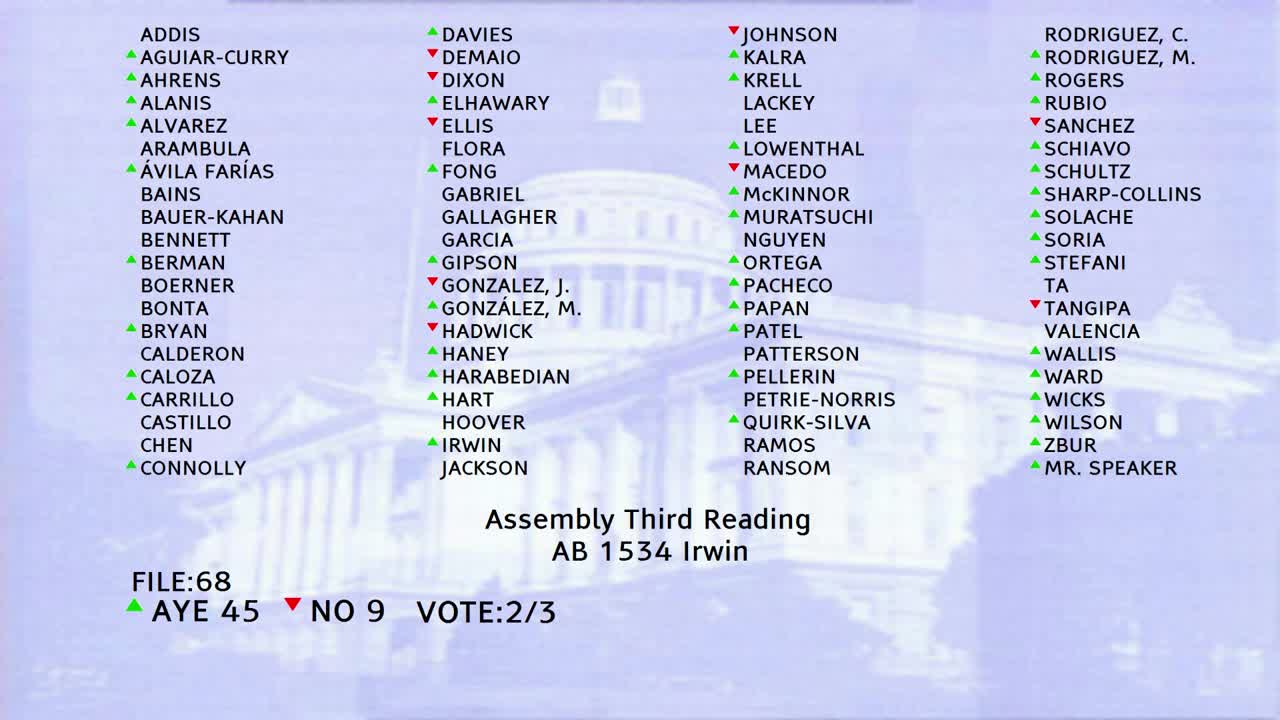 56SEC
Assembly Floor
 4MIN
Assembly Standing Committee on Housing and Community Development
Bill Author

Bill Co-Author(s):