AB 1572: California Interscholastic Federation: officials: registration, certification, and eligibility verification.
- Session Year: 2025-2026
- House: Assembly
- Latest Version Date: 2026-09-18
Current Status:
Passed
(2026-09-18: Chaptered by Secretary of State - Chapter 267, Statutes of 2026.)
Introduced
In Committee
Awaiting First Chamber Vote
Passed First Chamber
In Committee
Awaiting Second Chamber Vote
Passed Second Chamber
Enacted
Existing law describes the California Interscholastic Federation (CIF) as a voluntary organization that consists of school and school-related personnel with responsibility for administering interscholastic athletic activities in secondary schools, and sets forth the Legislatures intent regarding the CIFs implementation of certain policies. Existing law requires the CIF, on or before January 1, 2023, and on or before January 1 every 7 years thereafter, to report to the appropriate policy committees of the Legislature and the Governor on its evaluation and accountability activities undertaken pursuant to specified provisions. Existing law requires the report to include the goals and objectives of the CIF with regard to, and the status of, among other things, the quality of coaching and officiating, as provided.
Existing law requires all noncertificated candidates, prior to assuming a paid or volunteer position to work with pupils in a pupil activity program sponsored by a school district, including an interscholastic program, to obtain an Activity Supervisor Clearance Certificate from the Commission on Teacher Credentialing. Existing law requires the commission, upon verification of a candidates personal identification and verification that the candidate meets specified requirements, to initially issue an Activity Supervisor Clearance Certificate to the candidate for a 5-year period and authorizes the certificate to be renewed, as provided.
This bill would require the CIF to verify the eligibility of its officials to officiate CIF contests by requiring those officials to annually register through a platform, as provided. The bill would require the platform to consist of (1), until July 1, 2028, a statewide and standardized background screening, (2), commencing July 1, 2028, a record of a valid Activity Supervisor Clearance Certificate issued by the commission, including the applicable expiration date, (3) a record of rules tests, online training modules, sport-specific annual certification, and continuing education requirements, and (4) a record of liability insurance coverage. The bill would require the CIF to verify, as specified, that all components of the platform are complete before an official is deemed and marked as eligible to receive an assignment to officiate. The bill would require the CIF to ensure that its participating member schools, school districts, county offices of education, and charter schools can access the platform to verify the eligibility of an official, as specified. The bill, commencing July 1, 2028, would require the commission to regularly publish a list on its internet website of Activity Supervisor Clearance Certificate holders who have their certificate suspended or revoked by the commission and would require the CIF to ensure that the platform selected by the CIF regularly reviews the list published by the commission in order to update the eligibility of the officials whose Activity Supervisor Clearance Certificate has been suspended or revoked.
Existing law describes the California Interscholastic Federation (CIF) as a voluntary organization that consists of school and school-related personnel with responsibility for administering interscholastic athletic activities in secondary schools, and sets forth the Legislatures intent regarding the CIFs implementation of certain policies. Existing law requires the CIF, on or before January 1, 2023, and on or before January 1 every 7 years thereafter, to report to the appropriate policy committees of the Legislature and the Governor on its evaluation and accountability activities undertaken pursuant to specified provisions. Existing law requires the report to include the goals and objectives of the CIF with regard to, and the status of, among other things, the quality of coaching and officiating, as provided.
Existing law requires all noncertificated candidates, prior to assuming a paid or volunteer position to work with pupils in a pupil activity program sponsored by a school district, including an interscholastic program, to obtain an Activity Supervisor Clearance Certificate from the Commission on Teacher Credentialing. Existing law requires the commission, upon verification of a candidates personal identification and verification that the candidate meets specified requirements, to initially issue an Activity Supervisor Clearance Certificate to the candidate for a 5-year period and authorizes the certificate to be renewed, as provided.
This bill would require the CIF to annually verify the eligibility of its officials to officiate CIF contests by requiring those officials to annually register through a platform, as provided. The bill would require the platform to consist of (1) (1), until July 1, 2028, a statewide and standardized background screening, (2) (2), commencing July 1, 2028, a record of a valid Activity Supervisor Clearance Certificate issued by the commission, including the applicable expiration date, (3) a record of rules tests, online training modules, sport-specific annual certification, and continuing education requirements, and (3) (4) a record of liability insurance coverage. The bill would require the CIF to verify, as specified, that all components of the platform are complete before an official is deemed and marked as eligible to receive an assignment to officiate. The bill would require the CIF to ensure that its participating member schools, school districts, county offices of education, and charter schools can access the platform to verify the eligibility of an official, as specified. The bill, commencing July 1, 2028, would require the commission to regularly publish a list on its internet website of Activity Supervisor Clearance Certificate holders who have their certificate suspended or revoked by the commission and would require the CIF to ensure that the platform selected by the CIF regularly reviews the list published by the commission in order to update the eligibility of the officials whose Activity Supervisor Clearance Certificate has been suspended or revoked.
Existing law describes the California Interscholastic Federation (CIF) as a voluntary organization that consists of school and school-related personnel with responsibility for administering interscholastic athletic activities in secondary schools, and sets forth the Legislatures intent regarding the CIFs implementation of certain policies. Existing law requires the CIF, on or before January 1, 2023, and on or before January 1 every 7 years thereafter, to report to the appropriate policy committees of the Legislature and the Governor on its evaluation and accountability activities undertaken pursuant to specified provisions. Existing law requires the report to include the goals and objectives of the CIF with regard to, and the status of, among other things, the quality of coaching and officiating, as provided.
This bill would require the CIF to annually verify the eligibility of its officials to officiate CIF contests by requiring those officials to annually register through a platform, as provided. The bill would require the platform to consist of (1) a statewide and standardized background screening, (2) a record of rules tests, online training modules, sport-specific annual certification, and continuing education requirements, and (3) a record of liability insurance coverage. The bill would require the CIF to ensure that its participating member schools, school districts, county offices of education, and charter schools can access the platform to verify the eligibility of an official, as specified.
(a)The California Interscholastic Federation shall require its officials to annually register through a platform selected by the California Interscholastic Federation to verify the officials eligibility to officiate California Interscholastic Federation contests. The platform shall consist of all of the following components:
(1)(A)Until July 1, 2028, a statewide and standardized background screening.
(B)Commencing July 1, 2028, a record of a valid Activity Supervisor Clearance Certificate issued by the commission pursuant to subdivision (f) of Section 44258.7, including the applicable expiration date.
(2)A record of rules tests, online training modules, sport-specific annual certifications, and continuing education requirements.
(3)A record of liability insurance coverage.
(b)(1)(A)The California Interscholastic Federation shall, through its chosen platform, verify that all components listed in paragraphs (1) to (3), inclusive, of subdivision (a) are complete before an official is deemed and marked as eligible to receive an assignment to officiate.
(B)(i)Until July 1, 2028, verification pursuant to subparagraph (A) shall be done annually.
(ii)Commencing July 1, 2028, the California Interscholastic Federation shall maintain the platform and, as part of the verification requirement in subparagraph (A), ensure that the platform selected by the California Interscholastic Federation regularly reviews the list published by the commission pursuant to subdivision (c) in order to update the eligibility of the officials whose Activity Supervisor Clearance Certificate has been suspended or revoked.
(2)Only officials who are deemed to be eligible in the selected platform may be assigned to California Interscholastic Federation contests by assignors or officiating associations.
(3)The California Interscholastic Federation shall ensure that its participating member schools, school districts, county offices of education, and charter schools can access the platform to verify the eligibility of an official, but shall not have access to the sensitive information in each individual component of the platform.
(c)Commencing July 1, 2028, the commission shall regularly publish a list on its internet website of Activity Supervisor Clearance Certificate holders who have their certificate suspended or revoked by the commission.
(d)The California Interscholastic Federation shall not be considered an employer of officials.
(a)The California Interscholastic Federation shall require its officials to annually register through a platform selected by the California Interscholastic Federation to verify the officials eligibility to officiate California Interscholastic Federation contests. The platform shall consist of all of the following components:
(1)A (A)Until July 1, 2028, a statewide and standardized background screening.
(B)Commencing July 1, 2028, a record of a valid Activity Supervisor Clearance Certificate issued by the commission pursuant to subdivision (f) of Section 44258.7, including the applicable expiration date.
(2)A record of rules tests, online training modules, sport-specific annual certifications, and continuing education requirements.
(3)A record of liability insurance coverage.
(b)(1)(A)The California Interscholastic Federation shall, through its chosen platform, annually verify that all components listed in paragraphs (1) to (3), inclusive, of subdivision (a) are complete before an official is deemed and marked as eligible to receive an assignment to officiate.
(B)(i)Until July 1, 2028, verification pursuant to subparagraph (A) shall be done annually.
(ii)Commencing July 1, 2028, the California Interscholastic Federation shall maintain the platform and, as part of the verification requirement in subparagraph (A), ensure that the platform selected by the California Interscholastic Federation regularly reviews the list published by the commission pursuant to subdivision (c) in order to update the eligibility of the officials whose Activity Supervisor Clearance Certificate has been suspended or revoked.
(2)Only officials who are deemed eligible in the selected platform may be assigned to California Interscholastic Federation contests by assignors or officiating associations.
(3)The California Interscholastic Federation shall ensure that its participating member schools, school districts, county offices of education, and charter schools can access the platform to verify the eligibility of an official, but shall not have access to the sensitive information in each individual component of the platform.
(c)Commencing July 1, 2028, the commission shall regularly publish a list on its internet website of Activity Supervisor Clearance Certificate holders who have their certificate suspended or revoked by the commission.
(d)The California Interscholastic Federation shall not be considered an employer of officials.
REVISIONS: HeadingLine 3.(a)The California Interscholastic Federation shall require its officials to annually register through a platform selected by the California Interscholastic Federation to verify the officials eligibility to officiate California Interscholastic Federation contests. The platform shall consist of all of the following components:
(1)A statewide and standardized background screening.
(2)A record of rules tests, online training modules, sport-specific annual certifications, and continuing education requirements.
(3)A record of liability insurance coverage.
(b)(1)The California Interscholastic Federation shall, through its chosen platform, annually verify that all components listed in paragraphs (1) to (3), inclusive, of subdivision (a) are complete before an official is deemed and marked as eligible to receive an assignment to officiate.
(2)Only officials who are deemed eligible in the selected platform may be assigned to California Interscholastic Federation contests by assignors or officiating associations.
(3)The California Interscholastic Federation shall ensure that its participating member schools, school districts, county offices of education, and charter schools can access the platform to verify the eligibility of an official, but shall not have access to the sensitive information in each individual component of the platform.
REVISIONS: HeadingLine 2.|
Date
|
Status
|
|---|---|
| Sep 18, 2026 | Chaptered by Secretary of State - Chapter 267, Statutes of 2026. |
| Sep 18, 2026 | Approved by the Governor. |
| Sep 9, 2026 | Enrolled and presented to the Governor at 1 p.m. |
| Aug 30, 2026 | Senate amendments concurred in. To Engrossing and Enrolling. (Ayes 78. Noes 0. Page 6850.). |
| Aug 30, 2026 | Senate amendments concurred in. To Engrossing and Enrolling. (Ayes 78. Noes 0.). |
| Aug 30, 2026 | Senate amendments concurred in. To Engrossing and Enrolling. |
| Aug 27, 2026 | In Assembly. Concurrence in Senate amendments pending. |
| Aug 27, 2026 | Read third time. Passed. Ordered to the Assembly. (Ayes 39. Noes 0. Page 5983.). |
| Aug 27, 2026 | Read third time. Passed. Ordered to the Assembly. (Ayes 39. Noes 0.). |
| Aug 25, 2026 | Ordered to special consent calendar. |
| Aug 17, 2026 | Read second time. Ordered to third reading. |
| Aug 13, 2026 | Read second time and amended. Ordered returned to second reading. |
| Aug 13, 2026 | From committee: Amend, and do pass as amended. (Ayes 7. Noes 0.) (August 13). |
| Aug 3, 2026 | In committee: Referred to APPR. suspense file. |
| Jul 1, 2026 | From committee: Do pass and re-refer to Com. on APPR. with recommendation: To Consent Calendar. (Ayes 6. Noes 0.) (June 30). Re-referred to Com. on APPR. |
| Jun 17, 2026 | From committee: Do pass and re-refer to Com. on PUB. S. (Ayes 7. Noes 0.) (June 17). Re-referred to Com. on PUB. S. |
| Jun 3, 2026 | Referred to Coms. on ED. and PUB. S. |
| May 21, 2026 | In Senate. Read first time. To Com. on RLS. for assignment. |
| May 21, 2026 | Read third time. Passed. Ordered to the Senate. (Ayes 72. Noes 0. Page 5186.) |
| May 21, 2026 | Read third time. Passed. Ordered to the Senate. (Ayes 72. Noes 0.) |
| May 18, 2026 | Read second time. Ordered to third reading. |
| May 14, 2026 | Coauthors revised. |
| May 14, 2026 | From committee: Do pass. (Ayes 15. Noes 0.) (May 14). |
| May 6, 2026 | In committee: Set, first hearing. Referred to APPR. suspense file. |
| Apr 6, 2026 | Re-referred to Com. on APPR. pursuant to Joint Rule 10.5. |
| Apr 6, 2026 | Read second time. Ordered to Consent Calendar. |
| Mar 26, 2026 | Read second time and amended. Ordered returned to second reading. |
| Mar 25, 2026 | From committee: Amend, and do pass as amended. To Consent Calendar. (Ayes 9. Noes 0.) (March 25). |
| Mar 17, 2026 | From committee: Do pass and re-refer to Com. on ED. (Ayes 9. Noes 0.) (March 17). Re-referred to Com. on ED. |
| Mar 17, 2026 | Coauthors revised. |
| Feb 17, 2026 | Referred to Coms. on A.,E.,S., & T. and ED. |
| Jan 13, 2026 | From printer. May be heard in committee February 12. |
| Jan 12, 2026 | Read first time. To print. |
|
Date
|
Description
|
Location
|
Votes
|
|
|---|---|---|---|---|
| Aug 30, 2026 | AB 1572 Alanis Concurrence in Senate Amendments | Assembly Floor |
Passed |
|
| Aug 27, 2026 | Special Consent AB1572 Alanis et al. By Umberg | Senate Floor |
Passed |
|
| Aug 13, 2026 | Do pass as amended | Senate Standing Committee on Appropriations |
Passed |
|
| Aug 3, 2026 | Placed on suspense file | Senate Standing Committee on Appropriations |
Passed |
|
| Jun 30, 2026 | Do pass, but first be re-referred to the Committee on [Appropriations] with the recommendation: To Consent Calendar | Senate Standing Committee on Public Safety |
Passed |
|
| Jun 17, 2026 | Do pass, but first be re-referred to the Committee on [Public Safety] | Senate Standing Committee on Education |
Passed |
|
| May 21, 2026 | AB 1572 Alanis Assembly Third Reading | Assembly Floor |
Passed |
|
| May 14, 2026 | Do pass. | Assembly Standing Committee on Appropriations |
Passed |
|
| Mar 25, 2026 | Do pass as amended. To Consent Calendar. | Assembly Standing Committee on Education |
Passed |
|
| Mar 17, 2026 | Do pass and be re-referred to the Committee on [Education] | Assembly Standing Committee on Arts, Entertainment, Sports, and Tourism |
Passed |
This list shows positions taken on this bill by organizations on the date displayed, which is linked to the original source.
Positions by individuals are not included.
|
Organization
|
Position
|
Date
|
|---|---|---|
| California Association Of Private School Organizations | ** Support | |
| California Interscholastic Federation | ** Support | |
| California Interscholastic Federation - Central Coast Section | ** Support | |
| California Interscholastic Federation - Central Section | ** Support | |
| California Interscholastic Federation Los Angeles City Section | ** Support | |
| California Interscholastic Federation - North Coast Section | ** Support | |
| California Interscholastic Federation - Northern Section | ** Support | |
| California Interscholastic Federation - Oakland Section | ** Support | |
| California Interscholastic Federation - Sac-joaquin Section | ** Support | |
| California Interscholastic Federation - San Diego Section | ** Support | |
| California Interscholastic Federation - San Francisco City Section | ** Support | |
| California Interscholastic Federation - Southern Section | ** Support | |
| California Teachers Association | ** Support | |
| CIF – Central Coast Section | ** Support | |
| CIF – Central Section | ** Support | |
| CIF – Los Angeles City Section | ** Support | |
| CIF – North Coast Section | ** Support | |
| CIF – Northern Section | ** Support | |
| CIF – Oakland Section | ** Support | |
| CIF – Sac-Joaquin Section | ** Support | |
| CIF – San Diego Section | ** Support | |
| CIF – San Francisco City Section | ** Support | |
| CIF – Southern Section | ** Support | |
| Informed Policy Advocates | ** Support | |
| Schools Excess Liability Fund | ** Support |
CONCURRENCE IN SENATE AMENDMENTS
CSA1 Bill Id:AB 1572
Author:(Alanis)
As Amended Ver:August 13, 2026
Majority vote
SUMMARY
AB 1572 requires the California Interscholastic Federation (CIF) to require its officials to annually register through a platform selected by the CIF to verify the official′s eligibility to officiate CIF contests, which will, until July 1, 2028, include a statewide and standardized background screening and, commencing July 1, 2028, will include a record of a valid Activity Supervisor Clearance Certificate (ASCC) issued by the Commission on Teacher Credentialing (CTC).
Senate Amendments
Senate amendments made a minor change and added co-authors.
COMMENTS
Background. The CIF, founded in 1914, is a voluntary organization consisting of over 1,600 public, public charter, and private high schools and over 750,000 student-athletes, for the purpose of governing education-based athletics in grades 9 through 12. Almost all public and private high schools in California are CIF members. The CIF is organized under the California Department of Education (CDE), and CDE has allowed the CIF to regulate interscholastic athletics and be the rulemaking body for these programs.
The CIF consists of ten regional sections, each of which is divided into several local leagues, for purposes of developing sports, scheduling athletic contests, and assigning referees. Each league elects a representative to their respective CIF section′s governing body, which is called a Board of Managers or Council. Each CIF section′s governing body elects officers, establishes section policies, develops section playoff sports and schedules, and CIF members adhere to these rules and regulations adopted by their section.
This bill creates requirements for game officials for CIF contests, and game officials are not considered employees of CIF or schools. This bill requires officials to annually register for a platform selected by the CIF to verify the official′s eligibility to officiate CIF contests, including having done fingerprinting and a criminal background check as well as that official having liability insurance coverage.
Existing law excludes sports officials from being considered employees of an entity sponsoring an interscholastic sports event, or any person performing services as a sports official for a public agency or public entity, and according to CIF, these sports officials are considered independent contractors. There are associations of officials and referees that are accredited by CIF and organized by region and sport, and as mentioned above, CIF consists of ten regional sections, which are divided into local leagues, and the local leagues assign referees and officials to CIF games. These officials are paid and generally have liability insurance coverage, either individually or through an officials′ or referees′ association.
CIF is rolling out a similar statewide eligibility program for officials. In July 2025, CIF launched a new statewide registration and eligibility process for all high schools called the CIF Officials Registration Program. Officials can pay $29 to register through a platform to begin the process of becoming CIF-eligible, and the system will streamline background checks, standardize qualifications, and simplify access to cost effective insurance coverage through a centralized structure. The program is voluntary in 2025-26 and will become mandatory beginning in 2026-27. This bill creates a very similar process, with the notable exception of requiring officials to obtain an ASCC from the CTC, which is considered a higher level of screening than a background check. According to CIF, other states have similar systems for game officials, including Massachusetts, Illinois, and New Jersey.
ASCC. When AB 1572 was introduced, the bill required CIF to require that its officials who have undergone a background screening would be deemed eligible to receive an assignment to officiate. The most recent version of this bill ensures a greater level of security screening for officials and requires CIF, starting July 1, 2028, to require that its officials have a record of a valid ASCC issued by the CTC before being deemed and marked as eligible to receive an assignment to officiate.
According to the CTC, an individual obtaining an ASCC from the CTC must obtain fingerprint clearance through a criminal background check completed by the DOJ and the Federal Bureau of Investigation. This is considered a higher level of screening than a background check. Existing law already requires non-certificated individuals, prior to starting a paid or volunteer position working with pupils in a student activity program sponsored by the school district or county office of education, to obtain an ASCC from the CTC.
The sole purpose of the ASCC is to provide verification that the holder has completed the professional fitness review before being placed in a position working with pupils in a pupil activity program, and a pupil activity program may include interscholastic programs.
According to the Author
″AB 1572 is necessary to ensure that California′s student athletes compete in safe, fair, and well-regulated environments. By establishing a consistent standard for CIF officials, we can give schools and parents confidence that officials assigned to games are qualified and accountable. This measure will also promote greater transparency and consistency across leagues, reducing uneven enforcement of rules. Ultimately, it strengthens the integrity of high school athletics and reinforces a commitment to protecting the well-being of every student athlete.″
Arguments in Support
According to the CIF in support, ″This bill would require CIF to annually verify the eligibility of its officials to officiate CIF contests by requiring those officials to annually register through a platform selected by CIF for that purpose. The platform would comprise a standardized background screening (and, starting on July 1, 2028, a valid Activity Supervisor Clearance Certificate), a record of understanding of the game, and a record of liability insurance coverage. Under AB 1572, only officials who are deemed eligible in the platform may be assigned to officiate CIF contests. CIF would ensure that member schools can access the platform to verify eligibility but shall not have access to any sensitive information.
″CIF has voluntarily instituted a system that would meet the requirements of AB 1572, which will be updated to comply with the Activity Supervisor Clearance Certificate in 2028, and we believe the health and safety of all interscholastic athletics participants—students, parents, coaches, and officials—is worthy of being codified into law. Therefore, we support AB 1572 and urge committee members to vote ″aye″ on this measure.″
Arguments in Opposition
None on file.
FISCAL COMMENTS
According to the Senate Appropriations Committee:
- The CTC estimates General Fund costs of $625,000 each year to hire additional analytical and legal staff to manage the additional screenings, case intake, and misconduct caseload.
- The costs for the CIF to oversee the registration platform and verification process are expected to be minor and absorbable.
- The Department of Justice does not anticipate a significant fiscal impact as a result of this bill.
VOTES:
ASM ARTS, ENTERTAINMENT, SPORTS, AND TOURISM: 9-0-0
YES: Ward, Lackey, Elhawary, Jeff Gonzalez, McKinnor, Ortega, Quirk-Silva, Valencia, Zbur
ASM EDUCATION: 9-0-0
YES: Patel, Hoover, Alvarez, Bonta, Alanis, Garcia, Lowenthal, Pellerin, Zbur
ASM APPROPRIATIONS: 15-0-0
YES: Wicks, Hoover, Aguiar-Curry, Calderon, Caloza, Dixon, Fong, Mark González, Krell, Pacheco, Pellerin, Sharp-Collins, Solache, Ta, Tangipa
ASSEMBLY FLOOR: 72-0-8
YES: Addis, Aguiar-Curry, Ahrens, Alanis, Alvarez, Ávila Farías, Bains, Bauer-Kahan, Bennett, Berman, Boerner, Bonta, Bryan, Calderon, Caloza, Carrillo, Castillo, Connolly, Davies, DeMaio, Dixon, Elhawary, Ellis, Flora, Fong, Gabriel, Gallagher, Gipson, Jeff Gonzalez, Mark González, Hadwick, Haney, Harabedian, Hart, Hoover, Irwin, Johnson, Kalra, Krell, Lowenthal, Macedo, McKinnor, Muratsuchi, Nguyen, Ortega, Pacheco, Papan, Patel, Patterson, Pellerin, Petrie-Norris, Quirk-Silva, Ransom, Michelle Rodriguez, Rogers, Blanca Rubio, Sanchez, Schiavo, Schultz, Sharp-Collins, Solache, Soria, Stefani, Ta, Tangipa, Valencia, Wallis, Ward, Wicks, Wilson, Zbur, Rivas
ABS, ABST OR NV: Arambula, Chen, Garcia, Jackson, Lackey, Lee, Ramos, Celeste Rodriguez
UPDATED
VERSION: August 13, 2026
CONSULTANT: Brian V. Anderson, Jr. / A.,E.,S., & T. / (916) 319-3450 FN: 0004210
SENATE RULES COMMITTEE Office of Senate Floor Analyses (916) 651-4171 | AB 1572 |
THIRD READING
Bill No: AB 1572
Author: Alanis (R), et al.
Amended: 8/13/26 in Senate
Vote: 21
SENATE EDUCATION COMMITTEE: 7-0, 6/17/26
AYES: Pérez, Ochoa Bogh, Cabaldon, Choi, Cortese, Gonzalez, Reyes
SENATE PUBLIC SAFETY COMMITTEE: 6-0, 6/30/26
AYES: Arreguín, Seyarto, Caballero, Cortese, Pérez, Wiener
SENATE APPROPRIATIONS COMMITTEE: 7-0, 8/13/26
AYES: Cervantes, Seyarto, Cabaldon, Dahle, Grayson, Richardson, Wahab
ASSEMBLY FLOOR: 72-0, 5/21/26 - See last page for vote
SUBJECT: California Interscholastic Federation: officials: registration, certification, and eligibility verification
SOURCE: Author
DIGEST:
This bill requires the California Interscholastic Federation (CIF) to require its officials to annually register through a platform selected by the CIF to verify the official’s eligibility to officiate CIF contests, which will, until July 1, 2028, include a statewide and standardized background screening and, commencing July 1, 2028, will include a record of a valid Activity Supervisor Clearance Certificate (ASCC) issued by the Commission on Teacher Credentialing (CTC).
ANALYSIS:
Existing law:
- States that the CIF is a voluntary organization that consists of school and school-related personnel with responsibility for administering interscholastic athletic activities in secondary schools. (Education Code (EC) § 33353)
- Requires the CIF to report to the appropriate policy committees of the Legislature and the Governor on its evaluation and accountability activities on or before January 1, 2023, and on or before January 1 every seven years thereafter, and shall include, but not be limited to, the goals and objectives of the CIF with regard to, and the status of, all of the following:
- The governing structure of the CIF, and the effectiveness of that governance structure in providing leadership for interscholastic athletics in secondary schools.
- Methods to facilitate communication with agencies, organizations, and public entities whose functions and interests interface with the CIF.
- The quality of coaching and officiating, including, but not limited to, professional development for coaches and athletic administrators, and parent education programs.
- Gender equity in interscholastic athletics, including, but not limited to, the number of male and female pupils participating in interscholastic athletics in secondary schools, and action taken by the CIF in order to ensure compliance with Title IX of the federal Education Amendments of 1972 (20 United States Code (USC) § 1681 et seq.).
- Health and safety of pupils, coaches, officials, and spectators.
- The economic viability of interscholastic athletics in secondary schools, including, but not limited to, the promotion and marketing of interscholastic athletics.
- New and continuing programs available to pupil athletes.
- Awareness and understanding of emerging issues related to interscholastic athletics in secondary schools. (EC § 33353)
- Authorizes a community youth athletic program to request state and federal level criminal history information from the California Department of Justice (DOJ) for a volunteer coach or hired coach candidate. (Penal Code § 11105.3)
- Requires, commencing January 1, 2016, a community youth athletic program to provide written notice to the parent or guardian of any youth participating in the program regarding the program’s policies relating to whether the program obtains criminal background checks for hired and/or volunteer coaches. Defines a community youth athletic program as an organization for which the primary purpose is the promotion or provision of athletic activities for youth under 18 years of age and which has adult employees who have supervisory or disciplinary power over children. (Business and Professions Code § 18900)
- Requires any entity that has a contract with a local educational agency (LEA) to ensure that any employee who interacts with pupils, outside of the immediate supervision and control of the pupil’s parent or guardian or a school employee, has a valid criminal records summary. Requires, when the contracting entity performs the criminal background check, the entity to immediately provide any subsequent arrest and conviction information it receives to any LEA that it is contracting with pursuant to the subsequent arrest service. (EC § 45125.1)
- Requires all noncertificated candidates, prior to assuming a paid or volunteer position to work with pupils in a pupil activity program sponsored by a school district, to obtain an ASCC from the CTC. Indicates that a “pupil activity program” sponsored by a school district includes, but is not limited to, scholastic programs, interscholastic programs, and extracurricular activities sponsored by a school district or school booster club. (EC § 49024)
- Requires the CTC to issue an ASCC to candidates serving in a specified position upon verification of the candidate’s personal identification and verification that the candidate meets all specified professional requirements. (EC § 44258.7)
- Requires that an ASCC be issued initially for a five-year period and may be renewed, and requires that the CTC establish a fee for the ASCC. (EC § 44258.7)
- Excludes from the definition of an “employee” a person, other than a regular employee, performing services as a sports official, as defined, for an entity sponsoring an intercollegiate or interscholastic sports event, or any person performing services as a sports official for a public agency, public entity, or a private nonprofit organization sponsoring an amateur sports event. Defines a “sports official” as including an umpire, referee, judge, scorekeeper, timekeeper, or other person who is a neutral participant in a sports event. (Labor Code § 3352)
This bill:
- Requires the CIF to require its officials to annually register through a platform selected by the CIF to verify the official’s eligibility to officiate CIF contests.
- Requires the platform to consist of all of the following components:
- Until July 1, 2028, a statewide and standardized background screening, and commencing July 1, 2028, a record of a valid ASCC issued by the CTC, including the applicable expiration date.
- A record of rules tests, online training modules, sport-specific annual certifications, and continuing education requirements.
- A record of liability insurance coverage.
- Requires, commencing July 1, 2028, that the CTC regularly publish a list on its internet website of ASCC holders who have their certificate suspended or revoked by CTC.
- Requires the CIF, through its chosen platform, to verify that all specified components are complete before an official is deemed and marked as eligible to receive an assignment to officiate.
- Requires that CIF complete the specified verification annually until July 1, 2028, and requires, commencing July 1, 2028, that the CIF maintain the platform and, as part of the verification requirement, ensure that the chosen platform regularly reviews the list published by the CTC in order to update the eligibility of the officials whose ASCC has been suspended or revoked.
- Authorizes that only officials who are deemed eligible in the selected platform be assigned to CIF contests by assignors or officiating associations.
- Requires the CIF to ensure that its participating member schools, school districts, county offices of education, and charter schools can access the platform to verify the eligibility of an official, but shall not have access to the sensitive information in each individual component of the platform.
- Prohibits the CIF from being considered an employer of officials.
Comments
Need for the bill. According to the author, “AB 1572 is necessary to ensure that California’s student athletes compete in safe, fair, and well-regulated environments. By establishing a consistent standard for CIF officials, we can give schools and parents confidence that officials assigned to games are qualified and accountable. This measure will also promote greater transparency and consistency across leagues, reducing uneven enforcement of rules. Ultimately, it strengthens the integrity of high school athletics and reinforces a commitment to protecting the well-being of every student athlete.”
CIF’s structure and role in interscholastic athletics. The CIF, founded in 1914, is a voluntary organization consisting of over 1,600 public, public charter, and private high schools and over 750,000 student-athletes, for the purpose of governing education-based athletics in grades 9 through 12. Almost all public and private high schools in California are CIF members. The CIF is organized under the California Department of Education (CDE), and CDE has allowed the CIF to regulate interscholastic athletics and be the rulemaking body for these programs.
The CIF consists of ten regional sections, each of which is divided into several local leagues, for purposes of developing sports, scheduling athletic contests, and assigning referees. Each league elects a representative to their respective CIF section’s governing body, which is called a Board of Managers or Council. Each CIF section’s governing body elects officers, establishes section policies, develops section playoff sports and schedules, and CIF members adhere to these rules and regulations adopted by their section.
This bill creates requirements for game officials for CIF contests, and game officials are not considered employees of CIF or schools. This bill requires officials to annually register for a platform selected by the CIF to verify the official’s eligibility to officiate CIF contests, including having done fingerprinting and a criminal background check as well as that official having liability insurance coverage.
Existing law excludes sports officials from being considered employees of an entity sponsoring an interscholastic sports event, or any person performing services as a sports official for a public agency or public entity, and according to CIF, these sports officials are considered independent contractors. There are associations of officials and referees that are accredited by CIF and organized by region and sport, and as mentioned above, CIF consists of ten regional sections, which are divided into local leagues, and the local leagues assign referees and officials to CIF games. These officials are paid and generally have liability insurance coverage, either individually or through an officials’ or referees’ association.
CIF is rolling out a similar statewide eligibility program for officials. In July 2025, CIF launched a new statewide registration and eligibility process for all high schools called the CIF Officials Registration Program. Officials can pay $29 to register through a platform to begin the process of becoming CIF-eligible, and the system will streamline background checks, standardize qualifications, and simplify access to cost effective insurance coverage through a centralized structure. The program is voluntary in 2025-26 and will become mandatory beginning in 2026-27. This bill creates a very similar process, with the notable exception of requiring officials to obtain an ASCC from the CTC, which is considered a higher level of screening than a background check. According to CIF, other states have similar systems for game officials, including Massachusetts, Illinois, and New Jersey.
What is an ASCC? When AB 1572 was introduced, the bill required CIF to require that its officials who have undergone a background screening would be deemed eligible to receive an assignment to officiate. The most recent version of this bill ensures a greater level of security screening for officials and requires CIF, starting July 1, 2028, to require that its officials have a record of a valid ASCC issued by the CTC before being deemed and marked as eligible to receive an assignment to officiate.
According to the CTC, an individual obtaining an ASCC from the CTC must obtain fingerprint clearance through a criminal background check completed by the DOJ and the Federal Bureau of Investigation. This is considered a higher level of screening than a background check. Existing law already requires non-certificated individuals, prior to starting a paid or volunteer position working with pupils in a student activity program sponsored by the school district or county office of education, to obtain an ASCC from the CTC.
The sole purpose of the ASCC is to provide verification that the holder has completed the professional fitness review before being placed in a position working with pupils in a pupil activity program, and a pupil activity program may include interscholastic programs. Here are a few features of the ASCC as it relates to the implementation of this bill:
- The ASCC is not limited to one employing agency but may be used in all California public school districts, which makes it a valuable certification for game officials working across multiple school districts.
- The CTC charges a $100 fee on a rolling five-year basis for the ASCC.
- In renewing the ASCC, if an individual maintains their certificate and renews in a timely manner, they would not need to repeat fingerprinting.
- The initial fingerprinting allows the CTC to continuously receive official criminal history records in the case that a certificate holder is arrested.
- According to the CTC, when there are no delays in fingerprint information being received, and no flags on an applicant’s background that require investigation, ASCC applications are granted within 10 business days from receipt. However, if there is misconduct that needs to be investigated, processing may take longer, and timing depends on the specific investigation.
- According to CIF, this bill delays the requirement that game officials obtain an ASCC from January 1, 2027 to July 1, 2028 because that gives additional time for CIF to ensure that their platform interfaces with CTC’s list of ASCC holders who have their certificate suspended or revoked. In the meantime, game officials would still be required to receive a statewide and standardized background screening.
Related/Prior Legislation
AB 465 (Bonilla, Chapter 146, Statutes of 2013) specifically provides that a community youth athletic program can request state and federal level criminal history information from the DOJ for a volunteer or paid coach.
AB 346 (Conway, Chapter 52, Statutes of 2010) provides that the requirement to obtain an ASCC is applicable to a paid or volunteer position to work with pupils in a pupil activity program sponsored by a school district.
FISCAL EFFECT: Appropriation: No Fiscal Com.: Yes Local: No
According to the Senate Appropriations Committee:
- The CTC estimates General Fund costs of $625,000 each year to hire additional analytical and legal staff to manage the additional screenings, case intake, and misconduct caseload.
- The costs for the CIF to oversee the registration platform and verification process are expected to be minor and absorbable.
- The Department of Justice does not anticipate a significant fiscal impact as a result of this bill.
SUPPORT: (Verified 8/14/26)
California Association of Private School Organizations
California Interscholastic Federation
California Teachers Association
Informed Policy Advocates
Schools Excess Liability Fund
OPPOSITION: (Verified 8/14/26)
None received
ASSEMBLY FLOOR: 72-0, 5/21/26
AYES: Addis, Aguiar-Curry, Ahrens, Alanis, Alvarez, Ávila Farías, Bains, Bauer-Kahan, Bennett, Berman, Boerner, Bonta, Bryan, Calderon, Caloza, Carrillo, Castillo, Connolly, Davies, DeMaio, Dixon, Elhawary, Ellis, Flora, Fong, Gabriel, Gallagher, Gipson, Jeff Gonzalez, Mark González, Hadwick, Haney, Harabedian, Hart, Hoover, Irwin, Johnson, Kalra, Krell, Lowenthal, Macedo, McKinnor, Muratsuchi, Nguyen, Ortega, Pacheco, Papan, Patel, Patterson, Pellerin, Petrie-Norris, Quirk-Silva, Ransom, Michelle Rodriguez, Rogers, Blanca Rubio, Sanchez, Schiavo, Schultz, Sharp-Collins, Solache, Soria, Stefani, Ta, Tangipa, Valencia, Wallis, Ward, Wicks, Wilson, Zbur, Rivas
NO VOTE RECORDED: Arambula, Chen, Garcia, Jackson, Lackey, Lee, Ramos, Celeste Rodriguez
Prepared by: Michelle Nguyen / ED. / (916) 651-4105
8/17/26 10:38:00
SENATE COMMITTEE ON
Senator Sabrina Cervantes, Chair
2025 - 2026 Regular Session
AB 1572 (Alanis) - California Interscholastic Federation: officials: registration, certification, and eligibility verification
Version: | Policy Vote: |
Urgency: | Mandate: |
Hearing Date: | Consultant: |
Bill Summary:
This bill requires the California Interscholastic Federation (CIF) to require its officials to annually register through a platform selected by the CIF to verify the official’s eligibility to officiate CIF contests which will include a statewide and standardized background screening until July 1, 2028. Commencing July 1, 2028, the platform will include a record of a valid Activity Supervisor Clearance Certificate (ASCC) issued by the Commission on Teacher Credentialing (CTC).
*********** ANALYSIS ADDENDUM – SUSPENSE FILE ***********
The following information is revised to reflect amendments
adopted by the committee on August 13, 2026
Fiscal Impact:
- The CTC estimates General Fund costs of $625,000 each year to hire additional analytical and legal staff to manage the additional screenings, case intake, and misconduct caseload.
- The costs for the CIF to oversee the registration platform and verification process is expected to be minor and absorbable.
- The Department of Justice does not anticipate a significant fiscal impact as a result of this bill.
Author Amendments:
Add Senator Gonzalez as a coauthor.
-- END --
SENATE COMMITTEE ON
Senator Sabrina Cervantes, Chair
2025 - 2026 Regular Session
AB 1572 (Alanis) - California Interscholastic Federation: officials: registration, certification, and eligibility verification
Version: | Policy Vote: |
Urgency: | Mandate: |
Hearing Date: | Consultant: |
Bill Summary:
This bill requires the California Interscholastic Federation (CIF) to require its officials to annually register through a platform selected by the CIF to verify the official’s eligibility to officiate CIF contests which will include a statewide and standardized background screening until July 1, 2028. Commencing July 1, 2028, the platform will include a record of a valid Activity Supervisor Clearance Certificate (ASCC) issued by the Commission on Teacher Credentialing (CTC).
Fiscal Impact:
- The CTC estimates General Fund costs of $625,000 each year to hire additional analytical and legal staff to manage the additional screenings, case intake, and misconduct caseload.
- The costs for the CIF to oversee the registration platform and verification process is expected to be minor and absorbable.
- The Department of Justice does not anticipate a significant fiscal impact as a result of this bill.
Background:
Existing law states that the CIF is a voluntary organization that consists of school and school-related personnel with responsibility for administering interscholastic athletic activities in secondary schools. The CIF is governed by a council consisting of high school superintendents, principals, athletic directors, educators, and other organizations. Amongst other duties, the CIF adopts rules and regulations for school athletics and enforces them. There are approximately 1,600 schools that are members of the CIF with over 760,000 student-athletes participating in athletics at CIF member schools each year.
Proposed Law:
This bill requires the CIF to require its officials to annually register through a platform selected by the CIF to verify the official’s eligibility to officiate CIF contests. It requires the platform to consist of all of the following components:
- Until July 1, 2028, a statewide and standardized background screening, and commencing July 1, 2028, a record of a valid ASCC issued by the CTC, including the applicable expiration date.
- A record of rules tests, online training modules, sport-specific annual certifications, and continuing education requirements.
- A record of liability insurance coverage.
This bill requires, commencing July 1, 2028, that the CTC regularly publish a list on its internet website of ASCC holders who have their certificate suspended or revoked by CTC.
This bill requires the CIF, through its chosen platform, to verify that all specified components are complete before an official is deemed and marked as eligible to receive an assignment to officiate.
This bill requires that the CIF complete the specified verification annually until July 1, 2028, and requires, commencing July 1, 2028, that the CIF maintain the platform and, as part of the verification requirement, ensure that the chosen platform regularly reviews the list published by the CTC in order to update the eligibility of the officials whose ASCC has been suspended or revoked.
This bill authorizes that only officials who are deemed eligible in the selected platform be assigned to CIF contests by assignors or officiating associations.
This bill requires the CIF to ensure that its participating member schools, school districts, county offices of education, and charter schools can access the platform to verify the eligibility of an official, but shall not have access to the sensitive information in each individual component of the platform.
This bill prohibits the CIF from being considered an employer of officials.
Staff Comments:
This bill requires officials to annually register for a platform selected by the CIF to verify the official’s eligibility to officiate CIF contests, including having done fingerprinting and a criminal background check as well as that official having liability insurance coverage. According to the author, “AB 1572 is necessary to ensure that California’s student athletes compete in safe, fair, and well-regulated environments. By establishing a consistent standard for CIF officials, we can give schools and parents confidence that officials assigned to games are qualified and accountable. This measure will also promote greater transparency and consistency across leagues, reducing uneven enforcement of rules. Ultimately, it strengthens the integrity of high school athletics and reinforces a commitment to protecting the well-being of every student athlete.”
-- END --
SENATE COMMITTEE ON PUBLIC SAFETY
Senator Jesse Arreguín, Chair
2025 - 2026 Regular
Bill No: AB 1572 Hearing Date: June 30, 2026
Author: | Alanis | ||
Version: | March 26, 2026 | ||
Urgency: | No | Fiscal: | Yes |
Consultant: | ML | ||
Subject: California Interscholastic Federation: officials: registration, certification, and eligibility verification
HISTORY
Source: Author
Prior Legislation: AB 465 (Bonilla), Ch. 146, Stats. of 2013
AB 346 (Conway), Ch. 52, Stats. of 2010
Support: California Association of Private School Organizations; California Interscholastic Federation; California Teachers Association; Schools Excess Liability Fund
Opposition: None known
Assembly Floor Vote: 72 - 0
PURPOSE
The purpose of this bill is to require California Interscholastic Federation (CIF) officials to annually register through a platform selected by the CIF to verify the official’s eligibility to officiate CIF contests, which will, until July 1, 2028, include a statewide and standardized background screening and, commencing July 1, 2028, will include a record of a valid Activity Supervisor Clearance Certificate (ASCC) issued by the Commission on Teacher Credentialing (CTC).
Existing law requires the Department of Justice (DOJ) to maintain state summary criminal history information, as defined, and to furnish this information to various state and local government officers, officials, and other prescribed entities, if needed in the course of their duties. (Pen. Code, § 11105, subds. (a)-(b).)
Existing law defines “state summary criminal history information” to mean the master record of information compiled by the Attorney General pertaining to the identification and criminal history of a person, such as name, date of birth, physical description, fingerprints, photographs, dates of arrests, arresting agencies and booking numbers, charges, dispositions, sentencing information, and similar data about the person. (Pen. Code, § 11105, subd. (a)(2)(A).)
Existing law requires any fingerprint-based criminal history information check required pursuant to any statute to be performed by DOJ. Requires that when a government agency or other entity requests such a criminal history check for purposes of employment, licensing, or certification, the DOJ must disseminate specified information in response to the request, including information regarding convictions and arrests for which the applicant is presently awaiting trial. (Pen. Code, § 11105, subd. (u).)
Existing law states, notwithstanding any other law, that a human resource agency or an employer may request from DOJ records of all convictions or any arrest pending adjudication involving specified offenses of a person who applies for a license, employment, or volunteer position, in which they would have supervisory or disciplinary power over a minor or any person under their care. Requires DOJ to furnish the information to the requesting employer and to also send a copy of the information to the applicant. (Pen. Code, § 11105.3, subd. (a).)
Existing law requires that a request for records pursuant to the above provision shall include the applicant’s fingerprints and any other data specified by DOJ. (Pen. Code, § 11105.3, subd. (b).)
Existing law states that the determination of whether the criminal history record shows that the applicant, employee, or volunteer has been convicted of, or is under pending indictment for, any crime that bears upon the fitness of the individual to have responsibility for the safety and well-being of children, the elderly, the handicapped, or the mentally impaired shall solely be made by the human resource agency or employer. States that DOJ is not required to make such a determination on behalf of any human resource agency or employer. (Pen. Code, § 11105.3, subd. (b)(2)(E).)
Existing law defines, for the purposes of the above provisions, “employer” to mean any nonprofit corporation or other organization specified by the Attorney General that employs or uses the services of volunteers in positions in which the volunteer or employee has supervisory or disciplinary power over a child or children. (Pen. Code, § 11105.3, subd. (f)(2).)
Existing law states that the CIF is a voluntary organization that consists of school and school-related personnel with responsibility for administering interscholastic athletic activities in secondary schools. (Ed. Code, § 33353.)
Existing law authorizes a community youth athletic program to request state and federal level criminal history information from the DOJ for a volunteer coach or hired coach candidate. (Pen. Code, § 11105.3.)
Existing law requires a community youth athletic program to provide written notice to the parent or guardian of any youth participating in the program regarding the program’s policies relating to whether the program obtains criminal background checks for hired and/or volunteer coaches. Defines a community youth athletic program as an organization for which the primary purpose is the promotion or provision of athletic activities for youth under 18 years of age and which has adult employees who have supervisory or disciplinary power over children. (Bus. & Prof. Code, § 18900.)
Existing law requires any entity that has a contract with a local educational agency (LEA) to ensure that any employee who interacts with pupils, outside of the immediate supervision and control of the pupil’s parent or guardian or a school employee, has a valid criminal records summary. Requires, when the contracting entity performs the criminal background check, the entity to immediately provide any subsequent arrest and conviction information it receives to any LEA that it is contracting with pursuant to the subsequent arrest service. (Ed. Code, § 45125.1.)
Existing law requires all noncertified candidates, prior to assuming a paid or volunteer position to work with pupils in a pupil activity program sponsored by a school district, to obtain an ASCC from the CTC. Indicates that a “pupil activity program” sponsored by a school district includes, but is not limited to, scholastic programs, interscholastic programs, and extracurricular activities sponsored by a school district or school booster club. States that this provision does not apply to a candidate who is required by the school district to clear a DOJ and Federal Bureau of Investigation (FBI) criminal background check prior to beginning the paid or volunteer activities. (Ed. Code, § 49024.)
Existing law requires the CTC to issue an ASCC to candidates serving in a specified position upon verification of the candidate’s personal identification and verification that the candidate meets all professional requirements, as specified. (Ed. Code, § 44258.7.)
Existing law requires that the CTC must submit to the DOJ fingerprint images and related information required by the DOJ of all ASCC candidates for the purposes of obtaining information as to the existence and content of a record of state or federal convictions and state or federal arrests and also information as to the existence and content of a record of state or federal arrests for which the DOJ establishes that the individual is free on bail or on his or her own recognizance pending trial or appeal. States that the criminal history record search response shall be provided in such a manner as to protect the confidentiality and privacy of the individual’s criminal history record and the criminal history record search response shall not be made available by the commission to any school district or county office of education. (Ed. Code, § 44346.5.)
Existing law states that the CTC shall adopt regulations requiring every applicant for a credential, or for the renewal of a credential, to submit reasonable evidence of identification and good moral character. Requires that the adopted rules and regulations specify that an applicant shall not be required to disclose, and the CTC shall not inquire into or consider, any acts or omissions not related to the applicant’s fitness to teach or perform other duties for which he or she is certificated, or which is related to his or her competence to perform the duties authorized by his or her credential. States that the adopted rules and regulations shall also prescribe the notice which shall be supplied to each applicant on the application form, which shall include the following information:
- The offenses which constitute grounds for the mandatory denial or revocation of a credential.
- The offenses for which the commission is authorized to deny or revoke a credential, depending upon the degree of rehabilitation or requalification demonstrated by the applicant.
- The standards under which the commission determines that it shall not investigate or pursue offenses which are not clearly related to an applicant’s fitness or competence to teach or perform other certificated services. (Ed. Code, § 44339.)
Existing law states that if a denial of an application for a certificate is due at least in part to the individual’s state or federal criminal history record, the commission shall provide to the individual a copy of his or her criminal history record search response with the notice of the denial (Ed. Code, § 44346.5.)
Existing law states that each allegation of an act or omission by an applicant for, or holder of, a credential for which the applicant may be subject to an adverse action shall be presented to the CTC. Authorizes the committee with jurisdiction to commence an initial review upon receipt of any of the following:
- Official records of the DOJ, of a law enforcement agency, of a state or federal court, and of any other agency of this state or another state.
- An affidavit or declaration signed by a person with personal knowledge of the acts alleged to constitute misconduct.
- A statement from an employer notifying the commission that, as a result of an allegation of misconduct, or while an allegation of misconduct is pending, a credentialholder has been dismissed, nonreelected, suspended for more than 10 days, or placed pursuant to a final adverse employment action on unpaid administrative leave for more than 10 days, or has resigned or otherwise left employment.
- A notice from an employer that a complaint was filed with the school district alleging sexual misconduct by a credentialholder. Results of an investigation by the committee based on this paragraph shall not be considered for action by the committee unless there is evidence presented to the committee in the form of a written or oral declaration under penalty of perjury that confirms the personal knowledge of the declarant regarding the acts alleged to constitute misconduct.
- An affirmative response on an application submitted to the commission as to any conviction, adverse action on, or denial of, a license, or pending investigation into a criminal allegation or pending investigation of a noncriminal allegation of misconduct by a governmental licensing entity.
- A record of a substantiated report entered into the statewide data system governing ASCC certified candidates. (Ed. Code, § 44242.5.)
States that for the purpose of ascertaining the moral character and true identity of the holder of a credential or an applicant for a credential or the renewal of a credential after jurisdiction to commence an initial review has been established, the commission is authorized to require the production of information, records, reports, and other data from any public agency. States that for the purposes of determining whether jurisdiction exists, the commission is also authorized to require the limited production of records, as specified. Requires that this information shall be provided to the commission within 30 days of the request. Requires that the commission shall maintain the confidentiality of this information, as specified. (Ed. Code, § 44341.)
Existing law requires that an ASCC be issued initially for a five-year period and may be renewed, and requires that the CTC establish a fee for the ASCC. (Ed. Code, § 44258.7.)
Existing law excludes from the definition of an “employee” a person, other than a regular employee, performing services as a sports official, as defined, for an entity sponsoring an intercollegiate or interscholastic sports event, or any person performing services as a sports official for a public agency, public entity, or a private nonprofit organization sponsoring an amateur sports event. Defines a “sports official” as including an umpire, referee, judge, scorekeeper, timekeeper, or other person who is a neutral participant in a sports event. (Labor Code, § 3352.)
This bill requires the CIF to require its officials to annually register through a platform selected by the CIF to verify the official’s eligibility to officiate CIF contests.
This bill requires the platform to consist of all of the following components:
- Until July 1, 2028, a statewide and standardized background screening, and commencing July 1, 2028, a record of a valid ASCC issued by the CTC, including the applicable expiration date.
- A record of rules tests, online training modules, sport-specific annual certifications, and continuing education requirements.
- A record of liability insurance coverage.
This bill requires, commencing July 1, 2028, that the CTC regularly publish a list on its internet website of ASCC holders who have their certificate suspended or revoked by CTC.
This bill requires the CIF, through its chosen platform, to verify that all specified components are complete before an official is deemed and marked as eligible to receive an assignment to officiate.
This bill requires that CIF complete the specified verification annually until July 1, 2028, and requires, commencing July 1, 2028, that the CIF maintain the platform and, as part of the verification requirement, ensure that the chosen platform regularly reviews the list published by the CTC in order to update the eligibility of the officials whose ASCC has been suspended or revoked.
This bill authorizes that only officials who are deemed eligible in the selected platform be assigned to CIF contests by assignors or officiating associations.
This bill requires the CIF to ensure that its participating member schools, school districts, county offices of education, and charter schools can access the platform to verify the eligibility of an official, but shall not have access to the sensitive information in each individual component of the platform.
This bill prohibits the CIF from being considered an employer of officials.
COMMENTS
- Need for This Bill
The author writes:
AB 1572 is necessary to ensure that California’s student athletes compete in safe, fair, and well-regulated environments. By establishing a consistent standard for CIF officials, we can give schools and parents confidence that officials assigned to games are qualified and accountable. This measure will also promote greater transparency and consistency across leagues, reducing uneven enforcement of rules. Ultimately, it strengthens the integrity of high school athletics and reinforces a commitment to protecting the well-being of every student athlete.
- DOJ Fingerprint Background Checks
State summary criminal history information is the primary record of information compiled by DOJ pertaining to the identification and criminal history of any person. This information includes name, date of birth, physical description, fingerprints, photographs, arrests, dispositions, and similar data. (Pen. Code, § 11105, subd. (a).) Access to a person’s summary criminal history information is generally prohibited and only allowed to be disseminated if specifically authorized in statute. “The state constitutional right of privacy extends to protect defendants from unauthorized disclosure of criminal history records. [Citation.] These records are compiled without the consent of the subjects and disseminated without their knowledge. Therefore, custodians of the records, have a duty to ‘resist attempts at unauthorized disclosure and the person who is the subject of the record is entitled to expect that his right will be thus asserted.’” (Westbrook v. County of Los Angeles (1994) 27 Cal.App.4th 157, 165-66.)
DOJ is only required to furnish state summary criminal history information to statutorily authorized entities or individuals for employment, licensing, or volunteering purposes. (Pen. Code, § 11105.) In addition to the specified entities authorized to receive state summary criminal history information, DOJ may furnish state summary criminal history information to other specified employers upon a showing of compelling need for the information and to any person or entity when they are required by statute to conduct a criminal background check to comply with requirements or exclusions expressly based upon specified criminal conduct. (Pen. Code, § 11105, subds. (a)(13) & (c).)
Existing law requires that any fingerprint-based criminal history check required pursuant to any statute must be requested by DOJ. The agency or entity authorized to receive criminal history information must submit to DOJ fingerprint images and any related information required by DOJ for the purpose of obtaining information as to the existence and content of a record of state or federal arrests, as specified. (Pen. Code, § 11105, subd. (u)(1).) If requested, DOJ must transmit fingerprint images and related information received pursuant to this section to the FBI for the purpose of obtaining a federal criminal history information check. DOJ must review the information returned from the FBI and compile and disseminate a response or a fitness determination, as appropriate, to the agency or entity identified that requested the information. (Pen. Code, § 11105, subd. (u)(2).)
A separate existing statute states that an employer or human resources agency may request from DOJ criminal records of a person involving specified offenses who applies for a license, employment, or volunteer position in which they would have supervisory or disciplinary power over a minor or any person under their care, and further requires DOJ to furnish this information to the requester and applicant. (Pen. Code, § 11105.3, subd. (a).) The list of specified convictions includes sexual battery, a sex offense against a minor, any felony that requires sex offender registration, or if within the last 10 years, any conviction or arrest for child abuse, elder abuse, theft, burglary, or any felony. (Welf. & Inst. Code, § 15660, subd. (a).)
- Existing Background Checks for Youth Sports Programming
Existing law authorizes, but does not require, a community youth athletic program to request state and federal-level criminal history information from the DOJ for a volunteer coach or hired coach candidate. (Pen. Code, § 11105.3) However, individuals must be certified by the CTC in order to work in youth sports, which requires a DOJ background check.
The CTC establishes professional standards, assessments, and examinations for entry and advancement in the education profession. It is required to establish standards for the issuance and renewal of credentials, certificates, and permits for teachers and educators. (Ed. Code, § 44225.)
Existing law requires all noncertified individuals, prior to assuming a paid or volunteer position to work with pupils in a pupil activity program sponsored by a school district, to obtain an ASCC from the CTC. A “pupil activity program” sponsored by a school district includes, but is not limited to, scholastic programs, interscholastic programs, and extracurricular activities sponsored by a school district or school booster club. This provision does not apply, however, to a candidate who is already required by the school district to clear a DOJ and FBI criminal background check prior to beginning the paid or volunteer activities. (Ed. Code, § 49024.)
The CTC must issue an ASCC to candidates serving in a specified position upon verification of the candidate’s personal identification and verification that the candidate meets all professional requirements, as specified. (Ed. Code, § 44258.7) In particular, all ASCC candidates must undergo a DOJ fingerprint criminal background check. (Ed. Code, § 44346.5.) If a denial of an application for a certificate is due at least in part to the individual’s state or federal criminal history record, the CTC shall provide to the individual a copy of his or her criminal history record search response with the notice of the denial (Ed. Code, § 44346.5.)
CTC must adopt regulations requiring every applicant for a credential, or for the renewal of a credential, to submit reasonable evidence of identification and good moral character. The adopted rules and regulations must specify that an applicant shall not be required to disclose, and the CTC shall not inquire into or consider, any acts or omissions not related to the applicant’s fitness to teach or perform other duties for which he or she is certificated, or which is related to his or her competence to perform the duties authorized by his or her credential. The adopted rules and regulations must also prescribe the notice which shall be supplied to each applicant on the application form, which shall include the following information:
- The offenses which constitute grounds for the mandatory denial or revocation of a credential.
- The offenses for which the commission is authorized to deny or revoke a credential, depending upon the degree of rehabilitation or requalification demonstrated by the applicant.
- The standards under which the commission determines that it shall not investigate or pursue offenses which are not clearly related to an applicant’s fitness or competence to teach or perform other certificated services. (Ed. Code, § 44339.)
Each allegation of an act or omission by an applicant for, or holder of, a credential for which the applicant may be subject to an adverse action shall be presented to the CTC. (Ed. Code, § 44242.5)
For the purpose of ascertaining the moral character and true identity of the holder of a credential or an applicant for a credential or the renewal of a credential after jurisdiction to commence an initial review has been established, the CTC is authorized to require the production of information, records, reports, and other data from any public agency. For the purposes of determining whether jurisdiction exists, the CTC is also authorized to require the limited production of records, as specified. This information shall be provided to the CTC within 30 days of the request. The CTC shall maintain the confidentiality of this information, as specified. (Ed. Code, § 44341.)
- California Interscholastic Federation
The CIF was organized at a high school athletic convention on March 28, 1914, as a voluntary association of schools. Since 1914, the California Department of Education (CDE) has allowed the CIF to regulate interscholastic athletics, and the CIF has been the rule-making body for all of California's K-12 athletics programs since 1917. In 1981, that rule-making authority was expanded to include control over all interscholastic athletics, replacing the CDE in that role.[1]
The CIF consists of ten regional sections, each of which is divided into several "leagues," for purposes of scheduling athletic contests, assigning referees, etc. Similar organizations exist in other states. Almost all public, private, and parochial schools in California are CIF members.
The primary responsibilities of CIF are to administer high school athletic programs and to promulgate and enforce rules relating to a student's involvement in athletics—age, semesters in school, scholarship, residence, transfer status, and amateur standing. Such regulations, which are generated by the 1,628 member base of secondary schools, prevent undesirable exploitation of high school students, provide for the welfare of participants, and ensure that interscholastic athletics offer major benefits to students in a safe, rewarding environment.
During the 2025-26 school year, a CIF-related officiating program offered optional background checks through a third-party vendor for referees. CIF primarily sets rules, certification standards, and eligibility requirements, but does not employ the referees directly. Officials are typically members of sport-specific local officiating associations. Those associations or assigning organizations handle training, certification, and sometimes screening requirements.
- Effect of This Bill
According to the author, existing law requires school employees and contractors, including coaches, to be fingerprinted and for the school to receive subsequent arrest records, but there is no such requirement for game officials to be fingerprinted, unless they are an employee or contractor hired by a school.
This bill requires the CIF to require its officials to annually register through a platform selected by the CIF to verify the official’s eligibility to officiate CIF contests.
Relevant to this committee, this bill requires the platform to consist of, until July 1, 2028, “a statewide and standardized background screening,” and commencing July 1, 2028, a record of a valid ASCC issued by the CTC, including the applicable expiration date. Thus, until July 1, 2028, CTC will administer a DOJ fingerprint background check, and beginning July 1, 2028, candidates will be required to undergo a DOJ fingerprint background check as part of the ASCC certification process. The author and Committee may consider clarifying in the statute that the “statewide and standardized background screening” means a DOJ fingerprint background check.
As discussed above, the background check to which human resources employees or volunteers who work with children are subjected is limited to specified convictions. Those specified convictions include sexual battery, a sex offense against a minor, any felony that requires sex offender registration, or if within the last 10 years, any conviction or arrest for child abuse, elder abuse, theft, burglary, or any felony.
For comparison, psychiatrists, psychologists, social workers, counselors, and peer support specialists work at behavioral health centers to provide the range of services clients need, including to children. In order to provide treatment, these persons must generally be licensed by their respective professional licensing board. Licensees are required to undergo a fingerprint criminal history check prior to a license being issued. (Bus. & Prof. Code, § 144.) Licensees can be denied a license when the applicant was convicted of a crime within the seven years preceding the date of application, and that crime is substantially related to the qualifications, functions, or duties of the business or profession for which the application is made. (Bus. & Prof. Code, § 480.) There are two exceptions to the seven-year lookback: a serious felony conviction or a crime for which registration as a sex offender is required. (Ibid.)
Unlike the existing background checks above, this bill does not contain any time-based limitations on the background check required. Given that sports referees do not supervise children in private, but rather in a highly public setting, the author and Committee may consider implementing a seven-year lookback period unless the person has a conviction for a serious felony or a sex offense.
This bill additionally requires, commencing July 1, 2028, that the CIF regularly publish a list on its internet website of ASCC holders who have their certificate suspended or revoked by CIF. The CIF, through its chosen platform, must verify that all specified components are complete before an official is deemed and marked as eligible to receive an assignment to officiate. The CIF must complete the specified verification annually until July 1, 2028, and requires, commencing July 1, 2028, the CIF must maintain the platform and, as part of the verification requirement, ensure that the chosen platform regularly reviews the list published by the CTC in order to update the eligibility of the officials whose ASCC has been suspended or revoked. This bill authorizes that only officials who are deemed eligible in the selected platform be assigned to CIF contests by assignors or officiating associations. The CIF must ensure that its participating member schools, school districts, county offices of education, and charter schools can access the platform to verify the eligibility of an official, but do not have access to the sensitive information in each individual component of the platform.
- Argument in Support
The California Interscholastic Federation (CIF) writes:
This bill would require CIF to annually verify the eligibility of its officials to officiate CIF contests by requiring those officials to annually register through a platform selected by CIF for that purpose. The platform would comprise a standardized background screening (and, starting on July 1, 2028, a valid Activity Supervisor Clearance Certificate), a record of understanding of the game, and a record of liability insurance coverage. Under AB 1572, only officials who are deemed eligible in the platform may be assigned to officiate CIF contests. CIF would ensure that member schools can access the platform to verify eligibility but shall not have access to any sensitive information.
CIF has voluntarily instituted a system that would meet the requirements of AB 1572, which will be updated to comply with the Activity Supervisor Clearance Certificate in 2028, and we believe the health and safety of all interscholastic athletics participants—students, parents, coaches, and officials—is worthy of being codified into law. Therefore, we support AB 1572 and urge committee members to vote “aye” on this measure.
-- END --
See California Interscholastic Federation, Vision & Mission <https://www.cifstate.org/about/vision_mission> [as of June 23, 2026]. ↑
SENATE COMMITTEE ON EDUCATION
Senator Sasha Renée Pérez, Chair
2025 - 2026 Regular
Bill No: Hearing Date: June 17, 2026
Author: | |||
Version: |
| ||
Urgency: | Fiscal: | ||
Consultant: | |||
Subject:
NOTE: This bill has been referred to the Committees on Education and Public Safety. A “do pass” motion should include referral to the Committee on Public Safety.
SUMMARY
This bill requires the California Interscholastic Federation (CIF) to require its officials to annually register through a platform selected by the CIF to verify the official’s eligibility to officiate CIF contests, which will, until July 1, 2028, include a statewide and standardized background screening and, commencing July 1, 2028, will include a record of a valid Activity Supervisor Clearance Certificate (ASCC) issued by the Commission on Teacher Credentialing (CTC).
BACKGROUND
Existing law:
- States that the CIF is a voluntary organization that consists of school and school-related personnel with responsibility for administering interscholastic athletic activities in secondary schools. (Education Code (EC) § 33353)
- Requires the CIF to report to the appropriate policy committees of the Legislature and the Governor on its evaluation and accountability activities on or before January 1, 2023, and on or before January 1 every seven years thereafter, and shall include, but not be limited to, the goals and objectives of the CIF with regard to, and the status of, all of the following:
- The governing structure of the CIF, and the effectiveness of that governance structure in providing leadership for interscholastic athletics in secondary schools.
- Methods to facilitate communication with agencies, organizations, and public entities whose functions and interests interface with the CIF.
- The quality of coaching and officiating, including, but not limited to, professional development for coaches and athletic administrators, and parent education programs.
- Gender equity in interscholastic athletics, including, but not limited to, the number of male and female pupils participating in interscholastic athletics in secondary schools, and action taken by the CIF in order to ensure compliance with Title IX of the federal Education Amendments of 1972 (20 United States Code (USC) § 1681 et seq.).
- Health and safety of pupils, coaches, officials, and spectators.
- The economic viability of interscholastic athletics in secondary schools, including, but not limited to, the promotion and marketing of interscholastic athletics.
- New and continuing programs available to pupil athletes.
- Awareness and understanding of emerging issues related to interscholastic athletics in secondary schools. (EC § 33353)
- Authorizes a community youth athletic program to request state and federal level criminal history information from the California Department of Justice (DOJ) for a volunteer coach or hired coach candidate. (Penal Code § 11105.3)
- Requires, commencing January 1, 2016, a community youth athletic program to provide written notice to the parent or guardian of any youth participating in the program regarding the program’s policies relating to whether the program obtains criminal background checks for hired and/or volunteer coaches. Defines a community youth athletic program as an organization for which the primary purpose is the promotion or provision of athletic activities for youth under 18 years of age and which has adult employees who have supervisory or disciplinary power over children. (Business and Professions Code § 18900)
- Requires any entity that has a contract with a local educational agency (LEA) to ensure that any employee who interacts with pupils, outside of the immediate supervision and control of the pupil’s parent or guardian or a school employee, has a valid criminal records summary. Requires, when the contracting entity performs the criminal background check, the entity to immediately provide any subsequent arrest and conviction information it receives to any LEA that it is contracting with pursuant to the subsequent arrest service. (EC § 45125.1)
- Requires all noncertificated candidates, prior to assuming a paid or volunteer position to work with pupils in a pupil activity program sponsored by a school district, to obtain an ASCC from the CTC. Indicates that a “pupil activity program” sponsored by a school district includes, but is not limited to, scholastic programs, interscholastic programs, and extracurricular activities sponsored by a school district or school booster club. (EC § 49024)
- Requires the CTC to issue an ASCC to candidates serving in a specified position upon verification of the candidate’s personal identification and verification that the candidate meets all specified professional requirements. (EC § 44258.7)
- Requires that an ASCC be issued initially for a five-year period and may be renewed, and requires that the CTC establish a fee for the ASCC. (EC § 44258.7)
- Excludes from the definition of an “employee” a person, other than a regular employee, performing services as a sports official, as defined, for an entity sponsoring an intercollegiate or interscholastic sports event, or any person performing services as a sports official for a public agency, public entity, or a private nonprofit organization sponsoring an amateur sports event. Defines a “sports official” as including an umpire, referee, judge, scorekeeper, timekeeper, or other person who is a neutral participant in a sports event. (Labor Code § 3352)
ANALYSIS
This bill:
- Requires the CIF to require its officials to annually register through a platform selected by the CIF to verify the official’s eligibility to officiate CIF contests.
- Requires the platform to consist of all of the following components:
- Until July 1, 2028, a statewide and standardized background screening, and commencing July 1, 2028, a record of a valid ASCC issued by the CTC, including the applicable expiration date.
- A record of rules tests, online training modules, sport-specific annual certifications, and continuing education requirements.
- A record of liability insurance coverage.
- Requires, commencing July 1, 2028, that the CTC regularly publish a list on its internet website of ASCC holders who have their certificate suspended or revoked by CTC.
- Requires the CIF, through its chosen platform, to verify that all specified components are complete before an official is deemed and marked as eligible to receive an assignment to officiate.
- Requires that CIF complete the specified verification annually until July 1, 2028, and requires, commencing July 1, 2028, that the CIF maintain the platform and, as part of the verification requirement, ensure that the chosen platform regularly reviews the list published by the CTC in order to update the eligibility of the officials whose ASCC has been suspended or revoked.
- Authorizes that only officials who are deemed eligible in the selected platform be assigned to CIF contests by assignors or officiating associations.
- Requires the CIF to ensure that its participating member schools, school districts, county offices of education, and charter schools can access the platform to verify the eligibility of an official, but shall not have access to the sensitive information in each individual component of the platform.
- Prohibits the CIF from being considered an employer of officials.
STAFF COMMENTS
- Need for the bill. According to the author, “AB 1572 is necessary to ensure that California’s student athletes compete in safe, fair, and well-regulated environments. By establishing a consistent standard for CIF officials, we can give schools and parents confidence that officials assigned to games are qualified and accountable. This measure will also promote greater transparency and consistency across leagues, reducing uneven enforcement of rules. Ultimately, it strengthens the integrity of high school athletics and reinforces a commitment to protecting the well-being of every student athlete.”
- CIF’s structure and role in interscholastic athletics. The CIF, founded in 1914, is a voluntary organization consisting of over 1,600 public, public charter, and private high schools and over 750,000 student-athletes, for the purpose of governing education-based athletics in grades 9 through 12. Almost all public and private high schools in California are CIF members. The CIF is organized under the California Department of Education (CDE), and CDE has allowed the CIF to regulate interscholastic athletics and be the rulemaking body for these programs.
The CIF consists of ten regional sections, each of which is divided into several local leagues, for purposes of developing sports, scheduling athletic contests, and assigning referees. Each league elects a representative to their respective CIF section’s governing body, which is called a Board of Managers or Council. Each CIF section’s governing body elects officers, establishes section policies, develops section playoff sports and schedules, and CIF members adhere to these rules and regulations adopted by their section.
- This bill creates requirements for game officials for CIF contests, and game officials are not considered employees of CIF or schools. This bill requires officials to annually register for a platform selected by the CIF to verify the official’s eligibility to officiate CIF contests, including having done fingerprinting and a criminal background check as well as that official having liability insurance coverage.
Existing law excludes sports officials from being considered employees of an entity sponsoring an interscholastic sports event, or any person performing services as a sports official for a public agency or public entity, and according to CIF, these sports officials are considered independent contractors. There are associations of officials and referees that are accredited by CIF and organized by region and sport, and as mentioned above, CIF consists of ten regional sections, which are divided into local leagues, and the local leagues assign referees and officials to CIF games. These officials are paid and generally have liability insurance coverage, either individually or through an officials’ or referees’ association.
- CIF is rolling out a similar statewide eligibility program for officials. In July 2025, CIF launched a new statewide registration and eligibility process for all high schools called the CIF Officials Registration Program. Officials can pay $29 to register through a platform to begin the process of becoming CIF-eligible, and the system will streamline background checks, standardize qualifications, and simplify access to cost effective insurance coverage through a centralized structure. The program is voluntary in 2025-26 and will become mandatory beginning in 2026-27. This bill creates a very similar process, with the notable exception of requiring officials to obtain an ASCC from the CTC, which is considered a higher level of screening than a background check. According to CIF, other states have similar systems for game officials, including Massachusetts, Illinois, and New Jersey.
- What is an ASCC? When AB 1572 was introduced, the bill required CIF to require that its officials who have undergone a background screening would be deemed eligible to receive an assignment to officiate. The most recent version of this bill ensures a greater level of security screening for officials and requires CIF, starting July 1, 2028, to require that its officials have a record of a valid ASCC issued by the CTC before being deemed and marked as eligible to receive an assignment to officiate.
According to the CTC, an individual obtaining an ASCC from the CTC must obtain fingerprint clearance through a criminal background check completed by the DOJ and the Federal Bureau of Investigation. This is considered a higher level of screening than a background check. Existing law already requires non-certificated individuals, prior to starting a paid or volunteer position working with pupils in a student activity program sponsored by the school district or county office of education, to obtain an ASCC from the CTC.
The sole purpose of the ASCC is to provide verification that the holder has completed the professional fitness review before being placed in a position working with pupils in a pupil activity program, and a pupil activity program may include interscholastic programs. Here are a few features of the ASCC as it relates to the implementation of this bill:
- The ASCC is not limited to one employing agency but may be used in all California public school districts, which makes it a valuable certification for game officials working across multiple school districts.
- The CTC charges a $100 fee on a rolling five-year basis for the ASCC.
- In renewing the ASCC, if an individual maintains their certificate and renews in a timely manner, they would not need to repeat fingerprinting.
- The initial fingerprinting allows the CTC to continuously receive official criminal history records in the case that a certificate holder is arrested.
- According to the CTC, when there are no delays in fingerprint information being received, and no flags on an applicant’s background that require investigation, ASCC applications are granted within 10 business days from receipt. However, if there is misconduct that needs to be investigated, processing may take longer, and timing depends on the specific investigation.
- According to CIF, this bill delays the requirement that game officials obtain an ASCC from January 1, 2027 to July 1, 2028 because that gives additional time for CIF to ensure that their platform interfaces with CTC’s list of ASCC holders who have their certificate suspended or revoked. In the meantime, game officials would still be required to receive a statewide and standardized background screening.
- Related and Prior Legislation.
AB 465 (Bonilla, Chapter 146, Statutes of 2013) specifically provides that a community youth athletic program can request state and federal level criminal history information from the DOJ for a volunteer or paid coach.
AB 346 (Conway, Chapter 52, Statutes of 2010) provides that the requirement to obtain an ASCC is applicable to a paid or volunteer position to work with pupils in a pupil activity program sponsored by a school district.
SUPPORT
California Interscholastic Federation
California Teachers Association
Schools Excess Liability Fund
OPPOSITION
None received
-- END --
ASSEMBLY THIRD READING
ATR Bill Id:AB 1572
Author:(Alanis)
As Amended Ver:March 26, 2026
Majority vote
SUMMARY
AB 1572 requires the California Interscholastic Federation (CIF) to verify the eligibility of its officials to officiate CIF contests by requiring those officials to annually register through a platform.
Major Provisions
- Requires CIF to select a platform where its officials are able to annually register their eligibility to officiate CIF contests.
- Requires the selected platform to consist of the following components:
- A statewide and standardized background screening until July 1, 2028.
- Commencing July 1, 2028, a record of a valid Activity Supervisor Clearance Certificate issued by the California Commission on Teacher Credentialing (CTC).
- A record of rules tests, online training modules, sport-specific annual certifications, and continuing education requirements.
- A record of liability insurance coverage.
- Requires CIF, through its chosen platform, to annually verify that all components are completed before an official is deemed and marked as eligible to receive an assignment to officiate.
- Requires CIF, beginning on July 1, 2028, as part of the verification requirement to ensure that the platform regularly reviews the list required to be published by CTC in order to update the eligibility of the officials whose Activity Supervisor Clearance Certificate has been suspended or revoked.
- Requires CIF to provide access to the platform to participating member schools, school districts, county offices of education, and charter schools, in order to verify the eligibility of an official. This access shall not include sensitive information in each individual component of the platform.
COMMENTS
CIF was organized at a high school athletic convention on March 28, 1914, as a voluntary association of schools. Since 1914, the California Department of Education (CDE) has allowed the CIF to regulate interscholastic athletics, and the CIF has been the rule-making body for all of California's K-12 athletics programs since 1917. In 1981, that rule-making authority was expanded to include control over all interscholastic athletics, replacing the CDE in that role.
The Federation consists of ten regional sections, each of which is divided into several "leagues," for purposes of scheduling athletic contests, assigning referees, etc. Similar organizations exist in other states. Almost all public, private and parochial schools in California are CIF members.
The primary responsibilities of CIF are to administer high school athletic programs and to promulgate and enforce rules relating to a student's involvement in athletics - age, semesters in school, scholarship, residence, transfer status, and amateur standing. Such regulations, which are generated by the 1,628 member base of secondary schools, prevent undesirable exploitation of high school students, provide for the welfare of participants, and ensure that interscholastic athletics offer major benefits to students in a safe, rewarding environment.
During the 2025-26 school year, a CIF-related officiating program offered optional background checks through a third-party vendor for referees. CIF primarily sets rules, certification standards, and eligibility requirements, but does not employ the referees directly. Officials are typically members of sport-specific local officiating associations. Those associations or assigning organizations handle training, certification, and sometimes screening requirements.
According to the Author
According to the author, "AB 1572 is necessary to ensure that California's student athletes compete in safe, fair, and well-regulated environments. By establishing a consistent standard for CIF officials, we can give schools and parents confidence that officials assigned to games are qualified and accountable. This measure will also promote greater transparency and consistency across leagues, reducing uneven enforcement of rules. Ultimately, it strengthens the integrity of high school athletics and reinforces a commitment to protecting the well-being of every student athlete."
Arguments in Support
According to the CIF – San Diego Section in support, "Since 1914, CIF has served as the grassroots organization tasked with ensuring consistency in the rules and policies for education-based interscholastic athletic programs in California. High school officials make a huge difference in the lives of thousands of young people every year, protecting the integrity of the games our kids love to play by demonstrating qualities like honesty, objectivity, consistency, courage, and common sense. They have the opportunity to help California's student athletes learn life lessons and play an integral part in providing students with the opportunity to belong, connect, and compete in education-based athletics. This bill would require CIF to annually verify the eligibility of its officials to officiate CIF contests by requiring those officials to annually register through a platform selected by CIF for that purpose."
Arguments in Opposition
None on file.
FISCAL COMMENTS
According to the Assembly Committee on Appropriations, this bill has a one-time General Fund costs of $635,000, and $625,000 from the General Fund ongoing annually, for the CTC to hire additional analytical and legal staff to manage additional screening, case intake, and misconduct caseload.
The bill also includes a minor and absorbable costs to CIF to oversee the registration platform and verification process. The Appropriations Committee noted that CIF is not funded using state funds, though a portion of its revenue is generated by fees from participating schools.
VOTES
ASM ARTS, ENTERTAINMENT, SPORTS, AND TOURISM: 9-0-0
YES: Ward, Lackey, Elhawary, Jeff Gonzalez, McKinnor, Ortega, Quirk-Silva, Valencia, Zbur
ASM EDUCATION: 9-0-0
YES: Patel, Hoover, Alvarez, Bonta, Alanis, Garcia, Lowenthal, Pellerin, Zbur
ASM APPROPRIATIONS: 15-0-0
YES: Wicks, Hoover, Aguiar-Curry, Calderon, Caloza, Dixon, Fong, Mark González, Krell, Pacheco, Pellerin, Sharp-Collins, Solache, Ta, Tangipa
UPDATED
VERSION: March 26, 2026
CONSULTANT: Brian V. Anderson, Jr. / A.,E.,S., & T. / (916) 319-3450 FN: 0002604
Date of Hearing: May 6, 2026
ASSEMBLY COMMITTEE ON APPROPRIATIONS
Buffy Wicks, Chair
ABPCA Bill Id:AB 1572
Author:(Alanis) – As Amended Ver:March 26, 2026
Policy Committee: | Arts, Entertainment, Sports, and Tourism | Vote: | 9 - 0 |
Education | 9 - 0 | ||
|
|
Urgency: No State Mandated Local Program: No Reimbursable: No
SUMMARY:
This bill establishes a California Interscholastic Federation (CIF) background check and annual registration platform for officials consisting of a statewide and standardized background screening until July 1, 2028, required rules tests, training, certifications and education, and proof of liability insurance. Beginning July 1, 2028, requires the California Commission on Teacher Credentialing (CTC), to regularly publish a list on its internet website individuals who have had their Activity Supervisor clearance suspended or revoked, verification of which replaces the background screening. The bill authorizes only officials deemed eligible by the CIF platform to be assigned for contests.
FISCAL EFFECT:
- One-time General Fund costs of $635,000 and $625,000 General Fund ongoing annually for the CTC to hire additional analytical and legal staff to manage additional screening, case intake, and misconduct caseload.
- Minor and absorbable costs to CIF to oversee the registration platform and verification process. CIF is not funded using state funds, though a portion of its revenue is generated by fees from participating schools, as described in more detail in the discussion of background, below.
COMMENTS:
- Background. The CIF governs competitive athletics in California for grades nine through twelve. The CIF is organized under CDE and is governed by a council consisting of high school superintendents, principals, athletic directors, educators, and other organizations. Amongst other duties, the CIF adopts rules and regulations for school athletics and enforces them. 1,600 schools are members of CIF, meaning the schools adhere to CIF rules and regulations. Over 760,000 student-athletes participate in athletics at CIF member schools annually. CIF views the development of guidelines such as those required in this bill as part of its core mission.
With the exception of some one-time funding during the COVID-19 pandemic, the CIF receives no state funding. The CIF is funded primarily from (a) membership fees from member schools ($0.88 per student), which likely comes from member schools’ Proposition 98 General Fund general purpose funding, (b) corporate sponsorships, and (c) CIF event ticket sales.
Current law requires fingerprinting and background checks only for school employees and contractors, including athletic program coaches, but no such requirement exists for game officials. The CIF states, writing in support of this bill, “CIF has voluntarily instituted a system that would meet the requirements of AB 1572, and we believe the health and safety of all interscholastic athletics participants—students, parents, coaches, and officials—is worthy of being codified into law.”
- Related Legislation. AB 1665 (Pacheco), of the current legislative session, requires a CIF coach to complete a student mental health education and training program every two years. AB 1665 is pending hearing in this committee.
AB 1626 (Gabriel), of the current legislative session, would prescribe the topics that must be covered in the training required pursuant to AB 1665 and requires the California Department of Education (CDE) to identify existing training or develop a model youth athletics behavioral and mental health training for youth sport coaches. AB 1626 is pending hearing in this committee.
Analysis Prepared by: Aaron Heredia / APPR. / (916) 319-2081
Date of Hearing: March 25, 2026
ASSEMBLY COMMITTEE ON EDUCATION
Darshana R. Patel, Chair
ABPCA Bill Id:AB 1572 (
Author:Alanis) – As Introduced Ver:January 12, 2026
[Note: This bill was double referred from the Assembly Arts, Entertainment, Sports & Tourism Committee and was heard by that Committee as it relates to issues under its jurisdiction.]
SUBJECT: California Interscholastic Federation: officials: registration, certification, and eligibility verification
SUMMARY: Establishes a background check process for game officials used in California Interscholastic Federation (CIF) events. Specifically, this bill:
- Requires the CIF to require its officials to annually register to verify the official’s eligibility to officiate California Interscholastic Federation contests.
- Requires the registration platform for officials to consist of all of the following components:
- A statewide and standardized background screening;
- A record of rules tests, online training modules, sport-specific annual certifications, and continuing education requirements; and
- A record of liability insurance coverage.
- Requires the CIF to annually verify that all components listed above are complete before an official is deemed and marked as eligible to receive an assignment to officiate.
- States that only officials who are deemed eligible in the selected platform may be assigned to California Interscholastic Federation contests by assignors or officiating associations.
- Requires the CIF to ensure that its participating member schools, school districts, county offices of education, and charter schools can access the platform to verify the eligibility of an official, and shall not have access to the sensitive information in each individual component of the platform.
EXISTING LAW:
- Requires the CIF to report to the appropriate policy committees of the Legislature and the Governor on its evaluation and accountability activities on or before January 1, 2023, and on or before January 1 every seven years thereafter. Requires the report to include, but not be limited to, the goals and objectives of the CIF with regard to, and the status of, all of the following:
- The governing structure of the CIF, and the effectiveness of that governance structure in providing leadership for interscholastic athletics in secondary schools;
- Methods to facilitate communication with agencies, organizations, and public entities whose functions and interests interface with the CIF;
- The quality of coaching and officiating, including, but not limited to, professional development for coaches and athletic administrators, and parent education programs;
- Gender equity in interscholastic athletics, including, but not limited to, the number of male and female pupils participating in interscholastic athletics in secondary schools, and action taken by the CIF in order to ensure compliance with Title IX of the federal Education Amendments of 1972 (20 U.S.C. Sec. 1681 et seq.);
- Health and safety of pupils, coaches, officials, and spectators;
- The economic viability of interscholastic athletics in secondary schools, including, but not limited to, the promotion and marketing of interscholastic athletics;
- New and continuing programs available to pupil athletes; and
- Awareness and understanding of emerging issues related to interscholastic athletics in secondary schools.
- Authorizes a community youth athletic program to request state and federal level criminal history information from the California Department of Justice (DOJ) for a volunteer or paid coach. (Penal Code 11105.3)
- Requires commencing January 1, 2016, a community youth athletic program to provide written notice to the parent or guardian of any youth participating in the program regarding the program’s policies relating to whether the program obtains criminal background checks for hired or volunteer coaches. (Business & Professions Code 18900)
- Requires any entity that has a contract with a local educational agency (LEA) to ensure that any employee who interacts with pupils, outside of the immediate supervision and control of the pupil’s parent or guardian or a school employee, has a valid criminal records summary. Requires, when the contracting entity performs the criminal background check, the entity to immediately provide any subsequent arrest and conviction information it receives to any LEA that it is contracting with pursuant to the subsequent arrest service. (Education Code 45125.1)
FISCAL EFFECT: This bill is keyed nonfiscal by the Office of Legislative Counsel.
COMMENTS:
Need for the bill. According to the author, “AB 1572 is necessary to ensure that California’s student athletes compete in safe, fair, and well-regulated environments. By establishing a consistent standard for CIF officials, we can give schools and parents confidence that officials assigned to games are qualified and accountable. This measure will also promote greater transparency and consistency across leagues, reducing uneven enforcement of rules. Ultimately, it strengthens the integrity of high school athletics and reinforces a commitment to protecting the well-being of every student athlete.”
What does this bill do? This bill requires CIF to maintain a platform to monitor the registration and eligibility of game officials, including a background check and liability insurance coverage.
Existing law requires school employees and contractors, including coaches, to be fingerprinted and for the school to receive subsequent arrest records. Currently, there is no such requirement for game officials to be fingerprinted, unless they are an employee or contractor hired by a school.
California Interscholastic Federation. The CIF was organized at a high school athletic convention on March 28, 1914, as a voluntary association of schools. Since 1914, the California Department of Education (CDE) has allowed the CIF to regulate interscholastic athletics, and the CIF has been the rule-making body for all of California's K-12 athletics programs since 1917. In 1981, that rule-making authority was expanded to include control over all interscholastic athletics, replacing the CDE in that role.
The Federation consists of ten regional sections, each of which is divided into several “leagues,” for purposes of scheduling athletic contests and assigning referees. Similar organizations exist in other states. Almost all public, private, and parochial schools in California are CIF members.
The primary responsibilities of the CIF are to administer high school athletic programs and to promulgate and enforce rules relating to a student’s involvement in athletics – age, semesters in school, scholarship, residence, transfer status, and amateur standing. Such regulations, which are generated by the member base of secondary schools, prevent undesirable exploitation of high school students, provide for the welfare of participants, and ensure that interscholastic athletics offer major benefits to students in a safe, rewarding environment.
Legislative history and the Fiscal Crisis and Management Assistance Team (FCMAT) AB 218 report. Recent legislative changes have significantly reshaped California’s legal landscape around childhood sexual assault claims, profoundly affecting schools and public agencies. Assembly Bill 218 (Gonzalez) Chapter 861, Statutes of 2019, increased liability exposure for schools by extending and, in many cases, reviving expired statutes of limitation for childhood sexual assault claims against educational agencies. Subsequently, AB 452 (Addis) Chapter 655, Statutes of 2023, permanently eliminated these statutes of limitation for claims arising after January 1, 2024. In response to concerns about substantial fiscal impacts on public agencies—estimated by FCMAT to be between $2–$3 billion for California schools alone—the Legislature enacted SB 153 (Committee on Budget and Fiscal Review, Chapter 38 Statutes of 2024), mandating FCMAT to analyze the financial implications and provide recommendations to strengthen prevention, accountability, and fiscal management related to childhood sexual assault in public entities.
The resulting FCMAT AB 218 report underscores the urgent need for enhanced statewide measures, including clearer boundary policies, mandated comprehensive training, improved oversight, and more rigorous employment screening practices, all aimed explicitly at preventing misconduct and mitigating substantial legal and financial risks to California’s educational institutions.
Arguments in support. The CIF states, “This bill would require CIF to annually verify the eligibility of its officials to officiate CIF contests by requiring those officials to annually register through a platform selected by CIF for that purpose. The platform would comprise a standardized background screening, a record of understanding of the game, and a record of liability insurance coverage. Under AB 1572, only officials who are deemed eligible in the platform may be assigned to officiate CIF contests. CIF would ensure that member schools can access the platform to verify eligibility but shall not have access to any sensitive information.
CIF has voluntarily instituted a system that would meet the requirements of AB 1572, and we believe the health and safety of all interscholastic athletics participants—students, parents, coaches, and officials—is worthy of being codified into law. Therefore, we support AB 1572 and urge committee members to vote “aye” on this measure.”
Committee amendments. Staff recommends the bill be amended to:
- Require the existing components of the bill go into effect January 1, 2027.
- Require, as of July 1, 2028, officials to hold an Activity Supervisor Clearance Certificate from the Commission on Teacher Credentialing (CTC) in order to register and maintain eligibility as a sports official.
- Require the CTC to publish on their website a list of holders of the Activity Supervisor Clearance Certificate who have the certificate suspended or revoked.
- Clarify that CIF shall maintain the eligibility platform and that CIF is not considered an employer of officials.
Related legislation. AB 465 (Bonilla), Chapter 146, Statutes of 2013, authorizes a community youth athletic program to request state and federal level criminal history information from the DOJ for a volunteer or paid coach.
REGISTERED SUPPORT / OPPOSITION:
Support
California Interscholastic Federation
California Interscholastic Federation - Central Coast Section
California Interscholastic Federation - Central Section
California Interscholastic Federation - North Coast Section
California Interscholastic Federation - Northern Section
California Interscholastic Federation - Oakland Section
California Interscholastic Federation - Sac-joaquin Section
California Interscholastic Federation - San Diego Section
California Interscholastic Federation - San Francisco City Section
California Interscholastic Federation - Southern Section
California Interscholastic Federation Los Angeles City Section
Opposition
None on file
Analysis Prepared by: Chelsea Kelley / ED. / (916) 319-2087
Date of Hearing:
ASSEMBLY COMMITTEE ON ARTS, ENTERTAINMENT, SPORTS, AND TOURISM
Christopher M. Ward, Chair
ABPCA Bill Id:AB 1572 (
Author:Alanis) – As Introduced Ver:January 12, 2026
SUBJECT: California Interscholastic Federation: officials: registration, certification, and eligibility verification
SUMMARY: Requires the California Interscholastic Federation (CIF) to annually verify the eligibility of its officials to officiate CIF contests by requiring those officials to annually register through a platform.
Specifically, this bill:
- Requires CIF to select a platform where its officials are able to annually register their eligibility to officiate CIF contests.
- Requires the selected platform to consist of the following components:
- A statewide and standardized background screening.
- A record of rules tests, online training modules, sport-specific annual certifications, and continuing education requirements.
- A record of liability insurance coverage.
- Requires CIF, through its chosen platform, to annually verify that all components are completed before an official is deemed and marked as eligible to receive an assignment to officiate.
- Requires CIF to provide access to the platform to participating member schools, school districts, county offices of education, and charter schools, in order to verify the eligibility of an official. This access shall not include sensitive information in each individual component of the platform.
EXISTING LAW:
- Requires CIF to report to the appropriate policy committees of the Legislature and the Governor on its evaluation and accountability activities on or before January 1, 2023, and on or before January 1 every seven years thereafter. The report is required to include, but not be limited to, the goals and objectives of CIF with regard to, and the status of, all of the following (Education Code (EDC) 33353):
- The governing structure of CIF, and the effectiveness of that governance structure in providing leadership for interscholastic athletics in secondary schools.
- Methods to facilitate communication with agencies, organizations, and public entities whose functions and interests interface with CIF.
- The quality of coaching and officiating, including, but not limited to, professional development for coaches and athletic administrators, and parent education programs.
- Gender equity in interscholastic athletics, including, but not limited to, the number of male and female pupils participating in interscholastic athletics in secondary schools, and action taken by CIF in order to ensure compliance with Title IX of the federal Education Amendments of 1972 (20 U.S.C. Sec. 1681 et seq.).
- Health and safety of pupils, coaches, officials, and spectators.
- The economic viability of interscholastic athletics in secondary schools, including, but not limited to, the promotion and marketing of interscholastic athletics.
- New and continuing programs available to pupil athletes.
- Awareness and understanding of emerging issues related to interscholastic athletics in secondary schools.
- States the intent of the Legislature that CIF accomplish all of the following (EDC 33353):
- During years in which CIF is not required to report to the Legislature and the Governor pursuant to paragraph (1), it shall hold a public comment period relating to that report at three regularly scheduled federation council meetings per year.
- Annually allow public comment on the policies and practices of CIF at a regularly scheduled federation council meeting.
- Require sections of CIF to allow public comment on the policies and practices of the CIF and its sections, and the report required pursuant to paragraph (1), at each regularly scheduled section meeting.
- Engage in a comprehensive outreach effort to promote the public hearings described in subparagraphs (a) and (c).
FISCAL EFFECT: None. This measure is keyed nonfiscal by the Legislative Counsel.
COMMENTS:
- Author’s statement. According to the author, “AB 1572 is necessary to ensure that California’s student athletes compete in safe, fair, and well-regulated environments. By establishing a consistent standard for CIF officials, we can give schools and parents confidence that officials assigned to games are qualified and accountable. This measure will also promote greater transparency and consistency across leagues, reducing uneven enforcement of rules. Ultimately, it strengthens the integrity of high school athletics and reinforces a commitment to protecting the well-being of every student athlete.”
- Background. CIF was organized at a high school athletic convention on March 28, 1914, as a voluntary association of schools. Since 1914, the California Department of Education (CDE) has allowed the CIF to regulate interscholastic athletics, and the CIF has been the rule-making body for all of California's K-12 athletics programs since 1917. In 1981, that rule-making authority was expanded to include control over all interscholastic athletics, replacing the CDE in that role.
The Federation consists of ten regional sections, each of which is divided into several "leagues," for purposes of scheduling athletic contests, assigning referees, etc. Similar organizations exist in other states. Almost all public, private and parochial schools in California are CIF members.
The primary responsibilities of CIF are to administer high school athletic programs and to promulgate and enforce rules relating to a student's involvement in athletics - age, semesters in school, scholarship, residence, transfer status, and amateur standing. Such regulations, which are generated by the 1,628 member base of secondary schools, prevent undesirable exploitation of high school students, provide for the welfare of participants, and ensure that interscholastic athletics offer major benefits to students in a safe, rewarding environment.
- CIF’s Voluntary Background Checks. During the 2025-26 school year, a CIF-related officiating program offered optional background checks through a third-party vendor for referees. CIF primarily sets rules, certification standards, and eligibility requirements, but does not employ the referees directly. Officials are typically members of sport-specific local officiating associations. Those associations or assigning organizations handle training, certification, and sometimes screening requirements.
- Arguments in support. According to the CIF – San Diego Section in support, “Since 1914, CIF has served as the grassroots organization tasked with ensuring consistency in the rules and policies for education-based interscholastic athletic programs in California. High school officials make a huge difference in the lives of thousands of young people every year, protecting the integrity of the games our kids love to play by demonstrating qualities like honesty, objectivity, consistency, courage, and common sense. They have the opportunity to help California’s student athletes learn life lessons and play an integral part in providing students with the opportunity to belong, connect, and compete in education-based athletics. This bill would require CIF to annually verify the eligibility of its officials to officiate CIF contests by requiring those officials to annually register through a platform selected by CIF for that purpose.”
- Double-referral. Should the bill pass from this committee, it will be re-referred to the Assembly Committee on Education.
- Policy considerations. There is currently no mandatory, standardized statewide process for verifying the eligibility of officials in CIF contests. This bill would create a uniform requirement for annual background checks, training certifications, and liability insurance verification for these officials. By adding consistency in officiating standards, this bill aims to mitigate potential risks to the safety and well-being of over 821,000 student-athletes participating in high school sports. By addressing this gap in oversight, CIF will be better equipped to prevent unqualified or unsuitable individuals from officiating or compromising student safety, add to the integrity of interscholastic athletics, and enhance public trust in education-based sports programs.
- Prior and related legislation:
- AB 1665 (Pacheco) of 2026 would add student mental health training courses to the list of required training for CIF coaches. The bill is currently in the Assembly Committee on Arts, Entertainment, Sports, and Tourism.
- AB 245 (McKinnor), Chapter 422, Statutes of 2023, requires coaches to complete training in CPR, recognizing the signs and symptoms of sudden cardiac arrest, and how to use and automated external defibrillator (AED). It also requires emergency action plans and rehearsal of procedures to be followed in the event of a medical emergency related to athletic program activities.
- AB 1327 (Weber), Chapter 172, Statutes of 2023, requires CDE to develop a standardized incident form to track racial discrimination, harassment, or hazing that occurs at high school sporting games or sporting events.
- AB 465 (Bonilla), Chapter 146, Statutes of 2013, authorized community athletic programs to request state and federal level criminal offender record information and subsequent arrest notification.
REGISTERED SUPPORT / OPPOSITION:
Support
CIF – Central Coast Section
CIF – Central Section
CIF – Los Angeles City Section
CIF – North Coast Section
CIF – Northern Section
CIF – Oakland Section
CIF – Sac-Joaquin Section
CIF – San Diego Section
CIF – San Francisco City Section
CIF – Southern Section
Opposition
None on file.
Analysis Prepared by: Brian V. Anderson, Jr. / A.,E.,S., & T. / (916) 319-3450
Discussed in Hearing
 1MIN
Assembly Floor
 53SEC
Senate Standing Committee on Appropriations
 4MIN
Senate Standing Committee on Education
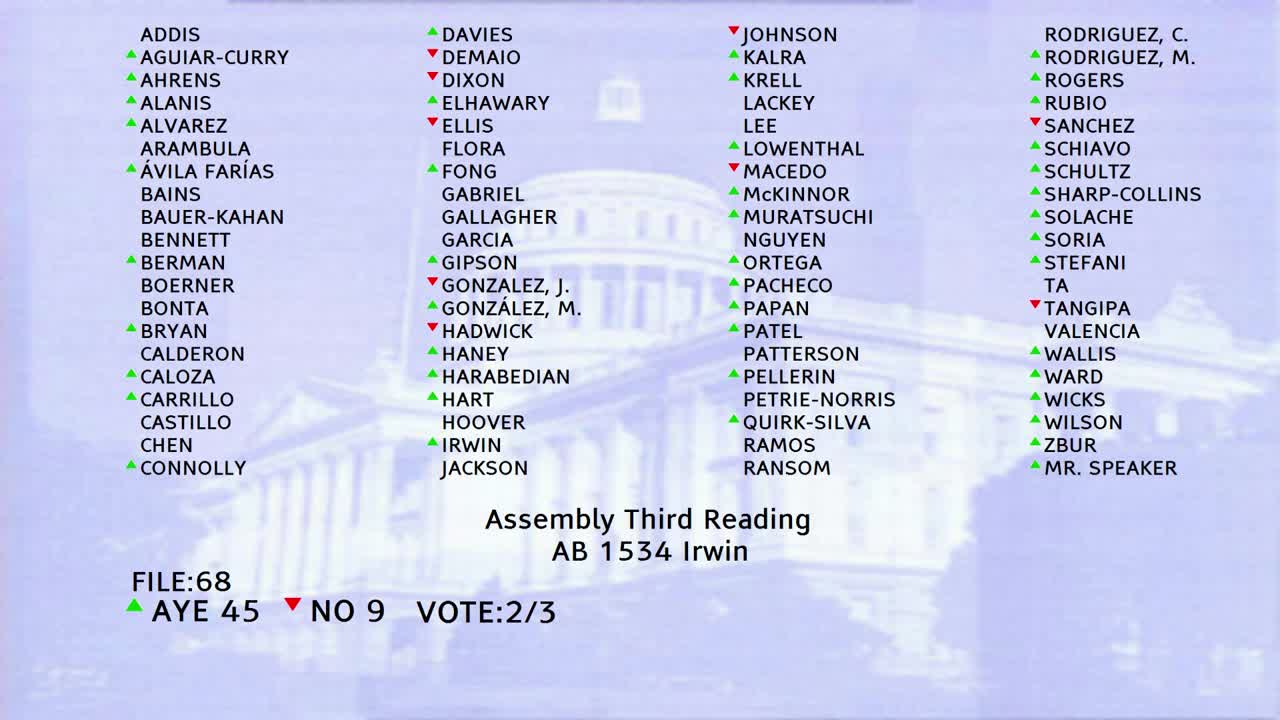 2MIN
Assembly Floor
 5MIN
Assembly Standing Committee on Arts, Entertainment, Sports, and Tourism
Bill Author