AB 1576: Workers’ compensation: Subsequent injuries payments.
- Session Year: 2025-2026
- House: Assembly
- Latest Version Date: 2026-04-20
Current Status:
In Progress
(2026-08-13: In committee: Held under submission.)
Introduced
In Committee
Awaiting First Chamber Vote
Passed First Chamber
In Committee
Awaiting Second Chamber Vote
Passed Second Chamber
Enacted
Existing law establishes a workers compensation system, administered by the Administrative Director of the Division of Workers Compensation, to compensate an employee for injuries sustained in the course of employment. Existing law provides certain methods for determining workers compensation benefits payable to a worker or the workers dependents for purposes of permanent total disability or permanent partial disability that include a determination of the percentage of permanent disability incurred. Existing law requires that, for injuries incurred before January 1, 2013, in determining the percentages of permanent disability, account be taken of the nature of the physical injury or disfigurement, the occupation of the injured employee, and the injured employees age at the time of the injury, and requires that specified factors be considered in determining an employees diminished earning capacity for these purposes. For purposes of these provisions, nature of the physical injury or disfigurement incorporates the descriptions and measurements of physical impairment and the corresponding percentages of impairments published in the American Medical Association (AMA) Guides to the Evaluation of Permanent Impairment (5th Edition). For injuries occurring on or after January 1, 2013, in determining the percentages of permanent disability, existing law requires the same factors be taken into account but removes from consideration the employees diminished future earning capacity and, instead, incorporates an adjustment factor of 1.4, as specified.
Existing law also establishes the Subsequent Injuries Benefits Trust Fund, a continuously appropriated fund. Under existing law, if a permanently, partially disabled employee receives a subsequent compensable injury resulting in additional permanent disability, then that employee receives compensation from the Subsequent Injuries Benefits Trust Fund. Existing law requires, when applicable, the additional permanent disability resulting from the subsequent injury to be equal to 35% or more of total, when considered alone and without regard to, or adjustment for, the occupation or the age of the employee.
For purposes of determining permanent disability resulting from a subsequent injury, this bill would measure permanent disability, for injuries occurring on or after January 1, 2005, and prior to January 1, 2013, by the whole person impairment rating as determined in accordance with the AMA Guides to the Evaluation of Permanent Impairment (5th Edition), after adjustment for diminished future earning capacity and without regard to, or adjustment for, the occupation or age of the employee. For injuries occurring on or after January 1, 2013, the bill would measure permanent disability in the same manner as an injury occurring on or after January 1, 2005, and prior to January 1, 2013, except that an adjustment for diminished future earning capacity is replaced by the 1.4 adjustment factor. The bill would state that these provisions are declarative of existing law. To the extent the bill changes the eligibility requirements for and calculation for payments made from the Subsequent Injuries Benefits Trust Fund, the bill would make an appropriation.
This bill would, for compensable subsequent injuries occurring on or after January 1, 2027, require, for purposes of determining eligibility for and the amount of an award of special additional compensation, the existence of the prior permanent partial disability at the time of the subsequent compensable injury to be determined by substantial evidence, based on medical records, testimony, or other evidence, that the prior permanent partial disability predated the subsequent compensable injury and that the prior permanent partial disability resulted in loss of earnings, interfered with work activities, or otherwise impacted the ability of the employee to perform work activities or activities of daily living. For these compensable subsequent injuries occurring on or after January 1, 2027, the bill would require an employee to file an application for special additional compensation pursuant to these provisions within 5 years from the date of the subsequent compensable injury or one year from the date that the level of permanent disability arising from the subsequent compensable injury is determined by the Workers Compensation Appeals Board (WCAB), whichever occurs later. The bill would require the administrative director to create and maintain a database of qualified medical evaluators to perform evaluations for claims filed for a subsequent compensable injury. The bill would make conforming changes.
Existing law requires the WCAB to fix and award the amounts of special additional compensation to be paid and to direct the State Compensation Insurance Fund (SCIF) to pay the additional compensation awarded. Existing law authorizes the additional compensation to be paid only from funds appropriated for these purposes. Existing law authorizes SCIF to reimburse itself for specified costs from this appropriation.
This bill would replace SCIF with the Director of Industrial Relations, as trustee of the Subsequent Injuries Benefits Trust Fund, as the entity to pay the additional compensation awarded by the WCAB. The bill would delete SCIFs authorization to reimburse itself for specified costs.
(a)If an employee who is permanently partially disabled receives a subsequent compensable injury resulting in additional permanent partial disability so that the degree of disability caused by the combination of both disabilities is greater than that which would have resulted from the subsequent injury alone, and the combined effect of the last injury and the previous disability or impairment is a permanent disability equal to 70 percent or more of total, the employee shall be paid in addition to the compensation due under this code for the permanent partial disability caused by the last injury compensation for the remainder of the combined permanent disability existing after the last injury as provided in this article; provided, that either of the following is satisfied:
(1)The previous disability or impairment affected a hand, an arm, a foot, a leg, or an eye, and the permanent disability resulting from the subsequent injury affects the opposite and corresponding member, that latter permanent disability, when considered alone and without regard to, or adjustment for, the occupation or age of the employee, is equal to 5 percent or more of total.
(2)The permanent disability resulting from the subsequent injury, when considered alone and without regard to to, or adjustment for for, the occupation or the age of the employee, is equal to 35 percent or more of total.
(b)For purposes of paragraphs (1) and (2) of subdivision (a), the term permanent disability in relation to subsequent compensable injuries occurring on or after January 1, 2005, and prior to January 1, 2013, shall be measured by the whole person impairment rating, also referred to as the impairment standard, as determined in accordance with the American Medical Association Guides to the Evaluation of Permanent Impairment, 5th Edition, after adjustment for diminished future earning capacity and without regard to, or adjustment for, the occupation or age of the employee.
(c)For purposes of paragraphs (1) and (2) of subdivision (a), the term permanent disability in relation to subsequent compensable injuries occurring on or after January 1, 2013, shall be measured by the whole person impairment rating, also referred to as the impairment standard, as determined in accordance with the American Medical Association Guides to the Evaluation of Permanent Impairment, 5th edition, Edition, after multiplication by the adjustment factor referred to in subdivision (b) of Section 4660.1 and without regard to, or adjustment for, the occupation or age of the employee.
(d)Subdivisions (b) and (c) are declarative of existing law.
SEC. 2.Section 4753.5 of the Labor Code is amended to read:4753.5.In any hearing, investigation, or proceeding, the state shall be represented by the Attorney General, or the attorneys of the Department of Industrial Relations, as appointed by the Director of Industrial Relations. Expenses incident to representation, including costs for investigation, medical examinations, other expert reports, fees for witnesses, and other necessary and proper expenses, but excluding the salary of any of the Attorney Generals deputies, shall be reimbursed from the Workers Compensation Administration Revolving Fund. No witness fees or fees for medical or medical-legal services shall exceed those fees for the same services prescribed by the appeals board or the administrative director by rule or regulation. Reimbursement pursuant to this section shall be in addition to, and in augmentation of, any other appropriations made or funds available for the use or support of the legal representation.
SEC. 3.Section 4754 of the Labor Code is amended to read:4754.The appeals board shall fix and award the amounts of special additional compensation to be paid under this article, and shall direct the Director of Industrial Relations, as trustee of the Subsequent Injuries Benefits Trust Fund, to pay the additional compensation so awarded.
SEC. 4.Section 4754.1 is added to the Labor Code, to read:4754.1.(a)This section shall apply to compensable subsequent injuries occurring on or after January 1, 2027.
(b)For purposes of determining eligibility for, and the amount of an award of, special additional compensation to be paid under this article, the existence of a prior permanent partial disability that existed at the time of the subsequent compensable injury shall be determined by substantial evidence, based on medical records, testimony, or other evidence, that the prior permanent partial disability predated the subsequent compensable injury and that the prior permanent partial disability resulted in loss of earnings, interfered with work activities of the employee, or otherwise impacted the ability of the employee to perform work activities or activities of daily living.
(c)For purposes of determining the existence of a prior permanent partial disability that existed at the time of the subsequent compensable injury pursuant to subdivision (b), the following conditions shall not be considered as preexisting labor disabling disabilities for determining eligibility for benefits pursuant to this article:(1)Acid reflux, including gastroesophageal reflux disease.(2)Allergies.(3)Arthritis.(4)Asthma.(5)Diabetes.(6)Headaches.(7)Hypertension.(8)Sexual dysfunction.(9)Sleep apnea.(d)(c)Medical-legal evidence in a proceeding filed for compensation pursuant to this article may only be obtained in the manner set forth in Article 2 (commencing with Section 4060) of Chapter 7 of Part 1 of this Division. division.
(e)(d)The administrative director shall create and maintain a database of qualified medical evaluator physicians who have the necessary training and expertise to perform evaluations for claims filed pursuant to Section 4751. This database shall be used by the medical director to fulfill requests for a panel of qualified medical evaluators filed pursuant to subdivision (d). (c).
(f)(e)The Director of Industrial Relations shall have authority to issue regulations as necessary for the implementation and orderly and effective administration of this article.
SEC. 5.Section 4754.2 is added to the Labor Code, to read:4754.2.For all subsequent compensable injuries occurring on or after January 1, 2027, the limitations period within which an employee may file an application for special additional compensation pursuant to this article shall be five years from the date of the subsequent compensable injury, or one year from the date that the level of permanent disability arising from the subsequent compensable injury is determined by the appeals board, whichever occurs later.SEC. 6.SEC. 5.Section 4755 of the Labor Code is amended to read:4755.(a)The Director of Industrial Relations, as trustee of the Subsequent Injuries Benefits Trust Fund, may draw from the State Treasury out of the Subsequent Injuries Benefits Trust Fund for the purposes specified in Section 4751, without at the time presenting vouchers and itemized statements, a sum not to exceed in the aggregate fifty thousand dollars ($50,000), to be used as a cash revolving fund. The revolving fund shall be deposited in any banks and under any conditions as the Department of Finance determines. The Controller shall draw their warrants in favor of the Director of Industrial Relations, as trustee of the Subsequent Injuries Benefits Trust Fund, for the amounts so withdrawn and the Treasurer shall pay these warrants.
(b)Expenditures made from the revolving fund in payments on claims for any additional compensation and for adjusting services are exempted from the operation of Section 16003 of the Government Code. Reimbursement of the revolving fund for these expenditures shall be made upon presentation to the Controller of an abstract or statement of the expenditures. The abstract or statement shall be in any form as the Controller requires.
(c)The director shall assign claims adjustment services and legal representation services respecting matters concerning subsequent injuries. The director or their representative may make these service assignments within the department, or they may contract for these services with the State Compensation Insurance Fund, for a fee in addition to that authorized by Section 4754, except insofar as these matters might conflict with the interests of the State Compensation Insurance Fund. The administrative costs associated with these services shall be reimbursed from the Workers Compensation Administration Revolving Fund, except when a budget impasse requires advances as provided in subdivision (d) of Section 62.5. To the extent permitted by state law, the director may contract for audits or reports of services under this section.
(a)If an employee who is permanently partially disabled receives a subsequent compensable injury resulting in additional permanent partial disability so that the degree of disability caused by the combination of both disabilities is greater than that which would have resulted from the subsequent injury alone, and the combined effect of the last injury and the previous disability or impairment is a permanent disability equal to 70 percent or more of total, he the employee shall be paid in addition to the compensation due under this code for the permanent partial disability caused by the last injury compensation for the remainder of the combined permanent disability existing after the last injury as provided in this article; provided, that either (a) the previous disability or impairment affected a hand, an arm, a foot, a leg, or an eye, and the permanent disability resulting from the subsequent injury affects the opposite and corresponding member, and such latter permanent disability, when considered alone and without regard to, or adjustment for, the occupation or age of the employee, is equal to 5 percent or more of total, or (b) the permanent disability resulting from the subsequent injury, when considered alone and without regard to or adjustment for the occupation or the age of the employee, is equal to 35 percent or more of total. of the following is satisfied:
(1)The previous disability or impairment affected a hand, an arm, a foot, a leg, or an eye, and the permanent disability resulting from the subsequent injury affects the opposite and corresponding member, that latter permanent disability, when considered alone and without regard to, or adjustment for, the occupation or age of the employee, is equal to 5 percent or more of total.
(2)The permanent disability resulting from the subsequent injury, when considered alone and without regard to or adjustment for the occupation or the age of the employee, is equal to 35 percent or more of total.
(b)For purposes of paragraphs (1) and (2) of subdivision (a), the term permanent disability in relation to subsequent compensable injuries occurring on or after January 1, 2005, and prior to January 1, 2013, shall be measured by the whole person impairment rating, also referred to as the impairment standard, as determined in accordance with the American Medical Association Guides to the Evaluation of Permanent Impairment, 5th Edition, after adjustment for diminished future earning capacity and without regard to, or adjustment for, the occupation or age of the employee.
(c)For purposes of paragraphs (1) and (2) of subdivision (a), the term permanent disability in relation to subsequent compensable injuries occurring on or after January 1, 2013, shall be measured by the whole person impairment rating, also referred to as the impairment standard, as determined in accordance with the American Medical Association Guides to the Evaluation of Permanent Impairment, 5th edition, after multiplication by the adjustment factor referred to in subdivision (b) of Section 4660.1 and without regard to, or adjustment for, the occupation or age of the employee.
(d)Subdivisions (b) and (c) are declarative of existing law.
SEC. 2.Section 4753.5 of the Labor Code is amended to read:4753.5.In any hearing, investigation, or proceeding, the state shall be represented by the Attorney General, or the attorneys of the Department of Industrial Relations, as appointed by the director. Director of Industrial Relations. Expenses incident to representation, including costs for investigation, medical examinations, other expert reports, fees for witnesses, and other necessary and proper expenses, but excluding the salary of any of the Attorney Generals deputies, shall be reimbursed from the Workers Compensation Administration Revolving Fund. No witness fees or fees for medical or medical-legal services shall exceed those fees for the same services prescribed by the appeals board for the same services in those cases where the appeals board, by rule, has prescribed fees. or the administrative director by rule or regulation. Reimbursement pursuant to this section shall be in addition to, and in augmentation of, any other appropriations made or funds available for the use or support of the legal representation.
SEC. 3.Section 4754 of the Labor Code is amended to read:4754.The appeals board shall fix and award the amounts of special additional compensation to be paid under this article, and shall direct the State Compensation Insurance Fund to pay the additional compensation so awarded. Such additional compensation may be paid only from funds appropriated for such purpose. Out of any such appropriation the fund may reimburse itself for the cost of service rendered in payment of compensation awards pursuant to this article and maintenance of accounts and records pertaining thereto, which cost shall not exceed 5 percent of the amount of award paid. Director of Industrial Relations, as trustee of the Subsequent Injuries Benefits Trust Fund, to pay the additional compensation so awarded.
SEC. 4.Section 4754.1 is added to the Labor Code, to read:4754.1.(a)This section shall apply to compensable subsequent injuries occurring on or after January 1, 2027.
(b)For purposes of determining eligibility for, and the amount of an award of, special additional compensation to be paid under this article, the existence of a prior permanent partial disability that existed at the time of the subsequent compensable injury shall be determined by substantial evidence, based on medical records, testimony, or other evidence, that the prior permanent partial disability predated the subsequent compensable injury and that the prior permanent partial disability resulted in loss of earnings, interfered with work activities of the employee, or otherwise impacted the ability of the employee to perform work activities or activities of daily living.
(c)For purposes of determining the existence of a prior permanent partial disability that existed at the time of the subsequent compensable injury pursuant to subdivision (b), the following conditions shall not be considered as preexisting labor disabling disabilities for determining eligibility for benefits pursuant to this article:
(1)Acid reflux, including gastroesophageal reflux disease.
(2)Allergies.
(3)Arthritis.
(4)Asthma.
(5)Diabetes.
(6)Headaches.
(7)Hypertension.
(8)Sexual dysfunction.
(9)Sleep apnea.
(d)Medical-legal evidence in a proceeding filed for compensation pursuant to this article may only be obtained in the manner set forth in Article 2 (commencing with Section 4060) of Chapter 7 of Part 1 of this Division.
(e)The administrative director shall create and maintain a database of qualified medical evaluator physicians who have the necessary training and expertise to perform evaluations for claims filed pursuant to Section 4751. This database shall be used by the medical director to fulfill requests for a panel of qualified medical evaluators filed pursuant to subdivision (d).
(f)The Director of Industrial Relations shall have authority to issue regulations as necessary for the implementation and orderly and effective administration of this article.
SEC. 5.Section 4754.2 is added to the Labor Code, to read:4754.2.For all subsequent compensable injuries occurring on or after January 1, 2027, the limitations period within which an employee may file an application for special additional compensation pursuant to this article shall be five years from the date of the subsequent compensable injury, or one year from the date that the level of permanent disability arising from the subsequent compensable injury is determined by the appeals board, whichever occurs later.
SEC. 6.Section 4755 of the Labor Code is amended to read:4755.(a)The State Compensation Insurance Fund Director of Industrial Relations, as trustee of the Subsequent Injuries Benefits Trust Fund, may draw from the State Treasury out of the Subsequent Injuries Benefits Trust Fund for the purposes specified in Section 4751, without at the time presenting vouchers and itemized statements, a sum not to exceed in the aggregate fifty thousand dollars ($50,000), to be used as a cash revolving fund. The revolving fund shall be deposited in any banks and under any conditions as the Department of Finance determines. The Controller shall draw his or her their warrants in favor of the State Compensation Insurance Fund Director of Industrial Relations, as trustee of the Subsequent Injuries Benefits Trust Fund, for the amounts so withdrawn and the Treasurer shall pay these warrants.
(b)Expenditures made from the revolving fund in payments on claims for any additional compensation and for adjusting services are exempted from the operation of Section 16003 of the Government Code. Reimbursement of the revolving fund for these expenditures shall be made upon presentation to the Controller of an abstract or statement of the expenditures. The abstract or statement shall be in any form as the Controller requires.
(c)The director shall assign claims adjustment services and legal representation services respecting matters concerning subsequent injuries. The director or his or her their representative may make these service assignments within the department, or he or she they may contract for these services with the State Compensation Insurance Fund, for a fee in addition to that authorized by Section 4754, except insofar as these matters might conflict with the interests of the State Compensation Insurance Fund. The administrative costs associated with these services shall be reimbursed from the Workers Compensation Administration Revolving Fund, except when a budget impasse requires advances as provided in subdivision (d) of Section 62.5. To the extent permitted by state law, the director may contract for audits or reports of services under this section.
|
Date
|
Status
|
|---|---|
| Aug 13, 2026 | In committee: Held under submission. |
| Jun 29, 2026 | In committee: Referred to APPR. suspense file. |
| Jun 17, 2026 | From committee: Do pass and re-refer to Com. on APPR. (Ayes 4. Noes 1.) (June 17). Re-referred to Com. on APPR. |
| Jun 3, 2026 | Referred to Com. on L., P.E. & R. |
| May 27, 2026 | In Senate. Read first time. To Com. on RLS. for assignment. |
| May 26, 2026 | Read third time. Passed. Ordered to the Senate. (Ayes 48. Noes 19. Page 5292.) |
| May 26, 2026 | Read third time. Passed. Ordered to the Senate. (Ayes 48. Noes 19.) |
| May 26, 2026 | Read third time. Passed. Ordered to the Senate. |
| May 18, 2026 | Read second time. Ordered to third reading. |
| May 14, 2026 | From committee: Do pass. (Ayes 11. Noes 4.) (May 14). |
| May 6, 2026 | In committee: Set, first hearing. Referred to APPR. suspense file. |
| Apr 22, 2026 | From committee: Do pass and re-refer to Com. on APPR. (Ayes 13. Noes 3.) (April 22). Re-referred to Com. on APPR. |
| Apr 21, 2026 | Re-referred to Com. on INS. |
| Apr 20, 2026 | From committee chair, with author's amendments: Amend, and re-refer to Com. on INS. Read second time and amended. |
| Feb 2, 2026 | Referred to Com. on INS. |
| Jan 13, 2026 | From printer. May be heard in committee February 12. |
| Jan 12, 2026 | Read first time. To print. |
|
Date
|
Description
|
Location
|
Votes
|
|
|---|---|---|---|---|
| Jun 29, 2026 | Placed on suspense file | Senate Standing Committee on Appropriations |
Passed |
|
| Jun 17, 2026 | Do pass, but first be re-referred to the Committee on [Appropriations] | Senate Standing Committee on Labor, Public Employment and Retirement |
Passed |
|
| May 26, 2026 | AB 1576 Ortega Assembly Third Reading | Assembly Floor |
Passed |
|
| May 14, 2026 | Do pass. | Assembly Standing Committee on Appropriations |
Passed |
|
| Apr 22, 2026 | Do pass and be re-referred to the Committee on [Appropriations] | Assembly Standing Committee on Insurance |
Passed |
This list shows positions taken on this bill by organizations on the date displayed, which is linked to the original source.
Positions by individuals are not included.
|
Organization
|
Position
|
Date
|
|---|---|---|
| Abc California | ** Against | |
| Acclamation Insurance Management Services | ** Against | |
| Allied Managed Care | ** Against | |
| American Property Casualty Insurance Association | ** Against | |
| Associated General Contractors, California | ** Against | |
| Associated General Contractors-San Diego Chapter | ** Against | |
| Brea Chamber of Commerce | ** Against | |
| Cal Fire Local 2881 | ** Against | |
| California Alliance of Self-Insured Groups | ** Against | |
| California Applicant Attorneys' Association | ** Support | |
| California Applicant Attorneys’ Association | ** Support | |
| California Applicants' Attorneys Association | ** Support | |
| California Association Of Highway Patrolmen | ** Against | |
| California Association Of Joint Powers Authorities | ** Against | |
| California Association of Joint Powers Authorities (CAJPA) | ** Against | |
| CALIFORNIA ASSOCIATION OF SHEET METAL & AIR CONDITIONING CONTRACTORS NATIONAL ASSOCIATION | ** Against | |
| California Association Of Winegrape Growers | ** Against | |
| California Attractions And Parks Association | ** Against | |
| California Building Industry Association (CBIA) | ** Against | |
| California Chamber Of Commerce | ** Against | |
| California Coalition on Workers’ Compensation | ** Against | |
| California Coalition On Workers Compensation | ** Against | |
| California Craft Brewers Association | ** Against | |
| California Farm Bureau | ** Against | |
| california farm labor contractor association | ** Against | |
| California Forestry Association | ** Against | |
| California Fuels And Convenience Alliance | ** Against | |
| California Grocers Association | ** Against | |
| California Hospital Association | ** Against | |
| California Hotel & Lodging Association | ** Against | |
| California Joint Powers Insurance Authority | ** Against | |
| California Manufacturers And Technology Association | ** Against | |
| California Restaurant Association | ** Against | |
| California Retailers Association | ** Against | |
| California Self Insurers Association | ** Against | |
| California Self-insurers’ Security Fund | ** Against | |
| California State Association Of Counties | ** Against | |
| California State Association of Counties (CSAC) | ** Against | |
| California Trucking Association | ** Against | |
| Carlsbad Chamber of Commerce | ** Against | |
| Corona Chamber of Commerce | ** Against | |
| County of Fresno | ** Against | |
| County Of Kern | ** Against | |
| Danville Area Chamber of Commerce | ** Against | |
| Flasher Barricade Association | ** Against | |
| Gateway Chambers Alliance | ** Against | |
| Greater Bakersfield Chamber of Commerce | ** Against | |
| Lien on Me, INC. | ** Against | |
| Long Beach Area Chamber of Commerce | ** Against | |
| Los Angeles County | ** Against | |
| Mission Viejo Chamber of Commerce | ** Against | |
| Murrieta Chamber of Commerce | ** Against | |
| Murrieta Wildomar Chamber of Commerce | ** Against | |
| Naiop Commercial Real Estate Development Association Socal Chapter | ** Against | |
| NATIONAL FEDERATION OF INDEPENDENT BUSINESS (NFIB) | ** Against | |
| Networks by Design | ** Against | |
| NonProfits' United | ** Against | |
| Norwalk Chamber Of Commerce | ** Against | |
| Oceanside Chamber of Commerce | ** Against | |
| Orange County Business Council | ** Against | |
| Palm Desert Area Chamber of Commerce | ** Against | |
| Partners Personnel | ** Against | |
| Protected Insurance Program for Schools and Community Colleges Jpa | ** Against | |
| PUBLIC RISK INNOVATION, SOLUTIONS, AND MANAGEMENT (PRISM) | ** Against | |
| Reed Family Companies | ** Against | |
| Rural County Representatives of California | ** Against | |
| San Juan Capistrano Chamber of Commerce | ** Against | |
| Santa Clarita Valley Chamber of Commerce | ** Against | |
| Schools Insurance Group | ** Against | |
| Southwest California Legislative Council | ** Against | |
| Vista Chamber Of Commerce | ** Against |
SENATE COMMITTEE ON
Senator Sabrina Cervantes, Chair
2025 - 2026 Regular Session
AB 1576 (Ortega) - Workers’ compensation: Subsequent injuries payments
Version: | Policy Vote: |
Urgency: | Mandate: |
Hearing Date: | Consultant: |
Bill Summary:
AB 1576 would make specified changes to the process of filing, evaluating, and paying claims for special additional compensation from the Subsequent Injuries Benefits Trust Fund (SIBTF).
Fiscal Impact:
- The Department of Industrial Relations (DIR) indicates that it would incur annual costs of $7 million (Workers' Compensation Administration Revolving Fund, see Staff Comments).
- To the extent this bill results in a lower payroll surcharge for employers generally, it could result in potential cost savings to the State as a direct employer. The magnitude is unknown (General Fund and special funds).
Background:
California's workers' compensation system generally provides medical treatment and disability benefits to employees who suffer work-related injuries or illnesses. Disability benefits are typically based on the degree of permanent impairment attributable to the workplace injury and are financed by employers through workers' compensation insurance or self-insurance arrangements.
Separate from the core workers' compensation system, SIBTF provides additional disability benefits to workers who had a preexisting disability that, when combined with a subsequent industrial injury, results in a substantially greater overall level of disability. Established following World War II, SIBTF was intended to encourage the employment of individuals with disabilities by relieving employers of liability for preexisting impairments while ensuring that injured workers receive compensation reflecting their overall loss of earning capacity. Benefits are funded through assessments on workers' compensation premiums and self-insured employers rather than through the employer responsible for the subsequent injury.
Eligible workers may receive benefits beyond those attributable to the workplace injury alone when statutory thresholds are met, including minimum disability-rating requirements and evidence that the combination of the preexisting disability and subsequent injury results in a significantly higher level of permanent disability. In the most severe cases, SIBTF benefits may include lifetime disability payments.
Historically a relatively small component of California's workers' compensation system, SIBTF has experienced substantial growth in both claims activity and projected liabilities over the past decade. According to analyses cited by the Legislative Analyst's Office and DIR, annual SIBTF benefit obligations now rival or exceed permanent disability payments made through the traditional workers' compensation system.
In response to this growth, DIR commissioned a study by the RAND Corporation to evaluate the causes of rising claims and assess the long-term fiscal condition of the program. RAND found that annual SIBTF payments increased dramatically between 2010 and 2022 and estimated that pending and future liabilities associated with recent claims could total several billion dollars. The report concluded that, absent policy changes, employer assessments supporting the fund would likely continue to increase significantly in order to meet future obligations.
RAND identified several factors contributing to the program's growth, including ambiguities in existing statutes, evolving interpretations of eligibility requirements, and litigation trends that have expanded the number of claims qualifying for SIBTF benefits. In particular, the report highlighted the impact of the 2020 Workers' Compensation Appeals Board decision in Todd v. SIBTF, which altered the method used to combine disability ratings for purposes of determining eligibility and benefits. According to RAND, this decision substantially increased the number of cases qualifying for enhanced benefits, including lifetime disability awards, and contributed to significant growth in both benefit payments and litigation-related costs.
The RAND report recommended a series of statutory and administrative reforms intended to improve program sustainability, reduce litigation incentives, and align the program more closely with its original purpose. Among other recommendations, RAND suggested integrating SIBTF medical evaluations into the existing Qualified Medical Evaluator (QME) process, clarifying statutory eligibility criteria, and revisiting benefit-calculation methodologies that have contributed to increased liabilities.
This bill incorporates several of those recommendations. Specifically, the bill would require medical-legal evidence in SIBTF claims to be obtained through the QME process, rather than through medical evaluators independently selected by claimants. The bill also directs the Division of Workers' Compensation to establish and maintain a panel of qualified evaluators with expertise in SIBTF matters. Proponents contend these changes would reduce opportunities for inconsistent medical evaluations and help control program costs.
The bill further clarifies statutory eligibility standards by defining the circumstances under which a preexisting permanent disability qualifies for SIBTF consideration and by updating provisions related to the treatment of diminished future earning capacity in disability determinations. Supporters argue these changes would provide greater consistency in claim adjudication and better align eligibility standards with legislative intent.
In addition, the bill would transfer responsibility for administering SIBTF benefit payments from the State Compensation Insurance Fund to DIR. Because DIR already serves as trustee of the fund, the proposed change is intended to simplify administration and eliminate the need for the existing reimbursement structure between the State Fund and the state.
The issues addressed by this bill have been the subject of extensive legislative and administrative review in recent years. In vetoing similar legislation in 2025 (AB 1329), the Governor acknowledged the need for significant reform but expressed concern that piecemeal changes would be insufficient to address the program's long-term fiscal challenges. The veto message directed DIR and its Division of Workers' Compensation to develop a comprehensive reform proposal through the 2026-27 budget process.
The Administration subsequently proposed a broader package of reforms that includes many of the concepts examined by RAND. Legislation implementing those budget-related reforms remains under consideration by the Legislature. As a result, this bill overlaps with, but does not encompass, the full scope of the Administration's proposed restructuring of the SIBTF program.
Proposed Law:
This bill would do the following:
- Clarify, pursuant to existing law, that “permanent disability” in relation to SII occurring on or after January 1, 2005, and prior to January 1, 2013, is measured by the whole person impairment rating, based on the AMA Guides to the Evaluation of Permanent Impairment, 5th Edition (“AMA Guides”), after adjustment for diminished future earning capacity and without regard to, or adjustment for, the occupation or age of the employee.
- Clarify, pursuant to existing law, that “permanent disability” in relation to SII occurring on or after January 1, 2013, is measured by the whole person impairment rating, also referred to as the impairment standard, based on AMA Guides, after multiplication by the adjustment factor of 4.1, pursuant to existing law, and without regard to, or adjustment for, the occupation or age of the employee.
- Provide that, for compensable SII occurring on or after January 1, 2027, for purposes of determining eligibility for, and the amount of an award of, special additional compensation (i.e. SIBTF benefits), the existence of a prior PPD that existed at the time of the SII shall be determined by substantial evidence, based on medical records, testimony, or other evidence, that the prior PPD predated the SII and that the prior PPD resulted in loss of earnings, interfered with work activities of the employee, or otherwise impacted the ability of the employee to perform work activities or activities of daily living.
- Specify that medical-legal evidence in a proceeding filed for SIBTF benefits may only be obtained in accordance with existing procedures for QMEs applicable to traditional workers’ compensation claims.
- Require the administrative director (AD) of the DWC to create and maintain database of QME physicians who have the necessary training and expertise to perform evaluations for SIBTF claims and specifies this database shall be used by the medical director of DWC to fulfill requests for a panel of QMEs in accordance with existing procedures.
- Authorize the Director of DIR to issue regulations as necessary for the implementation and orderly and effective administration of SIBTF medical evaluations.
- Transfers responsibility for the payment of SIBTF benefits from the State Fund to the Director of DIR.
Related Legislation:
- AB 1329 (Ortega, 2025) is substantially similar to this bill, and would have made various changes to the process of filing, evaluating, and paying claims for special additional compensation from the SIBTF. This bill was vetoed by Governor Newsom.
- SB 863 (De Leon, Chapter 363, Statutes of 2012) enacted major reforms to the workers’ compensation system, including establishing the independent medical review and IBR processes for resolving disputes.
- SB 899 (Poochigian, Chapter 34, Statues of 2004) enacted major reforms to the workers’ compensation system, including authorizing medical provider networks, revising the QME process, and adopting a modified Permanent Disability Rating Schedule that incorporated a DFEC modifier.
Staff Comments: As noted previously, this bill is estimated to increase ongoing costs to DIR by $7 million annually. According to DIR, these costs have two primary components. First, DIR expects the bill to increase the number of SIBTF claims and the fund's long-term liabilities. Unlike last year's AB 1329, this bill does not include several cost-containment provisions, such as a statute of limitations for claims or exclusions for specified chronic conditions. As drafted, the bill is estimated to increase DIR's workload by approximately $3 million annually to process additional SIBTF claims. However, under current law, there is no statutory limitations period for filing SIBTF claims and no exclusions for specified chronic conditions. Accordingly, Staff does not anticipate that the bill, by itself, would increase costs relative to current law on these issues.
Second, the bill would require SIBTF claims to utilize the Qualified Medical Evaluator (QME) process. During the Assembly Appropriations Committee review, DIR’s Division of Workers' Compensation (DWC) estimated ongoing costs of approximately $1.6 million annually to implement the QME-related provisions. At that time, however, the fiscal estimate did not include additional staffing needed for DIR's legal office. Updated estimates indicate that the combined ongoing costs for DWC and DIR's legal unit to implement and administer the QME provisions would total approximately $4 million annually.
-- END --
SENATE COMMITTEE ON LABOR, PUBLIC EMPLOYMENT AND RETIREMENT
Senator Lola Smallwood-Cuevas, Chair
2025 - 2026 Regular
Bill No: AB 1576 Hearing Date: June 17, 2026
Author: | Ortega | ||
Version: | April 20, 2026 | ||
Urgency: | No | Fiscal: | Yes |
Consultant: | Jazmin Marroquin | ||
SUBJECT: Workers’ compensation: Subsequent injuries payments
KEY ISSUE
This bill, makes the following changes to the process of filing, evaluating, and paying claims for special additional compensation from the Subsequent Injuries Benefits Trust Fund (SIBTF): (1) specifies the type of evidence necessary to demonstrate the existence of a prior permanent partial disability (PPD), (2) requires that medical-legal evidence be collected only through existing qualified medical evaluation (QME) procedures, (3) transfers responsibility for payment of SIBTF benefits from the State Compensation Insurance Fund (State Fund) to the Director of the Department of Industrial Relations (DIR), and (4) clarifies existing law concerning the calculation of permanent disability rating.
ANALYSIS
Existing law:
- Establishes a comprehensive system of workers' compensation that provides a range of benefits for an employee who suffers from an injury or illness that arises out of and in the course of employment, regardless of fault. This system requires all employers to insure payment of benefits by either securing the consent of the Department of Industrial Relations (DIR) to self-insure or by obtaining insurance from a company authorized by the state. (Labor Code §§3200-6002)
- Establishes the Division of Workers’ Compensation (DWC) and Workers’ Compensation Appeal Board (WCAB) within DIR and charges them with monitoring the administration of workers’ compensation claims and providing administrative and judicial services to assist in resolving disputes that arise in connection with claims for workers’ compensation benefits. (Labor Code §3200 et seq.)
- Establishes within the workers’ compensation system temporary disability (TD) indemnity, permanent disability (PD) indemnity, and permanent partial disability (PPD) indemnity, which offer wage replacement of a specified injured employee’s average weekly earnings while an employee is unable to work due to a workplace illness or injury. (Labor Code §§4650-4664)
- Establishes the Subsequent Injuries Benefits Trust Fund (SIBTF), as a special trust fund in the State Treasury, of which the Director of DIR is a trustee.
- Specifies that the fund is continuously appropriated for the non-administrative expenses of the workers’ compensation program for workers who have suffered serious injury and who are suffering from previous and serious permanent disabilities or physical impairments and prohibits the use of the funds for any other purpose (Labor Code §62.5(c)(1))
- Provides that, if an employee who is permanently partially disabled receives a subsequent compensable injury resulting in additional PPD so that the degree of disability caused by the combination of both disabilities is greater than that which would have resulted from the subsequent injury (or “subsequent industrial injury” or “SII”) alone, and the combined effect of the last injury and the previous disability or impairment is a permanent disability equal to 70 percent or more of total, the worker shall be paid in addition to the compensation due for the PPD caused by the last injury compensation for the remainder of the combined permanent disability existing after the last injury as provided in this article.
- Specifies that the compensation be provided only if either:
- The previous disability or impairment affected a hand, an arm, a foot, a leg, or an eye, and the permanent disability resulting from the SII affects the opposite and corresponding member, and such latter permanent disability, when considered alone and without regard to, or adjustment for, the occupation or age of the employee, is equal to 5 percent or more of total, or
- The permanent disability resulting from the SII, when considered alone and without regard to or adjustment for the occupation or the age of the employee, is equal to 35 percent or more of total. (Labor Code §4751)
- Specifies that the compensation be provided only if either:
- Provides that, for injuries occurring before January 1, 2013, in determining percentages of permanent disability, account shall be taken of the nature of the physical injury or disfigurement, the occupation of the injured employee, and their age at the time of the injury, consideration being given to an employee’s diminished future earning capacity (DFEC).
- For purposes of this section, the “nature of the physical injury or disfigurement” shall incorporate the descriptions and measurements of physical impairments and the corresponding percentages of impairments published in the American Medical Association (AMA) Guides to the Evaluation of Permanent Impairment (5th Edition).
- For purposes of this section, an employee’s diminished future earning capacity shall be a numeric formula, as specified. (Labor Code §4660)
- Provides that, for injuries occurring on or after January 1, 2013, in determining percentages of partial or permanent total disability, account shall be taken of the nature of the physical injury or disfigurement, the occupation of the injured employee, and the employee’s age at the time of injury.
- For purposes of this section, the “nature of the physical injury or disfigurement” shall incorporate the descriptions and measurements of physical impairments and the corresponding percentages of impairments published in the AMA Guides to the Evaluation of Permanent Impairment (5th Edition) with the employee’s whole person impairment, as provided in the Guides, multiplied by an adjustment factor of 1.4. (Labor Code §4660.1)
- Provides a system of administrative dispute resolution for cases where an injured worker and their employer do not agree over any issue associated with the delivery of traditional, non-SIBTF workers’ compensation benefits, including evaluation by a neutral qualified medical evaluator (QME), receipt of a medical-legal report prepared by the QME based on that evaluation and any other medical records and information provided by the parties, the opportunity to meet before a workers’ compensation administrative law judge for adjudication on the dispute based on the medical-legal report, and, if necessary, appeal the administrative law judge’s decision to the WCAB for final judgement. (Labor Code §4060 et seq.)
- Requires WCAB to fix and award the amount of special additional compensation paid and to direct the State Fund to pay additional compensation awarded; and allows the State Fund to draw from the State Treasury of the SIBTF as reimburse itself, as specified. (Labor Code §§4754 and 4755)
- Levies separate surcharges upon all employers for purposes of deposit in the SIBTF, the Workers’ Compensation Administration Revolving Fund (WCARF), the Uninsured Employers Benefits Trust Fund, and the Occupational Safety and Health Fund, and provides that the total amount of the surcharges be allocated between self-insured employers and insured employers in proportion to payroll respectively paid in the most recent year. (Labor Code §62.5(f)(1))
This bill:
- Clarifies, pursuant to existing law, that “permanent disability” in relation to SII occurring on or after January 1, 2005, and prior to January 1, 2013, is measured by the whole person impairment rating, based on the AMA Guides to the Evaluation of Permanent Impairment, 5th Edition (“AMA Guides”), after adjustment for diminished future earning capacity and without regard to, or adjustment for, the occupation or age of the employee.
- Clarifies, pursuant to existing law, that “permanent disability” in relation to SII occurring on or after January 1, 2013, is measured by the whole person impairment rating, also referred to as the impairment standard, based on AMA Guides, after multiplication by the adjustment factor of 4.1, pursuant to existing law, and without regard to, or adjustment for, the occupation or age of the employee.
- Provides that, for compensable SII occurring on or after January 1, 2027, for purposes of determining eligibility for, and the amount of an award of, special additional compensation (i.e. SIBTF benefits), the existence of a prior PPD that existed at the time of the SII shall be determined by substantial evidence, based on medical records, testimony, or other evidence, that the prior PPD predated the SII and that the prior PPD resulted in loss of earnings, interfered with work activities of the employee, or otherwise impacted the ability of the employee to perform work activities or activities of daily living.
- Specifies that medical-legal evidence in a proceeding filed for SIBTF benefits may only be obtained in accordance with existing procedures for QMEs applicable to traditional workers’ compensation claims.
- Requires the administrative director (AD) of the DWC to create and maintain database of QME physicians who have the necessary training and expertise to perform evaluations for SIBTF claims and specifies this database shall be used by the medical director of DWC to fulfill requests for a panel of QMEs in accordance with existing procedures.
- Authorizes the Director of DIR to issue regulations as necessary for the implementation and orderly and effective administration of SIBTF medical evaluations.
- Transfers responsibility for the payment of SIBTF benefits from the State Fund to the Director of DIR.
COMMENTS
1. Background:
Workers’ Compensation and the Subsequent Injuries Benefit Trust Fund (SIBTF)
Under the California workers’ compensation system, if a worker is injured on a job, the employer must pay for the worker’s medical treatment and provide monetary benefits if the injury is temporary or permanent. In most workers’ compensation cases, this compensation is provided in the form of temporary (TD) and/or permanent disability (PD) benefits, which are typically paid out over time based on a formula derived from ratings of the severity of the worker’s impairments. In return for receiving free medical treatment, the worker surrenders the right to sue the employer for monetary damages in civil court. In California, all employers are required to either purchase a workers' compensation insurance policy from a licensed insurer authorized to write policies in California or become self-insured.
Workers in California who are injured on the job and whose disability is exacerbated by a pre-existing condition can additionally seek benefits beyond what they would be awarded by the state’s workers’ compensation system for only the workplace injury. The benefits for the subsequent injury (or SII) are paid by the SIBTF.
The SIBTF was established by the Legislature in the wake of World War II, after veterans who returned home from the war suffered from high rates of pre-existing permanent disabilities. The SIBTF was created to address the dilemma of providing disability compensation without accounting for a pre-existing disability that may leave workers without protection and making the employer responsible for the pre-existing disability that may discourage them from hiring workers without visible disabilities.
The SIBTF provides additional compensation to injured workers with a pre-existing disability which, in combination with a work injury, would lead to a higher PD rating than what would be assigned on the basis of their workplace injury alone. Under the SIBTF, injured workers meeting the criteria receive additional PD benefits paid by the SIBTF (rather than by their employer). The benefits under SIBTF are financed by an assessment on workers’ compensation premiums (or on covered payroll for self-insured employers), so that the burden of the SIBTF payments are spread broadly across all employers covered by workers’ compensation.
Below are the eligibility requirements for an injured worker to receive SIBTF benefits, as set forth in Labor Code Section 4751:
- The applicant suffered a SII (subsequent compensable work injury).
- The applicant had one or more pre-existing PPDs that were actually labor disabling[1] at the time the applicant suffered a SII.
- The PD resulting from the combination of the pre-existing PPDs and the SII is greater than the PD resulting from the SII alone.
- The PD resulting from the combined effect of the SII and PPDs together is rated at least 70 percent or higher.
- The PD resulting from the SII alone, without adjustment for age or occupation, was either: (1) at least 35 percent, or (2) was at least 5 percent and affected a hand, an arm, a foot, a leg, or an eye that is “opposite and corresponding” to a body part that had prior PPD.
Workers who meet the requirements for SIBTF and receive SIBTF benefits get the difference between the combined PD benefits that would be provided based on the SII and pre-existing disabilities and the amount owed to the worker for PD benefits on the SII alone.
Workers with combined disability ratings from 70 to 99 percent qualify for PPD benefits which end after a set number of weeks determined by the PD rating, and a life pension which begins after the PPD has been paid out and ends at death. If the combined rating equals 100
percent, the worker is entitled to lifetime permanent total disability (PTD) benefits, which are paid out at the TD rate. PTD benefits are more generous payments than other disability benefits because the amount paid per week can be much higher and because PTD benefits are paid until death. In a regular workers’ compensation case outside of the SIBTF program, lifelong disability benefit payments are infrequent because it is rare for cases to reach a PD rating of 70 percent or higher and PTD cases are even rarer. Additionally, other benefits paid in regular workers’ compensation cases, such as medical treatment, are not provided by the SIBTF.
SIBTF Financial Instability and RAND Report Recommendations
According to the Legislative Analyst’s Office (LAO), insured employers pay roughly $1.4 billion in permanent disability payments. Self‑insured employers—private and public—likely add another $500 million to $1 billion. Together, total annual permanent disability payouts under the standard workers’ compensation system likely total about $2 billion. SIBTF, once a relatively small program, now pays more permanent disability payments ($2 billion to $3 billion) than the state’s core workers’ compensation program.[2]
In 2023, after a rapid increase in the number of applications and the amount of benefits paid out by SIBTF, DIR contracted with RAND – a nonprofit, nonpartisan research organization – to conduct a comprehensive study of SIBTF cases filed and resolved in recent years. Their goal was to document basic facts about the SIBTF program to provide a foundation of informed deliberation over policy options in response to SIBTF’s recent growth.[3]
The RAND report found startling trends regarding SIBTF and its financial instability. The report summarized the following:
“A sharp increase in recent years in SIBTF claims and benefits and the potential for even greater liabilities poses a financial challenge for the SIBTF. Total annual payments from the SIBTF on the 12 years of cases considered in this report grew from $13.6 million in 2010 to $232 million in 2022. Looking to the future, this analysis estimates $7.9 billion in SIBTF liabilities for cases filed or pending between 2010 and 2022, the midpoint of an estimated range of $6.4–10.5 billion.
The recent surge in current and future liabilities can in part be attributed to interpretations of SIBTF’s governing statutes, which are vague on key issues concerning eligibility and compensation, and which are decades old. More recently, the wide parameters of the governing statutes and SIBTF rules have motivated claimants, their representatives, and vendors to make more frequent claims for injuries which in past decades might have yielded smaller benefits or might not have led to any benefits at all. In the absence of policy changes to ensure the SIBTF is implemented in a sustainable and fair way, decision makers can reasonably expect that funding demands will exceed the currently available resources and assessments on workers’ compensation premiums (or on covered payroll for self-insured employers) will have to continue to rise to cover the Fund’s growing liabilities.”
The RAND report identified several reasons for increasing liabilities to the SIBTF, many that result from a 2020 WCAB decision in Todd v. SIBTF [85 Cal. Comp. Cases 576 (App. Bd. En banc)]. According to the report:
“Prior to the [Todd] decision, ratings from impairments to multiple body parts, and the [PD] ratings from the SII and SIBTF cases, were typically combined using a formula referred to as the Combined Values Chart (CVC). The CVC takes into account the theoretical overlapping nature of impairments and disability and produces a combined PD rating that is lower than what would be derived from simply adding together two or more values. For example, two impairments each rated at 50 percent would yield a rating of 75 percent under the CVC. […]
Instead, the Todd decision held that simple addition was the correct method to use for combining SII and PPD disability ratings in determining SIBTF eligibility and benefits. […] This decision made it far more likely that an SIBTF case would reach a combined rating of 100 percent. In the examples above, the combined rating would increase from 75 percent pre-Todd to 100 percent post-Todd.”
The Todd decision increased both the number of applicants whose combined PD rating qualified them for SIBTF benefits, as well as the number of applicants whose combined PD rating now reached 100 percent. Because the likelihood of qualifying for generous lifetime benefits increased, the number of SIBTF cases that were resolved through “compromise and release” settlements for a lump sum dramatically decreased, as litigating the case to a final judgement more often resulted in a larger award. This was reflected in a significant increase in non-benefit costs to SIBTF due to skyrocketing attorney fees, which grew from $770,000 in 2010 to $27 million in 2022.
The author seeks to implement, at least in part, some of the RAND report recommendations with this bill, as is discussed in more detail below. These include 1) incorporating SIBTF medical evaluations into the existing QME process, 2) amending the SIBTF statute to provide a definition of what constitutes a PPD for purposes of SIBTF eligibility, and 3) updating the SIBTF criteria to address the diminished future earnings capacity. The report also includes several additional recommendations that this bill does not address.[4]
SIBTF and the QME Process
In a traditional workers’ compensation claim, if a dispute arises between the injured worker and the employer over whether an injury is work-related, a worker’s capacity to return to work, the existence or extent of a permanent disability, or the need for specific or future medical treatment, the injured worker may request a QME – qualified medical evaluators. Under existing law, injured workers filing SIBTF claims are not subject to the QME process for the collection of medical-legal evidence. Instead, workers filing SIBTF claims may select their own medical evaluators.
The RAND Report recommends that the Labor Code could be modified to include SIBTF in the QME reforms. The report identifies fraud and abuse resulting from “doctor shopping” as a possible contributor to the financial instability of the SIBTF. The report further explains, “[n]arrowing the choice of medical experts and creating mandatory processes around medical evaluations for SIBTF cases, including potentially requiring that the same medical reports used for the SII be used for purposes of the SIBTF case, could reduce the potential for ‘doctor shopping’ for evaluators who deliver higher ratings specifically targeted at SIBTF eligibility.”
This bill, AB 1576, specifies that medical-legal evidence in a SIBTF claim may only be obtained through the QME process and requires the administrative director of the DWC to create and maintain a database of QME physicians with the necessary training and expertise to evaluate SIBTF claims.
SIBTF Benefits Calculation and Diminished Future Earnings Capacity
In order to qualify for SIBTF benefits, a worker’s PD resulting from the SII suffered must equal to 35 percent or more of TD, or 5 percent or more in specified circumstances “when considered alone and without regard to or adjustment for the occupation or the age of the employee.” However, the Labor Code does not specify whether the calculation should include adjustments for diminished future earnings capacity (DFEC), or whether DFEC should only be taken into consideration for the combined PD.
The RAND report recommends the Legislature update the SIBTF threshold eligibility criteria to address the future earnings capacity under Labor Code Section 4751, which has not been changed since 1959. This bill updates the SIBTF criteria to address the diminished future earnings capacity.
PPD Criteria for SIBTF Eligibility
When SIBTF was initially established, one of the purposes was to mitigate any potential discrimination from employers for hiring employees with pre-existing disabilities. Around the same time, in an appeal arising from a SII case, the California Supreme Court clarified that an applicant’s alleged pre-existing disability must have been “actually labor disabling” in order to establish eligibility for SIBTF benefits. This was interpreted to mean that the pre-existing disability could have been the basis for workers’ compensation PPD benefits if it had resulted from employment.
However, the RAND report found that a “growing number of SIBTF cases allege PPDs that are common health conditions and/or chronic diseases frequently found in an aging population” and case law offers little guidance on how to apply the “actually labor disabling” principle.
This bill establishes a definition of what constitutes a PPD for SIBTF eligibility, for injuries after January 1, 2027, based on substantial evidence that the PPD predated the SII and resulted in a loss of earnings, interfered with work activities of the employee, or otherwise impacted the ability of the employee to perform work or daily living activities.
SIBTF Benefits Payment and the State Fund
Existing law requires SIBTF benefits be paid to injured workers by the State Fund, at the direction of the WCAB. The State Fund may draw funds directly from SIBTF to make award payments for up to $50,000 and is authorized to reimburse itself from the Workers’ Compensation Administration Revolving Fund for the cost of providing this service.
The State Fund was established in 1913 by the Legislature to provide a stable option for workers’ compensation insurance to employers in California, including for state agencies. State Fund is a quasi-public entity that competes with other workers’ compensation insurance providers on the open market.
This bill shifts the responsibility of administering SIBTF benefits from this complicated State Fund reimbursement scheme to direct payments made by DIR. DIR oversees SIBTF as its trustee, so formally shifting the responsibility for administering payments SIBTF to DIR simplifies the payment process.
AB 1329 (Ortega, 2025) Veto and Trailer Bill
Last year, Governor Newsom vetoed AB 1329 (Ortega, 2025), which would have enacted similar reforms for the SIBTF, citing the lack of comprehensive reforms necessary to save SIBTF and instead directed his administration (DIR and DWC) to develop a proposal for consideration that contains comprehensive reforms to the SIBTF through the budget proposal. Below is his veto message:
This bill would make assorted changes to the Subsequent Injury Benefit Trust Fund (SIBTF), a World War II-era program created to protect disabled veterans entering the workforce. Proposed changes include incorporating a Qualified Medical Evaluator (QME) process, excluding certain medical conditions from the definition of pre-existing disabilities, and adding a statute of limitations on claims.
I commend the author for identifying the SIBTF as needing significant reform. Over the past decade, SIBTF has expanded significantly beyond its original purpose. The number of claims has skyrocketed, leading to an unsustainable future for the program. The Department of Industrial Relations estimates that, without comprehensive reform, the annual assessment paid by all employers will increase from $372 million in FY 2021-22 to $1.5 billion in FY 2029-30. As the Legislative Analyst’s Office noted in a July 2025 report, workers submitting SIBTF claims today could see processing delays of up to ten years unless we take comprehensive action. Notably, other states, facing similar pressures, have chosen to eliminate their programs rather than reform them. This situation is dire and the state must act immediately.
Unfortunately, AB 1329 does not contain the comprehensive reforms necessary to save SIBTF. While some of the changes, such as the proposed QME process and the statute of limitations, are important, other changes take the program in the wrong direction. For example, including the impact on the “activities of daily living” in the determination of a prior disability contradicts the concept that the prior disability must be labor-disabling. This change would increase SIBTF claims and liabilities.
To ensure this program continues to serve workers as intended, comprehensive SIBTF reform must be pursued next year. I am directing the Department of Industrial Relations and its Division of Workers’ Compensation to develop a proposal for comprehensive reform to include in January’s 2026-27 budget proposal. I look forward to working with the Legislature to ensure this program continues to serve California workers.
In early 2026, the Governor and his administration unveiled their proposal for SIBTF with the following reforms:[5]
- Define key terms to clarify definitions and add parameters to align benefits with the original intent of SIBTF.
- Align the SIBTF medical-legal process with the qualified medical evaluator (QME) program to prevent doctor shopping, utilize a certified physician experienced with the injured worker's medical history, eliminate duplicative efforts, and dramatically cut costs.
- Clarify that a SIBTF claimant’s preexisting disabilities and subsequent industrial injury are combined using a Combined Values Chart (CVC) as in regular workers’ compensation cases.
- The elimination of the 1.4 future earning capacity adjustment to align with the original purpose of Section 4750, which required the elimination of adjustment factors to the permanent disability rating.
- Establish a statute of limitations, replacing the vague, judicially created 5-year period, which has proven difficult to apply, with a simple statutory 5-year period.
- Clarify that preexisting disabilities must be documented in medical evidence that existed before the occurrence of the subsequent industrial injury to prevent exaggerated claims and speculation in medical reporting.
- Clarify that preexisting disabilities must be labor disabling at the time of the subsequent injury to eliminate applications based on asymptomatic conditions or treatable conditions that do not have demonstrable impact on the employee’s ability to perform work activity.
- Clarify that an employee is responsible for establishing that they have not already received payment for preexisting disability to prevent double recoveries.
- Establishes that the provisions added in the trailer bill will apply to all open SIBTF cases that have not yet become final either through settlement or court decision.
- Ensure SIBTF is not subject to penalties, aligning with the Uninsured Employers Benefits Trust Fund.
- Identifies the DIR Director, who currently oversees the program, for purposes of operations, rather than the State Fund.
- Details a discovery process for mandatory credits against SIBTF compensation where an applicant has already been compensated for a pre-existing disability.
The budget trailer bill is still pending before the Legislature.
2. Need for this bill?
According to the author, “Subsequent injuries are handled differently from other Workers Compensation injuries. Several of those differences have resulted in outcomes that are unnecessarily more financially burdensome. 1) The use of Qualified Medical Examiners has no limit; 2) There are lesser standards of evidence; 3) Permanent Disability is not defined consistent with the 2004 and 2012 Workers’ Comp reforms
Statistically any worker suffering an injury that results in a permanent disability is at a higher risk for a subsequent injury. An employer assumes all of that risk if they give a previously disabled worker a “second-chance” at supporting themselves. The SIBTF was created so that these second-chance employers are not penalized for hiring a higher risk employee. Instead, every employer in the state contributes .016¢ per $100 in premiums into the Trust Fund. The fund then carries the risk and obligations. The average employer currently pays $222 per year – an increase of $176 over the last 10 years. This increase is more than offset by the $13,872 average annual savings over the last 10 years in Work Comp premiums resulting from the more significant 2004 (Schwarzenegger) and 2012 (Brown) reforms.
AB 1576 aligns the SIBTF QME process, standard for evidence, and definition of permanent disability with the 2004/2012 reforms.
These thoughtful changes will reduce litigation costs, reduce Med-Legal costs, and reduce the number of 100% disability cases. The cumulative impact will reduce employer assessments by up to 20-25% into the SIBTF, a program that will continue to reduce the financial risk to the generous employers who hire workers with previously disabling injuries.”
3. Proponent Arguments
According to the California Applicant Attorneys’ Association (CAAA), who write in support, “Last year, Assembly Member Ortega introduced AB 1329 which would have lowered assessments paid by all employers into the Subsequent Injury Benefit Trust Fund (SIBTF) by 20-25% while continuing to reduce the financial risk to employers who hire a previously disabled worker. Notwithstanding these significant changes and potential costs savings to SIBTF, Governor Newsom vetoed AB 1329, and in said veto messaged directed the Labor Agency to draft language for SIBTF changes to be included in his final budget.
AB 1576, as amended on April 20, 2026, is in essence the same bill as last year. Since the
Legislature has plenary power over workers’ compensation, we believe the appropriate vehicle for changes to SIBTF is properly vested in the legislative process, and not a budget trailer bill.”
4. Opponent Arguments:
According to a coalition of employers, insurers, counties, and business groups, as well as the California Coalition on Workers’ Compensation: “The undersigned organizations respectfully OPPOSE AB 1576 because it does not adequately address the myriad problems with the Subsequent Injuries Benefit Trust Fund (SIBTF). SIBTF claims have skyrocketed in recent years, creating a fiscal crisis as recognized by two recent reports from the Legislative Analyst’s Office and the Department of Industrial Relations (DIR) through RAND. While AB 1576 does include some desirable shifts in policy, it leaves the job unfinished much like AB 1329 (Ortega, 2025). Governor Newsom’s veto stated that AB 1329 “does not contain the comprehensive reforms necessary to save SIBTF” and called on DIR to develop a comprehensive budget proposal. Governor Newsom’s SIBTF reform proposal is being considered as a budget trailer bill, and we support that proposal. […]
Our organizations believe that the legislature should address the easily identifiable problems with SIBTF in a comprehensive manner. The Department of Industrial Relations commissioned a study of the fund and its recent explosion in applicants and payments, and made several findings that could help the legislature identify reasonable and balanced policy solutions. The Legislative Analyst’s Office (LAO) also prepared a similar report that can help guide comprehensive reform that will stabilize the fund for those who need it. There is a clear path to controlling employer SIBTF costs:
Establish Stricter Eligibility Criteria
Administrative law decisions and outdated statutes have allowed aggressive attorneys to expand eligibility for SIBTF benefits beyond the original intent.
Require Previous Documentation of Pre-existing Conditions
Current law allows qualifying pre-existing conditions to be established without prior documentation by worker testimony alone, and this can be after the workplace injury occurs while trying to establish justification for SIBTF benefits. The legislature should follow the RAND and LAO recommendations and require prior documentation though medical records, workplace accommodations, or worker testimony prior to the workplace injury.
Restore Appropriate Method of Combining Multiple Disabilities
The 2020 decision in Todd v. SIBTF dramatically altered the method by which the prior disability and workplace disability are added together to determine SIBTF benefits. This decision changed longtime practices that considered the interaction between disabilities in multiple body parts and instead allows disabilities to be combined based on simple addition. Both RAND and the LAO have found that this decision made it far easier for applicants to justify the maximum SIBTF benefit. The legislature should overturn this court decision and return rationality to the method of combining multiple disabilities.
Applying Medical Legal Report Laws to SIBTF
Employer and labor representatives have collaborated twice in the last 20 years to negotiate mutually agreeable reforms to the workers’ compensation system. In one of those reform negotiations, the state established new rules and processes for obtaining medical-legal reports that are necessary for deciding benefit levels. Unfortunately, those processes were not applied to the SIBTF claims because the rules for SIBTF claims are in a separate Labor Code section.
Reinvest in Claims Administration
SIBTF claims are administered by the Division of Workers’ Compensation (DWC), which is facing significant backlogs that drive up administrative costs, delay benefits, and result in poor outcomes. The LAO report finds that SIBTF cases typically take five years to process despite the underlying workers’ compensation case already being resolved, and a quarter of SIBTF claims take eight years to resolve. The state should invest in better claims handling practices and ensure that administrators are fully staffed.
While AB 1576 helps create stricter criteria for pre-existing conditions including proper documentation, it fails to make changes to the initial eligibility threshold for serious injuries, disability rating structure, stacking of disabilities, or prioritization of severe cases to address the significant case backlog.”
5. Prior Legislation:
AB 1329 (Ortega, 2025) is substantially similar to this bill, and would have made various changes to the process of filing, evaluating, and paying claims for special additional compensation from the SIBTF. This bill was vetoed by Governor Newsom.
SB 863 (De Leon, Chapter 363, Statutes of 2012) enacted major reforms to the workers’ compensation system, including establishing the independent medical review and IBR processes for resolving disputes.
SB 899 (Poochigian, Chapter 34, Statues of 2004) enacted major reforms to the workers’ compensation system, including authorizing medical provider networks, revising the QME process, and adopting a modified Permanent Disability Rating Schedule that incorporated a DFEC modifier.
SUPPORT
California Applicants' Attorneys Association
OPPOSITION
ABC California
Acclamation Insurance Management Services
Allied Managed Care
American Property Casualty Insurance Association
Associated General Contractors, California
Associated General Contractors-San Diego Chapter
Brea Chamber of Commerce
California Alliance of Self-insured Groups
California Association of Joint Powers Authorities
California Association of Joint Powers Authorities (CAJPA)
California Association of Sheet Metal & Air Conditioning Contractors National Association
California Association of Winegrape Growers
California Attractions and Parks Association
California Building Industry Association (CBIA)
California Chamber of Commerce
California Coalition on Workers Compensation
California Craft Brewers Association
California Farm Bureau
California Farm Labor Contractor Association
California Forestry Association
California Fuels and Convenience Alliance
California Grocers Association
California Hospital Association
California Hotel & Lodging Association
California Joint Powers Insurance Authority
California Manufacturers and Technology Association
California Restaurant Association
California Retailers Association
California Self Insurers Association
California Self-insurers’ Security Fund
California State Association of Counties
California State Association of Counties (CSAC)
California Trucking Association
Carlsbad Chamber of Commerce
Corona Chamber of Commerce
County of Fresno
County of Kern
Danville Area Chamber of Commerce
Flasher Barricade Association
Gateway Chambers Alliance
Greater Bakersfield Chamber of Commerce
Lien on Me, INC.
Long Beach Area Chamber of Commerce
Los Angeles County
Mission Viejo Chamber of Commerce
Murrieta Chamber of Commerce
Murrieta Wildomar Chamber of Commerce
NAIOP Commercial Real Estate Development Association SoCal Chapter
National Federation of Independent Business (NFIB)
Networks by Design
Nonprofits' United
Norwalk Chamber of Commerce
Oceanside Chamber of Commerce
Orange County Business Council
Palm Desert Area Chamber of Commerce
Partners Personnel
Protected Insurance Program for Schools and Community Colleges JPA
Public Risk Innovation, Solutions, and Management (PRISM)
Reed Family Companies
Rural County Representatives of California
San Juan Capistrano Chamber of Commerce
Santa Clarita Valley Chamber of Commerce
Schools Insurance Group
Southwest California Legislative Council
Vista Chamber of Commerce
-- END --
Case law has clarified that the pre-existing disability also needs to be “actually labor disabling.” In general, this principle means that the pre-existing disability must have been such that it could have been the basis for workers’ compensation permanent partial disability benefits if it had resulted from employment. No other restrictions on the cause or nature of the pre-existing disability are imposed, however: health conditions that are asymptomatic, previously undiagnosed, developmental, congenital, or associated with aging can all be considered pre-existing disabilities that qualify the worker for SIBTF benefit. ↑
Legislative Analyst’s Office, “Refocusing the Workers’ Compensation Subsequent Injury Program.” July 25, 2025. https://lao.ca.gov/Publications/Report/5062 ↑
California’s Subsequent Injuries Benefits Trust Fund, Recent Trends and Policy Considerations. RAND. June 2024, https://www.dir.ca.gov/dwc/SIBTF-Report.pdf ↑
Other recommendations from the RAND report include specifying that use of the CVC is necessary in SIBTF cases, adopting statute of limitations for SIBTF case filings, increasing investments in SIBTF administration, limiting or capping SIBTF benefits, and considering whether the SIBTF remains necessary in light of modern policy and anti-disability discrimination statutes and protections. ↑
To access the Governor’s proposed trailer bill language on SIBTF reforms: https://trailerbill.dof.ca.gov/public/trailerBill/pdf/1382 ↑
ASSEMBLY THIRD READING
ATR Bill Id:AB 1576
Author:(Ortega)
As Amended Ver:April 20, 2026
Majority vote
SUMMARY
For purposes of claims for special additional compensation from the Subsequent Injuries Benefits Trust Fund (SIBTF), specifies the type of evidence necessary to demonstrate the existence of a prior permanent partial disability (PPD), requires that medical-legal evidence be collected exclusively through existing qualified medical evaluation (QME) procedures, transfers responsibility for payment of SIBTF benefits from the State Compensation Insurance Fund ("State Fund") to the Director of Industrial Relations, and clarifies existing law concerning the calculation of permanent disability rating.
Major Provisions
- Provides that, for compensable subsequent injuries occurring on or after January 1, 2026, for purposes of determining eligibility for, and the amount of, special additional compensation (i.e. "SIBTF benefits"), the existence of a PPD at the time of the compensable subsequent industrial injury (SII) shall be determined by substantial evidence, based on medical records, testimony, or other evidence, that the PPD predated the Subsequent Industrial Injury (SII), and that the PPD resulted in loss of earnings, interfered with work activities of the employee, or otherwise impacted the ability of the employee to perform work activities or activities of daily living.
- Specifies that medical-legal evidence in a proceeding for SIBTF benefits may only be obtained in accordance with existing procedures for QMEs applicable to traditional workers' compensation claims.
- Requires the administrative director (AD) of the Division of Workers' Compensation (DWC) to create and maintain a database of QME physicians who have the training and expertise to evaluate SIBTF claims; and specifies that this database shall be used by the medical director of DWC to fulfill requests for a panel of QMEs in accordance with existing procedures.
- Transfers responsibility for the payment SIBTF benefits from State Fund to the Director of Industrial Relations.
- Clarifies that, pursuant to existing law, the term "permanent disability" in relation to SIIs occurring on or after January 1, 2005, and prior to January 1, 2013, be measured by the whole person impairment rating, based on the specified American Medical Association (AMA) Guides, after adjustment for future earning capacity. Further clarifies that, pursuant to existing law, the term "permanent disability" in relation to subsequent compensable injuries occurring on or after January 1, 2013, be measured by the whole person impairment rating, based on the AMA Guides, after multiplication by the adjustment factor of 1.4 pursuant to existing law.
COMMENTS
- The SIBTF: The SIBTF is funded through a payroll surcharge levied on all employers, based on a percentage of the premium paid by insured employers, and based on a percentage of indemnity paid during the most recent year for self-insured employers. In the event a worker with a prior permanent partial disability (PPD) suffers a subsequent industrial injury (SII), compensation for the disability attributable to the SII is provided by the employer, while compensation for additional disability resulting from the combination of the SII and the PPD is provided by the SIBTF.
To be eligible for SIBTF benefits, a worker must meet specific requirements pertaining to the pre-existing disability (i.e. PPD), the nature and severity of the SII, and the severity of the combined permanent disability rating. A worker with a combined disability rating from 70-99% may qualify for permanent partial disability benefits, which end after a number of weeks determined by the permanent disability rating, and a smaller life pension, which begins following the completion of permanent partial disability benefits and ends at death. For workers determined to have a combined rating of 100%, the worker is entitled to lifetime permanent total disability benefits. These permanent total disability benefits are significantly more generous than typical workers' compensation benefits, both because they are paid at the higher temporary disability rate, and because they continue until death.
- Financial status of the SIBTF: In 2023, noting rapid increases in the volume of applications and payments for SIBTF benefits, DIR contracted with RAND to "conduct a comprehensive study of the SIBTF." This 2024 report identified startling trends concerning the long-term liabilities of the SIBTF and its resulting financial instability. As the RAND report describes:
A sharp increase in recent years in SIBTF claims and benefits and the potential for even greater liabilities poses a financial challenge for the SIBTF. Total annual payments from the SIBTF on the 12 years of cases considered in this report grew from $13.6 million in 2010 to $232 million in 2022. Looking to the future, this analysis estimates $7.9 billion in SIBTF liabilities for cases filed or pending between 2010 and 2022, the midpoint of an estimated range of $6.4-10.5 billion.
The recent surge in current and future liabilities can in part be attributed to interpretations of SIBTF's governing statutes, which are vague on key issues concerning eligibility and compensation, and which are decades old. More recently, the wide parameters of the governing statutes and SIBTF rules have motivated claimants, their representatives, and vendors to make more frequent claims for injuries which in past decades might have yielded smaller benefits or might not have led to any benefits at all. In the absence of policy changes to ensure the SIBTF is implemented in a sustainable and fair way, decisionmakers can reasonably expect that funding demands will exceed the currently available resources and assessments on workers' compensation premiums (or on covered payroll for self-insured employers) will have to continue to rise to cover the Fund's growing liabilities.
- Incorporating SIBTF claims into the existing QME process: In a traditional workers' compensation claim (i.e., not for SIBTF special compensation), if a dispute arises between the injured worker and the employer over certain questions pertaining to the nature and extent of appropriate workers' compensation benefits, the injured worker may request review by a qualified medical evaluator (QME), subject to strict timelines for medical-legal review, and selected based on a process to ensure impartiality.
SIBTF claims are not subject to the QME process for collection of medical-legal evidence, and instead, injured workers filing SIBTF claims select their own medical evaluators. The aforementioned RAND report notes that the non-benefit costs to the SIBTF resulting from medical-legal reports was a substantial driver of its increasing liabilities. The RAND report also identifies consequent fraud and abuse resulting from "doctor shopping" as a possible contributor to SIBTF insolvency that could be readily addressed.
The report recommends that the Labor Code be amended to "include SIBTF in the medical examiner reforms that were implemented in 2005 for other cases in the system. Narrowing the choice of medical experts and creating mandatory processes around medical evaluations for SIBTF cases, including potentially requiring that the same medical reports used for SII be used for purposes of the SIBTF case, could reduce the potential for 'doctor shopping' for evaluators who deliver higher ratings specifically targeted at SIBTF eligibility."
Based on this recommendation, this bill would specify that medical-legal evidence in an SIBTF claim proceeding can only be obtained through the QME process, and would require the AD to create and maintain a database of QME physicians with the necessary training and expertise to evaluate SIBTF claims from which to empanel QMEs for these purposes.
- Diminished future earnings capacity (DFEC) in SIBTF benefit qualification: In order to qualify for SIBTF benefits, the permanent disability resulting from the SII suffered by the worker must, "when considered alone and without regard to or adjustment for the occupation or the age of the employee," equal 35% or more of total disability, or 5% or more in specified circumstances. While Section 4751 of the Labor Code, which describes these criteria, excludes consideration of occupation or age in these calculations, the section is silent on whether the calculation should include adjustments for DFEC, or whether DFEC should only be taken into account when considering the combined permanent disability. This omission, and a convoluted legislative history, has resulted in significant confusion and litigation.
To avoid further confusion and unnecessary litigation, this bill would codify the substantive impacts of existing case law. Specifically, the bill would clarify that, for SIIs occurring between January 1, 2005 and January 1, 2013, "permanent disability" should be measured based on the whole person impairment rating calculated based on the AMA Guides after adjustment for DFEC, and that, for SIIs occurring on or after January 1, 2013, "permanent disability" should be measured based on the whole person impairment rating calculated based on the AMA Guides after multiplication by the 1.4 adjustment factor. The bill also specifies that these provisions are declarative of existing law.
- "Actually labor disabling": Among the recommendations in the RAND report for maintaining the solvency of the SIBTF was a recommendation that the Legislature "amend the SIBTF statutes to provide a more specific definition of what constitutes a PPD for purposes of SIBTF eligibility." The report notes:
[A] growing number of SIBTF cases allege PPDs that are common health conditions and/or chronic diseases frequently found in an aging population. In many cases, the extent to which these conditions are "actually labor disabling" is unclear, and case law offers little guidance on how to apply this principle. The program would benefit from more specific eligibility requirements and a clear specification of the evidence required to establish that a PPD was labor disabling at the time of the SII.
This bill seeks to provide this clarity by specifying that "the existence of a prior permanent partial disability that existed at the time of the subsequent compensable injury shall be determined by substantial evidence, based on medical records, testimony, or other evidence, that the prior permanent partial disability predated the subsequent compensable injury and that the prior permanent partial disability resulted in loss of earnings, interfered with work activities of the employee, or otherwise impacted the ability of the employee to perform work activities or activities of daily living." [Emphasis added] While the specific phrase "actually labor disabling" is not used in the bill, this language appears to summarize and concretize what are otherwise vague criteria from assorted case law that describe specific features of a PPD eligible for SIBTF special compensation.
By clarifying the types of evidence necessary to support the existence of a PPD in accordance with existing case law, AB 1576 may reduce the frequency and duration of litigation concerning whether an injured worker qualifies for SIBTF special compensation.
According to the Author
In the last 10 years, the average business in California has seen a $13,356 reduction in their annual Workers' Compensation cost. During the same 10 years, the Secondary Injury Fund's average assessment has increased by $176 and an estimated 95,000 California Gulf War veterans have been diagnosed with PTSD. In 2019, the Legislature adjusted Workers' Compensation for first responders with PTSD, but kept the Secondary Injury Fund for Gulf War veterans and others with disabling injuries. […] The fund spreads the risk so patriotic employers don't carry the burden. AB 1576 will lower assessments paid by all employers into the Subsequent Injury Benefit Trust Fund (SIBTF) by 20-25% while continuing to reduce the financial risk to employers who hire a previously disabled worker.
Arguments in Support
The California Applicant Attorneys' Association argues in support of the bill:
Last year, Assembly Member Ortega introduced AB 1329 which would have lowered assessments paid by all employers into the [SIBTF] by 20-25% while continuing to reduce the financial risk to employers who hire a previously disabled worker. Notwithstanding these significant changes and potential costs savings to SIBTF, Governor Newsom vetoed AB 1329, and in said veto message directed the Labor Agency to draft language for SIBTF changes to be included in his final budget. AB 1576 […] is in essence the same bill as last year. Since the Legislature has plenary power over workers' compensation, we believe the appropriate vehicle for changes to SIBTF is properly vested in the legislative process, and not a budget trailer bill.
Arguments in Opposition
A large coalition in opposition to the bill, primarily comprised of organizations representing business interests including the California Coalition on Workers' Compensation, the California Chamber of Commerce, and the American Property Casualty Insurance Association, argues:
The precipitous increase in the number of applications and payouts from the fund are the result of several factors, only some of which are addressed by the current contents of AB 1576. Our organizations believe that the legislature should address the easily identifiable problems with SIBTF in a comprehensive manner. […] While AB 1576 helps create stricter criteria for pre-existing conditions including proper documentation, it fails to make changes to the initial eligibility threshold for serious injuries, disability rating structure, stacking of disabilities, or prioritization of severe cases to address the significant case backlog.
FISCAL COMMENTS
According to the Assembly Appropriations Committee:
- Costs of an unknown, but potentially significant amount, in excess of $150,000, to DWC to create and maintain a QME database for SII claims and revise the criteria and procedures for administering a SIBTF claim and benefit payment (Workers' Compensation Administration Revolving Fund).
- Potential cost savings of an unknown amount to the state as an employer, to the extent this bill results in a lower payroll surcharge for employers generally (General Fund or special fund).
VOTES
ASM INSURANCE: 13-3-1
YES: Calderon, Addis, Alvarez, Ávila Farías, Berman, Gipson, Harabedian, Krell, Nguyen, Ortega, Petrie-Norris, Michelle Rodriguez, Valencia
NO: Wallis, Ellis, Hadwick
ABS, ABST OR NV: Chen
ASM APPROPRIATIONS: 11-4-0
YES: Wicks, Aguiar-Curry, Calderon, Caloza, Fong, Mark González, Krell, Pacheco, Pellerin, Sharp-Collins, Solache
NO: Hoover, Dixon, Ta, Tangipa
UPDATED
VERSION: April 20, 2026
CONSULTANT: Landon Klein / INS. / (916) 319-2086 FN: 0002653
Date of Hearing: May 6, 2026
ASSEMBLY COMMITTEE ON APPROPRIATIONS
Buffy Wicks, Chair
ABPCA Bill Id:AB 1576
Author:(Ortega) – As Amended Ver:April 20, 2026
Policy Committee: | Insurance | Vote: | 13 - 3 |
|
| ||
|
|
Urgency: No State Mandated Local Program: No Reimbursable: No
SUMMARY:
This bill updates the administration of workers’ compensation claims from the Subsequent Injuries Benefits Trust Fund (SIBTF).
Specifically, this bill:
- Revises how a permanent disability resulting from a subsequent industrial injury (SII) is measured, depending on when the injury occurred, and provides that such provisions are declarative of existing law.
- Requires, for a compensable SII occurring on or after January 1, 2027, the existence of a prior permanent partial disability (PPD) at the time of the SII, as determined by substantial evidence that the prior PPD predated the SII and resulted in a loss of earnings, interfered with work activities, or otherwise impacted the ability of the employee to perform work activities or activities of daily living.
- Provides that medical-legal evidence for a SIBTF claim may only be obtained pursuant to the existing qualified medical evaluator (QME) process under workers’ compensation law and requires the Division of Workers’ Compensation (DWC) administrative director to create and maintain a QME database to perform evaluations for SII claims.
- Provides that the Department of Industrial Relations (DIR) director is the SIBTF trustee, instead of the State Compensation Insurance Fund (SCIF), and thus the entity to administer SIBTF payments awarded by the Workers’ Compensation Appeals Board (WCAB).
- Provides that DIR has authority to issue regulations to administer these provisions.
FISCAL EFFECT:
- Costs of an unknown, but potentially significant amount, in excess of $150,000, to DWC to create and maintain a QME database for SII claims and revise the criteria and procedures for administering a SIBTF claim and benefit payment (Workers’ Compensation Administration Revolving Fund).
- Potential cost savings of an unknown amount to the state as an employer, to the extent this bill results in a lower payroll surcharge for employers generally (General Fund or special fund).
COMMENTS:
- Purpose. According to the author:
The fund was first created because a solider who had a disabling injury is more prone to a subsequent injury. The fund spreads the risk so patriotic employers don’t carry the burden. AB 1576 will lower assessments paid by all employers into the [SIBTF] by 20-25% while continuing to reduce the financial risk to employers who hire a previously disabled worker.
- Background. SIBTF. If a worker has a pre-existing permanent disability, a new injury suffered by that worker on the job can exacerbate or combine with the pre-existing disability to more significantly limit the ability of the worker to perform work activities and increase an employer’s liabilities under the traditional workers’ compensation system. Following the return home of World War II veterans with high rates of pre-existing permanent disabilities, the Legislature established the SIBTF in 1945 to encourage employers to hire such workers without being fully liable for the combined effects of a pre-existing disability and a new workplace injury. SIBTF is funded through a payroll surcharge levied on all employers, based on a percentage of the premium paid by insured employers or a percentage of indemnity paid during the most recent year for self-insured employers. In the event a worker with a prior PPD suffers an SII, compensation for the disability attributable to the new injury is provided by the employer, while compensation for the additional disability resulting from the combination of injuries is provided by SIBTF.
Rand Report. In light of rapid increases in the volume of applications and payments for SIBTF benefits, DIR contracted with the RAND Corporation in 2023 to conduct a comprehensive SIBTF study. The ensuing June 2024 report identified startling trends concerning SIBTF’s long-term liabilities and financial instability:
The recent surge in current and future liabilities can in part be attributed to interpretations of SIBTF’s governing statutes, which are vague on key issues concerning eligibility and compensation, and which are decades old. More recently, the wide parameters of the governing statutes and SIBTF rules have motivated claimants, their representatives, and vendors to make more frequent claims for injuries which in past decades might have yielded smaller benefits or might not have led to any benefits at all. In the absence of policy changes to ensure the SIBTF is implemented in a sustainable and fair way, decisionmakers can reasonably expect that funding demands will exceed the currently available resources and assessments on workers’ compensation premiums…will have to continue to rise to cover the Fund’s growing liabilities.
The author of this bill seeks to implement some RAND report recommendations. Under existing law, injured workers filing SIBTF claims are not subject to the QME process applicable to traditional workers’ compensation claims for the collection of medical-legal evidence. Instead, workers filing SIBTF claims may select their own medical evaluators. The RAND report identified fraud and abuse resulting from such “doctor shopping” as a possible contributor to SIBTF insolvency. This bill specifies that medical-legal evidence in a SIBTF claim proceeding may only be obtained through the QME process and requires the DWC administrative director to create and maintain a database of QME physicians with the necessary training and expertise to evaluate SIBTF claims.
Additionally, pursuant to a 1958 California Supreme Court ruling, a PPD must be “labor disabling” to qualify for SIBTF benefits. However, the RAND report found that a “growing number of SIBTF cases allege PPDs that are common health conditions and/or chronic diseases frequently found in an aging population” and case law offers little guidance on how to apply the “actually labor disabling” principle. This bill provides a more specific definition of what constitutes a PPD for SIBTF eligibility, based on substantial evidence that the PPD predated the SII and resulted in a loss of earnings, interfered with work activities of the employee, or otherwise impacted the ability of the employee to perform work or daily living activities.
SIBTF Payment Process. Existing law requires SIBTF benefits be paid to injured workers by SCIF, at the direction of the WCAB. SCIF may draw funds directly from SIBTF to make award payments up to $50,000, and is authorized to reimburse itself from the Workers’ Compensation Administration Revolving Fund for the cost of providing this service. This bill shifts the responsibility of administering SIBTF benefits from this complicated State Fund reimbursement scheme to direct payments made by DIR.
- Support and Opposition. This bill is supported by the California Applicant Attorneys’ Association, which argues, “Since the Legislature has plenary power over workers’ compensation, we believe the appropriate vehicle for changes to SIBTF is properly vested in the legislative process, and not a budget trailer bill.”
This bill is opposed by a large coalition of employer groups, led by the California Coalition on Workers’ Compensation, which notes that the coalition supports the Governor’s SIBTF reform proposal being considered as a budget trailer bill and argues, “SIBTF claims have skyrocketed in recent years, creating a fiscal crisis as recognized by two recent reports from the Legislative Analyst’s Office and [DIR] through RAND.”
- Related Legislation. AB 1329 (Ortega) is substantially similar to this bill. AB 1329 was vetoed by Governor Newsom, who stated:
Unfortunately, AB 1329 does not contain the comprehensive reforms necessary to save SIBTF. While some of the changes, such as the proposed QME process and the statute of limitations, are important, other changes take the program in the wrong direction. For example, including the impact on the “activities of daily living” in the determination of a prior disability contradicts the concept that the prior disability must be labor-disabling. This change would increase SIBTF claims and liabilities.
To ensure this program continues to serve workers as intended, comprehensive SIBTF reform must be pursued next year. I am directing the Department of Industrial Relations and its Division of Workers’ Compensation to develop a proposal for comprehensive reform to include in January’s 2026-27 budget proposal.
Analysis Prepared by: Irene Ho / APPR. / (916) 319-2081
Date of Hearing: April 22, 2026
ASSEMBLY COMMITTEE ON INSURANCE
Lisa Calderon, Chair
ABPCA Bill Id:AB 1576 (
Author:Ortega) – As Amended Ver:April 20, 2026
SUBJECT: Workers’ compensation: Subsequent injuries payments
SUMMARY: For purposes of claims for special additional compensation from the Subsequent Injuries Benefits Trust Fund (SIBTF), specifies the type of evidence necessary to demonstrate the existence of a prior permanent partial disability (PPD), requires that medical-legal evidence be collected exclusively through existing qualified medical evaluation (QME) procedures, transfers responsibility for payment of SIBTF benefits from the State Compensation Insurance Fund (“State Fund”) to the Director of Industrial Relations, and clarifies existing law concerning the calculation of permanent disability rating. Specifically, this bill:
- Provides that, for compensable subsequent injuries occurring on or after January 1, 2026, for purposes of determining eligibility for, and the amount of, special additional compensation (i.e. “SIBTF benefits”), the existence of a PPD that existed at the time of the compensable subsequent industrial injury (SII) shall be determined by substantial evidence, based on medical records, testimony, or other evidence, that the PPD predated the SII, and that the PPD resulted in loss of earnings, interfered with work activities of the employee, or otherwise impacted the ability of the employee to perform work activities or activities of daily living.
- Specifies that medical-legal evidence in a proceeding for SIBTF benefits may only be obtained in accordance with existing procedures for QMEs applicable to traditional workers’ compensation claims.
- Requires the administrative director (AD) of the Division of Workers’ Compensation (DWC) to create and maintain a database of QME physicians who have the necessary training and expertise to evaluate SIBTF claims; and specifies that this database shall be used by the medical director of DWC to fulfill requests for a panel of QMEs in accordance with existing procedures.
- Authorizes the Director of Industrial Relations to issue regulations as necessary for the implementation and orderly and effective administration of SIBTF medical evaluations.
- Transfers responsibility for the payment SIBTF benefits from State Fund to the Director of Industrial Relations.
- Clarifies that, pursuant to existing law, the term “permanent disability” in relation to SIIs occurring on or after January 1, 2005, and prior to January 1, 2013, be measured by the whole person impairment rating, based on the American Medical Association Guides to the Evaluation of Permanent Impairment, 5th Edition (“AMA Guides”), after adjustment for future earning capacity.
- Clarifies that, pursuant to existing law, the term “permanent disability” in relation to subsequent compensable injuries occurring on or after January 1, 2013, be measured by the whole person impairment rating, based on the AMA Guides, after multiplication by the adjustment factor of 1.4 pursuant to existing law.
EXISTING LAW:
- Establishes a workers’ compensation system that provides benefits to an employee who suffers from an injury or illness that arises out of, and in the course of, employment, irrespective of fault. (California Constitution Article XIV, Section 4)
- Establishes DWC within the Department of Industrial Relations (DIR) and charges it with monitoring the administration of workers’ compensation claims and providing administrative and judicial services to assist in resolving disputes that arise in connection with claims for workers’ compensation benefits. (Labor (Lab.) Code Sections 3200 et. seq.)
- Establishes the SIBTF as a special trust fund account in the State Treasury, of which the Director of Industrial Relations is a trustee; specifies that the fund is continuously appropriated for the non-administrative expenses of the workers’ compensation program for workers who have suffered serious injury and who are suffering from previous and serious permanent disabilities or physical impairments; and prohibits the use of the funds for any other purpose. (Lab. Code Section 62.5(c)(1))
- Provides that, if a worker with a PPD receives a SII resulting in additional permanent partial disability so that the degree of disability caused by the combination of both disabilities is greater than that which would have resulted from the SII alone, and the combined effect of the SII and the PPD is a permanent disability equal to or greater than 70% of total, the worker shall be paid compensation in addition to the compensation due for the permanent disability caused by the SII for the remainder of the combined permanent disability existing after the SII. (Lab. Code Section 4751)
- Specifies that compensation in accordance with 4, above, be provided only if either: the PPD affected a hand, an arm, a foot, a leg, or an eye, and the permanent disability resulting from the SII affects the opposite and corresponding member, and such latter permanent disability, when considered alone and without regard to, or adjustment for, the occupation or age of the worker, is equal to 5% or more of total; or the permanent resulting from the SII, when considered alone and without regard to or adjustment for the occupation or the age of the worker, is equal to 35% or more of total. (Lab. Code Section 4751)
- Levies separate surcharges upon all employers for purposes of deposit in the SIBTF, the Workers’ Compensation Administration Revolving Fund, the Uninsured Employers Benefits Trust Fund, and the Occupational Safety and Health Fund, and that the total amount of the surcharges be allocated between self-insured employers and insured employers in proportion to payroll respectively paid in the most recent year. (Lab. Code Section 62.5(f)(1))
- Provides that, for injuries occurring before January 1, 2013, in determining percentages of permanent disability, account shall be taken of descriptions and measurements of physical impairments and the corresponding percentages of impairments published in the AMA Guides, the occupation of the injured worker, the worker’s age at the time of injury, and the worker’s diminished future earnings capacity (DFEC), as calculated based on a prescribed numeric formula. (Lab. Code Section 4660)
- Provides that, for injuries occurring on or after January 1, 2013, in determining percentages of partial or permanent total disability, account shall be taken of the occupation of the injured worker, the worker’s age at the time of injury, and descriptions and measurements of physical impairments and the corresponding percentages of impairments published in the AMA Guides with the whole person impairment, as provided in the AMA Guides, multiplied by an adjustment factor of 1.4. (Lab. Code Section 4660.1(b))
- Provides for a formal system of administrative dispute resolution for cases where an injured worker and their employer do not agree over any issue associated with the delivery of traditional, non-SIBTF workers’ compensation benefits, including evaluation by a neutral QME, receipt of a medical-legal report prepared by the QME based on that evaluation and any other medical records and information provided by the parties, the opportunity to meet before a workers’ compensation administrative law judge (WCJ) for adjudication on the dispute based on the medical-legal report, and, if necessary, appeal the WCJ’s decision to the Workers’ Compensation Appeals Board (WCAB) for final judgement. (Labor (Lab.) Code Sections 4060, et seq.)
FISCAL EFFECT: Unknown.
COMMENTS:
- Purpose: According to the author:
In the last 10 years, the average business in California has seen a $13,356 reduction in their annual Workers’ Compensation cost. During the same 10 years, the Secondary Injury Fund’s average assessment has increased by $176 and an estimated 95,000 California Gulf War veterans have been diagnosed with PTSD. In 2019, the Legislature adjusted Workers’ Compensation for first responders with PTSD, but kept the Secondary Injury Fund for Gulf War veterans and others with disabling injuries.
The fund was first created because a soldier who had a disabling injury is more prone to a subsequent injury. The fund spreads the risk so patriotic employers don’t carry the burden. AB 1576 will lower assessments paid by all employers into the Subsequent Injury Benefit Trust Fund (SIBTF) by 20-25% while continuing to reduce the financial risk to employers who hire a previously disabled worker.
This bill is author-sponsored.
- Workers’ compensation and the SIBTF: At its core, the workers’ compensation system relies on a so-called “grand bargain.” If a worker is injured on the job, the employer must pay for the worker’s medical treatment, including monetary benefits if the injury is permanent. In exchange for receiving the guarantee of such treatment, the worker surrenders the right to sue the employer for monetary damages in civil court. To receive such care and/or benefits, the worker must be able to demonstrate that it is more likely than not that the injury arose “out of and in the course of employment.”
In some cases, injuries suffered on the job can exacerbate pre-existing permanent disabilities the worker incurred before that injury, or can combine with those disabilities to more significantly limit the ability of the worker to perform work activities. These pre-existing disabilities can often be unrelated to present employment, but, absent a mechanism to address them, could increase liabilities for employers under the traditional workers’ compensation system by augmenting the cost of compensatory benefits for resulting, combined permanent disabilities. Though modern anti-discrimination laws would ideally prohibit this, such increased liabilities could disincentivize employers from hiring workers with pre-existing disabilities.
In the wake of World War II, when veterans returning home from the war suffered from particularly high rates of pre-existing permanent disability, the Legislature established the SIBTF to address this problem. A large coalition in opposition to the bill, primarily comprised of organizations representing business interests including the California Coalition on Workers’ Compensation (CCWC), the California Chamber of Commerce (CalChamber), and the American Property Casualty Insurance Association (APCIA), details the history of the SIBTF as follows:
California’s SIBTF was established in 1945 with the purpose of encouraging employers to hire and retain workers that suffered from pre-existing disabilities. At the time, there was concern that employers would be reluctant to hire workers with disabilities for fear that the employer would be fully liable for the combined effects of an existing disability and a new workplace injury. SIBTF was established to protect the interests of veterans returning from World War II who were seeking to return to the workforce but presented a liability risk to employers.
While both state and federal law have evolved to protect workers from discrimination, SIBTF still serves an important function for injured workers who face the unfortunate results of combined industrial and non-industrial disabilities or impairments.
The SIBTF is funded through a payroll surcharge levied on all employers, based on a percentage of the premium paid by insured employers, and based on a percentage of indemnity paid during the most recent year for self-insured employers. In the event a worker with a prior permanent partial disability (PPD) suffers a subsequent industrial injury (SII), compensation for the disability attributable to the SII is provided by the employer, while compensation for additional disability resulting from the combination of the SII and the PPD is provided by the SIBTF.
To be eligible for SIBTF benefits, a worker must meet specific requirements pertaining to the pre-existing disability (i.e. PPD), the nature and severity of the SII, and the severity of the combined permanent disability rating. These requirements are set forth in Section 4751 of the Labor Code and specify that in order to qualify for SIBTF benefits, all of the following must be true:
- The worker suffered a SII, i.e. a subsequent compensable work injury;
- The worker had one or more PPD at the time the worker suffered the SII;
- The permanent disability resulting from the combination of the PPD(s) and the SII exceeds the permanent disability resulting from the SII alone;
- The permanent disability resulting from the SII and PPD(s) combined is rated at least 70% or higher; and
- The permanent disability resulting from the SII alone, without adjustment for age or occupation, was either: 1) at least 35%; or 2) was at least 5% and affected a hand, arm, foot, leg, or eye that is “opposite and corresponding” to a body part affected by the PPD(s).
A worker with a combined disability rating from 70-99% may qualify for permanent partial disability benefits, which end after a number of weeks determined by the permanent disability rating, and a smaller life pension, which begins following the completion of permanent partial disability benefits and ends at death. For workers determined to have a combined rating of 100%, the worker is entitled to lifetime permanent total disability benefits. These permanent total disability benefits are significantly more generous than typical workers’ compensation benefits, both because they are paid at the higher temporary disability rate, and because they continue until death. In traditional, non-SIBTF workers’ compensation cases, lifelong disability payments are exceedingly rare because it is unusual for the industrial injury to independently reach a permanent disability rating of 70% or higher, and permanent total disability cases are rarer still. Because a threshold combined disability rating of 70% is necessary to qualify for SIBTF benefits, SIBTF benefits are generally lifelong.
- Financial solvency of the SIBTF: In 2023, noting rapid increases in the volume of applications and payments for SIBTF benefits, DIR contracted with RAND to “conduct a comprehensive study of the SIBTF. The goal of the study was to capture as much data as possible to document a wide range of basic facts about the SIBTF program that might provide a foundation for informed deliberation over policy options in response to the SIBTF’s recent growth.” This report, published in June 2024, identified startling trends concerning the long-term liabilities of the SIBTF and its resulting financial instability. As the RAND report describes:
A sharp increase in recent years in SIBTF claims and benefits and the potential for even greater liabilities poses a financial challenge for the SIBTF. Total annual payments from the SIBTF on the 12 years of cases considered in this report grew from $13.6 million in 2010 to $232 million in 2022. Looking to the future, this analysis estimates $7.9 billion in SIBTF liabilities for cases filed or pending between 2010 and 2022, the midpoint of an estimated range of $6.4-10.5 billion.
The recent surge in current and future liabilities can in part be attributed to interpretations of SIBTF’s governing statutes, which are vague on key issues concerning eligibility and compensation, and which are decades old. More recently, the wide parameters of the governing statutes and SIBTF rules have motivated claimants, their representatives, and vendors to make more frequent claims for injuries which in past decades might have yielded smaller benefits or might not have led to any benefits at all. In the absence of policy changes to ensure the SIBTF is implemented in a sustainable and fair way, decisionmakers can reasonably expect that funding demands will exceed the currently available resources and assessments on workers’ compensation premiums (or on covered payroll for self-insured employers) will have to continue to rise to cover the Fund’s growing liabilities.
The RAND report identifies several causes for increasing liabilities to the SIBTF, many of which can be traced back to a 2020 Workers’ Compensation Appeals Board (WCAB) decision in Todd v. SIBTF [85 Cal. Comp. Cases 576 (App. Bd. en banc)]. According to the report:
Prior to the decision, ratings from impairments to multiple body parts, and the [permanent disability] ratings from the SII and SIBTF cases, were typically combined using a formula referred to as the Combined Values Chart (CVC). The CVC takes into account the theoretical overlapping nature of impairments and disability and produces a combined PD rating that is lower than what would be derived from simply adding together two or more values. For example, two impairments each rated at 50 percent would yield a rating of 75 percent under the CVC […].
Instead, the Todd decision held that simple addition was the correct method to use for combining SII and PPD disability ratings in determining SIBTF eligibility and benefits. […] This decision made it far more likely that an SIBTF case would reach a combined rating of 100 percent. In the examples above, the combined rating would increase from 75 percent pre-Todd to 100 percent post-Todd.
This decision had two major effects: the number of applicants reaching the threshold combined permanent disability rating of 70% to qualify for SIBTF benefits increased, and the number of applicants determined to have a permanent disability of 100%, thereby qualifying for the more generous lifetime permanent total disability benefits increased. As a result, the number of applications for SIBTF benefits spiked (though applications were already on the rise), and the number of those applications yielding awards also increased. Additionally, because the likelihood of qualifying for lifetime benefits and of qualifying for even more generous lifetime permanent total disability both increased, the number of SIBTF cases that were resolved through “compromise and release” settlements for a lump sum dramatically decreased, as litigating the case to a final judgement more often resulted in a larger award. This was reflected in a significant increase in non-benefit costs to the SIBTF due to skyrocketing attorney fees, which grew from $770,000 in 2010 to $27 million in 2022.
The aforementioned coalition of opponents to the bill describe the situation, and their objection to the bill, as follows:
A series of unfortunate court decisions combined with aggressive litigation tactics have caused the SIBTF to spin wildly out of control. […] Unfortunately, AB 1576 does nothing to address the underlying court decisions and so will not impact the root causes for the increasing costs, which will continue to spiral out of control: the DWC has projected that the SIBTF call volume will increase 25% in the next year.
The precipitous increase in the number of applications and payouts from the fund are the result of several factors, only some of which are addressed by the current contents of AB 1576. Our organizations believe that the legislature should address the easily identifiable problems with SIBTF in a comprehensive manner. The Department of Industrial Relations commissioned a study of the fund and its recent explosion in applicants and payments, and made several findings that could help the legislature identify reasonable and balanced policy solutions.
Staff notes that the bill in print does, at least in part, seek to implement some recommendations from the RAND report, which was the result of the study commissioned by DIR. These include folding SIBTF medical evaluations into the existing QME process for traditional workers’ compensation claims and amending SIBTF statutes to provide a more specific definition of what constitutes a PPD for purposes of SIBTF eligibility. That said, the report does include several additional recommendations that are not addressed by the bill.
- Incorporating SIBTF claims into the existing QME process: In a traditional workers’ compensation claim (i.e., not for SIBTF special compensation), if a dispute arises between the injured worker and the employer over whether an injury is work-related, a worker’s capacity to return to work, the existence or extent of a permanent disability, the ability to engage in the worker’s usual occupation, or the need for specific or future medical treatment, the injured worker may request a QME. QMEs – qualified medical evaluators – are licensed physicians that must: spend at least one-third of their time providing direct medical treatment; report specified financial interests, take at least one 12-hour course on writing medical-legal reports, pass a competency exam, and pay an annual fee.
When a QME is requested, DWC uses a computer program to randomly generate a “panel,” i.e. a list of three QMEs, based on the requested medical specialty and the proximity to the worker’s residence. Depending on whether the injured worker is represented by an attorney, the QME selection process differs. If unrepresented, the injured worker selects a QME from the panel and makes an appointment within 10 days. If represented, the injured worker and the employer each eliminate one QME from the panel, and the injured worker makes an appointment with the remaining QME within 10 days. At this point, the QME reviews medical records and evaluates the injured worker, and, within 30 days of the evaluation, writes and distributes to the parties a “medical-legal report,” which addresses the issues of the dispute and includes findings by the QME that a WCJ may need to resolve the dispute. The parties may then use the findings detailed in the report to resolve the dispute directly, or may meet before a WCJ to render a judgement resolving the dispute.
SIBTF claims are not subject to the QME process for collection of medical-legal evidence, and instead, injured workers filing SIBTF claims select their own medical evaluators. The aforementioned RAND report notes that the non-benefit costs to the SIBTF resulting from medical-legal reports was a substantial driver of its increasing liabilities. According to the report:
The proportion of SIBTF applicants who had one or more medical-legal reports conducted specifically for the SIBTF case doubled between cases filed in 2010-2015 and those filed in 2016-2019, from 23 percent to 46 percent. Among cases with at least one medical-legal report, the average number of reports paid by the SIBTF was 3.6 reports, and the average medical-legal payment in cases with one or more report was $21,600 – several times greater than the average medical-legal expense per case in the rest of the workers’ compensation system.
The RAND report also identifies consequent fraud and abuse resulting from “doctor shopping” as a possible contributor to SIBTF insolvency that could be readily addressed, arguing:
One possible avenue for fraud and abuse in the SIBTF is the potential for exaggeration or fabrication of impairments experienced by SIBTF applicants, either from the SII or as attributed to the alleged PPDs. […] [R]eforms to medical treatment in workers’ compensation and the QME process adopted in recent decades (SB 899) include changes intended to reduce opportunities for “doctor shopping.” Research on [permanent disability] ratings in California between 1991 and 1997 found that medical evaluators chosen by applicants yielded [permanent disability] ratings that were 6-8 percentage points higher than ratings for the same injured workers that were performed by neutral QMEs on the state [Disability Evaluation Unit]. […] [G]iven that medical evaluators in SIBTF are selected by applicants and are reviewing lengthy medical histories in relation to alleged PPDs, it is therefore possible that ratings may be substantially higher than would be assigned if the evaluations occurred through the QME system that applies for regular workers’ compensation cases. And it is also likely that the exclusion of the SIBTF from these medical-legal reforms that apply throughout the rest of the California workers’ compensation system contributes to some of the issues with the Fund.
The report recommends that the Legislature modify the Labor Code to “include SIBTF in the medical examiner reforms that were implemented in 2005 [via SB 899] for other cases in the system. Narrowing the choice of medical experts and creating mandatory processes around medical evaluations for SIBTF cases, including potentially requiring that the same medical reports used for SII be used for purposes of the SIBTF case, could reduce the potential for ‘doctor shopping’ for evaluators who deliver higher ratings specifically targeted at SIBTF eligibility.”
Based on this recommendation, this bill would specify that medical-legal evidence in an SIBTF claim proceeding can only be obtained through the QME process, and would require the AD to create and maintain a database of QME physicians with the necessary training and expertise to evaluate SIBTF claims from which to empanel QMEs for these purposes.
Given that SIBTF medical-legal report costs dramatically exceed those of traditional workers’ compensation claims, relying instead on the same medical-legal evaluation procedures as traditional claims may reduce non-benefit medical-legal costs to the SIBTF. It also seems likely that relying on a neutral party for obtaining medical-legal evidence to support or rebut a claim for SIBTF special compensation can reduce fraudulent exaggeration or fabrication of impairments, thereby reducing costs to the fund.
On the other hand, the existing QME process faces criticism for significantly delaying the delivery of treatment and benefits to injured workers and producing protracted litigation that can be extremely costly to employers when disputes arise. In part, this is due to a well-documented shortage of QMEs, which makes it difficult to schedule timely appointments for evaluation, and in part, it is due to the pervasiveness of incomplete or inaccurate medical-legal reports that require substantial follow-up to reach a judgement. Requiring QME evaluation and reporting for SIBTF claims on top of their existing workload could further impact the timeliness of resolution for traditional workers’ compensation claims and SIBTF claims alike.
Nonetheless, as legislative and regulatory efforts continue to focus on improving the QME process, procedures for obtaining medical-legal evidence to support traditional workers’ compensation claims and SIBTF claims increasingly diverge. Folding SIBTF claims into the existing QME process would allow these reforms to benefit both processes in tandem, and to reduce fraud that threatens the solvency of the Fund.
- Diminished future earnings capacity (DFEC) in SIBTF benefit qualification: As discussed above, in order to qualify for SIBTF benefits, the permanent disability resulting from the SII suffered by the worker must, “when considered alone and without regard to or adjustment for the occupation or the age of the employee,” equal 35% or more of total disability, or 5% or more in specified circumstances. While Section 4751 of the Labor Code, which describes these criteria, has excluded consideration of occupation or age in these calculations since 1959, the section is silent on whether the calculation should include adjustments for DFEC, or whether DFEC should only be taken into account when considering the combined permanent disability. This omission, and a convoluted legislative history, has resulted in significant confusion and litigation concerning these calculations.
In 1959, when the “when considered alone” provision was amended into Section 4751, permanent disability was calculated based on the 1950 Permanent Disability Rating Schedule (PDRS), which was statutorily required to take into account “the nature of the physical injury or disfigurement, the occupation of the injured employee, and his age at the time of such injury, consideration being given to the diminished ability of such injured employee to compete in an open labor market.” [Emphasis added] Notably, the language of the “when considered alone” provision specifically excludes age and occupation, but makes no mention of the diminished ability to compete in an open labor market.
In 2005, with the implementation of SB 899 (Poochigian, Ch. 34, Stats. 2004), a modified PDRS was adopted that incorporated a DFEC modifier, but because Section 4751 had not been updated since 1959, it, for obvious reasons, did not provide guidance on the role of this adjustment in SIBTF threshold calculations. In 2012, the Legislature passed SB 863 (De León, Ch. 363, Stats. 2012), which made several reforms to the workers’ compensation system, including, for injuries occurring on or after January 1, 2013, simplifying the DFEC modifier to an adjustment factor of 1.4, i.e. a standardized 40% adjustment on the permanent impairment rating calculated based on the AMA Guides.
In 2016, the WCAB held in Geletko v. Cal. Highway Patrol [81 Cal. Comp. Cases 661] that the omission of reference to this diminished competitive capacity, which roughly corresponds to DFEC, in the “when considered alone” provision implied that DFEC adjustments should not be excluded in SIBTF threshold calculations. This meant that, for injuries occurring after the incorporation of the DFEC modifier but before the passage of SB 863 (i.e. between January 1, 2005 and January 1, 2013), the DFEC modifier should be included when calculating the permanent disability rating for purposes of meeting the threshold to qualify for SIBTF benefits. Because SB 863 replaced the DFEC modifier with the 1.4 adjustment factor, this also meant that for injuries occurring on or after January 1, 2013, the 1.4 adjustment factor should be included when calculating the permanent disability rating for SIBTF threshold purposes.
To avoid further confusion and unnecessary litigation, this bill would codify the substantive impacts of the Geletko decision. Specifically, the bill would clarify that, for SIIs occurring between January 1, 2005 and January 1, 2013, “permanent disability” should be measured based on the whole person impairment rating calculated based on the AMA Guides after adjustment for DFEC, and that, for SIIs occurring on or after January 1, 2013, “permanent disability” should be measured based on the whole person impairment rating calculated based on the AMA Guides after multiplication by the 1.4 adjustment factor. The bill also specifies that these provisions are declarative of existing law.
- “Actually labor disabling”: While the SIBTF was initially established to mitigate potential discrimination due to liabilities incurred by employers for hiring employees with pre-existing disabilities, in 1958, the California Supreme Court held in Ferguson v. Indus. Acc Comm. [50 Cal.2d 469, 477] that the employer does not need to be aware of that pre-existing disability in order to qualify for SIBTF benefits. Rather, the court held that a previous disability or impairment contemplated by Section 4751 of the Labor Code (i.e. a PPD) “must be actually ‘labor disabling,’ and that such disablement, rather than ‘employer knowledge,’ is the pertinent factor to be considered in determining whether the employee is entitled to subsequent injuries payments under the terms of section 4751.” (Id. at p. 477) Ferguson also held that “the prior injury under most statutes should be one which, if industrial, would be independently capable of supporting an award. It need not, of course, be reflected in actual disability in the form of loss earnings [citation], but if it is not, it should at least be of a kind which could ground an award of permanent partial disability.” (Ibid.)
While the Ferguson decision, and several subsequent decisions, describe generalities concerning what constitutes “labor disabling” for the purpose of granting SIBTF benefits, no specific definition for the term has been codified in statute. Among the recommendations in the RAND report for maintaining the solvency of the SIBTF was a recommendation that the Legislature “amend the SIBTF statutes to provide a more specific definition of what constitutes a PPD for purposes of SIBTF eligibility.” The report notes:
[A] growing number of SIBTF cases allege PPDs that are common health conditions and/or chronic diseases frequently found in an aging population. In many cases, the extent to which these conditions are “actually labor disabling” is unclear, and case law offers little guidance on how to apply this principle. The program would benefit from more specific eligibility requirements and a clear specification of the evidence required to establish that a PPD was labor disabling at the time of the SII.
This bill seeks to provide this clarity by specifying that “the existence of a prior permanent partial disability that existed at the time of the subsequent compensable injury shall be determined by substantial evidence, based on medical records, testimony, or other evidence, that the prior permanent partial disability predated the subsequent compensable injury and that the prior permanent partial disability resulted in loss of earnings, interfered with work activities of the employee, or otherwise impacted the ability of the employee to perform work activities or activities of daily living.” [Emphasis added]
While the specific phrase “actually labor disabling” is not used in the bill, this language appears to summarize and concretize what are otherwise vague criteria from assorted case law that describe specific features of a PPD eligible for SIBTF special compensation. Much of such case law is consolidated in the decision of Franklin v. Workers’ Comp. Appeals Bd. (1978) [79 Cal.App.3d 224, 237-238], which reads, in part:
While the permanent partial disability need not have existed prior to work exposure [citation] nor need it be of industrial origin, known to the claimant at the time of the subsequent injury, or the subject of a prior rating [citation], or known to the employer [citation], nevertheless it must antedate the subsequent injury [citation] and it must be permanent in character [citations].
Although the prior disability need not be reflected in the form of loss of earnings, if it is not, it must be of a kind upon which an award for partial permanent disability could be made had it been industry caused. This is necessary to distinguish [it] from a ‘lighting up’ aggravation or acceleration of a preexisting physical condition where the employer is to be held liable for the whole. [Citations.]
By concisely clarifying the types of evidence necessary to support the existence of a PPD that existed at the time of the SII in accordance with existing case law, AB 1576 may reduce the frequency and duration of litigation concerning whether an injured worker qualifies for SIBTF special compensation.
- State Fund and administration of SIBTF benefits payments: Under existing law, SIBTF benefits are, by statute, paid to injured workers by State Fund at the direction of WCAB. State Fund can draw directly from SIBTF to make award payments up to $50,000, and is then authorized to reimburse itself from the Workers’ Compensation Administration Revolving Fund (WCARF) for the cost of rendering the service of paying compensation awards and maintaining associated accounts and records. In the event the WCARF lacks the funds for timely payment, reimbursement to State Fund for administrative expenses is advanced from SIBTF, and then reimbursed to SIBTF in full upon enactment of the annual Budget Act.
State Fund was established by the Legislature in 1913 to provide a stable option for workers’ compensation insurance to California employers, including state agencies. State Fund is a quasi-public entity that competes with other workers’ compensation insurance providers on the open market, and currently holds the largest market share of any workers’ compensation insurer.
It is unclear why such payments are, by statute, paid out by State Fund through this complex reimbursement scheme, rather than being paid directly by DIR, who oversee the fund as its trustee. It may be the case that, at the time these statutes were written, DIR lacked the administrative infrastructure to effectively distribute awards, which State Fund maintained already to pay out traditional workers’ compensation claims. However, according to the author of this bill, DIR now maintains sufficient capacity to handle these payments, and is in fact already paying them out in practice. This bill would amend existing law to formally shift responsibility for administering payments from SIBTF to the Director of Industrial Relations, simplifying the payment process and aligning statute with current practice.
- AB 1329 (Ortega, 2025) and Governor’s veto: This bill is substantively identical to AB 1329 as it passed out of this Committee (14-0) in 2025, and differs from the version of that bill that was presented to the Governor only in that this bill does not include a statute of limitations for SIBTF claims, and does not include a list of PPDs that are barred from consideration as preexisting labor disabling disabilities for determining eligibility for SIBTF benefits.
AB 1329 was vetoed by the Governor, with his veto message reading, in part:
Unfortunately, AB 1329 does not contain the comprehensive reforms necessary to save SIBTF. While some of the changes, such as the proposed QME process and the statute of limitations, are important, other changes take the program in the wrong direction. For example, including the impact on the “activities of daily living” in determination of a prior disability contradicts the concept that the prior disability must be labor-disabling. This change would increase SIBTF claims and liabilities.
To ensure this program continues to serve workers as intended, comprehensive SIBTF reform must be pursued next year. I am directing the Department of Industrial Relations and its Division of Workers’ Compensation to develop a proposal for comprehensive reform to include in January’s 2026-27 budget proposal. I look forward to working with the Legislature to ensure this program continues to serve California workers.
The AMA Guides define “activities of daily living” to consist of everyday activities such as self-care, personal hygiene, communication, physical activity, sensory function, nonspecialized hand activity (i.e. grasping, lifting, tactile discrimination), travel (e.g. walking, driving), sexual function, and sleep. (AMA Guides, §1.2, p.4)
It is not entirely clear how basing evidence on the impact of the alleged PPD on “activities of daily living” would contradict the concept that the disability must be labor-disabling, nor how it would increase SIBTF claims and liabilities. At present, permanent disability ratings for SIBTF claims are established based on a Whole Person Impairment (WPI) rating, calculated in accordance with the AMA Guides, which is then adjusted for DFEC to arrive at a permanent disability rating.
Section 4660(a) of the Labor Code, with respect to traditional workers’ compensation claims, states that “[i]n determining the percentages of permanent disability, account shall be taken of the nature of the physical injury or disfigurement, the occupation of the injured employee, and his or her age at the time of the injury, consideration being given to an employee’s diminished future earning capacity.” As California’s 6th District Court of Appeal explained in its decision in Milpitas Unified School Dist. v. Workers’ Comp. Appeals Bd. (2010) [187 Cal.App.4th 808, at pp. 819-820]:
The “nature of the physical injury” refers to impairment, which is expressed as a percentage reflecting the “severity of the medical condition and the degree to which the impairment decreases an individual’s ability to perform common activities of daily living (ADL), excluding work” [AMA Guides, §1.2, p.4, original italics.] In each case impairment ratings are combined and converted to a WPI rating, which reflects the impact of the injury on the “overall ability to perform activities of daily living, excluding work” [AMA Guides, p. 603.] The WPI is then adjusted for diminished future earning capacity (DFEC), the employee’s occupation classification at the time of the injury, and age.
In other words, the impact of an injury on the ability of the worker to perform activities of daily living is already the underlying basis for the impairment rating from which the permanent disability rating is calculated. With the 1.4x DFEC adjustment in use for injuries occurring after 2013, a WPI of 72% would result in a disability rating of 100%, or total disability.
It is not farfetched to envision a situation in which an individual with a PPD was able to find employment that was unaffected by that PPD, in which case contemporaneous evidence of the PPD’s impact on work would be far less available than evidence of its impact on everyday life. As Ferguson v. Indus. Acc Comm. notes (see Comment 6), the PPD need not be reflected in actual disability in the form of loss earnings, meaning evidence of impacts on the actual conduct of work activities is not essential as evidence of a PPD. Activities of daily living are generally considered less complex and physically/mentally demanding compared to work activities, so it is quite likely a worker who cannot carry out activities of daily living will have some reduction in future earning capacity or ability to work.
Consistent with his veto message, Governor Newsom has published budget trailer bill language detailing DWC’s proposal for SIBTF reform, which is being considered through the budget process.[1]
- Prior legislation:
AB 1329 (Ortega, 2025) was substantively similar to AB 1576. This bill was vetoed by the Governor.
SB 863 (De León, Ch. 363, Stats. 2012) enacted major reforms to the workers’ compensation system, including establishing the IMR and IBR processes for resolving disputes, and, for injuries occurring on or after January 1, 2013, simplifying the DFEC modifier to an adjustment factor of 1.4.
SB 899 (Poochigian, Ch. 34, Stats. 2004) enacted major reforms to the workers’ compensation system, including authorizing medical provider networks (MPNs), revising the QME process, and adopting a modified PDRS that incorporated a DFEC modifier.
REGISTERED SUPPORT / OPPOSITION:
Support
California Applicants' Attorneys Association
Oppose
Abc California
Acclamation Insurance Management Services
Allied Managed Care
American Property Casualty Insurance Association
Associated General Contractors, California
Associated General Contractors-san Diego Chapter
Brea Chamber of Commerce
California Alliance of Self-insured Groups
California Association of Joint Powers Authorities
California Association of Sheet Metal & Air Conditioning Contractors National Association
California Association of Winegrape Growers
California Attractions and Parks Association
California Building Industry Association (CBIA)
California Chamber of Commerce
California Coalition on Workers Compensation
California Craft Brewers Association
California Farm Labor Contractor Association
California Forestry Association
California Fuels and Convenience Alliance
California Grocers Association
California Hospital Association
California Hotel & Lodging Association
California Joint Powers Insurance Authority
California Manufacturers and Technology Association
California Restaurant Association
California Retailers Association
California Self Insurers Association
California Self-insurers’ Security Fund
California State Association of Counties
California Trucking Association
Carlsbad Chamber of Commerce
County of Fresno
County of Kern
Danville Area Chamber of Commerce
Flasher Barricade Association
Gateway Chambers Alliance
Greater Bakersfield Chamber of Commerce
Lien on Me, INC.
Long Beach Area Chamber of Commerce
Mission Viejo Chamber of Commerce
Murrieta Chamber of Commerce
Murrieta Wildomar Chamber of Commerce
Naiop Commercial Real Estate Development Association Socal Chapter
National Federation of Independent Business (NFIB)
Networks by Design
Nonprofits' United
Norwalk Chamber of Commerce
Oceanside Chamber of Commerce
Orange County Business Council
Palm Desert Area Chamber of Commerce
Partners Personnel
Protected Insurance Program for Schools and Community Colleges Jpa
Public Risk Innovation, Solutions, and Management (PRISM)
Reed Family Companies
Rural County Representatives of California
Santa Clarita Valley Chamber of Commerce
Schools Insurance Group
Southwest California Legislative Council
Vista Chamber of Commerce
Other
Cal Fire Local 2881
California Association of Highway Patrolmen
Analysis Prepared by: Landon Klein / INS. / (916) 319-2086
Proposed SIBTF reform budget trailer bill language, published on February 2, 2026, can be found at: https://trailerbill.dof.ca.gov/public/trailerBill/pdf/1382 ↑
Discussed in Hearing
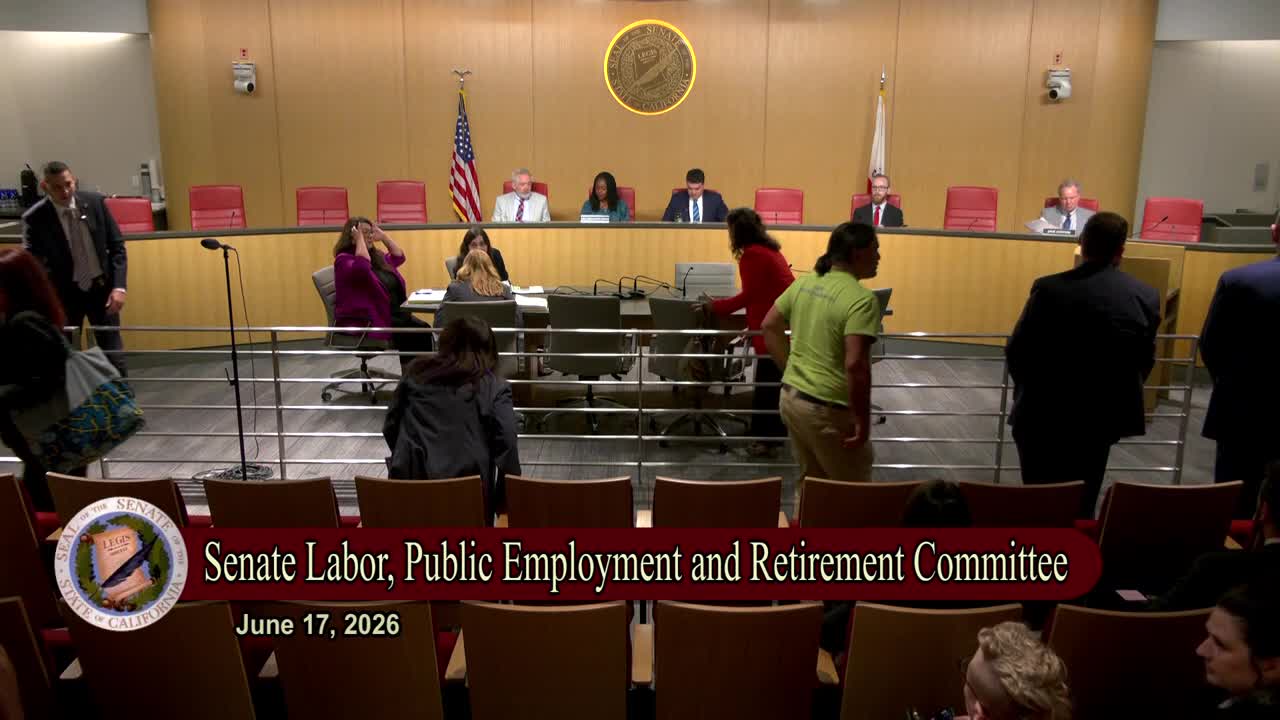 9MIN
Senate Standing Committee on Labor, Public Employment and Retirement
 1MIN
Assembly Floor
 27SEC
Assembly Floor
 12MIN
Assembly Standing Committee on Insurance
Bill Author

Bill Co-Author(s):