AB 1578: State agency officials: training on responding to hate: local agency officials: anti-hate speech training.
- Session Year: 2025-2026
- House: Assembly
- Latest Version Date: 2026-09-27
Current Status:
Passed
(2026-09-27: Chaptered by Secretary of State - Chapter 526, Statutes of 2026.)
Introduced
In Committee
Awaiting First Chamber Vote
Passed First Chamber
In Committee
Awaiting Second Chamber Vote
Passed Second Chamber
Enacted
The California Fair Employment and Housing Act makes specified employment practices unlawful, including the harassment of an employee directly by the employer or indirectly by agents of the employer with the employers knowledge. Under existing law, the Civil Rights Department administers these provisions. Existing law requires a specified employer with 5 or more employees to, by January 1, 2021, provide at least 2 hours of classroom or other effective interactive training and education regarding sexual harassment to all supervisory employees and at least one hour of classroom or other effective interactive training and education regarding sexual harassment to all nonsupervisory employees in California and, after that date, once every 2 years. Existing law requires an employer to include prevention of abusive conduct as a component of that training and education.
This bill would require, beginning on January 1, 2028, if a state agency provides any type of compensation, salary, or stipend to a state agency official of that agency, that all state agency officials of that agency receive training on responding to hate, as prescribed. The bill would define state agency official to mean a state elected official for that purpose. The bill would require at least one hour of training and education for a state agency official within the first 6 months of taking office or commencing employment, and every 2 years thereafter. The bill would authorize a state agency or an association of state agencies to offer one or more training courses, or sets of self-study materials with tests, to meet these requirements. The bill would authorize a state agency to develop its own training that meets the requirements or direct elected officials to complete a training developed by the department. The bill would require the department to develop or obtain an online training course on responding to hate and make the course available on its internet website.
Existing law requires local agency officials, as defined, to receive sexual harassment prevention training and education if the local agency provides any type of compensation, salary, or stipend to those officials. Existing law requires the training and education to include practical examples aimed at instructing the local agency official in the prevention of sexual harassment, discrimination, and retaliation.
This bill would additionally require, beginning on January 1, 2028, the above-described training and education to include for any elected local agency official, as a component of the training and education, anti-hate speech training, as described. The bill would authorize an elected local agency official to take a training developed for state agency officials pursuant to the bill to satisfy the anti-hate speech training requirement.
By imposing new requirements on local agencies, this bill would impose a state-mandated local program.
The California Constitution requires the state to reimburse local agencies and school districts for certain costs mandated by the state. Statutory provisions establish procedures for making that reimbursement.
This bill would provide that, if the Commission on State Mandates determines that the bill contains costs mandated by the state, reimbursement for those costs shall be made pursuant to the statutory provisions noted above.
The California Fair Employment and Housing Act makes specified employment practices unlawful, including the harassment of an employee directly by the employer or indirectly by agents of the employer with the employers knowledge. Under existing law, the Civil Rights Department administers these provisions. Existing law requires a specified employer with 5 or more employees to, by January 1, 2021, provide at least 2 hours of classroom or other effective interactive training and education regarding sexual harassment to all supervisory employees and at least one hour of classroom or other effective interactive training and education regarding sexual harassment to all nonsupervisory employees in California and, after that date, once every 2 years. Existing law requires an employer to include prevention of abusive conduct as a component of that training and education.
This bill would require, beginning on January 1, 2028, if a state agency provides any type of compensation, salary, or stipend to a state agency official of that agency, that all state agency officials of that agency receive training on responding to hate, as prescribed. The bill would specify that state agency officials include elected officials define state agency official to mean a state elected official for that purpose. The bill would require at least one hour of training and education for a state agency official within the first 6 months of taking office or commencing employment, and every 2 years thereafter. The bill would authorize a state agency or an association of state agencies to offer one or more training courses, or sets of self-study materials with tests, to meet these requirements. The bill would authorize a state agency to develop its own training that meets the requirements or direct elected officials to complete a training developed by the department. The bill would require the department to develop or obtain an online training course on responding to hate and make the course available on its internet website.
Existing law requires local agency officials, as defined, to receive sexual harassment prevention training and education if the local agency provides any type of compensation, salary, or stipend to those officials. Existing law requires the training and education to include practical examples aimed at instructing the local agency official in the prevention of sexual harassment, discrimination, and retaliation.
This bill would additionally require, beginning on January 1, 2028, the above-described training and education to include for any elected local agency official, as a component of the training and education, anti-hate speech training, as described. The bill would authorize an elected local agency official to take a training developed for state agency officials pursuant to the bill to satisfy the anti-hate speech training requirement.
By imposing new requirements on local agencies, this bill would impose a state-mandated local program.
The California Constitution requires the state to reimburse local agencies and school districts for certain costs mandated by the state. Statutory provisions establish procedures for making that reimbursement.
This bill would provide that, if the Commission on State Mandates determines that the bill contains costs mandated by the state, reimbursement for those costs shall be made pursuant to the statutory provisions noted above.
The California Fair Employment and Housing Act makes specified employment practices unlawful, including the harassment of an employee directly by the employer or indirectly by agents of the employer with the employers knowledge. Under existing law, the Civil Rights Department administers these provisions. Existing law requires a specified employer with 5 or more employees to, by January 1, 2021, provide at least 2 hours of classroom or other effective interactive training and education regarding sexual harassment to all supervisory employees and at least one hour of classroom or other effective interactive training and education regarding sexual harassment to all nonsupervisory employees in California and, after that date, once every 2 years. Existing law requires an employer to include prevention of abusive conduct as a component of that training and education.
This bill would additionally require, beginning on January 1, 2028, for an employer that is a state agency or local agency that the above-described training and education include, as a component of the training and education for elected officials, anti-hate speech training, as described.Existing law requires an employee who has received the above-described training and education within the prior 2 years as specified, to be given, and be required to read and to acknowledge receipt of, the employers anti-harassment policy within 6 months of assuming the employees new position. Existing law requires the employee then be put on a 2-year tracking schedule based on the employees last training. Under existing law, the current employer has the burden of establishing that the prior training was legally compliant with the act.This bill would specify that a state official or local official who serves more than one state agency or local agency only be required to receive the above-described training once every 2 years without regard to the number of state agencies or local agencies the official serves.This bill would require, if a state agency provides any type of compensation, salary, or stipend to a state agency official of that agency, that all state agency officials of that agency receive training on responding to hate, as prescribed. The bill would specify that state agency officials include elected officials for that purpose. The bill would require at least one hour of training and education for a state agency official within the first 6 months of taking office or commencing employment, and every 2 years thereafter. The bill would authorize a state agency or an association of state agencies to offer one or more training courses, or sets of self-study materials with tests, to meet these requirements. The bill would authorize a state agency to develop its own training that meets the requirements or direct elected officials to complete a training developed by the department. The bill would require the department to develop or obtain an online training course on responding to hate and make the course available on its internet website.
Existing law requires local agency officials, as defined, to receive sexual harassment prevention training and education if the local agency provides any type of compensation, salary, or stipend to those officials. Existing law requires the training and education to include practical examples aimed at instructing the local agency official in the prevention of sexual harassment, discrimination, and retaliation.
This bill would additionally require, beginning on January 1, 2028, the above-described training and education to include for any elected state or local agency official, as a component of the training and education, anti-hate speech training, as described. The bill would authorize an elected local agency official to take a training developed for state agency officials pursuant to the bill to satisfy the anti-hate speech training requirement.
By imposing new requirements on local agencies, this bill would impose a state-mandated local program.
The California Constitution requires the state to reimburse local agencies and school districts for certain costs mandated by the state. Statutory provisions establish procedures for making that reimbursement.
This bill would provide that, if the Commission on State Mandates determines that the bill contains costs mandated by the state, reimbursement for those costs shall be made pursuant to the statutory provisions noted above.
The California Fair Employment and Housing Act makes specified employment practices unlawful, including the harassment of an employee directly by the employer or indirectly by agents of the employer with the employers knowledge. Under existing law, the Civil Rights Department administers these provisions. Existing law requires a specified employer with 5 or more employees to, by January 1, 2021, provide at least 2 hours of classroom or other effective interactive training and education regarding sexual harassment to all supervisory employees and at least one hour of classroom or other effective interactive training and education regarding sexual harassment to all nonsupervisory employees in California and, after that date, once every 2 years. Existing law requires an employer to include prevention of abusive conduct as a component of that training and education.
This bill would additionally require, beginning on January 1, 2028, for an employer that is a state agency or local agency that the above-described training and education include, as a component of the training and education for elected officials, anti-hate speech training. training, as described.
Existing law requires an employee who has received the above-described training and education within the prior 2 years as specified, to be given, and be required to read and to acknowledge receipt of, the employers anti-harassment policy within 6 months of assuming the employees new position. Existing law requires the employee then be put on a 2-year tracking schedule based on the employees last training. Under existing law, the current employer has the burden of establishing that the prior training was legally compliant with the act.
This bill would specify that a state official or local official who serves more than one state agency or local agency only be required to receive the above-described training once every 2 years without regard to the number of state agencies or local agencies the official serves.
Existing law requires local agency officials, as defined, to receive sexual harassment prevention training and education if the local agency provides any type of compensation, salary, or stipend to those officials. Existing law requires the training and education to include practical examples aimed at instructing the local agency official in the prevention of sexual harassment, discrimination, and retaliation.
This bill would additionally require, beginning on January 1, 2028, the above-described training and education include for any elected state or local official, as a component of the training and education, anti-hate speech training. training, as described.
By imposing new requirements on local agencies, this bill would impose a state-mandated local program.
The California Constitution requires the state to reimburse local agencies and school districts for certain costs mandated by the state. Statutory provisions establish procedures for making that reimbursement.
This bill would provide that, if the Commission on State Mandates determines that the bill contains costs mandated by the state, reimbursement for those costs shall be made pursuant to the statutory provisions noted above.
The California Fair Employment and Housing Act makes specified employment practices unlawful, including the harassment of an employee directly by the employer or indirectly by agents of the employer with the employers knowledge. Under existing law, the Civil Rights Department administers these provisions. Existing law requires a specified employer with 5 or more employees to, by January 1, 2021, provide at least 2 hours of classroom or other effective interactive training and education regarding sexual harassment to all supervisory employees and at least one hour of classroom or other effective interactive training and education regarding sexual harassment to all nonsupervisory employees in California and, after that date, once every 2 years. Existing law requires an employer to include prevention of abusive conduct as a component of that training and education.
This bill would additionally require, beginning on January 1, 2028, for an employer that is a state agency or local agency that the above-described training and education include, as a component of the training and education for elected officials, anti-hate speech training.
Existing law requires an employee who has received the above-described training and education within the prior 2 years as specified, to be given, and be required to read and to acknowledge receipt of, the employers anti-harassment policy within 6 months of assuming the employees new position. Existing law requires the employee then be put on a 2-year tracking schedule based on the employees last training. Under existing law, the current employer has the burden of establishing that the prior training was legally compliant with the act.
This bill would specify that a state official or local official who serves more than one state agency or local agency only be required to receive the above-described training once every 2 years without regard to the number of state agencies or local agencies the official serves.
Existing law requires local agency officials, as defined, to receive sexual harassment prevention training and education if the local agency provides any type of compensation, salary, or stipend to those officials. Existing law requires an entity that develops curricula to satisfy this requirement to consult with the city attorney or county counsel regarding the sufficiency and accuracy of that proposed content. Existing law requires a local agency that requires its local agency officials to complete the sexual harassment prevention training and education to maintain records related to the training, as specified. the training and education to include practical examples aimed at instructing the local agency official in the prevention of sexual harassment, discrimination, and retaliation.
This bill would also require a local agency official to receive at least one hour of antihate speech training and education within the first 6 months of taking office and every 4 years thereafter. The bill would require an entity that develops curricula to satisfy this requirement to consult with the city attorney or county counsel regarding the sufficiency and accuracy of that proposed content. The bill would require a local agency that requires its local agency officials to complete the antihate speech training and education prescribed to maintain records, as specified.This bill would additionally require, beginning on January 1, 2028, the above-described training and education include for any elected state or local official, as a component of the training and education, anti-hate speech training.
By imposing new requirements on local agencies, this bill would impose a state-mandated local program.
The California Constitution requires the state to reimburse local agencies and school districts for certain costs mandated by the state. Statutory provisions establish procedures for making that reimbursement.
This bill would provide that, if the Commission on State Mandates determines that the bill contains costs mandated by the state, reimbursement for those costs shall be made pursuant to the statutory provisions noted above.
The California Constitution requires local agencies, for the purpose of ensuring public access to the meetings of public bodies and the writings of public officials and agencies, to comply with a statutory enactment that amends or enacts laws relating to public records or open meetings and contains findings demonstrating that the enactment furthers the constitutional requirements relating to this purpose.This bill would make legislative findings to that effect.Existing law requires each state agency to offer at least semiannually, and certain state officials to attend once every 2 years, an orientation course on the relevant ethics statutes and regulations that govern the official conduct of state officials. Existing law requires each state agency to maintain records indicating the specific attendees, each attendees job title, and dates of their attendance for each orientation course offered for a period of not less than 5 years after each course is given.
This bill would require, beginning on January 1, 2028, a state official to complete at least one hour of antihate speech training and education within 6 months of taking office and subsequently every 4 years thereafter. The bill would require each state agency to maintain records indicating the date that a state official completed the antihate speech training and education for a period of not less than 5 years after the training is complete.
Existing law requires local agency officials, as defined, to receive sexual harassment prevention training and education if the local agency provides any type of compensation, salary, or stipend to those officials. Existing law requires an entity that develops curricula to satisfy this requirement to consult with the city attorney or county counsel regarding the sufficiency and accuracy of that proposed content. Existing law requires a local agency that requires its local agency officials to complete the sexual harassment prevention training and education to maintain records related to the training, as specified.
This bill would also require a local agency official to receive at least one hour of antihate speech training and education within the first 6 months of taking office and every 4 years thereafter. The bill would require an entity that develops curricula to satisfy this requirement to consult with the city attorney or county counsel regarding the sufficiency and accuracy of that proposed content. The bill would require a local agency that requires its local agency officials to complete the antihate speech training and education prescribed to maintain records, as specified.
The California Constitution requires the state to reimburse local agencies and school districts for certain costs mandated by the state. Statutory provisions establish procedures for making that reimbursement.
This bill would provide that, if the Commission on State Mandates determines that the bill contains costs mandated by the state, reimbursement for those costs shall be made pursuant to the statutory provisions noted above.
The California Constitution requires local agencies, for the purpose of ensuring public access to the meetings of public bodies and the writings of public officials and agencies, to comply with a statutory enactment that amends or enacts laws relating to public records or open meetings and contains findings demonstrating that the enactment furthers the constitutional requirements relating to this purpose.
This bill would make legislative findings to that effect.
(a)Beginning on January 1, 2028, if a state agency provides any type of compensation, salary, or stipend to a state agency official of that agency, then all state agency officials of that agency shall receive training on responding to hate pursuant to this section. For the purpose of this section, state agency official means a state elected official.
(b)Each state agency official shall receive at least one hour of training and education within the first six months of taking office or commencing employment, and every two years thereafter.
(c)The training and education required by this section shall include information and practical guidance about how to respond to threats and harassment both during and outside of public meetings, de-escalation training, information about the prevalence of hate incidents, and resources available for victims of hate.
(d)A state agency or an association of state agencies may offer one or more training courses, or sets of self-study materials with tests, to meet the requirements of this section. These courses may be taken at home, in person, or online.
(e)All providers of training courses shall provide participants with proof of participation. Proof of participation may include an electronic certificate received upon completion of an online training course.
(f)A state agency may develop its own training that meets the requirements of this section or direct elected officials to complete the training developed by the department pursuant to subdivision (h).
(g)A state agency official who serves more than one state agency shall satisfy the requirements of this section once every two years without regard to the number of state agencies the official serves.
(h)The department shall develop or obtain an online training course on responding to hate in accordance with this section. The department shall make the online training course available on its internet website.
SEC. 2.Section 53237.1 of the Government Code is amended to read:53237.1.(a)If a local agency provides any type of compensation, salary, or stipend to a local agency official of that agency, then all local agency officials of that agency shall receive sexual harassment prevention training and education pursuant to this article. A local agency may also require any of its employees to receive sexual harassment prevention training and education pursuant to this article.
(b)Each local agency official, or employee who is so required, shall receive at least two hours of sexual harassment prevention training and education within the first six months of taking office or commencing employment, and every two years thereafter.
(c)An entity that develops curricula to satisfy the requirements of this section shall consult with legal counsel for the entity regarding the sufficiency and accuracy of that proposed content. An entity is permitted to include local sexual harassment prevention training and education policies in the curricula.
(d)(1)The training and education required by this section shall include information and practical guidance regarding the federal and state statutory provisions concerning the prohibition against, and the prevention and correction of, sexual harassment and the remedies available to victims of sexual harassment in employment. The training and education shall also include practical examples aimed at instructing the local agency official in the prevention of sexual harassment, discrimination, and retaliation, and shall be presented by trainers or educators with knowledge and expertise in the prevention of sexual harassment, discrimination, and retaliation.
(2)Beginning on January 1, 2028, the training and education required by this section for any elected local agency official shall also include anti-hate speech training as a component of the training and education. Anti-hate speech training shall provide practical guidance on recognizing, reporting, engaging or participating in, and confronting speech that vilifies, humiliates, or incites hatred against people based on the protected characteristics listed in subdivision (a) of Section 12940. An elected local agency official may take a training developed pursuant to Section 12950.4 to satisfy the training requirement of this paragraph.
(e)A local agency or an association of local agencies may offer one or more training courses, or sets of self-study materials with tests, to meet the requirements of this section. These courses may be taken at home, in person, or online.
(f)All providers of training courses shall provide participants with proof of participation to meet the requirements of this article.
(g)A local agency shall provide a recommendation on training available to meet the requirements of this article to its local agency officials and its employees at least once in written form before assuming a new position and every two years thereafter.
(h)A local agency official who serves more than one local agency shall satisfy the requirements of this article once every two years without regard to the number of local agencies the official serves.
SEC. 3.If the Commission on State Mandates determines that this act contains costs mandated by the state, reimbursement to local agencies and school districts for those costs shall be made pursuant to Part 7 (commencing with Section 17500) of Division 4 of Title 2 of the Government Code.
(a)If Beginning on January 1, 2028, if a state agency provides any type of compensation, salary, or stipend to a state agency official of that agency, then all state agency officials of that agency shall receive training on responding to hate pursuant to this section. For the purpose of this section, state agency official includes an means a state elected official.
(b)Each state agency official shall receive at least one hour of training and education within the first six months of taking office or commencing employment, and every two years thereafter.
(c)The training and education required by this section shall include information and practical guidance about how to respond to threats and harassment both during and outside of public meetings, de-escalation training, information about the prevalence of hate incidents, and resources available for victims of hate.
(d)A state agency or an association of state agencies may offer one or more training courses, or sets of self-study materials with tests, to meet the requirements of this section. These courses may be taken at home, in person, or online.
(e)All providers of training courses shall provide participants with proof of participation. Proof of participation may include an electronic certificate received upon completion of an online training course.
(f)A state agency may develop its own training that meets the requirements of this section or direct elected officials to complete the training developed by the department pursuant to subdivision (h).
(g)A state agency official who serves more than one state agency shall satisfy the requirements of this section once every two years without regard to the number of state agencies the official serves.
(h)The department shall develop or obtain an online training course on responding to hate in accordance with this section. The department shall make the online training course available on its internet website.
SEC. 2.Section 53237.1 of the Government Code is amended to read:53237.1.(a)If a local agency provides any type of compensation, salary, or stipend to a local agency official of that agency, then all local agency officials of that agency shall receive sexual harassment prevention training and education pursuant to this article. A local agency may also require any of its employees to receive sexual harassment prevention training and education pursuant to this article.
(b)Each local agency official, or employee who is so required, shall receive at least two hours of sexual harassment prevention training and education within the first six months of taking office or commencing employment, and every two years thereafter.
(c)An entity that develops curricula to satisfy the requirements of this section shall consult with legal counsel for the entity regarding the sufficiency and accuracy of that proposed content. An entity is permitted to include local sexual harassment prevention training and education policies in the curricula.
(d)(1)The training and education required by this section shall include information and practical guidance regarding the federal and state statutory provisions concerning the prohibition against, and the prevention and correction of, sexual harassment and the remedies available to victims of sexual harassment in employment. The training and education shall also include practical examples aimed at instructing the local agency official in the prevention of sexual harassment, discrimination, and retaliation, and shall be presented by trainers or educators with knowledge and expertise in the prevention of sexual harassment, discrimination, and retaliation.
(2)Beginning on January 1, 2028, the training and education required by this section for any elected local agency official shall also include anti-hate speech training as a component of the training and education. Anti-hate speech training shall provide practical guidance on recognizing, reporting, engaging or participating in, and confronting speech that vilifies, humiliates, or incites hatred against people based on the protected characteristics listed in subdivision (a) of Section 12940. An elected local agency official may take a training developed pursuant to Section 12950.4 to satisfy the training requirement of this paragraph.
(e)A local agency or an association of local agencies may offer one or more training courses, or sets of self-study materials with tests, to meet the requirements of this section. These courses may be taken at home, in person, or online.
(f)All providers of training courses shall provide participants with proof of participation to meet the requirements of this article.
(g)A local agency shall provide a recommendation on training available to meet the requirements of this article to its local agency officials and its employees at least once in written form before assuming a new position and every two years thereafter.
(h)A local agency official who serves more than one local agency shall satisfy the requirements of this article once every two years without regard to the number of local agencies the official serves.
SEC. 3.If the Commission on State Mandates determines that this act contains costs mandated by the state, reimbursement to local agencies and school districts for those costs shall be made pursuant to Part 7 (commencing with Section 17500) of Division 4 of Title 2 of the Government Code.
(a)If a state agency provides any type of compensation, salary, or stipend to a state agency official of that agency, then all state agency officials of that agency shall receive training on responding to hate pursuant to this section. For the purpose of this section, state agency official includes an elected official.
(b)Each state agency official shall receive at least one hour of training and education within the first six months of taking office or commencing employment, and every two years thereafter.
(c)The training and education required by this section shall include information and practical guidance about how to respond to threats and harassment both during and outside of public meetings, de-escalation training, information about the prevalence of hate incidents, and resources available for victims of hate.
(d)A state agency or an association of state agencies may offer one or more training courses, or sets of self-study materials with tests, to meet the requirements of this section. These courses may be taken at home, in person, or online.
(e)All providers of training courses shall provide participants with proof of participation. Proof of participation may include an electronic certificate received upon completion of an online training course.
(f)A state agency may develop its own training that meets the requirements of this section or direct elected officials to complete the training developed by the department pursuant to subdivision (h).
(g)A state agency official who serves more than one state agency shall satisfy the requirements of this section once every two years without regard to the number of state agencies the official serves.
(h)The department shall develop or obtain an online training course on responding to hate in accordance with this section. The department shall make the online training course available on its internet website.
SEC. 2.Section 53237.1 of the Government Code is amended to read:53237.1.(a)If a local agency provides any type of compensation, salary, or stipend to a local agency official of that agency, then all local agency officials of that agency shall receive sexual harassment prevention training and education pursuant to this article. A local agency may also require any of its employees to receive sexual harassment prevention training and education pursuant to this article.
(b)Each local agency official, or employee who is so required, shall receive at least two hours of sexual harassment prevention training and education within the first six months of taking office or commencing employment, and every two years thereafter.
(c)An entity that develops curricula to satisfy the requirements of this section shall consult with legal counsel for the entity regarding the sufficiency and accuracy of that proposed content. An entity is permitted to include local sexual harassment prevention training and education policies in the curricula.
(d)(1)The training and education required by this section shall include information and practical guidance regarding the federal and state statutory provisions concerning the prohibition against, and the prevention and correction of, sexual harassment and the remedies available to victims of sexual harassment in employment. The training and education shall also include practical examples aimed at instructing the local agency official in the prevention of sexual harassment, discrimination, and retaliation, and shall be presented by trainers or educators with knowledge and expertise in the prevention of sexual harassment, discrimination, and retaliation.
(2)Beginning on January 1, 2028, the training and education required by this section for any elected local agency official shall also include anti-hate speech training as a component of the training and education. Anti-hate speech training shall provide practical guidance on recognizing, reporting, engaging or participating in, and confronting speech that vilifies, humiliates, or incites hatred against people based on the protected characteristics listed in subdivision (a) of Section 12940. An elected local agency official may take a training developed pursuant to Section 12950.4 to satisfy the training requirement of this paragraph.
(e)A local agency or an association of local agencies may offer one or more training courses, or sets of self-study materials with tests, to meet the requirements of this section. These courses may be taken at home, in person, or online.
(f)All providers of training courses shall provide participants with proof of participation to meet the requirements of this article.
(g)A local agency shall provide a recommendation on training available to meet the requirements of this article to its local agency officials and its employees at least once in written form before assuming a new position and every two years thereafter.
(h)A local agency official who serves more than one local agency shall satisfy the requirements of this article once every two years without regard to the number of local agencies the official serves.
SEC. 3.If the Commission on State Mandates determines that this act contains costs mandated by the state, reimbursement to local agencies and school districts for those costs shall be made pursuant to Part 7 (commencing with Section 17500) of Division 4 of Title 2 of the Government Code.
(a)(1)By January 1, 2021, an employer having five or more employees shall provide at least two hours of classroom or other effective interactive training and education regarding sexual harassment to all supervisory employees and at least one hour of classroom or other effective interactive training and education regarding sexual harassment to all nonsupervisory employees in California. Thereafter, each employer covered by this section shall provide sexual harassment training and education to each employee in California once every two years. New nonsupervisory employees shall be provided training within six months of hire. New supervisory employees shall be provided training within six months of the assumption of a supervisory position. An employer may provide this training in conjunction with other training provided to the employees. The training may be completed by employees individually or as part of a group presentation, presentation and may be completed in shorter segments, as long as the applicable hourly total requirement is met. An employer who has provided this training and education to an employee in 2019 is not required to provide refresher training and education again until two years thereafter. The training and education required by this section shall include information and practical guidance regarding the federal and state statutory provisions concerning the prohibition against and the prevention and correction of sexual harassment and the remedies available to victims of sexual harassment in employment. The training and education shall also include practical examples aimed at instructing supervisors in the prevention of harassment, discrimination, and retaliation, retaliation and shall be presented by trainers or educators with knowledge and expertise in the prevention of harassment, discrimination, and retaliation. The department shall provide a method for employees who have completed the training to save electronically and print a certificate of completion.
(2)An employer shall also include prevention of abusive conduct as a component of the training and education specified in paragraph (1).
(3)An employer shall also provide training inclusive of harassment based on gender identity, gender expression, and sexual orientation as a component of the training and education specified in paragraph (1). The training and education shall include practical examples inclusive of harassment based on gender identity, gender expression, and sexual orientation, orientation and shall be presented by trainers or educators with knowledge and expertise in those areas.
(4)Beginning on January 1, 2028, an employer that is a state agency or local agency shall also include anti-hate speech training as a component of the training and education specified in paragraph (1) for all elected state or local officials. Anti-hate speech training shall provide practical guidance on recognizing, reporting, engaging or participating in, and confronting speech that vilifies, humiliates, or incites hatred against people based on the protected characteristics listed in subdivision (a) of Section 12940.
(b)The state shall incorporate the training required by subdivision (a) into the 80 hours of training provided to all new employees pursuant to subdivision (b) of Section 19995.4, using existing resources.
(c)Notwithstanding subdivisions (j) and (k) of Section 12940, a claim that the training and education required by this section did not reach a particular individual or individuals shall not in and of itself result in the liability of any employer to any present or former employee or applicant in any action alleging sexual harassment. Conversely, an employers compliance with this section does not insulate the employer from liability for sexual harassment of any current or former employee or applicant.
(d)If an employer violates this section, the department may seek an order requiring the employer to comply with these requirements.
(e)The training and education required by this section is intended to establish a minimum threshold and should not discourage or relieve any employer from providing for longer, more frequent, or more elaborate training and education regarding workplace harassment or other forms of unlawful discrimination in order to meet its obligations to take all reasonable steps necessary to prevent and correct harassment and discrimination. This section shall not be construed to override or supersede statutes, including, but not limited to, Section 1684 of the Labor Code, that meet or exceed the training for nonsupervisory employees required under this section.
(f)Except as provided in subdivision (l), beginning January 1, 2021, for seasonal, temporary, or other employees that are hired to work for less than six months, an employer shall provide training within 30 calendar days after the hire date or within 100 hours worked, whichever occurs first. In the case of a temporary employee employed by a temporary services employer, as defined in Section 201.3 of the Labor Code, to perform services for clients, the training shall be provided by the temporary services employer, not the client.
(g)Beginning January 1, 2020, sexual harassment prevention training for migrant and seasonal agricultural workers, as defined in the federal Migrant and Seasonal Agricultural Worker Protection Act (29 U.S.C. Sec. 1801, et seq.), shall be consistent with training for nonsupervisory employees pursuant to paragraph (8) of subdivision (a) of Section 1684 of the Labor Code.
(h)(1)For purposes of this section only, employer means any person regularly employing five or more persons or regularly receiving the services of five or more persons providing services pursuant to a contract, or any person acting as an agent of an employer, directly or indirectly, the state, or any political or civil subdivision of the state, and cities.
(2)For purposes of this section, abusive conduct means conduct of an employer or employee in the workplace, with malice, that a reasonable person would find hostile, offensive, and unrelated to an employers legitimate business interests. Abusive conduct may include repeated infliction of verbal abuse, such as the use of derogatory remarks, insults, and epithets, verbal or physical conduct that a reasonable person would find threatening, intimidating, or humiliating, or the gratuitous sabotage or undermining of a persons work performance. A single act shall not constitute abusive conduct, unless especially severe and egregious.
(i)For purposes of providing training to employees as required by this section, an employer may develop its own training module or may direct employees to view the online training course referenced in subdivision (j) and this shall be deemed to have complied with and satisfied the employers obligations as set forth in this section and Section 12950.
(j)The department shall develop or obtain two online training courses on the prevention of sexual harassment in the workplace in accordance with the provisions of this section. The course for nonsupervisory employees shall be one hour in length length, and the course for supervisory employees shall be two hours in length.
(k)The department shall make the online training courses available on its internet website. The online training courses shall contain an interactive feature that requires the viewer to respond to a question periodically in order for the online training courses to continue to play. Any questions resulting from the online training course described in this subdivision shall be directed to the trainees employers human resources department or equally qualified professional rather than the department.
(l)(1)An employer that employs workers pursuant to a multiemployer collective bargaining agreement in the construction industry may satisfy the requirements of subdivision (a) or (f) by demonstrating that the employee has received the training required by subdivision (a) within the past two years under any of the following circumstances:
(A)While the employee was employed by another employer that is also signatory to a multiemployer collective bargaining agreement with the same trade in the building and construction industry.
(B)While the employee was an apprentice registered in a building and construction trades apprenticeship program approved by the Division of Apprenticeship Standards.
(C)Through a building and construction trades apprenticeship program approved by the Division of Apprenticeship Standards, a labor management training trust, or labor management cooperation committee. For purposes of this subdivision, labor management cooperation committee shall mean a committee that is established pursuant to Section 175a of Title 29 of the United States Code.
(2)For purposes of this subdivision, multiemployer collective bargaining agreement means a bona fide collective bargaining agreement to which multiple employers are signatory, including predecessor and successor agreements.
(3)An employer shall require verification that an employee has undergone prevention of harassment training pursuant to this subdivision within the past two years. The employer shall provide prevention of harassment training pursuant to subdivision (a) for any employee for whom verification cannot be obtained.
(4)A state-approved apprenticeship program, labor management training trust, or labor management cooperation committee shall maintain a certificate of completion of training for each person to whom the entity has provided prevention of harassment training pursuant to this subdivision for a period of not less than four years. The apprenticeship program, labor management training trust, or labor management cooperation committee shall maintain a database of journey-level worker and apprentice training that entity has provided and shall provide verification of an employees or apprentices prevention of harassment training status upon the request of an employer that is a party to the multiemployer collective bargaining agreement.
(5)(A)A qualified trainer may provide prevention of harassment training on behalf of an apprenticeship program, labor management training trust, or labor management cooperation committee.
(B)A qualified trainer, for purposes of this subdivision, is any person who, through a combination of training and experience, has the ability to train employees about the following:
(i)How to identify behavior that may constitute unlawful harassment, discrimination, or retaliation under both California and federal law.
(ii)What steps to take when harassing behavior occurs in the workplace.
(iii)How to report harassment complaints.
(iv)Supervisory employees obligation to report harassing, discriminatory, or retaliatory behavior of which they become aware.
(v)How to respond to a harassment complaint.
(vi)The employers obligation to conduct a workplace investigation of a harassment complaint.
(vii)What constitutes retaliation and how to prevent it.
(viii)Essential components of an anti-harassment policy.
(ix)The effect of harassment on harassed employees, coworkers, harassers, and employers.
(C)A qualified trainer includes, but is not limited to, an attorney admitted to the State Bar of California with at least two years of experience practicing employment law, a human resources professional with at least two years of practical experience in prevention of harassment training, investigation, and advising employers in the prevention of harassment, or any other person who has received training in the provision of prevention of harassment training from a qualified trainer.
(6)An apprenticeship program, labor management training trust, or labor management cooperation committee may also provide training by use of the online training courses referenced in subdivision (j).
(7)An apprenticeship program, labor management training trust, or labor management cooperation committee shall not incur any liability for providing prevention of harassment training or for maintaining records pursuant to this subdivision.
(m)(1)An employee who has received training in compliance with this section within the prior two years either from a current, a prior, or an alternate or a joint employer, or who received a valid work permit from the Labor Commissioner that required the employee to receive training in compliance with this section within the prior two years, shall be given, and required to read and to acknowledge receipt of, the employers anti-harassment policy within six months of assuming the employees new position. That employee shall then be put on a two year two-year tracking schedule based on the employees last training. The current employer shall have the burden of establishing that the prior training was legally compliant with this section.
(2)A state or local official who serves more than one state agency or local agency shall only be required to receive training pursuant to this section once every two years without regard to the number of state agencies or local agencies the official serves.
SEC. 2.Section 53237.1 of the Government Code is amended to read:53237.1.(a)If a local agency provides any type of compensation, salary, or stipend to a local agency official of that agency, then all local agency officials of that agency shall receive sexual harassment prevention training and education pursuant to this article. A local agency may also require any of its employees to receive sexual harassment prevention training and education pursuant to this article.
(b)Each local agency official, or employee who is so required, shall receive at least two hours of sexual harassment prevention training and education within the first six months of taking office or commencing employment, and every two years thereafter.
(c)An entity that develops curricula to satisfy the requirements of this section shall consult with legal counsel for the entity regarding the sufficiency and accuracy of that proposed content. An entity is permitted to include local sexual harassment prevention training and education policies in the curricula.
(d)(1)The training and education required by this section shall include information and practical guidance regarding the federal and state statutory provisions concerning the prohibition against, and the prevention and correction of, sexual harassment and the remedies available to victims of sexual harassment in employment. The training and education shall also include practical examples aimed at instructing the local agency official in the prevention of sexual harassment, discrimination, and retaliation, and shall be presented by trainers or educators with knowledge and expertise in the prevention of sexual harassment, discrimination, and retaliation.
(2)Beginning on January 1, 2028, the training and education required by this section for any elected local agency official shall also include anti-hate speech training as a component of the training and education. Anti-hate speech training shall provide practical guidance on recognizing, reporting, engaging or participating in, and confronting speech that vilifies, humiliates, or incites hatred against people based on the protected characteristics listed in subdivision (a) of Section 12940.
(e)A local agency or an association of local agencies may offer one or more training courses, or sets of self-study materials with tests, to meet the requirements of this section. These courses may be taken at home, in person, or online.
(f)All providers of training courses shall provide participants with proof of participation to meet the requirements of this article.
(g)A local agency shall provide a recommendation on training available to meet the requirements of this article to its local agency officials and its employees at least once in written form before assuming a new position and every two years thereafter.
(h)A local agency official who serves more than one local agency shall satisfy the requirements of this article once every two years without regard to the number of local agencies the official serves.
SEC. 3.If the Commission on State Mandates determines that this act contains costs mandated by the state, reimbursement to local agencies and school districts for those costs shall be made pursuant to Part 7 (commencing with Section 17500) of Division 4 of Title 2 of the Government Code.
(a)(1)By January 1, 2021, an employer having five or more employees shall provide at least two hours of classroom or other effective interactive training and education regarding sexual harassment to all supervisory employees and at least one hour of classroom or other effective interactive training and education regarding sexual harassment to all nonsupervisory employees in California. Thereafter, each employer covered by this section shall provide sexual harassment training and education to each employee in California once every two years. New nonsupervisory employees shall be provided training within six months of hire. New supervisory employees shall be provided training within six months of the assumption of a supervisory position. An employer may provide this training in conjunction with other training provided to the employees. The training may be completed by employees individually or as part of a group presentation, and may be completed in shorter segments, as long as the applicable hourly total requirement is met. An employer who has provided this training and education to an employee in 2019 is not required to provide refresher training and education again until two years thereafter. The training and education required by this section shall include information and practical guidance regarding the federal and state statutory provisions concerning the prohibition against and the prevention and correction of sexual harassment and the remedies available to victims of sexual harassment in employment. The training and education shall also include practical examples aimed at instructing supervisors in the prevention of harassment, discrimination, and retaliation, and shall be presented by trainers or educators with knowledge and expertise in the prevention of harassment, discrimination, and retaliation. The department shall provide a method for employees who have completed the training to save electronically and print a certificate of completion.
(2)An employer shall also include prevention of abusive conduct as a component of the training and education specified in paragraph (1).
(3)An employer shall also provide training inclusive of harassment based on gender identity, gender expression, and sexual orientation as a component of the training and education specified in paragraph (1). The training and education shall include practical examples inclusive of harassment based on gender identity, gender expression, and sexual orientation, and shall be presented by trainers or educators with knowledge and expertise in those areas.
(4)Beginning on January 1, 2028, an employer that is a state agency or local agency shall also include anti-hate speech training as a component of the training and education specified in paragraph (1) for all elected state or local officials.
(b)The state shall incorporate the training required by subdivision (a) into the 80 hours of training provided to all new employees pursuant to subdivision (b) of Section 19995.4, using existing resources.
(c)Notwithstanding subdivisions (j) and (k) of Section 12940, a claim that the training and education required by this section did not reach a particular individual or individuals shall not in and of itself result in the liability of any employer to any present or former employee or applicant in any action alleging sexual harassment. Conversely, an employers compliance with this section does not insulate the employer from liability for sexual harassment of any current or former employee or applicant.
(d)If an employer violates this section, the department may seek an order requiring the employer to comply with these requirements.
(e)The training and education required by this section is intended to establish a minimum threshold and should not discourage or relieve any employer from providing for longer, more frequent, or more elaborate training and education regarding workplace harassment or other forms of unlawful discrimination in order to meet its obligations to take all reasonable steps necessary to prevent and correct harassment and discrimination. This section shall not be construed to override or supersede statutes, including, but not limited to, Section 1684 of the Labor Code, that meet or exceed the training for nonsupervisory employees required under this section.
(f)Except as provided in subdivision (l), beginning January 1, 2021, for seasonal, temporary, or other employees that are hired to work for less than six months, an employer shall provide training within 30 calendar days after the hire date or within 100 hours worked, whichever occurs first. In the case of a temporary employee employed by a temporary services employer, as defined in Section 201.3 of the Labor Code, to perform services for clients, the training shall be provided by the temporary services employer, not the client.
(g)Beginning January 1, 2020, sexual harassment prevention training for migrant and seasonal agricultural workers, as defined in the federal Migrant and Seasonal Agricultural Worker Protection Act (29 U.S.C. 1801, et seq.), shall be consistent with training for nonsupervisory employees pursuant to paragraph (8) of subdivision (a) of Section 1684 of the Labor Code.
(h)(1)For purposes of this section only, employer means any person regularly employing five or more persons or regularly receiving the services of five or more persons providing services pursuant to a contract, or any person acting as an agent of an employer, directly or indirectly, the state, or any political or civil subdivision of the state, and cities.
(2)For purposes of this section, abusive conduct means conduct of an employer or employee in the workplace, with malice, that a reasonable person would find hostile, offensive, and unrelated to an employers legitimate business interests. Abusive conduct may include repeated infliction of verbal abuse, such as the use of derogatory remarks, insults, and epithets, verbal or physical conduct that a reasonable person would find threatening, intimidating, or humiliating, or the gratuitous sabotage or undermining of a persons work performance. A single act shall not constitute abusive conduct, unless especially severe and egregious.
(i)For purposes of providing training to employees as required by this section, an employer may develop its own training module or may direct employees to view the online training course referenced in subdivision (j) and this shall be deemed to have complied with and satisfied the employers obligations as set forth in this section and Section 12950.
(j)The department shall develop or obtain two online training courses on the prevention of sexual harassment in the workplace in accordance with the provisions of this section. The course for nonsupervisory employees shall be one hour in length and the course for supervisory employees shall be two hours in length.
(k)The department shall make the online training courses available on its internet website. The online training courses shall contain an interactive feature that requires the viewer to respond to a question periodically in order for the online training courses to continue to play. Any questions resulting from the online training course described in this subdivision shall be directed to the trainees employers human resources department or equally qualified professional rather than the department.
(l)(1)An employer that employs workers pursuant to a multiemployer collective bargaining agreement in the construction industry may satisfy the requirements of subdivision (a) or (f) by demonstrating that the employee has received the training required by subdivision (a) within the past two years under any of the following circumstances:
(A)While the employee was employed by another employer that is also signatory to a multiemployer collective bargaining agreement with the same trade in the building and construction industry.
(B)While the employee was an apprentice registered in a building and construction trades apprenticeship program approved by the Division of Apprenticeship Standards.
(C)Through a building and construction trades apprenticeship program approved by the Division of Apprenticeship Standards, a labor management training trust, or labor management cooperation committee. For purposes of this subdivision, labor management cooperation committee shall mean a committee that is established pursuant to Section 175a of Title 29 of the United States Code.
(2)For purposes of this subdivision, multiemployer collective bargaining agreement means a bona fide collective bargaining agreement to which multiple employers are signatory, including predecessor and successor agreements.
(3)An employer shall require verification that an employee has undergone prevention of harassment training pursuant to this subdivision within the past two years. The employer shall provide prevention of harassment training pursuant to subdivision (a) for any employee for whom verification cannot be obtained.
(4)A state-approved apprenticeship program, labor management training trust, or labor management cooperation committee shall maintain a certificate of completion of training for each person to whom the entity has provided prevention of harassment training pursuant to this subdivision for a period of not less than four years. The apprenticeship program, labor management training trust, or labor management cooperation committee shall maintain a database of journey-level worker and apprentice training that entity has provided and shall provide verification of an employees or apprentices prevention of harassment training status upon the request of an employer that is a party to the multiemployer collective bargaining agreement.
(5)(A)A qualified trainer may provide prevention of harassment training on behalf of an apprenticeship program, labor management training trust, or labor management cooperation committee.
(B)A qualified trainer, for purposes of this subdivision, is any person who, through a combination of training and experience, has the ability to train employees about the following:
(i)How to identify behavior that may constitute unlawful harassment, discrimination, or retaliation under both California and federal law.
(ii)What steps to take when harassing behavior occurs in the workplace.
(iii)How to report harassment complaints.
(iv)Supervisory employees obligation to report harassing, discriminatory, or retaliatory behavior of which they become aware.
(v)How to respond to a harassment complaint.
(vi)The employers obligation to conduct a workplace investigation of a harassment complaint.
(vii)What constitutes retaliation and how to prevent it.
(viii)Essential components of an antiharassment anti-harassment policy.
(ix)The effect of harassment on harassed employees, coworkers, harassers, and employers.
(C)A qualified trainer includes, but is not limited to, an attorney admitted to the State Bar of California with at least two years of experience practicing employment law, a human resources professional with at least two years of practical experience in prevention of harassment training, investigation, and advising employers in the prevention of harassment, or any other person who has received training in the provision of prevention of harassment training from a qualified trainer.
(6)An apprenticeship program, labor management training trust, or labor management cooperation committee may also provide training by use of the online training courses referenced in subdivision (j).
(7)An apprenticeship program, labor management training trust, or labor management cooperation committee shall not incur any liability for providing prevention of harassment training or for maintaining records pursuant to this subdivision.
(m)(1)An employee who has received training in compliance with this section within the prior two years either from a current, a prior, or an alternate or a joint employer, or who received a valid work permit from the Labor Commissioner that required the employee to receive training in compliance with this section within the prior two years, shall be given, and required to read and to acknowledge receipt of, the employers anti-harassment policy within six months of assuming the employees new position. That employee shall then be put on a two year tracking schedule based on the employees last training. The current employer shall have the burden of establishing that the prior training was legally compliant with this section.
(2)A state or local official who serves more than one state agency or local agency shall only be required to receive training pursuant to this section once every two years without regard to the number of state agencies or local agencies the official serves.
SEC. 2.Section 53237.1 of the Government Code is amended to read:53237.1.(a)If a local agency provides any type of compensation, salary, or stipend to a local agency official of that agency, then all local agency officials of that agency shall receive antihate speech and sexual harassment prevention training and education pursuant to this article. A local agency may also require any of its employees to receive sexual harassment prevention training and education pursuant to this article.
(b)Each local agency official, or employee who is so required, shall receive at least two hours of sexual harassment prevention training and education within the first six months of taking office or commencing employment, and every two years thereafter.
(c)Each local agency official who is so required shall receive at least one hour of antihate speech training and education within the first six months of taking office and every four years thereafter.(d)(c)An entity that develops curricula to satisfy the requirements of this section shall consult with legal counsel for the entity regarding the sufficiency and accuracy of that proposed content. An entity is permitted to include local antihate speech and sexual harassment prevention training and education policies in the curricula.
(e)(d)(1)The training and education required by this section shall include information and practical guidance regarding the federal and state statutory provisions concerning the prohibition against, and the prevention and correction of, hate speech and sexual harassment and the remedies available to victims of hate speech and sexual harassment in employment. The training and education shall also include practical examples aimed at instructing the local agency official in the prevention of hate speech, sexual harassment, discrimination, and retaliation, and shall be presented by trainers or educators with knowledge and expertise in the prevention of hate speech, sexual harassment, discrimination, and retaliation.
(2)Beginning on January 1, 2028, the training and education required by this section for any elected local agency official shall also include anti-hate speech training as a component of the training and education.
(f)(e)A local agency or an association of local agencies may offer one or more training courses, or sets of self-study materials with tests, to meet the requirements of this section. These courses may be taken at home, in person, or online.
(g)(f)All providers of training courses shall provide participants with proof of participation to meet the requirements of this article.
(h)(g)A local agency shall provide a recommendation on training available to meet the requirements of this article to its local agency officials and its employees at least once in written form before assuming a new position, position and every two years thereafter for sexual harassment prevention training and education, and every four years thereafter for antihate speech training and education. thereafter.
(i)(1)(h)A local agency official who serves more than one local agency shall satisfy the requirements of this article relating to sexual harassment prevention training and education once every two years without regard to the number of local agencies the official serves.
(2)A local agency official who serves more than one local agency shall satisfy the requirements of this article relating to antihate speech training and education once every four years without regard to the number of local agencies the official serves.SEC. 3.Section 53237.2 of the Government Code is amended to read:53237.2.(a)A local agency that requires its local agency officials or employees to complete the antihate speech and sexual harassment prevention training and education prescribed by this article shall maintain records indicating both of the following:(1)The dates that local agency officials or employees satisfied the requirements of this article.(2)The entity that provided the training.(b)Notwithstanding any other law, a local agency shall maintain these records for at least five years after local agency officials or employees receive the training. These records are public records subject to disclosure under the California Public Records Act (Division 10 (commencing with Section 7920.000) of Title 1).SEC. 4.SEC. 3.If the Commission on State Mandates determines that this act contains costs mandated by the state, reimbursement to local agencies and school districts for those costs shall be made pursuant to Part 7 (commencing with Section 17500) of Division 4 of Title 2 of the Government Code.
SEC. 5.The Legislature finds and declares that Sections 2, and 3 of this act, which amend Sections 53237.1 and 53237.2 of, and add Sections 11147 and 11147.1 to, the Government Code, further, within the meaning of paragraph (7) of subdivision (b) of Section 3 of Article I of the California Constitution, the purposes of that constitutional section as it relates to the right of public access to the meetings of local public bodies or the writings of local public officials and local agencies. Pursuant to paragraph (7) of subdivision (b) of Section 3 of Article I of the California Constitution, the Legislature makes the following findings:It is in the public interest, and it furthers the purposes of paragraph (7) of subdivision (b) of Section (3) of Article I of the California Constitution, to ensure that information concerning state and local official training and education is available to the public.Beginning on January 1, 2028, a state official shall complete at least one hour of antihate speech training and education within six months of taking office and subsequently every four years thereafter.
11147.1.Each state agency shall maintain records indicating the date that a state official completed the antihate speech training and education required pursuant to Section 11147 for a period of not less than five years after the training is complete. These records shall be public records subject to inspection and copying consistent with Section 81008 and otherwise subject to the California Public Records Act (Division 10 (commencing with Section 7920.000) of Title 1).
SEC. 2.Section 53237.1 of the Government Code is amended to read:53237.1.(a)If a local agency provides any type of compensation, salary, or stipend to a local agency official of that agency, then all local agency officials of that agency shall receive antihate speech and sexual harassment prevention training and education pursuant to this article. A local agency may also require any of its employees to receive sexual harassment prevention training and education pursuant to this article.
(b)Each local agency official, or employee who is so required, shall receive at least two hours of sexual harassment prevention training and education within the first six months of taking office or commencing employment, and every two years thereafter.
(c)Each local agency official who is so required shall receive at least one hour of antihate speech training and education within the first six months of taking office and every four years thereafter.
(c)(d)An entity that develops curricula to satisfy the requirements of this section shall consult with legal counsel for the entity regarding the sufficiency and accuracy of that proposed content. An entity is permitted to include local antihate speech and sexual harassment prevention training and education policies in the curricula.
(d)(e)The training and education required by this section shall include information and practical guidance regarding the federal and state statutory provisions concerning the prohibition against, and the prevention and correction of, hate speech and sexual harassment and the remedies available to victims of hate speech and sexual harassment in employment. The training and education shall also include practical examples aimed at instructing the local agency official in the prevention of hate speech, sexual harassment, discrimination, and retaliation, and shall be presented by trainers or educators with knowledge and expertise in the prevention of hate speech, sexual harassment, discrimination, and retaliation.
(e)(f)A local agency or an association of local agencies may offer one or more training courses, or sets of self-study materials with tests, to meet the requirements of this section. These courses may be taken at home, in person, or online.
(f)(g)All providers of training courses shall provide participants with proof of participation to meet the requirements of this article.
(g)(h)A local agency shall provide a recommendation on training available to meet the requirements of this article to its local agency officials and its employees at least once in written form before assuming a new position and every position, every two years thereafter. thereafter for sexual harassment prevention training and education, and every four years thereafter for antihate speech training and education.
(h)(i)(1)A local agency official who serves more than one local agency shall satisfy the requirements of this article relating to sexual harassment prevention training and education once every two years without regard to the number of local agencies he or she the official serves.
(2)A local agency official who serves more than one local agency shall satisfy the requirements of this article relating to antihate speech training and education once every four years without regard to the number of local agencies the official serves.
SEC. 3.Section 53237.2 of the Government Code is amended to read:53237.2.(a)A local agency that requires its local agency officials or employees to complete the antihate speech and sexual harassment prevention training and education prescribed by this article shall maintain records indicating both of the following:
(1)The dates that local agency officials or employees satisfied the requirements of this article.
(2)The entity that provided the training.
(b)Notwithstanding any other law, a local agency shall maintain these records for at least five years after local agency officials or employees receive the training. These records are public records subject to disclosure under the California Public Records Act (Division 10 (commencing with Section 7920.000) of Title 1).
SEC. 4.If the Commission on State Mandates determines that this act contains costs mandated by the state, reimbursement to local agencies and school districts for those costs shall be made pursuant to Part 7 (commencing with Section 17500) of Division 4 of Title 2 of the Government Code.
SEC. 5.The Legislature finds and declares that Sections 2, and 3 of this act, which amend Sections 53237.1 and 53237.2 of, and add Sections 11147 and 11147.1 to, the Government Code, further, within the meaning of paragraph (7) of subdivision (b) of Section 3 of Article I of the California Constitution, the purposes of that constitutional section as it relates to the right of public access to the meetings of local public bodies or the writings of local public officials and local agencies. Pursuant to paragraph (7) of subdivision (b) of Section 3 of Article I of the California Constitution, the Legislature makes the following findings:
It is in the public interest, and it furthers the purposes of paragraph (7) of subdivision (b) of Section (3) of Article I of the California Constitution, to ensure that information concerning state and local official training and education is available to the public.
|
Date
|
Status
|
|---|---|
| Sep 27, 2026 | Chaptered by Secretary of State - Chapter 526, Statutes of 2026. |
| Sep 27, 2026 | Approved by the Governor. |
| Sep 9, 2026 | Enrolled and presented to the Governor at 1 p.m. |
| Aug 30, 2026 | Senate amendments concurred in. To Engrossing and Enrolling. (Ayes 59. Noes 17. Page 6911.). |
| Aug 30, 2026 | Senate amendments concurred in. To Engrossing and Enrolling. (Ayes 59. Noes 17.). |
| Aug 30, 2026 | Senate amendments concurred in. To Engrossing and Enrolling. |
| Aug 30, 2026 | In Assembly. Concurrence in Senate amendments pending. |
| Aug 30, 2026 | Read third time. Passed. Ordered to the Assembly. (Ayes 30. Noes 10.). |
| Aug 27, 2026 | Read second time. Ordered to third reading. |
| Aug 26, 2026 | Read third time and amended. Ordered to second reading. |
| Aug 24, 2026 | Read second time. Ordered to third reading. |
| Aug 21, 2026 | Read third time and amended. Ordered to second reading. |
| Aug 13, 2026 | Read second time. Ordered to third reading. |
| Aug 13, 2026 | From committee: Do pass. (Ayes 5. Noes 2.) (August 13). |
| Aug 3, 2026 | In committee: Referred to APPR. suspense file. |
| Jun 23, 2026 | From committee: Do pass and re-refer to Com. on APPR. (Ayes 11. Noes 3.) (June 23). Re-referred to Com. on APPR. |
| Jun 17, 2026 | From committee: Do pass and re-refer to Com. on G.O. (Ayes 4. Noes 2.) (June 17). Re-referred to Com. on G.O. |
| Jun 3, 2026 | Referred to Coms. on L. GOV. and G.O. |
| May 27, 2026 | In Senate. Read first time. To Com. on RLS. for assignment. |
| May 26, 2026 | Read third time. Passed. Ordered to the Senate. (Ayes 58. Noes 18. Page 5293.) |
| May 26, 2026 | Read third time. Passed. Ordered to the Senate. (Ayes 58. Noes 18.) |
| May 26, 2026 | Read third time. Passed. Ordered to the Senate. |
| May 22, 2026 | Read third time and amended. Ordered to third reading. (Page 1578.) |
| May 22, 2026 | Read third time and amended. Ordered to third reading. |
| May 18, 2026 | Read second time. Ordered to third reading. |
| May 14, 2026 | From committee: Do pass. (Ayes 11. Noes 4.) (May 14). |
| May 6, 2026 | In committee: Set, first hearing. Referred to APPR. suspense file. |
| Apr 23, 2026 | From committee: Do pass and re-refer to Com. on APPR. (Ayes 16. Noes 5.) (April 22). Re-referred to Com. on APPR. |
| Apr 16, 2026 | From committee: Do pass and re-refer to Com. on G.O. (Ayes 8. Noes 2.) (April 15). Re-referred to Com. on G.O. |
| Apr 16, 2026 | Assembly Rule 56 suspended. (Page 4663.) |
| Apr 16, 2026 | (Pending re-refer to Com. on G.O.) |
| Apr 16, 2026 | Assembly Rule 56 suspended. |
| Apr 7, 2026 | Re-referred to Com. on L. GOV. |
| Apr 6, 2026 | From committee chair, with author's amendments: Amend, and re-refer to Com. on L. GOV. Read second time and amended. |
| Mar 9, 2026 | Referred to Coms. on L. GOV. and G.O. |
| Jan 13, 2026 | From printer. May be heard in committee February 12. |
| Jan 12, 2026 | Read first time. To print. |
|
Date
|
Description
|
Location
|
Votes
|
|
|---|---|---|---|---|
| Aug 30, 2026 | AB 1578 Jackson Concurrence in Senate Amendments | Assembly Floor |
Passed |
|
| Aug 30, 2026 | Assembly 3rd Reading AB1578 Jackson et al. By Wiener | Senate Floor |
Passed |
|
| Aug 13, 2026 | Do pass | Senate Standing Committee on Appropriations |
Passed |
|
| Aug 3, 2026 | Placed on suspense file | Senate Standing Committee on Appropriations |
Passed |
|
| Jun 23, 2026 | Do pass, but first be re-referred to the Committee on [Appropriations] | Senate Standing Committee on Governmental Organization |
Passed |
|
| Jun 17, 2026 | Do pass, but first be re-referred to the Committee on [Governmental Organization] | Senate Standing Committee on Local Government |
Passed |
|
| May 26, 2026 | AB 1578 Jackson Assembly Third Reading | Assembly Floor |
Passed |
|
| May 14, 2026 | Do pass. | Assembly Standing Committee on Appropriations |
Passed |
|
| Apr 22, 2026 | Do pass and be re-referred to the Committee on [Appropriations] | Assembly Standing Committee on Governmental Organization |
Passed |
|
| Apr 15, 2026 | Do pass and be re-referred to the Committee on [Governmental Organization] | Assembly Standing Committee on Local Government |
Passed |
This list shows positions taken on this bill by organizations on the date displayed, which is linked to the original source.
Positions by individuals are not included.
|
Organization
|
Position
|
Date
|
|---|---|---|
| Alameda County Office Of Education | ** Support | |
| California Baptist for Biblical Values | ** Against | |
| California Family Council | ** Against | |
| California Legislative LGBTQ Caucus | ** Support | |
| California Teachers Supporting Gender-nonconforming Youth | ** Against | |
| Cause: Californians United for Sex-based Evidence in Policy and Law | ** Against | |
| Chinese Affirmative Action | ** Support | |
| Chinese for Affirmative Action | ** Support | |
| City of Alameda | ** Support | |
| Democrats for an Informed Approach to Gender | ** Against | |
| Equality California | ** Support | |
| Fieldstead And Company, Inc. | ** Against | |
| Fresno Unified School District | ** Support | |
| Lesbians Advocating for a Resilient Future | ** Against | |
| LGB Alliance Foundation | ** Against | |
| Lgb (lesbian, Gay, and Bisexual) Alliance Foundation | ** Against | |
| Los Angeles LGBTQ Chamber of Commerce | ** Support | |
| Our Duty | ** Against | |
| Pacific Justice Institute | ** Against | |
| The California Baptist Capitol Ministry | ** Against | |
| Women Are Real | ** Against |
CONCURRENCE IN SENATE AMENDMENTS
CSA1 Bill Id:AB 1578
Author:(Jackson)
As Amended Ver:August 26, 2026
Majority vote
SUMMARY
Requires local and state officials to complete training related to antihate speech.
Senate Amendments
- Delete Section 1 of the bill.
- Provide that, beginning on January, 2028, if a state agency provides any type of compensation, salary, or stipend to a state agency official of that agency, then all state agency officials of that agency shall receive training on responding to hate, as specified. "State agency official" means a state elected official.
- Specify that each state agency official shall receive at least one hour of training and education within the first six months of taking office or commencing employment, and every two years thereafter.
- Provide that the training and education required by this bill for state agency officials shall include information and practical guidance about how to respond to threats and harassment both during and outside of public meetings, de-escalation training, information about the prevalence of hate incidents, and resources available for victims of hate.
- Allow a state agency or an association of state agencies to offer one or more training courses, or sets of self-study materials with test, to meet the specified requirements. These courses may be taken at home, in person, or online.
- Specify that all providers of training courses shall provide participants with proof of participation. Proof of participation may include an electronic certificate received upon completion of an online training course.
- Provide that a state agency may develop its own training, as specified, or direct elected officials to complete the training developed by the Civil Rights Department (CRD).
- Require a state agency official who serves more than one state agency shall satisfy specified requirements once every two years without regard to the number of state agencies the official serves.
- Require CRD to develop or obtain an online training course on responding to hate in accordance with this bill. CRD shall make the online training course available on its internet website.
- Allow an elected local agency official to make a training developed pursuant to 9), above, to satisfy the specified training requirement.
COMMENTS
- Commission on the State of Hate. The Commission on the State of Hate (Commission) was established by AB 1126 (Bloom), Chapter 712, Statutes of 2021, at the CRD to assist the State of California with monitoring, preventing, and responding to hate. The Commission has three primary strategic goals:
- Provide a comprehensive accounting of hate activity in California.
- Develop recommendations for enhancing the resources and support for people and communities affected by hate.
- Develop recommendations for reducing hate crimes.
According to the Commission's 2024-2025 Annual Report, "To identify key patterns and trends in hate in California, the Commission synthesized various sources, including unprecedented, publicly available data on Californians’ experiences with hate – the 2023 California Health Interview Survey (CHIS) dataset. Our findings from the CHIS dataset include:
- An estimated 8% of Californians over the age of 12 (nearly 2.6 million people) experienced at least one act of hate within a one-year period between 2022 and 2023.
- An estimated 15% of Californians (nearly 5 million people) witnessed an act of hate within the same period.
- Teens in California were more than twice as likely to experience hate than adults.
- Nearly 80% of teen victims of hate in California experienced hate at school.
- Nearly half (45%) of adult victims of hate in California experienced hate on a street or sidewalk, and more than one in three (34%) experienced hate at a business within the past year.
- Only about 0.3% of adults and 0.1% of adolescents who experienced hate-motivated physical violence or property damage are recorded in law enforcement data in California.”
The report also describes the impact of hate on different groups and communities across the state. The 2023-2024 Annual Report made a number of recommendations, including recommendations for addressing hate against public officials and at public meetings. The recommendation stated, "Elected officials often undergo training after being sworn in or appointed. But this training does not always include information about how to address threats, harassment, and hate. Training and onboarding for officials should be expanded to include this. Trainings could range from helping officials prepare for the possibility of threats and harassment to information about how to respond to these incidents. Training could also consist of de-escalation training for use both during and outside of public meetings. Security and staff could also participate in de-escalation training."
- Current Training Requirements for Local Officials. The California Constitution, and state law, including the Ralph M. Brown Act and the Political Reform Act, establish standards for the operations of the legislative bodies of local agencies. The Ralph M. Brown Act requires that legislative bodies of local agencies meet, deliberate, and vote in open session, with specified exceptions. The Political Reform Act prohibits local officials from participating in decisions which affect their material interests and establishes disclosure requirements.
In 2005, the Legislature enacted AB 1234 (Salinas), Chapter 700, Statutes of 2005, to require members of local agencies’ legislative bodies to participate in ethics training, if those agencies offer compensation or expense reimbursement to their board members. AB 1234 required local agency officials to receive at least two hours of training in general ethics principles and ethics laws relevant to the official’s public service every two years. Local agencies must maintain records on the dates local officials satisfied the training requirement and the entity that provided the training for at least five years. Such training is required to include, but is not limited to, the following information:
- Laws relating to personal financial gain by public servants, including, but not limited to, laws prohibiting bribery and conflict-of-interest laws.
- Laws relating to claiming prerequisites of office, including, but not limited to, gift and travel restrictions, prohibitions against the use of public resources for personal or political purposes, prohibitions against gifts of public funds, mass mailing restrictions, and prohibitions against acceptance of free or discounted transportation by transportation companies.
- Government transparency laws, including, but not limited to, financial interest disclosure requirements and open government laws.
- Laws relating to fair processes, including, but not limited to, common law bias prohibitions, due process requirements, incompatible offices, competitive bidding requirements for public contracts, and disqualification from participating in decisions affecting family members.
AB 1661 (McCarty & Gonzalez), Chapter 816, Statutes of 2016, additionally required local agency officials to receive two hours of sexual harassment prevention training and education within the first six months of taking office or commencing employment, and every two years thereafter. The requirements of the bill apply only if a local agency provides any type of compensation, salary, or stipend to its local agency officials. AB 1661's requirements apply to any member of a legislative body and any elected official of cities and counties (including charter cities and charter counties), and special districts
SB 827 (Gonzalez), Chapter 661, Statutes of 2025, added certain department heads or other similar administrative officers to the list of local officials that must complete the ethics training. SB 827 also required certain local agency officials to receive at least two hours of fiscal and financial training at least once every two years. The fiscal and financial training must include:
- Laws and principles relating to financial administration and short- and long-term fiscal management, including, but not limited to, the role and responsibilities of financial administration, financial policies, municipal budgets and budget processes and financial reporting and auditing.
- Laws and principles relating to, but not limited to, capital financing and debt management, mechanisms for local agency revenues, pension and other postemployment benefits, cash management and investments, the prudent investor standard, and the ethics of safeguarding public resources.
- General fiscal and financial planning principles and any pertinent laws relevant to the local agency official's public service and role in overseeing the local agency's operation and relevant to the local agency's procurement and contracting practices and responsibilities.
- Current Training Requirements for Elected State Officials. California law requires elected state officials to complete an ethics training course within six months of being hired. For ongoing service, an elected official must complete the course once during each two-year period. The two-year period begins with an odd-numbered year, for example, 2017-18, 2019-20, etc. To help state officials meet this requirement, the Attorney General's Office and the Fair Political Practices Commission have developed the State Officials - Ethics Training Course. All other required training (sexual harassment prevention, violence prevention, and harassment, discrimination and retaliation prevention) is required by internal rules or employment laws, not a single statewide statute aimed specifically at state elected officials (like members of the Legislature).
According to the Author
"AB 1578 would require elected local and state officials to take 1 hour of anti-hate speech training every 4 years. This bill recognizes what too many Californians already know. Hate is not abstract. It shapes when people are safe, where they work, and how they move through their own communities. Hate speech from elected officials is the primary impetus of hate crimes. This bill takes the findings of the Commission on the State of Hate and turns them into action. We cannot claim to value equality while ignoring the systems that allow hate to persist. AB 1578 demands that our state respond with clarity, data, and the courage to tell the truth about who is harmed and why. Justice begins with naming harm and building structures that prevent it."
Arguments in Support
According to Equality California, "Recent findings from the Commission on the State of Hate show that as many as 7% of California adults have experienced hate and 13% have witnessed it. These numbers are even higher for adolescents in the state, with 15% experiencing hate and 30% witnessing it.
"This rise in hate is occurring within a broader political climate where public officials increasingly use rhetoric that can reinforce harmful stereotypes and legitimize discrimination. Such rhetoric harms communities across California by further marginalizing individuals, undermining feelings of safety, and contributing to the conditions that can incite violence.
"Hate-based rhetoric from political leaders can embolden others to express and act on their prejudices. Conversely, responsible and inclusive leadership can help de-escalate tensions and reduce harmful attitudes. The words of public officials are not merely expressions of opinion—they shape social norms, influence behavior, and impact people's lived experiences.
"Recognizing and countering harmful rhetoric is essential to fostering a more inclusive and respectful California. AB 1578 takes an important step by equipping leaders with the tools to understand and address the impact of their words."
Arguments in Opposition
According to the California Family Council, "First, the bill fails to clearly define what constitutes 'hate speech.' Under AB 1578, state and local officials would be required to complete 'anti-hate speech' training without a clear statutory definition of the term. This ambiguity is troubling because it leaves the meaning of 'hate speech' open to interpretation by outside consultants or advocacy groups who may design and administer these training programs. Without clear limits, lawful and constitutionally protected viewpoints, especially religious or moral beliefs, could easily be mislabeled as 'hate.'
"Experience in other countries demonstrates how broadly such policies can expand once implemented. In Finland, Member of Parliament Päivi Räsänen faced years of legal harassment for publicly expressing her biblical beliefs about marriage and sexuality. Likewise, the European Union’s Digital Services Act pressures online platforms to suppress lawful speech under the banner of combating ‘hate.’ These examples illustrate a troubling pattern: regulations intended to target genuine threats often expand to encompass moral disagreement, religious conviction, and dissent from prevailing cultural views.
"Second, this bill risks weaponizing government training against people of faith and other ideological minorities. Public officials in California hold a wide range of deeply held religious and philosophical beliefs. Mandatory ideological training that frames certain viewpoints, particularly traditional religious beliefs about marriage, sexuality, or gender, as inherently hateful would stigmatize these individuals and undermine the pluralism that our constitutional system is designed to protect.
"Finally, AB 1578 opens the door to compelled ideological instruction. The bill provides no meaningful guidance regarding who will design the training curriculum or what standards will govern it. As a result, the content will likely be shaped by outside advocacy organizations with particular political perspectives. When the government requires officials to participate in training that promotes one worldview while labeling dissenting viewpoints as harmful or hateful, it creates pressure for ideological conformity rather than fostering genuine civil discourse."
FISCAL COMMENTS
According to the Senate Appropriations Committee on a previous version of the bill:
- The Civil Rights Department (CRD) estimates costs of approximately $320,000 in 2027-28 and $267,000 ongoing for 1.0 PY of attorney staff to develop and update a new training module and other materials, and to research, develop, and adopt regulations necessary for the implementation of the new training. First year impacts include one-time contract costs of approximately $45,000 for a vendor to translate and provide voice files for the training in five languages, as well as translating online materials. (General Fund, Civil Rights Enforcement and Litigation Fund)
- The California Department of Human Resources (CalHR) indicates that this bill would result in one-time costs of $150,000, and annual costs of $750,000 for additional system capacity and staffing to support increased course registrations, customer service needs, course assignments, and program reporting requirements. (General Fund)
- Unknown costs for state agencies to include anti-hate speech training and education as a component of existing training requirements for sexual harassment prevention training and education. Costs for each individual agency are potentially absorbable, but aggregate overall costs across state government could be significant. (General Fund, various special funds)
- Unknown local costs, minor to potentially the low hundreds of thousands statewide, for affected local agencies to update existing sexual harassment prevention training materials to include an anti-hate speech training and education component that is required for all local agency officials. These costs may be state-reimbursable, subject to a determination by the Commission on State Mandates. See Staff Comments. (General Fund)
VOTES:
ASM LOCAL GOVERNMENT: 8-2-0
YES: Carrillo, Pacheco, Ramos, Ransom, Blanca Rubio, Stefani, Ward, Wilson
NO: Ta, Johnson
ASM GOVERNMENTAL ORGANIZATION: 16-5-1
YES: Blanca Rubio, Alvarez, Berman, Bryan, Carrillo, Fong, Gabriel, Gipson, McKinnor, Nguyen, Pacheco, Ramos, Michelle Rodriguez, Solache, Soria, Valencia
NO: Davies, Dixon, Gallagher, Macedo, Ta
ABS, ABST OR NV: Wallis
ASM APPROPRIATIONS: 11-4-0
YES: Wicks, Aguiar-Curry, Calderon, Caloza, Fong, Mark González, Krell, Pacheco, Pellerin, Sharp-Collins, Solache
NO: Hoover, Dixon, Ta, Tangipa
ASSEMBLY FLOOR: 58-18-4
YES: Addis, Aguiar-Curry, Ahrens, Alvarez, Arambula, Ávila Farías, Bains, Bauer-Kahan, Bennett, Berman, Boerner, Bonta, Bryan, Calderon, Caloza, Carrillo, Connolly, Elhawary, Fong, Gabriel, Garcia, Gipson, Mark González, Haney, Harabedian, Hart, Irwin, Jackson, Kalra, Krell, Lee, Lowenthal, McKinnor, Nguyen, Ortega, Pacheco, Papan, Patel, Pellerin, Petrie-Norris, Quirk-Silva, Ramos, Ransom, Michelle Rodriguez, Rogers, Blanca Rubio, Schiavo, Schultz, Sharp-Collins, Solache, Soria, Stefani, Valencia, Ward, Wicks, Wilson, Zbur, Rivas
NO: Castillo, Chen, Davies, DeMaio, Dixon, Ellis, Flora, Gallagher, Jeff Gonzalez, Hadwick, Hoover, Johnson, Lackey, Macedo, Patterson, Sanchez, Ta, Tangipa
ABS, ABST OR NV: Alanis, Muratsuchi, Celeste Rodriguez, Wallis
UPDATED
VERSION: August 26, 2026
CONSULTANT: Jimmy MacDonald / L. GOV. / (916) 319-3958 FN: 0004380
SENATE RULES COMMITTEE Office of Senate Floor Analyses (916) 651-4171 | AB 1578 |
THIRD READING
Bill No: AB 1578
Author: Jackson (D), et al.
Amended: 8/26/26 in Senate
Vote: 21
SENATE LOCAL GOVERNMENT COMMITTEE: 4-2, 6/17/26
AYES: Durazo, Arreguín, Cervantes, Laird
NOES: Choi, Seyarto
NO VOTE RECORDED: Ashby
SENATE GOVERNMENTAL ORG. COMMITTEE: 11-3, 6/23/26
AYES: Rubio, Archuleta, Ashby, Blakespear, Cervantes, Hurtado, Padilla, Richardson, Smallwood-Cuevas, Wahab, Weber Pierson
NOES: Valladares, Dahle, Ochoa Bogh
NO VOTE RECORDED: Alvarado-Gil
SENATE APPROPRIATIONS COMMITTEE: 5-2, 8/13/26
AYES: Cervantes, Cabaldon, Grayson, Richardson, Wahab
NOES: Seyarto, Dahle
ASSEMBLY FLOOR: 58-18, 5/26/26 - See last page for vote
SUBJECT: State agency officials: training on responding to hate: local agency officials: anti-hate speech training
SOURCE: Author
DIGEST:
This bill requires state and local officials to complete anti-hate speech training as part of existing sexual harassment prevention training, as specified.
Senate floor amendments of 8/26/26 limit this bill to elected state officials and delay implementation for state agencies.
ANALYSIS:
Existing law:
- Makes it unlawful for an employer, because of race, religious creed, color, national origin, ancestry, physical disability, mental disability, reproductive health decision making, medical condition, genetic information, marital status, sex, gender, gender identity, gender expression, age, sexual orientation, or veteran or military status of any person, to refuse to hire or employ the person, as specified.
- Requires a specified employer with five or more employees to provide at least two hours of classroom or other effective interactive training and education regarding sexual harassment to all supervisory employees and at least one hour of classroom or other effective interactive training and education regarding sexual harassment to all nonsupervisory employees in California, as specified.
- Requires an employer to include prevention of abusive conduct as a component of that training and education.
- Requires an employee who has received the above-described training and education within the prior two years to be given, and required to read and to acknowledge receipt of, the employer’s anti-harassment policy, as specified.
- Requires local agency officials to receive sexual harassment prevention training and education if the local agency provides any type of compensation, salary, or stipend to those officials.
- Requires the training and education to include practical examples aimed at instructing the local agency official in the prevention of sexual harassment, discrimination, and retaliation.
This bill:
- Requires, starting January 1, 2028, that if a state agency provides any type of compensation, salary, or stipend to a state agency official, then all state agency officials of that agency must receive training on responding to hate;
- Requires each state agency official to receive at least one hour of training and education within the first six months of taking office or commencing employment, and every two years thereafter;
- Requires the training and education to include information and practical guidance about how to respond to threats and harassment both during and outside of pubic meetings, de-escalation training, information about the prevalence of hate incidents, and resources available for victims of hate;
- Permits a state agency or association of state agencies to offer one or more training courses, or sets of self-study materials with tests, to meet the requirements and allows the courses to be taken at home, in person, or online;
- Requires all providers of training courses to provide participants with proof of participation which may include an electronic certificate received upon completion of an online course;
- Allows a state agency to develop its own training or direct elected officials to complete the training developed by the department;
- Defines state agency official as a state elected official;
- Requires, starting January 1, 2028, a local agency that provides any type of compensation, salary, or stipend to a local agency official, to include anti-hate speech training as a component of the sexual harassment prevention training and education for elected local officials;
- Requires the anti-hate speech training must provide practical guidance on recognizing, reporting, engaging or participating in, and confronting speech that vilifies, humiliates, or incites hatred against people based on the protected characteristics of: race, religious creed, color, national origin, ancestry, physical disability, mental disability, reproductive health decision making, medical condition, genetic information, marital status, sex, gender, gender identity, gender expression, age, sexual orientation, or veteran or military status;
- Permits an elected local agency official to take the training developed by a state agency may satisfy this requirement;
- Specifies that if a state or local official serves more than one state or local agency, the elected official must only receive training once every two years without regard to the number of state or local agencies they serve.
Background
Trainings for local agencies officials. In 2005, the Legislature enacted AB 1234 (Salinas, Chapter 700, Statutes of 2005) to require members of local agencies’ legislative bodies to participate in ethics training, if those agencies offer compensation or expense reimbursement to their board members. The local officials who must complete the training include:
- A member of a legislative body or an elected official of the local agency who receives any compensation, salary, stipend, or reimbursement for actual and necessary expenses;
- An employee the local agency’s governing body designates to receive the training; and
- A member of the governing body of a school district, county board of education, or charter school, regardless of whether they receive compensation.
The training must cover laws related to:
- Personal financial gain, bribery, and conflict of interests;
- Claiming perks of office, such as gifts and use of public resources for personal purposes;
- Government transparency; and
- Ensuring fair processes, such as due process and incompatible offices.
Local officials must complete the training within one year of their start date and repeat the training every two years. Local agencies must maintain records on the date each local official satisfied the training requirement and the entity that provided the training for at least five years.
In 2016, the Legislature enacted AB 1661 (McCarty, Chapter 816, Statutes of 2016) to require local agency officials that receive compensation to receive two hours of sexual harassment prevention training and education within the first six months of taking office, commencing employment, and every two years thereafter. This training and education must include information and practical guidance on federal and state sexual harassment policies, including practical examples to instruct local agency officials on preventing sexual harassment.
Commission on the State of Hate. AB 1126 (Bloom, Chapter 712, Statutes of 2021) established the Commission on the State of Hate (Commission) to help the state monitor, prevent, and respond to hate. The Commission issues an Annual State of Hate Commission report to the Governor, the Legislature, and the public to help provide resources and assistance, engage in fact finding and data collection, and collaborate with other subject-matter experts in the fields of hate and public safety to assess trends relating to the state of hate or hate-related crimes. So far the Commission has completed three reports. According to the Commission’s 2024-2025 Annual Report, “An estimated 8% of Californians over the age of 12 (nearly 2.6 million people) experienced at least one act of hate within a one-year period between 2022 and 2023 and an estimated 15% of Californians (nearly 5 million people) witnessed an act of hate within the same period.”
The 2023-2024 Annual Report also states, “There is a growing body of evidence documenting escalating attacks, violence, threats, harassment, and hate against public officials….A 2021 survey found that 81% of local public officials reported experiencing harassment, threats, and violence.” The Commission made a number of recommendations in their report, including, “Elected officials often undergo training after being sworn in or appointed. But this training does not always include information about how to address threats, harassment, and hate. Training and onboarding for officials should be expanded to include this. Trainings could range from helping officials prepare for the possibility of threats and harassment to information about how to respond to these incidents. Training could also consist of de-escalation training for use both during and outside of public meetings. Security and staff could also participate in de-escalation training.”
Comments
According to the author, “AB 1578 would require elected local and state officials to take anti-hate speech training as component of their sexual harassment training. This bill recognizes what too many Californians already know. Hate is not abstract. It shapes when people are safe, where they work, and how they move through their own communities. Hate speech from elected officials is the primary impetus of hate crimes. This bill takes the findings of the Commission on the State of Hate and turns them into action. We cannot claim to value equality while ignoring the systems that allow hate to persist. AB 1578 demands that our state respond with clarity, data, and the courage to tell the truth about who is harmed and why. Justice begins with naming harm and building structures that prevent it.”
FISCAL EFFECT: Appropriation: No Fiscal Com.: Yes Local: Yes
According to the Senate Appropriations Committee:
- The Civil Rights Department (CRD) estimates costs of approximately $320,000 in 2027-28 and $267,000 ongoing for 1.0 PY of attorney staff to develop and update a new training module and other materials, and to research, develop, and adopt regulations necessary for the implementation of the new training. First year impacts include one-time contract costs of approximately $45,000 for a vendor to translate and provide voice files for the training in five languages, as well as translating online materials. (General Fund, Civil Rights Enforcement and Litigation Fund)
- The California Department of Human Resources (CalHR) indicates that this bill would result in one-time costs of $150,000, and annual costs of $750,000 for additional system capacity and staffing to support increased course registrations, customer service needs, course assignments, and program reporting requirements. (General Fund)
- Unknown costs for state agencies to include anti-hate speech training and education as a component of existing training requirements for sexual harassment prevention training and education. Costs for each individual agency are potentially absorbable, but aggregate overall costs across state government could be significant. (General Fund, various special funds)
- Unknown local costs, minor to potentially the low hundreds of thousands statewide, for affected local agencies to update existing sexual harassment prevention training materials to include an anti-hate speech training and education component that is required for all local agency officials. These costs may be state-reimbursable, subject to a determination by the Commission on State Mandates. (General Fund)
SUPPORT: (Verified 8/26/26)
Alameda County Office of Education
California Legislative Lgbtq Caucus
Chinese for Affirmative Action
City of Alameda
Equality California
Fresno Unified School District
Los Angeles Lgbtq Chamber of Commerce
OPPOSITION: (Verified 8/26/26)
California Baptist for Biblical Values
California Family Council
California Teachers Supporting Gender-nonconforming Youth
Cause: Californians United for Sex-based Evidence in Policy and Law
Democrats for an Informed Approach to Gender
Fieldstead and Company, INC.
Lesbians Advocating for a Resilient Future
Lgb (lesbian, Gay, and Bisexual) Alliance Foundation
Our Duty
Pacific Justice Institute
The California Baptist Capitol Ministry
Women are Real
ARGUMENTS IN SUPPORT: In support of this bill, Equality California writes, “[r]ecent findings from the Commission on the State of Hate show that as many as 7% of California adults have experienced hate and 13% have witnessed it.
“These numbers are even higher for adolescents in the state, with 15% experiencing hate and 30% witnessing it. This rise in hate is occurring within a broader political climate where public officials increasingly use rhetoric that can reinforce harmful stereotypes and legitimize discrimination. Such rhetoric harms communities across California by further marginalizing individuals, undermining feelings of safety, and contributing to the conditions that can incite violence.
“Hate based rhetoric from political leaders can embolden others to express and act on their prejudices. Conversely, responsible and inclusive leadership can help deescalate tensions and reduce harmful attitudes. The words of public officials are not merely expressions of opinion—they shape social norms, influence behavior, and impact people’s lived experiences.
“Recognizing and countering harmful rhetoric is essential to fostering a more inclusive and respectful California. AB 1578 takes an important step by equipping leaders with the tools to understand and address the impact of their words. For these reasons and more, Equality California is proud to support AB 1578 and we respectfully urge your ‘AYE’ vote.”
ARGUMENTS IN OPPOSITION: In opposition to this bill, California Baptists for Biblical Values writes, in part, “[w]e are in firm opposition to Assembly Bill 1578, which would require state and local officials to complete at least one hour of ‘anti-hate speech’ training and education within six months of taking office and every four years thereafter. While the bill claims to address hate, its vague and undefined term ‘hate speech’ creates a dangerous mechanism for government-compelled ideology.
“The legislation requires training that includes ‘information and practical guidance’ on laws prohibiting and correcting ‘hate speech,’ delivered by trainers with ‘expertise in the prevention of hate speech.’ Yet the bill nowhere defines what constitutes ‘hate speech.’ This bill directly conflicts with the Scripture’s clear commands. God’s Word calls believers to ‘speak the truth in love’ (Ephesians 4:15).”
ASSEMBLY FLOOR: 58-18, 5/26/26
AYES: Addis, Aguiar-Curry, Ahrens, Alvarez, Arambula, Ávila Farías, Bains, Bauer-Kahan, Bennett, Berman, Boerner, Bonta, Bryan, Calderon, Caloza, Carrillo, Connolly, Elhawary, Fong, Gabriel, Garcia, Gipson, Mark González, Haney, Harabedian, Hart, Irwin, Jackson, Kalra, Krell, Lee, Lowenthal, McKinnor, Nguyen, Ortega, Pacheco, Papan, Patel, Pellerin, Petrie-Norris, Quirk-Silva, Ramos, Ransom, Michelle Rodriguez, Rogers, Blanca Rubio, Schiavo, Schultz, Sharp-Collins, Solache, Soria, Stefani, Valencia, Ward, Wicks, Wilson, Zbur, Rivas
NOES: Castillo, Chen, Davies, DeMaio, Dixon, Ellis, Flora, Gallagher, Jeff Gonzalez, Hadwick, Hoover, Johnson, Lackey, Macedo, Patterson, Sanchez, Ta, Tangipa
NO VOTE RECORDED: Alanis, Muratsuchi, Celeste Rodriguez, Wallis
Prepared by: Itzel Vargas / L. GOV. / (916) 651-4119
8/27/26 22:09:23
**** END ****
SENATE RULES COMMITTEE Office of Senate Floor Analyses (916) 651-4171 | AB 1578 |
THIRD READING
Bill No: AB 1578
Author: Jackson (D), et al.
Amended: 8/21/26 in Senate
Vote: 21
SENATE LOCAL GOVERNMENT COMMITTEE: 4-2, 6/17/26
AYES: Durazo, Arreguín, Cervantes, Laird
NOES: Choi, Seyarto
NO VOTE RECORDED: Ashby
SENATE GOVERNMENTAL ORG. COMMITTEE: 11-3, 6/23/26
AYES: Rubio, Archuleta, Ashby, Blakespear, Cervantes, Hurtado, Padilla, Richardson, Smallwood-Cuevas, Wahab, Weber Pierson
NOES: Valladares, Dahle, Ochoa Bogh
NO VOTE RECORDED: Alvarado-Gil
SENATE APPROPRIATIONS COMMITTEE: 5-2, 8/13/26
AYES: Cervantes, Cabaldon, Grayson, Richardson, Wahab
NOES: Seyarto, Dahle
ASSEMBLY FLOOR: 58-18, 5/26/26 - See last page for vote
SUBJECT: State and local officials: sexual harassment training and education: anti-hate speech training
SOURCE: Author
DIGEST:
This bill requires state and local officials to complete anti-hate speech training as part of existing sexual harassment prevention training, as specified.
Senate floor amendments of 8/21/26 make technical changes.
ANALYSIS:
Existing law:
- Makes it unlawful for an employer, because of race, religious creed, color, national origin, ancestry, physical disability, mental disability, reproductive health decision making, medical condition, genetic information, marital status, sex, gender, gender identity, gender expression, age, sexual orientation, or veteran or military status of any person, to refuse to hire or employ the person, as specified.
- Requires a specified employer with five or more employees to provide at least two hours of classroom or other effective interactive training and education regarding sexual harassment to all supervisory employees and at least one hour of classroom or other effective interactive training and education regarding sexual harassment to all nonsupervisory employees in California, as specified.
- Requires an employer to include prevention of abusive conduct as a component of that training and education.
- Requires an employee who has received the above-described training and education within the prior two years to be given, and required to read and to acknowledge receipt of, the employer’s anti-harassment policy, as specified.
- Requires local agency officials to receive sexual harassment prevention training and education if the local agency provides any type of compensation, salary, or stipend to those officials.
- Requires the training and education to include practical examples aimed at instructing the local agency official in the prevention of sexual harassment, discrimination, and retaliation.
This bill:
- Requires that is a state agency provides any type of compensation, salary, or stipend to a state agency official, then all state agency officials of that agency must receive training on responding to hate;
- Requires each state agency official to receive at least one hour of training and education within the first six months of taking office or commencing employment, and every two years thereafter;
- Requires the training and education to include information and practical guidance about how to respond to threats and harassment both during and outside of pubic meetings, de-escalation training, information about the prevalence of hate incidents, and resources available for victims of hate;
- Permit a state agency or association of state agencies to offer one or more training courses, or sets of self-study materials with tests, to meet the requirements and allows the courses to be taken at home, in person, or online;
- Requires all providers of training courses to provide participants with proof of participation which may include an electronic certificate received upon completion of an online course;
- Allows a state agency to develop its own training or direct elected officials to complete the training developed by the department;
- Requires, starting January 1, 2028, a local agency that provides any type of compensation, salary, or stipend to a local agency official, to include anti-hate speech training as a component of the sexual harassment prevention training and education for elected local officials;
- Requires the anti-hate speech training must provide practical guidance on recognizing, reporting, engaging or participating in, and confronting speech that vilifies, humiliates, or incites hatred against people based on the protected characteristics of: race, religious creed, color, national origin, ancestry, physical disability, mental disability, reproductive health decision making, medical condition, genetic information, marital status, sex, gender, gender identity, gender expression, age, sexual orientation, or veteran or military status;
- Permits an elected local agency official to take the training developed by a state agency may satisfy this requirement;
- Specifies that if a state or local official serves more than one state or local agency, the elected official must only receive training once every two years without regard to the number of state or local agencies they serve.
Background
Trainings for local agencies officials. In 2005, the Legislature enacted AB 1234 (Salinas, Chapter 700, Statutes of 2005) to require members of local agencies’ legislative bodies to participate in ethics training, if those agencies offer compensation or expense reimbursement to their board members. The local officials who must complete the training include:
- A member of a legislative body or an elected official of the local agency who receives any compensation, salary, stipend, or reimbursement for actual and necessary expenses;
- An employee the local agency’s governing body designates to receive the training; and
- A member of the governing body of a school district, county board of education, or charter school, regardless of whether they receive compensation.
The training must cover laws related to:
- Personal financial gain, bribery, and conflict of interests;
- Claiming perks of office, such as gifts and use of public resources for personal purposes;
- Government transparency; and
- Ensuring fair processes, such as due process and incompatible offices.
Local officials must complete the training within one year of their start date and repeat the training every two years. Local agencies must maintain records on the date each local official satisfied the training requirement and the entity that provided the training for at least five years.
In 2016, the Legislature enacted AB 1661 (McCarty, Chapter 816, Statutes of 2016) to require local agency officials that receive compensation to receive two hours of sexual harassment prevention training and education within the first six months of taking office, commencing employment, and every two years thereafter. This training and education must include information and practical guidance on federal and state sexual harassment policies, including practical examples to instruct local agency officials on preventing sexual harassment.
Commission on the State of Hate. AB 1126 (Bloom, Chapter 712, Statutes of 2021) established the Commission on the State of Hate (Commission) to help the state monitor, prevent, and respond to hate. The Commission issues an Annual State of Hate Commission report to the Governor, the Legislature, and the public to help provide resources and assistance, engage in fact finding and data collection, and collaborate with other subject-matter experts in the fields of hate and public safety to assess trends relating to the state of hate or hate-related crimes. So far the Commission has completed three reports. According to the Commission’s 2024-2025 Annual Report, “An estimated 8% of Californians over the age of 12 (nearly 2.6 million people) experienced at least one act of hate within a one-year period between 2022 and 2023 and an estimated 15% of Californians (nearly 5 million people) witnessed an act of hate within the same period.”
The 2023-2024 Annual Report also states, “There is a growing body of evidence documenting escalating attacks, violence, threats, harassment, and hate against public officials….A 2021 survey found that 81% of local public officials reported experiencing harassment, threats, and violence.” The Commission made a number of recommendations in their report, including, “Elected officials often undergo training after being sworn in or appointed. But this training does not always include information about how to address threats, harassment, and hate. Training and onboarding for officials should be expanded to include this. Trainings could range from helping officials prepare for the possibility of threats and harassment to information about how to respond to these incidents. Training could also consist of de-escalation training for use both during and outside of public meetings. Security and staff could also participate in de-escalation training.”
Comments
According to the author, “AB 1578 would require elected local and state officials to take anti-hate speech training as component of their sexual harassment training. This bill recognizes what too many Californians already know. Hate is not abstract. It shapes when people are safe, where they work, and how they move through their own communities. Hate speech from elected officials is the primary impetus of hate crimes. This bill takes the findings of the Commission on the State of Hate and turns them into action. We cannot claim to value equality while ignoring the systems that allow hate to persist. AB 1578 demands that our state respond with clarity, data, and the courage to tell the truth about who is harmed and why. Justice begins with naming harm and building structures that prevent it.”
FISCAL EFFECT: Appropriation: No Fiscal Com.: Yes Local: Yes
According to the Senate Appropriations Committee:
- The Civil Rights Department (CRD) estimates costs of approximately $320,000 in 2027-28 and $267,000 ongoing for 1.0 PY of attorney staff to develop and update a new training module and other materials, and to research, develop, and adopt regulations necessary for the implementation of the new training. First year impacts include one-time contract costs of approximately $45,000 for a vendor to translate and provide voice files for the training in five languages, as well as translating online materials. (General Fund, Civil Rights Enforcement and Litigation Fund)
- The California Department of Human Resources (CalHR) indicates that this bill would result in one-time costs of $150,000, and annual costs of $750,000 for additional system capacity and staffing to support increased course registrations, customer service needs, course assignments, and program reporting requirements. (General Fund)
- Unknown costs for state agencies to include anti-hate speech training and education as a component of existing training requirements for sexual harassment prevention training and education. Costs for each individual agency are potentially absorbable, but aggregate overall costs across state government could be significant. (General Fund, various special funds)
- Unknown local costs, minor to potentially the low hundreds of thousands statewide, for affected local agencies to update existing sexual harassment prevention training materials to include an anti-hate speech training and education component that is required for all local agency officials. These costs may be state-reimbursable, subject to a determination by the Commission on State Mandates. (General Fund)
SUPPORT: (Verified 8/24/26)
Alameda County Office of Education
California Legislative Lgbtq Caucus
Chinese for Affirmative Action
City of Alameda
Equality California
Fresno Unified School District
Los Angeles Lgbtq Chamber of Commerce
OPPOSITION: (Verified 8/24/26)
California Baptist for Biblical Values
California Family Council
California Teachers Supporting Gender-nonconforming Youth
Cause: Californians United for Sex-based Evidence in Policy and Law
Democrats for an Informed Approach to Gender
Fieldstead and Company, INC.
Lesbians Advocating for a Resilient Future
Lgb (lesbian, Gay, and Bisexual) Alliance Foundation
Our Duty
Pacific Justice Institute
The California Baptist Capitol Ministry
Women are Real
ARGUMENTS IN SUPPORT: In support of this bill, Equality California writes, “[r]ecent findings from the Commission on the State of Hate show that as many as 7% of California adults have experienced hate and 13% have witnessed it.
“These numbers are even higher for adolescents in the state, with 15% experiencing hate and 30% witnessing it. This rise in hate is occurring within a broader political climate where public officials increasingly use rhetoric that can reinforce harmful stereotypes and legitimize discrimination. Such rhetoric harms communities across California by further marginalizing individuals, undermining feelings of safety, and contributing to the conditions that can incite violence.
“Hate based rhetoric from political leaders can embolden others to express and act on their prejudices. Conversely, responsible and inclusive leadership can help deescalate tensions and reduce harmful attitudes. The words of public officials are not merely expressions of opinion—they shape social norms, influence behavior, and impact people’s lived experiences.
“Recognizing and countering harmful rhetoric is essential to fostering a more inclusive and respectful California. AB 1578 takes an important step by equipping leaders with the tools to understand and address the impact of their words. For these reasons and more, Equality California is proud to support AB 1578 and we respectfully urge your ‘AYE’ vote.”
ARGUMENTS IN OPPOSITION: In opposition to this bill, California Baptists for Biblical Values writes, in part, “[w]e are in firm opposition to Assembly Bill 1578, which would require state and local officials to complete at least one hour of ‘anti-hate speech’ training and education within six months of taking office and every four years thereafter. While the bill claims to address hate, its vague and undefined term ‘hate speech’ creates a dangerous mechanism for government-compelled ideology.
“The legislation requires training that includes ‘information and practical guidance’ on laws prohibiting and correcting ‘hate speech,’ delivered by trainers with ‘expertise in the prevention of hate speech.’ Yet the bill nowhere defines what constitutes ‘hate speech.’ This bill directly conflicts with the Scripture’s clear commands. God’s Word calls believers to ‘speak the truth in love’ (Ephesians 4:15).”
ASSEMBLY FLOOR: 58-18, 5/26/26
AYES: Addis, Aguiar-Curry, Ahrens, Alvarez, Arambula, Ávila Farías, Bains, Bauer-Kahan, Bennett, Berman, Boerner, Bonta, Bryan, Calderon, Caloza, Carrillo, Connolly, Elhawary, Fong, Gabriel, Garcia, Gipson, Mark González, Haney, Harabedian, Hart, Irwin, Jackson, Kalra, Krell, Lee, Lowenthal, McKinnor, Nguyen, Ortega, Pacheco, Papan, Patel, Pellerin, Petrie-Norris, Quirk-Silva, Ramos, Ransom, Michelle Rodriguez, Rogers, Blanca Rubio, Schiavo, Schultz, Sharp-Collins, Solache, Soria, Stefani, Valencia, Ward, Wicks, Wilson, Zbur, Rivas
NOES: Castillo, Chen, Davies, DeMaio, Dixon, Ellis, Flora, Gallagher, Jeff Gonzalez, Hadwick, Hoover, Johnson, Lackey, Macedo, Patterson, Sanchez, Ta, Tangipa
NO VOTE RECORDED: Alanis, Muratsuchi, Celeste Rodriguez, Wallis
Prepared by: Itzel Vargas / L. GOV. / (916) 651-4119
8/25/26 9:21:16
**** END ****
Office of Senate Floor Analyses (916) 651-4171 | AB 1578 |
THIRD READING
Bill No: AB 1578
Author: Jackson (D)
Amended: 5/22/26 in Assembly
Vote: 21
SENATE LOCAL GOVERNMENT COMMITTEE: 4-2, 6/17/26
AYES: Durazo, Arreguín, Cervantes, Laird
NOES: Choi, Seyarto
NO VOTE RECORDED: Ashby
SENATE GOVERNMENTAL ORG. COMMITTEE: 11-3, 6/23/26
AYES: Rubio, Archuleta, Ashby, Blakespear, Cervantes, Hurtado, Padilla, Richardson, Smallwood-Cuevas, Wahab, Weber Pierson
NOES: Valladares, Dahle, Ochoa Bogh
NO VOTE RECORDED: Alvarado-Gil
SENATE APPROPRIATIONS COMMITTEE: 5-2, 8/13/26
AYES: Cervantes, Cabaldon, Grayson, Richardson, Wahab
NOES: Seyarto, Dahle
ASSEMBLY FLOOR: 58-18, 5/26/26 - See last page for vote
SUBJECT: State and local officials: sexual harassment training and education: anti-hate speech training
SOURCE: Author
DIGEST:
This bill requires state and local officials to complete anti-hate speech training as part of existing sexual harassment prevention training, as specified.
ANALYSIS:
Existing law:
- Makes it unlawful for an employer, because of race, religious creed, color, national origin, ancestry, physical disability, mental disability, reproductive health decision making, medical condition, genetic information, marital status, sex, gender, gender identity, gender expression, age, sexual orientation, or veteran or military status of any person, to refuse to hire or employ the person, as specified.
- Requires a specified employer with five or more employees to provide at least two hours of classroom or other effective interactive training and education regarding sexual harassment to all supervisory employees and at least one hour of classroom or other effective interactive training and education regarding sexual harassment to all nonsupervisory employees in California, as specified.
- Requires an employer to include prevention of abusive conduct as a component of that training and education.
- Requires an employee who has received the above-described training and education within the prior two years to be given, and required to read and to acknowledge receipt of, the employer’s anti-harassment policy, as specified.
- Requires local agency officials to receive sexual harassment prevention training and education if the local agency provides any type of compensation, salary, or stipend to those officials.
- Requires the training and education to include practical examples aimed at instructing the local agency official in the prevention of sexual harassment, discrimination, and retaliation.
This bill:
- Requires, starting January 1, 2028, an employer that is a state or local agency, to include anti-hate speech training as a component of the sexual harassment prevention training and education for elected officials;
- Requires the anti-hate speech training must provide practical guidance on recognizing, reporting, engaging or participating in, and confronting speech that vilifies, humiliates, or incites hatred against people based on the protected characteristics of: race, religious creed, color, national origin, ancestry, physical disability, mental disability, reproductive health decision making, medical condition, genetic information, marital status, sex, gender, gender identity, gender expression, age, sexual orientation, or veteran or military status;
- Specifies that if a state or local official serves more than one state or local agency, the elected official must only receive training once every two years without regard to the number of state or local agencies they serve.
Background
Trainings for local agencies officials. In 2005, the Legislature enacted AB 1234 (Salinas, Chapter 700, Statutes of 2005) to require members of local agencies’ legislative bodies to participate in ethics training, if those agencies offer compensation or expense reimbursement to their board members. The local officials who must complete the training include:
- A member of a legislative body or an elected official of the local agency who receives any compensation, salary, stipend, or reimbursement for actual and necessary expenses;
- An employee the local agency’s governing body designates to receive the training; and
- A member of the governing body of a school district, county board of education, or charter school, regardless of whether they receive compensation.
The training must cover laws related to:
- Personal financial gain, bribery, and conflict of interests;
- Claiming perks of office, such as gifts and use of public resources for personal purposes;
- Government transparency; and
- Ensuring fair processes, such as due process and incompatible offices.
Local officials must complete the training within one year of their start date and repeat the training every two years. Local agencies must maintain records on the date each local official satisfied the training requirement and the entity that provided the training for at least five years.
In 2016, the Legislature enacted AB 1661 (McCarty, Chapter 816, Statutes of 2016) to require local agency officials that receive compensation to receive two hours of sexual harassment prevention training and education within the first six months of taking office, commencing employment, and every two years thereafter. This training and education must include information and practical guidance on federal and state sexual harassment policies, including practical examples to instruct local agency officials on preventing sexual harassment.
Commission on the State of Hate. AB 1126 (Bloom, Chapter 712, Statutes of 2021) established the Commission on the State of Hate (Commission) to help the state monitor, prevent, and respond to hate. The Commission issues an Annual State of Hate Commission report to the Governor, the Legislature, and the public to help provide resources and assistance, engage in fact finding and data collection, and collaborate with other subject-matter experts in the fields of hate and public safety to assess trends relating to the state of hate or hate-related crimes. So far the Commission has completed three reports. According to the Commission’s 2024-2025 Annual Report, “An estimated 8% of Californians over the age of 12 (nearly 2.6 million people) experienced at least one act of hate within a one-year period between 2022 and 2023 and an estimated 15% of Californians (nearly 5 million people) witnessed an act of hate within the same period.”
The 2023-2024 Annual Report also states, “There is a growing body of evidence documenting escalating attacks, violence, threats, harassment, and hate against public officials….A 2021 survey found that 81% of local public officials reported experiencing harassment, threats, and violence.” The Commission made a number of recommendations in their report, including, “Elected officials often undergo training after being sworn in or appointed. But this training does not always include information about how to address threats, harassment, and hate. Training and onboarding for officials should be expanded to include this. Trainings could range from helping officials prepare for the possibility of threats and harassment to information about how to respond to these incidents. Training could also consist of de-escalation training for use both during and outside of public meetings. Security and staff could also participate in de-escalation training.”
Comments
According to the author, “AB 1578 would require elected local and state officials to take anti-hate speech training as component of their sexual harassment training. This bill recognizes what too many Californians already know. Hate is not abstract. It shapes when people are safe, where they work, and how they move through their own communities. Hate speech from elected officials is the primary impetus of hate crimes. This bill takes the findings of the Commission on the State of Hate and turns them into action. We cannot claim to value equality while ignoring the systems that allow hate to persist. AB 1578 demands that our state respond with clarity, data, and the courage to tell the truth about who is harmed and why. Justice begins with naming harm and building structures that prevent it.”
One training, two goals. Local agencies are subject to a wide variety of laws to ensure that local officials execute their duties without conflict or unseemly behavior. To assist local officials in complying with these requirements and carrying out their responsibilities effectively, state law requires a number of trainings, including: ethics, sexual harassment, and most recently, a fiscal and financial management training. AB 1578 incorporates anti-hate speech education into the existing two-hour sexual harassment prevention training required every two years. Sexual harassment training is generally focused on promoting respectful workplace interactions, bystander intervention, and fostering environments free from intimidation and hostility. Anti-hate speech education often addresses broader issues of bias, prejudice, civic discourse, and discrimination based on a wider range of protected characteristics. Both seek to promote respectful workplace interactions, discourage conduct that may contribute to hostile environments, and encourage professional behavior by local officials. However, combining the two subjects into a single training program may reduce the time and attention devoted to each topic and create uncertainty regarding the specific competencies of the trainings.
FISCAL EFFECT: Appropriation: No Fiscal Com.: Yes Local: Yes
According to the Senate Appropriations Committee:
- The Civil Rights Department (CRD) estimates costs of approximately $320,000 in 2027-28 and $267,000 ongoing for 1.0 PY of attorney staff to develop and update a new training module and other materials, and to research, develop, and adopt regulations necessary for the implementation of the new training. First year impacts include one-time contract costs of approximately $45,000 for a vendor to translate and provide voice files for the training in five languages, as well as translating online materials. (General Fund, Civil Rights Enforcement and Litigation Fund)
- The California Department of Human Resources (CalHR) indicates that this bill would result in one-time costs of $150,000, and annual costs of $750,000 for additional system capacity and staffing to support increased course registrations, customer service needs, course assignments, and program reporting requirements. (General Fund)
- Unknown costs for state agencies to include anti-hate speech training and education as a component of existing training requirements for sexual harassment prevention training and education. Costs for each individual agency are potentially absorbable, but aggregate overall costs across state government could be significant. (General Fund, various special funds)
- Unknown local costs, minor to potentially the low hundreds of thousands statewide, for affected local agencies to update existing sexual harassment prevention training materials to include an anti-hate speech training and education component that is required for all local agency officials. These costs may be state-reimbursable, subject to a determination by the Commission on State Mandates. (General Fund)
SUPPORT: (Verified 8/12/26)
Alameda County Office of Education
California Legislative Lgbtq Caucus
Chinese for Affirmative Action
City of Alameda
Equality California
Fresno Unified School District
Los Angeles Lgbtq Chamber of Commerce
OPPOSITION: (Verified 8/12/26)
California Baptist for Biblical Values
California Family Council
Cause: Californians United for Sex-based Evidence in Policy and Law
Democrats for an Informed Approach to Gender
Fieldstead and Company, INC.
Lesbians Advocating for a Resilient Future
Lgb (lesbian, Gay, and Bisexual) Alliance Foundation
The California Baptist Capitol Ministry
ASSEMBLY FLOOR: 58-18, 5/26/26
AYES: Addis, Aguiar-Curry, Ahrens, Alvarez, Arambula, Ávila Farías, Bains, Bauer-Kahan, Bennett, Berman, Boerner, Bonta, Bryan, Calderon, Caloza, Carrillo, Connolly, Elhawary, Fong, Gabriel, Garcia, Gipson, Mark González, Haney, Harabedian, Hart, Irwin, Jackson, Kalra, Krell, Lee, Lowenthal, McKinnor, Nguyen, Ortega, Pacheco, Papan, Patel, Pellerin, Petrie-Norris, Quirk-Silva, Ramos, Ransom, Michelle Rodriguez, Rogers, Blanca Rubio, Schiavo, Schultz, Sharp-Collins, Solache, Soria, Stefani, Valencia, Ward, Wicks, Wilson, Zbur, Rivas
NOES: Castillo, Chen, Davies, DeMaio, Dixon, Ellis, Flora, Gallagher, Jeff Gonzalez, Hadwick, Hoover, Johnson, Lackey, Macedo, Patterson, Sanchez, Ta, Tangipa
NO VOTE RECORDED: Alanis, Muratsuchi, Celeste Rodriguez, Wallis
Prepared by: Itzel Vargas / L. GOV. / (916) 651-4119
8/14/26 10:14:44
**** END ****
SENATE COMMITTEE ON
Senator Sabrina Cervantes, Chair
2025 - 2026 Regular Session
AB 1578 (Jackson) - State and local officials: sexual harassment training and education: anti-hate speech training
Version: | Policy Vote: |
Urgency: | Mandate: |
Hearing Date: | Consultant: |
Bill Summary:
AB 1578 would require state and local officials to complete training and education related to anti-hate speech as part of existing sexual harassment prevention training and education requirements, beginning on January 1, 2028, as specified.
Fiscal Impact:
- The Civil Rights Department (CRD) estimates costs of approximately $320,000 in 2027-28 and $267,000 ongoing for 1.0 PY of attorney staff to develop and update a new training module and other materials, and to research, develop, and adopt regulations necessary for the implementation of the new training. First year impacts include one-time contract costs of approximately $45,000 for a vendor to translate and provide voice files for the training in five languages, as well as translating online materials. (General Fund, Civil Rights Enforcement and Litigation Fund)
- The California Department of Human Resources (CalHR) indicates that this bill would result in one-time costs of $150,000, and annual costs of $750,000 for additional system capacity and staffing to support increased course registrations, customer service needs, course assignments, and program reporting requirements. (General Fund)
- Unknown costs for state agencies to include anti-hate speech training and education as a component of existing training requirements for sexual harassment prevention training and education. Costs for each individual agency are potentially absorbable, but aggregate overall costs across state government could be significant. (General Fund, various special funds)
- Unknown local costs, minor to potentially the low hundreds of thousands statewide, for affected local agencies to update existing sexual harassment prevention training materials to include an anti-hate speech training and education component that is required for all local agency officials. These costs may be state-reimbursable, subject to a determination by the Commission on State Mandates. See Staff Comments. (General Fund)
Background:
Existing law establishes the CRD (formerly the Department of Fair Employment and Housing) within the California Housing and Homelessness Agency. Existing law, the Fair Employment and Housing Act (FEHA), requires a specified employer with five or more employees to provide at least two hours of classroom or other effective interactive training and education regarding sexual harassment to all supervisory employees, and at least one hour of that training to nonsupervisory employees, every two years, as specified. Existing FEHA regulations define employer to include the state of California, cities, counties, special districts, boards, commissions, and any other political or civil subdivision of the state. Existing law requires an employer to include prevention of abusive content and training inclusive of harassment based on gender identity, gender expression, and sexual orientation, as a component of the training and education regarding sexual harassment. Existing law requires the CRD to develop or obtain two online training courses on the prevention of sexual harassment in the workplace in accordance with the above training requirements, and to make the online training courses available on its internet website.
Existing law, as enacted by AB 1234 (Salinas, 2005), requires local agency officials to receive training in ethics within six months of commencing service and every two years thereafter, if the local agency provides any type of compensation, salary, or stipend to those officials. The training mandate applies to members of legislative bodies and other elected officials that serve cities, charter cities, counties, charter counties, and special districts. Local governments must provide information on available training to officials each year, and must keep track of who completes an ethics course for at least five years. Existing law, as enacted by AB 1661 (McCarty, 2016), expanded local agency official training requirements to include sexual harassment prevention training and education under the same framework that applies to ethics training. The training must include information on federal and state sexual harassment laws and practical guidance on preventing harassment, discrimination, and retaliation.
Existing law, as enacted by AB 1126 (Bloom, 2021), establishes the Commission on the State of Hate (Commission) to help the state monitor, prevent, and respond to hate. The Commission issues an Annual State of Hate Commission report to the Governor, the Legislature, and the public to help provide resources and assistance, engage in fact finding and data collection, and collaborate with other subject-matter experts in the fields of hate and public safety to assess trends relating to the state of hate or hate-related crimes. According to its 2024-25 annual report, approximately 2.6 million Californians experienced at least one act of hate between 2022 and 2023, while nearly 5 million witnessed an act of hate during the same period. The report also found that businesses and public spaces are common locations for hate incidents, with more than one-third of adult victims reporting experiencing hate at a business. The Commission has reported increasing harassment, threats, and violence directed at public officials, citing a 2021 survey in which 81% of local public officials reported experiencing such conduct. Among its recommendations, the Commission urged expanding elected officials’ training to include information on addressing threats, harassment, hate, and de-escalation strategies.
Proposed Law:
AB 1578 would require an employer that is a state or local agency to include anti-hate speech training as a component of the sexual harassment training and education that must be provided to all elected state or local officials, beginning on January 1, 2028. A state or local official who serves more than one state or local agency must receive this training only once every two years, regardless of the number of agencies the official serves.
The bill would also require the sexual harassment prevention training and education that all local agency officials must receive, as specified, to include anti-hate speed training as a component of the required training and education, beginning on January 1, 2028.
The bill requires the anti-hate speech training specified above to provide practical guidance on recognizing, reporting, engaging or participating in, and confronting speech that vilifies, humiliates, or incites hatred against people based on specified protected characteristics.
Related Legislation:
AB 1803 (Lowenthal), which is currently pending in this Committee, is nearly identical to the provisions of this bill that pertain to the training requirements in the FEHA.
AB 1126 (Bloom), Chap. 712/2021, established the Commission on the State of Hate to provide policy recommendations and public resources to respond to and reduce hate crimes, as specified. The repeal date of the Commission was extended to January 1, 2031 with the enactment of AB 822 (Elhawary), Chap. 714/2025.
AB 1661 (McCarty), Chap. 816/2016, required local agency officials to receive sexual harassment prevention training and education, as specified.
AB 1234 (Salinas), Chap. 700/2005, established provisions for ethics training for local government officials and designated employees, as specified.
Staff Comments:
By requiring anti-hate speech training and education as part of sexual harassment prevention training for local officials, this bill imposes a state-mandated local program. Following the passage of SB 1234 (Salinas, 2005), local agencies filed a mandate claim seeking reimbursement for costs related to that bill’s requirements to provide ethics training for local officials. The Commission on State Mandates partially approved the claim and found that provisions requiring a local agency to provide information on available ethics training courses to its officials at least once annually, and requiring the local agency to maintain training records for five years, constitute a reimbursable state-mandated program (Local Agency Ethics, Case No. 07-TC-04). Staff notes that the test claim decision specifically found that providing the ethics training was not a reimbursable activity, since the duty to receive the training is imposed on the local official, not the local agency. The Commission’s adopted Statewide Cost Estimate for the Local Ethics Training mandate, which included other reimbursable items specified in AB 1234, was approximately $19,352 - $38,194 for initial and first year annual costs, and prospective costs of $0 - $11,130 annually. Based upon the existing mandate for local agency ethics training, and the fact that a mandate test claim was not filed following the passage of AB 1661, which imposed sexual harassment prevention training requirements, staff estimates that this bill may result in minor state-reimbursable mandate costs, to the extent a local agency files a reimbursement claim with the Commission.
-- END --
SENATE COMMITTEE ON GOVERNMENTAL ORGANIZATION
Senator Susan Rubio
Chair
2025 - 2026 Regular
Bill No: Hearing Date: 6/23/2026
Author: | |||
Version: | Amended | ||
Urgency: | Fiscal: | ||
Consultant: | |||
SUBJECT:
DIGEST: This bill requires state and local officials to complete anti-hate speech training as part of existing sexual harassment prevention training, as specified.
ANALYSIS:
Existing law:
- Makes it unlawful for an employer, because of race, religious creed, color, national origin, ancestry, physical disability, mental disability, reproductive health decisionmaking, medical condition, genetic information, marital status, sex, gender, gender identity, gender expression, age, sexual orientation, or veteran or military status of any person, to refuse to hire or employ the person, as specified.
- Requires a specified employer with five or more employees to provide at least two hours of classroom or other effective interactive training and education regarding sexual harassment to all supervisory employees and at least one hour of classroom or other effective interactive training and education regarding sexual harassment to all nonsupervisory employees in California, as specified.
- Requires an employer to include prevention of abusive conduct as a component of that training and education.
- Requires an employee who has received the above-described training and education within the prior two years to be given, and required to read and to acknowledge receipt of, the employer’s anti-harassment policy, as specified.
- Requires local agency officials to receive sexual harassment prevention training and education if the local agency provides any type of compensation, salary, or stipend to those officials.
- Requires the training and education to include practical examples aimed at instructing the local agency official in the prevention of sexual harassment, discrimination, and retaliation.
This bill:
- Requires an employer that is a state agency or local agency, beginning on January 1, 2028, to also include anti-hate speech training as a component of the sexual harassment training and education for all elected state or local officials.
- Requires the anti-hate speech training to provide practical guidance on recognizing, reporting, engaging or participating in, and confronting speech that vilifies, humiliates, or incites hatred against people based on race, religious creed, color, national origin, ancestry, physical disability, mental disability, reproductive health decisionmaking, medical condition, genetic information, marital status, sex, gender, gender identity, gender expression, age, sexual orientation, or veteran or military status.
- Provides that a state or local official who serves more than one state agency or local agency only be required to receive training pursuant to this bill once every two years without regard to the number of state agencies or local agencies the official serves.
Background
Author Statement. According to the author’s office, “AB 1578 would require elected local and state officials to take of anti-hate speech training as component of their sexual harassment training. This bill recognizes what too many Californians already know. Hate is not abstract. It shapes when people are safe, where they work, and how they move through their own communities. Hate speech from elected officials is the primary impetus of hate crimes. This bill takes the findings of the Commission on the State of Hate and turns them into action. We cannot claim to value equality while ignoring the systems that allow hate to persist. AB 1578 demands that our state respond with clarity, data, and the courage to tell the truth about who is harmed and why. Justice begins with naming harm and building structures that prevent it.”
Trainings for Public Officials. State law requires local agency officials to complete several mandatory trainings intended to promote ethical conduct and effective governance. Under AB 1234 (Salinas, Chapter 700, Statutes of 2005), members of local legislative bodies and certain designated employees must complete ethics training covering conflicts of interest, misuse of public resources, government transparency, and due process requirements. Officials generally must complete the training within one year of taking office and every two years thereafter.
In 2016, the Legislature enacted AB 1661 (McCarty, Chapter 816, Statutes of 2016) requiring certain compensated local agency officials to complete two hours of sexual harassment prevention training within six months of taking office and every two years thereafter. The training includes information on federal and state sexual harassment laws and practical guidance on preventing harassment, discrimination, and retaliation.
California Commission on the State of Hate. Established by AB 1126 (Bloom, Chapter 712, Statutes of 2021), the Commission on the State of Hate (Commission) is intended to monitor and respond to hate incidents in California. According to the Commission’s 2024-25 Annual Report, approximately 2.6 million Californians experienced at least one act of hate between 2022 and 2023, while nearly 5 million witnessed an act of hate during the same period. The Commission has also reported increasing harassment, threats, and violence directed at public officials, citing a 2021 survey in which 81% of local public officials reported experiencing such conduct. Among its recommendations, the Commission urged expanding elected officials’ training to include information on addressing threats, harassment, hate, and de-escalation strategies.
New Training Requirement. This bill incorporates anti-hate speech education into the existing two-hour sexual harassment prevention training required every two years for specified public officials. Sexual harassment training is generally focused on promoting respectful workplace interactions, bystander intervention, and fostering environments free from intimidation and hostility. Anti-hate speech education often addresses broader issues of bias, prejudice, civic discourse, and discrimination based on a wider range of protected characteristics. Both seek to promote respectful workplace interactions, discourage conduct that may contribute to hostile environments, and encourage professional behavior by local officials.
This bill requires state and local agencies, beginning January 1, 2028, to include anti-hate speech training as a part of the existing required training for elected officials. The training must provide practical guidance on recognizing, reporting, participating in, and confronting speech that vilifies, humiliates, or incites hatred based on protected characteristics under the Fair Employment and Housing Act, including race, religion, national origin, disability, sex, gender identity, sexual orientation, age, and military or veteran status.
Prior/Related Legislation
AB 822 (Elhawary, Chapter 714, Statutes of 2025) extended the repeal date of the Commission on the State of Hate to January 1, 2031.
AB 1126 (Bloom, Chapter 712, Statutes of 2021) established the Commission on the State of Hate to provide policy recommendations and public resources to respond to and reduce hate crimes, as specified.
AB 1661 (McCarty, Chapter 816, Statutes of 2016) requires local agency officials to receive sexual harassment prevention training and education, as specified.
AB 1234 (Salinas, Chapter 700, Statutes of 2005) established provisions for ethics training for local government officials and designated employees.
FISCAL EFFECT: Appropriation: Fiscal Com.: Local:
SUPPORT:
Alameda County Office of Education
California Legislative LGBTQ Caucus
Chinese for Affirmative Action
Equality California
Fresno Unified School District
Los Angeles LGBTQ Chamber of Commerce
OPPOSITION:
California Baptist for Biblical Values
California Family Council
California Teachers Supporting Gender-nonconforming Youth
Cause: Californians United for Sex-based Evidence in Policy and Law
Democrats for an Informed Approach to Gender
Lesbians Advocating for a Resilient Future
LGB (lesbian, Gay, and Bisexual) Alliance Foundation
Our Duty
Pacific Justice Institute
The California Baptist Capitol Ministry
Women are Real
ARGUMENTS IN SUPPORT: In support of the bill, Equality California writes, “[r]ecent findings from the Commission on the State of Hate show that as many as 7% of California adults have experienced hate and 13% have witnessed it.
“These numbers are even higher for adolescents in the state, with 15% experiencing hate and 30% witnessing it. This rise in hate is occurring within a broader political climate where public officials increasingly use rhetoric that can reinforce harmful stereotypes and legitimize discrimination. Such rhetoric harms communities across California by further marginalizing individuals, undermining feelings of safety, and contributing to the conditions that can incite violence.
“Hate based rhetoric from political leaders can embolden others to express and act on their prejudices. Conversely, responsible and inclusive leadership can help deescalate tensions and reduce harmful attitudes. The words of public officials are not merely expressions of opinion—they shape social norms, influence behavior, and impact people’s lived experiences.
“Recognizing and countering harmful rhetoric is essential to fostering a more inclusive and respectful California. AB 1578 takes an important step by equipping leaders with the tools to understand and address the impact of their words. For these reasons and more, Equality California is proud to support AB 1578 and we respectfully urge your ‘AYE’ vote.”
ARGUMENTS IN OPPOSITION: In opposition to the bill, California Baptists for Biblical Values writes, in part, “[w]e are in firm opposition to Assembly Bill 1578, which would require state and local officials to complete at least one hour of ‘anti-hate speech’ training and education within six months of taking office and every four years thereafter. While the bill claims to address hate, its vague and undefined term ‘hate speech’ creates a dangerous mechanism for government-compelled ideology.
“The legislation requires training that includes ‘information and practical guidance’ on laws prohibiting and correcting ‘hate speech,’ delivered by trainers with ‘expertise in the prevention of hate speech.’ Yet the bill nowhere defines what constitutes ‘hate speech.’ This bill directly conflicts with the Scripture’s clear commands. God’s Word calls believers to ‘speak the truth in love’ (Ephesians 4:15).”
DUAL REFERRAL: Senate Local Government Committee (4-2) and Senate Governmental Organization Committee
SENATE COMMITTEE ON LOCAL GOVERNMENT
Senator María Elena Durazo, Chair
2025 - 2026 Regular
Bill No: | AB 1578 | Hearing Date: | 6/17/26 |
Author: | Jackson | Fiscal: | Yes |
Version: | 5/22/26 | Consultant: | Vargas |
State and local officials: sexual harassment training and education: anti-hate speech training
Requires local and state officials to complete training and education related to anti-hate speech.
Background
Trainings for local agencies officials. In 2005, the Legislature enacted AB 1234 (Salinas) to require members of local agencies’ legislative bodies to participate in ethics training, if those agencies offer compensation or expense reimbursement to their board members. The local officials who must complete the training include:
- A member of a legislative body or an elected official of the local agency who receives any compensation, salary, stipend, or reimbursement for actual and necessary expenses;
- An employee the local agency’s governing body designates to receive the training; and
- A member of the governing body of a school district, county board of education, or charter school, regardless of whether they receive compensation.
The training must cover laws related to:
- Personal financial gain, bribery, and conflict of interests;
- Claiming perks of office, such as gifts and use of public resources for personal purposes;
- Government transparency; and
- Ensuring fair processes, such as due process and incompatible offices.
Local officials must complete the training within one year of their start date and repeat the training every two years. Local agencies must maintain records on the date each local official satisfied the training requirement and the entity that provided the training for at least five years.
In 2016, the Legislature enacted AB 1661 (McCarty) to require local agency officials that receive compensation to receive two hours of sexual harassment prevention training and education within the first six months of taking office, commencing employment, and every two years thereafter. This training and education must include information and practical guidance on federal and state sexual harassment policies, including practical examples to instruct local agency officials on preventing sexual harassment.
Commission on the State of Hate. AB 1126 (Bloom, 2021) established the Commission on the State of Hate (Commission) to help the state monitor, prevent, and respond to hate. The Commission issues an Annual State of Hate Commission report to the Governor, the Legislature, and the public to help provide resources and assistance, engage in fact finding and data collection, and collaborate with other subject-matter experts in the fields of hate and public safety to assess trends relating to the state of hate or hate-related crimes. So far the Commission has completed three reports. According to the Commission’s 2024-2025 Annual Report, “An estimated 8% of Californians over the age of 12 (nearly 2.6 million people) experienced at least one act of hate within a one-year period between 2022 and 2023 and an estimated 15% of Californians (nearly 5 million people) witnessed an act of hate within the same period.”
The 2023-2024 Annual Report also states, “There is a growing body of evidence documenting escalating attacks, violence, threats, harassment, and hate against public officials….A 2021 survey found that 81% of local public officials reported experiencing harassment, threats, and violence.” The Commission made a number of recommendations in their report, including, “Elected officials often undergo training after being sworn in or appointed. But this training does not always include information about how to address threats, harassment, and hate. Training and onboarding for officials should be expanded to include this. Trainings could range from helping officials prepare for the possibility of threats and harassment to information about how to respond to these incidents. Training could also consist of de-escalation training for use both during and outside of public meetings. Security and staff could also participate in de-escalation training.”
Following the recommendation of the Commission, the author wants elected officials to recognize the implications of hate speech on democracy and civil rights.
Proposed Law
Assembly Bill 1578 requires, starting January 1, 2028, an employer that is a state or local agency, to include anti-hate speech training as a component of the sexual harassment prevention training and education for elected officials.
AB 1578 states the anti-hate speech training must provide practical guidance on recognizing, reporting, engaging or participating in, and confronting speech that vilifies, humiliates, or incites hatred against people based on the protected characteristics of: race, religious creed, color, national origin, ancestry, physical disability, mental disability, reproductive health decisionmaking, medical condition, genetic information, marital status, sex, gender, gender identity, gender expression, age, sexual orientation, or veteran or military status.
AB 1578 specifies that if a state or local official serves more than one state or local agency, the elected official must only receive training once every two years without regard to the number of state or local agencies they serve.
Comments
1. Purpose of the bill. According to the author, “AB 1578 would require elected local and state officials to take anti-hate speech training as component of their sexual harassment training. This bill recognizes what too many Californians already know. Hate is not abstract. It shapes when people are safe, where they work, and how they move through their own communities. Hate speech from elected officials is the primary impetus of hate crimes. This bill takes the findings of the Commission on the State of Hate and turns them into action. We cannot claim to value equality while ignoring the systems that allow hate to persist. AB 1578 demands that our state respond with clarity, data, and the courage to tell the truth about who is harmed and why. Justice begins with naming harm and building structures that prevent it.”
2. One training, two goals. Local agencies are subject to a wide variety of laws to ensure that local officials execute their duties without conflict or unseemly behavior. To assist local officials in complying with these requirements and carrying out their responsibilities effectively, state law requires a number of trainings, including: ethics, sexual harassment, and most recently, a fiscal and financial management training. AB 1578 incorporates anti-hate speech education into the existing two-hour sexual harassment prevention training required every two years. Sexual harassment training is generally focused on promoting respectful workplace interactions, bystander intervention, and fostering environments free from intimidation and hostility. Anti-hate speech education often addresses broader issues of bias, prejudice, civic discourse, and discrimination based on a wider range of protected characteristics. Both seek to promote respectful workplace interactions, discourage conduct that may contribute to hostile environments, and encourage professional behavior by local officials. However, combining the two subjects into a single training program may reduce the time and attention devoted to each topic and create uncertainty regarding the specific competencies of the trainings.
3. Mandate. The California Constitution requires the state to reimburse local governments for the costs of new or expanded state mandated local programs. Because AB 1578 imposes new duties on local governments, Legislative Counsel says it imposes a new state mandate. The measure states that if the Commission on State Mandates determines that the bill imposes a reimbursable mandate, then reimbursement must be made pursuant to existing statutory provisions.
4. Coming and going. The Senate Rules Committee has ordered a double referral of AB 1578: first to the Committee on Local Government to consider its impact on local agencies, and second to the Committee on Governmental Organization.
Assembly Actions
Assembly Local Government Committee: 8-2
Assembly Governmental Organization Committee: 16-5
Assembly Appropriations Committee: 11-4
Assembly Floor: 58-18
Support and Opposition
(6/12/2026)
Support: Alameda County Office of Education
California Legislative Lgbtq Caucus
Chinese for Affirmative Action
Fresno Unified School District
Los Angeles Lgbtq Chamber of Commerce
Opposition: California Baptist for Biblical Values
California Family Council
Cause: Californians United for Sex-based Evidence in Policy and Law
Democrats for an Informed Approach to Gender
Lesbians Advocating for a Resilient Future
Lgb (lesbian, Gay, and Bisexual) Alliance Foundation
The California Baptist Capitol Ministry
-- END --
ASSEMBLY THIRD READING
ATR Bill Id:AB 1578
Author:(Jackson)
As Amended Ver:May 22, 2026
Majority vote
SUMMARY
Requires local and state officials to complete training related to antihate speech.
Major Provisions
- Requires, beginning on January 1, 2028, an employer that is a state agency or local agency to include anti-hate speech training as a component of the training and education required for sexual harassment for all elected state or local officials.
- Provides that anti-hate speech training shall provide practical guidance on recognizing, reporting, engaging or participating in, and confronting speech that vilifies, humiliates, or incites hatred against people based on protected characteristics listed in existing law.
- Specifies that a state or local official who serves more than one state agency or local agency shall only be required to receive training once every two years without regard to the number of state agencies or local agencies the official serves.
COMMENTS
- Commission on the State of Hate. The Commission on the State of Hate (Commission) was established by AB 1126 (Bloom), Chapter 712, Statutes of 2021, at the Civil Rights Department (CRD) to assist the State of California with monitoring, preventing, and responding to hate. The Commission has three primary strategic goals:
- Provide a comprehensive accounting of hate activity in California.
- Develop recommendations for enhancing the resources and support for people and communities affected by hate.
- Develop recommendations for reducing hate crimes.
- Provide a comprehensive accounting of hate activity in California.
According to the Commission's 2024-2025 Annual Report, "To identify key patterns and trends in hate in California, the Commission synthesized various sources, including unprecedented, publicly available data on Californians' experiences with hate – the 2023 California Health Interview Survey (CHIS) dataset. Our findings from the CHIS dataset include:
- An estimated 8% of Californians over the age of 12 (nearly 2.6 million people) experienced at least one act of hate within a one-year period between 2022 and 2023.
- An estimated 15% of Californians (nearly 5 million people) witnessed an act of hate within the same period.
- Teens in California were more than twice as likely to experience hate than adults.
- Nearly 80% of teen victims of hate in California experienced hate at school.
- Nearly half (45%) of adult victims of hate in California experienced hate on a street or sidewalk, and more than one in three (34%) experienced hate at a business within the past year.
- Only about 0.3% of adults and 0.1% of adolescents who experienced hate-motivated physical violence or property damage are recorded in law enforcement data in California."
- An estimated 8% of Californians over the age of 12 (nearly 2.6 million people) experienced at least one act of hate within a one-year period between 2022 and 2023.
The report also describes the impact of hate on different groups and communities across the state. The 2023-2024 Annual Report made a number of recommendations, including recommendations for addressing hate against public officials and at public meetings. The recommendation stated, "Elected officials often undergo training after being sworn in or appointed. But this training does not always include information about how to address threats, harassment, and hate. Training and onboarding for officials should be expanded to include this. Trainings could range from helping officials prepare for the possibility of threats and harassment to information about how to respond to these incidents. Training could also consist of de-escalation training for use both during and outside of public meetings. Security and staff could also participate in de-escalation training."
- Current Training Requirements for Local Officials. The California Constitution, and state law, including the Ralph M. Brown Act and the Political Reform Act, establish standards for the operations of the legislative bodies of local agencies. The Ralph M. Brown Act requires that legislative bodies of local agencies meet, deliberate, and vote in open session, with specified exceptions. The Political Reform Act prohibits local officials from participating in decisions which affect their material interests and establishes disclosure requirements.
In 2005, the Legislature enacted AB 1234 (Salinas), Chapter 700, Statutes of 2005, to require members of local agencies' legislative bodies to participate in ethics training, if those agencies offer compensation or expense reimbursement to their board members. AB 1234 required local agency officials to receive at least two hours of training in general ethics principles and ethics laws relevant to the official's public service every two years. Local agencies must maintain records on the dates local officials satisfied the training requirement and the entity that provided the training for at least five years. Such training is required to include, but is not limited to, the following information:- Laws relating to personal financial gain by public servants, including, but not limited to, laws prohibiting bribery and conflict-of-interest laws.
- Laws relating to claiming prerequisites of office, including, but not limited to, gift and travel restrictions, prohibitions against the use of public resources for personal or political purposes, prohibitions against gifts of public funds, mass mailing restrictions, and prohibitions against acceptance of free or discounted transportation by transportation companies.
- Government transparency laws, including, but not limited to, financial interest disclosure requirements and open government laws.
- Laws relating to fair processes, including, but not limited to, common law bias prohibitions, due process requirements, incompatible offices, competitive bidding requirements for public contracts, and disqualification from participating in decisions affecting family members.
AB 1661 (McCarty & Gonzalez), Chapter 816, Statutes of 2016, additionally required local agency officials to receive two hours of sexual harassment prevention training and education within the first six months of taking office or commencing employment, and every two years thereafter. The requirements of the bill apply only if a local agency provides any type of compensation, salary, or stipend to its local agency officials. AB 1661's requirements apply to any member of a legislative body and any elected official of cities and counties (including charter cities and charter counties), and special districts
SB 827 (Gonzalez), Chapter 661, Statutes of 2025, added certain department heads or other similar administrative officers to the list of local officials that must complete the ethics training. SB 827 also required certain local agency officials to receive at least two hours of fiscal and financial training at least once every two years. The fiscal and financial training must include:
- Laws and principles relating to financial administration and short- and long-term fiscal management, including, but not limited to, the role and responsibilities of financial administration, financial policies, municipal budgets and budget processes and financial reporting and auditing.
- Laws and principles relating to, but not limited to, capital financing and debt management, mechanisms for local agency revenues, pension and other postemployment benefits, cash management and investments, the prudent investor standard, and the ethics of safeguarding public resources.
- General fiscal and financial planning principles and any pertinent laws relevant to the local agency official's public service and role in overseeing the local agency's operation and relevant to the local agency's procurement and contracting practices and responsibilities.
- Current Training Requirements for Elected State Officials. California law requires elected state officials to complete an ethics training course within six months of being hired. For ongoing service, an elected official must complete the course once during each two-year period. The two-year period begins with an odd-numbered year, for example, 2017-18, 2019-20, etc. To help state officials meet this requirement, the Attorney General's Office and the Fair Political Practices Commission have developed the State Officials - Ethics Training Course. All other required training (sexual harassment prevention, violence prevention, and harassment, discrimination and retaliation prevention) is required by internal rules or employment laws, not a single statewide statute aimed specifically at state elected officials (like members of the Legislature).
According to the Author
"AB 1578 would require elected local and state officials to take 1 hour of anti-hate speech training every 4 years. This bill recognizes what too many Californians already know. Hate is not abstract. It shapes when people are safe, where they work, and how they move through their own communities. Hate speech from elected officials is the primary impetus of hate crimes. This bill takes the findings of the Commission on the State of Hate and turns them into action. We cannot claim to value equality while ignoring the systems that allow hate to persist. AB 1578 demands that our state respond with clarity, data, and the courage to tell the truth about who is harmed and why. Justice begins with naming harm and building structures that prevent it."
Arguments in Support
According to Equality California, "Recent findings from the Commission on the State of Hate show that as many as 7% of California adults have experienced hate and 13% have witnessed it. These numbers are even higher for adolescents in the state, with 15% experiencing hate and 30% witnessing it.
"This rise in hate is occurring within a broader political climate where public officials increasingly use rhetoric that can reinforce harmful stereotypes and legitimize discrimination. Such rhetoric harms communities across California by further marginalizing individuals, undermining feelings of safety, and contributing to the conditions that can incite violence.
"Hate-based rhetoric from political leaders can embolden others to express and act on their prejudices. Conversely, responsible and inclusive leadership can help de-escalate tensions and reduce harmful attitudes. The words of public officials are not merely expressions of opinion—they shape social norms, influence behavior, and impact people's lived experiences.
"Recognizing and countering harmful rhetoric is essential to fostering a more inclusive and respectful California. AB 1578 takes an important step by equipping leaders with the tools to understand and address the impact of their words."
Arguments in Opposition
According to the California Family Council, "First, the bill fails to clearly define what constitutes 'hate speech.' Under AB 1578, state and local officials would be required to complete 'anti-hate speech' training without a clear statutory definition of the term. This ambiguity is troubling because it leaves the meaning of 'hate speech' open to interpretation by outside consultants or advocacy groups who may design and administer these training programs. Without clear limits, lawful and constitutionally protected viewpoints, especially religious or moral beliefs, could easily be mislabeled as 'hate.'
"Experience in other countries demonstrates how broadly such policies can expand once implemented. In Finland, Member of Parliament Päivi Räsänen faced years of legal harassment for publicly expressing her biblical beliefs about marriage and sexuality. Likewise, the European Union's Digital Services Act pressures online platforms to suppress lawful speech under the banner of combating 'hate.' These examples illustrate a troubling pattern: regulations intended to target genuine threats often expand to encompass moral disagreement, religious conviction, and dissent from prevailing cultural views.
"Second, this bill risks weaponizing government training against people of faith and other ideological minorities. Public officials in California hold a wide range of deeply held religious and philosophical beliefs. Mandatory ideological training that frames certain viewpoints, particularly traditional religious beliefs about marriage, sexuality, or gender, as inherently hateful would stigmatize these individuals and undermine the pluralism that our constitutional system is designed to protect.
"Finally, AB 1578 opens the door to compelled ideological instruction. The bill provides no meaningful guidance regarding who will design the training curriculum or what standards will govern it. As a result, the content will likely be shaped by outside advocacy organizations with particular political perspectives. When the government requires officials to participate in training that promotes one worldview while labeling dissenting viewpoints as harmful or hateful, it creates pressure for ideological conformity rather than fostering genuine civil discourse."
FISCAL COMMENTS
According to the Assembly Appropriations Committee:
- One-time General Fund (GF) costs of an absorbable amount to the Civil Rights Department (CRD) in staff workload to update required harassment training course content, related website resources (such as a fact sheet, poster, and frequently asked questions for employers and employees), and regulations. Additionally, one-time costs of approximately $35,000 to CRD in vendor contract payments to translate the updated training content into five languages, including the creation of voice files and related website resources.
- Costs of an unknown, but potentially absorbable amount, across the state as an employer, to the extent a state agency must update its sexual harassment training program to include an anti-hate speech training component for elected officials (General Fund or special fund).
- Costs to affected local agencies of an unknown amount, potentially in the low hundreds of thousands of dollars statewide, to the extent a local agency must update its sexual harassment training program to include an anti-hate speech training component for elected officials. These costs are likely reimbursable by the state General Fund (GF), subject to a determination by the Commission on State Mandates.
Based on prior commission findings, the mandate does not likely apply to training provision but likely applies to other eligible administrative expenses incurred by local entities. Reimbursement would be available to only general law counties and certain special districts subject to specified provisions of the California Constitution and required by state law to reimburse the expenses of members of their legislative bodies. Most other local agencies, including cities, are not required by law to provide compensation or reimbursement or do not receive property tax, and therefore, are not eligible for state reimbursement under this bill.
The Legislative Analyst's Office recently warned of General Fund structural deficits of around $35 billion per year in the 2027-28 fiscal year and ongoing.
VOTES
ASM LOCAL GOVERNMENT: 8-2-0
YES: Carrillo, Pacheco, Ramos, Ransom, Blanca Rubio, Stefani, Ward, Wilson
NO: Ta, Johnson
ASM GOVERNMENTAL ORGANIZATION: 16-5-1
YES: Blanca Rubio, Alvarez, Berman, Bryan, Carrillo, Fong, Gabriel, Gipson, McKinnor, Nguyen, Pacheco, Ramos, Michelle Rodriguez, Solache, Soria, Valencia
NO: Davies, Dixon, Gallagher, Macedo, Ta
ABS, ABST OR NV: Wallis
ASM APPROPRIATIONS: 11-4-0
YES: Wicks, Aguiar-Curry, Calderon, Caloza, Fong, Mark González, Krell, Pacheco, Pellerin, Sharp-Collins, Solache
NO: Hoover, Dixon, Ta, Tangipa
UPDATED
VERSION: May 22, 2026
CONSULTANT: Jimmy MacDonald / L. GOV. / (916) 319-3958 FN: 0003121
ASSEMBLY THIRD READING
ATR Bill Id:AB 1578
Author:(Jackson)
As Amended Ver:April 6, 2026
Majority vote
SUMMARY
Requires local and state officials to complete training related to antihate speech.
Major Provisions
- Requires, beginning on January 1, 2028, an employer that is a state agency or local agency to include anti-hate speech training as a component of the training and education required for sexual harassment for all elected state or local officials.
- Specifies that a state or local official who serves more than one state agency or local agency shall only be required to receive training once every two years without regard to the number of state agencies or local agencies the official serves.
- Provides that if the Commission on State Mandates determines that this bill contains costs mandated by the state, reimbursement to local agencies and school district for those costs shall be made.
COMMENTS
- Commission on the State of Hate. The Commission on the State of Hate (Commission) was established by AB 1126 (Bloom), Chapter 712, Statutes of 2021, at the Civil Rights Department (CRD) to assist the State of California with monitoring, preventing, and responding to hate. The Commission has three primary strategic goals:
- Provide a comprehensive accounting of hate activity in California.
- Develop recommendations for enhancing the resources and support for people and communities affected by hate.
- Develop recommendations for reducing hate crimes.
According to the Commission's 2024-2025 Annual Report, "To identify key patterns and trends in hate in California, the Commission synthesized various sources, including unprecedented, publicly available data on Californians' experiences with hate – the 2023 California Health Interview Survey (CHIS) dataset. Our findings from the CHIS dataset include:
- An estimated 8% of Californians over the age of 12 (nearly 2.6 million people) experienced at least one act of hate within a one-year period between 2022 and 2023.
- An estimated 15% of Californians (nearly 5 million people) witnessed an act of hate within the same period.
- Teens in California were more than twice as likely to experience hate than adults.
- Nearly 80% of teen victims of hate in California experienced hate at school.
- Nearly half (45%) of adult victims of hate in California experienced hate on a street or sidewalk, and more than one in three (34%) experienced hate at a business within the past year.
- Only about 0.3% of adults and 0.1% of adolescents who experienced hate-motivated physical violence or property damage are recorded in law enforcement data in California."
The report also describes the impact of hate on different groups and communities across the state. The 2023-2024 Annual Report made a number of recommendations, including recommendations for addressing hate against public officials and at public meetings. The recommendation stated, "Elected officials often undergo training after being sworn in or appointed. But this training does not always include information about how to address threats, harassment, and hate. Training and onboarding for officials should be expanded to include this. Trainings could range from helping officials prepare for the possibility of threats and harassment to information about how to respond to these incidents. Training could also consist of de-escalation training for use both during and outside of public meetings. Security and staff could also participate in de-escalation training."
- Current Training Requirements for Local Officials. The California Constitution, and state law, including the Ralph M. Brown Act and the Political Reform Act, establish standards for the operations of the legislative bodies of local agencies. The Ralph M. Brown Act requires that legislative bodies of local agencies meet, deliberate, and vote in open session, with specified exceptions. The Political Reform Act prohibits local officials from participating in decisions which affect their material interests and establishes disclosure requirements.
In 2005, the Legislature enacted AB 1234 (Salinas), Chapter 700, Statutes of 2005, to require members of local agencies' legislative bodies to participate in ethics training, if those agencies offer compensation or expense reimbursement to their board members. AB 1234 required local agency officials to receive at least two hours of training in general ethics principles and ethics laws relevant to the official's public service every two years. Local agencies must maintain records on the dates local officials satisfied the training requirement and the entity that provided the training for at least five years. Such training is required to include, but is not limited to, the following information:
- Laws relating to personal financial gain by public servants, including, but not limited to, laws prohibiting bribery and conflict-of-interest laws.
- Laws relating to claiming prerequisites of office, including, but not limited to, gift and travel restrictions, prohibitions against the use of public resources for personal or political purposes, prohibitions against gifts of public funds, mass mailing restrictions, and prohibitions against acceptance of free or discounted transportation by transportation companies.
- Government transparency laws, including, but not limited to, financial interest disclosure requirements and open government laws.
- Laws relating to fair processes, including, but not limited to, common law bias prohibitions, due process requirements, incompatible offices, competitive bidding requirements for public contracts, and disqualification from participating in decisions affecting family members.
AB 1661 (McCarty & Gonzalez), Chapter 816, Statutes of 2016, additionally required local agency officials to receive two hours of sexual harassment prevention training and education within the first six months of taking office or commencing employment, and every two years thereafter. The requirements of the bill apply only if a local agency provides any type of compensation, salary, or stipend to its local agency officials. AB 1661's requirements apply to any member of a legislative body and any elected official of cities and counties (including charter cities and charter counties), and special districts.
SB 827 (Gonzalez), Chapter 661, Statutes of 2025, added certain department heads or other similar administrative officers to the list of local officials that must complete the ethics training. SB 827 also required certain local agency officials to receive at least two hours of fiscal and financial training at least once every two years. The fiscal and financial training must include:
- Laws and principles relating to financial administration and short- and long-term fiscal management, including, but not limited to, the role and responsibilities of financial administration, financial policies, municipal budgets and budget processes and financial reporting and auditing.
- Laws and principles relating to, but not limited to, capital financing and debt management, mechanisms for local agency revenues, pension and other postemployment benefits, cash management and investments, the prudent investor standard, and the ethics of safeguarding public resources.
- General fiscal and financial planning principles and any pertinent laws relevant to the local agency official's public service and role in overseeing the local agency's operation and relevant to the local agency's procurement and contracting practices and responsibilities.
- Current Training Requirements for Elected State Officials. California law requires elected state officials to complete an ethics training course within six months of being hired. For ongoing service, an elected official must complete the course once during each two-year period. The two-year period begins with an odd-numbered year, for example, 2017-18, 2019-20, etc. To help state officials meet this requirement, the Attorney General's Office and the Fair Political Practices Commission have developed the State Officials - Ethics Training Course. All other required training (sexual harassment prevention, violence prevention, and harassment, discrimination and retaliation prevention) is required by internal rules or employment laws, not a single statewide statute aimed specifically at state elected officials (like members of the Legislature).
According to the Author
"AB 1578 would require elected local and state officials to take one hour of anti-hate speech training every 4 years. This bill recognizes what too many Californians already know. Hate is not abstract. It shapes when people are safe, where they work, and how they move through their own communities. Hate speech from elected officials is the primary impetus of hate crimes. This bill takes the findings of the Commission on the State of Hate and turns them into action. We cannot claim to value equality while ignoring the systems that allow hate to persist. AB 1578 demands that our state respond with clarity, data, and the courage to tell the truth about who is harmed and why. Justice begins with naming harm and building structures that prevent it."
Arguments in Support
According to Equality California, "Recent findings from the Commission on the State of Hate show that as many as 7% of California adults have experienced hate and 13% have witnessed it. These numbers are even higher for adolescents in the state, with 15% experiencing hate and 30% witnessing it."
"This rise in hate is occurring within a broader political climate where public officials increasingly use rhetoric that can reinforce harmful stereotypes and legitimize discrimination. Such rhetoric harms communities across California by further marginalizing individuals, undermining feelings of safety, and contributing to the conditions that can incite violence."
"Hate-based rhetoric from political leaders can embolden others to express and act on their prejudices. Conversely, responsible and inclusive leadership can help de-escalate tensions and reduce harmful attitudes. The words of public officials are not merely expressions of opinion—they shape social norms, influence behavior, and impact people's lived experiences."
"Recognizing and countering harmful rhetoric is essential to fostering a more inclusive and respectful California. AB 1578 takes an important step by equipping leaders with the tools to understand and address the impact of their words."
Arguments in Opposition
According to the California Family Council, "First, the bill fails to clearly define what constitutes 'hate speech.' Under AB 1578, state and local officials would be required to complete 'anti-hate speech' training without a clear statutory definition of the term. This ambiguity is troubling because it leaves the meaning of 'hate speech' open to interpretation by outside consultants or advocacy groups who may design and administer these training programs. Without clear limits, lawful and constitutionally protected viewpoints, especially religious or moral beliefs, could easily be mislabeled as 'hate.' "
"Experience in other countries demonstrates how broadly such policies can expand once implemented. In Finland, Member of Parliament Päivi Räsänen faced years of legal harassment for publicly expressing her biblical beliefs about marriage and sexuality. Likewise, the European Union's Digital Services Act pressures online platforms to suppress lawful speech under the banner of combating 'hate.' These examples illustrate a troubling pattern: regulations intended to target genuine threats often expand to encompass moral disagreement, religious conviction, and dissent from prevailing cultural views. "
"Second, this bill risks weaponizing government training against people of faith and other ideological minorities. Public officials in California hold a wide range of deeply held religious and philosophical beliefs. Mandatory ideological training that frames certain viewpoints, particularly traditional religious beliefs about marriage, sexuality, or gender, as inherently hateful would stigmatize these individuals and undermine the pluralism that our constitutional system is designed to protect."
"Finally, AB 1578 opens the door to compelled ideological instruction. The bill provides no meaningful guidance regarding who will design the training curriculum or what standards will govern it. As a result, the content will likely be shaped by outside advocacy organizations with particular political perspectives. When the government requires officials to participate in training that promotes one worldview while labeling dissenting viewpoints as harmful or hateful, it creates pressure for ideological conformity rather than fostering genuine civil discourse."
FISCAL COMMENTS
According to the Assembly Appropriations Committee:
- One-time General Fund (GF) costs of an absorbable amount to the Civil Rights Department (CRD) in staff workload to update required harassment training course content, related website resources (such as a fact sheet, poster, and frequently asked questions for employers and employees), and regulations. Additionally, one-time costs of approximately $35,000 to CRD in vendor contract payments to translate the updated training content into five languages, including the creation of voice files and related website resources.
- Costs of an unknown, but potentially absorbable amount, across the state as an employer, to the extent a state agency must update its sexual harassment training program to include an anti-hate speech training component for elected officials (General Fund or special fund).
- Costs to affected local agencies of an unknown amount, potentially in the low hundreds of thousands of dollars statewide, to the extent a local agency must update its sexual harassment training program to include an anti-hate speech training component for elected officials. These costs are likely reimbursable by the state General Fund (GF), subject to a determination by the Commission on State Mandates.
Based on prior commission findings, the mandate does not likely apply to training provision but likely applies to other eligible administrative expenses incurred by local entities. Reimbursement would be available to only general law counties and certain special districts subject to specified provisions of the California Constitution and required by state law to reimburse the expenses of members of their legislative bodies. Most other local agencies, including cities, are not required by law to provide compensation or reimbursement or do not receive property tax, and therefore, are not eligible for state reimbursement under this bill.
The Legislative Analyst's Office recently warned of General Fund structural deficits of around $35 billion per year in the 2027-28 fiscal year and ongoing.
VOTES
ASM LOCAL GOVERNMENT: 8-2-0
YES: Carrillo, Pacheco, Ramos, Ransom, Blanca Rubio, Stefani, Ward, Wilson
NO: Ta, Johnson
ASM GOVERNMENTAL ORGANIZATION: 16-5-1
YES: Blanca Rubio, Alvarez, Berman, Bryan, Carrillo, Fong, Gabriel, Gipson, McKinnor, Nguyen, Pacheco, Ramos, Michelle Rodriguez, Solache, Soria, Valencia
NO: Davies, Dixon, Gallagher, Macedo, Ta
ABS, ABST OR NV: Wallis
ASM APPROPRIATIONS: 11-4-0
YES: Wicks, Aguiar-Curry, Calderon, Caloza, Fong, Mark González, Krell, Pacheco, Pellerin, Sharp-Collins, Solache
NO: Hoover, Dixon, Ta, Tangipa
UPDATED
VERSION: April 6, 2026
CONSULTANT: Jimmy MacDonald / L. GOV. / (916) 319-3958 FN: 0002617
Date of Hearing: May 6, 2026
ASSEMBLY COMMITTEE ON APPROPRIATIONS
Buffy Wicks, Chair
ABPCA Bill Id:AB 1578
Author:(Jackson) – As Amended Ver:April 6, 2026
Policy Committee: | Local Government | Vote: | 8 - 2 |
Governmental Organization | 16 - 5 | ||
|
|
Urgency: No State Mandated Local Program: Yes Reimbursable: Yes
SUMMARY:
This bill adds anti-hate speech training as a component of the existing sexual harassment training a state or local agency employer must provide to all elected state and local officials.
Specifically, this bill:
- Requires, beginning January 1, 2028, an employer that is a state agency or local agency to include anti-hate speech training as a component of the training and education required for sexual harassment for all elected state or local officials.
- Provides that a state or local official who serves more than one state agency or local agency is required to receive training only once every two years without regard to the number of state agencies or local agencies the official serves.
FISCAL EFFECT:
- One-time General Fund (GF) costs of an absorbable amount to the Civil Rights Department (CRD) in staff workload to update required harassment training course content, related website resources (such as a fact sheet, poster, and frequently asked questions for employers and employees), and regulations. Additionally, one-time costs of approximately $35,000 to CRD in vendor contract payments to translate the updated training content into five languages, including the creation of voice files and related website resources.
- Costs of an unknown, but potentially absorbable amount, across the state as an employer, to the extent a state agency must update its sexual harassment training program to include an anti-hate speech training component for elected officials (General Fund or special fund).
- Costs to affected local agencies of an unknown amount, potentially in the low hundreds of thousands of dollars statewide, to the extent a local agency must update its sexual harassment training program to include an anti-hate speech training component for elected officials. These costs are likely reimbursable by the state General Fund (GF), subject to a determination by the Commission on State Mandates.
Based on prior commission findings, the mandate does not likely apply to training provision but likely applies to other eligible administrative expenses incurred by local entities. Reimbursement would be available to only general law counties and certain special districts subject to specified provisions of the California Constitution and required by state law to reimburse the expenses of members of their legislative bodies. Most other local agencies, including cities, are not required by law to provide compensation or reimbursement or do not receive property tax, and therefore, are not eligible for state reimbursement under this bill.
The Legislative Analyst’s Office recently warned of General Fund structural deficits of around $35 billion per year in the 2027-28 fiscal year and ongoing.
COMMENTS:
- Purpose. According to the author:
This bill recognizes what too many Californians already know. Hate is not abstract. It shapes when people are safe, where they work, and how they move through their own communities. Hate speech from elected officials is the primary impetus of hate crimes. This bill takes the findings of the Commission on the State of Hate and turns them into action. We cannot claim to value equality while ignoring the systems that allow hate to persist. [This bill] demands that our state respond with clarity, data, and the courage to tell the truth about who is harmed and why. Justice begins with naming harm and building structures that prevent it.
- Background. Training Requirements for Elected State Officials. California law requires elected state officials to complete an ethics training course within six months of being hired. For ongoing service, an elected official must complete the course once during each two-year period. To help state officials meet this requirement, the Attorney General’s Office and the Fair Political Practices Commission have developed the State Officials - Ethics Training Course. All other required training (sexual harassment prevention, violence prevention, and harassment, discrimination and retaliation prevention) is required by internal rules or employment laws, not a single statewide statute aimed specifically at state elected officials (such as members of the Legislature).
Training Requirements for Elected Local Officials. Existing law requires members of local agencies’ legislative bodies to participate in ethics training, if those agencies offer compensation or expense reimbursement to their board members. Local agency officials must receive at least two hours of training in general ethics principles and ethics laws relevant to the official’s public service every two years. Existing law additionally requires local agency officials to receive two hours of sexual harassment prevention training and education within the first six months of taking office or commencing employment, and every two years thereafter, if a local agency provides compensation, salary, or stipend to its local agency officials. These requirements apply to any member of a legislative body and any elected official of a city (including a charter city), county, or special district.
This bill requires an employer that is a state agency or local agency to include anti-hate speech training as a component of the sexual harassment training required for all elected state or local officials.
- Support and Opposition. This bill is supported by the Alameda County Office of Education and civil rights groups, with the Equality California arguing, “Hate-based rhetoric from political leaders can embolden others to express and act on their prejudices. Conversely, responsible and inclusive leadership can help de-escalate tensions and reduce harmful attitudes.”
This bill is opposed by groups citing First Amendment concerns, with the California Family Council arguing this bill, “raises serious concerns about free speech, religious liberty, and the potential for ideological coercion within government.”
- Related Legislation. AB 1803 (Lowenthal), of this legislative session, adds a component of anti-speech to the sexual harassment and abusive conduct training requirement for employers of five or more employees. AB 1803 is pending on the Assembly Floor.
Analysis Prepared by: Jennifer Swenson / APPR. / (916) 319-2081
Date of Hearing: April 22, 2026
ASSEMBLY COMMITTEE ON GOVERNMENTAL ORGANIZATION
Blanca Rubio, Chair
ABPCA Bill Id:AB 1578 (
Author:Jackson) – As Amended April 6, 2026Ver:April 6, 2026
SUBJECT: State and local officials: sexual harassment training and education: anti-hate speech training.
SUMMARY: Requires local and state officials to complete training related to antihate speech. Specifically, this bill:
1) Requires, beginning on January 1, 2028, an employer that is a state agency or local agency to include anti-hate speech training as a component of the training and education required for sexual harassment for all elected state or local officials.
2) Provides that a state or local official who serves more than one state agency or local agency shall only be required to receive training once every two years without regard to the number of state agencies or local agencies the official serves.
3) States that if the Commission on State Mandates determines that this bill contains costs mandated by the state, reimbursement to local agencies and school district for those costs shall be made.
4) Makes technical and clarifying changes.
EXISTING LAW:
1) Requires each state agency to offer at least semiannually, and certain state officials to attend once every 2 years, an orientation course on the relevant ethics statutes and regulations that govern the official conduct of state officials.
2) Provides each state agency to maintain records indicating the specific attendees, each attendee’s job title, and dates of their attendance for each orientation course offered for a period of not less than 5 years after each course is given.
3) Requires local agency officials, as defined, to receive sexual harassment prevention training and education if the local agency provides any type of compensation, salary, or stipend to those officials. Provides an entity that develops curricula to satisfy this requirement to consult with the city attorney or county counsel regarding the sufficiency and accuracy of that proposed content.
4) Provides that a local agency that requires its officials to complete the sexual harassment prevention training and education to maintain records related to the training, as specified.
5) Requires an employer having five or more employees to provide at least two hours of
classroom or other effective interactive training and education regarding sexual harassment
to all supervisory employees and at least one hour of classroom or other effective interactive
training and education regarding sexual harassment to all nonsupervisory employees in
California once every two years. (Gov. Code 12950.1(a)(1)).
6) Requires the training to also include practical examples aimed at instructing supervisors in
the prevention of harassment, discrimination, and retaliation, and to be presented by trainers
or educators with knowledge and expertise in the prevention of harassment, discrimination,
and retaliation. (Gov. Code 12950.1(a)(1)).
7) Requires the training to be inclusive of harassment based on gender identity, gender
expression, and sexual orientation. Requires the employer to also include prevention of abusive conduct as a component of the training. (Gov. Code 12950.1(a)(3)).
8) Defines “abusive conduct” to mean conduct of an employer or employee in the workplace, with malice, that a reasonable person would find hostile, offensive, and unrelated to an employer’s legitimate business interests. Abusive conduct may include repeated infliction of
verbal abuse, such as the use of derogatory remarks, insults, and epithets, verbal or physical
conduct that a reasonable person would find threatening, intimidating, or humiliating, or the
gratuitous sabotage or undermining of a person’s work performance. A single act shall not
constitute abusive conduct, unless especially severe and egregious. (Gov. Code
12950.1(h)(2)).
9) Defines a hate crime as a criminal act committed, in whole or in part, due to the actual or perceived characteristics of the victim. These characteristics include disability, gender, nationality, race/ethnicity, religion, sexual orientation, or association with someone with these traits. (PEN § 422.55)
FISCAL EFFECT: This bill is keyed fiscal by Legislative Counsel.
COMMENTS:
Purpose of the bill. According to the author, “AB 1578 would require elected local and state officials to take 1 hour of anti-hate speech training every 4 years. This bill recognizes what too many Californians already know. Hate is not abstract. It shapes when people are safe, where they work, and how they move through their own communities. Hate speech from elected officials is the primary impetus of hate crimes. This bill takes the findings of the Commission on the State of Hate and turns them into action. We cannot claim to value equality while ignoring the systems that allow hate to persist. AB 1578 demands that our state respond with clarity, data, and the courage to tell the truth about who is harmed and why. Justice begins with naming harm and building structures that prevent it.”
What problem does this bill solve? According to information provided by the author’s office, this past year reported hate crimes in some of California’s largest cities rose sharply. This continues a troubling trend of substantial year-over-year increases in reported hate crimes in California since 2020, including a 20% rise from 2021 to 2022.
The increase in hate violence is happening within a broader political context where it is not uncommon for political leaders and public officials often espouse hateful rhetoric and ideologies, which harm many communities in California through further marginalization, decreased feelings of safety, and the incitement of violence. This includes pitting one group against another and advocating for policies that would harm communities especially vulnerable to hate; attacks on inclusive educational curricula; attacks on efforts promoting diversity, equity, and inclusion; and bans on lifesaving gender affirming care for transgender and gender-expansive youth.
Hate-based rhetoric from political leaders can embolden others to express and act on their prejudices.[1] They can also promote and shape norms that shift behavior. Conversely, there is also evidence that messages from political leaders can pacify violent attitudes.[2]
Background.
This bill would require, beginning on January 1, 2028, an employer that is a state agency or local agency to include anti-hate speech training as a component of the training and education required for sexual harassment for all elected state or local officials. This bill also provides that a state or local official who serves more than one state or local agency must only complete the specified training once every two years without regard to the number of state agencies or local agencies the official serves.
Commission on the State of Hate. The Commission on the State of Hate (Commission) was established by AB 1126 (Bloom), Chapter 712, Statutes of 2021, at the Civil Rights Department (CRD) to assist the State of California with monitoring, preventing, and responding to hate. The Commission has three primary strategic goals:
- Provide a comprehensive accounting of hate activity in California.
- Develop recommendations for enhancing the resources and support for people and communities affected by hate.
- Develop recommendations for reducing hate crimes.
According to the Commission’s 2024-2025 Annual Report, “To identify key patterns and trends in hate in California, the Commission synthesized various sources, including unprecedented, publicly available data on Californians’ experiences with hate – the 2023 California Health Interview Survey (CHIS) dataset. Our findings from the CHIS data set include:
- An estimated 8% of Californians over the age of 12 (nearly 2.6 million people) experienced at least one act of hate within a one-year period between 2022 and 2023.
- An estimated 15% of Californians (nearly 5 million people) witnessed an act of hate within the same period.
- Teens in California were more than twice as likely to experience hate than adults.
- Nearly 80% of teen victims of hate in California experienced hate at school.
- Nearly half (45%) of adult victims of hate in California experienced hate on a street or sidewalk, and more than one in three (34%) experienced hate at a business within the past year.
- Only about 0.3% of adults and 0.1% of adolescents who experienced hate-motivated physical violence or property damage are recorded in law enforcement data in California.”
- An estimated 8% of Californians over the age of 12 (nearly 2.6 million people) experienced at least one act of hate within a one-year period between 2022 and 2023.
The report also describes the impact of hate on different groups and communities across the state. The 2023-2024 Annual Report made a number of recommendations, including recommendations for addressing hate against public officials and at public meetings. The recommendation stated, “Elected officials often undergo training after being sworn in or appointed. But this training does not always include information about how to address threats, harassment, and hate. Training and onboarding for officials should be expanded to include this. Training could range from helping officials prepare for the possibility of threats and harassment to information about how to respond to these incidents. Training could also consist of de-scalation training for use both during and outside of public meetings. Security and staff could also participate in de-escalation training.”
Current training requirements for local officials. The California Constitution, and state law, including the Ralph M. Brown Act and the Political Reform Act, establish standards for the operations of the legislative bodies of local agencies. The Ralph M. Brown Act requires that legislative bodies of local agencies meet, deliberate, and vote in open session, with specified exceptions. The Political Reform Act prohibits local officials from participating in decisions which affect their material interests and establishes disclosure requirements.
In 2005, the Legislature enacted AB 1234 (Salinas), Chapter 700, Statutes of 2005, to require members of local agencies’ legislative bodies to participate in ethics training, if those agencies offer compensation or expense reimbursement to their board members. AB 1234 required local agency officials to receive at least two hours of training in general ethics principles and ethics laws relevant to the official’s public service every two years. Local agencies must maintain records on the dates where local officials satisfied the training requirement and the entity that provided the training for at least five years. Such training is required to include, but is not limited to, the following information:
- Laws relating to personal financial gain by public servants, including, but not limited to, laws prohibiting bribery and conflict-of-interest laws.
- Laws relating to claiming prerequisites of office, including, but not limited to, gift and travel restrictions, prohibitions against the use of public resources for personal or political purposes, prohibitions against gifts of public funds, mass mailing restrictions, and prohibitions against acceptance of free or discounted transportation by transportation companies.
- Government transparency laws, including, but not limited to, financial interest disclosure requirements and open government laws.
- Laws relating to fair processes, including, but not limited to, common law bias prohibitions, due process requirements, incompatible offices, competitive bidding requirements for public contracts, and disqualification from participating in decisions affecting family members.
AB 1661 (McCarty & Gonzalez), Chapter 816, Statutes of 2016, additionally required local agency officials to receive two hours of sexual harassment prevention training and education within the first six months of taking office or commencing employment, and every two years thereafter. The requirements of the bill apply only if a local agency provides any type of compensation, salary, or stipend to its local agency officials. AB 1661’s requirements apply to any member of a legislative body and any elected official of cities and counties (including charter cities and charter counties), and special districts.
SB 827 (Gonzalez), Chapter 661, Statutes of 2025, added certain department heads or other similar administrative officers to the list of local officials that must complete the ethics training. SB 827 also required certain local agency officials to receive at least two hours of fiscal and financial training at least once every two years. The fiscal and financial training must include:
- Laws and principles relating to financial administration and short- and long-term fiscal management, including, but not limited to, the role and responsibilities of financial administration, financial policies, municipal budgets and budget processes and financial reporting and auditing.
- Laws and principles relating to, but not limited to, capital financing and debt management, mechanisms for local agency revenues, pension and other postemployment benefits, cash management and investments, the prudent investor standard, and the ethics of safeguarding public resources.
- General fiscal and financial planning principles and any pertinent laws relevant to the local agency official's public service and role in overseeing the local agency's operation and relevant to the local agency's procurement and contracting practices and responsibilities.
Current training requirements for elected state officials. California law requires elected state officials to complete an ethics training course within six months of being hired. For ongoing service, an elected official must complete the course once during each two-year period. The two-year period begins with an odd-numbered year, for example, 2017-18, 2019-20, etc. To help state officials meet this requirement, the Attorney General’s Office and the Fair Political Practices Commission have developed the State Officials - Ethics Training Course. All other required training (sexual harassment prevention, violence prevention, and harassment, discrimination and retaliation prevention) is required by internal rules or employment laws, not a single statewide statute aimed specifically at state elected officials (like members of the Legislature).
Double referral. This bill was dual referred to the Assembly Committee on Local Government, which heard and passed this bill (8-2) on April 15, 2026.
In support. Equality California writes, “Recent findings from the Commission on the State of Hate show that as many as 7% of California adults have experienced hate and 13% have witnessed it. These numbers are even higher for adolescents in the state, with 15% experiencing hate and 30% witnessing it. This rise in hate is occurring within a broader political climate where public officials increasingly use rhetoric that can reinforce harmful stereotypes and legitimize discrimination. Such rhetoric harms communities across California by further marginalizing individuals, undermining feelings of safety, and contributing to the conditions that can incite violence. Hate-based rhetoric from political leaders can embolden others to express and act on their prejudices. Conversely, responsible and inclusive leadership can help de-escalate tensions and reduce harmful attitudes. The words of public officials are not merely expressions of opinion—they shape social norms, influence behavior, and impact people’s lived experiences.
Recognizing and countering harmful rhetoric is essential to fostering a more inclusive and respectful California. This bill takes an important step by equipping leaders with the tools to understand and address the impact of their words.”
The California Legislative LGBTQ Caucus writes, “AB 1578 takes an important step to ensure that elected leaders are equipped with the tools to identify and address harmful rhetoric. AB 1578 strengthens California’s response to rising hate by requiring anti-hate speech training for elected officials, helping to promote accountability, awareness, and more inclusive leadership across all levels of government. By integrating this training into existing requirements, the bill ensures a practical and effective approach to addressing hate while reinforcing California’s commitment to equity and respect for all communities.”
In opposition. The California Family Council writes, “under AB 1578, state and local officials would be required to complete ‘anti-hate speech’ training without a clear statutory definition of the term. This ambiguity is troubling because it leaves the meaning of ‘hate speech’ open to interpretation by outside consultants or advocacy groups who may design and administer these training programs. Without clear limits, lawful and constitutionally protected viewpoints, especially religious or moral beliefs, could easily be mislabeled as ‘hate.’ This bill risks weaponizing government training against people of faith and other ideological minorities. Mandatory ideological training that frames certain viewpoints, particularly traditional religious beliefs about marriage, sexuality, or gender, as inherently hateful would stigmatize these individuals and undermine the pluralism that our constitutional system is designed to protect. Lastly, this bill opens the door to compelled ideological instruction. The bill provides no meaningful guidance regarding who will design the training curriculum or what standards will govern it. As a result, the content will likely be shaped by outside advocacy organizations with particular political perspectives.”
Related legislation. AB 1803 (Lowenthal) of 2026. This bill would add to the sexual harassment and abusive conduct training requirement for employers of five or more employees, a component on anti-hate speech. (Assembly Appropriations Committee)
Prior legislation. SB 48 (Gonzalez), Chapter 429, Statutes of 2025. Required the Office of Civil Rights to employ a Religious Discrimination Prevention Coordinator, a Race and Ethnicity Discrimination Coordinator, a Gender Discrimination Prevention Coordinator, and an LGBTQ Discrimination Prevention Coordinator.
SB 827 (Gonzalez), Chapter 661, Statutes of 2025. Modified existing ethics training requirements and added a new ethical, fiscal, and financial training requirement for local officials.
SB 778 (Committee on Labor, Public Employment and Retirement), Statutes of 2019, Chapter 215. Extended the deadline for specified employers to provide sexual harassment prevention training and education, clarifies when such training and education must be provided to new employees, and outlines when refresher training must be provided.
SB 1343 (Mitchell), Statutes of 2018, Chapter 956. Reduced the sexual harassment training requirement threshold from employers with 50 or more employees to employers with five or more employees, include non-supervisorial employees in the training, and requires that the Department of Fair Employment and Housing develop an online training course and make it available on the Department’s website.
AB 1661 (McCarty & Gonzalez), Chapter 816, Statutes of 2016. Required local agency officials to receive sexual harassment prevention training and education.
AB 2053 (Gonzalez), Statutes of 2014, Chapter 306. Expanded on existing sexual harassment
training for supervisory employees to also include training on the prevention of abusive conduct.
REGISTERED SUPPORT / OPPOSITION:
Support
Alameda County Office of Education
California Legislative LGBTQ Caucus
Chinese for Affirmative Action
Equality California
Oppose
California Baptist for Biblical Values
California Family Council
California Teachers Supporting Gender-nonconforming Youth
CAUSE: Californians United for Sex-based Evidence in Policy and Law
Democrats for an Informed Approach to Gender
Lesbians Advocating for a Resilient Future
LGB (Lesbian, Gay, and Bisexual) Alliance Foundation
Our Duty
Pacific Justice Institute
Women are Real
Analysis Prepared by: Eric Johnson / G.O. / (916) 319-2531
Stop AAPI Hate. (2022, October). The blame game: How political rhetoric inflames anti-Asian scapegoating. https://stopaapihate.org/ wp-content/uploads/2022/10/Stop-AAPI-Hate-Scapegoating-Report.pdf ↑
Kalmoe, N. P., & Mason, L. (2022). Radical American partisanship: Mapping violent hostility, its causes, and the consequences for democracy. University of Chicago Press. https://press.uchicago.edu/ucp/books/book/chicago/R/bo163195227.html ↑
Date of Hearing: April 15, 2026
ASSEMBLY COMMITTEE ON LOCAL GOVERNMENT
Juan Carrillo, Chair
ABPCA Bill Id:AB 1578 (
Author:Jackson) – As Amended Ver:April 6, 2026
SUBJECT: State and local officials: sexual harassment training and education: anti-hate speech training.
SUMMARY: Requires local and state officials to complete training related to antihate speech. Specifically, this bill:
- Requires, beginning on January 1, 2028, an employer that is a state agency or local agency to include anti-hate speech training as a component of the training and education required for sexual harassment for all elected state or local officials.
- Specifies that a state or local official who serves more than one state agency or local agency shall only be required to receive training once every two years without regard to the number of state agencies or local agencies the official serves.
- Provides that if the Commission on State Mandates determines that this bill contains costs mandated by the state, reimbursement to local agencies and school district for those costs shall be made.
FISCAL EFFECT: This bill is keyed fiscal and contains a state-mandated local program.
COMMENTS:
- Bill Summary and Author’s Statement. This bill requires, beginning on January 1, 2028, an employer that is a state agency or local agency to include anti-hate speech training as a component of the training and education required for sexual harassment for all elected state or local officials. This bill also provides that a state or local official who serves more than one state or local agency must only complete the specified training once every two years without regard to the number of state agencies or local agencies the official serves. This bill is sponsored by the author.
According to the author, “AB 1578 would require elected local and state officials to take 1 hour of anti-hate speech training every 4 years. This bill recognizes what too many Californians already know. Hate is not abstract. It shapes when people are safe, where they work, and how they move through their own communities. Hate speech from elected officials is the primary impetus of hate crimes. This bill takes the findings of the Commission on the State of Hate and turns them into action. We cannot claim to value equality while ignoring the systems that allow hate to persist. AB 1578 demands that our state respond with clarity, data, and the courage to tell the truth about who is harmed and why. Justice begins with naming harm and building structures that prevent it.”
- Commission on the State of Hate. The Commission on the State of Hate (Commission) was established by AB 1126 (Bloom), Chapter 712, Statutes of 2021, at the Civil Rights Department (CRD) to assist the State of California with monitoring, preventing, and responding to hate. The Commission has three primary strategic goals:
- Provide a comprehensive accounting of hate activity in California.
- Develop recommendations for enhancing the resources and support for people and communities affected by hate.
- Develop recommendations for reducing hate crimes.
- Provide a comprehensive accounting of hate activity in California.
According to the Commission’s 2024-2025 Annual Report, “To identify key patterns and trends in hate in California, the Commission synthesized various sources, including unprecedented, publicly available data on Californians’ experiences with hate – the 2023 California Health Interview Survey (CHIS) dataset. Our findings from the CHIS data
set include:
- An estimated 8% of Californians over the age of 12 (nearly 2.6 million people) experienced at least one act of hate within a one-year period between 2022 and 2023.
- An estimated 15% of Californians (nearly 5 million people) witnessed an act of hate within the same period.
- Teens in California were more than twice as likely to experience hate than adults.
- Nearly 80% of teen victims of hate in California experienced hate at school.
- Nearly half (45%) of adult victims of hate in California experienced hate on a street or sidewalk, and more than one in three (34%) experienced hate at a business within the past year.
- Only about 0.3% of adults and 0.1% of adolescents who experienced hate-motivated physical violence or property damage are recorded in law enforcement data in California.”
- An estimated 8% of Californians over the age of 12 (nearly 2.6 million people) experienced at least one act of hate within a one-year period between 2022 and 2023.
The report also describes the impact of hate on different groups and communities across the
state. The 2023-2024 Annual Report made a number of recommendations, including recommendations for addressing hate against public officials and at public meetings. The recommendation stated, “Elected officials often undergo training after being sworn in or appointed. But this training does not always include information about how to address threats, harassment, and hate. Training and onboarding for officials should be expanded to include this. Trainings could range from helping officials prepare for the possibility of threats and harassment to information about how to respond to these incidents. Training could also consist of de-escalation training for use both during and outside of public meetings. Security and staff could also participate in de-escalation training.”
- Current Training Requirements for Local Officials. The California Constitution, and state law, including the Ralph M. Brown Act and the Political Reform Act, establish standards for the operations of the legislative bodies of local agencies. The Ralph M. Brown Act requires that legislative bodies of local agencies meet, deliberate, and vote in open session, with specified exceptions. The Political Reform Act prohibits local officials from participating in decisions which affect their material interests and establishes disclosure requirements.
In 2005, the Legislature enacted AB 1234 (Salinas), Chapter 700, Statutes of 2005, to require members of local agencies’ legislative bodies to participate in ethics training, if those agencies offer compensation or expense reimbursement to their board members. AB 1234 required local agency officials to receive at least two hours of training in general ethics principles and ethics laws relevant to the official’s public service every two years. Local agencies must maintain records on the dates local officials satisfied the training requirement and the entity that provided the training for at least five years. Such training is required to include, but is not limited to, the following information:- Laws relating to personal financial gain by public servants, including, but not limited to, laws prohibiting bribery and conflict-of-interest laws.
- Laws relating to claiming prerequisites of office, including, but not limited to, gift and travel restrictions, prohibitions against the use of public resources for personal or political purposes, prohibitions against gifts of public funds, mass mailing restrictions, and prohibitions against acceptance of free or discounted transportation by transportation companies.
- Government transparency laws, including, but not limited to, financial interest disclosure requirements and open government laws.
- Laws relating to fair processes, including, but not limited to, common law bias prohibitions, due process requirements, incompatible offices, competitive bidding requirements for public contracts, and disqualification from participating in decisions affecting family members.
AB 1661 (McCarty & Gonzalez), Chapter 816, Statutes of 2016, additionally required local agency officials to receive two hours of sexual harassment prevention training and education within the first six months of taking office or commencing employment, and every two years thereafter. The requirements of the bill apply only if a local agency provides any type of compensation, salary, or stipend to its local agency officials. AB 1661’s requirements apply to any member of a legislative body and any elected official of cities and counties (including charter cities and charter counties), and special districts.
SB 827 (Gonzalez), Chapter 661, Statutes of 2025, added certain department heads or other similar administrative officers to the list of local officials that must complete the ethics training. SB 827 also required certain local agency officials to receive at least two hours of fiscal and financial training at least once every two years. The fiscal and financial training must include:
- Laws and principles relating to financial administration and short- and long-term fiscal management, including, but not limited to, the role and responsibilities of financial administration, financial policies, municipal budgets and budget processes and financial reporting and auditing.
- Laws and principles relating to, but not limited to, capital financing and debt management, mechanisms for local agency revenues, pension and other postemployment benefits, cash management and investments, the prudent investor standard, and the ethics of safeguarding public resources.
- General fiscal and financial planning principles and any pertinent laws relevant to the local agency official's public service and role in overseeing the local agency's operation and relevant to the local agency's procurement and contracting practices and responsibilities.
- Related Legislation. AB 1803 (Lowenthal) adds to the sexual harassment and abusive conduct training requirement for employers of five or more employees, a component on anti-hate speech. This bill is currently in the Assembly Appropriations Committee.
- Support Arguments. According to Equality California, “Recent findings from the Commission on the State of Hate show that as many as 7% of California adults have experienced hate and 13% have witnessed it. These numbers are even higher for adolescents in the state, with 15% experiencing hate and 30% witnessing it.
“This rise in hate is occurring within a broader political climate where public officials increasingly use rhetoric that can reinforce harmful stereotypes and legitimize discrimination. Such rhetoric harms communities across California by further marginalizing individuals, undermining feelings of safety, and contributing to the conditions that can incite violence.
“Hate-based rhetoric from political leaders can embolden others to express and act on their prejudices. Conversely, responsible and inclusive leadership can help de-escalate tensions and reduce harmful attitudes. The words of public officials are not merely expressions of opinion—they shape social norms, influence behavior, and impact people’s lived experiences.
“Recognizing and countering harmful rhetoric is essential to fostering a more inclusive and respectful California. AB 1578 takes an important step by equipping leaders with the tools to understand and address the impact of their words.”
- Opposition Arguments. According to the California Family Council, “First, the bill fails to clearly define what constitutes ‘hate speech.’ Under AB 1578, state and local officials would be required to complete ‘anti-hate speech’ training without a clear statutory definition of the term. This ambiguity is troubling because it leaves the meaning of ‘hate speech’ open to interpretation by outside consultants or advocacy groups who may design and administer these training programs. Without clear limits, lawful and constitutionally protected viewpoints, especially religious or moral beliefs, could easily be mislabeled as ‘hate.’
“Experience in other countries demonstrates how broadly such policies can expand once implemented. In Finland, Member of Parliament Päivi Räsänen faced years of legal harassment for publicly expressing her biblical beliefs about marriage and sexuality. Likewise, the European Union’s Digital Services Act pressures online platforms to suppress lawful speech under the banner of combating ‘hate.’ These examples illustrate a troubling pattern: regulations intended to target genuine threats often expand to encompass moral disagreement, religious conviction, and dissent from prevailing cultural views.
“Second, this bill risks weaponizing government training against people of faith and other ideological minorities. Public officials in California hold a wide range of deeply held religious and philosophical beliefs. Mandatory ideological training that frames certain viewpoints, particularly traditional religious beliefs about marriage, sexuality, or gender, as inherently hateful would stigmatize these individuals and undermine the pluralism that our constitutional system is designed to protect.
“Finally, AB 1578 opens the door to compelled ideological instruction. The bill provides no meaningful guidance regarding who will design the training curriculum or what standards will govern it. As a result, the content will likely be shaped by outside advocacy organizations with particular political perspectives. When the government requires officials to participate in training that promotes one worldview while labeling dissenting viewpoints as harmful or hateful, it creates pressure for ideological conformity rather than fostering genuine civil discourse.” - Double-referral. This bill has been double-referred to the Assembly Committee on Governmental Organization.
REGISTERED SUPPORT / OPPOSITION:
Support
Alameda County Office of Education
Chinese Affirmative Action
Equality California
Opposition
California Family Council
California Teachers Supporting Gender Non-Conforming Youth
Californians United for Sex-Based Evidence in Policy and Law
Democrats for an Informed Approach to Gender
Lesbians Advocating for a Resilient Future
LGB Alliance Foundation
Pacific Justice Institute
Women Are Real
Analysis Prepared by: Jimmy MacDonald / L. GOV. / (916) 319-3958
Discussed in Hearing
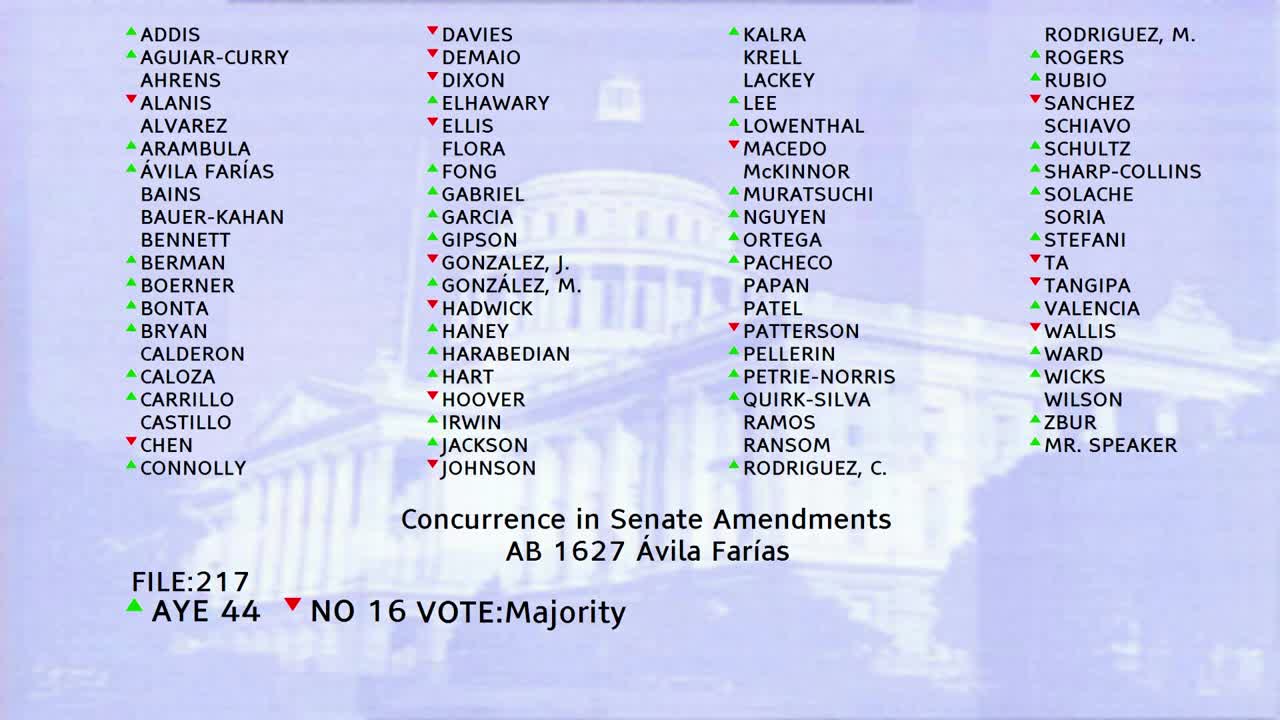 55SEC
Assembly Floor
 2MIN
Senate Floor
 18MIN
Senate Standing Committee on Governmental Organization
5MIN
Senate Standing Committee on Governmental Organization
 13MIN
Senate Standing Committee on Local Government
 1MIN
Assembly Floor
 34MIN
Assembly Standing Committee on Governmental Organization
 6MIN
Assembly Standing Committee on Local Government
Bill Author

Bill Co-Author(s):